
Manual. TC3 Database Server. TwinCAT. Version Date Order No TF6420
|
|
|
- Timothy Little
- 10 years ago
- Views:
Transcription
1 Manual TC3 Database Server TwinCAT Version Date Order No TF6420

2

3 Table of contents Table of contents 1 Foreword Notes on the documentation Safety instructions Overview Installation System requirements Installation Licensing Technical Introduction Database Server functionality TF6420 Database Server applied into a network environment Configuration TF6420 Database Server Configuration Editor TwinCAT Database Server : SQL Query Editor Write Direction Mode Properties and use of the XML configuration file Databases Declaration of the different database types MS SQL database MS SQL Compact database MS Azure SQL database MS Access database MS Excel database NET / ODBC - MySQL Database OCI / ODBC - Oracle Database SQLite ASCII - File XML - Database ODBC - PostgreSQL Database ODBC - DB2 Database ODBC - InterBase Database ODBC - Firebird Database Additional information Expert Impersonate option Additional Registry configuration XML - configuration file PLC libraries PLC reference Tc2_Database Function blocks Data types Global Constants Samples Workshop Handout Generation of a MS Access database Start / Stop of the cyclic log To log a PLC variable with FB_DBWrite Example with the FB_DBRecordInsert and FB_DBRecordSelect block TC3 Database Server Version 1.2 3

4 Table of contents 7.6 Stored procedures with FB_DBStoredProceduresRecordArray Use XML as Database XML Database - XPath Sample to demonstrate the different SELECT types XML Database - XPath sample with XML-Schema Appendix Errorcodes ADS Return Codes Internal Errorcodes of the TwinCAT Database Server OleDB Errorcodes ASCII Errorcodes XML Errorcodes FAQ - Frequently asked questions and their answers Version 1.2 TC3 Database Server

5 Foreword 1 Foreword 1.1 Notes on the documentation This description is only intended for the use of trained specialists in control and automation engineering who are familiar with the applicable national standards. It is essential that the following notes and explanations are followed when installing and commissioning these components. The responsible staff must ensure that the application or use of the products described satisfy all the requirements for safety, including all the relevant laws, regulations, guidelines and standards. Disclaimer The documentation has been prepared with care. The products described are, however, constantly under development. For that reason the documentation is not in every case checked for consistency with performance data, standards or other characteristics. In the event that it contains technical or editorial errors, we retain the right to make alterations at any time and without warning. No claims for the modification of products that have already been supplied may be made on the basis of the data, diagrams and descriptions in this documentation. Trademarks Beckhoff, TwinCAT, EtherCAT, Safety over EtherCAT, TwinSAFE, XFC and XTS are registered trademarks of and licensed by Beckhoff Automation GmbH. Other designations used in this publication may be trademarks whose use by third parties for their own purposes could violate the rights of the owners. Patent Pending The EtherCAT Technology is covered, including but not limited to the following patent applications and patents: EP , EP , DE , DE with corresponding applications or registrations in various other countries. The TwinCAT Technology is covered, including but not limited to the following patent applications and patents: EP , US with corresponding applications or registrations in various other countries. EtherCAT is registered trademark and patented technology, licensed by Beckhoff Automation GmbH, Germany Copyright Beckhoff Automation GmbH & Co. KG, Germany. The reproduction, distribution and utilization of this document as well as the communication of its contents to others without express authorization are prohibited. Offenders will be held liable for the payment of damages. All rights reserved in the event of the grant of a patent, utility model or design. TC3 Database Server Version 1.2 5

6 Foreword 1.2 Safety instructions Safety regulations Please note the following safety instructions and explanations! Product-specific safety instructions can be found on following pages or in the areas mounting, wiring, commissioning etc. Exclusion of liability All the components are supplied in particular hardware and software configurations appropriate for the application. Modifications to hardware or software configurations other than those described in the documentation are not permitted, and nullify the liability of Beckhoff Automation GmbH & Co. KG. Personnel qualification This description is only intended for trained specialists in control, automation and drive engineering who are familiar with the applicable national standards. Description of symbols In this documentation the following symbols are used with an accompanying safety instruction or note. The safety instructions must be read carefully and followed without fail! DANGER Serious risk of injury! Failure to follow the safety instructions associated with this symbol directly endangers the life and health of persons. WARNING Risk of injury! Failure to follow the safety instructions associated with this symbol endangers the life and health of persons. CAUTION Personal injuries! Failure to follow the safety instructions associated with this symbol can lead to injuries to persons. Attention Damage to the environment or devices Failure to follow the instructions associated with this symbol can lead to damage to the environment or equipment. Tip or pointer This symbol indicates information that contributes to better understanding. Note 6 Version 1.2 TC3 Database Server

7 Overview 2 Overview The TwinCAT Database Server enables data exchange between the TwinCAT System and different database systems. For smaller applications you can use the server over a configurator without influencing the existing program code. For complex tasks and a maximum of flexibility the Database Server offers a detailed library of PLC function blocks. Directly out of the PLC you can use SQL-commands like Insert and Select. If necessary you can relieve the PLC by calling up Stored Procedures in the database. The transfered parameters from the PLC function block will be used from the database in connection with the stored procedure and results will be returned to the controller. At the moment the TwinCAT Database Server supports eleven different database systems [} 42]: MS SQL, MS SQL Compact, MS Access, MySQL, PostgreSQL, DB2, Oracle, Interbase, Firebird, ASCII (e.g..txt or.csv) as well as XML files. Components: TwinCAT Database Server [} 16]: a service which starts and stops along with TwinCAT. It is a connector between the TwinCAT system and the database. Configurator [} 19]: the TwinCAT Database Server configurator enables an easy visual setting of database parameters, which are necessary for the basic communication with the respective database. PLC library [} 74]: the PLC library offers several function blocks to generate a database connection or a new chart. Furthermore you can write data into any chart structures with Insert-commands or read them through Select-commands. It is also possible to update or delete database entries. Stored procedures can be activated. Functional principle: The Database Server communicates over ADS within the TwinCAT system. Outwards the server connects with the respective database. Possible network topologies can be found here [} 17]. TC3 Database Server Version 1.2 7


8 Installation 3 Installation 3.1 System requirements Technical Data Target system.net Framework Min. TwinCAT-Version Min. TwinCAT-Level TF6420 TwinCAT 3 Database Server Windows NT/2000/XP/Vista/7,CE PC (x86, x64 and ARM).Net 2.0 or higher Win CE:.NET 3.5 or higher TC1200 TC3 PLC 3.2 Installation Description of the installation procedure of a TwinCAT 3 Function for Windows-based operating Systems. 1. Double-click the downloaded setup file "TFxxxx". Please note: Under Windows 32-bit/64-bit, please start the installation with "Run as Administrator" by right-clicking the setup file and selecting the corresponding option in the context menu. 2. Click on "Next" and accept the license Agreement. 8 Version 1.2 TC3 Database Server


9 Installation 3. Enter your user information in the specified area. 4. To install the full product, including all sub-components, please choose "Complete" as the Setup Type.Alternatively you can also install each component seperately by choosing "Custom". TC3 Database Server Version 1.2 9


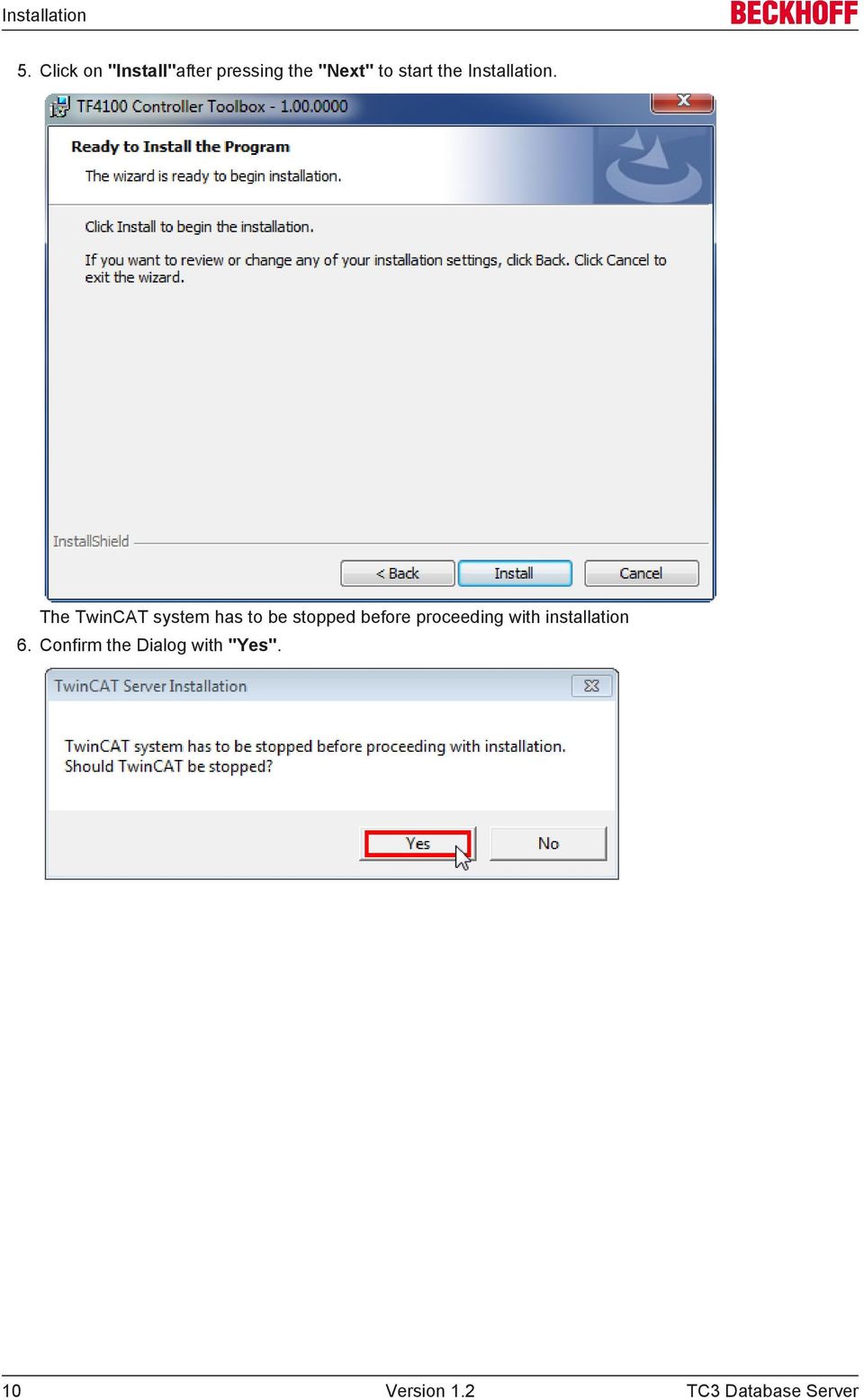
10 Installation 5. Click on "Install"after pressing the "Next" to start the Installation. The TwinCAT system has to be stopped before proceeding with installation 6. Confirm the Dialog with "Yes". 10 Version 1.2 TC3 Database Server

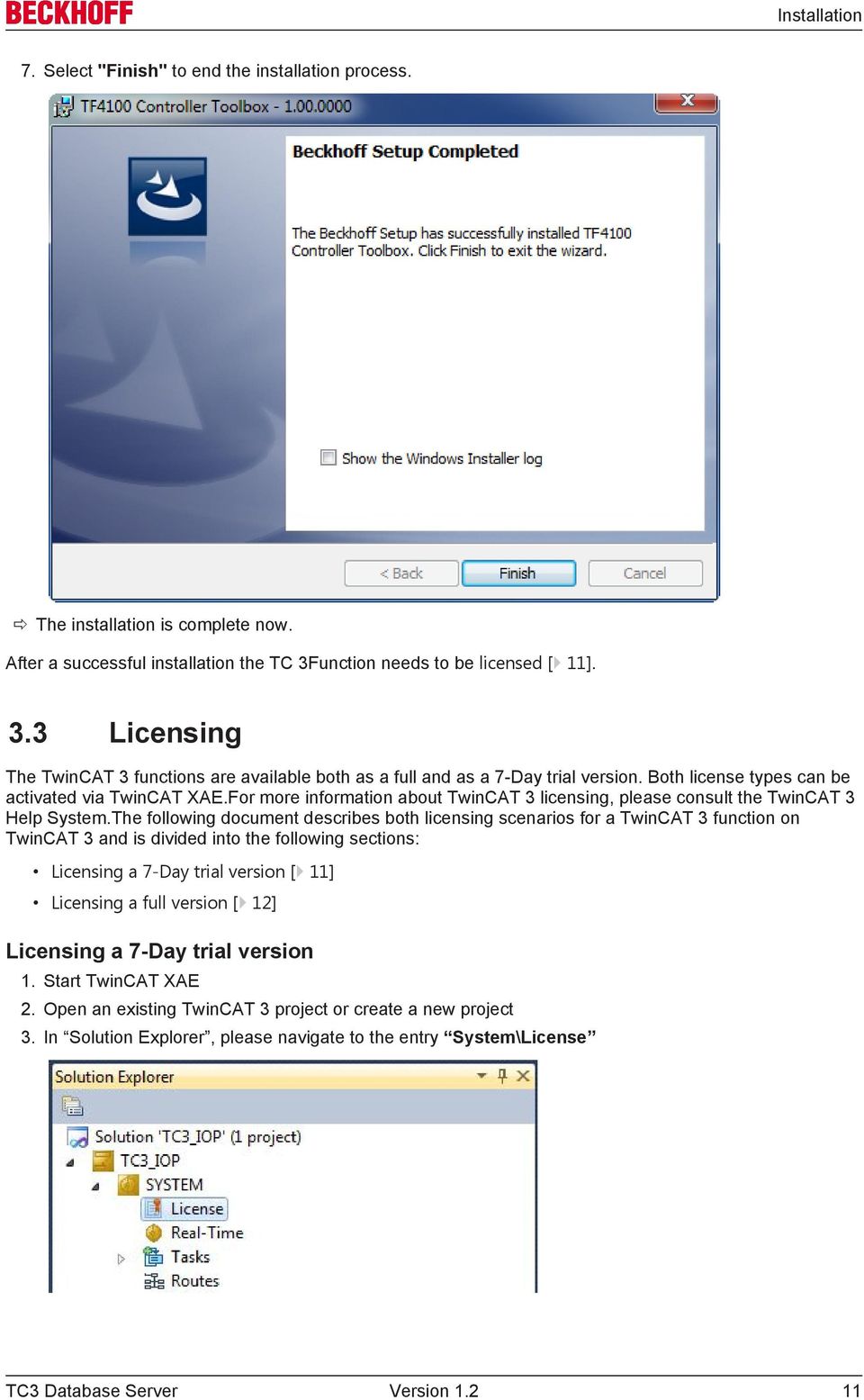
11 Installation 7. Select "Finish" to end the installation process. ð The installation is complete now. After a successful installation the TC 3Function needs to be licensed [} 11]. 3.3 Licensing The TwinCAT 3 functions are available both as a full and as a 7-Day trial version. Both license types can be activated via TwinCAT XAE.For more information about TwinCAT 3 licensing, please consult the TwinCAT 3 Help System.The following document describes both licensing scenarios for a TwinCAT 3 function on TwinCAT 3 and is divided into the following sections: Licensing a 7-Day trial version [} 11] Licensing a full version [} 12] Licensing a 7-Day trial version 1. Start TwinCAT XAE 2. Open an existing TwinCAT 3 project or create a new project 3. In Solution Explorer, please navigate to the entry System\License TC3 Database Server Version
12 Installation 4. Open the tab "Manage Licenses" and add a "Runtime License" for your product (in this screenshot TE1300: TC3 Scope View Professional ) 5. Optional: If you would like to add a license for a remote device, you first need to connect to the remote device via TwinCAT XAE toolbar 6. Switch to the tab "Order Information" and click the button "Activate 7 Days Trial License..."to activate a test version 7. Please restart TwinCAT 3 afterwards. Licensing a full version 8. Start TwinCAT XAE 9. Open an existing TwinCAT 3 project or create a new project 12 Version 1.2 TC3 Database Server

13 Installation 10. In "Solution Explorer", please navigate to the entry "SYSTEM\License" 11. Open the tab "Manage Licenses" and add a "Runtime License" for your product (in this screenshot " TE1300: TC3 Scope View Professional ). 12. Optional:If you would like to add a license for a remote device, you first need to connect to the remote device via TwinCAT XAE toolbar 13. Navigate to the "Order Information" tab The fields "System-ID" and "HW Platform" cannot be changed and just describe the platform for the licensing process in general a TwinCAT 3 license is always bound to these two identifiers: the "System-ID" uniquely identifies your system. The "HW Platform" is an indicator for the performance of the device. 14. Optionally, you may also enter an own order number and description for your convenience TC3 Database Server Version


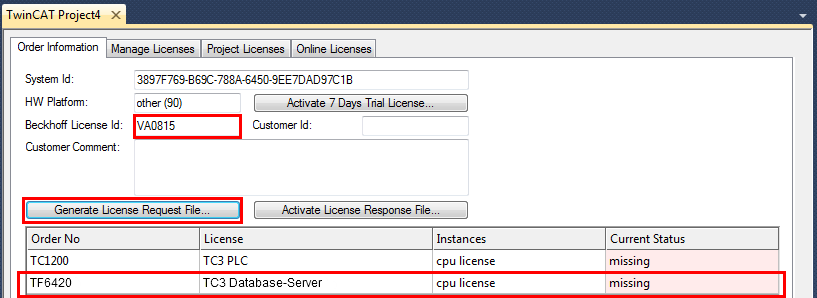
14 Installation 15. enter the "Beckhoff License ID" and click on "Generate License Request File...". If you are not aware of your "Beckhoff License ID" please contact your local sales representative. 16. After the license request file has been saved, the system asks whether to send this file via to the Beckhoff Activation Server 17. After clicking "Yes", the standard client opens and creates a new message to "[email protected]" which contains the "License Request File" 18. Send this Activation Request to Beckhoff NOTE! The License Response File will be sent to the same address used for sending out the License Request File 19. After receiving the activation file, please click on the button "Activate License Response File..."in the TwinCAT XAE license Interface. 14 Version 1.2 TC3 Database Server


15 Installation 20. Select the received "Licnse response file" and click on "Open" 21. The "License Response File" will be imported and all included licenses will be activated. If there have been any trial licenses, these will be removed accordingly. 22. Please restart TwinCAT to activate licenses.. NOTE! The license file will be automatically copied to "..\TwinCAT\3.1\Target\License" on the local device. TC3 Database Server Version

16 Technical Introduction 4 Technical Introduction 4.1 Database Server functionality The Database Server provides different communication ways and is configured by a XML configuration file. Communication flow in two directions ADS_TO_DB Cyclic checking of a TwinCAT ADS device (e.g. TwinCAT PLC) and writing of these data to a "database" DB_TO_ADS Cyclic checking of a "database" (e.g. SQL database) and writing of these data to a TwinCAT-ADS device (e.g. a PLC) via ADS Configuration of the "TwinCAT Database Server" is based on an XML file. This configuration file describes the required "databases", ADS devices (e.g. PLC runtime systems), and variables. Two storage methods: - "Double" The compatible variable data types are: BOOL, LREAL, REAL, INT, DINT, USINT, BYTE, UDINT, DWORD, UINT, WORD, SINT - "Bytes" Compatible to all variable data types especially for strings and data structures Two different function modes: AutoStart: Starts the cyclic checking of the PLC values from a ADS device (ADS_TO_DB) or the cyclic checking of a database (DB_TO_ADS) automatically, as soon as the TwinCAT System is an "RUN" - mode. The checking PLC program should be running as a bootproject. Manual: Functions like logging in a database or reading from a database could be started out of the PLC with function blocks. The following diagram illustrates the server functionality. The central unit of the TwinCAT 3 Database Server is the XML-Configuration file editor from which all needed options and configurations are made. The created Configuration could be used in two different modes (AutoStart/Manual). The TwinCAT 3 Database Server is the connective link between the PLC and the database. 16 Version 1.2 TC3 Database Server
17 Technical Introduction Note TwinCAT Database Server Errors can occur as a result of byte alignment when logging structures from ADS devices with ARM processors. Errors can occur when logging structures from the BC9000 with floating point variables. 4.2 TF6420 Database Server applied into a network environment The TwinCAT 3 Database Server can be carried out in the network in several ways. The network topology mostly will be controlled by the database type, the local terms and the area of application. In the following figure you can see several network topologies where the TwinCAT 3 Database Server can be applied. TC3 Database Server Version

18 Technical Introduction Fig. 1: Networktopology Important! For a smooth remote access of the TwinCAT Database Servers to a database some things must be regarded at the database side: Is the remote access allowed in general Note the quorum of the concurrent opened connections. (If the TwinCAT Database Server needs to open several connections) Has the user who wants to register enough rights Is the Firewall of the Remote Systems configurated Further more details how to configure your database server you can find in the corresponding documentation of the database. 18 Version 1.2 TC3 Database Server

19 Configuration 5 Configuration 5.1 TF6420 Database Server Configuration Editor The TwinCAT 3 DataBase Server is configured via XML configuration file. The settings in the configuration file can easily be created and modified with the help of the XML configuration file editor. New configuration files can be created, or existing configuration files can be read in and edited. TC3 Database Server Version

20 Configuration The Menu Bar 20 Version 1.2 TC3 Database Server

21 Configuration New configuration file Open Open from Targetsystem Save File Upload New database New ADS device New symbol group Copy Delete Insert symbols TPY Insert symbols ROUTE SQL Query Editor Live Status Error Log Description Creates an empty configuration file with default settings. Opens an existing XML configuration file. Opens an active XML configuration file from a target. Saves all the changes that have been made, creating a configuration file with the name: "CurrentConfigDataBase.xml". Uploading of the configuration file to the Database Server, saves the configuration file at the specified "Boot"-directory and activates the configuration. Creates a new database configuration entry. Creates a new ADS device configuration entry. Creates a new symbol group configuration entry. Copies the selected configuration entry. This can be a database, an ADS device or a symbol group. Deletes the selected configuration entry. This can be a database, an ADS device or a symbol group. Imports symbols/variables from a TPY file into the selected symbol group. Imports symbols/variables from a Runtime system of a specified route. Editor for generate SQL commands easily. Further information here [} 32]. Shows the current state of the TF6420 Database Server and start or stop the cyclic read/write function. Shows the logged errors of the error logfile "TcDBSrvErrorLog.txt" Option dialog This dialog can be used to set options for the TwinCAT Database Server: StartUp Option: Two options are available. "Manual" => TwinCAT Database Server is active and waiting for function calls from the PLC, with the aid of function blocks from TcDatabase.lib. "AutoStart" => TwinCAT Database Server is active and starts logging the set symbol groups as soon as the TwinCAT system is in "RUN" mode. ATTENTION: PLC programs from which variable values are to be logged must run as boot projects! ErrorLog Option: This option can be used to log errors in a text file. The logged errors can then be used for troubleshooting. In addition, you can specify the path for the text file and the maximum file size. To activate logging, the TcDBSrv configuration has to be reloaded onto the target system. For performance reasons, this should be done explicitly. We also recommend that logging is deactivated again after the error analysis, unless it is specifically still required. Impersonate Option: For network access to file-based databases such as Access or SQL Compact, the Impersonate option must be set, so that the TwinCAT Database Server can connect to this network drive. For further information see Impersonate [} 69]. This feature is currently not supported in Windows CE. Password: The generated XML configuration file can be secured with a password. Before the file can be edited, the user then has to enter the specified password. TC3 Database Server Version

22 Configuration Database Configuration Dialog All the information required for database communication can be entered in this dialog. Only fields for the necessary entries are enabled. The DBValueType indicates the data type of the "Value" column. PLC structures and strings cannot be logged if the data type is "double". Structures and strings can be logged if the data type is "bytes". You can choose if the database communication needs an authentication or not. If you want to add authentication information, the fields DBSystemDB, DBUserId and DBPassword will be enable. The field DBSystemDB is needed for Access databases only. In this field you have to write the path of the MDW-file. In this file all information like usernames and passwords are saved. DBUserId is the username and DBPassword is the necessary password. configuration of all database types: database-configuration [} 42] 22 Version 1.2 TC3 Database Server
23 Configuration If you choose ODBC-database types the input mask will be changed. Further information for the ODBCconnection like Port, Protocol, Driver, Scheme and Sequence have to be insert. TC3 Database Server Version
24 Configuration ADS Device Configuration Dialog All the information required for communication with the ADS devices can be entered in this dialog. For easier input all declared RemotePCs of the TwinCAT System will be listed and could be selected. Of course it is possible to insert other NetIds, which are not declared as RemotePCs. Symbol Groups Configuration Dialog Symbol groups can be arranged in this dialog, and assigned to ADS devices or databases. Additionally the writing direction of the symbol group is defined. Different settings are possible, see write direction mode. [} 38] 24 Version 1.2 TC3 Database Server
25 Configuration This dialog also contains a symbol counter. It returns the number of symbols declared in the individual groups. If more than 500 symbols are declared, the display turns red, as no more than 500 symbols/ variables may be declared for each symbol group. If, due to the database settings, data types are not supported, these symbols are highlighted in red and a warning message is displayed in the upper region. Of course symbolrows could be copy and paste. You only have to select a row and click the right mouse TC3 Database Server Version
26 Configuration button. A context menu open and you can choose the desired function. Import of symbols It gives two possibilities to import symbols into the TwinCAT Database XML configurator. One way is to read out the TPY file. The other way is directly from the target device with the Target Browser. Symbols from TPY All symbols of this project will be listed very clearly in the following dialog. Also you can import each element of an array or of a structure into the symbol group. So you can log arrays and structs which consist of numeric data types if the selected DBValueTyp is "Double". 26 Version 1.2 TC3 Database Server
27 Configuration Directly from the target with the Target Browser The Target Browse is used to add channels by a known Symbol to the configuration. The Target Browser is separated in three parts. The left one shows a tree view with the root named ROUTES. Beneath all TwinCAT System Manager known targets are listed. The color of the nodes explain the system state: Red= not Connected (Stop-Mode), Blue= Config Mode, Green= Run Mode. The second part contains a list view showing the details of the selected node in the tree view. In the third part is a list view which show all choose symbols. TC3 Database Server Version
28 Configuration It is possible to add new ADS ports in the Target Browser. So it is realisable to log values directly from EtherCAT terminals, if the ADS port is enabled in the TwinCAT System Manager under EtherCAT Device Image. Upload of the XML configuration file to the TwinCAT Database Server The created XML configuration file has to be copied into the specified "TwinCAT\Boot" directory. Reload it with restarting the TwinCAT System or with the function block FB_DBReloadConfig for activating. Another possibility for this procedure is to activate the file with the help of the "Upload"-dialog. You only have to choose the right ADS-device and start the upload procedure with the Upload button. The XML 28 Version 1.2 TC3 Database Server
29 Configuration configuration file will be uploaded to the TwinCAT Database Server, stored in the boot directory and reload from the Database Server. Attention: To use this service, the TwinCAT system has to be installed on the host PC where the XMLconfiguration file editor runs. The host pc and the ADS-device has to be in RUN mode. Live Status of the TF6420 Database Server At this dialog the current state of the Database Server will be shown. It is possible to check the status of the Database Server from a remote computer. It is also possible to start or stop the cyclic read/write functionality of the Database Server. If error occurs durring the cyclic read/write process, the sqlstate and the errorcode of the occured error will be shown too. TC3 Database Server Version
30 Configuration Error Log (TcDBSrvErrorLog.txt) At this dialog the all items of the error log file "TcDBSrvErrorLog.txt" will be shown. It is also possible to clear the error log file. 30 Version 1.2 TC3 Database Server
31 Configuration SQL Query Editor The SQL Query Editor helps to generate SQL commands and test the configured database connections. Further information here [} 32] TC3 Database Server Version

32 Configuration 5.2 TwinCAT Database Server : SQL Query Editor The TwinCAT Database server combine two different worlds. On the one hand the know how of automation engeniers and on the other hand the IT database administrators. To work more efficent the SQL Query Editor would be developed. With the editor you are able to generate SQL commands and test them with standard PLC function blocks of the TwinCAT Database Server. Additional it is possible to export the generated commands or structs to TwinCAT. It is also possible to select, insert, delete datasets or create tables. The generated SQL commands based of the database specific syntax. The different functionalities of the editor will be sent to the configured database connections. Menu Bar 32 Version 1.2 TC3 Database Server

33 Configuration Description 1 Target TwinCAT Database Server Choose the Target TwinCAT Database Server for communication. 2 Database List of the configurated database connections 3 Table Tablenname for SQL command generating 4 Copy for PLC Copy the created SQL command with correct PLC syntax into the clipboard 5 Export TC2 Create an export file for TwinCAT 2 for the SELECT PLC struct 6 Export TC3 Create an export file for TwinCAT 3 for the SELECT PLC struct 7 Get Tableschema Reads the table structure of the given table 8 Create Cmd Create SQL commands based of the different database syntax 9 Execute Executes the SQL command SQL "CREATE TABLE" With the tab "CREATE TABLE" you are able to create arbitary tables at the selected database. This operation will be executed internally with the function block FB_DBTableCreate. With the table text field (3) it is possible to indicate the name of the new table. TC3 Database Server Version

34 Configuration SQL "INSERT" Commands With the tab "INSERT", INSERT SQL commands could be created of a fast and easy way. You can configure the individual columns of the table by hand, or you read the whole tableschema with the help of the button "Get Tableschema". If all column values are insert, and the button "Create Cmd" would be clicked, the INSERT SQL command will be created with the right database syntax. After that, you only have to press the "Execute" button to send the command to the database. This operation will be execute internally with the function block FB_DBRecordInsert_EX 34 Version 1.2 TC3 Database Server
35 Configuration SQL "SELECT" Commands With the tab "SELECT" datasets of a table could be read. Therefore you have to declare at the bottom of the tab the struct with standard PLC data types in which the data will be saved. You can do that by your own or you use the button "Get Tableschema". The created struct can be export to the TwinCAT PLC program. This operation will be executed internally with the function block FB_DBRecordArraySelect. TC3 Database Server Version

36 Configuration SQL "DELETE" Commands Of course the SQL Query Editor contains a possibility to delete datasets or complete tables. For that purpose the SQL Query Editor contains the tab "DELETE". Here it is possible to generate DELETE SQL commands. Internally the commands will be executed with the function block FB_DBRecordDelete. DELETE Records 36 Version 1.2 TC3 Database Server
37 Configuration DELETE Tables TC3 Database Server Version
38 Configuration 5.3 Write Direction Mode The TwinCAT Database Server provides four different write direction modes. DB_TO_ADS: With this write mode it is possible to read cyclic values out of a database and write them in variables in the PLC. ADS_TO_DB_APPEND: With this write mode it is possible to write cyclic values from the PLC into a database. Each cycle a new record is created and added to the end of the table / file. ADS_TO_DB_UPDATE: With this write mode values will be cyclically read out of the PLC. These values will be compared with the records in the database. If the values differs the specified record will be updated with the new value. 38 Version 1.2 TC3 Database Server
39 Configuration ADS_TO_DB_RINGBUFFER: With this write mode you can limit the count or the age of datasets on database tables. This write mode is available for the cyclic logging with symbol groups and for logging with the function block FB_DBWrite. Every databasetype can be used with this write mode. Also logging in ASCII-files can be influenced with the RingBufferMode. "RingBuffer"-Versions: The RingBuffer works in two different ways: - "RingBuffer_Time" - "RingBuffer_Count" RingBuffer "Time": In this mode a timestamp can be set, this timestamp defines the maximum age of the datasets. If this age is exceeded, the affected datasets will be deleted. RingBuffer "Count": In this mode a maximum count of datasets can be defined. If the maximum count is obtained, the old datasets will be deleted to get space for new datasets. Declaration of the RingBuffer Mode with XML-configuration file editor: RingBuffer_Time The time is given in milliseconds. RingBuffer_Count TC3 Database Server Version
40 Configuration Declaration of the RingBuffer Mode with FB_DBWrite: RingBuffer_Time RingBuffer_Count 40 Version 1.2 TC3 Database Server
41 Configuration 5.4 Properties and use of the XML configuration file Storage place of the XML-configuration file: The configuration file has a fixed storage place. On CE devices the configuration file is placed at the following folder "\Hard Disk\TwinCAT\Boot" (If you change the XML-configuration file with the XML-configuration file editor, you have to copy this file back to the folder "\Hard Disk\TwinCAT\Boot") On PCs the configuration file is placed at the folder "C:\TwinCAT\Boot" Loading the XML-configuration file: The configuration file will be read once if the TcDatabaseSrv.exe is starting. With the Function block "FB_DBReloadConfig" you can read the configuration file once again. (This is only possible, if the cyclic read/write isn't started.) After every restart of the TwinCAT System the XML-configuration file will be reloaded. Mode 1 (StartUp = "AutoStart") : The XML-configuration file loads automatically, when the TcDatabaseSrv.exe starts. Because of the value "AutoStart" at the tag StartUp, the Database Server starts immediately creating the connections to the declared databases und ADS-devices. Also all variables, which are described in symbol groups, are logged to the specified database resp. written with values of the database. This process will be execute with the declared cycle time. The process will be continued until the Database Server is stopped by the PLC with the function block "FB_DBCyclicRdWrt" Mode 2 (StartUp = "Manual") : The XML-configuration file loads automatically, when the TcDatabaseSrv.exe starts. Because of the value "Manual" at the tag StartUp, no further function will be execute. After this the Database Server is waiting for commands from the PLC. "FB_DBCyclicRdWrt" All sections of the configuration file are needed for this function block. TC3 Database Server Version
42 Configuration Create the connection to the databases and the ADS-devices which are declared in the XML-configuration file and the cyclic logging with all symbol groups will be started. All other function blocks only needs the declared databases and ADS-devices of the configuration file. The symbol groups will be ignored. You can see that at the following function block. "FB_DBWrite" A connection to the selected database (hdbid) and the selected ADS-device (hadsid) will be created. After this the variable which is indicated at the function block will be read out from the ADS-device and logged into the database. 5.5 Databases Declaration of the different database types Microsoft SQL database DBValueType: DBType: DBServer: DBProvider: DBName DBTable: WinCE Support: To limit logging to data types alphanumeric and Boolean select "Double". To also log structures and strings select "Bytes" Select "MS SQL". PLC: edbtype_sequal_server. Enter the name of your SQL server. e.g. ("TESTSERVER\SQLEXPRESS") "SQLOLEDB" or the provider of the SQL native client, e.g. "SQLNCLI10" DBName contains the name of the database DBTable contains the name of the table. Yes - via network connection Microsoft Compact SQL database DBValueType: DBType: DBServer: DBProvider: DBUrl DBTable: WinCE Support: To limit logging to data types alphanumeric and Boolean select "Double". To also log structures and strings select "Bytes" Select "MS Compact SQL". PLC: edbtype_mobile_server. Not required. Not required. DBUrl contains the path to the SDF file. e.g. ("C: \TwinCAT\TcDatabaseSrv\Samples\TestDB.sdf") DBTable contains the name of the table. Yes 42 Version 1.2 TC3 Database Server
43 Configuration Microsoft Azure SQL database DBValueType: DBType: DBServer: DBName: To limit logging to data types alphanumeric and Boolean select "Double". To also log structures and strings select "Bytes" Select "MS Azure SQL". PLC: edbtype_azuresql. Enter the name of your SQL server. DBName contains the name of the database Port: Enter the connection port. Standard: 1433 DBTable: UserId: Password: WinCE Support: DBTable contains the name of the table. User name Password No Microsoft Access database DBValueType: DBType: DBServer: DBProvider: DBUrl DBTable: WinCE Support: To limit logging to data types alphanumeric and Boolean select "Double". To also log structures and strings select "Bytes" Select "MS Access". PLC: edbtype_access. Not required. Access Access 2003: The provider is "Microsoft.jet.OLEDB.4.0". Access 2007: The provider is "Microsoft.ACE.OLEDB.12.0". DBUrl contains the path to the MDB file. e.g. ("C: \TwinCAT\TcDatabaseSrv\Samples\TestDB.mdb") DBTable contains the name of the table. No Microsoft Excel database DBValueType: DBType: DBServer: DBProvider: DBUrl DBTable: WinCE Support: To limit logging to data types alphanumeric and Boolean select "Double". To also log structures and strings select "Bytes" Select "MS Excel". PLC: edbtype_msexcel. Not required. "Microsoft.Jet.OLEDB.4.0". or "Microsoft.ACE.OLEDB.12.0". DBUrl contains the path to the Excel file. e.g. ("C: \TwinCAT\TcDatabaseSrv\Samples\TestDB.xls") DBTable contains the name of the table. No TC3 Database Server Version
44 Configuration ASCII - file DBValueType: DBType: DBServer: DBProvider: DBUrl DBTable: WinCE Support: To limit logging to data types alphanumeric and Boolean select "Double". To also log structures and strings select "Bytes" Select "ASCII". PLC: edbtype_ascii. Not required. Not required. DBUrl contains the path to the ASC, TXT or CSV file. e.g. ("C:\TwinCAT\TcDatabaseSrv\Samples \TestDB.asc") Not required. It is not possible to create tables in ASCII files. Yes - local NET-MySQL database DBValueType: DBType: ODBC Driver: Server name: Database name: To limit logging to data types alphanumeric and Boolean select "Double". To also log structures and strings select "Bytes" Select "NET_MySQL". PLC: edbtype_net_mysql. Not required. Contains the name of the server or the IP address/ name of the host. Contains the name of the database. Port: Contains the port for the connection. (Standard 3306) Protocol: Scheme: Sequence: Table name: UserId: Password: WinCE Support: Not required. Not required. Not required. Contains the name of the table for writing or reading. Contains the name of the user for logging into the server. Contains the password to be used for authentication. Yes 44 Version 1.2 TC3 Database Server
45 Configuration ODBC-MySQL Database DBValueType: DBType: ODBC Driver: Server name: Database name: Port: Protocol: Scheme: Sequence: Table name: UserId: Password: WinCE Support: To limit logging to data types alphanumeric and Boolean select "Double". To also log structures and strings select "Bytes" Select "ODBC_MySQL". PLC: edbtype_odbc_mysql. Enter the name of the ODBC driver. ("MySQL ODBC 3.51 Driver") Contains the name of the server or the IP address/ name of the host. Contains the name of the database. Contains the port for connection of the ODBC driver. Not required. Not required. Not required. Contains the name of the table for writing or reading. Contains the name of the user for logging into the server. Contains the password to be used for authentication. No SQLite DBValueType: DBType: DBServer: DBProvider: DBUrl DBTable: WinCE Support: To limit logging to data types alphanumeric and Boolean select "Double". To also log structures and strings select "Bytes" Select "SQLite". PLC: edbtype_sqlite. Contains the name of the database. Not required. DBUrl contains the path to the SQLite file. e.g. ("C: \TwinCAT\TcDatabaseSrv\Samples\") DBTable contains the name of the table. Yes, but only for ARM-based devices! TC3 Database Server Version
46 Configuration ODBC PostgreSQL database DBValueType: DBType: ODBC Driver: Server name: Database name: Port: Protocol: Scheme: Sequence: Table name: UserId: Password: WinCE Support: To limit logging to data types alphanumeric and Boolean select "Double". To also log structures and strings select "Bytes" Select "ODBC_PostgreSQL". PLC: edbtype_odbc_postgresql. Enter the name of the ODBC driver. ("PostgreSQL UNICODE") Contains the name of the server or the IP address/ name of the host. Contains the name of the database. Contains the port for connection of the ODBC driver. Not required. Contains the name of the scheme to be used. Not required. Contains the name of the table for writing or reading. Contains the name of the user for logging into the server. Contains the password to be used for authentication. No ODBC DB2 database DBValueType: DBType: ODBC Driver: Server name: Database name: Port: Protocol: Scheme: Sequence: Table name: UserId: Password: WinCE Support: To limit logging to data types alphanumeric and Boolean select "Double". To also log structures and strings select "Bytes" Select "ODBC_DB2". PLC: edbtype_odbc_db2. Enter the name of the ODBC driver. ("IBM DB2 ODBC DRIVER") Contains the name of the server or the IP address/ name of the host. Contains the name of the database. Contains the port for connection of the ODBC driver. Contains the name of protocol for the connection. ("TCPIP") Contains the name of the scheme to be used. Not required. Contains the name of the table for writing or reading. Contains the name of the user for logging into the server. Contains the password to be used for authentication. No 46 Version 1.2 TC3 Database Server
47 Configuration OCI-Oracle database (Oracle Calling interface) DBValueType: DBType: ODBC Driver: Server name: Database name: To limit logging to data types alphanumeric and Boolean select "Double". To also log structures and strings select "Bytes" Select "OCI_Oracle". PLC: edbtype_oci_oracle. Not required Contains the host name / IP address of the server. Contains the name of the database or the ServiceName. Port: Port to be used for the connection. (Standard: 1521) Protocol: Scheme: Sequence: Table name: UserId: Password: WinCE Support: Protocol to be used for the connection. (Standard: TCP) Contains the name of the scheme to be used. Contains the name of the sequence to be used. Contains the name of the table for writing or reading. Contains the name of the user for logging into the server. Contains the password to be used for authentication. No ODBC Oracle database DBValueType: DBType: ODBC Driver: Server name: Database name: Port: Protocol: Scheme: Sequence: Table name: UserId: Password: WinCE Support: To limit logging to data types alphanumeric and Boolean select "Double". To also log structures and strings select "Bytes" Select "ODBC_Oracle". PLC: edbtype_odbc_oracle. Enter the name of the ODBC driver. ("Microsoft ODBC for Oracle") Not required. Contains the name of the database. Not required. Not required. Contains the name of the scheme to be used. Contains the name of the sequence to be used. Contains the name of the table for writing or reading. Contains the name of the user for logging into the server. Contains the password to be used for authentication. No TC3 Database Server Version
48 Configuration ODBC InterBase database DBValueType: DBType: ODBC Driver: Server name: Database name: ClientDll: Table name: UserId: Password: WinCE Support: To limit logging to data types alphanumeric and Boolean select "Double". To also log structures and strings select "Bytes" Select "ODBC_InterBase". PLC: edbtype_odbc_interbase. Enter the name of the ODBC driver. ("Firebird/ InterBase(r) driver") Contains the name of the server or the IP address/ name of the host. Contains the name of the database. Contains the path to fbclient.dll. Contains the name of the table for writing or reading. Contains the name of the user for logging into the server. Contains the password to be used for authentication. No ODBC Firebird database DBValueType: DBType: ODBC Driver: Server name: Database name: ClientDll: Table name: UserId: Password: WinCE Support: To limit logging to data types alphanumeric and Boolean select "Double". To also log structures and strings select "Bytes" Select "ODBC_Firebird". PLC: edbtype_odbc_firebird. Enter the name of the ODBC driver. ("Firebird/ InterBase(r) driver") Contains the name of the server or the IP address/ name of the host. Contains the name of the database. Contains the path to fbclient.dll. Contains the name of the table for writing or reading. Contains the name of the user for logging into the server. Contains the password to be used for authentication. No XML database DBValueType: DBType: DBServer: DBProvider: DBUrl DBTable: WinCE Support: To limit logging to data types alphanumeric and Boolean select "Double". To also log structures and strings select "Bytes" Select "XML". PLC: edbtype_xml. Contains the name of the database. Not required. DBUrl contains the path to the XML file. e.g. ("C: \TwinCAT\TcDatabaseSrv\Samples\TestDB.xml") The XSD file must be in same directory and have the same file name. e.g. ("C:\TwinCAT\TcDatabaseSrv \Samples\TestDB.xsd") DBTable contains the name of the table. Yes - local 48 Version 1.2 TC3 Database Server
49 Configuration MS SQL database The values of the variables are saved in a Microsoft SQL database. Compatible versions: Microsoft SQL database 20xx. Declarations see "Declaration for different databases" [} 42] The variable values are saved in the following table structure. Column name Data type Null permitted Characteristic ID bigint no IDENTITY(1,1) Timestamp datetime no Name ntext no ValueType="Double" Value float no ValueType="Bytes" Value varbinary no An AutoID is generated in the "ID" column. The value in this column is, in other words, always increased by 1. This functionality makes the IDENTITY property possible. The "Timestamp" column stores the time at which the data record was saved. The name of the variable is stored in the "Name" column. The "Value" column stores the value of the variable. The table is created with the following SQL command /*ValueType="Double"*/ CREATE TABLE mytable( ID bigint IDENTITY(1,1) NOT NULL, Timestamp datetime NOT NULL, Name ntext NOT NULL, Value float NOT NULL ) /*ValueType="Bytes"*/ CREATE TABLE mytable( ID bigint IDENTITY(1,1) NOT NULL, Timestamp datetime NOT NULL, Name ntext NOT NULL, Value varbinary NOT NULL ) TC3 Database Server Version
50 Configuration E_DBColumnTypes MS SQL PLC Control edbcolumn_bigint bigint T_ULARGE_INTEGER (TcUtilities.lib) edbcolumn_integer integer DINT edbcolumn_smallint smallint INT edbcolumn_tinyint tinyint SINT edbcolumn_bit bit BYTE edbcolumn_money money LREAL edbcolumn_float float LREAL edbcolumn_real real REAL edbcolumn_datetime datetime DT edbcolumn_ntext ntext STRING edbcolumn_nchar nchar STRING edbcolumn_image image ARRAY OF BYTE edbcolumn_nvarchar nvarchar STRING edbcolumn_binary binary ARRAY OF BYTE edbcolumn_varbinary varbinary ARRAY OF BYTE MS SQL Compact database The values of the variables are saved in a Microsoft SQL Compact database. Microsoft SQL Server 2005 Compact Edition is a compact database, ideal for embedding in mobile and desktop applications. It offers developers a programming model common with other editions of SQL Server for developing system dedicated and managed applications. This SQL Server requires relatively few resources, but nevertheless provides the necessary functionality for relational databases such as a robust data store, an optimized query processor and reliable, scalable connection functions. Compatible version: Microsoft Compact SQL Database 3.5 The variable values are saved in the following table structure. Column name Data type Null permitted Characteristic ID bigint no IDENTITY(1,1) Timestamp datetime no Name ntext no ValueType = "Double" Value float no ValueType = "Bytes" Value image no An AutoID is generated in the "ID" column. The value in this column is, in other words, always increased by 1. This functionality makes the IDENTITY property possible. The "Timestamp" column stores the time at which the data record was saved. The name of the variable is stored in the "Name" column. The "Value" column stores the value of the variable. 50 Version 1.2 TC3 Database Server
51 Configuration The table is created with the following SQL command: /* ValueType = "Double"*/ CREATE TABLE mytable( ID bigint IDENTITY(1,1) NOT NULL, Timestamp datetime NOT NULL, Name ntext NOT NULL, Value float NOT NULL ) /*ValueType = "Bytes"*/ CREATE TABLE mytable( ID bigint IDENTITY(1,1) NOT NULL, Timestamp datetime NOT NULL, Name ntext NOT NULL, Value image NOT NULL ) E_DBColumnTypes MS Compact SQL PLC Control edbcolumn_bigint bigint T_ULARGE_INTEGER (TcUtilities.lib) edbcolumn_integer integer DINT edbcolumn_smallint smallint INT edbcolumn_tinyint tinyint SINT edbcolumn_bit bit BYTE edbcolumn_money money LREAL edbcolumn_float float LREAL edbcolumn_real real REAL edbcolumn_datetime datetime DT edbcolumn_ntext ntext STRING edbcolumn_nchar nchar STRING edbcolumn_image image ARRAY OF BYTE edbcolumn_nvarchar nvarchar STRING edbcolumn_binary binary ARRAY OF BYTE edbcolumn_varbinary varbinary ARRAY OF BYTE CAUTION TwinCAT Database Server Do not save the database on the Compact Flash Card in case of an embedded system. Either use the database in RAM, i.e. do not save to the "Hard disk" folder, or save on a network folder. To many write cycles to the Compact Flash Card can shorten its service life MS Azure SQL database The variable values are stored in a Microsoft Azure SQL database. Declarations see "Declaration for different databases" [} 42] The variable values are saved in the following table structure. Column name Data type Null permitted Characteristic ID bigint no IDENTITY(1,1) Timestamp datetime no Name ntext no ValueType="Double" TC3 Database Server Version
52 Configuration Value float no ValueType="Bytes" Value varbinary no An AutoID is generated in the "ID" column. The value in this column is, in other words, always increased by 1. This functionality makes the IDENTITY property possible. The "Timestamp" column stores the time at which the data record was saved. The name of the variable is stored in the "Name" column. The "Value" column stores the value of the variable. The table is created with the following SQL command /*ValueType="Double"*/ CREATE TABLE mytable( ID bigint IDENTITY(1,1) NOT NULL, Timestamp datetime NOT NULL, Name ntext NOT NULL, Value float NOT NULL ) /*ValueType="Bytes"*/ CREATE TABLE mytable( ID bigint IDENTITY(1,1) NOT NULL, Timestamp datetime NOT NULL, Name ntext NOT NULL, Value varbinary NOT NULL ) E_DBColumnTypes MS SQL PLC Control edbcolumn_bigint bigint T_ULARGE_INTEGER (TcUtilities.lib) edbcolumn_integer integer DINT edbcolumn_smallint smallint INT edbcolumn_tinyint tinyint SINT edbcolumn_bit bit BYTE edbcolumn_money money LREAL edbcolumn_float float LREAL edbcolumn_real real REAL edbcolumn_datetime datetime DT edbcolumn_ntext ntext STRING edbcolumn_nchar nchar STRING edbcolumn_image image ARRAY OF BYTE edbcolumn_nvarchar nvarchar STRING edbcolumn_binary binary ARRAY OF BYTE edbcolumn_varbinary varbinary ARRAY OF BYTE MS Access database The values of the variables are saved in a Microsoft Access database. Databasefiles of Access 2000 and Access 2003 (*.mdb) are as compatible as databasefiles of Access 2007 (*.accdb). You only have to declare different provider in the XML - configuration file for these different filetypes. More 52 Version 1.2 TC3 Database Server
53 Configuration infos at "Declaration different databases" [} 42] The variable values are saved in the following table structure. Column name Data type Characteristic ID AutoNumber Field Size:= "Long Integer"; New Values:= "Increment" Timestamp Date/Time Format:= "General Date" Name ValueType="Double" Text Value Number Field Size:= "Double" ValueType="Bytes" Value OLE Object An AutoID is generated in the "ID" column. The value in this column is, in other words, always increased by 1. The "Timestamp" column stores the time at which the data record was saved. The name of the variable is stored in the "Name" column The "Value" column stores the value of the variable. E_DBColumnTypes MS Access PLC Control edbcolumn_bigint Integer4 DINT edbcolumn_integer Integer2 INT edbcolumn_smallint Integer2 SINT edbcolumn_tinyint Integer1 SINT edbcolumn_bit YESNO BYTE edbcolumn_money Currency LREAL edbcolumn_float Double LREAL edbcolumn_real Single REAL edbcolumn_datetime DATETIME DT edbcolumn_ntext Text STRING edbcolumn_nchar VarChar STRING edbcolumn_image OLEOBJECT ARRAY OF BYTE edbcolumn_nvarchar VarChar STRING edbcolumn_binary OLEOBJECT ARRAY OF BYTE edbcolumn_varbinary OLEOBJECT ARRAY OF BYTE Attention TwinCAT Database Server Do not save the database on the Compact Flash Card in case of an embedded system. Either use the database in RAM, i.e. do not save to the "Hard disk" folder, or save on a network folder. To many write cycles to the Compact Flash Card can shorten its service life MS Excel database The variable values are stored in an Microsoft Excel database. For details re. MS Excel declaration see "Declaration for different databases" [} 42]. TC3 Database Server Version
54 Configuration Mapping of data types between database and PLC: E_DBColumnTypes MS Excel PLC Control edbcolumn_bigint Number LREAL edbcolumn_integer Number LREAL edbcolumn_smallint Number LREAL edbcolumn_tinyint Number LREAL edbcolumn_bit BOOLEAN BOOL edbcolumn_money Currency LREAL edbcolumn_float Number LREAL edbcolumn_real Number LREAL edbcolumn_datetime Date DT edbcolumn_ntext Text STRING(255) edbcolumn_nchar Text STRING(255) edbcolumn_nvarchar Text STRING(255) Attention Non-supported data types Binary, VarBinary and Image are not supported with Excel databases NET / ODBC - MySQL Database The values of the variables are saved in a MySQL database. The variable values are saved in the following table structure. Column name Data type Null permitted Characteristic ID INTEGER no IDENTITY(1,1) Timestamp DATETIME no Name VARCHAR(50) no ValueType="Double" Value DOUBLE no ValueType="Bytes" Value BLOB no An AutoID is generated in the "ID" column. The value in this column is, in other words, always increased by 1. This functionality makes the IDENTITY property possible. The "Timestamp" column stores the time at which the data record was saved. The name of the variable is stored in the "Name" column. The "Value" column stores the value of the variable. 54 Version 1.2 TC3 Database Server
55 Configuration E_DBColumnTypes MySQL PLC Control edbcolumn_bigint BIGINT T_ULARGE_INTEGER (TcUtilities.lib) edbcolumn_integer INT DINT edbcolumn_smallint SMALLINT INT edbcolumn_tinyint TINYINT SINT edbcolumn_bit CHAR(1) BYTE edbcolumn_money DEZIMAL(18,4) LREAL edbcolumn_float DOUBLE LREAL edbcolumn_real FLOAT REAL edbcolumn_datetime DATETIME DT edbcolumn_ntext TEXT STRING edbcolumn_nchar CHAR STRING edbcolumn_image BLOB ARRAY OF BYTE edbcolumn_nvarchar VARCHAR(254) STRING edbcolumn_binary BLOB ARRAY OF BYTE edbcolumn_varbinary BLOB ARRAY OF BYTE OCI / ODBC - Oracle Database The values of the variables are saved in an Oracle Database. The variable values are saved in the following table structure. Column name Data type Null permitted Characteristic ID NUMBER no IDENTITY(1,1) Timestamp DATE no Name VARCHAR2 no ValueType="Double" Value FLOAT no ValueType="Bytes" Value BLOB no To get the functionality of an AutoID a sequence will be create at the scheme you use with the following attributes: name: For example: "AUTO_INCREMENT_myTable$" typ: "ascending" minimum: "1" TC3 Database Server Version
56 Configuration maximum: "1.0E27" intervall: "1" cache: "no Cache" An AutoID is generated in the "ID" column. The value in this column is, in other words, always increased by 1. This functionality makes the sequence possible. The "Timestamp" column stores the time at which the data record was saved. The name of the variable is stored in the "Name" column. The "Value" column stores the value of the variable. E_DBColumnTypes Oracle PLC Control edbcolumn_bigint DECIMAL(15,0) T_LARGE_INTEGER (TcUtilities.lib) edbcolumn_integer INTEGER T_LARGE_INTEGER edbcolumn_smallint SMALLINT T_LARGE_INTEGER edbcolumn_tinyint SMALLINT T_LARGE_INTEGER edbcolumn_bit CHAR(1) STRING edbcolumn_money DECIMAL(18,4) LREAL edbcolumn_float DOUBLE PRECISION LREAL edbcolumn_real FLOAT LREAL edbcolumn_datetime DATE DT edbcolumn_ntext VARCHAR(254) STRING edbcolumn_nchar CHAR(254) STRING edbcolumn_image BLOB ARRAY OF BYTE edbcolumn_nvarchar NVARCHAR(254) STRING edbcolumn_binary BLOB ARRAY OF BYTE edbcolumn_varbinary BLOB ARRAY OF BYTE SQLite SQLite The values of the variables are saved in a SQLite database. SQLite is a compact database, which is ideal for embedding in mobile applications. This file-based SQL database requires no installation, since it is already integrated in the TwinCAT Database Server. The TwinCAT Database Server facilitates administration and configuration. The relational database offers most of the features of SQL databases and supports the commands of the SQL92 standard. The database enables reliable and fast data storage. However, the database does not allow distinction of users. It is therefore particularly suitable for safe storage of variables on the local system. By default, SQLite is used in the rollback journal. Compatible version: SQLite TwinCAT Database Server standard table structure in SQLite: Column name Data type Null permitted Characteristic ID bigint no IDENTITY(1,1) Timestamp datetime no Name ntext no 56 Version 1.2 TC3 Database Server
57 Configuration ValueType = "Double" Value float no ValueType = "Bytes" Value image no An AutoID is generated in the "ID" column. The value in this column is, in other words, always increased by 1. This functionality makes the IDENTITY property possible. The "Timestamp" column stores the time at which the data record was saved. The name of the variable is stored in the "Name" column The "Value" column stores the value of the variable. The table is created with the following SQL command: /* ValueType = "Double"*/ CREATE TABLE mytable( ID bigint IDENTITY(1,1) NOT NULL, Timestamp datetime NOT NULL, Name ntext NOT NULL, Value float NOT NULL ) /*ValueType = "Bytes"*/ CREATE TABLE mytable( ID bigint IDENTITY(1,1) NOT NULL, Timestamp datetime NOT NULL, Name ntext NOT NULL, Value image NOT NULL ) The Data type mapping looks like this: E_DBColumnTypes MS Compact SQL PLC Control edbcolumn_bigint bigint T_ULARGE_INTEGER (TcUtilities.lib) edbcolumn_integer integer DINT edbcolumn_smallint smallint INT edbcolumn_tinyint tinyint BYTE edbcolumn_bit bit BOOL edbcolumn_money money LREAL edbcolumn_float float LREAL edbcolumn_real real LREAL edbcolumn_datetime datetime DT edbcolumn_ntext ntext STRING edbcolumn_nchar nchar STRING edbcolumn_image image ARRAY OF BYTE edbcolumn_nvarchar nvarchar STRING edbcolumn_binary binary ARRAY OF BYTE edbcolumn_varbinary varbinary ARRAY OF BYTE Attention TwinCAT Database Server Do not save the database on the Compact Flash Card in case of an embedded system. Either use the database in RAM, i.e. do not save to the "Hard disk" folder, or save on a network folder. Too many write cycles to the Compact Flash Card can shorten its service life. TC3 Database Server Version
58 Configuration ASCII - File The values of the variables are saved in an ASCII file. The values are written into the ASCII file separated by semicolons. The file created can then be imported into other spreadsheet programs such as "Microsoft Excel", where it can be further processed. The ASCII file has the following structure: [Timestamp];[NAME];[VALUE] [YYYY-MM-DD hh:mm:ss];[variablename];[variablevalue] [YYYY-MM-DD hh:mm:ss];[variablename];[variablevalue] [YYYY-MM-DD hh:mm:ss];[variablename];[variablevalue] [YYYY-MM-DD hh:mm:ss];[variablename];[variablevalue] The "Timestamp" column stores the time at which the data record was saved. The name of the variable is stored in the "Name" column. The "Value" column stores the value of the variable. Important! Do not save the database on the Compact Flash Card in case of an embedded system. Either use the database in RAM, i.e. do not save to the "Hard disk" folder, or save on a network folder. To many write cycles to the Compact Flash Card can shorten its service life XML - Database The variable values will be saved at a XML file. The structure of the database, tables and columns are defined at the XSD-file. With the function blocks FB_DBCreate [} 86] and FB_DBTableCreate [} 87] it is possible to create the XML file and the XSD file. Further information to work with XML files together with the TwinCAT 3 Database Server you can find here: here [} 64]. <?xmlversion="1.0"encoding="utf-8"?> <TestDB_XMLxmlns:xs=" <mytable_double> <rowid="1"timestamp=" t12:45:08"name="testvalue1"value=" " /> <rowid="2"timestamp=" t12:45:14"name="testvalue1"value=" " /> <rowid="3"timestamp=" t12:45:18"name="testvalue1"value=" " /> <rowid="4"timestamp=" t12:45:22"name="testvalue1"value=" " /> <rowid="5"timestamp=" t12:45:23"name="testvalue1"value=" " /> </mytable_double> </TestDB_XML> 58 Version 1.2 TC3 Database Server
59 Configuration Table 1: The variable values are saved in the following table structure. Spaltenname Datentyp Null zulässig Eigenschaft ID xsd:long nein Timestamp xsd:datetime nein Name xsd:string nein 80 ValueType="Double" Value xsd:double nein ValueType="Bytes" Value xsd:hexbinary nein längenwert An AutoID is generated in the "ID" column. The value in this column is, in other words, always increased by 1. The "Timestamp" column stores the time at which the data record was saved. The name of the variable is stored in the "Name" column. The "Value" column stores the value of the variable. E_DBColumnTypes XML PLC Control edbcolumn_bigint xsd:long T_LARGE_INTEGER (TcUtilities.lib) edbcolumn_integer xsd:int DINT edbcolumn_smallint xsd:short INT edbcolumn_tinyint xsd:byte BYTE edbcolumn_bit xsd:boolean BOOL edbcolumn_money xsd:double LREAL edbcolumn_float xsd:double LREAL edbcolumn_real xsd:double LREAL edbcolumn_datetime xsd:datetime DT edbcolumn_ntext xsd:string STRING edbcolumn_nchar xsd:string STRING edbcolumn_image xsd:hexbinary ARRAY OF BYTE edbcolumn_nvarchar xsd:string STRING edbcolumn_binary xsd:hexbinary ARRAY OF BYTE edbcolumn_varbinary xsd:hexbinary ARRAY OF BYTE CAUTION TwinCAT Database Server Do not save the database on the Compact Flash Card in case of an embedded system. Either use the database in RAM, i.e. do not save to the "Hard disk" folder, or save on a network folder. To many write cycles to the Compact Flash Card can shorten its service life ODBC - PostgreSQL Database The values of the variables are saved in a PostgreSQL Database. TC3 Database Server Version
60 Configuration The variable values are saved in the following table structure. Column name Data type Null permitted Characteristic id bigint no IDENTITY(1,1) timestamp timestamp no name text no ValueType="Double" value double precision no ValueType="Bytes" value BLOB no To get the functionality of an AutoID a sequence will be create at the scheme you use with the following attributes: name: "mytable_id_seq" raise step: "1" minimum: "1" An AutoID is generated in the "ID" column. The value in this column is, in other words, always increased by 1. This functionality makes the sequence possible. The "Timestamp" column stores the time at which the data record was saved. The name of the variable is stored in the "Name" column. The "Value" column stores the value of the variable. E_DBColumnTypes PostgreSQL PLC Control edbcolumn_bigint bigint DINT edbcolumn_integer integer DINT edbcolumn_smallint smallint INT edbcolumn_tinyint smallint INT edbcolumn_bit bit BYTE edbcolumn_money money LREAL edbcolumn_float double precision LREAL edbcolumn_real real REAL edbcolumn_datetime timestamp DT edbcolumn_ntext text STRING edbcolumn_nchar character STRING edbcolumn_image bytea ARRAY OF BYTE edbcolumn_nvarchar character varying STRING edbcolumn_binary bytea ARRAY OF BYTE edbcolumn_varbinary bytea ARRAY OF BYTE 60 Version 1.2 TC3 Database Server
61 Configuration ODBC - DB2 Database The values of the variables are saved in a DB2 Database. The variable values are saved in the following table structure. Column name Data type Null permitted Characteristic ID BIGINT no IDENTITY (1,1) Timestamp TIMESTAMP no Name VARCHAR no ValueType="Double" Value DOUBLE no ValueType="Bytes" Value BLOB no An AutoID is generated in the "ID" column. The value in this column is, in other words, always increased by 1. This functionality makes the IDENTITY property possible. The "Timestamp" column stores the time at which the data record was saved. The name of the variable is stored in the "Name" column. The "Value" column stores the value of the variable. E_DBColumnTypes DB2 PLC Control edbcolumn_bigint BIGINT T_ULARGE_INTEGER (TcUtilities.lib) edbcolumn_integer INT DINT edbcolumn_smallint SMALLINT INT edbcolumn_tinyint SMALLINT INT edbcolumn_bit VARCHAR(1) BYTE edbcolumn_money DECIMAL(18,4) LREAL edbcolumn_float DOUBLE PRECISION LREAL edbcolumn_real FLOAT REAL edbcolumn_datetime TIMESTAMP DT edbcolumn_ntext LONG VARCHAR STRING edbcolumn_nchar CHAR(254) STRING edbcolumn_image BLOB ARRAY OF BYTE edbcolumn_nvarchar NVARCHAR(254) STRING edbcolumn_binary BLOB ARRAY OF BYTE edbcolumn_varbinary BLOB ARRAY OF BYTE ODBC - InterBase Database The values of the variables are saved in an InterBase Database. TC3 Database Server Version
62 Configuration The variable values are saved in the following table structure. Column name Data type Null permitted Characteristic ID BIGINT no IDENTITY(1,1) Timestamp TIMESTAMP no Name TEXT no ValueType="Double" Value FLOAT no ValueType="Bytes" Value BLOB no An AutoID is generated in the "ID" column. The value in this column is, in other words, always increased by 1. The "Timestamp" column stores the time at which the data record was saved. The name of the variable is stored in the "Name" column. The "Value" column stores the value of the variable. E_DBColumnTypes InterBase PLC Control edbcolumn_bigint BIGINT T_ULARGE_INTEGER (TcUtilities.lib) edbcolumn_integer INTEGER DINT edbcolumn_smallint SMALLINT INT edbcolumn_tinyint SMALLINT INT edbcolumn_bit CHAR(1) BYTE edbcolumn_money DEZIMAL(18,4) LREAL edbcolumn_float FLOAT REAL edbcolumn_real DOUBLE PRECISION LREAL edbcolumn_datetime Timestamp DT edbcolumn_ntext VARCHAR(254) STRING edbcolumn_nchar CHAR(254) STRING edbcolumn_image BLOB ARRAY OF BYTE edbcolumn_nvarchar VARCHAR(254) STRING edbcolumn_binary BLOB ARRAY OF BYTE edbcolumn_varbinary BLOB ARRAY OF BYTE ODBC - Firebird Database The values of the variables are saved in a Firebird Database. 62 Version 1.2 TC3 Database Server
63 Configuration The variable values are saved in the following table structure. Column name Data type Null permitted Characteristic ID BIGINT no IDENTITY(1,1) Timestamp TIMESTAMP no Name TEXT no ValueType="Double" Value FLOAT no ValueType="Bytes" Value BLOB no An AutoID is generated in the "ID" column. The value in this column is, in other words, always increased by 1. The "Timestamp" column stores the time at which the data record was saved. The name of the variable is stored in the "Name" column. The "Value" column stores the value of the variable. E_DBColumnTypes FireBird PLC Control edbcolumn_bigint BIGINT T_ULARGE_INTEGER (TcUtilities.lib) edbcolumn_integer INTEGER DINT edbcolumn_smallint SMALLINT INT edbcolumn_tinyint SMALLINT INT edbcolumn_bit CHAR(1) BYTE edbcolumn_money DEZIMAL(18,4) LREAL edbcolumn_float FLOAT REAL edbcolumn_real DOUBLE PRECISION LREAL edbcolumn_datetime Timestamp DT edbcolumn_ntext VARCHAR(254) STRING edbcolumn_nchar CHAR(254) STRING edbcolumn_image BLOB ARRAY OF BYTE edbcolumn_nvarchar VARCHAR(254) STRING edbcolumn_binary BLOB ARRAY OF BYTE edbcolumn_varbinary BLOB ARRAY OF BYTE Additional information Microsoft SQL Server hints Loggs of the Windows eventlog: Error Event Report Server Windows service (SQLEXPRESS) can't connect to reporting server - database. At the SQL Configuration Manager at SQL Server 2005 services stopp the SQL Server Reporting Services (SQLEXPRESS) and change the start mode to "Manual". The Reporting Service won't be needed from the TwinCAT Database Server. TC3 Database Server Version
64 Configuration Information Event '"Databasename"'-database will be started At the SQL Server Management Studio Express at Databases/"Databasename" rigth click -> properties and at options change the option "Automatic close" from "True" to "False". This option won't be needed, the TwinCAT Database Server will open and close the database automaticly. It is possible to blanket the logging into Windows eventlog. Than events from the SQL Server won't be log. You can't choose which kind of event will be logged and which not. At the SQL Configuration Manager at SQL Server 2005 Services choose the SQL Server (SQLEXPRESS) and than right click -> properties. The "Advance" tab contains the subitem "Startup Parameters". The different parameters are separated with semicolons. Add the parameter -n and restart the service. At this moment no events from the SQL Server will be logged to the Windows eventlog XML - Information 1. Use XML file as database with TF6420 Database Server 2. Execute XPath queries at a XML file with the TF6420 Database Server You can find further information about XML schema- here: 1. XML as Database XSD-Schema for standard table structure <?xmlversion="1.0"?> <xsd:schemaxmlns:xsd=" <xsd:simpletypename="bigint"> <xsd:restrictionbase="xsd:long" /> </xsd:simpletype> <xsd:simpletypename="datetime"> <xsd:restrictionbase="xsd:datetime" /> </xsd:simpletype> <xsd:simpletypename="ntext_80"> <xsd:restrictionbase="xsd:string"> <xsd:maxlengthvalue="80" /> </xsd:restriction> </xsd:simpletype> <xsd:simpletypename="float"> <xsd:restrictionbase="xsd:double" /> </xsd:simpletype> <xsd:complextypename="mytable_double_type"> <xsd:sequence> <xsd:elementminoccurs="0"maxoccurs="unbounded"name="row"> <xsd:complextype> <xsd:attributename="id"type="bigint" /> <xsd:attributename="timestamp"type="datetime" /> <xsd:attributename="name"type="ntext_80" /> <xsd:attributename="value" type="float" /> </xsd:complextype> </xsd:element> </xsd:sequence> </xsd:complextype> <xsd:elementname="testdb_xml"> <xsd:complextype> <xsd:sequenceminoccurs="1"maxoccurs="1"> <xsd:elementname="mytable_double"type="mytable_double_type" /> </xsd:sequence> </xsd:complextype> </xsd:element> </xsd:schema> XML file Schema for standard table structure (example) 64 Version 1.2 TC3 Database Server
65 Configuration <?xmlversion="1.0"encoding="utf-8"?> <TestDB_XMLxmlns:xs=" <mytable_double> <rowid="1"timestamp=" t12:45:08"name="testvalue1"value=" " /> <rowid="2"timestamp=" t12:45:14"name="testvalue1"value=" " /> <rowid="3"timestamp=" t12:45:18"name="testvalue1"value=" " /> <rowid="4"timestamp=" t12:45:22"name="testvalue1"value=" " /> <rowid="5"timestamp=" t12:45:23"name="testvalue1"value=" " /> </mytable_double> </TestDB_XML> Datatypes for XML tables <xsd:simpletypename="bigint"> <xsd:restrictionbase="xsd:long" /> </xsd:simpletype> <xsd:simpletypename="datetime"> <xsd:restrictionbase="xsd:datetime" /> </xsd:simpletype> <xsd:simpletypename="ntext_80"> //Length can be set individual <xsd:restrictionbase="xsd:string"> <xsd:maxlengthvalue="80" /> </xsd:restriction> </xsd:simpletype> <xsd:simpletypename="float"> <xsd:restrictionbase="xsd:double" /> </xsd:simpletype> <xsd:simpletypename="binary_1"> // Length can be set individual <xsd:restrictionbase="xsd:hexbinary"> <xsd:maxlengthvalue="1" /> </xsd:restriction> </xsd:simpletype> <xsd:simpletypename="bit"> <xsd:restrictionbase="xsd:boolean" /> </xsd:simpletype> <xsd:simpletypename="image_1"> // Length can be set individual <xsd:restrictionbase="xsd:hexbinary"> <xsd:maxlengthvalue="1" /> </xsd:restriction> </xsd:simpletype> <xsd:simpletypename="integer"> <xsd:restrictionbase="xsd:int" /> </xsd:simpletype> <xsd:simpletypename="money"> <xsd:restrictionbase="xsd:double" /> </xsd:simpletype> <xsd:simpletypename="nchar_50"> // Length can be set individual <xsd:restrictionbase="xsd:string"> <xsd:maxlengthvalue="50" /> </xsd:restriction> </xsd:simpletype> <xsd:simpletypename="nvarchar_50"> // Length can be set individual <xsd:restrictionbase="xsd:string"> <xsd:maxlengthvalue="50" /> </xsd:restriction> </xsd:simpletype> <xsd:simpletypename="real"> <xsd:restrictionbase="xsd:double" /> </xsd:simpletype> <xsd:simpletypename="smallint"> <xsd:restrictionbase="xsd:short" /> </xsd:simpletype> <xsd:simpletypename="tinyint"> <xsd:restrictionbase="xsd:byte" /> </xsd:simpletype> TC3 Database Server Version
66 Configuration <xsd:simpletypename="varbinary_1"> // Length can be set individual <xsd:restrictionbase="xsd:hexbinary"> <xsd:maxlengthvalue="1" /> </xsd:restriction> </xsd:simpletype> Datatype mapping XML => PLC E_DBColumnTypes XML PLC Control edbcolumn_bigint xsd:long T_ULARGE_INTEGER edbcolumn_integer xsd:int DINT edbcolumn_smallint xsd:short INT edbcolumn_tinyint xsd:byte BYTE edbcolumn_bit xsd:boolean BOOL edbcolumn_money xsd:double LREAL edbcolumn_float xsd:double LREAL edbcolumn_real xsd:double LREAL edbcolumn_datetime xsd:datetime DT edbcolumn_ntext xsd:string STRING edbcolumn_nchar xsd:string STRING edbcolumn_image xsd:hexbinary ARRAY OF BYTE edbcolumn_nvarchar xsd:string STRING edbcolumn_binary xsd:hexbinary ARRAY OF BYTE edbcolumn_varbinary xsd:hexbinary ARRAY OF BYTE Creating/Reading of data records into/from a XML file For creating data records it is possible to use standard SQL commands. The SQL INSERT commands will be interpreted of the TwinCAT 3 Database Server and creates the specified XML-Nodes for the used XML file. The SQL SELECT commands will be converted to XPath queries which will be executed at the used XML file. Samples for supported INSERT commands: INSERT INTO mytable_double (ID, Timestamp, Name, Value) VALUES(1, CURRENT_TIMESTAMP, 'TestValue1', ) INSERT INTO mytable_double (Timestamp, Name) VALUES(CURRENT_TIMESTAMP, 'TestValue1'); INSERT INTO mytable_double VALUES(1, CURRENT_TIMESTAMP, 'TestValue1', ); INSERT INTO mytable_double VALUES(1, ' :13:14', 'TestValue1', ); Samples for supported SELECT commands: SELECT ID, Timestamp, Name, Value FROM mytable_double; SELECT * FROM mytable_double; SELECT Timestamp, Name FROM mytable_double SELECT * FROM mytable_double WHERE Name = 'TestValue1'; SELECT * FROM mytable_double WHERE ID > 1; Supported function blocks FB_DBCreate FB_DBCyclicRdWrt FB_DBRead FB_DBRecordArraySelect FB_DBRecordDelete FB_DBRecordInsert FB_DBRecordInsert_EX 66 Version 1.2 TC3 Database Server
67 Configuration FB_DBRecordSelect FB_DBRecordSelect_EX FB_DBTableCreate FB_DBWrite 2. XML standard XPath function XPath Types 3 different modes are supported to read values of an XML file. -XPath<ATTR> -XPath<TAG> All attribute values of the selected XML tag will be returned to the PLC. If a XML-Schema is available the attribute values will be converted to the defined data types. If no XML-Schema is available all attribute values will be returned as T_MaxString The inner text of the XML tag will be returned to the PLC. If a XML-Schema is available the values will be converted to the defined data types. If no XML-Schema is available all values will be returned as T_MaxString -XPath<SUBTAG> Samples XML Datei: The inner text values of all XML subtags will be returned to the PLC. If a XML-Schema is available the values will be converted to the defined data types. If no XML-Schema is available all values will be returned as T_MaxString <?xmlversion="1.0"encoding="utf-8"?> <TestXML> <Nodeattr1="1"attr2="Node1"> <SubNode1>SubNodeWert1</SubNode1> <SubNode2>200</SubNode2> <SubNode3>SubNodeWert3</SubNode3> <SubNode4>400.5</SubNode4> <SubNode5>SubNodeWert5</SubNode5> </Node> <Nodeattr1="2"attr2="Node2"> <SubNode1>SubNodeWert1</SubNode1> <SubNode2>200</SubNode2> <SubNode3>SubNodeWert3</SubNode3> <SubNode4>400.5</SubNode4> <SubNode5>SubNodeWert5</SubNode5> </Node> </TestXML> XML-Schema: <?xmlversion="1.0"encoding="utf-8"?> <xs:schemaattributeformdefault="unqualified"elementformdefault="qualified"xmlns:xs=" <xs:elementname="testxml"> <xs:complextype> <xs:sequence> <xs:elementmaxoccurs="unbounded"name="node"> <xs:complextype> <xs:sequence> <xs:elementname="subnode1"type="xs:string" /> <xs:elementname="subnode2"type="xs:short" /> <xs:elementname="subnode3"type="xs:string" /> <xs:elementname="subnode4"type="xs:double" /> <xs:elementname="subnode5"type="xs:string" /> </xs:sequence> <xs:attributename="attr1" type="xs:integer"use="required" /> <xs:attributename="attr2" type="xs:string"use="required" /> </xs:complextype> </xs:element> </xs:sequence> TC3 Database Server Version
68 Configuration </xs:complextype> </xs:element> </xs:schema> Sample for XPATH<ATTR> XPath => Returned structure if no XML schema is available: TYPEST_Record : STRUCT attr1 : T_MaxString := 2 ; attr2 : T_MaxString := Node2 ; END_STRUCT END_TYPE Returned structure if a XML schema is available: TYPEST_Record : STRUCT attr1 : DINT := 2; attr2 : T_MaxString := Node2 ; END_STRUCT END_TYPE Sample for XPATH<TAG> XPath => XPATH<TAG>#TestXML/Node[@attr1=2]/SubNode2 Returned structure if no XML schema is available: SubNode2 : T_MaxString := 200 ; Returned structure if a XML schema is available: SubNode2 : INT := 200; Sample for XPATH<SUBTAG> XPath => XPATH<SUBTAG>#TestXML/Node[@attr1=2] Returned structure if no XML schema is available: TYPEST_Record : STRUCT SubNode1 : T_MaxString := SubNodeWert1 ; SubNode2 : T_MaxString := 200 ; SubNode3 : T_MaxString := SubNodeWert3 ; SubNode4 : T_MaxString := ; SubNode5 : T_MaxString := SubNodeWert5 ; END_STRUCT END_TYPE Returned structure if a XML schema is available: TYPEST_Record : STRUCT SubNode1 : T_MaxString := SubNodeWert1 ; SubNode2 : INT := 200; SubNode3 : T_MaxString := SubNodeWert3 ; SubNode4 : LREAL := 400.5; SubNode5 : T_MaxString := SubNodeWert5 ; END_STRUCT END_TYPE Supported function blocks FB_DBRecordSelect FB_DBRecordSelect_EX FB_DBRecordArraySelect 68 Version 1.2 TC3 Database Server
69 Configuration 5.6 Expert Impersonate option With the option Impersonate it is possible to indicate values for user authentication to create a network connection to public directories. The TwinCAT Database Server will be executed in a system process. This is the reason why the Database Server has no rights on a remote device. You can circumvent this problem if grant read and write rights to the user "guest" on the public folder. Please notice, that this method is very unsafe, because every user has rights at the public folders. To solve this problem the TwinCAT Database server contains the "Impersonate"-option to logon at the remote device with specified user authentication values. You only have to write these values into the Registry like the following image illustrate. TC3 Database Server Version
![Configuration The following Keys have to be created: ->[HKEY_LOCAL_MACHINE\SOFTWARE\Beckhoff\TwinCAT3\System] "ImpersonatedPassword" Contains the password for the authentication.](/docs-images/25/6808664/images/70-0.png "->[HKEY_LOCAL_MACHINE\SOFTWARE\Beckhoff\TwinCAT3\System] \"ImpersonatedUserDomain\" Contains the name of the domain in which the user is logged on.")
70 Configuration The following Keys have to be created: ->[HKEY_LOCAL_MACHINE\SOFTWARE\Beckhoff\TwinCAT3\System] "ImpersonatedPassword" Contains the password for the authentication. ->[HKEY_LOCAL_MACHINE\SOFTWARE\Beckhoff\TwinCAT3\System] "ImpersonatedUserDomain" Contains the name of the domain in which the user is logged on. ->[HKEY_LOCAL_MACHINE\SOFTWARE\Beckhoff\TwinCAT3\System] "ImpersonatedUserName" Contains the Name of the User Additional Registry configuration The following basic settings can be invoked for the TwinCAT 3 Database Server: The "DBNullAllowed" key can be used to enable toleration of NULL values from the database. In this case the function blocks do not return an error if zero values occur. You can define maximum lengths for byte arrays and strings. These maximum lengths are used for the function blocks FB_DBRecordReturn, FB_DBRecordArrayReturn, FB_DBStoredProceduresRecordReturn und FB_DBStoredProceduresRecordArray. In addition, command and connection timeouts and the number of cached values in case of disconnection during communication can be set with symbol groups. The following keys can be adapted: ->[HKEY_LOCAL_MACHINE\SOFTWARE\Beckhoff\TwinCAT3 Functions\TF6420 Database Server \Configuration] "DBCommandTimeout" Here, you can set the timeout for a database command. The default setting is 30 seconds. ->[HKEY_LOCAL_MACHINE\SOFTWARE\Beckhoff\TwinCAT3 Functions\TF6420 Database Server \Configuration] "DBConnectionTimeout" Here, you can set the timeout for a database connection attempt. The default setting is 15 seconds. 70 Version 1.2 TC3 Database Server
71 Configuration ->[HKEY_LOCAL_MACHINE\SOFTWARE\Beckhoff\TwinCAT3 Functions\TF6420 Database Server \Configuration] "DBNullAllowed" Setting this key to 1 activates toleration of DBNull values. If zero values occur and this key is not set, an error is returned to the respective function block. ->[HKEY_LOCAL_MACHINE\SOFTWARE\Beckhoff\TwinCAT3 Functions\TF6420 Database Server \Configuration] "MaxByteArrayLength" Contains the maximum length of a byte array returned from the database to the PLC. ->[HKEY_LOCAL_MACHINE\SOFTWARE\Beckhoff\TwinCAT3 Functions\TF6420 Database Server \Configuration] "MaxErrBufferEntryCount" Here, you can define the maximum number of cached values in case of disconnection during communication via predefined symbol groups. Once the connection is re-established, the cached values are transferred automatically. >[HKEY_LOCAL_MACHINE\SOFTWARE\Beckhoff\TwinCAT3 Functions\TF6420 Database Server \Configuration] "MaxStringLength" Contains the maximum length of a string returned from the database to the PLC XML - configuration file The TwinCAT 3 DataBase Server is configured via an XML configuration file. The settings of the configuration file are read once when the TwinCAT Database Server is started. Reading of the configuration can also be triggered from the PLC via a function block during TwinCAT DataBase Server runtime. The configuration contains several sections: DataBases: Configuration of all "databases" including SQL database, ASCII file,... AdsDevices: Configuration of all ADS devices (e.g. PLC runtime systems) SymbolGroups: Grouping of different "symbols" (e.g. PLC variables) associated with an ADS device into a logical group. A logical group can be configured for transporting data: - from a database to an ADS system, - from an ADS device to a database. <?xml version="1.0"?> <Configuration> <Log>1</Log> <LogPath>C:\TwinCAT\TcDatabaseSrv</LogPath> <StartUp>Manual</StartUp> <PwdInfos>tZuYPxhe+G5NKHWLYSZE+NiFAINdlcBgtIUVD+j076ID3geO7FdGzvdfPl0Q09Zb2CKpwj=</PwdInfos> <Databases> <Database Type="Mobile-Server"ValueType="Double"> <DBId>1</DBId> <DBServer /> <DBProvider /> <DBUrl>C:\TwinCAT\TcDatabaseSrv\Samples\TestDB_CompactSQL.sdf</DBUrl> <DBSystemDB /> <DBUserId /> <DBTable>myTable</DBTable> </Database> </Databases> <AdsDevices> <AdsDevice> <AdsId>1</AdsId> <NetID> </NetID> <Port>801</Port> <Timeout>2000</Timeout> <ADSReadWriteSetting>1</ADSReadWriteSetting> </AdsDevice> </AdsDevices> <SymbolGroups> <SymbolGroup> TC3 Database Server Version
72 Configuration <Direction RingBuffMode="Count">ADS_to_DB_RINGBUFFER</Direction> <RingBuffCount>20</RingBuffCount> <CycleTime>30000</CycleTime> <AdsId>1</AdsId> <DBId>1</DBId> <Symbols> <Symbol> <DBName>TESTVAR123</DBName> <Name>MAIN.TESTVAR123</Name> <Type>LREAL</Type> <IGroup>16448</IGroup> <IOffset>172536</IOffset> <BitSize>64</BitSize> <DBLogMode>3</DBLogMode> </Symbol> </Symbols> </SymbolGroup> </SymbolGroups> </Configuration> Notes regarding the XML configuration file: Tag Log : Additional option: You can activate the error log mode for tests, to log occurred error descriptions into a text file "TcDBSrvErrorlog.txt". Tag LogPath : Additional option: For tests it is possible to activate the error log mode see tag "Log". The path of the text file is declared in this tag. Tag Impersonate : Additional option: To activate the "Impersonate" - option you have to add this tag. "StartUp" tag: Start mode setting. "Autostart" option: The server starts immediately with tasks specified in the configuration file (e.g. writing of ADS data into the database). "Manual" option: The server initially remains passive and is triggered via the "FB_DBCyclicRdWrt" function block. "PwdInfos" tag: Contains all passwords which are needed for the communication with the databases. All passwords are crypted and consequently nonreadable. "Databases" tag: Configuration of the individual databases: DBId: each database is allocated a unique ID. Database Type: At present, "Mobile Server", "ASCII", "Access" and "Sequal Server" database types are supported. ValueType: Two storage methods are supported - "Double": Saves all the variable values as double values (structures and strings are not supported here); - "Bytes": Saves all the variable values as byte streams (structures and strings can also be logged in this way) "AdsDevices" tag: Declaration of ADS devices. Each runtime system is assigned a unique ID. The ADS devices are identified through NetID, port and timeout. 72 Version 1.2 TC3 Database Server
73 Configuration "SymbolGroups" tag: Definition of symbol groups: Specifies which database is linked with which ADS device. In addition the direction of the data flow is specified (from the TwinCAT system to the database or from the database to the TwinCAT system). The cycle time determines at which intervals data are read from the database or written to the database. "Symbol" tag: Definition of the individual symbols with the following parameters: DBName: Symbol name used in the database Name: Symbol name used in the PLC Optional: Type: Data type of the symbol Optional: IGroup / IOffset: Storage location of the symbol Optional: BitSize: Size of the symbol DBLogMode: Optional: Specifies whether the symbols are checked cyclically or after a change. The configuration file can be found under "C:\TwinCAT\Boot\CurrentConfigDatabase.xml" or, in embedded systems, under "\Hard Disk\TwinCAT\Boot\CurrentConfigDatabase.xml" TC3 Database Server Version
74 PLC libraries 6 PLC libraries 6.1 PLC reference Tc2_Database Overview The Tc2_Database library contains function blocks for controlling and configuring the TC3 Database Server. 74 Version 1.2 TC3 Database Server
75 PLC libraries Function Blocks Name FB_GetStateTcDatabase [} 76] Description Call state information FB_DBConnectionAdd [} 78] FB_DBAuthentificationAdd [} 99] FB_DBOdbcConnectionAdd [} 80] FB_AdsDeviceConnectionAdd [} 81] Adds database connections to the XML configuration file Adds authentication information for database connections to the XML configuration file Adds ODBC database connections to the XML configuration file Adds Ads-device connections to the XML configuration file FB_DBReloadConfig [} 77] FB_GetDBXMLConfig [} 82] FB_GetAdsDevXMLConfig [} 83] Reloads the XML configuration file Read all databaseconfiguration out of the XMLconfiguration file. Read all Ads-deviceconfiguration out of the XMLconfiguration file. FB_DBConnectionOpen [} 84] FB_DBConnectionClose [} 85] Open a connection to a database Close a connection to a database FB_DBCreate [} 86] FB_DBTableCreate [} 87] Creates a new database Creates a table with any desired table structure FB_DBRead [} 89] FB_DBWrite [} 90] FB_DBCyclicRdWrt [} 88] Reads one value out of the database Writes one variable value, with timestamp, into a database Starts or stops the logging/writing of variables FB_DBRecordSelect [} 101] FB_DBRecordSelect_EX [} 103] FB_DBRecordArraySelect [} 94] FB_DBRecordInsert [} 100] Reads a data record out of a table Reads a data record out of a table (commandlength <= symbols) Reads some data records out of a table Creates a new data record FB_DBRecordInsert_EX [} 93] Creates a new data record (commandlength <= symbols) FB_DBRecordDelete [} 92] Deletes a data record from a table FB_DBStoredProcedure [} 96] FB_DBStoredProcedureRecordReturn [} 104] FB_DBStoredProcedureRecordArray [} 97] Execute Stored Procedures. Execute Stored Procedures and return a data record. Execute Stored Procedures and return a count of data records. TC3 Database Server Version
76 PLC libraries Data Types Name ST_DBColumnCfg [} 105] ST_DBXMLCfg [} 106] ST_ADSDevXMLCfg [} 106] ST_DBSQLError [} 107] ST_DBParameter [} 107] E_DbColumnTypes [} 108] E_DBTypes [} 108] E_DBValueType [} 109] E_DBWriteModes [} 109] E_DBParameterTypes [} 109] Requirements Development environment Target system type PLC libraries to be linked TwinCAT v3.0.0 PC or CX (x86) Tc2_Database Function blocks FB_GetStateTcDatabase The function block allows to get the current state of the Twincat Database Server. VAR_INPUT VAR_INPUT snetid bexecute ttimeout END_VAR : T_AmsNetID; : BOOL; : TIME; snetid : Is a string containing the AMS network identifier of the target device to which the ADS command is directed. bexecute : The command is executed with the rising edge. ttimeout : States the time before the function is cancelled. VAR_OUTPUT VAR_OUTPUT bbusy berror nerrid nadsstate : BOOL; : BOOL; : UDINT; : UINT; 76 Version 1.2 TC3 Database Server
77 PLC libraries ndevstate END_VAR : UINT; bbusy : The command is in the process of being transmitted by ADS. No new command will be accepted as long as "bbusy" remains TRUE. berror : Becomes TRUE, as soon as an error occurs. nerrid : Supplies the ADS Error Code when the berror output is set. nadsstate : Contains the state identification code of the ADS target device. The codes returned here are specified for all ADS servers: ADSSTATE_INVALID =0 ; ADSSTATE_IDLE =1 ; ADSSTATE_RESET =2 ; ADSSTATE_INIT =3 ; ADSSTATE_START =4 ; ADSSTATE_RUN =5 ; ADSSTATE_STOP =6 ; ADSSTATE_SAVECFG =7 ; ADSSTATE_LOADCFG =8 ; ADSSTATE_POWERFAILURE =9 ; ADSSTATE_POWERGOOD =10 ; ADSSTATE_ERROR =11; ndevstate : Contains the specific state identification code of the ADS target device. The codes returned here are supplementary information specific to the ADS device. 1 = TwinCAT Database Server is started 2 = The cyclic read/write is started Requirements Development environment Target system type PLC libraries to be linked TwinCAT v3.0.0 PC or CX (x86) Tc2_Database FB_DBReloadConfig With the FB_DBReloadConfig function block the XML configuration file can be reloaded. If you have change the XML configuration file, you have to manifest these changes to the Database Server with the FB_DBReloadConfig. VAR_INPUT VAR_INPUT snetid bexecute : T_AmsNetId; : BOOL; TC3 Database Server Version
78 PLC libraries ttimeout END_VAR : TIME; snetid : Is a string containing the AMS network identifier of the target device to which the ADS command is directed. bexecute : The command is executed with the rising edge. ttimeout : States the length of the timeout that may not be exceeded by execution of the ADS command. VAR_OUTPUT VAR_OUTPUT bbusy berror nerrid END_VAR : BOOL; : BOOL; : UDINT; bbusy : The command is in the process of being transmitted by ADS. No new command will be accepted as long as "bbusy" remains TRUE. berror : Becomes TRUE, as soon as an error occurs. nerrid : Supplies the ADS Error Code when the berror output is set. Requirements Development environment Target system type PLC libraries to be linked TwinCAT v3.0.0 PC or CX (x86) Tc2_Database FB_DBConnectionAdd The FB_DBConnectionAdd function block permits additional database connections to be added to the XML configuration file. VAR_INPUT VAR_INPUT snetid :T_AmsNetId; edbtype :E_DBTypes; edbvaluetype :E_DBValueType; sdbserver :T_MaxString; sdbprovider :T_MaxString; sdburl :T_MaxString; sdbsystemdb :T_MaxString; sdbuserid :T_MaxString; sdbpassword :T_MaxString; sdbtable :T_MaxString; 78 Version 1.2 TC3 Database Server
79 PLC libraries bexecute ttimeout END_VAR :BOOL; :TIME; snetid : Is a string containing the AMS network identifier of the target device to which the ADS command is directed. edbtype : Indicates the type of the database, e.g. 'Mobile server'. edbvaluetype : Indicates the form in which the values are or will be stored. sdbserver : Provides the name of the server. Optional. sdbprovider : Gives the provider of the database: Optional. sdburl : Gives the path to the database. ssystemdb : Only at "Access Databases". Contains the path to the MDW-file. suserid : Indicates the username for the registration. spassword : Contains the password sdbtable : Gives the name of the table into which the values are to be written. bexecute : The command is executed with the rising edge. ttimeout : States the time before the function is cancelled. VAR_OUTPUT VAR_OUTPUT bbusy berror berrid hdbid END_VAR : BOOL; : BOOL; : UDINT; : UDINT; bbusy : The command is in the process of being transmitted by ADS. No new command will be accepted as long as "bbusy" remains TRUE. berror : Becomes TRUE, as soon as an error occurs. nerrid : Supplies the ADS Error Code when the berror output is set. hdbid : Returns the ID of the database. Requirements Development environment Target system type PLC libraries to be linked TwinCAT v3.0.0 PC or CX (x86) Tc2_Database TC3 Database Server Version
80 PLC libraries FB_DBOdbcConnectionAdd The function block FB_DBOdbcConnectionAdd permits additional ODBC - database connections to be added to the XML configuration file. VAR_INPUT VAR_INPUT snetid edbtype edbvaluetype sdbdriver sdbserver sdbdatabase ndbport sdbprotocol sdbuserid sdbpassword sdbscheme sdbsequence sdbclientdll sdbtable bexecute ttimeout END_VAR :T_AmsNetId; :E_DBTypes; :E_DBValueType; :T_MaxString; :T_MaxString; :T_MaxString; :UDINT; :T_MaxString; :T_MaxString; :T_MaxString; :T_MaxString; :T_MaxString; :T_MaxString; :T_MaxString; :BOOL; :TIME; snetid : Is a string containing the AMS network identifier of the target device to which the ADS command is directed. edbtype : Indicates the type of the database, e.g. 'Mobile server'. edbvaluetype : Indicates the form in which the values are or will be stored. sdbdriver : Gives the name of the ODBC - driver. sdbserver : Provides the name of the server. sdbdatabase : Gives the name of the database. ndbport : Gives the port of the ODBC-connection. sdbprotocol : Contains the name of the used protocol (TCPIP). sdbuserid : Indicates the username for the registration. sdbpassword : Contains the password. sdbscheme : Contains the name of the scheme. 80 Version 1.2 TC3 Database Server
81 PLC libraries sdbsequence : Contains the name of the sequence for the "autoid".(only for Oracle DBs) sdbclientdll : Contains the path to the fbclient.dll.(only for Firebird/Interbase DBs) sdbtable : Gives the name of the table into which the values are to be written. bexecute : The command is executed with the rising edge. ttimeout : States the time before the function is cancelled. VAR_OUTPUT VAR_OUTPUT bbusy berror berrid hdbid END_VAR : BOOL; : BOOL; : UDINT; : UDINT; bbusy : The command is in the process of being transmitted by ADS. No new command will be accepted as long as "bbusy" remains TRUE. berror : Becomes TRUE, as soon as an error occurs. nerrid : Supplies the ADS Error Code when the berror output is set. hdbid : Returns the ID of the database. Requirements Development environment Target system type PLC libraries to be linked TwinCAT v3.0.0 PC or CX (x86) Tc2_Database FB_AdsDeviceConnectionAdd The function block FB_AdsDeviceConnectionAdd permits additional Ads-Device connections to be added to the XML configuration file. VAR_INPUT VAR_INPUT snetid : T_AmsNetID; sadsdevnetid : T_AmsNetID; nadsdevport : UINT; tadsdevtimeout : TIME; bexecute : BOOL; ttimeout : TIME; END_VAR snetid: Is a string containing the AMS network identifier of the target device to which the ADS command is directed. sadsdevnetid: Is a string containing the AMS network identifier of the added Ads-device. TC3 Database Server Version
82 PLC libraries nadsdevport: Indicates the Ams-port of the added Ads-device. tadsdevtimeout: Contains the timeout of the added Ads-device. bexecute: The command is executed with the rising edge. ttimeout: States the time before the function is cancelled. VAR_OUTPUT VAR_OUTPUT bbusy berror nerrid hadsid END_VAR : BOOL; : BOOL; : UDINT; : UDINT; bbusy: The command is in the process of being transmitted by ADS. No new command will be accepted as long as "bbusy" remains TRUE. berror: Becomes TRUE, as soon as an error occurs. nerrid: Supplies the ADS Error Code when the berror output is set. hadsid: Returns the ID of the ADS-Device. Requirements Development environment Target system type PLC libraries to be linked TwinCAT v3.0.0 PC or CX (x86) Tc2_Database FB_GetDBXMLConfig With this function block FB_GetDBXMLConfig all declared databases can be read out of the XMLconfiguration file. VAR_INPUT VAR_INPUT snetid cbdbcfg pdbcfg bexecute ttimeout END_VAR : T_AmsNetId; : UDINT; : POINTER TO ARRAY [0.. MAX_XML_DECLARATIONS] OF ST_DBXMLCfg : BOOL; : TIME; snetid : Is a string containing the AMS network identifier of the target device to which the ADS command is directed. cbdbcfg : Returns the length of the array in which the configurations will be write. pdbcfg : Provides the pointer address of the array in which the configurations will be write. bexecute : The command is executed with the rising edge. 82 Version 1.2 TC3 Database Server
83 PLC libraries ttimeout : States the time before the function is cancelled. VAR_OUTPUT VAR_OUTPUT bbusy berror nerrid END_VAR : BOOL; : BOOL; : UDINT; bbusy : The command is in the process of being transmitted by ADS. No new command will be accepted as long as "bbusy" remains TRUE. berror : Becomes TRUE, as soon as an error occurs. nerrid : Supplies the ADS Error Code when the berror output is set. Requirements Development environment Target system type PLC libraries to be linked TwinCAT v3.0.0 PC or CX (x86) Tc2_Database FB_GetAdsDevXMLConfig With this function block FB_GetAdsDevXMLConfig all declared ADS-devices can be read out of the XMLconfiguration file. VAR_INPUT VAR_INPUT snetid cbadsdevcfg padsdevcfg bexecute ttimeout END_VAR : T_AmsNetId; : UDINT; : POINTER TO ARRAY [0.. MAX_XML_DECLARATIONS] OF ST_ADSDevXMLCfg : BOOL; : TIME; snetid : Is a string containing the AMS network identifier of the target device to which the ADS command is directed. cbadsdevcfg : Returns the length of the array in which the configurations will be write. padsdevcfg : Provides the pointer address of the array in which the configurations will be write. bexecute : The command is executed with the rising edge. ttimeout : States the time before the function is cancelled. VAR_OUTPUT VAR_OUTPUT bbusy berror : BOOL; : BOOL; TC3 Database Server Version
84 PLC libraries nerrid END_VAR : UDINT; bbusy : The command is in the process of being transmitted by ADS. No new command will be accepted as long as "bbusy" remains TRUE. berror : Becomes TRUE, as soon as an error occurs. nerrid : Supplies the ADS Error Code when the berror output is set. Requirements Development environment Target system type PLC libraries to be linked TwinCAT v3.0.0 PC or CX (x86) Tc2_Database FB_DBConnectionOpen You can open connections to databases with this function block FB_DBConnectionOpen. This can improve the read and write access speed with the fuction blocks FB_DBWrite, FB_DBRead, FB_DBRecordInsert and FB_FBRecordSelect. VAR_INPUT VAR_INPUT snetid hdbid bexecute ttimeout END_VAR : T_AmsNetId; : DINT; : BOOL; : TIME; snetid : Is a string containing the AMS network identifier of the target device to which the ADS command is directed. hdbid : Indicates the ID of the database to be used. bexecute : The command is executed with the rising edge. ttimeout : States the time before the function is cancelled. VAR_OUTPUT VAR_OUTPUT bbusy : BOOL; berror : BOOL; nerrid : UDINT; ssqlstate : ST_DBSQLError; END_VAR bbusy : The command is in the process of being transmitted by ADS. No new command will be accepted as long as "bbusy" remains TRUE. berror : Becomes TRUE, as soon as an error occurs. nerrid : Supplies the ADS Error Code or the TcDatabaseSrv_Error_Codes [} 155] when the berror output is set. 84 Version 1.2 TC3 Database Server
85 PLC libraries ssqlstate : Supplies the SQL - Errorcode [} 107] of the specified database type. Requirements Development environment Target system type PLC libraries to be linked TwinCAT v3.0.0 PC or CX (x86) Tc2_Database FB_DBConnectionClose You can close connections to databases with this function block FB_DBConnectionOpen. If you have open a connection to a database before, it is importent to close this connection after using. VAR_INPUT VAR_INPUT snetid hdbid bexecute ttimeout END_VAR : T_AmsNetId; : DINT; : BOOL; : TIME; snetid : Is a string containing the AMS network identifier of the target device to which the ADS command is directed. hdbid : Indicates the ID of the database to be used. bexecute : The command is executed with the rising edge. ttimeout : States the time before the function is cancelled. VAR_OUTPUT VAR_OUTPUT bbusy berror nerrid END_VAR : BOOL; : BOOL; : UDINT; bbusy : The command is in the process of being transmitted by ADS. No new command will be accepted as long as "bbusy" remains TRUE. berror : Becomes TRUE, as soon as an error occurs. nerrid : Supplies the ADS Error Code when the berror output is set. Requirements Development environment Target system type PLC libraries to be linked TwinCAT v3.0.0 PC or CX (x86) Tc2_Database TC3 Database Server Version
86 PLC libraries FB_DBCreate The FB_DBCreate function block allows databases to be created. It isn't possible to create DB2, Oracle, MySQL, PostgreSQL, InterBase and Firebird databases with this FB. Existing databases couldn't be overwritten. The FB_DBCreate returns an error. ASCII-Files can't and mustn't create with the function block FB_DBCreate. They will be create automaticly before the first write, if they not exsist. You only have to declare them in the XML configuration file VAR_INPUT VAR_INPUT snetid spathname sdbname edbtype ssystemdb suserid spassword bexecute ttimeout END_VAR : T_AmsNetID; : T_MaxString; : T_MaxString; : E_DBTypes; : T_MaxString; : T_MaxString; : T_MaxString; : BOOL; : TIME; snetid : Is a string containing the AMS network identifier of the target device to which the ADS command is directed. spathname : Gives the path to the database. sdbname : Gives the name of the database that is to be created. edbtype : Gives the type of the database that is to be created. ssystemdb : Only at "Access Databases". Contains the path to the MDW-file. suserid : Indicates the username for the registration. spassword : Contains the password. bexecute : The command is executed with the rising edge. ttimeout : Indicates the duration of the timeout. VAR_OUTPUT VAR_OUTPUT bbusy berror nerrid END_VAR : BOOL; : BOOL; : UDINT; bbusy : The command is in the process of being transmitted by ADS. No new command will be accepted as long as "bbusy" remains TRUE. 86 Version 1.2 TC3 Database Server
87 PLC libraries berror : Becomes TRUE, as soon as an error occurs. nerrid : Supplies the ADS Error Code when the berror output is set. Note TwinCAT Database Server If you want to use the new created databases with the TwinCAT database server, you have to add the connection info with the function block FB_DBConnectionAdd to the XML configuration file. Requirements Development environment Target system type PLC libraries to be linked TwinCAT v3.0.0 PC or CX (x86) Tc2_Database FB_DBTableCreate The FB_DBTableCreate function block permits tables with any desired table structure to be created in databases. VAR_INPUT VAR_INPUT snetid hdbid stablename cbtablecfg ptablecfg bexecute ttimeout END_VAR : T_AmsNetID; : UDINT; : T_MaxString; : UDINT; : POINTER TO ARRAY[0..MAX_DB_TABLE_COLUMNS] OF ST_DBColumnCfg; : BOOL; : TIME; snetid : Is a string containing the AMS network identifier of the target device to which the ADS command is directed. hdbid : Is the ID of the database to be used. stablename : Provides the name of the table. cbtablecfg : Returns the length of the array in which the columns are configured. ptablecfg : Provides the pointer address of the table structure array. The individual columns are written in this array. bexecute : The command is executed with the rising edge. ttimeout : Indicates the duration of the timeout. VAR_OUTPUT VAR_OUTPUT bbusy : BOOL; TC3 Database Server Version
88 PLC libraries berror : BOOL; nerrid : UDINT; ssqlstate : ST_DBSQLError; END_VAR ST_DBSQLError [} 107] bbusy : The command is in the process of being transmitted by ADS. No new command will be accepted as long as "bbusy" remains TRUE. berror : Becomes TRUE, as soon as an error occurs. nerrid : Supplies the ADS Error Code or the TcDatabaseSrv_Error_Codes [} 155] when the berror output is set. ssqlstate : Supplies the SQL - Errorcode of the specified database type. Requirements Development environment Target system type PLC libraries to be linked TwinCAT v3.0.0 PC or CX (x86) Tc2_Database FB_DBCyclicRdWrt The FB_DBCyclicRdWrt function block can be used to start or stop the cyclic logging \ writing of variables. VAR_INPUT VAR_INPUT snetid bexecute ttimeout END_VAR : T_AmsNetId; : BOOL; : TIME; snetid : Is a string containing the AMS network identifier of the target device to which the ADS command is directed. bexecute : A rising edge starts the read/write cycle, while a falling edge stops it. ttimeout : States the length of the timeout that may not be exceeded by execution of the ADS command. VAR_OUTPUT VAR_OUTPUT bbusy : BOOL; berror : BOOL; nerrid : UDINT; ssqlstate : ST_DBSQLError; END_VAR ST_DBSQLError [} 107] bbusy : The command is in the process of being transmitted by ADS. No new command will be accepted as long as "bbusy" remains TRUE. 88 Version 1.2 TC3 Database Server
89 PLC libraries berror : Becomes TRUE, as soon as an error occurs. nerrid : Supplies the ADS Error Code or the TcDatabaseSrv_Error_Codes [} 155] when the berror output is set. ssqlstate : Supplies the SQL - Errorcode of the specified database type. Requirements Development environment Target system type PLC libraries to be linked TwinCAT v3.0.0 PC or CX (x86) Tc2_Database FB_DBRead The FB_DBRead allows values to be read from a database. VAR_INPUT VAR_INPUT snetid : T_AmsNetId; hdbid : DINT; sdbvarname : STRING(80); cbreadlen : UDINT; pdestaddr : DWORD; bexecute : BOOL; ttimeout : TIME; END_VAR snetid : Is a string containing the AMS network identifier of the target device to which the ADS command is directed. hdbid : Indicates the ID of the database to be used. sdbvarname : Gives the name of the variable that is to be read. cbreadlen : Indicates the length of the buffer that is to be read. pdestaddr : Contains the address of the buffer which is to receive the data that has been read. bexecute : The command is executed with the rising edge. ttimeout : States the time before the function is cancelled. VAR_OUTPUT VAR_OUTPUT bbusy : BOOL; berror : BOOL; nerrid : UDINT; ssqlstate : ST_DBSQLError; END_VAR TC3 Database Server Version
90 PLC libraries ST_DBSQLError [} 107] bbusy : The command is in the process of being transmitted by ADS. No new command will be accepted as long as "bbusy" remains TRUE. berror : Becomes TRUE, as soon as an error occurs. nerrid : Supplies the ADS Error Code or the TcDatabaseSrv_Error_Codes [} 155] when the berror output is set. ssqlstate : Supplies the SQL - Errorcode of the specified database type. Requirements Development environment Target system type PLC libraries to be linked TwinCAT v3.0.0 PC or CX (x86) Tc2_Database FB_DBWrite The FB_DBWrite function block can be used to write the values of individual variables into databases. The table structure have to contain the columns "Timestamp", "Name" and "Value". see SQL Compact Database [} 50]. To use the function block, you have to declare the required database and ADS device in the XML - configuration file. VAR_INPUT VAR_INPUT snetid : T_AmsNetID; hdbid : UDINT; hadsid : UDINT; svarname : T_MaxString; nigroup : UDINT; nioffset : UDINT; nvarsize : UDINT; svartype : T_MaxString; sdbvarname : T_MaxString; edbwritemode : E_DBWriteModes; tringbuffertime : TIME; nringbuffercount : UDINT; bexecute : BOOL; ttimeout : TIME; END_VAR snetid : Is a string containing the AMS network identifier of the target device to which the ADS command is directed. 90 Version 1.2 TC3 Database Server
91 PLC libraries hdbid : Is the ID of the database to be used. hadsid : This is the ID of the ADS device to be used. svarname : Provides the name of the variable. nigroup : Index group of the variable (optional, only on the BC9000). nioffset : Index offset of the variable (optional, only on the BC9000). nvarsize : Size of the variable in bytes (optional, only on the BC9000). svartype : Data type of the variable (optional, only on the BC9000). Possible variable data types: "BOOL" / "LREAL" / "REAL" / "INT16" / "DINT" / "USINT" / "BYTE" / "UDINT" / "DWORD" / "UINT16" / "WORD" / "SINT" sdbvarname : Variable name to be used in the database. edbwritemode : Determines if the new records will be added or if the existing records will be updated. tringbuffertime : Contains the maximum age of datasets in a table. (only at Ringbuffer_WriteMode) nringbuffercount : Contains the maximum count of datasets in a table. (only at Ringbuffer_WriteMode) bexecute : The command is executed with the rising edge. ttimeout; : States the time before the function is cancelled. VAR_OUTPUT VAR_OUTPUT bbusy : BOOL; berror : BOOL; nerrid : UDINT; ssqlstate : ST_DBSQLError; END_VAR ST_DBSQLError [} 107] bbusy : The command is in the process of being transmitted by ADS. No new command will be accepted as long as "bbusy" remains TRUE. berror : Becomes TRUE, as soon as an error occurs. nerrid : Supplies the ADS Error Code or the TcDatabaseSrv_Error_Codes [} 155] when the berror output is set. ssqlstate : Supplies the SQL - Errorcode of the specified database type. Logging of values from an ADS-device (not for BC9000) FB_DBWrite1( snetid:=, hdbid:= 1, hadsid:= 1, svarname:= 'MAIN.TestVar', sdbvarname:= 'DBTestVar', edbwritemode:= edbwritemode_append, bexecute:= TRUE, ttimeout:= T#15s, bbusy=> busy, berror=> err, nerrid=> errid, ssqlstate=> sqlstate); Logging of values from a BC9000 FB_DBWrite1( snetid:=, hdbid:= 1, hadsid:= 1, svarname:= 'MAIN.TestVar', nigroup:= 16448, nioffset:= 0, nvarsize:= 16, svartype:= 'REAL', sdbvarname:= 'DBTestVar', edbwritemode:= edbwritemode_append, bexecute:= TRUE, ttimeout:= T#15s, bbusy=> busy, berror=> err, nerrid=> errid, ssqlstate=> sqlstate); Requirements Development environment Target system type PLC libraries to be linked TwinCAT v3.0.0 PC or CX (x86) Tc2_Database TC3 Database Server Version
92 PLC libraries FB_DBRecordDelete The FB_DBRecordDelete function block allows to delete data records out of a database. The length of the SQL - command could be till symbols. For using this function block you have to declare the database, you want to delete from, in the XML - configuration file. VAR_INPUT VAR_INPUT snetid hdbid cbcmdsize pcmdaddr bexecute ttimeout END_VAR : T_AmsNetId; : UDINT; : UDINT; : UDINT; : BOOL; : TIME; snetid : Is a string containing the AMS network identifier of the target device to which the ADS command is directed. hdbid : Indicates the ID of the database to be used. cbcmdsize : Indicates the length of the INSERT command. pcmdaddr : Pointer to the executed INSERT command. bexecute : The command is executed with the rising edge. ttimeout : States the time before the function is cancelled. VAR_OUTPUT VAR_OUTPUT bbusy : BOOL; berror : BOOL; nerrid : UDINT; ssqlstate : ST_DBSQLError; END_VAR ST_DBSQLError [} 107] bbusy : The command is in the process of being transmitted by ADS. No new command will be accepted as long as "bbusy" remains TRUE. berror : Becomes TRUE, as soon as an error occurs. nerrid : Supplies the ADS Error Code or the TcDatabaseSrv_Error_Codes [} 155] when the berror output is set. ssqlstate : Supplies the SQL - Errorcode of the specified database type. 92 Version 1.2 TC3 Database Server
93 PLC libraries Requirements Development environment Target system type PLC libraries to be linked TwinCAT v3.0.0 PC or CX (x86) Tc2_Database FB_DBRecordInsert_EX The FB_DBRecordInsert_EX function block allows individual data records to be written into a database. The length of the SQL - command could be till symbols. For using this function block you have to declare the database, you want to write to, in the XML - configuration file. VAR_INPUT VAR_INPUT snetid hdbid cbcmdsize pcmdaddr bexecute ttimeout END_VAR : T_AmsNetId; : UDINT; : UDINT; : UDINT; : BOOL; : TIME; snetid : Is a string containing the AMS network identifier of the target device to which the ADS command is directed. hdbid : Indicates the ID of the database to be used. cbcmdsize : Indicates the length of the INSERT command. pcmdaddr : Pointer to the executed INSERT command. bexecute : The command is executed with the rising edge. ttimeout : States the time before the function is cancelled. VAR_OUTPUT VAR_OUTPUT bbusy : BOOL; berror : BOOL; nerrid : UDINT; ssqlstate : ST_DBSQLError; END_VAR ST_DBSQLError [} 107] bbusy : The command is in the process of being transmitted by ADS. No new command will be accepted as long as "bbusy" remains TRUE. berror : Becomes TRUE, as soon as an error occurs. nerrid : Supplies the ADS Error Code or the TcDatabaseSrv_Error_Codes [} 155] when the berror output is set. TC3 Database Server Version
94 PLC libraries ssqlstate : Supplies the SQL - Errorcode of the specified database type. Requirements Development environment Target system type PLC libraries to be linked TwinCAT v3.0.0 PC or CX (x86) Tc2_Database FB_DBRecordArraySelect The FB_DBRecordArraySelect allows some individual data records to be read from a database. The length of the SQL-command could be till Symbols. This function block is not compatible with ASCII files. VAR_INPUT VAR_INPUT snetid : T_AmsNetID; hdbid : UDINT; cbcmdsize : UDINT; pcmdaddr : UDINT; nstartindex : UDINT; nrecordcount : UDINT; cbrecordarraysize : UDINT; pdestaddr : DWORD; bexecute : BOOL; ttimeout : TIME; END_VAR snetid : Is a string containing the AMS network identifier of the target device to which the ADS command is directed. hdbid : Indicates the ID of the database to be used. cbcmdsize : Indicates the size of the SELECT command. pcmdaddr : Pointer to the executed SELECT command. nstartindex : Gives the index of the first data record that is to be read. nrecordcount : Gives the count of data records that are to be read. cbrecordarraysize : Provides the size of an arraystructure in bytes. pdestaddr : Provides the address of the arraystructure into which the data records are to be written. bexecute : The command is executed with the rising edge. ttimeout : States the time before the function is cancelled. 94 Version 1.2 TC3 Database Server
95 PLC libraries VAR_OUTPUT VAR_OUTPUT bbusy : BOOL; berror : BOOL; nerrid : UDINT; ssqlstate : ST_DBSQLError; nrecords : UDINT; END_VAR ST_DBSQLError [} 107] bbusy : The command is in the process of being transmitted by ADS. No new command will be accepted as long as "bbusy" remains TRUE. berror : Becomes TRUE, as soon as an error occurs. nerrid : Supplies the ADS Error Code or the TcDatabaseSrv_Error_Codes [} 155] when the berror output is set. ssqlstate : Supplies the SQL - Errorcode of the specified database type. nrecords : Returns the number of data records. Example in ST: Because the table out of which a data record is to be read has the following structure... Column name ID Timestamp Name Value Data type bigint datetime nvarchar(80 float... a PLC structure must be created having a comparable structure. TYPE ST_Record : STRUCT ID : T_ULARGE_INTEGER; Timestamp : DT; Name : STRING(80); VALUE : LREAL; END_STRUCT END_TYPE To get the data type T_ULARGE_INTEGER, you have to add the library TcUtilities.lib to the PLC-Program For ARM - processors the order of the data types is different and you have to add a "Dummy-BYTE" to the struct because of the different byte alignment at ARM - processors. TYPE ST_Record : STRUCT ID : T_ULARGE_INTEGER; Timestamp : DT; Value : LREAL; Name : STRING(80); Dummy : BYTE; END_STRUCT END_TYPE PROGRAM MAIN VAR FB_DBRecordArraySelect1 : FB_DBRecordArraySelect; cmd : T_Maxstring := 'SELECT * FROM mytable'; (* Unter ARM*) (*cmd : T_Maxstring := 'SELECT ID,Timestamp,Value,Name FROM mytable'*) TC3 Database Server Version
96 PLC libraries (* *) recordarray : ARRAY [1..5] OF ST_Record; busy : BOOL; err : BOOL; errid : UDINT; sqlstate : ST_DBSQLError; recanz : UDINT; END_VAR PLC program FB_DBRecordArraySelect1( snetid:=, hdbid:= 1, cbcmdsize:= SIZEOF(cmd), pcmdaddr:= ADR(cmd), nstartindex:= 0, nrecordcount:= 5, cbrecordarraysize:= SIZEOF(recordArray), pdestaddr:= ADR(recordArray), bexecute:= TRUE, ttimeout:= T#15s, bbusy=> busy, berror=> err, nerrid=> errid, ssqlstate=> sqlstate, nrecords=> recanz); Requirements Development environment Target system type PLC libraries to be linked TwinCAT v3.0.0 PC or CX (x86) Tc2_Database FB_DBStoredProcedures With this function block FB_DBStoredProcedures you are able to start stored procedures. It is possible to declare parameters which will be used in the stored procedures. VAR_INPUT VAR_INPUT snetid : T_AmsNetID :=''; hdbid : UDINT :=1; sprocedurename : T_MaxString :=''; cbparameterlist : UDINT; pparameterlist : POINTER TO ARRAY[0..MAX_STORED_PROCEDURES_PARAMETERS] OF ST_DBParameter; bexecute : BOOL; ttimeout : TIME := T#15s; END_VAR snetid : Is a string containing the AMS network identifier of the target device to which the ADS command is directed. hdbid : Is the ID of the database to be used. sprocedurename : Provides the name of the stored procedure. 96 Version 1.2 TC3 Database Server
97 PLC libraries cbparameterlist : Provides the size of a parameter list in bytes. pparameterlist : Provides the address of a parameter list. bexecute : The command is executed with the rising edge. ttimeout : Indicates the duration of the timeout. VAR_OUTPUT VAR_OUTPUT bbusy : BOOL; berror : BOOL; nerrid : UDINT; ssqlstate : ST_DBSQLError; END_VAR ST_DBSQLError [} 107] bbusy : The command is in the process of being transmitted by ADS. No new command will be accepted as long as "bbusy" remains TRUE. berror : Becomes TRUE, as soon as an error occurs. nerrid : Supplies the ADS Error Code or the TcDatabaseSrv_Error_Codes [} 155]when the berror output is set. ssqlstate : Supplies the SQL - Error code of the specified database type. Requirements Development environment Target system type PLC libraries to be linked TwinCAT v3.0.0 PC or CX (x86) Tc2_Database FB_DBStoredProceduresRecordArray With this function block FB_DBStoredProceduresRecordArray you are able to start stored procedures which return data records. The difference between the FB_DBStoredProcedureRecordReturn and this function block is, the FB_DBStoredProcedureRecordArray is able to return more than one record with one execution. It is possible to declare parameters which will be used in the stored procedures. VAR_INPUT VAR_INPUT snetid : T_AmsNetID :=''; hdbid : UDINT :=1; sprocedurename : T_MaxString :=''; cbparameterlist : UDINT; pparameterlist : POINTER TO ARRAY[0..MAX_STORED_PROCEDURES_PARAMETERS] OF ST_DBParameter; nstartindex : UDINT; nrecordcount : UDINT TC3 Database Server Version
98 PLC libraries cbrecordarraysize : UDINT; pdesaddr : DWORD; bexecute : BOOL; ttimeout : TIME := T#15s; END_VAR snetid : Is a string containing the AMS network identifier of the target device to which the ADS command is directed. hdbid : Is the ID of the database to be used. sprocedurename : Provides the name of the stored procedure. cbparameterlist : Provides the size of a parameter list in bytes. pparameterlist : Provides the address of a parameter list. nstartindex : Gives the index of the first data record that is to be read. nrecordcount : Gives the count of data records that are to be read. cbrecordarraysize : Provides the size of an arraystructure in bytes. pdestaddr : Provides the address of the arraystructure into which the data records are to be written. bexecute : The command is executed with the rising edge. ttimeout : States the time before the function is cancelled. VAR_OUTPUT VAR_OUTPUT bbusy : BOOL; berror : BOOL; nerrid : UDINT; ssqlstate : ST_DBSQLError; nrecords : UDINT; END_VAR ST_DBSQLError [} 107] bbusy : The command is in the process of being transmitted by ADS. No new command will be accepted as long as "bbusy" remains TRUE. berror : Becomes TRUE, as soon as an error occurs. nerrid : Supplies the ADS Error Code or the TcDatabaseSrv_Error_Codes [} 155] when the berror output is set. ssqlstate : Supplies the SQL - Errorcode of the specified database type. nrecords : Returns the number of data records. Requirements Development environment Target system type PLC libraries to be linked TwinCAT v3.0.0 PC or CX (x86) Tc2_Database 98 Version 1.2 TC3 Database Server
99 PLC libraries Obsolete FB_DBAuthentificationAdd The function block FB_DBAuthentificationAdd permits authentication information of declared database connection to be added to the XML configuration file or to be changed. VAR_INPUT VAR_INPUT snetid hdbid sdbsystemdb sdbuserid sdbpassword bexecute ttimeout END_VAR : T_AmsNetID; : DINT; : T_MaxString; : T_MaxString; : T_MaxString; : BOOL; : TIME; snetid : Is a string containing the AMS network identifier of the target device to which the ADS command is directed. hdbid : Indicates the ID of the database to be used. ssystemdb : Only at "Access Databases". Contains the path to the MDW-file. suserid : Indicates the username for the registration. spassword : Contains the password. bexecute : The command is executed with the rising edge. ttimeout : States the time before the function is cancelled. VAR_OUTPUT VAR_OUTPUT bbusy berror nerrid END_VAR : BOOL; : BOOL; : UDINT; bbusy : The command is in the process of being transmitted by ADS. No new command will be accepted as long as "bbusy" remains TRUE. berror : Becomes TRUE, as soon as an error occurs. nerrid : Supplies the ADS Error Code when the berror output is set. Requirements Development environment Target system type PLC libraries to be linked TwinCAT v3.0.0 PC or CX (x86) Tc2_Database TC3 Database Server Version
100 PLC libraries FB_DBRecordInsert The FB_DBRecordInsert function block allows individual data records to be written into a database. For using this function block you have to declare the database, you want to write to, in the XML - configuration file. VAR_INPUT VAR_INPUT snetid : T_AmsNetId; hdbid : UDINT; sinsertcmd : T_MaxString; bexecute : BOOL; ttimeout : TIME; END_VAR snetid : Is a string containing the AMS network identifier of the target device to which the ADS command is directed. hdbid : Indicates the ID of the database to be used. sinsertcmd : Indicates which INSERT command is to be executed. bexecute : The command is executed with the rising edge. ttimeout : States the time before the function is cancelled. VAR_OUTPUT VAR_OUTPUT bbusy : BOOL; berror : BOOL; nerrid : UDINT; ssqlstate : ST_DBSQLError; END_VAR ST_DBSQLError [} 107] bbusy : The command is in the process of being transmitted by ADS. No new command will be accepted as long as "bbusy" remains TRUE. berror : Becomes TRUE, as soon as an error occurs. nerrid : Supplies the ADS Error Code or the TcDatabaseSrv_Error_Codes [} 155] when the berror output is set. ssqlstate : Supplies the SQL - Errorcode of the specified database type. Requirements Development environment Target system type PLC libraries to be linked TwinCAT v3.0.0 PC or CX (x86) Tc2_Database 100 Version 1.2 TC3 Database Server
101 PLC libraries FB_DBRecordSelect The FB_DBRecordSelect allows individual data records to be read from a database. This function block is not compatible with ASCII files. VAR_INPUT VAR_INPUT snetid : T_AmsNetID; hdbid : UDINT; sselectcmd : T_MaxString; nrecordindex : UDINT; cbrecordsize : UDINT; pdestaddr : DWORD; bexecute : BOOL; ttimeout : TIME; END_VAR snetid : Is a string containing the AMS network identifier of the target device to which the ADS command is directed. hdbid : Indicates the ID of the database to be used. sselectcmd : Indicates which SELECT command is to be executed. nrecordindex : Gives the index of the data record that is to be read. cbrecordsize : Provides the size of a data record in bytes. pdestaddr : Provides the address of the structure into which the data record is to be written. bexecute : The command is executed with the rising edge. ttimeout : States the time before the function is cancelled. VAR_OUTPUT VAR_OUTPUT bbusy : BOOL; berror : BOOL; nerrid : UDINT; ssqlstate : ST_DBSQLError; nrecords : UDINT; END_VAR ST_DBSQLError [} 107] bbusy : The command is in the process of being transmitted by ADS. No new command will be accepted as long as "bbusy" remains TRUE. berror : Becomes TRUE, as soon as an error occurs. nerrid : Supplies the ADS Error Code or the TcDatabaseSrv_Error_Codes [} 155] when the berror output is set. TC3 Database Server Version
102 PLC libraries ssqlstate : Supplies the SQL - Errorcode of the specified database type. nrecords : Returns the number of data records. Example in ST: Because the table out of which a data record is to be read has the following structure... Column name ID Timestamp Name Value Data type bigint datetime ntext float... a PLC structure must be created having a comparable structure. TYPE ST_Record : STRUCT ID : T_ULARGE_INTEGER; Timestamp : DT; Name : STRING; VALUE : LREAL; END_STRUCT END_TYPE To get the data type T_ULARGE_INTEGER, you have to add the library TcUtilities.lib to the PLC-Program For ARM - processors the order of the data types is different and you have to add a "Dummy-BYTE" to the struct because of the different byte alignment at ARM - processors. TYPE ST_Record : STRUCT ID : T_ULARGE_INTEGER; Timestamp : DT; Value : LREAL; Name : STRING; Dummy : BYTE; END_STRUCT END_TYPE PROGRAM MAIN VAR FB_DBRecordSelect1 : FB_DBRecordSelect; cmd : T_Maxstring := 'SELECT * FROM mytable'; (*FOR ARM *) (*cmd : T_Maxstring := 'SELECT ID,Timestamp,Value,Name FROM mytable';*) (* *) record : ST_Record; busy : BOOL; err : BOOL; errid : UDINT; recanz : DINT; END_VAR PLC program FB_DBRecordSelect1( snetid:=, hdbid:= 2, sselectcmd:= cmd, nrecordindex:= 0, cbrecordsize:= SIZEOF(record), pdestaddr:= ADR(record), bexecute:= TRUE, ttimeout:= T#15s, bbusy=> busy, berror=> err, 102 Version 1.2 TC3 Database Server
103 PLC libraries nerrid=> errid, nrecords=> recanz); Requirements Development environment Target system type PLC libraries to be linked TwinCAT v3.0.0 PC or CX (x86) Tc2_Database FB_DBRecordSelect_EX The FB_DBRecordSelect_EX allows individual data records to be read from a database. The length of the SQL-command could be till Symbols. This function block is not compatible with ASCII files. VAR_INPUT VAR_INPUT snetid : T_AmsNetID; hdbid : UDINT; cbcmdsize : UDINT; pcmdaddr : UDINT; nrecordindex : UDINT; cbrecordsize : UDINT; pdestaddr : DWORD; bexecute : BOOL; ttimeout : TIME; END_VAR snetid : Is a string containing the AMS network identifier of the target device to which the ADS command is directed. hdbid : Indicates the ID of the database to be used. cbcmdsize : Indicates the size of the SELECT command. pcmdaddr : Pointer to the executed SELECT command. nrecordindex : Gives the index of the data record that is to be read. cbrecordsize : Provides the size of a data record in bytes. pdestaddr : Provides the address of the structure into which the data record is to be written. bexecute : The command is executed with the rising edge. ttimeout : States the time before the function is cancelled. TC3 Database Server Version
104 PLC libraries VAR_OUTPUT VAR_OUTPUT bbusy : BOOL; berror : BOOL; nerrid : UDINT; ssqlstate : ST_DBSQLError; nrecords : UDINT; END_VAR ST_DBSQLError [} 107] bbusy : The command is in the process of being transmitted by ADS. No new command will be accepted as long as "bbusy" remains TRUE. berror : Becomes TRUE, as soon as an error occurs. nerrid : Supplies the ADS Error Code or the TcDatabaseSrv_Error_Codes [} 155] when the berror output is set. ssqlstate : Supplies the SQL - Errorcode of the specified database type. nrecords : Returns the number of data records. Requirements Development environment Target system type PLC libraries to be linked TwinCAT v3.0.0 PC or CX (x86) Tc2_Database FB_DBStoredProceduresRecordReturn With this function block FB_DBStoredProcedures you are able to start stored procedures which return a data record. It is possible to declare parameters which will be used in the stored procedures. VAR_INPUT VAR_INPUT snetid : T_AmsNetID :=''; hdbid : UDINT :=1; sprocedurename : T_MaxString :=''; cbparameterlist : UDINT; pparameterlist : POINTER TO ARRAY[0..MAX_STORED_PROCEDURES_PARAMETERS] OF ST_DBParameter; nrecordindex : UDINT; cbrecordsize : UDINT; precordaddr : DWORD; bexecute : BOOL; ttimeout : TIME := T#15s; END_VAR snetid : Is a string containing the AMS network identifier of the target device to which the ADS command is directed. hdbid : Is the ID of the database to be used. 104 Version 1.2 TC3 Database Server
105 PLC libraries sprocedurename : Provides the name of the stored procedure. cbparameterlist : Provides the size of a parameter list in bytes. pparameterlist : Provides the address of a parameter list. nrecordindex : Gives the index of the data record that is to be read. cbrecordsize : Provides the size of a data record in bytes. pdestaddr : Provides the address of the structure into which the data record is to be written. bexecute : The command is executed with the rising edge. ttimeout : States the time before the function is cancelled. VAR_OUTPUT VAR_OUTPUT bbusy : BOOL; berror : BOOL; nerrid : UDINT; ssqlstate : ST_DBSQLError; nrecords : UDINT; END_VAR ST_DBSQLError [} 107] bbusy : The command is in the process of being transmitted by ADS. No new command will be accepted as long as "bbusy" remains TRUE. berror : Becomes TRUE, as soon as an error occurs. nerrid : Supplies the ADS Error Code or the TcDatabaseSrv_Error_Codes [} 155]when the berror output is set. ssqlstate : Supplies the SQL - Errorcode of the specified database type. nrecords : Returns the number of data records. Requirements Development environment Target system type PLC libraries to be linked TwinCAT v3.0.0 PC or CX (x86) Tc2_Database Data types ST_DBColumnCfg VAR_INPUT TYPE ST_DBColumnCfg : STRUCT scolumnname : STRING(59); scolumnproperty : STRING(59); ecolumntype : E_DbColumnTypes; END_STRUCT END_TYPE scolumnname : Contains the name of the column to be created. scolumnproperty : Contains certain column properties. TC3 Database Server Version
106 PLC libraries ecolumntype : Gives the type of column. Requirements Development environment Target system type PLC libraries to be linked TwinCAT v3.0.0 PC or CX (x86) Tc2_Database ST_DBXMLCfg VAR_INPUT TYPE ST_DBXMLCfg : STRUCT sdbname : STRING; sdbtable : STRING; ndbid : DINT; edbtype : E_DBTypes; END_STRUCT END_TYPE sdbname : Contains the name of the database. sdbtable : Contains the name of the table. ndbid : Returns the ID of the database. edbtype : Contains the type of the database. Requirements Development environment Target system type PLC libraries to be linked TwinCAT v3.0.0 PC or CX (x86) Tc2_Database ST_ADSDevXMLCfg VAR_INPUT TYPE ST_ADSDevXMLCfg : STRUCT sadsdevnetid : T_AmsNetID; tadsdevtimeout : TIME; nadsdevid : DINT; nadsdevport : UINT; END_STRUCT END_TYPE sadsdevnetid : Is a string containing the AMS network identifier of the Ads-device. tadsdevtimeout : Contains the timeout of the Ads-device. nadsdevid : Returns the ID of the Ads-device. nadsdevport : Indicates the Ams-port of the Ads-device. Requirements Development environment Target system type PLC libraries to be linked TwinCAT v3.0.0 PC or CX (x86) Tc2_Database 106 Version 1.2 TC3 Database Server
107 PLC libraries ST_DBSQLError VAR_INPUT TYPE ST_DBSQLError : STRUCT ssqlstate : STRING(5); nsqlerrorcode : DINT; END_STRUCT END_TYPE ssqlstate : Contains the 5 character error code which follows the SQL ANSI standard. nsqlerrorcode : Contains the database specific error code. If no error occured the structure contains the following values.: ssqlstate := '00000'; nsqlerrorcode := 0; Requirements Development environment Target system type PLC libraries to be linked TwinCAT v3.0.0 PC or CX (x86) Tc2_Database ST_DBParameter VAR_INPUT TYPE ST_DBParameter : STRUCT sparametername : STRING(59); cbparametervalue : UDINT; pparametervalue : UDINT; eparameterdatatype : E_DBColumnTypes; eparametertype END_STRUCT END_TYPE : E_DBParameterTypes; E_DBParameterTypes [} 109] E_DBColumnTypes [} 108] sparametername : Contains the name of the parameter. cbparametervalue : Contains the size of the used variable in bytes. pparametervalue : Contains the pointer address of the used variable. eparameterdatatype : Gives the data type of the parameter. pparametervalue : Gives the type of the parameter. declaration sample variable declaration PROGRAM MAIN VAR paralist: ARRAY [0..2] OF ST_DBParameter; p1: DINT := 3; p2: LREAL; p3: STRING; END_VAR PLC PROGRAM TC3 Database Server Version
108 PLC libraries paralist[0].sparametername := 'p1'; paralist[0].eparameterdatatype := edbcolumn_integer; paralist[0].eparametertype := edbparameter_input; paralist[0].cbparametervalue := SIZEOF(p1); paralist[0].pparametervalue := ADR(p1); paralist[1].sparametername := 'p2'; paralist[1].eparameterdatatype := edbcolumn_float; paralist[1].eparametertype := edbparameter_output; paralist[1].cbparametervalue := SIZEOF(p2); paralist[1].pparametervalue := ADR(p1); paralist[2].sparametername := 'p3'; paralist[2].eparameterdatatype := edbcolumn_ntext; paralist[2].eparametertype := edbparameter_output; paralist[2].cbparametervalue := SIZEOF(p3); paralist[2].pparametervalue := ADR(p3); Requirements Development environment Target system type PLC libraries to be linked TwinCAT v3.0.0 PC or CX (x86) Tc2_Database E_DbColumnTypes TYPE E_DbColumnTypes : ( edbcolumn_bigint :=0, edbcolumn_integer :=1, edbcolumn_smallint :=2, edbcolumn_tinyint :=3, edbcolumn_bit :=4, edbcolumn_money :=5, edbcolumn_float :=6, edbcolumn_real :=7, edbcolumn_datetime :=8, edbcolumn_ntext :=9, edbcolumn_nchar :=10, edbcolumn_image :=11, edbcolumn_nvarchar :=12, edbcolumn_binary :=13, edbcolumn_varbinary :=14 ); END_TYPE Requirements Development environment Target system type PLC libraries to be linked TwinCAT v3.0.0 PC or CX (x86) Tc2_Database E_DBTypes TYPE E_DBTypes : ( edbtype_mobile_server := 0, edbtype_access := 1, edbtype_sequal_server := 2, edbtype_ascii := 3, edbtype_odbc_mysql := 4, edbtype_odbc_postgresql := 5, edbtype_odbc_oracle := 6, edbtype_odbc_db2 := 7, edbtype_odbc_interbase := 8, edbtype_odbc_firebird := 9, edbtype_xml := 10, edbtype_oci_oracle := 11, edbtype_net_mysql := Version 1.2 TC3 Database Server
109 PLC libraries ); END_TYPE Requirements Development environment Target system type PLC libraries to be linked TwinCAT v3.0.0 PC or CX (x86) Tc2_Database E_DBValueType TYPE E_DBValueType : ( edbvalue_double := 0, edbvalue_bytes := 1 ); END_TYPE Requirements Development environment Target system type PLC libraries to be linked TwinCAT v3.0.0 PC or CX (x86) Tc2_Database E_DBWriteModes TYPE E_DBWriteModes : ( edbwritemode_update := 0, edbwritemode_append := 1, edbwritemode_ringbuffer_time := 2, edbwritemode_ringbuffer_count := 3 ); END_TYPE Requirements Development environment Target system type PLC libraries to be linked TwinCAT v3.0.0 PC or CX (x86) Tc2_Database E_DBTypes TYPE E_DBParameterTypes : ( edbparameter_input := 0, edbparameter_output := 1, edbparameter_inputoutput := 2, edbparameter_returnvalue := 3, edbparameter_oraclecursor := 4 ); END_TYPE Requirements Development environment Target system type PLC libraries to be linked TwinCAT v3.0.0 PC or CX (x86) Tc2_Database TC3 Database Server Version
110 PLC libraries Global Constants Constants VAR_GLOBAL CONSTANT AMSPORT_DATABASESRV : UINT := 21372; DBADS_IGR_RELOADXML : UDINT :=16#100; DBADS_IGR_GETSTATE : UDINT :=16#200; DBADS_IGR_DBCONNOPEN : UDINT :=16#300; DBADS_IGR_DBCONNCLOSE : UDINT :=16#301; DBADS_IGR_ADSDEVCONNOPEN : UDINT :=16#302; DBADS_IGR_ADSDEVCONNCLOSE : UDINT :=16#303; DBADS_IGR_DBSTOREDPROCEDURES : UDINT :=16#400; DBADS_IGR_DBSTOREDPROCEDURES_RETURNRECORD : UDINT :=16#401; DBADS_IGR_DBSTOREDPROCEDURES_RETURNRECORDARRAY : UDINT :=16#402; DBADS_IGR_START : UDINT :=16#10000; DBADS_IGR_STOP : UDINT :=16#20000; DBADS_IGR_DBCONNADD : UDINT :=16#30000; DBADS_IGR_ADSDEVCONNADD : UDINT :=16#30001; DBADS_IGR_ODBC_DBCONNADD : UDINT :=16#30010; DBADS_IGR_GETDBXMLCONFIG : UDINT :=16#30101; DBADS_IGR_GETADSDEVXMLCONFIG : UDINT :=16#30102; DBADS_IGR_DBWRITE : UDINT :=16#40000; DBADS_IGR_DBREAD : UDINT :=16#50000; DBADS_IGR_DBTABLECREATE : UDINT :=16#60000; DBADS_IGR_DBCREATE : UDINT :=16#70000; DBADS_IGR_DBRECORDSELECT : UDINT :=16#80001; DBADS_IGR_DBRECORDINSERT : UDINT :=16#80002; DBADS_IGR_DBRECORDDELETE : UDINT :=16#80003; DBADS_IGR_DBAUTHENTIFICATIONADD : UDINT :=16#90000; MAX_DB_TABLE_COLUMNS : UDINT := 255; MAX_XML_DECLARATIONS : UDINT := 255; MAX_STORED_PROCEDURES_PARAMETERS : UDINT := 255; END_VAR Requirements Development environment Target system type PLC libraries to be linked TwinCAT v3.0.0 PC or CX (x86) Tc2_Database Library version All libraries have a specific version. This version is shown in the PLC library repository too. A global constant contains the library version information: Global_Version VAR_GLOBAL CONSTANT stlibversion_tc3_database_server : ST_LibVersion; END_VAR 110 Version 1.2 TC3 Database Server
111 PLC libraries To compare the existing version to a required version the function F_CmpLibVersion (defined in Tc2_System library) is offered. Note TwinCAT Database Server All other possibilities known from TwinCAT2 libraries to query a library version are obsolete! TC3 Database Server Version
112 Samples 7 Samples All sample applications for the TwinCAT 3 Database Server are in one solution. The solution can be downloaded here: TcDBSrv_InfoSysSamples.zip The zip file includes the tszip for the TwinCAT 3 solution. Additionally there are all file based database. If the zip file will be extracted in the standard folder: C:\TwinCAT\Functions\TF6420-Database-Server\Win32 no changes for the file based databases are necessary in the Database Server configuration. For not file based databases like MS SQL individuel changes are necessary. Additionally the samples are documented very well on own pages: PLC Projektname: Create_DB_Sample [} 123] Cyclic_RdWrt_Sample [} 126] Write_DB_Sample [} 128] SQL_InsertSelect_Sample [} 132] StoredProcedures_Sample [} 135] XML_DB_Sample [} 137] XML_XPath_Sample [} 137] XML_XPath_Schema_Sample [} 145] Beschreibung: Create a database connection and a table from PLC Cyclic read/write in and from database Write into a database with an easy function block without SQL command Sample for SQL command insert and select Sample for the call of stored procedures from PLC XML file used as database XML XPath sample without any XML schema XML XPath sample with XML schema - Like the "read" function of TwinCAT XML Server Furthermore it gives a TwinCAT Database Server Quick Start [} 112]. 7.1 Workshop Handout The PDF document contains the handout of a workshop on the TwinCAT Database Server. It describes the use of the XML configuration file editor in detail and illustrates the operating principle of some function blocks in the PLC. Two options are available for configuring the TwinCAT Database Server: with the TwinCAT Database Server XML configuration file editor [} 113] from the PLC [} 120] A step-by-step-guide for both options is provided below: 112 Version 1.2 TC3 Database Server
113 Samples Configuration of the Database Server with the XML editor 1. Open the editor via Start -> All Programs -> TwinCAT System -> TwinCAT Database Server -> XML Configuration File Editor 2. Add a new database by right-clicking on Database / Add Database or the corresponding icon in the toolbar. TC3 Database Server Version
114 Samples 3. Configure your database by selecting the type (in this example DBType ASCII). The declarations for all supported database types can be found in the information system. 4. If only alphanumeric and Boolean data types are to be logged, select DBValueType "Double", if structures and strings are to be logged select "Bytes". 5. Under Database URL enter the path for the database (this is sufficient for an ASCII database). Later you will need the database ID (DBID), which can be found here. 114 Version 1.2 TC3 Database Server
115 Samples 6. Add an AdsDevice and enter your AdsNetID (not required if you use a local system) and your AdsPort. Later you will need the AdsID, which can be found here. To create a configuration for a remote system, select the required system from the table on the right. 7. Add a symbol group with the variables from your PLC project. TC3 Database Server Version
116 Samples 8. Before you can configure your symbol groups you have to compile your PLC project. To this end open TwinCAT PLC Control with the file PLCVariableSample.pro and then select Project -> Compile. This is important for creation of the TPY file. 116 Version 1.2 TC3 Database Server
117 Samples 9. In the database editor use the "Import Symbols" button to look for variables. TC3 Database Server Version
118 Samples 10. For the example select the first five variables from the icon collection. You can change the LogMode for each variable. Now set the AdsID and the DBID, as described above. 11. Select the communication direction: ADS_to_DB_APPEND adds the new database entries to the database. ADS_to_DB_UPDATE updates the existing entries in the database. ADS_to_DB_RINGBUFFER limits the number or the age of the data sets in the database table. DB_to_ADS describes the writing of values from the database into the PLC. 118 Version 1.2 TC3 Database Server
119 Samples In the example ADS_to_DB_APPEND is selected. 12. To use the Database Server without the PLC (only PLC variables are logged), the option AutoStart must be set. In this case the Database Server starts configuring the connections to the declared databases and ADS devices directly after a TwinCAT start. To this end you must have generated a boot project via the program "PLCVariableSample.pro", and the generated configuration must be saved in directory "C:\TwinCAT\Boot". TC3 Database Server Version
120 Samples 13. To test the configuration enter PLC Control and start the PLC. Generate a boot project and restart TwinCAT. Now examine the test database "TestDB" under "C:\TwinCAT\TcDatabaseSrv\Samples". Database Server configuration from the PLC Guide for: Creating a Microsoft Access database from the PLC Adding a database connection Creating a new table in the database Use the write function block with ring buffer mode "RingBuffer_Count" to write a variable 100 times into the table. 14. add a R_TRIG function block in order to start your program with a rising edge. 15. create a "state machine" for addressing your database function blocks. 16. declare all other required variables, particularly the table structure. Relevant instructions for the Microsoft Access database can be found in the information system. An AutoID is generated in the "ID" column. The value in this column is always incremented by 1. The "Timestamp" column contains the time at which the data set was stored. The name of the variable is 120 Version 1.2 TC3 Database Server
121 Samples stored in the third column. Under "Value" you can find the variable value. The variables that are familiar from the next image can be used. 17. FB_DBCreate: Add the FB_DBCreate in status number 1. The path to the database must be transferred to the function block. NOTE! Ensure that the database does not yet exist at this stage. Otherwise an error message is issued. In status 11 you have to wait until the output "bbusy" is no longer TRUE. TC3 Database Server Version
122 Samples 18. FB_DBConnectionAdd: In this function block enter the DBType and the DBValueType (bytes or double). Enter a name for your table. Refer to the image for the other settings for Access databases. 19. FB_DBTableCreate: One of the inputs for the function block is "hdbid". For this input enter the value received from FB_DBConnectionAdd. Enter the size and the address of the table structure. 122 Version 1.2 TC3 Database Server
123 Samples 20. FB_DBWrite: FB_DBWrite can be used to write the current variable value "ilogvariable" into the database at any time. Please note that only 100 variable values are stored if the nringbuffercount is set to 100. ð At the end of the program code you can see how the variable is incremented by 1 for each PLC cycle. CAUTION TwinCAT Database Server To test the sample code make sure that the database does not yet exist. Requirements Development environment Target system type PLC libraries to be linked TwinCAT v3.0.0 PC or CX (x86) Tc2_Database 7.2 Generation of a MS Access database In this example the generation of a database out of the PLC will be shown. In addition a table will be added and the generated database in the XML-configuration data declared. Download: TcDBSrv_InfoSysSamples.zip TC3 Database Server Version
124 Samples Used database type Compatible database type Used function blocks Integrated libraries Download data list MS Access MS SQL, MS Compact SQL, MS Access FB_DBCreate, FB_DBConnectionAdd, FB_DBTableCreate "Tc2_Database", "Tc2_System","Tc2_Standard" FB_DBCreate_Sample.pro To the generated database a table named "mytable" will be added. This will have the following table structure: Column name Data type Property ID bigint IDENTITY(1,1) Timestamp Name Value datetime ntext float This table structure will be generated with the following array: tablestrc: ARRAY [0..3] OF ST_DBColumnCfg := [(scolumnname:='id',scolumnproperty:='identity(1,1)',ecolumntype:=edbcolumn_bigint), (scolumnname:='timestamp',ecolumntype:=edbcolumn_datetime), 124 Version 1.2 TC3 Database Server
125 Samples (scolumnname:='name',ecolumntype:=edbcolumn_ntext), (scolumnname:='value',ecolumntype:=edbcolumn_float)]; Variable declaration PROGRAM MAIN VAR R_TRIG1: R_TRIG; bstart: BOOL; END_VAR FB_FileDelete1: FB_FileDelete; FB_DBCreate1: FB_DBCreate; FB_DBConnectionAdd1: FB_DBConnectionAdd; FB_DBTableCreate1: FB_DBTableCreate; bbusy_delete: BOOL; bbusy_createdb: BOOL; bbusy_connadd: BOOL; bbusy_createtable: BOOL; berr: BOOL; nerrid: UDINT; ndbid: UDINT; arrtablestrc: ARRAY [0..3] OF ST_DBColumnCfg := [(scolumnname:='id',scolumnproperty:='identity(1,1)',ecolumntype:=edbcolumn_bigint), (scolumnname:='timestamp',ecolumntype:=edbcolumn_datetime), (scolumnname:='name',ecolumntype:=edbcolumn_ntext), (scolumnname:='value',ecolumntype:=edbcolumn_float)]; nstate:byte := 0; PLC Program CASE nstate OF 0: (*To start this sample you have to set a rising edge to the variable bstart*) R_TRIG1(CLK:=bSTART); IF R_TRIG1.Q THEN nstate := 1; FB_FileDelete1(bExecute:=FALSE); FB_DBCreate1(bExecute:=FALSE); FB_DBConnectionAdd1(bExecute:=FALSE); FB_DBTableCreate1(bExecute:=FALSE); bstart := FALSE; END_IF 1: (*It isn't possible to overwrite an existing database file. If the database file exist the FB_FileDelete block will delete the file*) FB_FileDelete1( snetid:=, spathname:= 'C:\TwinCAT\TcDatabaseSrv\Samples\TestDB1000SPS.mdb', epath:= PATH_GENERIC, bexecute:= TRUE, ttimeout:= T#5s, bbusy=> bbusy_delete, berror=>, nerrid=> ); IF NOT bbusy_delete THEN nstate := 2; END_IF 2: (*The FB_DBCreate block will create the database file "C:\TwinCAT\TcDatabaseSrv\Samples\TestDB1000SPS.mdb"*) FB_DBCreate1( snetid:=, spathname:= 'C:\TwinCAT\TcDatabaseSrv\Samples', sdbname:= 'TestDB1000SPS', edbtype:= edbtype_access, bexecute:= TRUE, ttimeout:= T#15s, bbusy=> bbusy_createdb, berror=> berr, TC3 Database Server Version
126 Samples nerrid=> nerrid); 3: 4: IF NOT bbusy_createdb AND NOT berr THEN nstate := 3; END_IF (*The FB_DBConnectionAdd adds the connection information to the XML configuration file*) FB_DBConnectionAdd1( snetid:=, edbtype:= edbtype_access, edbvaluetype:= edbvalue_double, sdbserver:=, sdbprovider:= 'Microsoft.Jet.OLEDB.4.0', sdburl:= 'C:\TwinCAT\TcDatabaseSrv\Samples\TestDB1000SPS.mdb', sdbtable:= 'mytable', bexecute:= TRUE, ttimeout:= T#15s, bbusy=> bbusy_connadd, berror=> berr, nerrid=> nerrid, hdbid=> ndbid); IF NOT bbusy_connadd AND NOT berr THEN nstate := 4; END_IF (*The FB_DBTableCreate create the table "mytable"*) FB_DBTableCreate1( snetid:=, hdbid:= ndbid, stablename:= 'mytable', cbtablecfg:= SIZEOF(arrTablestrc), ptablecfg:= ADR(arrTablestrc), bexecute:= TRUE, ttimeout:= T#15s, bbusy=> bbusy_createtable, berror=> berr, nerrid=> nerrid); IF NOT bbusy_createtable AND NOT berr THEN nstate := 0; END_IFEND_CASE To use this example you need to pass over the NetID of the ADS device (on which the TwinCAT Database Server is installed) to the input snetid. Requirements Development environment Target system type PLC libraries to be linked TwinCAT v3.0.0 PC or CX (x86) Tc2_Database 7.3 Start / Stop of the cyclic log In this example the start and stop of the cyclic log out of the PLC will be shown. Download: TcDBSrv_InfoSysSamples.zip 126 Version 1.2 TC3 Database Server
127 Samples Used database type Compatible databse type Used function blocks Integrated libraries Download data list MS Compact SQL ASCII, MS SQL, MS Compact SQL, MS Access, MySQL, PostgreSQL, DB2, Oracle, InterBase/ Firebird FB_DBCyclicRdWrt "Tc2_Database", "Tc2_System","Tc2_Standard" FB_DBCyclicRdWrt_Sample.pro, CurrentConfigDataBase.xml, TestDB_Cyclic.sdf In this example the cyclic log function will be started or stoped by toggling of the bstartstop variable. At a positive edge at the bexecute input the cyclic log operation starts. At a negative edge this will be stoped. Variable declaration (PRG DataTypes) PROGRAM DataTypes VAR DBSrv_DT_INT : INT; DBSrv_DT_UINT : UINT; DBSrv_DT_DINT : DINT; DBSrv_DT_UDINT : UDINT; DBSrv_DT_REAL : REAL; DBSrv_DT_LREAL : LREAL; DBSrv_DT_BYTE : BYTE := 16#A1; DBSrv_DT_BOOL : BOOL; DBSrv_DT_MYSTRUCT : ST_MyStruct; DBSrv_DT_ARRAY : ARRAY [0..19] OF UDINT; DBSrv_DT_WORD : WORD; DBSrv_DT_DWORD : DWORD; END_VAR TC3 Database Server Version
128 Samples Structure ST_MyStruct TYPE ST_MyStruct : STRUCT ivalue1 : INT; ivalue2 : UINT; ivalue3 : BOOL; ivalue4 : REAL; END_STRUCTEND_TYPE Variable declaration PROGRAM MAIN VAR fbdbcyclicrdwrt1: FB_DBCyclicRdWrt; bcyclic : BOOL :=TRUE; bbusy_cyclic : BOOL; berr : BOOL; nerrid : UDINT; ssqlstate : ST_DBSQLError; END_VAR PLC Program DataTypes; fbdbcyclicrdwrt( snetid :=, bexecute := bcyclic, ttimeout := t#15s, bbusy => bbusy_cyclic, berror => berr, nerrid => nerrid, ssqlstate => ssqlstate); To use this example you need to pass over the NetID of the ADS device (on which the TwinCAT Database Server is installed) to the input snetid. If you start the program and set the bcyclic variable to TRUE, all variables will be logged, that are declared in the symbol group of the XML-configuration data. Note TwinCAT Database Server All Microsoft SQL Compact databases, that are declared in the XML-configuration file, must be available. They will not be generated automatically. Unlike to this, the declared ASCII-data sets will be generated automatically, if they are not available. Requirements Development environment Target system type PLC libraries to be linked TwinCAT v3.0.0 PC or CX (x86) Tc2_Database 7.4 To log a PLC variable with FB_DBWrite In this example the log of a PLC variable out of the PLC into a database will be demonstrated. The functionalities of each write-modes are shown. Download: TcDBSrv_InfoSysSamples.zip 128 Version 1.2 TC3 Database Server
129 Samples Used database type Compatible database type Used function blocks Integrated libraries Download data list MS SQL ASCII, MS SQL, MS Compact SQL, MS Access, MySQL, PostgreSQL, DB2, Oracle, InterBase/ Firebird FB_DBWrite "Tc2_Database", "Tc2_System","Tc2_Standard" FB_DBWrite_Sample.pro, CurrentConfigDataBase.xml, SQLQuery.sql To use this example you need to adjust the server name and the authentication in the XML-configuration data. Furthermore you need to keep in mind that no "TestDB" database is available before you carry out the SQLQuery.sql Script. Configuration example: With the help of the variable "ewritemode" you can set with which write-mode it should be logged. With a rising edge at the variable "bstart" the write operation can be started. Table: TC3 Database Server Version
130 Samples ADS_TO_DB_APPEND => ewriteappend -> "tbl_append" ADS_TO_DB_UPDATE => ewriteupdate -> "tbl_update" ADS_TO_DB_RINGBUFFER => ewriteringbuffer -> "tbl_ringbuffer" Used table structure for each table Column name Data type Zero allowed Property ID bigint no IDENTITY(1,1) Timestamp datetime no Name ntext no Value float no Variable declaration PROGRAM MAIN VAR(*Test symbol which will be logged into the different database tables*) lrtestvaluevar : LREAL := ; estate : E_SampleState := eidle; R_TRIG1: R_TRIG; (*With a rising edge at bstart the FB_DBWrite block will be start once*) bstart: BOOL; (*With ewritemode you can select which FB_DBWrite block will be used*) ewritemode: E_SampleState := ewriteappend; FB_DBWrite_Append: FB_DBWrite; FB_DBWrite_Update: FB_DBWrite; FB_DBWrite_RingBuffer: FB_DBWrite; (*Status outputs from the three FB_DBWrite blocks*) bbusy: BOOL; berr: BOOL; berrid: UDINT; stsqlstate: ST_DBSQLError; END_VAR Enum E_SampleState TYPE E_SampleState :( eidle := 0, ewriteappend := 1, ewriteupdate := 2, ewriteringbuffer := 3 ); END_TYPE PLC Program CASE estate OF eidle : R_TRIG1(CLK:=bSTART); IF R_TRIG1.Q THEN lrtestvaluevar := lrtestvaluevar + 1; estate := ewritemode; bstart := FALSE; END_IF(*Add a new record to the table tbl_append*) ewriteappend : FB_DBWrite_Append( snetid:=, hdbid:= 1, hadsid:= 1, svarname:= 'MAIN.lrTestValueVar', nigroup:=, nioffset:=, nvarsize:=, svartype:=, sdbvarname:= 'lrtestvaluevar', edbwritemode:= edbwritemode_append, tringbuffertime:=, nringbuffercount:=, 130 Version 1.2 TC3 Database Server
131 Samples bexecute:= TRUE, ttimeout:= T#15s, bbusy=> bbusy, berror=> berr, nerrid=> berrid, ssqlstate=> stsqlstate); IF NOT bbusy THEN FB_DBWrite_Append(bExecute := FALSE); estate := eidle; END_IF(*Add a new record to the table tbl_update if it not exist else the existing record will be updated*) ewriteupdate : FB_DBWrite_Update( snetid:=, hdbid:= 2, hadsid:= 1, svarname:= 'MAIN.lrTestValueVar', nigroup:=, nioffset:=, nvarsize:=, svartype:=, sdbvarname:= 'lrtestvaluevar', edbwritemode:= edbwritemode_update, tringbuffertime:=, nringbuffercount:=, bexecute:= TRUE, ttimeout:= T#15s, bbusy=> bbusy, berror=> berr, nerrid=> berrid, ssqlstate=> stsqlstate); IF NOT bbusy THEN FB_DBWrite_Update(bExecute := FALSE); estate := eidle; END_IF(*Add a new record to the table tbl_ringbuffer. If the maximum count is reached the records will be deleted in a FIFO process*) ewriteringbuffer : FB_DBWrite_RingBuffer( snetid:=, hdbid:= 3, hadsid:= 1, svarname:= 'MAIN.lrTestValueVar', nigroup:=, nioffset:=, nvarsize:=, svartype:=, sdbvarname:= 'lrtestvaluevar', edbwritemode:= edbwritemode_ringbuffer_count, tringbuffertime:=, nringbuffercount:= 10, bexecute:= TRUE, ttimeout:= T#15s, bbusy=> bbusy, berror=> berr, nerrid=> berrid, ssqlstate=> stsqlstate); IF NOT bbusy THEN FB_DBWrite_RingBuffer(bExecute := FALSE); estate := eidle; END_IFEND_CASE Note TwinCAT Database Server All Microsoft SQL Compact databases, that are declared in the XML-configuration file, must be available. They will not be generated automatically. Unlike to this, the declared ASCII-data sets will be generated automatically, if they are not available. TC3 Database Server Version
132 Samples Requirements Development environment Target system type PLC libraries to be linked TwinCAT v3.0.0 PC or CX (x86) Tc2_Database 7.5 Example with the FB_DBRecordInsert and FB_DBRecordSelect block In this example the log of several values into a database out of a PLC with the function block FB_DBRecordInsert will be shown. Especially in this example several PLC variables will be logged in one data set. Furthermore a data set can be read out of the database with the function block FB_DBRecordSelect. Download: TcDBSrv_InfoSysSamples.zip Used database type Compatible database types Used function blocks Integrated libraries Download data list MS Access MS SQL, MS Compact SQL, MS Access, MySQL, PostgreSQL, DB2, Oracle, InterBase/Firebird FB_DBRecordInsert, FB_DBRecordSelect "Tc2_Database", "Tc2_System","Tc2_Standard", "Tc2_Utilities" FB_DBRecodInsertSelectSample.pro, CurrentConfigDataBase.xml, TestDB_Access.mdb The following table structure will be written: 132 Version 1.2 TC3 Database Server
133 Samples Column name Timestamp PLC_TestValue1 PLC_TestValue2 PLC_TestValue3 PLC_TestValue4 Data type datetime float float float String Variable declaration (* Declaration *)PROGRAMMAIN VAR estate: E_SQLStatement; NT_GetTime1: NT_GetTime; btimestart: BOOL; ttime: TIMESTRUCT; FB_FormatStringDateTime: FB_FormatString; sdatetimestring: T_MaxString; TestValue1: REAL := ; TestValue2: REAL := ; TestValue3: REAL := ; TestValue4: STRING(255) := 'No error occurred'; FB_FormatString1: FB_FormatString; sinsertstring: T_MaxString; berror: BOOL; nerrid: UDINT; FB_DBRecordInsert1: FB_DBRecordInsert; bstartstopinsert: BOOL; bbusyinsert: BOOL; berrinsert: BOOL; nerridinsert: UDINT; stsqlstateinsert: ST_DBSQLError; strecord: ST_Record; FB_DBRecordSelect1: FB_DBRecordSelect; nrecindex: UDINT := 0; bstartstopselect: BOOL; bbusyselect: BOOL; berrorselect: BOOL; nerridselect: UDINT; stsqlstateselect: ST_DBSQLError; nrecordcount: UDINT; END_VAR Enum E_SQLStatement TYPE E_SQLStatement :( esql_insert := 0, esql_select := 1 ); END_TYPE Struct ST_Record TYPEST_Record : STRUCT Timestamp : DT; TC3 Database Server Version
134 Samples PLC_Value1 : REAL; PLC_Value2 : REAL; PLC_Value3 : REAL; PLC_Value4 : STRING; END_STRUCTEND_TYPE PLC Program CASE estate OF esql_insert: (*Create the timestamp*) NT_GetTime1( START:= btimestart, TIMESTR=> ttime); IF NOT NT_GetTime1.BUSY THEN btimestart := NOT btimestart; END_IF FB_FormatStringDateTime( sformat:= '%D.%D.%D %D:%D:%D', arg1:= F_WORD(tTime.wYear), arg2:= F_WORD(tTime.wMonth), arg3:= F_WORD(tTime.wDay), arg4:= F_WORD(tTime.wHour), arg5:= F_WORD(tTime.wMinute), arg6:= F_WORD(tTime.wSecond), sout=> sdatetimestring); (*Create the SQL-INSERT command*) FB_FormatString1( sformat:= 'INSERT INTO tbl_test VALUES($'%S$',%F,%F,%F,$'%S$')', arg1:= F_STRING(sDateTimeString), arg2:= F_REAL(TestValue1), arg3:= F_REAL(TestValue2), arg4:= F_REAL(TestValue3), arg5:= F_STRING(TestValue4), sout=> sinsertstring, berror=> berror, nerrid=> nerrid); (*Write the record to the database*) FB_DBRecordInsert1( snetid:=, hdbid:= 1, sinsertcmd:= sinsertstring, bexecute:= bstartstopinsert, ttimeout:= T#15s, bbusy=> bbusyinsert, berror=> berrinsert, nerrid=> nerridinsert, ssqlstate=> stsqlstateinsert); esql_select: (*Read one record from the database*) FB_DBRecordSelect1( snetid:=, hdbid:= 1, sselectcmd:= 'SELECT * FROM tbl_test', nrecordindex:= nrecindex, cbrecordsize:= SIZEOF(stRecord), pdestaddr:= ADR(stRecord), bexecute:= bstartstopselect, ttimeout:= T#15s, bbusy=> bbusyselect, berror=> berrorselect, nerrid=> nerridselect, ssqlstate=> stsqlstateselect, nrecords=> nrecordcount); END_CASE To use this example you need to declare the access database "Sample7.mdb" in the XML-configuration data. By generating a positive edge at the variable "bstartstopinsert ", a data set with four PLC values and the timestamp will be attached in the database. 134 Version 1.2 TC3 Database Server
135 Samples Requirements Development environment Target system type PLC libraries to be linked TwinCAT v3.0.0 PC or CX (x86) Tc2_Database 7.6 Stored procedures with FB_DBStoredProceduresRecordArray With the help of the function block FB_DBStoredProceduresRecordArray parameters can be declared as INPUT, OUTPUT or INOUT and can be passed over to the stored procedures. So complex SQL-commands can be pre-programmed at the database server and only need to be triggered by the TwinCAT Database Server. The difference to the FB_DBStoredProceduresRecordReturn function block is, you get a number of records with only one function call. Download: TcDBSrv_InfoSysSamples.zip TC3 Database Server Version
136 Samples Used database type MS SQL (MS SQL Server 2008) Compatible database types Used function blocks Integrated libraries Download data list MS SQL FB_DBStoredProceduresRecordArray "Tc2_Database", "Tc2_System","Tc2_Standard", "Tc2_Utilities" FB_DBStoredProceduresRecordArray_Sample.pro, CurrentConfigDataBase.xml, SQLQuery2.sql The following example shows the call of a stored procedure with an input parameter and a return data set for a customer and production database sample. The procedure was generated at a Microsoft SQL Server Code of the stored procedure SP_GetAddressByCustomerID CREATE PROCEDURE bigint AS BEGIN SELECT tbl_customer.id, tbl_customer.name, tbl_customer.customer, tbl_products.sernum, tbl_products.product, tbl_products.info, tbl_pos.timestamp FROM tbl_pos JOIN tbl_customer ON tbl_pos.customernum = tbl_customer.id JOIN tbl_products ON tbl_pos.productnum = tbl_products.sernum WHERE tbl_pos.customernum END Variable declaration in the PLC PROGRAMMAIN VAR R_TRIG1: R_TRIG; bread : BOOL := FALSE; nstate: BYTE; arrparalist: ARRAY [0..0] OF ST_DBParameter; ncustomerid: DINT := 12345; FB_DBStoredProceduresRecordArray1: FB_DBStoredProceduresRecordArray; ncustomerid: DINT := 12345; nrecordstartindex: UDINT; strecordarr: ARRAY [1..25] OF ST_Record; nrecs: UDINT; bbusy: BOOL; berr: BOOL; nerrid: UDINT; stsqlstate: ST_DBSQLError; END_VAR Data set structure in the PLC (ST_Record) TYPEST_Record : STRUCT nid : T_ULARGE_INTEGER; scustomer : STRING(50); sname : STRING(50); nproductnum : DINT; sproductname : STRING(50); sproductinfo : T_MaxString; ttimestamp : DT; END_STRUCTEND_TYPE PLC Program R_TRIG1(CLK:=bREAD); IF R_TRIG1.Q ANDNOT bbusy THEN 136 Version 1.2 TC3 Database Server
137 Samples nstate := 1; END_IFCASE nstate OF 0: ; 1:(*Init of the parameters*) arrparalist[0].sparametername := '@Customer_ID'; arrparalist[0].eparameterdatatype := edbcolumn_integer; arrparalist[0].eparametertype := edbparameter_input; arrparalist[0].cbparametervalue := SIZEOF(nCustomerID); arrparalist[0].pparametervalue := ADR(nCustomerID); nstate := 2; 2:(*Start the stored procedure "SP_GetCustomerPosition"*) FB_DBStoredProceduresRecordArray1( snetid:=, hdbid:= 1, sprocedurename:= 'SP_GetCustomerPositions', cbparameterlist:= SIZEOF(arrParaList), pparameterlist:= ADR(arrParaList), nstartindex:= nrecordstartindex, nrecordcount:= 25, cbrecordarraysize:= SIZEOF(stRecordArr), pdestaddr:= ADR(stRecordArr), bexecute:= TRUE, ttimeout:= T#15s, bbusy=> bbusy, berror=> berr, nerrid=> nerrid, ssqlstate=> stsqlstate, nrecords=> nrecs); IF NOT bbusy THEN FB_DBStoredProceduresRecordReturn1(bExecute:= FALSE); nstate := 0; END_IFEND_CASE Visualization Requirements Development environment Target system type PLC libraries to be linked TwinCAT v3.0.0 PC or CX (x86) Tc2_Database 7.7 Use XML as Database It is possible with TF6420 Database Server to use XML files as database. The TwinCAT 3 Database Server supports all known function blocks for reading and writing to a database down to the function blocks for stored procedures. SQL querries which will be send with the function blocks FB_DBRecordInsert or FB_DBRecordSelect are interpreted of the TwinCAT 3 Database Server and adequate use to the XML file. This sample demonstrate how to create an XML database, fill with the function block FB_DBWrite and read the items with an SQL-SELECT querry with the FB_DBRecordSelect of the created XML file. Download: TcDBSrv_InfoSysSamples.zip TC3 Database Server Version
138 Samples Used database type Compatible database type Used function blocks Integrated libraries Download data list XML MS SQL, MS Compact SQL, MS Access, XML FB_DBCreate, FB_DBConnectionAdd, FB_DBTableCreate, FB_DBWrite, FB_DBRecordSelect "Tc2_Database", "Tc2_System", "Tc2_Standard", "Tc2_Utilities" XML_DatabaseType.pro, CurrentConfigDatabase.xml MAIN Program PROGRAM MAIN VAR nstate:byte := 0; R_TRIG1: R_TRIG; bstart: BOOL; ncounter: INT; FB_FileDelete1: FB_FileDelete; FB_DBCreate1: FB_DBCreate; FB_DBConnectionAdd1: FB_DBConnectionAdd; 138 Version 1.2 TC3 Database Server
139 Samples FB_DBTableCreate1: FB_DBTableCreate; FB_DBWrite1: FB_DBWrite; FB_DBRecordSelect1: FB_DBRecordSelect; bbusy_delete: BOOL; bbusy_createdb: BOOL; bbusy_connadd: BOOL; bbusy_createtable: BOOL; bbusy_writedb: BOOL; bbusy_selectrecord: BOOL; berr: BOOL; nerrid: UDINT; stsqlstate: ST_DBSQLError; nrecs: UDINT; ndbid: UDINT; arrtablestrc: ARRAY [0..3] OF ST_DBColumnCfg := [(scolumnname:='id',scolumnproperty:='identity(1,1)',ecolumntype:=edbcolumn_bigint), (scolumnname:='timestamp',ecolumntype:=edbcolumn_datetime), (scolumnname:='name',scolumnproperty:='80',ecolumntype:=edbcolumn_ntext), (scolumnname:='value',ecolumntype:=edbcolumn_float)]; rtestvalue : LREAL := ; strecord: ST_Record; END_VAR CASEnState OF 0: (*To start this sample you have to set a rising edge to the variable bstart*) R_TRIG1(CLK:=bSTART); IF R_TRIG1.Q THEN nstate := 1; FB_FileDelete1(bExecute:=FALSE); FB_DBCreate1(bExecute:=FALSE); FB_DBConnectionAdd1(bExecute:=FALSE); FB_DBTableCreate1(bExecute:=FALSE); FB_DBWrite1(bExecute:=FALSE); FB_DBRecordSelect1(bExecute:=FALSE); bstart := FALSE; ncounter := 0; END_IF 1: (*It isn't possible to overwrite an existing database file. If the database file exist the FB_FileDelete block will delete the file*) FB_FileDelete1( snetid:=, spathname:= 'C:\TwinCAT\TcDatabaseSrv\Samples\XMLTestDB.xml', epath:= PATH_GENERIC, bexecute:= TRUE, ttimeout:= T#5s, bbusy=> bbusy_delete, berror=>, nerrid=> ); 10: IF NOT bbusy_delete THEN nstate := 10; END_IF (*It isn't possible to overwrite an existing database file. If the database file exist the FB_FileDelete block will delete the file*) FB_FileDelete1( snetid:=, spathname:= 'C:\TwinCAT\TcDatabaseSrv\Samples\XMLTestDB.xsd', epath:= PATH_GENERIC, bexecute:= TRUE, ttimeout:= T#5s, bbusy=> bbusy_delete, berror=>, nerrid=> ); 2: IF NOT bbusy_delete THEN FB_FileDelete1(bExecute:=FALSE); nstate := 2; END_IF (*The FB_DBCreate block will create the database file "C:\TwinCAT\TcDatabaseSrv\Samples\XMLTestDB.xml" and C:\TwinCAT\TcDatabaseSrv\Samples\XMLTestDB.xsd "*) FB_DBCreate1( TC3 Database Server Version
140 Samples snetid:=, spathname:= 'C:\TwinCAT\TcDatabaseSrv\Samples', sdbname:= 'XMLTestDB', edbtype:= edbtype_xml, bexecute:= TRUE, ttimeout:= T#15s, bbusy=> bbusy_createdb, berror=> berr, nerrid=> nerrid); 3: 4: 5: IF NOT bbusy_createdb AND NOT berr THEN nstate := 3; END_IF (*The FB_DBConnectionAdd adds the connection information to the XML configuration file*) (*ATTENTION: Each database type has his own connection information*) FB_DBConnectionAdd1( snetid:=, edbtype:= edbtype_xml, edbvaluetype:= edbvalue_double, sdbserver:= 'XMLTestDB', sdbprovider:=, sdburl:= 'C:\TwinCAT\TcDatabaseSrv\Samples\XMLTestDB.xml', sdbtable:= 'mytable', bexecute:= TRUE, ttimeout:= T#15s, bbusy=> bbusy_connadd, berror=> berr, nerrid=> nerrid, hdbid=> ndbid); IF NOT bbusy_connadd AND NOT berr THEN nstate := 4; END_IF (*The FB_DBTableCreate create the table "mytable"*) FB_DBTableCreate1( snetid:=, hdbid:= ndbid, stablename:= 'mytable', cbtablecfg:= SIZEOF(arrTablestrc), ptablecfg:= ADR(arrTablestrc), bexecute:= TRUE, ttimeout:= T#15s, bbusy=> bbusy_createtable, berror=> berr, nerrid=> nerrid); IF NOTbBusy_CreateTable AND NOT berr THEN nstate := 5; END_IF (*The FB_DBWrite write five times the value of the plc variable "rtestvalue" to the database table "mytable"*) FB_DBWrite1( snetid:=, hdbid:= ndbid, hadsid:= 1, svarname:= 'MAIN.rTestValue', nigroup:=, nioffset:=, nvarsize:=, svartype:=, sdbvarname:= 'rtestvalue', edbwritemode:= edbwritemode_append, tringbuffertime:=, nringbuffercount:=, bexecute:= TRUE, ttimeout:= T#15s, bbusy=> bbusy_writedb, berror=> berr, nerrid=> nerrid, ssqlstate=> stsqlstate); IF NOT bbusy_writedb AND NOT berr THEN FB_DBWrite1(bExecute := FALSE); ncounter := ncounter + 1; IFnCounter = 5 THEN nstate := 6; 140 Version 1.2 TC3 Database Server
141 Samples 6: END_IF END_IF (*The FB_DBRecordSelect select one record of the database table "mytable""*) FB_DBRecordSelect1( snetid:=, hdbid:= ndbid, sselectcmd:= 'SELECT * FROM mytable WHERE Name = $'rtestvalue$'', nrecordindex:= 0, cbrecordsize:= SIZEOF(stRecord), pdestaddr:= ADR(stRecord), bexecute:= TRUE, ttimeout:= T#15s, bbusy=> bbusy_selectrecord, berror=> berr, nerrid=> nerrid, ssqlstate=> stsqlstate, nrecords=> nrecs); IF NOT bbusy_selectrecord AND NOT berr THEN nstate := 0; END_IF END_CASE Start the sample with a risign edge at the toggle variable bstart.. Following files will be created: XMLTestDB.xml (XML database file) <?xmlversion="1.0"encoding="utf-8"?> <XMLTestDBxmlns:xs=" TestDB.xsd"> <mytable> <rowid="1"timestamp=" t13:48:47"name="rtestvalue"value=" " /> <rowid="2"timestamp=" t13:48:47"name="rtestvalue"value=" " /> <rowid="3"timestamp=" t13:48:47"name="rtestvalue"value=" " /> <rowid="4"timestamp=" t13:48:47"name="rtestvalue"value=" " /> <rowid="5"timestamp=" t13:48:47"name="rtestvalue"value=" " /> </mytable> </XMLTestDB> XMLTestDB.xsd (XML Schema) <?xmlversion="1.0"?> <xsd:schemaxmlns:xsd=" <xsd:simpletypename="bigint"> <xsd:restrictionbase="xsd:long" /> </xsd:simpletype> <xsd:simpletypename="datetime"> <xsd:restrictionbase="xsd:datetime" /> </xsd:simpletype> <xsd:simpletypename="ntext_80"> <xsd:restrictionbase="xsd:string"> <xsd:maxlengthvalue="80" /> </xsd:restriction> </xsd:simpletype> <xsd:simpletypename="float"> <xsd:restrictionbase="xsd:double" /> </xsd:simpletype> <xsd:complextypename="mytable_type"> <xsd:sequence> <xsd:elementminoccurs="0"maxoccurs="unbounded"name="row"> <xsd:complextype> <xsd:attributename="id"type="bigint" /> <xsd:attributename="timestamp"type="datetime" /> <xsd:attributename="name"type="ntext_80" /> <xsd:attributename="value" type="float" /> </xsd:complextype> </xsd:element> </xsd:sequence> </xsd:complextype> <xsd:elementname="xmltestdb"> <xsd:complextype> <xsd:sequenceminoccurs="1"maxoccurs="1"> <xsd:elementname="mytable"type="mytable_type" /> </xsd:sequence> TC3 Database Server Version
142 Samples </xsd:complextype> </xsd:element> </xsd:schema> Requirements Development environment Target system type PLC libraries to be linked TwinCAT v3.0.0 PC or CX (x86) Tc2_Database 7.8 XML Database - XPath Sample to demonstrate the different SELECT types With the help of the function block FB_DBRecordSelect or FB_DBRecordArraySelect it is possible to execute XPath querries select XML-Tags, XML-Subtags or XML-Attributes of any XML files. If no properly XML schema is available, the entries of the tags or attributes will be converted to the T_MaxString datatype. Download: TcDBSrv_InfoSysSamples.zip Used database type Compatible database type Used funktion blocks Integrated libraries XML XML FB_DBRecordArraySelect, "Tc2_Database", "Tc2_System","Tc2_Standard", "Tc2_Utilities" Sample XML file (XMLFactoryXY.xml) <?xmlversion="1.0" encoding="utf-8"?> <Factory_XY> <Name>Sample Factory XY</Name> <Factory_Info> <Street>Samplestreet 25</Street> <City>33415 Verl</City> <Country>Germany</Country> <Office_Count>1</Office_Count> <Employe_Count>6</Employe_Count> <Manager>Max Mustermann</Manager> </Factory_Info> 142 Version 1.2 TC3 Database Server
143 Samples <Employees> <Employeeid="10001" name="julia Kingston" department="development" position="worker" hired=" " /> <Employeeid="10002" name="jens Marx" department="import" position="worker" hired=" " /> <Employeeid="10003" name="justus Kaiser" department="export" position="worker" hired=" " /> <Employeeid="10004" name="marc Klein" department="production" position="worker" hired=" " / > <Employeeid="10005" name="matt Bloomberg" department="production" position="worker" hired=" " /> <Employeeid="10006" name="frida Hundt" department="production" position="worker" hired=" " /> </Employees> </Factory_XY> Structure ST_FactoryInfo TYPEST_FactoryInfo : STRUCT sstreet : T_MaxString; scity : T_MaxString; scountry : T_MaxString; soffice_count : T_MaxString; semploye_count : T_MaxString; smanager : T_MaxString; END_STRUCT END_TYPE Structure ST_Employee TYPEST_Employee : STRUCT sid : T_MaxString; sname : T_MaxString; sdepartment : T_MaxString; sposition : T_MaxString; shired : T_MaxString; END_STRUCT END_TYPE MAIN Programm PROGRAMMAIN VAR bstart: BOOL; R_TRIG1: R_TRIG; nstate: INT; sxpath: T_MaxString; fbdbrecordarrayselect: FB_DBRecordArraySelect; bbusy_readfactoryname: BOOL; berror_readfactoryname: BOOL; nerrid_readfactoryname: UDINT; bbusy_readfactoryinfo: BOOL; berror_readfactoryinfo: BOOL; nerrid_readfactoryinfo: UDINT; bbusy_reademployee: BOOL; berror_reademployee: BOOL; nerrid_reademployee: UDINT; stsqlstate: ST_DBSQLError; sfactoryname: T_MaxString; stfactoryinfo: ST_FactoryInfo; aemployees: ARRAY [1..10] OF ST_Employee; END_VAR R_TRIG1(CLK:=bSTART); IF R_TRIG1.Q THEN bstart:=false; fbdbrecordarrayselect(bexecute:=false); nstate:=1; END_IFCASE nstate OF 0://IDLE TC3 Database Server Version
144 Samples ; 1://Read Factory Name sxpath:= 'XPATH#Factory_XY/Name'; fbdbrecordarrayselect( snetid:=, hdbid:= 7, pcmdaddr:= ADR(sXPath), cbcmdsize:= SIZEOF(sXPath), nstartindex:= 0, nrecordcount:= 1, pdestaddr:= ADR(sFactoryName), cbrecordarraysize:= SIZEOF(sFactoryName), bexecute:= TRUE, ttimeout:= T#15S, bbusy=> bbusy_readfactoryname, berror=> berror_readfactoryname, nerrid=> nerrid_readfactoryname, ssqlstate=> stsqlstate, nrecords=> ); IF NOT bbusy_readfactoryname THEN fbdbrecordarrayselect(bexecute:=false); IF NOT berror_readfactoryname THEN nstate:=2; ELSE nstate:=255; END_IFEND_IF 2://Read Factory Info sxpath:= 'XPATH#Factory_XY/Factory_Info'; fbdbrecordarrayselect( snetid:=, hdbid:= 7, pcmdaddr:= ADR(sXPath), cbcmdsize:= SIZEOF(sXPath), nstartindex:= 0, nrecordcount:= 1, pdestaddr:= ADR(stFactoryInfo), cbrecordarraysize:= SIZEOF(stFactoryInfo), bexecute:= TRUE, ttimeout:= T#15S, bbusy=> bbusy_readfactoryinfo, berror=> berror_readfactoryinfo, nerrid=> nerrid_readfactoryinfo, ssqlstate=> stsqlstate, nrecords=> ); IF NOT bbusy_readfactoryinfo THEN fbdbrecordarrayselect(bexecute:=false); IF NOT berror_readfactoryinfo THEN nstate:=3; ELSE nstate:=255; END_IF END_IF 3://Read Employees sxpath:= 'XPATH#Factory_XY/Employees/Employee'; fbdbrecordarrayselect( snetid:=, hdbid:= 7, pcmdaddr:= ADR(sXPath), cbcmdsize:= SIZEOF(sXPath), nstartindex:= 0, nrecordcount:= 10, pdestaddr:= ADR(aEmployees), cbrecordarraysize:= SIZEOF(aEmployees), bexecute:= TRUE, ttimeout:= T#15S, bbusy=> bbusy_reademployee, berror=> berror_reademployee, nerrid=> nerrid_reademployee, ssqlstate=> stsqlstate, nrecords=> ); IF NOT bbusy_reademployee THEN fbdbrecordarrayselect(bexecute:=false); IF NOT berror_reademployee THEN nstate:=0; ELSE nstate:=255; END_IFEND_IF 144 Version 1.2 TC3 Database Server
145 Samples 255://Error State ; END_CASE With a rising edge at the variable "bstart" the XPath commands will be executed and the different tags of the XML file will be read. The results will be written into the variables "sfactoryname", "stfactoryinfo" and "aemployees". Requirements Development environment Target system type PLC libraries to be linked TwinCAT v3.0.0 PC or CX (x86) Tc2_Database 7.9 XML Database - XPath sample with XML-Schema With the help of the function block FB_DBRecordSelect or FB_DBRecordArraySelect it is possible to execute XPath querries select XML-Tags, XML-Subtags or XML-Attributes of any XML files. If an properly XML schema is available, the entries of the tags or attributes will be converted to the right data types. Xou can find further information about XML-Schemes here: This sample demonstrate the reading of two different Subtags from a XML file with its appropriate schema. Download: TcDBSrv_InfoSysSamples.zip Used database type Compatible database type Used function blocks Integrated libraries Download data list XML XML FB_DBRecordSelect "Tc2_Database", "Tc2_System", "Tc2_Standard", "Tc2_Utilities" XPath_XMLSubTag.pro, CurrentConfigDatabase.xml, PLC_Structs.xml, PLC_Structs.xsd TC3 Database Server Version
146 Samples Sample XML file (PLC_Structs.xml) <?xmlversion="1.0"encoding="utf-8"?> <Beckhoff_PLC> <PLC_Structs> <PLC_StructName="ST_TestStruct"> <StructInstance="1"> <nint64> </nint64> <nuint16>1234</nuint16> <rreal64> </rreal64> <sstring>this is instance one of ST_TestStruct</sSTRING> <bbool>true</bbool> <nint32>-100</nint32> </Struct> <StructInstance="2"> <nint64> </nint64> <nuint16>2345</nuint16> <rreal64> </rreal64> <sstring>this is instance two of ST_TestStruct</sSTRING> <bbool>false</bbool> <nint32>-50</nint32> </Struct> <StructInstance="3"> <nint64> </nint64> <nuint16>3456</nuint16> <rreal64> </rreal64> <sstring>this is instance three of ST_TestStruct</sSTRING> <bbool>true</bbool> <nint32>-150</nint32> </Struct> </PLC_Struct> <PLC_StructName="ST_TestStruct2"> <Struct2Instance="1"> <sstring>this is instance one of ST_TestStruct2</sSTRING> <bbool>false</bbool> <nint32>-88</nint32> </Struct2> <Struct2Instance="2"> <sstring>this is instance two of ST_TestStruct2</sSTRING> <bbool>true</bbool> <nint32>-9</nint32> </Struct2> </PLC_Struct> </PLC_Structs> </Beckhoff_PLC> Appropriate XML Schema (PLC_Structs.xsd) <?xmlversion="1.0" encoding="utf-8"?> <xs:schemaattributeformdefault="unqualified" elementformdefault="qualified"xmlns:xs=" <xs:elementname="beckhoff_plc"> <xs:complextype> <xs:sequence> <xs:elementname="plc_structs"> <xs:complextype> <xs:sequence> <xs:elementmaxoccurs="unbounded"name="plc_struct"> <xs:complextype> <xs:sequence> <xs:elementminoccurs="0"maxoccurs="unbounded"name="struct"> <xs:complextype> <xs:sequence> <xs:elementname="nint64"type="xs:long" /> <xs:elementname="nuint16"type="xs:unsignedshort" /> <xs:elementname="rreal64"type="xs:double" /> <xs:elementname="sstring"type="xs:string" /> <xs:elementname="bbool" type="xs:boolean" /> <xs:elementname="nint32"type="xs:int" /> </xs:sequence> <xs:attributename="instance"type="xs:unsignedbyte"use="required" /> </xs:complextype> </xs:element> <xs:elementminoccurs="0"maxoccurs="unbounded"name="struct2"> <xs:complextype> <xs:sequence> <xs:elementname="sstring"type="xs:string" /> <xs:elementname="bbool" type="xs:boolean" /> <xs:elementname="nint32"type="xs:int" /> 146 Version 1.2 TC3 Database Server
147 Samples </xs:sequence> <xs:attributename="instance"type="xs:unsignedbyte"use="required" /> </xs:complextype> </xs:element> </xs:sequence> <xs:attributename="name"type="xs:string"use="required" /> </xs:complextype> </xs:element> </xs:sequence> </xs:complextype> </xs:element> </xs:sequence> </xs:complextype> </xs:element> </xs:schema> Structure1 ST_TestStruct TYPE ST_TestStruct : STRUCT nint64 : T_LARGE_INTEGER; nuint16 : UINT; rreal64 : LREAL; sstring : T_MaxString; bbool : BOOL; nint32 : DINT; END_STRUCTEND_TYPE Structure2 ST_TestStruct2 TYPE ST_TestStruct2 : STRUCT sstring : T_MaxString; bbool : BOOL; nint32 : DINT; END_STRUCTEND_TYPE MAIN Program PROGRAMMAIN VAR nstate: BYTE; R_TRIG1: R_TRIG; bstartstop: BOOL; scmd: T_MaxString; FB_DBRecordArraySelect1: FB_DBRecordArraySelect; arrteststruct: ARRAY [0..3] OF ST_TestStruct; arrteststruct2: ARRAY [0..3] OF ST_TestStruct2; bbusy: BOOL; berror: BOOL; nerrid: UDINT; stsqlstate: ST_DBSQLError; nrecs1: UDINT; nrecs2: UDINT; END_VAR R_TRIG1(CLK:=bStartStop); IF R_TRIG1.Q THEN FB_DBRecordArraySelect1(bExecute:=FALSE); nstate := 1; END_IFCASE nstate OF 0:(*Idle*) ; 1: scmd:='xpath<subtag>#/beckhoff_plc/plc_structs/plc_struct[@name=$'st_teststruct$']/struct'; FB_DBRecordArraySelect1( snetid:=, hdbid:= 1, cbcmdsize:= SIZEOF(sCmd), pcmdaddr:= ADR(sCmd), nstartindex:= 0, nrecordcount:= 4, TC3 Database Server Version
148 Samples cbrecordarraysize:= SIZEOF(arrTestStruct), pdestaddr:= ADR(arrTestStruct), bexecute:= TRUE, ttimeout:= T#15s, bbusy=> bbusy, berror=> berror, nerrid=> nerrid, ssqlstate=> stsqlstate, nrecords=> nrecs1); IF NOT bbusy THEN FB_DBRecordArraySelect1(bExecute:=FALSE); IF NOT berror THEN nstate := 2; ELSE nstate := 255; END_IFEND_IF 2: FB_DBRecordArraySelect1( snetid:=, hdbid:= 1, cbcmdsize:= SIZEOF(sCmd), pcmdaddr:= ADR(sCmd), nstartindex:= 0, nrecordcount:= 4, cbrecordarraysize:= SIZEOF(arrTestStruct2), pdestaddr:= ADR(arrTestStruct2), bexecute:= TRUE, ttimeout:= T#15s, bbusy=> bbusy, berror=> berror, nerrid=> nerrid, ssqlstate=> stsqlstate, nrecords=> nrecs2); IF NOT bbusy THEN FB_DBRecordArraySelect1(bExecute:=FALSE); IF NOT berror THEN nstate := 0; ELSE nstate := 255; END_IFEND_IF 255: (* Error Step*) ; END_CASE Start the reading with an rising edge at the toggle variable bstartstop. 148 Version 1.2 TC3 Database Server
149 Samples Requirements Development environment Target system type PLC libraries to be linked TwinCAT v3.0.0 PC or CX (x86) Tc2_Database TC3 Database Server Version
150 Appendix 8 Appendix 8.1 Errorcodes ADS Return Codes Error codes: 0x000 [} 150]..., 0x500 [} 151]..., 0x700 [} 152]..., 0x1000 [} 154]... Global Error Codes Hex Dec Description 0x0 0 no error 0x1 1 Internal error 0x2 2 No Rtime 0x3 3 Allocation locked memory error 0x4 4 Insert mailbox error 0x5 5 Wrong receive HMSG 0x6 6 target port not found 0x7 7 target machine not found 0x8 8 Unknown command ID 0x9 9 Bad task ID 0xA 10 No IO 0xB 11 Unknown ADS command 0xC 12 Win 32 error 0xD 13 Port not connected 0xE 14 Invalid ADS length 0xF 15 Invalid ADS Net ID 0x10 16 Low Installation level 0x11 17 No debug available 0x12 18 Port disabled 0x13 19 Port already connected 0x14 20 ADS Sync Win32 error 0x15 21 ADS Sync Timeout 0x16 22 ADS Sync AMS error 0x17 23 ADS Sync no index map 0x18 24 Invalid ADS port 0x19 25 No memory 0x1A 26 TCP send error 0x1B 27 Host unreachable 0x1C 28 Invalid AMS fragment 150 Version 1.2 TC3 Database Server
151 Appendix Router Error Codes Hex Dec Name Description 0x ROUTERERR_NOLOCKEDMEMORY No locked memory can be allocated 0x ROUTERERR_RESIZEMEMORY The size of the router memory could not be changed 0x ROUTERERR_MAILBOXFULL The mailbox has reached the maximum number of possible messages. The current sent message was rejected 0x ROUTERERR_DEBUGBOXFULL The mailbox has reached the maximum number of possible messages. The sent message will not be displayed in the debug monitor 0x ROUTERERR_UNKNOWNPORTTYPE Unknown port type 0x ROUTERERR_NOTINITIALIZED Router is not initialized 0x ROUTERERR_PORTALREADYINUSE The desired port number is already assigned 0x ROUTERERR_NOTREGISTERED Port not registered 0x ROUTERERR_NOMOREQUEUES The maximum number of Ports reached 0x ROUTERERR_INVALIDPORT Invalid port 0x50A 1290 ROUTERERR_NOTACTIVATED TwinCAT Router not active TC3 Database Server Version
152 Appendix General ADS Error Codes 152 Version 1.2 TC3 Database Server
153 Appendix Hex Dec Name Description 0x ADSERR_DEVICE_ERROR error class <device error> 0x ADSERR_DEVICE_SRVNOTSUPP Service is not supported by server 0x ADSERR_DEVICE_INVALIDGRP invalid index group 0x ADSERR_DEVICE_INVALIDOFFSET invalid index offset 0x ADSERR_DEVICE_INVALIDACCESS reading/writing not permitted 0x ADSERR_DEVICE_INVALIDSIZE parameter size not correct 0x ADSERR_DEVICE_INVALIDDATA invalid parameter value(s) 0x ADSERR_DEVICE_NOTREADY device is not in a ready state 0x ADSERR_DEVICE_BUSY device is busy 0x ADSERR_DEVICE_INVALIDCONTEXT invalid context (must be in Windows) 0x70A 1802 ADSERR_DEVICE_NOMEMORY out of memory 0x70B 1803 ADSERR_DEVICE_INVALIDPARM invalid parameter value(s) 0x70C 1804 ADSERR_DEVICE_NOTFOUND not found (files,...) 0x70D 1805 ADSERR_DEVICE_SYNTAX syntax error in command or file 0x70E 1806 ADSERR_DEVICE_INCOMPATIBLE objects do not match 0x70F 1807 ADSERR_DEVICE_EXISTS object already exists 0x ADSERR_DEVICE_SYMBOLNOTFOUND symbol not found 0x ADSERR_DEVICE_SYMBOLVERSIONINVAL symbol version invalid 0x ADSERR_DEVICE_INVALIDSTATE server is in invalid state 0x ADSERR_DEVICE_TRANSMODENOTSUPP AdsTransMode not supported 0x ADSERR_DEVICE_NOTIFYHNDINVALID Notification handle is invalid 0x ADSERR_DEVICE_CLIENTUNKNOWN Notification client not registered 0x ADSERR_DEVICE_NOMOREHDLS no more notification handles 0x ADSERR_DEVICE_INVALIDWATCHSIZE size for watch too big 0x ADSERR_DEVICE_NOTINIT device not initialized 0x ADSERR_DEVICE_TIMEOUT device has a timeout 0x71A 1818 ADSERR_DEVICE_NOINTERFACE query interface failed 0x71B 1819 ADSERR_DEVICE_INVALIDINTERFACE wrong interface required 0x71C 1820 ADSERR_DEVICE_INVALIDCLSID class ID is invalid 0x71D 1821 ADSERR_DEVICE_INVALIDOBJID object ID is invalid 0x71E 1822 ADSERR_DEVICE_PENDING request is pending 0x71F 1823 ADSERR_DEVICE_ABORTED request is aborted 0x ADSERR_DEVICE_WARNING signal warning 0x ADSERR_DEVICE_INVALIDARRAYIDX invalid array index 0x ADSERR_DEVICE_SYMBOLNOTACTIVE symbol not active 0x ADSERR_DEVICE_ACCESSDENIED access denied 0x ADSERR_DEVICE_LICENSENOTFOUND missing license 0x ADSERR_DEVICE_LICENSEEXPIRED license expired 0x ADSERR_DEVICE_LICENSEEXCEEDED license exceeded 0x ADSERR_DEVICE_LICENSEINVALID license invalid 0x ADSERR_DEVICE_LICENSESYSTEMID license invalid system id 0x ADSERR_DEVICE_LICENSENOTIMELIMIT license not time limited 0x72A 1834 ADSERR_DEVICE_LICENSEFUTUREISSUE license issue time in the future 0x72B 1835 ADSERR_DEVICE_LICENSETIMETOLONG license time period to long 0x72c 1836 ADSERR_DEVICE_EXCEPTION exception occured during system start 0x72D 1837 ADSERR_DEVICE_LICENSEDUPLICATED License file read twice 0x72E 1838 ADSERR_DEVICE_SIGNATUREINVALID invalid signature 0x72F 1839 ADSERR_DEVICE_CERTIFICATEINVALID public key certificate 0x ADSERR_CLIENT_ERROR Error class <client error> 0x ADSERR_CLIENT_INVALIDPARM invalid parameter at service 0x ADSERR_CLIENT_LISTEMPTY polling list is empty 0x ADSERR_CLIENT_VARUSED var connection already in use 0x ADSERR_CLIENT_DUPLINVOKEID invoke ID in use 0x ADSERR_CLIENT_SYNCTIMEOUT timeout elapsed 0x ADSERR_CLIENT_W32ERROR error in win32 subsystem 0x ADSERR_CLIENT_TIMEOUTINVALID Invalid client timeout value TC3 Database Server Version
154 Appendix Hex Dec Name Description 0x ADSERR_CLIENT_PORTNOTOPEN ads-port not opened 0x ADSERR_CLIENT_NOAMSADDR internal error in ads sync 0x ADSERR_CLIENT_SYNCINTERNAL hash table overflow 0x ADSERR_CLIENT_ADDHASH key not found in hash 0x ADSERR_CLIENT_REMOVEHASH no more symbols in cache 0x ADSERR_CLIENT_NOMORESYM invalid response received 0x ADSERR_CLIENT_SYNCRESINVALID sync port is locked RTime Error Codes Hex Dec Name Description 0x RTERR_INTERNAL Internal fatal error in the TwinCAT real-time system 0x RTERR_BADTIMERPERIODS Timer value not vaild 0x RTERR_INVALIDTASKPTR Task pointer has the invalid value ZERO 0x RTERR_INVALIDSTACKPTR Task stack pointer has the invalid value ZERO 0x RTERR_PRIOEXISTS The demand task priority is already assigned 0x RTERR_NOMORETCB No more free TCB (Task Control Block) available. Maximum number of TCBs is 64 0x RTERR_NOMORESEMAS No more free semaphores available. Maximum number of semaphores is 64 0x RTERR_NOMOREQUEUES No more free queue available. Maximum number of queue is 64 0x100D 4109 RTERR_EXTIRQALREADYDEF An external synchronization interrupt is already applied 0x100E 4110 RTERR_EXTIRQNOTDEF No external synchronization interrupt applied 0x100F 4111 RTERR_EXTIRQINSTALLFAILED The apply of the external synchronization interrupt failed 0x RTERR_IRQLNOTLESSOREQUAL Call of a service function in the wrong context 0x RTERR_VMXNOTSUPPORTED Intel VT-x extension is not supported 0x RTERR_VMXDISABLED Intel VT-x extension is not enabled in system BIOS 0x RTERR_VMXCONTROLSMISSING Missing function in Intel VT-x extension 0x101A 4122 RTERR_VMXENABLEFAILS Enabling Intel VT-x fails TCP Winsock Error Codes Hex Dec Description 0x274d A connection attempt failed because the connected party did not properly respond after a period of time, or established connection failed because connected host has failed to respond. 0x No connection could be made because the target machine actively refused it. This error normally occurs when you try to connect to a service which is inactive on a different host - a service without a server application. 0x274c No route to a host. A socket operation was attempted to an unreachable host Further Winsock error codes: Win32 Error Codes 154 Version 1.2 TC3 Database Server
155 Appendix Internal Errorcodes of the TwinCAT Database Server Code (Hex) Code (Dez) Describtion 0x ADS-Errorcode ADS Errorcode of the declared ADS-device 0x Microsoft SQL Compact Database (Errorcode) 0x Microsoft SQL Database (Errorcode) 0x Microsoft Access Database (Errorcode) 0x MySQL Database (Errorcode) 0x Oracle Database (Errorcode) 0x DB2 Database (Errorcode) 0x PostgreSQL Database (Errorcode) 0x Interbase/Firebird Database (Errorcode) 0x TwinCAT Database Server Errorcode 0x XML Database (Errorcode) 0x ASCII Database (Errorcode) If an error occurs at executing an SQL statement, one of the declared errorcodes from the top of this site will be displayed at the output "nerrid". The specified errorcode of the database will be displayed at the "ssqlstate" Output of the function block. The output "ssqlstate" has the data type ST_DBSQLError [} 107]. The "ssqlstate" can supply an errorcode for each database type. At the following link you can find a list of SQLStates und their discribtion: library/ms714687(vs.85).aspx (SQLStates) Database Type Microsoft SQL Compact Database Errorcodereference ms aspx / OleDB_Errorcodes.htm [} 156] Microsoft SQL Database OleDB_Errorcodes.htm [} 156] Microsoft Access Database OleDB_Errorcodes.htm [} 156] MySQL Database Oracle Database DB2 Database PostgreSQL Database Interbase/Firebird Database v2r2/topic/com.ibm.db2z9.doc.codes/src/tpc/ db2z_n.htm errcodes-appendix.html reference_manuals/reference_material/firebird-2.1- ErrorCodes.pdf XML Database TcDBServer_XML_Errorcodes.htm [} 162] ASCII Database TcDBServer_ASCII_Errorcodes.htm [} 162] TC3 Database Server Version
156 Appendix OleDB Errorcodes 156 Version 1.2 TC3 Database Server
157 Appendix HRESULT 0x80040E00 0x80040E01 0x80040E02 0x80040E03 0x80040E04 0x80040E05 0x80040E06 0x80040E07 0x80040E08 0x80040E09 0x80040E0A 0x80040E0B 0x80040E0C 0x80040E0D 0x80040E0E 0x80040E0F 0x80040E10 0x80040E11 0x80040E12 0x80040E13 0x80040E14 0x80040E15 0x80040E16 0x80040E17 0x80040E18 0x80040E19 0x80040E1A 0x80040E1B 0x80040E1C 0x80040E1D 0x80040E1E 0x80040E1F 0x80040E20 0x80040E21 0x80040E22 0x80040E23 0x80040E24 Describtion Invalid accessor Creating another row would have exceeded the total number of active rows supported by the rowset Unable to write with a read-only accessor Given values violate the database schema Invalid row handle An object was open Invalid chapter A literal value in the command could not be converted to the correct type due to a reason other than data overflow Invalid binding info Permission denied Specified column does not contain bookmarks or chapters Some cost limits were rejected No command has been set for the command object Unable to find a query plan within the given cost limit Invalid bookmark Invalid lock mode No value given for one or more required parameters Invalid column ID Invalid ratio Invalid value The command contained one or more errors The executing command cannot be canceled The provider does not support the specified dialect A data source with the specified name already exists The rowset was builtover a live data feed and cannot be restarted No key matching the described characteristics could be found within the current range Ownership of this tree has been given to the provider The provider is unable to determine identity for newly inserted rows No nonzero weights specified for any goals supported, so goal was rejected; current goal was not changed Requested conversion is not supported lrowsoffset would position you past either end of the rowset, regardless of the crows value specified; crowsobtained is 0 Information was requested for a query, and the query was not set Provider called a method from IRowsetNotify in the consumer and NT Errors occurred A non-null controlling IUnknown was specified and the object being created does not support aggregation A given HROW referred to a hard- or soft-deleted row The rowset does not support fetching backwards TC3 Database Server Version
158 Appendix HRESULT 0x80040E25 0x80040E26 0x80040E27 0x80040E28 0x80040E29 0x80040E2A 0x80040E2B 0x80040E2C 0x80040E2D 0x80040E2E 0x80040E2F 0x80040E30 0x80040E31 0x80040E32 0x80040E33 0x80040E34 0x80040E35 0x80040E36 0x80040E37 0x80040E38 0x80040E39 0x80040E3A 0x80040E3B 0x80040E3C 0x80040E3D 0x80040E3E 0x80040E3F 0x80040E40 0x80040E41 0x80040E42 0x80040E43 0x80040E44 0x80040E45 0x80040E46 0x80040E47 0x80040E48 0x80040E49 Describtion All HROWs must be released before new ones can be obtained One of the specified storage flags was not supported The comparison operator was invalid The specified status flag was neither DBCOLUMNSTATUS_OK nor DBCOLUMNSTATUS_ISNUL The rowset cannot scroll backwards Invalid region handle The specified set of rows was not contiguous to or overlapping the rows in the specified watch region A transition from ALL* to MOVE* or EXTEND* was specified The specified region is not a proper subregion of the region identified by the given watch region handle The provider does not support multi-statement commands A specified value violated the integrity constraints for a column or table The given type name was unrecognized Execution aborted because a resource limit has been reached; no results have been returned Cannot clone a command object whose command tree contains a rowset or rowsets Cannot represent the current tree as text The specified index already exists The specified index does not exist The specified index was in use The specified table does not exist The rowset was using optimistic concurrency and the value of a column has been changed since it was last read Errors were detected during the copy A specified precision was invalid A specified scale was invalid Invalid table ID A specified type was invalid A column ID was occurred more than once in the specification The specified table already exists The specified table was in use The specified locale ID was not supported The specified record number is invalid Although the bookmark was validly formed, no row could be found to match it The value of a property was invalid The rowset was not chaptered Invalid accessor Invalid storage flags By-ref accessors are not supported by this provider Null accessors are not supported by this provider 158 Version 1.2 TC3 Database Server
159 Appendix HRESULT 0x80040E4A 0x80040E4B 0x80040E4C 0x80040E4D 0x80040E4E 0x80040E4F 0x80040E50 0x80040E51 0x80040E52 0x80040E53 0x80040E54 0x80040E55 0x80040E56 0x80040E57 0x80040E58 0x80040E59 0x80040E5A 0x80040E5B 0x80040E5C 0x80040E5D 0x80040E5E 0x80040E5F 0x80040E60 0x80040E61 0x80040E62 0x80040E63 0x80040E64 0x80040E65 0x80040E67 0x80040E68 0x80040E69 0x80040E72 0x80040E73 0x80040E74 0x80040E75 Describtion The command was not prepared The specified accessor was not a parameter accessor The given accessor was write-only Authentication failed The change was canceled during notification; no columns are changed The rowset was single-chaptered and the chapter was not released Invalid source handle The provider cannot derive parameter info and SetParameterInfo has not been called The data source object is already initialized The provider does not support this method The number of rows with pending changes has exceeded the set limit The specified column did not exist There are pending changes on a row with a reference count of zero A literal value in the command overflowed the range of the type of the associated column The supplied HRESULT was invalid The supplied LookupID was invalid The supplied DynamicErrorID was invalid Unable to get visible data for a newly-inserted row that has not yet been updated Invalid conversion flag The given parameter name was unrecognized Multiple storage objects can not be open simultaneously The requested filter could not be opened The requested order could not be opened Bad tuple Bad coordinate The given axis was not valid for this Dataset One or more of the given cell ordinals was invalid The supplied columnid was invalid The supplied command does not have a DBID (Note: DBID is SQL shorthand for Database ID.) The supplied DBID already exists The maximum number of Sessions supported by the provider has already been created. The consumer must release one or more currently held Sessions before obtaining a new Session object The index ID is invalid The initialization string does not conform to specification The OLE DB root enumerator did not return any providers that matched an of the SOURCES_TYPEs requested The initialization string specifies a provider which does not match the currently active provider. TC3 Database Server Version
160 Appendix HRESULT 0x80040E76 0x80040E6A 0x80040E6B 0x80040E6C 0x80040E6D 0x80040E6E 0x80040E6F 0x80040E70 0x80040E71 0x80040E77 0x80040E78 0x80040E79 0x80040E80 0x80040E8A 0x80040E8B 0x80040E8C 0x80040E8D 0x80040E8E 0x80040E90 0x80040E91 0x80040E92 0x80040E93 0x80040E94 0x80040E95 0x80040E96 0x80040E97 0x80040E98 0x80040E99 0x80040E9A 0x00040EC0 0x00040EC1 Describtion The specified DBID is invalid Invalid trustee value The trustee is not for the current data source The trustee does not support memberships/ collections The object is invalid or unknown to the provider No owner exists for the object The access entry list supplied is invalid The trustee supplied as owner is invalid or unknown to the provider The permission supplied in the access entry list is invalid The ConstraintType was invalid or not supported by the provider. The ConstraintType was not CONSTRAINTTYPE_FOREIGNKEY and cforeignkeycolumns was not zero The Deferrability was invalid or the value was not supported by the provider The MatchType was invalid or the value was not supported by the provider The UpdateRule or DeleteRule was invalid or the value was not supported by the provider The pconstraintid did not exist in the data source The dwflags was invalid The rguidcolumntype pointed to a GUID that does not match the object type of this column or this column was not set The requested URL was out-of-scope The provider could not drop the object There is no source row The OLE DB object represented by this URL is locked by one or more other processes The client requested an object type that is only valid for a collection The caller requested write access to a read-only object The provider could not connect to the server for this object The provider could not connect to the server for this object The attempt to bind to the object timed out The provider was unable to create an object at this URL because an object named by this URL already exists The provider could not drop the object The provider was unable to create an object at this URL because the server was out of physical storage Fetching requested number of rows would have exceeded total number of active rows supported by the rowset One or more column types are incompatible; conversion errors will occur during copying 160 Version 1.2 TC3 Database Server
161 Appendix HRESULT 0x00040EC2 0x00040EC3 0x00040EC4 0x00040EC5 0x00040EC6 0x00040EC7 0x00040EC8 0x00040EC9 0x00040ECA 0x00040ECB 0x00040ECC 0x00040ECD 0x00040ECE 0x00040ECF 0x00040ED0 0x00040ED1 0x00040ED2 0x00040ED3 0x00040ED4 0x00040ED5 0x00040ED6 0x00040ED7 0x00040ED8 0x00040ED9 0x00040EDA 0x00040EDB 0x00040EDC 0x00040EDD Describtion Parameter type information has been overridden by caller Skipped bookmark for deleted or non-member row Errors found in validating tree There are no more rowsets Reached start or end of rowset or chapter The provider re-executed the command Variable data buffer ful There are no more results Server cannot release or downgrade a lock until the end of the transaction Specified weight was not supported or exceeded the supported limit and was set to 0 or the supported limit Consumer is uninterested in receiving further notification calls for this reason Input dialect was ignored and text was returned in different dialect Consumer is uninterested in receiving further notification calls for this phase Consumer is uninterested in receiving further notification calls for this reason The operation is being processed asynchronously In order to reposition to the start of the rowset, the provider had to reexecute the query; either the order of the columns changed or columns were added to or removed from the rowset The method had some errors; errors have been returned in the error array Invalid row handle A given HROW referred to a hard-deleted row The provider was unable to keep track of all the changes; the client must refetch the data associated with the watch region using another method Execution stopped because a resource limit has been reached; results obtained so far have been returned but execution cannot be resumed The bind failed because the provider was unable to satisfy all of the bind flags or properties A lock was upgraded from the value specified One or more properties were changed as allowed by provider Errors occurred A specified parameter was invalid Updating this row caused more than one row to be updated in the data source The row has no row-specific columns TC3 Database Server Version
162 Appendix ASCII Errorcodes Code Description 1 Function not allowed. 2 Syntax error 3 File couldn't be open XML Errorcodes Code Description 1 Function not allowed. 2 XML file couldn't be read 3 XML schema couldn't be read 4 Syntax error 5 Table couldn't be created. 6 The list of INSERT VALUES are not conform to the collumn list 7 Memory of the PLC structure not big enough. 8 XML file couldn't be created. 9 XML database not found. 10 XML table not found. 8.2 FAQ - Frequently asked questions and their answers In this area we answer frequently asked questions to help you to work with TF6420 Database Server. If you have any further questions please contact our support (-157) 1. Which performance can be achieved by the TF6420 Database Server? [} 162] 2. Supports the TF6420 Database Server Stored Procedures? [} 163] 3. Which data types are supported by the TwinCAT 3 Database Server? [} 163] 4. Is it possible to log more than one variable of a symbolgroup in one data record? [} 163] 5. How do I write or read single variables out of an existing database structure? [} 163] 6. Is it possible to log several data records at the same time into a database? [} 163] 7. Which network topologies are supported by the TF6420 Database Server? [} 163] 8. Which functionalities of the TwinCAT 3 Database Server can be used for the database type "XML"? [} 163] 9. Why are some Function Blocks in an "Obsolete" folder? [} 163]?Which performance can be achieved by the TF6420 Database Server?! That's much too sweeping a statement. The performance depends on the used hardware, the used write mode e.g. ringbuffer mode and the count of the variable which has to be logged. Another aspect is the used database type. 162 Version 1.2 TC3 Database Server
163 Appendix?Supports the TF6420 Database Server Stored Procedures?! Yes, the TwinCAT 3 Database Server support Stored Procedures with the help of the PLC function blocks FB_DBStoredProcedures [} 96] and FB_DBStoredProceduresRecordReturn [} 104]. These function blocks are not supported by every database type.?which data types are supported by the TwinCAT 3 Database Server?! This Link [} 42] shows all supported databases of the TF6420 Database Server.?Is it possible to log more than one variable of a symbolgroup in one data record?! Symbolgroups will be created at the TF6420 Database Server Configuration Editor. The declared symbols can only be logged separately into the database. To log several variable into one data record, use the function block FB_DBRecordInsert_Ex [} 93] out of the PLC.?How do I write or read single variable out of an existing database structure?! With the help of the PLC function block FB_DBRecordInsert_Ex [} 93] it is possible to write single variable into an existing database structure. Reading of single variable can be done by the function block FB_DBRecordSelect_Ex [} 103].?Is it possible to log several data records at the same time into a database?! This depends on the used database. The database type "Microsoft SQL Database" supports this in conjunction with the function block FB_DBRecordInsert_Ex. You only have to separate the different SQL INSERT commands with ";".?Which network topologies are supported by the TF6420 Database Server?! It exist several possibilities to use the TwinCAT 3 Database Server in a network. This Link [} 17] shows the different supported network topologies und further information about this topic.?which functionalities of the TwinCAT 3 Database Server can be used for the database type "XML"?! The database type "XML" supports the full functionality of the TF6420 Database Server. Only Stored Procedures and Delete SQL commands are not supported. You can work with the XML file like every other database with SQL commands, or with the cyclic write mode of the PLC values. An additional functionality is the possibility to use XPath commands and read XML-Tags. Further information can be found here [} 64].?Why are some Function Blocks in an "Obsolete" folder?! During the product development it gaves new PLC function blocks which include the functionallity of older function blocks. Specially in new projects it makes no sense to use the obsolete FB's. Of course the old function blocks are still part of the product. Here are the details: - FB_DBAuthentificationAdd could be replaced by FB_DBConnectionAdd - FB_DBRecordInsert could be replaced by FB_DBRecordInsert_Ex - FB_DBRecordSelect und FB_DBRecordSelect_Ex could be replaced by FB_DBRecordArraySelect - FB_DBStoredProcedureRecordReturn could be replaced by FB_DBStoredProcedureRecordReturn TC3 Database Server Version
Manual TC3 PLC HMI. TwinCAT 3. Version: Date: Order No.: 1.0 2016-01-20 TF1800
 Manual TwinCAT 3 Version: Date: Order No.: 1.0 2016-01-20 TF1800 Table of contents Table of contents 1 Foreword... 4 1.1 Notes on the documentation... 4 1.2 Safety instructions... 5 2 PLC HMI... 6 Version:
Manual. Source Control. TwinCAT 3. Version Date 1.0 2015-06-22
 Manual TwinCAT 3 Version Date 1.0 2015-06-22 Table of Contents Table of Contents 1 Foreword... 4 1.1 Notes on the documentation... 4 1.2 Safety instructions... 5 2 Integration of the Management... 6 2.1
Manual. TC3 FTP Client. TwinCAT 3. Version Date Order No. 1.0 2014-06-17 TF6300
 Manual TC3 FTP Client TwinCAT 3 Version Date Order No. 1.0 2014-06-17 TF6300 Table of contents Table of contents 1 Foreword... 5 1.1 Notes on the documentation... 5 1.2 Safety instructions... 6 2 Product
Using SQL Server Management Studio
 Using SQL Server Management Studio Microsoft SQL Server Management Studio 2005 is a graphical tool for database designer or programmer. With SQL Server Management Studio 2005 you can: Create databases
Querying Databases Using the DB Query and JDBC Query Nodes
 Querying Databases Using the DB Query and JDBC Query Nodes Lavastorm Desktop Professional supports acquiring data from a variety of databases including SQL Server, Oracle, Teradata, MS Access and MySQL.
Microsoft SQL connection to Sysmac NJ Quick Start Guide
 Microsoft SQL connection to Sysmac NJ Quick Start Guide This Quick Start will show you how to connect to a Microsoft SQL database it will not show you how to set up the database. Watch the corresponding
ODBC Client Driver Help. 2015 Kepware, Inc.
 2015 Kepware, Inc. 2 Table of Contents Table of Contents 2 4 Overview 4 External Dependencies 4 Driver Setup 5 Data Source Settings 5 Data Source Setup 6 Data Source Access Methods 13 Fixed Table 14 Table
DiskPulse DISK CHANGE MONITOR
 DiskPulse DISK CHANGE MONITOR User Manual Version 7.9 Oct 2015 www.diskpulse.com [email protected] 1 1 DiskPulse Overview...3 2 DiskPulse Product Versions...5 3 Using Desktop Product Version...6 3.1 Product
DB Administration COMOS. Platform DB Administration. Trademarks 1. Prerequisites. MS SQL Server 2005/2008 3. Oracle. Operating Manual 09/2011
 Trademarks 1 Prerequisites 2 COMOS Platform MS SQL Server 2005/2008 3 Oracle 4 Operating Manual 09/2011 A5E03638301-01 Legal information Legal information Warning notice system This manual contains notices
Connecting to SQL server
 Micromedia International Technical study Author: Pierre Chevrier Number of pages: 17 Company: Micromedia International Date: 24/08/2011 Réf. : ETT_20110624_000001.docx Connecting to SQL server This document
Advanced Event Viewer Manual
 Advanced Event Viewer Manual Document version: 2.2944.01 Download Advanced Event Viewer at: http://www.advancedeventviewer.com Page 1 Introduction Advanced Event Viewer is an award winning application
ODBC Driver Version 4 Manual
 ODBC Driver Version 4 Manual Revision Date 12/05/2007 HanDBase is a Registered Trademark of DDH Software, Inc. All information contained in this manual and all software applications mentioned in this manual
Getting Started with Attunity CloudBeam for Azure SQL Data Warehouse BYOL
 Getting Started with Attunity CloudBeam for Azure SQL Data Warehouse BYOL Overview This short guide explains how to use Attunity CloudBeam to replicate data from your on premises database to Microsoft
Crystal Reports Installation Guide
 Crystal Reports Installation Guide Version XI Infor Global Solutions, Inc. Copyright 2006 Infor IP Holdings C.V. and/or its affiliates or licensors. All rights reserved. The Infor word and design marks
LDCDP 11999.GdW. L force Controls. Ä.GdWä. Software Manual. Industrial PC. WindowsR CE Thin Client. Operating system
 L force Controls Ä.GdWä LDCDP 11999.GdW Software Manual Industrial PC WindowsR CE Thin Client Operating system l Please read these instructions before you start working! Follow the enclosed safety instructions.
Camera Management Tool User Manual
 Network Camera Camera Management Tool User Manual The Operation Guide should be read before using the network camera. ENGLISH Introduction This manual describes how to configure and operate Camera Management
How To Test Your Web Site On Wapt On A Pc Or Mac Or Mac (Or Mac) On A Mac Or Ipad Or Ipa (Or Ipa) On Pc Or Ipam (Or Pc Or Pc) On An Ip
 Load testing with WAPT: Quick Start Guide This document describes step by step how to create a simple typical test for a web application, execute it and interpret the results. A brief insight is provided
User Manual. Onsight Management Suite Version 5.1. Another Innovation by Librestream
 User Manual Onsight Management Suite Version 5.1 Another Innovation by Librestream Doc #: 400075-06 May 2012 Information in this document is subject to change without notice. Reproduction in any manner
Ethernet/IP Comms between a WAGO 750-841 and a Mettler Toledo JAGXTREME Terminal Application note
 Ethernet/IP Comms between a WAGO 750-841 and a Mettler Toledo JAGXTREME Terminal, English Version 1.0.0 2 General Copyright 2004 by WAGO Kontakttechnik GmbH All rights reserved. WAGO Kontakttechnik GmbH
"SQL Database Professional " module PRINTED MANUAL
 "SQL Database Professional " module PRINTED MANUAL "SQL Database Professional " module All rights reserved. No parts of this work may be reproduced in any form or by any means - graphic, electronic, or
Setting up an MS SQL Server for IGSS
 Setting up an MS SQL Server for IGSS Table of Contents Table of Contents...1 Introduction... 2 The Microsoft SQL Server database...2 Setting up an MS SQL Server...3 Installing the MS SQL Server software...3
SQL Server An Overview
 SQL Server An Overview SQL Server Microsoft SQL Server is designed to work effectively in a number of environments: As a two-tier or multi-tier client/server database system As a desktop database system
Products that are referred to in this document may be trademarks and/or registered trademarks of the respective owners.
 2015 GEOVAP, spol. s r. o. All rights reserved. GEOVAP, spol. s r. o. Cechovo nabrezi 1790 530 03 Pardubice Czech Republic +420 466 024 618 http://www.geovap.cz Products that are referred to in this document
IBM FileNet Image Services
 IBM FileNet Image Services Version 4.1 Microsoft Cluster Server Installation and Upgrade Procedures for Windows Server GC31-5531-01 IBM FileNet Image Services Version 4.1 Microsoft Cluster Server Installation
Personal Call Manager User Guide. BCM Business Communications Manager
 Personal Call Manager User Guide BCM Business Communications Manager Document Status: Standard Document Version: 04.01 Document Number: NN40010-104 Date: August 2008 Copyright Nortel Networks 2005 2008
Installing the Microsoft Network Driver Interface
 Installing the Microsoft Network Driver Interface Overview This guide explains how to install the PictureTel Live200 Microsoft Network Driver Interface (NDIS) software you have downloaded from PictureTel's
Install MS SQL Server 2012 Express Edition
 Install MS SQL Server 2012 Express Edition Sohodox now works with SQL Server Express Edition. Earlier versions of Sohodox created and used a MS Access based database for storing indexing data and other
HP Web Jetadmin Database Connector Plug-in reference manual
 HP Web Jetadmin Database Connector Plug-in reference manual Copyright notice 2004 Copyright Hewlett-Packard Development Company, L.P. Reproduction, adaptation or translation without prior written permission
Centran Version 4 Getting Started Guide KABA MAS. Table Of Contents
 Page 1 Centran Version 4 Getting Started Guide KABA MAS Kaba Mas Welcome Kaba Mas, part of the world-wide Kaba group, is the world's leading manufacturer and supplier of high security, electronic safe
Allworx Installation Course
 VPN Hello and welcome. In the VPN section we will cover the steps for enabling the VPN feature on the Allworx server and how to set up a VPN connection to the Allworx System from your PC. Page 1 VPN The
Installation Instruction STATISTICA Enterprise Server
 Installation Instruction STATISTICA Enterprise Server Notes: ❶ The installation of STATISTICA Enterprise Server entails two parts: a) a server installation, and b) workstation installations on each of
Brake module AX5021. Documentation. Please read this document carefully before installing and commissioning the brake module!
 Documentation Brake module AX5021 Please read this document carefully before installing and commissioning the brake module! Version : 1.2 : 2012.03.05 Date Article-no. : TDmlAX-5021-0000-0200 Page 2/8
MGC WebCommander Web Server Manager
 MGC WebCommander Web Server Manager Installation and Configuration Guide Version 8.0 Copyright 2006 Polycom, Inc. All Rights Reserved Catalog No. DOC2138B Version 8.0 Proprietary and Confidential The information
QUANTIFY INSTALLATION GUIDE
 QUANTIFY INSTALLATION GUIDE Thank you for putting your trust in Avontus! This guide reviews the process of installing Quantify software. For Quantify system requirement information, please refer to the
Moxa Device Manager 2.3 User s Manual
 User s Manual Third Edition, March 2011 www.moxa.com/product 2011 Moxa Inc. All rights reserved. User s Manual The software described in this manual is furnished under a license agreement and may be used
BECKHOFF CP-Link 3. Documentation for. CP-Link 3. Ethernet based Desktop Transmission Software. Version: 1.7. Date: 2013-10-17.
 BECKHOFF CP-Link 3 Documentation for CP-Link 3 Ethernet based Desktop Transmission Software Version: 1.7 Date: 2013-10-17 Page 1 TABLE OF CONTENTS CP-Link 3 3 Foreword Notes on the documentation 4 Safety
How To Create An Easybelle History Database On A Microsoft Powerbook 2.5.2 (Windows)
 Introduction EASYLABEL 6 has several new features for saving the history of label formats. This history can include information about when label formats were edited and printed. In order to save this history,
WebSpy Vantage Ultimate 2.2 Web Module Administrators Guide
 WebSpy Vantage Ultimate 2.2 Web Module Administrators Guide This document is intended to help you get started using WebSpy Vantage Ultimate and the Web Module. For more detailed information, please see
How To Manage Storage With Novell Storage Manager 3.X For Active Directory
 www.novell.com/documentation Installation Guide Novell Storage Manager 4.1 for Active Directory September 10, 2015 Legal Notices Condrey Corporation makes no representations or warranties with respect
SQL Server 2008 R2 Express Installation for Windows 7 Professional, Vista Business Edition and XP Professional.
 SQL Server 2008 R2 Express Installation for Windows 7 Professional, Vista Business Edition and XP Professional. 33-40006-001 REV: B PCSC 3541 Challenger Street Torrance, CA 90503 Phone: (310) 303-3600
Magaya Software Installation Guide
 Magaya Software Installation Guide MAGAYA SOFTWARE INSTALLATION GUIDE INTRODUCTION Introduction This installation guide explains the system requirements for installing any Magaya software, the steps to
SysPatrol - Server Security Monitor
 SysPatrol Server Security Monitor User Manual Version 2.2 Sep 2013 www.flexense.com www.syspatrol.com 1 Product Overview SysPatrol is a server security monitoring solution allowing one to monitor one or
WAGO-I/O-SYSTEM. Using library WagoLibMSSQL_03.lib in CoDeSys 2.3 for interface to Microsoft SQL Server 200x. Application Note
 Application Note Using library WagoLibMSSQL_03.lib in CoDeSys 2.3 for interface to Microsoft SQL Server 200x WAGO-I/O-SYSTEM a302510, English Version: 1.0.0 2 Impressum 2012 by WAGO Kontakttechnik GmbH
IceWarp Server Windows Installation Guide
 IceWarp Unified Communications IceWarp Server Windows Installation Guide Version 11.3 Published on 2/6/2015 Contents IceWarp Server Windows... 4 Pre-requisites... 5 Launch Installer Wizard... 6 Select
Working with SQL Server Integration Services
 SQL Server Integration Services (SSIS) is a set of tools that let you transfer data to and from SQL Server 2005. In this lab, you ll work with the SQL Server Business Intelligence Development Studio to
XMailer Reference Guide
 XMailer Reference Guide Version 7.00 Wizcon Systems SAS Information in this document is subject to change without notice. SyTech assumes no responsibility for any errors or omissions that may be in this
SMART Classroom Suite 2011
 SMART Classroom Suite 2011 Windows operating systems System administrator s guide Trademark notice SMART Board, SMART Classroom Suite, SMART Notebook, SMART Response, SMART Sync, SMART Document Camera,
Virtual CD v10. Network Management Server Manual. H+H Software GmbH
 Virtual CD v10 Network Management Server Manual H+H Software GmbH Table of Contents Table of Contents Introduction 1 Legal Notices... 2 What Virtual CD NMS can do for you... 3 New Features in Virtual
Data Transfer Management with esync 1.5
 ewon Application User Guide AUG 029 / Rev 2.1 Content Data Transfer Management with esync 1.5 This document explains how to configure the esync 1.5 Server and your ewons in order to use the Data Transfer
Installation and Operation Manual Portable Device Manager, Windows version
 Installation and Operation Manual version version About this document This document is intended as a guide for installation, maintenance and troubleshooting of Portable Device Manager (PDM) and is relevant
ilaw Installation Procedure
 ilaw Installation Procedure This guide will provide a reference for a full installation of ilaw Case Management Software. Contents ilaw Overview How ilaw works Installing ilaw Server on a PC Installing
Dell Statistica 13.0. Statistica Enterprise Installation Instructions
 Dell Statistica 13.0 2015 Dell Inc. ALL RIGHTS RESERVED. This guide contains proprietary information protected by copyright. The software described in this guide is furnished under a software license or
SMART Sync 2011. Windows operating systems. System administrator s guide
 SMART Sync 2011 Windows operating systems System administrator s guide Trademark notice SMART Sync, smarttech and the SMART logo are trademarks or registered trademarks of SMART Technologies ULC in the
Copyright. Disclaimer. Introduction 1. System Requirements... 3. Installing the software 4
 Digital Signatures User Guide Revision 1.2 build 1, Document Revision 1.12 Published 31. Octover 2011 ii Contents Copyright Disclaimer iii iii Introduction 1 System Requirements... 3 Installing the software
Interworks. Interworks Cloud Platform Installation Guide
 Interworks Interworks Cloud Platform Installation Guide Published: March, 2014 This document contains information proprietary to Interworks and its receipt or possession does not convey any rights to reproduce,
Beckhoff TwinCAT. Configuring the TwinCAT I/O System
 Beckhoff TwinCAT Configuring the TwinCAT I/O System Revision: 1.1 Updated: 16 November 2004 Table Of Contents 1. Introduction...3 2. Configuration of TwinCAT I/O System...4 2.1. Scan Devices Automatically...
Ontrack PowerControls User Guide Version 8.0
 ONTRACK POWERCONTROLS Ontrack PowerControls User Guide Version 8.0 Instructions for operating Ontrack PowerControls in Microsoft SQL Server Environments NOVEMBER 2014 NOTICE TO USERS Ontrack PowerControls
NETWORK PRINT MONITOR User Guide
 NETWORK PRINT MONITOR User Guide Legal Notes Unauthorized reproduction of all or part of this guide is prohibited. The information in this guide is subject to change without notice. We cannot be held liable
KeyAdvantage System DMS Integration. Software User Manual
 KeyAdvantage System DMS Integration Software User Manual ii Copyright Disclaimer Trademarks and patents Intended use EMC Directive Regulatory 2013 United Technologies Corporation. All rights reserved.
Installation Instruction STATISTICA Enterprise Small Business
 Installation Instruction STATISTICA Enterprise Small Business Notes: ❶ The installation of STATISTICA Enterprise Small Business entails two parts: a) a server installation, and b) workstation installations
Sharp Remote Device Manager (SRDM) Server Software Setup Guide
 Sharp Remote Device Manager (SRDM) Server Software Setup Guide This Guide explains how to install the software which is required in order to use Sharp Remote Device Manager (SRDM). SRDM is a web-based
Legal Notes. Regarding Trademarks. 2012 KYOCERA Document Solutions Inc.
 Legal Notes Unauthorized reproduction of all or part of this guide is prohibited. The information in this guide is subject to change without notice. We cannot be held liable for any problems arising from
SOFTWARE INSTALLATION INSTRUCTIONS CLIENT/SERVER EDITION AND WEB COMPONENT VERSION 10
 3245 University Avenue, Suite 1122 San Diego, California 92104 USA SOFTWARE INSTALLATION INSTRUCTIONS CLIENT/SERVER EDITION AND WEB COMPONENT VERSION 10 Document Number: SII-TT-002 Date Issued: July 8,
GUARD1 PLUS SE Administrator's Manual
 GUARD1 PLUS SE Administrator's Manual Version 4.4 30700 Bainbridge Road Solon, Ohio 44139 Phone 216-595-0890 Fax 216-595-0991 [email protected] www.guard1.com i 2010 TimeKeeping Systems, Inc. GUARD1 PLUS
StruxureWare Power Monitoring 7.0.1
 StruxureWare Power Monitoring 7.0.1 Installation Guide 7EN02-0308-01 07/2012 Contents Safety information 5 Introduction 7 Summary of topics in this guide 7 Supported operating systems and SQL Server editions
Keeper Care System Data Manager Version 1.0
 Automated Inventory Solutions, Inc. User Manual Keeper Care System Data Manager Version 1.0 Automated Inventory Solutions Phone: (304)725-4801 Fax: (304)725-6983 www.aisvendors.com Email: [email protected]
Sysax Multi Server User manual
 Sysax Multi Server User manual Table of Contents 1. Introduction to Sysax Multi Server... 1 1.1. Introduction to Sysax Multi Server... 2 2. Minimum System Requirements... 4 2.1. System Requirements...
LANDESK Service Desk. Desktop Manager
 LANDESK Service Desk Desktop Manager LANDESK SERVICE DESK DESKTOP MANAGER GUIDE This document contains information, which is the confidential information and/or proprietary property of LANDESK Software,
Lepide Event Log Manager. Users Help Manual. Lepide Event Log Manager. Lepide Software Private Limited. Page 1
 Users Help Manual Lepide Event Log Manager Lepide Software Private Limited. Page 1 Users Help Manual for Lepide Event Log Manager Lepide Software Private Limited, All Rights Reserved This User Guide and
DANGER indicates that death or severe personal injury will result if proper precautions are not taken.
 Multi-User Systems 1 ArchiveServer 2 SIMATIC HMI WinCC V7.0 SP1 File Server 3 WinCC ServiceMode 4 Redundant Systems 5 System Manual Print of the Online Help 11/2008 Legal information Warning notice system
Keeper Care System Data Manager Version 1.2.6
 Automated Inventory Solutions, Inc. User Manual Keeper Care System Data Manager Version 1.2.6 Automated Inventory Solutions Phone: (304)725-4801 Fax: (304)725-6983 www.aisvendors.com Email: [email protected]
How To Set Up Safetica Insight 9 (Safetica) For A Safetrica Management Service (Sms) For An Ipad Or Ipad (Smb) (Sbc) (For A Safetaica) (
 SAFETICA INSIGHT INSTALLATION MANUAL SAFETICA INSIGHT INSTALLATION MANUAL for Safetica Insight version 6.1.2 Author: Safetica Technologies s.r.o. Safetica Insight was developed by Safetica Technologies
INSTALL AND CONFIGURATION GUIDE. Atlas 5.1 for Microsoft Dynamics AX
 INSTALL AND CONFIGURATION GUIDE Atlas 5.1 for Microsoft Dynamics AX COPYRIGHT NOTICE Copyright 2012, Globe Software Pty Ltd, All rights reserved. Trademarks Dynamics AX, IntelliMorph, and X++ have been
HP IMC Firewall Manager
 HP IMC Firewall Manager Configuration Guide Part number: 5998-2267 Document version: 6PW102-20120420 Legal and notice information Copyright 2012 Hewlett-Packard Development Company, L.P. No part of this
Pro-Watch Software Suite Installation Guide. 2013 Honeywell Release 4.1
 Pro-Watch Software Suite Release 4.1 Installation Guide Document 7-901073V2 Pro-Watch Software Suite Installation Guide 2013 Honeywell Release 4.1 Copyright 2013 Honeywell. All rights reserved. Pro-Watch
MDM Mass Configuration Tool User s Manual
 User s Manual First Edition, October 2010 www.moxa.com/product 2010 Moxa Inc. All rights reserved. Reproduction without permission is prohibited. User s Manual The software described in this manual is
FmPro Migrator - FileMaker to SQL Server
 FmPro Migrator - FileMaker to SQL Server FmPro Migrator - FileMaker to SQL Server 1 1.1 1.2 1.3 1.4 1.5 1.6 1.7 1.8 1.9 1.10 1.11 1.12 1.13 1.14 1.15 FmPro Migrator - FileMaker to SQL Server Migration
Plug-In for Informatica Guide
 HP Vertica Analytic Database Software Version: 7.0.x Document Release Date: 2/20/2015 Legal Notices Warranty The only warranties for HP products and services are set forth in the express warranty statements
AXIS Camera Station Quick Installation Guide
 AXIS Camera Station Quick Installation Guide Copyright Axis Communications AB April 2005 Rev. 3.5 Part Number 23997 1 Table of Contents Regulatory Information.................................. 3 AXIS Camera
National Fire Incident Reporting System (NFIRS 5.0) NFIRS Data Entry/Validation Tool Users Guide
 National Fire Incident Reporting System (NFIRS 5.0) NFIRS Data Entry/Validation Tool Users Guide NFIRS 5.0 Software Version 5.3 Prepared for: Directorate of Preparedness and Response (FEMA) Prepared by:
Bitrix Site Manager ASP.NET. Installation Guide
 Bitrix Site Manager ASP.NET Installation Guide Contents Introduction... 4 Chapter 1. Checking for IIS Installation... 5 Chapter 2. Using An Archive File to Install Bitrix Site Manager ASP.NET... 7 Preliminary
http://docs.trendmicro.com
 Trend Micro Incorporated reserves the right to make changes to this document and to the products described herein without notice. Before installing and using the product, please review the readme files,
Team Foundation Server 2012 Installation Guide
 Team Foundation Server 2012 Installation Guide Page 1 of 143 Team Foundation Server 2012 Installation Guide Benjamin Day [email protected] v1.0.0 November 15, 2012 Team Foundation Server 2012 Installation
STATISTICA VERSION 12 STATISTICA ENTERPRISE SMALL BUSINESS INSTALLATION INSTRUCTIONS
 STATISTICA VERSION 12 STATISTICA ENTERPRISE SMALL BUSINESS INSTALLATION INSTRUCTIONS Notes 1. The installation of STATISTICA Enterprise Small Business entails two parts: a) a server installation, and b)
VRC 7900/8900 Avalanche Enabler User s Manual
 VRC 7900/8900 Avalanche Enabler User s Manual WLE-VRC-20030702-02 Revised 7/2/03 ii Copyright 2003 by Wavelink Corporation All rights reserved. Wavelink Corporation 6985 South Union Park Avenue, Suite
UNICORN 6.4. Administration and Technical Manual
 UNICORN 6.4 Administration and Technical Manual Page intentionally left blank Table of Contents Table of Contents 1 Introduction... 1.1 Administrator functions overview... 1.2 Network terms and concepts...
There are numerous ways to access monitors:
 Remote Monitors REMOTE MONITORS... 1 Overview... 1 Accessing Monitors... 1 Creating Monitors... 2 Monitor Wizard Options... 11 Editing the Monitor Configuration... 14 Status... 15 Location... 17 Alerting...
BECKHOFF. Application Notes. www.beckhoffautomation.com. BC9000: Getting Started Guide. For additional documentation, please visit.
 BECKHOFF Application Notes www.beckhoffautomation.com BC9000: Getting Started Guide BC-AppNote-002 1.0 27 August 2007 This application note is intended for the first time user of the BC9000 and TwinCAT
ibolt V3.2 Release Notes
 ibolt V3.2 Release Notes Welcome to ibolt V3.2, which has been designed to deliver an easy-touse, flexible, and cost-effective business integration solution. This document highlights the new and enhanced
Novell Identity Manager
 Password Management Guide AUTHORIZED DOCUMENTATION Novell Identity Manager 3.6.1 June 05, 2009 www.novell.com Identity Manager 3.6.1 Password Management Guide Legal Notices Novell, Inc. makes no representations
ServerView Inventory Manager
 User Guide - English FUJITSU Software ServerView Suite ServerView Inventory Manager ServerView Operations Manager V6.21 Edition October 2013 Comments Suggestions Corrections The User Documentation Department
OpenScape Business V2
 OpenScape Business V2 Description Open Directory Service ODBC-ODBC Bridge Version 1.0 Table of Contents 1. Overview 5 1.1. ODBC-Bridge Client 5 1.2. ODBC-Server 6 1.3. Access Control 6 1.4. Licensing 7
Diamond II v2.3 Service Pack 4 Installation Manual
 Diamond II v2.3 Service Pack 4 Installation Manual P/N 460987001B ISS 26APR11 Copyright Disclaimer Trademarks and patents Intended use Software license agreement FCC compliance Certification and compliance
Dell SupportAssist Version 2.0 for Dell OpenManage Essentials Quick Start Guide
 Dell SupportAssist Version 2.0 for Dell OpenManage Essentials Quick Start Guide Notes, Cautions, and Warnings NOTE: A NOTE indicates important information that helps you make better use of your computer.
Enterprise Manager. Version 6.2. Installation Guide
 Enterprise Manager Version 6.2 Installation Guide Enterprise Manager 6.2 Installation Guide Document Number 680-028-014 Revision Date Description A August 2012 Initial release to support version 6.2.1
Immotec Systems, Inc. SQL Server 2005 Installation Document
 SQL Server Installation Guide 1. From the Visor 360 installation CD\USB Key, open the Access folder and install the Access Database Engine. 2. Open Visor 360 V2.0 folder and double click on Setup. Visor
HP Device Manager 4.6
 Technical white paper HP Device Manager 4.6 Installation and Update Guide Table of contents Overview... 3 HPDM Server preparation... 3 FTP server configuration... 3 Windows Firewall settings... 3 Firewall
Upgrading from Call Center Reporting to Reporting for Contact Center. BCM Contact Center
 Upgrading from Call Center Reporting to Reporting for Contact Center BCM Contact Center Document Number: NN40010-400 Document Status: Standard Document Version: 02.00 Date: June 2006 Copyright Nortel Networks
GE Healthcare Life Sciences UNICORN 5.31. Administration and Technical Manual
 GE Healthcare Life Sciences UNICORN 5.31 Administration and Technical Manual Table of Contents Table of Contents 1 Network setup... 1.1 Network terms and concepts... 1.2 Network environment... 1.3 UNICORN