
MASTER OF SOCIAL WORK (MSW) STUDENT HANDBOOK
|
|
|
- Clara Miller
- 10 years ago
- Views:
Transcription
1 MASTER OF SOCIAL WORK () STUDENT HANDBOOK A Council on Social Work Education (CSWE) Accredited Program Since 1991 socialwork.nmsu.edu 1
2 School of Social Work Contact Information Mailing Address Building Address for Deliveries Building Address for Deliveries-ABQ School of Social Work, MSC SW NMSU School of Social Work NMSU School of Social Work New Mexico State University Health and Social Services Pine Tree Corporate Center P.O. Box International Mall 4501 Indian School Rd. Suite 100 Las Cruces, NM Las Cruces, NM Albuquerque, NM Telephone: (575) Telephone: (505) Fax: (575) Web: socialwork.nmsu.edu Fax: (505) School of Social Work Staff Hancock, Tina Associate Dean/Director 4-04 Rm. 210G Cevallos, Eric Administrative Assistant Rm. 210F Hernandez, Irma BSW Academic Advisor Rm. 210B Orta, Emma Academic Advisor Rm. 210E School of Social Work Faculty Barnett-Queen, Timothy Assoc. Professor Rm. 221 Blair, Robert Assoc. Professor 4-47 Rm. 20C Cabada, Maria Olga Coll. Assoc. Professor/Field Director Rm. 20K De La Rosa, Ivan Assoc. Professor Rm. 20A Gurrola, Maria Assoc. Professor/ Program Coordinator Rm. 210C Morris, Meghan Asst. Professor Rm. 20G Ortiz, Maria Nedjat-Haiem, Frances Gergerich, Erika Moseley, Ana Lehman, James SBIRT GA College Asst. Prof/Field Coordinator Associate Professor College Assistant Professor Coll. Assoc. Professor/SBIRT Co-Director Assoc. Professor SBIRT Graduate Assistant Office Rm. 207 Rm. 20D Rm. 210D Rm. 241 Rm. 20D Rm TBA Family and Child Welfare Training Project Staff Brazell, Bob Administrative Assistant or ABQ Center Hancock, Camille Project Director or 4-02 ABQ Center Iglesias, Dawn Program Specialist Rm. 22C Montoya, Monica Child Welfare Scholars Program Manager 4-42 Rm. 22D Nunez, Gloria Event Planner Rm. 22E Pearce, Dana Montoya, David Cohen, Douglas Senior Fiscal Assistant Program Manager Program Manager, Sr. Conference Room Rm. 22F ABQ-11 ABQ-112 Rm. 22B ABQ Center Faculty & Staff Burns, Susan Coll. Asst. Prof/ Field Coordinator ABQ 11 Chavez Neuman, Veronica ABQ Center Director 4-01 ABQ 107 Whittlesey-Jerome, Wanda Smith, Michele Associate Professor ABQ Academic Advisor ABQ 114 ABQ
3 Welcome! We are pleased that you have chosen to attend the School of Social Work (SSW) at New Mexico State University. Through active participation in the classes you attend, the field settings you choose, the friendships you develop and the opportunity to work with our outstanding faculty in this exceptional multicultural environment you will create the foundation for your professional social work practice. Guided by the principles of a strengths perspective, empowerment, and cultural competence, the School of Social Work prepares students for ethical, effective social work practice. The School of Social Work is committed to serving people through teaching, outreach, leadership, research, service and the development of knowledge, values and skills that promote the profession's ability to respond to individuals, families, groups and organizations and communities in a culturally diverse environment among populations of the Southwest. We invite you to be part of our mission by becoming an advanced generalist social work practitioner, committed to pursuing social justice and empowering individuals and families in multicultural communities. On behalf of NMSU, thank you for choosing our program for your educational needs and future professional development. Please feel free to contact us if you have any questions or if there is anything more we can do to enhance your experience at NMSU. Tina Hancock, DSW Associate Dean and Director of School of Social Work Maria A Gurrola,, PhD Graduate Program Coordinator

4 The School of Social Work New Mexico State University P.O. Box 0001, MSC SW Las Cruces, New Mexico Telephone: Facsimile: Contents OVERVIEW School of Social Work at New Mexico State University Mission History Master of Social Work Program CURRICULUM Social Work Competencies Foundation Sequence: Generalist Social Work Practice Concentration Sequence: Advanced Generalist Social Work Practice 7 Field Work 7 Technology Expectations and Requirements 7 Course Load 8 Course and Program Withdrawal 8 Credit for Life or Work Experience 8 Two-Year Foundation Plus Concentration Plan 9 Three-Year Foundation Plus Concentration Plan 10 Advanced Standing One-Year Plan 11 Advanced Standing Two-Year Plan 12 Electives 1 Changing Program Completion Plan 1 Special Social Work Programs 1 Child Welfare Scholars Program 1 Dual /MPH Degree Program 14 Masters International Programs 14 Interdisciplinary Graduate Minors 14 Minor in Alcohol and Drug Counseling 14 Minor in Gerontology 14 UNIVERSITY AND GRADUATE SCHOOL POLICIES 15 Graduate School Provisional Status 15 Transfer of Credits 15 Appeal of Grades 1 NMSU Student Accessibility Services (SAS) 1 Students rights and responsibilities regarding Title IX 1 Policies for Student Protection 1 Safety and Risk Management 1 Sexual Harassment and other Forms of Prohibited Discrimination 1 4

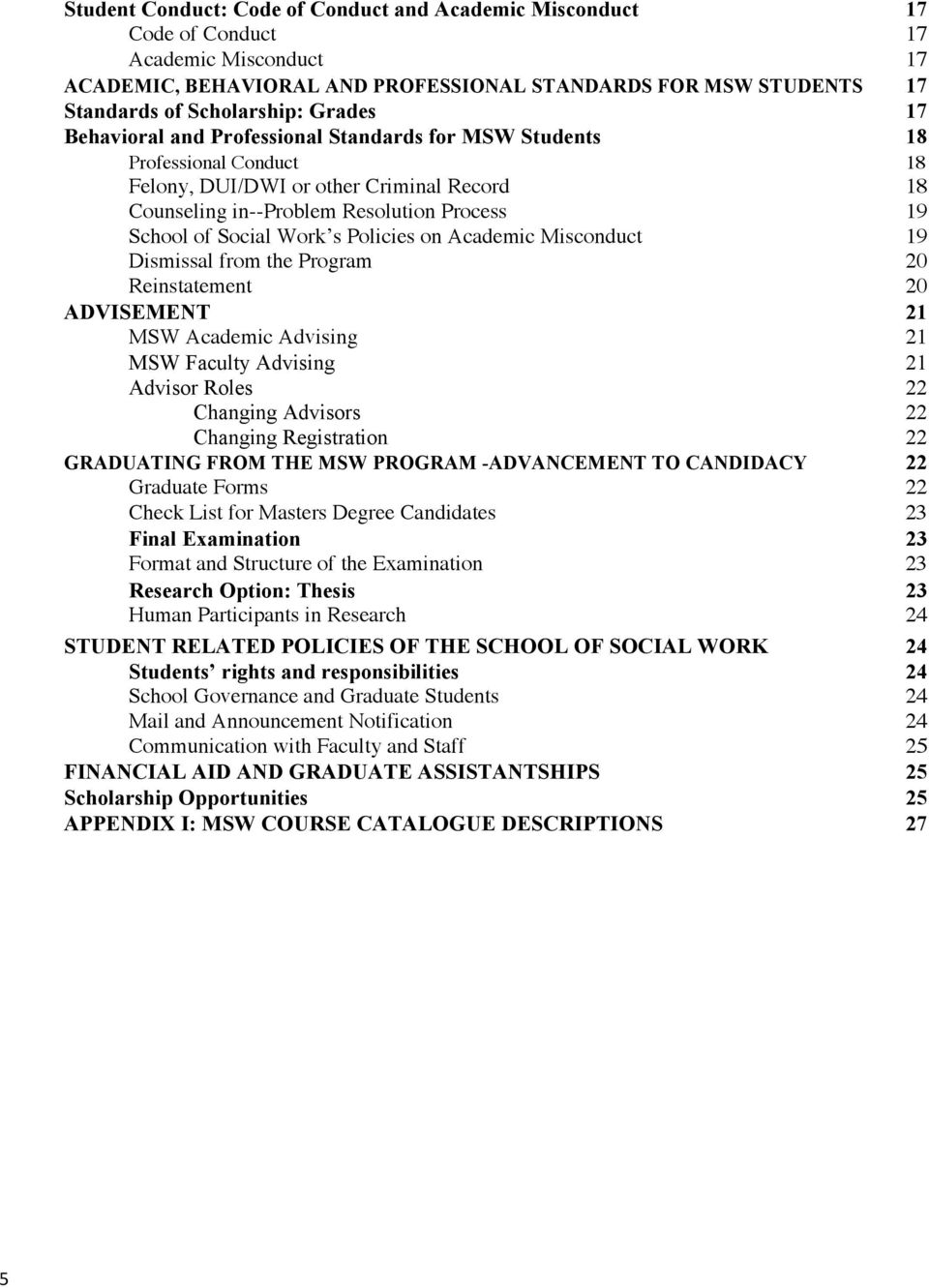
5 Student Conduct: Code of Conduct and Academic Misconduct 17 Code of Conduct 17 Academic Misconduct 17 ACADEMIC, BEHAVIORAL AND PROFESSIONAL STANDARDS FOR STUDENTS 17 Standards of Scholarship: Grades 17 Behavioral and Professional Standards for Students 18 Professional Conduct 18 Felony, DUI/DWI or other Criminal Record 18 Counseling in--problem Resolution Process 19 School of Social Work s Policies on Academic Misconduct 19 Dismissal from the Program 20 Reinstatement 20 ADVISEMENT 21 Academic Advising 21 Faculty Advising 21 Advisor Roles 22 Changing Advisors 22 Changing Registration 22 GRADUATING FROM THE PROGRAM -ADVANCEMENT TO CANDIDACY 22 Graduate Forms 22 Check List for Masters Degree Candidates 2 Final Examination 2 Format and Structure of the Examination 2 Research Option: Thesis 2 Human Participants in Research 24 STUDENT RELATED POLICIES OF THE SCHOOL OF SOCIAL WORK 24 Students rights and responsibilities 24 School Governance and Graduate Students 24 Mail and Announcement Notification 24 Communication with Faculty and Staff 25 FINANCIAL AID AND GRADUATE ASSISTANTSHIPS 25 Scholarship Opportunities 25 APPENDIX I: COURSE CATALOGUE DESCRIPTIONS 27 5
6 OVERVIEW School of Social Work at New Mexico State University The School of Social Work at New Mexico State University is located within the College of Health and Human Services. The program is offered at both the NMSU main campus in Las Cruces and at the NMSU Center in Albuquerque. The program prepares advanced level social work practitioners with the professional values, knowledge, and skills to engage in Advanced Generalist social work practice. The curriculum is designed according to the requirements of the Council on Social Work Education (CSWE) and uses the foundation competencies developed by CSWE. The educational model upon which the program is built proposes that there are two levels of social work education--foundation and the concentration. A common core of social work values, knowledge and methods unifies practice at both levels. This core is based on a liberal arts education and draws heavily from the social sciences. Mission Guided by the principles of the strengths perspective, empowerment, and cultural competence, the School of Social Work prepares students for ethical, effective social work practice. The School of Social Work is committed to serving people through teaching, outreach, leadership, research, service and the development of knowledge, values and skills that promote the profession's ability to respond to individuals, families, groups and organizations and communities in a culturally diverse environment among populations of the Southwest. History In 199, New Mexico State University began offering baccalaureate courses in social welfare. In 1972, with the help of Dr. Corinne Wolfe and a Section 707 grant, the University developed a baccalaureate social work program within the Sociology and Anthropology Department. In 1975, the BSW Program was accredited by the Council on Social Work Education, and in 1980 Social Work became a separate academic department. The move to departmental status was part of an overall university reorganization that created the College of Human and Community Services, now known as the College of Health and Social Services. Responding to national, regional and state needs, in 1990, the University and the State implemented the Masters of Social Work Program. Some of the needs that prompted this move included the professionalization of public child welfare services created through Federal Court Orders and social work licensure. State agencies were in dire need of practitioners with advanced skills in working with families in multicultural settings. The School of Social Work continues to play a prominent role in meeting unique and emerging social service needs. In 1999, the Department received status as a School of Social Work within the College of Health and Social Services. In 2008 the School of Social Work changed its second year concentration from Family Centered Practice in Multi-Cultural Settings to Advanced Generalist Social Work Practice. This change has sparked a new curriculum and an emphasis on competency based social work education. Master of Social Work Program The program is composed of a foundation sequence of 0 credit hours and a concentration sequence of an additional 0 credit hours. The program can be completed in either two or three years. Students who are admitted as Advanced Standing complete six credit hours of coursework prior to entry into the concentration sequence, resulting in a total of credit hours. Advanced Standing students may complete their program in either three semesters or six semesters, including summers. Advanced Standing is offered only to graduates of CSWE accredited BSW programs who meet specific admissions criteria. CURRICULUM Social work education is built on two components: classroom education and field practice experience. The curriculum is organized into content areas: Practice, Human Behavior & Social Environment, Policy, Research and the Field Experience. Courses are taught in each of these areas at both the Foundation (Generalist) and Concentration (Advanced Generalist) levels. Students may occasionally complete elective courses in areas that complement their interests. Social Work Competencies In accordance with the Council on Social Work Education, the School of Social Work follows the Educational Competencies as described in the Educational Policy and Accreditation Standards (EPAS 2008). Foundation Sequence: Generalist Social Work Practice The purpose of the first (or generalist) year is to provide the basic foundation that distinguishes social work from other helping
7 professions. This foundation is taught in terms of knowledge-guided frameworks for effectively managing the various phases of the empowerment process with the multiple levels of client systems with whom we work in direct practice. The definition of generalist practice is below: Generalist social work practitioners work with individuals, families, groups, communities and organizations in a variety of social work and host settings and apply ethical principles and critical thinking to practice. The generalist practitioner identifies with the social work profession and is grounded in the dual perspective of the person and the environment. Utilizing knowledge of the human condition, generalist practitioners view clients and client systems from a strengths and resiliency perspective in order to recognize, support, and build upon the capabilities of all human beings. They use a collaborative process to engage, assess broker services, advocate, counsel, educate, and organize with and on behalf of clients and client systems. In addition, they participate in community and organizational development. Generalist practitioners are consumer informed, are involved in research-informed (evidence based) practice, and evaluate service outcomes in order to continually improve the provision and quality of services most appropriate to client needs. Finally, generalist social work practice is guided by the NASW Code of Ethics, incorporating diversity in their practice and advocating for human rights and social justice. (Adopted by School of Social Work Faculty 11/9/07) Concentration Sequence: Advanced Generalist Social Work Practice The NMSU Master of Social Work program prepares students from an Advanced Generalist perspective. The program is founded on the use of critical thinking skills, values, ethics and differential application of advanced social work knowledge, theories and skills in the assessment of and intervention with micro, mezzo, and macro level systems. The advanced generalist perspective prepares practitioners to exercise the professional autonomy, leadership, and creativity necessary for multidimensional contextual and ethical practice in rapidly changing social environments with populations of the southwest. As students move to work with more complex clients, issues, problems, theories and interventions, the scope and depth of their professional preparation increases. (Adopted by School of Social Work Faculty 10//08) Field Work The field program of the School of Social Work integrates classroom study with agency practice with individuals, families, groups, organizations and communities. Students complete 225 hours of Foundation fieldwork for two semesters, for a total of 450 hours. Students complete 250 hours of Concentration fieldwork for two semesters, for a total of 500 hours. Students receive multiple levels of supervision while completing their field experience. All students are assigned to a qualified field instructor for instruction. Students are also assigned to a faculty field liaison that oversees the learning experience and provides instruction to small groups within field seminars. The student, the field instructor, and the field liaison jointly develop an individualized learning contract that identifies the learning opportunities and practice experiences to assist the students in developing the social work competencies. Complete information regarding the field experience is provided in the Field Education Manual. Technology Expectations and Requirements It is expected that all students admitted to the program will have regular access to a computer and high-speed internet. In this advanced degree program, students are expected to demonstrate basic proficiencies in the use of word processing, presentation, and . All program, scholarship, graduation, and other important announcements are only made via the School s online student listserv. All students must provide a current address at the time of admission and are responsible for keeping the School notified of any address changes. All students admitted to the program may obtain an NMSU address and are encouraged to utilize that address for all school related purposes. Many of the courses in the program will make use of CANVAS, NMSU s Learning Management System (LMS). Some courses in both Las Cruces and Albuquerque may only be offered via the web on CANVAS. Courses in both the Albuquerque and Las Cruces programs have assignments that will require the use of PowerPoint and/or a word processing program for either receiving or presenting content; students are expected to use the software effectively as well as be functionally self-sufficient in using related computer hardware. In general, students must register online, access library materials, and get their grades online (none are mailed). There are help resources provided by the university to students by NMSU Information and Communication Technologies (ICT) through their website at: and by telephone: Help Desk NMSU is best equipped to provide technical assistance to those individuals using Windows-based systems; some limited assistance is available to Mac OS users. NMSU is also a Microsoft Licensed campus and makes available, at a profound discount, Microsoft programs to students. Students may also find good educational discounts on software at the NMSU bookstore. The full version of Microsoft Office 5, is available to NMSU students at no charge by logging into and entering NMSU and following directions. 7

8 Schedules for Completing the Program Course Load Graduate students should take into consideration any outside workload and commitments in planning their course load. The maximum credits that a graduate student may take in any semester is 15. During a six-week summer session, the maximum is credits. Students in the two year program will have three academic courses each semester and a practicum. This will entail 9 hours per week in the classroom and 15 to 18 hours per week in the practicum in addition to time to study. Three year students take two academic courses and in their last two years will also spend 15 to 18 hours per week in the practicum. Thus, given the demands of 24 hours per week doing direct school work and time needed for studying, in both two and three year programs students will find it difficult to work a in a full-time position (40 hour per week). Course and Program Withdrawal Students may withdraw from the School of Social Work program or social work courses during the time period in which withdrawals are permitted by NMSU policy. However, continuation in the program will be evaluated on an individual basis with the Coordinators of the Program. Because the course of studies is designed to build knowledge and skills progressively, students may need to wait until the next required courses are offered, typically one year. In other words, if a student withdraws from a course(s) during fall semester, they will probably not be allowed to enroll in spring courses as the fall ones were prerequisites to those in the following semester. Credit for Life or Work Experience The Program at New Mexico State University does not grant academic credit for life or work experience in lieu of social work course or field content. 8

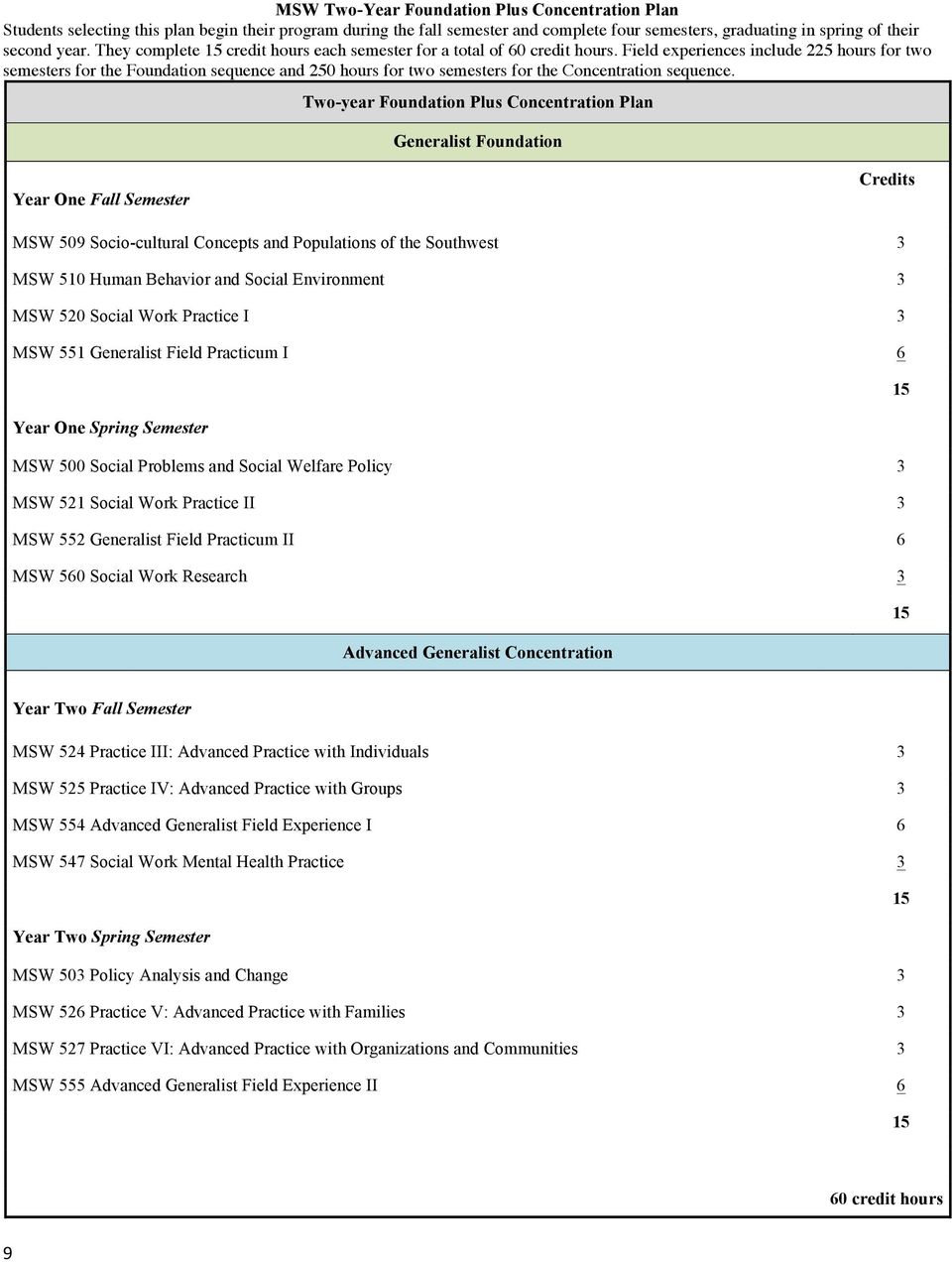
9 Two-Year Foundation Plus Concentration Plan Students selecting this plan begin their program during the fall semester and complete four semesters, graduating in spring of their second year. They complete 15 credit hours each semester for a total of 0 credit hours. Field experiences include 225 hours for two semesters for the Foundation sequence and 250 hours for two semesters for the Concentration sequence. Two-year Foundation Plus Concentration Plan Generalist Foundation Year One Fall Semester 509 Socio-cultural Concepts and Populations of the Southwest 510 Human Behavior and Social Environment 520 Social Work Practice I 551 Generalist Field Practicum I Credits 15 Year One Spring Semester 500 Social Problems and Social Welfare Policy 521 Social Work Practice II 552 Generalist Field Practicum II 50 Social Work Research 15 Advanced Generalist Concentration Year Two Fall Semester 524 Practice III: Advanced Practice with Individuals 525 Practice IV: Advanced Practice with Groups 554 Advanced Generalist Field Experience I 547 Social Work Mental Health Practice 15 Year Two Spring Semester 50 Policy Analysis and Change 52 Practice V: Advanced Practice with Families 527 Practice VI: Advanced Practice with Organizations and Communities 555 Advanced Generalist Field Experience II 15 0 credit hours 9
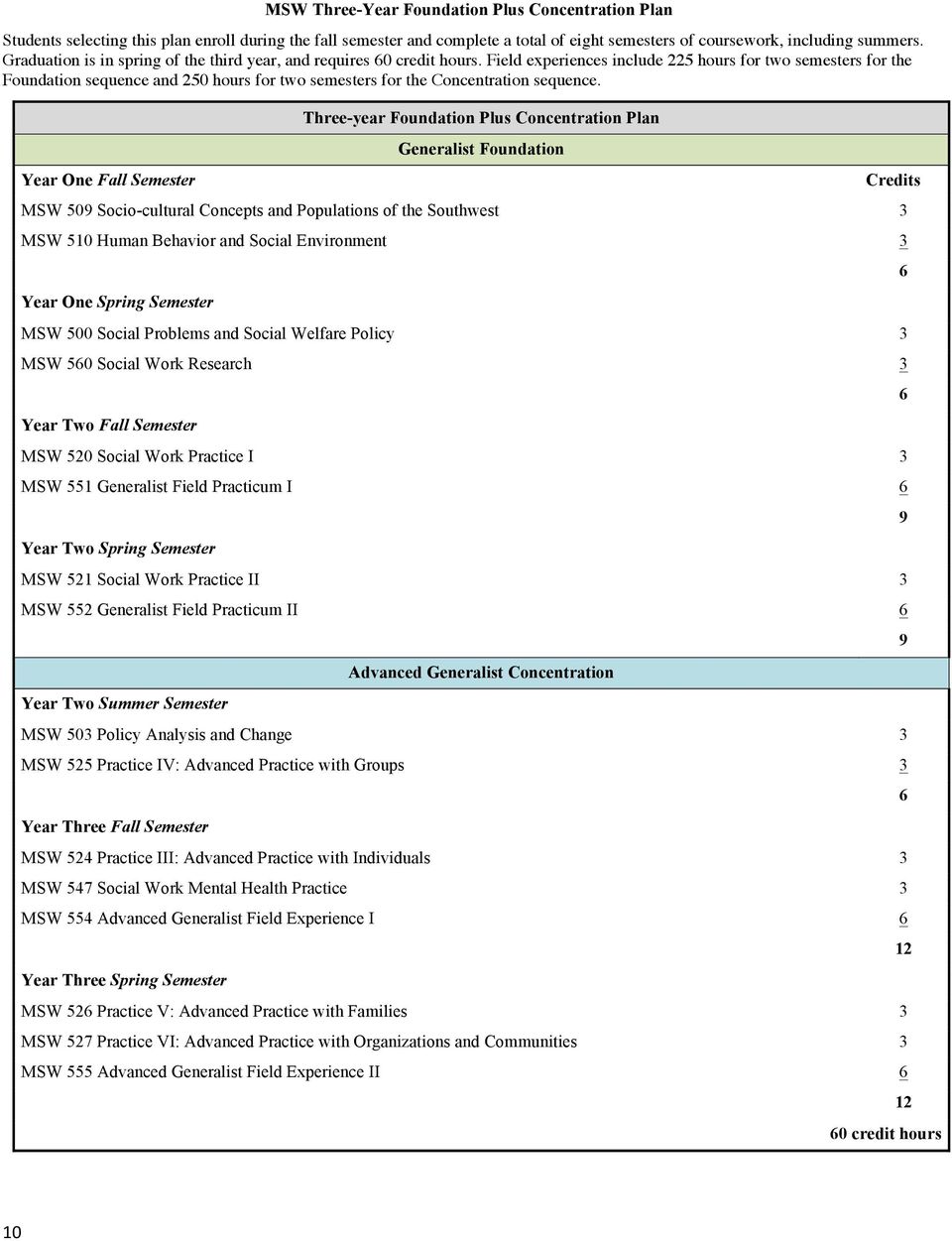
10 Three-Year Foundation Plus Concentration Plan Students selecting this plan enroll during the fall semester and complete a total of eight semesters of coursework, including summers. Graduation is in spring of the third year, and requires 0 credit hours. Field experiences include 225 hours for two semesters for the Foundation sequence and 250 hours for two semesters for the Concentration sequence. Three-year Foundation Plus Concentration Plan Generalist Foundation Year One Fall Semester 509 Socio-cultural Concepts and Populations of the Southwest 510 Human Behavior and Social Environment Year One Spring Semester 500 Social Problems and Social Welfare Policy 50 Social Work Research Year Two Fall Semester 520 Social Work Practice I 551 Generalist Field Practicum I Year Two Spring Semester 521 Social Work Practice II 552 Generalist Field Practicum II Advanced Generalist Concentration Year Two Summer Semester 50 Policy Analysis and Change 525 Practice IV: Advanced Practice with Groups Year Three Fall Semester 524 Practice III: Advanced Practice with Individuals 547 Social Work Mental Health Practice 554 Advanced Generalist Field Experience I Year Three Spring Semester 52 Practice V: Advanced Practice with Families 527 Practice VI: Advanced Practice with Organizations and Communities 555 Advanced Generalist Field Experience II Credits credit hours 10
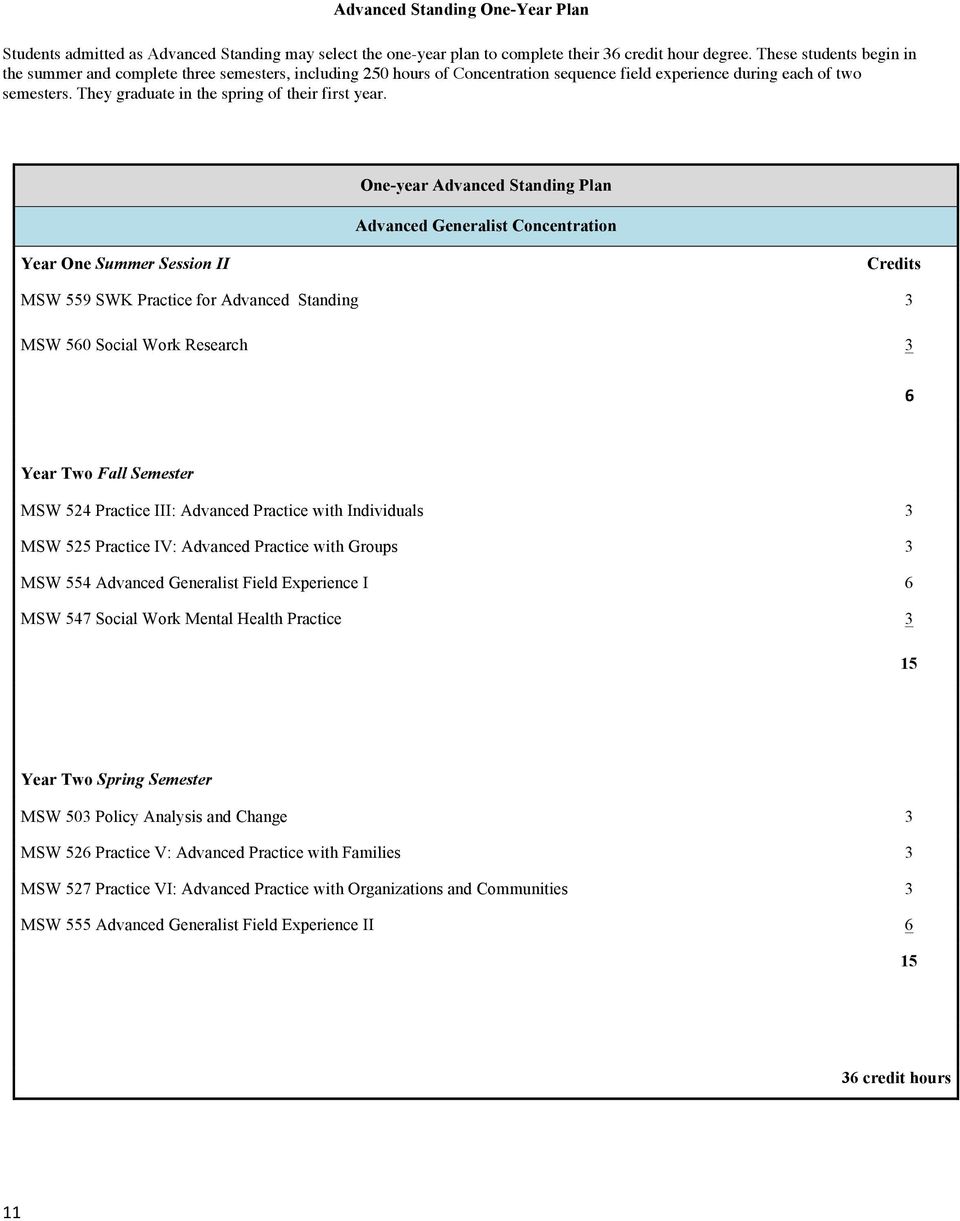
11 Advanced Standing One-Year Plan Students admitted as Advanced Standing may select the one-year plan to complete their credit hour degree. These students begin in the summer and complete three semesters, including 250 hours of Concentration sequence field experience during each of two semesters. They graduate in the spring of their first year. One-year Advanced Standing Plan Advanced Generalist Concentration Year One Summer Session II 559 SWK Practice for Advanced Standing 50 Social Work Research Credits Year Two Fall Semester 524 Practice III: Advanced Practice with Individuals 525 Practice IV: Advanced Practice with Groups 554 Advanced Generalist Field Experience I 547 Social Work Mental Health Practice 15 Year Two Spring Semester 50 Policy Analysis and Change 52 Practice V: Advanced Practice with Families 527 Practice VI: Advanced Practice with Organizations and Communities 555 Advanced Generalist Field Experience II 15 credit hours 11
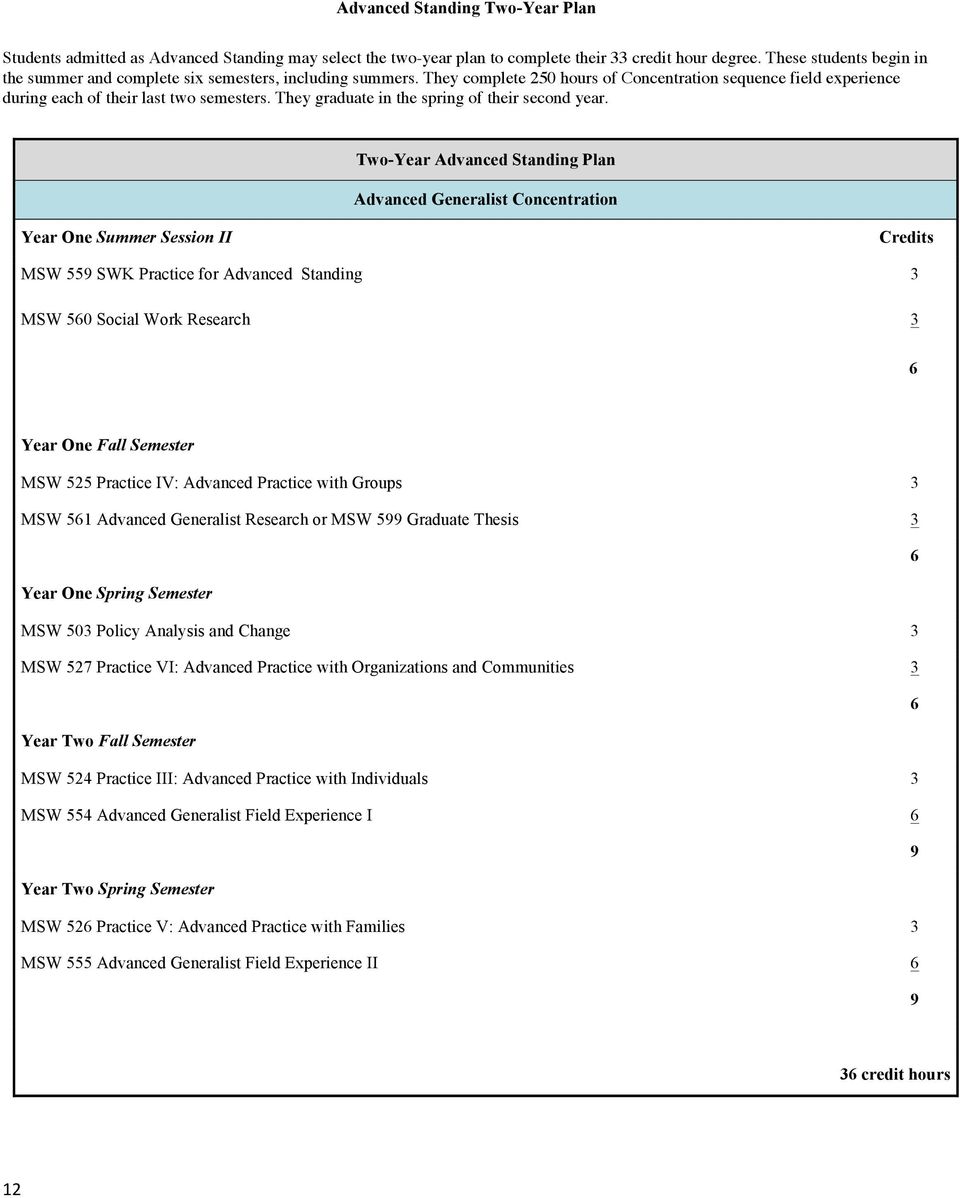
12 Advanced Standing Two-Year Plan Students admitted as Advanced Standing may select the two-year plan to complete their credit hour degree. These students begin in the summer and complete six semesters, including summers. They complete 250 hours of Concentration sequence field experience during each of their last two semesters. They graduate in the spring of their second year. Two-Year Advanced Standing Plan Advanced Generalist Concentration Year One Summer Session II 559 SWK Practice for Advanced Standing 50 Social Work Research Credits Year One Fall Semester 525 Practice IV: Advanced Practice with Groups 51 Advanced Generalist Research or 599 Graduate Thesis Year One Spring Semester 50 Policy Analysis and Change 527 Practice VI: Advanced Practice with Organizations and Communities Year Two Fall Semester 524 Practice III: Advanced Practice with Individuals 554 Advanced Generalist Field Experience I 9 Year Two Spring Semester 52 Practice V: Advanced Practice with Families 555 Advanced Generalist Field Experience II 9 credit hours 12
13 Electives students in specialized programs (Child Welfare Scholars, Alcohol and Other Drugs, Redundancy Policy candidates, etc.) that require electives, may opt to choose courses from the following list: 541 Alcohol and Other Drugs 590 Family and Child Welfare Policy 547 Social Work Mental Health Practice 597 Special Topics Suggested outside Disciplines for Elective Courses at the Graduate Level Sociology, Anthropology, Psychology, Health Science, Family & Consumer Science, Counseling and Educational Psychology, Economics, Management, Government, Statistics, Women s Studies, Criminal Justice. Note: All Advanced Standing students who plan on applying for licensure in New Mexico must demonstrate verification that the applicant has completed one of the following: a three credit hour course in New Mexico cultures listed on the applicants transcripts; a board approved course, workshop or seminar in New Mexico cultures; proof of previously passing the New Mexico cultural examination; Advanced Standing students who obtained their BSW degree from an institution other than New Mexico State University or have not completed a three credit hour course in New Mexico cultures (as evidenced on their BSW transcript) must obtain a board approved course, workshop. These requirements are referenced on the site. A board approved workshop in New Mexico cultures is provided by the Intercultural Institute: Changing Program Completion Plan Students who wish to change their schedule for program completion must first discuss this with their academic advisor and then write the Program Coordinator requesting approval for the change. The Program Coordinator will review the request and respond to the student at which time the decision is official. Child Welfare Scholars Program -Title IV-E Special Social Work Programs The Child Welfare Scholars is offered in partnership with the New Mexico Children, Youth & Families Department (CYFD). A student who is selected as a Scholar receives financial support and agrees to work for CYFD as a child welfare protective services social worker following graduation with full pay and benefits. Various special topic classes in child welfare practice and policy are offered and are part of the required curriculum for a student who is a Child Welfare Scholar. The School of Social Work encourages all students interested in family and child welfare as a career choice to consider applying to be a Child Welfare Scholar. For information, please contact Monica Montoya, Child Welfare Scholar Coordinator, or by at [email protected] NOTE: Being a Child Welfare Scholar may affect your financial aid. 1

14 Dual /MPH Degree Program The School of Social Work and the Department of Health Science offer a dual /MPH degree program. The two degrees are the Master of Social Work () and Master of Public Health (MPH) in Community Health Education. The programs complement each other. Public Health focuses on populations of people and is highly analytical and Social Work focuses on individual, groups, and communities within the social environment. Both programs heavily emphasize cross-cultural content in classes and have an emphasis on social justice. Many students find this combined degree appealing, particularly if they are interested in community development and outreach. Students from other countries and students who have served in the Peace Corps find that this degree furthers their interest and careers in international service. Separately the and MPH degrees require a total of 108 credit hours; (48 for the MPH + 0 for the ). However, the dual /MPH degree program can be completed with a total of only 9 credit hours. Students interested in pursuing the dual degree program must: Prepare and submit separate admissions applications to both programs Notify each program in writing of the intent to complete the dual degree program Be officially admitted to both degree programs Notify the NMSU Graduate School of the intent to complete the dual degree program Complete all course requirements for both degree programs And complete a combined comprehensive final examination for both degree programs. If you are interested in pursuing this option please speak to your Academic Advisor. It is anticipated that students in this program will take three full academic years to complete their programs of study. Master s International Program Prospective students apply to the Graduate School and the Peace Corps at the same time. They will be accepted into the Graduate School and the Peace Corps independently. Students complete one year of graduate study, leave and complete their two years of Peace Corps services, and then return to finish their last year of graduate study. This program is available to students and dual degree /MPH students. Please contact the Academic Advisor for further information or if you have questions about the program. Interdisciplinary Graduate Minors Minor in Alcohol and Drug Counseling New Mexico State University offers an interdisciplinary minor in Alcohol and Drug Counseling. Graduate students in social work are eligible for this minor, which requires 15 credit hours. Students develop knowledge and skills to work with substance-affected individuals, families, and groups. They also learn to design plans for organizational and community intervention. Completion of this minor provides students with the academic preparation for taking the exam for state licensure as a drug and alcohol counselor in the State of New Mexico. If you are interested in the minor please speak to your Academic Advisor. Upon request, an information sheet will be provided which provides an outline the program requirements and specify the application process. Minor in Gerontology (Currently under construction) The Department of Health Science offers an on-line Graduate Minor in Gerontology. Twelve credits are needed for a graduate minor. Health and human service professionals, current students, and others who are interested in acquiring basic knowledge in a crosscultural context about gerontology and geriatrics are encouraged to consider this program. Some required courses may be substituted for courses required by this minor. If you are interested in the minor please request an information sheet from the Academic Advisor that will outline the program requirements and provide contact information. You can obtain information about the Graduate Minor in Gerontology online under Graduate Minors in Health Science Department. 14
15 UNIVERSITY AND GRADUATE SCHOOL POLICIES Several policies apply to all graduate programs. Please review information found on-line for the Graduate School ( for policies regarding residency requirements, time limits for degree completion, withdrawal from the university delaying admission, leaves of absence and readmission to the program, and adding or dropping courses. Detailed information regarding grade scales, incomplete grades, and GPA requirements are also provided by the graduate school. students should refer to the Graduate Catalog ( ) and to on-line information found at: Graduate School Provisional Status A student admitted to the program that has either a cumulative GPA of less than.0 and/or has not completed a prerequisite is admitted on provisional status. No provisional students will be allowed to enroll in the full-time program. Students admitted on provisional standing must maintain a.0 GPA in the first semester in order to continue in the program or will subject to dismissal. Transfer of Credits At the master s level, the student must take at least 50 percent of the work required for the degree at New Mexico State University. A request for transfer of credit must be indicated on the Application for Admission to the Graduate School. Transfer credit requests and required departmental/college forms must be completed prior to the beginning of the first semester of work taken at NMSU. Transfer credit requests and forms must be submitted to the Academic Advisor and Program Coordinator for approval. The School of Social Work has the right to accept or reject any number of requested transferred credits based on such elements as whether the work fits into the logical program for a degree. Please refer to the current NMSU Graduate Catalog at for more information. Transcript Analysis: In order to ensure that admitted students do not repeat content in the foundation curriculum, the student s academic advisor, in consultation with the Program Coordinator carefully reviews transcripts, syllabi and assignments to determine comparability to course content. If the results of the analysis indicate redundancy, student will be advised to replace redundant courses with other selected courses. If you have taken a graduate level course either at NMSU or another University, you may request transferring the credits. The Transfer Credit Request Form should be completed and signed by you and your academic advisor before submitting it to the Program Coordinator. Along with the form, attach a course description/syllabus and an official transcript showing the grade earned at the institution where you took the course. In addition to sending the transcript to the Graduate School, as required, send the transcript (in a sealed/signed envelope) to the School of Social Work with the form and syllabus. The School has the right to accept transferred credits based on whether the work meets Graduate School standards, and fits into the program of study. The School may require the work be validated by examination. Credit granted for work completed at another institution is tentative until proven by satisfactory work in residence. Transfer credits must meet the same time limit requirements as those set for course work taken at New Mexico State University. Appeal of Grades Students may appeal an unsatisfactory grade through the procedure described in the Disciplinary Issues for Graduate Students section of the Graduate Catalog: NMSU Student Accessibility Services (SAS) 15
16 Section 504 of the Rehabilitation Act of 197 and the Americans with Disabilities Act (ADA) covers issues related to disability and accommodations. If a student has questions or needs an accommodation in the classroom (all medical information is treated confidentially), contact Trudy Luken, Director Student Accessibility Services (SAS), Corbett Center, Rm. 208, Phone: (575) (V/TTY), [email protected]. SAS website is: sas.nmsu.edu SSW Administration, faculty and staff encourage any student who believes she or he may need to obtain accommodation to be successful in this academic program to contact the SAS office early in the semester, and then discuss such needs with her/his instructors. NMSU policy prohibits discrimination on the basis of age, ancestry, color, disability, gender identity, genetic information, national origin, race, religion, retaliation, serious medical condition, sex, sexual orientation, spousal affiliation and protected veterans status. Students rights and responsibilities regarding Title IX (Applies to classroom and field settings) Title IX prohibits sex discrimination to include sexual misconduct, sexual violence, sexual harassment, and retaliation. For more information on discrimination issues, Title IX or NMSU s compliant process contact: Gerard Nevarez, Executive Director or Agustin Diaz, Associate Director Office of Institutional Equity (OIE) O Loughlin House, Phone: (575) 4-5, [email protected], Website: Policies for Student Protection in the field Liability Insurance New Mexico State University, through New Mexico State Risk Management, provides professional liability coverage for students enrolled in health care instructional programs for the academic year. Students are not required to obtain additional insurance coverage. Personal Use of Automobile Students shall not use their automobile for transporting clients in their private vehicles. Any accident or injury incurred while doing so is the student s responsibility and is subject to the student's private auto insurer. Safety and Risk Management The School of Social Work is committed to preparing social work students for potential dangers they may encounter in the agency, field, or client home environment and their responsibilities for confidentiality. All students should learn the details of HIPPA (see HSS web site Safety Plans at Field Agency Each student is responsible for becoming informed as to the safety policies of his/her field agency. In addition, students should know the safety plan for their agency. For example, where will you go in a fire, what do you do if a client seems dangerous, what are the agencies safety plans for visiting clients, etc.? Each agency should have its own plan. Dual Relationships Social workers who function as educators or field instructors for students should not engage in dual or multiple relationships with students, because the educator or field instructor s position of authority creates a risk of exploitation or potential harm to the student, as well as risk of liability to the institution. Social work educators and field instructors are responsible for setting clear, appropriate, and culturally sensitive boundaries (NASW Code of Ethics Dual relationships include pre-existing personal and/or professional relationships that overlap with field education responsibilities. Such relationships can create conflicts of interest or have a negative impact upon field education goals. Thus, it is the policy of the School of Social Work that when such a relationship exists between the student and the field instructor, the student and the liaison, or the liaison and the field instructor, the Field Coordinator must be notified immediately. See Also NMSU Policy.22. Sexual Harassment and Other Forms of Prohibited Discrimination Sexual discrimination, including sexual misconduct or sexual harassment shall not be tolerated. Any student who believes that they have been subjected to any form of prohibited discrimination, including sexual harassment or misconduct, should report it to a supervisor within chain of command or to the NMSU Office of Institutional Equity. Similarly, any field supervisor/ instructor, employee, faculty, academic administrator or other representative of the field agency shall report to the Office of Institutional Equity upon receipt of any report by a student or employee that indicates an incident relating to discrimination or harassment. All forms of prohibited discrimination, e.g. age, ancestry, color, disability, gender identity, genetic information, national origin, race, religion, serious medical condition, sex, sexual orientation, spousal affiliation or protected veteran status as outlined in federal and state anti-discrimination statutes. Harassment in the same forms as described for sexual harassment (jokes, slurs, etc ) is just as illegal if based on race, religion, ethnicity, sexual orientation including sexual harassment generate a harmful atmosphere that seriously undermines the trust that essential to the learning environment. Such conduct has the effect of unreasonably and substantially interfering with an individual's welfare, academic, or professional performance, or creates an intimidating, hostile, offensive, and demeaning work or educational environment. The field instructor has an affirmative duty to maintain a workplace free of discriminatory harassment and intimidation. 1
17 Sexual Harassment encompasses a wide range of unwanted, sexually-directed behaviors, including verbal harassment or abuse (perhaps in the guise of humor); subtle pressure for sexual activity; sexually directed remarks about a worker's clothing, body, or sexual activities; unwanted touching, patting, or pinching; leering or ogling of a worker's body; demanding sexual favors accompanied by implied or overt threats concerning one's job, grades, or letters of recommendation; physical assault, etc. Examples of Prohibited Behavior Threats or intimidation of a sexual nature or sexual contact. Continual or repeated verbal assault of a sexual nature including graphic commentaries about person's body; sexually degrading words to describe the person, or propositions of a sexual nature. Threats or insinuations that the person's employment, grades, wages, promotional opportunities, classroom or work assignments, or other conditions of continued placement may be adversely affected by not submitting to sexual advances. Procedures in the field When a student believes that he/she has been the subject of sexual harassment in the field agency setting, the student should notify his/her supervisor/instructor and field liaison or the NMSU Office of Institutional Equity. If the student notifies someone in the program, that person will notify the Office of Institutional Equity and follow the guidance from that office for resolution. Students should read NMSU Policy.25, Discrimination, Harassment and Sexual Misconduct on Campus. The student is encouraged to report to the Office of Institutional Equity, and may also bring the matter to the attention of the Administrative Team, the College of Health and Social Service Grievance Committee, the NMSU Dean of Students or appropriate state and federal agencies charged with investigating illegal discrimination. No student will be subject to retaliation for having contacted one of these offices or for having made a report or complaint, or for cooperating with any investigation into alleged discriminatory misconduct. Student Conduct: Code of Conduct and Academic Misconduct Code of Conduct Students at NMSU are expected to observe and maintain not only the highest academic standards of conduct, but also high ethical and professional standards. Students should review the university s information regarding the rules of conduct and definitions of misconduct. Details on the administration of discipline in the case of nonacademic conduct violations by the University can be found in the New Mexico State University Student Handbook ( Academic Misconduct According to NMSU Student Code of Conduct, allegations regarding academic misconduct of graduate students shall be brought immediately to the attention of the Graduate Dean. The Graduate Dean shall conduct a preliminary investigation with the appropriate professional bodies within the University. At the Dean s discretion the case may be referred back to the student s instructor or department head who will then follow the procedure outlined for all undergraduate and graduate general cases that occur at the course or academic department level. This is outlined in the NMSU Student Handbook ( Academic, Behavioral and Professional Standards for Students Standards of Scholarship: Grades Graduate students are expected to apply themselves intensively to the study of the material covered by the courses in which they are enrolled. Accordingly, a high level of performance is required. Students must maintain a cumulative grade point average of at least.0 in all courses taken as a graduate student (excluding undergraduate deficiencies). 17 Students must maintain a cumulative grade point average of at least.0 in all courses taken as a graduate student (excluding undergraduate deficiencies). Courses graded S or PR will not be counted in determining grade-point averages. Students unable to maintain a cumulative GPA of at least a.0 for two (2) consecutive semesters will be dismissed from the program. Students admitted on provisional status will be dismissed after one semester if unable to attain a.0 GPA. (See section below on Dismissal from the Program) Students must earn a grade of at least a C in all required social work courses including a grade of S in first the year, first semester practicum course.
18 Students who receive a D in a required social work course must repeat the class in the next semester it is offered. Students may not register for courses that require the course in which the D was received if the course is a prerequisite or co-requisite. Students must wait to take these courses until such time the course in question has been retaken and a grade of C or better has been earned. Students receiving a grade of F in any social work course will be dismissed and must reapply to the program. Note: Students admitted, as Advanced Standing who fail or receive a grade of D in any summer bridge courses may not continue in the concentration sequence. Also students who receive a grade of D in a required social work course may not continue in the Concentration Sequence. In both cases students may, however, request admission to the Foundation sequence. If a student fails a class during their Concentration Sequence they will be dismissed as per the dismissal policy in this handbook. Behavioral and Professional Standards for Students Students are expected to meet the ethical and behavioral standards detailed below. Further statements of student behavior and performance are found within the Graduate Catalog ( ), the NMSU Student Handbook ( ) and the NMSU Student Code of Conduct ( Professional behavior is one of the core competencies for social work programs. This competency is based in the Code of Ethics put forth by the National Association of Social Workers (NASW). The code guides the NMSU School of Social Work and all students must strive to abide by the standards. The NASW Code of Ethics can be found online ( In the event of academic or non-academic misconduct, students are held to the rules that are found in the NMSU Student Handbook. Student grievance and appeals processes are outlined in the General Rules and Regulations and Special Grievance Policies sections of this handbook. Professional Conduct In addition to the academic expectations, social work students are expected to demonstrate professional behavior that reflects a commitment to the core values of the social work profession. Behavior contrary to the ethical standards of social work will be cause for review of the student s admission to the program or continued future within the Program. Examples of behavior that would warrant such a review include deprecating oral and written statements, gestures toward other students, faculty, clients, colleagues, or the agency placement, wearing clothing with statements that are offensive towards other students, faculty, and/or persons from populations reflecting racial, ethnic, ability status, religious, socio-economic, gender, and sexual orientation differences, problems in personal functioning (health, mental health) sufficiently serious to endanger functioning in the program and client welfare, and failure to maintain boundaries towards other students, faculty, clients, and towards other workers in agency. Since the role of social worker involves helping people from a variety of backgrounds and with a range of problems, it is important that social work students not permit personal issues to interfere with this role. Students must have the emotional and psychological resources necessary to render effective assistance to those in need. In instances where students demonstrate behaviors that suggest that their own difficulties are not sufficiently resolved to be able to help and support others at this time, students may be denied admission to the program or once admitted may be dismissed from the program. Client confidentiality represents a specific consideration. Students are expected to maintain confidentiality in regard to all client information, client identification, specific social agencies and organizations. This includes any discussion that occurs in the classrooms when it relates to clients or personal information about other students or teachers. Felony, DUI/DWI or other Criminal Record Applicants to the program are asked at the time of admission if they have ever been convicted of a felony, DUI/DWI, child maltreatment and/or other criminal offense other than a minor traffic violation, or have such charges currently pending. Based upon the information provided, the Admissions Committee will consider the nature of the offense, disposition, rehabilitation efforts and other relevant information to make an admissions decision. The committee can make the following recommendations: deny admission to the program, admit with conditions, or admit without conditions. If admitted to the program, students with such backgrounds may be subject to conditions, such as restrictions on the choice of area of study and field placement. Students must disclose this information to the field coordinator prior to placement. 18

19 In addition, students must notify the School if they are convicted of a felony, DUI/DWI or other criminal offense after admission to the program. They are also required to provide relevant documentation as to the nature of the offense and its disposition. Once the School is notified, a formal counseling-in process will be implemented to review the nature of the felony, disposition, rehabilitation plans, and other relevant information. Based upon this review process a student can be terminated from the program, allowed to continue with conditions, or allowed to continue without conditions. Students are further advised that some state boards of social work examiners, including New Mexico s, may refuse to issue a license or certificate of registration to any person who has been convicted of a felony, in this or another state Students may be automatically denied admission, or if enrolled, terminated from the program, if that person has not been truthful or has provided inaccurate information on the application or, after admission to the program, fails to notify the School of Social Work of the above. Counseling in--problem Resolution Process The School of Social Work encourages the identification of problematic behavior at the earliest possible time. Problematic behavior in the classroom may include failing performance, disruptive behavior or frequent absences from class. Problematic behavior in the field may include failing performance, unethical conduct, violation of agency policy and procedures, personal behavior which conflicts with professional comportment or other behaviors that may cause risk of harm. Counseling-in is most effective when initiated as soon as difficulties are experienced or perceived. Carrying out this process in a timely manner is critical if the process is to be meaningful. Corrective action is preferable to dismissal from the program. The process is not to be used for students wishing to make a grade appeal. For grade appeals, please refer to the current Graduate Catalog ( ) under the heading of Disciplinary Issues for Graduate Students: Graduate Student Appeals Board. The first step in the Counseling-in process is to seek a solution between the parties most directly involved. Whenever problematic behavior occurs in the classroom it is the responsibility of both the student and the course instructor to meet together to discuss the problem and to seek acceptable resolution of the problem. Similarly, problematic behavior in the field setting is the responsibility of the student, agency field instructor and the field liaison to meet to discuss the problem and to seek acceptable resolution of the problem. These meetings between the student and the relevant parties must be documented in writing and clearly identify the problem, the agreed upon resolution, and the appropriate timeline for remediation of the problem. It is the responsibility of the faculty member or field instructor and field liaison to ensure that the documentation is done. When the above processes fail to rectify the problem, the following formal process may be initiated by any of the concerned parties. The steps in this process are: Step 1: The concerned party (student, classroom faculty or field faculty) should notify the Graduate Program Coordinator in writing of their request to hold a problem resolution meeting. A clear statement of the problematic behavior and documentation of previous attempts to deal with the concern must accompany this request. Step 2: Upon receiving the request, the Graduate Program Coordinator will ask that the student s faculty advisor convene, within two (2) weeks, a session that will include all faculty and instructors currently working with the student in class and field. Step : The purpose of the session is to develop a specific plan with a time line for promoting student success that will be agreed to by all parties. The faculty advisor is responsible for monitoring the student in carrying out this plan and will submit the plan to the Graduate Program Coordinator. Step 4: If the problematic behavior is not remediated within the agreed upon timeline, the advisor will convene a second meeting of all the parties to make a recommendation for either continuance with conditions in the program or for dismissal from the program. This recommendation will be submitted in writing to the Graduate Program Coordinator. If the decision is for continuance in the program with conditions, the faculty advisor will follow up with the student for implementation of the plan. If a recommendation for dismissal is made or if conditions for continuing in the program are not met, the Graduate Program Coordinator will notify the Director of the School of Social Work. The Director of the School of Social Work will notify the student of the final action and provide the student with the appropriate steps for filing an appeal of the action if desired. Problem resolution is most effective when initiated as soon as difficulties are experienced or perceived. Corrective/remedial action is preferable to dismissal from the program. School of Social Work s Policies on Academic Misconduct Allegations of academic misconduct of graduate students shall be brought immediately to the attention of the Graduate Dean. If the Dean of the Graduate School refers the case back to the School of Social Work to impose a sanction or for further action, the 19
20 following process will be implemented: 1. The School of Social Work Director will constitute an Academic Standards Committee that shall consist of three School of Social Work faculty members. 2. The faculty member stating the complaint of misconduct will submit in writing to the SSW Academic Standards Committee a description of the misconduct and any supporting documentation to support the charge of misconduct.. The student shall submit, in writing, to the SSW Academic Standards Committee, a description and explanation of the circumstances resulting in a charge of academic misconduct. 4. The Academic Standards Committee will convene a meeting with the student who will present an explanation of the circumstances resulting in the complaint of academic misconduct. The student can elect to bring a non participatory advocate, i.e., a classmate, faculty advisor, faculty member. 5. The committee shall then deliberate in private and transmit recommendations to the SSW Director within five working days subsequent to the meeting.. The SSW Director shall consider the recommendation of the Committee in making a decision and notify, in writing, the student of the committee s decision within three working days of receipt of the committee s recommendation including steps to be taken in an appeal process. 7. If dismissal was not recommended on the first finding of academic misconduct, the student is advised that a second finding of academic misconduct will result in dismissal from the School of Social Work. Dismissal from the Program The faculty of the School of Social Work has the responsibility to require a student to be dismissed from the social work program at any time prior to completion of the program when the student fails to maintain minimum academic, behavioral or professional ethical standards in the classroom or in the field practicum. A student will be dismissed from the social work program if one or more of the following occurs: Receives two D s in the social work professional core classes; Receives one F in the social work professional core classes; Receives one U or one D or one F, in the field practicum; Earns below the minimum.0 cumulative grade point average at the end of two consecutive grading periods; if a student is on provisional status, dismissal occurs at the end of one grading period; Inappropriate conduct; or Fails to comply with National Association of Social Workers (NASW) code of values and ethics. Fails to demonstrate professional behavior that reflects a commitment to the ethics of the social work profession. Students will be notified, in writing, of dismissal when any of the above deficiencies occur. Reinstatement Upon receipt of a dismissal notice, students who believe there are extenuating circumstances that have led to the noted deficiencies may make a written request to the School s Director to be reinstated into the program. Requests must be made within ten working days after receipt of notice of dismissal. Upon receipt of a reinstatement request, the following process will occur: The student shall submit, in writing, the reasons he or she believes that extenuating circumstances contributed to the deficiencies leading to dismissal; 2. The Director will constitute a Reinstatement Committee that shall consist of three School of Social Work faculty members;. The committee shall deliberate in private and transmit recommendations to the Director within five working days subsequent to the meeting and; 4. The Director shall consider the recommendation and notify in writing the student of his/her decision within three working days of receipt of the committee s recommendation, including steps to be taken in an appeal process. Students who are reinstated, as a result of their appeal, but who subsequently receive a D or F in any professional core course or a U or D or F in field experience are automatically and permanently dismissed from the program. Students who did not seek reinstatement or whose reinstatement is denied must wait one full calendar year before reapplying to the program. Students who reapply and are reaccepted into the program and receive a D or F in any professional core course or a U in field practicum are permanently dismissed from the program.
21 ADVISEMENT The School of Social Work emphasizes the importance of the advisor/advisee relationship, striving to develop a relationship which is mutually respectful and satisfying. The principle objective of advising is to enable students to achieve their educational goals, consistent with the objectives of the School and the profession. The student is placed at the center of her/his learning and has primary responsibility for the educational effort. Advisors are responsible for fostering an integration of the total educational experience and facilitating student progress toward educational and career goals. Advising includes an ongoing assessment of each student s aptitude, motivation, and suitability for a professional career in social work. The Advisement is designed to assist students in clarifying all aspects of the Program. In addition, advisement will assist students in: 1. Submitting university forms, with academic advisor s signature, as required. 2. mapping out a semester-by-semester plan of study, with a schedule of courses prior to the registration period;. developing a program of study that includes approving elective courses; and 4. Personal, professional, and career development. The School of Social Work offers students two types of advising Academic Advising and Faculty Advising. Academic Advising Academic advising is provided at both Las Cruces and Albuquerque campus locations. Academic advising includes inquiry about the program, STAR audits, transfer credits, advisement regarding course selections, all necessary paper work related to graduation and recruitment, responsible for coordination concerning academic performance. Faculty Advising Professional advising is also provided in both locations. Faculty Advisors provide advising related to professional development and issues related to academic success (e.g. conflicts with instructors, other students, life events that interfere with academic success). All students are assigned a full time Faculty member as their faculty advisor. While it is expected that students first seek assistance from their academic and/or faculty advisors, if an academic or professional advising issue cannot be resolved at that level, the issue will be referred to the Program Coordinators for consideration and resolution. For successful advisement, students are expected to meet with their academic advisor at least once per semester, i.e. registration periods to discuss and decide matters related to programmatic requirements, scheduling of classes, course registration, elective choices, etc.; contact their academic advisor if considering a leave of absence, withdrawing from the program, or making plans that are outside of the standard student Program of Study; meet with their faculty advisor, if requested, to discuss academic or professional performance issues that may jeopardize their continuation in the program; collaborate with their faculty advisor in reviewing options and alternatives with regard to problem solving, including taking a leave of absence, continuation and/or withdrawal from the program, or participating in a Counseling-in Process that includes the student s instructors, field director and field instructor. The academic advisor is available to guide students in this process and inform them about available options. 21
22 Advisor Roles Provide advice and counsel advisees when they are experiencing difficulties Assist students on matters pertaining to the university and community, career/employment planning, special projects, practicum experiences, and possible problems impinging on academic performance Faculty Advisor X X Academic Advisor Initiate a Counseling-in Process and work with the advisee to find appropriate solutions to problems Help the student plan a program of study during registration, including providing assistance in course selection; orientation to the substance and structure of the curriculum; and explanation of the expectations entailed in the role of the student X X Sign student Add/Drop forms, candidacy forms, and other forms as required X Monitor student progress ensuring that all degree/curriculum requirements are fulfilled in an orderly, timely and satisfactory way Consult with advisee s instructors about problems impacting the student s performance, discussing the matter with the student and maintaining accurate and up-to-date student records with relevant and regular notations X X X Support and protect the rights of students by informing them of grievance procedures X X Conduct a thorough and final audit of their advisee s academic records certifying that all degree requirements have been satisfactorily completed for graduation. Answer questions about the admission process. X X Changing Advisor Request to change a faculty advisor begins with discussing this with current advisor and then bringing the request to the Program Coordinator. There is an NMSU Advisor form that needs to be completed. Changing Registration All changes in registration need to be in consultation with the student s academic advisor and must meet published university deadlines. Approval for exceptions to NMSU deadlines for adding/dropping courses is extremely rare, and will only be considered for those circumstances which were beyond the student s control that developed after the published deadline. Examples of appropriate circumstances include documented major medical conditions, documented death or crisis in the student s immediate family and similar circumstances. Examples which are generally not considered appropriate circumstances include those which are related to employment, financial aid, grades or academic standing. Rare exemptions may be considered on a case-by-case basis with appropriate documentation. GRADUATING FROM THE PROGRAM -ADVANCEMENT TO CANDIDACY Graduate Forms All graduate forms can be accessed at the Graduate School website. Go to click on current students and then click on graduate forms. You may also access them by going to The admission of a student to the Graduate School does not imply admission to candidacy for an advanced degree. The School in which the student intends to become a candidate for a master s degree must be satisfied as to the student s sound basic training and the ability to pursue studies at the graduate level. Departments may require a comprehensive qualifying examination before officially approving any candidate for the master s degree. 22
23 Check List for Masters Degree Candidates The Graduate Catalog provides students with a checklist for insuring that they file the right forms at the correct time. Students are advised to carefully review this checklist as they are responsible for the information contained within. Failure to adhere to the checklist and filing forms at the correct time can delay the student s graduation. Following is a checklist to determine if essential paperwork is complete. STAR Degree Audit (Student Academic Requirements) A degree audit check should be completed with your academic advisor prior to submitting the Final Examination form. File Transfer for Credit Form in the first semester (if applicable). Register for master s thesis or research project during appropriate semesters (if applicable). Obtain and read a copy of guidelines, Preparation of a Thesis or Dissertation, from the Graduate School. This may help you decide which research option to select. File Application for Degree Form. (See current Academic Calendar for deadlines). The Application for Degree Form is available online at and there is a fee for this form. If you are not able to complete all requirements by the deadline specified on the application for degree, you will forfeit any fees paid and will have to reapply and pay the fees again. At the end of your second to last semester in the program, make arrangements with the program to schedule your final examination. Final Examination This cumulative final examination provides an opportunity to integrate the student s total experience and discuss it with faculty from both inside and outside the School of Social Work. The School of Social Work final examination format is an examination of the candidate s field of study: Advanced Generalist Practice and may consist of written and oral components. The final examination purposes are: To clarify whether the master s degree candidate has integrated all components of the curriculum in such a way as to demonstrate that he or she has the necessary competencies to engage in professional practice in multicultural settings and to offer the candidate the opportunity to present her or his understanding of such practice, to define and demonstrate current values, knowledge and skills, to identify gaps in these areas and to describe plans for addressing them. Format and Structure of the Examination A separate handbook on the format and structure of the final examination will be provided to graduating students toward the end of their second to last semester in the program. The final examination can only be taken in the final semester of the program. Research Option: Thesis Please discuss the thesis option with your faculty advisor and Chair of the Program Committee. Having once registered for a thesis, a student must continue to register for a minimum of one (1) credit of thesis or course work each regular semester (except summer unless you are defending during the summer) until the thesis is approved by the Graduate School. Anyone who fails to abide by this requirement will be considered withdrawn from the University and, in order to resume studies, must formally apply for readmission and satisfy the requirements in effect at the time of re-application. The thesis is a piece of original research conducted in a systematic and rigorous manner. The thesis topic is in an area of personal or practice interest to the student. This can often be a topic arising from the student s field or practice experience. The thesis must be related to social work and advanced generalist practice. It may employ quantitative or qualitative approaches, determined by the questions and interests of the student. Should you choose the thesis option, listed below are required program procedures: 2 1. Discuss your thesis idea with your faculty advisor who will refer you to a faculty member who has interest and knowledge in your area of interest. 2. With the support or approval of at least one faculty member, the student must complete a Thesis Proposal Form and formulate a proposal of 4- pages which includes: a. the research question
24 b. the literature review to support the question c. brief description of the research method d. relevance to social work and advanced generalist practice. The proposal is reviewed by the proposal committee which either: a. accepts the proposal b. rejects the proposal c. accepts conditionally on fulfillment of specific recommendations For specific instructions on thesis preparation and format, the student should obtain the Guidelines for Preparing a Thesis or Dissertation from the Graduate School ( and consult, as needed, with the thesis editor in the office of the Graduate School. Students are advised to submit to the editor, prior to typing in final form, a list of references, table of contents, figures, and tables so that the format may be checked for accuracy. Follow the graduate school policies and timelines to submit your thesis at the appropriate time to graduate within your individual program of study. Human Participants in Research The University s policy on the use of human subjects in research projects is covered in NMSU s Administrative Policies and Procedures Manual. These policies are strictly enforced by each college and by the Graduate School. A Permission to Use Human Subjects in Research form must be completed and approved prior to undertaking any research project involving human subjects (including interviews, surveys, etc.). The forms are available at Students must also complete the computer-based training for researchers and research staff found at the CITI site ( STUDENT-RELATED POLICIES OF THE SCHOOL OF SOCIAL WORK This section gives information about some of the student-related policy details of the School of Social Work. We hope the associations you make here with faculty, staff and fellow students will form the basis for the professional network essential for effective practice in the profession. Students rights and responsibilities The student enrolled in the School of Social Work at New Mexico State University is expected to take a significant responsibility for shaping, supporting, maintaining, and evaluating their educational program goals. Toward this end, the student is encouraged to engage in a variety of activities related to the School s mission and purposes, including but not limited to participation in the Graduate Student Social Work Organization (GSSWA). School Governance and Graduate Students One graduate student in good standing and enrolled in the program serves as a non-voting student representative at meetings of the faculty. Student members are not included in discussions of financial and personnel issues or issues pertaining to the confidentiality of any individual student, faculty, or staff. The student organization (GSSWA) also chooses representatives to serve on certain school committees including: Program Committee One student representative from each class: year 1 and year 2. School Advisory Board One representative from the program. Field Advisory Board One student from each class. Admission, Minority Recruitment and Retention One student representative each from: Two-year program and Three-year program Mail and Announcement Notification The School of Social Work and NMSU have moved to a paperless notification system that utilizes the student s NMSU address. At the beginning of the fall semester, all students will be asked to provide their NMSU address. This address will be added to the School s student listserv. Students are responsible for checking their on a regular basis. All official notices pertaining to registration, graduation, events, and messages from approved student organizations will only be posted by NMSU . 24
25 Communication with Faculty and Staff Students are encouraged to use faculty/staff NMSU to communicate with faculty or staff members when the individual cannot be reached in person. All School of Social Work faculty and staff are required to monitor NMSU . FINANCIAL AID AND GRADUATE ASSISTANTSHIPS We refer you to the Graduate Catalog and other University publications for more complete and up to date information on available assistantships and other funding opportunities. In selecting individuals for any assistantship, traineeship, or fellowship, and in the administration of appointments, New Mexico State University does not discriminate on grounds of age, ancestry, color, disability, gender, national origin, race, religion, sexual orientation or veteran status. Check with the Office of Financial Aid located in the Educational Services Building or call (575) for further information The graduate assistantship duties in the School of Social Work usually require 10 hours per week. The student is obligated to enroll for and maintain enrollment in a minimum of 9 graduate credits per semester, unless prior approval is secured from the Dean of the Graduate School. The School of Social Work Graduate Assistantship application form is available from the School of Social Work academic advisors. Scholarship Opportunities The School of Social Work and the College of Health and Social Sciences have scholarships available on a yearly basis. Students will receive notification via regarding these opportunities and may contact Sarah Baker, CHSS Student Program Coordinator, or [email protected] for application forms. Scholarships available include: For Students Betty Jean and Thomas James Shinas, Jr. Endowed Scholarship (awarded to one graduate student) Must be pursuing a Master of Social Work degree. Must maintain a minimum.5 cumulative GPA. FYI, Inc., Graduate Social Work Student Endowed Scholarship (awarded to one or more graduate students) Must be pursuing a Master of Social Work degree. Must be a resident of New Mexico. Must have a minimum.0 cumulative GPA Financial need, as determined by current and official FAFSA results, may be a consideration but is not a requirement. Preference is to students who are employed fulltime in a social work-related environment. Must be committed to serving and meeting the needs of families, youth and children of New Mexico upon graduation. IGMDACP (Interdisciplinary Graduate Minor in Drug and Alcohol Counseling Program) (awarded to one graduate student) Must be pursuing a Master of Social Work degree. Must be pursuing a minor in Alcohol and Drug Counseling. Lucille Allen Social Work Endowed Scholarship (awarded to one graduate student) Must be pursuing a Master of Social Work degree. Preference is given to a female student. Preference is given to a student who has entered the graduate level program after a period of time since earning an undergraduate degree. Preference is given to a parent with a dependent child. 25
26 and BSW Students Rose H. Praisner Memorial Endowed Scholarship (awarded to at least one graduate student and at least one undergraduate student) Must be majoring in Social Work. Must be a resident of New Mexico. The undergraduate student must be a junior or senior. Must have a minimum.0 cumulative GPA. Preference is for students interested in public health and/or maternal-child health. or BSW Students Human and Community Services Social Work Scholarship (awarded to one or more students) No criteria; this comes from the Social Work general scholarship fund. Social Work Scholarship (awarded to one or more students) Must be involved in the National Association of Social Workers. Social Work, Nursing, and Health Science Students Robert & Evelyn McKee Scholarship (1/ is awarded to a social work student, 1/ is awarded to a nursing student, and 1/ is awarded to a health science student) Must be U.S. citizen. Must be a degree-seeking student in the College of Health and Social Services. Must have a minimum 2.75 cumulative GPA. Celebrate Health and Social Services Endowed Scholarship (This scholarship rotates among Social Work, Nursing, and Health Science and is awarded to one undergraduate or graduate student.) Must be a fulltime student Must have a minimum.0 cumulative GPA. Must have financial need based upon current and complete FAFSA results. Must be involved in a chartered student organization belonging to CHSS or one of its three units: School of Social Work, School of Nursing, or Department of Health Science. 2
27 APPENDIX I: COURSE CATALOG DESCRIPTIONS Course # Course Name Course Description Social Problems and Social Welfare Policy Policy Analysis and Change Foundations of Professional Social Work Socio- cultural Concepts and Populations of the Southwest Human Behavior and the Social Environment I Human Behavior and the Social Environment II Social Work Practice I Social Work Practice II Practice III: Advanced Practice with Individuals Practice IV: Advanced Practice with Groups Practice V: Advanced Practice with Families An overview of social and economic problems in the United States and the historical and current social welfare policies aimed at alleviating these problems. Emphasis on developing an awareness and ability to change policies that impact vulnerable populations. This course will emphasize policy practice focusing on policy analysis and creating and implementing policy change. This course is a comprehensive overview of social work. It serves as an introduction to the profession of social work, including its history, values and ethics, legal regulation, structure, philosophy and major fields of practice. Theoretical and socio- historical perspectives on racism, sexism, ageism, heterosexism, classism, and other forms of discrimination and oppression. Cultural diversity, strengths and Southwest and border issues are emphasized. Major theories of human behavior and the life span from conception to adolescence. Focuses both on the areas of concern and risk for client systems and on the opportunities and strengths in the social environment. Major theories of human behavior and the life span from young adulthood to old age. Focuses both on the areas of concern and risk for client systems and on the opportunities and strengths in the social environment. This is the first course of a two- course sequence. An introduction to the generalist cross- cultural, social work practice perspective with individuals and families, focusing on social work as a profession, social work knowledge base, professional development, relationship building and assessment with individuals and families within a framework of social work values and ethics. This is the second course of a two- course sequence. A continuation of the generalist cross- cultural, social work practice perspective with individuals and families, focusing on goal setting, contracting, implementation, and outcome assessment. The course also applies the generalist practice perspective and methods to larger systems: groups, organizations, and communities and includes relationship building, assessment, goal setting, contracting, implementation and outcome assessment within a framework of social work values and ethics. This class builds on Foundation Year Practice courses ( 520, 521) by integrating theory and practice, and advancing skills in selecting, applying, and evaluating practice interventions in a culturally sensitive manner with individuals (children, adolescents and adults). This course will address the knowledge, values and skills needed to work effectively with diverse populations in group settings. The course will build on Foundation Year courses ( 520 and 521) by integrating theory and practice, and advancing skills in selecting, applying and evaluating practice interventions in a culturally sensitive manner with social work groups. This class builds on Foundation Year Practice courses ( 520 and 521) by integrating theory and practice, and advancing skills in selecting, applying, and evaluating practice interventions in a culturally sensitive manner with families. 527 Practice VI: Advanced Practice with Organizations and Communities This class builds on Foundation Year Practice courses ( 520, 521) by integrating theory and practice, and advancing skills in selecting, applying, and evaluating practice interventions in a culturally sensitive manner with organizations and communities. 27
28 Social Work Mental Health Practice Generalist Field Practicum This course is designed to add to the practice sequence for Masters Level students in Social Work. It addresses social work assessment of major mental health issues across the life span with an emphasis on resiliency and coping skills. Culturally responsive practices are applied to the major issues of mental health. Basic psychopharmacology, neurobiology, and the ways in which Social Workers interact with clients to aid education and effective treatment of medical interventions will be a prominent part of this course. Evidence- based practices useful for work in various disorders will be incorporated. Restricted to: majors. Supervised professional practice in a community social service agency, providing experiential instruction and learning. 225 clock hours required. Seminar required. Grade S/U Generalist Field Practicum B Generalist Field Practicum I Generalist Field Practicum II Advanced Generalist Field Experience I Advanced Generalist Field Experience II Advanced Generalist Field Practicum Advanced Generalist Field Practicum B Social Work Practice for Advanced Standing Social Work Research Advanced Generalist Research Supervised professional practice in a community social service agency, providing experiential instruction and learning. 225 clock hours required. Seminar required. Letter grade. Supervised professional practice in a community social service agency, providing experiential instruction and learning. 225 clock hours required. Seminar required. Grade S/U Supervised professional practice in a community social service agency. 225 clock hours required. Seminar required. Supervised professional practice in a community social service agency providing experiential learning in advanced generalist practice. Seminar required. 250 clock hours required. Supervised professional practice in a community social service agency providing experiential learning in advanced generalist practice; seminar required. 250 clock hours required. Supervised professional practice in a community social service agency providing experiential learning in advanced generalist practice. Seminar required. 250 clock hours required. Letter grade. Supervised professional practice in a community social service agency providing experiential learning in advanced generalist practice. Seminar required. 250 clock hours required. Letter grade. This course is required for all advanced standing students and is aimed at providing the conceptual orientation for the concentration year graduate program. The goal of this course is to enhance social work practice theory, knowledge in preparation for concentration year courses in advanced generalist social work practice. The key themes and concepts presented, explored, and analyzed in this course include: the fit between the Social Work Code of Ethics and personal values and belief systems; analysis of theory, ethics, and conceptual frameworks for concentration year advanced evidenced based Social Work practice courses in diverse settings. Restricted to majors Introduction to analytical skills used in social work research: problem formulation, research designs, measurement, instrumentation, data collection and analysis, use of human subjects in research, and application of research knowledge to social work practice. Focused on advanced generalist practice research in multicultural settings. Advanced skills to evaluate practice with individuals, families, groups, organizations and communities in multicultural settings. Needs assessment as well as program and practice evaluation are emphasized. Restricted to majors. SW Electives and Other Courses Course # Course Name Course Description 28
29 Social Work Leadership and Administration Alcohol and Other Drugs Violence in the Family Family and Child Welfare Practice Supervision, consultation, and administration in social service agencies, emphasis on developing leadership skills. Pre- requisite 520, 521. The prevalence of the major types of substance abuse. Addresses major treatment approaches to substance abuse as well as theories related to the causes and effects of such abuse in systems of different sizes. Prerequisite: consent of instructor. Theory and skills relating to practice with families who victimize vulnerable members. Includes physical, emotional and sexual abuse, incest, and neglect. Emphasis on knowledge and skills in approaches that effectively preserve and restore healthy family functioning. Prerequisite: consent of instructor. Current issues and interventions in child protection, foster care, family preservation and support, family reunification, adoption, and permanency planning. SW Electives and Other Courses Course # Course Name Course Description Social work with Hispanic Populations Social Work with Native American Populations Pharmacology of Addictions Family and Child Welfare Policy Systemic Integration of Alcohol and Drug Issues Independent Study International Social Work and Social Welfare Special Topics Graduate Thesis This course focuses on advanced knowledge and skill development for intervention with Hispanic populations. Emphasis is placed understanding historical and contemporary cultural, social, and political forces shaping the worldview and life circumstances for Hispanic populations in the U.S. Southwest. This course focuses on advanced knowledge and skill development for intervention with Indigenous North American populations. Emphasis is placed understanding historical and contemporary cultural, social, and political forces shaping the worldview and life circumstances for Indigenous North American populations. Concepts and principles of the pharmacology of psychoactive substances and the addiction process: including the pharmacological approaches to treatment. Same as NURS 572. Historical review and evolution of child welfare policies, initiatives and factors that influence child welfare service. Child welfare policies and services specific to the state of New Mexico are infused throughout the course. Taught with SWK 490. Capstone course for the alcohol and drug minor. Covers community, agency, and systemic facilitation of prevention and intervention services for substance- affected families. Prerequisites: acceptance into minor and department prerequisites. Same as FCS 591. Individual study to augment depth of knowledge in area related to course of study. Prerequisite: consent of instructor. May be repeated for maximum of credits. This course examines how people are affected by political, economic, educational, social conditions, and the policies designed to address those conditions. Comparative analysis of social policies and practices in the United States and the developing world will be emphasized. Taught with SWK 49 with additional work required at the graduate level. Cannot receive credit for both SWK 49 and 59. Consent of instructor required. Specific subjects to be announced in the Schedule of Classes. Open to graduate students in related disciplines and to community professionals in related disciplines and to community professionals in related fields. Prerequisite: consent of instructor. May be repeated for unlimited credit under different subtitles. Required for thesis option. Prerequisite: consent of instructor. May be repeated for a maximum of credits. Restricted to students. 29
MASTER OF SOCIAL WORK (MSW) STUDENT HANDBOOK
 MASTER OF SOCIAL WORK () STUDENT HANDBOOK 2013-2014 A Council on Social Work Education (CSWE) Accredited Program Since 1991 socialwork.nmsu.edu 1 School of Social Work Contact Information Mailing Address
SCHOOL OF SOCIAL WORK
 SCHOOL OF SOCIAL WORK NEW MEXICO STATE UNIVERSITY Las Cruces Albuquerque MASTER OF SOCIAL WORK () STUDENT HANDBOOK 2012-2013 A Council on Social Work Education (CSWE) Accredited Program Since 1991 www.nmsu.edu/~socwork
Texas A&M University-Commerce Bachelor of Social Work (BSW) Student Handbook
 Texas A&M University-Commerce Bachelor of Social Work (BSW) Student Handbook Department of Social Work P. O. Box 3011 Commerce, TX 75429-3011 (903) 468-8100 www.tamu-commerce.edu/socialwork 1 Texas A&M
MASTER OF SOCIAL WORK PROGRAM. 2011-12 ADMISSION INFORMATION AND APPLICATION INSTRUCTIONS (To begin study in the 2012-13 Academic Year)
 MASTER OF SOCIAL WORK PROGRAM 2011-12 ADMISSION INFORMATION AND APPLICATION INSTRUCTIONS (To begin study in the 2012-13 Academic Year) Department of Social Work Minnesota State University, Mankato Mankato,
Student Policy Handbook
 Master of Arts in Educational Leadership and Administration (Focus on Community College & University Administration) Student Policy Handbook Department of Educational Leadership and Administration New
Master s of Arts Degree in Leadership: P-12 Education and Principal Education License
 Master s of Arts Degree in Leadership: P-12 Education and Principal Education License Endorsement Areas: Principal License and Director of Special Education Student Handbook LRF: 11/12/15 TABLE OF CONTENTS
The University of Louisiana at Monroe
 i The University of Louisiana at Monroe Online Doctoral Program in Marriage and Family Therapy: Concentration in Creative Systemic Studies Doctor of Philosophy Degree Program Handbook Policies and Procedures
Department of Teacher Education
 Department of Teacher Education Graduate Program Handbook This handbook provides information about graduate programs leading to a Masters of Arts in Education, Master of Arts in Special Education, and
GRADUATE DEGREE REGULATIONS
 Graduate Regulations-Spring 2014 1 GRADUATE DEGREE REGULATIONS DEPARTMENT OF PSYCHOLOGY UNIVERSITY OF FLORIDA GRADUATE DEGREE REGULATIONS 1 I. GENERAL INFORMATION 2 A. Graduate Advisor/Supervisory Committee.
HANDBOOK FOR GRADUATE NURSING STUDENTS Supplement to the Ferris State University Code of Student Community Standards
 FERRIS STATE UNIVERSITY COLLEGE OF HEALTH PROFESSIONS SCHOOL OF NURSING HANDBOOK FOR GRADUATE NURSING STUDENTS Supplement to the Ferris State University Code of Student Community Standards JULY 2012 TABLE
HANDBOOK FOR GRADUATE NURSING STUDENTS Supplement to the Ferris State University Code of Student Community Standards
 FERRIS STATE UNIVERSITY COLLEGE OF HEALTH PROFESSIONS SCHOOL OF NURSING HANDBOOK FOR GRADUATE NURSING STUDENTS Supplement to the Ferris State University Code of Student Community Standards JULY 2015 TABLE
Department of Computer Science Academic Policies
 Department of Computer Science Academic Policies January 2012 This manual describes the academic policies for the Master of Science Degree in Computer Science, Master of Science Degree in Computer Information
Graduate Student HANDBOOK. Rehabilitation Counseling Program
 Graduate Student HANDBOOK Rehabilitation Counseling Program 2014-2015 Dear Rehabilitation Counseling Students, On behalf of the Rehabilitation Counseling faculty, staff, and second year students, I would
(575) 646 7420 and by prior appointment lboucher @ nmsu. edu
 EE446 / EE596 Digital Image Processing (3 credits) Spring 2015 Klipsch School of Electrical and Computer Engineering College of Engineering New Mexico State University Instructor and Class Information
Master of Education in Educational Psychology With Elementary Licensure through the Urban Institute for Teacher Education 2015-2016
 University of Utah, College of Education Master of Education in Educational Psychology With Elementary Licensure through the Urban Institute for Teacher Education 2015-2016 Program Information is subject
Master s in Educational Psychology. School Counseling Track
 Master s in Educational Psychology School Counseling Track Student Handbook Summer 2013 Table of Contents Introduction 3 TAMU School Counseling Mission 3 Student Contract 4 School Counseling Track Faculty
Adapted with permission from the University of Texas at Austin School of Social Work Standards for Social Work Education. Revised 10/12/2013.
 STANDARDS FOR SOCIAL WORK EDUCATION Adapted with permission from the University of Texas at Austin School of Social Work Standards for Social Work Education. Revised 10/12/2013. Criteria for Evaluating
BERKELEY COLLEGE Equal Opportunity Policy
 BERKELEY COLLEGE Equal Opportunity Policy Purpose Recognizing that its diversity greatly enhances the workplace and opportunities for learning, Berkeley is firmly committed to providing all associates,
MSW APPLICATION PROCESS
 MSW APPLICATION PROCESS FLORIDA A & M UNIVERSITY DEPARTMENT OF SOCIAL WORK MASTER OF SOCIAL WORK PROGRAM Suite 300, Banneker Building B Tallahassee, Florida 32307 Telephone: 850/561-2590 Fax Number: 850/599-3215
Graduate Programs Manual Shawnee State University
 Graduate Programs Manual Shawnee State University INTRODUCTION The following is a guide to graduate programs at Shawnee State University (SSU). SSU retains the right to change its course offerings, academic
NORTHERN MICHIGAN UNIVERSITY SCHOOL OF NURSING
 NORTHERN MICHIGAN UNIVERSITY SCHOOL OF NURSING Information Packet for the Baccalaureate Nursing Program RN to BSN Track www.nmu.edu/nursing/ Revised may 2014 km/tv University & Nursing Program Information
2014-2015 Procedures and Requirements. Special Education. Revised: 8/15/14; Amended 3/27/15 MASTER S DEGREE
 1 MASTER S DEGREE 2014-2015 Procedures and Requirements Special Education Revised: 8/15/14; Amended 3/27/15 2 PROCEDURES AND REQUIREMENTS FOR THE SPECIAL EDUCATION MASTERS PROGRAM Department of Special
Master of Education in Special Education with Elementary Licensure through the Urban Institute for Teacher Education 2015-2016
 University of Utah, College of Education Master of Education in Special Education with Elementary Licensure through the Urban Institute for Teacher Education 2015-2016 Program information is subject to
Department of Computer Science Academic Policies
 Department of Computer Science Academic Policies Version 4 August 2008 This manual describes the academic policies for the Master of Science Degree in Computer Science, Master of Science Degree in Computer
NORTHERN MICHIGAN UNIVERSITY SCHOOL OF NURSING
 NORTHERN MICHIGAN UNIVERSITY SCHOOL OF NURSING Information Packet for the Baccalaureate Nursing Program RN to BSN Track www.nmu.edu/nursing/ Revised may 2015 MC/AS University & Nursing Program Information
Aurora University School of Social Work
 Aurora University School of Social Work MSW POLICY HANDBOOK Aurora Campus & George Williams Campus 2015-2016 Table of Contents CHAPTER 1: SCHOOL OF SOCIAL WORK 5 School Mission 5 Accreditation and Certification
2014-2015 Procedures and Requirements. Special Education. Revised: 12/2/14 MASTER S DEGREE
 1 MASTER S DEGREE 2014-2015 Procedures and Requirements Special Education Revised: 12/2/14 2 PROCEDURES AND REQUIREMENTS FOR THE SPECIAL EDUCATION MASTERS PROGRAM Department of Special Education and Communication
Master of Arts in Psychology
 Master of Arts in Psychology Introduction This handbook describes the major milestones, program regulations and requirements that students will encounter as they complete the Master s program in Psychology
GRADUATE CERTIFICATES. 2016 Procedures and Requirements. Special Education. Draft: 12/17/15
 GRADUATE CERTIFICATES 2016 Procedures and Requirements Special Education Draft: 12/17/15 PROCEDURES AND REQUIREMENTS FOR THE SPECIAL EDUCATION GRADUATE CERTIFICATE PROGRAM Department of Special Education
GUIDE TO GRADUATE STUDIES DEPARTMENT OF SOCIOLOGY. Terminal (one-year) MA Program UNIVERSITY OF CINCINNATI 2014-2015
 GUIDE TO GRADUATE STUDIES DEPARTMENT OF SOCIOLOGY Terminal (one-year) MA Program UNIVERSITY OF CINCINNATI 2014-2015 GRADUATE STUDY IN THE DEPARTMENT OF SOCIOLOGY In addition to the PhD program, the department
Graduate Student Handbook
 Graduate Student Handbook Department of Sociology College of Arts and Science American University Latest revision: August 2011 The Graduate Student Handbook was originally created by the Graduate Student
Interdisciplinary Studies Doctorate. Graduate Student Handbook
 Interdisciplinary Studies Doctorate Graduate Student Handbook Graduate College April 2015 Introduction The Interdisciplinary Studies Doctorate at Western Michigan University is a unique degree that offers
CS479/579 Special Topics: Social Computing Syllabus. Computer Science Department, New Mexico State University 01/20/2016 05/13/2016
 1. Course Time & Venue CS479/579 Special Topics: Social Computing Syllabus Computer Science Department, New Mexico State University 01/20/2016 05/13/2016 Class: Tuesday, Thursday, 17:25 pm -18:40 p.m.,
Defiance College FIELD PLACEMENT APPLICATION. Name Student ID # Last First Middle. Local address
 Defiance College FIELD PLACEMENT APPLICATION Name Student ID # Last First Middle Local address Home address Street City State Zip Cell Phone number: Home phone: E-Mail Address Defiance College Email Address:
OVERVIEW PROGRAM ADMISSION OPTIONS
 OVERVIEW The Master of Social Work (MSW) program at Texas A&M Commerce is designed to meet the educational needs of future social workers. The program prepares students for advanced generalist social work
MSW Application Packet
 Stephen F. Austin State University Master of Social Work Program Accredited by: The Council on Social Work Education MSW Application Packet P. O. Box 6104, SFA Station 420 East Starr Avenue Nacogdoches,
The faculty of BGSU reaffirms that the following are an accepted part of their responsibilities as teacher-scholars:
 Page 1 of 7 SECTION E: ETHICAL RESPONSIBILITIES Faculty members shall follow professional ethical standards in conducting the affairs of the University. These standards are articulated in the Statement
SCHOOL OF SOCIAL WORK MISSION SCHOOL OF SOCIAL WORK GOALS: Teaching:
 Southern University at New Orleans School of Social Work Master of Social Work Degree Program 6400 Press Drive, Room 211 New Science Building New Orleans, Louisiana 70126 (504) 286-5376 FAX (504) 286-5387
Wentworth Institute of Technology Cooperative Education Student Handbook 1
 Wentworth Institute of Technology Cooperative Education Student Handbook 1 Welcome to the co-op process. This document outlines the requirements, expectations and policies for your cooperative education
FIELD EDUCATION MANUAL
 Graduate Social Work FIELD EDUCATION MANUAL The University of Toledo College of Health and Human Services Department of Criminal Justice and Social Work Health and Human Services Bldg. MS # 119 Toledo,
Wichita State University School Psychologist, Narrative Describing the Operation of the Program Assessment Plan Approved 11-15-05
 School Psychologist, Narrative Describing the Operation of the Program Assessment Plan Approved 11-15-05 Program evaluation in the Program occurs both (a) to make decisions about individual candidates
Portland State University Graduate Program in Conflict Resolution
 Portland State University Graduate Program in Conflict Resolution MASTER S DEGREE PROGRAM IN CONFLICT RESOLUTION Student Handbook Revised: 2/13/2012 Table of Contents General Information 3 Degree Requirements
Florida Gulf Coast University General Graduate Academic Policies
 I. Graduate Admission Policies Florida Gulf Coast University General Graduate Academic Policies A. Graduate Admission Requirements Applicants to graduate degree programs or post-baccalaureate professional
Counselor Education COLLEGE OF EDUCATION AND HUMAN SERVICES. Master of Science in Education. 136 / Graduate Catalog 2015-2016 Chapter 2
 136 / Graduate Catalog 2015-2016 Chapter 2 Counselor Education http://epse.ehs.siu.edu/ COLLEGE OF EDUCATION AND HUMAN SERVICES Graduate Faculty: Asner-Self, Kimberly K., Associate Professor, Ed.D., George
801 North Jordan Avenue Bloomington, IN 47405 812.855.1764 812.855.3287 fax [email protected]
 INDIANA UNIVERSITY RESIDENTIAL PROGRAMS AND SERVICES 2015-2016 GRADUATE ASSISTANTSHIP AND GRADUATE EMPLOYMENT INFORMATION AND APPLICATION 801 North Jordan Avenue Bloomington, IN 47405 812.855.1764 812.855.3287
Social Work. Social Work 1
 Social Work The social work profession is dedicated to improving the quality of life for individuals, groups, and communities. It addresses a variety of human needs in the context of complex personal and
Non-Discrimination and Anti-Harassment Policy OP 03.03
 Non-Discrimination and Anti-Harassment Policy OP 03.03 Policy Mississippi State University is committed to assuring that the University and its programs are free from discrimination and harassment based
ACADEMIC REGULATIONS FOR MASTER'S DEGREE PROGRAMS
 Additional Requirements 1. At least six hours of electives must be completed to present a minimum total of 120 semester hours. 2. A cumulative grade point average of 2.0, including a minimum of 2.0 in
COPPIN STATE COLLEGE REHABILITATION COUNSELING PROGRAM STUDENT HANDBOOK
 COPPIN STATE COLLEGE REHABILITATION COUNSELING PROGRAM STUDENT HANDBOOK Available in Alternative Formats 2500 West North Avenue, Baltimore, Maryland 21216-9978 (410) 951-3510 (Voice/TTY) * (410) 951-3511
Master of Science in Education Counseling
 Program Director Matthew Paylo 3312 Beeghly Hall (330) 941-3264 [email protected] Program Description Master of Science in Education Counseling The counseling program prepares individuals as professional
Master of Public Administration Program. Department of Political Science Idaho State University
 Master of Public Administration Program Idaho State University REVISED 06/10/2015 MPA Frequently Asked Questions (F.A.Q.S) 1. What is the history of the MPA program at ISU? The M.P.A program was developed
Social Work Program School of Education and Human Studies
 Social Work Program School of Education and Human Studies Mission Statement The Social Work Program seeks to prepare students for entry level generalist social work practice with individuals, families,
The World Bank Group Policy on Eradicating Harassment Guidelines for Implementation
 1.0 Introduction The World Bank Group Policy on Eradicating Harassment Guidelines for Implementation The World Bank Group is committed to fostering a workplace free of harassment and intimidation, where
MSW Online Program Fact Sheet
 ASU School of Social Work College of Public Service and Community Solutions MSW Online Program Fact Sheet Website: ASU School of Social Work MSW Online Program website https://socialwork.asu.edu/online
Prosecuting Attorneys Council of Georgia
 1. Purpose. The purpose of this policy is to maintain a healthy work environment in which all individuals are treated with respect and dignity and to provide procedures for reporting, investigating and
Graduate Program Planner. Department of Human Relations University of Oklahoma
 1 Graduate Program Planner Department of Human Relations University of Oklahoma 2 PROGRAM PLANNER The Department of Human Relations at the University of Oklahoma This Program Planner will help you understand
Southern Illinois University Edwardsville Department of Social Work BSW Program: Frequently Asked Questions
 Southern Illinois University Edwardsville Department of Social Work BSW Program: Frequently Asked Questions NOTE: Beginning in Fall Semester, 2014 the SIUE Social Work Program will be initiating a new
How To Get Into The School Of Social Work
 SCHOOL OF SOCIAL WORK NEW MEXICO STATE UNIVERSITY MASTER OF SOCIAL WORK PROGRAM APPLICATION INFORMATION ACADEMIC YEAR 2015/2016 A Council on Social Work Education Accredited Program Since 1991 Review of
Instructional Technology Master of Education Program Handbook 2014-2015
 Instructional Technology Master of Education Program Handbook 2014-2015 College of Education Graduate Education and Research Texas Tech University Box 41071 Lubbock, TX 79409-1071 (806) 742-1997 Fax (806)
Library Media Endorsement Program Handbook
 Graduate School of Education Library Media Endorsement Program Handbook Graduate School of Education PO Box 751 Portland, OR 97207-0751 www.pdx.edu/ceed/library Graduate School of Education Mission Preparing
ADMISSION TO THE SOCIAL WORK MAJOR APPLICATION Department of Social Work Minnesota State University, Mankato
 ADMISSION TO THE SOCIAL WORK MAJOR APPLICATION Department of Social Work Minnesota State University, Mankato Dear Prospective Social Work Major: Thank you for your interest in the social work program.
COUNTY OF RIVERSIDE, CALIFORNIA BOARD OF SUPERVISORS POLICY. Policy Subject: Number Page. HARASSMENT POLICY AND COMPLAINT PROCEDURE C-25 1 of 3
 HARASSMENT POLICY AND COMPLAINT PROCEDURE C-25 1 of 3 PURPOSE: The purpose of this policy is to establish a strong commitment to prohibit and to prevent unlawful harassment in employment, and to set forth
Transportation and Logistics Program STUDENT HANDBOOK
 Transportation and Logistics Program STUDENT HANDBOOK TABLE OF CONTENTS Page INTRODUCTION.............................................................. 1 THE FAMILY EDUCATIONAL RIGHTS AND PRIVACY ACT (FERPA)................
graduate academic policies and procedures
 graduate academic policies and procedures These pages contain information on policies, procedures, and regulations that are specific to graduate study at Columbia College Chicago. Students should check
Stephen F. Austin State University
 Stephen F. Austin State University Department of Human Services School Counselor Education Program Information Packet Revised January 2016 1 THE DEPARTMENT OF HUMAN SERVICES Stephen F. Austin State University,
JACKSON STATE UNIVERSITY DEPARTMENT OF SCHOOL, COMMUNITY AND REHABILITATION REHABILITATION COUNSELING PROGRAM
 JACKSON STATE UNIVERSITY DEPARTMENT OF SCHOOL, COMMUNITY AND REHABILITATION REHABILITATION COUNSELING PROGRAM NATURE AND SCOPE Jackson State University in cooperation with the U.S. Department of Education,
Texas State University. Sociology Department. Handbook. MA with a Major in Sociology. MS with a Major in Applied Sociology. 7 th Edition (2015)
 Texas State University Sociology Department Handbook MA with a Major in Sociology MS with a Major in Applied Sociology 7 th Edition (2015) Chair: Dr. Susan Day Director of Graduate Programs: Dr. Patti
SOCIOLOGY DEPARTMENT Graduate Program Handbook (updated May 2004)
 SOCIOLOGY DEPARTMENT Graduate Program Handbook (updated May 2004) The information provided below is for the convenience of students entering the Master s program. in sociology and the Dual Degree program
MPH Program Policies and Procedures Manual
 MPH Program Policies and Procedures Manual Curriculum and Advising Academic Advising Academic advisors are appointed by the chairs, in consultation with the MPH Director Curriculum Decisions All changes
Welcome to Morehead State University Social Work Program
 Welcome to Morehead State University Social Work Program The Council on Social Work Education mandates that all accredited social work programs have a procedure for advancing students through the requirements
Graduate Study in History
 Graduate Study in History Degrees and Options The History Program in the Department of History and Social Sciences at Pittsburg State University offers a graduate program leading to the MASTER OF ARTS
Department of Homeland Security DHS Directives System Directive Number: 256-01 Revision Number: 00. Issue Date: ANTI HARASSMENT POLICY
 I. Purpose Department of Homeland Security DHS Directives System Directive Number: 256-01 Revision Number: 00 Issue Date: ANTI HARASSMENT POLICY This Directive is intended to prohibit and prevent harassment
BULLYING/ANTI-HARASSMENT
 BULLYING/ANTI-HARASSMENT The state of Mississippi has established legislation requiring Bullying Prevention to be taught in schools. Executive Summary The purpose of this policy is to assist the Mississippi
BACHELOR OF SOCIAL WORK Candidacy Application
 BACHELOR OF SOCIAL WORK Candidacy Application Procedure/Policy and Practice Social Work majors formally apply to the School of Social Work for admission to the program by completing the Bachelor of Social
Master of Arts in Psychology
 Master of Arts in Psychology Administrative Unit This program is administered by the Office of Graduate Studies and Research through the faculty of Psychology, Department of Psychology, College of Arts
MASTER OF SOCIAL WORK
 MASTER OF SCHOOL OF Program Delivery The MSW Program accepts students as full-time or part-time students to begin in fall or spring semesters. Students entering with a degree other than the BSW must complete
PSYCHOLOGICAL HARASSMENT POLICY
 PSYCHOLOGICAL HARASSMENT POLICY Marianopolis College in accordance with the Quebec Charter of Human Rights and Freedoms respects the dignity of everyone in the College Community. The College is committed
Southern Illinois University At Carbondale
 Southern Illinois University At Carbondale School of Social Work Graduate Program Handbook of Field Instruction Dr. Mizan Miah, Director Judith McFadden Graduate Field Practicum Coordinator School of Social
Chipola College. The RN to BSN Online Nursing Program Handbook 2013-2014. A Higher Degree Of Success
 Chipola College The RN to BSN Online Nursing Program Handbook 2013-2014 A Higher Degree Of Success January, 2014 Welcome The Health Sciences faculty welcomes you to the online Bachelor of Science in Nursing
Radford University TEACHER EDUCATION PROGRAM
 Radford University TEACHER EDUCATION PROGRAM POLICIES AND PROCEDURES GOVERNING ADMISSION/READMISSION, FIELD PLACEMENT, RETENTION, and PROGRAM COMPLETION Students have a professional obligation to abide
HARASSMENT, INTIMIDATION AND INSTITUTIONAL VANDALISM - Policy No. C006
 EDINBORO UNIVERSITY OF PENNSYLVANIA HARASSMENT, INTIMIDATION AND INSTITUTIONAL VANDALISM - Policy No. C006 Supersedes Policy C006, Dated 10/10/89, 1/10/90, 7/25/94, 2/1/04, 5/1/04, 4/3/08, 1/18/10 & 1/25/11
UNDERGRADUATE SOCIAL WORK PROGRAM. Student Handbook & Field Education Manual
 UNDERGRADUATE SOCIAL WORK PROGRAM Student Handbook & Field Education Manual LEHMAN COLLEGE THE CITY UNIVERSITY OF NEW YORK DEPARTMENT OF SOCIAL WORK CARMAN HALL, ROOM B18 250 BEDFORD PARK BOULEVARD WEST
Council on Social Work Education. Curriculum Policy Statement for Baccalaureate Degree Programs in Social Work Education
 Council on Social Work Education Curriculum Policy Statement for Baccalaureate Degree Programs in Social Work Education B1.0 SCOPE AND INTENT OF THE CURRICULUM POLICY STATEMENT B1.1 This document sets
JACKSON STATE UNIVERSITY DEPARTMENT OF SCHOOL, COMMUNITY AND REHABILITATION REHABILITATION COUNSELING PROGRAM
 JACKSON STATE UNIVERSITY DEPARTMENT OF SCHOOL, COMMUNITY AND REHABILITATION REHABILITATION COUNSELING PROGRAM NATURE AND SCOPE Jackson State University in cooperation with the U.S. Department of Education,
G E N E R A L I N F O R M A T I O N F O R G R A D U A T E S T U D E N T S
 G E N E R A L I N F O R M A T I O N F O R G R A D U A T E S T U D E N T S This supersedes previous announcements by the Department of Philosophy. All regulations are to be interpreted in conformity with
SCHOOL OF SOCIAL WORK NEW MEXICO STATE UNIVERSITY
 SCHOOL OF SOCIAL WORK NEW MEXICO STATE UNIVERSITY MASTER OF SOCIAL WORK PROGRAM Regular Full-time/Part-time APPLICATION INFORMATION ACADEMIC YEAR 2016/2017 A Council on Social Work Education Accredited
BACHELOR OF SOCIAL WORK PROGRAM University of Texas at El Paso APPLICATION FOR ADMISSION
 BACHELOR OF SOCIAL WORK PROGRAM University of Texas at El Paso APPLICATION FOR ADMISSION The Bachelor of Social Work Program at UTEP is accredited by the Council on Social Work Education (CSWE). In compliance
COLLEGE OF BUSINESS GRADUATE PROGRAMS MBA STUDENT HANDBOOK
 COLLEGE OF BUSINESS GRADUATE PROGRAMS MBA STUDENT HANDBOOK Hattiesburg Campus College of Business The University of Southern Mississippi 118 College Drive, # 5021 Hattiesburg, MS 39406 P: 601.266.4659
2015-2016 SKC catalog Social Work Department
 2015-2016 SKC catalog Social Work Department The SKC Social Work Department offers two degrees: the Associate of Arts in Chemical Dependency Counseling (A.A. in CDC; please see page 39) and the Bachelor
Curriculum, Instruction, and Special Education
 Curriculum, Instruction, and Special Education Dr. Susie Burroughs, Interim Department Head Dr. Kent Coffey, Graduate Coordinator 310 Allen Hall PO Box 9705 Mississippi State, MS 39762 Telephone: 662-325-3703