
Updated December DRAFT. A Guide for Writing IEPs
|
|
|
- Peregrine Shaw
- 10 years ago
- Views:
Transcription
1 Updated December DRAFT A Guide for Writing IEPs

2 Comments We are interested in improving this guide and welcome your suggestions. You can your comments to the Special Education Team at This Guide is available at DRAFT December 2010

3 Contents Preface... iv Acknowledgements... iv Introduction...v Outline: The IEP Development Process...1 Planning and Conducting the IEP Team Meeting... 1 IEP Team Meeting Discussion Points... 4 IEP Discussion Components...8 Present Level of Academic Achievement and Functional Performance (PLAAFP)... 8 Special Factors Annual Goal Statements including Short Term Objectives or Benchmarks and Progress Measurement and Reporting Participation in State and District Assessments Statement of Transition Service Needs (Beginning at Age 14) IEP Program Summary: Statement of Services, Participation in Regular Education Classes (environment), and Extra Curricular and Non-Academic Activities Appendix A: Case Examples...24 Dan s IEP Ed s IEP Erin s IEP Jamal s IEP Appendix B: Tools for Developing and Tracking an IEP...57 IEP Review Checklist Sample Report of Student Progress Toward Annual Goals Access to General Curriculum (Standards & IEPs) Appendix C: Resources...64 Resources Draft December 2010 iii

4 Preface This guide is intended to provide technical assistance for educators, parents, and others who develop Individualized Education Programs (IEPs) for students with disabilities. The IEP ensures that a student with a disability receives a Free Appropriate Public Education (FAPE) in the least restrictive environment (LRE). This guide will assist the IEP team in developing a meaningful plan that can be implemented to meet each student s unique needs. The following basic beliefs guided the development of this document. The IEP is: an important legal document written for students with disabilities; developed together through discussion at an IEP team meeting; more than a collection of papers; a process that is just as important as the product; a communication tool for parents, school and others; an opportunity for parents and school personnel to work together as EQUALS; and a vehicle for joint planning, problem solving and decision-making. The content of this guide is based on the Individuals with Disabilities Education Act (IDEA 2004) and Chapter 115 of the Wisconsin Statutes with their implementing regulations. Both state and federal law identify the required Components of the IEP. This guide provides descriptions and examples of required IEP elements from the statement of present level of academic achievement and functional performance (PLAAFP) through the summary of educational services. It does not address determination of eligibility for services, placement, notice, or other requirements related to the IEP process. Wisconsin local educational agencies (LEAs) responsible for insuring students with disabilities receive FAPE have adopted WDPI sample forms, forms adapted by CESAs, or have developed their own forms for documenting the IEP process. All forms documenting IEP team decisions must contain the components required by state and federal laws and described in this guide. Acknowledgements Many individuals have contributed to this guide by sharing their expertise. We would like to acknowledge the following people for their role in the development of this guide: Professional colleagues, teachers, parents and administrators across the state who provided feedback Erin Arango-Escalante, Consultant, Wisconsin Department of Public Instruction Sandy Berndt, Consultant, Wisconsin Department of Public Instruction Brian Johnson, Consultant, Wisconsin Department of Public Instruction Paul Sherman, Consultant, Wisconsin Department of Public Instruction Christina Spector, Consultant, Wisconsin Department of Public Instruction Paula Volpiansky, Consultant, Wisconsin Department of Public Instruction We would like to offer special thanks to the following individuals for their previous work on IEP technical assistance materials and input into this guide: Kathy Laffin, Independent Consultant Arlene Wright, Independent Consultant Draft December 2010 iv
5 Introduction This technical assistance guide is intended to provide readers with an overview of how to develop a student s IEP within the framework of the IEP team meeting. This guide does not address evaluation or placement decisions. The guide begins with an outline of the IEP development process (as completed during an IEP team meeting) and end product (components addressed in the IEP document). Following the outline, there is a summary of each component covered during a typical IEP team meeting. Each component section is organized around the following content: Key questions Legal citations DPI resources Definition Purpose Key characteristics The appendices of the guide include IEP content examples for students of different ages representing a range of disability related needs. The examples illustrate the application of the IEP component summaries and are annotated to provide further guidance for the user. An IEP checklist, references and related resources are also provided. Draft December 2010 v

6 Outline: The IEP Development Process The development of a student s IEP involves both process (IEP team meeting discussion) and product (written IEP documentation). This section includes recommendations for districts to consider regarding managing the IEP process including: planning the meeting; conducting the meeting; concluding the meeting; follow-up after the meeting. Planning and Conducting the IEP Team Meeting Planning the Meeting: 1. Identify roles Facilitator - Person who keeps the meeting moving forward. The facilitator also ensures everyone participates and discussion is recorded. Recorder - Person who takes notes for later use in completing IEP forms, or who enters information on the IEP forms during the meeting. Time Keeper - Person who reminds participants of the meeting time frame. 2. Outline meeting agenda Introduction of participants. Discussion of meeting ground rules and guidelines. Discussion of considerations o Recent evaluation data relevant to the student s disability related needs (NOTE: IEP team evaluation and reevaluation is not addressed in this guide). o Student s strengths and parental concerns. o Review of prior IEP progress (unless initial IEP). o Student s academic, developmental, and functional needs. Discussion of IEP components to be addressed in IEP document. Anticipated length of the meeting (generally 1-1 ½ hours; varies based on student needs and complexity of needed services). 3. Set up meeting room Set up a table appropriate for the size of the group with no assigned seating (round table is preferable) Arrange for writing surface for public notes o It is good practice to publicly record important workprocess notes during the meeting using a whiteboard, LCD and computer, large post-it-notes or flipchart. Make arrangements for reasonable accommodations for any participant who has a disability Draft September
7 Conducting the Meeting: 1. Set the stage for collaboration Introduce participants. Review the purpose of meeting. Provide an overview of the agenda, remind participants of ground rules and guidelines, and state the anticipated length of meeting. Assign someone to record issues for discussion at a later date. Review these items prior to ending the meeting. Inform parents of their right to request more time and a copy of the most recent evaluation report. Use descriptive language; avoid the use of jargon or terms all IEP team participants may not be familiar with. Offer and be willing to stop and explain terminology. 2. Discuss each IEP component: Team discusses key questions listed in IEP Team Meeting Discussion Points (see next section of guide) for each IEP component. What is the student doing now in relationship to the general curriculum and what are the student s other disability related needs? (PLAAPF) Are there special factors that need to be considered? What should the student be doing in the next 12 months? (Goal) How will progress toward goals be measured and reported? Will the student participate in regular state and district assessments or alternate assessment? What are the student s transition service needs (no later than age 14)? What special education and other services are needed? (IEP Program Summary) Where will the student receive services? (IEP Program Summary-extent of participation in general education environment; part of LRE consideration) 3. Enhance team communication and collaboration: Actively involve parent(s) and outside agency representatives (as appropriate) in the IEP meeting. Prompt parents to share information if they do not do so on their own. Acknowledge their input, insight and experience. Provide students with the opportunity to play an meaningful and active role in the development of their IEP Acknowledge family s efforts and respond to family s viewpoints, suggestions and concerns. Be aware of participants; ask questions or provide clarification to enhance mutual understanding and meaningful participation Draft September
8 Share student progress data when discussing IEP goals and needs. Participants (parents and educators) confirm areas of agreement and discuss areas not in agreement with goal of reaching consensus (voting is not appropriate). If consensus can not be reached, the district and parent may wish to discuss whether mediation or facilitated IEP would help them resolve any remaining issues. Concluding the Meeting: Follow-up after the Meeting: 1. Briefly summarize the IEP team discussion. 2. Focus on a shared vision between parents and educators for working on goals at home and at school. 3. Inform parents when the completed IEP document will be sent to them if the IEP has not been completed at the meeting (Note: the new or revised IEP cannot be implemented until parents receive placement notice and a copy of the IEP). 1. Complete written IEP documentation and send to parents if not completed by the end of the meeting. Contact parent to verify IEP was received and if parents have any questions that need clarification? Appendix A of this guide provides examples of IEP documentation content. 2. All of the student s teachers, special education and general education, related service personnel and others who have the responsibility for implementing the student s IEP must be informed of their responsibilities. One way to do this is to give each person a copy of the student s IEP. 3. Reconvene the IEP team at least annually to review the IEP. Reconvene the IEP team to review and revise the IEP more frequently if the student is not making expected progress to meeting goals, following a reevaluation, if the student s needs change, if new information is provided by the parents, or to address other matters as determined by the district. 4. For students with transition services provided by outside agencies, reconvene the IEP team if services are not being provided and identify alternative strategies to meet transition objectives. Refer to Appendix B IEP Review Checklist. Draft September

9 IEP Team Meeting Discussion Points The student s annual IEP is developed by the IEP team participants during an IEP team meeting discussion (process). The resulting IEP document (product) reflects decisions made by the IEP team about the student s disability related needs and how they will be addressed. The IEP process is ongoing and includes annual IEP development, discussion of student progress towards goal, and IEP review and revision at least once a year. Process Questions Product IEP Components Present Level of Academic Achievement and Functional Performance (PLAAFP) (see pgs 8-10) Key Question: What is the student doing now? Special Factors (See pgs ) Key Question: Are there special factors that need to be considered to allow the student to benefit from his or her education? 1. Can you describe what the student is doing now? Strengths Needs related to the student s disability Parent concerns 2. How does the student s disability affect the student s involvement and progress in the general education curriculum (the same curriculum as for nondisabled students) OR for preschoolers, how does the student s disability affect involvement in age-appropriate activities? 3. To what extent, if any, the student would not be involved in the general curriculum or, for preschoolers, age-appropriate activities? 4. Does the PLAAFP establish a baseline of information about the student that can be used as the starting point from which to determine progress toward annual goals? Describes both academic and non-academic areas such as classroom, community, bus, lunchroom Includes current formal and informal educational performance data Describes performance areas meaningful in the student s life and daily environment Uses understandable language Describes learning accommodations, learning strategies 1. Has the IEP team considered all the special factors without regard to disability category? Behavior Limited English proficiency Communication Assistive technology Draft September
10 2. If the student is visually impaired, has the IEP team considered the student s need for Braille instruction? 3. If the student is hearing impaired, has the IEP team considered the following?: the student s language and communication needs opportunities for direct communication with peers and school staff the student s academic level and full range of needs Annual Goals (See pgs ) Key Question: What should the student be doing? (Goal) 1. What can the student reasonably be expected to accomplish in 12 months? 2. What areas of the general curriculum are affected by the disability? 3. What other academic or functional disability related needs should be addressed (including behavior, motor, socialemotional, communication, self-help)? 4. Is each goal measurable? ( The student will do what to what level/degree.) 5. Are the goals related to information in the PLAAFP? Short Term Objectives or Benchmarks (See pg.14 ): Required for students with disabilities who participate in the Wisconsin Alternate Assessment for Students with Disabilities (WAA-SwD); optional for other students. Key Question: What will the student need to do to achieve each goal? (Objectives or benchmarks) 1. What sequential intermediate steps or temporal milestones are needed to reach goal (2 or more for each goal)? 2. What indicators of progress toward meeting the goal will be measured intermittently during the year? Key Question: How will progress toward goals be measured and reported? Measurement and Reporting (See pg ) 1. Do the procedures measure and document progress toward the annual goal? Caution: The use of traditional standardized tests to measure progress does not allow for periodic progress monitoring. Measurement of progress toward goals should be ongoing and include intermittent data collection that provides updated evidence at the time progress is reported to parents. 2. Is progress on annual goals reported to parents periodically? See Appendix B Sample Report of Student Progress Toward Annual Goals Draft September
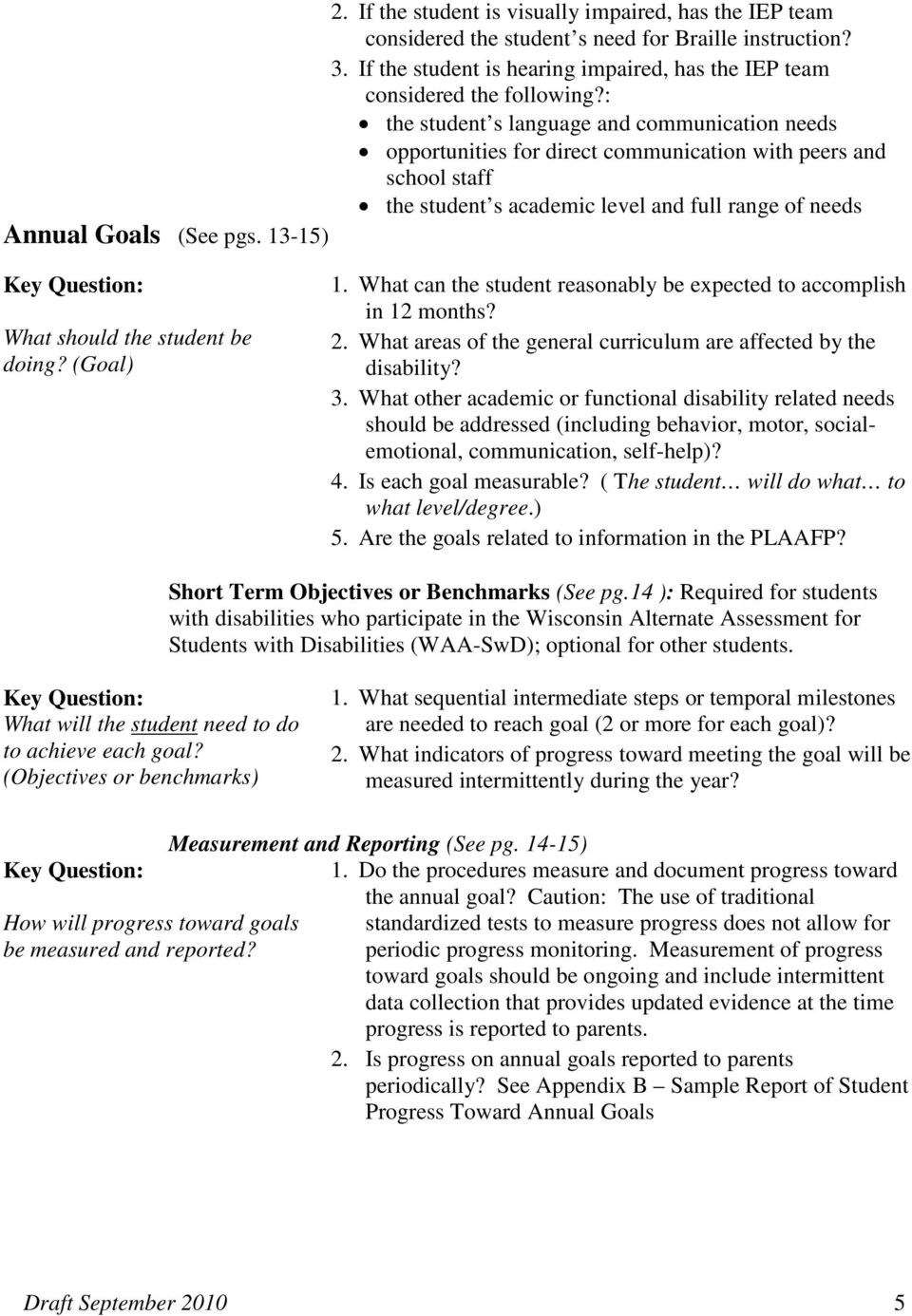
11 Participation in State and District Assessments (See pgs ) Key Question: Will the student participate in state and district assessments? 1. Has the IEP team considered if the student will be eligible to participate in the Wisconsin Knowledge and Concepts Examination (WKCE) during the term of the IEP (required for 3rd, 4th, 5th, 6th, 7th, 8th and 10th grades)? 2. Has the IEP team considered the student s participation in district-wide standardized assessments? 3. For students who need assessment accommodations, have the accommodations been listed in the IEP? 4. For students participating in the Wisconsin Alternate Assess ment-students with Disabilities (WAA-SwD), has the IEP team completed the WAA-SwD Participation Checklist? Transition (infused throughout the student s IEP) (See pgs ) Key Questions: Beginning at age 14: What are the student s post-school goals? What services, supports or programs does the student need to achieve his/her post-school goals? Is the student linked to needed post-school services, supports or programs before leaving school? 1. Has an age-appropriate transition assessment of the student been conducted and documented? 2. Has a statement of measurable post-school goals been developed related to training, education, employment, and, where appropriate, independent living? 3. Has a course of study aligned with the student s desired post-school goals been developed? 4. Have annual goals been developed that will reasonably enable the student to meet his/her postsecondary goals? 5. Does the IEP specify any needed transition services in: Instruction Related services Community experiences Employment Post-school living objectives Functional vocational evaluation Daily living skills 6. Have the student, his/her parents, and appropriate agencies been invited in writing to the IEP meeting? If the student is unable to attend, have steps been taken to ensure his/her needs, preferences, and interests were considered? 7. After the initial development of the student s transition plan, has it been reviewed and revised on an annual basis? 8. If the student will be turning 18, has the transfer of parental rights been discussed? 9. Has there been discussion about the student s graduation status if the student may be graduating prior to the end of the IEP term? Draft September

12 IEP Program Summary: Statement of Services, Participation in Regular Education Classes, Extra Curricular, and Non-Academic Activities (See pgs ) Key Question: What special education and other services are needed for the student to advance toward attaining his or her goals, be involved and progress in the general curriculum, and be educated with non-disabled peers? Statement of Services (See pgs ) 1. Has the IEP team described the student specific services for: Special education (specially designed instruction) Related services Supplementary aids and services Program modifications or supports for school personnel 2. For each service has the IEP team described: Frequency and amount Location (e.g., general education classroom, special education classroom, lunchroom, etc.) Duration 3. Are the services based on peer-reviewed research to the extent practicable? Key Question: Where will the student be educated? Participation in Regular Education Classes (environment) (See pgs ) Has the IEP team considered: 1. To what extent can the student be educated in the general education environment with the use of supplementary aids and services? 2. To what extent can the student s special education and related services be provided in the general education environment? 3. Can any of the student s IEP goals can be addressed in general education settings? Key Question: Will the student participate with non-disabled peers in extracurricular and nonacademic activities? Extra Curricular and Nonacademic Activities (See pg. 23) 1. What special education or supports, if any, are needed to allow the student to participate in extracurricular and nonacademic activities? 2. Are there any activities the student is unable to participate in even with support? The next section of this guide provides a summary of each component noted in the above outline. Draft September
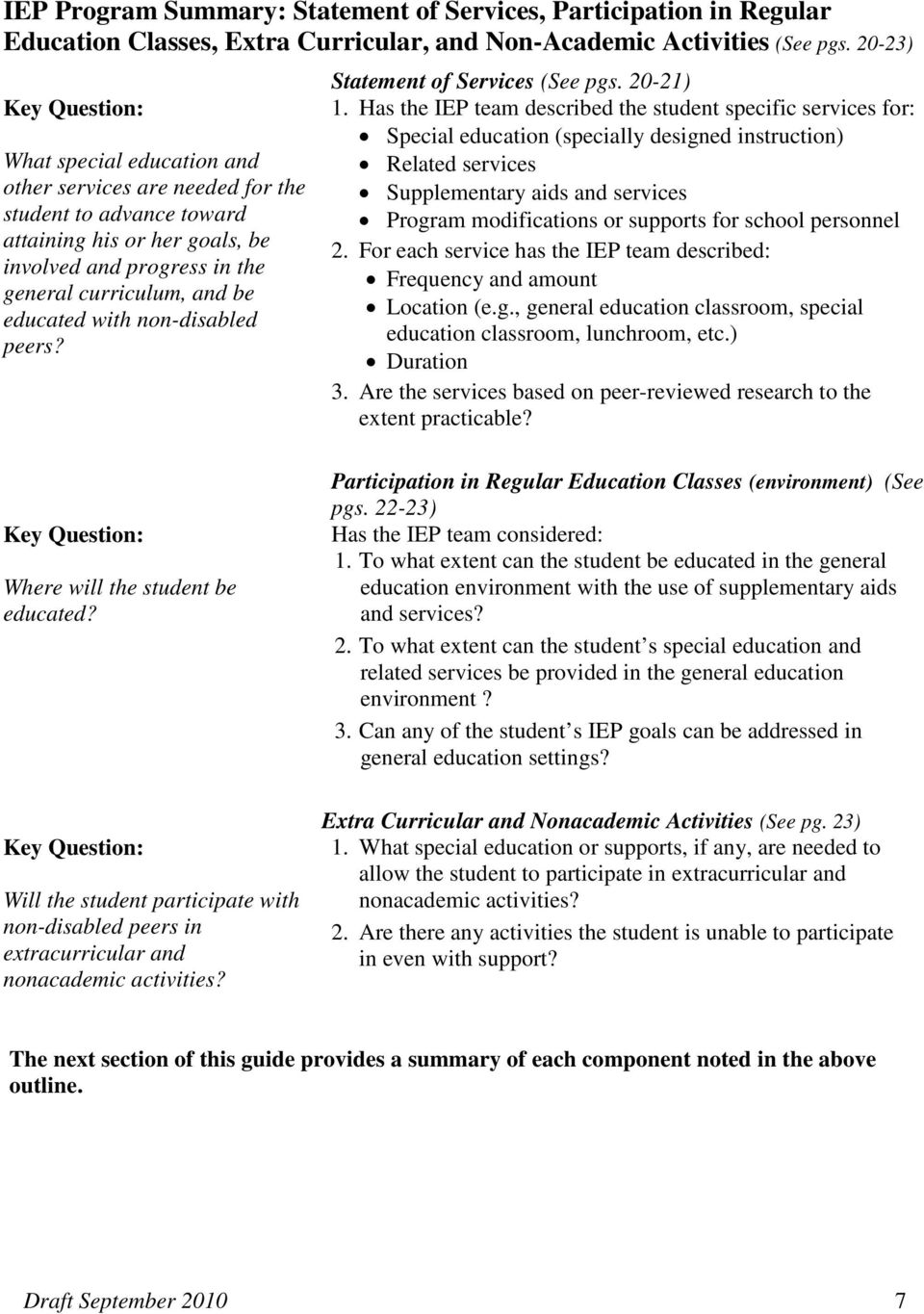
13 IEP Discussion Components Present Level of Academic Achievement and Functional Performance (PLAAFP) Key Question: Legal Citation(s) DPI Resources Definition: What is the student doing now? 1. What are the students: Strengths? Needs related to the student s disability? Parent concerns? Current levels of academic achievement and functional performance? 2. How does the student s disability affect the student s involvement and progress in the general education curriculum (the same curriculum as for nondisabled students) OR for preschoolers, how does the student s disability affect involvement in age-appropriate activities? To what extent, if any, the student would not be involved in the general curriculum or, for preschoolers, age-appropriate activities? 3. Does the PLAAFP establish a baseline of information about the student that can be used as the starting point from which to determine progress toward annual goals? Describes both academic and non-academic areas such as classroom, community, bus, lunchroom Includes current formal and informal educational performance data Describes performance areas meaningful in the student s life and daily environment Uses understandable language Describes learning accommodations, learning strategies 4. Does the PLAAF address program modifications, accommodations, learning strategies, etc. that help the student participate in general education curriculum and environments? 34 C.F.R (a)(1); 34 C.F.R (a)(5) Wis. Stat (2)(a); Wis. Stat (2)(d) DPI Sample Form I-4 and accompanying forms guide Guide to Connecting Academic Standards and IEPs - A statement about the student s: Strengths Current levels of academic achievement and functional performance Needs resulting from the disability that affect involvement and Draft September
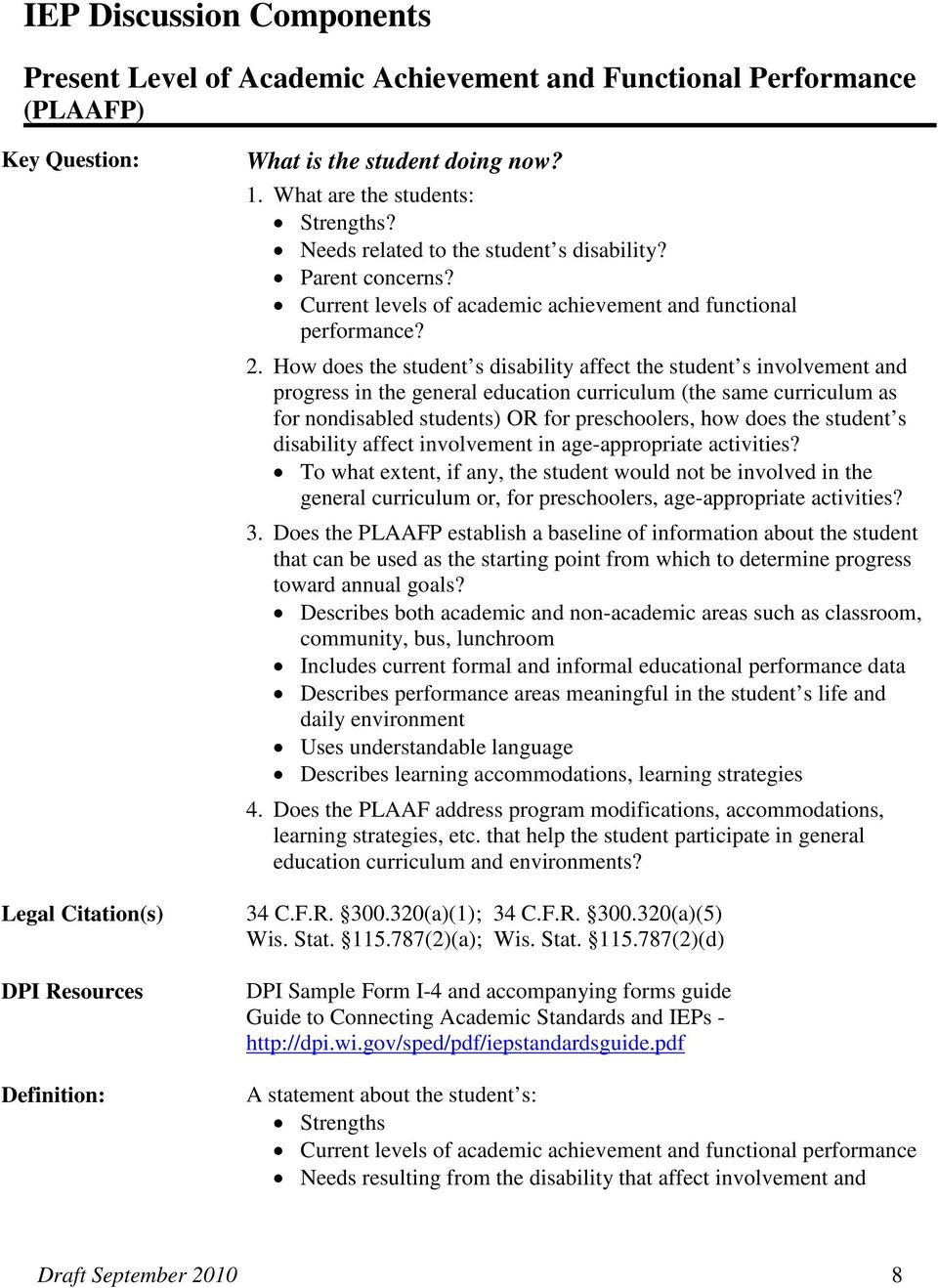
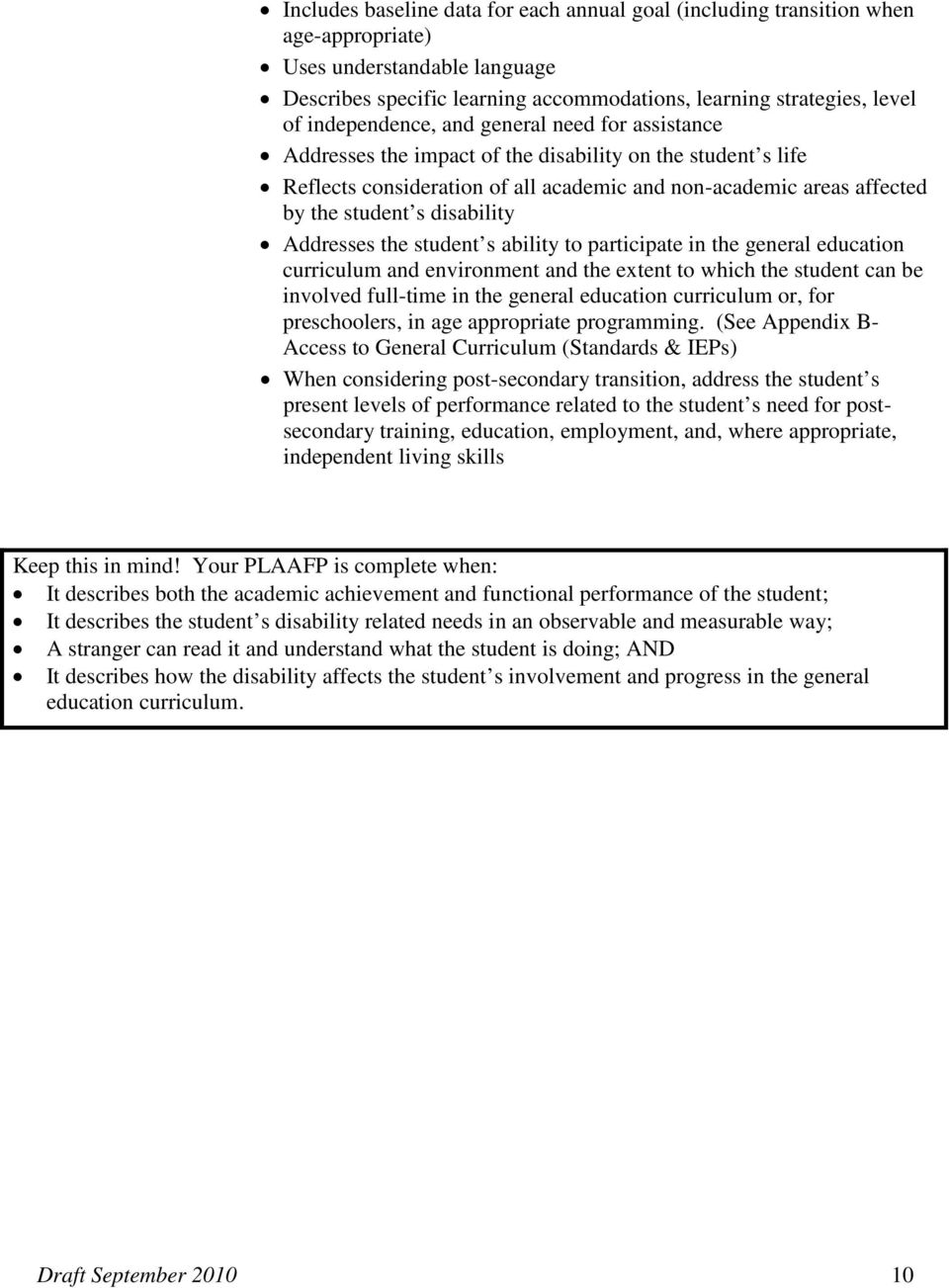
14 progress in the general education curriculum (for preschoolers, ageappropriate activities) Needs resulting from the disability that affect behavior, motor, communication, social-emotional or self-help skills Parental concerns The PLAAPF provides a baseline for IEP goals General education curriculum refers to what the student will be taught, not where the student will be taught. The general education curriculum is the common core of subjects and other curricular areas adopted by the district, or school within a district, for all students within each general age or grade grouping from preschool through secondary school. Full time in the general curriculum means the student s instruction addresses the standards for nondisabled children in the student s general age or grade grouping in all areas of the LEA s curriculum. A student with a disability may participate in the general curriculum with or without accommodations. A student may participate in the general education curriculum even if the student receives instruction in a special education environment (e.g. resource room). Purpose: Key Characteristics: To establish a baseline of measurable information that serves as the starting point from which to measure progress toward annual goals. Individualized Measurable means observable (you can see it, hear it, touch it) Describes both academic and non-academic areas of need related to the disability Academic achievement refers to a student s performance in academic content areas (e.g. reading, language arts, math, science, history) Functional refers to purposeful and practical activities in a student s daily environment(s) such as classroom, community, bus, or lunchroom. Functional performance includes the following: o Activities and skills not considered academic or directly related to a student s academic achievement o Routine activities of daily living o Skills needed for independence and performance at school, in the home, in the community, for leisure time, and for post-secondary and life-long learning o Motor skills, personal care, time and money, school/work habits, home/community orientation o Behavior and interpersonal relationships Includes current formal and informal educational performance data such as curriculum based measurements, IEP progress monitoring, behavior rating scales Draft September

15 Includes baseline data for each annual goal (including transition when age-appropriate) Uses understandable language Describes specific learning accommodations, learning strategies, level of independence, and general need for assistance Addresses the impact of the disability on the student s life Reflects consideration of all academic and non-academic areas affected by the student s disability Addresses the student s ability to participate in the general education curriculum and environment and the extent to which the student can be involved full-time in the general education curriculum or, for preschoolers, in age appropriate programming. (See Appendix B- Access to General Curriculum (Standards & IEPs) When considering post-secondary transition, address the student s present levels of performance related to the student s need for postsecondary training, education, employment, and, where appropriate, independent living skills Keep this in mind! Your PLAAFP is complete when: It describes both the academic achievement and functional performance of the student; It describes the student s disability related needs in an observable and measurable way; A stranger can read it and understand what the student is doing; AND It describes how the disability affects the student s involvement and progress in the general education curriculum. Draft September
16 Special Factors Key Question: Legal Citation(s) DPI Resources Definition: Key Characteristics: Are there special factors that need to be considered to allow students to benefit from their education? 34 C.F.R (a)(2); Wis. Stat (3)(b) DPI Sample Forms I-4 and I-5 and accompanying forms guide Special factors are considerations about how each of the following affect the student s ability to receive FAPE: Behavior Limited English proficiency Assistive technology Braille needs for students who have visual impairments Communication needs of students o Special considerations for students with deafness or hearing impairments Special factors should be considered without regard to disability category (e.g. think about behavioral factors for all students not just those with emotional behavioral disabilities). There are specific special factors to consider for students who have vision and hearing impairments. Behavior: Key Questions: 1. Is the student s behavior impacting his or her learning or that of others? 2. If yes, what positive behavioral interventions, supports, or other strategies could address the behavior? 3. If special education services are needed to address the student s behavior needs, are the needs addressed in the IEP ( e.g. in PLAAPF, goals and services as appropriate)? Limited English Proficiency: Key Questions: 1. Does the student s level of English language proficiency affect the special education and related services needed by the student? If so, to what extent? 2. Will any of the special education and related services needed by the student be provided in a language other than English? Draft September

17 Communication: Key Questions: 1. Does the student have communication needs that hinder learning? 2. Does the student need to learn or use special language or communication skills and strategies? 3. If special education services are needed to address the student s communication needs, are the needs addressed in the IEP ( e.g. in PLAAPF, goals and services as appropriate) 4. For students who are deaf or hard of hearing also ask: Does the student have opportunities for direct communication with peers and professional personnel in his or her language and communication mode and at the student s academic level? For example, a hearing impaired student may need opportunities to communicate with peers and teachers with American Sign Language (ASL). What is the student s full range of needs, including opportunities for direct instruction in the student s language and communication mode? Assistive Technology: Key Questions: 1. What, if any, assistive technology devices or services does the student need to achieve her or his annual goals? 2. Does the student require special assistive technology to participate in the general education curriculum or environment? 3. Does the student need to learn new or improve skills to use assistive technology devices and/or services? 4. If special education services are needed to address the student s behavior needs, are the needs addressed in the IEP (e.g. in PLAAPF, goals and services as appropriate)? Braille Needs For Students With Visual Impairments: Key Questions: 1. What are the student s reading and writing skills? 2. What learning medium (or media) does the student need to access core and expanded curriculum areas? Does the student need to use Braille in any area? 3. Does the student need instruction in Braille? 4. If a learning media other than Braille is determined to be more appropriate for the student at this time, indicate the criteria used to make this decision. 5. If special education services are needed to address the student s behavior needs, are the needs addressed in the IEP ( e.g. in PLAAPF, goals and services as appropriate)? Draft September

18 Annual Goal Statements including Short Term Objectives or Benchmarks and Progress Measurement and Reporting Annual Goal Key Question: What should the student be doing in the next 12 months? 1. What areas of the general curriculum are affected by the disability? 2. What are each of the student s other educational needs resulting from the student s disability (academic and functional) including behavior, motor, social-emotional, communication, and self-help? 3. Is each disability related need that you will be writing a goal for addressed in the PLAAPF? Legal Citation(s) DPI Resources Definition: Purpose: Key Characteristics: 34 C.F.R (a)(2)(i); Wis. Stat (2)(b) DPI Sample Form I-6 and accompanying forms guide Guide to Connecting Academic Standards and IEPshttp://dpi.wi.gov/sped/pdf/iepstandardsguide.pdf An annual goal: Is directly related to meeting a student need identified in the PLAAFP Addresses the student s disability related needs to enable participation in the general education curriculum Addresses any other education needs related to the disability Specifies a clear, measurable level of attainment: the student will do what to what level/degree Addresses academic and functional skill areas Includes short-term objectives or benchmarks for students with disabilities who take an alternative assessment aligned with alternate achievement standards (WAA-SWD); not required for students who take the Wisconsin knowledge and concepts examination (WKCE) To describe what a student can reasonably be expected to accomplish within 12 months. Related to meeting needs that result from the disability to enable involvement and progress in the general curriculum (based on the Wisconsin Model Academic Standards). General curriculum means the same curriculum based on the same standards as for nondisabled students, even if using different text of other materials Academic, non-academic and functional Measurable means observable (you can see it, hear it, count it). Can be achieved within the term of the IEP Includes a projected level of attainment Post-secondary transition related annual goals beginning at age 14 or younger, if needed Draft September

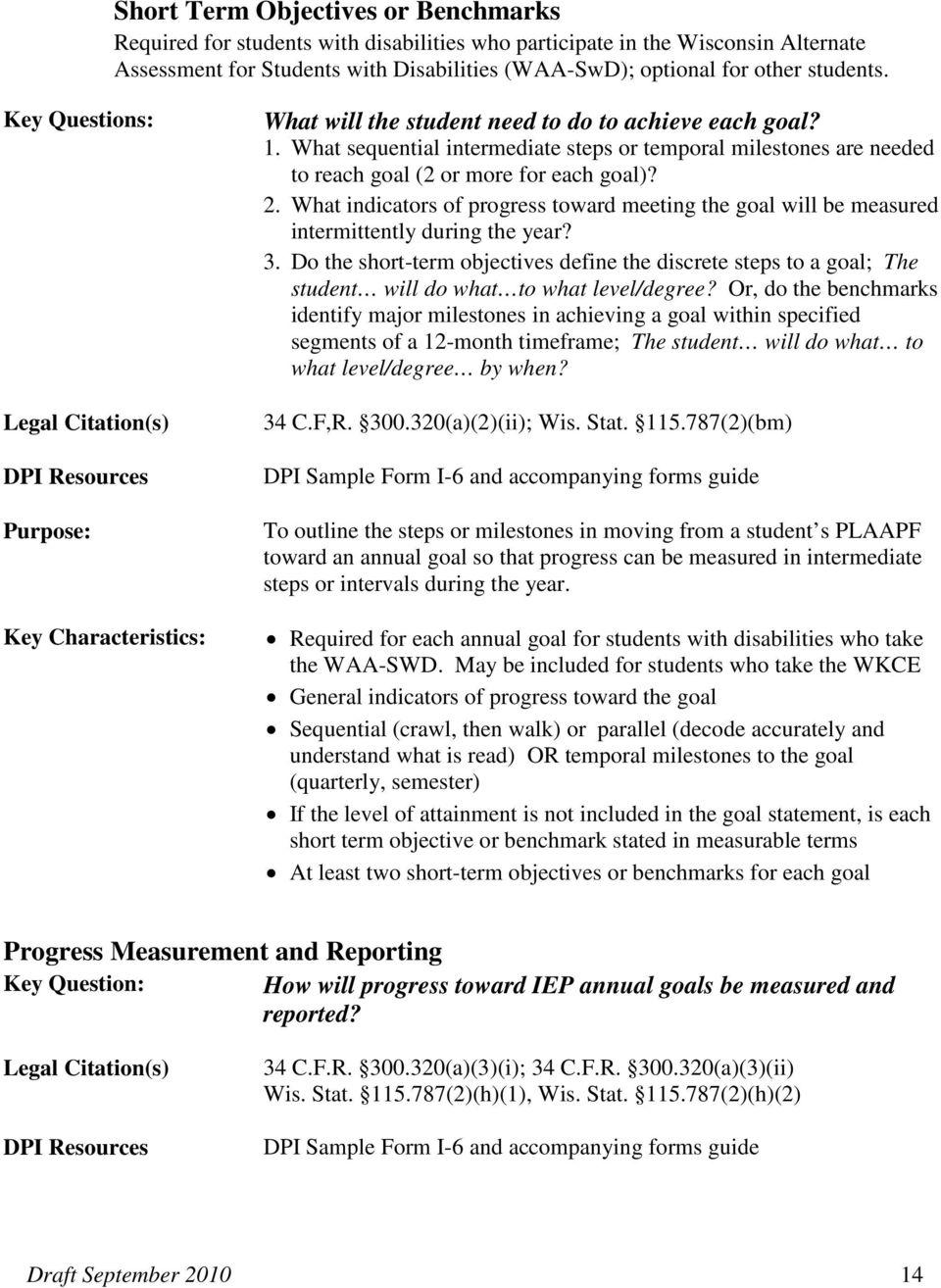
19 Short Term Objectives or Benchmarks Required for students with disabilities who participate in the Wisconsin Alternate Assessment for Students with Disabilities (WAA-SwD); optional for other students. Key Questions: Legal Citation(s) DPI Resources Purpose: Key Characteristics: What will the student need to do to achieve each goal? 1. What sequential intermediate steps or temporal milestones are needed to reach goal (2 or more for each goal)? 2. What indicators of progress toward meeting the goal will be measured intermittently during the year? 3. Do the short-term objectives define the discrete steps to a goal; The student will do what to what level/degree? Or, do the benchmarks identify major milestones in achieving a goal within specified segments of a 12-month timeframe; The student will do what to what level/degree by when? 34 C.F,R (a)(2)(ii); Wis. Stat (2)(bm) DPI Sample Form I-6 and accompanying forms guide To outline the steps or milestones in moving from a student s PLAAPF toward an annual goal so that progress can be measured in intermediate steps or intervals during the year. Required for each annual goal for students with disabilities who take the WAA-SWD. May be included for students who take the WKCE General indicators of progress toward the goal Sequential (crawl, then walk) or parallel (decode accurately and understand what is read) OR temporal milestones to the goal (quarterly, semester) If the level of attainment is not included in the goal statement, is each short term objective or benchmark stated in measurable terms At least two short-term objectives or benchmarks for each goal Progress Measurement and Reporting Key Question: How will progress toward IEP annual goals be measured and reported? Legal Citation(s) DPI Resources 34 C.F.R (a)(3)(i); 34 C.F.R (a)(3)(ii) Wis. Stat (2)(h)(1), Wis. Stat (2)(h)(2) DPI Sample Form I-6 and accompanying forms guide Draft September
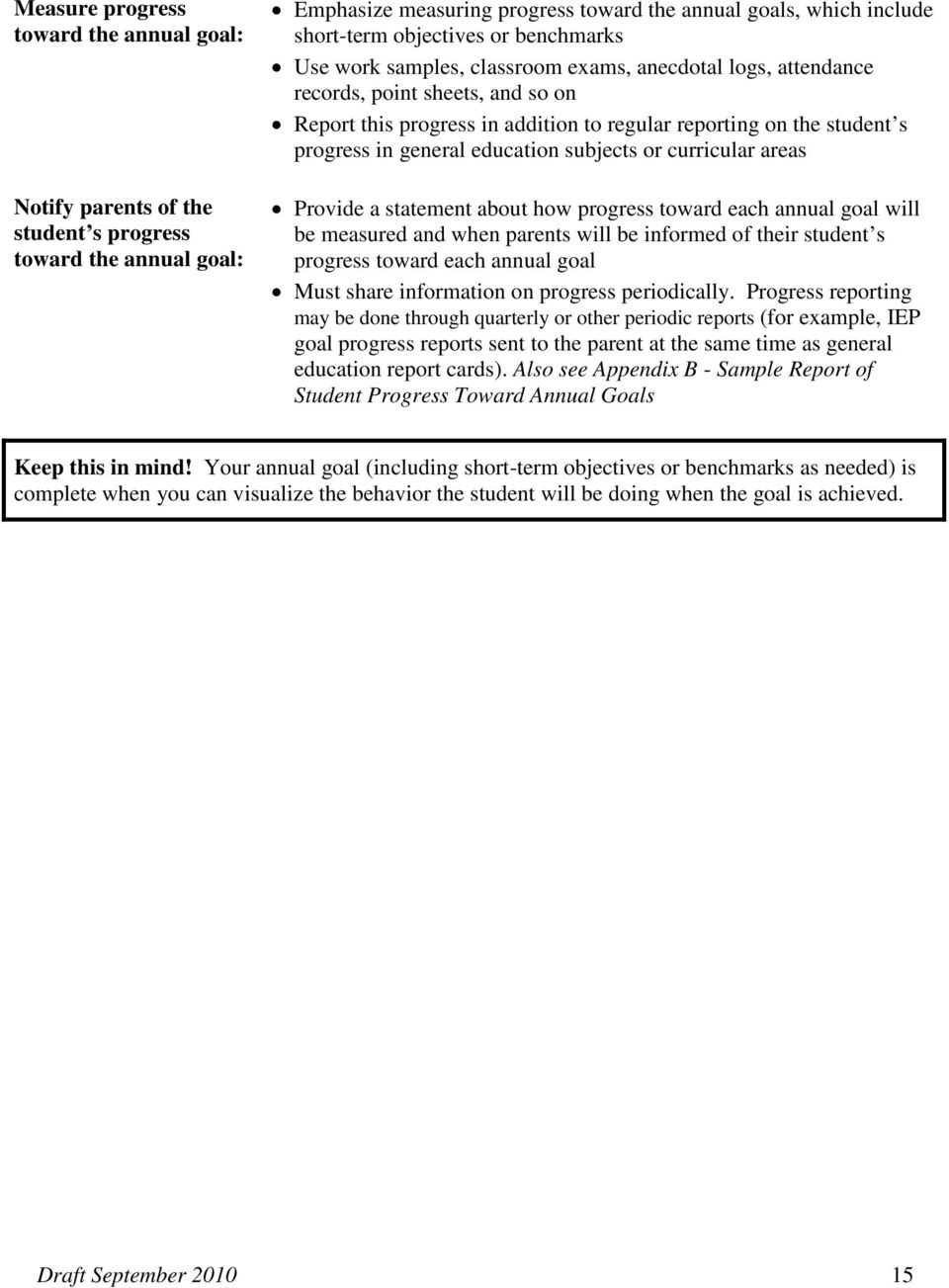
20 Measure progress toward the annual goal: Notify parents of the student s progress toward the annual goal: Emphasize measuring progress toward the annual goals, which include short-term objectives or benchmarks Use work samples, classroom exams, anecdotal logs, attendance records, point sheets, and so on Report this progress in addition to regular reporting on the student s progress in general education subjects or curricular areas Provide a statement about how progress toward each annual goal will be measured and when parents will be informed of their student s progress toward each annual goal Must share information on progress periodically. Progress reporting may be done through quarterly or other periodic reports (for example, IEP goal progress reports sent to the parent at the same time as general education report cards). Also see Appendix B - Sample Report of Student Progress Toward Annual Goals Keep this in mind! Your annual goal (including short-term objectives or benchmarks as needed) is complete when you can visualize the behavior the student will be doing when the goal is achieved. Draft September
21 Participation in State and District Assessments Key Questions: Legal Citation(s) DPI Resources Definitions: 1. Will the student participate in state and district assessments: the same way as students without disabilities? with accommodations? with an alternate assessment? 2. If the student needs testing accommodations, what accommodations are needed? 34 C.F.R (a)(6); Wis. Stat (2)(e) DPI Sample Forms I-7 and I-7(a) and accompanying forms guide Testing Accommodations Matrix: WAA-SwD Participation Checklist: Participation means providing students with disabilities the same opportunity as students without disabilities to demonstrate knowledge and skills on state or district assessments. State assessments mean the Wisconsin Student Assessment System (WSAS) which includes: Wisconsin Knowledge and Concepts Examination (WKCE) given at 3 rd,4 th, 5 th, 6 th, 7 th, 8 th, and 10 th grade Wisconsin Alternate Assessment Students with Disabilities (WAA-SwD) given at 3 rd, 4 th, 5 th, 6 th, 7 th, 8 th, and 10 th grade Accommodations are adjustments in the way a test is given that creates access and diminishes the impact of the disability on the student s opportunity to demonstrate what they know without changing what the test is designed to measure. Accommodations may be necessary to measure academic achievement and functional performance on the WKCE and the WAA-SwD and district wide assessments. Alternate assessment is the WAA-SwD. It is a performance based assessment. The WAA-SwD is used when the IEP team determines, even with accommodations, a student would be unable to demonstrate at least some of the knowledge and skills measured by a standardized assessment. The only alternate assessment for the WKCE is the WAA-SwD. Purpose: To provide information about how a student with a disability is progressing in the general curriculum based on the Wisconsin Model Academic Standards or how a student is progressing in an alternate curriculum based on the Extended Grade Band Standards Draft September
22 To guide decision making about the student s learning and instructional needs and participation in state and district assessments Key Characteristics: Participation decisions made by the IEP team are based on knowledge of: The student s present level of academic achievement and functional performance Wisconsin Model Academic Standards and the Extended Grade Level Standards WKCE test format and what skills and knowledge are being measured by the assessments District test formats and what skills and knowledge are being measured by the assessments State guidelines and the use of appropriate testing accommodations listed in the Accommodation Matrix Selected accommodations should be those already being used by the student in their educational program The student should familiar with selected accommodations prior to testing Participation decisions are made prior to the student taking the test If a student cannot participate in a regular assessment, the IEP must state why the student cannot participate and why the alternate assessment is appropriate for the student using the WAA-SwD Participation Checklist Draft September
23 Statement of Transition Service Needs (Beginning at Age 14) Key Questions: Legal Citation(s) DPI Resources Definition: Purpose: Key Characteristics: What are the student s transition service needs? 1. What does the student want to do and how does the student want to live after high school (post-school goals)? 2. What is the student s present level of functioning in relation to his or her post-school goals? 3. What transition services are needed to assist the student in reaching his or her post-school goals related to training, education, employment, and, where appropriate, independent living? 4. Is the student expected to graduate with a regular diploma during the IEP term. 5. Will any outside agencies provide needed transition services? 34 C.F.R (b); 34 C.F.R (c); 34 C.F.R (e)(3) Wis. Stat (2) (g); Wis. Stat DPI Sample Form I-8 and accompanying forms guide Transition Resources at The IEP statement of transition service includes: Appropriate measurable postsecondary goals that are annually updated and based upon an age appropriate transition assessment Transition services, including courses of study, that will reasonably enable the student to meet their postsecondary goals Annual iep goals related to the student s transition services needs A statement of transition services beginning at age 14 serves to: Identify goals for life after high school and develop a plan to achieve them Provide school experiences that develop the skills and competencies needed to achieve post-school goals Actively involve the student and his/her family in transition iep development Encourage self-advocacy Identify accommodations and modifications needed to achieve postschool goals Developed beginning when the student first becomes 14, or younger if appropriate. Then, reviewed and revised annually Part of an ongoing process of transition assessment Takes into account individual needs, preferences and interests Draft September
24 Describes the student s post-school goals Measurable annual goal(s) have been developed to enable the student to meet post-secondary goals Describes transition services needed to enable the student to meet his or her postsecondary goals related to training, education, employment, and, where appropriate, independent living Includes a course of study aligned with the student s desired postschool goals The student must be invited to the IEP team meeting where transition services are to be discussed If appropriate, a representative of any participating agency is invited to the IEP team meeting with the prior consent of the parent or adult student Beginning at least one year before the student turns 18, the student must be informed of the parental rights that will transfer to him or her at age 18. The student s parents must also be informed If the student is expected to graduate during the IEP term, discuss the student s graduation status and performance summary Draft September
25 IEP Program Summary: Statement of Services, Participation in Regular Education Classes (environment), and Extra Curricular and Non-Academic Activities Statement of Services Key Questions: Legal Citation(s) DPI Resources Definitions: 1. What special education, related services and supplementary aids and services are needed by the student to: a. Attain annual goals? b. Be involved and progress in the general education curriculum? c. Participate in extracurricular and other non-academic activities? d. Be educated and participate with other students with and without disabilities? 2. What program modifications or supports are needed for school personnel to enable the student to meet IEP goals, progress in the general curriculum, participate in extracurricular and other nonacademic activities, and be educated with disabled and non-disabled peers? 3. Are the student s special education, related services and supplementary aids and services based on peer-reviewed research to the extent practicable? 34 C.F.R ; 34 C.F.R ; 34 C.F.R (a)(4); 34 C.F.R (a)(5); Wis. Stat (c-d); Wis. Stat (2) (c-d); Definitions: 34 C.F.R , 34 C.F.R , 34 C.F.R ; Wis. Stats (14-16). DPI Sample Form I-9 and accompanying forms guide DPI Sample Form I-11 (when extended school year services considered) Information Update Bulletin EE-1 Data Worksheet for Determining Environment Codes Special education means specially designed instruction, regardless of where the instruction is provided, at no cost to the parents, to meet the unique needs of a student with a disability. Special education may include specially designed physical education, vocational education and travel training. Related services means transportation and such developmental, corrective and other supportive services as are required to assist a student with a disability to benefit from special education. Supplementary aids and services means aids, services and other supports provided in general education classes, other education-related settings and in extracurricular and nonacademic settings, to enable a student with a disability to be educated with nondisabled students to the maximum extent appropriate. Draft September
26 Program modifications or supports for school personnel are provided on behalf of the student and may include services such as consultation between general and special education teachers, training, or assistance with modifying assignments, teaching techniques, curriculum materials, or classroom assessment methods. Extended School Year Services (ESY) means special education services provided beyond the normal school schedule. ESY services are considered only when the IEP team determines they are required for the student to receive FAPE. Purpose: Key Characteristics: To describe the services the district will provide to address disability related needs in a manner clear to the parents, other IEP team participants, and staff responsible for implementing the IEP. The statement of services documents the district s commitment to provide special education, related services, supplementary aids and services, and program modifications and supports for school personnel to enable the student to advance toward the annual IEP goals, be involved in and make progress in the general education curriculum, participate in extracurricular and other non-academic activities and be educated and participate with non-disabled peers. Describes student specific specially designed instruction and other services needed to address the student s IEP goals and other disability related needs described throughout the IEP (e.g. reading, social skills, occupational therapy, transportation, accommodations). Describes how much and how often (amount and frequency) the service is provided. o Whenever possible, worded in daily or weekly allotments of hours or minutes according to when the service is scheduled (e.g. 20 minutes 3x per week, 60 minutes daily). o When impossible to describe services in specific allotments of time, clearly describes the circumstances under which the service will be provided (e.g. tests read when text is above student s independent reading level). o A narrow range is only allowable if necessary to meet student needs (e.g minutes depending on student s ability to sustain attention). Using ranges because of staff schedules or shortages are not acceptable. Describes the setting(s) where (location) the service is delivered (e.g. special education classroom, general education classroom, lunchroom, counselor s office). Describes for how long the service is delivered (duration), if different from the IEP beginning and ending dates (e.g. twice weekly during first semester, between January 1 and June 5, 20XX). Identifies curriculum adaptations and modifications (supplementary aids and services) needed to allow the student to meaningfully Draft September
27 participate to the maximum extent appropriate in the general education curriculum and environment(s). Consider supports for school personnel needed to allow the student to meet IEP goals, meaningfully participate to the maximum extent appropriate in the general education curriculum and environment(s), and address other disability related needs. Describes extended school year services if the IEP team determines such services are needed. When ESY is considered the IEP team addresses skill regression and recovery problems. Participation in Regular Education Classes (part of Least Restrictive Environment (LRE) Consideration) Key Question 1. Will the student participate full-time with non-disabled peers in the general education environment? a. Will the student be educated in general education classes/ environment with the use of supplementary aids and services? b. Will special education and related services be provided to the student in the general education classes/environment? c. Will a preschool child participate in age appropriate settings with nondisabled peers? Definition Purpose: Key Characteristics: Participation in regular education refers to the environment(s) in which a student will receive a free, appropriate public education (FAPE). This includes regular education classes and other school environments. The Regular education environment is: the environment where the student would be if not disabled. the environment where other students this student s age receive instruction. The degree to which a student will be educated and participate with nondisabled peers in regular education environment(s) is part of the consideration of least restrictive environment (LRE). The LRE decision evolves from the IEP team s consideration of the student s ability to participate in the general education curriculum, need for specially designed instruction and related services and the degree to which participation with non-disabled peers can be achieved with the use of supplementary aids and services. The concept of LRE is reflected throughout the individualized education plan. To document the degree to which the student will participate full-time with non-disabled peers in regular education environment(s), or for preschoolers, in age appropriated settings. Based on the individual needs of the student Considers the nature and severity of the student s disability Draft September
28 Considers which student needs can be met satisfactorily with the use of supplementary aids and services in the general education environment Considers the environments where other students of the same age/grade receive instruction and participate in other school activities Describes the extent to which the student will participate in the same environments as age/grade peers (e.g. full, partial, none) For preschool age students, consider natural environments (e.g. child care, preschool, kindergarten, home, Head Start etc.) Along with the summary of services statements, clarifies the extent to which the student will not participate with students without disabilities in general education classes and other environments Special Note: The LRE decision is documented in several places in the student s IEP. Part of the IEP team decision about LRE is documented in the Program Summary. LRE decisions are also documented on the Placement Notice. This section of this guide addresses only the portion found in the program summary- See forms guide and DPI website for information about making placement decisions, assigning environment codes and placement notice requirements. The IEP team may use DPI form EE-1 Data Worksheet for Determining Environment Codes. Extra Curricular and Nonacademic Activities Key Question: Key Characteristics: Will the student participate with non-disabled peers in extracurricular and nonacademic activities? Consider the extracurricular and nonacademic activities in which the student will participate, if any. Describe what special education services the student will need to participate in extracurricular and nonacademic activities. Describe what related services the student will need to participate in extracurricular and nonacademic activities. Describe what supplementary aids and services the student will need to participate in extracurricular and nonacademic activities. Describe what program modifications or supports the student will need to participate in extracurricular and nonacademic activities. Describe the extent to which the student will not be involved in extracurricular and nonacademic activities with nondisabled students. Keep this in mind! You have completed the summary of educational services when it reflects each goal and addresses the student s other disability related needs. Draft September
29 Appendix A: Case Examples Dan Ed Erin Jamal Draft September
30 Dan s IEP Present Level of Academic Achievement and Functional Performance (PLAAFP) Dan is a fourth grader who has a good sense of humor and is accepted by his peers. Dan can successfully participate in the fourth grade math curriculum without special education support. He does well in general education science and social studies, but needs help with independent reading and writing assignments. Dan experiences success when provided with an assignment notebook, reading of tests, reading support for long text passages assigned to be completed independently within a short time period, and assistance from a peer or teacher for written assignments. Dan has difficulty with reading. He can identify most letters and letter combinations in isolation, but struggles to apply decoding strategies to unfamiliar words when reading text. This affects his oral reading rate, which is slow and labored. Dan cannot independently read textbooks used in his 4th grade classes. Dan accurately reads and comprehends 95 words per minute given graded passages at the second grade level; his independent reading level. His fluency in 4th grade passages is poor; He averages 55 words read correctly per minute with less than 75% comprehension. Students in 4th grade are expected to read passages with % comprehension at the rate of words per minute. Dan demonstrates good listening comprehension. He understands academic content at grade level following large and small group instruction, and when text is read to him by a peer, staff, or computer based text reader. He is able to report facts and make inferences from listening at a level expected of students in his grade. Dan also has difficulty with writing and following complex oral and written directions. When he doesn t understand what to do in class, he generally picks up on cues from peers around him. Dan can successfully follow 1 and 2-step directions without support. However, when instructions are more complex, he sometimes needs help. This makes it hard for him to follow classroom activities and assignments. His written work contains many spelling errors, lacks necessary punctuation, and his sentences are generally short, 3-5 words in length. He cannot yet write a paragraph without assistance. He does respond well to peer or teacher pre-writing and editing assistance and is beginning to learn to use computer based spell-checking and editing software. Dan s parents are concerned about his reading and writing skills and feel he needs help in these areas. They also notice his difficulty in following directions. They are happy with his grades in math and his comments that he has friends in school. Annotated Text for Dan s Present Level of Academic Achievement and Functional Performance The following annotated copy of Dan s Present Level of Academic Achievement and Functional Performance (PLAAFP) is for training purposes ONLY. It contains the following information: strengths, needs resulting from Dan s disability that affect involvement and progress in the general education curriculum; needs resulting from his disability that affect behavior, motor, communication, social-emotional or self-help skills; and parent concerns. It also includes Dan s current level of academic achievement and functional performance that serve as a baseline for each of his measurable annual goals. Dan is a fourth grader who has a good sense of humor and is accepted by his peers. Dan can successfully participate in the fourth grade math curriculum without special education support. He does well in general education science and social studies Strength Functional performance Academic achievement Draft September
31 How disability affects involvement in general curriculum. How disability affects involvement in general curriculum. Baseline for Goal 1 How disability affects involvement in general curriculum. Baseline for Goal 3 How disability affects involvement in general curriculum. Baseline for Goal 2 He needs help with independent reading and writing assignments. Dan experiences success when provided with an assignment notebook, reading of tests, reading support for long text passages assigned to be completed independently within a short time period, and assistance from a peer or teacher for written assignments. Dan has difficulty with reading. He can identify most letters and letter combinations in isolation, but struggles to apply decoding strategies to unfamiliar words when reading text. This affects his oral reading rate, which is slow and labored. Dan cannot independently read textbooks used in his 4th grade classes. Dan accurately reads and comprehends 95 words per minute given graded passages at the second grade level; his independent reading level. His fluency in 4th grade passages is poor; He averages 55 words read correctly per minute with less than 75% comprehension. Students in 4th grade are expected to read passages with % comprehension at the rate of words per minute. Dan demonstrates good listening comprehension. He understands academic content at grade level following large and small group instruction, and when text is read to him by a peer, staff, or computer based text reader. He is able to report facts and make inferences from listening at a level expected of students in his grade. Dan also has difficulty with writing and following complex oral and written directions. When he doesn t understand what to do in class, he generally picks up on cues from peers around him. Dan can successfully follow 1 and 2-step directions without support. However, when instructions are more complex, he sometimes needs help. This makes it hard for him to follow classroom activities and assignments. His written work contains many spelling errors,lacks necessary punctuation, and his sentences are generally short, 3-5 words in length. He cannot yet write a paragraph without assistance. He does respond well to peer or teacher pre-writing and editing assistance and is beginning to learn to use computer based spell-checking and editing software. Need Academic achievement Strength Academic achievement Need Strength Functional performance Strength Need Need Academic achievement Strength Draft September
32 Dan s parents are concerned about his reading and writing skills and feel he needs help in these areas. They also notice his difficulty in following directions. They are happy with his grades in math and his comments that he has friends in school. Parent concern Will the student be involved full-time in the general education curriculum or, for preschoolers, in age-appropriate activities? Yes No (If no, describe the extent to which the student will not be involved full-time in the general curriculum or, for preschoolers, in age-appropriate activities) Instruction provided in the special education resource room will expand upon and reinforce the core general education curriculum for Dan s grade. The student will participate in an alternate or replacement curriculum that is aligned with alternate achievement standards in: (check all that apply) Reading Math Language Arts Science Social Studies _ Other (specify): NA Special Factors: After consideration for special factors (behavior, limited English proficiency, Braille needs, communication needs including deaf/hard of hearing, and assistive technology), is there a need in any of the areas? Yes No (If yes or student has a visual impairment, attach I-5, Special Factors page) Does the student need assistive technology services or devices? Yes No (If yes, specify particular device(s) and service(s)) Dan is beginning to learn how to use computer based text reading and written language support software. Continued instruction in the use of such technology is needed to help Dan complete school work more independently. Annual Measurable Goals Measurable level of Goal 1: Dan will apply decoding strategies to improve his reading attainment (Referenced fluency of 4 th grade passages to 90 words read correctly per minute with to fourth grade 90% comprehension. Wisconsin Academic Procedures for measuring progress toward the annual goal: Standards) Weekly timed oral readings where Dan s use of decoding strategies is recorded, Log observations about Dan s reading of classroom materials. Measurable level of attainment (Referenced to fourth grade Wisconsin Academic Standards) When periodic reports about student progress toward meeting the annual goal will be provided to the parents: 1. Monthly phone or correspondence with parents. 2. Written progress report at the time report cards are distributed. Goal 2: Dan will write a paragraph of at least five, 8-10 word sentences with no more than one error in spelling and punctuation after editing. Objectives: 1. With individualized instruction, Dan will apply strategies including phonetic analysis and word families to spell unfamiliar words. 2. Using a spell checker and writing support software, Dan will edit his writing and make spelling corrections. 3. Using an explicit writing process strategy and teacher assistance, Draft September
33 Dan will plan and write a paragraph on a topic using correct grammar, punctuation and spelling. 4. With a peer editor or teacher, Dan will review writing assignments and make needed corrections. Measurable level of attainment (Referenced to fourth grade Wisconsin Academic Standards) Procedures for measuring progress toward the annual goal: 1. Weekly analysis using district writing rubric on 2 writing samples to assess spelling, punctuation and writing strategies. 2. Quarterly interviews with Dan to assess the effectiveness of spelling and writing strategies being used and make refinements. 3. Weekly recording of the accuracy of two or more peer edited writing assignments Dan completes. When periodic reports about student progress toward meeting the annual goal will be provided to the parents: 1. Monthly phone or correspondence with parents. 2. Written progress report at the time report cards are distributed. Goal 3: Dan will demonstrate understanding of 3 or 4 step classroom directions by following them without teacher prompting in 4 of 5 opportunities. Procedures for measuring progress toward the annual goal: 1. Anecdotal records of Dan s use of clarifying questions and teacher prompting. 2. Bi-weekly regular classroom observation charting of the number of steps Dan can follow in performing classroom activities. When periodic reports about student progress toward meeting the annual goal will be provided to the parents: 1. Monthly phone or correspondence with parents. 2. Written progress report at the time report cards are distributed. Participation in Statewide Assessments The student will be in (circle) 3d, or 4th, or 5th, or 6th, or 7th, or 8th, or 10th grade when the Wisconsin Knowledge and Concepts Examination-Criteria Reference Test (WKCE-CRT) is given. (Check only one of the two boxes below.) The student will be taking the WKCE for all content areas required at this grade level. (For students taking the WKCE, complete the assessment and accommodations grid below. Document the accommodations, if any, needed for each of the content areas for students taking the WKCE.) OR The student will be taking the WAA-SwD for all content areas required at this grade level. If yes, the Wisconsin Alternate Assessment (WAA) Participation Checklist is included with the IEP. For students taking the WAA-SwD document the accommodations, if any, needed for the alternate assessment. Draft September
34 Student will participate in the: Reading Math Science Language Arts Social Studies WKCE without accommodations in the content areas of: WKCE with accommodations (list accommodations for each content area) Accommodations: Read directions aloud and reread as needed. Student takes test with a small group Provide extra time Accommodations: Read directions aloud and reread as needed Read questions and content to student. Provide spelling assistance or a spell-check device Student takes test with a small group Provide extra time Accommodations: Read directions aloud and reread as needed Read questions and content to student. Provide spelling assistance or a spell-check device Student takes test with a small group Provide extra time Accommodations: Read directions aloud and reread as needed Read questions and content to student. Student takes test with a small group Provide extra time Accommodations: Read directions aloud and reread as needed Read questions and content to student. Provide spelling assistance or a spell-check device Student takes test with a small group Provide extra time WAA-SwD list accommodations for each content area Accommodations: Accommodations: Accommodations: Participation in District-Wide Assessments District-wide assessments given District-wide assessments not given Student will not be in the grade when a district-wide assessment is given List district-wide assessment(s) student will take: District X Reading and Math Test Describe appropriate testing accommodations, if any: Repeat/explain test instructions, extra time to complete assessment, read test items except for reading test Draft September
35 IEP- Program Summary Physical education: Regular Specially designed Vocational education: Regular Specially designed Include a statement for each of I, II, III and IV below to allow the student (1) to advance appropriately toward attaining the annual goals; (2) to be involved and progress in the general education curriculum; (3) to be educated and participate with other students with and without disabilities to the extent appropriate, and (4) to participate in extracurricular and other nonacademic activities. Include frequency, location, & duration (if different from IEP beginning and ending dates). I. Special education Frequency/ Location Duration Amount Small group instruction in reading 30 minutes, 5 times per week Small group instruction in spelling, grammar, sentence and paragraph development Small and large group instruction in computer technology used to support reading and writing skills 20 minutes, 3 times per week 15 minutes per week 30 minutes per week Special education resource room Special ed. resource room Special ed. resource room General ed. classroom and computer lab Same as IEP Same as IEP Same as IEP Same as IEP II. Related services needed to benefit from special education including frequency, location, and duration (if different from IEP beginning and ending dates). None needed to benefit from special education III. Supplementary aids and services: aids, services, and other supports provided to or on behalf of the student in regular education or other educational settings. Yes No (If yes, describe) Electronic spell checker Oral administration of tests Additional time to edit and complete writing assignments Classroom text on tape or on computer for use with text reading software Freq / Amt Location Duration When assigned writing assignment Tests with more than 5 questions or 10 words per question. Assignments requiring more than 5 sentences. Literature, science, and social studies text not read in class Special & general ed. classrooms Special ed. classroom or library office General & special ed. classrooms Special & general ed. classroom Same as IEP Same as IEP Same as IEP Same as IEP Draft September
36 Peer editor for writing Teacher assistance in planning writing assignments IV. Program modifications or supports for school personnel that will be provided. Yes No (If yes, describe) 45 minutes per week When assigned writing task requiring more than 1 paragraph General education classroom General and special education classroom Same as IEP Same as IEP Consultation between special education and general education teachers 30 minutes per month General education classroom Same as IEP V. Participation in Regular Education Classes The student will participate full-time with non-disabled peers in regular education classes, or for preschoolers, in age-appropriate settings. The student will not participate full-time with non-disabled peers in regular education classes, or for preschoolers, in age-appropriate settings. (If you have indicated a location other than regular education classes or age-appropriate settings in the case of a preschooler in I, II, or III above, you must check this box and explain why full-time participation with non-disabled peers is not appropriate.) Because of his individual learning needs in basic reading and writing skills, Dan will be removed from regular education classes to the special education resource room for specially designed instruction during part of the reading and language arts block time. Dan will receive all other instruction in general education settings with needed supplemental aids and services. VI. Participation in Extracurricular and Nonacademic Activities Will the student be able to participate in extracurricular and nonacademic activities with nondisabled students? Yes No (If yes, include under I., II., III., and IV. any special education, related services, supplementary aids and services, and program modifications or supports necessary to assist the student. If no, describe the extent to which the student will not be involved in extracurricular and nonacademic activities with nondisabled students) Staff should check for understanding after giving complex directions during large group activities and repeat or explain instructions when Dan is not able to understand them or is unable to follow cues from his peers. Draft September
37 Ed s IEP Present Level of Academic Achievement and Functional Performance (PLAAFP) Ed is a four-year-old student who spends most of his time with adults. He has had few experiences playing with children his age. Because of this, Ed s parents have enrolled him in the district s four-year old kindergarten program (4K). Ed s mom reports he likes to have his own way and doesn t listen. His parents find it difficult to read stories to Ed because of his short attention span (less than three minutes). He is able to play alone with toys for two to three minutes. When with other children, he cannot share or interact with toys without adult assistance. He becomes frustrated and bangs his toys or objects on the floor, or throws them at the other children. His short attention span and frustration level interferes with his ability to recall information from books read to him and with learning new concepts through interaction with toys in his environment. Ed is able to eat by himself and put on his underclothes, t-shirt and elastic band pants. He is not fully toilet trained at this time. He averages 5 to 6 accidents per week. Ed is able to walk, run, and jump independently. He is very active and especially likes to play on the swing set. During his first week in the 4K program, his teacher noted that Ed uses two and three word phrases and asks what and what doing questions. He needs to increase his language use to at least four to five word sentences. He also needs to learn to ask who, where, and when questions. Ed s use of incomplete sentences and minimal use of questions interferes with his ability to communicate his wants and needs, and to gain information. He understands what children and adults say to him. Annotated Text for Ed s Present Level of Academic Achievement and Functional Performance The following annotated copy of Ed s Present Level of Academic Achievement and Functional Performance (PLAAFP) is for training purposes ONLY. It contains the following information: strengths, needs resulting from Ed s disability that affect involvement and progress in age-appropriate activities; needs resulting from his disability that affect behavior, motor, communication, social-emotional or self-help skills; and parent concerns. It also includes Ed s current level of academic achievement and functional performance that serve as a baseline for each of his measurable annual goals. Baseline for Goal 2 Baseline for Goal 1 Ed is a four-year-old student who spends most of his time with adults. He has had very few experiences playing with children his age. Because of this, Ed s parents have enrolled him in the district s four-year old kindergarten. Ed s Mom, reports he likes to have his own way and doesn t listen. His parents find it difficult to read stories to Ed because of his short attention span (less than three minutes). He is able to play alone with toys for two to three minutes. When with other children, he cannot share or interact with toys without adult assistance. He becomes frustrated and bangs his Parent concern Functional performance Functional performance Need Draft September
38 How disability affects involvement in age appropriate activities. toys on the floor or throws them at the other children His short attention span and frustration level interferes with his ability to recall information from books being read to him and with learning new concepts through interaction with toys in his environment. Ed is able to eat by himself and put on his underclothes, t-shirt and elastic band pants. Baseline for Goal 3 He is not fully toilet trained at this time. He averages 5 to 6 accidents per week. Baseline for Goal 4 How disability affects involvement in age appropriate activities. Ed is able to walk, run, and jump independently. He is very active and especially likes to play on the swingset. During his first week in the 4K program, his teacher noted that Ed uses two and three word phrases and asks what and what doing questions. He needs to increase his language use to at least four to five word sentences. He also needs to learn to ask who, where, and when questions. Ed s use of incomplete sentences and minimal use of questions interferes with his ability to communicate his wants and needs and to gain information. He understands what students and adults say to him. Strength Functional performance Need Strength Functional performance Academic achievement Need Will the student be involved full-time in the general education curriculum or, for preschoolers, in age-appropriate activities? Yes No (If no, describe the extent to which the student will not be involved full-time in the general curriculum or, for preschoolers, in age-appropriate activities) The student will participate in an alternate or replacement curriculum that is aligned with alternate achievement standards in: (check all that apply) Reading Math Language Arts Science Social Studies _ Other (specify): NA Special Factors After consideration for special factors (behavior, limited English proficiency, Braille needs, communication needs including deaf/hard of hearing, and assistive technology), is there a need in any of the areas? Yes No (If yes or student has a visual impairment, attach I-5, Special Factors page) Does the student s behavior impede his/her learning or that of others? Yes No (If yes, include the positive behavioral interventions, strategies, and supports to address that behavior) Ed cannot share or interact with toys with other children. He becomes frustrated and bangs his toys or objects on the floor or throws them at the other children. In these situations he needs and responds well to adult modeling, redirection and gentle reminders. Draft September
39 Does the student have communication needs that could impede his/her learning? No (If yes, include communication needs) Yes Ed has difficulty communicating his wants and needs and gain information. He requires specially designed language instruction and supports to be able to ask for what he needs. Annual Measurable Goals Measurable level of attainment (Referenced to the Wisconsin Model Early Learning Standards, 2008 Edition) Goal 1: While playing with at least one other student, Ed will share and interact with toys without banging or throwing them without adult assistance five times per day for 10 minutes by May 15. (Social and Emotional Development, C. Social Competence, C.EL. 2,3) Benchmarks: 1. Ed will play next to another student using different toys for 10 minutes without throwing the toys with adult assistance at least once per day by October Ed will play with another student using the same toys for 10 minutes without banging the toy with adult assistance by November Ed will play with other students using the same toys for 10 minutes without throwing or banging the toys without adult assistance at least once per day by January Ed will play with one other student, sharing and interacting with toys, at least five times per day for at least five minutes without adult assistance by March 15. Procedures for measuring progress toward the annual goal: 1. Data recording twice per week of Ed s play behavior during play activities in the classroom and on the playground. 2. Weekly anecdotal records of play behavior during group play activities in the classroom and on the playground. When periodic reports about student progress toward meeting the annual goal will be provided to the parents: 1. Two times per month phone contact or personal visit with parents. 2. IEP progress notes quarterly. Measurable level of attainment (Referenced to the Wisconsin Early Learning Standards, 2008 Edition) Goal 2: Ed will listen and attend to individual and small group activities for at least 10 minutes 4 of 5 opportunities. (Approaches to Learning, A. Curiosity, Engagement and Persistence, A.EL. 2, 3; Language Development and Communication, A. Listening and Understanding, A.EL. 1, 2) Benchmarks: 1. Ed will join friends or family to listen to a story for 5 minutes at least three times per week by November With adult prompts, Ed will maintain focus while participating in a Draft September
40 small group activity for 7 minutes by December When interacting with materials in a teacher directed small group activity, Ed will maintain focus for at least 10 minutes at least three times per week by February Ed will listen and attend to a 10-minute activity at least three times per week that includes a story and discussion by March 15. Procedures for measuring progress toward the annual goal: 1. Target one story time, one small group and one individual activity twice weekly to record time of attending to activity. 2. At least weekly anecdotal records of attending to activities. When periodic reports about student progress toward meeting the annual goal will be provided to the parents: 1. Two times per month phone contact or personal visit with parents. 2. IEP progress notes quarterly. Measurable level of attainment (Referenced to the Wisconsin Early Learning Standards, 2008 Edition) Goal 3: Ed will use the bathroom so he has no accidents during the day. (Health and Physical Development A. Physical Health and development, A.EL.1c; Language Development and communication, B. Speaking and Communication, B.EL. 2a) Benchmarks: 1. With adult assistance, Ed will use the toilet at regular intervals daily by November Ed will tell an adult when he needs to use the bathroom, having no more than four accidents per week by December Ed will tell an adult when he needs to use the bathroom, having no more than two accidents per week by April 1 Procedures for measuring progress toward the annual goal: 1. Daily data recording of Ed s telling an adult when he needs to use the toilet and/or uses the toilet by himself. When periodic reports about student progress toward meeting the annual goal will be provided to the parents: 1. Two times per month phone contact or personal visit with parents. 2. IEP progress notes quarterly. Measurable level of attainment (Referenced to the Wisconsin Early Learning Standards, 2008 Edition) Goal 4: Ed will increase his use of language by using 4-5 word sentences when he talks with adults and students 75% of opportunities. (Language Development and Communication B. Speaking and Communication, B.EL.2a, 2b, 2c) Objectives: 1. With the assistance of picture cues, Ed will use 4-5 word sentences when he tells a story or talks to his family 75% of opportunities. 2. Using verbal models and visual cues, Ed will ask who, where and Draft September
41 IEP- Program Summary when questions when he needs information from an adult or a student 90% of opportunities. 3. Using verbal models and visual cues, Ed will use no, not, can t, don t within a sentence that contains a noun and a verb and 4-5 words 90% of opportunities. Procedures for measuring progress toward the annual goal: 1. Language sample once every three months. 2. Data recording twice weekly of asking questions, using negative sentences and using plurals. 3. Anecdotal records of Ed s use of language. When periodic reports about student progress toward meeting the annual goal will be provided to the parents: 1. Two times per month phone call or personal visit with parent. 2. IEP progress notes quarterly. Physical education: Regular Specially designed Vocational education: Regular Specially designed NA Include a statement for each of I, II, III and IV below to allow the student (1) to advance appropriately toward attaining the annual goals; (2) to be involved and progress in the general education curriculum; (3) to be educated and participate with other students with and without disabilities to the extent appropriate, and (4) to participate in extracurricular and other nonacademic activities. Include frequency, location, & duration (if different from IEP beginning and ending dates). I. Special Education Frequency/ Amount One-to-one and small group instruction in the Three days per areas of social-emotional, self-help, and week 60 language skills. minutes per day One-to-one speech/language therapy for language usage. One day per week 30 minutes per day One day per week 30 minutes per day Location General Education Therapy room General Education Duration Same as IEP Same as IEP Same as IEP II. Related services needed to benefit from special education including frequency, location, and duration (if different from IEP beginning and ending dates). None needed to benefit from special education Draft September
42 III. Supplementary aids and services: aids, services, and other supports provided to or on behalf of the student in regular education or other educational settings. Yes No (If yes, describe) Picture cues to be used as a communication tool. Visual/picture cues for following directions and routines. IV. Program modifications or supports for school personnel Yes No (If yes, describe) Consultation regarding the implementation of accommodations, modifications, and cueing system. Freq / Amt Location Duration Picture cues used when telling a story to family and other students Visual/picture cues used for following all directions and routines 30 minutes per month General Education General Education General Education Participation in Regular Education Classes The student will participate full-time with non-disabled peers in regular education classes, or for preschoolers, in age-appropriate settings. Same as IEP Same as IEP Same as IEP The student will not participate full-time with non-disabled peers in regular education classes, or for preschoolers, in age-appropriate settings. (If you have indicated a location other than regular education classes or age-appropriate settings in the case of a preschooler in I, II, or III above, you must check this box and explain why full-time participation with non-disabled peers is not appropriate.) Currently, Ed is attending the school district s four-year old kindergarten. Ed has significant developmental delays in the areas of language, social-emotional and self-help skills. The IEP team considered education full-time in an early childhood special education environment, but determined Ed needed to spend the majority of his school day with his non-disabled peers in order to meet his goals and objectives. Due to his language delays, he needs to leave the classroom to receive individual speech and language therapy for 30 minutes one day per week. Participation in Extracurricular and Nonacademic Activities Will the student be able to participate in extracurricular and nonacademic activities with nondisabled students? Yes No (If yes, include under I., II., III., and IV. any special education, related services, supplementary aids and services, and program modifications or supports necessary to assist the student. If no, describe the extent to which the student will not be involved in extracurricular and nonacademic activities with nondisabled students) Ed will need adult assistance with self-help skills and adult supervision when interacting with other children in unstructured environments. Draft September
43 Erin s IEP Present Level of Academic Achievement and Functional Performance (PLAAFP) Erin is a sixteen-year-old girl who enjoys interacting with both adults and peers. She has recently begun to initiate conversations with adults. Her mom and dad are very concerned about her ability to communicate and work outside the home when she is finished with school. Fifty percent of the time, her communications and interactions are inappropriate because she does not have the verbal skills to communicate her thoughts, wants and needs. When Erin becomes frustrated, she sometimes bites her hand. This happens three times weekly, on average. Erin s communication and social interaction skills are significantly delayed at approximately the 6-year old level. At the present time, she asks questions to get information and answers questions asked of her about half the time. She needs to learn words that will help her interact with others in the classroom, school, community, at home, and on the job. She can identify twenty words and their meanings. Erin can tell time to the hour and can identify the appropriate measurement tools (ruler, tape measure and scale), but cannot yet use these tools to determine measurement of real objects. Erin s severely delayed communication and social skills contribute significantly to her academic skill level and affect her participation in all environments. She currently performs at the Basic level of proficiency in Math and Reading using the Wisconsin Extended Grade Band Standards. In a classroom setting, she can work independently on tasks at her level, knows what to do next if given a task to complete and knows what to do if she encounters a problem. She is learning to transfer learned skills into daily living situations at home and school. At the present time, Erin can function independently about 30% of the time. Erin needs to increase her ability to function independently at home, school and in the community when a task needs to be completed and the routine is changed. Erin enjoys being around older people. Erin has not participated in any work exploration. A post-school outcome would be to live in a community-based living arrangement and work with older people in a supported work environment such as a nursing home or senior citizen center. Annotated Text for Erin s Present Level of Academic Achievement and Functional Performance The following annotated copy of Erin s Present Level of Academic Achievement and Functional Performance (PLAAFP) is for training purposes ONLY. It contains the following information: strengths, needs resulting from Erin s disability that affect involvement and progress in the general education curriculum; needs resulting from her disability that affect behavior, motor, communication, social-emotional or self-help skills; and parent concerns. It also includes Erin s current level of academic achievement and functional performance that serve as a baseline for each of her measurable annual goals. Erin is a sixteen-year-old girl who enjoys interacting with both adults and peers. She has recently begun to initiate conversations with adults. Her mom and dad are very concerned about her ability to communicate and work outside the home when she is finished with school. Strength Functional performance Parent concern Draft September
44 Baseline for Goal 2 50% of the time, her communication and interactions are inappropriate because she does not have the verbal skills to communicate her thoughts, wants and needs. When Erin becomes frustrated, she sometimes bites her hand. This happens 3 times weekly, on average. Baseline for Goal 1 Baseline for Goal 3 Baseline for Goal 4 How disability affects involvement in general curriculum. Baseline for Goal 5 Baseline for Goal 6 Erin s communication and social interaction skills are significantly delayed at approximately the 6-year old level. At the present time, she asks questions to get information and answers questions asked of her about half the time. She needs to learn words that will help her interact with others in the classroom, school, community, at home and on the job. Currently she can identify twenty words and their meanings. Erin can tell time to the hour. Erin can identify the appropriate tool used for measurement (ruler, tape measure and scale), but cannot yet use these tools to determine measurement of real objects. Erin s severely delayed communication and social skills contribute significantly to her academic skill level and affect her participation in all environments. She currently performs at the basic level of proficiency in Math and Reading using the Wisconsin Extended Grade Band Standards. In a classroom setting, she can work independently on tasks at her level, knows what to do next if given a task to complete, and knows what to do if she encounters a problem. She is learning to transfer learned skills into daily living situations at home and school. At the present time, Erin can function independently about 30% of the time. Erin needs to increase her ability to function independently at home, school and in the community when a task needs to be completed and the routine is changed. Erin enjoys being around older people. Erin has not participated in any work exploration. A post-school outcome would be to live in a communitybased living arrangement and work with older people in a supported work environment such as a nursing home or senior citizens center. Need Functional performance Need Academic achievement Academic achievement Need Strength Functional performance Need Strength Need Draft September
45 General Education Curriculum Will the student be involved full-time in the general education curriculum or, for preschoolers, in age appropriate activities? Yes No (If no, describe the extent to which the student will not be involved full-time in the general curriculum or, for preschoolers, in age appropriate activities) Erin s academic and independent living skills are well below her chronological age level. She is needs an alternate curriculum based on the Wisconsin Extended Grade-Band Standards. The student will participate in an alternate or replacement curriculum that is aligned with alternate achievement standards in: (check all that apply) _X_ Reading _X_ Math _X_ Language Arts _X_ Science _X_ Social Studies Other (specify): Special Factors After consideration for special factors (behavior, limited English proficiency, Braille needs, communication needs including deaf/hard of hearing, and assistive technology), is there a need in any of the areas? Yes No (If yes or student has a visual impairment, attach I-5, Special Factors page) Does the student s behavior impede his/her learning or that of others? Yes No (If yes, include the positive behavioral interventions, strategies, and supports to address that behavior) Erin sometimes bites her hand when frustrated, has difficulty with transitions, and does not always know how to act in social situations. In these situations she needs and responds well to adult modeling, prompts and schedule reminders. Does the student have communication needs that could impede his/her learning? Yes No (If yes, include communication needs) Erin has difficulty communicating her wants, thoughts and needs. She requires specially designed language instruction and supports to address this need. Annual Measurable Goals Measurable level of attainment (Referenced to the Wisconsin Extended Grade-Band Standards) Goal 1: When talking with adults and peers, Erin will increase her ability to ask questions when appropriate and answer questions appropriately 90% of the time. Objectives: 1. With verbal models and cues, Erin will answer what, where, when, or who questions correctly 90% of the time. 2. With verbal cues, Erin will ask adults and peers questions that relate to the current task or situation 90% of the time. Procedures for measuring the student s progress toward meeting the annual goal: 1. Interviews with Erin s teachers, paraeducator, and other school staff Draft September
46 with whom she interacts to record data about question asking and answering. 2. Phone conversations with parents to record data about question asking and answering. 3. Targeted data recording in the classroom while Erin is engaged in activities. When periodic reports about student progress toward meeting the annual goal will be provided to the parents: 1. Twice monthly phone contacts. 2. Quarterly parent conferences. 3. Written progress report at the same times as regular high school reporting periods. Goal 2: Erin will increase her ability to independently communicate with adults and peers by telling others what she is thinking, wanting or needing by meeting the following objectives: Objectives: 1. With verbal cues, Erin will ask for help when she needs assistance 90% of the time. 2. With prompting from an adult or peer, Erin will respond with at least one or two words that are related to the topic 90% of the time. 3. Erin will increase the length of her sentences to at least three words when provided with a picture story and asked to tell what is happening in each of the pictures. 4. When reminded to use words, Erin will decrease the incidents of biting her hand to no more than one occurrence per week. Procedures for measuring progress toward the annual goal: 1. Interviews with Erin s teachers, paraeducator, and other school staff with whom she interacts to record data about Erin s communication regarding her thoughts, wants and needs. 2. Phone conversations with parents to record data about Erin s communication regarding her thoughts, wants and needs. 3. Targeted data recording in the classroom while Erin is engaged in communication activities. When periodic reports about student progress toward meeting the annual goal will be provided to the parents: 1. Twice monthly phone contacts. 2. Quarterly parent conferences. 3. Written progress report at the same times as regular high school reporting periods. Draft September
47 Measurable level of attainment (Referenced to the Wisconsin Extended Grade-Band Standards) Goal 3: Erin will identify 30 words and their meanings that are used in her everyday life. (Reading, Grade 10, Extended Grade Objective 1A) Objectives: 1. When given 30 sight words connected to real objects or pictures, Erin will identify and match each word to an object or picture. 2. When provided with cues from an adult, Erin will be able to locate or follow directions based on 30 signs that are used frequently in the school building, at home and in the community. Procedures for measuring the student s progress toward meeting the annual goal: 1. Data recording of Erin s ability to read functional words which occur in the school environment. 2. Data recording of Erin s ability to read functional words which occur in the community. 3. Monthly phone conversations with parents to record data about Erin s ability to read functional words at home and in the community. When periodic reports about student progress toward meeting the annual goal will be provided to the parents: 1. Twice monthly phone contacts. 2. Quarterly parent conferences. 3. Written progress report at the same times as regular high school reporting periods. Measurable level of attainment (Referenced to the Wisconsin Extended Grade- Band Standards) Goal 4: Erin will independently select and use the appropriate tools (ruler, tape measure and scale) to determine measurement of real objects. (Mathematics, Grade 10, Extended Grade Objective Da1) Benchmarks: 1. Following a visual model and a verbal cue, Erin will use a variety of measurement tools to measure everyday objects to the nearest unit by the end of 2 nd quarter. 2. Using a verbal cue, Erin will use a variety of measurement tools to measure everyday objects to the nearest unit by the end of 3 rd quarter. Procedures for measuring the student s progress toward meeting the annual goal: 1. Observation and charting of Erin s ability to select and use a variety of measurement tools to measure everyday objects to the nearest unit. 2. Phone conversations with parents regarding Erin s selection and use of a variety of measure tools to measure everyday objects. 3. Targeted data recording in the classroom while Erin uses a variety of measurement tools to measure everyday objects to the nearest unit. Draft September
48 When periodic reports about student progress toward meeting the annual goal will be provided to the parents: 1. Twice monthly phone contacts. 2. Quarterly parent conferences. 3. Written progress report at the same times as regular high school reporting periods. Goal 5: Erin will increase her ability to complete functional independent living tasks from 30% to 90% of the time. Objectives: 1. Given directions by an adult, Erin will complete tasks such as cleaning the tables in the cafeteria, vacuuming the room, arranging supplies on the shelf, sorting different types of paper products into categories, cleaning her room at home, doing the dishes within the given amount of time and meeting the stated quality expectations as identified by the adult. 2. Following a model and instruction, Erin will independently wash, dry, fold and hang up clothes at the laundromat. 3. Following a model and instruction, Erin will be able to maintain, organize and keep a clean work area 90% of the time she is working on a project. 4. Given adult prompts, Erin will be able to think about and verbalize at least one alternative when a known routine is changed. Procedures for measuring the student s progress toward meeting the annual goal: 1. Anecdotal information from Erin s teachers, paraeducator, and other school staff with whom she interacts about her completion of functional independent living tasks. 2. Phone conversations with parents about Erin s completion of functional independent living tasks. 3. Targeted data recording in the classroom while Erin is engaged in activities. When periodic reports about student progress toward meeting the annual goal will be provided to the parents: 1. Twice monthly phone contacts. 2. Quarterly parent conferences. 3. Written progress report at the same times as regular high school reporting periods. Goal 6: Erin will explore work through a supported work experience in three of the five nursing homes in the community. Objectives: 1. With adult assistance, Erin will choose three nursing homes where she would like to work. Choices will be made considering the work tasks available and Erin s interests. Draft September
49 Participation in Statewide Assessments 2. With weekly supervision and coaching, Erin will work for eight weeks at each of three nursing home sites she has chosen. 3. With adult assistance, Erin will talk about each work experience and how it met her interests. Procedures for measuring the student s progress toward meeting the annual goal: 1. Observations of Erin s work at each job site. 2. Interviews with each of Erin s employers. 3. Review of monthly checklist completed by each employer. 4. Interviews with Erin. When will reports about the student s progress toward meeting the annual goal be provided to parents? 1. Twice monthly phone contacts. 2. Quarterly parent conferences. 3. Written progress report at the same times as regular high school reporting periods. The student will be in (circle) 3d, or 4th, or 5th, or 6th, or 7th, or 8th, or 10th grade when the Wisconsin Knowledge and Concepts Examination-Criteria Reference Test (WKCE-CRT) is given. Check only one of the two boxes below: The student will be taking the WKCE for all content areas required at this grade level. For students taking the WKCE, complete the assessment and accommodations grid below. Document the accommodations, if any, needed for each of the content areas for students taking the WKCE. OR The student will be taking the WAA-SwD for all content areas required at this grade level. If yes, the Wisconsin Alternate Assessment (WAA) Participation Checklist is included with the IEP. For students taking the WAA-SwD document the accommodations, if any, needed for the alternate assessment. Student will participate in the: WKCE without accommod ations WKCE with accommodations (list accommodations for each content area) WAA-SwD (list accommodations for each content area) Reading Accommodations: Accommodations: None needed Math Accommodations: Accommodations: None needed Science Accommodations: Accommodations: None needed Language Arts Social Studies Accommodations: Accommodations: Draft September
50 * The attached WAA participation checklist describes why the student cannot participate in the regular assessment and why the alternate assessment is appropriate. Participation In District-Wide Assessments District-wide assessments given District-wide assessments not given Student will not be in the grade when a district-wide assessment is given WAA-SwD Participation Checklist Participation Criteria YES NO 1. The student s curriculum and daily instruction focuses on knowledge and skills specified in the Extended Grade Band Standards. 2. The student s present level of academic and functional performance significantly impedes participation and completion of the general education curriculum even with significant program modifications. 3. The student requires extensive direct instruction to accomplish the acquisition, application, and transfer of knowledge and skills. 4. The student s difficulty with the regular curriculum demands is primarily due to his/her disability, and not to excessive absences unrelated to the disability, or social, cultural, or environmental factors. X X X X Transition List the date and method of inviting the student to IEP team meeting (if the student s name was not included on the invitation to the IEP meeting) January 22, 2009 by written invitation List the steps that were taken to ensure that the student s preferences and interests are considered (if the student is not at the IEP team meeting) Erin attended the IEP team meeting. State measurable postsecondary goal(s) based upon age appropriate transition assessments related to education, training, employment and where appropriate independent living skills. (Note: for each measurable postsecondary goal(s) there must be at least one measurable annual goal included in the IEP that will help the student make progress towards meeting the stated postsecondary goal(s)). Education, Training, and Employment: After graduation, Erin will receive training to work in a nursing home in a supportive work environment. Where appropriate, Independent Living Skills: After graduation, Erin will live in a community based living arrangement. Draft September
51 Are the measurable postsecondary goal(s) based on age appropriate transition assessments and are those assessments documented? Yes No Transition Services means a coordinated set of activities designed within a results-oriented process focused on improving the academic and functional achievement of the child with a disability to facilitate the child s movement from school to post-school activities, including post-secondary education, vocational education, integrated employment (including supported employment), continuing and adult education, adult services, independent living, or community participation and is based on the student s needs, taking into account the student s strengths, preferences and interests. Describe the transition services needed to assist the student in reaching the above goals, (Transition services include but are not limited to instruction, related services, community experience, integrated employment including supported employment, development of employment and other post-school adult living objectives, functional vocational evaluations and if appropriate, the acquisition of daily living skills.) (If the transition services are contained elsewhere in this IEP, you may provide a cross reference.) See IEP goal 5, Erin will increase her ability to complete functional independent living tasks from 30% to 90% of the time. See IEP goal 6, Erin will explore work through a supported work experience in three of the five nursing homes in the community. Will other agencies likely be involved in providing or paying for any transition services? Yes No If yes, describe the services: DVR will assess Erin for work skills and will schedule an interview with Erin to determine her eligibility for DVR services next school year. ADRC will assess qualifications for Family Care/IRIS in determining living arrangements and supportive employment assistance to working in the community next school year. If yes, were representative of the other agencies, with parent consent, invited to the IEP meeting? Yes No (if no, why not?) Describe the course(s) of study that focus on academic and functional achievement needed to assist the student in reaching the above goals. Erin will be enrolled in Reading, Math, Health, Adaptive P.E., Independent Living Skills, Foods 1 Social Skills, and Supported Work Experience. Transfer of Rights Will the student reach his/her 17 th birthday during the timeframe of the IEP or has the student reached the age of 18? Yes No (If yes, specify how the student and parents have been informed of the rights which will transfer or have transferred to the student at age 18 if no legal guardian has been appointed) This was discussed at the IEP team meeting. Parents will begin process to obtain guardianship for Erin so that it can be in place at her 18th birthday. Draft September
52 IEP- Program Summary Physical education: Regular Specially designed Vocational education: Regular Specially designed Include a statement for each of I, II, III and IV below to allow the student (1) to advance appropriately toward attaining the annual goals; (2) to be involved and progress in the general education curriculum; (3) to be educated and participate with other students with and without disabilities to the extent appropriate, and (4) to participate in extracurricular and other nonacademic activities. Include frequency, location, & duration (if different from IEP beginning and ending dates). I. Special education Frequency/ Amount Academic skills instruction Independent Living, Communication and Social Skills 90 minutes per day, 5 times a week 120 minutes per day, 2 times a week 50 minutes, 2 times per week minute,s 5 days per week 90 minutes, 2 times per week Specially Designed Physical Education 50 minutes, 2 times per week Work Experience Three Nursing Homes, eight 3 hours, 3 weeks at each site times per week (8 weeks per Nursing home) Location Special education Special education classroom FACE Classroom Other school settings (cafeteria, hallway, library) community settings Gym Community settings Duration Same as IEP Same as IEP Second semester Same as IEP Same as IEP First semester Same as IEP II. Related services needed to benefit from special education including frequency, location, and duration (if different from IEP beginning and ending dates). None needed to benefit from special education Speech / Language Instruction in language use and understanding Transportation Daily between home and school Freq/Amnt Location Duration 40 minutes per General ed. Same as week school and com- IEP munity settings Home and school Same as IEP Draft September
53 III. Supplementary aids and services: aids, services, and other supports provided to or on behalf of the student in regular education or other educational settings. Yes No (If yes, describe) Modified assignments/tasks Modified directions Assistance to transition between classrooms /activities Freq / Amt Location Duration All assignments/ tasks given verbally with accompanying visual cues All verbal directions limited to no more than three steps All transitions that are not part of her daily routine Special and general ed. classrooms; other school and community settings Special and general ed. classrooms; other school and community settings Special and general ed. classrooms; other school and community settings IV. Program modifications or supports for school personnel that will be provided. Yes No (If yes, describe) Consultation between special education teacher and lunchroom staff and FACE teacher Participation in Regular Education Classes 15 minutes per month General education setting The student will participate full-time with non-disabled peers in regular education classes, or for preschoolers, in age appropriate settings. The student will not participate full-time with non-disabled peers in regular education classes, or for preschoolers, in age appropriate settings. (If you have indicated a location other than the regular education classes or age-appropriate settings in the case of a preschooler in I, II, or III above, you must check this box and explain why full-time participation with non-disabled peers is not appropriate.) Removal from the general education setting is needed because supplementary aids and services alone cannot adequately address Erin s needs. This removal will result in Erin having fewer opportunities to interact with her peers and learn age appropriate curriculum. However, not providing special education and related services in a separate setting will result in Erin s failure to learn functional independent living skills, and necessary communication and social skills Draft September
54 Participation in Extracurricular and Nonacademic Activities Will the student be able to participate in extracurricular and nonacademic activities with nondisabled students? Yes No (If yes, include under I., II., III., and IV. any special education, related services, supplementary aids and services, and program modifications or supports necessary to assist the student. If no, describe the extent to which the student will not be involved in extracurricular and nonacademic activities with nondisabled students) Erin will be able to participate in extracurricular and non academic activities with the support of an adult for activities in which written directions are given and multiple transitions take place. Draft September
55 Jamal s IEP Present Level of Academic Achievement and Functional Performance (PLAAFP) Jamal is a 12-year old sixth grade student. His reading decoding and math computation skills are strong, above grade level. Jamal participates in the general education curriculum for all subject areas. His parents have expressed concerns that Jamal reads quickly and does not understand what he reads. They are also are concerned about his social interactions and his ability to make friends. Jamal has a difficult time with time management and keeping material organized without external supports. To help him stay organized, Jamal uses an assignment notebook, graphic organizers, and keeps all materials in his individual classrooms. Jamal needs daily support to make sure these materials are kept up-to-date. Jamal s general and special education teachers work with the peers who sit next to him so they can provide him with natural supports for academic, social, organizational skills, and for following along with classroom activities. This helps him remain on task, keep organized, and keep focused on classroom discussion. Currently, Jamal can follow one and two step directions without natural supports, but needs cues and supports to follow three and four step directions. Peers have a greater influence on Jamal than adults and Jamal has expressed a strong preference for peer over adult support. Jamal has two good friends. He is well liked by his peers. The efforts made to develop natural supports in the classroom have given students the ability to get to know and understand him. Jamal s autism makes it difficult for him to read body language and social cues, and to distinguish facial features. Jamal is involved in a social skills curriculum. In structured practice situations, he is currently able to identify the correct social cue or feeling 50% of the time. In less structured and real life situations, Jamal has more difficulty correctly identifying the appropriate cue or feeling, succeeding in 1 out of 4 attempts (25%). Jamal is learning to regulate himself through the use of a sensory diet. He uses sensory toys throughout the day in every class (i.e. balls, Velcro strips, play dough). Jamal has learned when he needs a break, he can ask to go to the restroom and this request will be granted. He uses this strategy appropriately and without cues. Jamal can decode high school level text. While he has strong reading decoding skills, he has difficulty with reading comprehension. On his own, he reads very quickly with little intonation. He loses the meaning of words and has difficulty answering questions about what he has just read. On average, given a five paragraph passage, he can correctly answer 1 or 2 of 10 comprehension questions. When asked to read aloud and prompted to attend to punctuation, his comprehension increases slightly to 30-40%. Draft September
56 Annotated Text for Jamal s Present Level of Academic Achievement and Functional Performance The following annotated copy of Jamal s Present Level of Academic Achievement and Functional Performance (PLAAFP) is for training purposes ONLY. It contains the following information: strengths, needs resulting from Jamal s disability that affect involvement and progress in the general education curriculum; needs resulting from his disability that affect behavior, motor, communication, socialemotional or self-help skills; and parent concerns. It also includes Jamal s current level of academic achievement and functional performance that serve as a baseline for each of his measurable annual goals. How disability affects involvement in general curriculum. Jamal is a 12-year old sixth grade student. His reading decoding and math computation skills are strong, above grade level. Jamal participates in the general education curriculum for all subject areas. His parents have expressed concerns that Jamal reads quickly and does not understand what he reads. They are also are concerned about his social interactions and his ability to make friends. Jamal has a difficult time with time management and keeping material organized without external supports. To help him stay organized, Jamal uses an assignment notebook, graphic organizers, and keeps all materials in his individual classrooms. Jamal needs daily support to make sure these materials are kept up-to-date. Strength Academic achievement Parent concern Need Baseline for Goal 1 How disability affects involvement in general curriculum. How disability affects involvement in general curriculum. Baseline for Goal 2 Jamal s general and special education teachers work with the peers who sit next to him so they can provide him with natural supports for academic, social, organizational skills, and for following along with classroom activities. This helps him remain on task, keep organized, and keep focused on classroom discussion. Currently, Jamal can follow one and two step directions without natural supports, but needs cues and supports to follow three and four step directions. Peers have a greater influence on Jamal than adults and Jamal has expressed a strong preference for peer over adult support. Jamal has two good friends. He is well liked by his peers. The efforts made to develop natural supports in the classroom have given students the ability to get to know and understand him. Jamal s autism makes it difficult for him to read body language and social cues, and to distinguish facial features. Jamal is involved in a social skills curriculum. In structured practice situations, he is currently able to identify the correct Functional performance Functional performance Strength Need Functional performance Draft September
57 How disability affects involvement in general curriculum. How disability affects involvement in general curriculum. Baseline for Goal 3 social cue or feeling 50% of the time. In less structured and real life situations, Jamal has more difficulty correctly identifying the appropriate cue or feeling, succeeding in 1 out of 4 attempts (25%). Jamal is learning to regulate himself through the use of a sensory diet. He uses sensory toys throughout the day in every class (i.e. balls, Velcro strips, play dough). Jamal has learned when he needs a break, he can ask to go to the restroom and this request will be granted. He uses this strategy appropriately and without cues. Jamal can decode high school level text. While he has strong reading decoding skills, he has difficulty with reading comprehension. On his own, he reads very quickly with little intonation. He loses the meaning of words and has difficulty answering questions about what he has just read. On average, given a five paragraph passage, he can correctly answer 1 or 2 of 10 comprehension questions. When asked to read aloud and prompted to attend to punctuation, his comprehension increases slightly to 30-40% Strength Strength Academic achievement Need Academic achievement General Education Curriculum Will the student be involved full-time in the general education curriculum or, for preschoolers, in age appropriate activities? Yes No (If no, describe the extent to which the student will not be involved fulltime in the general curriculum or, for preschoolers, in age appropriate activities) Jamal participates fully in the general education curriculum. The student will participate in an alternate or replacement curriculum that is aligned with alternate achievement standards in: (check all that apply) Reading Math Language Arts Science Social Studies Other(specify): NA Special Factors After consideration for special factors (behavior, limited English proficiency, Braille needs, communication needs including deaf/hard of hearing, and assistive technology), is there a need in any of the areas? Yes No (If yes or student has a visual impairment, attach I-5, Special Factors page) Does the student s behavior impede his/her learning or that of others? Yes No (If yes, include the positive behavioral interventions, strategies, and supports to address that behavior) Jamal is learning to regulate his behavior through the use of a sensory diet. He effectively uses sensory toys throughout the day in every class. He has learned that when he needs a break he may ask to go to the rest room. This request should be granted. Draft September
58 Annual Measurable Goals Goal 1: Jamal will follow three and four step directions without support and five step directions with support in 3 out of 4 opportunities given. Procedures for measuring the student s progress toward the annual goal: Weekly charting of the number of steps Jamal can follow in performing classroom activities. Procedures for notifying parents of the child s progress toward the annual goal: 1. Monthly phone conference with parents. 2. Written progress report at the time report cards are distributed. Goal 2: Jamal will identify the correct social cue or feeling in a social interaction of an individual in 3 out of 5 attempts when practicing with a peer and/or educator. Procedures for measuring the student s progress toward the annual goal: 1. Observation log of Jamal s interactions with peers and adults. 2. Weekly recording of Jamal s accuracy of identifying peer and teachers social cues and feeling during practice sessions. Procedures for notifying parents of the child s progress toward the annual goal: 1. Monthly phone conference with parents. 2. Written progress report at the time report cards are distributed. Goal 3: Given a five paragraph passage, Jamal will correctly identify 75% of the punctuation marks and correctly answer 3 out of 5 comprehension questions when reading aloud. Procedures for measuring the student s progress toward the annual goal: 1. Written record of Jamal s use of identifying punctuation marks during weekly oral readings. 2. Weekly record of comprehension questions answered correctly during weekly oral readings. Procedures for notifying parents of the child s progress toward the annual goal: 1. Monthly phone conference with parents. 2. Written progress report at the time report cards are distributed. Draft September
59 Participation in Statewide Assessments The student will be in (circle) 3d, or 4th, or 5th, or 6th, or 7th, or 8th, or 10th grade when the Wisconsin Knowledge and Concepts Examination-Criteria Reference Test (WKCE-CRT) is given. Check only one of the two boxes below. The student will be taking the WKCE for all content areas required at this grade level. For students taking the WKCE, complete the assessment and accommodations grid below. Document the accommodations, if any, needed for each of the content areas for students taking the WKCE. OR The student will be taking the WAA-SwD for all content areas required at this grade level. If yes, the Wisconsin Alternate Assessment (WAA) Participation Checklist is included with the IEP. For students taking the WAA-SwD document the accommodations, if any, needed for the alternate assessment. Student will participate in the: Reading Math Science Language Arts Social Studies WKCE without accommodations in the content areas of: WKCE with accommodations (list accommodations for each content area) Accommodations: Read directions aloud and reread as needed. Have Jamal reread and/or restate directions in his own words. Jamal will take the test with a small group. Jamal will need extra time for any timed test. Accommodations: Read directions, questions and content aloud and reread as needed. Have Jamal reread and/or restate directions in his own words. Jamal will take the test with a small group. Jamal will need extra time for any timed test. Accommodations: None Needed Accommodations: None Needed Accommodations: None Needed WAA-SwD (list accommodations for each content area) Accommodations: Accommodations: Accommodations: * The attached WAA participation checklist describes why the student cannot participate in the regular assessment and why the alternate assessment is appropriate. Draft September
60 Participation In District-Wide Assessments District-wide assessments given District-wide assessments not given Student will not be in the grade when a district-wide assessment is given List district-wide assessment(s) student will take: NA Describe appropriate testing accommodations, if any: NA Alternate Assessment If the student does not take the regular district-wide assessment, describe why the student cannot participate in the regular assessment and an alternate districtwide assessment is appropriate. NA IEP- Program Summary Physical education: Regular Specially designed Vocational education: Regular Specially designed Include a statement for each of I, II, III and IV below to allow the student (1) to advance appropriately toward attaining the annual goals; (2) to be involved and progress in the general education curriculum; (3) to be educated and participate with other students with and without disabilities to the extent appropriate, and (4) to participate in extracurricular and other nonacademic activities. Include frequency, location, & duration (if different from IEP beginning and ending dates). I. Special Education Social Skills Instruction Small group instruction in reading, grammar, and comprehension skills. Small and large group instruction in language usage. Frequency/ Amount Location Duration 30 minutes 2x per Special education week classroom 30 minutes 3x per week Other school settings (hallways, playground, lunchroom 20 minutes daily General education classroom 30 minutes daily Special Education Classroom 30 minutes per week General Education Classroom II. Related services needed to benefit from special education including frequency, location, and duration (if different from IEP beginning and ending dates). None needed to benefit from special education Occupational Therapy-Work on sensory diet with Jamal to find successful strategies. Frequency/ Amount Location Duration 30 minutes per General Education week Classroom Draft September
61 III. Supplementary aids and services: aids, services, and other supports provided to or on behalf of the student in regular education or other educational settings. Yes No (If yes, describe) Oral administration of tests. Additional time to edit and complete writing assignments. Classroom materials on tape, audio CD or electronic text reader. IV. Program modifications or supports for school personnel that will be provided. Yes No (If yes, describe) Consultation between classroom teacher and special education teacher Consultation between OT, classroom teacher and special education teacher Frequency/ Amount Location Duration Tests having more General education than 5 questions or classroom 10 words per question. Assignments requiring more than 5 sentences. Literature and subject content not read in class General education classroom General education classroom 15 minutes weekly General or special education classroom 15 minutes monthly General education classroom Participation in Regular Education Classes The student will participate full-time with non-disabled peers in regular education classes, or for preschoolers, in age appropriate settings. The student will not participate full-time with non-disabled peers in regular education classes, or for preschoolers, in age appropriate settings. (If you have indicated a location other than the regular education classes or age-appropriate settings in the case of a preschooler in I, II, or III above, you must check this box and explain why full-time participation with non-disabled peers is not appropriate.) Removal from the general education classroom is needed because supplementary aids and services provided in the general education environment alone cannot adequately address Jamal s needs. If some social skills and small group academic instruction were not provided in a separate setting, Jamal would not be able to develop the skills necessary for his success in all other settings. Participation in Extracurricular and Nonacademic Activities Will the student be able to participate in extracurricular and nonacademic activities with nondisabled students? Yes No (If yes, include under I., II., III., and IV. any special education, related services, supplementary aids and services, and program modifications or supports necessary to assist the student. If no, describe the extent to which the student will not be involved in extracurricular and nonacademic activities with nondisabled students) Draft September
62 Appendix B: Tools for Developing and Tracking an IEP IEP Review Checklist Access to General Curriculum (Standards & IEPs) Report of Student Progress Toward Annual Goals Draft September
63 IEP Review Checklist Present Level of Academic Achievement and Functional Performance (PLAAFP) Did you describe what the student is doing now? strengths needs related to the student s disability parent concerns current levels of achievement and functional performance? Did you describe how the student s disability affects the student s involvement and progress in the general education curriculum, or for preschoolers, how the student s disability affects involvement in age appropriate activities? Did you describe to what extent if any the student would not be involved in the general education curriculum or, for preschoolers, age-appropriate activities? Does the PLAAFP establish a baseline of information about the student that can be used as the starting point from which to determine progress toward annual goals? Describes both academic and non-academic areas such as classroom, community, bus, lunchroom. Includes current formal and informal educational performance data. Describes performance areas meaningful in the student s life and daily environment. Uses understandable language. Describes learning accommodations, learning strategies. Does the PLAAFP addresses program modifications, accommodations, learning strategies, etc. that help the student participate in general education curriculum and environments. Special Factors Has the IEP team considered special factors without regard to disability category? behavior limited English proficiency communication needs assistive technology Have Braille needs been considered for students with visual impairments? Have special communication needs of students with hearing impairments been considered? Draft September
64 Annual Goals--Short Term Objectives or Benchmarks--Measurement and Reporting Annual Goal Did you describe what the student can accomplish in 12 months? related to meeting the needs resulting from the disability related to meeting needs that enable involvement in the general curriculum (based on Wisconsin Academic Standards) related to academic achievement, non-academic activities and functional performance Is each annual goal: measurable? means observable (you can see it, hear it, count it). attainable (can be achieved within the term of the IEP) stated in the following terms: The student will do what to what level/degree. Is each goal directly related to meeting a disability related need identified in the present level of performance? Short Term Objectives or Benchmarks For students with disabilities who take the WAA-SwD, the IEP team must develop short term objectives or benchmarks for each annual goal. Objectives or benchmarks may be developed for students with disabilities who take the WKCE. Did you describe what the student will need to do to achieve each annual goal? If the level of attainment is not included in the goal statement, is each short term objective or benchmark stated in measurable terms Are the short term objectives or benchmarks: sequential intermediate steps or temporal milestones to the goal indicators of progress a student is expected to make that can be measured intermittently during the year? Are there at least two short-term objectives or benchmarks for each goal? Measurement and Reporting Procedures Do the procedures measure progress toward the annual goal? Is progress on annual goals reported in addition to regular reporting on the student s progress in general education subjects or curricular areas? Does the report address sufficient progress toward the annual goal? Does the IEP describe when parents will be informed of the student s progress? Draft September
65 Participation in State and District Assessments Has the IEP team considered whether the student will participate in the WKCE (regular statewide assessment) during the term of the IEP (3 rd, 4 th, 5 th, 6 th, 7 th, 8 th, and 10 th grade)? If the IEP team has determined the student will participate in the WAA-SwD (alternate statewide assessment), have they documented the decision using the WAA-SwD Participation Checklist? Has the IEP team considered whether the student will participate in any standardized district assessments with or without testing accommodations, or considered if the student needs an alternate assessment? For students needing accommodations to participate in regular or alternate state and district assessments, have these accommodations been listed in the IEP? For students needing testing accommodations, are the accommodations ones the student is familiar with and uses during every day instruction? Transition Has the student and his or her parent(s) been invited to the IEP meeting to discuss transition? If the student did not attend, were the student s needs, preferences, and interests considered? If the student will be age 14 during the term of the IEP (or younger if appropriate), does the IEP specify appropriate, measurable postsecondary goals based on age appropriate transition assessments related to: training education employment independent living skills, where appropriate Does the IEP describe the student s course of study related to the student s postsecondary goals? If appropriate, was a representative of an outside agency invited to the IEP team meeting with the prior consent of the parent or adult student? If the student is 18 or will be turning 18 within a year, was the student informed his or her parental rights and were the student s parent (s) informed of the transfer of parental rights? If the student is expected to graduate during the IEP term, discuss the IEP team discuss the student s graduation status and develop a performance summary Draft September
66 IEP Program Summary: Statement of Services, Participation in Regular Education Classes (environment), and Extra Curricular and non-academic Activities Has the IEP team considered what is needed to enable the student to be meaningfully educated with non-disabled peers and progress in the general education curriculum to the maximum extent possible? Has the IEP team considered peer reviewed research when determining services? Has the IEP team described needed student-specific services? special education (specially designed instruction) related services supplementary aids and services program modifications and supports for school personnel? Has the IEP team clearly described the following for each service? frequency and amount (time per scheduled session, or when not possible to state in time allotment, circumstances/conditions) location (general or special education classroom, lunchroom, etc.) duration (generally beginning and ending dates of IEP, unless otherwise specified Is each statement of amount and frequency appropriate for the type of service? Is each statement of service clear and unambiguous? Has the IEP team considered whether the student will participate with non-disabled peers in extracurricular and non-academic activities? If the student will not participate in the general education environment (age appropriate and natural settings for preschool children) full time, did the IEP team describe why full-time participation with non-disabled peers is not appropriate and the extent, if any to which the student will not participate with students without disabilties? Draft September
67 Sample Report of Student Progress Toward Annual Goals STUDENT NAME: Date: Date: Date: Date: Annual Goals 1. The student will.. Summary of Progress Data Summary of Progress Data Summary of Progress Data Summary of Progress Data Example code for reporting on progress toward the annual goal: AP = adequate progress SP = slow progress/emerging NP = no progress (consider if an IEP team meeting is needed to review goals) GA = goal attained Draft September
68 Access to General Curriculum (Standards & IEPs) The IEP must enable the student to be involved in and progress in the general curriculum AND meet any other educational needs that result from the student s disability. The general curriculum is based on the Wisconsin Model Academic Standards and district benchmarks which are learning targets for all students, including those with disabilities. The standards provide the lens through which to view classroom instruction, including specially designed instruction documented in an IEP. Thus, all academic instruction that takes place is based on standards and district benchmarks. Other disability related needs may include access skills, social emotional skills, behavior, communication, self-help and motor skills. In developing the present level of academic achievement and functional performance, goals and IEP services, BOTH the academic needs, defined by standards and district benchmarks, and the student s other disability related needs must be addressed to ensure involvement and progress in the general curriculum, no matter where instruction takes place. For more information on Standards & the IEP refer to A Guide Connecting Academic Standards and IEPs, found at Draft September
69 Appendix C: Resources Draft September
70 Resources WEBSITES: Special Education Team Website Index: Special Education IEP resource page: Special Education Information Update Bulletins: DPI Sample Special Education Forms and Notices: Sample Forms - Forms Guide - DPI Procedural Compliance resource page: IEPs and Behavior IEP goals and objectives to address behavior BIPs to IEPs WDPI Directives for the Appropriate Use of Seclusion and Physical Restraint in Special Education Programs - IEPs and Family Involvement DPI Parent Resource Page - Introduction to Special Education - Special Education in Plain Language - Wisconsin Statewide Parent-Educator Initiative - Preparing For The IEP - Training Opportunities for Parents or Educators - Parent Record File in English or Spanish - Wisconsin FACETS Downloadable Resources - Wisconsin Special Education Mediation System (WSEMS)- Mediation- Facilitated IEPs- WSEMS Resources- Building the Legacy/Construyendo el Legado: A Training Curriculum on IDEA 2004 National Dissemination Center for Children with Disabilities (NICHCY) - Developing Your Child s IEP (National Dissemination Center for Children with Disabilities (NICHCY) Guidelines for Conflict Management (Portland Oregon School District) - Creating Agreement - Draft September
71 The Resolution Meeting: A Guide for Parents and Educatorshttp:// IEPs and Transition DPI Transition Page - Wisconsin Statewide Transition Initiative - Transition Professional Development Modules - Transition Action Guide - Opening Doors Guides: IEPs, Standards and Assessment Students with Disabilities and Standardized Assessment page - Connecting Academic Standards and IEPs - Wisconsin Model Academic Standards - Wisconsin Model Early Learning Standards - Wisconsin Assessment Frameworks - Assessment Accommodations Matrix - Wisconsin Alternate Assessment (WAA-SwD) Resource Page- Extended Grade Band Standards - WAA-SwD Participation Checklist - Least Restrictive Environment: Environment Codes - Preschool Options - Other Wisconsin Adaptive Skills Resource Guide - Information Update Bulletin # 10.07: Describing Special Education, Related Service, Supplementary Aids and Services, and Program Modifications or Supports TEXT RESOURCES: Bateman, B. D. and Linden, M. (2006). Better IEPs: How to develop legally correct and educationally useful programs. Verona, WI: Attainment Company, Inc. Draft September
Individual Education Program (IEP) Form Guidance
 The purpose of the IEP document is to provide a written record of the decisions made at an IEP meeting where parent(s) and school personnel jointly make decisions about the educational program for a student
Individualized Education Program. The Curriculum & Instruction Department-Special Education Programs of Newport
 Individualized Education Program The Curriculum & Instruction Department-Special Education Programs of Newport News Public Schools has the responsibility for ensuring that an IEP is developed and implemented
PRESCHOOL/ELEMENTARY SCHOOL INDIVIDUALIZED EDUCATION PROGRAM (IEP)
 PRESCHOOL/ELEMENTARY SCHOOL INDIVIDUALIZED EDUCATION PROGRAM (IEP) Student Demographics Student Name: Date: Student State ID #: DOB: Age: Grade: Gender: M F Ethnicity: Parent(s)/Guardian(s): Address: Home
CHAPTER 4 THE INDIVIDUALIZED EDUCATION PROGRAM (IEP) INTRODUCTION A. IEP TEAM
 C H A P T E R 4 : T H E I N D I V I D U A L I Z E D E D U C A T I O N P R O G R A M ( I E P ) INTRODUCTION The Individualized Education Program is defined as a written statement for each student with an
Individualized Education Program (IEP)
 Page 1 of 14 Individualized Education Program (IEP) This file is a PDF of the model form for the Individualized Education Program (IEP). This document is not designed to be completed electronically or
New York State Education Department Individualized Education Program (IEP) 1. Washingtonville CSD Office of Pupil Personnel Services February 16, 2011
 New York State Education Department Individualized Education Program (IEP) 1 Washingtonville CSD Office of Pupil Personnel Services February 16, 2011 Opening Avenues to Learning Individualized Education
Regulation Special Education and Related Services for Eligible Students
 Regulation Special Education and Related Services for Eligible Students The purpose of the district s special education program regulations is to address program areas where state and federal regulations
Chapter 6: Individualized Education Programs (IEPs)
 33 Chapter 6: Individualized Education Programs (IEPs) In this chapter you will: learn the parts of an IEP learn who is on an IEP team discover tips and things to remember when working on the IEP understand
Guide. To Writing. Connected. IEPs
 Guide To Writing Connected IEPs February 2007 Writing Connected IEPs The heart of IDEA is the written document called the Individualized Education Program. IDEA 2004 s emphasis is on the requirement that
How To Know If Your Child Is Eligible For Special Education In Minnesota
 A Guide for Minnesota Parents to the Individualized Education Program (IEP) 2014 Edition A Guide for Minnesota Parents to the Individualized Education Program (IEP) 2014 Edition PACER Center, Inc. PACER.org
Individualized Education Program
 S33 Link 1 Individualized Education Program DATE: / / TYPE: Initial Review Reevaluation Amendment Interim STUDENT: M F Last (legal) First (no nicknames) M.I. Birthdate: / / Grade: Teacher/Service Provider:
Developing IEPs in Minnesota
 702 August 2008 Developing IEPs in Minnesota A Fact Sheet from the Minnesota Disability Law Center Notice: Minnesota Disability Law Center Fact Sheets, including this one, are intended as brief informational
This definition of special education comes from the Individuals with Disabilities Education Act (IDEA), Public Law 105-17.
 Questions Often Asked About Special Education Services By the National Dissemination Center for Children with Disabilities (NICHCY), 1999. Public Domain. I think my child may need special help in school.
AZ-TAS INDIVIDUALIZED EDUCATION PROGRAMS. Processes and Procedures for Developing IEPs for Students with Disabilities
 AZ-TAS INDIVIDUALIZED EDUCATION PROGRAMS Processes and Procedures for Developing IEPs for Students with Disabilities Exceptional Student Services July 2012 TABLE OF CONTENTS General Information... 3 Federal
Q&A: Related Services
 Q&A: Related Services The (MDE), Division of Compliance and Assistance, has developed this document to assist school districts and parents who have raised questions about related services. The intention
INDIVIDUALIZED EDUCATION PROGRAM & SPECIAL EDUCATION PROGRAMS & RELATED SERVICES
 INDEX INDIVIDUALIZED EDUCATION PROGRAM & SPECIAL EDUCATION PROGRAMS & RELATED SERVICES 7.1 PURPOSE AND SCOPE..7 1 7.2 INDIVIDUALIZED EDUCATION PROGRAM REQUIREMENTS..7 1 7.2. A. DEVELOPMENT OF IEP......7
Understanding Compliance Issues Manual RELATED SERVICES (February 2014)
 Understanding Compliance Issues Manual RELATED SERVICES (February 2014) What the law says: Related services means transportation and such developmental, corrective, and other supportive services as are
Parent s Guide to SPECIAL EDUCATION
 Parent s Guide to SPECIAL EDUCATION in MISSOURI Missouri Department of Elementary and Secondary Education Division of Special Education D. Kent King, Commissioner of Education Revised September 2008 This
DEVELOPING THE SPECIAL EDUCATION PROGRAM
 Making sure that all of Pennsylvania s children have access to quality public schools DEVELOPING THE SPECIAL EDUCATION PROGRAM IMPORTANT: ELC's publications are intended to give you a general idea of the
THE RIGHT TO SPECIAL EDUCATION IN PENNSYLVANIA: A GUIDE FOR PARENTS
 THE RIGHT TO SPECIAL EDUCATION IN PENNSYLVANIA: A GUIDE FOR PARENTS EDUCATION LAW CENTER 1315 Walnut Street, 4th Floor, Philadelphia, PA 19107 Phone: 215-238-6970 Fax: 215-772-3125 TTY: 215-789-2498 1901
South Carolina Department of Education Office of Special Education Services Monitoring Overview and Rubric (MOR) for IEP Development
 South Carolina Department of Education Office of Special Education Services Monitoring Overview and Rubric (MOR) for IEP Development Item Inquiry Components and Corresponding IDEA Sections and Regulations
Section 4. Assistive Technology Consideration in the IEP
 ` Section 4 Assistive Technology Consideration in the IEP 2013 52 Implications of Assistive Technology Consideration Beginning with the reauthorization of IDEA in 1997, the IEP team is required to consider
Parent s Guide to SPECIAL EDUCATION
 Parent s Guide to SPECIAL EDUCATION in MISSOURI Missouri Department of Elementary and Secondary Education Division of Special Education D. Kent King, Commissioner of Education Revised September 2008 ADDENDUM
IEP PR-07 Form. Revised Annotations for the. Contents. Using the IEP Form document
 Revised Annotations for the IEP PR-07 Form The Ohio Department of Education, Office for Exceptional Children (ODE/ OEC) revised the individualized education program (IEP) form to align the elements of
FLORIDA DEPARTMENT OF EDUCATION
 FLORIDA DEPARTMENT OF EDUCATION DPS: 2013-65 Date: August 21, 2013 Pam Stewart Commissioner of Education Technical Assistance Paper Assistive Technology for Students with Disabilities Summary: The purpose
Frequently Asked Questions about Annual Goals
 Frequently Asked Questions about Annual Goals What are annual goals? According to federal and state special education laws, each child who is eligible for special education and related services must have
What is special education?
 P arents play an important role in their children s education. When a child has a disability and needs special education, parents are their most important advocates. If you believe that your child has
Continuum of Special Education Services for School-Age Students with Disabilities. April 2008 (Updated November 2013)
 Continuum of Special Education Services for School-Age Students with Disabilities April 2008 (Updated November 2013) The University of the State of New York The State Education Department Office of P-12
Training Manual Michigan Department of Education Office of Special Education and Early Intervention Services
 State Performance Plan Indicator 13: Secondary Transition Michigan Department of Education Office of Special Education and Early Intervention Services Purpose of this The intent of this document is to
Individual Education Program (IEP) A Technical Assistance Guide
 Individual Education Program (IEP) A Technical Assistance Guide South Dakota Department of Education Special Education Programs 800 Governors Drive Pierre, SD 57501 August 2013 The Individuals with Disabilities
The IEP Process: Frequently Asked Questions
 The IEP Process: Frequently Asked Questions A. DEVELOPMENT OF THE IEP February 2010 Developed for Rhode Island Department of Elementary and Secondary Education Deborah A. Gist Commissioner Rhode Island
QUALITY INDICATORS FOR ASSISTIVE TECHNOLOGY SERVICES RESEARCH-BASED REVISIONS, 2004
 QUALITY INDICATORS FOR ASSISTIVE TECHNOLOGY SERVICES RESEARCH-BASED REVISIONS, 2004 The consideration of assistive technology (AT) devices and services is required during the development of every Individualized
Annual Public Notice of Special Education Services and Programs for Students with Disabilities
 1 Annual Public Notice of Special Education Services and Programs for Students with Disabilities Mastery Charter School publishes the following Annual Notice in the school s Parent-Student Handbook and
Frequently Asked Questions about Making Specific Learning Disability (SLD) Eligibility Decisions
 Frequently Asked Questions about Making Specific Learning Disability (SLD) Eligibility Decisions This document is part of the department s guidance on implementing Wisconsin SLD criteria. It provides answers
April 2008 SUBJECT: CONTINUUM OF SPECIAL EDUCATION SERVICES FOR SCHOOL-AGE STUDENTS WITH DISABILITIES
 THE STATE EDUCATION DEPARTMENT / THE UNIVERSITY OF THE STATE OF NEW YORK / ALBANY, NY 12234 OFFICE OF VOCATIONAL AND EDUCATIONAL SERVICES FOR INDIVIDUALS WITH DISABILITIES STATEWIDE COORDINATOR FOR SPECIAL
Medicaid School Program (MSP) Plan of Care (POC) IEP/ETR Requirements
 Medicaid School Program (MSP) Plan of Care (POC) IEP/ETR Requirements Chapter 5101:3-35 of the Ohio Administrative Code (OAC), effective December 1, 2008, set forth the provisions for claiming Medicaid
Lock in Your Team: The Role of the School Nurse in Special Education
 Lock in Your Team: The Role of the School Nurse in Special Education 2009 National Alliance for Medicaid in Education Thursday, October 15, 10:45 AM 12:15 PM Derby Janet Lowe, LSN, CPN, MA Lock In : To
CHILD FIND POLICY and ANNUAL PUBLIC NOTICE OF SPECIAL EDUCATION STUDENTS AND PROGRAMS FOR STUDENTS WITH DISABILITIES
 CHILD FIND POLICY and ANNUAL PUBLIC NOTICE OF SPECIAL EDUCATION STUDENTS AND PROGRAMS FOR STUDENTS WITH DISABILITIES It is the policy of YouthBuild Philadelphia Charter School that all students with disabilities,
Eligibility, and Individualized Education Program (IEP) Process in Maryland
 A Guide For Parents of Students With Disabilities Understanding the Evaluation, Eligibility, and Individualized Education Program (IEP) Process in Maryland Maryland State Department of Education Division
ARKANSAS DEPARTMENT OF EDUCATION SPECIAL EDUCATION AND RELATED SERVICES 5.00 FREE APPROPRIATE PUBLIC EDUCATION (FAPE) July 2008
 ARKANSAS DEPARTMENT OF EDUCATION SPECIAL EDUCATION AND RELATED SERVICES July 2008 5.01 PROVISION OF FAPE 5.01.1 Subject to 34 CFR 300.101 and this part, the State of Arkansas must ensure that all children
INDIVIDUALIZED EDUCATION PROGRAM (CONFERENCE SUMMARY REPORT)
 INDIVIDUALIZED EDUCATION PROGRAM (CONFERENCE SUMMARY REPORT) DATE OF MOST RECENT EVALUATION: / / PURPOSE OF CONFERENCE (Check all that apply) DATE OF NEXT REEVALUATION: / / Review of Existing Data Reevaluation
IEP Goals and Educational Benefit. Cynthia D. Vargas Fagen Friedman & Fulfrost
 IEP Goals and Educational Benefit Cynthia D. Vargas Fagen Friedman & Fulfrost 1 Today s Agenda The Importance of Assessment Data Present Levels of Performance Identify Areas of Need Progress on Previous
Individualized Education Program (IEP)
 SECTION 6 matters! inclusion Individualized Education Program (IEP) 44. Inclusion Matters! Individualized Education Program (IEP) The student s IEP is the vehicle that pulls together the work of the team
Individualized Education Program (IEP)
 1 FREQUENTLY ASKED QUESTIONS Individualized Education Program (IEP) Timelines for Developing the IEP: What are the timelines for developing an IEP after a determination of eligibility is made? After a
290-8-9.04(3) 290-8-9.04(4)(e)
 290-8-9.04(3) 290-8-9.04(4)(e) (3) Age Requirements. The following age requirements apply to the provision of special education and related services: (a) Preschool children with disabilities by the child
Special Education Services. Serving Children Supporting Families Encouraging Success
 Special Education Services Serving Children Supporting Families Encouraging Success 1 If you have this brochure in your hand, then you are most likely asking: 1. Does PA Distance Learning Charter School
Individualized Education Program
 School District Name: School District Address: School District Contact Person/Phone #: Individualized Education Program IEP Dates: from Grade/Level: to Parent and/or Student Concerns What concern(s) does
Reevaluation Procedures for Students with Disabilities
 Reevaluation Procedures for Students with Disabilities BACKGROUND This is one of a series of technical assistance materials related to the final regulations implementing the 1997 Amendments to Part B and
AUSTIN INDEPENDENT SCHOOL DISTRICT INTERNAL AUDIT DEPARTMENT SPECIAL EDUCATION AUDIT PROGRAM
 SPECIAL EDUCATION GENERAL: Texas Administrative Code 89.1001 Special Education Services shall be provided to eligible students in accordance with all applicable federal law and regulations, state statutes,
Transition to Early Childhood Special Education A Guide for Parents of Children with Disabilities Who Are Turning Three
 Transition to Early Childhood Special Education A Guide for Parents of Children with Disabilities Who Are Turning Three Originally developed: (1995) Bridging Early Services, Transition Taskforce, Kansas
Special Education For Preschoolers
 C A L I F O R N I A E A R L Y S T A R T Special Education For Preschoolers A G U I D E F O R P A R E N T S Early Intervention services system encouraging partnerships between families and professionals,
The Parent Guide to Special Education Services In South Carolina
 The Parent Guide to Special Education Services In South Carolina For further information on special education services in South Carolina, you may contact the Office of Exceptional Children at the South
Sp e c i a l. Ed u c a t i o n. National disability
 Sp e c i a l Ed u c a t i o n & Th e La w M e m b e r o f t h e National disability R i g h t s N e t w o r k This publication was prepared by the Disability Law Center of Alaska, The Protection and Advocacy
GUIDELINES FOR THE IEP TEAM DATA COLLECTION &
 GUIDELINES FOR THE IEP TEAM DATA COLLECTION & Progress Monitoring Decisions about the effectiveness of an intervention must be based on data, not guesswork. Frequent, repeated measures of progress toward
Section 6. Writing Assistive Technology Into the IEP
 ` Section 6 Writing Assistive Technology Into the IEP 2013 90 Overview of Assistive Technology and the IEP The IEP is a collaboratively created document designed to help guide the delivery of special education
A Guide To Special Education for Children Transitioning 1
 A Guide to Special Education for Children Transitioning from Preschool Special Education 2012 The Mid-State Early Childhood Direction Center Syracuse University 805 South Crouse Avenue Syracuse, NY 13244-2280
Supporting Families in Transition between Early Intervention and School Age Programs
 Supporting Families in Transition between Early Intervention and School Age Programs by Cheryl Johnson, Special Education Unit, Colorado Department of Education The transitions between early intervention
IEP PROCESS GUIDE. June 2001
 IEP PROCESS GUIDE June 2001 Massachusetts Department of Education address 350 Main Street, Malden, MA 02148 telephone 781-338-3000 internet www.doe.mass.edu INDIVIDUALIZED EDUCATION PROGRAM PROCESS GUIDE
Middleborough Public Schools
 Middleborough Public Schools Pupil Personnel Services Special Education Program Descriptions 2011-2012 pg. 1 Special Education Mission Statement The Special Education Department is committed to providing
The Least Restrictive Environment (LRE): Question & Answer Document
 The Least Restrictive Environment (LRE): Question & Answer Document A collaborative project of the Texas Education Agency and the Statewide Access to the General Curriculum Network Copyright Notice These
WHAT HAPPENS IF MY CHILD IS HAVING TROUBLE LEARNING IN SCHOOL?
 TABLE OF CONTENTS INTRODUCTION... 1 WHAT HAPPENS IF MY CHILD IS HAVING TROUBLE LEARNING IN SCHOOL?... 2 STEPS TO GETTING SERVICES... 3 ANSWERS TO FREQUENTLY ASKED QUESTIONS... 9 REQUEST FOR ASSISTANCE...
A Parent s Introduction to Exceptional Student Education. in Florida. Florida Department of Education
 A Parent s Introduction to Exceptional Student Education in Florida Florida Department of Education This publication is produced through the Bureau of Exceptional Education and Student Services (BEESS),
CHAPTER 4: IEP/IFSP PLANNING STANDARDS
 Rochester Public Schools: Total Special Education System Manual CHAPTER 4: IEP/IFSP PLANNING STANDARDS T a b l e o f C o n t e n t s Chapter 4: IEP/IFSP Planning Standards Date of Last Revision Introduction:
FCI Academy Community School District IRN 000585. Ohio Department of Education, Office for Exceptional Children 2011-2012 Onsite Review Summary Report
 FCI Academy Community School District IRN 000585 7/10/2012 Ohio Department of Education, Office for Exceptional Children 2011-2012 Onsite Summary Report Introduction The Ohio Department of Education s
Glossary of Special Education Terminology
 Glossary of Special Education Terminology 1. "A Child with a Disability": A student who has been properly evaluated in accordance with regulations who is found to have a disability which results in the
TOPIC 2 FREE APPROPRIATE PUBLIC EDUCATION (FAPE) AND LEAST RESTRICTIVE ENVIRONMENT (LRE)
 TOPIC 2 FREE APPROPRIATE PUBLIC EDUCATION (FAPE) AND LEAST RESTRICTIVE ENVIRONMENT (LRE) Contents A. Free Appropriate Public Education (FAPE). 1. Provision of FAPE.. 2. Private School Students (Services
SPECIAL EDUCATION SERVICE DELIVERY PLAN
 SPECIAL EDUCATION SERVICE DELIVERY PLAN Dubuque Community School District 2300 Chaney Road Dubuque, Iowa 52001 P: 563/552-3000 F: 563/552-3102 www.dbqschools.org DISTRICT DEVELOPED SPECIAL EDUCATION SERVICE
Parent Guide to Special Education
 Pennsylvania Parent Guide to Special Education for School-Age Children INTRODUCTION Parents are very important participants in the special education process. Parents know their child better than anyone
IDENTIFICATION AND ASSESSMENT OF ENGLISH LANGUAGE LEARNERS
 IDENTIFICATION AND ASSESSMENT OF ENGLISH LANGUAGE LEARNERS CHAPTER 3 INDEX 3.1 PURPOSE AND SCOPE... 3 1 3.2 IDENTIFICATION AND REFERRAL OF ENGLISH LEARNERS SUSPECTED OF HAING A DISABILITY... 3 1 3.3 SPECIAL
Developing Quality IEP s. NMPED/SEB Technical Assistance Manual
 Developing Quality IEP s NMPED/SEB Technical Assistance Manual Section I: Introduction Format Tips: Provide guidance for improving the quality and compliance of the IEP Checkpoints: Key points to ensure
How to Write IEPs By Michael L. Remus
 How to Write IEPs By Michael L. Remus Another successful IEP meeting IEP 2 What do you mean 1 of my 25 students needs 1 on 1 help with 16 goals? IEP 3 10 days notice of IEP meeting Parents must be told
NEW HAMPSHIRE DEPARTMENT OF EDUCATION SPECIAL EDUCATION PROGRAM APPROVAL VISITATION CASE STUDY COMPLIANCE REVIEW
 NEW HAMPSHIRE DEPARTMENT OF EDUCATION SPECIAL EDUCATION PROGRAM APPROVAL VISITATION CASE STUDY COMPLIANCE REVIEW Enriched Learning Center SUMMARY REPORT James Cochran, Executive Director Maureen Soraghan,
IEPS FOR SECONDARY STUDENTS
 United Cerebral Palsy Association of Greater Indiana, Inc. 1915 West 18th Street, Suite C Indianapolis IN 46202 800-723-7620 Fax 317-632-3338 http://www.ucp.org RESOURCE MEMO #ED1 Date: June 11, 2003 RE:
Guide to Special Education
 Guide to Special Education 2630 West Howell Road Mason, Michigan 48854 http://www.inghamisd.org (517) 676-1051 Revised 3.1.12 The Parent Advisory Committee of the would like to thank Martha Perske, for
Special Education Advocacy for Children in Oregon. Brian V. Baker, Juvenile Rights Project, Inc. & Joel Greenberg, Oregon Advocacy Center, Inc.
 Special Education Advocacy for Children in Oregon Brian V. Baker, Juvenile Rights Project, Inc. & Joel Greenberg, Oregon Advocacy Center, Inc. Goals Understand eligibility for special education and Section
SPECIAL EDUCATION IN MASSACHUSETTS
 SPECIAL EDUCATION IN MASSACHUSETTS Children's Law Center of Massachusetts 298 Union Street Lynn, MA 01901 (781) 581-1977 *updated February 2013 Introduction.1 When is a student eligible for special education
Writing an Individualized Education Program (IEP)
 The IEP Team Professional Learning Project Writing an Individualized Education Program (IEP) Module 2: Data-Driven Present Levels of Performance Learner Handouts Module 2 Agenda I. Introduction II. Present
Elementary Middle High School
 Wisconsin Department of Public Instruction PROCEDURAL COMPLIANCE SELF-ASSESSMENT EVALUATION PI-SA-RRC-EVAL-001 (Rev. 07-14) INSTRUCTIONS: Complete one copy for each student record selected for the sample.
SWGUVKQPU"("CPUYGTU"
 SWGUVKQPU(CPUYGTU (Generated after the Allan Blume Video, August 2005) CEEQOOQFCVKQPU(OQFKHKECVKQPU S3
A SAMPLE INDIVIDUALIZED EDUCATION PROGRAM (IEP)
 A SAMPLE INDIVIDUALIZED EDUCATION PROGRAM (IEP) -INDIVIDUALIZED EDUCATION PROGRAM (IEP) Format **************************************************************** School Age IEP Team Meeting Date: November
Side-by-side Comparison of Early Intervention and Preschool Special Education
 NM Part C Early Intervention Procedures - Appendix A. Side-by-side Comparison of Early Intervention and Preschool Special Education The following is a side-by-side comparison of: Early intervention services
Navigating the Course:
 Navigating the Course: Finding Your Way Through Indiana s Special Education Rules A companion guide to: ARTICLE 7 September 2009 TABLE OF CONTENTS Table of Contents... 1 Section I: INTRODUCTION... 7 PURPOSE...
The IEP is written by a Team. The Team works together, collaborates, and decides by consensus not by vote. Everyone on the team has an equal voice.
 What is an IEP? IEP stands for Individualized Education Program. It s a legal document which is a written agreement between you and the school. This annually written plan is a map of your child s education
Chapter 7: Least Restrictive Environment (LRE)
 51 Chapter 7: Least Restrictive Environment (LRE) In this chapter you will: discover what an educational placement is and learn what some of the options look like find out what research says about inclusive
SALT LAKE CITY SCHOOL DISTRICT SPECIAL EDUCATION PROCEDURES
 SALT LAKE CITY SCHOOL DISTRICT SPECIAL EDUCATION PROCEDURES This Procedures Manual ensures the implementation of special education services in Salt Lake City School District. It is to be used in coordination
How To Teach A Disabled Child
 Special Education Services Program/Service Descriptions SES Program/Service Characteristics Specially Designed Instruction Level Class Size Autism (AU) A developmental disability significantly affecting
Adaptive Physical Education
 Adaptive Physical Education Adapted Physical Education - APE Adapted physical education is a diverse program of developmental activities, exercises, games, rhythms, and sports designed to meet the unique
A Parent s Guide to Special Education
 A Parent s Guide to Special Education A JOINT PUBLICATION OF The Federation for Children with Special Needs and The Massachusetts Department of Education A Parent s Guide to Special Education A JOINT PUBLICATION
Spring School Psychologist. RTI² Training Q &A
 Spring School Psychologist RTI² Training Q &A Clarification on the use of the Gap Analysis Worksheet: As part of the RTI² decision making process, teams meet to review a student s rate of improvement to
Traveling the Special Education Highway. A Parent s Guide to a Successful Journey. Arizona Department of Education Exceptional Student Services
 Traveling the Special Education Highway A Parent s Guide to a Successful Journey Arizona Department of Education Exceptional Student Services Revised 2015 TRAVELING THE SPECIAL EDUCATION HIGHWAY The Individuals
Service Delivery Models
 Service Delivery Models Anne Arundel County Public Schools (AACPS) is committed to educational excellence by "Elevating all Students, Eliminating all Gaps." To that end, AACPS offers a full continuum of
Annual Mandated Training Special Education. I should have known!
 Annual Mandated Training Special Education I should have known! How Did We Get Here? June 1993 Education Reform Act June 1997 IDEA Reauthorization March 1999 IDEA 97 Regulations January 2001 Massachusetts
Procedures for Review of Existing Evaluation Data (REED) and Development of an Evaluation Plan April 2009
 Procedures for Review of Existing Evaluation Data (REED) and Development of an Evaluation Plan April 2009 revised 11/09 State Board of Education Kathleen N. Straus, President John C. Austin, Vice President