
A Parent s Guide to Special Education
|
|
|
- Shannon Lamb
- 10 years ago
- Views:
Transcription
1 A Parent s Guide to Special Education A JOINT PUBLICATION OF The Federation for Children with Special Needs and The Massachusetts Department of Education
2 A Parent s Guide to Special Education A JOINT PUBLICATION OF The Federation for Children with Special Needs and The Massachusetts Department of Education This information is copyright free. Readers are encouraged to copy and share it, but please credit the co-publishers, the Federation for Children with Special Needs and the Massachusetts Department of Education.

3 Acknowledgments The Parent Information Project is a statewide training and information dissemination project located at the Federation for Children with Special Needs (FCSN) and funded by the Massachusetts Department of Education, Office of Special Services. The intent of the project is to enhance the involvement of parents of children with special needs in their childrenõs education, development, and transition to adult life. The Federation for Children with Special Needs is a nonprofit organization based on the philosophy of parents helping parents. Founded in 1974 as a coalition of twelve disability and parent organizations, today the Federation is an independent advocacy organization committed to quality education and health care for all, and to protecting the rights of children. To this end, the Federation provides information, support and assistance to the parents of children with disabilities, their organizations, their professional partners, and their communities. The Massachusetts Department of Education and the Federation for Children with Special Needs have worked collaboratively to create a product that will serve parents well in their need to gather information regarding special education services. The two agencies do not necessarily agree on all policy interpretations; however, we do agree that it is important for parents to have the most accurate and up-to-date information available, in order that they may work as equal partners with their school system in special education decision-making. The Parent Information Project would like to acknowledge K. Nummi Nummerdor, Margaret Marotta Smith, Richard Robison, Marty Mittnacht, Katherine Honey, and Kristen McIntosh for their ongoing support and assistance in the publication of this manual.

4 Dear Parent: If you are reading ÒA ParentÕs Guide to Special Education,Ó you probably have some concerns about how your child is doing in school. You may be wondering if your child has a disability and needs special education, or, you already know that he or she needs special education and you want to know more about the special education process. The purpose of this Guide is to explain the special education process so that, if your son or daughter does receive special education services, you can work effectively with the school as a member of your childõs special education team. Special education is meant to meet the unique needs of a child that result from a disability, and to assure that students with disabilities receive all needed aids and services. Special education laws and regulations are meant to protect a student with disabilities and ensure that he or she gets the services and assistance that may be necessary to make effective progress. The laws and regulations are also very complex. We hope this Guide will be helpful to you in understanding the key concepts of the law and how to be an effective participant in the special education process. For over twenty-five years, the Federation for Children with Special Needs (Federation) has been a parent-run organization providing training and technical assistance to families of children with special needs. The Massachusetts Department of Education (DOE) has oversight responsibility for public schools and seeks to ensure effective and sound educational practices for students across the Commonwealth. In a collaborative effort, the DOE and the Federation have developed ÒA ParentÕs Guide to Special EducationÓ to provide information about the special education process. Research, history, and experience tell us that when parents are actively involved in their childõs education, the child does better in school. We hope this Guide will help you become an informed member of your childõs special education team so that your child has the best possible opportunity to learn and enjoy school. Sincerely, Marcia Mittnacht State Director of Special Education Massachusetts Department of Education Richard J. Robison Executive Director Federation for Children with Special Needs

5 Table of Contents (and Frequently Asked Questions) Understanding the Special Education ProcessÑOverview Introduction What are the key special education laws? Special Education Laws and Principles What are the major principles of special education laws? Parent and Student Participation What role do parents play in the special education process? Does my child have the right to attend meetings or have a voice in the special education process? What is a Parent Advisory Council? Appropriate Evaluation What should I do if my child is having problems in school? My school wants to provide ÒInstructional SupportsÓ before making a referral for special education. What does this mean? How do I make a referral for a special education evaluation? What is a pre-evaluation conference? What should I expect as part of the evaluation process? Who can see the evaluation information? How long will the evaluation process take? What does the term ÒTeamÓ mean? What is the role of the Team in determining eligibility for special education? What is a three-year reevaluation? Is it required? Is reevaluation required if the district ÒremovesÓ my child from special education? What is an ÒIndependent Educational EvaluationÓ? Who pays for an independent evaluator? How is information from an IEE used? Individualized Education Program (IEP) How can I make sure that my concerns are part of the IEP process? Does the IEP determine the subjects and information my child will learn?

6 What if my child has special needs in areas besides academics? How does the Team identify what should be done? Are there any special considerations that should be addressed in the IEP? What are Annual Goals? What are Benchmarks? How are they different from Objectives? How will I know what services my child will receive? What about the IEP and state and district-wide testing, for instance, the MCAS test? Why is it important to participate in MCAS testing? How will my child participate in MCAS? When do I receive a copy of the IEP? Once weõve developed the IEP, do services begin immediately? What if I donõt agree with part or all of the proposed IEP? How will I know how my child is doing? How often will the IEP be reviewed? What is transition planning for older students? People tell me that special education is an entitlement but adult services are not. What does that mean? Free and Appropriate Education (FAPE) What does FAPE guarantee my child? Least Restrictive Environment (LRE) Who determines what is the least restrictive environment for my child? How is that determination made? Procedural Safeguards What are some of the procedural safeguards? When do I get a copy of the ParentÕs Rights Brochure? Do my childõs rights change with age? What is the Òage of majorityó? Are there special safeguards for students or families whose primary language is not English? What if my child is not found eligible for Special Education? What is a 504 Plan? What if I disagree with the school about what is right for my child? What will the State Department of Education do if I disagree with the school-district? What does the Bureau of Special Education Appeals do? What happens to my childõs educational services while the school and I resolve our differences? Conclusion Resources

7 A Brief Overview for Students Eligible for Special Education Below is a brief overview of how a student is found eligible for special education, how the IEP is developed and implemented, and how progress is measured. Parent, professional or school personnel identifies child as possibly needing special education and related services Within 5 school days of receipt of a referral the district must notify the parent and seek consent to evaluate before any assessment begins Within 30 school days of parental consent credentialed trained specialists evaluate the child Within 45 school days of parentsõ consent the Team determines eligibility 6
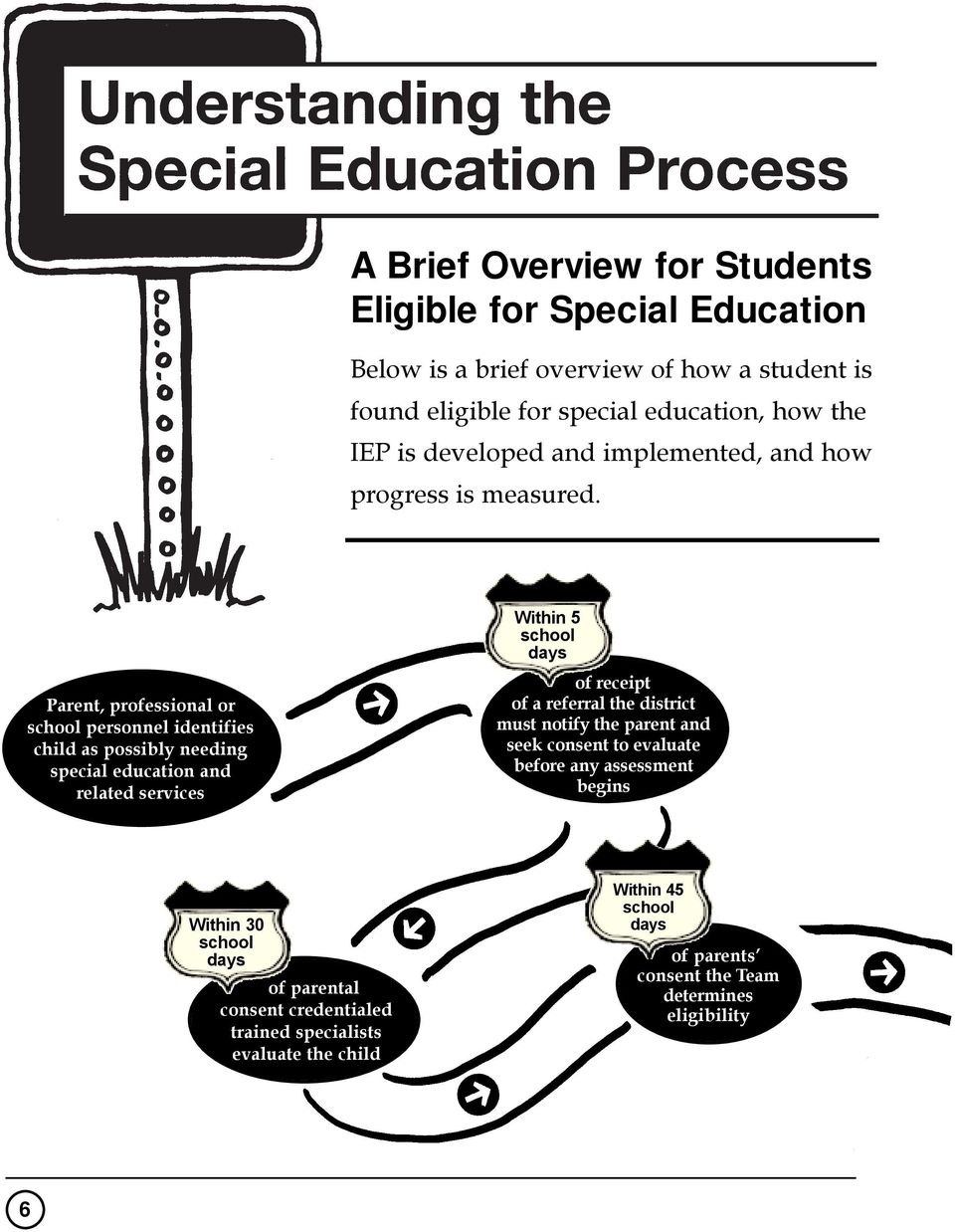
8 Within 30 days of receipt of the IEP the Parents consent to the IEP and placement Throughout the IEP period qualified professionals provide special education and related services At least as often as the parents of non-disabled students receive written progress reports the school will measure progress toward IEP goals and report that progress to parents in writing At the IEP Meeting after the IEP is written the Team determines Placement Within 45 school days of the parents consent for evaluation the Team will develop and write an IEP for all eligible students At least annually At least every 3 years Team reviews and rewrites IEP School reevaluates child Team finds child eligible for special education and/or related services 7

9 Introduction Students with disabilities can achieve great things in school when they receive the supports and services they require. While not every child with a disability will require special education services, every child whose disability affects their school progress is entitled to receive a free and appropriate public education (FAPE) which meets their unique needs. In this era of school reform, it is expected that high standards will guide the teaching of all students. A parent, teacher or other professional may refer a student for special education evaluation at any time by contacting the schoolõs principal or administrator of special education. If you are concerned that your child may have a disability that is affecting his or her ability to make progress in school, you can first speak with the classroom teacher. As you speak with the teacher, explain your concerns and ask the teacher to share his or her concerns. As part of your discussion, it may be decided that classroom accommodations will be used to address concerns for a short period of time. If your child continues to have difficulty with schoolwork, you may make a referral for a special education evaluation at any time. Special Education Laws and Principles Special education is specially designed instruction and related services that meet the unique needs of an eligible student with a disability or a specific service need that is necessary to allow the student with a disability to access the general curriculum. The purpose of special education is to allow the student to successfully develop his or her individual educational potential. Along with providing services to the child, if necessary, services are provided to parents and to teachers for the student to benefit from special education. Special education is provided by the school district at no cost to parents. What are the key special education laws? In Massachusetts, the special education system is based on the federal special education law, the Individuals with Disabilities Education Act (IDEA), in combination with the stateõs special education law (MGL c. 71B). These laws protect students with disabilities who are eligible for special education and guarantee them an Individualized Education Program (IEP) designed to meet their unique needs. 8
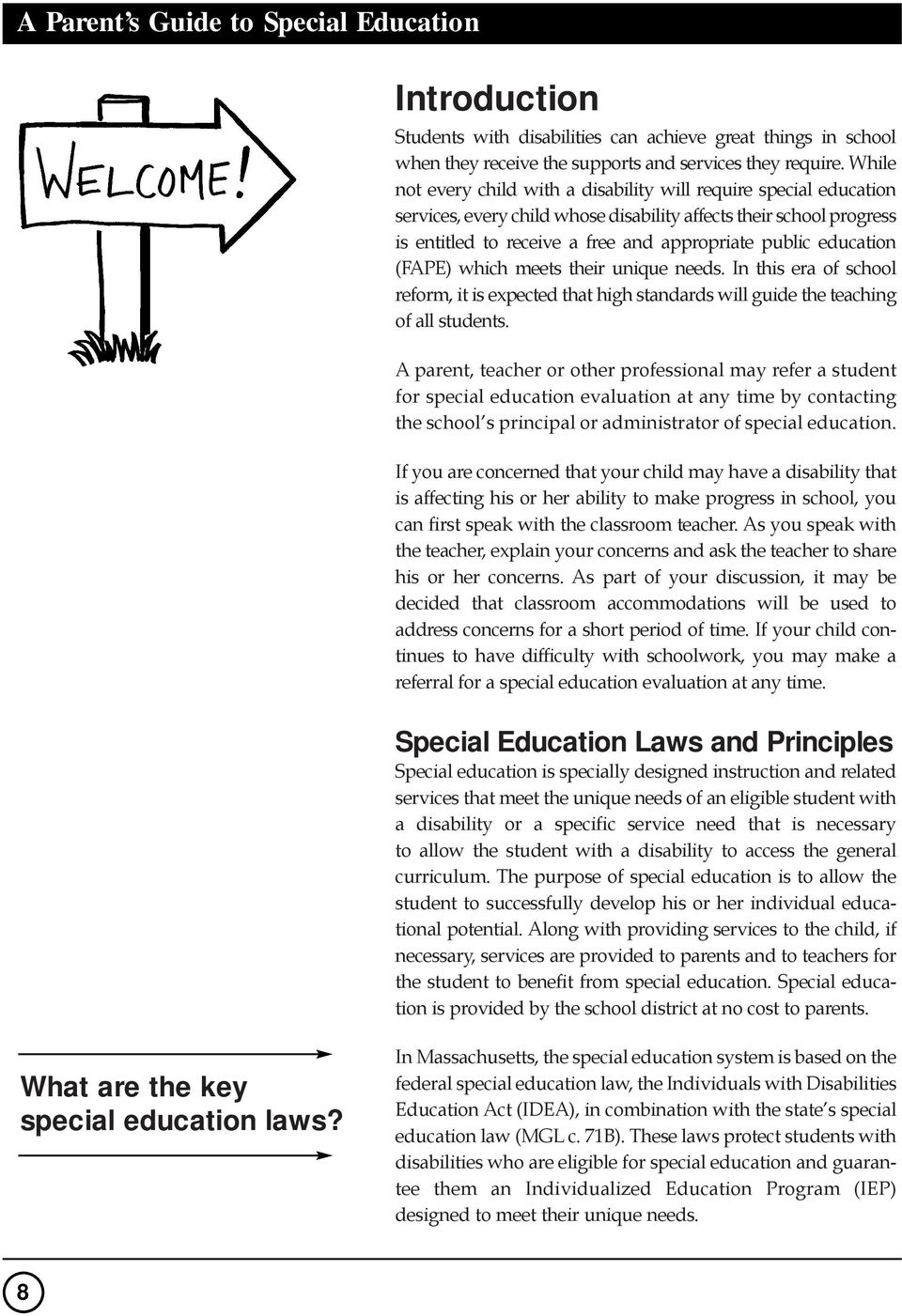
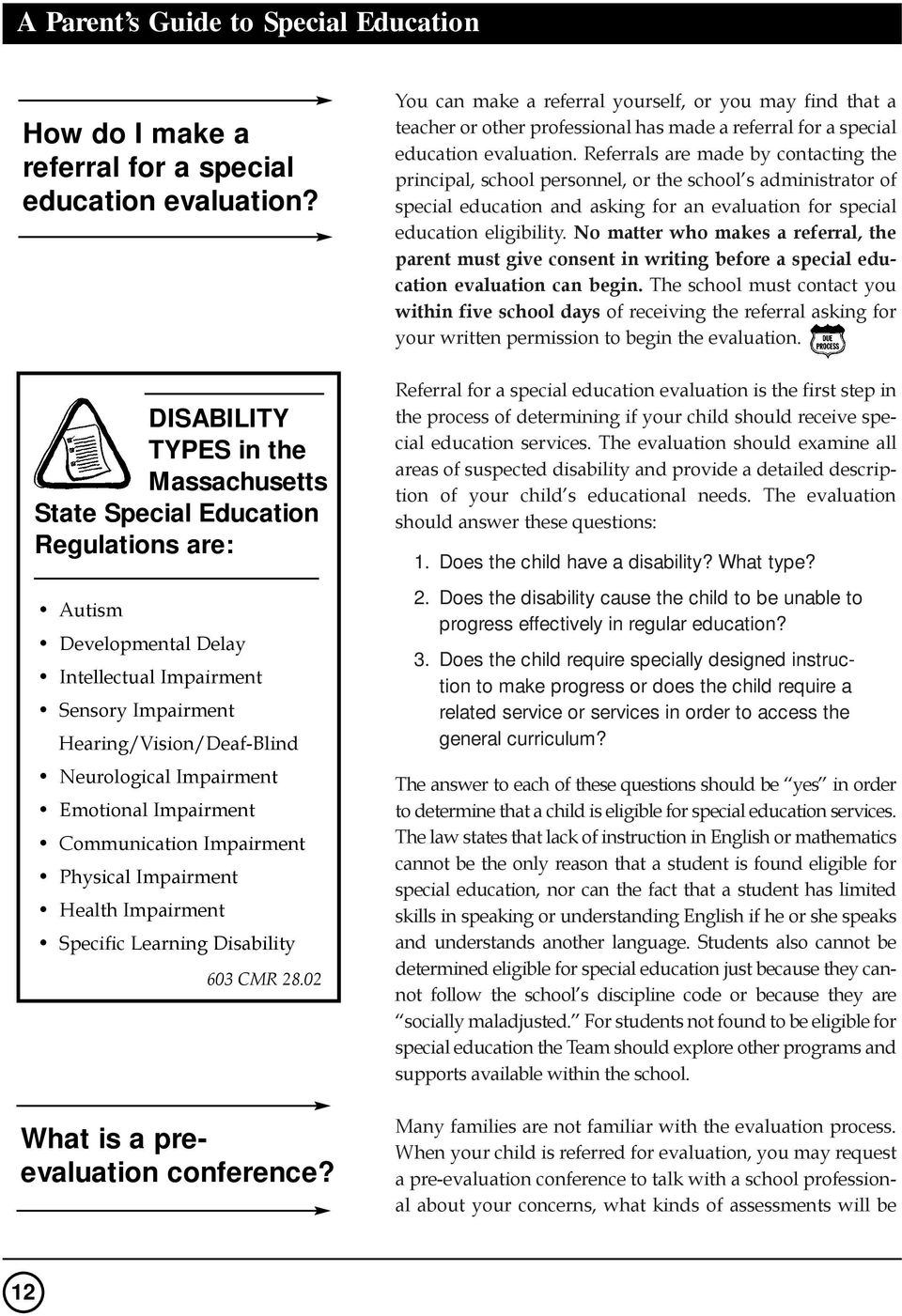
10 Special Education Law is organized around the following six principles: What are the major principles of special education laws? 1. Parent and Student Participation 2. Appropriate Evaluation 3. Individualized Education Program (IEP) 4. Free and Appropriate Public Education (FAPE) 5. Least Restrictive Environment (LRE) 6. Procedural Safeguards To help parents understand how these principles of the law affect their children this Guide has been organized around these principles. You will see the above symbols above throughout the text highlighting these important principles. 9

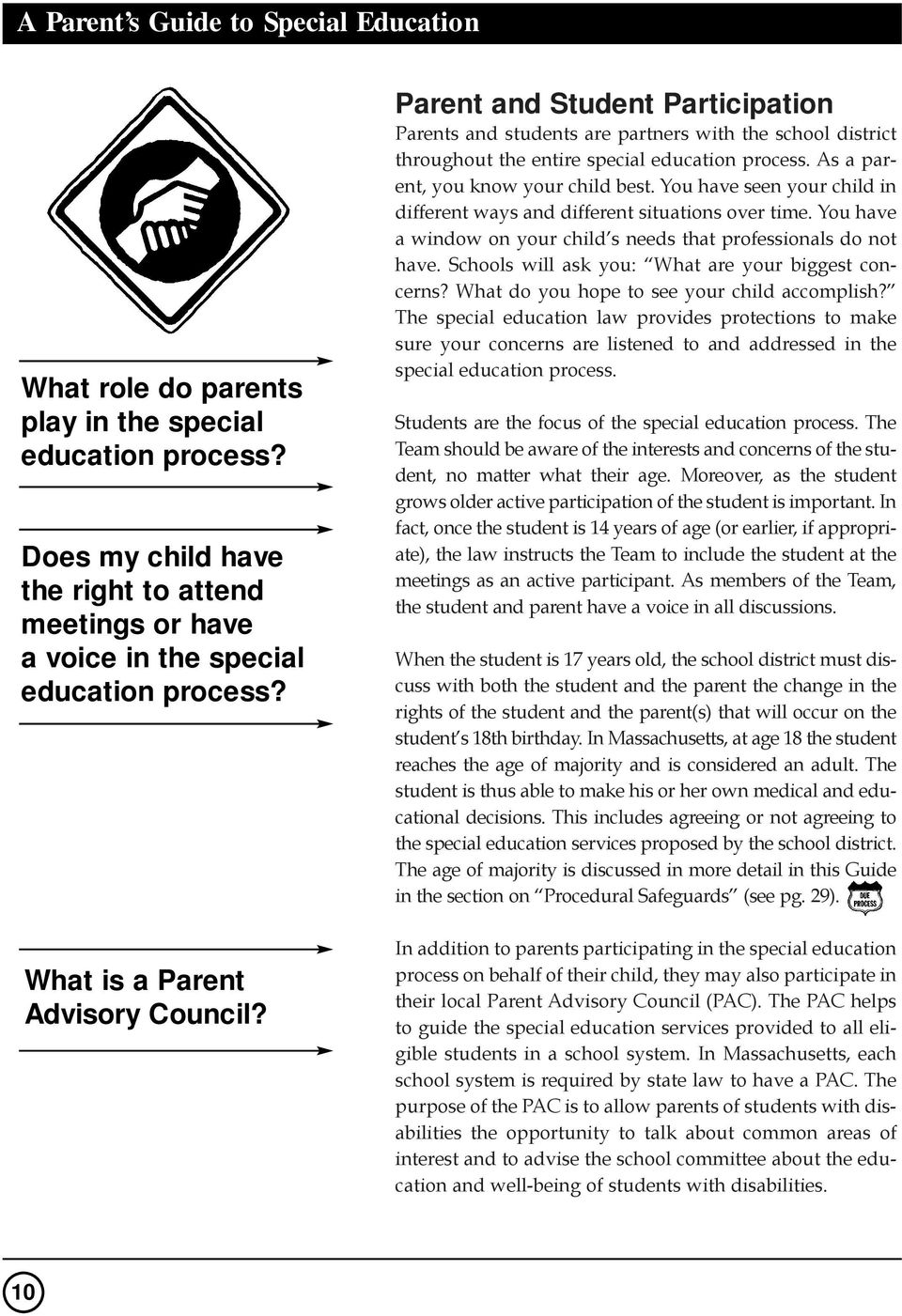
11 What role do parents play in the special education process? Does my child have the right to attend meetings or have a voice in the special education process? What is a Parent Advisory Council? Parent and Student Participation Parents and students are partners with the school district throughout the entire special education process. As a parent, you know your child best. You have seen your child in different ways and different situations over time. You have a window on your childõs needs that professionals do not have. Schools will ask you: ÒWhat are your biggest concerns? What do you hope to see your child accomplish?ó The special education law provides protections to make sure your concerns are listened to and addressed in the special education process. Students are the focus of the special education process. The Team should be aware of the interests and concerns of the student, no matter what their age. Moreover, as the student grows older active participation of the student is important. In fact, once the student is 14 years of age (or earlier, if appropriate), the law instructs the Team to include the student at the meetings as an active participant. As members of the Team, the student and parent have a voice in all discussions. When the student is 17 years old, the school district must discuss with both the student and the parent the change in the rights of the student and the parent(s) that will occur on the studentõs 18th birthday. In Massachusetts, at age 18 the student reaches the age of majority and is considered an adult. The student is thus able to make his or her own medical and educational decisions. This includes agreeing or not agreeing to the special education services proposed by the school district. The age of majority is discussed in more detail in this Guide in the section on ÒProcedural SafeguardsÓ (see pg. 29). In addition to parents participating in the special education process on behalf of their child, they may also participate in their local Parent Advisory Council (PAC). The PAC helps to guide the special education services provided to all eligible students in a school system. In Massachusetts, each school system is required by state law to have a PAC. The purpose of the PAC is to allow parents of students with disabilities the opportunity to talk about common areas of interest and to advise the school committee about the education and well-being of students with disabilities. 10
12 As we move forward in describing other principles of the law, it is important to remember that parent and student participation in the special education decision-making process is vital to each of these principles. Appropriate Evaluation The law provides a number of protections to ensure that each student receives regular, appropriate, and comprehensive evaluations. Before a determination can be made as to whether or not a student is eligible for special education, an evaluation of the studentõs educational strengths and needs must occur. If your child is having difficulty in school, you may want to talk with the school about why your child may be having difficulty before making a referral for a special education evaluation. When a student shows signs of difficulty in school, one of the first steps may be to observe the student in the classroom or other areas of the school to see if changes might be made that will help the student do better. Sometimes students will do much better simply by changing seats in the classroom, or by having the teacher discuss the daily schedule each morning. Sometimes the school may suggest that a vision screening may be helpful. What should I do if my child is having problems in school? Other changes may include trying new ways to teach your child or finding different ways your child can express what has been learned. The teacher may change the way the classroom is set up or may arrange for extra help from other school professionals. These supports or changes in the classroom are known as instructional supports. If some type of change has been made, it should be reviewed within four to six weeks to see if the change was helpful to the student. If your child continues to have difficulty, a referral for special education evaluation should be considered. You can make a referral for special education at any time. Providing instructional support cannot be used to delay the evaluation of a student. If a student is referred for an evaluation, documentation of the use of instructional supports is part of the evaluation information reviewed by the Team. My school wants to provide Instructional Supports before making a referral for special education. What does this mean? 11

13 How do I make a referral for a special education evaluation? DISABILITY TYPES in the Massachusetts State Special Education Regulations are: Autism Developmental Delay Intellectual Impairment Sensory Impairment Hearing/Vision/Deaf-Blind Neurological Impairment Emotional Impairment Communication Impairment Physical Impairment Health Impairment Specific Learning Disability 603 CMR What is a preevaluation conference? You can make a referral yourself, or you may find that a teacher or other professional has made a referral for a special education evaluation. Referrals are made by contacting the principal, school personnel, or the schoolõs administrator of special education and asking for an evaluation for special education eligibility. No matter who makes a referral, the parent must give consent in writing before a special education evaluation can begin. The school must contact you within five school days of receiving the referral asking for your written permission to begin the evaluation. Referral for a special education evaluation is the first step in the process of determining if your child should receive special education services. The evaluation should examine all areas of suspected disability and provide a detailed description of your childõs educational needs. The evaluation should answer these questions: 1. Does the child have a disability? What type? 2. Does the disability cause the child to be unable to progress effectively in regular education? 3. Does the child require specially designed instruction to make progress or does the child require a related service or services in order to access the general curriculum? The answer to each of these questions should be ÒyesÓ in order to determine that a child is eligible for special education services. The law states that lack of instruction in English or mathematics cannot be the only reason that a student is found eligible for special education, nor can the fact that a student has limited skills in speaking or understanding English if he or she speaks and understands another language. Students also cannot be determined eligible for special education just because they cannot follow the schoolõs discipline code or because they are Òsocially maladjusted.ó For students not found to be eligible for special education the Team should explore other programs and supports available within the school. Many families are not familiar with the evaluation process. When your child is referred for evaluation, you may request a pre-evaluation conference to talk with a school professional about your concerns, what kinds of assessments will be 12
14 helpful, and who will conduct the assessments. While the school must talk with you about these things whether or not you meet, a pre-evaluation conference can also serve as an opportunity to prepare yourself and your child to better understand the assessments that will be conducted. Once you feel comfortable that you understand and agree with the types of assessments that will be conducted and the individuals who will be conducting the assessments you must provide written consent in order for the evaluation to begin. Evaluation frequently includes parent input and teacher observation of the student, an interview with the student about their current abilities in school, and other types of formal and informal assessments. Evaluations are always conducted by qualified professionals and are provided by the school at no cost to the parent. The evaluation tools used will be based on your childõs individual needs. Your child must be evaluated in all the areas of suspected disability. This may include looking at how your child communicates and understands language, your childõs educational development, and how your child thinks, behaves, and adapts to changes. Evaluations may look at your childõs health, vision, hearing, social and emotional well-being, performance in school, how your child uses her/his body, and for older students, what job-related and other post-school interests and abilities your child has. A Functional Behavioral Assessment (FBA) is an assessment of student behaviors that may be disruptive or otherwise inappropriate for school. The FBA is based on observations and discussions that help to determine when and why a behavior is happening so that positive behavioral interventions may be used to help the student to develop more appropriate behaviors. All evaluation information is confidential and should be seen only by people directly involved with your child such as teachers and Team members. A parent must give written consent before others may have access to this information. Evaluations must be completed within 30 school days of the parentõs written permission for evaluation. Within 45 school working days of the schoolõs receipt of your permission in What should I expect as part of the evaluation process? Who can see the evaluation information? How long will the evaluation process take? 13

15 All special education evaluations must be conducted by appropriately credentialed and trained specialists and must include the following: Specialist Assessment(s): An assessment in all areas related to a suspected disability. * Educational Assessment: An assessment that includes information about the studentõs educational history and overall progress, including current educational standing in key curriculum areas. This assessment should also include information on the studentõs attention skills, participation behaviors, communication skills, memory, and social relations with groups, peers, and adults. This assessment should also include a narrative description of the studentõs educational and developmental potential. The following assessments may be included with parental consent if the school or the parent asks for them: Health Assessment: An assessment to identify any medical problems that may affect the studentõs learning. Health assessments may be done by a schoolreferred or family physician and should be reviewed by the school nurse. * See also ÒDisability TypesÓ chart on page 12. Psychological Assessment: An assessment to consider the studentõs learning abilities and style in relationship to his or her social/emotional development and skills. Home Assessment: An assessment of family history that may affect the studentõs learning or behavior of the student at home, and may include a home visit. writing, a Team meeting must be held to talk about the evaluations to determine eligibility and to complete the IEP for an eligible student. What does the term Team mean? Parents have the right to receive all special education evaluation reports two days before the Team meeting. You must ask the school for copies of these reports in order to receive them in advance of the meeting. It is important for parents to review the evaluation reports before the Team meeting. A person qualified to explain these reports will be at the Team meeting to answer any questions you may have about what the results mean, where your child is having trouble and why. It takes many people to plan and provide the help that your child needs. IDEA clearly specifies the members of a special education Team. The parents are always members of any 14

16 Team that makes decisions about their child. Parents can invite others to attend the Team meeting with them. Teachers and other professionals who know your child or who have evaluated your child will also be Team members. Each Team must include: You, the parent(s) or guardian(s); At least one of your childõs special education teachers and/or providers; At least one of your childõs regular education teachers if the child is or may be participating in the regular education environment; Other individuals or agencies, invited by the parent or the school district; Someone to interpret the evaluation results and explain what services may be needed; and Your child if they are between the ages of (More Information on Transition to Adult Living or What is transition planning for older children? see pg 26.); In addition, other people or agencies that have special expertise or knowledge of your child. from IDEA Each Team must have one member who knows what services and resources are available to the school district. The law requires that this individual have the authority to commit the resources of the school district so that decisions about services can be made at the Team meeting. At the Team meeting, the members of the Team must consider all information and evaluation results to decide if the student is eligible for special education services. Based on the Team discussion and the evaluation information, the Team will determine if your child is eligible for special education and related services. If your child is eligible the Team will then use the evaluation results to develop an Individualized Education Program (IEP) for your child. For more information, turn to the ÒIEPÓ section of this Guide (see pg. 19). What is the role of the Team in determining eligibility for special education? If your child is found not eligible, your child may still receive help, although not special education services. If your child is not eligible for special education services, you 15

17 will receive a letter from the school stating that your child is not eligible, detailing why the student was found not eligible, along with information about your rights. Read the notice carefully to decide if you agree or disagree with this decision. You have the right to appeal a finding of no eligibility. For information on your rights, turn to the ÒProcedural SafeguardsÓ section of this Guide (see pg. 29). If your child is eligible for special education the special education services should begin immediately after you sign the IEP. Evaluation will continue to be an important part of the special education process. At least every three years, the school district must conduct a three-year reevaluation. This means that at least every three years, the Team must consider current evaluation information and must determine if your child remains eligible for special education. What is a three-year reevaluation? Is it required? Is reevaluation required if the district removes my child from special education? What is an Independent Educational Evaluation? Every three years the school will request your consent to conduct a three-year reevaluation. The school can also recommend to you that the evaluation information they have is sufficient to know that your child continues to be eligible and is also current enough to write an appropriate IEP. In that case, the school may recommend that no assessments are necessary. This helps to prevent Òover-testingÓ, but it should not prevent evaluation that you or the school believes is needed. You have the right to say you still want some or all of the assessments to be certain that the information is current; the school must provide the assessments that you request. A three-year reevaluation generally will include all of the types of assessments of the initial evaluation. If, at any time, the district believes that your child no longer requires special education, they must request your consent for a complete reevaluation prior to taking any action to end special education services. At that time, the Team must consider the evaluation information and can make a determination that the student is no longer eligible. As always, you must receive a letter or notice in writing about this type of decision and have the right to disagree or to appeal the decision. At times you may find that you disagree with the school districtõs evaluation. The foundation of a good educational program is an evaluation that truly reflects the strengths and needs of the indi- 16

18 vidual student. If you disagree with the school districtõs evaluation results you have the right to have your child evaluated by a qualified professional(s) not employed by the school system. Both federal and state law allows parents to seek an Independent Educational Evaluation (IEE). In Massachusetts, special education regulations, 603 CMR offer parents a choice when exploring options for the payment of Independent Evaluations. Parents may choose to share their personal financial information with the district, and share the cost of the evaluation based on their income. If the Family is income eligible the district must pay for the evaluation and may not take the family to hearing over the cost of the evaluation. Parents may also choose not to share their financial information with the district. Then the district must choose to either pay for the entire Independent Educational Evaluation or move forward to a hearing at the Bureau of Special Education Appeals (BSEA). All IEEs that are publicly funded, in whole or in part, must meet state requirements for using evaluators who are registered, certified, licensed or otherwise approved and who agree to abide by rates set by the state agency responsible for setting such rates. According to state regulations, any student eligible for free or reduced cost lunch or who is in the custody of a state agency with an appointed Educational Surrogate Parent is entitled to receive an equivalent IEE at public expense. School districts must offer parents seeking public funding for IEEs information about the sliding fee program. Participation in the sliding fee program, other than for students who are eligible for free or reduced cost lunch, requires the family to provide financial documentation. Upon receipt of the family financial documents, the district must promptly evaluate the information and inform families of their status. The school should return the financial documents immediately to the family. No copies of financial statements should be made; the district, however, will document eligibility for the sliding scale fee in the studentõs record. Based on this financial information, the family and the district will share the cost of the IEE. For example, as of September, 2001, for a family with an income below 400% of the federal poverty level ($68,200 for a family of four) the IEE will be Who pays for an independent evaluator? SLIDING FEE SCALE When parents seek public funding for an Independent Educational Evaluation (IEE) the district shall consider family size and family income information in relation to Federal Poverty Guidelines: If the family income is equal to or less than 400% of the federal poverty guidelines, the district shall pay 100% of the costs of an IEE. If the family income is between 400% and 500% of the federal poverty guidelines, the district shall pay 75% of the costs of an IEE. If the family income is between 500% and 600% of the federal poverty guidelines, the district shall pay 50% of the costs of an IEE. If the family income is over 600% of the federal poverty guidelines, the district shall have no obligation to cost-share with the parent. 400% of the federal poverty level is currently (as of September 2001) $68,200 for a family of four. Mass. Special Education Regulations 603 CMR 28.04(5) 17
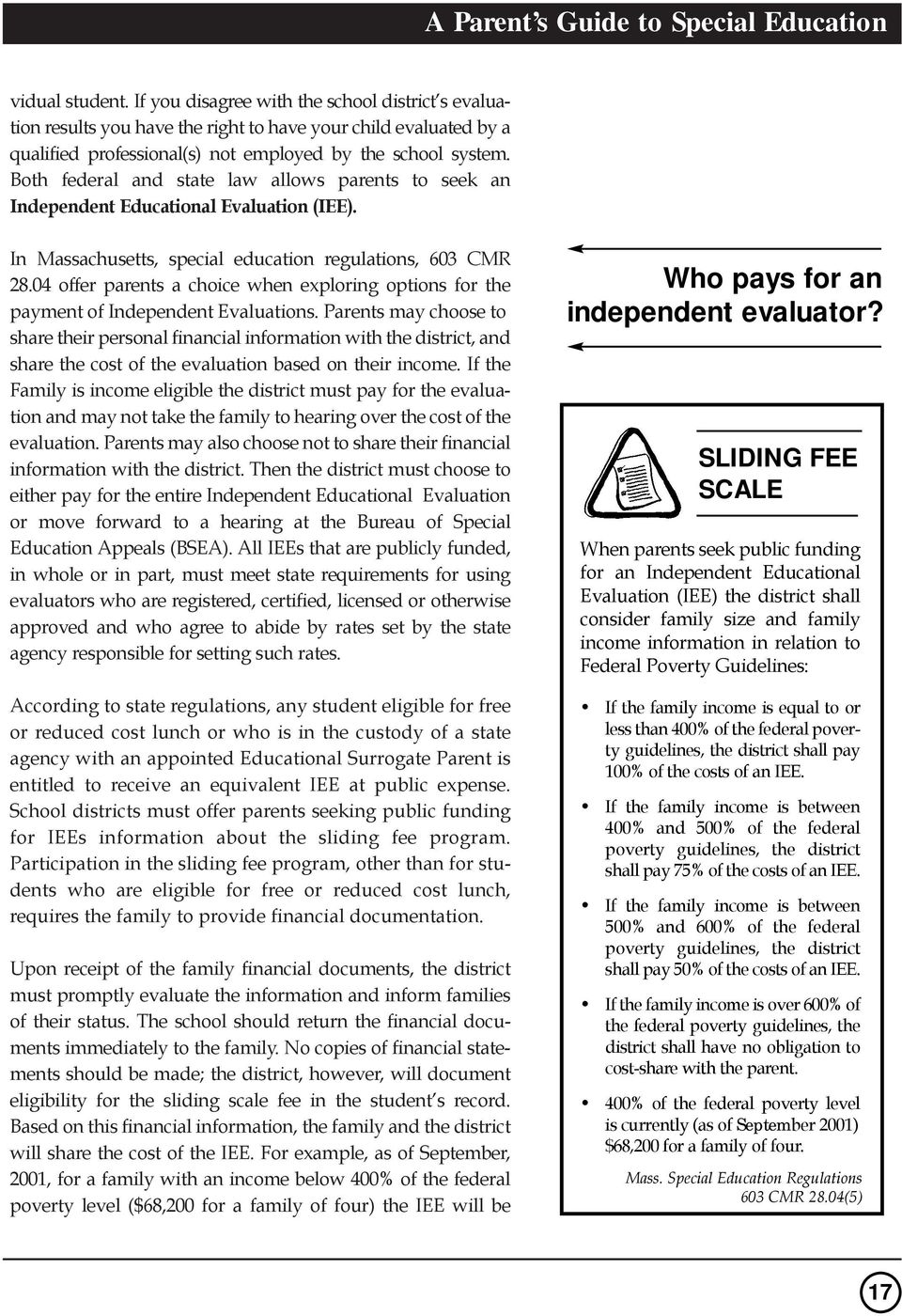
19 provided at no cost. For a family with an income above that level the amount paid by the family is based on a sliding-fee scale. The parents of a child with a disability have the right to obtain an Independent Educational Evaluation. If a parent requests an Independent Educational Evaluation at public expense, the public agency must without unnecessary delay either initiate a hearing to show that its evaluation is appropriate or ensure that an Independent Educational Evaluation is provided at public expense. (IDEA ) In cases where students are not eligible for the sliding fee program, the parents do not wish to provide financial documentation, or parents are requesting an evaluation in an area not assessed by the school district, IDEA provides that families may still request public funding of an IEE. Upon such a request, the school district must, within five school days, either agree to pay for the IEE or initiate a hearing with the Bureau of Special Education Appeals (BSEA). The district will need to show the BSEA that itõs evaluation is comprehensive and appropriate. If the BSEA agrees that the evaluation done by the district was comprehensive and appropriate, the district will not be obligated to publicly fund the IEE. However if the BSEA determines that the districtõs evaluation was not comprehensive and appropriate the district will be obligated to pay for the IEE. NOTE: Parents always have the right to obtain an IEE at their own expense. Parents may choose to pay for an IEE because they want a more in-depth evaluation than the school can do, or because insurance will cover the cost. If you pay for the IEE, the resulting reports belong to you; you may choose or may not choose to share the results with your district. The Team must consider the results of any IEE that is made available to them when planning services for your child. How is information from an IEE used? The district must reconvene the IEP Team and consider the information from an IEE as carefully as it considers the information from an evaluation done by the school district. The law requires consideration of evaluation information from more than a single source or assessment, in order to have a complete picture of the student and his or her abilities. All results from assessments or from IEEs together will be used by the Team to form the basis for the decisions made regarding your childõs participation in special education services. For more details, see the ParentÕs Rights Brochure for parents of students with disabilities provided by your district. 18

20 Individualized Education Program (IEP) Your childõs Individualized Education Program (IEP) is developed at the Team meeting and represents a formal agreement about the services that the school will provide for your childõs special education needs. The IEP is a contract between you and the school. As with any contract you should make sure you fully understand the terms to which you are agreeing and make certain that everything that was agreed to verbally is written in the contract. Input from parents and students is key IEP information. The first part of the IEP requests information regarding the concerns of the parent and/or student, key evaluation results, and the future vision for the student. This is an opportunity for you, as a parent, to talk about your concerns and what you want special education to accomplish for your child. Consider: What information from the evaluation report seems particularly important? Has your child expressed some particular concerns or desires that you think can be helped by special education? Are there areas of particular strength or weakness of the student that you want to make sure are included? In addition, the Team should consider all information including the studentõs medical and educational history and personal interests. This discussion provides an opportunity for you and the school to discuss what special education can do and what it might not be able to do. This part of the IEP process can also be an opportunity for you and your child to express thoughts about the educational program as it has been in the past and how it could change to better meet your childõs needs. How can I make sure that my concerns are part of the IEP process? Student Vision: Parents and students should enter the Team meeting prepared to talk about their hopes and dreams for the childõs future. If the student is able to indicate what he/she would like, then the studentõs vision should be clearly indicated, if not the vision will be developed by the family. In discussing a vision for the future, the Team should be careful not to limit the discussion only to what they believe is ÒrealisticÓÑeveryone needs to have dreams and wishes. The law provides that those dreams and wishes should help to point out a direction for the Team. This vision should guide the Team throughout the IEP 19

21 development process in order to create a program that will bring the student closer to that vision in a meaningful way and help the student to see how education can help the student reach his or her personal goals. Does the IEP determine the subjects and information my child will learn? Participation in the General Curriculum: The federal law, IDEA, states that students with disabilities should participate in the general curriculum. The term ÒGeneral CurriculumÓ means the same curriculum that their nondisabled peers are learning. The IEP, therefore, does NOT design a curriculum, rather, the IEP designs the services that the student needs to enable them to make progress in the general curriculum, and to help them be successful in the life of the school. For students with disabilities to access the information in the general curriculum, Teams may find it necessary to identify accommodations, modifications, or services to meet specific learning needs. In order to be informed members of the IEP Team, parents should be aware of the curriculum that their school district uses for students who are the same age and grade level as their child and understand how their childõs disability affects their involvement and progress in the general curriculum. The school district must ensure that a person on the Team is available who understands the general curriculum and can be helpful in discussing how the student can participate in the general curriculum. In Massachusetts, the general curriculum is based on learning standards in the Massachusetts Curriculum Frameworks which define specific student learning expectations for each grade. Parents should be aware of how these frameworks are utilized in their school district to create the grade specific curriculum for all students. What if my child has special needs in areas besides academics? Other Educational Needs: Students with disabilities who are found eligible for special education often have areas of need beyond the general curriculum. These areas of ÒOther Educational NeedÓ must also be addressed in the IEP. The Massachusetts IEP form lists a number of Other Educational Needs that may be discussed depending on the individual needs of the student. The lists in the IEP form can help the Team to think through some of the possible areas but should 20
22 not be considered the only options. In brief, do not limit your discussion to only the curriculum. For example, you may need to talk about behavior, communication, assistive technology, use of Braille, or other special considerations unique to the student. When considering both the general curriculum and other educational needs, the Team will consider specific accommodations, modifications, and services to assist the student to reach their best educational performance. The Team considers whether it is necessary to adapt the content (change the complexity of information being taught). The Team also considers whether it is necessary to adapt the methodology or delivery of instruction (change in the way the information is taught) or the performance criteria of the classroom (change the way the student expresses what they have learned). All of the changes and services that the Team identifies are written in the IEP. The IEP then serves as a resource to assist the teacher in providing a supportive and effective classroom environment throughout the school year. IDEA notes some special considerations for Teams to address during IEP development. These special considerations include: positive behavioral interventions, the unique needs of students with disabilities with limited English proficiency, the communication needs of students who are Deaf or hard of hearing, Braille for students with visual impairments, and assistive technology devices and services for all students. These needs should be addressed by the Team, and included in the IEP based on the unique needs of the child. Annual Goals: Once the Team has explored the studentõs current educational performance and the types of assistance the student will need to improve his or her progress, the Team will turn its attention to what the student can be expected to be doing during the year in order to demonstrate effective progress. The specific goals for your childõs performance will be described in a section of the IEP called Annual Goals. Annual Goals describe the expected growth in your childõs skills and knowledge over the next year as a result of the special education that he or she receives. Goals should be positive, measurable, achievable, and challenging. Annual Goals should be written so that every member of the team can determine if the child has met the goal, not How does the Team identify what should be done? Are there any special considerations that should be addressed in the IEP? What are Annual Goals? 21
23 just the specialist in the goal focus area. Annual Goals should relate to the academic and/or non-academic needs of your child. A good goal has five essential parts and may be determined by answering these simple questions. Who? Ð your child What will be achieved? - skill or behavior How? Ð in what manner or to what level? Where? Ð in what setting or under what conditions? When?Ð at what point in the IEP period? What are Benchmarks? How are they different from Objectives? How will I know what services my child will receive? Measurable Annual Goals are broken down into smaller pieces called objectives or benchmarks. They begin with what your child can do (present level of performance) and are observable accomplishments. Objectives are the smaller steps or milestones your child needs to make in order to reach the annual goals written on their IEP. Benchmarks are based upon achieving a specific skill in a specific period of time. Benchmarks allow for regular checks of progress in meeting annual goals with the final benchmark being the goal for the year. An IEP Team may use either objectives or benchmarks or a combination of the two depending on the nature of the goals and the studentõs needs. Services: After the studentõs educational performance has been discussed and annual goals developed, the Team must consider the actual services the student needs in order to achieve these goals during the next year. The Team should talk about all the supports and services that will allow the student to succeed in school. The Team will discuss necessary services, including special teaching services, consultative services, training for teachers, and other related or supportive services such as transportation, psychological services, counseling services, and orientation and mobility services. The Team will specify these services on a one-page form in the IEP called the ÒService DeliveryÓ page of the Massachusetts IEP. This page identifies all the services that will be provided for the student during the school year that will assist the student to achieve the goals identified on the IEP. 22
24 The Massachusetts Comprehensive Assessment System (MCAS) is the stateõs student testing program. Tests are given at different grade levels and are based on the Massachusetts Curriculum Frameworks in English Language Arts, Mathematics, Science & Technology/Engineering and History and Social Science. All students in Massachusetts receiving an education at public expense must participate in state assessment. Both IDEA and the Massachusetts Education Reform Act require that all students participate in MCAS. In the past, participation in statewide assessments was not always considered important for students with disabilities. It was assumed that special education evaluations provided enough information on how well students were doing in school. Special education evaluations, however, do not typically provide information on what students know and can do relative to local and state academic learning standards. Information about the general performance of students with disabilities means that schools will now be held accountable in the same way they are for the performance of non-disabled students. It is important to ensure that all students have access to the resources and supports needed to pass the MCAS, including students with disabilities. By including all students in MCAS, schools are more likely to raise standards and have higher expectations for students with disabilities. Including students with disabilities in the MCAS encourages schools to develop new programs and methods of teaching students with diverse learning styles. It also encourages the inclusion of students with disabilities in activities with their non-disabled peers. What about the IEP and state and district wide testing for instance, the MCAS test? All students receiving an education at public expense must participate in the state assessment program known as ÒMCAS.Ó Students will participate in MCAS in one of three ways: On-demand MCAS Test under Routine Conditions On-demand MCAS Test with Accommodations MCAS Alternate Assessment The Team will determine how a student will participate in MCAS. Why is it important to participate in MCAS testing? As part of the IEP process, the Team must determine how your child will participate in MCAS. The Team first will consider whether your child can take standard MCAS tests either with or without accommodations. If your child requires accommodations, then the Team will identify the accommodations that will be used and must document this information in the studentõs IEP. Generally, they will be similar to those accommodations that the student uses during regular classroom instruction. 23
25 A small number of students may be unable to take standard MCAS tests, even with accommodations, due to the nature and severity of their disability. These students will be designated by the Team to participate in the MCAS Alternate Assessment. The MCAS Alternate Assessment is a portfolio, or collection of information about the studentõs accomplishments throughout the school year, that is assembled by the childõs teacher. The portfolio will document how well the child has demonstrated his or her knowledge and skills related to the learning standards in the Massachusetts Curriculum Frameworks in the four subjects assessed by standard MCAS tests. The alternate assessment will not depend on your childõs ability to take a paper/pencil test, because it uses other methods to determine the childõs level of performance. The alternate assessment portfolio is submitted to the Massachusetts Department of Education (DOE) and is scored by panels of Massachusetts educators. Scores are reported to parents, schools, and districts along with other MCAS test results. Secondary school students obtaining a passing score on the alternate assessment will be eligible for a standard diploma. How will my child participate in MCAS? When do I receive a copy of the IEP? Once we ve developed the IEP, do services begin immediately? For further details on participation in MCAS, available test accommodations, and alternate assessments, please refer to the DOE publication entitled ÒRequirements for the Participation of Students with Disabilities: A Guide for Educators and Parents,Ó available on the DOE web page at Either at the Team meeting, or immediately after, but no later than 45 school days after the parents written consent to evaluation, the school district will provide you with a copy of the IEP. The IEP tells you how the school proposes to help your child. Within 30 days of receiving the IEP from the school, you must sign and return it to the school. The signature of the parent or adult student must appear on the IEP before services can begin. If you have questions about the IEP, you can talk with the school contact person, generally the Team Chairperson. If the IEP is satisfactory you should accept the IEP by checking the box on IEP page 8 which states ÒI accept the IEP as developedó and signing on the line below. When the district receives your consent, services will begin immediately. If the IEP is unsatisfactory you must choose between the two remaining options. You may check the box stating ÒI reject the IEP as 24
26 developed,ó in which case the last agreed upon IEP will generally remain in effect until an agreement has been made regarding the appropriate services for your child (sometimes called Òstay putó). If your child was not previously receiving special education services, no special education services will be provided until an IEP is agreed upon and signed by the parent. For this reason, it is sometimes best to accept an IEP in part, in order that some services can begin. To do this, check the box stating ÒI reject the following portions of the IEP with the understanding that any portion(s) that I do not reject will be considered accepted and implemented immediately.ó You should then list your concerns and sign below. The accepted portions of the IEP must begin immediately upon your consent. The IEP form also allows you to request a meeting with the school to discuss the rejected IEP or rejected portions. What if I don t agree with part or all of the proposed IEP? Once you accept the IEP, the school district must share the IEP with all of the school staff who have responsibility for working with your child. Remember that your signature is required to accept the IEP as well as to reject the IEP. The parentõs signature on a rejected IEP sets into motion a referral to the Bureau of Special Education Appeals (BSEA). The BSEA offers mediation services to parents and schools and has authority to conduct hearings to resolve special education disputes. For more information on the BSEA turn to the section on ÒProcedural SafeguardsÓ (see pg. 29). Measuring Progress: It is good practice for schools to provide grades for students with disabilities, in addition to progress reports. Grades provide parents with information on how their child is progressing in the general curriculum; progress reports indicate a studentõs progress only in achieving IEP goals. The Team should discuss the grading system while looking at specially designed instruction options during the Team meeting. How will I know how my child is doing? Progress reports allow you to check on your childõs progress toward the IEP goals at set times throughout the year. You must receive a progress report as often as all children in your school district receive report cards or other school-wide progress reports. Special education progress reports will help you decide whether or not your 25
27 child is making progress toward the annual goals that were developed. If your child is not making the expected progress you should speak with your childõs special education teacher or ask the Team to meet again to discuss whether changes in the IEP are needed. If changes are needed they must be agreed to by the parent. The district cannot make any change to the current IEP without notifying you and getting your written consent. How often will the IEP be reviewed? What is transition planning for older students? People tell me that special education is an entitlement but adult services are not. What does that mean? The Team must meet at least once a year to review your childõs IEP, to determine if changes need to be made, and to develop new annual goals. Whenever there are questions, concerns, or changes in your childõs academic, social, or emotional well-being, you and your childõs teacher or school contact person should talk. If you or the school decide the IEP is not working for your child, or expected progress is not occurring, the Team should meet to review and possibly change the IEP. Effective transition planning is based upon the studentõs goals or vision. IDEA requires that, beginning at age 14, planning for the transition to adult living must be part of the IEP. Your child should be invited to attend Team meetings. For students who may be receiving services from adult service agencies, representatives of these agencies should also be invited to the Team meeting when transition is being discussed. When your child is age 16, the Team discussion of Vision should include a post-school vision statement designed to reflect the individual interests, preferences, and needs of your child in adult life. Transition planning and services should be reflected in the Other Educational Needs section of the IEP and can include preparation for post-secondary education, vocational training, employment, and independent living. During transition planning it is important to remember that when students with disabilities graduate from school or turn 22 years of age, they are no longer entitled to special education services under IDEA. Massachusetts has a planning process to identify possible needed services from adult human service agencies for students with significant disabilities; this is known as Chapter 688 planning. A Chapter 688 Referral should be made by the school two years before your child graduates from high school or turns twenty-two, if services from an adult agency will be needed. Planning for adult 26
28 services, however, and completing the referral process does not necessarily guarantee that services will be available. Unlike special education, human services for adults are not provided as an entitlement and may have waiting lists, even for people eligible for services. Therefore, it is important for families to begin exploring the adult service system before adult services will be needed. Free and Appropriate Public Education (FAPE) A child who is eligible for special education services is entitled by federal law to receive a Free Appropriate Public Education (FAPE). FAPE ensures that all students with disabilities receive an appropriate public education at no expense to the family. FAPE differs for each student because each student has unique needs. FAPE specifies that needed services must be provided without cost to the family. FAPE guarantees that for students who are found eligible for special education, school districts must be prepared to provide services according to an IEP beginning no later than their third birthday. If a student continues to be eligible, services may continue until the student graduates from high school with a standard diploma or turns 22, whichever comes first. What does FAPE guarantee my child? FAPE also means that students receiving special education services have access to and make meaningful progress in the general curriculum (i.e. the same curriculum as students without disabilities) and the right to be full participants in the life of the school. Your child is not only entitled to access the academic portion of school but also to participate in extracurricular and other activities sponsored by the school. Full participation means that students with disabilities are entitled to the aids and services needed to assist them in participating in all areas of school life. FAPE is closely tied to a principle known as the ÒLeast Restrictive EnvironmentÓ which is described in detail in the next section of this Guide. 27
29 Least Restrictive Environment The federal law, IDEA, mandates that students with disabilities must be educated with their non-disabled peers to the maximum extent appropriate based on the studentõs needs. This is known as the Least Restrictive Environment (LRE). The Team (including the parent) determines the placement that the student needs to provide the services on the student's IEP and the Team must choose the least restrictive environment able to provide those services. This means that the student should attend the school he or she would attend if nondisabled, unless the Team determines that the nature of the studentõs disability will not allow that student to have a successful educational experience in that environment. Who determines what is the least restrictive environment for my child? How is that determination made? FAPE and LRE are closely tied together. Both federal and Massachusetts special education laws require that a Team consider appropriate education in the least restrictive environment. In order to help your child be successful, the Team must carefully consider whether supplemental aids and services and specialized instruction could make it possible for your child to be educated with non-disabled peers. If services can be appropriately provided in a less restrictive setting, the Team must choose that type of program and setting. If the studentõs program requires a more restrictive setting to be successful, then the Team may consider other settings. The Team should look class by class, activity by activity, and only remove your child from the general education classrooms if, and only if, supplemental aids and services would not make it possible for the student to remain in that classroom and make effective progress. Determination of the LRE is based on your childõs IEP, not on a diagnosis or specific disability label. This determination must be made individually and carefully. Students cannot be placed in separate or more restrictive environments only because they require modification of the curriculum. It is important to remember that Teams do not have to choose between specialized help for a student and inclusion of that student in the general education classroom; students are entitled to both. After the Team has developed the IEP and understands the needs and goals for your child, then the Team will determine the most appropriate setting for your childõs services. LRE is an integral part of the placement determination. 28
30 Procedural Safeguards Specific procedures that protect the rights of students and parents with disabilities are meant to help make the complicated special education process more predictable and dependable. They are designed to ensure that appropriate procedures are followed and that special education and related services are individualized for each student. Some of the procedural safeguards that have already been mentioned in this Guide include: Timelines - examples include: Credentialed, trained specialists complete evaluations within 30 school days from written consent for evaluation; Teams meet to determine eligibility and if eligible, to develop the proposed IEP for the students, and provide copies of that IEP to the parents within 45 school days from written consent for evaluation; School sends IEP to parent immediately following it s development at the Team meeting Parent accepts or rejects IEP within 30 days of receipt. What are some of the procedural safeguards? Consent - The parent has the right to consent or refuse consent at key points such as: Evaluation IEP services Placement decisions Evaluation requirements - The specific required evaluations and the requirements relating to doing appropriate evaluations are also safeguards (see ÒAppropriate Evaluation,Ó pg. 11). IEP Development - Many of the elements of the IEP function as safeguards for the student to ensure that services are comprehensive and individualized. Procedural safeguards relate to many aspects of the special education process, including eligibility, evaluation, IEP, placement or the provision of special education. For example, one of the key safeguards for parents is the right to receive written notice whenever a school district proposes or refuses to initiate 29
31 When do I get a copy of the Parent s Rights Brochure? Do my child s rights change with age? What is the age of majority? or change key aspects of a studentõs services. Parents are encouraged to carefully review the ÒParentÕs Rights BrochureÓ which has been prepared as one means of informing parents of their rights in the special education process. The ÒParentÕs Rights BrochureÓ is made available to parents at any time upon request to the school district and is always provided by the school when an initial request for an evaluation is received and at other times during the IEP process. Students, as we discussed in the section on parent and student participation, are central to the process, and any rights that parents have flow from the right of the student to receive a Free Appropriate Public Education. As students grow older, their participation in the planning for the special education services that they receive becomes more active, including participating on the Team by age 14 (or younger if appropriate) and the transfer of rights from the parent to the student at the age of majority. In Massachusetts, 18 years of age is the Òage of majority.ó Unless there has been court action giving guardianship to another adult, at 18 years of age students are considered adults and competent to make their own decisions, regardless of the severity of their disability, including decisions in all special education matters. The Massachusetts IEP form offers students age 18 and older the opportunity to delegate responsibility, if they wish. Parents and students must be notified about this transfer of rights to the student and the impact on the student and the parents at least one year before the student turns 18. When the student turns 18, he or she has full authority to consent to, or refuse, services. The school district cannot assume that the services will be acceptable to the adult student; therefore, the district will need to seek consent of the student for all IEP services when the student turns 18 years of age. Neither the parent nor the school district can reverse the decision of the adult student unless there is a court-appointed guardian. The student is responsible for signing the IEP, and, as with any adult, the student can withdraw his or her willingness to share or delegate these decisions at any time. When students reach the age of majority, parents continue to have the right to receive all written notices and to have access to the studentõs school records. Guardianship is complex and, therefore, we recommend that anyone questioning the need for a guardian for their child should consult an attorney (see Resources on pg. 35 for free and low cost services). 30
32 Procedural safeguards also protect the rights of non-english speaking students and families. If English is not your primary language, the school must provide an interpreter to you at no charge. Written documents such as the IEP and evaluation reports must also be translated into your native language. If you are unable to read in any language or have a visual or hearing impairment, the school is required to make every effort to be responsive to those needs. Efforts may include the use of Braille, sign language, orally translating written language, or providing other means of communication that is effective and allows you to understand the information and communicate with the school. Some students with disabilities are able to succeed in school without special education but require some kind of supportive service or accommodation. A law known as Section 504 of the Rehabilitation Act of 1973 offers students with disabilities both services and accommodations that are necessary for the student to participate fully in the life of the school. To receive services under Section 504 a student must have a mental or physical impairment, that substantially impairs a major life activity, and requires special accommodations. Major life activities include functions such as breathing, walking, learning, caring for oneõs self, seeing, speaking, performing manual tasks, hearing, and working. Like IDEA, a Section 504 Plan guarantees students with disabilities the right to FAPE. Section 504 offers a Team approach, a written plan, appropriate accommodations, services, and programs, and periodic review of services. A Ò504 PlanÓ can assure students with disabilities the opportunity to join in all aspects of school life. Accommodations in non-academic and extracurricular activities, adaptive equipment or assistive technology devices, an aide, assistance with health needs, school transportation or other related services are possible 504 accommodations. It is important to discuss your concerns and areas of disagreement with the school before entering into more formal due process procedures. This can often be the quickest and easiest way to solve a disagreement. If you cannot come to agreement with the school, you have the right to disagree with the schoolõs decisions concerning your child. This includes decisions about: Are there special safeguards for students or families whose primary language is not English? What if my child is not found eligible for Special Education? What is a 504 Plan? What if I disagree with the school about what is right for my child? 31
33 Your child s eligibility for special education; Your child s special education evaluation; The special education and related services that the school provides to your child; or Your child s educational placement. What will the State Department of Education do if I disagree with the school district? If you are unhappy with any of these areas, you have several options. The first option is to meet with the special education administrator at your school and try to reach an agreement about your childõs needs and services. Local school districts often have specific local procedures to resolve the complaints of parents. Ask if your district has those procedures. The law provides for a Problem Resolution System at the state level. In Massachusetts, the Problem Resolution System is administered by the office of Program Quality Assurance (PQA) at the Department of Education. Parents can call PQA to ask a question regarding the laws and regulations pertaining to a specific concern. In order to have a complaint formally reviewed by PQA staff, a complaint must be filed in writing. (See page 35 for contact information). The PQA education specialist will review your complaint to determine if education laws and regulations are being followed. Parents and school officials will have an opportunity to provide written information and to speak with the PQA specialist about the issue(s) presented. At the completion of the review, a letter explaining the results of the review and the actions taken to resolve the issue(s) is sent to the parents. If the school is not meeting the requirements of the law, DOE will make a finding of non-compliance with the law and will work with the school to correct the problem. Parents of children with disabilities have different choices available to them for resolving disputes with schools concerning the education of their children. Parents may contact PQA (as described above) or the Bureau of Special Education Appeals (BSEA) about any matter concerning the identification, evaluation services, or placement of their child. The BSEA is an independent organization located with the Massachusetts Department of Education. It is notified by the school system of all signed rejected IEPs. Within five school 32
34 days of receiving written notice of a rejected IEP, the school district must send notification of the rejection to the BSEA. The BSEA offers several dispute resolution options. Any parent can use one or all of these options. More than one option may be used when needed. These options include: What does the Bureau of Special Education Appeals do? Mediation: a voluntary and informal process where you and the school meet with an impartial mediator to talk openly about the areas where you disagree and to try to reach an agreement. Advisory Opinion: a process where you and the school agree to each present information in a limited amount of time to an impartial Hearing Officer, who will give an opinion as to how the law would apply to the situation as presented. An advisory opinion is not written, nor is it binding, and allows either the parent or the district to proceed to a hearing if either party is dissatisfied. Hearing: a process where you and the district each present your case to an impartial Hearing Officer for a written binding decision on the best outcome for the student. A hearing is a fairly complex legal proceeding and averages three to five days in length. Generally, parents who proceed with the due process system consult an attorney or seek representation. For information on free or low cost legal services see the Resources section on page 35 of the Guide. At any point that you contact the BSEA, it will provide you with written information on your rights and responsibilities. When there is a dispute between the parent and the school district related to an eligible student, if the parent or the district seeks to resolve the dispute through an appeal to the BSEA, the student is entitled to "stay put." "Stay put" means that the eligible student is entitled to continue to receive the IEP services and placement that were previously agreed to by the parent until either the dispute is resolved through the BSEA, or the parent agrees to other services or placement. What happens to my child s educational services while the school and I resolve our differences? We hope that the need for filing complaints, or participating in hearings, will be rare. The best defense against misunderstanding is good information and communication. We hope this Guide will continue to serve as a resource to you in understanding special education. 33
35 Conclusion As a collaborative effort by the Massachusetts Department of Education and the Federation for Children with Special Needs, this Guide has been developed as an introduction and overview to receiving special education services under federal and state law. There have been many recent changes to the laws guiding special education in Massachusetts and across the country. It is important to provide information and training for families and school systems alike regarding those changes. Twenty-five years of special education services in Massachusetts have developed tremendous resources available for the education of children with disabilities. We hope that this Guide helps you understand some of the complexities of the special education law and process and helps you to assist your child in reaching his or her individual educational potential. The state and federal Departments of Education are among the agencies that provide funding to the Federation for Children with Special Needs, so that it may provide training and technical assistance to families of children with special needs. The FederationÕs statewide training workshops provide more detailed information pertaining to topics mentioned in this Guide. For further information, contact the Federation at or at The resources listed in the Appendix that follows may provide additional assistance. 34
36 Resources Federation for Children with Special Needs (800) TTY (617) Tremont Street, Ste. 420 Boston, MA Federation Satellite Offices: Hyannis: Worcester: Northampton: Disability Law Center* (800) VOICE/TTY (617) Beacon Street, Suite 925(800) Boston, MA Disability Law CenterÑWestern Mass.* (800) (413) TTY (413) Green Street Northampton, MA Family Ties (508) Mass. Department of Public Health 109 Island Road Lakeville, MA Massachusetts ARC (781) South Street Waltham, MA Massachusetts Advocacy Center (617) TTY (617) Boylston Street, Suite 200 Boston, MA Mass. Association of Special Education Parent Advisory Councils (MASSPAC) P.O. Box 167 Sharon, MA Parent Professional Advocacy League (PAL) (617) Court Street, Suite 1060 Boston, MA Parents for Residential Reform (800) TTY (617) Tremont Street, Ste. 420 Boston, MA Volunteer Lawyers Project* (617) TTY (617) (VLP of the Boston Bar Association) 29 Temple Place, 3rd Floor Boston, MA GOVERNMENT AGENCIES Massachusetts Department of Education (DOE) (781) Bureau of Special Education Appeals (781) Program Quality Assurance (781) Main Street Malden, MA *These agencies offer free and low cost legal services for income eligible individuals. 35
37 Resources, continued Bureau of Transitional Planning (617) Executive Office of Health and Human Services 1 Ashburton Place, Room 1109 Boston, MA Massachusetts Commission for the Blind (800) TTY (800) Kingston Street Boston MA Massachusetts Commission for Deaf and Hard of Hearing (800) TTY (800) South Street 5th Floor Boston MA Massachusetts Department of Mental Health (800) Staniford Street Boston, MA Massachusetts Department of Mental Retardation (617) TTY (617) North Washington Street Boston, MA Massachusetts Department of Social Services (617) TTY (617) Farnsworth Street Boston, MA Massachusetts Department of Transition Assistance (617) TTY (617) Washington Street Boston, MA Recipient Services: (800) Massachusetts Rehabilitation Commission (617) Fort Point Place Wormwood Street Boston, MA U.S. Office for Civil Rights (617) FAX (617) U.S. Department of Education J.W. McCormack P.O.C.H., Room 707 Boston, MA (for section 504 and ADA complaints) Massachusetts Department of Public Health (617) TTY (617) Washington Street Boston, MA
SPECIAL EDUCATION IN MASSACHUSETTS
 SPECIAL EDUCATION IN MASSACHUSETTS Children's Law Center of Massachusetts 298 Union Street Lynn, MA 01901 (781) 581-1977 *updated February 2013 Introduction.1 When is a student eligible for special education
What is special education?
 P arents play an important role in their children s education. When a child has a disability and needs special education, parents are their most important advocates. If you believe that your child has
Parent s Guide to SPECIAL EDUCATION
 Parent s Guide to SPECIAL EDUCATION in MISSOURI Missouri Department of Elementary and Secondary Education Division of Special Education D. Kent King, Commissioner of Education Revised September 2008 This
This definition of special education comes from the Individuals with Disabilities Education Act (IDEA), Public Law 105-17.
 Questions Often Asked About Special Education Services By the National Dissemination Center for Children with Disabilities (NICHCY), 1999. Public Domain. I think my child may need special help in school.
Parent s Guide to SPECIAL EDUCATION
 Parent s Guide to SPECIAL EDUCATION in MISSOURI Missouri Department of Elementary and Secondary Education Division of Special Education D. Kent King, Commissioner of Education Revised September 2008 ADDENDUM
WHAT HAPPENS IF MY CHILD IS HAVING TROUBLE LEARNING IN SCHOOL?
 TABLE OF CONTENTS INTRODUCTION... 1 WHAT HAPPENS IF MY CHILD IS HAVING TROUBLE LEARNING IN SCHOOL?... 2 STEPS TO GETTING SERVICES... 3 ANSWERS TO FREQUENTLY ASKED QUESTIONS... 9 REQUEST FOR ASSISTANCE...
Role and Special Education in. A Principal s
 1 Role and Special Massachusetts Education in A Principal s Goal of This Presentation To provide information regarding general and special education laws and regulations to assist you in integrating the
The Parent Guide to Special Education Services In South Carolina
 The Parent Guide to Special Education Services In South Carolina For further information on special education services in South Carolina, you may contact the Office of Exceptional Children at the South
SCITUATE PUBLIC SCHOOLS SPECIAL EDUCATION PROCEDURES MANUAL
 SCITUATE PUBLIC SCHOOLS SPECIAL EDUCATION PROCEDURES MANUAL UPDATED: August 2014 1 TABLE OF CONTENTS I. Identification/Referrals/Evaluation Process Page Scituate Public Schools Procedures for Pre-referral
Special Education For Preschoolers
 C A L I F O R N I A E A R L Y S T A R T Special Education For Preschoolers A G U I D E F O R P A R E N T S Early Intervention services system encouraging partnerships between families and professionals,
Special Education Process
 Special Education Process Special education is intended to provide services to students who have disabilities, and who, because of those disabilities, need help to make progress in the general education
Special Education Parent Handbook
 Special Education Parent Handbook Published by The Acton-Boxborough Special Education Parent Advisory Council With Support from the Acton Public and Acton-Boxborough Regional School Districts December
Annual Public Notice of Special Education Services and Programs for Students with Disabilities
 1 Annual Public Notice of Special Education Services and Programs for Students with Disabilities Mastery Charter School publishes the following Annual Notice in the school s Parent-Student Handbook and
SWGUVKQPU"("CPUYGTU"
 SWGUVKQPU(CPUYGTU (Generated after the Allan Blume Video, August 2005) CEEQOOQFCVKQPU(OQFKHKECVKQPU S3
A Parent s Introduction to Exceptional Student Education. in Florida. Florida Department of Education
 A Parent s Introduction to Exceptional Student Education in Florida Florida Department of Education This publication is produced through the Bureau of Exceptional Education and Student Services (BEESS),
Reevaluation Procedures for Students with Disabilities
 Reevaluation Procedures for Students with Disabilities BACKGROUND This is one of a series of technical assistance materials related to the final regulations implementing the 1997 Amendments to Part B and
Navigating the Course:
 Navigating the Course: Finding Your Way Through Indiana s Special Education Rules A companion guide to: ARTICLE 7 September 2009 TABLE OF CONTENTS Table of Contents... 1 Section I: INTRODUCTION... 7 PURPOSE...
Chapter 6: Individualized Education Programs (IEPs)
 33 Chapter 6: Individualized Education Programs (IEPs) In this chapter you will: learn the parts of an IEP learn who is on an IEP team discover tips and things to remember when working on the IEP understand
Regulation Special Education and Related Services for Eligible Students
 Regulation Special Education and Related Services for Eligible Students The purpose of the district s special education program regulations is to address program areas where state and federal regulations
CHILD FIND POLICY and ANNUAL PUBLIC NOTICE OF SPECIAL EDUCATION STUDENTS AND PROGRAMS FOR STUDENTS WITH DISABILITIES
 CHILD FIND POLICY and ANNUAL PUBLIC NOTICE OF SPECIAL EDUCATION STUDENTS AND PROGRAMS FOR STUDENTS WITH DISABILITIES It is the policy of YouthBuild Philadelphia Charter School that all students with disabilities,
SPECIAL EDUCATION. you actively participate in the decisions made about your child s education; and
 SPECIAL EDUCATION Meeting the needs of students with disabilities and behaviour problems is one of the most difficult challenges facing the public education system in Ontario. The laws governing public
FAIRFAX COUNTY PUBLIC SCHOOLS PROCEDURES REQUIRED FOR IMPLEMENTATION OF SPECIAL EDUCATION REGULATIONS IN VIRGINIA S PUBLIC SCHOOLS
 FAIRFAX COUNTY PUBLIC SCHOOLS PROCEDURES REQUIRED FOR IMPLEMENTATION OF SPECIAL EDUCATION REGULATIONS IN VIRGINIA S PUBLIC SCHOOLS Table of Contents Child Find... 2 Screening... 3 General Screening Procedures...
A Guide To Special Education for Children Transitioning 1
 A Guide to Special Education for Children Transitioning from Preschool Special Education 2012 The Mid-State Early Childhood Direction Center Syracuse University 805 South Crouse Avenue Syracuse, NY 13244-2280
Special Education Advocacy for Children in Oregon. Brian V. Baker, Juvenile Rights Project, Inc. & Joel Greenberg, Oregon Advocacy Center, Inc.
 Special Education Advocacy for Children in Oregon Brian V. Baker, Juvenile Rights Project, Inc. & Joel Greenberg, Oregon Advocacy Center, Inc. Goals Understand eligibility for special education and Section
PRESCHOOL/ELEMENTARY SCHOOL INDIVIDUALIZED EDUCATION PROGRAM (IEP)
 PRESCHOOL/ELEMENTARY SCHOOL INDIVIDUALIZED EDUCATION PROGRAM (IEP) Student Demographics Student Name: Date: Student State ID #: DOB: Age: Grade: Gender: M F Ethnicity: Parent(s)/Guardian(s): Address: Home
HINGHAM PUBLIC SCHOOLS GUIDE TO STUDENT SERVICES. Special Education and English Learner Education
 HINGHAM PUBLIC SCHOOLS GUIDE TO STUDENT SERVICES Special Education and English Learner Education Hingham Public Schools Commitment to Learning Fulfillment of Potential Service to Others Hingham Public
Parent s Guide to Special Education
 Revised 2010 Parent s Guide to Special Education Virginia Department of Education Division of Special Education and Student Services Table of Contents Introduction....3 Understanding Special Education
Developing IEPs in Minnesota
 702 August 2008 Developing IEPs in Minnesota A Fact Sheet from the Minnesota Disability Law Center Notice: Minnesota Disability Law Center Fact Sheets, including this one, are intended as brief informational
IEP PROCESS GUIDE. June 2001
 IEP PROCESS GUIDE June 2001 Massachusetts Department of Education address 350 Main Street, Malden, MA 02148 telephone 781-338-3000 internet www.doe.mass.edu INDIVIDUALIZED EDUCATION PROGRAM PROCESS GUIDE
Radford City Public Schools 1612 Wadsworth Street PO Box 3698 Radford, VA 24141 540-731-3647
 Notice of Meeting Letter (s): Student's Name: Student No: Dear Parent(s)/Student, We have completed the assessments necessary to decide if your child is eligible for special education or Section 504 services.
Guide to Special Education
 Guide to Special Education 2630 West Howell Road Mason, Michigan 48854 http://www.inghamisd.org (517) 676-1051 Revised 3.1.12 The Parent Advisory Committee of the would like to thank Martha Perske, for
GETTING YOUR CHILD AN INDEPENDENT EDUCATIONAL EVALUATION
 GETTING YOUR CHILD AN INDEPENDENT EDUCATIONAL EVALUATION IMPORTANT: ELC's publications are intended to give you a general idea of the law. However, each situation is different. If, after reading our publications,
THE RIGHT TO SPECIAL EDUCATION IN PENNSYLVANIA: A GUIDE FOR PARENTS
 THE RIGHT TO SPECIAL EDUCATION IN PENNSYLVANIA: A GUIDE FOR PARENTS EDUCATION LAW CENTER 1315 Walnut Street, 4th Floor, Philadelphia, PA 19107 Phone: 215-238-6970 Fax: 215-772-3125 TTY: 215-789-2498 1901
Annual Mandated Training Special Education. I should have known!
 Annual Mandated Training Special Education I should have known! How Did We Get Here? June 1993 Education Reform Act June 1997 IDEA Reauthorization March 1999 IDEA 97 Regulations January 2001 Massachusetts
 TO: AEA Directors of Special Education Student and Family Support Services Staff Early Childhood Services Staff FR: Thomas A. Mayes DA: June 28, 2011 RE: Revocation of Consent for Continued Special Education
CHAPTER 4 THE INDIVIDUALIZED EDUCATION PROGRAM (IEP) INTRODUCTION A. IEP TEAM
 C H A P T E R 4 : T H E I N D I V I D U A L I Z E D E D U C A T I O N P R O G R A M ( I E P ) INTRODUCTION The Individualized Education Program is defined as a written statement for each student with an
Updated December 2010- DRAFT. A Guide for Writing IEPs
 Updated December 2010- DRAFT A Guide for Writing IEPs Comments We are interested in improving this guide and welcome your suggestions. You can email your comments to the Special Education Team at [email protected].
Parent Guide to Special Education
 Pennsylvania Parent Guide to Special Education for School-Age Children INTRODUCTION Parents are very important participants in the special education process. Parents know their child better than anyone
Parents Guide to SPECIAL EDUCATION
 Parents Guide to SPECIAL EDUCATION DISTRICT SCHOOL BOARD OF NIAGARA Education Centre 905-641-1550 Fax: 905-685-8511 SCHOOL SUPPORT SERVICES SPECIAL EDUCATION SERVICES DEPARTMENT Don Reilly Resource Centre
Glossary of Special Education Terminology
 Glossary of Special Education Terminology 1. "A Child with a Disability": A student who has been properly evaluated in accordance with regulations who is found to have a disability which results in the
ETR. Evaluation Team Report TYPE OF EVALUATION: CHILD'S INFORMATION: DATES PARENTS'/GUARDIAN INFORMATION ETR FORM STATUS CHILD'S NAME:
 CHILD'S INFORMATION: TYPE OF EVALUATION: STREET: GENDER: CITY: STATE: OH ZIP: DISTRICT OF RESIDENCE: DISTRICT OF SERVICE: GRADE: INITIAL EVALUATION DATES DATE OF MEETING: DATE OF LAST ETR: REFERRAL DATE:
New Jersey. Alternate Proficiency Assessment (APA) 2015-2016 Parent Information Guide
 New Jersey Alternate Proficiency Assessment (APA) 2015-2016 Parent Information Guide September 2015 PTM # 1510.57 Copyright 2015 by New Jersey Department of Education All rights reserved NJ Alternate Proficiency
SPECIAL EDUCATION RIGHTS OF PARENTS AND CHILDREN UNDER FEDERAL AND STATE REQUIREMENTS
 SPECIAL EDUCATION RIGHTS OF PARENTS AND CHILDREN UNDER FEDERAL AND STATE REQUIREMENTS The Individuals with Disabilities Education Act Amendments of 1997 (IDEA 97) is a federal special education law that
What is Special about Special Education? Who Benefits from Special Education?
 WHAT IS SPECIAL EDUCATION? SPECIAL EDUCATION: What is Special about Special Education? Who Benefits from Special Education? Parent Education Network 2107 Industrial Hwy York, PA 17402 800-522-5827 www.parentednet.org
ARLINGTON PUBLIC SCHOOLS SPECIAL EDUCATION PROGRAMS AND SERVICES
 ARLINGTON PUBLIC SCHOOLS SPECIAL EDUCATION PROGRAMS AND SERVICES Introduction The Arlington Public Schools provides a comprehensive array of programs and services from pre-school through grades 12 designed
A GUIDEG EDUCATION FOR CHILDREN SPECIAL PRESCHOOL TRANSITIONING FROM EARLY INTERVENTION
 A GUIDEG TO PRESCHOOL SPECIAL EDUCATION FOR CHILDREN TRANSITIONING FROM EARLY INTERVENTION 2013 1 Early Childhood Direction Center c/o Women & Children s Hospital of Buffalo 219 Bryant Street Buffalo,
Special Education Services. Serving Children Supporting Families Encouraging Success
 Special Education Services Serving Children Supporting Families Encouraging Success 1 If you have this brochure in your hand, then you are most likely asking: 1. Does PA Distance Learning Charter School
OSPI Special Education Technical Assistance Paper No. 5 (TAP 5) REVISED
 OSPI Special Education Technical Assistance Paper No. 5 (TAP 5) REVISED The Individuals with Disabilities Education Act (IDEA): Evaluation Procedures Under Part B Note: All TAPS are posted on OSPI s Web
Individuals with Disabilities Education Act
 Introduction to Module 2 our child may have an identified disability, or you may suspect your child Y has a learning disability and are unsure of what to do next. Learning how to navigate the special education
Development of Special Education Programs. Elizabeth Compton Special Education Section [email protected] 332-6869
 Development of Special Education Programs Elizabeth Compton Special Education Section [email protected] 332-6869 1 Agenda Welcome & Introductions Objectives Special Education Compliance & Funding
Sp e c i a l. Ed u c a t i o n. National disability
 Sp e c i a l Ed u c a t i o n & Th e La w M e m b e r o f t h e National disability R i g h t s N e t w o r k This publication was prepared by the Disability Law Center of Alaska, The Protection and Advocacy
Parent s Guide to SPECIAL EDUCATION
 Parent s Guide to SPECIAL EDUCATION Dufferin-Peel Catholic District School Board Special Education 1 MESSAGE TO PARENTS The Mission of the Dufferin-Peel Catholic District School Board, in partnership with
EDUCATIONAL RIGHTS FOR STUDENTS WITH DISABILITIES
 GENERAL LEGAL RIGHTS EDUCATION CHAPTER 3 Education is seen by most people as the key to opening the doors of opportunity. For people with disabilities, these doors were often closed before the enactment
Frequently Asked Questions about Annual Goals
 Frequently Asked Questions about Annual Goals What are annual goals? According to federal and state special education laws, each child who is eligible for special education and related services must have
Pennsylvania Parent Guide. To Special Education For School Age Children
 Pennsylvania Parent Guide To Special Education For School Age Children INTRODUCTION Parents are very important participants in the special education process. They know their child better than anyone else
How To Know If Your Child Is Eligible For Special Education In Minnesota
 A Guide for Minnesota Parents to the Individualized Education Program (IEP) 2014 Edition A Guide for Minnesota Parents to the Individualized Education Program (IEP) 2014 Edition PACER Center, Inc. PACER.org
Your Family s Special Education Rights
 VIRGINIA DEPARTMENT OF EDUCATION DIVISION OF SPECIAL EDUCATION AND STUDENT SERVICES Your Family s Special Education Rights VIRGINIA PROCEDURAL SAFEGUARDS NOTICE SPECIAL EDUCATION PROCEDURAL SAFEGUARDS
Lock in Your Team: The Role of the School Nurse in Special Education
 Lock in Your Team: The Role of the School Nurse in Special Education 2009 National Alliance for Medicaid in Education Thursday, October 15, 10:45 AM 12:15 PM Derby Janet Lowe, LSN, CPN, MA Lock In : To
Special Education Process: From Child-Find, Referral, Evaluation, and Eligibility To IEP Development, Annual Review and Reevaluation
 Special Education Process: From Child-Find, Referral, Evaluation, and Eligibility To IEP Development, Annual Review and Reevaluation Companion Document to NJOSEP Code Trainings October/November 2006 Updated
Q&A: Related Services
 Q&A: Related Services The (MDE), Division of Compliance and Assistance, has developed this document to assist school districts and parents who have raised questions about related services. The intention
Communicating with Your Child s School Through Letter Writing
 Communicating with Your Child s School Through Letter Writing A publication of the National Dissemination Center for Children with Disabilities Throughout your child s school years, there is always a need
SPECIFIC LEARNING DISABILITY
 SPECIFIC LEARNING DISABILITY 24:05:24.01:18. Specific learning disability defined. Specific learning disability is a disorder in one or more of the basic psychological processes involved in understanding
Individualized Education Program. The Curriculum & Instruction Department-Special Education Programs of Newport
 Individualized Education Program The Curriculum & Instruction Department-Special Education Programs of Newport News Public Schools has the responsibility for ensuring that an IEP is developed and implemented
Individual Education Program (IEP) Form Guidance
 The purpose of the IEP document is to provide a written record of the decisions made at an IEP meeting where parent(s) and school personnel jointly make decisions about the educational program for a student
Advocating for Services: How a Parent Can Access a Special Education Program, Special Education Teacher Support Services and/or Related Services
 Advocating for Services: How a Parent Can Access a Special Education Program, Special Education Teacher Support Services and/or Related Services Applied Behavioral Counseling Applied ABC Presented by Joan
The Right to Special Education in New Jersey
 NJ The Right to Special Education in New Jersey A G U I D E F O R A D V O C A T E S Education Law Center Sponsored by New Jersey State Bar Foundation Acknowledgments This manual was written by Ellen Boylan,
Legal Issues in Special Education relating to San Bernardino City USD January 8, 2015
 Legal Issues in Special Education relating to San Bernardino City USD January 8, 2015 Michael Dominguez Director Special Education/SELPA Laws that Protect Students with Disabilities IDEA Core Principals
Ministry of Education. Standards for School Boards Special Education Plans
 Ministry of Education Standards for School Boards Special Education Plans 2000 CONTENTS Introduction................................................ 3 The Board s Consultation Process................................
EARLY CHILDHOOD TRANSITION GUIDEBOOK. What You Need to Know Before Your Child s Third Birthday
 EARLY CHILDHOOD TRANSITION GUIDEBOOK What You Need to Know Before Your Child s Third Birthday Early Childhood Transition Guidebook What You Need to Know Before Your Child s Third Birthday PACER Center
EAST QUOGUE UNION FREE SCHOOL DISTRICT PROGRAMS FOR STUDENTS WITH DISABILITIES UNDER THE IDEA AND NEW YORK EDUCATION LAW ARTICLE 89 Policy 4321
 I. General The Board of Education shall make available a free appropriate public education to all students with disabilities who reside within the School District and are eligible for special education
NEW MEXICO PRIMER ON SPECIAL EDUCATION IN CHARTER SCHOOLS: BACKGROUND SECTION
 NEW MEXICO PRIMER ON SPECIAL EDUCATION IN CHARTER SCHOOLS: BACKGROUND SECTION This section is divided into two parts: a discussion of the legal status of charter schools and their linkage to other local
DEVELOPING THE SPECIAL EDUCATION PROGRAM
 Making sure that all of Pennsylvania s children have access to quality public schools DEVELOPING THE SPECIAL EDUCATION PROGRAM IMPORTANT: ELC's publications are intended to give you a general idea of the
Parent Handbook for Special Education
 Created April 2012 Parent Handbook for Special Education Stillwater Area Public Schools Welcome! In 2012, the Stillwater Area Public Schools Special Education Advisory Council (SEAC) expressed an interest
Individualized Education Program
 S33 Link 1 Individualized Education Program DATE: / / TYPE: Initial Review Reevaluation Amendment Interim STUDENT: M F Last (legal) First (no nicknames) M.I. Birthdate: / / Grade: Teacher/Service Provider:
A Parent s Guide: How to Avoid IEP Traps 2005 Adams & Associates
 A Parent s Guide: How to Avoid IEP Traps 2005 Adams & Associates Skit Written by Timothy A. Adams, Esq. & Lynne Arnold The law firm of Adams & Associates presents the information as a service to parents
AUSTIN INDEPENDENT SCHOOL DISTRICT INTERNAL AUDIT DEPARTMENT SPECIAL EDUCATION AUDIT PROGRAM
 SPECIAL EDUCATION GENERAL: Texas Administrative Code 89.1001 Special Education Services shall be provided to eligible students in accordance with all applicable federal law and regulations, state statutes,
CHILDREN AND YOUTH CASEWORKERS EDUCATION SCREEN
 CHILDREN AND YOUTH CASEWORKERS EDUCATION SCREEN When a child enters the child welfare system, and at each of his/her six month reviews, a caseworker shall use this Education Screen to assess a child s
IEP PR-07 Form. Revised Annotations for the. Contents. Using the IEP Form document
 Revised Annotations for the IEP PR-07 Form The Ohio Department of Education, Office for Exceptional Children (ODE/ OEC) revised the individualized education program (IEP) form to align the elements of
Individualized Education Program
 School District Name: School District Address: School District Contact Person/Phone #: Individualized Education Program IEP Dates: from Grade/Level: to Parent and/or Student Concerns What concern(s) does
Side-by-side Comparison of Early Intervention and Preschool Special Education
 NM Part C Early Intervention Procedures - Appendix A. Side-by-side Comparison of Early Intervention and Preschool Special Education The following is a side-by-side comparison of: Early intervention services
Part B PROCEDURAL SAFEGUARDS NOTICE
 Part B PROCEDURAL SAFEGUARDS NOTICE New York State Education Department PROCEDURAL SAFEGUARDS NOTICE Rights for Parents of Children with Disabilities, Ages 3-21 As a parent, you are a vital member of the
Massachusetts Anti-bullying Law:
 Massachusetts Anti-bullying Law: IEP and Schoolwide Strategies to Prevent Bullying of Students with Disabilities Massachusetts Advocates for Children 2014 1 Bullying is an important concern for all children
Understanding Compliance Issues Manual RELATED SERVICES (February 2014)
 Understanding Compliance Issues Manual RELATED SERVICES (February 2014) What the law says: Related services means transportation and such developmental, corrective, and other supportive services as are
Part B PROCEDURAL SAFEGUARDS NOTICE
 Part B PROCEDURAL SAFEGUARDS NOTICE New York State Education Department PROCEDURAL SAFEGUARDS NOTICE Rights for Parents of Children with Disabilities, Ages 3-21 As a parent, you are a vital member of the
The IEP Process: Frequently Asked Questions
 The IEP Process: Frequently Asked Questions A. DEVELOPMENT OF THE IEP February 2010 Developed for Rhode Island Department of Elementary and Secondary Education Deborah A. Gist Commissioner Rhode Island
Continuum of Special Education Services for School-Age Students with Disabilities. April 2008 (Updated November 2013)
 Continuum of Special Education Services for School-Age Students with Disabilities April 2008 (Updated November 2013) The University of the State of New York The State Education Department Office of P-12
How to Write IEPs By Michael L. Remus
 How to Write IEPs By Michael L. Remus Another successful IEP meeting IEP 2 What do you mean 1 of my 25 students needs 1 on 1 help with 16 goals? IEP 3 10 days notice of IEP meeting Parents must be told
April 2008 SUBJECT: CONTINUUM OF SPECIAL EDUCATION SERVICES FOR SCHOOL-AGE STUDENTS WITH DISABILITIES
 THE STATE EDUCATION DEPARTMENT / THE UNIVERSITY OF THE STATE OF NEW YORK / ALBANY, NY 12234 OFFICE OF VOCATIONAL AND EDUCATIONAL SERVICES FOR INDIVIDUALS WITH DISABILITIES STATEWIDE COORDINATOR FOR SPECIAL
Supporting Families in Transition between Early Intervention and School Age Programs
 Supporting Families in Transition between Early Intervention and School Age Programs by Cheryl Johnson, Special Education Unit, Colorado Department of Education The transitions between early intervention
South Carolina Department of Education Office of Special Education Services Monitoring Overview and Rubric (MOR) for IEP Development
 South Carolina Department of Education Office of Special Education Services Monitoring Overview and Rubric (MOR) for IEP Development Item Inquiry Components and Corresponding IDEA Sections and Regulations