
How To Study In The United States
|
|
|
- Jeffry Poole
- 5 years ago
- Views:
Transcription
1 INTERNATIONAL STUDENT GUIDE to U.S. COMMUNITY COLLEGES

2
3 Contents Welcome From the Assistant Secretary for Consular Affairs Introduction How to Use This Guide Why Study in the United States? About U.S. Colleges and Universities The Top Ten Benefits of Attending Community College Finding the Right Community College Estimating Expenses and Financial Resources Applying to a Community College Obtaining a Student Visa Traveling to the United States Living in the United States Terms You Should Know AACC Member Colleges Approved by SEVP Community Colleges Advertised in the Guide Location of Community Colleges Advertised in the Guide Internet Resources for International Students a publication of the American Association of Community Colleges Note: Although every effort has been made to ensure the accuracy of the information contained in this book, all information respecting third parties, including but not limited to the United States and institutions, is subject to change. Readers are urged to verify the currency and accuracy of all information before acting in reliance upon it. All information about individual institutions has been provided by the institutions, and AACC has not independently verified any such information American Association of Community Colleges 1

4 Welcome From the Assistant Secretary for Consular Affairs Dear Prospective Student: I would like to thank you for your interest in studying in the United States. America has a long and rich history of openness to the world, and we take great pride in our tradition of welcoming people from around the globe. That openness is a source of our strength. The millions who have come to our shores have contributed their creativity and energy to our society and helped make America a nation of nations. We welcome you to experience America and get to know our country and our people. One of the best ways to do that is by studying here, including at one of the more than 1,200 outstanding community colleges across the United States. For generations, aspiring leaders from around the world have chosen to study in the United States, and we have benefited from the lasting bonds to our country that these students forge during their years at school. By studying in the United States you will have the opportunity to expand your horizons, and in the process you ll expand the horizons of the Americans you meet as they learn about your country from you. It is from exchanges like these that international understanding is born. The excellence and diversity of our educational institutions is unrivaled. Whatever you are looking for in an educational experience, there is a place for you at a college in America. I encourage you to explore the unique experience of life on an American college campus by furthering your education in the United States. Sincerely, Maura Harty Assistant Secretary for Consular Affairs U.S. Department of State 2

5 Introduction The American Association of Community Colleges (AACC) is pleased to present you with International Student Guide to U.S. Community Colleges. Published especially for students thinking about studying in the United States, the Guide covers everything from finding the right college to getting acquainted with U.S. culture. In The Top Ten Benefits of Studying at a Community College on page 13, you will find a detailed description of the top 10 reasons why you may want to begin your college career at a community college in the United States. In welcoming you to the Guide, we would like to summarize those for you here. Community colleges provide the first 2 years of college education and award associate degrees upon successful completion of all requirements. Classes are usually small, with a strong focus on teaching. Many community colleges offer Intensive English Programs (IEPs) for students who wish to improve their English before beginning their college-level academic studies. Students who begin at a community college can transfer credits to a 4-year college or university and complete a bachelor s degree, through what is known as a transfer agreement. Tuition at community colleges is much lower than at 4-year institutions. Because of lower costs, close ties to the community, and the availability of cutting-edge technology, community college students receive both an academic and a financial benefit. Students completing an associate degree are entitled to a year of Optional Practical Training (OPT) and a second year of OPT on completion of a bachelor s degree. OPT allows international students to work for pay in the United States if the work relates to their field of study. Community colleges offer hundreds of programs to choose from, excellent support services for students, and the opportunity for international students to experience U.S. culture first hand. Many distinguished business leaders, scientists, scholars, writers, musicians, and artists began their higher education at U.S. community colleges. We hope to welcome you among the next generation of outstanding community college alumni. The International Student Guide to U.S. Community Colleges is produced by the American Association of Community Colleges (AACC), a national organization representing more than 1,200 regionally accredited, associate degree granting colleges and more than 11 million students almost half of all U.S. undergraduates. The AACC member colleges advertising and listed in this Guide are all committed to helping all their students succeed. introduction 3

6
7 How to Use This Guide The Guide was designed to help you research and apply to U.S. community colleges and to become more familiar with living and studying in the United States. The Guide is organized to help you through all stages of the process, from learning about the U.S. higher education system to living and studying in the United States. In order to make the book as useful as possible for you, we have used a number of symbols and designs to help you identify important issues and find information. This symbol indicates that there is something specific you may want to think about. It usually accompanies questions or ideas that will help you understand what you want in a college or help you prepare. When you see this checklist symbol, you will know that there is a list of things you should make sure to do. Read through the lists and keep track of what you have and have not already accomplished. Check items off as you proceed. This symbol refers to worksheets. Worksheets are similar to checklists, but they may require you to insert information or look up additional information. For instance, in the Financial Planning section you will find a worksheet to help you estimate your expenses. The section topics are organized in the approximate order you will want to follow in getting ready to study in the United States. To find a particular topic, look at the table of contents. The Guide will help you as you think about why you might want to study in the United States, consider the benefits of attending a community college, and begin working on your applications. Once you have been accepted, take a look at the sections on applying for a visa and traveling to the United States. There is also a section on living in the United States, which includes information about U.S. culture. Good luck with your search. We look forward to seeing you in the United States as an international student. Internet Resources Internet Resources for International Students, on page 84, is a comprehensive list of Web sites and URLs you can visit to find information on all of the topics covered in the Guide. (You may want to photocopy the page for handy reference.) You will also occasionally notice that the name of an organization is printed in blue. This means that you will find a related URL on page 84. how to use this guide 5

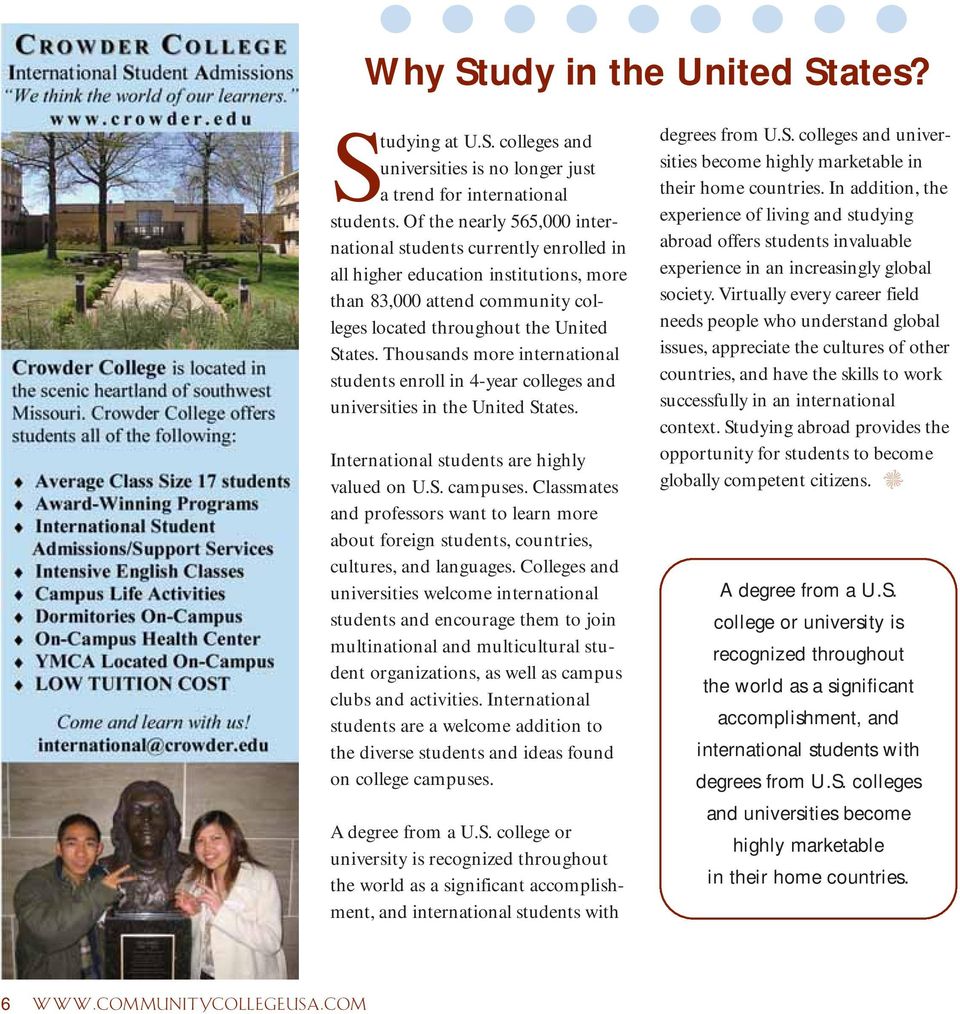
8 Why Study in the United States? Studying at U.S. colleges and universities is no longer just a trend for international students. Of the nearly 565,000 international students currently enrolled in all higher education institutions, more than 83,000 attend community colleges located throughout the United States. Thousands more international students enroll in 4-year colleges and universities in the United States. International students are highly valued on U.S. campuses. Classmates and professors want to learn more about foreign students, countries, cultures, and languages. Colleges and universities welcome international students and encourage them to join multinational and multicultural student organizations, as well as campus clubs and activities. International students are a welcome addition to the diverse students and ideas found on college campuses. A degree from a U.S. college or university is recognized throughout the world as a significant accomplishment, and international students with degrees from U.S. colleges and universities become highly marketable in their home countries. In addition, the experience of living and studying abroad offers students invaluable experience in an increasingly global society. Virtually every career field needs people who understand global issues, appreciate the cultures of other countries, and have the skills to work successfully in an international context. Studying abroad provides the opportunity for students to become globally competent citizens. A degree from a U.S. college or university is recognized throughout the world as a significant accomplishment, and international students with degrees from U.S. colleges and universities become highly marketable in their home countries. 6
9
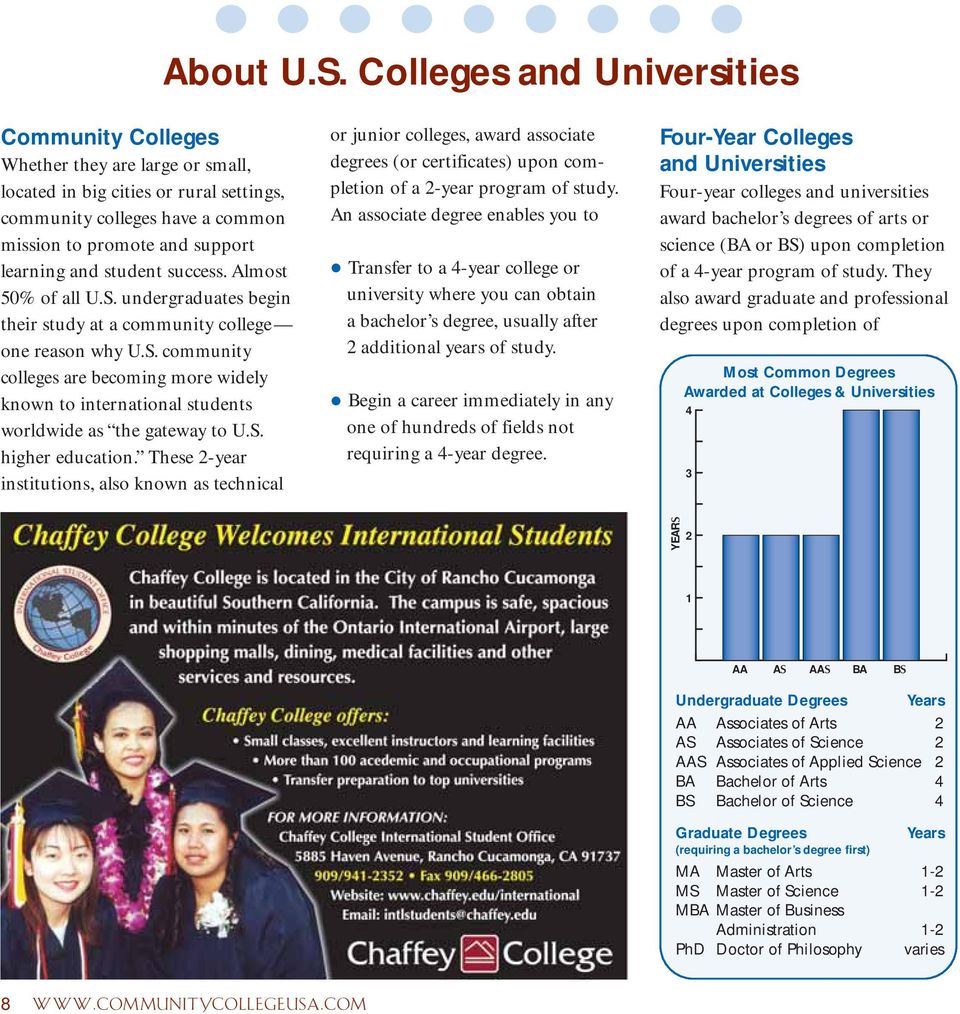
10 About U.S. Colleges and Universities Community Colleges Whether they are large or small, located in big cities or rural settings, community colleges have a common mission to promote and support learning and student success. Almost 50% of all U.S. undergraduates begin their study at a community college one reason why U.S. community colleges are becoming more widely known to international students worldwide as the gateway to U.S. higher education. These 2-year institutions, also known as technical or junior colleges, award associate degrees (or certificates) upon completion of a 2-year program of study. An associate degree enables you to Transfer to a 4-year college or university where you can obtain a bachelor s degree, usually after 2 additional years of study. Begin a career immediately in any one of hundreds of fields not requiring a 4-year degree. Four-Year Colleges and Universities Four-year colleges and universities award bachelor s degrees of arts or science (BA or BS) upon completion of a 4-year program of study. They also award graduate and professional degrees upon completion of Most Common Degrees Awarded at Colleges & Universities 4 3 YEARS 2 1 AA AS AAS BA BS Undergraduate Degrees Years AA Associates of Arts 2 AS Associates of Science 2 AAS Associates of Applied Science 2 BA Bachelor of Arts 4 BS Bachelor of Science 4 Graduate Degrees Years (requiring a bachelor s degree first) MA Master of Arts 1-2 MS Master of Science 1-2 MBA Master of Business Administration 1-2 PhD Doctor of Philosophy varies 8
11 additional years of study. Nearly all 4-year colleges and universities accept credits earned at community colleges and allow students to transfer into bachelor s programs. Because transfer rules differ, it is important to find out the specific transfer rules for the college or university you are interested in transferring to before you apply to a community college. Accreditation Regional accreditation agencies that are recognized by the U.S. Department of State evaluate community colleges and 4-year institutions to ensure that they meet or exceed the criteria of educational quality. Both community colleges and 4-year institutions are accredited by the same regional agencies. It is very important that the institution or the program you are planning to attend be accredited. Accredited colleges and universities will accept transfer credit only from other accredited institutions. Furthermore, most ministries of education around the world will recognize a degree only if it is awarded by an accredited college or university. You can find out whether the college you are applying to is accredited by checking the Web sites of the Accrediting Commission for Community and Junior Colleges or continued on p. 10 about u.s. colleges and universities 9
12 the Office of Postsecondary Education. Note: All community colleges listed are regionally accredited institutions (see pages 67 and 82). SEVP-Approved Colleges and Universities International students are eligible to attend only colleges and universities that are approved by the Student and Exchange Visitor Program (SEVP). The institutions approved by SEVP are required by the U.S. government to supply information about international students to the Student and Exchange Visitor Information System (SEVIS), an Internet-based system that tracks and monitors schools and programs, students and their dependents, throughout a student s stay in the United States. This information is provided to the U.S. Department of State, U.S. Customs and Border Protection, U.S. Citizenship and Immigration Services, and U.S. Immigration and Customs Enforcement. Before applying to a college, find out whether it is approved by SEVP. For a list of SEVP-approved AACC member colleges, see page 67. Information for Students With Disabilities The Americans with Disabilities Act (ADA) requires that all U.S. colleges and universities make reasonable accommodations for all students with disabilities. Colleges normally provide services such as sign language interpreters, handicapped accessible classrooms, note takers in classes, Braille materials, and extended time for test-taking. They do not typically provide personal care attendants, hearing aids, or wheelchairs. ADA applies to students even before they are accepted to a college. If you have a documented disability, you may qualify for nonstandard testing arrangements for the TOEFL or SAT. Accommodations may include extended time or additional breaks during an exam, a separate testing room, special editions of the test, or provision of a reader or scribe. Because higher education institutions must consider all applicants solely on the basis of their qualifications, an applicant s disability status will not be either an advantage or a disadvantage. For general information about accommodations and services for students with disabilities, contact Mobility International USA. Community colleges are a top choice for students with disabilities. To find out more about services available at a particular college, contact the college s international office. 10
13 Los Angeles Valley College Los Angeles Valley College (LAVC) reflects the cultural diversity of the United States. International students enrich this diversity and contribute their unique experiences, perspectives, and voices. Come to LAVC and become a part of the fabric of our college community. Location. Location. Location. LAVC is located in sunny southern California near Santa Monica, Disneyland, Hollywood, and much more. Academics LAVC offers cutting edge programs in business, computer science, graphic design, nursing, and much more. Learning Environment Our highly qualified and respected faculty teach small classes, offering personal attention. Gateway to the World 2+2=4 LAVC offers excellent transfer programs. Two years at LAVC plus two years at a university equal a bachelor s degree. Come to LAVC and transfer to UCLA, USC, UC Berkeley, or anywhere in the United States. Admissions Requirements Admission is selective. High (secondary) school completion Proof of funds availability TOEFL (450 written/ 133 computerized/45 IBT) Download an application today at about u.s. colleges and universities 11
14

15 The Top Ten Benefits of Attending Community College More international students are discovering that community colleges can be the stepping stones to prestigious 4-year colleges and universities. In this section we describe the top 10 benefits that U.S. community colleges offer to international students. 1. Affordable Cost Community college tuition and fees are significantly lower than those at 4-year colleges and universities. If you intend to pursue a bachelor s degree, you can lower the total cost of earning your degree by taking the first 2 years of courses at a community college. 2. Excellent Transfer Opportunities Most community colleges have agreements with 4-year colleges and universities to allow students to transfer their community college credits toward a university degree. These agreements are called articulation agreements or transfer agreements, because students graduate with a bachelor s degree after completing 2 years of community college plus 2 years at a 4-year institution. Many state universities give preference to qualified students who transfer from a community college in that state. 3. Flexible English Proficiency Requirements Because community colleges provide their own assessment and offer Intensive English Programs (IEPs) to students who require additional top ten benefits of attending community college 13
16 English language proficiency, TOEFL (Test of English as a Foreign Language) language requirements are more flexible, and scores are not always critical to the admissions process. Some colleges will accept an IELTS (International English Language Testing System) score in place of the TOEFL score. (For more information, see page 28.) 4. Focus on Teaching Although community college faculty also conduct research and publish articles and books, their main focus is on teaching. The result is that often community college students enjoy more personal attention from their instructors. Additionally, because community colleges seek out and hire many faculty who have practical work experience in the subjects they teach, students can expect to gain a realworld perspective on many subjects. 5. Small Class Sizes Because the average community college class size is between 15 and 20 students, faculty are able to devote more of their time to individuals, and there is more opportunity for students to interact with others. For international students who may need to adjust to the pace of U.S. academic life and practice English-language skills, small classes are highly beneficial. 6. Additional Year of Practical Training Students with F-1 status are eligible for one year of Optional Practical Training (OPT) in their field of study immediately following completion of an associate degree, and a second year of OPT immediately following completion of a bachelor s degree. (For more information, see page 55.) 7. Use of the Latest Technologies Because of their strong ties with business and industry, community colleges tend to be equipped with state-of-the-art technologies, classrooms, and facilities. Community colleges also have many programs in cutting-edge fields such as biomedical engineering, biotechnology, robotics, laser optics, Internet and computer technologies, and geographic information systems. 8. Hundreds of Programs to Choose From Community colleges offer programs in all major fields of study ranging from art to political science to zoology. This is especially important for students planning to transfer to 4-year colleges and universities. Community college programs currently popular among international students include business, engineering, 14
17

18 computer science, computer graphics, Internet technology, multimedia, hotel management, restaurant management, psychology, accounting, early childhood education, and environmental conservation. 9. Opportunities to Experience U.S. Culture Because community colleges have strong ties to their surrounding communities, they offer international students both a rich academic environment and a unique chance to experience many aspects of life in the United States both on and off campus. 10. Excellent Student Support Services Community colleges are committed to ensuring that all students succeed, and they attract people of many different ages, ethnicities, nationalities, beliefs, and abilities. They offer a variety of support services and cross-cultural programs, including tutoring, advising, career planning, study skills, and counseling many of which are designed specifically for international students. (For information about special services for students with disabilities, see page 10.) 16
19 Internet Resources Internet Resources for International Students, on page 84, is a list of Web sites and URLs you can visit to find information on all of the topics covered in the Guide. You may also notice that the name of an organization is printed in blue. This means that you will find a related URL on page 84. top ten benefits of attending community college 17
20

21 Finding the Right Community College Determine Your Higher Education Goals Before you begin to explore specific colleges, spend some time thinking about what you want to achieve, and make a list of your goals. The following are some questions for you to consider. Have you already decided on a career? If you know what career you want to pursue, you should consider a college that has a good reputation in that field. U.S. community colleges offer hundreds of majors from which to choose. They have close ties to a number of industries and are well respected in many fields of study. Community college alumni include Nobel Prize, Pulitzer Prize, and Emmy Award winners, as well as top-ranked business executives, U.S. government and international leaders, scientists, entrepreneurs, movie producers, actors, and world-class musicians. Are you undecided about your future career? If you are not sure what career you want to prepare for, you may want to consider a college that offers a broad selection of classes or programs. Many U.S. students spend their first 2 years taking many different classes to explore their interests and do not select a major until the end of their second year of study. Do you eventually want to earn a bachelor s degree? You can begin your higher education studies at a community college and transfer to a 4-year college or university to earn a bachelor s degree. In fact, nearly 50% of students in the United States begin their studies at a community college. If you intend to pursue a bachelor s degree after earning an associate degree, you will want to focus on community colleges that have transfer agreements with 4-year colleges and universities. Do you want to improve your English? Studying in the United States will give you extensive exposure to the English language. Many community colleges also offer Intensive English Programs, through which you can improve your English skills before beginning your academic studies. finding the right community college 19
22 Are you interested in U.S. culture? U.S. community colleges have strong ties to their local communities that provide extensive opportunities to interact with U.S. residents and to experience their culture. Where would you prefer to live in the United States? Would you prefer to live in a city, in a small town, or in a rural area? Do you want to live in a particular region of the United States? If so, which cities or states are you considering? There are community colleges in each of the 50 states, some in big cities and some in smaller towns and rural areas. If your desired program of study is available at several community colleges, you may decide which institution to attend based on what state or region of the United States you would like to live in. Visit college Web sites to get a better sense of where you might want to live and study. Consult the Best Sources for Information and Assistance Applying to college can seem overwhelming at first, but there are many resources available to you. In this section, we describe some of the most useful for you in detail. CommunityCollegeUSA.com This is an excellent site to visit to learn more about community colleges and to find a college that is right for you. Many community colleges have posted their information in English and often in other major languages, with links to their individual Web sites. CommunityCollegeUSA.com allows you to search for institutions by subject area, geographical preference, or other criteria. You can also request information directly from a college and, in some cases, apply online. Many colleges have their entire course catalog online, so you can see what classes are offered, and some offer virtual tours of their campuses. Here is a sampling of what you will find on this site: Complete resource guide to education in the United States List of colleges welcoming international students Admissions office contact information for 100 featured colleges College fair information Information about transfer to 4-year colleges and universities Information about specific programs: ESL, summer, vocational/ career, computer and technology, and short-term/ certificate programs, internships, TOEFL and test preparation classes continued on p
23 finding the right community college 21
24 EducationUSA EducationUSA is a worldwide network of more than 450 advising centers affiliated with the U.S. Department of State. Its purpose is to help students find and apply to U.S. community colleges, as well as to 4-year colleges and universities. Centers are located at U.S. embassies and consulates, Fulbright commissions, bi-national centers, nongovernmental organizations, libraries, and universities. Centers are staffed by professional advisers, many of whom have studied in the United States or have received State Department-approved training for higher education advising. Among the wealth of information and materials available through the Web site or at the centers are the following: College catalogs Online tours of colleges Schedules for TOEFL and other tests College fair information Workshops and seminars Visa information Publications available in PDF format (see the box on p. 23) Advisers, who are not agents or recruiters, give students free, accurate, impartial information about the full range of accredited higher 22
25 education institutions in the United States and help students find the best options to meet their education, financial, and professional goals. An adviser can personally assist you in Researching an institution Identifying financial aid opportunities Understanding the admissions process Applying for a student visa Preparing for a visa interview Obtaining specialized services offered by some centers (e.g., essay-writing workshops, document verification, etc.) College Web Sites and U.S. colleges and universities have Web sites that offer a wealth of information about degree programs, application procedures, academic departments, facilities on campus, and other topics. In many cases you will also find a copy of the college catalog. Some sites may also give addresses for current students, including international students, who are often willing to answer your questions about the college and about living in the United States. Once you have narrowed down the colleges you are interested in, you may wish to admissions personnel to ask specific questions before you decide where to apply. Free Publications From EducationUSA If You Want to Study in the United States is a series of 4 introductory booklets produced by the U.S. Dept. of State to provide objective and practical advice to prospective international students and scholars on studying in the United States. All four booklets may be downloaded from the EducationUSA Web site, and print copies of booklets 1, 2, and 3 are available from U.S. Educational Advising/Information Centers worldwide. The four booklets are (1) Undergraduate Study; (2) Graduate and Professional Study and Research; (3) Short-Term Study, English Language Programs, Distance Education, and Accreditation; and (4) Getting Ready to Go: Practical Information for Living and Studying in the United States. Booklet 4 provides invaluable advice on applying for a visa, moving to the United States, and what to expect when you arrive on campus. It is available only on the U.S. Department of State Web site. (Note: A portion of the information in this section is based on Booklet 1.) College Fairs If you cannot visit the United States, colleges may come to your country to participate in college fairs or specially arranged seminars. Your nearest EducationUSA advising center can tell you about upcoming college fairs where you can talk to official college representatives face to face. Many of these fairs take place in the fall or spring of the year before you intend to start your studies, so it is important to start your research early. Campus Visits If you are able to travel to the United States before you go to college, this could be a great opportunity to visit the community colleges you are considering. Many colleges organize campus tours that are led by current students; check with the undergraduate admissions office for further information and to schedule a visit. We recommend that you visit the academic and housing facilities, continued on p. 24 finding the right community college 23
26 student union, and library to get a good sense of the campus. Speaking with students is another important part of the visit. U.S. residents are known for being friendly, so talk to current students to find out what college life is really like. Other Sources of Information Fulbright commissions are connected with both the U.S. and your country s government. They are another source of free assistance. Guidance counselors at your current school can often help. Ask whether there is anyone in the guidance or advising office who works with U.S. college and university applications. You may have friends, relatives, or alumni from your current school who have studied in the United States. Ask them for help. If you do not know anyone personally, ask friends and classmates if they know someone who has studied in the United States. Internet Resources Internet Resources for International Students, on page 84, is a list of Web sites and URLs you can visit to find information on all of the topics covered in the Guide. You may also notice that the name of an organization is printed in blue. This means that you will find a related URL on page
27 Estimating Expenses and Financial Resources Estimating Expenses Before applying to a community college, it is important that you estimate how much you will need to pay for tuition and living expenses. Costs vary depending on where your college is located and other factors, but, in general, you should expect to spend between about US$10,000 and US$20,000 each year. Contact the college s international or admissions office for help in estimating your expenses, which should include those listed on the worksheet on this page. Estimating Your Financial Resources It is especially important for you to have a clear idea of what your expenses will be, because when you apply to a college (and before you can be granted a student visa), you will be required to show that you have the financial resources necessary to cover your expenses (see Statement of Financial Support on page 28). Because there are employment restrictions on international students, you cannot rely on working in the United States to help you pay for your education (see Working in the United States on page 55). In general, you should expect to spend between about US$10,000 and US$20,000 each year. Annual Expense Amount Needed Tuition & Fees $ Books & Supplies $ Housing & Utilities $ Transportation $ Food $ Medical/Dental Care $ Personal* $ *Examples of personal items include clothing, toiletries, travel, recreation, etc. estimating expenses and financial resources 25
28
29 Applying to a Community College Admission requirements vary from college to college. You must provide everything that the college requests before your application will be considered complete, so read the application materials carefully and ask questions about anything you do not understand. You may apply for admission to a community college during your final year of secondary school or its equivalent. Prior to enrolling in classes, you will be required to send confirmation that you graduated. The remainder of this section describes the items you may or will be required to submit. Application Form An application form is always required. Most community colleges have a separate form for international students, which you can usually find on the college s Web site. If you have difficulty locating the application online, send an or write to the international office and ask that the application materials be sent to you. Make sure the names on your application are spelled identically to the names on your passport. If they are not identical, you may be denied a visa. Test Scores Although most U.S. community colleges have strong Intensive English Programs (IEPs), some may require applying to a community college 27
30 that you take standardized language proficiency tests for admission to their college. The tests most commonly required are TOEFL (Test of English as a Foreign Language) or IELTS (International English Language Testing System). To find out where the tests are given in your country, contact your local EducationUSA advising center or visit the EducationUSA Web site. Whether or not you take the TOEFL or IELTS exam, most colleges will also require that you take their own English placement test on campus before registering for classes. If your score shows that you have adequate skills for college-level course work, you will be excused from an IEP. If not, you will be required to attend an IEP until the language requirement has been met. The SAT Reasoning Test (SAT), a standardized English and mathematics exam, is seldom required by community colleges. Taking the SAT does, however, show your interest in and commitment to studying in the United States. Statement of Financial Support You must submit a statement of financial support to show that you have the financial resources adequate to meet your expenses while studying at a college in the United States. Financial resources may come from any dependable source, including scholarships, fellowships, sponsoring agencies, your personal funds, or your family s funds. This statement is required by law to apply for a visa as well as to apply to a college. The international student application form for each college will explain what documents you need to submit. If you have questions, contact the college s international office by , by phone, or in writing. Academic Transcripts and Records You must submit academic transcripts and other documents that 28
31 Minnesota Online Minnesota Online Works for You! Is online learning for you? Check out the free Chocolate course found on the Minnesota Online homepage! Minnesota State Colleges and Universities system established Minnesota Online to support the system s online education and training. Search and review the thousands of online courses and over 150 degree, certificate, and diploma programs. The Minnesota State Colleges and Universities is a national leader in public online higher education and the state s leading source of online higher education. In the 2007 academic year, over 50,000 students enrolled in online courses at one or more of the 32 colleges and universities. Minnesota Online provides student support, pre-admissions planning, and advising seven days a week through , Ask a Question, Live Chat, and a toll-free number. Minnesota State Colleges and Universities has been recognized by the Minnesota High Tech Association and Minnesota Technology Inc. by receiving the 2006 Tekne Award for developing Minnesota Online. Minnesota Online also received the 2006 Institutional Service Award from the Council for Adult and Experiential Learning. The online degrees offered through Minnesota Online are accredited by the Higher Learning Commission. applying to a community college 29
32 show your previous education and grades. You must have completed secondary school or its equivalent before you can enroll at a community college or obtain an F-1 student visa. These documents may be required in English, and colleges may have them professionally evaluated before offering admission. Proof of Immunization Most community colleges will require you to submit a record of immunizations you have received, signed by a physician. Contact the college s international office to find out what is required. Letters of Recommendation Colleges may ask you for letters of recommendation. Make sure to read each college s request carefully: Some have specific requirements regarding who may submit a letter on your behalf. Normally, letters are written by teachers, employers, or others who know you well enough to describe your talents, goals, interests, aptitude, or character. Family members are not usually allowed to write these letters. Personal Essays Colleges may require that you write an essay, either on a specific topic or on a topic of your choice. Essays are Make sure to read each college s instructions for submitting letters of recommendation. Some have specific requirements about who may submit a letter on your behalf. often an important part of the application process, so, if you are asked to write an essay, take the assignment seriously. In your essay, describe yourself in a positive way, answer questions directly, and give specific examples to illustrate what you have to say about yourself. Ask people who know you to read your essay and give you advice so that the essay presents you, your talents, and your goals accurately. Make sure to check your grammar and spelling so that your essay is easy for an admissions officer to read. Extracurricular Activities Extracurricular activities activities you pursue outside the classroom may help you obtain admission to a college or qualify you for special kinds of scholarships. These activities do not need to be directly related to your college course work or future education goals. Examples include membership in clubs, working as 30
33 a volunteer, or spending time on personal interests such as playing a musical instrument. Make sure to mention any prizes, awards, certificates, or medals you may have won in competitions. Even if you are not asked specifically on the application form about your extracurricular activities, try to include that information (perhaps within your personal essay): The U.S. education system regards these kinds of activities highly because they demonstrate your commitment, areas of interest, ability to work with others, and potential as a future leader. Even if you are not asked specifically on the application about your extracurricular activities, try to include that information. The U.S. education system regards these kinds of activities highly. Interviews Most community colleges do not require that you interview with the admissions committee. If you are asked to participate in an interview, the college will give you details about the process and what to expect. If you participate in an interview, you should practice your responses to some common questions prior to the scheduled interview. A teacher or counselor may be able to help by providing sample questions that are similar to interview questions you may be asked. applying to a community college 31
34
35 Obtaining a Student Visa Once you are accepted to a college, the college will issue you a SEVIS Form I-20 (Certificate for Eligibility for Non-immigrant F-1 Student Status). The Form I-20 indicates only that you are eligible to apply for an F-1 student visa; it does not guarantee that you will receive one. There are three steps to apply for a visa: You must have a college-issued I-20 form, you must pay the SEVIS I-901 fee, and you must schedule and attend an interview with the U.S. consulate. Important: Make sure the names written on your I-20 form are spelled identically to the names on your passport. If they are not, you will be denied entry. Paying the SEVIS I-901 Fee After receiving your SEVIS Form I-20, you must pay a SEVIS I-901 fee (currently US$100). You will need the SEVIS fee receipt to apply for a visa. You are encouraged to pay the fee by credit card on the Internet. The fee must be paid and fully processed before you arrive at the U.S. consulate for a visa interview. If you have difficulty paying the fee online, visit an EducationUSA advising center for assistance. You will need the SEVIS fee receipt to apply for an F-1 student visa. Get Information and Assistance With Visa Applications EducationUSA is an excellent resource on visas: We recommend visiting the Web site or an advising center first. Advisors can explain the visa process, how to assemble your application materials, how to schedule and present yourself at the interview, and where to pay fees in your country. See the chart on page 39 for a complete list of Internet and other resources you can consult for information and assistance with visas. If any of the terms used in this section are confusing to you, see the glossary of visa terms referenced in the chart on page 39. continued on p. 35 obtaining a student visa 33
36 34
37 Internet Resources Internet Resources for International Students, on page 84, is a list of Web sites and URLs you can visit to find information on all of the topics covered in the Guide. You may also notice that the name of an organization is printed in blue. This means that you will find a related URL on page 84. Applying for an F-1 Student Visa Criteria for Eligibility F-1 visas are granted to full-time students enrolled in a degreegranting academic or approved language program. To be granted an F-1 visa, you must meet specific criteria established by your college and the U.S. government, as follows: You must provide proof that you will have completed secondary school or its equivalent prior to the date of enrollment. You must provide a statement of financial support. You must prove to the U.S. government that you have residence in your home country and that you plan to return there after completing your education goals. Application Process and Timeline Most of the requirements and application procedures for F-1 student visas are standardized, although some procedures may vary from country to country. For more details on applying for a student visa, visit the Web site of the U.S. embassy or consulate in your home country or the U.S. Department of State s Web site. Be aware of the following important scheduling issues, and plan accordingly. An F-1 student visa cannot be issued to you more than 120 days before the program start date on your SEVIS Form I-20. However, because visa processing times can vary widely, it may be in your best interests to apply for a visa as early as possible so that processing can begin. The embassy or consulate will hold your application until it is able to issue your visa. Once you have obtained a visa, you may not enter the United States more than 30 days before the program start date listed on your SEVIS Form I-20. The Visa Interview You are required to have a brief faceto-face interview at the U.S. consulate or embassy that has jurisdiction over the area where you live. For more information about the specifics of scheduling an interview in your country, contact your EducationUSA office or visit the Web site of your local embassy or consulate. It may take several days to schedule an interview, so plan ahead. The interview is very important in determining whether or not you will be issued a visa. Make sure to dress professionally and answer questions with specific answers. Be prepared to discuss your program of study, why you want to study in the United States, and how your choice of college will help you achieve your education goals. You may request an interpreter if necessary. Be on time for your interview, and take with you the items listed on the following checklist. continued on p. 36 obtaining a student visa 35
38 Items Required at a Visa Interview Important 1. Your names on all forms must be spelled exactly the same way on your passport, I-20, and all visa application forms. 2. Your passport must be valid for at least 6 months after the proposed date of entry into the U.S. Completed SEVIS Form I-20 I-901 SEVIS payment receipt Proof of ability to meet expenses while studying in the U.S. Passport Test scores (TOEFL, SAT, etc.) High school diploma (or proof of completion of secondary school) Applicable forms: Form DS-156 (Non-immigrant Visa Application) Form DS-158 (Contact Information and Work History for Non-immigrant Visa Application) Form DS-157 (Supplemental Non-immigrant Visa Application) Passport-size photographs Evidence of intent to depart after U.S. study (e.g., a job offer) Receipt for the Machine Readable Visa (MRV) surcharge fee Receipt for the Visa Reciprocity Fee (if applicable) Length of Stay With an F-1 visa, you are permitted to remain in the United States for a duration of status (D/S) that includes the time you are enrolled in college, 60 days after you complete your studies to prepare for departure from the United States, and any additional period of authorized Optional Practical Training (see page 55). Your D/S will appear on your Form I-94 (arrival/departure record given to you on the plane to the U.S.), which is stamped by the immigration officer at the port of entry and on your SEVIS Form I-20. continued on p
39 obtaining a student visa 37
40 Remember: You may not enter the United States more than 30 days before the program start date listed on your SEVIS Form I-20. Maintaining Status To maintain legal student status, you must report to the international office at your college for SEVIS registration no later than 30 days after the program start date listed on SEVIS Form I-20. (However, you will want to report to the international office at your college even earlier to register for classes.) As long as you remain a full-time student at the college that issued your SEVIS Form 1-20, you will maintain your student status, even if your student visa in your passport expires. Other requirements to maintain status are as follows: Attend the college listed on your SEVIS Form I-20 Pursue a full course of study at the college you are authorized to attend, or have permission from the college s designated school official (DSO) to study part time. Make ongoing progress toward completing your course of study. Maintain a grade point average (GPA) of 2.0 or better. Report any change of address to your college s international office within 10 days of the change. 38
41 Obey federal, state, and local laws. Engage in employment only when specifically authorized under visa regulations. The Guide provides information primarily for students seeking F-1 visas. For information on other types of visas, see additional Internet resources listed on page 84. You may not enter the United States more than 30 days before the program start date listed on your SEVIS Form I-20. Information and Assistance With Visas General Information on Obtaining a Visa EducationUSA U.S. Department of State: General visa information Student visa information SEVIS and Form I Obtain a SEVIS Form I-20 Contact your U.S. college after acceptance Find an embassy/consulate Forms, Fees, and Receipts Form DS-156, -157, & SEVIS I-901 receipt Other visa fees Other Specific Information Glossary of visa terms What to expect on arrival obtaining a student visa 39
42 40
43 Traveling to the United States This section contains important information about what you should do after you have been admitted to a college and obtained your F-1 student visa. In particular, pay special attention to the visa requirements for scheduling your arrival into the United States as well as to the U.S. entry and customs requirements explained in this section. Scheduling Your Arrival Your student visa does not guarantee entry into the United States; it allows you only to travel to the United States as far as the port of entry (airport or land border crossing). For successful entry, be sure to schedule your arrival according to visa regulations: You may be refused entry into the United States if you arrive More than 30 days before the program start date More than 30 days after the program start date listed on your SEVIS Form I-20 Finding Housing Find a place to live before you pack your bags to attend college in the United States. If your college does not have on-campus housing, it will have contracts with local housing providers to accommodate international students. Be sure to contact your college s international office for assistance finding housing (see Housing Options on page 49 for a description of the kinds of housing available). continued on p. 42 traveling to the united states 41
44 Things to Do Before Leaving for the United States Copy Documents and Shop Make copies of your SEVIS Form I-20 and the passport pages containing your photograph, passport number, expiration date, and U.S. visa stamp. Keep these copies separate from the original documents. Keep one copy in your carry-on luggage, one in your checked luggage, and one at home with your family. Give your family members your U.S. contact information. Plan to buy small appliances in the United States (hair dryers, razors, clocks, irons, etc.). Those purchased in your home country may not operate in the United States. Manage Your Money Carry traveler s checks and credit cards instead of large amounts of cash. However, be sure to change a portion of your money into U.S. dollars so that you have enough cash and traveler s checks to meet the many expenses you will have during your first few weeks in the United States. Make Medical Arrangements Visit your doctor and ask about any required vaccinations. Contact your college s international office to find out about the college s requirements. You may also want to check the U.S. Centers for Disease Control and Prevention (CDC) Web site for requirements. If you use medications, particularly those that contain narcotics or are administered by syringe, carry a signed prescription from your physician. Penalties for smuggling narcotics are severe. If you wear glasses or contact lenses, have an eye examination so that you will have a prescription in case you need a replacement. Because of current U.S. airline regulations, you may not be able to hand carry medications that are liquids or gels. Call the airline in advance, and ask at check-in to find out whether they are permitted. If not, place them in your checked baggage so that you can easily present them. Contact the College s International Office Make housing arrangements. Arrange for transportation from the airport. Notify the college of your travel plans and expected arrival date. Obtain a Driver s License If you plan to drive in the United States, you must obtain an international driver s license from your home country. Prepare For Your Flight Ask airline reservation agents about any required stops during your flight to the United States. If you make a stop in another country, you may need to obtain a transit visa for that country. Purchase travel insurance. Check the airline s baggage allowances before packing your bags. You may have to pay extra for bags that exceed maximum weight and size allowances. Reconfirm your flights 72 hours before departure, and arrive at the airport at least 2 hours before your flight. Label your luggage inside and outside with your name, your college s name, and the address where you will be living. If your luggage is lost, this will help the airline return it to you. Pack a change of clothing in your carry-on bag in case your luggage is lost or delayed. 42
45 U.S. Entry and Customs Requirements Be sure you are in compliance with U.S. regulations. For information, contact the nearest U.S. embassy, consulate, or EducationUSA advising center. When you visit the consulate for your visa, ask for a copy of Customs Hints for Visitors (Non-Residents). Basic Requirements for Entry You must be healthy. If you were recently in a country with epidemics such as cholera or yellow fever, you will need to show proof of vaccination. You will probably be denied entry if you are HIV-positive. You must be able to support yourself financially during your stay. You must intend to leave the U.S. after you complete your studies and any Optional Practical Training (OPT) in which you participate. Items You Cannot Bring Without Special Permission Drugs or medications without a doctor s prescription Fruits and vegetables Living plants Meat and meat products Firearms and ammunition Products made from certain protected animals continued on p. 44 traveling to the united states 43
46 Documents You Will Need at Customs Important: Always notify the police and your embassy immediately if your passport is ever lost or stolen. Passport, valid for at least 6 months beyond the date of your expected stay SEVIS Form I-20 College acceptance letter Evidence of financial resources Paper receipt for the SEVIS fee, Form I-797 Name and contact information for your designated school official (DSO), including a 24-hour emergency contact number at the college Your completed Customs Declaration Forms (CF-6059)* Your completed Arrival/Departure Record Form (I-94)* * The CF-6059 and I-94 will be available from your flight attendant, if you are traveling by air, or from the customs officer at the port of entry, if you are traveling by land or sea. Answering Customs Questions Everyone must go through a brief customs and immigration interview when they arrive in the United States. Keep all your answers simple and direct. For example, when asked about your purpose for visiting the United States, say that you are a student. If you are asked the name of your college, provide the name of the college that issued your SEVIS Form I-20 and is listed on your visa. If you present a Form I-20 issued by a college other than the one listed on the visa, the inspecting officer may conclude that you made misrepresentations to the consular officer and may continued on p
47 traveling to the united states 45
48 46
49 deny your entry. A student who attends a college other than the one authorized is considered to be out of status and must apply for reinstatement. See the worksheet on this page for the common questions you may be asked at U.S. Customs. Write down your answers to these questions in advance and keep them with you. Your student visa does not guarantee entry into the United States; it allows you only to travel to the United States as far as the port of entry. Answers to Prepare for U.S. Customs Q: What is your purpose for entering the United States? A: Q: Do you have anything of value (not for your own personal use) to declare? A: Q: Are you bringing any money into the United States with you? How much? A: Q: Are you bringing any plants, fruits, meats, vegetables, clothing made from the skins of endangered animals, ivory, lottery tickets, obscene articles or publications, or switchblade knives into the United States? A: Q: Are you bringing any prescriptions or narcotics, such as barbiturates, amphetamines and marijuana, into the United States? (These are illegal unless you have a prescription from your physician.) A: traveling to the united states 47
50 48
51 Living in the United States Once you are allowed entry into the United States, the best source for information, advice, and support is the international office at your college. This office will be able to provide you with the answers you need or refer you to a person or office that can. It is also a good idea, if you have not done so already, to purchase a travel guide book for the region of the United States where you will be living. Such books offer a great deal of general information about living in the United States, as well as more detailed information about your region. Housing Options Ideally, you will make housing arrangements through your college before you arrive. If you have not, or if you have only temporary housing, ask the international office of your college for assistance in making arrangements. There are several options for you to consider. Dormitories Some community colleges have dormitories (dorms) buildings with rooms for students attending that college. Dorms are usually on campus or, if not, the college provides transportation from the dorms to the campus. Living in a dorm allows you to interact with fellow students and experience the camaraderie that is typical of college dorms. Most dorms provide meals in a common dining hall so that you can eat with other students and do not have to cook. Depending on the campus, dorms may be all female, all male, or coed (female and male students living together). If you have a preference for a particular type of dorm, make sure to tell your college s international office or note your preference on the housing request form. Dorms usually consist of single rooms, shared rooms, or suites (bedrooms joined by a common living area). Bathrooms in dorms are often shared with other students. If you are admitted to a college that has dorms and you prefer to be housed in one, contact your college as soon as possible to request dorm housing. If it is unclear how to make the request, the international office can explain. Home Stays Living with a family will provide you with excellent opportunities to practice English and experience U.S. life and culture. Many community colleges arrange home stays with a family for a semester, a year, or other time period. Some families will include meals, family activities, and even transportation to the college. The home stay arrangement is designed to provide you with a rich Internet Resources Internet Resources for International Students, on page 84, is a comprehensive list of Web sites and URLs you can visit to find information on all of the topics covered in the Guide. (You may want to photocopy the page for handy reference.) You will also occasionally notice that the name of an organization is printed in blue. This means that you will find a related URL on page 84. living in the united states 49
52 intercultural experience. Host families often treat students as one of the family and spend time showing them around the local community. Apartments Apartments are a good choice whether you like to be on your own or want to live with other students. Living with other students is a good way to meet new friends and share expenses for rent and utilities. The college s international office may keep a bulletin board with announcements of available apartments and other students who seek roommates. You can the college in advance of your departure so you can contact potential roommates before arriving. There are two types of apartments you can rent furnished or unfurnished. Furnished apartments come with essential furniture (beds, couches, chairs, tables, etc.). Unfurnished apartments may have only kitchen appliances, such as a refrigerator and stove. Renting a Room The college s international office will have a list of families and individuals who rent bedrooms in their homes, usually with kitchen privileges so you can cook your own meals. Some families may take time to show you around and work with you on your 50
53 English skills. You will want to find out how far the home is from the college and make the necessary arrangements for transportation to and from the college. Managing Your Money U.S. Currency Paper money (also referred to as bills or cash) is all the same size and mostly green in color. Common U.S. denominations are $1, $5, $10, $20, $50, and $100. Larger denominations are rarely seen. The following are the most commonly used U.S. coins: Penny copper-colored, valued at $0.01 (1 cent) Nickel silver-colored, valued at $0.05 (5 cents) Dime silver-colored, valued at $0.10 (10 cents) Quarter silver-colored, valued at $0.25 (25 cents) Checking Accounts Students usually open a checking account to pay bills such as rent and utilities. You can deposit cash or travelers checks to open and maintain the account, or have money wired directly from your home bank (there may be a service charge). You can deposit and withdraw money from your checking account at any time. You should pay for most of your purchases using a check or credit card. It is not safe to send cash through the mail or carry large amounts of cash. The Federal Deposit Insurance Corporation (FDIC) insures all U.S. bank accounts against loss up to US$100,000. Savings Accounts If you want to store money for future use and have it earn interest, you may want to open a savings account, another type of account available at your bank. You can transfer money from your savings to your checking account, and you can withdraw savings at any time, although you cannot write checks from your living in the united states 51
54 savings account. A savings account usually pays a higher rate of interest than a checking-with-interest account. ATM and Debit Cards Your bank will issue you an ATM card (also called a debit card) so that you can withdraw money from your checking or savings account. Most ATM cards are also debit cards that businesses will accept the same as a credit card. If you have an ATM card from a foreign bank, ask the bank whether your personal identification number (PIN) will work in the United States. Some banks will give you a different PIN for transactions outside your home country. Credit Cards Many international students find it difficult to get a credit card in the United States, because they do not have an established credit history. If you already have a major credit card such as a MasterCard (Eurocard, Access, Chargex), Visa (Barclaycard, Carte Bleue), or American Express, it is a good idea to bring the cards with you. U.S. banks can check your credit limit on the foreign card, and this may help you to obtain a credit card in the United States. Traveler s Checks Traveler s checks are one of the safest ways to transport money. If the traveler s checks are lost or stolen, you can easily get them replaced. Do not countersign or date the checks until you are ready to use them. Exchanging Money You can exchange foreign currency (but not coins) at most banks, airports, major hotels, and Travelex and American Express offices. A fee may be charged for these transactions. Daily exchange rates are available on the OANDA Web site, among others. Shopping Although there is no national sales tax in the United States, most states have their own sales tax (usually between 3% and 8% of the ticket price). The sales tax is charged as a percentage surcharge on purchases and is printed on the receipt. Most people do not carry around large sums of money. Instead they pay for purchases with a credit card, ATM or debit card, or personal check. Most stores will accept major credit cards and ATM or debit cards with a credit card logo. Prices in the stores are fixed, so it will not help to bargain with the sales clerk. This may be different when dealing with a private individual, shopping at a thrift store (where items are previously owned or used) or yard sale (a sale at someone s home), or buying a large, expensive 52
55
56 item such as a car. Some people shop at large department stores, supermarkets, and malls, and others prefer smaller shops. Try shopping at all different kinds of stores either to get the best price or to find the most unique items. To help you understand the differences, here is a list of some common types of stores. Supermarkets are large grocery stores, often part of a chain of stores. They are usually less expensive than a small local grocery, and often have a larger selection of food, as well as other goods. Department stores are large stores that sell a lot of different things from electronics to cosmetics to clothing all in one store. Malls and shopping plazas are collections of smaller stores connected by an inside corridor or an outside sidewalk. The stores in a mall or plaza range from discount stores to stores selling designer fashions. Although the United States is known for its giant stores and huge malls, there are also many small shops and grocery stores. These smaller stores are more common in downtown areas, where shoppers can easily walk from one shop to another. Keep the receipt for anything that you buy. Your receipt is your proof that you have bought an item. Most stores allow you to return purchases you are unhappy with if you have your receipt and the items are not worn, used, or damaged. If you think you may need to return something, ask the sales clerk about the store s return policy before you purchase the item. Some stores will accept returns only for a specified period of time after the purchase, or may offer you store credit (that must be spent at that store) but not a full refund in cash or on your credit card. 54
57 Driving If you wish to drive or buy a car in the United States, contact your college s international office for information about the laws that apply in your state. Once you satisfy the legal requirements, you can drive in any state. Be aware that it is against the law to drive without a license or without insurance. If a police offer gives you a citation (ticket) for a traffic violation, you may pay the fine as instructed on the citation or you may appear in court to challenge the citation if you think it is wrong. It is bribery a serious crime to give the money directly to the police officer. If you are driving a car and are involved in an accident, stop and wait until the police arrive. Be sure to get the name and address of the other driver, his or her license number, and the name of his or her insurance company. It is a crime to leave the scene of an accident. If the other driver leaves, write down his or her license plate number and give it to the police. Public Transportation Many cities have public transportation. There may be subways, buses, or commuter trains. You will want to find out whether public transportation goes from your residence to the college and how long it takes to get there. You will also want to find out the times during the day when public transportation is available. Working in the United States International students are advised not to expect employment in the United States during the college semester. Generally, if you have an F-1 visa, you may not work off campus without authorization. You may be eligible to work on campus, however, if you are in good legal and academic standing. On-campus employment is limited to 20 hours per week while college is in session, but you may work full time on campus during vacation or break periods as long as you are registered for the following semester. Before working, you must first obtain a social security number and complete a Form I-9 (Employment Eligibility Verification). You may also need to get authorization from the international student advisor, depending on the policy at your college. With an F-1 visa, you may be eligible for up to 12 months of employment through an Optional Practical Training (OPT) program, paid employment related to the student s field and level of study. OPT may be available on or off campus both during and after completion of your program of study. If you are eligible to accept OPT employment, you will not need to change your visa status, but you will need authorization from your college s international student advisor. Understanding U.S. Culture Many people who have lived in another country have felt some kind of culture shock the psychological effects of being immersed in a new environment and adjusting to a place that is very different from your home country. Initially, being in a different environment will probably excite you. However, at times you may wish things were more like home. You may also feel that people around you do not understand your background. Differences you may notice include types of food, lifestyle, the way people speak to you and to each other, and the expectations of your instructors and fellow students. Remember: It is normal for international students to feel culture shock. Getting involved with a variety of people and activities will help you adjust. Talk with other members of the college s international student organization, ask U.S. students to explain things that are unfamiliar to you, or speak with a college counselor about what you are experiencing. continued on p. 56 living in the united states 55
58 The following is some information that has helped other international students better understand the people and the country of the United States. People Knowing something about U.S. culture will help you understand and adjust to your new environment. People in the United States value independence and individuality. Students often dress quite casually and speak out about their ideas on politics, film, or fashion. Students are usually expected to voice their opinions and participate actively in classes. Eye contact is important. It is not a sign of disrespect, but rather an indication of openness, honesty, and enthusiasm. Time It is customary to arrive at the exact time or a few minutes early for an appointment, even with friends. Among friends, being 5 minutes late is usually acceptable; at work or at college, being 5 minutes late is not acceptable. Classes typically start at the exact time for which they are scheduled. You should get to class a couple minutes early to take your seat and get out your books. Exams will start at an exact time. Never arrive late for an exam unless you have the instructor s permission. It is never acceptable to be late for a job interview or other formal appointment. Plan to arrive minutes early so that you can relax and prepare yourself for the meeting. 56
59 Trident Technical College Trident Technical College (TTC) is a public 2-year college offering associate degrees, diplomas, and certificates. Located in historic Charleston, South Carolina, TTC offers students the opportunity to live in a vibrant, culturally rich city that is within minutes of the white-sand beaches of the Atlantic Ocean. Choose from more than 150 programs in business; health sciences; nursing; film, media, and visual arts; community, family, and child studies; law-related studies; hospitality, tourism, and culinary arts; aeronautical studies; and industrial and engineering technologies. Or enroll in one of our University Transfer programs if you plan to earn a 4-year degree. Quality education, affordable tuition, outstanding location TTC has it all. Culinary Institute of Charleston The Culinary Institute of Charleston at Trident Technical College offers programs in culinary arts, baking and pastry, catering, and hospitality and tourism management. The Institute s 77,000-sq.-ft. facility features seven instructional kitchens, a student-run dining room, an amphitheater demonstration kitchen, and the latest in culinary and instructional technology. A 16:1 student-to-instructor ratio means students get individualized, hands-on attention from award-winning chef instructors. Internships in top local restaurants are also available. living in the united states 57
60 Doctor s offices, although they try to run on time, often run behind schedule. If you do not want to wait, call ahead and ask whether they are on time; otherwise, get there on time and bring a book to read just in case. The mainland of the United States (not including Alaska or Hawaii) has three major time zones: Eastern, Central, and Pacific. If you are calling people in a different time zone, make sure to check what time it is where they are. Remember: It is normal for international students to feel culture shock. Getting involved with a variety of people and activities will help you adjust. Talk with other members of the college s international student organization, ask U.S. students to explain things that are unfamiliar to you, or speak with a college counselor about what you are experiencing. Dates In the United States, dates are written with the month first, the day second, and the year last: May 8, 2007 or 5/8/07. Restaurants and Cafés Restaurants and cafés do not normally include a service charge in the bill, so it is customary to tip your server. Servers make their money almost entirely from tips. You should tip 15% 20% of the total bill before tax is added. If you are at a restaurant or café without table service, it is not necessary to leave a tip. If there is a jar on the counter for tips, it is customary to put some coins in the jar if you wish. If you are eating at a fast-food restaurant, it is customary to clear your own table after you eat. Trash cans should be visible in the restaurant if this is the case. Many restaurants and public places do not allow smoking. Do not smoke in public places without finding out whether it is allowed. Dinner is usually served between 5:30 pm and 8:00 pm. In large cities, people tend to eat dinner later than earlier. If you are invited to dinner at a restaurant, expect to pay for your own meal unless your host specifically offers to pay for you. Socializing If you are planning on visiting a friend, call first to announce that you are coming. If you live in the same dorm, it is usually okay to stop by without calling. It is normal for people to stand at least 2 feet apart when speaking to each other; people may feel uncomfortable if you stand too close to them. How are you? is a common greeting in the United States. It is appropriate to give a short answer like fine, thanks or good, how are you? rather than a long explanation of how your life is. People often greet friends with a hug or a kiss on the cheek. When greeting people they do not know or in formal settings, such as when greeting a business acquaintance, people typically shake hands. 58
61 Gifts It is customary to open gifts in front of the giver at the time they are given. If you want to bring gifts for your host family or for new friends, small gifts typical of your country are always appreciated. Bribery A bribe is a favor given or promised to influence the judgment or conduct of a person in a position of trust. Bribery is usually illegal. For instance, if you try to offer money to a police officer so that he or she will not write you a traffic ticket, you will probably be arrested and charged with a serious crime. It is also illegal for a police officer, public official, or authority figure to ask you for a bribe. If this happens, contact your dean of students or another administrator at the college. Internet Resources Internet Resources for International Students, on page 84, is a list of Web sites and URLs you can visit to find information on all of the topics covered in the Guide. You may also notice that the name of an organization is printed in blue. This means that you will find a related URL on page 84. living in the united states 59
62
63 Terms You Should Know transfer An agreement whereby students complete 2 years of education at a community college and then transfer to a 4-year college or university to obtain a bachelor s degree. academic advising Assistance given to students to help them plan what courses to take to meet the requirements for earning a certificate or degree. Also called academic counseling. academic year The period of formal instruction. An academic year runs from September to June and can be divided in quarters or three terms: Fall, Winter, and Spring. accreditation Certification that a college or program meets a prescribed academic standard. U.S. community colleges and 4-year colleges and universities are accredited by the same regional accrediting agencies. articulation agreement An agreement between two higher education institutions that allows one to accept and transfer credits to another. Most community colleges have articulation agreements with 4-year colleges and universities, ensuring that credits earned at the community college will count toward a bachelor s degree. associate degree Degree earned upon completion of a 2-year program of academic study at a community college. bachelor s degree Degree earned upon completion of an undergraduate program, typically 4 years of academic study. certificate of eligibility (SEVIS Form I-20) A form issued by a higher education institution for a student to use in applying for a visa to enter the United States. campus The location of an institution s main buildings is referred to as its campus. U.S. campuses are known for their ample size, architecture, landscaping, and numerous locations. coeducational An educational environment that includes students of both sexes. college A postsecondary institution that provides undergraduate education and, in some cases, master s degrees. college catalog An official publication containing information about a college s academic programs, facilities, entrance requirements, and student life. conditional admission An acceptance to a college that is dependent upon the individual completing coursework or meeting specified criteria prior to enrollment, such as English language proficiency. course Consists of regularly scheduled class sessions of 1 5 hours (or more) per week during a term. A degree program is made up of a specified number of required and elective courses and varies from college to college. credits Colleges and universities typically assign all courses a certain number of credits, usually based on the number of hours spent in class each week. Students earn credits upon successful completion of course requirements. terms you should know 61
64 62
65 department Subdivision of a school, college, or university based on the faculty s field of study. Departments offer instruction in a particular field of study such as English or history. dormitory Also called dorms, dormitories are student housing facilities on campus, which offer single and double rooms, with shared common space. Most dorms also provide meals in a common dining hall. ESL English as a second language. faculty Professors, teachers, and lecturers at a college or university. fees Amount charged by colleges and universities, in addition to tuition, to cover costs of institutional services, such as library services or recreational facilities. freshman A first-year student at a college or university. full course of study 12 credit hours per semester for undergraduate students. Students must maintain a full course of study to comply with the terms of their non-immigrant visa status. Internet Resources Internet Resources for International Students, on page 84, is a list of Web sites and URLs you can visit to find information on all of the topics covered in the Guide. You may also notice that the name of an organization is printed in blue. This means that you will find a related URL on page 84. terms you should know 63
66
67 grade point average (GPA) A system of recording achievement based on a numerical average of the grades attained in each course. Most colleges operate on a 4.0 grading system, where 4.0 is the highest grade and 0 is the lowest; grades below a 2.0 are generally unacceptable. home stay A living arrangement that involves staying with an American family. honors colleges and classes Colleges or programs dedicated to academically accomplished students who wish to take more challenging or accelerated courses. internship An unpaid work experience related to a student s field of study or interests. junior A student in the third year of study in a 4-year bachelor s program. liberal arts A broad education designed to provide general knowledge and intellectual skills. Liberal arts programs usually include the study of humanities, arts and literature, language, and natural and physical sciences. Most U.S. colleges and universities offer an ample liberal arts program and some are dedicated solely to the liberal arts. major A college student s chosen field of study, in which the student takes the greatest concentration of courses. U.S. students typically declare their major at the end of their second (sophomore) year. minor A subject in which the student takes the second greatest concentration of courses. nonresident A student who does not meet the residence requirements of the state. Tuition fees and admission policies may differ for residents and nonresidents. International students are usually classified as nonresidents. terms you should know 65
68 Optional Practical Training (OPT) Paid employment related to the student s field and level of study. OPT may take place on or off campus, before or after completion of studies. Eligible international students need not change their visa status to accept this type of employment; however, authorization from the international student advisor is required. placement test An examination used to test a student s academic ability in a certain field so that he or she may be placed in courses at the appropriate level in that field. prerequisite Also called a pre-req. Program or course that a student is required to complete before being permitted to enroll in a more advanced program or course. registration Process through which students select courses to be taken during any portion of the academic year. room and board Living facilities (room) and food (board). senior A students in the fourth (final) year of undergraduate study. social security number (SSN) A number issued to people by the U.S. government for the primary purpose of deducting social security tax from income. International students eligible for employment must obtain an SSN. sophomore A student enrolled in the second year of undergraduate study. transcript A copy of a student s educational record. Most colleges will require an official transcript, which must be certified (or notarized) by the issuing school. tuition The fee charged by a college or university that covers the cost of instruction (room and board are separate costs). Tuition payments are typically required each quarter or semester. Tuition payments will vary depending on the number of credits for which you are enrolled, as well as your status as a state resident or U.S. citizen. undergraduate studies 2- or 4-year programs at a college or university, undertaken after secondary school graduation and leading to an associate or bachelor s degree vocational or technical college A college offering programs that prepare students for a career or profession related to a specific trade, such as electronics. withdrawal The administrative procedure of dropping a course or leaving a college or university. Internet Resources Internet Resources for International Students, on page 84, is a comprehensive list of Web sites and URLs you can visit to find information on all of the topics covered in the Guide. (You may want to photocopy the page for handy reference.) You will also occasionally notice that the name of an organization is printed in blue. This means that you will find a related URL on page
69 AACC Member Colleges Approved by SEVP ALABAMA Bevill State Community College Bishop State Community College Central Alabama Community College Chattahoochee Valley Community College Enterprise-Ozark Community College Faulkner State Community College Gadsden State Community College J F Drake State Technical College Jefferson State Community College Lawson State Community College Lurleen B Wallace Community College Northeast Alabama Community College Northwest-Shoals Community College Shelton State Community College Snead State Community College Southern Union State Community College Trenholm State Technical College Wallace Community College Wallace Community College-Selma Wallace State Community College ALASKA Prince William Sound Community College ARIZONA Arizona Western College Central Arizona College Chandler-Gilbert Community College Cochise College Diné College Eastern Arizona College Estrella Mountain Community College GateWay Community College Glendale Community College, p. 51 Mesa Community College Mohave Community College Northland Pioneer College Paradise Valley Community College Phoenix College Pima County Community College District Rio Salado College, p. 41 Scottsdale Community College, p. 26 South Mountain Community College Yavapai College ARKANSAS Arkansas State University-Beebe Arkansas State University-Mountain Home Arkansas State University-Newport East Arkansas Community College Mid-South Community College National Park Community College North Arkansas College Northwest Arkansas Community College Ouachita Technical College Pulaski Technical College Rich Mountain Community College Southeast Arkansas College Southern Arkansas University Tech University of Arkansas Community College-Batesville University of Arkansas Community College-Hope University of Arkansas Community College-Morrilton University of Arkansas-Fort Smith CALIFORNIA Allan Hancock College American River College Antelope Valley College Bakersfield College Barstow Community College District Berkeley City College Butte College Cabrillo College Cañada College Cerritos College, p. 32 Cerro Coso Community College Chabot College Chaffey College, p. 8 Citrus College City College of San Francisco, p. 27 Coastline Community College, p. 18 College of Alameda College of Marin College of San Mateo College of the Canyons College of the Desert College of the Redwoods College of the Sequoias College of the Siskiyous Columbia College Cosumnes River College Contra Costa College Crafton Hills College Cuesta College, p. 28 Cuyamaca College, p. 59 Cypress College, p. 9 Diablo Valley College East Los Angeles College, p. 16 El Camino College El Camino College-Compton Center Evergreen Valley College Fashion Institute of Design & Merchandising Feather River College Folsom Lake College Foothill and De Anza Colleges, p. 12 Fresno City College Fullerton College Gavilan College Glendale Community College, p. 78 Golden West College Grossmont College Hartnell College Imperial Valley College Irvine Valley College Lake Tahoe Community College Laney College Las Positas College Lassen Community College Long Beach City College Los Angeles City College Los Angeles Harbor College Los Angeles Mission College Los Angeles Southwest College Los Angeles Trade-Tech College aacc member colleges approved by sevp 67
70
71 CALIFORNIA (cont.) Los Angeles Valley College, p. 11 Los Medanos College Merced College Merritt College MiraCosta College, p. 45 Mission College Modesto Junior College Moorpark College Mt San Antonio College, p. 67 Mt San Jacinto College Napa Valley College National Polytechnic College of Engineering and Oceaneering Ohlone College Orange Coast College, p. 70 Oxnard College Palo Verde College Palomar College Pasadena City College Pierce College, p. 76 Porterville College Reedley College Rio Hondo College Riverside Community College Sacramento City College, p. 15 Saddleback College Salvation Army College for Officer Training at Crestmont San Bernardino Valley College San Diego City College San Diego Mesa College San Diego Miramar College San Joaquin Delta College San Jose City College Santa Ana College Santa Barbara City College Santa Monica College Santa Rosa Junior College Santiago Canyon College Shasta College Sierra College, p. 63 Skyline College Solano Community College Southwestern College Taft College Ventura College Victor Valley College West Hills Community College District West Los Angeles College West Valley College Yuba College COLORADO Aims Community College, p. 19 Arapahoe Community College Colorado Mountain College Colorado Northwestern Community College Community College of Aurora Community College of Denver Front Range Community College Northeastern Junior College Pikes Peak Community College Pueblo Community College Red Rocks Community College Trinidad State Junior College CONNECTICUT Capital Community College Gateway Community College Housatonic Community College Manchester Community College Middlesex Community College Naugatuck Valley Community College Northwestern Connecticut Community College Norwalk Community College Three Rivers Community College Tunxis Community College DELAWARE Delaware Technical & Community College- Owens Delaware Technical & Community College- Stanton/Wilmington Delaware Technical & Community College- Terry FLORIDA Brevard Community College, p. 17 Broward Community College Central Florida Community College Chipola College Daytona Beach Community College Edison College, p. 30 Florida Community College-Jacksonville Florida Keys Community College, p. 33 Gulf Coast Community College Hillsborough Community College Indian River Community College Lake City Community College Lake-Sumter Community College Manatee Community College Miami Dade College, p. 40 North Florida Community College Okaloosa-Walton College Palm Beach Community College Pasco-Hernando Community College Pensacola Junior College Polk Community College St Johns River Community College St Petersburg College, p. 31 Santa Fe Community College, p. 72 Seminole Community College, p. 53 South Florida Community College Tallahassee Community College Valencia Community College GEORGIA Augusta Technical College Bainbridge College Bauder College Central Georgia Technical College Chattahoochee Technical College Coastal Georgia Community College Columbus Technical College Coosa Valley Technical College Darton College DeKalb Technical College, p. 17 Georgia Highlands College Georgia Perimeter College, p. 52 Gordon College Gwinnett Technical College Middle Georgia College North Georgia Technical College North Metro Technical College Savannah Technical College South Georgia College Southeastern Technical College Waycross College HAWAII Hawai`i Community College Hawai`i Tokai International College Honolulu Community College Kapi`olani Community College Kaua`i Community College aacc member colleges approved by sevp 69
72 HAWAII (cont.) Leeward Community College Maui Community College TransPacific Hawai`i College IDAHO College of Southern Idaho North Idaho College ILLINOIS Black Hawk College Carl Sandburg College College of DuPage College of Lake County, p. 22 Danville Area Community College Elgin Community College Harold Washington College Heartland Community College Highland Community College Illinois Central College Illinois Eastern Community College District Illinois Valley Community College John A Logan College John Wood Community College Joliet Junior College Kankakee Community College Kaskaskia College Kennedy-King College Kishwaukee College Lake Land College Lewis and Clark Community College Lincoln Land Community College Malcolm X College McHenry County College Moraine Valley Community College Morton College Oakton Community College Olive-Harvey College Parkland College Prairie State College Rend Lake College Richard J Daley College Richland Community College Rock Valley College Sauk Valley Community College Shawnee Community College South Suburban College Southeastern Illinois College Southwestern Illinois College 70
73 Spoon River College Triton College Truman College Waubonsee Community College Wilbur Wright College William Rainey Harper College INDIANA Ivy Tech Community College of Indiana Vincennes University IOWA Des Moines Area Community College Eastern Iowa Community College District Hawkeye Community College, p. 73 Indian Hills Community College Iowa Central Community College Iowa Lakes Community College Iowa Valley Community College District Iowa Western Community College Kirkwood Community College North Iowa Area Community College Northeast Iowa Community College Northwest Iowa Community College Southeastern Community College Southwestern Community College Western Iowa Tech Community College KANSAS Allen County Community College Barton County Community College Butler County Community College Cloud County Community College Coffeyville Community College Colby Community College Cowley County Community College Dodge City Community College Fort Scott Community College Garden City Community College Highland Community College Hutchinson Community College Independence Community College Johnson County Community College Kansas City Kansas Community College Labette Community College Neosho County Community College North Central Kansas Technical College Pratt Community College Seward County Community College KENTUCKY Big Sandy Community & Technical College Bluegrass Community & Technical College Elizabethtown Community & Technical College Gateway Community & Technical College Hopkinsville Community College Jefferson Community & Technical College Lexington Community College Owensboro Community & Technical College Somerset Community College Southeast Kentucky Community & Technical College West Kentucky Community & Technical College LOUISIANA Baton Rouge Community College Bossier Parish Community College Delgado Community College Louisiana State University-Eunice Nunez Community College aacc member colleges approved by sevp 71
74 LOUISIANA (cont.) South Louisiana Community College Southern University at Shreveport-Louisiana MAINE Central Maine Community College Eastern Maine Community College Kennebec Valley Community College Northern Maine Community College Southern Maine Community College Washington County Community College York County Community College MARYLAND Allegany College of Maryland Anne Arundel Community College Baltimore City Community College Carroll Community College Cecil Community College Chesapeake College College of Southern Maryland Community College of Baltimore County, p. 21 Frederick Community College Garrett College Hagerstown Community College Harford Community College Howard Community College Montgomery College-Germantown Montgomery College-Rockville Montgomery College-Takoma Park Prince George s Community College MASSACHUSETTS Berkshire Community College Bristol Community College Bunker Hill Community College, Inside Front Cover Cape Cod Community College Caritas Laboure College Fisher College Greenfield Community College Holyoke Community College Massachusetts Bay Community College Massasoit Community College Middlesex Community College Mount Wachusett Community College, p. 65 North Shore Community College Northern Essex Community College Quincy College 72
75 Quinsigamond Community College Roxbury Community College Springfield Technical Community College MICHIGAN Alpena Community College Bay de Noc Community College Delta College Glen Oaks Community College Gogebic Community College Grand Rapids Community College Henry Ford Community College Jackson Community College, p. 44 Kalamazoo Valley Community College Kellogg Community College Kirtland Community College Lake Michigan College Lansing Community College Macomb Community College Monroe County Community College Montcalm Community College Mott Community College Muskegon Community College North Central Michigan College Northwestern Michigan College Oakland Community College St Clair County Community College Schoolcraft College Southwestern Michigan College Washtenaw Community College Wayne County Community College District MINNESOTA Alexandria Technical College Anoka Technical College Anoka-Ramsey Community College Central Lakes College Century College Dakota County Technical College Hennepin Technical College Inver Hills Community College Itasca Community College Lake Superior College Mesabi Range Community & Technical College Minneapolis Community & Technical College Minnesota State College-Southeast Technical Minnesota State College and Universities (Minnesota Online), p. 29 Minnesota State Community & Technical College Minnesota West Community & Technical College Normandale Community College North Hennepin Community College Northland Community & Technical College Pine Technical College Rainy River Community College Ridgewater College Riverland Community College Rochester Community & Technical College St Cloud Technical College Saint Paul College South Central College Vermilion Community College MISSISSIPPI Coahoma Community College Copiah-Lincoln Community College East Central Community College aacc member colleges approved by sevp 73
76 MISSISSIPPI (cont.) East Mississippi Community College Hinds Community College Itawamba Community College Meridian Community College Mississippi Gulf Coast Community College Northeast Mississippi Community College MISSOURI Cottey College Crowder College, p. 6 East Central College Jefferson College Linn State Technical College Metropolitan Community Colleges Mineral Area College Missouri State University-West Plains Moberly Area Community College North Central Missouri College St Charles Community College St Louis Community College State Fair Community College Three Rivers Community College MONTANA Dawson Community College Flathead Valley Community College Fort Peck Community College Miles Community College Montana State University-Great Falls College of Technology NEBRASKA Central Community College Metropolitan Community College, p. 16 Mid-Plains Community College Northeast Community College Southeast Community College Western Nebraska Community College NEVADA College of Southern Nevada, Inside Back Cover Great Basin College Truckee Meadows Community College Western Nevada Community College NEW HAMPSHIRE New Hampshire Community Technical College-Claremont New Hampshire Community Technical College-Laconia New Hampshire Technical Institute NEW JERSEY Atlantic Cape Community College Bergen Community College Brookdale Community College Burlington County College Camden County College County College of Morris Cumberland County College Essex County College Gloucester County College Hudson County Community College Mercer County Community College Middlesex County College Ocean County College Passaic County Community College Raritan Valley Community College Salem Community College Sussex County Community College Union County College Warren County Community College NEW MEXICO Eastern New Mexico University-Roswell Mesalands Community College New Mexico Junior College Northern New Mexico College San Juan College Santa Fe Community College NEW YORK Adirondack Community College Borough of Manhattan Community College Bronx Community College Broome Community College Cayuga County Community College Clinton Community College Columbia-Greene Community College Corning Community College Dutchess Community College Erie Community College Fashion Institute of Technology Finger Lakes Community College Fulton-Montgomery Community College Genesee Community College Herkimer County Community College Hostos Community College Hudson Valley Community College Jamestown Community College Jefferson Community College Kingsborough Community College, p. 37 LaGuardia Community College Mohawk Valley Community College Monroe College Monroe Community College Nassau Community College North Country Community College Onondaga Community College Orange County Community College Queensborough Community College Schenectady County Community College SUNY Rockland Community College Suffolk County Community College Sullivan County Community College Technical Career Institutes Tompkins Cortland Community College, p. 7 Ulster County Community College Westchester Community College NORTH CAROLINA Alamance Community College Asheville-Buncombe Technical Community College Beaufort County Community College Blue Ridge Community College Caldwell Community College & Technical Institute Cape Fear Community College Carteret Community College Catawba Valley Community College Central Carolina Community College Central Piedmont Community College Cleveland Community College Coastal Carolina Community College College of the Albemarle Craven Community College Davidson County Community College Durham Technical Community College Fayetteville Technical Community College Forsyth Technical Community College Gaston College Guilford Technical Community College 74
77 CommunityCollegeUSA.com a Web Site for International Students GET ANSWERS TO YOUR QUESTIONS ABOUT Studying in the United States Community college programs and degrees How to apply Explore the possibilities online The CommunityCollegeUSA Web site is the product of a partnership between Study in the USA and the American Association of Community Colleges.
78
79 NORTH CAROLINA (cont.) Halifax Community College Haywood Community College Isothermal Community College Johnston Community College Lenoir Community College Mayland Community College McDowell Technical Community College Mitchell Community College Nash Community College Piedmont Community College Pitt Community College Randolph Community College Richmond Community College Roanoke-Chowan Community College Rockingham Community College Rowan-Cabarrus Community College Sandhills Community College South Piedmont Community College Southeastern Community College Southwestern Community College Stanly Community College Surry Community College Tri-County Community College Vance-Granville Community College Wake Technical Community College Western Piedmont Community College Wilson Technical Community College NORTH DAKOTA Bismarck State College Lake Region State College Minot State University-Bottineau North Dakota State College of Science United Tribes Technical College Williston State College OHIO Belmont Technical College Central Ohio Technical College Cincinnati State Technical & Community College Clark State Community College Columbus State Community College Cuyahoga Community College Edison State Community College Hocking Technical College James A Rhodes State College Jefferson Community College Lakeland Community College Lorain County Community College North Central State College Northwest State Community College Owens Community College Sinclair Community College Southern State Community College Stark State College of Technology Terra State Community College University of Cincinnati-Clermont College University of Cincinnati-Raymond Walters College Zane State College OKLAHOMA Carl Albert State College Connors State College Eastern Oklahoma State College Murray State College Northeastern Oklahoma Agricultural & Mechanical College Northern Oklahoma College Oklahoma City Community College Oklahoma State University-Oklahoma City Oklahoma State University-Okmulgee Redlands Community College Rose State College Seminole State College Tulsa Community College Western Oklahoma State College OREGON Blue Mountain Community College Central Oregon Community College Chemeketa Community College, p. 10 Clackamas Community College Clatsop Community College Heald College-Portland Lane Community College Linn-Benton Community College Mt Hood Community College Portland Community College, p. 62 Rogue Community College Southwestern Oregon Community College Treasure Valley Community College Umpqua Community College PENNSYLVANIA Bucks County Community College Butler County Community College Community College of Allegheny County Community College of Beaver County Community College of Philadelphia, p. 13 Delaware County Community College, p. 50 Harrisburg Area Community College Lehigh Carbon Community College Luzerne County Community College Montgomery County Community College Northampton Community College Pennsylvania College of Technology Pennsylvania Institute of Technology Reading Area Community College Westmoreland County Community College RHODE ISLAND Community College of Rhode Island SOUTH CAROLINA Aiken Technical College Florence-Darlington Technical College Greenville Technical College, p. 14 Horry-Georgetown Technical College Midlands Technical College Orangeburg-Calhoun Technical College Piedmont Technical College Spartanburg Technical College Technical College of the Lowcountry Tri-County Technical College Trident Technical College, p. 57 SOUTH DAKOTA Kilian Community College TENNESSEE Chattanooga State Technical Community College Cleveland State Community College Columbia State Community College Dyersburg State Community College Jackson State Community College Motlow State Community College Nashville State Technical Community College Northeast State Technical Community College Pellissippi State Technical Community College, p. 71 Roane State Community College aacc member colleges approved by sevp 77
80 TENNESSEE (cont.) Southwest Tennessee Community College Volunteer State Community College Walters State Community College TEXAS Alvin Community College Amarillo College Austin Community College Blinn College Brazosport College Brookhaven College Cedar Valley College Cisco Junior College Clarendon College College of the Mainland Collin County Community College Del Mar College Eastfield College El Centro College El Paso Community College District Frank Phillips College Galveston College Grayson County College Hill College Houston Community College Howard College Kilgore College Lamar Institute of Technology Lamar State College-Orange Lamar State College-Port Arthur Laredo Community College Lee College Lon Morris College McLennan Community College Midland College Mountain View College Navarro College North Harris Montgomery Community College District, p. 46 North Lake College Northeast Texas Community College Northwest Vista College Odessa College Palo Alto College Panola College Paris Junior College Ranger College Richland College, p. 36 St Philip s College San Antonio College San Jacinto College District South Plains College South Texas College Southwest Texas Junior College Tarrant County College District Temple College Texas State Technical College-Harlingen Texas State Technical College-Waco Texas State Technical College-West Texas Trinity Valley Community College Tyler Junior College Vernon College Victoria College Weatherford College Western Texas College Wharton County Junior College UTAH Dixie State College of Utah Salt Lake Community College, p. 34 Snow College 78
81 aacc member colleges approved by sevp 79
82 VERMONT Community College of Vermont Landmark College VIRGINIA Blue Ridge Community College Central Virginia Community College Danville Community College Eastern Shore Community College J Sargeant Reynolds Community College Lord Fairfax Community College Mountain Empire Community College New River Community College Northern Virginia Community College, p. 60 Paul D Camp Community College Piedmont Virginia Community College Southside Virginia Community College Southwest Virginia Community College Tidewater Community College, p. 4 Virginia Highlands Community College Virginia Western Community College Wytheville Community College WASHINGTON Bellevue Community College Bellingham Technical College Big Bend Community College Cascadia Community College Centralia College Clark College, p. 39 Clover Park Technical College Columbia Basin College Edmonds Community College Everett Community College, p. 43 Grays Harbor College Green River Community College Highline Community College, p. 47 Lake Washington Technical College Lower Columbia College North Seattle Community College Olympic College Peninsula College Pierce College, p. 25 Renton Technical College Seattle Central Community College, p. 24 Shoreline Community College, p. 56 Skagit Valley College, p. 48 South Puget Sound Community College South Seattle Community College Spokane Community College Spokane Falls Community College Tacoma Community College Walla Walla Community College Wenatchee Valley College Whatcom Community College Yakima Valley Community College WEST VIRGINIA New River Community & Technical College Potomac State College of West Virginia University West Virginia Northern Community College West Virginia University at Parkersburg WISCONSIN Blackhawk Technical College Chippewa Valley Technical College Fox Valley Technical College Gateway Technical College Lakeshore Technical College Madison Area Technical College Mid-State Technical College Moraine Park Technical College Nicolet Area Technical College Northcentral Technical College Northeast Wisconsin Technical College, p. 38 Waukesha County Technical College Western Technical College WYOMING Casper College Central Wyoming College Eastern Wyoming College, p. 20 Laramie County Community College, p. 54 Northwest College, p. 68 Sheridan College Western Wyoming Community College, p. 43 Internet Resources Internet Resources for International Students, on page 84, is a comprehensive list of Web sites and URLs you can visit to find information on all of the topics covered in the Guide. (You may want to photocopy the page for handy reference.) You will also occasionally notice that the name of an organization is printed in blue. This means that you will find a related URL on page
83 Community Colleges Advertised in the Guide Aims Community College Brevard Community College Bunker Hill Community College..... Inside Front Cover Cerritos College Chaffey College Chemeketa Community College City College of San Francisco Clark College Coastline Community College College of Lake County Community College of Baltimore County Community College of Philadelphia College of Southern Nevada Inside Back Cover Crowder College Cuesta College Cuyamaca College Cypress College DeKalb Technical College Delaware County Community College East Los Angeles College Eastern Wyoming College Edison College Everett Community College Florida Keys Community College Foothill and De Anza Colleges Georgia Perimeter College Glendale Community College (AZ) Glendale Community College (CA) Greenville Technical College Hawkeye Community College Highline Community College Jackson Community College Kingsborough Community College Laramie County Community College Los Angeles Valley College Metropolitan Community College Miami Dade College Minnesota State Colleges and Universities (Minnesota Online) MiraCosta College Mount Wachusett Community College Mt. San Antonio College North Harris Montgomery Community College District Northeast Wisconsin Technical College Northern Virginia Community College Northwest College Orange Coast College Pellissippi State Technical Community College Pierce College (CA) Pierce College (WA) Portland Community College Richland College Rio Salado College Sacramento City College Salt Lake Community College Santa Fe Community College Scottsdale Community College Seattle Central Community College Seminole Community College Shoreline Community College Sierra College Skagit Valley College St. Petersburg College Tidewater Community College Tompkins Cortland Community College Trident Technical College Western Wyoming Community College community colleges advertised in the guide 81
84 Alaska Portland CC Skagit Valley College Everett Shoreline & Seattle Central CCs CC Highline CC Pierce College Washington Clark College Chemeketa CC Montana Miles Km U n i t e d S t a t e s City College of San Francisco Sierra College Sacramento City College Cuesta College California Oregon Foothill & De Anza Colleges Pierce College Nevada Los Angeles Valley College Chaffey College Glendale CC East Los Angeles College Mt. San Antonio College Cypress College Coastline College Orange Coast College Cerritos College Mira Costa College Cuyamaca College College of S. Nevada Idaho Salt Lake CC Utah Arizona Glendale CC Scottsdale CC Rio Salado College Northwest College Wyoming Eastern Wyoming Western College Wyoming CC Laramie County CC Colorado New Mexico Aims CC Hawaii Miles Km 82
85 Location of Community Colleges Advertised in the Guide North Dakota Minnesota State College & Universities Vermont Maine South Dakota Nebraska Metropolitan CC Kansas Minnesota Hawkeye CC Iowa Northeast Wisconsin Technical College Missouri Wisconsin College of Lake County Illinois Indiana Michigan Jackson CC Kentucky Ohio West Virginia New York Mt. Wachusett Tompkins CC Bunker Hill CC Massachusetts Cortland CC Connecticut Delaware New Hampshire Kingsborough CC New Jersey CC of Philadelphia Delaware County CC Pennsylvania CC of Baltimore County Northern Virginia CC Virginia Maryland Tidewater CC Rhode Island Texas Oklahoma Richland College Crowder College Arkansas Mississippi Pellississippi State Tech CC Tennessee Alabama Georgia Perimeter College DeKalb Technical College Georgia North Carolina Greenville Technical College South Carolina Trident Technical College North Harris Montgomery CC District Louisiana Santa Fe CC Seminole CC Brevard CC St. Petersburg College Florida KM 500 Miles Edison College Miami Dade College Florida Keys CC 83
86 Internet Resources for International Students Organization Web Sites Accrediting Commission for Community and Junior Colleges ACT College Board/SAT Reasoning Test Community Colleges in the USA EducationUSA Fulbright Commissions and Foundations fulbright//commiss.htm Institute of International Education/Open Doors Online International English Language Testing System (IELTS) Mobility International USA OANDA.com Office of Postsecondary Education (Database of Accredited Colleges) Test of English as a Foreign Language (TOEFL) U.S. Centers for Disease Control and Prevention (Vaccinations) U.S. Department of State U.S. Immigration and Customs Enforcement/International Students Useful Links by Topic Accreditation/Accredited Colleges Advising Centers for U.S. Higher Education Community Colleges Consulates and Embassies Currency Exchange Rates Disabilities Accommodations and Services EducationUSA Advising Center English-Language Proficiency Tests Fulbright Commissions and Foundations fulbright//commiss.htm Immigration and Customs Open Doors Report on International Students Student and Exchange Visitor Program (SEVP) Overview SEVIS Form I Approved colleges and universities ApprovedSchools.pdf Social Security Eligibility Testing Traveling to the U.S. Getting Ready to Go Booklet Vaccinations What to expect on arrival at customs ent_stdnt_fs.htm Vaccinations Visas General information usvisa.htm glossary_1363.html html gettingavisa pdf types_1268.html studying.html Forms, Fees, and Receipts index.htm F-1 and M-1 Visas types_1268.html J-1 Visas types_1267.html 84
87
88 TOP TEN BENEFITS of Attending Community College 1. Affordable Cost 2. Excellent Transfer Opportunities 3. Flexible English Proficiency Requirements 4. Focus on Teaching 5. Small Class Sizes 6. Additional Year of Practical Training 7. Use of the Latest Technologies 8. Hundreds of Programs to Choose From 9. Opportunities to Experience U.S. Culture 10. Excellent Student Support Services FOR MORE INFORMATION Please us at or visit
Obtaining a Student Visa
 Obtaining a Student Visa This Guide provides informa - tion primarily for students seeking F-1 student visas. For information about other types of visas, see Internet resources listed on page 127. There
International Student Admission Guide
 International Student Admission Guide Office of Admissions 10501 FGCU Blvd. South Fort Myers, FL 33965-6565 www.fgcu.edu [email protected] Toll free (888) 889-1095 Florida Gulf Coast University is accredited
Admissions. Five Branches is interested in enrolling students. Visit Five Branches
 Admissions Five Branches is interested in enrolling students into the DAOM program who are dedicated to offering exceptional healthcare to the public and who have a strong desire to expand and enhance
SEVP Frequently Asked Questions
 SEVP Frequently Asked Questions Who is classified as an International Student? Any prospective student whose country of residence and citizenship is not the United States and is considered a non-immigrant.
International Student Application for Undergraduate Admission or the Intensive English Program
 International Student Application for Undergraduate Admission or the Intensive English Program Freshman Application Deadlines November 1 - Early Action: Non-binding decision from TCU by January 1 November
Kalamazoo Valley Community College International Student Application Packet
 Kalamazoo Valley Community College International Student Application Packet Full-Time Student (F-1 Immigration Classification) Forms and documents to be submitted for admission review: 1. Application 2.
Living Arts College AMERICA S CREATIVITY COLLEGE. Essential Guide for the International Student www.living-arts-college.edu/guide
 Living Arts College AMERICA S CREATIVITY COLLEGE Essential Guide for the International Student www.living-arts-college.edu/guide 1 Essential Guide for the International Student Living Arts College About
MARIETTA COLLEGE. Application for Undergraduate Admission International Students. admission.marietta.edu
 Application for Undergraduate Admission International Students admission.marietta.edu Note: This application is intended for persons seeking/possessing F-1 student visa status and other visa categories.
Glossary for ASPIRE Advisors, Students and Families
 Glossary for ASPIRE Advisors, Students and Families Academic Records Academic information kept on file by the school. This record includes a transcript of grades, test scores, and related academic materials.
GRADUATE SCHOOL GUIDE
 GRADUATE SCHOOL GUIDE Applying to graduate school is an exciting process, but it can be time consuming. We encourage you to learn as much as you can about the graduate school admissions process and the
Study in the United States Admissions
 Study in the United States Admissions Big Rapids, Michigan Office of International Education We are here to help you learn more about our campus and our academic programs. Contact us for more information
Interested Students Abroad
 To: From: Interested Students Abroad Kristi Larson Bedolla Associate Director Program for the Comparative Study of Societies Department of Sociology University of California, Berkeley Regards: International
WE ARE NEW YORK S LAW SCHOOL
 WE ARE NEW YORK S LAW SCHOOL Foreign students who attend school in the United States may need to apply for an F-1 student visa. The New York Law School will help you with this process and will work with
Glossary of College Terms
 Glossary of College Terms Academic Advisor: Member of student services who helps and advises students on what classes to take, what major to pursue, etc. He or she also assists students during the registration
Technical/trade school, two-year, or four-year college? Public (state) or private college? Liberal arts or technical college?
 Grade 11 Keep Rising What Does My Ideal College Look Like? By now, you may be certain that you want to attend college. But how do you learn more about different colleges? There are many factors to consider
f the top after the booklet is made. f this side and a half inch of The InTernaTIonal Trim 1-1/2 inches of STudenT experience
 The International Student Experience Chatham University welcomes International Students! Students from all over the world find their home at Chatham University. Cultural diversity is welcomed and celebrated
IMMIGRATION MANUAL PREPARED BY: Office of General Counsel The California State University
 IMMIGRATION MANUAL PREPARED BY: Office of General Counsel The California State University REVISED: FEBRUARY 2012 Immigration Manual Table of Contents I. INTRODUCTION... 1 II. EMPLOYMENT... 1 A. Recruitment...
Structure of the U.S. Higher Education System
 Structure of the U.S. Higher Education System Types of U.S. Higher Education Institutions Community Colleges These 2-year institutions, also known as technical or junior colleges, award associate degrees
2015-2016 Articulation Manual
 2015-2016 Articulation Manual Ringling College of Art and Design For more information please visit: www.ringling.edu Mission Ringling College of Art and Design recognizes that artists and designers play
Admissions. Campus Visits and Admission Application
 Admissions Campus Visits and Admission Application Several opportunities are available for prospective students to gain a personal view of life on the Hannibal-LaGrange University campus. Tours, entertainment,
GENERAL INFORMATION ACCREDITATION
 GENERAL INFORMATION Thank you for your interest in Eastern Oklahoma State College (EOSC). Founded in 1908, Eastern is a two-year public college in the Oklahoma State system. Eastern is a friendly college,
Whitman College Student Engagement Center GRADUATE SCHOOL GUIDE
 Whitman College Student Engagement Center GRADUATE SCHOOL GUIDE SHOULD YOU GO TO GRADUATE SCHOOL? How can you determine if graduate school is the next logical step for you? Some students pursue postgraduate
Apply Online To UC. Riverside San Diego San Francisco Santa Barbara Santa Cruz. Berkeley Davis Irvine Merced Los Angeles
 2011 2012 Apply Online To UC Berkeley Davis Irvine Merced Los Angeles Riverside San Diego San Francisco Santa Barbara Santa Cruz Get a head start on your UC freshman application. UC 1 Before You Begin
Application Deadlines - If students are relying on financial aid, it is best to apply for the Fall semester.
 General Instructions Once you have submitted your application online, all supplemental application materials should be sent to the following address: BOSTON UNIVERSITY COLLEGE OF ENGINEERING GRADUATE PROGRAMS
Inquiries concerning admission should be mailed or phoned to:
 Coleman University Undergraduate Admission Requirements Coleman University s accelerated undergraduate programs provide students with the qualifications necessary to begin and advance in a career in information
Dear Parents, We wish your student much success here at Bergen Community College and trust this information is helpful. Sincerely,
 Dear Parents, Making the transition from high school to college may be challenging and sometimes difficult. Students must adjust to new academic standards, make new friends, and make appropriate decisions
West Hills College Coalinga INTERNATIONAL STUDENTS PROGRAM
 West Hills College Coalinga INTERNATIONAL STUDENTS PROGRAM 2 3 4 Oregon I-5 I-80 Sacramento Lake Tahoe Nevada San Francisco 580 99 Fresno Lemoore Coalinga 198 Yosemite National Park Sequoia Kings Canyon
International Student Information Packet
 International Student Information Packet Full Sail University 3300 University Boulevard Winter Park, FL 32792 407.679.0100 800.226.7625 Full Sail University International Student Information Packet International
Certificate Programs for International Students
 Certificate Programs for International Students Study Side-by-Side with American Students and Working Professionals A Message from the Dean Greetings from UCLA and UCLA Extension UCLA Extension certificate
Chabot College International Student Program
 CAMPUS DESCRIPTION INTERNATIONAL STUDENT SERVICES Chabot College is located in the beautiful San Francisco Bay Area of Northern California. Chabot College is a public, fully-accredited Chabot College provides
Please refer to www.ubalt.edu/gradadmission for the current address to which all application supporting materials should be mailed.
 ADMISSION Office of Graduate Admission Academic Center, Room 117 Tel: 410.837.6565, 1.877.ApplyUB (toll free) Fax: 410.837.4793 Email: [email protected] Web: www.ubalt.edu/gradadmission Office of
UNDERGRADUATE PROGRAM UNDERGRADUATE PROGRAM. Undergraduate Admission Traditional Programs
 UNDERGRADUATE PROGRAM Undergraduate Admission Traditional Programs 800.422.4101 Institutional Codes 574.807.7600 ACT 1178 574.807.7650 (fax) SAT 1079 [email protected] TOEFL 1079 Bethel College
ADMISSION REQUIREMENTS AND PROCEDURES
 ADMISSION REQUIREMENTS AND PROCEDURES Changes to some admission requirements have occurred, edits are indicated below in red. Santa Fe University of Art and Design is an academically challenging institution
Frequently Asked Questions. in the US.A.
 Frequently Asked Questions tudy in the US.A. Frequently Asked Questions Study in the United States Applying to college or university in the US can be a bewildering and frustrating experience. This FAQ,
Agenda. University of Southern California. Viterbi School of Engineering. Master s Programs. Doctoral Programs. Work Experience Opportunities Q&A
 Agenda University of Southern California Viterbi School of Engineering Master s Programs Doctoral Programs Work Experience Opportunities Q&A University of Southern California Overview Oldest private university
University of New Haven
 www.newhaven.edu About the University of New Haven Key Facts. UNH is a private university established in 1920.. UNH is ranked in the top tier of universities in the northeast USA, and the Tagliagela College
I. Scholarships and Fellowships
 No. 202 25 October 2010 I. Scholarships and Fellowships - UG, Grad and Doctoral: Tuition savings for international students at Walden University - UG: Scholarships available to women from all around the
INFORMATION FOR F-1 STUDENTS POLICIES AND PROCEDURES
 INFORMATION FOR F-1 STUDENTS POLICIES AND PROCEDURES BACKGROUND The Los Angeles Unified School District (LAUSD) is the largest public school system in the State of California and the second largest public
Agenda. University of Southern California. Viterbi School of Engineering. Master s Programs. Doctoral Programs. Tuition & Funding
 Agenda University of Southern California Viterbi School of Engineering Master s Programs Doctoral Programs Tuition & Funding Work Experience Opportunities University of Southern California Overview Oldest
Admissions ADMISSIONS PROCESS FOR FULL-TIME STUDY. International Admissions. Freshman Admissions. Transfer Admissions
 Admissions 2011-2012 Sacred Heart University Undergraduate Catalog Admissions ADMISSIONS PROCESS FOR FULL-TIME STUDY The Office of Undergraduate Admissions coordinates the admission of prospective students
College of Graduate Studies
 College of Graduate Studies 365 College of Graduate Studies Oney Fitzpatrick, Ph.D., Interim Dean of Graduate Studies The Graduate College 219 Wimberly Bldg. Phone 880-8229 The Dean of the College of Graduate
Inver Hills Community College Policies. Effective Date: August 2011
 Inver Hills Community College Policies Policy Name: Admission Policy Policy Number: 3.4 Author: Landon K. Pirius Authority: MnSCU Board Policy 3.4 and Procedure 3.4.1 Policy Custodian: Management Team
4. The approximate expenses that a student from another country can expect to pay are:
 Dear Prospective International Student: Thank you for your recent inquiry about admission to Dutchess Community College. Enclosed you will find a descriptive brochure and application materials pertinent
The Military College of Pennsylvania
 The Military College of Pennsylvania International Student Information Packet Valley Forge Military College Admissions 1001 Eagle Road, Wayne, PA 19087 001-610-989-1300 [email protected] Valley Forge
Welcome to. MiraCosta College. International Student Information. Your coastal community college in Oceanside and Cardiff-by-the-Sea, California
 Welcome to MiraCosta College International Student Information Your coastal community college in Oceanside and Cardiff-by-the-Sea, California Why do international students choose MiraCosta? Fast Facts
Indiana University Purdue University Columbus CONTENT STRATEGY
 Indiana University Purdue University Columbus CONTENTS Brand Voice/Tone Story Messaging Guide 2 INTRODUCTION WHAT IS A CONTENT STRATEGY? A content strategy answers this important question: What content
Blessings to you from Charis Bible College,
 Blessings to you from Charis Bible College, Thank you for your interest in our school. We are pleased that your desire is to study the Word and the good news of the gospel with us. The first step in the
Graduate Admission. Application Process
 Graduate Admission Students are admitted into graduate study at Sacred Heart University using a portfolio approach. This allows the University to review an application using a variety of factors such as
Office of International Education
 Office of International Education International Student Pre-Arrival Guide Dear Prospective Student, The Office of International Education at Alvernia University would like to thank you for your interest
Frequently Asked Questions about Program Placement Fulbright Grantees Studying in the United States
 Frequently Asked Questions about Program Placement Fulbright Grantees Studying in the United States Table of Contents WORKING WITH YOUR PLACEMENT SPECIALIST... 2 I really want to go to a top university.
International Programs International Scholar & Faculty Services E-3 INFORMATION Fees E-3 Eligibility
 E-3 INFORMATION Departments wishing to hire an international employee should contact an International Faculty & Scholar Advisor at (ISFS) to determine which visa status best fits the position. If ISFS
Applying to Graduate School Frequently Asked Questions 1. What are the differences between Master s, PhD, and MFA programs?
 1 Applying to Graduate School Frequently Asked Questions 1. What are the differences between Master s, PhD, and MFA programs? The main difference between master s and doctoral programs has to do with the
Tri-County Regional Vocational Technical High School
 High School Timetable Use this timeline to help you make sure you re accomplishing everything you need to accomplish on time. Ninth Grade As soon as you can, meet with your counselor to begin talking about
Preparing students from around the world for a better and prospreous future
 Preparing students from around the world for a better and prospreous future President s Message I welcome you to Hill University. Here we strive to embark the very best in education using state of art
DS-2019 Request Form
 DS-2019 Request Form Name of Department and faculty or staff member completing form The primary purpose of J-1 scholars programs is for academic exchange, therefore J-1 visas are not appropriate for tenure-track
A Sample Schedule for Graduate School Admission
 A Sample Schedule for Graduate School Admission You should think about graduate school early on in your college career. The earlier you make up your mind, the better off you will be as you approach the
CALIFORNIA STATE UNIVERSITY LONG BEACH AMERICAN LANGUAGE INSTITUTE
 CALIFORNIA STATE UNIVERSITY LONG BEACH AMERICAN LANGUAGE INSTITUTE CALIFORNIA STATE UNIVERSITY LONG BEACH WELCOME MESSAGES ABOUT CSULB ABOUT LONG BEACH Dr. Jeet Joshee WELCOME MESSAGE FROM THE DEAN Welcome
Graduate Student HANDBOOK. Rehabilitation Counseling Program
 Graduate Student HANDBOOK Rehabilitation Counseling Program 2014-2015 Dear Rehabilitation Counseling Students, On behalf of the Rehabilitation Counseling faculty, staff, and second year students, I would
How To Become An International Student
 1926 West 17th St - Santa Ana, CA 92706 - Tel (714) 835-0278 ESTIMATED EXPENSES Estimated School Costs and Living Expenses for International Students All fees subject to change without notice COSMETOLOGY
2016 Admissions Information Doctoral (PhD) Degree Program
 2016 Admissions Information Doctoral (PhD) Degree Program Regional and Interregional Studies (concentrating on Peace and Conflict Studies) PCS is an interdisciplinary research and study program held in
MBA Program. Foundation Year Professional Year Degree Obtained. General MBA Export Market Entry MBA. MBA with. Entrepreneurship Concentration
 About Our MBA Program It s never business as usual in the University of New Brunswick s MBA program. By building a solid foundation in management skills and through customized professional tracks, your
Mexican American Alumni Association Scholarship
 Mexican American Alumni Association Scholarship Changing Student s Lives for Over 30 years Application Deadline: May 30, 2008 To be completed by applicant : Name Last First M.I. USC ID# Email Phone# Birth
College Planning Timeline
 College Planning Timeline 9 th Grade - 12 th Grade Planning for Students and Parents Report by Stan Ezekiel, Founder and President: Join us on Facebook Visit our Website 1 Contents (click on the links
Admissions. Admissions Application Procedures. Visiting Campus. English Language Competency Requirement for All Applicants
 University of Illinois at Chicago 1 Admissions Mailing Address: Office of Undergraduate Admissions (MC 018) University of Illinois at Chicago Suite 1100 Student Services Building 1200 West Harrison Street
EDUCATION AFTER HIGH SCHOOL. What steps do I need to take to apply to college?
 The Road to College 2 EDUCATION AFTER HIGH SCHOOL The BIG Idea What steps do I need to take to apply to college? AGENDA Approx. 45 minutes I. Warm Up (5 minutes) II. What Colleges Need to Know About You
Admissions and Placement Chapter 3
 Admissions and Placement Chapter 3 Arkansas State University Mid-South 2015-2016 Catalog Page 26 Open Admissions Policy ASU Mid-South admits students without regard to race, color, religion, gender, national
Researching and Choosing a School
 Researching and Choosing a School Updated July, 2015 This section is to help you determine what school best suits your learning style and training needs. It is your responsibility to investigate all of
Strategic Human Resource Management
 University of Denver 1 Office: University College Student Support Center Mail Code: 2211 S. Josephine St., Denver, CO 80208 Phone: 303-871-2291, 800-347-2042 Email: [email protected] Web Site: http://www.universitycollege.du.edu
2015/16. Apply Online To UC. Freshman application tips and tools for international students. Berkeley Davis Irvine Los Angeles Merced
 2015/16 Apply Online To UC Freshman application tips and tools for international students Berkeley Davis Irvine Los Angeles Merced Riverside San Diego Santa Barbara Santa Cruz 1 Before You Begin Gather
Finding the Right College for You
 Finding the Right College for You Are You on a Quest to Find the One? One college may seem a perfect fit; however, there are likely several colleges where you could be happy and successful. The key to
Art Institute of California - Hollywood North Hollywood, CA
 Art Institute of California - Hollywood North Hollywood, CA C O L L E G E P R O F I L E - O V E R V I E W The Art Institute of California - Hollywood is one of The Art Institutes, a system of more than
2016/17. Apply Online To UC. Transfer application tips and tools. Berkeley Davis Irvine Los Angeles Merced
 2016/17 Apply Online To UC Transfer application tips and tools Berkeley Davis Irvine Los Angeles Merced Riverside San Diego Santa Barbara Santa Cruz 1 Before You Begin Gather your information Having everything
WELCOME TO COASTLINE COMMUNITY COLLEGE!
 WELCOME TO COASTLINE COMMUNITY COLLEGE! Dear Prospective Student: Thank you for your inquiry regarding. We are pleased that you are considering our college as you make plans for your education. Enclosed
See how we think and do.
 See how we think and do. The Jenkins MBA Difference Located at the epicenter of North Carolina s booming research and technology sectors, the Jenkins Graduate School of Management offers one of the nation
Admission Information and Requirements
 Admission Information and Requirements Admission Contacting the Office of Admission Office of Admission Butler University 4600 Sunset Ave. Indianapolis, IN 46208-3485 Local: (317) 940-8100 Fax: (317) 940-8150
Planning Guide for Minnesota Students Entering Postsecondary Education Programs
 Planning Guide for Minnesota Students Entering Postsecondary Education Programs This pamphlet contains information for you and your family on postsecondary education. Postsecondary education includes many
As you begin to search for a U.S. college or university, you should think about:
 Define Your Priorities When searching for an undergraduate program in the United States, it is important to first decide what is most important to you. This will help guide you through each of Your 5 Steps
ADMISSION DEADLINES F 1 TRANSFER STUDENTS ALREADY STUDYING IN THE UNITED STATES
 Dear Applicant, Thank you for your interest in Tidewater Community College! Enclosed are the TCC I 20 Application and Financial Affidavit. Please refer to the included F1 Admission Checklist for a list
Ranger College International Student Admissions - 1100 College Circle Ranger, TX 76470
 Ranger College International Student Admissions - 1100 College Circle Ranger, TX 76470 Dear Prospective International Student: We are pleased you are interested in enrolling at Ranger College. Enclosed
APPLICATION DE PAUL UNIVERSITY. College of Communication
 Graduate Programs Journalism Graduate Programs Media and Cinema Studies Graduate Programs Organizational and Multicultural Communication Graduate Programs Public Relations and Advertising Graduate Programs
Only fully completed, legible applications are processed. All documents must be in English. Complete the following sections:
 ISP APPLICATION FOR ENROLLMENT: How to Apply Only fully completed, legible applications are processed. All documents must be in English. Complete the following sections: International Student Programs
How to Apply. Application Information. Instructions for International Students
 How to Apply Application Information All forms required for admission to Albright College are enclosed in this booklet. Please return each completed form to Albright College, Admission Office, 13th and
GRADUATE SCHOOL A GUIDE FOR UNDERGRADS
 GRADUATE SCHOOL at A GUIDE FOR UNDERGRADS TABLE OF CONTENTS PART I: Is Graduate School Right For You?...5 Facts about Emporia State University...6 FAQs...6 Why should I go to graduate school?...8 When
Read all instructions carefully before completing the application form. Please PRINT the information requested in English.
 Undergraduate & Graduate International Application for Admission Instructions Read all instructions carefully before completing the application form. Please PRINT the information requested in English.
Admission to Keystone College
 Admission to Keystone College Keystone College accepts applicants on a rolling admissions basis; however, priority is given to applications received by May 1 for fall semester applications and December
HOW TO COME TO CANADA. STEP 1: Receive Letter of Acceptance to The University of Winnipeg
 General What is a Temporary Resident Visa? A Temporary Resident Visa (TRV) is the official document showing you meet the requirements to enter Canada. The TRV is a sticker that is pasted into your passport
Information for International Students at North Lake College
 Information for International Students at North Lake College North Lake College has a growing international student population currently representing more than 80 countries. Affordable out-of-country tuition
US College Application Preparation Checklist
 US College Application Preparation Checklist Timeline Grade 11 September Begin research on accredited colleges/universities by using the Internet, software, and reference books. Visit or call your School