
COMMUNICATION AS SOCIAL INTERACTION PRIMARY SCHOOL TEACHER PRACTICES
|
|
|
- Pamela Morris
- 10 years ago
- Views:
Transcription
1 COMMUNICATION AS SOCIAL INTERACTION PRIMARY SCHOOL TEACHER PRACTICES António Guerreiro School of Education, University of Algarve Lurdes Serrazina School of Education, Lisbon Abstract. This article reports the reflections of a primary school teacher on her communication practices in the classroom and the interaction between the students. It is part of a large research which intends to study the evolution of collaborative work among three teachers and the first co-author of this article, with regard to the knowledge of and development of processes of mathematical communication and interaction in the primary school classroom. Key-words: mathematical communication; collaborative work; teaching practices; professional knowledge; teacher education. Communication as an instrument of the relationship between teacher and students has been the target of widespread dispute in the field of education, given its relevance in the teaching and learning process. The greater value given to the role of dialogue and the sharing of information is opposed to a more traditional form of communication based on a one-way discourse, undertaken by the teacher (Brendefur & Frykholm, 2000). From this point of view, the transference of information and codes (linguistic and others) is not approached nor studied in itself, but in its use, and communication is characterised as a process of social interaction. It is in this process of interaction that the subjects as well as society itself undergo their construction, through the negotiation of meaning between individuals (Yackel, 2000). Founded on this desire to understand the role of communicational changes in the teaching and learning of mathematics, the first co-author of this article developed a collaborative research into mathematical communication with three primary school teachers, with the supervision of the second co-author. This article proposes to explore the way in which the communicative practices of the teacher can raise the value of the communication among the students in the classroom. It results from the work undertaken with one of the teachers who participated in the study Laura. COMMUNICATION AS A PROCESS OF SOCIAL INTERACTION From the point of view of communication as interaction, learning by the subjects arises from interactions between the individual and the culture (Sierpinska, 1998), including the interactions between students and the teacher. Proceedings of CERME 6, January 28th-February 1st 2009, Lyon France INRP 2010 < 1744
2 Communication is characterized as a process of social interaction, which permits the subject to identify himself/herself with the other, and at the same time, express and affirm his/her singularity (Belchior, 2003), and has the function of creating and maintaining understanding between individuals. Thus, teaching is understood as an interactive and reflective process, with a teacher continually engaged in differentiated and updated activities for his/her students. With these activities, meanings are formed in the process of interaction between the subjects, and not only in the transmission of a codified knowledge which is given beforehand (Cruz & Martinón, 1998; Godino & Llinares, 2000; Yackel, 2000). It is assumed that mathematics teachers knowledge is a specialized knowledge of and about mathematical (Ball, 2003), practical and personal knowledge (Chapman, 2004; Elbaz, 1983) that teachers develop through the process of reflection. Thus the collaborative work between teachers and researcher is a privileged way for knowing the teachers professional practices (Boavida & Ponte, 2002). METHODOLOGICAL OPTIONS The background investigation for this article fits into a qualitative methodology (Bogdan & Biklen, 1994), which adopts the interpretative paradigm and follow the design of a case study (Stake, 1994; Yin, 1989). Three primary school teachers participated in this study, in a context of collaborative work with the researcher, regarding the reflection about their professional practices concerning mathematical communication. The study has been conceived in two phases: the characterization phase in order to characterize the participants and interpret the state of the art (carried out during 2006/2007 academic year) and the collaboration phase in order to work together on mathematical communication in the process of teaching and learning (carried out during 2007/2008 academic year). The data collection consisted of initial and final interviews (audio taped) with the teachers, description of the collaborative meetings (audio taped) between the researcher and the teachers (collectively and individually) and classroom reports (audio and/or video taped). The data were transcribed and reduced in expressive episodes. In the characterization phase an interview was carried out with each teacher. The researcher attended two lessons of each one and carried out two meetings with them. In the collaboration phase there were two meetings with each teacher and five meetings of collaborative work. The researcher attended nine lessons of each teacher. The final interviews were carried out at the beginning of 2008/2009 school s year. The collaborative work implicated theoretical framing discussion, elaboration of mathematical tasks for the classroom and the reflection based on the transcription of teachers lessons and the video of teachers and students communication practices in the classroom. Proceedings of CERME 6, January 28th-February 1st 2009, Lyon France INRP 2010 < 1745

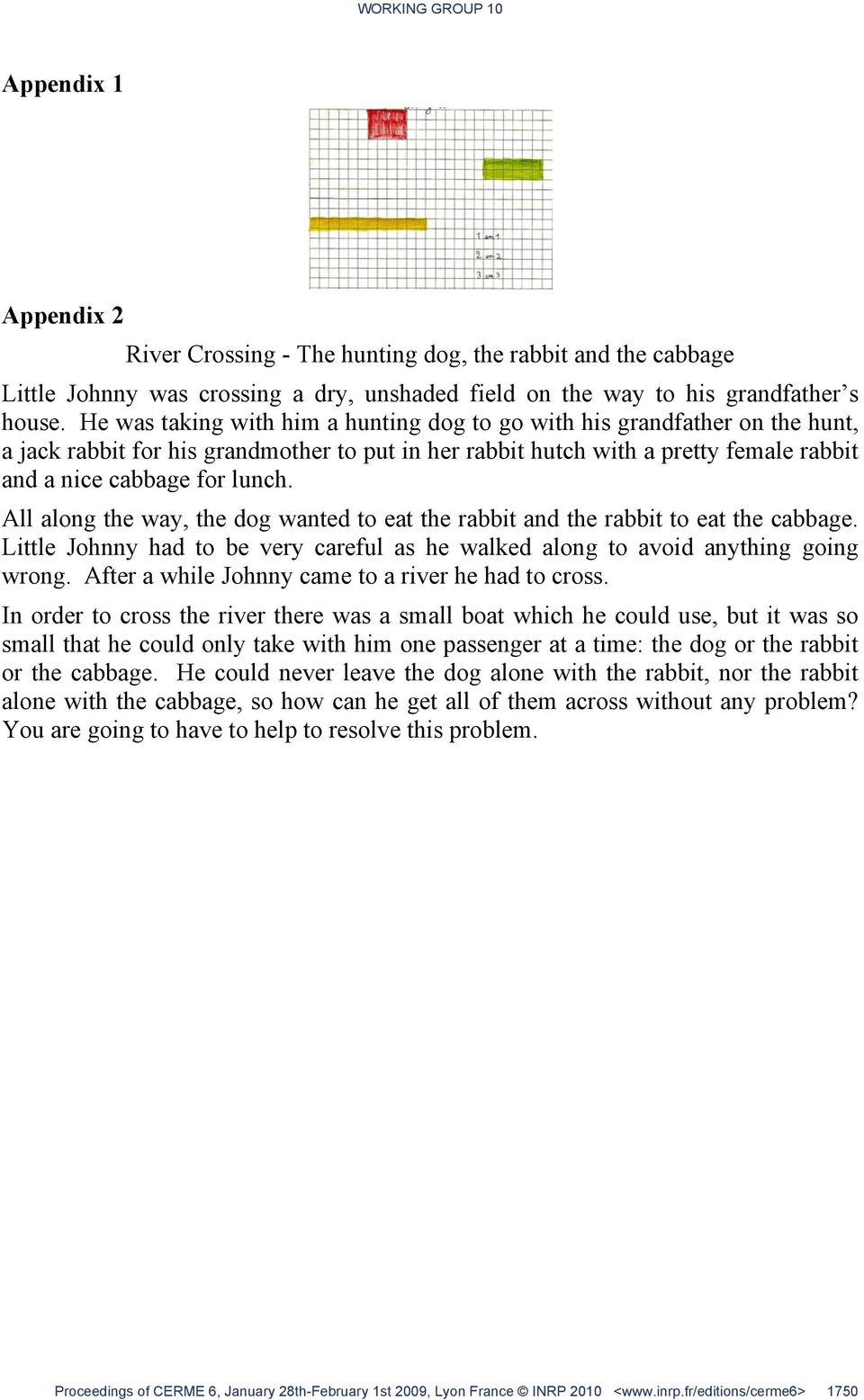
3 The data analysis was organized in case studies. Each one with the characterization of the teacher and school context, namely the teacher s mathematical communication conceptions and practices. These were the reflections of the teachers about the facts and situations that gave added value to social interaction between students and mathematical learning. INTERACTION IN THE CLASSROOM This section shows how the interaction in Laura s classroom evolved from the beginning of the study and throughout the collaborative work. The initial reflections (in the characterization phase) of Laura about the interaction among the students in the classroom, in the class group, seem to reflect conceptions associated with the notion of communication as transmission of information: Normally explaining how they did things, the reasoning, the calculations, but also in relation to the problems. [Interview, December 2006] This presentation of strategies and reasoning is conducted by the teacher, requiring sometimes the participation of the rest of the class. The students were presenting their productions of rectangular panels constructed with twelve paper squares. (Appendix 1): Teacher: Which was the first one that you made together? [The students in the group, up by the blackboard, point to one of their stuck-on designs] Teacher: That one. How did you make this one here? [Points to the first rectangle] Student: Four Teacher: Four. Student: Four, four and four Teacher: Was it like that? Another student: Four, three and three Teacher: And the second one? Student: We made it two by two and four by four. Teacher: Not four. Student: One, two, three, four five, six. Teacher: Ah, and the last one, how was that one? You just said: We have to make three, three, three..., I said, no, you already have three, three, three, ah, of course there is. So we have to make four, four, four, but you already made that here, Ah, of course that s right. So we have to make two, but you already have that here. What did you say to me then? Student: We can make it one by one. [First Year Class, June 2007] The omnipresence of the teacher in the classroom, allied to the monologue of the students, appears to result in an understanding of communication as a way to put forward previously constructed ideas which have been validated by the teacher. Interaction and Exploration of Error. The avoidance of error in the construction of mathematical knowledge seems to be one of the causes of this constant validation of Proceedings of CERME 6, January 28th-February 1st 2009, Lyon France INRP 2010 < 1746

4 the activities of the student by the teacher. As Laura tells us, her main worry in relation to the work of her students was the attempt to avoid error, always to get the thing right [Collaborative Work, October 2007], given that we really love it when they get it right straightaway [Idem]. The reflection, in the collaborative group, on the role of off-the-cuff validation and of error, implied that teachers involved in the study made an effort to try to avoid validation of the activities of their students when group work was taking place. Laura tried to get the students to interact among themselves, in spite of her very much present mediation. As Laura says, despite trying not to interfere so much, the students constantly need her approval, Mine look at me and wait for me to say something, while they are putting questions to each other [Collaborative Work, November 2007]. In the development of this strategy of communication among the students priority was given to presentation of the incomplete or wrong strategies of the students and consequently to the discussion of the mathematical aspects or other causes for the errors put forward. In the problem of the River Crossing (Appendix 2), the teacher opted to begin the discussion with a solution that was incongruent with the conditions of the problem. The student Monica presented the solution of her group, writing: Little Johnny takes the rabbit in the boat. Little Johnny takes the cabbage in his lap and the dog on one side, and they go on their way While the student was writing on the board, some students were waiting with their hands up, as a sign that they wanted to question their colleague. Teacher: There are hands up. The teacher alerted Monica to the questions of her colleague and she ended her presentation and chose one of the other students to ask her a question. After an intervention directed towards the correct solution, one of the students who had identified the incongruency of the resolution with the statement of the problem explained: Teacher: Teacher: The group wrote the cabbage in his lap and the dog on one side but he can only take one animal. Where? In the boat. One thing. But three things went. Yes, but the cabbage can t go on Little Johnny s lap. There can only go the dog or the cabbage, only one thing. [Second Year Class, March 2008] The teacher valued the interaction among the students and passed this conclusion on to the group which was at the blackboard, highlighting the impossibility of more than two passengers in the boat. Faced with this rejection, one of the members of this same group Tiago presented a new proposal for the solution, writing: Proceedings of CERME 6, January 28th-February 1st 2009, Lyon France INRP 2010 < 1747
![it when they get it right straightaway [Idem].](/docs-images/45/6674479/images/page_4.jpg "The reflection, in the collaborative group, on the role of off-the-cuff validation and of error, implied that teachers involved in the study made an effort to try to avoid validation of the")
5 First goes the dog [the students become agitated because they consider what their colleagues wrote to be wrong]. Second goes the cabbage. And last goes the rabbit. Gonçalo, observing the solution written by Tiago, says: I know what s wrong. Teacher: So go up there Gonçalo. Go to the blackboard and say what s wrong. Gonçalo went up to the blackboard and put his reasons to Tiago. Teacher: Tiago, stay there to defend yourself. The dog can t go first, because if Little Johnny took the dog. If Little Johnny crossed the river with the dog, then the rabbit would eat the cabbage [idem] The comments of the teacher were intended to promote the interaction between the students There are hands up and to encourage the justification of student reasons - stay there to defend yourself. This attitude of this teacher promoted a greater interaction between the students in the classroom. Interaction and Teaching and Learning. Laura recognizes and values the students change in attitude towards communication by the students, emphasizing that they have also changed their attitude in the other subject areas: I try to get them communicating among themselves, no matter what the subject is. [Meeting of the Teacher with the Researcher, April 2008] This attitude of the students also appears to be related to a significant change of the teacher s attitude in the classroom, in particular with regard to her expectations about students: I bide my time, I wait, listening more carefully, because at times what they say is important, although sometimes it isn t. [Idem] This seems to have contributed to a greater autonomy of the students in the learning and construction of knowledge: [The students] are more at ease, they have a different dynamism. They participate more. They are more attentive to what they are doing. [Idem] The development of communication and interaction among the students has changed the way of working in the classroom. As Laura says, we are working at a deeper level because there s more discussion. [Idem] SOME FINAL CONSIDERATIONS The teacher s practice in relation to the interaction among the students is initially associated with the valorisation of the attitude of exposition of their activities according to the role of the teacher in explaining mathematical concepts. Teachers were involved in reflecting on their classroom practices in mathematics. With this reflection they began to give more importance to the role of error in mathematics learning, and to allowing students to interact with their peers. This led to increase the interaction among students, either mediated by teachers or not. Proceedings of CERME 6, January 28th-February 1st 2009, Lyon France INRP 2010 < 1748

6 REFERENCES Ball, D. (2003). What mathematical knowledge is needed for teaching mathematics? Paper presented at the U.S. Department of Education, Secretary's Mathematics Summit, Washington, DC, February 6, 2003 (File PDF) Belchior, F. (2003). Pedagogia, comunicação e existência. Revista Portuguesa de Pedagogia, ano 37, nº 3, Boavida, A. & Ponte, J. (2002). Investigação Colaborativa: Potencialidades e problemas. GTI (Orgs) Reflectir e Investigar sobre a prática profissional (pp ). Lisboa: Associação de Professores de Matemática. Bogdan, R. & Biklen, S. (1994). Investigação Qualitativa em Educação. Porto: Porto Editora. Brendefur, J. & Frykholm, J. (2000). Promoting Mathematical Communication in the Classroom: Two preservice teachers conceptions and practices. Journal of Mathematics Teacher Education, 3, Chapman, O. (2004). Facilitating peer interactions in learning mathematics: teachers practical knowledge. Proceedings of the 28th Conference of the International: Group for the Psychology of Mathematics Education, (File PDF) Cruz, G. & Martinón, A. (1998). Interacción y construcción significativa del conocimiento: notas teóricas y una práctica educativa. UNO. Revista de Didáctica de las Matemáticas, nº 16, (file PDF, 1-13). Elbaz, F. (1983). Teacher thinking: a study of practical knowledge. New York, NY: Nichols Publishing Company Godino, J., & Llinares, S. (2000). El Interaccionismo Simbólico en Educación Matemática. Revista Educación Matemática, Vol. 12, nº 1, Sierpinska, A. (1998). Three epistemologies, three views of classroom communication: Constructivism, sociocultural approaches, interactionism. In H. Steinbring, M. G. B. Bussi, & A. Sierpinska (Eds.), Language and communication in the mathematics classroom (pp ). Reston, VA: NCTM. Stake, R. (1994). Case studies. In. Dezin, N. & Lincoln, Y. (Eds.) Handbook of qualitative research. Londres: Sage Publications. Yackel, E. (2000). Creating a Mathematics Classroom Environment that Fosters the Development of Mathematical Argumentation. [On-line] Available in Yin, R. (1989). Case study research: Design and methods. Londres: Sage Publications. Proceedings of CERME 6, January 28th-February 1st 2009, Lyon France INRP 2010 < 1749

7 Appendix 1 Appendix 2 River Crossing - The hunting dog, the rabbit and the cabbage Little Johnny was crossing a dry, unshaded field on the way to his grandfather s house. He was taking with him a hunting dog to go with his grandfather on the hunt, a jack rabbit for his grandmother to put in her rabbit hutch with a pretty female rabbit and a nice cabbage for lunch. All along the way, the dog wanted to eat the rabbit and the rabbit to eat the cabbage. Little Johnny had to be very careful as he walked along to avoid anything going wrong. After a while Johnny came to a river he had to cross. In order to cross the river there was a small boat which he could use, but it was so small that he could only take with him one passenger at a time: the dog or the rabbit or the cabbage. He could never leave the dog alone with the rabbit, nor the rabbit alone with the cabbage, so how can he get all of them across without any problem? You are going to have to help to resolve this problem. Proceedings of CERME 6, January 28th-February 1st 2009, Lyon France INRP 2010 < 1750
of knowledge that is characteristic of the profession and is taught at professional schools. An important author in establishing this notion was
 Mathematics teacher education and professional development João Pedro da Ponte [email protected] Grupo de Investigação DIFMAT Centro de Investigação em Educação e Departamento de Educação Faculdade de Ciências
MATHEMATICS KNOWLEDGE FOR TEACHING WITHIN A FUNCTIONAL PERSPECTIVE OF PRESERVICE TEACHER TRAINING
 MATHEMATICS KNOWLEDGE FOR TEACHING WITHIN A FUNCTIONAL PERSPECTIVE OF PRESERVICE TEACHER TRAINING Pedro Gómez Universidad de Granada C/. Alisios 17, Albolote 18820, Spain Phone/Fax: (34)958537304 [email protected]
TECHNOLOGY AND SEMIOTIC REPRESENTATIONS IN LEARNING MATHEMATICS. Jose Luis Lupiáñez Gómez University of Cantabria, Spain. Abstract
 1 TECHNOLOGY AND SEMIOTIC REPRESENTATIONS IN LEARNING MATHEMATICS Jose Luis Lupiáñez Gómez University of Cantabria, Spain Abstract New technologies modify the socioculturals environments. The educational
GOGOT SUHARWOTO AND MAGGIE NIESS Oregon State University Corvallis, OR USA [email protected] and [email protected]
 How Do Subject Specific Teacher Preparation Program that Integrate Technology Throughout the Courses Support the Development of Mathematics Preservice Teachers' TPCK (Technology Pedagogical Content Knowledge)?
Onsite Peer Tutoring in Mathematics Content Courses for Pre-Service Teachers
 IUMPST: The Journal. Vol 2 (Pedagogy), February 2011. [www.k-12prep.math.ttu.edu] Onsite Peer Tutoring in Mathematics Content Courses for Pre-Service Teachers Elaine Young Associate Professor of Mathematics
AN APPROACH TO THE DEVELOPMENT OF PRE-SERVICE MATHEMATICS TEACHERS PROFESSIONAL NOTICING OF STUDENTS MATHEMATICAL THINKING
 12 th International Congress on Mathematical Education Program Name XX-YY-zz (pp. abcde-fghij) 8 July 15 July, 2012, COEX, Seoul, Korea (This part is for LOC use only. Please do not change this part.)
THE EFFECT OF MATHMAGIC ON THE ALGEBRAIC KNOWLEDGE AND SKILLS OF LOW-PERFORMING HIGH SCHOOL STUDENTS
 THE EFFECT OF MATHMAGIC ON THE ALGEBRAIC KNOWLEDGE AND SKILLS OF LOW-PERFORMING HIGH SCHOOL STUDENTS Hari P. Koirala Eastern Connecticut State University Algebra is considered one of the most important
A reflective teaching practice experience: a case study
 A reflective teaching practice experience: a case study Bertha Paredes Zepeda Hilda Hidalgo Avilés Universidad Autónoma del Estado de Hidalgo Abstract This paper aims to share an experience of how students,
THE LEARNING PORTFOLIO AS AN ASSESSMENT STRATEGY IN TEACHER EDUCATION
 THE LEARNING PORTFOLIO AS AN ASSESSMENT STRATEGY IN TEACHER EDUCATION Pilar Azcárate, Anna Serradó and José Mª Cardeñoso University of Cádiz; Secondary Education Teacher; University of Granada Abstract
A Self and Peer Assessment Intervention in Mathematics Content Courses for Pre-Service Elementary School Teachers Xin Ma, Richard Millman, Matt Wells
 A Self and Peer Assessment Intervention in Mathematics Content Courses for Pre-Service Elementary School Teachers Xin Ma, Richard Millman, Matt Wells University of Kentucky Introduction We explored in
Integrating Technology in Teaching and Teacher Education: Implications for Policy and Curriculum Reform Dr. Charalambos Vrasidas Dr. Marina S.
 Vrasidas & McIsaac 1 Integrating Technology in Teaching and Teacher Education: Implications for Policy and Curriculum Reform Dr. Charalambos Vrasidas Dr. Marina S. McIsaac About the Authors Dr. Charalambos
METAPHORS IN MATHEMATICS CLASSROOMS: ANALYZING THE DYNAMIC PROCESS OF TEACHING AND LEARNING OF GRAPH FUNCTIONS.
 METAPHORS IN MATHEMATICS CLASSROOMS: ANALYZING THE DYNAMIC PROCESS OF TEACHING AND LEARNING OF GRAPH FUNCTIONS. Janete Bolite Frant PUC-SP; Jorge Acevedo UB &Vicenç Font UB Abstract: The purpose of this
EXPLORING LESSON STUDY IN TEACHER PREPARATION
 EXPLORING LESSON STUDY IN TEACHER PREPARATION Maria L. Fernández Florida State University Prospective secondary mathematics teachers continue to lack images of reformed teaching. This investigation studied
A Cross-Case Analysis of How Faculty Connect Learning in Hybrid Courses
 A Cross-Case Analysis of How Faculty Connect Learning in Hybrid Courses Karen Skibba University of Wisconsin-Milwaukee Keywords: Hybrid Courses, Dimensions of Learning, Case Studies Abstract: This qualitative,
A Math Talk Community in Math Expressions Common Core
 hmhco.com BUILDING A New Standard OF Success A Math Talk Community in Math Expressions Common Core Dr. Karen Fuson, Program Author of Math Expressions Common Core and Professor Emerita of Learning Sciences,
Mathematical Knowledge as a Social Construct of Teaching- / Learning Processes The Epistemology Oriented Mathematical Interaction Research
 Mathematical Knowledge as a Social Construct of Teaching- / Learning Processes The Epistemology Oriented Mathematical Interaction Research Heinz Steinbring, Universität Duisburg-Essen, Campus Essen 1)
LEVEL 1 LICENSURE PORTFOLIO
 LEVEL 1 LICENSURE PORTFOLIO Part I Purpose Principles to Be Addressed Required Documentation Directions Entry 1: Analyzing the School Counseling Environment Candidates analyze the school counseling environment
MOBILE LEARNING WITH CELL PHONES AND MOBILE FLICKR: ONE EXPERIENCE IN A SECONDARY SCHOOL
 MOBILE LEARNING WITH CELL PHONES AND MOBILE FLICKR: ONE EXPERIENCE IN A SECONDARY SCHOOL Adelina Moura University of Minho Gualtar, Braga, Portugal [email protected] Ana Amélia Carvalho University of
INTRODUCING THE NORMAL DISTRIBUTION IN A DATA ANALYSIS COURSE: SPECIFIC MEANING CONTRIBUTED BY THE USE OF COMPUTERS
 INTRODUCING THE NORMAL DISTRIBUTION IN A DATA ANALYSIS COURSE: SPECIFIC MEANING CONTRIBUTED BY THE USE OF COMPUTERS Liliana Tauber Universidad Nacional del Litoral Argentina Victoria Sánchez Universidad
A Case Study of Classroom Management on Wireless- Based Learning by Tablet PC
 A Case Study of Classroom Management on Wireless-Based Learning by Tablet PC A Case Study of Classroom Management on Wireless- Based Learning by Tablet PC Shinn-Rong Lin Graduate Institute of Learning
DW Radio Learning by Ear Computers and the Internet Programme 6 Richard Lough Konstanze von Kotze
 LBE Computers and the Internet Programme 6 Author: Richard Lough, Konstanze von Kotze Editor: Maja Dreyer Characters: Beatrice (teenaged girl), John (teenaged boy), Computer (Computer voice), Internet
English Teacher Education: The Need for a New Perspective
 Revista Alicantina de Estudios Ingleses 4 (1991): 71-76 English Teacher Education: The Need for a New Perspective Celia Floren Serrano Universidad de Zaragoza ABSTRACT The paper explores the drawbacks
Analyzing Qualitative Data
 Analyzing Qualitative Data The purpose of coding qualitative data is to take an overwhelmingly large amount of words or artifacts and organize them into manageable chunks. Following the steps in this outline
PROFESSIONAL DEVELOPMENT: A VISION FOR SAUDI SCIENCE TEACHERS
 PROFESSIONAL DEVELOPMENT: A VISION FOR SAUDI SCIENCE TEACHERS Hiya Almazroa Pringcess Noura Bint Abdulrahman University, Saudi Arabia Abstract: Professional development is a significant mechanism for maintaining
COSMETIC SURGERY UNIT OVERVIEW. Authors Introduction Go to impactseries.com/issues to listen to Joseph s unit introduction.
 UNIT 1 COSMETIC SURGERY UNIT OVERVIEW In this unit, students will: T Read and listen to the conversation between Ayu and her mother. Answer open-ended comprehension questions to show understanding of the
Differentiated Instruction: Are University Reading Professors Implementing It?
 45 The Reading Matrix 2010 Volume 10, Number 1, April 2010 Differentiated Instruction: Are University Reading Professors Implementing It? Thea Hayes Williams-Black The University of Mississippi Jennifer
Taking the Lead Role in Intern Supervision: The Mentor Teacher Intern Project
 Perspectives in Learning: A Journal of the College of Education & Health Professions Volume 11, Number 1, Spring 2010 Columbus State University Taking the Lead Role in Intern Supervision: The Mentor Teacher
How To Be A Successful Leader
 Leadership Development Program (Level I and Level II) PR O GR A M OV ER V IE W Our Leadership Development Programs (LDP Level I and Level II) are designed to address the development needs of managers and
Marketing oneself: what do small business owners look for when interviewing job candidates?
 Marketing oneself: what do small business owners look for when interviewing job candidates? ABSTRACT Monica L. Law Marywood University The focus of this paper is aimed at helping job candidates market
March/April 2015. In This Issue. Book Review: What the Best College Teachers Do. Page 1
 March/April 2015 Welcome to the CETL s Insider newsletter that contains tech tips, teaching resources, and a schedule of events. The mission of the CETL is to promote excellence in teaching, to assist
Developing Critical Thinking Skills with The Colbert Report
 Developing Critical Thinking Skills with The Colbert Report Why Teach Critical Thinking with The Colbert Report? A. Young people receive the majority of their information through popular culture. B. Using
STUDENT HANDBOOK. Master of Education in Early Childhood Education, PreK-4 and Early Childhood Education Certification Programs
 Master of Education in Early Childhood Education, PreK-4 and Early Childhood Education Certification Programs STUDENT HANDBOOK Lincoln University Graduate Education Program 3020 Market Street Philadelphia,
Cognitive Acceleration /Let s Think
 Cognitive Acceleration /Let s Think Programmes for developing high-level thinking What s in a name? Cognitive Acceleration is a good description of the programmes which accelerate the development of students
ABSTRACT Changing Teacher Education - A Competencies Benchmarking of Nurse Teachers
 ABSTRACT Changing Teacher Education - A Competencies Benchmarking of Nurse Teachers This paper is based on a book which focuses a research about the paradigm change in higher education and the emergence
Using the Creative Arts to Develop Critical Thinking Skills: Examining the Qualitative Method of Ethnography
 Velde, Critical Thinking and Clinical Reasoning in the Health Sciences, Facione and Facione (eds.), California Academic Press. 1 Measuring Thinking Worldwide This document is a best practices essay from
STORIES AT THE SPOT DESIGNERS LEARNING FROM CAREGIVERS OF CHILDREN WITH AUTISM
 /////////////////////////////////////////////////////////////////////////////////////////////////////////////////////////////////// STORIES AT THE SPOT DESIGNERS LEARNING FROM CAREGIVERS OF CHILDREN WITH
Active methodology in the Audiovisual communication degree
 Available online at www.sciencedirect.com Procedia Social and Behavioral Sciences 2 (2010) 4487 4491 WCES-2010 Active methodology in the Audiovisual communication degree J.L Gimenez-Lopez a *, T. Magal
ICT in pre-service teacher education in Portugal: trends and needs emerging from a survey
 Interactive Educational Multimedia, Number 11 (October 2005), pp. 153-167 http://www.ub.es/multimedia/iem ICT in pre-service teacher education in Portugal: trends and needs emerging from a survey João
Strong Answers to Top 10 Interview Questions
 Strong Answers to Top 10 Interview Questions: The sooner a candidate can work their way into a regular conversation versus a question and answer period, the more likely they are to land the job. The conversation
Module 6: How to Write the Book
 Module 6: How to Write the Book Okay, guys. Katrina Starzhynskaya here, and lesson 6, how to actually write the book: time frame, where to get your ideas from, and how to get inspired. Let s begin. Time
EVALUATING A FOREIGN LANGUAGE IN PRIMARY EDUCATION
 REVISTTA ELLECTTRÓNI ICA INTTERNACI I IONALL ISSN I 11557766- -77880099 EVALUATING A FOREIGN LANGUAGE IN PRIMARY EDUCATION Plácido Bazo University of La Laguna [email protected] Marcos Peñate University
STUDENTS DIFFICULTIES WITH APPLYING A FAMILIAR FORMULA IN AN UNFAMILIAR CONTEXT
 STUDENTS DIFFICULTIES WITH APPLYING A FAMILIAR FORMULA IN AN UNFAMILIAR CONTEXT Maureen Hoch and Tommy Dreyfus Tel Aviv University, Israel This paper discusses problems many tenth grade students have when
What are the Effects of Comprehensive Developmental Guidance Programs on Early Elementary Students Academic Achievement?
 School Counseling Research Brief 2.2, February 15, 2004 Center for School Counseling Outcome Research What are the Effects of Comprehensive Developmental Guidance Programs on Early Elementary Students
CHAPTER III METHODOLOGY. The purpose of this study was to describe which aspects of course design
 CHAPTER III METHODOLOGY The purpose of this study was to describe which aspects of course design and/or instruction are more effective and successful in the online environment than in the face-to-face
Creative Education and New Learning as Means of Encouraging Creativity, Original Thinking and Entrepreneurship
 Creative Education and New Learning as Means of Encouraging Creativity, Original Thinking and Entrepreneurship Abstract: by Mirjana Radovic-Markovic Lecturer, Dusan Markovic Fellow, World Academy of Art
Teaching and Managing a Project-based English Course to the College Students in Diverse Levels of English Proficiency
 Teaching and Managing a Project-based English Course to the College Students in Diverse Levels of English Proficiency Yoshihiko Yamamoto, Syuhei Kimura Ritsumeikan University, Japan 0429 The Asian Conference
Activity 4: Planning an Extension Lesson on Energy Using the 5E Model
 Activity 4: Planning an Extension Lesson on Energy Using the 5E Model 1 Suggested Pre-Planning Questions 1. What is the Big Idea? 2. What are your essential questions? 3. What approach will you use in
Required Online Subscription Brainpop.com. Subscriptions will be provided in class (will be used in science methods, too).
 Elementary Math Methods 02.551 Course Syllabus Fall 2013 Wednesdays, 9 a.m. - 11:30 a.m. and Web-enhanced O'Leary Library 513 and Murkland School, Lowell Instructors: Dr. Michelle Scribner-MacLean ([email protected])
PRESERVICE ELEMENTARY TEACHERS UNDERSTANDING OF GREATEST COMMON FACTOR STORY PROBLEMS. Kristin Noblet University of Northern Colorado
 PRESERVICE ELEMENTARY TEACHERS UNDERSTANDING OF GREATEST COMMON FACTOR STORY PROBLEMS Kristin Noblet University of Northern Colorado Little is known about preservice elementary teachers mathematical knowledge
My Philosophy of Instructional Technology. University of Alabama. School of Education AIL 601. Dr. A. Benson. November 23, 2011
 Running head: My Philosophy of Instructional Technology 1 My Philosophy of Instructional Technology University of Alabama School of Education AIL 601 Dr. A. Benson November 23, 2011 Running head: My Philosophy
Early Childhood Education. Early Education Practicum Manual ECED 460/465 Theory and Practice
 Vanguard University School of Education Early Childhood Education Early Education Practicum Manual ECED 460/465 Theory and Practice And whatever you do, do it heartily, as to the Lord and not to men, knowing
PLAY STIMULATION CASE STUDY
 PLAY STIMULATION CASE STUDY AIMS Play stimulation work contributes towards the following 2003-2006 PSA targets: Improving social and emotional development, and Improving learning. With regard to PSA targets
Assessing Online Asynchronous Discussion in Online Courses: An Empirical Study
 Assessing Online Asynchronous Discussion in Online Courses: An Empirical Study Shijuan Liu Department of Instructional Systems Technology Indiana University Bloomington, Indiana, USA [email protected]
Teaching Dossier (2007) LAURA KERR. Queen s University School of Nursing, Faculty of Health Sciences
 1 Teaching Dossier (2007) Of LAURA KERR Queen s University School of Nursing, Faculty of Health Sciences 2 CONTENTS 1. Brief Biography 2. Teaching Philosophy 3. Teaching Responsibilities 3.1 Nurs 315 3.2
California Treasures High-Frequency Words Scope and Sequence K-3
 California Treasures High-Frequency Words Scope and Sequence K-3 Words were selected using the following established frequency lists: (1) Dolch 220 (2) Fry 100 (3) American Heritage Top 150 Words in English
WHAT KEEPS TEACHING GOING? MOTIVATION AND ATTITUDES. Institution and country: Universitat Autònoma de Barcelona, Spain
 WHAT KEEPS TEACHING GOING? MOTIVATION AND ATTITUDES Name of author: Mercè BERNAUS E-mail address: [email protected] Institution and country: Universitat Autònoma de Barcelona, Spain Target audience
Adult English Language Learners and Learning Disabilities
 PART IV: TOPICS IN ADULT ESL EDUCATION & FAMILY LITERACY Adult English Language Learners and Learning Disabilities Some adult English language learners experience difficulty in making expected progress
During a meeting with a variety of education stakeholders about early career
 Commentary Shifting Teacher Education From Skilling Up to Sustaining Beginning Teachers C. Aiden Downey, Lee Schaefer, and D. Jean Clandinin ABSTRACT Early career teacher attrition is a serious concern.
Kangourou Italia - British Institutes Gara del 2 marzo 2010 Categoria Wallaby Per studenti della classe terza della Scuola Secondaria di Primo Grado
 Testi_Kang_10ENG.qxp 8-01-2010 22:38 Pagina 10 Kangourou Italia - British Institutes Gara del 2 marzo 2010 Categoria Per studenti della classe terza della Scuola Secondaria di Primo Grado Choose the correct
SIGNATURE OF COUNTY ADMINISTRATOR OR CHIEF ADMINISTRATIVE OFFICER
 APPLICATION FORM All applications must include the following information. Separate applications must be submitted for each eligible program. Deadline: June 1, 2015. Please include this application form
School-Based Health Education Standards:
 School-Based Health Education Standards: Accessing Valid Health Information (A.V.I.) Interpersonal Communication (I.C.) California Healthy Kids Resource Center (C.H.K.R.C.) Hello. This is the third module
Consumer s Guide to Research on STEM Education. March 2012. Iris R. Weiss
 Consumer s Guide to Research on STEM Education March 2012 Iris R. Weiss Consumer s Guide to Research on STEM Education was prepared with support from the National Science Foundation under grant number
Teachers - Refuting Invalid Claims and justifying Them in Mathematics
 MATHEMATICS TEACHERS REASONING FOR REFUTING STUDENTS INVALID CLAIMS Despina Potari*, Theodossios Zachariades* and Orit Zaslavsky** *University of Athens, ** Technion - Israel Institute of Technology This
ANGLOGERMANICA ONLINE 2005. Llinares García, Ana: The effect of teacher feedback on EFL learners functional production in classroom discourse
 The effect of teacher feedback on EFL learners functional production in classroom discourse Ana Llinares García, Universidad Autónoma de Madrid (Spain) Index 1 Introduction 2 Methodology of the study 3
RUNNING HEAD: INSTRUCTIONAL DESIGN AND PEDOGIGCAL ISSUES. Instructional Design and Pedagogical Issues with Web 2.0 Tools
 Instructional Design 1 RUNNING HEAD: INSTRUCTIONAL DESIGN AND PEDOGIGCAL ISSUES Instructional Design and Pedagogical Issues with Web 2.0 Tools Amelia W. Cheney Robert L. Sanders Nita J. Matzen John H.
Does your dog bite? Creating Good Questions for Online Discussions
 International Journal of Teaching and Learning in Higher Education 2006, Volume 18, Number 2, 150-154 http://www.isetl.org/ijtlhe/ ISSN 1812-9129 Does your dog bite? Creating Good Questions for Online
An Investigation on Learning of College Students and the Current Application Situation of the Web-based Courses
 2011 International Conference on Computer Science and Information Technology (ICCSIT 2011) IPCSIT vol. 51 (2012) (2012) IACSIT Press, Singapore DOI: 10.7763/IPCSIT.2012.V51.127 An Investigation on Learning
Study program International Communication (120 ЕCTS)
 Study program International Communication (120 ЕCTS) Faculty Cycle Languages, Cultures and Communications Postgraduate ECTS 120 Offered in Skopje Description of the program The International Communication
Modifying Formative Evaluation Techniques For Distance Education Class Evaluation
 Turkish Online Journal of Distance Education-TOJDE October 2005 ISSN 1302-6488 Volume: 6 Number: 4 Article: 1 Modifying Formative Evaluation Techniques For Distance Education Class Evaluation ABSTRACT
Study of Challenges and Support Structures for Beginning Mathematics and Science Teachers
 Study of Challenges and Support Structures for Beginning Mathematics and Science Teachers Kathryn B. Chval Patricia Friedrichsen Dawn Teuscher University of Missouri-Columbia The Problem: Teacher Shortages
Shared Solutions: An Overview Special Education Policy and Programs Branch Ministry of Education
 Shared Solutions: An Overview Special Education Policy and Programs Branch Ministry of Education Table of Contents 1. Shared Solutions: Overview 2. Understanding Conflict 3. Preventing Conflicts 4. Video:
Which Has More? by Marilyn Burns From Online Newsletter Issue Number 3, Fall 2002
 Which Has More? by Marilyn Burns From Online Newsletter Issue Number 3, Fall 2002 Lessons for Introducing Multiplication, Grade 3 is a revision that replaces Multiplication, Grade 3, the Math By All Means
Complete List of Behavioral Interview Questions. Interviewing. by Alex Rudloff
 Complete List of Behavioral Interview Questions Interviewing by Alex Rudloff Behavioral Interviewing, a style of interviewing that is increasing in popularity due to its effectiveness, can be an intimidating
CEHD ipad Initiative YEAR TWO REPORT FALL 2011 SPRING 2012. Treden Wagoner, M.A.Ed. Anne Schwalbe Sheila Hoover, Ph.D. David Ernst, Ph.D.
 CEHD ipad Initiative YEAR TWO REPORT FALL 2011 SPRING 2012 Treden Wagoner, M.A.Ed. Anne Schwalbe Sheila Hoover, Ph.D. David Ernst, Ph.D. 2 Mobile Learning learning within various contexts and locations
The Early Childhood Collaborative: A Professional Development Model to Communicate and Implement the Standards
 The Early Childhood Collaborative: A Professional Development Model to Communicate and Implement the Standards Juanita V. Copley University of Houston Angela Garcia is a first grade teacher in a large
Integrating Technology into the Classroom Trevor Moore Western Oregon University ED 633
 Integrating Technology into the Classroom Trevor Moore Western Oregon University ED 633 Introduction Integrating the use of technology into everyday lessons can be very beneficial for student achievement.