
Product and Pricing Overview for Service Providers
|
|
|
- Hannah Lucas
- 10 years ago
- Views:
Transcription
1 NBN Co Wholesale Access Service Product and Pricing Overview for Service Providers December 2011 NBN Co Limited (ACN )

2 NBN Co Limited Product and Pricing Overview for Service Providers December 2011 Version 2.0 Copyright This document is subject to copyright and must not be used except as permitted below or under the Copyright Act 1968 (Cth). You must not reproduce or publish this document in whole or in part for commercial gain without the prior written consent of NBN Co. You may reproduce and publish this document in whole or in part for educational or non-commercial purposes as approved by NBN Co in writing. Disclaimer NBN Co confidential information. This document is provided for information purposes only. The recipient must not use this document other than with the consent of NBN Co and must make their own inquiries as to the currency, accuracy and completeness of this document and the information contained in it. The contents of this document should not be relied upon as representing any requirement of NBN Co or NBN Co s final position on the subject matter of this document. Any views expressed by NBN Co in this document and any technical connection requirements may change including as a consequence of advances in technologies, or legislative and regulatory developments. NBN Co does not warrant that the processes and information outlined in this document comply with all (or any) laws, codes of practice or standards. The recipient must exercise its own judgment as to how best to perform the activities described in this document in a safe way, and so as to meet the requirements of all applicable laws, codes of practice and standards. Copyright 2011 NBN Co Limited. All rights reserved. Not for general distribution. Environment NBN Co asks that you consider the environment before printing this document. Revision History Version Date Description 1 December 2010 First release of Product and Pricing documentation. Release to market. 2 December 2011 Updated Release

3 Contents 1 About this Document Features and Benefits Product and Pricing Tool Kit Product Components Providing Services on the NBN: Overview Connecting Your Network to the NBN Facilities Access Network-Network Interface Port Building Capacity in each Area Connectivity Virtual Circuit Multicast Domain (Fibre Only) Connecting Your End Users User Network Interface Access Virtual Circuit Multicast Access Virtual Circuit Additional Product Features Traffic Classes Enhanced Service Levels Pricing Summary Service Provider Case Studies Where and When Geographic Availability Fibre Rollout Plans Wireless Rollout Plans Satellite Rollout Plans Product Fact Sheets NBN Co Fibre Access Service Fact Sheet Components Conditions and Features NBN Co Wireless Access Service Fact Sheet Components Conditions and Features Interim Satellite Service Fact Sheet Components Conditions and Features Long Term Satellite Service Fact Sheet Components Conditions and Features... 43

4 7 Roadmap Product Development Forum Customer Operations Connecting at the End User Premises Standard Installation Fibre Connection Wireless Connection Interim Satellite Connection Migrations (Type 1) (Fibre Only) New Connections (Type 2) Priority Assist Connection Service Levels (Fibre Only) Non-Standard Installation Services Service Experience Standard Assurance Service Levels Priority Assist Assurance Service Levels (Fibre Only) Proactive monitoring Network Availability Targets Security Isolation of Traffic Between Service Providers Isolation of Traffic Between End Users User Authentication Network Neutrality Billing and Payments Appendix A NBN Co Fibre Access Service A.1 Wholesale Product Description A.1.1 Fibre Ethernet Bitstream Service A.1.2 Traffic Classes A.1.3 Telephony Capability A.1.4 Battery Backup for User Network Interface Voice ports A.1.5 Multicast A.1.6 Business and Enterprise Services A.1.7 Service Operations, Administration, Maintenance and Reporting A.1.8 Physical Interconnection Arrangements A.2 Fair Use Policy A.3 Product Pricing A.3.1 User Network Interface A.3.2 Access Virtual Circuit A.3.3 Connectivity Virtual Circuit and Credits A.3.4 Network-Network Interface A.3.5 Multicast A.3.6 Business and Enterprise Ethernet Services Appendix B NBN Co Wireless Access Service B.1 Wholesale Product Description B.1.1 Ethernet Bitstream Services... 89

5 B.1.2 Traffic Classes B.1.3 Telephony Capability B.1.4 Battery Backup for Services Provided Over the User Network Interface Voice Port B.1.5 Multicast B.1.6 Business and Enterprise Services B.1.7 Service Operations, Administration and Maintenance and Reporting B.1.8 Physical Interconnection Arrangements B.2 Wireless-Specific Features B.2.1 Coverage - Service Locations B.2.2 Wireless First Release Locations: B.3 Fair Use Policy B.4 Product Pricing B.4.1 User Network Interface B.4.2 Access Virtual Circuit B.4.3 Connectivity Virtual Circuit B.4.4 Network-Network Interface B.4.5 Multicast B.4.6 Business and Enterprise Services Appendix C Satellite Access Service (Interim Satellite Service) C.1 Wholesale Product Description C.1.1 Internet Protocol (IP) Layer 3 Access Service C.1.2 Traffic Classes C.1.3 Telephony Capability C.1.4 Battery Backup C.1.5 Multicast C.1.6 Business and Enterprise Services C.1.7 Service Operational, Administration, Maintenance and Reporting C.1.8 Physical Interconnection Arrangements C.2 Satellite Specific Features C.2.1 Service Locations and Eligibility C.2.2 Ordering C.2.3 Performance Enhancing Protocols - PEP C.2.4 Availability C.2.5 Service Levels C.2.6 Service Provider Limits and Aggregators C.3 Fair Use Policy C.4 Product Pricing C.4.1 User Network Interfaces C.4.2 Access Virtual Circuit C.4.3 Connectivity Virtual Circuit C.4.4 Network-Network Interface C.4.5 Multicast C.4.6 Business and Enterprise Services
6 Appendix D Satellite Access Service (Long Term Satellite Service) D.1 Wholesale Product Description D.1.1 Long Term Satellite Ethernet bitstream Service D.1.2 Traffic Classes D.1.3 Telephony Capability D.1.4 Battery Backup D.1.5 Multicast D.1.6 Business and Enterprise Services D.1.7 Service Operational, Administration, Maintenance and Reporting D.1.8 Physical Interconnection Arrangements D.2 Long Term Satellite Specific Features D.2.1 Service Locations and Eligibility D.2.2 Long Term Satellite Coverage Area D.2.3 Ordering D.2.4 Performance Enhancing Protocols D.2.5 Availability D.2.6 Service Levels D.2.7 Redundancy D.2.8 Redundancy in the satellite hub infrastructure D.2.9 Encryption D.2.10 Dish Sizes D.3 Fair Use Policy D.4 Product Pricing D.4.1 User Network Interfaces D.4.2 Access Virtual Circuit D.4.3 Connectivity Virtual Circuit D.4.4 Network-Network Interface D.4.5 Multicast D.4.6 Business and Enterprise Services Appendix E Facilities Access E.1 Features and Benefits E.2 Product Components E.2.1 Cross-Connect Service E.2.2 Co-Location Service E.2.3 Optical Distribution Frame Termination Point E.3 Wholesale Product Catalogue E.3.1 NBN Co-location E.3.2 Cross Connect E.3.3 Optical Distribution Frame Termination E.4 Connection Scenarios E.4.1 Basic Interconnection to External Fibre E.4.2 Basic Interconnection to Another Service Provider E.4.3 Active Interconnection to External Fibre E.4.4 Active Interconnection to Another Service Provider

7 Appendix F Ancillary Charges F.1 Ancillary Services by NBN Co F.1.1 Installation Charges F.1.2 Service Modification F.1.3 Service Maintenance F.2 Travel Charges Dictionary Figures Figure 1 NBN Co Access Product Components (Fibre Network Termination Device Shown) Figure 2 Implementing Product Offerings Figure 3 Coverage Map Figure 4 Fibre Access Service Components Figure 5 Wireless Access Service Components Figure 6 Interim Satellite Service Components Figure 7 Long Term Satellite Service Components Figure 8 Product and Feature Roadmap Figure 9 Fibre Connection to a Premises (Overhead) Figure 10 Fibre Connection to a Premises (Underground) Figure 11 Fibre Network Termination Device Figure 12 Wireless Connection to a Premises Figure 13 Wireless Network Termination Device Figure 14 Example of an Interim Satellite Service Installation Figure 15 Interim Satellite Network Termination Device Figure 16 Interim Satellite Installation and Maintenance Zones Figure 17 Wholesale Network Boundary and Points of Hand Off Figure 18 Multicast Replication Figure 19 Ethernet Bitstream Service Structure Figure 20 NBN Co Wireless Access Service Coverage Map Figure 21 NBN Co Interim Satellite Service Access Service Internet Protocol Structure Figure 22 Locations serviced by NBN Co Interim Satellite Service Figure 23 NBN Co Long Term Satellite Service Ethernet Bitstream Service Figure 24 Long Term Satellite Mainland Coverage Illustration Figure 25 Service Provider Deployment Scenarios Tables Table 1 Connecting to the NBN Facilities Access Table 2 Connecting to the NBN Network-Network Interface Table 3 Connectivity Availability Table 4 Multicast Domain Availability Table 5 Access Virtual Circuit Bandwidth Summary Table 6 Access Product Component Summary Table 7 Traffic Class Summary... 21

8 Table 8 Traffic Class Availability Table 9 Enhanced Service Levels Options Availability Table 10 Pricing Summary Table 11 Broadband and Telephony Roadmap Table 12 Multicast Roadmap Table 13 Business Services and Enhancements Roadmap Table 14 Medium Business Services Roadmap Table 15 Enterprise Ethernet Service Roadmap Table 16 Applicability of Migrations and New Connection Service Levels Table 17 Type 1 Fibre Connection Service Levels (after the day on which Order Receipt occurs) Table 18 Type 2 Fibre Connection Service Levels-(after the day on which Order Receipt occurs) Table 19 Type 2 Wireless Connection Service Levels-(after the day on which Order Receipt occurs) 59 Table 20 Interim Satellite Connection Service Levels Table 21 Fibre Priority Assist Connection Service Levels Table 22 Fibre Fault Rectification Service Levels Table 23 Wireless Fault Rectification Service Levels Table 24 Interim Satellite Fault Rectification Service Levels Table 25 Priority Assist Rectification Service Levels Table 26 Class of Service Table 27 Network Termination Device selectable attributes Table 28 Access Virtual Circuit including User Network Interface Data Table 29 Second User Network Interface Voice Table 30 Pricing (Recurring Charges) for Traffic Class Table 31 Pricing (Recurring Charges) for Traffic Class Table 32 Pricing (Recurring Charges) for Traffic Class Table 33 Additional Access Virtual Circuit (Excluding User Network Interface Data) Table 34 Pricing (Recurring Charges) for Connectivity Virtual Circuit Table 35 Network-Network Interface Pricing Table 36 Multicast Access Virtual Circuit Pricing Component Table 37 Multicast Domain Pricing Table 38 Class of Service in Initial Wireless Access Service Release Table 39 Network Termination Device Selectable Attributes Table 40 Access Virtual Circuit including User Network Interface Data Table 41 Access virtual circuit Pricing Traffic Class 1 Option Table 42 Wireless Access Service Connectivity Virtual Circuit Pricing Table 43 Network-Network Interface Pricing Table 44 Interim Satellite Service Traffic Classes Table 45 User Network Interface Attributes Table 46 Access Virtual Circuit Options and Pricing including User Network Interface Data Table 47 Connectivity Virtual Circuit Pricing Table 48 Network-Network Interface Pricing Table 49 Long Term Satellite Service Traffic Classes Table 50 Remote Locations Latitude and Longitude References Table 51 User Network Interface Attributes Table 52 Access Virtual Circuit Options and Pricing including User Network Interface Data

9 Table 53 Connectivity Virtual Circuit Pricing Table 54 Network-Network Interface Table 55 NBN Co location pricing Table 56 Service Installation Charges Table 57 Service Modification Charges Table 58 Service Maintenance Charges Table 59 Interim Satellite Service Travel Charges

10 0BAbout this Document 15BProduct Components 1 About this Document NBN Co is the company charged with one of Australia s largest infrastructure challenges; to build, operate and maintain a new national broadband communications network. This network will provide all Australian Premises the ability to receive leading edge broadband, regardless of where they are across the nation. To achieve this goal, NBN Co will connect approximately 93% of homes, schools and workplaces primarily in urban areas and regional towns with an optical fibre connection. For the remaining 7%, NBN Co will connect premises to our fixed wireless and satellite networks to provide leading edge broadband connections. NBN Co will install equipment at every eligible Australian Premises that requires a network connection. That equipment will enable End Users to be connected to the NBN Co network and for Service Providers to deliver broadband and telephony services to those End Users. NBN Co will provide 121 locations across the country where Service Providers can connect to the NBN Co network and deliver broadband and other Ethernet-based services to their End User customers. This document provides an overview of the product and pricing construct to provide Service Providers with a high-level view of NBN Co s offering. The aim of this document is to make it easier for Service Providers to understand the NBN Co current and planned future offerings to help develop their own industry-leading customer offerings over the NBN Co network. This document is intended to be read in conjunction with the Wholesale Broadband Agreement or Interim Satellite Access Agreement as applicable, which sets out more detailed information about NBN Co s product set and pricing levels. Version 2.0 December NBN Co Ltd Page 10 of 137
11 0BAbout this Document 15BProduct Components About NBN Co s wholesale speed descriptions In a number of places in this Product and Pricing Overview, NBN Co has provided details of the speeds at which the NBN Co Fibre, Fixed Wireless Service or Satellite Service or components of these Services are capable of operating. It is important however for acquirers of these Services to recognise that speeds actually achieved by retail customers (End Users) will depend on a number of factors including, amongst other things, the quality of their equipment and in-premises connection and network, the broadband plans offered by their Service Provider, how their Service Provider designs its network to cater for multiple End Users and backhaul transmission provided by the Service Provider or third parties. Unless otherwise specified, references to speeds are maximum possible wholesale speeds and include Layer 2 overheads with the exception of the interim satellite service which operates at Layer 3. Version 2.0 December NBN Co Ltd Page 11 of 137
12 1BFeatures and Benefits 15BProduct Components 2 Features and Benefits Uniform Capabilities and Prices The NBN Co network will provide the first ubiquitous broadband network in Australia. Every Premises in the nation will have access to then network which will be capable of supplying 12 Megabits per second download speed and 1 Megabit per second upload speed 1 at the wholesale level (excluding interim satellite services). For the first time in Australia, Service Providers will have access to a nationally available set of capabilities and prices on which to build their broadband and Ethernet-based services. This is expected to result in greater competition for End User business, high quality offerings and a greater variety of services being available. Professional Installation Because NBN Co will build, operate and maintain the new network to achieve an open access, highquality service, NBN Co intends to provide professional installation of a Network Termination Device at the End User s Premises. Easy Access Service Providers will not be required to arrange and pay for the initial standard installation of the Network Termination Device. This reduces complexity for Service Providers and End Users of their services, offering Service Providers a one-stop shop for arranging access to the NBN Co network. National Coverage NBN Co s product provides Ethernet connectivity to Service Providers from the Points-of- Interconnect to the End User Premises. That connectivity will be provided over three leading edge access networks, a fibre optic network to connect to approximately 93% of Premises, a fixed wireless network to connect to approximately 4% of Premises and a satellite network to connect to approximately 3% of Premises. 1 The download speed is the speed at which an End User receives data. The upload speed is the speed at which an End User can transmit data. Throughout this document, if both download and upload speeds are shown, download is first (e.g. 12/1 indicates 12 Megabits per second download and 1 Megabit per second upload). Version 2.0 December NBN Co Ltd Page 12 of 137

13 1BFeatures and Benefits 15BProduct Components Simple Product Construct Additionally, NBN Co has a simple product construct to enable ubiquitous services that will be provided across the nation. As an open access wholesale-only Service Provider, NBN Co has placed a high value on customer-focused product design. The result of that focus is a product that comprises four components that may be dimensioned to suit the business needs of Service Providers, regardless of which access technology is required to deliver the final link to the End User Premises. Wholesale and Open Access By ensuring that the NBN Co network is both wholesale only and open access, we are enabling a level of retail competition in downstream telecommunications markets. NBN Co will not compete with Service Providers customers in providing services to End Users and is required to provide nondiscriminatory access to all Service Providers. Version 2.0 December NBN Co Ltd Page 13 of 137
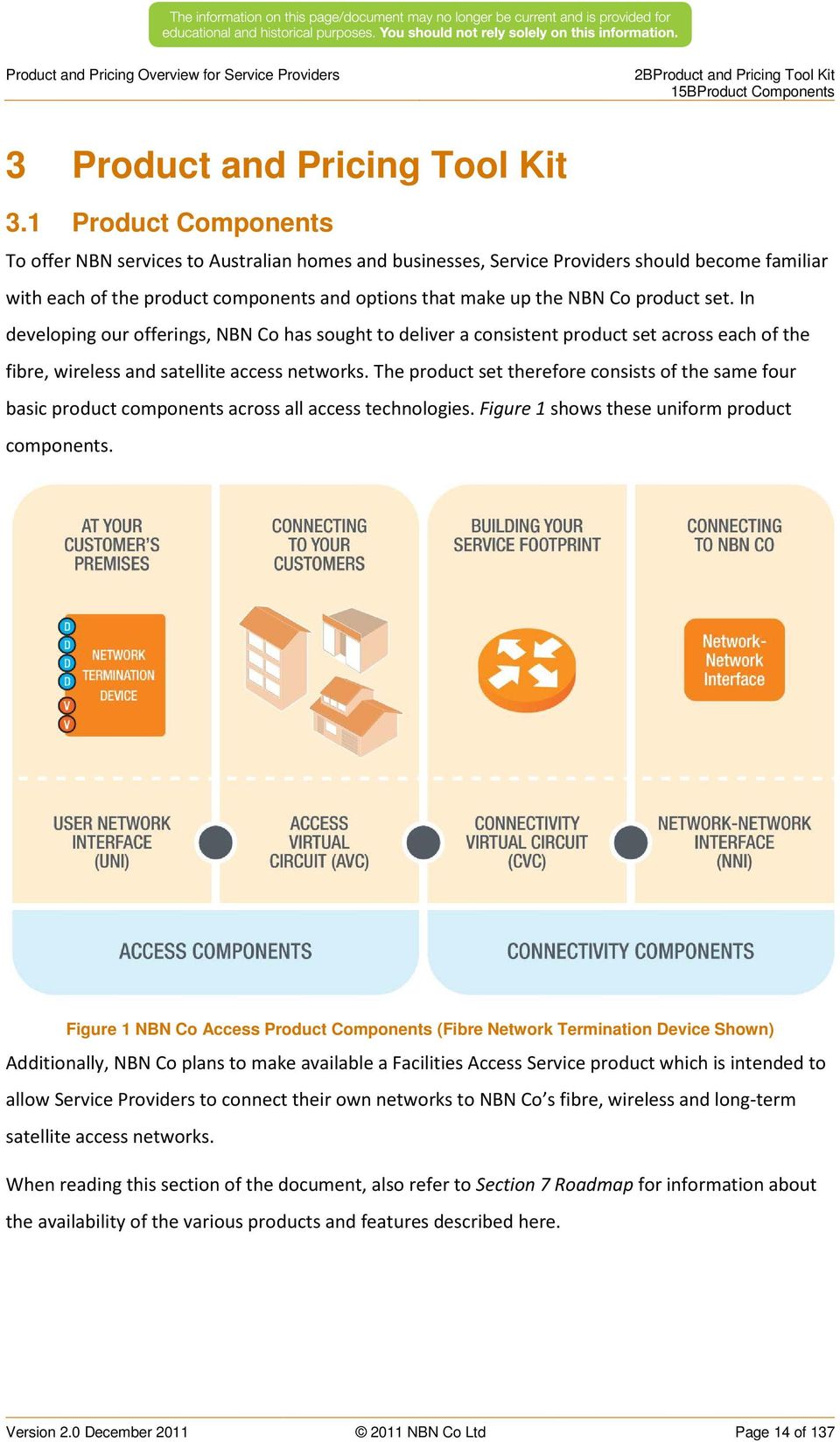
14 2BProduct and Pricing Tool Kit 15BProduct Components 3 Product and Pricing Tool Kit 3.1 Product Components To offer NBN services to Australian homes and businesses, Service Providers should become familiar with each of the product components and options that make up the NBN Co product set. In developing our offerings, NBN Co has sought to deliver a consistent product set across each of the fibre, wireless and satellite access networks. The product set therefore consists of the same four basic product components across all access technologies. Figure 1 shows these uniform product components. Figure 1 NBN Co Access Product Components (Fibre Network Termination Device Shown) Additionally, NBN Co plans to make available a Facilities Access Service product which is intended to allow Service Providers to connect their own networks to NBN Co s fibre, wireless and long-term satellite access networks. When reading this section of the document, also refer to Section 7 Roadmap for information about the availability of the various products and features described here. Version 2.0 December NBN Co Ltd Page 14 of 137
15 2BProduct and Pricing Tool Kit 16BProviding Services on the NBN: Overview 3.2 Providing Services on the NBN: Overview After the Service Provider signs a Standard Form of Access Agreement (such as the Wholesale Broadband Agreement or Interim Satellite Agreement) with NBN Co and completes the onboarding modules for each of the products that the Service Provider wishes to offer, Service Providers will be able to connect to the NBN and begin offering services to End Users. Figure 2 is an overview of how to connect to the NBN and begin offering services: Figure 2 Implementing Product Offerings The various product components shown above can be configured in different ways to service each Service Provider s target markets (e.g. consumers, small business, etc.). Section 4 Service Provider Case Studies contains a range of detailed examples of how these product components can be combined to service various segments. Following is a summary of each of these product components and the functions they perform. 3.3 Connecting Your Network to the NBN To establish a presence in any particular area, the Service Provider will need to connect to the appropriate Point-of-Interconnect for that area. For national coverage there will be a total of 121 NBN Co Points-of-Interconnect. At each Point-of-Interconnect, the Service Provider will need to arrange to connect transmission links using the NBN Co Facilities Access Service. Additionally, the Service Provider will connect their network to the NBN Co fibre, wireless and satellite access networks through a Network-Network Interface port. A single Network-Network Interface port can be used to connect to fibre and, when available, wireless and long term satellite End Users. A separate Network-Network Interface is required to connect an interim satellite service Version 2.0 December NBN Co Ltd Page 15 of 137

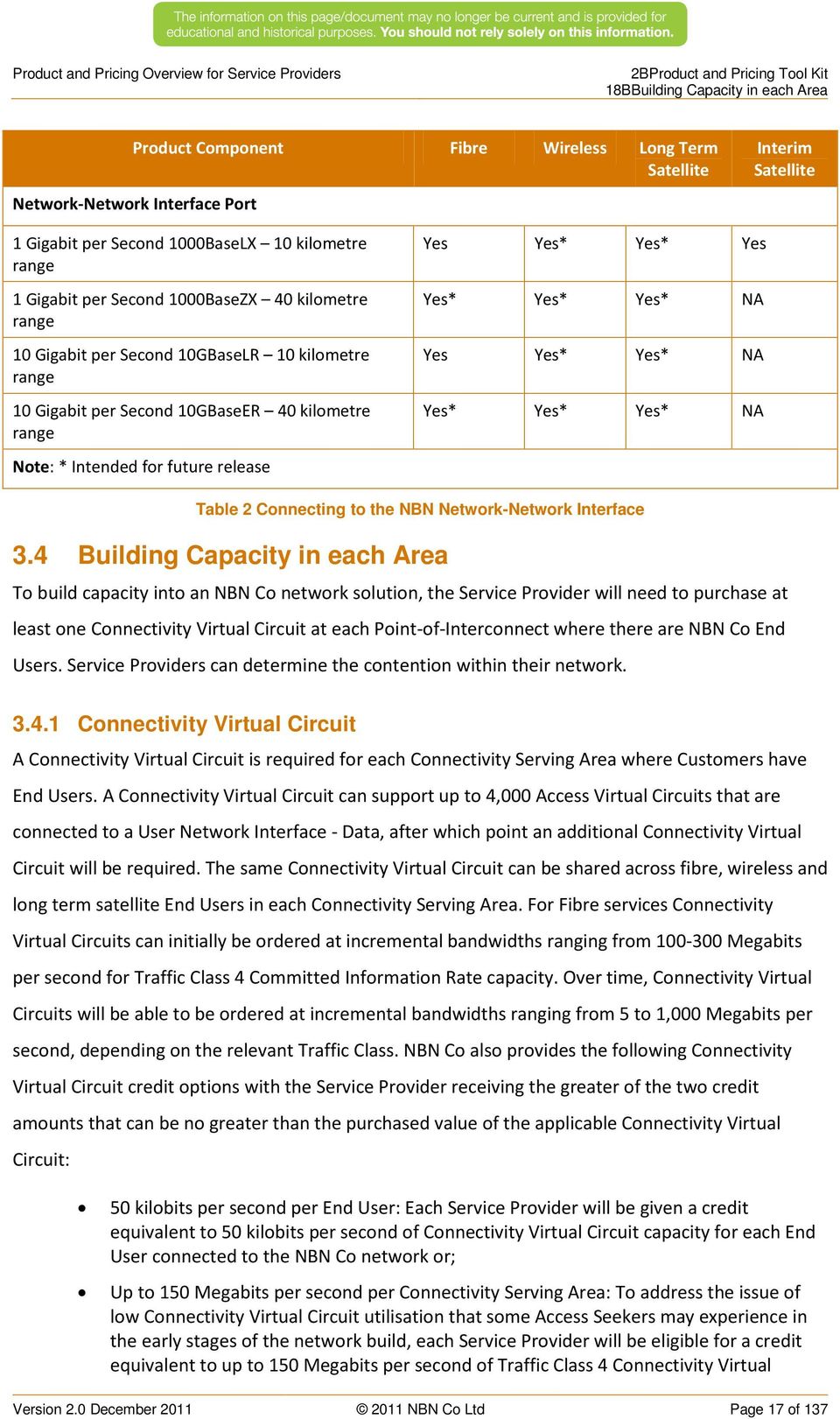
16 2BProduct and Pricing Tool Kit 17BConnecting Your Network to the NBN Facilities Access The NBN Co Facilities Access Service is intended to consist of three main components: Optical Distribution Frame Termination Points: this component will enable Service Provider lead-in or backhaul transmission cables to be connected by NBN Co staff to the NBN Co Optical Distribution Frame at the relevant Point-of-Interconnect. Racks: this component will enable Service Providers to install, operate and maintain active equipment in rack space provided by NBN Co at each Point-of-Interconnect. Cross Connects: this component will provide point-to-point connectivity between particular pairs of locations within each Point-of-Interconnect (e.g. between the racks and the Optical Distribution Frame). Product Fibre Wireless Long Term Satellite Facilities Access Yes* Yes* Yes* NA Note: * Intended for future release Table 1 Connecting to the NBN Facilities Access Interim Satellite Network-Network Interface Port At each Point-of-Interconnect, the Service Provider will be able to connect to the NBN Co fibre, wireless and satellite access networks by purchasing a Network-Network Interface port. Network- Network Interface port redundancy options are available using the Institute of Electrical and Electronics Engineers (IEEE) Link Aggregation with Link Aggregation Control Protocol support IEEE802.1ad standard. During NBN Co s Network Rollout, there will be a period of time where a single the Network- Network Interface at certain Points-of-Interconnect may be provisioned to physically service more than one Connectivity Serving Area. In this case, NBN Co will provision the Service Provider s Network-Network Interface for more than one Connectivity Serving Area accordingly it is noted for clarity that the Connectivity Virtual Circuit will still be provisioned only for the target Connectivity Serving Area (see Section below). The following table shows the applicability of the Network-Network Interface ports to the NBN Co fibre, wireless and satellite access networks respectively. Version 2.0 December NBN Co Ltd Page 16 of 137

17 2BProduct and Pricing Tool Kit 18BBuilding Capacity in each Area Product Component Fibre Wireless Long Term Satellite Network-Network Interface Port Interim Satellite 1 Gigabit per Second 1000BaseLX 10 kilometre range 1 Gigabit per Second 1000BaseZX 40 kilometre range 10 Gigabit per Second 10GBaseLR 10 kilometre range 10 Gigabit per Second 10GBaseER 40 kilometre range Yes Yes* Yes* Yes Yes* Yes* Yes* NA Yes Yes* Yes* NA Yes* Yes* Yes* NA Note: * Intended for future release Table 2 Connecting to the NBN Network-Network Interface 3.4 Building Capacity in each Area To build capacity into an NBN Co network solution, the Service Provider will need to purchase at least one Connectivity Virtual Circuit at each Point-of-Interconnect where there are NBN Co End Users. Service Providers can determine the contention within their network Connectivity Virtual Circuit A Connectivity Virtual Circuit is required for each Connectivity Serving Area where Customers have End Users. A Connectivity Virtual Circuit can support up to 4,000 Access Virtual Circuits that are connected to a User Network Interface - Data, after which point an additional Connectivity Virtual Circuit will be required. The same Connectivity Virtual Circuit can be shared across fibre, wireless and long term satellite End Users in each Connectivity Serving Area. For Fibre services Connectivity Virtual Circuits can initially be ordered at incremental bandwidths ranging from Megabits per second for Traffic Class 4 Committed Information Rate capacity. Over time, Connectivity Virtual Circuits will be able to be ordered at incremental bandwidths ranging from 5 to 1,000 Megabits per second, depending on the relevant Traffic Class. NBN Co also provides the following Connectivity Virtual Circuit credit options with the Service Provider receiving the greater of the two credit amounts that can be no greater than the purchased value of the applicable Connectivity Virtual Circuit: 50 kilobits per second per End User: Each Service Provider will be given a credit equivalent to 50 kilobits per second of Connectivity Virtual Circuit capacity for each End User connected to the NBN Co network or; Up to 150 Megabits per second per Connectivity Serving Area: To address the issue of low Connectivity Virtual Circuit utilisation that some Access Seekers may experience in the early stages of the network build, each Service Provider will be eligible for a credit equivalent to up to 150 Megabits per second of Traffic Class 4 Connectivity Virtual Version 2.0 December NBN Co Ltd Page 17 of 137
18 2BProduct and Pricing Tool Kit 19BConnecting Your End Users Circuit per Connectivity Serving Area. This credit, known as Transitional Connectivity Virtual Circuit pricing, will continue until 30,000 Premises have been passed in each Connectivity Serving Area. The following table shows the availability of Connectivity Virtual Circuit across the NBN Co networks. Product Component Fibre Wireless Long Term Satellite Connectivity Virtual Circuit Yes Yes* Yes* Yes Note: * Intended for future release Table 3 Connectivity Availability Interim Satellite Multicast Domain (Fibre Only) Service Providers wishing to offer internet television, or other Multicast services, will need to purchase a Multicast Domain when available. The Multicast Domain is intended to be used to carry Service Provider internet television channel line-up at each Point-of-Interconnect where they are offering Multicast services. The Domain should be dimensioned at the size of the Service Provider s entire channel line-up. The Multicast Domain is available in increments of 100 Megabits per second, up to a maximum size of 1,000 Megabits per second. Product Component Fibre Wireless Long Term Satellite Multicast Domain Yes* TBA TBA NA Note: * Intended for future release Table 4 Multicast Domain Availability Interim Satellite Note that for satellite and wireless services, capacity limits may apply. Details will be provided once determined. 3.5 Connecting Your End Users There are a range of product component combinations that are important when connecting an individual End User Premises to the NBN. For example, Service Providers offering internet television services need to purchase a Multicast Access Virtual Circuit for each Premises. Service Providers also have the choice of offering telephony services over either the Voice or Data User Network Interface ports in a fibre End User s Premises. Version 2.0 December NBN Co Ltd Page 18 of 137

19 2BProduct and Pricing Tool Kit 19BConnecting Your End Users User Network Interface NBN Co will install a Network Termination Device in each End User Premises. End Users will plug, for example, their phones, broadband gateways or set-top boxes into the relevant User Network Interface ports. There are two different types of ports on the Network Termination Device used on the NBN Co fibre network: User Network Interface Data User Network Interface Voice (available in the fibre footprint only) The Network Termination Devices installed in Premises connected to the fibre access network will feature four Data ports and two Voice ports. Voice ports feature a built-in Analogue Telephone Adaptor to aid the migration of existing copper-based telephones to the NBN Co network. The Network Termination Devices installed in Premises connected to the wireless and the long term satellite access networks will feature four Data ports Access Virtual Circuit The Access Virtual Circuit is the bandwidth that Service Providers will order into each individual End User Premises. Service Providers will need to order an Access Virtual Circuit for each Premises where they are offering NBN Co services. Traffic Class 4 Access Virtual Circuit can initially be ordered in any of the following downstream/upstream bandwidth combinations: Access Virtual Circuit (Traffic Class 4) Downstream ( Megabits per second) Downstream ( Megabits per second) Fibre Wireless Long Term Satellite Interim Satellite 6 1 NA NA NA Yes 12 1 Yes Yes* Yes* NA 25 5 Yes TBA NA NA Yes NA NA NA Yes NA NA NA Yes NA NA NA Note: * Intended for future release Table 5 Access Virtual Circuit Bandwidth Summary To ensure a quality telephony experience on the NBN, each Fibre User Network Interface Voice or Data port can feature an optional 150 kilobits per second of Traffic Class 1 bandwidth. Please refer to wireless and satellite product catalogues, when available, for included Traffic Class 1 bandwidth business rules. Version 2.0 December NBN Co Ltd Page 19 of 137

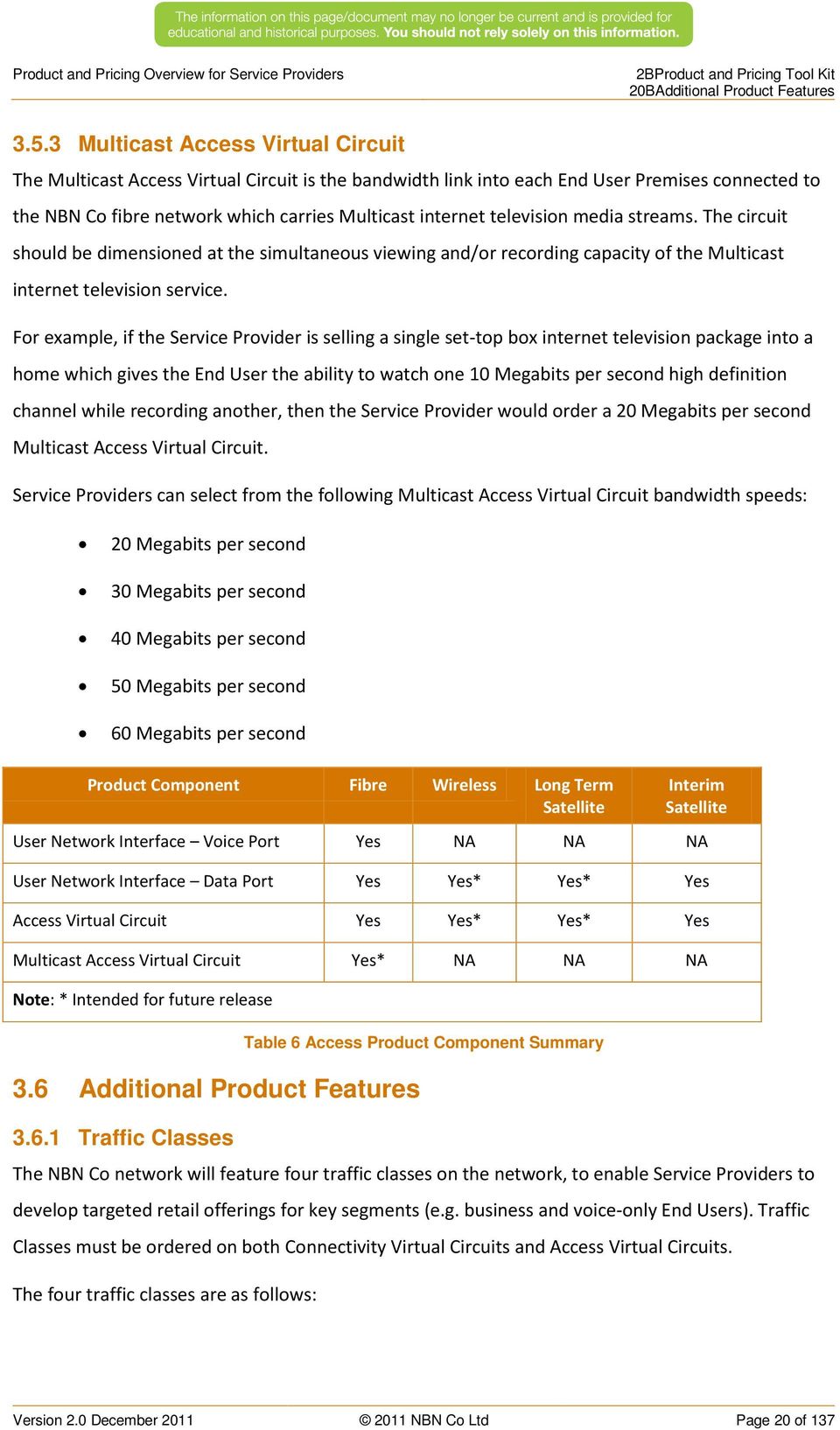
20 2BProduct and Pricing Tool Kit 20BAdditional Product Features Multicast Access Virtual Circuit The Multicast Access Virtual Circuit is the bandwidth link into each End User Premises connected to the NBN Co fibre network which carries Multicast internet television media streams. The circuit should be dimensioned at the simultaneous viewing and/or recording capacity of the Multicast internet television service. For example, if the Service Provider is selling a single set-top box internet television package into a home which gives the End User the ability to watch one 10 Megabits per second high definition channel while recording another, then the Service Provider would order a 20 Megabits per second Multicast Access Virtual Circuit. Service Providers can select from the following Multicast Access Virtual Circuit bandwidth speeds: 20 Megabits per second 30 Megabits per second 40 Megabits per second 50 Megabits per second 60 Megabits per second Product Component Fibre Wireless Long Term Satellite Interim Satellite User Network Interface Voice Port Yes NA NA NA User Network Interface Data Port Yes Yes* Yes* Yes Access Virtual Circuit Yes Yes* Yes* Yes Multicast Access Virtual Circuit Yes* NA NA NA Note: * Intended for future release 3.6 Additional Product Features Traffic Classes Table 6 Access Product Component Summary The NBN Co network will feature four traffic classes on the network, to enable Service Providers to develop targeted retail offerings for key segments (e.g. business and voice-only End Users). Traffic Classes must be ordered on both Connectivity Virtual Circuits and Access Virtual Circuits. The four traffic classes are as follows: Version 2.0 December NBN Co Ltd Page 20 of 137
21 2BProduct and Pricing Tool Kit 21BPricing Summary Traffic Class Traffic Class 1 Traffic Class 2* Traffic Class 3* Traffic Class 4 Definition and Typical Application NBN Co s highest priority traffic class designed for telephony A traffic class designed to carry high-priority video traffic, for example: business grade videoconferencing A traffic class designed for the high-priority data of small and medium business End Users NBN Co s best efforts internet traffic class Note: * Intended for future release Table 7 Traffic Class Summary Product Component Fibre Wireless Long Term Satellite Four Traffic Classes Yes* Yes* Yes* 2 Only Note: * Intended for future release Table 8 Traffic Class Availability Interim Satellite Enhanced Service Levels NBN Co intends to offer a range of optional enhanced service levels to enable Service Providers to service business customers when these products are released. Examples of these additional service levels include improved response, restoration and installation times. Product Component Fibre Wireless Long Term Satellite Enhanced Service Level Options Yes* Yes* Yes* NA Note: * Intended for future release 3.7 Pricing Summary Table 10 is a pricing summary. Table 9 Enhanced Service Levels Options Availability Interim Satellite Version 2.0 December NBN Co Ltd Page 21 of 137
22 2BProduct and Pricing Tool Kit 21BPricing Summary Product Component Monthly Charge Non-Recurring Charge Facilities Access Optical Distribution Frame Termination Point Zero Charge Zero Charge Full Rack $2,000 $1,500 Half Rack $1,200 $900 Cross Connect Zero Charge Zero Charge Network-Network Interface 1 Gigabit per Second 1000BaseLX 10 kilometre range $200 $1,000 1 Gigabit per Second 1000BaseZX 40 kilometre range + $500 $7, Gigabit per Second 10GBaseLR 10 kilometre range $400 $5, Gigabit per Second 10GBaseER 40 kilometre range + $1,000 $35,000 Connectivity Virtual Circuit Per 1 Megabits per second (For all Traffic Classes) $20 N/A Multicast Domain + (Minimum 100 Megabits per second Increments) Multicast Domain: Per 1 Megabits per second $2.50 N/A Access Virtual Circuits (downstream/upstream)* 12/1 Megabits per second $24 N/A 25/5 Megabits per second $27 N/A 25/10 Megabits per second $30 N/A 50/20 Megabits per second $34 N/A 100/40 Megabits per second $38 N/A Notes: * denotes the monthly recurring charges listed are inclusive of an Access Virtual Circuit defined by the Traffic Class 4 speed combination and a User Network Interface-Data. Optional 150 kilobits per second Traffic Class 1 telephony capability is also included in the listed prices for fibre. + Intended for future release. Table 10 Pricing Summary For detailed pricing, including ancillary charges, of all NBN Co products refer to the appendices of this document, as well as the product catalogues, as released from time to time, for each product. Version 2.0 December NBN Co Ltd Page 22 of 137
23 3BService Provider Case Studies 21BPricing Summary 4 Service Provider Case Studies This section provides case demonstrating how to use the Product Toolkit to build services on the National Broadband Network to meet an illustrative marketing strategy. The eight case studies illustrate how a Service Provider can grow with the National Broadband Network from offering an entry-level broadband service targeted at residential customers, to addressing the business segment and growing the customer base across multiple regions. The case studies are presented in three easy steps: Case scenario Creating the NBN Co service; and Cost summary of the NBN Co wholesale product These examples are presented for illustrative purposes only, and assume the Service Provider has signed the NBN Co Wholesale Broadband Agreement or Interim Satellite Service Agreement. Service Providers can contact their Account Team to discuss their specific requirements in more detail. If you are not a direct customer of NBN Co services, it is recommended that you discuss requirements and pricing with an NBN Co service reseller. The roadmap shows when features are intended to be available (see Section 7 Roadmap). Version 2.0 December NBN Co Ltd Page 23 of 137
24 3BService Provider Case Studies 21BPricing Summary Case Study 1: Providing broadband and telephony to 2,100 End Users in a local area A Service Provider currently provides broadband and Voice over Internet Protocol services to customers in their local area reselling Asymmetric Digital Subscriber Line services. With the National Broadband Network rolling out in their area, the Service Provider now has the opportunity to market improved broadband access to their existing base as well as extend their geographic reach and customer base to End Users who previously lacked access to a broadband service. The Service Provider has determined that their go to market strategy is to offer an entry-level broadband and voice bundle to residential consumers based on the NBN Co Layer 2, 12/1 Megabits per second broadband service, continuing their current strategy of offering voice with a Voice over Internet Protocol handset. However, in recognition of the enhanced voice experience the Service Provider proposes to make available with changes to their systems and using the NBN Co included 150 kilobits per second of Traffic Class 1 capacity for Voice, the Service Provider has decided to highlight that their new voice service emulates the quality of a traditional telephony service. In designing their retail offer the Service Provider has decided that the contention ratio for their broadband service will be 100:1 and for their voice service it is 10:1. Since the National Broadband Network is at the early stage of roll out in this Connectivity Serving Area, with less than 30,000 serviceable Premises, the Service Provider will qualify for a credit on the cost of the Connectivity Virtual Circuit under the Transitional Connectivity Virtual Circuit Credit. Create the NBN Co service Connect the End User Select an appointment to have the Network Termination Device (which has User Network Interfaces) installed Order a User Network Interface-Data and an Access Virtual Circuit of 12/1 Megabits per second Traffic Class 4 for each of the 2,100 End Users in the connectivity serving area (includes free 150 kilobits per second of Traffic Class 1) Build capacity Broadband services are supported with a Connectivity Virtual Circuit of 300 Megabits per second of Traffic Class 4 (2,100 services x 12 Megabits per second the contention ratio of 100:1 = 252 Megabits per second, nearest available capacity is 300 Megabits per second) Voice services are supported with a Traffic Class 1 of 50 Megabits per second (2,100 services x 150 kilobits per second the contention ratio of 10:1 = 32 Megabits per second, nearest available capacity is 50 Megabits per second ) A credit to the value of 50 kilobits per second Connectivity Virtual Circuit for every Access Virtual Circuit, that is, 105 Megabits per second (2,100 services x 50 kilobits per second), or 150 Megabits per second of Traffic Class 4 per Connectivity Serving Area under the Transitional Connectivity Virtual Circuit credit when serviceable Premises in the Connectivity Serving Area is less than 30,000 whichever is the greater value. Thus, the Service Provider is entitled to a credit to the value of 150 Megabits per second. Connect to National Broadband Network Order a Network-Network Interface of 1 Gigabits per second (50 Megabits per second of Traffic Class Megabits per second of Traffic Class 4 = 350 Megabits per second total interface capacity required) at the Point-of-Interconnect to enable the Service Provider to connect to backhaul, which the Service Provider will need to source from a backhaul provider. Please Refer to Appendix 8.5A.3.4 for Network-Network Interface establishment charges. Summary of the NBN Co wholesale costs per month (recurring charges only) Type Unit Price Quantity Total Cost Access Virtual Circuit 12/1 Megabits per second $24 2,100 $50,400 Connectivity Virtual Circuit Traffic Class 1 $ 20/Megabits per second 50 Megabits per second $1,000 Traffic Class 4 $ 20/Megabits per second 300 Megabits per second $6,000 Credit $ 20/Megabits per second 150 Megabits per second $(3,000) Subtotal $4,000 Network-Network Interface 1 Gigabits per second $200 1 $200 Total Monthly Cost $54,600 Average Cost per Service $26.00 Version 2.0 December NBN Co Ltd Page 24 of 137
25 3BService Provider Case Studies 21BPricing Summary Case Study 2: Providing broadband and telephony to 3,200 End Users in a local area The Service Provider now has 2,100 End Users on the National Broadband Network and continues to acquire new customers. The strategy is to remain within their local area and expand their base to 3,200 End Users. The Service Provider has determined that they will continue with their current go to market strategy of offering an entry-level broadband and voice bundle to residential consumers based on the NBN Co Layer 2, 12/1 Megabits per second broadband service. Although the Transitional Connectivity Virtual Circuit rebate is available because the Connectivity Serving Area has less than 30, 000 serviceable Premises, in this case, the Service Provider is better off under the standard rebate of 50 kilobits per second per Access Virtual Circuit. The greater of the credit (whichever provides most value to the Service Provider) will automatically be applied in the NBN Co billing system. Create the NBN Co service Connect the End User Select an appointment to have the Network Termination Device (which has User Network Interfaces) installed for new services Provision a User Network Interface-Data and an Access Virtual Circuit of 12/1 Megabits per second Traffic Class 4 for each of the 3,200 End Users in a local connectivity serving area Build capacity Broadband services are supported with a Connectivity Virtual Circuit of 400 Megabits per second of Traffic Class 4 (3,200 services x 12 Megabits per second the contention ratio of 100:1 = 384 Megabits per second, nearest available capacity is 400 Megabits per second) Voice services are supported with a Connectivity Virtual Circuit of 50 Megabits per second of Traffic Class 1 (3,200 services x 150kilobits per second the contention of 10 = 48Megabits per second, nearest available capacity is 50Megabits per second) A credit to the value of 50 kilobits per second of Connectivity Virtual Circuit for every Access Virtual Circuit, that is, 160Megabits per second (3,200 services x 50kilobits per second), or 150Megabits per second per Connectivity Serving Area under the Transitional Connectivity Virtual Circuit credit when serviceable Premises in the Connectivity Serving Area is less than 30,000 whichever is the greater value. Thus, the Service Provider is entitled to a credit to the value of 160Megabits per second. Connect to National Broadband Network A Network-Network Interface of 1 Gigabits per second (50 Megabits per second of Traffic Class Megabits per second of Traffic Class 4 = total interface capacity required is 450 Megabits per second) at the Point-of-Interconnect to enable the Service Provider to connect to the backhaul, which the Service Provider will need to source from a backhaul provider. Please Refer to Appendix A.3.4 for Network-Network Interface establishment charges. Summary of the NBN Co wholesale costs per month (recurring charges only) Type Unit Price Quantity Total Cost Access Virtual Circuit 12/1 Megabits per second $24 3,200 $76,800 Connectivity Virtual Circuit Traffic Class 1 $ 20/Megabits per second 50 Megabits per second $1,000 Traffic Class 4 $ 20/Megabits per second 400 Megabits per second $8,000 Credit $ 20/Megabits per second 160 Megabits per second $(3,200) Subtotal $5,800 Network-Network Interface 1 Gigabits per second $200 1 $200 Total Monthly Cost $82,800 Average Cost per Service $25.88 Version 2.0 December NBN Co Ltd Page 25 of 137
26 3BService Provider Case Studies 21BPricing Summary Case Study 3: Providing broadband and telephony services in a local area in the fibre footprint to 3,500 End Users with an additional 500 End Users on a voice only service The Service Provider has acquired 500 End Users who, at this stage, are interested in a voice only service and an additional 300 broadband and voice End Users. These End Users are in addition to their existing base of 3,200 End Users on a bundled broadband and voice service. In total, the Service Provider has 4,000 End Users in a single Connectivity Serving Area. In designing their retail offer the Service Provider has decided that the contention ratio for their broadband service will be 100:1 and for their voice service, 10:1. The Service Provider has decided to supply voice-only services via the User Network Interface-Voice so that their End Users can retain their existing traditional telephone (plugged directly into the User Network Interface-Voice). An Access Virtual Circuit is purchased in order to provide the voice only services. Create the NBN Co service Connect the End User An Access Virtual Circuit of 12/1 Megabits per second for each of the 4,000 End Users in a local connectivity serving area. The 500 voice only End Users also require an Access Virtual Circuit. Build capacity Broadband services are supported with a Connectivity Virtual Circuit of 500 Megabits per second of Traffic Class 4 (3,500 services x 12Megabits per second the contention of 100 = 420Megabits per second, nearest available capacity is 500Megabits per second) Voice services are supported with a Connectivity Virtual Circuit of 100 Megabits per second of Traffic Class 1 (4,000 services x 150kilobits per second the contention of 10 = 60Megabits per second, nearest available capacity is 100Megabits per second) A credit to the value of 50 kilobits per second of Connectivity Virtual Circuit for every Access Virtual Circuit, that is, 200 Megabits per second (4,000 services x 50 kilobits per second), or 150 Megabits per second per Connectivity Serving Area under the Transitional Connectivity Virtual Circuit credit when serviceable Premises in the Connectivity Serving Area is less than 30,000 whichever is the greater value. Thus, the Service Provider will be entitled to a credit to the value of 200Megabits per second. Connect to National Broadband Network A Network-Network Interface of 1 Gigabits per second (100 Megabits per second of Traffic Class Megabits per second of Traffic Class 4 = total interface capacity required is 600 Megabits per second) at the Point-of-Interconnect to enable the Service Provider to connect to the backhaul, which the Service Provider will need to source from a backhaul provider. Please Refer to Appendix A.3.4 for Network-Network Interface establishment charges. Summary of the NBN Co wholesale costs per month (recurring charges only) Type Unit Price Quantity Total Cost Access Virtual Circuit 12/1 Megabits per second $24 4,000 $96,000 Connectivity Virtual Circuit Traffic Class 1 $ 20/Megabits per second 100 Megabits per second $2,000 Traffic Class 4 $ 20/Megabits per second 500 Megabits per second $10,000 Credit $ 20/Megabits per second 200 Megabits per second $(4,000) Subtotal $8,000 Network-Network Interface 1 Gigabits per second $200 1 $200 Total Monthly Cost $104,200 Average Cost per Service $26.05 Cost per Voice Only Service $24.55 Cost per Voice + Broadband Service $26.26 Assuming Connectivity Virtual Circuit credit is used to off-set against the cost of broadband services. Version 2.0 December NBN Co Ltd Page 26 of 137
27 3BService Provider Case Studies 21BPricing Summary Case Study 4: Providing a triple play bundle of broadband, voice and Internet television to End Users in a local area in the fibre footprint The Service Provider now has 4,000 End Users on the National Broadband Network of which 3,700 subscribe to broadband and voice bundles (200 voice only customers were upgraded to broadband and voice) while 300 remain on voice only service. The strategy is to remain within their local area, deepen the relationship with their existing base and grow average revenue per End User. The Service Provider has decided to offer internet television over Multicast services to their base with the expectation that 13.75% (550 End Users) of their broadband and voice End Users will take up the triple play, broadband, voice and Internet television offer. In designing their retail offer the Service Provider has decided to provide their internet television service over Multicast consisting of 20 standarddefinition (SD) channels at 5 Megabits per second each and 8 high-definition (HD) channels at 10 Megabits per second per channel. Create the NBN Co service Connect the End User An Access Virtual Circuit of 12/1 Megabits per second for each of the 4,000 End Users in a local connectivity serving area. Order a Multicast Access Virtual Circuit of 20 Megabits per second for each of the 550 internet television End Users Build capacity Broadband services are supported with a Connectivity Virtual Circuit of 500 Megabits per second of Traffic Class 4 (3,700 services x 12Megabits per second the contention of 100 = 444Megabits per second, nearest available capacity is 500Megabits per second) Voice services are supported with a Connectivity Virtual Circuit of 100 Megabits per second of Traffic Class 1 (4,000 services x 150kilobits per second the contention of 10 = 60Megabits per second, nearest available capacity is 100Megabits per second) A credit to the value of 50kilobits per second of Connectivity Virtual Circuit for every Access Virtual Circuit, that is, 200Megabits per second (4,000 services x 50kilobits per second), or 150Megabits per second per Connectivity Serving Area under the Transitional Connectivity Virtual Circuit credit when serviceable Premises in the Connectivity Serving Area is less than 30,000 whichever is the greater value. Thus, the Service Provider would be entitled to a credit to the value of 200Megabits per second. A Multicast domain of 200Megabits per second (20 SD channels x 5Megabits per second +8 HD channels x 10Megabits per second = 180Megabits per second, nearest available Multicast domain capacity is 200Megabits per second) Connect to National Broadband Network A Network-Network Interface (NNI) of 1Gigabits per second (100Megabits per second of Traffic Class Megabits per second of Traffic Class Megabits per second of Multicast domain = total interface capacity required is 800Megabits per second) at the Point-of-Interconnect to enable the Service Provider to connect to the backhaul, which the Service Provider will need to source from a backhaul provider. Please Refer to Appendix A.3.4 for Network-Network Interface establishment charges. Summary of the NBN Co wholesale costs per month (recurring charges only) Type Unit Price Quantity Total Cost Access Virtual Circuit 12/1 Megabits per second $24 4,000 $96,000 20Megabits per second Multicast $5 550 $2,750 Subtotal $98,750 Connectivity Virtual Circuit Traffic Class 1 $ 20/Megabits per second 100 Megabits per second $2,000 Traffic Class 4 $ 20/Megabits per second 500 Megabits per second $10,000 Credit $ 20/Megabits per second 200 Megabits per second $(4,000) Multicast Domain $2.50/Megabits per second 200 Megabits per second $500 Subtotal $8,500 Network-Network Interface 1 Gigabits per second $200 1 $200 Total Monthly Cost $107,450 Average Cost per Service $26.86 Cost per Voice Only Service $24.55 Cost per Broadband + Voice Service $26.17 Cost per Broadband + Voice + IPTV $32.08 Assuming Connectivity Virtual Circuit credit is used to off-set against the cost of broadband services Version 2.0 December NBN Co Ltd Page 27 of 137
28 3BService Provider Case Studies 21BPricing Summary Case Study 5: Growing to 85,000 End Users across twenty two Connectivity Serving Areas A Service Provider can see the opportunity to acquire End Users with the roll out of the National Broadband Network. The strategy is to migrate and extend beyond their local area and grow their broadband and voice End User numbers to 85,000 across twenty two Connectivity Serving Areas in a single State. The Service Provider has decided that their acquisition strategy will be based on offering an entry-level broadband and voice bundle to residential consumers based on the NBN Co Layer-2 12/1 Megabits per second broadband service. In designing their retail offer the Service Provider has determined that the contention ratio for their broadband service will be 100:1 and for their voice service, 10:1. Voice services will be provided over the User Network Interface-Data. Create the NBN Co service Connect the End User Select an appointment to have the Network Termination Device (which has User Network Interfaces) installed Order a User Network Interface-Data and an Access Virtual Circuit of 12/1 Megabits per second Traffic Class 4 for each of the 85,000 End Users in 22 Connectivity Serving Area. Build capacity Each Connectivity Serving Area has 3,864 End Users (85,000 End Users 22 Connectivity Serving Areas) is served by a Connectivity Virtual Circuit with the following traffic class and capacity: Broadband services are supported with a Connectivity Virtual Circuit of 500 Megabits per second of Traffic Class 4 (3,864 services x 12Megabits per second the contention of 100 = 464 Megabits per second, nearest available capacity is 500Megabits per second) Voice services are supported with a Connectivity Virtual Circuit of 100 Megabits per second of Traffic Class (3,864 services x 150 kilobits per second the contention of 10 = 58 Megabits per second, nearest available capacity is 100 Megabits per second) A Credit to the value of 50 kilobits per second of Connectivity Virtual Circuit for every Access Virtual Circuit that is, 193 Megabits per second (3,864 services x 50 kilobits per second), or 150 Megabits per second per Connectivity Serving Area under the Transitional Connectivity Virtual Circuit credit when serviceable Premises in the Connectivity Serving Area is less than 30,000 whichever is the greater value. Thus, the Service Provider will be entitled to a credit to the value of 193 Megabits per second for each Connectivity Serving Area Connect to National Broadband Network Order a Network-Network Interface of 1 Gigabits per second at each Point-of-Interconnect (each Connectivity Serving Area) to enable the Service Provider to connect to the backhaul, which the Service Provider will need to source from a backhaul provider. Please Refer to Appendix A.3.4 for Network-Network Interface establishment charges. Summary of the NBN Co wholesale costs per month (recurring charges only) Type Unit Price Quantity Total Cost Access Virtual Circuit 12/1 Megabits per second $24 85,000 $2,040,000 Connectivity Virtual Circuit Traffic Class 1 $ 20/Megabits per second 2,200 Megabits per second $44,000 Traffic Class 4 $ 20/Megabits per second 11,000 Megabits per second $220,000 Credit $ 20/Megabits per second 4,250 Megabits per second $(85,000) Subtotal $179,000 Network-Network Interface 1 Gigabits per second $ (1 per Point-of-Interconnect ) $4,400 Total Monthly Cost $2,223,400 Average Cost per Service $26.16 Version 2.0 December NBN Co Ltd Page 28 of 137
29 3BService Provider Case Studies 21BPricing Summary Case Study 6: Broadband and telephony to 500 End Users using Interim Satellite Service A Service Provider has a small but valued customer base of 500 End Users in its local area that can only access broadband via satellite. As an NBN Co Interim Satellite Service provider, they will need to connect to the single satellite Point-of-Interconnect. When NBN Co launches its own satellites in 2015 the Service Provider will transition interim satellite customers to the long term satellite service assuming they will not be covered by the NBN Co Fibre or Wireless footprint. The interim satellite service offers 6/1 Megabits per second services that will be transitioned to a 12/1 Megabits per second service when the Long Term satellite is available. For the interim service the Service Provider has decided to provide a broadband service with each having 30 kilobits per second average busy hour throughput. Each service will also have access to an Internet Protocol telephony service with a service contention of 10:1. Create the NBN Co service Connect the End User Order an Access Virtual Circuit of 6/1 Megabits per second for each of the 500 End Users in a local connectivity serving area. An appointment will be made with the End User to install the Network Termination Device. Build capacity These services are supported with a Connectivity Virtual Circuit with the capacity and traffic class as follows: Broadband services are supported with a Connectivity Virtual Circuit of 20 Megabits per second (500 services x 30 kilobits per second = 15 Megabits per second, nearest available capacity is 20 Megabits per second) Voice services are supported with a Connectivity Virtual Circuit of 5 Megabits per second (500 services x 60 kilobits per second the contention of 10 = 3 Megabits per second, nearest available capacity is 5 Megabits per second) A credit to the value of 50 kilobits per second of Connectivity Virtual Circuit for every Access Virtual Circuit, that is, 25 Megabits per second (500 services x 50 kilobits per second ). Note: Interim Satellite Services are ineligible for Transitional Connectivity Virtual Circuit credit as they are being delivered through one central Point-of-Interconnect servicing an addressable market that exceeds 30,000 Premises. Connect to National Broadband Network Order a Network-Network Interface of 1 Gigabits per second (5 Megabits per second of Traffic Class Megabits per second of Traffic Class 4 = total interface capacity required 25 Megabits per second) at the Point-of-Interconnect to enable the Service Provider to connect to the backhaul, which the Service Provider will need to source from a backhaul provider. Please Refer to Appendix C.4.4 pricing for Network-Network Interface establishment charges. Summary of the NBN Co wholesale costs per month (recurring charges only) Type Unit Price Quantity Total Cost Access Virtual Circuit 6/1 Megabits per second $ $12,000 Connectivity Virtual Circuit Traffic Class 1 $ 20/Megabits per second 5 Megabits per second $100 Traffic Class 4 $ 20/Megabits per second 20 Megabits per second $400 Credit $ 20/Megabits per second 25 Megabits per second $(500) Subtotal $0 Network-Network Interface 1 Gigabits per second $200 1 $200 Total Monthly Cost $12,200 Average Cost per Service $24.40 Version 2.0 December NBN Co Ltd Page 29 of 137
30 3BService Provider Case Studies 21BPricing Summary Case Study 7: Entering the small business segment in a local area in the fibre footprint A Service Provider can see the opportunity to acquire 1,000 small business End Users by using the different traffic classes, data speeds and service levels available on the National Broadband Network. The Service Provider has decided that their acquisition strategy will be based on offering broadband based on the National Broadband Network Layer 2, 25/5 Megabits per second service with bundled voice. In designing their retail offer the Service Provider has determined that the contention ratio for their broadband service will be 20:1 and for their voice service, 10:1. A Service Level Assurance - Business will be offered that ensures a twelve hour restoration within an extended coverage window. Create the NBN Co service Connect the End User Select an appointment to have the Network Termination Device (which has User Network Interfaces) installed Order a User Network Interface-Data and an Access Virtual Circuit of 25/5 Megabits per second for each of the 1,000 End Users in a local connectivity serving area. Each service is covered with a Service Level Assurance of 12 hour restoration. Build capacity These services are supported with a Connectivity Virtual Circuit with the capacity and traffic class as follows: Broadband services are supported with a Connectivity Virtual Circuit of 2,000 Megabits per second of Traffic Class 4 (1,000 services x 25 Megabits per second the contention of 20 = 1,250 Megabits per second, nearest available capacity is 2,000 Megabits per second) Voice services are supported with a Connectivity Virtual Circuit of 20 Megabits per second of Traffic Class 1 (1,000 services x 150 kilobits per second the contention of 10 = 15 Megabits per second, nearest available capacity is 20 Megabits per second ) A credit to the value of 50 kilobits per second of Connectivity Virtual Circuit for every Access Virtual Circuit, that is, 50 Megabits per second (1,000 services x 50 kilobits per second ). It is assumed that the Connectivity Serving Area in which the Service Provider operates provides coverage of more than 30,000 serviceable Premises, the Transitional Connectivity Virtual Circuit credit is not applicable. Thus, the Service Provider would be entitled to a credit to the value of 50Megabits per second. Connect to National Broadband Network Order a Network-Network Interface of 10 Gigabits per second (20 Megabits per second of Traffic Class 1 + 2,000 Megabits per second of Traffic Class 4 = total interface capacity required is 2.02 Gigabits per second) at the Point-of-Interconnect to enable the Service Provider to connect to the backhaul, which the Service Provider will need to source from a backhaul provider. Please Refer to Appendix A.3.4 for Network-Network Interface establishment charges. Summary of the NBN Co wholesale costs per month (recurring charges only) Type Unit Price Quantity Total Cost Access Virtual Circuit 25/5 Megabits per second $27 1,000 $27,000 Service Level Assurance - Business $15 1,000 $15,000 Subtotal $42,000 Connectivity Virtual Circuit Traffic Class 1 $ 20/Megabits per second 20 Megabits per second $400 Traffic Class 4 $ 20/Megabits per second 2,000 Megabits per second $40,000 Credit $ 20/Megabits per second 50 Megabits per second $(1,000) Subtotal $39,400 Network-Network Interface 10 Gigabits per second $400 1 $400 Total Monthly Cost $81,800 Average Cost per Service $81.80 Version 2.0 December NBN Co Ltd Page 30 of 137
31 3BService Provider Case Studies 21BPricing Summary Case Study 8: Entering the medium business segment in a local area in the fibre footprint A local Service Provider can see the opportunity to acquire 300 medium business End Users by using the different traffic classes, data speeds and service levels available on the National Broadband Network. The Service Provider has decided that their acquisition strategy will be based on offering broadband based on the National Broadband Network Layer 2, 50/20 Megabits per second service with an included 10 Megabits per second of Traffic Class 3 of symmetrical committed information rate, along with bundled voice (assuming 10 voice lines). In designing their retail offer the Service Provider has determined that the contention ratio for their broadband service will be 20:1 for Traffic Class 4, 4:1 for Traffic Class 3 and for their voice service (Traffic Class 1), 10:1. A Service Level Assurance Business will be offered that ensures a twelve hour restoration. Create the NBN Co service Connect the End User An Access Virtual Circuit of 50/20 Megabits per second for each of the 300 End Users in a local Connectivity Serving Area and with each Access Virtual Circuit, 1 Megabits per second of Traffic Class 1 for voice services. Each service is provisioned with a Service Level Assurance of 12 hour restoration. Build capacity These services are supported with a Connectivity Virtual Circuit with the capacity and traffic class as follows: Broadband services are supported with 800 Megabits per second of Traffic Class 4 (300 services x 50Megabits per second the contention of 20 = 750Megabits per second, nearest available capacity is 800Megabits per second) Transaction services are supported with 800Megabits per second of Traffic Class 3 (300 services x 10Megabits per second the contention of 4 = 750Megabits per second, nearest available capacity is 800Megabits per second) Voice services are supported with 50 Megabits per second of Traffic Class 1 (300 services x 1 Megabits per second the contention of 10 = 30 Megabits per second, nearest available capacity is 50Megabits per second) A credit to the value of 50kilobits per second of Connectivity Virtual Circuit for every Access Virtual Circuit, i.e. 15Megabits per second (300 services x 50kilobits per second). It is assumed that the Connectivity Serving Area in which the Service Provider operates provides coverage of more than 30,000 serviceable Premises, the Transitional Connectivity Virtual Circuit credit is not applicable. Thus, the Service Provider would be entitled to a credit to the value of 15Megabits per second. Connect to National Broadband Network Order an Network-Network Interface of 10 Gigabits per second (50 Megabits per second of Traffic Class Megabits per second of Traffic Class Megabits per second of Traffic Class 4 = total interface capacity required is 1.65 Gigabits per second) at the Point-of-Interconnect to enable the Service Provider to connect the backhaul, which the Service Provider will need to source from a backhaul provider. Please refer to Appendix A.3.4 for Network-Network Interface establishment charges. Summary of the NBN Co wholesale costs per month (recurring charges only) Type Unit Price Quantity Total Cost Access Virtual Circuit 50/20 Megabits per second $ $10,200 10Megabits per second Traffic Class 3 $ $14,400 1Megabits per second Traffic Class 1 $ $16,800 Service Level Assurance Business $ $4,500 Subtotal $45,900 Connectivity Virtual Circuit Traffic Class 1 $ 20/Megabits per second 50 Megabits per second $1,000 Traffic Class 3 $ 20/Megabits per second 800 Megabits per second $16,000 Traffic Class 4 $ 20/Megabits per second 800 Megabits per second $16,000 Credit $ 20/Megabits per second 15 Megabits per second $(300) Subtotal $32,700 Network-Network Interface 10 Gigabits per second $400 1 $400 Total Monthly Cost $79,000 Average Cost per business site $ A credit of $10 being the value of the allocation of 150kilobits per second has been included Version 2.0 December NBN Co Ltd Page 31 of 137
32 4BWhere and When 22BGeographic Availability 5 Where and When 5.1 Geographic Availability NBN Co plans to roll out its fibre optic network to serve approximately 93% of Australian Premises by The remaining 7% of Premises are expected to be served via fixed-wireless and leading edge satellite network launched by There are differences in the feature set available on the fibre, fixed wireless and satellite networks so Service Providers will need to know which network technology is serving a Premises. NBN Co will provide detailed information in advance of the rollout that tells Service Providers which underlying network is serving a Premises (see Rollout Plans below). When Service Providers place an order, NBN Co will provide this information via both the NBN Co Service Portal and Business-to-Business interface with our automated Service Qualification tool. Interim Satellite has a separate Service Portal and Service Qualification tool. The coverage map of Australia (see Figure 3 Coverage Map) is an indicative depiction only of the fibre and wireless components of the National Broadband Network, with long term satellite services expected to be provided to the remaining regions. The information in this map is based on initial detailed modelling work done by NBN Co, which may change following more detailed planning and design work. The map also assumes that satellite services will be provided to remaining Premises. Please go to for coverage maps. Version 2.0 December NBN Co Ltd Page 32 of 137
33 4BWhere and When 23BFibre Rollout Plans 5.2 Fibre Rollout Plans Figure 3 Coverage Map In October 2011, NBN Co released its inaugural 12 month construction plan for the fibre network. The plan lists the communities in each state and territory where work will begin during the period from October 2011 to September 2012, as well as where work on the rollout of the network was already underway. Please refer to for the list. The 12 month schedule will be updated on a quarterly basis to include additional locations. In early 2012, NBN Co will also issue a three-year indicative view of the rollout. This plan will be updated annually until the anticipated completion of the rollout. On average, it is expected to take 12 months from the start of the fibre network rollout in a given area until individuals are able to order a service over the NBN. Once a Service Provider has signed the Wholesale Broadband Agreement, a Microsoft Excel file containing a list of all Fibre Premises passed, identified by the associated Geocoded National Address, can be provided by the Service Provider s Account Manager or Solutions Architect. The file is updated on a weekly basis. Version 2.0 December NBN Co Ltd Page 33 of 137
34 4BWhere and When 24BWireless Rollout Plans 5.3 Wireless Rollout Plans As at December 2011, the five locations under construction for connection to fixed wireless are: Tamworth (New South Wales) Darwin region (Northern Territory) Toowoomba (Queensland) Ballarat region (Victoria) Geraldton region (Western Australia) As the rollout continues, it is anticipated that a construction plan and detailed information on Premises passed, similar to that provided for the fibre network, will be made available to Service Providers. 5.4 Satellite Rollout Plans NBN Co's Interim Satellite Service is available to eligible individuals and small businesses on mainland Australia and across Tasmania. This service is designed to provide a transition from the Australian Broadband Guarantee program, previously managed by the Department of Broadband Communications and Digital Economy. The Interim Satellite Service is scheduled to run until 2015 when NBN Co plans to launch two of its own high-capacity satellites to provide a Long Term Satellite Service. Service Applicants and Service Providers can use an online broadband service locator to see whether there are metro comparable services in their area and so determine whether they are eligible for the Interim Satellite Service. Version 2.0 December NBN Co Ltd Page 34 of 137
35 5BProduct Fact Sheets 26BNBN Co Fibre Access Service Fact Sheet 6 Product Fact Sheets 6.1 NBN Co Fibre Access Service Fact Sheet NBN Co Fibre Access Service will offer a wholesale Layer 2 Ethernet bitstream service with a variety of selectable features and functionality to enable Service Providers to build residential and business offerings that include: Broadband and Telephony Capability Battery Backup Traffic Class Business features Multicast Service Operations, Administration and Maintenance and Reporting Components The NBN Co Fibre Access Service product consists of a number of product components that are used by Service Providers as building blocks to provide an end-to-end service on the NBN. NBN Co provides the four access network components as illustrated in Figure 4. Figure 4 Fibre Access Service Components Version 2.0 December NBN Co Ltd Page 35 of 137
36 5BProduct Fact Sheets 26BNBN Co Fibre Access Service Fact Sheet In the current release, Broadband and Telephony, there are five wholesale speeds based on Peak Information Rate Traffic Class 4 for the Access Virtual Circuit being 12/1, 25/5, 25/10, 50/20, 100/40 Megabits per second. 2 Later releases are planned to introduce 250/100, 500/200 and 1000/400 Megabits per second speeds (subject to network upgrades). 2 NBN Co is designing the NBN to be capable of delivering these speeds to NBN Co s wholesale customers (Service Providers) via fibre, fixed wireless and satellite. Speeds actually achieved by retail customers (End Users) will depend on a number of factors including the quality of their equipment and in-premises connection, the broadband plans offered by their Service Provider and how their Service Provider designs its network to cater for multiple End Users. Version 2.0 December NBN Co Ltd Page 36 of 137
37 5BProduct Fact Sheets 26BNBN Co Fibre Access Service Fact Sheet Conditions and Features Access Speed The speed delivered by NBN Co to the Service Provider on a Layer 2 Access Virtual Circuit. Currently available speeds are 12/1, 25/5, 25/10, 50/20 and 100/40 Megabits per second 3 Availability Target network availability is 99.90%. Battery Coverage Data Eligibility Fair Use Internet Protocol Addressing Battery Backup of the User Network Interface Voice is provided by NBN Co and maintained by the Service Provider. Approximately 93% of Premises will be covered by fibre Layer 2 Ethernet bitstream with peak information rate and committed information rate options and four traffic classes Available to all End Users able to connect to the NBN Co fibre access network through their Service Provider of choice (i.e. in the fibre footprint). The End User and Service Provider must comply with the Fair Use policies published by NBN Co from time to time. As a layer 2 product NBN Co is not involved with Internet Protocol addressing Multicast Expected to be available on the NBN Co Fibre Access Service from Q Network Termination Device Network- Network Interface Ordering Points-of- Interconnect Support Telephony User Network Interface Installed and maintained by NBN Co 1 and 10 Gigabits per second Optical Ethernet interfaces Service Provider orders through the NBN Co Service Portal or Business to Business interface 121 Points-of-Interconnect planned across Australia First line End User support provided by the Service Provider. NBN Co provides Service Providers full account management and access to NBN Co support and service levels Telephony services using Voice over Internet Protocol on a Traffic Class 1 committed information rate service via the User Network Interface Voice. Also available via the User Network Interface Data with an external Analogue Telephony Adapter. (Note: without battery backup capability) Four Data ports with following interface options on the standard Network Termination Device: 10/100/1000 Base TX Ethernet Two Voice ports with following interface options on the standard Network Termination Device: RJ-11 Analogue Telephony Adaptor (initially only one Voice port available) 3 NBN Co is designing the NBN to be capable of delivering these speeds to NBN Co s wholesale customers (Service Providers) via fibre, fixed wireless and satellite. Speeds actually achieved by retail customers (End Users) will depend on a number of factors including the quality of their equipment and in-premises connection, the broadband plans offered by their Service Provider and how their Service Provider designs its network to cater for multiple End Users. Version 2.0 December NBN Co Ltd Page 37 of 137
38 5BProduct Fact Sheets 27BNBN Co Wireless Access Service Fact Sheet 6.2 NBN Co Wireless Access Service Fact Sheet NBN Co Wireless Access Service will offer a wholesale Layer 2 Ethernet bitstream product with a variety of selectable features and functionality to enable Service Providers to build residential and business offerings. These include: Traffic Class 1 and Traffic Class 4 selectable options 12 Megabits per second peak speed downstream / 1 Megabits per second peak speed upstream Service Ordering, Operations, Administration and Management tools Physical Interconnection Arrangements Components The NBN Co Wireless Access Service product consists of four components that are used by Service Providers as building blocks to provide an end-to-end service. NBN Co provides the four Access Network components as illustrated in Figure 5. Figure 5 Wireless Access Service Components The Service Provider delivers services to the End User through the User Network Interface Network Termination Device port and connects to the NBN Co network at the Network-Network Interface located at the Point-of-Interconnect. Version 2.0 December NBN Co Ltd Page 38 of 137
39 5BProduct Fact Sheets 27BNBN Co Wireless Access Service Fact Sheet Conditions and Features Access Speed Designed to provide peak speeds options of 12 Megabits per second down, 1 Megabits per second up on a layer 2 Access Virtual Circuit 4 Availability Target network availability is 99.90%. Battery Coverage Data Eligibility Fair Use Internet Protocol Addressing Multicast Network Termination Device Network-Network Interface Ordering Points-of- Interconnect Supported Services Support Telephony User Network Interface No Battery Backup is provided with the NBN Co Wireless Access products Approximately 4% of the Australian population Layer 2 peak information rate (Traffic Class 4) and committed information rate (Traffic Class 1) at launch with additional Traffic Classes planned End User must be in a wireless access service footprint, which excludes all Premises in the NBN Co fibre access footprint The End User and Service Provider must comply with the Fair Use policies published by NBN Co from time to time. As a layer 2 product NBN Co is not involved with Internet Protocol addressing The Wireless Access Service does not support Multicast at service launch however planned for future release. Installed and maintained by NBN Co 1 and 10 Gigabits per second Optical Ethernet interfaces Service Provider orders through the NBN Co Service Portal or Business to Business interface There will be 121 Points-of-Interconnect across Australia. A subset of these Points-of- Interconnect are intended to be used by wireless. Internet Access, data volume allowances, and voice services owned and delivered by the Service Provider First line End User support provided by the Service Provider. NBN Co provides Service Providers full account management and access to NBN Co support and service levels Traffic Class 1 can be used by the Service Provide to support Voice over Internet Protocol (VoIP) telephony services Four Data ports with 10/100/1000 Base T Ethernet interface 4 NBN Co is designing the NBN to be capable of delivering these speeds to NBN Co s wholesale customers (Service Providers) via fibre, fixed wireless and satellite. Speeds actually achieved by retail customers (End Users) will depend on a number of factors including the quality of their equipment and in-premises connection, the broadband plans offered by their Service Provider and how their Service Provider designs its network to cater for multiple End Users. Version 2.0 December NBN Co Ltd Page 39 of 137
40 5BProduct Fact Sheets 28BInterim Satellite Service Fact Sheet 6.3 Interim Satellite Service Fact Sheet NBN Co Interim Satellite Service will offer a wholesale Layer 3 Internet Protocol product with a variety of selectable features and functionality to enable Service Providers to build residential and business offerings. These include: Internet Protocol Service suitable for internet access and related applications Telephony Support using external Session Initiation Protocol (SIP) based Voice over Internet Protocol (VoIP) equipment Protocol Acceleration and Performance Enhancements Service Ordering, Operations, Administration and Management tools Physical Interconnection Arrangements Components The NBN Co Interim Satellite Access Service product consists of a number of components that are used by Service Providers as building blocks to provide an end-to-end service. NBN Co provides the four Access Network components as illustrated in Figure 6. Figure 6 Interim Satellite Service Components Version 2.0 December NBN Co Ltd Page 40 of 137
41 5BProduct Fact Sheets 28BInterim Satellite Service Fact Sheet Conditions and Features Access Speed Designed to provide peak speeds up to 6 Megabits per second down, 1 Megabits per second up on a layer 3 Access Virtual Circuit 5 Availability Target network availability is 99.5%. Battery Coverage Data Eligibility Fair Use Internet Protocol Addressing Multicast Network-Network Interface Network Termination Device Ordering Performance Enhancing Protocols Currently eligible Premises must qualify for the service by being outside a metro comparable area and not have an existing Australian Broadband Guarantee (ABG) service which is less than 3 years old. Detailed eligibility criteria can be found on the NBN Co website at Points-of- Interconnect Supported Services Support Telephony User Network Interface No Battery Backup is provided with the NBN Co Satellite Access products. Direct Current (DC) power supply unit option Australian mainland, Tasmania, Tiwi and Bass Strait Islands Layer 3 Internet Protocol Peak Information Rate (PIR) and Committed Information Rate (CIR) over two Traffic Classes The End User and Service Provider must comply with the Fair Use policies published by NBN Co from time to time. Service Providers must provide public or private Internet Protocol Addresses for each Network Termination Device The Interim Satellite Service does not support Multicast 1 Gigabits per second Optical interface. Limited Ethernet 1 Gigabits per second option may be available Installed and maintained by NBN Co From an NBN Co registered Service Provider using Interim Satellite Portal Transmission Control Protocol (TCP) and Hyper Text Transfer Protocol (HTTP) acceleration options. Either selectable within the NBN Co network or provided as external value-added services by the Service Provider Located in Sydney at either Equinix or Global Switch Internet Access, data allowances, and voice servers owned and delivered by the Service Provider First line End User support provided by the Service Provider. NBN Co provides Service Providers full account management and access to NBN Co support and service levels Telephony services using Voice over Internet Protocol (VoIP) implementation operating on a Traffic Class 1 service class (which supports Session Initiation Protocol (SIP) based voice traffic only) Single Data port with 10/100 Base T Ethernet interface 5 NBN Co is designing the NBN to be capable of delivering these speeds to NBN Co s wholesale customers (Service Providers) via fibre, fixed wireless and satellite. Speeds actually achieved by retail customers (End Users) will depend on a number of factors including the quality of their equipment and in-premises connection, the broadband plans offered by their Service Provider and how their Service Provider designs its network to cater for multiple End Users. Version 2.0 December NBN Co Ltd Page 41 of 137
42 5BProduct Fact Sheets 29BLong Term Satellite Service Fact Sheet 6.4 Long Term Satellite Service Fact Sheet NBN Co Long Term Satellite Access Service is being designed to offer a wholesale Layer 2 Internet Ethernet product with a variety of selectable features and functionality to enable Service Providers to build residential and business offerings. These include: Ethernet services suitable for internet services and related applications Telephony Support using external Voice over Internet Protocol (VoIP) adapters Multicast for Internet Protocol Television (IPTV) business applications Business networking features including private networks Protocol Acceleration and Performance Enhancements Service Ordering, Operations, Administration and Management Physical Interconnection Arrangements Components The NBN Co Long Term Satellite Access Service product consists of a number of product components that are used by Service Providers as building blocks to provide an end-to-end service. NBN Co provides the four Access Network components as illustrated in Figure 7. Figure 7 Long Term Satellite Service Components Version 2.0 December NBN Co Ltd Page 42 of 137
43 5BProduct Fact Sheets 29BLong Term Satellite Service Fact Sheet Conditions and Features Access Speed Availability Battery Coverage Data Eligibility Fair Use Internet Protocol Addressing Multicast Network Termination Device Network-Network Interface Ordering Performance Enhancing Protocols Points-of- Interconnect Supported Services Support Telephony User Network Interface Designed to provide peak speed 12 Megabits per second down, 1 Megabits per second Up on a layer 2 Access Virtual Circuit 6 Target network availability is 99.7% but may be lower in tropical areas (TBA). No Battery Backup is provided. Direct Current (DC) power supply unit option Australian mainland, Tasmania, and remote Islands (Macquarie Island, Lord Howe Island, Norfolk Island, Christmas, Cocos Island, Abrolhos Islands, Tiwi and Bass Strait Islands) Layer 2 Ethernet Peak Information Rate (PIR) and Committed Information Rate (CIR) with four Traffic Classes planned at launch End User resides in the Satellite Serving Area where NBN Fibre and wireless are not available The End User and Service Provider must comply with the Fair Use policies published by NBN Co from time to time. As a layer 2 product NBN Co is not involved with Internet Protocol addressing The Long Term Satellite Service is intended to support Multicast for business applications such as e-learning and e-health Installed and maintained by NBN Co 1 Gigabit per second and 10 Gigabit per second Optical Ethernet interface Service Provider orders through the NBN Co Service Portal or Business to Business interface Either selectable within the network or provided as external value-added services by the Service Provider. There will be 121 Points-of-Interconnect across Australia. Actual Long Term Satellite Points-of-Interconnect are yet to be determined Internet Access, data allowances, and Voice over Internet Protocol servers owned and delivered by the Service Provider First line End User support provided by the Service Provider. NBN Co provides Service Providers full account management and access to NBN Co support and service levels Telephony services using Voice over Internet Protocol (VoIP) implementation operating on a Traffic Class 1 service class Four Data ports with 10/100 Base T Ethernet Interface. 6 NBN Co is designing the NBN to be capable of delivering these speeds to NBN Co s wholesale customers (Service Providers) via fibre, fixed wireless and satellite. Speeds actually achieved by retail customers (End Users) will depend on a number of factors including the quality of their equipment and in-premises connection, the broadband plans offered by their Service Provider and how their Service Provider designs its network to cater for multiple End Users. Version 2.0 December NBN Co Ltd Page 43 of 137
44 6BRoadmap 29BLong Term Satellite Service Fact Sheet 7 Roadmap NBN Co will launch new products and additional features over time in a series of product releases. Product releases are generally focused on delivering capabilities and functionality that are expected to be available to downstream End Users. Even though NBN Co is a wholesale provider, NBN Co takes this approach to deliver a cohesive set of features and capabilities available to Service Providers to build End User services. Within the limitations of the underlying technology, Service Providers can select features from different releases to build a retail offer. In November 2011, NBN Co also released a detailed schedule of when various key documents relating to each of the following releases will be made available to the industry. The presentation is available at Figure 8 shows a high-level overview of the major product and feature releases: Figure 8 Product and Feature Roadmap NBN Co s product roadmap provides a 5 year view of planned product and feature developments and the proposed timeframes for their release. As the proposed release date comes closer, further detail will be provided. The roadmap in this document will be updated every 12 months. Finer detail will be provided in the roadmap that will be issued every three months in accordance with NBN Co s Product Development Forum process. Version 2.0 December NBN Co Ltd Page 44 of 137
45 6BRoadmap 29BLong Term Satellite Service Fact Sheet Product Development Forum NBN Co has committed to the establishment and maintenance of a Product Development Forum (PDF), through which Service Provider feedback will be sought on the development of NBN Co wholesale product ideas, initiated by either NBN Co or any of the participating Service Providers. The Product Development Forum operates under the Product Development Forum Processes, which form part of NBN Co s Wholesale Broadband Agreement. For full details, please refer to the Product Development Forum Processes at Version 2.0 December NBN Co Ltd Page 45 of 137
46 6BRoadmap 29BLong Term Satellite Service Fact Sheet BROADBAND AND TELEPHONY: This release of the foundational fibre offering has given Service Providers the opportunity to build their core broadband and telephony products for the National Broadband Network. The release included up to five access speed tiers for End User services 7. This release included NBN Co s best-efforts traffic class, Traffic Class 4, as well as NBN Co s traffic class designed to support telephony, Traffic Class 1. POTENTIAL APPLICATIONS High Speed Broadband High quality Voice over Internet Protocol Telephony Broadband and Telephony bundles Facilitate migration of Plain Old Telephony Services to NBN Telephony services (Fibre Only) 7 NBN Co is designing the NBN to be capable of delivering these speeds to NBN Co s wholesale customers (Service Providers) via fibre, fixed wireless and satellite. Speeds actually achieved by retail customers (End Users) will depend on a number of factors including the quality of their equipment and in-premises connection, the broadband plans offered by their Service Provider and how their Service Provider designs its network to cater for multiple End Users. Version 2.0 December NBN Co Ltd Page 46 of 137
47 6BRoadmap 29BLong Term Satellite Service Fact Sheet Attribute Fibre Wireless Long Term Satellite Network-Network Interface 1 Gigabits per second 10 kilometre range 10 Gigabits per second 10 kilometre range 1 Gigabits per second 40 kilometre range 10 Gigabits per second 40 kilometre range Multi-bearer Aggregation Groups link for load sharing Interim Satellite Q Q Q Q NA Q Q NA Q Q NA Chassis diversity Q Q NA Connectivity Virtual Circuit Traffic Class 4 satellite or wireless only options of 20 and 50 Megabits per second Traffic Class 4 base options of 100, 200, 300 Megabits per second Traffic Class 1 base option of 5 Megabits per second Traffic Class 4 increased options of 400 and 500 Megabits per second Traffic Class 1 increased options of 10 and 20 Megabits per second Access Virtual Circuit Traffic Class 4 common speed 12/1 Megabits per second Traffic Class 4 higher speed options 25/5, 25/10, 50/20, 100/40 Megabits per second Traffic Class 1: 60 kilobits per second NA Q Q Q Q Q NA Q Q NA Q NA TBA TBA NA NA NA Traffic Class 1: 150 kilobits per second Q TBA NA User Network Interface Data (1 port) NA NA NA Data (4 ports) Q NA Voice with in-built Analogue Telephony Adaptor (Single Port) NA NA NA Version 2.0 December NBN Co Ltd Page 47 of 137
48 6BRoadmap 29BLong Term Satellite Service Fact Sheet Attribute Fibre Wireless Long Term Satellite Voice with in-built Analogue Telephony Adaptor (Second independent port) - Indicates the functionality or feature has been released Interim Satellite Q NA NA NA Table 11 Broadband and Telephony Roadmap Version 2.0 December NBN Co Ltd Page 48 of 137
49 6BRoadmap 29BLong Term Satellite Service Fact Sheet MULTICAST: This planned release will see the introduction of the Multicast feature become available on the fibre access network. Multicast will allow Service Providers to inject a piece of data one time into an NBN Co Point-of-Interconnect, and have that data replicated out to thousands of End User Premises. This makes the technology ideal for Internet Television providers - who can inject their channel line-up one-time only at a Point-of-Interconnect, and have those channels replicated and transmitted to thousands of End Users. POTENTIAL APPLICATIONS Scalable Internet Television Triple Play Bundles; Telephony, Data and Video e-learning and health applications Software as a Service Multicast Domain Attribute Fibre Wireless Long Term Satellite Traffic Class Multicast/Multicast Domain Speeds from 100 Megabits per second to 1 Gigabits per second in increments of 100 Megabits per second Wireless Multicast Domain (TBA) Satellite Multicast Domain (TBA) Access Virtual Circuit Traffic Class Multicast: 20, 30, 40, 50 and 60 Megabits per second Traffic Class Multicast speeds for Wireless and Satellite Interim Satellite Q TBA TBA NA Q TBA TBA NA NA 2013 NA NA NA NA 2015 NA Q NA NA NA NA NA Table 12 Multicast Roadmap Version 2.0 December NBN Co Ltd Page 49 of 137
50 6BRoadmap 29BLong Term Satellite Service Fact Sheet BUSINESS SERVICES AND SERVICE ENHANCEMENTS: These planned releases are designed to support business End Users with high speed broadband 8 and multi-line telephony capability and provide service and operational enhancements to Service Providers. POTENTIAL APPLICATIONS E-learning and health applications Small Business Broadband, Telephony bundles Video conferencing, video collaboration services Multi-line telephony/small Private Automatic Branch Exchange (PABX) Enhanced Service Levels and customer reporting Access Virtual Circuit Attribute Fibre Wireless Long Term Satellite Traffic Class 1: 0.3 Megabits per second Traffic Class 1: 0.5, 1, 2, 5 Megabits per second Service Levels Enhanced service level guarantee: Business 7 am 9 pm; 7 days a week, 1 hour responses, 12 hour restoration (+ geography) Satellite Enhanced service level guarantee (TBA) Features Tagged and Priority Tagged framing Reporting Interim Satellite Q Q TBA NA Q TBA TBA NA Q TBA NA NA NA NA 2015 NA Q Q TBA Enhanced Customer Reporting H TBA 2015 NA Table 13 Business Services and Enhancements Roadmap 8 NBN Co is designing the NBN to be capable of delivering these speeds to NBN Co s wholesale customers (Service Providers) via fibre, fixed wireless and satellite. Speeds actually achieved by retail customers (End Users) will depend on a number of factors including the quality of their equipment and in-premises connection, the broadband plans offered by their Service Provider and how their Service Provider designs its network to cater for multiple End Users. Version 2.0 December NBN Co Ltd Page 50 of 137
51 6BRoadmap 29BLong Term Satellite Service Fact Sheet MEDIUM BUSINESS SERVICES: This planned release will include features designed to support medium sized businesses. This release will include additional traffic classes designed to support video conferencing and collaboration and data networking and additional enhanced service level options. POTENTIAL APPLICATIONS Video conferencing, video collaboration services Virtual Private Networks e-learning and health applications Enhanced Service Levels Attribute Fibre Wireless Long Term Satellite Connectivity Virtual Circuit Traffic Class 2: 50, 100, 150, 200, 300, 400, 500 Megabits per second Traffic Class 3: 50, 100, 150, 200, 300, 400, 500 Megabits per second Interim Satellite H H NA NA H H NA NA Satellite Traffic Class 2: (TBA) NA NA 2015 NA Satellite Traffic Class 3: (TBA) NA NA 2015 NA Access Virtual Circuit Fibre Traffic Class 2: 5, 10, 20 H NA NA NA Fibre Traffic Class 3: 10, 20, and 40 Megabits per second Wireless Traffic Class 2: 5 Megabits per second Wireless Traffic Class 3: 5 Megabits per second Wireless Traffic Class 4: 25/5 Megabits per second H NA NA NA NA H NA NA NA H NA NA NA TBA NA NA Satellite Traffic Class 2: (TBA) NA NA 2015 NA Satellite Traffic Class 3: (TBA) NA NA 2015 NA Features Customer Edge Virtual Local Area Network transparency Enhanced Service Levels Additional Enhanced Service Level options (details TBA) Table 14 Medium Business Services Roadmap H NA NA NA H TBA TBA NA Version 2.0 December NBN Co Ltd Page 51 of 137
52 6BRoadmap 29BLong Term Satellite Service Fact Sheet ENTERPRISE ETHERNET SERVICE: This planned release will enable Service Providers to serve the mission critical sites of large enterprise customers (for example, hospitals and banks). This release will include very high bandwidth options, transparency features and access redundancy. POTENTIAL APPLICATIONS Very high capacity links Virtual Private Networks High availability services Network Termination Device Attribute Fibre Wireless Long Term Satellite Business Grade Network Termination Unit Connectivity Virtual Circuit Interim Satellite 2014 NA NA NA Capacities (TBA) 2014 NA NA NA Access Virtual Circuit Megabits per second symmetrical pipe model Features 2014 NA NA NA Access Diversity 2014 NA NA NA Drop priority based on Class of Service markings Advanced Operations, Administration and Maintenance features Enhanced Service Level Guarantee Additional Enhanced Service Level options (details TBA) Table 15 Enterprise Ethernet Service Roadmap 2014 NA NA NA 2014 NA NA NA 2014 NA NA NA Version 2.0 December NBN Co Ltd Page 52 of 137
53 7BCustomer Operations 30BConnecting at the End User Premises 8 Customer Operations 8.1 Connecting at the End User Premises NBN Co delivers access services to the User Network Interface to be installed at the End User Premises. NBN Co owns and installs the Network Termination Device at the Premises and the associated connection devices. In the case of fibre access the connection will be via a cable. In the case of wireless and satellite, the connection will be via external antennae. NBN Co will aim to deploy and activate the connections according to pre-determined service levels set out in the Wholesale Broadband Agreement or Interim Satellite Access Agreement as applicable. The Connection Service Levels only apply if the Service Provider has already interconnected and NBN Co is supplying the Connectivity Virtual Circuit and Network-Network Interface that provide connectivity to those Premises. The applicability of migrations or new connections service levels to fibre, wireless, or interim satellite is shown in Table 16. Further explanation is provided in Section 8.2 Standard Installation. Connection Type Fibre Wireless Interim Satellite Type 1 (Migrations) Yes No No Type 2 (New Connections) Yes Yes Yes Priority Assist Yes No No Table 16 Applicability of Migrations and New Connection Service Levels 8.2 Standard Installation The following section describes a standard installation at a Premises when connected using fibre, wireless and satellite platforms: Fibre Connection NBN Co will connect a fibre cable from the street to the Premises using a Premises Connection Device (PCD). The fibre cable may be deployed overhead or underground, as shown in Figure 9 and Figure 10 respectively, depending on the infrastructure available. Connection of the Network Terminating Device (NTD) is shown in Figure 11. This is generally installed indoors and wall mounted in consultation with the End User. A power supply with battery back-up, for the User Network Interface Voice, is installed adjacent to the Network Termination Device. Version 2.0 December NBN Co Ltd Page 53 of 137
54 7BCustomer Operations 31BStandard Installation Figure 9 Fibre Connection to a Premises (Overhead) PCD Premises Connection Device NTD Network Termination Device NTD Network Termination Device PSU Power Supply Unit Pit Network Access Point inside Figure 10 Fibre Connection to a Premises (Underground) Figure 11 Fibre Network Termination Device Version 2.0 December NBN Co Ltd Page 54 of 137
55 7BCustomer Operations 31BStandard Installation Wireless Connection Figure 12 is an example of a wireless access service standard installation. The small external antenna is mounted on the side of the Premises in a location that ensures line-of sight to the NBN Co wireless base station. A single cable is then connected to the indoor Network Terminating Device. This is generally installed indoors and wall mounted in consultation with the End User. Figure 12 Wireless Connection to a Premises Figure 13 Wireless Network Termination Device Version 2.0 December NBN Co Ltd Page 55 of 137
56 7BCustomer Operations 31BStandard Installation Interim Satellite Connection Figure 14 is an example of an Interim Satellite service standard installation. The Network Termination Device comprises of: Satellite Antenna typically 1.2 metre in size Outdoor unit which are electronics which are installed on the antenna Indoor equipment also known as the modem A maximum 30m cable between the outdoor unit and the indoor unit Depending on the Premises and antenna size, antennas can be roof, wall or pole mounted. In some areas a 1.8 metre satellite antenna may be required. Cables connect the outdoor electronics with the modem. The modem is installed within the home and has the User Network Interface Data port where the End User connects their equipment such as a Personal Computer or laptop to access the internet. The modem is installed indoors in consultation with the End User. Figure 14 Example of an Interim Satellite Service Installation Version 2.0 December NBN Co Ltd Page 56 of 137
57 7BCustomer Operations 31BStandard Installation Figure 15 Interim Satellite Network Termination Device Migrations (Type 1) (Fibre Only) A Migration takes place when a new telephone or broadband service using a new fibre access service will replace an existing telephone or broadband service currently using the existing fixed copper or cable access line at those Premises. Migrations in this context only arise in the fibre footprint 9 and can commence in a neighbourhood when the new Fibre Serving Area covering that neighbourhood is announced by NBN Co as completed and ready for service. NBN Co provides forecasts to Service Providers regarding the network rollout schedule and provides location details for completed Fibre Serving Areas. Table 17 sets out the Service Levels for connection and activation of a Fibre access service when NBN Co supplies them as part of a Migration. 9 Outside the fibre footprint, Telstra will continue to maintain its copper infrastructure for a further 20 years from 2012 under the Universal Service Obligation policy and bill introduced to Parliament on 2 November Version 2.0 December NBN Co Ltd Page 57 of 137
58 7BCustomer Operations 31BStandard Installation Status of Premises Location of Premises In Place Infrastructure (Network Termination Device and Drop Cable in Place) Available Infrastructure (No Network Termination Device and/or Drop Cable) No Available Infrastructure (Premises not passed or distribution network not operational) Urban Area Within 2 Business Days* Within 30 Business Days* NBN Co will aim to Major Rural Area Within 2 Business Days* Within 30 Business Days* successfully complete Type 1 Connections Minor Rural Area Within 2 Business Days* Within 30 Business Days* within 30 Business Days Remote Area Within 2 Business Days* Within 30 Business Days* Note: * Stated time frames commence following order receipt Table 17 Type 1 Fibre Connection Service Levels (after the day on which Order Receipt occurs) The Type 1 Connection Service Levels only apply if NBN Co is already supplying the Connectivity Virtual Circuit and Network-Network Interface associated with the Premises. The Connection Service Levels do not apply to Type 2 or Priority Assist connections. Refer to the Wholesale Broadband Agreement for more information on the Service Levels and how they apply New Connections (Type 2) New connections to new or existing Premises are classified as Type 2 connections. Depending on the service location, Type 2 connections may be supplied as Fibre or Wireless access connections. Fibre Table 18 sets out the Service Levels within which NBN Co will aim complete the connection and activation of a service when it is being supplied as a new Fibre connection. Status of Premises Location of Premises In Place Infrastructure (Network Termination Device and Drop Cable in Place) Available Infrastructure (No Network Termination Device and/or Drop Cable) No Available Infrastructure (Premises not passed or distribution network not operational) Urban Area Within 1 Business Day* Within 4 Business Days* NBN Co will aim to Major Rural Area Within 1 Business Day* Within 9 Business Days* successfully complete Type 2 Connections Minor Rural Area Within 1 Business Day* Within 14 Business Days* within 20 Business Days Remote Area Within 1 Business Day* Within 14 Business Days* Note: * Stated time frames commence following order receipt Table 18 Type 2 Fibre Connection Service Levels-(after the day on which Order Receipt occurs) Version 2.0 December NBN Co Ltd Page 58 of 137
59 7BCustomer Operations 31BStandard Installation Wireless Table 19 sets out the Service Levels within which NBN Co will aim to complete the connection and activation of a service when it is being supplied as a new wireless connection. Status of Premises Location of Premises In Place Infrastructure (Wireless Network Termination Device and Antenna in Place) Available Infrastructure (No Wireless Network Termination Device and Antenna in Place) No Available Infrastructure (Premises not passed or distribution network not operational) Urban and Major Rural Area Minor Rural and Remote Area Within 1 Business Day* Within 9 Business Days* NBN Co will aim to successfully complete Connections within 9 Business Days of the release date of the wireless serving area Within 1 Business Day* Within 14 Business Days* NBN Co will aim to successfully complete Connections within 14 Business Days of the release date of the wireless serving area Note: * Denotes stated time frames commence following order receipt Table 19 Type 2 Wireless Connection Service Levels-(after the day on which Order Receipt occurs) New Connections (Interim Satellite) The target installation timeframes are geographically based. Table 20 shows indicative zones and performance targets. Location of Premises Performance Target Zone 1 and Zone 2 Zone 3 Zone 4 20 Business Days 25 Business Days Best efforts Table 20 Interim Satellite Connection Service Levels Figure 16 shows interim satellite installation and maintenance zones. Zone 1, 2 and 3 are considered to be accessible by road. Zone 4 are any areas which cannot be accessible by road. Version 2.0 December NBN Co Ltd Page 59 of 137
60 7BCustomer Operations 31BStandard Installation Figure 16 Interim Satellite Installation and Maintenance Zones Priority Assist Connection Service Levels (Fibre Only) NBN Co supports expedited access connection to fibre Premises where a person has warranted to the Service Provider that they, or a member of their household, suffers from a diagnosed lifethreatening medical condition, irrespective of whether the service is a Migration (Type 1) or New Connection (Type 2). However, please note that these expedited timeframes do not apply unless NBN Co is already supplying both connectivity (CVC and NNI) and access (UNI and/or AVC) components of the fibre service to the Premises. Table 21 shows Priority Assistance connection service levels. Urban Area or Rural Area Remote Area Location of Premises Service Level Within 24 hours of Order Receipt Within 48 hours of Order Receipt Table 21 Fibre Priority Assist Connection Service Levels NBN Co is unable to provide Priority Assistance support in areas outside the fibre footprint. Version 2.0 December NBN Co Ltd Page 60 of 137
61 7BCustomer Operations 32BService Experience Non-Standard Installation Services NBN Co provides the initial standard installation at no charge to the Service Provider. The standard installation assumes that the installation can be completed in normal business hours, that access to the Premises, or any common property, is available and requires only a single Network Termination Device is to be installed. In certain circumstances, additional work may need to be undertaken to complete an installation such as difficult access within a building or additional cable lengths to a preferred location. NBN Co is able to offer non-standard installation services on a time and materials basis for when these situations arise. 8.3 Service Experience Following the installation and activation of an access service, NBN Co aims to provide ongoing maintenance 10 of the NBN Co supplied equipment in order to maintain assurance service levels to the network boundary in the Premises, that is, the User Network Interface Data and where applicable, User Network Interface Voice interfaces Standard Assurance Service Levels Table 22 shows the fibre access service fault restoration service levels that NBN Co aims to provide. The restoration times stated in the Service Level column are relative to the day on which a Trouble Ticket was received from the Service Provider Fibre Type of Fault Standard Fault that can be rectified without external or internal plant work or NBN Co attending the Premises Standard Fault - Urban Area Standard Fault - Rural Area Standard Fault - Remote Area Service Level for Restoration By 3:00pm on the next Business Day By 3:00pm on the next Business Day By 1:00pm on the second Business Day By 11:00am on the third Business Day Table 22 Fibre Fault Rectification Service Levels 10 Excluding maintenance of the battery that supports the Battery Back-Up Unit. Version 2.0 December NBN Co Ltd Page 61 of 137
62 7BCustomer Operations 32BService Experience Wireless Table 23 shows the Wireless access service fault rectification service levels that NBN Co will aim to provide. Type of Fault Standard Fault that can be rectified without external or internal plant work or NBN Co attending the Premises Standard Fault - Urban or Rural Area Standard Fault - Remote Area Service Level for Restoration By 3:00pm on the next Business Day By 1:00pm on the second Business Day By 11:00am on the third Business Day Table 23 Wireless Fault Rectification Service Levels Interim Satellite Table 24 shows interim satellite fault rectification service levels that NBN Co will aim to provide in respect of an individual service. Rectification of a Soft Fault Identification of a Hard Fault Activity Rectification of a Hard Fault for Premises located within Zone 1 or Zone 2 (after identification) Rectification of a Hard Fault for Premises located within Zone 3 (after identification) Rectification of a Hard Fault for Premises located in Zone 4 (after identification) Service Level Target 5 Business Days 5 Business Days 7 Business Days 15 Business Days Best efforts Table 24 Interim Satellite Fault Rectification Service Levels Version 2.0 December NBN Co Ltd Page 62 of 137
63 7BCustomer Operations 32BService Experience Priority Assist Assurance Service Levels (Fibre Only) NBN Co will also aim to provide expedited assurance to support a downstream Priority Assistance service that has been provided by a Service Provider using an NBN Co Fibre Access Service. Table 25 sets out the Service Levels that NBN Co will aim to deliver when this is required. NBN Co is unable to support Priority Assistance service levels on wireless or satellite infrastructure at this stage. Type of Priority Assist (Fibre) Fault Priority Assist NBN Co Fibre Access Service Fault - Premises located in an Urban Area or Rural Area Priority Assist NBN Co Fibre Access Service Fault - Premises located in a Remote Area Service Level for Restoration 24 hours after Trouble Ticket Receipt occurs 48 hours after Trouble Ticket Receipt occurs Table 25 Priority Assist Rectification Service Levels NBN Co is required to provide reasonable endeavours to meet the applicable Priority Assist Service Levels. However, if NBN Co becomes aware that is likely not to meet a Priority Assist Service Level, NBN Co will notify the Service Provider as soon as practicable after NBN Co becomes aware of that circumstance. Refer to the Wholesale Broadband Agreement for more information on the Service Levels and how they apply Proactive monitoring NBN Co operates a Network and Service Operations Centre (NSOC) that monitors all events and alarms that occur in the network, monitoring normal operation and detecting and escalating exception conditions. The Network and Service Operations Centre is responsible for handling problem, incident, escalation and change management. Should network faults occur that affect multiple End User services, the Network and Service Operations Centre has pre-determined processes and procedures to manage these circumstances. Please refer to the NBN Co Operations Manual for additional details Network Availability Targets Fibre and Wireless NBN Co has an overall Network Availability target of 99.90%. Network Availability is a measure of average end-to-end service availability from the Network-Network Interface to User Network Interface network boundaries, averaged across all active services nationally and measured over a rolling 12 month period. Version 2.0 December NBN Co Ltd Page 63 of 137
64 7BCustomer Operations 33BSecurity How NBN Co manages Network Availability is provided in full detail the Wholesale Broadband Agreement in the section that describes Service Levels. Network Availability measurement will be inclusive of all NBN Co Fibre Access Service and NBN Co Wireless Access Service but will exclude interim and long term satellite services at this stage. A service is deemed to be un-available when a valid fault ticket has been received and accepted by NBN Co and justifiably remains open in regard to the connectivity of that particular service (i.e. connectivity of Traffic Class 4 and Traffic Class 1) Interim Satellite The interim satellite network has an overall network availability of 99.5% measured from the Network-Network Interface to the User Network Interface Data network boundary of a dedicated network monitoring Network Termination Device. For all services the measure of when a service is un-available excludes downtime for that service due to planned outages, mains power failure at the network monitoring Network Termination Device, force majeure events, including degradation due to weather and natural disasters, and any faults contributed to by Service Providers or End Users. NBN Co intends to report on and publish Network Availability performance on a regular basis including publication on NBN Co s website. 8.4 Security NBN supports the delivery of Ethernet services across a shared infrastructure. Isolation and authentication of individual services across this shared infrastructure is critical so that Service Providers and End Users can be confident the retail services and applications they operate over it are secure and reliable. This section describes the various security-related features that have been included in the NBN Co access service excluding the interim satellite service Isolation of Traffic Between Service Providers NBN Co has implemented the Institute of Electrical and Electronics Engineers (IEEE) IEEE802.1ad Provider Bridging standard to ensure that all traffic within the network is isolated between all users at Layer 2. This is the S-Tag and C-Tag Virtual Local Area Network (VLAN) protocol-based separation tagging used to direct the traffic to its destination. Service Provider Layer 3 Internet Protocol domains are isolated from each other in this way. Version 2.0 December NBN Co Ltd Page 64 of 137
65 7BCustomer Operations 33BSecurity Isolation of Traffic Between End Users The same mechanisms also provide isolation for the protection of End User traffic. Importantly, operating as a Layer 2 data-link network, the NBN does not permit direct communication between End Users. Switching and connection between End Users must be performed beyond the Network- Network Interface and correctly authenticated/controlled/enabled within the Service Provider s service domain User Authentication NBN Co Fibre Access Service unicast services provide Layer 2 virtual circuits between the User Network Interface and Network-Network Interface. These Layer 2 circuits place the responsibility for End User authentication with the Service Provider. Support is provided to Service Providers for the security functions Dynamic Host Control Protocol (DHCP) Option 82 and Point to Point Protocol over Ethernet (PPPoE) Intermediate Agent to assist in identifying End Users. However, NBN Co s access service itself does not take any steps to authenticate, or restrict the operation of, End User services as operated by the Service Provider Network Neutrality The NBN Co access service does not interfere with, or differentiate between sites, hosts or domains of the internet services as provided by Service Providers. Except for the interim satellite service, the unicast services that the NBN Co access service provides are agnostic to the Internet Protocol Layer data and protocols that operate within the Service Provider s network, for the purpose of Network Neutrality. Any interaction between the NBN Co Fibre Access Service network and a Service Provider s Internet Protocol services are limited to the following: DHCP Option 82 & PPPoE Intermediate Agent, a described in section Differentiated Services Code Point (DSCP)-mapping of Internet Protocol quality of service classifications into NBN Co Fibre Access Service traffic classes at the User Network Interface (selectable by the Service Provider) Snooping Internet Group Management Protocol (IGMP) / Multicast Listener Discovery (MLD) traffic for the purpose of offering Layer 2 Multicast (for Multicast services only) Dynamic Host Control Protocol Option 82 and Point to Point Protocol over Ethernet (PPPoE) Intermediate Agent insertion for End User identification (selectable by the Service Provider) Control and operation of the User Network Interface Voice Session Initiation Protocol (SIP) functions (required for use of the User Network Interface Voice) Version 2.0 December NBN Co Ltd Page 65 of 137
66 7BCustomer Operations 34BBilling and Payments 8.5 Billing and Payments NBN Co will provide invoices to Service Providers (who are customers of NBN Co) through the NBN Co Service Portal or via unencrypted in Portable Document Format (PDF) format. Each invoice will set out detailed charge records and a corresponding description of the Product purchased by the Service Provider. Service Providers can also request that NBN Co provides invoice detail records on a monthly basis if required. At commercial launch, NBN Co s billing period will start at 00:00:00 on the 4th day of each calendar month and end at 23:59:59pm on the 3rd calendar day of the next calendar month. From time to time, NBN Co may make available new billing period options, or change billing period options, however if we do so, we will provide at least 30 business days prior notice to Service Providers. NBN Co will ensure that each invoice specifies the details of NBN Co s nominated bank account to which payments must be made. Service Providers may make billing enquiries through their nominated and authorised personnel to the authorised NBN Co billing contact or the NBN Co Customer Solutions Centre. A billing dispute process is also available. For details of the Billing and Payments process, refer to the NBN Co Operations Manual. Version 2.0 December NBN Co Ltd Page 66 of 137
67 122BNBN Co Fibre Access Service Appendix A NBN Co Fibre Access Service A.1 Wholesale Product Description This section provides further details and describes the features of the NBN Co Fibre Access Service. The NBN Co Fibre Access Service will support over time the following capabilities and functionality: Fibre Ethernet bitstream Service Traffic Classes Telephony Capability Battery Backup for services provided over the User Network Interface-V port Multicast Business and Enterprise Services Service Operations, Administration and Maintenance and Reporting Physical Interconnection Arrangements A.1.1 Fibre Ethernet Bitstream Service The NBN Co Fibre Access Service provides Service Providers with a Layer 2 access service between the User Network Interface on the Network Termination Device at an End User Premises and the Network-Network Interface located at the NBN Co Point-of-Interconnect. The logical architecture of the NBN Co Fibre Access Service is depicted in Figure 17. It shows the wholesale service boundary within the End User Premises at the User Network Interface and the physical hand off point to the Service Provider at the Point-of-Interconnect (Network-Network Interface). Figure 17 Wholesale Network Boundary and Points of Hand Off Version 2.0 December NBN Co Ltd Page 67 of 137
68 122BNBN Co Fibre Access Service In the current release, Broadband and Telephony, there are five speeds for the Access Virtual Circuit based on Peak Information Rate Traffic Class 4 for the Access Virtual Circuit being 12/1, 25/5, 25/10, 50/20, 100/40 Megabits per second. 11 Later releases are planned to introduce 250/100, 500/200 and 1000/400 Megabits per second speeds (subject to network upgrades). Network Security The NBN Co Fibre Access Service is designed to support network security and integrity to ensure secure delivery of services to multiple End Users. The NBN Co Fibre Access Service utilises a two-level virtual local area network addressing scheme to differentiate circuits, fully-compliant with the Institute of Electrical and Electronics Engineers (IEEE) IEEE802.1ad standard. Each Access Virtual Circuit will be supplied as a separate virtual data stream within the NBN Co Fibre Access Service. More information on the Virtual Local Area Network (VLAN) tag structure can be found in the Wholesale Broadband Agreement and the NBN Co Fibre Access Service Product Technical Specification, released in 23 September A higher level of security is achieved by including the Network Termination Device as part of the service. It will not be possible for Service Providers to connect directly to the fibre in the End User s Premises. A.1.2 Traffic Classes NBN Co has considered the applications likely to be running on the network and has developed four broad categories of traffic classes to support those applications. NBN Co consulted with industry and aligned with international standards and specified four traffic classes, each with unique characteristics tailored to support the application group. Table 26 describes the groupings. Service Providers may select from any or all of the traffic classes to support their retail offerings. 11 NBN Co is designing the NBN to be capable of delivering these speeds to NBN Co s wholesale customers (Service Providers) via fibre, fixed wireless and satellite. Speeds actually achieved by retail customers (End Users) will depend on a number of factors including the quality of their equipment and in-premises connection, the broadband plans offered by their Service Provider and how their Service Provider designs its network to cater for multiple End Users Version 2.0 December NBN Co Ltd Page 68 of 137
69 122BNBN Co Fibre Access Service NBN Co Fibre Access Service Traffic Class 12 Characteristic Example Usage Scheduled Product Release Traffic Class 1 Deterministic throughput with committed capacity (Low bit-rates, small packets) Voice, Control, Broadband and Telephony Traffic Class 2, Traffic Class Multicast Deterministic throughput with committed capacity (High bit-rates, large packets) Streaming Standard and High Definition Video Multicast (Traffic Class Multicast) Medium Business (Traffic Class 2) Traffic Class 3 13 Committed capacity, with ability to burst to a peak rate Premium Data, Gaming, Business Virtual Private Network (VPN) Access Medium Business Traffic Class 4 Ability to burst to a peak rate Internet Access Broadband and Telephony Table 26 Class of Service On the Access Virtual Circuit, both Traffic Class 1 and Traffic Class 2 support a Committed Information Rate with no excess information rate support (a committed information rate is the rate at which data is carried within the network according to prescribed performance objectives). Traffic Class 3 supports Committed Information Rate and Peak Information Rate (a peak information rate is the maximum rate at which data is carried within the network; performance may vary depending on the level of network usage). The peak rate for Traffic Class 3 is equal to the peak rate of Traffic Class 4. Traffic Class 4 supports a peak rate with the committed rate set to zero. Traffic Class 1 frames will be transmitted before any other traffic class frames, that is, in a strict priority queue. On the Connectivity Virtual Circuit the same four traffic classes are used, however, all are Committed Information Rate with no excess information rate supported, that is, one traffic class cannot burst into another traffic class. A.1.3 Telephony Capability NBN Co Fibre Access Service provides options and features to facilitate the delivery of a telephone service by a Service Provider. A Service Provider can choose to provide an Internet Protocol (IP)-based telephony capability to an End User via either of the following two product components: 12 Traffic Class 2, Traffic Class Multicast and Traffic Class 3 are not currently offered. Traffic Class Multicast is a sub-set of Traffic Class 2 designed for one way Multicast services. 13 Traffic Class 2, Traffic Class Multicast and Traffic Class 3 are not currently offered. Traffic Class Multicast is a sub-set of Traffic Class 2 designed for one way Multicast services. Version 2.0 December NBN Co Ltd Page 69 of 137
70 122BNBN Co Fibre Access Service The User Network Interface Data port, which allows a Service Provider to provide an external Analogue Telephony Adaptor or use a Voice over Internet Protocol (VoIP) enabled telephone handset (without Battery Backup capability). The User Network Interface Voice port, which includes an in-built Analogue Telephony Adaptor with integrated Session Initiation Protocol (SIP) capabilities. The User Network Interface Voice port allows most existing hand-sets to continue to be used, thereby allowing easier migration of existing telephones service onto the NBN. In both cases, the Service Provider must provide their own Internet Protocol (IP)-based telephony network capabilities that interface to, and operate across, the NBN Co network. If required, local number porting of the End User telephone number from legacy networks will be the responsibility of the Service Provider. NBN Co has designed Traffic Class 1 to support telephony applications and encourages Service Providers to make use of this capability to deliver a high quality telephony service. Accordingly, NBN Co offers Service Providers the following options at no additional charge when the Service Provider acquires a User Network Interface Data and associated Access Virtual Circuit: 150 kilobits per second of symmetrical Traffic Class 1 capacity delivered to the User Network Interface Data on the same Access Virtual Circuit as the Traffic Class 4. The Traffic Class 1 bandwidth is delivered within the Traffic Class 4 bandwidth envelope ; or Use of a User Network Interface Voice and 150 kilobits per second of symmetrical Traffic Class 1 bandwidth delivered to that User Network Interface Voice on a separate Access Virtual Circuit Full details are available in the NBN Co Wholesale Broadband Agreement. Telephony via the User Network Interface Data Service Providers may choose to deliver telephony services via the User Network Interface Data using an external Analogue Telephony Adaptor device. Such devices are expected to be readily available for consumer applications. Supply, power and operation of the device will be the responsibility of the Service Provider and battery backup capability will not be available. NBN Co does not require that Service Providers use Traffic Class 1 for telephony applications and some Service Providers may choose to use Traffic Class 4 for telephony applications. Service Providers are responsible for ensuring the telephony service is fit for purpose and communicating any limitations to their End Users including any caveats associated with emergency triple zero 000 calls. Version 2.0 December NBN Co Ltd Page 70 of 137
71 122BNBN Co Fibre Access Service Telephony via the User Network Interface Voice The User Network Interface Voice provides an integrated Session Initiation Protocol based Analogue Telephony Adapter and a set of features designed to assist in the migration of legacy residential telephony services. The Network Termination Device has two User Network Interface Voice ports. At the time of publication of this document, one User Network Interface Voice port is available per Network Termination Device. A second User Network Interface Voice will be become available on each Network Termination Device in future releases. The two voice User Network Interfaces on the Network Termination Device are available to Service Providers on a first in basis. Use of a User Network Interface Voice is an option available at no additional charge when a Service Provider acquires a User Network Interface Data and associated Access Virtual Circuit to that Premises. Should a Service Provider require use of both voice User Network Interfaces at a Premises then a charge will apply for the second. If a second Service Provider requires the second User Network Interface Voice (and it is available) then this is included as per the first Service Provider and the first User Network Interface Voice. Features Supported by the User Network Interface Voice The feature set supported on the User Network Interface Voice has been designed to assist migration of legacy telephony services to the NBN. Consideration has been given to regulatory requirements, industry input including that contained in the Communications Alliance NBN Wholesale Service Definition Framework Telephony Access Service Release 1 document issued in August 2010 and common usage when selecting features. The feature set is intended to allow Service Providers to meet the features requirements of a Standard Telephone Service including support for the various calls in the dial plan, Teletype Printer (TTY) capability for hearing or speech impaired End Users and the five enhanced calling features that are included in the Customer Service Guarantee. The NBN Co Fibre Access Service is only one part of the overall telephony solution that Service Providers will need to construct to serve an End User. The Service Provider may also need to provide Customer Premises Equipment and invest in softswitch capabilities. The following features are available as at the time of publishing this document. Voice Encoder Version 2.0 December NBN Co Ltd Page 71 of 137
72 122BNBN Co Fibre Access Service The User Network Interface Voice supports G.711 A-law voice encoding. The G.711 voice encoder has been chosen as it supports a high quality voice service and key legacy telephony applications including transmission of fax with rates up to 9.6 kilobits per second, modems with rates up to 14.4 kilobits per second and low speed data including Teletype Printer and Electronic Funds Transfer at the Point of Sale terminals. Dial, ringing, busy, congestion and stutter dial tones are supported as per the standard AS/CA S002:2010; Appendix A PSTN Service Tone Characteristics. Five distinctive ring cadences are supported. A Ring Equivalence Number of three is supported which will allow up to three legacy handsets to be connected in series to a single User Network Interface Voice port. Dial Plan The configurable dial plan will support Service Providers in providing national, international, regional, emergency and free call dialling as per the Telecommunications Numbering Plan 1997 when the telephony service is provided using the User Network Interface Voice with adequately maintained battery backup, using Traffic Class 1 to provision the service over the Access Virtual Circuit and where the contention ratio on the Connectivity Virtual Circuit component is not too high. Over-ride is supported by the dial plan. Pre-selection support is assumed to be a Service Provider softswitch function Call Features Of the five Enhanced Calling Features that are included in the Customer Service Guarantee, Call Waiting, Calling Number Display and Calling Number Display Blocking are supported by the User Network Interface Voice. The remaining two features, Call Barring and Call Forwarding are implemented in the Service Provider s softswitch and do not require any special support from the User Network Interface Voice. Message Waiting Indicator is supported both with a visual indicator - a light on the handset and an audio indicator using stutter dial tone. Hot Line, where a pre-set number is automatically dialled when the handset goes offhook, is supported in immediate mode. Hot Line Delayed will be supported in future releases. Version 2.0 December NBN Co Ltd Page 72 of 137
73 122BNBN Co Fibre Access Service Service Providers may choose to provide additional call handling features that are implemented in their softswitch and do not require specific support from the User Network Interface Voice such as Call Forward Busy/No answer/ Unconditional, Call Reject and voic . For further details on the technical specifications of the User Network Interface Voice currently available, please refer to the NBN Co Wholesale Broadband Agreement NBN Co Fibre Access Service Product Technical Specification. A.1.4 Battery Backup for User Network Interface Voice ports On 17 December 2010, NBN Co s shareholder ministers, the Minister for Finance and the Minister for Broadband, Communications and the Digital Economy, issued a Statement of Expectations to NBN Co that included several requirements relating to battery back-up. The Statement of Expectations stated that the Government intends to undertake consultation with stakeholders, including emergency services, on the appropriate way of ensuring access to Battery Backup services for those who need them. It further stated that in the interim period, the Government expects: NBN Co's Business Plan to allow for the deployment of all Network Termination Devices within the fibre footprint with the capacity to support a back up battery and that NBN Co should provide a back up battery with all network termination equipment deployed in the fibre footprint, ensuring continuation of telephone capability in the event of a power failure for standard, non powered home telephones. In accordance with this directive, at the time of publication of this document, NBN Co intends to provide functionality that supports the operation of a battery back-up unit in respect to the User Network Interface Voice ports on the Network Termination Device in the event of the mains power failure. NBN Co intends to also supply and install the first battery to support the operation of the battery back-up functionality in respect to the User Network Interface Ports. A.1.5 Multicast The NBN Co Multicast Feature is described in detail in the Multicast Feature, Technology and Pricing Overview document, available on the NBN Co website or via this link. Version 2.0 December NBN Co Ltd Page 73 of 137
74 122BNBN Co Fibre Access Service The following information is provided as a high-level overview of the feature which will be made available on the NBN Co fibre access network. Multicasting is a feature which enables content to be transmitted simultaneously to multiple parties, but is carried as a single stream as far into the network as possible, before being replicated and forwarded to End Users. Multicast technology is uni-directional: traffic flows one way to the End User. The Multicast feature can achieve significant bandwidth savings for the delivery of one-to-many services, allowing more efficient use of Service Provider backhaul. This enables more cost effective delivery of services such as internet television and other video content. For example, Figure 18 shows 180 End Users, each receiving a 20 Megabits per second media stream. Multicast enables the Service Provider to inject the media streams only once at the Point-of-Interconnect. Without Multicast, the Service Provider would need to inject each individual End User s media stream 180 times, consuming 3,600 Megabits per second of bandwidth, compared to the 100 Megabits per second required when using the Multicast feature. Figure 18 Multicast Replication Multicast is expected to be provided as a feature of the fibre access service. A Multicast service can only be provided to an End User in conjunction with a fibre access service, or where the Service Provider already has a fibre access service active for that End User. Version 2.0 December NBN Co Ltd Page 74 of 137
75 122BNBN Co Fibre Access Service The fibre access Multicast feature consists of four product components working in conjunction with each other to deliver a multicast service to an End User. The major difference is that Service Providers will need to purchase a Multicast variant of the Access Virtual Circuit (called a Multicast Access Virtual Circuit ), as well as a Multicast variant of the Connectivity Virtual Circuit (called a Multicast Domain ). Therefore, to provide a Multicast offering to End Users, a Service Provider requires the following four product components: User Network Interface Data and at least a 12/1 Megabits Access Virtual Circuit. Multicast Access Virtual Circuit Multicast Domain (a Multicast variant of the Connectivity Virtual Circuit) and a uni-cast Connectivity Virtual Circuit Network-Network Interface Media Streams Media distributed via the Multicast feature is defined as a Media Stream. A Media Stream can be a broadcast channel (whether standard definition, high definition, 3D or otherwise) or any other type of data stream. A Service Provider with 150 channels could define 150 Media Streams, or package together multiple channels within a larger Media Stream. Service Providers are able to dimension their media streams in increments of 0.1 Megabits per second. For examples, a Service Provider may dimension their high definition sports media stream at 8.2 Megabits per second, and their standard definition movie media stream at 3.2 Megabits per second. Multicast Access Virtual Circuit Service Providers are able to order a Multicast Access Virtual Circuit for each End User Premises wishing to receive Multicast content such as internet Television. This is in addition to the Access Virtual Circuit being used by the same Service Provider for delivery of internet services. Multicast Access Virtual Circuits can be ordered at specific bit rates to suit the type of content being delivered, for example, standard definition or high definition video content. Unicast traffic, such as Video-on- Demand (e.g. YouTube, etc.) is not suited to delivery on this service. In the context of internet television, each Multicast Access Virtual Circuit is dimensioned at the required simultaneous viewing and/or recording capacity that is to be provided to the End User. Version 2.0 December NBN Co Ltd Page 75 of 137
76 122BNBN Co Fibre Access Service Multicast Domain The Multicast Domain will enable Service Providers to efficiently distribute content from a Point-of- Interconnect by injecting traffic (e.g. a channel line up) one time only, for multiple number of End User Premises. The Multicast Domain should be dimensioned at the total size of all media streams being offered by a Service Provider at the relevant Point-of-Interconnect. The initial minimum Multicast Domain orderable amount is designed to be 100 Megabits per second with 100 Megabits per second increments thereafter. A.1.6 Business and Enterprise Services NBN Co s business and enterprise features are designed to enable Service Providers to address the continuum of business services from a price sensitive, single-site small office home office, through to large, complex, multi-site Enterprises requiring high bandwidths and availability. NBN Co aims to make these releases available over three Fibre Product Releases, commencing second quarter 2012 through to NBN Co is continuing to refine its range of business and enterprise services through extensive industry consultation, and these services may be subject to change as a result of feedback from this consultation process. An overview of Business and Enterprise Services is shown below: Business Services With Traffic Classes one and four, the Business Services solution is designed to support high speed internet access and multi-line telephony, utilising traffic class four and asymmetric speeds 12/1 Megabits per second, 25/5 Megabits per second, 25/10 Megabits per second, 50/20 Megabits per second, 100/40 Megabits per second. 14 NBN Co aims to offer increased upload speeds intended to support business services. The business services release from NBN Co will be supported by seven day and extended hour Service Levels, enabling faster restoration times than many small businesses have enjoyed to date. These will also enable Service Providers to differentiate to this segment. 14 NBN Co is designing the NBN to be capable of delivering these speeds to NBN Co s wholesale customers (Service Providers) via fibre, fixed wireless and satellite. Speeds actually achieved by retail customers (End Users) will depend on a number of factors including the quality of their equipment and in-premises connection, the broadband plans offered by their Service Provider and how their Service Provider designs its network to cater for multiple End Users Version 2.0 December NBN Co Ltd Page 76 of 137
77 122BNBN Co Fibre Access Service Medium Business Services The Medium Business service feature enhancements include symmetric bandwidth profiles and the proposed introduction of two new traffic classes: two and three. Committed service speeds using Traffic Classes one, two and three and symmetric speeds are expected to enable Service Providers to support enhanced business applications such as video conferencing and Virtual Private Networks. Service levels for faster response and restoration will be released to support the needs of medium business End Users and enable Service Providers to create bundles for differentiation. Features are likely to include 15 : Service speeds from 150 kilobits per second to 5 Megabits per second using Traffic Class 1 to support voice and short duration data packet transactions Service speeds from 5 Megabits per second to 20 Megabits per second using Traffic Class 2 to support Real-Time Video (30 and 40 Megabits per second capacities planned for a later release) Service Speeds from 10 Megabits per second to 40 Megabits per second using Traffic Class 3 to support business data/internet Protocol virtual private networks (100 Megabits per second capacity planned for a later release) Multiple Access Virtual Circuit connections to the same User Network Interface-Data (up to eight per Network Termination Device) Excess Information Rate for Peak Information Rate bursting using Traffic Class 3 Transport Standard configurations utilising: Differentiated Services Code Point, Tagged and Priority Tagged framing Carrier Ethernet Virtual Local Area Network Transparency/preservation Advanced Service Operations Administration and Maintenance features, including 802.1ag Connectivity Fault Management Enterprise Ethernet Services Enterprise Ethernet Service is being designed to support the needs of the large, more complex enterprise End User, by providing very high capacity, transparency and redundancy. NBN Co s Enterprise Ethernet service will be highly flexible and scalable to support the increasing convergence of voice, video and data requirements over multiple sites of the enterprise market. 15 NBN Co is designing the NBN to be capable of delivering these speeds to NBN Co s wholesale customers (Service Providers) via fibre, fixed wireless and satellite. Speeds actually achieved by retail customers (End Users) will depend on a number of factors including the quality of their equipment and in-premises connection, the broadband plans offered by their Service Provider and how their Service Provider designs its network to cater for multiple End Users Version 2.0 December NBN Co Ltd Page 77 of 137
78 122BNBN Co Fibre Access Service This service is planned to be delivered via a dedicated fibre link between a business services Network Termination Device and the Point-of-Interconnect. These services are likely to be aggregated at the Fibre Access Node using a separate and dedicated access device. NBN Co is proposing a semiintelligent pipe model with drop priority based on customer class of service. The Enterprise Ethernet Service is likely to be designed with the following features: Symmetrical service speeds from 50 Megabits per second to in excess of 1 Gigabit per second. Access diversity/resiliency options to enable high service availability Standard configurations utilising: Differentiated Services Code Point, Tagged and Priority Tagged framing Carrier Ethernet Virtual Local Area Network Transparency/preservation Advanced Service Operations Administration and Maintenance features, including 802.1ag Connectivity Fault Management Business grade Service Level Agreements options An optional Business-grade Network Termination Device, which is recommended where Multiple Access Virtual Circuits are required NBN Co believes these services will primarily be used by Service Providers as access links into corporate Virtual Private Networks to serve the enterprise and government customers with symmetrical bandwidth above 100 Megabits per second. For more detailed information on the Business and Enterprise Fibre Product Releases please refer to NBN Co Industry Consultation Paper: Proposed Business and Enterprise Services A.1.7 Service Operations, Administration, Maintenance and Reporting Service Operations, Administration and Maintenance In a future product release the NBN Co Fibre Access Service will support enhanced Service Operational, Administration and Maintenance features using capabilities based on the Institute of Electrical and Electronics Engineers (IEEE) Connectivity Fault Management IEEE802.1ag standard. Service Operations, Administration and Maintenance provides a level of operational visibility across the NBN Co Fibre Access Service boundaries that allows Service Providers to integrate their operational procedures with the NBN Co Network Version 2.0 December NBN Co Ltd Page 78 of 137
79 122BNBN Co Fibre Access Service These features will allow an increased level of visibility into the status of the NBN Co Fibre Access Service and provide diagnostic capabilities that assist in the rapid detection, identification and isolation of faults. Service Operations, Administration and Maintenance is expected to appeal to Service Providers that use the NBN Co Fibre Access Service to address the business segment and require a higher level of network monitoring and control for delivering premium applications. Reporting NBN Co reporting is designed to support Service Providers in monitoring capacity of their product components on the NBN Co network to enable Service Providers to manage the NBN component of their service as if it were their own. Reporting will be provided on the performance of product components, including, for example, individual Access Virtual Circuits and Connectivity Virtual Circuits. This will enable Service Providers to monitor the utilisation of their connectivity components, which ultimately dictate End User service experience. Reporting capability will also be provided on the performance of traffic classes which will also support Service Providers in managing End User experience for a range of potential applications. Reporting capability will be released as it is developed and it is proposed that a suite of reporting capability will be available in Product Release: Service Enhancements due in A.1.8 Physical Interconnection Arrangements At each Point-of-Interconnect, Service Providers require a passive interconnection between their infrastructure and the NBN Co Fibre Access Service network platform. A Service Provider requires only optical patching between the Network-Network Interface and a backhaul service provided by a third party. An allocation is made for this purpose at the Optical Fibre Distribution Frame at the Point-of-Interconnect. A.2 Fair Use Policy NBN Co has implemented a Fair Use Policy that provides business rule limits on how the access network is used. Fair Use business rules have been developed to best manage network capacity and preserve the network performance characteristics, and ultimately the End User experience. It is required to ensure that the shared Access Virtual Circuit network resource use by one End User or Service Provider does not adversely impact any other user or Service Provider. Version 2.0 December NBN Co Ltd Page 79 of 137
80 122BNBN Co Fibre Access Service For the purposes of the NBN Co Fibre Access Service Fair Use Policy, NBN Co considers that inappropriate or excessive use of the NBN Co Fibre Access Service includes using the Access Virtual Circuit Traffic Class 4 to support: Substantial carrier or Service Provider data aggregation applications (such as backhaul for mobile base stations and multiplexed access systems and/or networks) that result in substantial and continuous network throughput; or Connections for the purpose of providing or enabling carrier or Service Provider interconnection. A.3 Product Pricing The Product Catalogue defines the major orderable elements of the NBN Co Fibre Access Service and associated pricing. All prices are exclusive of Goods and Services Tax (GST). The access components of NBN Co Fibre Access Service are the User Network Interface and the Access Virtual Circuit components. For simplicity, these have been implemented as one charge to the Service Provider in the Product Catalogue. That charge is made up of an allocation for each of the access components. At the next stage of the network maturity, multiple Access Virtual Circuits can be applied to a single User Network Interface Data. In order to be clear, these components will be explicitly broken out on a Service Provider s bill and listed separately before being totalled with all charges. A.3.1 User Network Interface The User Network Interface is available on the NBN Co Fibre Access Service in two forms, the User Network Interface Data and the User Network Interface Voice. There are specific business rules and prices that apply to each of these options. User Network Interface Attributes The User Network Interface is available on the Fibre Access Service in two forms, the User Network Interface Data and the User Network Interface Voice. Version 2.0 December NBN Co Ltd Page 80 of 137
81 122BNBN Co Fibre Access Service User Network Interface Attributes Option Description Comments Business Rule User Network Interface Voice Analogue Telephony Adapter Port 2 Session Initiation Protocol (SIP) based analogue telephony interface. Selectable feature included with an Access Virtual Circuit and User Network Interface Data. Two per Network Termination Device (Fibre Access Service only) First User Network Interface Voice provided per Service Provider is free of charge Second User Network Interface Voice provided per Service Provider is charged An Access Virtual Circuit of 150 kilobits per second Traffic Class 1 must be provisioned to terminate on the User Network Interface Voice User Network Interface Data 10/100/1000 Base TX 1000Base SX / 1000baseLX 4 Ethernet interfaces on the standard Network Termination Device (Network Termination Device) Optional optical interface suitable for addressing the Enterprise segment. Prices not listed. Four per Network Termination Device. Multiple Access Virtual Circuits available per User Network Interface Data. Only one Service Provider is able to use a particular User Network Interface Data at a time Battery backup is not available. Table 27 Network Termination Device selectable attributes Version 2.0 December NBN Co Ltd Page 81 of 137
82 122BNBN Co Fibre Access Service A.3.2 Access Virtual Circuit Access Virtual Circuit Pricing Including User Network Interface Data Traffic Class 4 Peak Information Rate Downstream ( Megabits per second) Upstream ( Megabits per second) Monthly Recurring Charge (inclusive of User Network Interface Data* ) 12 1 $24.00 (Valid between 1/10/2011 to 30/06/2017) 25 5 $27.00 (Valid between 1/10/2011 to 31/12/2013) $30.00 (Valid between 1/10/2011 to 31/12/2013) $34.00 (Valid between 1/10/2011 to 31/12/2013) $38.00 (Valid between 1/10/2011 to 31/12/2013) 250^ 500^ 1000^ Notes: 100^ 200^ 400^ $70.00 $ $ * One off and ancillary charges are excluded. Includes User Network Interface Data valued at $7.50. ^ Intended for future release Table 28 Access Virtual Circuit including User Network Interface Data The monthly recurring charges listed in Table 28 Access Virtual Circuit including User Network Interface Data are inclusive of an Access Virtual Circuit defined by the Traffic Class 4 best efforts speed combination and a User Network Interface Data. Optional selectable telephony capability is also included in the listed prices. This may be selected as either: 150 kilobits per second Traffic Class 1 as a separate Access Virtual Circuit provided to the User Network Interface Voice or 150 kilobits per second Traffic Class 1 as a part of their Ethernet bitstream service to the User Network Interface Data. Access Virtual Circuit and the second User Network Interface Voice When a Service Provider requires a second User Network Interface Voice and it is available, the following charges apply: Version 2.0 December NBN Co Ltd Page 82 of 137
83 122BNBN Co Fibre Access Service Access Virtual Circuit and User Network Interface Voice User Network Interface Traffic Class 1 Symmetrical (kilobits per second) Monthly Recurring Charge* Voice 150^ $17.50 Notes: ^ Intended for future release * Excludes one off and ancillary charges Traffic Classes Table 29 Second User Network Interface Voice With every Traffic Class 4 Access Virtual Circuit speed combination, Service Providers have the option of acquiring additional capacity at Traffic Class 1,and when available, Traffic Class 2 and Traffic Class 3. The aggregate capacity of the classes cannot exceed the Traffic Class 4 capacity of the Access Virtual Circuit. For information about further rules that apply to the maximum Traffic Class 1, Traffic Class 2 and Traffic Class 3 capacity that can be ordered separately and together with a given Traffic Class 4 capacity please refer to the NBN Co account team. This applies in both the downstream and upstream directions. Traffic Class 1 Committed Information Rates Symmetrical Speeds ( Megabits per second) Monthly Recurring Charge * 0.15 $ ^ $ ^ $ ^ $ ^ $ ^ $ Notes: *Excludes one off and ancillary charges. ^ Intended for future release If the allocation of 150kilobits per second Traffic Class 1 within the Access Virtual Circuit is selected, the net prices of the Access Virtual Circuit, shown in Table 28, will have a rebate of $10, which is the price for a 150kilobits per second Traffic Class 1 as described above. Table 30 Pricing (Recurring Charges) for Traffic Class 1 Version 2.0 December NBN Co Ltd Page 83 of 137
84 122BNBN Co Fibre Access Service Traffic Class 2 Committed Information Rate Symmetrical Speed ( Megabits per second) 5^ 10^ 20^ 30^ 40^ Notes: *Excludes one off and ancillary charges. ^ Intended for future release Monthly Recurring Charges* $32.00 $64.00 $ $ $ Table 31 Pricing (Recurring Charges) for Traffic Class 2 Traffic Class 3 Committed Information Rate Symmetrical Speed ( Megabits per second) 10^ 20^ 40^ 100^ Notes: Monthly Recurring Charges* $48.00 $96.00 $ $ *Excludes one off and ancillary charges. Traffic Class 3 peak rates are set at the Traffic Class 4 peak rates and captured in prices listed. ^ Intended for future release Table 32 Pricing (Recurring Charges) for Traffic Class 3 Additional Access Virtual Circuit Pricing Additional Access Virtual Circuits can be purchased to an existing User Network Interface Data at the speeds and pricing listed below. Traffic Class capacity is also available as described above. Version 2.0 December NBN Co Ltd Page 84 of 137
85 122BNBN Co Fibre Access Service Traffic Class 4 Peak Information Rate Downstream ( Megabits per second) Upstream ( Megabits per second) Monthly Recurring Charge (excluding User Network Interface Data)* 12 1 $ $ $ $ $ ^ 100^ $ ^ 200^ $ ^ 400 ^ $ Notes: * Excludes one off and ancillary charges. ^ Intended for future release Table 33 Additional Access Virtual Circuit (Excluding User Network Interface Data) A.3.3 Connectivity Virtual Circuit and Credits Connectivity Virtual Circuit capacity, is charged at the rate of $20 per Megabit per second per month. All Connectivity Traffic Classes are charged at the same rate. Credits apply to the Connectivity Virtual Circuit pricing as follows Connectivity Virtual Circuit Standard Credit NBN Co will credit the Connectivity Virtual Circuit amount by the equivalent value of 50 kilobits per second for every Access Virtual Circuit ordered with included User Network Interface Data, up to the value of the Connectivity Virtual Circuit. Transitional Connectivity Virtual Circuit Pricing It is recognised that during the transition to the National Broadband Network, the scale required for economically feasible operations can be difficult to attain initially. Accordingly, NBN Co introduced a Connectivity Virtual Circuit transitional credit arrangement to enable Service Providers to make a successful transition to the NBN by allowing them to more easily build scale across a Connectivity Serving Area as the network is being rolled out. Version 2.0 December NBN Co Ltd Page 85 of 137
86 122BNBN Co Fibre Access Service Under this arrangement, NBN Co will provide each Service Provider a Connectivity Virtual Circuit transitional credit up to the total value of 150 Megabits per second of Traffic Class 4 of Connectivity Virtual Circuit in an eligible Connectivity Serving Area. This transitional credit will remain in place until the number of NBN serviceable Premises in a Connectivity Serving Area first exceeds 30,000. In the event where the Transitional Connectivity Virtual Circuit Pricing arrangement is applied, a Service Provider will receive a credit of either 50 kilobits per second times the number of User Network Interface Data, or up to 150 Megabits per second in accordance with the Transitional Pricing, whichever is the greater amount. The Connectivity Charges are shown in Table 34 Connectivity Virtual Circuit - Committed Information Rate* Speed (Megabits per second) Traffic Class 1 Monthly Recurring Charge Traffic Class 2 Monthly Recurring Charge Traffic Class 3 Monthly Recurring Charge Traffic Class 4 Monthly Recurring Charge 5 $ $200^ 20 $400^ 50 $1,000^ $1,000 ^ 100 $2,000^ $2,000 ^ 150 $3,000^ $3,000 ^ 200 $4,000^ $4,000 ^ 250 $5,000^ $5,000 ^ 300 $6,000^ $6,000 ^ 400 $8,000^ $8,000 ^ 500 $10,000^ $10,000 ^ 600 $12,000 ^ 700 $14,000 ^ 800 $16,000 ^ 900 $18,000 ^ 1,000 $20,000 ^ $1,000 ^ $2,000 ^ $3,000 ^ $4,000 ^ $5,000 ^ $6,000 ^ $8,000 ^ $10,000 ^ $12,000 ^ $14,000 ^ $16,000 ^ $18,000 ^ $20,000 ^ $2,000 $3,000 $4,000 $5,000 $6,000 $8,000^ $10,000^ $12,000^ $14,000^ $16,000^ $18,000^ $20,000^ 1,000 Megabits per second increments to 10,000 Megabits per second. Notes: *Excludes one off and ancillary charges. ^ Intended for future release Table 34 Pricing (Recurring Charges) for Connectivity Virtual Circuit Version 2.0 December NBN Co Ltd Page 86 of 137
87 122BNBN Co Fibre Access Service A.3.4 Network-Network Interface Pricing of the Network-Network Interface is based on reach and size. Both Interface sizes are provided in standard version with a range of up to 10 kilometres and a long haul version with a range extended to 40 kilometres. For each option, pricing consists of a once off or non-recurring charge and a monthly recurring charge. Table 35 gives the detailed prices for the Network-Network Interface options. Interface Capacity (Gigabits per second) Description One-Off Establishment Charge Per Interface Monthly Recurring Charge per interface BaseLX- 10 kilometre range $1,000 $ BaseZX-40 kilometre range^ $7,000 $ GBaseLR-10 kilometre range $5,000 $ GBaseER-40 kilometre range^ $35,000 $1,000 Notes: ^ Intended for future release Table 35 Network-Network Interface Pricing A.3.5 Multicast Pricing of the NBN Co Multicast feature is based on separate monthly charges for the following components: Multicast Access Virtual Circuit Multicast Domain Multicast Channel Charge Please note, the following pricing construct is subject to change pending an industry consultation process which is currently in progress. Multicast Access Virtual Circuit Pricing The Multicast Access Virtual Circuit is priced at $5.00 per month for the first 20 Megabits per second allocation and can be ordered in additional increments of 10 Megabits per second up to a maximum of 60 Megabits per second. Version 2.0 December NBN Co Ltd Page 87 of 137
88 122BNBN Co Fibre Access Service Multicast Access Virtual Circuit Initial Recurring Charge per 20 Megabits per second initial allocation $5.00^ Notes: ^ Intended for future release Monthly recurring charge per 10 Megabits per second increment $5.00^ Table 36 Multicast Access Virtual Circuit Pricing Component A Multicast Access Virtual Circuit must be purchased for each User Network Interface Data receiving Multicast from the Service Provider. The Multicast Access Virtual Circuit should be dimensioned at the desired combined simultaneous viewing and/or recording capacity of the Premises. Multicast Domain Pricing The Multicast Domain is priced at $2.50 per Megabits per second per month. The Multicast Domain can be dimensioned at an initial size of 100 Megabits per second, and in additional increments of 100 Megabits per second up to a maximum of 1000 Megabits per second. Multicast Domain Monthly Recurring Charge $250.00^ per 100 Megabits per second Increment Notes: ^ Intended for future release Table 37 Multicast Domain Pricing Multicast Channel Charge A Service Provider may inject up to 200 Media Streams per Point-of-Interconnect without any additional charges. Any Media Streams injected above 200 will incur a monthly recurring Media Stream fee of $50 per additional Media Stream. A.3.6 Business and Enterprise Ethernet Services Business and Enterprise Services will be described in more detail in a separate paper following further industry consultation. This paper will include proposed pricing for feedback. Version 2.0 December NBN Co Ltd Page 88 of 137
89 123BNBN Co Wireless Access Service Appendix B NBN Co Wireless Access Service B.1 Wholesale Product Description The NBN Co Wireless Access product will offer one wholesale Ethernet bitstream service with a variety of selectable features and functions to enable Service Providers to build retail offerings. These include: Wireless Ethernet bitstream Service Traffic Classes Telephony Capability Service Operations, Administration and Maintenance and Reporting Physical Interconnection Arrangements B.1.1 Ethernet Bitstream Services The Ethernet bitstream Service provides Service Providers with a Layer 2 access service between the User Network Interface on the Network Termination Device at an End User Premises and the network to network interface located at the Point-of-Interconnect. Note that while the access will be Layer 2, certain access link features may require Layer 3 operation, for example, Differentiated Services Code Point mapping. The logical architecture of the Ethernet bitstream Service construct, including Access and Connectivity Virtual Circuits, is depicted in Figure 19. The diagram shows the boundary within the End User Premises that is known as the User Network Interface. It also shows the network to network interface boundary at the Point-of-Interconnect to the Service Provider NBN Co Wireless Access Ethernet bitstream Service can be purchased with Access Virtual Circuits to a User Network Interface. Access Virtual Circuit speed at launch is a peak speed of 12 Megabits per second downstream and 1 Megabit per second upstream. Version 2.0 December NBN Co Ltd Page 89 of 137
90 123BNBN Co Wireless Access Service Figure 19 Ethernet Bitstream Service Structure NBN Co Wireless Access Service is designed for mass market broadband services and includes the following features: Access Virtual Circuit peak speed of 12 Megabits per second downstream (peak information rate) and 1 Megabit per second upstream. Additional speeds are planned to be available in future releases of the product. Traffic classes initially will be Traffic Class 1 and Traffic Class 4. Virtual Local Area Network VLAN Tags The NBN Co Wireless Access Service network will be designed to support network security and integrity to ensure secure delivery of services and support multiple End Users. The network utilises a two-level VLAN addressing scheme to differentiate circuits, compliant with Institute Of Electrical and Electronics Engineers (IEEE) IEEE802.1ad standard. A high-level of security is achieved by including the User Network Interface on the Network Termination Device as part of the service. Each Access Virtual Circuit will be supplied as a separate virtual data stream within the NBN Co Wireless Access Service. The Tag structure uses an inner C-TAG to indicate an individual Access Virtual Circuit, to a Network Termination Device User Network Interface Data. The outer S-TAG indicates a Connectivity Virtual Circuit (that is specific to a Connectivity Serving Area). An example of planned VLAN tag assignment and usage follows: S-VLAN is used to designate the Connectivity Virtual Circuit from the Service Provider to the Connectivity Serving Area. C-VLAN is used to designate the Access Virtual Circuit within the Connectivity Serving Area. Version 2.0 December NBN Co Ltd Page 90 of 137
91 123BNBN Co Wireless Access Service The combination of S-VLAN and C-VLAN uniquely describes the Ethernet Virtual Circuit from the Service Provider s network to the User Network Interface at the End User Premises. S-VLAN tags will be unique within a Network-Network Interface, but may be re-used in other Network-Network Interfaces. C-VLAN tags will be unique within the scope of an S-VLAN, but may be re-used between different S-VLANs. B.1.2 Traffic Classes The provision of end-to-end Class of Service is the responsibility of the Service Provider to engineer and manage capacities, service policies, capabilities and tagging of different Internet Protocol packets or Ethernet frames on the End User network interface side of the Network Boundary and the Service Providers Network-Network Interface side of the Point-of-Interconnect. The Service Provider applies the policy to its defined Class of Service traffic classes in its network and interconnects this profiled traffic queue to collective End Users via the Connectivity Virtual Circuit at the Point-of- Interconnect. Two Classes of Service are offered with the initial release of the NBN Co Wireless Access Service: Application Category Traffic Class Characteristic Example Usage Real- Time/mission Critical Traffic Class 1 Strict latency, jitter and loss bounds. Highest availability. Deterministic throughput with committed capacity. Voice Control Emergency Services Available as Committed Information Rate. Best-Effort Traffic Class 4 Relaxed performance objectives. Best-effort throughput. Internet Access Available as Peak Information Rate. Table 38 Class of Service in Initial Wireless Access Service Release Traffic Class 1 supports a Committed Information Rate with no excess information rate support, while Traffic Class 4 supports a Peak Information Rate with a Committed Information Rate set to zero. The Traffic Class 4 Peak Information Rate is reduced by the Traffic Class 1 Committed Information Rate when Traffic Class 1 is active. Traffic Class 1 frames will be transmitted before Traffic Class 4 frames (i.e. a strict priority queue). Additional Traffic Classes may be introduced in later releases of the product. Further details on Class of Service implementation will be available in the NBN Co Wireless Access Service Product Technical Specification document. Version 2.0 December NBN Co Ltd Page 91 of 137
92 123BNBN Co Wireless Access Service B.1.3 Telephony Capability Service Providers can provide Voice over Internet Protocol (VoIP) service via the User Network Interface Data. The Wireless Network Termination Device will not support User a Network Interface Voice option. B.1.4 Battery Backup for Services Provided Over the User Network Interface Voice Port The Wireless Access Service does not have a dedicated telephony capability or a User Network Interface Voice port on the Network Termination Device. Accordingly, the Wireless Service will not include a battery back-up option. B.1.5 Multicast Multicast is a technology that enables content to be transmitted simultaneously to two or more End Users. It can be carried as a single stream far into the network before being replicated (i.e. divided) and on-forwarded to End Users. Replication may occur at more than one point along the end-to-end path, resulting in a tree of replicated streams. The multicast technique can achieve significant bandwidth savings for the delivery of one-to-many services ensuring efficient use of the National Broadband Network capacity and Service Providers backhaul, enabling a more cost effective delivery of services such as Internet Protocol Television to a wide customer base. A wireless specific version of Multicast is yet to be defined and any solution that may be provided over the wireless network will have dependencies on available technology, bandwidth, performance specifications and linkage with the NBN Co Fibre Access Service multicast product definition. The Wireless Access Service will not support Multicast at launch, but will be considered in consultations with Industry for future releases. B.1.6 Business and Enterprise Services It is recognised that the NBN Co Wireless Access Service may provide the opportunity to deliver broadband and other services to business. Features and requirements for a business focussed offering from NBN Co over the Wireless Access Service will be investigated and validated with Service Providers. Consultation planning will commence after launch of the Broadband Release for the Wireless Access Service. Version 2.0 December NBN Co Ltd Page 92 of 137
93 123BNBN Co Wireless Access Service B.1.7 Service Operations, Administration and Maintenance and Reporting The NBN Co Wireless Access product is intended to offer enhanced Service Operational, Administration and Maintenance features using capabilities, based on the Institute of Electrical Engineers (IEEE) Connectivity Fault Management IEEE802.1ag standard, though it will not be available at launch. Service Operations Administration Maintenance provides a level of operational integration across the wireless access service boundaries that allows End User services to appear functionally on-net to the Service Provider. These features allow an increased level of visibility into the status of access services, and provide diagnostic capabilities that assist in the rapid identification and isolation of faults. Service Operations Administration Maintenance is expected to appeal to Service Providers who use the NBN Co Wireless Access Service to address the business segment, and require a higher level of network monitoring and control for delivering premium applications. The NBN Co Wireless Access network will ultimately offer enhanced reporting for selected services. This extended reporting builds upon the base level of statistics, providing further information around traffic management and discard at the Class of Service level. These metrics help a Service Provider monitor their congestion and traffic management within the NBN Co network, to ensure preservation of their own Internet Protocol-level, end-to-end Quality of Service policies. This will appeal to Service Providers who offer mixed-media applications across the NBN Co network (e.g. triple-play), who are expected to take advantage of the NBN Co Class of Service mechanisms. B.1.8 Physical Interconnection Arrangements At each Point-of-Interconnect, two options will be provided for Service Providers to interconnect their infrastructure to the NBN Co network. Passive Interconnection A Service Provider requires only optical patching between the Network-Network Interface and a backhaul service provided by a third party. An allocation is made at the Optical Fibre Distribution Frame at the Point-of-Interconnect. No facilities access is intended to be provided. Facilities Access Version 2.0 December NBN Co Ltd Page 93 of 137
94 123BNBN Co Wireless Access Service A Service Provider requires a physical presence in the Point-of-Interconnect facility for the purpose of housing transmission equipment related to the provision of backhaul. Physical accommodation and power is provided by NBN Co, and is ordered and supplied as a separate product. B.2 Wireless-Specific Features B.2.1 Coverage - Service Locations The following map provides an indicative representation of the planned fibre and wireless coverage of the National Broadband Network based on initial detailed modelling work undertaken by NBN Co. Key: Fibre Optic Footprint Fixed wireless footprint Satellite footprint Figure 20 NBN Co Wireless Access Service Coverage Map B.2.2 Wireless First Release Locations: NBN Co has announced that the first 5 release sites for the Wireless Access Network will be: Tamworth (New South Wales) Darwin region (Northern Territory) Toowoomba (Queensland) Ballarat region (Victoria) Version 2.0 December NBN Co Ltd Page 94 of 137
95 123BNBN Co Wireless Access Service Geraldton region (Western Australia) Detailed wireless design in each of these areas is to be undertaken to optimise coverage based on best use of available infrastructure supplemented by new construction as necessary. B.3 Fair Use Policy NBN Co has implemented a Fair Use Policy that provides business rule limits on how the access network is used. Fair Use business rules have been developed to best manage network capacity and preserve the network performance characteristics, and ultimately the End User experience. It is required to ensure that the shared Access Virtual Circuit network resource use by one End User or Service Provider does not adversely impact any other user or Service Provider. The details of the Wireless Access Service Fair Use Policy will be made available prior to the Initial launch of the service. B.4 Product Pricing NBN Co s Product Catalogue is aligned to the key product components. The Product Catalogue defines orderable elements of the product, related attributes and the proposed NBN Co pricing. All prices are exclusive of Goods and Services Tax (GST). B.4.1 User Network Interface The User Network Interface is available on the Wireless Access Service in only one physical form, the User Network Interface Data. User Network Interface Attributes The Wireless Access Service has a User Network Interface Data available with 2 configurable attributes, Default mapped or Differentiated Services Code Point (DSCP) mapped. There are specific business rules and prices that apply to each of these options. User Network Interface Attributes Option Description Comments Business Rule User Network Interface Data 10/100/1000 Base TX Four Ethernet interfaces on the Wireless Network Termination Device Multiple Access Virtual Circuits available per User Network Interface Data. Only one Service Provider is able to use a particular User Network Interface Data at a time Table 39 Network Termination Device Selectable Attributes User Network Interface Voice option is not available for the Wireless Access Service. Version 2.0 December NBN Co Ltd Page 95 of 137
96 123BNBN Co Wireless Access Service B.4.2 Access Virtual Circuit Access Virtual Circuit Pricing including User Network Interface Data* Traffic Class 4 Peak Information Rate Downstream (Megabits per second) Upstream (Megabits per second) Monthly Recurring Charge (inclusive of User Network Interface Data* ) 12 1 $24.00 * One off and ancillary charges are excluded. Includes User Network Interface Data valued at $7.50. Table 40 Access Virtual Circuit including User Network Interface Data With the purchase of the first User Network Interface Data and Access Virtual Circuit (i.e. one per Premises), Service Providers are offered as an option a single Traffic Class 1 allocation at no cost within the Access Virtual Circuit of 150 kilobits per second. Subsequent Traffic Class 1 allocations are available to an individual Network Termination Device, but will be charged at $10 per month per symmetrical Committed Information Rate allocation of 150 kilobits per second. A summary of these charges is below in Table 41. Traffic Class 1 Committed Information Rates Symmetrical Speeds ( Megabits per second) Monthly Recurring Charge* 0.15 $ ^ $20.00 Notes: * Excludes one off and ancillary charges. If the allocation of 150kilobits per second Traffic Class 1 within the Access Virtual Circuit is selected, the net prices of the Access Virtual Circuit shown in Table 40, will have a rebate of $10, which is the price for a 150kilobits per second Traffic Class 1 as described above. For wireless there is only one rebate per Network Termination Device allowed. ^ Intended for future release Table 41 Access virtual circuit Pricing Traffic Class 1 Option Additional allocations of Traffic Class 1 may not be available, but will be allocated on a first in basis and is designed to provide a convenient bundle for entry level broadband and telephony. Additional rules for Traffic Class 1 are: Version 2.0 December NBN Co Ltd Page 96 of 137
97 123BNBN Co Wireless Access Service Allocations greater than 300 kilobits per second per User Network Interface Data are not permitted Aggregate bandwidth allocations greater than 600 kilobits per second are not possible per Network Termination Device Traffic Class Pricing The NBN Co Wireless Access Service does not, in the initial release, offer traffic classes above Traffic Class 4 with the exception of the 150 kilobits per second Traffic Class 1 capacity as an optional inclusion in the first Access Virtual Circuit including User Network Interface Data. B.4.3 Connectivity Virtual Circuit In ordering the Connectivity Virtual Circuit capacity, the Service Provider should specify the required capacity by traffic class. As the initial offer only has Traffic Class 4 and Traffic Class 1, Traffic Classes 2 and 3 are not available. Connectivity Virtual Circuit capacity, is charged at the rate of $20 per Megabits per second per month. All Connectivity Traffic Classes are charged at the same rate. Credits apply to the Connectivity Virtual Circuit pricing as follows: Connectivity Virtual Circuit Standard Credit NBN Co will credit the Connectivity Virtual Circuit amount by the equivalent value of 50 kilobits per second for every Access Virtual Circuit ordered with included User Network Interface Data, up to the value of the Connectivity Virtual Circuit. Transitional Connectivity Virtual Circuit Pricing It is recognised that during the transition to the National Broadband Network, the scale required for economically feasible operations can be difficult to attain initially. Accordingly, NBN Co introduced a Connectivity Virtual Circuit transitional credit arrangement to enable Service Providers to make a successful transition to the NBN by allowing them to more easily build scale across a Connectivity Serving Area as the network is being rolled out. Under this arrangement, NBN Co will provide each Service Provider a Connectivity Virtual Circuit transitional credit up to the total value of 150 Megabits per second of Traffic Class 4 of Connectivity Virtual Circuit in an eligible Connectivity Serving Area. This transitional credit will remain in place until the number of NBN serviceable Premises in a Connectivity Serving Area first exceeds 30,000. Version 2.0 December NBN Co Ltd Page 97 of 137
98 123BNBN Co Wireless Access Service In the event where the Transitional Connectivity Virtual Circuit Pricing arrangement is applied, a Service Provider will receive a credit of either 50 kilobits per second times the number of User Network Interface Data, or up to 150 Megabits per second in accordance with the Transitional Pricing, whichever is the greater amount. The Connectivity Charges are shown in Table 42 Connectivity Virtual Circuit - Committed Information Rate Speed ( Megabits per second) Traffic Class 1 Monthly Recurring Charge* Traffic Class 4 Monthly Recurring Charge* 5 $ $200 ^ 20 $400 ^ $400 ^ 50 $1,000 ^ $ $2,000 ^ $2, $3,000 ^ $3, $4,000 ^ $4, $5,000 ^ $5, $6,000 ^ $6, $8,000 ^ $8,000^ 500 $10,000 ^ $10,000^ 600 $12,000^ 700 $14,000^ 800 $16,000^ 900 $18,000^ 1,000 $20,000^ 1,000 Megabits per second increments to10,000 Megabits Notes: * Excludes one off and ancillary charges. ^ Intended for future release For Wireless or Satellite only services, 20 Megabits per second and 50 Megabits per second Traffic Class 4 speed tiers will be available in future. This is not applicable to any Connectivity Virtual Circuit that supports a Fibre Access Virtual Circuit. Table 42 Wireless Access Service Connectivity Virtual Circuit Pricing Version 2.0 December NBN Co Ltd Page 98 of 137
99 123BNBN Co Wireless Access Service B.4.4 Network-Network Interface Pricing of the Network-Network Interface ports is linked to Ethernet port bandwidth and required transmission distance. Two Ethernet port sizes are provided and both are available with a ten kilometre range. Interface Capacity (Gigabits per second) Description One-Off Establishment Charge Per Interface Monthly Recurring Charge per interface BaseLX - 10 kilometre range $1,000 $ BaseZX - 40 kilometre range^ $7,000 $ GBaseLR - 10 kilometre range $5,000 $ GBaseER - 40 kilometre range^ $35,000 $1,000 Note: * Intended for future release Table 43 Network-Network Interface Pricing B.4.5 Multicast Not available for the Wireless Access Service. B.4.6 Business and Enterprise Services Not available for the Wireless Access Service. Version 2.0 December NBN Co Ltd Page 99 of 137
100 124BSatellite Access Service (Interim Satellite Service) Appendix C Satellite Access Service (Interim Satellite Service) C.1 Wholesale Product Description This section provides further details and describes the features of the NBN Co Interim Satellite Access Service. The access network and service components described earlier, enable the one wholesale Internet Protocol product to provide a variety of selectable features and functionality. This facilitates Service Providers to build retail offerings in the residential and business markets that include: Internet Protocol (IP) Layer 3 Access Service Traffic Classes Telephony Capability Service Operations, Administration, Maintenance and Reporting Physical Interconnection Arrangements C.1.1 Internet Protocol (IP) Layer 3 Access Service The service provides Service Providers with a Layer 3 Internet Protocol access service between the User Network Interface at an End User Premises and the Network-Network Interface as shown in Figure 21. Differentiated services can be constructed using some in-built selectable features which can be augmented by value-added external capabilities. Figure 21 NBN Co Interim Satellite Service Access Service Internet Protocol Structure Version 2.0 December NBN Co Ltd Page 100 of 137
101 124BSatellite Access Service (Interim Satellite Service) C.1.2 Traffic Classes Within an NBN Co Satellite Access Service, Access Virtual Circuit and Connectivity Virtual Circuit capacity is dimensioned according to a Committed Information Rate and Peak Information Rate and modelled on the Fibre Access Service structure. The NBN Co Satellite Access Service bandwidth management model allows both Committed and Peak Information Rate values for the Access Virtual Circuit and Committed Information Rate for the Connectivity Virtual Circuit. The following Access Virtual Circuit bandwidth constructs are offered: Peak Information Rate: is defined as the maximum data throughput that may be delivered by the service. Note that traffic capacity in excess of the CIR and within the Peak Information Rate (PIR) will be carried through the NBN Co Satellite Network without any performance objectives. Traffic that exceeds the Peak Information Rate (PIR) will be discarded at ingress to the service. Committed Information Rate: defines a level of data throughput for which service frames are delivered according to the performance objectives of the respective traffic class. Traffic Classes are marked using Differentiated Services Code Point (DSCP). Differentiated Services Code Point (DSCP) mapped User Network Interface is the only User Network Interface option available. Current Differentiated Services Code Point (DSCP) mapped behaviour is detailed in the Product Technical Specification. The Connectivity Virtual Circuit bandwidth constructs are offered only as Committed Information Rate. The provision of end-to-end Class of Service is the responsibility of the Service Provider to engineer and manage capacities, service policies, capabilities and tagging of different Internet Protocol packets or Ethernet frames. This applies at both the End User Network Interface side of the network boundary and the Service Providers Network-Network Interface side at the Point-of-Interconnect. The Service Provider applies the policy to its defined Class of Service traffic classes in its network and interconnects this profiled traffic queue to collective End Users on the Access Service via the Connectivity Virtual Circuit. Connectivity Virtual Circuit traffic markings are the same as the Access Virtual Circuit markings. Version 2.0 December NBN Co Ltd Page 101 of 137
102 124BSatellite Access Service (Interim Satellite Service) Application Category Traffic Class Characteristic Example Usage Availability Real- Time/Mission Critical Traffic Class One Strict latency, jitter and loss bounds. Highest availability. Deterministic throughput with committed capacity. Voice Control Interim Satellite with expected future enhancements Available as Committed Information Rate. Limited to Session Initiation Protocol (SIP) only. Best-Effort Traffic Class Four Relaxed performance objectives. Best-effort throughput. Available as Peak Information Rate. Internet Access Interim Satellite with expected future enhancements Table 44 Interim Satellite Service Traffic Classes For the NBN Co Interim Satellite Service on the Access Virtual Circuit Class of Service, Traffic Class 1 only supports Session Initiated Protocol (SIP) voice for Internet Protocol, via the User Network Interface Data. Thus the Service Providers may deliver Voice-over-Internet Protocol solutions from soft switch infrastructure to End Users with Voice-over-Internet Protocol compatible handsets and/or personal computers. Traffic Class 4 supports a Peak Information Rate with a Committed Information Rate set to zero with the Traffic Class 1 data transmitted as a Committed Information Rate with the Traffic Class 4 peak information rate. For the Connectivity Virtual Circuit the same two traffic classes are used, however, all are Committed Information Rate with no excess information rate supported, that is, one traffic class cannot burst into another traffic class. Further details on Traffic Class implementation are available in the NBN Co Interim Satellite Access Service Product Technical Specification located at C.1.3 Telephony Capability NBN Co Interim Satellite Access Service supports telephony services using an external Service Provider supplied Session Initiation Protocol (SIP) based Voice over Internet Protocol (VoIP) implementation operating on a Traffic Class 1 service class. C.1.4 Battery Backup No Battery Backup is provided with the NBN Co Satellite Access products. However the interim service does provide for a Direct Current (DC) power supply unit option. Version 2.0 December NBN Co Ltd Page 102 of 137
103 124BSatellite Access Service (Interim Satellite Service) C.1.5 Multicast The Interim Satellite Service does not support Multicast. C.1.6 Business and Enterprise Services The Interim Satellite Service operates under a set of eligibility criteria that excludes enterprise End Users. Businesses of up to 20 Full Time Equivalent employees are eligible for the service. C.1.7 Service Operational, Administration, Maintenance and Reporting Service Operations, Administration and Maintenance The NBN Co Interim Satellite Access Service product intends to offer Service Operational, Administration and Maintenance features. These features allow a level of visibility into the status of NBN Co Interim Satellite Access Services, and provide diagnostic capabilities that assist in the rapid identification and isolation of faults. Reporting The NBN Co Satellite Access Service offers reporting for selected service areas. These metrics help a Service Provider monitor their congestion and traffic management within the NBN Co Satellite Access Service network, to ensure preservation of their own Internet Protocol end-to-end Quality of Service policies. NBN Co intends to provide the Service Provider with Service Level Target performance reports in relation to NBN Co s performance with respect to meeting each Service Level Target to the extent it is supported by NBN Co s managed service provider. This includes capacity usage reports per Service Provider related to compliance with the Fair Use business rules. NBN Co will provide Service Providers with the following Service Level Target Reports. service order reports: this report will include the number of orders for Network-Network Interface(s), Connectivity Virtual Circuit(s) and Access Virtual Circuit(s) submitted by Customer within a calendar month. service instance report: this report will include the number of Interim Product Components activated within a calendar month. This report shows the number of Interim Service Components (i.e. Network-Network Interface, Connectivity Virtual Circuit or Access Virtual Circuit) activated and the time taken to activate a service. NBN Co will, upon request from the Service Provider, provide the following ad hoc service Level Target Reports: open Fault Tickets (grouped by category) open Fault Tickets over specified time period Version 2.0 December NBN Co Ltd Page 103 of 137
104 124BSatellite Access Service (Interim Satellite Service) closed Fault Tickets Fault Ticket by status (grouped by status) resolution time of Fault Ticket average response time to fault C.1.8 Physical Interconnection Arrangements A Service Provider requires only optical patching between the Network-Network Interface and a backhaul service provided by a third party to the Service Providers Point of Presence. An allocation is made at the Optical Fibre Distribution Frame at the Point-of-Interconnect. The site is physically located in Sydney at Equinix or Global Switch facilities. Electrical interface may be available at Equinix. C.2 Satellite Specific Features C.2.1 Service Locations and Eligibility Eligibility for the NBN Co Interim Satellite Service is based on criteria that determines if the End User can access commercial metro-comparable services. NBN Co provides a Broadband Service Locator tool that identifies whether a specific location is eligible for a service. Both the eligibility criteria and the Broadband Service Locator tool can be found on the NBN Co website at The Interim Satellite Service coverage will be restricted to mainland Australia, Tasmania, Bass Strait and Tiwi Islands. Figure 22 is a map of Australia that identifies the indicative service coverage area. The colour coding provides an indication of the coverage and expected antenna size required for that region. Version 2.0 December NBN Co Ltd Page 104 of 137
105 124BSatellite Access Service (Interim Satellite Service) Figure 22 Locations serviced by NBN Co Interim Satellite Service C.2.2 Ordering The NBN Co Satellite Access Services are ordered via a secure web portal interface dedicated to each Service Provider. Currently interim satellite orders cannot be ordered via the NBN Co Service Portal used for Fibre and Wireless orders. C.2.3 Performance Enhancing Protocols - PEP Performance Enhancing Protocols (PEP) are protocols designed to improve the end-to-end performance of some communications protocol including Transmission Control Protocol to overcome some of the satellite end-to-end latency issues. Performance Enhancing Proxies increase the performance of applications where native performance suffers due to characteristics of a link or sub-network in the path. These protocols typically do not modify the application protocol, thus applications operate end-to-end unmodified. NBN Co Interim Satellite Access Service implements some Performance Enhancing Protocols. These can be either selectable within the network or can be provided as external value-added services by the Service Provider. C.2.4 Availability The target network availability is 99.5%. Refer to the Interim Satellite Service Product Catalogue on the NBN website for exclusions. Version 2.0 December NBN Co Ltd Page 105 of 137
106 124BSatellite Access Service (Interim Satellite Service) C.2.5 Service Levels Service Levels relating to installation and maintenance periods are detailed in the service levels section 8 of this document. Further detail is provided in the Product Catalogue of the Interim Satellite Service Agreement available on the NBN Co website. C.2.6 Service Provider Limits and Aggregators The Interim Satellite Service can support a maximum of 20 Service Providers including aggregators. C.3 Fair Use Policy NBN Co has implemented a Fair Use Policy that provides business rule limits on how the access network is used. Fair Use business rules have been developed to best manage network capacity and preserve the network performance characteristics, and ultimately the End User experience. It is required to ensure that the shared Access Virtual Circuit network resource use by one End User or Service Provider does not adversely impact any other user or Service Provider. These include satellite Access Virtual Circuit to Connectivity Virtual Circuit ratio dimensioning rules, average monthly usage limits and Mean Busy Hour Throughput (MBHT) minimums and maximums within a Connectivity Virtual Service. Violation of the Fair Use policy will result in a number of possible sanctions imposed on the Service Provider, or End User. Following are some of the Fair Use Business Rules that define the Service Provider operating boundaries that will deliver a positive Interim Satellite user experience. These may be modified from time to time. Average Monthly Usage Rules Customer must ensure, in supplying any Interim Service Product, that the average download capacity across the Service Providers interim satellite base in any 30-day period of each Eligible End User is no more than 9.7 Gigabyte of data; and the average upload capacity in any 30-day period of each Eligible End User is no more than 3.2 Gigabyte of data averaged across the customer base; Connectivity Virtual Circuit Business Rules NBN Co will not supply any Traffic Class 1 Access Virtual Circuit bandwidth profile to the Service Provider if the Traffic Class 1 Access Virtual Circuit to Traffic Class 1 Connectivity Virtual Circuit ratio is greater than 10:1. Version 2.0 December NBN Co Ltd Page 106 of 137
107 124BSatellite Access Service (Interim Satellite Service) The minimum and maximum number of Traffic Class 4 Access Virtual Circuits that Service Providers can order in respect of the relevant Traffic Class 4 Connectivity Virtual Circuit bandwidth profiles are defined in the Interim Satellite Service Product Catalogue on the NBN website. C.4 Product Pricing The tables below outline each of the core monthly recurring charges component costs. The full Product Catalogue defines the major orderable elements of the product and related attributes and the NBN Co pricing for all services. All prices are exclusive of Goods and Services Tax (GST). One off and additional ancillary charges may apply. C.4.1 User Network Interfaces Only a single User Network Interface Data is available on the Network Termination Device. User Network Interface Attributes Option Description Business Rule Comments User Network Interface -Data (User Network Interface Data) 10/100 Base TX Single User Network Interface Data per Network Termination Device Single Access Virtual Circuits available per User Network Interface Data Only one Service Provider is able to use a particular User Network Interface Data at a time Table 45 User Network Interface Attributes 1 User Network Interface Data Standard C.4.2 Access Virtual Circuit Traffic Class 4 Peak Information Rate Downstream ( Megabits per second)^ Upstream ( Megabits per second)^ Monthly Recurring Charge (Inclusive of User Network Interface Data* ) 6 1 $24.00 Notes: * One off and ancillary charges are excluded. Includes User Network Interface Data valued at $7.50. ^ Intended for future release Table 46 Access Virtual Circuit Options and Pricing including User Network Interface Data Version 2.0 December NBN Co Ltd Page 107 of 137
108 124BSatellite Access Service (Interim Satellite Service) Access Virtual Circuit and the second User Network Interface Voice Not available for Interim Satellite Access Services Traffic Classes Further Traffic Class 4 and Traffic Class 1 Access Virtual Circuit combinations and pricing together with subsequent User Network Interface Data on a Network Termination Device are under consideration by NBN Co for the Satellite Access Service. The Traffic Class 1 allocation is available for Session Initiation Protocol (SIP) Voice over Internet Protocol only if it is configured for 60 kilobits per second Committed Information Rate. Only one allocation of 60 kilobits per second is available per Network Termination Device. C.4.3 Connectivity Virtual Circuit The Connectivity Virtual Circuit can be dimensioned by Service Providers based on their capacity requirements across the Connectivity Serving Area. In ordering Connectivity Virtual Circuit capacity, the Service Provider will need to specify the required capacity for each traffic class. In the initial release of Satellite Access Service there will only be Traffic Class 1 and Traffic Class 4. Connectivity Virtual Circuit capacity, is charged at the rate of $20 per Megabit per second per month. All Connectivity Traffic Classes are charged at the same rate. For every Access Virtual Circuit with included User Network Interface Data, will have an included allocation of Connectivity Virtual Circuit capacity of 50 kilobits per second up to the value of the Connectivity Virtual Circuit. Version 2.0 December NBN Co Ltd Page 108 of 137
109 124BSatellite Access Service (Interim Satellite Service) Connectivity Virtual Circuit - Committed Information Rate* Speed ( Megabits per second) Traffic Class 1 Monthly Recurring Charge Traffic Class 4 Monthly Recurring Charge 5 $ $200^ 20 $400^ $ $1,000^ $ $2,000^ $2,000^ 150 $3,000^ 200 $4,000^ 250 $5,000^ 300 $6,000^ Note: * One off and ancillary charges are excluded. ^ Intended for future release Table 47 Connectivity Virtual Circuit Pricing Note for Traffic Class 4 Connectivity Virtual Circuit bandwidth is asymmetrical with return path bandwidth limited to a third of the outbound path. Transitional Connectivity Virtual Circuit Pricing The interim satellite service is ineligible for Transitional Connectivity Virtual Circuit pricing as it is delivered through one central Point-of-Interconnect servicing an addressable market that exceeds 30,000 Premises. C.4.4 Network-Network Interface Pricing of the Network-Network Interface is based on reach and size. For the interim satellite service, the available Network-Network Interface capacity is 1 Gigabits per second with the options of 0.1 kilometre or up to 10 kilometre range. For each of these options, pricing consists of a once off or non-recurring charge and a monthly recurring charge. Table 48 Network-Network Interface Pricing gives the detailed prices for the Network-Network Interface options. Version 2.0 December NBN Co Ltd Page 109 of 137
110 124BSatellite Access Service (Interim Satellite Service) Interface Capacity ( Gigabits per second) Description One-Off Establishment Charge Per Interface Monthly Recurring Charge per interface BaseLX- 10kilometre range $1,000 $ BaseT- 0.1kilometre range $1,000 $200 Table 48 Network-Network Interface Pricing C.4.5 Multicast Not available for the Interim Satellite Access Service. C.4.6 Business and Enterprise Services Not available for Interim Satellite Access Services Version 2.0 December NBN Co Ltd Page 110 of 137
111 125BSatellite Access Service (Long Term Satellite Service) Appendix D Satellite Access Service (Long Term Satellite Service) D.1 Wholesale Product Description This section provides further details and describes the features of the NBN Co Long Term Satellite Access Service which is planned to be launched in The access network and service components described earlier, enable the one wholesale Internet Protocol product to provide a variety of selectable features and functionality. This facilitates Service Providers to build retail offerings in the residential and business segments that may include: Ethernet bitstream Layer 2 Service Traffic Classes Telephony Capability Multicast Business and Enterprise Services Service Operations, Administration and Maintenance and Reporting Physical Interconnection Arrangements Specific features and functionality are subject to change. D.1.1 Long Term Satellite Ethernet bitstream Service The service provides Service Providers with a Layer 2 Internet Protocol access service between the User Network Interface at an End User Premises and the Network-Network Interface as illustrated in Figure 23 NBN Co Long Term Satellite Service Ethernet Bitstream. Differentiated services can be constructed using some in-built selectable features which can be augmented by value-added external capabilities. Version 2.0 December NBN Co Ltd Page 111 of 137
112 125BSatellite Access Service (Long Term Satellite Service) D.1.2 Traffic Classes Figure 23 NBN Co Long Term Satellite Service Ethernet Bitstream Service Within an NBN Co Satellite Access Service, Access Virtual Circuit and Connectivity Virtual Circuit capacity is dimensioned according to a Committed Information Rate and Peak Information Rate and modelled on the Fibre Access Service structure. The NBN Co Satellite Access Service bandwidth management model allows both Committed and Peak Information Rate values for the Access Virtual Circuit and Committed Information Rate for the Connectivity Virtual Circuit. Peak Information Rate: is defined as the maximum data throughput that may be delivered by the service. Note that traffic capacity in excess of the Committed Information Rate (CIR) and within the Peak Information Rate (PIR) will be carried through the NBN Co Satellite Network without any performance objectives. Traffic that exceeds the Peak Information Rate (PIR) will be discarded at ingress to the service. Committed Information Rate: is defined as a level of data throughput for which service frames are delivered according to the performance objectives of the respective traffic class. Traffic Classes are marked using P-Bit or Differentiated Services Code Point (DSCP). The Connectivity Virtual Circuit bandwidth constructs are offered only as Committed Information Rate. The provision of end-to-end Class of Service is the responsibility of the Service Provider to engineer and manage capacities, service policies, capabilities and tagging of different Internet Protocol packets or Ethernet frames. The Service Provider applies the policy to its defined Class of Service traffic classes in its network. Version 2.0 December NBN Co Ltd Page 112 of 137
113 125BSatellite Access Service (Long Term Satellite Service) Application Category Traffic Class Characteristic Example Usage Real- Time/Mission Critical Traffic Class One Strict latency, jitter and loss bounds. Highest availability. Deterministic throughput with committed capacity. Voice Control Available as Committed Information Rate. Interactive Traffic Class Two Low latency, moderate jitter and loss bounds Interactive Streaming and real-time video High availability Deterministic throughput with committed capacity. Available as Committed Information Rate. Transactional Traffic Class Three Relaxed performance objectives. Committed capacity, with ability to burst to a peak rate defined by Traffic Class Four on the Access Virtual Circuit. Available as Committed Information Rate and/or Peak Information rate. Premium Data Gaming Business Virtual Private Network Access Best-Effort Traffic Class Four Relaxed performance objectives. Best-effort throughput. Internet Access Available as Peak Information Rate. Table 49 Long Term Satellite Service Traffic Classes For the NBN Co Long Term Satellite Service on the Access Virtual Circuit Class of Service, Traffic Class 1 supports one Voice over Internet Protocol (VoIP) service, via the User Network Interface Data. Thus the Service Providers may deliver Voice-over-Internet Protocol solutions from soft switch infrastructure to End Users with Voice-over-Internet Protocol compatible handsets and/or personal computers. With every Traffic Class 4 Access Virtual Circuit speed combination, Service Providers are planned to have the option of acquiring additional capacity at Traffic Class 1, Traffic Class 2 and Traffic Class 3. The aggregate capacity of the classes cannot exceed the Traffic Class 4 capacity of the Access Virtual Circuit. For the Connectivity Virtual Circuit the same traffic classes are used, however, all are Committed Information Rate with no excess information rate supported, that is, one traffic class cannot burst into another traffic class. Version 2.0 December NBN Co Ltd Page 113 of 137
114 125BSatellite Access Service (Long Term Satellite Service) D.1.3 Telephony Capability NBN Co Long Term Satellite Access Service supports telephony services using Voice over Internet Protocol (VoIP) implementation operating on a Traffic Class 1 service class (which is intended to support Session Initiation Protocol (SIP) based voice traffic). The Long Term Satellite Network Termination Device will not support a User Network Interface Voice option. D.1.4 Battery Backup No Battery Backup is provided with the NBN Co Satellite Access products. However the Long Term service does provide for a Direct Current (DC) power supply unit option. D.1.5 Multicast The Long Term Satellite Service is intended to support Multicast for business applications such as e- health and e-learning. Multicast is a technology whereby content transmitted simultaneously to two or more End Users is carried as a single stream as far into the network as possible before being replicated (i.e. divided) and on-forwarded to End Users. Replication may occur at more than one point along the end-to-end path, resulting in a tree of replicated streams. The Multicast technique can achieve significant bandwidth savings for the delivery of one-to-many services ensuring efficient use of the NBN capacity and Service Providers backhaul, enabling a more cost effective delivery of services such as Internet Protocol Television to a wide customer base. Multicast as a feature of the NBN Co Satellite Access Service product is yet to be specified and has dependencies on available technology, bandwidth, performance specifications and linkage with the NBN Co Fibre Access Service Multicast product definition. D.1.6 Business and Enterprise Services The Long Term Satellite Service is intended to support business and enterprise services suitable for delivery of health and education services. Business features will manage Virtual Local Area Network (VLAN) tagging and Virtual Local Area Network (VLAN) pass-through in accordance with the fibre product. A Managed Private Network will be provided so a Service Provider can construct a virtual standalone satellite network (on-sold to a medium-large business). This is desirable where the End User business requires greater control of the satellite network than is available through connecting offthe-shelf satellite tails to a terrestrial network. Version 2.0 December NBN Co Ltd Page 114 of 137
115 125BSatellite Access Service (Long Term Satellite Service) D.1.7 Service Operational, Administration, Maintenance and Reporting Service Operations, Administration and Maintenance The NBN Co Long Term Satellite Access Service product plans to offer Service Operational, Administration and Maintenance features. These features allow a level of visibility into the status of NBN Co Long Term Satellite Access Services, and provide diagnostic capabilities that assist in the rapid identification and isolation of faults. Reporting The NBN Co Satellite Access Service network intends offering reporting for selected service areas. These metrics help a Service Provider monitor their congestion and traffic management within the NBN Co Satellite Access Service network, to ensure preservation of their own Internet Protocol endto-end Quality of Service policies. NBN Co will provide the Service Provider with Service Level Target performance reports in relation to NBN Co s performance with respect to meeting each Service Level Target. This includes capacity usage reports per Service Provider related to compliance with any Fair Use business rules. D.1.8 Physical Interconnection Arrangements A Service Provider requires only optical patching between the Network-Network Interface and a backhaul service provided by a third party to the Service Providers Point of Presence. An allocation is made at the Optical Fibre Distribution Frame at the Points-of-Interconnect. D.2 Long Term Satellite Specific Features D.2.1 Service Locations and Eligibility All Premises not covered by NBN Co Fibre Access Service or Wireless Access service will be covered by NBN Co Satellite Access Service, subject to any individual site constraints. Satellite technology is intended to be used to cover all Premises that cannot be reached by either fibre or fixed wireless. Eligibility for the NBN Co Long Term Satellite Service is based solely on the criteria that the End Users reside in the Satellite Serving Area. D.2.2 Long Term Satellite Coverage Area The proposed national coverage includes mainland Australia and the territories, as illustrated in Figure 24 and tabulated in Table 50. Note the coverage map is for indicative purposes only and no national beam (i.e. one single beam covering the whole of the Australian land mass) is planned. Version 2.0 December NBN Co Ltd Page 115 of 137
116 125BSatellite Access Service (Long Term Satellite Service) Figure 24 Long Term Satellite Mainland Coverage Illustration Island/Base Lat ( N) Long ( E) Cocos Islands Macquarie Island Lord Howe Island Norfolk Island Christmas Island Rottnest Island (WA) Barrow Island (WA) Bathurst Island (NT) Melville Island (NT) King Island (Tas) Kangaroo Island (SA) Table 50 Remote Locations Latitude and Longitude References D.2.3 Ordering The NBN Co Satellite Access Services are ordered via a secure web portal interface dedicated to each Service Provider. The portal will be common to Fibre, Wireless and Satellite Version 2.0 December NBN Co Ltd Page 116 of 137
117 125BSatellite Access Service (Long Term Satellite Service) D.2.4 Performance Enhancing Protocols Performance Enhancing Protocols (PEP) are protocols designed to improve the end-to-end performance of some communications protocol including Transmission Control Protocol to overcome some of the satellite end-to-end latency issues. Performance Enhancing Proxies increase the performance of applications where native performance suffers due to characteristics of a link or sub-network in the path. These protocols typically do not modify the application protocol, thus applications operate end-to-end unmodified. NBN Co Long Term Satellite Access Service is intended to support Performance Enhancing Protocols. Details will be provided when available. D.2.5 Availability The target network availability is 99.7%. It is expected that the availability may be lower in tropical areas with the actual figure yet to be determined. D.2.6 Service Levels Service Levels relating to installation and maintenance periods are yet to be determined for the long terms service. D.2.7 Redundancy The Long Term Satellite Service product suite design includes components of network redundancy to provide service robustness including two satellites. D.2.8 Redundancy in the satellite hub infrastructure Redundant links from the satellite earth stations into the NBN Co fibre network are planned. D.2.9 Encryption The Long Term Satellite Service plans to support Access Virtual Service link encryption on a selectable basis per Network Termination Device port over the satellite network. D.2.10 Dish Sizes Network Termination Devices are anticipated to have dish sizes of 0.8 metre, 1.2 metre, 1.8 metre roof, pole or ground mounted. The standard dish size for the majority of installations will be 0.8 metre diameter. D.3 Fair Use Policy NBN Co will implement a Fair Use Policy that provides business rule limits on how the access network is used. Version 2.0 December NBN Co Ltd Page 117 of 137
118 125BSatellite Access Service (Long Term Satellite Service) Fair Use business rules will be developed to best manage network capacity and preserve the network performance characteristics, and ultimately the End User experience. It is required to ensure that the shared Access Virtual Circuit network resource use by one End User or Service Provider does not adversely impact any other user or Service Provider. These include satellite Connectivity Virtual Circuit dimensioning rules, plan limits and Mean Busy Hour Throughput (MBHT) minimums. Violation of the Fair Use policy will result in a number of possible sanctions imposed on the Service Provider, or End User. Following are some of the Fair Use Business Rules that define the Service Provider operating boundaries that will deliver a positive Long Term Satellite user experience. These may be modified from time to time. Data Plan Limit Rules Data plan limits are to be determined for the long term satellite but are currently envisaged to be similar to the current Interim Satellite model. Connectivity Virtual Circuit Business Rules Business rules for Connectivity Virtual Circuit and relationship with Access Virtual Circuits are yet to be determined for the Long Term Satellite but are currently envisaged to be similar to the current Interim Satellite model. D.4 Product Pricing The tables below outline each of the core monthly recurring charges component costs. The full Product Catalogue, when available, will define the major orderable elements of the product and related attributes and the NBN Co pricing for all services. All prices are exclusive of Goods and Services Tax (GST). One off and additional ancillary charges may apply. Version 2.0 December NBN Co Ltd Page 118 of 137
119 125BSatellite Access Service (Long Term Satellite Service) D.4.1 User Network Interfaces User Network Interface Attributes Option Description Business Rule Comments User Network Interface -Data 10/100 Base TX 4 User Network Interface Data per Network Termination Device Single Access Virtual Circuits available per User Network Interface Data Only one Service Provider is able to use a particular User Network Interface Data at a time 4 User Network Interface Data Standard Table 51 User Network Interface Attributes User Network Interface Voice option is not available for the Long Term Satellite Service. D.4.2 Access Virtual Circuit Access Virtual Circuit inclusive of User Network Interface Data Traffic Class 4 Peak Information Rate Downstream ( Megabits per second)^ Upstream ( Megabits per second)^ Monthly Recurring Charge (Inclusive of User Network Interface Data* ) 12 1 $24.00 Notes: * One off and ancillary charges are excluded. Includes User Network Interface Data valued at $7.50. ^ Intended for future release Table 52 Access Virtual Circuit Options and Pricing including User Network Interface Data Access Virtual Circuit and the second User Network Interface Voice Not available for Long Term Satellite Access Services Traffic Classes Traffic Class 1 through to Traffic Class 4 Access Virtual Circuit bandwidth profile combinations and pricing are under consideration by NBN Co for the Long Term Satellite service. D.4.3 Connectivity Virtual Circuit The Connectivity Virtual Circuit can be dimensioned by Service Providers based on their capacity requirements across the Connectivity Serving Area. In ordering Connectivity Virtual Circuit capacity, the Service Provider will need to specify the required capacity for each traffic class. Version 2.0 December NBN Co Ltd Page 119 of 137
120 125BSatellite Access Service (Long Term Satellite Service) Connectivity Virtual Circuit capacity, is charged at the rate of $20 per Megabit per second per month. All Connectivity Traffic Classes are charged at the same rate. For every Access Virtual Circuit with included User Network Interface Data (Table 52), will have an included allocation of Connectivity Virtual Circuit capacity of 50 kilobits per second at no additional charge. Connectivity Virtual Circuit - Committed Information Rate Speed (Megabits per second) Traffic Class 1 Monthly Recurring Charge Traffic Class 4 Monthly Recurring Charge 5^ $100 10^ $200 20^ $400 $400 50^ $1,000 $ ^ $2,000 $2, ^ $3, ^ $4, ^ $5, ^ $6,000 Note: ^ Intended for future release Table 53 Connectivity Virtual Circuit Pricing For Traffic Class 4 Connectivity Virtual Circuit bandwidth is asymmetrical with return path bandwidth limited to a third of the outbound path. Details on Traffic Class 2, Traffic Class 3 Connectivity Virtual Circuit speeds and prices are not yet available. Transitional Connectivity Virtual Circuit Pricing The Long Term satellite Transitional Connectivity Virtual Circuit pricing is under review and is yet to be determined if it will be available. D.4.4 Network-Network Interface For the Long Term satellite service, the available Network-Network Interface capacity is 1 Gigabits per second with the options of 10 kilometres or up to a 40 kilometre range. For each of these options, pricing consists of a once off or non-recurring charge and a monthly recurring charge. The table below gives the detailed prices for the Network-Network Interface options. Version 2.0 December NBN Co Ltd Page 120 of 137
121 125BSatellite Access Service (Long Term Satellite Service) Interface Capacity (Gigabits per second) Description One-Off Establishment Charge Per Interface Monthly Recurring Charge per interface BaseLX- 10 kilometre range $1,000 $ BaseZX- 40 kilometre range^ $7,000 $ GBaseLR- 10 kilometre range $5,000 $ GBaseER- 40 kilometre range^ $35,000 $1,000 Note: ^ Intended for future release Table 54 Network-Network Interface D.4.5 Multicast Multicast product is under review and pricing is currently not available. D.4.6 Business and Enterprise Services Business and Enterprise Services product are under review and pricing is currently not available. Version 2.0 December NBN Co Ltd Page 121 of 137
122 126BFacilities Access Appendix E Facilities Access This section describes the Facilities Access Service which is proposed to allow NBN Co Service Providers and backhaul providers the ability to establish and maintain a presence in each of the NBN Aggregation Node sites. It provides an overview of the NBN Co Facilities Access Service intended to be offered across the NBN Co fibre, wireless and satellite access networks. This section is not comprehensive and further details will be made available at a later date. It is important to note that this document section describes the long term NBN Co Facilities Access Service. NBN Co offers an interim Facilities Access solution during the First Release trial which is not addressed in this document section. The long term Facilities Access Service is likely to become available in second quarter of Service Providers will be able to begin ordering the Facilities Access Service at this time. NBN Co intends to adopt the following principles to transition Service Providers from the interim to the permanent Aggregation Node sites: Aggregation Node Details: Detailed information about the address and location of each permanent Aggregation Node will be made available to all Service Providers equally, and as early as possible. Notice: Service Providers will be given adequate notice of when they will be able to connect to each permanent Aggregation Node. Transition Period: There will be a transition period where Service Providers are able to migrate End Users from the interim to the permanent Aggregation Nodes. All End Users: NBN Co will ensure that all End Users in a Fibre Serving Area are able to be serviced by the permanent Aggregation Node. Backhaul Accountability: It is the responsibility of Service Providers to organise and purchase backhaul to the interim and permanent Aggregation Node. Facilities Access Product: The NBN Co Facilities Access Product will be available for Service Providers to use at all permanent Aggregation Nodes. The detailed process for transitioning Service Providers from interim to permanent Aggregation Node sites is currently being developed and will be described at a later date. This section has been prepared on the assumption that the Telstra arrangements will become unconditional amongst other things. E.1 Features and Benefits At a high level, the NBN Co Facilities Access product feature set will: Version 2.0 December NBN Co Ltd Page 122 of 137
123 126BFacilities Access Provide the opportunity for a Service Provider to house the necessary infrastructure to facilitate their use of NBN Co access products. Offer the lowest possible barrier to entry for a Service Provider wishing to enter a region and offer NBN Co services. Allow the Service Provider to modify their network architecture as their business grows (e.g. Transmission link growth, diversity, supplier changes, etc). Provide a secure environment where the prospect of inter-provider interference is minimised. For clarity, it is not intended that NBN Co facilities will become an alternative internet data centre hosting facility. NBN Co does not expect to dimension Aggregation Node sites to accommodate content distribution network (CDN) infrastructure. The following types of interconnection options are intended to be offered: Basic Facilities Access: Where a Service Provider connects their transmission links to the allocated NBN Co Network-to-Network Interface (NNI) ports with fibre cross connects. The transmission links may be owned by the Service Provider or by a third-party backhaul provider. Active Facilities Access: Where a Service Provider co-locates active equipment, such as switches or transmission devices, in a rack in NBN Co Aggregation Node site. In this model, NBN Co will also install and manage cross connects within the NBN Co facility. E.2 Product Components Before outlining the product construct it is important that key terms are clearly understood. The Aggregation Node is defined as the physical facility in which equipment and infrastructure is housed. The Point-of-Interconnect is the function performed by the Aggregation Node. In other words, the Aggregation Node is the place and the Point-Of-Interconnect is the function. Of the proposed 121 total NBN Co Aggregation Nodes, 111 will be in facilities licensed from Telstra, and the remaining 10 will be in facilities which NBN Co will lease or licence from other 3rd parties - or which NBN Co will build itself. It is proposed that the Facilities Access Service offering will consist of three product components to satisfy different Service Provider deployment models. It is anticipated that the Facilities Access configuration for each Service Provider will vary depending on Aggregation Node location, size of customer base and a range of other technical factors. The three Facilities Access product components are as follows: Version 2.0 December NBN Co Ltd Page 123 of 137
124 126BFacilities Access E.2.1 Cross-Connect Service It is intended that NBN Co will install and maintain connectivity at the Point-of-Interconnect through the use of cross connect cables. A cross connect service will be offered to provide point-to-point connectivity between any of the following location pairs in the Aggregation Node: Between the position on the NBN Co Optical Distribution Frame (ODF) where the Network-to-Network Interface (NNI) port is presented, and the position on the NBN Co Optical Distribution Frame (ODF) where a Service Provider or third-party transmission link is presented. Between the position on the NBN Co Optical Distribution Frame (ODF) where the Network-to-Network Interface (NNI) port is presented and any Service Provider colocation rack. Between the position on the Optical Distribution Frame (ODF) where the Service Provider co-location rack is presented and the position on the NBN Co Optical Distribution Frame (ODF) where the Service Provider or third party transmission link is presented. Between an NBN Co supplied Service Provider co-location rack and another NBN Co supplied Service Provider co-location rack via the NBN Co Optical Distribution Frame (ODF). See the Deployment Scenario diagram in this document section for examples of the scenarios described above. Cross connects at the Point-of-Interconnect will be provided as pairs of Single Mode Fibre only. Multi-Mode Fibre is not supported. Service Providers will not be permitted to install their own cross connect cabling within the Aggregation Node. E.2.2 Co-Location Service The Co-Location service will be offered to Service Providers who wish to deploy active equipment within the NBN Co Aggregation Node. It will be a managed rack-space solution where NBN Co is responsible for physical construction of the racks and supporting infrastructure, enabling Service Providers to install their own equipment in a rack. Note that the NBN Co Point-of-Interconnect may not be in the same location as the Co-Location Equipment Rack Spaces. An NBN Co Optical Distribution Frame Extension will be utilised to provide connectivity, which will be transparent from the Service Provider s perspective, from the Telstra Exchange to the adjacent NBN Co Aggregation Node. Active equipment installed in managed rack-space will be permitted only for the transmission of data over the National Broadband Network to and from End Users who have purchased fibre, satellite or wireless access products from NBN Co Service Providers. Version 2.0 December NBN Co Ltd Page 124 of 137
125 126BFacilities Access Equipment Racks Service Providers may order up to two racks within an Aggregation Node Site, and NBN Co will aim to provide separation between racks. Lockable half and full rack options will be available, with keys kept by the NBN Co Operations teams. Each NBN Co Aggregation Node will have a limited allocation of Service Provider rack-space and optical distribution frame (ODF) positions. It is intended that each Aggregation Node will offer 15 Service Provider racks and will be allocated on a first come, first served basis. Access Control and Security In NBN Co-owned facilities, NBN Co intends to provide Service Providers with 24 hour access to the co-location area of an Aggregation Node. Note, all Service Provider personnel or contractors will need to demonstrate currency in all appropriate site induction courses before entry and comply with Occupational, Health and Safety requirements as notified by NBN Co from time to time. E.2.3 Optical Distribution Frame Termination Point The Optical Distribution Frame (ODF) Termination Point is the product component where Optical Distribution Frame space is provided to Service Providers for the termination of transmission/backhaul services from outside the NBN Co Aggregation Node. Backhaul providers can order the Optical Distribution Frame Termination Point product component to establish a backhaul presence at the Aggregation Node. For connection to the Optical Distribution Frame Termination Point, NBN Co will provide lead-in cable termination services to an optical termination tray. Service Providers will be responsible for hauling their transmission links into the Aggregation Node site with at least 15 metres of slack cable. Both 24 fibre and 72 fibre trays are intended to be made available. Introduction of Transmission Links In the case of Aggregation Node sites leased from Telstra, the Service Provider will be likely to make access arrangements for their external fibre with Telstra (access to duct and cable chambers), and will likely be required to terminate transmission links at the allocated NBN Co Optical Distribution Termination Point. In NBN Co-owned facilities, it is intended that the Service Provider will arrange the physical build of transmission links into the facility (access to duct, installation of fibre) with NBN Co directly and will terminate transmission links on the allocated Optical Distribution Frame Termination Point. Version 2.0 December NBN Co Ltd Page 125 of 137
126 126BFacilities Access E.3 Wholesale Product Catalogue The Product Catalogue defines the major orderable elements of the product and the proposed pricing. All prices are exclusive of Goods and Services Tax (GST). E.3.1 NBN Co-location The pricing for co-location is outlined in the table below. Price Structure Price Setup Fee Recurring Charge (monthly) $1500 per rack $900 per half-rack $2000 per rack $1200 per half-rack Table 55 NBN Co location pricing E.3.2 Cross Connect No charge. E.3.3 Optical Distribution Frame Termination No charge. E.4 Connection Scenarios Facilities Access can be used in the following ways: Version 2.0 December NBN Co Ltd Page 126 of 137
127 126BFacilities Access NBN Co Point of Interconnect A NBN Co NNI Service Provider A Service Provider A Co-location Rack A Termination Point Service Provider A Street Fibre B Service Provider B Fibre from TEBA Service Provider (Backhaul Provider) B Co-location Rack D C Service Provider C Street Fibre NBN Co Internal Infrastructure E NBN Co NNI - Service Provider C Service Provider E Co-location Rack E NBN Co NNI Service Provider D EAS/EFS etc. NBN Co NNI Service Provider E RSP ODF NBN Co ODF Permanent infrastructureprovided by NBN Co Patching performed by NBN Co Provided by Service Provider Figure 25 Service Provider Deployment Scenarios E.4.1 Basic Interconnection to External Fibre Refer to Service Provider C in Figure 25. A Service Provider, who has their own fibre transmission link, or an arrangement with a backhaul provider in the vicinity of the Aggregation Node, can organise to have that link terminate at the NBN Co Aggregation Node. In the case of NBN Co-owned Aggregation Nodes, the Service Provider must arrange access for external fibre using NBN Co Optical Distribution Frame Termination Point product component. In the case of Aggregation Node sites leased from Telstra, the Service Provider will need to make access arrangements for their external fibre through Telstra and use the NBN Co Optical Distribution Frame Termination Point product component to terminate that link in the Aggregation Node site as set out in section E.2.3. NBN Co will allocate fibre positions on the NBN Co Optical Distribution Frame, and install cross connects on behalf of Service Providers. Providers can request NBN Co provide patching between the transmission link and an allocated NBN Co Network-to-Network Interface (NNI). Service Providers are not permitted to directly access the NBN Co Optical Distribution Frame or NBN Co Service Provider Optical Distribution Frame The NBN Co Service Provider Optical Distribution Frame will be the Network Boundary Point. Version 2.0 December NBN Co Ltd Page 127 of 137
128 126BFacilities Access There is no requirement that the transmission link fibre and allocated NBN Co Network-to-Network Interface (NNI) be owned by the same Service Provider. NBN Co Service Providers may request patching between their Network-Network Interface and a third party-owned transmission link. In this deployment mode, Service Providers will not require any active equipment in the Aggregation Node site. Orderable Components for Service Provider C: Cross Connect Optical Distribution Frame Termination Point E.4.2 Basic Interconnection to Another Service Provider Refer to Service Provider (Backhaul Provider) B and Service Provider D in Figure 25. It is expected that some backhaul providers will establish themselves at the NBN Co Aggregation Node to provide backhaul services to other Service Provider. In this example, Service Provider B has co-located active equipment in the Aggregation Node with appearance at the Optical Distribution Frame. Service Provider D has ordered a Network-to-Network Interface (NNI) and requested NBN Co patch this to Service Provider Bs rack for the provision of backhaul. Service Provider D requires no active equipment in the Aggregation Node site and will utilise Service Provider B for all external connectivity. Orderable Components for Service Provider B: Co-location Cross Connect Optical Distribution Frame Termination Point Orderable Components for Service Provider D: Cross Connect E.4.3 Active Interconnection to External Fibre Refer to Service Provider A in Figure 25. Some Service Providers may elect to install active equipment in the NBN Co Aggregation Node site due to a range of technical factors. In this example, Service Provider A will use their own transmission link, but this scenario also applies where the transmission link is provided by a third party. Version 2.0 December NBN Co Ltd Page 128 of 137
129 126BFacilities Access NBN Co will allocate an equipment rack to Service Provider A, who is then able to install active equipment in the Aggregation Node site. An NBN Co Network-to-Network Interface (NNI) will also be allocated to Service Provider A. To provide connectivity, Service Provider A will request NBN Co provide patching between: The allocated Network-to-Network Interface (NNI) and an equipment rack An equipment rack and the transmission link, terminated on the Optical Distribution Frame The network boundary point for the Network-to-Network Interface (NNI) will be the patch panel in the equipment rack. Orderable Components for Service Provider A: Optical Distribution Frame Termination Point Co-location service Cross Connect E.4.4 Active Interconnection to Another Service Provider Refer to Service Provider B and Service Provider E in Service Provider Deployment Scenarios Figure 25. Where both the NBN Co Service Provider and the backhaul supplier have installed active equipment in the Aggregation Node, there will be a requirement to provide cross connects between co-location racks via the NBN Co Optical Distribution Frame. In this example, Service Provider E wishes to obtain backhaul services from Service Provider B and will request NBN Co install a cross connect between both parties co-location rack appearances on the NBN Co Service Provider Optical Distribution Frame. The cross connect will be constructed via the NBN Co Optical Distribution Frame to enable simple migration to a different interconnection scenario at a later time. Service Provider E will also request NBN Co patch between its co-location rack and allocated NBN Co Network-to-Network Interface. NBN Co will also permit the active equipment of two Service Providers who are not backhaul providers to be connected via cross connects in a similar fashion (e.g. Service Providers A and E) via the NBN Co Optical Distribution Frame. Version 2.0 December NBN Co Ltd Page 129 of 137
130 127BAncillary Charges Appendix F Ancillary Charges F.1 Ancillary Services by NBN Co The current ancillary charges relating to the interim satellite services are shown in the following tables. For more up to date ancillary services available and current charges, it is recommended customers to consult the Standard Form of Access Agreements or the Service Provider s Account Manager. F.1.1 Installation Charges INSTALLATION AND ACTIVATION CHARGES Activity Initial Standard Installation Initial Non Standard Installation Subsequent Installation Access Component Reactivation Connectivity Virtual Circuit Setup / Activation Chargeable Unit Charge 16 Per installation $0 (For interim satellite Travel Charges may apply if Premises not reachable by road) Time and materials Time and materials Per reactivation Hourly Labour Rate plus cost of materials (Travel Charges apply if Premises within interim satellite Zone 3) $270 plus Hourly Labour Rate and cost of materials incremental to a standard installation (Subsequent Installations are currently not available for Interim Satellite Service) $0 Per activation $0 Table 56 Service Installation Charges 16 NBN Co reserves the right to modify these charges in accordance with the Wholesale Broadband Agreement (WBA). Please refer to the WBA for the current charge. Version 2.0 December NBN Co Ltd Page 130 of 137
131 127BAncillary Charges F.1.2 Service Modification SERVICE MODIFICATIONS Activity Chargeable Unit Charge 17 Interim Satellite Travel Charges Apply Access Virtual Circuit Modification Access Virtual Circuit Activation on existing equipment Connectivity Virtual Circuit Modification Network-Network Interface Modification Rearrangement / Modification Equipment Removal Per modification $0 If site visit required If no site visit required Per modification $0 If site visit required Per event $0 No Per event $0 No Time and materials Hourly Labour Rate plus cost of materials Yes Time and materials Hourly Labour Rate plus cost of materials Yes Equipment Repair Time and materials Hourly Labour Rate plus cost of materials Yes If no site visit required Yes No Yes No Table 57 Service Modification Charges 17 NBN Co reserves the right to modify these charges in accordance with the Wholesale Broadband Agreement (WBA). Please refer to the WBA for the current charge. Version 2.0 December NBN Co Ltd Page 131 of 137
132 127BAncillary Charges F.1.3 Service Maintenance SERVICE MAINTENANCE Activity Chargeable Unit Charge 18 Interim Satellite Travel Charges Apply On Site Maintenance Call Out No Fault Found (No Truck Roll Required) Per event $0 No Per event $50 No No Fault Found (Truck Roll Required) Late Cancellation (Site Visit Required) Time and materials $150 (inclusive of 2 hours labour). Plus Hourly Labour Rate for each hour in excess of 2 hours Yes Per event $0 Yes Missed Appointment Per event $0 Yes Restoration (of suspended service) Per event $50 Yes F.2 Travel Charges Table 58 Service Maintenance Charges Travel charges are only applicable to the interim satellite service in some circumstances. Description (Interim Satellite Zone 3 Travel Component) Charge (excluding Goods and Services Tax (GST)) Road Travel Surcharge beyond 100kilometre from Field Staff Depot Overnight Accommodation Travel Cost Road Travel Surcharge beyond 100kilometre from Field Staff Depot $3/kilometre $150/night Table 59 Interim Satellite Service Travel Charges Figure 16 Interim Satellite Installation and Maintenance Zones provides the indicative locations of the various zones applicable to the interim satellite service. Any orders for locations not accessible by road outside of Zone 1, 2 and 3 are subject to feasibility studies and additional charges on a case by case basis. 18 NBN Co reserves the right to modify these charges in accordance with the Wholesale Broadband Agreement (WBA). Please refer to the WBA for the current charge. Version 2.0 December NBN Co Ltd Page 132 of 137
133 127BAncillary Charges 9 Dictionary Access Network: The part of the network that connects directly to customers from the local telephone exchange, or carrier network Point-of-Interconnect. Asymmetric Digital End User Line: A technology used for sending broadband data over a conventional copper telephone line. Actual speeds are distant dependent. Access Virtual Circuit: A logical Ethernet Virtual Circuit that connects the User Network Interface to an Aggregation Point Aggregation Point: A point in the network where Access Virtual Circuits are aggregate to interface with a Connectivity Virtual Circuit. Analogue Telephony Adapter: A device used to convert one or more standard telephone interfaces to an Internet Protocol-based traffic. Backhaul: A high capacity line which links a Service Providers core network with the NBN Co access network. Bandwidth: A data transmission rate, the amount of data that can be transmitted from one point to another in a given time period. Black Spot: A location that does not have access to competitive inter-office fibre backhaul. Broadband: A network service which provides high speed access to the internet or a term used to describe a high speed transmission network. Broadband Network Gateway: An Internet Protocol routing device that maintains a table of Internet Protocol network addresses which designate network reach ability. Predominately it is a device used in Internet networks. Carrier Ethernet Virtual Local Area Network (CE-VLAN): A set of Ethernet virtual circuit attributes. Committed Information Rate: Defines a level of data throughput for which service frames are delivered according to the performance objectives of their Traffic Class Connectivity Serving Area: A NBN Co defined logical grouping of End Users Premises that are addressable using at least one Connectivity Virtual Circuit. Connectivity Virtual Circuit: A shared Ethernet Virtual Circuit that aggregates one or more Access Virtual Circuits in a Connectivity Serving Area to a Network-Network Interface. Core Network: The backbone of a communications network, which carries different services such as voice or data around the country. Version 2.0 December NBN Co Ltd Page 133 of 137
134 127BAncillary Charges C-Tag: Tagging structure for Virtual Local Area Network (VLAN) addressing scheme as specified in Institute of Electrical and Electronics Engineers (IEEE) IEEE802.1ad standard. Differentiated Service Code Point: A method of marking traffic according to priority. Digital End User Line (DSL): General name for range of technologies that offer broadband over copper access networks, including Asymmetric Digital End User Line and Very High Bitrate Digital End User Line. Encryption: The intentional scrambling or masking of digital data to protect it from compromise. End User: An End User that acquires (or proposes to acquire) a service from a Service Provider for final consumption. End User Premises: The Premises of an End User to which a carriage service is or will be supplied. Ethernet: A common interface and transmission technology which allows computers and devices to communicate on a network. Ethernet bitstream Service: The hierarchy term that defines wholesale services. Ethernet Virtual Circuit: A logical Ethernet channel between User Network Interface and Network- Network Interface. Exchange: A building which houses electronic equipment that connects telephone calls. Backhaul links from a content provider are terminated here to connect access links to End Users. Fibre Access Node: The facility that houses the active electronic equipment for the Fibre Serving Area. It may or may not be the Aggregation Point for a Connectivity Serving Area or the Point-of- Interconnect location. Fibre Serving Area: A geographic area covered by one or more Passive Optical Networks terminating at the same Fibre Access Node. File Transfer Protocol: A Transmission Control Protocol network protocol for bulk file transfer between a server and a terminal device. Fibre To The Premises: An optical fibre access network structure in which the optical fibre extends directly from the End User s Premises to the carrier transmission network. A number of technologies can be used, with Gigabit Passive Optical Network being a commonly implemented Fibre To The Premises technology. Gateway: An earth station location that provides connectivity between the satellite and ground telecommunications facilities. Version 2.0 December NBN Co Ltd Page 134 of 137
135 127BAncillary Charges Gigabit Passive Optical Network: A shared fibre network architecture that can be used for next generation broadband access. Geospatial Information System: An information technology system that holds and maintains physical service delivery location information. Geocoded National Address File (GNAF): An authoritative geocoded address index for the whole country, listing all valid physical addresses in Australia. It contains approximately 12.6 million physical addresses, each linked to its unique geocode, that is, the specific latitude and longitude of the address. Host Page Accelerator: A host proxy that accelerates Hypertext Transfer Protocol traffic. Hub: The earth station gateway equipment that connects to a transmit/receive antenna for communication to Network Termination Devices via the satellite. Layer 2 Emulation: The physical network interfaces at the Network-Network Interface will operate at an emulated Open Systems Interconnect Layer Two which means specific Layer Three access network features will be enabled as required for application efficiency. Mean Busy Hour Throughput: Expected minimum bit rate during the peak network load period. Metro Ethernet Forum: A global body of network operators and equipment vendors with the common goal of promoting the use of Carrier Ethernet. Multicast: Multicast is a special Internet Protocol which enables a single device to communicate with a specific multiple set of hosts, that is, point to multipoint communication. This allows for communication that resembles a conference call. Multi Dwelling Unit: A multi-tenanted residential or business building. Narrowband: A service which provides connections up to fifty-six kilobits per second. This is most commonly used for making phone calls over a copper wire, but was originally used for dial-up internet connections before broadband services were deployed. NBN Co Fibre Access Service: The umbrella term used to describe all NBN Co wholesale fibre-based services. NBN Co Satellite Access Service: The umbrella term used to describe all NBN Co wholesale satellitebased services. NBN Co Wireless Access Service: The umbrella term used to describe all NBN Co wholesale wirelessbased services. Version 2.0 December NBN Co Ltd Page 135 of 137
136 127BAncillary Charges Network-Network Interface: The Service Provider physical point of network connection to NBN Co Fibre, Wireless and/or Satellite Access Service located at the Point-of-Interconnect. Network Termination Device: A generic term for network equipment at the End User Premises which provides a point for network demarcation. Optical Network Terminating Unit: The Premises equipment that terminates the local access fibre. This is the Network Termination Device. Optical Line Terminating Unit: The Fibre Access Node equipment that interfaces to the passive optical network. Open System Interconnection: Reference model for network infrastructure. An international recognised standard based model that defines a network element hierarchy. Peak Information Rate: Peak Information Rate defines the maximum data throughput that may be achieved on a given circuit. Performance Enhancing Proxy: a method of improving the end-to-end performance of some communications protocols such as Transmission Control Protocol. Point-of-Interconnect: A demarcation and network connection point between carriers. Point of Presence: The closest Service Provider location to a Point-of-Interconnect. Premises: A physical location yet to be precisely defined. Retail Service Providers: Companies which provide telecommunications networks or services to an End User s home, such as telephone and internet services, and which usually own some infrastructure. Remote Page Accelerator: A remote client that accelerates Hypertext Transfer Protocol traffic. Satellite: An orbital, geostationary, self-contained piece of electronic equipment comprising power source, antennae and radio frequency transponders for communication with ground based systems. Service Provider: A customer of NBN Co wholesale services that could provide telephony, internet and other data services, and in any combination as applicable, to End Users or other downstream providers. Splitter: A piece of equipment used in fibre optic technology which splits a beam of light into a number of optical light signals. Spot Beam: A Radio Frequency signal that illuminates a geographical area. Version 2.0 December NBN Co Ltd Page 136 of 137
137 127BAncillary Charges S-TAG: Tagging structure for Virtual Local Area Network addressing scheme as specified in Institute of Electrical and Electronics Engineers (IEEE) IEEE802.1ad standard. Traffic shaping: When certain types of packets are given priority as they pass through the network, or when customers connection speed is managed to take account of the level of demand on the network. This is the opposite of net neutrality. Transit: Transmission capacity that connects a Gateway to a Point-of-Interconnect. User Network Interface: The physical End User NBN Co Fibre, Satellite or Wireless Access Service access point, and the NBN Co Fibre, Satellite or Wireless Access Service point of network demarcation. Either an Ethernet connector or analogue voice connection. Unicast: Unicast Internet Protocol data is data sent from one host to another host, when one device transmits a message destined for one receiver Virtual Local Area Network (VLAN) Identifier: Used to indentify traffic on an Ethernet network. Voice over Internet Protocol (VoIP): Voice services carried over a packet digital Internet Protocol network. Virtual Private Network: A network constructed of circuits that operate as a private network but share circuits with other access and carriage providers. Version 2.0 December NBN Co Ltd Page 137 of 137
NBN Co Limited. Price List. Version 2.3B. NBN Co Networks: Fibre, Wireless and FTTB. Copyright. Disclaimer. Environment FTTB
 Price List This document forms part of NBN Co s Wholesale Broadband Agreement, which is a Standard Form of Access Agreement for the purposes of Part XIC of the Competition and Consumer Act 2010. NBN Co
Facilities Access Service OVERVIEW OF THE NBN CO FACILITIES ACCESS SERVICE
 Facilities Access Service OVERVIEW OF THE NBN CO FACILITIES ACCESS SERVICE NBN Co Limited Overview of the NBN Co Facilities Access Service April 2012 Copyright This document is subject to copyright and
NBN Co Customer Collaboration Forum Wireless Focus Session
 NBN Co Customer Collaboration Forum Wireless Focus Session Presenters: Stephen Wright, Roy Brown, Merv Chessells Disclaimer This document sets out NBN Co s proposals in respect of certain aspects of the
How To Understand And Understand The Nbna-Nbna Co.Com.Augeo.Aug
 Wholesale NBN Co Fibre Access Service Product Overview Fibre Access Services August 2010 Copyright This document is subject to copyright and must not be used except as permitted below or under the Copyright
Chorus UFB Services Agreement Bitstream Services: Service Description for Bitstream 3 Accelerate
 Chorus UFB Services Agreement Bitstream Services: Service Description for Bitstream 3 Accelerate Reference Offer June 2014 1 Interpretation 1.1 References to clauses or sections are references to clauses
Northpower Fibre UFB Services Agreement Bitstream Services: Service Description for Baseband
 Northpower Fibre UFB Services Agreement Bitstream Services: Service Description for Baseband 1 Interpretation 1.1 The Baseband Service described in this Service Description will be available from the date
2.0. NBN Co Limited. Dictionary - Wholesale Broadband Agreement. NBN Co Networks: Fibre, Wireless and FTTB. Copyright. Disclaimer.
 This document forms part of NBN Co s Wholesale Broadband Agreement, which is a Standard Form of Access Agreement for the purposes of Part XIC of the Competition and Consumer Act 2010. NBN Co Limited Dictionary
Appendix A: Basic network architecture
 Appendix A: Basic network architecture TELECOMMUNICATIONS LOCAL ACCESS NETWORKS Traditionally, telecommunications networks are classified as either fixed or mobile, based on the degree of mobility afforded
ADSL or Asymmetric Digital Subscriber Line. Backbone. Bandwidth. Bit. Bits Per Second or bps
 ADSL or Asymmetric Digital Subscriber Line Backbone Bandwidth Bit Commonly called DSL. Technology and equipment that allow high-speed communication across standard copper telephone wires. This can include
Fixed Wireless Fact Sheet
 National Broadband Network Fixed Wireless Fact Sheet What is the National Broadband Network? The National Broadband Network (NBN) is designed to provide high speed broadband access to 100 per cent of Australian
SHEET 5 CABLE TELEVISION SYSTEM
 SHEET 5 CABLE TELEVISION SYSTEM TRADITIONAL TELEVISION AND IPTV INTRODUCTION Access to full digital, as an inevitable technological development, clearly demonstrates the place of Digital Communication
NBN Frequently Asked Questions NBN Information Pack for Safety Link Clients
 NBN Frequently Asked Questions NBN Information Pack for Safety Link Clients Table of Contents Table of Contents... 2 General FAQs:... 4 What is the NBN?... 4 Do I have to connect to the NBN?... 4 What
Best Products. Best Service
 Best Products Internet As broadband becomes the lifeblood of both business and home life, you need a great connection with speeds as fast as your line can go. Choose from ADSL Broadband, ADSL2+, or NBN.
Getting Broadband. FCC Consumer Facts. What Is Broadband?
 Getting Broadband FCC Consumer Facts What Is Broadband? Broadband or high-speed Internet access allows users to access the Internet and Internetrelated services at significantly higher speeds than those
Preparing for the NBN. www.nbnco.com.au
 Preparing for the NBN www.nbnco.com.au Congratulations on choosing to join the National Broadband Network Your new fibre optic connection will give you access to world-class high speed broadband, a core
PREPARING FOR THE NBN FIBRE CONNECTIONS
 PREPARING FOR THE NBN FIBRE CONNECTIONS WELCOME TO TPG AND THANK YOU FOR CHOOSING TPG NBN SERVICE! You re only days away from enjoying the benefits of Australia s leading-edge fibre optic network To help
Our Customer Terms Page 1 of 17 T-Biz Broadband Single Site section
 Our Customer Terms Page 1 of 17 Contents Click on the section that you are interested in. Recent Changes 3 1 About the 4 Our Customer Terms 4 Inconsistencies 4 References to our network 4 2 What is the
January 2015. Brennan Voice and Data Pty Ltd. Service Level Agreement
 January 2015 Brennan Voice and Data Pty Ltd Service Level Agreement 1. Introduction This document describes the service level commitment to Brennan Voice and Data Clients in relation to the following services
Frontier Networks Pty Ltd response to Superfast Broadband Access Service declaration draft decision
 Frontier Networks Pty Ltd response to Superfast Broadband Access Service declaration draft decision PUBLIC VERSION 4 DECEMBER 2015 1 Frontier Networks Pty Ltd (Frontier) welcomes the opportunity to respond
ICTNPL5071A Develop planning strategies for core network design
 ICTNPL5071A Develop planning strategies for core network design Release: 1 ICTNPL5071A Develop planning strategies for core network design Modification History Not Applicable Approved Page 2 of 15 Unit
Preparing for the NBN Fibre Connections
 Preparing for the NBN Fibre Connections April 2014 1 Thanks for switching to the National Broadband Network (NBN) You re only days away from enjoying the benefits of Australia s leading-edge fibre network
AAPT Business NBNPhone
 AAPT Business NBNPhone Service Schedule NBN and NBN Co are trademarks of NBN Co Limited and are used under licence from NBN Co Limited. This Service Schedule forms part of the Agreement between Us and
Business Case for the Brocade Carrier Ethernet IP Solution in a Metro Network
 Business Case for the Brocade Carrier Ethernet IP Solution in a Metro Network Executive Summary The dramatic rise of multimedia applications in residential, mobile, and business networks is continuing
National Broadband Network
 Topic The basics Tutorial 7B National Broadband Network This tutorial explains what the National Broadband Network is and how it will benefit your business. Reading time: 10 minutes Prerequisite: None
Network Services Internet VPN
 Contents 1. 2. Network Services Customer Responsibilities 3. Network Services General 4. Service Management Boundary 5. Defined Terms Network Services Where the Customer selects as detailed in the Order
EPIPE Connectivity Services
 EPIPE Connectivity Services VTCW018 - I 08/13 EPIPE Connectivity Services 2 In an always on hyperconnected world choosing the right networking technology is now more important than ever. Around the world
How To Get High Speed Internet In Australia
 ADSL vs Cable Cable subscribers are connected directly to high speed lines while ADSL subscribers are connected directly to medium speed lines Cable subscribers share the line connecting them to neighbourhood
ARE YOU WIRING FOR A SMART HOME? Guidelines for homeowners on the wiring requirements for telecommunications and other wired services.
 ARE YOU WIRING FOR A SMART HOME? Guidelines for homeowners on the wiring requirements for telecommunications and other wired services. INTRODUCTION Installing the right wiring when building or renovating
Temporary Special Services White Paper. Ethernet-Lite and Wholesale BDSL on the nbn Ethernet Bitstream Service
 Temporary Special Services White Paper Ethernet-Lite and Wholesale BDSL on the nbn Ethernet Bitstream Service Contents 03 Introduction 04 Key Benefits of the nbn Ethernet Bitstream Service 05 Service Overview
Telstra. New Developments Policy TELSTRA CORPORATION LIMITED (ABN 33 051 775 556)
 Telstra New Developments Policy Contents 1. Background... 3 2. Infrastructure Provider of Last Resort... 3 3. Circumstances where Telstra is the IPOLR... 4 3.1. Notification... 5 3.2. Charges... 6 3.2.1.
BT Wholesale Catalogue 31 July 2012
 BT Wholesale Catalogue 31 July 2012 The Wholesale Catalogue identifies and describes the wholesale services included in the Wholesale SMP markets and technical areas for which BT has a regulatory financial
FACT SHEET FIBRE ACCESS BROADBAND FOR FTTP SITES
 TAP INTO RAPIDLY GROWING MARKETS WITH LAYER 2 INTERNET GRADE Telstra Wholesale s Fibre Access Broadband (FAB) enables you to tap into the rapidly growing residential and small business market by on-selling
The Future of Communications
 The Future of Communications Cost-Effective Alternatives to ISDN SIP TECHNOLOGY / CLOUD TELEPHONY 0800 206 2107 www.cavcoms.com 0800 206 2107 Cavendish www.cavcoms.com Communications Ltd Cavendish House,
WAVELENGTH. Scalable, high bandwidth connectivity. Wavelength overview
 WAVELENGTH Scalable, high bandwidth connectivity The ability to scale backhaul capacity rapidly and efficiently is essential in today s evolving telecommunications market. New generation of business and
Using & Offering Wholesale Ethernet Network and Operational Considerations
 White Paper Using and Offering Wholesale Ethernet Using & Offering Wholesale Ethernet Network and Operational Considerations Introduction Business services customers are continuing to migrate to Carrier
Service Definition. Internet Service. Introduction. Product Overview. Service Specification
 Service Definition Introduction This Service Definition describes Nexium s from the customer s perspective. In this document the product is described in terms of an overview, service specification, service
Preparing for the NBN. Fibre Connections
 Preparing for the NBN Fibre Connections Preparing for the NBN Congratulations on choosing to join the National Broadband Network Your new fibre optic connection will give you access to world-class high
Broadband Bonding Network Appliance TRUFFLE BBNA6401
 Broadband Bonding Network Appliance TRUFFLE BBNA6401 White Paper In this brief White Paper we describe how the TRUFFLE BBNA6401 can provide an SMB with faster and more reliable Internet access at an affordable
US Data Services 2014-2019
 US Data Services 2014-2019 Executive Summary CMR Market Research April 2015 Reproduction without permission 1 The contents of this report represent CMR s analysis of the information available to the public
DIGITAL SUBSCRIBER LINE (DSL) SERVICE GUIDE
 Original Title Page DIGITAL SUBSCRIBER LINE (DSL) SERVICE GUIDE REGULATIONS, RATES, AND CHARGES Applying to the Provision of DSL For Customers of This DSL Service Guide does not include Internet Access,
A guide to connecting to fibre optic networks for homeowners, architects, builders and developers.
 A guide to connecting to fibre optic networks for homeowners, architects, builders and developers. Chorus is New Zealand s largest telecommunications utility company. We maintain and build the local access
YOUR CANADIAN CONNECTION
 YOUR CANADIAN CONNECTION Rogers Carrier Services offers domestic and international wholesale partners a broad range of innovative telecommunications services featuring the performance, scalability and
OPERATIONAL EQUIVALENCE REPORT FOR THE JUNE QUARTER
 OPERATIONAL EQUIVALENCE REPORT FOR THE JUNE QUARTER 31 August 2012 FINAL TELSTRA UNRESTRICTED OPERATIONAL EQUIVALENCE REPORT PAGE 1/18 Contents 1. Executive summary 3 2. Introduction 6 2.1. The interim
Next Generation Access Glossary. 21CN: BT s upgrade of their core network (the backbone of the network).
 Next Generation Access Glossary 21CN: BT s upgrade of their core network (the backbone of the network). Access network: The part of the network that connects directly to customers from the local telephone
Application Note License-Exempt Gigabit Ethernet Microwave Radio Applications
 Application Note License-Exempt Gigabit Ethernet Microwave Radio Applications Applicable Products: EX-5r GigE, EX-5r-c GigE Introduction The accelerated growth of fixed and mobile wireless broadband services
Objectives. Remote Connection Options. Teleworking. Connecting Teleworkers to the Corporate WAN. Providing Teleworker Services
 ITE I Chapter 6 2006 Cisco Systems, Inc. All rights reserved. Cisco Public 1 Objectives Providing Teleworker Services Describe the enterprise requirements for providing teleworker services Explain how
Chorus UFB Services Agreement. Service Level Terms for Bitstream Services
 Chorus UFB Services Agreement Service Level Terms for Bitstream Services 1 INTERPRETATION 1.1 References to clauses or sections are references to clauses or sections in these Service Level Terms unless
Open Transit Internet
 international wholesale solutions Open Transit Internet data, a major player in the wholesale market Choose reliability and quality: Take advantage of our in-depth knowledge of the industry resulting from
POTTAWATOMIE TELEPHONE COMPANY BROADBAND INTERNET SERVICE DISCLOSURES. Updated November 19, 2011
 POTTAWATOMIE TELEPHONE COMPANY BROADBAND INTERNET SERVICE DISCLOSURES Updated November 19, 2011 Consistent with FCC regulations, 1 Pottawatomie Telephone Company provides this information about our broadband
VOICE AND ANALOGUE VOICE ON THE NATIONAL BROADBAND NETWORK
 VOICE AND ANALOGUE VOICE ON THE NATIONAL BROADBAND NETWORK Support your existing and future cusmers with our voice solutions on the National Broadband Network. As Australia transitions the National Broadband
FACT SHEET DATA SOLUTIONS WHOLESALE BUSINESS DSL
 RELIABLE AND DEDICATED END-TO-END NETWORK ACCESS SOLUTION Wholesale Business DSL is a Telstra Wholesale broadband service designed to provide customers with a fast, dedicated end-to-end network access
GOODS AND SERVICES TAX. A Guide On Zero-rating Telecommunication And Related Services Under Section 21(3)(q)
 GOODS AND SERVICES TAX A Guide On Zero-rating Telecommunication And Related Services Under Section 21(3)(q) Published by Inland Revenue Authority of Singapore 1st Edition 26 April 2007 Disclaimers: IRAS
July 2013. Brennan IT Voice and Data. Service Level Agreement
 July 2013 Brennan IT Voice and Data Service Level Agreement 1. Introduction This document describes the service level commitment to Brennan IT Clients in relation to the following services (together referred
4G: Fourth generation mobile phone standards and technology. Provides faster mobile data speeds than the 3G standards that it succeeds.
 Department for Culture, Media & Sport 1 Annex B: Glossary 2G: Second generation of mobile telephony systems. Uses digital transmission to support voice, low-speed data communications, and short messaging
IPTV over Fiber Optics for CPE Installers
 Hands-On Customer Premise Equipment Installation and Troubleshooting Course Description This Hands-On course provides an indepth look at IPTV Services deliver over Fiber Optics installation for installation
DSL SERVICE SCHEDULE AGREEMENT
 DSL SERVICE SCHEDULE AGREEMENT OPERATIVE PROVISIONS 1 The Service 1.1 This Service Schedule is for the supply of the DSL Access Network service (the Service ) between the Customer s network and End-User
Chorus UFB Services Agreement. Price List
 Chorus UFB Services Agreement Price List Table of contents 1. Introduction... 1 2. s... 1 3. Adjustment to Ancillary s... 2 4. Early Termination s... 3 APPENDIX 1 TRANSACTIONAL CHARGES... 6 1 Bitstream
Carrier Ethernet: New Game Plan for Media Converters
 Introduction IEEE Std. 802.3ah, also referred to as Ethernet in the First Mile (EFM) standard, has a well established name within the industry today. It lays out ground rules for implementing Ethernet
Chapter 9A. Network Definition. The Uses of a Network. Network Basics
 Chapter 9A Network Basics 1 Network Definition Set of technologies that connects computers Allows communication and collaboration between users 2 The Uses of a Network Simultaneous access to data Data
US Business Services 2015
 US Business Services 2015 Executive Summary CMR Market Research May 2015 Reproduction without permission 1 The contents of this report represent CMR s analysis of the information available to the public
Enterprise Broadband Customer Service Description
 BT 2012 Issue 2_8 Table of Contents INTRODUCTION... 3 SERVICE OVERVIEW... 4 BENEFITS OF CHOOSING ENTERPRISE BROADBAND... 5 SERVICE DETAILS... 5 THE WORKPLACE... 5 COVERAGE... 5 ENTERPRISE BROADBAND...
Broadband Bonding Network Appliance TRUFFLE BBNA6401
 Broadband Bonding Network Appliance TRUFFLE BBNA6401 White Paper In this brief White Paper we describe how the TRUFFLE BBNA6401 can provide an SMB with faster and more reliable Internet access at an affordable
CONNECTING YOUR HOME TO TELSTRA SERVICES ON THE NBN TELSTRA GUIDE TO FIBRE CONNECTION
 CONNECTING YOUR HOME TO TELSTRA SERVICES ON THE NBN TELSTRA GUIDE TO FIBRE CONNECTION WHAT S INSIDE My telstra customer reference number is: my nbn co installation appointment is: my telstra installation
Partner with the UK s leading. Managed Security Service Provider
 Partner with the UK s leading Managed Security Service Provider The Talk Straight Advantage Established in 2007, Talk Straight is an ISP with a difference, and is at the forefront of a revolution in cloud
Broadband 101: Installation and Testing
 Broadband 101: Installation and Testing Fanny Mlinarsky Introduction Today the Internet is an information superhighway with bottlenecks at every exit. These congested exits call for the deployment of broadband
Simwood Carrier Ethernet
 Simwood Carrier Ethernet Simwood Carrier Ethernet is a high security, low latency means to connect sites or services either point-to-point or as a mesh. We use a number of technologies on top of our own
JAMII TELECOMMUNICATIONS LTD COMPANYPROFILE
 YOUR TRUSTED BUSINESS PARTN E R JAMII TELECOMMUNICATIONS LTD COMPANYPROFILE Table of Contents 1. Introduction 2. Our Vision 3. Our Mission 4. Our Core Values 5. Our Customer Service Vision 6. The Company
Becoming a customer: NBN Co s Onboarding and Accreditation program
 Becoming a customer: NBN Co s Onboarding and Accreditation program Matthew Lobb General Manager, Industry Engagement Ben Salmon Account Director Peter Girvan General Manager, National Test Facility Daniel
MR-229 Leveraging Standards for Next Generation Wholesale Access
 MARKETING REPORT MR-229 Leveraging Standards for Next Generation Wholesale Access Issue: 1 Issue Date: December 2010 The Broadband Forum. All rights reserved. Issue History Issue Number Issue Date Issue
The Business Case for Ethernet Services Whitepaper Sponsored by Time Warner Cable Business Class
 The Business Case for Ethernet Services Whitepaper Sponsored by Time Warner Cable Business Class Executive Summary Network-based applications such as Voice over IP (VoIP), cloud, collaboration services
Press release. NBN Solution from Bosch Security Systems
 Press release NBN Solution from Bosch Security Systems August 2013 The Bosch Security Systems CSV-IP solution is about providing a service level equal to, or better than PSTN based communications, while
Open Access Fibre Networks
 Open Access Fibre Networks Contact: 087 470 0800 www.octotel.co.za [email protected] 76 Regent Rd, Sea Point, Cape Town Open Access Fibre for Apartment Buildings Super fast Fibre internet for your residents,
HUAWEI Enterprise AP Series 802.11ac Brochure
 Enterprise AP Series 802.11ac Brochure 01 Enterprise AP Series 802.11ac Brochure 1 Overview Release of 802.11ac standards has driven wireless technologies to the era of GE Wi-Fi. Enterprise Wi-Fi networks
The evolution of data connectivity
 Leveraging the Benefits of IP and the Cloud in the Security Sector The CCTV and alarm industry has relied on analogue or Integrated Services Digital Network (ISDN) communications to provide data connectivity
Technical Glossary from Frontier
 Technical Glossary from Frontier A Analogue Lines: Single Analogue lines are generally usually used for faxes, single phone lines, modems, alarm lines or PDQ machines and are generally not connected to
Connect your customers to next generation broadband technologies today.
 Connect your customers to next generation broadband technologies today. Choose from the widest range of Broadband products in the market from standard ADSL2+ to differentiating services that drive competitive
The part of the network that connects customers to the exchange, sometimes called the local loop or the last mile.
 Glossary of broadband terms 3G: Refers to the third generation of mobile phone technology following on from 2G. 3G allows for faster access to the internet and allows services including video calls and
Cloud4 User Guide Reliable connectivity for the cloud from Cloud4
 Cloud4 User Guide Reliable connectivity for the cloud from Cloud4 Choosing the right broadband for your business If you ve ever shopped around for a good broadband deal for your home then you might have
Introduction to Meg@POP
 Introduction to Meg@POP SingTel Meg@POP is a comprehensive suite of IP services for businesses which need a secured connection to multiple locations, parties or services in Singapore. It provides a simple
Central Superfast Broadband Project Frequently Asked Questions
 Central Superfast Broadband Project Frequently Asked Questions What is the Central Superfast Broadband Project? The Central Superfast Broadband Project is a partnership between Central Bedfordshire Council,
Universal Wideband Edge QAM Solution. A New Way to Manage the Edge and Future-Proof Your Network
 Universal Wideband Edge QAM Solution A New Way to Manage the Edge and Future-Proof Your Network Rising to the challenge of today s high-bandwidth applications It s an exciting time in our industry, with
How To Get More Bandwidth From Your Business Network
 Choosing Ethernet Services IS ETHERNET THE RIGHT CHOICE FOR YOUR NETWORK? Business Ethernet Including Ethernet over Copper (EoC) and Ethernet over Digital Signal Cross-connect (EoDSx) Delivers Cost- Effective,
Fiber to the Home. Definition. Overview. Topics
 Fiber to the Home Definition Fiber to the home (FTTH) is the ideal fiber-optics architecture. In this architecture, fiber deployment is carried all the way to the customer s home (premises). Overview Today
LAKE REGION ELECTRIC COOPERATIVE, INC. BROADBAND INTERNET SERVICE DISCLOSURES. Updated September, 2013
 LAKE REGION ELECTRIC COOPERATIVE, INC. BROADBAND INTERNET SERVICE DISCLOSURES Updated September, 2013 Consistent with FCC regulations, 1 Lake Region Electric Cooperative, Inc. provides this information