
GENERAL EXCHANGE PRICE LIST 10. DIGITAL NETWORK SERVICES 10.2 INTEGRATED SERVICES DIGITAL NETWORK (ISDN) BASIC RATE INTERFACE (BRI) 11
|
|
|
- Hector McDonald
- 10 years ago
- Views:
Transcription
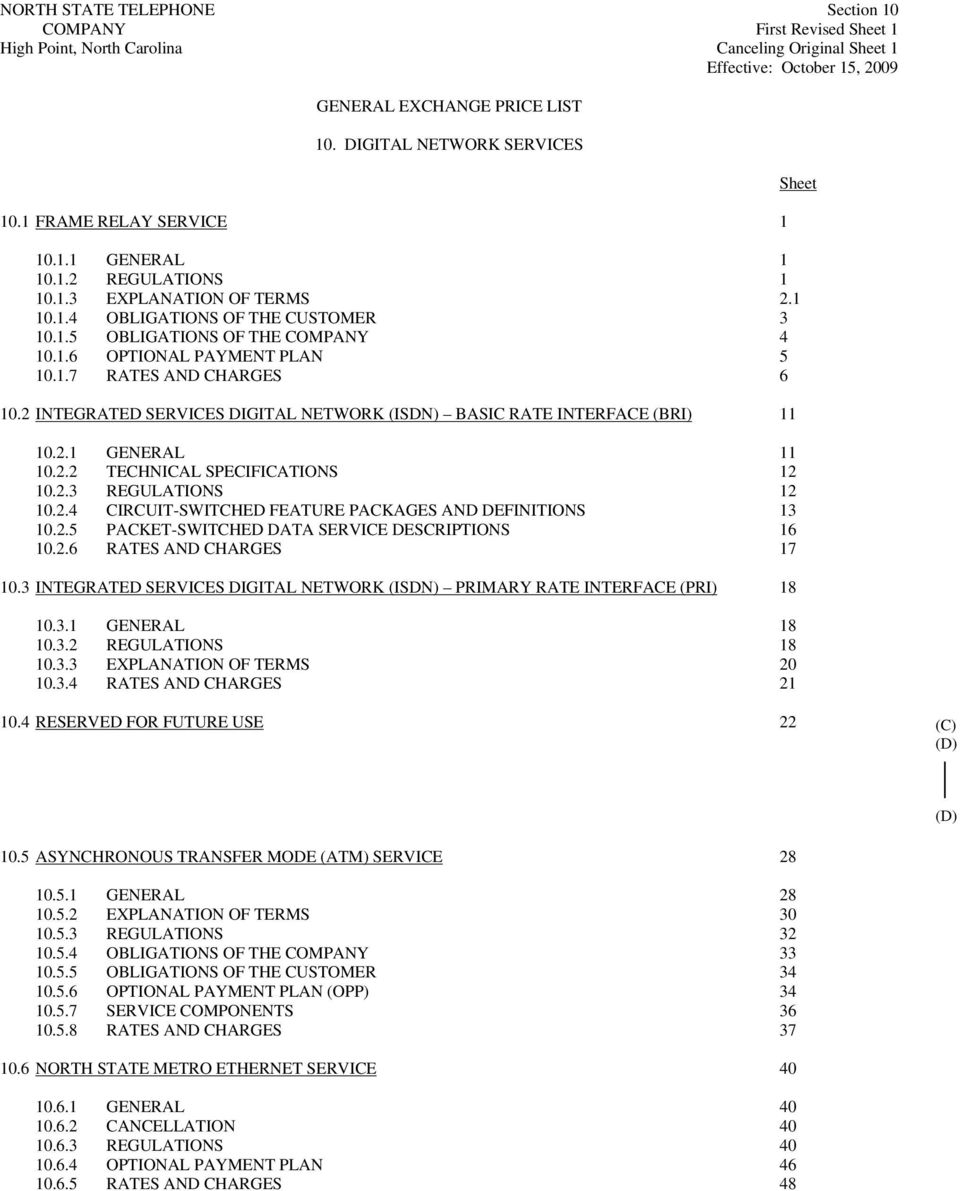
1 COMPANY First Revised Sheet 1 High Point, North Carolina Canceling Original Sheet 1 Effective: October 15, FRAME RELAY SERVICE GENERAL REGULATIONS EXPLANATION OF TERMS OBLIGATIONS OF THE CUSTOMER OBLIGATIONS OF THE COMPANY OPTIONAL PAYMENT PLAN RATES AND CHARGES INTEGRATED SERVICES DIGITAL NETWORK (ISDN) BASIC RATE INTERFACE (BRI) GENERAL TECHNICAL SPECIFICATIONS REGULATIONS CIRCUIT-SWITCHED FEATURE PACKAGES AND DEFINITIONS PACKET-SWITCHED DATA SERVICE DESCRIPTIONS RATES AND CHARGES INTEGRATED SERVICES DIGITAL NETWORK (ISDN) PRIMARY RATE INTERFACE (PRI) GENERAL REGULATIONS EXPLANATION OF TERMS RATES AND CHARGES 21 Sheet 10.4 RESERVED FOR FUTURE USE 22 (C) (D) (D) 10.5 ASYNCHRONOUS TRANSFER MODE (ATM) SERVICE GENERAL EXPLANATION OF TERMS REGULATIONS OBLIGATIONS OF THE COMPANY OBLIGATIONS OF THE CUSTOMER OPTIONAL PAYMENT PLAN (OPP) SERVICE COMPONENTS RATES AND CHARGES NORTH STATE METRO ETHERNET SERVICE GENERAL CANCELLATION REGULATIONS OPTIONAL PAYMENT PLAN RATES AND CHARGES 48
2 COMPANY Original Sheet 1 High Point, North Carolina Effective: December 31, FRAME RELAY SERVICE GENERAL A. Frame Relay Service (FRS) is a fast packet network service that permits the two-way transmission of data at speeds from 56 kbps to Mbps using Permanent Virtual Circuits (PVCs). B. Permanent Virtual Circuits (PVCs) are logical circuits that define a specific one-way path for data sent by the customer to another customer location. These circuits are virtual because they are established in software tables and do not tie up capacity when not in use. This also allows multiple PVCs to be defined over a single access line, thereby providing a single access line the capability to transmit data to multiple destinations. C. In the operation of Frame Relay Service, Customer Premises Equipment (CPE), such as routers, encapsulate data into variable length frames. These frames contain information identifying which PVC in the network should be used to forward the frame to the proper destination. The CPE then sends the frame into the Frame Relay network. The Frame Relay switch reads identifying information and routes the frame to the proper destination based on a pre-established PVC. D. The statistical multiplexing Frame Relay switches are able to provide shared network resources to end users of this service. E. Frame Relay Service conforms to Consultative Committee for International Telegraph and Telephone (CCITT) and American National Standards Institute (ANSI) standards set forth in technical publications. F. Frame Relay Service, as provided for in this Price list section, is offered for intralata use only. G. The regulations and rates specified herein are in addition to the applicable regulations and rates specified in other sections of this Price list. H. The rates and charges set forth for Frame Relay Service provide for the furnishing of service where suitable facilities are available. I. Frame Relay PVCs may be interconnected with Asynchronous Transfer Mode (ATM) Service subject to the provisions set forth in Section 10.5 of this Price list REGULATIONS A. Frame Relay is a transport service that facilitates the exchange of variable length information units (frames) between end user connections by way of PVCs. Each frame is passed to the Frame Relay Network with an address that specifies the virtual connection. B. Variable frame length capability is useful in communications between asynchronous Local Area Networks (LAN) and for transport of synchronous data traffic. Frame Relay is capable of handling the requirements of bursty data sources because of the ability of the service to allocate additional bandwidth when not in use by other sources. C. Frame Relay is provided to the customer in the form of Frame Relay Port with Access Line or Frame Relay with Port only and the Permanent Virtual Circuits (PVC). The Frame Relay Access Line forms the local access component which provides the customer access to the customer s serving central office and a primary address associated specifically with that customer. The Logical Link consists of the Frame Relay network and the interoffice transport and facilities from the customer s Serving Central Office to the Frame Relay Office(s). The Frame Relay Access Line is provided for use only with Frame Relay Service. The Frame Relay with Port Only is provided for digital special access line connections to the network supporting Frame Relay Service. D. The actual throughput of aggregated PVC bandwidths in use at the same time on the same port cannot exceed the port speed.

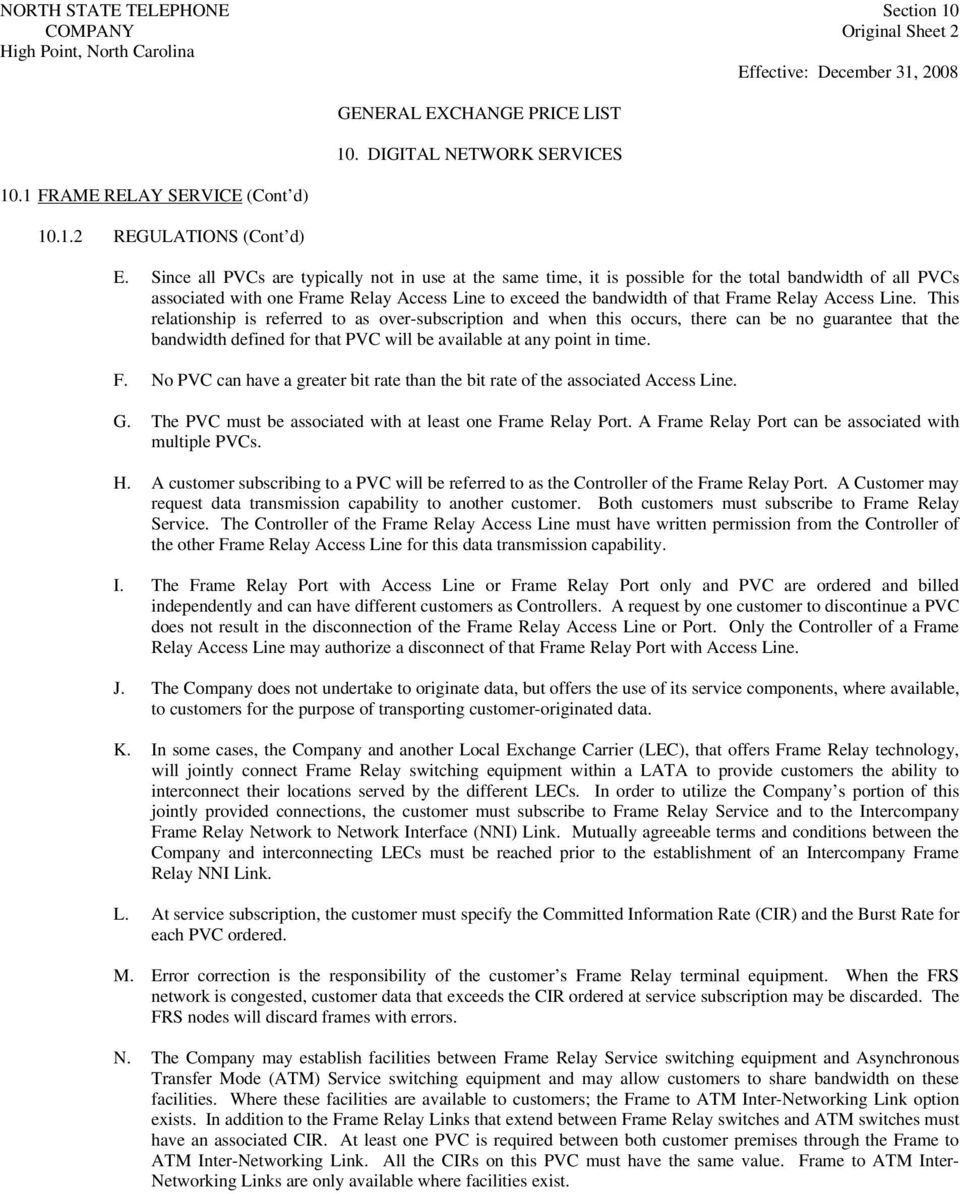
3 COMPANY Original Sheet 2 High Point, North Carolina Effective: December 31, FRAME RELAY SERVICE (Cont d) REGULATIONS (Cont d) E. Since all PVCs are typically not in use at the same time, it is possible for the total bandwidth of all PVCs associated with one Frame Relay Access Line to exceed the bandwidth of that Frame Relay Access Line. This relationship is referred to as over-subscription and when this occurs, there can be no guarantee that the bandwidth defined for that PVC will be available at any point in time. F. No PVC can have a greater bit rate than the bit rate of the associated Access Line. G. The PVC must be associated with at least one Frame Relay Port. A Frame Relay Port can be associated with multiple PVCs. H. A customer subscribing to a PVC will be referred to as the Controller of the Frame Relay Port. A Customer may request data transmission capability to another customer. Both customers must subscribe to Frame Relay Service. The Controller of the Frame Relay Access Line must have written permission from the Controller of the other Frame Relay Access Line for this data transmission capability. I. The Frame Relay Port with Access Line or Frame Relay Port only and PVC are ordered and billed independently and can have different customers as Controllers. A request by one customer to discontinue a PVC does not result in the disconnection of the Frame Relay Access Line or Port. Only the Controller of a Frame Relay Access Line may authorize a disconnect of that Frame Relay Port with Access Line. J. The Company does not undertake to originate data, but offers the use of its service components, where available, to customers for the purpose of transporting customer-originated data. K. In some cases, the Company and another Local Exchange Carrier (LEC), that offers Frame Relay technology, will jointly connect Frame Relay switching equipment within a LATA to provide customers the ability to interconnect their locations served by the different LECs. In order to utilize the Company s portion of this jointly provided connections, the customer must subscribe to Frame Relay Service and to the Intercompany Frame Relay Network to Network Interface (NNI) Link. Mutually agreeable terms and conditions between the Company and interconnecting LECs must be reached prior to the establishment of an Intercompany Frame Relay NNI Link. L. At service subscription, the customer must specify the Committed Information Rate (CIR) and the Burst Rate for each PVC ordered. M. Error correction is the responsibility of the customer s Frame Relay terminal equipment. When the FRS network is congested, customer data that exceeds the CIR ordered at service subscription may be discarded. The FRS nodes will discard frames with errors. N. The Company may establish facilities between Frame Relay Service switching equipment and Asynchronous Transfer Mode (ATM) Service switching equipment and may allow customers to share bandwidth on these facilities. Where these facilities are available to customers; the Frame to ATM Inter-Networking Link option exists. In addition to the Frame Relay Links that extend between Frame Relay switches and ATM switches must have an associated CIR. At least one PVC is required between both customer premises through the Frame to ATM Inter-Networking Link. All the CIRs on this PVC must have the same value. Frame to ATM Inter- Networking Links are only available where facilities exist.
4 COMPANY Original Sheet FRAME RELAY SERVICE (Cont d) EXPLANATION OF TERMS Bust Rate The upper bandwidth limit the permanent virtual circuit is allowed to send data through the FRS network. The burst rate is limited by the actual physical port access speed. Committed Information Rate (CIR) The CIR represents the base-level bandwidth the permanent virtual circuit is allowed to send data through the network. Each Data Link Connection Identifier (DLCI) has an associated CIR setting. The CIR setting enables the customer to have a sustained throughput under normal traffic conditions. Frames submitted at a rate above the subscribed CIR setting are marked Discard Eligible (DE). When the CIR setting is zero, all frames transmitted through the Frame Relay Service Network will be marked DE. Should network congestion occur, frames marked DE are subject to being dropped by the network. However, in the absence of network congestion, all frames marked DE will be transmitted with the same reliability as frames not marked DE within a single, Company Frame Relay Switch. The CIR value selected cannot exceed the minimum transmission speed of the link at either end of the PVC. Customer Premises The geographic location designated by the customer at which an access component of the customer s service is first considered to enter the Company s network. Data Link Connection Identifier (DLCI) The address information contained in the Frame Relay header which conveys to the network how an individual frame should be routed. The DLCI essentially defines to which customer end point a particular frame should be sent. Frame A sequence of contiguous bits delimited by beginning and ending flag sequences. Frame Relay Access Line (FRAL) Frame Relay Access Lines provide access to the Frame Relay Service (FRS) Network, connecting customer facilities at the Network Interface with a corresponding Frame Relay Port.

5 COMPANY Original Sheet 3 High Point, North Carolina Effective: December 31, FRAME RELAY SERVICE (Cont d) EXPLANATION OF TERMS (Cont d) Frame Relay Port For Frame Relay Service, the physical entry points for Permanent Virtual Circuits (PVCs). Ports include the electronic equipment used in connecting these service elements to the Frame Relay Network, and enable customers to allocate bandwidth to applications, as needed, at customer designated transmission speeds of between 56 kbps to Mbps. Frame Relay Service A fast packet network service that permits the transmission of data at speeds of 56 kbps to Mbps using Permanent Virtual Circuits (PVCs). Frame to Asynchronous Transfer Mode (ATM) Inter-Networking Links The connection that allows Frame Relay customers a path to connect Frame Relay service switching equipment with ATM switching equipment allowing customers to share bandwidth on facilities. Intercompany Frame Relay NNI Link The connection that allows Company Frame Relay customers a path to extend network capabilities to another LEC s Frame Relay switch. Local Area Network (LAN) A network permitting the interconnection and intercommunication of a group of computers, primarily for the sharing of resources such as data storage devices and printers. Logical Channel A communications channel which allows two-way simultaneous transmission of sequenced data packets through the network. No circuit capability is preassigned to a logical channel. Capacity is made available as the data is transmitted. Each permanent virtual circuit is one logical channel. Network Interface (NI) The point at which a customer s data transmission first enters the network supporting Frame Relay Service. It is the point of interconnection between Company communications facilities and customer terminal equipment. Permanent Virtual Circuit (PVC) A Permanent Virtual Circuit (PVC) is a logical channel from one end user location to another end user location within the Frame Relay Service (FRS) Network. PVCs are provisioned on either 56 kbps, 64 kbps, 128 kbps, 256 kbps, 384 kbps, 768 kbps, or Mbps ports, depending on the customer s data networking requirements. Protocol A set of conditions for conducting interactions between two or more terminals, host or peripherals. These conditions consist of syntax (header structure), semantics (actions and reactions that are supposed to occur) and timing (relative ordering and duration of states and events). Statistical Multiplexing A multiplexing technique in which timeslots are dynamically allocated on the basis of need rather than being predetermined. The data is typically transmitted on a first come, first served basis OBLIGATIONS OF THE CUSTOMER A. The customer s Frame Relay compatible terminal equipment has the responsibility for retransmitting frames which are discarded due to errors or network congestion. B. Where Frame Relay Service is available for use in connection with communications systems or equipment provided by a customer or user, the operating characteristics of such systems or equipment shall be such as not to interfere with any services offered by the Company. Such use is subject to the further provisions that the equipment provided by the customer or user does not endanger the safety of the Company s employees or the public; damage, harm, require change in or alteration of the equipment or other services of the Company; interfere with the proper operation of the Company s equipment or otherwise injure the public in its use of the Company s services. Upon notice from the Company that the equipment provided by the customer or user is causing, or is likely to cause, such hazard or interference, the customer shall take such steps as shall be necessary to remove or prevent such hazard or interference. C. The customer, upon request, shall furnish such CPE information as may be required to permit the Company to configure and maintain the Frame Relay Service it offers.

6 COMPANY Original Sheet FRAME RELAY SERVICE (Cont d) OBLIGATIONS OF THE CUSTOMER (Cont d) D. It shall be the responsibility of the customer to ensure the continuing compatibility of the customer-provided equipment that is used in conjunction with the Frame Relay Service. The CPE shall be in compliance with rules and regulations as specified in Section 15 of this price list. E. The customer shall be responsible for obtaining permission for the Company s agents or employees to enter the premises of the customer at any reasonable hour for the purpose of installing, inspecting, repairing, or, upon termination of the service, removing the service components of the Company. F. The customer shall be responsible for the payment of a nonrecurring Maintenance of Service charge as found in Section 15.4 of this price list for each repair visit to the premises of the customer where the service difficulty or trouble results from the use of equipment or service components provided by the customer. G. The Customer may only use a Frame Relay Access line with Frame Relay Service OBLIGATIONS OF THE COMPANY A. The responsibility of the Company shall be limited to furnishing network equipment suitable for Frame Relay Service and to the maintenance and operation of such equipment in a manner proper for such service. Subject to this responsibility, the Company shall not be responsible for the through transmission of signals generated by the customer-provided equipment or system, or for the quality of, or defects in, such transmission or the reception of signals by such equipment or systems. B. The Company shall not be responsible for installation, operation or maintenance of any terminal equipment, data unit or communications system provided by a customer or user. The Company is not responsible for adapting Frame Relay Service to the technological requirements of any specific customer equipment. C. When a customer orders Frame Relay Service which is relayed to other Local Exchange Carriers, Interexchange Carriers or other Frame Relay networks, the Company will provide advisory assistance as a part of the establishment of this service. D. The Company shall not be responsible to the customer or user if changes in any of the equipment, operations or procedures of the Company used in the provision of Frame Relay Service render any facilities provided by the customer or user obsolete or require modification or alteration of such equipment or system or otherwise affect its use or performance, provided the Company has met any applicable information disclosure requirements otherwise required by law. E. The Company undertakes the responsibility to maintain and repair the service which it furnishes. Network equipment installed by the Company on the customer s premises shall be and remain the property of the Company. The customer or user may not rearrange, disconnect, remove, attempt to repair, remote test, or interface with any network equipment installed by the Company without prior written consent by the Company. F. The Company, by written notice to the customer, may discontinue the furnishing of Frame Relay Service in accordance with the Rules and Regulations as specified in Section 2 of this Price list. G. The Company has the service responsibility up to and including the network interface.

7 COMPANY Original Sheet 5 High Point, North Carolina Effective: December 31, FRAME RELAY SERVICE (Cont d) OPTIONAL PAYMENT PLAN (OPP) A. General 1. Payment periods of one year, three years, and five years are available to all customers at the applicable rates set forth in Section regardless of when they subscribe to an OPP arrangement. 2. The customer must designate at order time the payment period described for the OPP. B. Changes in Length of OPP Period Prior to the completion of the selected OPP period, the customer may elect to convert to a new OPP period of the same or different length, subject to the following conditions: - No credit toward the new payment period will be given for payments due and made under the original OPP arrangement. - Nonrecurring charges will not be reapplied for existing service(s). - If the new OPP period is shorter in length than the time remaining under the existing OPP, the change to the new OPP period constitutes a disconnect of the existing OPP service and termination liability charges apply. If no other changes are ordered, the Line Connection Charge, as specified in Section 4 of this Price list, also applies per order. If changes are ordered all applicable nonrecurring charges, as specified in this Section and service charges as specified in Section 4 of this Price list, apply. - Conversion to month-to-month rates will be treated as a disconnect of the existing service and termination liability charges apply. If no other changes are ordered, the Line Connection Charge, as specified in Section 4 of this Price list, also applies per order. If changes are ordered all applicable nonrecurring charges, as specified in this Section and service charges as specified in Section 4 of this Price list, apply. C. Renewal Options 1. At the expiration of an OPP period, the Company will continue to provide the service at the month-tomonth rates unless the customer chooses to renew for the same OPP period, convert to a different OPP period or discontinue service. 2. Conversion to a different OPP period will require the customer to submit a change order. Conversion to a different OPP period will be allowed without application of any nonrecurring or ordering charges. D. Notification of Discontinuance 1. An Order for Discontinuance of an OPP arrangement must be received by the Company at least thirty (30) days prior to actual disconnect of service. Monthly charges will apply for a period of thirty (30) days from the date the Company receives disconnect notification or until the requested disconnect date, whichever period is longer. E. Upgrade to Higher Speed Service 1. Customers may elect to upgrade service(s) to a higher speed during an OPP period, subject to the following conditions: - The upgraded service will be subject to nonrecurring charges. - Termination liability charges will not apply as long as the upgraded service remains connected at the same point(s) of termination. - If the upgrade involves establishing a multiplexing arrangement, termination liability charges will not apply if the serving wire center is the same one associated with the customer designated location.

8 COMPANY Original Sheet 6 High Point, North Carolina Effective: December 31, FRAME RELAY SERVICE (Cont d) OPTIONAL PAYMENT PLAN (OPP) (Cont d) F. Termination Liability 1. When an OPP service is discontinued prior to the end of the period, termination liability charges, as set forth below, will apply based on the remainder of the OPP period in effect at the time of disconnect. 2. One Year OPP 50 percent of any remaining portion of the first year s recurring charges. 3. Three Year OPP 50 percent of any remaining portion of the first year s recurring charges. In addition, for any remaining portion of the second and third years, the customer will be liable for 10 percent of the total monthly recurring charges in that time period. 4. Five Year OPP 50 percent of any remaining portion of the first year s recurring charges. In addition, for any remaining portion of the second through fifth years, the customer will be liable for 10 percent of the total monthly recurring charges in that time period. G. Termination Without Liability 1. During an OPP period, should the currently effective rate for a customer s service increase, the customer may, at their option, terminate the OPP arrangement without penalty or liability RATES AND CHARGES A. The minimum contract period for Frame Relay Service is one month. B. A subsequent order to add Frame Relay Access Line(s) or Frame Relay Port(s) to an existing installation will be for a minimum contract period of one month. C. A customer may access Frame Relay Service (FRS) via a Frame Relay Access Line or via Company-provided digital private line facilities. If a customer utilizes private line facilities, or private line transport with a Frame Relay Access Line, to access FRS, the associated regulations, rates and charges for such private line facilities shall apply in addition to the rates and charges associated with the FRS elements. D. A customer utilizing private line facilities to access FRS would not incur a nonrecurring charge, or monthly rate for a Frame Relay Access Line, but would incur all other monthly rates and nonrecurring charges normally associated with the ordering, installation, and provisioning of Frame Relay Service. E. The total number of additional Frame Relay Permanent Virtual Circuits (PVCs) per port purchased by the customer within the LATA determines the rate category for all the additional PVCs per port of that customer, within the LATA. For example, if 15 additional PVCs are subscribed, then all 15 PVCs for that port will be rated at the monthly rate for 11 to 20 PVCs, since 15 falls into that range. F. When a customer subsequently orders additional PVCs, the sum total of all PVCs subscribed to by the Customer shall be used to determine the customer s PVC monthly rate category for all PVCs then subscribed. G. When a customer orders additional PVCs or changes PVC assignments on a given FRS port after the initial port installation, the Frame Relay PVC nonrecurring charge shall apply. H. When a customer orders an Intercompany Frame Relay NNI Link, the nonrecurring and recurring charges as specified in K.5.a apply. The customer must subscribe to Company Frame Relay service to be eligible for an Intercompany Frame Relay NNI Link.

9 COMPANY Original Sheet FRAME RELAY SERVICE (Cont d) RATES AND CHARGES (Cont d) H. Service Rearrangements Service rearrangements are changes to existing (installed) services which do not result in a change in the physical location of the network interface. (Changes in the physical location of the network interface are treated as moves and are described and charged for as set forth herein). 1. Additions to Service a. When service elements are added to an existing service, the added elements must meet the minimum period requirements associated with the service to which they are added. b. When PVCs are added to an existing Frame Relay Service, the minimum period for the added PVCs is one month. c. An addendum to the existing fixed-period service agreement is required when service elements are added to an existing fixed-period service. PVCs may be added to existing fixed-period service on a month-to-month basis without an addendum to the existing fixed-period service agreement. The addendum is for the purpose of identifying service elements that have been added subsequent to establishing the fixed-period agreement. d. Nonrecurring charges will apply for all additions to existing services, service elements, or optional features for which nonrecurring charges normally apply at installation. e. Nonrecurring charges for additional PVCs will be required if PVCs are not purchased with a Frame Relay Port at the time of the original service request. f. Related monthly rates and nonrecurring charges for addition(s) to service are the rates and charges in effect at the time of the addition(s). 2. Upgrades in Speed or Capacity a. Should the customer upgrade either a portion or the entire service provided under a fixed-period service agreement to a higher speed or greater capacity, discontinuance charges will not apply, provided all the following conditions are met: - Both the existing and new services and/or service element(s) are of the same service type; e.g., both Frame Relay Service; - Both the existing and the new services and/or element(s) are provided solely by the Company; - The order to discontinue a service at an existing speed or capacity and the order for the upgraded service are received by the Company at the same time; - The new service will be provided at the same customer location as the discontinued service; - The fixed period plan for the upgraded service(s) and/or service element(s) meets or exceeds the remaining length of the existing fixed-period plan; and - The total monthly rate of the new agreement is equal to or greater than the total monthly rate of the existing agreement period.

10 COMPANY Original Sheet 8 High Point, North Carolina Effective: December 31, FRAME RELAY SERVICE (Cont d) RATES AND CHARGES (Cont d) H. Service Rearrangements (Cont d) 2. Upgrades in Speed or Capacity (Cont d) b. The monthly rates for the upgraded services and/or service elements will be those rates in effect at the time of the service upgrade. The related nonrecurring charges which apply for the upgrade are the charges in effect at the time of the service upgrade. c. Should the order to upgrade exclude one or more of the conditions listed above in Section H.2, it will be treated as a discontinuance of the existing service and the establishment of a new service. All outstanding minimum period charges and discontinuance charges will apply. 3. Administrative Changes a. Administrative changes to existing service will be made without charge(s) to the customer. Administrative changes are as follows: - Change of customer name, i.e., the customer or record does not change but rather the customer of record changes its name, e.g., XYZ Company to XYZ Communications, - Change of customer premises address when the change of address is not a result of a physical relocation of facilities, - Change in billing data (name, address, or contact name or telephone number), - Change of customer contact name or telephone number, and - Change of customer service element identification. I. Service charges specified in Section 4 of this Price list apply for installations, customer-requested moves, changes and/or additions performed by the Company. J. Rate Elements 1. Frame Relay Service with Access Line A nonrecurring charge and monthly rate, both based on the speed of the port connection (i.e., 56 kbps or Mbps), apply per port for each physical connection to the network supporting Frame Relay Service (FRS). 2. Frame Relay Service Without Access Line A monthly rate, based on the speed of the port connection (i.e., 56 kbps or Mbps) and the number of unidirectional PVCs assigned to the port, applies per port for each Frame Relay Access Line or digital private line connection to the network supporting FRS. Each port can have multiple PVCs. The first PVC is included with the purchase of the port. 3. Frame Relay PVC (FR-PVC) a. A nonrecurring charge and a monthly rate apply for each PVC. A monthly rate is based on the number of PVCs assigned to the port and applies per port. b. A nonrecurring charge applies for each subsequent order of PVC(s) to be added to PVC assignment(s) changed on an existing FRS.

11 COMPANY Original Sheet 8.1 High Point, North Carolina Effective: December 31, FRAME RELAY SERVICE (Cont d) RATES AND CHARGES (Cont d) J. Rate Elements (Cont d) 4. Committed Information Rate (CIR) A nonrecurring charge and monthly rate, both based on the CIR sustained throughput under normal traffic conditions. 5. Intercompany Frame Relay NNI Link A standard nonrecurring charge which is not throughput sensitive and a recurring charge based on throughput requirements.

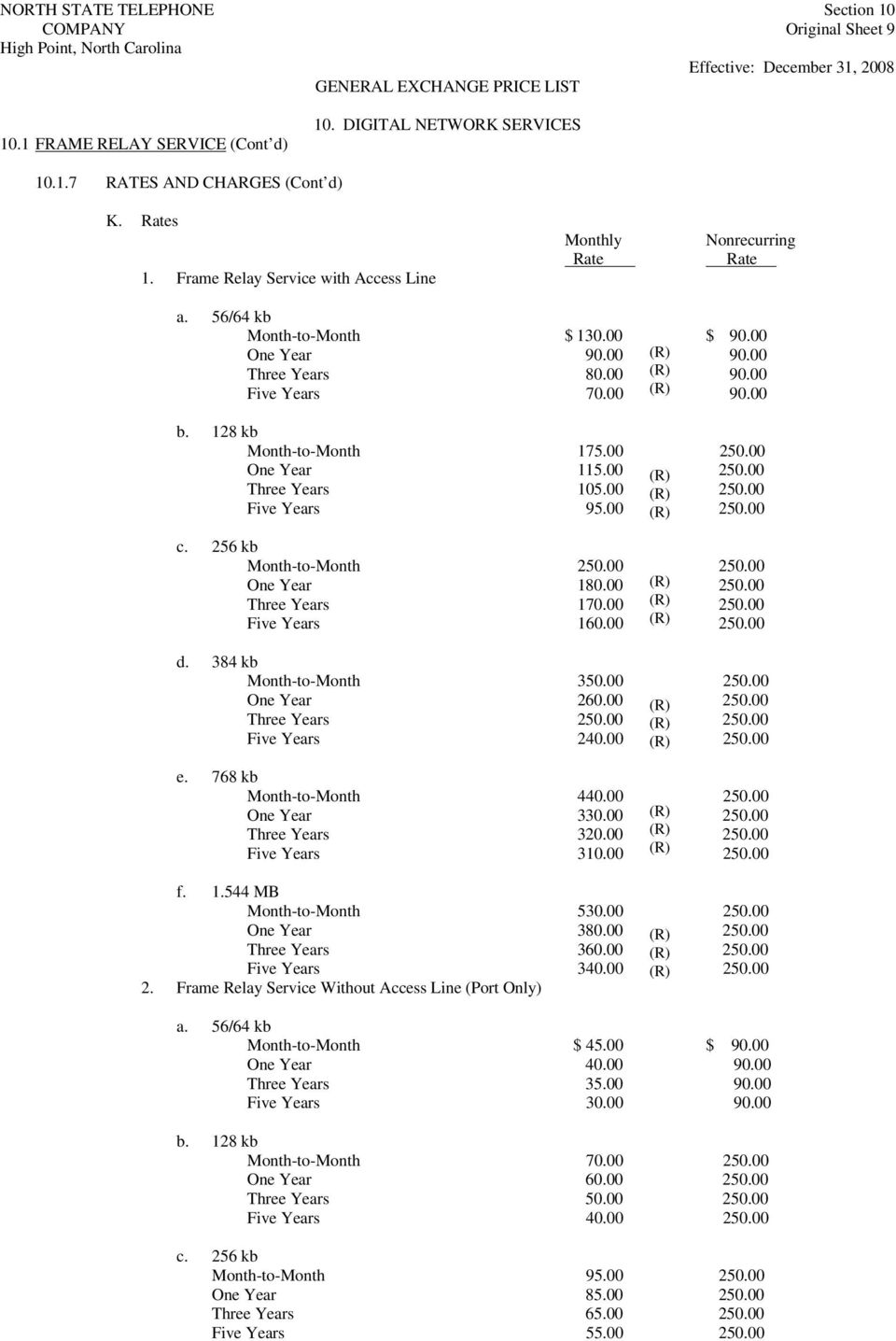
12 COMPANY Original Sheet 9 High Point, North Carolina Effective: December 31, FRAME RELAY SERVICE (Cont d) RATES AND CHARGES (Cont d) K. Rates 1. Frame Relay Service with Access Line Monthly Rate Nonrecurring Rate a. 56/64 kb Month-to-Month $ $ One Year (R) Three Years (R) Five Years (R) b. 128 kb Month-to-Month One Year (R) Three Years (R) Five Years (R) c. 256 kb Month-to-Month One Year (R) Three Years (R) Five Years (R) d. 384 kb Month-to-Month One Year (R) Three Years (R) Five Years (R) e. 768 kb Month-to-Month One Year (R) Three Years (R) Five Years (R) f MB Month-to-Month One Year (R) Three Years (R) Five Years (R) Frame Relay Service Without Access Line (Port Only) a. 56/64 kb Month-to-Month $ $ One Year Three Years Five Years b. 128 kb Month-to-Month One Year Three Years Five Years c. 256 kb Month-to-Month One Year Three Years Five Years
13 COMPANY Original Sheet 10 High Point, North Carolina Effective: December 31, FRAME RELAY SERVICE (Cont d) RATES AND CHARGES (Cont d) K. Rates (Cont d) 2. Frame Relay Service Without Access Line (Port Only) (Cont d) Monthly Rate Nonrecurring Rate d. 384 kb Month-to-Month $ $ One Year Three Years Five Years e. 768 kb Month-to-Month One Year Three Years Five Years f. 1,544 Mb Month-to-Month One Year Three Years Five Years Additional Frame Relay Permanent Virtual Circuit (PVC), per port, per PVC a. 2 to 10 PVCs b. 11 to 20 PVCs c. 21 or more PVCs Committed Information Rate (CIR) The chosen CIR cannot exceed the minimum transmission speed of the Link at either end of the PVC. Monthly Rate Nonrecurring Rate (a) Per DLCI (1) 0 kbps (2) 1 through 32 kbps (3) 33 through 56 kbps (4) 57 through 64 kbps (5) 65 through 128 kbps (6) 129 through 256 kbps (7) 257 through 384 kbps (8) 385 through 512 kbps (9) 513 through 768 kbps (10) 769 through Mbps

14 COMPANY Original Sheet 10.1 High Point, North Carolina Effective: December 31, FRAME RELAY SERVICE (Cont d) RATES AND CHARGES (Cont d) K. Rates (Cont d) 5. Intercompany Frame Relay NNI Link The chosen Intercompany Frame Relay NNI Link must be the same through-put as the associated Frame Relay Service. (a) Per Intercompany Frame Relay NNI Link Connection. Monthly Rate Nonrecurring Rate (1) 56 kbps (2) 128 kbps (3) 256 kbps (4) 384 kbps (5) 768 kbps (6) Mbps Frame to ATM Inter-Networking Link The Frame Relay through-put must have the same through-put as the associated ATM service. (a) Per Frame to ATM Inter-Networking Link Monthly Rate Nonrecurring Rate (1) Over 0 thru 256 kbps (2) Over 256 thru 384 kbps (3) Over 384 thru 768 kbps (4) Over 768 thru Mbps (5) Over thru 3 Mbps (6) Over 3 thru 6 Mbps (7) Over 6 thru 9 Mbps (8) Over 9 thru 12 Mbps (9) Over 12 thru 45 Mbps

15 COMPANY Original Sheet INTEGRATED SERVICES DIGITAL NETWORK (ISDN) BASIC RATE INTERFACE (BRI) GENERAL A. ISDN is a public switched network-based set of communications services that makes it possible to send, receive, and modify information using regular telephone lines. ISDN provides end-to-end digital communications and gives the ability to transmit data and voice over the same telephone line simultaneously (a user can send information from a personal computer and talk to the person on the other end of the line at the same time). This functionality is provided via channelized transport facilities. The ISDN architecture consists of digital central office switching systems which connect Basic Rate Interface (BRI) equipped lines to customers premises. B. ISDN BRI is an optional service arrangement that requires a local exchange access line and uses the ISDN architecture to provide the customer with the capability to transmit voice and data simultaneously over the same digital line. Under various optional arrangements, BRI provides the customer with access to Circuit- Switched Voice Services, Circuit-Switched Data Services, and Packet-Switched Data Services. C. An ISDN BRI arrangement obtains its capability from an ISDN-capable, Telephone Company central office switch. The ISDN BRI arrangement provides two communications channels (but using only one physical line) between a telephone (or computer, fax machine, or other equipment) and the digital central office. These channels are called Bearer, or B Channels. Another channel, called the Delta or D Channel, is used for signaling purposes and in some applications can be used for low speed packet data communications. The complete ISDN BRI line is known as 28+D. 1. B Channel - The B Channel is a bi-directional synchronous channel capable of supporting digital transmission speeds of up to 64 kilobits per second (kbps). Some serving central offices may be limited to speeds of 56 kbps. ISDN interconnection to or through non-isdn equipped central offices will be subrated to 56 kbps per channel. Each B Channel may be configured in one of the following ways: a. Circuit-Switched Voice (CSV) Allows the user to originate and receive only voice calls over a single circuit-switched B Channel. b. Circuit-Switched Data (CSD) Allows the user to originate and receive only data calls over a single circuit-switched B channel. c. Alternate Circuit-Switched Voice/Data (CSV/CSD) Allows the user to originate and receive either voice calls or data calls over a single circuit-switched B channel, but not simultaneously. d. B Channel Packet-Switched Data Service (where available) Allows the user to originate and receive X.25 packet data calls on the B Channel. 2. D Channel The D Channel is a 16 kbps digital signaling channel that carries signaling and control for the B Channels. The D Channel may be optionally used to transmit X.25 packet data (where available) at a maximum transmission throughput of 9.6 kbps. D. All ISDN services consist of central office facilities (including certain outside plant facilities) extended from the Telephone Company s switching equipment to the customer s demarcation point. E. Distance Extension Charges, as set forth in Section of this price list, will apply to customers who are within the serving central office and who are served at a transmission range where unusual expenditures are required to make the service available.

16 COMPANY Original Sheet INTEGRATED SERVICES DIGITAL NETWORK (ISDN) BASIC RATE INTERFACE (BRI) (Cont d) GENERAL (Cont d) F. Directory Numbers 1. Primary Directory Number (PDN) Each B Channel includes a single primary directory number. The D Channel will include a primary directory number when D Channel Packet Switching is subscribed to. On a given 28+D ISDN BRI line, calls are routed to the appropriate terminal device (voice, telephone, computer/data terminal or packet device) based on the type of call (voice, data, or packet) presented to the ISDN BRI line. 2. Secondary Directory Numbers (SDN) ISDN BRI may have Secondary Directory Numbers. The Secondary Directory Number(s) may originate or receive calls independent of the user s Primary Directory Number; however, each B Channel is allowed only one simultaneous circuit connection at a time TECHNICAL SPECIFICATIONS A. Transmission Specifications The standard transmission parameters for ISDN BRI consists of: A maximum of 38.5db loop loss at a 40kz test tone terminated into a 135 ohm impedance. The 38.5db loss includes all central office facilities, outside plant facilities and inside wiring (which are owned and maintained by the Company only up to and including the demarcation point). B. Customer Premise Equipment and Facilities Compatible customer premise equipment is required to utilize ISDN BRI services. The Company shall not be responsible if changes in any of the equipment, operations, or procedures of the Company utilized in the provisions of ISDN BRI services render any facilities provided by the customer obsolete or require modification of such equipment of system, or otherwise affect its use or performance. C. Electronic Key Telephone Service (EKTS) REGULATIONS Electronic Key Telephone Service is a central office based key system implementation that requires no switching equipment on the customer s premise. EKTS requires the customer to provide an EKTS capable terminal set. EKTS is available to ISDN BRI Business subscribers only and is not available for ISDN BRI Residential subscribers. A. Unless specifically exempted, ISDN BRI shall be subject to all general regulations applicable to the provision of service by the Company as stated in this price list. B. ISDN BRI is provided at the option of the Company. This service is furnished subject to central office switching capacity, capability, the availability of outside plant facilities, and the necessary billing capabilities. 1. The availability, functionality, and capabilities of ISDN BRI may vary, or may not be available, dependent upon the type of serving central office switch, related software controlling that switch, hardware, and associated outside plant. a. Where facilities are not available, or unusual expenditures are involved in making them available, the customer may be required to pay additional charges to cover the unusual expenditure, or to contract for services beyond the normal service term, or both. (These rates and charges will be determined on an individual case basis.) b. Distance Extension Service: ISDN BRI may be provided to a customer s location served beyond the normal transmission range of the serving central office. In such cases, in addition to the charges and rates for ISDN BRI, Distance Extension Service rates and charges as stated in Section are applicable.

17 COMPANY Original Sheet INTEGRATED SERVICES DIGITAL NETWORK (ISDN) BASIC RATE INTERFACE (BRI) (Cont d) REGULATIONS (Cont d) C. The minimum charge period for the payment of services provided under this price list is one month. D. Directory Listings: One directory listing is provided without charge for each ISDN B Channel and D Channel Primary Directory number. Additional listings may be provided as specified in Section 6 of this price list. E. Billable Call Treatment Normal toll charges shall apply to calls that are made outside of the Local Service Area. F. Customer Premise Equipment 1. This price list for ISDN BRI does not include terminal equipment on the customer s premises. Terminal equipment may be sold or leased separately by the Company (under a separate contract), or may be provided by the customer. 2. The customer is responsible for providing the power required for any and all customer premise equipment connected to an ISDN BRI equipped line. G. The Company shall not be liable for any loss or damages arising out of error, interruptions, defects, failures, or malfunctions of ISDN BRI or associated equipment. Damages arising out of such interruptions, defects, failures, or malfunctions of the services after the Company has been notified, and has reasonable time for repair, shall in no event exceed an amount equivalent to the charges made for the service affected for the period following notice from the customer until service is restored. H. ISDN BRI is not eligible for suspension of service CIRCUIT-SWITCHED FEATURE PACKAGES AND DEFINITIONS Circuit Switching is a switching arrangement in which an entire circuit or, in a digital switch equipped for ISDN, a specific selection of channels is dedicated to a given call. Circuit-Switched Service provides the ability to originate and receive circuit-switched voice and/or data calls over 56/64 kbps B Channel. The customer may choose among the following Circuit-Switched feature packages based upon application needs. A. Residential ISDN Packages Both Packages are Non-EKTS 1. Package 1 Basic Residential ISDN This package contains basic BRI service arranged 28+D with the B Channels configured for CSV, CSD, or CSV/CSD. a. Each B Channel will have a PDN. b. Each B Channel will have Caller ID capabilities. 1 c. Clear Channel Capability A characteristic of the transmission paths on the B Channels that allows the full bandwidth of 64 kbps to be available to the customer. It is also possible to bridge the two B Channels together to achieve data transmission speeds of up to 128 kbps. However, ISDN interconnection to or through non-isdn equipped central offices will be potentially subrated to 56 kbps per channel. Note 1: Caller Id with ISDN-BRI is subject to the same per line or per call blocking options listed in Section 13 of this price list.

18 COMPANY Original Sheet INTEGRATED SERVICES DIGITAL NETWORK (ISDN) BASIC RATE INTERFACE (BRI) (Cont d) CIRCUIT-SWITCHED FEATURE PACKAGES AND DEFINITIONS (Cont d) A. Residential ISDN Packages Both Packages are Non-EKTS (Cont d) 2. Package 2 Enhanced Residential ISDN This package is the same as Package 1 plus: a. Additional Call Offering This provides up to five additional appearances of the PDN for making/receiving voice calls. b. Flexible Calling This is made up of three-way conference, drop, hold, and transfer features. B. Business ISDN Packages 1. Package 1 Basic Non-EKTS Business ISDN This package contains basic BRI service arranged 28+D with the B Channels configured for CSV, CSD, or CSV/CSD. a. Each B Channel will have PDN. b. Each B Channel will have Caller ID capabilities. 1 c. Clear Channel Capability A characteristic of the transmission paths on the B Channels that allows the full bandwidth of 64 kbps to be available to the customer. It is also possible to bridge the two B Channels together to achieve data transmission speeds up to 128 kbps. However, ISDN interconnection to or through non-isdn equipped central offices will be potentially subrated to 56 kbps per channel. 2. Package 2 Enhanced Non-EKTS Business ISDN This package is the same as Package 1 plus: a. Additional Call Offering This provides up to five additional appearances of the PDN for making/receiving voice calls. b. Flexible Calling this is made up of three-way or six-way conference, drop, hold, and transfer features. c. Call Pickup This feature allows a user to answer calls directed to another line in the same preset Call Pickup Group. d. Multiline Hunt Service This feature allows incoming calls to a busy Directory Number (DN) to search through a predetermined list of DN s. This may be another ISDN DN on the same (or a different) B Channel or (for voice calls) an analog line. The hunting arrangement may be linear or circular. 3. Package 3 EKTS Business ISDN Electronic Key Telephone Service is a central office based key system implementation that requires no switching equipment on the customer s premise. EKTS requires the customer to provide an EKTS capable terminal set. This package contains basic BRI service arranged 28+D with the B Channels configured for CSV, CSD, or CSV/CSD. a. Each B Channel will have a PDN. b. Each B Channel will have Caller ID capabilities. 1 Note 1: Caller ID with ISDN-BRI is subject to the same per line or per call blocking options listed in Section 13 of this price list.

19 COMPANY Original Sheet INTEGRATED SERVICES DIGITAL NETWORK (ISDN) BASIC RATE INTERFACE (BRI) (Cont d) CIRCUIT-SWITCHED FEATURE PACKAGES AND DEFINITIONS (Cont d) B. Business ISDN Packages (Cont d) 3. Package 3 EKTS Business ISDN (Cont d) c. Clear Channel Capability A characteristic of the transmission paths on the B Channels that allows the full bandwidth of 64 kbps to be available to the customer. It is also possible to bridge two B Channels together to achieve data transmission speeds of up to 128 kbps. However, ISDN Interconnection to or through non-isdn equipped central offices will be potentially subrated to 56 kbps per channel. d. Additional Call Offering This provides up to five additional appearances of the PDN for making/receiving voice calls. e. Flexible Calling This is made up of three-way or six-way conference, drop, hold, and transfer features. f. Multiline Hunt Service This feature allows incoming calls to a busy DN to search through a predetermined list of DN s. This may be another ISDN DN on the same (or a different) B Channel or (for voice calls) an analog line. The hunting arrangement may be linear or circular. g. Up to five secondary directory numbers (SDN) will be available for each B Channel. h. Multiple Appearance Directory Numbers This feature allows DN s from one EKTS set to appear on the EKTS sets of other users. i. Privacy Release This is a privacy feature that allows a customer to specify, on an EKTS group basis, that no other user can bridge on to calls. On a call by call basis, this feature can be disabled to allow bridging to occur. j. Manual Excluding This is the opposite of Privacy Release. On a call by call basis the user can restrict bridging. k. Intercom Calling (dial) This feature allows an EKTS user to call other terminals in the EKTS group with one or two-digit dialing. l. Ringing Options This feature is used with Multiple Appearance Directory Number Arrangements and allows the EKTS set to apply different combinations of ringing (ringing is turned off after a specified period of time), delayed ringing (ringing is turned off after a specified period of time), immediate ringing, no ringing, or normal ringing. On a per EKTS user basis, each DN may have a different ringing option. m. Display Capability This feature allows an appropriately equipped telephone set to display a variety of information. For example, when idle, the time and date is displayed. When the user is making or receiving a call, call progress information is displayed (calling/called number). n. Analog Line Appearance This feature allows analog users DN s to appear on an EKTS set, thereby allowing the EKTS user to provide call coverage for analog users. It may limit the user of other features and/or functionalities on analog lines. o. Feature Function Buttons This feature gives the user the ability to assign features to specific buttons on the EKTS set. When depressed, the button will activate or deactivate the assigned feature. Note: All compatible Star*Plus and Custom Calling Features are also available to ISDN BRI subscribers and are subject to rates and charges specified in Section 13. These charges are assessed on a per B Channel basis.

20 COMPANY Original Sheet INTEGRATED SERVICES DIGITAL NETWORK (ISDN) BASIC RATE INTERFACE (BRI) (Cont d) PACKET-SWITCHED DATA SERVICE DESCRIPTIONS Packet Switching is a service in which packets of data are individually addressed and combined on a transmission path with other addressed packets. Packet-Switched Data Service provides the ability to originate and receive X.25 packet data calls. X.25 is the Consultative Committee on International Telephone and Telegraph s (CCITT) recommended and internationally accepted standard for connecting data terminals to packet-switched networks. D-Channel Packet This service provides packet data on the D Channel at a maximum transmission throughput of up to 9.6 kbps per logical channel. B-Channel Packet This service provides packet data on the B Channel at a maximum transmission throughput of 64 kbps per logical channel. Included in Packet-Switched Data Service are the following features (where available): A. Hunt Groups An arrangement that allows an incoming call to a busy Packet directory number to search through a predetermined list of Packet directory numbers in search of a non-busy logical channel to complete the call. The hunting arrangement may be linear or circular. B. X.25 Data Services: 1. Logical Channels An arrangement that is a virtual circuit, offering multiple logical connections at the packet level of X.25. Logical Channels allow multiple packet calls (or virtual calls) to be active simultaneously on a single D Channel or B Channel. 2. DTE Support Feature The Data Terminal Equipment (DTE) Feature allows the network to prevent any network-to-user signaling on a virtual circuit associated with a Directory Number that is not included in the X.25 version. Virtual circuit communication is allowed between the subscriber s equipment and remote customer equipment that conforms to the X.25 version. This feature is available on a per Directory Number basis. 3. RPOA Selection The Recognized Private Operating Agency (RPOA) arrangement allows the user to specify an Inter-Exchange Carrier or transit network for inter-network calls on a per call basis. 4. Incoming/Outgoing Calls Barred This arrangement can either be used to prohibit a data terminal from receiving an incoming call or from originating outgoing calls. 5. Default Information Rate Assignment Features This arrangement allows the user to subscribe to a default information rate for each direction of communication for a virtual call. 6. Non-Standard Default Packet Sizes Feature This arrangement allows the user to subscribe to a larger maximum packet size for each direction of communication than the default 128 octets normally provided. To have this arrangement, the user must also have the Flow Control Parameter Negotiation Feature. 7. Flow Control Parameter Negotiation Feature This arrangement permits the negotiation on a per call basis of the flow control parameters and automatically negotiates the maximum packet size and window size for each direction of data transmission. 8. Throughput Class Negotiation An arrangement that allows the user to request specific throughput classes (bits/second) in the call request packet for each direction of data transfer associated with a virtual circuit. 9. Transit Delay Feature This arrangement allows the user to indicate a desired maximum transit delay in the call request packet on a per call basis. 10. Non-Standard Default Window Size An arrangement that allows the selection of the default window size of 1 through 7, instead of a standard window size of 2. To have this arrangement, the user must also have the Flow Control Parameter Negotiation Feature.
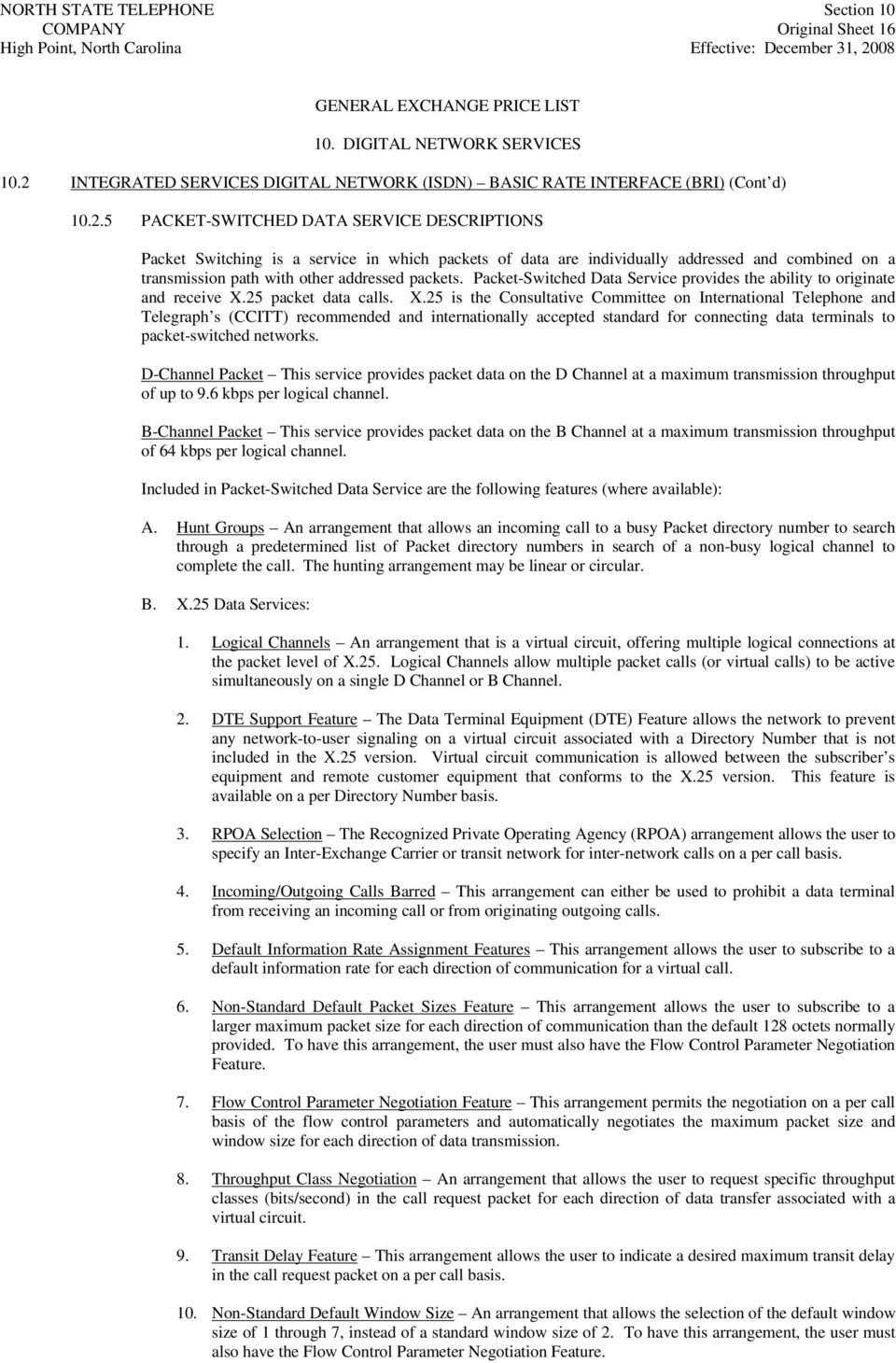
21 COMPANY Original Sheet INTEGRATED SERVICES DIGITAL NETWORK (ISDN) BASIC RATE INTERFACE (BRI) (Cont d) PACKET-SWITCHED DATA SERVICE DESCRIPTIONS (Cont d) B. X.25 Data Services: (Cont d) 11. Fast Select An arrangement that allows a sending data terminal to forward up to 128 bytes of data along with the call setup and clearing packets. 12. Fast Select Acceptance An arrangement that allows the switch to transmit incoming call packets with the Fast Select facility to a destination terminal that has this feature RATES AND CHARGES A. ISDN BRI Circuit Switched Packets 1 1. ISDN BRI must be ordered in conjunction with Basic Exchange Access Services. The rates and charges below are in addition to the basic exchange access rates listed in Section 3. All service ordering and connection charges listed in Section 4 of the price list apply in addition to the nonrecurring ISDN BRI charges. The rates and charges for the ISDN BRI Circuit Switched Packages are based on a 28+D configuration and the customer must select the desired B Channel arrangement. Nonrecurring Monthly Package Charge Rate Residential Package 1 (Non-EKTS 28+D) $ $ Residential Package 2 (Non-EKTS 28+D) Business Package 1 (Non-EKTS 28+D) Business Package 2 (Non-EKTS 28+D) Business Package 3 (EKTS 28+D) Distance Extension Charge B. Packet-Switched Service Packages 1. ISDN Packet-Switched Service Packages must be ordered in conjunction with one of the Circuit Switched Packages listed above. The rates and charges for the B Channel packet switched package or the D Channel packet switched package are in addition to the rates and charges for the Circuit Switched Packages. Nonrecurring Monthly Package Charge Rate B Channel Packet Switching (per each B Channel) $ $ D Channel Packet Switching Note 1: Note 2: All compatible Star*Plus and Custom Calling Features are also available to ISDN BRI subscribers and are subject to rates and charges specified in Section 13. These charges are assessed on a per B Channel basis. The Nonrecurring charges for D Channel Packet Switching will be waived if ordered when the Circuit Switching Package is ordered.
22 COMPANY Original Sheet INTEGRATED SERVICES DIGITAL NETWORK (ISDN) PRIMARY RATE INTERFACE (PRI) (Cont d) GENERAL A. ISDN PRI is an intralata service that provides DS1 access to the telecommunications network and includes the flexibility of combining multiple voice and/or data transmission on channels on the same line. This service connects ISDN compatible customer premises equipment (CPE) to an ISDN serving central office. B. ISDN PRI service consists of twenty-three 64 kbps Bearer or B Channels and one 64 kbps Delta or D Channel. The customer may activate up to twenty-three B Channels on the first ISDN PRI service arrangement and up to 24 B Channels on any subsequent service arrangement. One D Channel activation per customer is required. A Data Only option is also available. C. The twenty-three B Channels can be used to connect the customer s CPE to the public Circuit-Switched Network, e.g., outward, inward and two-way network access, Calling/Called Number delivery, Hunting, and Direct Inward Dialing (DID) are inherent to this service. D. ISDN PRI telephone numbers are available in this price list. One Primary Directory Listing will be furnished at no charge for each ISDN PRI B Channel. Additional listings are available as specified in Section 4 of this price list. E. ISDN PRI provides capability for the transmission of digital signals only. Clear Channel Capability and Extended Superframe Format (ESF) are inherent to this service. F. ISDN PRI requires the following components: REGULATIONS 1. ISDN PRI Access Line Provides a four-wire access loop from the serving wire center to the customer premises at a non-distance sensitive rate. The transmission characteristics of this loop support clear Channel Capability and Extended Superframe Format (ESF). Special construction charges may apply as specified in Section 5 of this price list. 2. ISDN PRI Service Interface Provides multiplexing support up to 23 B Channels at 64 kbps and 1 D Channel, for signaling, at 64 kbps. When Non-facility Associated Signaling (NFAS) is ordered, the ISDN PRI Interface can provide up to 24 B Channels at 64 kbps. ISDN PRI service interface is required for each ISDN PRI access line. 3. ISDN PRI B Channel Provides circuit-switched voice or circuit-switched data transmission at up to 64 kbps and will include Hunting and Calling/Called Number delivery. Voice calls may be completed to ISDN and non-isdn equipped lines. Data transmission on the B Channel will be circuit-switched at 64 kbps within the switch and between ISDN capable central offices. ISDN interconnection to non-isdn equipped central offices may be subjected to analog transmission or sub-rated to 56 kbps. 4. ISDN PRI D Channel Provides 64 kbps digital-only channel for call establishment and control. A. ISDN PRI is available on a month-to-month, one-year, three year, or five-year, basis. The minimum billing period for which ISDN PRI service charges apply is one month. A Termination Charge is applicable if service is terminated prior to the expiration of the contract. The applicable charge is dependent on the contract period subscribed to and will be equal to the number of months remaining in the contract times the monthly rate provided under the contract. B. Unless specified following, the regulations for ISDN PRI service specified herein apply in addition to the regulations set forth in Section 2 of this Price list. C. Customer Premises Equipment (CPE) that is compatible with the ISDN PRI service interface is the responsibility of the customer.
23 COMPANY Original Sheet 19 High Point, North Carolina Effective: December 31, INTEGRATED SERVICES DIGITAL NETWORK (ISDN) PRIMARY RATE INTERFACE (PRI) (Cont d) REGULATIONS (Cont d) D. The Company shall not be responsible if changes in any of the equipment, operations, or procedures of the Company utilized in providing ISDN PRI service render any facilities provided by the customer obsolete, or require modification or alteration of such equipment or system, or otherwise affect its use or performance. Digital transmission rates at speeds less than those indicated may be accomplished as a function of that particular CPE furnished by the customer. E. Suspension of ISDN PRI service is not allowed. F. Service Charges as specified in Section 4 of this Price list do not apply. G. Regulations for Allowance of Interruptions as Specified in Section of this Price list apply. H. Hunting and Direct Inward Dialing (DID) charges do not apply. I. Verification and Emergency Interrupt service is not available. J. Calling telephone numbers transmitted via ISDN PRI are intended solely for the use of the ISDN PRI service customer. Resale of this information is prohibited by this Price list except the caller s telephone number(s) may be provided to the customer s client for those calls sponsored or provided by that client where the client s identity is disclosed to the caller and the client agrees not to distribute such information to others. K. Calling numbers will be delivered within the Common Signaling System 7 serving area unless delivery is blocked by the calling party through Per Line or Per Call Blocking. L. Non-Facility Associated Signaling (NFAS) provides the capability to control multiple SD1s with a single D Channel. This feature can be ordered where switch capabilities exist as stipulated in the vendor technical documentation. When NFAS is selected, the customer will order one ISDN PRI service arrangement with one D channel and up to 23 B Channels. Additional ISDN PRI service arrangements are ordered with up to 24 B Channels at rates and charges specified in following. The D Channel activated on the initial service arrangement serves the additional ISDN PRI arrangement. If the customer desires, he may request a back-up D Channel with NFAS option. The Voice/Data (standard) ISDN PRI service and the Data Only option ISDN PRI service may not be mixed in the same NFAS group. M. The ISDN PRI Data Only option provides for the transmission of data mode calls only. The ISDN PRI Data Only arrangement will be provisioned with the customer s requested number of Data Only B Channels with no B channels capable of transmitting Voice mode calls under this arrangement. N. ISDN PRI Data Only Signaling Groups may be configured in one of the following four standard arrangements of call types: 1. Inward Calls The number of Inward calls accommodated by the Signaling Group will be equal to the number of activated B Channels. 2. Outward Calls The number of Outward calls accommodated by the Signaling Group will be equal to the number of activated B Channels. 3. Inward Calls and Outward Calls The maximum number of simultaneous calls for each call type is determined by the customer. For each call type, the maximum number of simultaneous calls must be less than or equal to the number of activated B Channels in the Signaling Group. 4. Two-Way Calls The number of two-way calls accommodated by the Signaling Group will be equal to the number of activated B Channels.
24 COMPANY Original Sheet INTEGRATED SERVICES DIGITAL NETWORK (ISDN) PRIMARY RATE INTERFACE (PRI) (Cont d) REGULATIONS (Cont d) O. Bill Call Treatment 1. Toll charges shall apply to calls that are made outside of the Home Exchange, Extended Area Service (EAS) Exchanges, and the Expanded Local Calling Area Exchanges, as specified in Section 3 of this price list. Usage charges for calls placed within the Home Exchange and EAS Exchanges, if applicable, and within the Expanded Local Calling Area Exchanges, as specified in Section 3 of this price list apply. 2. ISDN PRI customers who use the Call Forwarding or Call Transfer features are responsible for the payment of any applicable charges for each billable call connected via these features over the public network. The charge is applicable to each call answered, including the Call Forwarding set-up call. It also applies to collect and person-to-person calls, which may be refused at the answering station EXPLANATION OF TERMS A. Back-Up D Channel Provides one of the DS1 s in the NFAS arrangement with a spare D Channel. This spare D Channel is used to control signaling and call setup if the main D Channel fails. The main D Channel and the back-up D Channel are never provided on the same DS1. B. Data Only B Channel A bi-directional synchronous channel capable of supporting 64 kbps of digitally transmitted data mode calls. C. Facility Associated Signaling (FAS) Provides one D Channel and up to 23 B Channels for every DS1 facility. The maximum channel configuration for an FAS arrangement is 23B + D. D. Inward Call A call that terminates to an ISDN PRI arrangement. E. Outward Call A call that originates from an ISDN PRI arrangement. F. Signaling Group A set of DS1 s controlled by one D Channel or by one D Channel and one Back-Up D Channel. In a FAS arrangement, each DS1 constitutes a Signaling Group. In NFAS arrangements, all the DS1 s controlled by the main and/or the back-up D Channel constitute a Signaling Group. G. 64 kbps Clear Channel Capacity (CCC) A B Channel that provides the full 64 kbps bandwidth for customer use. H. Voice/Data B Channel A bi-directional synchronous channel capable of supporting 64 kbps of digital transmission.
25 COMPANY Original Sheet 21 High Point, North Carolina Effective: December 31, INTEGRATED SERVICES DIGITAL NETWORK (ISDN) PRIMARY RATE INTERFACE (PRI) RATES AND CHARGES A. ISDN PRI Service Interface with Access Line. An ISDN PRI Access Line is provided between a serving wire center and the customers premises. Monthly Rate Nonrecurring Rate Month-to-Month $ $ (R) One Year (R) Three Years (R) Five Years B. ISDN PRI Service Interface without Access Line. Monthly Rate Nonrecurring Rate Month-to-Month $ $ One Year Three Years Five Years C. ISDN PRI B Channels for Exchange Access. Rates are on a per B Channel basis. Monthly Rate Nonrecurring Rate Month-to-Month $ $ One Year (R) Three Years (R) Five Years (R) D. Back-Up D Channel Monthly Rate Nonrecurring Rate
26 COMPANY First Revised Sheet 22 Canceling Original Sheet 22 High Point, North Carolina Effective: October 15, RESERVED FOR FUTURE USE (C) (D) (D)
27 COMPANY First Revised Sheet 23 Canceling Original Sheet 23 High Point, North Carolina Effective: October 15, 2009 (D) (D)
28 COMPANY First Revised Sheet 24 Canceling Original Sheet 24 High Point, North Carolina Effective: October 15, 2009 (D) (D)
29 COMPANY First Revised Sheet 25 High Point, North Carolina Canceling Original Sheet 25 Effective: October 15, 2009 (D) (D)
30 COMPANY First Revised Sheet 26 Canceling Original Sheet 26 High Point, North Carolina Effective: October 15, 2009 (D) (D)
31 COMPANY First Revised Sheet 27 High Point, North Carolina Canceling Original Sheet 27 Effective: October 15, 2009 (D) (D)
32 COMPANY Original Sheet ASYNCHRONOUS TRANSFER MODE (ATM) SERVICE GENERAL A. Asynchronous Transfer Mode (ATM) Service is a connection-oriented fast packet intralata network service that permits the transmission of high speed data traffic utilizing cell switching technology. ATM is offered where Company facilities exist. ATM cells are fixed length cells that provide symmetrical or asymmetrical duplex transmission. Utilizing statistical multiplexing ATM Service enables customers to allocate circuit bandwidth to applications as needed on virtual paths or channels. ATM Service allows multiple communications applications to be transmitted within multiple paths or channels utilizing common fiber optic or copper facilities. ATM Service is primarily designed for businesses with multiple locations requiring the transport of data traffic among the sites. ATM Service allows for the interconnection of Customer Premises Equipment (CPE) that is ATM compatible. B. Permanent Virtual Circuits (PVCs) are logical channels between the customer s premises and ports on an ATM switch or between ATM switches. PVCs are duplex channels that are established via the service order process. Separate PVCs must be established to each customer location at which the customer desires ATM Service. PVC channels are virtual channels that are established in software tables. Multiple PVCs can be defined over a single ATM User Network Interface (UNI), thereby providing a single access line with the capability to transmit data to multiple destinations simultaneously. A PVC can be set up as either a Virtual Path (VP) or a Virtual Channel (VC) type connection. A VP may contain multiple VCs, referred to as tunneling. Tunneling allows customers to establish VCs or end to end connections between the customer CPE, via VPs. C. ATM Service requires the use of CPE that functions as a multiplexer, aggregrator, concentrator, or router. This CPE must be purchased separately from the ATM Service and must conform to the Consultative Committee for International Telecommunication Union (ITU) Standards, ATM Forum Standards, and Company ATM CPE standards. The CPE functions to accumulate customer data and transfers it into an ATM format suitable for transmission over the ATM Network. D. In the operation of ATM, the CPE captures arriving data into fixed-length ATM 53-byte cells. These cells contain a 48-byte cell user information segment, and a five-byte header containing a Virtual Path Identifier (VPI) and a Virtual Channel Identifier (VCI), identifying which PVC in the network should be used to forward the cell to the proper destination. The CPE sends the cells into the ATM Network over a dedicated access facility called an ATM Access Line that includes a UNI, which is a port on the ATM switch. The ATM switch, usually located in the Company central office, reads identifying header information and routes the cell to the proper destination based on a pre-established PVC, over a VP and/or VC. E. ATM Service is capable of handling the requirement of bursty data sources because of the ability of the service to allocate additional bandwidth when not in use by other sources. ATM Service can also transmit delay sensitive traffic such as voice and video, on the same physical circuit, but with different Quality of Service (QoS) on separate PVCs, within the same physical circuit. F. ATM Service is provided to the customer in the form of an ATM Access Line (a physical line, either fiber or copper) from the Customer Designated Location (CDL), and ATM UNI port on the ATM switch, and the ATM network bandwidth via a PVC or multiple PVCs. The ATM UNI port access options available are: DS1, 2xDS1, 4xDS1, 6xDS1, 8xDS1, DS3 and 0C3. Information Rate (IR) or through-put, for PVCs is available in bands ranging from 56 kbps/64 kbps up to 155 Mbps.
33 COMPANY Original Sheet ASYNCHRONOUS TRANSFER MODE (ATM) SERVICE (Cont d) GENERAL (Cont d) G. The actual through-put or IR for aggregated PVC bandwidths cannot exceed the port speed, or the port line transfer rate. The customer must specify a category of service (or Quality of Service QoS ) for each PVC to be connected to the ATM network. The QoS category defines the performance parameters for each connection to meet specific networking requirements. The Company provides three categories of service: 1. Constant Bit Rate (CBR) for delay or timing sensitive traffic such as voice or interactive video, provides a constant data rate and consistent delay parameters throughout the ATM network. CBR PVCs are given the highest priority in the ATM network, and are provisioned to provide the minimum Cell Delay Variation (CDV) or jitter. The Peak Cell Rate (PCR), which is the highest transmission rate the logical connection will allow, must be specified by the customer. 2. Variable Bit Rate (VBR-nrt), a non-real time service designed for bursty data applications that provides a pre-assigned variable bit rate. VBR-nrt requires two traffic parameter; (1) PCR, which defines the maximum rate of transmission, and (2) Sustainable Cell Rate (SCR), which provides an average through-put information rate expected on the connection. Customers must specify the SCR for ATM Service. Oversubscription is allowed with VBR. 3. Unspecified Bit Rate (UBR), takes advantage of excess network bandwidth and is best suited for communication applications where timing of delivered data is not critical. UBR is well suited to Internet protocol LAN traffic, which has inherent reliability, and can tolerate occasional cell discarding. PCR and SCR values are not used with UBR. An advantage of UBR is that ATM cells can be transmitted up to the port line rate, if available, rather than being limited to a predefined maximum PCR, as with VBR and CBR. However, through-put is not guaranteed. H. Since multiple PVCs may be defined on one physical port, it is possible for the cumulative data IRs of multiple PVCs to exceed the physical bandwidth of the port. This is referred to as oversubscription, and when this occurs there will be no guarantee that the IR defined for the port and PVC will be available at any point in time. I. IRs are traffic management parameters that allow the customer to fine tune implementation of ATM Service. The IRs of PVCs can be customer specified and can be ordered in increments of bandwidth. IRs can be used on CBR and VBR PVCs only. IRs for UBR are by definition not used, and IRs can be up to the line rate or the UNI port transfer rate. UBR uses available network bandwidth and is a best effort service; therefore there are no guarantees with the delivery of UBR traffic. IRs are assigned to each PVC symmetrically (two-way). J. For CBR PVCs, the customer may specify IRs in terms of PCR. The maximum PCR for CBR PVC is limited to 99% of the port transfer rate. When CBR traffic is mixed with VBR and UBR on the same port, the sum of all the PCRs associated with the CBR PVCs must not exceed 50% of the maximum IR of the ATM port. The PCR should never exceed the PCR available at the lowest port access between the local and remote locations. For VBR PVCs, the value of the SCR for ATM traffic may be defined between 20%-70% of the PCR. The user can burst above the PCR for short periods only. The limit for VBR transmission at the PCR is 250 cells. This limit is called the Maximum Burst Size (MBS). If the MBS is exceeded, a period of lower activity must follow to meet the SCR. UBR traffic IRs are not exceeded, a period of lower activity must follow to meet the SCR. UBR traffic IRs are not specified and use only available network bandwidth and may burst up to the line rate.
34 COMPANY Original Sheet ASYNCHRONOUS TRANSFER MODE (ATM) SERVICE (Cont d) GENERAL (Cont d) K. ATM Service PVCs may be interconnected with Frame Relay Service (FRS) subject to the provisions set forth in Section 10.1 of this Price list EXPLANATION OF TERMS A. ATM Access Line (ATM-AL) Provides access to the ATM Network. An ATM Access Line includes both the physical dedicated local loop and a UNI port on the ATM switch. B. ATM Class of Service Refers to service categories defined by the ATM Forum which define the traffic parameters for each PVC. These categories, CBR, VBR, and UBR and their related parameters, partially define the traffic between the Company and the customer for each PVC. C. ATM Network Link (ATM-NL) Describes the link between two networks or two switches. The ATM- NL ensures that switches from different manufactures or two different companies can communicate with each other. D. ATM Port The ATM Port is the physical entry point for PVCs. Ports include the electronic equipment used in connecting these service elements to the ATM Network and enable customers to allocate bandwidth to applications as needed. E. ATM Service Network Serving Area Area encompassing certain serving area points. Serving area points are those Company central offices designated for the ATM Network. F. Cell A unit of transmission in ATM that is a fixed size frame consisting of a 5-byte header and a 48-byte information payload. G. Customer Designated Location (CDL) The geographic location designated by the customer where the customer s CPE is first considered to enter the Company s network. H. Direct Fiber A type of DS3 or OC3 facility provisioned using an optical fiber interface with no alternate route. I. Early Packet Discard (EPD) The procedure for discarding cells related to a frame or packet to minimize the impact of congestion in the ATM network. This discarding technique with Partial Packet Discard (PPD) minimizes the amount of packets that must be retransmitted during congestion. EPD is for UBR traffic only. J. FRAME RELAY SERVICE (FRS) A fast packet network that provides the customer high-speed access and through-put to different customer addresses. Utilizing statistical multiplexing, the frame relay network enables the customer to allocate bandwidth to applications as needed, rather than dedicating fixed channels to specific applications. Frame Relay is primarily used in applications requiring short, intensive bursts of data at high speeds. Frame Relay operates at access speeds of 56/64 kbps, 128 kbps, 256 kbps, 384 kbps, 768 kbps or DS1 (1.544 Mbps). K. Gateway Service Allows the Company ATM customers to interconnect to another ATM or Frame Relay Network. The service is available wherever the Company has established a network interface with another private or public ATM or Frame Relay network. Gateway Service is only available where such network connectivity exists or where suitable connectivity arrangements can be made that are acceptable to the Company. L. Individual Case Basis (ICB) Process by which non-price listed products and services can be provided to the customer.
35 COMPANY Original Sheet ASYNCHRONOUS TRANSFER MODE (ATM) SERVICE (Cont d) EXPLANATION OF TERMS (Cont d) M. Information Rate (IR) Defines the amount of data through-put on any designated PVC that the Company will support under normal operating conditions. IR is administered per PVC, on a VP or VC basis. Any data burst beyond the IR may be labeled Discard Eligible (DE) if the data transfer rate exceeds the port transfer rate or the PCR on the PVC being used. If the ATM network develops congestion, the Early Packet Discard (EPD) and the Partial Packet Discard (PPD) cell buffering techniques will be implemented in Company ATM switches for UBR traffic only. At service subscription, the customer must specify the PCR associated with each PVC. The retransmission of discarded cells is administered by the customer s CPE. The Information Rate consists of the three QoS levels (CBR, VBR-nrt or UBR) previously described in Section G. These levels of service provide the flexibility necessary to service all applications successfully. The customer is responsible for selecting the level of QoS. N. Local Access and Transport Area (LATA) Denotes a geographic area established for the provision and administration of communications service. It encompasses one or more designated exchanges that are grouped to service common social, economic, and other purposes. O. Local Area Network (LAN) - A local network permitting the interconnection and intercommunication of a group of computers, primarily for the sharing of resources such as data storage devices and printers. P. Logical Channel A communications channel that allows two-way, simultaneous transmission of sequenced data packets through the network. No circuit capacity is preassigned to a logical channel. Capacity is made available as the data is transmitted. Each PVC is considered one logical channel or one virtual channel. Q. Maximum Burst Size (MBS) Denotes the maximum number of consecutive cells that may be transmitted to the Company ATM network in a single burst at a rate that exceeds the SCR, but does not exceed the PCR, assigned to the VBR connection. MBS is a traffic parameter considered only for VBR traffic. Cells exceeding the MBS will be declared as non-conforming and will be buffered or discarded, depending on the level of congestion. R. Permanent Virtual Circuit (PVC) Provides software-defined electronic path between two ports within the ATM Network. Each UNI requires the purchase of at least one PVC. A UNI or UNI Port connection can be associated with multiple PVCs. Since all PVCs need not be in use at the same time, it is possible for the total IR of all PVCs associated with one port to exceed the bandwidth of the port. It is not possible, however, for the simultaneous aggregation of the PVCs through-put to exceed the bandwidth of the port. Such a relationship, is referred to as oversubscription or overbooking. When oversubscription occurs, there is no guarantee that the bandwidth defined for a VBR-nrt or UBR PVC will be available at any point in time. CBR PVC bandwidth is always guaranteed in oversubscription situations. S. Protocol A specific set of rules, procedures or conventions relating to format and timing of data transmission. It is a standard procedure that multiple data devices must accept and use in order to communicate with each other. Protocols break a file into parts called blocks or packets. When blocks or packets are sent, the receiving computer checks the arriving packets and sends an acknowledgement back to the sending computer. T. Route Delivery A separate and diverse physical route from the customer premises to the Company Serving Central Office. This includes a separate fiber optic pair assignment in two different and distinct fiber optic cables.
36 COMPANY Original Sheet ASYNCHRONOUS TRANSFER MODE (ATM) SERVICE (Cont d) EXPLANATION OF TERMS (Cont d) U. Serving Central Office (SCO) The Company central office from which the customer normally receives dial tone. The customer s SCO may or may not have an ATM switch. Each SCO without an ATM switch will connect to an SCO with an ATM switch. V. Statistical Multiplexing A multiplexing technique in which timeslots are dynamically allocated on the basis of need rather than being predetermined. The data is typically transmitted on a first come, first served basis. W. Synchronous Optical Network (SONET) A standards based fiber optic communications network that transports both asynchronous and synchronous digital signals using the Synchronous Transport Signal (STS) format. The sonet option of the ATM access line includes a DS3 or OC3 facility provisioned as a survivable service with an alternate route. X. UNI Port A port on the Company ATM switch that is used to connect to the access line. The UNI port is the physical entry point for access to PVCs. The UNI port is on the line side or customer side of the ATM switch. UNI ports include the Company ATM switching equipment used in connecting these service elements to the ATM Network and enable customers to allocate bandwidth to applications as needed. Y. User to Network Interface (UNI) A standard interface used to connect the end user to the Company ATM switch. It receives data cells from the customer s LAN or other CPE devices and verifies that the data is in a valid ATM format before relaying the ATM cells to the destination point REGULATIONS A. ATM Service is provided to the customer in two forms. The first is ATM Access Line and PVC at a specified IR. The ATM Access Line includes the UNI port. The second is a digital private line transport facility, an ATM access port, otherwise known as a UNI, and a PVC at a specified IR. A PVC must be ordered for transmission between any two locations. B. ATM Service is provided subject to the availability of appropriate facilities. C. The minimum service period for ATM Service is twelve months. ATM Service may be ordered for an initial twelve month term or through a Term Discount Plan for fixed periods of up to sixty months. The month to month terms apply for service periods of twelve months. D. When the customer orders additional PVCs, nonrecurring charges will apply. In addition, Administrative Charges will apply to all changes made to a customer s ATM configuration at the customer s request. E. The ATM access services not covered by this Price list will be ordered from the Private Line and Special Circuits section of this Price list. F. Charges Applicable Under Special Conditions, as defined in Section 5 of this Price list, may apply when technical limitations and/or the lack of facilities exist, or if it is necessary to construct facilities to satisfy service requests. G. Whenever facilities are provided jointly by the Company and one or more other telephone companies, the regulations, rates and charges of such other telephone companies apply for the equipment and facilities furnished by them for use in connection with the inter-exchange ATM Service provided by the Company. H. Where private line, Frame Relay Service, or ATM Service is required to interconnect to the Company s ATM Service for a customer having locations outside of the Company service area, such service will be furnished only if satisfactory arrangements can be made with the other local or inter-exchange carrier.
37 COMPANY Original Sheet ASYNCHRONOUS TRANSFER MODE (ATM) SERVICE (Cont d) REGULATIONS (Cont d) I. Suspension of service at the customer s request, as defined in Section 2 of this Price list, is not allowed for ATM Service. J. The customer is responsible for payment of a Maintenance of Service Charge, as defined in Section 15 of this Price list, for visits by the Company to the customer premises when a service difficulty resulting in a trouble report is caused by the use of equipment or facilities provided by the customer OBLIGATIONS OF THE COMPANY A. The responsibility of the Company is limited to furnishing network equipment suitable for ATM Service and to the maintenance and operation of such equipment in a manner proper for such service. Subject to this responsibility, the Company is not responsible for the through transmission of signals generated by the CPE or systems, or for the quality of, or defects in, such transmission or the reception of signals by such equipment or systems. B. The Company is not responsible for installation, operation or maintenance of any terminal equipment, data unit or communications system provided by the customer or user unless provided for under separate contract. The Company is not responsible for adapting ATM Service to the technological requirements of any specific customer equipment. C. The Company is not responsible to the customer or user if changes in any of the equipment, operations or procedures of the Company used in the provision of ATM Service render any facilities or equipment provided by the customer or user obsolete or require modification or alteration of such equipment or system or otherwise affect its use or performance, provided the Company has met any applicable information disclosure requirements otherwise required by law. D. In order to maintain the quality of ATM Service, the Company reserves the right to perform preventative maintenance and software updates to the network. The Company has classified this maintenance as indicated below: 1. Scheduled maintenance is used to perform such functions as hardware and software upgrades and network optimization. The Company will perform these tasks in a maintenance window that is defined as occurring between midnight and 6 a.m., local time, seven days per week. The Company will provide advance notice of all scheduled maintenance. 2. Demand maintenance may occur as a result of unexpected events and is performed when ATM Service network elements are in jeopardy. The Company will perform this type of maintenance at its discretion. Due to the nature of demand maintenance prior notification may not be possible; however, the customer will be informed when the maintenance has been completed.
38 COMPANY Original Sheet ASYNCHRONOUS TRANSFER MODE (ATM) SERVICE (Cont d) OBLIGATIONS OF THE CUSTOMER A. The customer s ATM compatible terminal equipment is responsible for retransmitting cells or packets that are discarded due to errors or network congestion. B. Where ATM Service is available for use in connection with communications systems or equipment provided by a customer or user, the operating characteristics of such systems or equipment shall be such as not to interfere with any services offered by the Company. Such use is subject to the further provisions that the equipment provided by the Customer or user does not endanger the safety of Company employees or the public; does not damage, harm, require change in or alteration of the equipment or other services of the Company; does not interfere with the proper operation of the Company s equipment; or does not otherwise injure the public in its use of Company services. Upon notice from the Company that the equipment provided by the customer or user is causing, or is likely to cause, such hazard or interference, the customer shall take the necessary steps to remove or prevent such hazard or interference. C. The customer, upon request, shall furnish such CPE information as may be required to permit the Company to design and maintain the ATM Service it offers and to assure that the service arrangement is in compliance with the regulations contained herein. D. Upon service subscription, the customer should specify the IR and Class of Service for each PVC ordered. IR is the maximum information rate at which the customer s traffic will be admitted to the ATM network without being designated eligible for discard. A default of fifty (50) percent of the smallest port size will be assigned as the IR should the information not be provided. No individual PVC IR shall exceed (99) percent of the UNI port access rate. The sum of all PVCs IRs on a single ATM port must not exceed two hundred (200) percent of the port line rate OPTIONAL PAYMENT PLAN A. General 1. Payment periods of twelve months to sixty months are available to all customers at the applicable rates set forth in Section regardless of when they subscribe to an OPP arrangement. The month to month rate is considered the rate which applies for a twelve month commitment. 2. The customer must designate at order time the payment period described for the OPP. B. Change in length of OPP period 1. Prior to the completion of the selected OPP period the customer may elect to convert to a new OPP period of the same or different length, subject to the following conditions: a. No credit toward the new period will be given for payments due and made under the original OPP arrangement. b. Nonrecurring charges will not be reapplied for existing services if the following occurs: 1. If the new OPP period is for the same amount of time as the existing OPP arrangement. 2. If the new OPP period is for a longer amount of time than the existing OPP arrangement.
39 COMPANY Original Sheet ASYNCHRONOUS TRANSFER MODE (ATM) SERVICE (Cont d) OPTIONAL PAYMENT PLAN (Cont d) c. If the new OPP is shorter in length than the time remaining under the existing OPP, the change to the new OPP period constitutes a disconnect of the existing OPP service and termination liability charges apply. If no other changes are ordered the Primary Service Order Charge, as specified in Section 4 of this Price list, also applies per order. If changes are ordered all applicable nonrecurring charges, as specified in this Section and service charges as specified in Section 4 of this price list, apply. d. Conversion to month-to-month rates will be treated as a disconnect of the existing OPP service and termination liability charges apply. If no other changes are ordered, the Primary Service Order Charge, as specified in Section 4 of this Price list, also applies or per order. If changes are ordered all applicable nonrecurring charges, as specified in this Section and service charges as specified in Section 4 of this price list, apply. C. Renewal Options 1. At the expiration of an OPP period, the Company will continue to provide the service at the month-tomonth rates unless the customer chooses to renew for the same OPP period, convert to a different OPP period or discontinue service. 2. Conversion to a different OPP period will require the customer to submit a change order. Conversion to a different OPP period will be allowed without application of any nonrecurring or ordering charges. D. Notification of Discontinuance 1. An order for discontinuance of an OPP arrangement must be received by the Company at least thirty (30) days prior to actual disconnect of service. Monthly charges will apply for a period of thirty (30) days from the date the Company receives disconnect notification or until the requested disconnect date, whichever period is longer. E. Upgrade to Higher Speed service 1. Customer may elect to upgrade services to a higher speed during an OPP period, subject to the following conditions: a. The upgrade service will be subject to the difference in nonrecurring charges. b. Termination liability charges will not apply as long as the upgraded service remains connected at the same point(s) of termination. c. If the upgrade involves establishing a multiplexing arrangement, termination liability charges will not apply if the serving wire center is the same one associated with the customer designated location. F. Termination Liability 1. When an OPP service is discontinued prior to the end of the period, termination liability charges, as set forth below, will apply based on the remainder of the OPP period in effect at the time of disconnect. 2. Termination charges are fifty (50) percent of the recurring charges remaining in the first twelve (12) months of the OPP period. If the OPP period is longer than twelve (12) months a 10 percent charge will be assessed to the remaining months of the designated OPP period. G. Termination Without Liability 1. During an OPP period, should the Company increase currently effective rates for a customer, the customer may, at their option, terminate the OPP arrangement without penalty or liability.
40 COMPANY Original Sheet ASYNCHRONOUS TRANSFER MODE (ATM) SERVICE (Cont d) OPTIONAL PAYMENT PLAN (Cont d) H. Moves 1. A move involves a change in the physical location of one of the following: a. The point of interface at the customer premises. b. The customer s premises. 2. The charges for the move are dependent on whether the move is to a new location within the same building or to a different building SERVICE COMPONENTS a. When the move is to a new location within the same building, the charge for the move will be an amount equal to one half the nonrecurring (i.e. installation) charge for the affected service termination at the customer s premises. There will be no change in the minimum period requirements. b. Moves to a different building will be treated as a discontinuance and start of service and all associated nonrecurring charges will apply. New minimum period requirements will be established at the new location. A. Administrative Charges Applies to changes in a customer s network associated with PVCs. Although multiple changes can be caused by such actions, only one administrative charge applies per customer request. The administrative charge applies in addition to applicable Service Charges as specified in Section 4 of this Price list. B. ATM Access Line (ATM-AL) A nonrecurring charge and monthly rate based on the connection line speed of the local loop access line. The access line is from the CDL to the serving central office and includes the UNI port on the ATM switch. Charges Applicable Under Special Conditions may apply, if facilities do not already exist. Route Diversity of the local loop portion of ATM Access Line also may require Charges Applicable Under Special Conditions as described in Section 5 of this Price list. Where the CDL is located in another telephone company s service area, the ATM Access Line charges provide for transport to the meet-point boundary with the other local telephone company. Charges for service from the meet-point boundary to the CDL will be the responsibility of the customer based on the rate and charge of each jointly provisioning telephone company. C. ATM Network Line (ATM-NL) A nonrecurring charge and monthly rate based on the DS1 or DS3 port at the Company s ATM switch and transport from the ATM switch to the interconnecting ATM Service. Where the service is jointly provisioned with another telephone company, the appropriate charges will be based on the distance from the ATM to the meet-point boundary with the other telephone company. Charges for service from the meet-point boundary to the other company s ATM switch will be the responsibility of the customer based on the rates and charges of each jointly provisioning telephone company. In addition to a DS1 or DS3 ATM Network Link, a minimum of one Gateway service for bandwidth will apply. D. ATM Port A nonrecurring charge and monthly rate based on the speed of the port connection applies per port connection to the network supporting ATM. The port rate element can be used in lieu of the ATM Access Line element if the customer has an alternative Company-approved means of access to the ATM Network.
41 COMPANY Original Sheet ASYNCHRONOUS TRANSFER MODE (ATM) SERVICE (Cont d) SERVICE COMPONENTS (Cont d) E. Gateway Service This service allows the Company ATM customers to interconnect to another ATM or FRS Network. The service is available wherever the Company has established a network interface with another private or public ATM or Frame Relay network. The charge for this service covers the facility from the Company ATM port to the interconnecting ATM or Frame Relay point of another company. The charge includes the software defined PVC to the other company s network to the UNI port, but does not include the NI port provided by the other company. Gateway Service is purchased in increments of IR. The customer accomplishes this by ordering PVCs and Gateway Service connections to the other company s ATM or Frame Relay Network. F. IR and PVC A monthly rate applies for each PVC based on the IR requested by the customer. If no IR is indicated, the IR will be set at the default of 50% of the associated ATM UNI Port. A nonrecurring charge applies for the establishment of each PVC and for each subsequent order of PVC(s). Rates for intralata PVCs are specified in Section c. Customers may select from three different Categories of Service (or QoS) for PVCs to ensure greater reliability for mission-critical applications in the event of network congestion: Lowest Priority Unspecified Bit Rate (UBR) Higher Priority Variable Bit Rate-non-real time (VBR-nrt) Highest Priority Constant Bit Rate (CBR) This flexibility helps to ensure maximum performance and satisfaction for individual customer communications applications. G. Non-Recurring Charge (NRC) A one-time charge for initial installation and installation of functions and features RATES AND CHARGES A. ATM Access Line (includes Access Line and Port) Nonrecurring Month to 13 to 37 to Charge Month 36 Months 60 Months Mbps (DS1 UNI) $ $ $ $ Mbps (2xDS1 UNI) Mbps (4xDS1 UNI) , , , Mbps (6xDS1 UNI) , , , Mbps (8xDS1 UNI) , , , Mbps (DS3 UNI) a. Direct Fiber , , , b. Sonet 1, , , , Mbps (OC3 UNI) a. Direct Fiber 2, , , , b. Sonet 3, , , , B. ATM Port (Port Only) Mbps (DS1 UNI) $ $ $ $ Mbps (2xDS1 UNI) Mbps (4xDS1 UNI) , Mbps (6xDS1 UNI) , , , Mbps (8xDS1 UNI) , , ,825.00
42 COMPANY Original Sheet ASYNCHRONOUS TRANSFER MODE (ATM) SERVICE (Cont d) RATES & CHARGES (Cont d) B. ATM Port (Port Only) (Cont d) Nonrecurring Month to 13 to 37 to Charge Month 36 Months 60 Months Mbps (DS3 UNI) a. Direct Fiber 1, , , , Mbps (OC3 UNI) a. Direct Fiber 1, , , , C. Permanent Virtual Circuit (PVC) intralata Nonrecurring Charge (Per PVC) Monthly Rate (Per PVC) 1. Over 0 thru Mbps (Per increments of 64 kbps) a. Constant Bit Rate (CBR) $ $ 6.00 b. Variable Bit Rate Not Real Time (VBR-NRT) Over Mbps (Per increments of 1 Mbps) a. Constant Bit Rate (CBR) b. Variable Bit Rate Not Real Time (VBR-NRT) Per Connection Per Connection 3. Unspecified Bit Rate (UBR) a. Per DS1 Connection b. Per NxDS c. Per DS3 Connection d. Per OC3 Connection D. ATM Network Line (ATM-NL) Nonrecurring Month to 13 to 37 to Charge Month 36 Months 60 Months Mbps ATM-NL $ $ $ $ Mbps ATM-NL Within CO , , Mbps ATM-NL 0-3 miles , , , Mbps ATM-NL Over 3 miles , , , E. Gateway Service Nonrecurring Charge (Per PVC) Monthly Rate (Per PVC) 1. Over 0 thru Mbps (Per increments of 64 kbps) a. Constant Bit Rate (CBR) $ $ 8.00 b. Variable Bit Rate Not Real Time (VBR-NRT)
43 COMPANY Original Sheet ASYNCHRONOUS TRANSFER MODE (ATM) SERVICE (Cont d) RATES & CHARGES (Cont d) E. Gateway Service (Cont d) Nonrecurring Charge (Per PVC) Monthly Rate (Per PVC) 2. Over Mbps (Per increments of 1 Mbps) a. Constant Bit Rate (CBR) b. Variable Bit Rate Not Real Time (VBR-NRT) Per Connection Per Connection 3. Unspecified Bit Rate (UBR) a. Per DS1 Connection b. Per NxDS1 Connection c. Per DS3 Connection d. Per OC3 Connection F. An Administrative Charge will be applied in addition to the applicable Service Charges as specified in Section 4 of this Price list, when a change is made to a customer s ATM configuration (includes changes to an existing group s addressing or changes in bandwidth), at the customer s request. Such changes are defined as those rearrangements necessary to add, delete or rearrange the customer s configuration and changes of the PCR, SCR on a PVC. The Administrative Charge applies to changes in a customer s network associated with PVCs. Only one Administrative Charge applies per customer request. Administrative Charge (Nonrecurring) $75.00
44 COMPANY Original Sheet NORTH STATE METRO ETHERNET SERVICE GENERAL A. North State Metro Ethernet Service is a high-speed packet transport that is based on Ethernet transmission parameters. B. North State Metro Ethernet Service provides various transport capabilities that range from 10 Mbps through 1 Gbps with capabilities for basic, premium and dedicated arrangements that may be used to meet individual customer needs. C. North State Metro Ethernet Service signals meet IEEE 802.3, 802.3u, or 802.3z standards. North State Metro Ethernet Service also uses 802.1Q VLAN tagging and stacking for certain service configurations contained herein. Technical requirements for interfaces with customer premises equipment (CPE) are contained in ANSI/IEEE specifications. These technical documents may be ordered from: American National Standards Institute 11 West 42 nd Street New York, New York D. North State Metro Ethernet Service, as provided under the provisions of this price list section, is offered for intralata use only. E. The rates and charges set forth for North State Metro Ethernet Service provide for the furnishing of service in certain metropolitan areas. In locations where North State Metro Ethernet Service is not available, special construction charges may apply as set forth in Section 5 of the Price list CANCELLATION If Service requested by the Customer is canceled prior to the establishment of Service, termination charges will be determined as follows: the Customer will be required to reimburse North State for all expenses incurred in handling the request before notice of cancellation is received. Such charge, however, shall not exceed all charges which would apply if the work involved in complying with the request had been completed REGULATIONS A. Explanation of Terms 1. Metro Ethernet Metro Ethernet is a service where Local Area Networks (LANs) send bi-directional Ethernet traffic to other LANs on an Ethernet Wide Area Network (WAN). Ethernet is one of the most widely deployed LAN/WAN standards. North State Metro Ethernet Service supports IEEE Standard 802.3, 802.3u and 802.3z transmission standards. 2. Local Area Network (LAN) LAN is a communications network spanning a limited geographical area. A LAN connects computers and other peripheral equipment for data communications purposes within a building or campus environment. 3. Basic North State Metro Ethernet Service Connection Provides 10 Mbps, 100 Mbps and 1 Gbps Ethernet capabilities that are a part of a North State Metro Ethernet Service network within a metropolitan area. Basic North State Metro Ethernet Service is a best effort service with service capabilities that are affected by overall traffic on the Basic North State Metro Ethernet Service network and is suitable for data transmission only. A Basic North State Metro Ethernet Service Connection operating at any of these speeds is capable of interconnection with other Basic North State Metro Ethernet Service Connections that are operating at any of these speeds in the same metropolitan area. A Basic North State Metro Ethernet Service Connection provides data channel transport that connects customer premises that are 10 miles or less in distance from the North State Metro Ethernet Service wire center associated with the Basic North State Metro Ethernet Service Connection. Customer locations greater than 10 miles from the North State Metro Ethernet Service wire center require North State Metro Ethernet Service Additional Mileage charges.
45 COMPANY Original Sheet NORTH STATE METRO ETHERNET SERVICE REGULATIONS (Cont d.) A. Explanation of Terms (Cont d) 4. Premium North State Metro Ethernet Service Connection Provides 10 Mbps, 20 Mbps, 50 Mbps, 100 Mbps, 250 Mbps and 500 Mbps Ethernet capabilities that are a part of a North State Metro Ethernet Service network within a metropolitan area. Premium North State Metro Ethernet Service provides the ability to order Ethernet Service with improved service characteristics to meet customer needs regarding the assurance of bandwidth availability. Premium North State Metro Ethernet Service provides customers capabilities to assure service characteristics via ordering a Committed Bandwidth (CBW). A CBW is the minimum bandwidth across the North State Metro Ethernet Service network within a metropolitan area between a customer s Premium North State Metro Ethernet Service locations. Premium North State Metro Ethernet Service Connections are available with Fixed and Burst capabilities. With the Fixed arrangement, Premium North State Metro Ethernet Service Connections will have the bandwidth ordered (e.g., 10 Mbps) available across the North State Metro Ethernet Service network. With the Burst Arrangement, Premium North State Metro Ethernet Service will have the ability to send burst of data above their CBW rate, if network capacity is available. For example a 10 Mbps, a 20 Mbps and a 50 Mbps Connection may Burst up to 100 Mbps, a 250 Mbps and a 500 Mbps Connection may burst up to 1 Gbps. A Premium North State Metro Ethernet Service Connection operating at any of these speeds is capable of interconnecting with other Premium North State Metro Ethernet Service Connections that are operating at any of these speeds in the same metropolitan area. Premium North State Metro Ethernet Service Connection provides data channel transport that connects a customer premise that is 10 miles or less in distance from the North State Metro Ethernet Service wire center associated with the Premium North State Metro Ethernet Service Connection. Customer locations greater than 10 miles from the North State Metro Ethernet Service wire center require North State Metro Ethernet Service Additional Mileage charges. 5. Dedicated North State Metro Ethernet Service Connection Provides 100 Mbps and 1 Gbps point-to-point Ethernet capabilities that are a part of a North State Metro Ethernet Service network within a metropolitan area. A Dedicated North State Metro Ethernet Service Connection operating at any of these speeds is only capable of interconnecting with one other Dedicated North State Metro Ethernet Service Connection in the same metropolitan area. A Dedicated North State Metro Ethernet Service Connection provides data channel transport that connects customer premises that are 10 miles or less in distance from the North State Metro Ethernet Service wire center associated with the Dedicated North State Metro Ethernet Service Connection. Customer locations greater than 10 miles from the Dedicated North State Metro Ethernet Service wire center require North State Metro Ethernet Service Additional Mileage charges. 6. North State Metro Ethernet Service Additional Mileage Charges Additional mileage charges associated with a North State Metro Ethernet Service Connection apply when the total distance from the customer premises to the North State Metro Ethernet Service wire center associated with the service serving the customer s premises is greater than 10 miles in length. The additional mileage is measured in airline miles form the customer premises to the North State Metro Ethernet Service wire center associated with the North State Metro Ethernet Service. Fractions of miles will be considered as a whole mile. North State Metro Ethernet Service Additional Mileage Charges apply to Basic, Premium and Dedicated North State Metro Ethernet Service based on the service s speed and the total distance associated with the data channel. The North State Metro Ethernet Service Additional Mileage Charge is based on the mileage band the total data channel mileage falls into. For example, a data channel that is 30 miles in length would be charged the additional mileage rate for the greater than 25 mile through 35 mile band. 7. Metro Ethernet Customer Network A Metro Ethernet Customer Network is defined as the set of interconnected Metro Ethernet connections assigned to the same VLAN within the North State core network. Connections that include the Q-Forwarding optional feature may be part of more than one Metro Ethernet Customer Network.
46 COMPANY Original Sheet NORTH STATE METRO ETHERNET SERVICE REGULATIONS (Cont d.) A. Explanation of Terms (Cont d) 8. Priority Plus Customers with Premium North State Metro Ethernet Service, as an optional feature, may order the ability to prioritize their traffic in accordance with a predefined hardware queue model approach. With this option, customers will assign priority values to their data and higher-priority data will be transmitted first. Priority Plus service traffic is limited to a small subset of the total Committed Bandwidth (CBW) traffic and is marked for expedited handling within the Metro Ethernet Service. Customers that desire Priority Plus must establish it for all their Premium North State Metro Ethernet Service connections within that Metro Ethernet Customer Network. 9. Q-Forwarding Customers with a Premium North State Metro Ethernet Service Arrangement may order the Q- Forwarding feature. Q-Forwarding provides VLAN aggregation across a common physical connection. This feature supports customer aggregation of traffic from multiple remote customer locations. This aggregated traffic can be transported back to a central location and across a common Metro Ethernet Service interface. Q-Forwarding utilizes IEEE 802.1Q VLAN Tagging procedures. The Q-Forwarding Service Charge is a charge to provision a Premium connection with the Q- Forwarding feature and identify it as the host connection or the aggregator connection. The Q- Forwarding Network Assignment Charge is a charge to provision any remote Premium connection to the Q-Forwarding host aggregator connection. The Q-Forwarding Network Assignment Charge applies for each remote Metro Ethernet Customer Network (VLAN) connected to the Q-Forwarding host aggregator connection. 10. Service Reconfiguration Service Reconfiguration provides customers the ability to request modifications to a specific North State Metro Ethernet Service connection subsequent to the establishment of the connection. Such modifications are changes to a customer s service, other than changes described elsewhere for North State Metro Ethernet Service that do not involve the termination of the service at the customer s premise. Examples of a Service Reconfiguration are upgrades/downgrades of connection speeds that do not result in physical equipment changes, and the addition/removal of a service wire center associated with the Dedicated North State Metro Ethernet Service Connection. Customer locations greater than 10 miles from the Dedicated North State Metro Ethernet Service wire center require North State Metro Ethernet Service Additional Mileage charges. 11. Metro Ethernet Reporting Charge Customers with Premium Metro Ethernet Service, as an optional feature, may order Metro Ethernet Reporting that provides customers a view into their North State Metro Ethernet Service Network via a Web interface and Security Card. The Metro Ethernet Reporting charge provides Alarm Surveillance, Service Level Agreement Reporting, and Performance Reporting for the various network components that comprise the customer s North State Metro Ethernet Service network. It is only available to customers purchasing Premium North State Metro Ethernet Service and is charged for each Premium Metro Ethernet Service connection. 12. Metro Ethernet Reporting Service Establishment Charge The Service Establishment Charge is a nonrecurring charge that applies per North State Metro Ethernet Service customer account. This service charge covers the initial establishment of the Metro Ethernet Reporting account for each customer. 13. Metro Ethernet Reporting Web Interface Charge All customers purchasing Metro Ethernet Reporting must have a Web Interface. This connection allows the customer to access and monitor their network via the Web. The first Web Interface is included in the initial installation of the Metro Ethernet Reporting feature. A monthly charge and a non-recurring charge are applicable for each additional Web Interface connection. 14. Metro Ethernet Security Card Charge A Security Card is required for each Web Interface. A Security Card charge will apply for initial and additional cards, or for the issuance of additional cards to replace lost, damaged or expired cards. A nonrecurring charge is applicable per Security Card.
47 COMPANY Original Sheet NORTH STATE METRO ETHERNET SERVICE REGULATIONS (Cont d.) A. Explanation of Terms (Cont d) 15. Metro Ethernet Reporting Subsequent Modification Charge This is a nonrecurring charge that applies per connection when a Metro Ethernet Reporting customer requests modification to existing connections on the customer s network. This charge is applicable to requests to change the customer name and other Metro Ethernet Reporting configuration data. This charge is not applicable when adding new connections to an existing Metro Ethernet Reporting arrangement or for a request to change a password. B. Basis of Offering 1. Suspension of service is not allowed. 2. North State Metro Ethernet Service is available 24 hours per day, 7 days per week, except for preventive maintenance. 3. Obligations of customer and Company a. The Company is not responsible for the installation, operation, or maintenance of any equipment provided by the customer. b. The customer is responsible for the provision and maintenance of all customer provided equipment and to insure that the operating characteristics of this equipment are comparable with and do not interfere with the service offered by the Company. c. At the Service Connection point the customer s signals must conform to IEEE Standards 802.3, 802.3u or 802.3z. To meet end-to-end delay requirements contained in these aforementioned standards, the customer may be required to provide additional equipment. 4. The minimum service period for all North State Metro Ethernet Service price list components is twelve months. 5. If the customer does not elect an additional payment period or does not request discontinuance of service, service will be continued at a monthly rate currently in effect for the month-to-month payment rate as identified in this price list. 6. Due to the nature of North State Metro Ethernet Service it will be necessary to perform preventive maintenance and software updates. This will mean that North State Metro Ethernet Service and North State Metro Ethernet Reporting will be unavailable during the period of time when preventive maintenance is being performed. This could result in North State Metro Ethernet Service and North State Metro Ethernet Reporting being unavailable during period of time between 1:00 AM and 5:00 AM Eastern Time on any given Saturday or Sunday morning. The Company upon written notice to the customer may adjust the maintenance window. 7. Service Level Agreement North State Metro Ethernet Service Level Agreements (SLAs) specify the Company s repair and performance commitments for Metro Ethernet Reporting customers. Credits are provided for missed commitments to Premium customers purchasing the Metro Ethernet Reporting feature. Credits only apply for portions of service provided by the Company. The following service measurements will outline the service levels the Company will deliver to Metro Ethernet Reporting customers: Repair - North State Metro Ethernet Service Time-to-Repair - Repair commitments are measured on a per occurrence basis Network Service Levels - North State Metro Ethernet Service Network Availability - Network Service Level Commitments are monthly performance measurements
48 COMPANY Original Sheet NORTH STATE METRO ETHERNET SERVICE REGULATIONS (Cont d.) B. Basis of Offering (Cont d) a. SLA Definitions: North State Metro Ethernet Service Time-To-Repair - North State Metro Ethernet Service Time-To-Repair measures the outage duration on a customer s connection. This measure will require the customer to report the problem to the North State repair center. - The repair interval will start with the time entered on the trouble ticket and end when fault is corrected. The Service Level Commitment measurement will be based on each individual trouble ticket for a Customer Connection. Time for scheduled maintenance windows does not count towards SLA threshold. North State Metro Ethernet Service Network Availability. - North State Metro Ethernet Service Network Availability measures the percentage of time the customer s service is unavailable. - The Service Level Commitment will be calculated by measuring and summing the outage for each network component used by the customer, divided by the total number of components, times the total service time for a particular calendar month. Excluded from the outage time and service time are scheduled maintenance windows and time the network was unavailable due to circumstances outside the Company s control. b. The Company s Service Level Commitments for North State Metro Ethernet Service are as follows: - North State Metro Ethernet Service Time-To-Repair 4 hours - North State Metro Ethernet Service Network Availability 99% c. SLA Restrictions: - The Company will implement SLA provisioning restrictions that will define customer network design requirements and limitations to North State s commitment to meet Service Levels for North State Metro Ethernet Service. The customer network design requirements are as follows: - A customer must subscribe to the Metro Ethernet Premium Service with Metro Ethernet Reporting to receive credits for missed Service Level Commitments. - Credits are not provided for partial month service. - A customer s account must be current to receive a credit. SLA credits do not apply when any stated objective is not met because the Company does not have control over the circumstances causing the objective to be missed. Situations over which the Company does not have control can be defined as, but not limited to, the following: - any act, any omission or negligence on the part of the customer, any other customer or any third party, or of any other entity providing a portion of the service, - labor difficulties, governmental orders, civil commotions, declared National Emergencies, criminal actions against the Company, acts of God, war, or other circumstances beyond the Company s control. - the customer s premises equipment, and - unavailability of the customer s facilities and/or equipment including customer-provided power and environmental conditions for North State owned and operated equipment located on the customer s premise. The customer must request a credit within one calendar month of the Company missing a North State Metro Ethernet Service Level Commitment. The Company will investigate customer requests for any SLA credits to determine the cause of any performance failures reported by the customer. The Company will investigate the customer s request over a period of up to 45 calendar days. The 45-day period will begin when the customer makes the request for credit with their North State Sales Representative. SLA credits will be provided to the customer if the Company determines that the Company had control over the circumstances causing the failure.
49 COMPANY Original Sheet NORTH STATE METRO ETHERNET SERVICE REGULATIONS (Cont d.) B. Basis of Offering (Cont d) d. SLA Credits for Metro Ethernet Reporting The following credits will apply when the Company misses a Service Level Commitment (each credit is described in (1) thru (3) following): North State Metro Ethernet Service Time-To-Repair 0 to 4 hours per incident No Credit Over 4 hours to 24 hours per incident Credit 3 days MRC Each additional 24-hour period, per incident Credit additional 3 days MRC North State Metro Ethernet Service Network Availability Credit 3 days MRC The SLA credit amount will be determined by applying the credits outlined above to the rate elements or total billed revenues specified following. Credits for all SLAs for a calendar month cannot exceed the MRC for the North State Metro Ethernet Service components. Credits are not provided for partial month service. (1) North State Metro Ethernet Service Time-To-Repair Credit The Service Level Commitment measurement will be based on each individual trouble ticket for a Customer Connection. Multiple trouble tickets on the same day for the same Customer Connection will only be eligible for one time-to-repair credit. Credit will apply to all Monthly Recurring Charges associated with the affected customer connections. (2) North State Metro Ethernet Service Network Availability Credit The credit will apply for each North State Metro Ethernet Service Connection that does not meet the availability commitment. Credit will apply to all Monthly Recurring Charges associated with the affected customer connections. North State Metro Ethernet Networks that do not traverse the core network are not eligible for credits under the North State Metro Ethernet Service Network Availability SLA. C. Provision of Service 1. Rates and charges contained in this Price list consist of the following elements: a. Basic North State Metro Ethernet Service Connection b. Premium North State Metro Ethernet Service Connection c. Dedicated North State Metro Ethernet Service Connection d. North State Metro Ethernet Service Additional Mileage Charges e. Priority Plus f. Q-Forwarding g. Service Reconfiguration h. Metro Ethernet Reporting 2. All service connection charges for North State Metro Ethernet Service are included in the respective nonrecurring charges specified herein. 3. Customers cannot mix North State Metro Ethernet Service and Ethernet Express Service from 10.4 of this Price list on the same Metro Ethernet Customer Network. 4. Requests by a customer to change power and signaling interface options will be treated as a disconnection of the existing service and nonrecurring charges will apply for the new arrangement. 5. Customers who subscribe to Metro Ethernet Reporting must monitor their entire North State Metro Ethernet Network.
50 COMPANY Original Sheet NORTH STATE METRO ETHERNET SERVICE REGULATIONS (Cont d) D. Contract Plans 1. Contract plans are available under conditions specified in the section of this Price list, with contract periods described as follows: a. Term Payment Plan A payment periods may be selected from 12 to 23 months. b. Term Payment Plan B payment periods may be selected from 24 to 35 months. c. Term Payment Plan C payment periods may be selected from 36 to 47 months. 2. Termination Liability Charges will not be applicable for customer requests to change from Ethernet Express Service to a higher bandwidth Premium North State Metro Ethernet Service arrangement. The length of the commitment associated with the new service must be equal to or greater than the time remaining in the customer s existing service arrangement commitment. 3. Termination Liability Charges will not be applicable for customer request to change from a Basic North State Metro Ethernet Service arrangement to a higher bandwidth Premium North State Metro Ethernet Service arrangement. The length of the commitment associated with the new service must be equal to or greater than the time remaining in the customer s existing service arrangement commitment OPTIONAL PAYMENT PLAN A. General 1. Payment periods of twelve months to forty seven months are available to all customers at the applicable rates set forth in Section regardless of when they subscribe to an OPP arrangement. The month to month rate is considered the rate which applies for a twelve month commitment. 2. The customer must designate at order time the payment period described for the OPP. B. Change in length of OPP Period 1. Prior to the completion of the selected OPP period the customer may elect to convert a new OPP period of the same or different length, subject to the following conditions: (a) No credit toward the new period will be given for payments due and made under the original OPP arrangement. (b) Nonrecurring charges will not be reapplied for existing services if the following occurs: 1. If the new OPP period is for the same amount of time as the existing OPP arrangement. (c) 2. If the new OPP period is for a longer amount of time than the existing OPP arrangement. If the new OPP is shorter in length than the time remaining under the existing OPP, the change to the new OPP period constitutes a disconnect of the existing OPP service and termination liability charges apply. If no other changes are ordered the Primary Service Order Charge, as specified in Section 4 of this Price list, also applies per order. If changes are ordered all applicable nonrecurring charges, as specified in this Section and service charges as specified in Section 4 of this price list, apply. (d) Conversion to month-to-month rates will be treated as a disconnect of the existing OPP service and termination liability charges apply. If no other changes are ordered, the Primary Service Order Charge, as specified in Section 4 of this Price list, also applies or per order. If changes are ordered all applicable nonrecurring charges, as specified in this Section and service charges as specified in Section 4 of this price list, apply.
51 COMPANY Original Sheet NORTH STATE METRO ETHERNET SERVICE OPTIONAL PAYMENT PLAN (Cont d) C. Renewal Options 1. At the expiration of an OPP period, the Company will continue to provide the service at the month-tomonth rates unless the customer chooses to renew for the same OPP period, convert to a different OPP period or discontinue service. 2. Conversion to a different OPP period will require the customer to submit a change order. Conversion to a different OPP period will be allowed without application of any nonrecurring or ordering charges. D. Notification of Discontinuance 1. An order for discontinuance of an OPP arrangement must be received by the Company at least thirty (30) days prior to actual disconnect of service. Monthly charges will apply for a period of thirty (30) days from the date the Company receives disconnect notification or until the requested disconnect date, whichever period is longer. E. Upgrade to Higher Speed service 1. Customer may elect to upgrade services to a higher speed during an OPP period, subject to the following conditions: (a) The upgrade service will be subject to the difference in nonrecurring charges. (b) Termination liability charges will not apply as long as the upgraded service remains connected at the same point(s) of termination. (c) If the upgrade involves establishing a multiplexing arrangement, termination liability charges will not apply if the serving wire center is the same one associated with the customer designated location. F. Termination of Liability 1. When an OPP service is discontinued prior to the end of the period, termination liability charges, as set forth below, will apply based on the remainder of the OPP period in effect at the time of disconnect. 2. Termination charges are one hundred (100) percent of the recurring charges remaining in the OPP period. G. Termination Without Liability 1. During an OPP period, should the Company increase currently effective rates for a customer, the customer may, at their option, terminate the OPP arrangement without penalty or liability. H. Moves 1. A move involves a change in the physical location of one of the following: (a) The point of interface at the customer premises. (b) The customer premises. 2. The charges for the move are dependent on whether the move is to a new location within the same building or to a different building. (a) When the move is to a new location within the same building, the charge for the move will be an amount equal to one half the nonrecurring (i.e. installation) charge for the affected service termination at the customer s premises. There will be no change in the minimum period requirements. (b) Moves to a different building will be treated as a discontinuance and start of service and all associated nonrecurring charges will apply. New minimum period requirements will be established at the new location.
52 COMPANY Original Sheet NORTH STATE METRO ETHERNET SERVICE RATES AND CHARGES A. Basic North State Metro Ethernet Service Arrangements Nonrecurring Month to 12 to to to 47 Charge Month Months Months Months Mbps Basic Connection (a) per connection $ $ $ $ $ Mbps Basic Connection (a) per connection 1, , , , , Gbps Basic Connection (a) per connection 1, , , , , B. Premium North State Metro Ethernet Service Arrangements Mbps Premium Connection (a) per connection, Fixed Mode $ $1, $ $ $ (b) per connection, Burst Mode , , , Mbps Premium Connection (a) per connection, Fixed Mode 1, , , , (b) per connection, Burst Mode 1, , , , , Mbps Premium Connection (a) per connection, Fixed Mode 1, , , , , (b) per connection, Burst Mode 1, , , , , Mbps Premium Connection (a) per connection, Fixed Mode 1, , , , , (b) per connection, Burst Mode 1, , , , , Mbps Premium Connection (a) per connection, Fixed Mode 1, , , , , (b) per connection, Burst Mode 1, , , , , Mbps Premium Connection (a) per connection, Fixed Mode 1, , , , , (b) per connection, Burst Mode 1, , , , , C. Dedicated North State Metro Ethernet Service Arrangement Mbps Dedicated Connection (a) per connection 1, , , , , Gbps Dedicated Connection (a) per connection 2, , , , ,900.00
53 COMPANY Original Sheet NORTH STATE METRO ETHERNET SERVICE RATES AND CHARGES (Cont d) D. North State Metro Ethernet Service Additional Mileage 1. North State Metro Ethernet Service Additional Mileage, Basic, Premium and Dedicated arrangements, greater than 10 miles through 25 miles Monthly Charge (a) per 10 through 50 Mbps connection $ (b) per 100 through 250 Mbps connection (c) per 500 Mbps through 1 Gbps connection North State Metro Ethernet service Additional Mileage, Basic, Premium and Dedicated arrangements, greater than 25 miles through 35 miles (a) per 10 through 50 Mbps connection (b) per 100 through 250 Mbps connection (c) per 500 Mbps through 1 Gbps connection North State Metro Ethernet Service Additional Mileage, Basic, Premium and Dedicated arrangements, greater than 35 miles through 50 miles (a) per 10 through 50 Mbps connection (b) per 100 through 250 Mbps connection 1, (c) per 500 Mbps through 1 Gbps connection 1, E. Priority Plus Feature Nonrecurring Month to 12 to to to 47 Charge Month Months Months Months (a) per connection $ - $ $ $ $ F. Q-Forwarding Feature 1. Q-Forwarding Service Establishment Charge (a) per connection Q-Forwarding Network Assignment Charge (a) per network, per connection G. Service Reconfiguration (a) per modification, per connection H. Metro Ethernet Reporting 1. Metro Ethernet Reporting Service Establishment Charge (a) per customer account Metro Ethernet Reporting Charge (a) per connection Metro Ethernet Web Interface Charge (a) additional Metro Ethernet Security Card (a) each Metro Ethernet Reporting Subsequent Modification Charge (a) per modification
TARIFF DISTRIBUTION. DATE: August 31, 2011. Discontinue Rate Stability Term Plans for both new and renewing ISDN BRI (IBS and IRS) subscribers.
 FILE PACKAGE NO.: KY-11-0058 TARIFF DISTRIBUTION DATE: August 31, 2011 STATE: KENTUCKY EFFECTIVE DATE: 08/31/2011 TYPE OF DISTRIBUTION: Approved PURPOSE: Discontinue Rate Stability Term Plans for both
LAFOURCHE TELEPHONE CO., LLC Second Revised Page 1 Larose, Louisiana Cancels First Revised Page 1
 LAFOURCHE TELEPHONE CO., LLC Second Revised Page 1 Cancels First Revised Page 1 By: John D. Scanlan, President Issued: February 1, 2012 Effective: February 15, 2012 OBSOLETE SERVICE OFFERINGS TABLE OF
PART 17 - ISDN Services 5th Revised Sheet 1 SECTION 2 - ISDN Primary Rate Interface (PRI)
 PART 17 - ISDN Services 5th Revised Sheet 1 1. ISDN PRIME SERVICE A. DESCRIPTION ISDN (Integrated Services Digital Network) Prime is a digital business service that provides PBX equipment and host computer
PART 17 - ISDN Services 1st Revised Sheet 1 SECTION 2 - ISDN Primary Rate Interface (PRI) Cancels Original Sheet 1
 PART 17 - ISDN Services 1st Revised Sheet 1 SECTION 2 - ISDN Primary Rate Interface (PRI) Cancels Original Sheet 1 1. ISDN PRIME SERVICE A. Description ISDN (Integrated Services Digital Network) Prime
PART 17 - ISDN Services Original Sheet 16 SECTION 1 - ISDN Basic Rate Interface (BRI)
 PART 17 - ISDN Services Original Sheet 16 2. NATIONAL INTEGRATED SERVICES DIGITAL NETWORK (ISDN) DIRECT A. Description 1. National Integrated Services Digital Network (ISDN) Direct is a telecommunications
TARIFF DISTRIBUTION. Guidebook Cleanup -- Sections A43 and A47
 FILE PACKAGE NO.: LA-14-0112 TARIFF DISTRIBUTION DATE: November 10, 2014 STATE: LOUISIANA EFFECTIVE DATE: 11/10/2014 TYPE OF DISTRIBUTION: Approved PURPOSE: Guidebook Cleanup -- Sections A43 and A47 TARIFF
SERVICE DESCRIPTION AND PRICE LIST FOR STAND-ALONE AND BUNDLED CALIFORNIA LOCAL EXCHANGE SERVICE
 DESCRIPTION AND PRICE LIST FOR STAND-ALONE AND BUNDLED CALIFORNIA LOCAL EXCHANGE BUNDLED LOCAL AND LONG DISTANCE S A-1 Business Service Packages AT&T (Pacific Bell) Service Area 1. Applicability These
MCImetro Access Transmission Services LLC d/b/a Verizon Access Transmission Services
 MCImetro Access Transmission Services LLC d/b/a Verizon Access Transmission Services First Revision This Catalog Schedule No. 1 applies to the non-current services for enterprise business customers (i.e.,
MCImetro Access Transmission Services LLC d/b/a Verizon Access Transmission Services
 SECOND REVISION MCImetro Access Transmission Services LLC d/b/a Verizon Access Transmission Services Florida Local Exchange Services Catalog Schedule No. 1 (Enterprise Non-Current Services) This Catalog
WAN Technology. Heng Sovannarith [email protected]
 WAN Technology Heng Sovannarith [email protected] Introduction A WAN is a data communications network that covers a relatively broad geographic area and often uses transmission facilities provided
APPENDIX A GENERAL DEFINITIONS & SERVICE FUNCTIONS
 APPENDIX A GENERAL DEFINITIONS & SERVICE FUNCTIONS This Appendix provides the basic definitions and service functions of local communications services under the scope of this contract. The Government requires
PUERTO RICO TELEPHONE COMPANY, INC. Fifth Revision - Page F-7-1 Canceling Fourth Revision - Page F-7-1. ADDITIONAL SERVICES TARIFF SCHEDULE (Cont.
 Fifth Revision - Page F-7-1 Canceling Fourth Revision - Page F-7-1 SECTION 7 LEASED LINE SERVICE 7.1 General Leased Line Service provides the necessary facilities to enable the customer and authorized
WAN. Introduction. Services used by WAN. Circuit Switched Services. Architecture of Switch Services
 WAN Introduction Wide area networks (WANs) Connect BNs and LANs across longer distances, often hundreds of miles or more Typically built by using leased circuits from common carriers such as AT&T Most
WAN Data Link Protocols
 WAN Data Link Protocols In addition to Physical layer devices, WANs require Data Link layer protocols to establish the link across the communication line from the sending to the receiving device. 1 Data
GENERAL SUBSCRIBER SERVICES TARIFF Pembroke Telephone Company, Inc. First Revised Contents Sheet 1 Cancels Original Contents Sheet 1
 First Revised Contents Sheet 1 Cancels Original Contents Sheet 1 CONTENTS Sheet No. L.1 General 1 L.2 Regulations and Conditions 2 L.3 Definitions 4 L.4 Rates and Charges 11 0 First Revised Sheet 1 Cancels
MCImetro Access Transmission Services LLC d/b/a Verizon Access Transmission Services
 SECOND REVISION MCImetro Access Transmission Services LLC d/b/a Verizon Access Transmission Services Texas Local Exchange Services Catalog Schedule No. 2 (Enterprise Non-Current Services) This Catalog
TNCI Telastic Hosted PBX Service Exhibit
 Telastic Hosted PBX 1. INTRODUCTION The terms and conditions of this Telastic Hosted PBX (the Service ) shall be in addition to s General Terms and Conditions of Service (the Agreement ) and shall be read
NORTH STATE TELEPHONE Section 13 COMPANY Original Sheet 1 High Point, North Carolina Effective: December 31, 2008 GENERAL EXCHANGE PRICE LIST
 COMPANY Original Sheet 1 High Point, North Carolina Effective: December 31, 2008 CONTENTS Sheet 13.1 EXTENSION STATIONS 1 13.1.1 GENERAL 1 13.1.2 EXTENSION LINE MILEAGE 2 13.2 TOUCH-CALLING SERVICE 2 13.2.1
WANs connect remote sites. Connection requirements vary depending on user requirements, cost, and availability.
 WAN Review A WAN makes data connections across a broad geographic area so that information can be exchanged between distant sites. This topic defines the characteristics of a WAN. WAN Overview WANs connect
SECTION 5 NETWORK SERVICES
 Original page 56 SECTION 5 NETWORK SERVICES 5.1 Service Offerings The Company undertakes to provide Non-Residential End users with the following types of Network Services: Standard Business Line PBX Trunk
SERVICES CATALOG. FRONTIER COMMUNICATIONS OF ALABAMA, LLC Section 16 Original Sheet 1 S16. CENTREX
 Original Sheet 1 S16.1 GENERAL A. Centrex is a Central Office based business communications service which provides capabilities similar to those offered on a Private Branch Exchange, but without requiring
Glossary of Telco Terms
 Glossary of Telco Terms Access Generally refers to the connection between your business and the public phone network, or between your business and another dedicated location. A large portion of your business
60. ETHERNET - TERMS AND CONDITIONS SUPPLEMENT
 60. ETHERNET - TERMS AND CONDITIONS SUPPLEMENT A. TERM After expiration of the initial term as stated on the Pricing Agreement sheet, this Agreement shall automatically renew at the current contract rate
CTS2134 Introduction to Networking. Module 07: Wide Area Networks
 CTS2134 Introduction to Networking Module 07: Wide Area Networks WAN cloud Central Office (CO) Local loop WAN components Demarcation point (demarc) Consumer Premises Equipment (CPE) Channel Service Unit/Data
Voice Communications Service Terms version 1.0
 Voice Communications Service Terms version 1.0 The following Voice Communications Service Terms are the Service-Specific Terms applicable to the provision of Voice Communications Services by Digital Agent,
Computer Network. Interconnected collection of autonomous computers that are able to exchange information
 Introduction Computer Network. Interconnected collection of autonomous computers that are able to exchange information No master/slave relationship between the computers in the network Data Communications.
Lumos Networks of West Virginia Inc. d/b/a Lumos Networks Telephone - PA PUC Tariff No. 1 Section 2 Original Page No. 1
 Original Page No. 1 AGENCY SECTION 2 EXPLANATION OF TERMS For 911 or E911 service, the government agency(s) designated as having responsibility for the control and staffing of the emergency report center.
Issue Date: May 2, 1995 Effective Date: June 2, 1995
 STATESBORO, GEORGIA Original Contents Sheet 1 Contents Sheet No. A. General... 1 B. Conditions... 2 C. Definitions... 4 D. Rates... 7 STATESBORO, GEORGIA Original Sheet 1 A. GENERAL 1. Centrex is a Central
Best regards, Brian Musselwhite. Brian Musselwhite
 Brian Musselwhite Vice-President Florida External Regulatory and Legislative Affairs Southern Region April 13, 2007 BY ELECTRONIC FILING Ms. Beth Salak, Director Division of Competitive Markets and Enforcement
Supplement No. 75 - Telephone Pa. P.U.C. No. 5 Palmerton Telephone Section 4 Company Sixth Revised Sheet 1 Canceling Fifth Revised Sheet 1
 Supplement No. 75 - Telephone Pa. P.U.C. No. 5 Company Sixth Revised Sheet 1 Canceling Fifth Revised Sheet 1 EXTENSION STATION MILEAGE CHARGES When an extension station or wired outlet, PBX station or
Third Revision MCImetro Access Transmission Services LLC d/b/a Verizon Access Transmission Services
 Third Revision MCImetro Access Transmission Services LLC d/b/a Verizon Access Transmission Services This Catalog Schedule No. 2 applies to the non-current services pertaining to enterprise business customers
Introduction to WAN Technologies
 CHAPTER 3 Chapter Goals Become familiar with WAN terminology. Learn about different types of WAN connections. Become familiar with different types of WAN equipment. This chapter introduces the various
d/b/a One Touch Communications Original Page 1 d/b/a Surftone d/b/a Touch Base Communications 3535 State Highway 66, Suite 7 Neptune, NJ 07753
 d/b/a One Touch Communications Original Page 1 Services Applicable to Facilities-Based and Resold Local Exchange Telecommunications Services Furnished by Spectrotel of Maryland, LLC d/b/a One Touch Communications
Public Network. 1. Relatively long physical distance 2. Requiring a service provider (carrier) Branch Office. Home. Private Network.
 Introduction to LAN TDC 363 Week 4 Connecting LAN to WAN Book: Chapter 7 1 Outline Wide Area Network (WAN): definition WAN Topologies Choices of WAN technologies Dial-up ISDN T1 Frame Relay DSL Remote
BROADBAND INTERNET ACCESS TRANSMISSION SERVICE. Baldwin Telecom, Inc. Section 1 TABLE OF CONTENTS
 Section 1 TABLE OF CONTENTS Sheet SECTION 1: RULES AND REGULATIONS 1.1 General Regulations 1 1.2 Limitations of Service 1 1.3 Basic Terms and Conditions of Service 1 1.4 Billing and Payment 1 1.5 Liability
Voice and Delivery Data Networks
 Voice and Delivery Data Networks Chapter 11 Learning Objectives After reading this chapter, you should be able to: Identify the basic elements of a telephone system Describe the composition of the telephone
DIGITAL SUBSCRIBER LINE (DSL) SERVICE GUIDE
 Title Page DIGITAL SUBSCRIBER LINE (DSL) SERVICE GUIDE REGULATIONS, RATES, AND CHARGES Applying to the Provision of DSL For Customers of This DSL Service Guide does not include Internet Access, Content
Connection Services. Hakim S. ADICHE, MSc
 Connection Services Hakim S. ADICHE, MSc [email protected] Department of Computer Engineering King Fahd University of Petroleum and Minerals Dhahran, Saudi Arabia Connection Services Different connectivity
SECTION 1 - DEFINITION OF TERMS
 SECTION 1 - DEFINITION OF TERMS For the purpose of this tariff, the following definitions shall apply: 1-800 Access The means of accessing the Company's network by dialing 800-950-1077, 1-800-950-1077,
Supplement No. 13 - Telephone PA P.U.C. - No. 5
 Supplement No. 13 - Telephone PA P.U.C. - No. 5 First Revised Sheet 1 Canceling Original Sheet 1 MILEAGE CHARGES EXCHANGE LINE When one-party and existing two-party line service is furnished at a point
Network+ Guide to Networks 6 th Edition. Chapter 7 Wide Area Networks
 Network+ Guide to Networks 6 th Edition Chapter 7 Wide Area Networks Objectives Identify a variety of uses for WANs Explain different WAN topologies, including their advantages and disadvantages Compare
SIP TRUNKING. Web Portal Access. SIP Trunking Customers receive control of voice services via secure Web Portal access.
 SIP TRUNKING 1. DESCRIPTION. SIP Trunking consists of dedicated digital loop access using Local Access transport facilities between the Customer premise and the toll-quality PAETEC Internet Protocol (
Ordering ISDN Service From Your Telephone Company (IOCs)
 Ordering ISDN Service From Your Telephone Company (IOCs) Introduction ISDN is a complex service with many network options. Obtaining service from your local telephone company and long distance providers
MCImetro ACCESS TRANSMISSION SERVICES LLC d/b/a VERIZON ACCESS TRANSMISSION SERVICES
 THIRD REVISION MCImetro ACCESS TRANSMISSION SERVICES LLC d/b/a VERIZON ACCESS TRANSMISSION SERVICES Oklahoma Local Exchange Services Catalog Schedule No. 5 (Enterprise Non-Current Offerings) This Catalog
PHILLIPS COUNTY TELEPHONE COMPANY PHILLIPS COUNTY COMMUNICATIONS, INC.
 PHILLIPS COUNTY TELEPHONE COMPANY PHILLIPS COUNTY COMMUNICATIONS, INC. DEFINITIONS The Company utilizes the following definitions in its business and services: Access Code A sequence of numbers that, when
Chapter 2 - The TCP/IP and OSI Networking Models
 Chapter 2 - The TCP/IP and OSI Networking Models TCP/IP : Transmission Control Protocol/Internet Protocol OSI : Open System Interconnection RFC Request for Comments TCP/IP Architecture Layers Application
IDT America, Corp. Maryland Pricing Guide No. 1 Original Page 1
 Original Page 1 This Pricing Guide No. 1 includes the local exchange telecommunications services offered to Customers within the State of Maryland that are de-tariffed and/or unregulated by the State of
Monthly Charge For each 1/4 mile or fraction thereof:... $1.00
 Original Sheet 1 MILEAGE CHARGES EXTENSION STATION When an extension station, bell, gong, or horn, or PBX station is located in a building separate and apart from that housing the main station, an additional
Pacific Centrex Services, Inc Schedule Cal. P.U.C. No 3 T 6855 Tujunga Avenue Original Sheet 1 North Hollywood, CA 91605
 6855 Tujunga Avenue Original Sheet 1 Tariff Schedule Applicable to LOCAL EXCHANGE SERVICES Of Pacific Centrex Services, Inc. U 5998 C Applying to facilities based Sale and Resale of Local Exchange Telecommunications
How To Understand The Technical Specifications Of Videoconferencing
 Videoconferencing Glossary Algorithm A set of specifications that define methods and procedures for transmitting audio, video, and data. Analog Gateway A means of connecting dissimilar codecs. Incoming
Introduction to WAN Technologies
 CHAPTER 3 Introduction to WAN Technologies This chapter introduces the various protocols and technologies used in wide- area network (WAN) environments. Topics summarized here include point-to-point links,
ILLINOIS CONSOLIDATED TELEPHONE COMPANY ILLINOIS C.C. NO. 5 ORIGINAL TITLE PAGE
 ORIGINAL TITLE PAGE Applying to Competitive Service of ILLINOIS CONSOLIDATED TELEPHONE COMPANY in Illinois ISSUED: May 18, 1989 EFFECTIVE: May 19, 1989 BY Richard A. Lumpkin, President Illinois Consolidated
Frame Relay and Frame-Based ATM: A Comparison of Technologies
 White Paper and -Based : A Comparison of Technologies Larry Greenstein Nuera Communications VP, Technology, Forum June 1995 June 27, 1995 i TABLE OF CONTENTS 1. PREFACE...1 2. INTRODUCTION...1 3. INTERWORKING
SECTION 6 SUPPLEMENTAL SERVICES
 Original page 65 SECTION 6 SUPPLEMENTAL SERVICES 6.1 Directory Assistance 6.1.1 Description Provides for identification of telephone directory numbers, via an operator or automated platform. Customers
Notes Odom, Chapter 4 Flashcards Set: http://www.flashcardmachine.com/1162711/b41c
 EDTECH 552 (SP11) Susan Ferdon Notes Odom, Chapter 4 Flashcards Set: http://www.flashcardmachine.com/1162711/b41c telco Leased Line CSU/DSU Local Telephone Company Owns the cables and has right of way
Dobson Telephone Company McLoud Telephone Company Digital Subscriber Line Access Services Terms, Conditions, and Rates
 1. Dobson Telephone Company Digital Subscriber Line (DSL) Access Services provide transmission services over local exchange service facilities that can be used for simultaneous voice and data communications.
DIGITAL SUBSCRIBER LINE (DSL) SERVICE GUIDE
 Original Title Page DIGITAL SUBSCRIBER LINE (DSL) SERVICE GUIDE REGULATIONS, RATES, AND CHARGES Applying to the Provision of DSL For Customers of This DSL Service Guide does not include Internet Access,
VALLEY TELEPHONE COOPERATIVE, INC. SECTION 17 MEMBER SERVICES TARIFF DIGITAL CENTREX SERVICE. Table of Contents
 VALLEY TELEPHOE COOPERATIVE, IC. SECTIO 17 RAYMODVILLE, TEXAS Original Contents DIGITAL CETREX SERVICE Table of Contents Page DIGITAL CETREX SERVICE I. General 1 II. Descriptions 2 III. Definitions 4 IV.
IP/MPLS VPN SERVICE - ADDITIONAL TERMS & CONDITIONS to the IP/MPLS Service Addendum
 IP/MPLS VPN SERVICE - ADDITIONAL TERMS & CONDITIONS to the IP/MPLS Addendum These IP/MPLS VPN Additional Terms & Conditions are part of the IP/MPLS Addendum ( Addendum ). 1. SELECTED DEFINITIONS. Unless
Section 6 - Nonresidence Local Exchange Services and Bundles
 A. TERMS AND CONDITIONS Local Exchange Service is available in all exchanges served by the Company. Exchange service/access lines include the serving central office line equipment, including Touch Tone
COMCAST ENTERPRISE SERVICES PRODUCT- SPECIFIC ATTACHMENT ETHERNET DEDICATED INTERNET SERVICES
 COMCAST ENTERPRISE SERVICES PRODUCT- SPECIFIC ATTACHMENT ETHERNET DEDICATED INTERNET SERVICES ATTACHMENT IDENTIFIER: Ethernet Dedicated Internet, Version 1.4 The following additional terms and conditions
CS 5516 Computer Architecture Networks
 Lecture 11: ISDN & ATM CS 5516 Computer Architecture Networks VA Tech Prof. Roy M. Wnek History of ISDN Traditionally, local loop connectivity has been with an analog signal on copper Inefficient, prone
SERVICE SCHEDULE ReachONE Internet Metro Ethernet (Version Issue Date: July 17, 2012)
 SERVICE SCHEDULE ReachONE Internet Metro Ethernet (Version Issue Date: July 17, 2012) 1. Applicability This Service Schedule is applicable only where Customer orders Metro Ethernet products. Service delivered
Peerless Network of The District of Columbia, LLC DC PSC No. 1 ORIGINAL TITLE PAGE
 ORIGINAL TITLE PAGE REGULATIONS AND SCHEDULE OF INTRASTATE CHARGES APPLYING TO LOCAL, MESSAGE TOLL, AND LONG DISTANCE END-USER COMMUNICATIONS SERVICES WITHIN THE DISTRICT OF COLUMBIA REVISIONS 1 st Revised
Three Network Technologies
 Three Network Technologies Network The largest worldwide computer network, specialized for voice ing technique: Circuit-switching Internet The global public information infrastructure for data ing technique:
PRODUCT SUPPLEMENT MPLS IP-VPN to the Master Service Agreement
 PRODUCT SUPPLEMENT MPLS IP-VPN to the Master Service Agreement This Product Supplement MPLS IP-VPN (this Supplement ) is incorporated by reference into and made a part of that certain Master Service Agreement
ISDN. Raj Jain. Professor of CIS. The Ohio State University. Columbus, OH 43210 http://www.cis.ohio-state.edu/~jain/ Raj Jain
 ISDN Professor of CIS Columbus, OH 43210 http://www.cis.ohio-state.edu/~jain/ 1 Overview History Interfaces and protocol layers Reference points Addressing 2 Integrated Digital Networks Integrated Both
BROADBAND INTERNET ACCESS TRANSMISSION SERVICE WHOLESALE SERVICE GUIDE AND WHOLESALE RATES GENERAL
 GENERAL 1.1 General Regulations ( Cooperative ) is an Incumbent Local Exchange Carrier (ILEC). The service provided under these terms and conditions is the transport component of wireline broadband Internet
d.b.a. North State Communications First Revised Page 1 Canceling Original Page 1 INFORMATIONAL TARIFF INTERSTATE OPERATOR SERVICES
 d.b.a. North State Communications First Revised Page 1 Canceling Original Page 1 INFORMATIONAL TARIFF INTERSTATE OPERATOR SERVICES REGULATIONS AND SCHEDULE OF CHARGES APPLICABLE TO OPERATOR SERVICES FURNISHED
D/B/A OXFORD NETWORKS Original Page No. 1 OXFORD COUNTY TELEPHONE SERVICE COMPANY D/B/A OXFORD NETWORKS
 D/B/A OXFORD NETWORKS Original Page No. 1 OXFORD COUNTY TELEPHONE SERVICE COMPANY D/B/A OXFORD NETWORKS REGULATIONS AND SCHEDULE OF INTERSTATE ACCESS CHARGES D/B/A OXFORD NETWORKS Original Page No. 2 TABLE
Public Fixed Telecommunications Networks and Services Tariff Number B12-01
 General Tariff Information Service Provider Name Qatar Telecom (QTel) Q.S.C. License Public Fixed Telecommunications Networks and Services Tariff Number B12-01 Service Name National Leased Lines Tariff
PART 13 - Public Telephone Services 1st Revised Sheet 1 SECTION 1 - Payphone Services Replacing Original Sheet 1
 PART 13 - Public Telephone Services 1st Revised Sheet 1 Replacing Original Sheet 1 PAYPHONE EXCHANGE ACCESS SERVICE A. General 1. Payphone Exchange Access Service is a service which offers pay telephone
ISDN. Raj Jain. Professor of CIS The Ohio State University Columbus, OH 43210 [email protected] http://www.cis.ohio-state.edu/~jain/ Raj Jain
 ISDN Professor of CIS Columbus, OH 43210 [email protected] http://www.cis.ohio-state.edu/~jain/ 1 Overview History Interfaces and protocol layers Reference points Addressing 2 Integrated Digital
Chapter 11: WAN. Abdullah Konak School of Information Sciences and Technology Penn State Berks. Wide Area Networks (WAN)
 Chapter 11: WAN Abdullah Konak School of Information Sciences and Technology Penn State Berks Wide Area Networks (WAN) The scope of a WAN covers large geographic areas including national and international
SERVICE SCHEDULE FOR ETHERNET PASS-THROUGH SERVICES
 SERVICE SCHEDULE FOR ETHERNET PASS-THROUGH SERVICES The following terms are additional to those in the applicable Master Reseller Agreement (the Agreement ) between UK Broadband (the Supplier ) and PCCW
Information Crib Sheet Internet Access Service Agreement
 Information Crib Sheet Internet Access Service Agreement 1. Definitions and Interpretation This Service Agreement is to be read in conjunction with the Conditions for Communications Services (the Conditions
SPRINT GLOBAL SIP TRUNKING EUROPE PRODUCT ANNEX
 SPRINT GLOBAL SIP TRUNKING EUROPE PRODUCT ANNEX The following terms and conditions in this Sprint European SIP Trunking Service Product Annex ( Annex ), together with the applicable Sprint service agreement