
OCEAN COUNTY COLLEGE CATALOG
|
|
|
- Pamela Lillian Morgan
- 10 years ago
- Views:
Transcription
1 OCEAN COUNTY COLLEGE CATALOG

2 ACADEMIC CALENDAR SUMMER 2015 First Five-Week & Ten-Week Sessions Mon., May 18...Classes Begin Thurs., May No Classes - Commencement Mon., May 25...No Classes - College Closed Tues., June 23...Last Day of Classes (1st 5-week) Fri., July 3 & Sat., July 4...No Classes - College Closed Tues., July Last Day of Classes (10-week) Second Five-Week & Six-Week Sessions Wed., June 24...Classes Begin Fri., July 3 & Sat., July 4...No Classes - College Closed Tues., July 28...Last Day of Classes (2nd 5-week) Tues., August 4...Last Day of Classes (6-week) Post Session (Four-Day Week) Mon., August 3...Classes Begin Wed., August Last Day of Classes FALL 2015 The information contained herein is for academic years The college reserves the right to change, add or delete courses, policies, fees and procedures. Ocean County College is a public two-year community college funded by Ocean County and the State of New Jersey. Ocean County College prohibits discrimination on the basis of race, color, creed, sex, national origin, age, religion, marital status, sexual orientation, disability, ancestry, veteran s status, or Vietnam-era veteran status. This institution complies with the provisions of Section 504 of the Rehabilitation Act of The Ocean County College Catalog is published by the Office of College Relations Department and the Division of Academic Affairs. Project Coordinator: Nicole Howard, Graphic Design Specialist Tues., September 8...Classes Begin Thurs., November 26-Fri., November 27...No Classes Wed., December Last Day of Classes SPRING 2016 Mon., January 25...Classes begin Mon., February 15...No Classes Mon., March 21-Sun., March No Classes-Spring Break Mon., May Last Day of Classes Thurs., May 26...Commencement College Drive, PO Box 2001 Toms River, NJ phone fax TTY/TDD & voice NJ Relay 711 web 2 OCEAN COUNTY COLLEGE

3 WHAT S INSIDE Contacting the College... 4 General Information... 6 Location... 6 Off-Campus Courses... 6 e-learning/online Courses... 6 Southern Education Center... 6 Introduction... 7 Admissions & Academic Information Admissions...11 Registering for Courses...11 Academic Information...11 Acceptance of Credits...14 Assessment...15 Developmental Policy...15 Center for Student Success...16 Specialized Programs...17 International & Domestic Travel...19 Expenses & Financial Information Tuition...21 Fees...21 Textbooks/Bookstore...23 Financial Aid...23 Foundation - Scholarship Opportunities...24 Methods of Payment...24 Refunds...25 Student Services...26 Orientation for New Students...27 Academic Advising Center...27 Career, Employment & Counseling Services...27 O.C.E.A.N. Inc. Childcare Center...28 Educational Opportunity Fund...28 Intercollegiate & Intramural Athletics...29 Center for Access & Equality...29 Library Services...29 Student Life...29 Academic Degrees & General Educational Requirements...31 Programs of Study...36 Additional Areas of Study...65 Business Education & Training...65 Continuing & Professional Education...65 School Relations...65 Academy for Lifelong Learning...65 International & Domestic Travel...65 Course Descriptions Directory of Personnel Advisory Committees Campus Buildings College Policies Index by Programs of Study Index by Course Descriptions/Subject Alphabetical Index Travel Directions Campus Map... Inside Back Cover

4 CONTACTING THE COLLEGE ON MATTERS CONCERNING: Academic Affairs CALL THE OFFICE OF: Vice President of Academic Affairs Academy of Lifelong Learning Academy for Lifelong Learning Admissions Admissions Office ext Advising & Transfer Academic Advising Center Adjunct Faculty Dean of Adjunct Faculty ext Alumni Affairs Director of Resource Development Athletics Bookstore Director of Athletics Director of Auxiliary Services Business Education & Training Director of Business Education & Training Career, Employment & Counseling Services Director of Career, Employment & Counseling Services ext Continuing & Professional Education Executive Director of e-learning Disability Related Services Dean of Academic Services TTY/TDD & Voice: NJ Relay 711 Educational Opportunity Fund Program e-learning Director of EOF/C4AE Executive Director of e-learning Dean of e-learning ext English-as-a-Second Language Coordinator of ESL ext Evening & Weekend Services Evening/Weekend Administrator ext Financial Aid Director of Financial Aid The First Year Experience Dean of Academic Services ext. 456 Foundation Executive Director of OCC Foundation Honors Program Coordinator of Honors Program ext International Travel Director of the Academy of Lifelong Learning Library Center for Access & Equality NJ Stars Off-Campus Credit Courses Director of Library Services Director of EOF/C4AE Academic Advising Center Executive Director of Academic Outreach Public Relations Executive Director of College Relations ext Registration & Records Office of Registration & Records Southern Education Center Director of SEC Student Affairs Student Life/College Center Vice President of Student Affairs Director of Student Life Testing/Placement Director of Testing & Adaptive Services Transfer Tuition & Fees Academic Advising Center Cashier/Billing Office Tutoring Dean of Academic Services Veterans Affairs Veterans Coordinator ext ON MATTERS CONCERNING ACADEMIC PROGRAMS IN: CALL THE OFFICE OF: English, Literature, Foreign Dean of the School of Language & the Arts Languages, Communications, Theater, Fine Arts, Philosophy & History Mathematics, Science, Dean of the School of Mathematics, Science & Technology Computer Science & Engineering Social Science, Criminal Justice, Education, Fire Science, Public Administration, Business Dean of the School of Business, Social Science & Human Services Health & Human Performance Nursing & Health Science Dean of the School of Nursing Contacting the College OCEAN COUNTY COLLEGE

5 GENERAL INFORMATION General Information 5

6 GENERAL INFORMATION APPROVAL New Jersey Commission on Higher Education ACCREDITATION Institutional Commission on Higher Education, Middle States Association of Colleges and Schools Ocean County College is accredited by the Commission on Higher Education, Middle States Association of Colleges & Schools and may be contacted at the following address: Middle States Commission on Higher Education 3624 Market Street Philadelphia, PA Tel: Fax: Nursing & Allied Health The Accreditation Commission for Education in Nursing (ACEN) 3343 Peachtree Road, NE Suite 850 Atlanta, GA Tel: MEMBERSHIP American Association of Community and Junior Colleges American Council on Education American Association for Paralegal Education Middle States Association of Colleges and Schools New Jersey Association of Colleges and Universities New Jersey Council of County Colleges Documents verifying licensing and accreditation of Ocean County College by the State of New Jersey and by the Middle States Association of Colleges and Schools are available upon request in the Office of the President, Administration Building, second floor. LOCATION Located in the demographic center of Ocean County, in Toms River, the college is within 40 minutes commuting distance of all Ocean County citizens. The relatively close proximity of the county to the metropolitan areas of New York, Philadelphia, Baltimore and Washington, D.C. makes it possible for students to take advantage of cultural offerings in these centers. TRANSPORTATION New Jersey Transit provides bus transportation to the college campus. For specific bus routes and schedules, call between 6:00am and midnight or go to NJtransit.com OFF-CAMPUS COURSES The college sponsors off-campus credit courses at various public school sites throughout the county. These classes are usually conducted in the evening hours from Monday through Thursday, during the regular semesters. There is an off-campus site within 20 minutes driving time of any location in Ocean County. E-LEARNING/ONLINE CLASSES Ocean County College Online, OCC s e-learning division, currently offers 13 fully online degree programs: Business, Computer Science, Engineering, Environmental Sciences, Public Service, Liberal Arts, Business Administration, Criminal Justice, General Studies, and Homeland Security. Additionally, OCC Online offers 7 fully online certificate programs: Accounting, Information Technology, Legal Secretary, Paralegal Studies, Criminal Justice, Small Business Management and Information Technology. OCC Online offers over 160 unique online courses that can be taken as part of a degree program or stand alone, depending on student needs. Online courses emphasize active participatory learning and are designed to engaged students in the learning process. Online courses follow the same academic rigor and calendar as traditional on-campus courses. Online courses are complete a-synchronously with no campus presence required of the student. Online courses are designed with the label DL on OCC s Web Advisor. Accessing Ocean Cruiser portal enables students to enter their online courses. For more information please contact the e-learning Office at or on the web at SOUTHERN EDUCATION CENTER (SEC) The Southern Education Center is a full service OCC facility located at 195 Cedar Bridge Road in Manahawkin, NJ; near the Ocean County Vocational Technical MATES Building and Southern Regional High School. A variety of services are offered at the SEC including: Enrollment Services (Admission, Registration, Transcripts, Advising, Counseling, Cashier & Financial Aid), Tutoring, and Student Life. The SEC affords residents of Southern Ocean County the opportunity to pursue credit and non-credit courses by offering day and evening classes year-round. The SEC has a state-of-the-art computer lab, classrooms, conference rooms and a student lounge where special events are often held. For more information, call extension 680 or General Information OCEAN COUNTY COLLEGE

7 INTRODUCTION Introduction 7

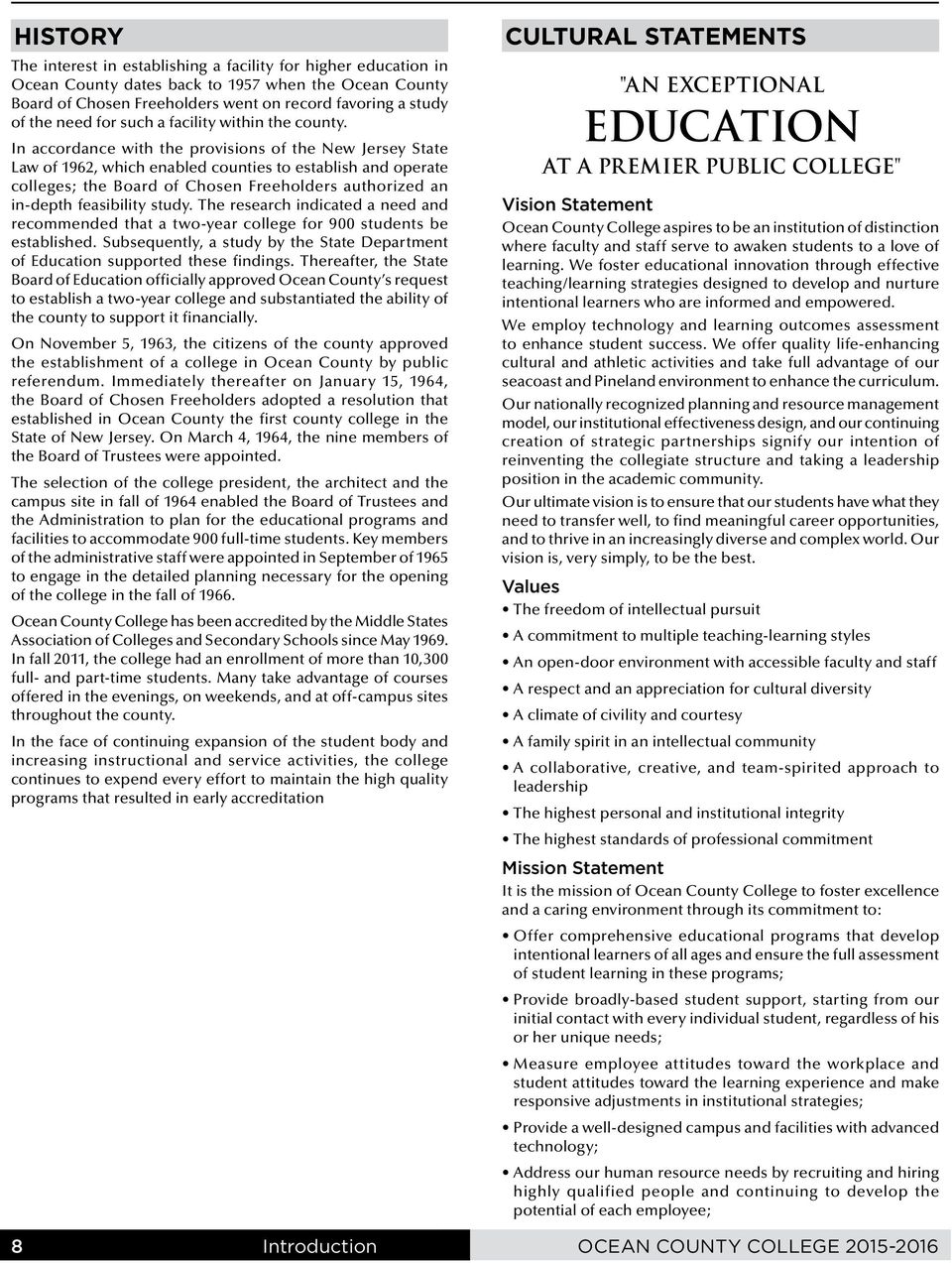
8 HISTORY The interest in establishing a facility for higher education in Ocean County dates back to 1957 when the Ocean County Board of Chosen Freeholders went on record favoring a study of the need for such a facility within the county. In accordance with the provisions of the New Jersey State Law of 1962, which enabled counties to establish and operate colleges; the Board of Chosen Freeholders authorized an in-depth feasibility study. The research indicated a need and recommended that a two-year college for 900 students be established. Subsequently, a study by the State Department of Education supported these findings. Thereafter, the State Board of Education officially approved Ocean County s request to establish a two-year college and substantiated the ability of the county to support it financially. On November 5, 1963, the citizens of the county approved the establishment of a college in Ocean County by public referendum. Immediately thereafter on January 15, 1964, the Board of Chosen Freeholders adopted a resolution that established in Ocean County the first county college in the State of New Jersey. On March 4, 1964, the nine members of the Board of Trustees were appointed. The selection of the college president, the architect and the campus site in fall of 1964 enabled the Board of Trustees and the Administration to plan for the educational programs and facilities to accommodate 900 full-time students. Key members of the administrative staff were appointed in September of 1965 to engage in the detailed planning necessary for the opening of the college in the fall of Ocean County College has been accredited by the Middle States Association of Colleges and Secondary Schools since May In fall 2011, the college had an enrollment of more than 10,300 full- and part-time students. Many take advantage of courses offered in the evenings, on weekends, and at off-campus sites throughout the county. In the face of continuing expansion of the student body and increasing instructional and service activities, the college continues to expend every effort to maintain the high quality programs that resulted in early accreditation CULTURAL STATEMENTS "AN EXCEPTIONAL EDUCATION AT A PREMIER PUBLIC COLLEGE" Vision Statement Ocean County College aspires to be an institution of distinction where faculty and staff serve to awaken students to a love of learning. We foster educational innovation through effective teaching/learning strategies designed to develop and nurture intentional learners who are informed and empowered. We employ technology and learning outcomes assessment to enhance student success. We offer quality life-enhancing cultural and athletic activities and take full advantage of our seacoast and Pineland environment to enhance the curriculum. Our nationally recognized planning and resource management model, our institutional effectiveness design, and our continuing creation of strategic partnerships signify our intention of reinventing the collegiate structure and taking a leadership position in the academic community. Our ultimate vision is to ensure that our students have what they need to transfer well, to find meaningful career opportunities, and to thrive in an increasingly diverse and complex world. Our vision is, very simply, to be the best. Values The freedom of intellectual pursuit A commitment to multiple teaching-learning styles An open-door environment with accessible faculty and staff A respect and an appreciation for cultural diversity A climate of civility and courtesy A family spirit in an intellectual community A collaborative, creative, and team-spirited approach to leadership The highest personal and institutional integrity The highest standards of professional commitment Mission Statement It is the mission of Ocean County College to foster excellence and a caring environment through its commitment to: Offer comprehensive educational programs that develop intentional learners of all ages and ensure the full assessment of student learning in these programs; Provide broadly-based student support, starting from our initial contact with every individual student, regardless of his or her unique needs; Measure employee attitudes toward the workplace and student attitudes toward the learning experience and make responsive adjustments in institutional strategies; Provide a well-designed campus and facilities with advanced technology; Address our human resource needs by recruiting and hiring highly qualified people and continuing to develop the potential of each employee; 8 Introduction OCEAN COUNTY COLLEGE
9 Generate and manage fiscal resources to best serve strategic priorities; Employ the leadership team to continue to efficaciously address outreach, development, engagement, institutional effectiveness, and a fully realized implementation of the college's vision; Continue to reach out to members of the Ocean County community and beyond in order to create meaningful, fulfilling, and mutually beneficial partnerships. PLANNING ASSUMPTIONS Institutional growth will continue to a maximum total of 20,000 students on the main campus (developed to 30 percent of its land mass) by 2025, 8,000 students at the SEC by 2025, and an estimated 4,000 at the 2nd (WEC) extension site to be developed in 2020 for a total campus unduplicated enrollment of 32,000. Distance Learning enrollments will increase exponentially as we explore new markets and create new partnerships. The major mission of the College will continue to be to serve the transfer needs of the students using specialized career and jobs programs, work partnerships, certificate programs, and vo-tech alliances to serve the career needs of the county, as they present themselves. The major academic partnerships the College pursues will be to make transfer baccalaureate and masters programs available on the College s main campus or create alliances with schools that offer our graduates distinct academic advantages. We will continue to work to arrange articulation agreements that allow our students to transfer seamlessly to quality schools with financial assistance opportunities. The major values of the College will continue to be academic quality, variety and excellence of teaching/learning, and a national reputation for the academic preparedness and success of our graduates. The educational delivery modes will continue to blend traditional classroom education with cutting edge technology in distance learning modes. The College will continue to partner with the county and with business enterprises to develop resources that benefit the students and the citizens of Ocean County. We will continue to affirm a culture of assessment leading to improved accountability, transparency, and overall institutional quality, utilizing data-based decision making practices whenever they are effective. Increasing globalization will require further internationalization of the curriculum. Social and cultural change in the larger society will continue to place demands on the College for organizational flexibility. We assume continuing fiscal support from the state and county, but we recognize the need to expand the College s capital position through effective and low-risk leveraging. INSTITUTIONAL GOALS Goal 1 Implement all appropriate recommendations for the advancement of Developmental Learning at the College; Goal 2 Implement all appropriate recommendations for the integrated academic engagement of first-year students; Goal 3 Advance student articulation needs; Goal 4 Develop programs that will serve needs generated by current economic conditions in collaboration with community, educational, and business partners; Goal 5 Develop a Teaching/Learning Institute on Campus for the improvement of teaching/learning as identified by learning assessment outcomes; Goal 6 Enhance our distance learning potential; Goal 7 Continue to recast the academic calendar for increased productivity. Goal 8 Implement appropriate recommendations for the integrated campus engagement of all students; Goal 9 Use results of the SENSE and CCSSE survey to assist with engagement assessment; Goal 10 Continue to expand outreach to NJ STARS students and expand outreach to other targeted student demographic populations; Goal 11 Transition to the new one-stop, enrollment management facility; Goal 12 Join the effort for career services targeted at special populations; Goal 13 Expand and enhance the College s athletic program. Goal 14 Use PACE or other appropriate instrument to measure employee attitudes and develop recommendations for improvement based on the outcomes; Goal 15 Develop faculty subcommittees to create action plans based on 2010 CCSSE outcomes. Goal 16 Continue to implement the Facilities Master Plan based on enrollment growth and the development of a campus for Kean at Ocean; Goal 17 Explore innovative uses of technology in the classroom for both teaching/learning and classroom assessment techniques; Goal 18 Complete ongoing technological upgrades identified in the IT plan. Goal 19 Develop and implement as appropriate an employee succession plan for vacated positions; Goal 20 Address the need to employ more diverse faculty and staff and to create bonds in the Mexican-American community; Goal 21 Continue to use a mutual gains approach to collective bargaining and develop training programs to educate mid-management in the administration of labor contracts Goal 22 Implement College-wide staff development and training programs with particular emphasis on comprehensive new employee orientation and services for troubled employees; Goal 23 Undertake a comprehensive analysis of compensation, starting salary guidelines, and a classification system for non-represented employees; Goal 24 Complete a comprehensive review of all current performance evaluation systems and make replacements with interactive, meaningful systems where needed. Goal 25 Continue to refine the long-term capital financial plan to support expansion and refurbishment of the campus; ensure capital and operating budgets are properly aligned and revenue stream estimates are realistic; Goal 26 Review outsourcing of services; assess efficiency and ROI; add or subtract as needed; Goal 27 Use this strategic plan as a major measure for new money requests to the Planning and Budgeting Council. Goal 28 Provide periodic professional development for the leadership team to continue to function effectively as a team; Goal 29 Continue to meaningfully expand the use of an in-house electronic Board document management system for greater efficiency; Goal 30 Restructure leadership meeting schedules for maximized efficiency. Goal 31 Extend educational partnerships with Kean, New Jersey City State, Stockton College, and others, as appropriate; Goal 32 Create an institution-based initiative using effective technology to engage alumni as active participants in fundraising Introduction 9

10 ADMISSIONS & ACADEMIC INFORMATION 10 Admissions & Academic Information OCEAN COUNTY COLLEGE

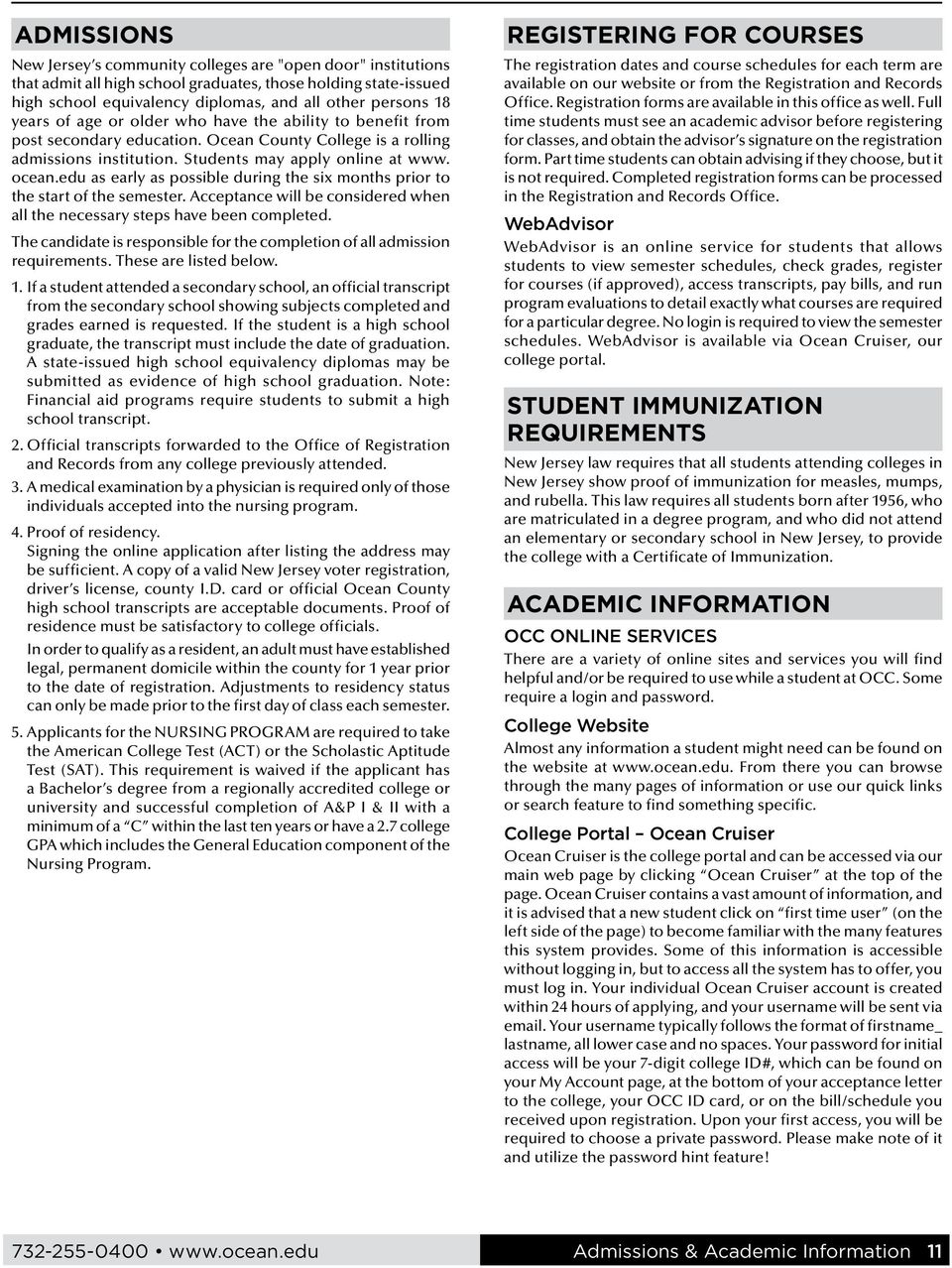
11 ADMISSIONS New Jersey s community colleges are "open door" institutions that admit all high school graduates, those holding state-issued high school equivalency diplomas, and all other persons 18 years of age or older who have the ability to benefit from post secondary education. Ocean County College is a rolling admissions institution. Students may apply online at www. ocean.edu as early as possible during the six months prior to the start of the semester. Acceptance will be considered when all the necessary steps have been completed. The candidate is responsible for the completion of all admission requirements. These are listed below. 1. If a student attended a secondary school, an official transcript from the secondary school showing subjects completed and grades earned is requested. If the student is a high school graduate, the transcript must include the date of graduation. A state-issued high school equivalency diplomas may be submitted as evidence of high school graduation. Note: Financial aid programs require students to submit a high school transcript. 2. Official transcripts forwarded to the Office of Registration and Records from any college previously attended. 3. A medical examination by a physician is required only of those individuals accepted into the nursing program. 4. Proof of residency. Signing the online application after listing the address may be sufficient. A copy of a valid New Jersey voter registration, driver s license, county I.D. card or official Ocean County high school transcripts are acceptable documents. Proof of residence must be satisfactory to college officials. In order to qualify as a resident, an adult must have established legal, permanent domicile within the county for 1 year prior to the date of registration. Adjustments to residency status can only be made prior to the first day of class each semester. 5. Applicants for the NURSING PROGRAM are required to take the American College Test (ACT) or the Scholastic Aptitude Test (SAT). This requirement is waived if the applicant has a Bachelor s degree from a regionally accredited college or university and successful completion of A&P I & II with a minimum of a C within the last ten years or have a 2.7 college GPA which includes the General Education component of the Nursing Program. REGISTERING FOR COURSES The registration dates and course schedules for each term are available on our website or from the Registration and Records Office. Registration forms are available in this office as well. Full time students must see an academic advisor before registering for classes, and obtain the advisor s signature on the registration form. Part time students can obtain advising if they choose, but it is not required. Completed registration forms can be processed in the Registration and Records Office. WebAdvisor WebAdvisor is an online service for students that allows students to view semester schedules, check grades, register for courses (if approved), access transcripts, pay bills, and run program evaluations to detail exactly what courses are required for a particular degree. No login is required to view the semester schedules. WebAdvisor is available via Ocean Cruiser, our college portal. STUDENT IMMUNIZATION REQUIREMENTS New Jersey law requires that all students attending colleges in New Jersey show proof of immunization for measles, mumps, and rubella. This law requires all students born after 1956, who are matriculated in a degree program, and who did not attend an elementary or secondary school in New Jersey, to provide the college with a Certificate of Immunization. ACADEMIC INFORMATION OCC ONLINE SERVICES There are a variety of online sites and services you will find helpful and/or be required to use while a student at OCC. Some require a login and password. College Website Almost any information a student might need can be found on the website at From there you can browse through the many pages of information or use our quick links or search feature to find something specific. College Portal Ocean Cruiser Ocean Cruiser is the college portal and can be accessed via our main web page by clicking Ocean Cruiser at the top of the page. Ocean Cruiser contains a vast amount of information, and it is advised that a new student click on first time user (on the left side of the page) to become familiar with the many features this system provides. Some of this information is accessible without logging in, but to access all the system has to offer, you must log in. Your individual Ocean Cruiser account is created within 24 hours of applying, and your username will be sent via . Your username typically follows the format of firstname_ lastname, all lower case and no spaces. Your password for initial access will be your 7-digit college ID#, which can be found on your My Account page, at the bottom of your acceptance letter to the college, your OCC ID card, or on the bill/schedule you received upon registration. Upon your first access, you will be required to choose a private password. Please make note of it and utilize the password hint feature! Admissions & Academic Information 11
12 Contained within Ocean Cruiser, you will find: All students will receive an account through the college. This can be accessed from the ocean.edu website. In the top right hand corner of the screen, click on My Ocean and then click on Office 365. Microsoft Office 365 is Ocean County College's new platform for student . Students will use the Outlook Online version provided by Office 365 for . Microsoft Office 365 also provides an online suite of software programs that includes Word, Excel, PowerPoint, and cloud storage provided by OneDrive that is available to students, faculty and staff. You will be guided to set up your box. Please be certain to check for periodically as this is the college s primary method of communication with you. Your address will be in the format firstname_lastname@students. ocean.edu. The college has so many names in our database that it is possible someone with your same first and last name already has a login. In that instance, the system will assign 4 random numbers after your name. To find out if you have numbers after your name, and what they are, go to By inputting other information, you will find out if you are john_doe or john_doe1234. WebAdvisor: An online service that allows students to view semester course schedules, check official final course grades, register for courses, pay bills, get unofficial transcripts, and run program evaluations. The system can be accessed within Ocean Cruiser by clicking on the WebAdvisor tab at the top of the screen. Coursework: Some instructors will utilize ecompanion to post assignments or test grades within a course. Your individual instructor will let you know if this is utilized within a particular course. Bookstore Our Bookstore is located on our main campus, but it is also possible to shop at the Bookstore online. From the main web page of click on the word Bookstore or from other pages, the link is You can set up your own online access by clicking first on Log In on the left, and then clicking Register here to establish a login and password for online purchases. Academic Progress The academic sanctions for failing to maintain satisfactory academic standards/progress may include probation, special probation, academic restriction, and academic suspension. These sanctions will be imposed on students who either fail to earn sufficient grade points or who continue to withdraw excessively from classes. More specifically, any student who has completed 12 or more semester hours with a cumulative grade point average below 2.0 (C average) or who has failed to earn at least 50 percent of all credits registered for on the official day of counting student enrollment for two or more consecutive semesters will have an academic sanction of probation, special probation, academic restriction or academic suspension imposed. A student placed on academic restriction or suspension may appeal the action to the Academic Standards Committee. Academic Standing In order to remain in good standing and become eligible for graduation, the student must maintain a C average or a gradepoint average of 2.0. The cumulative grade-point average is computed by dividing the total grade points earned by the total semester hours attempted. A student will be placed on academic probation if he/she earns a cumulative grade-point average of less than 2.0. If the number of grade points is 12 or more below the points required to maintain a 2.0 average the student will be considered for academic restriction. EXAMPLE Semester Letter Grade Total Hours Grade Points Points Course 1 3 x (A) 4 = 12 Course 2 3 x (D) 1 = 3 Course 3 4 x (D) 1 = 4 Course 4 3 x (F) 0 = 0 Course 5 2 x (D) 1 = 2 Total = 21 This student took 15 semester hours and received 21 grade points, a grade-point average of 1.4. This is below 2 so the student is on probation. However, since the total grade points are only 9 grade points short of the 30 required for a 2 average, the student is not academically restricted. A comparable report in two consecutive semesters would leave the student 18 points short and eligible for academic restriction. A student may continue on probation as long as the grade-point deficiency does not go below 12, but a 2 index is required for graduation. If a restricted student fails to make appreciable progress, a one year suspension may be imposed during which no credit courses may be taken. Class Attendance Ocean County College, recognizing that class attendance must be consistent with the objectives of the institution, has developed and maintained student attendance regulations and procedures that are consistent with these objectives. Attendance at all classes and appointments is expected. Following Policy # 5162, at the beginning of each course, the instructor will state the attendance policy for that course. Individual instructors determine the attendance policies for their courses; however, if an instructor chooses to make absence a component of course grading procedures, grade penalties for absence may be imposed only when a student exceeds a 10% absence rate. A student may withdraw without academic penalty at any time up to the 60% point of the semester. Withdrawal deadline dates are published. After that deadline, students cannot withdraw. Changes in Schedule A student may drop a course at any time prior to the first date of the term and receive a full tuition refund. (See section on refunds concerning drops after the first date of classes.) A student may add a course or change a schedule only during the designated Drop/Add time period after classes have begun. No registration will be allowed after the attendance census date of the term. Schedule changes must be initiated on an official Add/Drop form. Instructors cannot accept changes in registration that have not been properly authorized. Add/Drop forms can be obtained from the Registration and Records Office and must be submitted to Registration and Records prior to the attendance census date. After a semester begins, students who drop and add courses within the same day, even if done as separate transactions at different times of the day, will have tuition and fees processed on an even exchange concept. If the drop and add are on separate dates, tuition and fees for the drop will be processed according to the Refund Policy. The added courses will be billed at full rate. A student may withdraw at any time up to the 60% point of the semester; a grade of "W" will be assigned. No withdrawals are allowed after that time. Exact withdrawal deadline dates are available on our website and posted throughout the campus. 12 Admissions & Academic Information OCEAN COUNTY COLLEGE

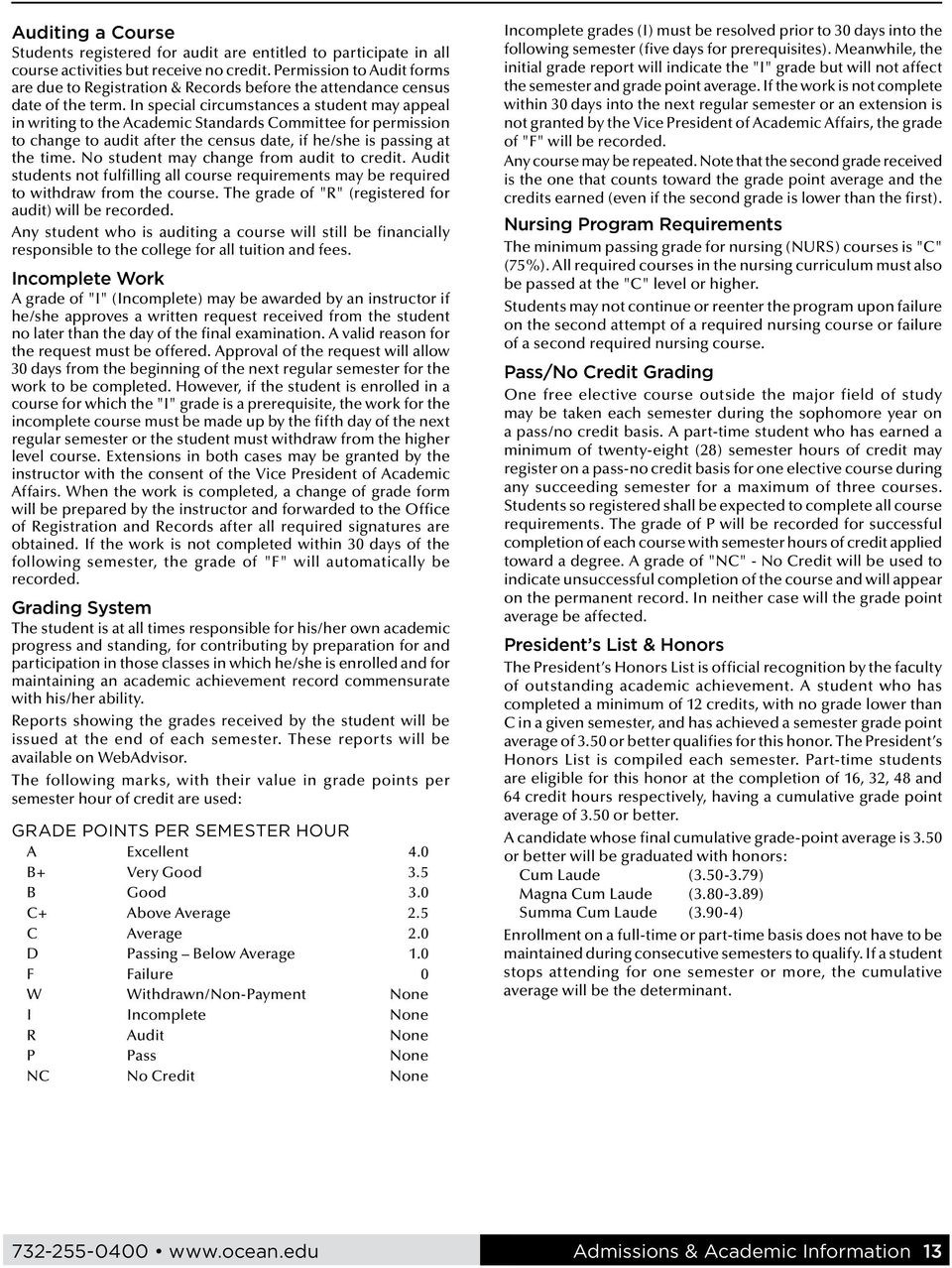
13 Auditing a Course Students registered for audit are entitled to participate in all course activities but receive no credit. Permission to Audit forms are due to Registration & Records before the attendance census date of the term. In special circumstances a student may appeal in writing to the Academic Standards Committee for permission to change to audit after the census date, if he/she is passing at the time. No student may change from audit to credit. Audit students not fulfilling all course requirements may be required to withdraw from the course. The grade of "R" (registered for audit) will be recorded. Any student who is auditing a course will still be financially responsible to the college for all tuition and fees. Incomplete Work A grade of "I" (Incomplete) may be awarded by an instructor if he/she approves a written request received from the student no later than the day of the final examination. A valid reason for the request must be offered. Approval of the request will allow 30 days from the beginning of the next regular semester for the work to be completed. However, if the student is enrolled in a course for which the "I" grade is a prerequisite, the work for the incomplete course must be made up by the fifth day of the next regular semester or the student must withdraw from the higher level course. Extensions in both cases may be granted by the instructor with the consent of the Vice President of Academic Affairs. When the work is completed, a change of grade form will be prepared by the instructor and forwarded to the Office of Registration and Records after all required signatures are obtained. If the work is not completed within 30 days of the following semester, the grade of "F" will automatically be recorded. Grading System The student is at all times responsible for his/her own academic progress and standing, for contributing by preparation for and participation in those classes in which he/she is enrolled and for maintaining an academic achievement record commensurate with his/her ability. Reports showing the grades received by the student will be issued at the end of each semester. These reports will be available on WebAdvisor. The following marks, with their value in grade points per semester hour of credit are used: GRADE POINTS PER SEMESTER HOUR A Excellent 4.0 B+ Very Good 3.5 B Good 3.0 C+ Above Average 2.5 C Average 2.0 D Passing Below Average 1.0 F Failure 0 W Withdrawn/Non-Payment None I Incomplete None R Audit None P Pass None NC No Credit None Incomplete grades (I) must be resolved prior to 30 days into the following semester (five days for prerequisites). Meanwhile, the initial grade report will indicate the "I" grade but will not affect the semester and grade point average. If the work is not complete within 30 days into the next regular semester or an extension is not granted by the Vice President of Academic Affairs, the grade of "F" will be recorded. Any course may be repeated. Note that the second grade received is the one that counts toward the grade point average and the credits earned (even if the second grade is lower than the first). Nursing Program Requirements The minimum passing grade for nursing (NURS) courses is "C" (75%). All required courses in the nursing curriculum must also be passed at the "C" level or higher. Students may not continue or reenter the program upon failure on the second attempt of a required nursing course or failure of a second required nursing course. Pass/No Credit Grading One free elective course outside the major field of study may be taken each semester during the sophomore year on a pass/no credit basis. A part-time student who has earned a minimum of twenty-eight (28) semester hours of credit may register on a pass-no credit basis for one elective course during any succeeding semester for a maximum of three courses. Students so registered shall be expected to complete all course requirements. The grade of P will be recorded for successful completion of each course with semester hours of credit applied toward a degree. A grade of "NC" - No Credit will be used to indicate unsuccessful completion of the course and will appear on the permanent record. In neither case will the grade point average be affected. President s List & Honors The President s Honors List is official recognition by the faculty of outstanding academic achievement. A student who has completed a minimum of 12 credits, with no grade lower than C in a given semester, and has achieved a semester grade point average of 3.50 or better qualifies for this honor. The President s Honors List is compiled each semester. Part-time students are eligible for this honor at the completion of 16, 32, 48 and 64 credit hours respectively, having a cumulative grade point average of 3.50 or better. A candidate whose final cumulative grade-point average is 3.50 or better will be graduated with honors: Cum Laude ( ) Magna Cum Laude ( ) Summa Cum Laude (3.90-4) Enrollment on a full-time or part-time basis does not have to be maintained during consecutive semesters to qualify. If a student stops attending for one semester or more, the cumulative average will be the determinant Admissions & Academic Information 13
14 Student Classification In deciding on a credit-hour load, the student must consider the pressures of employment and other limiting factors. One method is to estimate that each credit hour carried will require two hours of out-of-class preparation. 1. A full-time student is one who is in good academic standing and who carries 12 or more hours of credit. The full-time student will normally carry 15 to 18 credit hours in order to graduate after four semesters. Full-time students must be enrolled as degree candidates. 2. A probationary student is one who has a grade-point deficiency or other academic deficiency and will normally carry no more than 12 hours of credit in a semester. 3. A part-time student is one who carries 11 or fewer semester hours of credit in a semester. 4. A non-degree student is one who has not been admitted to a degree program. 5. A sophomore student is a student who has earned a minimum of 30 semester hours. All other degree candidates are considered freshmen. 6 A visting student is one who is matriculated at another school while enrolled at OCC. Course Withdrawal A student who wishes to withdraw during a semester must do so on the Add/Drop Form provided by the Registration and Records Office or process a request online. The student is still financially responsible to the college for all tuition and fees, subject to the applicable refund percentage. (See also Refunds and Changes in Schedule). Failing to attend class will not relieve you of your financial responsibility, even if you have not paid your bill. A student may withdraw or be withdrawn from a course without academic penalty at any time up to the 60% point of the semester (exact dates for each semester are available on our website and posted throughout campus). If a student stops attending or is administratively withdrawn after this date, an "F" will be assigned. Students wishing to withdraw from courses are responsible for submitting their request by the published deadline. Late withdrawals cannot be accepted. Students receiving financial aid or VA educational benefits must, under the law, notify the Office of Registration and Records and the Financial Aid Office of their withdrawal from the college or of changing from full-time to part-time status. Failure to do so may result in reimbursing the government agency. If physically unable to withdraw in person, notify the Office of Registration and Records immediately by telephone. You will not be officially withdrawn until a follow-up written request is received. DEADLINES FOR WITHDRAWALS If you come in to Registration and Records to drop a course by**: The day before the first day of the semester The attendance census date of the semester The 60% point of the semester After the 60% point of the semester The result will be: Full tuition refund (minus fees), and course does not appear on the transcript. 50% tuition refund (minus fees), and course does not appear on the transcript; if adding a course at the same time, no loss of 50% tuition. No refund, instructor signature required, and course with a "W" grade appears on the transcript. No withdrawals of any kind will be accepted. The course, with earned grade, appears on the transcript. **Exact dates for each semester are available on our website and posted in the Registration and Records Office. Failure to be aware of dates is not grounds for a refund. ACCEPTANCE OF CREDITS Acceptance of Credits from an Accredited Institution Credits granted for work completed at other regionally accredited institutions may be applied to a degree student s record at Ocean County College if requested. It is the responsibility of the student if requested to provide the Registration and Records Office with a catalog of the institution from which the credits are expected to be transferred. Advanced Standing Students who have demonstrated outstanding achievement in certain subjects while in high school (e.g., English or foreign language) and who meet specific college departmental criteria, may be considered for advanced placement and/or credit. Advanced placement/credit will be considered on the basis of grades attained in the College Entrance Examination Board Advanced Placement Program examinations. Challenge Examination With instructor approval, challenge examinations may be offered to qualified students who apply. This policy may be implemented only for those courses in which objectives can be measured by examination. An examination may not be requested earlier than the end of the third week from the beginning of classes, nor later than three weeks prior to the end of classes. Grading will be on a Pass/Fail basis only. Students who successfully complete the challenge examination will be awarded a Pass grade and credit for the course at the end of the semester. The college reserves the right to change these scores in accordance with statewide community college procedures. College Level Examination Program (CLEP) In accordance with established departmental criteria, credit may be granted for the General Examination or the Subject Examinations of the College Level Examination Program (CLEP). Questions concerning the examinations accepted at this college and minimum scores required are available in the Registration & Records, Advising and Testing offices. 14 Admissions & Academic Information OCEAN COUNTY COLLEGE

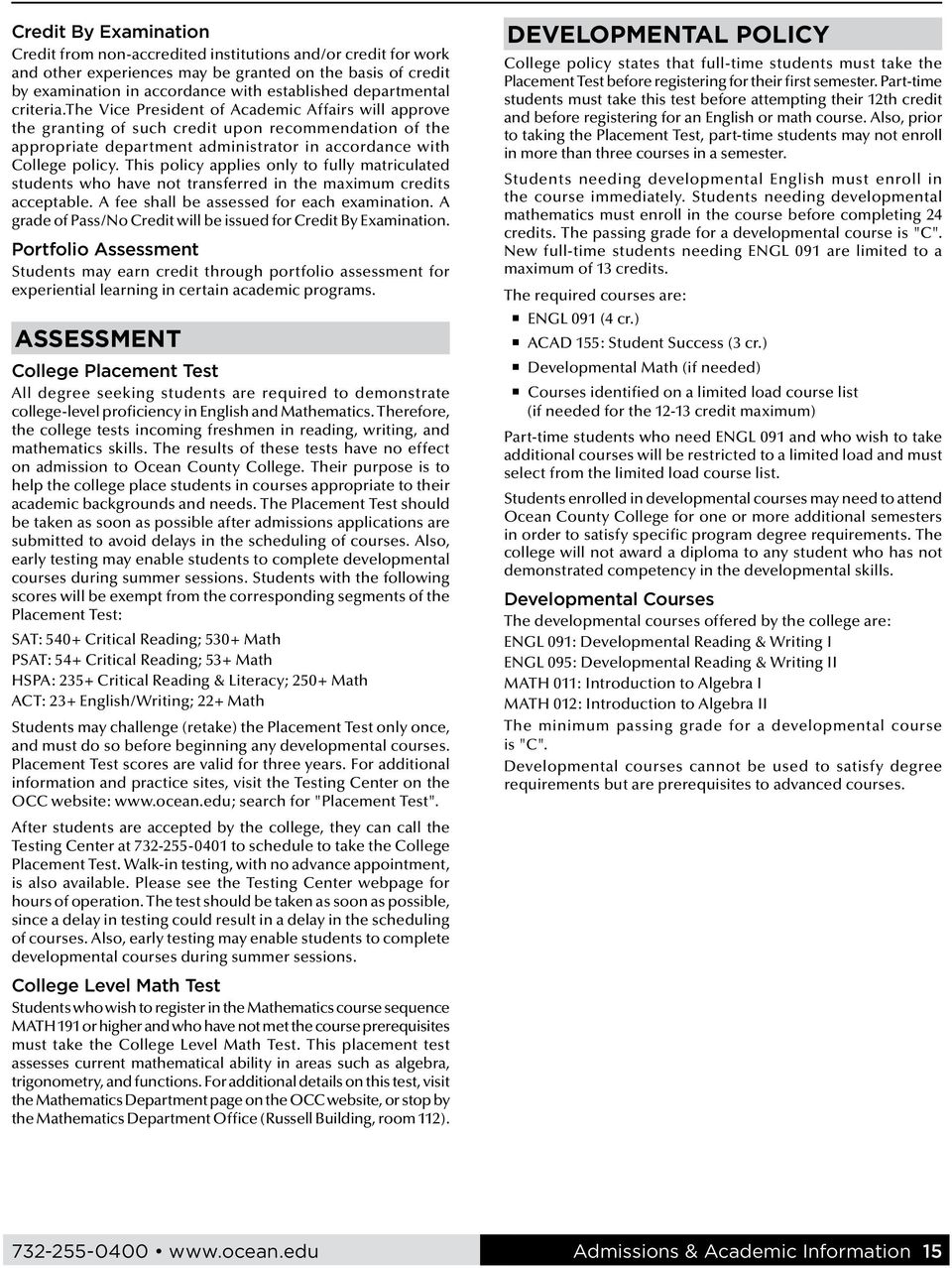
15 Credit By Examination Credit from non-accredited institutions and/or credit for work and other experiences may be granted on the basis of credit by examination in accordance with established departmental criteria.the Vice President of Academic Affairs will approve the granting of such credit upon recommendation of the appropriate department administrator in accordance with College policy. This policy applies only to fully matriculated students who have not transferred in the maximum credits acceptable. A fee shall be assessed for each examination. A grade of Pass/No Credit will be issued for Credit By Examination. Portfolio Assessment Students may earn credit through portfolio assessment for experiential learning in certain academic programs. ASSESSMENT College Placement Test All degree seeking students are required to demonstrate college-level proficiency in English and Mathematics. Therefore, the college tests incoming freshmen in reading, writing, and mathematics skills. The results of these tests have no effect on admission to Ocean County College. Their purpose is to help the college place students in courses appropriate to their academic backgrounds and needs. The Placement Test should be taken as soon as possible after admissions applications are submitted to avoid delays in the scheduling of courses. Also, early testing may enable students to complete developmental courses during summer sessions. Students with the following scores will be exempt from the corresponding segments of the Placement Test: SAT: 540+ Critical Reading; 530+ Math PSAT: 54+ Critical Reading; 53+ Math HSPA: 235+ Critical Reading & Literacy; 250+ Math ACT: 23+ English/Writing; 22+ Math Students may challenge (retake) the Placement Test only once, and must do so before beginning any developmental courses. Placement Test scores are valid for three years. For additional information and practice sites, visit the Testing Center on the OCC website: search for "Placement Test". After students are accepted by the college, they can call the Testing Center at to schedule to take the College Placement Test. Walk-in testing, with no advance appointment, is also available. Please see the Testing Center webpage for hours of operation. The test should be taken as soon as possible, since a delay in testing could result in a delay in the scheduling of courses. Also, early testing may enable students to complete developmental courses during summer sessions. College Level Math Test Students who wish to register in the Mathematics course sequence MATH 191 or higher and who have not met the course prerequisites must take the College Level Math Test. This placement test assesses current mathematical ability in areas such as algebra, trigonometry, and functions. For additional details on this test, visit the Mathematics Department page on the OCC website, or stop by the Mathematics Department Office (Russell Building, room 112). DEVELOPMENTAL POLICY College policy states that full-time students must take the Placement Test before registering for their first semester. Part-time students must take this test before attempting their 12th credit and before registering for an English or math course. Also, prior to taking the Placement Test, part-time students may not enroll in more than three courses in a semester. Students needing developmental English must enroll in the course immediately. Students needing developmental mathematics must enroll in the course before completing 24 credits. The passing grade for a developmental course is "C". New full-time students needing ENGL 091 are limited to a maximum of 13 credits. The required courses are: ENGL 091 (4 cr.) ACAD 155: Student Success () Developmental Math (if needed) Courses identified on a limited load course list (if needed for the credit maximum) Part-time students who need ENGL 091 and who wish to take additional courses will be restricted to a limited load and must select from the limited load course list. Students enrolled in developmental courses may need to attend Ocean County College for one or more additional semesters in order to satisfy specific program degree requirements. The college will not award a diploma to any student who has not demonstrated competency in the developmental skills. Developmental Courses The developmental courses offered by the college are: ENGL 091: Developmental Reading & Writing I ENGL 095: Developmental Reading & Writing II MATH 011: Introduction to Algebra I MATH 012: Introduction to Algebra II The minimum passing grade for a developmental course is "C". Developmental courses cannot be used to satisfy degree requirements but are prerequisites to advanced courses Admissions & Academic Information 15
16 Developmental Probation, Restriction & Suspension A. Developmental Probation - Math Students failing to attain a minimum grade of "C" in the mathematics developmental courses will be placed on remedial probation. 1. FULL-TIME students are limited to 12 semester hours and must re-enroll immediately in the developmental course. 2. PART-TIME students must include the developmental course as part of their course load in the next semester in which they enroll. B. Developmental Restriction - English Students failing to attain a minimum grade of "C" in English developmental courses will be placed on developmental restriction. (Developmental restriction takes priority over Developmental Probation). 1. Students placed on developmental restriction are limited to a maximum credit load of credits, which must include the needed developmental course. The remainder of courses must be selected from the limited load list. 2. Students placed on developmental restriction who fail to pass the developmental course on the second attempt, are limited to 6-7 credits, which must include the developmental course. 3. Students placed on developmental restriction who fail to pass the developmental course after having been limited to 6-7 credits on their third attempt, can only register for that developmental course. CENTER FOR STUDENT SUCCESS Center for Student Success A Center dedicated to student success, focusing on the first year At Ocean County College, we are committed to providing a community that will maximize the potential for success for every first year student. The faculty and staff are dedicated in offering a solid academic foundation through active learning, technology, innovative teaching, and diversified experiences while promoting an environment that encourages student involvement. The Center for Student Success is an integral part of the OCC community, offering an array of services for students to achieve academic success. Academic Coaching Coaching sessions assist students in strengthening academic skills, improving study habits and developing organizational skills. Sessions focus on topics such as goal setting, time management, note taking, testing and stress management. These sessions are open to all students in the fall and spring semesters. Small groups meet in the Center for Student Success. To register, please call the CAE at ext Academic Skills - ACAD 155 Student Success This course will assist students in building a solid foundation for a successful college experience through development of critical thinking, information literacy, interpersonal communication, communication in an academic environment, and resource acquisition. ACAD 155 is designed to meet three critical needs: 1) to engage the student in learning opportunities, both in and out of the classroom, 2) to develop the appreciation of critical thought among all disciplines, and 3) to improve the student/ faculty interactions at Ocean County College. Disability Services Disability Services provides academic adjustments for OCC students with all types of disabilities. Students must contact the CAE, complete an intake process including providing documentation of a disability. An Accommodation Plan for eligible students is developed in accordance with the Americans with Disabilities Act (ADA) of 1990 and Section 504 of the Rehabilitation Act of Both full and part-time students, including students attending distance learning classes, are encouraged to inquire about disability services at Academic advising is available for students with disabilities. NJ Stars Enrichment Services New Jersey Stars Enrichment Program, mandated by legislature, is required for all NJ Stars students who do not earn a 3.0 GPA during their first semester. Students in the Enrichment Program are required to take our ACAD 155 Student Success course to maintain their scholarship. The program also provides students with valuable resources and services such as advising, course scheduling, and tutoring to help NJ Stars students build a foundation for success in college. Peer Tutors Peer Tutors are available in various content areas, such as mathematics, science, humanities, and social sciences. OCC students, under the recommendation of faculty, are able to become peer tutors and help students succeed in college. This is a valuable experience for the tutors as well as the tutees. Training and certification is available through the CAE/College Reading and Learning Association (CRLA). Testing Center In addition to Placement testing, the Testing Center also offers high school equivalency exams and partners with Disability Services, Kean-Ocean, Continuing & Professional Education, The School of Nursing, virtual and distance learning institutions, and test vendors to administer and proctor various academic tests, skills- and competencybased tests and professional certifications. It is located on the ground floor of the Library building, Room L014. Hours: Mondays & Fridays, 8:00am-4:00pm; Tuesdays, Wednesdays, & Thursdays 8:00am-8:00pm; Saturdays 8:00am- 1:00pm. Phone: Fax: Voluntary Mentoring Program for Students A program in which faculty, administrators and staff serve as mentors to students. In a one-on-one relationship, mentors can assist students in achieving both personal and educational goals by offering encouragement, support and guidance. Mentors serve as role models encouraging students to explore their interests and navigate campus resources. To connect with a mentor, students can call the Center for Student Success at ext Admissions & Academic Information OCEAN COUNTY COLLEGE
17 The Writing Center The Writing Center is a free resource open to all OCC and Kean@Ocean students looking for help with any aspect of writing and/or reading for any class, whether you struggle with writing, are an advanced writer looking to polish your skills, or simply for help getting started on an assignment. For hours and additional information, visit the college website or call ext The Math Center Professional and peer Mathematics assistance is available for students in all areas of Mathematics and in any course with a Mathematics component. For hours and additional information, visit the college website or call ext See also page 22 for more information. Office Information Location: Library Building, Room 124 Phone: Fax: TTY/TDD & Voice: NJ Relay 711 Hours: Monday through Friday, 8:00am-4:00pm SPECIALIZED PROGRAMS High School Students Participation in the following programs is arranged through the high school guidance department, and students must be recommended by a high school guidance counselor. For more detailed guidelines, contact your high school guidance office or call the Office of Registration and Records at EARLY ADMISSION PROGRAM Under the Early Admissions Program policy, high school students who have completed their junior year, whose class rank is at least at the 90th percentile and who meet certain other admissions criteria including SAT performance may, with the concurrence of their high school administration, matriculate as full-time degree students at Ocean County College. JUMP START PROGRAM With the concurrence of their high school administration, junior or senior high school students may enroll as part-time, nondegree students at Ocean County College in the "Jump Start" Program. Jump Start students may register for a maximum of two courses per semester while attending high school. Reduced tuition is available, excluding all online courses. Distance learning courses are not recommended for students in the Jump Start Program. Tech Prep Tech Prep is a partnership between Ocean County College and area high schools to develop highly skilled, performance oriented workers in demand occupations for the future. Students from the participating high schools comprising the Tech Prep Consortium can continue their education at OCC with a coordinated curriculum that assures continuity in instruction and eliminates duplication of educational experiences. Many students go on to receive baccalaureate degrees through the Tech Prep Program. For information on specific programs call School Relations at Kean-Ocean Earn credits toward your Bachelor s or Master s degree on the Ocean County College campus with the OCC/Kean Partnership. Kean and Ocean County College (Kean-Ocean) have established a partnership that enables area residents to complete the upper division courses required for certain Kean undergraduate degree programs and specific graduate programs on the campus of OCC. GRADUATE Courses are being offered at OCC for Kean master s degrees in Counselor Education (with state certification for school counseling), Educational Leadership (with state certification for supervisor and principal), Nursing, and the Executive Master s degree programs in Business Administration and Public Administration. Honors by Contract Program The Honors by Contract Program allows high achieving students the opportunity to work individually with faculty members on directed higher-level educational activities that are related to course objectives while being enrolled in a regular course. Students complete the regular course assignments in addition to faculty directed higher-level academic assignments. Students completing Honors by Contract courses will have the designation denoted on their transcripts. Students who successfully complete four Honors by Contract courses with an overall grade point average of 3.5 or above will graduate from Ocean County College with the designation of Ocean County College Honors Student. This designation will be noted on the students transcripts, diplomas, and in Commencement programs. All students with a grade point average of 2.5 or above, or its equivalent, from high schools, other higher education institutions, or Ocean County College are eligible to enroll in the Honors by Contract courses. Students may only enroll in two Honors by Contract courses per semester. Students enrolled in any remedial courses may not participate in the Program. Students may appeal to the Vice President of Academic Affairs for special permission to participate in Honors by Contract courses. Faculty members who teach college-level courses (100 level and above) may participate in the Honors by Contract Program; however, ACAD 155 is not included Admissions & Academic Information 17

18 UNDERGRADUATE Kean-Ocean provides undergraduate courses that will lead to a Bachelor s degree completion program in: Accounting Biology Biology Teacher's Certificate Option Computer Science; Information Systems Operations Criminal Justice Elementary Education, K-5 Certification Elementary Education, K-5 & 5-8 subject certification English, standard option English, Teacher Certification Option Finance History History/Teacher Certification Option Management Marketing Nursing Physical Education/Global Fitness & Wellness Physical Education & Health K-12 Teaching Option Psychology Public Administration Sociology Special Education Visual Communications Technology (Graphic Design) If you want to apply for a Kean-Ocean program and already have or will soon complete your associate s degree, apply directly to Kean. The application can be accessed through the Kean-Ocean webpage at Rutgers Dual Degree Program Ocean County College participates in the Rutgers Dual Degree Program (DDP). Each year Rutgers selects certain applicants from their freshman admission pool to participate in the DDP, and invites these students to attend a community college in the state of New Jersey. Upon completion of an AA/AS degree, with at least a 3.0 GPA, they are guaranteed admission to Rutgers. Rutgers expects that students will use NJ Transfer ( to plan their academic program at the community college, based on their intended choice of Rutgers campus/college and major. You may not self-identify to be a DDP participant. Students who are not in the DDP can still apply to transfer to Rutgers. OCC students planning to transfer to Rutgers will also use NJ Transfer for academic planning. New Jersey Stars Program NJ STARS I The New Jersey Student Assistance Reward Scholarship Program (NJ STARS) is an initiative created by the State of New Jersey that provides New Jersey s highest achieving students with free tuition any State and/or Federal grants and/or scholarships at Ocean County College. Students must: Be a resident of Ocean County, graduate in the top 15.0% of their high school class. Students may receive 4-5 semesters of funding for up to 18 credits per semester. Students must apply for all forms of State and Federal Student Aid (FAFSA) and submit any requested documentation to complete and verify application data within the established deadlines. Students must maintain continuous full-time enrollment and achieve a minimum cumulative grade point average (GPA) of 3.0. Students must earn a 3.25 cumulative GPA upon graduation from community college to be eligible for NJ STARS II. NJ STARS II NJ STARS II is a continuation of NJ STARS I that provides partial scholarships and enables successful NJ STARS students to earn a Bachelor s degree at a New Jersey four-year institution of higher education. Students must: Earn an associate degree from a New Jersey community college with a minimum of 3.25 GPA. Maintain a 3.25 average GPA in their junior year to receive the scholarship in his/her senior year. The senior year award will be adjusted up or down based on the student s grade point average. Be admitted to a New Jersey four-year institution of higher education. Be enrolled in a full-time course of study (up to 18 credits per semester) in a baccalaureate degree program during the academic year following graduation from community college. Students may receive an NJ STARS II scholarship for up to four (4) semesters, excluding summer sessions and must apply for all forms of State and Federal need-based grants and merit scholarships by completing the Free Application for Federal Student Aid (FAFSA) within the established deadlines and complete any required verification procedures. For additional program information and requirements, please visit or Call or [email protected]. 18 Admissions & Academic Information OCEAN COUNTY COLLEGE

19 Other Joint Admissions & Transfer Opportunities Information on the following programs is available on the college website: Albright College (PA) Dual Admissions Agreement Bellevue Berkley College DeVry Excelsior College Fairleigh Dickinson Franklin (OH) Georgian Court Dual Degree Agreements Kaplan Kean - Ocean, Kean Monmouth New Jersey Institute of Technology Northwood (FL) Direct Transfer Agreement Norwich Palmer Chiropractic College Paul Smith s College (NY) Richard Stockton College of New Jersey Rutgers St. John s (NY) St. Joseph s Southern New Hampshire Strayer SUNY Maritime College The College of New Jersey Thomas Edison State College United States Sports Academy of the Arts (PA) Direct Transfer Agreement of Phoenix of Maryland College INTERNATIONAL & DOMESTIC TRAVEL These short term programs are usually offered during semester breaks. Recent short term studies abroad experiences have included Theatre in London (England) and The World of the Maya (Central America/ Mexico). Some of our travel abroad programs can earn students up to three credits. The college can also assist students in locating longer overseas semester programs offered by other institutions. For information on international travel opportunities offered by Ocean County College, please call the Department of Academic Affairs at Reduced Tuition for Seniors Ocean County residents 65 years of age or older, who are fully retired, may enroll in credit courses on a space available basis with a reduced tuition (not including textbooks). Registration will only be accepted the day before classes begin for the semester. For more information, please contact the Registration & Records Office at Admissions & Academic Information 19

20 EXPENSES & FINANCIAL INFORMATION 20 Expenses & Financial Information OCEAN COUNTY COLLEGE

21 TUITION * The student s tuition and fees are established by the college s Board of Trustees and are subject to change at any time. Failure to make payment at the time of registration for tuition and fees may cause cancellation of your class schedule. In the event your schedule is canceled for non-payment, you will not be able to attend OCC unless you re-register and pay immediately, provided that registration and courses are still open for selection. For County Students At publication, tuition for a certified resident of Ocean County is based on a per credit hour charge of $109. The total cost for educating each student is determined by dividing the cost of operating the college by the estimated number of full-time equated students attending the college. The state s contribution per student is subtracted. The balance is shared between the county, the student and other miscellaneous sources. For Eligible Out-of-County Residents Students attending a county community college outside their county of residence are eligible for the prevailing in-county tuition rate under the following conditions: (1) the county of residence does not sponsor a county college, or (2) the college in the county of residence certifies that it does not offer the particular course or program of study desired by the applicant, or (3) the college in the county of residence certifies that it cannot admit the applicant into a particular course. Under chargeback legislation, the sending county is obligated to contribute toward tuition. For required documentation, contact the Registration and Records Office at , extension A copy of the student s College Skills Assessment test scores must be submitted before a chargeback can be considered. If eligible, the student should request an "Inability to Admit" form from the college in his/her county of residence and a "Certificate of Residence for the Purpose of Chargeback" form from his/ her county fiscal officer. These forms should be presented to the Cashier s Office at Ocean County College immediately following registration. If the forms are not submitted, the student must pay out-of-county tuition rates. Out-of-county students should contact the Office of Registration and Records for more information concerning the Chargeback Law. Tuition Schedule At publication, rates for full-time and part-time students were as listed below, (excluding fees). A current listing of tuition and fees can be obtained from the cashier s office, located in the Administration building or on the website: County residents: $109/semester hour Out-of-county N.J. residents: $135/semester hour Out-of-state residents: $225/semester hour Jump Start (after applied Trustee Discount): $77/semester hour plus technology fee Reduced Tuition for Seniors: $52/semester hour plus technology fee Tuition Deposit (Nursing Students Only): A $ 300 nonrefundable tuition deposit is required of newly accepted nursing students. FEES * College/Student Fee At publication, full-time and part-time students pay a college/ student fee of $19 per credit hour. The fee represents partial subsidy of the following services: 1) College Budget Advising Intercollegiate Athletics Student Life Office Administrative Operations Health Services Office Transfer & Placement Financial Aid Admissions & Records Parking 2) Student Life Fund Clubs & Organizations College Center Building Fund In addition, full- and part-time students pay a technology fee of $12.50 per credit hour. Graduation, Diploma, and Certificate Fees A fee of $25 is due at the time of application for graduation. A fee of $10 to cover the cost of printing and lettering is charged students receiving certificates. Applications are available in the Office of Registration and Records. An additional fee of $42 for a cap and gown is required for students planning to participate in the Commencement ceremony. Graduation applications should be filed by March for spring graduation and June for summer graduation. Students applying after this date will be reviewed with those graduating the next semester. Course Fees The following fees will be required of all students enrolled in certain designated courses. These fees are used to offset laboratory materials, tutoring or other needed costs. Fee categories appear at the conclusion of applicable course descriptions. A special table of fees, not shown here, also exists for International Education courses. FEE CATEGORY FEE PER COURSE 1 $20 2 $25 3 $32 4 $50 5 $70 6 $75 7 $100 (Online Courses) 8 $2,000 (Nursing only) In addition to the above, students may be required to purchase materials for their own use in conjunction with certain courses as noted at the end of those course descriptions. These costs will be identified by the course instructor and will not be included on the student s bill prepared by the college. *At time of publication Expenses & Financial Information 21
22 Registration Fees All students are expected to comply with the schedule of registration as published in the college calendar. A $20 non-refundable registration fee is charged to all students for each registration term. Post registration generally will be permitted up through the census date for those who failed to do so during the regular registration period. Tuition & Fees Payment All tuition and fees must be paid at the time of registration. Checks or money orders are acceptable when made payable to Ocean County College. A charge of $25 will be assessed for all checks issued to the college and not paid upon presentation to the bank. The college offers a payment plan option to students who cannot pay their entire bill in full at the time of registration. Visa, MasterCard, American Express and Discover are also accepted. Office of Student Life Emergency Loan Fund Penalty Fees* The following penalty fees will be assessed to students who are delinquent in payment of their Office of Student Life Emergency Loans: days overdue...$5 21 or more days overdue...$10 Return Check Fee...$25 The student shall also be responsible for absorbing all costs involved in collection of any delinquent emergency loans and/ or penalty fee. *At time of publication. International Students In order for an international student to attend Ocean County College, the following requirements must be met prior to acceptance and our issuing an I-20 Student Visa form: 1. Submission of a completed admissions application. The addresss on the application should indicate where the student would be living while attending Ocean County College. 2. All minors, under 18 years of age, must show proof of high school diploma or United States equivalent and are required to have a sponsor. A minor s admissions application must be signed by the student and by the sponsor. 3. A notarized affidavit from a United States citizen or an authorized agency attesting to the assumption of responsibility for the international student during the period the individual intends to remain in the United States. The affidavit of support must be a completed I-134 found at www. uscis.gov. 4. Satisfactory performance on the Test of English as a Foreign Language (TOEFL) is required as evidence of proficiency in English. If the exam is taken on a computer the passing score is 173 and if paper based, the passing score is 500. TOEFL ibt passing score is 61. Students who currently reside in the United States under some type of visa can submit the following TOEFL scores: a score of 127 or high on a computer based test, 443 or higher on a paper-based test or a passing score of 43 or higher for the TOEFL ibt. An additional test of language skills will be required and students will have to take additional English courses depending on their scores. All international student applicants must meet this requirement. For more information concerning this test and the location of the nearest testing center, contact them online at www. toefl.org. If you don t have access to the web, you can write to the Educational Testing Service, P.O. Box 6151, Princeton, NJ , USA, or call at The cost of tuition for an international student will be the same as that of an out-of-state or foreign resident, regardless of residency. Documented funds for educational and living expenses must be shown in a bank account or other readily convertible assets excluding real estate and other fixed assets. See budget below. 6. An international address from the student s country of origin, with a photocopy of their current Visa and Passport, is required for identification purposes. Students must also note what type of current Visa they have if they are already in the United States. 7. Since Ocean County College is a non-residential institution, the student must make arrangements for room, board, and transportation. It is the responsibility of the student to arrange this prior to the start of classes. 8. When applying for the Spring Semester, we must receive all completed paperwork by November 15th. When applying for the Fall Semester, we must receive it by July 15th. 9a. Students who are transferring their F-1 Visa into Ocean County College must also complete the Notice of Intention to Transfer form and submit a copy of all I-20s they have received from their current and previous schools. 9b. Student who will be receiving their first I-20 must pay the SEVIS fee at Ocean County College abides by the Student and Exchange Visitor Information System (SEVIS) regulations regarding the reporting of international students. While attending Ocean County College, all international students must be full timestudents. International students are required to register and complete a minimum of 12 credits each semester. INTERNATIONAL STUDENT BUDGET Estimated cost based upon 15 credit semesters: Tuition & Fees... $7,350 Books & Supplies...$2,025 Room/Board & Utilities...$16,340 Transportation...$3,300 Personal Expenses...$1,500 Total...$32, Expenses & Financial Information OCEAN COUNTY COLLEGE
23 INTERNATIONAL & DOMESTIC TRAVEL These short term programs are usually offered during semester breaks. Recent short term studies abroad experiences have included Theatre in London (England) and The World of the Maya (Central America/ Mexico). Some of our travel abroad programs can earn students up to three credits. The college can also assist students in locating longer overseas semester programs offered by other institutions. For information on international travel opportunities offered by Ocean County College, please call the Department of Academic Affairs at TEXTBOOKS (BOOKSTORE) For the convenience of the students, faculty, staff, alumni and friends of the college, the college operates a bookstore located in the College Center complex. A full-time student may expect textbooks to be approximately $800 with supplies per semester. The figure is only an estimate and can vary significantly depending upon the courses chosen. The bookstore offers a wide variety of new, used, and rental textbooks in addition to an array of products such as sportswear, school supplies, tablets, insignia items, snacks, novelty gifts, Starbucks Coffee, etc. The bookstore is open Monday through Thursday from 8:30am to 7:00pm and Friday from 8:30am to 4:00pm. Hours are extended during the beginning of each semester to include one Saturday from 8:30am to 12:00pm. Special hours are posted on the Bookstore website calendar. During the summer semester and semester break the bookstore is open Monday through Friday from 8:30am to 4:00pm. On Fridays, mid-june to mid- August, the bookstore closes at 3:00pm. The Bookstore offers a rewards program called Viking Bucks. Viking Bucks can be accrued to use towards gift cards, textbooks and clothing purchases. AID & SCHOLARSHIPS Financial Aid Ocean County College provides financial assistance to qualified students through various combinations of grants, loans and part-time employment. Eligibility is determined on an individual basis. Recipients are required to meet program guidelines and maintain good academic standing. Unless otherwise specified, financial aid is awarded on an annual basis and students must reapply each year. The priority service deadline is April 15. All students applying for financial aid must file a Free Application for Federal Student Aid (FAFSA). The form can be completed online at Applications for financial aid to attend Ocean County College must be received by the Federal Processor no later than June 1 for fall semester and October 1 for spring semester. Applications submitted after the above deadlines are considered late and may result in a loss of state aid. Late applicants should expect to pay for their own tuition, fees and books, but those who establish eligibility for financial aid may receive a refund after processing is completed. Verification A student s application may be selected for review in a process called Verification. In this process, a school is required to compare information from the application with copies of the Federal IRS tax transcripts, W-2 forms or other financial documents. The law says the school is required to ask the student for this information before awarding aid. If the student is selected, please be aware of the following document submission deadlines. NO AID will be awarded until a file is complete. If we do not receive the information in a timely manner, students should expect to pay for their tuition, fees and books until the file is complete and the student is awarded. DEADLINES FALL TERM: FALL QUICK TERM: SPRING TERM: May 8th - Returning Students June 5th - New Students July 10th - All Students October 9th - Returning Students November 6th - New Students SPRING QUICK TERM: December 11th - All Students Students must maintain academic progress within parameters defined by the U.S. Department of Education. Generally students must maintain a 2.0 cumulative GPA and complete 70% of classes within a given semester. No distinction is made between "F" grades, "W" grades or "I" grades with regard to Financial Aid Standards of progress. See a financial aid officer for complete details. Special Circumstances If a student experiences financial hardships during the current tax year, they may request a special circumstances review of their application. Students must complete the verification process before their special circumstances are considered. Students should expect to pay their tuition, fees and books until the file is completed and the student is awarded. Students requesting a special circumstances review after November 1st will be required to provide W-2s for the current work year before the Financial Aid Office will consider a special circumstance review. Financial Aid Deferments The Director of Financial Aid is the official responsible for granting financial award or scholarship related deferments. Under most situations there is no additional charge to the student Expenses & Financial Information 23
24 FINANCIAL AID PROGRAMS AVAILABLE AT OCC Federal Federal Work-Study (FWS) Pell Grants (PELL) Supplemental Educational Opportunity Grants (SEOG) PLUS loans Federal Stafford Loans State of New Jersey Educational Opportunity Fund (EOF) National Guard Tuition Credit Program NJ CLASS Loans NJ Stars Program POW/MIA Tuition-Benefit Program (POW/MIA) Public Tuition Benefit Program (PTBP) Tuition Aid Grant (TAG) Veterans Tuition Credit Program (VTCP) Volunteer Tuition Credit Program Other Programs Other educational benefits are available to eligible students through the Veterans Administration, New Jersey Rehabilitation Commission and the Ocean County College Foundation. Reserve Officer Training Corps (ROTC) Scholarships are also available. Applications and additional information can be obtained by contacting the Financial Aid Office, located on the first floor in the Administration Building. Veterans Veterans, dependents of veterans, and other military personnel may apply to receive educational assistance from the Veterans Administration while enrolled at Ocean County College. All new students should contact the Veterans' Services Office located on the first floor of the Administration building prior to enrolling in classes. Once VA eligibility is determined, all new students should contact the Veterans' Services Office. New and current students will attend a Veterans Group Advising session each semester to discuss degree and course selection, career and transfer goals, and graduation requirements. Students must enroll in a degree program or Approved Certificate program. Certificate programs are limited and must be verified for benefits. Students may take certain courses for transfer to a degree at another college if written approval is obtained from the transfer institution. VA benefits are paid only for courses that are required for the completion of the student s degree program. Student must make satisfactory academic progress in order to maintain eligibility for VA educational benefits. VA processing takes about six to eight weeks. Veterans should contact the Financial Aid Office regarding other aid available from the State of New Jersey. To contact a Veterans' Services representative, [email protected] or call , extension OCEAN COUNTY COLLEGE FOUNDATION Scholarship Opportunities The Ocean County College Foundation is a private, nonprofit organization dedicated to the growth and development of the College through scholarships, endowments, and capital and special projects. The Foundation s goal is to make higher education accessible to all Ocean County residents attending OCC. Since its inception in 1965, the Ocean County College Foundation has raised and awarded millions of dollars in scholarships to students, and has provided financial support to a number of programs benefiting the OCC community. A variety of academic scholarships and awards are available to both new and returning students. Scholarships and awards vary in amounts, and several can be renewed. Recipient applications are reviewed and selected by the Foundation Scholarship Committee. For scholarship applications or additional information, please call the Foundation office at or visit METHODS OF PAYMENT Payment in Full All tuition and fees must be paid at the time of registration. Checks or money orders are acceptable if made payable to Ocean County College. Checks or money orders must include the student s name and his or her social security number or student I.D. number. The college also accepts cash payment. VISA, MASTERCARD, AMEX and DISCOVER are also accepted in person, by telephone and on the web. A charge of $25 will be assessed for all checks issued to the college and not paid upon presentation to the bank. Once a personal check is returned by a bank to the college it will not be re-deposited nor will the college accept another personal check in its place. Instead, payment must be made in cash or by certified check or money order. Once payment has been made, the check cannot be returned to the student if the student changes his or her mind about attending. Likewise, the student should not process a stop payment order at his or her bank. The college will treat a stop payment as a returned check and will apply the $25 returned check charge. Instead, the student should go to the Office of Registration and Records and process a drop form. The college will in turn generate a refund check in the appropriate amount. Monthly Payment Plan Payment to OCC for tuition and fees is normally required to be paid in full at the time of registration. However, we recognize that making payment in full before the semester begins can cause an economic hardship for many students. To remedy this situation, we provide the OCC Tuition Payment Plan (TPP). More information regarding the payment plan is available on the web or at the Cashier's office. Brochures can be obtained from the Cashier's Office & the SEC and are available for download at 24 Expenses & Financial Information OCEAN COUNTY COLLEGE
25 REFUNDS Students who officially withdraw from courses may be eligible for a percentage refund of tuition and certain fees. Students must go to the Registration & Records Office and complete a drop form, in person. Failing to attend class will not relieve you of your financial obligation to the college, even if you have not yet paid your full tuition bill. Completing the drop form according to the schedule below will eliminate or reduce your financial obligation. Students receiving Financial Aid must complete 60% of the semester in order to be entitled to 100% of their Financial Aid Funds awarded for the semester. Withdrawals occurring prior to 60% completion date will result in the recalculation of aid eligibility and the return of ineligible aid to Federal or State agencies. This may result in the student owing a balance to the school. It is the responsibility of the student to officially withdraw from classes during the appropriate refund periods if the student is to receive a REFUND OR CREDIT. Percentages are applied against tuition and fee charges for registered courses. The resulting amount will then be compared to any student payments that may have been made with the difference being the amount of the refund due to the student or the balance still owed to the college. No refund will be given for the following fees: Registration, Tuition Deposit, Certificate, Graduation, or Tuition Payment Plan. Official date of withdrawal will be the date the Registration and Records Office receives the completed withdrawal form with all required signatures. The official date of withdrawal for online requests is the date that the student initiates the request. Refund percentages are as follows: Class cancelled by the college: 100% Withdrawal prior to the first official day of the semester or term: 100% Withdrawal between the first official day of the semester or term, up to and including the official attendance census date of the semester or term (10 th day of a semester or approximately the 5 th day of a term; check your bill schedule or ask the Registration & Records Office for specific dates): 50% Withdrawal after the official attendance census date of the semester or term: None If a student fails to withdraw from a specific Term prior to the beginning of that Term and does not attend classes at all for that Term, all eligibility for that Term is rescinded. Student charges and refunds will be calculated according to the policy as listed under "Refunds". The exact refund dates for each semester or term are printed on the bill/schedule received by every student at the time of registration. FAILURE TO BE AWARE OF THESE DATES IS NOT GROUNDS FOR A REFUND. Occasionally, extraordinary circumstances require Ocean County College to make an exception to the above refund period policy, in which case a REFUND OR CREDIT toward another semester may be issued. Substitution of faculty is not grounds for a refund. It is the policy of Ocean County College to make these exceptions ONLY under one of the following circumstances: 1. Medical emergency or condition, documented by a medical doctor, which prevents the student from completing the semester. The medical condition must occur after the start of the semester; pre-existing medical issues are not grounds for a refund. Medical refunds can only be pursued during the first four weeks of the semester. 2. Military orders indicating a student has been called to active duty and will not be able to complete the current semester. 3. Evidence that the student was incorrectly advised or placed in the wrong class by a staff member at Ocean County College. Additionally, all appeals must be received during the semester in question. Late appeals will not be considered. If your reason for requesting a refund falls into one of these categories, you may write a letter of appeal, including supporting documentation, to: Office of Registration & Records Refund Appeals Committee Ocean County College College Drive PO Box 2001 Toms River, NJ You will be notified in writing of the finding of the committee after the merits of your case are reviewed Expenses & Financial Information 25
26 STUDENT SERVICES 26 Student Services OCEAN COUNTY COLLEGE
27 STUDENT AFFAIRS DIVISION The central focus of Student Affairs Division is the commitment to student development through the promotion of learning environments that encourage and challenge the full development of the whole student. Fundamental to student development is the belief that students change, grow and move toward selffulfillment and responsible social development. Student Affairs provides many professional support systems to meet the needs of a diverse student population. The offices of the division consist of the following and are open from 8:00am to 8:00pm, Monday through Thursday and from 8:00am to 5:00pm on Friday. (Summer hours may vary): Athletics & Intramurals Program Career, Employment and Counseling Center for Access and Equality Displaced Homemakers Grant Program Educational Opportunity Fund Leadership Development New Student Orientation Personal Counseling Student Life/Clubs and Organizations Student Support Services Grant Program Orientation for New Students An Orientation Program prior to the beginning of classes for all new students is sponsored by the Division of Student Affairs. This program provides an opportunity for all new first year students to become acquainted with the objectives and physical facilities of the college, the services offered within Student Affairs Division, and to confer with academic advisors. ACADEMIC ADVISING CENTER The Academic Advising Center is an integral part of the Ocean County College mission. Our primary purpose is to assist students in accomplishing their academic, career, and lifelong learning goals. Throughout this process, emphasis is placed on the uniqueness of each individual. The Center strives to provide students with the opportunity to make informed choices and grow in an atmosphere of support and understanding. Making well-informed decisions about college is an important part of each student s responsibility. The Academic Advising Center helps students understand Placement Test results, select a degree program, understand college policies and procedures, and identify transfer options. Students are encouraged to work with their academic departments, meet with faculty or administrative advisors, and use WebAdvisor, an online tool, in their educational planning. WebAdvisor allows students to search and register for classes, check grades, and complete a program evaluation of degree requirements. By developing a sound educational plan, students can achieve their short- and long-term goals. Orientation for New Students All new full-time students are required to attend an Orientation session prior to the start of the fall or spring semester at OCC. Orientation is a critical part of the academic planning process. It offers students the opportunity to meet with an academic advisor, discuss goals and learn how to use OCC s enrollment technology. New part-time students are encouraged to attend Orientation; part-time students may also view an online orientation available on the Advising home page. Parent Orientation The Advising Center offers a Parent Orientation where parents of incoming students are introduced to Academic Leadership and Student Support Services at OCC. Parents will hear about academic opportunities and resources available to students, and they will learn how they can best support their students transition to becoming independent college students. Transfer Advising More than 75% of OCC graduates transfer to four-year colleges and universities. Transfer advising is offered to assist students in making this transition. Students are encouraged to use online resources such as NJ Transfer to begin the transfer planning process. The Advising Office also hosts events such as a transfer fair, instant admission days and transfer workshops to assist students. Visit NJ Transfer at CAREER, EMPLOYMENT & COUNSELING SERVICES Career, Employment and Counseling Services provides comprehensive services to students in a respectful and encouraging environment. The department designs and offers services so they can be successful in setting and achieving their career, academic, and life plans and goals. Individual and group services, as well as some online services, provide a framework for students to increase their knowledge and understanding so they can make educated decisions, succeed academically and lead satisfying and productive lives. The focus of Career Services is to empower students by engaging them to learn the process of career and life decision making, and then to embrace the idea that they can love the work they do. A variety of career assessments are offered as one part of the career counseling and planning process. Participants in the Introduction to Career Planning sessions register with Kuder Journey, a powerful online tool that assesses interests and suggests education and career options. The department offers a variety of workshops, addressing a variety of topics including resume writing, interviewing skills and job search techniques. Additional services include a Virtual Job Fair (Jobline), website links, and hosting local employers who recruit on campus throughout the semester. Confidential and personal counseling sessions are provided by trained and licensed counselors. The focus of counseling services is to assist students with dealing with personal, social, and/or emotional concerns that interfere with academic success and learning. The emphasis of all counseling is on identifying and bolstering strengths and resources. Counselors work with students who are academically at-risk through the Step-by-Step to Academic Success program. Other specialized programs of the department are Student Support Services and the Displaced Homemakers Program of Ocean County. Student Support Services (SSS) is a federal grant funded program dedicated to increasing the retention and graduation rates of students who are first-generation, low-income, and/ or disabled, and who have an academic need. Students who qualify receive personal attention from the SSS dedicated staff, services that include: understanding degree requirements and assistance selecting courses, professional tutoring, information and assistance applying to FAFSA, assistance with transferring to a 4-year college or university, education on economic and financial literacy, visits to colleges within NJ and other trips that are culturally enriching Student Services 27
28 The Displaced Homemakers Program of Ocean County is a state grant funded program which provides services to individuals who lost their primary source of income due to separation, divorce, disability or death of the primary family wage earner. All services are designed to help the client become economically self-sufficient. For more information, contact us at ext or on our web page at Career, Employment and Counseling Services provides comprehensive services to students in a respectful and encouraging environment. The department designs and offers services so they can be successful in setting and achieving their career, academic, and life plans and goals. Individual and group services, as well as some online services, provide a framework for students to increase their knowledge and understanding so they can make educated decisions, succeed academically and lead satisfying and productive lives. The focus of Career Services is to empower students by engaging them to learn the process of career and life decision making, and then to embrace the idea that they can love the work they do. A variety of career assessments are offered as one part of the career counseling and planning process. Participants in the Introduction to Career Planning sessions register with Kuder Journey, a powerful online tool that assesses interests and suggests education and career options. The department offers a variety of workshops, addressing a variety of topics including resume writing, interviewing skills and job search techniques. Additional services include a Virtual Job Fair (Jobline), website links, and hosting local employers who recruit on campus throughout the semester. Confidential and personal counseling sessions are provided by trained and licensed counselors. The focus of counseling services is to assist students with dealing with personal, social, and/or emotional concerns that interfere with academic success and learning. The emphasis of all counseling is on identifying and bolstering strengths and resources. Counselors work with students who are academically at-risk through the Step-by-Step to Academic Success program. Other specialized programs of the department are Student Support Services and the Displaced Homemakers Program of Ocean County. Student Support Services (SSS) is a federal grant funded program dedicated to increasing the retention and graduation rates of students who are first-generation, low-income, and/ or disabled, and who have an academic need. Students who qualify receive personal attention from the SSS dedicated staff, services that include: understanding degree requirements and assistance selecting courses, professional tutoring, information and assistance applying to FAFSA, assistance with transferring to a 4-year college or university, education on economic and financial literacy, visits to colleges within NJ and other trips that are culturally enriching. The Displaced Homemakers Program of Ocean County is a state grant funded program which provides services to individuals who lost their primary source of income due to separation, divorce, disability or death of the primary family wage earner. All services are designed to help the client become economically self-sufficient. For more information, contact us at ext or on our web page at BOOKSTORE The Bookstore is open Monday through Thursday from 8:30am to 7:00pm and Friday from 8:30am to 4:00pm. Hours are extended during the beginning of each semester to include one Saturday from 8:30am to 12:00pm. During the summer semester and semester break the bookstore is open Monday through Friday from 8:30am to 4:00pm. On Fridays, mid-june to mid-august, the bookstore closes at 3:00pm. In addition to textbooks, the store offers a wide variety of such products as sportswear, school supplies, tablets, insignia items, candy, snacks, novelty gifts, Starbucks Coffee etc. Please visit our website to order your books (new, used or rental), school supplies, sportswear, and gifts. These items can be sent directly to your home via UPS. You can reach us at www. bookstore.ocean.edu. Special hours are posted on the Bookstore website calendar. The Bookstore recognizes that books are expensive; therefore, we offer a rewards program called Viking Bucks, that enables students to save money. EDUCATIONAL OPPORTUNITY FUND (EOF) The Educational Opportunity Fund (EOF) is a state funded program designed to assist low-income New Jersey residents who are capable and motivated, but lack adequate preparation for college study. EOF supports a wide array of campus-based outreach and support services at 28 public and many private colleges and universities in New Jersey. Ocean County College is one of 19 participating community colleges. Students are evaluated for admittance based upon academic readiness, potential, motivation and financial need; an interview is required. Students must register full time (12 credits or more) and also complete a Free Application for Federal Student Aid (FAFSA). The benefits of the EOF Program are many; individualized support, advocacy, and guidance from our professional team. Additionally, we offer: First Year Experience to assist your entry into college Tutoring to help you achieve at the highest levels possible Seminars/Workshops/Activities to enrich your experience Advising for academic and personal challenges Financial Aid for summer sessions. (Based upon available funding) EOF enrollment is determined by state funding; apply early. For additional information, contact the EOF Office at , extension 2026 or at [email protected]. O.C.E.A.N., INC. KIDS CHILD DEVELOPMENT CENTER The Ocean Community Economic Now s Childcare Center is located on the Ocean County College campus via Lot 2, next to the tennis courts. This service; available to all OCC students, employees and the surrounding Ocean County community, provides quality childcare with an early childhood development curriculum and Head Start Program. For more information, call O.C.E.A.N. Inc. at Student Services OCEAN COUNTY COLLEGE
29 INTERCOLLEGIATE ATHLETICS & INTRAMURAL PROGRAMS A broad program of intercollegiate athletics and intramurals are available for both men and women at Ocean County College. The athletic department is a member of the National Junior College Athletic Association (NJCAA), Region XIX- NJCAA (which is made up of community colleges in the Eastern Pennsylvania, New Jersey and Delaware area), and the Garden State Athletic Conference (GSAC). Cross Country, Soccer, Basketball, Swimming, Tennis, and Golf athletic teams are available for both men and women. Baseball and Lacrosse are available for men and Softball and Volleyball are available for women. Intramural activities are open to all students and staff each semester in fall and spring. Programs available are Volleyball, Basketball, Soccer and Flag Football. Please check the website and our Facebook page (OCC Intramurals) for scheduled days and times. For more information please contact the Athletics Office at THE CENTER FOR ACCESS & EQUALITY (C4AE) Tikkun Olam ~ Repairing the World PHILOSOPHY: C4AE works toward giving the voices of OTHERS opportunity for expression, and recognition, developing an understanding of differences, bridging communication and creating space for coming together. In celebration of likeness, we work toward uniting the HUMAN race. MISSION: It is the mission of the Center for Access and Equality to promote inclusion and pluralism. GOALS: To develop, initiate, promote and support programming in the areas of: inclusion, social justice, diversity, gender equity, pluralism and access To outreach, recruit, and advocate actively to immigrant new comers, LGBTQ2IA2, and communities of color To support said communities toward degree completion To support international students through cultural adjustment and adaptation, providing membership and support To collaborate with Student Life, Global Education and other like constituencies to develop, promote and support programs aligned with C4AE's mission Contact C4AE at , ext. 0493, for more information. LIBRARY SERVICES The Ocean County College Library offers a wide variety of materials and personalized assistance to members of the college community in locating and evaluating appropriate resources to satisfy their information needs. The mission of the OCC Library is to provide its users with information pertinent to all areas of instruction; to teach Information Literacy in collaboration with classroom faculty; and to provide access to professional librarians who can assist patrons in locating the information they need. The Library collection contains over 80,000 books and audiovisual materials, including over 200 print periodicals; and houses both State and Federal government documents. In addition, the Library subscribes to a number of online databases, allowing students access to an even greater variety of articles and information resources; including more than 100,000 ebooks. Supplementary materials can be requested through interlibrary loan. Borrowing privileges are extended to currently enrolled OCC and Kean-Ocean students, faculty, and staff. The College ID card is required for all Library transactions. To access the library website, go to: To access databases from off campus, use your Ocean Cruiser account. STUDENT LIFE The Office of Student Life provides leadership for all students co-curricular activities at the college, including administrative assistance to the intercollegiate athletic and intramural programs. Student community service projects and volunteerism are also coordinated through the Office of Student Life. Discount services and travel to area recreational, educational, and cultural activities are offered to OCC students. Student Life oversees, along with faculty advisors, more than 50 special interest student organizations reflecting the diversity of the general community and the OCC student population. Dining Facilities Full cafeteria and vending services are available in the College Center. Breakfast, lunch and dinner are served daily during the academic year. CAFETERIA HOURS: Monday through Thursday 7:30am to 8:00pm Friday 7:30am to 6:00pm Vending services are also available in other buildings throughout the campus. Clubs & Organizations The goal of the extracurricular program is to help students to assume responsibility for their own behavior via the group process of a club or organization. All student activities are planned and developed by members of the clubs and organizations with the aid of the Director and Assistant Director of Student Life, the Coordinator of Student Programming, the Student Life staff and club advisors. Every official student club or organization privileged to use the college name has a constitution compatible with the philosophy of the college and with local, state and federal laws, as well as a faculty advisor and a stated number of objectives. Each group is responsible for planning its own program and controlling its own budget, within the pattern established through the Student Senate and under the general supervision of the club advisor, the Director of Student Life and/or the Assistant Director. A general program of cultural, social and educational events, developed annually by student organizations, is offered to the student body. This program is coordinated through the Office of Student Life and includes lectures, films, bus trips to entertainment and sporting events, on-campus theatre productions, and other student-oriented programs Student Services 29
30 Student Government ASOCC The Associated Students of Ocean County College (ASOCC) and its representative body, the Student Senate, exist to further the well-being of the students, to serve as a channel of communication between the students and the administration, and to cooperate closely with the faculty and administration in maintaining academic and social standards of excellence. The senate is authorized by the college to administer, under specified conditions, a number of regulations and procedures relating to student life. Ocean County College student organizations include the Student Activities Board, Phi Theta Kappa (a national honor society), Circle K International (a service organization), the Organization for Black Unity (O.B.U.), the Hispanic Club, and the Paralegal Association. Other clubs on campus include the Student Nurses Organization, Criminal Justice Association, Intervarsity Christian Fellowship, and EOF Alliance. Students may also decide to become involved with Phi Beta Lambda (business club), the Environmental Club, Mathematics Club, Judo Club, Science Club, and Women s Network. Student publications include the Viking News, a bi-weekly campus newspaper and a literary magazine, Seascape. Students may also join the theatre company, the college chorus, the concert band or participate in WOCC, the campus radio station. A complete list of student clubs and organizations is located in the Student Handbook and is also available from the Office of Student Life. 30 Student Services OCEAN COUNTY COLLEGE
31 ACADEMIC DEGREES & GENERAL EDUCATION REQUIREMENTS Academic Degrees & General Education Requirements 31
32 ASSOCIATE DEGREES & DEGREE PROGRAMS Ocean County College offers the Associate in Arts (A.A.), the Associate in Science (A.S.), and the Associate in Applied Science (A.A.S.) degrees. All degree programs contain a core General Education foundation required by all two-year and four-year colleges and universities. GENERAL EDUCATION REQUIREMENTS General education courses are grouped into several major categories: Communication, Mathematics, Science, Technology, Social Science, Humanities, History, Diversity/Global and Cultural Awareness, Information Literacy and Ethical Reasoning. GRADUATION REQUIREMENTS FOR DEGREE PROGRAMS A degree signifying graduation from Ocean County College will be awarded to all students completing an approved planned program, provided the following minimum conditions have been filled: A. Minimum Requirements 1. A student must have earned at least 64 semester hours of credit with a minimum cumulative grade-point average of If a student has taken developmental classes, these courses do not count toward meeting graduation requirements for any degree. Sufficient additional credits must be completed to meet the 64 credit minimum for a degree. a) Veterans, active duty personnel and those who have completed basic training may apply to receive credit for HEHP 893 from the Veterans Affairs office. A copy of DD Form 214 and a request for HEHP credit must be submitted to the Financial Aid Office. B. Distribution of Semester Hours of Credit for Degrees OTHER REQUIREMENTS 1. Required courses in all programs of study are as stipulated in the catalog at the time the student matriculates in a degree program as long as the student is continuously enrolled. 2. A student must have earned at least 32 semester hours of credit at Ocean County College. 3. Ocean County College now officially graduates students in January, and will now confer degrees three times per year: January, May and August. We will still have only one Commencement Ceremony in May, and all applicants for that academic year are eligible to participate. Students who graduate in January are eligible to participate in the Commencement Ceremony the following May. 4. Students are required to follow the curriculum as outlined in the catalog at the time of matriculation (degree status). If the student skips a year (a consecutive fall and spring semester), the catalog at the time of reactivation is in effect. The option does exist to update to a more current catalog. If a student changes his/her curriculum, the current catalog at that time is in effect. 5. Students must file a graduation application at the Cashier s Office. Applications are available in the Registration and Records office. The application deadlines are March for spring graduation, June for August graduation, and November for January graduation. NOTES 1. ENGL 091 or ENGL 095, MATH 011 and MATH 012 cannot be used to satisfy degree requirements. 2. Students placed in ENGL 091 or ENGL 095, MATH 011 and 012 as a result of the College Placement Test scores will be required to complete these courses in addition to the general education requirements. 3. It is strongly recommended that writing courses be taken in sequence. ENGL 151 should be taken immediately after completion of ENGL Academic Degrees & General Education Requirements OCEAN COUNTY COLLEGE
33 ACADEMIC DEGREE REQUIREMENTS Note: OCC degree programs have specific general education requirements within the categories identified below. ASSOCIATE OF ARTS (A.A.) DEGREE General Education Requirements by Category* 9 cr. Communication (English I, English II, and Fundamentals of Public Speaking) ** 6 cr. History 9 cr. Humanities Social Science 6 cr. Diversity (If this requirement has been satisfied by another Humanities or Social Science course in the Diversity category, the student must take 3 additional credits from the List of General Education Courses.) 12 cr. Mathematics (3-8 cr.)/science (3-8 cr.)/technology (0-4 cr.) Students must select at least one math course, one lab science course, and one technology course and must complete the 12 cr. requirement with any additional math or lab science course from the current List of Approved General Education Courses. Students may attempt to test out of the technology requirement. If they succeed, they must take additional credits in math or lab science. 19 cr. Elective Courses 64 cr. TOTAL CREDITS (45 General Education Credits) ASSOCIATE OF SCIENCE (A.S.) DEGREE General Education Requirements by Category* 6 cr. Communication (English I and English II) ** Humanities Social Science Additional Humanities or Social Science 9 cr. Mathematics (3-8 cr.) / Science (3-8 cr.) / Technology (0-4 cr.) Students must select one math course, one lab science course, and one technology course from the current List of Approved General Education Courses. Students may attempt to test out of the technology requirement. If they succeed, they must take additional credits in math or lab science. 6 cr. Additional General Education Credit [from the categories above] 18 cr. Department Concentration 16 cr. Elective Courses 64 cr. TOTAL CREDITS (30 General Education Credits) ASSOCIATE OF APPLIED SCIENCE (A.A.S.) DEGREE General Education Requirements by Category* 6 cr. Communication (English I & English II)** Humanities or Social Science Mathematics - Science - Technology Students must select any math, science, or technology course from the current List of Approved General Education Courses. 8 cr. Additional General Education Credit [from the categories above] 41 cr. Program-Specific Requirements Elective Course 64 cr. TOTAL CREDITS (20 General Education Credits) Note: cr. (credit) = semester credit hour *See list of Approved General Education Courses **English I also satisfies the Ethical Reasoning/Action and Information Literacy general education requirements Academic Degrees & General Education Requirements 33
34 APPROVED GENERAL EDUCATION COURSES COMMUNICATION (GCOM) ENGL 151: English I ENGL 152: English II* COMM 154: Fundamentals of Public Speaking MATHEMATICS (GMAT) MATH 151: Survey of Mathematics MATH 156: Introduction to Statistics MATH 158: Algebraic Modeling MATH 161: College Algebra for Science/ Math/CS/Engn Majors MATH 165: College Algebra MATH 171: Finite Mathematics MATH 181: Introduction to Probability MATH 191: Pre-calculus I* MATH 192: Pre-calculus II* MATH 195: Pre-calculus I & II for Science, Math, Computer Science, & Engineering Majors* MATH 201: Pre-calculus Techniques & Applications MATH 240: Business Calculus* MATH 265: Calculus I* MATH 266: Calculus II* MATH 267: Calculus III* MATH 270: Discrete Mathematics* MATH 275: Linear Algebra* MATH 280: Differential Equations* LAB SCIENCE (GSCL) BIOL 114: Principles of Biological Science BIOL 119: Nature of Science and the Human Body BIOL 130: Human Anatomy and Physiology I BIOL 131: Human Anatomy and Physiology II * BIOL 161: General Biology I BIOL 162: General Biology II * BIOL 163: Introduction to Botany BIOL 232: Microbiology * BIOL 261: Ecology * BIOL 264: General Microbiology * BIOL 265: Marine Biology * CHEM 180: Introductory Chemistry CHEM 181: General Chemistry I CHEM 182: General Chemistry II * CHEM 283: Organic Chemistry I * CHEM 284: Organic Chemistry II * ENVI 152: Environmental Science ENVI 154: Introduction to Oceanography PHYS 171: Physics I PHYS 172: Physics II * PHYS 180: Introduction to Astronomy PHYS 181: Astronomy I: Solar System PHYS 182: Astronomy II: Stars and Galaxies * PHYS 281: General Physics I * PHYS 282: General Physics II * PHYS 283: General Physics III * SCIE 105: Forensic Science TECHNOLOGICAL COMPETENCY OR INFORMATION LITERACY (GTEC) CSIT 110: Computer Literacy CSIT 123: Integrated Office Software CSIT 165: Programming I INFO 110: Library Research & Information Literacy SOCIAL SCIENCE (GSOC) ANTH 133: Introduction to Anthropology ANTH 134: Cultural Anthropology ECON 151: Macroeconomic Principles ECON 152: Microeconomic Principles GEOG 161: World Physical Geography GEOG 162: Human Geography POLI 161: American Federal Government POLI 162: American State & Local Government POLI 183: Introduction to Political Science POLI 263: Introduction to International Relations POLI 265: Comparative Politics & Government PSYC 172: General Psychology PSYC 173: Child Psychology* PSYC 273: Adolescent Psychology* PSYC 278: Life Span* SOCI 181: Introduction to Sociology HUMANITIES (GHUM) ARBC 100: Elementary Arabic I ARBC 102: Elementary Arabic II* ARBC 201: Intermediate Arabic I ARBC 202: Intermediate Arabic II* ARTS 181: Art from Prehistory to Middle Ages ARTS 182: Art from Renaissance to Modern World ARTS 205: Modern Art ARTS 206: American Art ASLN 100: Basic American Sign Language I ASLN 102: Basic American Sign Language II* CHIN 100: Elementary Chinese I CHIN 102: Elementary Chinese II* CHIN 201: Intermediate Chinese I* CHIN 202: Intermediate Chinese II* DANC 145: Dance Appreciation ENGL 211: Introduction to Poetry* ENGL 212: Introduction to Drama* ENGL 223: African American Literature* ENGL 240: Women in Literature* ENGL 251: American Literature I* ENGL 252: American Literature II* ENGL 253: British Literature I* ENGL 254: British Literature II* ENGL 255: World Literature I* ENGL 256: World Literature II* ENGL 257: The Short Story* ENGL 258: The Short Novel* ENGL 260: Shakespeare* ENGL 280: American Poets: Voices & Visions* FILM 190: World Cinema* FILM 192: Film Genres* FILM 200: Understanding Film* FILM 202: From Literature to Film* FREN 191: Elementary French I FREN 192: Elementary French II* FREN 291: Intermediate French I* FREN 292: Intermediate French II* GREK 100: Greek I GREK 102: Greek II* GRMN 191: Elementary German I GRMN 192: Elementary German II* GRMN 291: Intermediate German I* GRMN 292: Intermediate German II* HEBR 151: Elementary Modern Hebrew I HEBR 152: Elementary Modern Hebrew II* HIST 171: Western Civilization I HIST 172: Western Civilization II HIST 173: U.S. History I (to 1877) HIST 174: U.S. History II (since 1877) HIST 181: World Civilization I HIST 182: World Civilization II HIST 230: America & the West After WW II HUMN 200: Humanities I: Modernism* HUMN 201: Humanities II: Postmodernism* ITAL 100: Elementary Italian I ITAL 102: Elementary Italian II* LATN 100: Elementary Latin I LATN 102: Elementary Latin II* LATN 201: Intermediate Latin I* LATN 202: Intermediate Latin II* MUSC 185: Introduction to Jazz History MUSC 190: Introduction to Music Appreciation MUSC 192: Music History & Literature to 1750 MUSC 193: Music History & Literature MUSC 194: Music of the World s Peoples PHIL 190: Introduction to Critical Thinking PHIL 191: Introduction to Philosophy PHIL 192: Contemporary Ethical Issues PHIL 293: Religious Experiences* RELG 193: World Religions (formerly PHIL 193) RUSS 101: Elementary Russian I RUSS 102: Elementary Russian II* SPAN 151: Elementary Spanish I SPAN 152: Elementary Spanish II* SPAN 251: Intermediate Spanish I* SPAN 252: Intermediate Spanish II* THTR 195: Theater Appreciation THTR 196: Contemporary Theater HISTORY (GHIS) HIST 171: Western Civilization I HIST 172: Western Civilization II HIST 173: U.S. History I (to 1877) HIST 174: U.S. History II (since 1877) HIST 181: World Civilization I HIST 182: World Civilization II HIST 230: America & the West After WW II DIVERSITY (GDIV) ANTH 133: Introduction to Anthropology ANTH 134: Cultural Anthropology ANTH 237: Indians of North America ARTS 191: The Arts of the Islamic World COMM 202: Intercultural Communication * ENGL 222: Native American Literature* ENGL 223: African American Literature* ENGL 225: Chinese Literature in Translation* ENGL 226: Arabic Literature in Translation* ENGL 227: Jewish & Holocaust Literature* ENGL 235: Literature and Myth* ENGL 240: Women in Literature* ENGL 242: Women in Film* ENGL 244: Women s Lives* ENGL 255: World Literature I* ENGL 256: World Literature II* FILM 190: World Cinema* GEOG 162: Human Geography HIST 181: World Civilization I HIST 182: World Civilization II HIST 268: History & Culture of the Jewish People HIST 272: History of Russia HIST 275: History and Culture of China HIST 278: History of the Arab World Since WW I HIST 282: Modern Israel HUMN 201: Humanities II: Postmodernism MUSC 194: Music of the World s Peoples PHIL 293: Religious Experiences* POLI 101: Global Issues POLI 265: Comparative Politics & Government POLI 268: Women & American Politics PSYC 175: Cross Cultural Psychology* PSYC 270: Psychology of Gender* RELG 193: World Religions (formerly PHIL 193) SOCI 230: Women in Society: Social Issues SOCI 238: Race & Ethnicity* NOTE: This list may be changed by the statewide Academic Affairs Affinity Group (AAAG). * Courses with an asterisk have prerequisites. + Courses awaiting review by the AAAG/NJCCC Presidents Revised 04/17/ Academic Degrees & General Education Requirements OCEAN COUNTY COLLEGE
35 OCC GENERAL EDUCATION GOALS & OBJECTIVES Based on the NJ Community Colleges/AOA General Education Foundation New Jersey Community College General Educational Philosophy: Students are empowered to meet twenty-first century challenges through learning processes that lead to knowledge acquisition, skills mastery, critical thinking, and the exercise of personal, social, and civic responsibilities. The Colleges maintain responsibility for offering a general education program, whose learning objectives facilitate attainment of all NJCC Gen. Ed. Learning Goals. Course-level learning objectives must be consistent with the College-Wide Learning Objectives that fulfill the NJCC Gen Ed Learning Goals. (Local general education courses must also be consistent with NJCC GE Course Criteria for satisfying requirements). NJCC Goal Categories 1 Written & Oral Communication (Communication) 2 Quantitative Knowledge & Skills (Mathematics) 3 Scientific Knowledge & Reasoning (Science) 4 Technological Competency (Technology) 5 Society & Human Behavior (Social Science) 6 Humanistic Perspective (Humanities) 7 Historical Perspective (History) 8 Global & Cultural Awareness 9 Ethical Reasoning & Action 10 Information Literacy 11 Independent/Critical Thinking NJCC Gen. Ed. Learning Goals Students will communicate effectively in both speech and writing. Students will use appropriate mathematical and statistical concepts and operations to interpret data and to solve problems. Students will use the scientific method of inquiry, through the acquisition of scientific knowledge. Students will use computer systems or other appropriate forms of technology to achieve educational and personal goals. Students will use social science theories and concepts to analyze human behavior and social, economic, and political institutions and to act as responsible citizens. Students will analyze works in the fields of art, music, or theater; literature; philosophy and/or religious studies; and/or will gain competence in the use of a foreign language. Students will understand historical events and movements in World, Western, non-western or American societies and assess their subsequent significance. Students will understand the importance of a global perspective and culturally diverse peoples. Students will understand ethical issues and situations. Students will address an information need by locating, evaluating, and effectively using information. Students will demonstrate independent/critical thinking in the humanities, natural sciences, and social sciences College-Wide General Education Learning Objectives a. Students will explain and evaluate what they read, hear, and see. b. Students will state and evaluate the views and findings of others. c. Students will logically and persuasively state and support orally and in writing their points of view or findings. d. Students will evaluate, revise, and edit their communication. a. Students will translate quantifiable problems into mathematical terms and solve these problems using mathematical or statistical operations. b. Students will construct graphs and charts, interpret them, and draw appropriate conclusions. a. Applying the scientific method, students will analyze a problem and draw conclusions from data and evidence. b. Students will distinguish between scientific theory and scientific discovery, and between science and its scientific technological applications, and they will explain the impact of each on society. a. Students will use computer systems and/or other appropriate forms of technology to present information. b. Students will use appropriate forms of technology to identify, collect, and process info. c. Students will use appropriate library/learning resource tools such as cataloging systems to access information in reference publications, periodicals, bibliographies, and data bases. d. Students will recognize when information is needed and be able to locate, evaluate, and use information. a. Students will analyze and discuss behavioral or societal issues using theories and concepts from a social science perspective. b. Students will explain how social institutions and organizations influence individual behavior. c. Students will describe and demonstrate how social scientists gather and analyze data and draw conclusions. d. Students will apply civic knowledge both locally and globally and engage in activities that exercise personal, social, and civic responsibility. a. Students will describe commonly used approaches and criteria for analyzing works*. b. Students will analyze works* applying commonly used approaches and criteria. c. Students will demonstrate proficiency in the production and comprehension of a foreign language. * In the fields of art, music, or theater; literature; philosophy and/or religious studies and possibly within the context of studying and using a language other than English. a. Students will state the causes of a major historical event and analyze the impact of that event on a nation or civilization. b. Students will discuss a major idea, movement, invention or discovery, and how it affected the world or American society. c. Students will demonstrate how writers interpretations of historical events are influenced by their time, culture, and perspective. a. Students will link cultural practices and perspectives with geographic and/or historical conditions from which they arose and evaluate the contributions of people from various nations and/or cultures. b. Students will explain why an understanding of differences in people s backgrounds is particularly important to American society. c. Students will recognize and explain the possible consequences of prejudicial attitudes and discriminatory actions. d. Students will be exposed to global linkages in economics, politics, business, health, and other shared cultural concerns. a. Students will analyze and evaluate the strengths and weaknesses of different perspectives on an ethical issue or a situation. b. Students will take a position on an ethical issue or a situation and defend it. a. Students will identify and address an information need. b. Students will access information effectively and efficiently. c. Students will evaluate and think critically about information. d. Students will use information effectively for a specific purpose. e. Students will use information ethically and legally. a. Students will interpret and evaluate literary and visual art based on stylistic and contextual analysis. b. Students will arrive at solutions through hypothesis, inquiry, analysis, and interpretation in studying the natural sciences. c. Students will synthesize diverse ideas and information and draw valid inferences in studying the social sciences. Note: This document should be used in conjunction with the General Education Foundation ( ) and the NJCC GE Course Criteria ( ). Board of Trustees Approval Dates: June 22, 2009; December 9, Academic Degrees & General Education Requirements 35
36 PROGRAMS OF STUDY 36 Programs of Study OCEAN COUNTY COLLEGE
37 PROGRAMS OF STUDY Degrees Offered at OCC OCC offers three degrees: the Associate of Arts (A.A.) degree, the Associate of Science (A.S.) degree, and the Associate of Applied Science (A.A.S.) degree. The A.A. and the A.S. degrees prepare students for transfer to arts and sciences baccalaureate programs at four-year colleges and universities. The A.A.S. degree prepares students for immediate employment after graduation, although many students who pursue this degree transfer successfully to four-year colleges and universities. Programs of Study Within each of the three degrees are several choices of programs. Students should choose a program best suited for their educational objectives. The chart on the following page identifies the programs available within each degree, along with options and concentrations. Options are defined by specific requirements, while concentrations include a set of suggested, but not required, courses. A substantial portion of the Liberal Arts degree and numerous requirements for General Studies and other degrees can be completed through the use of online courses. Certificates Students can also obtain a Certificate of Proficiency or a Certificate of Completion. Certificate programs are designed to equip students with skills for immediate employment in a wide range of job possibilities. Certificates of Proficiency require 30 or more credits, while Certificates of Completion require a fewer number of credits. In general, credits earned through a certificate program may later be applied to an associate degree in a related field or in general education Additional Offerings OCC also offers courses through the following college offices: International Travel; Center for Business Education Training; Continuing and Professional Education; The Academy for Lifelong Learning and The Office of School Relations Programs of Study 37
38 FIELDS OF STUDY AVAILABLE DEGREES AVAILABLE CERTIFICATES Liberal Arts A.A. in Liberal Arts General Studies A.S. in General Studies with options in Humanities, Math, Science, Social Science, Health & Physical Education, Business, or Computer Science. Students may enroll in a Joint OCC/NJIT program concentrating in Computer Science. Business A.A.S. in Business A.A.S. in Business Paralegal Studies option A.A.S. in Business Web Marketing Option A.S. in Business Administration Certificate of Proficiency in Admin. Office Management/Word Processing, Paralegal Studies, and Small Business Management Certificate of Completion in Business Studies, Legal Secretary, Accounting Communications/ Visual Communications A.A.S. in Visual Communications Technology with an option in Computer Graphics, Electronic Media Technology or Digital Photography A.A.S. in American Sign Language - English Interpreter Certificate of Proficiency in Visual Communications, Certificate of Completion in Visual Communications, Computer Graphics Computer Science A.S. in Computer Science with options in Game Development & Design, Information Systems & Information Technology A.A.S. in Computer Science/ Information Technology Certificate of Proficiency in Information Technology Certificate of Completion in Information Technology Criminal Justice A.S. in Criminal Justice Certificate of Proficiency in Criminal Justice Digital Mass Media A.A. in Digital Mass Media - Journalism option A.A. in Digital Mass Media - Broadcast/Production option Education Certificate of Completion in Teacher Aide Engineering A.S. in Engineering Environmental Science A.S. in Environmental Science A.A. = Associate in Arts A.A.S. = Associate in Applied Science A.S. = Associate in Science FIELDS OF STUDY AVAILABLE DEGREES AVAILABLE CERTIFICATES Fire Science Certificate of Proficiency in Fire Science Global Studies A.A. in Global Studies Health & Human Performance A.A. in Liberal Arts with courses in Health & Human Performance: Exercise Science/Sports Medicine or Health & Human Performance Teacher or Wellness & Health Promotion A.S. in General Studies - Health & Physical Education option Certificate of Proficiency in Exercise Science, Personal Training, Physical Therapy Aide, Sports Management, Nutrition Homeland Security A.S. in Homeland Security Journalism A.A. in Digital Mass Media - Production, Broadcast & Journalism option Nursing & Allied Health A.A.S. in Dental Hygiene A.A.S. in Nursing with a Mobility Track option A.S. in Occupational Therapy Assistant A.S. in Psychosocial Rehabilitation A.S. in Respiratory Care A.A.S. in Respiratory Therapy Performing Arts A.A. in Performing Arts Public Service A.S in Public Service Areas of Interest include Addictions Counseling, Developmental Disability Assistant, Fire Science, Human Services, Municipal Administration, Public Administration/Government Certificate of Completion in Addictions Counseling Technical Studies A.A.S. in Technical Studies with a Computer Technology option and an Industrial-Technical option A.A. = Associate in Arts A.A.S. = Associate in Applied Science A.S. = Associate in Science 38 Programs of Study OCEAN COUNTY COLLEGE
39 ADDICTIONS See Public Service - page 60 AMERICAN SIGN LANGUAGE ENGLISH INTERPRETING A.A.S. Degree Program The AAS in American Sign Language-English Interpreting program prepares students to interpret English into ASL and ASL into English. The program promotes American Sign Language skills, an understanding of deaf culture, knowledge of the interpreter's role and responsibility, theoretical skills in interpreting, and practical experience in interactive settings. Various settings in which the interpreter works are examined in addition to ethical decision making in relation to the role of the interpreter. This program attracts applicants coming from various backgrounds: (a) graduates of two and four year ASL programs, (b) individuals with no degree but with prior knowledge and skills in ASL, and (c) beginning students. All program applicants will be tested to determine their proficiency in Basic ASL I and II. Those who do not pass will need to take one or both of the basic courses, depending on their scores. Upon completion of the basic course(s), the students will be re-tested to determine their readiness to enter the AAS in American Sign Language- English Interpreting program. FIRST SEMESTER ASLN 104: Fingerspelling in American Sign Language ASLN 105: Deaf Culture & History 4 cr. ASLN 110: Intermediate American Sign Language I ENGL 151: English I COMM 154: Fundamentals of Public Speaking 16 cr. SECOND SEMESTER ASLN 115: ASL Syntax & Grammar ASLN 120: Interpreting Theory I 4 cr. ASLN 155: Intermediate American Sign Language II ASLN 160: ASL-English Translation Studies ENGL 152: English II 16 cr. THIRD SEMESTER ASLN 220: Interpreting Theory II ASLN 230: ASL-English Interpreting ASLN 225: Deaf-Blind Interpreting ASLN 235: English-ASL Interpreting 4 cr. Lab Science Gen. Ed. Requirement 16 cr. FOURTH SEMESTER 5 cr. ASLN 260: Interactive Interpreting EDUC 178: Intro. to the Education of Exceptional Students MATH Gen. Ed. Requirement Humanities Gen. Ed. Requirement Social Science Gen. Ed. Requirement 17 cr. TOTAL CREDITS 65 Note: cr. (credit) = semester credit hour Courses satisfying general education requirements must be selected from the list of Approved General Education Courses. BUSINESS Associate in Applied Science This general business career preparation curriculum is designed to qualify students for entry-level positions in business, nonprofit organizations, and government organizations. Graduates can expect to find employment as a bookkeeper, manager in retailing, office manager, bank teller/loan officer trainee, sales/marketing person, and small business owner. Students will complete the Business Core Requirements, General Education Requirements, and enough elective courses to acquire at least 64 credits and earn the Associate in Applied Science Degree in Business. The A.A.S. Business degree is designed as a career, not transfer, program. FIRST SEMESTER ENGL 151: English I BUSN 131: Introduction to Business Administration COMM 154: Fundamentals of Public Speaking or COMM 110: Introduction to Communications Mathematics Gen. Ed. Requirement CSIT 123: Integrated Office Software 15 cr. SECOND SEMESTER ENGL 152: English II BUSN 134: Principles of Marketing BUSN 210: Business Communications Business Program Elective ECON 151: Macroeconomic Principles 15 cr. THIRD SEMESTER BUSN 251: Business Law I BUSN 271: Principles of Management ACCT 161: Principles of Accounting I ECON 152: Microeconomic Principles BUSN 215: Integrated Software Applications BUSN 151: Intro. to Human Resource Management 18 cr. FOURTH SEMESTER BUSN 252: Business Law II ACCT 162: Principles of Accounting II 4 cr. Lab Science Gen. Ed. Requirement BUSN 220: Career Management & Professional Behavior Business Program Electives 16 cr. TOTAL CREDITS 64 Note: cr. (credit) = semester credit hour Courses satisfying general education requirements must be selected from the list of Approved General Education Courses. Program Electives ACCT 121: Fundamentals of Accounting BUSN 132: Business Calculations BUSN 170: Small Business Management BUSN 270: Principles of Advertising BUSN 272: Principles of Investments BUSN 275: Principles of Finance BUSN 291: International Business CSIT 126: Intermediate Spreadsheets & Database HUMN 210: Leadership & the Humanities LAAW 108: Introduction to Employment Law Programs of Study 39
40 ACCOUNTING Accounting Certificate of Completion ACCT 161: Principles of Accounting I ACCT 162: Principles of Accounting II ACCT 261: Intermediate Accounting I ACCT 262: Intermediate Accounting II ACCT 266: Federal Income Tax Accounting ENGL 151: English I BUSN 131: Introduction to Business Administration BUSN 210: Business Communications CSIT 123: Integrated Office Software 27 cr. TOTAL CREDITS 27 BUSINESS Associate in Applied Science Paralegal Studies Option The Associate in Applied Science in Business - Paralegal Studies Option is designed to provide a foundation for the legal assistant (paralegal) career. Students engage in courses which emphasize both the theory of law and paralegal skill and which are taught by practicing attorneys who have years of legal experience. FIRST SEMESTER ENGL 151: English I LAAW 101: Introduction to Law & Legal Assisting BUSN 251: Business Law I Mathematics Gen. Ed. Requirement ECON 151: Macroeconomic Principles 15 cr. SECOND SEMESTER ENGL 152: English II LAAW 104: Introduction to Litigation BUSN 252: Business Law II LAAW 201: Legal Research & Writing for Paralegals COMM 154: Fundamentals of Public Speaking 15 cr. THIRD SEMESTER LAAW 204: Estate Administration LAAW 105, LAAW 106, LAAW 206 or INTR 290: Internship-LAAW BUSN 210: Business Communications 9 cr. Paralegal course selections* 18 cr. FOURTH SEMESTER BUSN 267: Real Estate Law 4 cr. Lab Science Gen. Ed. Requirement CSIT 123: Integrated Office Software LAAW 203: Law Office Management Paralegal course selections* 16 cr. TOTAL CREDITS 64 *Paralegal Course Selections LAAW 105: Health Care & Elder Law LAAW 203: Law Office Management LAAW 206: New Jersey Family Law CRIM 254: Constitutional Law & Rules of Evidence CRIM 255: Criminal Law & Procedure POLI 161: American Federal Government ACCT 161: Principles of Accounting I BUSN 271: Principles of Management INTR 290: Internship - LAAW LAAW 106: Mediation & Conflict Resolution Note: cr. (credit) = semester credit hour Courses satisfying general education requirements must be selected from the list of Approved General Education Courses. PARALEGAL STUDIES Certificate of Proficiency This curriculum prepares students for the position of paralegal/legal assistant. Students will study law and acquire practical legal skills that are necessary for entry-level employment in a law office. Persons currently working in a law office or in a related environment can upgrade their skills and increase their general and specific knowledge of law. All of the courses in this certificate curriculum can apply to the Associate in Applied Science Degree in Business - Paralegal Studies Option. ENGL 151: English I ENGL 152: English II LAAW 101: Introduction to Law & Legal Assisting LAAW 104: Introduction to Litigation LAAW 201: Legal Research & Writing for Paralegals LAAW 203: Law Office Management Paralegal Certificate Course Selection* Paralegal Certificate Course Selection* BUSN 252: Business Law II CSIT 123: Integrated Office Systems 3 TOTAL CREDITS 33 *Paralegal Certificate Course Selections ACCT 161: Principles of Accounting I BUSN 210: Business Communications BUSN 267: Real Estate Law BUSN 271: Principles of Management CRIM 254: Constitutional Law & Rules of Evidence CRIM 255: Criminal Law & Procedure INTR 290: Internship LAAW 105: Health Care Law LAAW 106: Mediation & Conflict Resolution LAAW 204: Estate Administration LAAW 206: New Jersey Family Law POLI 161: American Federal Government PSYC 172: General Psychology BUSINESS Associate in Applied Science Web Marketing Option The A.A.S. Business option in Web-based Technology is designed to qualify students for entry-level technology, marketing, and e-commerce positions in small business and nonprofit organizations. The program provides a broad business foundation that examines social media and e-commerce technology development, electronic and interpersonal communication, and industry standards for small businesses. Students acquire a specific mix of skills that focus on the interaction among customer service, industry standards, and webbased technologies. The Web Marketing Option is designed as a career, not transfer, program. FIRST SEMESTER ENGL 151: English I BUSN 131: Introduction to Business Administration ECON 151: Macroeconomic Principles COMM 110: Introduction to Communications CSIT 109: Information Technology 15 cr. 40 Programs of Study OCEAN COUNTY COLLEGE
41 SECOND SEMESTER ENGL 152: English II BUSN 134: Principles of Marketing BUSN 210: Business Communications ACCT 121: Fundamentals of Accounting CSIT 123: Integrated Office Software 15 cr. THIRD SEMESTER BUSN 251: Business Law I COMM 272: Public Relations & Publicity (program elective) CSIT 131: Multi-Media for the Web Mathematics Gen. Ed. Requirement Any course from the list of Approved General Education Courses ECON 153: Contemporary Economic Issues (program elective) 18 cr. FOURTH SEMESTER BUSN 215: Integrated Software Applications BUSN 220: Office Management CSIT 133: Web Development Fundamentals 4 cr. Lab Science Gen. Ed. Requirement Elective 16 cr. TOTAL CREDITS 64 Note: cr. (credit) = semester credit hour Courses satisfying general education requirements must be selected from the list of Approved General Education Courses. LEGAL SECRETARY Certificate of Completion The Legal Secretary Certificate of Completion program will prepare students to successfully work at law offices. Legal secretaries prepare legal correspondence and documents to assist lawyers in legal research, as well as keep a detailed calendar and detailed files. Courses in this program will provide a background for these responsibilities. BUSN 147: Keyboarding/Document Processing I BUSN 148: Keyboarding/Document Processing II 1 cr. BUSN 126: Word Processing BUSN 214: Word Processing Applications CSIT 123: Integrated Office Software BUSN 251: Business Law I BUSN 267: Real Estate Law LAAW 203: Law Office Management 22 cr. TOTAL CREDITS 22 ADMINISTRATIVE OFFICE MANAGEMENT/BOOKKEEPING Certificate of Proficiency The objective of this program is to prepare students for employment in entry-level positions in business, nonprofit, and government organizations. Students who complete this certificate can expect to find employment as a bookkeeper, management trainee, office manager, bank teller/loan officer trainee, or sales/marketing professional. All of the courses in this certificate curriculum can apply to the Associate in Applied Science Degree in Business. ENGL 151: English I ACCT 121: Fundamentals of Accounting ACCT 161: Principles of Accounting I CSIT 123: Integrated Office Software BUSN 132: Business Calculations BUSN 210: Business Communications BUSN 215: Integrated Software Applications BUSN 220: Career Management & Professional Behavior AOM-Bookkeeping Certificate Course Selection AOM-Bookkeeping Certificate Course Selection 30 cr. TOTAL CREDITS 30 AOM-Bookkeeping Certificate Course Selections: ACCT 162 Principles of Accounting II BUSN 151 Human Resource Management BUSN 170 Small Business Management BUSN 251 Business Law I BUSN 252 Business Law II CSIT 126 Intermediate Spreadsheets & Database BUSINESS ADMINISTRATION Associate in Science The AS in Business Administration is designed for those students desiring to transfer to a baccalaureate program in business. This degree is a broad program of study that provides students with specific skills as well as a general overview of business topics. FIRST SEMESTER ENGL 151: English I Elective* 3-5 cr. MATH 165 or higher: College Algebra Humanities General Education Requirement ECON 151: Macroeconomic Principles 17 cr. SECOND SEMESTER BUSN 134: Principles of Marketing ENGL 152: English II MATH 191 or higher: Precalculus I CSIT 123: Integrated Office Software ECON 152: Microeconomics Principles 15 cr. THIRD SEMESTER Elective* BUSN 251: Business Law I ACCT 161: Principles of Accounting I Humanities or Social Science Gen. Ed. Requirement 4 cr. Lab Science Gen. Ed. Requirement 16 cr. FOURTH SEMESTER BUSN 252: Business Law II Social Science Gen. Ed. Requirement ACCT 162: Principles of Accounting II Elective (to meet required 64 credits) COMM 154: Fundamentals of Public Speaking BUSN 271: Principles of Management cr. TOTAL CREDITS 64 * Business 131: Introduction to Business Administration is a recommended elective. Most four-year business degree programs require Business Calculus or Calculus as the entry-level math course. Note: cr. (credit) = semester credit hour Courses satisfying general education requirements must be selected from the list of Approved General Education Courses Programs of Study 41
42 BUSINESS STUDIES Certificate of Completion This is a broad program of study that provides students with specific skills as well as a general overview of business. The courses are also related to not-for-profit organizations. BUSN 131: Intro. to Business Administration ACCT 121: Fundamentals of Accounting or ACCT 161: Principles of Accounting I CSIT 123: Integrated Office Software BUSN 251: Business Law BUSN 271: Principles of Management BUSN 134: Principles of Marketing 6 cr. Electives 24 cr. TOTAL CREDITS 24 Elective Courses: ACCT 162: Principles of Accounting II BUSN 151: Intro. to Human Resources Management BUSN 170: Small Business Management BUSN 210: Business Communications BUSN 252: Business Law II BUSN 270: Principles of Advertising BUSN 272: Principles of Investments Students must complete one-half of the total number of semester hours required for this program at OCC. SMALL BUSINESS MANAGEMENT Certificate of Proficiency The program of study is a core of business courses which are designed to prepare the student for ownership and operation of a small enterprise. These specialized courses stress the role of the entrepreneur. ENGL 151: English I BUSN 131: Intro. to Business Administration BUSN 134: Principles of Marketing ACCT 121: Fundamentals of Accounting or ACCT 161: Principles of Accounting I BUSN 170: Small Business Management BUSN 251: Business Law BUSN 271: Principles of Management CSIT 123: Integrated Office Software Small Business Management Certificate Course Selection* Small Business Management Certificate Course Selection* Small Business Management Certificate Course Selection* Small Business Management Certificate Course Selection* 36 cr. TOTAL CREDITS 36 *Small Business Management Certificate Course Selections: ACCT 162: Principles of Accounting II BUSN 132: Business Calculations BUSN 210: Business Communications BUSN 215: Integrated Software Applications BUSN 220: Career Management & Organizational Behavior BUSN 252: Business Law II BUSN 270: Principles of Advertising CSIT 126: Intermediate Spreadsheets & Database MATH 156: Introduction to Statistics COMPUTER STUDIES COMPUTER SCIENCE Associate in Science The program outlined here will prepare students for transfer to a four-year college to obtain a Bachelor of Science degree in computer science. The curriculum follows the model provided by the Association of Computing Machinery and the Institute of Electrical and Electronic Engineers Computer Society in order to assure maximum transferability. Upon graduation, students can expect to transfer to a four-year college with junior status. Effective problem solving is central to good programming; this curriculum provides the necessary foundation. The software development process (composing and coordinating components of a program) requires that students construct algorithms for problem solving with appropriate documentation. This curriculum has been designed to address these needs in preparing the student for a future in computer science. The department recommends the following minimal criteria for prospective students in the Computer Science A.S. program: High school diploma or equivalent Cumulative high school grade point average of C or above Ranked in top half of high school graduating class No developmental studies requirement FIRST SEMESTER 4 cr. CSIT 165: Programming I 4 cr. MATH 265: Calculus I ENGL 151: English I Social Science Gen. Ed. Requirement Humanities Gen. Ed. Requirement 17 cr. SECOND SEMESTER 4 cr. CSIT 166: Programming II CSIT 176: Computer Organization & Architecture 4 cr. MATH 266: Calculus II ENGL 152: English II Social Science Gen. Ed. Requirement 17 cr. THIRD SEMESTER 4 cr. CSIT 265: Data Structures & Analysis 4 cr. MATH 267: Calculus III 4 cr. PHYS 281: General Physics I Humanities Gen. Ed. Requirement 15 cr. FOURTH SEMESTER Computer Science Elective (CSIT 126 or higher) MATH 270: Discrete Mathematics 4 cr. PHYS 282: General Physics II 2 cr. Elective Elective (to meet required 64 credits) 15 cr. TOTAL CREDITS 64 Kean-Ocean students need COMM 154 as a general elective Note: cr. (credit) = semester credit hour Courses satisfying general education requirements must be selected from the list of Approved General Education Courses. 42 Programs of Study OCEAN COUNTY COLLEGE
43 COMPUTER SCIENCE Associate in Science GAME DEVELOPMENT & DESIGN OPTION The program outlined here will prepare students for transfer to a fouryear college to obtain a Bachelor of Science degree in computer game design. The curriculum follows the model provided by the Association of Computing Machinery and the Institute of Electrical and Electronic Engineers, Computer Society to assure maximum transferability. Upon graduation, students can expect to transfer to a four-year college with junior status. Effective problem solving is central to good game design and development. The software development process (composing and coordinating components of a program) requires that students construct algorithms for problem solving with appropriate documentation. This curriculum has been designed to prepare the student to work as a team and solve complex computer programming problems. The department recommends the following minimal criteria for prospective students in the Computer Game Development and Design option: High school diploma or equivalent Cumulative high school grade point average of C or above Ranked in top half of high school graduating class No developmental studies requirement FIRST SEMESTER 4 cr. CSIT 165: Programming I ENGL 151: English I Humanities Gen. Ed. Requirement Social Science Gen. Ed. Requirement CSIT 115: Intro. to Computer Game Development 16 cr. SECOND SEMESTER 4 cr. CSIT 166: Programming II CSIT 176: Computer Organization & Architecture ENGL 152: English II Humanities Gen. Ed. Requirement Social Science Gen. Ed. Requirement 16 cr. THIRD SEMESTER 4 cr. CSIT 265: Data Structures & Analysis 4 cr. MATH 265: Calculus I 4 cr. Lab Science Gen. Ed. Requirement (BIOL 161, CHEM 181 or PHYS 281) BUSN 134: Principles of Marketing or BUSN 271: Principles of Management 15 cr. FOURTH SEMESTER CSIT 213: Database Management CSIT 173: Game Programming with OpenGL Elective (to meet required 64 credits) 4 cr. Lab Science Gen. Ed. Requirement (BIOL 162, CHEM 182, or PHYS 282) (continue original science sequence) 4 cr. MATH 266: Calculus II 17 cr. TOTAL CREDITS 64 Note: cr. (credit) = semester credit hour Courses satisfying general education requirements must be selected from the list of Approved General Education Courses. Associate in Science INFORMATION TECHNOLOGY OPTION The program outlined here will prepare students for transfer to a four-year college to obtain a Bachelor of Science degree in computer information systems. The curriculum follows the model provided by the Association of Computing Machinery and the Institute of Electrical and Electronics Engineers, Computer Society in order to assure maximum transferability. Upon graduation, students can expect to transfer to a four-year college with junior status. The field of information technology is interdisciplinary, with applications to all aspects of the economy. Information technologists need a balance of software and hardware applications with concentration in specific courses. Effective problem solving is central to this degree; this curriculum provides the necessary foundation. The software development process (composing and coordinating components of a program) requires that students construct algorithms for problem solving with appropriate documentation. This curriculum has been designed to prepare the student to meet the future needs of integration, design, deployment and management of computing, resources and services. The department recommends the following minimal criteria for prospective students in the Information Technology option: 1. High school diploma or equivalent, 2. Cumulative high school grade point average of C or above, 3. Ranked in top half of high school graduating class, 4. No developmental studies requirement FIRST SEMESTER 4 cr. CSIT 165: Programming I ENGL 151: English I Social Science Gen. Ed. Requirement Elective (to meet required 64 credits) Humanities Gen. Ed. Requirement 16 cr. SECOND SEMESTER 4 cr. CSIT 166: Programming II CSIT 176: Computer Organization & Architecture 4 cr. MATH 265: Calculus I ENGL 152: English II Social Science Gen. Ed. Requirement 17 cr. THIRD SEMESTER 4 cr. CSIT 265: Data Structures & Algorithm Analysis 4 cr. MATH 266: Calculus II 4 cr. Lab Science Gen. Ed. Requirement: (BIOL 161, CHEM 181 or PHYS 281) Humanities Gen. Ed. Requirement 15 cr. FOURTH SEMESTER CSIT 213: Database Management 9 cr. Elective (to meet required 64 credits)* 4 cr. Lab Science Gen. Ed. Requirement (continue original science sequence) of BIOL 162, CHEM 182 or PHYS 282) 16 cr. TOTAL CREDITS 64 Kean-Ocean students need COMM 154 & MATH 270 as general electives *Students should select electives relevant to the Bachelor s Degree concentration Note: cr. (credit) = semester credit hour Courses satisfying general education requirements must be selected from the list of Approved General Education Courses Programs of Study 43
44 INFORMATION TECHNOLOGY Certificate of Proficiency This Computer Science/Information Technology certificate program is designed primarily for the student in the work environment seeking to become computer literate through a non-degree course of study. A certificate will be awarded to students completing the courses with a cumulative average of 2.0 or higher. This curriculum provides a basic core of hardware and software courses with 12 additional CSIT elective courses designed to address needs in preparing the student for advancement in the work environment or to the next level of computer science study. 4 cr. CSIT 165: Programming I 4 cr. CSIT 166: Programming II CSIT 176: Computer Organization & Architecture MATH 151: A Survey of Mathematics or MATH 171: Finite Mathematics or MATH 181 or higher: Introduction to Probability CSIT 213: Database Management ENGL 151: English I 200 Level Computer Science Elective 9 cr. CSIT 115 or higher: Computer Science Electives 32 cr. TOTAL CREDITS 32 INFORMATION TECHNOLOGY Certificate of Completion This Computer Science/Information Technology certificate program provides a basic core of hardware and software courses with 6 additional CSIT electives to enable students with a specific retraining need to meet that goal within a limited time period. A certificate will be awarded to students completing the courses with a cumulative average of 2.0 or higher. 4 cr. CSIT 165: Programming I 4 cr. CSIT 166: Programming II CSIT 213: Database Management 6 cr. CSIT 115 or higher: Computer Science Electives 17 cr. TOTAL CREDITS 17 COMPUTER SCIENCE Associate in Science INFORMATION SYSTEMS OPTION The program outlined here will prepare students for transfer to a four-year college to obtain a Bachelor of Science degree in computer information systems. The curriculum follows the model provided by the Association of Computing Machinery, the Institute of Electrical & Electronic Engineers, Computer Society & the Association for Information Systems professional society in order to assure maximum transferability. Upon graduation, students can expect to transfer to a four-year college with junior status. Effective problem solving is central to good development of applications of computer and communications technology; this curriculum provides the necessary foundation. The software development process (composing and coordinating components of a program) requires that students construct algorithms for problem solving with appropriate documentation. This curriculum has been designed to address these needs in preparing the student for a future in computer applications oriented fields that combine computing, developing applications and understanding how people, organizations, and society use them. The department recommends the following minimal criteria for prospective students in the Information Systems option: High school diploma or equivalent Cumulative high school grade point average of C or above Ranked in top half of high school graduating class No developmental studies requirement FIRST SEMESTER 4 cr. CSIT 165: Programming I 4 cr. MATH 265: Calculus I ENGL 151: English I Social Science Gen. Ed. Requirement Humanities Gen. Ed. Requirement 17 cr. SECOND SEMESTER 4 cr. CSIT 166: Programming II CSIT 176: Computer Organization & Architecture 4 cr. MATH 266: Calculus II ENGL 152: English II Social Science Gen. Ed. Requirement 17 cr. THIRD SEMESTER 4 cr. CSIT 265: Data Structures & Analysis 4 cr. MATH 267: Calculus III 4 cr. Lab Science Gen. Ed. Requirement (BIOL 161, CHEM 181 or PHYS 281) Humanities Gen. Ed. Requirement 15 cr. FOURTH SEMESTER CSIT 213: Database Management MATH 270: Discrete Mathematics 4 cr. Lab Science Gen. Ed. Requirement (continue original science sequence) (BIOL 162, CHEM 182 or PHYS 282) 5 cr. Electives (to meet required 64 credits) 15 cr. TOTAL CREDITS 64 Kean-Ocean students need COMM 154 as a general elective Note: cr. (credit) = semester credit hour Courses satisfying general education requirements must be selected from the list of Approved General Education Courses. COMPUTER SCIENCE/ INFORMATION TECHNOLOGY Associate in Applied Science This career program prepares students for entry-level positions in a multitude of computer-related jobs. Both computer scientists and information technologists need a balance of software and hardware applications with concentration in specific courses emphasizing effective problem solving. The software development process, (composing and coordinating component of a program) requires that students construct algorithms for problem solving with appropriate documentation. This curriculum has been designed to prepare the student to meet the future needs of integration, design, deployment, and management of computing, resources and services. A graduate of the program will have a firm understanding of modern programming practices and related skills in computer information technology. The department recommends the following minimal criteria for prospective students in the Computer Science/Information Technology program: High school diploma or equivalent Cumulative high school grade point average of C or above Ranked in top half of high school graduating class No developmental studies requirement FIRST SEMESTER 4 cr. CSIT 165: Programming I ENGL 151: English I MATH 151: A Survey of Mathematics or MATH 171: Finite Mathematics or MATH 181 or higher: Intro. to Probability Humanities Gen. Ed. Requirement Social Science Gen. Ed. Requirement 16 cr. 44 Programs of Study OCEAN COUNTY COLLEGE
45 SECOND SEMESTER 4 cr. CSIT 166: Programming II CSIT 176: Computer Organization & Architecture ENGL 152: English II 6 cr. Computer Science Electives* 16 cr. THIRD SEMESTER 6 cr. Computer Science Electives* 4 cr. Lab Science Gen. Ed. Requirement COMM 154: Fundamentals of Public Speaking Social Science or Humanities Gen. Ed. Requirement 16 cr. FOURTH SEMESTER CSIT 213: Database Management 6 cr. Computer Science Electives* Business Studies Elective 4 cr. Electives (to meet required 64 credits) 16 cr. TOTAL CREDITS 64 Note: cr. (credit) = semester credit hour Courses satisfying general education requirements must be selected from the list of Approved General Education Courses. *Any CSIT course (CSIT 115 or higher) including those recommended in the areas of interest below. Students are not required to select a specific area of interest to complete this degree. Suggested Computer Science Electives CSIT 115 Introduction to Computer Game Development CSIT 123 Integrated Office Software CSIT 126 Intermediate Spreadsheets & Database CSIT 130 Web Site Design CSIT 131 Multimedia for the Web CSIT 133 Web Development Fundamentals CSIT 144 UNIX CSIT 173 Game Programming with OpenGL CSIT 184 Networking Essentials CSIT 212 Systems Analysis CSIT 231 Dynamic Flash & Scripting Programming Elements for Web Pages CSIT 232 Server Programming for the Web CSIT 265 Data Structures Analysis 4 cr. Suggested Business Studies Electives ACCT 161 Principles of Accounting BUSN 131 Introduction to Business Administration BUSN 134 Principles of Marketing CRIMINAL JUSTICE See Law & Public Safety - page 53 DENTAL ASSISTING Certificate of Completion Ocean County College has a partnership with Rutgers allowing students to obtain a joint certificate in Dental Assisting upon program completion. After completing the general education core at Ocean County College, the Dental Assisting Program at Rutgers is a ten month certificate program. Faculty of the Rutgers New Jersey Dental School also provides instruction in the program. Dental Assisting students have access to the most modern equipment and treatment facilities at the Rutgers New Jersey Dental School as well as at the SHRP (School of Health Related Professions)Scotch Plains Dental Suite. The Rutgers Dental Assisting Program prepares the student for work as a valuable member of the dental health care team and for diverse career opportunities. In order to expose students to the most modern equipment and advanced treatment techniques, the facilities of the Rutgers New Jersey Dental School and the SHRP Scotch Plains Dental Suite are utilized. Prospective dental assisting students must possess manual dexterity, good vision, and optimal oral and personal hygiene habits. Goals of the Program Upon completion of the program, the student will be able to perform the following functions: Assist the dentist in all phases of patient treatment Sterilize instruments Prepare treatment rooms Provide patient education and nutritional counseling Arrange and confirm appointments Prepare dental insurance claims Expose, process, and mount radiographs Perform a variety of intra-oral expanded functions Fabricate mouth guards Work as members of the dental health team Perform basic laboratory procedures Select and transfer instruments to the dentist Students seeking this certificate must be a resident of Ocean County, complete ten (10) credits in general education at Ocean County College with a grade of C or higher and complete all general education coursework prior to beginning Dental Assisting course work in January at Rutgers. No transfer credits can be considered for this program. General Education Requirements at OCC Credits *BIOL Anatomy & Physiology I 4 ENGL English I 3 PSYC General Psychology 3 *Students must complete BIOL 130, with a grade of C or higher, prior to the start of the Dental Assisting coursework in January; additionally, BIOL 130 must be completed within the five years prior to beginning the Dental assisting coursework. 10 credits in general education at OCC 26 credits Dental Assisting at Rutgers, Scotch Plains. TOTAL CREDITS 36 DENTAL HYGIENE Associate in Applied Science An Associate in Applied Science Degree in Dental Hygiene is offered in cooperation with the School of Health Related Professions at Rutgers. A degree is awarded simultaneously by Ocean County College and Rutgers. Thirty two (32) of 34 General Education credits must be taken at Ocean County College, prior to formal admission into the clinical portion of the program at Rutgers. The Dental Hygiene program is only available as a full-time course of study, and Rutgers accepts a cohort of new fulltime students each January. All dentistry courses are taken at Rutgers Scotch Plains campus. Admissions Requirements OCC has only four (4) dedicated seats available each year for admission to the Dental Hygiene program, so admission is highly competitive. To apply a student must be matriculated at OCC, and must be a resident of Ocean County. All applicants will be reviewed by a selection committee established at OCC to review all submitted supporting materials and make final admission recommendations to Rutgers. Application materials will be due by April 1 each year to be considered for admissions the following January at Rutgers. Note: Beginning January 2017, Rutgers wil discontinue the associate degree program and convert this to a bachelor's degree Programs of Study 45
46 Prior to acceptance into the Rutgers program, students must have completed the following OCC courses, earning a minimum cumulative grade point average of 2.85: BIOL 130: Human Anatomy & Physiology I BIOL 131: Human Anatomy & Physiology II BIOL 232: Microbiology CHEM 180: Introductory Chemistry ENGL 151: English I PSYC 172: General Psychology Prior to beginning clinical coursework at Rutgers, students must also complete the following general education requirements and obtain a minimum grade of C in each: ENGL 152: English II COMM 154: Fundamentals of Public Speaking MATH 156: Introduction to Statistics SOCI 181: Introduction to Sociology Program Objectives Graduates of this program will be able to: Exhibit competency as clinicians through demonstrated performance on the North East Regional Board Dental Hygiene Examination and the National Board Examination and feedback from Employer Surveys Assume responsibility for health promotion and disease prevention for individuals and communities through participation in multiple off campus dental health education community projects Obtain RDH license issued by the State Board of Dentistry of New Jersey. Perform multiple, expanded dental auxiliary functions as defined in the New Jersey State Dental Practice Act under the auspices of Dental Specialties II and Clinical Services, I, II and III. Demonstrate professional development through membership in the Student American Dental Hygienists Association and participation in related activities. Display professional demeanor at all times as evidenced by professional development grades achieved in all dental courses. Demonstrate competency in dental hygiene as stated in the Dental Hygiene Standard of Care and American Dental Educators Association Competencies. REQUIREMENTS General Education - 34 credits as follows: Code Course Credits *BIOL 130 Human Anatomy & Physiology I 4 *BIOL 131 Human Anatomy & Physiology II 4 *BIOL 232 Microbiology 4 *CHEM 180 Introductory Chemistry 4 ENGL 151 English I 3 ENGL 152 English II 3 PSYC 172 General Psychology 3 SOCI 181 Introduction to Sociology 3 COMM 154 Fundamentals of Public Speaking 3 MATH 156 Introduction to Statistics 3 A grade of C or higher is required in all General Education courses. *These courses must be completed within the past five (5) years CAREER STUDIES (RUTGERS) 52 credits as follows: (All dentistry courses are taken at Rutgers Scotch Plains campus.) Code Course Credits ADEC 110 Introduction to the Dental Profession 4 ADEC 111 Dental Head & Neck Anatomy 3 ADEC 112 Dental Materials 3 ADEC 113 Medical Emergencies in the Dental Office 1 ADEC 114 Dental Health Education 1 ADEC 115 Dental Radiology 3 ADEC 116 Dental Specialties I 1 ADEC 117 Practice Management 1 DENH 120 Introduction to Clinical Dental Hygiene 4 DENH 121 Clinical Dental Hygiene I 3 DENH 122 Clinical Services I 3 DENH 123 Oral Histology & Embryology 2 DENH 124 Nutrition 2 DENH 231 Clinical Dental Hygiene II 2 DENH 232 Clinical Services II 3 DENH 233 Periodontology I 2 DENH 234 Dental Health Education/Community Dental Health 2 DENH 235 Oral Pathology 2 DENH 236 Pharmacology & Oral Medicine 1 DENH 242 Clinical Services III 3 DENH 243 Periodontology II 2 DENH 244 Dental Specialties II 1 DENH 245 Pain & Anxiety Control 1 DENH 246 Capstone Seminar 2 CREDITS REQUIRED FOR DEGREE: 86 DIGITAL MASS MEDIA A.A. Degree Program BROADCAST/PRODUCTION OPTION The A.A. degree in Digital Mass Media offers students the first two years of courses and fieldwork which allow students to transfer into a baccalaureate program or to seek immediate employment. The program prepares for a variety of production or writing positions at newspapers and magazines (print and online), radio and television stations (and their associated Web sites), cable systems, video production companies and other production facilities. The program also prepares students for careers as publicity writers for public relations firms, advertising agencies, businesses, and organizations. The curriculum gives students hands-on writing, production, and programming experience at the College radio station, television station, video editing/post production lab, literary magazine, and the print and online versions of the college newspaper. Students also gain experience in blogs, podcasts and other new media used by both professional and citizen journalists. FIRST SEMESTER ENGL 151: English I Math Gen. Ed. Requirement History Gen. Ed. Requirement*** COEM 120: Television Studio Production COMM 151: Media Writing I COMM 154: Fundamentals of Public Speaking 18 cr. SECOND SEMESTER ENGL 152: English II 4 cr. Lab Science Gen. Ed. Requirement Humanities Gen. Ed. Requirement* COEM 220: Television Location Production Social Science Gen. Ed. Requirement* 16 cr. 46 Programs of Study OCEAN COUNTY COLLEGE
47 THIRD SEMESTER History Gen. Ed. Requirement*** Humanities Gen. Ed. Requirement* 3-4 cr. Math or Lab Science Gen. Ed. Requirement COEM 224: Video Editing & Post Production Diversity Gen. Ed. Requirement* cr. FOURTH SEMESTER 0- Technology Gen. Ed. Requirement** Humanities Gen. Ed. Requirement* Social Science Gen. Ed. Requirement* COEM 284: Broadcast News Production COMM 172: Communication Law 15 cr. TOTAL CREDITS Note: cr. (credit) = semester credit hour Courses satisfying general education requirements must be selected from the list of Approved General Education Courses. * If this requirement has been satisfied by another Humanities or Social Science course in the Diversity category, the student must take three additional credits from the List of General Education courses. ** Students who demonstrate proficiency must take additional general education credits in math or lab science from the List of Approved General Education Courses. *** Selection should be based upon the requirements of the four-year transfer institution. DIGITAL MASS MEDIA A.A. Degree Program JOURNALISM OPTION The A.A. degree in Digital Mass Media offers students the first two years of courses and fieldwork which allow students to transfer into a baccalaureate program or to seek immediate employment. The program prepares for a variety of production or writing positions at newspapers and magazines (print and online), radio and television stations (and their associated Web sites), cable systems, video production companies and other production facilities. The program also prepares students for careers as publicity writers for public relations firms, advertising agencies, businesses, and organizations. The curriculum gives students hands-on writing, production, and programming experience at the College radio station, television station, video editing/post production lab, literary magazine, and the print and online versions of the college newspaper. Students also gain experience in blogs, podcasts and other new media used by both professional and citizen journalists. FIRST SEMESTER ENGL 151: English I Math Gen. Ed. Requirement History Gen. Ed. Requirement*** COMM 151: Media Writing I COMM 154: Fundamentals of Public Speaking COMM 281: Mass Communications 18 cr. SECOND SEMESTER ENGL 152: English II 4 cr. Lab Science Gen. Ed. Requirement Humanities Gen. Ed. Requirement* COMM 152: Media Writing II COMM 220: Television Location Production 16 cr. THIRD SEMESTER Social Science Gen. Ed. Requirement History Gen. Ed. Requirement*** Humanities Gen. Ed. Requirement* 3-4 cr. Math or Lab Science Gen. Ed. Requirement COMM 172: Communication Law Diversity Gen. Ed. Requirement* cr. FOURTH SEMESTER History Gen. Ed. Requirement Technology Gen. Ed. Requirement Humanities Gen. Ed. Requirement* Social Science Gen. Ed. Requirement* COEM 284: Broadcast News Production 15 cr. TOTAL CREDITS Note: cr. (credit) = semester credit hour Courses satisfying general education requirements must be selected from the list of Approved General Education Courses. * If this requirement has been satisfied by another Humanities or Social Science course in the Diversity category, the student must take three additional credits from the List of General Education courses. ** Students who demonstrate proficiency must take additional general education credits in math or lab science from the List of Approved General Education Courses. *** Selection should be based upon the requirements of the four-year institution. EDUCATION ELEMENTARY EDUCATION See Liberal Arts - page 54 TEACHER AIDE Certificate of Completion The certificate of completion for teacher aides includes courses specific to the field, with a limited number of general education courses. It is designed for students who wish to become teacher aides and for aides already employed within school systems. All courses may be credited toward the associate degree for students wishing to earn an Associate in Science degree in general education. Students completing the A.S. degree could substitute teach and transfer to a four-year college. Students seeking admission must meet all college requirements. PSYC 172: General Psychology PSYC 173: Child Psychology EDUC 175: Introduction to Teaching ENGL 151: English I MATH 151: A Survey of Mathematics EDUC 178: Introduction to Education of Exceptional Students EDUC 245: Language Arts in the School Curriculum or CSIT 110: Computer Literacy 21 cr. TOTAL CREDITS Programs of Study 47
48 ENGINEERING ENGINEERING Associate in Science The Associate in Science Engineering program is designed to prepare beginning engineering students to successfully transfer to baccalaureate engineering programs. Participants in the associate program will enroll in science, mathematics, and engineering courses that provide serious students with the knowledge and background necessary to take upper level courses in their chosen field of study. FIRST SEMESTER 4 cr. CHEM 181: General Chemistry I 4 cr. PHYS 281: General Physics I 4 cr. MATH 265: Calculus I 2 cr. ENGR 181: Graphics for Engineers ENGL 151: English I 17 cr. SECOND SEMESTER 4 cr. CHEM 182: General Chemistry II 4 cr. PHYS 282: General Physics II 4 cr. MATH 266: Calculus II Humanities Gen. Ed. Requirement ENGL 152: English II 18 cr. THIRD SEMESTER 4 cr. MATH 267: Calculus III ENGR 221: Engineering Statics CSIT 165: Programming I 2-4 cr. Engineering Elective cr. FOURTH SEMESTER Social Science or Humanities Gen. Ed. Requirement* ENGR 222: Engineering Dynamics 3-4 cr. Engineering Elective Social Science Gen. Ed. Requirement 2-4 cr. Elective (to meet required 64 cr.) cr. TOTAL CREDITS 64 Note: cr. (credit) = semester credit hour Courses satisfying general education requirements must be selected from the list of Approved General Education Courses. Students should check with their Engineering Advisor and with transfer institutions in selecting their engineering electives. Engineering Electives ACCT 161 Principles of Accounting ENGR 101 Introduction to Engineering ENGR 124 Engineering Analysis ENGR 225 Design of Material Structures ENGR 251 Electrical Engineering I ENGR 252 Electrical Engineering II ENGR 290 Engineering Internship 2 cr. 4 cr. 4 cr. Substitution courses for Engineering electives may be granted with the permission of the program chair. ENGLISH See Liberal Arts - page 54 ENVIRONMENTAL SCIENCE ENVIRONMENTAL STUDIES Associate in Science This program is designed to prepare students for careers in the dynamic field of environmental science, which is concerned with monitoring humanity s impact on the Earth and solving environmental problems. Students graduating from this program might work in environmental education centers, public relations firms, testing labs, environmental research organizations, travel/tourism (ecotourism companies), food manufacturers, waste management companies or government agencies. The program provides students with a strong background in the natural sciences and is attractive to four-year institutions that offer baccalaureate or graduate degrees in environmental studies, where OCC graduates may apply for additional preparation in the field. FIRST SEMESTER ENGL 151: English I 5 cr. MATH 165 or higher: College Algebra 4 cr. BIOL 161: General Biology I 4 cr. ENVI 152: Environmental Science 16 cr. SECOND SEMESTER ENGL 152: English II MATH 156: Introduction to Statistics 4 cr. BIOL 162: General Biology II 4 cr. CHEM 181: General Chemistry I Technology Requirement* 17 cr. THIRD SEMESTER 4 cr. CHEM 182: General Chemistry II 3-4 cr. Environmental Studies Elective 3-4 cr. Environmental Studies Elective Social Science Gen. Ed. Requirement Humanities Gen. Ed. Requirement cr. FOURTH SEMESTER 3-4 cr. Environmental Studies Elective Humanities Gen. Ed. Requirement Social Science Gen. Ed. Requirement 4-5 cr. Elective (to meet required 64 credits) cr. TOTAL CREDITS 64 * Students may attempt to test out of the technology requirement. If they succeed, they must take an additional course(s) to meet the required 64 total credits. Note: cr. (credit) = semester credit hour Courses satisfying general education requirements must be selected from the list of Approved General Education Courses. Note regarding math requirement: Some bachelor s degree programs in science require Calculus; completion of at least MATH 191 Precalculus I & MATH 192 Precalculus II is recommended to transfer. MATH 156 Introduction to Statistics and MATH 165 College Algebra are recommended for transfer to programs that do not require Calculus. Environmental Studies Electives BIOL 101 The Pine Barrens BIOL 261 Ecology BIOL 265 Marine Biology ENVI 154 Introduction to Oceanography ENVI 232 Environmental Policy ENVI 259 Field Experience/ Practicum CHEM 283 Organic Chemistry I CHEM 284 Organic Chemistry II 48 Programs of Study OCEAN COUNTY COLLEGE
49 EXERCISE SCIENCE See Health & Human Performance - page 52 FILM STUDIES See Liberal Arts Concentrations - page 54 FINE ARTS See Liberal Arts Concentrations - page 54 FIRE SCIENCE See Law & Public Safety - page 53 GENERAL STUDIES GENERAL STUDIES Associate in Science This degree is for those students who wish to explore career fields or to build an individualized program to meet special career needs by drawing from components of existing career programs. Students may plan either transfer or career programs to meet the requirements for the Associate in Science degree by completing: a. At least 18 hours beyond college core curriculum from one college department, b. A minimum of 30 hours of general education courses, c. Sufficient additional hours to meet the general requirements for the degree as outlined in the section on degrees. GENERAL EDUCATION CORE REQUIREMENTS Communications 6 cr. English I/English II Humanities One (1) Humanities course selected from the list of Approved General Education Courses Social Science One (1) Social Science course selected from the list of Approved General Education Courses Additional Humanities or Social Science Credit One (1) Humanities or Social Science course selected from the list of Approved General Education Courses Mathematics-Science-Technology 9 cr. Students must select at least one Math course, one Lab Science course and one Technology course* from the list of Approved General Education Courses. *Students may attempt to test out of the technology requirement. If they succeed, they must take an additional course(s) in math, science, or technology from the list of Approved General Education Courses. Additional General Education Credit From the list of Approved General Education Courses 6 cr. Department Concentration 18 cr. To satisfy the Department Concentration, students must earn 18 credits from one of several areas. Those areas and the related course prefixes are listed below: Humanities ARBC, ARTS, ASLN, CHIN, COMM, COPH, DANC, COEM, ENGL, FILM, FREN, GRMN, COCG, GREK, HEBR, HIST, HONR, HUMN, ITAL, LATN, Math Science Social Science Health & Physical Ed. Business Computer Science MUSC, PHIL, RUSS, SPAN, THTR MATH BIOL, CHEM, ENVI, PHYS, SCIE ACAD, ALDC, ANTH, CRIM, ECON, EDUC, FIRE, GEOG, HLSC, HSRV, POLI, PSYC, SOCI HEHP BUSN, ACCT, LAAW, ECON, CSIT CSIT Elective Courses (to total 64 or more credits) 16 cr. TOTAL CREDITS 64 Note: cr. (credit) = semester credit hour. Courses satisfying general education requirements must be selected from the list of Approved General Education Courses. GLOBAL STUDIES Associate in Art The Global Studies program allows students to complete the first two years of their college education by selecting courses from a range of offerings based on their interest and transfer needs. These courses prepare students to transfer to baccalaureate programs with majors in global studies, international politics, and foreign relations. FIRST SEMESTER ENGL 151: English I POLI 101: Global Issues COMM 154: Fundamentals of Public Speaking Math Gen. Ed. Requirement HIST 181: World Civilization I 15 cr. SECOND SEMESTER ENGL 152: English II HIST 182: World Civilization II COMM 202: Intercultural Communications POLI 263: Introduction to International Relations or POLI 265: Comparative Politics Global Studies course (see listing) 15 cr. THIRD SEMESTER 6 cr. Global Studies course (see listing) Social Science Gen. Ed. Requirement World Language 1st of sequence (see listing) 4 cr. Lab Science Gen. Ed. Requirement 16 cr. FOURTH SEMESTER Global Studies course (see listing) Study Abroad course preferred Humanities Gen. Ed. Requirement World Language 2nd of sequence (see listing) Technology Gen. Ed. Requirement Math or Lab Science Gen. Ed. Requirement* Elective 18 cr. TOTAL CREDITS 64 Note: cr. (credit) = semester credit hour. Courses satisfying general education requirements must be selected from the list of Approved General Education Courses. * Students must select one math course, one lab science course, and one technology course and complete the 12 credit requirement with any additional math or science course from the list of Approved General Education Courses. Students may attempt to test out of the technology requirement. If they succeed, they must take an additional course in math or science from the List of Approved General Education Courses Programs of Study 49
50 Global Studies Course Selections ANTH 134: Cultural Anthropology () ARTS 181: Art History I () ARTS 182: Art History II () ARTS 191: The Arts of the Islamic World () ARTS 192: The Arts of Japan () ARTS 205: Art History III-Twentieth Century Art () BUSN 291: International Business: A Cultural Perspective () ENGL 222: Native American Literature () ENGL 235: Literature and Myth () ENGL 255: World Literature I () ENGL 256: World Literature II () ENVI 152: Environmental Science (4 cr.) ENVI 159: Natural Resources Conservation () FILM 190: World Cinema () GEOG 161: World Physical Geography () GEOG 162: Human Geography () HIST 268: History and Culture of the Jewish People () HIST 272: History of Russia () HIST 275: History and Culture of China () HIST 278: History of the Arab World Since World War I () HIST 282: Modern Israel () HUMN 200: Humanities I: Modernism () HUMN 201: Humanities II: Postmodernism () MUSC 194: Music of the World s People () PHIL 192: Contemporary Ethical Issues () PHIL 293: Religious Experiences () RELG 193: World Religions () POLI 263: International Relations () POLI 265: Comparative Politics () PSYC 175: Cross Cultural Psychology () SOCI 181: Introduction to Sociology () SOCI 231: Social Problems () Study Abroad Experience () ANTH 237: Indians of North America () ANTH 238: Native American Travel Seminar () ANTH 239: World of the Maya: Anthropology, Archeology, and Ecology () ARTS 284: Art Seminar in Japan () ARTS 282: Art Seminar in Italy () THTR 296: Theatre in London () World Language Courses (two semesters) ARBC 100 and ARBC 102: Elementary Arabic I and II (6 cr.) ARBC 201 and ARBC 202: Intermediate Arabic I and II (6 cr.) CHIN 100 and CHIN 102: Elementary Chinese I and II (6 cr.) CHIN 201 and CHIN 202: Intermediate Chinese I and II (6 cr.) FREN 191 and FREN 192: Elementary French I and II (6 cr.) FREN 291 and FREN 292: Intermediate French I and II (6 cr.) GRMN 191 and GRMN 192: Elementary German I and II (6 cr.) GRMN 291 and GRMN 292: Intermediate German I and II (6 cr.) HEBR 151 and HEBR 152: Elementary Modern Hebrew I and II (6 cr.) ITAL 100 and ITAL 102: Elementary Italian I and II (6 cr.) RUSS 101 and RUSS 102: Elementary Russian I and II (6 cr.) SPAN 151 and SPAN 152: Elementary Spanish I and II (6 cr.) SPAN 251 and SPAN 252: Intermediate Spanish I and II (6 cr.) General Education Courses (46 cr.) Communication (9 cr.) ENGL 151: English I ENGL 152: English II COMM 154: Fundamentals of Public Speaking Humanities (9 cr.) World Language 1st of sequence World Language 2nd of sequence Humanities Gen. Ed. Requirement History (6 cr.) HIST 181: World Civilization I HIST 182: World Civilization II Social Science (6 cr.) POLI 263: Introduction to International Relations or POLI 265: Comparative Politics Social Science Gen. Ed. Requirement Diversity () COMM 202: Intercultural Communication Math-Science-Technology (12-14 cr.) Math Gen. Ed. Requirement Lab Science Gen. Ed. Requirement Technology Gen. Ed. Requirement Math or Lab Science Gen. Ed. Requirement Program Specific Courses (15 cr.) POLI 101: Global Issues Global Studies Course Global Studies Course Global Studies Course Global Studies Course Study Abroad preferred GRAPHIC DESIGN VISUAL COMMUNICATIONS TECHNOLOGY Associate in Applied Science COMPUTER GRAPHICS OPTION The purpose of this program is to prepare students to enter the field of graphic design using the most current software applications. FIRST SEMESTER ENGL 151: English I ARTS 181: Art History I 2 cr. COCG 160: Introduction to Macintosh/Painter ARTS 183: Basic Drawing ARTS 184: Two Dimensional Design COPH 181: Basic Digital Photography 17 cr. SECOND SEMESTER ENGL 152: English II COPH 187: Experimental Digital Photography 2 cr. COCG 161: Painter/Paintbox Applications COCG 162: Design Fundamentals Social Science Gen. Ed. Requirement COCG 163: Photoshop 17 cr. THIRD SEMESTER Humanities Gen. Ed. Requirement ARTS 185: Figure Drawing COCG 164: Adobe Illustrator Mathematics Gen. Ed. Requirement COPH 280: Advanced Digital Photography 15 cr. 50 Programs of Study OCEAN COUNTY COLLEGE
51 FOURTH SEMESTER 4 cr. Lab Science Gen. Ed. Elective BUSN 270: Principles of Advertising* COCG 165: Graphics Portfolio Fine Arts Elective** Elective 16 cr. TOTAL CREDITS 65 Note: cr. (credit) = semester credit hour. Courses satisfying general education requirements must be selected from the list of Approved General Education Courses. VISUAL COMMUNICATIONS TECHNOLOGY Associate in Applied Science ELECTRONIC MEDIA TECHNOLOGY OPTION This program prepares students for entry-level technical support positions in the arts, entertainment, educational/instructional media, marketing/public relations and for business/industry experience in planning and executing visual programming. FIRST SEMESTER ENGL 151: English I COMM 110: Introduction to Communications 2 cr. COCG 160: Introduction to Macintosh/Painter ARTS 183: Basic Drawing ARTS 184: Two Dimensional Design COEM 120: Television Production 17 cr. SECOND SEMESTER ENGL 152: English II COMM 281: Mass Communications 1 cr. COMM 130: Careers in Communication 2 cr. COCG 161: Painter/Paintbox Applications COEM 220: Advanced Television Production Social Science Gen. Ed. Requirement 15 cr. THIRD SEMESTER COMM 172: Communications Law COEM 224: Video Editing & Post Production Elective 4 cr. Lab Science Gen. Ed. Requirement Any course from the list of Approved General Education Courses 16 cr. FOURTH SEMESTER 3-6 cr. COMM : Internship Mathematics Gen. Ed. Requirement 7-10 cr. Career Electives* (to meet required 64 credits) 16 cr. TOTAL CREDITS 64 * Sufficient credits from career electives to meet 64 credit requirements. Courses with THTR prefix may also be taken. Students should consult closely with advisor regarding transfer options and appropriate career electives. Career Electives: COPH 181: Basic Digital Photography BUSN 270: Principles of Advertising COCG 162: Design Fundamentals COCG 163: Photoshop COMM 278: Mass Media & the Public Mind COMM 272: Public Relations & Publicity COPH 207: Digital Journalism & Photo Editing FILM 200: Understanding Film COMM 192: Voice & Diction Note: cr. (credit) = semester credit hour Courses satisfying general education requirements must be selected from the list of Approved General Education Courses. VISUAL COMMUNICATIONS TECHNOLOGY Associate in Applied Science DIGITAL PHOTOGRAPHY OPTION The digital photography option will prepare students for employment in fields such as advertising, photojournalism, and the ever-expanding field of visual communications. The corollary purpose is to update the skills of those currently working in some phase of the professional photography or visual communications industry. FIRST SEMESTER ENGL 151: English I COPH 181: Basic Digital Photography ARTS 183: Basic Drawing ARTS 184: Two-Dimensional Design 2 cr. COCG 160: Introduction to Macintosh/Painter Social Science Gen. Ed. Requirement 17 cr. SECOND SEMESTER ENGL 152: English II COPH 188: Intermediate Digital Photography 2 cr. COCG 161: Painter/Paintbox Applications COCG 163: Photoshop Mathematics Gen. Ed. Requirement Elective 17 cr. THIRD SEMESTER COPH 280: Advanced Digital Photography COPH 207: Digital Journalism & Picture Editing COMM 272: Public Relations & Publicity 4 cr. Lab Science Gen. Ed. Requirement Humanities Gen. Ed. Requirement 16 cr. FOURTH SEMESTER COPH 187: Experimental Digital Photography BUSN 270: Principles of Advertising* Humanities Gen. Ed. Requirement 6 cr. Fine Arts Electives** 15 cr. TOTAL CREDITS 65 Note: cr. (credit) = semester credit hour Courses satisfying general education requirements must be selected from the list of Approved General Education Courses. * Pre-requisite of BUSN 134 not required for students enrolled in this program. **Any course from subjects ARTS, DANC, MUSC, or THTR. VISUAL COMMUNICATIONS Certificate of Proficiency ENGL 151: English I ARTS 183: Basic Drawing ARTS 184: Two-Dimensional Design 2 cr. COCG 160: Introduction to Macintosh/Painter 2 cr. COCG 161: Painter/Paintbox Applications COCG 162: Design Fundamentals COCG 163: Photoshop COCG 164: Adobe Illustrator COCG 165: Graphic Portfolio COPH 181: Basic Digital Photography COPH 280: Advanced Digital Photography Social Science Gen. Ed. Requirement 34 cr. TOTAL CREDITS Programs of Study 51
52 COMPUTER GRAPHICS Certificate of Completion The certificate program is intended for individuals who have already attained a diploma from a professional art school or have the equivalent background. Evidence of appropriate background will be required. 2 cr. COCG 160: Introduction to Macintosh/Painter 2 cr. COCG 161: Painter/Paintbox Applications COCG 162: Design Fundamentals COCG 163: Photoshop COCG 164: Adobe Illustrator COCG 165: Graphic Portfolio* 16 cr. TOTAL CREDITS 16 * The student will have the option of either preparing a portfolio utilizing multiple applications or developing additional expertise in a given application. HEALTH & HUMAN PERFORMANCE EXERCISE SCIENCE Certificate of Proficiency This Exercise Science Certificate Program is designed to prepare students for entry level positions in the ever-growing area of personal conditioning and wellness as determined by current science and technology. Students may apply credits earned in the ceritificate program toward an associate degree. ENGL 151: English I 4 cr. BIOL 119: Nature of Science & the Human Body or BIOL 161 or Biology I HEHP 110: Applied Modern Health or HEHP 225: Contemporary Health HEHP 160: First Aid/CPR/AED for the Workplace, Schools & the Community HEHP 188: Intro. to Nutrition HEHP 252: Nutrition for Fitness & Sport HEHP 238: Management & Rehabilitation of Athletic Injuries HEHP 239: Strength & Conditioning Physiology HEHP 240: Exercise Physiology 4 cr. Electives from HEHP Activity courses* 32 cr. TOTAL CREDITS 32 *HEHP Electives: HEHP 100: Aerobic Conditioning HEHP 101: Weight Training HEHP 102: Volleyball HEHP 109: Tennis HEHP 150: Swimming I HEHP 151: Swimming II HEHP 172: International Folk Dance I HEHP 173: International Folk Dance II HEHP 210: Karate I HEHP 211: Karate II EXERCISE SCIENCE/SPORTS MEDICINE See Liberal Arts Concentrations - page 54 NUTRITION Certificate of Proficiency This certificate program is designed for individuals who are interested in learning more about basic nutrition. The focus is on wellness and disease prevention through proper nutrition and eating behaviors. It is highly recommended that students enrolling in this program have taken (a) high school biology and chemistry or (b) BIOL 114: Principles of Biological Science and high school chemistry. ENGL 151: English I 4 cr. BIOL 130: Human Anatomy & Physiology I 4 cr. BIOL 131: Human Anatomy & Physiology II MATH 156: Introduction to Statistics HEHP 225: Contemporary Health or HEHP 110 or Applied Modern Health HEHP 188: Introduction to Nutrition HEHP 239: Strength & Physiology Conditioning HEHP 240: Exercise Physiology HEHP 252: Nutrition for Fitness and Sport HEHP 266: Exercise & Health Counseling 32 cr. TOTAL CREDITS 32 PERSONAL TRAINING Certificate of Proficiency The Personal Training certificate program prepares students for employment in the fitness industry. Students seeking employment will also become eligible to apply for National Council on Strength and Fitness Personal Training certification. Students may apply credits earned in the certificate program toward an associate degree. ENGL 151: English I 4 cr. BIOL 130: Anatomy & Physiology I HEHP 110: Applied Modern Health or HEHP 225: Contemporary Health PSYC 172: General Psychology HEHP 188: Introduction to Nutrition HEHP 252: Nutrition for Fitness & Sport HEHP 160: First Aid/CPR/AED for the Workplace, Schools & the Community HEHP 228: Care & Prevention of Athletic Injuries HEHP 239: Strength & Conditioning Physiology HEHP 266: Principles of Exercise Prescription HEHP 267: Sports Management 31 cr. TOTAL CREDITS 31 PHYSICAL THERAPY AIDE Certificate of Proficiency The Physical Therapy Aide certificate program prepares students for employment in the field of physical therapy. Employment settings may include private physical therapy facilities, hospital based facilities, occupational therapy and recreational therapy centers. Students may apply credits earned in the certificate program toward an associate degree. ENGL 151: English I 4 cr. BIOL 130: Anatomy & Physiology I HEHP 110: Applied Modern Health or HEHP 225: Contemporary Health AHMT 110: Medical Terminology HEHP 228: Care & Prevention of Athletic Injuries HEHP 238: Management & Rehabilitation of Athletic Injuries HEHP 160: First Aid/CPR/AED for the Workplace, School & the Community HEHP 239: Strength & Conditioning Physiology HEHP 265: Kinesiology HEHP 290: Internship I 31 cr. TOTAL CREDITS Programs of Study OCEAN COUNTY COLLEGE
53 SPORTS MANAGEMENT Certificate of Proficiency The Sports Management certificate program is designed to provide students with the comprehensive skills needed for entry level employment. Employment settings may include sport camps, golf courses, YMCA, and minor league sports stadiums. Students may apply credits earned in the certificate program toward an associate degree. ENGL 151: English I MATH 156: Introduction to Statistics HEHP 110: Applied Modern Health or HEHP 225: Contemporary Health BUSN 131: Introduction to Business Administration BUSN 134: Principals of Marketing CSIT 123: Integrated Office Software PSYC 172: General Psychology HEHP 238: Management & Rehabilitation of Athletic Injuries HEHP 239: Strength & Condition Physiology HEHP 267: Sports Management HEHP 290: Internship I 3 TOTAL CREDITS 33 HEALTH SCIENCES See Liberal Arts - page 54 HISTORY See Liberal Arts - page 54 HOMELAND SECURITY See Law & Public Safety - page 53 HUMANITIES See General Studies - page 49 LAW & PUBLIC SAFETY CRIMINAL JUSTICE Associate in Science Students interested in criminal justice as a career will elect this twoyear collegiate program. It is designed for those students planning to transfer to a four-year program in criminal justice. The program suggested below is intended to develop professional criminal justice skills and knowledge along with a basic academic background. Students pursuing this program on a part-time basis should consult an academic advisor for an appropriate sequence. FIRST SEMESTER ENGL 151: English I CRIM 152: Introduction to Law Enforcement CRIM 150: The Criminal Justice System POLI 161: American Federal Government or POLI 162: State & Local Government Mathematics Gen. Ed. Requirement. (MATH 156 preferred) 15 cr. SECOND SEMESTER ENGL 152: English II CRIM 151: Police Organization & Administration CRIM 155: Introduction to Corrections SOCI 181: Introduction to Sociology CRIM 255: Criminal Law & Procedure Elective 18 cr. THIRD SEMESTER SOCI 231: Social Problems or SOCI 238: Race & Ethnicity 4 cr. SCIE 105: Forensic Science CRIM 254: Constitutional Law & Rules of Evidence CRIM 236: Criminology Technology Gen. Ed. Requirement* 16 cr. FOURTH SEMESTER COMM 154: Fundamentals of Public Speaking PSYC 172: General Psychology 4 cr. CRIM 280: Criminal Investigation POLI 185: Public Administration Humanities Gen. Ed. Requirement 16 cr. TOTAL CREDITS 65 * Students may attempt to test out of the technology requirement. If they succeed, they must take an additional math, science or technology course from the list of Approved General Education Courses. Note: cr. (credit) = semester credit hour Courses satisfying general education requirements must be selected from the list of Approved General Education Courses. CRIMINAL JUSTICE Certificate of Proficiency The certificate program in criminal justice includes primarily courses specific to the field with a limited number of general education courses. It represents recognition of the achievement of the criminal justice curriculum for the professional who does not plan to enter a degree program, or it may be considered an important milestone for the in-service student working towards a degree. CRIM 150: The Criminal Justice System CRIM 151: Police Organization & Administration CRIM 152: Introduction to Law Enforcement CRIM 155: Introduction to Corrections SOCI 181: Introduction to Sociology 4 cr. SCIE 105: Forensic Science CRIM 254: Constitutional Law & Rules of Evidence CRIM 255: Criminal Law & Procedure CRIM 236: Criminology ENGL 151: English I POLI 162: State & Local Government 34 cr. TOTAL CREDITS 34 FIRE SCIENCE Certificate of Proficiency The Fire Science Certificate is designed to prepare students for a career in the fire service or to enhance the knowledge and skills of individuals already working or volunteering as fire fighters. The courses carry full college credit which can be applied toward the AS in Public Service degree program. FIRE 151: Principles of Fire Protection FIRE 152: Fire Service Construction Principles FIRE 153: Fire Department Organization & Management FIRE 154: Fire Fighting Tactics & Strategy FIRE 251: Fire Service Hydraulics FIRE 254: Elements of Arson Investigation FIRE 255: Fire Prevention & Inspection I FIRE 256: Fire Prevention & Inspection II ENGL 151: English I 3-5 cr. MATH 165: College Algebra I or MATH 191: Precalculus I cr. TOTAL CREDITS Programs of Study 53
54 HOMELAND SECURITY Associate in Science The AS in Homeland Security provides students with a broad understanding of safety and security issues, including terrorism, natural and man-made disasters, and emergency management. The program focuses on prevention and protection, preparedness and response, information sharing and analysis, and research and technology. FIRST SEMESTER ENGL 151: English I MATH 156: Introduction to Statistics HLSC 170: Introduction to Homeland Security HLSC 171: Fundamentals of Emergency Management Social Science Gen. Ed. Requirement 15 cr. SECOND SEMESTER ENGL 152: English II HLSC 172: Domestic & International Terrorism History Gen. Ed. Requirement COMM 154: Fundamentals of Public Speaking CSIT 110: Computer Literacy or INFO 110: Library Research & Information Literacy 15 cr. THIRD SEMESTER HLSC 173: Introduction to Security HLSC 174: The Intelligence Function HLSC 201: Organizational Integration & Management Foreign Language Elective Any course from the list of Approved Gen. Ed. Courses 18 cr. FOURTH SEMESTER HLSC 210: Risk Management & Analysis POLI 263:Introduction to International Relations 4 cr. Lab Science Gen. Ed. Requirement Foreign Language (continue language sequence) Electives (to meet 64 credit requirement) 16 cr. TOTAL CREDITS 64 LIBERAL ARTS A.A. Degree Program The Associate in Arts (A.A.) degree in Liberal Arts is designed for students planning to transfer to a four-year college or university. The degree program includes 45 credits of General Education courses plus elective courses for a minimum total of 64 credits. General Education courses must be selected from the official list of Approved General Education Courses. When selecting electives, students may take courses that interest them. The Liberal Arts degree can include no more than 6 credits of business courses. GENERAL EDUCATION CORE Requirements COMMUNICATIONS ENGL 151: English I ENGL 152: English II COMM 154: Introduction to Public Speaking HISTORY 9 cr. 6 cr. Two (2) History courses selected from the list of Approved General Education Courses. HUMANITIES Three (3) Humanities courses selected from the list of Approved General Education Courses. 9 cr. DIVERSITY One (1) Diversity course selected from the list of Approved General Education Courses. (If this requirement has been satisfied by another Humanities or Social Science course in the Diversity Category, the student must take 3 additional credits from the List of General Education Courses.) SOCIAL SCIENCE 6 cr. Two (2) Social Science courses selected from the list of Approved General Education Courses. MATHEMATICS SCIENCE-TECHNOLOGY 12 cr. Students must select one math course, one lab science course, and one technology course* and complete the 12 cr. requirement with any additional math or science course from the list of Approved General Education Courses. *Students may attempt to test out of the technology requirement. If they succeed, they must take an additional course(s) in math or science from the list of Approved General Education Courses. ELECTIVE COURSES 19 cr. (TO TOTAL 64 OR MORE CR.) TOTAL CREDITS 64 Note: cr. (credit) = semester credit hour Courses satisfying general education requirements must be selected from the list of Approved General Education Courses. SPECIFIC AREAS OF INTEREST AVAILABLE TO AA IN LIBERAL ARTS STUDENTS The Liberal Arts degree does not require an academic major. While attending OCC, students may begin to explore specific areas of interest that they may pursue at a four-year institution. Areas of interest include the following: ECONOMICS EDUCATION ENGLISH EXERCISE SCIENCE/SPORTS MEDICINE/SPORTS MANAGEMENT FILM STUDIES FINE ARTS HEALTH & HUMAN PERFORMANCE HISTORY LANGUAGES MATHEMATICS MIDDLE EASTERN STUDIES MUSIC POLITICAL SCIENCE PSYCHOLOGY SOCIAL SCIENCE SOCIOLOGY SPEECH & THEATER WOMEN S STUDIES MATHEMATICS See Liberal Arts - page 54 LANGUAGES See Liberal Arts - page 54 MUSIC See Liberal Arts - page Programs of Study OCEAN COUNTY COLLEGE
55 NURSING NURSING Associate in Applied Science Ocean County College s nursing program is a planned, two-year curriculum of classroom study and clinical experience that prepares graduates for employment in various health care settings such as hospitals, sub acute and long term care facilities and various other health care settings. Successful completion of the program leads to the Associate in Applied Science (A.A.S.) degree and eligibility to take the licensure examination for Registered Nurses in New Jersey. Employment availability is based on market conditions. ACCREDITATION The OCC nursing program has full accreditation from the Accreditation Commission for Education in Nursing (ACEN), 3343 Peachtree Road, NE, Suite 850, Atlanta, GA 30326, Telephone number: , and by the New Jersery Board of Nursing. ADMISSION TO THE NURSING PROGRAM For acceptance into the Nursing Program a candidate must: 1. Possess a high school diploma or General Equivalency Diploma (GED), 2. Complete the general education requirements with a minimum grade of "C" and a cumulative college G.P.A. of 2.7 or better OR 3. An applicant can be accepted into the Nursing Program without previous completion of the general education requirements. If the applicant has either of the following, schedule an appointment with the department: a. a minimal SAT I score of 1100 or ACT score of 24 b. a Bachelor s degree from a regionally accredited college or university and successful completion of A&P I & II with a minimum of a "C" within the last ten years 4. Academic Skills (TEAS) composite percentage score as determined by the college, 5. Successful completion of a criminal background check TRADITIONAL NURSING PROGRAM The traditional Nursing Program currently features a combination of classroom study and clinical experiences that can be completed in two years. Students may apply for admission to the Fall or Spring class schedule which offer both day and evening courses. Clinical assignments are based upon providing maximal clinical experiences for the students to attain clinical competencies, therefore students are required to be available 7am to 11pm seven days per week. Students must be willing to travel to a number of clinical facilities throughout the state. ON-SITE ONLINE (OSOL) PROGRAM This unique Nursing Program allows individuals to complete the program by studying at home and attending clinical/colloquium with the faculty member hours per day per week. The course content (didactic) is provided through web-assisted instruction. Applicants must have employment experience as a health care provider. CAREER MOBILITY NURSING PROGRAM Career mobility is an option for the qualified licensed practical nurse (LPN) who meet established criteria. Individuals will be assessed for eligibility. Criteria for Admission to Career Mobility 1. Admission requirements for the college must be met. 2. Admission requirements to the Nursing Program must be met. 3. LPN students must be graduates of State Board of Nursing approved practical nursing programs. A current and valid license to practice nursing and current LPN practice are required. 4. Successful completion of the ACE 1 Exam at 75% or higher as administered at OCC. This exam may be taken only once. 5. Completion of all prerequisite and corequisite courses is required. 6. Successful completion of the NURS 175 exam and practicum challenge for credits. Additional Requirements: 1. Completion of a health record to include: New or re-entry students will not be admitted to the program if the health record is not completed and on file in the Nursing Program office by the date stated in the acceptance letter. Current students are required to maintain their health records as outlined in the student handbook or they will not be admitted into class, clinical or lab and will jeopardize their current seat. These health requirements may change as a direct result of health care delivery system mandates. The cost of these health requirements is borne by the student. It is the student s responsibility to see that these records are complete and are in the Nursing Program office four weeks before the start of the semester. 2. Students must maintain a current CPR certification from the American Red Cross as a Professional Rescuer or the American Heart Association as a Health Care Provider. 3. Purchase of required uniforms, name pins and equipment in sufficient time to be properly attired when entering the clinical experience. 4. Students must provide independent transportation to and from the college and clinical experience. Agencies throughout the state are utilized. 5. Maintain a grade of C in all required courses. 6. A cumulative grade of 75% is necessary to pass each NURS course as determined by individual course requirements AND satisfactory clinical performance. 7. Ocean County College reserves the right to assess the nursing student for fitness for class/lab or clinical. 8. Students must complete clinical facility orientations, confidentiality forms, and computer orientations every semester as required for clinical placement. 9. The New Jersey Board of Nursing requires a clean criminal background check from graduates who are applying for a RN licensure. The candidate for admission to the OCC Nursing Program may consider the following questions prior to applying for admission to the program: a. Have you ever been indicted or convicted of any crime? b. Have you ever stolen or distributed any chemical substance? c. Have you ever been treated for alcoholism? d. Have you been an abuser or habitual user of a chemical substance? If you can answer yes to any of the questions, it is strongly recommended that you contact the Board of Nursing prior to taking prerequisite courses. OCC reserves the right to endorse a candidate for licensure. The privilege is awarded at the completion of the nursing program. When the candidate is recommended and the application has been approved, the student will be notified of eligibility to sit for the licensing examination by the New Jersey Board of Nursing Programs of Study 55
56 NURSING DEGREE REQUIREMENTS Students must complete the following courses with a minimum grade of C. ENGL 151 & ENGL 152: English I & II PSYC 172: General Psychology CHEM 180: Introductory Chemistry or CHEM 181: Gen. Chemistry I BIOL 130 & BIOL 131: Human Anatomy & Physiology I & II One Math course (except MATH 151) from the list of Approved General Education Courses (MATH 156 recommended) One Humanities course from the list of Approved General Education Courses PROGRAM SPECIFIC COURSES 9 cr. NURS 175: Nursing I 9 cr. NURS 176: Nursing II NURS 174: Nutrition 4 cr. BIOL 232*: Microbiology 9 cr. NURS 273: Nursing III 10 cr. NURS 274: Nursing IV 2 cr. NURS 275: Contemporary Nursing *May be taken prior to entering the nursing program. FIRST SEMESTER ENGL 151: English I 4 cr. BIOL 130: Human Anatomy & Physiology I 4 cr. CHEM 180 or 181: Introductory Chemistry or General Chemistry I 9 cr. NURS 175: Nursing I 20 cr. SECOND SEMESTER ENGL 152: English II 4 cr. BIOL 131: Human Anatomy & Physiology II 9 cr. NURS 176: Nursing II NURS 174: Nutrition 19 cr. THIRD SEMESTER Math Gen. Ed. Requirement Any math course (except MATH 151) from the List of Approved General Education Courses (MATH 156 recommended) 4 cr. BIOL 232: Microbiology 9 cr. NURS 273: Nursing III 16 cr. FOURTH SEMESTER Humanities Gen. Ed. Requirement PSYC 172: General Psychology 10 cr. NURS 274: Nursing IV 2 cr. NURS 275: Contemporary Nursing 18 cr. TOTAL CREDITS 73 Note: cr. (credit) = semester credit hour Courses satisfying general education requirements must be selected from the list of Approved General Education Courses NUTRITION See Health & Human Performance, page 52 OCCUPATIONAL THERAPY ASSISTANT Associate in Science An Associate in Science Degree in Occupational Therapy Assistant is offered in cooperation with the School of Health Related Professions at Rutgers. A degree is awarded simultaneously by Ocean County College and Rutgers. 32 of the 35 General Education credits must be taken at Ocean County College; no transfer credits cannot be considered. All occupational therapy assistant courses are taken at Rutgers Scotch Plains campus. ADMISSION REQUIREMENTS Prospective students must apply to Ocean County College for admission to this program which has limited and competitive enrollment. To qualify for consideration for admission, a student must be matriculated at OCC, a resident of Ocean County, have a minimum 2.5 cumulative grade point average in the core requirements, have two letters of recommendation (from a faculty member and an Occupational Therapist or OT Assistant), have completed a required 20 hour observation in the field in a clinical setting under the supervision of a licensed Occupational Therapist or Occupational Therapy Assistant, submit an essay, and have a personal interview with the OTA admissions committee at Rutgers. All applicants will be reviewed by a selection committee established at OCC to review all submitted materials and make recommendations to Rutgers. Program Objectives Graduates of this program will be able to: Upon completion of the Occupational Therapy Assistant Program the graduate will: 1. Become a COTA (Certified Occupational Therapy Assistant) by successfully passing the National Board for Certification in Occupational Therapy Assistant (NBCOT) exam within six months of graduation. 2. Demonstrate the roles and responsibilities of the OTA as defined by the American Occupational Therapy Association (AOTA), consistent with the licensure regulations for an OTA in New Jersey. 3. Communicate effectively in an understandable and professional manner with clients, families, colleagues, and the public. 4. Produce clear and understandable documentation according to the requirements of the facility, federal and state laws, regulatory and payer requirements, and AOTA documents. 5. Deliver occupational therapy services under the supervision of an occupational therapist (OT) in accordance with the AOTA Practice Framework. Practice in a safe, ethical, and collaborative manner under the supervision of an occupational therapist in accordance with the regulations of the healthcare, educational, or community setting. Provide occupational therapy services to persons, groups, and populations from diverse experiences and cultures in health care, educational and community settings. Contribute to the evaluation process of the person, group, or population, by gathering information, implementing assigned assessments, and reporting results to the OT and treatment team. Provide occupational therapy interventions under the guidance of an occupational therapist in accordance with evidence-based OT practice models, and that support the philosophy and values of the profession. Encourage, advise, and coach persons, caregivers, groups, and populations affected by physical, psychosocial, cognitive, and developmental disorders or delays, and the aging process, to choose and practice occupations and skills that support adaptation to such life circumstances. 56 Programs of Study OCEAN COUNTY COLLEGE
57 Problem-solve to devise, in collaboration with the client, OT, and team, alternative contexts, environmental adaptations, and/or task modifications to support participation in valued occupations, routines, and roles. Teach individuals, groups, and populations about the health promoting associations between meaningful occupation and healthy development, positive health outcomes, and well-being; and advocate for the provision of occupational therapy services. Exhibit and commit to refining client centered practices including the therapeutic use of occupation, interpersonal, communication, and teaching-learning tactics that consider the interests, values, and needs of diverse individuals, caregivers, groups and populations. 6. Contribute to the delivery of high-quality, cost-effective and integrated care as a team member in health, education, and community settings. Maintain, organize, and prioritize workload to meet the requirements of the practice setting. Participate in ongoing quality improvement and implement changes as needed to ensure quality services are delivered and outcomes are measured. 7. Participate as an occupational therapy professional in local, state, and national organizations. Advocate for occupational therapy services and for those services Comply with requirements for continued competence through formal and/or continuing education, and by actively seeking and participating in regular supervision. Uphold the ethical standards, values, and attitudes of the occupational therapy profession. Requirements General Education (OCC) - 35 credits as follows: Code Course Credits ENGL 151 English I 3 ENGL 152 English II 3 PSYC 172 General Psychology 3 *PSYC 278 Life Span Development 3 SOCI 181 Introduction to Sociology 3 *BIOL 130 Human Anatomy & Physiology I 4 *BIOL 131 Human Anatomy & Physiology II 4 MATH 156 Introduction to Statistics 3 PHIL 192 Contemporary Ethical Issues 3 Diversity Studies (choose any GDIV course) 3 Technology Requirement (choose any GTEC course) 3+ + This requirement can be met by passing the Computer Literacy Test, in which case no GTEC course is needed and the Gen. Ed. requirements are met with just 32 credits. A grade of C or higher is required in all General Education courses. *These courses must be completed within the past five (5) years. Career Studies (Rutgers) 42 credits as follows: (All Occupational Therapy Assistant courses are taken at Rutgers Scotch Plains campus.) Code Course Credits ENGL 151 English I 3 OCTH 1010 Occupational Therapy Foundations for the OTA 3 OCTH 1019 Level I Fieldwork A: Integration & Practice Applications 1 OCTH 1020 Occupational Performance & Participation: Skills & Client Factors 3 OCTH 1029 Level I Fieldwork B: Integration & Practice Applications 1 OCTH 1031 Conditions Impacting Occupation, Participation & Health I: Adult/Older Adult 2 OCTH 1032 Conditions Impacting Occupation, Participation & Health II: Child/Adolescent 2 OCTH 1039 Level I Fieldwork C: Integration & Practice Applications 1 OCTH 1040 Occupational Performance & Participation: Therapeutic Applications 3 OCTH 1050 Principles & Practices I: Wellness & Mental Health 2 OCTH 1052 Principles & Practices II: Rehabilitation, Disability, Aging & Participation 3 OCTH 1053 Principles & Practices III: Children & Youth 2 OCTH 1071 Professional Seminar I 1 OCTH 2019 OTA Practice: Fieldwork II, Adult/Older Adult 5 OCTH 2029 OTA Practice: Fieldwork II, Child/Adolescent 5 OCTH 2072 Professional Seminar II 2 PSRT 1102 Communication Techniques 3 PSRT 1103 Group Dynamics 3 CREDITS REQUIRED FOR DEGREE: Occupational Therapy Assistant Program Sequence The following sequence is an example of how this degree can be completed. This sequence is based on satisfaction of all Basic Skills requirements and pre-requisites. An individual s sequence at OCC may vary. See your counselor for options and to monitor your progress. Students must satisfy specific requirements in order to be admitted to this program. This degree will take longer than two years to complete. Some general education courses must be taken prior to starting clinical courses. See below: The following OCC courses are taken as prerequisites prior to admission at Rutgers: FIRST SEMESTER Code Course Credits MATH 156 Introduction to Statistics 3 PSYC 172 General Psychology 3 Diversity Course (GDIV) 3 BIOL 130 Human Anatomy and Physiology I 4 Technology Course (GTEC) or waiver through test cr. SECOND SEMESTER Code Course Credits ENGL 152 English II 3 SOCI 181 Introduction to Sociology 3 PSYC 278 Lifespan Development 3 PHIL 192 Contemporary Ethical Issues 3 BIOL 131 Human Anatomy & Physiology II 4 16 cr. Career studies courses taken at Rutgers (Full Time, Fall Entry): FALL ONE Code Course Credits OCTH 1010 Occupational Therapy Foundations for the OTA 3 PSRT 1102 Communication Techniques 3 OCTH 1020 Occupational Performance & Participation: Skills & Client Factors 3 OCTH 1031 Conditions Impacting Occupation, Participation & Health I: Adult/Older Adult 2 OCTH 1019 Level I Fieldwork A: Integration & Practice Applications 1 12 cr. SPRING ONE Code Course Credits PSRT 1103 Group Dynamics 3 OCTH 1051 Principles & Practices I: Wellness & Mental Health 2 OCTH 1040 Occupational Performance & Participation: Therapeutic Applications 3 OCTH 1052 Principles & Practices II: Rehabilitation, Disability, Aging & Participation 3 OCTH 1029 Level I Fieldwork B: Integration & Practice Applications 1 12cr Programs of Study 57
58 SUMMER ONE Code Course Credits OCTH 1032 Conditions Impacting Occupation, Participation & Health II: Child/Adolescent 2 OCTH 1053 Principles & Practices III: Children & Youth 2 OCTH 1071 Professional Seminar I 1 OCTH 1039 Level I Fieldwork C: Integration & Practice 1 6 cr. FALL TWO Code Course Credits OCTH 2019 OTA Practices: Fieldwork II, Adult/Older Adult 5 OCTH 2029 OTA Practice: Fieldwork II, Child/Adolescent 5 OCTH 2072 Professional Seminar II 2 12 cr. PARALEGAL STUDIES See Business, page 40 PERFORMING ARTS Associate in Art This program prepares students for transfer to baccalaureate programs in dance, music, theatre performance, and theatre production. Students may select courses within one of the categories listed or from among the various categories based on their interests and transfer needs. FIRST SEMESTER ENGL 151: English I Dance-Music-Theatre course (see list at end)* Dance-Music-Theatre course (see list at end)* Social Science Gen. Ed. Requirement Humanities Gen. Ed. Requirement 15 cr. SECOND SEMESTER ENGL 152: English II COMM 154: Fundamentals of Public Speaking Math Gen. Ed. Requirement Dance-Music-Theatre course (see listing)* Dance-Music-Theatre course (see listing)* 15 cr THIRD SEMESTER Dance-Music-Theatre course (see listing)* History Gen. Ed. Requirement Humanities Gen. Ed. Requirement Social Science Gen. Ed. Requirement 4 cr. Lab Science Gen. Ed. Requirement 16 cr. FOURTH SEMESTER Dance-Music-Theatre course (see listing)* Dance-Music-Theatre course (see listing)* Technology Gen. Ed. Requirement** 3-4 cr. Math or Lab Science Gen. Ed. Requirement History Gen. Ed. Requirement Humanities Gen. Ed. Requirement Diversity Gen. Ed. Requirement*** cr. TOTAL CREDITS Note: cr. (credit) = semester credit hour Courses satisfying general education requirements must be selected from the list of Approved General Education Courses. * Students selecting courses which are less than 3 credits must take additional courses from the lists provided in order to complete a total of 18 credits in Dance and/or Music and/or Theatre courses. ** Students must select one math course, one lab science course, and one technology course and complete the 12 credit requirement with any additional math or science course from the list of Approved General Education Courses. Students may attempt to test out of the technology requirement. If they succeed, they must take an additional course in math or science from the List of Approved General Education Courses. *** If this requirement has been satisfied by another Humanities or Social Science course in the Diversity category, the student must take three additional credits from the List of General Education courses. Performing Arts Categories Students may choose courses from the extensive range of offerings listed below (without being restricted to one category) based on personal interest and/or transfer needs. Dance Students interested in dance can complete the first two years of courses and gain performance experience which will prepare them to transfer to a baccalaureate program and pursue a career in the performing arts. The focus of the program is on artistic development and technical training. The curriculum is designed to promote students development of their academic and artistic potential. Students will gain experience in dance production and onstage performance through participation in Ocean County College dance concerts. Dance Course Selections DANC 145: Dance Appreciation () DANC 160: Modern Dance I () DANC 161: Modern Dance II () DANC 170: Ballet I () DANC 171: Ballet II () DANC 270: Ballet III () DANC 180: Jazz Dance () DANC 191: Dance Theatre Workshop (1 cr.) Music Students interested in music can complete the first two years of courses and gain performance experience which will prepare them to transfer to a baccalaureate program and pursue a career in musical performance. The focus of the program is on musical development and technical training. The curriculum is designed to promote students development of their academic and musical potential. Students will gain experience in musical performance through participation in Ocean County College musical concerts. Music Course Selections MUSC 131: Introduction to Guitar Instruction I () MUSC 132: Introduction to Guitar Instruction II () MUSC 142: Jazz Band I (1 cr.) MUSC 143: Jazz Band II (1 cr.) MUSC 177: Ear Training and Musicianship I (2 cr.) MUSC 178: Ear Training and Musicianship II (2 cr.) MUSC 242: Jazz Band III (1 cr.) MUSC 243: Jazz Band IV (1 cr.) MUSC 150: Introduction to Keyboard Instruction I () MUSC 151: Introduction to Keyboard Instruction II () MUSC 160: College Choir I (1 cr.) MUSC 161: College Choir II (1 cr.) MUSC 260: College Choir III (1 cr.) MUSC 261: College Choir IV (1 cr.) MUSC 164: Group Voice I (2 cr.) MUSC 165: Group Voice II (2 cr.) MUSC 264: Group Voice III (2 cr.) MUSC 265: Group Voice IV (2 cr.) MUSC 181: Theory of Music I () MUSC 182: Theory of Music II () MUSC 183: Beginning Jazz Theory & Improvisation (2 cr.) MUSC 185: Introduction to Jazz History () 58 Programs of Study OCEAN COUNTY COLLEGE
59 MUSC 190: Introduction to Music Appreciation () MUSC 192: Music History and Literature to 1750 () MUSC 193: Music History and Literature () MUSC 194: Music of the World s People () MUSC 120: Applied Music I (2 cr.) MUSC 121: Applied Music II (2 cr.) MUSC 220: Applied Music III (2 cr.) MUSC 221: Applied Music IV (2 cr.) Theatre Students interested in theatre can complete the first two years of courses and gain performance and/or production experience which will prepare them to transfer to a baccalaureate program and pursue a career in theatre. The focus of the program is on theatrical development and on technical aspects of stagecraft and stage direction. The curriculum is designed to promote students development of their academic and theatrical/production potential. Students may gain experience through participation in Ocean County College Theatre productions. Theatre Course Selections THTR 189: Musical Theatre Workshop () THTR 190: Children s Theatre Performance () COMM 192: Voice and Diction () THTR 193: Introduction to Acting I () THTR 194: Introduction to Acting II () THTR 195: Theatre Appreciation () THTR 196: Contemporary Theatre () THTR 197: Stagecraft I () THTR 198: Stagecraft II () THTR 199: Theatre Workshop (1 cr.) ENGL 212: Introduction to Drama () THTR 296: Theatre in London () PSYCHOSOCIAL REHABILITATION Associate in Science A joint Associate of Science Degree in Psychosocial Rehabilitation is offered in cooperation with the School of Health Related Professions (SHRP) at Rutgers. A degree is awarded simultaneously by Ocean County College and Rutgers. Psychiatric rehabilitation practitioners provide services and supports to people with severe mental illnesses and other disabilities, empowering them to manage their illnesses and live rewarding and productive lives in the community. Psychosocial rehabilitation practitioners assist people in obtaining the skills, support and resources they will need to achieve success and satisfaction in their social, vocational, educational and independent living environments. The overall goals of this field are promotion of recovery, community integration, and improved quality of life for people coping with psychiatric disabilities. There are ample career opportunities for PSR practitioners in a variety of rehabilitation programs and community mental health settings. The knowledge and skills of the PSR practitioner qualify him/her to provide supportive counseling, case management services, and vocational rehabilitation interventions. The practitioner is also prepared to facilitate skills training groups as well as psycho-education and support groups. To meet the demand for qualified professionals in this area, Rutgers School of Health Related Professions (SHRP) now offers a full psychiatric rehabilitation career ladder-from the associate s through the Ph.D. degree. This program will provide you with the basic skills and rehabilitation techniques to begin your career. As part of the program, you will complete two semesters of fieldwork at a community service agency. Students will complete 34 pre-professional general education credits at Ocean County College, and 30 Psychosocial Rehabilitation credits through the Rutgers SHRP Scotch Plains or Stratford campus. This course of study can be completed on either a full or part-time basis. Admission Requirements To apply for admission to the Psychosocial Rehabilitation program at Rutgers, students must: Be a matriculated student at Ocean County College Be a current resident of Ocean County Show completion of all 34 general education credits required prior to the start of the professional course work. (Note: 32 of the 34 general education credits must be completed at OCC) Hold a High School Diploma or equivalent Submit all Official College Transcripts to Rutgers Submit New Jersey College Basic Skills Test Scores and show evidence of the completion of all basic skills courses Have a minimum GPA of 2.5 for college-level courses Program Objectives To train paraprofessionals and professionals to competently promote recovery and community integration for those with psychiatric disabilities. To facilitate improving the quality of life for people coping with psychiatric disabilities across a wide variety of social service and community agency settings To open career opportunities in the field for competently trained and qualified paraprofessionals. Degree Requirements Pre-professional general education requirements 34 credits as follows: Code Course Credits ENGL 151 English I 3 ENGL 152 English II 3 Humanities - Any GHUM course 3 PSYC 172 General Psychology 3 CSIT 110 Computer Literacy OR CSIT 123 Integrated Office Software OR 3 INFO 110 Library Research & Information Literacy Mathematics - MATH 156 (Intro to Statistics) or Higher 3 Lab Science (BIOL 114 or BIOL 161 or BIOL 130 Recommended) 4 SOCI 181 Intro to Sociology 3 Any General Education Course(s) from the approved General Education course list 6 Elective 3 TOTAL CREDITS 34 Psychosocial Rehabilitation & Treatment Program at Rutgers. Rutgers courses as follows: Code Course Credits PSRT 1101 Intro to Principles of Psychosocial Rehabilitation 3 PSRT 1102 Communication Techniques for Interviewing & Counseling 3 PSRT 1103 Intro to Group Dynamics & Process 3 PSRT 1204 Clinical Principles in Psychosocial Rehabilitation & Treatment 3 PSRT 1019 Clinical Practicum in Psychosocial Rehab I 6 PSRT 2121 Community Resource Management 3 PSRT 2019 Clinical Practicum in Psychosocial Rehab II 6 PSRT 2231 Emerging Topics in Psychosocial Rehabilitation & Treatment 3 RUTGERS TOTAL CREDITS 30 TOTAL PROGRAM CREDITS Programs of Study 59
60 Psychosocial Rehabilitation Program Sequence The following sequence is an example of how this degree can be completed. This sequence is based on satisfaction of all Basic Skills requirements and pre-requisites. An individual s sequence at OCC may vary. See your counselor for options and to monitor your progress. Students must satisfy specific requirements in order to be admitted to this program. This degree may take longer than two years to complete. All general education courses must be taken prior to starting clinical courses. See below. The following OCC courses are taken as prerequisites prior to admission at Rutgers: FIRST SEMESTER Code Course Credits ENGL 151 English I 3 MATH 156 Introduction to Statistics or higher 3 PSYC 172 General Psychology 3 Humanities Gen. Ed. Requirement 3 Lab Science (BIOL 114, 161, or 130 recommended) 4 16 cr. SECOND SEMESTER Code Course Credits ENGL 152 English II 3 SOCI 181 Introduction to Sociology 3 CSIT 110, 123 or INFO 110 Tech Requirement 3 Gen. Ed. Elective(s) 6 Elective 3 18 cr. Career studies courses taken at Rutgers Psychosocial Rehabilitation and Treatment Program at Rutgers Code Course Credits PSRT 1101 Intro. to Principles of Psychosocial Rehabilitation 3 PSRT 1102 Communication Techniques for Interviewing & Counseling 3 PSRT 1103 Intro. to Group Dynamics & Process 3 PSRT 1204 Clinical Principles in Psychosocial Rehabilitation & Treatment 3 PSRT 1019 Clinical Practicum in Psychosocial Rehabilitation I 6 PSRT 2121 Community Resource Management 3 PSRT 2019 Clinical Practicum in Psychosocial Rehabilitation II 6 PSRT 2231 Emerging Topics in Psychosocial Rehabilitation & Treatment 3 30 cr. 64 CREDITS TOTAL PUBLIC SERVICE Associate in Science The Associate in Science (A.S.) degree program allows students to successfully complete a program of study in one of several areas of public service. Program graduates may transfer to a four year school and/or directly enter the workforce. FIRST SEMESTER ENGL 151: English I Math Gen. Ed. Requirement COMM 154: Fundamentals of Public Speaking PSYC 172: General Psychology Public Service Elective 15 cr. SECOND SEMESTER ENGL 152: English II Humanities Gen. Ed. Requirement Public Service Elective Public Service Elective Public Service Elective Any course from the list of Approved General Education Courses 18 cr. THIRD SEMESTER 4 cr. Lab Science Gen. Ed. Requirement Public Service Elective Public Service Elective Public Service Elective Elective 16 cr. FOURTH SEMESTER CSIT 110: Computer Literacy INTR 290: Internship or Public Service Elective Public Service Elective Public Service Elective Social Science Gen. Ed. Requirement 15 cr. TOTAL CREDITS 64 Note: cr. (credit) = semester credit hour Courses satisfying general education requirements must be selected from the list of Approved General Education Courses Public Service Electives Students may choose electives from the extensive range of courses below (without being restricted to one category) based on personal interest and/or transfer needs. ADDICTIONS COUNSELING ALDC 101: Addictions Counseling I ALDC 102: Addictions Counseling II ALDC 103: Addictions Counseling III ALDC 104: Addictions Counseling IV CHILD CARE ARTS 174: Creative Arts for Children EDUC 175: Introduction to Teaching EDUC 176: Foundations of American Education EDUC 177: School & Community EDUC 241: Children s Literature EDUC 245: Language Arts in School Curriculum PSYC 173: Child Psychology DEVELOPMENTAL DISABILITY ASSISTANT EDUC 178: Introduction to Education of Exceptional Children EDUC 279: Curriculum Development in Early Childhood Education PSYC 174: Personality Theory PSYC 274: Social Psychology PSYC 275: Educational Psychology FIRE SCIENCE FIRE 151: Principles of Fire Protection FIRE 152: Fire Service Construction Principles FIRE 153: Fire Department Organization & Management FIRE 154: Fire Fighting Tactics & Strategy FIRE 155: Hazardous Materials Incident Analysis FIRE 251: Fire Service Hydraulics FIRE 254: Elements of Arson Investigation FIRE 255: Fire Prevention & Inspection I FIRE 256: Fire Prevention & Inspection II FIRE 257: Administration for Fire Officials HOMELAND SECURITY HLSC 170: Introduction to Homeland Security HLSC 171: Fundamentals of Emergency Management 60 Programs of Study OCEAN COUNTY COLLEGE
61 HLSC 172: Domestic & International Terrorism HLSC 173: Introduction to Security HLSC 174: Introduction to the Intelligence Function HLSC 200: Risk Management & Analysis HLSC 201: Organizational Integration and Management HUMAN SERVICES HSRV 100: Introduction to Developmental Disabilities HSRV 191: Human Services as a Social Institution HSRV 194: Interviewing & Communication Techniques HSRV 200: Gerontology: The Study of Aging HSRV 291: Principles of Social Work PSYC 274: Social Psychology PSYC 276: Adult Psychology SOCI 181: Introduction to Sociology SOCI 182: Death & Dying SOCI 231: Social Problems MUNICIPAL ADMINISTRATION CVET 123: Surveying I CVET 124: Surveying II ENGR 191: AutoCAD 2-D Graphics I ENGR 192: AutoCAD 2-D Graphics II POLI 185: Principles of Public Administration PUBLIC ADMINISTRATION/GOVERNMENT POLI 183: Introduction to Political Science POLI 185: Principles of Public Administration POLI 161: American Federal Government POLI 162: American State & Local Government POLI 263: Introduction to International Relations POLI 268: Women & American Politics ADDICTIONS COUNSELING Certificate of Completion This program of study is the mandatory core of alcohol and drug counseling courses designed to prepare the student for becoming credentialed in New Jersey as a Certified Alcohol and Drug Counselor. These specialized courses are approved by the State of New Jersey Board of Marriage and Family Therapy Examiner s Alcohol and Drug Counseling Committee and by the Addictions Professional Certification Board of New Jersey for the required 270 education hours. ENGL 151: English I PSYC 172: General Psychology or SOCI 181 Intro. to Sociology ALDC 101: Addictions Counseling I ALDC 102: Addictions Counseling II 6 cr. ALDC 103: Addictions Counseling III 6 cr. ALDC 104: Addictions Counseling IV TOTAL CREDITS 24 RESPIRATORY CARE Associate in Science The AS in Respiratory Care (like the AAS in Respiratory Therapy) is a cooperative program offered through Ocean County College in conjunction with the Rutgers School of Health Related Professions (Rutgers-SHRP). The pre-clinical phase of the curriculum will be conducted at Ocean County College, while clinical course work will be completed at Rutgers in Newark, NJ. The earned degree is awarded simultaneously by Ocean County College and Rutgers. Program graduates will be eligible for the National Board for Respiratory Care (NBRC) entry-level examinations for the Respiratory Therapy practitioners, and the subsequent therapist level component of the NBRC credentialing process. This program is distinct from the AAS in Respiratory Therapy. The two degrees are not transferrable to each other. Respiratory Care AS Respiratory North - Rutgers Newark Campus Admission to this program is competitive, and candidates are selected by each participating college from those meeting the minimum standards below. Students must inform Ocean County College of their intention to apply for the program before December 31st each year; all documentation must be submitted to Rutgers by February 15th of each year for Fall admission. Admissions Requirements Applicants to the Respiratory Care Program-North must: Be a resident of Ocean County. Hold a high school diploma or GED certificate (transcript submission required) and meet all admission requirements of the participating community college to which they apply Have completed high school courses in algebra, biology, and chemistry or equivalent college coursework Demonstrate the following sciences courses were taken within five years prior to admission in the program: Anatomy and Physiology I and II, Microbiology and Chemistry. Courses older than five years may not be accepted. Complete certification in Basic Life Support for Healthcare Providers before starting their respiratory care. Complete at least *37 credits of general education and science course work while maintaining a "C" grade or better in all pre-requisites and a GPA of at least a Program Goals Graduates of this program should be: Prepared to become therapists in the field of respiratory care. Able to apply scientific knowledge to practical problems of respiratory care Able to become qualified professionals who will assume primary responsibility for all respiratory care modalities, including supervision of respiratory therapy technicians. Prepared to work in a variety of clinical settings and specialty areas such as, such as pediatrics and neonatal, management and education. Qualified to provide care in patients homes, rehabilitation centers, nursing homes and other health care facilities. Degree Requirements Pre-professional general education requirements, *37 credits as follows: Code Course Credits BIOL 130 Anatomy & Physiology I 4 BIOL 131 Anatomy & Physiology II 4 ENGL 151 English I 3 ENGL 152 English II 3 MATH 156 Introduction to Statistics 3 CHEM 180 Introduction to Chemistry 4 PSYC 172 General Psychology 3 BIOL 232 Microbiology 4 GHUM Humanities Gen Ed (GHUM) 3 GHUM or GSOC Humanities or Social Science Gen Ed (GHUM or GSOC) 3 GTEC Technology Gen Ed Course (GTEC) 3 TOTAL GENERAL EDUCATION PRE-REQUISITE CREDITS: 37 *Note: 32 of the 37 credits must be completed at OCC Programs of Study 61
62 Respiratory Care at Rutgers Code Course Credits RSTN2000 Core Concepts of Respiratory Care 2 RSTN2100 Fundamentals of Respiratory Care 4 RSTN2231 Applied Cardiopulmonary Pathophysiology I 3 RSTN2220 Cardiopulmonary Pharmacology 3 RSTN2189 Clinical Practice I 1 RSTN2250 Principles Ventilatory Support 5 RSTN2232 Applied Cardiopulmonary Pathophysiology II 2 RSTN2255 Pediatric & Neonatal Respiratory Care 3 RSTN2230 Cardiopulmonary Evaluation 3 RSTN2289 Clinical Practice II 2 RSTN2340 Patient Management in Critical Care 3 RSTN2370 Long-Term, Home & Rehabilitative Care 3 RSTN2389 Clinical Practice III 3 TOTAL PROGRAM CREDITS 74 RUTGERS TOTAL 37 Respiratory Care Program Sequence The following sequence is an example of how this degree can be completed. This sequence is based on satisfaction of all Basic Skills requirements and pre-requisites. An individual s sequence at OCC may vary. See your advisor for options and to monitor your progress. Students must satisfy specific requirements in order to be admitted to this program. The degree may take longer than two years to complete. All general education courses must be taken prior to starting the clinical sequence. See below. The following OCC courses are taken as pre-requisites prior to admission at Rutgers: FIRST SEMESTER Code Course Credits ENGL 151 English I 3 MATH 156 Introduction to Statistics 3 PSYC 172 General Psychology 3 BIOL 130 Anatomy & Physiology I 4 Humanities Gen. Ed. Requirement 3 SEMESTER CREDITS 16 SECOND SEMESTER Code Course Credits ENGL 152 English II 3 Social Science or Humanities Gen. Ed. Requirement 3 Technology Gen. Ed. Requirement 3 BIOL 131 Anatomy & Physiology II 4 SEMESTER CREDITS 13 THIRD SEMESTER Code Course Credits CHEM 180 Introduction to Chemistry 4 BIOL 232 Microbiology 4 SEMESTER CREDITS 37 Rutgers SHRP Courses - Full Time Study FALL SEMESTER Code Course Credits RSTN2000 Core Concepts of Respiratory Care 2 RSTN2100 Fundamentals of Respiratory Care 4 RSTN2231 Applied Cardiopulmonary Pathophysiology I 3 RSTN2220 Cardiopulmonary Pharmacology 3 RSTN2189 Clinical Practice I 1 SEMESTER CREDITS 13 SPRING SEMESTER Code Course Credits RSTN2250 Principles Ventilatory Support 5 RSTN2232 Applied Cardiopulmonary Pathophysiology II 2 RSTN2255 Pediatric and /Neonatal Respiratory Care 3 RSTN2230 Cardiopulmonary Evaluation 3 RSTN2289 Clinical Practice II 2 SEMESTER CREDITS 15 SUMMER SEMESTER Code Course Credits RSTN2340 Patient Management in Critical Care 3 RSTN2370 Long-Term, Home and Rehabilitative Care 3 RSTN2389 Clinical Practice III 3 SEMESTER CREDITS 9 RUTGERS TOTAL 37 TOTAL PROGRAM CREDITS 74 RESPIRATORY THERAPY Associate in Applied Science The AAS in Respiratory Therapy (like the AS in Respiratory Care) is a cooperative program offered through Ocean County College in conjunction with the Rutgers School of Health Related Professions (Rutgers-SHRP). The pre-clinical phase of the curriculum will be conducted at Ocean County College, while clinical course work will be completed at Rutgers in Stratford, NJ. The earned degree is awarded simultaneously by Ocean County College and Rutgers. Program graduates will be eligible for the National Board for Respiratory Care (NBRC) entry-level examinations for the Respiratory Therapy practitioners, and the subsequent therapist level component of the NBRC credentialing process. This program is distinct from the AS in Respiratory Care. The two degrees are not transferable to each other. Respiratory Therapy AAS - Respiratory South - Rutgers at Stratford Ocean County College is allotted a maximum of three student spaces annually in the AAS program, so student selection is based on the GPA of the required first year (pre-clinical) courses. The number of seats is dependent on available clinical placements. Additionally, some courses in this program are web-enhanced so participating students are required to have access to the internet. Admissions Requirements Acceptance to the Respiratory Therapy course sequence is competitive and requires a special application for admission. To be considered for admission, all Ocean County College first year courses must be completed by the end of June for fall admission. (All classes must be completed and appear on an Ocean County College transcript for an application to Rutgers to be considered.) A minimum of a 2.75 GPA is required for admission. To apply for the AAS in Respiratory Therapy students must: Be a resident of Ocean County Hold a High School Diploma or G.E.D. (transcript submission required). Demonstrate completion of all remedial work as determined by the Accuplacer Test. Demonstrate completion of High School level algebra and biology (with a grade of C or better) or equivalent college coursework. Completion of Anatomy and Physiology I and II, Microbiology and Chemistry with a minimum grade of "B is required before application will be processed. GPAs calculated based on ALL pre-professional course work completed. Multiple attempts at classes will be counted into the overall GPA which must be a minimum of 2.75 or higher prior to the start of the professional phase. 62 Programs of Study OCEAN COUNTY COLLEGE
63 Completed all required general education course work with a grade of C or above in the following courses, unless otherwise noted: Code Course Credits ENGL 151 English I 3 ENGL 152 English II 3 PSYC 172 General Psychology 3 PHIL 192 Contemporary Ethical Issues 3 MATH 156 Introduction to Statistics 3 1 BIOL 130 Anatomy & Physiology I 4 1 BIOL 131 Anatomy & Physiology II 4 1 BIOL 232 Microbiology 4 1 CHEM 180 Introduction to Chemistry 4 Any elective 3 TOTAL CREDITS 34 1 Science courses must be completed with a B or higher. Program Objectives Graduates of this program should be able to: Assess a patient s cardiopulmonary status; Perform case management of patients with cardiopulmonary and related diseases; Initiate and conduct prescribed pulmonary rehabilitation; Provide patient, family, and community respiratory health education; Participate in life-support activities. Degree Requirements Pre-professional general education requirements 34 credits as follows: Code Course Credits ENGL 151 English I 3 ENGL 152 English II 3 PSYC 172 General Psychology 3 PHIL 192 Contemporary Ethical Issues 3 MATH 156 Introduction to Statistics 3 BIOL 130 Anatomy & Physiology I 4 BIOL 131 Anatomy & Physiology II 4 BIOL 232 Microbiology 4 CHEM 180 Introduction to Chemistry 4 Any elective 3 TOTAL CREDITS 34 Rutgers courses as follows: Code Course Credits RSTS2100 Fundamentals of Respiratory Care 5 RSTS2199 Clinical Practice I 2 IDST 2250 Dynamics of Healthcare in Society 2 RSTS2120 Cardiopulmonary Pharmacology 2 RSTS2130 Cardiopulmonary Physiology 3 RSTS2250 Mechanical Ventilation 4 RSTS2299 Clinical Practice II 2 RSTS2260 Cardiopulmonary Evaluation 3 RSTS2270 Pediatric/Neonatal Respiratory Care 2 RSTS2280 Cardiopulmonary Disease 2 RSTS2370 Long Term, Home & Rehabilitative Care 3 RSTS2399 Clinical Practice III 3 RUTGERS TOTAL 33 TOTAL PROGRAM CREDITS 67 Respiratory Care Program Sequence The following is an example of how this degree can be completed. This sequence is based on satisfaction of all Basic Skill requirements and pre-requisites. An individual s sequence may vary; please see your advisor for options and to monitor your progress. Students must satisfy specific requirements in order to be admitted to this program. This degree may take longer than two years to complete. All general education courses must be taken prior to starting clinical courses. OCC COURSES Code Course Credits ENGL 151 English I 3 MATH 156 Introduction to Statistics 3 PSYC 172 General Psychology 3 BIOL 130 Anatomy & Physiology I 4 SEMESTER CREDITS 13 SEMESTER 2 Code Course Credits ENGL 152 English II 3 PHIL 192 Contemporary Ethical Issues 3 BIOL 131 Anatomy & Physiology II 4 Elective 3 SEMESTER CREDITS 13 SEMESTER 3 Code Course Credits CHEM 180 Introduction to Chemistry 4 BIOL 232 Microbiology 4 SEMESTER CREDITS 8 TOTAL OCC CREDITS 34 RUTGERS COURSES FALL SEMESTER Code Course Credits ERSTS 2100 Fundamentals of Respiratory Care 5 RSTS 2199 Clinical Practice I 2 IDST 2250 Dynamics of Healthcare in Society 2 RSTS 2120 Cardiopulmonary Pharmacology 2 RSTS 2130 Cardiopulmonary Physiology 3 SEMESTER TOTAL 14 SPRING SEMESTER Code Course Credits RSTS 2250 Mechanical Ventilation 4 RSTS 2299 Clinical Practice II 2 RSTS 2260 Cardiopulmonary Evaluation 3 RSTS 2270 Pediatric/Neonatal Respiratory Care 2 RSTS 2280 Cardiopulmonary Disease 2 SEMESTER TOTAL 13 SUMMER SEMESTER Code Course Credits RSTS 2370 Long Term, Home & Rehabilitative Care 3 RSTS 2399 Clinical Practice III 3 SEMESTER TOTAL 6 TOTAL RUTGERS CREDITS 33 TOTAL PROGRAM CREDITS Programs of Study 63
64 TECHNICAL STUDIES Associate in Applied Science COMPUTER TECHNOLOGY OPTION The AAS in Technical Studies degree program is designed to provide students the opportunity to apply their work experience to earning an associate degree in applied science. Students can earn credit for their work experience while they prepare for career advancement. Up to 20 credits may be awarded for work experience, including military experience, trade/proprietary school preparation, apprenticeship programs, and on-the-job-training. FIRST SEMESTER ENGL 151: English I Math 156: Introduction to Statistics CSIT 110: Computer Literacy 6 cr. Computer Technology Option Electives 15 cr. SECOND SEMESTER ENGL 152: English II Humanities Gen. Ed. Requirement Social Science Gen. Ed. Requirement 6 cr. Computer Technology Option Electives 15 cr. THIRD SEMESTER Social Science Gen. Ed. Requirement 4 cr. Lab Science Gen. Ed. Requirement 9 cr. Computer Technology Option electives 16 cr. FOURTH SEMESTER Professional Core Transfer Credits Awarded for Work Experience OR Computer Technology Option Electives Up to 20 cr. TOTAL CREDITS 66 Note: cr. (credit) = semester credit hour Courses satisfying general education requirements must be selected from the list of Approved General Education Courses COMPUTER TECHNOLOGY OPTION ELECTIVES Students may select from the following list or equivalent courses per appropriate approval. CSIT 115: Introduction to Computer Game Development CSIT 123: Integrated Office Software CSIT 126: Inter Spreadsheet and Database CSIT 131: Multimedia for Web CSIT 133: Web Develop Fundamentals CSIT 160: Introduction to Visual Basic CSIT 165: Programming I CSIT 184: Networking Essentials ECON 151: Macroeconomics Principles ECON 152: Microeconomics Principles ECON 153: Contemporary Econ Issues Associate in Applied Science INDUSTRIAL/TECHNICAL OPTION The AAS in Technical Studies degree program is designed to provide students the opportunity to apply their work experience to earning an associate degree in applied science. Students can earn credit for their work experience while they prepare for career advancement. Up to 20 credits may be awarded for work experience, including military experience, trade/proprietary school preparation, apprenticeship programs, and on-the-job-training. FIRST SEMESTER ENGL 151: English I Math 151: Survey of Mathematics CSIT 110: Computer Literacy 6 cr. Industrial/Technical Option Electives 15 cr. SECOND SEMESTER ENGL 152: English II Humanities Gen. Ed. Requirement Social Science Gen. Ed. Requirement 6 cr. Industrial/Technical Option Electives 15 cr. THIRD SEMESTER Social Science Gen. Ed. Requirement 4 cr. Lab Science Gen. Ed. Requirement 9 cr. Industrial/Technical Option Electives 16 cr. FOURTH SEMESTER Professional Core Transfer Credits Awarded for Work Experience OR Industrial/Technical Option Electives Up to 20 cr. TOTAL CREDITS 66 Note: cr. (credit) = semester credit hour Courses satisfying general education requirements must be selected from the list of Approved General Education Courses. INDUSTRIAL/TECHNICAL OPTION Students may select courses from the following list or equivalent courses per appropriate approval. CHEM 180: Introductory Chemistry CSIT 115: Introduction to Computer Game Development CSIT 123: Integrated Office Software CSIT 160: Introduction to Visual Basic ECON 151: Macroeconomics Principles ECON 152: Microeconomics Principles ECON 153: Contemporary Economic Issues ENGR 181 Graphics for Engineers I ENGR 191: AutoCAD 2-D Basic I ENGR 192: AutoCAD 2-D Basic II ENGR 198: AutoDesk Inventor ENGR 221: Engineering Statics ENGR 222: Engineering Dynamics ENGR 225: Design of Material Structures PHYS 171: General Physics I PHYS 172: General Physics II VISUAL COMMUNICATIONS TECHNOLOGY See Graphic Design, page Programs of Study OCEAN COUNTY COLLEGE
65 ADDITIONAL AREAS OF STUDY The following areas of study are available through the A.A. in Liberal Arts degree or A.S. in General Studies degree as noted below. Students are advised to check the degree requirements listed in catalogs of four-year transfer institutions and/or and to select comparable OCC courses as electives in preparation for transfer. Additional information is available online under the appropriate academic department. GENERAL STUDIES BUSINESS COMPUTER SCIENCE HEALTH & PHYSICAL EDUCATION HUMANITIES MATHEMATICS SCIENCE SOCIAL SCIENCE LIBERAL ARTS MATHEMATICS PHOTOGRAPHY POLITICAL SCIENCE PSYCHOLOGY SOCIAL SCIENCE SOCIOLOGY SPEECH & THEATER BUSINESS EDUCATION & TRAINING Business Education and Training provides comprehensive training and education programs designed to help businesses and organizations remain successful and competitive. The center s staff will identify performance gaps and develop customized training programs to meet your organization s needs. Training services are delivered by industry-experienced instructors either on-site or at an Ocean County College facility. If you need to: Increase the quality of your products and services Maintain a competitive edge Enhance your customers satisfaction Increase your productivity Upgrade job skills Promote employee development Master today s computers and technology We have the resources to assist you. To meet your objectives, we provide: Customized programs - problem identification, needs assessment; quality instruction; flexible scheduling; cost-effective programs; convenient locations - our facility or yours; employee recognition - CEU certificates; affiliation with Ocean County College. There is no obligation, call for a free Training Assessment at CONTINUING & PROFESSIONAL EDUCATION (CPE) The courses offered by the Department of Continuing and Professional Education include topics for business/industry, and small business, management training, customized training, nursing and Allied Health, career and personal development, computer technologies, office skills training is provided, and professional development programs are offered. Programs serve individuals enhancing current skills, pursuing professional development, preparing to enter new careers or returning to the workforce, and those interested in avocational pursuits. Courses are held on the college campus or at off-campus locations; they are held in the early morning, during the day or evening, on weekdays or weekends. Noncredit courses vary in length from 2 to 396 hours and are generally skill-oriented with minimal emphasis on theoretical concepts. While some noncredit courses are avocational in nature (career exploration, personal enrichment, recreation, music and art), many are vocational and award Continuing Education Units (CEUs) based on course attendance and other requirements. In addition, "contact hours" are provided to nurses through the NJSNA Nursing Credentialing Association. All Continuing and Professional Education courses are designed to meet the lifelong learning and cultural needs of a dynamic community. SCHOOL RELATIONS School Relations responds to the needs of Ocean County educators, school districts, and students by providing a wide range of programs for elementary, middle, and high school teachers. It offers high quality, cost-effective professional development workshops and conferences. School Relations also provides direction and training for those seeking public school employment through the Alternate Route to Teacher Certification program, Praxis Review, and Substitute Teacher and Nurse Institutes. In addition, several exciting programs are offered to students including the Children s Reading Institute, Tech Prep initiatives and contests, high school Jump Start programs, SAT Review, and Advanced Placement Summer Institutes. New initiatives include early testing of high school juniors on the Accuplacer so interventions take place prior to attending college called the Bridge Program. A new Arts High School release time program on the Ocean County College campus for artistically gifted and talented teens is available one day a week. Many of these courses are offered to students for college credit. For further information, contact School Relations at ACADEMY FOR LIFELONG LEARNING Individuals at least 55 years of age may activate a membership in the Academy for Lifelong Learning and receive all membership benefits. The Academy for Lifelong Learning one-time membership is free. New to the Academy is the Ocean County College Academy Rewards Program which provides a wide array of membership benefits including discounts, special offers, and incentives for local, regional and national businesses. Visit us online at to see the latest trips, programs, Academy Rewards Program partners and member benefits. Members also receive OCC pool privileges during "open swim" sessions. Terms and conditions of the Academy Membership are subject to change at the sole discretion of Ocean County College. For additional information, call the Academy for Lifelong learning at INTERNATIONAL & DOMESTIC TRAVEL These short term programs are usually offered during semester breaks. Recent short term studies abroad experiences have included Theatre in London (England) and The World of the Maya (Central America/ Mexico). Some of our travel abroad programs can earn students up to three credits. The college can also assist students in locating longer overseas semester programs offered by other institutions. For information on international travel opportunities offered by Ocean County College, please call the Department of Academic Affairs at Programs of Study 65
66 COURSE DESCRIPTIONS 66 Course Descriptions OCEAN COUNTY COLLEGE
67 academic skills accounting IDENTIFICATION CODE All Ocean County College course descriptions begin with an identification code consisting of letters and numbers. The letters stand for the discipline area of the course, while the three numbers designate the level of the course as follows: 001 to 099 Service/developmental courses given at a precollege improvement level, do not carry degree credit. 100 to 199 First-year-level courses for associate and/or transfer program. 200 to 299 Second-year-level courses for associate and/or transfer program. 900 to 999 Service courses given in adult education and community service programs. Not for degree credit. After the identification code, the course title is given, followed by the number of semester hours the course carries. Next, in parentheses, are the number of class hours and laboratory hours per week for each course. Certain courses offered but not for college credit carry the designation n.c. EXAMPLE A first year science course in which student earns 4 semester hour credits. Meets 3 lecture hours and 2 lab hours per week. If no notation, meets 3 lecture hours per week. PREREQUISITES Prerequisite study must be successfully completed before the student enters certain courses. It is the student s responsibility to ensure that he/she has successfully completed the prerequisite course(s) prior to studying on the higher level. Failure to complete prerequisites successfully will necessitate rescheduling. Course descriptions contain the necessary information. COREQUISITES A course corequisite, if not required to be taken simultaneously, may be taken either before or during the semester in which the course is taken. If a student has completed a higher-level course than the corequisite, the requirement has been met. ACADEMIC SKILLS ACAD 155 Student Success This course will assist students to build a solid foundation for a successful college experience through development of critical thinking, goal-setting, information literacy, interpersonal communication, time management, effective reading, note-taking, test-taking, communication in an academic environment, and resource acquisition, and memory enhancement skills. The course will help students become engaged in the college experience as intentional learners who are empowered, informed and responsible. Code 1 course fee. ACCOUNTING ACCT 121 Fundamentals of Accounting This course is an introduction to the concepts of accounting principles and methods. Specific content includes a thorough explanation of the accounting cycle and how it pertains to service and merchandising business. Special subject areas include reconciliation statements, notes, and interest; adjusting and closing entries; and a variety of financial statements. This course iserves as a recommended preparatory course for ACCT 161. Code 1 course fee. ACCT 161 Principles of Accounting I This course starts with the accounting cycle of a service operation. It continues with topics concerning merchandising operations, inventory, cash, property, plant, equipment and intangible asset acquisition, allocation, and disposal. CSIT 123 recommended as a corequisite. Code 1 course fee. ACCT 162 Principles of Accounting II Continuation of ACCT 161. The formation, operation, and dissolution of partnerships. Accounting for stock transactions and dividends of corporations, long-term liabilities and investments, statement of cash flows, analysis of financial statements, and cost-volumeprofit analysis. Prerequisite(s): ACCT 161. Code 1 course fee. alcohol & drug counseling ACCT 261 Intermediate Accounting I This course covers, in depth, the topics introduced in ACCT 161 and includes the theoretical basis for these accounting principles as regulated by the accounting industry. Prerequisite(s): ACCT 162. Code 1 course fee. ACCT 262 Intermediate Accounting II A continuation of ACCT 261. The topics covered in this course include current and long-term liabilities, stock transactions, earnings per share, revenue recognition, income taxes, pensions, leases and statement of cash flows. Prerequisite(s): ACCT 261. Code 1 course fee. ACCT 266 Federal Income Tax Accounting A study of federal income tax law as it applies to the individual. Recognition of items of income and deductions including capital gains, losses and tax allowances. Prerequisite(s): ACCT 162. ALCOHOL & DRUG COUNSELING ALDC 101 Addictions Counseling I This course introduces the fundamentals of addictions counseling and emphasizes the role of collaboration in seeking and using community and medical resources. Students may enroll in ALDC courses to satisfy electives for the AS in Public Service and other OCC degree programs. Individuals already employed in fields related to Addictions Counseling and baccalaureate degree holders may enroll in these courses to become Certified Alcohol and Drug Counselors (CADC s) working under the supervision of agency directors or Licensed Clinical Alcohol and Drug Counselors (LCADCs). ALDC 102 Addictions Counseling II This course emphasizes standards for insuring thorough documentation; ethical aspects of addictions counseling; the counselor s need for cultural competence, personal growth, and professional growth; counselor/client expectations based on goals, objectives, rules, and obligations; and the use of laboratory tests/ results for determining a course of treatment. Students may enroll in ALDC courses to satisfy electives for the AS in Public Service and other OCC degree programs. Individuals already employed in fields related to Addictions Counseling and baccalaureate degree holders may enroll in these courses to become Certified Alcohol and Drug Counselors (CADCs) working under the supervision of agency directors or Licensed Clinical Alcohol and Drug Counselors (LCADCs) Course Descriptions 67
68 alcohol & drug counseling allied health ALDC 103 Addictions Counseling III 6 cr. This course examines the assessment aspect of addictions counseling and focuses on diagnostic summaries, initial interviewing skills, bio-psychosocial assessments, gambling addictions, dimensions of recovery, supervision and consultation, and the importance of community involvement. Students may enroll in ALDC courses to satisfy electives for the AS in Public Service and other OCC degree programs. Individuals already employed in fields related to Addictions Counseling and baccalaureate degree holders may enroll in these courses to become Certified Alcohol and Drug Counselors (CADCs) working under the supervision of agency directors or Licensed Clinical Alcohol and Drug Counselors (LCADCs). ALDC 104 Addictions Counseling IV 6 cr. This course promotes competence in addictions counseling by focusing on the following topics: individual, group, and family counseling; client education; treatment of the addicted person; familial aspects of counseling; techniques of crisis intervention, and ways to provide community and professional education. Students may enroll in ALDC courses to satisfy electives for the AS in Public Service and other OCC degree programs. Individuals already employed in fields related to Addictions Counseling and baccalaureate degree holders may enroll in these courses to become Certified Alcohol and Drug Counselors (CADCs) working under the supervision of agency directors or Licensed Clinical Alcohol and Drug Counselors (LCADCs). ALLIED HEALTH AHMT 110 Medical Terminology This course will serve as a basis for students in understanding the specialized language used in fields related to medicine and healthcare technologies. Content will range from the origin and breakdown of words to a correlation of word elements with basic anatomy, physiology and disease processes of the human. A systems approach will be used to focus learning and provide the student with an organizing framework for analysis and application. AHMT 210 Advanced Medical Terminology This course will serve as a continuation for students who have been successful in completing a basic medical terminology course and have mastered concepts in understanding the language of medicine. It will build upon previously learned techniques, analysis of terms, and expand into specialty areas related to the health technologies. Content will be organized around a systems approach with correlation of terms to the basic anatomy, physiology and disease processes that occur in humans. Prerequisite(s): AHMT 110. AMERICAN SIGN LANGUAGE ASLN 100 Basic American Sign Language I This course introduces students to the language of the deaf community. Students will examine foundational aspects of American Sign Language. Information regarding deaf culture will be introduced in addition to fingerspelling and various numbering systems in American Sign Language. Receptive and expressive skill development application is reinforced through interactive activities within the classroom setting. This course requires students to complete 5 contact hours with the deaf community. Code 2 course fee. ASLN 102 Basic American Sign Language II 4 cr. This course introduces students to complex everyday language functions of American Sign Language. These functions will help students establish and maintain interpersonal relationships within the deaf community and the classroom environment. Various skills based activities will allow students to further increase competency in American Sign Language in order to express and understand signed conversations. This course requires students to complete 5 contact hours with the deaf community. Prerequisite(s): ASLN 100. Code 3 course fee. ASLN 104 Fingerspelling in American Sign Language This course is designed to advance students on the skill development of hand configuration, basic word patterns, rhythm, comprehension of finger spelled words, phrases, and numbers. Students will identify various linguistical structures of ASL including the parameters (i.e. hand shape, location, movement) of signs. Additionally, students will use various linguistical structures of ASL including the parameters (i.e. hand shape, location, movement) of signs. Corequisite(s): ASLN 105 & ASLN 110 ASLN 105 Deaf Culture & History This course introduces the history and culture of the deaf. Discussion will include the values, norms, identities, traditions, and subcultures within the larger culture of the deaf community. Questions such as the nature of sign language, the education of deaf individuals, and historical treatment of deafness will be explored. Code 3 course fee. american sign language ASLN 110 Intermediate American Sign Language I 4 cr. This course engages students in the composite language functions of American Sign Language. Focus will be placed on higher level communication in order to help students broaden and deepen interpersonal relationships with the deaf community, and increase skill level using more sophisticated sign language skills. Skill development application will be reinforced through interactive activities in order to achieve a broader scope of understanding complex discourse. This course requires students to complete 15 contact hours with the deaf community. Code 3 course fee. ASLN 115 Grammar & Syntax This course examines the grammar and syntax of American Sign Language. Students will develop skill application through modeling signed stories as well as translating stories from English to grammatically and syntactically correct American Sign Language. Components of American Sign Language such as transcription symbols, sentence types, classifiers, nonmanual behaviors, pronominalization, locatives, pluralization, subjects and objects, verbs, and temporal and distributional aspects will be explored. Prerequisite(s): ASLN 110. Code 3 course fee. ASLN 120 Interpreting Theory I This course examines the history of interpreting, interpreting in a variety of specialized settings, interpreting process, attitudes, and the role of the interpreter. Ideological components, principles, and practices of interpreting for the Deaf community will be examined. Students will learn about national certification, educational licensure and state screening. Students are required to accrue 10 mandatory field observation hours observing sign language interpreters with five or more years of experience. Prerequisite(s): ASLN 110. Code 3 course fee. ASLN 155 Intermediate American Sign Language II 4 cr. This course examines folklore and the art of storytelling in American Sign Language. Students will engage in literary analysis of stories and poetry presented in American Sign Language. Students will study cultural and linguistic aspects used in storytelling, folklore, and poetry in addition to presenting stories in American Sign Language. This course requires students to complete 15 contact hours with the deaf community. Prerequisite(s): ASLN 110. Code 3 course fee. 68 Course Descriptions OCEAN COUNTY COLLEGE
69 american sign language ASLN 160 ASL-English Translation Studies This course will examine translation techniques in order for students to engage in message analysis, discourse mapping, intralingual and interlingual strategies. Students will learn strategies in order to comprehend the register of the speaker, speaker s goals, which components of prosody are used, and paraphrasing techniques. Students will explore strategies that will allow them to present accurate translations from the source language into the target language using grammatically correct and cogent American Sign Language or English. Corequisite(s): ASLN 155. Code 3 course fee. ASLN 220 Interpreting Theory II Students will develop an understanding of the role culture and language plays in relation to interpreting. Students will discuss American deaf culture, multicultural deaf culture, and American culture. Students will explore cultural identity and affiliation, techniques for cultural adjustments and culture and technology. Students will learn how to navigate various interpreting situations in which they must apply ethical principles in addition to the RID Code of Professional Conduct. Students will explore any possible conflicts that could arise from their decisions and how they would approach these challenging scenarios. Students are required to accrue 10 mandatory field observation hours observing sign language interpreters with five years or more experience. Prerequisite(s): ASLN 120. Code 2 course fee. ASLN 225 Deaf-Blind Interpreting This course will examine the implications of hearing loss and visual impairment upon a deaf-blind student's learning process and language acquisition. Basic strategies of tactual and restricted field interpreting and adaptation in the delivery of linguistic and non-linguistic information will be explored. Collaborative models for interaction between the educational interpreter and additional resource personnel from outside agencies will be analyzed. Prerequisite(s): ASLN 155. Code 2 course fee. ASLN 230 ASL-to-English Interpreting This course examines the theory and practice of processing a signed message into spoken English. Emphasis will be on application of appropriate vocabulary selection; use of syntactically correct English sentences, and appropriate voicing register. Various interpreting process models will be introduced and discussed. Consecutive and simultaneous interpreting will be examined. Prerequisite(s): ASLN 160. Code 2 course fee. ASLN 235 English-to-ASL Interpreting This course examines the theory and practice of processing a spoken English message into American Sign Language. Emphasis will be on application of appropriate vocabulary selection; use of syntactically correct sentences, and appropriate signing register. Various interpreting process models will be introduced and discussed. Consecutive and simultaneous interpreting will be examined. Prerequisite(s): ASLN 160. Code 2 course fee. ASLN 260 Interactive Interpreting 5 cr. This capstone course provides the student the opportunity to apply previously acquired interpreting skills within a controlled environment. Students will interpret to various interactive interpreting scenarios in order to improve ASL-to-English and English-to-ASL interpreting skills. Students will engage in self analysis and peer analysis. This capstone course requires students to submit a graduation portfolio which must include various topics in interpreting. Prerequisite(s): ASLN 230 and ASLN 235. Code 2 course fee. ANTHROPOLOGY ANTH 133 Introduction to Anthropology This course presents concepts, principles and major areas of anthropology, including the concept of culture as viewed by the anthropologist. Specific areas of study are physical anthropology (evolution of humans, racial classification), archeology (characteristics and development of early cultures) and language as it relates to the biological and social evolution of humans. ANTH 134 Cultural Anthropology This course begins with an overview of cultures and how they are studied by the anthropologist. Topics examined are subsistence patterns, language, communication, culture and personality, family patterns, ways of organizing societies, economics and political organizations, social control, religion and magic, the arts and cultural change. Emphasis is placed upon evaluation of other cultures in terms of their respective values and norms. ANTH 237 Indians of North America This course demonstrates the continuum of indigenous cultures in North America from Pre-Columbian times to the present using anthropological, arthaeological, historical, and ecological data to study cultural processes and changes and the ways they affect interethnic and interracial interaction in the United States. The emphasis is on the cultures, adaptations, and problems faced by various North American Indian groups, both pre-contact and today. ANTH 238 Native American Travel Seminar (2+2) This course centers on the Native American nations and cultures of the U.S. and Canada, combines traditional classroom lecture and research paper writing with on-site visits to prehistoric archaeological sites and living American Indian cultures. ANTH 239 Study Abroad Seminar - World of the Maya: Anthropology, Archaeology & Ecology This course focuses on the indigenous Maya people of Mexico and Central America, utilizes the International Education Program to provide direct personal contact with the culture. The course explores major Maya archaeological sites, contemporary Maya villages, Spanish colonial towns and cities, and the local ecological settings. ANTH 250 Archaeological Field School (2+2) This course introduces students to all major elements of archaeological method and analysis through hands on participation in an ongoing archaeological project. Students will actively participate as responsible members of a research team. They will learn archaeological excavation techniques, stratigraphic and artifact analyses, methods of recording data and finds, and site conservation. Students are expected to live in a cooperative group at the field school camp while participating in the project. Prerequisite: Permission of Instructor. ARABIC anthropology arabic ARBC 100 Elementary Arabic I This is an elementary college-level course in Modern Standard Arabic (MSA). This course will introduce students to the listening, speaking, reading and writing skills that are the standard means of communication in the Arab world. ARBC 102 Elementary Arabic II This course is the continuation of ARBC 100, the beginner s course in Modern Standard Arabic (MSA). It will further develop the students listening, speaking, reading and writing skills in the standard means of communication in the Arab world. It will also introduce them to grammar, conjugation, and the usage of vowels in word cases. Prerequisite(s): ARBC 100. ARBC 201 Intermediate Arabic I This course is a continuation of Elementary Arabic II. The course promotes language development in the areas of listening, speaking, reading, and writing, and emphasizes communicative skills through personalized, open-ended activities. In addition, the course further expands students awareness of the cultures and dialects of the Arabic-speaking world. Oral presentations and short papers in Arabic will be assigned. Prerequisite(s): ARBC Course Descriptions 69
70 arabic ARBC 202 Intermediate Arabic II This course is a continuation of Intermediate Arabic I. The course further promotes language development in the areas of listening, speaking, reading, and writing, and reviews fundamental structures and how they progress into more complex grammatical structures and communicative skills. In addition, the course further develops students' awareness of the cultures and dialects of the Arabic-speaking world. Prerequisite(s): ARBC 201. ART ARTS 159 Visual Literacy To acquaint the student with the contemporary trends in mass visual media, both print and electronic, and to further build an awareness of the aesthetic, esoteric and communicative quality of the visual image, its meaning and quality, as it appears in advertising, journalism, still and motion picture photography, television and computer graphics. Code 3 course fee. ARTS 170 Ceramics I (2+2) Basic constructions and designs of clay pottery and sculpture are explored. Methods of making and applying glazes will be demonstrated. Additional laboratory time required outside of class hours. Code 3 course fee. ARTS 174 Creative Arts for Children This course deals with the methods and materials appropriate for basic arts experiences in early childhood education. Students will develop strategies and procedures for introducing children to experiences and environments based on cumulative, developmental and diverse learning situations. Projects in visual arts, music, dance and theater will be explored both in class and on site with opportunity and methods for class management and selfassessment. Code 3 course fee. ARTS 181 Art from Prehistory to Middle Ages A survey of the visual arts, focusing on the sculpture, painting and architecture from the Prehistoric through the Gothic periods, this course explores the motivations, motifs, and vocabulary of art within its physical and sociopolitical context. Emphasis will be placed on identification of works and their association with their time period, culture and subsequent characteristics. Code 3 course fee. ARTS 182 Art from Renaissance to Modern World A survey of the visual arts, focusing on the sculpture, painting and architecture from the Gothic Period through the Impressionist, this course will investigates representative artists and their works. Emphasis will be placed on the identification of works, artists and techniques and motivations within the historical context. Code 3 course fee. ARTS 183 Basic Drawing (2+2) Introduction to drawing from still life. Methods of handling charcoal, ink and various drawing materials will be discussed and applied. Code 3 course fee. ARTS 184 Two-Dimensional Design (2+2) Course exposes students to two-dimensional elements as they appear on the surface of paper. The shape of objects, color, space and texture in relation to self-expression will be of primary importance. Code 3 course fee. ARTS 185 Figure Drawing (2+2) Disciplined drawing approach to anatomy with emphasis on bone structure, musculature and its influence on surface of the figure. Involvement in creative composition. Prerequisite(s): ARTS 183. Code 4 course fee. ARTS 186 Three-Dimensional Design (2+2) Three-dimensional design is learned through demonstrations and student studio projects. The elements of design such as shape, line, space, texture and light are studied in applicable fields such as architecture and interior design. The course also explores the area of non-objective and abstract sculpture with ramifications for its universal use. Code 3 course fee. ARTS 191 The Arts of the Islamic World The course will examine the background, origins, and evolution of Islamic art and architecture from the 7th century rise of Islam to the present. The course will investigate the fundamentals of Islam as a faith and Islam s relationship to the pre-islamic past, as well as the theoretical problem of creating a new visual culture to serve a new religion and society. It will also provide a basic understanding of the major themes and important regional variations within the Islamic World, including the specialized Islamic Arts of India, Indonesia, North Africa and Turkey. Code 2 course fee. ARTS 192 The Arts of Japan A survey of the history of Japanese art from Neolithic times to the present. Topics will include a wide range of art, craft, and architecture including Buddhist art and its ritual context, the aristocratic arts of the courts, monochromatic Zen ink paintings, the prints and paintings of the Floating World, and contemporary artists and designers. The class will focus on the unique development of Japanes art, its contributions to Western Art, and its significant influence upon modern world culture. Code 2 course fee. art ARTS 205 Modern Art A survey of art from the emergence of a new direction of art in the late 19th century through its various transformations to the present period. Close attention is paid to the sociological, political and economical context from which the work has materialized. It is recommended that students enrolling in this course have taken Art History I. Code 3 course fee. ARTS 206 American Art American Art reflects the broad cultural and historical spectrum and great ethnic diversity that has contributed to the formation of America. This course will thematically and chronologically examine the origins and evolution of art and architecture of America from pre-conquest to the present focusing on the diversity of style, subject matter, regional characteristics and influences, and methods and mediums of artistic creation. ARTS 270 Ceramics II (2+2) Ceramics II is designed to provide advanced study in clay sculpture and pottery. Demonstration and discussion will center around wheel throwing, hand-built sculpture and glaze development. Additional laboratory time required outside of class hours. Prerequisite(s): ARTS 170 or portfolio equivalent. Code 3 course fee. ARTS 271 Ceramics III (2+2) Ceramics III will emphasize advanced techniques in ceramic construction, glaze and clay formulation and studio management. Students will be encouraged to develop and focus their skills in the creative and technical process, while researching historical and contemporary ceramics. Additional laboratory time required outside of class hours. Prerequisite(s): ARTS 170, or ARTS 270. Code 3 course fee. ARTS 272 Ceramics IV (2+2) Ceramics IV will utilize the students acquired skills to focus on a technically advanced, portfolio quality body of work. Emphasis will be made on the personal aesthetics and creative direction so that the student will develop an independent approach to the Ceramic Arts. Prerequisite(s): ARTS 170, 270, & 271. Code 3 course fee. ARTS 284 Art Seminar in Japan I (2+2) This travel seminar to Japan focuses on Japanese arts and culture, particularly traditional handicrafts in the Kumamoto Prefecture of Japan. Students will visit artists studios, ceramic kilns, art museums, temples, shrines, and historic gardens and sites in Tokyo, Kyoto, Shugraki, Nagasaki, and especially in Kumamoto on the island of Kyushu. Students will engage in workshops in several disciplines: Yaki (ceramics), Shodo (calligraphy), Chanoyu (tea ceremony), Ikebana (flower arranging), and Kataezome (textile and indigo dye process). 70 Course Descriptions OCEAN COUNTY COLLEGE
71 art ARTS 286 Painting I (1+4) A primary studio course in oil and acrylic painting with instructions in the preparation of canvas and the use of brush and palette knife. Individual demonstrations will be given in relation to still life, landscape, figure and abstract subjects. Code 3 course fee. ARTS 287 Painting II (1+4) Advanced problems in conceptualization and design of the painting are discussed. Technical process is emphasized. Students will complete oversized canvasses. Group critiques will be conducted; films and day trips to artists studios and galleries will further broaden the students experience. Prerequisite(s): ARTS 286. Code 3 course fee. ARTS 296 Painting III (1+4) An advanced painting course, which allows the student to develop a personal artistic style and more sophisticated, portfolio quality work. Several large scale painting assignments, one monumental themed semester-long master painting, and 8 weekly exercises will encourage students to draw on everyday observations to inspire their work, as well as develop quality images over time. An oral presentation, focused research and participation in weekly critiques will elaborate and refine existing visual language. An off-site trip to a gallery, museum or artist studio will enable students to observe and interact with professionals in the field. Prerequisite(s): ARTS 287. Code 3 course fee. ARTS 297 Painting IV (1+4) Continuation of painting and studio practice will be emphasized, so students understand independent studio work. Students will develop an artist s statement and propose a course of study for the semester, articulating a plan for research and development of a complete body of work, to be exhibited at the end of the semester. Critical writing, research, and visits to galleries and museums will allow for development of visual thinking. Critiques will be frequent, to expand vocabulary and techniques, and a shared understanding of the studio experience. Prerequisite(s): ARTS 296. Code 3 course fee. For Astronomy, see Physics p. 96 BIOLOGY BIOL 101 The Pine Barrens An investigation into the ecological aspects of the natural history of the New Jersey Pine Barrens. The course will explore the geography, plants and animals of New Jersey s most famous wilderness. Students must provide their own transportation for required monthly field trips to the Pine Barrens. Code 4 course fee. BIOL 114 Principles of Biological Science 4 cr. (3+2) A one-semester laboratory course designed for those who have not had a high school science background, or for those who have graduated from high school ten or more years ago. Includes a study of the cell, its physiology and relationship to the more complicated organism. A study of genetics and heredity as well as evolution is included. This course may not be taken concurrently with or after a science course with a higher course number. Code 5 course fee. BIOL 119 Science & the Human Body 4 cr. (3+2) A one semester laboratory course for nonscience majors or prospective health science students focuses on the nature of Science as a field of inquiry. Emphasis is on the scientific method as a natural outcome of human curiosity. The human body acts as a vehicle to explore the unity of life. Critical thinking is stressed as preparation to fully enjoy a society shaped largely by science and technology. Current trends and/or news articles are incorporated for their topics and exploration of methods used to obtain conclusions. Code 5 course fee. BIOL 130 Human Anatomy & Physiology I 4 cr. (3+2) This course studies basic biochemistry and physiology of the cell, histology, the integumentary system, the musculoskeletal system, and the neuro-endocrine system. Dissection and laboratory instrumentation reinforce all lecture material. A non-dissection option is available for part of the course. It is highly recommended that students enrolling in this course have taken (a) high school biology and high school chemistry or (b) BIOL 114 and high school chemistry. Code 5 course fee. BIOL 131 Human Anatomy & Physiology II 4 cr. (3+2) This course studies the autonomic nervous system; the endocrine, cardiovascular, immune, respiratory, digestive and urinary systems; fluid and electrolyte balance; and reproduction. Dissection and instrumentation reinforce all lecture materials. Prerequisite(s): BIOL 130 with a grade of C or better. Code 5 course fee. BIOL 161 General Biology I 4 cr. (3+2) Major concepts discussed include cell structure, bio-chemical reactions, energy relationships, evolution and the dynamics of plant functions. It is highly recommended that students enrolling in this course have taken high school biology and high school chemistry or BIOL 114 and high school chemistry. Code 5 course fee. BIOL 162 General Biology II 4 cr. (3+2) This course is a continuation of BIOL 161, with emphasis on animal diversity, heredity, development and physiology of various systems. Prerequisite(s): BIOL 161. Code 5 course fee. biology BIOL 163 Introductory Botany 4 cr. (3+2) Presents beginning botany students with an appreciation of the diverse organisms we call plants. Discusses the role that plants have in the biosphere, the environmental issues involved, and a basic understanding of plant diversity and their biology. Botany as a scientific process is stressed throughout the course. Code 2 course fee. BIOL 232 Microbiology 4 cr. (3+2) A course concerned primarily with microorganisms as they pertain to human welfare. Laboratory activities relate to isolation, culture, identification and control of microorganisms. Prerequisite(s): BIOL 131 or BIOL 162. Code 5 course fee. BIOL 261 Ecology 4 cr. (3+2) An introduction to ecology emphasizing the physical and biological factors affecting distribution, abundance and adaptations of organisms. Statistical analyses of population, community and ecosystem structure and function are performed. Fundamental concepts of behavioral ecology and evolutionary processes in ecology are stressed. Consideration of ecological principles are emphasized by field study in natural habitats and in the laboratory. Students will be required to travel to offsite laboratory locations. Prerequisite(s): BIOL 161. Code 3 course fee. BIOL 264 General Microbiology 4 cr. (3+2) This course is a study of the various groups of microorganisms, their morphology, physiology, biochemistry, genetics, and importance to man and all other life forms. The course will emphasize the major microbial model systems, laboratory techniques of growth, control, research utilization, and safety. Current DNA recombinant technology, immunology and biotechnology will also be included. Prerequisite(s): BIOL 161 and BIOL 162 or BIOL 161 and CHEM 181. Code 5 course fee. BIOL 265 Marine Biology 4 cr. (3+2) A field and laboratory approach to the understanding of the complexity of marine organisms; including the study of ecological principles that act to structure marine associations. Emphasis on local coastal and estuarine communities. Prerequisite(s): BIOL 161. Code 5 course fee Course Descriptions 71
72 business BUSINESS BUSN 125 Introduction to Office Systems A foundation course designed to familiarize the student with the fundamental responsibilities of an administrative office manager in a modern technological office. Introductory computer concepts are covered in various software packages including Windows operating system, word processing, spreadsheet, database, presentation calendar and . In addition to technical skill application, students will develop competency in time management, interpersonal communication skills, file management, reprographics, travel preparations, telephone techniques and records management. Code 1 course fee. BUSN 126 Word Processing 1 cr. An introduction to word processing to include entering, editing, printing, saving and retrieving text. Basic formatting features such as print enhancement, size and style of font adjustments, tabulation, margin manipulation and indent features will be demonstrated and applied. Liberal application practice through hands-on experience. Pre-requisite: Basic keyboarding skills. Code 1 course fee. BUSN 131 Introduction to Business Administration A thorough survey of the activities that make up the field of business. Emphasis is placed on such topics as ownership, management, organization, purchasing, marketing, production, personnel, finance and government regulations. Industry s societal responsibilities relating to pollution, minorities and ethical practices are explored. Code 2 course fee applies to home study only. BUSN 132 Business Calculations The student will gain a working acquaintance with printing and electronic display calculators. The student will learn basic operations and apply this knowledge to processing typical business data. Heavy emphasis is placed on percentage, interest, discount, merchandising, proration and depreciation problems. Code 1 course fee. BUSN 133 Microcomputer Keyboard 1 cr. Mastery of the mechanics of the computer keyboard. Emphasis is placed on correct typewriting techniques to develop accuracy and speed presented in a computer-assisted instruction mode. Code 1 course fee. BUSN 134 Principles of Marketing A comprehensive study of the functions and institutions involved in the flow of goods and services from production to consumption. Topics included are: marketing environment and process, consumer behavior, distribution, industrial users, retailing innovations, wholesaling practices, product planning, packaging, selling, advertising, sales promotion and pricing. BUSN 147 Keyboarding/ Document Processing I Beginning level Keyboarding/Document Processing I is a comprehensive course that trains the student in keyboarding functional skills, Windows management, computing concepts, and word processing. Students will be able to design and produce professional documents utilizing the most current version of word processing software in a state of the art office simulation laboratory. In addition to document preparation and computing skills, the student will be able to key accurately at 30 wpm. Students may not receive credit for BUSN 135 and BUSN 147. Code 1 course fee. BUSN 148 Keyboarding/ Document Processing II This advanced level keyboarding and word processing course combines continued practice on correct keyboarding techniques and accuracy with the ability to process a wide range of documents on a personal computer. Practical application of business correspondence, business reports, statistical application, tabulation, employment ready documentation and integrated skills application will be covered utilizing a word processing software program. Upon completion, students should be able to key at a minimum rate of 45 wpm for five minutes with no more than five errors. Code 1 course fee. BUSN 151 Introduction to Human Resource Management An introduction to the basic functions of human resource management, including the relationship between operating managers and the human resources department, human resources planning, recruitment and selection, legal issues, compensation, benefits, safety, and collective bargaining. BUSN 170 Small Business Management An entrepreneurial approach to small business management with emphasis on the importance of management skills, industry knowledge, and strategic planning. Specific topics will include small business creation, business plan development, marketing, operations, personnel, finance, business law, and community responsibility. The primary course objective is to provide students with a realistic formula for successfully operating a small business. Code 2 course fee applies to home study only. BUSN 210 Business Communications A study of the principles underlying effective written communications in business. The use of correct and forceful English is stressed in various types of business correspondence. Presented in computer-assisted mode. Prerequisite(s): ENGL 151. Code 1 course fee. business BUSN 214 Word Processing Applications A realistic approach to the study of office management and related careers. Assuming the role of the intern, the student will acquire the mastery of modem electronic communications and advanced word processing/text editing skills. Strong emphasis is placed on organizational structure of the administrative positions, span of management, interpersonal awareness, leadership in an organization, and the managerial decision-making process. Prerequisite(s): BUSN 126 and BUSN 148. Code 1 course fee. BUSN 215 Integrated Software Applications Emphasis will be placed on office productivity and the development of a high level of competence in processing documents, preparing presentations, creating and manipulating worksheets, managing and sorting data, and importing and exporting data from one program to another. Ultimately, the student will hold a position in a simulated office environment that requires proficiency in the use of varied application software. Code 1 course fee. BUSN 220 Career Management & Professional Behavior This course is designed to foster workplace readiness through the development of effective skills in communication, leadership and interpersonal relations. The importance of understanding and using self-directed skills to manage the transition from the college environment to the workplace is reinforced as an important ingredient to career growth and success. Students will focus on developing tools and techniques to execute a successful job campaign, while learning how to cultivate the competitive edge necessary to be a strong job candidate in the job market. Code 1 course fee. BUSN 251 Business Law I This course focuses on the study of the law as it applies to businesses and consumers, including the structure of the legal system, torts, contract law, and property. BUSN 252 Business Law II This course is the study of law related to: employment agency, partnership, corporation, sale of goods, and commercial paper. Prerequisite(s): BUSN 251. BUSN 267 Real Estate Law This course focuses on the study of the law of real property, laws governing title and title transfer, the concept of mortgages, and the obligations of those who participate in and assist with the transfer of real property. Prerequisite(s): BUSN 251 or BUSN 290 or LAAW 101 or NJ Real Estate License. 72 Course Descriptions OCEAN COUNTY COLLEGE
73 business BUSN 270 Principles of Advertising A study of various types of advertising, including newspapers, magazines, direct mail, radio, television, outdoor advertising and internet advertising. Current practices of advertising preparation, appeal, copy selection and layout techniques are analyzed. Prerequisite(s): BUSN 134 or consent of instructor. BUSN 271 Principles of Management A comprehensive study of the various functions of management to assist students in understanding the interrelationships among the functional areas of a business enterprise, and to see with whom these functional areas interact in organizational decision-making. Designed to develop an ability to objectively analyze and solve management problems. BUSN 272 Principles of Investments Business and personal investments. The theory and operation of the stock market. Investments and their timing with respect to the business cycle. Actual analysis of certain stocks, insurance and real estate. BUSN 275 Principles of Finance This course focuses on the principles of finance by integrating concepts of economics and accounting and by linking economic theory to the numbers of accounting. The course also emphasizes the importance of assessing financial performance to a firm s production, sales, research, marketing, management, and long-run strategic planning. Prerequisite(s): BUSN 131, ACCT 161 or consent of instructor. BUSN 290 Real Estate Principles 5 cr. Approved by the NJ Real Estate Commission to prepare for real estate sales licensing. A certificate is granted for satisfactory completion (a grade of C is required). Includes: property rights, contracts, mortgages, agency, appraising, NJ Real Estate Law, and other required material. NJ law requires licensees to be high school graduates or hold G.E.D. equivalency. BUSN 291 International Business: A Cultural Perspective This course will detail practical terminology, concepts, associations, relationships, and issues that are unique to business operations in international markets. It will focus on the impact that cultural diversity has on global business operations. Emphasis will be given to China and other Pacific Rim nations. Prerequisite(s): BUSN 131 or consent of instructor. CHEMISTRY CHEM 180 Introductory Chemistry 4 cr. (3+2) A one-semester laboratory course designed for those who have not had a high-school science background or for those who have graduated from high school ten or more years ago. This course may be especially useful for those students preparing to enter the para-medical training programs or those wishing to prepare for college chemistry. The following are covered in this course: measurement, matter and energy, elements and compounds, atomic structure, periodic law, nomenclature, equation-writing, ichiometrics, pneumatics, solutions, acids, bases, salts, and oxidation-reduction. It is highly recommended that students enrolling in this course have taken high school algebra or MATH 011. Code 3 course fee. CHEM 181 General Chemistry I 4 cr. (3+2) This course, intended for science majors, is the first course of a two-course sequence. Course topics include stoichiometry, inorganic nomenclature, solutions, gas laws, thermochemistry atomic structure, and chemical bonding. The laboratory work includes basic laboratory techniques and is intended to support lecture topics. It is highly recommended that students who enroll in this course have completed high school Chemistry (or CHEM 180) and high school Algebra II. Code 5 course fee. Prerequisite(s): MATH 012 or Math placement requiring no remediation. CHEM 182 General Chemistry II 4 cr. (3+2) This course, intended for science majors, is the second of a two-course sequence. Course topics include: colligative properties, chemical equilibrium, acid-base chemistry, kinetics, thermodynamics, electrochemistry, and nuclear chemistry. The laboratory work involves analytical and spectrophotometric techniques relating to lecture topics. Prerequisite(s): CHEM 181. Code 5 course fee. CHEM 283 Organic Chemistry I 4 cr. (3+3) This is the first course in a two-course sequence exploring the structure-activity relationships of functional groups. Course topics include: nature of the covalent bond, alkanes, alkenes, stereochemistry, reaction mechanisms, and functional group chemistry. The laboratory work consists of basic separation and purification, and synthetic organic laboratory techniques. Prerequisite(s): CHEM 182. Code 5 course fee. CHEM 284 Organic Chemistry II 4 cr. (3+3) This is the second in a two-course sequence exploring the structure-activity relationship of functional groups. Course topics include: the structure and reactions of aromatic compounds, the carbonyl, and nitrogen containing functional groups. Molecular structure determination using infrared and nuclear magnetic resonance is also discussed. The laboratory work includes organic synthesis and qualitative organic analysis. Prerequisite(s): CHEM 283. Code 5 course fee. CHINESE chemistry chinese CHIN 100 Elementary Chinese I This course, designed for absolute beginners with no previous knowledge of the language, introduces students to spoken Mandarin Chinese with the aid of Pinyin system and elementary level of reading and writing Chinese characters. CHIN 102 Elementary Chinese II This course, a continuation of Elementary Chinese I, is designed for students who have successfully completed CHIN 100. It introduces students to spoken Mandarin Chinese with the aid of Pinyin system and elementary level of reading and writing Chinese characters (simplified). Prerequisite(s): CHIN 100. CHIN 201 Intermediate Chinese I This course is designed for students who have successfully completed two elementary Chinese courses. Apart from reinforcing pronunciation and tone accuracy, the course will emphasize the basic syntax and grammar as well as build up a working vocabulary around daily situational Chinese. Students will begin to read and write Chinese characters without the aid of Pinyin system. Prerequisite(s): CHIN 102. CHIN 202 Intermediate Chinese II This course, a continuation of Intermediate Chinese I, is designed to advance students skills in both written and conversational Chinese. With spoken Chinese, students are expected to have longer conversations on a wide range of topics. With around 600 commonly used words accumulated in CHIN 100, CHIN 102 and CHIN 201, students will be trained to write paragraphs in Chinese with the help of a dictionary. In addition, web-based teaching materials will supplement regular classroom instruction. Prerequisite(s): CHIN Course Descriptions 73
74 civil engineering technology CIVIL ENGINEERING TECHNOLOGY CVET 123 Surveying I (2+3) Elementary surveying including measurements, leveling, transit surveys and computations. Practical field problems stressing use of tape, compass, transit and level. Prerequisite(s): MATH 168 or higher. Code 2 course fee. CVET 151 Applied Mechanics Introduction to the basic principles of engineering mechanics including fundamentals of force systems and resultants, moments and couples, equilibrium, trusses and frames, centroids and moments of inertia. Prerequisite(s): MATH 012 or algebra placement or no remediation. CVET 161 Construction Methods & Materials A basic course covering materials, equipment and procedures used in the construction industry. Topics include basic construction materials, aggregates, concrete, masonry, wood, metals and manufactured building products. For COCG courses, see Graphic Design pg. 83 For COEM courses, see Electronic Media pg. 78 For COPH courses, see Photography pg. 95 COMMUNICATIONS COMM 110 Introduction to Communications An introduction to the field of communication studies. Topics include forms and processes of human communication; communication as social organization; ways of understanding, analyzing, and evaluating messages; communication technologies; and social, political and ethical issues. Code 3 course fee. COMM 151 Media Writing I Media Writing I is designed to teach students the basics of news style writing: good leads and simple, basic news stories; evaluating and selecting news for publication in print and on the air; gathering information and developing a news story from it. This course will instill a high regard for accuracy, adequacy and fairness. Code 3 course fee. COMM 152 Media Writing II Media Writing II is designed to give the student experience in covering specialized areas of reporting. This course will further develop the skills taught in COMM 151, with special emphasis on developing interviewing skills and the ability to practice in-depth, interpretative, investigative and, possibly, team reporting. Feature writing will be introduced, as will the copy-flow functions of the newsroom. Sensitivity and speed in editing and headline writing will be developed. Prerequisite(s): COMM 151. Code 3 course fee. COMM 154 Fundamentals of Public Speaking Development and improvement of public speaking skills. Practice in organizing, outlining and delivering brief talks. Code 3 course fee. COMM 172 Communication Law This course is a study of the rights and responsibilities of the press in the United States from origins to applications in modern society. Emphasis is placed on the constitutional and statutory laws and regulatory agencies affecting the operations of the press and special attention is given to recent Supreme Court rulings. Codes of ethics and other extra-legal considerations of the role of the press are studied. COMM 192 Voice & Diction This course is designed to develop good speech. Careful individual analysis of each student s voice is provided. Included are drills and speech exercises to improve voice quality and articulation based on an understanding of the speaking mechanism and of elementary phonetics. COMM 202 Intercultural Communication Exploring the influence of culture on perception and identity, students gain an understanding of the communication challenges in cross-cultural encounters, and they acquire effective strategies for enhancing intercultural communication competence. Prerequisite(s): ENGL 151. COMM 272 Public Relations & Publicity This course is a study of contemporary methods, tools and media used in the planning and development of public relations programs for business, industries, non-profit institutions and community organizations. In particular, publicity and promotional techniques, copy preparation, news releases, the theory and practice of arranging publicity materials in campaigns to promote and interpret personal, institutional and organizational objectives and activities and the relationship of public relations to the media are emphasized. Prerequisite(s): ENGL 151. communications COMM 281 Mass Communications This course focuses on the history and development of various media in the United States including theories relating to press freedom and considering current criticism and challenges facing various branches of mass media. COMM 290 Communications Internship I (0+0+9) This course offers students the opportunity to apply academic knowledge gained from the classroom to a communications work environment. The 135-hour internship will be directly related to students career goals in their areas of study. By completing an internship, students will be involved in emerging workplace trends and enhance their employability. Students wishing to transfer their internship credits to a four-year baccalaureate program should consult the college or university to which they wish to transfer. Prerequisites(s): Applicants must comply with the Ocean County College Internship Guidelines and complete an Internship Application Applicants must also have an overall GPA of 2.5. COMM 291 Communications Internship II This course offers students the opportunity for increased practical experience in technical support positions in the arts, educational/ instructional media, or for business/industry inhouse productions. The 135-hour internship will be directly related to students career goals in their area of study. By completing an internship, students will be involved in emerging workplace trends and enhance their employability. Students wishing to transfer their internship credits to a four-year baccalaureate program should consult the college or university to which they wish to transfer. Prerequisite(s): COMM 290. Applicants must comply with the Ocean County College Internship Guidelines and complete an Internship Application (see attachments). Applicants must also have an overall GPA of 2.5. For COCG courses, see Graphic Design pg. 83 For COEM courses (Digital Mass Media), see Electronic Media pg. 78 For COPH courses, see Photography pg Course Descriptions OCEAN COUNTY COLLEGE
75 computer studies COMPUTER STUDIES CSIT 109 Information Technology This course provides students with an overview of the fundamental concepts, skills, and capabilities of information technology. The course will focus on the primary concepts of human-computer interface, the basics of networking, the World Wide Web, digitizing information and multimedia, principles of computer operation, privacy and digital security, database fundamentals and computational logic. Practical emphasis will be placed on the effective and efficient use of information technologies within the scope of utilizing social media applications, the impact of the globalization of informational technologies, and the development of critical thinking and problem solving skills appropriate for the workplace. Code 3 course fee. CSIT 110 Computer Literacy An introductory course designed to provide students with a fundamental understanding of computers and information. The course familiarizes students with the interaction of computer hardware and software. Emphasis is placed on the application of microcomputers, the use of productivity software (word processing, spreadsheet management, file and data base management, search tools) to gather, analyze, organize and present information, and the social and ethical aspects of the impact of computers on society. Open lab time is required. Code 3 course fee. CSIT 115 Introduction to Computer Game Development This course is an overview of game development. Students will analyze games and gameplay elements, examine genres and trends in games and formulate their own proposal for an original game. The course will also discuss the history of videogames, the current state of electronic gaming, as well as possible future developments. Open lab time required. Code 3 course fee. CSIT 123 Integrated Office Software This course is designed to teach the skills necessary to design, produce and integrate documents, worksheets, databases and professional presentations. The course will emphasize a hands-on project-oriented approach to problem solving. The student will be using a personal computer in a Windows environment with a modern integrated office software package (Microsoft Office). Working knowledge of Microsoft Windows suggested. Open lab time required. Code 3 course fee. CSIT 126 Intermediate Spreadsheets & Database This course expands on the introductory spreadsheet and database concepts presented in Integrated Office Software. Applications include the use of personal computers and integrated software (Microsoft Excel & Access) to solve contemporary non-discipline specific information processing problems. Open lab time required. Prerequisite(s): CSIT 123. Code 3 course fee. CSIT 131 Multimedia for the Web This course is designed to provide an overview of multimedia concepts and applications using the most prevalent software for multimedia design. This course will concentrate on creating graphics and small animations for use in conjunction with web design and other applications (such as PowerPoint). Discussion of vector versus raster graphic will be stressed. File types will be compared and contrasted in order to provide the student with the skills needed to ascertain the best method for file; and which type to use in order to minimize the file size and save in the download process. Students will work in both 2-D and 3-D space, building on previous lessons to gain insight into the new dimension graphics. The course will improve the skills and knowledge of current, as well as aspiring publishers and web designers. Open lab time is required. Code 3 course fee. CSIT 133 Web Development Fundamentals This course is designed to meet the needs of students who wish to enter the field of Internet Development. It will provide a rigorous treatment of Hypertext Markup Language (HTML) using the current XHTML standard. Other topics include Cascading Style Sheets (CSS) [external and embedded Style]; CSS1 and CSS2; design elements and applications that enhance web pages; and saving and editing files on a remote server. Students will complete hands on projects as part of the requirements for the course. Open lab time required. Prerequisite(s): CSIT 131. Code 3 course fee. CSIT 160 Introduction to Visual Basic An introduction to structured procedural and object oriented/event driven programming using Visual Basic. Students will use a current integrated development environment to build applications for Microsoft Windows personal computers and mobile devices. Working knowledge of Microsoft Windows required. Open lab time is required. Code 3 course fee. computer studies CSIT 165 Programming I 4 cr. This course introduces the student to the fundamental techniques used in the development of software applications. The course teaches object-oriented programming concepts and principles using Java employing an interactive visual system interface. Students will learn good object-oriented practices through the development of graphic programs and simulations using sound object-oriented practices in an integrated and interactive software development environment. The topics covered include classes, objects, object interaction, algorithms, data types, control structures, one-dimensional arrays, attributes, methods, and messages. Working knowledge of windows required. Open lab time required. Prequisite(s): MATH 012 and ENGL 095 or Math and English placement requiring no remediation. Code 3 course fee. CSIT 166 Programming II 4 cr. This course continues the study of software development using the JavaTM programming language. The course extends the development and growth of object-oriented paradigms through discussions of patterns, use of Unified Modeling Language (UML), and case studies. Students shall develop proficiency in debugging and test-driven development. Additional topics include files, arrays, collections, enumeration, recursion, sorting and searching. Open lab time required. Prerequisite(s): CSIT 165. Code 3 course fee. CSIT 173 Game Programming with Open GL This course is a required course in the AS Computer Game Development and Design Option, and an elective in the AAS degree. This course will build on the topics learned in a prior object oriented programming language course to provide both theory and practice in game programming as supported by the graphical structures in the Open Graphic Library (GL). This course will provide students with a comprehensive introductory background in interactive game programming. It will explore programming options not offered in traditional programming courses, thus widening the scope of their knowledge, adding to their diversity in the programming sector; and enhancing their opportunities within the field of programming. Open lab time required. Prerequisite(s): CSIT165. Code 3 course code. CSIT 176 Computer Organization & Architecture This course examines the structure and functions of the components comprising a contemporary computer system. The student will learn the fundamental elements in a computer system including the processor, memory, and interfaces to external components and systems. Additional topics include digital circuits, Boolean algebra, addressing modes, input/output and arithmetic. The course will use an assembly language to strengthen and reinforce the concepts. Open lab time required. Prerequisite(s): CSIT 165. Code 3 course fee Course Descriptions 75
76 computer studies CSIT 184 Networking Essentials This course will examine the conceptual and physical structure of industry-wide computer networking standards. The concepts covered in this course will aid the perspective networking professional in a practical understanding of the implementation and fundamentals of a viable network. LANs, WANs, Inter and Intra net, among other topics will be extensively covered within this course. Fall semester evening sections only. Prerequisite: Familiarity with MS DOS or permission of instructor. Code 3 course fee. CSIT 185 Networking I This course will provide students with an introduction to fundamental networking concepts. It will place emphasis on concepts such as: networking applications, data delivery and routing, network architecture, layering, and protocols. This course will address the basic principles of wireless networking and network security. Students will gain a greater understanding of increasingly prevalent network technology in the modern world and will learn concepts behind changing network environments. Whenever applicable, concepts will be explained through the use of handson exercises that reinforce lecture material. Prerequisite(s): CSIT 165. Code 3 course fee. CSIT 186 Networking II This course continues the exploration of the fundamental concepts of computer networks. Topics to be covered include the Network Layer, Linked Layer, Local Area Network, Network Management, Wireless and Mobile Networks, and Multimedia Networking. Network Security will be introduced. Lab activities will provide students with practical experiences in computer networking. It will be centered on implementation, configuration and troubleshooting of a LAN. Open lab time required. Prerequisite(s): CSIT 185. Code 3 course fee. CSIT 200 Information Security Fundamentals This course prepares students for Certified Information Systems Security Professional (CISSP) training which is designed to meet the demands of the information security industry by preparing individuals for the CISSP exam. CISSPs are information assurance professionals who define the architecture, design, management, and/or controls that assure the security of business environments. The CISSP exam tests one's competence in the ten CISSP domains of the (ISC)² CBK, which cover critical topics in security today, including risk management, cloud computing, mobile security, and application development security. Prerequisite(s): CSIT 165 and CSIT 184. Code 3 course fee. CSIT 212 Systems Analysis The focus of this course is the problem solving, communication and design skills utilized in systems analysis. Case studies are used to illustrate the system analysis, design and development activities used in the initial automation and revision of computerized applications. File and database structures are discussed and applied. In addition, documentation techniques are discussed and illustrated. The student will complete a system analysis project. Prerequisite(s) CSIT 165. Code 3 course fee. CSIT 213 Database Management A course emphasizing the concepts and structure necessary to design and implement database management systems. Hierarchical network and relational models will be evaluated. The student will design and implement a project using a modern relational database package, report generator and SQL. Open lab time required. Prerequisite: CSIT 165. Code 3 course fee. CSIT 231 Dynamic Flash & Scripting Programming Elements for Web Pages This course provides an overview of the construction of dynamic and interactive web pages with a concentration on client side, and object-oriented core technologies and server side scripting languages. The course will cover how dynamic content can be provided with plug-in technologies and scripting languages. The course improves the skills of current and aspiring website authors and Internet/ Intranet developers. Open lab time required. Prerequisite(s): CSIT 160 or CSIT 165 and CSIT 133. Code 3 course fee. CSIT 265 Data Structures & Analysis 4 cr. This course examines the representation, implementation and application of data structures and their use in programs developed using the object-oriented paradigm. The data structures include lists, stacks, queues, dequeues, vectors, trees and graphs. Additional topics include array and linked list implementation, recursion, binary search tree, sequences and dictionaries. Algorithms are developed to operate upon these structures. All assignments will be programmed in a modern object oriented programming language. Open lab time required. Prerequisite(s): CSIT 166. Code 3 course fee. CRIMINAL JUSTICE CRIM 150 The Criminal Justice System An introduction to the philosophy of justice, identification of the various subsystems and the significance of their interrelationships; analysis of past, present and future expectations in law enforcement; judicial and corrections discipline; role expectation; ethics and the need for professionalism. criminal justice CRIM 151 Police Organization & Administration This course examines the organizational framework, authority structures and major function of representative police agencies. Analysis is made of the administrative problems of allocating responsibility and support functions and of coordinating many large and small area commands. Recruitment, career advancement and selection of leadership are areas of special comment. CRIM 152 Introduction to Law Enforcement This is a comprehensive analysis of the development of law enforcement in America from the origin in England to modern day policing. It examines all aspects of law enforcement from patrol to investigations. Current police practices, policies, and enforcement methodology are explored with an emphasis on the role of the police officer in society. CRIM 155 Introduction to Corrections Students will gain an overview and conduct critical analyses of contemporary correctional theory and practice. Comparisons of mainline American corrections with historical, crosscultural, philosophical and non-traditional views of corrections will be made. Students will examine the various components of the system including prisons, jails, probation, parole and community corrections as well as controversial issues in contemporary corrections, such as prisoner rights, victimization, the death penalty and institutional corrections. CRIM 236 Criminology An analysis of the scientific study of crime and an examination of the varied and changing theories and methods of dealing with its perpetrators. Consideration is given to the social, environmental and economic factors in crime and the basic ideas of British and American criminology. Prerequisite(s): SOCI 181. CRIM 237 Juvenile Justice This course examines the philosophy, structure and procedure of the juvenile justice system. Major perspectives on the control, care and treatment of juvenile offenders will be explored. Prerequisite(s): SOCI 181 or equivalent. CRIM 254 Constitutional Law & Rules of Evidence An analysis of the historical development of the constitutional relationship between the individual, the states and the Federal government; and the application of the Bill of Rights to the states through a study of the leading Supreme Court decisions. The second half of the course is devoted to a study of the rules of evidence with particular emphasis upon judicial notice, presumptions, the nature of real and circumstantial evidence, burden of proof, province of court and jury, documentary evidence, hearsay evidence, confessions, admissions and witnesses. 76 Course Descriptions OCEAN COUNTY COLLEGE
77 criminal justice dance CRIM 255 Criminal Law & Procedures A comprehensive analysis of the New Jersey criminal statutes as to classification, elements of proof, intent, conspiracy, responsibility, parties and defense. The second half of the course deals with the machinery by which justice is administered. Typical criminal proceedings from institution to enforcement of judgment are examined in detail, including the jurisdiction, organization and constitution of the several tribunals, administrative as well as judicial. CRIM 280 Criminal Investigation 4 cr. (3+2) In this course, criminal investigation is explored as a timeless and dynamic field of scientific study. It examines all aspects and fundamentals of criminal investigation as practiced by police officers. An underlying theme of the course is the responsibility of conducting investigations within the framework of the constitution and the practices of a dynamic society. Students must apply knowledge learned in lectures to crime scene labs. Prerequisite: Permission of the department. Code 1 course fee. CRIM 281 Criminal Investigation Theory In this course, criminal investigation is explored as a timeless and dynamic field of scientific study. It examines all aspects and fundamentals of criminal investigation as practiced by police officers. An underlying theme of the course is the responsibility of conducting investigations within the framework of the constitution and the practices of a dynamic society. Prerequisite(s): Permission of the Department. DANCE DANC 145 Dance Appreciation This course is an introductory study of dance as an art form. It surveys the development of dance from primitive and ancient times to 20th and 21st century dance theatre. Students will recognize the impact of culture, religion and politics on diverse dance forms. Through selected readings and viewings of filmed and/ or live dance, students will develop heightened perceptions and understanding of dance. The course examines dance as a vital art form through study of its history, aesthetic elements, and communicative power. DANC 160 Modern Dance I (2+2) Students will study the history of modern dance and its major techniques as well as the anatomical principles underlying proper technique. They will perform warm-up, correct alignment, and basic modern dance combinations. Students will also begin to develop creativity and personal movement style through structured improvisation and exploration of time, space, and force. Code 3 course fee. DANC 161 Modern Dance II (2+2) This is a continuation and expansion of Modern Dance I with an emphasis on the history of modern dance and its major techniques. Dance skills will be developed through more intricate dance combinations, increased use of balance, strength and flexibility and refinement of details of stage performance. Emphasis is on technique development and creative expression. Improvisation will lead to the creation and structuring of dance phrases. Injury prevention methods and recent trends in modern dance will be examined. Students will explore their own movement style, learn and rehearse technical choreography and have opportunities to perform in the bi-annual Ocean County College dance concerts. Code 3 course fee. DANC 170 Ballet I (2+2) Beginning techniques of ballet demonstrated and practiced with emphasis placed on body alignment, form and discipline. Ballet barre exercises and performance of basic sequences will improve the students strength, flexibility and coordination. Code 3 course fee. DANC 171 Ballet II (2+2) An extension and amplification of DANC 170 which involves application of the principles learned in that course. Student s strength, flexibility and endurance will be increased through more intensive barre work and center floor sequences. The course will also emphasize personal expression through movement and develop student proficiency in performing adagio and allegro sequences. Code 3 course fee. DANC 180 Jazz Dance (2+2) This is an introductory course in jazz dance technique, basic to theatrical dance. Students will develop skills in standard jazz movementextensions, isolations, and contractions, and perform actual jazz dance routines in class. Jazz dance s history, movement principles and relationship to music will be presented. The course will enhance appreciation of jazz dance as a part of American culture and as a theatre art. Code 3 course fee. DANC 191 Dance Theatre Workshop I (0+0+3) Dance Theatre Workshop is a learningby-doing process. Practical experience is gained by participating in Ocean County College dance concerts or musicals. Students develop skills in their area of interest such as budgeting, ticketing, programming, costuming, lighting, sound, performing and/or presenting choreography. This exposes students to various career paths in the arts. economics education DANC 270 Ballet III (2+2) This course is designed to meet the needs of the student who has mastered the initial phase of ballet study and is now physically capable of proceeding to the secondary level of training. Prerequisite(s): DANC 170 and DANC 171 or comparable achievement in outside study (to be evaluated by audition). Code 3 course fee. For COEM courses (Digital Mass Media), see Electronic Media pg. 78 ECONOMICS ECON 151 Macroeconomic Principles A study of the American economic system, including private enterprise, the role of government in the economy, supply and demand, national income measurement and theory and fiscal and monetary policy. ECON 152 Microeconomics Principles An intensive study of supply and demand analysis. Theories and principles of market behavior are examined and applied to economic issues related to production, consumption and distribution. ECON 153 Contemporary Economic Issues This course is an examination of major economic issues and problems confronting society today. Topics will include the economics of poverty, pollution, education, crime, professional sports, unemployment, free trade, and social security. EDUCATION EDUC 175 Introduction to Teaching (2+2) Survey of the historical, social, political, philosophical, cultural, legal, and economic forces, including the family, that shape the American public K-12 school system. Topics include teaching as a profession, current issues in educational reform, and the challenges of information technology and diversity. EDUC 176 Foundations of American Education Students will learn and demonstrate knowledge of five foundations of American education: history; philosophies of education; administration, economics and support of education; the interrelationship of school and society; and organization for learning. EDUC 177 School & Community This course examines current trends and issues in education stressing the dynamics of school and community partnerships. Participants will analyze the various groups and social forces that influence what children are taught in today s schools. Emphasis will be placed on effective use of community resources Course Descriptions 77
78 education electronic media EDUC 178 Intro. to the Education of Exceptional Students For students preparing for a career in working with children or in human services. Topics will include the etiology and nature of physical, sensory, motor, mental and emotional exceptionalities, legislation concerned with exceptional individuals, the role of parent organizations, diagnosis of educational needs, the role of the Child Study Team, prescriptive teaching and field survey of educational programs for exceptional children pre-school through secondary school age. EDUC 241 Children s Literature Children s literature is a course which surveys a broad range of literature for children preschool through the elementary grades. Picture books, poetry, folk tales, fantasy, realistic fiction and non-fiction will be read, discussed and evaluated. Students will explore the production and marketing of juvenile books; they will compare current trends in illustration and will practice the evaluation of children s books as literature. Story-telling techniques, reading aloud and the use of trade books in whole language instruction will be emphasized throughout the course. EDUC 245 Language Arts in the School Curriculum This course is designed for teacher aides who will be working with children in the area of language arts at the direction of a certified teacher. Students will be introduced to a broad overview of the language arts curriculum, preschool through grade 12, with an emphasis on integrated and school language learning. The development of practical skills and strategies for conducting enrichment and remedial language arts activities in speaking, writing, reading, and listening will be stressed. Prerequisite(s): ENGL 151. EDUC 279 Curriculum Development in Early Childhood Education The objective of the course is to teach basic principles and concepts of early childhood curriculum that focuses on the needs and interests of children between the ages of 2 and 6. The organization of the course emphasizes the needs, interests and abilities of toddlers. The meaning of various kinds of play and the importance of social skills utilizing culturally valued content are emphasized as well. Ten hours of classroom observation of preschoolers is a requirement of the course. EDUC 290 Education Internship (0+0+9) Students in the last semester of the Teaching Assistant/Child Care Program will work in licensed nursery schools or day care centers. Students will volunteer at least 120 hours at the work site. ELECTRONIC MEDIA COEM 120 Television Studio Production (2+2) Basic television production techniques, including the use of camera, switchers, audio board, producing/directing studio programs. Code 6 course fee. COEM 220 Television Location Production (2+2) Students will learn to plan, execute and edit videotaped projects for documentary, informational and educational use. Code 6 course fee. COEM 224 Video Editing & Post Production (2+2) This course teaches advanced principles of professional video editing. It combines theory and methodology with practical experience in assembling and shaping a story into a production. Prerequisite(s): COEM 220. Code 3 course fee. COEM 230 Audio Recording for Electronic Media (2+2) An introduction to the basics of audio recording technology. Students working in the studio environment will develop skills with microphone selection and use, multi-track recorders, recording consoles and digital and analog processors. Prerequisite(s): COEM 220. Code 3 course fee. COEM 231 Audio Production Techniques (2+2) The study and practical application of audio production techniques in a digital multitrack recording environment. Students will develop production skills through a hands-on engineering of recording, overdubbing and mix-down sessions. Prerequisite(s): COEM 230. Code 3 course fee. COEM 232 Advanced Audio Mixing Techniques (2+2) An in-depth study of audio mixing and using the studio medium itself as a creative art form. The development of skills necessary to produce master quality mixes for multiple media applications. Prerequisite(s): COEM 231. Code 3 course fee. COEM 284 Broadcast News Production (2+2) Students will develop the techniques for gathering and producing news for radio and television. This course focuses on the combination of writing accurate and informative copy with audio and video to tell the complete news story. In-class discussion and demonstrations will be combined with practical experience on Channel 20 and WOCC Radio. Students will receive constructive critique of their work, with an eye towards regular improvement. Prerequisites: This course is designed as a capstone project for students preparing to graduate OCC and advance to a four-year college. Therefore, to qualify for this course, students must obtain the permission of the instructor. Code 6 course fee. ENGINEERING SCIENCE engineering science ENGR 101 Introduction to Engineering 2 cr. (1+2) This course introduces students to the engineering design process and to related safety and ethical issues. Students will use software and hardware to calculate, design, build, and demonstrate projects. They will also disassemble and study devices to find the engineering principles embedded in the design. Examples will be selected from all the engineering specialties. Code 2 course fee. ENGR 124 Engineering Analysis Applications of the methods of mathematical analysis to the solution of engineering problems using microcomputers. Programs to solve reallife engineering problems will be written using a high-level programming language. Additional software packages will be investigated for use in problem solving. Prerequisite(s): MATH 265. Corequisite: MATH 266. Code 4 course fee. ENGR 181 Graphics for Engineers 2 cr. (1+3) This course introduces students to graphic skills associated with engineering design, particularly those related to computer-aided design and drafting (CADD). The course provides the student with an understanding of design concepts, features and limitations of a micro-computer based CAD system. The majority of the course time consists of laboratory exercises. In the context of design, the course will cover fundamental aspects of engineering graphics including elementary projection, lines and planes, auxiliary views, edge views, oblique projection, angle between planes, angles between lines and planes, and intersection and revolution. Graphics will stress solutions of elementary design problems. Code 4 course fee. ENGR 191 AutoCAD 2-D Basics I (1+4) This is the first part of a basic program in the fundamentals of computer aided drafting/ design (CAD). The course provides the student with an understanding of the concepts, features, and limitations of a microcomputer-based CAD system. The course shows how to use AutoCAD to set up drawings and add lines, circles, arcs, other shapes, geometric constructions and text. Code 4 course fee. ENGR 192 AutoCAD 2-D Basics II (1+4) This is the second part of a basic program in the fundamentals of computer aided drafting/ design (CAD). The course continues from the prerequisite course with diminishing, blocks, attributes, section views, and an introduction to three-dimensional drawing. The course shows how to use AutoCAD to draw and edit polylines; set layers, linetypes and create colors; create section lines and graphic patterns. Prerequisite(s): ENGR 191. Code 2 course fee. 78 Course Descriptions OCEAN COUNTY COLLEGE
79 engineering science ENGR 198 Autodesk Inventor (1+4) This course will introduce the aspects of Solid Modeling and Parametic Modeling, using Autodesk Inventor. The student starts with constructing basic shapes to building intelligent solid molds, creating multi-view drawings and assembly models. Code 2 course fee. ENGR 221 Engineering Statics A quantitative study of forces that act on engineering structures in equilibrium. Force system classification, resultant forces and conditions for equilibrium of rigid bodies in two and three dimensions are covered. Mathematical principles of vectors and calculus are applied to trusses, frames, and simple machines. Centroids (center of mass) are developed and used in the analysis of stresses on beams. Special engineering topics discussed will include dry friction with an introduction to virtual work. The concept of moment of inertia included in discussion will establish the link between statics and solid mechanics. Prerequisite(s): MATH 266 & PHYS 281. ENGR 222 Engineering Dynamics A study of the motion of bodies without reference to the forces which cause the motion and the action of forces on acting the bodies to their resulting motions. Rectlilinear and curvilinear motion in two and three dimensions using rectangular, normal/tangential and polar coordinate system are investigated in kinematics. Kinetics includes discussions on work, potential and kinetic energy. Pulse and momentum are analyzed from a special treatment of Newton s second law along with the concept of conservation of energy and momentum. Prerequisite(s): MATH 266, ENGR 221 & PHYS 281. ENGR 225 Design of Material Structures This is a capstone course which integrates learning outcomes from the engineering statics, dynamics, and graphics, mathematics, and science courses in the AS-Engineering program. The course is developed to utilize key concepts of mechanics of materials in various design applications. Key topics include the concept of stress at a point, strain, stress-strain relations, stress transformation, and structural failure theories. Students will apply these concepts to solve engineering design problems, and student teams will work on open-ended engineering projects. Projects may involve disassembly and analysis of some manufactured products to gain an understanding of the engineering design. Technical writing and oral presentation along with project management skills are emphasized. Prerequisite(s): ENGR 181. Corequisite: ENGR 222 ENGR 251 Electrical Engineering I 4 cr. (3+3) Circuits are studied using the analytical tools of the engineer. The required theorems and techniques are derived first using resistive circuits, and then applied to RC, RL, and RLC networks. Transient analysis of these networks is then studied, followed by sinusoidal steady-state analysis, and sinusoidal power calculations. Laboratory work is correlated with the lectures. Prerequisite(s): MATH 266 & PHYS 282. Code 4 course fee. ENGR 290 Engineering Internship (0+0+9) This course offers students the opportunity to apply the academic knowledge gained from the classroom to a work environment. The 135-hour internship will be directly related to students career goals in the areas of Technology and Engineering. By completing the internship, students will be involved in emerging workplace trends and enhance their employability. Students wishing to transfer their internship credits to a four-year baccalaureate program should consult the college or university to which they wish to transfer. Prerequisite(s): Applicants must comply with the Ocean County College Internship Guidelines and complete an Internship Application. Applicants must also have an overall GPA of 2.5. For CVET courses, see Civil Engineering Technology pg. 73 ENGLISH ENGL 091 Reading & Writing I 4 cr. This course is required for students whose placement test results indicate they need to develop their reading and writing skills before beginning college-level coursework. While some attention will be paid to improving study skills, the focus in this course is on improving students vocabulary and reading comprehension as a means for improving their ability to express ideas in writing. The course recognizes the organic connection between reading and writing: students will read a text and then write about it as preparation for the kinds of reading and writing they will do in their other college courses. A minimum grade of C must be earned to progress to the next course in the composition sequence. ENGL 091 replaces ENGL 010 and ENGL 020. This course cannot be used to satisfy degree requirements. english ENGL 095 Reading & Writing II 4 cr. ENGL 095 is required for students who need a second level developmental English course as preparation for college-level coursework. The course builds on and expands fundamental reading and writing skills taught in ENGL 091. Instruction focuses on reading strategies for college work and on the process of composing essays, primarily in an academic voice. A minimum of 2500 words of finished writing will be assigned, supported by intensive reading and language study. One hour weekly is taught in a computer laboratory. A minimum grade of C must be earned to progress to the next course in the composition sequence. ENGL 095 replaces ENGL 011 and ENGL 021. The course cannot be used to satisfy degree requirements. Prerequisite(s): Identification of need by appropriate score on placement test or completion of ENGL 091 with a grade of "C" or better, or recommendation of instructor. Code 3 course fee. ENGL 110 ESL Strategies for Academic Success This course is designed for non native speakers of English. It provides instruction and practice in the skills necessary for success in the American college classroom. Topics will include asking and answering questions, participating in small and large group discussion, note taking, lecture analysis, editing skills and reading skills. The course will examine common sources of cultural misunderstanding and ways to avoid them. This course may not be substituted for English courses required for OCC degrees. Prerequisite(s): Permission of the Instructor. ENGL 131 Writing for College 1 cr. This course provides a skills review in the fundamentals of college reading and writing. The instructional focus is on composition planning and design and a review of fundamental reading and study skills with an emphasis on content and analysis (critical reading and thinking skills). A minimum of 1,000 words of finished writing will be assigned, supported by independent lab modules focusing on study and practice in thesis writing, outlining, developing essay supports and usage idiom, sentence structure, grammar, punctuation, and style. Students will review use of the computer to compose and edit writing assignments and to locate appropriate electronic sources. This course may not be substituted for English courses required for OCC degrees. Prerequisite(s): Satisfactory placement test score or successful completion of required developmental courses. Code 2 course fee Course Descriptions 79
80 english ENGL 142 The History & Grammar of English This course is an overview of the historical development and grammatical structure of the English language. It will provide intensive study of grammar, usage and the mechanics of punctuation, capitalization and spelling. Emphasis will be directed to practical application of traditional grammar rules in oral and written communication. The course will also provide a foundation for an English major and for foreign language or E.S.L. studies. This course may not be substituted for English courses required for OCC degrees. Prerequisite(s): ENGL 151 ENGL 151 English I Students will compose and revise expository essays totaling 3500 words, minimum. Through a series of primarily text-based writing assignments, the course reinforces and stresses the further development of critical reading and thinking, ethical reasoning, the writing process, and information literacy. Prerequisite(s): Satisfactory placement test score/or successful completion of required developmental courses. ENGL 152 English II This course introduces students to the study of fiction, poetry and drama, and requires written assignments (totaling 3,500 words, minimum), including at least one documented essay, that build on the writing and research skills developed in ENGL 151. With ENGL 151, this course fulfills the 6-credit graduation requirement in English Communication. Prerequisite(s): ENGL 151. ENGL 153 Creative Writing This course provides opportunities for students to write creatively in several genres: creative non-fiction, short stories, poems, and oneact plays. It is flexibly organized to permit emphasis on the area of major interest to the individual writer. The course introduces terms and structures related to the different literary genres, demonstrated through selections from significant literary texts. Although student work is presented in class regularly, and other students respond to it, the instructor evaluates student accomplishment in the course. Prerequisite(s): ENGL 151. ENGL 211 Introduction to Poetry This course surveys poetry as a distinct literary genre. Students will study selected lyric, narrative, and dramatic poems representing varied literary traditions. They will discuss and write about poetic themes and structures through reference to relevant cultural and historical contexts. Prerequisite(s): ENGL 151. ENGL 212 Introduction to Drama In this course, students learn about dramatic traditions throughout history by studying dramatic literature from ancient to modern times. Students will analyze dramatic works through a historical, political, cultural, and social context, as well as explore elements of drama and presentation. Prerequisite(s): ENGL 151. ENGL 215 Graphic Texts: Words, Pictures, & Cultural Meaning This course provides instruction on the history, influence, and interpretation of graphic texts (including comics and graphic novels). Focusing on twentieth and twenty-first century western and non-western works in translation and emphasizing the diversity of the subjects and authors, the course traces the development of graphic texts, exploring their aesthetic and cultural achievement in memoir, non-fiction, and fiction. Prerequisite(s): ENGL 151. ENGL 222 Native American Literature This course traces the evolution of Native American writing from its origins in the oral tradition to its varied expression in modern fiction, poetry, and non-fiction. The course will examine the ways in which world view, cosmology, myth and symbol are interwoven to create the rich fabric of Native American storytelling. The writings will be studied in their cultural context as well as for the elements of content, style and meaning. Prerequisite(s): ENGL 151. ENGL 223 African American Literature The course includes short stories, slave narratives, poetry, drama, the novel, beginning with the writings from the 1700s to the 1900s, exploring the struggles, dreams, artistry, wit, conceptions, and perceptions of authors and of voices too long silenced. Prerequisite(s): ENGL 151. ENGL 225 Chinese Literature in Translation An introduction to the major genres and themes of Chinese literature from approximately 720 BC to the Twentieth-century. Students will gain insights into the Chinese culture and society through the English translation of selected samples of poetry, short stories, novels, essays and drama. Prerequisite(s): ENGL 151. ENGL 226 Arabic Literature in Translation Introduction to Arabic literature in translation and Arab diasporic literature written in English. Students will gain insights into Arabic culture and literature from the classical period to the present and into contemporary Arab diasporic cultures in the United States and England through readings from novels, short stories, drama, poetry and essays. Prerequisite(s): ENGL 151 english ENGL 227 Jewish & Holocaust Literature With particular attention to common themes of exile, assimilation, identity, marginality, and persecution, this course traces the rich tradition of Jewish literature beginning with the Hebrew Bible and Hasidic, kabbalistic, and Rabbinical folktales. Culturally diverse writers representing America, central and eastern Europe, and the Middle East will then provide an historical context for exploring immigrant poetry and prose, Holocaust literature, and contemporary Jewish storytellers. Prerequisite: ENGL 151. ENGL 234 Science Fiction & Fantasy Literature This course explores the literary, social, and cultural issues raised in science fiction and fantasy literature. Students will study selected texts from the historical beginnings of these genres and attempt to define the shifting boundaries of this popular field. The course includes readings from several literary movements and related films to familiarize students with basic terms, themes, and conventions of the speculative and fantastic literature. Prerequisite(s): ENGL 151 ENGL 235 Literature & Myth Literature and Myth explores the ways that myth and symbol organize the world of human action, history, and culture to provide a totality of meaning. With historically and culturally diverse units that focus on Middle Eastern, African, South Asian, Native American, and Western mythologies, the course applies diverse mythic concepts to selected works of ancient and modern world literature. Prerequisite(s): ENGL 151. ENGL 237 Multicultural Fairy & Folk Tales This course explores the ways in which traditional fairytales and folktales influence contemporary thought, belief, and behavior. Students will examine the historical significance of the literature; study gender roles and expectations as illustrated in various works; and analyze the tales and lore to discover the connections, similarities, and common themes. Historically and culturally diverse units will focus on the fairy and folk tales of Europe, Asia, North Africa, the Middle East, and the Americas. Prerequisite(s): ENGL 151 ENGL 240 Women in Literature A study of the development of women s literary history from the Middle Ages to the present with an emphasis on the works of the nineteenth, twentieth and twenty-first centuries. This course examines the variety of literature that English-speaking women have produced between the 14th century and the present, paying special attention to the evolution of the female literary tradition and the changing definitions of the woman writer. Prerequisite(s): ENGL Course Descriptions OCEAN COUNTY COLLEGE
81 english ENGL 242 Women in Film This course studies gender concerns in the art of cinema. It focuses on female images, icons, cultural change and role definition, what has been lost and found at the movies, and the various contributions of women to films and filmmaking. Prerequisite(s): ENGL 151. ENGL 244 Women s Lives This course will examine the genre of biography as it is used to tell of literary women s lives. Biographies of women writers will be read and discussed in terms of the biographical styles, gender issues, and social contexts. Prerequisite(s): ENGL 151. ENGL 251 American Literature I A study of literary works and their backgrounds from the beginning of American literature to approximately Students will read, discuss and write about significant works. Prerequisite(s): ENGL 151. ENGL 252 American Literature II A study of American literary works and their backgrounds from approximately 1865 to the current day. Students will read, discuss and write about significant works. Prerequisite(s): ENGL 151 or permission of the instructor. ENGL 253 British Literature I An introduction to British Literature that provides a broad overview of literary and cultural development through the eighteenth century, with focus on major writers or the Anglo-Saxon period, the ages of Chaucer, Shakespeare, Milton, and Pope, and Neo- Classic writers of the late seventeenth century. Prerequisite(s): ENGL 151. ENGL 254 British Literature II An introduction to British Literature that provides a broad overview of literary and cultural development from 1785 through the current day, with focus on major writers of the Romantic, Victorian, Modern, Mid- Twentieth Century, and Post-Colonial eras. Prerequisite(s): ENGL 151. ENGL 255 World Literature I Reading and discussion of some of the great works of world literature, specifically those not likely to be covered in courses on American, British and Contemporary literature. ENGL 255 considers literature of the Ancient, Medieval, and Renaissance periods. Prerequisite(s): ENGL 151. ENGL 256 World Literature II A study of some of the world s great authors (by non-english writers), from the neoclassicism of the seventeenth century through works of the twentieth century. An emphasis is placed on a diversity of ideas, nations, and genres. Prerequisite(s): ENGL 151. ENGL 257 The Short Story A study of the short story as a literary genre, with a focus on its techniques and historical development. Works by modern and contemporary fiction writers will be emphasized. Prerequisite(s): ENGL 151. ENGL 258 The Short Novel A study of the short novel as a literary genre, with a focus on its techniques and historical development. Students will read, discuss, and write about a number of representative short novels written from 1700 to the present. Prerequisite(s): ENGL 151 ENGL 259 Advanced Creative Writing This course provides the opportunity for students to continue work in the creative writing genres - creative non-fiction, poetry, short drama, and short fiction--begun in ENGL 153.Flexible organization and group criticism as well as searching for outside vehicles for recognition and/or publication of student work will contribute to the course s instructional format. Prerequisite(s): ENGL 151 and ENGL 153 or permission of the department. ENGL 260 The Shakespeare Plays I This course examines representative plays from Shakespeare s comedies, histories, tragedies, and later romances. Students will read selected plays and will view filmed performances of the plays. Literary, cultural, and performance considerations of the plays will be examined. Students may repeat the course once for credit as ENGL 261 when new plays are offered. Prerequisite(s): ENGL 151. ENGL 280 American Poets: Voices & Visions This course offers students the opportunity to study the distinctive voices and visions of American poets from Walt Whitman through Robert Frost to Sylvia Plath. Prerequisite(s): ENGL 151. ENVIRONMENTAL SCIENCE ENVI 152 Environmental Science 4 cr. (3+2) An introduction to current environmental problems and the processes used to analyze them from perspectives of the biological, geological, and social sciences. Field and laboratory experiences incorporated into the course. Students will be required to travel to offsite laboratory locations. It is highly recommended that students enrolling in this course have completed high school biology and high school chemistry. Code 5 course fee. environmental science ENVI 154 Introduction to Oceanography 4 cr. (3+2) An introduction to the study of Oceanography, the study of the major processes that control the world s oceans. This course provides the basic concepts utilized in marine study: biology, chemistry, geology, and physics. Related topics include atmospheric science, microbiology, and meteorology. Field and laboratory study will include marine study along the shoreline. It is highly recommended that students taking this course have completed high school biology, chemistry, and advanced algebra or BIOL 114 and no remedial placement in algebra. Code 3 course fee. ENVI 159 Natural Resources Conservation (3+2) Provides in-depth coverage on the importance of the natural environment and how to protect its many resources for future generations. Outlines many of the national and international environmental problems associated with resource management and conservation, and reviews legislative, technological and methodological solutions to these problems. Field trips to natural reserves and to other appropriate sites will be an integral component of this course. It is highly recommended that students enrolling in this course have taken high school biology and high school chemistry. Prerequisite: ENVI 152. Code 3 course fee. ENVI 232 Environmental Policy This course focuses on the development of U.S. environmental policies and how these policies are initiated, implemented, and improved. Students will explore how environmental issues arrive on the public agenda; the role of political institutions in making environmental policy; the economic, political, and institutional forces that shape policymaking; competing approaches to environmental policy analysis; and the goals and strategies of the environmental movement. Prerequisite(s): ENVI 152 ENVI 259 Field Experience/ Practicum (0+0+9) Required of all environmental science majors. This course is intended to provide an offcampus work-study experience that is planned and conducted under the supervision of an environmental science faculty member. Arrangements must be made well in advance before the course is to be taken. Prerequisites: Permission of the department dean Course Descriptions 81
82 film fire science FILM FILM 190 World Cinema The course is a survey of the historical, cultural, and social underpinnings of world cinema. Students will view and study films representing German Expressionism, Soviet Montage, Italian Neo-realism, and French New Wave, as well as Japanese, Latin American, Indian, Chinese, Middle Eastern, and Third World cinema. Students will engage in film analysis and develop skills for critically assessing films. Prerequisite(s): ENGL 151 FILM 192 Introduction to Film Genres This course is a survey of film genres, including westerns, comedies, war films, musicals, mystery/suspense, film noir, horror, science fiction, family, and drama. Students will explore the historical and cultural roots and evolution of each genre as well as the elements that contribute to the distinctiveness of each genre. Prerequisite(s): ENGL 151 FILM 200 Understanding Film This course will expose students to the genre of film as a contemporary form of literary expression. Course components will include studying the relation of film to literary texts, analyzing the elements of cinema, examining film archetypes and stereotypes, and exploring film s realistic and expressionistic traditions. Prerequisite(s): ENGL 151. FILM 202 From Literature to Film The study of film technique, film production, and narrative fiction are combined in this course. Emphasis is placed on studying the process of adapting short stories, a play, and a novel to the screen by reading the original texts and viewing the films. Students will also adapt a brief excerpt of a piece of fiction to a short screenplay and have the option of developing this screenplay into a short film. Prerequisite(s): ENGL 151. FIRE SCIENCE FIRE 151 Principles of Fire Protection The student will describe, analyze and evaluate basic principles in the field of fire protection. Topics include fire behavior, codes and standards, safety, building design and construction, extinguishing agents and systems, alarm and detection devices and fire department organization and administration. FIRE 152 Fire Service Construction Principles The student will gain a knowledge of construction principles of basic concern to the fire service. Various types of building construction design criteria and material behavior will be related to expected outcomes in fire service operations. Prerequisite(s): FIRE 151 or permission of the instructor. FIRE 153 Fire Dept. Organization & Management The student will describe, analyze and evaluate basic management concepts as they apply to the structure and processes of the modern fire service organization. Emphasis will be placed upon fire service organizational structure, processes and behaviors, records, management information systems, communications, leadership, public relations and the planning, organizing, directing, coordinating and controlling functions. Prerequisite(s): FIRE 151. FIRE 154 Fire Fighting Tactics & Strategy The student will describe, analyze and evaluate fire fighting strategy and tactics. Topics to be covered include the action plan, control and coordination, company control considerations and systems planning. Prerequisite(s): FIRE 151 or permission of the instructor. FIRE 155 Hazardous Materials Incident Analysis The student will receive a basic foundation in the fundamentals of hazardous materials incident analysis as it relates to fire service operations. Students will be taught to recognize and to evaluate the hazard potential of commonly used flammable, explosive and toxic hazardous materials and to apply their knowledge of catastrophic situation adjustment to fire fighting operations commonly used to hazardous materials incidents. Prerequisite(s): CHEM 180. FIRE 251 Fire Service Hydraulics The student will describe, evaluate and apply the basic principles of fire service hydraulics. Topics presented include fire pumps, velocity distribution systems, fire streams, friction loss, insulated devices, alarm systems and automatic sprinkler operations. FIRE 254 Elements of Arson Investigation The student will conduct a comprehensive examination of the field of arson investigation and evaluate its implications for the fire service. Topics include combustion processes, fuels and accelerants, pyrolysis, investigation procedures and the legal aspects of arson. FIRE 255 Fire Prevention & Inspection I The student will analyze, evaluate and apply methodology utilized in the field of fire prevention and inspection. Topics included are inspection procedures, common and special fire hazards, occupancy problems and life safety requirements. Students completing this course, which is recognized by the N.J. Bureau of Fire Safety, may obtain licensure as a Fire Official/ Inspector. Prerequisite(s): FIRE 151. FIRE 256 Fire Prevention & Inspection II The student will identify, analyze, evaluate and apply concepts utilized in the administration and enforcement of fire codes and related laws and ordinances. Students completing this course, which is recognized by the N.J. Bureau of Fire Safety, may obtain licensure as a Fire Official. Prerequisite(s): FIRE 151 and FIRE 255. FIRE 257 Administration for Fire Officials The New Jersey Department of Community Affairs (NJAC 5: ) requires this course for all fire officials to be certified. The course is a continuation of the Fire Science curriculum, and will prepare the student to be competent in the administrative portion of the Uniform Fire Code. The student will be able to manage a fire prevention and inspection unit. The student will be able to apply modern management principles and concepts required for managing a fire prevention unit. FORENSIC SCIENCE SCIE 105 Forensic Science 4 cr. (3+2) This introductory course in forensic science is for criminal justice students and others interested in learning how to apply basic scientific principles of biology, chemistry, and physics to the investigation of crime. In the laboratory, students will explore many types of evidence that require chemical and physical analysis using a microscope, gas chromatography, and drug and toxicological analysis. Fundamental topics include evidence identification, collection, and analysis; experimental measurements; physical and chemical properties of materials; rates of chemical reactions; and electrochemistry. Code 5 course fee. FRENCH forensic science french FREN 191 Elementary French I This course is designed for beginning students or students who have taken one year or less of high school French. FREN 192 Elementary French II A continuation of FREN 191, stressing the use of conversational dialogues, a comprehensive study of grammar, and readings of French literature chosen to increase the student s ability to read French. It is highly recommended that students enrolling in this course have taken two to three years of high school French if they cannot meet the prerequisite. Prerequisite(s): FREN 191. FREN 291 Intermediate French I This is an intermediate course designed to further the four basic skills of speaking, reading, writing, and listening begun in FREN 191 and FREN 192. It is highly recommended that students enrolling in this course have taken four years of high school French if they cannot meet the prerequisite. Prerequisite(s): FREN 192. FREN 292 Intermediate French II A continuation of FREN 291, and the advancement of the student s ability to read fluently from French literature and express him/herself clearly and concisely in both oral and written situations. Prerequisite(s): FREN Course Descriptions OCEAN COUNTY COLLEGE
83 geography german GEOGRAPHY GEOG 161 World Physical Geography Students will gain an understanding of the physical processes which shape the earth s geographic landscape. Physical elements of the earth s systems to be studied include seasons, weather, climate, plant and animal distribution, and landforms and their formation. Effects of human activities on the environment will be stressed. GEOG 162 Human Geography Students will study the relationships between society and space, and the effects of these relationships on the surface of the earth. The goal is for the student to leave the classroom at the end of the semester with some understanding of why in the world things are where they are. GERMAN GRMN 191 Elementary German I This course is for beginning students, for students who have taken one year or less of high school German, and for those wishing to refresh and further develop the four basic skills of speaking, listening, reading, and writing. Progressing from simple vocabulary and sentence structure, the student is encouraged to speak the language in simple conversational patterns. An introduction to German customs, including food and beverages, culture and civilization is a fringe benefit of the course. GRMN 192 Elementary German II This course is a continuation of oral practice combined with reading of interesting and thought-provoking texts. Additional exposure to the four language skills of speaking, listening, reading and writing will contribute to the student s overall confidence in handling a foreign language. Further exposure to German customs, culture, and civilization is part of the course. It is highly recommended that students enrolling in this course have taken two to three years of high school German if they cannot meet the prerequisite. Prerequisite(s): GRMN 191. GRMN 291 Intermediate German I The conversational approach to language learning is emphasized and coupled with the development of advanced language skills of speaking, listening, reading, and writing. The student is carefully guided through a structured review of elementary language skills achieved by means of explanation, conversation and group discussion based on current events and texts dealing with politics, sports, history, and literature. Selected texts and musical samples will enable the student to appreciate the time and life of Bach, Beethoven, Goethe and other features of German art and culture. It is hghly recommended that students enrolling in this course have taken four years of high school German if they cannot meet the prerequisite. Prerequisite(s): GRMN 192. GRMN 292 Intermediate German II Continuation of a carefully guided and structured review of language skills acquired earlier with an emphasis on oral practice and written exercises. Material of increasing difficulty and covering areas of special interest will be used to fine-hone and refine advanced language skills. Prerequisite(s): GRMN 291. GRAPHIC DESIGN COCG 160 Introduction to Macintosh/Painter 2 cr. (1+3) An introductory course which will familiarize students with basic MAC operations. This course also provides students with the fundamentals of Paintbox, photo retouching and image manipulation on the computer. No computer graphics experience is needed. Code 4 course fee. COCG 161 Painter/Paintbox Applications 2 cr. (1+3) This course is designed to explore the intricacies of, and to develop an expertise in the Painter program. The student will develop advanced computer graphic techniques for use in illustration, advertising, photo manipulation, animation and T.V. graphics. Prerequisite(s): COCG 160 or MAC proficiency. Code 3 course fee. COCG 162 Design Fundamentals 3 cr. (1+4) Fundamentals of layout and typography will be addressed through the use of appropriate software. The history of type, type as a design element and layout fundamentals will be emphasized. Non-Art majors should consult with the Dean of Humanities, Fine Arts, and Media Studies. Prerequisite(s): COCG 160 or MAC proficiency. Code 3 course fee. COCG 163 Photoshop (1+4) Image manipulation and applied illustrative techniques for the photographer/illustrator/ designer will be explored in this course. The course stresses the compositional and aesthetic aspects of the digital artist through the use of electronic manipulation in the production of the artistic product. ARTS 184 recommended. Prerequisite(s): COCG 160. Code 3 course fee. COCG 164 Adobe Illustrator (1+4) An industry-level course to familiarize students with Adobe Illustrator, a PostScript drawing program used to generate and edit illustrations in various digital formats. Prerequisite(s): COCG 160 or MAC proficiency and COCG 161. Code 3 course fee. graphic design greek hebrew COCG 165 Graphics Portfolio (1+4) A course utilizing specific assignments from Design Fundamentals, Photoshop and Adobe Illustrator to create a complete presentation package for a potential client. The student will be responsible for the development of a project from initial client interview through roughs, comps, mechanicals and dummies. Assignments identified in previous classes will be incorporated into this class so the student will develop a sense of continuity and will become familiar with all the ramifications inherent to production graphics. Prerequisite(s): COCG 162, COCG 163 & COCG 164. Code 3 course fee. GREEK GREK 100 Greek I This course is an introduction to Greek with emphasis on listening, vocabulary, reading and pronunciation skills. The course also explores the Greek language roots and vocabulary in specialized fields of study, including history, science, English, art, psychology, and mathematics. GREK 102 Greek II This course emphasizes essential skills of modern Greek: listening, reading, writing, pronunciation, grammar, vocabulary and translation. Also emphasized are the connection between Greek roots and college-level vocabulary in specialized fields and the history and culture of Greece. Prerequisite: GREK 100. HEBREW HEBR 151 Elementary Modern Hebrew I Through reading, writing, listening, and speaking, this beginner s course introduces the basic elements of the Hebrew language and the acquisition of the rudimentary elements of the Hebrew alphabet, pronunciation, grammar, and syntax. No prior knowledge of Hebrew is required. HEBR 152 Elementary Modern Hebrew II This course is a continuation of Elementary Modern Hebrew I and builds upon and further develops the primary language skills introduced in the previous semester. Basic competence in the four areas of language (reading, writing, grammar, and speech) is acquired through extensive practice of grammar, reading various Hebrew and Israeli texts, and writing. Communication skills are enhanced through conversations based on everyday situations. Prerequisite(s): HEBR Course Descriptions 83
84 health & human performance HEALTH & HUMAN PERFORMANCE HEHP 100 Aerobic Conditioning 1 cr. An aerobic conditioning program which utilizes jogging, power walking, stationary cycling, steppers, elliptical, treadmills, rhythmic exercise and calisthenics. Code 1 course fee. HEHP 101 Weight Training & Body Building 1 cr. This course is designed for students whose primary interest is learning the principles of strength body shaping. Code 1 course fee. HEHP 102 Volleyball 1 cr. A study of the fundamental rules and etiquette of play including the progression from simple to complex skills. Code 1 course fee. HEHP 103 Track & Field 1 cr. A study of the fundamental rules and etiquette of play, including the progression from simple to complex skills. Code 1 course fee. HEHP 104 Badminton 1 cr. A study of the fundamental rules and etiquette of play, including the progression from simple to complex skills. Code 1 course fee. HEHP 105 Soccer 1 cr. A study of the fundamental rules and etiquette of play, including the progression from simple to complex skills. Code 1 course fee. HEHP 106 Basketball 1 cr. A study of fundamental rules and etiquette of play, including the progression from simple to complex skills. Code 1 course fee. HEHP 107 Softball 1 cr. A study of the fundamental rules and etiquette of play including the progression from simple to complex skills. Code 1 course fee. HEHP 108 Golf 1 cr. A study of the fundamental rules and etiquette of play, including the progression from simple to complex skills. Code 1 course fee. HEHP 109 Tennis 1 cr. A study of the fundamental rules and etiquette of play, including the progression from simple to complex skills. Code 1 course fee. HEHP 110 Applied Modern Health I 2 cr. (1+2) This course fulfills the Health & Human Performance requirement for graduation. Please note that this is a 2 credit course. Similar topics are covered in HEHP 225 Contemporary Health. The major difference between this course and HEHP 225 is the physical element. Students will be required to either walk, jog, or swim. In addition, the fitness room circuit weight training and other forms of aerobic exercise are included. Health lectures include wellness, fitness, cardiovascular system, nutrition, weight control, cancer, sexuality, sexually transmitted infection, including HIV/ AIDs. The measurement of blood pressure and body composition are provided. Code 2 course fee. HEHP 111 Gymnastics 2 cr. An introduction to basic gymnastic skills designated to develop the students skills and knowledge in gymnastics. Code 4 course fee. HEHP 150 Swimming I 1 cr. This course is for students who have no knowledge of swimming techniques. Designed to assist in overcoming the fear of water. An elective course designed to orient the student to the water and instruct in propulsion across and through the water. Instruction in elementary forms of rescue, flotation and buoyancy, body position, artificial respiration, pool orientation and safety, ocean swimming (tides, currents), lake and river swimming (polluted water, submerged objects, currents), care of eyes, ears and skin, diving and simple games. Code 2 course fee. HEHP 151 Swimming II 1 cr. Swimming II is an elective course for those students who have either completed Swimming I and/or have the skills of the American Red Cross Swimming Level 4 or higher. Students must be able to swim 25 yards of each of the 5 basic strokes: freestyle, backstroke, elementary backstroke, breast stroke and side stroke. This course will develop advanced techniques and endurance in swimming proper entries, starts and turns. Additional instruction in elementary forms of rescue and spinal injury management will be included. A Professional Rescuer CPR course will be part of the certification. Upon completion of the course students will receive an American Red Cross level 5 or 6 certificate. Student must come prepared to swim the first day of class. Code 1 course fee. HEHP 152 Lifeguarding 2 cr. (1+2) This course will teach individuals the skills and knowledge needed to prevent and respond to aquatic emergencies as set forth by the American Red Cross. The class will cover such topics to prepare them to recognize and respond quickly and effectively to emergencies and prevent drowning and injuries. This class will be a combination of swimming skills necessary to perform the job as well as classroom activities in recognition, CPR and First Aid. Students will receive American Red Cross certifications in Lifeguarding and First Aid for 3 years and a 1 year certification in CPR & AED for the Professional Rescuer upon successful completion of the course. STUDENTS MUST COME PREPARED TO TAKE THE PRECOURSE SWIM TEST THE FIRST DAY OF CLASS. Students should have completed either Swimming 1 concurrently or have American Red Cross level 4 or higher skills. Students should be able to swim the American Red Cross entry level test. The test includes swimming 300 yards of front crawl (freestyle) and breaststroke, swim 20 yards and retrieve a brick from 7-10 feet of water. Code 2 course fee. health & human performance HEHP 160 First Aid/CPR/AED for the Workplace, Schools and the Community A elective course designed to prepare the student in basic First Aid care to the sick or injured. Classroom drills and practice will prepare the student to react properly in an accident situation, plan his/her actions and exercise good judgment in adapting his/her classroom training to the accident scene. Students who successfully complete the course will receive their American Red Cross Community First Aid/CPR/AED for schools and community certification. Certification is based on Red Cross requirements. Code 2 course fee. HEHP 172 International Folk Dance I 1 cr. Students enrolling in this course will learn and perform a variety of basic dance steps and folk dances from the Balkans, Macedonia, Greece, Israel, France, England, Scotland, Ireland, Russia, Poland, Bolivia, Turkey, South Africa, and the United States. Code 2 course fee. HEHP 173 International Folk Dance II 1 cr. International Folk Dance has become a popular and fun recreational activity. The dances included in this course were chosen because they are enjoyable, exotic, cultural, interesting and provide a variety of basic steps. They come from many countries, including The Balkans, Macedonia, Greece, Israel, France, England, Scotland, Ireland, Russia, Poland, Syria, Bolivia, Turkey, Africa and the United States. Code 2 course fee. HEHP 186 Principles of Coaching This course is a comprehensive introduction to the coaching profession with emphasis on coaching for high school and club-level sports as well as for youth, recreational, and intercollegiate sports programs. Students will learn concepts and techniques of coaching used in working with athletes. Upon successful completion of the course, students may take a comprehensive exam administered by the American Sport Education Program (ASEP). Students who already possess a standard teaching certificate or a county substitute teacher certificate and who pass this exam will fulfill the educational portion (one of several requirements) of the New Jersey State Interscholastic Athletic Association s (NJSIAA) coaching certification regulations. HEHP 188 Introduction to Nutrition This course introduces students to the basic concepts of nutrition and provides information they can use in making dietary decisions. Topics covered include guidelines for a healthy diet; carbohydrates, fats, proteins, vitamins, and minerals; digestion; food safety; and world hunger. HEHP 188 may provide a foundation for the more advanced Nursing Nutrition course. However, students enrolling in the AAS in Nursing program cannot use this course to replace NURS 174: Nutrition. 84 Course Descriptions OCEAN COUNTY COLLEGE
85 health & human performance HEHP 210 Karate I 2 cr. (1+2) An elective course designed for students and adults of the community who wish to learn the mechanics and techniques of Karate as a means of developing new activity patterns for health, conditioning and self-defense. Code 2 course fee. HEHP 225 Contemporary Health Students will develop skills needed to meet challenges to their health and optimize their physical and psychological well-being. Topics to be examined include consumer education, fitness, family living, nutrition, mental health, dependency, substance abuse, and infectious and chronic diseases. The focus of the course will be on the importance of critical thinking emphasizing self-empowerment, prevention and understanding of the health impact on human diversity. Will fulfill General Education Requirements. Code 2 course fee. HEHP 226 Women s Health An elective course designed to provide health information pertinent to Women s Health and Wellness for the new century. It may also be transferable into the Exercise Science, Women s Studies, and Nursing programs at four year institutions. Health care needs of women including promoting health, maintaining wellness, and common physical and psychological conditions pertinent to health are identified. Historical, political, economic and social influences will be examined for their impact on women as consumers and providers of health care. Strategies to empower women to change their outlook of how they deal with the present health care system will be explained. Code 2 course fee. HEHP 227 Introduction to Public Health This course introduces the student to the current issues in public health today from a local perspective to a global perspective. It includes such areas as community health problems, communicable disease control and the roles of public health professionals including nursing. HEHP 228 Care & Prevention of Athletic Injuries This is an introductory course designed to instruct the student in the care and prevention of athletic injuries. This course is essential for the future physical education teacher, coach or athletic trainer. Instruction in First Aid, taping techniques, hot and cold therapy, and situational practices will be included. Code 2 course fee. HEHP 237 Sports Officiating An elective course designed to teach students and adults of the community the rules and regulations for specific sports and how to apply them in games. Current rules changes will be reviewed and discussed. Some time will be spent on the psychology of officiating, responsibilities of the official, game control techniques, and issues faced by sports officials. Code 2 course fee. HEHP 238 Management & Rehabilitation of Athletic Injuries An elective course designed to present information and techniques in the use of therapeutic modalities and exercise. This information will be used to relate theory to practice in order to effectively rehabilitate the injured athlete. The student will not only participate in the classroom, but will also gain valuable field experience. Code 2 course fee. HEHP 239 Strength & Conditioning Physiology An elective course designed to present information and techniques associated with the physiological effects of movement and exercise on the human body. The student will also gain valuable knowledge in basic human anatomy, along with the movements that various musculature is responsible for. This information will be used to train athletes to reach their greatest level of fitness, as well as prevent athletic injury. Code 2 course fee. HEHP 240 Exercise Physiology An elective course intended for students interested in a career in exercise science; physiologists; physical educators; coaches; sports medicine/physical therapists. The student will gain knowledge in the theory and application of exercise physiology, cardiac rehabilitation, sports performance and fitness. In addition, this course will include information on training for improvements, exercise metabolism, neuromuscular function, and health related fitness. It is highly recommended that students enrolling in this course have taken high school biology or HEHP 239. Code 2 course fee. HEHP 252 Nutrition for Fitness & Sport This course is designed to improve fitness and sports abilities for individuals who are participating in exercise. Students will examine the significance of nutrition, fluid intake, and body composition and their relationship to physical performance, including special considerations based upon age and gender. Students enrolling in the AAS in Nursing program cannot use this course to replace NURS 174: Nutrition. Code 2 course fee. health & human performance HEHP 261 American Red Cross & CPR Instructor (2+2) This is an elective course designed to prepare the students with the correct methods to administer and teach the proper CPR and First Aid techniques at both the Lay and Professional Rescuer levels. It is a methodology course which will include the Red Cross Fundamentals of Instructor Training (F.I.T.) designed to instruct students in the various techniques required to become an instructor and evaluator of Red Cross courses. Students will be eligible to receive the following American Red Cross certifications: CPR/AED for the professonal Rescuer, First Aid and CPR/AED for Schools and Workplace Instructor, and CPR/AED for the Professional Rescuer Instructor. Attendance is mandatory since this is a hands-on course. Upon successful completion, students will be able to conduct classes in the public and school sector. Prerequisite(s): HEHP 160 or the course equivalent. Code 2 course fee. HEHP 265 Kinesiology An overview of the study of human motion, structure and function. Principles governing movements related to the muscles, bones, and joints are emphasized. This information will be used to analyze performance and motor skills. Prerequisite(s): BIOL 130. Code 2 course fee. HEHP 266 Exercise & Health Counseling A personal trainer certification course designed to develop and enhance clinical and practical fitness assessment and performance skill. The student will learn to properly screen and evaluate individuals for safe participation in an exercise program; design and implement exercise prescriptions for multiple populations; and apply principles of exercise in a personal training environment. A personal training certification is available through the National Council of Strength and Fitness upon successful completion of course requirements. Corequisite: HEHP 160 & HEHP 239. Code 1 course fee. HEHP 267 Sports Management This course will provide students with an introduction to the planning, organizing and management of sports organizations and facilities. This course provides the student with an overview of the sports industry, as well as issues encountered by managers. The course will emphasize how management techniques can be applied to effectively address these issues Course Descriptions 85
86 health & human performance HEHP 290 Health & Human Performance Internship (0+0+9) This course offers students the opportunity to apply the academic knowledge gained in the classroom to a work environment. The 135-hour internship will be directly related to career goals in the areas of health, fitness, sports medicine, and sports management. By completing the internship, students will be involved in emerging workplace trends and enhance their employability. Students wishing to transfer their internship credits to a four-year baccalaureate program should consult the college or university to which they wish to transfer. Prerequisite(s): Applicants must attain a minimum of 2.5 cumulative grade point average. Applicants must have completed HEHP 160 and HEHP 239. Applicants must comply with the Ocean County College Internship Guidelines and complete an Internship Application. HISTORY HIST 100 History of Civil Society in America This course examines the growth of values shaping American Society, with comparisons to cross-cultural case studies. It will also review the historical antecedents of modern America with special focus on the interrelationships between institutions and individuals that have shaped the idea of civil society in the United States. The course will also explore how the American experience contributes to an understanding of other historical contexts. HIST 171 Western Civilization to 1650 A survey of Western history from the earliest civilizations to the beginning of the modern era. Emphasis is placed on the changes through time in political, social and religious institutions as well as on intellectual and cultural achievements. The course is designed to help the student better understand self and society by becoming acquainted with the past history of the Western world. HIST 172 Western Civilization from 1650 The survey of Western history is continued from the early modern period to the present. The political, social and industrial revolutions of the 18th and 19th centuries are studied as a prelude to the military conflicts, social changes and intellectual currents of the twentieth century. The course is designed to help students understand the world of today by studying the recent history of their own society. HIST 173 United States History to 1877 A survey of the history of the United States from the discovery of the Western Hemisphere to the end of the Reconstruction period (1877). The course includes political, social and economic factors important in the foundation of America. HIST 174 United States History from 1877 This course traces developments since the end of the Civil War with emphasis on reconstruction, the industrialization of America and her emergence as a world power, the two World Wars. HIST 175 History of New Jersey This course is designed to teach the development of New Jersey, from Lenni-Lenape to the cultural pluralism of today. It will deal with all aspects of life in the state: social, religious, economic, educational and political. HIST 176 United States Military History (Colonial-1975) A study of the U.S. Military history from the Colonial times to the 20th Century. Special emphasis is placed on the causes and results of wars, leaders and battles, and the impact U.S. Military History has had in the world. U.S. History I and II and/or a comprehensive knowledge of America history are highly recommended for students enrolling in this course. HIST 179 America in the 1960s This course investigates one of the seminal decades in modern American history. In this ten-year period, events and movements of particular importance occurred which continue to impact in contemporary life. Some of the topics to be examined include the civil rights movement, the assassinations of several prominent leaders, the moon landing, the Vietnam War and the new significance of popular culture in American life. HIST 181 World Civilization I World Civilization I is an historical introduction to the major civilizations of the world from prehistory to approximately the 16th century. It includes the key chapters of the world s societies, their contributions and the interaction between them: culturally, religiously, economically and politically. HIST 182 World Civilization II World Civilization II examines the patterns of global history as they emerge in various regions of the world from the mid-17th century to the present day. Students will gain a deeper understanding of cultural diversity and historical trends that have helped shape today s world. history HIST 191 African-American History This survey course will look at the social, economic, and political history that shaped the African experience from its roots through the post-civil War and Reconstruction Era in America, the consequences of emancipation, the development of African nationalism, the Civil Rights movement, the influence of racism and modern African American culture. Students will study the cultures of seventeenth century West Africa, the Atlantic Slave Trade, its effects on antebellum America and struggle of African Americans throughout the twentieth century. The course will focus on the key events, legislation, social issues and figures that influenced the progression of African- Americans throughout American history. HIST 230 America & the West After World War II This course will examine the economic systems, political theories, and social developments in the United States, Great Britain, and Europe after World War II. This course will survey events such as, the Cold War, Korean War, Civil Rights Movement, Changing Demographics and the growth of the Sun Belt, and the United States heightened military involvement in the Middle East. Through the tracing of these events, students will gain an understanding of the alliances and policies which have influenced modern day relations between America and the West since HIST 251 Study Abroad Seminar: Battlefields of the World Wars (2+2) This study abroad seminar focuses on the World War I battlefield of Verdun and the World War II battlefields of Normandy. It will combine classroom lecture and research paper writing with onsite visits to the museums, beaches and fortifications of Verdun and Normandy. As students walk these beaches and fields, they will gain a deeper and richer understanding of the events that happened there in l9l6 and l944, respectively. Students taking this course will engage in critical thinking, historical analysis, and experiential learning. HIST 268 History & Culture of the Jewish People Using an interdisciplinary approach, and topics that will vary semester to semester, this course will introduce students to Judaism with emphasis on the historical, social and cultural dimensions of Jewish life including customs and beliefs, music, art, film, and literature. HIST 271 History of England This course traces the evolution of England, from the prehistoric past of Britain, through the early modern era. Emphasis will be placed on Pre-Historic Britain, the Celts, Roman Britain, Anglo Saxon England, Norman England, Tudor and Stuart England Colonialism, and the modern era. Specific focus will be placed on the social, political and religious growth of England, and how English history has impacted American democratic government. HIST Course Descriptions OCEAN COUNTY COLLEGE
87 history History of Russia The course traces the evolution of Russian society and the Russian state from its inception more than one thousand years ago to the present. Special attention will be given to the abrupt and radical changes that mark the transition from one epoch to another, especially from the Kievan to the Tartar period, from the Moscovite to the Imperial and from the Imperial to the Soviet. Singled out will also be the reforms in the Russian empire from the emancipation of the serfs to the First World War. In the Soviet period the course will stress the development of the Soviet system and the development of the international communist movement. HIST 275 History & Culture of China A survey of Chinese civilization from prehistoric times to the People s Republic of China. This course covers the following aspects of Chinese culture: art, literature, religion, science and political, economic, social and intellectual history. The role of Confucianism in the development of Chinese culture will receive special emphasis. HIST 278 History of the Arab World Since World War I A survey of the modern political states in the Arab World, and of the social, cultural, and religious forces that have shaped these states since World War I. This course considers, among other issues, the geo-political and economic significance of the area, on-going interstate and intrastate conflicts in the region, and the American interests and involvement within the Arab World. Prerequisite: Sophomore standing or permission of the instructor. HIST 282 Modern Israel An introduction to contemporary Israel from the inception of Zionism to the modern state, including historical, social, religious, military, diplomatic, and political developments. HOLISTIC HEALTH HHAW 100 Global History of Healthcare This course provides students with the foundation in which healthcare evolved throughout the ages, from Antiquity to the Papyri Texts of Ancient Egypt and the Ayurveda of the Indus Civilization, Traditional Chinese Medicine, Greek and Roman health views. The Renaissance and Middle Ages, colonial times and the great wars up to the Modern Era will be dissected for their contributions to medicine. Students will study documented belief structures and practices of healthcare covering a vast historical time period. HHAW 101 Alternative Therapies in Health & Wellness This course presents students with a study of the most popular alternative healthcare and bodywork techniques including a study of their historical development and scientific perspective. Students will investigate the treatment protocol and efficacy and will also compare and contrast the techniques discussed to allopathic care. Students will engage in interactive activities when appropriate. HHAW 102 Environmental Harmony: A Holistic Perspective This course is designed for students interested in the environmental conditions that directly affect the health of humans. The course covers topics of water contamination with pharmaceuticals, and other environmental toxins, as well as genetically modified foods and global soil depletion. Fracking is discussed in respect to water quality with particular attention to how those issues affect the physiology of the body. The issue of global governance and sustainability within the parameters of healthcare will be discussed. A study of mindfulness practices and personal choices toward a healthier personal environment will also be developed. HHAW 120 Philosophies & Paradigms of Healthcare This course covers the basic development of healthcare philosophies, paradigms and the assessment of healthcare as a cultural, social and economic development. Students will study the business of healthcare and the rising healthcare industry, the politicizing of health and medicine, and the ethical dilemmas predicated by our current model of healthcare with a special emphasis on the globalization of medicine. HHAW 121 Psychology & Physiology of Stress This course investigates the multidimensional phenomenon of stress from the mind body connection to the conditions, attitudes and behaviors that contribute to the stress response. It examines the psychosomatic theory of dis-ease and the mechanisms that link stress with illness. Using a holistic approach for intervention, it allows students to study different techniques for dealing with stress on a personal level and also how to help others develop techniques and design stress management programs for stress reduction and adaptation. holistic health HHAW 200 Food & Healing: A Holistic Approach to Nutrition This course will expose students to the foundations for studying nutrition and examine the role of food in the disease process. Definitions of health, whole foods, organic foods and balancing foods will be explored as well as various common and eclectic diets. The students will uncover the problems associated with food additives including preservatives and colorants. There will be a discourse on the way the world economy is associated with how food is grown and processed. Students will perform a nutritional analysis on their own dietary choices and learn how to plan a healthful diet. Students enrolling in the AAS in Nursing program cannot use this course to replace NURS 174: Nutrition. HHAW 201 Plants & Healing: Herbology & Organic Gardening This course is designed to introduce the student to a study of plants and their health and healing properties. Students will discover the historical perspectives of herbs, oils, and incense in historical documents and their uses in early healthcare procedures. This is a study of the development of certain Naturopathic, Homeopathic, and Native American doctrines and how they preceded modern day pharmaceuticals. Students will see how flower remedies were discovered and developed. This course will study organic gardening and the creation of a healthful garden. HHAW 220 Oriental Theories in Health & Medicine This course is designed to introduce the student to the anthropological beginnings of oriental culture and the historical foundation and philosophical theories that developed into oriental medicine. Students will study Traditional Chinese Medicine, Acupuncture and other Oriental Healthcare doctrines. The course will cover the transplantation of oriental medicine into the western world, assessing trends in the U.S., China, and other regions. Students will learn an overall sense of the history, development, and basic foundational principles of Oriental Healthcare. HHAW 221 Principles of Energy Movement This course presents a comprehensive understanding of the historical development of Yoga, Tai Chi and Qi Gong. The course covers the principle philosophy and the actual practice of the Sutras within the Yoga discipline and the development of Tai Chi and Qi Gong as martial art forms. Students will study the practices for aligning the body, breath and mind for health and meditation. The practice sessions include learning the Yoga meditation, postures and breathing techniques along with the other disciplines associated with Yoga practice and several Tai Chi and Qi Gong exercises Course Descriptions 87
88 holistic health homeland security hospitality, recreation & tourism management HHAW 222 Holistic Design This course is intended to educate the student in principles of holistic design incorporating conscious living and harmonious environments. Identifying concepts of harmony within the home and workplace environments using mental, emotional and physical health as cornerstones will lead students to design home, work and garden spaces that allow for more creativity, inspiration and productivity. Studies include architecture, aesthetics, and functionality. Transformative therapies of color, sound and aroma will bring the senses into the design. HOMELAND SECURITY HLSC 170 Introduction to Homeland Security This course considers some of the challenges of maintaining the safety and security of citizens, key assets, and critical infrastructure in a democratic society. Analyses of past and present efforts to strike a balance between individual rights and the prevention and control of subversive acts and terrorism shall be undertaken. HLSC 171 Fundamentals of Emergency Management This course introduces issues pertaining to domestic preparedness and the management of an all-hazards approach to emergency operations. A primary focus of the course is to explain the importance of incident preparation and consequence management. The four aspects of emergency management (mitigation, preparedness, response, and recovery) will be emphasized. Other topics include agency interoperability, crisis, and consequence management. HLSC 172 Domestic & International Terrorism This course examines the origins of terrorism, its present status, and its implications for the future. It focuses on influences that lead to extremist views and terrorist activities and offers a dialog from which one may better understand, prevent, and survive terrorist behavior. The course also presents an overview of the nation s attempt to meet the threats posed by other man-made and natural disasters and highlights the importance of the rapidly growing security industry as a possible field of employment. HLSC 173 Introduction to Security This course introduces students to the goals of security management. The historical and legal aspects of security will be examined within the framework of structural, electronic, informational, and human protection systems. Other topics presented in the course include: risk assessment, planning, program implementation and administration, intelligence gathering, investigations, and industrial and institutional security. The qualities and competencies of effective security leadership shall also be addressed with emphasis on the importance of ethical behavior and the need for professionalism. HLSC 174 Introduction to the Intelligence Function This course provides an overview of the intelligence process which is used to gather, interpret, analyze, and share information. It also explores the implications of collecting, storing, accessing and using such information in a democratic society. Students will explore the complexities of harnessing information and the constitutional limitations of intelligence gathering in a free and civil society. HLSC 201 Organizational Integration & Management This course studies the inter-organizational contexts that are necessary to render efficient and effective government services and to provide safety and security to citizens on a day-to-day basis and during a crisis. Students will study critical relationships among various governmental agencies, NGOs, and private sector agencies. HLSC 210 Risk Management & Analysis This course considers the analytical approach to threat assessment and risk management and examines the challenges of balancing liberty and security in a free society. The course will culminate in students preparing a security survey. Prerequisite(s): HLSC 173 HOSPITALITY, RECREATION & TOURISM MANAGEMENT HRTM 110 Introduction to Hospitality, Recreation & Tourism Management This course acquaints students with the scope and complexity of the hospitality industry by exploring the national and global relationships of lodging, food and beverage service, travel and tourism operations, overall hospitality business operations. The course examines career opportunities, organizational structures, current trends, human resource management, marketing, and the effects of technology on customer and guest service requirements within the industry. Code 1 course fee. HRTM 120 Marketing for Hospitality & Tourism This course will focus on a discussion of hospitality and destination marketing from a team perspective, examining each hospitality and tourism department and its role in the marketing mechanism. The course will emphasize the use of social media and discuss current industry trends in using internet marketing and e-commerce, loyalty marketing, brand extension marketing, and destination branding. Through an integrative approach, students will examine the roles various department managers play in contributing to the overall marketing efforts to promote their hotel, restaurant, entertainment venue, or other tourist attraction. Code 1 course fee. HRTM 124 Quality Guest/ Customer Service Management This course will explore the importance of managing for excellent customer service. Students will examine customer service techniques and staff development procedures, as well as staff and customer retention policies. Students will learn the concepts, principles and strategies used in treating customers as guests, and how to create an exceptional and pleasurable experience for them. The course will cover the topic of managing guest relations and customer service through academic studies. Students will utilize case studies to investigate organizations that excel in managing quality of service. Code 1 course fee. HRTM 212 Conferences, Conventions and Special Events Management This course is a study of how to plan, design, produce and evaluate conferences, teleconferences, conventions, special events, seminars and symposia events. The course examines practical advice on every aspect of organizing and managing special events, such as choosing the best venue; preparing and managing the budget; scheduling; coordinating food and beverages; selecting decor, themes, and entertainment; media; and staffing. Emphasis is on the interaction between the staff, the customer, guests, contractors, and others necessary to implement and manage a successful event. Additional focus on catering through hotels, restaurants or private companies, as well as examining the costs involved in building and sustaining a successful business. Code 1 course fee. 88 Course Descriptions OCEAN COUNTY COLLEGE
89 hospitality, recreation & tourism management HRTM 214 Supervision & Human Resource Management The goal behind supervision and human resource management is to maximize employee performance. This course will focus on the knowledge and personal skills needed to function in an organization. The course will explore the critical importance of handling employee problems while meeting the primary needs of customers through the development of critical thinking and leadership skills. Students will be introduced to modern techniques for human resource management that will maximize employee performance in order to meet the company s strategic objectives. Supervisory applications and human resource policies and systems from a business management perspective will be examined. Concepts from principals of management courses will also be reinforced. Prerequisite(s): HRTM 110. Code 1 course fee. HRTM 220 Managerial Accounting for Hospitality Industry This course acquaints students with the principles of cost controls and their application by examining break-even and ratio analysis, interpretation of financial statements, budgeting, cash forecasts and hospitality case studies. Hospitality managerial accounting emphasizes planning and control functions including yield management, cash and operating budgets, industry standards and decision making. Emphasis is placed upon the diverse elements of sales within a food and beverage establishment and upon cost controls needed to maintain a profitable operation. Prerequisite(s): HRTM 110 & ACCT 161. Code 1 course fee. HRTM 225 Legal Aspects of Hospitality, Recreation & Tourism This course will introduce students to the basic principles of law, its sources, attributes and important definitions, as well as how to read legal cases. The students will learn how laws are applied primarily to restaurants, public lodging facilities, travel agents, airlines, recreational and sports facilities, clubs, resorts, and other public venues. Focus will also be on how judges and legislators balance the interests of customers and travelers with those of business proprietors. There will be an in-depth examination of the legal rights and duties of guests and patrons in comparison to innkeepers and restaurateurs. This course will also explore the question of ethics in hospitality management. Prerequisite(s): HRTM 110. Code 1 course fee. HUMANITIES HUMN 200 Humanities I: Modernism The artistic movement known as Modernism produced the most comprehensive change in Western culture since Romanticism. This course enables the student to see connections among literature, art, and music from a Modernistic, multiculturally diverse perspective. Students will collaboratively study, discuss and make use of journals to write about a variety of modernist works. Prerequisite: ENGL 151. HUMN 201 Humanities II: Postmodernism This interdisciplinary course focuses on the connections among literature, art, and music during the postmodern era lasting from 1945 to the present. Students will study, discuss and write about a variety of works as they relate to historical events, societal change, and the rich diversity of this period. Prerequisite(s): ENGL 151 HUMN 210 Leadership and the Humanities This is an interdisciplinary humanities course that examines leadership issues. The course includes classic and current literature on leadership that encompasses a philosophical and historical perspective. The course uses reading materials and films, case studies in leadership, and experimental learning exercises, a mentoring program, and service learning projects. Prerequisite(s): ENGL 151 HUMN 251 Study Abroad Seminar: Modern Middle East 4 cr. (3+2) The study abroad seminar offers students an intensive three-week study program in Arabic/ Hebrew language and culture conducted in a Middle Eastern Country. Students will live with a Middle Eastern family and be thoroughly immersed in the Middle Eastern world. In addition, a three-week course meeting two hours per day will help students with language skills in Arabic/Hebrew and will introduce students to all of the main aspects of the culture. Housing arrangements and the classroom experiences are arranged by AMIDEAST. The Seminar includes a week of intensive interdisciplinary instruction prior to the trip and a week of assessment and sharing presentation after the trip. HUMN 297 Special Topics in the Humanities This course is designed for Honors Students to study, in a seminar format, interdisciplinary topics in the Humanities. The course will vary in content, but will retain the consistent objective of integrating two or more Humanities disciplines (art, music, theater, literature, philosophy) in the analysis of culture and its artifacts. The course will be mindful of contemporary cultural theory in its approach to selected topics. Prerequisite(s): ENGL 151 and placement in the Honors program. humanities human services HUMAN SERVICES HSRV 100 Introduction to Developmental Disabilities This course is designed (1) to provide direct support professionals in the field of developmental disabilities with an indepth understanding of the many ways that developmental disabilities affect the lives of individuals and families and (2) to prepare direct support professionals for a variety of roles in the field. This history of developmental disabilities and support systems will also be addressed in this course. HSRV 191 Human Services as a Social Institution A survey course for students who are interested in exploring social problems and how the field of human services responds through organized social programs. The course will examine welfare reform in America and will explore poverty, services to families and children, violence, addictions, delinquency, crime, emotional problems, racism, sexism and other timely issues facing our society. HSRV 194 Interviewing & Communication Techniques This course focuses on the development of personal insight into the process of human communications through examination of theory, discussions and experiential laboratory exercises. Its major goal is to develop an understanding of the processes of human communication and to provide an opportunity for each student to experiment with his or her own personal communicative behavior. The course will also include theories of interpersonal relationships, and verbal and nonverbal skills necessary for effectiveness in the human services field. Required course for Human Services Technician majors. Prerequisite(s): PSYC 172. HSRV 200 Gerontology: The Study of Aging An introduction to gerontology, including the socio-cultural, phsychologic-biological factors in aging. HSRV 291 Principles of Social Work This course is designed to introduce the student to various practices and principles in the field of social work and the social work method. Generalist values and philosophy will be examined. The role of the social worker in relation to clients and the other helping professions and as an agency and societal representative will be considered. The helping process and specific intervention skills will be illustrated by materials drawn from case, managers, group work, community practice methods and from a variety of counseling theories. Prerequisite(s): HSRV 191 or permission of the instructor Course Descriptions 89
90 information literacy internships italian INFORMATION LITERACY INFO 110 Library Research Skills & Information Literacy In this course, students will learn researching skills using databases, computers, the Internet and electronic media along with traditional print information sources. Understanding the commonalities of how information is indexed and organized will allow students to develop a contextual framework vital to finding and evaluating relevant information for their research needs. Students will develop the ability to make ethical and legal choices in using the information they find. INTERNSHIPS INTR 290 Internship (0+0+9) This course offers students the opportunity to apply academic knowledge gained from the classroom to various work environments. The 135-hour internship will be directly related to students career goals in their areas of study. By completing an internship, students will be involved in emerging workplace trends and enhance their employability. Students wishing to transfer their internship credits to a four-year baccalaureate program should consult the college or university to which they wish to transfer. Prerequisite(s): Applicants must also comply with the Ocean County College Internship Guidelines and complete an Internship Application, which are available in the Academic Affairs Office. Applicants must also have an overall GPA of 2.5. ITALIAN ITAL 100 Elementary Italian I This is an elementary college-level course that focuses on the development of basic conversation, reading and writing skills. Equal attention will be given to grammar structures and to the development of a vocabulary that will enable students to have simple but useful everyday conversations. The course is designed for beginning students or students who have taken one year or less of high school Italian. ITAL 102 Elementary Italian II This is an elementary college-level course that focuses on the development of basic conversation, reading and writing skills. Equal attention will given to grammar structures and to the development of a vocabulary that will enable students to have simple but useful everyday conversations. It is highly recommended that students enrolling in this course have taken two to three years of high school Italian if they cannot meet the prerequisite. Prerequisite(s): ITAL 100. LATIN LATN 100 Elementary Latin I In this course students are introduced to Latin vocabulary and grammar, with a view to gaining sufficient fluency to read classical texts. Stress is likewise placed on the Latin roots of English words and the influence of Latin on the vocabulary and structure of the Romance languages. Students will read Latin texts focusing on the history, culture and mythology of the ancient Greeks and Romans. LATN 102 Elementary Latin II This course promotes the skill areas of translating, reading and scansion of Virgil. The complexities of tanslation and of the accurate pronunciation of Roman poetry in dactylic hexameter are emphasized. Special attention is paid to the life, art, genius and influence of the author of the Aeneid. The central themes of his book (such as love, suffering, patriotism, and duty) are studied closely, as are authors such as Homer, Lucretius, Catullus and Dante, who are related to an understanding of Virgil. It is highly recommended that students enrolling in this course have taken two to three years of high school Latin if they cannot meet the prerequisite. Prerequisite(s): LATN 100. LATN 201 Intermediate Latin I This course studies the works of Cicero and the prose writings of other Latin authors, including Pliny and Allust. It is highly recommended that students enrolling in this course have taken four years of high school Latin if they cannot meet the prerequisite. Prerequisite(s): LATN 102. LATN 202 Intermediate Latin II This course promotes the skill areas of translating, reading and scansion of Virgil. The complexities of translation and of the accurate pronunciation of Roman poetry in dactylic hexameter are emphasized. Special attention is paid to the influence of Virgil s AENEID. Prerequisite(s): LATN 201. LEGAL LAAW 101 Introduction to Law & Legal Assisting A survey of the philosophical and historical background of the Federal and State systems of jurisprudence. An introduction to the nature and functions of the agencies responsible for administration of the State law. Develops and examines the role of the paralegal in his relation to the supervising attorney both as to ethical and professional concerns. latin legal LAAW 104 Introduction to Litigation An analysis of the common types of litigation, premises of litigation, sources of law, the court systems, attorneys, types of suits, usual defenses, New Jersey civil procedure, discovery procedures, court procedures, trial, post-trial motion, appeal, enforcement of judgment. Particular attention to the role of the legal assistant in preparation of documents and assistance to attorneys in matters of litigation. Prerequisite(s): LAAW 101. LAAW 105 Health Care & Elder Law This course is designed for the legal assistant or health care professional who wants to further understand the legal requirements and legal influence in the delivery of health care services. Regulatory law, statutory law, and case law will be presented and studied. LAAW 106 Mediation & Conflict Resolution A study of the emerging field of conflict resolution as it relates to the paralegal. The course emphasizes alternative methods of resolving legal conflicts. The philosophy of the course embodies the idea that alternative methods of conflict resolution improve the quality of decision making, develop a greater capacity for avoiding protracted disputes and create a culture of cooperation. These are skills necessary for the paralegal as the field of law evolves from confrontation to cooperation. LAAW 108 Introduction to Employment Law This course is for employers, employees, paralegals, and other interested parties. Students will study common principles, United States and New Jersey legislations and administrative regulations, and legal issues affecting employee selection, employee termination, equal employment, labormanagement relations, and privacy. This course is not intended for transfer. It offers an opportunity for professional development for people currently employed in jobs related to law and human resources management. LAAW 201 Legal Research & Writing for Paralegals An introduction to legal research and writing designed for the legal assistant. The student will become familiar with the law library and the various legal reference material needed in determining the applicable law. Students will write memoranda presenting the results of the research. The course will contain several problems requiring legal research and memorandum writing utilizing statutes, case reports, citators, encyclopedias and other reference material. Prerequisite(s): LAAW 101 and ENGL Course Descriptions OCEAN COUNTY COLLEGE
91 legal mathematics LAAW 203 Law Office Management A course designed to prepare the paralegal to understand, work within and manage a law office. The functions and skills of planning, organizing, controlling and directing a law office are explored along with the parameters and policies of the business of law which will provide a strong foundation upon which to build a legal career. Prerequisite(s): LAAW 101 or consent of instructor. LAAW 204 Estate Administration A study of the common forms of wills and trusts. A survey of the principles of law applying to each and of the specific statutes and codes relating to each. The matter of intestacy is also studied. Deals with the organization and jurisdiction of probate court. Concerns the planning and administration of estates and tax implications thereof. Specifically relates the role of the paralegal in preparing research and documentation for trust and estate matters. LAAW 206 New Jersey Family Law This course is the study of the legal and practical application of Family Law as it applies to the paralegal. The course covers the law as it applies to matrimonial and custody issues, Juvenile Court and Adoption, etc. LAAW 210 Medical Legal Ethics An examination of the major ethical codes of the medical and legal professions as set forth by the American Bar Association, the American Medical Association, the American Nurses Association, the American Association of Legal Nurse Consultants, the National Association of Legal Assistants, and the National Federation of Paralegal Associations. Also an examination of the application of the principles of these codes to contemporary medical and legal issues, emphasizing the role of the legal nurse. MATHEMATICS MATH 001 Basic Mathematics For students who need to remediate their arithmetic deficiencies, MATH 001 reviews computations with whole numbers, fractions, decimals and percents. Emphasis is placed on practical applications requiring computational skills. This course cannot be used to satisfy degree requirements. Code 1 course fee. MATH 011 Introduction to Algebra I A course designed for those students who do not have the necessary background in basic algebra or are in need of a thorough review of basic algebra. Topics include: Operations with real numbers, solution of linear equations and linear inequalities with mathematical modeling of real life applications, graphing linear equations and inequalities, solving systems of linear equations with mathematical modeling of applications and operations with polynomials. This course cannot be used to satisfy degree requirements. Code 1 course fee. MATH 012 Introduction to Algebra II A continuation of MATH 011. Topics include factoring a polynomial, solving quadratic and cubic equations, rational expressions, equations of straight lines, radical expressions and the application of algebraic techniques to problem solving. This course cannot be used to satisfy degree requirements. Prerequisite(s): MATH 011 minimum grade "C". Code 1 course fee. MATH 147 Business Mathematics I Topics include simple interest, bank discount, depreciation, amortization, and annuities with applications. Prerequisite(s): MATH 012 minimum grade "C". MATH 149 Mathematics of Finance The mathematics related to loans and investments are presented in depth. Topics discussed include simple and compound interest, annuities and perpetuities, amortization and sinking funds, stocks and bonds, and life insurance. Prerequisite(s): MATH 012 (minimum grade "C") or algebra placement requiring no remediation. Code 1 course fee. MATH 151 A Survey of Mathematics A mathematical course for liberal arts students. Topics include: sets, probability, logic systems of numeration, groups, and mathematical systems. Prerequisite(s): MATH 012 (minimum grade "C") or algebra placement requiring no remediation. Code 1 course fee. MATH 156 Introduction to Statistics This introductory level course introduces general concepts of basic statistical tools including descriptive statistics, frequency distributions, probability, probability distribution, sampling theory, sampling techniques, inferential statistics, analysis of variance, correlation, and simple regression. Excel data analysis and/ or one major statistical software package is introduced to aid calculations required for many of the techniques used in the course. Students are expected to do one or more writing assignments in an applied field and complete a data-based project as part of the course requirements. Prerequisite(s): MATH 012 or algebra placement of no remediation. Students must complete all required reading remediation before enrolling in this course. Code 2 course fee. MATH 158 Algebraic Modeling 4 cr. (4+0) This course is designed for students in a variety of fields for which a conceptual understanding of college algebra topics is appropriate. Continuous and discrete functions will be studied from graphical, numerical, verbal, and algebraic perspectives with applications to diverse disciplines. Topics will include linear, quadratic, polynomial, exponential, logarithmic absolute value, radical, and rational functions and their application. This course will NOT satisfy the prerequisite for Precalculus courses. Prerequisite(s): Algebra Placement of no remediation or satisfaction of developmental math courses. Code 1 course fee. MATH 161 College Algebra for Science, Mathematics, Computer Science, & Engineering Majors 6 cr. This course is for Science, Mathematics, Computer Science and Engineering majors only. The course will cover functions, equation solving, mathematical modeling and problem solving, polynomial, rational and irrational expressions, systems of equations, conic sections, parametric equations and complex numbers. Technology will be used throughout the course. The course is specifically designed as an accelerated sequence and when combined with MATH 195 (a course that combines Precalculus I and II) will enable a serious Science, Mathematics, Computer Science, or Engineering student to start calculus at the beginning of the sophomore year. Students cannot earn graduation credits for both MATH 161 and MATH 165. Code 1 course fee. Prerequisite(s): MATH 011 (minimum grade "C") or algebra placement of MATH 012 and permission of an advisor or instructor. Code 1 course fee. MATH 165 College Algebra 5 cr. This course will provide a thorough understanding of the more difficult algebraic concepts necessary for MATH 191 and MATH 192. Topics will include the following presented beyond the elementary level: polynomials, linear and quadratic equations and inequalities, rational expressions and equations, exponents and radicals, graphing techniques; systems of equations, conic sections, relations and functions. This course may also be offered on a home study basis. Students cannot earn graduation credits for both MATH 161 and MATH 165. Code 1 course fee. Prerequisite(s): MATH 012 (minimum grade "C") or algebra placement requiring no remediation. Code 1 course fee. MATH 168 Basic Technical Mathematics This course is for students in technology careers, including civil engineering and aviation. It covers basic algebraic functions and graphs, basic concepts for geometry, right angle trigonometry, and vectors. This course is not a substitute for MATH 165 (College Algebra) and it is not a prerequisite for MATH 265 (Calculus I). Prerequisites: MATH 012 Introduction to Algebra II or placement score if no remediation needed. Code 2 course fee Course Descriptions 91
92 mathematics MATH 171 Finite Mathematics A mathematics course for liberal arts students. The topics covered are linear graphing, matrices with applications, and linear programming including the Simplex Method. Computers and graphing calculators will be utilized by the students. Prerequisite(s): MATH 012 (minimum grade "C") or algebra placement of no remediation. Successful completion of required developmental reading courses is strongly recommended. Code 2 course fee. MATH 181 Introduction to Probability A mathematics course for liberal arts students. Topics presented are selected from set theory, probability, binomial distributions, Markov chains, game theory, graphs and trees. Prerequisite(s): MATH 012 (minimum grade "C") or algebra placement of no remediation. Successful completion of required developmental reading courses is strongly recommended. MATH 191 Precalculus I Polynomial, rational, exponential and logarithmic functions are studied from an algebraic, analytic and graphical perspective. Functions, the Fundamental Theorem of Algebra, complex numbers, mathematical modeling and other algebraic concepts are studied. Students cannot earn more than a total of six (6) graduation credits for any combination of MATH 191, MATH 192 and MATH 195. Prerequisite: MATH 165 or MATH 161 or appropriate placement score. Prerequisite(s): MATH 165 or MATH 161 or appropriate placement score. MATH 192 Precalculus II This course is a continuation of MATH 191. It includes the study of trigonometric functions and their inverses, trigonometric identities and equations and complex numbers from an algebraic, analytical, and graphical perspective. Additional topics include determinants sequences and series, analytic geometry and mathematical induction. Prerequisite(s): MATH 191 or appropriate placement score. MATH 195 Precalculus I & II for Science, Mathematics, Computer Science, & Engineering Majors 6 cr. This accelerated course is designed for Mathematics, Science, Computer Science and/or Engineering majors or any student who wishes to be ready for Calculus I in one semester. It will cover equations and inequalities including absolute value, polynomial rational, radical, trigonometric, inverse trigonometric, logarithmic and exponential functions, analytic trigonometry, analytic geometry, polar coordinates and parametric equations. It cannot be combined with MATH 191 and/or MATH 192. Prerequisite(s): MATH 165 or MATH 161 or appropriate placement score. Code 1 course fee. MATH 201 Precalculus Techniques & Applications 4 cr. This is an accelerated review of algebraic, geometric, and trigonometric topics for the highly motivated student. Critical thinking skills will be developed through the study of polynomial, rational, trigonometric, logarithmic, and exponential functions and their graphs from algebraic, analytic, and geometric perspectives. Other topics to be studied are system of equations and inequalities, matrices and determinants, sequences and series, and mathematical induction. Technology and mathematical modeling will be utilized throughout the course. Prerequisite: Appropriate placement score. MATH 240 Business Calculus 4 cr. The topics of limits, continuity, derivatives, antiderivatives, definite and indefinite integals, and area between curves will be discussed with applications of these topics to business concepts. Technology will be used with applications, and interpretations will be emphasized. This course is designed to fulfill the calculus requirements for a BS in Business and is not a substitute for MATH Prerequisite(s): MATH 191 or appropriate placement score. Code 2 course fee. MATH 265 Calculus I 4 cr. A study of limits and continuity, differentiation formulas for algebraic trigonometric, inverse trigonometric, exponential and logarithmic functions, higher order derivatives, mean value theorem, applications of the derivative including related rates, maximum-minimum; graphing L Hospital s Rule; antiderivates; the definite integral; integration using substitution; applications of the integral to evaluation of area; alternate definition of the natural logarithmic function. Prerequisite: MATH 192 or MATH 195 or MATH 201, or appropriate placement score and four years of high school algebra including trigonometry (with a minimum grade of B) MATH 266 Calculus II 4 cr. A study of applications of the integral including area, volume, arc length, surface area, work; techniques of integration; improper integrals; infinite sequences and series; Taylor and Maclaurin series with applications; parametric equations; polar coordinates. Prerequisite(s): MATH 265. MATH 267 Calculus III 4 cr. A study of three-dimensional analytic geometry, vectors and vector functions; derivatives with applications; multiple integrals with applications; vector calculus including Greens Theorem and Stokes Theorem. Prerequisite(s): MATH 266. MATH 270 Discrete Mathematics This course is recommended for computer science and Mathematics majors. The topics include: sets, logic, mathematical induction, recursion, combinations, probability, graph theory and Boolean algebra. Prerequisite(s): MATH 265 and corequisite MATH 266 or permission of the instructor. Corequisite: MATH-266. MATH 275 Linear Algebra This course covers topics in linear algebra, including systems of linear equations, Gaussian Elimination, matrices and determinants, vector spaces, linear transformations, eigenvalues, eigenvectors, and computer applications. Prerequisite(s): MATH 266. MATH 280 Differential Equations Topics include modeling and solving first-order differential equations, modeling and solving higher-order differential equations, both linear and non-linear, solution of differential equations by power series and Laplace transforms, matrices and determinants. Technology will be utilized. Prerequisite(s): MATH 267. MUSIC music MUSC 101 Music Fundamentals This course is designed for a student with little or no knowledge in music theory. It is a study in the rudiments of music such as notation, the structure of scales, intervals, keys, triads, and simple harmonic progressions. This course is intended to prepare students for entry into the Theory of Music I class and may not transfer to a four year institution. MUSC 120 Applied Music I MUSC 121 Applied Music II MUSC 220 Applied Music III MUSC 221 Applied Music IV 2 cr. (1+0+3) Beginning or intermediate students receive one-on-one instruction in the technical and interpretive aspects of music performance as it relates to their instrument or voice with emphasis on tone production and intonation, expression, technique, and interpretation. Students are expected to devote a minimum of three hours per week of work outside class on assigned warm-ups, exercises, and appropriate repertoire. Weekly lesson times are arranged between instructors and students and approved by the dean/assistant dean. Code 3 course fee. MUSC 131 Introduction to Guitar Instruction I (2+2) This course is designed as an introduction to guitar playing for students with no prior music experience. In addition to sight-reading, transposition and improvisation, this is a practical way of introducing the materials of music to students who plan to study music further or just play for their own enjoyment. Students are required to provide their own guitar (acoustic, or electric with amplifier). Code 3 course fee. 92 Course Descriptions OCEAN COUNTY COLLEGE
93 music MUSC 132 Introduction to Guitar Instruction II (2+2) This course is designed for students who have basic knowledge in guitar playing. The course is a practical way of introducing the materials of music to students who plan to play for their own enjoyment. Prerequisite(s): MUSC 131. Code 2 course fee. MUSC 142 Jazz Band I MUSC 143 Jazz Band II MUSC 242 MUSC 243 Jazz Band III Jazz Band IV 1 cr. (0+2) This course is designed to give students experience in playing jazz in a large group setting. Emphasis will be placed on the fundamentals of jazz style, listening, and performance in a collaborative environment. This course will allow students to develop skills in sight-reading, rehearsal techniques, and improvisation within the big band format. Possession of the appropriate musical instrument and audition is required. Concurrent enrollment in Concert Band is desirable. Code 2 course fee. MUSC 150 Introduction to Keyboard Instruction I (2+2) This course is designed as an introduction to piano playing for students with no prior music experience. In addition to sight reading, transposition and improvisation, this is a very practical way of introducing the materials of music to students who plan to study music further or just play for their own enjoyment. Code 3 course fee. MUSC 151 Introduction to Keyboard Instruction II (2+2) This course is designed for students who have a basic knowledge of piano playing. In addition to continuing and expanding the topics of MUSC 150, the course will enable students to learn harmonization of tunes and basic elements of interpretation. Forms and styles of traditional music will be presented and supplemented with examples of students and instructor. Prerequisite(s): MUSC 150. Code 2 course fee. MUSC 160 College Choir I 1 cr. The aim of the choir is to develop and perpetuate a high standard of choral-ensemble singing. Open on a non-credit basis to interested students and others who do not wish to take the course for credit. (Tone test required.) MUSC 161 College Choir II 1 cr. The aim of the choir is to develop and perpetuate a high standard of choral-ensemble singing. Open on a non-credit basis to interested students and others who do not wish to take the course for credit. (Tone test required.) MUSC 164 Group Voice I 2 cr. (1+2) This course is designed to develop the range and quality of the singing voice. Fundamentals of vocal technique and introduction to vocal repertory are emphasized. The ability to read music is reccommended, but not required. MUSC 165 Group Voice II 2 cr. (1+2) This course is designed to develop the range and quality of the singing voice. Fundamentals of vocal technique and introduction to vocal repertory are emphasized. The ability to read music is reccommended, but not required. MUSC 173 Concert Band I MUSC 174 Concert Band II MUSC 273 Concert Band III MUSC 274 Concert Band IV 1 cr. (0+2 ) For music students who wish to perform in innovative instrumental performing groups and develop their practical musicianship. Students will demonstrate further proficiency on their instruments and in ensemble performance. Code 3 course fee. MUSC 177 Ear Training & Sight Singing I 2 cr. (1+2) This course emphasizes the development of aural skills with diatonic harmony: melodic, harmonic, and rhythmic dictation, tertian chord recognition, and intensive sight-singing activities using solmization. Corequisite(s): MUSC 181. Code 2 course fee. MUSC 178 Ear Training & Sight Singing II 2 cr. (1+2) This course is a continuation of Ear Training and Musicianship I focusing on the development of aural comprehension skills through sightsinging and music dictation exercises. Students will learn to sight-sing in pairs by completing multiple types of polyphony and will learn to transcribe polyphonic melodies. The course emphasizes the development of aural skills with diatonic harmony: melodic, harmonic, and rhythmic dictation, tertian chord recognition, and intensive sight-singing activities using solmization. Prerequisite(s): MUSC 177. Corequisite(s): MUSC 182. Code 2 course fee. MUSC 181 Theory of Music I This course is a study of elementary diatonic harmony. It includes the study of major scales, natural, harmonic, and melodic forms of minor scales. Also included is the study of interval and triad construction, the figured bass, cadences, plus bass and soprano harmonization. Prerequisite(s): MUSC 101 or appropriate placement score on the Music placement test. Corequisite(s): MUSC 177. MUSC 182 Theory of Music II This course is a continuation of MUSC 181 with instruction in musical analysis, techniques of composition and student projects of a creative nature. Students will learn the functions of triads in different inversions, the function of diatonic seventh chords, and how to identify cadences, phrases, and periods. Prerequisite(s): MUSC 181. Corequisite(s): MUSC 178. music MUSC 183 Beginning Jazz Theory & Improvisation 2 cr. (1+2) This course will provide students with the basic skills required to create an improvisation. By understanding the basics of jazz theory and how to apply techniques in practice, students will learn how to practice and develop improvisational skills. No experience in playing jazz is required. Prerequisite(s): MUSC 182 MUSC 185 Introduction to Jazz History This course is a survey of jazz music from its origins to the present. It focuses on historical as well as musical developments in jazz in the United States and on those musicians who have led in shaping the musical, cultural, social, and political significance of jazz. The course helps students develop the critical listening skills needed to identify the music s defining elements and leading figures. In addition to fundamental aspects of the music (form, rhythm, harmony, style, aesthetics, and dance), this course also emphasizes the meanings that jazz music has had in various social, political, and historical contexts. MUSC 190 Introduction to Music Appreciation This course is planned primarily for students without previous training. The most important styles and types of music will be studied through the examination of representative examples drawn from the different eras of music history. Recorded and visual materials will be utilized to stimulate a discriminating understanding and enjoyment of the various styles and types of music. MUSC 192 Music History and Literature to 1750 This course focuses on the historical and stylistic development of western music and literature from the Greek heritage through the Medieval, Renaissance, and late Baroque periods. MUSC 193 Music History and Literature This course focuses on the historical and stylistic development of western music and literature from the Classical, Romantic, and Impressionism periods. MUSC 194 Music of the World s Peoples This course is primarily for students without previous musical training. Through case studies, the music of various cultures is studied in the context of human life. Recorded visual materials and a student-selected "field study" stimulate understanding and appreciation for various types of music in our world Course Descriptions 93
94 music nursing MUSC 250 Intermediate Keyboard Instruction I (2+2) This course is for students with a background in the fundamentals of music and basic keyboard skills. Improvisation and creating accompaniments for melodies are taught as well as works from the standard keyboard repertoire. Prerequisite(s): MUSC 151. Code 2 course fee. MUSC 251 Intermediate Keyboard Instruction II (2+2) A continuation of MUSC 250 with instruction in accompanying, choral and instrumental score reading and contemporary idioms. Prerequisite(s): MUSC 250. Code 2 course fee. MUSC 260 College Choir III 1 cr. The aim of the choir is to develop and perpetuate a high standard of choral-ensemble singing. Open on a non-credit basis to interested students and others who do not wish to take the course for credit. (Tone test required.) MUSC 261 College Choir IV 1 cr. The aim of the choir is to develop and perpetuate a high standard of choral-ensemble singing. Open on a non-credit basis to interested students and others who do not wish to take the course for credit. (Tone test required.) MUSC 264 Group Voice III 2 cr. (1+2) This course is designed to develop the range and quality of the singing voice. Fundamentals of vocal technique and introduction to vocal repertory are emphasized. The ability to read music would be helpful, but is not required. MUSC 265 Group Voice IV 2 cr. (1+2) This course is designed to develop the range and quality of the singing voice. Fundamentals of vocal technique and introduction to vocal repertory are emphasized. The ability to read music would be helpful, but is not required. NURSING NURS 174 Nutrition The application of principles of nutrition and fluid balance in the care of patients of all ages utilizing the framework of the nursing process in multiple settings. The effect of nutrition and diet on the wellness-illness continuum is discussed with the integration of cultural influences. Prerequisite(s): BIOL130 with a grade of C or better. BIOL131 with a grade of C or better. Corequisite(s): NURS 176. Code 3 course fee. NURS 175 Nursing I 9 cr. (6+9) The student is introduced to nursing as a profession and practice discipline. The role of the Associate Degree nurse is explored as provider of care, manager of care, and member of the discipline of nursing. The core components of nursing practice are introduced as an organizing framework with the focus on provider of care and introduction to critical thinking. Categories reflecting human needs and the nursing process formulate a holistic patient assessment incorporating therapeutic, caring interventions for patients across the lifespan. : Prerequisite(s) All accompanying requirements listed in the Nursing Student Handbook (such as health requirements and CPR certification). Corequisite(s):Courses as listed in the main portion of the catalog. General education courses may be taken prior to entering the nursing program. Code 8 course fee. NURS 176 Nursing II 9 cr. (6+9) The student investigates health alterations that affect the essential activities of daily living and human needs. The course focuses on the application of the nursing process to the care of individuals across the age span experiencing alterations in physical and mental health. Concepts of growth and development of children, and young, middle and older adult are discussed. Topics related to cognitive decline and chronic illness and death are explored as are general topics related to mental health/ illness. Mental disorders and disorders of the endocrine, gastrointestinal and musculoskeletal systems are presented. Prerequisite(s): NURS 175 and BIOL 131. Corequisite(s): NURS 174. Code 8 course fee. NURS 273 Nursing III 9 cr. (6+9) The student addresses the health care needs of childbearing and childrearing families and investigates health alterations that affect essential activities of daily living and human needs. Concepts of growth and development in the care of child bearing and child rearing families are explored. Discussion focuses on the application of the nursing process to the care of adults with disorders of the respiratory, hematological, immunological, reproductive systems and neoplastic disorders. Prerequisite(s): NURS 174 and NURS 176. Corequisite(s): BIOL 232. Code 8 course fee. pharmacy philosophy NURS 274 Nursing IV 10 cr. (5+9+6) The student addresses application of the nursing process to the care of patients with disorders of the cardiovascular, renal/urinary, and neurosensory systems as well as clients with complex health care needs. The roles of the nurse as provider of care, as manager of care and as leader of the health care team are also emphasized. Beginning management/ leadership concepts are introduced and implemented in the clinical setting. The student will be teamed with an experienced RN mentor to work a concentrated clinical rotation for the preceptorship experience. Students are required to follow the RN mentor schedule for 7 days typically working a 12 hour shift during the last 3 weeks of the semester.prerequisite(s): NURS 273 and BIOL 232. Corequisite(s): NURS 275. Code 8 course fee. NURS 275 Contemporary Nursing 2 cr. The student examines and analyzes issues facing the nursing professional in today s health care environment with emphasis on transition to practice. The course focuses on the application of previously learned nursing knowledge including the analysis of the relationship between the nursing process and the client s needs and NCLEX-RN readiness. Prerequisite(s): NURS 273. Corequisite(s): NURS 274. Code 3 course fee. PHARMACY PHAR 101 Pharmacology Principles & Calculations This course will introduce the pharmacological approach to medication dosage and calculations. The course will introduce how to interpret doctors orders, and the student will obtain formulas to analyze and successfully calculate medication orders. The importance of application and safe medication administration will be stressed throughout the course. Prerequisite: MATH 156 with a grade of "C" or better. PHILOSOPHY PHIL 190 Introduction to Critical Thinking This course presents critical thinking as a set of conceptual tools and analytical skills used for better understanding and evaluating the world around us. Classroom time is divided between (1) the development of basic concepts and evaluative frameworks used in critical thinking and (2) practice in applying these concepts and frameworks. Topics covered include distinction between belief and knowledge, the nature of argument, inductive and deductive reasoning, the function of language and rhetoric in writing and speaking, and informal fallacies. 94 Course Descriptions OCEAN COUNTY COLLEGE
95 philosophy PHIL 191 Introduction to Philosophy This course is an introduction to Western philosophy through exploration of major topic areas within philosophy: metaphysics, theory of knowledge, ethics, political philosophy and philosophy of religion. Within each topic area, an assortment of continuing philosophical problems will be presented and discussed, such as the problems of mind/body, personal identity, free will/determinism, the possibility and nature of knowledge, the foundation for moral and ethical judgment, the nature of justice, the existence of God, and the problem of evil. For each topic area and problem selected, philosophical perspectives will be presented from several different periods from the history of significant philosophy: Ancient, Medieval, Modern, Enlightenment, 19th Century, and Contemporary. Attention may also be given to non-western philosophy. The relevance of philosophy will be shown to current conditions and contemporary problems by encouraging students to think and write critically, be creative, and develop their own philosophical perspective and world view. PHIL 192 Contemporary Ethical Issues This course introduces students to traditional ethical theories from a multicultural perspective and to the nature of ethical thinking. It also considers some major unresolved ethical issues of our time. Possible contemporary ethical issues covered include socially sanctioned taking of human life; sexual behavior and its broader social implications; equality; discrimination and reverse discrimination; violence; social, environmental and political effects of globalization; economic justice and welfare; pornography and censorship; the values of a business society; alienation in the modern world; bioethics of cloning, genetic engineering, stem cell research; and / or contemporary issues of concern drawn from today s headline news. PHIL 193 World Religions The course examines the historical evolution, fundamental doctrines, beliefs, and practices of religious traditions. The course has an emphasis on some essential differences and similarities which exist among religious traditions. The major religions covered are tribal/oral traditions, Hinduism, Buddhism, Confucianism, Taoism, Judaism, Christianity, and Islam. PHIL 198 Introduction to Business Ethics This course explores major ethical issues facing the business community today, such as job security, privacy, health care, whistle blowing, environmental, employee rights, businesses social responsibility, affirmative action programs and the political responsibility of multinationals. The emphasis of this course will be on teaching students to use critical thinking to arrive at informed moral judgments. PHIL 290 Biomedical Ethics This course analyzes major ethical issues facing the medical community today, such as medical paternalism and patient autonomy, informed consent, right to refuse treatment, euthanasia and physician assisted suicide, the mortality of abortion, reproductive technologies, stem cell research, cloning, medical allocation policy and the right to health care. The emphasis of this course will be on teaching students to use critical thinking to arrive at informed moral judgments. It is recommended that students taking this course have already completed PHIL 191. PHIL 293 Religious Experiences This course is a study of the varieties of religious experience that individuals and groups use to transform their lives from a problematic state of existence to an existence that is shaped by values based in religious belief. Specific topics include multi-religious views of the absolute, arguments for the existence of god, the nature of evil and human suffering, religion and its relation to moral conduct, the relation of faith and reason, and the relation of religion and science. The world's major religious beliefs permeate the course, i.e. Hinduism, Buddhism, Confucianism, Taoism, Shintoism, Judaism, Christianity and Islam. Prerequisite(s): PHIL 193 PHOTOGRAPHY COPH 181 Basic Digital Photography (2+2) This course teaches students the fundamentals of photography, including the use and handling of various digital cameras and specialized instruments. Students will study the history of photography, photo composition, and photographic aesthetics and learn to digitally process their images, make proof sheets, and enlarge photographic prints creatively and effectively. Students will create and organize a portfolio of photographic works. Code 5 course fee. COPH 187 Experimental Digital Photography (2+2) Students will explore various digital picturetaking techniques in an endeavor to change, manipulate, vary, and abstract the photographic image. Students will explore a variety of black and white and color photographic approaches and use special effect lenses, high speed and time-lapse photography, and special lighting techniques. Students will create and organize a portfolio of photographic works demonstrating competence in these techniques. Prerequisite(s): COPH 181. Code 5 course fee. photography COPH 188 Intermediate Digital Photography (2+2) This course is a continuation of Basic Digital Photography COPH 181. Students will learn advanced techniques in camera handling and picture taking while exploring sophisticated methods in digital communication. The course will further encourage the development of creative expression within the student. Using the photography medium, the student will explore the photographic image as design, communication, advertising and art. Digital portfolios are produced by each student. Prerequisite(s): COPH 181. Code 5 course fee. COPH 207 Digital Journalism & Picture Editing (2+2) Photojournalism is designed to teach the principles of photographic reportage and documentation. Students will be given a historic background of photojournalism with special emphasis on the impact photography has had on the reporting of world, state and local events. Students will further develop basic skills in researching of information pertaining to a current news event, collecting information for appropriate caption writing, picture editing and editorial layout. The course stresses the ability to reach the proper location, take the photographs, process the files, and process the image within time constraints which duplicate the expected performance on a daily newspaper, magazine or broader media coverage and print publication. A Digital SLR camera with built-in metering system is required for this course or a hand-held light meter. An electronic flash unit for the camera is also required. Prerequisite(s): COPH 181. Code 3 course fee. COPH 280 Advanced Digital Photography (2+2) This course is intended to introduce the student to the use of various types of digital cameras and related photographic equipment. Included in the course study is the use and handling of assorted types of digital cameras in a variety of picture taking applications. Further, students will learn to download the images for computer enhancement in a broad range of both commercial and fine art work exploring the full potential of this image making photographic medium. Emphasis in the course will be placed on both field and studio work involving but not limited to advertising, portraiture, product and fine art photography. Students will ultimately gain a working knowledge within the full range of digital still photography and the computer applications in the manipulation and computer enhancement of the still digital photographic image. Portfolios of individualized student work will be created by each student enrolled in the course. Prerequisite(s): COPH 181. Code 3 course fee Course Descriptions 95
96 physics PHYSICS PHYS 171 Physics I 4 cr. (3+2) A laboratory course dealing with the major areas of physics. These include measurement, mechanics, heat and sound. The basic principles of these topics are studied in terms of their applications. High school physics not required. Corequisite: MATH 161 or higher. Code 5 course fee. PHYS 172 Physics II 4 cr. (3+2) Continuation of PHYS 171. This includes a study of electricity and magnetism, sound, light and modern physics. Prerequisite(s): PHYS 171. Code 5 course fee. PHYS 180 Introduction to Astronomy 4 cr. (3+2) A one-semester course concerned with the investigative tools of the astronomer and the implications of modern astronomical findings. The course begins by examining the nature of the scientific method and by applying that method to a number of key problems from the history of astronomy. It then proceeds to cover the most recent findings as to the nature, origin, and evolution of the planets, stars, galaxies, and the Universe itself. Laboratory work includes observations with the unaided eye and the telescope, and analysis of more complex observations. This course may not be used to complete the following sequence: PHYS 181 Astronomy I: The Solar System and PHYS 182 Astronomy II: Stars and Galaxies. High School algebra or MATH 011 recommended. Code 2 course fee. PHYS 181 Astronomy I - The Solar System 4 cr. (3+2) The nature of the solar system: the Sun, planets, moons, and other bodies orbiting the Sun. The tools and methods of astronomy. The nature of the scientific methods as applied to a number of key problems from the history of astronomy. The motions of the sky. Recent findings as to the nature, orgin, and evolution of the planets. Laboratory work includes observations with the unaided eye and analysis of more complex observations. Prerequisite: High School algebra. Code 3 course fee. PHYS 182 Astronomy II - Stars & Galaxies 4 cr. (3+2) This course builds upon the concepts presented in PHYS 181. Covers the most recent findings as to the nature, origin, and evolution of the stars, galaxies, and the Universe itself. Distances and motions of the stars. Life cycles of stars. Latest findings about the cosmos. Laboratory work includes observatons with the unaided eye and the telescope, and analysis of more complex observations. Prerequisite(s): PHYS 181. Code 3 course fee. PHYS 281 General Physics I 4 cr. (3+2) Deals with composition of vectors, linear motion, kinematics, Newton s laws, work and energy, momentum, rotational motion, gravitation, simple harmonic motion, waves, and fluids. This course is recommended for students planning to transfer to four-year institutions as engineering, physical science, pre-med, and computer science majors. Four years of high school mathematics and one year of high school physics are highly recommended for students enrolling in this course. Corequisite: MATH 265 or higher. Code 5 course fee. PHYS 282 General Physics II 4 cr. (3+2) A continuation of PHYS 281 dealing with thermodynamics, electric fields, electric potential, capacitance, AC and DC circuits, magnetic fields, induction, electromagnetic waves and Maxwell s Equations, geometric optics, and interference and diffraction. This course is required for all students planning to transfer to four-year institutions as engineering, physical science, pre-med, and computer science majors. Prerequisite(s): PHYS 281 and MATH 265. Code 5 course fee. PHYS 283 General Physics III 4 cr. (3+2) A continuation of calculus-based PHYS 281/ PHYS 282 (General Physics I and II) dealing with modern physics. Topics covered include relativity, quantum mechanics, and atomic, nuclear, and particle physics. This course is highly recommended for all students planning to transfer to four-year institutions as engineering or physical science majors and is also recommended for pre-med and computer science majors. Prerequisite(s): PHYS 282 and MATH 266. Co-requisite: MATH 267. Corequisite: MATH 267. Code 5 course fee. POLITICAL SCIENCE POLI 101 Global Issues This course engages students in a multifaceted exploration of various contemporary global issues such as the westernization of developing nations; issues of war, conflicting religious and ethical values; globalization and international economics post World War II; and human rights issues in cross-cultural and sociological perspective. The course will include an interdisciplinary approach, examining recent social, economic and political trends. Emphasis will be placed on humanistic aspects such as historical, religious and cultural impacts; artistic and literature influences; and philosophical foundations of societies within a global context. POLI 161 American Federal Government A survey of the origins and development of our national government and political system in theory and practice. political science POLI 162 American State & Local Government A study of the common features of state and local governments in the United States under existing and ideal conditions. Some attention is given to New Jersey and local areas. POLI 183 Introduction to Political Science A survey of the foundations of political theory and its relationship to government, political parties and pressure groups and modern political thought. POLI 185 Principles of Public Administration A survey of the principle philosophic and operational factors of public administration with emphasis on the major concepts involved in the science and art of government. The course considers such topics as organizational theory and practice, decision making, executive leadership and the political aspects of administration. POLI 263 Introduction to International Relations Students will examine the international political system, analyze the causes of war and the various approaches to world peace through a study of balance of power theories, disarmament, diplomacy, and international organizations. Also, students will examine economic forms of power and the increasing importance of international political economy. POLI 265 Comparative Politics & Government This course will expose students to various concepts and theories of comparative politics through the examination of the cultures, structures, institutions, processes and historical contexts in which they occur. Emphasis will be placed on cultural, religious, and ethnic practices and perspectives which shape contemporary society and political institutions. Students will explore the difference between industrialized democracies, current and former communist regimes, and less developed nations by analyzing politics in various case studies such as the United Kingdom, China, France, South Africa and Iran. POLI 268 Women & American Politics The course examines the role of women in American politics in relation to: (1) gender and the history of American politics, (2) the emergence of women as political players as voters, candidates and officeholders and (3) public policies that directly affect women. 96 Course Descriptions OCEAN COUNTY COLLEGE
97 psychology religion PSYCHOLOGY PSYC 171 Child Rearing This is a course about living with children in the day-to-day world. It will help you communicate more effectively with your children and learn to present discipline in a context of love and support. Creating an atmosphere of cooperation is therapeutic for the whole family. Issues involving divorce, single parenting and blended families will be explored, as well as some typical problems in infancy, toddlerhood, preschool, school years and adolescence. PSYC 172 General Psychology A study of the behavior of the individual in terms of maturation, learning, emotion, motivation, perception, thinking and individual differences; basic to all other courses in psychology. PSYC 173 Child Psychology The emphasis of the course will be the intellectual, emotional, social and physiological development of the human being. Child development will be followed from the preconception period through young adulthood. Research methods will be stressed and reading from anthropology, psychology, genetics, sociology and physiology will be required. Prerequisite(s): PSYC 172. PSYC 174 Personality Theory A study of adult personality focusing on representative theories from the major schools of personality theory (psychoanalytic, social learning, humanistic, and cognitive) and methods of studying personality (e.g., case studies, personality tests, empirical research, etc.) Prerequisite(s): PSYC 172. PSYC 175 Cross-Cultural Psychology The course deals with a cross-cultural study of human behavior based on research findings of the world s culturally heterogeneous population. The goal is to discover how culture and individual behaviors are related, based on the more than 200 definitions of culture in the social science literature. Prerequisite(s): PSYC 172. PSYC 270 Psychology of Gender This course will present current theory and research on gender differences in the physiological, cognitive and social domains. An analysis of the implications for developmental patterns, role evolution and differential treatment of men and women will include consideration of the social and biological roots of gender and the contribution of both individual and gender differences. Prerequisite(s): PSYC 172. PSYC 271 Abnormal Psychology The study of abnormal behavior from five different major theoretical approaches: physiological, psychoanalytic, behavioral, cognitive and humanistic/existential. Students will learn the descriptions (symptoms), causes (etiology) and various types of treatments of disorders. Prerequisite(s): PSYC 172. PSYC 273 Adolescent Psychology This course presents an in-depth study of human development between the ages 11 and 25, stressing growth in cognitive and personality processes and the social changes experienced by adolescents. Students will also explore the diversity of adolescence in individual or group projects. Prerequisite(s): PSYC 172. PSYC 274 Social Psychology A study of how social forces impact on individual attitudes and behavior. The course will include topics such as social cognition and attribution theory, interpersonal relationships, group dynamics, social influence, and prejudice. Research and methodology will be stressed. Prerequisite(s): PSYC 172. PSYC 275 Educational Psychology A course designed for social science and education students interested in educational processes. The course investigates research findings, theories, concepts and principles as they apply to various learning situations. Ten hours of classroom observation of students preschool through secondary school age is a requirement of the course. Prerequisite(s): PSYC 172. PSYC 278 Life Span Development This course examines the biological, cognitive, social and personality influences on development from birth to death. The incremental influence of each stage on the succeeding stages will be explored. Prerequisite(s): PSYC 172. For Public Speaking courses, see Communications-Public Speaking pg. 74 RELIGION RELG 193 World Religions The course examines the historical, geographical and cultural evolution of the doctrines, rituals, symbols, and practices of religious traditions. The course has an emphasis on some essential differences and similarities which exist among religious traditions. The major religions covered are tribal/oral traditions, Hinduism, Buddhism, Confucianism, Taoism, Shinto, Judaism, Christianity, Islam, new religions, and religion in the 21st century. RUSSIAN RUSS 101 Elementary Russian I This course is for students who have no previous knowledge of the language, or who are familiar with basic grammatical concepts and vocabulary, or who have varying backgrounds in Russian, including those who were born in Russian speaking families, but have had no formal education in the language. This course is designed to provide the student with a basic foundation in the Russian language, to assist the beginner in the gradual and harmonious development of all language skills. The course also explores contemporary Russian societal behavioral norms and current Russian- American relations. RUSS 102 Elementary Russian II The course is intended for students who have completed initial coursework in Russian or who are familiar with basic grammatical concepts and vocabulary. Russian 101 provides a balanced communicative approach to Russian language and culture, integrating modern and useful vocabulary with functionally based grammatical concepts. Prerequisite(s): RUSS 101. For Forensic Science (SCIE), see pg. 84 SOCIOLOGY russian sociology SOCI 181 Introduction to Sociology This course presents the fundamental concepts, perspectives, and methods of sociology. Course topics include culture and society, socialization and the life cycle, social interaction and everyday life, social power and inequality, work and economic life, marriage and the family, gender and sexuality, social change and social movements, and the natural environment and our ecological fate. SOCI 182 Death & Dying: Challenge & Change This course is designed to examine the phenomena of death and dying from the historical, cultural, psychological and ethical perspectives. It investigates the research and literature regarding attitudes toward death, past and present, changing definitions of death and their ethical implications, the process of grief and grief therapy and new ways of dealing with the dying and death. SOCI 230 Women in Society: Social Issues This course examines women s place in society from historical, legal and social perspectives. Included for consideration are theories of social change, recent laws relating to women, contemporary issues (such as domestic violence, employment, education, politics, sexual assault) and agencies for change Course Descriptions 97
98 sociology SOCI 231 Social Problems This course explores the ways that some situations are defined as social problems, and it looks at some of the consequences of those definitions. Students will identify and analyze a wide range of social problems, and they will develop tentative solutions to those problems. A typical list of problems addressed would include power, economy, and social class, our natural environment race, poverty, gender and sexuality, media, the criminal justice system, illness and health care, war and other international conflicts. Prerequisite(s): SOCI 181. SOCI 238 Race & Ethnicity This course will deal with the major concepts and issues of race and ethnic relations: race, racism, ethnicity, group inequality, prejudice, discrimination, assimilation and pluralism. The major focus will be on the United States, but the course will also examine other multi-ethnic societies as a way of situating American ethnic patterns within a comparative framework. Prerequisite(s): SOCI 181. SOCI 282 Sociology of the Family This course is an introduction to the sociological literature on the family. The course explores the changing expectations and practices of contemporary American family life, and it places these changes in historical, cultural, ethnic, and racial contexts. Course topics include the American tradition of family diversity, theories of the family, and globalization and American families. Prerequisite(s): SOSC 181. SOCI 285 Drugs & Society An introduction to the social scientific literature on drugs, drug use and drug policy. The course seeks to dispel myths and misinformation surrounding drugs - from the definition of the term to the extent and nature of drug use in the United States. Topics of discussion will include the history of drug use and the role politics has played historically in the use and control of drugs worldwide. Proposed and implemented solutions and legislation will also be discussed. Prerequisite(s): SOCI 181 or PSYC 172. SPANISH SPAN 151 Elementary Spanish I The conversational approach to language learning is used to develop the beginning skills. Students are provided with a basic vocabulary to enable them to enjoy simple conversational exchanges. Audio as well as computer-based material is used to reinforce and expand the skills program in the classroom. This course is for beginning students or students who have taken one year or less of high school Spanish. SPAN 152 Elementary Spanish II The second semester of Spanish is designed to continue building the student s Spanish language proficiency based on listening and reading comprehension, speaking and writing. Students continue leaning basic vocabulary and grammar. The vocabulary component covers the vocabulary that enables students to keep communication on an elementary level. Audio as well as computer based material is used to reinforce and expand the skills program in the classroom. It is highly recommended that students enrolling in this course have taken two to three years of high school Spanish if they cannot meet the prerequisite. Prerequisite(s): SPAN 151. SPAN 251 Intermediate Spanish I The conversational approach continues to be stressed. The course emphasizes the review of structure while providing the material to develop the four basic skills. Review is achieved by the use of drills, explanation, conversation, reading and graded writing activities. Culture and civilization are briefly explored through reading, lecture and nonprint media. Prerequisite(s): SPAN 152. SPAN 252 Intermediate Spanish II SPAN 252 is the second level, second semester Spanish course. Study will include the development of the language skills through conversation, composition, and reading. Opportunities for advanced levels of communication are provided. Prerequisite(s): SPAN 251. THEATRE THTR 181: Theatre Practicum I THTR 182: Theatre Practicum II THTR 183: Theatre Practicum III THTR 184: Theatre Practicum IV 1 cr. (0+0+3) Theatre Practicum is a learning-by-doing process; there is no formalized classroom instruction. Students must participate in an Ocean County College theatrical production. Students may be members of the cast or assist with technical or business aspects of the production. Prerequisite(s): Consent of Instructor. THTR 189 Musical Theatre Workshop (2+2) A performance class to assist the student in understanding the acting, singing, and dancing skills required of a musical theatre artist. Through involvement in lecture/ demonstration and application, students will synthesize basic music, dance, and acting skills required to participate in a musical theater production. Recommended for students interested in drama, music, or speech. Code 3 course fee. spanish theatre THTR 190 Children s Theatre Performance (0+0+9) This course provides students with practical experience in staging, rehearsing, performing and striking a theatre production for young audience members. Students will apply acting, singing, and dancing skills to a fully costumed, technically complete production. By participating in all phases of the production, students will gain an understanding of the complexities unique to a children s theatre show. Students must participate in all rehearsals, load-in, performances and strike. Productions will be performed at on-campus and offcampus locations. Code 2 course fee. THTR 193 Introduction to Acting I A basic course in improvisation and movement. Experiences and imagination in creating character and situations will be the primary focus of this course. Code 3 course fee. THTR 194 Intro. to Acting II A basic course in character and scene study. Student actors develop and create a wide variety of roles from current and classical drama. Emphasis is on gaining experience in becoming a character. Student actors analyze and act out scenes from a variety of plays establishing character relationships and physical action in production. Prerequisite(s): THTR 193. Code 3 course fee. THTR 195 Theatre Appreciation This course introduces students to the history and development of theatre from its origin in Greece to the current day. Code 3 course fee. THTR 196 Contemporary Theatre A study of the current trends in the Broadway, off-broadway, regional European and underground theatre. This course is designed to help the student investigate, evaluate and appreciate these trends and to spur a desire for current theatre. Field trips to Broadway, off- Broadway, and off-off-broadway productions will be an important part of the course. THTR 197 Stagecraft I (2+2) This course covers basic theory and practice of building, painting, rigging and shifting scenery. Code 2 course fee. THTR 198 Stagecraft II (2+2) This course covers basic theory and practice of lighting and its control, as well as lighting design. Code 2 course fee. 98 Course Descriptions OCEAN COUNTY COLLEGE
99 theatre theatre THTR 296 Theatre in London Theatre in London is rich and varied. Form the experimental Fringe (comparable to the U.S. Off-Broadway) on through to the major productions of The National Theatre and The Royal Shakespeare Company, the diversity and quality provide both a provoking and entertaining selection of one of the world s most exciting theatrical centers. Participants in the course will spend two weeks seeing and discussing plays presented by the National Theatre, The Royal Shakespeare Company (both at the new Barbican in London and The Royal Shakespeare Theatre at Stratford-Upon- Avon), several West End theatres and some of the experimental companies on the Fringe. Participants will also meet in seminar and have the opportunity to discuss productions with guests from these companies: directors, actors, playwrights, designers. For Visual Communication courses, see Communication, pg. 75 & Electronic Media Technology, pg Course Descriptions 99
100 DIRECTORY OF PERSONNEL 100 Directory of Personnel OCEAN COUNTY COLLEGE
101 administrative, professional staff & full-time faculty ADMINISTRATIVE, PROFESSIONAL STAFF & FULL-TIME FACULTY Hatem Akl, Chief Information Officer, Ains Shams, Cairo, Egypt; M.S., Hofstra Karen Albrecht, Technology & Communications Career Administrator for e-learning & Continuing Education; A.A., Ocean County College; B.A., Rutgers Maureen E. Alexander, Academic Administrator for The School of Social Science & Human Services; B.S., Excelsior College; M.A.S., Fairleigh Dickinson Torris Andersen, Jr., Reference Services Librarian/Associate Professor; B.A., Richard Stockton College of New Jersey; M.L.S., J.D., Rutgers Eric Antonelli, Assistant Professor, Science; B.S., Kutztown ; M.S., Georgian Court College Carol Appleby, Recruiting Operations Administrator; B.A., Rider Robert Austin, Instructor, Criminal Justice; B.A., West Virginia ; M.S.Ed., Seton Hall Daniel G. Baker, Professor, Philosophy; B.A., California State ; Ph.D., Pennsylvania State Heather Barbieri, Executive Director, OCC Foundation; B.A., York College of Pennsylvania Nathaniel Bard, Instructor, Visual Arts; B.A., Albright College; M.F.A., Tufts Elise Barocas, Director of Accounting; A.A., Brookdale Community College; B.S., Kean Kathleen M. Basilotto, Assistant Professor, American Sign Language; B.A., Thomas Edison State College; M.Ed., Northeastern Edward Baynes, Varsity Coach, Cross Country; B.A., Iona College; M.B.A., LaSalle Connie Bello, Executive Assistant to the President & Secretary to the Board of Trustees; Taylor Business Institute Ralph M. Bertini, Television Production Director; B.A., San Francisco State Alexa Beshara, Executive Director, Institutional Planning, Effectiveness & Compliance; B.A., College of New Jersey; M.B.A., Colorado State Norma Betz, Vice President of Student Affairs; B.A., Salisbury State ; M.A., of Evansville; D. Litt., Drew Maryann Birdsall, Professor, Mathematics; B.A., Montclair State ; M.A., New Jersey City David J. Bordelon, Associate Professor, English; B.A., of New Orleans; M.A., Hunter College; Ph.D., Graduate School of CUNY Alice Botein-Furrevig, Associate Professor, English; B.A., Brooklyn College; M.A., College of Staten Island; Ph.D., Greenwich Christopher D. Bottomley, College Lecturer II, Business; B.S., SUNY College Oneonta; M.B.A., SUNY Binghamton Marcia D. Bradley, Professor, Science; B.A., Caldwell College; M.S., Ph.D., New Mexico State Kevin Braendly, Instructional Technology System Manager; A.A.S., DeVry Institute; B.S., College of Staten Island Sherri A. Bray, Development/Special Events Specialist; A.S., Ocean County College Elizabeth M. Brierley, Associate Professor, Communications/Theater; B.A., Rutgers ; M.A., Montclair State ; D. Litt., Drew Sandra Brown, Professor, English & Literature; B.A., M.Ed., Ed.D., Rutgers Michael Browne, Assistant Varsity Coach, Baseball; A.S., Ocean County College Valerie J. Brownrigg, Assistant Professor, Reading; A.S. Ocean County College, B.A., M.A., Georgian Court College Scott Bruinooge, Coordinator of Publications; B.A., College of New Jersey Michael Bruno, Associate Director of Facilities Planning & Construction; B.S., Lehigh George Buchanan, Interim Part-Time Advisor to the President; B.S., Purdue ; M.G.A., of Pennsylvania Eileen P. Buckle, Director of Financial Aid; B.A., Georgian Court College; M.P.A., Walden Keith A. Bunn, Enrollment Management Technical Coordinator Eileen A. Burdge, Community Services Specialist; A.S., Ocean County College; B.A., The Richard Stockton College of New Jersey; M.S., Capella Kathleen M. Calabrese, Community Programs Administrator; A.S., Ocean County College Angel Camilo, Dean of Adjunct Faculty; B.S., Instituto Technologico de Santo Domingo; D.V.M., Universidad Autonoma de Santo Domingo Krista R. Camilo, Instructor, Mathematics; B.A., M.A., Georgian Court Donna Carbone, Manager of Accounts Payable and Cash Management; B.S., College of Saint Elizabeth; M.S., Thomas A. Edison State College Erica A. Carboy, College Lecturer II, English; B.A., Wagner College, M.A., Boston College Nanci Carmody, Associate Registrar; B.A., Rutgers ; M.A., Monmouth Kathryn Caro, Administrator of Nursing & Allied Health; B.A., College of New Jersey Mary Ellen T. Carr, Professor, English; B.A., M.A., St. Bonaventure ; Ph.D., Indiana of Pennsylvania Nicholas Caruso, Varsity Coach, Lacrosse; B.S., Towson Eugene Caulfield, Supervisor of Maintenance Lisa K. Cecere, Assistant Professor, Ceramics; B.A., Rutgers ; M.A., Eastern Illinois ; M.F.A., Southern Illinois Paul Chalakani, College Lecturer II, Communication/Theatre, Humanities & Fine Arts; B.A., Rider ; M.F.A., George Washington Kevin Clarke, Varsity Sport Coach, Golf; B.S., Coastal Carolina Antoinette M. Clay, Assistant Vice President of Instructional Support Services; B.A., Montclair State ; M.S.Ed., Monmouth ; Ed.D., Nova Southeastern Terence Cleary, Library Circulation Manager; A.S., Ocean County College; B.A., Richard Stockton College of New Jersey Ilene C. Cohen, Executive Director of Athletics & Judicial Affairs; B.S., M.S., The College of New Jersey Tracy Cole, Assistant Varsity Sport Coach, Soccer; B.A., M.A.T., College of New Jersey Salvatore R. Colino, Assistant Coach, Soccer; B.A., of Tampa Maureen Conlon, Manager of Web Services; A.S., Ocean County College; B.S., M.S., Thomas A. Edison State College Michele A. Connolly, Coordinator of Orientation; B.A., M.A.T., Monmouth Megan Contreras-Campana, Mathematics Tutor; B.S., Gordon College Caitlyn R. Cook, Librarian - Reference Services/Assistant Professor; B.A., Hamilton College; M.L.I.S., Rutgers ; M. Letters., of St. Andrews Pamela J. Cooper, College Lecturer II, Nursing; A.S., A.A.S., Ocean County College; M.S.N., Drexel Directory of Personnel 101
102 Eric Daniels, Interim Registrar; B.A., Grove City College; M.A., Gordon- Conwell Theological Seminary Diane DeFilippo, Academic Support Specialist; B.A., Montclair State Jennifer Dellner, Professor, English; B.A., Rutgers ; M.A., Ph.D., of Washington Lisa DiBisceglie, Associate Vice President of Academic Affairs; B.A., Montclair State ; B.S., M.P.A., James Madison ; Ed.D., Seton Hall Harry E. DiCorcia, Interim College Lecturer II, Social Science; A.S., B.S., Thomas A. Edison State College; M.A.S., Fairleigh Dickinson Katherine Dillon, Associate Professor, Business Studies; B.S., M.S., Shippensburg of Pennsylvania Raymond Dondero, Coordinator of Evening & Weekend Services; B.A., M.A., Jersey City State College; M.A., Montclair State Pamela S. Donohue, Assistant Director of Academic Advising; B.S., College of New Jersey; M.B.A., Golden Gate Rachel Doss, Instructional Designer; B.S., M.S., of Tampa Yvonne Doval, Assistant Director of E.O.F.; B.A., George Washington Stephen Downey, College Lecturer II, History; B.A., Rutgers ; M.A., Brown RoseAnn D Urso, Manager of Promotional Programming; B.A., Rutgers Carol L. D Zio, Teacher for Alternate Route Certification; B.A., Gordon College; M.S., Monmouth ; Ed.D., Nova Southeastern Susan Ebeling-Witte, Career Coordinator; B.A., Richard Stockton College of New Jersey; M.S., Monmouth Kaitlin Everett, TAACCCT Grant Director; B.A., M.P.A., Rutgers Richard A. Fallon, Assistant Professor, Computer Graphics & Photography; A.A.S., Ocean County College; B.F.A., Rutgers ; M.A., Richard Stockton College of New Jersey Nicholas Farrar, Assistant Coach, Lacrosse Scott Farrell, College Lecturer II, Chemistry; B.S., of the Sciences in Philadelphia; M.S., of Delaware Johanna Fastige, Auxillary Services Coordinator Jennifer L. Fazio, Director of Student Life; A.A., Ocean County College; B.A., M.A., Richard Stockton College of New Jersey Rebecca E. Feiler -White, Director of Alumni Relations, Development & Grants; B.A., M.A., of Central Florida Ann M. Feneis, Special Assistant to the Executive Vice President of Finance & Administration; A.A.S., Ocean County College Bridget A. Feneis, Assistant Professor, Mathematics; B.A., Richard Stockton College of New Jersey; M.S., of North Texas Patricia D. Fenn, Assistant Vice President of Continuing & Professional Education, Workforce Development & Community Services; B.A., Monmouth ; M.S., Hofstra Mary R. Fennessy, Director of Program Services for the School of Nursing & Health Science; B.S., Georgian Court ; M.A.S., Fairleigh Dickinson Juvyscilla Ferriols, College Lecturer II, Nursing; B.S.N., Brokenshire College; M.S.N., Monmouth Jose V. Fierro, Interim Project Manager, Physical Plant; B.S., National of Colombia; M.S., Binghamton Kaaren B. Finberg, Instructor, Mathematics; A.S., Union County College; B.S., M.S., Montclair State John Foglia, College Lecturer II, Library Information & Digital Services; A.A., Ocean County College, B.A., Thomas Edison State College; M.L.I.S., Drexel Michael Forcella, Manager of Business Engagement; B.A., Montclair State ; M.B.A., Fairleigh Dickinson Vasilios E. Foukarakis, Assistant Varsity Coach, Soccer; A.S., Ocean County College Stanley Friedman, Varsity Coach, Tennis; B.A., Rowan ; M.S.T., Union College Robert A. Furstoss, Instructor, English; B.A., M.A., Rutgers Yessika Garcia-Guzman, Assistant Director of Financial Aid; B.S., Fordham ; M.S., Hunter College; M.P.A., John Jay College of Criminal Justice Karin B. Gargone, Instructor, Music; B.Mus., M.Ed., Indiana Diana Gatti, Student Support Services Project Director; B.A., College of Staten Island; M.Ed., of Phoenix Donald T. George, Instructor, Computer Studies; B.S., North Carolina A & T State ; M.S., New Jersey Institute of Technology Jason J. Ghibesi, College Lecturer II, Social Science; B.A., Seton Hall ; M.P.A., Kean administrative, professional staff & full-time faculty Laura Giacobbe, Assistant Bookstore Manager; A.S., Ocean County College; B.S., The College of New Jersey Caterina M. Gibson, College Lecturer II, Science; M.S., D.C., New York Chiropractic College Mary Gill, College Lecturer II, Nursing & Allied Health; B.S.N., West Chester ; M.S. Gwynedd-Mercy College Amy Gilley, Dean of the School of Language & the Arts; B.A., of Baltimore; M.A., Ph.D., of California Santa Barbara; Ph.D., Virginia Polytechnic Institute and State, Brian Gilmore, College Lecturer II, Part- Time Applied Music Facilitator; B.M., Rowan ; M.M., of Alabama Lisa M. Golini, College Lecturer II, Nursing; B.S.N., M.S.N., Kean Theodore D. Gordon, Instructor, Mathematics; B.A., M.A., Pennsylvania State Duane M. Grembowicz, Associate Professor, Science; A.A., Ocean County College; B.A., Drew ; M.S., Rutgers Kathleen Grofik, Evening/Weekend Supervisor of Southern Education Center; A.A.S., County College of Morris; B.S., M.A., Rutgers Shirley H. Grone, Assistant Professor, Mathematics; B.A., Montclair State ; M.S., Rutgers Veronica Guevara-Lovgren, Coordinator of Academic Support; B.A., M.A., Monmouth Louis S. Hales, Program Director for the Barnegat Bay Partnership; B.S., Davidson College; M.S., College of Charleston; Ph.D., Georgia State Jeffrey Harmon, Executive Director of e-learning; B.S.B., Rider ; M.B.A., of Phoenix Sheenah Hartigan, CRM Communications Administrator; B.S., College of New Jersey Robbin Haynes, Student Loan Advisor; B.S., College of New Jersey; B.S., M.S., Capella Maysa Hayward, Dean of Instructional Outreach; B.A., Cairo ; M.A., American in Cairo; Ph.D., Indiana of Pennsylvania Scott M. Heilman, Assistant Professor, Health & Human Performance; B.S., M.Ed., Temple Jodi B. Heitmann, Executive Assistant to the President Linda B. Henderson, Professor, Mathematics; B.S., Lynchburg College; M.A., Pennsylvania State Joseph Heumiller, Project Manager; A.A.S., Monmouth Kathleen Higham, Staff Accountant; B.A., The Richard Stockton College of New Jersey 102 Directory of Personnel OCEAN COUNTY COLLEGE
103 administrative, professional staff & full-time faculty Debora A. Humphreys, Employee Benefit Supervisor; A.A.S., Ocean County College Elizabeth J. Hyle, Special Events Coordinator for Barnegat Bay Partnership; B.A., Hood College; M.A., Notre Dame of Maryland Amy Immordino, Student Support Services Project Specialist; B.A., Rutgers ; M.A., Rider Terri Ivory-Brown, College Lecturer II, Nursing; A.A.S., Brookdale Community College; B.S., St. Joseph s College; M.S.N., of Phoenix Henry A. Jackson, Director of Academic Success; B.A., Howard ; M.A., M.Ed., Teachers College, Columbia ; Ed.D., San Diego State Sabreena Joynes, Assistant Director of Payroll; A.S.B.S., Camden County College; B.S., Rutgers Mary Judge, Program Assistant for the Barnegat Bay Partnership; B.A., of Denver Kurt Karcich, Part-time Off-site Evening Administrator; B.A., Lehigh ; M.A., Fairleigh Dickinson Ronald Karpe, User Services Manager, Information Technology; B.S., DeVry Lisa Kasper, Director of Admissions; B.A., Montclair State ; M.A., Fairleigh Dickinson Maryann Kaufmann, Nursing Simulation, Skills & Student Retention Specialist; A.A.S., Ocean County College; B.S.N., Thomas Edison State College; M.S.N., Seton Hall Carol E. Kaunitz, Director of Auxiliary Services; B.A., Seton Hall ; M.B.A., Georgian Court Sandra P. Kearns, Associate Professor, Nursing; B.S.N., Southeastern Massachusetts ; M.S.N., Wayne State Daniel Keiser, College Lecturer II, Mathematics; A.A., Middlesex County College; B.A., College of New Jersey; M.A., Georgian Court Jennifer Kelemen, Facilities Office Manager, Physical Plant; B.S., Wentworth Institute of Technology Jack T. Kelnhofer, Dean of e-learning Faculty, English; B.A., M.A., M.B.A., Georgian Court ; M.A., Monmouth Lynn A. Kenneally, Professor, Social Science; B.A., of Mary Washington; M.A., Georgian Court ; M.Ed., of New England; J.D., Seton Hall Matthew Kennedy, Assistant Vice President of Facilities Management & Construction; B.B.U.A.D., Kennesaw State Patricia J. Kennedy, Associate Professor, Humanities & Fine Arts; A.A., Fashion Institute of Technology; B.A., Georgian Court ; M.S.Ed., Bank Street College of Education; M.A., of Leicester Edward J. Kenney, Part-time Off-Site Evening Administrator; B.S., Temple ; M.A., New Jersey City ; M.Ed., Rutgers Brett A. Killman, Varsity Coach, Volleyball Allison King, Vice President of e-learning & Enterprise Initiatives; B.A., St. Lawrence ; M.A., Teacher s College, Columbia Joseph M. Kirchhofer, Associate Professor, Criminal Justice; B.S., College of New Jersey; M.Ed., Seton Hall David R. Kirk, Part-Time Off-Site Evening Administrator; B.A., M.A., Kean Jan L. Kirsten, Executive Director of College Relations; B.S., Georgian Court ; M.B.A., Fairleigh Dickinson Edward M. Kissling, Professor, Business Studies; B.A., Marist College; M.S., of New England; J.D., Seton Hall Christine W. Kitchin, Associate Professor, Anthropology; B.A., M.A., Rutgers Michael T. Klecan, Assistant Professor, Health & Human Performance; B.S., East Stroudsburg ; M.S.S., United States Sports Academy Lee H. Kobus, College Lecturer II, Humanities & Fine Arts; B.A., King s College; M.A., Monmouth Lynne Kraemer-Siracusa, Assistant Professor, English; B.A., M.A., Seton Hall Marilyn R. Kralik, Professor, Art History; B.A., Marywood College, M.A., Ph.D., of Pennsylvania Keith Kramer, Interim Supervisor of General Building Maintenance; A.S., Ocean County College Roberta F. Krantz, Part-Time Director, Arts & Community Center; B.S., City of New York Robert E. Kumpf, Director of College Security; B.A., Thomas A. Edison State College; M.A., Seton Hall Jeffrey J. Kurz, Supervisor of Student Services at the Southern Education Center; B.A., William Peterson ; M.A., Rowan Marc LaBella, College Lecturer II, e-learning; Science; B.S., M.S., Fairleigh Dickinson Kathryn Lamastra, Varsity Sport Coach, Basketball; B.S., Montclair State Mary E. Lancaster, Director of Financial Reporting; B.S., College of New Jersey Dorothy LaPosa, President s Liaison; A.S., Ocean County College Jon H. Larson, College President; B.A., Norwich ; M.A., Ph.D., of Maryland Neil J. Lavender, Professor, Psychology; B.S., M.A., Fairleigh Dickinson ; Ph.D., The New School for Social Research Karen Light, Registration Services Administrator; B.A., Bucknell Ann Lohrey, Supervisor of e-learning Financial Aid; A.S. Ocean County College; B.S., Bellevue Alfred Longo, College Lecturer II, e-learning; B.A., M.S., Monmouth ; Ph.D., Walden Walter Lorenzen, Grounds Supervisor; B.B.A., Northwood Christopher J. MacDonald, College Lecturer II, Physics; B.S., of California; M.S., of Pennsylvania Jane MacDonald, College Lecturer II, Social Science; B.A., Georgian Court ; B.S. of California; M.A., Kean Kathleen Malachowski, Associate Professor, Health and Human Performance; B.S., Westfield State College; M.Ed., Springfield College Lenabell Manning, Human Resources Information Systems Supervisor, A.A., A.A.S., Ocean County College Leonard Mannino, Interim Associate Director of Maintenance Laura Manresa, Admissions Representative; A.A., Ocean County College; B.A., Montclair State ; M.Ed., Monmouth Robert C. Marchie, College Lecturer II, History; B.A., Rowan ; M.A., Monmouth James Marshall, Interim College Lecturer II, Librarian; B.A., Rowan ; M.S., Drexel Ciara Mastrodomenico, Varsity Assistant Coach, Basketball; B.A., Kean Sabrina Mathues, Director of Off- Campus Programs; B.A., Temple ; M.Ed. Arizona State Nancy Mattucci, Student Information Systems Coordinator; B.A., Montclair State Barbara Mawer, Part-time Student Development Specialist; B.A., Kean ; M.S.W., Rutgers Martha H. Maxwell-Doyle, Project Coordinator - Barnegat Bay Partnership; B.S., Rutgers Robert C. Mazanec, Varsity Coach, Softball John McElroy, Interim College Lecturer II, Science; B.S., Monmouth ; D.C., New York Chiropractic College Directory of Personnel 103
104 administrative, professional staff & full-time faculty Vicki McMillian, Professor, Mathematics; B.S., Baylor ; M.A., Sam Houston State Marybeth Millan, Assistant Dean of the School of Nursing; B.S. New Jersey City ; M.S.N., Kean Kim Miller, Part-time Student Development Specialist; B.A., M.A., Kean Michael G. Miller, Director of Summer Musical; A.A., Ocean County College; B.A., The Stockton College of New Jersey Ljiljana Milojevic, Professor, Spanish; B.A., of Belgrade; M.A., Ph.D., of Massachusetts Kathleen Mohr, Supervisor of e-learning, Advising; B.A., Richard Stockton College of New Jersey; M.Ed., Rowan Lilian Morrocco, Human Resources Department Supervisor; A.S., Ocean County College Kathleen M. Mullen, Instructor, Nursing & Allied Health; B.S., Wagner College; M.A., Central Michigan ; M.S.N., of Phoenix Thomas Murasky, PC Coordinator Catherine A. Murphy, Associate Professor of Science; A.S., Community College of Philadelphia; B.S., West Chester State ; M.S., Villanova ; Ph.D., of Connecticut Alison Noone, Assistant Director of Student Life; A.A., Ocean County College; B.S., Excelsior College Susan O Connor, Director of Curriculum Management; A.A., Ocean County College; B.A., Kean Jose Olivares, Part-Time Community Outreach Representative/C4AE; B.S., City College of New York; M.S.E.E., Drexel Joanne S. Padrone, Manager of Community Relations; B.A., M.A., Monmouth Kathryn Pandolpho, Director of Career, Employment & Personal Counseling; B.S., William Paterson ; M.A., Montclair State ; Ph.D., Capella Karen Papakonstantinou, Controller; A.A., Ocean County College; B.S., Georgian Court Susan Perchiacca, Manager of Mail Services; B.S., Kean Christine B. Pericone, Assistant Professor, Science; B.S., Kean ; M.S., Seton Hall Tina Perschock, College Lecturer II, English & Literature; B.A., M.A., California of Pennsylvania; Ph.D., Indiana of Pennsylvania Michael A. Pezzimenti, Assistant Professor, Mathematics; A.S., Bergen County College; B.S., The Richard Stockton College of New Jersey; M.S., Humboldt State Debra S. Pfaff, Academic Administrator, The School of Language & the Arts; A.A.S., Ocean County College; B.S., Georgian Court Saundra Piscitelli, College Lecturer II, American Sign Language; A.A.S., A.S., Ocean County College; B.A.S., Siena Heights Catherine C. Pontoriero, Assistant Professor, Librarian/Reference Services; B.A., College of New Jersey; M.L.I.S., Rutgers Megan M. Procaccini, EOF/C4AE Advisor; A.A.S., Ocean County College; B.A., of Maryland; M.A., Kean Tamila Purpuro, College Lecturer II, Nursing; A.A.S., Ocean County College; B.A., Georgian Court ; M.S.N., Kean Renate Pustiak, College Lecturer II, Humanities & Fine Arts; A.A.S., Ocean County College; M.S., Rigas Technical Michael Putnam, Supervisor of Work Control; B.S., Lebanon Valley College; M.B.A., Western Governors Mary-Ellen Rada, College Lecturer II, Science; B.S., Richard Stockton College of NJ; D.C., Sherman College of Chiropractic Vijay M. Ramdeen, College Lecturer II, Science; B.S., Lafayette College; M.A., of Virginia Anna Regan, Director of Academic Advising; B.S., Villanova ; M.A., George Washington Erin M. Reilly, Field and Lab Technician; B.S., of Miami; M.S. James Madison Virginia A. Reilly, Professor, Business Studies; A.A.S., B.B.U.A.D., B.B.A., Pace, M.B.A., Fordham ; Ph.D., Capella Maureen G. Reustle, Dean of Academic Services; B.S., West Chester ; M.Ed., Temple ; L.D.T.C., Georgian Court ; Ph.D., Widener Laura F. Rickards, Director of E.O.F./ C4AE; B.S., of Massachusetts; M.A., Lesley William J. Rickert, Professor, Mathematics; B.A., M.S., Ed.D., Rutgers Joaquin Rolon, Associate Professor of English & Literature; B.A., Ed.M., Temple ; Ed.D., Rutgers Donna M. Rosinski-Kauz, Interim Director of Library Services; B.A., M.L.S., of Pittsburgh Stephanie A. Rosseter, Admissions Representative; B.S., New Jersey City Scott V. Royer, Athletic Trainer/ Coordinator; B.A., Rowan ; M.A.T., Seton Hall Christopher Ruth, College Lecturer II, Humanities & Fine Arts; M.A., of Oregon; Ph.D., Villanova Paul Santasieri, College Lecturer II, Psychology; B.A., Fairleigh Dickinson ; M.A., The College of New Jersey Leah A. Savia, Academic Administrator, School of Math, Science & Technology; B.A., Kean Ellen M. Schaffer, Assistant Manager of Accounts Receivable; B.S., Monmouth Elaine Schardien, Coordinator of NJ STARS; B.A., Virginia Wesleyan College; M.A., Georgian Court Neil H. Schiller, Associate Professor, Engineering Studies; A.S., Big Bend Community College; B.S.E.E., Washington State ; M.S.E.E., Texas A & M Eileen A. Schilling, Interim Dean of the School of Social Science & Human Services; B.A., M.A., Georgian Court Henry D. Schwartz, Associate Professor, Business Studies; B.A., Rutgers ; M.B.A. Monmouth ; Ed.S., Rutgers Gary Shaffer, Assistant Professor, Communications; A.S., Ocean County College; B.B.U.A.D., Pace ; M.A., Monmouth Geraldine Sheridan, Administrative Coordinator; A.A., Ocean County College; B.A., Richard Stockton College of New Jersey Heidi M. Sheridan, Assistant Professor, English & Literature; A.A., Crafton Hills College; B.A., of California Riverside; M.A., California Polytechnic State Carolyn D. Showalter, Assistant Professor, Mathematics; B.S.Ed., M.A., Ohio State Paul Silberquit, Dean of the School of Math, Science & Technology; B.S., SUNY at Cortland; M.S. Pace Laura Skrable, Assistant Nursing Skills Specialist; B.S.N., William Paterson Andrew J. Smith, Varsity Sport Coach, Men s Basketball; B.A., of Hawaii at Hilo Lisa Sokoloski, Lab IT Support Supervisor; B.S., Millersville ; M.S., of Maryland Michael W. Spark, PT Assistant Manager of Recreation Activities/Sailing Club; B.A., North Carolina State 104 Directory of Personnel OCEAN COUNTY COLLEGE
105 administrative, professional staff & full-time faculty Megan Springsted, Assistant Director of Admissions; A.S., Ocean County College; B.A., Thomas Edison State College Angela Stephen, Manager of Accounts Receivable; B.S., Centenary College Elizabeth Stevenson, College Lecturer II, Nursing; A.A.S., Ocean County College; B.S.N., M.S.N., Kean James R. Stockton, Assistant Varsity Sport Coach, Men s Basketball; B.S., College of New Jersey Steven W. Stout, Varsity Coach, Swimming; A.S., Ocean County College; B.S., College of New Jersey Jayanti Tamm, Assistant Professor, English & Literature; B.A., CUNY Queens College; M.F.A., American Katherine L. Tietge, Associate Professor, Humanities; B.A., of Northern Iowa; M.A., Indiana State ; Ph.D., Southern Illinois Peter Tomko, Manager of Building & Grounds Lorie Trachtenberg, Director of Testing & Adaptive Services; B.A., Georgian Court Mary Troy, Assistant Director Institutional Research; A.S., Ocean County College; B.S., Kean Anthony Trump, Athletic Director; B.S., College of New Jersey; M.S.S., United States Sports Academy James M. Vasslides, Program Scientist for the Barnegat Bay Partnership; B.S., M.S., Rutgers Lynn Vazquez, Associate Professor, Mathematics; B.A., M.A., Georgian Court College Nancy B. Volk, College Lecturer II, Nursing; B.S., Niagara ; M.S.N., Syracuse Teresa Walsh, Dean of the School of Nursing; A.A.S., Ocean County College; B.S.N., M.S.N., Seton Hall Karen Walzer, Program Outreach Coordinator, Barnegat Bay Partnership; B.S., Bucknell Jianping Wang, Vice President of Academic Affairs; B.A., Hangzhou ; M.A., Beijing ; M.Ed., Harvard Graduate School of Education; Ed.D., Fielding Graduate William E. Warner, Assistant Manager of Recreation Activities/Sailing; B.S., of Rhode Island Elise M. Weinberger, Assistant Varsity Sport Coach, Softball; B.S., Eastern ; M.Ed., Georgian State Robin L. Weitz, Assistant Professor, Computer Studies; A.A., Ocean County College; B.A., M.A., Georgian Court Roy J. Wilkins, Manager of Recreation Activities/Sailing; B.A., Hiram Scott College Maureen A. Williams, Part-time Manager, Vikings Cheerleaders Laura B. Wills, Coordinator of Transfer Services; B.A., M.A., Georgian Court Mark F. Wilson, College Lecturer II, Music & Dance; B.M., Simpson College; M.M., of Houston Sara A. Winchester, Executive Vice President of Finance and Administration; A.S., Brookdale Community College; B.S., Rutgers ; M.B.A., Georgian Court ; C.P.A., State of New Jersey Bethany Wozniak, Assistant Varsity Coach, Swim; A.A., Ocean County College Yuan Zhong Xu, Professor, Mathematics; B.S., East China Normal ; M.S., Rutgers Cristo E. Yanez-Leon, Interim Associate Director of e-learning; B.A., of Veracruz Xiao-Ming Yang, Professor, English; B.A., Xi an Foreign Languages Institute; M.A., of Nottingham; Ph.D., Bowling Green State Jill Zacharczyk, Assistant Professor, Mathematics; B.S., M.A., Seton Hall Gina Zippo-Mazur, Coordinator of Disabilities Services; B.S., M.S., Rutgers Directory of Personnel 105
106 part-time faculty PART-TIME ADMINISTRATIVE, PROFESSIONAL STAFF & FACULTY Bruce Abolafia, Adjunct Faculty, Humanities & Fine Arts, Humanities & Fine Arts; B.F.A., School of the Visuals Arts; M.A., Syracuse Mark Adelung, Nursing Clinical Instructor; A.A.S., Nursing; B.S., Richard Stockton College of New Jersey; M.S.N., Kean Robert Aguilar, e-learning Adjunct Faculty, Science, B.S., New Mexico State ; M.A.T., of Texas at Dallas Saeed Ahmed, Adjunct Faculty, Engineering Studies; M.S., Specialized College; M.S., Virginia Polytechnic Institute & State Zainab Ali, Nursing Clinical Instructor; B.S.N., M.S.N., Kean Craig Ally, Adjunct Faculty, Social Science, B.S., New Haven; M.Ed., Seton Hall Susan Allyn, Adjunct Faculty, Mathematics; B.A., Kean, M.A., Georgian Court Raja Q. Almukahhal, e-learning Adjunct Faculty, Science; M.S. Idaho State ; Ph.D., Howard Walter L. Alvarado, e-learning Adjunct Faculty; M.A., Norwich ; M.S., US Army War College Joseph A. Amoroso, Adjunct Faculty, Science; A.S., Ocean County College; B.S., Richard Stockton College of New Jersey; M.S., Georgian Court Carmen Q. Anderson, Adjunct Faculty, Psychology; Teacher of the Handicapped; B.S., Kean ; M.S.W., New York Eliza K. Andrejuk, Adjunct Faculty, Mathematics; B.A., M.S., of Warsaw Sam Angona, Adjunct Faculty, Social Work, Sociology; A.A., Ocean County College; B.A., M.S.W., Monmouth Robert J. Artz, Adjunct Assistant Professor, Chemistry; B.S. Kutztown ; M.A., Bowling Green State Jacqueline Ascione, Adjunct Faculty, Sociology; A.A., Ocean County College; B.A., Georgian Court ; M.P.A., Rutgers Jack G. Azarch, Adjunct Faculty, English; B.A., M.A., Seton Hall Steven J. Baeli, Adjunct Faculty, History; A.A., Ocean County College; B.A., Georgian Court ; M.A., Monmouth Edina P. Bagley, Adjunct Faculty, English & Literature; B.A., South Florida; M.S.Ed., Queens College New York Stephen Baglivio, Adjunct Faculty, Academic Skills; B.S., M.S.Ed., Brooklyn College Mark E. Baird, Adjunct Faculty, English & Literature; A.A., Ocean County College; B.A., Richard Stockton College of New Jersey; M.F.A., William Patterson Laura Baker, e-learning Adjunct Faculty; B.S., Missouri State ; M.B.A., Regis Ariel Balter, e-learning Adjunct Faculty, Science; B.S., The Evergreen State College; M.S., Ph.D., Indiana Kyle W. Banner, Adjunct Faculty, Humanities; A.A., Ocean County College; B.A., M.A., Monmouth Guy F. Barbato, Adjunct Faculty, Science; B.S., Wilkes ; M.S., Ph.D. Virginia Technical Institute Jennifer Barnes, Adjunct Faculty, Political Science; B.A., Saint Peter s College; J.D., New York Law School Angela Barone, Adjunct Faculty, Italian; B.A., Georgian Court ; M.A., Rutgers Joan Barrett, Nursing Clinical Instructor; B.S., M.S., Rutgers John Barron, Part-Time Teacher, Social Science B.A., M.A., Trenton State College; Ed.S., Rutgers Michael R. Bateman, Adjunct Faculty, Law; B.A., Pennsylvania State ; J.D., New England School of Law Nicholas Bautista, Adjunct Faculty, Humanities & Fine Arts; B.A., Monmouth ; M.F.A., New Jersey City Michael Becht, Adjunct Faculty, Psychology; B.A., Rutgers ; M.A., Fairleigh Dickinson ; Ph.D., Immaculata Rochelle A. Becker, Adjunct Faculty, Public Speaking; B.A., Brooklyn College; M.Ed., College of Staten Island Janice Bella, e-learning Adjunct Faculty; B.A., Valparaiso ; M.B.A., M.S., Old Dominion ; M.A., Indiana ; Ph.D., Northcentral Irene Benn, Adjunct Faculty, Education; B.A. LaSalle ; M.A., Georgian Court Stephanie Bennett, Adjunct Faculty, English & Literature; B.A., Immaculata College of PA.; M.A., of Indiana Thomas Bennett, Adjunct Faculty, Humanities & Fine Arts; B.A., College of Staten Island; M.A., College of Staten Island Fatemeh Berberian, Adjunct Faculty, Mathematics; B.S., Tehran ; M.S., Grenoble ; M.A., Georgian Court; Ph.D., of Cambridge Manuel Berberian, Adjunct Faculty, Science; B.S., Ph.D., of Cambridge, U.K. Susan Bersin, Nursing Clinical Instructor; B.A., Fairfield ; B.S., New York ; M.S.N., Rutgers Daniel J. Bielskie, Adjunct Faculty, Mathematics; B.E.E., M.S., Stevens Institute of Technology Bradley D. Billhimer, Adjunct Faculty, Criminal Justice; A.A., Ocean County College; B.A., Richard Stockton College of New Jersey; J.D., Widner School of Law Kim Bittner, Adjunct Faculty, Psychology; B.A., Wagner College; M.S., Brooklyn College Lauren Blake, Adjunct Faculty, Dance; B.A., Rutgers ; M.Ed., Temple Candice O. Bland, Adjunct Faculty, Humanities & Fine Arts; B.A., M.A., of Delaware Barbara B. Blozen, Nursing Clinical/ Adjunct Faculty, Nursing; B.S.N., Wagner College; M.A., New York Scott Boguchwal, Adjunct Faculty, Humanities & Fine Arts; B.A., Fairleigh Dickinson ; M.A., Monmouth Patricia Bolton, Nursing Clinical Instructor; A.A.S., Brookdale Community College; B.S.N., Seton Hall Paul Bonelli, Adjunct Faculty, Art; B.A., College of William and Mary; M.A., Montclair State ; M.F.A., Southern Illinois Keith R. Bosler, Adjunct Faculty, Mathematics; B.S., M.A., Kean David Bosworth, e-learning Adjunct Faculty; B.S., Metropolitan State ; M.S., of Colorado Jamie, Bradley, Adjunct Faculty, Mathematics; B.A., M.B.S., Rutgers Megan Bradley-Mendez, Nursing Clinical Instructor; B.S.N., Remington College; M.S.N., Walden Paul T. Brady, Adjunct Faculty, Social Science; B.S. Saint Peter s ; M.A., Seton Hall Richard D. Brady, Adjunct Faculty, Astronomy; B.S., Brooklyn College; M.S., Farleigh Dickinson Neil F. Brandt, Adjunct Faculty, Humanities & Fine Arts; B.A., Penn State ; M.Ed., Beaver College 106 Directory of Personnel OCEAN COUNTY COLLEGE
107 part-time faculty Angela Brathovde, Nursing Clinical Faculty; B.S.N., of Phoenix; M.S.N., St. Joseph s College Doretha Bray, Nursing Clinical Instructor; B.S.N. Immaculata ; M.S.N. Walden Ann Breen, Nursing Clinical Instructor; B.S.N., M.S.N., of Delaware Timothy Brennan, Adjunct Faculty, English & Literature; B.A., La Salle ; M.A., Fairleigh Dickinson ; Ed.D., Rutgers Marisol Brodie, Adjunct Faculty, Spanish; B.A., M.A., Universidad Distrital, Francisco Jose De Caldas Columbia John Brogan, Adjunct Faculty, Human Services; A.S., Ocean County College; B.A., Trenton State College; M.A., Seton Hall Terry K. Brooks, Nursing Clinical Faculty; A.A.S., Ocean County College; B.S.N., Bloomfield College; M.S.N., of Phoenix Carol Brown, e-learning Adjunct Faculty; B.A., SUNY New Paltz; M. A., Catholic of America; Ph.D., Michigan State Dennis J. Brown, Adjunct Faculty, English; B.S. & M.A., of Wisconsin Margaret Bruemmer, e-learning Adjunct Faculty, English; A.A., Brookdale Community College; B.A., Monmouth ; M.A., Seton Hall Jayne T. Bruinooge, Adjunct Faculty, English; B.A., M.A., College of New Jersey Scott S. Buchanan, e-learning Adjunct Faculty; B.S., Old Dominion ; M.S., Strayer Michael Buckley, e-learning Adjunct Faculty; B.S., American Public System; M.S., Regis George Buonano, Adjunct Faculty, English; B.A., Kean ; M.A., Seton Hall Michelle Buonauro-Byrne, Adjunct Faculty, English & Literature; B.A., M.A., Fairleigh Dickinson Kenneth Burde, Adjunct Faculty Humanities & Fine Arts; A.A., Thomas A Edison State College; B.A., New Jersey City ; M.A., Montclair State Charlotte A. Burton, Adjunct Faculty, Science; B.S., Penn State ; M.S., Stevens Institute of Technology Matthew T. Burton, Adjunct Faculty, Drawing/Design; B.A., Roanoke College; M.A., M.F.A., Stephen F. Austin State Sarah E. Campbell, Adjunct Faculty, Social Science; A.A.S., Ocean County College; B.S., Thomas Edison State College; M.S., Capella Sarajane Campbell, Nursing Clinical Faculty; B.S.N., M.S.N., Kean Jenne A. Carey, Adjunct Faculty, Humanities & Fine Arts; M.M., Westminster Choir College of Rider Lisa Carmelengo, Nursing Clinical Instructor; A.A.S, Ocean County College; B.S., Bloomfield College; M.S., Richard Stockton College of New Jersey Eleonora R. Carr, Adjunct Faculty, Accounting; B.A., Rutgers ; M.B.A., Georgian Court ; C.P.A., State of New Jersey Cristeta Castaneda, Nursing Clinical Instructor; B.S.N., Saint Louis ; M.S.N., Monmouth Charles M. Cebula, Adjunct Faculty, Engineering & Mathematics; B.S., M.S., Newark College of Engineering Paula Chalakani-Baier, Adjunct Faculty, Humanities & Fine Arts; A.A.S., Brookdale Community College; M.A., Monmouth Elizabeth Chambers, Nursing Clinical Faculty; B.S.N, Georgetown ; M.S.N., George Mason Bronwyn Chartier, Adjunct Faculty, Sociology; B.A., Fordham ; M.S., Queens College Patrick Chidume, Adjunct Faculty, Social Science; B.A., CUNY Queens College; M.A., Rutgers Jacqueline Chinappi, e-learning Adjunct Faculty; A.S., B.S., SUNY Empire State College; M.A., Seton Hall Patricia Christensen, Nursing Clinical Adjunct Faculty; A.A.S., Ocean County College; B.S.N., Richard Stockton College of New Jersey; M.S.N., of Medicine &Dentistry of New Jersey Angelo Christiano, Adjunct Faculty, Art History; B.A., Kean ; M.A., Montclair State Adam Christman, Adjunct Faculty, Science; B.S., Rutgers ; M.B.A., Aspen ; D.V.M., Iowa State Sararose B. Christodoulou, Adjunct Faculty, Art History; A.A., Brookdale Community College; B.A., M.A., Seton Hall Anthony Ciccotelli, Adjunct Faculty, Humanities & Fine Arts; B.A., SUNY Empire State College; M.F.A., The New School Paulette J. Ciganek, Adjunct Faculty, Mathematics; M.A., College of New Jersey; M.A., Georgian Court Phyllis J. Cipriani, Adjunct Faculty, Mathematics; B.A., M.A., of South Florida Rebecaa Clagnan, Adjunct Faculty, Political Science; B.A,. Ramapo College of New Jersey; M.S., Royal Holloway College Yolanda Q. Clancy, Adjunct Faculty, English; B.A., M.A., Georgian Court M. Abigail Clark, Adjunct Faculty, Spanish; B.A., Montclair State ; M.A., Middlebury College Terrell Clark, e-learning Adjunct Faculty; B.S., M.A., Austin Peay State Michael Clarke, Adjunct Faculty, Computer Science; B.S., M.S., New Jersey Institute of Technology Karen Clouser, Adjunct Faculty, Health Sciences; B.S., Lock Haven State College; M.A., Jersey City State Jennifer Coccia, Adjunct Faculty, Science; B.S., M.A., Kean Gerald Cohen, Adjunct Faculty, Computer Studies; B.S., M.S., Ph.D., Carnegie Mellon Mary Bethe Coleman, Adjunct Faculty, Psychology; B.A., William Paterson ; M.A., Monmouth Mark S. Competello, e-learning Adjunct Faculty; B.A., Caldwell College; M.A.S., Fairleigh Dickinson Amanda Connelly, Adjunct Faculty, Academic Skills; B.A., M.A., Monmouth Frederick L. Connin, Adjunct Faculty, Fire Science; A.S., Grantham College of Engineering James Conroy, Adjunct Faculty, Criminal Justice; B.S., St. John s ; M.S., of Wisconsin Angela Consani, e-learning Adjunct Faculty, Science; B.A., M.A., Western Governor s ; Gina Conti, Adjunct Faculty, Social Science; B.S., Monmouth ; M.S., Capella Lois Cordaro, Nursing Clinical Instructor; A.A.S., Ocean County College; B.S.N., M.S.N., Kean Eileen L. Cosentino, Adjunct Faculty, English; B.A., M.A., New Jersey City Debra A. Costanza, Adjunct Faculty, Social Science; B.A., Caldwell College; M.S., Kansas State Charles R. Costello, Adjunct Faculty, Philosophy/History; B.A., of Scranton; M.A., Immaculate Conception Seminary Robert Coughlin, Part-Time Teacher, Criminal Justice; B.A., Richard Stockton College of New Jersey; M.A., Pepperdine Cathy Ann Cowing, Adjunct Faculty, Humanities & Fine Arts; B.A., Castleton State College; M.A., Lesley Matthew Crist, e-learning Adjunct Faculty; B.A., M.A., of Central Missouri Virginia Cronin, Adjunct Faculty, English; B.A., St. Peter s College; M.A., New Jersey City Joseph Czachowski, Adjunct Faculty, History; B.A., M.A., Kean Directory of Personnel 107
108 Binh Dang, Adjunct Faculty, Computer Studies B.A., Rutgers ; M.S.E.N., Pennsylvania State ; Ph.D., Nova Southeastern Daniel B. Davis, Adjunct Faculty, Mathematics; B.S., M.A., South Florida Jeffrey M. Davis, Adjunct Faculty, Science; B.A., Queen College; M.S., Long Island Stanton Davis, Adjunct Faculty, Applied Music; B.M., New England Conservatory of Music Joseph A. DaGrossa, Adjunct Faculty, Social Science; B.S., M.S., St. Joseph s ; M.A., LaSalle Thomas DeAngelis, Adjunct Faculty, Communications; B.A., Seton Hall ; M.A., Jersey City State College Margaret DeBari, Nursing Clinical Faculty, Nursing; B.A., Jersey City State ; M.S.N., Seton Hall John P. Decker, Adjunct Faculty, Social Science; A.S., Ocean County College; B.A., Richard Stockton College of New Jersey; M.A., Seton Hall Robert A. Decker, Part-Time Teacher, Chemistry; B.S., Monmouth ; M.B.A., Fairleigh Dickinson Patricia A. DeFelica, Adjunct Faculty, Mathematics; B.A., College of New Jersey; M.A., Georgian Court Ralph K. Dehner, Adjunct Faculty, English; B.S., College of New Jersey; M.A., Rowan Ellen J. Delaplain, Adjunct Faculty, Mathematics; B.A., M.A., New Jersey City Joseph Demalik, Adjunct Faculty, Psychology; B.A., Anselm s College; M.A., Montclair State Virgil DeMario, Adjunct Faculty, Computer Studies; B.S., Montclair State ; M.S., New Jersey Institute of Technology Diane Demeester, Nursing Clinical Instructor, B.S.N., Thomas A. Edison State College; M.S.N., Thomas A. Edison State College Janice Dennis, Adjunct Faculty, Mathematics; B.A., Montclair State ; M.A., Georgian Court Paul J. Depasquale, Adjunct Faculty, Science; B.S., D.C., Southern California of Health Sciences Nicole J. DeSio, Adjunct Faculty, Humanities & Fine Arts; A.A.S., Ocean County College; B.A., M.A.T., Fairleigh Dickinson Donald L. DeZottis, Adjunct Faculty, Computer Studies; B.A., Rutgers ; M.A., Richard Stockton College of New Jersey Michelle Dickerson, Nursing Clinical Faculty; A.A.S., Ocean County College; B.S., of Phoenix Samuel Dickey, e-learning Adjunct Faculty, Business Studies; B.S., of Maryland; M.B.A., Strayer Harry E. DiCorcia, Adjunct Faculty, Criminal Justice; A.S., B.S., Thomas A. Edison State College; M.A.S., Fairleigh Dickinson Pasquale DiFlavis, Adjunct Faculty, Business; B.A., Rowan ; M.B.A., Saint Joseph s Michael DiGirolamo, Adjunct Faculty, History; A.A., Brookdale Community College; B.A., Kean ; M.A., New York Andrea M. DiLorenzo, e-learning Adjunct Faculty; B.A., St. Johns ; M.S., Baruch College Kathleen DiMario, Adjunct Faculty, Psychology; B.A., Fairleigh Dickinson ; M.A., Monmouth Cara DiMeo, Adjunct Faculty, English; A.A., Brookdale Community College; B.A., Richard Stockton College of New Jersey; M.Ed., of Phoenix Peter DiMicelli, Adjunct Faculty, Business Studies; B.S., St. Francis College; J.D., West Los Angeles College; Ph.D., Oklahoma State John DiNapoli, e-learning Adjunct Faculty, Business Studies; B.A., Gettysburg College; M.B.A., Rutgers ; M.S., United States Army War College Jeffrey G. Dingfeld, Adjunct Faculty, Computer Studies; A.A.S., Ocean County College; B.A., Thomas A Edison State College; M.A., New Jersey City Christopher M. Divver, Adjunct Faculty, Fire Science; B.S.F.S., Columbia Southern ; M.P.A., Argosy Rodneisha D. Dixon, Adjunct Faculty, Psychology; B.S.W., Kean ; M.A., Monmouth Kevin Donovan, Adjunct Faculty, History; B.A., of Mary Washington; M.A.T., Monmouth Erin Dooley, Nursing Clinical Faculty; B.S.N., M.S.N., Kean Lawrence Dooley, Adjunct Faculty, History/Political Science; B.A., M.Ed., Monmouth College; J.D., Seton Hall Colleen Doran, Adjunct Faculty, Academic Skills; A.A., Ocean County College; B.A., Ramapo College; M.A., Monmouth Ilias K. Dorziotis, Adjunct Faculty, Science; M.A., Princeton ; M.S., Old Dominion Ashley N. Drysdale, e-learning Adjunct Faculty, Humanities & Fine Arts; B.A., Park ; M.A., Park Lindsay M. Dunn, e-learning Adjunct Faculty; B.A., M.A., Texas Christian part-time faculty Marjorie Duryea, Adjunct Faculty, Public Speaking; B.A., M.A.T., College of New Jersey Sean T. Dwyer, Adjunct Faculty, Humanities; B.S., M.A., Scranton Steven C. Eisenberg, Adjunct Faculty, Science; B.A., M.S., Rutgers Patricia Emerson, Adjunct Faculty, English/Reading; B.S., Swarthmore College; M.Ed., Rutgers Milton T. Estelle, Adjunct Faculty, Biology; B.A., Bloomfield College; M.Ed., Clarion Mark Evans, e-learning Adjunct Faculty; B.S., Northeastern ; M.S., M.E.C.E., Ph.D., of California Hannah Faheem, Adjunct Faculty, English & Literature; A.A., Ocean County College; B.A., Rutgers ; M.A.T., Monmouth Mark E. Farley, Adjunct Faculty, Guitar; B.A., Wagner College; M.A., Montclair State Sandra Y. Farnan, Nursing Clinical Faculty; B.S.N., Richard Stockton College of New Jersey; M.S.N., Monmouth Thomas G. Farrell, Adjunct Faculty, Business Administration; B.A., Syracuse ; M.B.A., Monmouth Carol M. Ferguson, e-learning Adjunct Faculty; M.S., St. Joseph s ; M.A., Ph.D., Temple Kara Fiedler, Adjunct Faculty, Dance; B.F.A., State of New York Therese Fields, Adjunct Faculty, English & Literature; M.A., Seton Hall Thomas J. Fikslin, Adjunct Faculty, Biology; B.S., Upsala College; M.S., of Delaware; Ph.D., Rutgers Nechama Finkelstein, Adjunct Faculty, Social Science; B.A., Thomas A. Edison State College; M.S.W., Rutgers Michael D. Fisher, Adjunct Faculty, English & Literature; B.A., College of New Jersey; M.DIV., Princeton Erin Forsell, Adjunct Faculty, Social Science; B.A., M.S., Clemson Jason Frable, Adjunct II, Social Science; B.S., West Virginia Morgantown; M.A., Rider ; M.Ed., Springfield College Doreen Franco, Adjunct II, Academic Skills; A.A., SUNY, Buffalo; B.A., Goddard College; M.A., Saint Peters College Norha Franco, Adjunct Faculty, Humanities & Fine Arts, Spanish; B.A., M.A., Montclair State John Fraterrigo, Adjunct Faculty, Business/Computer/Engineering Studies; B.E., M.E., Manhattan College; M.B.A., New York Anne M. Freda, Adjunct Faculty, Computer Science; B.A., M.P.A., Seton Hall 108 Directory of Personnel OCEAN COUNTY COLLEGE
109 part-time faculty Neill A. Freiermuth, Adjunct Faculty, Business Studies; B.A., Rutgers ; M.B.A., Fairleigh Dickinson Gloria Frischmann, Adjunct Faculty, Science; B.S., M.S., Montclair State Philip J. Fucetola, Adjunct Faculty, Computer Studies; B.S., M.S., Fairleigh Dickinson Anselma Gabudao, Nursing Clinical Faculty; B.S.N., of the Assumption; M.S.N., Monmouth Monica Gaines, Adjunct Faculty, Sociology; A.A., B.S., M.Ed., Florida A&M Raymond D. Gardner, Adjunct Faculty, Accounting; B.S., Rider ; C.P.A., State of NJ Gabrielle Gatto, Adjunct Faculty, Computer Science; A.B., Elon ; M.A., Monmouth Nicholas Gattuso, Adjunct Faculty, Computer Studies; A.A., Middlesex County College; B.A., M.S., Monmouth Pamela T. Gerber, Adjunct Faculty, Mathematics; A.S., Ocean County College; B.S., M.B.A., Rider Steven C. Gerding, Adjunct Faculty, Criminal Justice; A.S., Ocean County College; B.S., The College of New Jersey; M.A., Ph.D., Seton Hall Kara Gerick, Adjunct Faculty, English; B.A., Kean ; M.A., St. Peter s College Angela Germano, Adjunct Faculty, Public Speaking; B.A., M.A., Monmouth Patricia A. Gianotti, Adjunct Faculty, Social Science; B.A., Thomas Edison State College; M.A., of Phoenix Vincent V. Giardina, Adjunct Faculty, Anatomy & Physiology; D.C., Sherman College of Chiropractic Carol A. Gibbons, Adjunct Faculty, English; B.S., Rutgers ; M.A., Soka of America Michelle Giles, Adjunct Faculty, English; M.A., Monmouth ; B.A., College of New Jersey Anne Gilson, Adjunct Faculty, Science; B.S., Stevens Institute of Technology; M.S., Rutgers Laura Gladfelter, e-learning Adjunct Faculty, Social Science; B.S., S.S.P., Illinois State Samantha A. Glassford, Adjunct Faculty, Academic Skills; M.A., Monmouth Susan Goetz, Adjunct Faculty, Humanities & Fine Arts; B.A., of Scranton; M.Phil., D.Litt., Drew Ruth Gorrell, Nursing Clinical Faculty; B.S.N., M.S.N., Kean Garland Grammer, Adjunct Faculty, Science; B.S., Virginia Polytechnic Institute and State ; Ph.D., Cornell Brandi M. Granett, e-learning Adjunct Faculty, English & Literature; B.A., of Florida; M.Ed., Pennsylvania State ; M.F.A., Sarah Lawrence College James Grimes, Adjunct Faculty, Photography; B.A., Seton Hall ; M.Ed., Rutgers Lisa M. Grundy, e-learning Adjunct Faculty, English & Literature; B.A., Methodist ; M.A., of North Carolina Wilmington Robert Guadagnino, Adjunct Faculty, English & Literature; A.A., Ocean County College; B.A., Ed.M., Eastern David Gutierrez, Adjunct Faculty, Mathematics; A.S., Brookdale Community College; B.S., M.A., New Jersey Institute of Technology Brian J. Haggerty, Adjunct Faculty, Mathematics; B.A., of Delaware; M.A., Grand Canyon Debra C. Halliday, Adjunct Faculty, Psychology; A.A., Ocean County College; B.S., Georgian Court ; M.A., Rowan Michael S. Haluska, Adjunct Faculty, Science; B.S., M.S., Ph.D., Alfred Mary Haner, Nursing Clinical Instructor; B.S., Hunter College; M.S., Syracuse Dina M. Hankins, Adjunct Faculty, Education/Psychology; B.A., M.A., Georgian Court Michelle Hansen, Nursing Clinical Instructor; A.A.S., Ocean County College; B.S.N., Kean ; M.S.N., Monmouth Melissa Harker, Nursing Clinical Faculty; A.A.S., Brookdale Community College; B.S.N., M.S.N., of Phoenix Margaret Harris, Adjunct Faculty, Spanish; B.A., Rutgers ; M.A., Georgian Court Patricia Harris, e-learning Adjunct Faculty, English and Literature; B.S., Troy State ; M.A., Oakland Shannon Hart, Adjunct Faculty, Gymnastics; B.S., Montclair State Irene Hartmann, Adjunct Faculty, English; B.A., Beaver College; M.A., Jersey City State College Peter M. Hartney, Adjunct Faculty, Philosophy; B.S., Sienna College; M.A., Washington Theological Union Joan Harvey, Nursing Clinical Faculty; B.S., Bloomfield College; M.S.N., Kean ; D.N.P., Medicine Dentistry, New Jersey R. Malcolm Hayward, Adjunct Faculty, English; B.A., Drew ; M.A., Ph.D., Tulane Susan Heeter, Adjunct Faculty, Economics; B.S., Saint Peter s College; M.B.A., of Florida Robert R. Heinrich, Adjunct Faculty, Computer Studies; B.S., M.B.A., Richard Stockton College of New Jersey Ronald W. Heitmann, Adjunct Faculty, Academic Skills; B.S., Seton Hall ; M.A.T., Grand Canyon Vernon L. Henderson, Adjunct Faculty, Social Science; A.A., Monmouth ; B.S., Thomas Edison State College; M.A.S., Fairleigh Dickinson Jay R. Hennicke, Adjunct Faculty, English; B.A., Ramapo College of New Jersey; M.A., St. Johns Karen B. Hibbs, Adjunct Faculty, Mathematics; B.A., William Paterson ; M.A., Georgian Court Eric S. Higgins, Adjunct Faculty, Social Science; B.A., M.A.S., Fairleigh Dickinson Tracy Hill, Adjunct Faculty, Computer Studies; B.A., Rutgers ; M.S., Nova Southeastern Raymond Hohman Jr., Adjunct Faculty, Accounting; B.S., of Baltimore; M.B.A., Loyola College Edmond Hong, Adjunct Faculty, Computer Studies; B.S., City College of New York; M.S., Polytechnic Institute of New York Alice Honig, Nursing Clinical Instructor; B.S., Adelphi ; M.S.N., Monmouth Sharon P. Hook, Adjunct Faculty, Science; B.A, Rutgers ; D.C., New York Chiropractic College Paulette J. Horan, Adjunct Faculty, Mathematics; B.A., The College of New Jersey; M.A., Georgian Court Jacqueline Horuzy-Maffucci, Adjunct Faculty, Humanities & Fine Arts; B.A., M.A.T., Montclair State Brianne Hughes, Adjunct Faculty, English; B.A., William Paterson ; M.A., Monmouth Melina R. Hughes, Nursing Clinical Instructor; A.A.S., Ocean County College; B.S.N, M.S.N., Kean Bruce Hummer, Adjunct Faculty, Public Speaking; A.A.S., Ocean County College; B.A., M.A., Rowan Jennifer Huston, Adjunct Faculty, Mathematics; B.A., Ed.M., Rowan Daniel Iachetta, Adjunct Faculty; Science B.S., M.S., Villanova Lisa Ilaria, e-learning Adjunct Faculty, English & Literature; B.A., M.A., Kean Directory of Personnel 109
110 Rebecca Isaac, Adjunct Faculty, Science; B.A., M.S., Touro College Julia Itani, e-learning Adjunct Faculty; B.A., Pontifical Catholic of Sao Paulo; M.A., Columbia Christa Ivaliotis, Adjunct Faculty, English & Literature; B.A., Fairleigh Dickinson ; M.A., Rowan Betty Anne Jacoby, Adjunct Faculty, Computer Studies; B.A., of Chicago; M.A., Rutgers ; Ed.D., Temple Garrett L. Joest, Adjunct Faculty, Business Law; A.A., Ocean County College; B.A., Fairleigh Dickinson ; M.A., Montclair State ; J.D., Seton Hall Molly V. Johnson, Adjunct Faculty, Art History; B.F.A., James Madison ; M.F.A., Ohio State Brian Jones, Adjunct Faculty, Science; B.A., M.S., Rutgers Gerald P. Kaba, Adjunct Faculty, Humanities; A.A., Ocean County College; B.F.A., Rowan ; M.F.A., Temple Allyn A. Kain, Adjunct Faculty, History; B.A., Montclair State ; M.A., New Jersey City ; M.Ed., The College of New Jersey Constantine Kamaris, Adjunct Faculty, History; B.A., Monmouth ; M.A., Glassboro Heather Kannheiser, Nursing Clinical Instructor; A.A.S., Ocean County College; B.S.N., Monmouth ; M.S.N., Kean John F. Karins, Adjunct Faculty, Humanities; B.A., of Miami; M.F.A., San Francisco Art Institute John Karnatski, Part-Time Teacher, Spanish; B.S., Seton Hall ; M.A., St. John s Barbara Kasten; Nursing Clinical Instructor; A.A.S., Ocean County College; M.S.N., Kean Matthew K. Keefe, e-learning Adjunct Faculty, Health Science & Human Performance; B.S., of Delaware; M.Ed., Tarleton State Kellie Keiser, Adjunct Faculty, Mathematics; B.A., M.S., Leigh Deborah L. Kelleher, Nursing Clinical Faculty; A.S.N., Union County College; B.S.N., M.S.N. Ed., of Phoenix Jamie M. Keller, Adjunct Faculty, Public Speaking; A.A., Ocean County College; B.A., William Paterson ; M.A., Monmouth Lisa Kelley, e-learning Adjunct Faculty, Mathematics; B.S., Muhlenberg College; M.A.T., Monmouth Michele Kelly, Adjunct Faculty, English & Literature; B.A., of Delaware; M.A.T., Monmouth Matthew A. Kelsey, e-learning Adjunct Faculty, Humanities & Fine Arts; B.A., Baylor ; M.A., Loyola Sean T. Kemp, e-learning Adjunct Faculty, Business Studies; B.S., Springfield College; M.B.A., Pace Joseph P. Kempker, e-learning Adjunct Faculty; A.A., Ocean County College; B.S., Thomas Edison State College; M.S., New Jersey Institute of Technology; Ph.D., Northcentral Deborah Kennard, Nursing Clinical Instructor; B.S.N., M.S.N., Kean Michael J. Kennedy, Adjunct Faculty, Science; A.S., Ocean County College; B.S., John Jay College of Criminal Justice Kenneth M. Kerr, Part-Time Teacher, Psychology; B.A., Wagner College; M.S., Ph.D., Indiana Nicholas J. Kethley, Adjunct Faculty, Humanities & Fine Arts; A.S., Ocean County College; B.A., Kean ; M.A., Monmouth Stephen Kijewski, Adjunct Faculty Biology; B.A., Rutgers ; M.A., Montclair State John S. Kilmurray, Adjunct Faculty, Education; B.S., Florida State ; M.A., New Jersey City Arthur R. King, Adjunct Faculty, Public Administration; B.A., Ursinus College; M.A., Rider Elisheva Kulgmann, Adjunct Faculty, Social Science; B.S., Excelsior College; M.S.W., Long Island John Knight, Adjunct Faculty, History; B.A., St. Francis College; M.A., Monmouth ; M.B.A., St. Johns Julia Knorr, Adjunct Faculty, English & Literature; M.A.T., SUNY Empire State College Kerry Kolenut, Adjunct Faculty, Humanities & Fine Arts; B.F.A., Virginia Commonwealth ; M.F.A., Temple Keddi Koovits, Nursing Clinical Faculty; A.A.S. Ocean County College; B.S.N., M.S.N., Kean Nari Kovalski, e-learning Adjunct Faculty, Social Science; B.A., Thomas Edison State College; M.S., Capella Marybeth Kretz, Adjunct Faculty, Biology; B.A., Rutgers ; D.C., Canadian Memorial Chiropractic College Patricia Kunzman, Adjunct Faculty, Business Administration; B.S., Mount St. Mary ; M.B.A., Fairleigh Dickinson Lisa A. Kuprel, Nursing Clinical Instructor; A.A.S., Ocean County College; B.S.N., Richard Stockton College of New Jersey; M.S., Western Governors part-time faculty Michael Lacy, Adjunct Faculty, Science; A.A., Ocean County College; Ph.D., of Connecticut Rose Laiter, Part-time Teacher, Humanities & Fine Arts; B.A., M.A., Kean Thomas J. Lancaster, Adjunct Faculty, English & Literature; B.A., St. Vincent College; M.A., The New School Mary E. Landolfi, e-learning Adjunct Faculty; B.A., Loyola ; M.A., Columbia Charlotte Q. Langeveld, Adjunct Faculty, Sociology; B.A., Marymount; M.A., Columbia Thomas Lansburg, Adjunct Faculty, Humanities & Fine Arts; M.A., of Wyoming David L. Lansing, Adjunct Faculty, Humanities; A.A., Ocean County College; B.A., Richard Stockton College of New Jersey; M.A., Monmouth Stephanie M. Lareau, Adjunct Faculty; B.B.A., Florida International ; M.A.C., Florida International Christopher K. Larres, Adjunct Faculty, Sociology; B.A., William Paterson ; M.Ed. Rutgers Katelyn E. Laufenberg, Adjunct Faculty, First Aid & Safety; B.A., M.A., Fairleigh Dickinson Andrew R. Lazarchick, e-learning Adjunct Faculty, Social Science; B.A., Kean ; M.A.S., Fairleigh Dickinson ; M.S., Thomas Edison State College Patricia B. Leahey, Adjunct Faculty, History; B.A., Niagara ; M.A., Monmouth Karen LeFevre, Adjunct Faculty, Spanish; B.A., Rowan ; M.A., Georgian Court Noel A. Leifer, Adjunct Faculty, Mathematics; B.M.E.., City College of New York; M.S.E.M., New York Kathryn Leonard, Adjunct Faculty, Psychology; B.A., William Paterson ; M.A., Long Island Jennifer Leone, Nursing Clinical Faculty; B.S.N., Waynesburg ; M.S.N., Monmouth Thomas Lesniak, Adjunct Faculty, Forensic Science; B.S., John Jay College of Criminal Justice Harry J. Levin, Adjunct Faculty, Business Law; B.A., M.A., Rutgers ; J.D., George Mason School of Law Jeffrey Levin, Adjunct Faculty, Health & Human Performance/Science; B.S., Fairleigh Dickinson ; M.A., Montclair State ; D.C., Palmer College of Chiropractic Samantha Levinson, Adjunct Faculty, Social Science; B.A., M.A., Monmouth Debra Licato-Meiman, Adjunct Faculty, English; B.A., Rutgers ; M.A., Bowling Green State 110 Directory of Personnel OCEAN COUNTY COLLEGE
111 part-time faculty Alan Lieberman, Adjunct Faculty, Science; B.A., Dartmouth College; M.B.A., M.D., of Pennsylvania Diane Liebmann, Adjunct Faculty, Mathematics; B.A., Kings College; M.A., Caldwell College Michael Liebmann, Adjunct Faculty, English/Academic Skills; B.A., Kings College; M.A., Monmouth Theodore H. Light, Adjunct Faculty, Mathematics; B.S., Rutgers ; M.S., Newark College of Engineering Carol Lombardi, Adjunct Faculty, Humanities & Fine Arts; B.A., M.Litt., Drew Susan Ludwig, Nursing Clinical Faculty; A.A.S., Ocean County College; B.S.N., Seton Hall ; M.S.N.,Walden Courtney L. Luisa, Adjunct Faculty, Psychology; B.S., M.S., Walden Jane MacDonald, Adjunct Faculty, Reading/Children s Literature; B.A., Georgian Court ; M.A., Kean ; Ed.D., Nova Southeastern Jamie Madden, Adjunct Faculty, Science; A.A., Florida Keys Community College; A.A., Ocean County College; B.A., Georgian Court Linda M. Madsen, Adjunct Faculty, Mathematics; B.S., College of New Jersey; M.A., New Jersey City David O. Malaty, Adjunct Faculty, Science; B.S., M.S., New Jersey Institute of Technology Frank Manfre, Adjunct Faculty, Humanities & Fine Arts; B.A., Loyola ; M.A., Teachers College, Columbia ; M.A.T., College New Jersey Jennifer Manzo, Nursing Clinical Instructor; A.A.S., Ocean County College; B.S., M.S.N., Kean Musa S. Marashi, Adjunct Faculty, Computer Science/Mathematics; B.S., M.S., Fairleigh Dickinson Salvatore J. Maraziti, PT Teacher, Speech/Drama; B.A., Monmouth ; M.A., Kean Arthur Margulies, Adjunct Faculty, HHP; B.A., Herbert H. Lehman College of C.U.N.Y.; M.S., of Oregon. Kenneth Mariano, Adjunct Faculty, Academic Skills; B.A., M.P.A., Kean David R. Marowitz, Adjunct Faculty, Music; B.S., Elon ; Ed.M., Towson Donald William Marshall, Adjunct Faculty, History/Education; B.A., Westminster College; M.Ed., The College of New Jersey; M.A., Georgian Court Jennifer Martinez, e-learning Adjunct Faculty, HHP; A.A.S., B.S., Manhattan College; M.P.H., Hunter College Sherry A. Martino, Adjunct Faculty, Biology; B.S., LeMoyne College; M.S., Temple Janine Martins-Shannon, Adjunct Faculty, Education/Academic Skills; B.S., of Maryland; M.A., St. Peter s College Mary Anne Martucci, Adjunct Faculty, Mathematics; B.S., Saint John s ; M.A., College of Staten Island Anthony Mastromarino, Adjunct Faculty, Economics; B.S., M.B.A., St. John s Raymond Masullo, Adjunct Faculty, English & Literature; B.A., M.A., William Paterson Vicky Matthews, Nursing Clinical Faculty; A.A.S., Brookdale Community College; B.S.N., M.S.N., Monmouth Lynn A. Mazur, Adjunct Faculty, Social Work; A.A., Ocean County College; B.S.W., Georgian Court ; M.S.W., Fordham Susan K. McCabe, Adjunct Faculty, Social Science; B.A., Georgian Court ; J.D., Rutgers Gerald McCarthy, Adjunct Faculty, Social Science; B.S., Kings College Pa; M.S., Boston Patricia McDermitt, Adjunct Faculty, Academic Skills; B.A., of Massachusetts; M.A., Georgian Court Evelyn McDowell, Adjunct Faculty, English; B.S., The College of New Jersey; M.A., Georgian Court Andrew J. McGahran, Adjunct Faculty, Science; B.S., Haverford College; M.S., of California James McGinley, Adjunct Faculty, Humanities & Fine Arts; B.A., College of the Holy Cross; M.A., Gratz College; Ph.D., Boston College Michael McMahon, Adjunct Faculty, Computer Studies; B.S., Polytechnic Institute of New York Diane McNally, Adjunct Faculty, Computer Studies; B.B.A., Pace ; M.A., Georgian Court Maureen McQuillan, Nursing Clinical Faculty; A.A., Staten Island Community College; B.S.N., Wagner College; M.S.N., Hunter College Jeffrey J. McWeeney, Adjunct Faculty, Business Law; B.A., Boston College; J.D., Seton Hall Lawrence T. Meadors, e-learning Adjunct Faculty; B.B.U.A., M.B.A., Mercer ; M.S., Georgia State ; Ed.D., Nova Southeastern Charles Meisch, Adjunct Faculty, Marketing/Mathematics; A.A.S., Middlesex County College; B.S., M.B.A., Fairleigh Dickinson Karen O. Meister, Adjunct Faculty, English; B.A., M.A., Kean Joshua Melson, Adjunct Faculty, Applied Music; B.M., Centenary College; M.M., of Kansas; D.W.S., Robert Webber Institute of Worship Studies Jonathan Mercantini, e-learning Adjunct Faculty, History, B.A., of Richmond; M.A., Ph.D., Emory Brenda Mergenthaler, Nursing Clinical Faculty; B.S.N., Trenton State; M.S.N., Monmouth Kristen Miller, e-learning Adjunct Faculty, Science; M.S., Ph.D., of Maryland Philip M. Miller, Adjunct Faculty, Social Science; B.A., J.D. Rutgers Danielle M. Milon, Adjunct Faculty, English & Literature; B.A., Georgian Court ; M.S.Ed., Walden ; M.A., Monmouth Lilian Mina, e-learning Adjunct Faculty; B.A., M.A., The American in Cairo Christopher Mingrone, Adjunct Faculty, Astronomy; B.S.E.D., Bloomsburg ; M.A., Rider John A. Minkoff, Adjunct Faculty, Art; B.F.A., School of the Art Institute of Chicago; M.F.A., Indiana Anthony J. Miskiel, Adjunct Faculty, Mathematics; A.S., Brookdale Community College; B.A., M.S., Kean Kimberly I. Misner, Adjunct Faculty, Science; B.S., College of New Jersey; D.C., Sherman College of Chiropractic Joyce Mitchell, Adjunct Faculty, French; B.A., of Pittsburgh; M.A., Villanova Elsayed A. Mogahed, e-learning Adjunct Faculty; M.S., Ph.D., of Wisconsin Jason Molloy, Adjunct Faculty, English & Literature; A.A., Ocean County College; B.A., Rowan ; M.F.A., of California Los Angeles Scott Molnar, Adjunct Faculty, Computer Studies; M.M., Bowling Green State Andrew Montano III, Adjunct Faculty, Economics; B.S.B.A., of Florida; M.B.A., Clemson Dana L. Morris, Adjunct Faculty, English; B.A., Rider ; M.A., National Stephen F. Moser, Adjunct Faculty, Public Speaking; B.A., M.A., Bloomsburg of Pennsylvania Sandra J. Mueller, Adjunct Faculty, Criminal Justice; B.A., The Richard Stockton College of New Jersey; M.A., Fairleigh Dickinson Frank Murano, Adjunct Faculty, Social Science; M.S.W., Marywood Directory of Personnel 111
112 Caroline Murphy, Adjunct Faculty, Computer Studies; B.S., Montclair State ; M.A., Richard Stockton College of New Jersey Wilfred Murphy, Adjunct Faculty, Mathematics; B.A., Seton Hall ; M.A., Kean ; Ed.D., Rutgers Larry Musolino, e-learning Adjunct Faculty; M.S., Texas A & M ; M.S. Lehigh ; M.S., Rochester Institute of Technology Jean Mutone, Adjunct Faculty, Health & Human Performance and Science Department; B.S., M.S., Georgian Court J. Mark Mutter, Adjunct Faculty, Business Studies/History; A.A., Ocean County College; B.A., Rutgers ; J.D., Western New England College Megan Myers, Adjunct Faculty, Social Science; B.S., Pennsylvania State ; M.A., Georgian Court Stacy Nekervis, Adjunct Faculty, History; A.A., Brookdale Community College; B.A., M.A.T., Monmouth Dana Leigh Newton, e-learning Adjunct Faculty; B.S., Virginia Polytechnic and State ; M.S., Old Dominion Amy L. North, Adjunct Faculty, Humanities; B.A., M.A., Kean Yitzchak Novick, Adjunct Faculty, Computer Studies; B.A., Touro College; B.T.S., Beth Madrash Govoah Jane C. O Brien, Adjunct Faculty, Psychology; A.A., Suffolk County College; B.A., SUNY, M.A., Ph.D., Adelphi Robert J. Ochs, e-learning Adjunct Faculty, B.S., M.S., Rutgers Gina V. Opauski, Adjunct Faculty, Sociology; A.A., Ocean County College; B.A., The Richard Stockton State College of New Jersey; M.S.W., Monmouth Katie M. Opauski, Adjunct Faculty, Social Science; A.A., Ocean County College; B.A., Georgian Court ; M.S.W., Monmouth Myron Orleans, e-learning Adjunct Faculty; B.A., City College of New York; M.A., The New School Timothy O Rourke, Adjunct Faculty, Health & Human Performance; B.S., M.S., Northwest Missouri State Nicole Pace, Adjunct Faculty, Public Speaking; B.A., The Richard Stockton State College of New Jersey; M.A., Marist College Delia Padmore-Rogers, Adjunct Faculty, Spanish; B.A., York College; M.S., Queens College Helga Paggi, Adjunct Faculty, Computer Studies; B.S., SUNY Buffalo; M.E.C.E., Cornell Peter S. Pagoulatos, Adjunct Faculty, Social Science; B.A., Rutgers ; M.A., Ph.D., of Connecticut Patricia Pavlak, Nursing Clinical Faculty; B.S., B.S.N., Monmouth Kevin Perrino, e-learning Adjunct Faculty; B.S., Rider ; D.C., Palmer College Chiropractic George E. Perwo, Adjunct Faculty, Humanities & Fine Arts; B.M., College of New Jersey; M.A., Trinity Lutheran Alfred Peters, Adjunct Faculty, Social Science; A.A., Ocean County College Wayne Peterson, Adjunct Faculty, Political Science/Public Administration; A.A., Ocean County College; B.A., Rowan ; M.P.A., Fairleigh Dickinson Vincent A. Petrecca, Adjunct Faculty, Social Science; A.S., Ocean County College; B.S., Kaplan ; M.A.S., Fairleigh Dickinson Timothy J. Petrin, Adjunct Faculty, English; B.A., J.D., Rutgers Laura Petrovich-Cheney, Adjunct Faculty, Humanities & Fine Arts; B.A., Dickinson College; M.S., Drexel Amy Pezzimenti, Adjunct Faculty, Computer Studies; B.S., Humboldt ; M.S., Villanova Patricia Phillips, Adjunct Faculty, Biology; A.A.S., Ocean County College; B.S., Regents College (SUNY); D.C., Life College School of Chiropractic Joseph V. Picaro, Adjunct Faculty, Mathematics; B.A., M.A., Kean College Maria L. Picchierri, Adjunct Faculty, English; B.A., M.A., Georgian Court Danielle Piccione, Nursing Clinical Instructor; A.A.S., Ocean County College; B.S.N., M.S.N., Kean Louis A. Pintaro, Adjunct Faculty, Constitutional Law; A.S., Ocean County College; B.S., The College of New Jersey; J.D., of Miami Ronald J. Piszar, Adjunct Faculty, Fire Science; A.S., Ocean County College; B.S., New Jersey City Antoinette Plewa, Adjunct Faculty, Education; B.A., Marywood College; M.A., College of New Jersey Ellen Plumley, Adjunct Faculty, Mathematics; B.A., William Paterson ; M.A.T., Marygrove College Howard Polenberg, Adjunct Faculty, Photography; B.A., William Paterson Hanna Portnoy, Adjunct Faculty, English; B.A., Boston College; M.A., Monmouth Nannimangalam Prabhakar, Adjunct Faculty, Mathematics; M.S., Ph.D., Indian Statistical Institute part-time faculty Barry Prag, Adjunct Faculty, Public Speaking; B.A., Rutgers ; M.A., Montclair State Joni Prentice, Nursing Clinical Faculty; B.S.N., City of New York; M.S.N., Monmouth Eric Priest, Adjunct Faculty, Health & Human Performance; B.A., Trenton State College; M.Ed., of Houston Garri Priyampolskiy, Adjunct Faculty, Science; B.A., Rutgers ; M.D., Ross Aron Prochko, Adjunct Faculty, Computer Studies; B.S., City College NY; M.S., City College NY Michael Protono, Adjunct Faculty, Business Administration; B.S., Seton Hall ; M.B.A., Fairleigh Dickinson Eunice Pschorr, Adjunct Faculty, Academic Skills; B.A., Kean ; M.A., New Jersey City Theresa M. Pulvano, Nursing Clinical Faculty; A.S., Ocean County College; B.S.N., Richard Stockton College of New Jersey; M.S.N., of Phoenix Denise Purgavie, Nursing Clinical Instructor; A.A.S., Ocean County College; B.S.N., Seton Hall ; M.S.N., Florida Atlantic Laidley M. Ramdeen, Adjunct Faculty, Mathematics; B.S., of the West Indies; M.S., Montclair State Salwa Rashad, e-learning Adjunct Faculty; M.S., Ph.D., of Wisconsin Alexander Ravenelle, e-learning Adjunct Faculty, Sociology; B.A., M.A., of Missouri Cynthia Reeves, e-learning Adjunct Faculty; M.A., Ph.D., of Kentucky Jeffrey C. Reeves, e-learning Adjunct Faculty, Science; B.S., M.S., of Nevada Carla S. Reinstadtler, Adjunct Faculty, Science; B.S., Montclair State ; M.Ed., Springfield College Jaclyn Repetti, Adjunct Faculty, Science; B.S., College New Jersey; M.S., Georgian Court Annette C. Resenhoeft, Adjunct Faculty, Social Science; A.A., Brookdale Community College; B.A., Monmouth ; M.S., Seton Hall George Reynolds, Adjunct Faculty, English & Literature; B.A., Sam Houston State ; M.A., Rutgers Sonia Rich-Mazzeo, Nursing Clinical Faculty; A.A.S., Ocean County College; B.A., William Paterson ; M.S.N., Frontier Nursing David B. Rickert, Adjunct Faculty, Geography; A.A., Ocean County College; B.A., Kutztown ; M.A., Westchester 112 Directory of Personnel OCEAN COUNTY COLLEGE
113 part-time faculty Lucian V. Rinando, Adjunct Faculty, Applied Music; B.M., Duquesne Richard Ristow, Adjunct Faculty, English & Literature; B.A., M.A., West Virginia Morgantown; M.F.A., North Carolina Wilmington Paul Rizzo, Adjunct Faculty, English; A.A., Pasco Hernando Community College; B.A., M.B.A., of South Florida George Robinson, Adjunct Faculty, Mathematics; A.B., Princeton ; M.A., Pennsylvania Patrick Roff, e-learning Adjunct Faculty, Humanities & Fine Arts; B.A., Loyola College; M.A., Colorado State Aline Rogalski, Adjunct Faculty, Academic Skills/English; B.A., Rider ; M.A., Jersey City State College Michael Rohm, Adjunct Faculty, Mathematics; B.S., York College of Pennsylvania; M.Ed., Rutgers State. William Romanchick, Adjunct Faculty, Science; B.S., Virginia Military Institute; M.S., Ph.D. of Pennsylvania Albert W. Romano, Adjunct Faculty, English; B.A., Saint Peters College; Ph.D., City of New York Gina M. Romano, Adjunct Faculty, Mathematics B.S., Bloomsburg ; M.A., New Jersey City Michael J. Romeo, Adjunct Faculty, English & Literature; B.A., New Jersey City ; M.A., Seton Hall Barbara E. Roshak, Adjunct Faculty, English; B.A., Bellevue College; M.A., of Nebraska Megan V. Ross, Adjunct Faculty, Social Science; A.A.S., Bergen Community College; A.A., B.A., B.S., of Maryland; M.A., Ball State Robert C. Roth, Adjunct Faculty, Economics; B.A., Fairleigh Dickinson ; M.S., East Texas State Mary Roth-Davies, e-learning Adjunct Faculty, Art History; B.S., Charter Oak State College; M.A., Richmond, The American International in London Veronica M. Roura, Adjunct Faculty; English; B.A., M.A., City College of New York Lance S. Roxas, Adjunct Faculty, Social Science; B.A., M.A., Kean Amelie Royfe, e-learning Adjunct Faculty, Humanities & Fine Arts; B.A., M.A., George Mason Leonora Rudzskaya, Adjunct Faculty, History; B.A., M.A., Pedagogical Institute of Language (USSR) Francis R. Rupp, Adjunct Faculty, Business Law; B.S., Wagner College; J.D., Washburn Lauren M. Ruth, e-learning Adjunct Faculty; B.A., M.A., Pace Caron St. John, Nursing Clinical Instructor; A.A.S., Ocean County College; B.S.N., M.S.N., Kean Robin Salerno, Nursing Clinical Faculty; B.S., B.S.N., New Jersey City ; M.S.N., of Phoenix William S. Salmons, Adjunct Faculty, Humanities & Fine Arts; B.A., Shenandoah ; M.F.A., of Louisville Kimberle Samarelli, Adjunct Faculty, Business Administration; B.S., M.B.A., Georgian Court Joseph B. Sanpietro, Adjunct Faculty, English & Literature; B.A., M.A., Kean Goldie Schechter, Adjunct Faculty, Psychology; B.A., SUNY Empire State College; M.A., Monmouth Domenic C. Schiraldi, Adjunct Faculty, Science; B.A., SUNY Brockport; D.P.M., New York College of Podiatric Medicine Judith Schmidt, Nursing Clinical Faculty; A.A.S., Ocean County College; B.S.N., Richard Stockton College of New Jersey; M.S.N., Seton Hall Peter Schoch, e-learning Adjunct Faculty, Science; B.A., Franklin Marshall College; M.S., North Dakota State ; M.S., Lehigh Herbert F. Schroeder, Adjunct Faculty, Mathematics; B.M.E., Polytechnic Institute of Brooklyn; M.S.C.E., New Jersey Institute of Technology Eric J. Schubiger, Adjunct Faculty, Public Administration; B.A., Catholic of America; M.S., of North Carolina of Chapel Hill Fred Schuster, Adjunct Faculty, Health & Human Performance; B.A., William Paterson ; M.A., Montclair State Heather L. Sciarappa, Adjunct Faculty, English & Literature; B.A., College of Charleston; M.A., Monmouth Danielle Scipione, Adjunct Faculty, English & Literature; M.A., Monmouth Joan A. Scocco, e-learning Adjunct Faculty; A.A.S., College of Staten Island; B.A., Pace ; M.A., Seton Hall Adrienne E. Scuttellaro, Adjunct Faculty, Psychology; B.A., The College of New Jersey; M.Ed., Harvard ; M.A., of Pennsylvania Joan Scocco, Adjunct Faculty, Public Speaking; A.A.S., College of Staten Island; B.B.S., Pace ; M.A., Seton Hall Julie M. Scruggs, Nursing Clinical Faculty; A.A.S., Ocean County College; B.S.N., Bloomfield College; M.S.N., Kean Deborah J. Seaman, Nursing Clinical Instructor; A.A.S., Ocean County College; B.S.N., M.P.A., M.S.N., Kean Katherine Seay, Adjunct Faculty, English & Literature; M.A., Monmouth Antonio R. Segui, Adjunct Faculty, Computer Studies; B.S., Ramapo College; M.T.M., Stevens Institute of Technology Amy D. Semel, Adjunct Faculty, Social Science; B.S., Towson ; M.A., Georgian Court Sharon R. Serviss, Adjunct Faculty, Social Science; M.A., Kean Zara C. Sette-Roach, e-learning Adjunct Faculty; B.A., SUNY Potsdam; M.P.S., SUNY Stony Brook; J.D., Quinnipiac Kathryn Shady-Bowker, Adjunct Faculty, Psychology/Education; B.A., M.A., Georgian Court Nedra A. Shamberger, Adjunct Faculty, Humanities; B.A., Upsala College; M.A., Montclair State Joseph M. Sharp, Adjunct Faculty, Photography; B.S., Rochester Institute of Technology Robert Shaughnessy, Jr., Adjunct Faculty, English; B.A., College of Staten Island; M.S., State of New York Elizabeth Sheehy, Adjunct Faculty, Psychology; B.A., Dominican College; M.A., Columbia Paul Shives, Adjunct Faculty, Political Science; B.A., M.P.A., West Virginia Karen Sieben, Adjunct Faculty, Philosophy; B.A., Mundelein Seminary; M.A., West Chester Jessica A. Silletti, Adjunct Faculty, English; B.S., Richard Stockton College of New Jersey; M.A., St. Peter s College Louise Silverman, Part-Time Teacher, English; A.B., Barnard College; M.A., Columbia Gary F. Silvestri, Adjunct Faculty, Business Law/History; A.S., Suffolk County Community College; B.A., M.A., State of New York; J.D., Loyola Judith Slaaen, Adjunct Faculty, Mathematics; B.A., M.A., Montclair State Geraldine Slugaski, Adjunct Faculty, Education; A.A., Ocean County College; B.A., M.A., Georgian Court Jill L. Sluka, Adjunct Faculty, Humanities & Fine Arts; B.F.A., William Paterson ; M.F.A., of the Arts Alan R. Smith, Adjunct Faculty, Humanities & Fine Arts; B.A., Rowan ; M.A., American Military Directory of Personnel 113
114 Kevin Smith, Part-Time Teacher, Business Studies; A.A., Ocean County College; B.A., Seton Hall ; M.A., Central Michigan Linda J. Smolinski, Adjunct Faculty, Reading; B.S., M.S., St. John s Christine Snyder, Adjunct Faculty, Biology; B.S., College of Mount St. Vincent; Ph.D., of Medicine & Dentistry Bowen Sosnicki, e-learning Adjunct Faculty; B.S., SUNY Oneonta; M.S., Delaware State Sheila J. Soyster, Adjunct Faculty, Humanities & Fine Arts; B.S., Millersville ; M.A., Kean Morris E. Spector, Adjunct Faculty, History; B.A., Thomas A. Edison State College; M.A., Monmouth Cynthia P. Spencer, e-learning Adjunct Faculty; B.S., Howard ; M.S., Ph.D., Carnegie Mellon Paul Sperber, Adjunct Faculty, Humanities & Fine Arts; A.B., M.A., Monmouth Norma Spice, Adjunct Faculty, Science, Biology/Chemistry; B.S., Georgian Court ; M.A., Kean Anne Spollen, e-learning Adjunct Faculty, English; B.A., M.A., SUNY New Paltz Adam F. Sprague, Adjunct Faculty, Science; A.A., Florida Keys College; B.S., M.A.T., Richard Stockton College of New Jersey Lea N. Stage, e-learning Adjunct Faculty; B.S., Westmont College; M.S., of California Richard Stanton, Adjunct Faculty, Business Studies; B.S., M.S., Southern New Hampshire Maria Steblyanko, Adjunct Faculty, Science; Ph.D., Thomas Jefferson Adam P. Stein, Adjunct Faculty, Science; B.A., M.S., Rutgers Mary E. Steinacker, Adjunct Faculty, English & Literature; B.A., M.A., Ed.D., Rowan Charles J. Steinbaugh, Adjunct Faculty, Social Science; A.B., M.A., San Diego State Deborah A. Stellhorn, Adjunct Faculty, Psychology; A.A., Ocean County College; B.A., M.A., Georgian Court Elizabeth Stevenson, Nursing Clinical Faculty; A.A.S., Ocean County College; B.S., M.S.N., Kean Dale J. Stiles, e-learning Adjunct Faculty; B.S., of Nebraska; M.A., Bellevue College Lisette Stern, Adjunct Faculty, Mathematics; B.S., City College of New York; M.S., New York Heidi Stover, Adjunct Faculty, Social Science; B.S.W., Kean ; M.S., Florida Institute Tech Michael Strada, e-learning Adjunct Faculty, Mathematics; A.A., Ocean County College; B.S., of North Carolina; M.A., Marygrove College Peter Stravinskas, Adjunct Faculty, Humanities & Fine Arts; B.A., M.A., Seton Hall ; M.A., Immaculate Conception Seminary; Ph.D., Fordham ; Carisa Sulkowski, Nursing Clinical Instructor; A.A., Ocean County College; B.S.N., College of New Jersey; M.S.N., Kean Evelyn Sullivan, Adjunct Faculty, Social Science B.A., College of Staten Island; M.S.W., Rutgers Gina M. Suriano, Adjunct Faculty, Public Speaking; A.A., Ocean County College; B.S., Richard Stockton College of New Jersey; M.A., Monmouth Donald Symanski, Adjunct Faculty, Management; B.S., Fairleigh Dickinson ; M.B.A., Monmouth James J. Taggart, Adjunct Faculty, Computer Science; B.S., Wesley College; M.A., Richard Stockton College of New Jersey Charles Tagliareni, Adjunct Faculty, Business; B.A. Fordham ; M.B.A. Seton Hall Joseph J. Tarala, Adjunct Faculty, Philosophy; B.A., The College of New Jersey; M.A., Mt. Saint Mary s College Giuseppe Tedde, Adjunct Faculty, English; A.A., Union County College; B.A., Kean ; M.A., Ed.M., St. Peter s College Sunil K. Tewarson, e-learning Adjunct Faculty; B.T., Govind Ballabh Pant of Agriculture and Technical; M.S., SUNY Stony Brook John A. Thievon, Adjunct Faculty, Biology; B.S., East Stroudsburg ; M.S., Georgian Court Lesley-Ann Thomson, Adjunct Faculty, History; B.A., Ramapo College; M.A., Monmouth Michael A. Tier, Adjunct Faculty, Business Law; B.A., LaSalle ; J.D., Widener Jill Tierney, Adjunct Faculty, English; B.A., of Southern California; M.A., Monmouth Lynne Tomlinson, Nursing Clinical Faculty, A.S., Norwalk Community-Tech College; B.S., Thomas A Edison State College; M.S.N., of Phoenix Debra Touhey, e-learning Adjunct Faculty; B.B.U.A., Florida International ; M.S., of Phoenix Joel Tourjee, Adjunct Faculty, Elementary German; B.A., M.Ed., Rutgers part-time faculty Richard Tramontana, Adjunct Faculty, Computer Studies/English; B.A., M.Ed., The College of New Jersey; M.A., Richard Stockton College of New Jersey Richard Trant, Adjunct Faculty, English & Literature; B.A., M.F.A., Brooklyn College Carey R. Trevisan, Part-Time Teacher, Psychology; B.A., Wilmington College; M.Ed., Seton Hall Debra Umlauf, Clinical Nursing Instructor; B.S.N., M.S.N., Kean Susan R. Urbanek, Nursing Clinical Faculty; B.S.N., Thomas A. Edison State College; M.S.N., Kean Laurino Vacca, Adjunct Faculty, Psychology; B.A., M.A., The College of New Jersey Christine Valerio, Adjunct Faculty, Humanities & Fine Arts; B.A., Seton Hall ; M.A., Vermont College of Fine Arts Charles Valvano, Adjunct Faculty, Economics/Finance; B.B.A, M.B.A., Southern Methodist Kimberly Vanesko, Nursing Clinical Instructor; A.S., Community College of Allegheny County; M.S.N., Monmouth Denise VanSant-Smith, Nursing Clinical Instructor; A.A.S., Ocean County College; B.A., Rutgers ; B.S.N., M.S.N., Kean Richard A. Varenick, Adjunct Faculty, Humanities & Fine Arts; A.A., Ocean County College; M.A., Norwich Robert A. Vasile, e-learning Adjunct Faculty; B.S., Concord ; M.A., Norwich Vanja Velickovska, e-learning Adjunct Faculty; D.P.H., of Nevada Edward Vetrecin, Nursing Clinical Instructor; B.S.N., M.S.N., Drexel Erin Vitale, Nursing Clinical Instructor; M.S.N., Ramapo College of New Jersey Michael Vito, Adjunct Faculty, Social Science; B.A., Kutztown ; J.D. Widener Loretta C. Vogel, Adjunct Faculty, Algebra/Chemistry; B.A., M.A., Montclair State Jayne Vogler, Adjunct Faculty, Law; B.A., Franklin Pierce College; J.D., San Diego Peter F. Waldman, Adjunct Faculty, English & Literature B.A., College of New Jersey; M.A., of Amherst Candace Walsh, Adjunct Faculty, Academic Skills; B.S., M.A., M.B.A., Monmouth Sean Walsh, Adjunct Faculty, Western Civilization; B.S., Rowan ; M.A., Norwich 114 Directory of Personnel OCEAN COUNTY COLLEGE
115 part-time faculty Cheechee Washington, Adjunct Faculty, Psychology; B.A., Rutgers ; M.S., Capella Marie Watson, Nursing Clinical Instructor, R.N., Our Lady of Lourdes School of Nursing; B.A., Rutgers ; M.S.N., Gonzaga John Weber, Part-Time Teacher, English; B.A., M.A., Western Michigan ; Ph.D., of Michigan Gwen Weerheim-Jones, Adjunct Faculty, English; B.A., College of New Jersey; M.F.A., Western Connecticut Claire Weimmer, Part-Time Teacher, English; B.A., Georgian Court ; M.A., College of New Jersey Michele F. Wein, Adjunct Faculty, English & Literature; B.A., M.A., New York Tonja Werkman, Adjunct Faculty, Health & Human Performance; B.S., of Delaware; M.S., Marywood David L. Werner, Adjunct Faculty, Biology; B.S., M.A., Richard Stockton College of New Jersey Etha Westbrook, Nursing Clinical Instructor; B.S.N., M.S.N., Monmouth Jacqueline West-Farbman, Adjunct Faculty, Dance; B.A., of California; M.B.A., Monmouth Renee White, Adjunct Faculty, Criminal Justice/Nurse Paralegal; A.A., Ocean County College; B.S., Rutgers ; J.D., Widener Tyler White, Adjunct Faculty, Science; A.A., Ocean County College; B.S., Excelsior College; D.C., Life Amy M. Williams, Adjunct Faculty, Geography; B.S., Rutgers ; M.S., Texas A & M Dawn Wilson-Kendall, e-learning Adjunct Faculty; B.S., Life ; B.S., D.C., Logan College Chiropractic Francine Wingel, Nursing Clinical Faculty; B.S.N., Hunter College; M.S.N., Monmouth John P. Wnek, Adjunct Faculty, Marine Science; B.S., M.A.T., Monmouth ; Ph.D., Drexel Ruth M. Wolf, Adjunct Faculty, Spanish; B.A., Rutgers ; M.A., Middlebury College Karen H. Woodward, e-learning Adjunct Faculty; B.A., B.S., M.A., Temple Anita L. Woolery, Adjunct Faculty, Sociology; B.A., Queens College; M.S.W., Hunter College Benjamin Wooster, e-learning Adjunct Faculty; Ph.D., of Oregon Frances Yahia, e-learning Adjunct Faculty, Health Sciences; B.S., M.S., M.P.H., Florida International ; Ph.D., Barry Robert C. Yaiser, Adjunct Faculty, Criminal Justice; B.A., Seton Hall ; M.A.S., Fairleigh Dickinson Vicki C. Yanaga, e-learning Adjunct Faculty; B.S., Arizona State ; M.B.A., of Phoenix Nabeel M. Yaseen, e-learning Adjunct Faculty; B.A., Yarmouk ; M.A., of Akron; Ph.D., Indiana of Pennsylvania Bradford H. Young, e-learning Adjunct Faculty, Social Science, B.A., of Utah; M.A., of California Hank Young, Adjunct Faculty, Business Studies; M.A., Fordham Lawrence Young, Adjunct Faculty, Science; A.A., Cumberland County College; B.S., Richard Stockton College of NJ; MLSI, of Maryland Steven A. Zabarsky, Adjunct Faculty, Constitutional Law; B.A., George Washington ; J.D., Western New England School of Law Leo Zaccari, Adjunct Faculty, Humanities & Fine Arts; B.A., Rowan ; M.A., Monmouth Samuel T. Zahran, e-learning Adjunct Faculty; B.A., M.A., North Carolina State Andrew Zawacki, e-learning Adjunct Faculty, Social Science; B.A., The King s College; M.S., SUNY Albany Statira Ziemba, Nursing Clinical Faculty; B.S.N., New York ; M.S.N., New York Judith Zinis, Part-Time Teacher, English/Literature; B.S., Pennsylvania State ; M.A., Western Carolina ; M.A., Temple Directory of Personnel 115
116 ADVISORY COMMITTEES 116 Advisory Committees OCEAN COUNTY COLLEGE
117 ADDICTIONS & HUMAN SERVICES ADVISORY COMMITTEE Nina L. Charlton-Hagen, Director of Social and Rehabilitative Services Ocean County Jail Kathleen J. Fisher, President/CEO, Family Planning Center of Ocean County Dr. Thomas H. Jordan, Jr., School Psychologist, Pt Pleasant Schools Patricia B. Leahey, Coordinator, Ocean County Workforce Investment Board Lynn F. Miller, Human Services Consultant, Ferrante Miller Consulting Sandra J. Mueller, Chief of Corrections, Ocean County Department of Corrections ADMINISTRATIVE OFFICE MANAGEMENT ADVISORY COMMITTEE Katherine Dillon, Faculty, Ocean County College Wendy Giarratana, Administrative Assistant, Ocean County College John Knight, College Lecturer, Ocean County College Marilyn Knight, Tuition Grant Coordinator, National Council on Aging Healthcare Carol Larres, Vice President of Financial Membership, YMCA of Western Monmouth County Barbara Napolitano, Faculty, Ocean County College BUSINESS ADVISORY COMMITTEE Paul Brush, CPA, Certified Public Accountant Katherine Dillon, Faculty, Ocean County College Dr. Pete Di Micelli, Temporary College Lecturer, Ocean County College Kenneth Fitzpatrick, Financial Advisor, Raymond James Financial Services Michael Forcella, Manager of Business Engagment, e-learning, Ocean County College Jim Mahlmann, CEO, NetCetra, LLC Terry Moncrief, CPA, Withum Smith Brown Barbara Napolitano, Faculty, Ocean County College Geraldine Oliverie, Manager/Owner, Oliverie Funeral Home Kim Samarelli, Executive Director, NJ Amusement Association COMPUTER STUDIES ADVISORY COMMITTEE Helen F. Akl, CIO, Ocean County College Mary Burke, Adjunct Computer Science Instructor, Monmouth Dr. William Eventoff, President, ESTM Associates, Inc. Lorraine Figueroa, Principle Member of Technical Staff, AT&T Labs Nicholas L Gattuso, Jr., Teacher AP Computer Science, Point Pleasant Borough High School Theodore Hall, Senior Solutions Architect, Technologent Phillip Miller Dr. Patricia A Morreale, Chair, Dept of Computer Science, Kean Joseph Pelky, Program Analyst, Ellucian, Ocean County College James B. Priestly, III, Technical Solution Professional, Microsoft Janice Thiers Rohn, Computer Science Department, Monmouth Robin Weitz, Faculty, Ocean County College Lori Young, Curriculum Supervisor, Ocean County Vocational Technical School CRIMINAL JUSTICE ADVISORY COMMITTEE Robert S. Austin, Faculty, Ocean County College Joseph Coronato, Prosecutor, Ocean County Prosecutor s Office Eric Higgins, Chief of Police, Lakehurst Police Department Theodore J. Hutler Jr., Warden/Director, Ocean County Department of Corrections Joseph Kirchhofer, Faculty, Ocean County College Stuart Martinsen, Adjunct Faculty, Ocean County College Phillip Miller Sandra J. Mueller, Chief, Ocean County Department of Corrections Eric R. Muniz, Criminal Division Manager, Ocean County Court Michelle Tierney, Criminal Division Manager, Superior Court of New Jersey EDUCATION ADVISORY COMMITTEE Irene Benn, Adjunct Faculty, Ocean County College Bronwyn A. Chartier, Adjunct Faculty, Ocean County College George Chidiac, Superintendent of Schools, Barnegat Township Schools Dr. Vanessa P. Clark, Assistant Superintendent, Lacey Township School District Robert V. Colangelo, Academic Education Specialist for Kean at Ocean Lynn Kenneally, Faculty, Ocean County College Dr. Alfred Longo, Faculty, Ocean County College Dr. Walter Uszenski, Superintendent of Schools, Brick Township Schools Advisory Committees 117
118 ENGINEERING ADVISORY COMMITTEE Robert C. Burdick, PE PP PC, Professional Engineer Charles Cebula, PE, Adjunct Faculty, Ocean County College Michael Giuliano, Administrative Supervisor, Partner Engineering & Science Inc. Timothy Rioux, Principal Member, Rioux Engineering, LLC Neil Schiller, Faculty, Ocean County College Michael A Testa, Principal Engineer, Ocean County Engineering Office ENVIRONMENTAL SCIENCE ADVISORY COMMITTEE Joseph Amoroso, Adjunct Faculty, Ocean County College Dr. Manuel Berberian, Adjunct Faculty, Ocean County College Dr. Angel Camilo, Dean of Adjunct Faculty, Ocean County College Christopher Claus, Chief Park Naturalist, Ocean County Department of Parks and Recreation Dr. Thomas Fikslin, Adjunct Faculty, Ocean County College Duane Grembowicz, Faculty, Ocean County College Gabrielle Haspel, Science Teacher, New Egypt High School FINE ARTS ADVISORY COMMITTEE Dr. Elizabeth Brierley, Faculty, Ocean County College Anthony Ciccotelli, Theatre Arts Instructor, Ocean County Vocational Technical School, Performing Arts Academy Rose Ann D Urso, Manager of Promotional Programming, Ocean County College Mr. Ronald and Mrs. Linda Janesko Roberta Krantz, Director of the Arts Community Center, Ocean County College Megina Mittleberg Elizabeth K. Morrison Jennifer Roebuck, Founder & Artistic Director, Moment to Moment Theatre Company Dr. Anthony Scelba, Conservatory of Music, Kean FIRE SCIENCE ADVISORY COMMITTEE Maureen Alexander, Academic Administrator, School of Business Social Science, and Human Services J. Thomas Curcio, Director, Ocean County Road Department Maris G. Gabliks, Cooperative Fire Specialist, United States Forest Service John S. Horton, Senior Consultant, Haines Fire and Risk Consulting Group Russell Lambert Mickle, Fire Protection Plans Examiner, New Jersey Department of Community Affairs Gerard J. Moroney, Adjunct Faculty, Ocean County College Daniel P. Mulligan, Chief Fire Marshall, Ocean County Fire Marshall s Office Ronald Piszar, Adjunct Faculty, Ocean County College Thomas J. Rodgers, Deputy Coordinator, Toms River Township Department of Emergency Services HEALTH & HUMAN PERFORMANCE ADVISORY COMMITTEE Michael Klecan, Faculty, Ocean County College Kathleen Malachowski, Faculty, Ocean County College Scott Royer, Athletic Trainer/Coordinator, Ocean County College Anthony Trump, Athletic Director, Ocean County College Tonja Werkman, Director of Clinical Services for Pinnacle Dietary, Adjunct Faculty, Ocean County College HOMELAND SECURITY Maureen Alexander, Ocean County College Harry DiCorcia, Lecturer II, Ocean County College Richard M. Finneran, NJ State Police Jason Ghibesi, Lecturer II, Ocean County College Steven R. Henry, Toms River Police Department James Hill, Ocean County Prosecutors Office William Malast, Ocean County Prosecutors Office Vincent Petrecca, Adjunct Faculty, Ocean County College Michael Scala, Scala Security Management INTERPRETER TRAINING ADVISORY COMMITTEE Kathy Basilotto, Faculty, Ocean County College Meredith B. Devine, Devine Signs Interpreting Service Josephine Durkow, Director of American Sign Language, Burlington County College Catherine Grehlinger, Division of the Deaf and Hard of Hearing Lisa Hines, Instructor/Coordinator, Passaic County Community College MEDIA AND COMMUNICATIONS ADVISORY COMMITTEE Alan Balabanow, President/Principal, Balan Marketing Group, Inc. Ralph Bertini, Television Production Director, Ocean County College Richard Fallon, Faculty, Ocean County College Rose Gonnella, Executive Director, Robert Busch School of Design, Kean Colleen Hall, Townsquare Media/WOBM Lee Kobus, College Lecturer II, Ocean County College Howard Polenberg, Photography Instructor, Ocean County Vocational Technical School Gary Shaffer, Faculty, Ocean County College 118 Advisory Committees OCEAN COUNTY COLLEGE
119 NURSING ADVISORY COMMITTEE Jean Candela, Director of Education, Community Medical Center Donna Ciufo, Corporate Director of Nursing Education, Ocean Medical Center Lois Donovan, Faculty, Ocean County College Mary Fennessy, Academic Administrator, Ocean County College Alicia Fereno, Director of Nursing, Rose Garden Nursing & Rehab Center Dr. Virginia Fitzsimmons, Director of Nursing, Kean Regina Foley, Chief Nursing Executive, Ocean Medical Center Lisa Golini, Faculty, Ocean County College MaryAnn Kaufmann, Faculty, Ocean County College Sandra Kearns, Faculty, Ocean County College Christine Mazmanian, Campus Director of Clinical Services, Bartley Healthcare Nursing & Rehab Marybeth Millan, Assistant Dean of Nursing, Ocean County College Kathleen Mullen, Faculty, Ocean County College Bridget Root, Managerial Tech, Registration and Records, Ocean County College Janet Urbanowicz, Regional Director of Clinical Education and Research, Monmouth Medical Center Teresa Walsh, Dean, School of Nursing, Ocean County College Shelley Wyatt, Administrator, Genesis Health Care Corporation PARALEGAL ADVISORY COMMITTEE Torris Andersen JD, Research Librarian, Ocean County College Estelle Isbitski, Paralegal, Retired Julie A. Kennedy, Esq., Attorney, Law Office of Roberta Burcz Edward M. Kissling JD, Faculty, Ocean County College Jeffrey McWeeney, Esq., Attorney, King, Kitrick, and Jackson LLC Kathleen Peterson, Esq., Ocean-Monmouth Legal Services Gary Silvestri, Esq., Senior Attorney, Ocean-Monmouth Legal Services Jayne Vogler, Esq., Attorney, Law Office of Jayne Vogler SAILING CLUB ADVISORY COMMITTEE Bob Adams Stephanie Argyris, MD James Caldwell Henry Colie Paul Coward Dan Crabbe Ed Dimon Donald C. Doran Austin Fragomen Michael Frankovich Gary Jobson, President, Jobson Sailing Inc. Eric Johnson Peter Kellogg, Spear, Leeds & Kellogg Terry Kempton Sal T. LaForgia, MD, Bay Dermatology Dr. Jon Larson, President, Ocean County College Stephan Leone Russell J. Lucas, Lucas Capital Management Harriette B. O Brien Robert O Brien Susan L. Oksen-Pereira Jan O Malley Jack Packenham Pamela Rew Buzz Reynolds, President, Croll-Reynolds Clean Air Technologies Fred Rosenfeld Drew F. Seibert, DDS Mitchell Shivers Mike Spark Bill Warner Roy Wilkins, Director of Sailing Program, Ocean County College David Wintrode Advisory Committees 119
120 CAMPUS BUILDINGS 120 Campus Buildings OCEAN COUNTY COLLEGE
121 COLLEGE CAMPUS The focal point of the college campus, which embraces 275 acres of gently rising wooded land, is a pedestrian mall 900 feet in length. Designed in the form of an arc, it serves as the main artery of traffic between the present campus buildings. Close observation of the natural beauty of the campus has been made possible by a two-mile nature trail that runs through the woods behind the entrance lake. The area contains many items of botanical interest, including some species that have become almost extinct. The nature trail was developed by students under a professor s guidance, as was the nearby nature amphitheater. The major buildings are as follows: Administration Building 1974 Offices of the President and the Vice Presidents of Academic Affairs, Student Affairs, and Business and Finance are housed in the Administration Building. The Jay and Linda Grunin Center for the Arts 1972 (Expanded 2009) The Fine Arts Center houses a 425 seat theatre, necessary backstage activity areas, a music rehearsal room, ceramics, sculpture and painting studios, galleries, classrooms, offices and a black box theatre. College Center 1967 (Expanded 1970 & 1992) Student Life activities are housed in the College Center that includes a cafeteria with a display area, snack bar, student lounge, recreation area, faculty dining room, administrative and student government offices, and meeting rooms. The College Center is also the location of the college bookstore. Facilities Maintenance Building 2005 At the front of the maintenance complex stands the 15,000 square foot Facilities Maintenance Building which houses offices and college-wide storage rooms. Health Sciences Building 1970 Between the Library and the Instructional Building is the one-story Nursing Arts Building that contains offices, storage, classrooms, and various labs (skills, computer and multimedia). It is connected to the Instructional Building by an arcade. Health & Physical Education Center 1967 (Expanded 1974) The Health and Physical Education Center, providing instructional areas for men and women, contains a regulation intercollegiate basketball court, a sixlane swimming pool, a small multi-purpose room, classrooms, and offices. Shower and locker facilities and outdoor athletic fields permit the inclusion of a complete health and physical education program in the curriculum. Instructional Building 1967 A three-story structure, the Instructional Building, embraces 62,000 square feet of space for classrooms and faculty offices. Instructional Computer Center 1982 Next to OIT is the Instructional Computer Center, which contains classrooms, and a computer laboratory. This building is the instructional base for the college s computer studies program. John C. Bartlett, Jr. Hall 2009 The John C. Bartlett, Jr. Hall is the newest facility on-campus with an opening of Fall This 32,000 square foot building houses a 72 seat classroom, seat classrooms, three computer laboratories, faculty offices, administrative space, employee and student lounges with wireless computer connections, adjunct faculty office space and supporting storage rooms and mechanical rooms. Gateway Building 2013 A five-story, 74,000-square foot structure, the Gateway Building on Ocean County College s new upper campus is shared by OCC and its partner Kean. The building houses a 200-seat lecture hall, 26 classrooms, four specialty labs, offices for 54 faculty, a conference room, a fifth-floor meeting and event area, a student lounge, coffee kiosk, and the Kean s administrative offices. The environmentally sensitive, Leeds Silver certified, facility is heated and cooled by a Geothermal well field and offers panoramic views of the lower campus, Barnegat Bay, the Barrier Island, and Hanger #1 on the Lakehurst Naval Air Engineering Station (Joint Base McGuire-Dix-Lakehurst), and is supported by two parking lots containing 192 spaces. In the not too distant future, OCC will introduce a new exit that will run from the upper campus to Bay Avenue. Library 1967 (Expanded & renovated 1995) The Library now houses various collections, reading areas and study rooms, a personal computer lab, a media viewing area, a reference collection and government documents as well as office areas for the college s Human Resources, Academic Support Services, Disability Resource Center, Testing Center, ESL Laboratory, Ocean County Tech Prep Program, and the main Switchboard/Reception area. A special feature of the library is the Harry D. Sussna Carillon Tower. The 100-foot tall carillon tower contains expansive reading areas, large windows providing far-reaching views of the campus, and two clocks. Maintenance Building 1971 (Expanded 1981) In a wooded area to the east of College Drive directly behind the Facilities Management Building and the Purchasing Building is a one-story Maintenance Building. This 5500 square foot building has storage rooms and physical plant offices and locker facilities, in addition to painting, plumbing, carpentry, electrical, and auto repair shops. O.C.E.A.N., Inc. Kids Child Development Center 2007 The Ocean Community Economic Now s childcare center (located next to the tennis courts) provides quality child care with an early childhood development curriculum and Head Start for the Ocean County community. Office of Information Technology 1971 (Expanded 2010) West of the TV Studio is the OIT, which houses computer and related equipment and staff that service the college s administrative functions. Robert J. Novins Planetarium 1974 (Renovated 2010) The Robert J. Novins Planetarium, made possible through the interest and generosity of the Novins family, provides seating for 100 beneath a dome 40 feet in diameter. At the center of the theatre is a Spitz and a digital theater system projector. The building also contains a classroom, offices and workrooms. Security Welcome Center 1972 The building is located in the rear of parking lot 1. It houses the Security Department and is open 24 hours a day, 7 days a week. Students may obtain their College ID card at this location. Southern Education Center 2000 The Southern Education Center is located at 195 Cedar Bridge Road in Manahawkin. Credit and Continuing and Professional Education courses are held in this building, which has five classrooms, a computer classroom, four offices and a student lounge. Technology Building 2004 The two-story Technology Building located behind the Russell Building is a 27,000 square foot structure which houses five teaching computer labs, Media Services, two computer graphics labs, an ITV classroom, a video post-production studio, a 72-seat stepped seminar room, an executive conference room, and faculty and support staff offices. TV Studio 2005 To the north of the Instructional Building is a onestory TV Studio with a high tech classroom for 35. It is equipped with a projection system and screen as well as audio-visual aids. W. Kable Russell Academic Building 1990 The two-story W. Kable Russell Academic Building is located between the Lecture Hall and the College Center. Its 27,000 square feet are devoted to classrooms, laboratories, faculty offices, seminar rooms, a faculty lounge, conference room, and storage and media rooms. William T. Hiering Science Building 2000 Built into the hillside near the College Center, this building houses state-of-the-art science laboratories, lecture halls, classrooms and offices Campus Buildings 121
122 COLLEGE POLICIES AFFIRMATIVE ACTION POLICY Ocean County College is an Affirmative Action/Equal Opportunity/ ADA institution and employer dedicated to equality of opportunity for all persons in all areas of its operations. The college is committed to nondiscrimination and has in effect an Affirmative Action Program, including compliance with provision of the Civil Rights Act of 1964, Title IX of the Education Amendments of 1972, the Rehabilitation Act of 1973, and the Americans with Disabilities Act of The Affirmative Action Program at Ocean County College has been assigned to the Department of Human Resources and the HR Employee Beenfits Supervisor has been designated College Compliance Officer. The HR Employee Benefits Supervisor is located in the Human Resources Department of the Grunin Building. While the HR Employee Benefits Supervisor will provide college-wide supervision over Affirmation Action, the Vice President of Student Affairs will be primarily responsible for Affirmative Action compliance in all matters pertaining to students and student life. Teh Vice President of Student Affairs is located on the first floor of the Administration Building. The Affirmative Action Program and related policy statements are available for review by any interested person during regular office hours in the Department of Human Resources located on the ground floor of the Administration Building. SEXUAL HARASSMENT POLICY Ocean County College will not tolerate any unwanted or unwelcome attention of a sexual nature, whether verbal or physical, of any employee or student. Any student who believes he/she has been subject to possible harassment on the basis of sex should contact the Vice President of Student Affairs, who will put the student in contact with a facilitator. A student may file a formal complaint with the Vice President of Student Affairs after or instead of utilizing this informal procedure. GRIEVANCE POLICY Any student who believes he or she has been subject to possible discriminatory treatment on the basis of race, handicap, etc., may file a complaint through the Vice President of Student Affairs. All complaints will be handled in accordance with the college s Grievance Policy, #5230, available in the Office of the Vice President of Student Affairs. In conducting any investigation or review, the right to confidentiality, both of the complainant and the accused, will be respected. The review will be conducted as quickly as possible. DRUG POLICY Ocean County College is an educational institution committed to maintaining an environment which allows students to enjoy the full benefits of their learning experience and to understand the negative consequences of the illicit use of alcohol and drugs on their lives. In accordance with Policy #5246.1, approved by the Board of Trustees of Ocean County College, and in accordance with Public Law , the college declares that it will make every effort to provide its students with an environment that is free of the problems associated with the unauthorized use and abuse of alcohol and illegal drugs. The college is committed to promoting the wellness and positive selfdevelopment of its students. The unauthorized use and abuse of alcohol and the illegal use and abuse of drugs inhibit students from attaining the benefit of their learning experience, expose them to serious illnesses and health risks, and therefore are prohibited. Counseling Services provides direct assistance and confidential referral services for students seeking help with a substance abuse problem. Copies of the policy are available from Counseling Services, The Advising Center and the Office of the Vice President of Student Affairs. STUDENT OBLIGATION TO KNOW All Ocean County College students have the responsibility for being fully aware of college policies and regulations affecting students. In addition to this catalog, students should consult the Student Handbook and the Ocean County College policy book (a copy is kept in the Vice President of Student Affairs Office) for current policies and practices of the college. THE FAMILY EDUCATIONAL RIGHTS & PRIVACY ACT (FERPA) OF 1974 The Family Educational Rights and Privacy Act of 1974 sets out requirements designed to protect the privacy of students. Specifically, the statute governs (1) access to records and (2) the release of such records. Ocean County College has developed policies and procedures which comply fully with the intent of this legislation, thereby ensuring students access to their educational records and protecting such individuals rights to privacy by limiting the transferability of their records without their consent. The other major aspect of the Privacy Act of 1974 refers to the release of information concerning students. Other than the information listed below, hereafter referred to as "directory information", the written consent of the student must be obtained before data can be released about that student. This applies to potential employers, schools where students may wish to transfer, reference checks, etc. "Directory information," on the other hand, is information which may be released by the college unless a student notifies the Records Office that such information in part or in whole is not to be released. "Directory information" includes the following: student s name; student s address; student s telephone listing; date and place of birth; major field of study; participation in officially recognized activities and sports; weight and height, if a member of an athletic team; dates of attendance; degrees and awards received; and most recent previous educational agency or institution attended by the student. It is the student s responsibility to notify the Records Office if he or she does not wish to have any or all of the above information released. All inquiries regarding established policy and procedures relative to this act should be directed to the Office of Registration & Records, located on the mall level of the Administration Building. Additionally the following information is available for the privileged use of the members of the Vice President of Student Affairs staff and the faculty of Ocean County College. This information may not be released to any other parties without the written consent of the student and is considered confidential. 1. Test results (standardized intelligence tests, aptitude tests, interest inventory tests, etc.) 2. Health data 3. Faculty evaluations including mid-term reports and attendance reports 4. Counseling reports and evaluations 5. Disciplinary reports, including disciplinary actions 6. Any and all information maintained in a student s permanent education record 122 College Policies OCEAN COUNTY COLLEGE
123 INDEXES Indexes 123
124 INDEX BY PROGRAMS OF STUDY Topic Page Number Topic Page Number Topic Page Number ADDICTIONS...60 AMERICAN SIGN LANGUAGE- ENGLISH INTERPRETING BUSINESS STUDIES Accounting Administrative Office Management...41 Business Administration...41 Small Business Management...42 Web Marketing Options CHILD CARE See Education...47 See Public Service COMPUTER STUDIES Information Systems Game Development & Design...43 Computer Science...42 Information Technology...43 CRIMINAL JUSTICE DENTAL ASSISTING...45 DENTAL HYGIENE...45 DIGITAL MASS MEDIA Broadcast/Production Journalism...47 EDUCATION ELEMENTARY EDUCATION See Liberal Arts...54 Teacher Aide...47 ENGINEERING...48 ENGLISH See Liberal Arts...54 ENVIRONMENTAL SCIENCE...48 FILM STUDIES See Liberal Arts...54 FINE ARTS See Liberal Arts...54 FIRE SCIENCE...60 GENERAL STUDIES...49 GLOBAL STUDIES...49 GRAPHIC DESIGN Computer Graphics Option Electronic Media Option...51 Digital Photography Option...51 HEALTH & HUMAN PERFORMANCE Exercise Science...52 Exercise Science/Sports Medicine Nutrition...52 Personal Training...52 Physical Therapy Aide...52 Sports Management...53 HEALTH SCIENCES Nursing...55 Occupational Therapy Assistant...56 Psychosocial Rehabilitation...59 Respiratory Care...61 Respiratory Therapy...62 HISTORY See Liberal Arts...54 HOMELAND SECURITY...54 HUMANITIES General Studies...49 HUMAN SERVICES See Public Service LANGUAGES See Liberal Arts...54 LEGAL/PARALEGAL Paralegal Studies Legal Secretary...41 LIBERAL ARTS...54 AREAS OF INTEREST Education...54 English...54 Exercise Science/ Sports Management...54 Film Studies...54 Fine Arts...54 Health & Human Performance...54 History...54 Languages...54 Mathematics...54 Middle Eastern Studies...54 Music...54 Political Science...54 Psychology...54 Social Science...54 Sociology...54 Speech & Theatre...54 Women s Studies...54 MATHEMATICS See Liberal Arts...54 See General Studies...49 MUSIC See Liberal Arts...54 NURSING Nursing...55 Traditional Day & Evening...55 On-Site Online (OSOL)...55 Career Mobility Track...55 NUTRITION PARALEGAL...40 PERFORMING ARTS PHOTOGRAPHY See Graphic Design POLITICAL SCIENCE See Liberal Arts...54 PHYSICAL THERAPY AIDE PHYSICS See General Studies...49 PSYCHOLOGY See Liberal Arts...54 PSYCHOSOCIAL REHABILITATION RESPIRATORY CARE...61 PUBLIC SERVICE...60 SCIENCE See General Studies...49 SOCIAL STUDIES See Liberal Arts...54 SOCIOLOGY See Liberal Arts...54 SPEECH & THEATRE See Liberal Arts...54 TECHNICAL STUDIES...64 Computer Technology Industrial/Technical VISUAL COMMUNICATIONS TECHNOLOGY Electronic Media...51 Digital Photography...51 WOMEN S STUDIES See Liberal Arts...54 ADDITIONAL AREAS OF STUDY Indexes OCEAN COUNTY COLLEGE
125 INDEX OF COURSE DESCRIPTIONS/SUBJECT Course Topics (CODE) Page Course Topics (CODE) Page Academic Skills (ACAD)...67 Human Services (HSRV) American Sign Language - English Interpreting (ASLN) Information Literacy (INFO) Accounting (ACCT)...67 Information Technology (CSIT) Administrative Office Management (BUSN) Internships (INTR) Advertising (BUSN) Italian (ITAL) Alcohol & Drug Counseling (ALDC)...67 Journalism (COMM)...74 Allied Health (AHEC, AHMT) Keyboarding (BUSN)...74 Anthropology (ANTH) Latin (LATN) Arabic (ARBC) Legal/Paralegal Studies (LAAW) Art (ARTS) Management (BUSN) Art History (ARTS) Marketing (BUSN) Astronomy (PHYS) Mathematics (MATH) Biology (BIOL) Music (MUSC) Business Studies (BUSN) Nursing (NURS) Business Law (BUSN) Nutrition (HEHP) Ceramics (ARTS) Pharmacy (PHARM) Chemistry (CHEM) Philosophy (PHIL) Chinese (CHIN) Photography (COPH) Civil Engineering Technology (CVET)...74 Physical Education (HEHP) Communications (COMM)...74 Physics (PHYS) Computer Studies (CSIT) Political Science (POLI) Criminal Justice (CRIM)...76 Psychology (PSYC) Dance (DANC) Real Estate (BUSN) Digital Mass Media (COEM) Religion Economics (ECON) Russian (RUSS) Education (EDUC) Science (SCIE) Electronic Media (COEM) Sociology (SOCI) Engineering (CVET) (ENGR) (ELET)...74 Spanish (SPAN) English (ENGL) Speech (COMM)...74 Environmental Science (ENVI) Television (Electronic Media) (COEM) Film (FILM) Theatre (THTR) Finance (BUSN) Word Processing (BUSN) Fire Science (FIRE) Forensic Science (SCIE) French (FREN) Geography (GEOG) German (GRMN) Gerontology (HSRV) Graphic Design (COCG) Greek (GREK) Health & Human Performance (HEHP) Hebrew (HEBR) Health (HEHP) History (HIST) Holistic Health (HHAW) Homeland Security (HLSC) Hospitality, Recreation & Tourism Management (HRTM) Humanities (HUMN) Indexes 125
126 A Academic Calendar...Inside Front Cover Academic Degree Requirements Academic Information...11 Academic Advising Center...27 Academic Progress...12 Academic Standing...12 Academy For Lifelong Learning...65 Accreditation...55 ACCOUNTING Course Descriptions...60 Program Outline...40 ADDICTIONS ADMINISTRATIVE OFFICE MANAGEMENT Course Descriptions...72 Program Outline...41 Administrative Staff Admissions Procedures...11 Advanced Standing...14 Advising...27 Advisory Committees Affirmative Action Policy ALCOHOL & DRUG COUNSELING Course Descriptions...67 ALLIED HEALTH Course Descriptions...68 AMERICAN SIGN LANGUAGE-ENGLISH INTERPRETER Course Descriptions...68 Program Outline...39 ANTHROPOLOGY Course Descriptions...69 Approval...6 ARABIC...69 ART Course Descriptions...70 Assessment...15 ASTRONOMY Course Descriptions...96 Athletics...29 Attendance Policy...12 Auditing Courses...13 B BIOLOGY Course Descriptions...71 Board of Trustees...Inside Back Cover Books & Bookstore...23 Buildings BUSINESS ADMINISTRATION Course Descriptions...72 Program Outline...39 Business Education & Training...65 BUSINESS STUDIES Course Descriptions Program Outline...42 C CAREER MOBILITY TRACK IN NURSING Course Descriptions...94 Program Outline...55 Career, Employment & Counseling Services...27 Campus Buildings Campus Map...Inside Back Cover Campus Telephone Numbers...4 Center for Student Success...16 Center for Access & Equality...29 Challenge Examination...14 CHEMISTRY PROGRAM Course Descriptions...73 Childcare Center...28 CHINESE Course Description...73 Class Regulations...12 Clubs & Organizations...29 Coaching Staff College Level Examination Program (CLEP)...14 College History/Cultural Statements...8 College Placement Test...15 College Portal...11 College/Student Fee...21 Communication with the College...4 COMMUNICATIONS Course Descriptions...74 COMPUTER GRAPHICS (Graphic Design) Course Descriptions...83 Program Outline...50 COMPUTER INFORMATION SYSTEMS Program Outline...44 COMPUTER SCIENCE Program Outline...42 COMPUTER STUDIES Course Descriptions...75 Program Outline...42 COMPUTER SCIENCE INFORMATION TECHNOLOGY Course Descriptions...75 Program Outline...43 Continuing & Professional Education...65 Counseling Center & Services...27 COURSE DESCRIPTIONS...66 Course Withdrawal...14 Index by Categories Course Fees...21 Credits, Acceptance of...14 Credit by Examination...15 CRIMINAL JUSTICE Course Descriptions...76 Program Outline...53 Cultural Statements...8 Cumulative Grade Point Average...12 D DANCE Course Descriptions...77 Day Care Center...28 Deadlines for Withdrawals...14 Degree Requirements...33 Developmental Policy...15 DENTAL ASSISTING Program Outline...45 DENTAL HYGIENE Program Outline...45 DIGITAL MASS MEDIA BROADCAST OPTION Course Descriptions...78 Program Outline...46 DIGITAL MASS MEDIA JOURNALISM OPTION Course Descriptions...78 Program Outline...47 Digital Photography...51 Dining Facilities...29 Directions Disability Services...16 Discrimination/Affirmative Action Dismissal, Academic...16 Displaced Homemakers...28 Drop/Add...12 Drug Policy E Early Admission Program...17 Educational Opportunity Fund (EOF)...28 Education Programs...54 EDUCATION Course Descriptions...77 ELECTRONIC MEDIA Technology Option...51 Photography Option...51 ELECTRONIC MEDIA TECHNOLOGY OPTION Course Descriptions...78 E-learning Emergency Loans Indexes OCEAN COUNTY COLLEGE
127 ENGINEERING Course Descriptions...74 Program Outline...48 ENGLISH PROGRAM Course Descriptions...79 ENVIRONMENTAL SCIENCE Course Descriptions...81 Program Outline...48 Exercise Science...52 Expenses...20 F Faculty Full-time Faculty Part-time Fees...21 Film Studies...54 Financial Aid...23 FINE ARTS Course Descriptions...70 Program Outline...54 FIRE SCIENCE Course Descriptions...82 Certificate Outline...53 FIRST YEAR EXPERIENCE Course Descriptions...67 Program Outline...16 Forensic Science...82 Foundation...24 FRENCH Course Descriptions...82 G GAME DEVELOPMENT & DESIGN Course Descriptions...75 Program Outline...43 GENERAL EDUCATION Courses...34 Goals...35 Requirements...32 General Information...5 GENERAL STUDIES Program Outline...49 GEOGRAPHY Course Descriptions...83 GERMAN Course Descriptions...83 Global Studies...49 Grading System...13 Graduation Requirements...32 Graduation Fees...21 Graphic Design...50 Greek...83 Grievance Policy H HEALTH & HUMAN PERFORMANCE Course Descriptions...84 Program Outline...52 Hebrew...83 High School Students...17 History of College...8 HISTORY Course Descriptions...86 Program Outline...54 Holistic Health...87 Honors List...13 Hospitality, Recreation & Tourism Management...88 HOMELAND SECURITY Course Descriptions...88 Program Outline...54 HONORS PROGRAM...17 HUMAN SERVICES Course Descriptions...89 I Identification Codes, Courses...67 Immunization Requirements...11 Incomplete Work...13 Information Literacy...90 INFORMATION TECHNOLOGY Course Descriptions...75 Program Outline...43 INFORMATION SYSTEMS Course Descriptions...76 Program Outline...44 Intercollegiate Athletics...29 International Travel...19 Internships...90 International & Domestic Travel...19 International Students...22 Intramural Athletics...29 Introduction...7 Italian...90 J Job Placement Services...27 Jump Start Program...17 K Kean-Ocean...17 L Laboratory Fees...See Course Fees Languages...54 Latin...90 Law & Public Safety...53 LEGAL SECRETARY Program Outline...41 Course Descriptions...90 LIBERAL ARTS Program Outline...54 Library...29 Location...6 LPN CAREER MOBILITY Nursing Program Outline Indexes 127 M Map of Campus...Inside Back Cover MATHEMATICS Course Descriptions...91 Program Outline...54 Membership...6 Middle Eastern Studies...54 Mission & Goals...8 MODERN LANGUAGE (Chinese, French, German, Spanish) MUSIC (Piano, Vocal) Course Descriptions...92 Program Outline...58 N New Jersey Stars...18 New Jersey Transfer...27 Non-Discrimination (Grievance) Policy NURSING Course Descriptions...94 On-Site, Online...55 Program Outline...55 Requirements...13 Nutrition (HEHP)...52 O Obligation to Know OCCUPATIONAL THERAPY ASSISTANT Program Outline...56 Ocean Cruiser...11 O.C.E.A.N., Inc. Kids Development Center...28 Off-Campus Courses...6 Online Classes...6 Online Services...11 Out-of-County Residents...21 Orientation...27
128 P PARALEGAL STUDIES Course Descriptions...90 Program Outline...40 Pass/No Credit...13 Payment Plan...24 Performing Arts...58 Personal Counseling...27 Personal Training...52 PERSONNEL DIRECTORY Administrative, Professional, F/T Faculty P/T Faculty PHARMACY PHILOSOPHY Course Descriptions...94 PHYSICAL EDUCATION Course Descriptions...84 PHYSICAL THERAPY AIDE...52 PHYSICS Course Description...96 DIGITAL PHOTOGRAPHY OPTION Course Descriptions...95 Program Outline...51 PIANO Course Descriptions...93 Planning Assumptions...9 Policies POLITICAL SCIENCE Course Descriptions...96 Program Outline...54 Portfolio Assessment...15 President s Honors List...13 Privacy Act Probation...16 Professional Staff Programs of Study Psychosocial Rehabilitation...59 PSYCHOLOGY Course Descriptions...97 Program Outline...54 Public Service...60 R Refunds...25 Regulations Registration...11 RELIGIOUS STUDIES Course Descriptions...97 RESPIRATORY CARE Program Outline...61 RESPIRATORY THERAPY Program Outline...62 Rights & Privacy Act Russian...97 Rutgers Dual Degree Program...18 S Scholarships...24 School Relations...65 SCIENCE Course Descriptions...82 SENIOR CITIZENS Academy for Lifelong Learning...65 Reduced Tuition for Seniors...19 Sexual Harassment Policy SIGN LANGUAGE Descriptions...68 Program Outline...39 SMALL BUSINESS MANAGEMENT Program Outline...42 SOCIAL WORK See Public Service...60 SOCIOLOGY Course Descriptions...97 Program Outline...54 SOUTHERN EDUCATION CENTER...6 Travel Directions SPANISH Course Descriptions...98 Speech & Theatre...54 Sports Management...53 Student Affairs...27 STUDENT ACTIVITIES Honor Society...30 Newspaper Viking News...30 Radio WOCC...30 Student Classification...14 Student Fee...21 Student Government (ASOCC)...30 Student Life...29 Student Obligation to Know Student Support Services...27 Suspension...16 T Teacher Aide Program Outline...47 Tech Prep...17 Technical Studies...64 Telephone Numbers...4 Testing Center & Requirements...15 Textbooks...23 THEATRE Course Descriptions...98 Theatre (Speech)...58 Transfer Information...14 Transportation...6 Tuition...21 Tutoring...16 V Veterans Affairs...24 Vision Statement...8 VISUAL COMMUNICATIONS TECHNOLOGY Course Descriptions...83 Program Outline...50 Computer Graphics Option...50 Electronics Media Technology...51 Digital Photography...51 VOICE/VOCAL Course Descriptions...93 W WebAdvisor...11 Website...11 Web Marketing...40 Withdrawal...14 Women s Studies...54 Work Study Indexes OCEAN COUNTY COLLEGE
129 NOTES Notes 129
130 TRAVEL DIRECTIONS TO OCEAN COUNTY COLLEGE Main Campus College Drive, Toms River, NJ Phone: From North: Garden State Parkway to Exit 89. Follow signs for Route 70 East/Airport Road. Left on Route 70 East. Continue ¹ ³ mile, turn right on Shorrock Street. Road curves left and becomes Beaverson Blvd; continue to end. Turn right on Brick Blvd. (Route 549 South), continue 2 ½ miles, turn right on College Drive (lake and OCC monument on right). From South: Garden State Parkway to Exit 82. Route 37 East towards Toms River/Seaside Heights. Continue approx. 1 mile (2 traffic lights). Use the jughandle at the intersection to turn left onto Route 549 North. Continue 3 miles, use the jughandle to turn left onto College Drive. Local Access Road from the West: Route 9 to Church Road, east. Continue 1 ½ miles. s to Ocean County College Turn right onto H. George Buckwald Drive. This access road ends at College Drive near Drive, Lot Toms #2. River, NJ Phone: it 88. Left on Route 70 East. Continue From West: Route 70 1 /3-mile, turn Right on Shorrock nd becomes Beaverson Blvd; continue 1-miles to Lakehurst; to end. Turn at Right second on -miles Turn traffic Right on circle, College turn Drive (lake right and onto OCC monument Route on 37 right). East it 82. Route to 37 Toms East towards River/Seaside Toms River/Seaside Heights. Heights. Continue 7 ghandle at miles. the intersection Use the to jughandle turn Left onto Route at the 549 intersection North. rn left onto College Drive. to turn left onto Route 549 North. Continue ute 9 to Church 3 miles, Road, use east. the Continue jughandle 1.5 miles. Turn to Right turn onto left onto d ends at College Drive near Lot #2. College Drive. cond traf c circle, Right onto Route 37 East to Toms River/Seaside ndle at the intersection to turn Left onto Route 549 North. Continue to College Drive. Travel Directions to Southern Education tions to 150 Center Brick Blvd. (SEC) ing, Center for Business Education & Training, and tion Brick Blvd. (Rt. 549), Brick, NJ Phone: Cedar Bridge Road, Manahawkin, NJ Phone: LOCAL Directions: Route 72 East past xit 83. Continue on Route 9 North to Church Road (light). Turn Right ooper Avenue/Route 549. Turn Left onto Route 549 North. Continue urn at Beaverson Blvd. Turn Right into parking lot. xit 88. Left on Route 70 East. Continue 1/3-mile, turn Right on urves left the and becomes Stafford Beaverson Square Blvd; Shopping continue 1-mile Center to end. in uth). Immediate Right turn into parking lot. Manahawkin. Follow signs to Route 9 North 95 East. Continue to Exit 21, Route 527 South. Continue (jug handle exit on right). Turn left at the East, continue 4.6 miles. Turn Right onto Shorrock Street. Ahead Beaverson second Blvd; continue traffic 1-miles light to onto end. Bear Cedar Right onto Bridge Brick Road. Blvd into parking Continue lot. past the Southern Regional School District Buildings; the Ocean County College Southern Education Center is ahead on left. to Southern From West: Education Take Route 72 Center East. Follow LOCAL directions. Road, Manahawkin, NJ Phone: From Philadelphia Area: Route 295 to Exit 34, Route 70 East. Continue approx. 21 miles. At traffic circle, turn right onto Route 72 East. Continue approx. 23 miles. Follow LOCAL directions. e Stafford Square Shopping Center in Manahawkin. Follow signs to Left at the second traf c light onto Cedar Bridge Road. Continue past the ; the Ocean County College Southern Education Center is ahead on left. LOCAL directions. Exit 34, Route 70 East. Continue approx. 21 miles. At traf c circle, approx 23 miles. Follow LOCAL directions. kway to Exit 63, Route 72 East Manahawkin/Long Beach Island. From North or South: Garden State Parkway to Exit 63, Route 72 East Manahawkin/ Long Beach Island. Follow LOCAL directions. 72 Route Directions OCEAN COUNTY COLLEGE Route 70 Route 37 GARDEN STA W Y A E PARKWA T T A 9 Waretown Lakewood 70 9 Barnegat SEC Cedar Bridge Rd. Manahawkin Church Rd. Hooper Ave. Forked River Rt.549 Blvd Brick Toms River 37 Seaside
131 CAMPUS MAP 6 5 Baseball/Softball Fields Key: Buildings & Locations 1 Administration Building...(ADMN) 2 John C. Bartlett, Jr. Hall...(BART) 3 Library...(LIBR) 4 Health Science Building...(HSB) 5 Instructional Building...(INST) 6 TV Studio... (TVS) 7 W. Kable Russell Building... (RUSS) 8 Student Center... (Under Construction) 9 College Center...(CCTR) 10 Bookstore/Conference... (BOOK) 11 Grunin Center...(GRUN) 12 Grunin Center...(GRUN) 13 Robert J. Novins Planetarium (PLAN) 21 Green Energy Combined Cooling, Heating and Power Plant...(CHP) 22 Instructional Computer Center (ICCT) 23 Information Technology... (OITE) 25 Technology Building...(TECH) 27 William T. Hiering Science Building...(HIER) 29 Health & Human Performance Center...(HPEC) 30 SECURITY/WELCOME CENTER (SWC) 40 O.C.E.A.N., Inc. Kids Child Development Center...(KIDS) 65 Maintenance Building...(MBLO) 66 Facilities Management Bldg... (WARE) 67 Administrative Support Building (ADSB) Upper Campus 101 Gateway Building...(GATE) General Parking 1 = Lot 1 2 = Lot 2 5 = Lot 5 6 = Lot 6 Reserved Parking 3(R) 4(R) All Parking Lots also have designated Reserved and Handicapped areas. 1 to Lot 1 to Hooper Ave 4 S (R) to 30 Security/ Welcome Center 6 3(R) (R) College Drive (R) to Lot 2 H. George Buckwald Drive 5 Ocean County Stadium 40 To Church Road map version 20-Aug-2014 OCEAN COUNTY COLLEGE BOARD OF TRUSTEES* Carl V. Thulin, Jr. Chair Linda L. Novak, Vice Chair Jerry J. Dasti, Treasurer Stephan R. Leone, Secretary Frank J. Dupignac, Jr. Emil Kaunitz Dr. Thomas McMahon Thomas E. Monahan Joanne Pehlivanian Dr. Wilda Smithers Nicholas Devlin, Student/Alumni Rep John C. Sahradnik, Counsel OCEAN COUNTY BOARD OF CHOSEN FREEHOLDERS* John C. Bartlett, Jr., Director & Liaison to Ocean County College Gerry P. Little, Deputy Director John P. Kelly James F. Lacey Joseph H. Vicari *at the time of publication College Drive, PO Box 2001 Toms River, NJ Phone Fax TTY/TDD & Voice NJ Relay 711 Web
132 College Drive PO Box 2001 Toms River, New Jersey TTY/TDD & Voice: NJ Relay 711
Tuition and Fees 2014-2015. Academic and Registration Info
 Tuition and Fees 2014-2015 Academic and Registration Info North Idaho College 31 2014-2015 REGISTRATION Registration is the official process of enrolling in classes. NIC is on a 16-week Fall/Spring Semester,
ADMISSION REQUIREMENTS AND PROCEDURES
 ADMISSION REQUIREMENTS AND PROCEDURES Changes to some admission requirements have occurred, edits are indicated below in red. Santa Fe University of Art and Design is an academically challenging institution
Department of Computer Science Academic Policies
 Department of Computer Science Academic Policies January 2012 This manual describes the academic policies for the Master of Science Degree in Computer Science, Master of Science Degree in Computer Information
Department of Computer Science Academic Policies
 Department of Computer Science Academic Policies Version 4 August 2008 This manual describes the academic policies for the Master of Science Degree in Computer Science, Master of Science Degree in Computer
Ocean County College, Toms River, NJ ACADEMIC STANDARDS Grades & Scholastic Honors #5154
 POLICY 1. Grading System The following grading system is used: QUALITY GRADE STANDARD POINTS EARNED ATTEMPTED A Excellent 4.0 X X B+ Very Good 3.5 X X B Good 3.0 X X C+ Above Average 2.5 X X C Average
Academic Information. Academic Credit. Credit Earned at Carl Sandburg College. Credit for Courses Completed at Other Colleges and Universities
 Carl Sandburg College 1 Academic Information Academic Credit Credit Earned at Carl Sandburg College The unit of credit measure is the semester hour which approximates the effort expended in 50 minutes
Requirements for Admission
 Requirements for Admission 25 Requirements for Admission Admissions Office Cope Administration Building 208 Application Filing Deadlines The deadline for Fall Semester applications is July 1. The deadline
Admission to Keystone College
 Admission to Keystone College Keystone College accepts applicants on a rolling admissions basis; however, priority is given to applications received by May 1 for fall semester applications and December
Laralee Davenport. Students who do not meet one or more of the above requirements may be admitted as non-degree seeking.
 Dixie State University 1 Admissions Assistant Director: Office: Laralee Davenport Phone: (435) 652-7777 FAX: (435) 879-4060 Email: Website: Hours: Level 1, Holland Centennial Commons [email protected]
Admission to the College
 Admission to the College OFFICE OF ADMISSIONS Director: Ms. Alba N. Cancetty Assistant Director: Mr. Thomas Bracken Loew Hall, Room 224 Phone: (718) 289-5895 GENERAL ADMISSIONS INFORMATION Bronx Community
Admissions and Placement Chapter 3
 Admissions and Placement Chapter 3 Arkansas State University Mid-South 2015-2016 Catalog Page 26 Open Admissions Policy ASU Mid-South admits students without regard to race, color, religion, gender, national
ORIENTATION FALL 2015 - SUMMER 2016 ADVISING & REGISTRATION
 ORIENTATION FALL 2015 - SUMMER 2016 ADVISING & REGISTRATION Important Fall 2015 Dates & Deadlines Tuesday, September 8 Fall semester begins Monday, September 14 Add deadline Monday, September 21 Tuesday,
Admissions. Campus Visits and Admission Application
 Admissions Campus Visits and Admission Application Several opportunities are available for prospective students to gain a personal view of life on the Hannibal-LaGrange University campus. Tours, entertainment,
ACADEMIC REGULATIONS FOR MASTER'S DEGREE PROGRAMS
 Additional Requirements 1. At least six hours of electives must be completed to present a minimum total of 120 semester hours. 2. A cumulative grade point average of 2.0, including a minimum of 2.0 in
ADMISSION POLICIES ENROLLMENT MANAGEMENT
 ADMISSION POLICIES ENROLLMENT MANAGEMENT The Division of Enrollment Management exists to identify, enroll, and retain motivated and qualified students who are committed to leadership, the liberal arts,
Nursing Admission Information
 Nursing Admission Information www.worwic.edu Table of Contents Introduction 3 Accreditation 3 Costs 3 CPN Program 4 Description 4 Admission Requirements 4-5 Drug Testing and Background Checks 5 GPA Admission
Admissions ADMISSION REQUIREMENTS
 Admissions Admission to Northwest University is granted to applicants meeting the University admissions requirements without regard to sex, race, color, age, national or ethnic origin, or physical disability.
Admission to the College
 Admission to the College Admission of Curriculum Students College of The Albemarle follows the open door admissions policy of the State Board of Community Colleges. This policy provides for the admission
UNIVERSITY OF NORTH DAKOTA COLLEGE OF NURSING INFORMATION AND APPLICATION TO THE COLLEGE OF NURSING DISTANCE DELIVERY RN TO BSN PROGRAM
 UNIVERSITY OF NORTH DAKOTA COLLEGE OF NURSING INFORMATION AND APPLICATION TO THE COLLEGE OF NURSING DISTANCE DELIVERY RN TO BSN PROGRAM INTRODUCTION The RN/BSN Option is an upper division completion program
College of Engineering, Architecture, and Computer Sciences POLICIES AND PROCEDURES
 College of Engineering, Architecture, and Computer Sciences POLICIES AND PROCEDURES Academic Progress Students should track their academic progress each semester using Degree Works. Students who have completed
Academic Regulations & Procedures
 Academic Regulations & Procedures Academic Regulations & Procedures Student Academic Responsibility You, the student, are responsible for planning your academic program and for meeting the requirements
Glossary of College Terms
 Glossary of College Terms Academic Advisor: Member of student services who helps and advises students on what classes to take, what major to pursue, etc. He or she also assists students during the registration
Coastal Carolina University Catalog 2004/2005 ADMISSIONS
 ADMISSIONS 25 ADMISSION INFORMATION The Office of Admissions is committed to marketing the University and attracting students who seek to attend a comprehensive liberal arts institution. As a team, we
Dear Parents, We wish your student much success here at Bergen Community College and trust this information is helpful. Sincerely,
 Dear Parents, Making the transition from high school to college may be challenging and sometimes difficult. Students must adjust to new academic standards, make new friends, and make appropriate decisions
UNDERGRADUATE APPLICATION AND REQUIREMENTS
 www.nku.edu E-Mail: [email protected] Office of Admissions, Lucas Administrative Center 400 Nunn Drive, Highland Heights, KY 41099 UNDERGRADUATE APPLICATION AND REQUIREMENTS Northern Kentucky University
University of Toledo Catalog 2013 2014 COLLEGE OF ADULT AND LIFELONG LEARNING Rocket Hall 1300/Dean s Office Rocket Hall 1060, Main Campus
 COLLEGE OF ADULT AND LIFELONG LEARNING Rocket Hall 1300/Dean s Office Rocket Hall 1060, Main Campus Administration Dennis Lettman, Dean 419.530.3072 [email protected] Beth Gerasimiak, Senior Director
OUTDATED. 1. A completed University of Utah admission application and processing fee.
 Policy 9-6 Rev 12 Date October 14, 2002 Subject: FACULTY REGULATIONS - Chapter VI UNDERGRADUATE ADMISSION SECTION 1. APPLICATION FOR ADMISSION All prospective undergraduate students must apply through
Herkimer College. College Now Parent & Student Handbook. Table of Contents
 Herkimer College College Now Parent & Student Handbook Table of Contents About the College Introduction Welcome Mission and Core Values Page 2 What is College Now? Overview The National Alliance of Concurrent
CREDIT NURSING PROGRAMS
 COLLEGE of SOUTHERN MARYLAND CREDIT NURSING PROGRAMS ADMISSIONS BOOKLET TABLE OF CONTENTS General Information 3 Accreditation 4 Required Courses 5 Admission Requirements for 8 PN and ADN Clinical Programs
Regulation of Florida A&M University
 Regulation of Florida A&M University 2.015 Admissions. (1) General Policies. (a) Florida A&M University (FAMU) uses the common application form for undergraduate admission to any one of the state universities.
Table of Contents. Summer 2015 Calendar
 Table of Contents Important Dates: Summer 2015 Semester.......................... 2 Advising and Registration Information............................. 3 Adding and Dropping Courses...................................
Admissions. Office of Admissions. Admission. When to Apply. How to Apply. Undergraduate Admission Directly from High School
 Iowa State University 2015-2016 1 Admissions Office of Admissions Director Katharine Johnson Suski Admission When to Apply Applicants for the fall semester are encouraged to apply during the fall of the
Texas Education Agency Dual Credit Frequently Asked Questions
 Texas Education Agency Dual Credit Frequently Asked Questions General Information About Dual Credit 1. What is dual credit? Dual credit is a process through which a student may earn high school credit
BARBARA R. ALLEN, Dean
 1 THE COLLEGE OF GENERAL STUDIES BARBARA R. ALLEN, Dean THE COLLEGE of GENERAL STUDIES offers a baccalaureate and associate degree in General Studies for students who desire a plan of study not found in
2015-2016 Articulation Manual
 2015-2016 Articulation Manual Ringling College of Art and Design For more information please visit: www.ringling.edu Mission Ringling College of Art and Design recognizes that artists and designers play
Dual Credit Dual Enrollment Handbook
 Neosho, Missouri www.crowder.edu Dual Credit Dual Enrollment Handbook Crowder College: Building a civil, serving, literate, learning community of responsible citizens. 1 Table of Contents Definition of
ACADEMIC POLICIES. Academic Appeals. Academic Progress. Academic Support Services. Attendance Audit CLAST GPA. Grading Policies
 Academic Policies Academic Appeals Academic Progress Academic Support Services Attendance Audit CLAST GPA Grading Policies ACADEMIC POLICIES A C A D E M I C P O L I C I E S 65 Academic Policies Academic
A SACS Accredited Distance Education School
 Thank you for requesting information on The Ogburn School, where you can earn a high school diploma through convenient home study. When you enroll with us your tuition includes: enrollment in a private
HANDBOOK FOR GRADUATE NURSING STUDENTS Supplement to the Ferris State University Code of Student Community Standards
 FERRIS STATE UNIVERSITY COLLEGE OF HEALTH PROFESSIONS SCHOOL OF NURSING HANDBOOK FOR GRADUATE NURSING STUDENTS Supplement to the Ferris State University Code of Student Community Standards JULY 2012 TABLE
Dual Credit in Indiana Q & A. Version 7.8 October 30, 2012
 Dual Credit in Indiana Q & A Version 7.8 October 30, 2012 Dual Credit in Indiana Q&A GENERAL INFORMATION 1. What is dual credit? In Indiana, dual credit is the term given to courses in which high school
Academic Policies. Grading Guidelines
 Academic Policies Grading Guidelines Ashesi s grading system is modeled after University of Cape Coast as required by the National Accreditation Board. Student work is evaluated throughout the semester
NON-MATRICULATED STUDENT APPLICATION AND REGISTRATION GUIDE
 COLLEGE OF NURSING Office of Student Affairs and Admissions 726 Broadway, 10 th Floor New York, NY 10003-9502 Telephone: (212) 998-5317 Fax: (212) 995-4302 NON-MATRICULATED STUDENT APPLICATION AND REGISTRATION
SUMMER SEMESTER 2016. REGISTRATION myuttyler my.uttyler.edu
 SUMMER SEMESTER 2016 REGISTRATION myuttyler my.uttyler.edu Registration for all summer 2016 sessions opens February 1, 2016; 8:30 a.m. SHORT SUMMER Bill Due Date: May 13, 2016; 5:00 p.m. (Online or in
HANDBOOK FOR GRADUATE NURSING STUDENTS Supplement to the Ferris State University Code of Student Community Standards
 FERRIS STATE UNIVERSITY COLLEGE OF HEALTH PROFESSIONS SCHOOL OF NURSING HANDBOOK FOR GRADUATE NURSING STUDENTS Supplement to the Ferris State University Code of Student Community Standards JULY 2015 TABLE
GRADUATE PROGRAMS PURPOSE STATEMENT AMERICAN COUNCIL ON EDUCATION DEGREE PROGRAMS DISTANCE LEARNING TRANSFER COURSES GRADING SYSTEM
 GRADUATE PROGRAMS PURPOSE STATEMENT Graduate education in the School of Adult and Continuing Education (ACE) is grounded in the mission of Barry University. Students educational experiences contribute
Undergraduate Admissions Policy
 Undergraduate Admissions Policy STATEMENT OF POLICY: Winston-Salem State University (WSSU) is committed to equality of educational opportunity. Admission to the university is based on merit and there is
Policies and Procedures
 1 Policies and Procedures Observance of Bulletin Requirements A student, except a classified graduate student, who remains in continuous attendance in regular sessions and continuing in the same curriculum
Iowa Valley Community College District. Dual Credit Student Manual Policies & Procedures 2015-2016
 Iowa Valley Community College District Dual Credit Student Manual Policies & Procedures 2015-2016 Introduction Welcome to Iowa Valley Community College District, which operates Marshalltown Community College,
Undergraduate Admission
 Undergraduate Admission ADMISSION PHILOSOPHY The Office of Undergraduate Admission and University Registrar supports the mission of the University of Kentucky. Consistent with the University s mission
Iowa Valley Community College District. Dual Credit Student Manual Policies & Procedures 2015-2016
 Iowa Valley Community College District Dual Credit Student Manual Policies & Procedures 2015-2016 Introduction Welcome to Iowa Valley Community College District, which operates Marshalltown Community College,
Building Blocks to a Baccalaureate Degree
 Building Blocks to a Baccalaureate Degree Smart Start The University of Delaware s Associate in Arts Program offers Delawareans all the strengths of a traditional Liberal Arts education and the prestige
INSTRUCTIONAL AFFAIRS
 62 63 COURSE LOAD The minimum course load for full-time students is 15 semester hours, and the maximum course load is 19 semester hours. Students wishing to enroll in more than 19 semester hours must receive
Dual Enrollment Handbook 2015-2016
 Updated March 2, 2015 1 Introduction The Dual Enrollment Program was created to allow qualified students the opportunity to fulfill high school graduation requirements while earning college credit toward
DEPARTMENT OF NURSING C.W.POST CAMPUS LONG ISLAND UNIVERSITY UNDERGRADUATE STUDENT HANDBOOK
 DEPARTMENT OF NURSING C.W.POST CAMPUS LONG ISLAND UNIVERSITY UNDERGRADUATE STUDENT HANDBOOK C.W. POST CAMPUS DEPARTMENT OF NURSING UNDERGRADUATE STUDENT HANDBOOK TABLE OF CONTENTS MISSION STATEMENT FOR
Developmental Education Plan Procedures Guide
 Developmental Education Plan Procedures Guide Effective Fall 2007 TABLE OF CONTENTS 1.0 INTRODUCTION... 1 1.1 Developmental Education Mission Statement... 1 1.2 Goal Statement... 1 2.0 MANDATORY ASSESSMENT...
Financial Aid. of the total clock hours required to complete the course shall receive no refund.
 of the total clock hours required to complete the course shall receive no refund. Noncredit Courses A. Students who officially withdraw from class one work day prior to the first class meeting shall receive
AFFIRMATION OF COMMUNITY RESPONSIBILITY
 AFFIRMATION OF COMMUNITY RESPONSIBILITY Illinois College is committed to the development and welfare of every member of our community: students, faculty, staff, and administration. To achieve the working
Dual Enrollment. Frequently Asked Questions. General
 Dual Enrollment Dual enrollment is an acceleration mechanism that allows students to pursue an advanced curriculum relevant to their individual postsecondary interests. Each year, over 50,000 students
UNDERGRADUATE PROGRAM UNDERGRADUATE PROGRAM. Undergraduate Admission Traditional Programs
 UNDERGRADUATE PROGRAM Undergraduate Admission Traditional Programs 800.422.4101 Institutional Codes 574.807.7600 ACT 1178 574.807.7650 (fax) SAT 1079 [email protected] TOEFL 1079 Bethel College
Guidelines for Massachusetts Early Educator Preparation Programs Participating in the Early Childhood Educator Scholarships Program.
 Guidelines for Massachusetts Early Educator Preparation Programs Participating in the Early Childhood Educator Scholarships Program Background The Departments of Higher Education and Early Education and
Admission of Freshmen or First-Time University Students
 Saint Peter's University 1 Admissions Saint Peter s University admits qualified students regardless of race, color, religion, sex, marital status, national origin, age, physical handicap, sexual orientation,
UTAH VALLEY UNIVERSITY Policies and Procedures
 Page 1 of 14 Proposed Policy Number and Title: 522 Undergraduate Credit and Degrees Existing Policy Number and Title: 522 Undergraduate Credit and Transcripts Approval Process* X Regular Temporary Emergency
Transfer Dictionary Academic Advisor Academic Affairs Academic Program Admissions Advanced Placement Courses (AP) Application Applied Degree
 Transfer Dictionary Academic Advisor Academic advisors assist students in defining and reaching their academic and career goals. All degree-seeking, undergraduate students are assigned to an academic advisor.
EARLY COLLEGE POLICIES AND PROCESSES
 EARLY COLLEGE POLICIES AND PROCESSES REVISED May 12, 2016 Dual Credit Initiative Dual Credit (DC) at City Colleges of Chicago is an instructional arrangement where an academically qualified junior or senior
El Camino College ADN Nursing Program
 El Camino College ADN Nursing Program Upward Mobility Program (LVN-RN and Transfer Applicants) FILING PERIOD: The El Camino College Nursing Program accepts applications twice a year beginning the third
California State University Dominguez Hills. College of Business Administration & Public Policy 2014-2015. Program website: http://mpa.csudh.
 California State University Dominguez Hills College of Business Administration & Public Policy 2014-2015 Program website: http://mpa.csudh.edu Master of Public Administration Student Handbook Program policies
A Handbook for High School Students Enrolled in Mineral Area College (MAC s) Arts & Science Dual Credit Program
 ARTS & SCIENCES DUAL CREDIT STUDENT GUIDE A Handbook for High School Students Enrolled in Mineral Area College (MAC s) Arts & Science Dual Credit Program Welcome to MAC Dual Credit Program, an opportunity
Credit Programs and Awards
 Credit Programs and Awards The college offers programs of instruction designed to meet a variety of educational and vocational needs of students. Students who wish to earn a baccalaureate degree may complete
Dual Enrollment. Frequently Asked Questions. General. 1. What is dual enrollment?
 Dual Enrollment Dual enrollment is an acceleration mechanism that allows students to pursue an advanced curriculum relevant to their individual postsecondary interests. Each year, more than 50,000 students
GIRNE AMERICAN UNIVERSITY TEACHING AND EXAMINATION BY LAW FOR ASSOCIATE AND BACHELOR S DEGREES
 GIRNE AMERICAN UNIVERSITY TEACHING AND EXAMINATION BY LAW FOR ASSOCIATE AND BACHELOR S DEGREES Name 1. This by law is referred to as the Girne American University Teaching and Examination By law for Associate
Global Outreach and Extended Education Ira A. Fulton Schools of Engineering Arizona State University
 Graduate Student Handbook for the following programs: Master of Engineering MSE ES Software Engineering MSE ES Enterprise Systems Innovation and Management Global Outreach and Extended Education Ira A.
DUAL ENROLLMENT ARTICULATION AGREEMENT BETWEEN. NORTH FLORIDA COMMUNITY COLLEGE and HOME EDUCATION STUDENTS
 DUAL ENROLLMENT ARTICULATION AGREEMENT BETWEEN NORTH FLORIDA COMMUNITY COLLEGE and HOME EDUCATION STUDENTS Pursuant to s.1007.271 (13), F.S., the dual enrollment program is available for an eligible home
An academic adviser is a member of the college who helps and advises a student solely on academic matters.
 Accredited: Accredited refers to the recognition of an education institution by an official agency or professional associate as maintaining certain quality standards. Academic Adviser: An academic adviser
CENTRAL GEORGIA TECHNICAL COLLEGE Macon Campus 3300 Macon Tech Drive, Macon, GA 31206 478-757-3403
 DENTAL ASSISTING CENTRAL GEORGIA TECHNICAL COLLEGE Macon Campus 3300 Macon Tech Drive, Macon, GA 31206 478-757-3403 www.centralgatech.edu DENTAL ASSISTING PROGRAM SELECTION Admission to the college and
2014-2015 Prior Learning Assessment (PLA) Student Manual
 2014-2015 Prior Learning Assessment (PLA) Student Manual University System of Georgia Gordon State College 419 College Drive Barnesville, GA 31204 TABLE OF CONTENTS Preface 3 Prior Learning Assessment
ADMISSIONS Mr. Walter Peacock Director of Admissions and Enrollment Management 1413 North Patterson Street
 ADMISSIONS Mr. Walter Peacock Director of Admissions and Enrollment Management 1413 North Patterson Street The admission policy of Valdosta State University is designed to admit those students whose academic
Admissions ADMISSIONS PROCESS FOR FULL-TIME STUDY. International Admissions. Freshman Admissions. Transfer Admissions
 Admissions 2011-2012 Sacred Heart University Undergraduate Catalog Admissions ADMISSIONS PROCESS FOR FULL-TIME STUDY The Office of Undergraduate Admissions coordinates the admission of prospective students
ORGL 3322 Ethics, Behavior & Leadership I COURSE SYLLABUS COURSE INFORMATION
 ORGL 3322 Ethics, Behavior & Leadership I COURSE SYLLABUS Instructor: Mike Akin Office Location: Online Office Hours: Online or By Appointment University Email Address: [email protected] COURSE INFORMATION
onlyone GORILL AN ATION Pittsburg State University A GUIDE FOR TRANSFER STUDENTS
 onlyone GORILL AN ATION Pittsburg State University A GUIDE FOR TRANSFER STUDENTS ADMISSION REQUIREMENTS Are You a Transfer Student? For admission purposes, you are considered a transfer student if you
FAST TRACK FOR INDUSTRY PO Box 2000/ 801 Main Street NW Hanceville, AL 35077-2000 Phone: 256.352.8051 or 256.352.8050 Fax: 256.352.
 FAST TRACK FOR INDUSTRY PO Box 2000/ 801 Main Street NW Hanceville, AL 35077-2000 Phone: 256.352.8051 or 256.352.8050 Fax: 256.352.8415 General Information Fast Track for Industry is a joint partnership
Graduate Programs Manual Shawnee State University
 Graduate Programs Manual Shawnee State University INTRODUCTION The following is a guide to graduate programs at Shawnee State University (SSU). SSU retains the right to change its course offerings, academic
Hutchinson Community College Glossary of College Terms
 Hutchinson Community College Glossary of College Terms Ability to Benefit: To be admitted to Hutchinson Community College as an Ability to Benefit student, you must meet eligibility conditions. For example,
Admissions. Admissions Application Procedures. Visiting Campus. English Language Competency Requirement for All Applicants
 University of Illinois at Chicago 1 Admissions Mailing Address: Office of Undergraduate Admissions (MC 018) University of Illinois at Chicago Suite 1100 Student Services Building 1200 West Harrison Street
SURGICAL TECHNOLOGY PROGRAM
 SURGICAL TECHNOLOGY PROGRAM Admission Packet Criteria A GUIDED PATHWAY TO SUCCESS CENTRAL GEORGIA TECHNICAL COLLEGE Warner Robins Campus 80 Cohen Walker Drive, Warner Robins, GA 31088 (478)988-6850 Macon
Glossary for ASPIRE Advisors, Students and Families
 Glossary for ASPIRE Advisors, Students and Families Academic Records Academic information kept on file by the school. This record includes a transcript of grades, test scores, and related academic materials.
TITLE 133 PROCEDURAL RULE WEST VIRGINIA HIGHER EDUCATION POLICY COMMISSION
 TITLE 133 PROCEDURAL RULE WEST VIRGINIA HIGHER EDUCATION POLICY COMMISSION SERIES 23 STANDARDS AND PROCEDURES FOR UNDERGRADUATE ADMISSIONS AT FOUR-YEAR COLLEGES AND UNIVERSITIES 133-23-1. General. 1.1.
TABLE OF CONTENTS. P a g e 1
 P a g e 1 TABLE OF CONTENTS WHAT IS DUAL CREDIT?... 2 DEFINITION... 2 ILLINOIS LEGISLATION... 2 FEDERAL GUIDELINES... 2 WHAT ARE THE BENEFITS OF DUAL CREDIT?... 3 LIST OF BENEFITS... 3 COMPARING DUAL CREDIT
Chapter 3 Admissions. Application Deadlines. Admission Standards. Standards for Freshmen. Table 3.1 Idaho College Admission Core
 The Admissions Office responds to prospective and newly admitted students. The primary functions are: To provide information about Boise State To host campus tours and other on-campus events To conduct
GRADUATE PROGRAM IN THEOLOGY MASTER OF ARTS IN CATHOLIC THEOLOGY
 GRADUATE PROGRAM IN THEOLOGY MASTER OF ARTS IN CATHOLIC THEOLOGY The Theology Program at Our Lady of Holy Cross College offers a Master of Arts in Catholic Theology (MACT). This degree is designed to be
Fees and Financial Aid
 Fees and Financial Aid Student Costs and Student Fees All fees and all policies governing the refund of fees are subject to change by the Board of Regents, State of Iowa. Current information on tuition,
Accelerated and Flexible Learning Opportunities. Accelerated Learning Opportunities
 Accelerated and Flexible Learning Opportunities Accelerated Learning Opportunities Dual Enrollment Early Admission Advanced Placement CLEP International Baccalaureate Tech Prep The College Academy Experiential
ORTHOPEDIC TECHNOLOGY PROGRAM
 ORTHOPEDIC TECHNOLOGY PROGRAM Admission Packet CENTRAL GEORGIA TECHNICAL COLLEGE Macon Campus 3300 Macon Tech Drive Macon, GA 31206 478-757-3403 www.centralgatech.edu Revised June 2015 Introduction Orthopaedic
NON-MATRICULATED STUDENT APPLICATION AND REGISTRATION GUIDE
 COLLEGE OF NURSING Office of Student Affairs and Admissions 726 Broadway, 10 th Floor New York, NY 10003-9502 Telephone: (212) 998-5317 Fax: (212) 995-4302 NON-MATRICULATED STUDENT APPLICATION AND REGISTRATION
Part-time. Part-time Undergraduate Studies 175
 Part-time Undergraduate Studies Administrative and Program Information... 176 Part-time Admission Procedures.... 177 Non-Matriculated Students... 177 Changing Status Non-degree to Degree... 177 Financial
UNDERGRADUATE HANDBOOK
 (updated 3/23/13) St. Cloud State University Department of Special Education School of Education UNDERGRADUATE HANDBOOK Mission The Department of Special Education is dedicated to the preparation of educators