
EMR DOCUMENTATION FOR ED PROVIDERS ```
|
|
|
- Alicia Neal
- 10 years ago
- Views:
Transcription
1 EMR DOCUMENTATION FOR ED PROVIDERS ```

2

3 /EMR Documentation for ED Providers TABLE OF CONTENTS INFORMATION SECURITY AND CONFIDENTIALITY SECURITY MEASURES INTRODUCTION SECURITY MEASURES LEARNING OBJECTIVES MANUAL LAYOUT BENEFITS OF COMPUTERIZED PHYSICIAN ORDER ENTRY (CPOE) AND ELECTRONIC DOCUMENTATION LOGGING IN TO FIRSTNET CHECKING IN AS AN AVAILABLE PROVIDER ASSIGNING YOURSELF TO A PATIENT FIRSTNET ORGANIZER TOUR OF FIRSTNET ENHANCED PROVIDER TOOLBAR UNDERSTANDING FIRSTNET TRACKING BOARD COLUMNS Cosigning Orders VIEWING ORDERS & EVENTS FROM THE TRACKING BOARD QUICK FLOWSHEETS AND PT SUMMARY To mark a result as reviewed: POWERCHART OVERVIEW Title Bar Menu Bar Organizer Bar Action Bar Print and Refresh Bar Patient Defining Area Toolbar PATIENT CHART OVERVIEW OPENING A PATIENT S CHART PATIENT CHART LAYOUT

4 /EMR Documentation for ED Providers (Rev 6/27/2012) Patient Toolbar The Status Bar MENU COMPONENTS Menu Pin and Unpin PATIENT DEMOGRAPHIC BAR MENU COMPONENT DEFINITIONS VIEWING RESULTS REVIEW Examples of Results Things You Should Know View Result Legend Customize Results Review for Easier Viewing Filter and Find Data Filter by Navigator Filter or Search Viewing Results Using the Navigator Using the Results Display Changing the Clinical Date Range MAR SUMMARY HOW TO ACCESS THE MAR SUMMARY WORKSPACE OVERVIEW USING THE MAR SUMMARY APPLYING FILTERS THROUGH NAVIGATION BUTTON APPLYING FILTERS THROUGH SHOW VIEWS BUTTON ALLERGY REVIEW AND MANAGEMENT ALLERGY WORKSPACE LAYOUT Things You Should Know DOCUMENT NO KNOWN ALLERGIES (NKA) MODIFY AN ALLERGY DOCUMENTING AN ADVERSE REACTION CANCEL AN ALLERGY MARKING ALLERGIES AS REVIEWED PERFORM REVERSE ALLERGY CHECK

5 /EMR Documentation for ED Providers MEDICATION LIST MEDICATION HISTORY WORKSPACE OVERVIEW Terminology Display Icons in Medication List MEDICATION HISTORY/EXTERNAL PRESCRIPTION HISTORY REVIEW AND MANAGEMENT DOCUMENTING MEDICATION HISTORY Document a Home Medication Document a Medication with Different Daily Doses Document Rainbow Coverage Medication Document a Miscellaneous Medication Process for Inpatient Admission Modifying Home Medications Complete a Home or Prescription Medication Void a Medication REVIEWING EXTERNAL MEDICATION HISTORY Verifying External Plan Pulling in External Prescription History PATIENT INFORMATION VIEWING PATIENT INFORMATION Patient Demographics VISIT LIST PATIENT PROVIDER RELATIONSHIP SUMMARY PATIENT SUMMARIES VIEWING PATIENT SUMMARIES Patient Care Summary Chart Summary Screen Viewing the Pregnancy/Prenatal Summary Screens FORM BROWSER FORM BROWSER OVERVIEW CLINICAL FOLDERS CLINICAL FOLDERS OVERVIEW Document Viewing IMMUNIZATION SCHEDULE

6 /EMR Documentation for ED Providers (Rev 6/27/2012) IMMUNIZATION WORKSPACE LAYOUT Terminology: Viewing Previous Immunizations Modifying an Immunization/Vaccine Things to Know Before Beginning INTERDISCIPLINARY SUMMARY PROBLEMS AND DIAGNOSES PROBLEMS AND DIAGNOSES OVERVIEW CONVERTING A PROBLEM TO A DIAGNOSIS PATIENT HISTORIES HISTORIES OVERVIEW History Types ADDING PAST MEDICAL HISTORY Modifying Past Medical History ADDING PROCEDURE HISTORY Modify Procedure History ADDING FAMILY HISTORY Modifying Family History ADDING SOCIAL HISTORY Modify Social History VIEWING PREGNANCY HISTORY REFERENCE TEXT BROWSER REFERENCE TEXT BROWSER Using the Reference Text Browser To print the reference material: INTERACTIVE VIEW/I&O IView Workspace Layout Navigator: View Window Changing Bands Filter/Seeker Window: GRAPHING REVIEW VIEWING THE PREGNANCY/PRENATAL SUMMARY SCREENS

7 /EMR Documentation for ED Providers ED SUMMARY PAGE Tips for Using the ED Summary ORDER ENTRY (BASICS) ACCESSING ORDERS WORKSPACE ORDERS WORKSPACE LAYOUT Customizing the Orders Workspace ADD ORDER WINDOW ADDING ORDERS PLACING ORDERS ADDING ORDER SETS SUB-PHASE (NESTED) ORDER SETS SAVE ORDER SET ELEMENTS AS FAVORITES ORGANIZE FAVORITES Delete Order from Favorites MERGE VIEW VIEWING AND SELECTING EXCLUDED COMPONENTS MEDICATION ORDER ENTRY-DOSE CALCULATOR COMPLEX MEDICATION ORDER ENTRY ORDER INFORMATION CLINICAL DECISION SUPPORT: ORDER-RELATED ALERTS/WARNINGS Patient Level Alerts Order Level Alerts Duplicate Order Alert Discern Alerts Decision Support Alerts Drug-Allergy Alert Overriding an Order Related Alert ORDER ACTIONS ADDING AN ORDER TO AN ORDER SET (ADD TO PHASE) MODIFYING ORDERS DISCONTINUING ORDERS DISCONTINUING AN ORDER SET VOIDING ORDER SETS

8 /EMR Documentation for ED Providers (Rev 6/27/2012) VOIDING SINGLE ORDERS CANCEL AND REORDER CANCEL/DISCONTINUE MEDICATION RECONCILIATION HOW TO ACCESS COMMON TERMS ADMISSION RECONCILIATION ACTIONS MODIFY AND CONTINUE AN ACTIVE MEDICATION HOLD/DO NOT CONTINUE MEDICATION ADD A NEW INPATIENT ADMISSION MEDICATION ORDER DISCHARGE RECONCILIATION OVERVIEW RENEWING ORDERS DISCHARGE RECONCILIATION PROCESS DISCHARGE RECONCILIATION ACTIONS CREATE NEW RX FOR A NON FORMULARY MEDICATION CONTINUE AFTER DISCHARGE DO NOT CONTINUE AFTER DISCHARGE VIEW OF RECONCILIATION HISTORY FROM NAVIGATOR POWERNOTE OVERVIEW ACCESSING POWERNOTE ED DOCUMENTS ICONS AND SYMBOLS NAVIGATING POWERNOTE PowerNote Navigator POWERNOTE DOCUMENTATION AREA SELECT BY ENCOUNTER PATHWAY AUTO POPULATE A POWERNOTE VIEW SENTENCES IN POWERNOTE SELECT BY FAVORITE POWERNOTE SHOW/HIDE STRUCTURE USE MOUSE FOR DATA ENTRY IN POWERNOTE INSERT/REPEAT A SENTENCE PRECOMPLETED NOTES Create a Precompleted Note

9 /EMR Documentation for ED Providers AUTO TEXT Creating an Auto Text Entry CREATING AND SAVING A MACRO INSERTING A MACRO SPECIFIC MACROS MODIFYING A MACRO DELETING A MACRO MODIFYING A MACRO POWERNOTE ED BASICS HANDS ON EXERCISES EXERCISE 1: PRE-ARRIVE A PATIENT EXERCISE 2: MODIFY A PATIENT S PRE-ARRIVAL INFORMATION EXERCISE 3: ATTACH /DETACH PRE-ARRIVAL INFORMATION Detaching Pre-Arrival Information EXERCISE 4: ADDING A NEW POWERNOTE EXERCISE 5: ADDING A PROCEDURE OR ADDITIONAL RFV NOTE EXERCISE 6: DEPART PROCESS; BEGINNING WITHIN PNED EXERCISE 7: DEPART PROCESS; PATIENT DISCHARGE DISCHARGE RECONCILIATION PROCESS DISCHARGE RECONCILIATION ACTIONS MESSAGE CENTER DOCUMENTS ADDITIONAL FUNCTIONALITY HIM QUERY/DEFICIENCY RENEWAL ORDERS COSIGNING ORDERS REFUSE ORDERS FOR CO-SIGNATURE GRANTING PROXIES POWERNOTE ED INDEPENDENT EXERCISE Physical Exam Section: Medical Decision Making Impression and Plan Section REQUEST ENDORSEMENT Sign a Note

10 /EMR Documentation for ED Providers (Rev 6/27/2012) PROVIDER CHECK OUT LOGGING OUT OF FIRSTNET APPENDIX ORDER NAMING CONVENTION FREQUENCY MEANINGS AND TIMES ORDERS ICONS AND INDICATORS MAR SUMMARY ICONS AND DEFINITIONS SLIDING SCALE ORDERS TAPER DOSING ORDERS TAPER DETAILS PLANNED REGIMEN AND ORDER DETAILS MODIFYING TAPERS DISPLAY FILTERS DISCERN ALERTS WITH TAPERS MULTUM INTERACTION CHECKING AND TAPERS ADMISSION RECONCILIATION IN ERROR REPORT

11 Information Security and Confidentiality INFORMATION SECURITY AND CONFIDENTIALITY When dealing with computerized health care records, specific confidentiality and security issues must be followed to protect the patient. There are increasing HIPAA and DNV regulations that dictate how these records are handled. When signing on to FirstNet, use your own User Name and Password, do not share. When you open a chart for the first time, you will be asked to identify your relationship to the patient, for example primary RN, consulting physician, etc. The application keeps an audit trail, or record, of who enters each chart and when. FirstNet records who signed into the chart and who documented each piece of information in the chart. Do not leave the computer while still signed on. Do not access any charts that do not apply to your current job and case load. SECURITY MEASURES Note: To safe guard patient Information, you should never walk away from the computer and leave your FirstNet session open. Leaving it open will allow anyone to access patient charts and other private information. Leaving your session open will also put you at risk because anyone can attach your electronic signature to the actions they performed in the system. 11

12 Introduction INTRODUCTION Topics in this Unit: Security Measures Learning Objectives Manual layout Benefits of CPOE and EMR Logging-in/out Checking In As Available Provider Assigning yourself to a patient FirstNet Organizer Tour Of FirstNet Enhanced Provider Toolbar Understanding the FirstNet tracking board Viewing orders and events from the tracking board Quick FlowSheet and PT Summary Computerized Provider Order Entry (CPOE) is supported by the Electronic Medical Record (EMR) used by Kaleida Health at all Emergency Departments. It is an enterprisewide record combining clinical and financial operations and enabling, physicians, nurses, pharmacists and other authorized caregivers to view patient status, consider evidence, enter orders and document their actions, as well as share information in a single, easy-to-use patient record. 12

13 Introduction LEARNING OBJECTIVES At the end of this course, you will be able to perform the following tasks: Log on/off the application Access and navigate through the appropriate application Locate and open a patient chart Understand and use the various sections in the patient chart View results associated with the patient View clinical notes Add problems and diagnoses to the patient s chart Add allergies to a patient s chart Complete full orders management steps Medication reconciliation admission and discharge Fully understand PowerNote Complete the Depart Process View, sign, review, forward, and refuse documents and orders in Message Center as well as create proxies and messages MANUAL LAYOUT The items that will be discussed are listed below. The features of each topic are covered in the Summary section followed by a detailed discussion of the functionality. Results Review MAR Summary Allergy Review and Management Medication History/ External Rx History Review and Management Order Entry (Basics) Order-related Alerts Order Management Medication Reconciliation Problems and Diagnoses Interactive View/I&O Advanced Graphing Medication Reconciliation Overview and Process Message Center Overview and Process 13

14 Introduction BENEFITS OF COMPUTERIZED PHYSICIAN ORDER ENTRY (CPOE) AND ELECTRONIC DOCUMENTATION Elimination of handwriting interpretation errors. Reduction of transcription errors. Reduction of medication errors and adverse drug events. Improved accuracy and timeliness of communication between all departments and individuals who work with the EMR at Kaleida Health. On-line validation of medication orders by pharmacists, which improves medication management and delivery. Easily accessible electronic medical records for our patients. Achievement of regulatory compliance and Meaningful Use requirements. Elimination of duplicative processes by sharing information across caregivers. Clinicians are able to deliver care from anywhere, anytime. Clinical decision support in the form of rules and alerts can be delivered directly to the ordering provider. Help Desk For Technical Assistance, call

15 Introduction LOGGING IN TO FIRSTNET Objective: This exercise will provide you with the steps necessary to Locate and sign on to the FirstNet Application. 1. Click the Citrix icon from the lower-right corner of your computer taskbar. 2. Select Applications from the shortcut menu that displays. 3. Then select Cerner-SCTRAIN Environment>FirstNet SCTRAIN. 4. The Cerner Millennium log in window displays. The Domain field is set to SCTRN. 5. Type the User ID from your Training Card in the User Name field. Press the Tab key to advance. 6. Type the Password from your Training Card in the Password field. Press the Enter key or Click the OK button. The Announcement screen may display. This screen displays system-wide messages pertaining to FirstNet. You can prevent this from displaying each time by selecting Don t show again until new information has been posted. 7. Click OK to close the new information window. 15

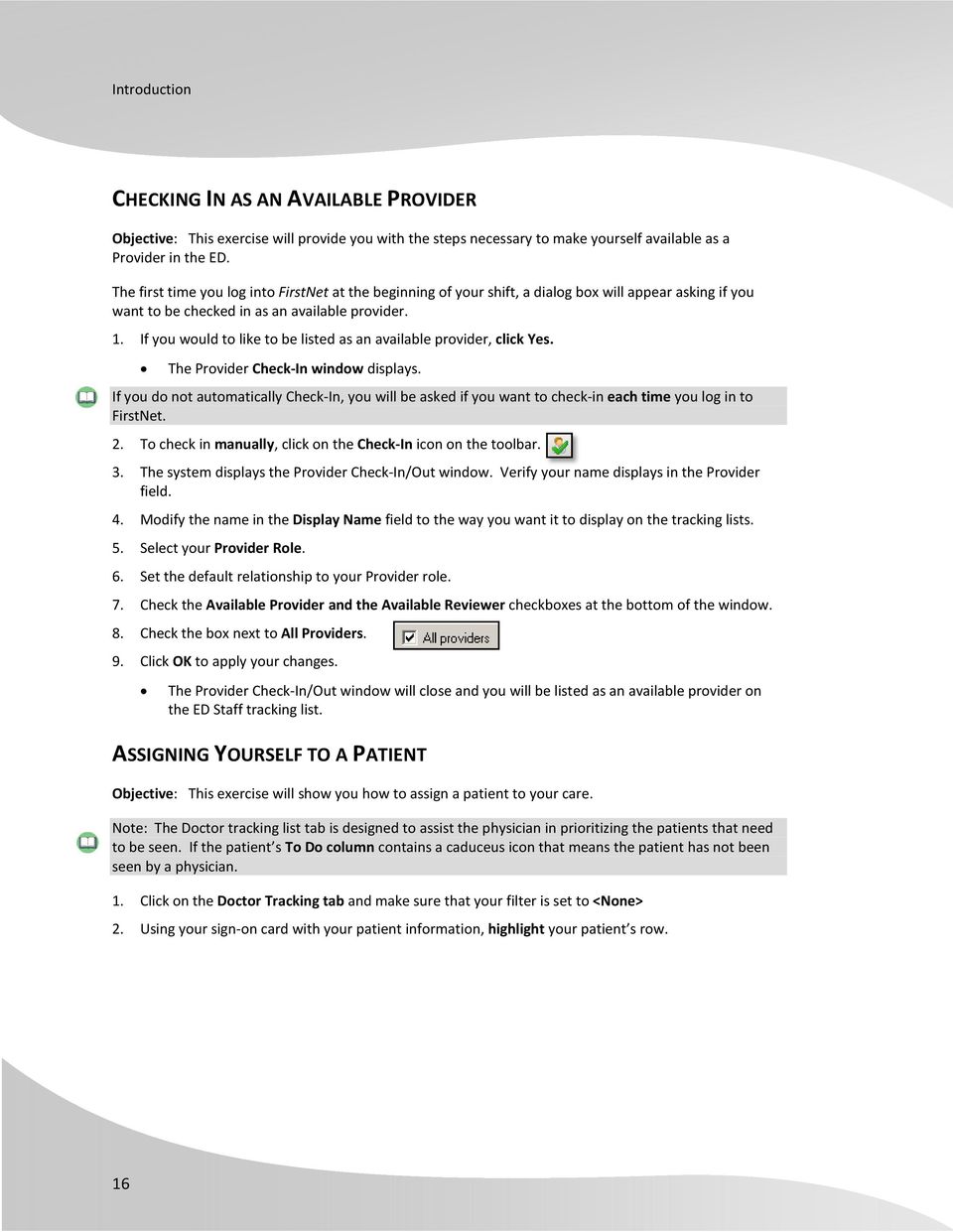
16 Introduction CHECKING IN AS AN AVAILABLE PROVIDER Objective: This exercise will provide you with the steps necessary to make yourself available as a Provider in the ED. The first time you log into FirstNet at the beginning of your shift, a dialog box will appear asking if you want to be checked in as an available provider. 1. If you would to like to be listed as an available provider, click Yes. The Provider Check-In window displays. If you do not automatically Check-In, you will be asked if you want to check-in each time you log in to FirstNet. 2. To check in manually, click on the Check-In icon on the toolbar. 3. The system displays the Provider Check-In/Out window. Verify your name displays in the Provider field. 4. Modify the name in the Display Name field to the way you want it to display on the tracking lists. 5. Select your Provider Role. 6. Set the default relationship to your Provider role. 7. Check the Available Provider and the Available Reviewer checkboxes at the bottom of the window. 8. Check the box next to All Providers. 9. Click OK to apply your changes. The Provider Check-In/Out window will close and you will be listed as an available provider on the ED Staff tracking list. ASSIGNING YOURSELF TO A PATIENT Objective: This exercise will show you how to assign a patient to your care. Note: The Doctor tracking list tab is designed to assist the physician in prioritizing the patients that need to be seen. If the patient s To Do column contains a caduceus icon that means the patient has not been seen by a physician. 1. Click on the Doctor Tracking tab and make sure that your filter is set to <None> 2. Using your sign-on card with your patient information, highlight your patient s row. 16
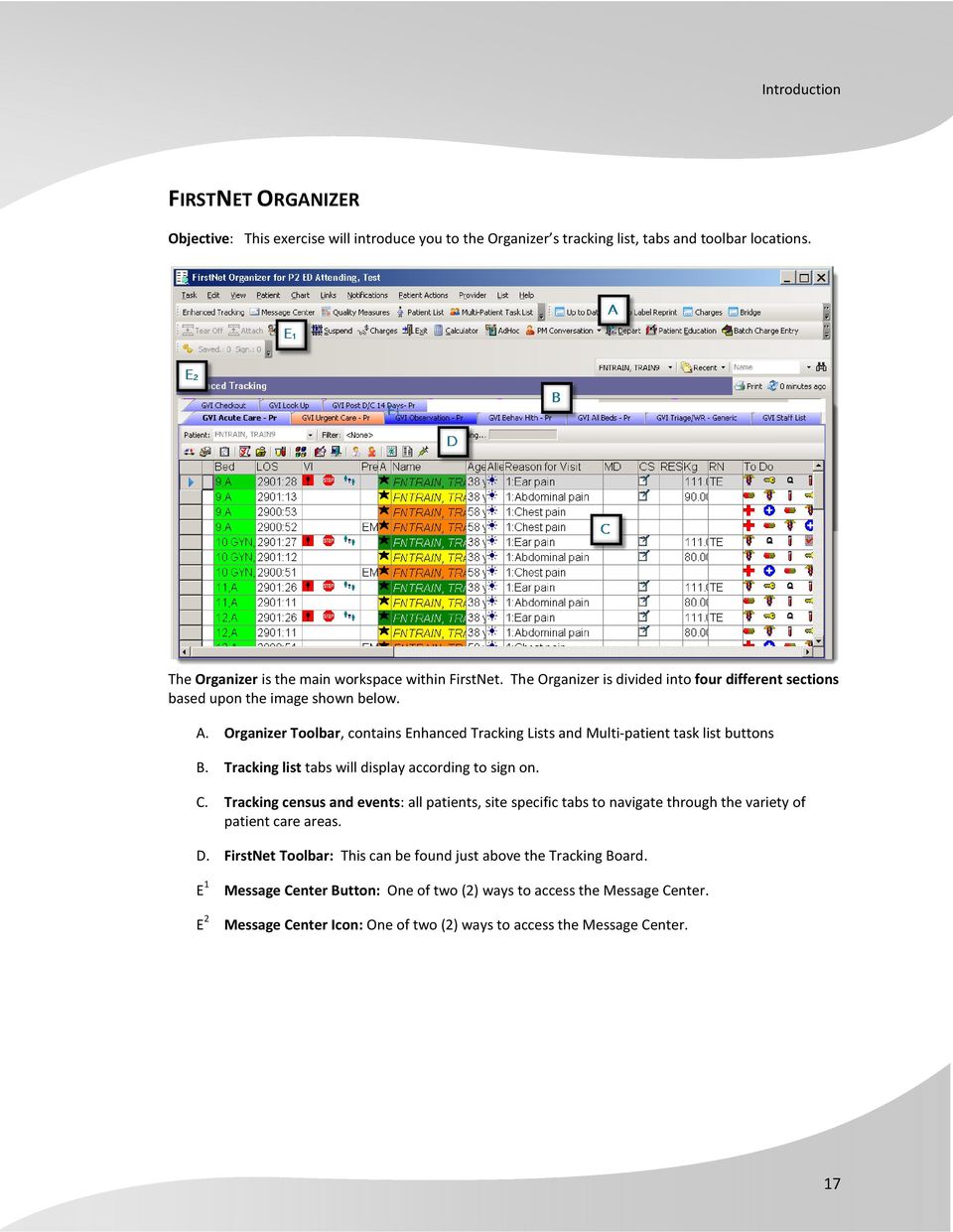
17 Introduction FIRSTNET ORGANIZER Objective: This exercise will introduce you to the Organizer s tracking list, tabs and toolbar locations. The Organizer is the main workspace within FirstNet. The Organizer is divided into four different sections based upon the image shown below. A. Organizer Toolbar, contains Enhanced Tracking Lists and Multi-patient task list buttons B. Tracking list tabs will display according to sign on. C. Tracking census and events: all patients, site specific tabs to navigate through the variety of patient care areas. D. FirstNet Toolbar: This can be found just above the Tracking Board. E 1 E 2 Message Center Button: One of two (2) ways to access the Message Center. Message Center Icon: One of two (2) ways to access the Message Center. 17
18 Introduction TOUR OF FIRSTNET ENHANCED PROVIDER TOOLBAR Objective: This exercise will introduce you to the FirstNet Enhanced Toolbar. The FirstNet Provider toolbar sits just above the tracking lists and provides easy access to commonly used FirstNet functions. Starting from the left of the toolbar, the button (icon) definitions are listed as follows: UNDERSTANDING FIRSTNET TRACKING BOARD TABS Objective: There are many different tracking lists that are a part of your FirstNet Organizer. This exercise will introduce you to tracking lists and how to best use them. Depending on your position in the department, only the tabs that pertain to you will be viewable from your sign-on. To view a specific list, Click once on the tab name. If you cannot see what you need to see, you may need to change the FILTER you have chosen. All Beds: Contains a list of all the beds in your department and will show if the bed is occupied or available, dirty or do not use. Triage/WR: Displays patients that are in the waiting room and are awaiting triage. Doctor List: Shows all patients. The physician can use the My Patients or the My Patients and Unassigned options from the Quick Filter drop-down to show their patients and what patients need to be seen next. This tracking list is designed to assist the physician with their provider assignments by organizing the patients according to acuity and length of stay. 18

19 Introduction Staff List: Displays a list of all of the providers/nurse that has checked in to FirstNet for the last 24 hours. It also shows the provider s availability, number of assigned patients, and the provider/nurse s role. Check out: Shows all patients placed in the check out location. When you place a patient in check out you cause their length of stay to stop incrementing. If a patient is placed in check out by mistake you have the ability to place the patient back onto the tracking list. Any time lost will be automatically added to the length of stay. Main: Displays as only patients housed in the main ED. Observation: Displays as only patients housed in the observation unit. Look-up: allows the user to 'look-up' a patient that had been seen in the ED for the past. You can filter by 36, 60 or 72 hours as well as 'My Patients'. Post D/C 14 days: Displays all discharged patients that have pending lab results or lab results that require review. GVI CTs Pending: Patient s located at the GVI that need CT results. Urgent care (BGH)/Kids express (WCHOB): All fast track patients. Behavioral Health (BGH): list of patients located within the Behavioral Health unit. Neuro Step-Down Unit (MFG): list of patients that are located in the Neuro Step-down unit. Transfers: list of patients that are being transferred from one Kaleida facility to another Kaleida facility. UNDERSTANDING FIRSTNET TRACKING BOARD COLUMNS Make sure you are on the Doctor tab. 1. Bed Double-Clicking in this column allows you to select and display the bed number for the associated patient. It is also used to check out the patient, by selecting the Checkout option. In the selection window, the number (i.e. (3) or (0)) displayed indicates the amount of patients already in that bed. 2. LOS 3. VI 4. Pre The moment the KH ED Sign in was complete; this is the amount of time that has elapsed since the patient has been in the ED. Visitor Information: Security, privacy, visitors not allowed. Pre-arrival form can be viewed if populated from the Track Board. 19
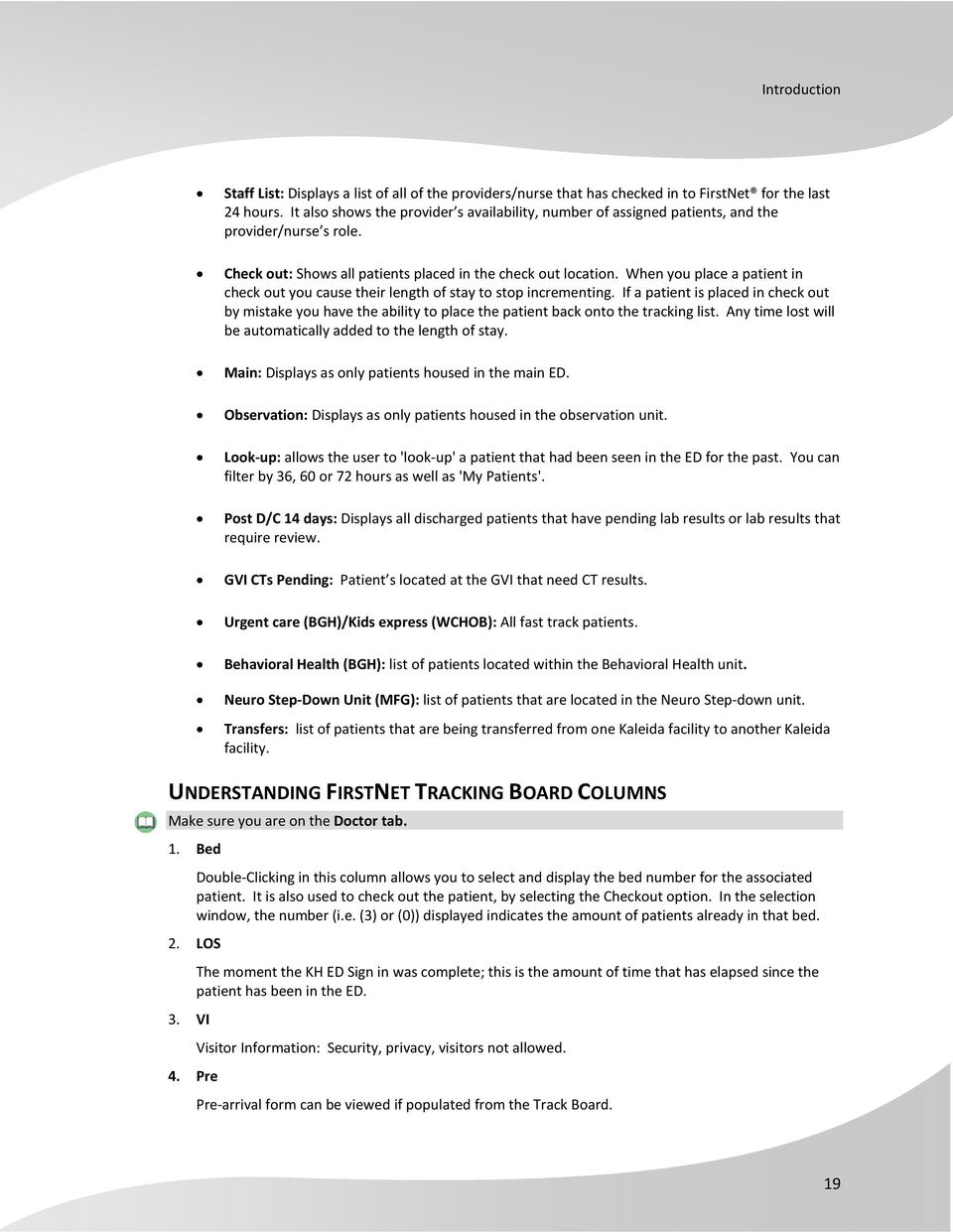
20 Introduction 5. A This column displays the documented Acuity for the patient by depicting it in a colored number. The patient s name may also have a colored background which also represents the patient s acuity. Color is removed once the provider is signed up for the patient. The options are: 6. Name 7. Age Patient Name This is the age in years, months, weeks or days of the patient. 8. Allergy The Allergy column displays the status of allergy documentation, depicted by three different types of icons: No Allergy Information Documented Allergies Documented (Hover your mouse to view allergy in tooltip form) Allergies Documented 9. Reason for Visit This field is populated by an RN on the Tracking Board from the Triage form. This displays the ED common Reason for Visit into Tracking Board. 10. MD 11. CS This is the display name of the Kaleida Health Staff Provider. Cosign - This column will be populated if there are any verbal orders to cosign. COSIGNING ORDERS Cosign orders are orders placed by non-physician users, such as RNs require co-signature from a physician. The order types that require co-signature are predefined by your site, and the provider who is to receive the cosign request is specified in the order. To sign a Cosign Order, complete the following steps: 1. Open the Cosign Order. The Order Information window opens. 2. Click Approve or Refuse or modify the details of the order. If approved, a statement is added to the patient's chart, stating you cosigned the order, and the Order Information window closes. 20
21 Introduction 3. Click OK or OK & Next. Refusing to cosign an order that is not a med student order does not stop or cancel it. 1. Open the Cosign Order. The Order Information window opens. 2. Select Refuse and select a reason for your refusal. A statement is added to the patient's chart, stating you refused to cosign the order. 3. Click OK or OK & Next. 12. RES Resident/PA/NP/MS (Medical Student) 13. Kg 14. RN This displays the patient s weight in kilograms. Double-clicking in this field will display the patient s quick FlowSheet. Nurse 15. To Do This is displays Events and/or Interventions to be carried out. 16. Orders 17. Sign Placed by any clinician or approved personnel to carry out interventions on a patient. Provider (MD Resident Midlevel) notifies Provider status of PNED. 18. Meds 19. ECG Reflects the number of meds that are due/remaining to be administered by the RN. The number of ECG s ordered will be displayed whenever an ECG 12-Lead order has been placed. The icon only displays when all orders that were placed have been also been completed. On the other hand the numbers, when displayed represent how many ECG 12 Leads were ordered and how many have been acquired as denoted in this format: ordered/acquired (i.e. 1/0). Right-Clicking the ECG column displays additional information regarding the Order status of the ECG. Double-Clicking on the ECG column displays the latest ECG 12 Lead Order Status on the Quick FlowSheet. The actual ECG may be viewed by double-clicking this link in the quick FlowSheet. 21
22 Introduction 20. Lab Similar to the ECG field, this column will display an icon or numbers in this field. The icon denotes that all orders have been completed, and the data can be viewed when hovering over the icon as in the image below. When numbers display, they indicate the number of tests orders and the number of tests completed and it is in this format: # test ordered/# tests completed. 21. Rad The Rad column displays the same icon if all orders have been completed. 1 / 0 / 0 = Ordered / Complete / Official by a KH Radiologist This displays all radiology orders. 22. Comments For patients who have been placed in a bed, this is a drop-down field which contains prebuilt comments to select from (i.e. Abscond) or it will also allows freetext commenting by double-clicking in the cell (i.e. ICU 107 ). 23. PCP This is the display name of the Primary Care Physician. VIEWING ORDERS & EVENTS FROM THE TRACKING BOARD Objective: This exercise will demonstrate how you can, at a glance, see the orders on the Tracking Board. 1. Hover over the ECG/Lab/Rad column to see a list of orders that have been placed and their status. Instructor Demo 22
23 Introduction QUICK FLOWSHEETS AND PT SUMMARY Objective: The Quick FlowSheet provides a condensed view of the patient s vital signs, pain assessment, lab results, and radiology results. In this exercise, we will review the functions of the FlowSheet and the ED Summary screens. 1. Double-click the TO DO column to access the ED Quick Flowsheet. 2. Click on the Assessment tab. 3. Double- click an individual result, event set, individual orderable, or order activity type column cell to access a Quick Flowsheet. If a Triage and Nurse Assessment has been completed, they will appear at the bottom of the Quick Flowsheet under the heading ED Department Documentation. 4. Double click on Triage or Nurse Note(s) to view the textual rendition of the form. 5. Click X to close the textual rendition of the form. You can access the patient s chart from the Quick Flowsheet by clicking the Flowsheet button at the bottom of the screen. 6. Close the patient s chart. To access the Patient Summary, do the following: 1. With the patient highlighted, click on the Patient Summary icon located on the toolbar. The Patient Summary Report displays. 2. Close the patient s chart. 23
24 Introduction CRITICAL RESULTS Objective: This exercise will show you how to identify the critical lab results indicator on the Tracking Board and mark the results as reviewed. TO MARK A RESULT AS REVIEWED: 1. Double-click in the To Do column. The ED Quick FlowSheet opens. Critical results should appear in red font within the FlowSheet. C= Critical Value 2. Click on the Lab tab. 3. Click the Review button. The Quick FlowSheet will close. 24
25 PowerChart Overview POWERCHART OVERVIEW Topics in this Unit: Title bar Menu Bar Organizer Bar Action Bar Print and Refresh Bar Patient Defining Area Toolbar The PowerChart environment contains toolbars, menus, and buttons. This unit focuses on their functionality and explains the different ways to navigate through the application.. This Unit focuses on the general features and functions of the PowerChart window. 25
26 PowerChart Overview TITLE BAR The Title bar displays your legal signature and the name of the window. MENU BAR The Menu bar is a row of buttons that contain drop-down menus used to select common functions or to set different preferences. ORGANIZER BAR Located below the menu bar is the Organizer Toolbar. defined for your role. This toolbar contains the Organizer components Note the downward arrow at the right of the toolbar. This down arrow allows you to customize the toolbar (see Appendix for detailed instructions on how to use this feature). ACTION BAR The Action bar is the longest of all the toolbars and consists of buttons that allow you to perform common daily tasks. The toolbar is so long that all buttons will not fit horizontally on the screen (A). In order to see the overflow of all the buttons, it is necessary to click the grey chevron button (B) on the far right of the toolbar. There is a preferred placement of buttons. You may want to set the display order of these buttons, whether to set by the preferred placement or by your own preferences. Exit: This will prompt you about how you wish to exit the system and allow you to exit. Change: This suspends the application and displays the Change User dialog box to allow the next user to log in. Upon log in, the next user s patient lists and other defaults are displayed. If the next user does not have a defined patient relationship of the active chart and doesn t assign one, then the Organizer will open. 26
27 PowerChart Overview Suspend: This suspends the application and displays the Suspend User dialog box. The original user must be the one to log back in as it will not allow another user to log in. AdHoc: This opens a series of PowerForms for charting purposes. (i.e. Immunization Refusals, etc.) PM Conversation: This function should only be utilized when you are inside the patient s chart. Clicking on the PM Conversation button displays various options that can be selected to initiate an electronic conversation with other applications such as Eclipsys. KH Transfer Pending This conversation will send a request to the facility s Bed Coordinator/Transfer Center for a room/bed and accommodation code assignment. The Bed Coordinator/Transfer Center will make this assignment in Eclipsys and a printed bed reservation will be sent to the Sending and Receiving Units. KH Transfer This conversation will complete the transfer and change the patient s location in both Cerner PowerChart and Eclipsys. KH Discharge Pending Use this conversation to let the Bed Coordinator/Transfer Center know that a bed will be available. KH Discharge This conversation will discharge the patient in Cerner PowerChart and Eclipsys. KH Transfer Interfacility This conversation is used when a patient is being transferred from one Kaleida facility to another Kaleida facility (i.e. BGH to DeGraff). KH Modify Use this conversation when a patient s Attending Physician or Hospital Service has changed. PowerChart will send this information to Eclipsys. KH Check In This conversation is used to check in a patient when they arrive. KH Check In is also used when a patient is a Direct Admit to your nurse unit. Conversation Launcher button: This launches options for various other conversations related to Transfer/Discharge functions, however this button should only be accessed from the Organizer and only utilized to perform the following two functions: KH Bed Swap This conversation allows you to select two patients from within one facility and swap their beds. KH Discharge Cancel This conversation is used to cancel a discharge for a patient that was discharged in error. Scheduling Appointment Book: This is used to access to the scheduling system in order to schedule an appointment and its details, such as the appointment type, appointment location, person name, and other detailed information. Batch Charge Entry: Used to enter a single charge (or credit) or a batch of charges (or credits) for one or more patients. Explorer Menu: This opens up the Discern Explorer window and provides the ability to print specific department or nurse station reports. 27
28 PowerChart Overview Calculator: This launches the Clinical Calculator which provides forms for various clinical formulas. When you complete the required data boxes, the calculator solves the equation. Scheduling Database Tools: If you apply templates to your scheduling book, you will have access to this functionality. (Not all users have this functionality). PRINT AND REFRESH BAR Print: This allows you to print the records selected on a particular list tab. Refresh (Minutes Ago): This displays the total elapsed minutes since the Organizer, Patient Chart or selected component (on the TOC menu) was last refreshed. It does not refresh all of PowerChart simultaneously. Once clicked the button will reset to zero minutes. PowerChart does not automatically refresh. Always click this button prior to reviewing electronic data. PATIENT DEFINING AREA TOOLBAR The Patient Defining Area includes several options for opening patient charts. Person of Interest: If a patient is selected on the List tab, then this patient s name will display here. There is a drop-down available that contains all of the different components of the selected patient s chart. Clicking any of these areas will open the chart to that component. Recent: This drop-down displays the last five patients charts that were accessed by you; selecting a patient opens his/her chart. Person Search: By default this area allows you to search for a patient by MRN. This can be changed to search by Name by selecting that option from the drop-down. After entering the search criteria, press Enter to perform the search. Search for Specific Patient: This opens the Advanced Search window. If you wish to search for a patient by additional criteria such as: FIN #, Name, MRN, Universal Identifier, Birth date, Gender, or SSN then this button will need to be used. The preferred method is to search by the FIN# or Patient# located on the Plue sticker. 28
29 Patient Chart Overview PATIENT CHART OVERVIEW Topics in this Unit: Opening a Patient s Chart Patient Chart Layout Menu Components Menu Component Definitions Menu Pin and Unpin Patient Demographic Bar Patient Demographic Bar Menu Component Definitions Viewing Results Review Examples of Results Things You Should Know View Result Legend Customize Results Review for Easier Viewing Filter and Find Data Filter by Navigator Filter or Search Viewing Results Using the Navigator Using the Results Display Changing the Clinical Date Range Similar to the Organizer, the Patient Chart also resides in the PowerChart environment, so it shares the same toolbars and buttons. The Patient Chart is the area used to document all clinical related information for the patient, place orders for the patient or view results for the patient. This Unit provides a layout of the Patient Chart and common features and functions available. 29
30 Patient Chart Overview OPENING A PATIENT S CHART Objective: This exercise will demonstrate the multiple ways to access the patients chart from the FirstNet Organizer and the multiple tabs associated with the Patient s Chart. 1. Highlight the patient row. 2. Double-click the blue arrow on the patient row. OR 3. Click on the Open Chart icon on the toolbar. PATIENT CHART LAYOUT The Patient Chart begins directly underneath the toolbars and buttons found in the PowerChart environment. There are two main areas that make up the Patient Chart window: The Menu on the left and the related Workspace on the right. The data in the Workspace is always related to the selected Component on the menu at left. 30
31 Patient Chart Overview PATIENT TOOLBAR This toolbar displays Patient Chart tabs of the patient s whose charts are currently open. Up to four charts may be open at one time, but it is recommended that only one chart should be open at a time. Clicking on a Patient Chart tab will display that patient s chart and clicking the X on a tab will close that patient s chart. THE STATUS BAR This bar is located at the bottom of the window and displays relevant user information about the current session of PowerChart. MENU COMPONENTS The Menu is displayed on the left side of the patient s chart and is used to access different components of the patients chart by clicking on them. The active chart component is always highlighted in purple and also displays in the horizontal bar. The Menu also contains Quick Add buttons that allow you to quickly open and document a new allergy or order without going directly to that chart component. Pushpin Quick Add button 31
32 Patient Chart Overview MENU PIN AND UNPIN You can hide the Menu to maximize the Workspace. The Menu can either be displayed as maximized (pinned) or minimized (unpinned). This allows more viewing space if desired. 1. Click the pushpin at the top of the Menu. The Menu is now in an unpinned status and the Menu minimizes into a Menu tab located vertically on the left side of the screen, underneath the patient demographic bar. 2. Display the Menu dynamically by hovering the mouse over the Menu tab. Any time you hover your mouse over the Menu tab, the menu will display. Any time you move your mouse away from the Menu tab the menu will hide. You can lock the Menu back in place by clicking the pushpin once more. PATIENT DEMOGRAPHIC BAR The yellow Patient Demographic Bar located horizontally at the top of the Patient Chart window contains basic information about the patient whose chart is currently open, including: Last Name, First Name Age Sex EMR (Electronic Medical Record)number Current location of the patient Allergies DOB (Date of Birth) Fin Number (Financial Number) Inpatient/Outpatient Status Dosing Wt Measured Wt Advance Directive Advance Directive Type There are several links contained within the Patient Demographic Bar that link directly to corresponding information regarding the patient. Those links include the Patient s name, Allergies, Location and Fin #. Clicking on any of these will take you directly to the corresponding information. Clicking on the patient name displays the Patient Information window shown below and provides basic more demographic information about the patient. 32
33 Patient Chart Overview Clicking on the Allergies displays the Allergies workspace. From this window you can document an allergy as if you had chosen the Allergy component from the menu. Clicking the Location or Fin # displays Encounter information for the patient. MENU COMPONENT DEFINITIONS The Menu consists of the different sections of the patient s chart. Click any section in the menu to view that portion of the patient s chart in the Chart Documentation section of the window. The sections on the menu include the following components: Each chart component and a brief definition are explained below: Results Review: Is used to view all results (i.e. laboratory results, radiology reports, dictated results, etc.) It provides a view over time so trends can be monitored in the patient s status. Microbiology: Orders: This displays a categorized list of orders for the patient. It displays the date/time of the order, the name of the order, status, and details of the order. This is also used to add, cancel, or modify orders. MAR Summary: This displays all medication administrations as well as meds documented as not given. Allergies: This displays an overall list of allergy substances and reactions for the patient. This is also used to add, cancel or modify allergy substance/reactions. Medication List: This displays a listing of the patient s Home Medication history, both active and inactive. Patient Information: This tab contains three sub tabs that display general demographic information about the patient such as Patient Demographics, Visit List, and PPR information. Document Viewing: Access to PowerNote. You can add, view, modify, correct or view pervious PowerNotes. Patient Care Summary: Patient Care Summary is a summary area for several components of the patient chart that include Critical Lab Results, Problems/Diagnoses, Results Review and Intervention Orders as well as the Reason for the current visit. Form Browser: The Form Browser window displays a directory tree that lists all the completed PowerForms for the selected patient. The recommended use for this area is to modify and unchart forms. 33
34 Patient Chart Overview Clinical Folders: Formerly called Clinical Notes, this area contains any clinical documents related to the patient: Face sheets, Progress Notes, Transcribed Reports, Consents and any other form which support patient care. Clinical Folders allows you to sort documents and view document history. Immunization Schedule: This facilitates the management of a patient's scheduled immunizations. This area is used to chart all areas concerning the patient s immunizations, as well as previously administered immunizations as historical form documentation. Interdisciplinary Summary: The Interdisciplinary Summary is populated by Nursing and Ancillary Documentation (PT/OT/Speech) from Clinical Folders, and Flagged Results/ Comments from IView in the Event & Procedure band. The Interdisciplinary Summary is a view-only screen. Problems and Diagnoses: Problems and Diagnoses is a patient profile within PowerChart. The Problem List is one aspect of this component. The Problem List provides a way to sort and track a patient s problems that cross encounters. Histories: A key part of a clinician s workflow is to gather and review historical information about the patient. The historical information is important as it assists the clinician in making the appropriate treatment decision based on the patient s previous experiences. This displays information related to the patient s past medical history, past procedure history and family history. Reference Text Browser: The Reference Text Browser is used to search and locate Education Items for the patient. Education Items include Drug Reference materials, Patient Education Leaflets and Provider Reference information. Interactive View/I&O: Interactive View is the solution for Critical Care, Med/Surg, PACU, ED, and Maternity documentation. It enables you to access relevant, up-to-date patient information when and where you need it. In addition you can review, enter, modify, and manage results as necessary. Pregnancy: This is a view only tab populated from documentation in Maternity areas. ED Summary: This is used to view clinical measurements populated from documentation. Chart Summary Screen: FlowSheet: 34
35 Patient Chart Overview VIEWING RESULTS REVIEW 1. Click the Results Review component from the menu. The Results Review Workspace displays. Note: Results are date-specific. You must change the Clinical Date Range to cross encounters. The Results Review component of the patient s chart is used to view results. Results are available for lifetime. Results are populated from documentation that was charted using a PowerForm, IView or PowerNotes. Tabs Clinical Range Navigator EXAMPLES OF RESULTS Dictated Reports ECGs Images Laboratory Tests Nursing Notes Pain Assessments Provider Notes Radiology Reports Respiratory Results Scanned Documents Triage Data Wound and Skin Assessments 35
36 Patient Chart Overview THINGS YOU SHOULD KNOW Information is shown in a spreadsheet format with flexible display features such as viewing the results as a Table, Group, or List. The default view is the Table view. The Table view displays event descriptions in row headings on the left and their respective dates/times as column headers. When Table view is active, the status bar at the bottom of the PowerChart window displays the associated normal reference range for the event description. The Group view displays the heading for a group of events as rows. Underneath each event heading are the associated dates for that event heading. The event descriptions are the column headers, but are anchored to their respective group. The List view displays patient events and results in linear list format. Results are displayed in a spreadsheet with column headings such as event date, event, result, reference range, and status. The Results Review is divided into two major sections: The Navigator on the left and the Results view on the right. By selecting categories from the Navigator, you can zoom immediately to its contents, which are displayed as values in the Results view on the right. Each column in the Results view area represents a specific date/time. Therefore, easy to see trends of how the patient s status has changed over time. Dates/times can be further filtered by changing the Clinical Range, where you can specify a timeframe to view. By default, the Results Review provides a view of results five days back and one day forward. By changing the Clinical Range, you can specify a different timeframe. 36
37 Patient Chart Overview VIEW RESULT LEGEND Lab Results display with unique color-coding and symbols to indicate the type of result that it is. If you are unsure about what these colors and symbols indicate, the Result Legend may be of assistance to you. This can be viewed by clicking Options > Result Legend from the menu bar. CUSTOMIZE RESULTS REVIEW FOR EASIER VIEWING There will be times when the default display width of the columns will be insufficient to display the full result. There are several techniques which are available to you. Option #1 Hover your mouse over the truncated result in the cell. A tooltip displays the full text of the result. Place your mouse pointer on the border between two columns, and then click and drag the column to the desired width. Option #2 Expand the column to see the full result by dragging the desired column edge to the right. Option #3 Change how the Results Review is displayed on screen by selecting Table, Group, or List mode. FILTER AND FIND DATA The Results Review can return several results and can be very long. It is possible to view the information simply by scrolling through the Results. However, if the list is very long there are ways to further define the filter of what you are looking for. FILTER BY NAVIGATOR The Navigator on the left can be used to temporarily hide the display of certain groups of clinical information. This is done by deselecting (clicking to uncheck) the groups you wish to hide. 37
38 Patient Chart Overview The Navigator can also be closed to expand the Results Review Workspace by clicking the X in the Navigator pane. To redisplay, in the menu bar go to Options > Show Navigator. 38
39 Patient Chart Overview FILTER OR SEARCH Use the drop-down and/or ellipsis button to filter or search for items as shown in the image below. Use the drop-down to quickly navigate to certain areas. Click the Ellipsis button to open a search window where you can search for particular items. Once you are finished viewing, you can return to all results by selecting All Results FlowSheet from the drop-down (displayed above). Whenever the Results are filtered, the changed display is not saved; everything will return to the default setting at the point of next PowerChart log in or upon entering another patient s chart. 39
40 Patient Chart Overview VIEWING RESULTS The tabs within the Results Review Component are divided into two major sections. The left section is the Navigator, which consists of a list of categories that serve as an electronic index. By selecting a category, you can zoom immediately to its contents, which are displayed as values in the grid on the right. The right section is the Results Display that provides a two-dimensional view of events (tests, procedures, and documentation) against a time continuum. Each piece of clinical data qualifies as an event or result, including numeric results and clinical documents and notes. USING THE NAVIGATOR The Navigator is the area located on the left side of the tabs. This area is broken into several categories that serve as an electronic index. The Navigator is a simple feature to use. Following are some of the features: 1. Click on the category name you want to see. The selected category will scroll into view on the right. De-select the checkbox to the left of a category and that category will not be shown in the view on the right. Select the checkbox to the left of a category and to view it again on the right. 40
41 Patient Chart Overview USING THE RESULTS DISPLAY The right section of the tabs is the Results Display that provides a two-dimensional view of events against a time continuum. Tests Procedures Documentation You can use the Navigator buttons as described in the previous section to locate events or can use the vertical and horizontal scrollbars. A great deal of information can be obtained at a glance from the Results Display. For example: Red results indicate a critical reading. The letter C in front of a result also indicates critical or positive. The letter L in front of a result indicates a low reading. The letter H in front of a result indicates a high reading. The letter M at the beginning of a cell indicates a modified result. The symbol of!, *, or ' indicates a comment. A comment indicator (for example, a triangle) in the cell that contains a result with written comments attached. Three importance levels (high, medium, and low) can each have a different symbol. CHANGING THE CLINICAL DATE RANGE The Clinical Date Range (located above the Navigator and the Results Display) will default to a specific range each time you open the Results Review Component. When the proper clinical range is not displaying the necessary range to show the desired data; You will need to change the Clinical Range. There are 2 ways to accomplish this: 1. Click one of the scroll buttons located on the right and left sides of the Clinical Range bar to advance the date incrementally. 2. Right-click on the Clinical Range bar. Select Change Search Criteria. 41
42 Mar Summary MAR SUMMARY Topics in this Unit: How to Access the MAR Summary Workspace Overview Using the MAR Summary Applying Filters through Navigation Button Applying Filters through Show Views Button The MAR Summary is used to review all medication administrations as well as meds documented as not given.. It is the source of truth for all medication administration. The MAR Summary is a view-only tool for clinicians and providers who need to see medication administration information as part of their workflow. There are filtering capabilities to allow providers to quickly access the information they need. These are described in the following sections. 42
43 Mar Summary HOW TO ACCESS THE MAR SUMMARY The MAR Summary can be accessed two ways: 1. Within FirstNet, it can be accessed directly from the FirstNet toolbar as shown below: 2. Within the patients chart MAR Summary is accessed from the Menu. WORKSPACE OVERVIEW A sample screenshot of the MAR Summary is shown below. The four core areas are explained on the following page. 43
44 Mar Summary 1. Clinical Date Range Bar: defaults to a 48 timeframe. To change the date range complete the following set of sub-steps: a. Right-click anywhere on the bar itself. b. From the shortcut menu that displays select change properties. c. Make your desired changes in the MAR Summary properties dialog box that displays. d. Click OK when finished. 2. Medication Display: display medications alphabetically by generic names based on the way it is ordered (generic name vs. brand name). Medications are further categorized by the darker blue bands as explained below: Scheduled Scheduled medications have an assigned frequency. All scheduled medications display color coded as Blue. PRN All PRN medications display color coded as Green. Continuous - All Continuous medications display color coded as Blue. Discontinued All Discontinued medications display color coded as Grey. Additional clinical information charted with the medication administration will display along with the administration time and documentation information. 3. Time Columns: The Time columns are displayed in reverse chronological order and are also broken into four hour increments. The Time column intersects with the Medication Display column (above). 4. The area where the Medication Display rows and Time columns intersect is a group of cells that contains detailed charting information for those orders that require additional information. A few tips are listed below: Doses due display and the time due in the appropriate time column. Medications that have been administered display with of the actual time administered. Administered doses display the dose and time administered in the appropriate time column. Orange Border indicates a medication charted as Not Given. Hovering over any administration will display details: (shown in image) The Yellow column indicates the current time. 44
45 Mar Summary USING THE MAR SUMMARY The MAR Summary can be filtered (and there are a few different ways to do it) allowing you to view medication administrration information as follows: Date Range: View the medication administration information for a specific time frame or time interval. Sections: View the medications administered under any or all sections; scheduled, unscheduled, PRN or continuous infusions. Order Status: Display Inactive, Discontinued Cancelled, Completed and/or Voided Options: Display Pending or Overdue Pending doses Continuous Infusions: Display Rate Change, Bolus, Infuse or Site Change APPLYING FILTERS THROUGH NAVIGATION BUTTON 1. The Navigation button is located in the upper left corner of the MAR Summary. There are three options for filtering: Change Properties Selection: The Properties dialog box displays three tabs which provide choices on changing the date ranges, Date Range: This tab provides a way to set a specific time period and custom time intervals. Filter: This tab provides a way to hide or display certain sections on the MAR summary as well as whether to display inactive orders. Options: This provides a way to display pending doses and continuous infusions. 45
46 Mar Summary Time Interval Selection: This selection is a fast way to choose the desired time increments in the MAR summary display. (top image right) Navigate To Selection: This selections is a fast way to jump to a desired location in the MAR Summary. (bottom image right) 2. Click the desired selection and make the applicable changes. 3. Click OK to apply the changes on the MAR Summary. APPLYING FILTERS THROUGH SHOW VIEWS BUTTON You can also review the information contained in the MAR Summary by selecting a specific view. 1. The Show Views button is located in the upper left corner of the MAR Summary. The Time Views navigation pane displays based on your selection of Scheduled, PRN, or Continuous Infusions, these can be deselected and hidden from view. 46
47 Mar Summary Additionally, in this navigation pane are other groups such as the Therapeutic Class, Route, and Taper view. The Therapeutic Class View group displays medications based on the therapeutic class and categorizes the MAR Summary to display based on this selection. The expand/collapse (+/-) symbols allow you to view additional information. The Route view filters the display based upon route. Specific routes can be selected or deselected in the navigation pane. The MAR Summary display on the right reflects these selections. The Plan view filters the display to show medications that have been ordered as part of an order set or careplan. The Taper view filters the display to show medications that are ordered as weaning doses. (In this view, do not forget to adjust date range bar to show the range of doses) 47
48 Allergy Review and Management ALLERGY REVIEW AND MANAGEMENT Topics in this Unit: Allergy Workspace Layout Things You Should Know Add Allergy Profile Options Document No Known Allergies (NKA) Modify an Allergy Documenting an Adverse Reaction Cancel an Allergy Marking Allergies as Reviewed Perform Reverse Allergy Check Allergies are an integral component of the patient s clinical information. In fact, allergy information must be recorded prior to placing an order (along with height/weight information). In FirstNet Allergies can be by clicking on Allergies in the menu, by clicking the Allergies Quick Add button in the TOC menu or by double clicking the allergies icon from the FirstNet Tracking board. Allergy information should always be documented, updated and verified. If there are existing allergies, these must be reviewed to see if they are still present. New allergy related information must also be documented. All allergy information must be documented including the reaction type and severity. Providers are able to enter, modify and remove allergies. This ability is important to ensure that the allergy information is complete and accurate. The information documented in the Allergy section is reflected to the provider at the time of order entry when a drug-allergy alert is presented. In order to make an informed clinical decision, the provider will require all available allergy information to be present. The system allows providers to characterize allergies as true allergies or as adverse effects. Both categories will produce a drug-allergy alert. Drugallergy alerts may be overridden by the ordering provider. 48
49 Allergy Review and Management ALLERGY WORKSPACE LAYOUT Allergy Profile Options The choices from the display box include: Active (default) Includes Active and Proposed Inactive Includes Resolved and Canceled. All Includes Active, Proposed, Resolved, Canceled. 1. Click the column heading to sort any column. 2. Click Reverse Allergy Check to compare the patients allergies with current medications. The system will determine if there are any interactions. THINGS YOU SHOULD KNOW Allergies are categorized by drug, food, or environmental. By default allergies are assigned the drug category. Be sure to change the category whenever you are documenting an allergy type other than a drug allergy. A combined ( co ) named drug is a drug that contains two or more medications. When the patient indicates they have an allergy to a co named drug, whenever possible, always document the actual medication of the combination to which they are allergic. For example: For a patient who is allergic to Tylenol w/ Codeine, it is your responsibility to find out whether they are allergic to Tylenol OR Codeine and then document that particular drug as an allergy. For any patient that experiences an adverse drug reaction, the allergy is required to be documented. When a patient does not have actual allergies to be recorded, either the NKA or Unknown status should be recorded instead. 49
50 Allergy Review and Management NKA applies when the patient/caregiver is questioned and states they have no known allergies. This includes newborns, infants and children. Unknown applies when the patient/caregiver is unable to provide the information. This is a temporary state and should be resolved as soon as the allergy status can be confirmed. This is also the default state when no allergy information has been recorded.) DOCUMENT NO KNOWN ALLERGIES (NKA) When the patient s chart is in an Unknown status, the No Known Allergies button will be available in the Allergy Workspace. Otherwise, this button remains dithered. 1. Click the Allergies Component on the (Navigation) Menu to open the Allergies Workspace. 2. In the Workspace, click the No Known Allergies button. The Add Allergy/Adverse Effect window displays NKA in section 1. Substance required. 3. Click OK to accept the changes and close the window. NKA is displayed in the Allergies Workspace, however it will not display in the Patient Demographic bar until the screen is refreshed. 4. Click the Refresh button to update the display to state No Known Allergies in the Patient Demographic bar. When a new allergy is documented for this patient, you will be prompted to verify whether you want to cancel the NKA status automatically. MODIFY AN ALLERGY All allergy information (with the exception of the Substance name) can be modified after it has been documented. The following steps will illustrate how to do this by using a previously documented Tylenol allergy from the Allergy Workspace, right-click the allergy and select Modify from the shortcut menu. An alternate method is to select the allergy substance and then click the Modify button. 1. Confirm that the substance is displayed in section 1. Substance required. 2. Make any desired changes as needed, then click the OK button. The Allergy Workspace displays the new changes along with an (m) to indicate there has been a modification. DOCUMENTING AN ADVERSE REACTION 1. From the Allergies table, where new allergies are addded (this could be anywhere, in a form or in the Allergies component itself) right-click anywhere. 2. Select Add New > Drug Side Effect. 3. Do a search for the drug/food/environmental allergy, then press enter to display search results. 4. Select the appropriate search result to move it to section 1 Substance. 5. Select Adverse Reaction from the drop-down. In section 2 Reaction Type. 50
51 Allergy Review and Management 6. Do a search for the adverse reaction, then press enter to display search results (same location as step 3). 7. Select the appropriate search result to move it to section 3 Reaction Symptoms. 8. Fill in the remaining information in section 4 Allergy details. 9. Click OK. 10. Note the Adverse Reaction shows in the Type column on the table. CANCEL AN ALLERGY Allergies may be cancelled (inactive state) if they should no longer be active. The following steps will illustrate how to do this. 1. From the Allergy Workspace, right-click the allergy and select Cancel name from the shortcut menu. 2. Confirm that the substance is displayed (Tylenol) in section 1. Substance required. 3. Confirm that the Status field in section 4. Allergy details displays Canceled. 4. In the same section, select the correct cancellation reason from the required Reason drop-down. 5. Click the OK button. The Allergy Workspace is updated to display a red line through the cancelled allergy to indicate it is now inactive. If the allergy is not displaying at all, then make sure the Display drop-down filter is set to All. MARKING ALLERGIES AS REVIEWED Once the allergies have been reviewed with the patient, you must mark them as reviewed. 1. Click Allergies from the TOC menu to open the Allergies Workspace. 2. After reviewing and updating all allergy information, click the Mark All as Reviewed button. The current date will display in the Reviewed column and your User ID will display in the Reviewed By column. PERFORM REVERSE ALLERGY CHECK 1. Open the Allergy Profile. 2. Click Reverse Allergy Check on the toolbar. If an alert displays and you need to override, select an override reason from the list. If multiple alerts display, you may also select Apply to all interactions to provide the same Override Reason for all interactions in the lower-right corner. 3. Click Continue. 51
52 Medication List MEDICATION LIST Topics in this Unit: Medication History Workspace Overview Terminology Display Icons in Medication List Medication History is the first step of the medication reconciliation process and it produces a Kaleida-wide accessible, legible record of Home Medication history available on the Medication List. This Unit will provide you with common terms, tips and step-by step instructions of how to accurately document Home Medication History for the patient. 52
53 Medication List MEDICATION HISTORY WORKSPACE OVERVIEW 1. Click the Medication List component from the menu. The Medication List window displays. The Document Medication by HX button is always used to access the scratchpad in order to perform any functions related to documenting Medication History. Medication List Workspace Begin documentation by first clicking the Document Medication by HX button shown in the image above. When this button is clicked the medication scratchpad will display (shown below). Note: Medication History is the first step of the medication reconciliation process that produces a Kaleida-wide accessible record of Home Medication history, displayed on the Medication List. The medication reconciliation process remains on paper. Continue to Print the Orders, KH Medication Information, KH Discharge Medication Information and Discharge forms from PowerChart. Each medication and the details with compliance must be updated with each visit. The Medication List is patient specific and carries from one visit to the next visit. Please see Appendix for setting up customize view of orders and medication list. 53
54 Medication List TERMINOLOGY A Home Medication is the patient s best-known medications that the Nurse collects and includes: medications, herbal remedies, vitamins, over-the-counter drugs, respiratory treatments, prenatal nutrition, weekly allergy shots, recent diagnostic/contrast agents, and experimental drugs. A Prescription Medication is any medication that has been prescribed by a licensed independent provider (physician). If a Prescription Medication has changed or is no longer prescribed, then it will need to be removed from the home medication list by cancelling it. No prescription should ever be modified. Medication Reconciliation is the process of comparing the patient s best- known list of current medications against physician s admission, transfer, and/or discharge orders. Discrepancies are brought to the prescribing physician s attention and, if appropriate, changes are made to the orders. Primary Medication is a medication that has no dose, no strength, and no route in its name. This is the type of medication that should be selected whenever possible. Compliance refers to whether or not the patient is taking the medication as prescribed. The last dose date and time are also part of the compliance documentation. DISPLAY ICONS IN MEDICATION LIST Having icons visible in the Medication List Workspace is helpful to viewing the correct types of medications. These are the icons that will display as long as the icon column is displayed. Documented Status icon: This icon indicates that the home medication has been documented. Ordered Status icon: This icon indicates that the prescription for the medication was written by a licensed independent provider from a previous visit, using Script Writer. Ordered Status icon: This icon indicates an ordered Inpatient Medication. Medication Scratchpad Workspace 54
55 Medication History/External Prescription History Review and Management MEDICATION HISTORY/EXTERNAL PRESCRIPTION HISTORY REVIEW AND MANAGEMENT Topics in this Unit: Documenting Medication History Documenting Medications Document a Home Medication Document a Medication with Different Daily Doses Document Rainbow Coverage Medication Document a Miscellaneous Medication Process for Inpatient Admission Modifying Home Medications Complete a Home or Prescription Medication Void a Medication Reviewing External Medication History Verifying External Plan Pulling in External Prescription History This unit will focus on the medication history functionality has been enhanced by the availability of external medication history and prescription history afforded by the e-prescribing functionality of SureScripts. Providers and staff will be able to view and import medication history (with the permission of the patient) as well as review the patient s medication plan and/or plans to assist in the writing of discharge prescriptions. This section briefly reviews the process for reviewing and importing external medication history. 55
56 Medication History/External Prescription History Review and Management DOCUMENTING MEDICATION HISTORY When documenting Medication History, note there is a change to the Order Details tab. (This view is not available for new inpatient medication orders.) Note the new horizontal row at the top of the tab. Medications may have certain synonyms, the system automatically presents you with the most commonly used choices for the medication selected. Green Circle: Most Common Choice Blue Diamond: Common Choice Yellow Triangle: Non-Common Choice White/Gray Circle: Not any level of common By clicking in each box, the most common choices will display. Highlight the choice you wish to use and either tab to the next box or hit enter on your keyboard to move to the next box. If the patient you wish to use is not in the display list; begin typing your choice and more options will be displayed or type entire choice and hit enter on your keyboard. If the RN has not been able to finish the collection of the patients medication history, they can now select Leave Med History Incomplete Finish Later. The status Bar will then NOT update. There is a status bar that reflects whether Medication History has been completed (denoted by a green checkmark). Hovering over the icon displays details of when and by whom Medication History was last documented. This information can also be located in the Navigation pane. 56
57 Medication History/External Prescription History Review and Management DOCUMENT A HOME MEDICATION 1. From the Medication List Workspace, click the Document Medication by Hx button. Note the options for the following: No Known Home Medications: select this when the patient clearly indicates they are not currently taking any home medications. Unable to Obtain: select this when medication history is not documented in the KH EMR due to patient condition. 2. Select the order sentence with the correct dose and route: Digoxin (0.125mg, tab, oral, Daily). 3. Click the Done button. 4. In the details window, confirm the dose or click into the dose field to change the dose. 5. Click in the Route of Administration field and confirm the route or click into the field to select the correct route. 6. Click in the Frequency field and select the correct frequency. 57
58 Medication History/External Prescription History Review and Management If the type of frequency you are looking for is not found, uncheck the Short List to expand the list. 7. Click in the Indication field and enter the Indication patient taking the medication or TBD if unknown. Note: When documenting Medication History, you MUST document compliance information. 8. Click the Compliance tab. 9. Click the Information Source drop-down and select the source of information. 10. Type the date of the last dose in the Last Dose/Date field. Type a t to auto-insert the current date. 11. Type the time of the last dose in the Last Dose/Time field. Type an n to auto-insert the current time. Note: If another new medication should be added or the same medication should be added with a different type of dosing, repeat steps 1-11; otherwise, if finished, click Document History. DOCUMENT A MEDICATION WITH DIFFERENT DAILY DOSES If the medication should have different daily doses, such as 10g of Coumadin on q MWF and 5g of Coumadin on q TuThSa, then the medication must be documented (using the steps below) once for each dosing type. (i.e. Coumadin would display twice in Medication History, once for each type of dose.) 1. Click Document Medication by Hx. 2. Click Add. 3. In the find field type Coumadin and then press Enter. 4. In the details window, click in the Dose field and select the correct dose. 5. Click in the Route of Administration field and select the correct route. 6. Click in the Frequency field. To display all frequencies select Show All, select qmwf. Hint: Type q in the frequency field and the list will go to the selections beginning with q. 7. For Indication, type blood thinner. 8. Click the Compliance tab. 9. Type a t in the Last Dose/Date field. 10. Type 0800 in the Last Dose/Time field. 11. Do not click Document History! Instead, click Add once more. 12. On your own repeat steps 2-10; except: Change the Dose to 5mg. Change the Frequency to q TuThSa. Change the Last Dose/Date to yesterday s date. 13. Click Document History. 58
59 Medication History/External Prescription History Review and Management DOCUMENT RAINBOW COVERAGE MEDICATION 1. Click the Document Medication by Hx button. 2. Click the Add button. 3. Type humulin in the find field and press enter. 4. Select Humulin R. 5. Click the Done button. 6. Verify dose is highlighted on the Details tab. 7. In the detail window, click in the Dose field. Select See instructions. 8. Enter indication Manage blood glucose. 9. Click in Special instructions window. 10. Select sentences Rotate sites and before breakfast and dinner. Here is where you would enter rainbow coverage as patient describes. 11. Click on the Compliance tab and complete all fields. 12. Click the Document History button. DOCUMENT A MISCELLANEOUS MEDICATION If the Home Medication to document cannot be found or identified by name (It can be described by indication or description such as little blue pill or heart pill ) then search for and select Miscellaneous Medication in the Add Order window. Use the steps below to document as much as known about the medication. Once the name of the Miscellaneous Medication is known; the Miscellaneous Medication should be cancelled and the actual Home Medication should be documented. 1. Click Document Medication by Hx. 2. Click Add. 3. Type misc, then select Miscellaneous Medication, press Enter. 4. Click the Done button to close the Add Order window. 5. In the Drug Name field of the Detail window, type little blue pill. 6. Click the Route of Administration field, enter O for Oral and press Enter. 7. For Indication, type depression. 8. Click the Compliance tab. 9. Select Family from the Info-Source drop-down. 10. Type yesterday s date in the Last Dose/Date field. 11. Type 2200 in the Last Dose/Time field. 12. Click Document History. 59
60 Medication History/External Prescription History Review and Management PROCESS FOR INPATIENT ADMISSION 1. Provider or RN taking telephone order for medications will check Yes or No to indicate if the medication is to be administered during the hospital stay. 2. Corrections to the Medication History may be hand written on the Medication History form prior to scanning to pharmacy, as well as checking Edit or Remove. Any corrections to the Medication History must be updated in the EMR. After changes are updated in the EMR, the RN dates and signs the form. After edits are updated and a new KH Discharge Medication Information is printed to replace the old KH Discharge Medication Information form. 3. New Medications or changes to Home medications i.e., different dose, frequency or route must be written as a separate order and not on the medication history. On the Medication History document an N indicating no to continue the home medication as the patient was taking at home. 4. Scan the Medication List to Pharmacy. Pharmacy will enter Medications into the EMR. 5. Once medications are entered into the EMR, the RN verifies orders (orders requiring review will have an eyeglass icon displayed next to the order). 6. Click the Orders component from the menu. 7. Click the Orders for Review button. 8. After the orders have been reviewed, click the Review button. The eyeglass icon will no longer display. Medication will now display on the MAR. 60
61 Medication History/External Prescription History Review and Management MODIFYING HOME MEDICATIONS What can be modified? If a previously documented home medication, which was entered by its Primary Medication name, needs to be changed, it may be modified. 1. From the Medication List Workspace, click Document Medication by Hx. 2. In the Medication scratchpad, right-click on Digoxin; then select Modify. 3. Select Frequency. 4. Select Show All to display all frequencies. 5. In the Frequency field, enter E, and select every other day. 6. Click Document History when you are finished. What can t be modified? If the medication was documented as a non-primary medication, that type of medication must be cancelled and added again as a primary medication. Example: You cannot modify Furosemide (Lasix 20mg); but you can modify Furosemide (Lasix). Also, you cannot modify prescription medications. COMPLETE A HOME OR PRESCRIPTION MEDICATION Home Medications should be Completed when the patient is no longer taking the medication. It should also be used to cancel a Miscellaneous Medication, when the true medication name is known (so that it can be documented again by its correct name). If the course of a prescription medication has been completed by the patient, it is customary to Complete the prescription medication. 1. From the Medication List Workspace, click Document Medication by Hx. 2. In the Medication scratchpad, right-click the Miscellaneous medication; then select Complete. 3. Click Document History when you are finished. Discontinued medications will only display on the Medication List as long as the order filter is set to All Medications (All Statuses). 4. Click the Add button to enter the correct medication. 5. The patient is truly taking 100mg of Zoloft by mouth, daily for depression. Their last dose was yesterday at 22:00. Change the source to Physician. 6. On your own, document the Zoloft Home Medication by following the steps and information found on this worksheet. 7. Click Document History when you are finished. 61
62 Medication History/External Prescription History Review and Management VOID A MEDICATION If a medication was documented in error as a home medication and the patient was never on the medication, you must void the medication so it does not display on the patient profile and display on the patient KH Medication Information/Order and KH Discharge Medication Information. To void the medication 1. Right-click on the medication name. 2. Select Void. 3. Enter the Reason for void. 4. Click the Orders for signature button. 5. Click the Sign button. Medication will not display on KH Medication Information/Order and the KH Discharge Medication Information. Note: Cannot void an inpatient medication order. REVIEWING EXTERNAL MEDICATION HISTORY External medication history s allows a physician or practitioner to electronically view the patients external medication prescription history from participating pharmacies and use this as a tool to compile an accurate home medication history and/or guide prescribing. Note that this tool does NOT replace the requirement for the nurse/provider to ensure a complete and accurate medication history has been collected and documented. Providers must be valid prescribers and be registered with our credentialing medical staff office. Clicking the Rx Plans button activates the External Rx information. The External Rx History button will access the SureScripts pharmacy database and pull in any prescriptions that have been filled at a participating pharmacy. Renewal Request is an ambulatory clinic function and will not be used in inpatient/ed areas. External pharmacy information will be available if the patient belongs to a participating pharmacy and if their prescriptions have been filled. VERIFYING EXTERNAL PLAN 1. Open the patient chart. 2. Select the Medication List component of the chart. 3. Click on the Rx Plan button. One of the following displays: Number of plans available. 62
63 Medication History/External Prescription History Review and Management No plan; the patient does not have external prescription history. In error. This signifies that there is an error in the interfaces to subscripts; call TAC if you see this error. 4. Select eligibility details. 5. Choose a plan if multiple plans are listed. 6. Click the OK button. PULLING IN EXTERNAL PRESCRIPTION HISTORY After verifying the documented home medication with the patient at the bedside, we can now use the external Rx history as a tool to collect a more accurate/complete home medication history. Note: The external history will not display indication or compliance. If any element of the medication has been updated you will not be able to update that individual element Request Verbal Consent from the patient to view their prescription history from their pharmacy. I would like to verify your outside prescriptions from your pharmacy; do I have your permission to do so? Consent Granted: The patient lacks the capacity to consent, OR the patient lacks the capacity to consent but his/her representative consented to access the retail pharmacy information. 1. After verbal consent is granted, click the External Rx History button on the toolbar. 2. When the verbal consent displays, click consent granted. This will only open one time for this encounter for the patient. 63
64 Medication History/External Prescription History Review and Management The external data will open. Consent Denied: The patient does not consent to Kaleida s access of their previous medication history. If the patient denies the consent, the History Patient Consent window will display with each new visit. 3. Verify the list of medications with the patient and compare to the documented Medication History list. (To view both lists at one time the provider will need to toggle the windows that are in view. To do this the TOP window; right-click and hold on the top outline banner and drag the window to the side so you can view both lists. (With the external history window open the provider will NOT be able to manipulate the bottom internal medication list.) 4. Highlight the medication (from the external list) you wish to pull into the home medication list. (Note: if medication is not on formulary you will NOT be able to pull in that information) This is denoted by an icon next the medication. If not on formulary there will not be any icon on the external history or an icon. The system displays the indicator in three basic colors: red, green, and clear. The color and text of the indicator is dependent on the formulary. The color (green vs. red) and text within the icon provide the most critical information. Position the mouse pointer over the icon for additional information, or click the icon to see the full formulary details. Green indicates a preferred formulary (good), Clear indicates neutral or unknown and Red is not preferred (bad). Formulary status provides information around the level of coverage for a specific drug. Level of preferences Co-pay Restrictions Alternatives Additional Reference Links 64
65 Medication History/External Prescription History Review and Management To view formulary detail information, hover over the formulary icons and click "To view more details, please click here." Formulary status icons will display for prescriptions and home medications on the order profile, and within the order search. Selecting the formulary details will also allow you to search for alternatives for non-formulary items. The formulary status icon will update if necessary based on the Dispense as Written (DAW) selection. 65
66 Medication History/External Prescription History Review and Management 5. Right-click the medication and select convert to documented medication (required for each) 6. Click the Orders for Signature button to bring in that information. The document home medication screen displays. 7. With the appropriate medication highlighted, enter the indication and compliance information. Click the Sign button. The medications are now included in the home Medication History in a documented status. 66
67 Patient Information PATIENT INFORMATION Topics in this Unit: Viewing Patient Information Patient Demographics Visit List Patient Provider Relationship Summary Document Viewing This unit will explain the Patient Information component which includes the Patient Demographics, Visit Lists and the Patient Provider Relationships. 67
68 Patient Information VIEWING PATIENT INFORMATION PATIENT DEMOGRAPHICS Use the Patient Demographics tab in the Patient Information tab the same way that you would a paper chart s face sheet. It displays general information regarding the selected patient. This is a read-only screen. 1. Click the Patient Information component from the menu. The Patient Demographics tab displays. Note: No changes can be made to this part of the patient record. 2. Click the Visit List tab. The patient s encounter information displays. All visits to Kaleida Health since 1999 display in this read-only screen. 3. Click the PPR Summary tab. The Patient Provider Relationships window displays by encounter. Your User ID and relationship to the patient is recorded. 68
69 Patient Information You can view your relationships to the patient or all active relationships. Physicians use this tab to inactivate their relationship to a patient. Use the Patient Demographics tab in the Patient Information tab the same way that you would a paper chart s face sheet. It displays general information regarding the selected patient. This is a read-only screen. VISIT LIST The Visit List tab displays a patient visit summary to help you outline past admissions. The top section of this tab displays a list of the patient s visits including the admission and discharge date, facility, location, medical service, and visit type and reason. The highlighted visit corresponds to the visit details listed in the lower section of this tab. PATIENT PROVIDER RELATIONSHIP SUMMARY Use Patient Provider Relationship (PPR) Summary tab in the Patient Information view to display a patient s relationships with healthcare providers known to the system. Separate lists are provided for lifetime and visit-specific relationships. You can filter the lists to display only your relationships or current active relationships. The default view displays all relationships. 69
70 Patient Summaries PATIENT SUMMARIES Topics in this Unit: Viewing Patient Summaries Patient Care Summary Chart Summary Screen Viewing the Pregnancy/Prenatal Summary Screens This unit will introduce different Patient Summaries. By default when the patient s chart is initially opened, the Patient Care Summary component is selected and its related workspace displays on the right. 70
71 Patient Summaries VIEWING PATIENT SUMMARIES PATIENT CARE SUMMARY The Patient Care Summary component pulls information entered or viewed in different areas of the chart into a single convenient view. The primary purpose of this summary is to present pertinent, clinically relevant information to you to facilitate your workflow. 1. Click the Chart Summary component from the menu. Note: The Patient Care Summary is visit-specific and will only populate from documentation. The reason for visit is populated from registration. CHART SUMMARY SCREEN There are no actions to perform when inside the Chart Summary Screen. This is a view-only record of overall information relating to the patient s prior visit. It contains information such as: Encounter Medication Information Encounter Height/Weight Information Person Isolation Information VIEWING THE PREGNANCY/PRENATAL SUMMARY SCREENS 1. Click the Pregnancy component from the Menu. 71
72 Patient Summaries The Pregnancy Summary displays information regarding the current active pregnancy in addition to previous pregnancy information. Only nurses in Maternity areas have the ability to open a current active pregnancy. 2. Click the Prenatal Summary component from the Menu. This is a view-only tab populated from documentation from Ambulatory Women s Health Clinic. 3. Click the Labor and Delivery Summary component from the Menu. Information is automatically populated in this summary based on documentation of the patient s labor and delivery. 72
73 Form Browser FORM BROWSER Topics in this Unit: Form Browser Overview This unit will explain the Form Browser and how it is used. Form Browser contains completed PowerForms in their original state, not as text versions. 73
74 Form Browser FORM BROWSER OVERVIEW Sort By Timescale window Folders Completed Forms The Form Browser is a filing cabinet for documented PowerForms. It is used to View, Modify or Unchart forms previously charted. The Form Browser is accessed by clicking Form Browser on the menu. To View Previous Records or Documentation 1. Click on the patient s row from the Tracking Board and select Open Patient Chart. 2. Select Form Browser. The Form Browser will list all of the documentation forms that have been completed on this patient during the time period defined by the user. The form(s) for the time period specified will display. 2. Double-click on the form you would like to view. It will appear on screen. 3. Click on the Organizer icon from the toolbar to return to FirstNet. Once results are posted, you can view them in the FlowSheet section of the patient s chart. 74
75 Clinical Folders CLINICAL FOLDERS Topics in this Unit: Clinical Folders Overview Document Viewing This unit will explain how to review documented results in the Clinical Folders component of the Menu. Information in this section is populated from completed PowerForms and Clinical Notes. 75
76 Clinical Folders CLINICAL FOLDERS OVERVIEW DOCUMENT VIEWING Documentation entered into the system is available instantly to all providers. All note types are available to view, add, modify or correct. Features of the Documents view include the following: Immediate availability of posted information, nearly concurrent with the creation of the document. Indexing that allows the sorting of documents by date, type, author, or status. Accurate capture of document edits and addenda. The original document remains preserved with an unlimited number of corrections and emendations attached to it. Spell checking of documents prior to signing. Strike-through editing of the original to allow a clinician to strike incorrect statements after entering an electronic signature. The text stricken remains legible. Example of strikeout text. Objective: This exercise reviews Clinical Folders. Clinical Folders is a filing cabinet for all completed Clinical Documents. Note: The Clinical Folders Workspace contains Provider dictated notes; Face sheets, Progress Notes, Transcribed Reports, Consents, Nursing Progress Notes, Surgical documentation and any other forms that support patient care. Clinical Folders and Results Review are the recommended areas to VIEW nursing documentation. 76
77 Clinical Folders Clinical Folders are visit-specific unless the date range is changed. Clinical Folders are available for lifetime. 1. Click the Clinical Folders component from the menu. By default, the notes are sorted by encounter. 2. Double-click the Encounter folder to open the documentation. 3. Hover over the Nursing items and locate the ED Triage Form. 4. Double-click ED Triage Form to display the form on the right side of the screen. 77
78 Immunization Schedule IMMUNIZATION SCHEDULE Topics in this Unit: Immunization Workspace Layout Terminology: Viewing Previous Immunizations Modifying an Immunization/Vaccine Things to Know Before Beginning Interdisciplinary Summary Documenting Immunization Administration is being done in an effort to establish a complete and accurate immunization record. The Immunization Schedule Component is used to chart all areas concerning the patient s immunizations. Immunization information entered into PowerChart will be uploaded into NYSIIS (New York State Immunization Information System) on a weekly basis. Make sure when entering an Immunization on a patient you choose the correct patient, clinic and visit. Appropriate credit should always be given to the clinic that administered the vaccine. 78
79 Immunization Schedule IMMUNIZATION WORKSPACE LAYOUT Note: 1. The Immunization Schedule is used to chart all areas concerning the patient s immunizations. 2. Documenting Immunization administration is done to establish a complete and accurate immunization record. 3. Immunization information entered into PowerChart is uploaded into NYSIIS (New York State Immunization Information System) on a weekly basis. 4. Always choose the correct FIN# when entering an immunization. 5. Appropriate credit should be given to the clinic/location that administered the vaccine. 6. Once the patient s immunizations have been reviewed and updated, the KH Immunization Profile report must be printed and given to the patient. 7. The Immunization Refusal PowerForm is used to document the immunization refused, by whom and the reason. This form is located in Adhoc Charting. TERMINOLOGY: VIS Vaccine Information Sheet pvar paper copy of Vaccine Administration record evar PowerChart electronic Vaccine Administration record VFC Vaccine for Children Status NYSIIS New York State Immunization Information System VIEWING PREVIOUS IMMUNIZATIONS The Previous Immunization pane displays the name(s) of any immunization(s) that have previously been added to the patients chart. This pane automatically displays when the Immunization Schedule Workspace has been opened. Any immunizations that are here can be fully viewed by double-clicking on the immunization. This will display a read-only view of the vaccine that cannot be modified. The Previous Immunization pane displays data such as: The name of the vaccine. The date the vaccine was administered. Whether the vaccine has been canceled, modified, or a note has been added. 79
80 Immunization Schedule MODIFYING AN IMMUNIZATION/VACCINE There may be times when the vaccine documentation varied from administration (ex: site of injection) and the record needs to be modified. THINGS TO KNOW BEFORE BEGINNING Modification of dose, unit, route, site, expiration date, manufacturer, and lot number will be completed in PowerChart only. Modification of vaccine name requires an unchart to be completed in PowerChart. 1. From the Immunization Schedule Workspace, select the immunization from the previous pane you wish to modify. 2. Click the Modify button. 3. When the Immunization Details, Modify Immunization window displays, make any necessary changes. It is not possible to change the name of an immunization. If this needs to be done, the original immunization is to be uncharted and re-charted under the correct immunization name. 4. Click the Chart button when you are done. A (c) is displayed next to the date in the Admin Date column indicating the information has been corrected. INTERDISCIPLINARY SUMMARY The information in this section is view only. 1. Click the Interdisciplinary Summary component from the menu. The Interdisciplinary Summary window displays. Display: Defaults to the Last 24 hours. All disciplines default. Note that this is a view-only screen. Interdisciplinary is populated by Nursing and Ancillary Documentation (PT/OT/Speech) from Discharge Planning Notes, Clinical Folders, and Flagged Results/ Comments from IView in the Event & Procedure band. Clinical Notes have not been written to populate this screen and therefore the screen is blank. 80
81 Problems and Diagnoses PROBLEMS AND DIAGNOSES Topics in this Unit: Problems and Diagnoses Overview Converting a Problem to a Diagnosis Problems are health conditions that have been assigned to the patient and are viewable across encounters of care. Diagnoses are health conditions that are associated with a single episode of care. Both problems and diagnoses may be managed by providers.. 81
82 Problems and Diagnoses PROBLEMS AND DIAGNOSES OVERVIEW Problems and Diagnoses is a patient profile within PowerChart. The Diagnosis/Problem List is one aspect of this component. The Diagnosis/Problem List provides a way to sort and track a patient s problems that cross encounters. In the Problem and Diagnosis tab, you can view problems and diagnoses together on the same window. You can add and update problems or diagnoses, create advanced filters to display problems, and convert problems to diagnoses. The Diagnosis window allows clinicians to document clinical diagnoses at natural points of care within the clinical workflow. The diagnoses are viewable and accessible from windows within relevant applications that require such information to support the care process and clinical workflow. In addition, Clinical Diagnosis can be used to complement the Problem List component to provide a thorough profile of the diagnostic state of the patient. Note: Only providers can add a diagnosis whereas other clinicians can add to the Problem List. The Problem List provides a way to sort and track patient problems across encounters. Use the Problem List to view, add to, or update a list of known health problems associated with a person. Anything that presents a problem to the patient's overall health can be listed in the Problem List. The Problem List uses duplicate checking to help prevent duplicated problems. Problems and diagnoses are selected using nomenclature items from one or multiple vocabularies. Some examples of possible problems are listed below. Note: If a problem has a classification of Medical and is moved to a status of Resolved, a File to Past Medical History option is automatically selected. The resolved problem is available for display in the Past Medical History. 82
83 Problems and Diagnoses 1. Click the Problems and Diagnoses component from the menu. The Problems and Diagnoses window displays. 2. Once inside, these are the available options: Add button: Click to add a new diagnosis/problem. An updated display prompts you to search for and add the new problem and fill out any known parameters. Click OK, OK & Add New, Add Problem & Diagnosis to complete the process. Modify button: Click to modify a current diagnosis/problem. An updated displays details about the current problem to be edited. Make the appropriate changes and then click OK. Convert button: Click to convert a problem to a diagnosis. See the exercise on the following page. 3. Click the Mark all as Reviewed button to acknowledge the verification/update of the Problem list. Use the Problem List to view, add or update a list of known health problems associated with a patient. Enter the diagnosis from Admit to Service orders. Problems can be added or updated as necessary. Any Condition that presents a problem to the patient s overall health may be listed in the Problem List. Problems are from current or prior visits. Problems must be verified and updated with each visit. There are no freetext fields available in this section. 83
84 Problems and Diagnoses CONVERTING A PROBLEM TO A DIAGNOSIS There are a few different ways to access Problems and Diagnosis in order to Add a diagnosis and/or convert a problem to a diagnosis. This exercise below illustrates the preferred process through your Power Note. 1. From within your PowerNote, locate the Impression Plan section. 2. Choose a template predefined diagnosis OR 3. Click the Diagnosis code search function link. The diagnosis window opens. 4. Select the Diagnosis, and click the Modify button. 5. Make sure the problem is selected in the problems area (bottom pane), then click the Convert button. The problem has been converted to Diagnosis and displays in the top pane. 84
85 Problems and Diagnoses 6. Make the appropriate modifications as noted below: Admitting: The diagnosis provided by the physician at the time of admission which describes the patient s condition upon admission to the hospital formulated before all tests and exams are complete and may be stated in the form of a problem or symptom. It may differ from the final diagnosis recorded in the record. Working: This is used for probable, suspected, likely, questionable or possible diagnosis still to be ruled out. *supporting documentation of ongoing assessment should be included in the PowerNote Once a Working diagnosis has been confirmed it should be updated to Principal or Other: *Principal: The condition established after study to be chiefly responsible for admission of patient or the provision of outpatient service. *This is the default when adding a diagnosis. Other: The conditions that co-existed at the time of admission or developed subsequently which effected the treatment received and or the length of stay. *Discharge: When a diagnosis is done from ED Depart, Discharge will default as the diagnosis type. Once a working diagnosis has been confirmed it should be updated to principal or other. If a working diagnosis has been ruled out it should be removed from the diagnosis control box (right click) and a note should be entered in progress notes indicating the condition was ruled out. 85
86 Patient Histories PATIENT HISTORIES Topics in this Unit: Histories Overview History Types Adding Past Medical History Modifying Past Medical History Adding Procedure History Modify Procedure History Adding Family History Modifying Family History Adding Social History Modify Social History Viewing Pregnancy History A key part of a clinician s workflow is to gather and review historical information about the patient. This information assists the clinician to make appropriate treatment decisions based upon the patient s experiences. 86
87 Patient Histories HISTORIES OVERVIEW Histories are patient profiles which save from one encounter to the next. Each History tab will need to be Verified and Marked as Reviewed with each new visit. The Histories workspace is broken down by tabs, with each tab containing a different history. The layout of each tab is generally the same. (See below). All information in the Histories component is available to view regardless of the encounter it was documented on. Histories may be entered from within the patient s chart using the Histories component on the menu or via a PowerForm. HISTORY TYPES Past Medical History (PMH) is based on the Problem List. An entry to patient s PMH defaults to a status of Resolved. The Past Medical History will write to Problem List as long as the problem status is Active. Procedure History allows for documentation of significant medical or surgical procedures and Invasive Procedures that have occurred during the lifetime of the patient. Family History documents a condition or value to a family relationship as positive or negative. Family History provides the ability to capture names, statuses, and detailed conditions a family member may be diagnosed with. Social History allows for the documentation of additional patient information such as alcohol, tobacco, or substance abuse in order to provide value-added decision support. Information about the patient s diet, home/environment, exercise, etc. can be documented as well. Pregnancy History allows for documenting past pregnancy history, and single or multiple births. It is independent of encounters or instances of pregnancy and it will always be seen in the charted values as a result. ADDING PAST MEDICAL HISTORY 1. Click the Histories component from the menu. 2. Click the Add button. The Past Medical History documentation screen displays. 3. Click in the Condition field and enter Diabetes. No Free Text entry is permitted. 87
88 Patient Histories 4. Click the Binoculars button to search for the condition. The Problem Search window displays. 5. Click to select Diabetes Mellitus. Only select the SNOMED terminology. 6. Click the OK button. The Status defaults to Resolved. If this condition is currently active, the Status will need to be changed. 7. Click the drop-down arrow to the right of the Status field and select Active. Changing the status to Active is very important for the condition to appear on the Problem List. 8. Click the OK button. MODIFYING PAST MEDICAL HISTORY 9. Right-click on Diabetes Mellitus and select Modify Past Medical History. 10. In the At Age field, enter 12. The Onset Year automatically populates when you click into another field. 11. Click the OK button. 12. Click the Mark all as Reviewed button to acknowledge verification/update of Resolved or Active Medical History. 88
89 Patient Histories ADDING PROCEDURE HISTORY 1. Click on the Procedure tab. The Procedure History includes all Invasive procedures and Surgical History from current or prior visits. 2. Click the Add button. 3. Type Appendectomy in the Procedure field and click the binoculars button to search. 4. Click to select Appendectomy from the results displayed. 5. Scroll down and click the OK button. 6. Document the following (press the Tab key on your keyboard to advance to the next cell): At age: 10 Note that when the age is entered, the year of the procedure calculates and populates the field. 7. Click the OK button. 89
90 Patient Histories MODIFY PROCEDURE HISTORY 8. Right-click on Appendectomy and select Modify from the shortcut menu. 9. In the At Age field, enter 15. The Onset Year automatically populates. 10. Click the OK button. 11. Click the Mark all as Reviewed button to acknowledge verification/update of Resolved or Active Procedure History. ADDING FAMILY HISTORY 1. Click the Family tab. The Family History window displays. Documentation displays from current or prior visits. Nursing to chart Family History from this tab to include pertinent medical history of Mother, Father and Siblings. 2. Click the Add button. 3. In the grid s blue column for Father, locate Angina and click the blue cell in the grid to document with a + (plus sign) for a positive history. 90
91 Patient Histories 4. In the grid s blue column for Mother, locate Dizziness and click the white cell in the grid to document with a - (minus sign) for a negative history. You many need to use the vertical scroll bar and scroll down. 5. Click the OK button. 6. Click the Mark all as Reviewed button to acknowledge the verification/update of Family History. MODIFYING FAMILY HISTORY 7. Right-click on Dizziness under the Mother s history. 8. Select Modify Family History from the short-cut menu. 9. Click the blue cell in the grid to document a + (plus) sign for a positive history. 10. Click the OK button. ADDING SOCIAL HISTORY 1. Click the Social History tab. The Social History section displays. 91
92 Patient Histories 2. Click the Add button to the right of Alcohol. The Add Alcohol History window displays. 3. Document the following (press the Tab key on your keyboard to advance to the next cell): Use: Current Type: Wine Frequency: 3-5 times per week 4. Click the OK button. 5. Click the Add button to the right of Tobacco. The Add Tobacco History window displays. 6. Document the following (press the Tab key on your keyboard to advance to the next cell): Use: Current Type: Cigarettes Tobacco use per day: Click the drop-down arrow to the right of Substance Abuse and select Denies Substance Abuse. MODIFY SOCIAL HISTORY 8. Right-click on Alcohol and select Modify Social History. 9. Document the following (press the Tab key on your keyboard to advance to the next cell): Age Started: 12 Treatment: None. 10. Click the OK button. 11. Click the Mark all as Reviewed button to acknowledge verification/update of Resolved or Active Social History. VIEWING PREGNANCY HISTORY 1. Click the Pregnancy tab. The Pregnancy tab is view-only to all areas except L&D/Maternity/WH Clinic. 92
93 Reference Text Browser REFERENCE TEXT BROWSER Topics in this Unit: Reference Text Browser Using the Reference Text Browser To print the reference Material The Reference Text browser provides a repository of information organized into three sections by tabs: Drug Reference Education leaflet Reference In this section, we will review all three. 93
94 Reference Text Browser REFERENCE TEXT BROWSER USING THE REFERENCE TEXT BROWSER 1. Click the Reference Text Browser component from the menu. 2. Type Lopressor into the Search field, and then click the Search button to display the Education materials. This Lopressor Drug Reference Material is for a clinician. This Reference Material is for Medical Education. This reference material does not save to the patient chart. 3. Click the Education Leaflet tab. 4. Type Lopressor in the Search field, 5. Click the Search button to display the Education Leaflet. 94
95 Reference Text Browser This Lopressor Drug Reference Material is for the Patient and is written at the 4 th Grade level. This Reference material does not save to the patient s chart. Finally, the Reference tab give you access to reference text that has been built within the system as part of the design including nurse preparations. 6. Click the Reference tab. 7. Enter ABG into the Search field and click the Search button. The Nurse Prep text displays. TO PRINT THE REFERENCE MATERIAL: 1. Right-click on the Reference Material screen to print. 2. Click Print. 95
96 Interactive View/I&O INTERACTIVE VIEW/I&O Topics in this Unit: IView Workspace Layout Navigator View Window Changing Bands Filter/Seeker Window Graphing Review Interactive View is the solution for Critical Care, Med/Surg, PACU, ED, and Maternity documentation and is also a part of PowerChart. It is located within the patient s chart and enables you to access relevant, up-to-date patient information when and where you need it. You can review, enter, modify, and manage results as necessary. IView is direct charting into the FlowSheet and replaces the bedside FlowSheet. IView = Interactive View/I & O. 96
97 Interactive View/I&O IVIEW WORKSPACE LAYOUT The Interactive View/I&O component of the Menu is where you will document, view, modify, unchart, and work with various types of results. Use Interactive View (I&O) to view a patient's results. The Intake and Output section can be used to view the intake and output of a patient. There are three main panes of the Interactive View/I & O window: NAVIGATOR: The left side of IView is known as the Navigator. The Navigator consists of several bands and sections. When activated, the user is able to view, document or modify the information that displays in the view window. Bands and sections differ depending on the user and location. Click a band to view the sections that are included. Click a section to display data boxes int eh Interactive view window. A check mark to the left of a section indicates that there is documentation in that section. VIEW WINDOW The View window is used to add, modify, unchart, and work with results. You can view past, current, and future documentation on the patient no matter who created the result. This window can be used to view patient data in real-time, meaning that information documented is immediately available to all users. 97
98 Interactive View/I&O The window view is made up of several components: Sections Sub-Sections Cells Units of Measure Timescale Calculated Field By right-clicking on the blue bar, you can change the results criteria CHANGING BANDS 1. Click each gray band. Note the various sections that display for each band. FILTER/SEEKER WINDOW: The Filter and Seeker windows are used to search and filter results within IView and are located above the Interactive View window. These windows allow the caregiver to easily locate specific types of information. The selected results are then be displayed in the Filter window for the defined time frame. The Filter window can be used to find a specific data field or to find different types of results, such as high or low. To search for a specific data field, click the Find Item list down arrow to search for the item. You can also type directly in the Find Item list to search for the item. To search for a specific type of result, select the option from the Filter window. For example, selecting the High option displays all high results in the Filter window. 98
99 Interactive View/I&O GRAPHING REVIEW IView is direct charting into the FlowSheet and replaces the bedside FlowSheet. It is made up of several bands, and Graphs is one of these bands. This is new functionality. Graphs are now enhanced view. 99
100 Interactive View/I&O VIEWING THE PREGNANCY/PRENATAL SUMMARY SCREENS Click the Pregnancy component from the Menu. The Pregnancy Summary displays information regarding the current active pregnancy in addition to previous pregnancy information. Only nurses in Maternity areas have the ability to open a current active pregnancy. 1. Click the Prenatal Summary component from the Menu. This is a view-only tab populated from documentation from Ambulatory Women s Health Clinic. 100
101 Interactive View/I&O 4. Click the Labor and Delivery Summary component from the Menu. Information is automatically populated in this summary based on documentation of the patient s labor and delivery. ED SUMMARY PAGE The ED Summary focuses on providing a patient summary view for clinicians. This summary allows interactive monitoring of real-time patient information, and is a quick one-view snapshot of the patient s chart. Every component within the Inpatient Summary has icons that allow you to either expand or collapse the view. The ED Summary toolbar displays the Binoculars by default. Click this button to launch a Find window enabling you to search for a term or a value in the Inpatient Summary. 101
102 Interactive View/I&O Each titled section of the Inpatient Summary is linked to the appropriate component of the patient chart. Position the pointer over a reported result in the ED Summary to view more information about the value in a tooltip window. Click the title to go to the component. TIPS FOR USING THE ED SUMMARY Click plus or minus in each box to expand or collapse the section. Expand all sections by clicking Expand All. Graph a result by clicking the result label. A graph displays all data points for the result. 102
103 Order entry (Basics) ORDER ENTRY (BASICS) Topics in this Unit: Accessing Orders Workspace Orders Workspace Layout Customizing the Orders Workspace Add Order Window Adding Orders Placing Orders Adding Order Sets Sub-Phase (Nested) Order Sets Save Order Set Elements as Favorites Organize Favorites Delete Order from Favorites Merge View Viewing and Selecting Excluded Components Medication Order Entry-Dose Calculator Complex Medication Order Entry Order Information Clinical Decision support: Order-related Alerts/Warnings Patient Level Alerts Order Level Alerts Duplicate Order Alert Discern Alerts Decision Support Alerts Drug-Allergy Alert Overriding an Order Related Alert The Orders workspace allows you to place orders for your patients, as well as modify, view, filter and cancel. You can place a single order or multiple orders simultaneously, as well as grouped collections known as Order Sets. This section covers the basic order entry processes and support tools including departmental order folders, order sets and clinical decision support in the form of order-related alerts. 103
104 Order entry (Basics) ACCESSING ORDERS WORKSPACE There are several ways to access Orders, a few are mentioned below: 1. From within FirstNet, you can click the Orders icon on the FirstNet toolbar 2. From within FirstNet, right-click the patients name and select Add Order from the Shortcut menu. 3. From within PowerNote, navigate to Medical Decision Making > select Orders sub-section > click Launch Orders > Click Add from the Order Catalog that displays. 4. From within PowerChart, click Orders from the Menu. All of the above locations will take you directly to the Orders workspace within the patient s chart. 104
105 Order entry (Basics) ORDERS WORKSPACE LAYOUT 105
106 Order entry (Basics) CUSTOMIZING THE ORDERS WORKSPACE It is necessary to ensure that the appropriate icons are visible in the Type column and that the Orders displayed in the Orders workspace are grouped by Venue, then by Clinical Category. In order to apply these settings for each required tab, Orders AND Medication List, it is critical to set the view to the following parameters as shown below: See page 179 in the appendix for a complete list of order icons and their definitions. 1. Click Customize View. 2. Move the Type and interactions column from the Available columns pane on the left to the right, by selecting it, and then clicking the Add button. This Type column displays icons which assist in easily distinguishing between types of Med orders. 3. Select Venue from the Group Orders by drop-down. 4. Select Clinical Category from the Then by drop-down. Click OK when done. 106
107 Order entry (Basics) ADD ORDER WINDOW The Add Order window is used to locate and select new orders for the patient. The illustration below gives a quick overview of the window: 1. The Find field allows you to search for an order if it is not displayed. You can type search text and related results display in the drop-down beneath the field. Or, press Enter to display the search results. 2. The Find filter allows you to further define the criteria of the text search. Choose Starts with to find orders that start with the text entered. Alternatively, use the Contains to find search results that contain the text entered in the Find field. The selection made here works in conjunction with the Search within filter below it. 3. The Type filter allows you to further define the search criteria by defining the type of orders that you are seeking, which is either: All Orders, Document Meds by Hx and Discharge Meds as Rx. 4. This area (zoomed right) allows quick access to order folders a. Moves up a folder level from the current folder (shown in G) b. Displays contents in Home. c. Displays contents in Favorites d. Allows access to organize your favorites, such as adding, deleting, moving, renaming etc e. Displays ED folders 107
108 Order entry (Basics) 5. Orders can be grouped and listed inside 1 Departmental Folders (This is the most efficient display to use). Folders can be created by going to Organize Favorites as discussed in step 4. Departmental folders have been established for the ED. There are two folders, ED (adult) and PED ED (pediatric). Both folders are available to ED providers. You will want to select one of the folders and establish it as your home folder (see below). Tip: You can save a departmental folder as your home folder by rightclicking the folder and selecting Set as Home Folder. Orders without an icon preceding them are single orders. Orders with an icon indicate a collection of orders known as an 2 Order set. Tip: Set the Find filter to Contains and type ED. All Adult ED Order Sets will display. By typing in PED ED all PED Emergency Departments will display. 6. This area is available to be used to add a new Diagnosis being addressed at this visit. Problems and Diagnoses are discussed in detail beginning on page 81. If a diagnosis or problem is blue with a hyperlink, click that Diagnosis and the system will suggest an appropriate/possible order set for the provider to use, if chosen. This is known as a Suggested Order Set. 7. This area is available to be used to add a new Problem being addressed at this visit. Problems and Diagnosis are discussed in detail beginning on page After clicking to select an order (be careful not to double-click), click Done to close the Add Order window, and begin to work in the Order Details pane. 1 A Departmental Folder is a main folder which contains subfolders (defined by area) in which the provider can locate quickly and efficiently. 2 An order set is a group of orders under a single title designed to support a procedure or a process. 108
109 Order entry (Basics) ADDING ORDERS When a single order is placed you will be taken to the 3 scratchpad (shown above) which contains a top and bottom pane that is related to the order chosen. Multiple orders can be selected from the Add Order window and each will display in the top pane (2). The bottom pane contains the following three tabs (4): Details: The details pane (1) displays details that need to be entered concerning the order. Required order details are always yellow. Use t in any date field to automatically apply the current date. Similarly, enter n in any time field to enter the current time. Order Comments: Order comments are entered on this tab and will carry over to the order profile. Diagnosis: The Diagnosis tab is not used at this time. Finally, after all data has been appropriately entered the Order can be signed by clicking the Sign (3) button. 3 The scratchpad is the nickname for this window. It is presented as a location to properly set up and identify all appropriate orders and actions prior to signing. 109
110 Order entry (Basics) PLACING ORDERS Objective: This exercise will demonstrate how to document placing orders. Orders can be placed at various times throughout the patient s stay. Orders may be placed during Triage, immediately after the Nurse Assessment or after the physician assessment. With PowerNote ED, the physician can place orders as part of their documentation as well. To place orders from the tracking list in FirstNet, do the following: 1. Click on the Add Order icon on the toolbar. 2. Type Port in the Find field. The top 10 drop down will display. These are the most common order sentences used. Without highlighting an order sentence, click the binoculars next to the find field. 3. Click on the Chest - portable from the search results window. The order window displays. Note: Orders from the ED Order Set or ED Home folder will default to Stat; Orders from a general search are defaulted to routine. 4. From the Department home folder, click BMP 5. Click OK when you are finished selecting orders. 6. Click Done. The Order Entry window will close and second ordering screen will remain allowing you to address any required order details. The blue circle with white 'X' icon indicates the order contains required fields that need to be populated. 7. Highlight the incomplete order. Bolded fields are required fields that have been pre-populated. Yellow fields are required fields that have not been addressed. 110
111 Order entry (Basics) 8. The button at the bottom of the order details screen indicates how many required fields need to be populated. 9. Using your mouse, click to move to the next required field for a selected order. 10. Populate the required fields by selecting a value from the Detail Values on the right or by free texting the information required. 11. Once you have addressed all of the required fields on the selected order, highlight the next order that contains required fields and populate those fields. You may also click the Missing Required Details button located on the bottom left side. 12. Once the required fields are completed, right-click on the orderable and select Add to my Favorites. 13. Click Sign. When a medication, ecg, lab or radiology orders were placed, the Lab and Rad columns will be populated indicating the number of medication, ecg, lab/radiology orders pending and the number resulted (lab/rad) ORDER INFORMATION Use Order Information to view detailed, in depth information about an order or order set components. 1. Right click the order you wish to see additional information on. 2. Select Order Info from the shortcut menu. Alternatively you can simply double click the order. The Order information dialog box is displayed; it contains several tabs of distinct types of information about the selected order. You can view validation information regarding who reviewed an order and whether it was rejected, as well as detailed additional information such as the start date/time of continuing order instances, the ID of an order or order set template, the department mnemonic, and accession number. A lot of information about an order can be viewed in a summary box. This includes who ordered the test, who and when the order was placed into the system, comments, details, and much more. 1. From the order profile, double-click the order or right-click the order and from the shortcut menu, select Order Information. 2. The Order Information window is displayed. Click the tab you want to obtain information from. 111
112 Order entry (Basics) The Order Info window can include the following tabs: Additional Info Displays the order name, start time, stop time, order ID number and department status. Comments Displays order comments entered for the selected order with the most recent listed on top. Details Displays the order format and the current details for the order. If any details have been modified, the newest values are displayed. History Displays each action taken on an order in reverse chronological order. The initial order action displays the order details. Subsequent modifications show before and after detail information for comparison. Results Displays results for an order. Pharmacy Displays more detailed information about the pharmacy order. You can view dispensing information, medication administration instructions and notes, and pharmacy/nursing communications. Ingredients Displays the ingredients of a pharmacy order. 112
113 Order entry (Basics) ADDING ORDER SETS An Order Set is a group of orders under a single title designed to support a procedure or a process. Kaleida Health has established a standard look and feel for provider order sets. There is also a standard naming convention. Details of the naming convention and order set composition may be found in the appendix. All ED order sets are prefaced by either ED (adult) or PED ED (pediatrics). This allows the provider to easily sort and find order sets. The name of the order set is designed to be self-explanatory, i.e. it is not necessary to open the order set to understand its purpose. A complete list of all adult and pediatric ED order sets may be found in the appendix. The orders contained within an order set are arranged in standard sections that allow the provider to quickly select the orders necessary for the patient. Virtually all orders within the order set are complete, that is, all required information has been pre-entered. Some orders are also pre-selected for the provider. Order sets can be nested within larger order sets, e.g. VTE prophylaxis, Empiric antibiotic therapy, etc. These are referred to as sub-phase order sets. Orders placed as part of an order set stay together and can be discontinued individually or as a group (by order set). After finding and selecting an Order Set from the Add Order window the following will display: After selecting an Order Set from the Add Order window, the list of items that have been predefined as part of the order set are displayed pre-selected. These can individually be de-selected as part of the order set as needed. Some that cannot be deselected have been defined by KH as mandatory. Additionally sub phases may be part of the Order set. Once all selections have been made, click the Orders for Signature button to continue to the scratchpad. See Order Set Sub Phases on page 114 for additional information in this area. (Scratchpad view 1) This is the view of the scratchpad after clicking the Orders for Signature button. Note the Order Details tabs at the bottom are collapsed and hidden from view by default. The tabs can be made visible by either clicking on an order itself from the top pane, or by clicking the triangle icon to maximize the space. Items can be removed or added at this point as well. See page 123 for more information. 113
114 Order entry (Basics) (Scratchpad view 2) Each order within the order set should be completed as applicable. The blue x symbol will display for any order that is missing required details. After order details have been completed, click the Sign button to sign the order. Once signed, any order-related alerts will be displayed. The provider will need to manage any alerts before the order set can be submitted. If any required fields are missing details, these must also be completed before the order set can be submitted. NOTE: All ED order sets will initiate on sign. This means that all orders within the order set will become active once the provider has managed any alerts, completed all required order elements and signed the order set. SUB-PHASE (NESTED) ORDER SETS Order sets that are nested within another order set are referred to as sub-phase order sets and are indicated by an icon. Sub-phase order sets are used to allow providers flexibility in managing orders for diverse patient conditions without adding to the length and complexity of the order set, e.g. Empiric antibiotic selections by source for sepsis. Sub-phases are also used to accommodate standard groups of orders, e.g. VTE Prophylaxis. 1. To include the sub-phase, click the check box to select it in the Orders for Signature window. As soon as the Sub-Phase is selected, the Orders for Signature window changes in appearance, but keep in mind, it is still the same window (as denoted by the Order for Signature button [3]). This window is now drilled down to only display the detail of orders [2] within the Sub-Phase. Also the sub-phase is in an Initiated Pending status in the Navigation pane [1]. This view provides a convenient and flexible method for placing complex orders and making modifications as dictated by the clinical needs of the patient. 2. Return to the standard Orders for Signature view by clicking the Return to button. 114
115 Order entry (Basics) SAVE ORDER SET ELEMENTS AS FAVORITES After selecting all components of the Order Set and the details have been entered/edited, the user can save the elements of the Order Set as their Favorite. 1. Click the Save as My Favorite button. Saving an Order Set as your Favorite will save all edits you ve made to the plan. 2. Input a unique name for your Order Set and click OK. The Order Set will be saved in the My Favorite Plans folder, denoted with the date it was saved to favorites. Note: If an order is updated by the system, the system will fire a warning that there are updates to a saved order. You will have to re-enter your criteria into a new order (or order set respectively) and re-save to your My Favorite Plans. 3. Click on the Favorites icon in the Add Order window to view Favorites and folders. ORGANIZE FAVORITES The Favorites Folders can be moved and deleted to organize the orders. The following rules apply to organizing favorites: Favorite contents can be listed alphabetically or chronologically (according to the sequence in which they were added). Favorites can be re-sequenced. Folders can be renamed. A favorite can be moved from one folder to another. To sort folders alphabetically by name, select Sort Favorites Alphabetically. 115
116 Order entry (Basics) Note: If you deselect this option, the folders resort themselves according to the original sequence in which they were added. To re-sequence the items one by one, select the item and click the Up Arrow or Down Arrow to move it up or down in the listing. Note: Re-sequencing is not available if the favorites are sorted alphabetically; the Up Arrow and Down Arrow icons are disabled. To rename a folder or an orderable, select the item, click Rename, and enter the new name. Note: If the Sort Favorites Alphabetically option is selected, the system automatically resorts the list. To move an orderable from one Favorites folder to another, you can select, drag, and drop the orderable into its new location. DELETE ORDER FROM FAVORITES 1. From the Add Order window, using the instructions above, open the Favorites folder that contains the item. 2. Select the order for removal by right-clicking the order name and choosing Remove from Favorites. MERGE VIEW The Merge View enables you to see what the current active patient orders are in conjunction with any orders that you are placing from an order set. This will provide you with a complete overview of patient orders for continuity of patient care and assist you in avoid duplicate order alerts. Take a look at the example below. This is the original view, without Merge View activated. The above image shows an order in the Orders for Signature window. It has not been signed yet. Notice that Vital Signs displays as a part of this Order Set. Next, we click the Merge View button. Let s examine the difference in view now. With Merge View activated, notice the same Initiated Pending for the original Vital Signs is listed above. However, now there is sub category which groups similar orders that are already active. 116
117 Order entry (Basics) Essentially, the merge view is layering the new Orders for Signature set up view on top of what has already been ordered, to provide a complete perspective. All of the orders for the NEW order set are designated with the light blue banner and will ALWAYS precede the OLD order set; designated with the dark blue banner. **Since Vital Signs has already been ordered, it will need to be deselected in the Initiated Pending in order to avoid a Duplicate Order alert. Some orders may not be grouped together in the clinical category; you need to scroll down the entire order set to ensure you do not have duplicates. If there are duplicates you will need to address in the duplicate ordering window. VIEWING AND SELECTING EXCLUDED COMPONENTS 1. To view order set components not previously selected, click the double-light bulb icon on an initiated plan. 2. When selected, the additional order set components display. 3. A provider can now add to one or more of the components not previously selected, and complete and sign the order set. MEDICATION ORDER ENTRY-DOSE CALCULATOR Dose calculation may be required for specific medications and for weight based dosing. The dose calculator will only open when the medication has been configured as requiring a weight-based dose. The dose calculator functions appropriately for weight-based mass dosing, but does not for weight-based volume dosing (ml/kg). The calculator will NOT open for weight-based volume dosing. The provider will have to manually calculate the volume dose/rate and enter this into the order. Final Dose (#4 on form) = calculated Dose; automatically calculated from the current dosing weight. Standard Dose (#5 on form) medications that have a maximum dose- in that case, click Apply Standard Dose. (this will be dithered unless these is a standard dose available) 1. The documented dosing weight is used by the dose calculator. It can be changed from within the dose calculator if an adjusted weight is required. This adjusted weight will ONLY affect the particular medication being ordered and will NOT update the dosing weight. 2. Select the medication to include in the Orders for Signature window. 117
118 Order entry (Basics) 3. When the Pharmacy Type dialog box opens, select Medication > OK. Additive is added to a volume bag Medication is given as-is; not added to any dilutent. The Dosage Calculator window opens. Any medication that will need calculations is noted with an icon. 4. Click Apply Dose or Apply Standard Dose as applicable. The Dosage Calculator closes and the Orders for Signature window is open and completion of the remaining tasks for the Order Set can be resumed. The Nursing MAR and the medication profile will populate with the ordered medications. The pharmacy and laboratory systems receive the orders placed. COMPLEX MEDICATION ORDER ENTRY The system will accommodate entry of sliding scale insulin as well as tapering doses for medications. The Pharmacy has established standard sliding scale insulin order sets which should preferentially be used for this purpose. The sliding scale insulin order set will allow creation of a custom scale. Instructions for creating a custom scale are available in the appendix on page 182. Taper doses may also be entered electronically. Instructions for this purpose may be found in the appendix. Please contact the Pharmacy for guidance and/or instructions for complex medication order entry. 118
119 Order entry (Basics) ORDER INFORMATION Use Order Information to view detailed, in-depth information about an order or order set components. 1. Right click the order you wish to see additional information on. 2. Select Order Info from the shortcut menu. Alternatively you can simply doubleclick the order. The Order information dialog box is displayed; it contains several tabs of distinct types of information about the selected order. You can view validation information regarding who reviewed an order and whether it was rejected, as well as detailed additional information such as the start date/time of continuing order instances, the ID of an order or order set template, the department mnemonic, and accession number. CLINICAL DECISION SUPPORT: ORDER-RELATED ALERTS/WARNINGS There are two basic types of order-related alerts: Patient-level alerts alerts which are tied to the patient, e.g. latex allergy Order-level alerts alerts which are tied to the specific order being placed, e.g. Duplicate order alerts, Drug-Drug Interaction alerts and Drug-Allergy alerts. These are described in detail below. Order-related alerts are exposed to the ordering provider after the order has been submitted (signed) and must be addressed before the order can be completed.. You can also proactively check alerts by selecting the Check Alerts button once you have selected an Order set. Order-related alerts can be overridden by the ordering provider. These alerts are explained below with the process for managing each one. PATIENT LEVEL ALERTS Latex allergy the alert displays when the patient chart is opened to notify the provider that the patient has a documented latex allergy. Height/weight/allergy not documented height/weight and allergies must be documented and/or reviewed at each patient encounter. If this has not been done at the time of order entry, this alert will be displayed when the patient s chart is opened. Free-text allergy this alert will display when the patient s chart is opened if a free-text allergy has been documented. The alert is intended to ensure the ordering provider is aware that no drugallergy checking will be performed. 119
120 Order entry (Basics) ORDER LEVEL ALERTS Height/weight/allergy not documented height/weight and allergies must be documented and/or reviewed at each patient encounter. If this has not been done at the time of order entry, this alert will be displayed at the time of order entry. No serum Creatinine this alert will display for certain medication orders requiring renal function adjustment if no serum Creatinine has been documented. The alert displays at the time of order entry. Excipient allergy alert this alert will display if the patient has a documented allergy to certain common excipients, e.g. fish and calcitonin. The alert displays at the time of order entry. DUPLICATE ORDER ALERT Occasionally a Duplicate Order Alert is displayed after signing the order. This alert indicates that you are attempting to order something that has already been ordered. Make the appropriate action selection at the bottom of the window. The options are explained below: Order Anyway Allows the duplicate order to be placed. Remove Cancels the new order. Modify Lets the provider change the new order. 1. Repeat step one as many times as necessary until there are no more duplicate orders. 2. Click the OK button; after the window closes be sure to also click Refresh to refresh the screen. 120
121 Order entry (Basics) DISCERN ALERTS When placing orders, if there is pertinent information missing on a patient (example: Height and Weight or Allergy information) either it has not been entered or updated for the visit, you will receive a Discern Alert that needs to be addressed prior to placing the order. 1. Click Enter Data to open the HT/WT/Allergies form. 2. Fill in required missing fields and Sign form by click on the green checkmark. You are returned to the Order Entry window. 3. Complete the Order. DECISION SUPPORT ALERTS DRUG-ALLERGY ALERT Drug-allergy alerts will be presented to the ordering provider at the time of order signature if there is a documented allergy (allergy and/or adverse effect). The decision support window will open and present the information that has been documented for the allergy. The provider may remove the order that has prompted the alert or override the alert. 121
122 Order entry (Basics) Drug-Drug Interaction Alert: Drug-drug interactions are defined by the Multum database used by the Pharmacy at Kaleida Health. There are several levels of drug-drug interactions. The only level that will prompt an alert to the ordering provider is Major Contraindicated. (Note that the Pharmacy will see both Major and Major Contraindicated drug-drug interactions). The alert will be presented at the time of order signature and the decision support window will contain all pertinent information. The provider will have the option of removing the order, modifying the current orders or overriding the alert. OVERRIDING AN ORDER RELATED ALERT 1. Make the appropriate action selection at the bottom of the window. The options are explained below: Order Anyway Allows the duplicate order to be placed. Remove Cancels the new order. Modify Allows the provider to change the new order. 2. Repeat step one as many times as necessary until there are no more duplicate orders. 3. Click the OK button; after the window closes be sure to also click Refresh to refresh the screen. 7. Click in the Override Reason drop-down and select the reason you are overriding. 8. Click Continue. You can also click the Remove New Order button located in the bottom right corner. You are returned to the Orders window. 9. Click Orders for Signature (This adds selected orders to the scratchpad for final review.) 10. After completing all required fields, click Sign. 11. Click Refresh to refresh the existing orders. The orders submitted in the previous steps now should be displayed with a status of Ordered. 122
123 Order Actions ORDER ACTIONS Topics in this Unit: Adding an order to an order set (add to phase) Modifying Orders Discontinuing orders Discontinuing an order set Voiding Order sets Voiding Single Orders Cancel and Reorder Cancel/Discontinue After having a thorough understanding of Orders Basics in the previous unit, some orders that have already been placed may require additional actions, e.g. modification, discontinuation, etc. This section describes the functionality to support order management. 123
124 Order Actions ADDING AN ORDER TO AN ORDER SET (ADD TO PHASE) It is possible to add additional individual orders to an existing Order set. The benefit to this there will be less order management cleanup when discontinuing the order set. 1. In the navigation pane on the left, highlight the order set you wish to add the individual order to. 2. Click Add to Phase. Options in the drop-down are: Add Order, Add Outcome/Intervention, and Add Prescription 3. Click Add Order. The Add Order search window displays. 4. In the Find field, type Chest and press Enter. 5. From the results window, select Chestportable. The Order Sentence window displays. 6. Select an Order Sentence and click OK. You are returned to the Add Order window. 7. Click Done. The new Order is added to the order profile and displays the Details window. Note: Required fields are denoted with either *Bolded text or may be highlighted Yellow. 124
125 Order Actions MODIFYING ORDERS The details of individual orders can be modified. 1. From the Orders workspace, right-click the order, and select Modify from the displayed shortcut menu. (This opens the scratchpad) 2. Make the desired changes to the order, then click Orders for Signature > Sign > Refresh buttons. The order displays in the workspace with the new modified parameters. DISCONTINUING ORDERS Discontinuing an individual order OR an order from within an order set. 1. Highlight the Order and check the Quick Discontinue button. The Details window will display. 2. Enter a reason that the Order or Order set is being discontinued. The Details window will display. If discontinuing an Order Set (from within the navigation pane, see below), the discontinue reason is applied to all the orders in the Order Set; unless specified to keep. Once an Order Set has been discontinued, the status will change to Discontinue Pending. 3. Click Sign and the As Of Button. The order or Order Set becomes discontinued. 125
126 Order Actions DISCONTINUING AN ORDER SET 1. From the Navigation pane, right-click the desired order set, then select Discontinue from the shortcut menu. The Discontinue window displays and assumes all orders within the set should be discontinued, as they are not selected in the Keep column. 2. Review all orders that are to be discontinued, click to select any orders you wish to keep (exclude from the discontinue process). 3. Select the appropriate discontinue reason from the drop-down. (This reason will apply to all orders within the set that are being discontinued. Once a plan has been discontinued, the status will change to Discontinue Pending. VOIDING ORDER SETS If an order set was placed in error (for example, on the wrong patient), it should be voided instead of canceled or discontinued. 1. From the Navigation pane, right-click the desired order set, then select Void from the shortcut menu. The order set moves into Void Pending status. 126
127 Order Actions 2. In the following order, click the Orders for Signature > Sign > Refresh buttons. The Order Set is now in a Void (deleted) status. VOIDING SINGLE ORDERS Similarly, if a single order was placed in error, it should be voided instead of canceled or discontinued. 1. From the Orders workspace on the right, right-click the desired order, then select Void from the shortcut menu. The order/order set moves into Void status. 2. In the following order, click the Orders for Signature > Sign > Refresh buttons. The order set is now in a Void (deleted) status, and depending on the display filter selection, it may or may not be visible in the Orders Workspace. If VOID is chosen in error for that order set and the provider has NOT signed the VOID; the provider can right click over the order set that is in the Void Pending status and click Revert Void. This will bring the order set back to initiated status. CANCEL AND REORDER The Cancel and Reorder action allows the user to quickly cancel and reorder an order.. The order item selected is canceled, and a new order is placed. The user can then select the new order and modify details prior to signing. (This can only be done on individual orders, not order sets). 1. From the Orders workspace, right-click the order, and select Cancel/Reorder from the displayed shortcut menu. 127
128 Order Actions The scratchpad displays the new order in the top pane, and the Order Details tab below is ready to be populated with any information as needed. The original order displays at the top of the scratchpad in a Discontinue status. 2. Make the applicable changes in the Details tab as necessary. 3. In the following order, click Orders for Signature > Sign > Refresh buttons. The new order is an Ordered status, and depending on the display filter selection, the discontinued order may or may not be visible in the Orders Workspace. CANCEL/DISCONTINUE Any order can be canceled to stop it immediately, but certain conditions may cause the status of some orders to go to Discontinued rather than Canceled. The Canceled status for orders with frequencies or intervals associated with them indicates that the first instance was never carried through. (I.e. Q6h CBC x4days is ordered. The 1 st CBC has not been drawn nor sent yet) 1. From the Orders workspace, right-click the order, and select Cancel/Discontinue from the displayed shortcut menu. The scratchpad displays the order in a Discontinue status, and the Details tab below prompts for a discontinue reason in the drop-down. 128
129 Order Actions 2. Make the applicable changes in the Details tab as necessary. 3. In the following order, click Orders for Signature > Sign > Refresh buttons. The order is in a Discontinued status, and depending on the display filter selection, it may or may not be visible in the Orders Workspace. If discontinue is chosen in error for that order set and the provider has NOT signed the VOID; the provider can right click over the order set that is in the Discontinue Pending status and click Revert Discontinue; This will bring the order set back to initiated status. 129
130 Medication Reconciliation MEDICATION RECONCILIATION Topics in this Unit: How to Access Common Terms Admission Reconciliation Actions Modify and Continue an Active Medication Hold/Do Not Continue Medication Add a New Inpatient Admission Medication Order Discharge Reconciliation Overview Renewing orders Discharge Reconciliation Process Discharge Reconciliation Actions Create New Rx for a Non Formulary Medication Continue After Discharge Do Not Continue After Discharge View of Reconciliation History from Navigator Reconciliation involves comparing the patient's current list of medications against the physician's admission, transfer, and or discharge orders. Before Medication Reconciliation is performed, the medication history should be reviewed and corrected (examples include medications that the patient has not taken for some time, duplicates and obvious erroneous entries.) Also, if a nurse or clinician has documented medication compliance and there are medications that a patient is not taking, the provider needs to verify with the patient before removing the medication from the medication profile 130
131 Medication Reconciliation HOW TO ACCESS Medication Reconciliation can be accessed from either the Orders workspace or the Medication List workspace as show below. The image on the following page shows how Medication Reconciliation is integrated into the Orders and Medication List workspaces. There is a status bar that reflects whether Medication History, Admission. Medication Reconciliation and Discharge Medication Reconciliation has been completed (denoted by a green checkmark). Hovering over the icon displays details of when and by whom Medication History was last documented. This information can also be located in the Navigation pane. 131
132 Medication Reconciliation COMMON TERMS Home Medications. Medications the patient was taking prior to admission but were not continued as part of inpatient therapies. At this point, the physician will determine whether or not the patient should resume taking this medication upon discharge. Home Medications Continued. Medications the patient was taking prior to admission and was continued as part of inpatient therapies. These medications may have been converted to a medication on the hospital s formulary or the dose and frequency may have changed due to patient s condition. Any home medications that have been continued outside of the reconciliation process will be included here as well. As part of the reconciliation process, it is the physician s responsibility to determine whether the original home medication should be continued or if the patient should be switched to the inpatient order after discharge. Medications. Inpatient medications that were prescribed as part of the patient s therapy during their stay. If the physician determines that this medication should be continued after discharge, they have the ability to create a new prescription as part of the reconciliation process. Continuous Infusions. Ordered as part of the patient s inpatient therapy, these are part of the view to the physician for context, but do not require action by the physician as part of the reconciliation process. 132
133 Medication Reconciliation ADMISSION RECONCILIATION ACTIONS This exercise will combine a few tasks in order to illustrate the functionality of Admission Reconciliation. In this exercise you will: Continue and Modify an Active Medication (Hydrochlorothiazide) Hold a Medication (Dexamethone) 1. Verify that Document Medications by Hx has been completed before beginning. 2. Select Admission from the Reconciliation drop-down menu from either the Orders or Med List workspace. MODIFY AND CONTINUE AN ACTIVE MEDICATION When to do it? Only modify a medication to reflect an update of an historical medication. (It is not advisable to modify a historical medication for an inpatient order. This would be a new inpatient order if needed.) 1. Continue Hydrochlorothiazide by clicking the Continue radio button 2. Right-click in the medication row and select Modify from the shortcut menu (NEVER modify a Hx med to change any element to reflect patient status). 3. Select the Frequency cell at the top of the Order Details tab and change the frequency from BID to QID and press Enter. HOLD/DO NOT CONTINUE MEDICATION When to do it? Hold a Medication when they do not need the medication for the inpatient admission. This also applies to medications that were ordered in the ED or the patient received the medications prearrival. 3. Hold the Dexamethone by clicking the Do Not Continue radio button. 133
134 Medication Reconciliation ADD A NEW INPATIENT ADMISSION MEDICATION ORDER When to do it? Perform this when the patient requires a new inpatient medication order. (The preferred method is to ADD inpatient med orders from within the Order set and NOT from within the Admission Med Rec. By adding medications here; you will need to also reconcile these new inpatient orders) DISCHARGE RECONCILIATION OVERVIEW During the discharge process, the primary goal is to understand what medications the patient was on when they came in, what has been ordered as part of the care they received while in the hospital and what you, as the physician, would like them to continue after discharge. The recommended workflow is to Reconcile the Medications first and then add new medications if applicable. The Discharge Reconciliation window is not only accessible through Orders and Med List workspaces but it can also be accessed directly from the FirstNet tracking board by clicking the Depart button on the toolbar at the top, or the in the FirstNet toolbar, and also the button from within the patients chart. Once inside, you will note the difference in columns: Continue After Discharge: Defined as Change nothing, keep this as an active home medication and do not create a prescription. Do Not Continue After Discharge: Defined as I am done with this medication, please cancel/dc it. Create New RX: Defined as Change nothing, keep as the active home medication and create a prescription. Essentially, the physician has the additional option of creating a Prescription. Create New Prescription should also be used if an element of an active medication changes at the time of discharge. Note about Modifications: It is possible to right-click on a Medication and select Modify from the shortcut menu to initiate a modification process. : Modify option should only be used to correct Medication History. When a historical medication is modified, there is no ability to either print Rx or add its indication from the order details window. Modification details are only visible in the order information/order detail screen. RENEWING ORDERS 1. To renew a prescription in discharge Medication Reconciliation from the Orders workspace, right-click the order, and select Renew from the displayed shortcut menu. The original order displays at the top of the scratchpad in a Discontinue status. 2. For the renewal order, give the indication and choose the Routing from the drop-down. 3. Click the Orders for Signature button 134
135 Medication Reconciliation DISCHARGE RECONCILIATION PROCESS 1. From your current location in either the patient s chart or FirstNet, click the desired Depart button to open the Depart Process window. 2. Within this window, click the Medication Reconciliation action item to open the Discharge Reconciliation window. 3. Take the necessary and appropriate actions on each medication listed in the view. Medications with the status of Suspended will be those home medications which the physician has chosen Do Not Continue during the Admission Reconciliation. Any home medications which the system prompted the physician to make an alternative selection during the Admission Reconciliation will appear in the Suspended status. 4. Once the reconciliation actions are complete, click the Reconcile and Sign button. The Status on the Orders tab updates the Medication History, the Admission Medication Reconciliation and the Discharge Medication Reconciliation actions as complete. This closes the window and returns you to the Depart Process window, respectively. 5. Review the medications on the Depart Patient Summary. If new meds are needed you can click the Prescription Action item to add a new prescription. This is recommended, otherwise, if you add a new prescription from the Discharge Med Rec window, you will need to reconcile a new prescription. 6. Once completed the discharge record is date/time stamped in the chart. When the discharge reconciliation status is updated to Complete, it does not revert back to Incomplete if additional orders, prescriptions, or documented medications are added to the encounter. 135
136 Medication Reconciliation DISCHARGE RECONCILIATION ACTIONS This exercise will combine a few tasks in order to illustrate the functionality of Discharge Reconciliation. In this exercise you will: Create New Rx for a Non Formulary Medication Continue a Medication Do Not Continue two Medication Orders 1. Verify that Document Medications by Hx has been completed before beginning. 2. Select Discharge from the Reconciliation drop-down menu from either the Orders or Med List workspace (or use the Depart buttons respectively as explained on page 134). CREATE NEW RX FOR A NON FORMULARY MEDICATION What is it? A provider may encounter a situation during the Discharge Reconciliation (and on occasion during admission respectively) process in which the patient has a documented home medication, however, the medication is non-formulary for the facility. 1. Click the Create New Rx radio button for the Lasix. 2. When the Convert to Prescriptions window displays click the Lasix 20 mg oral sentence. The window will close. 136
137 Medication Reconciliation 3. Notice the Final List (right side) of the Discharge Reconciliation now contains Lasix. 4. Fill in the Missing Required Details button an enter the following required information: CONTINUE AFTER DISCHARGE What is it? Use this when you do not want to change anything and keep it listed as an active home medication (and a prescription is not needed) 5. Click Continue after Discharge radio button. DO NOT CONTINUE AFTER DISCHARGE What is it? Use when the medication is completed, and it should be canceled/dc d. 6. Locate Duoneb on the Active List (left side), then click Do Not Continue after Discharge radio button. 7. Locate Labetalol on the Active List (left side), then click Do Not Continue after Discharge radio button. 8. Click Reconcile and Sign. VIEW OF RECONCILIATION HISTORY FROM NAVIGATOR 137
138 PowerNote Overview POWERNOTE OVERVIEW Topics in this Unit: Accessing PowerNote ED Documents Icons and Symbols Navigating PowerNote PowerNote Navigator PowerNote Documentation Area Select by Encounter Pathway Auto Populate a PowerNote View Sentences In PowerNote Select by Favorite PowerNote Show/Hide Structure Use Mouse for Data Entry in PowerNote Insert/Repeat a Sentence Precompleted Notes Create a Precompleted Note Auto Text Creating an Auto Text Entry Creating and Saving a Macro Inserting a Macro Specific Macros Modifying a Macro Deleting a Macro Modifying a Macro PowerNote ED offers true online documentation at the point of care using a template-based approach to support efficiency and accuracy. Using a handheld, wireless tablet computer or PC, you can document care easily. Clinical information is saved to the patient's chart so that it can be used for reporting and analysis. You can incorporate previously documented information and test results into your notes, and, along with seamless ordering, consistently fulfill documentation requirements. This Unit focuses on the general features and functions of the PowerNote window. 138
139 PowerNote Overview Before generating a new PowerNote, familiarize yourself with the general features of the PowerNote so that you understand its capabilities. Refer to the following graphics for an overview of the PowerNote Window. There are two sections in the PowerNote window: The Documentation Area: this is where the actual documentation is completed. The Navigator: The navigator bar shows all open notes. It is used to quickly jump to a section of the note. Click on a paragraph and that paragraph is displayed at the top of the note field. If a section has been documented against, a check is displayed. 139
140 PowerNote Overview ACCESSING POWERNOTE ED DOCUMENTS Objective: In the Exercise, we will demonstrate the variety of ways you can access the PNED documents and review the Table Of Contents Menu items. The following are 4 ways to access PowerNote ED: (Click on the Doctor tab. Steps 1 and 2 are the fastest ways to access a PowerNoteED) While on the Tracking Board you may access PowerNote for patient by: 1. Highlighting the patient row and click on the Documentation icon on the toolbar. 2. Click on the drop-down arrow for Display (defaults to all) and choose All PowerNotes. All PowerNotes include clinics that are all live currently. 3. Close the patient s chart. - OR - 4. Double-click in the Sign column while in a patient s row. - OR - If a note has not been started, a red icon will display in the Sign Column. Once a note has been started and saved, but not complete the icon will turn yellow. The icon will turn green when the note is signed. 5. Open the patient s chart and click on the Document Viewing area from Table of Contents menu. 6. Close the patient s chart. - OR - 7. Select Open Chart from the toolbar. 8. From the drop-down menu that populates, select documentation. 140
141 PowerNote Overview ICONS AND SYMBOLS Icon General>> Quality<< Breath sounds* Chest + ROM ===Minutes <Show Structure> OTHER term <Use Freetexting> <Hide Structure> Description Blue chevrons are used to indicate that a sentence can be expanded to show additional terms or collapsed to expose only common terms. * Some terms are repeatable or automatically repeat. This allows you to document the data for multiple occurrences. For example, if your patient received chest tubes in five locations, you need to document all five. Click the asterisk (*) to add additional chest tube terms for each one. + Some terms have a plus sign (+) at the end of the word. The plus indicates that there are additional details you can document for this term, but they are visible only if you click the term with the plus sign. If you notice an ellipsis ( ) after an entry, it indicates there are additional expressions to further describe a term. === The triple bar symbol indicates a term where a number/date will need to be entered. Note: Date terms default to today s date. Displays the structure of a paragraph including the sentences and terms. Is used for inserting freetext into a note. It is recommended to use the Other term when documenting brief and term specific information within a note. Another option of inserting freetext into a note without selecting any terms or sentences from the template provided. Hides the structure of a paragraph including the sentences and terms. The text rendition of the paragraph will display if terms have been documented. 141
142 PowerNote Overview NAVIGATING POWERNOTE After selecting the Clinical Notes section from the chart menu, Clinical Notes is organized into a navigator pane on the left, listing the notes available, and a PowerNote workspace on the right. POWERNOTE NAVIGATOR The navigator organizes the sections of the selected PowerNote, called paragraphs. The paragraphs are listed in a tree in the navigator. Click the plus sign next to a paragraph to reveal the available sections of information, called sentences. To navigate quickly throughout the note documentation, click a paragraph or a sentence within the navigator to link you directly to that item in the documentation area. POWERNOTE DOCUMENTATION AREA Complete your patient notes in the PowerNote Documentation Area. SELECT BY ENCOUNTER PATHWAY Start a new note by selecting a template from the PowerNote Catalog. Notes found in the Catalog tab are referred to as Encounter Pathways. Encounter Pathway allows you to search for notes with restriction capabilities of Associated Diagnosis and Note type. 142
143 PowerNote Overview AUTO POPULATE A POWERNOTE PowerNote is powered with the ability to automatically populate your note with patient information pulled from documentation completed earlier in the encounter. Based on the content of the particular type of PowerNote you select, such as a Physician Progress Note or specific Procedure Note, automatic population can automatically add the following pieces of information: Chief Complaint Allergies Medication Problems Past Medical History Family History Procedure History Vital signs from the FlowSheet Measurements from the FlowSheet It is completely your decision whether or not to automatically populate a new note. Anything that is checked will automatically pull into the note. The physician can exclude a result by un-checking the checkbox next to that result. It is completely your decision whether or not to automatically populate a new note. Note: To change which data automatically populates after the Auto Populate window has been closed, navigate to the PowerChart Edit menu and select Auto Populate. 143
144 PowerNote Overview VIEW SENTENCES IN POWERNOTE Each PowerNote has been designed to automatically hide the terms that are least likely to be documented for the selected reason for visit. You have the option to Expand/Collapse the sentence. The blue arrows (chevrons) next to the sentence signify that the sentence is collapsed. Once you expand a sentence within a note it will always appear expanded for that selected Reason for Visit. SELECT BY FAVORITE POWERNOTE If you frequently use a PowerNote template, select the Add to Favorites button to save it to your Favorites tab. This creates a shortcut to the note so that you can easily find the note by searching your Favorites. SHOW/HIDE STRUCTURE Hide or reveal whole paragraphs within the note Documentation Area using the Hide Structure or Show Structure link. This can be very useful in organizing the note. If you hide the structure of each paragraph once you are finished you will see what it will look like in the actual note and be able to tell you are finished. Hide Structure appears at the beginning of each paragraph in the note. 1. Click on <Hide Structure> to hide the structure of the paragraph. 2. Click <Use Free Text> or select Other. A cursor will appear allowing you to free-text within the note. Once you begin to free text into the note a text editor toolbar will appear. 3. Hover your mouse over an icon and it will display a smart-tip of its function. When you free-text a particular phrase into your note, a pop-up window may appear. The window is allowing you to select a pre-built sentence to include into the note. This functionality is called Auto-Text. 144
145 PowerNote Overview 4. Highlight the abbreviation in the pop-up window. 5. Click Enter. The phrase attached to the abbreviation will automatically pull into your note. This auto-text function can also be utilized with What boxes and Notes. Click <Show Structure> to show the structure. USE MOUSE FOR DATA ENTRY IN POWERNOTE To select sentences, terms or pargraphs, move the mouse over a term or sentence. Click the left mouse button once to select a term. Click twice to chart a pertinent negative The third click will clear the selection. Right clicking on a term will give you several options, including: adding a comment, clearing the selection and negating a term. Selecting the term Other, allows you to enter free text information. Use Free Text should be used by all clinicians to tell the story. Tip: If you want to clear an entire selection, right-click on the title header and clear the sentence. De-selecting just the term will display a header (without a sentence) in the summary. Add comments at any point in the document by right clicking on the term that you wish to include a comment. Right mouse click on a term A short cut menu will display Select Comment Enter the comment in the Documents Reviewed dialog box Click OK when done. The comment will be displayed in parentheses within the note. 145
146 PowerNote Overview INSERT/REPEAT A SENTENCE Sentences can be added with the insert sentence functionality. This allows you to add documentation without the need to create an additional note. 1. Right click on a paragraph heading. 2. Select Insert Sentence. The Insert Sentence window opens. Use the up and down bars to navigate through the sentences. To select a sentence click on it and a check mark will appear to the left of the sentence. More than one selection can be made. 3. Click OK. This will close the window and return you to the note where the selected sentences are now in the paragraph. 146
147 PowerNote Overview At times it will be necessary to repeat a sentence. For example to describe right and left arm pain, or to re-assess an area of the body during treatment. 1. Right click a sentence. 2. Select Repeat menu item. 3. The repeated item will appear below the original sentence or term that was repeated. PRECOMPLETED NOTES PowerNote allows for the creation of Precompleted notes that can streamline the documentation process for common conditions. Precompleted notes allow you to customize a template by adding additional sentences or other templates using the standard templates supp. Precompleted notes are especially helpful when patients present with common problems or conditions are commonly documented together (for example, coronary artery disease and hypertension). CREATE A PRECOMPLETED NOTE 1. Complete your note as you would use it again for a similar patient. 2. From the PowerChart Documentation menu, select Save as Precompleted Note. 3. This launches the Save as Precompleted Note dialog box. In the Note Title box, enter an appropriate title for your Precompleted note. 4. Select Save as New to save your note. 147
148 PowerNote Overview Remember: Do not save Personal Health Information to a Precompleted note such in comments, free text, or the note title. You must be in your note in order to save it. If you are viewing the note after saving it, the save option is not available from the Documentation menu Change or edit the date, time, and other patient-specific information when using Precompleted notes. The Precompleted note is only available to you, the creator of the note. It does not modify the original note template, nor is it available to others to use. AUTO TEXT Auto Text entries allow for free text to be saved and automatically inserted into a note. This saves time when entering repetitive text again and again, or entering large amounts of the same text repetitively. Auto Text is created, managed, and inserted in areas of the note that allow for free texting, most commonly the white space found after the note heading or before and after text within the textual rendering of the note. Auto text automatically displays into a note as you re typing by using a key sequence, or abbreviation, that you designate to trigger the auto text. Be careful what abbreviation you use every time you key stroke the abbreviation, the automatic text displays. CREATING AN AUTO TEXT ENTRY 1. Click an area of the note that allows for free text. This activates the text editor toolbar at the top of the PowerNote documentation area, including the Manage Auto Text button. 2. Click Manage Auto Text. The Manage Auto Text dialog box opens. 3. Select the New Phrase. In the Abbreviation box, add your free-text abbreviation. This is the method to use when you add your auto-text to the note. 148
149 PowerNote Overview Note: Carefully select your auto text abbreviation. Use an uncommon letter combination that is unlikely to be replicated at the start of ordinary words, such as zz. This helps eliminate your auto text displaying continuously as you type more common letters or letter combinations. 4. Add a description for the abbreviation so that you can easily identify the auto text. 5. Click Add Text to type the text you want displayed when you type the abbreviation. A Formatted Text Entry dialog box is displayed. 6. Type the wanted text you want to save as auto text, and format the text using the options on the toolbar. 5. Click OK when finished. The formatted text displays in the Manage Auto Text box. 7. Click Save to save the automatic text settings, or click Discard to cancel without saving. CREATING AND SAVING A MACRO Macros are partially completed personal templates used as an element of Documentation. They can be comprised of terms, sentences or a paragraph. 1. Complete the section of a note as you would normally do; each term that is selected will be saved in the macro. 2. For example, within the section Associated Signs and Symptoms select the appropriate choices to reflect your pattern of documentation for a typical chest pain patient. 3. Right click on the term Associated Signs and Symptoms and select Save Macro As The following window appears: 4. Specify a name for your macro in the title field. 149
150 PowerNote Overview 5. Select the Create as shared check box if you want other users to be able to see and utilize this macro. 6. Click Create New to save the Macro. Note: An M will appear next to the Paragraph, or sentence, indicating that a Macro exists. You can click on the M to apply the macro that was created. INSERTING A MACRO Macros can be created at the paragraph, sentence, or terms level; they are not note (problem) specific. If a macro that was completed at the paragraph level is inserted in a different note than the one used to create it, only the sentences that the two notes have in common will be updated by the macro. To Insert an Existing Macro: 1. Click the M next to the paragraph, sentence or term. 2. Select the macro name from the dialog box. 3. Click More to see all macros associated with the paragraph or sentence. 4. Click the macro name which will insert the macro (circles terms) Macros can be saved on other and notes terms which are free style typing terms. Macros can be deleted by going to Save Macro As option select the desired Macro choose delete from upper right corner of Macro window. Macros can updated by altering the term selection as desired Save Macros as selecting appropriate macro form the list click on Update at bottom center of macro window. Note: When you find yourself documenting the same way frequently, consider using a macro or a precompleted note. SPECIFIC MACROS A number of Macros have been created in PowerNote for System-wise use. You will find details and images in the Reference section of this manual. MODIFYING A MACRO You can make modifications to a macro that you already created. 1. Click on the M and select the macro inserted into the note. 2. Make changes to the paragraph, sentence, or term as needed. 3. Right click on the paragraph, sentence, or term for which you are creating this macro and select the Save As option. 150
151 PowerNote Overview 4. In the Save As window, press the Update button in order to update (add your changes) to the macro. You can also update your macro as shared by selecting the Save as Shared checkbox before pressing the Update button. DELETING A MACRO You can delete a macro that you created by doing the following: 1. Right click on the paragraph, sentence, or term that the macro is based on. Select Save Macro as. The Save As dialog box will open. 2. Highlight the macro you would like to delete. 3. Select the Delete button. A confirmation message appears. 4. Select Yes to delete. The Macro will be deleted from the window. Select cancel to close the window. 151
152 PowerNote Overview MODIFYING A MACRO You can make modifications to a macro that you already created. 5. Click on the M and select the macro inserted into the note. 6. Make changes to the paragraph, sentence, or term as needed. 7. Right click on the paragraph, sentence, or term for which you are creating this macro and select the Save As option. 8. In the Save As window, press the Update button in order to update (add your changes) to the macro. You can also update your macro as shared by selecting the Save as Shared checkbox before pressing the Update button. 152
153 PowerNote ED Basics Hands On Exercises POWERNOTE ED BASICS HANDS ON EXERCISES EXERCISE 1: PRE-ARRIVE A PATIENT Objective: In this exercise you will learn about the Pre-Arrival Note and how to use it to add patients arriving by EMS transfer or that are referred to the ED onto the Tracking Board without assigning a medical record number and financial number. 1. Click the Pre-Arrival Form icon on the custom toolbar. 2. Change the Pre-arrival type to: Transfer. The Discern form fires. 3. Click Yes to form change. The Pre-Arrival Form will display. There are three different types of Pre-Arrival forms: o Referral, EMS, and Transfer. Location User, ETA date/time is auto populated. You can change the Date and Time if needed. 4. Enter as much information as possible into the form. 5. Free-text some Vital Signs into that section. Chest Pain Transferring Provider: T. White T: 36.4 P: 62 R: 18 BP:126/60 6. Click OK. The patient should now appear on the tracking board on the TR/WR tab. The entire patient row will appear pink in color signifying that this patient is a pre-arrival. 7. Return to the TR/WR tab on the Tracking Board. EXERCISE 2: MODIFY A PATIENT S PRE-ARRIVAL INFORMATION Objective: In this exercise, you will be shown how to modify and/or detach a patient s Pre-Arrival Information. As a provider you may not need to perform the following action, but at times may need to add to an expect note or times that a note is attached to the incorrect patient and the note needs to be detached. To Modify Pre-Arrival Information: 1. Highlight the patient on the Tracking Board. 2. Click on the Pre-Arrival Action icon. 3. Select the Modify Pre-Arrival option from the shortcut menu. 153
154 PowerNote ED Basics Hands On Exercises Note: If an RN completes a pre-arrival note, and you create an additional note, please be aware that 2 notes cannot attach to the same patient. 4. Change text in the Pre-Arrival template so that it reads Blood Pressure: 140/86 5. Click OK. 6. Highlight your patient on the Tracking Board by clicking once on the patient s name. 7. Click the Pre-Arrival Actions icon on the toolbar. Select Attach Pre-Arrival from the shortcut menu. The Select a Pre-Arrival to attach dialog box displays. 8. Highlight Patient from the Available Pre-Arrival list. 9. Click Attach. 10. Click the Close button. The Pre-Arrival form that was previously on the tracking list is now replaced with the patient that you added via the KH ED Sign in conversation. {Please see appendix for steps} EXERCISE 3: ATTACH /DETACH PRE-ARRIVAL INFORMATION Objective: This exercise will provide you with the steps necessary to attach and detach pre-arrival forms. 1. Select your patient that has been quick reg d. 2. Select the Attach Pre-Arrival option from the Pre-arrival Actions button (icon) on the toolbar. A window will appear allowing you to match a pre-arrival patient to the selected patient. 3. Select the appropriate patient from the Available Pre-Arrivals list 4. Click the Attach button (icon); The pre-arrived patient will now appear in the Attached Pre-Arrivals section of the Pre-Arrive form. 5. Click Close. DETACHING PRE-ARRIVAL INFORMATION You can remove the attached the pre-arrival information in cases where it was attached to the incorrect patient. 154
155 PowerNote ED Basics Hands On Exercises 11. Select the patient and select the Detach Pre-Arrival option from the Pre-arrival Actions button on the toolbar. A message will appear stating that The Pre-Arrival Clinical Note should be marked In-Error when a pre-arrival is detached from a patient encounter. 12. Click NO to the question: Would you like to In-Error the clinical note now? EXERCISE 4: ADDING A NEW POWERNOTE Objective: In this exercise you will add a PowerNote to a Patient chart. 1. From the All Patient s tab find your patient on the Tracking Board. (stay on your current patient) 2. Double-click on the red clipboard icon that appears in the Sign column. This will bring you to the Document Viewing tab, maximize screen if necessary. 3. Click the Add button. Ensure the ED MD note is set as type and you are on the Reason for Visit tab. The system displays the New Note tab. It may automatically displays the appropriate PowerNote based on the reason for visit that was selected at Triage. If not: 4. Click in the search field and type Ear Pain using the search filter Contains, click the Search by Name button. Ear Pain will be displayed immediately below the Search by Name box. You may also search via system menus by clicking on the + sign to expand. Click the + sign next to the EENT and Dental folder to expand its contents. 155
156 PowerNote ED Basics Hands On Exercises 5. Double-click the search result Facial Pain to add it as a Reason for Visit. 6. Double-click the search result Ear Pain and add it as the secondary Reason for Visit. If chosen in error, click the checkmark next to Facial Pain to deselect it. 7. Click OK to open the Ear pain note. The system displays the Auto Populate Document window, allowing you to auto-populate the PowerNote with information that was obtained by the Nurse. Multiple RFVs should be selected at time of note creation, if possible. 8. In the Auto Populate Document window, place a checkmark next to the following to include in the PowerNote. 9. Click OK. The system displays the Ear Pain note and the nursing documentation will auto-populate the note. 10. Practice free-texting into the note. You can only free-text in other. 11. To document a positive response, click once on a term. This will circle your response. 12. To document a pertinent negative, click on the circled term. This will display as a slash marking through the word. 13. Clicking the term for a third time will clear the selection. 14. Go through the note documenting the appropriate information for a patient with ear pain. Type the following information in for the appropriate fields: 156
157 PowerNote ED Basics Hands On Exercises Basic Information: HPI: ROS: ENT: Date/Time (required field) Hx source: patient Arrival: Private vehicle Ear pain with negative ear drainage Onset: 1 day ago Pain Location: Right ear Associated Symptoms: Fever, negative chills. General: fever, malaise Ear pain Right Negative Drainage Negative Sore throat Positive Runny nose Skin: neg X HPI Eye: neg X HPI ENT: neg X HPI Resp: neg X HPI Heme/Lymph: neg X HPI Health Status: Allergies are included from the initial opening of PNED (from the Nursing Document.) (See section of Med Hx for Steps) Past Medical, Family/Social History Meds: Click and launch the Medication List. Click Document Med Hx. displays what meds patient is on can pull into note, if wanted. Click Show Structure. Social History: must fill in for each patient. Physical Exam: Medical Decision Making: Vital Signs are included General Alert, NAD Skin: W & D, no rashes Ear: Right canal, wax, fluid, pain with movement. Can t visualize TM right side; left TM WNL Nose: Clear nasal d/c positive Erythema Post pharynx: Pink, no exudates and PND. Cerumen Impaction, Otis Media and TM Exam (Tympanic Membrane). Documents Reviewed: ED Nurses Orders: Click Launch Order Order a CBC DO NOT sign note. 157
158 PowerNote ED Basics Hands On Exercises Results Review: Procedure: Click Lab Results - FlowSheet opens. Scroll to view lab results. Click on the desired labs to include in PNED. Click Include or selected. Click Show Structure. Click the Draw Image. Draw the ear canal / wax buildup. Click OK. The drawing displays in the PNED. 15. Navigate to the Impression and Plan paragraph within the note and select Cerumen impaction infection middle ear as the diagnosis. Condition: Disposition: Improved Date/Time to home. 16. When you are finished, click on the Display Contributor View (icon) in the top right corner. You can preview the note that you have created so far in the format that it will post to the patient s chart. 17. Click the Display Contributor View icon again, and you will return to your previous view. EXERCISE 5: ADDING A PROCEDURE OR ADDITIONAL RFV NOTE Objective: In this exercise you will learn how to insert additional notes or a note within a note. 1. With an active note open, select Documentation from the pull-down menu. - OR - 2. Add additional detail button from bottom left side of PNED. 3. Select Insert Encounter Pathway. The Note Detail window displays. 158
159 PowerNote ED Basics Hands On Exercises 4. Make sure you are on the Catalog Type tab. Ensure PNED Pathways is selected. 5. Scroll down and select the Procedures folder. 6. Double-click Foreign Body Removal, *ED The Open Note Progress window opens. You are returned to PNED. The second note will be added within the first note under Procedures Paragraph. 7. Scroll down or click on Procedures within the note to see new note. 8. Fill in Procedure Note with all the pertinent information for the procedure. Date/Time Confirm all is correct. DO NOT sign note. 9. Complete Discharge Medication Reconciliation (refer to page for steps) EXERCISE 6: DEPART PROCESS; BEGINNING WITHIN PNED Objective: In this exercise we will demonstrate the features and functions of the Depart Process through Impression and Plan. 1. Click on Patient Education. The Patient Education search dialog box appears. Suggested Patient Education default with Ear Infection and OM. 2. Double-click on Ear Infection - Easing the Pain instruction. Include your discharge instructions as you feel appropriate. The instruction now displays in bottom portion of the Patient Education window. You have the ability to modify the instructions from the Patient Education window. Must fill in any blanks on patient education. 3. Click on the Follow up tab. 4. Under Quick Picks, scroll down to Follow-up with Primary Care Provider. 5. Select 1 week as the date range in the When section to the right. 6. Type Follow up sooner if symptoms worsen into the Edit Comments field. 7. Click OK. You are returned to the PowerNote. The patient education and follow up information will automatically populate the PowerNote. Fill in condition on discharge. 159
160 PowerNote ED Basics Hands On Exercises 8. Click Save, then Close. Your saved note will display in the List tab. To view the saved note, select all PowerNotes from the note list. The Clipboard on Tracking Board will be yellow. 9. Double-click the note in the list to edit it. The Note will open. Finish any documentation you would like. 10. Sign the note by clicking on the Sign icon. The Sign Note window opens. Change title, if necessary. If you do not require Endorsement, uncheck that option and click OK. DO NOT require endorsement. Attending WCHOB NP s 11. Close the Chart by selecting the X in the upper right hand corner of the window. 12. The clipboard on the Tracking Board will be green, indicating the note is complete. EXERCISE 7: DEPART PROCESS; PATIENT DISCHARGE Objective: In this exercise we will demonstrate the features and functions of the Depart Action window. The Depart Process allows you to efficiently manage the activities associated with the process of documenting and departing (or transferring) a patient. The window serves as a launch pad for departrelated applications, forms, conversations, and tracking events. The Patient Demographics Banner is displayed at the top of the window to provide you with pertinent information about the selected patient. To depart a patient using the Depart Process window, complete the following steps: 1. Select a patient from the tracking list. 2. Select the Discharge Process icon from the toolbar. Depart Actions are the list of items that display on the left. 160
161 PowerNote ED Basics Hands On Exercises The yellow actions are required, meaning they should be completed prior to discharging the patient. The right side of the Depart Process consists of the Clinical and Patient Care Summaries. The Clinical Summary contains a summary of the patient s encounter that is intended to be viewed by clinicians. Information such as demographics, providers, orders, results, allergies, home medications, discharge information, patient education, prescriptions, and physician documentation can be pulled into the summary. The Patient Care Summary is intended to be viewed by the patient and provides information such as providers, allergy information, home medications, and patient education materials. A checkmark next to action item indicates the action has already been completed. If the action item is grey it indicates that it has been previously selected. Patient Education serves as a one-stop repository for patient education instructions such as discharge guidelines, follow-up information, release forms, medication and diet directives, and equipment information. Use Patient Education to select, view, edit, customize, save, and print a personalized patient education instructions packet that you can provide to the patient. During the process, all information given to the patient during the depart process will be saved permanently to the Clinical Notes tab in the patient's chart You must now complete all of the depart action items. 1. View the diagnosis, patient education and follow up care populated from the PowerNote. 2. Click on the Modify ED Attending conversation (when appropriate). 3. Populate the Attending Physician field with appropriate provider. Follow up is already populated from PNED. 161
162 PowerNote ED Basics Hands On Exercises 4. Click the Medication Reconciliation from the discharge process. 5. Choose to resume/discontinue meds where appropriate. 6. Click Reconcile and Sign. 7. Click the Prescriptions section. 8. Discharge Meds as Rx is defaulted. You can find medications by searching for them, using your favorites or by using departmental favorites. 9. Search for "Amoxicillin. Meds appear in the bottom pane 10. Select Amoxicillin 500mg oral tablet. The Order Sentence window appears. 11. Select 7 days, 21 tabs. 12. Click OK 13. Click Done. 14. Add indication of "infection". 15. Choose the correct printer by clicking on ellipses button. 16. Click Sign. 17. Click on the Condition on Discharge/Medication Comments action. 18. Fill in the appropriate fields. 19. Sign Form by clicking on Sign icon. 20. Click Discharge/Fax to PCP Action Item. 21. Click Print. 22. Click Save/Sign in the bottom corner. 23. Verify Discharge icon fires to the Tracking Board. DISCHARGE RECONCILIATION PROCESS 7. From your current location in either the patient s chart or FirstNet, click the desired Depart button to open the Depart Process window. 8. Within this window, click the Medication Reconciliation action item to open the Discharge Reconciliation window. 9. Take the necessary and appropriate actions on each medication listed in the view. 162
163 PowerNote ED Basics Hands On Exercises Medications with the status of Suspended will be those home medications which the physician has chosen Do Not Continue during the Admission Reconciliation. Any home medications which the system prompted the physician to make an alternative selection during the Admission Reconciliation will appear in the Suspended status. 10. Once the reconciliation actions are complete, click the Reconcile and Sign button. The Status on the Orders tab updates the Medication History, the Admission Medication Reconciliation and the Discharge Medication Reconciliation actions as complete. This closes the window and returns you to the Depart Process window, respectively. 11. Review the medications on the Depart Patient Summary. If new meds are needed you can click the Prescription Action item to add a new prescription. This is recommended, otherwise, if you add a new prescription from the Discharge Med Rec window, you will need to reconcile a new prescription. 12. Once completed the discharge record is date/time stamped in the chart. When the discharge reconciliation status is updated to Complete, it does not revert back to Incomplete if additional orders, prescriptions, or documented medications are added to the encounter. DISCHARGE RECONCILIATION ACTIONS This exercise will combine a few tasks in order to illustrate the functionality of Discharge Reconciliation. In this exercise you will: Create New Rx for a Non Formulary Medication Continue a Medication Do Not Continue two Medication Orders 3. Verify that Document Medications by Hx has been completed before beginning. 4. Select Discharge from the Reconciliation drop-down menu from either the Orders or Med List workspace. 163
164 Message Center MESSAGE CENTER Topics in this Unit: Documents Additional Functionality HIM Query/Deficiency Renewal Orders Cosigning Orders Refuse Orders for co-signature Granting Proxies The Message Center is a familiar component of FirstNet that is used for managing workflow in the ED and ED-managed observation units In addition to current Message Center functionality today, providers are now able to do HIM Queries, Co-sign, refuse Renew Orders and grant Message Center proxies. 164
165 Message Center You may access the Message Center in one of three (3) ways: 1. While on the Tracking Board, you may click on Saved: # button next to the gold key on the Message Center toolbar. The number represents the number of saved and/signed messages waiting for your review. 2. Click on the Message Center button on the Enhanced Tracking toolbar. 3. Click on the View pull-down menu and select Message Center. The Summary pane lists the individual Inbox items (messages, documents and so forth) contained in the folders in the Inbox Summary. Double-clicking an Inbox item in the Summary Pane opens the workspace for that item. Message Center users have the ability to sort the view by each column. For example, if you select the Assigned column, the view will sort by that column. This is applicable for all workspaces of Message Center. 165
166 Message Center The Inbox Summary allows you to access any message in the Message Center. Message Center notifications are divided into categories or folders; the number adjacent to the category name indicates the number of Inbox items in that category that are unread. Tabs at the top of the Summary pane allow you to select which Inbox you would like to work with, for example your own Inbox or a pool Inbox. To open an Inbox item, complete the following: 1. In the Inbox Summary, click an Inbox folder, for example, Results. DOCUMENTS The Inbox / Inbox Items / Documents contain documents you have saved, transcription documents awaiting your signature, reports, as well as results or documents forwarded to you for signature from another clinician. To Review: 1. Navigate to the Documents section in the Inbox Summary. 2. Double-click a document or select the document and click Open. 3. View the document. To Sign individual documents in the Documents to Sign folder, complete the following tasks: 1. Navigate to Documents to Sign folder in the Inbox Summary. 2. Double-click a document or, or select it and click Open. 3. Review the document. 166
167 Message Center 4. Select Sign. 5. Enter any comments. 6. Click OK or OK & Next. To forward a document without signing or Refuse it, complete the following steps: 1. Open the Document. 2. Review the content and click Forward only. 3. Select an option from the Additional Forward Action list. 4. Select any recipient(s) from the To: list. 5. Enter any comments. 6. Click OK to send. ADDITIONAL FUNCTIONALITY This section will cover new/current functionality within 4 Message Center. The three new functions that are available in relation to CPOE are: HIM Query Renewal Orders Co Sign Orders (verbal orders) Refusal Orders (not new functionality) Proxy HIM QUERY/DEFICIENCY As a result of the disparity in documentation practices by providers, querying has become a common communication and educational method to advocate proper documentation practices. Queries may be made in situations such as the following: Clinical indicators of a diagnosis but no documentation of the condition Clinical evidence for a higher degree of specificity or severity A cause-and-effect relationship between two conditions or organism An underlying cause when admitted with symptoms Only the treatment is documented (without a diagnosis documented) Present on admission (POA) indicator status 5 4 Message Center can be fully reviewed in the EMR for ED Physicians Manual
168 Message Center If a record cannot be coded or billed because it is missing vital information, as explained above, clarifications, or additional documents, then the Coder (or Professional Billing Companies) will create a document called Coding Query or Billing Query to inquire about the missing information. 1. These query notifications are located in your provider inbox under Document to Sign waiting for your resolution in the form of a PowerNote, with any supporting documentation needed and your electronic signature. 2. A deficiency will arrive in your provider Inbox, the same as a query, however to resolve this, it requires only a signature and not a PowerNote. Deficiencies are given for two specific reasons. Missing Signature Missing ED MD Notes RENEWAL ORDERS There are certain orders that require that a renewal order to be placed to allow the RN to continue with a particular intervention/treatment within a specific time frame. This renewal order will populate in the providers Message Center, 36 hours prior to the stop time of that order. This is to remind them to renew the order before it auto d/c at 72 hours. An example of an order that will require renewals are IV fluids (I.e. saline/dextrose base) Is the process of approving that renewal order. 1. Click the Message Center button from the toolbar underneath the Menu links in the upper left hand corner of either FirstNet or PowerChart. Renewal Orders will display in the Inbox items subcategory of the navigation pane on the left. See the example shown right. 2. Double-click to open the Renewal order. 168
169 Message Center The standard Order Information tabs display within the Renewal Order (shown below). Note the Action pane is auto-selected to Approve. 3. Click the appropriate action button as explained below: Next: Move to the next Renewal order, and do nothing with current order. OK: Click to approve Renewal and close the Order Information tabs. OK & Next: Click to approve Renewal and move to the next Renewal Order without closing the Order information tabs. COSIGNING ORDERS These are orders placed by non-physician users, such as medical students or RNs, and require co-signature from a physician. The order types that require co-signature are predefined by Kaleida, and the provider who is to receive the cosign request is specified in the order. To sign a Cosign Order, complete the following steps: 1. From within the Message Center, click to open the Cosign Order. 2. Click the appropriate action button as explained below: Approve or Refuse or modify the details of the order. Approve: If approved, a statement is added to the patient's chart, stating you cosigned the order, and the Order Information window closes. Modify: Modification of a medical students co-sign order is possible, by selecting this option and making applicable changes in the Modify Order Details tabs. Refuse: Select this along with entering a reason for the refusal. The statement is added to the patient s chart that the order has been refused for co-signing. Also note that refusing to cosign an order that is not a medical student order does not stop or cancel it. 3. Click OK or OK & Next. REFUSE ORDERS FOR CO-SIGNATURE Refuse Orders (automatically goes to HIMINBOX) only when it is not your order to sign. These should never go to another provider. This provides HIM the opportunity to review the deficiency and remove it from your inbox. To refuse an order, follow the steps below. 4. Navigate to the Orders section in the Inbox Summary. 5. Double-click an order or select the order and click Open. 6. View the order. 7. Select the refuse option from the list. 169
170 Message Center 8. Select any recipient(s) from the To: list, and send this to HIMINBOX, Profile. 9. Enter any comments. 10. Click OK to send. GRANTING PROXIES The Message Center allows you to enable other providers to access your Inbox items by granting proxy authorization. Additionally, other providers can grant you proxy to their Inbox when needed. Your proxy can perform any activities for which you have granted authorization. When granting proxy authorization, you specify the provider, the specific Message Center folders to which you want to give proxy, and the effective dates for the proxy. As a proxy to another user s Message Center, you have access to the folders and functions that have been granted to you. The proxy Message Center has the same look and feel as your Message Center, except that all actions that you perform are on behalf of the individual for which you are proxy. Any activities that you perform as a proxy are logged within the system. The tasks that you can perform can be limited by the user s Message Center you are proxying 1. Click on the Proxies tab at top of Inbox Summary. 2. Click the Manage button. 170
171 Message Center 3. Click the Add button, and type in the name of the person to receive your proxy in the User field. 4. Make the appropriate selections from the Available Items pane, for which you would like to proxy, and then select Grant or Grant All respectively. 5. Select date range to allow proxy. 6. Click the OK button when finished 171
172 PowerNote ED Independent Exercise POWERNOTE ED INDEPENDENT EXERCISE Objective: The purpose of this exercise is to have you go through a scenario with minimal assistance. You will also be using MACROS for ease of documentation. Use Patient B 1. Check in as an ED Provider with a relationship of Resident. 2. Select the All Beds list. 3. Assign yourself to the patient. 4. Double-click on the red clipboard icon that appears in the Sign column. This will bring you to the Document Viewing tab. 5. Click the Add button. The system displays the ED MD New Note tab. It may automatically displays the appropriate PowerNote based on the reason for visit that was selected at Triage. 6. Double-click Abdominal Pain to add as title for the PowerNote. 7. Click OK to open the note. The system displays the Auto Populate Document window, allowing you to auto-populate the PowerNote with information that was obtained by the Nurse. 8. Check the options you would like to include in the note and click OK. 9. Document the following: Time seen: accept the default of T=Today; N=Now History Source: Patient Arrival Mode: Walking History Limitation: None Presents with: Abdominal Pain Duration: 4 Hours Onset: Gradual over hours Course: Constant Location Pain Onset: LLQ Location Pain at Present: LLQ Pain Radiation: None 172
173 PowerNote ED Independent Exercise Input the following information for your patient: PHYSICAL EXAM SECTION: 10. General Appearance: NAD 11. Skin: Warm 12. Skin: Dry 13. Eye: PERRL 14. ENT: TM s Clear, oral, mucosa, moist 15. CV: Regular rate and rhythm 16. Resp: Lungs CTA 17. ABD: soft Positive Hyperactive Bowel Sounds Negative Guarding Positive LLQ tenderness with palpitations 18. Right-click and select Save Macro As. 19. Save Macro As, Dr. ED: Normal Adult 20. Right-click over paragraph, choose clear. 21. Right-click insert macro, choose Macros and click OK. MEDICAL DECISION MAKING 22. Select the ED ABD pain Orderset the CBC w/diff and CMP from the Modal Order Entry Window (MOEW) common order folders. 23. Point out that the order details auto-populate appropriately for the ED, all orders should be changed to STAT. 24. Select the CT Abdomen w/contrast order from the Modal Order Entry Window (MOEW). 25. Type Abdominal Pain in the Reason for Exam field, transport, isolation. 26. Order Oral Prep & CT exam (using orderset). 27. Order Oral prep & CT Exam 28. Sign Orders. 29. Highlight Order to include; choose Include Selected. 30. Click OK. 31. Click on ED interp. under the Radiology Results (repeat). 173
174 PowerNote ED Independent Exercise 32. Type in your Wet Read or VRC reading report. (this patient s CT shows large stool, no free air, negative inflammation) 33. Right-click over paragraph & click Repeat and pull in the portable chest x-ray results. IMPRESSION AND PLAN SECTION 34. Diagnosis: Bowel Obstruction. You may pick an appropriate diagnosis (ie constipation) 35. Condition: Improved 36. Disposition: Default the time of T; N for Time == for Disposition if Admitting: 37. Inpatient Admit Order: click launch in patient admit order. 38. Click Add In the find field type ED Admit to Inpatient Status Order to inpatient status. 39. In the results window, click on ED Admit order 1 time. 40. Click Done. The Order details window displays. 41. Add addition information: Admitting Diagnosis, Attending, bed type and Service. 42. Click Sign when complete. You are returned to the PNED. REQUEST ENDORSEMENT SIGN A NOTE When you finish creating the note: 1. You can title the note if you would like. OBS Note Documentation. The default document is the name of the encounter pathway. Change the document title if so desired. The system will automatically perform a spell-check upon signing the note. 174
175 PowerNote ED Independent Exercise The note can be sent to the Inbox for endorsement for PAs, NPs, and Residents. 1. Click the Request Endorsement field. A Provider search box will appear directly beneath the Endorser column. Begin typing Provider s name. (use your training sign on name) 2. Click on bionoculars if you receive multiple matches. The Endorser selected will remain as the default endorser for all future Notes until this is changed or removed. The Endorsement field can be made required for specific positions. EDRESTR Click in the Type field and a drop-down box displays: 3. In the Type field: choose Sign 4. In the Due By field: Leave as Not defined. 5. Click OK. 175
176 PowerNote ED Independent Exercise PROVIDER CHECK OUT Objective: This exercise will demonstrate how to check out as an available provider. 1. Click on the Provider Check Out button on the toolbar. 2. Click OK to complete the Provider Out process. The window will close and you will be removed as an available provider. LOGGING OUT OF FIRSTNET When you have completed your activities, remember to log out of the application you are working on for security purposes. Logging out can be done in one of the following ways: 1. Click on the in the upper right hand corner of the screen. An Exit window may appear based on the user settings. 2. Selecting the Exit icon from the toolbar, displays the Exit application window: Recommendation: Saving Exit application, with screen ready for next user? as the default choice. If you selected the don t ask me this again option, the Exit Application window will no longer appear when you click the Exit icon on the toolbar. 3. Exit and Shut down the application will completely shut down the application. 176
177 Appendix APPENDIX ORDER NAMING CONVENTION The first word in the name of the order set is the medical specialty or service that is primarily used in that order set. This first word, which acts as a prefix to the remainder of the order set name, should be abbreviated for space considerations, and be displayed in all capital letters for quick delineation from the remaining portion of the order set name. Suggested abbreviations are listed below, but should be revised as indicated by the local medical staff to reflect their established medical staff department or division naming conventions. Suggested abbreviations include: Order Set Anesthesia Burn/ICU Cardiology Critical Care Emergency Medicine Gastrointestinal GYN Oncology Gynecology Hematology Infectious Disease Internal Medicine Interventional Radiology Laboratory Labor & Delivery Medical - General Nephrology Neurology/Neurosurgery Newborn Intensive Care Newborn ICU Obstetrics Oncology Ophthalmology Orthopedics Pediatrics Pediatric ICU Pulmonology Psychiatry Radiology Surgery Trauma Urology Abbreviation ANES BURN CARD CRIT ED GI GYNONC GYN HEM ID IM IR LAB LDR MED NEPH NEURO NICU NBN OB ONC OPHTH ORTHO PED PICU PULM PSYCH RAD SURG TRAUMA URO 177
178 Appendix FREQUENCY MEANINGS AND TIMES Abbreviation Description Abbreviation Description 5x/Day 5 times a day before discharge before discharge 5x/Day 5 times a day p each loose BM after each loose bowel movement 6x/Day 6 times a day q10min every 10 minutes 6x/Day 6 times a day q12h every 12 hours AC before meals q15min every 15 minutes AC HS before meals and at bedtime q1h every hour AC breakfast before breakfast q1min every minute AC breakfast before breakfast q20min every 20 minutes AC breakfast / dinner before breakfast and dinner q24h every 24 hours AC breakfast / dinner before breakfast and dinner q24h every 24 hours AC breakfast / lunch before breakfast and lunch q24h every 24 hours AC breakfast / lunch before breakfast and lunch q2h every 2 hours AC dinner before dinner q2h awake every 2 hours while awake AC lunch before lunch q2min every 2 minutes AC lunch / dinner before lunch and dinner q2min every 2 minutes BID twice a day q30min every 30 minutes BID AC twice a day before meals q36hr every 36 hours BID HS twice a day and at bedtime q3day every 3 days BID PC twice a day after meals q3day every 3 days BID w/meals twice a day wth meals q3day every 3 days Daily every day q3h every 3 hours Daily every day q3min every 3 minutes Daily every day q48h every 48 hours Daily AC every day before meals q48h every 48 hours Every other day every other day q4h every 4 hours Every other day every other day q4h awake every 4 hours while awake Every other day every other day q5min every 5 minutes Every other day every other day q6h every 6 hours Every other evening every other evening q6min every 6 minutes Now now q72h every 72 hours On call on call q72h every 72 hours Once once q7day every 7 days PC after meals q7day every 7 days PC HS after meals and at bedtime q7min every 7 minutes PC breakfast after breakfast q8h every 8 hours PC breakfast / dinner after breakfast and dinner q8min every 8 minutes PC breakfast / lunch after breakfast and lunch qam once a day in the morning PC dinner after dinner qam once a day in the morning PC lunch after lunch qam HS every morning and at bedtime PC lunch / dinner after lunch and dinner qam PM every morning and evening QID four times a day qhs once a day at bedtime STAT STAT qshift every shift TID three times a day w/breakfast with breakfast TID AC three times a day before meals w/breakfast / dinner with breakfast and dinner TID HS three times a day and at bedtime w/breakfast / lunch with breakfast and lunch TID PC three times a day after meals w/dinner with dinner TID PC three times a day after meals w/lunch with lunch TID w/meals three times a day with meals w/lunch / dinner with lunch and dinner Today Today w/meals with meals UD as directed w/meals HS with meals and at bedtime x 1 one time 178
179 Appendix ORDERS ICONS AND INDICATORS Icons are located in various places on the screen and provide easy access to orders functions. Toolbar buttons access additional functionality. Orders for Signature---Displays a list of the current orders in the Order Profile window that require a signature. Sign - Signs all orders currently displayed in the Order Profile window and sends them from Order status to Processing status. Missing Required Details - Click this button and the system takes the user to the next missing detail in the order entry format. As each missing and required detail is addressed, the system updates the number displayed on the button. The button serves as both a count of the missing details and a mechanism to locate them. Add - Click to add an order, an Allergy or home medication history. The appropriate window is displayed. Expand and Collapse (Clinical Category) - A plus sign indicates that the item (clinical category) can be expanded. The minus sign means that the item is expanded and can be collapsed. Click either symbol to toggle between views. Expand and Collapse (Details Pane, Orders Navigator) - Click the up arrows to expand or collapse the detail screen. Active and Inactive Orders - A check mark indicates that the order is currently active. To inactivate an order, click the check mark to remove it. This action may cause a dialog box to be displayed requiring a reason for discontinuing the order. Orders that are in a final status, such as Completed or Discontinued, do not display check marks because they are no longer active. Order Details Not Complete - Indicates that there are required order details that have not been completed for the orderable. Order Set - Indicates a care set orderable in the orders search window. Clinical Calculator - Launches the clinical calculator Dose Calculator - Launches the dose calculator. Medical Student Order Cosign - This icon indicates that medical student cosign is required for the order. Add to mar summary section pg 12 Medical Student Cosign Refusal -This icon indicates that the order has been refused Nurse Review - This icon indicates that nurse review is required. 179
180 Appendix Physician Cosign - This icon indicates that physician cosign is required for the order. Physician Cosign Refusal - This icon indicates that the physician has refused to cosign the order. Reference Text - This icon indicates that reference text is associated to the order. Renew Indicator - Hard Stop Policy - A red hourglass with a lock signifies a hard stop, meaning the order will be stopped when its expiration time is reached. A user must intervene to continue this order. Renew Indicator - Soft Stop Policy - A yellow hourglass is displayed for an orderable defined with a soft stop associated with it, meaning that it is recommended that the order be discontinued when the stop time is reached, but the system will not automatically stop the order. Rx Verify Indicator - The Rx prescription icon means that the order is subject to pharmacy review and has not yet been reviewed by a pharmacist. Rx Refusal Indicator -Indicates that a pharmacist has rejected the order. Taper Dosing- Opens the Taper Dose Tool Advanced Medication Management---Open to review medication schedule Sliding Scale - Opens the Sliding Scale dialog box. Check Interactions-Button shown top, indicator shown bottom. Check Interactions completed previously. Merge View- Allows proactive duplicate checking. Initiate - Activates plan orders, outcomes, and interventions Discontinue - Discontinuation of Plan. Add to Phase Allows order, Outcome and Interventions to be added quickly. 180
181 Appendix MAR SUMMARY ICONS AND DEFINITIONS Rx Refusal Indicator -Indicates that a pharmacist has rejected the order. Add this to the MAR Summary icons. 3 Indicates the order has not been verified by the pharmacy. Indicates the order must be reviewed by a nurse. Indicates a pharmacy comment is attached to the order. Indicates an admin note (a nurse-to-nurse/provider communication) is attached to the order. Indicates the task is overdue. Indicates one order is linked to another order. The Inactive Order icon is displayed on a task associated to an order that is in one of the following statuses: Cancelled, Pending, Completed Displays when the task is associated to an order that was generated as part of a Order set. Cosign Needed Medical Student Order Cosign - This icon indicates that medical student cosign is required for the order. Medical Student Cosign Refusal -This icon indicates that the order has been refused Physician Cosign Refusal - This icon indicates that the physician has refused to cosign the order. 181
182 Appendix SLIDING SCALE ORDERS Some medication orders are associated with a sliding scale dosage. An example is insulin, the dosage of which is varied by a recent blood sugar reading. To view or modify the sliding scale dosage associated with a medication order, complete the following steps: 1. Click the +Add icon on the Orders tab from the menu. 2. Type in Insulin in the Find field and click the Search button. 3. Select Insulin Human Sliding Scale (Custom) found in the Search results window. 4. Click to select Order. A Pharmacy Type box will open. 5. Select Sliding Scale. 6. Click OK. Enter an appropriate order sentence, if applicable. 182
183 Appendix 7. Click Done. The Details Tab displays. 8. Click the Yellow Sliding Scale icon located below the Details tab. The Sliding Scale window displays. Default values for the medication are displayed in the Sliding Scale group box. 9. Enter the values for starting levels, increments, and conditions in the group boxes in the dialog box. 10. In the increments field enter 80 then click Calculate. The entire Sliding Scale table is reconfigured. 11. Click OK. 12. Enter all Missing Required Details. 13. Click Sign. 183
184 Appendix TAPER DOSING ORDERS A physician may order a medication with a tapering dose. A tapering dose is a dose which is increased or decreased by increments over a specific period of time until the full desired dose is met. Prednisone is an example of a medication which is frequently ordered with a tapering dose. 1. After placing an order for Prednisone, click on the Taper Dosing icon. The Dosing Calculator will open allowing the user to enter taper details and calculate steps. There are four main sections: o o o o Start, Taper Details Planned Regimen Order Details. 2. Click the Calculate Steps button and the Planned Regimen section is filled in along with the details. NOTE: The Final dose cannot be zero. If order details were entered prior to clicking the taper icon, the details will default into the Start section of the taper dialog. However, you can still make changes within this section if clinically appropriate. 184
185 Appendix TAPER DETAILS Within the Taper Details section, you have an option to choose whether you need to create a set of orders that have reducing or increasing doses. The default unit for each increasing or reducing dose comes from the unit of measure selected in the Start section. The default within the Taper dialog box is Reduce. You may also increase or reduce by a defined percentage. If reducing or increasing by a percent, make sure you select whether you want to reduce or increase by a percent of the previous dose or by a percent of the starting dose. Example: If the starting dose is 100 mg and select to reduce by 10% of the previous dose, the second dose would calculate to be 90 mg, the third dose would be 81 mg, and the fourth dose would be 72.9 mg, and so on. If starting dose is selected, the new dose will always be calculated based upon the starting dose. Using the same example above, the second dose would be 90 mg, the third dose would be 80 mg, the forth dose would be 70 mg, and so on. 3. Once all the required fields are filled out in the Taper Details section, the Calculate Steps button is enabled. If you select Continue until instructed to stop will create the final taper order without an end date and time. 4. Click Calculate Steps. The system calculates the Start and End date/time and lists the number of doses scheduled to be given during the time frame of the order. The system by default highlights the last step of the taper regimen. 185
186 Appendix PLANNED REGIMEN AND ORDER DETAILS 1. Carefully review the schedule of the calculated taper steps. If customization is needed, you can add or remove taper steps by selecting the plus or minus signs to the right of the last row in the Planned Regimen. Once the plus sign is selected, a new row is added to the bottom of the planned taper regimen and the order details appear so you can select a dose. All other detail information is defaulted from the previous taper steps. Adding or removing steps can only be done from the bottom of the taper. Note: You can modify the details of each individual taper step; however, it is important to note that modifying an individual taper step does not cascade the changes to all other taper steps. You can also select a row in the planned regimen and change order details that are specific to the selected order. 2. Once details of the taper regimen are finalized, click OK. The taper regimen is added to the orders scratchpad. 3. Click the Sign button. The orders are grouped by the taper header row which is comprised of the drug name followed by the word Taper. By default, the taper regimen is collapsed and only displays the taper header row. To view the contents of the entire taper, you must select the plus sign to the left of the taper name. 186
187 Appendix MODIFYING TAPERS Each order within the taper regimen is eligible to be modified. 1. Right-click on a taper regimen and select Modify. The Details window displays allowing you to make necessary modifications. 2. Click the Orders for Signature button when all changes are made. Note: Modifying the details of an individual taper order will not update the other taper orders. To change the details for each order, you must modify each order individually. For sites that are using the Pharmacy Medication Manager, the taper orders will display with the order section next to the order. Positioning your mouse over the order section will display the name of the taper and indicate which orders are parts of the group. DISPLAY FILTERS A taper is made up of many individual orders that can be in different states. Order Sets are designed to display orders with statuses that meet the definition within the display filter. For example, the first three steps in a taper may be in a status of Completed while the final two steps are in a status of Ordered. If the Display filter is set to view orders with a status of Ordered, the system will display the taper steps that have a status of Ordered but still also display the taper steps that are showing as Completed. When viewing a taper order within Order Sets, additional taper orders may also quality for display. The system always returns all of the taper orders together if at least one taper step qualifies for the display filter. This provides an accurate and complete picture of where the patient may be in their taper. 187
188 Appendix DISCERN ALERTS WITH TAPERS When placing a taper order, it is possible that you could receive a Decision Support for each order within the taper. For example, if dose range checking is defined, each order within the taper will be evaluated against the dose range checking parameters. MULTUM INTERACTION CHECKING AND TAPERS Decision Support provides you with alerts and warnings concerning medications you are ordering for the patient. When a Decision Support alert opens, you must take action before you can proceed. Such actions include removing the new order, removing the order already on the patient s chart, or entering an override reason. If Multum Interaction checking is invoked when a taper is ordered, the interaction checking only occurs once for the drug and not for each taper step. For example, if a single order for prednisone was already ordered for a patient and a provider ordered a prednisone taper, Multum duplicate checking would occur once for the active order on the profile and the prednisone taper. You would not be interrupted with duplicate checking for each taper step. 188
189 Appendix ADMISSION RECONCILIATION Admission reconciliation is performed by the ED provider for patients admitted to ED-managed Observation units. The admission reconciliation status is in an incomplete status. This occurs when no admission reconciliations have been recorded on the current encounter, or when one Admission Reconciliation has been recorded, but the criteria for the complete status have not been met. 1. Verify that Document Medications by Hx has been completed before beginning. This is denoted by a green checkmark in the Status bar area on either the Medication List or Orders workspace. See the previous page for an example view. 2. Select Admission from the Reconciliation drop-down menu from either the Orders or Med List workspace. The Order Medication Reconciliation Admission window displays. When you view the window, visualize the screen as being divided in half as shown below. There is a left side, which is the starting point, and a right side which is the ending point. The left side contains all of the In/Outpatient s Active List of medications, while the right side of the window contains the Final List of medications which have been selected to continue in house. 189
190 Appendix 3. Above shows a close view of the Active List. Note the and icon columns. For each medication these two columns icons to indicate where the order initiated, whether it is home medications or inpatient medications and the flag status of the medication as explained below: Inpatient Med Prescription (Rx) Med Documented Home Med (Hx) Unreconciled Med Per compliance tab, patient not taking med as prescribed, pre-arrival med. Medications that have been ordered from within an order set 190
191 Appendix 4. After reviewing the medications, now you will take the appropriate actions for each medication listed in the Active List (left side). The available actions are to Continue or to Do Not Continue. 5. Make the appropriate changes as desired. 6. Click the Reconcile and Sign button. The admission reconciliation status is now complete. The criteria below must be true in order for Adm. Meds Rec to be complete: All active orders that qualified for reconciliation at the time of the most recent admission reconciliation on the current encounter have been reconciled. No new historical medications have been documented on the current encounter between the date and time of the most recent admission reconciliation and the date and time of the first transfer or discharge reconciliation. 191
192 Appendix IN ERROR REPORT If you accidentally discharge the incorrect patient, you must you now must go into the patient s chart in PowerChart and In-Error the discharge. This is done on the Clinical Folders tab and can only be done on your notes. 1. Double-click the row selector on the patient s row to open the chart. 2. Click on the Clinical Folder tab. 3. Double-click BGH Emergency Folder. 4. Double-click on the ED Discharge Clinical Summary to have it display. Must in-error the Clinical Summary or choose the Red X on top to In error. 5. Double-click the Patient Discharge Summary. 6. Right-click in form and choose In Error from the shortcut menu. 7. Select In Error from the menu. The Result Uncharting window displays. Note: Very Important Be sure you are in your own sign on. 8. Click in the Comments field and document that the discharge was on the incorrect patient. 9. Click the OK button. In Error Report displays, including an audit trail to denote actions performed. 10. Close the Chart. 192
193 Appendix Review of Windows Terminology Cerner Millennium solutions are based on the Microsoft Windows style. See the diagram below to review some basic terminology. The following terms are used in this guide and in the class sessions. Active window The window selected for current work. You can identify the window as active by looking at the top bar it should be dark blue. Refresh button Click to refresh the screen. Click To tap on a mouse button, pressing it down and then immediately releasing it. This is the click a right-handed person does with their index finger. Note that clicking a mouse button is different from pressing (or dragging) a mouse button, which implies that you hold the button down without releasing it. Context menu Available when you right-click text, objects, or other items. Cursor The flashing marker that tells you where you are on the screen. Default Preset information in the system that automatically displays when you sign on to the system or when you access certain cells that must be completed. Demographics Patient information. 193
194 Appendix Double-click Tapping a mouse button twice in rapid succession. Note that the second click must immediately follow the first; otherwise the program interprets them as two separate clicks rather than one double-click. Maximize Located on the menu bar or title bar of the active window, it is used to maximize the window to a button on the Windows taskbar. Minimize Located on the menu bar or title bar of the active window, it is used to minimize the window to a button on the Windows taskbar. Patient demographics Information defined for the person or encounter. Demographic information includes the current location (for example, nursing station, room, and bed), age, birth date, gender, and maiden name. Right-click Click the right mouse button. A right-click opens the Context menu with a list of options. Scroll bar Located on the right and bottom of some screens and is used to adjust the view on screen. Shortcut menu Available when you right-click text, objects, or other items. Title bar Located at the top of each window and is used to identify in which window you are currently working. Toolbar A toolbar can contain buttons with images (the same images you see next to corresponding menu commands), menus, or a combination of both. 194
195 Appendix 195
EMR DOCUMENTATION LYNX. Instructor Script
 EMR DOCUMENTATION LYNX Instructor Script 1 Table of Contents Table of Contents INFORMATION SECURITY AND CONFIDENTIALITY... 4 OVERVIEW... 5 LEARNING OBJECTIVES... 5 AUDIENCE... 5 SIGNING ON... 6 KH ED
PowerChart Cerner Millennium System
 PowerChart Cerner Millennium System Non-Physician Training Manual Clinical Information System Team MCG Health, Inc. 1120 15 th Street Augusta, Georgia 30912 Version 3 Table of Contents 1. About the PowerChart
PowerChart Doctor Office Staff Participant Guide
 PowerChart Doctor Office Staff Participant Guide Universal Health Services 367 South Gulph Road King of Prussia, PA 19406-0958 2010 All Rights Reserved Revision History Date Version Description Author
Inpatient Cerner Navigation and Documentation For Nursing Students
 Inpatient Cerner Navigation and Documentation For Nursing Students Audience Note: Purpose: Objectives: Cerner PowerChart training is for all students in the following inpatient areas Med/Surg, OSNO, Oncology,
PowerChart: View Only
 Page 1 of 16 PowerChart: View Only Accessing ecentral ecentral consists of multiple domains: Production, Build, Train, and Cert. The Production domain contains real patient data and is the permanent medical
CareAware Capacity Management - Patient Flow Patient List Gadget
 CareAware Capacity Management - Patient Flow Patient List Gadget When using the Patient List gadget in CareAware Patient Flow, the following tasks can be completed: Launch PowerChart Modify Patient Attributes
Affiliated Provider Billing/Coding
 Affiliated Provider Billing/Coding ED BILLING USING FIRSTNET Table of Contents Affiliated Provider ED Billing...2 icentra FirstNet...2 Accessing FirstNet...2 To access FirstNet:...2 Checking In as a Provider...2
EMR DOCUMENTATION LYNX. Instructor Script
 EMR DOCUMENTATION LYNX Instructor Script Table of Contents TABLE OF CONTENTS INFORMATION SECURITY AND CONFIDENTIALITY... 4 OVERVIEW... 5 LEARNING OBJECTIVES... 5 TIPS AND TRICKS... 5 SOLUTION ICONS...
Provider Quick Reference EMR Guide
 Provider Quick Reference EMR Guide 1 Table of Contents PowerChart Navigation... 8 Accessing the Electronic Medical Record (EMR)... 8 Patient Privacy... 8 Citrix Icon and Access... 9 Log into the Citrix
PHYSICIAN USER EMR QUICK REFERENCE MANUAL
 PHYSICIAN USER EMR QUICK REFERENCE MANUAL Epower 4/30/2012 Table of Contents Accessing the system. 3 User Identification Area.. 3 Viewing ED Activity. 4 Accessing patient charts. 4 Documentation Processes.
May 2015 VERSION 02. Capacity Management Quick Reference Guide
 May 2015 VERSION 02 Capacity Management Quick Reference Guide Table of Contents Capacity Management Background... 1 Superuser Role... 1 Gadget Summary and Functionality... 2 Patient List... 2 Discharge
Cerner PowerChart/FirstNet Home Medication History
 Cerner PowerChart/FirstNet Home Medication History Training Script Training and Education Services, IST Division Table of Contents INTRODUCTION...5 ICONS...6 TERMINOLOGY...6 SIGNING IN...8 OPENING THE
PowerChart and Inbox. Inpatient Physician Training Guide
 PowerChart and Inbox Inpatient Physician Training Guide Table of Contents 1. Introduction... 6 What to Expect... 6 Instructional Goal... 6 Learning Objectives... 6 Course Length... 7 Evaluation... 7 Information
Physician Reference Guide
 Cerner Physician Reference Guide June 4, 2012 Important Numbers Support Resources The IU Health Service Desk is available 24/7 to assist you with computer related issues, including password resets. 317-962-2828
Affiliated Provider Billing/Coding
 Affiliated Provider Billing/Coding RADIOLOGY BILLING Table of Contents Accessing icentra...2 Opening PowerChart...2 Finding and Selecting a Patient...2 Selecting a patient on the Patient List:...2 Searching
CERNER POWERCHART NURSING DOCUMENTATION TRAINING MANUAL. MCG Health, Inc. MCG Health, Inc. 1120 15 th Street Augusta, Georgia 30912
 CERNER POWERCHART NURSING DOCUMENTATION TRAINING MANUAL MCG Health, Inc. MCG Health, Inc. 1120 15 th Street Augusta, Georgia 30912 June 2006 Table of Contents 1. About Documentation Management... 5 Learning
Meditech 6.0 BMV Training Manual: ED Introduction to BMV Process
 Meditech 6.0 BMV Training Manual: What is the emar? The emar (Electronic Medication Administration Record) is utilized to capture and edit documentation for medication administrations in an electronic
Instructor Guide: CPOE (Order Entry) for the Nurse. Trainer Notes. Objective Learn about PowerPlans. Benefits of CPOE. Learn about Nurse Review
 Instructor Guide: CPOE (Order Entry) for the Nurse Trainer Notes Section Name Duration Order Entry 45 minutes Objective Learn about PowerPlans Benefits of CPOE Learn about Nurse Review You ll Need Parking
MCCG PowerChart. Message Center Complete Manual. Hold the Ctrl key down & then left click on a link below to navigate to it:
 Hold the Ctrl key down & then left click on a link below to navigate to it: Table of Contents Overview of the Message Center Message Center Basics Working with the Message Journal Working with Documents
During Go-Live their will be roamers to support you and answer questions.
 Office Staff IMPACT Support During Go-Live their will be roamers to support you and answer questions. Know who your clinic s super users are. They will be a valuable resource on going. Check out the UAB
Medical Records Training Manual for EMR
 Medical Records Training Manual for EMR ENTERPRISE MEDICAL RECORD (EMR) The MEDITECH Enterprise Medical Record (EMR) collects, stores, and displays clinical data such as lab results, transcribed reports,
INSTRUCTIONS: To complete this training you will need to have a printed copy of this packet.
 INSTRUCTIONS: To complete this training you will need to have a printed copy of this packet. To print this packet, click the Printer Icon on the Adobe Toolbar. This packet is a step by step self-guided
HealthInfoNet CLINICAL PORTAL USER REFERENCE GUIDE. Revised: 2.12.2015 Page 1 of 32
 HealthInfoNet CLINICAL PORTAL USER REFERENCE GUIDE Revised: 2.12.2015 Page 1 of 32 HealthInfoNet User Reference Guide INSIDE: Clinical Portal 3-12 Notifications and Worklists 13-21 Prescription Monitoring
Physician Office EMR Training
 Physician Office EMR Training HERO = Health Electronic Record Online 1 LOGGING IN 1) Log into HERO by accessing one of the following: a. From the DrWeb page drweb.excelahealth.org HERO b. myapps.exceleahealth.org
Now part of ALLSCRIPTS. HealthMatics EMR Input Manager
 Now part of ALLSCRIPTS HealthMatics EMR Input Manager May 9, 2006 Statement of Confidentiality The information contained herein is proprietary and confidential to A 4 HEALTH SYSTEMS. No part of this document
Soarian Clinicals Training Manual. For Current Nursing Staff Migrating From Siemens NetAccess to Soarian Clinicals
 Soarian Clinicals Training Manual For Current Nursing Staff Migrating From Siemens NetAccess to Soarian Clinicals Prepared By: Amelia Griggs Information Management Siemens Health Services at Holy Redeemer
Harris CareTracker Training Tasks Workbook Clinical Today eprescribing Clinical Tool Bar Health History Panes Progress Notes
 Harris CareTracker Training Tasks Workbook Clinical Today eprescribing Clinical Tool Bar Health History Panes Progress Notes Practice Name: Name: / Date Started: Date : Clinical Implementation Specialist:
Sunrise Acute Care (SAC) Module 1 New Provider Basic Course
 Sunrise Acute Care (SAC) Module 1 New Provider Basic Course May 2013 Sunrise Acute Care Training Consists of 5 modules To gain access to Acute Care you will need to: Complete all 5 modules Pass the Acute
Documenting a Progress Note Template Training Module
 Documenting a Progress Note Template Training Module 70 Royal Little Drive Providence, RI 02904 Copyright 2002-2013 Optum. All rights reserved. Updated: 3/6/13 Table Of Contents Table of Contents 1 About
Appendix A How to create a data-sharing lab
 Appendix A How to create a data-sharing lab Creating a lab involves completing five major steps: creating lists, then graphs, then the page for lab instructions, then adding forms to the lab instructions,
EMR Provider Documentation
 User Guide EMR Provider Documentation April 2014 Volume 1 Table of Contents OVERVIEW...1 Creating a Note...1 REMOVING A NOTE SECTION OR SUBSECTION...3 ADDING FREE TEXT...5 inserting a free text field...5
Health epractice Electronic Medical Record Physician Companion
 Health epractice Electronic Medical Record Physician Companion 1 TABLE OF CONTENTS Section I: How Do I Access 1. St. John HealthPartner Website 4 2. Web Based Training (WBT) Modules.5 3. eclinicalworks
Horizon Physician Portal Training Guide 13.3.2 (November 2013)
 Horizon Physician Portal Training Guide 13.3.2 (November 2013) For assistance please call the Help Desk at 561-955-4037 Telephone support is available during normal business hours, to resolve access questions,
EMR Training Manual Nurse
 EMR Training Manual Nurse Table of Contents Course objectives..3 Introduction...4 Information Security and Confidentiality.5 Definition of Terms..6 Logging in to CIS PowerChart.8 Toolbars and Icons......10
HealthOffice Anywhere Program Startup s
 HealthOffice Anywhere Program Startup s The following list of suggested procedures help get you started now that you have had your HealthOffice Anywhere Training. If you need help, please contact Healthmaster
Clinical Optimization
 Clinical Optimization Learning Objectives Uses of the Alt Key User Preferences to customize Accuro for you Home Section Tips Shortcut Keys and their functions Virtual Chart tips Use of the ALT Key Alt+
Sunrise Clinical Manager (SCM) View-Only Training
 Sunrise Clinical Manager (SCM) View-Only Training General Use Guide UK Hosp, Staff Education July 06 1 Logging on to SCM At the desktop, double click on the Sunrise Clinical Manager icon. OR At the bottom
MEDGEN EHR Release Notes: Version 6.2 Build 106.6.20
 10/18/2013 MEDGEN EHR Release Notes: Version 6.2 Build 106.6.20 Special Note: Comtron is excited to announce that over the next few weeks all of our Medgen products will be going through a rebranding process.
RRMC Electronic Medical Record Community Provider Sites
 RRMC Electronic Medical Record Community Provider Sites Training Guide Table of Contents PowerChart or WebConnect?.... 1 SECTION 1: POWERCHART... 1-1 SECTION 2: WEBCONNECT... 2-1 SECTION 3: APPENDICES
SAP Business Intelligence (BI) Reporting Training for MM. General Navigation. Rick Heckman PASSHE 1/31/2012
 2012 SAP Business Intelligence (BI) Reporting Training for MM General Navigation Rick Heckman PASSHE 1/31/2012 Page 1 Contents Types of MM BI Reports... 4 Portal Access... 5 Variable Entry Screen... 5
Clinical Information System Downtime (Cerner PowerChart, FirstNet, SurgiNet)
 Clinical Information System Downtime (Cerner PowerChart, FirstNet, SurgiNet) Preparing for Downtime A. 60 Minutes prior 1. No additional electronic orders are entered. 2. For any new lab orders, begin
SCM Training For Nursing Staff
 SCM Training For Nursing Staff UK Hosp, Staff Education August 06 1 Resources and Help Support Center: 323-8586 Useful Web Sites Learning Center Web page http://www.mc.uky.edu/learningcenter ICIS Web page
Decision Support AITS University Administration. Web Intelligence Rich Client 4.1 User Guide
 Decision Support AITS University Administration Web Intelligence Rich Client 4.1 User Guide 2 P age Web Intelligence 4.1 User Guide Web Intelligence 4.1 User Guide Contents Getting Started in Web Intelligence
B. WORKING WITH SCHEDULES...6 1. Daily Schedule... 6 2. Clinical Toolbar...7 3. Personalize...8 4. Multiple Provider Schedules...8
 A. OVERVIEW OF JUP EMR...2 1. Logging in and Logging out...2 2. Vertical Toolbar...3 3. Horizontal Toolbar...3 4. Site Selector VTB...4 5. Locking the Session...5 6. Toolplace...5 B. WORKING WITH SCHEDULES...6
Microsoft Outlook 2007 Calendar Features
 Microsoft Outlook 2007 Calendar Features Participant Guide HR Training and Development For technical assistance, please call 257-1300 Copyright 2007 Microsoft Outlook 2007 Calendar Objectives After completing
Microsoft Access 2010 Part 1: Introduction to Access
 CALIFORNIA STATE UNIVERSITY, LOS ANGELES INFORMATION TECHNOLOGY SERVICES Microsoft Access 2010 Part 1: Introduction to Access Fall 2014, Version 1.2 Table of Contents Introduction...3 Starting Access...3
Practice Management Application Suite
 RESOURCE AND PATIENT MANAGEMENT SYSTEM Practice Management Application Suite (BMW) Version 2.0 Office of Information Technology Division of Information Technology Albuquerque, New Mexico Table of Contents
Custom Reporting System User Guide
 Citibank Custom Reporting System User Guide April 2012 Version 8.1.1 Transaction Services Citibank Custom Reporting System User Guide Table of Contents Table of Contents User Guide Overview...2 Subscribe
Nursing Preceptor Training Guidelines
 Nursing Preceptor Training Guidelines Modules to complete 1 Help/Resources 2 PAL Patient Lists for RN/LPNs 3 PowerChart Overview for RN/LPNs 4 Nursing Documentation for RN/LPNs 5 emar 6 Labs 7 Orders 8
Optum Physician EMR v 8.0 Release Notes
 Optum Physician EMR v 8.0 Release Notes OptumInsight 70 Royal Little Drive Providence, RI 02904 Copyright 2002-2014 OptumInsight. All rights reserved. Document Information Author(s) Release Date G.Caldera
Horizon Patient Folder User s Guide
 Horizon Patient Folder User s Guide - 1 - Overview St. Mary's Medical Center is embarking on a new way to view the medical record for patients on-line. This information will guide you through the Horizon
ConnectingGTA Provider Portal User Guide for Site Trainers and Site Help Desks
 ConnectingGTA Provider Portal User Guide for Site Trainers and Site Help Desks Version: 1.0 Date: July 2015 Table of Contents Getting Started... 9 Introduction... 9 Accessing the ConnectingGTA Provider
Microsoft Access 2010 handout
 Microsoft Access 2010 handout Access 2010 is a relational database program you can use to create and manage large quantities of data. You can use Access to manage anything from a home inventory to a giant
Practice Management Application Suite
 RESOURCE AND PATIENT MANAGEMENT SYSTEM Practice Management Application Suite (BPRM) Version 3.0 Office of Information Technology Division of Information Technology Table of Contents 1.0 Introduction...
Pediatric Physician. and Advanced Providers Handbook. for Inpatient Cerner Use
 Pediatric Physician and Advanced Providers Handbook for Inpatient Cerner Use Section Last updated Page(s) Background Jan-13 2 Admission Process Nov-12 11 Codes Nov-12 17 Discharge Process Nov-12 13 Downtime
SAP Business Intelligence (BI 7) Reporting Training. General Navigation. Created by the Budget Office Bloomsburg University 2/23/2012
 2012 SAP Business Intelligence (BI 7) Reporting Training General Navigation Created by the Budget Office Bloomsburg University 2/23/2012 1 Contents Business Intelligence 7.0 (BI) Reports... 4 BI Logon...
Business Objects Version 5 : Introduction
 Business Objects Version 5 : Introduction Page 1 TABLE OF CONTENTS Introduction About Business Objects Changing Your Password Retrieving Pre-Defined Reports Formatting Your Report Using the Slice and Dice
User Guide for Evolve Simulation Learning System: Electronic Medical Record (Fundamentals)
 User Guide for Evolve Simulation Learning System: Electronic Medical Record (Fundamentals) Introduction The Simulation Learning System s Electronic Medical Record (EMR) allows you to document the treatment
Document Management User Guide
 Document Management User Guide For the attention of SystmOne users: This document explains how to use the Document Management functionality once the setup has been completed. Contents Beginning to Scan...
Handout: Word 2010 Tips and Shortcuts
 Word 2010: Tips and Shortcuts Table of Contents EXPORT A CUSTOMIZED QUICK ACCESS TOOLBAR... 2 IMPORT A CUSTOMIZED QUICK ACCESS TOOLBAR... 2 USE THE FORMAT PAINTER... 3 REPEAT THE LAST ACTION... 3 SHOW
MicroMD EMR version 7.5. update GUIDE
 MicroMD EMR version 7.5 update GUIDE THIS PAGE INTENTIONALLY LEFT BLANK MICROMD EMR UPDATE GUIDE VERSION 7.5 TRADEMARKS Because of the nature of the material, numerous hardware and software products are
MICROSOFT OFFICE ACCESS 2007 - NEW FEATURES
 MICROSOFT OFFICE 2007 MICROSOFT OFFICE ACCESS 2007 - NEW FEATURES Exploring Access Creating and Working with Tables Finding and Filtering Data Working with Queries and Recordsets Working with Forms Working
Finance Reporting. Millennium FAST. User Guide Version 4.0. Memorial University of Newfoundland. September 2013
 Millennium FAST Finance Reporting Memorial University of Newfoundland September 2013 User Guide Version 4.0 FAST Finance User Guide Page i Contents Introducing FAST Finance Reporting 4.0... 2 What is FAST
Web Intelligence User Guide
 Web Intelligence User Guide Office of Financial Management - Enterprise Reporting Services 4/11/2011 Table of Contents Chapter 1 - Overview... 1 Purpose... 1 Chapter 2 Logon Procedure... 3 Web Intelligence
Now part of ALLSCRIPTS. HealthMatics EMR Application Reference Manual
 Now part of ALLSCRIPTS HealthMatics EMR Application Reference Manual May 9, 2006 Statement of Confidentiality The information contained herein is proprietary and confidential to A 4 HEALTH SYSTEMS. No
EHR Version 7.1 New Features
 EHR Version 7.1 New Features New Colors The color scheme has changed. There is now a combination of Green and Blue throughout the product. Login Page You can now enter your signoff password in the second
System: Menu option System Files has been renamed
 07/10/2012 MEDGEN EMR Release Notes: Version 6.0 Build 103.6.13 Attached please find recent updates that were made to your Medgen EMR system: Navigation / Display: A significant difference in Version 6
Lotus Notes Client Version 8.5 Reference Guide
 Lotus Notes Client Version 8.5 Reference Guide rev. 11/19/2009 1 Lotus Notes Client Version 8.5 Reference Guide Accessing the Lotus Notes Client From your desktop, double click the Lotus Notes icon. Logging
Optum Patient Portal. 70 Royal Little Drive. Providence, RI 02904. Copyright 2002-2013 Optum. All rights reserved. Updated: 3/7/13
 Optum Patient Portal 70 Royal Little Drive Providence, RI 02904 Copyright 2002-2013 Optum. All rights reserved. Updated: 3/7/13 Table of Contents 1 Patient Portal Activation...1 1.1 Pre-register a Patient...1
User Guide for TASKE Desktop
 User Guide for TASKE Desktop For Avaya Aura Communication Manager with Aura Application Enablement Services Version: 8.9 Date: 2013-03 This document is provided to you for informational purposes only.
Meditech EMR Introduction and Physician Training Tool James W Langley MD MS Director of MHS Medical Informatics October 2006
 Meditech EMR Introduction and Physician Training Tool James W Langley MD MS Director of MHS Medical Informatics October 2006 October 2006 1 Methodist Dallas Medical Center Methodist Charlton Medical Center
EHR: Scavenger Hunt I
 EHR: Scavenger Hunt I Metadata Author: Kay Folk Date Submitted: 03/21/07 Editor: Kathie Owens & Sandra Kersten Competency Domain(s) Health record data collection tools Competency Subdomain(s) IA. Health
CITY OF BURLINGTON PUBLIC SCHOOLS MICROSOFT EXCHANGE 2010 OUTLOOK WEB APP USERS GUIDE
 CITY OF BURLINGTON PUBLIC SCHOOLS MICROSOFT EXCHANGE 2010 OUTLOOK WEB APP USERS GUIDE INTRODUCTION You can access your email account from any workstation at your school using Outlook Web Access (OWA),
Remote access to Meditech to View Patient Health Information from office or home.
 Remote access to Meditech to View Patient Health Information from office or home. To begin, you must have the following items: Network User ID and Password Meditech User ID and Password If you do not have
EDM Training Manual. EDM Tracker/Worklist/Documentation 2. Temporary Status 14. Reception/Triage 15. Departing/Discharging 24.
 EDM Training Manual EDM Tracker/Worklist/Documentation 2 Temporary Status 14 Reception/Triage 15 Ordering Medications 18 Medication Reconciliation 22 Departing/Discharging 24 Admit Request 27 On Call List
Resident Training Manual Allscripts Version 10.2
 Resident Training Manual Allscripts Version 10.2 Allscripts Resident Training Manual 1 Table of Contents Table of Contents... 1 Acknowledgments... 3 Document History... 3 Accessing Allscripts EMR... 4
HERO. Health Electronic Record Online. Excela Health Provider EMR Training Session 1 and Session 2
 HERO Health Electronic Record Online Excela Health Provider EMR Training Session 1 and Session 2 Provider EMR Training Sessions (Two 4 Hour Sessions) Session 1: Attendees Physicians, Physician Assistants,
Microsoft Outlook 2010. Reference Guide for Lotus Notes Users
 Microsoft Outlook 2010 Reference Guide for Lotus Notes Users ContentsWelcome to Office Outlook 2010... 2 Mail... 3 Viewing Messages... 4 Working with Messages... 7 Responding to Messages... 11 Organizing
13 Managing Devices. Your computer is an assembly of many components from different manufacturers. LESSON OBJECTIVES
 LESSON 13 Managing Devices OBJECTIVES After completing this lesson, you will be able to: 1. Open System Properties. 2. Use Device Manager. 3. Understand hardware profiles. 4. Set performance options. Estimated
Getting Started 1. Harmony. User s Guide
 Getting Started 1 Harmony User s Guide Chapter 1 Getting Started Getting Started Starting Harmony Harmony is started by double clicking on the Harmony icon. Harmony can also be started by selecting Start
3 What s New in Excel 2007
 3 What s New in Excel 2007 3.1 Overview of Excel 2007 Microsoft Office Excel 2007 is a spreadsheet program that enables you to enter, manipulate, calculate, and chart data. An Excel file is referred to
Microsoft Outlook 2003 Basic Guide
 Microsoft Outlook 2003 Basic Guide Table of Contents Introduction... 2 Getting Help... 2 Exploring Outlook... 3 Drop-Down Menus... 3 Navigation Pane... 4 Folder Pane... 7 Reading Pane... 7 Toolbars...
BUSINESS OBJECTS XI WEB INTELLIGENCE
 BUSINESS OBJECTS XI WEB INTELLIGENCE SKW USER GUIDE (Skilled Knowledge Worker) North Carolina Community College Data Warehouse Last Saved: 3/31/10 9:40 AM Page 1 of 78 Contact Information Helpdesk If you
Master Reference Guide. Allscripts v11.1.7 Non-Clinical Reference Guide
 Master Reference Guide Allscripts v11.1.7 Non-Clinical Reference Guide All the speakers and planning committee members have listed no financial interest/arrangement that would be considered a conflict
Project Management WalkThrough
 PRACTICE CS Project Management WalkThrough version 2014.x.x TL 27715a (1/16/15) Copyright Information Text copyright 2004 2015 by Thomson Reuters. All rights reserved. Video display images copyright 2004
DAISY 4.2. New features. Electronic prescribing with erx Integrated credit card processing with DAISY InCharge
 DAISY 4.2 New features Electronic prescribing with erx Integrated credit card processing with DAISY InCharge DAISY 4.2 Update Release Notes 1 What s New in DAISY 4.2... 1 New Features... 1 Other Enhancements
ACHieve Access 4.3 User Guide for Corporate Customers
 ACHieve Access 4.3 User Guide for Corporate Customers January 2015 Citizens Bank 1 February 2015 Table of Contents SECTION 1: OVERVIEW... 4 Chapter 1: Introduction... 5 How to Use This Manual... 5 Overview
TABLE OF CONTENTS PREFACE ICD-10 ENHANCEMENTS KEY USABILITY ENHANCEMENTS. MicroMD EMR Update Guide Version 10.0
 U P D A T E G U I D E TABLE OF CONTENTS PREFACE Welcome to MicroMD EMR... i How This Guide is Organized... i Understanding Typographical Conventions... i Cross-References... i Text You Type Using the Keyboard...
Getting Started Guide. Trimble Accubid Enterprise Software
 Getting Started Guide Trimble Accubid Enterprise Software Revision A August 2013 F Toronto Office Trimble Canada Ltd. 7725 Jane Street Concord, Ontario L4K 1X4 Copyright and Trademarks 2005-2013 Trimble
Electronic Medical Records (EMR) Centricity EMR 2005. ---------------- Updating the Patient Record
 Electronic Medical Records (EMR) Centricity EMR 2005 ---------------- Updating the Patient Record Table of Contents Introduction...1 The Chart Update...1 The Process...1 Accessing a Chart Update via your
Medical Tab and History Updates
 User's Guide Medical Tab and History Updates Medical information at your fingertips from anywhere in the Patient screen Video - Medical Tab and History Upgrade (requires portal Login) Medical Tab and History
PharmNet Tech/Buyer Training Guide
 PharmNet Tech/Buyer Training Guide. Master Table of Contents Introduction...4 Learning Objectives... 4 Information Security and Confidentiality... 5 1. Signing on to the PharmNet System...6 Finding PharmNet
Release Notes DAISY 4.0
 2010 Release Notes DAISY 4.0 NEW FEATURES Inactivate/Reactivate accounts and patients Enhanced treatment planning AutoRemind electronic appointment confirmation Copyright 2010. DAISY is a registered trademark
Outlook Web Access (OWA) 2010 Email Cheat Sheet
 June 9, 2014 Outlook Web Access (OWA) 2010 Email Cheat Sheet Outlook Web Access 2010 allows you to gain access to your messages, calendars, contacts, tasks and public folders from any computer with internet
Table of Contents. Manual for Core Staff - Equipment/Scheduling Core Facilities
 Table of Contents 1. Overview 2. How do I manage my account? 3. Equipment Scheduling Workflow Overview 4. Equipment Scheduling Walk Through a. How do I access the list of calendars available for scheduling?
Intergy EHR. Version 9.10. New System Features
 Intergy EHR Version 9.10 New System Features General Redesigned Interface Redesigned Interface Intergy EHR has been enhanced with a completely updated, redesigned graphical interface. A fresh, new color
Installation Guide. Trimble Accubid Time & Material Billing Software
 Revision A (ENG) May 2015 F Installation Guide Trimble Accubid Time & Material Billing Software Revision A (ENG) May 2015 F Toronto Office Trimble Canada Ltd. 9131 Keele Street Suite A7 Vaughan, Ontario
Create an Excel BI report and share on SharePoint 2013
 2013 Create an Excel BI report and share on SharePoint 2013 Hands-On Lab Lab Manual This document is provided as-is. Information and views expressed in this document, including URL and other Internet Web
Basic Microsoft Excel 2007
 Basic Microsoft Excel 2007 The biggest difference between Excel 2007 and its predecessors is the new layout. All of the old functions are still there (with some new additions), but they are now located
Access I 2010. Tables, Queries, Forms, Reports. Lourdes Day, Technology Specialist, FDLRS Sunrise
 Access I 2010 Tables, Queries, Forms, Reports Lourdes Day, Technology Specialist, FDLRS Sunrise Objectives Participants will 1. create and edit a table 2. create queries with criteria 3. create and edit