
Big Data Generation. Tilmann Rabl and Hans-Arno Jacobsen
|
|
|
- Angela Jackson
- 10 years ago
- Views:
Transcription
1 Big Data Generation Tilmann Rabl and Hans-Arno Jacobsen Middleware Systems Research Group University of Toronto Abstract. Big data challenges are end-to-end problems. When handling big data it usually has to be preprocessed, moved, loaded, processed, and stored many times. This has led to the creation of big data pipelines. Current benchmarks related to big data only focus on isolated aspects of this pipeline, usually the processing, storage and loading aspects. To this date, there has not been any benchmark presented covering the endto-end aspect for big data systems. In this paper, we discuss the necessity of ETL like tasks in big data benchmarking and propose the Parallel Data Generation Framework (PDGF) for its data generation. PDGF is a generic data generator that was implemented at the University of Passau and is currently adopted in TPC benchmarks. 1 Introduction Many big data challenges begin with extraction, transformation and loading (ETL) processes. Raw data is extracted from source systems, for example, from a web site, click streams (e.g. Netflix, Facebook, Google) or sensors (e.g., energy monitoring, application monitoring, traffic monitoring). The first challenge in extracting data is to keep up with the usually very data high production rate. In the transformation step, the data is filtered and normalized. In the last step, data is finally loaded in a system that will then do the processing. This preprocessing is often time-consuming and hinders an on-line processing of the data. Nevertheless, current big data benchmarks, e.g. GraySort [1], YCSB [2], HiBench [3], BigBench [4], mostly concentrate on a single performance aspect rather than giving a holistic view. They neglect the challenges in the initial ETL processes and data movement. A comprehensive big data benchmark should have an end-to-end semantic considering the complete big data pipeline [5]. An abstract example of a big data pipeline as described in [6] is depicted in Figure 1. Current big data installations are rarely tightly integrated solutions [7]. Thus, a typical big data pipeline often consists of many separate solutions that cover one or more steps of the pipeline. This creates a dilemma for end-to-end benchmarking. Because many separate systems are involved an individual measure for each part s contribution to the overall performance is necessary for making purchase decisions for an entire big data solution. A typical solution to this dilemma
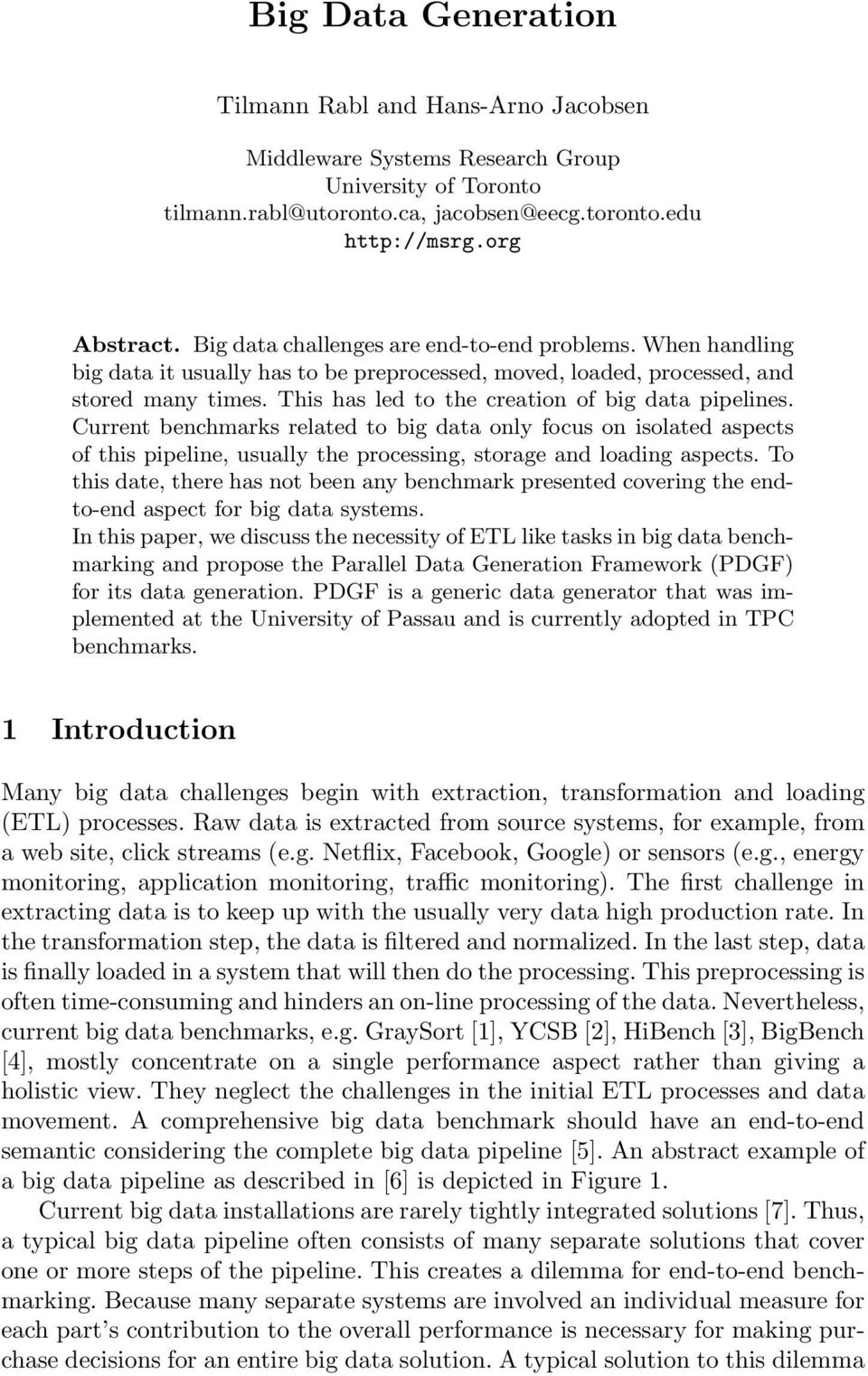
2 Big Data Analytical Pipeline Acquisition/ Recording Extraction/ Cleaning/ Annotation Integration/ Aggregation/ Representation Analysis/ Modeling Interpretation Fig. 1. Abstract Stages of a Big Data Analytics Pipeline is a component based benchmark. This requires having separate benchmarks for different stages of the big data pipeline. An example is HiBench [3], which includes separate workloads and micro-benchmarks to cover typical Map-Reduce jobs. HiBench, for example, includes workloads for sorting, clustering, and I/O. These micro-benchmarks are run separately and, consequently, inter-stage interactions, i.e., interference and interaction between different stages, as they would appear in real-live systems, are not reflected in the benchmarks. Considering inter-stage interactions makes the specification of an end-to-end benchmark challenging. This is because it is supposed to be technology agnostic, i.e., it should not enforce a certain implementation of the system under test and also not enforce fixed set of stages. A benchmark should challenge the system as a whole. This creates a dilemma for end-to-end benchmarking of a big data pipeline, because an end-to-end benchmark should not be concerned about the individual steps of the pipeline, which can differ from system to system, but all steps should be stressed during a test. A solution to this dilemma is a benchmark pipeline, where intermediate steps are specified but not enforced and only the initial input and final output are fixed. For a benchmark to be successful it has to be easy to use. Benchmarks that come with a complete tool chain are used more frequently than benchmarks that consist only of a specification. A recent example is the YCSB, which has gained a lot of attention and a wide acceptance. YCSB is used in many research projects as well as in industry benchmarks (e.g., [8, 9]). For a big data benchmark the most important and challenging tool is the data generator. In order to support the various steps of big data processing, it would be beneficial to have a data generator that can generate the data in different phases consistently. This makes a verification of intermediate results as well as isolate single steps of the benchmark procedure possible and thus further increases the benchmarks applicability. In such a data generator the data properties that are processed (such as dependencies and distributions) need to be strictly computable. A data generation tool that follows this approach is the Parallel Data Generation Framework.
![An example is HiBench [3], which includes separate workloads and micro-benchmarks to cover typical Map-Reduce jobs. HiBench, for example, includes workloads for sorting, clustering, and I/O.](/docs-images/57/5857856/images/page_2.jpg "These micro-benchmarks are run separately and, consequently, inter-stage interactions, i.e., interference and interaction between different stages, as they would appear in real-live systems, are not reflected in the benchmarks.")
3 Our major contribution in this article is a solution to the problem of data generation for big data benchmarks with end-to-end semantics. To the best of our knowledge this is the first approach to this problem. The rest of the paper is structured as follows, in Section 2, we give a brief overview of the Parallel Data Generation Framework. Section 3 describes challenges of big data generation and how they are addressed by the Parallel Data Generation Framework. Section 4 presents related work. We conclude in Section 5 with an outlook on future work. 2 Parallel Data Generation Framework The Parallel Data Generation Framework (PDGF) is a flexible, generic data generator that can be used to generate large amounts of relational data very fast. It was initially developed at the University of Passau and is currently used in the development of an industry standard ETL benchmark (described in [10]). PDGF exploits parallel random number generation for an independent generation of related values. The underlying approach is straight forward; the random number generator is a hash function which can generate any random number in a sequence in O(1) without having to compute other values. Random number generators with this feature are, for example, XORSHIFT generators [11]. With such random number generators every random number can be computed independently. Based on the random number arbitrary values can generated using mapping functions, dictionary lookups and such. Quickly finding the right random number is possible by using a hierarchical seeding strategy (table column row). seed seed seed seed rn t_id c_id u_id id Table RNG Column RNG Update RNG ID (Row) RNG Generator(rn) Customer Row# / CustKey Name Address Fig. 2. PDGF s Hierarchical Seeding Strategy An overview of PDGF s seeding strategy can be seen in Figure 2. The seeding strategy starts by assigning a random number to each table, this number is used as a seed for each column random number generator. PDGF is capable of generating consistent updates, i.e, inserts, deletes, and updates in an abstract time interval (for details refer to [12]). Which and how values are updated is determined by the update random number generator, the resulting seeded row
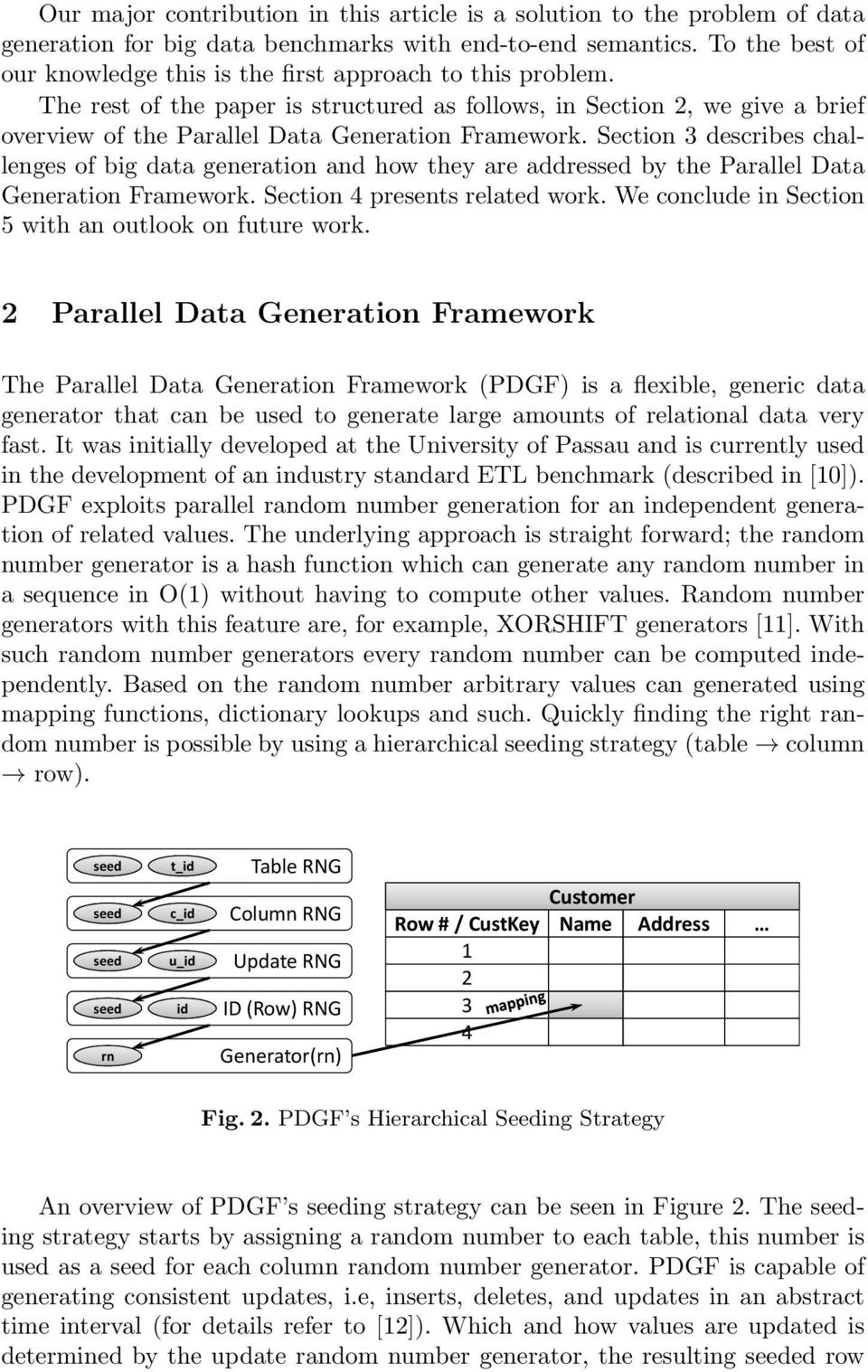
4 value random number generator is used to deterministically compute the random numbers required for the actual value generation. Having a seeded random number generator for the value generation instead of a single random number or fixed number of values makes it possible to generate values that use a nondeterministic number of random numbers, such as text. Cluster/Cloud Full Table Rows Node Rows Rows Processor/Core Rows Rows Rows Rows Fig. 3. Parallel Data Generation in PDGF Not all values should be randomly chosen. An example are references. For tables that contain foreign key constraints, for example, the keys must exist in the referenced tables, which is challenging in the case of non-dense keys or multi-part keys. Using the deterministic approach, existing values can easily and efficiently be recomputed. Furthermore, being able to independently generate all values makes it possible to fully parallelize and distribute the data generation. This especially interesting for big data applications. PDGF comes with an integrated scheduling system that automatically handles multi-core and multi-node parallelism. The working principle is presented in Figure 3. Each table can be split up in equal sized partitions, which can be generated on shared nothing machines. Each partition can further be divided up in multiple subsets, which can be distributed to separate threads or processes. For further details of this generation approach see [12 17]. 3 A Big Data Generator One can build a versatile data generator for big data benchmarking based on PDGF. Although PDGF was built for relational data it features a postprocessing module that enables a mapping to other data formats such as XML, RDF, etc. Since all data is deterministically generated and the generation is always repeatable it is possible to compute intermediate and final results of transformations. The underlying relational model makes it possible to generate consistent queries on the data. This makes PDGF an ideal candidate tool for big data benchmarking. PDGF was recently used for generating the data set for the BigBench big data analytics benchmark [4]. BigBench models a retail business, were articles
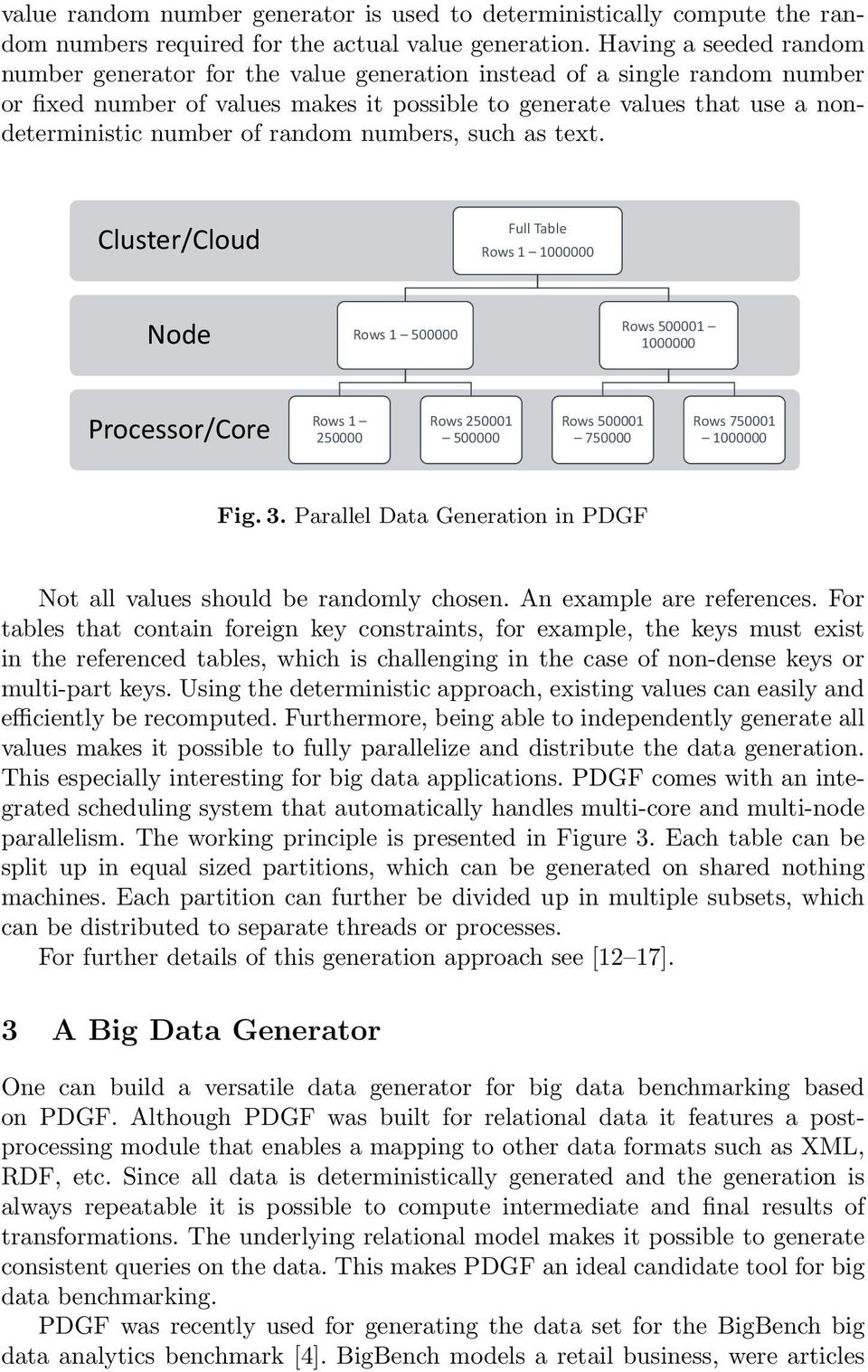
5 Marketprice Structured Data Item Unstructured Data Sales Reviews Web Page Customer Web Log Semi-Structured Data Adapted TPC-DS BigBench Specific Fig. 4. BigBench Schema are sold in stores and over websites. The schema consists of structured, semistructured, and unstructured data as can be seen in Figure 4. The structured core of the schema is adapted from TPC-DS [18]. The semi- and unstructured parts are implemented in PDGF. The unstructured part models reviews of products. The semi-structured part models an Apache Web server log. The reviews are used for sentiment analysis, which requires very realistic text in order to get reasonable results. This is achieved by using Markov chains. OLTP CDC System under Test Customer Mgmt XML ETL Data Warehouse Financial Newswire Multi format Staging Area Fig. 5. TPC-DI Overview Another recently finished data generator built based on PDGF is TPC-DI s data generator. TPC-DI is an data integration benchmark, which benchmarks ETL systems. As is shown in Figure 5, the benchmark defines several sources of information that are stored in different formats. The benchmark itself measures
![The structured core of the schema is adapted from TPC-DS [18]. The semi- and unstructured parts are implemented in PDGF. The unstructured part models reviews of products.](/docs-images/57/5857856/images/page_5.jpg "The semi-structured part models an Apache Web server log. The reviews are used for sentiment analysis, which requires very realistic text in order to get reasonable results.")
6 the performance of a system that integrates the different data sources into a single data warehouse. The data generator generates the historical files of each data source as well change data captures in daily increments. For the benchmark to produce meaningful results, the data from the different sources has to be consistent. This means, for example, that only employees with the status account managers in the human resources database manage customers accounts and, thus, are referenced in the customer management database. When combining the two examples above, one can create a big data generator that satisfies all characteristics of typical big data use cases. For example, the well established 3 to 5 V s, namely volume, velocity, variety, and the extensions value and veracity, can all be covered by such a generator. Parallel data generation is the only means to generate big volumes of data in timely fashion. The velocity aspect can be satisfied generally by fast generation of data as well as by fast generation of incremental updates, which ensure the characteristic of frequent data change. The variety aspect is covered with different data sources. The value extension is hinting to the additional value that can be retrieved from a deep analysis of the data, which therefore has to have meaningful patterns and correlations. Finally, veracity is of the data can be changed by introducing deltas and errors in the generation, which is present in the TPC-DI specification. 4 Related Work There are multiple different approaches to data generation. Many current benchmarks use very primitive data that is simply based on statistical distributions. Examples are Terasort (a.k.a. Graysort) [1] and YCSB [2]. In order to get more realistic data, structured approaches to data generation have to be used. One way to get very realistic data is simulation. This can be done in an application specific way, e.g., using human browser interaction simulation with the Selenium simulator [19], or using a generic graph based approach [20, 21]. Although very realistic, all simulation-based approaches are too slow for big data generation. Therefore, many benchmarks including most of the standard benchmarks have special purpose data generators that are not or only to a very small degree configurable. An example are all TPC benchmarks, with the exception of TPC-DI (based on PDGF) and to some extend TPC-DS (based on the partial configurable data generator MUDD [22]). Since the implementation of quality data generators is a tedious work, several commercial and scientific generic data generators have been developed. To ensure fast data generation these typically do not use simulation but either reread data to build correlations (e.g., [23]) or recompute referenced values (e.g., PDGF and Myriad [24]). Due to the data sizes generated and the speed of network and disk transfer rates, the computational approach is the fastest and most scalable and thus most suitable for big data generation.

7 5 Conclusion The big data landscape is quickly evolving, much like the landscape of database management systems in its early stages. As a result, big data systems are heterogeneous and even for the broadly accepted Hadoop software stack there is no commonly accepted benchmark. Several proposals are currently emerging, because of the missing maturity of the big data field and the high pace of evolution, benchmarks have to evolve as well. To this end, configurable data generators are necessary to help benchmarks keep up with the development and, thus, stay relevant. The Parallel Data Generation Framework is an ideal candidate for big data generation. In this article, we have listed characteristics that a big data generator has to fulfill and have demonstrated by example that PDGF can satisfy all requirements. A demo of PDGF is available for download 1. A commercialized version is available from What is missing for an easy to use benchmark is a driver that starts the execution, measures the performance and calculates the metrics. This is non-trivial because there is no standard access language so far. However, relational input as generated by PDGF can be easily transformed in any other representation, which will ease the implementation of such tool chains. PDGF is continuously improved and extended, current work focuses on data types typical in big data scenarios like text and click-streams. Initial implementations were used to implement the BigBench data generator. Other work targets scaling-up existing data sets and combining simulation-like data generation with the purely computational approach. References 1. Gray, J.: GraySort Benchmark. Sort Benchmark Home Page sortbenchmark.org 2. Cooper, B.F., Silberstein, A., Tam, E., Ramakrishnan, R., Sears, R.: Benchmarking Cloud Serving Systems with YCSB. In: SoCC. (2010) Huang, S., Huang, J., Dai, J., Xie, T., Huang, B.: The HiBench Benchmark Suite: Characterization of the MapReduce-Based Data Analysis. In: ICDEW. (2010) 4. Ghazal, A., Rabl, T., Hu, M., Raab, F., Poess, M., Crolotte, A., Jacobsen., H.A.: BigBench: Towards an industry standard benchmark for big data analytics. In: Proceedings of the ACM SIGMOD Conference. (2013) 5. Baru, C., Bhandarkar, M., Nambiar, R., Poess, M.,, Rabl, T.: Benchmarking Big Data Systems and the BigData Top100 List. Big Data 1(1) (2013) Baru, C., Bhandarkar, M., Nambiar, R., Poess, M., Rabl, T.: Setting the Direction for Big Data Benchmark Standards. In Nambiar, R., Poess, M., eds.: Selected Topics in Performance Evaluation and Benchmarking. Volume 7755 of Lecture Notes in Computer Science. Springer Berlin Heidelberg (2013) Carey, M.J.: BDMS Performance Evaluation: Practices, Pitfalls, and Possibilities. In Nambiar, R., Poess, M., eds.: Selected Topics in Performance Evaluation and 1 Parallel Data Generation Framework

8 Benchmarking. Volume 7755 of Lecture Notes in Computer Science. Springer Berlin Heidelberg (2013) Patil, S., Polte, M., Ren, K., Tantisiriroj, W., Xiao, L., Lopez, J., Gibson, G., Fuchs, A., Rinaldi, B.: YCSB++: benchmarking and performance debugging advanced features in scalable table stores. In: SoCC. (2011) 9:1 9:14 9. Rabl, T., Sadoghi, M., Jacobsen, H.A., Gómez-Villamor, S., Muntés-Mulero, V., Mankowskii, S.: Solving Big Data Challenges for Enterprise Application Performance Management. PVLDB 5(12) (2012) Wyatt, L., Caufield, B., Pol, D.: Principles for an ETL Benchmark. In: TPC TC 09. (2009) Marsaglia, G.: Xorshift RNGs. Journal Of Statistical Software 8(14) (2003) Frank, M., Poess, M., Rabl, T.: Efficient Update Data Generation for DBMS Benchmark. In: ICPE 12. (2012) 13. Poess, M., Rabl, T., Frank, M., Danisch, M.: A PDGF Implementation for TPC-H. In: TPCTC 11. (2011) 14. Rabl, T., Frank, M., Sergieh, H.M., Kosch, H.: A Data Generator for Cloud-Scale Benchmarking. In: TPCTC 10. (2010) Rabl, T., Lang, A., Hackl, T., Sick, B., Kosch, H.: Generating Shifting Workloads to Benchmark Adaptability in Relational Database Systems. In: TPCTC 09. (2009) Rabl, T., Poess, M.: Parallel data generation for performance analysis of large, complex RDBMS. In: DBTest 11. (2011) Rabl, T., Poess, M., Danisch, M., Jacobsen, H.A.: Rapid Development of Data Generators Using Meta Generators in PDGF. In: DBTest 13: Proceedings of the Sixth International Workshop on Testing Database Systems. (2013) 18. Pöss, M., Nambiar, R.O., Walrath, D.: Why You Should Run TPC-DS: A Workload Analysis. In: VLDB. (2007) Hunt, D., Inman-Semerau, L., May-Pumphrey, M.A., Sussman, N., Grandjean, P., Newhook, P., Suarez-Ordonez, S., Stewart, S., Kumar, T.: Selenium Documentation. (2013) Houkjær, K., Torp, K., Wind, R.: Simple and Realistic Data Generation. In: VLDB 06: Proceedings of the 32nd international conference on Very large data bases, VLDB Endowment (2006) Lin, P.J., Samadi, B., Cipolone, A., Jeske, D.R., Cox, S., Rendón, C., Holt, D., Xiao, R.: Development of a Synthetic Data Set Generator for Building and Testing Information Discovery Systems. In: ITNG 06: Proceedings of the Third International Conference on Information Technology: New Generations, Washington, DC, USA, IEEE Computer Society (2006) Stephens, J.M., Poess, M.: MUDD: a multi-dimensional data generator. In: WOSP 04: Proceedings of the 4th International Workshop on Software and Performance, New York, NY, USA, ACM (2004) Bruno, N., Chaudhuri, S.: Flexible Database Generators. In: VLDB 05: Proceedings of the 31st International Conference on Very Large Databases, VLDB Endowment (2005) Alexandrov, A., Tzoumas, K., Markl, V.: Myriad: Scalable and Expressive Data Generation. In: VLDB 12. (2012)
Just can t get enough - Synthesizing Big Data
 Just can t get enough - Synthesizing Big Data Tilmann Rabl Middleware Systems Research Group University of Toronto Canada [email protected] Manuel Danisch, Michael Frank, Sebastian Schindler bankmark
On Big Data Benchmarking
 On Big Data Benchmarking 1 Rui Han and 2 Xiaoyi Lu 1 Department of Computing, Imperial College London 2 Ohio State University [email protected], [email protected] Abstract Big data systems address
How To Write A Bigbench Benchmark For A Retailer
 BigBench Overview Towards a Comprehensive End-to-End Benchmark for Big Data - bankmark UG (haftungsbeschränkt) 02/04/2015 @ SPEC RG Big Data The BigBench Proposal End to end benchmark Application level
NoSQL Performance Test In-Memory Performance Comparison of SequoiaDB, Cassandra, and MongoDB
 bankmark UG (haftungsbeschränkt) Bahnhofstraße 1 9432 Passau Germany www.bankmark.de [email protected] T +49 851 25 49 49 F +49 851 25 49 499 NoSQL Performance Test In-Memory Performance Comparison of SequoiaDB,
On Big Data Benchmarking
 On Big Data Benchmarking 1 Rui Han and 2 Xiaoyi Lu 1 Department of Computing, Imperial College London 2 Ohio State University [email protected], [email protected] Abstract Big data systems address
BigBench: Towards an Industry Standard Benchmark for Big Data Analytics
 BigBench: Towards an Industry Standard Benchmark for Big Data Analytics Ahmad Ghazal 1,5, Tilmann Rabl 2,6, Minqing Hu 1,5, Francois Raab 4,8, Meikel Poess 3,7, Alain Crolotte 1,5, Hans-Arno Jacobsen 2,9
An Approach to Implement Map Reduce with NoSQL Databases
 www.ijecs.in International Journal Of Engineering And Computer Science ISSN: 2319-7242 Volume 4 Issue 8 Aug 2015, Page No. 13635-13639 An Approach to Implement Map Reduce with NoSQL Databases Ashutosh
Associate Professor, Department of CSE, Shri Vishnu Engineering College for Women, Andhra Pradesh, India 2
 Volume 6, Issue 3, March 2016 ISSN: 2277 128X International Journal of Advanced Research in Computer Science and Software Engineering Research Paper Available online at: www.ijarcsse.com Special Issue
A Novel Cloud Based Elastic Framework for Big Data Preprocessing
 School of Systems Engineering A Novel Cloud Based Elastic Framework for Big Data Preprocessing Omer Dawelbeit and Rachel McCrindle October 21, 2014 University of Reading 2008 www.reading.ac.uk Overview
BENCHMARKING BIG DATA SYSTEMS AND THE BIGDATA TOP100 LIST
 BENCHMARKING BIG DATA SYSTEMS AND THE BIGDATA TOP100 LIST ORIGINAL ARTICLE Chaitanya Baru, 1 Milind Bhandarkar, 2 Raghunath Nambiar, 3 Meikel Poess, 4 and Tilmann Rabl 5 Abstract Big data has become a
Integrating Big Data into the Computing Curricula
 Integrating Big Data into the Computing Curricula Yasin Silva, Suzanne Dietrich, Jason Reed, Lisa Tsosie Arizona State University http://www.public.asu.edu/~ynsilva/ibigdata/ 1 Overview Motivation Big
Conjugating data mood and tenses: Simple past, infinite present, fast continuous, simpler imperative, conditional future perfect
 Matteo Migliavacca (mm53@kent) School of Computing Conjugating data mood and tenses: Simple past, infinite present, fast continuous, simpler imperative, conditional future perfect Simple past - Traditional
Survey of the Benchmark Systems and Testing Frameworks For Tachyon-Perf
 Survey of the Benchmark Systems and Testing Frameworks For Tachyon-Perf Rong Gu,Qianhao Dong 2014/09/05 0. Introduction As we want to have a performance framework for Tachyon, we need to consider two aspects
A Study on Workload Imbalance Issues in Data Intensive Distributed Computing
 A Study on Workload Imbalance Issues in Data Intensive Distributed Computing Sven Groot 1, Kazuo Goda 1, and Masaru Kitsuregawa 1 University of Tokyo, 4-6-1 Komaba, Meguro-ku, Tokyo 153-8505, Japan Abstract.
LDIF - Linked Data Integration Framework
 LDIF - Linked Data Integration Framework Andreas Schultz 1, Andrea Matteini 2, Robert Isele 1, Christian Bizer 1, and Christian Becker 2 1. Web-based Systems Group, Freie Universität Berlin, Germany [email protected],
Trafodion Operational SQL-on-Hadoop
 Trafodion Operational SQL-on-Hadoop SophiaConf 2015 Pierre Baudelle, HP EMEA TSC July 6 th, 2015 Hadoop workload profiles Operational Interactive Non-interactive Batch Real-time analytics Operational SQL
Benchmark for OLAP on NoSQL Technologies
 Benchmark for OLAP on NoSQL Technologies Comparing NoSQL Multidimensional Data Warehousing Solutions Max Chevalier 1, Mohammed El Malki 1,2, Arlind Kopliku 1, Olivier Teste 1, Ronan Tournier 1 1 - University
Trustworthiness of Big Data
 Trustworthiness of Big Data International Journal of Computer Applications (0975 8887) Akhil Mittal Technical Test Lead Infosys Limited ABSTRACT Big data refers to large datasets that are challenging to
An Oracle White Paper November 2010. Leveraging Massively Parallel Processing in an Oracle Environment for Big Data Analytics
 An Oracle White Paper November 2010 Leveraging Massively Parallel Processing in an Oracle Environment for Big Data Analytics 1 Introduction New applications such as web searches, recommendation engines,
INTRODUCTION TO APACHE HADOOP MATTHIAS BRÄGER CERN GS-ASE
 INTRODUCTION TO APACHE HADOOP MATTHIAS BRÄGER CERN GS-ASE AGENDA Introduction to Big Data Introduction to Hadoop HDFS file system Map/Reduce framework Hadoop utilities Summary BIG DATA FACTS In what timeframe
BIG DATA IN THE CLOUD : CHALLENGES AND OPPORTUNITIES MARY- JANE SULE & PROF. MAOZHEN LI BRUNEL UNIVERSITY, LONDON
 BIG DATA IN THE CLOUD : CHALLENGES AND OPPORTUNITIES MARY- JANE SULE & PROF. MAOZHEN LI BRUNEL UNIVERSITY, LONDON Overview * Introduction * Multiple faces of Big Data * Challenges of Big Data * Cloud Computing
Best Practices for Hadoop Data Analysis with Tableau
 Best Practices for Hadoop Data Analysis with Tableau September 2013 2013 Hortonworks Inc. http:// Tableau 6.1.4 introduced the ability to visualize large, complex data stored in Apache Hadoop with Hortonworks
Data Refinery with Big Data Aspects
 International Journal of Information and Computation Technology. ISSN 0974-2239 Volume 3, Number 7 (2013), pp. 655-662 International Research Publications House http://www. irphouse.com /ijict.htm Data
Chapter 7. Using Hadoop Cluster and MapReduce
 Chapter 7 Using Hadoop Cluster and MapReduce Modeling and Prototyping of RMS for QoS Oriented Grid Page 152 7. Using Hadoop Cluster and MapReduce for Big Data Problems The size of the databases used in
Setting the Direction for Big Data Benchmark Standards
 Setting the Direction for Big Data Benchmark Standards Chaitan Baru, Center for Large-scale Data Systems research (CLDS), San Diego Supercomputer Center, UC San Diego Milind Bhandarkar, Greenplum Raghunath
Managing Big Data with Hadoop & Vertica. A look at integration between the Cloudera distribution for Hadoop and the Vertica Analytic Database
 Managing Big Data with Hadoop & Vertica A look at integration between the Cloudera distribution for Hadoop and the Vertica Analytic Database Copyright Vertica Systems, Inc. October 2009 Cloudera and Vertica
Aligning Your Strategic Initiatives with a Realistic Big Data Analytics Roadmap
 Aligning Your Strategic Initiatives with a Realistic Big Data Analytics Roadmap 3 key strategic advantages, and a realistic roadmap for what you really need, and when 2012, Cognizant Topics to be discussed
Maximizing Hadoop Performance and Storage Capacity with AltraHD TM
 Maximizing Hadoop Performance and Storage Capacity with AltraHD TM Executive Summary The explosion of internet data, driven in large part by the growth of more and more powerful mobile devices, has created
A Platform for Supporting Data Analytics on Twitter: Challenges and Objectives 1
 A Platform for Supporting Data Analytics on Twitter: Challenges and Objectives 1 Yannis Stavrakas Vassilis Plachouras IMIS / RC ATHENA Athens, Greece {yannis, vplachouras}@imis.athena-innovation.gr Abstract.
CS 378 Big Data Programming. Lecture 2 Map- Reduce
 CS 378 Big Data Programming Lecture 2 Map- Reduce MapReduce Large data sets are not new What characterizes a problem suitable for MR? Most or all of the data is processed But viewed in small increments
Enhancing Dataset Processing in Hadoop YARN Performance for Big Data Applications
 Enhancing Dataset Processing in Hadoop YARN Performance for Big Data Applications Ahmed Abdulhakim Al-Absi, Dae-Ki Kang and Myong-Jong Kim Abstract In Hadoop MapReduce distributed file system, as the input
Industry 4.0 and Big Data
 Industry 4.0 and Big Data Marek Obitko, [email protected] Senior Research Engineer 03/25/2015 PUBLIC PUBLIC - 5058-CO900H 2 Background Joint work with Czech Institute of Informatics, Robotics and
Big Data: Tools and Technologies in Big Data
 Big Data: Tools and Technologies in Big Data Jaskaran Singh Student Lovely Professional University, Punjab Varun Singla Assistant Professor Lovely Professional University, Punjab ABSTRACT Big data can
Testing 3Vs (Volume, Variety and Velocity) of Big Data
 Testing 3Vs (Volume, Variety and Velocity) of Big Data 1 A lot happens in the Digital World in 60 seconds 2 What is Big Data Big Data refers to data sets whose size is beyond the ability of commonly used
Luncheon Webinar Series May 13, 2013
 Luncheon Webinar Series May 13, 2013 InfoSphere DataStage is Big Data Integration Sponsored By: Presented by : Tony Curcio, InfoSphere Product Management 0 InfoSphere DataStage is Big Data Integration
Testing Big data is one of the biggest
 Infosys Labs Briefings VOL 11 NO 1 2013 Big Data: Testing Approach to Overcome Quality Challenges By Mahesh Gudipati, Shanthi Rao, Naju D. Mohan and Naveen Kumar Gajja Validate data quality by employing
Cray: Enabling Real-Time Discovery in Big Data
 Cray: Enabling Real-Time Discovery in Big Data Discovery is the process of gaining valuable insights into the world around us by recognizing previously unknown relationships between occurrences, objects
PartJoin: An Efficient Storage and Query Execution for Data Warehouses
 PartJoin: An Efficient Storage and Query Execution for Data Warehouses Ladjel Bellatreche 1, Michel Schneider 2, Mukesh Mohania 3, and Bharat Bhargava 4 1 IMERIR, Perpignan, FRANCE [email protected] 2
A REVIEW PAPER ON THE HADOOP DISTRIBUTED FILE SYSTEM
 A REVIEW PAPER ON THE HADOOP DISTRIBUTED FILE SYSTEM Sneha D.Borkar 1, Prof.Chaitali S.Surtakar 2 Student of B.E., Information Technology, J.D.I.E.T, [email protected] Assistant Professor, Information
CS 378 Big Data Programming
 CS 378 Big Data Programming Lecture 2 Map- Reduce CS 378 - Fall 2015 Big Data Programming 1 MapReduce Large data sets are not new What characterizes a problem suitable for MR? Most or all of the data is
Managing Cloud Server with Big Data for Small, Medium Enterprises: Issues and Challenges
 Managing Cloud Server with Big Data for Small, Medium Enterprises: Issues and Challenges Prerita Gupta Research Scholar, DAV College, Chandigarh Dr. Harmunish Taneja Department of Computer Science and
Keywords Big Data; OODBMS; RDBMS; hadoop; EDM; learning analytics, data abundance.
 Volume 4, Issue 11, November 2014 ISSN: 2277 128X International Journal of Advanced Research in Computer Science and Software Engineering Research Paper Available online at: www.ijarcsse.com Analytics
Welcome to the 6 th Workshop on Big Data Benchmarking
 Welcome to the 6 th Workshop on Big Data Benchmarking TILMANN RABL MIDDLEWARE SYSTEMS RESEARCH GROUP DEPARTMENT OF ELECTRICAL AND COMPUTER ENGINEERING UNIVERSITY OF TORONTO BANKMARK Please note! This workshop
Lambda Architecture. Near Real-Time Big Data Analytics Using Hadoop. January 2015. Email: [email protected] Website: www.qburst.com
 Lambda Architecture Near Real-Time Big Data Analytics Using Hadoop January 2015 Contents Overview... 3 Lambda Architecture: A Quick Introduction... 4 Batch Layer... 4 Serving Layer... 4 Speed Layer...
low-level storage structures e.g. partitions underpinning the warehouse logical table structures
 DATA WAREHOUSE PHYSICAL DESIGN The physical design of a data warehouse specifies the: low-level storage structures e.g. partitions underpinning the warehouse logical table structures low-level structures
Internals of Hadoop Application Framework and Distributed File System
 International Journal of Scientific and Research Publications, Volume 5, Issue 7, July 2015 1 Internals of Hadoop Application Framework and Distributed File System Saminath.V, Sangeetha.M.S Abstract- Hadoop
THE DEVELOPER GUIDE TO BUILDING STREAMING DATA APPLICATIONS
 THE DEVELOPER GUIDE TO BUILDING STREAMING DATA APPLICATIONS WHITE PAPER Successfully writing Fast Data applications to manage data generated from mobile, smart devices and social interactions, and the
BIG DATA IN BUSINESS ENVIRONMENT
 Scientific Bulletin Economic Sciences, Volume 14/ Issue 1 BIG DATA IN BUSINESS ENVIRONMENT Logica BANICA 1, Alina HAGIU 2 1 Faculty of Economics, University of Pitesti, Romania [email protected] 2 Faculty
Log Mining Based on Hadoop s Map and Reduce Technique
 Log Mining Based on Hadoop s Map and Reduce Technique ABSTRACT: Anuja Pandit Department of Computer Science, [email protected] Amruta Deshpande Department of Computer Science, [email protected]
Setting the Direction for Big Data Benchmark Standards Chaitan Baru, PhD San Diego Supercomputer Center UC San Diego
 Setting the Direction for Big Data Benchmark Standards Chaitan Baru, PhD San Diego Supercomputer Center UC San Diego Industry s first workshop on big data benchmarking Acknowledgements National Science
Analytics in the Cloud. Peter Sirota, GM Elastic MapReduce
 Analytics in the Cloud Peter Sirota, GM Elastic MapReduce Data-Driven Decision Making Data is the new raw material for any business on par with capital, people, and labor. What is Big Data? Terabytes of
International Journal of Innovative Research in Computer and Communication Engineering
 FP Tree Algorithm and Approaches in Big Data T.Rathika 1, J.Senthil Murugan 2 Assistant Professor, Department of CSE, SRM University, Ramapuram Campus, Chennai, Tamil Nadu,India 1 Assistant Professor,
Setting the Direction for Big Data Benchmark Standards 1
 Setting the Direction for Big Data Benchmark Standards 1 Chaitan Baru 1, Milind Bhandarkar 2, Raghunath Nambiar 3, Meikel Poess 4, Tilmann Rabl 5 1 San Diego Supercomputer Center, UC San Diego, USA [email protected]
Chapter 6 8/12/2015. Foundations of Business Intelligence: Databases and Information Management. Problem:
 Foundations of Business Intelligence: Databases and Information Management VIDEO CASES Chapter 6 Case 1a: City of Dubuque Uses Cloud Computing and Sensors to Build a Smarter, Sustainable City Case 1b:
SQL + NOSQL + NEWSQL + REALTIME FOR INVESTMENT BANKS
 Enterprise Data Problems in Investment Banks BigData History and Trend Driven by Google CAP Theorem for Distributed Computer System Open Source Building Blocks: Hadoop, Solr, Storm.. 3548 Hypothetical
Database Application Developer Tools Using Static Analysis and Dynamic Profiling
 Database Application Developer Tools Using Static Analysis and Dynamic Profiling Surajit Chaudhuri, Vivek Narasayya, Manoj Syamala Microsoft Research {surajitc,viveknar,manojsy}@microsoft.com Abstract
bigdata Managing Scale in Ontological Systems
 Managing Scale in Ontological Systems 1 This presentation offers a brief look scale in ontological (semantic) systems, tradeoffs in expressivity and data scale, and both information and systems architectural
A STUDY ON HADOOP ARCHITECTURE FOR BIG DATA ANALYTICS
 A STUDY ON HADOOP ARCHITECTURE FOR BIG DATA ANALYTICS Dr. Ananthi Sheshasayee 1, J V N Lakshmi 2 1 Head Department of Computer Science & Research, Quaid-E-Millath Govt College for Women, Chennai, (India)
BIG DATA Alignment of Supply & Demand Nuria de Lama Representative of Atos Research &
 BIG DATA Alignment of Supply & Demand Nuria de Lama Representative of Atos Research & Innovation 04-08-2011 to the EC 8 th February, Luxembourg Your Atos business Research technologists. and Innovation
BDGS: A Scalable Big Data Generator Suite in Big Data Benchmarking. Aayush Agrawal
 BDGS: A Scalable Big Data Generator Suite in Big Data Benchmarking Aayush Agrawal Last Updated: May 21, 2014 text CONTENTS Contents 1 Philosophy : 1 2 Requirements : 1 3 Observations : 2 3.1 Text Generator
Can the Elephants Handle the NoSQL Onslaught?
 Can the Elephants Handle the NoSQL Onslaught? Avrilia Floratou, Nikhil Teletia David J. DeWitt, Jignesh M. Patel, Donghui Zhang University of Wisconsin-Madison Microsoft Jim Gray Systems Lab Presented
Big Data Technology ดร.ช ชาต หฤไชยะศ กด. Choochart Haruechaiyasak, Ph.D.
 Big Data Technology ดร.ช ชาต หฤไชยะศ กด Choochart Haruechaiyasak, Ph.D. Speech and Audio Technology Laboratory (SPT) National Electronics and Computer Technology Center (NECTEC) National Science and Technology
Exploiting Data at Rest and Data in Motion with a Big Data Platform
 Exploiting Data at Rest and Data in Motion with a Big Data Platform Sarah Brader, [email protected] What is Big Data? Where does it come from? 12+ TBs of tweet data every day 30 billion RFID tags
INTRODUCTION TO CASSANDRA
 INTRODUCTION TO CASSANDRA This ebook provides a high level overview of Cassandra and describes some of its key strengths and applications. WHAT IS CASSANDRA? Apache Cassandra is a high performance, open
Well packaged sets of preinstalled, integrated, and optimized software on select hardware in the form of engineered systems and appliances
 INSIGHT Oracle's All- Out Assault on the Big Data Market: Offering Hadoop, R, Cubes, and Scalable IMDB in Familiar Packages Carl W. Olofson IDC OPINION Global Headquarters: 5 Speen Street Framingham, MA
International Journal of Advanced Engineering Research and Applications (IJAERA) ISSN: 2454-2377 Vol. 1, Issue 6, October 2015. Big Data and Hadoop
 ISSN: 2454-2377, October 2015 Big Data and Hadoop Simmi Bagga 1 Satinder Kaur 2 1 Assistant Professor, Sant Hira Dass Kanya MahaVidyalaya, Kala Sanghian, Distt Kpt. INDIA E-mail: [email protected]
What's New in SAS Data Management
 Paper SAS034-2014 What's New in SAS Data Management Nancy Rausch, SAS Institute Inc., Cary, NC; Mike Frost, SAS Institute Inc., Cary, NC, Mike Ames, SAS Institute Inc., Cary ABSTRACT The latest releases
NoSQL for SQL Professionals William McKnight
 NoSQL for SQL Professionals William McKnight Session Code BD03 About your Speaker, William McKnight President, McKnight Consulting Group Frequent keynote speaker and trainer internationally Consulted to
Energy Efficient MapReduce
 Energy Efficient MapReduce Motivation: Energy consumption is an important aspect of datacenters efficiency, the total power consumption in the united states has doubled from 2000 to 2005, representing
Implement Hadoop jobs to extract business value from large and varied data sets
 Hadoop Development for Big Data Solutions: Hands-On You Will Learn How To: Implement Hadoop jobs to extract business value from large and varied data sets Write, customize and deploy MapReduce jobs to
these three NoSQL databases because I wanted to see a the two different sides of the CAP
 Michael Sharp Big Data CS401r Lab 3 For this paper I decided to do research on MongoDB, Cassandra, and Dynamo. I chose these three NoSQL databases because I wanted to see a the two different sides of the
Data Virtualization A Potential Antidote for Big Data Growing Pains
 perspective Data Virtualization A Potential Antidote for Big Data Growing Pains Atul Shrivastava Abstract Enterprises are already facing challenges around data consolidation, heterogeneity, quality, and
BIG DATA: FROM HYPE TO REALITY. Leandro Ruiz Presales Partner for C&LA Teradata
 BIG DATA: FROM HYPE TO REALITY Leandro Ruiz Presales Partner for C&LA Teradata Evolution in The Use of Information Action s ACTIVATING MAKE it happen! Insights OPERATIONALIZING WHAT IS happening now? PREDICTING
An Oracle White Paper June 2012. High Performance Connectors for Load and Access of Data from Hadoop to Oracle Database
 An Oracle White Paper June 2012 High Performance Connectors for Load and Access of Data from Hadoop to Oracle Database Executive Overview... 1 Introduction... 1 Oracle Loader for Hadoop... 2 Oracle Direct
In-memory databases and innovations in Business Intelligence
 Database Systems Journal vol. VI, no. 1/2015 59 In-memory databases and innovations in Business Intelligence Ruxandra BĂBEANU, Marian CIOBANU University of Economic Studies, Bucharest, Romania [email protected],
International Journal of Advancements in Research & Technology, Volume 3, Issue 2, February-2014 10 ISSN 2278-7763
 International Journal of Advancements in Research & Technology, Volume 3, Issue 2, February-2014 10 A Discussion on Testing Hadoop Applications Sevuga Perumal Chidambaram ABSTRACT The purpose of analysing
The PigMix Benchmark on Pig, MapReduce, and HPCC Systems
 2015 IEEE International Congress on Big Data The PigMix Benchmark on Pig, MapReduce, and HPCC Systems Keren Ouaknine 1, Michael Carey 2, Scott Kirkpatrick 1 {ouaknine}@cs.huji.ac.il 1 School of Engineering
Introduction to Apache Cassandra
 Introduction to Apache Cassandra White Paper BY DATASTAX CORPORATION JULY 2013 1 Table of Contents Abstract 3 Introduction 3 Built by Necessity 3 The Architecture of Cassandra 4 Distributing and Replicating
Big Systems, Big Data
 Big Systems, Big Data When considering Big Distributed Systems, it can be noted that a major concern is dealing with data, and in particular, Big Data Have general data issues (such as latency, availability,
QLIKVIEW DEPLOYMENT FOR BIG DATA ANALYTICS AT KING.COM
 QLIKVIEW DEPLOYMENT FOR BIG DATA ANALYTICS AT KING.COM QlikView Technical Case Study Series Big Data June 2012 qlikview.com Introduction This QlikView technical case study focuses on the QlikView deployment
Introduction to Hadoop
 Introduction to Hadoop 1 What is Hadoop? the big data revolution extracting value from data cloud computing 2 Understanding MapReduce the word count problem more examples MCS 572 Lecture 24 Introduction