
Using Total Quality Management to improve Spanish industrial statistics
|
|
|
- Beatrix Stewart
- 10 years ago
- Views:
Transcription
1 Using Total Quality Management to improve Spanish industrial statistics Pedro Revilla National Statistical Institute of Spain Abstract The TQM approach used to produce industrial statistics in Spain is presented in this paper. The starting point is asking customers about our statistics products. Then, specific programs and actions are implemented trying to improve customer satisfaction. The following projects have been launched as a direct consequence of expressed customer needs: improving timeliness, improving a service of tailor-made information, and offering individual data tailored to the reporting enterprises as a payment for answering questionnaires. Keywords: Total Quality Management, TQM, enterprise surveys 1. Introduction Nowadays, statistical offices are under continuous pressure from society, which demands more and more data, to be produced at a lower cost, with a lower respondent burden and with a shorter delayed. In this situation, methods and tools that could help to improve the efficiency of statistical production processes, and to fit better customers needs, are of the outmost importance. Total Quality Management (TQM) is being used by many organisations all over the world, as a method to improve production systems and to produce high quality products. At first, TQM was developed for private companies, but in many countries TQM thinking has also penetrated into the public sector. As a matter of fact, several official statistical agencies are using TQM methods and strategies in some way. This paper presents our experiences on using TQM to improve industrial statistics. A general description of the approach used is introduced. Then, some projects implemented as a consequence of using TQM are presented. First, the use of customer satisfaction surveys, which is the starting point of our TQM strategy. The projects on
2 improving timeliness, on improving a service of tailor-made information, and on offering individual data tailored to the reporting enterprises, are also presented. 2. TQM approach used for industrial statistics. Because there are many TQM definitions, it is relevant to describe the approach followed in the National Statistic Institute of Spain to produce industrial statistics. The essential ideas of the TQM approach used are that the suppliers (the reporting units) and the customers (the data users) are part of the productive system, and they determine the definition of quality to be used by the organisation. The basic principles followed are: a) Customer satisfaction: it is the corner stone of the TQM approach. A product has quality when it satisfies customers. b) Continuous improvement: TQM is not a short-term goal that finishes when a target has been met. It is a continuous improvement process, trying to adapt to the customers changing needs. c) Fact-based management: Total quality can only be based on facts recognised by the whole organisation. d) People based management: it is people who achieve quality. Systems, standards and technology themselves are not enough to produce quality. Trying to follow those essential ideas and basic principles, our approach for the Spanish industrial statistics is quite simple. The starting point is asking customers about our main failures. Then, specific projects and actions are launched to correct those failures and to improve customer satisfaction. Based on our customers opinions, we have learned that the main failures of our statistics were, in order of importance: The delay in data production The insufficiency of our standard publications for their needs The non-existence of procedures allowing to mix microdata from different surveys The following projects have been launched as a direct consequence of using TQM approach: Improving timeliness Improving a service of tailor-made information
3 Offering individual data tailored to the reporting enterprises as a payment for answering questionnaires. 3. Customer satisfaction surveys Customer satisfaction is the corner stone of TQM approach. A statistical product has high quality when it satisfies customers. Therefore, it is very important to evaluate customer needs and to know the customer views concerning our statistics. The best way to learn about our customer views is asking them, by means of customer satisfaction surveys. We carried out our first survey on customer satisfaction in 1991, and from then, we have carried out several surveys. Among them, the followings can be pointed out: A customer satisfaction survey on our paper publication. A one-page questionnaire was inserted in every copy of the annual survey book. The same questionnaire was also given to people consulting this book at the INE public library. The questionnaire topics were about the main strengths and weaknesses of the publication. The points learned from the survey were that the sector breakdown of the industry was acceptable and that the data included for each sector gave an adequate description of its structure. On the other hand, the geographical breakdown was considered insufficient. The lack of timeliness was the most frequently criticised failure. A customer satisfaction survey on our service of tailor-made information. Over one year, every response given to customers of tailor-made data was accompanied by a one-page questionnaire. The topics of the questionnaires were about the specific use of the data, and the strengths and weaknesses found in them. As a consequence of the survey, a detailed working document was prepared. The careful study of the document was the starting point of several improvement projects. Among them, the responses to the survey allowed us to know more about customer uses of our data. This knowledge enabled us to establish customer segmentation. A customer satisfaction survey on our service of tailor-made information for reporting enterprises. We offer to our reporting enterprises a free service of tailormade information as a payment for their filling in questionnaires (this service is described with more detail in the following pages). A telephone survey of about 10% of the enterprises that make use of the service was carried out. The questions were about the usefulness of this service for the enterprises. From the point of view of reporting enterprises, our statistical information is not vital (i.e. enterprises do not consider they need this information to achieve their business objectives). On the other hand, they consider that the information is interesting and not irrelevant. The main use of the information is to evaluate their position in the market.
4 Furthermore, almost all the enterprises find entirely positive this project of INE of offering a free service in return for filling in questionnaires. 4. Improving Timeliness An 80 % of the customers consider the delay our main failure. Therefore, our principle priority should be to improve timeliness. To face the problem of timeliness, we have established the following strategic target: to produce the quickest industrial statistics in the world, maintaining the level of accuracy. We do not really need to be the number one, because we are not in competition but rather in collaboration with other official statistical agencies. The important point of using this target is that it allows us to easily use benchmarking techniques. We look for statistical agencies that are quicker than us with a specific survey, then study its methods, and try to introduce them into our office, if possible. The key success factor in achieving timeliness is, first of all, to want to do it! Timeliness should be considered a major goal in our production system, rather than just a little problem. Therefore, we need to save time in all the phases of the statistical process. Adapting questionnaires to the accounting practices of the enterprises, improving our relationship with enterprises and introducing selective editing methods, are additional key success factors in achieving timeliness. We have taken the following measures in order to adapt questionnaires to the accounting practices of the reporting enterprises: The requested variables and the valuation rules are adapted to those of the enterprises. The observation units are adapted to those units for which enterprises have available information. Different models of questionnaires adapted to the branch and the size of the enterprises are used. Questionnaires are personalised. The transmission formats (paper, fax, diskette, ) are adapted to the choice of the enterprises. The underlying principle in this approach is that enterprises provide data in the same way they produce them for their own use, and the statistical agency re-elaborates them for analytical purposes, if necessary.
5 Adapting questionnaires to the accounting practices makes answering them easier and quicker. It also results in fewer errors made by the enterprises. All of this leads to an improvement in the time of dissemination. Another key success factor in achieving timeliness is improving our relationship with reporting enterprises. One of the ways this is being achieved is by offering the enterprises free of charge data tailored to their needs. This new practice (described with more detail in the following pages) has produced an increase of interest on the part of the enterprises, which are consequently filling in questionnaires sooner and with more care. The use of selective editing methods (Granquist, 1995) is a key factor to improve timeliness in one of the most time consuming statistical phases (i.e. data editing). Using time series modelling joined to the selective editing philosophy (Revilla-Rey, 1999) is being quite useful to save time in editing continuos surveys. The results of the timeliness project can be seen in the graph. 5. Improving a service of tailor-made information In recent years, customers are increasingly asking for more and more detailed statistical data on the industrial sector. In particular, more branch and geography detail is often demanded. Standard means of dissemination are not enough to satisfy customer needs. Customer satisfaction surveys also show that specific tailor-made information, adapted to each of the customers, is requested. To face this problem, a project to improve a service of tailor-made information was launched. As a consequence of the project, we accept all of our customers request for data about variables included in our surveys questionnaires, at any level of branch and geographical breakdown, whether these variables are disseminated in the standard publications or not. Likewise, specific computer programs to obtain any statistical calculation needed by customers are devised and carried out. For example, we have calculated productivity, concentration, specialisation, diversity, and competitive indices, minimum efficient sizes, cost-disadvantage ratios and other calculations based on unnamed formulas requested by customers. In addition, we have carried out regressions and other statistical tasks. In this case, we only devise and run the computer programs, leaving the responsibility of choosing the way in which these data should be processed up to the customers.
6 Of course, all of these data are supplied under the strictest rules of statistics confidentiality. Much care is taken and computer programs are run to avoid the disclosure of any confidential data. If requested, we advise customers about the information they need and the possibilities the statistical system can offer to them. Likewise, we produce reports about the quality of the data contained in the tailor-made information. Often, customers request information that can only be obtained through several surveys. In this situation, the main problem is establishing coherence among the different surveys. To face this problem, we are currently developing an integrate system of microdata for industrial statistics. The idea behind this system is that different surveys should not be independents, but rather work together as a whole. Working with such a system, the customers demands for data, regardless in which survey they are found, can be met by creating statistical tables that mix microdata from the different surveys, thereby offering customers a coherent set of information. 6. Offering individual data tailored to the reporting enterprises Enterprises often wonder what use questionnaires are to them. This dissatisfaction on the part of the enterprises (our suppliers) contrasts sharply with our customer general satisfaction. The solution that we found to this contradiction was to change our suppliers into customers. Hence, we offer tailored data on market share, as a payment for filling in questionnaires. We provide the reporting enterprises with answers to the following questions: What is my market share in my business activity? How many enterprises have a larger market share than mine? What is the overall share of those enterprises with a larger market share than mine? The reaction of enterprises to this offer has been quite positive. As an example, the president of the Industry Commission of the Spanish Confederation of Trade Association has said the followings words: The industrial surveys carried out by the National Statistical Institute are the best example of a joint venture between industrial enterprises and public statistical offices. In other words, they are an excellent illustration of the advantages that may be achieved by means of an efficient collaboration between public and private sector.

7 Hence, we are trying to use a new model of relationship with enterprises, that we have named, in the words of the president of the trade association, the joint venture model. The underlying principle of this model is that our relationship with reporting enterprises should be based on a relationship of mutual use and collaboration, rather than on the legal duty of the enterprises to fill in compulsory questionnaires. The joint venture model can be seen as a particular case of the virtuous circle pointed out by Fellegui (1991): Public confidence is essential to win co-operation for our surveys; this is a prerequisite for high quality statistics; high quality must ultimately be the foundation for public confidence. Because of the increasing interest of enterprises, they are filling in questionnaires sooner and with more care. Hence, we can produce better statistics. An important point of using the joint venture model is that both timeliness and accuracy can be improved, reducing the perceived enterprise burden at the same time. REFERENCES [1] Fellegui, I.P.(1991) Maintaining Public confidence in Official Statistics. Journal of the.royal. Statistical Society.A.154, Part1, pp [2] González, M. and Revilla, P., (1997). Total Quality Management and the INE. Eurostat Web [3] Granquist, L. (1995). Improving the Traditional Editing Process, Business Survey Methods. Wiley Series in Probability and Mathematical Statistics. [4] Revilla, P. and Rey, P., (1999). Selective editing methods based on time series modelling". UN/ECE Work Session on Statistical Data Editing. Roma
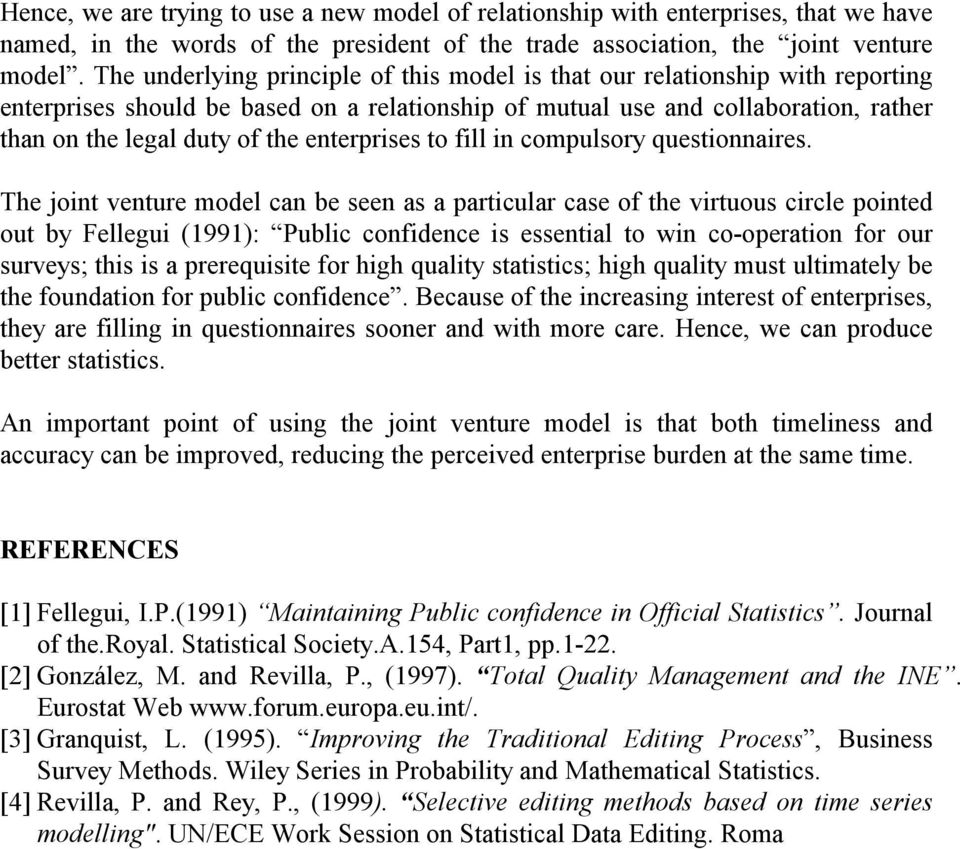
8 Dates ofdissem ination 36 AnnualSurvey Prodcom Survey Months European Regulation:18 m onths Months European Regulation:6 months Days Indices ofindustrial Production European Regulation:45 days Days Indices ofindustrial Prices European Regulation:35 days

Introduction to Quality Assessment
 Introduction to Quality Assessment EU Twinning Project JO/13/ENP/ST/23 23-27 November 2014 Component 3: Quality and metadata Activity 3.9: Quality Audit I Mrs Giovanna Brancato, Senior Researcher, Head
ECLAC Economic Commission for Latin America and the Caribbean
 1 FOR PARTICIPANTS ONLY REFERENCE DOCUMENT DDR/2 22 June 2012 ENGLISH ORIGINAL: SPANISH ECLAC Economic Commission for Latin America and the Caribbean Eleventh meeting of the Executive Committee of the
Report of the 2015 Big Data Survey. Prepared by United Nations Statistics Division
 Statistical Commission Forty-seventh session 8 11 March 2016 Item 3(c) of the provisional agenda Big Data for official statistics Background document Available in English only Report of the 2015 Big Data
JOB DESCRIPTION. Organisation Chart. Customer BI Lead. Business Insight Lead. Business Insight Manager
 JOB DESCRIPTION DIRECTORATE: DEPARTMENT: JOB TITLE: BAND: BASE: REPORTS TO: IT and Business Intelligence Business Intelligence Business Insight Lead 8a Various Customer BI Lead RESPONSIBLE FOR: Business
Data quality and metadata
 Chapter IX. Data quality and metadata This draft is based on the text adopted by the UN Statistical Commission for purposes of international recommendations for industrial and distributive trade statistics.
Strategy for data collection
 2007/21 Plans and reports Strategy for data collection Strategy for data collection The demand for statistics and public administrative information is increasing, as are the demands on quality in statistics
Assessment of compliance with the Code of Practice for Official Statistics
 Assessment of compliance with the Code of Practice for Official Statistics Statistics on National Insurance Number Allocations to Adult Overseas Nationals Entering the UK (produced by the Department for
RATIONALISING DATA COLLECTION: AUTOMATED DATA COLLECTION FROM ENTERPRISES
 Distr. GENERAL 8 October 2012 WP. 13 ENGLISH ONLY UNITED NATIONS ECONOMIC COMMISSION FOR EUROPE CONFERENCE OF EUROPEAN STATISTICIANS Seminar on New Frontiers for Statistical Data Collection (Geneva, Switzerland,
Guidelines for the implementation of quality assurance frameworks for international and supranational organizations compiling statistics
 Committee for the Coordination of Statistical Activities SA/2009/12/Add.1 Fourteenth Session 18 November 2009 Bangkok, 9-11 September 2009 Items for information: Item 1 of the provisional agenda ===============================================================
A Framework to Assess Healthcare Data Quality
 The European Journal of Social and Behavioural Sciences EJSBS Volume XIII (eissn: 2301-2218) A Framework to Assess Healthcare Data Quality William Warwick a, Sophie Johnson a, Judith Bond a, Geraldine
How To Understand The Data Collection Of An Electricity Supplier Survey In Ireland
 COUNTRY PRACTICE IN ENERGY STATISTICS Topic/Statistics: Electricity Consumption Institution/Organization: Sustainable Energy Authority of Ireland (SEAI) Country: Ireland Date: October 2012 CONTENTS Abstract...
Quality management/change management: two sides of the same coin?
 Purdue University Purdue e-pubs Proceedings of the IATUL Conferences 2004 IATUL Proceedings Quality management/change management: two sides of the same coin? Felicity McGregor University of Wollongong
In initial planning phases In monitoring and execution phases
 Project management What is it? Project management is a framework for a range of tools for helping plan and implement development and change projects. A range of tools exist, including: Gantt charts (bar
Quality and Methodology Information
 29 July 2015 Issued by Office for National Statistics, Government Buildings, Cardiff Road, Newport, NP10 8XG Media Office 08456 041858 Business Area 01633 455923 Lead Statistician: Michael Hardie Quality
Statistical Data Quality in the UNECE
 Statistical Data Quality in the UNECE 2010 Version Steven Vale, Quality Manager, Statistical Division Contents: 1. The UNECE Data Quality Model page 2 2. Quality Framework page 3 3. Quality Improvement
Eight Leadership Principles for a Winning Organization. Principle 1 Customer Focus
 Eight Leadership Principles for a Winning Organization Leading and operating an organization successfully requires managing it in a systematic and visible manner. Success should result from implementing
IMLEMENTATION OF TOTAL QUALITY MANAGEMENT MODEL IN CROATIAN BUREAU OF STATISTICS
 IMLEMENTATION OF TOTAL QUALITY MANAGEMENT MODEL IN CROATIAN BUREAU OF STATISTICS CONTENTS PREFACE... 5 ABBREVIATIONS... 6 INTRODUCTION... 7 0. TOTAL QUALITY MANAGEMENT - TQM... 9 1. STATISTICAL PROCESSES
CHAPTER 12.1 INTRODUCTION
 CHAPTER 12 Management Accounting Introduction Divisions of Accounting Financial Accounting Concept of Management Accounting Management Accounting-Definition Importance and Need of Management Accounting
Statistics on E-commerce and Information and Communication Technology Activity
 Assessment of compliance with the Code of Practice for Official Statistics Statistics on E-commerce and Information and Communication Technology Activity (produced by the Office for National Statistics)
Total Quality Management in Engineering Education
 Total Quality Management in Engineering Education EFTHIMIA STAIOU Department of Business Administration University of Macedonia Egnatia 156, P.O. Box 1591, 54006 Thessaloniki GREECE Abstract: - Higher
[300] Accounting and internal control systems and audit risk assessments
![[300] Accounting and internal control systems and audit risk assessments](/thumbs/25/6464424.jpg "[300] Accounting and internal control systems and audit risk assessments") [300] Accounting and internal control systems and audit risk assessments (Issued March 1995) Contents Paragraphs Introduction 1 12 Inherent risk 13 15 Accounting system and control environment 16 23 Internal
[300] Accounting and internal control systems and audit risk assessments (Issued March 1995) Contents Paragraphs Introduction 1 12 Inherent risk 13 15 Accounting system and control environment 16 23 Internal
Seeing the Value in Customer Service
 CCA WHITE PAPER - HOW TO PUT THE DNA OF CUSTOMER SERVICE INTO UK BOARDROOMS 13 Seeing the Value in Customer Service Dr Marco Busi Centre Manager, Centre for Business Process Outsourcing Glasgow, Scotland
218 Chapter 11. Conclusions. Therefore, this thesis aims to contribute to improving productivity of SMEs through DM and Project Communication.
 218 Chapter 11. Conclusions 11. Conclusions 11.1. General conclusions The final objective of whatever research is to improve the knowledge and provide tools to improve it. In whatever company and in whatever
Dimensions of Statistical Quality
 Inter-agency Meeting on Coordination of Statistical Activities SA/2002/6/Add.1 New York, 17-19 September 2002 22 August 2002 Item 7 of the provisional agenda Dimensions of Statistical Quality A discussion
MANAGEMENT ACCOUNTING
 MANAGEMENT ACCOUNTING FORMATION 2 EXAMINATION - AUGUST 2007 NOTES Answer Questions 1 and 2 and three out of Questions 3, 4, 5 and 6. TIME ALLOWED: 3 hours, plus 10 minutes to read the paper. INSTRUCTIONS:
Benchmark Study on the User Experience of Microsoft Dynamics NAV 5.0 and Microsoft Dynamics NAV 2009
 Microsoft Dynamics NAV Benchmark Study on the User Experience of Microsoft Dynamics NAV 5.0 and Microsoft Dynamics NAV 2009 White Paper Abstract This report documents usability benchmark results demonstrating
Integrated Information Management Systems
 Integrated Information Management Systems Ludk Novák [email protected] ANECT a.s. Brno, Czech Republic Abstract The article tries to find consensus in these tree different types of the systems the
CHAPTER 6 FINANCIAL FORECASTING
 TUTORIAL NOTES CHAPTER 6 FINANCIAL FORECASTING 6.1 INTRODUCTION Forecasting represents an integral part of any planning process that is undertaken by all firms. Firms must make decisions today that will
Quality management/change management: two sides of the same coin?
 University of Wollongong Research Online Deputy Vice-Chancellor (Education) - Papers Deputy Vice-Chancellor (Education) 2004 Quality management/change management: two sides of the same coin? Felicity McGregor
Developing Commercial Property Price Indicators
 Developing Commercial Property Price Indicators Paolo Passerini* *European Commission, Eurostat Ottawa Group Copenhagen -1-3 May 2013 Abstract Commercial Property Price Indicators (CPPIs) are a new and
Benchmark Estimating Software
 Flexible software for your industry Asphalt Building Civil Cost Engineers Consulting Estimators Facilities Management Landscaping Manufacturing Mining Plumbing Precast Concrete Public Works Rail Road Authorities
IMPLEMENTING A CUSTOMER RELATIONSHIP MANAGEMENT PROGRAMME IN AN EMERGING MARKET
 IMPLEMENTING A CUSTOMER RELATIONSHIP MANAGEMENT PROGRAMME IN AN EMERGING MARKET Adele Berndt, Frikkie Herbst, and Lindie Roux 1 ABSTRACT Retail financial services in all markets, including emerging markets,
Supply chain intelligence: benefits, techniques and future trends
 MEB 2010 8 th International Conference on Management, Enterprise and Benchmarking June 4 5, 2010 Budapest, Hungary Supply chain intelligence: benefits, techniques and future trends Zoltán Bátori Óbuda
An Overview of ISO/IEC 27000 family of Information Security Management System Standards
 What is ISO/IEC 27001? The ISO/IEC 27001 standard, published by the International Organization for Standardization (ISO) and the International Electrotechnical Commission (IEC), is known as Information
Performing Audit Procedures in Response to Assessed Risks and Evaluating the Audit Evidence Obtained
 Performing Audit Procedures in Response to Assessed Risks 1781 AU Section 318 Performing Audit Procedures in Response to Assessed Risks and Evaluating the Audit Evidence Obtained (Supersedes SAS No. 55.)
The Government of Canada Action Plan to Reform the Administration of Grant and Contribution Programs
 The Government of Canada Action Plan to Reform the Administration of Grant and Contribution Programs Her Majesty the Queen in Right of Canada, represented by the President of the Treasury Board, 2008
Insurance and Reinsurance Broking Risk Management Consultants
 Unison Insurance Broking Services Pvt. Ltd. Insurance and Reinsurance Broking Risk Management Consultants Unison is the First Indian Insurance Broker to win Broker of the Year two years in a row at Asia
Graduate Certificate in Logistics and Supply Chain Management - 2014
 Graduate Certificate in Logistics and Supply Chain Management - 2014 Provided by POSTGRADUATE Graduate Certificate in Logistics and Supply Chain Management About this course Become a leader in this highly
Methodological Approaches to Evaluation of Information System Functionality Performances and Importance of Successfulness Factors Analysis
 Gordana Platiša Neđo Balaban Methodological Approaches to Evaluation of Information System Functionality Performances and Importance of Successfulness Factors Analysis Article Info:, Vol. 4 (2009), No.
The Open University s repository of research publications and other research outputs
 Open Research Online The Open University s repository of research publications and other research outputs Using LibQUAL+ R to Identify Commonalities in Customer Satisfaction: The Secret to Success? Journal
Workplace Productivity Snapshot
 Workplace Productivity Snapshot 2 WORKPLACE PRODUCTIVITY SNAPSHOT How To Use This Tool This self-assessment productivity tool is designed for the owners and managers of small-to-medium businesses. It is
REFLECTIONS ON THE USE OF BIG DATA FOR STATISTICAL PRODUCTION
 REFLECTIONS ON THE USE OF BIG DATA FOR STATISTICAL PRODUCTION Pilar Rey del Castillo May 2013 Introduction The exploitation of the vast amount of data originated from ICT tools and referring to a big variety
Course and Subject Surveys
 Course and Subject Surveys This policy is current as of 1 January 2014 and will be reviewed at least annually by the Academic Board. Scope This policy is applicable to Kaplan Business School Pty Ltd. Overview
Major Trends in the Insurance Industry
 To survive in today s volatile marketplace? Information or more precisely, Actionable Information is the key factor. For no other industry is it as important as for the Insurance Industry, which is almost
Internal Quality Assurance Enhancing quality culture. Workshop report
 Workshop report 16 Internal Quality Assurance Enhancing quality culture A sample of good and ineffective practices on internal quality assurance as presented in the ENQA IQA seminar in June 2010 2 Introduction
THE IMPACT OF TOTAL QUALITY MANAGEMENT COMPONENTS ON SMALL AND MEDIUM ENTERPRISES FINANCIAL PERFORMANCE IN JORDAN
 THE IMPACT OF TOTAL QUALITY MANAGEMENT COMPONENTS ON SMALL AND MEDIUM ENTERPRISES FINANCIAL PERFORMANCE IN JORDAN Dr. Yaser Mansour Almansour, Al Balqa Applied University, Amman Jordan. ABSTRACT Total
Draft guidelines and measures to improve ICT procurement. Survey results
 Draft guidelines and measures to improve ICT procurement Survey results Europe Economics Chancery House 53-64 Chancery Lane London WC2A 1QU Tel: (+44) (0) 20 7831 4717 Fax: (+44) (0) 20 7831 4515 www.europe-economics.com
CUSTOMER RELATIONSHIP MANAGEMENT FOR SME BANKING SYLLABUS
 SYLLABUS This course is intended for those interested in how to develop and deliver a Customer Relationship Management based approach for SME banking customers. It is geared for senior and middle management
Operational Excellence in the Pharmaceutical Industry
 Operational Excellence in the Pharmaceutical Industry OPEX Scan: Analyze the Status Quo Structure the Future Schuh & Company Complexity Management Statements We saved 35 % of total maintenance expenses
Master in Scientific, Medical and Environmental Communication
 SISSA International School for Advanced Studies ISSN 1824 2049 Journal of Science Communication http://jcom.sissa.it/ Comment MASTER IN SCIENCE COMMUNICATION: AN OVERVIEW Master in Scientific, Medical
International Civil Aviation Organization WORLDWIDE AIR TRANSPORT CONFERENCE (ATCONF) SIXTH MEETING. Montréal, 18 to 22 March 2013
 International Civil Aviation Organization ATConf/6-WP/72 1 4/3/13 WORKING PAPER WORLDWIDE AIR TRANSPORT CONFERENCE (ATCONF) SIXTH MEETING Montréal, 18 to 22 March 2013 Agenda Item 2: Examination of key
Assessment of the Key Success Factors of Customer Relationship Management
 Assessment of the Key Success Factors of Customer Relationship Management Meysam Bagheri Pamsari, Maria Dehban, & Hossein Karimi Lulemani M.A. Student of Business Management, Science and Research Branch,
IMPACT OF SUPPLY CHAIN MANAGEMENT STRATEGIES ON COMPETITIVE ADVANTAGE IN MANUFACTURING COMPANIES OF KHUZESTAN PROVINCE
 IMPACT OF SUPPLY CHAIN MANAGEMENT STRATEGIES ON COMPETITIVE ADVANTAGE IN MANUFACTURING COMPANIES OF KHUZESTAN PROVINCE Mohammad Ali Enayati Shiraz, Elham Ramezani 2 Department of Industrial Management,
Quality assurance in the European Statistical System
 Quality assurance in the European Statistical System Øystein Olsen and Hans Viggo Sæbø Statistics Norway Kongens gate 6 PO Box 8131Dep NO-0033 Oslo, Norway [email protected], [email protected] Keywords: Quality framework,
Tendering to Public Sector Organisations
 Tendering to Public Sector Organisations Introduction Authorities have to meet contract regulations and must ensure they provide equal opportunity and achieve the best value for money. Other factors include
Managed funds. Plain Talk Library
 Plain Talk Library Contents Introduction to managed funds 5 What is a managed fund and how does it work? 6 Types of managed funds 12 What are the benefits of managed funds? 15 Choosing a managed fund
CHAPTER 6 QUALITY ASSURANCE MODELING FOR COMPONENT BASED SOFTWARE USING QFD
 81 CHAPTER 6 QUALITY ASSURANCE MODELING FOR COMPONENT BASED SOFTWARE USING QFD 6.1 INTRODUCTION Software quality is becoming increasingly important. Software is now used in many demanding application and
JOB DESCRIPTION. Contract Management and Business Intelligence
 JOB DESCRIPTION DIRECTORATE: DEPARTMENT: JOB TITLE: Contract Management and Business Intelligence Business Intelligence Business Insight Manager BAND: 7 BASE: REPORTS TO: Various Business Intelligence
TOTAL QUALITY MANAGEMENT IN LIBRARIES
 TOTAL QUALITY MANAGEMENT IN LIBRARIES Dr. Vivek Sampatrao Sathe Librarian C.S.P.M. Vaijapur Sanchelit Art s Senior College Aurangabad, Maharashtra, India. Abstract :- This paper discusses the various aspects
Question Bank FACTSHEET 2. Methods of Data Collection in Social Surveys
 Question Bank FACTSHEET 2 Methods of Data Collection in Social Surveys Keywords: Data, Structured Interview, Self completion, Web collection. Introduction This fact sheet will discuss the main methods
Financial Statement Analysis: An Introduction
 Financial Statement Analysis: An Introduction 2014 Level I Financial Reporting and Analysis IFT Notes for the CFA exam Contents 1. Introduction... 3 2. Scope of Financial Statement Analysis... 3 3. Major
RELATIONSHIP BETWEEN BUSINESS INTELLIGENCE AND ORGANIZATIONAL PERFORMANCE (CASE STUDY: FOOD INDUSTRY COMPANIES IN RASHT INDUSTRIAL CITY)
 RELATIONSHIP BETWEEN BUSINESS INTELLIGENCE AND ORGANIZATIONAL PERFORMANCE (CASE STUDY: FOOD INDUSTRY COMPANIES IN RASHT INDUSTRIAL CITY) Mehrdad Goudarzvand Chegini Department of Public Management, Rasht
Modernization of European Official Statistics through Big Data methodologies and best practices: ESS Big Data Event Roma 2014
 Modernization of European Official Statistics through Big Data methodologies and best practices: ESS Big Data Event Roma 2014 CONCEPT PAPER (DRAFT VERSION v0.3) Big Data for Official Statistics: recognition
SESSION 3 AUDIT PLANNING
 SESSION 3 AUDIT PLANNING Learning Objectives: identify and explain the need for planning an audit identify and describe the contents of the overall audit strategy and the audit plan explain the difference
Chapter 7 - Self Assessment
 Chapter 7 - Self Assessment TABLE OF CONTENTS Introduction...1 High Level Must Dos...1 Completing the Self Assessment...1 Format of the Self Assessment...2 Evidence to support Self Assessment...2 Making
Data for the Public Good. The Government Statistical Service Data Strategy
 Data for the Public Good The Government Statistical Service Data Strategy November 2013 1 Foreword by the National Statistician When I launched Building the Community - The Strategy for the Government
OUR FOCUS YOUR GROWTH
 ANALYTICS SERVICES OUR FOCUS YOUR GROWTH There is a plethora of data around us. For most companies, managing this data is becoming vital to building competitive advantage, sustaining and identifying new
AER reference: 52454; D14/54321 ACCC_09/14_865
 Commonwealth of Australia 2014 This work is copyright. In addition to any use permitted under the Copyright Act 1968, all material contained within this work is provided under a Creative Commons Attribution
Methodology Framework for Analysis and Design of Business Intelligence Systems
 Applied Mathematical Sciences, Vol. 7, 2013, no. 31, 1523-1528 HIKARI Ltd, www.m-hikari.com Methodology Framework for Analysis and Design of Business Intelligence Systems Martin Závodný Department of Information
THE IMPACT OF E-COMMERCE ON SMALL AND MEDIUM SIZED ENTERPRISES(SME) IN AUSTRALIA
 THE IMPACT OF E-COMMERCE ON SMALL AND MEDIUM SIZED ENTERPRISES(SME) IN AUSTRALIA Maruf Hasan and Indra Muljadi School of Mechanical & Manufacturing Engineering University of New South Wales, Sydney 2052,