
Rehab and Beyond. Resources to maximize your potential
|
|
|
- Mervyn Bishop
- 10 years ago
- Views:
Transcription
1 UW MEDICINE PATIENT EDUCATION Rehab and Beyond Resources to maximize your potential The Montlake Bridge, just south of the University of Washington Medical Center campus in Seattle Rehab and Beyond

2 The Bridge Builder An old man, going a lone highway, Came, at the evening, cold and gray, To a chasm, vast, and deep, and wide, Through which was flowing a sullen tide. The old man crossed in the twilight dim; The sullen stream had no fears for him; But he turned, when safe on the other side, And built a bridge to span the tide. Old man, said a fellow pilgrim, near, You are wasting strength with building here; Your journey will end with the ending day; You never again must pass this way; You have crossed the chasm, deep and wide Why build you a bridge at the eventide? The builder lifted his old gray head: Good friend, in the path I have come, he said, There followeth after me today, A youth, whose feet must pass this way. This chasm, that has been naught to me, To that fair-haired youth may a pitfall be. He, too, must cross in the twilight dim; Good friend, I am building the bridge for him. By Will Allen Dromgoole Page ii Rehab and Beyond

3 A Note to Patients and Their Loved Ones At UWMC Rehabilitation Services, our main goals are to: Provide safe, high-quality medical care to our patients and support for their families. Make your hospital stay comfortable. Partner with you to help you recover as much of your ability to function as possible. A team of doctors, nurses, allied health professionals, and other support staff will work with you and your trusted loved ones. Together, we will create a team that focuses on your care and the support you need. With your input and guidance, our team is here to provide you and your family the best care possible. Please let us know how we can help. Thank you for choosing UWMC for your health care. Your Rehab and Beyond Manual This Rehab and Beyond manual was written by a team of patients and staff who are serving as advisors on the Rehabilitation Services Patient and Family Advisory Council. They bring many years of personal experience to this manual, and hope that it provides helpful support for the journey that lies ahead. If you have ideas or suggestions for future editions of this manual, please send them to: Rehabilitation Services Advisory Council c/o Patient and Family Centered Care Program 1959 N.E. Pacific St., Box Seattle, WA Phone: [email protected] Page iii Rehab and Beyond
4 Questions? Your questions are important. Call your doctor or health care provider if you have questions or concerns. While you are a patient on Inpatient Rehab (8-North), call After discharge, call your primary care provider or UWMC s Rehabilitation Clinic at Patient and Family Centered Care University of Washington Medical Center (UWMC) provides health care through an approach called Patient and Family Centered Care (PFCC). PFCC invites patients to be as involved in their own health care as they want to be. PFCC also actively involves patients, families, and staff as partners who all have a voice in developing programs and policies and influencing day-to-day interactions in the medical center. Some of its core concepts are communication, information sharing, choices, respect, partnership, and the understanding that the presence of family is a strength, not an inconvenience. Patient and Family Centered Care leads to better health outcomes, wiser allocation of resources, and greater employee, patient, and family satisfaction. It is simply the right thing to do. Without UWMC s practice of Patient and Family Centered Care, Rehab and Beyond would not have been written. A dedicated team of patients, family members, and staff produced this manual. All of these team members added insights, information, and valuable input based on their own expertise and experience. For more information about Patient and Family Centered Care at UWMC, please contact: Hollis Guill Ryan, Program Coordinator UWMC Patient and Family Centered Care [email protected] University of Washington Medical Center Published PFES: 05/2005, 04/2009, 04/2014 Clinician Review: 04/2014 Reprints on Health Online: Page iv Rehab and Beyond

5 UW MEDICINE PATIENT EDUCATION Table of Contents Rehab and Beyond About Rehab and Beyond... ix Entry to UWMC... 1 Admission Information... 1 Insurance Information... 3 Planning Worksheet... 5 Who can help me and my family with this entry process?... 5 What questions should I ask?... 6 About the Rehab Unit... 7 Rehab Unit Layout... 8 Your Room... 8 Meals and Food Visitors Infection Control Smoking Rehabilitation Services Library UWMC Services and Facilities Food and Beverages Maps and Finding Your Way Transportation and Parking Other Resources Your Care Team You: The Patient Medical Staff Nursing Staff Allied Health Professionals Support Staff Page v Table of Contents
6 Peer Mentors for People with Spinal Cord Injury Caregivers Advocates Others Who Can Support You Your Plan of Care and Setting Goals Steps to Develop a Plan of Care Your Plan of Care Tips on Setting Goals Being a Partner in Planning Change as a Part of Life Support First Steps: What Advocates Need to Know Right Now Next Steps: What Advocates Need to Know Long-term Being an Advocate for Yourself and Others Roles for Advocates Legal and Other Appointed Advocates...40 Long-term Care Advocate Caregivers Others in Support Roles Financial Issues Planning Ahead UWMC Financial Counseling Check Your Health Insurance Plan Public Health Insurance Plans Disability Income Insurance Other Options Care After Discharge Preparing for Discharge Tips from Patient Advisors and Staff Caregivers Discharge Checklist Page vi Table of Contents
7 Sample Advertisement for a Caregiver Sample Caregiver Application Sample Telephone Screening Tool for Caregiver Applicants Sample Weekly Caregiver Checklist Sample Daily Routine List Managing Caregivers Personal Boundaries and Caregivers Caring for Your Caregivers Thoughts About Caregivers Self-Care Good Habits Planning Your Day Managing Fatigue Getting Help Supplies Staying Current Eating to Heal A Balanced, Healthy Diet If Your Appetite Is Low Plan Ahead Foods for Specific Health Issues Food Safety Safety Issues Home Safety Fire Safety Personal Safety Personal Emergency Response Systems Companies That Provide PERS Services Internet Resources Page vii Table of Contents
8 Phone Numbers and Resources UWMC Phone Numbers General Support Services in the Seattle Area Independent and Supported Living Options Resources for Housing Options Modifying Your Home Transportation Becoming an Employer in Washington State Federal Requirements for Becoming an Employer Online Guides for Hiring and Managing Caregivers Background Checks Financial Support Recreation and Entertainment Clothing Follow-up What to Expect After Discharge Your Outpatient Care Team Coordinating Your Care Requesting Your Medical Records Medicines (First Prescriptions and Refills) Preventive Care: Staying Healthy Going Forward Solving Problems After Discharge Questions? Your questions are important. Call your doctor or health care provider if you have questions or concerns. While you are a patient on Inpatient Rehab (8-North), call After discharge, call your primary care provider or UWMC s Rehabilitation Clinic at University of Washington Medical Center Published PFES: 05/2005, 04/2009, 04/2014 Clinician Review: 04/2014 Reprints on Health Online: Page viii Table of Contents

9 UW MEDICINE PATIENT EDUCATION About Rehab and Beyond How to use this manual In this section: What will I find in this manual? How is the manual set up? How might I use Rehab and Beyond? What other information will I receive? I wish I had a resource like this manual when I was a patient here. I worked with other UWMC patients to make this manual happen. We have tried hard to include all of the things we wish we had been told. Or, maybe we were told, but we don t remember. When you are first on the rehab unit, there is so much information. It can be overwhelming. This manual was made so that you can go to whichever section you need. If you or your loved ones want to know more about rehab and you cannot find the answer in this manual, please ask a staff member. The main items covered are listed on the front page of each section. If you want to know about something and you can t find the answer here, ask someone on the staff. ~ Patient Advisor Page ix About Rehab and Beyond

10 The authors of Rehab and Beyond wanted to create a manual that is helpful to you, your family, and others close to you as you face new challenges and a changed lifestyle. Some of the authors are patients who have been in inpatient rehab before you, and some are staff members of the unit and other departments at the medical center. Like the old man in The Bridge Builder, the poem inside the front cover, inpatient rehab patients and their family members also must cross a chasm. Our chasm is not like the one in the poem, but it may be just as hard to cross. Our hope is that this manual will serve as your bridge to life, both while you are in inpatient rehab and after you are discharged. It gives you information on the physical set-up of the unit, the staff, and what to expect during your stay. It also describes many resources available to you once you leave the hospital. These resources can help you with hiring caregivers, knowing what transportation and recreation options are available, supporting your personal relationships, and more. We invite you to enter the challenging, compassionate, and technically competent world of inpatient rehab, to meet your rehabilitation team members, and to learn about the services that are available. What will I find in this manual? Rehab and Beyond is your reference manual. Sections include: Entry to UWMC About the Rehab Unit UWMC Services and Facilities Your Care Team Your Plan of Care and Setting Goals Support from Others Financial Issues Care After Discharge Managing Caregivers and Attendants Page x About Rehab and Beyond
11 Self-Care Eating to Heal Safety Issues Phone Numbers and Resources Follow-up How is the manual set up? Each section includes stories from people who have received care or who are currently receiving care on UWMC s rehab unit. We wanted to focus on the basics the information we wish we had when we were inpatients. The front page of each section lists the topics covered in that section. Terms are defined when they appear. Tips from staff and patients are included in each section. How might I use Rehab and Beyond? Use your Rehab and Beyond manual in the way that works best for you. The manual can be read from front to back, or you may want to flip to the section that is most likely to meet your current needs. You may want to bring the manual to clinic visits. Be sure to ask your doctors, nurses, or other caregivers if you need more detailed information than you find in Rehab and Beyond. What other information will I receive? All patients in inpatient rehab also receive the Discharge Binder. This binder contains information that will be useful to you and your family. It will help you become more familiar with our rehabilitation care services and UWMC. Materials in the binder include: Welcome to University of Washington Medical Center Inpatient Rehabilitation Medicine Unit Provides a description of Rehabilitation Medicine Service, the unit, information about welcoming families and visiting hours, your responsibilities as a patient, and more. Information About Your Health Care Gives details about advance directives, other health care choices, and the rights and responsibilities of patients, families, and close companions. Page xi About Rehab and Beyond

12 Questions? Your questions are important. Talk to your doctor, nurse, or other health care provider if you have questions or concerns. While you are a patient on UWMC s inpatient rehab unit, call from your bedside phone. From outside the hospital, call After discharge, call your primary care provider or UWMC s Rehabilitation Clinic: Our Beliefs in Action Describes the purpose, mission, vision, values, and strategic goals of UWMC. Joint Notice of Privacy Practices of UW Medicine and Certain Other Providers Explains how medical information about you will be handled with strict privacy standards, but may be used and disclosed for purposes of receiving quality care, and how you can access this information. Social Work and Care Coordination Department Basic overview of social work services, with hours and contact information. Maps & Directions Contains driving directions to UWMC facilities and floor maps that detail locations for clinics, restrooms, telephones, parking, the Health Information Resource Center, the Gift Shop, the Plaza Café, pharmacy, and where to get more information. Parking Information for Patients Describes parking facilities, locations, rates, and disability parking, and answers frequently asked questions. The Discharge Binder also contains information about: Annual Patient Care Outcomes The Rehabilitation Team Weekly Panels Rehabilitation Jargon, with explanations Disclosure of Financial Information Financial and Billing Offices These items are also included: Blank page with lines for writing notes or questions Phone list with main contact numbers Clear plastic page to hold business cards University of Washington Medical Center Published PFES: , 04/2009, 04/2014 Clinician Review: 04/2014 Reprints on Health Online: Page xii About Rehab and Beyond
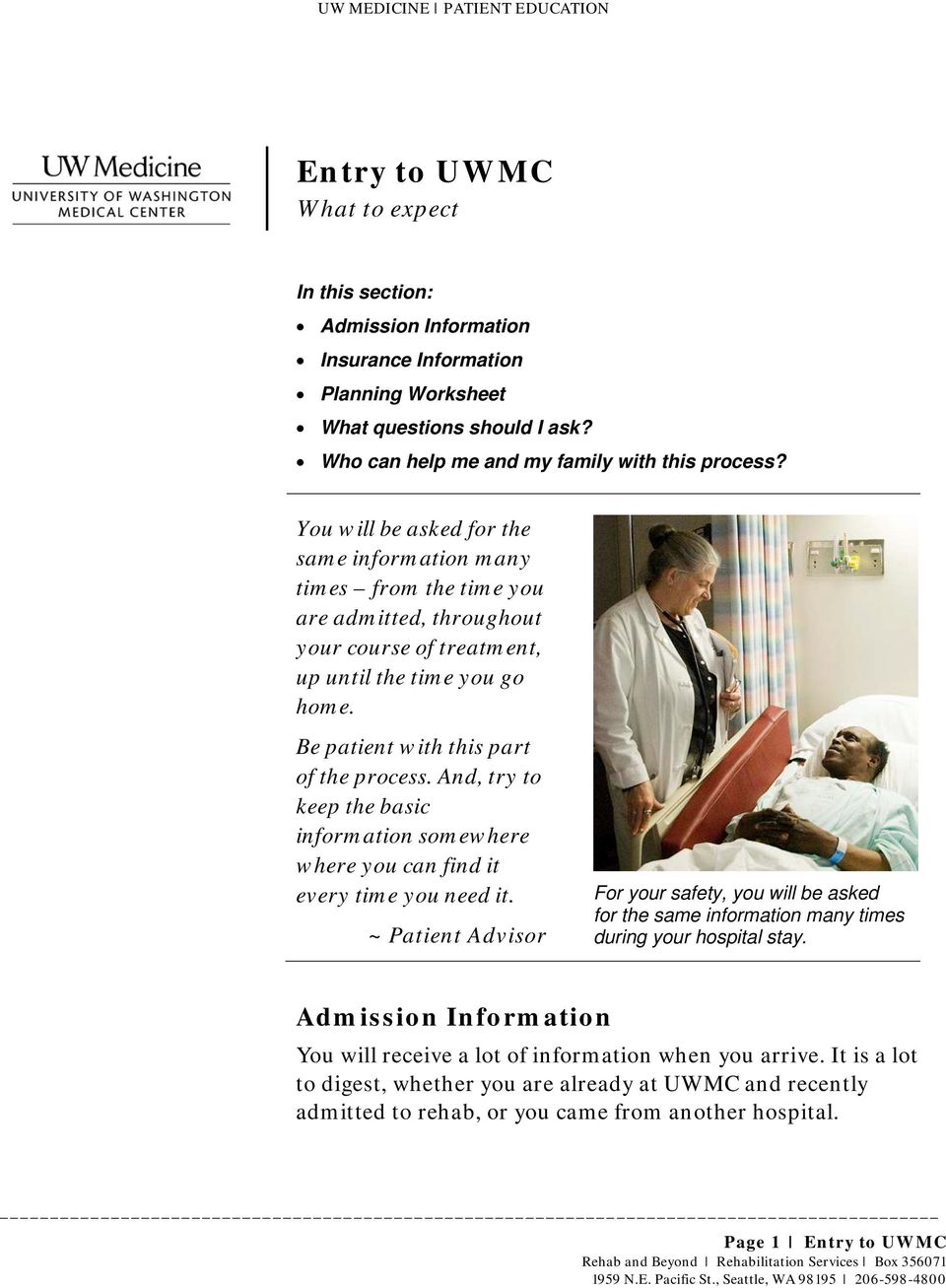
13 UW MEDICINE PATIENT EDUCATION Entry to UWMC What to expect In this section: Admission Information Insurance Information Planning Worksheet What questions should I ask? Who can help me and my family with this process? You will be asked for the same information many times from the time you are admitted, throughout your course of treatment, up until the time you go home. Be patient with this part of the process. And, try to keep the basic information somewhere where you can find it every time you need it. ~ Patient Advisor For your safety, you will be asked for the same information many times during your hospital stay. Admission Information You will receive a lot of information when you arrive. It is a lot to digest, whether you are already at UWMC and recently admitted to rehab, or you came from another hospital. Page 1 Entry to UWMC
14 There is also a lot to do. You may need to fill out paperwork, provide required information from referring doctors, and/or have medical tests done. Your eligibility for treatment options may need to be assessed. You do not have to process all of the information at once. It is normal to be overwhelmed by the rehab team approach to care and the rehab experience. Most people find it works best just to take things one step at a time. Think about naming one person a trusted family member or friend for the care team to communicate with when they have questions or concerns and you are not available or don t feel up to talking. Feel free to ask questions about your injury or disease process, and about what to expect on the rehab unit. If there is anything that is explained or done that you do not understand, ask questions until you understand. Use a system that works for you to keep track of and organize the large amounts of information you will receive during your stay. There is a lot of admission paperwork. When you are admitted, you will answer questions about your health history, have your vital signs checked, and answer many other questions, too. The information you supply helps your care team start to create a plan of care for you. This first stage of your care is called the assessment phase. From the beginning, you will be asked to think about your rehab goals: What do you want to accomplish so that you feel more independent? We will also encourage you to start putting together a supportive group of family and friends who can help you while you are in the rehab unit and after you leave the hospital. See Your Plan of Care and Setting Goals (page 27) and Support from Others (page 33) for help with these parts of your care. Page 2 Entry to UWMC

15 Insurance Information If you have not already researched your insurance options, it will be helpful to do so as soon as possible. Like many people, you may have more than one insurance provider or carrier to coordinate payments for your care. Besides general health insurance, you may also have dental insurance, a vision care plan, or disability insurance. Here are some insurance-related questions you will want answers to: Does my insurance have preferred providers for service? You will need to contact your insurance company(s) to find out if they have a list of preferred providers that will give you better financial coverage for your care. What is my deductible? The deductible is what you pay before the insurance pays. What is my out-of-pocket expense? Out-of-pocket expense can be any combination of your deductible, co-pays, and how much you pay for items not covered by your insurance. Does my insurance company have a stop-loss clause? A stop-loss clause is a type of insurance that provides coverage for certain benefits when total claims during a specified period exceed a specified amount. Most times, this clause specifies the most that the insurance will pay for a particular type of coverage or service. Does my insurance offer case management? What is provided and what does it do for me? Case management is a service delivery approach. The approach assumes that patients with complex and multiple needs will need services from a range of providers. The goal is to achieve seamless service delivery. Check with your insurance company, as each one takes a slightly different approach. Page 3 Entry to UWMC

16 Does my insurance cover home care? If so, what type of therapies and care are covered for home care (such as speech therapy, nursing care, physical therapy, occupational therapy, etc.)? Home care services may include high-tech pharmacy services, skilled professional care, paraprofessional care, custodial care (non-medical care to help with activities of daily living such as bathing and preparing food), home medical equipment, community support, and/or hospice care. Does my insurance cover medical equipment? You may need to rent or buy medical equipment. As you get closer to the date when you will leave the hospital, talk with your team members about your medical equipment needs. Other questions you will want to ask include: Does my insurance cover inpatient, hospital-based rehabilitation care? Is there a maximum dollar amount allowable for inpatient rehabilitation care? Is there a limit to the length of stay, or how many days will my insurance cover my inpatient or hospital stay? What criteria does one have to meet to qualify for inpatient rehabilitation care? Does there have to be a referral for me to be in a rehabilitation care unit? If so, from whom? See Financial Issues (page 43) for more details about medical insurance and income insurance options. Page 4 Entry to UWMC

17 Planning Worksheet Some people like to plan using a tool like this worksheet. Use it to record suggestions made by staff and others, your own ideas, and contact information. What Do I Need, and How Do I Get It? Need Suggestion Your Idea Who do I turn to? Personal Care Business Issues Social Issues Who can help me and my family with this entry process? We all plan in different ways and seek support in different ways. First, you must help with the recovery and rehabilitation process. Take time to get clear about what you want. This is often not an easy time to be clear. That s OK. Do the best you can and know that you can change your mind about what is important, what your goals are, and even about who can help you. (See Support from Others, page 33.) Page 5 Entry to UWMC

18 One tip from a former patient is to ask others for their one best idea. This decreases the amount of ideas you have to filter through. Of course, some people process best when they review a range of ideas. For extra help, you may want to talk with these professionals: A rehab psychologist has years of experience helping patients in situations that are like yours and is trained to help you with this process. A social worker can help you with planning for discharge. (See Care After Discharge, page 49.) Questions? Your questions are important. Talk to your doctor, nurse, or other health care provider if you have questions or concerns. While you are a patient on Inpatient Rehab, call: After discharge, call your primary care provider or UWMC s Rehabilitation Clinic: What questions should I ask? It can be hard to know what questions to ask. It is OK to ask others what information they think is important. It may help to brainstorm a list of topics (such as home care, transportation, support, and legal forms). We have tried to fill Rehab and Beyond with much of the information you might need. You might want to ask questions about: What to expect about your care and living on the rehab unit. Your disease process or injury and how it will affect you and your family. Anything you do not understand. This is how you can become an expert on your care and make the best decisions for you and your family. Resources from staff, former patients, insurance companies, and the Internet to help your recovery. The ways information can be given. We want to give information in the way you prefer to receive it reading (written materials), seeing (videos or watching someone), or doing (demonstrations). If you think of a question when no one who can answer it is around, write it down, record it, or ask someone else to write it down for you. If you had a question and forgot to ask it, please ask later when you remember it. University of Washington Medical Center Published PFES: , 04/2009, 04/2014 Clinician Review: 04/2014 Reprints on Health Online: Page 6 Entry to UWMC

19 UW MEDICINE PATIENT EDUCATION About the Rehab Unit Helpful information In this section: Rehab Unit Layout Your Room Meals and Food Visitors Infection Control Smoking Rehabilitation Services Library Staff from Food and Nutrition Services will bring you a menu and explain how room service works (see page 10). Time on the rehab unit is typically an abrupt and often overwhelming change from our planned lives. As we yearn for full recovery or cure and a return to normal life, gains can seem painstakingly small and the effort exhausting. But each gain is valuable and each step forward furthers your progress. Take heart that you are in one of the nation s very best hospital-based rehab units. The doctors and staff are absolutely dedicated to helping you each and every day to maximize your recovery of daily activities. Through the sadness and the joy, work hard! Your time on 8-North will pass very quickly. ~ Patient Advisor This section of Rehab and Beyond describes your room and the rehab unit. If you have questions about the unit, please ask your nurse or any member of your care team. Page 7 About the Rehab Unit Rehab and Beyond Manual Rehabilitation Services Box

20 Rehab Unit Layout The rehab unit is on the 8th floor of the hospital, in the 8-North wing near the Pacific elevators. The unit has 18 beds. There are 5 single rooms and 9 double rooms, arranged in the shape of a rectangle. The nurses station and main services are at the entrance to the unit. Besides patient rooms, other rooms on the unit include the Laundry Room and the Patient and Family Lounge/ Conference Room. Your Room Your room is designed for your comfort and safety, and to make it easy for your care team to help you. Your bed can be adjusted. Your nurse will teach you how to adjust your bed and bedside table so you are comfortable and safe. There are wall lights above the bed. The controls for these lights are near the door. If you need help with your lights, please ask your nurse or other staff. There is a special ceiling light that your doctor or nurse may use. It is controlled by a timer switch on the call panel near the head of your bed. There is a bathroom in your room. There is an emergency call button/pull cord right next to the toilet. For each bed in the room, there is 1 chair for visitors to use. There is space in the room to store your personal items. Your room is cleaned every day. Call Button Use your call button to call for your nurse if you need help. The call button unit can be clipped close to you so that you can reach it easily. When you push the call button, you may hear a nurse answer through the call panel intercom near the head of your bed. Page 8 About the Rehab Unit Rehab and Beyond Manual Rehabilitation Services Box

21 The call button unit also includes controls for the TV so that you can change channels and adjust the volume. If you cannot operate the controls on the call button unit, talk with someone on your care team about other options. We can change the controls to make them easier to use. Heating/Cooling If you are too hot or too cold, please tell your nurse. We can give you a fan or extra blankets. Phone in Your Room There is a phone for each bed in your room. To make local calls outside the hospital, enter 9 before entering the phone number. We also have phones for patients with special needs. Ask your nurse if you need this kind of help. For long-distance calls: You can use a calling card that you bring from home. You can buy phone cards at the Gift Shop, on the 3rd floor (main level). To make a collect call, enter 9 and then 0 to talk with an outside operator. Cell Phones Some patients prefer to use their cell phones to make phone calls. If there is medical equipment that your cell phone will interfere with, you may be asked to turn off your cell phone. Internet You can use your own laptop computer while you are on the rehab unit. There is free Wi-Fi service in your room. You must have your own Internet service provider. Ask your social worker about how to get an Internet service provider if you do not already have one. To access the Internet: Turn on your laptop, smartphone, or other wireless device. Choose the network Patients and Visitors. Page 9 About the Rehab Unit Rehab and Beyond Manual Rehabilitation Services Box
22 Open your Internet browser. Review the Terms and Conditions. Entertainment Your room has a TV that is mounted on the wall. Your call button unit has a TV channel changer and volume control. You can ask for a hand-held TV remote from your nurse. DVD players are also available for you to use. To learn more about services in the hospital, watch channel 2, our Information Channel. It covers a lot of useful information in a 15-minute show that runs 24 hours a day. Also, entertainment and educational videotapes and DVDs are available at the front desk of the unit. Your recreational therapist can tell you about other entertainment options while you are in the hospital. Meals and Food Meal Service The medical center offers room-service meals to inpatients. Staff from Food and Nutrition Services will bring you a menu and explain how room service works. You can choose what to eat from the menu. Food will be delivered to your room outside of your scheduled therapy times. Please note that your medical needs may decide what foods you can and cannot eat. An after-hours Food Cart with sandwiches and snack foods has a planned route through the hospital every night from 7 p.m. to 3:30 a.m. The schedule of stops is posted on most floors and is available at the front entrance desk. Or, ask a staff person when the Food Cart will be in the rehab unit. There is also a small kitchen, called the Nourishment Room, on the unit. It has simple snack foods and drinks for patients. Food from Home If you want to store food from home in the refrigerator in the Day Room, please tell your patient services specialist (PSS), Page 10 About the Rehab Unit Rehab and Beyond Manual Rehabilitation Services Box
23 patient care technician (PCT), or nurse (RN). All foods must be labeled with your name and the date you place them in the refrigerator. If you are on a special diet, your doctor will need to approve any foods brought from outside the hospital. Visitors Your family and friends are welcome to visit at any time, but we ask that they respect your therapy schedule. Visitors may be limited if you have a roommate or for your own health needs. A visitor ID is needed between 9:30 p.m. and 5:30 a.m. Your visitors can get their ID in the hospital lobby on the 3rd floor. Infection Control It is very important to guard against infection while in the hospital. You and your loved ones will be asked to follow infection control guidelines during your stay. All guests and staff must clean their hands with soap and water or hand sanitizer when they enter your room. This is for your safety and the safety of others on the unit. Smoking UWMC is a smoke-free and tobacco-free hospital. We are committed to a safe and healthy environment for our patients and the entire hospital community. If you smoke or use tobacco, please ask your nurse for more information about these resources: UWMC s handout called Resources to Quit Smoking or Using Tobacco Nicotine patches or gum to use during your stay Quit-smoking session with a pharmacist Family members and visitors who smoke can buy low-cost nicotine gum in the Gift Shop on the 3rd floor or from the after-hours Food Cart. Page 11 About the Rehab Unit Rehab and Beyond Manual Rehabilitation Services Box
24 Rehabilitation Services Library There is a Rehabiliation Services Library on the unit. It has patient education videos and materials and is located in the Conference Room next to the entrance to the rehab unit. Questions? Your questions are important. Talk to your doctor, nurse, or other health care provider if you have questions or concerns. While you are a patient on UWMC s inpatient rehab unit, call from your bedside phone. From outside the hospital, call After discharge, call your primary care provider or UWMC s Rehabilitation Clinic: University of Washington Medical Center Published PFES: , 04/2009, 04/2014 Clinician Review: 04/2014 Reprints on Health Online: Page 12 About the Rehab Unit Rehab and Beyond Manual Rehabilitation Services Box
25 UW MEDICINE PATIENT EDUCATION UWMC Facilities and Services What to expect In this section: Food and Beverages Maps and Finding Your Way Transportation and Parking Other Resources If you need something while you and your family are here, please ask. ~ UWMC Staff All services described in this section are also featured on the Information Channel, channel 2 on the TV in your room. Food and Beverages Cafeteria The hospital cafeteria is called the Plaza Café. Take the Pacific elevators to the 1st floor and follow the signs to the Plaza Café. The Plaza Café is open every day from 6:30 a.m. to 7 p.m. Ask for the weekly menu at the front desk of the rehab unit. The menu is available in Amharic, Chinese, Farsi, Japanese, Korean, Russian, Somali, Spanish, Tigrigna, and Vietnamese. The hospital cafeteria, called the Plaza Café, is open every day from 6:30 a.m. to 7 p.m. Page 13 UWMC Facilities and Services
26 Espresso Stands Espresso stands are: Near the Gift Shop on the 3rd floor (main entry level). Weekday hours are 6:30 a.m. to 9 p.m. Weekend hours are 8:30 a.m. to 4:30 p.m. In the rear of the Plaza Café sitting area on the 1st floor. Open weekdays only, from 6:30 a.m. to 4 p.m. In the Surgery Pavilion on the 1st floor. Open weekdays only, from 7 a.m. to 2 p.m. Midnight Snacks A snack cart stops at different places throughout the medical center from 7 p.m. to 3:30 a.m. every night. You can buy sandwiches and snack foods from the cart. The snack cart schedule is posted at the front desk of the rehab unit. Tea Room A quiet Tea Room is off the 3rd floor hallway that connects the Surgery Pavilion and the medical center. Weekday hours are from 7:30 a.m. to 4 p.m. The Tea Room is closed on weekends. Maps and Finding Your Way You can get maps of the medical center at the Information Desk on the 3rd floor (main entry level). Please ask any staff person with a badge for help with directions. Transportation and Parking If you have a transportation question, talk with someone on your health care team. A social worker may be able to help you with your transportation needs. Parking There are 2 places where patients, families, and visitors can park when coming to UWMC: the Triangle Garage and the Surgery Pavilion Garage. Ask at the nurses station for validation for reduced parking fees for your family members and friends. Page 14 UWMC Facilities and Services
27 If your visitors plan to leave and return on the same day, ask at the gatehouse for an in/out access card. People with disability or mobility parking needs may park in the Surgery Pavilion garage. Or, use valet parking at the main entrance to the medical center and on level P1 of the Surgery Pavilion. The brochure Parking Information for Patients in your Discharge Binder has more details. Other Resources Cash Machines There are 4 automated teller machines (ATMs) in the medical center. They are: On the 3rd floor (main entry level) near the Cashier s Desk (Bank of America) On the 1st floor near the vending machines and restrooms at the Plaza Café (Chase Bank) On the 1st floor next to the Pacific elevators (WSECU Washington State Employees Credit Union) At South Campus Center, outside the northwest entrance (U.S. Bank) Fax If you need to use a fax for sending or receiving health care paperwork, call the Social Work and Care Coordination office or ask your nurse. You can also use the fax at the Health Information Resource Center (see page 16). Notary Services Free notary services are available while you are in the hospital. A social worker can also help you and your family with notarizing health care-related documents. Gift Shop The Gift Shop is near the main lobby on the 3rd floor (main entry level). The Gift Shop sells newspapers, greeting cards, Page 15 UWMC Facilities and Services
28 magazines, phone cards, stamps, gifts, candy, snacks, and beverages. Weekday hours are from 6:30 a.m. to 9 p.m. Weekend hours are from 8:30 a.m. to 5 p.m. The Health Information Resource Center offers UWMC patients and families free use of computers. Health Information Resource Center The Health Information Resource Center is on the 3rd floor (main entry level) of the medical center, near the main entrance and next to the Gift Shop. The center offers UWMC patients and families free use of computers, Internet, printer, fax, phone, and copier. Staff at the center can help you find health information online and in the resource center library. The resource center is open weekdays from 10 a.m. to 4 p.m. For more information, call , [email protected], or visit the resource center website at Hair Salon A hair salon called Flair for Hair is in the South Campus Center, the building just south of the medical center. The salon offers in-room haircuts to UWMC patients. Call (dial 9 first if using a bedside phone) to schedule your appointment. The salon prefers to make morning appointments for in-room service. The salon accepts cash or check. Please make your payment arrangements when you schedule your appointment. Housing The Patient Family Housing Program at UWMC works to make sure patients, families, and caregivers can find affordable housing while receiving medical care in Seattle. To learn more about the program, visit The program provides information about short-term lodging, rates, long-term housing, and transportation options. You can also contact Social Work and Care Coordination for resources (see UWMC Phone Numbers, page 93). Page 16 UWMC Facilities and Services
29 Information Channel The Information Channel is on channel 2 on the TV in your room. It runs nonstop 24 hours a day. All of the information repeats about every 15 minutes. Most of the information covered by the Information Channel is also covered in this section of Rehab and Beyond. Mail and UPS Mail is delivered to patient floors every regular mail day. Place outgoing mail in the mailbox at the nurses station or in the U.S. mailbox in front of the medical center, near the bus stop. The Gift Shop on the 3rd floor has UPS services. UWMC Pharmacy The Pharmacy is on the 3rd floor (main entry level) of the hospital, near the Cascade elevators. When you are discharged, you can pick up and/or buy your medicines at the UWMC Pharmacy weekdays from 8 a.m. to 9 p.m. On weekends, the Pharmacy is open from 8 a.m. to 8 p.m. You will need to pay for your prescriptions when you pick them up. You can pay with cash, check, Visa, or MasterCard. Washers and Dryers There are washers and dryers available for you and your family to use. Ask someone on your care team for more information. Page 17 UWMC Facilities and Services
30 Questions? Your questions are important. Talk to your doctor, nurse, or other health care provider if you have questions or concerns. While you are a patient on UWMC s inpatient rehab unit, call from your bedside phone. From outside the hospital, call After discharge, call your primary care provider or UWMC s Rehabilitation Clinic: University of Washington Medical Center Published PFES: , 04/2009, 04/2014 Clinician Review: 04/2014 Reprints on Health Online: Page 18 UWMC Facilities and Services
31 UW MEDICINE PATIENT EDUCATION Your Care Team Helpful information In this section: You: The Patient Medical Staff Nursing Staff Allied Health Professionals Support Staff Peer Mentors for People with Spinal Cord Injury Caregivers Advocates Others Who Can Support You The staff of the rehab unit is unbelievably vital. What they really rehabilitate is our hearts and minds. Many thanks to the staff! ~ Patient Advisor Note: Care team members are listed in alphabetical order within each section. You: The Patient We strongly urge you to: Ask questions about your care and treatment. Share information about your care concerns, needs, preferences, and treatment. Accept responsibility for learning how to meet your health care needs. Learn about all of your medicines what their names are, why you take them, what they do, and what your usual doses are. Rehab unit staff are here to help. Be sure to ask any questions that you have. Page 19 Your Care Team
32 Do as much as you can for yourself and stay as independent as possible. Be an active participant in your health care. Read the brochure Information About Your Health Care to learn about your rights and responsibilities. This brochure also explains advance directives and durable power of attorney. You will find it in your Discharge Binder. Medical Staff Many people serve special roles as part of your care team: Attending Doctor Your attending doctor, also called a physiatrist, is a specialist in physical medicine and rehabilitation. Your attending doctor directs your care and watches over the care plans and training of resident doctors (see Resident, below). Medical Student A medical student attends medical school. As a part of their medical education, medical students work closely with the residents to learn about caring for patients in the hospital. At times, medical students receive training on the rehab unit. Resident A resident is a doctor who has graduated from medical school and is in training in a special medical or surgical area. An R1 (Resident 1), also called an intern, is a resident in the 1st year of training. An R2 is in their 2nd year, an R3 is in their 3rd year, and an R4 is in their 4th year. Nursing Staff You receive nursing care 24 hours a day, 7 days a week. Many of your nurses are certified in rehabilitation nursing. 8-North Manager The 8-North manager oversees all of the nurses on your care team and is the main person responsible for all operations on the rehab unit. Page 20 Your Care Team
33 Charge Nurse The charge nurse creates the daily nursing assignments, may help in your care, and is in charge of keeping the many services within the unit running smoothly. Clinical Nurse Specialist A clinical nurse specialist (CNS) is a nurse who has advanced clinical training with a master s degree. A CNS is an expert in a special aspect of nursing, such as pain management or wound care. The CNS consults with other nurses and the doctors. Nurse Practitioner A nurse practitioner, also called an advanced registered nurse practitioner (ARNP), is a registered nurse with a graduate degree who has received specialized training to diagnose and treat common medical problems. Many ARNPs have advanced clinical care skills in a specialized area. Patient Care Technician Patient care technicians (PCTs) care for patients as directed by an RN. They help you with personal care such as bathing, dressing, feeding, and toileting. They also help you with getting out of bed and walking on the unit. A PCT may also be called a nurse s aide, hospital assistant, or orderly. Primary Nurse Each patient has a primary nurse who provides bedside care and coordinates all aspects of daily care with other teams and services. All nurses at UWMC are registered nurses (RNs). Allied Health Professionals There are many other health professionals who work with your doctors and nurses to provide the best possible care for you. They include: Dietitian A dietitian is an expert in food and nutrition. Your dietitian will assess your nutritional needs and advise your care team Page 21 Your Care Team
34 about the best diet for you. When needed, dietitians also teach patients and their families how to follow any special diets after leaving the hospital. Registered dietitians have a bachelor s degree, and many have a master s degree. Occupational Therapist An occupational therapist (OT) assesses how well you can do daily tasks such as dressing, bathing, and cooking, and works with you to improve your skills in these areas. These chores are also called activities of daily living (ADLs). An OT may also provide aids, devices, or equipment to help patients do ADLs. OTs are licensed and have a degree at the master s level or higher. An occupational therapist can work with you to help improve your ability to do daily tasks, also called activities of daily living, or ADLs. Pharmacist A pharmacist gives information to medical and nursing staff about the uses, dosage, and effects of medicines. All clinical pharmacists at UWMC have a PhD or Doctor of Pharmacy degree. Pharmacists also teach patients and their families about the medicines they will use during their stay and after they leave the hospital. Physical Therapist A physical therapist (PT) assesses how well you can move around your environment. The PT suggests exercises, therapies, and/or medical equipment to help you safely move more easily and become stronger. The physical therapist and/or occupational therapist may also work with you on issues related to using a wheelchair, if needed. PTs are licensed and have a degree at the master s level or higher. Recreation Therapist A recreation therapist assesses and/or designs activities to improve the physical, mental, emotional, and social functioning of people who are disabled after a trauma or disease. All recreation therapists have a bachelor s degree, are nationally certified, and are registered in the state of Washington. Page 22 Your Care Team
35 Rehabilitation Counselor A rehabilitation counselor helps you with computer access and with your plans to return to work, school, or other activities. Computer access allows patients to stay in touch with friends and family, and allows students to continue with their school work. Rehabilitation counselors can also provide resources and career guidance, or help you set up volunteer work. They have a master s degree and a national certification. Rehabilitation Psychologist/Neuropsychologist An attending rehabilitation psychologist will see you during your hospital stay. You can also meet with your psychologist after you leave the hospital to talk about adjustments and coping with injury and the changes you are facing. Your psychologist will work closely with you, your family, and the team to address issues such as life transitions, depression, anxiety, sexuality, pain management, sleep habits, and more. Your psychologist may also provide education for you and your family on your new condition. Your psychologist may recommend neuropsychological testing while you re in the hospital if you have any problems with your memory, attention, problem-solving, or other thinking skills. Your psychologist may also recommend more extensive outpatient evaluation, depending on your situation. A psychometrist, who is an experienced testing technician, will give you these tests, if needed. You may also see a psychology fellow, a psychologist with a PhD who is receiving specialized training in rehab psychology, or a psychology resident, who is completing PhD training. Both the fellow and resident are supervised by an attending psychologist. Respiratory Therapist A respiratory care therapist (RT) assesses how well you can breathe, and treats you if needed. Your RT will work closely with your doctor and nurse to provide the best oxygen therapy, secretion (phlegm) removal therapy, and pulmonary (lung) diagnostic monitoring while you are in the hospital. If needed, Page 23 Your Care Team
36 your RT will also arrange for you to have oxygen and other equipment when you go home. An RT is licensed and has national credentials. Social Worker A social worker provides support and help with your discharge planning and can also help you with care coordination after you leave the hospital. Your social worker can talk with you about your discharge options and help you find resources for caregiver support, community support, and ongoing rehabilitation in your home or in an outpatient clinic. Your social worker can also help you coordinate with community health care providers and make referrals for continuing care. A social worker is licensed and has a master s degree. Speech Therapist A speech therapist assesses how well you can learn, speak, swallow, and understand and use language (what you hear, read, say, and write). Speech therapists suggest methods or equipment to help you develop new ways to communicate, learn, or swallow. Speech therapists are licensed and have a master s degree. Support Staff Case Management Team Your case management team includes a patient access coordinator and an inpatient case manager. These members of your care team work with your insurance company to help with your admission to the rehab unit. The inpatient case manager is the main contact with your insurance company after you are admitted to the hospital. This staff member also helps with continued authorization for your hospital stay, facilitates group team meetings, helps with documentation of care, and works closely with the social worker on discharge planning. Page 24 Your Care Team
37 Environmental Services Staff These staff members clean your room every day, as well as the lounges and restrooms on your floor of the hospital. Financial Services Counselor A financial services counselor can help you and your family understand your hospital bills. They also work with insurance companies, the Department of Social and Health Services (DSHS), and Medicare to make sure the hospital receives payment for services. If needed, they can help you apply for Medicaid. For directions to Financial Services, ask at the Information Desk on the 3rd floor. (See Financial Issues, page 43.) Operation Supervisor The operation supervisor works closely with the nurse manager to help the rehab unit run smoothly. The operation supervisor makes sure that the non-medical needs of our patients and families are met. The operation supervisor also oversees the interactions between patients and staff. Patient Services Specialist A patient services specialist (PSS) supports our patients and families in non-medical ways. A PSS gathers your daily menu choices, issues stickers for parking discounts, and is available at the front desk to answer basic questions. The PSS also does office work, answers the phone, and helps the doctors, nurses, and families with other hospital services. An patient services specialist will gather your daily menu choices. Peer Mentors for People with Spinal Cord Injury The peer mentor program is for people who have had a spinal cord injury. A peer mentor is a patient who has gone through something similar to what you are going through. You may be able to meet with a peer mentor in person. If you would like to meet with a peer mentor, please talk with your rehab psychologist. Page 25 Your Care Team
38 Questions? Your questions are important. Talk to your doctor, nurse, or other health care provider if you have questions or concerns. While you are a patient on UWMC s inpatient rehab unit, call from your bedside phone. From outside the hospital, call After discharge, call your primary care provider or UWMC s Rehabilitation Clinic: Caregivers Before you leave the hospital, it is important to decide who will be your primary caregiver. This may be your partner, a family member, or a long-time friend. One person may care for you short-term while you are finding a caregiver to hire. Your caregivers schedules will depend upon what works best for you. Some people have more than 1 caregiver at a time, or rotate between 2 or more caregivers. Others may need a caregiver for only a short time. Advocates An advocate is someone who believes in you, the patient, and serves as your support and spokesperson. An advocate is someone who sticks up for you. A caregiver can also be your advocate, if that works well for both of you. Your advocate: Is someone you choose, who is willing and able to act on your behalf. Is someone who can talk with and work with your health care team and your family. May be a partner, sibling, parent, child, or a trusted friend. Your advocate may help with only 1 issue or many issues, only 1 time or many times, for a short time or a very long time. Some advocates may need to fill out paperwork, such as the durable power of attorney form. Others Who Can Support You You may ask for help and support from a neighbor who does not otherwise help in your care or serve as an advocate. For example, your neighbor may be willing to bring in your mail and newspaper each day. Some patients have a trained service dog that helps with tasks of daily living. There are also many services or groups in your community that can provide support. These include the MS Society, the Spinal Cord Injury Association of Washington, Alcoholics Anonymous, and Narcotics Anonymous. University of Washington Medical Center Published PFES: , 04/2009, 04/2014 Clinician Review: 04/2014 Reprints on Health Online: Page 26 Your Care Team
39 UW MEDICINE PATIENT EDUCATION Your Plan of Care and Setting Goals Helpful tips In this section: Steps to Develop a Plan of Care Your Plan of Care Tips on Setting Goals Being a Partner in Planning Changes as a Part of Life Good friends helped connect me with the volunteer office at the MS Association because they knew I was going to need help with physical needs. They found a match for me. I called Victoria and she was at my house in 20 minutes. Victoria was a dancer with the San Francisco Ballet, and now works in the costume shop of a local ballet company. This connection changed my life. Victoria helps me with my finances, answers mail, waters plants, and holds power of attorney for me. But also, through my friendship with her, I am able to go to ballets, and meet dancers, directors, and designers things that I never would have done without this connection. I feel like a Make-a-Wish child because I love ballet and trust Victoria with my life needs. You have to risk reaching out for me, it worked out beautifully. ~ Patient Advisor Many rehab patients find that it is life-changing when they risk reaching out to others for help. Page 27 Your Plan of Care and Setting Goals
40 The members of your care team are described in detail in Your Care Team, pages 19 to 26. All team members will meet with you during the admission process to coordinate the care you will receive during your hospital stay. Steps to Develop a Plan of Care Your care team will work with you to create your plan of care. The main steps in this process are assessment and setting goals. Assessment This step involves a review of your: Health status Medical condition Emotional state This information, along with results from any diagnostic tests, provides a baseline that you and the rehab team can use for setting your rehabilitation goals. Setting Goals Your team will ask you questions about your long-term goals for rehabilitation. You and your team will use these goals to develop your plan of care. You and your therapists will also set weekly goals. These weekly goals come from the goals you set at admission. They also take into account any medical changes that occur during your rehab stay. Your discharge goals are set during your initial evaluation process. Your Plan of Care Your plan of care will be unique to your needs, goals, values, and situation. Sometimes your plan of care must also take be adjusted based on your funding options. Your plan of care and your therapy schedule will include at least 3 hours a day of occupational therapy (OT), physical therapy (PT), and speech therapy. Page 28 Your Plan of Care and Setting Goals
41 During rounds, please share how you are feeling and talk about any concerns you have. During your stay, your health care team will talk about your plan of care and review your treatment during rounds and at panels (see next page). Rounds Members of your care team will visit you each day. This is called rounds. The purpose of rounds is to check on your progress toward your discharge goals. During rounds, please share how you are feeling and talk about any concerns you have about your medical or social condition and treatment. Rounds are a good time for you, a family member, or a loved one to ask questions. Panels (Interdisciplinary Team Conferences) All the members of your care team meet at least weekly to talk with you and review your progress. These meetings are called panels, and they are a very important part of your rehab stay. You and your designated family member, loved one, or advocate are welcome to attend these panels. Panels last about 15 minutes. There is more information about panels in your Discharge Binder. An Interdisciplinary Report is completed at each panel session to track your progress. The goals you have been thinking about are included. Your case manager will give you a copy of the report at the end of your panel meeting. Tips on Setting Goals Set goals that you know you can reach. Goals should be challenging but also realistic. Unrealistic goals can cause frustration. Ask yourself what each of your goals will require of you. Do not lose sight of your goals. Goals need to be specific. It may help to have action steps for each one of your goals. This will give you checkpoints for your progress. Page 29 Your Plan of Care and Setting Goals
42 Some people feel that writing down their goals is much more powerful than just thinking about them. You can write out your goals, or have someone record them for you. Some people find it helps them to stay focused on their goals if they have a personal mission statement. Creating your own mission statement can help you know what is important to you and may help guide your decisions. Your Interdisciplinary Report will also list your goals. Do not worry about having perfect goals. Just get started. Then, be ready and willing to make changes as needed. Being a Partner in Planning Here are some tips from patients, family members, and UWMC staff about how to best partner in your care planning: Attend panels so you are clear about your progress, goals, and needs. Panels are a great place to bring up issues that are important to you. You and your family or loved ones can work with your care team to develop your care and discharge plans. If you have a major issue or one that may take more time than a panel allows, ask to have a separate meeting. Ask questions. This is VERY important. Use the resources available and ask about more resources if you cannot find what you are looking for. Prepare ahead for panels. Write down your list of questions and issues, or ask someone to do this for you. Change as a Part of Life Your rehab psychologist and social worker are here to help you accept change as a part of life. Change can be slow or fast. We know that adaptation and survival work best when we help each other with adjustments. This is true when the change is major, such as severe injury, or more mild, such as when we start a new job. Page 30 Your Plan of Care and Setting Goals
43 Change as a Factor in Rehabilitation Rehabilitation recognizes that change is a part of living. Supporting your ability to adapt to change can make things go better. Your care team plays a part in this process. We want to work with you and your family and loved ones to find ways to cope with and manage the effects of change. This is why we ask you what you did to successfully adapt to past changes, and what your support network of family and friends is like. Readiness for Change How you deal with change depends on many things, including your personality, how easily you move from one idea to another, how you think of yourself, and your culture and upbringing. Each person in rehab has different changes to deal with, and different ways to manage those changes. Your readiness to redefine yourself will be unique, and we will respect your process. Your emotional reserves and physical energy play big parts in how ready you feel to face each day. Your feelings are your starting point, and they should be recognized and validated. How supported you feel will also affect your readiness for change. Talk with your care team about your feelings. This will help us work together to reach your goals. Change Over Time We may not like the changes, but we can get better at adapting to them. Over time, you may grow more comfortable with the changes. Learning how and where to find support can help. The change process involves loss and letting go of the old, while also embracing the new. Grief and loss involve feelings of disbelief, anger, sadness, bargaining, and acceptance and not always in that order. Having some or all of these feelings is normal. They are a part of how people cope with change. Support from others can help you handle the grief you feel. This support can come from those who have been through something similar, or from friends or counselors who are willing to help out and make your adjustment easier. Page 31 Your Plan of Care and Setting Goals
44 Questions? Your questions are important. Talk to your doctor, nurse, or other health care provider if you have questions or concerns. While you are a patient on UWMC s inpatient rehab unit, call from your bedside phone. From outside the hospital, call After discharge, call your primary care provider or UWMC s Rehabilitation Clinic: With time, you will learn what some of your options and opportunities are. Some of these may surprise you. Planned Change Your care team will work with you to help you plan changes, based upon what they know and what you prefer. Planned change is based on the timing of your specific goals. It is often a step-by-step process that involves schedules, appointments, and using special information. Some people do best with planned change of this kind, especially if they prefer logic and practical solutions. If this is how you like to work, gathering information can start you in the direction of positive planned change. Consider finding information from your care team, the Rehab Library, the Internet, UWMC s Health Information Resource Center, members of a support group of patients and families, and other sources. Unexpected Change If you are less comfortable with planned change, you may be open to opportunities that seem to drop into your lap. This can occur when others bring information to you unexpectedly, or when outside forces show you something that you didn t know before. Sometimes, meditation or prayer can open possibilities. At other times, one contact can lead to new resources and helpers. Insight from therapy or counseling can also reveal new ways to look at a problem. Unexpected change can occur when time has passed and your reaction to the loss has shifted. Also, political changes in funding or in care coverage can open new doorways. Whatever the source, unexpected change may take place for you. The choice of how to work it into your life will be yours. I don t like my situation, but I can choose to do the best I can in my situation. ~ Patient Advisor University of Washington Medical Center Published PFES: , 04/2009, 04/2014 Clinician Review: 04/2014 Reprints on Health Online: Page 32 Your Plan of Care and Setting Goals
45 UW MEDICINE PATIENT EDUCATION Support Being an advocate for yourself and others In this section: First Steps: What Advocates Need to Know Right Now Next Steps: What Advocates Need to Know Long-term Being an Advocate for Yourself and Others Roles for Advocates Legal and Other Appointed Advocates Long-term Care Advocate Caregivers Others in Support Roles A spinal cord injury changed my life. But about a year after my accident, my wife and I were invited to join some young friends at their group home for an evening meal. They went to a lot of work getting my power chair around fences, over rough ground, and into their dining room. After having a fine meal with our 15 friends, we began to talk more earnestly about how they were coping with their daily difficulties, some of which were addiction and mental illness. I didn't see it coming, but they then turned the table and asked me how I was coping with my new life. To my friends, I was the same as I had been before my accident. My mind had difficulty trying to truly grasp what they had told me. To them, I was still "me." So, I listed several things that I missed: bike riding, dancing, backpacking, playing guitar, and woodworking in my Page 33 Support
46 garage all things of normal mobility. When I finished my list of laments, they told me that they had never known me in any of those ways, and to them I was the same as I had been before my accident. I was the same! My mind had difficulty trying to truly grasp what they had told me. To them, I was still me. I will never forget their gift to me. I was still a friend and a real person still valued in their eyes. I left there that evening more valued even in my own eyes. May friends always bless us with the truths of their insights. ~ Patient Advisor First Steps: What Advocates Need to Know Right Now A hospital stay is often very stressful. Because of your injury or illness, you may not have the energy or be able to gather the information you need. The first step is knowing that many individuals and resources are available to support you. It is also important to start learning how to better advocate for yourself so that you can ensure your needs are met. As a patient, you have certain rights and responsibilities. Knowing them will help improve your care now and in the future. Ask your nurse for a copy of the UWMC brochure Information About Your Health Care, or look for a copy in your Discharge Binder. A trusted person can serve as your legal advocate, if needed. This person may act on your behalf and represent you in legal, financial, and medical decisions. Start thinking about the right person to serve as your advocate in these ways. Next Steps: What Advocates Need to Know Long-term There are many issues to consider when thinking about how to better advocate for yourself (or a friend or family member). This section of your manual will explain many of these issues. Page 34 Support
47 Of course, you will learn about your current health concerns during your inpatient stay. But, there are other issues related to your care and long-term health that also are important to learn about. These include: Scheduling your follow-up outpatient care Managing your medicines and treatments Making sure your needs are met with caregivers or longterm care facility staff The U.S. government requires every state to have an ombudsman (long-term care advocate) to help people who have concerns about long-term care facilities. Read more about the ombudsman on page 41 of this section. Being an Advocate for Yourself and Others You most likely have many new needs because of your condition. You now must attend to those needs while also navigating the health care system and interacting with many different members of your health care team. This can be overwhelming at times. Learning how to speak in support of yourself or someone you care about is a very important part of maintaining your health and well-being. It is important that you understand your new health needs and how to use the resources that are available to you. This knowledge will help reduce stress and allow you to take a more proactive role in your health care. An advocate is someone who can speak or act on your behalf. Having an advocate can be reassuring, and often works better than trying to handle all your needs by yourself. Whether you are an advocate for someone else or for yourself, here are some skills to develop: Listening and speaking It is important to learn how to clearly communicate information between you, your care team, and family members, as well as write or speak in a way that is easy for others to understand. Organization You will receive a lot of new information. It is important to keep all of that information organized so Page 35 Support
48 that you can find it when you need it. You, a supportive friend, or a family member will want to: Keep a calendar of events and appointments Organize and keep track of your health history, medicines, and other important information Willingness Managing all the aspects of your care may seem overwhelming at first. But, developing the willingness to do this but will help you feel empowered and able to make sure your needs are met. Being assertive and proactive Learn how to act in your best interest and speak up for your wants and needs. This is a vital part in maintaining your health, especially after you leave the hospital. Stay on top of your health care needs. Expertise You can learn from both positive and negative experiences. Both will help you become an expert on how to deal with your care and will serve you well in the long run. There also may be other skills that are helpful. And, you may want to be sure your advocate knows your medical history and has a flexible work schedule. Roles for Advocates Here are some important tasks that either you or your advocate may do: Make Contact Information Lists Develop 2 contact lists. One is a list of your health care providers and insurance contacts. The other is a list of friends and family. No matter what information you include, make a back-up copy of your contact lists. The provider/insurance contacts list might include: Names, phone numbers, fax numbers, and addresses of your doctors, therapists, hospital(s), the hospital s financial counseling office, pharmacy (including refill lines/fax numbers), medical equipment supplier, insurance company, and any other person or service related to your care. Page 36 Support
49 The name and extension number of a contact person at the different care facilities and businesses, especially someone who has been helpful to you. addresses, if this way of communicating works for you and others. Your doctors specialties and which illness or symptom they are treating. Records of service dates. Be sure to include the first date of service, and the last date of service if you are no longer using that provider or service. Your list of family and friends might include: Names, addresses, and phone numbers, including home, work, cell, and fax numbers Notes about work schedules Phone tree and/or address list Priority list of who should be contacted in case of an emergency or unexpected development Best time of day and method to contact each person Here are some tips from other patients on creating your contact lists: Use a one-page, clear plastic business card holder and insert cards. Create cards for people and service providers who do not have printed cards. There is a sample one-page business card holder in your Discharge Binder. Type up your list on a computer and save the file. Print out a copy so it is handy when you need it. Make Phone Calls You or your advocate will likely have to make many phone calls as part of your care. There are low-cost or free ways to make these calls. Two of these are: Getting a discounted landline from your phone company Using a free Internet calling service such as Google Voice or Skype, which you can use to make calls using your computer Page 37 Support
50 Create a Medical History Timeline It will be helpful to create your own medical history card or sheet. You or your advocate can create this timeline. It can have more information than your official medical chart. Here are the items we suggest you put on your timeline: Your name. Date of birth. Basic insurance information and numbers, with space to write down preferred provider limitations, deductible levels, stop-loss policies, dollar allowances for inpatient rehab, length-of-stay limits, home care coverage, and medical equipment coverage. Hospital information, such as your U-card number. Allergies to food and/or medicine. Health history (your own and your family medical history), including health habits, past illnesses, chronic illnesses, surgeries and outcomes, up to your present condition. When possible, include past doctors, dates of surgeries or hospital stays, medicines taken, and other treatments. Many providers also want to know about your biological family s medical history. Often, they ask if certain family members are still living, and if so, whether or not they have chronic illnesses such as high blood pressure, glaucoma, multiple sclerosis, heart disease, or cancer. Also, if a family member is no longer living, they will ask about the cause of death. Include the list of medicines as described below. Make a List of Your Medicines Keep an up-to-date list of the medicines you take. UWMC can give you a free medicine record card. Ask your nurse for one. Or, you can create your own list. You may want to keep this list by the phone in case you have an emergency and you need to call The items we suggest you put on this list include: Page 38 Support
51 Your name. The name of the medicine. The doctor or provider who prescribed the medicine. What the medicine is for. The dose of medicine you take. Some people also like to write down how and when the medicine is taken. Some patients and caregivers like to write down what the medicine looks like (for example, little pink pill or big white oval pill ). Ask your doctor if you should include over-the-counter medicines, vitamins, supplements, and herbal remedies on this list. Since these items can interact with other medicines you take, most doctors want to know everything you are taking. It is also important that you: Always talk with your doctor before you start taking any new over-the-counter supplements or medicines. Update your card or list when you stop taking a medicine, when you start taking others, and when your dose changes. Help with Medical Insurance Issues There is a complete review of medical insurance issues on pages 3 and 4 in Entry to UWMC. You may want to consider having your advocate handle your medical insurance issues. Or, your advocate may be able to help you problem-solve. Be sure to include medical insurance contact numbers on one of your contact information lists. You may also want to make a copy of your insurance card in case your original is lost. Most insurance companies provide a booklet on benefits. Keep this booklet in your files. Check to find out if the same information is on their website. If it is, it will be easy to check for updates online. Plan to check for updates at set times so that you always have the most current information. Page 39 Support
52 Call a customer service representative if you need a better explanation of a benefit or a process related to your coverage. It is OK to ask them to send you the information they tell you in writing for future reference. Keep the name of the customer service representative who helped you and the date of your phone call. Many insurance companies offer mail-in pharmacy services, with lower co-payments or costs than using a traditional pharmacy. Take Notes or Record Conversations with Care Team Members It is common for patients not to recall all of the information given to them during a visit with a health care provider. You can ask your advocate to take notes when you talk with a member of your care team. Or, your advocate might want to use a tape or digital recorder. Notes or a recording can be very helpful later. Your advocate might also help you write down questions you have before you visit with health care providers. Legal and Other Appointed Advocates You may want to have an advocate who helps only with legal issues. Legal documents can be prepared to help your legal advocate or advocates in other roles. A power of attorney is a legal document in which you name another person to act for you. The person you name is your agent and you become the principal. Many people do not know that an ordinary power of attorney is no longer in effect if you become incapacitated through illness or accident. If you want your agent to be able to act for you even if you are incapacitated, you must prepare legal documents giving them durable power of attorney. An easy-to-complete form to name a durable power of attorney is in the booklet Information About Your Health Care, which you will find in your Discharge Binder. Page 40 Support
53 Your durable power of attorney may: Use your money to pay bills Contract home nursing services for your benefit Make basic health care decisions for you Long-term Care Advocate A long-term care advocate is called an ombudsman. Each state is legally required to have an ombudsman to help people who have concerns about long-term care facilities. Residents and their loved ones can voice their complaints to the ombudsman and have their concerns addressed so that residents can live their lives with dignity and respect. A list of regional ombudsmen in Washington state is online at The website includes phone numbers (including toll-free numbers) and contact information. To contact an ombudsman in another state, ask your rehab psychologist for help. Please note that the rehab unit at UWMC is not considered a long-term care facility. Caregivers A caregiver may be your main support if you have a higher level of injury or illness. A caregiver can increase your ability to function and improve your quality of life. Managing caregivers is like running a small home business with an employer and employee(s). As the employer, you seek good help and personalized care. You are also responsible to respect, guide, clearly direct, and pay the employee in compliance with your working agreement. The employee has the right to be treated respectfully in a safe working environment. If you hire a caregiver directly, you manage that person. If you hire through an agency, then you manage the agency managers and the person working for you in your home. Page 41 Support
54 If you hire a caregiver on your own, you are responsible for all legal requirements such as paying social security and withholding taxes. You ll need to manage the payment source(s) and deal with all related personnel issues, such as interviewing, hiring, training, and staffing, and develop policies for dismissal and turnover, emergency coverage, and back-up help. See Care After Discharge, page 49, to learn more about hiring and working with caregivers. Others in Support Roles Based on your care and personal needs, there may be others who serve in a support or advocate role for you. Your support needs may change over time. Be sure to speak up about what you need, from whom, and by when. If needed, work at being able to accept support when it is offered and to decline it graciously when the offer or the timing of the support is not right or not needed. Questions? Your questions are important. Talk to your doctor, nurse, or other health care provider if you have questions or concerns. While you are a patient on Inpatient Rehab, call: After discharge, call your primary care provider or UWMC s Rehabilitation Clinic: University of Washington Medical Center Published PFES: , 04/2009, 04/2014 Clinician Review: 04/2014 Reprints on Health Online: Page 42 Support
55 UW MEDICINE PATIENT EDUCATION Financial Issues Helpful information In this section: Planning Ahead UWMC Financial Counseling Check Your Health Insurance Plan Public Health Insurance Plans Disability Income Insurance Other Options Knowing your needs helps you make plans about paying for them. It really helps to start thinking about these issues as soon after admission as you can face them. ~ Patient Advisor Planning Ahead Planning your finances, both your income and insurance, is a key part of being prepared for rehabilitation and beyond. Most likely, you will need to make decisions for both the short term and the long term. Your case manager will give you a benefit profile, which is a review of your insurance coverage. If you are not from Washington state, your social worker may contact someone who knows about programs in Planning your finances is a key part of being prepared for rehabiliation and beyond. Page 43 Financial Issues
56 your state to advise you and answer your questions. UWMC Financial Counseling staff can also help. Short-term Issues Paying for rehabilitation Transportation and living expenses for your caregiver(s) Long-term Issues Paying for continuing care, including a caregiver, if needed Source of income Paying for medicines and medical supplies, if needed UWMC Financial Counseling UWMC financial counselors can help you and your family: Understand your hospital bills and funding for your hospital stay Work with insurance companies, public insurance plans, and the Department of Social and Health Human Services (DSHS) Apply for Medicaid, now known as Washington Apple Health, and other financial aid For help with applying for insurance after you have been discharged from the hospital, call to set up an appointment with a counselor at the Roosevelt Clinic. Check Your Health Insurance Plan Most insurance plans will pay for rehabilitation. There are many different insurance policies. They have different levels of coverage and limitations. Some do a good job of covering your costs, but others may leave you with big gaps in coverage. Check your plan carefully to find out if it covers: Inpatient hospital stay Does your policy cover inpatient charges at a certain percent (such as 80% or 90%)? Or, do you pay a set co-pay per day while in the hospital (such as $100 per day up to a certain maximum, such as $300)? If your policy pays a percent of the costs, this means you will have a larger bill to pay yourself. Page 44 Financial Issues
57 Waiting periods Some insurance plans require that you be a member of their insurance plan for a certain period of time before you are eligible for some benefits. Coordination of benefits If you are covered by more than one commercial insurance plan, such as through your employer as well as your spouse s employer, you will need to check with the secondary policy to find out its rules on coordination of benefits. This will help you know what expenses your secondary policy will cover after your primary coverage pays. Insurance Coverage for Medicines Here are some questions to ask the inpatient rehab pharmacist about your health insurance plan s prescription drug coverage: Does your insurance cover prescriptions at a certain percentage (such as 50%, 80%, or 90%)? Or, do you pay a set dollar amount co-pay for each prescription (such as $10 for each prescription per month)? Does your insurance provide different coverage based on whether the drug is a generic or a name brand, or what tier it is in? Does your insurance offer a mail-order pharmacy for medicines? These mail-order pharmacies often allow you to get a 3-month supply of medicines for a lower co-pay than if you went to a local pharmacy. Some drug makers offer financial help for people who cannot afford to buy the medicines they have been prescribed. Ask your social worker for more information. These resources may also be helpful: RxAssist This website is sponsored by an organization called Volunteers in Health Care. You can search the database for application forms. Medicare. Visit or call toll-free: Page 45 Financial Issues
58 NeedyMeds This website includes program information, forms, and other helpful links. Partnership for Presciption Assistance A program for Washington state residents. Visit the website or call toll-free: Public Health Insurance Plans Medicare Medicare is a health insurance plan provided by the U.S. government. It is for people who are on dialysis, have had a kidney transplant, have been on Social Security Disability for at least 2 years, or are at least 65 years old. Medicare has a number of deductibles and co-pays. There are 3 parts to Medicare: Part A covers hospital stays. Part B covers doctor fees for inpatient and outpatient services, as well as all approved outpatient expenses. Part D covers prescription drugs. Medicare Supplements or Medigap Policies These policies supplement your Medicare coverage. Most times, they pay the Medicare co-pays and deductibles, but nothing extra. Having Medicare and a Medigap supplement will likely cover most of your costs. Medicaid (Washington Apple Health) Medicaid in Washington state is now known as Washington Apple Health. This is a health insurance plan through the State of Washington for people who have a very low income and are medically disabled. It will pay 100% of covered medical expenses. Talk with your financial counselor or social worker to see if you qualify. Page 46 Financial Issues
59 Washington Healthplanfinder Washington Healthplanfinder, run by Washington Health Benefit Exchange, is an online marketplace for health insurance. It provides: Side-by-side comparisons of health insurance plans Financial help to pay for copays or monthly premiums Expert customer support online, by phone, or in person Visit the Washington Healthplanfinder website at Disability Income Insurance If you were working before coming to the rehab unit, your employer might provide disability income insurance. There are 2 types of income insurance: short-term and long-term. Short-term Disability Short-term disability pays a part of the salary you were earning, often around 60%, while you are off work for a medical reason. Short-term disability usually covers your salary for 3 to 6 months. Long-term Disability Long-term disability insurance pays a part of the salary you were earning, often 60%, for as long as you are considered disabled and unable to work. But, you usually need to be disabled for a minimum length of time, such as 90 days, before benefits will begin. Social Security Disability (SSD) The Social Security Administration (SSA) has its own definition of disability for various illnesses, such as kidney disease or diabetes. The application process can take many months. If you are approved, the monthly amount you receive is based on how much money you have paid to Social Security through payroll taxes. SSA must consider you disabled for at least 5 months before benefits can begin. Also, your disabling condition must be expected to last at least 1 year to be eligible for SSD. Page 47 Financial Issues
60 Supplemental Security Income (SSI) SSI is a disability income program offered through the SSA for disabled people who have not worked enough to pay much to Social Security and are not eligible for SSD. The disability rules are the same as for SSD. But, SSI has strict income and financial limits. Other Options If you are not eligible for any of the above resources, here are some other options: Put aside money to help pay the bills. Borrow money from family and/or friends. Try fundraising. Some people have success with friends and members of their communities holding fundraisers to offset medical costs. You can ask your social worker for more details. Questions? Your questions are important. Talk to your doctor, nurse, or other health care provider if you have questions or concerns. While you are a patient on Inpatient Rehab, call: After discharge, call your primary care provider or UWMC s Rehabilitation Clinic: University of Washington Medical Center Published PFES: , 04/2009, 04/2014 Clinician Review: 04/2014 Reprints on Health Online: Page 48 Financial Issues
61 UW MEDICINE PATIENT EDUCATION Care After Discharge Helpful tips In this section: Preparing for Discharge Tips from Patient Advisors and Staff Caregivers Discharge Checklist Sample Advertisement for a Caregiver Sample Caregiver Application Sample Phone Screening Tool for Caregiver Applicants Sample Weekly Caregiver Checklist Sample Daily Routine List You will most likely keep working on your rehab goals after discharge. From your first day in the hospital, think about your transition to home. Let us help you refer all that you learn to how it will work at home, in your community, and in your workplace. Always think of Inpatient Rehab as the bridge and we will travel that bridge with you. ~ UWMC Staff Preparing for Discharge Your time on the inpatient rehab unit is spent preparing for discharge. Unlike other types of hospital stays, leaving Inpatient Rehab does not mean you re done with your rehabilitation. You will most likely keep working on your rehab goals after discharge. Page 49 Care After Discharge
62 Rehab staff will work with you and do all they can to prepare you for discharge. Their role is to make sure you have learned the skills you need to make a successful transition to home. To help the people who will care for you after discharge, we use a checklist of topics that need to be covered. This checklist will also be used to record who has received the information. See a sample Discharge Checklist starting on page 57. Tips from Patient Advisors and Staff The rehab team is here to make it a smooth transition for you, so that you can be as safe and independent as possible. They work with you to meet your goals. Your care team is always talking about discharge goals. One way to think of it is: What are the quality-of-life elements you want to preserve? For example, if you love swimming, enjoying the water is the quality. One discharge goal would be to give you the skills to allow you to still do that. Go over your normal activities for the day and think about the changes that will need to occur so you can do these things. Review this list with your caregiver and your care team and add their suggestions. Discharge and the transition to home can be very stressful. Be patient with yourself and with those who are helping you, and thank them for their help. Remember how the first few days in rehab were? Going home is a lot like that. Know that it is going to get easier over time. Be clear about the discharge plan and agree about what can be done to meet your needs. It is better to plan to have too much help after discharge than just enough. It is easier to cut back than to add. Support is available from many people, groups, and agencies. Who are the family members or loved ones who can help? What can they do? What support can your community provide? Are there support groups? Where is other information available on the Internet, organizations, etc.? (See Phone Numbers and Resources, starting on page 93.) Page 50 Care After Discharge
63 Identify what caregivers you need and what their role will be. Your rehab team can help you figure this out. Start talking about this early in your rehab stay. This will help ensure success and avoid having to make last-minute decisions. With your help, your care team will try to identify who can help you after discharge. Your long-term needs may become clearer during your stay on the unit. Sometimes the team finds out that because of your care needs, the person who you thought could help will not be able to do so, or not at the level needed. If this happens, you will need an alternate plan. After discharge, you will be interacting more often with people you do not know. When you need help from someone, try asking this way: First describe why you need help, such as I can t reach or, I can t stand up Then say, Please help me to If any information you are given in rehab is unclear, be sure you understand it before discharge. Caregivers What You Need to Know Right Now A big part of coming to terms with an injury or disability is accepting your physical limits. You may have to rely on someone else to help you. It may be hard to balance keeping your independence and dignity with needing help from others. If you need to hire a caregiver, there are many emotional, legal, and practical issues to think about before you start the hiring process. This section of the manual provides suggestions from patient advisors and sample forms to help you. Caregivers can improve the quality of your life by increasing your ability to function and your independence. Assess your abilities and needs. Ask yourself what you can do for yourself and what you need a caregiver to do. Also consider your safety and how long it will take you to do a task yourself. Caregivers can help you with many tasks, Page 51 Care After Discharge
64 including bathing, bowel and bladder care, getting dressed, and filling medi-sets with medicines. It may be helpful to create a personal handbook that you can give to your caregivers with information on how to best help you. If a family member or spouse is your caregiver, many emotional and communication issues will come up. This can lead to tension and blurred relationship boundaries. Think about the issues that are likely to arise. Talk with your loved one about them ahead of time, and then talk about them again when they do come up. It can be emotionally challenging to hire a caregiver, but it may be your best solution. Before hiring anyone, it is wise to learn how to screen, hire, train, and develop a working relationship with someone. Since you will be an employer, there are also many legal and tax issues to learn about. At times you may have problems with caregivers. Be assured that in almost all cases, there are safe and effective solutions. Whether your caregiver is a family member or you hire someone, always have a back-up plan. Know what you will do when your caregiver takes time off or there are emergency situations. What You Need to Know Long-term Over time, you will learn how to manage caregivers and how to keep boundaries in place. It is a learning process, so be patient with yourself. Here are some suggestions to keep in mind: Think like a business. Managing caregivers is like running a business. You must learn what employment situation works best for you (legally, financially, etc.). You will also need to think about: Employer taxes (you will need to apply for a tax ID number) Worker s compensation-type insurance Your homeowner s or renter s insurance for personal injury Stay organized. This will make it easier when there are changes and you need to use a back-up plan, hire a new employee, or ask a loved one to fill in short-term. Page 52 Care After Discharge
65 Support your caregivers. Do what you can to make sure your caregivers are taking care of themselves. They will feel stress and will need your consideration and support. This includes giving them time off and having fill-in help. Be alert to employee burnout, especially with caregivers who work 24 hours a day, are live-in, or who work 7 days a week. Deciding About Caregivers You may be wondering if a family member should be your caregiver. Some people choose a family caregiver because of finances or not being able to hire a caregiver before discharge. Understand that if a family member becomes your caregiver, they will have to juggle their family role with the caregiver role. It will be important for everyone to understand the caregiver s dual responsibilities. Having a family member as your caregiver can work well when there is open communication and respect. If a partner is going to become your caregiver, think about how all areas of your relationship will be affected. Self-esteem and dignity for both you and your caregiver are important. Good communication can help ensure that you are not asking for too much or too little help. Also be aware of what can happen if you lash out at those closest to you. It may help to do some research about how to communicate when you are feeling angry or frustrated. Hiring a Caregiver If you decide to hire a caregiver, think about what their duties will be, such as: Work days and hours Your personal care, health care, and emotional needs Household care needs Also, know what qualities are important to you. You may want a caregiver who has a positive attitude, is dependable and honest, and has experience with caregiving. You may want someone who is a nonsmoker, clean, and lives nearby. Page 53 Care After Discharge
66 You will also need to decide if you want to: Hire someone yourself or use an agency. This may depend on your insurance coverage or other factors. Use your own contact information in advertisements, and if you want to use your own phone to screen and interview applicants. Interview in person or on the phone, have someone you trust do the first round of interviews, interview at your home or in a public place, and whether you want someone you know to be there with you. Advertising Advertising can be frustrating. Many people may respond, but hardly anyone may call. Do not be discouraged and do not settle or compromise on the important traits and abilities you need in a caregiver. Also, keep in mind that some people with less experience can be fast learners and great caregivers. Advertising in a local newspaper works well for some. Others have found success using Craigslist.com or other Internet sites. You may also post flyers at local community colleges and places of worship, or use word of mouth. A good newspaper ad can be brief. Using the word Aide as the first word in the ad places it near the top of the list in the classifieds. Here s an example when seeking an aide to work weekday mornings, who has their own car, and speaks English. The ad includes the general area and a phone number. AIDE Mon-Fri a.m., car, English. North Seattle XXX-XXXX There are sample forms in this section of Rehab and Beyond to help you with the hiring process: The flyer (page 60) summarizes the job and the kind of person you re looking for. It can be posted at places such as local community colleges and places of worship. It can also be used as a job description during an interview. The application form (pages 61 to 64) has questions that will help you get to know the applicant s personality, Page 54 Care After Discharge
67 experience, work ethic, and possible conflicts. These questions can help reduce surprises after hiring someone. The applicant release form (page 64) gives written permission to contact references and previous employers. Many employers require this release form before they will talk with you about the applicant. The telephone screening form (page 65). When you receive calls from applicants: Refer to your job description flyer and have your application form ready. Screen for the most important issues first. Trust your instincts. Be alert to your own response to the applicant. Is this someone you would like to share your living space with? Verify the applicant s experience and references. Background checks are affordable and often can be done in 1 day. Students and older workers can be very good caregivers. Think twice about hiring a caregiver who needs to bring their children to work. At times, they will need to focus more time and attention on their children than on you. Working with Your Caregiver You will be directing your caregivers in what tasks you need help with. Some people find it helpful to have a detailed Daily Routine list with times to keep both their caregivers and themselves on track. (See sample schedule on page 67.) Your caregivers can help you with tasks other than personal care, such as laundry, fixing meals, or cleaning. It may be helpful to have a caregiver checklist that includes household tasks that need to be done on a daily or weekly basis. (See sample checklist on page 66.) Tell your caregiver that you are open to talking about problems. Ask your caregiver for suggestions when problems arise. Make sure they know their opinion counts. When problems come up, handle them promptly. If you use an agency, work through the agency to solve the problems. Page 55 Care After Discharge
68 If you are the employer, try to talk about problems and resolve them as soon as they come up. Do not let a small problem turn into a bigger one. Tell your caregiver your concerns verbally and in writing. Even if you feel that doing this is too business-like, remember that this working relationship is the most important one you have. Your quality of life depends on it. Agree on what changes need to be made, and ask the caregiver to tell you those changes in their own words. When working with your caregiver: Try using humor. Do your best to create a pleasant working environment. Keep the relationship professional. Keep personal and financial information out of sight. Have private areas of your home that are off-limits to your caregiver. Be alert if a caregiver: Asks for advances or loans. Causes health and safety risks due to carelessness. Is late for work, does not show up, does sloppy work, or does not finish work. Has behaviors that bother you, such as smoking, talking on the phone or texting a lot, or watching too much TV. Have a written policy for firing a caregiver. Firing someone is hard to do. If you need to fire someone, ask a friend or family member to be there if you feel threatened. Be calm, assertive, and direct. When a caregiver leaves your employment, make sure they return your keys and other personal property. Change your locks if you feel at all uneasy. Accept that no one employee will be with you forever. Use what you have learned to improve your working relationship with future caregivers. Page 56 Care After Discharge
69 Discharge Checklist Page 1 Service or Equipment Equipment UWMC Resource (person or service) Community Resource Commercial Resource Notes and Comments Supplies Prescription Items Over-the-Counter Items Page 57 Care After Discharge
70 Discharge Checklist Page 2 Service or Equipment UWMC Resource (person or service) Home Modifications (such as doorways) Community Resource Commercial Resource Notes and Comments Structural Modifications (such as ramps) Environmental Controls (such as light switches) Safety Measures Page 58 Care After Discharge
71 Discharge Checklist Page 3 Service or Equipment Activities of Daily Living UWMC Resource (person or service) Community Resource Commercial Resource Notes and Comments Transportation Transfer of Care Services Resources Page 59 Care After Discharge
72 Sample Advertisement for a Caregiver Help Wanted: Aide, Caregiver Days: Hours: Area: (List days you need help.) (List hours you need help.) (Your neighborhood name.) Contact: (List name, numbers, , etc. Include best times to call if telephoning.) Employment Opportunity Part-time morning personal health aide for active adult male quadriplegic with spinal cord injury. I was injured in 1983, have a positive attitude and am healthy, but need morning assistance in my private residence. There are no pets or other distractions. This is not a live-in position. Duties Assist with bathroom routine, cleaning of urological supplies, skin inspection, range of motion, dressing, cooking, exercise program, laundry, light housecleaning. No transfers or heavy lifting. Desired Assistant Profile Speaks English. A person who gets satisfaction from doing their job well. Punctual, dependable, self-directed, nonsmoking. Positive attitude and sense of humor. Ability to work quickly and efficiently. Reliability is very important; unscheduled absences are unacceptable. Washington state driver s license and dependable automobile transportation required. Experience working with male spinal cord injury desired, but I am willing to train. Seeking an individual who wants one or more years work. References, please. Pay Competitive hourly rate; determined individually; paid weekly. Orientation and training with another current employee is typically provided for 3 days. Those orientation days will be paid after 30 days employment. $ extra for New Year s Day, Memorial Day, July 4, Labor Day, Thanksgiving Day, Christmas Day; also for emergency coverage of another shift. Social Security and Medicare taxes withheld and employer s share paid. Aide pays own federal income tax, which will not be withheld. Bonus or raises depend on performance, punctuality, absenteeism, length of employment, compatibility, and general attitude. Additional Position Also Available Occasional fill-in coverage as needed. Job duties and qualifications same as above. Page 60 Care After Discharge
73 Sample Caregiver Application, Page 1 Name Social Security #: - - Date: Address: Home Phone: Cell Phone: Best way to reach you: When: Are you eligible to be employed in the United Sates? Are you over 18? Are you able to meet the attendance requirements? Date available to start: Days of week available: Length of employment desired: Days and/or dates not available: Have you been an attendant before? Number of years? Work with male quadriplegic? License, CNA, etc. Certification number: Are you a licensed personal care business? Driver s license number: State: Auto license: Driving record, describe: Auto insurance company: Have you ever pled Guilty, No Contest, or been convicted of a felony? If yes, please provide date, location, details, and explanation: Smoker: Yes No Physical limitations, allergies, or medicines that may affect your work: Do you have medical insurance? If yes, what? Career goal: Why do you want this job? Education List schools attended; begin with most recent. School: School: School: Degree/Area of study Degree/Area of study Degree/Area of study Summarize any special training that may relate to this job. Personal References I May Contact Name: Relationship: How long? Address: Phone: Name: Relationship: How long? Address: Phone: Page 61 Care After Discharge
74 Sample Caregiver Application, Page 2 Employment History Please begin with your most recent employer. Employer: Phone: May I contact? Supervisor: Phone: May I contact? Location: Start date: End date: Job title: Salary or wage: Hours: Job duties: Reason for leaving: Employer: Phone: May I contact? Supervisor: Phone: May I contact? Location: Start date: End date: Job title: Salary or wage: Hours: Job duties: Reason for leaving: Employer: Phone: May I contact? Supervisor: Phone: May I contact? Location: Start date: End date: Job title: Salary or wage: Hours: Job duties: Reason for leaving: Employer: Phone: May I contact? Supervisor: Phone: May I contact? Location: Start date: End date: Job title: Salary or wage: Hours: Job duties: Reason for leaving: Page 62 Care After Discharge
75 Sample Caregiver Application, Page 3 1. Do you have experience doing bowel programs? 2. Do you have experience doing Range of Motion? 3. Do you have experience doing skin inspection? 4. Give examples of foods or meals you are comfortable cooking: 5. Please list several of your skills. 6. List a few of your personality traits. 7. Are you talkative or on the quiet side? 8. Do you consider yourself patient? 9. Are you detail-oriented? 10. What is your comfortable work pace? 11. What do you do to keep on schedule? 12. What motivates you? 13. What adds to your job satisfaction? 14. What lowers your job satisfaction? 15. How do you handle instruction and constructive criticism? 16. How do you like to receive feedback? 17. How do you communicate your expectations? 18. What kinds of things irritate you? 19. Is it easy for you to accept someone s apology? 20. How many times were you late for work in the last year? 21. How many days of scheduled work did you miss in the last year? 22. I need help every morning. Are you comfortable driving in the snow? 23. Do you have plans, such as vacations, holidays, etc. that will conflict with this position? (list) 24. Are you available and willing to have me call you for substitution work? 25. Will you travel for a few days if the circumstances are satisfactory? 26. What has been the best part of working in home health care for you? 27. What has been the worst part of working in home health care for you? Page 63 Care After Discharge
76 Sample Caregiver Application, Page What salary or wage do you desire? 29. Give an example of how you continue to educate yourself. 30. What is the most important lesson you have learned working with clients? Applicant Release Form I certify that the information I have provided is true and complete. I authorize you to contact references, employers, public agencies, licensing authorities, and other entities as necessary to verify the accuracy of the information I provided. I understand that if hired, I must provide proof of identity and legal authority to work in the United States. I understand that information provided by me that is false, incomplete, or misleading will be sufficient cause for termination of employment. I have read, understand, and accept the statement above. Print Your Name Signature Date Page 64 Care After Discharge
77 Sample Telephone Screening Tool for Caregiver Applicants Callers on Caregiver Advertisement Caller #1: Name Date Time Source Phone: Pager/other number: Notes: Automobile Yes No Gender Male Female SCI Experience Yes No Smoke Yes No Bowel Program Yes No Residence Area Caller #2: Name Date Time Source Phone: Pager/other number: Notes: Automobile Yes No Gender Male Female SCI Experience Yes No Smoke Yes No Bowel Program Yes No Residence Area Caller #3: Name Date Time Source Phone: Pager/other number: Notes: Automobile Yes No Gender Male Female SCI Experience Yes No Smoke Yes No Bowel Program Yes No Residence Area Caller #4: Name Date Time Source Phone: Pager/other number: Notes: Automobile Yes No Gender Male Female SCI Experience Yes No Smoke Yes No Bowel Program Yes No Residence Area Page 65 Care After Discharge
78 Sample Weekly Caregiver Checklist ACTIVITY Date: Hours of sleep # of hours hrs hrs hrs hrs hrs hrs hrs Urine: C=clear, D=dark Bowel movement BM: F=formed, L=loose Peri-care Shower Range of motion Make breakfast Assist with Make lunch Make dinner Assist with C, D S, M, L, XL F or L Y/N Y/N Y/N Y/N Y/N Y/N Assist with exercises # minutes min min min min min min min Vacuum dining room, traffic areas as needed as needed Vacuum house Vacuum sofas (every 2 weeks) Clean bathrooms Wash shower curtain (1 x month) Load/unload dishwasher Shopping Sweep doorways (other as needed) Mop vinyl floors Water plants (fertilize every 2 weeks) Dusting - bedroom Dusting throughout house Laundry old towels old towels bath towels clothes Laundry, bedding Feed animals Print your initials clearly bedding Hours worked # hours hrs hrs hrs hrs hrs hrs hrs (Shaded areas indicate a minimum frequency; mark when completed) vinyl GENERAL NOTES (Enter the date, write miscellaneous notes as needed, then initial your entry) Page 66 Care After Discharge
79 Sample Daily Routine List Morning Caregivers: 7:45 to 8:00 Wake up 8:00 to 8:45 Transfer to toilet, toileting 8:45 to 9:45 Shower and get dressed (Monday, Wednesday, and Friday) 8:45 to 9:15 Put on pants, socks, and shoes 9:15 to 9:30 Transfer to wheelchair 9:30 to 10:00 Eat breakfast, take medicines 10:00 to 10:30 Wash face, brush teeth, comb hair, put on shirt 10:30 to 11:30 Do exercises from my wheelchair Afternoon Caregivers: 12:30 to 1:15 Eat lunch, take medicines 1:15 to 5:00 Free time, appointments, rest in bed if needed Evening Caregivers: 5:00 to 6:00 Eat dinner, take medicines 6:00 to 9:00 Free time 9:00 to 9:30 Wash face, brush teeth, undress 9:30 to 9:45 Transfer back to bed Page 67 Care After Discharge
80 It s normal to be concerned about your discharge. It s a little like going home with a new baby. You will be in a new role, one that you haven t been in before. If you have questions or concerns before you go or after you leave the Rehab Unit speak up. ~ Patient Advisor Questions? Your questions are important. Talk to your doctor, nurse, or other health care provider if you have questions or concerns. While you are a patient on Inpatient Rehab, call: After discharge, call your primary care provider or UWMC s Rehabilitation Clinic: University of Washington Medical Center Published PFES: , 04/2009, 04/2014 Clinician Review: 04/2014 Reprints on Health Online: Page 68 Care After Discharge
81 UW MEDICINE PATIENT EDUCATION Managing Caregivers Helpful tips In this section: Personal Boundaries and Caregivers Caring for Your Caregivers Thoughts About Caregivers Hiring caregivers is hard, necessary, and a hassle, but it is doable. We have had good success. I suspect it is easier when you have another person to share the burden with, and I suspect that the process of hiring has been easier for us because my husband is married to a rehab nurse! I m confident he s a better manager than I am, and the length of time people have been with us is probably due to his personality and the way he manages caregivers. ~ Family Advisor Personal Boundaries and Caregivers Boundaries define limits and mark dividing lines. The purpose of a boundary is to keep different turfs and territories separate. Personal boundaries can mean: The psychological, physical, and emotional space between you and someone else Morals and values Respect for yourself and others Good personal boundaries are best maintained when you stay as independent as possible. Page 69 Managing Caregivers
82 What do personal boundaries have to do with my care? Personal boundaries set the tone for the relationship between you and your caregivers. Caregiving relationships are complex because you have to have help, and you may need very personal care. It can be hard to have family members or loved ones in that role. You feel vulnerable, even while you are grateful for their support. Boundary problems that may occur when a family member is also the caregiver are: The caregiver takes over all decision-making, doing what they feel is best. The person receiving care expects the family caregiver to be available 24 hours a day, 7 days a week. Some examples of boundary problems with hired caregivers are: The caregiver asks to borrow $10 and doesn t pay it back when promised. The person receiving care asks the caregiver to do tasks that are not required or part of their job description. What does it mean to have good boundaries? Good personal boundaries are maintained when you stay as independent as possible. This means directing your own care and making your own choices. Some issues to watch for are: Worrying about being a burden Wanting to keep the caregiver happy Letting someone else make choices Not wanting to make your wishes known Some of the benefits of keeping boundaries in place are: Taking control over what you can control Easing the burden of decision-making Having things done your way Page 70 Managing Caregivers
83 Talk with your loved one about how adding caregiving may change your relationship. What can I do to keep good boundaries? Be assertive in your interactions with others. This doesn t mean you always get what you want, but it does mean that you get to express your needs and wants. Here are examples of what it means to be aggressive, passive, passive-aggressive, and assertive: Aggressive: My way, or not at all. Passive: Your way, or not at all. Passive-aggressive: My way only, but you can think it s your way. Assertive: Let s negotiate I want X and you want Y, so let s talk. How do I keep strong boundaries with unpaid caregivers? Think about how you normally are independent and assertive with your family and friends. Most likely, you talk about: What you need What they need How you want things done How they want things done It can be harder to keep good boundaries when your caregiver is also your spouse, parent, or friend. Talk with your loved one about how adding caregiving may change your relationship. Talk over how to manage the relationship so you can maintain your role as spouse, parent, and child/parent. Talk about issues until you come to a solution you both can live with. How do I keep strong boundaries with paid caregivers? When you hire a caregiver, you are setting up a home-based business. Think about what you d expect from yourself as a good employee. Page 71 Managing Caregivers
84 Make sure your expectations are clear from the beginning of your relationship with a caregiver. This means agreeing on: Start and end times Job tasks Pay scale and pay dates How you will handle requests about time off and pay raises What do I do if boundaries get blurred and complicated? Boundaries will be challenged many times in any relationship, and especially in a relationship with a caregiver. Remember that you can always back up and start over. If you need help finding your way, you can ask peers, find resource guides, or get counseling if needed. Caring for Your Caregivers Counseling Services for Caregivers In the Seattle area, your unpaid caregiver has access to counseling help through Evergreen Hospital in Kirkland, Washington. The program is funded by grants from United Way of King County and Seattle-King County Aging and Disability Services. The counseling sessions focus on problem-solving, self-care, stress management, and helping the caregiver find the community resources and education programs that are available to them. The purpose of the counseling program is to help caregivers take better care of themselves. This also helps them provide better care. Volunteer caregivers can call or for more information about this free counseling program. Thoughts About Caregivers These tips on dealing with hired caregivers come from a registered nurse whose husband has quadriplegia: Page 72 Managing Caregivers
85 When Hiring a Paid Caregiver Be flexible. If possible, let go of any biases about gender, sexual preference, race, etc. We have had a wide range of people work for us male and female, gay and straight, white, black, and Indian. The wider you leave the door open, the more possibilities there are. The bottom line for us is getting someone we trust who can do the job. Our focus is on whether they are a good, trustworthy person who can learn how to do the needed tasks. Safety checks. Do all the recommended safety checks before hiring a caregiver: personal and business references, and a Washington State Patrol check. If you have a bad feeling about someone, trust that feeling. Keep looking until you find the right caregiver for you. Experience. Almost anyone can learn the basic caregiving tasks, so don t worry too much about the past caregiving experience of someone you are thinking about hiring. Sometimes it is good to start with a clean slate. Most people can learn to catheterize, do a bowel program, do transfers, etc. Focus on the person s qualities and integrity. Know that you can teach them the specific tasks you need done. Advertising. There are many good ways to advertise for a caregiver. When placing an ad, give a short list of your requirements (such as DSHS qualified preferred or experience preferred ). Here are some ideas for where to advertise: The Craigslist website is an easy way to advertise online. There are other online resources for finding caregivers such as Posting for caregivers in local college newspapers or placing flyers at local schools or church bulletins can also be a good way to find caregivers. Agencies can help you with hiring caregivers. Don t forget about word of mouth. Your friends and your caregivers can help you find other caregivers. Page 73 Managing Caregivers
86 Get help with the interview process. Ask someone who knows you, cares about you, and is able to read people well to help you interview potential caregivers. Two heads are better than one. Help yourself handle the stress. Hiring a caregiver is hard and stressful, but it is doable. Try to make the process as effective and efficient as possible. Don t feel you have to do it all yourself. If hiring is very hard for you and you cannot find the right caregiver for your needs, you can choose to have someone else do the hiring. A temporary employment agency can be an excellent resource, but they will charge a finder s fee. One family hired a part-time speech pathologist to do the hiring, interviewing, and narrowing down the list to a couple of final candidates. Get short-term help if needed. It can be hard to find a long-term employee, so remember that there are resources when you need help right away. One family got a short-term caregiver through Family Resources. This worked out well until they were able to hire a long-term caregiver. There are a many Home Health care agencies that may be able to help you find short-term caregiving. Network, network, network. Whenever you can, connect with others who might be able to help you in the future with hiring, with coverage when a caregiver needs a break or is on vacation, or with other tasks that need doing. Try to line up relief workers before you need them, by getting phone numbers and checking their rates ahead of time. When a crisis occurs, it is good to be as prepared as possible. Working with Your Employee Treat employees with respect. Being polite, saying please and thank you, helps create good working relationships. At the same time, make sure it is clear who is in charge. You are the boss and have the final word. Be friendly, but keep your boundaries in place, so that it is clear that you are the boss and decision maker. Page 74 Managing Caregivers
87 Give your caregiver time off. Work out other resources so that you can your caregiver time off. Everyone needs a vacation to get refreshed. Quality control. From time to time, check to make sure the job you expect to have done is being done, and done the way you want. Even the best caregiver can slip into poor habits over time. Be ready for the unexpected. What if a caregiver walks out, or doesn t show up? Or what happens if you want to fire your employee? It is important to plan ahead for these types of situations. You may ask a friend or family member to be available to come in on an emergency-only basis, or you might have an agency you could call. Start figuring out now how to find a replacement in emergencies. See Care After Discharge, pages 49 to 68, for more information and thoughts about working with caregivers. Page 75 Managing Caregivers
88 Questions? Your questions are important. Talk to your doctor, nurse, or other health care provider if you have questions or concerns. While you are a patient on Inpatient Rehab, call: After discharge, call your primary care provider or UWMC s Rehabilitation Clinic: Notes University of Washington Medical Center Published PFES: , 04/2009, 04/2014 Clinician Review: 04/2014 Reprints on Health Online: Page 76 Managing Caregivers
89 UW MEDICINE PATIENT EDUCATION Self-Care It s up to you In this section: Good Habits Planning Your Day Managing Fatigue Getting Help Supplies Staying Current I learned that you have to ask for what you want. You are in a new role, one you haven t been in before. Speak up and ask for good care. Make sure you take good care of you. ~ Patient Advisor Good Habits It is important to take good care of yourself. Attend to all aspects of your well-being your physical, spiritual, and emotional health. The basics stay the same eat right, exercise, and get plenty of rest. Avoid smoking. If you drink, do so in moderation. It is important to do as much as you can do for yourself and to stay active. Keep up as many of your old friendships as you can. You are still you, even sick or injured. Page 77 Self-Care
90 Do as much as you can do for yourself and stay active. Learn good communication skills, or improve the ones you already have. These skills will help you take good care of yourself. Assess whether you will need any new health care providers. Get regular check-ups. If there are personal tasks you used to do that you are no longer able to do, such as trimming your nails or shaving, arrange to have them done. Planning Your Day You may need to learn a new level of patience. Expect that many things will take longer to do than before. Ask your caregiver to come at specific and regular times. This will help you plan your day. Learn how to prepare people to spend time with you. Share information about your lifestyle and schedule so they can work with you. Be flexible. You may wake up with a to do list in your head, or even written down. Keep yourself open to changing your priorities. For example, if you have 2 tasks to do, you may need to ask yourself if you have enough energy to do both, or if you should choose to do just one. Know yourself. Are you a morning person or a night person? Do you have more energy and are you more alert in the morning or later in the day? Plan your day to match your energy levels. Be realistic. How long does it take you to get ready to go out? Do you need a caregiver to help you get ready? Observe how much time it really takes you to get ready to go out, and schedule your appointments and outings based on that. It may be hard to be spontaneous in planning outings with friends. Make a point to plan some activities in advance. Page 78 Self-Care
91 Managing Fatigue Try taking a shower or being bathed right before bed, especially if it wears you out. If you must bathe early in the day, plan to take a short rest right afterward. Use a mediset (a plastic box used to hold up to a week s worth of pills) for your medicines. You might even consider buying 2 and filling them with medicines for 2 weeks at a time. This can be a real timesaver. If you do not live with young children or have them over to your home, you may also want to try easy-open caps for your medicines. Try online grocery shopping to save your energy. Many businesses offer free delivery if you spend a certain amount. Use online shopping and catalog shopping for buying gifts. You can pay bills and do your personal bookkeeping online: Many banks now have online bill pay, where you can set up automatic payments for your monthly bills. A software program such as Quicken is easy to learn. It can also create a tax summary report, which you can use for deducting allowed medical expenses. Getting Help Ask friends for help if you need extra emotional support. Take time out to recognize all of the changes that have happened. This may involve some grieving. Give yourself time to adjust to the changes. If you need help handling the emotions that come up, ask your doctor about possible referrals for counseling. It may be very helpful to talk with a rehab psychologist or other mental health provider who has experience working with individuals with health changes. Supplies Plan ahead before you shop. Create a list of supplies so you get what you need. The first choice you find might not be the best item or it may not be the best price. Page 79 Self-Care
92 Ask yourself how fast you need the item. This may affect where you buy it or how much you will spend. Be a savvy consumer, especially on the Internet. The first results that come up in a search may be sponsors who pay to be listed. This means their prices may be higher. Is the item you need covered by insurance? Do you have a choice of vendor, or are you limited by insurance? Find out about delivery options for supplies you need. Some delivery options are faster than others. Sometimes a vendor closer to where you live may be able to deliver more quickly. Staying Current Stay up to date with research related to your injury or illness. Stay current with technology, especially in ways it may help you. Keep in mind that UWMC has an Assistive Technology Clinic. Find good resources. Talk with other people. Find out what they know and what resources they suggest. Questions? Your questions are important. Talk to your doctor, nurse, or other health care provider if you have questions or concerns. While you are a patient on Inpatient Rehab, call: After discharge, call your primary care provider or UWMC s Rehabilitation Clinic: University of Washington Medical Center Published PFES: , 04/2009, 04/2014 Clinician Review: 04/2014 Reprints on Health Online: Page 80 Self-Care
93 UW MEDICINE PATIENT EDUCATION Eating to Heal Your nutritional needs In this section: A Balanced, Healthy Diet If Your Appetite Is Low Plan Ahead Foods for Specific Health Issues Food Safety What you eat is important for your overall health, but especially for wound healing and for your bowel program. ~ Rehab Staff Member Good nutrition is very important after an illness or injury. The foods you eat affect how much you weigh and how well you heal. A Balanced, Healthy Diet Eating a balanced diet means including a variety of foods from each of the different food groups every day. This will help ensure that all your nutrient needs are met. No one food contains all the nutrients your body needs. Eating healthy foods like fresh fruits and vegetables, whole grains, low-fat dairy products, and lean protein foods will give your body the nutrients it needs. And, since these foods are usually lower in calories, they will also help you maintain a healthy weight. A healthy, balanced diet includes plenty of fresh fruits and vegetables. Page 81 Eating to Heal
94 Breads, Cereals, Rice, and Pasta When you buy breads, cereals, and other grain products, choose whole grains when you can. Whole grains have more nutrients than grains that have been processed. For instance, oatmeal and oat bran contain soluble fiber, which reduce how much cholesterol your body absorbs. Fresh Fruits and Vegetables Eat a variety of fresh fruits and vegetables, especially dark green, red, and orange vegetables. The more colorful fruits and vegetables contain higher amounts of phytochemicals, which help your body fight disease. Protein Foods Eat a variety of protein foods, including: Lean meat, poultry, and seafood Eggs Legumes (beans, lentils, peas, and soy) Nuts and seeds (unsalted) Low-fat dairy products Fats Use less solid fat such as butter, stick margarine, and shortening. Instead, use liquid fat such as olive and canola oil. Choose low-fat or nonfat dairy products. Limit foods that contain hydrogenated or partially hydrogenated oils (trans fats). These fats increase your risk for heart disease, stroke, and other health problems. Read the Nutrition Facts label before you buy packaged foods. If Your Appetite Is Low Here are some tips to increase calories and protein if you are having trouble eating regular meals: Try to eat smaller meals more often. Try not to skip meals. Page 82 Eating to Heal
95 Add avocados or guacamole, olives, nuts, and/or seeds to salads and entrees. Add sugar, honey, jam, or syrup for extra calories. Add low-fat milk to soups instead of water. Add diced or ground meat to soups and casseroles. Add protein powder or nonfat milk powder to drinks, soups, mashed potatoes, pudding, casseroles, and hot cereals. Snack on nuts, trail mix, yogurt, or cottage cheese with fruit. Plan Ahead There may be days when you are sick or do not have the energy to cook. To plan ahead for these times: Write down your planned menus for several days. When you shop, make sure you buy everything you need for each of those meals. When preparing meals, make a double batch and freeze servings for later. When needed, you can thaw and reheat small portions of meat, vegetables, or casseroles. Also, make sure you keep foods on hand that are easy to prepare, such as: Frozen, pre-made meals. Choose brands such as Healthy Choice that contain less salt and fat. Always choose meals with less than 500 mg of sodium. Liquid nutritional supplements such as Ensure, Boost, or Carnation Instant Breakfast. Many chain stores also have their own brands that cost less than these name brands. Low-fat cheese, such as low-fat cottage cheese, string cheese, lite cream cheese, or low-fat yogurt. Dried fruit, nuts, and nut butters. Single servings of pudding, custard, ice cream, yogurt, desserts, soups, or fruits. Sandwiches such as grilled cheese, peanut butter and jelly, or egg or tuna salad. Page 83 Eating to Heal
96 Canned foods such as tuna, baked beans, ravioli, pasta, vegetables, fruits, and corned beef hash. Canned or frozen fruit and vegetables. Instant hot cereal made with low-fat milk. Canned salmon, tuna, or sardines. These fish are high in omega-3 fats, which are good for your heart. Low-fat pasta, such as low-fat lasagna or ravioli. Foods for Specific Health Issues The foods you eat affect all aspects of your health. This includes your skin, bowel, bladder, and bone health. If you have questions about how nutrition can impact your illness or injury, work with a dietitian. Together, you can create a diet plan that fits your needs. Here are some health issues to think about and how your food choices can help: Wound Healing Wounds need protein to heal. If you have a pressure sore or an open wound, it is very important that you eat enough protein. Ask your doctor or dietitian how much protein you should eat every day. Constipation Reduced activity, illness, injury, or surgery can cause problems with constipation. If you are constipated: Try eating more high-fiber foods. A high-fiber diet may also help reduce your risk of heart disease and diabetes. Be sure to drink enough fluids, especially if you are on a high-fiber diet. Try to drink 8 cups (8 ounces each) of caffeine-free beverages, for a total of 64 ounces a day. If you are just starting to eat more fiber, begin slowly. Over time, increase the amount of fiber you are eating. The ideal amount is 20 to 35 grams of fiber every day, from a variety of food sources. Page 84 Eating to Heal
97 Bran cereals and berries are good sources of fiber. Some high-fiber foods include: Berries, fresh fruits with skin, and vegetables Oatmeal and oat bran, bran cereals Dried beans (cooked), peas, lentils, nuts Whole-grain pasta, brown rice You can also make this high-fiber supplement to help add fiber to your diet: Homemade High-Fiber Supplement 1 cup unprocessed bran 1 cup applesauce ¼ cup prune juice Cinnamon to taste Combine all ingredients and chill in the refrigerator overnight. Take 1 to 2 tablespoons, 1 to 2 times a day, with 8 ounces of water. Reflux If you have reflux, here are some tips to help reduce your symptoms: Eat low-fat foods. Instead of eating three large meals, eat smaller amounts more often. Avoid foods that irritate the digestive system, such as coffee, chocolate, mint, carbonated beverages, citrus, and tomato. Sit upright while you are eating. Raise the head of your bed. Do not eat for 3 hours before going to bed. Do not wear clothes that fit tightly around your stomach and abdomen. If you smoke, quit. Page 85 Eating to Heal
98 Food Safety While you are healing, it is also very important to keep your food safe to eat. The 4 simple steps to food safety are: Clean: Wash hands and surfaces often, and wash fresh fruits and vegetables well before eating. Separate: Use separate cutting boards, plates, and storage areas for produce (fruits and vegetables) and for animal proteins (meat, poultry, seafood, and eggs). Cook: Cook to the right temperature and keep food hot after cooking. Chill: Refrigerate perishable foods within 2 hours, never thaw or marinate foods on the counter, and know when to throw foods away. Learn more about these and other food safety issues at Questions? Your questions are important. Talk to your doctor, nurse, or other health care provider if you have questions or concerns. While you are a patient on Inpatient Rehab, call: After discharge, call your primary care provider or UWMC s Rehabilitation Clinic: University of Washington Medical Center Published PFES: , 04/2009, 04/2014 Clinician Review: 04/2014 Reprints on Health Online: Page 86 Eating to Heal
99 UW MEDICINE PATIENT EDUCATION Safety Issues Helpful tips In this section: Home Safety Fire Safety Personal Safety Personal Emergency Response Systems Companies That Provide PERS Services Internet Resources When I came home from the hospital, there were a million and one changes that needed to be made. I thought a lot about emergencies making sure I could get to the phone, that I had a home escape plan with a clear path to get out, and that my windows and doors were secure. My brotherin-law installed a ramp, put in some lights around the house, trimmed the bushes, and installed a peephole that I could see out of. ~ Patient Advisor Home Safety Home safety and security include: Making your home accessible for entry and exit in case of emergency Knowing what to do in different types of emergencies Keeping yourself and your valuables safe It will help to take a look at home and personal safety issues from a For your safety, apply for a handicapped-parking permit. Page 87 Safety Issues
100 new perspective. Ask your friends, family, caregivers, and advocate(s) to help you do a full review of your home and make suggestions and changes as needed. Tips Check your home for safety hazards. Some things may have been a problem for a while, or they may only be a problem now that your health status has changed. And, there may be new risks if you are now using a wheelchair. Throw rugs are very slippery and can increase your risk for falling. For your safety, remove them from your home. Your home may need to be remodeled and safety features added. The changes to make and equipment you need depend on your situation. Ask your therapists about equipment or modifications that are likely to work well for your situation. Do some research on how to work with remodeling contractors. This is an area of business that receives a large number of consumer complaints. Perhaps a knowledgeable and trusted friend can manage your remodeling projects. Have a cordless or cell phone, or other communication device on hand in case of emergencies. And, at least 1 phone in your home should work if the power goes out. Keep your important phone numbers handy. If you can, program them into your phone. If you have caller identification (caller ID), always check it before answering your phone. Install a peephole in your door at a level you can use. If someone knocks at your door, look through the peephole to see who it is before you open the door, and before you say anything to them. You may decide you don t want to let the visitor know you re home. It s up to you. If someone you are not expecting comes to the door, you do not have to let that person in, not even a uniformed police officer. It s OK to call a company or the police department to make sure they have sent someone to your home. Page 88 Safety Issues
101 If you have caregivers, make sure they know and follow your safety guidelines. Keep your valuables locked away, with a trusted person, or in a safe deposit box. Keep your car in good running condition, and always keep your gas tank at least half full. Apply for a handicapped-parking permit. These spaces tend to be in well-lit areas close to the entrance of your home, work, or other places you may go. Make sure your smoke detectors and fire extinguishers are in good working order. Fire Safety Call your local fire department and: Tell them your name, address, and special needs. Ask them to help you do a home fire safety inspection and develop a fire escape plan. Once your plan is worked out, be sure to practice making an escape. Change the batteries in your smoke alarms and carbon monoxide detectors every 6 months. Put fire extinguishers where you need them and where you can reach them. Make sure you know how to use them. Visit the U.S. Fire Administration website to learn more about fire safety for people with disabilities: Personal Safety Call your local police department and tell them about your living situation, especially if you live alone, even if you have an attendant. Information they will keep on file includes: Phone numbers for a relative, friend, or neighbor to call in case of an emergency. Information about your medical condition and ability level. Contact information for the person who has a spare key to your home. Page 89 Safety Issues
102 Schedule a time for a police officer come to your home to do a security inspection. The officer will inspect your property, including your locks, lighting, windows, doors, and yard, and then offer safety advice and suggestions as needed. Your neighbors can be a great help in many situations. For example, they can stay aware of your routines and keep a list of your emergency contacts to call if they become concerned. Also, a trusted neighbor can keep a spare set of keys for you. If you have a caregiver, be sure they have a list of your critical personal information, medical information, and emergency contacts. Your caregiver needs to know where to find: Fire extinguishers and smoke alarms First aid supplies Water shut-off valve Electrical breaker box Your emergency exit plan Your caregiver should follow your safety rules and keep your information confidential, especially if you live alone. If you are having problems with your caregiver, or are concerned about your safety in other ways, create a code word you can use to let a trusted person know when you need help. For example, if your code word is PEACHY, you could call the trusted friend and say, I feel PEACHY today! This signals your friend to help in whatever ways you have agreed upon. Your local police department may be able to provide more ideas and resources. Consider taking a personal safety course. Personal Emergency Response Systems A personal emergency response system (PERS) is a device that you can use to call for help in an emergency. There are many different types. Some are activated by pushing a button, flipping a switch, or sipping or puffing (inhaling or exhaling). Page 90 Safety Issues
103 It is very important to have a PERS if you will be alone in your home and may need outside emergency help at some point. Many disabled people find that these systems allow them more independence in the home and that they are a great comfort. Most emergency systems: Monitor 24 hours a day, 7 days a week. Have waterproof buttons. Offer warranties with no charges for service, parts, or labor. Have switches for battery operation during power outages. Use a phone jack or electrical outlet. Companies That Provide PERS Services Here are some companies that provide PERS services. This listing does not mean UWMC endorses these products. Vital-Link: (toll-free), Runs off a battery for about 16 hours if power goes out Strobe light option for people who are deaf or hearingimpaired Puff transmitter option for people who cannot use their hands or arms Life Alert: (toll-free), Pressing a button on a pendant or wrist band calls a dispatcher, who can send paramedics or police right away. Pioneer Emergency Bodyguard: (tollfree), Runs off a battery for 12 hours, then sends a low-battery signal to the monitoring center Operates within 200 feet from base unit Offers a risk-free 30-day trial Page 91 Safety Issues
104 LifeLink Systems: (toll-free), Unit is bought (no monthly fee). When activated, unit calls your choice of friends, family, or 9-1-1, not a monitoring agency. Can choose up to 8 emergency numbers to be called. Uses 9-volt batteries as backup in case of a power outage. Internet Resources Disability Resources provides information to help the disabled live independently: National Patient Safety Foundation provides information about safety topics: Federal Emergency Management Agency (FEMA) provides information for emergencies for individuals with functional or access needs: Questions? Your questions are important. Talk to your doctor, nurse, or other health care provider if you have questions or concerns. While you are a patient on Inpatient Rehab, call: After discharge, call your primary care provider or UWMC s Rehabilitation Clinic: University of Washington Medical Center Published PFES: , 04/2009, 04/2014 Clinician Review: 04/2014 Reprints on Health Online: Page 92 Safety Issues
105 UW MEDICINE PATIENT EDUCATION Phone Numbers and Resources Making it work In this section: UWMC Phone Numbers General Support Services in the Seattle Area Independent and Supported Living Options Resources for Housing Options Modifying Your Home Transportation Becoming an Employer in Washington State Federal Requirements for Becoming an Employer Online Guides for Hiring and Managing Caregivers Background Checks Financial Support Recreation and Entertainment Clothing The Health Information Resource Center on the 3rd floor (main level) of the hospital has staff and computers to help you and your family find health information and other resources. Many agencies and programs can help you after you come home from your rehabilitation at the hospital. These resources and phone numbers will help you find answers to aid in your continued rehabilitation after you return home. As you return to your community, you will have many, many questions. We hope this chapter will help you ease back into your home and community with the numbers and organizations provided by many professionals, advocates, past patients, and their families. ~ Patient Advisor Page 93 Phone Numbers and Resources
106 UWMC Phone Numbers Financial Counseling Weekdays, 8 a.m. to 5 p.m Health Information Resource Center Weekdays, 10 a.m. to 4 p.m Patient Relations Flair for Hair Social Work and Care Coordination Monday, Wednesday, and Friday Tuesday and Thursday General Support Services in the Seattle Area Alliance of People with disabilities helps people with disabilities live more independently in the community. They have 2 independent living centers, in Seattle and Bellevue. The Alliance provides information on services and programs in the community, peer support, and skills training. Areas of help may include housing, attendant care, transportation, employment, assistive technology, and more. Visit Northwest Regional Spinal Cord Injury System (NWRSCIS) is at UWMC. It is one of 14 model systems in the U.S. for treating spinal cord injuries (SCI). NWRSCIS has a very helpful website. It is mainly for those with spinal cord injuries, but may also be helpful to people with other conditions. The archive of SCI Forums and several streaming videos cover a range of topics, including employment, managing your health, transportation, aging, dating, remodeling your home for wheelchair use, and more. The archive of past SCI newsletter articles is a great resource, too. Look under the drop-down menu, Information and Education, to find these resources. Visit Another service of the NWRSCIS is the Peer Mentoring program for inpatients with SCI. Sometimes it helps to talk with someone who has been through what you are facing. Page 94 Phone Numbers and Resources
107 This project matches newly injured patients with a peer of the same gender, a similar injury level, and age. Contact the SCI Peer Mentor Coordinator, Chris Garbaccio, at The NWRSCIS also runs a monthly SCI Support and Information Group at Harborview Medical Center that is open to all individuals in the community with SCI (not just Harborview patients) and their family members and caregivers. Visit or call Chris Garbaccio at Independent and Supported Living Options Skilled Nursing Facilities These community facilities are licensed to provide around-theclock skilled nursing care and skilled therapy services. Medicare requires a 3-day hospital stay before a patient transfers to a skilled nursing facility (SNF). Most facilities accept Medicare, private insurance, Washington Apple Health, and private pay. A list of skilled nursing facilities by city, state, or zip code, along with information about staffing and quality measures, is online at Adult Family Homes These single-family homes in the community are licensed as care facilities for up to 6 residents. They are staffed 24 hours a day. Care level and quality can vary widely, so ask questions and visit the homes you are interested in to make sure your needs can be met. Adult family homes accept Washington Apple Health and private pay. Visit the DSHS website at or the Senior Services website at to learn more. Assisted Living These communities offer apartment living with part-time help for medicine management, bathing, and other activities of daily living (ADLs). Most assisted living communities have a minimum age of 55. Assisted living can be paid for by Washington Apple Health or private funds. Page 95 Phone Numbers and Resources
108 Subsidized Housing Subsidized housing programs for people with disabilities are available in most communities. In the greater Seattle area, there are several Housing Authorities, each with its own application process and waiting list: Department of Housing and Urban Development (HUD) runs a federal housing program for home buyers, home owners, and tenants in multi-family and single-family housing. Section 8 is a voucher program that allows the voucher holder to get housing in any building that accepts Section 8 subsidy. The voucher can also be transferred to another city or state if the resident moves. Resources for Housing Options Here are resources you may find helpful: Seattle Housing Authority King County Housing Authority The Seattle Housing Authority website provides information about different neighborhoods in downtown Seattle. Muckleshoot Housing Authority [email protected] Renton Housing Authority Archdiocesan Housing Authority HUD Subsidized Housing List Section 8 General Information Modifying Your Home After rehab, many people need to make structural changes to their home for them to live there independently. Watch the video Home Modification after Spinal Cord Injury at for ideas on how to make your home more accessible. Page 96 Phone Numbers and Resources
109 This video is also useful for people with other disabling conditions. The webpage lists many other helpful resources, too. Transportation Free Transportation with Washington Apple Health If you have Washington Apple Health, you can arrange free transportation to health care appointments through your local Department of Social and Health Services (DSHS) transportation broker. The broker will arrange for a taxi or cabulance (wheelchair van), if needed. To schedule your ride, call the broker 48 hours before your health care appointment. In King County, the broker is Hopelink, ; TTY ; Regional Transit Buses All buses on the regional transit systems (Metro, Community Transit, and Sound Transit), from Tacoma to Everett, are very accessible, and the drivers are usually very polite to people with disabilities. You can pick up a permit for regional reduced fares at the transit center offices, or call for details. Metro Bus Service is available from the airport and throughout the greater Seattle area. Call or , or visit to plan your trip, check schedules and routes, or buy passes. To learn about other Metro Transit services: Access Transportation: Call ; TTY Relay 711. Dial-A-Ride Transit (DART): Off-route trips can be requested within the DART service area by calling the DART office. Call ; TTY Metro Transits RapidRide: This red-and-yellow bus operates 24 hours a day, 7 days a week. Call ; TTY Relay 711. Page 97 Phone Numbers and Resources
110 Rideshare Operations: Ride matching for daily commutes or for going to special events. Call , TTY , or send an to Regional Reduced Fare Permit: Eligible persons benefit from reduced fares at participating regional transit agencies. Call ; TTY Relay 711. Taxi Scrip Program: Features half-price taxi fares. Call ; TTY Transit Instruction: Free bus and route training for seniors and people with disabilities. Call South Lake Union Streetcar: There is only a very small gap between the platform and the streetcar. Press a button to use the wheelchair ramp. Visit or call ; TTY Relay 711. Sound Transit provides commuter train and bus services to and from areas outside Seattle. To plan your trip or check schedules and routes, go to or call ST Express Customer Service, or Central Link Light Rail goes between Westlake Station in downtown Seattle and SeaTac Airport. It has level boarding from the platform. Call or ; TTY Relay 711; or visit Sound Transit Sounder Commuter Rail travels: Between Tacoma and Seattle; stops in Puyallup, Sumner, Auburn, Kent, and Tukwila Between Everett, and Seattle; stops in Mukilteo and Edmonds Sounder runs weekday mornings and afternoons only. It also serves some weekend events such as Seahawks and Mariners games. Call or visit Community Transit provides commuter bus services to and from communities outside the metro Seattle area. To plan your trip or check schedules and routes, visit call RIDE (7433) or ; or TTY Relay 711. Page 98 Phone Numbers and Resources
111 ADA Paratransit Program The ADA Paratransit Program serves people age 6 and older who cannot use regular bus service because of disability. The program provides rides on ACCESS vans during the times, in the areas, and on the days Metro operates non-commuter bus services. You may bring a personal caregiver on your trip. To use the program, you must first apply and be found eligible. Your application must be co-signed by a health care professional. It may take up to 21 days to be accepted after your completed application is received. Once your application has been accepted and you want to set up a ride, call , option 2. To learn more about this program, call Metro s Accessible Services at or toll-free You can also [email protected]. Joint Paratransit Eligibility Agreement Metro Transit, Pierce Transit, Community Transit, Everett Transit, Kitsap Transit, Intercity Transit, and Jefferson Transit have a joint paratransit eligibility agreement. This means if any of these agencies find you eligible to use the service, you may also use the services of the other agencies. You must apply for eligibility with the transit agency that serves the area where you live. Call your local transit agency for more information. Private Cabulance Services If you do not have medical coupons and need transport in a wheelchair van, you may want to use a private cabulance service. There is a pick-up fee plus a per-mile charge. This service is not covered by Medicare, but in rare cases it is covered by other health care insurance. Some King County cabulance services are: Tri-Med Cabulance JMAC Cabulance Northwest Transport Cabulance Protransport Page 99 Phone Numbers and Resources
112 Shuttle Services Shuttle Express provides shared, door-to-door van service to and from the airport and within town. Their ramp van can hold 3 passengers and a wheelchair. Be sure to request a wheelchair-accessible vehicle when you make your reservation. Reservations office Toll-free in Washington state Office Hours... 8 a.m. to 5 p.m. Monday through Friday Website [email protected] Taxi Services Wheelchair-accessible taxis are available in Seattle and King County. What you should know before you go: Wheelchairs must meet ADA guidelines for size: Width: 30 inches Length: 48 inches Height: 56 inches Weight: Under 600 pounds When you call: Be sure to tell them that you need a wheelchair taxi. Ask for an estimated time of arrival. Tell the call taker if you will be using taxi scrip as payment. If the cab does not arrive in a reasonable amount of time, call again. Phone Numbers Yellow Cab Farwest Green Cab STITA Page 100 Phone Numbers and Resources
113 King County Customer Service Complaint Line If you have a problem with a wheelchair-accessible taxi, call to file a report. You will need to give them: Date and time you took the taxi Taxi number Metro Access You must request Metro Access rides 1 to 3 days before the day you need to travel. Same-day trips are not available. This is a contracted service, which means they pick up and drop off many people on each run. Because of this, it can take a long time to get to your destination or to be picked up. For more information, call Wheelchair-Accessible Van Rental Local dealers of accessible vehicles may also have a small number of rentals. They may be costly, but are worth it if you want to do some traveling. There are often mileage limits per day. Two of these dealers are: Access Mobility Systems in Everett, Washington. They provide accessible van rentals and adaptive equipment such as hand controls and transfer seat bases. Call or toll-free or visit Absolute Mobility Center. They offer wheelchairaccessible van rentals for health care appointments, vehicle repairs, vacations, and special occasions. Call (Seattle), (Tacoma), or toll-free , or visit Becoming an Employer in Washington State Washington State Department of Licensing Business Licensing Service... Click on Get your customized Business Licensing Guide on the right-hand side of the page. Select Domestic Help as your business activity. Page 101 Phone Numbers and Resources
114 Employment Security Department (ESD) District tax offices can help with the Master Business Application and guide you through the new employer process. ESD issues a Unified Business Identification (UBI) number. It is like a Social Security number for your domestic help business. You must file quarterly state employment taxes. ESD website... Unemployment Insurance Tax Information Handbook... Washington State Department of Labor and Industries Worker s Compensation coverage, if you are required or choose to carry it... Washington State Department of Social and Health Services You must file a New Hire Report when you hire a new or returning employee... Federal Requirements for Becoming an Employer Federal Employer Identification Number Apply for your federal Employer Identification Number (EIN) online, and you will receive your EIN right away. You can then download, save, and print your EIN confirmation notice. Visit Internal Revenue Service Requirements Pay Medicare, Social Security, and Federal Unemployment Tax (FUTA) quarterly as a sole proprietor/individual taxpayer with your 1040 Estimated Tax. Form 1040-ES, Estimated Tax for Individuals, is online at Report household employee wages on your annual IRS return. Publication 926, Household Employer s Tax Guide, is online at Publication 15, Employer s Tax Guide is online at Page 102 Phone Numbers and Resources
115 Report household employee wages to the employee with a W-2 form and to the government with a W-3 form in January after the year of employment. Instructions for Forms W-2 and W-3 are online at Guides for Hiring and Managing Caregivers Personal Caregivers: Tips, Tricks and Tales from Individuals with Spinal Cord Injury People with spinal cord injuries share their tips for hiring and managing personal caregivers. The video is also helpful for individuals with other disabling conditions. Watch the video or read the report at Personal Care Assistants: How to Find, Hire and Keep Them Tips and resources: Nav/Craig-Programs/Spinal-Cord-Injury--SCI--Rehab/Healthand-Wellness-Information/Carereceiving/Personal%20Care%20Assistants. Personal Care Assistance: How Much Help Should I Hire? A 4-page guide: /715.PCAHowMuchHelp.NOD.pdf. Hiring and Management of Personal Care Assistants for Individuals with Spinal Cord Injury An excellent 26-page document with good examples of advertisements, interview forms, questions to ask, a rating system for applicants, time sheets, a working agreement, and resources: Managing Personal Assistants: A Consumer Guide A 70-page guide by Paralyzed Veterans of America (PVA). Download the guide for free or order a free printed copy at There is a shipping charge added for printed copies. Background Checks Washington State Patrol WATCH Service gives access to criminal history records in Washington state. Call or visit Page 103 Phone Numbers and Resources
116 The Information Source is a private company that does fast and affordable background checks. You must set up an account before using the service. Call or (toll-free). You may fax in your request using the release form signed by your applicant. Their fax numbers are or (toll-free). They also have an online option at Financial Support Navigating the System: Social Security Disability Insurance (SSDI) and Supplemental Security Income (SSI) Presented by Peter McKee, Attorney, Douglas, Drachler & McKee, LLP. Watch this video or read the report at Financial Support through COPES COPES (Community Options Program Entry System) is a program of the Washington State Department of Social and Health Services (DSHS) that pays for personal care and other services for eligible clients in their own homes or in residential facilities. It is designed for people who, without this financial support, would need to be in nursing homes. Eligibility for COPES is based on health, disability status, and financial need. For information, visit or call (toll-free). A brochure, Summary of Home and Community Services and Eligibility, is available through the Aging and Disability Services Administration website: Recreation and Entertainment There are many free services for people with disabilities: The Flash Card This card, issued by the city of Seattle, allows free access for the card holder and their personal assistant to places such as the zoo and aquarium. Visit dcard.htm, or call for more information. Page 104 Phone Numbers and Resources
117 The Access Pass This card is issued by the National Parks Service. It is a lifetime pass for U.S. citizens or permanent residents with permanent disabilities. The card allows the pass holder and 3 adults to enter the parks for free. Visit Outdoors for All This program allows people with disabilities to continue an active life. Many outdoor activities are available year-round with this group, including alpine skiing, white water rafting, hiking, water skiing, other water sports, weekend excursions, rock climbing, kayaking, and canoeing. Visit or call Washington Trails Association: Accessible Trails Visit these websites for information on accessible trails in Washington state: Footloose Sailing A sailing program for people with all types of disability. Visit Movie theatres Many movie theatres offer free entry for your caregiver/assistant. Although this is not widely known, just ask at the box office if they offer this service. Plays, symphony, sporting events, concerts, and more Go out and have some fun! Most of these public facilities have good access for people with disabilities. Staff are usually very helpful and you may get the best seats in the house! Some places offer free admission for your caregiver/assistant. Ask at entry if they offer this service. Accessible Travel Advice and events that might interest you for your future travel along with great information on accessibility. Visit Seattle Adaptive Sports (SAS) The mission statement of SAS is to enhance and promote the well-being of physically challenged individuals by giving them the opportunity to participate and compete in athletic and recreational activities. Visit or call Page 105 Phone Numbers and Resources
118 Wheelchair Yoga and Meditation Visit for information about conferences and tapes. Check your local yoga centers; they may have a seated yoga class. Clothing Many websites offer clothing and patterns designed for people with disabilities. Here are some you might explore: Access Clothing: Fashion Freaks: en.fashionfreaks.se Professional Fit Clothing: USA Jeans: Questions? Adaptive Products Adaptive Computer Products Links to websites and books: ErgoMart Office and computer products: EnableMart Assistive technology hardware and software: InfoGrip Assistive technology hardware and software: Your questions are important. Talk to your doctor, nurse, or other health care provider if you have questions or concerns. While you are a patient on UWMC s inpatient rehab unit, call from your bedside phone. From outside the hospital, call After discharge, call your primary care provider or UWMC s Rehabilitation Clinic: University of Washington Medical Center Published PFES: , 04/2009, 04/2014 Clinician Review: 04/2014 Reprints on Health Online: Page 106 Phone Numbers and Resources
119 UW MEDICINE PATIENT EDUCATION Follow-up After you leave the hospital In this section: What to Expect After Discharge Your Outpatient Care Team Coordinating Your Care Requesting Your Medical Records Medicines (First Prescriptions and Refills) Preventive Care: Staying Healthy Going Forward Solving Problems After Discharge In my opinion, preparing a patient and their family for a safe and stress-free discharge is one of the most important things to address in therapy. Our priority is to help patients and families be aware of what questions may come up once they get home, and to make sure they know who to call when something occurs. ~ Rehab Staff Member Your physiatrist will make recommendations about your needs for follow-up therapy. What to Expect After Discharge Follow-up visits with your Outpatient Care Team. Your attending doctor will arrange for your follow-up visits. It is important to attend these appointments so that your ongoing medical and rehabilitation issues can be managed. After discharge, your care will be provided by your Outpatient Care Team rather than your inpatient team. Page 107 Follow-up
120 Medicines first prescriptions and refills. You will receive prescriptions for your medicines before discharge. You will also need to get refills as your medicines get low. Preventive health care. Your Outpatient Care Team wants to partner with you to create a long-term plan for your health. Problem solving. You have resources to help with issues that may occur after you leave the hospital. Ask your care team or social worker for more information. Your Outpatient Care Team Primary Care Provider (PCP) Your PCP is usually a family medicine or internal medicine doctor who coordinates care and manages medical issues. This doctor will handle many of your health-related problems, keep your medical history, review your medicines and medical records, and refer you to specialists as needed. UWMC Rehabilitation Medicine Clinic If you and your PCP decide you will have your follow-up visits at UWMC s Rehabilitation Medicine Clinic on 8-South, your first appointment will be made just before discharge. You will be seen by a physiatrist or nurse practitioner with rehabilitation expertise in this clinic. If you have any questions or concerns, feel free to call the Rehab Clinic weekdays from 8 a.m. to 5 p.m. The phone number is , and the fax number is Physiatrist (Physical Medicine and Rehabilitation Doctor) Your physiatrist will oversee your rehabilitation issues, including home health or outpatient therapies, and prescription of medical equipment or medical supplies. This doctor assesses your needs and also makes recommendations for vocational or psychological counseling, as needed. Page 108 Follow-up
121 Specialists Other specialist doctors may help manage your ongoing medical issues. These specialists may be urologists, cardiologists, nephrologists, oncologists, surgeons, or others who have been involved in your care. They will work with your PCP and physiatrist. Physical, Occupational, or Speech Therapists Ongoing rehabilitation therapies can be provided, either as an outpatient (at UWMC or other facility) or through a home health agency in your home. Your attending physiatrist will make first recommendations and oversee your rehabilitation plan of care for 1 month after discharge or until you see an outpatient physiatrist or other doctor who will assume oversight of your outpatient rehabilitation program. Nursing Care Nursing care may be prescribed. This may be through a home health care agency or in a specialty clinic such as Wound Care. Nurse Practitioner and Clinic Nurse A nurse practitioner (ARNP) is a registered nurse with special training for providing primary health care, including many tasks usually done by a doctor. ARNPs can specialize in a certain area of medicine such as rehab or pediatrics. The clinic nurse (RN) is a registered nurse who can assist you when you have questions and can make sure your PCP gets important information about your health care. Coordinating Your Care Your attending doctor will talk with your primary care and specialist doctors and provide a discharge summary of the care you received while you were in the hospital. Choosing Your Primary Care Provider If you do not already have a PCP when you are ready to leave the hospital, your Inpatient Rehabilitation Team can help you find one. Page 109 Follow-up
122 If you need help finding a PCP after discharge, you can call any of the University of Washington Physician Network (UWPN) neighborhood clinics or the General Internal Medicine Clinic (GIMC) at UWMC Roosevelt, at We encourage you to visit your PCP within 2 weeks of discharge. Your insurance companies may require a referral if you want coverage for seeing other health care providers. These referrals can be made by your inpatient doctor or your PCP. Requesting Your Medical Records We recommend you have your medical records sent to your PCP. This is usually done when you are discharged from the hospital. To get your medical records after discharge, contact Health Information Management, Room BB306 on the 3rd floor of the medical center, weekdays from 9 a.m. to 5:30 p.m. You will need to fill out and submit a release of information form. Call Health Information Management at for more information (be sure to dial 9 first when calling from your bedside phone). Medicines (First Prescriptions and Refills) Your attending physiatrist will give you a complete list of your medicines and prescriptions before discharge. Prescriptions usually provide medicine to last 1 month. Your PCP and other consulting doctors will receive a copy of your discharge summary, including a complete list of the medicines you were prescribed upon discharge. UWMC Prescription Refills To refill a prescription, use our Refill Authorization Center (RAC), even if you get your medicines through a different pharmacy. If your prescription says it has no refills left, the RAC will take care of getting it refilled. Remember that requests take 48 hours to process. Here are the steps to follow when you need prescription refills: Page 110 Follow-up
123 If you use an outside pharmacy, call your pharmacy and have them fax us your refill request to This is the fastest way to get refills authorized. If you want prescriptions to be mailed to you, call the RAC at Follow the phone instructions and press the # key to proceed. You will need to provide: Your first name, last name, and hospital ID number Your daytime phone number The name of the medicine and the amount you need The name and phone or fax number of your pharmacy The name of your primary care provider and clinic Coumadin (or warfarin) If you are taking Coumadin, a blood thinner, either your PCP or an anticoagulation clinic will need to closely monitor your health. If you like, you can have the Anticoagulation Clinic at UWMC take care of your blood work and Coumadin prescriptions. To learn more, please call Preventive Care: Staying Healthy Going Forward Routine preventive health appointments you will need to schedule include immunizations; health risks and healthy lifestyle counseling; and checkups, tests, and screenings. Immunizations Getting the right shots can protect you from various diseases. Health Risks and Healthy Lifestyle Counseling Talk with your health care provider about: The importance of regular exercise Diet and eating habits Smoking Drug and alcohol use Birth control and sexually transmitted disease Page 111 Follow-up
124 Checkups, Tests, and Screenings Checkups, tests, and screenings help find health problems early. This can help you make changes in your health habits and get treatment that may save or lengthen your life. Knowing the facts can improve your chances of getting good care. Many screenings can be done by your PCP, during your annual physical exam. No one screening schedule is right for everyone. Be sure to think about your risk factors. For example, if you have a spinal cord injury, you may have a greater risk for urinary tract infections, high cholesterol, or diabetes. Work with your PCP to plan a schedule that is right for you. You will need to ask for the screenings and tests you want to have done. Do not assume that your PCP will schedule all of the screenings that you need. At your annual physical exam, talk with your PCP about your general health, your disability, and other aspects of your life. This helps you build a partnership and a good working relationship with your PCP. The tables below and on the next page show recommended health care screenings and how often they should be done: When Daily Monthly Yearly Screenings and Exams Skin self-checks (if you are sensation-impaired) Women: Breast self-exam Men: Testicular self-exam Visit with PCP, check weight and blood pressure Digital rectal exam after age 40 Check for blood in your stool (feces) after age 50 to detect colon polyps that may become cancerous Flu shot Women: Clinical breast exam after age 40 (sooner if a self-exam is hard to do) Baseline mammogram in your 30s or 40s, annual mammogram beginning in your 40s Men: Digital prostate exam and PSA after age 40 Page 112 Follow-up
125 When Every 2 or 3 years Every 5 years Every 10 years Screenings and Exams Complete blood count with biochemistry study Cardiac risk assessment after age 40 Urologic assessment (if you have urinary issues) Assess equipment and posture Functional assessment transfers, bed mobility, and locomotion (in wheelchair or walking) Full skin evaluation Lung capacity (if you have pulmonary impairment) Lipid panel test for cholesterol levels in your blood Eye evaluation after age 40 Screening sigmoidoscopy/colonoscopy after age 50 to find colon polyps that may become cancerous Motor and sensory testing Review changes in life situation, including coping, adjustment, life satisfaction Tetanus booster Pneumonia vaccine (if you have pulmonary impairment) Solving Problems After Discharge After you leave rehab, you may need help with solving problems. The tables below and on the next page give resources that can help you resolve some issues that may come up: Issue Medicine questions or other issues that occur right after discharge (the night or weekend after discharge) What to Do For non-urgent questions: - Call the 8-North nursing station ( ) and speak with a nurse. - Or, call and ask for the rehabilitation physician to be paged. If it is an urgent or life-threatening emergency medical issue, call Page 113 Follow-up
126 Questions? Your questions are important. Talk to your doctor, nurse, or other health care provider if you have questions or concerns. While you are a patient on Inpatient Rehab, call: After discharge, call your primary care provider or UWMC s Rehabilitation Clinic: Issue Medicine issue or concern Need medicine refill Outpatient occupational, physical, or speech therapy issue Need copies of medical records Home health care (OT, PT, Speech Therapy, RN, etc.) concern What to Do Call your primary care physician, the Rehabilitation Medicine Clinic (if being followed by the clinic), or the specialist doctor who is managing that medicine. Call the Refill Authorization Center ( ) or pharmacy where the prescription was filled. If you are currently being seen by OT, PT, or Speech Therapy, call the OT, PT, or Speech Therapist who is providing your care. If you are having trouble getting started with your rehabilitation therapy, call your UWMC Rehabilitation attending physiatrist, primary care provider, or Rehabilitation Medicine Clinic (if being followed by the clinic). If you haven t been seen by your PCP or Rehabilitation Medicine Clinic, have the OT, PT, or Speech Therapist contact your attending physiatrist from 8-North rehab. Call UWMC Health Information Management at Have the home health care staff contact your attending physiatrist (who originally prescribed the home health care), the Rehabilitation Clinic, your PCP, or a specialist doctor (if it is more than 1 month after discharge and/or you have had follow-up visits after discharge). University of Washington Medical Center Published PFES: , 04/2009, 04/2014 Clinician Review: 04/2014 Reprints on Health Online: Page 114 Follow-up
UW MEDICINE PATIENT EDUCATION. Your Care Team. Helpful information
 UW MEDICINE PATIENT EDUCATION Your Care Team Helpful information In this section: You: The Patient Medical Staff Nursing Staff Allied Health Professionals Support Staff Peer Mentors for People with Spinal
UWMC Facilities and Services
 UW MEDICINE PATIENT EDUCATION UWMC Facilities and Services What to expect In this section: Food and Beverages Maps and Finding Your Way Transportation and Parking Other Resources If you need something
Services for Patients and Families At University of Washington Medical Center
 Patient Education Services for Patients and Families At University of Washington Medical Center This handout describes many of the services that patients and families may use at University of Washington
Your Baby s Care Team
 UW MEDICINE PATIENT EDUCATION Your Baby s Care Team For parents of NICU infants Parents and Family You and your baby are the center of the NICU care team. As parents, you will give input and take part
Inpatient Rehabilitation Guidebook
 Inpatient Rehabilitation Guidebook Welcome to Alta Bates Summit Medical Center s Regional Rehabilitation Program Our experienced and caring team will provide you with outstanding care as you begin your
Spinal Cord Injury Program
 Spinal Cord Injury Information Series PATIENT & FAMILY GUIDE Spinal Cord Injury Program A Service of Santa Clara Valley Medical Center Rehabilitation and 1-Center What You Should Know What is 1-Center?
Spine and Orthopedic Surgery Unit Hamilton General Hospital. Information for patients and their families
 Spine and Orthopedic Surgery Unit Hamilton General Hospital Information for patients and their families Curing - Caring - Comforting 905-527-4322, ext. 46650 Table of contents Page About 6 West... 1 Health
Welcome to 5 South Geriatric Psychiatry
 Welcome to 5 South Geriatric Psychiatry Toronto Rehab For patients, families and caregivers Welcome to 5 South, the Geriatric Psychiatry Program at Toronto Rehab. This booklet will give you more information
Inpatient Rehabilitation Patient Handbook
 Inpatient Rehabilitation Patient Handbook Welcome to the Acute Inpatient Rehabilitation Program! The Acute Inpatient Rehabilitation Program welcomes you and your family. We look forward to the opportunity
When Short-Term Rehab Turns into a Long-Term Stay
 When Short-Term Rehab Turns into a Long-Term Stay Even if your family member moves to a longstay unit, he or she may be able to return home later -- if there is more progress, the home is prepared, and
Medical Rehabilitation. Rehabilitation Unit
 Medical Rehabilitation Rehabilitation Unit Medical Rehabilitation The purpose of this handout is to give you information about University Hospital s Rehabilitation Unit (2 North or 2N). It will explain:
How To Care For A Disabled Person
 Henry Ford Macomb Hospitals Inpatient Rehabilitation Patient and Family Handbook Welcome At Henry Ford Macomb Hospitals, our goal is to help you become as independent as possible while achieving your
Patient s Handbook. Provincial Rehabilitation Unit ONE ISLAND HEALTH SYSTEM ONE ISLAND FUTURE 11HPE41-30364
 Patient s Handbook Provincial Rehabilitation Unit ONE ISLAND FUTURE ONE ISLAND HEALTH SYSTEM 11HPE41-30364 REHABILITATION EQUIPMENT USED ON UNIT 7 During a patient s stay on Unit 7, various pieces of
CAREGIVER GUIDE. A doctor. He or she authorizes (approves) the rehab discharge.
 Guide for Discharge to Home From Inpatient Rehab Who Is on the Discharge Team? Many people help plan a rehab discharge, and they are often referred to as a team. The team members include: A doctor. He
Admission to Inpatient Rehabilitation (Rehab) Services
 Family Caregiver Guide Admission to Inpatient Rehabilitation (Rehab) Services What Is Rehab? Your family member may have been referred to rehab after being in a hospital due to acute (current) illness,
Going Home after Rehab: A Family Caregiver s Guide
 Family Caregiver Guide Going Home after Rehab: A Family Caregiver s Guide Discharge from a rehabilitation (rehab) facility to home can be hard for all involved. Your family member may still need a lot
Rehabilitation Unit 4C
 If you have any questions please do not hesitate to ask any team member for assistance Your Room Phone Number is: Rehabilitation Unit 4C Rehab 4C Trillium - Mississauga 100 Queensway West Mississauga,
Patient and Family. Education. Comprehensive Acute Rehabilitation Unit. Redefining Healthcare THOMAS JEFFERSON UNIVERSITY HOSPITALS
 Patient and Family Education Comprehensive Acute Rehabilitation Unit THOMAS JEFFERSON UNIVERSITY HOSPITALS Redefining Healthcare Contents Introduction...3 Mission Statement...3 Mission Statement Of The
Provincial Rehabilitation Unit. Patient Handbook
 Provincial Rehabilitation Unit Patient Handbook ONE ISLAND FUTURE ONE ISLAND HEALTH SYSTEM Welcome to Unit 7, the Provincial Rehabilitation Unit. This specialized 20 bed unit is staffed by an interdisciplinary
Information for Your Stay
 Holy Family Hospital Rehabilitation Unit Information for Your Stay Welcome Your Doctor is Your Social Worker is JB.300.H747.PHC (R.Jun-11) Holy Family Hospital 7801 Argyle Street Vancouver, BC V5P 3L6
Welcome to Rehabilitation at Dodd
 Welcome to Rehabilitation at Dodd We want to welcome you and your family to rehabilitation at Dodd and to the 3rd and 4th floor nursing units. Nurses are an important part of the rehabilitation interdisciplinary
Neonatal Intensive Care Unit A photographic tour
 Patient Education : A photographic tour Neonatal Intensive Care Unit A photographic tour This booklet was created by mothers who gave birth to premature babies at University of Washington Medical Center
HOSPITAL TO HOME. Plan for a Smooth Transition
 HOSPITAL TO HOME Plan for a Smooth Transition R et urning home from a hospital stay can result in unexpected challenges for many seniors. Finding themselves back at home after a hospital stay, many older
Pediatric Trauma and Burn Services
 Pediatric Trauma and Burn Services Our nursing staff uses smartphones to communicate with other members of your health care team. We also are available to family members. These phone numbers change every
How To Plan For A Hospital Discharge
 Family Caregiver Guide Rehab-to-Home Discharge Guide In Rehab: Planning for Discharge The best time to start planning for discharge is just after your family member is admitted. While it may seem too soon
Trinity's. Inpatient Centre. Helping you get the most from your stay
 Trinity's Inpatient Centre Helping you get the most from your stay 1 Welcome to Trinity's Inpatient Centre We hope you will treat Trinity s Inpatient Centre as you would your own home. Your family and
National Stroke Association s Guide to Choosing Stroke Rehabilitation Services
 National Stroke Association s Guide to Choosing Stroke Rehabilitation Services Rehabilitation, often referred to as rehab, is an important part of stroke recovery. Through rehab, you: Re-learn basic skills
Hospital-to-Home Discharge Guide
 Family Caregiver Guide Hospital-to-Home Discharge Guide In the Hospital: Planning for Discharge The best time to start planning for discharge is just after your family member is admitted. While it may
Patient and Family Information Guide for Rehab Inpatient Unit
 Rehab Nusing Station: 701.780.2390 Patient Care Navigator: Patient Room #: Patient and Family Information Guide for Rehab Inpatient Unit Patient s Room Phone #: Altru HEALTH SYSTEM 6152-0021 NOV 14 Improving
UAB Callahan Eye Hospital PATIENT & VISITOR GUIDE
 UAB Callahan Eye Hospital PATIENT & VISITOR GUIDE WELCOME Welcome to UAB Callahan Eye Hospital, and thank you for selecting us to serve your vision care needs. For the past 50 years, we have been changing
Home Health Care. Medicare and. This book explains... The home health benefit and who is eligible. What is covered by the Original Medicare Plan.
 Medicare and Home Health Care This book explains... The home health benefit and who is eligible. What is covered by the Original Medicare Plan. How to find a home health agency. Where you can get more
Choosing a Nursing Home: What to Look For, What to Ask.
 Choosing a Nursing Home: What to Look For, What to Ask. When considering moving Mom into a nursing home, you should determine Mom s specific needs and your specific family situation as well as what aspects
ASSISTED LIVING COMMUNITY
 Guide to Choosing an ASSISTED LIVING COMMUNITY CHOICE DIGNITY INDEPENDENCE QUALITY CARE QUALITY OF LIFE RESIDENT-CENTERED SUPPORT COMMUNITY ASSISTANCE CARE PRIVACY PEACE OF MIND CHOICE DIGNITY INDEPENDENCE
CONSUMER INFORMATION GUIDE: ASSISTED LIVING RESIDENCE
 CONSUMER INFORMATION GUIDE: ASSISTED LIVING RESIDENCE 1 TABLE OF CONTENTS Introduction 3 What is an Assisted Living Residence? 3 Who Operates ALRs? 4 Paying for an ALR 4 Types of ALRs and Resident Qualifications
Career Options for Direct Service Workers in Maine
 Career Options for Direct Service Workers in Maine Maine s Career Options in the field of Direct Service Work (Specialized Content) Homemaker Homemakers assist individuals with household or personal care
ST. LUKE S ACUTE REHABILITATION CENTER PATIENT/FAMILY GUIDELINES
 ST. LUKE S ACUTE REHABILITATION CENTER PATIENT/FAMILY GUIDELINES St. Luke s Hospital Acute Rehabilitation Center considers you the patient, and your family or caregiver to be very important partners of
Good Samaritan Inpatient Rehabilitation Program
 Good Samaritan Inpatient Rehabilitation Program Living at your full potential. Welcome When people are sick or injured, our goal is their maximum recovery. We help people live to their full potential.
How To Be A Successful Patient At Select Rehabilitation Hospital Of Denton
 Patient & Family Guide to Rehabilitation REHABILITATION begins right here Select Rehabilitation Hospital of Denton offers you a new direction in medical rehabilitation. At our 44-bed, specialized rehabilitation
www.carepathways.com - Assisted Living Checklist
 www.carepathways.com - Assisted Living Checklist First Impression Do you like the facility's location and outward appearance? Is the facility convenient for frequent visits by family and friends? Is the
The Role of the Oncology Team and Services
 The Role of the Oncology Team and Services Advanced Practice Group The Advanced Practice Group consists of nurse clinicians, clinical nurse specialists, nurse practitioners and nursing program coordinators.
COMPREHENSIVE PAIN REHABILITATION CENTER OUTPATIENT PROGRAMS
 COMPREHENSIVE PAIN REHABILITATION CENTER OUTPATIENT PROGRAMS Our comprehensive whole-person rehabilitative services help patients return to an active lifestyle. THE MAYO CLINIC COMPREHENSIVE PAIN REHABILITATION
Home Care Agencies. Types of home care agencies. Home health agencies
 Home Care Agencies Caring for the sick at home is the oldest form of health care. Today, a wide range of health and social services can be given in the home. Whether a person is being treated for cancer,
X-Plain Preparing For Surgery Reference Summary
 X-Plain Preparing For Surgery Reference Summary Introduction More than 25 million surgical procedures are performed each year in the US. This reference summary will help you prepare for surgery. By understanding
Acute Rehabilitation Center
 Acute Rehabilitation Center Acute Rehabilitation Courtyard Our Center Community Westview Hospital's Acute Rehabilitation Center and programs are specially designed to meet the needs of our patients and
Medicare and Home Health Care
 Medicare and Home Health Care This is the official government booklet that explains... How to find and compare home health agencies. The Medicare home health benefit and who is eligible. What is covered
UWMC Floor Maps. for Patients and Visitors October 2012 FLOOR SURGERY PAVILION MAIN HOSPITAL. (1st Floor) (1st Floor) NOTES KEY.
 1 111 Specialty Clinic at * To Montlake Cut S-1 For wheelchair to S1, take the elevator to Basement. Use Montlake 1st floor elevator to : Neonatal Intensive Care (4th floor) Inpatient Oncology (8th floor)
Welcome to BC Children s Hospital Emergency Department
 Welcome to BC Children s Hospital Emergency Department Developed by the health care professionals of the Emergency Department with assistance from the Department of Learning and Development. All rights
Questions Moving to Rehab Looking for more health information?
 2012 Moving to Rehab Moving to Rehab Introduction This booklet is designed to answer some of the questions you may have as you move from the Halifax Infirmary or Victoria General (VG) to the Nova Scotia
GUIDESHEET FOR EVALUATING CONTINUING CARE RETIREMENT COMMUNITIES
 GUIDESHEET FOR EVALUATING CONTINUING CARE RETIREMENT COMMUNITIES Introduction The Ohio State University Retirees Association Benefits Committee has prepared this guidesheet to help members who are considering
Your choice for inpatient rehabilitation
 Your choice for inpatient rehabilitation Inpatient Rehabilitation cy Health cy Rehabilitation Institute of Oregon After injury or illness, providers and their patients and families often face decisions
Manage cancer related fatigue:
 Manage cancer related fatigue: For People Affected by Cancer In this pamphlet: What can I do to manage fatigue? What is cancer related fatigue? What causes cancer related fatigue? How can my health care
Eating Disorders Program
 Eating Disorders Program Guidelines for families and Support persons St. Paul s Hospital A program for people who struggle with: Anorexia Nervosa Bulimia Nervosa EDNOS (Eating Disorder Not Otherwise Specified)
About Our Monitoring Units
 epilepsy center About Our Monitoring Units clevelandclinic.org/epilepsycenter Cleveland Clinic Epilepsy Center Our Epilepsy Center, established in 1978, is a national and international pacesetter in the
Respite Care Guide. Finding What s Best for You
 Respite Care Guide Finding What s Best for You Everyone needs a break. If you are a caregiver, you may need a break from caregiving tasks. If you have dementia, you may want a break from the daily routine
rehabilitation Admissions Inpatient Rehabilitation at A list of things to bring www.nwhc.org
 Admissions Upon referral to the program the physiatrist evaluates each patient prior to admission. Patients must be medically stable and physically able to benefit from an extensive therapy program that
Insurance. how to use health insurance
 Insurance how to use health insurance taking charge of your health insurance Now that you have health insurance, you are able to get the health care you need, when you need it. You won t have to wait until
Healthcare Associates Caring for You
 Healthcare Associates Caring for You Welcome to Healthcare Associates Dedicated to You At Healthcare Associates (HCA), patients come first, and caring for you is what we do best. We are pleased to offer
Annual Report Fiscal Year 2014
 Annual Report Fiscal Year 2014 Message from Administration The Rehabilitation Unit at Meritus Medical Center has enjoyed the use of great new equipment, a wonderful new space and opportunities to revise
Introduction to One Care. MassHealth plus Medicare. www.mass.gov/masshealth/onecare
 Introduction to One Care MassHealth plus Medicare www.mass.gov/masshealth/onecare Overview of One Care Starting in fall 2013, MassHealth and Medicare will join together with health plans in Massachusetts
Discharge Information Information for patients This leaflet is intended to help you, your carer, relatives and friends understand and prepare for
 Discharge Information Information for patients This leaflet is intended to help you, your carer, relatives and friends understand and prepare for your discharge or transfer from hospital. Healthcare professionals
Medicare and Home Health Care
 Medicare and Home Health Care This book explains... How to find and compare home health agencies. The Medicare home health benefit and who is eligible. What is covered by the Original Medicare Plan. Where
A Family Caregiver s Guide to Care Coordination
 Family Caregiver Guide A Family Caregiver s Guide to Care Coordination You have many responsibilities as a family caregiver for someone with a serious chronic illness or disability. You may do personal
Rhode Island Hospital Inpatient Rehab Unit (IRU)
 Rhode Island Hospital Inpatient Rehab Unit (IRU) We are located on the 7 th floor of the Main Building. The unit phone number is (401) 444-2217 Within this packet, you will find answers to some commonly
My Spinal Surgery: Going Home
 My Spinal Surgery: Going Home The Spinal Surgery Team has prepared this insert containing information to help prepare you and your family for going home after your spinal surgery. Please visit the UHN
NorthWest Senior and Disability Services. Directory of Services
 NorthWest Senior and Disability Services Directory of Services 2 Table of Contents About Us 4 Our Vision and Mission 5 Our Core Values 6 Help with Your Questions 7 Financial and Medical Help 9 In-Home
Home Health Care Benefit under Medicare and Illinois Medicaid. What is Home Care and Hospice?
 Home Health Care Benefit under Medicare and Illinois Medicaid Home Care What is Home Care and Hospice? Home Care is a broad term that describes a range of health and social services. These services are
Brain Injury Alliance of New Jersey
 Understanding the Rehabilitation Process after No one can prepare a family for the trauma of experiencing brain injury. Following the injury the subsequent move from the hospital to various rehabilitation
EndLink: An Internet-based End of Life Care Education Program www.endlink.rhlurie.northwestern.edu ABOUT HOSPICE CARE
 EndLink: An Internet-based End of Life Care Education Program www.endlink.rhlurie.northwestern.edu ABOUT HOSPICE CARE What is hospice? Hospice care focuses on improving the quality of life for persons
Colon Cancer Surgery and Recovery. A Guide for Patients and Families
 Colon Cancer Surgery and Recovery A Guide for Patients and Families This Booklet You are receiving this booklet because you will be having surgery shortly. This booklet tells you what to do before, during,
HOW A GERIATRIC CARE MANAGER CAN HELP
 HOW A GERIATRIC CARE MANAGER CAN HELP As a widow living alone, my health problems began interfering with my ability to handle many personal care needs. Without the help of a geriatric care manager I wouldn
Inpatient Rehabilitation
 Inpatient Rehabilitation Patient Handbook 2601 Electric Avenue, Port Huron, MI 48060 810-985-1500 mymercy.us SJMPH 12-12 300 My Rehabilitation Team Physician Nurse Case Manager Physical Therapist Occupational
Emergency Room (ER) Visits: A Family Caregiver s Guide
 Family Caregiver Guide Emergency Room (ER) Visits: A Family Caregiver s Guide Your family member may someday have a medical emergency and need to go to a hospital Emergency Room (ER), which is also called
Sleep and Brain Injury
 Patient Education Sleep and Brain Injury This handout describes how brain injury may affect sleep. A list of resources is included. Why is sleep important? During sleep, your brain and body recharge. Proper
Your Guide to Outpatient Surgery
 Your Guide to Outpatient Surgery An entire team of professionals will be involved in preparing you for your surgery. Welcome Memorial s mission is to provide you, the patient, with the highest quality
40P. Rehabilitation and Sub-Acute Care YEARS OF CARING FOR SENIORS! Centre Avenue Health & Rehab Facility. 970-494-2140 Locally Owned!
 Centre Avenue Health & Rehab Facility A Skilled Nursing Facility Specializing in: Rehabilitation and Sub-Acute Care 815 Centre Avenue Fort Collins, Colorado 80526 970-494-2140 Locally Owned! 40P L U S
CORONARY ARTERY BYPASS GRAFT & HEART VALVE SURGERY
 CORONARY ARTERY BYPASS GRAFT & HEART VALVE SURGERY www.cpmc.org/learning i learning about your health What to Expect During Your Hospital Stay 1 Our Team: Our cardiac surgery specialty team includes nurses,
Welcome to the Pediatric Eating Disorders Program Information about the Day Hospital Program
 Welcome to the Pediatric Eating Disorders Program Information about the Day Hospital Program The Pediatric Eating Disorders Program Hamilton Health Sciences, 2013 Table of contents Topic Page What is Day
TRANSFERRING TO A NURSING FACILITY FOR KAISER MEMBERS
 SAN DIEGO CONTINUING CARE SERVICES DEPARTMENT TRANSFERRING TO A NURSING FACILITY FOR KAISER MEMBERS You are going to a skilled nursing facility for further care. This booklet gives you information about
The Pennsylvania Insurance Department s. Your Guide to Long-Term Care. Insurance
 Your Guide to Long-Term Care Insurance When you re in the prime of life, it s hard to imagine being unable to do the basic activities of daily living because of age or disability. But the reality is that
A Guide for Transitioning to Home After a Rehab Stay
 A Guide for Transitioning to Home After a Rehab Stay Transitioning home after a rehab stay can present unique challenges for patients and/or their caregivers. Patients who have had a debilitating illness
Mercy Rehabilitation Center
 Your Contact Information For review of program or assessment of appropriateness for rehab Contact: Program Director Phone: 620-223-7029 OR Social Worker phone 620-223-8461 Mercy Rehabilitation Center 401
Welcome to the acute medical unit. A patient guide
 Welcome to the acute medical unit A patient guide Contact us AMU 1 (green) 023 8120 6496 AMU 2 (purple) 023 8120 5127 AMU 3 (pink) 023 8120 8609 Please note, confidential information cannot be communicated
Helping People Find Their Way Back
 Frequently Asked Questions Information for families, friends and loved ones The Healing Place of Richmond 700 Dinwiddie Ave. Richmond, VA 23224 804.230.1217 www.thprichmond.org Helping People Find Their
Heart Failure Clinical Pathway
 Patient & Family Guide 2016 Heart Failure Clinical Pathway www.nshealth.ca Heart Failure Clinical Pathway Your hospital stay will follow a written care plan called a Clinical Pathway. The pathway is a
Spinal Cord Injury Rehabilitation Program
 Workbook Spinal Cord Injury Rehabilitation Program Table of Contents Page Before coming to Rehab... 1 Tests before starting your Rehabilitation Program... 2 SCI Personal Goal Tracking Tool... 3 To do
Patient and Family Education Services
 Patient and Family Education Services at at University of of Washington Medical Center Our Purpose To inform patients about their health and empower their decision-making about their health care. Our Vision
For patients of Crittenton Hospital Medical Center Surgery Guide
 For patients of Crittenton Hospital Medical Center Surgery Guide Dear Patient, Thank you for choosing Crittenton Hospital Medical Center for your upcoming procedure. We value your confi dence and will
Recovering From Heart Problems Through Cardiac Rehabilitation: Patient Guide The Keys to Heart Health
 Recovering From Heart Problems Through Cardiac Rehabilitation: Patient Guide The Keys to Heart Health Exercise: Education: Counseling: Regular physical activity that is tailored to your abilities, needs,
Welcome to the Macmillan Unit
 Welcome to the Macmillan Unit Information for patients, families and carers 1 Contents Welcome to the Macmillan Unit in Antrim... 3 About the Unit:... 4 The multiprofessional team...5 What to expect...6
How to choose the right health care agency for your loved one
 1 CONSUMER AWARENESS GUIDE How to choose the right health care agency for your loved one HOSPICE (Page 2) HOME HEALTH CARE (Page 9) PERSONAL CARE (Page 12) There are hundreds of home health agencies in
The JOURNEY OF ELDERCARE
 The JOURNEY OF ELDERCARE ELDERSPEAK Glossary Terms commonly used by Professionals in Aging Acute v. Chronic Acute - care delivered in a hospital that is usually shortterm and recuperative. Chronic - condition
Family Caregiver s Guide to Hospice and Palliative Care
 Family Caregiver Guide Family Caregiver s Guide to Hospice and Palliative Care Even though you have been through transitions before, this one may be harder. If you have been a family caregiver for a while,
The road to recovery. The support available to help you with your recovery after stroke
 The road to recovery The road to recovery The support available to help you with your recovery after stroke We re for life after stroke Introduction Need to talk? Call our confidential Stroke Helpline
patient ONE FOCUS: CANCER ONE WORLD-CLASS TEAM DEDICATED TO YOUR CARE Choosing the Right Insurance Plan Before You Need It THE ROSWELL PARK ADVANTAGE
 patient ELM & CARLTON STREETS BUFFALO, NEW YORK 14263 1-877-ASK-RPCI (1-877-275-7724) www.roswellpark.org THE ROSWELL PARK ADVANTAGE No one expects to get cancer, but if you or a loved one should need
Patient Handbook Inpatient Psychiatric Program. Welcome to 1 East Inpatient Psychiatric Services at Saint Joseph Mercy Hospital.
 Patient Handbook Inpatient Psychiatric Program Welcome to 1 East Inpatient Psychiatric Services at Saint Joseph Mercy Hospital. Our staff is here to help support and assist you during your stay and is
Volunteers: Special People Caring for Special People
 Volunteers: Special People Caring for Special People The University of North Carolina Health Care system is a public academic medical center operated by and for the people of North Carolina. Our mission