
ANNUAL FINANCIAL RESULTS
|
|
|
- Ashlee Melton
- 10 years ago
- Views:
Transcription
1 ANNUAL FINANCIAL RESULTS
2

3 Directors Statement The directors of Air New Zealand Limited are pleased to present to shareholders the Annual Report* and financial statements for Air New Zealand and its controlled entities (together the Group ) for the year to 30 June. The directors are responsible for presenting financial statements in accordance with New Zealand law and generally accepted accounting practice, which give a true and fair view of the financial position of the Group as at 30 June and the results of the Group s operations and cash flows for the year ended on that date. The directors consider the financial statements of the Group have been prepared using accounting policies which have been consistently applied and supported by reasonable judgements and estimates and that all relevant financial reporting and accounting standards have been followed. The directors believe that proper accounting records have been kept in accordance with the requirements of the Financial Markets Conduct Act The directors consider that they have taken adequate steps to safeguard the assets of the Group, and to prevent and detect fraud and other irregularities. Internal control procedures are also considered to be sufficient to provide a reasonable assurance as to the integrity and reliability of the financial statements. This Annual Report is signed on behalf of the Board by: Tony Carter Chairman 26 August Jan Dawson Deputy Chairman Contents Financial Statements 2 Statement of Financial Performance 2 Statement of Comprehensive Income 3 Statement of Changes In Equity 4 Statement of Financial Position 5 Statement of Cash Flows 6 Notes to the Financial Statements Statement of Accounting Policies 7 1. Revenue Recognition and Segmental Information 9 2. Expenses Taxation Earnings Per Share Cash and Cash Equivalents Trade and Other Receivables Inventories Other Assets Property, Plant and Equipment Intangible Assets Investment in Quoted Equity Instruments Investments in Other Entities Revenue in Advance InterestBearing Liabilities Provisions Other Liabilities Distributions to Owners Share Capital Reserves Operating Leases Capital Commitments Contingent Liabilities Financial Risk Management Offsetting Financial Assets and Financial Liabilities Related Parties 39 Independent Auditor s Report 40 Five Year Statistical Review 42 Corporate Governance 46 Directors Profiles 50 Directors Interests 52 Indemnities and Insurance 53 Directors Remuneration 54 Directors Interests in Air New Zealand Securities 54 Subsidiary and Joint Venture Companies 55 Employee Remuneration 57 Shareholder Statistics 60 Operating Fleet Statistics 62 General Information 63 Shareholder Directory 65 *This document, in conjunction with the Air New Zealand Annual Shareholder Review, constitutes the Annual Report to shareholders of Air New Zealand Limited. Air New Zealand Annual Financial Results 1

4 AIR NEW ZEALAND GROUP Statement of Financial Performance For the year to 30 June Operating Revenue Passenger revenue Cargo Contract services Other revenue Operating Expenditure Labour Fuel Maintenance Aircraft operations Passenger services Sales and marketing Foreign exchange gains Other expenses NOTES Operating Earnings (excluding items below) Depreciation and amortisation Rental and lease expenses 20 Earnings Before Finance Costs, Associates and Taxation Finance income Finance costs Earnings Before Associates and Taxation Share of earnings of associates (net of taxation) 12 Earnings Before Taxation Taxation expense 3 4, ,925 (1,193) (1,089) (320) (466) (220) (303) 79 (252) 3, ,652 (1,151) (1,120) (285) (424) (212) (280) 45 (222) 2 (3,764) (3,649) Net Profit Attributable to Shareholders of Parent Company Per Share Information: Basic earnings per share (cents) Diluted earnings per share (cents) Interim and final dividends declared per share (cents) Special dividend declared per share (cents) Net tangible assets per share (cents) ,161 (402) (211) (108) 496 (22) 474 (147) ,003 (436) (174) (90) (95) NOTE Supplementary Information Earnings before Taxation (per NZ IFRS above) Reverse net movements on derivatives that hedge exposures in other financial periods: Fuel derivatives Foreign exchange derivatives Normalised Earnings before Taxation Normalised Earnings after Taxation Earnings include the Group s share of equity losses from the investment in Virgin Australia Holdings Limited of $29 million. Normalised Earnings represents Earnings stated in compliance with NZ IFRS (Statutory Earnings) after excluding net movements on derivatives that hedge exposures in other financial periods. Normalised Earnings is a nonifrs financial performance measure that matches derivative gains or losses with the underlying hedged transaction, and represents the underlying performance of the business for the relevant period (23) (3) The accompanying accounting policies and notes form part of these financial statements. 2

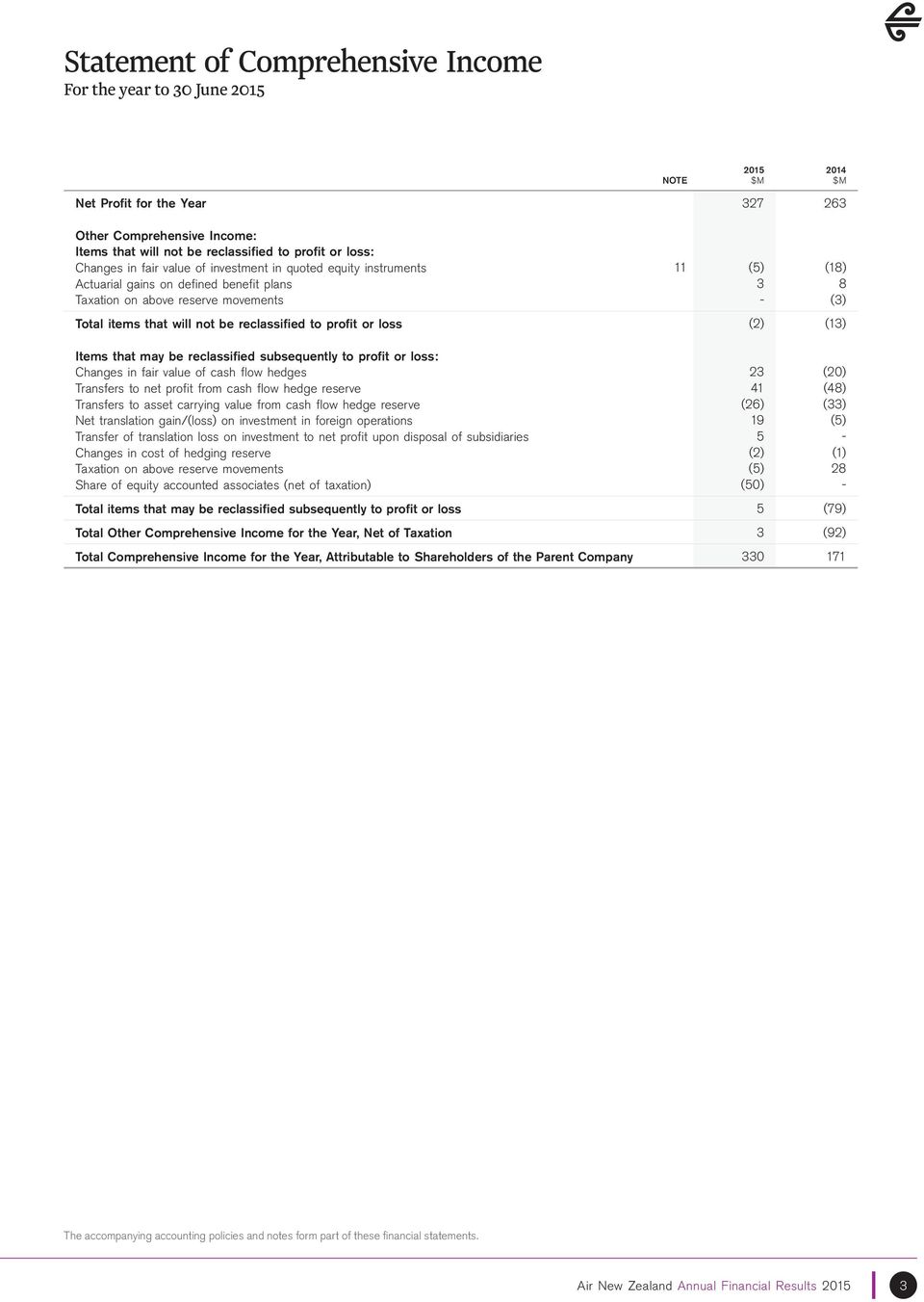
5 Statement of Comprehensive Income For the year to 30 June NOTE Net Profit for the Year Other Comprehensive Income: Items that will not be reclassified to profit or loss: Changes in fair value of investment in quoted equity instruments Actuarial gains on defined benefit plans Taxation on above reserve movements 11 (5) 3 (18) 8 (3) Total items that will not be reclassified to profit or loss (2) (13) Items that may be reclassified subsequently to profit or loss: Changes in fair value of cash flow hedges Transfers to net profit from cash flow hedge reserve Transfers to asset carrying value from cash flow hedge reserve Net translation gain/(loss) on investment in foreign operations Transfer of translation loss on investment to net profit upon disposal of subsidiaries Changes in cost of hedging reserve Taxation on above reserve movements Share of equity accounted associates (net of taxation) Total items that may be reclassified subsequently to profit or loss 5 (79) Total Other Comprehensive Income for the Year, Net of Taxation 3 (92) Total Comprehensive Income for the Year, Attributable to Shareholders of the Parent Company (26) 19 5 (2) (5) (50) (20) (48) (33) (5) (1) 28 The accompanying accounting policies and notes form part of these financial statements. Air New Zealand Annual Financial Results 3
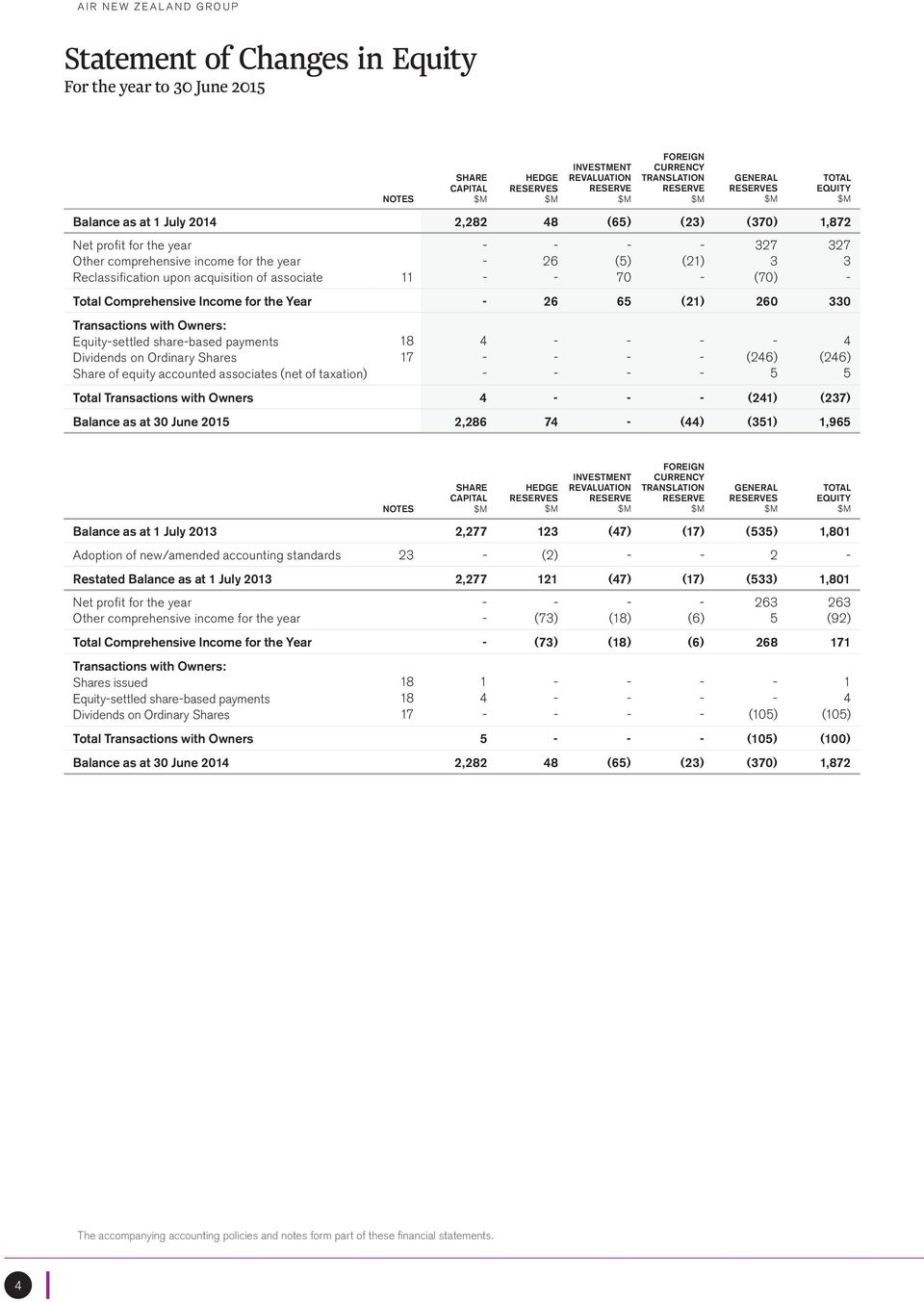
6 AIR NEW ZEALAND GROUP Statement of Changes in Equity For the year to 30 June NOTES SHARE CAPITAL HEDGE RESERVES INVESTMENT REVALUATION RESERVE FOREIGN CURRENCY TRANSLATION RESERVE GENERAL RESERVES Balance as at 1 July 2, (65) (23) (370) 1,872 Net profit for the year Other comprehensive income for the year Reclassification upon acquisition of associate 11 Total Comprehensive Income for the Year (21) Transactions with Owners: Equitysettled sharebased payments Dividends on Ordinary Shares Share of equity accounted associates (net of taxation) Total Transactions with Owners 4 (241) (237) Balance as at 30 June 2, (44) (351) 1, (5) 70 (21) (70) (246) 5 TOTAL EQUITY (246) 5 NOTES SHARE CAPITAL HEDGE RESERVES INVESTMENT REVALUATION RESERVE FOREIGN CURRENCY TRANSLATION RESERVE GENERAL RESERVES Balance as at 1 July , (47) (17) (535) 1,801 Adoption of new/amended accounting standards 23 (2) 2 Restated Balance as at 1 July , (47) (17) (533) 1,801 Net profit for the year Other comprehensive income for the year Total Comprehensive Income for the Year (73) (18) (6) Transactions with Owners: Shares issued Equitysettled sharebased payments Dividends on Ordinary Shares Total Transactions with Owners 5 (105) (100) (73) (18) (6) TOTAL EQUITY Balance as at 30 June 2, (65) (23) (370) 1, (105) 263 (92) 1 4 (105) The accompanying accounting policies and notes form part of these financial statements. 4
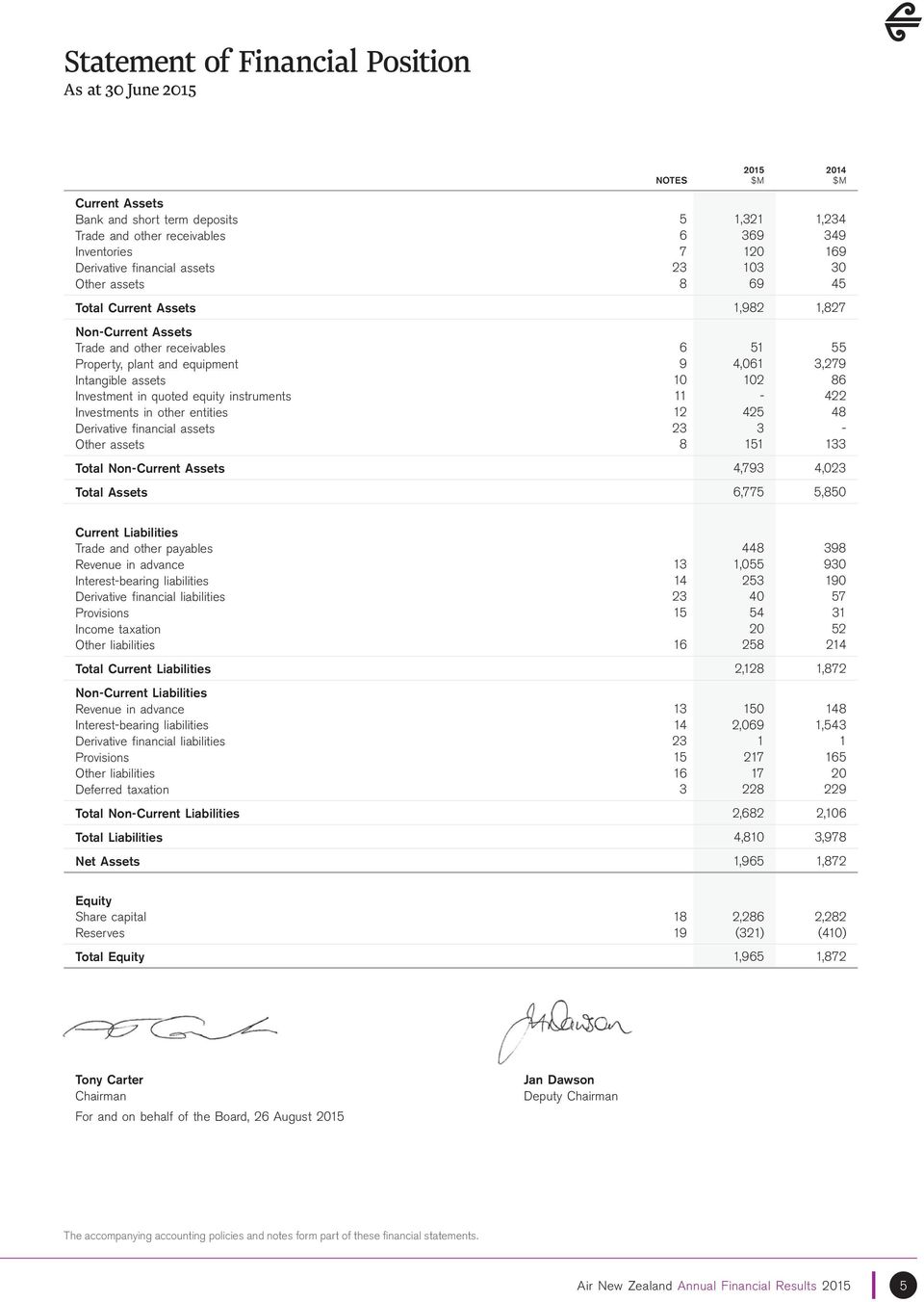
7 Statement of Financial Position As at 30 June Current Assets Bank and short term deposits Trade and other receivables Inventories Derivative financial assets Other assets Total Current Assets 1,982 1,827 NonCurrent Assets Trade and other receivables Property, plant and equipment Intangible assets Investment in quoted equity instruments Investments in other entities Derivative financial assets Other assets Total NonCurrent Assets 4,793 4,023 Total Assets 6,775 5,850 NOTES , , , , Current Liabilities Trade and other payables Revenue in advance Interestbearing liabilities Derivative financial liabilities Provisions Income taxation Other liabilities Total Current Liabilities 2,128 1,872 NonCurrent Liabilities Revenue in advance Interestbearing liabilities Derivative financial liabilities Provisions Other liabilities Deferred taxation Total NonCurrent Liabilities 2,682 2,106 Total Liabilities 4,810 3,978 Net Assets 1,965 1, , , , Equity Share capital Reserves Total Equity 1,965 1, ,286 (321) 2,282 (410) Tony Carter Chairman For and on behalf of the Board, 26 August Jan Dawson Deputy Chairman The accompanying accounting policies and notes form part of these financial statements. Air New Zealand Annual Financial Results 5
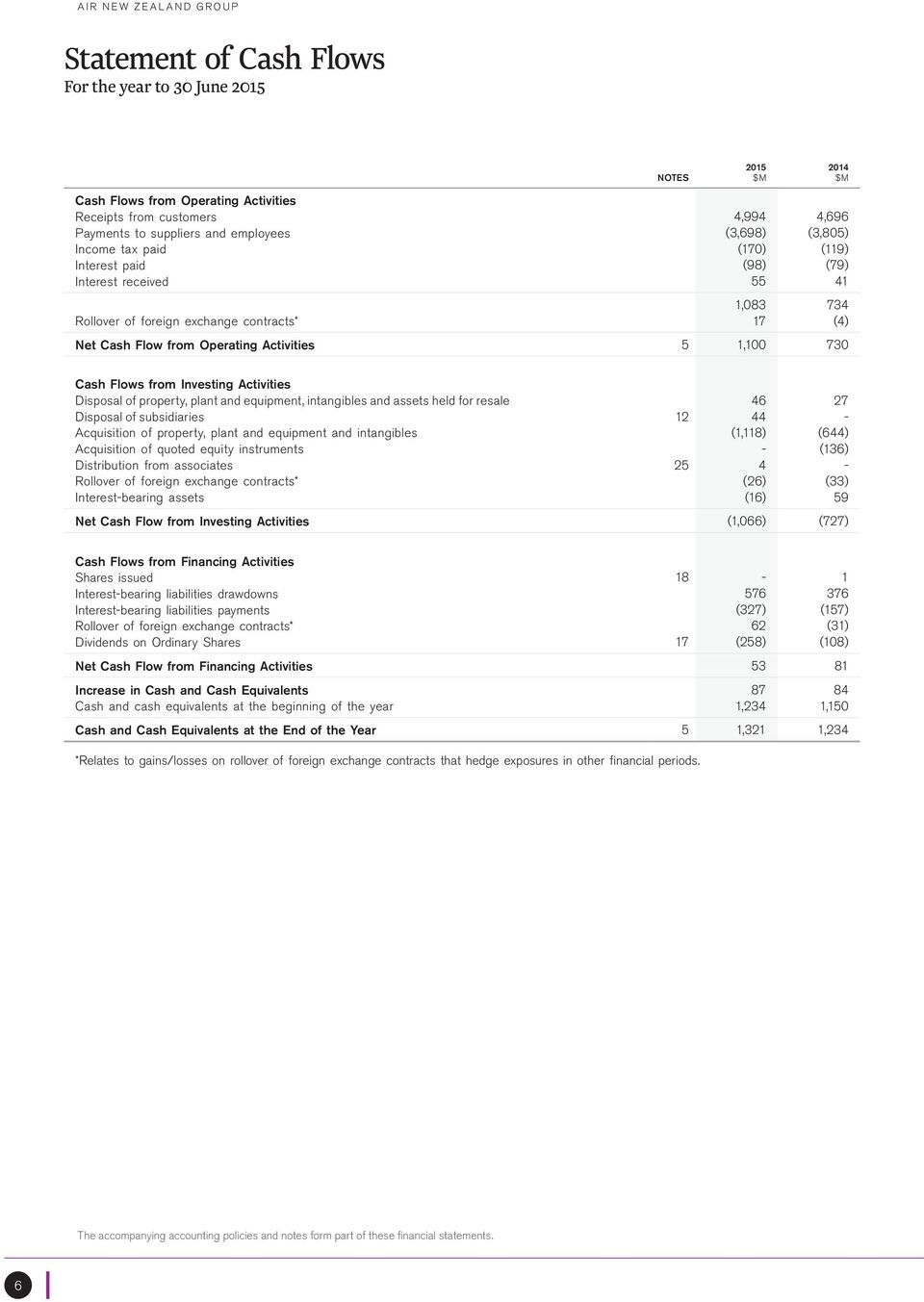
8 AIR NEW ZEALAND GROUP Statement of Cash Flows For the year to 30 June Cash Flows from Operating Activities Receipts from customers Payments to suppliers and employees Income tax paid Interest paid Interest received Rollover of foreign exchange contracts* NOTES 4,994 (3,698) (170) (98) 55 4,696 (3,805) (119) (79) 41 Net Cash Flow from Operating Activities 5 1, , (4) Cash Flows from Investing Activities Disposal of property, plant and equipment, intangibles and assets held for resale Disposal of subsidiaries Acquisition of property, plant and equipment and intangibles Acquisition of quoted equity instruments Distribution from associates Rollover of foreign exchange contracts* Interestbearing assets (1,118) 4 (26) (16) Net Cash Flow from Investing Activities (1,066) (727) 27 (644) (136) (33) 59 Cash Flows from Financing Activities Shares issued Interestbearing liabilities drawdowns Interestbearing liabilities payments Rollover of foreign exchange contracts* Dividends on Ordinary Shares Net Cash Flow from Financing Activities Increase in Cash and Cash Equivalents Cash and cash equivalents at the beginning of the year Cash and Cash Equivalents at the End of the Year 5 1,321 1,234 *Relates to gains/losses on rollover of foreign exchange contracts that hedge exposures in other financial periods (327) 62 (258) 87 1, (157) (31) (108) 84 1,150 The accompanying accounting policies and notes form part of these financial statements. 6
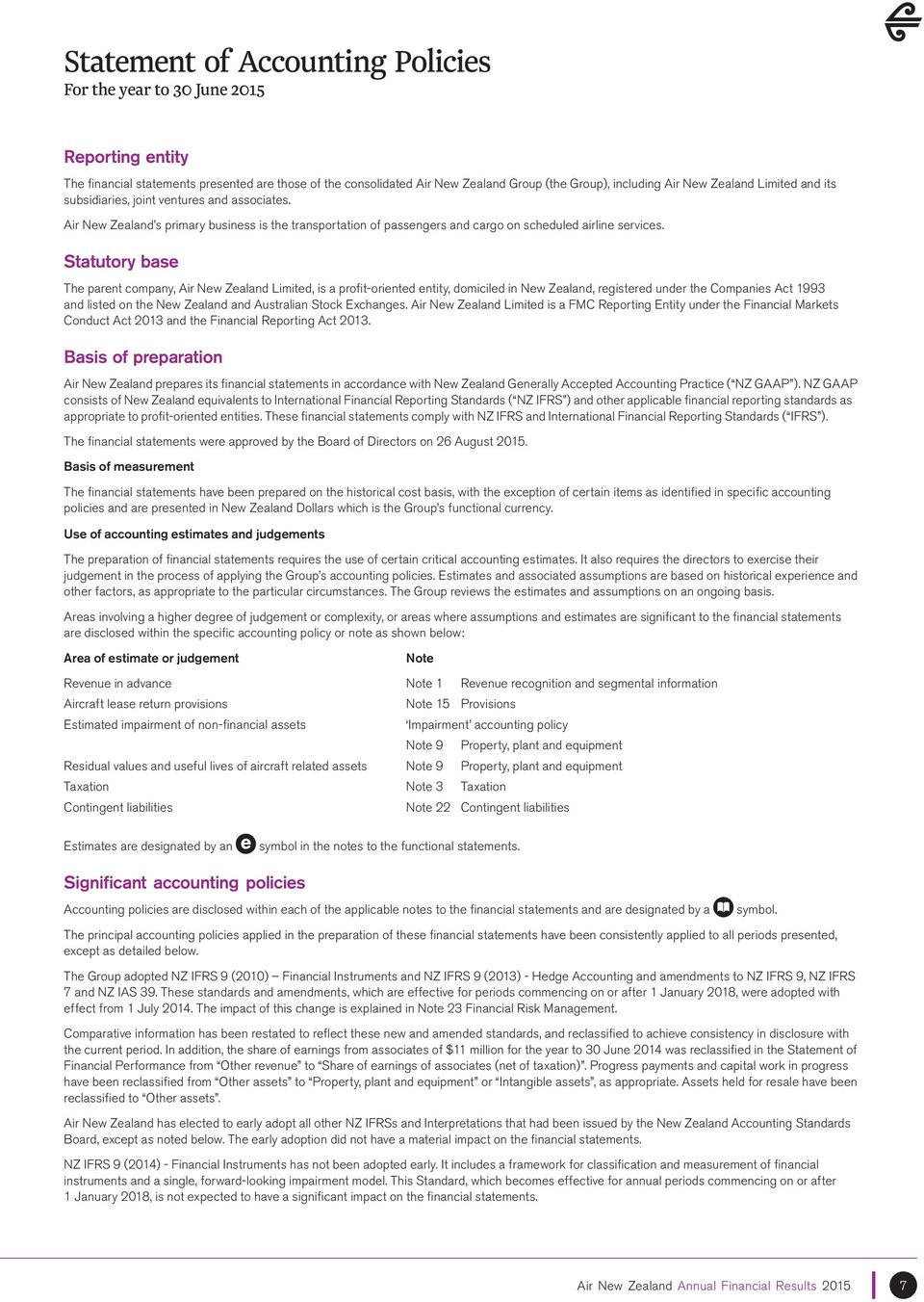
9 Statement of Accounting Policies For the year to 30 June Reporting entity The financial statements presented are those of the consolidated Air New Zealand Group (the Group), including Air New Zealand Limited and its subsidiaries, joint ventures and associates. Air New Zealand s primary business is the transportation of passengers and cargo on scheduled airline services. Statutory base The parent company, Air New Zealand Limited, is a profitoriented entity, domiciled in New Zealand, registered under the Companies Act 1993 and listed on the New Zealand and Australian Stock Exchanges. Air New Zealand Limited is a FMC Reporting Entity under the Financial Markets Conduct Act 2013 and the Financial Reporting Act Basis of preparation Air New Zealand prepares its financial statements in accordance with New Zealand Generally Accepted Accounting Practice ( NZ GAAP ). NZ GAAP consists of New Zealand equivalents to International Financial Reporting Standards ( NZ IFRS ) and other applicable financial reporting standards as appropriate to profitoriented entities. These financial statements comply with NZ IFRS and International Financial Reporting Standards ( IFRS ). The financial statements were approved by the Board of Directors on 26 August. Basis of measurement The financial statements have been prepared on the historical cost basis, with the exception of certain items as identified in specific accounting policies and are presented in New Zealand Dollars which is the Group s functional currency. Use of accounting estimates and judgements The preparation of financial statements requires the use of certain critical accounting estimates. It also requires the directors to exercise their judgement in the process of applying the Group s accounting policies. Estimates and associated assumptions are based on historical experience and other factors, as appropriate to the particular circumstances. The Group reviews the estimates and assumptions on an ongoing basis. Areas involving a higher degree of judgement or complexity, or areas where assumptions and estimates are significant to the financial statements are disclosed within the specific accounting policy or note as shown below: Area of estimate or judgement Revenue in advance Note 1 Revenue recognition and segmental information Aircraft lease return provisions Note 15 Provisions Estimated impairment of nonfinancial assets Impairment accounting policy Note 9 Property, plant and equipment Residual values and useful lives of aircraft related assets Note 9 Property, plant and equipment Taxation Note 3 Taxation Contingent liabilities Note 22 Contingent liabilities Note Estimates are designated by an symbol in the notes to the functional statements. Significant accounting policies Accounting policies are disclosed within each of the applicable notes to the financial statements and are designated by a symbol. The principal accounting policies applied in the preparation of these financial statements have been consistently applied to all periods presented, except as detailed below. The Group adopted NZ IFRS 9 (2010) Financial Instruments and NZ IFRS 9 (2013) Hedge Accounting and amendments to NZ IFRS 9, NZ IFRS 7 and NZ IAS 39. These standards and amendments, which are effective for periods commencing on or after 1 January 2018, were adopted with effect from 1 July. The impact of this change is explained in Note 23 Financial Risk Management. Comparative information has been restated to reflect these new and amended standards, and reclassified to achieve consistency in disclosure with the current period. In addition, the share of earnings from associates of $11 million for the year to 30 June was reclassified in the Statement of Financial Performance from Other revenue to Share of earnings of associates (net of taxation). Progress payments and capital work in progress have been reclassified from Other assets to Property, plant and equipment or Intangible assets, as appropriate. Assets held for resale have been reclassified to Other assets. Air New Zealand has elected to early adopt all other NZ IFRSs and Interpretations that had been issued by the New Zealand Accounting Standards Board, except as noted below. The early adoption did not have a material impact on the financial statements. NZ IFRS 9 () Financial Instruments has not been adopted early. It includes a framework for classification and measurement of financial instruments and a single, forwardlooking impairment model. This Standard, which becomes effective for annual periods commencing on or after 1 January 2018, is not expected to have a significant impact on the financial statements. Air New Zealand Annual Financial Results 7
10 AIR NEW ZEALAND GROUP Statement of Accounting Policies (continued) For the year to 30 June NZ IFRS 15 Revenue from Contracts with Customers has not been adopted early. This standard has an objective of a single revenue recognition model that applies to revenue from contracts with customers in all industries. This standard, which becomes effective for annual periods commencing on or after 1 January 2017, is not expected to have a significant impact on the financial statements. The significant accounting policies which are pervasive throughout the financial statements are set out below. Other significant accounting policies which are specific to certain transactions or balances are set out within the particular note to which they relate. Basis of consolidation The consolidated financial statements include those of Air New Zealand Limited and its subsidiaries, accounted for using the acquisition method, and the results of its associates and joint ventures, accounted for using the equity method. All material intercompany transactions, balances and unrealised gains on transactions between group companies are eliminated on consolidation. Unrealised losses are also eliminated unless the transaction provides evidence of an impairment of the asset transferred. Unrealised gains on transactions between the Group, joint ventures and its associates are eliminated to the extent of the Group s interest in the joint ventures and associates. Where a business combination is achieved in stages, previously held equity interests in the acquiree are remeasured to fair value at the acquisition date and any corresponding gain or loss is recognised in the Statement of Financial Performance. Subsidiaries, associates and joint venture companies Investments in associates and joint ventures are accounted for using the equity method and are measured in the Statement of Financial Position at cost plus postacquisition changes in the Group s share of net assets, less dividends. Goodwill relating to associates and joint ventures is included in the carrying amount of the investment. If the carrying amount of the equity accounted investment exceeds its recoverable amount, it is written down to the latter. When the Group s share of accumulated losses in an associate or joint venture equals or exceeds its carrying value, the Group does not recognise further losses, unless it has incurred obligations or made payments on behalf of the associate or joint venture. Foreign currency translation Functional currency Items included in the financial statements of each of the Group s entities are measured using the currency of the primary economic environment in which the entity operates (the functional currency ). Transactions and balances Foreign currency transactions are converted into the relevant functional currency using exchange rates approximating those ruling at transaction date. Monetary assets and liabilities denominated in foreign currencies at the balance date are translated at the rate ruling at that date. Nonmonetary assets and liabilities that are measured in terms of historical cost in a foreign currency are translated using the exchange rate at the date of the transaction. Foreign exchange gains or losses are recognised in the Statement of Financial Performance, except when deferred in equity as qualifying cash flow hedges and qualifying net investment hedges. Group companies The results and financial position of all group entities that have a functional currency different from the presentation currency are translated into the presentation currency as follows: (a) assets and liabilities for each Statement of Financial Position presented are translated at the closing rate at the date of that Statement of Financial Position; (b) income and expenses for each Statement of Financial Performance are translated at exchange rates approximating those ruling at transaction date; and (c) all resulting exchange differences are recognised as a separate component of equity and in Other Comprehensive Income (within Foreign Currency Translation Reserve). On consolidation, exchange differences arising from the translation of the net investment in foreign entities, and of borrowings and other currency instruments designated as hedges of such investments, are taken to equity. Goodwill and fair value adjustments arising on the acquisition of a foreign entity are treated as assets and liabilities of the foreign entity and translated at the closing rate. Impairment Nonfinancial assets are reviewed at each reporting date to determine whether there are any indicators that the carrying amount may not be recoverable. If any such indicators exist, the asset s recoverable amount is estimated. The recoverable amount is the higher of an asset s fair value less costs to sell and value in use. In assessing value in use, the estimated future cash flows are discounted to their present value using a discount rate that reflects current market assessments of the time value of money and the risks specific to the asset. An impairment loss is recognised in the Statement of Financial Performance for the amount by which the asset s carrying amount exceeds its recoverable amount. For the purposes of assessing impairment, assets are grouped at the lowest level for which there are separately identifiable cash flows (cashgenerating units). Financial assets carried at amortised cost are assessed each reporting date for impairment. If there is objective evidence of impairment, the difference between the asset s carrying amount and the present value of estimated future cash flows, discounted at the financial asset s original effective interest rate, where appropriate, is recognised in the Statement of Financial Performance. 8

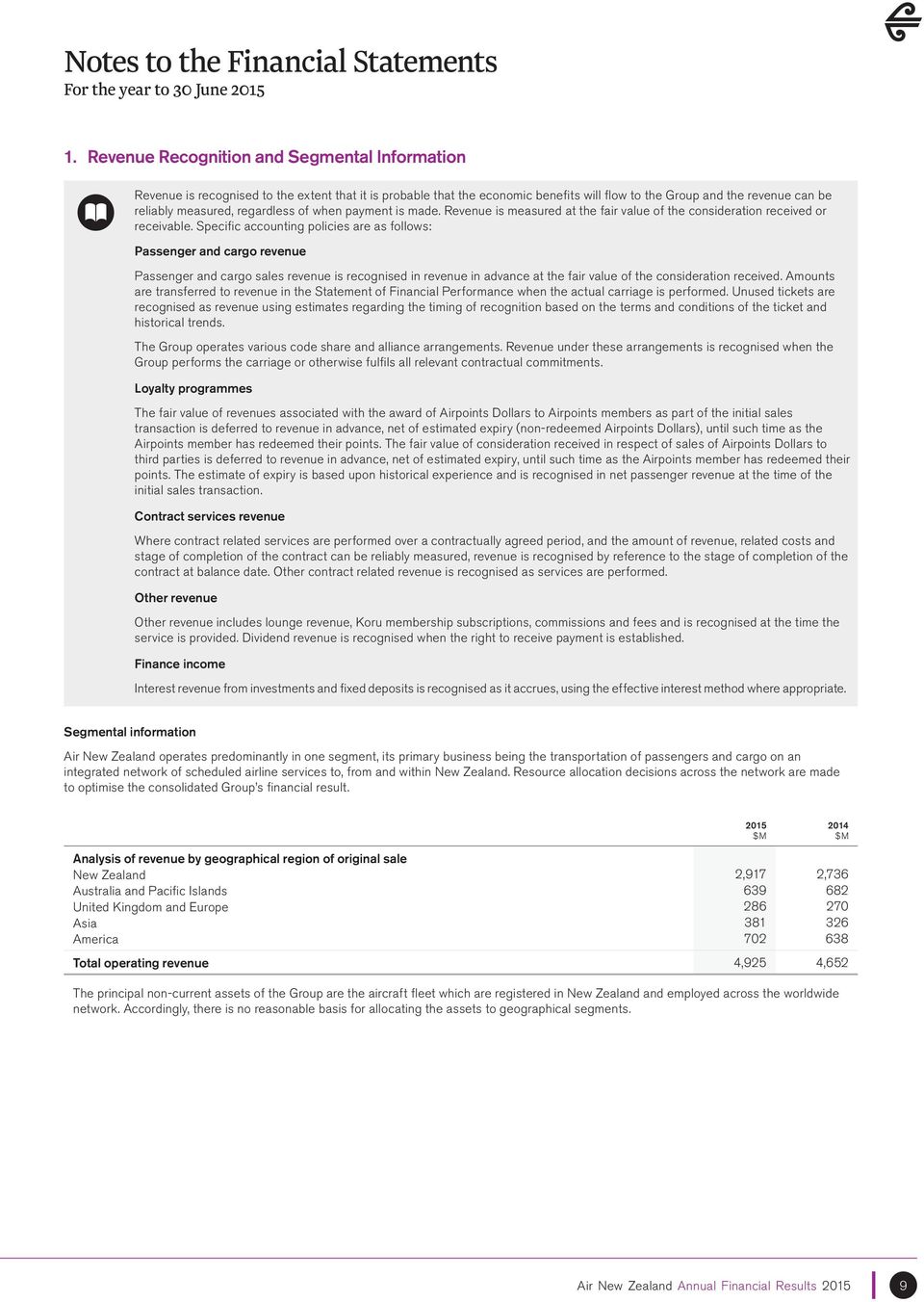
11 Notes to the Financial Statements For the year to 30 June 1. Revenue Recognition and Segmental Information Revenue is recognised to the extent that it is probable that the economic benefits will flow to the Group and the revenue can be reliably measured, regardless of when payment is made. Revenue is measured at the fair value of the consideration received or receivable. Specific accounting policies are as follows: Passenger and cargo revenue Passenger and cargo sales revenue is recognised in revenue in advance at the fair value of the consideration received. Amounts are transferred to revenue in the Statement of Financial Performance when the actual carriage is performed. Unused tickets are recognised as revenue using estimates regarding the timing of recognition based on the terms and conditions of the ticket and historical trends. The Group operates various code share and alliance arrangements. Revenue under these arrangements is recognised when the Group performs the carriage or otherwise fulfils all relevant contractual commitments. Loyalty programmes The fair value of revenues associated with the award of Airpoints Dollars to Airpoints members as part of the initial sales transaction is deferred to revenue in advance, net of estimated expiry (nonredeemed Airpoints Dollars), until such time as the Airpoints member has redeemed their points. The fair value of consideration received in respect of sales of Airpoints Dollars to third parties is deferred to revenue in advance, net of estimated expiry, until such time as the Airpoints member has redeemed their points. The estimate of expiry is based upon historical experience and is recognised in net passenger revenue at the time of the initial sales transaction. Contract services revenue Where contract related services are performed over a contractually agreed period, and the amount of revenue, related costs and stage of completion of the contract can be reliably measured, revenue is recognised by reference to the stage of completion of the contract at balance date. Other contract related revenue is recognised as services are performed. Other revenue Other revenue includes lounge revenue, Koru membership subscriptions, commissions and fees and is recognised at the time the service is provided. Dividend revenue is recognised when the right to receive payment is established. Finance income Interest revenue from investments and fixed deposits is recognised as it accrues, using the effective interest method where appropriate. Segmental information Air New Zealand operates predominantly in one segment, its primary business being the transportation of passengers and cargo on an integrated network of scheduled airline services to, from and within New Zealand. Resource allocation decisions across the network are made to optimise the consolidated Group s financial result. Analysis of revenue by geographical region of original sale New Zealand Australia and Pacific Islands United Kingdom and Europe Asia America Total operating revenue 4,925 4,652 The principal noncurrent assets of the Group are the aircraft fleet which are registered in New Zealand and employed across the worldwide network. Accordingly, there is no reasonable basis for allocating the assets to geographical segments. 2, , Air New Zealand Annual Financial Results 9
12 AIR NEW ZEALAND GROUP Notes to the Financial Statements (continued) For the year to 30 June 2. Expenses Additional information in respect of expenses included within the Statement of Financial Performance is as follows: Superannuation expense Audit and review of financial statements* *Other fees were paid for tax compliance work of $17k (30 June : $19k), business roadmapping services of $190k, employee speakup line service of $25k and student fee protection audit of $4k (30 June : $26k related to business and information technology processes and security controls). Normalised earnings, disclosed as supplementary information at the foot of the Statement of Financial Performance, shows earnings after excluding movements on derivatives that hedge exposures in other financial periods. The adjustments match derivative gains or losses with the underlying hedged transaction. Prior to the adoption of NZ IFRS 9 (2013) (refer Note 23), such movements comprised the time value on open derivatives and amounts required to be recognised as ineffective for accounting purposes. With effect from 1 July, the Group adopted NZ IFRS 9 (2013). The resultant change in the treatment of time value of options and the reduced ineffectiveness has meant that amounts presented as adjustments to Normalised Earnings in the year ended 30 June simply reverse timing adjustments from prior years. From 1 July, such adjustments no longer arise. The amounts recognised in the Statement of Financial Performance in relation to (gains)/losses on derivatives which hedge exposures in other financial periods are $20 million of losses for fuel derivatives (30 June : gains of $23 million) and $2 million of losses on foreign exchange derivatives (30 June : gains of $3 million). 3. Taxation Current and deferred taxation are calculated on the basis of tax rates enacted or substantively enacted at reporting date, and are recognised in the income statement except when the tax relates to items charged or credited to other comprehensive income, in which case the tax is also recognised in other comprehensive income. Deferred income taxation is recognised in respect of temporary differences arising between the tax bases of assets and liabilities and their carrying amounts in the financial statements. Deferred income tax assets and unused tax losses are only recognised to the extent that it is probable that future taxable amounts will be available against which to utilise those temporary differences and losses. Judgements are required about the application of income tax legislation. These judgements and assumptions are subject to risk and uncertainty, hence there is a possibility that changes in circumstances will alter expectations, which may impact the amount of current and deferred tax assets and liabilities recognised in the Statement of Financial Position and the amount of other tax losses and temporary differences not yet recognised. In such circumstances, some or all of the carrying amounts of recognised tax assets and liabilities may require adjustment, resulting in a corresponding credit or charge to the Statement of Financial Performance. Current taxation expense Current year Adjustment for prior periods Deferred taxation expense Origination of temporary differences Total taxation expense recognised in earnings (147) (95) (158) (1) (159) 12 (155) (1) (156) 61 Reconciliation of effective tax rate Earnings before taxation Taxation at 28% Adjustments Nondeductible expenses Share of earnings of Virgin Australia Nontaxable income (Under)/over provided in prior periods Taxation expense The Group has $200 million imputation credits as at 30 June (30 June : $146 million). (133) (3) (8) 1 (4) (100) (4) 6 3 (147) (95) 10

13 Notes to the Financial Statements (continued) For the year to and as at 30 June 3. Taxation (continued) Deferred taxation Deferred tax assets and liabilities are attributable to the following: As at 1 July 2013 Amounts recognised in equity Amounts recognised in earnings NONAIRCRAFT ASSETS 23 (8) AIRCRAFT RELATED PROVISIONS AND ACCRUALS FINANCIAL INSTRUMENTS PENSION OBLIGATIONS As at 30 June (98) 12 (2) (32) (77) (21) 30 (18) (5) 3 TOTAL 305 (15) (61) Amounts recognised in equity Reclassified from Income Taxation Amounts recognised in earnings (1) As at 30 June (106) 23 (2) 228 Deferred tax assets and liabilities are offset on the face of the Statement of Financial Position where they relate to entities within the same taxation authority. There are no unused tax losses available to carry forward against future taxable profits (30 June : Nil). 4. Earnings per Share (3) (8) (12) Basic earnings per share is calculated by dividing the profit attributable to shareholders of the company by the weighted average number of ordinary shares on issue during the year, excluding shares held as treasury stock. Diluted earnings per share assumes conversion of all dilutive potential ordinary shares in determining the denominator. Earnings for the purpose of basic and diluted earnings per share: Net Profit Attributable to Shareholders of the Parent Company Weighted average number of shares (in millions of shares) Weighted average number of Ordinary Shares for basic earnings per share Effect of dilutive ordinary shares: Share options and performance rights Weighted average number of Ordinary Shares for diluted earnings per share 1,124 1,112 1, , Basic earnings per share Diluted earnings per share Air New Zealand Annual Financial Results 11

14 AIR NEW ZEALAND GROUP Notes to the Financial Statements (continued) For the year to and as at 30 June 5. Cash and Cash Equivalents Cash and cash equivalents include cash on hand, demand deposits, current accounts in banks net of overdrafts and other shortterm highly liquid investments that are readily convertible to known amounts of cash and which are subject to an insignificant risk of changes in value. Cash flows are included in the Statement of Cash Flows net of Goods and Services Tax. Cash and cash equivalents, as stated in the Statement of Cash Flows, are reconciled to the Bank and short term deposits balance in the Statement of Financial Position as follows: Cash balances Other short term deposits and short term bills 22 1,299 Total cash and cash equivalents 1,321 1, ,166 Reconciliation of Net Profit Attributable to Shareholders to Net Cash Flows from Operating Activities: Net profit attributable to shareholders Plus/(less) noncash items: Depreciation and amortisation (Gain)/loss on disposal of property, plant and equipment, intangibles and assets held for resale Loss on disposal of subsidiaries Impairment on property, plant and equipment, intangibles and assets held for resale Share of earnings of associates Movements on fuel derivatives Foreign exchange losses/(gains) Other noncash items Net working capital movements: Assets Revenue in advance Deferred foreign exchange losses/(gains) Liabilities (2) (38) (11) (25) (1) (6) 20 (4) Net cash flow from operating activities 1, Trade and Other Receivables Trade and other receivables are recognised at cost less any provision for impairment. Bad debts are writtenoff when they are considered to have become uncollectable. Current Trade and other receivables Prepayments Noncurrent Other receivables Prepayments

15 Notes to the Financial Statements (continued) As at 30 June 7. Inventories Inventories are measured at the lower of cost and net realisable value. Cost is determined using the firstin, firstout (FIFO) cost method. Net realisable value is the estimated selling price in the ordinary course of business, less applicable variable selling expenses. Engineering expendables Consumable stores Held at cost Held initially at cost Less provision for inventory obsolescence Held at net realisable value (50) 75 (45) Other Assets Amounts owing from joint ventures and associates Amounts owing from related parties are recognised at cost less any provision for impairment. Contract work in progress Contract work in progress is stated at cost plus the profit recognised to date, using the percentage of completion method, less any amounts invoiced to customers. Cost includes all expenses directly related to specific contracts and an allocation of direct production overhead expenses incurred. Assets held for resale Noncurrent assets are classified as held for resale if their carrying amount will be recovered through a sale transaction rather than through continuing use. The sale must be highly probable and the asset available for immediate sale in its present condition. Noncurrent assets held for resale are measured at the lower of the asset s previous carrying amount and its fair value less costs to sell. Defined pension assets Air New Zealand s net obligation in respect of defined benefit pension plans is calculated by an independent actuary, by estimating the amount of future benefit that employees have earned in the current and prior periods, discounting that amount and deducting the fair value of the plan s assets. The discount rate reflects the yield on government bonds that have maturity dates approximating the terms of Air New Zealand s obligations When the calculation results in an asset, the value of the asset is limited to the present value of economic benefits available in the form of any future refunds from the plan or reductions in future contributions from the plan. Interestbearing assets Interestbearing assets are measured at amortised cost using the effective interest method, less any impairment. Air New Zealand Annual Financial Results 13

16 AIR NEW ZEALAND GROUP Notes to the Financial Statements (continued) As at 30 June 8. Other Assets (continued) Current Amounts owing from joint ventures and associates Contract work in progress Assets held for resale Defined pension assets Other assets Noncurrent Interestbearing assets Assets held for resale Other assets With the current fleet replenishment programme, spares are being marketed for sale. It is expected that proceeds will be received over the next three years. In addition the Group is disposing of three Beech aircraft which are expected to be sold within 12 months and land and buildings which will be settled by November. The carrying value of the assets held for resale reflects the lower of their previous carrying value at the date of transfer or external market assessments of the fair value, less costs to sell. No impairment expense was recognised during the year (30 June : $3 million). The Group operates two defined benefit plans for qualifying employees in New Zealand and overseas. A net asset of $12 million (30 June : $7 million) was recognised in respect of the New Zealand plan, which is now closed to new members. A net liability was recognised in respect of the overseas plan of $1 million (30 June : $1 million), which is included within Note 16 Other current liabilities. The plans provide a benefit on retirement or resignation based upon the employee s length of membership and final average salary. Each year an actuarial calculation is undertaken using the Projected Unit Credit Method to calculate the present value of the defined benefit obligation and the related current service cost. The current service cost recognised through earnings was $2 million (30 June : $2 million). Interestbearing assets include registered transferable certificates of deposit (RTDs) that have been provided as security over credit card obligations incurred by Air New Zealand. The RTD s bear a three month fixed interest rate and mature in December These are subject to potential offsetting under master netting arrangements, as disclosed in Note

17 Notes to the Financial Statements (continued) As at 30 June 9. Property, Plant and Equipment Owned assets Items of property, plant and equipment are stated at cost or deemed cost less accumulated depreciation and accumulated impairment losses. Cost includes expenditure that is directly attributable to the acquisition of the item and in bringing the asset to the location and working condition for its intended use. Cost may also include transfers from equity of any gains or losses on qualifying cash flow hedges of foreign currency purchases of property, plant and equipment. Where significant parts of an item of property, plant and equipment have different useful lives, they are accounted for separately. A portion of the cost of an acquired aircraft is attributed to its service potential (reflecting the maintenance condition of its engines) and is depreciated over the shorter of the period to the next major inspection event, overhaul, or the remaining life of the asset. The cost of major engine overhauls for aircraft owned by the Group is capitalised and depreciated over the period to the next expected inspection or overhaul. Capital work in progress includes the cost of materials, services, labour and direct production overheads. Finance leased assets Leases under which the Group assumes substantially all the risks and rewards of ownership are classified as finance leases. All other leases are classified as operating leases. Upon initial recognition, assets held under finance leases are measured at amounts equal to the lower of their fair value and the present value of the minimum lease payments at inception of the lease. A corresponding liability is also established. Subsequent to initial recognition, the asset is accounted for in accordance with the accounting policy applicable to that asset. Manufacturing credits Where the Group receives credits and other contributions from manufacturers in connection with the acquisition of certain aircraft and engines, these are either recorded as a reduction to the cost of the related aircraft and engines, or offset against the associated operating expense, according to the reason for which they were received. Depreciation Depreciation is calculated to write down the cost of assets on a straight line basis to an estimated residual value over their economic lives as follows: Aircraft 18 years Engine overhauls period to next overhaul Aircraft specific plant and equipment (including simulators and spares) years Buildings years Nonaircraft specific leasehold improvements, plant, equipment, furniture and vehicles 2 10 years AIRCRAFT, SPARE ENGINES AND SIMULATORS SPARES PLANT AND EQUIPMENT LAND AND BUILDINGS CAPITAL WORK IN PROGRESS Carrying value as at 1 July 2, ,279 Additions Disposals Disposal of subsidiaries Depreciation Impairment Transfers Transfer to assets held for resale Foreign exchange differences (refer note 23) Carrying value as at 30 June Represented by: Cost Accumulated depreciation Provision for impairment 867 (30) (8) (309) 91 (9) 176 3,556 5,268 (1,712) 24 (4) (15) (7) (120) 6 (11) (26) (260) (3) (27) (17) 30 (3) (161) (17) 179 (1) (147) TOTAL 1,076 (34) (23) (377) (17) (19) 176 4,061 6,331 (2,253) (17) Carrying value as at 30 June 3, ,061 Air New Zealand Annual Financial Results 15

18 AIR NEW ZEALAND GROUP Notes to the Financial Statements (continued) As at 30 June 9. Property, Plant and Equipment (continued) AIRCRAFT, SPARE ENGINES AND SIMULATORS SPARES PLANT AND EQUIPMENT LAND AND BUILDINGS CAPITAL WORK IN PROGRESS TOTAL Cost Accumulated depreciation Provision for impairment Carrying value as at 1 July 2013 Additions Disposals Depreciation Transfers Transfer to assets held for resale Foreign exchange differences (refer note 23) Carrying value as at 30 June Represented by: Cost Accumulated depreciation Provision for impairment 4,083 (1,439) (5) 2, (7) (335) 26 (5) (12) 2,778 4,481 (1,698) (5) 263 (147) (16) (18) (5) (135) 363 (251) (28) (270) 350 (133) (30) (159) (75) ,102 (1,970) (5) 3, (23) (411) (10) (12) 3,279 5,546 (2,262) (5) Carrying value as at 30 June 2, ,279 Aircraft, spare engines and simulators comprise: Finance leased aircraft and spare engines Owned aircraft, spare engines and simulators Progress payments Land and buildings comprise: Leasehold properties Freehold properties 1,982 1, , ,556 2, Certain aircraft and aircraft related assets with a carrying value of $2,600 million as at 30 June (30 June : $2,091 million) are pledged as security over secured borrowings and finance lease obligations. Impairment During the year ended 30 June the land and building assets of the Air New Zealand Gas Turbines (ANZGT) business were assessed for impairment based on a value in use discounted cash flow valuation. ANZGT provides overhaul services to aero derivative engines that are applied to energy production and marine industries. Over recent years a down turn in the market has resulted in a decline in activity and profitability of the business. Cashflow projections were sourced from the 2016 financial year plan and extrapolated into the future using a 2% growth rate. Key assumptions include exchange rates, customer demand, market supply and terminal values. These assumptions have been based on historical data and current market information. The cash flow projections are particularly sensitive to fluctuations in exchange rates and economic demand. The cashflow projections are discounted using a 9% discount rate. The result of this impairment test was an impairment loss of $17 million (30 June : Nil) which has been recognised in Other expenses in the Statement of Financial Performance. Residual Values Estimates and judgements are applied by management to determine the expected useful life of aircraft related assets. The useful lives are determined based on the expected service potential of the asset and lease term. The residual value, at the expected date of disposal, is estimated by reference to external projected values. Residual values and useful lives are reviewed each year to ensure they remain appropriate. During the year ended 30 June the residual values of the aircraft were reassessed and depreciation expense was reduced by $10 million. 16

19 Notes to the Financial Statements (continued) As at 30 June 10. Intangible Assets Computer software acquired, which is not an integral part of a related hardware item, is recognised as an intangible asset. The costs incurred internally in developing computer software are also recognised as intangible assets where the Group has a legal right to use the software and the ability to obtain future economic benefits from that software. Acquired software licences are capitalised on the basis of the costs incurred to acquire and bring to use the specific software. These assets have a finite life and are amortised on a straightline basis over their estimated useful lives of three to six years. INTERNALLY DEVELOPED SOFTWARE EXTERNALLY PURCHASED SOFTWARE CAPITAL WORK IN PROGRESS Carrying value as at 1 July Additions Disposal of subsidiaries Amortisation Transfers Carrying value as at 30 June Represented by: Cost Accumulated depreciation Carrying value as at 30 June (1) (22) (154) (3) (153) 42 (32) OTHER 1 1 TOTAL 42 (1) (25) (307) Cost Accumulated depreciation Carrying value as at 1 July 2013 Additions Amortisation Impairment losses recognised during the year Transfers Carrying value as at 30 June Represented by: Cost Accumulated depreciation Provision for impairment Carrying value as at 30 June (115) 59 (21) (133) 166 (159) 7 (4) (159) (36) (1) (1) 1 3 (1) (1) 349 (274) (25) (1) (293) (1) Air New Zealand Annual Financial Results 17

20 AIR NEW ZEALAND GROUP Notes to the Financial Statements (continued) As at 30 June 11. Investment in Quoted Equity Instruments Investments in quoted equity instruments are stated at fair value. Changes in the fair value of the investment in quoted equity instruments, including any related foreign exchange component, are recognised through other comprehensive income where an irrevocable election has been made at inception to do so. This election is made in order to ensure the appropriate representation of longterm, strategic investments as distinct from those held for trading. The cumulative gains or losses held in other comprehensive income are not transferred to profit or loss on derecognition or otherwise, although they may be transferred within equity. Investment in Virgin Australia Holdings Limited Balance at the beginning of the year Acquisitions Fair value changes recognised in other comprehensive income Transfer to investments in associates Balance at the end of the year 422 (5) (417) (18) 422 On 4 July, the Group gained representation on the Board of Directors of Virgin Australia Holdings Limited ( Virgin Australia ). Until that date, Air New Zealand continued to treat the investment as an investment in quoted equity instruments as opposed to an equity accounted associate as the directors considered that the Group did not have the ability to exercise significant influence over Virgin Australia due to the composition of other shareholdings and lack of representation on the Board. With effect from 4 July, the investment has been treated as an associate and the equity method of accounting applied. Revaluation losses accumulated in the Investment Revaluation Reserve were transferred to Retained Deficit at the date of gaining significant influence. Further details are set out in Note Investment in Other Entities Investments in associates Investments in joint ventures Investments in other entities The investment in Virgin Australia has been treated as an associate with effect from 4 July and the equity method of accounting applied. Further details are set out in Note 11. Subsidiaries Significant subsidiaries comprise: NAME PRINCIPAL ACTIVITY COUNTRY OF INCORPORATION Air Nelson Limited Aviation New Zealand Air New Zealand Aircraft Holdings Limited Aircraft leasing and financing New Zealand Air New Zealand Associated Companies Limited Investment New Zealand Air New Zealand Regional Maintenance Limited Engineering services New Zealand Eagle Airways Limited Aviation New Zealand Mount Cook Airline Limited Aviation New Zealand All subsidiary entities above have a balance date of 30 June and are 100 percent owned. 18

21 Notes to the Financial Statements (continued) As at 30 June 12. Investment in Other Entities (continued) Disposal of subsidiaries On 29 September, the Group disposed of its interest in a wholly owned subsidiary, Altitude Aerospace Interiors Limited ( Altitude ). The net assets of Altitude at disposal date were $6 million. A gain on sale of $1 million was recognised upon disposal. On 30 March, the Group disposed of its interest in a wholly owned subsidiary, TAE Pty Limited and its wholly owned subsidiaries ( TAE Group ). The net assets of the TAE Group at disposal date were $39 million. A loss on sale of $5 million was recognised upon disposal which included the transfer of foreign currency translation reserve losses of $5 million. On 29 June, the Group had entered into an unconditional agreement to dispose of its 100 percent interest in Safe Air Limited and its wholly owned subsidiary ( Safe Air Group ). Air New Zealand has effected the disposal (from an accounting perspective) on the date that the agreement became unconditional. Legal completion occurred on 1 July. The net assets of the Safe Air Group at disposal date were $11 million. No gain or loss was recognised on disposal. As at 30 June Air New Zealand had amounts receivable from the Safe Air Group of $1 million. The impact of the disposals on the Group financial statements was as follows: Consideration received Cash and cash equivalents Consideration receivable ALTITUDE 7 TAE GROUP 37 2 SAFE AIR GROUP Total consideration TOTAL Assets and liabilities disposed comprise: Current assets Trade and other receivables Inventories Other assets Non current assets Property, plant and equipment Intangible assets Other assets Current liabilities Trade and other payables Revenue in advance Income taxation Provisions Other liabilities Net assets disposed (6) (8) (3) (1) (6) (1) (5) (3) (2) (3) (15) (9) (2) (3) (9) Consideration received Net assets disposed Foreign currency translation reserve reclassified to net profit Gain/(loss) on disposal (recognised in Other expenses) 1 (5) (4) 7 (6) 39 (39) (5) 11 (11) 57 (56) (5) Associates and Joint Ventures Significant associates and joint ventures comprise: NAME RELATIONSHIP % OWNED PRINCIPAL COUNTRY OF BALANCE DATE INCORPORATION Christchurch Engine Centre (CEC) Associate Engineering services New Zealand 31 December Virgin Australia Holdings Limited Associate Aviation Australia 30 June ANZGT Field Services LLC Joint Venture Engineering services United States 30 June 11Ants Analytics Group Limited Joint Venture Data analytics New Zealand 31 March Pacific Leisure Group Limited Joint Venture Wholesale travel distributor New Zealand 30 June Air New Zealand Annual Financial Results 19
22 AIR NEW ZEALAND GROUP Notes to the Financial Statements (continued) As at 30 June 12. Investment in Other Entities (continued) Summary financial information of associates Assets and liabilities of associates* are as follows: Current assets Noncurrent assets Current liabilities Noncurrent liabilities Net assets Less noncontrolling interest VIRGIN AUSTRALIA 1,778 4,720 (2,598) (2,880) CEC (51) (25) TOTAL 1,934 4,767 (2,649) (2,905) Net identifiable assets 1, , Group share of net identifiable assets Goodwill Carrying value of investment in associates Investments at quoted market price 440 N/A N/A N/A N/A 1, , CEC (62) (20) TOTAL (62) (20) Results of associates* Revenue Earnings after taxation Other comprehensive losses (net of taxation) Total comprehensive income (292) 15 (277) Noncontrolling interest Group share of net earnings after taxation (29) 7 (22) Group share of total comprehensive income (79) 7 (72) ,098 (93) (199) *Inclusive of fair value adjustments identified at the date of obtaining significant influence, less amortisation ,485 (78) (199) Revenue in Advance Transportation sales in advance includes consideration received in respect of passenger and cargo sales for which the actual carriage has not yet been performed. Loyalty programme revenue in advance includes revenues associated with both the award of Airpoints Dollars to Airpoints members as part of the initial sales transaction and with sales of Airpoints Dollars to third parties, net of estimated expiry (nonredeemed Airpoints Dollars ), in respect of which the Airpoints member has not yet redeemed their points. Other revenue in advance includes membership subscriptions and contract related services revenue which relate to future periods. Current Transportation sales in advance Loyalty programme Other , Noncurrent Loyalty programme Other
23 Notes to the Financial Statements (continued) As at 30 June 14. InterestBearing Liabilities Borrowings, bonds and finance lease obligations are initially recognised at fair value, net of transaction costs incurred. They are subsequently stated at amortised cost using the effective interest rate method, where appropriate. Borrowings, bonds and finance lease obligations are classified as current liabilities unless the Group has an unconditional right to defer settlement of the liability for more than 12 months after the balance date. Current Secured borrowings Finance lease liabilities Noncurrent Secured borrowings Unsecured bonds Finance lease liabilities Interest rates basis: Fixed rate Floating rate , ,202 2,069 1, ,492 At amortised cost 2,322 1,733 At fair value 2,314 1,671 The fair value of interestbearing liabilities for disclosure purposes is calculated based on the present value of future principal and interest cash flows, discounted at the market rate of interest for similar liabilities at reporting date. All secured borrowings are secured over aircraft or aircraft related assets and are subject to floating interest rates. The unsecured, unsubordinated fixed rate bonds have a maturity date of 15 November 2016 and an interest rate of 6.90% payable semiannually ,006 Finance lease liabilities Payments made under finance leases are apportioned between the finance expense and the reduction of the outstanding liability. The finance expense is allocated to each period during the lease term so as to produce a constant periodic rate of interest on the remaining balance of the liability. Repayable as follows: Not later than 1 year Later than 1 year and not later than 5 years Later than 5 years Less future finance costs Present value of future rentals 1,660 1,370 Repayable as follows: Not later than 1 year Later than 1 year and not later than 5 years Later than 5 years ,823 (163) ,516 (146) ,660 1,370 Finance lease liabilities are secured over aircraft and are subject to both fixed and floating interest rates. Fixed interest rates ranged from 0.7 percent to 3.4 percent (30 June : 0.5 percent to 4.1 percent). Purchase options are available on expiry or, if applicable under the lease agreement, on early termination of the finance leases. Air New Zealand Annual Financial Results 21
24 AIR NEW ZEALAND GROUP Notes to the Financial Statements (continued) As at 30 June 15. Provisions A provision is recognised when the Group has a present legal or constructive obligation as a result of a past event, it is probable that an outflow of economic benefits will be required to settle the obligation, and the provision can be reliably measured. Balance as at 1 July Amount provided Amount utilised and released Foreign exchange differences AIRCRAFT LEASE RETURN COSTS (29) 46 RESTRUCTURING Balance as at 30 June Represented by: Current Noncurrent Balance as at 30 June (8) 10 3 OTHER 9 2 (6) 4 1 TOTAL (43) Nature and purpose of provisions Aircraft lease return costs Where a commitment exists to maintain aircraft held under operating lease arrangements, a provision is made during the lease term for the lease return obligations specified within those lease agreements. The provision is based upon historical experience, manufacturers advice and, where appropriate, contractual obligations in determining the present value of the estimated future costs of major airframe inspections and engine overhauls by making appropriate charges to the Statement of Financial Performance, calculated by reference to the number of hours or cycles operated during the year. The provision is expected to be utilised at the next inspection or overhaul. Restructuring Restructuring provisions are recognised when the Group is demonstrably committed, without realistic possibility of withdrawal, to a formal detailed plan to terminate employment before the normal retirement date. Costs relating to ongoing activities are not provided for. Other Other provisions include insurance, warranty and an onerous contract provision. Insurance and onerous contract provisions are expected to be utilised within 12 months. Insurance provisions are based on historical claim experience. Warranty provisions represent an estimate of potential liability for future rectification work in respect of past engineering services performed. 16. Other Liabilities Liabilities in respect of employee entitlements are recognised in exchange for services rendered during the accounting period, but which have not yet been compensated as at reporting date. These include annual leave, long service leave, retirement leave and accrued compensation. Current Employee entitlements Amounts owing to associates Other liabilities (including defined benefit liabilities) Noncurrent Employee entitlements Other liabilities
25 Notes to the Financial Statements (continued) As at 30 June 17. Distributions to Owners Distributions recognised Final dividend on Ordinary Shares Special dividend on Ordinary Shares Interim dividend on Ordinary Shares Distributions paid Final dividend on Ordinary Shares Special dividend on Ordinary Shares Interim dividend on Ordinary Shares On 25 August, the Board of Directors declared a final dividend for the financial year of 9.5 cents per Ordinary Share, payable on 21 September to registered shareholders at 11 September. The total dividends payable will be $107 million. Imputation credits will be attached and supplementary dividends paid to nonresident shareholders. These dividends have not been recognised in the June financial statements. An interim dividend of 6.5 cents per Ordinary Share was paid on 20 March. Imputation credits were attached and supplementary dividends paid to nonresident shareholders. A final dividend in respect of the financial year of 5.5 cents per Ordinary Share and a special dividend of 10.0 cents per Ordinary Share was paid on 22 September. Imputation credits were attached and supplementary dividends paid to nonresident shareholders. The dividend reinvestment plan is currently suspended. 18. Share Capital Ordinary shares are classified as equity. Incremental costs directly attributable to the issue of new shares or options are shown in equity as a deduction, net of taxation, from the proceeds. Treasury stock When shares are acquired by a member of the Group, the amount of consideration paid is recognised directly in equity. Acquired shares are classified as treasury stock and presented as a deduction from share capital. When treasury stock is subsequently sold or reissued pursuant to equity compensation plans, the cost of treasury stock is reversed and the realised gain or loss on sale or reissue, net of any directly attributable incremental transaction costs, is recognised within share capital. Share Capital comprises: Authorised, issued and fully paid in capital Treasury stock Equitysettled sharebased payments 2, ,273 (3) 12 2,286 2,282 Balance at the beginning of the year Shares issued Equitysettled sharebased payments Balance at the end of the year 2,286 2,282 2, , Number of Ordinary Shares authorised, fully paid and on issue Balance at the beginning of the year Mandatory shares issued under Long Term Incentive Plan Exercise of share options 1,114,424,283 7,425,666 1,103,924, ,055 9,622,668 Balance at the end of the year* 1,121,849,949 1,114,424,283 *Includes treasury stock of 34,183 shares (30 June : 2,515,463 shares). Air New Zealand Annual Financial Results 23
26 AIR NEW ZEALAND GROUP Notes to the Financial Statements (continued) As at 30 June 18. Share Capital (continued) Kiwi Share One fully paid special rights convertible share (the Kiwi Share) is held by the Crown. While the Kiwi Share does not carry any general Voting Rights, the consent of the Crown as holder is required for certain prescribed actions of the Company as specified in the Constitution. Non New Zealand nationals are restricted from holding or having an interest in 10 percent or more of voting shares unless the prior written consent of the Kiwi Shareholder is obtained. In addition, any person that owns or operates an airline business is restricted from holding any shares in the Company without the Kiwi Shareholder s prior written consent. Voting rights On a show of hands or by a vote of voices, each holder of Ordinary Shares has one vote. On a poll, each holder of Ordinary Shares has one vote for each fully paid share. All Ordinary Shares carry equal rights to dividends and equal distribution rights on wind up. Application of treasury stock method Share repurchase On 30 September, the Group announced that it was renewing the onmarket share buyback facility established on 28 September Under the facility Air New Zealand may purchase up to 3% or up to $66 million of its shares (whichever is lower) over the 12 month period to 29 September. No shares were acquired during the financial year (30 June : Nil). During the year ended 30 June the Group utilised treasury stock of 2,481,280 Ordinary Shares to fulfil obligations under employee sharebased compensation plans (30 June : 6,252,332 shares). Total treasury stock held as at 30 June is 34,090 shares (30 June : 2,515,370 shares). Staff Share Scheme Unallocated shares of the Air New Zealand Staff Share Schemes are accounted for under the Treasury Stock method, and deducted from Ordinary Share capital on consolidation. The number of unallocated shares as at 30 June was 93 (30 June : 93). EquitySettled ShareBased Payments The fair value (at grant date) of performance share rights and options granted to employees is recognised as an expense, within the Statement of Financial Performance, over the vesting period of the rights and options, with a corresponding entry to Share Capital. The amount recognised as an expense is adjusted at each reporting date to reflect the extent to which the vesting period has expired and management s best estimate of the number of rights and share options that will ultimately vest. Performance rights and options over ordinary shares Performance share rights were offered for the first time in the year ended 30 June to a number of senior executives on attainment of predetermined performance objectives. In prior years, share options were granted to a number of senior executives on attainment of predetermined performance objectives. The Group undertakes a stock settled share appreciation rights scheme whereby shares are issued equating to the delta between the market price and the exercise price. The total expense recognised in the year ended 30 June in respect of equitysettled sharebased payment transactions was $4 million (30 June : $4 million). 24
27 Notes to the Financial Statements (continued) As at 30 June 18. Share Capital (continued) Number outstanding Outstanding at beginning of the year Granted during the year Exercised during the year Lapsed during the year PERFORMANCE SHARE RIGHTS 5,036,722 LONG TERM INCENTIVE PLAN 64,051,345 (15,983,643) CEO OPTION PLAN 1 7,938,765 (7,938,765) CFO OPTION PLAN 2,399,138 LONG TERM INCENTIVE PLAN 66,837,243 16,473,959 (18,101,585) (1,158,272) CEO OPTION PLAN 1 28,177,436 (20,238,671) CFO OPTION PLAN 2,399,138 Outstanding at the end of the year* 5,036,722 48,067,702 2,399,138 64,051,345 7,938,765 2,399,138 Exercisable as at end of the year 9,033,205 1,142,857 5,517,001 7,938,765 Weighted average exercise price: exercisable as at the end of the year ($) exercised during the year ($) Weighted average: Share price at the date of exercise ($) Remaining period to contractual maturity (years) Fair value of options and rights granted in year () Unamortised grant date fair value () * The People Remuneration and Diversity Committee of the Board will adjust sharebased arrangement terms, if necessary, to ensure that the impact of share issues, share offers or share structure changes is value neutral as between participants and shareholders. Key inputs and assumptions The general principles underlying the Black Scholes pricing model have been used to value these rights and options using a Monte Carlo simulation approach, with the exception of the 2013 CEO Option Plan 1 for which a simplified approach was applied given the exercise price was fixed at issue date. The key inputs for rights and options granted in the relevant year were as follows: WEIGHTED AVERAGE SHARE PRICE (CENTS) EXPECTED VOLATILITY OF SHARE PRICE (%) EXPECTED VOLATILITY OF PERFORMANCE BENCHMARK INDEX (%) CORRELATION OF VOLATILITY INDICES CONTRACTUAL LIFE (YEARS) RISK FREE RATE (%) EXPECTED DIVIDEND YIELD (%) Performance share rights The CEO Option Plan was part of the former Chief Executive Officer s total remuneration. Air New Zealand Annual Financial Results 25
28 AIR NEW ZEALAND GROUP Notes to the Financial Statements (continued) As at 30 June 18. Share Capital (continued) Options WEIGHTED AVERAGE SHARE PRICE (CENTS) EXPECTED VOLATILITY OF SHARE PRICE (%) EXPECTED VOLATILITY OF PERFORMANCE BENCHMARK INDEX (%) CORRELATION OF VOLATILITY INDICES CONTRACTUAL LIFE (YEARS) RISK FREE RATE (%) EXPECTED DIVIDEND YIELD (%) DISCOUNT TO REFLECT NEGOTIABILITY RESTRICTIONS (%) Long Term Incentive Plan* 2013(1) 2013(2) CFO Option Plan** 2013 Tranche Tranche CEO Option Plan*** * Volatility and correlation estimates were derived using historical data over past 35 years; Risk free rate was based on the 5 year zero coupon bond yield. ** Volatility and correlation estimates were derived using historical data over past 24 years; Risk free rate was based on 46 year zero coupon bond yields. *** Volatility and correlation estimates were derived using historical data over past 13 years; Risk free rate was based on the 2 year zero coupon bond yield. Performance share rights Performance share rights are granted at no cost to the holder. For each performance share right that vests, one share will be issued. The number granted is determined by an independent valuation of the fair value at the date of issue. Vesting of performance share rights is subject to the holder remaining an employee and vesting conditions relating to the Air New Zealand share price being achieved. If this is not achieved on the third anniversary of the issue date, 50 percent of performance rights will lapse. For the remaining 50%, there will be a further 6 month opportunity for the performance rights to vest. If they have not vested at the end of this period they will lapse. In order to vest the Air New Zealand share price adjusted for distributions made over the period must outperform a comparison index over a period of three years (or up to a maximum of three and a half years) after the issue date. The index is made up of 50:50 of the NZX All Index and the Bloomberg World Airline Total Return Index (adjusted for dividends). Options The exercise price has been modelled as a stochastic variable, using the volatility, correlation, dividend yield and risk free rate assumptions provided. The volatility and correlation estimates were derived from measuring these parameters using historical data. The risk free rate was based on the zero coupon bond yield implied from short to medium term yields for government bonds. The expected life used in calculating the value of options was determined by analysis of the attrition rates and early exercise behaviour of staff in long term incentive programmes in similar large corporates. Long Term Incentive Plan (LTIP) The options may be exercised at any time between three and five years after the date of issue (subject to compliance with insider trading restrictions and the rules of the scheme), but may lapse if the participants leave the Group in certain specified circumstances. The 2013(2) options may be exercised at any time between 21 September and 21 September 2017 (subject to compliance with insider trading restrictions and the rules of the scheme). The exercise price will be set three years after issue, and will be based on Air New Zealand s share price at the issue date increased or decreased by the percentage movement in a specified index over the three years, and decreased by any distributions made over the same period. The specified index comprises the total shareholder return for the NZSX All Gross Index and the Bloomberg World Airline Total Return Index (adjusted for dividends) in 50:50 proportions. CFO Option Plan The first tranche of options may be exercised at any time between two to four years after the date of issue for the CFO Option Plan and the second tranche between four to six years after the date of issue for the CFO Option Plan (subject to compliance with insider trading restrictions and the rules of the scheme), but may lapse if the participant leaves the Group in certain specified circumstances. The exercise price was set for the first tranche two years after issue, and the second tranche will be set four years after issue, and is based on Air New Zealand s share price at the issue date increased or decreased by the percentage movement in a specified index over the vesting period, and decreased by any distributions made over the same period. The specified index comprises the total shareholder return for the NZSX All Gross Index and the Bloomberg World Airline Total Return Index (adjusted for dividends) in 50:50 proportions. CEO Option Plan 1 Options issued in the 2013 financial year were exercisable immediately. The exercise price was determined using a Black Scholes option pricing model based on Air New Zealand s share price over the 10 business days from 4 to 17 September 2012 adjusted for expected distributions in September. 1. The CEO Option Plan was part of the former Chief Executive Officer s total remuneration. 26
29 Notes to the Financial Statements (continued) For the year to and as at 30 June 19. Reserves Cash flow hedge reserve Costs of hedging reserve Hedge reserves Investment revaluation reserve Foreign currency translation reserve General reserves Total Reserves (321) (410) 80 (6) 74 (44) (351) 51 (3) 48 (65) (23) (370) The nature and purpose of reserves is set out below: Hedge reserves Cash flow hedge reserve The cash flow hedge reserve contains the effective portion of the cumulative net change in the fair value of cash flow hedging instruments related to hedged transactions that have not yet occurred. Costs of hedging reserve The costs of hedging reserve contains the cumulative net change in the fair value of time value on fuel options of which are excluded from the hedge designations of fuel price risk. Investment revaluation reserve The investment revaluation reserve is comprised of changes in the fair value of the investment in quoted equity instruments. Foreign currency translation reserve The foreign currency translation reserve contains foreign exchange differences arising on consolidation of foreign operations together with the translation of foreign currency borrowings designated as a hedge of net investments in those foreign operations. General reserves General reserves include the retained deficit net of dividends recognised, remeasurements in respect of the net defined benefit assets and liabilities and the Group s share of equity accounted associates reserves. 20. Operating Leases Leases under which a significant proportion of the risks and rewards of ownership are retained by the lessor are classified as operating leases. Payments made under operating leases (net of any incentives received) are recognised as an expense in the Statement of Financial Performance on a straightline basis over the term of the lease. Rental and lease expenses recognised in earnings Aircraft Property Future operating lease commitments Aircraft leases payable Not later than 1 year Later than 1 year and not later than 5 years Later than 5 years Property leases payable Not later than 1 year Later than 1 year and not later than 5 years Later than 5 years Subject to negotiation, certain aircraft operating leases give the Group the right to renew the lease. Air New Zealand Annual Financial Results 27
30 AIR NEW ZEALAND GROUP Notes to the Financial Statements (continued) As at 30 June 21. Capital Commitments Commitments shown are for those asset purchases authorised and contracted for as at reporting date but not provided for in the financial statements, converted at the year end exchange rate. Aircraft and engines Other property, plant and equipment and intangible assets 2, , ,563 2,418 Commitments as at reporting date include nine Boeing 7879 aircraft (delivery from to 2018 calendar years), three Airbus A320s (delivery in and 2016 calendar years), three Airbus A321 NEOs and ten Airbus A320 NEOs (delivery from 2017 to 2019 calendar years) and seven ATR72600s (delivery from to 2016 calendar years). 22. Contingent Liabilities Contingent liabilities are subject to uncertainty or cannot be reliably measured and are not provided for. Disclosures as to the nature of any contingent liabilities are set out below. Judgements and estimates are applied to determine the probability that an outflow of resources will be required to settle an obligation. These are made based on a review of the facts and circumstances surrounding the event and advice from both internal and external parties. Letters of credit and performance bonds All significant legal disputes involving probable loss that can be reliably estimated have been provided for in the financial statements. There are no contingent liabilities for which it is practicable to estimate the financial effect. Air New Zealand is defending two class actions in the United States. One makes allegations of anticompetitive conduct against many airlines in relation to pricing in the air cargo business. Following settlements, four airlines including Air New Zealand continue to defend the claim. A similar, previously reported class action filed in Australia was discontinued against Air New Zealand in June resulting in legal costs of over $3 million being recovered. A second class action in the United States, alleges that Air New Zealand together with other airlines acted anticompetitively in respect of fares and surcharges on transpacific routes. Allegations of anticompetitive conduct in the air cargo business in Hong Kong and Singapore were the subject of proceedings by the Australian Competition and Consumer Commission (ACCC). Following a defended hearing, the Federal Court released its decision in October, finding in favour of Air New Zealand. The ACCC has appealed the decision. The appeal will be defended and is to be heard in August. In the event that a Court determined that Air New Zealand had breached competition laws, the Group would have potential liability for damages or (in Australia) pecuniary penalties. No other significant contingent liability claims are outstanding at balance date. The Group has a partnership agreement with Pratt and Whitney in relation to the Christchurch Engine Centre (CEC) (Note 12). By the nature of the agreement, joint and several liability exists between the two parties. Total liabilities of the CEC are $76 million (30 June : $82 million). 23. Financial Risk Management Air New Zealand is subject to credit, foreign currency, interest rate and fuel price risks. These risks are managed with various financial instruments, using a set of policies approved by the Board of Directors. Compliance with these policies is reviewed and reported monthly to the Board and is included as part of the internal audit programme. Group policy is not to enter, issue or hold financial instruments for speculative purposes. Credit risk Credit risk is the potential loss from a transaction in the event of default by a counterparty during the term of the transaction or on settlement of the transaction. Air New Zealand incurs credit risk in respect of trade receivable transactions and other financial instruments in the normal course of business. The maximum exposure to credit risk is represented by the carrying value of financial assets. Air New Zealand places cash, short term deposits and derivative financial instruments with good credit quality counterparties, having a minimum Standard and Poors credit rating of A. Limits are placed on the exposure to any one financial institution. Credit evaluations are performed on all customers requiring direct credit. Air New Zealand is not exposed to any concentrations of credit risk within receivables, other assets and derivatives. Air New Zealand does not require collateral or other security to support financial instruments with credit risk. A significant proportion of receivables are settled through the International Air Transport Association (IATA) clearing mechanism which undertakes its own credit review of members. Over 86% of trade and other receivables are current, with less than 1% falling due after more than 90 days. 28
31 Notes to the Financial Statements (continued) As at 30 June 23. Financial Risk Management (continued) Market risk Foreign Currency Risk Foreign currency risk is the risk of loss to Air New Zealand arising from adverse fluctuations in exchange rates. Air New Zealand has exposure to foreign exchange risk as a result of transactions denominated in foreign currencies, arising from normal trading activities, foreign currency borrowings and foreign currency capital commitments, purchases and sales. The documented risk management approach (as approved by the Board of Directors) is to manage both forecast foreign currency operating revenues and expenditure and foreign currency denominated balance sheet items. Hedges of foreign currency capital transactions are only undertaken if there is a large volume of forecast capital transactions over a short period of time. Air New Zealand enters into foreign exchange contracts to manage the economic exposure arising due to fluctuations in foreign exchange rates affecting both highly probable forecast operating cash flows and foreign currency denominated liabilities. Any exposure to gains or losses on these contracts is offset by a related loss or gain on the item being hedged. Forecast operating transactions Foreign currency operating cash inflows are primarily denominated in Australian Dollars, European Community Euro, Japanese Yen, Chinese Renminbi, United Kingdom Pounds and United States Dollars. Foreign currency operating cash outflows are primarily denominated in United States Dollars. Excluding the Chinese Renminbi (which has a generally pegged exchange rate), the Group s treasury risk management policy is to hedge between 60% and 90% of forecast net operating cash flows for the first 6 months, with progressive reductions in percentages hedged over the next 6 to 12 months. Forward points are excluded from the hedge designation in respect of operating revenue and expenditure transactions and are marked to market through earnings. The underlying forecast revenue and expenditure transactions in respect of foreign currency cash flow hedges in place at reporting date, are expected to occur over the next 12 months. Japanese Yen denominated finance lease obligations are designated as the hedging instrument in qualifying cash flow hedges of highly probable forecast Japanese Yen revenues. Balance sheet exposures Certain United States Dollar denominated borrowings are designated as the hedging instrument in qualifying cash flow hedges of highly probable forecast foreign currency sales of nonfinancial assets or in fair value hedges of underlying United States Dollar aircraft values. A further proportion of United States denominated borrowings remains unhedged to provide a natural offset to foreign currency movements within depreciation expense, resulting from revisions made to aircraft residual values during the year. The Group has investments in foreign operations, whose net assets are exposed to foreign currency translation risk. Currency exposure arising on the net assets of certain Group foreign operations is managed primarily through borrowings denominated in the relevant foreign currencies. Where changes in the fair value of a derivative provide a natural offset to the underlying hedged item as it impacts earnings, hedge accounting is not applied. Foreign currency translation gains or losses on lease return provisions and the remaining nonhedge accounted United States Dollar denominated interestbearing liabilities are recognised in the Statement of Financial Performance within Foreign exchange gains. Marked to market gains or losses on nonhedge accounted foreign currency derivatives provide a natural offset to these foreign exchange movements, and are also recognised within Foreign exchange gains. With the exception of foreign currency denominated working capital balances, which together are immaterial to foreign currency fluctuations, Air New Zealand s exposure to foreign exchange risk arising on items recognised in the Statement of Financial Position at reporting date is summarised over the following page. This risk is translation risk before hedging activities, which is then managed through a number of different hedging strategies in which the items identified over the page may be designated either as the hedged item or the hedging instrument depending on the most efficient and cost effective strategy. Derivative financial instruments are excluded from this table as they are specifically used to manage risk and do not create an initial exposure. The impact of derivative financial instruments in terms of managing identified risks is detailed over the following pages. Forecast foreign currency revenue and expenditure transactions occur in the future and are not included in the following table. The effect of foreign currency risk arising on forecast transactions and how this is managed is detailed over the following pages. Air New Zealand Annual Financial Results 29
32 AIR NEW ZEALAND GROUP Notes to the Financial Statements (continued) As at 30 June 23. Financial Risk Management (continued) Foreign currency exposure of items recognised at reporting date, before hedging NZD USD AUD JPY TOTAL As at 30 June Investments in other entities Interestbearing assets Interestbearing liabilities Provisions (514) (29) 63 (1,558) (242) (250) (2,322) (271) (436) (1,737) 396 (250) (2,027) As at 30 June Investment in quoted equity instruments Investments in other entities Interestbearing assets Interestbearing liabilities Provisions 2 90 (611) (31) 46 (905) (165) (217) (1,733) (196) (550) (1,024) 457 (217) (1,334) Hedging foreign currency risk Derivative financial instruments Derivative financial instruments, other than those designated as hedging instruments in a qualifying cash flow hedge, are classified as held for trading. Subsequent to initial recognition, derivative financial instruments in this category are stated at fair value. The gain or loss on remeasurement to fair value is recognised immediately in the Statement of Financial Performance. Hedge accounted financial instruments Where financial instruments qualify for hedge accounting, recognition of any resultant gain or loss depends on the nature of the hedging relationship, as follows: Cash flow hedges NZ IFRS 9 (2010) Financial Instruments and NZ IFRS 9 (2013) Hedge Accounting and amendments to NZ IFRS 9, NZ IFRS 7 and NZ IAS 39 were adopted with effect from 1 July. They add requirements related to the classification and measurement of financial liabilities, and derecognition of financial assets and financial liabilities to NZ IFRS 9 (2009) and replace the hedge accounting requirements of NZ IAS 39. The hedge accounting requirements in NZ IFRS 9 align hedge accounting more closely with risk management and establish a more principlesbase approach than under NZ IAS 39. In order to qualify for hedge accounting, certain criteria must be met, including an analysis of the sources of hedge ineffectiveness for accounting purposes. Changes in the fair value of hedging instruments designated as cash flow hedges are recognised within Other Comprehensive Income and accumulated within equity to the extent that the hedges are deemed effective in accordance with NZ IFRS 9 Financial Instruments. To the extent that the hedges are ineffective for accounting, changes in fair value are recognised in the Statement of Financial Performance. If a hedging instrument no longer meets the criteria for hedge accounting, expires or is sold, terminated or exercised, then hedge accounting is discontinued. The cumulative gain or loss previously recognised in the cash flow hedge reserve remains there until the forecast transaction occurs. If the underlying hedged transaction is no longer expected to occur, the cumulative, unrealised gain or loss recognised in the cash flow hedge reserve with respect to the hedging instrument is recognised immediately in the Statement of Financial Performance. Where the hedge relationship continues throughout its designated term, the amount recognised in the cash flow hedge reserve is transferred to the Statement of Financial Performance in the same period that the hedged item is recorded in the Statement of Financial Performance, or when the hedged item is a nonfinancial asset, the amount recognised in the cash flow hedge reserve is transferred to the carrying amount of the asset when it is recognised. Fair value hedges Changes in the fair value of hedging instruments designated as fair value hedges are recognised in the Statement of Financial Performance. The hedged item is adjusted to reflect changes in its fair value in respect of the risk being hedged. The resulting gain or loss is also recognised in the Statement of Financial Performance with an adjustment to the carrying amount of the hedged item. Net investment hedge Hedges of net investments in foreign operations are accounted for similarly to cash flow hedges. Any gain or loss on the hedging instrument relating to the effective portion of the hedge is recognised in other comprehensive income and accumulated in the foreign currency translation reserve within equity. The gain or loss relating to the ineffective portion of the hedge is recognised immediately in the Statement of Financial Performance. 30
33 Notes to the Financial Statements (continued) As at 30 June 23. Financial Risk Management (continued) Impact of hedging foreign currency risk The impact of the foreign currency hedging strategies (both hedge accounted and non hedge accounted) on the financial statements during the year is set out below, by type of hedge. CASH FLOW HEDGES OF FOREIGN CURRENCY RISK Forecast operating revenue and expenditure transactions are not recognised in the financial statements until the transactions occur. The amounts designated as the hedged item in qualifying cash flow hedges mirror the amounts designated as hedging instruments as set out below. All hedges are at a spot foreign exchange risk. The following foreign currency derivatives were recognised within Derivative financial instruments on the Statement of Financial Position as at reporting date and were designated as the hedging instrument in qualifying cash flow hedges of highly probable forecast operating revenue and expenditure transactions. All derivatives mature within 12 months (30 June : $1 million within 13 months). Hedging instruments used Derivative financial instruments NZD USD AUD EUR JPY GBP OTHER Hedge accounted foreign currency derivatives 51 (39) NZ (276) 885 (165) (46) (182) (85) (80) NZ (500) 1,009 (260) (61) (49) (95) (83) The following interestbearing liabilities were recognised within Interestbearing liabilities on the Statement of Financial Position as at reporting date and were designated as the hedging instrument in qualifying cash flow hedges of highly probable forecast USD sales of non financial assets and highly probable forecast JPY operating revenue expected to occur in the time periods shown. < 1 YEAR 12 YEARS 25 YEARS 5+ YEARS TOTAL Interestbearing liabilities As at 30 June USD JPY (3) (15) (15) (47) (173) (3) (250) As at 30 June USD JPY (10) (13) (2) (14) (43) (147) (12) (217) Air New Zealand Annual Financial Results 31
34 AIR NEW ZEALAND GROUP Notes to the Financial Statements (continued) As at 30 June 23. Financial Risk Management (continued) The effective portion of changes in the fair value of foreign currency hedging instruments which were deferred to the cash flow hedge reserve (within hedge reserves) during the year are set out below, together with transfers to either earnings or the asset carrying value, as appropriate, when the underlying hedged item occurs. Recognised in Statement of Changes in Equity Hedge reserves Balance at the beginning of the year Change in fair value* Transfers to foreign exchange gains Transfers to asset carrying value Taxation on reserve movements Balance at the end of the year Represented by: Forecast operating revenue/expense Forecast sales of nonfinancial assets Forecast capital expenditure** Tax effect Balance at the end of the year *The change in fair value of the hedging instrument is that used for the purpose of assessing hedge effectiveness. No ineffectiveness arose on cash flow hedges of foreign currency transactions during the year (30 June : Nil). **Amounts deferred in the cash flow hedge reserve in respect of future foreign currency capital expenditure relates to purchases of Boeing 7879 aircraft. These hedges were dedesignated in prior years due to delays in the timing of delivery of the aircraft, and a change in the risk management objective for hedging capital expenditure. The accumulated net gains have been released to the carrying value of the aircraft as the related payments were made. The weighted average contract rates of hedge accounted foreign currency derivatives outstanding as at reporting date are set out below: NZ (89) (26) (15) (37) NZ 125 (31) (41) (33) (22) USD AUD EUR JPY GBP NET INVESTMENT HEDGE Investments designated in a net investment hedge are included within Investments in other entities on the Statement of Financial Position. The hedging instrument is included within Interestbearing liabilities. Hedged amount of United States Dollar investment Hedged by: United States Dollar interestbearing liabilities NZ 55 (55) NZ 39 (39) The effective portion of changes in fair value of both the hedged item and the hedging instrument are recognised in the foreign currency translation reserve, as set out below. Foreign currency translation reserve Balance at the beginning of the year Translation gains/(losses) on hedged investment*** Translation (losses)/gains on hedging instrument*** Translation gains/(losses) on unhedged investments Transfers upon disposal of subsidiaries to Other expenses Taxation on reserve movements Balance at the end of the year 3 (23) *** Translation gains/losses are those used for the purpose of assessing hedge effectiveness. No ineffectiveness arose on net investment hedges during the year (30 June : Nil). (23) 12 (12) (17) (5) 5 (5) (1) 32
35 Notes to the Financial Statements (continued) As at 30 June 23. Financial Risk Management (continued) FAIR VALUE HEDGES Underlying currency movements on aircraft designated in a fair value hedge are included within Property, plant and equipment on the Statement of Financial Position. The hedging instrument is included within Interestbearing liabilities. Underlying United States Dollar aircraft fair values Hedged by: United States Dollar interestbearing liabilities NZ 944 (944) NZ 353 (353) The effective portion of changes in the fair value of both the hedged item and the hedging instrument are offset within Foreign exchange gains within the Statement of Financial Performance, as set out below: Changes in fair value* on hedged item Changes in fair value* on hedging instrument 176 (176) (12) 12 * The change in fair value is that used for the purpose of assessing hedge effectiveness. No ineffectiveness arose on fair value hedges during the year (30 June : Nil). HEDGED, BUT NOT HEDGE ACCOUNTED Where changes in the fair value of a derivative provide a natural offset to the underlying hedged item as it impacts earnings, hedge accounting is not applied. The following items recognised within the line item shown in the Statement of Financial Position are denominated in a foreign currency and give rise to foreign exchange risk. NZ NZ Interestbearing liabilities Provisions Interestbearing assets USD USD AUD (556) (242) 36 (501) (165) 35 The following foreign currency derivatives were recognised within Derivative financial instruments on the Statement of Financial Position as at reporting date. Hedging instruments Derivative financial instruments NZD USD AUD OTHER Not hedge accounted foreign currency derivatives 36 (14) The changes in fair value of hedged items and hedging instruments during the year offset within Foreign exchange gains within the Statement of Financial Performance, as set out below: (662) 724 (37) 11 (561) 585 (42) 4 Foreign currency gains/(losses) on: Interestbearing liabilities Provisions Interestbearing assets Derivative financial instruments (120) (46) (2) (1) (77) (3) 1 Sensitivity analysis The sensitivity analyses which follow are hypothetical and should not be considered predictive of future performance. They only include financial instruments (derivative and nonderivative) and do not include the future forecast hedged transactions or the underlying fair value of hedged nonfinancial assets. As the sensitivities are only on financial instruments, the sensitivities ignore the offsetting impact on future forecast transactions which many of the derivatives are hedging and the offsetting impact on underlying United States Dollar nonfinancial asset values, which are hedged by debt instruments. Changes in fair value can generally not be extrapolated because the relationship of change in assumption to change in fair value may not be linear. In addition, for the purposes of the below analyses, the effect of a variation in a particular assumption is calculated independently of any change in another assumption. In reality, changes in one factor may contribute to changes in another, which may magnify or counteract the sensitivities. Furthermore, sensitivities to specific events or circumstances will be counteracted as far as possible through strategic management actions. The estimated fair values as disclosed should not be considered indicative of future earnings on these contracts. Air New Zealand Annual Financial Results 33
36 AIR NEW ZEALAND GROUP Notes to the Financial Statements (continued) As at 30 June 23. Financial Risk Management (continued) Foreign currency sensitivity on financial instruments The following table demonstrates the sensitivity of financial instruments at reporting date to a reasonably possible appreciation/depreciation in the United States Dollar against the New Zealand Dollar. Other currencies are evaluated by converting first to United States Dollars and then applying the above change against the New Zealand Dollar. All other variables are held constant. This analysis does not include future forecast hedged operating or capital transactions. Appreciation/depreciation (US cents): Impact on profit before taxation USD 69 (80) 15 (16) The above would be offset in earnings through either the fair value hedge mechanism or through the impact of foreign currency on depreciation. NZ +5c NZ 5c NZ +5c NZ 5c Impact on equity USD AUD EUR JPY GBP OTHER (59) (13) (4) (34) (7) (6) (53) (9) (4) (16) (6) (5) The above would be deferred within equity and then offset by the foreign currency impact of the hedged item when it occurs. Significant foreign exchange rates used at balance date for one New Zealand Dollar are: USD AUD EUR JPY GBP FUEL PRICE RISK Fuel price risk is the risk of loss to Air New Zealand arising from adverse fluctuations in fuel prices. NZ IFRS 9 permits hedge accounting of risk components of both nonfinancial and financial items, provided they are separately identifiable and reliably measurable. Crude oil derivatives, which were previously designated as a proxy for jet fuel derivatives, are now designated in qualifying cash flow hedges of the crude oil component of highly probable future jet fuel purchases. This change has been applied prospectively with effect from 1 July and better aligns the accounting of such derivatives with the Group s risk management strategy, resulting in a more logical outcome. Accounting ineffectiveness may still arise where the price index of the designated hedging instrument is different to the crude oil benchmark in the geographical location of the hedged fuel uplift. The price risk of jet fuel purchases includes a crude oil price risk component, despite crude oil not being specified in any contractual arrangement. Based on an evaluation of the market structure and refining process, this risk component is separately identifiable and reliably measurable even though it is not contractually specified. The relationship of the crude oil component to jet fuel as a whole varies in line with the published crude oil and jet fuel price indicies. Crude oil hedging instruments are designated as a hedge of the price risk in the crude oil component of highly probable jet fuel purchases. There is a 1:1 hedging ratio of the hedging instrument to the crude oil component identified as the hedged item. Ineffectiveness is only expected to arise where the index of the hedging instrument differs to that of the underlying hedged item. Air New Zealand enters into fuel swap and option agreements to reduce the impact of price changes on fuel costs in accordance with the policy approved by the Board of Directors. Uplift in the first three months is hedged between 50% and 80% with the volume falling to 20% in the twelfth month. Some components of hedge accounted derivatives are excluded from the designated risk. Cash flow hedges in respect of fuel derivatives include only the intrinsic value of fuel options. Time value on fuel options is excluded from the hedge designation and, with the adoption of NZ IFRS 9, is now marked to market through Other Comprehensive Income, and accumulated within a separate component of equity (the Costs of Hedging Reserve within Hedge Reserves ), until such time as the related hedge accounted cash flows affect profit or loss. At this stage the cumulative amount is reclassified to profit or loss within Fuel. 34
37 Notes to the Financial Statements (continued) As at 30 June 23. Financial Risk Management (continued) Impact of hedging fuel price risk Weighted average strike prices of fuel derivatives Brent USD WTI USD Brent USD WTI USD Weighted average collar ceiling Weighted average collar floor Swap strike price Barrels hedged (millions of barrels) N/A CASH FLOW HEDGES OF FUEL PRICE RISK Forecast fuel purchase transactions are not recognised in the financial statements until the transactions occur. The number of barrels hedged is set out in the previous table. All fuel derivative contracts mature within 12 months of reporting date. Fuel derivatives were recognised within Derivative financial instruments on the Statement of Financial Position as at reporting date and were designated as the hedging instrument in qualifying cash flow hedges. Statement of financial position Derivative financial (liabilities)/assets (22) 25 The effective portion of changes in the fair value of fuel hedging instruments which were deferred to the cash flow hedge reserve (within hedge reserves) during the year are set out below, together with transfers to earnings, when the underlying hedged item occurs. NZ NZ Hedge reserves Balance at the beginning of the year Change in fair value* Transfers to fuel Changes in cost of hedging reserve Taxation on reserve movements Balance at the end of the year (2) (151) 130 (2) 7 (4) 11 (7) (1) (1) (18) (2) * The change in fair value recognised in the cash flow hedge reserve excludes ineffectiveness which is recognised through earnings as shown below. Ineffectiveness recognised in earnings 40 Ineffectiveness in the year ended 30 June arose prior to the adoption of NZ IFRS 9 on 1 July. NZ IFRS 9 allows hedges of the crude oil risk component of jet fuel, which minimises basis risk and reduces ineffectiveness. This is also reflected in the sensitivity analysis. Fuel price sensitivity on financial instruments The sensitivity of the fair value of these derivatives as at reporting date to a reasonably possible change in the price per barrel of crude oil is shown below. This analysis assumes that all other variables remain constant and the respective impacts on profit before taxation and equity are dictated by the proportion of effective/ineffective hedges. In practice, these elements would vary independently. This analysis does not include the future forecast hedged fuel transactions. Price movement per barrel: +USD 20 USD 20 +USD 20 USD 20 Impact on profit before taxation Impact on cash flow hedge reserve (within equity) 54 (40) (49) (14) The above would be deferred within equity and then offset by the fuel price impact of the hedged item when it occurs. The impact on profit before tax in the prior year was prior to the adoption of NZ IFRS 9. Ineffectiveness has been significantly reduced through the ability to designate a risk component of jet fuel as the hedged item. Time value on fuel options is now recognised through Other Comprehensive Income as opposed to earnings. Air New Zealand Annual Financial Results 35
38 AIR NEW ZEALAND GROUP Notes to the Financial Statements (continued) As at 30 June 23. Financial Risk Management (continued) INTEREST RATE RISK Interest rate risk is the risk of loss to Air New Zealand arising from adverse fluctuations in interest rates. Air New Zealand has exposure to interest rate risk as a result of the longterm borrowing activities which are used to fund ongoing activities. It is the Group s policy to ensure the interest rate exposure is maintained to minimise the impact of changes in interest rates on its net floating rate longterm borrowings. The Group s policy is to fix between 70% to 100% of its exposure to interest rates, including fixed interest operating leases, in the next 12 months. Interest rate swaps are used to achieve an appropriate mix of fixed and floating rate exposure if the volume of fixed rate loans or fixed rate operating leases is insufficient. Impact of hedging interest rate risk Interest rate derivatives Volume (USD M) Weighted average contract rate (%) Weighted average contract maturities (years) CASH FLOW HEDGES OF INTEREST RATE RISK The impact of changes in floating interest rates is recognised in the financial statements when the transactions occur. The volume of the floating rate interestbearing liabilities hedged, together with and contract rates and maturities are set out above. Interest rate derivatives of $0.4 million (net liability) were recognised within Derivative financial instruments on the Statement of Financial Position as at reporting date and were designated as the hedging instrument in qualifying cash flow hedges. No ineffectiveness arose during the year. Interest rate sensitivity on financial instruments Earnings are sensitive to changes in interest rates on the floating rate element of borrowings and finance lease obligations and the fair value of interest rate swaps. Their sensitivity to a reasonably possible change in interest rates with all other variables held constant, is set out below. This analysis assumes that the amount and mix of fixed and floating rate debt, including finance lease obligations, remains unchanged from that in place at reporting date, and that the change in interest rates is effective from the beginning of the year. In reality, the fixed/floating rate mix will fluctuate over the year and interest rates will change continually. Interest rate change: +50 bp* 50 bp* +50 bp* 50 bp* Impact on profit before taxation Impact on cash flow hedge reserve (within equity) (7) (1) 7 1 (5) 5 *bp = basis points In the year ended 30 June, the impact on equity as shown above would be offset by the hedged floating interest rate exposure as it occurs. Liquidity risk Liquidity risk is the risk that the Group will be unable to meet its obligations as they fall due. Air New Zealand manages the risk by targeting a minimum liquidity level, ensuring long term commitments are managed with respect to forecast available cash inflow and managing maturity profiles. Air New Zealand holds significant cash reserves to enable it to meet its liabilities as they fall due and to sustain operations in the event of unanticipated external factors or events. The following table sets out the contractual, undiscounted cash flows for nonderivative financial liabilities and derivative financial instruments: As at 30 June Trade and other payables Secured borrowings Unsecured bonds Finance lease obligations Amounts owing to associates statement of financial position , CONTRACTUAL CASH FLOWS < 1 YEAR 12 YEARS 25 YEARS 5+ YEARS Total nonderivative financial liabilities 2,788 3, ,029 Foreign exchange derivatives Inflow Outflow Fuel derivatives Interest rate derivatives 87 (22) , ,090 (2,013) ,090 (2,013) Total derivative financial instruments (1) 3 77 (26) 77 (26) (2) (1)
39 Notes to the Financial Statements (continued) As at 30 June 23. Financial Risk Management (continued) As at 30 June Trade and other payables Secured borrowings Unsecured bonds Finance lease obligations statement of financial position ,370 CONTRACTUAL CASH FLOWS ,516 < 1 YEAR YEARS YEARS YEARS Total nonderivative financial liabilities 2,131 2, Foreign exchange derivatives Inflow Outflow Fuel derivatives (53) 25 2,460 (2,518) 2,435 (2,492) Total derivative financial instruments (28) (37) (36) (1) Fair value estimation All financial instruments for which fair value is recognised or disclosed are categorised within the fair value hierarchy as described below. All financial instruments are either carried at fair value or amounts approximating fair value, with the exception of interestbearing liabilities, for which the fair value is disclosed in Note 14 Interestbearing liabilities. This equates to Level 2 of the fair value hierarchy defined within NZ IFRS 13 Fair Value Measurement. The fair value of the investment in quoted equity instruments (Note 11) is determined by reference to quoted market prices in an active market ( Level 1 of the fair value hierarchy). The fair value of derivative financial instruments is based on published market prices for similar assets or liabilities or market observable inputs to valuation at balance date ( Level 2 of the fair value hierarchy). The fair value of foreign currency forward contracts is determined using forward exchange rates at reporting date. The fair value of fuel swap and option agreements is determined using forward fuel prices at reporting date. The fair value of interest rate swaps is determined using forward interest rates as at reporting date. (58) 21 (57) (26) (1) Capital risk management The Group s objectives when managing capital are to safeguard the company s ability to continue as a going concern and to continue to generate shareholder value and benefits for other stakeholders, and to provide an acceptable return for shareholders by removing complexity, reducing costs and pricing our services commensurately with the level of risk. The Group is not subject to any externally imposed capital requirements. The Group s capital structure is managed in the light of economic conditions, future capital expenditure profiles and the risk characteristics of the underlying assets. The Group s capital structure may be modified by adjusting the amount of dividends paid to shareholders, initiating dividend reinvestment opportunities, returning capital to shareholders, issuing new shares or selling assets to reduce debt. The capital management policies and guidelines are regularly reviewed by the Board of Directors. The Group monitors capital on the basis of gearing ratios. These ratios are calculated as net debt (both including and excluding capitalised operating leases) over net debt plus equity. Net debt is calculated as total borrowings, bonds and finance lease obligations (including net open derivatives on these instruments) less cash and cash equivalents, non interestbearing assets and interestbearing assets. Capital comprises all components of equity. These ratios and their calculation are disclosed in the Five Year Statistical Review. Air New Zealand Annual Financial Results 37
40 AIR NEW ZEALAND GROUP Notes to the Financial Statements (continued) As at 30 June 24. Offsetting Financial Assets and Financial Liabilities Financial assets and financial liabilities are offset and the net amount reported in the Statement of Financial Position when there is a legally enforceable right to offset the recognised amounts and there is an intention to settle on a net basis or realise the asset and settle the liability simultaneously. Amounts subject to offset The following table shows the net amounts as recognised in the Statement of Financial Position, together with the gross amounts prior to offset. statement of financial position AMOUNTS OFFSET GROSS AMOUNTS BEFORE OFFSET statement of financial position AMOUNTS OFFSET GROSS AMOUNTS BEFORE OFFSET Financial assets Bank and short term deposits Trade and other receivables 1, , , , Financial liabilities Bank overdraft Trade and other payables (448) (7) (8) (7) (456) (398) (5) (6) (5) (404) Amounts subject to potential offset For financial instruments subject to enforceable master netting arrangements, each agreement allows the parties to elect net settlement of the relevant financial assets and liabilities. In the absence of such election, settlement occurs on a gross basis, however each party will have the option to settle on a net basis in the event of default of the other party. The following table shows the gross amounts of financial assets and financial liabilities which are subject to enforceable master netting arrangements and similar agreements, as recognised in the Statement of Financial Position. It also shows the potential net amounts if offset were to occur. Financial assets Bank and short term deposits Derivative financial assets statement of financial position 1, AMOUNTS NOT OFFSET NET AMOUNTS IF OFFSET statement of financial position AMOUNTS NOT OFFSET NET AMOUNTS IF OFFSET Financial liabilities Derivative financial liabilities (41) 41 (58) 58 (23) (18) 1, , Letters of credit and performance bonds are also subject to master netting arrangements. The amounts are disclosed in Note 22 Contingent Liabilities. (53) (5) 1,
41 Notes to the Financial Statements (continued) For the year to and as at 30 June 25. Related Parties Crown The Crown, the major shareholder of the Company, owns 52 percent of the issued capital of the Company (30 June : 52 percent). The balance is owned by the public. Air New Zealand enters into numerous transactions with Government Departments, Crown Agencies and State Owned Enterprises on an arm s length basis. All transactions are entered into in the normal course of business. Key management personnel Compensation of key management personnel (including directors) was as follows: Shortterm employee costs Directors fees Sharebased payments Certain key management personnel (including directors) have relevant interests in a number of companies (including nonexecutive directorships) to which Air New Zealand provides aircraft related services in the normal course of business, on standard commercial terms. Staff share purchase schemes and Executive share option plans Shares held by the Staff Share Purchase scheme and Executive share option plans are detailed in Note 18. Bank setoff arrangements The Group has a setoff arrangement on certain Bank of New Zealand balances, allowing the offset of overdraft amounts against infund amounts. The following entities are included in the setoff arrangement: Air Nelson Limited Air New Zealand Limited Air New Zealand Regional Maintenance Limited Eagle Airways Limited Mount Cook Airlines Limited Associated companies Transactions between the Group and associated companies are conducted on normal terms and conditions. With effect from 4 July, the investment in Virgin Australia Holdings Limited Group (Virgin Australia) has been recognised as an associate. Air New Zealand provides aircraft maintenance services and contract work, catering and ground handling services, and engine sharing with Virgin Australia. The Group has a revenue share transtasman alliance with Virgin Australia (including interline arrangements) which includes providing customer access to Air New Zealand lounges and loyalty programmes. The Christchurch Engine Centre (CEC) provides maintenance services to the Group on certain V2500 engines. The Group receives revenue for contract and administration services performed for the CEC. During the year, there have been transactions between Air New Zealand and its associated companies as follows: Operating revenue* Operating expenditure 62 (24) 3 (4) Balances outstanding with associates at the end of the year are unsecured and on normal trading terms: Amounts owing from associates Amounts owing to associates * Excludes passenger revenue from interline arrangements On 23 March the CEC declared a distribution to the Group of $5 million. The amount was outstanding as at 30 June. On 9 May the CEC declared a distribution to the Group of $4 million which was paid on 24 July. Other related party disclosures Other balances and transactions with related parties are not considered material to Air New Zealand and are entered into in the normal course of business on standard commercial terms. There have been no related party debts forgiven during the year. Air New Zealand Annual Financial Results 39
42 AIR NEW ZEALAND GROUP Independent Auditor s Report TO THE SHAREHOLDERS OF AIR NEW ZEALAND LIMITED FOR THE YEAR ENDED 30 JUNE The AuditorGeneral is the auditor of Air New Zealand Limited and its subsidiaries. The AuditorGeneral has appointed me, Andrew Dick, using the staff and resources of Deloitte, to carry out the audit of the financial statements of the Group, consisting of Air New Zealand Limited and its subsidiaries (collectively referred to as the Group ), on her behalf. Opinion We have audited the financial statements of the Group on pages 2 to 39, that comprise the Statement of Financial Position as at 30 June, the Statement of Financial Performance, Statement of Comprehensive Income, Statement of Changes in Equity and Statement of Cash Flows for the year ended on that date and the notes to the financial statements that include accounting policies and other explanatory information. In our opinion the financial statements of the Group comply with generally accepted accounting practice in New Zealand and present fairly, in all material respects, its financial position as at 30 June and its financial performance and cash flows for the year then ended in accordance with New Zealand Equivalents to International Financial Reporting Standards and International Financial Reporting Standards. Our audit was completed on 26 August. This is the date at which our opinion is expressed. The basis of our opinion is explained below. In addition, we outline the responsibilities of the Board of Directors and our responsibilities, and we explain our independence. Basis of opinion We carried out our audit in accordance with the AuditorGeneral s Auditing Standards, which incorporate the International Standards on Auditing (New Zealand). Those standards require that we comply with ethical requirements and plan and carry out our audit to obtain reasonable assurance about whether the financial statements are free from material misstatement. Material misstatements are differences or omissions of amounts and disclosures that, in our judgement, are likely to influence shareholders overall understanding of the financial statements. If we had found material misstatements that were not corrected, we would have referred to them in our opinion. An audit involves carrying out procedures to obtain audit evidence about the amounts and disclosures in the financial statements. The procedures selected depend on our judgement, including our assessment of risks of material misstatement of the financial statements whether due to fraud or error. In making those risk assessments, we consider internal control relevant to the preparation of the Group s financial statements in order to design audit procedures that are appropriate in the circumstances but not for the purpose of expressing an opinion on the effectiveness of the Group s internal control. An audit also involves evaluating: the appropriateness of accounting policies used and whether they have been consistently applied; the reasonableness of the significant accounting estimates and judgements made by the Board of Directors; the adequacy of all disclosures in the financial statements; and the overall presentation of the financial statements. We did not examine every transaction, nor do we guarantee complete accuracy of the financial statements. Also we did not evaluate the security and controls over the electronic publication of the financial statements. We believe we have obtained sufficient and appropriate audit evidence to provide a basis for our audit opinion. Responsibilities of the Board of Directors The Board of Directors is responsible for the preparation and fair presentation of financial statements for the Group that comply with generally accepted accounting practice in New Zealand (being in accordance with New Zealand Equivalents to International Financial Reporting Standards and International Financial Reporting Standards). The Board of Directors is also responsible for such internal control as it determines is necessary to enable the preparation of financial statements that are free from material misstatement, whether due to fraud or error. The Board of Directors is also responsible for the publication of the financial statements, whether in printed or electronic form. The Board of Directors responsibilities arise from the Financial Markets Conduct Act
43 Independent Auditor s Report (continued) Responsibilities of the Auditor We are responsible for expressing an independent opinion on the financial statements and reporting that opinion to you based on our audit. Our responsibility arises from section 15 of the Public Audit Act Independence When carrying out the audit, we followed the independence requirements of the AuditorGeneral, which incorporate the independence requirements of the External Reporting Board. In addition to the audit we have carried out assignments in the areas of taxation, review of the interim financial statements and other assurance and nonassurance services, which are compatible with those independence requirements. In addition to these assignments, principals and employees of our firm deal with the Group on normal terms within the ordinary course of trading activities of the Group. These services have not impaired our independence as auditor of the Group. Other than the audit and these assignments and trading activities, we have no relationship with, or interests in the Group. Andrew Dick DELOITTE On behalf of the AuditorGeneral Auckland, New Zealand Matters Relating to the Electronic Presentation of the Audited Financial Statements This audit report relates to the financial statements of the Air New Zealand Group (consisting of Air New Zealand Limited and its subsidiaries) for the year ended 30 June included on Air New Zealand Limited s website. The Company s Board of Directors is responsible for the maintenance and integrity of the Air New Zealand Limited website. We have not been engaged to report on the integrity of the Air New Zealand Limited website. We accept no responsibility for any changes that may have occurred to the financial statements since they were initially presented on the website. The audit report refers only to the financial statements named above. It does not provide an opinion on any other information which may have been hyperlinked to/from these financial statements. If readers of this report are concerned with the inherent risks arising from electronic data communication they should refer to the published hard copy of the audited financial statements and related audit report dated 26 August to confirm the information included in the audited financial statements presented on this website. Legislation in New Zealand governing the preparation and dissemination of financial statements may differ from legislation in other jurisdictions. Air New Zealand Annual Financial Results 41
44 AIR NEW ZEALAND GROUP Historical Summary of Financial Performance Five Year Statistical Review For the year to 30 June Passenger revenue Cargo Contract services Other revenue 4, , , , , ,925 4,652 4,615 4,483 4,341 Operating Expenditure Labour Fuel Maintenance Aircraft operations Passenger services Sales and marketing Foreign exchange gains/(losses) Other expenses Operating Earnings (excluding items below) Depreciation and amortisation Rental and lease expenses Earnings Before Finance Costs, Associates and Taxation Finance income Finance costs Earnings Before Associates and Taxation Share of earnings of associates (net of taxation) Earnings Before Taxation Taxation (expense)/credit (1,193) (1,089) (320) (466) (220) (303) 79 (252) (1,151) (1,120) (285) (424) (212) (280) 45 (222) (1,068) (1,204) (302) (419) (222) (274) 7 (236) (1,050) (1,219) (303) (390) (233) (270) (68) (235) (1,034) (1,084) (311) (381) (242) (274) (118) (234) (3,764) (3,649) (3,718) (3,768) (3,678) Net Profit Attributable to Shareholders of Parent Company Normalised Earnings Before Taxation* Normalised Earnings After Taxation* Certain comparatives within the five year statistical review have been reclassified for comparative purposes, to ensure consistency with the current year. The Group adopted NZ IFRS 9 (2010) Financial Instruments and NZ IFRS 9 (2013) Hedge Accounting and amendments to NZ IFRS 9, NZ IFRS 7 and NZ IAS 39 on 1 July. Comparatives have been restated for the financial year only in respect of the adopted standards and the amounts for the 2011 to 2013 financial years are as previously published. *Normalised Earnings represents Earnings stated in compliance with NZ IFRS (Statutory Earnings) after excluding net gains and losses on derivatives that hedge exposures in other financial periods. Normalised Earnings is a nonifrs financial performance measure that matches derivative gains or losses with the underlying hedged transaction, and represents the underlying performance of the business for the relevant period. 1,161 (402) (211) (108) 496 (22) 474 (147) 1,003 (436) (174) (90) (95) 897 (411) (177) (91) (74) 715 (348) (209) (95) (23) 663 (316) (238) (72)
45 Historical Summary of Financial Position Five Year Statistical Review As at 30 June Current Assets Bank and short term deposits Other current assets Total Current Assets 1,982 1,827 1,843 1,687 1,475 NonCurrent Assets Property, plant and equipment Other noncurrent assets Total NonCurrent Assets 4,793 4,023 3,753 3,758 3,427 Total Assets 6,775 5,850 5,596 5,445 4,902 Current Liabilities Net debt 1 Other current liabilities Total Current Liabilities 2,128 1,872 1,714 1,701 1,816 Noncurrent liabilities Net debt 1 Other noncurrent liabilities Total NonCurrent Liabilities 2,682 2,106 2,081 2,081 1,582 Total Liabilities 4,810 3,978 3,795 3,782 3,398 Net Assets 1,965 1,872 1,801 1,663 1,504 Total Equity 1,965 1,872 1,801 1,663 1,504 1, , ,875 2, , , ,682 1, Net debt is comprised of bank overdraft, secured borrowings, bonds and finance lease liabilities , , ,555 1, , , ,544 Certain comparatives within the five year statistical review have been reclassified for comparative purposes, to ensure consistency with the current year. The Group adopted NZ IFRS 9 (2010) Financial Instruments and NZ IFRS 9 (2013) Hedge Accounting and amendments to NZ IFRS 9, NZ IFRS 7 and NZ IAS 39 on 1 July. Comparatives have been restated for the financial year only in respect of the adopted standards and the amounts for the 2011 to 2013 financial years are as previously published. 1, , ,664 1, Historical Summary of Cash Flows For the year to 30 June Cash flow from operating activities Cash flow from investing activities Cash flow from financing activities 1,100 (1,066) 53 Increase/(decrease) in cash holding (207) Total cash and cash equivalents 1,321 1,234 1,150 1, (727) (480) (147) (654) (846) 173 Air New Zealand Annual Financial Results 43
46 AIR NEW ZEALAND GROUP Financial Ratios Five Year Statistical Review Profitability EBIT/Revenue EBITDRA/Revenue Return on Assets 1 Return on Equity 2 Ordinary Dividends Declared Basic Earnings Per Ordinary Share Fixed Cover 3 Passenger Revenue/RPK % % % % cps cps times cents Liquidity Operating Cash Flow Per Share 4 cps Balance Sheet Gearing (excl. net capitalised aircraft operating leases) 5 Gearing (incl. net capitalised aircraft operating leases) 6 Debt to Equity Ratio 7 Net Tangible Assets Per Share 4 Working Capital Ratio 8 Shareholder Value Closing Share Price 30 June Weighted Average Number of Ordinary Shares Total Number of Ordinary Shares Total Market Capitalisation Total Shareholder Return 1. EBIT/Total Assets 2. Net Profit After Tax/Total Equity 3. EBITDRA/(Rental and Lease Expenses and Net Finance Costs) 4. Pershare measures based upon Ordinary Shares 5. Net Debt (excluding capitalised operating leases)/net Debt plus Equity 6. Net Debt (including capitalised operating leases)/net Debt plus Equity 7. Total Liabilities/Total Equity 8. Current Assets/(Current Assets plus Current Liabilities) % % % $ % $ m m $m % ,118 1,122 2, ,101 1,114 2, ,096 1,104 1, ,096 1, (23.2) Certain comparatives within the five year statistical review have been reclassified for comparative purposes, to ensure consistency with the current year. The Group adopted NZ IFRS 9 (2010) Financial Instruments and NZ IFRS 9 (2013) Hedge Accounting and amendments to NZ IFRS 9, NZ IFRS 7 and NZ IAS 39 on 1 July. Comparatives have been restated for the financial year only in respect of the adopted standards and the amounts for the 2011 to 2013 financial years are as previously published ,084 1,091 1, Historical Summary of Debt Five Year Statistical Review As at 30 June Debt Secured borrowings Unsecured bonds Finance lease liabilities Bank overdraft and short term borrowings Bank and short term deposits Net open derivatives held in relation to interestbearing liabilities 1 Non interestbearing deposit (included within Other assets) Interestbearing secured deposit (included within Other assets) ,660 2,322 1, ,370 1,733 1,234 (10) ,395 1,629 1, , ,694 1, ,101 1, (28) 170 Net Debt Net aircraft operating lease commitments 2 1,323 1, ,064 Net Debt (including off Balance Sheet) 2,159 1,406 1,168 1,441 1, Unrealised gains/losses on open debt derivatives 2. Net aircraft operating lease commitments for the next twelve months, multiplied by a factor of seven. 44
47 Key Operating Statistics Five Year Statistical Review For the year to 30 June Passengers Carried (000) Domestic 9,246 8,920 8,694 8,500 8,530 International Australia and Pacific Islands Asia* America and Europe Total 5,051 4,799 4,717 4,622 4,573 Total Group 14,297 13,719 13,411 13,122 13,103 Available Seat Kilometres (M) Domestic 5,592 5,385 5,108 4,969 4,904 International Australia and Pacific Islands Asia* America and Europe 3, ,021 10,888 7,022 12,099 3, ,005 10,622 5,656 11,733 3, ,277 6,780 11,002 3, ,694 7,495 10,460 2, ,345 7,432 10,672 Total 30,009 28,011 28,059 27,649 27,449 Total Group 35,601 33,396 33,167 32,618 32,353 Revenue Passenger Kilometres (M) Domestic 4,561 4,370 4,218 4,050 4,021 International Australia and Pacific Islands Asia* America and Europe 9,184 5,784 10,405 8,858 4,630 10,220 8,580 5,418 9,517 8,164 5,979 8,820 Total 25,373 23,708 23,515 22,963 22,975 Total Group 29,934 28,078 27,733 27,013 26,996 Passenger Load Factor (%) Domestic International Australia and Pacific Islands Asia* America and Europe Total Total Group GROUP EMPLOYEE NUMBERS (Full Time Equivalents) 10,196 10,546 10,336 10,453 10,861 *Asia included Hong KongLondon flying up until March New Zealand, Australia and Pacific Islands represent shorthaul operations. Asia, North America and Europe represent longhaul operations Certain comparatives within the key operating statistics have been reclassified for comparative purposes, to ensure consistency with the current year ,799 6,077 9, Air New Zealand Annual Financial Results 45
48 AIR NEW ZEALAND GROUP Corporate Governance This section of the Annual Report provides an overview of Air New Zealand s main corporate governance policies, practices and processes adopted and followed by the Board of Air New Zealand. This Corporate Governance Statement was approved by the Board on 29 July. More information is available to view at including policies referred to in this section. Ethical standards Air New Zealand expects its directors and employees to act legally, ethically and with integrity in a manner consistent with Air New Zealand s policies, guiding principles and values. The following measures have been put in place to assist with achieving this expectation: Code of Conduct This guide has been developed by the Group summarising the basic principles of legal and ethical conduct expected of everyone at Air New Zealand. The Code of Conduct can be found at: Open Communication and Just Culture The Group has a policy on Open Communication and Just Culture to encourage open and honest communication by staff about any current or potential problem, complaint, suggestion, concern or question. Avoiding Conflicts of Interest To maintain integrity in decision making each director must advise the Board of any potential conflict of interest. If a conflict of interest exists the director concerned will have no involvement in the decision making process relating to that matter. Continuous Disclosure and Trading in Securities Directors and employees of Air New Zealand are subject to limitations on their ability to buy or sell Air New Zealand shares in accordance with Air New Zealand s Securities Trading Policy, the NZSX and ASX Listing Rules and the Securities Markets Act This policy has been updated to reflect recent legislative changes. Air New Zealand has a policy on Continuous Disclosure requirements available at: Gifts, Entertainment and Inducements Air New Zealand has a gifts, entertainment and inducements policy governing the acceptance and reporting of benefits offered or given to staff by third parties. Donations The Air New Zealand Group has made donations totalling $70,176 in the financial year to 30 June, including donations to the Air New Zealand Environmental Trust. No donations were made to any political party. It is Air New Zealand s policy not to make donations, in cash or in kind, or to provide free of charge travel to political parties. Interests Register In accordance with the Financial Markets Conduct Act 2013, Air New Zealand maintains an interests register in which relevant transactions and matters involving the directors and senior managers are recorded. Board composition Air New Zealand s Constitution provides that the Board may have between five and eight directors plus a Managing Director, if one has been appointed. At least three directors must be ordinarily resident in New Zealand and a majority of the Board (including the Managing Director and the Chairman) must be New Zealand citizens. Air New Zealand currently has seven NonExecutive Directors (including the Chairman), six of whom are ordinarily resident in New Zealand. Board role and responsibilities The Board has responsibility for taking appropriate steps to protect and enhance the value of the assets of Air New Zealand in the best interests of its shareholders. The Board has adopted a formal Board Charter detailing its authority, responsibilities, membership and operation which is published on Air New Zealand s website. Management Delegation The business and affairs of Air New Zealand are managed under the direction of the Board. The Board is responsible for guiding the corporate strategy and direction of Air New Zealand and has overall responsibility for decision making. The Board delegates to the Chief Executive Officer responsibility for implementing the Board s strategy and for managing the operations of Air New Zealand. The Chief Executive Officer has Board approved levels of authority and the Chief Executive Officer in turn, subdelegates authority to the Chief Financial Officer, the Executive management team and senior management. These delegated authorisation levels are subject to Board approval, internal and external audit. Chairman Mr Tony Carter has been an independent nonexecutive director since 1 December 2010 and Chairman of Air New Zealand since 27 September Ms Jan Dawson was appointed Deputy Chairman on 27 September The chairman s role includes ensuring the Board is well informed and effective, acting as the link between the Board and the Chief Executive Officer and ensuring effective communication with shareholders. 46
49 Corporate Governance (continued) Director Independence The Board s standards for determining the independence of a director including the requirements of the NZSX Listing Rules and the ASX Recommendations are set out in full in the Board s Charter at All directors, including the Chairman, are independent directors under those criteria. Directors are required to inform the Board of all relevant information which may affect their independence and at least annually, to reconfirm their independence. Company Secretary Under the Board Charter, the General Counsel and Company Secretary will be secretary to the Board and accountable directly to the Board, through the Chairman, on all matters to do with the proper functioning of the Board. Board committees The Board has delegated certain of its responsibilities to the Safety Committee, the Audit Committee and the People Remuneration and Diversity Committee. Safety Committee The purpose of the Safety Committee is to ensure that at all times, the Company has effective systems and processes in operation to provide the best practicable safety, security, management of operations and occupational safety. The Chairman of the Safety Committee is an independent nonexecutive director. Information on the current independent NonExecutive Directors and the Committee Charter can be found at: The Safety Committee ensures that, at all times, Air New Zealand has workable systems and processes in place to provide the best practicable safety and security. Audit Committee The Chairman of the Audit Committee is an independent nonexecutive director who is not the Chairman of the Board. The Committee currently has three independent NonExecutive Directors. The Audit Committee assists the Board in discharging its responsibilities in relation to the financial reporting, compliance and risk management practices of Air New Zealand. The Audit Committee is responsible for oversight of risk management and formally reviews the key risks facing the entity and the risk management framework every six months with the last review completed in May. The Audit Committee liaises with the Auditor General on the appointment and reappointment of the external auditors, for ensuring the independence of the external auditor is maintained, and for approving the performance of any nonaudit services in accordance with the Audit Independence Policy. Further details including the Audit Charter and members of the Audit Committee are available at: The Company s Head of Internal Audit reports functionally to the Audit Committee and administratively to the General Manager Governance, Risk and Compliance. The internal auditors responsibilities are defined by the Audit Committee as part of their oversight role. Internal Auditing is an independent and objective assurance and consulting activity that is guided by a philosophy of adding value to improve the operations of Air New Zealand. People Remuneration and Diversity Committee The Chairman of the People Remuneration and Diversity Committee is an independent nonexecutive director. Information on the current NonExecutive Directors and the Committee Charter can be found at: The People Remuneration and Diversity Committee monitor issues related to management structure, diversity and remuneration of the Chief Executive Officer and other Senior Executives*. Board and Committee meetings held 1 July 30 June. Board Audit Committee People Remuneration and Diversity Committee Safety Committee Meetings Held 1 Attended Meetings Held 1 Attended Meetings Held 1 Attended Meetings Held 1 Attended Tony Carter Jan Dawson Paul Bingham Jim Fox Roger France Rob Jager Linda Jenkinson Jonathan Mason These columns indicate the number of meetings held during the period 1 July 30 June. 2. Resigned as a director on 31 August. 3. Resigned from Audit Committee on 19 February. *Definitions: Executive Team: Chief Executive Officer and direct reports. The members of the Executive Team are defined as Officers of the Company. Senior Leadership Team (SLT): Direct reports to Executive Team and other selected senior managers. Senior Executives: Executive Team and Senior Leadership Team. Air New Zealand Annual Financial Results 47
50 AIR NEW ZEALAND GROUP Corporate Governance (continued) Reporting and disclosure Air New Zealand has written policies and procedures in place to keep investors and staff informed of all material information about Air New Zealand and to ensure compliance with disclosure requirements under legislation and stock exchange listing rules. Board and Committee charters and policies of public relevance are published on Air New Zealand s web site at The Board receives assurances from the Chief Executive Officer and Chief Financial Officer that the declaration provided in accordance with International Financial Reporting Standards (IFRS) and NZ IFRS is founded on a sound system of risk management and internal control and that the system is operating effectively in all material respects in relation to financial reporting risks. Remuneration and performance evaluation Executives Each Senior Executive receives a letter formalising their appointment and that letter outlines the key terms and conditions of their appointment. Air New Zealand s performance management system applies to the Senior Executive group. The focus is on establishing goals, measures and targets linked directly to the business plan and to the leadership behaviours needed to achieve business success. Air New Zealand s remuneration policies and practices are linked directly to the performance and development processes so that Senior Executives achievement of Air New Zealand s goals is appropriately recognised and rewarded. The last performance evaluation for Senior Executives was undertaken during June (in respect of the financial year). NonExecutive Directors Air New Zealand s independent NonExecutive Directors do not participate in any executive remuneration scheme or employee share schemes; nor do they receive options, bonus payments or any incentivebased remuneration. Directors are entitled to be reimbursed by Air New Zealand for reasonable travelling, accommodation and other expenses they may incur whilst travelling to or from meetings of the directors or committees. Further details on remuneration of independent NonExecutive Directors are available on page 54. Board Evaluation The Board has included in its Charter a requirement to conduct an annual performance review of the Board as a whole after the financial year end. Individual director views and the views of some members of the Executive Team are sought on Board process, efficiency, and effectiveness, and are discussed by the Board as a whole. In conjunction with this process, those directors retiring annually by rotation who are standing for reelection have their performance evaluated by their fellow directors in a process coordinated by the Chairman, (or by the Deputy Chairman to review the Chairman) with individual feedback to each director as their evaluation is completed. This Performance evaluation process has been applied in respect of the financial year. Appointment, Induction and Training Each independent NonExecutive Directors receives a letter formalising their appointment. That letter outlines the key terms and conditions of their appointment and is required to be countersigned confirming agreement. All appropriate checks are completed prior to appointment of new directors. When appointing new directors, the Board aims to ensure that an appropriate balance of skills, experience and diversity is represented on the Board. The Board introduces new directors to Senior Executives and the business through specifically tailored induction programmes. The programme includes oneonone meetings with members of the Executive Team together with visits to key operational business areas. All directors are regularly updated on current industry and company issues by presentations and briefings from Senior Executives. The Board expects all directors to undertake continuous education so that they can effectively perform their duties and progress on this forms part of the Board evaluation process. The NonExecutive Directors qualifications, skills and experience are summarised in the table below. Tony Carter Jan Dawson Paul Bingham Roger France Rob Jager Linda Jenkinson Jonathan Mason Qualifications BE (HONS), ME, M.PHIL BCOM, FCA BCOM BCOM, FCA BE (HONS), MBA MBA, BBS MBA, MA, BA Executive Leadership Financial Tourism Engineering / Safety Digital / Technology Governance International Business Regional Profile Customer Experience 48
51 Corporate Governance (continued) Diversity and inclusion Air New Zealand is making strong progress in its diversity and inclusion objectives and continues to be resolutely focused on diversity across its business. Our diversity objectives remain focused on increasing the representation of female and ethnic minority groups across our organisation and into leadership positions to ensure they are more reflective of both the populations in which we do business and our customer base. In the financial year we have expanded our diversity focus to include sexual orientation and young professionals. Looking to the 2016 financial year, a programme of work has been committed to which includes continuing making progress on the initiatives commenced in the financial year and in addition: Design and delivery of a specific Women in Leadership Development Programme for women who have been identified as having the potential for more senior leadership positions; The launch of a parents network; Further focus and target setting in relation to Maori and Pacific employees; and Development of a transition programme of support for those employees nearing retirement Number of Directors (female/male) Number of Executive Team (female/male) Number of Senior Leadership Team (female/male) 1/6 1/7 15/52 2/6 1/7 18/51 2/5 1/7 26/54 The full Air New Zealand Diversity and Inclusion Policy can be found at: Differences in practice to NZX code and ASX recommendations Under the NZSX and ASX Listing Rules, Air New Zealand is required to disclose in this Annual Report the extent to which its corporate governance practices materially differ from the principles set out in the NZX Code and the ASX Recommendations. A summary of Air New Zealand s corporate governance practices have been provided in the prior pages. Any divergence from the NZX Code and the ASX Recommendations is explained in the table below. ASX Corporate Governance Principles and Recommendations 2.1 The board should establish a nomination committee. NZX Corporate Governance Best Practice Code 2.2 Unless constrained by size, an Issuer should establish a nomination committee as recommended in paragraph Composition, charter and review of nomination committee. Reason for not following The Board believes that a nomination committee is not required for Air New Zealand, as its whole Board should be (and is) involved in the selection and appointment process of any new Board members. Air New Zealand Annual Financial Results 49
52 AIR NEW ZEALAND GROUP Directors Profiles Antony (Tony) Carter BE (HONS), ME, M.PHIL Chairman Appointed 1 December 2010 Mr Carter is Chairman of Fisher & Paykel Healthcare Limited, a director of Fletcher Building Limited and ANZ Bank New Zealand Limited and Independent Chairman of Blues LLP. He attended the University of Canterbury where he studied chemical engineering, graduating with a Bachelor in Engineering with honours and a Masters in Engineering in He then went on to study at Loughborough University of Technology in the United Kingdom and graduated in 1982 with a Master of Philosophy degree. Mr Carter worked for his family company, Carter Group Limited, in Christchurch until 1986 when he purchased a Mitre 10 hardware store, also eventually serving as a director of Mitre 10 New Zealand Limited and becoming Chairman of Mitre 10 New Zealand Limited in In 1994 Mr Carter was appointed General Manager and Chief Executive designate of Foodstuffs (South Island) Limited. In 1995 he was appointed Chief Executive of Foodstuffs (South Island) Limited and in 2001 was appointed Managing Director of Foodstuffs (Auckland) Limited and Managing Director of Foodstuffs (New Zealand) Limited, until he retired in December The Foodstuffs Group is New Zealand s largest retail organisation. Janice (Jan) Dawson BCOM, FCA Deputy Chairman Appointed 1 April 2011 Ms Dawson is a director of AIG Insurance New Zealand Limited, Beca Group Limited, Meridian Energy Limited and Chairman of Westpac New Zealand Limited. Ms Dawson is a member of the University of Auckland Council, the Capital Investment Committee of the National Health Board and a Trustee of the National Maritime Museum. Ms Dawson was a partner of KPMG for 30 years, specialising in audit and risk advisory, and the Chair and Chief Executive of KPMG New Zealand from 2006 until Ms Dawson holds a Bachelor of Commerce from the University of Auckland. She is a Fellow of the New Zealand Institute of Chartered Accountants, a Fellow of the Institute of Directors in New Zealand, a Paul Harris Fellow and a North Shore Business Hall of Fame Laureate (2010). Ms Dawson was named Chartered Accountant of the Year in 2011 by the New Zealand Institute of Chartered Accountants. Ms Dawson is Chairman of the Air New Zealand Audit Committee. Paul Bingham BCOM Appointed 1 July 2008 Mr Bingham is Director and Chief Operating Officer of Shuttlerock Limited, a software platform which partners with businesses to bring customer content into their digital channels. He is also Chair of Black Cat Group Limited, a tourism cruise operation based at Banks Peninsula, near Christchurch. His tourism background includes senior marketing roles at Tourism Holdings Limited and Air New Zealand Limited, and he is a previous director of Tourism New Zealand and Chair of Christchurch & Canterbury Tourism. Mr Bingham was a winner of the PATA Young Professional award. Across a 23 year career he has worked in the UK, USA, Singapore as well as New Zealand. Dr James (Jim) Fox BE, M.ENG.SCI, PhD. Appointed 21 November 2006 Resigned 31 August Dr Fox has more than 25 years experience as a public company director across a range of internationally based businesses. His particular track record is in the building of innovative, technology based companies in competitive international markets. After eight years working around the world with a large international management consulting company, he started his own technology based product and service company in Following the merger of Dr Fox s company with the then listed Vision Systems Limited in 1993, he took over as the CEO of the combined group. In December 2006, Dr Fox retired as the CEO of Vision Systems Limited following a heavily competed takeover of the company by a large USA based corporate which resulted in significant returns (close to $1 billion) to shareholders. Dr Fox is also a director of TTP Group (UK) Plc, Multiple Sclerosis Research Australia Limited, Genmark Diagnostics Inc (USA) and BIOTA Pharmaceuticals Inc (USA). Dr Fox was Chairman of the Air New Zealand Safety Committee until 31 August. 50
53 Directors Profiles (continued) Roger France BCOM, FCA Appointed 1 October 2001 Mr France is a director of Fisher & Paykel Healthcare Corporation Limited, Orion Health Group Limited, The Southern Cross Medical Care Society and a Trustee of the Dilworth Trust Board. He was a partner at PricewaterhouseCoopers and one of its predecessor firms, Coopers & Lybrand, for over 15 years and was the Chief Financial Officer of two listed companies for 10 years. He was the Managing Partner of Coopers & Lybrand in Auckland for five years. Following the merger with PricewaterhouseCoopers, he led the firm s Corporate Value consulting practice in the Asia Pacific region and served as a member of its New Zealand Governance Board. Mr France brings strong financial analysis and business strategy skills to the Board. Robert (Rob) Jager BE (HONS), MBA Appointed 1 April 2013 Mr Jager is Chairman of the Shell Companies in New Zealand and General Manager, Shell Todd Oil Services. He chaired the Workplace Health and Safety Review Taskforce in New Zealand which has been instrumental in encouraging fundamental changes to New Zealand s approach to workplace health and safety. Mr Jager chairs the Petroleum Exploration and Production Association NZ as well as the Business Leaders Health and Safety Forum. Mr Jager is a Director for National Science Challenge Sustainable Seas Project. Mr Jager joined Shell in New Zealand in 1978 as an engineering cadet. He completed his Bachelor of Engineering degree in 1983 with 1st Class Honours and later gained an MBA with Distinction. Mr Jager has nearly 40 years experience in the oil and gas industry, working for Shell in a variety of engineering, project, operational, business, management, and governance roles in New Zealand and overseas. A crucial part of his roles for Shell and Shell Todd Oil Services are full accountability for all aspects of personal and process safety. Mr Jager provides visible leadership in these critical areas. Mr Jager has been Chairman of the Air New Zealand Safety Committee since September. Linda Jenkinson MBA, BBS Appointed 1 June Ms Jenkinson is the Chair and CoFounder of LesConcierges Inc., a San Francisco based global concierge services and solutions company that services some of the world s leading customer facing businesses. Ms Jenkinson is currently a member of the Global Women Trust Advisory Board, a director of Massey University US Foundation and a director of TheGrid. Ms Jenkinson holds a Master of Business Administration from The Wharton School, University of Pennsylvania and a Bachelor of Business Studies from Massey University. Ms Jenkinson was named one of the most influential women in the Bay Area for by the San Francisco Business Times and was the recipient of Massey University s Sir Geoffrey Peren Award, which recognises a graduate who has reached the highest level of achievement or who has been of significant service to the University, community or nation. Jonathan Mason BA, MA, MBA Appointed 1 March Mr Mason has more than 30 years experience in the financial sector, with an emphasis on emerging markets. Prior to joining Air New Zealand s Board in March, he was Fonterra Cooperative Group s Chief Financial Officer. He joined Fonterra in 2009 from USbased chemicals company Cabot Corporation where he was Executive VicePresident and Chief Financial Officer. Prior to this he was employed as the Chief Financial Officer at forest products company Carter Holt Harvey Limited and also served in senior financial management positions at US based International Paper Company. Mr Mason has had governance experience for organisations in both New Zealand and the US. He is currently a director of Vector Limited and Zespri Group Limited and also serves as an Adjunct Professor of Management at the University of Auckland, specialising in international finance. Air New Zealand Annual Financial Results 51
54 AIR NEW ZEALAND GROUP Directors Interests The following are particulars of general disclosures of interest by Directors of Air New Zealand Limited holding office at 30 June, pursuant to section 140(2) of the Companies Act Where applicable, the disclosures also include directorships of subsidiaries of the relevant companies. Tony Carter ANZ Bank New Zealand Limited Blues LLP Fisher & Paykel Healthcare Corporation Limited Fletcher Building Limited Foodstuffs Auckland Protection Trust Maurice Carter Charitable Trust Director Chairman Chairman Director Trustee Trustee Jan Dawson AIG Insurance New Zealand Limited Director Beca Group Limited Director Goodman Fielder Limited Director resigned 17 March Jan Dawson Limited Director Meridian Energy Limited Director National Health Board Capital Investment Committee Member University of Auckland Council Member Voyager New Zealand Maritime Museum Trustee Westpac New Zealand Limited Chairman Paul Bingham Akaroa Harbour Cruises Limited Black Cat Group 2007 Limited Destination Christchurch & Canterbury NZ Trust Dolphin Experience Limited Lyttelton Harbour Cruises Limited Pajo Trust Shuttlerock Limited Shuttlerock PTY Limited (Australia) Director Managing Director Trustee Director Director Trustee Director Director Roger France Commercial Operations, Advisory Board of the Treasury Deep South National Science Challenge Dilworth Trust Board Fisher & Paykel Healthcare Corporation Limited Next Foundation Orion Health Group Limited Sustainable Seas National Science Challenge Tappenden Holdings Limited Tappenden Management Limited The Southern Cross Medical Care Society Member Member of Governance Board and Chairman Trustee Director Member of the Advisory Board Director Member of Governance Board Chairman Director Director 52
55 Directors Interests (continued) Rob Jager Maui Development Limited Chairman Petroleum Exploration & Production Associate New Zealand (PEPANZ) Chairman appointed 3 July Shell Energy Asia Limited Chairman Shell Exploration NZ Limited Chairman Shell Investments NZ Limited Chairman Shell New Zealand (2011) Limited Chairman Sustainable Seas National Science Challenge Member of Governance Board appointed 1 May Linda Jenkinson LesConcierges Inc Massey University US Foundation The Global Women Trust Advisory Board TheGrid Chair Director Member Director Jonathan Mason Beloit College (USA) Board of Trustees Trustee Compac Holdings Limited Chairman appointed 15 January New Zealand Asset Management Director appointed 19 November University of Auckland Endowment Fund Trustee Vector Limited Director Westpac New Zealand Limited Director appointed 18 June Zespri Group Limited Director Indemnities and Insurance Pursuant to section 162 of the Companies Act 1993 and the Constitution, Air New Zealand has entered into deeds of access, insurance and indemnity with the directors of the Group to indemnify them to the maximum extent permitted by law, against all liabilities which they may incur in the performance of their duties as directors of any company within the Group. Insurance cover extends to directors and officers for the expenses of defending legal proceedings and the cost of damages incurred. Specifically excluded are proven criminal liability and fines and penalties other than those pecuniary penalties which are legally insurable. In accordance with commercial practice, the insurance contract prohibits further disclosure of the terms of the policy. All directors who voted in favour of authorising the insurance certified that in their opinion, the cost of the insurance is fair to the Company. Air New Zealand Annual Financial Results 53
56 AIR NEW ZEALAND GROUP Directors Remuneration The directors remuneration is paid in the form of directors fees. Additional fees are paid to the Chairman and Deputy Chairman and in respect of work carried out by individual directors on various Board Committees to reflect the additional responsibilities of these positions. The total of fees to be paid to directors is subject to shareholder approval. Air New Zealand meets directors reasonable travel and other costs associated with Air New Zealand business. Directors received the following fees and remuneration from Air New Zealand Limited in the year to 30 June 1 : Director s Fees Committee Fees Total Remuneration Value of Travel Entitlement 2 Tony Carter 3 (Chairman) 267, ,000 37,023 Jan Dawson (Deputy Chairman) 103,500 60, ,500 47,574 Paul Bingham 90,000 17, ,500 7,006 Jim Fox 4 16,666 8,334 25,000 1,406 Roger France 90,000 20, ,000 42,282 Rob Jager 90,000 32, ,083 29,173 Linda Jenkinson 100, ,000 42,543 Jonathan Mason 90,000 30, ,000 58,701 Total 847, ,917 1,015, , No employee of the Group received or retains any remuneration or other benefits as a director of any subsidiary company. 2. Includes value of travel benefits for related parties and benefits accrued in prior years availed in current year. 3. GST exclusive. 4. Resigned 31 August. Directors Interests in Air New Zealand Securities The relevant interests of directors in Air New Zealand s securities at the date of this Annual Report are summarised in the table below: Tony Carter Jan Dawson Paul Bingham Shares Bonds Shares Bonds Shares Bonds Beneficial Interest At 30 June 15 Shares / Bonds sold Shares / Bonds purchased Date of Transaction Cost 107, , ,000 1 Sep 14 $21,900 20, , ,000 50,000 Nonbeneficial Interest Roger France Shares 27, Rob Jager Shares 24,500 24, Jul 14 $49,884 Linda Jenkinson Shares 0 Jonathan Mason Shares 29, In custody by First NZ Capital for Loughborough Investments Limited. 2. The shares and bonds are owned by the Kinross Trust. 3. All shares are owned by the France Family Trusts of which Mr France is a discretionary beneficiary. 4. Mr France is a trustee of the Staff Share Purchase Scheme. 5. The shares are owned by the Trumbull Trust. 54
57 Subsidiary and Joint Venture Companies The following people were directors of Air New Zealand s subsidiary and joint venture companies in the financial year to 30 June. No director of any subsidiary received beneficially any director s fees or other benefits except as an employee. New Zealand Companies Directors 11ANTS Analytics Group Limited 3 HJR 1 /DWM 1 /PJG 1 /EHO 1 ADP (New Zealand) Limited Air Nelson Limited Air New Zealand Aircraft Holdings Limited Air New Zealand Associated Companies Limited Air New Zealand Associated Companies (Australia) Limited Air New Zealand Express Limited Air New Zealand International Limited (Amalgamated with Air New Zealand Travel Business Limited 22 August ) JHB/RG/BJW DWM/JGM/BP JHB/RSM/DWM JHB/RSM JHB/RSM JHB/RSM JHB/RSM Air New Zealand Regional Maintenance Limited BP 1 /CET 1 /AFM 1 Air New Zealand Travel Business Limited JHB/RSM Altitude Aerospace Interiors Limited (Sold 29 September ) RSM 2 /JCF 2 /SFJ 2 /TNH 2 ANNZES Engines Christchurch Limited Ansett Australia & Air New Zealand Engineering Services Limited C.I. Air Services Limited Eagle Air Maintenance Limited Eagle Airways Limited Freedom Air Limited (Amalgamated with Air New Zealand Associated Companies Limited 4 May ) Mount Cook Airline Limited National Airlines Company Limited (Amalgamated with Air New Zealand Associated Companies Limited 4 May ) New Zealand Tourist Promotion Company Limited (Amalgamated with Air New Zealand Associated Companies Limited 4 May ) Pacific Leisure Group Limited 3 Safe Air Limited Tasman Empire Airways 1965 Limited (Amalgamated with Air New Zealand Associated Companies Limited 4 May ) TEAL Insurance Limited JHB/RSM JHB/RSM JHB/TT DWM/JGM/BP DWM/JGM/BP JHB/RSM DWM/JGM/BP/SW JHB/RSM JHB/RSM JGM/AJB/DBF/DWM TNH/CET/AFM JHB/RSM The London Shoppe Limited JHB 1 Tourism New Zealand Limited (Amalgamated with Air New Zealand Associated Companies Limited 4 May ) Zeal 320 Limited (Amalgamated with Air New Zealand Associated Companies Limited 4 May ) JHB/RSM/HJBR JHB/RSM JHB/RSM Air New Zealand Annual Financial Results 55
58 AIR NEW ZEALAND GROUP Subsidiary and Joint Venture Companies (continued) Australian Companies Directors Air New Zealand (Australia) Pty Limited JHB/LMG Masling Industries Pty Ltd (Sold 30 March ) AMS/TNH 2 /RSM 2 Safe Air Australia Pty Ltd JHB/DLMK TAE Aviation Pty Limited (Sold 30 March ) AMS/TNH 2 /RSM 2 TAE Gas Turbines Pty Ltd (Sold 30 March ) AMS/TNH 2 /RSM 2 TAE Pty Limited (Sold 30 March ) AMS/TNH 2 /RSM 2 NonAustralasian Companies Directors ANZGT Field Services LLC (USA) 3 RI 2 /TNH/AFM 1 Directors AJB Andrew J Burns JCF James C Fox AFM Adam F McMillan JGM Jeffrey G McDowall AMS Andrew M Sanderson JHB John H Blair BP Bruce Parton LMG Leanne M Geraghty BJW Brian J Wilson PJG Peter J Gleason CET Craig E Tolley RI Richard Ison DBF Desmond B Fielding RG Roger Gray DLMK Douglas L M Keesing RSM Robert S McDonald DWM David W Mackrell SFJ Stephen Jones HJR Hamish John Rumbold SW Sarah Williamson HJBR Hannah J Ringland TNH Trevor N Hughes EHO Eng Hock Ong TT Tamari I Tutangata 1. Appointed during the financial year. 2. Resigned during the financial year. 3. This company is a joint venture. 56
59 Employee Remuneration New Zealand management Aircrew, engineering, overseas and others 100, , , , , , , , , , , , , , , , , , , , , , , , , , , , , , , , , , , , , , , , , , , , , , , , , , , , , , , , , , , , , , , , , , , , , , , , , , , , , , , , , , , , , , , , , , , , , , , , , , , , , , , , , , ,030,000 1,040, ,190,000 1,200, ,250,000 1,260, ,480,000 1,490, ,490,000 1,500, ,570,000 1,580, ,060,000 2,070, ,740,000 3,750, Grand Total 910 2,535 Remuneration paid in the financial year including base for the financial year, and incentive payments including performance rights issued under the LTI scheme that relate to the financial year performance and paid in the financial year. Air New Zealand Annual Financial Results 57
60 AIR NEW ZEALAND GROUP Employee Remuneration (continued) Remuneration philosophy In order to attract and retain talented individuals, Air New Zealand s performance and reward strategy is aligned with both the recruitment philosophy to source talented people; and our capability development agenda to develop future leaders and provide succession pipelines into key roles. The key objectives of the strategy are attracting high performing individuals, providing rich developmental opportunities and recognising achievement through targeted performance and reward initiatives. Air New Zealand s remuneration strategy is underpinned by a pay for performance philosophy and accordingly positions base pay for competent performance below the market median for all Individual Employee Agreements including the Chief Executive Officer (CEO), and uses annual performance incentives to create opportunities for everyone to achieve market competitive remuneration levels and in the case of superior performance, total remuneration in excess of market. The overall remuneration strategy is designed to provide remuneration based on performance against agreed stretch targets, align actions with shareholder interests and balance competitiveness with affordability. The CEO and executive remuneration packages are made up of three components: Fixed base salary; Annual performance incentive; and Long term incentive. Air New Zealand s People Remuneration and Diversity Committee is kept appraised of relevant market information and best practice, obtaining advice from external advisors when necessary. Remuneration levels are reviewed annually for market competitiveness and alignment with strategic and performance priorities. The People Remuneration and Diversity Committee approved PricewaterhouseCoopers to provide remuneration benchmark data for the CEO and other executive committee roles during the financial year. PricewaterhouseCoopers benchmarked a selection of the executive positions against a New Zealand/Australian peer group compiled from PricewaterhouseCoopers database. The peer group consisted of twelve New Zealand and twelve Australian organisations. As a result of this analysis no adjustments were made to Air New Zealand s executive remuneration bands. Fixed base salary Air New Zealand s philosophy is to set fixed base salaries at 90 percent of the market median for executives who are fully competent in their role. Annual performance incentive The annual performance incentive component is delivered through the Air New Zealand Short Term Incentive Scheme (STI). The measures used in determining the quantum of the STI are set annually. Targets relate to both Company financial performance and individual targets. For the CEO the STI weighting is based 60% on Company financial performance and 40% on individual performance against specific targets. For all other employees the weighting is 50% Company financial performance and 50% individual performance. Participation in the plan is by annual invitation at the discretion of the Company. Company Component At the beginning of each financial year the Board confirms a financial target for the Company for incentive payments which is set 10% above the average Normalised Earnings before Taxation achieved by the Company over the previous five year period. The Company must achieve greater than 50% of the financial target before any company component is paid out. The maximum company component is 200%, achieved when the Company reaches and exceeds 150% of the financial target. Significant one off adjustments to profit as agreed by the Board are removed from the calculation to guard against windfall payments. Individual Component The main factors for the assessment of individual performance for the financial year were: Financial performance falling within an executive s specific responsibilities; Business performance; Strategy development and delivery; and People, culture and leadership performance. Payments for the individual component are made according to an overall performance rating taking into account the employee s performance across the range of individual measures and demonstration of Air New Zealand s leadership behaviours. Performance Rating Unsatisfactory 0% Developing 60% Achieving 100% High 130% Outstanding 200% Individual STI Percentage Long term incentive Air New Zealand s long term incentive plan arrangements are designed to align the interests of the CEO and executives with those of our shareholders and to incentivise participants in the plan to enhance long term shareholder value. In the financial year the plan available to executives was the Air New Zealand Long Term Incentive Performance Rights Plan (LTIP). This scheme replaced the scheme available in, which was the Air New Zealand Long Term Incentive Options Plan. Participation in any year is by annual invitation at the discretion of the Company. 58
61 Employee Remuneration (continued) There are two main elements to the LTIP: Performance Rights LTIP participants are eligible to receive a grant of performance rights. Any grant of performance rights is at the discretion of the People Remuneration and Diversity Committee (PRDC) of the Board of Directors but, in the normal course of events, is expected to equate to a value of 55% of fixed remuneration for the CEO, and between 40% and 20% of fixed remuneration for executives depending on their seniority. The number of performance rights to be allocated will be determined by an independent valuation of the performance rights carried out each year at the time of issue. In three years time, if the Air New Zealand share price has outperformed the performance hurdle, a proportion of the performance rights will convert to shares. The performance hurdle will comprise an index made up in equal proportions of the NZSX All Gross Index and the Bloomberg World Airline Total Return Index. The proportion of performance rights that convert to shares will depend on to what extent the Air New Zealand share price has outperformed the index. In particular: Performance against index <100% nil 100% 50% Percent of Rights Vesting 101% 119% Addition 2.5% vesting per 1% increment, up to 120% 100% (maximum) Unless Air New Zealand s share price outperforms the index as outlined above, no value will accrue to the participating executive. Mandatory Shareholding Participants are required to commit to investing a specified amount to purchase shares in the Company. The amount is set at a value of 55% of fixed remuneration for the CEO, and between 40% and 20% of fixed remuneration for executives depending on their seniority. Until participants have attained this target, any shares issued to them from vested performance rights must be retained as part of the mandatory shareholding. This holding must be maintained while continuing to participate in the LTIP. CEO remuneration Fixed Base Salary Over the course of the financial year, the CEO, Christopher Luxon, earned a base salary of $1,400,000 ( financial year: $1,325,000). Annual Performance Incentive The annual value of the STI scheme for the CEO is set at 55% of base salary if all performance targets are achieved. If a performance rating of unsatisfactory is achieved, no STI is payable. Up to 110% of base salary is payable for outstanding performance. For the financial year, the CEO earned a total STI payment to the value of $1,540,000 ( financial year: $1,457,000). This payment will be made in the 2016 financial year. Long Term Incentive The CEO participated in the Air New Zealand Long Term Incentive Performance Rights Plan (LTIP). The CEO was granted 749,027 performance rights under the LTIP in the financial year valued independently at $1.028 each, for a total value of $770,000 ( financial year: 2,642,913 options with a total value of $536,511). The CEO owns or has a beneficial interest in 522,440 shares ( financial year: 522,440 shares) held as part of the mandatory shareholding, which equates to 37% of the CEO s fixed base salary. The mandatory shareholding target of the LTIP for the CEO is 55% of fixed base salary. Until the CEO has attained this target, any shares issued to him from vested performance rights must be retained as part of his mandatory shareholding. Superannuation The CEO is a member of Air New Zealand s group superannuation scheme, KoruSaver. As a member of the scheme the CEO is eligible to contribute and receive a matching Company contribution up to 4% of gross taxable earnings (including STI). For the financial year the Company contribution was $114,280 ( financial year: $77,114). Air New Zealand Annual Financial Results 59
62 AIR NEW ZEALAND GROUP Employee Remuneration (continued) Summary The remuneration paid to the CEO is summarised below: Remuneration Element Financial Year Financial Year Base Salary $1,325,000 $1,400,000 ShortTerm Incentive $1,457,000 $1,540,000 LongTerm Incentive* Options valued at $536,511 Performance rights valued at $770,000 Superannuation $77,114 $114,280 *LongTerm Incentives remain at risk. Shareholder Statistics Top Twenty Shareholders 7 August Number of Ordinary Shares % of Ordinary Shares Her Majesty the Queen in Right of New Zealand acting by and through 582,854, her Minister of Finance HSBC Nominees (New Zealand) Limited 100,379, National Nominees New Zealand Limited 82,307, JPMORGAN Chase Bank 68,167, HSBC Nominees (New Zealand) Limited 59,277, Citibank Nominees (NZ) Ltd 40,275, Accident Compensation Corporation 20,377, BNP Paribas Nominees NZ Limited 9,256, Premier Nominees Limited 8,145, Cogent Nominees Limited 6,930, TEA Custodians Limited 5,192, Investment Custodial Services Limited 5,004, HSBC Custody Nominees (Australia) Limited 4,863, Citicorp Nominees Pty Limited 4,861, BNP Paribas Nominees NZ Limited 4,669, New Zealand Superannuation Fund Nominees Limited 3,394, Custodial Services Limited 2,730, Guardian Nominees No 2 Ltd 2,715, New Zealand Depository Nominee Limited 2,691, Philip George Lennon 2,400, ,016,494,
63 Shareholder Statistics (continued) Substantial product holders The following information is provided in compliance with Section 293 of the Financial Markets Conduct Act 2013 and is stated as at 30 June. The total number of listed ordinary shares of Air New Zealand Limited at that date was 1,121,849,949. Substantial Product Holder Her Majesty the Queen in Right of New Zealand Quoted voting products in the company in which a relevant interest is held 590,335,199* ordinary shares In 1989, the Crown issued a Notice that arises through its holding of special rights Convertible Share, the Kiwi Share and the power of the Kiwi Shareholder under the Constitution. Full details of the rights pertaining to these shares are set out in the Company s Constitution. The Kiwi Share does not confer any right on its holder to vote at a shareholders meeting unless the Kiwi Share has been converted into an Ordinary Share by its holder. The Kiwi Share is not listed on any stock exchange. *Relevant interests held as follows: Her Majesty the Queen in Right of New Zealand acting by and through her Minister of Finance (582,854,593 ordinary shares) and New Zealand Superannuation Fund (7,480,606 ordinary shares) being property of Her Majesty the Queen in Right of New Zealand and managed by the Guardians of New Zealand Superannuation. Shareholder Statistics 7 August Size of Shareholding Ordinary Shares Shareholders Number % Shares Number % 1 to , ,091, to , ,414, to , ,139, to , ,931, and Over ,057,272, Total 24, ,121,849, Current onmarket share buybacks The Company gave an Appendix 3C notice to ASX on 30 September advising that the Board had decided to renew its share buyback programme to provide the Company with the flexibility to purchase shares from time to time when market conditions indicate such purchases would create value for all of the Company s shareholders. The Company has not, at the date of this Annual Report, undertaken any share buybacks under that programme. Nonmarketable parcels of shares As at 7 August, 410 shareholders held Ordinary Shares of less than a marketable parcel. Air New Zealand Annual Financial Results 61
64 AIR NEW ZEALAND GROUP Operating Fleet Statistics (as at 30 June ) Boeing ER Number: 7 Average Age: 3.2 years Maximum Passengers: 332 Cruising Speed: 910 km/hr Average Daily Utilisation: 15:00 Boeing ER Number: 8 Average Age: 9.2 years Maximum Passengers: 312 Cruising Speed: 910 km/hr Average Daily Utilisation: 11:47 Boeing 7879 Dreamliner Number: 3 Average Age: 0.8 years Maximum Passengers: 302 Cruising Speed: 910 km/hr Average Daily Utilisation: 12:27 Boeing ER Number: 5 Average Age: 19.8 years Maximum Passengers: 230 Cruising Speed: 870 km/hr Average Daily Utilisation: 11:04 Airbus A Number: 26 Average Age: 6.5 years Maximum Passengers: 168 short haul or 171 domestic Cruising Speed: 850 km/hr Average Daily Utilisation: 9:34 short haul or 7:49 domestic Boeing Number: 2 Average Age: 15.6 years Maximum Passengers:133 Cruising Speed: 790 km/hr Average Daily Utilisation: 6:32 ATR / Number: 72500: 11; 72600:6 Average Age: 72500: 14.5 years; 72600: 1.7 years. Maximum Passengers: 68 Cruising Speed: 518 km/hr Average Daily Utilisation: 7:53 Bombardier Q300 Number: 23 Average Age: 8.4 years Maximum Passengers: 50 Cruising Speed: 520 km/hr Average Daily Utilisation: 6:58 Beech 1900D Number: 12 Average Age: 13.4 years Maximum Passengers:19 Cruising Speed: 510 km/hr Average Daily Utilisation: 4:19 62
65 General Information Stock exchange listings Air New Zealand s Ordinary Shares are listed on: NZX Main Board ASX Ticker: AIR AIZ Date of full listing: 24 October July 2002 Place of Incorporation New Zealand In New Zealand, the Company s Ordinary Shares are listed with a nonstandard (NS) designation. This is due to particular provisions of the Company s Constitution, including the rights attaching to the Kiwi Share 1 held by the Crown and requirements regulating ownership and transfer of Ordinary Shares. Neither NZX nor ASX has taken any disciplinary action against the Company during the financial year ended 30 June. New Zealand Exchange General: An ongoing waiver granted to all companies dual listed on the NZX and the ASX from Listing Rules and to enable dual listed issuers to comply with the ASX Listing Rules relating to the restrictions on transfer of restricted (vendor) securities during an escrow period. The following waivers from the NZX Main Board Listing Rules were granted to the Company or relied upon by the Company during the financial year ended 30 June : 1. A waiver from NZSX Listing Rule 8.1.7(b) to enable the issue of Long Term Incentive Scheme Options to be adjusted following a capital restructure such as a rights issue, in accordance with an approach suggested by PricewaterhouseCoopers. The decision by NZXR of 3 December 2007 noted that an independent expert s opinion had confirmed that the approach suggested by PricewaterhouseCoopers would create economic neutrality for the option holders and all other Air New Zealand shareholders. 2. A waiver from NZSX Listing Rule to allow Air New Zealand to amend the terms of the Long Term Incentive Plan and Chief Executive Officer Option Incentive Plan to provide that instead of purchasing / issuing a share for each option exercised, Air New Zealand would only purchase / issue a number of shares with a value (based on current market prices) equal to the delta between the aggregate of the market share price and the exercise price of the options exercised. The decision by NZXMS of 31 August 2012 noted that the amendment will not affect the economic position of either the participant or Air New Zealand and will reduce the dilutionary effect on shareholders of the exercise of options. 3. A waiver from NZSX Listing Rule to allow Air New Zealand to issue options under the Executive Officer Option Incentive Plan to the Chief Executive Officer of Air New Zealand with an exercise price which may be less than 90% of the Average Market Price of Air New Zealand s ordinary shares at the date of issue of the shares. The decision by NZXR of 31 October 2007 noted that Air New Zealand did not expect the percentage of shares to be issued under the Plan to be more than 1.1% of total shares on issue and that dilution of voting rights would be negligible. 1. In 1989, the Crown issued a Notice that arises through its holding of special rights Convertible Share, the Kiwi Share and the power of the Kiwi Shareholder under the Constitution. Full details of the rights pertaining to these shares are set out in the Company s Constitution. The Kiwi Share does not confer any right on its holder to vote at a shareholder s meeting unless the Kiwi Share has been converted into an Ordinary Share by its holder. The Kiwi Share is not listed on any stock exchange. Air New Zealand Annual Financial Results 63
66 AIR NEW ZEALAND GROUP General Information (continued) Australian Stock Exchange When Air New Zealand fully listed on the ASX in July 2002, it undertook to include the following information in its Annual Report. Limitations on the Acquisition of Securities Constitution The limitations on the acquisition of securities imposed by the Company s Constitution are summarised below (capitalised terms are defined either in the Constitution or the Takeovers Code 2 ): 1. Under clause 3.3 of the Constitution any person that owns or operates an airline business and any of its Associated Persons may not hold or have an Interest in any Equity Security unless the prior written consent of the Kiwi Shareholder has been obtained. 2. Under clause 3.4 of the Constitution any nonnew Zealand National must obtain the prior written consent of the Kiwi Shareholder to hold or have an interest in 10 percent or more of the total Voting Rights in the Company. 3. The Board must decline to register a transfer of Equity Securities if it is aware that the Equity Securities have been transferred in contravention of the provisions referred to in (1) or (2) above. 4. The Board has other powers to decline to register a transfer of Shares, including in cases where the Board is of the opinion that the Shares would become, or be capable of being treated as, Affected Equity Securities. 5. Section 10 of the Company s Constitution confers powers on the Board (and the Kiwi Shareholder) to treat Equity Securities as Affected Equity Securities in certain circumstances. In general terms those powers arise if the Board considers that it is necessary to treat any Equity Securities as Affected Equity Securities to protect the Company s international airline operating rights. Where Equity Securities are treated as Affected Equity Securities the Voting Rights attaching to them may be suspended and the registered holder may be required to dispose of them. The Takeovers Code The powers of the Board outlined above in relation to limiting acquisitions of its securities are in addition to the requirements of the New Zealand Takeovers Code. The Takeovers Code contains the following rules regulating acquisitions of substantial holdings. The Takeovers Code creates a general rule under which the acquisition of more than 20 percent of the voting rights in the Company or the increase of an existing holding of 20 percent or more of the voting rights in the Company can only occur in certain permitted ways. These include a full takeover offer in accordance with the Takeovers Code, a partial takeover offer in accordance with the Takeovers Code, an acquisition approved by an ordinary resolution, an allotment approved by an ordinary resolution, a creeping acquisition (in certain circumstances) or compulsory acquisition if a shareholder holds 90% or more of the voting rights in the Company. Corporations Act 2001 (Australia) The Company is not subject to Chapters 6, 6A, 6B and 6C of the Corporations Act dealing with the acquisition of shares (such as substantial holdings and takeovers). 2. The Takeovers Code approved by the Takeovers Code Approval Order 2000 (SR2000/210). 64
67 Shareholder Directory New Zealand Link Market Services Limited Level 7, Zurich House 21 Queen Street, Auckland 1010 PO Box 91976, Auckland 1142 New Zealand Investor Enquires: Phone: (64 9) Fax: (64 9) Australia Link Market Services Limited Level 12, 680 George Street Sydney 2000, Australia Locked Bag A14, Sydney South NSW 1235, Australia Investor Enquires: Phone: (61) Fax: (61 2) Investor Relations Investor Relations Office Private Bag 92007, Auckland 1142 New Zealand Phone: (64 9) Fax: (64 9) Web site: Annual Meeting Date: 7 October Time: 2.00 pm Venue: Viaduct Events Centre, 161 Halsey Street, Auckland Current Credit Rating Registered Office New Zealand Air New Zealand Limited Air New Zealand House 185 Fanshawe Street Auckland 1010 Postal: Private Bag Auckland 1142, New Zealand Phone: (64 9) Fax: (64 9) NZBN Australia Level 12 7 Macquarie Place Sydney Postal: GPO 3923, Sydney NSW 2000 Australia Phone: (61 2) Fax: (61 2) ABN Board of Directors Tony Carter Chairman Jan Dawson Deputy Chairman Paul Bingham Roger France Rob Jager Linda Jenkinson Jonathan Mason Chief Executive Officer Christopher Luxon Chief Financial Officer Rob McDonald General Counsel and Company Secretary John Blair Moody s rate Air New Zealand Baa2 Auditor Deloitte (on behalf of the AuditorGeneral) Deloitte Centre 80 Queen Street, Auckland Central PO Box , Shortland Street Auckland 1140, New Zealand Air New Zealand Annual Financial Results 65
68
ANNUAL FINANCIAL RESULTS
 ANNUAL FINANCIAL RESULTS Directors Statement The directors of Air New Zealand Limited are pleased to present to shareholders the Annual Report* and financial statements for Air New Zealand and its controlled
Acal plc. Accounting policies March 2006
 Acal plc Accounting policies March 2006 Basis of preparation The consolidated financial statements of Acal plc and all its subsidiaries have been prepared in accordance with International Financial Reporting
G8 Education Limited ABN: 95 123 828 553. Accounting Policies
 G8 Education Limited ABN: 95 123 828 553 Accounting Policies Table of Contents Note 1: Summary of significant accounting policies... 3 (a) Basis of preparation... 3 (b) Principles of consolidation... 3
ANNUAL FINANCIAL RESULTS FOR THE YEAR ENDED 31 JULY 2014 FONTERRA ANNUAL FINANCIAL RESULTS 2014 A
 ANNUAL FINANCIAL RESULTS FOR THE YEAR ENDED 31 JULY 2014 FONTERRA ANNUAL FINANCIAL RESULTS 2014 A CONTENTS DIRECTORS STATEMENT 1 INCOME STATEMENT 2 STATEMENT OF COMPREHENSIVE INCOME 3 STATEMENT OF FINANCIAL
ANNUAL FINANCIAL RESULTS
 ANNUAL FINANCIAL RESULTS For the year ended 31 July 2013 ANNUAL FINANCIAL RESULTS 2013 FONTERRA CO-OPERATIVE GROUP LIMITED Contents: DIRECTORS STATEMENT... 1 INCOME STATEMENT... 2 STATEMENT OF COMPREHENSIVE
Preliminary Final report
 Appendix 4E Rule 4.3A Preliminary Final report AMCOR LIMITED ABN 62 000 017 372 1. Details of the reporting period and the previous corresponding period Reporting Period: Year Ended Previous Corresponding
Transition to International Financial Reporting Standards
 Transition to International Financial Reporting Standards Topps Tiles Plc In accordance with IFRS 1, First-time adoption of International Financial Reporting Standards ( IFRS ), Topps Tiles Plc, ( Topps
EXPLANATORY NOTES. 1. Summary of accounting policies
 1. Summary of accounting policies Reporting Entity Taranaki Regional Council is a regional local authority governed by the Local Government Act 2002. The Taranaki Regional Council group (TRC) consists
The consolidated financial statements of
 Our 2014 financial statements The consolidated financial statements of plc and its subsidiaries (the Group) for the year ended 31 December 2014 have been prepared in accordance with International Financial
ACCOUNTING POLICIES. for the year ended 30 June 2014
 ACCOUNTING POLICIES REPORTING ENTITIES City Lodge Hotels Limited (the company) is a company domiciled in South Africa. The group financial statements of the company as at and comprise the company and its
Volex Group plc. Transition to International Financial Reporting Standards Supporting document for 2 October 2005 Interim Statement. 1.
 Volex Group plc Transition to International Financial Reporting Standards Supporting document for 2 October 2005 Interim Statement 1. Introduction The consolidated financial statements of Volex Group plc
SIGNIFICANT GROUP ACCOUNTING POLICIES
 SIGNIFICANT GROUP ACCOUNTING POLICIES Basis of consolidation Subsidiaries Subsidiaries are all entities over which the Group has the sole right to exercise control over the operations and govern the financial
Principal Accounting Policies
 1. Basis of Preparation The accounts have been prepared in accordance with Hong Kong Financial Reporting Standards ( HKFRS ). The accounts have been prepared under the historical cost convention as modified
SAMPLE MANUFACTURING COMPANY LIMITED CONSOLIDATED FINANCIAL STATEMENTS. Year ended December 31, 2011
 SAMPLE MANUFACTURING COMPANY LIMITED CONSOLIDATED FINANCIAL STATEMENTS Year ended SAMPLE MANUFACTURING COMPANY LIMITED CONSOLIDATED FINANCIAL STATEMENTS For the year ended The information contained in
POLICY MANUAL. Financial Management Significant Accounting Policies (July 2015)
 POLICY 1. Objective To adopt Full Accrual Accounting and all other applicable Accounting Standards. 2. Local Government Reference Local Government Act 1995 Local Government (Financial Management) Regulations
Summary of Significant Accounting Policies FOR THE FINANCIAL YEAR ENDED 31 MARCH 2014
 46 Unless otherwise stated, the following accounting policies have been applied consistently in dealing with items which are considered material in relation to the financial statements. The Company and
Note 2 SIGNIFICANT ACCOUNTING
 Note 2 SIGNIFICANT ACCOUNTING POLICIES BASIS FOR THE PREPARATION OF THE FINANCIAL STATEMENTS The consolidated financial statements have been prepared in accordance with International Financial Reporting
The statements are presented in pounds sterling and have been prepared under IFRS using the historical cost convention.
 Note 1 to the financial information Basis of accounting ITE Group Plc is a UK listed company and together with its subsidiary operations is hereafter referred to as the Company. The Company is required
Large Company Limited. Report and Accounts. 31 December 2009
 Registered number 123456 Large Company Limited Report and Accounts 31 December 2009 Report and accounts Contents Page Company information 1 Directors' report 2 Statement of directors' responsibilities
1. Parent company accounting policies
 Financial Statements Notes to the parent company financial statements 1. Parent company accounting policies Basis of preparation The separate financial statements of the Company are presented as required
NOTES TO THE ANNUAL FINANCIAL STATEMENTSNOTE
 NOTES TO THE ANNUAL FINANCIAL STATEMENTSNOTE Notes to the ANNUAL FINANCIAL STATEMENTS 19 1. SUMMARY OF SIGNIFICANT ACCOUNTING POLICIES The principal accounting policies adopted in the preparation of these
SHIRE OF CARNARVON POLICY
 SHIRE OF CARNARVON POLICY POLICY NO C010 POLICY SIGNIFICANT ACCOUNTING POLICIES RESPONSIBLE DIRECTORATE CORPORATE COUNCIL ADOPTION Date: 27.5.14 Resolution No. FC 5/5/14 REVIEWED/MODIFIED Date: Resolution
TCS Financial Solutions Australia (Holdings) Pty Limited. ABN 61 003 653 549 Financial Statements for the year ended 31 March 2015
 TCS Financial Solutions Australia (Holdings) Pty Limited ABN 61 003 653 549 Financial Statements for the year ended 31 March 2015 Contents Page Directors' report 3 Statement of profit or loss and other
Accounting policies. General information. Comparatives for 2011. Summary of significant accounting policies. Changes in accounting policies
 Accounting policies General information This document constitutes the Annual Report and Financial Statements in accordance with UK Listing Rules requirements and the Annual Report on Form 20-F in accordance
Summary of significant accounting policies
 1 (14) Summary of significant accounting policies The principal accounting policies applied in the preparation of Neste's consolidated financial statements are set out below. These policies have been consistently
NOTES TO THE FINANCIAL STATEMENTS For the financial year ended 31 March 2012
 For the financial year ended 31 March These notes form an integral part of and should be read in conjunction with the accompanying financial statements. 1. GENERAL The Company, Singapore Telecommunications
Income statements. Earnings per share: Basic and diluted earnings per share 10 13.46 10.76 2012 $000 2012 $000 2013 $000 2013 $000.
 46 Financial statements Income statements For the year ended 30 June Notes Income Airfield income 81,573 77,299 81,573 77,299 Passenger services charge 120,242 83,081 120,242 83,081 Terminal services charge
Abbey plc ( Abbey or the Company ) Interim Statement for the six months ended 31 October 2007
 Abbey plc ( Abbey or the Company ) Interim Statement for the six months ended 31 October 2007 The Board of Abbey plc reports a profit before taxation of 18.20m which compares with a profit of 22.57m for
Financial statements: contents
 Section 5 Financial statements 115 Financial statements: contents Consolidated financial statements Independent auditors report to the members of Pearson plc 116 Consolidated income statement 123 Consolidated
Financial statements. for the year ended 30 June 2015 TRADE ME GROUP ANNUAL REPORT 2015 51
 Financial statements for the year ended 30 June TRADE ME GROUP ANNUAL REPORT 51 Statement of comprehensive income for the year ended 30 June Note General Items 63,480 64,792 Classifieds 99,635 85,591 Other
ACCOUNTING POLICY 1.1 FINANCIAL REPORTING. Policy Statement. Definitions. Area covered. This Policy is University-wide.
 POLICY Area covered ACCOUNTING POLICY This Policy is University-wide Approval date 5 May 2016 Policy Statement Intent Scope Effective date 5 May 2016 Next review date 5 May 2019 To establish decisions,
In addition, Outokumpu has adopted the following amended standards as of January 1, 2009:
 1. Corporate information Outokumpu Oyj is a Finnish public limited liability company organised under the laws of Finland and domiciled in Espoo. The parent company, Outokumpu Oyj, has been listed on the
MATRIX IT LTD. AND ITS SUBSIDIARIES CONSOLIDATED FINANCIAL STATEMENTS
 CONSOLIDATED FINANCIAL STATEMENTS AS OF DECEMBER 31, 2013 CONSOLIDATED FINANCIAL STATEMENTS AS OF DECEMBER 31, 2013 NIS IN THOUSANDS INDEX Page Auditors' Reports 2-4 Consolidated Statements of Financial
HOLLY SPRINGS INVESTMENTS LIMITED HALF YEAR REPORT FOR THE SIX MONTHS ENDED 30 SEPTEMBER 2008 CONTENTS STATEMENT OF FINANCIAL PERFORMANCE 1
 HALF YEAR REPORT FOR THE SIX MONTHS ENDED 30 SEPTEMBER 2008 CONTENTS PAGES STATEMENT OF FINANCIAL PERFORMANCE 1 STATEMENT OF MOVEMENTS IN EQUITY 2 STATEMENT OF FINANCIAL POSITION 4-4 STATEMENT OF CASH
VASSETI (UK) PLC CONSOLIDATED FINANCIAL STATEMENTS FOR THE SIX MONTHS ENDED 30 JUNE 2013
 CONSOLIDATED FINANCIAL STATEMENTS FOR THE SIX MONTHS ENDED 30 JUNE 2013 INTERIM MANAGEMENT REPORT (UNAUDITED) FOR THE 6 MONTHS ENDED 30 JUNE 2013 1. Key Risks and uncertainties Risks and uncertainties
Statutory Financial Statements
 Statutory Financial Statements for the year ended December 31, 2007 by Kardan NV, Amsterdam, the Netherlands Consolidated IFRS Financial Statements Consolidated IFRS Balance Sheet 54 Consolidated IFRS
VITAFOAM NIGERIA PLC UNAUDITED INTERIM IFRS FINANCIAL STATEMENTS AS AT 30 JUNE 2015
 UNAUDITED INTERIM IFRS FINANCIAL STATEMENTS AS AT 30 JUNE 2015 1 UNAUDITED INTERIM IFRS FINANCIAL STATEMENTS AS AT 30 JUNE 2015 C O N T E N T S Page Statement of Financial Position Group & Company 3 Statement
Consolidated financial statements
 Rexam Annual Report 83 Consolidated financial statements Consolidated financial statements: Independent auditors report to the members of Rexam PLC 84 Consolidated income statement 87 Consolidated statement
NOTES TO THE COMPANY FINANCIAL STATEMENTS
 FINANCIAL S 78 79 80 81 82 CONSOLIDATED INCOME CONSOLIDATED OF COMPREHENSIVE INCOME CONSOLIDATED OF FINANCIAL POSITION CONSOLIDATED OF CONSOLIDATED OF CHANGES IN EQUITY 83 NOTES TO THE CONSOLIDATED FINANCIAL
Accounting policies for the year ended 31 March 2009
 Accounting policies for the year ended 31 March 2009 A. Basis of preparation of consolidated financial statements under IFRS National Grid s principal activities involve the transmission and distribution
Acerinox, S.A. and Subsidiaries. Consolidated Annual Accounts 31 December 2014. Consolidated Directors' Report 2014. (With Auditors Report Thereon)
 Acerinox, S.A. and Subsidiaries Consolidated Annual Accounts 31 December 2014 Consolidated Directors' Report 2014 (With Auditors Report Thereon) (Free translation from the original in Spanish. In the event
136 ST ENGINEERING / ABOVE & BEYOND
 136 ST ENGINEERING / ABOVE & BEYOND Independent auditors report Members of the Company Singapore Technologies Engineering Ltd Report on the financial STATEMENTS We have audited the accompanying financial
 Consolidated statement of total comprehensive income For the Years Ended 31 December 2013 and 2012 2013 2012 Note w 000 w 000 Revenue 4 71,514 46,007 Cost of sales 5 (31,273) (21,926) Gross profit 40,241
ABN 17 006 852 820 PTY LTD (FORMERLY KNOWN AS AQUAMAX PTY LTD) DIRECTORS REPORT FOR THE YEAR ENDED 30 SEPTEMBER 2015
 DIRECTORS REPORT FOR THE YEAR ENDED 30 SEPTEMBER 2015 In accordance with a resolution of the Directors dated 16 December 2015, the Directors of the Company have pleasure in reporting on the Company for
What science can do. AstraZeneca Annual Report and Form 20-F Information 2014
 What science can do Financial Statements Group Accounting Policies Basis of accounting and preparation of financial information The Consolidated Financial Statements have been prepared under the historical
SALADA FOODS JAMAICA LIMITED
 AUDITED ACCOUNTS TO STOCKHOLDERS The Directors are pleased to present the Audited Accounts of the Company for the year ended September 30, 2005. Turnover of $269 million reflects an increase of $20 million
STATEMENT OF COMPLIANCE AND BASIS OF MEASUREMENT
 Accounting policies REPORTING ENTITY The Waikato Regional Council is a territorial local authority governed by the Local Government Act 2002, and is domiciled in New Zealand. The main purpose of prospective
STATEMENT BY THE BOARD
 Financial Statements 1 FINANCIAL STATEMENTS STATEMENT BY THE BOARD In our opinion, (a) the accompanying consolidated financial statements of Info-communications Development Authority of Singapore (the
WELLINGTON INTERNATIONAL AIRPORT LIMITED (WIAL)
 WELLINGTON INTERNATIONAL AIRPORT LIMITED (WIAL) Annual Report For the Year Ended 31 March 2014 DIRECTORS' REPORT The s have pleasure in presenting to shareholders their twenty-fourth annual report for
151 Company Income Statement 152 Company Balance Sheet 154 Notes to the Company Financial Statements
 65 Annual Report and Accounts 2014 Consolidated, Company and Food Financial Statements 2014 Page Consolidated Financial Statements, presented in euro and prepared in accordance with IFRS and the requirements
Consolidated financial statements of MTY Food Group Inc. November 30, 2015 and 2014
 Consolidated financial statements of MTY Food Group Inc. Independent auditor s report...1 2 Consolidated statements of income... 3 Consolidated statements of comprehensive income... 4 Consolidated statements
Global Value Fund Limited A.B.N. 90 168 653 521. Appendix 4E - Preliminary Financial Report for the year ended 30 June 2015
 A.B.N. 90 168 653 521 Appendix 4E - Preliminary Financial Report for the year ended 30 June 2015 Appendix 4E - Preliminary Financial Report For the year ended 30 June 2015 Preliminary Report This preliminary
Financial Statements 2014
 Financial Statements 2014 This financial statement is part of Heijmans annual report 2014. The complete English version of the annual report will be published a number of weeks after the publication of
How To Write A Budget For The Council
 FP5 SIGNIFICANT ACCOUNTING POLICIES - BUDGET Adopted: Audit Committee 20 June 2013 Committee Decision No. 10 Audit Committee Minutes endorsed by Council OMC 18 July 2013 Council Decision No. 2753 AASB
Financial and statutory reports
 Financial and statutory reports Understanding our reports This financial report enables readers to assess the corporation s results for the year, including our present financial position, future outlook
CONSOLIDATED FINANCIAL STATEMENTS
 CONSOLIDATED FINANCIAL STATEMENTS TABLE OF CONTENTS MANAGEMENT S STATEMENT OF RESPONSIBILITY FOR FINANCIAL REPORTING 65 INDEPENDENT AUDITOR S REPORT 66 CONSOLIDATED FINANCIAL STATEMENTS 67 Consolidated
ATS AUTOMATION TOOLING SYSTEMS INC. Annual Audited Consolidated Financial Statements
 Annual Audited Consolidated Financial Statements For the year ended March 31, 2014 MANAGEMENT S RESPONSIBILITY FOR FINANCIAL REPORTING The preparation and presentation of the Company s consolidated financial
16FINANCIAL STATEMENTS FOR THE YEAR ENDED 31 MARCH 2016
 STATEMENTS FOR THE 16FINANCIAL YEAR ENDED 31 MARCH Independent Auditors Report to the shareholders of Pacific Edge Limited Report on the Consolidated Financial Statements We have audited the consolidated
GOODYEAR (THAILAND) PUBLIC COMPANY LIMITED FINANCIAL STATEMENTS 31 DECEMBER 2011
 GOODYEAR (THAILAND) PUBLIC COMPANY LIMITED FINANCIAL STATEMENTS 31 DECEMBER 2011 AUDITOR S REPORT To the Shareholders of Goodyear (Thailand) Public Company Limited I have audited the accompanying statements
Consolidated financial statements
 Summary of significant accounting policies Basis of preparation DSM s consolidated financial statements have been prepared in accordance with International Financial Reporting Standards (IFRS) as adopted
DUBLIN CORE METADATA INITIATIVE LIMITED (Co. Reg. No. 200823602C) (Incorporated in the Republic of Singapore)
 (Incorporated in the Republic of Singapore) AUDITED FINANCIAL STATEMENTS AND OTHER FINANCIAL INFORMATION FOR THE PERIOD FROM 23 DECEMBER 2008 (DATE OF INCORPORATION) TO 30 JUNE 2009 LAM/KCH DIRECTORS REPORT
International Accounting Standard 12 Income Taxes. Objective. Scope. Definitions IAS 12
 International Accounting Standard 12 Income Taxes Objective The objective of this Standard is to prescribe the accounting treatment for income taxes. The principal issue in accounting for income taxes
FINANCE POLICY POLICY NO F.6 SIGNIFICANT ACCOUNTING POLICIES. FILE NUMBER FIN 2 ADOPTION DATE 13 June 2002
 POLICY NO F.6 POLICY SUBJECT FILE NUMBER FIN 2 ADOPTION DATE 13 June 2002 Shire of Toodyay Policy Manual FINANCE POLICY SIGNIFICANT ACCOUNTING POLICIES LAST REVIEW 22 July 2014 (Council Resolution No 201/07/14)
CONSOLIDATED INCOME STATEMENT for the year ended 31st December
 CONSOLIDATED INCOME STATEMENT for the year ended 31st December HK$ million Notes 2012 2011 Group turnover 5 4,105 3,493 Share of turnover of jointly controlled entities 5 1,644 1,532 5,749 5,025 Group
Türkiye İş Bankası A.Ş. Separate Financial Statements As at and for the Year Ended 31 December 2015
 Türkiye İş Bankası A.Ş. Separate Financial Statements As at and for the Year Ended 2015 29 April 2016 This report includes 93 pages of separate financial statements together with their explanatory notes.
Residual carrying amounts and expected useful lives are reviewed at each reporting date and adjusted if necessary.
 87 Accounting Policies Intangible assets a) Goodwill Goodwill represents the excess of the cost of an acquisition over the fair value of identifiable net assets and liabilities of the acquired company
Example Consolidated Financial Statements. International Financial Reporting Standards (IFRS) Illustrative Corporation Group 31 December 2010
 Example Consolidated Financial Statements International Financial Reporting Standards (IFRS) Illustrative Corporation Group 1 Introduction 2010 The preparation of financial statements in accordance with
Historical cost is generally based on the fair value of the consideration given in exchange for goods and services.
 Overview business review sustainability and governance performance financials additional information 123 ANNUAL REPORT For the financial year ended 31 March These notes form an integral part of and should
HONEY BUN (1982) LIMITED Financial Statements 30 September 2015
 HONEY BUN (1982) LIMITED Financial Statements. HONEY BUN (1982) LIMITED Index Page Independent Auditors' Report to the Members Financial Statements Statement of profit and loss and other comprehensive
Losses within a subsidiary are attributed to the non-controlling interest even if that results in a deficit balance.
 IFRS ACCOUNTING POLICIES 2012 CORPORTATE INFORMATION The consolidated financial statements of Visma AS, for the year ended 31 December 2012 were authorised for issue in accordance with a resolution of
NOTES TO THE FINANCIAL STATEMENTS FOR THE YEAR ENDED 31 DECEMBER 2014
 1. STATEMENT OF ACCOUNTING POLICIES General information Kingspan Group plc is a public limited company registered and domiciled in Ireland, with its registered office at Dublin Road, Kingscourt, Co Cavan.
ARABIAN SCANDINAVIAN INSURANCE COMPANY P.L.C.
 ARABIAN SCANDINAVIAN INSURANCE COMPANY P.L.C. Financial statements and independent auditor s report for the year ended 31 December 2012 ARABIAN SCANDINAVIAN INSURANCE COMPANY P.L.C. Contents Pages Independent
COOK S BODY WORKS PTY LTD A.B.N. 42 005 070 084 DIRECTORS REPORT FOR THE YEAR ENDED 30 SEPTEMBER 2015
 DIRECTORS REPORT FOR THE YEAR ENDED 30 SEPTEMBER 2015 In accordance with a resolution of the Directors dated 16 December 2015 the Directors of the Company have pleasure in reporting on the Company for
(Amounts in millions of Canadian dollars except for per share amounts and where otherwise stated. All amounts stated in US dollars are in millions.
 Notes to the Consolidated Financial Statements (Amounts in millions of Canadian dollars except for per share amounts and where otherwise stated. All amounts stated in US dollars are in millions.) 1. Significant
IFRS Illustrative Consolidated Financial Statements 2014
 IFRS Illustrative Consolidated Financial Statements 2014 1 PKF International Limited administers a network of legally independent member firms which carry on separate businesses under the PKF Name. PKF
ANNOUNCEMENT TO AUSTRALIAN SECURITIES EXCHANGE LIMITED
 Registered Office: Unit 10, 62A Albert Street Preston VIC 3072 AUSTRALIA Telephone: National (03) 9416 7133 International +61 3 9416 7133 Facsimile: National (03) 9495 1099 International +61 3 9495 1099
Pro-forma Consolidated Financial Statements 31 December 2006
 Pro-forma Consolidated Financial Statements 31 December 2006 These pro-forma consolidated financial statements contain 45 pages Contents Pro-forma Consolidated Balance Sheet 2 Pro-forma Consolidated Income
NZX LIMITED. Financial Statements
 NZX LIMITED Financial Statements 1 Income Statement Group Note Revenue Securities information 4,929 4,423 8,924 Listings 6,202 5,656 12,984 Other issuer services 488 457 976 Securities trading 2,221 2,051
accounting policies for the year ended 31 march 2009
 The annual financial statements are prepared on the historical cost basis, unless otherwise indicated, in accordance with International Financial Reporting Standards (IFRS), the requirements of the Companies
SAMPLE MANUFACTURING COMPANY LIMITED CONSOLIDATED FINANCIAL STATEMENTS. Year ended December 31, 2012
 SAMPLE MANUFACTURING COMPANY LIMITED CONSOLIDATED FINANCIAL STATEMENTS Year ended SAMPLE MANUFACTURING COMPANY LIMITED CONSOLIDATED FINANCIAL STATEMENTS For the year ended The information contained in
Consolidated Statement of Financial Position Sumitomo Corporation and Subsidiaries As of March 31, 2016 and 2015. Millions of U.S.
 Consolidated Statement of Financial Position Sumitomo Corporation and Subsidiaries As of March 31, 2016 and 2015 ASSETS Current assets: Cash and cash equivalents 868,755 895,875 $ 7,757 Time deposits 11,930
FOR THE YEAR ENDED 31 DECEMBER 2012
 INDEPENDENT AUDITOR S REPORT, AND STAND-ALONE ANNUAL REPORT CONTENTS Pages INDEPENDENT AUDITOR S REPORT 3-4 5 42 STATEMENT OF COMPREHENSIVE INCOME 5 BALANCE SHEET 6 STATEMENT OF CHANGES IN EQUITY 7 STATEMENT
Significant Accounting Policies
 Apart from the accounting policies presented within the corresponding notes to the financial statements, other significant accounting policies are set out below. These policies have been consistently applied
Model financial statements for the year ended 30 June 2011
 Model financial statements for the year ended Illustrative example of general purpose financial statements prepared in accordance with the Financial Reporting Act 1993, the Companies Act 1993, applying
74 iinet Annual Report 2014: Financial Report
 Financial Report 72 Contents Consolidated Statement of Comprehensive Income... 74 Consolidated Statement of Financial Position... 75 Consolidated Statement of Changes in Equity... 76 Consolidated Statement
IFRS IN PRACTICE. IAS 7 Statement of Cash Flows
 IFRS IN PRACTICE IAS 7 Statement of Cash Flows 2 IFRS IN PRACTICE - IAS 7 STATEMENT OF CASH FLOWS TABLE OF CONTENTS 1. Introduction 3 2. Definition of cash and cash equivalents 4 2.1. Demand deposits 4
A&W Food Services of Canada Inc. Consolidated Financial Statements December 30, 2012 and January 1, 2012 (in thousands of dollars)
 A&W Food Services of Canada Inc. Consolidated Financial Statements December 30, and January 1, (in thousands of dollars) February 12, 2013 Independent Auditor s Report To the Shareholders of A&W Food Services
NOTES TO THE CONSOLIDATED FINANCIAL STATEMENTS
 1 GENERAL INFORMATION COSCO Pacific Limited (the Company ) and its subsidiaries (collectively the Group ) are principally engaged in the businesses of managing and operating container terminals, container
NOTES TO THE FINANCIAL STATEMENTS
 NOTES TO THE FINANCIAL STATEMENTS 1 SIGNIFICANT ACCOUNTING POLICIES (a) Statement of compliance These financial statements have been prepared in accordance with all applicable Hong Kong Financial Reporting
International Accounting Standard 12 Income Taxes
 EC staff consolidated version as of 21 June 2012, EN IAS 12 FOR INFORMATION PURPOSES ONLY International Accounting Standard 12 Income Taxes Objective The objective of this Standard is to prescribe the
OMAN OIL MARKETING COMPANY SAOG
 OMAN OIL MARKETING COMPANY SAOG FINANCIAL STATEMENTS FOR THE YEAR ENDED 31 DECEMBER 2013 Registered address: P.O. Box 92 Postal Code 116 Mina Al Fahal Sultanate of Oman Principal place of business: Mina
Interim report to the shareholders for the six months ended March 31, 2012
 Interim report to the shareholders for the six months ended March 31, 2012 CASTING AND EXTRUSION AUTOMOTIVE SOLUTIONS NOTICE TO READER The attached consolidated financial statements have been prepared
CONSOLIDATED FINANCIAL STATEMENTS OF THE AUTOSTRADE PER L ITALIA GROUP FOR THE YEAR ENDED 31 DECEMBER 2013
 CONSOLIDATED FINANCIAL STATEMENTS OF THE AUTOSTRADE PER L ITALIA GROUP FOR THE YEAR ENDED 31 DECEMBER 2013 INDICE 1 Contents 2 Contents 1. Consolidated financial statements......5 2. Notes.....15 3. Annexes...101
Rabobank Group. Consolidated Financial Statements 2005. prepared in accordance with International Financial Reporting Standards
 Rabobank Group Consolidated Financial Statements 2005 prepared in accordance with International Financial Reporting Standards Rabobank Group Consolidated Financial Statements 2005 This publication, the
ILLUSTRATIVE FINANCIAL STATEMENTS YEAR ENDED 31 DECEMBER 2013 International Financial Reporting Standards
 ILLUSTRATIVE FINANCIAL STATEMENTS YEAR ENDED 31 DECEMBER 2013 International Financial Reporting Standards 2 A Layout (International) Group Ltd Annual report and financial statements For the year ended