
MiWay Business Plan & 2015 Budget
|
|
|
- Bathsheba Cunningham
- 10 years ago
- Views:
Transcription
1 MiWay Business Plan & 2015 Budget

2 Table of Contents Executive Summary of MiWay... 3 Existing Core Services... 4 Vision, Mission, Service Delivery Model... 4 Goals of Service... 6 Looking Back... 7 Existing Service Levels, Trends, Benchmarks & Efficiencies... 9 Engaging Our Customers Opportunities and Challenges Maintaining Our Infrastructure Implementing the Strategic Plan Required Resources Facilities & Equipment Technology Human Resources Proposed Operating & Capital Budgets Operating Proposed Budget by Program Summary of Proposed 2015 Budget Summary of Proposed 2015 Budget and Changes to Maintain Current Service Levels Including Prior Year s Budget Decisions Budget Requests Capital Proposed Capital Budget by Program Proposed Capital Budget by Funding Source Proposed 2015 Capital Budget Detail Proposed Capital Budget Detail Performance Measures Balanced Scorecard... 58

3 This page left blank intentionally H Business Plan & 2015 Budget

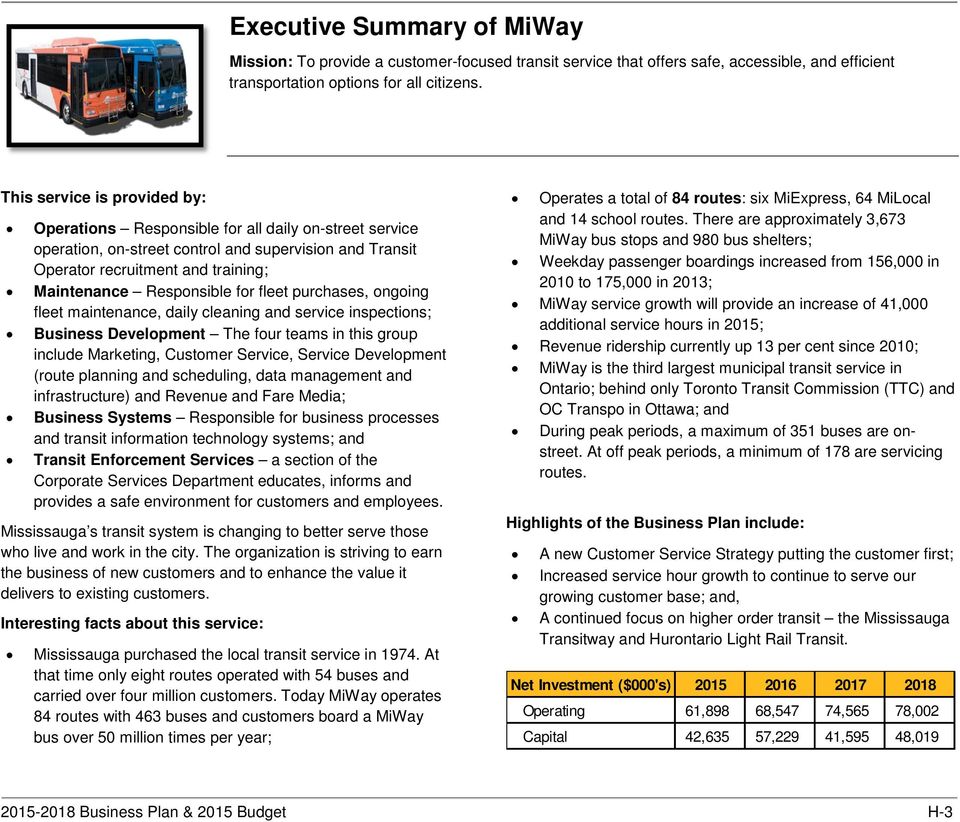
4 Executive Summary of MiWay Mission: To provide a customer-focused transit service that offers safe, accessible, and efficient transportation options for all citizens. This service is provided by: Operations Responsible for all daily on-street service operation, on-street control and supervision and Transit Operator recruitment and training; Maintenance Responsible for fleet purchases, ongoing fleet maintenance, daily cleaning and service inspections; Business Development The four teams in this group include Marketing, Customer Service, Service Development (route planning and scheduling, data management and infrastructure) and Revenue and Fare Media; Business Systems Responsible for business processes and transit information technology systems; and Transit Enforcement Services a section of the Corporate Services Department educates, informs and provides a safe environment for customers and employees. Mississauga s transit system is changing to better serve those who live and work in the city. The organization is striving to earn the business of new customers and to enhance the value it delivers to existing customers. Interesting facts about this service: Mississauga purchased the local transit service in At that time only eight routes operated with 54 buses and carried over four million customers. Today MiWay operates 84 routes with 463 buses and customers board a MiWay bus over 50 million times per year; Operates a total of 84 routes: six MiExpress, 64 MiLocal and 14 school routes. There are approximately 3,673 MiWay bus stops and 980 bus shelters; Weekday passenger boardings increased from 156,000 in 2010 to 175,000 in 2013; MiWay service growth will provide an increase of 41,000 additional service hours in 2015; Revenue ridership currently up 13 per cent since 2010; MiWay is the third largest municipal transit service in Ontario; behind only Toronto Transit Commission (TTC) and OC Transpo in Ottawa; and During peak periods, a maximum of 351 buses are onstreet. At off peak periods, a minimum of 178 are servicing routes. Highlights of the Business Plan include: A new Customer Service Strategy putting the customer first; Increased service hour growth to continue to serve our growing customer base; and, A continued focus on higher order transit the Mississauga Transitway and Hurontario Light Rail Transit. Net Investment Operating 61,898 68,547 74,565 78,002 Capital 42,635 57,229 41,595 48, Business Plan & 2015 Budget H-3
5 Existing Core Services Vision, Mission, Service Delivery Model MiWay is the third largest transit service in Ontario and operates a fully accessible, conventional, fixed route transit service within the boundaries of the City of Mississauga. As part of the Greater Toronto and Hamilton Area (GTHA), MiWay connects to commuter rail and regional bus service provided by GO Transit, and integrates service with neighbouring municipalities. The system connects with Brampton Transit to the north, Oakville Transit to the west, and the Toronto Transit Commission (TTC) to the east, with direct connections to the Bloor-Danforth subway line. MiWay Business Development Business Systems Vision MiWay: A lifestyle choice to your destination. Mission To provide a customer-focused transit service that offers safe, accessible, and efficient transportation options for all citizens. Transit Operations Transit Maintenance Rapid Transit (Transitway/LRT) H Business Plan & 2015 Budget

6 Service Delivery Model Delivering effective and efficient transit services that meet the needs of customers is a multifaceted business that, due to the nature of the operational environment, faces continuous change and complexity. Effective delivery of service is interdependent on involvement and participation from each of the staff transit groups and their service responsibilities. MiWay s service delivery model aims to achieve a balance between customer expectations and the cost of delivering attractive service that has value. Good employee relationships and sound financial management play an equally important role in the effective delivery of service. At the centre of our service are our existing and potential customers of MiWay. Our goal is to deliver excellent customer service through safe, flexible, integrated transit services that meet the needs of an increasingly diverse community. commitment to invest and improve overall customer service across the organization. Recognizing the desire to become a leader in customer service and improve the overall delivery of service for customers and staff, MiWay recommends the development of a customer service strategy beginning in On Street Service Delivery MiWay service is delivered through two delivery streams MiExpress service on blue buses and MiLocal service on orange buses. The Operations and Maintenance sections work on having the required amount of Transit Operators and buses fit for service every hour of every day. Many organizations today are faced with significant challenges in the area of customer service and service delivery both internally and externally. The pace of change and new technology coupled with high customer expectations is making many organizations develop or rethink its customer service strategies. In an era where customer service has become a defining factor for customers, organizations of all types struggle to find the unique balance between delivery of a service, the cost of delivery and customer expectations. MiWay understands that the customer is at the core of our business. Our customers define what we do and if we are successful at what we do every day. Every organization needs to have a customer service delivery model designed to integrate customer service into the strategic and operational mindset of all staff in the organization. As on-street service continues to grow, customer expectations of the service delivered by our Transit Operators and administration staff will increase and will call for a Business Plan & 2015 Budget H-5
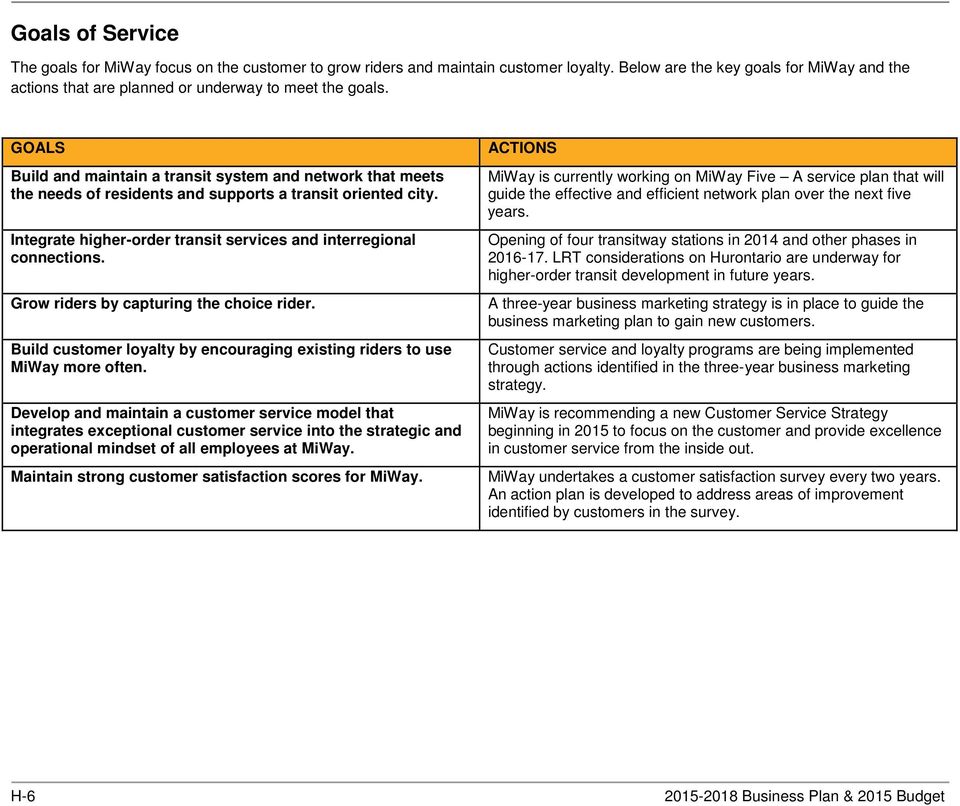
7 Goals of Service The goals for MiWay focus on the customer to grow riders and maintain customer loyalty. Below are the key goals for MiWay and the actions that are planned or underway to meet the goals. GOALS Build and maintain a transit system and network that meets the needs of residents and supports a transit oriented city. Integrate higher-order transit services and interregional connections. Grow riders by capturing the choice rider. Build customer loyalty by encouraging existing riders to use MiWay more often. Develop and maintain a customer service model that integrates exceptional customer service into the strategic and operational mindset of all employees at MiWay. Maintain strong customer satisfaction scores for MiWay. ACTIONS MiWay is currently working on MiWay Five A service plan that will guide the effective and efficient network plan over the next five years. Opening of four transitway stations in 2014 and other phases in LRT considerations on Hurontario are underway for higher-order transit development in future years. A three-year business marketing strategy is in place to guide the business marketing plan to gain new customers. Customer service and loyalty programs are being implemented through actions identified in the three-year business marketing strategy. MiWay is recommending a new Customer Service Strategy beginning in 2015 to focus on the customer and provide excellence in customer service from the inside out. MiWay undertakes a customer satisfaction survey every two years. An action plan is developed to address areas of improvement identified by customers in the survey. H Business Plan & 2015 Budget
8 Looking Back Since the launch of the City s Strategic Plan in 2009, MiWay, in conjunction with other Service Areas, has been working towards developing a transit orientated city. To achieve this, MiWay must consider how we can better connect people to their destinations with convenient transfers and good service frequency to provide a more attractive option to the automobile. To become a transit oriented city there must be aggressive service growth and strong support to build a system that meets the changing needs of the community. We are also entering an era where transit cannot just be a local bus system of on-street routes. We must implement transit priority and higher-order transit where appropriate to compete with the convenience of the automobile. Transit must work together with our planning and engineering teams to design our streets and communities to create a walkable and friendly transit orientated city. Looking back at what MiWay has accomplished so far to develop a transit orientated city: A New Brand Growth in Riders High Customer Marks More Service Youth Friendly Transit Business Service Improvements Customer Service Improvements Residents indicated that the MiWay brand has been successful as well as supporting service improvements with MiLocal and MiExpress service distinctions. A continued growth in customers is outpacing population and employment growth. MiWay reached a record of over 50 million boarding in High customer satisfaction scores of 82% in both 2011 and MiWay has added 125,010 hours in service since These services have addressed overcrowding, improved frequency, expanded our MiExpress network, improved connections and prepared services for the introduction of the Mississauga Transitway in Working together with youth to ensure transit is easy and friendly including a successful U-Pass program at UTM, MiWay Student Ambassadors promoting transit at over 20 Mississauga high schools and youth friendly ticket and pass discounts. In 2014 the Freedom Pass encouraged youths aged years of age to try transit with this free pass during the summer months and users were also able to swim for free at Mississauga community centres. The youth demographic accounts for approximately 40% of overall ridership. More MiExpress service to get to work faster, more shelters and convenient stops and a realignment of services to meet the business commuter needs in both the Meadowvale Business Park and the Airport Corporate Centre area. MiWay established a successful partnership with the City s Talent Management team to develop a successful recruitment campaign for Transit Operators that puts customer service skills first Business Plan & 2015 Budget H-7

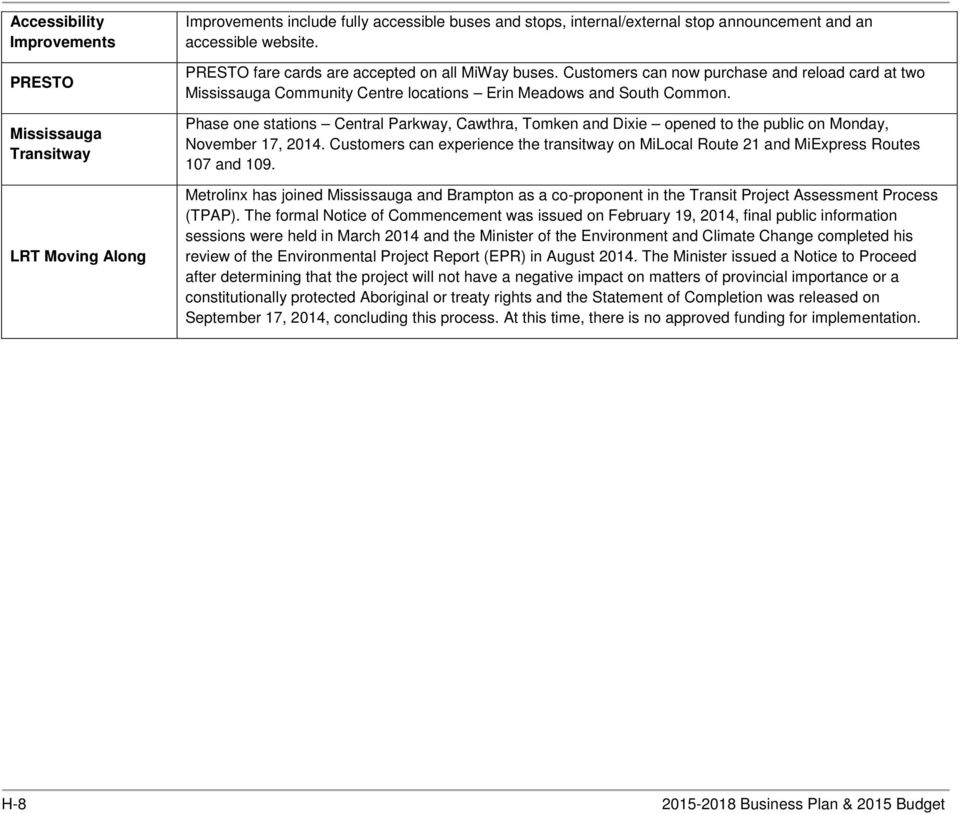
9 Accessibility Improvements PRESTO Mississauga Transitway LRT Moving Along Improvements include fully accessible buses and stops, internal/external stop announcement and an accessible website. PRESTO fare cards are accepted on all MiWay buses. Customers can now purchase and reload card at two Mississauga Community Centre locations Erin Meadows and South Common. Phase one stations Central Parkway, Cawthra, Tomken and Dixie opened to the public on Monday, November 17, Customers can experience the transitway on MiLocal Route 21 and MiExpress Routes 107 and 109. Metrolinx has joined Mississauga and Brampton as a co-proponent in the Transit Project Assessment Process (TPAP). The formal Notice of Commencement was issued on February 19, 2014, final public information sessions were held in March 2014 and the Minister of the Environment and Climate Change completed his review of the Environmental Project Report (EPR) in August The Minister issued a Notice to Proceed after determining that the project will not have a negative impact on matters of provincial importance or a constitutionally protected Aboriginal or treaty rights and the Statement of Completion was released on September 17, 2014, concluding this process. At this time, there is no approved funding for implementation. H Business Plan & 2015 Budget
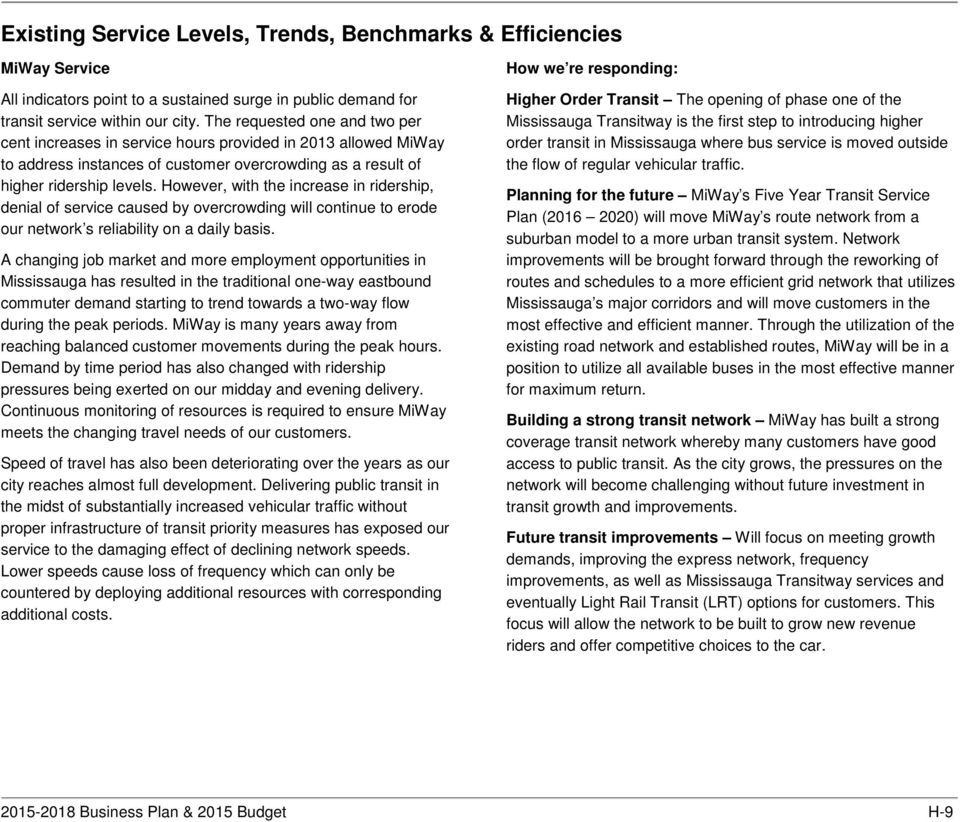
10 Existing Service Levels, Trends, Benchmarks & Efficiencies MiWay Service All indicators point to a sustained surge in public demand for transit service within our city. The requested one and two per cent increases in service hours provided in 2013 allowed MiWay to address instances of customer overcrowding as a result of higher ridership levels. However, with the increase in ridership, denial of service caused by overcrowding will continue to erode our network s reliability on a daily basis. A changing job market and more employment opportunities in Mississauga has resulted in the traditional one-way eastbound commuter demand starting to trend towards a two-way flow during the peak periods. MiWay is many years away from reaching balanced customer movements during the peak hours. Demand by time period has also changed with ridership pressures being exerted on our midday and evening delivery. Continuous monitoring of resources is required to ensure MiWay meets the changing travel needs of our customers. Speed of travel has also been deteriorating over the years as our city reaches almost full development. Delivering public transit in the midst of substantially increased vehicular traffic without proper infrastructure of transit priority measures has exposed our service to the damaging effect of declining network speeds. Lower speeds cause loss of frequency which can only be countered by deploying additional resources with corresponding additional costs. How we re responding: Higher Order Transit The opening of phase one of the Mississauga Transitway is the first step to introducing higher order transit in Mississauga where bus service is moved outside the flow of regular vehicular traffic. Planning for the future MiWay s Five Year Transit Service Plan ( ) will move MiWay s route network from a suburban model to a more urban transit system. Network improvements will be brought forward through the reworking of routes and schedules to a more efficient grid network that utilizes Mississauga s major corridors and will move customers in the most effective and efficient manner. Through the utilization of the existing road network and established routes, MiWay will be in a position to utilize all available buses in the most effective manner for maximum return. Building a strong transit network MiWay has built a strong coverage transit network whereby many customers have good access to public transit. As the city grows, the pressures on the network will become challenging without future investment in transit growth and improvements. Future transit improvements Will focus on meeting growth demands, improving the express network, frequency improvements, as well as Mississauga Transitway services and eventually Light Rail Transit (LRT) options for customers. This focus will allow the network to be built to grow new revenue riders and offer competitive choices to the car Business Plan & 2015 Budget H-9
11 Current and Projected Service Hours Service Type 2013 Service Hours 2014 Service Hours 2015 Budgeted Service Hours Hours % Hours % Hours % Weekday 1,184, % 1,221, % 1,257, % Saturday 108, % 110, % 113, % Sunday/Holiday 67, % 68, % 71, % Total 1,360, % 1,401, % 1,442, % 2015 Service Hour allocation is based on ridership demand and distribution Service Hours are estimated based on MiWay Service Growth Budget Request calculation. H Business Plan & 2015 Budget

12 The Mississauga Transitway As part of phase one of the Mississauga Transitway, the first four stations at Central Parkway, Cawthra, Tomken and Dixie are now operational. New, larger transit shelters on the north and south side of Rathburn Road were also added at the City Centre Transit Terminal and offer customers enhanced convenience and comfort within enclosed waiting areas. Real-time information will also be made available through upgraded departure boards inside the Terminal. MiWay s MiExpress Routes 107 and 109 and MiLocal Route 21 have transitioned onto the transitway and provide service between the City Centre Transit Terminal and Dixie Station. Saturday service was added along the MiExpress network (Routes 107 and 109) in November 2014 to improve network connectivity, and ensure full coverage along the transitway. Due to the phased approach to opening, MiWay expects to add 7,300 service hours in September 2016, with a further annualization of 14,600 service hours in 2017 as phases two and three come online. When fully operational in 2017 the Mississauga Transitway will provide east-west service supporting thousands of customers per day, making it faster and easier for commuters to travel to, from and through Mississauga and across the region. The 18 kilometre transitway will have 12 stations beginning at Winston Churchill Boulevard in the west and ending at Renforth Drive in the east. The transitway will be serviced by both MiWay and GO Transit. From the west, customers will travel on a dedicated two-lane, bus-only transit corridor from Winston Churchill Boulevard to Erin Mills Parkway. Buses will then travel on an existing bus-only lane on Highway 403 from Erin Mills Parkway to Mississauga s downtown core via Centre View Drive and Rathburn Road. The transitway then continues along a dedicated corridor that runs parallel to Highway 403 and north of Eastgate Parkway and Eglinton Avenue to Renforth Station. From there, customers will connect to Toronto Pearson International Airport and the TTC s Bloor-Danforth subway line. Mississauga Transitway Phase One Service Map Business Plan & 2015 Budget H-11

13 Hurontario/Main Street Light Rail Transit (LRT) Light Rail Transit service is planned along the Hurontario-Main Street corridor from south Mississauga to central Brampton. In partnership with the City of Brampton and Metrolinx, this project will initiate the transformation of Hurontario Street into the 21 st century with an integrated higher-order rapid transit system supported by appropriate land use and built form framework. Future LRT related activities are subject to project funding approval and will build upon the completion of the Hurontario- Main Street Corridor Master Plan (October 2010) and the Hurontario-Main LRT Preliminary Design and Transit Project Assessment Process (2014). Metrolinx is seeking Federal funding commitments through Build Canada and the Public Private Partnership (P3) application process, along with preparing this project for implementation. The next steps towards implementation will require the development of new agreements with our partners and staff involvement to ensure municipal interests are maintained. Once funding is committed, implementation would include retaining appropriate services to complete detailed design, construction and bringing the project into service. At full build out, the system would eventually operate between the Port Credit GO Station and the Brampton GO Station along Hurontario and Main Street and also service Downtown Mississauga. The LRT service would replace the limited stop express bus services currently operating along Hurontario Street and provide rapid transit connections to the Lakeshore, Milton and Georgetown GO Transit rail corridors as well as future Mississauga Transitway services. Light Rail Transit along the Hurontario/Main Street Corridor H Business Plan & 2015 Budget

14 MiWay Trends Operating costs financed by: Fares (48 per cent), City funding (43 per cent) and Provincial funding (nine per cent); Overall Customer Satisfaction remains high among transit customers with a score of 82 per cent for the second year in a row; Ridership growth continues at three per cent and new buses are added at a rate of three per cent to maintain service levels and meet ridership growth; New Transit Operators required as service growth continues to climb; Transit industry refocusing on centralizing the customer in its business; MiWay customers are moving towards the need for realtime information and technology; Students continue to be a growing market and an important demographic for customer retention; Revenue trips total 677,000 per week: 88 per cent weekday, seven per cent Saturday, five per cent Sunday; Travel destination flows 61 per cent of customers travel within Mississauga, 26 per cent to and from Toronto, eight per cent to and from Brampton and two per cent to and from Oakville; Top Three Origins during AM Peak Creditview/Mavis, Cooksville and Rathwood/Applewood; Top Three Destinations during AM Peak City Centre, Airport Corporate Centre and 401/Hurontario; Top Three Destinations from City Centre Transit Terminal during AM Peak Airport Corporate Centre, Creditview/Mavis and Central Erin Mills/Churchill Meadows; Busiest transit locations City Centre Transit Terminal, South Common Mall and Westwood Mall; and Busiest transit intersections Dundas/Hurontario, Dundas/Dixie and Dundas/Tomken Business Plan & 2015 Budget H-13
15 Annual Revenue Ridership Annual revenue ridership levels continue to climb. MiWay achieved record customers in 2013 at 35.8 million (an increase of three per cent from 2012), and is expected to reach 36.6 million by the end of 2014 (a forecasted increase of 2.2 per cent from 2013). Millions % 3.9% Annual Revenue Ridership (Millions) 3.0% 3.0% 2.2% ed ed* 3.0% ed 3.0% ed 3.0% ed *Note: 2014 forecasted Annual Revenue Ridership is based on Revenue Ridership Model (RRM) Period 8 Annual Passenger Boardings MiWay s annual boardings surpassed 51 million in It is forecasted that MiWay s annual boardings will reach 52.2 million in 2014 and 53.8 million boardings in Millions Annual Boardings (Millions) % 3.9% 0.9% 2.5% ed* 3.0% ed 3.0% ed 3.0% ed 3.0% ed Note: 2014 forecasted Annual Boardings is based on Revenue Ridership Model (RRM) Period 8 H Business Plan & 2015 Budget

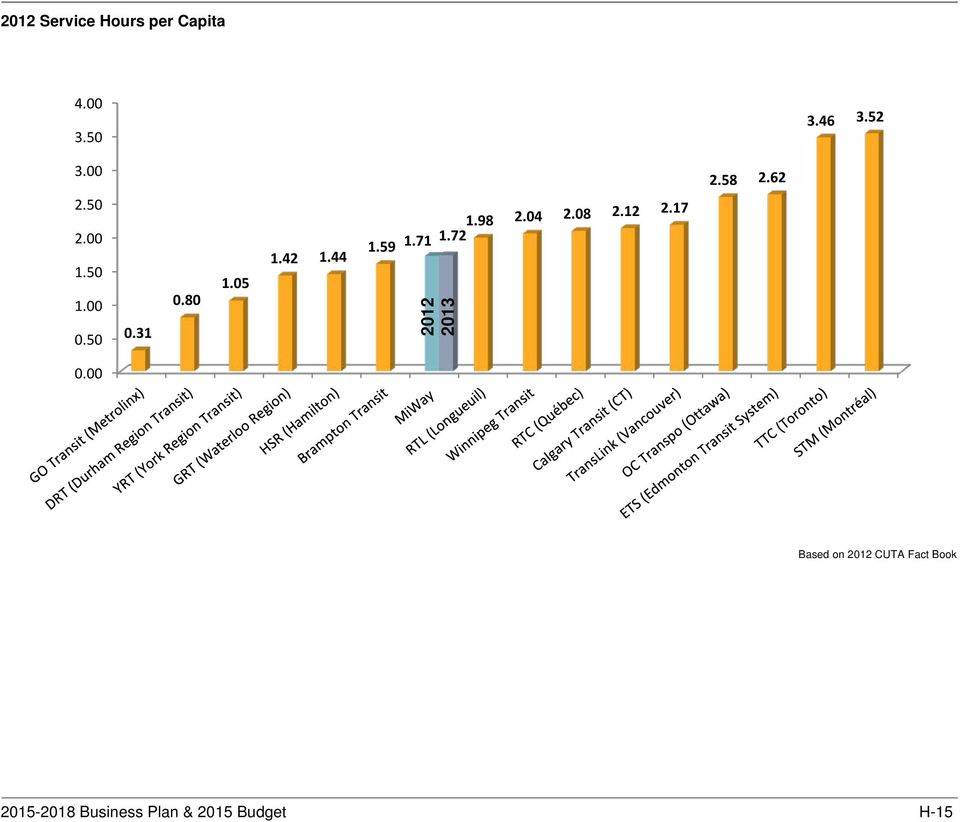
16 2012 Service Hours per Capita Based on 2012 CUTA Fact Book Business Plan & 2015 Budget H-15
17 2012 Rides per Capita Based on 2012 CUTA Fact Book H Business Plan & 2015 Budget

18 Existing Service Levels In order to attract new customers, frequencies require improvements to bring them in line with recent rider and non-rider surveys that identify frequency as the number one factor to attract new riders and improve overall customer satisfaction. The Five Year Transit Service Plan will review and recommend future service frequency improvements Weekday Frequencies 2 12 <= 10 minutes 11 minutes - 15 minutes minutes - 20 minutes minutes - 30 minutes 18 6 > 30 minutes Peak Routes 46 Off Peak Routes Note: Based on September Business Plan & 2015 Budget H-17

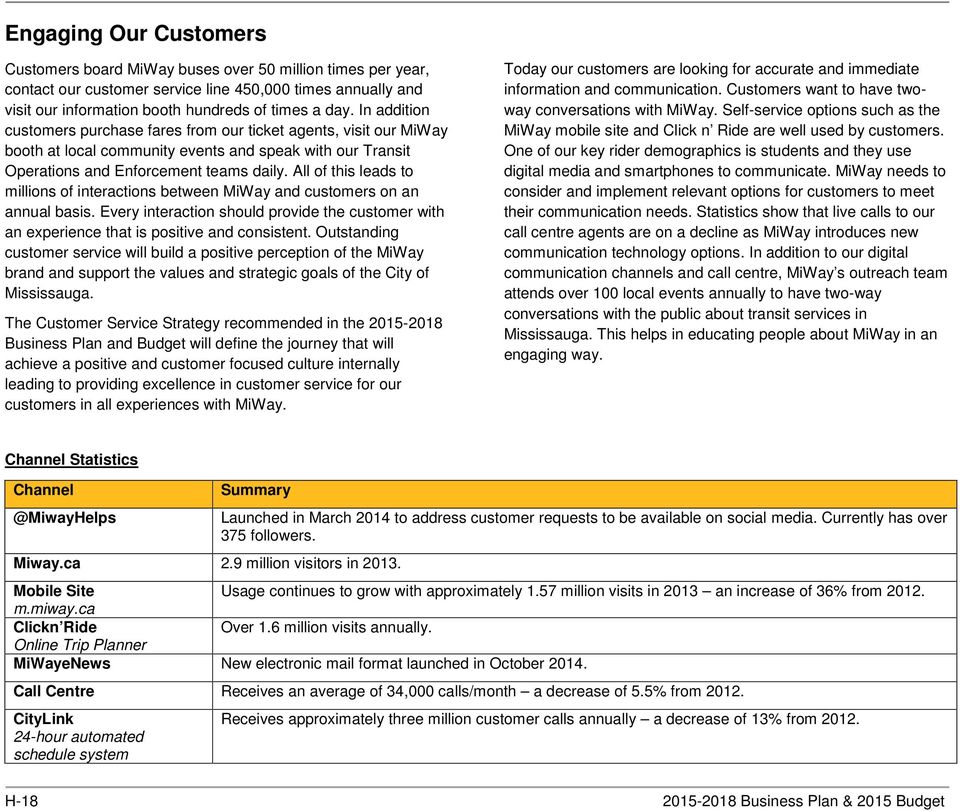
19 Engaging Our Customers Customers board MiWay buses over 50 million times per year, contact our customer service line 450,000 times annually and visit our information booth hundreds of times a day. In addition customers purchase fares from our ticket agents, visit our MiWay booth at local community events and speak with our Transit Operations and Enforcement teams daily. All of this leads to millions of interactions between MiWay and customers on an annual basis. Every interaction should provide the customer with an experience that is positive and consistent. Outstanding customer service will build a positive perception of the MiWay brand and support the values and strategic goals of the City of Mississauga. The Customer Service Strategy recommended in the Business Plan and Budget will define the journey that will achieve a positive and customer focused culture internally leading to providing excellence in customer service for our customers in all experiences with MiWay. Today our customers are looking for accurate and immediate information and communication. Customers want to have twoway conversations with MiWay. Self-service options such as the MiWay mobile site and Click n Ride are well used by customers. One of our key rider demographics is students and they use digital media and smartphones to communicate. MiWay needs to consider and implement relevant options for customers to meet their communication needs. Statistics show that live calls to our call centre agents are on a decline as MiWay introduces new communication technology options. In addition to our digital communication channels and call centre, MiWay s outreach team attends over 100 local events annually to have two-way conversations with the public about transit services in Mississauga. This helps in educating people about MiWay in an engaging way. Channel Statistics Summary Miway.ca 2.9 million visitors in Launched in March 2014 to address customer requests to be available on social media. Currently has over 375 followers. Mobile Site Usage continues to grow with approximately 1.57 million visits in 2013 an increase of 36% from m.miway.ca Clickn Ride Over 1.6 million visits annually. Online Trip Planner MiWayeNews New electronic mail format launched in October Call Centre Receives an average of 34,000 calls/month a decrease of 5.5% from CityLink 24-hour automated schedule system Receives approximately three million customer calls annually a decrease of 13% from H Business Plan & 2015 Budget
20 MiWay is committed to keeping its customers informed and reaching out to non-riders to build the MiWay brand through: Initiative Service Change Communications MiWay Student Ambassador Program Outreach Program Business Outreach Partner with Corporate Communications Online Communications Summary Support board period changes with extensive in-market communication including print and digital components. Partnered with students in 20 high schools in the 2013/2014 school year to promote MiWay service. Attend over 100 community events each year including Canada Day at Celebration Square, Carassauga and Bread and Honey Festival. Continue to build new relationships with businesses to educate their staff on available transit options. All MiWay media communications are in partnership with Corporate Communications team. Launch twitter pilot program and a new customer feedback form helps build MiWay s online presence Business Plan & 2015 Budget H-19

21 Marketing the Mississauga Transitway In 2013 and 2014 MiWay led extensive customer outreach and its largest marketing communication campaign focusing on the phase one opening of the Mississauga Transitway. A new webpage and transitway blog engaged users online, buses were wrapped, an official VIP opening was held (November 10, 2014) and MiWay hosted a community open house to introduce residents to the new stations. On Street Campaign Elements Digital Elements miway.ca H Business Plan & 2015 Budget
22 Three-Year MiWay Business Marketing Strategy ( ) The purpose of the three-year strategy is to guide MiWay s marketing plans and tactics as it strives to provide customerfocused transit service. The plan was informed by extensive primary research in addition to market and industry research. The primary research included stakeholder interviews, focus groups and quantitative research (online survey). A set of transit marketing best practices was identified based on case studies. The three-year business marketing strategy contains four strategic priorities based on key findings from the research. The priorities are: Manage service expectations by communicating key messages about ongoing service improvements to target audiences; Increase ridership by three per cent by focusing on targeted choice riders; Create consistent brand awareness and understanding among key target audiences, and all internal employees; and Develop and implement a social/digital strategy for brand and operational communication and transparency. MiWay Five Five Year Transit Service Plan ( ) While public transit has been an important municipal service over the years and has seen remarkable growth, an increased emphasis is now being placed on it as a key pillar in the City s Strategic Plan. To meet the City s future growth plans, the opening of the Mississauga Transitway and increasingly complex travel patterns within the City, further re-shaping and expansion of transit services are required. The Ridership Growth Strategy that was developed in 2006 brought MiWay to the current service levels and route coverage we see today. Over the next year MiWay will complete a five-year service plan study to effectively review best practices, gather stakeholder and public input and review existing service standards and metrics. This review will be the basis for a transit service plan that will guide effective service changes and growth to meet the needs of the community and move Mississauga towards becoming a transit orientated city Business Plan & 2015 Budget H-21
23 Opportunities and Challenges As new opportunities for transit growth and expansion present themselves to MiWay, utilizing our existing network and resources efficiently, capturing the choice customer and providing excellent customer service is key to ensuring continued growth within the market. As we look forward over the next four years MiWay has some challenges to manage on an operational front, but is balanced by a number of key opportunities with customer/public facing programs and initiatives to showcase our services and help us tell our story that a strong and well planned customer service program will support the development a transit oriented city. We have an opportunity to shift the culture from one that relied heavily on the automobile to one where transit is a viable option for trips whether to work or school during the weekday or a local destination on the weekend. Opportunities Mississauga Transitway PanAm Games Service MiWay 5 Five Year Transit Service Plan New Meadowvale Satellite Garage Second Downtown Transit Terminal Light Rail Transit Customer Service Strategy Summary Introduction of higher order transit and realignment of travel patterns for riders. Customers daily schedules to meet the demand, support modal shift, and move non-transit users. Valuable stakeholder and public input will help shape the direction for MiWay to better align and grow our network based on the needs of customers, both existing and potential. New garage will give MiWay Operations greater flexibility in start and end points to deadhead, improved response times and grow service. To alleviate congestion at the City Centre Transit Terminal. Secure funding will allow the next phase of the Hurontario LRT project to proceed and bring rail to Mississauga, connecting major MiWay hubs along a key transit corridor. A new customer service program will improve service where our customers are on the street and on our buses. The program will bring valuable customer focus from inside the organization to our external customer. H Business Plan & 2015 Budget
24 Challenges Overall transit funding sources Senior government debt City Centre Transit Terminal construction Hanlan Water Main construction Rear door bus access Staffing/talent management Labour disruption Cost structure of current delivery model Customer impacts travelling to Toronto Summary The City will face increased competition for funding through provincial and federal resources: Provincial funding focuses on the inter-regional integration and is inadequate to address City needs; and No identified funding source for municipal transit infrastructure improvements. Decreased likelihood of support to municipalities. Infrastructure improvements to CCTT have been moved to 2015 to ensure seamless bus operations for required PanAm service. Hanlan construction will continue to put pressure on MiWay operations. Major infrastructure improvements underway to ensure buses are fully accessible to all customers, at all stops. Increasing competition from neighbouring transit properties and new opportunities for staff within the City. Transit Operator Collective Bargaining Agreement expires in September Contract negotiations will be closely monitored. Cost increases exceed growth in fare revenue requiring additional tax subsidy to allow for growth in service hours. Islington subway station deterioration and MiWay move to Kipling delayed Business Plan & 2015 Budget H-23
25 Maintaining Our Infrastructure Bus Stop Accessibility To ensure fully accessible transit service for all, improvements must be made to all stops to allow for fully accessible rear door access on all buses. The goal is to upgrade and ensure these stops can accommodate people exiting at the front and the rear of the bus as safely as possible on to a hard surface. A concrete pad needs to be installed and/or extended at the bus stops to eliminate all tripping hazards and make exiting the bus safe. While a concrete bus pad built to requirements at the front door meets accessibility requirements for wheel chairs, planned extension of pads to the rear doors improves the safety and waiting experience for the entire spectrum of transit customers. City Centre Transit Terminal Infrastructure Repairs A number of initiatives are currently ongoing and planned over the next two years. These include the following: New Initiatives: Platform and rear façade structural repairs 2014; Customer washroom upgrades ; Customer display screens 2014; Pavement replacement 2014 ongoing; Basement and pavement structural repairs 2016; Building Automation System replacement ; and Tactile wayfinding for improved accessibility Mississauga Transitway Total km of roadway to be maintained Phase km Full Opening 12 km Phase 1-7 Full Opening - 26 Number of Bridges to be maintained Mississauga Section - 9 Renforth Gateway 4 Transitway West 6 Number of Stations to be maintained Phase 1 4 Full Opening 11 Number of Shelters to be maintained 2 (City Centre Transit Terminal) Storm Ponds 5 Noise wall Highway 403 from Hurontario to Cawthra H Business Plan & 2015 Budget
26 Bus Cleaning Facility Malton The program requirement is to build a covered facility with heating and ventilation, power, water and drainage for safe and easy operation of an interior clean lane to wash the interiors of buses at Malton. This may be achieved without disrupting existing operations, compromising maintenance capabilities or the need for additional land. Inclusion of an interior clean lane is essential to achieve the facility s full potential of 100 buses from the current 70 bus operation. Transit Shelter Management In 2018 MiWay s contract with CBS Outdoor will expire after 18 years. Currently CBS Outdoor is responsible for all capital works and on-going operations associated with the City s transit customer shelter program. In return, CBS has the exclusive right to sell advertising space within the shelter caissons. As part of the agreement, MiWay is entitled to five per cent of the shelter space to be utilized to promote service changes and promotional programs to increase brand awareness and drive ridership new shelters to be installed annually; and Updated MiWay bus stop signs will continue to be installed at 200 stops per year Business Plan & 2015 Budget H-25
27 Implementing the Strategic Plan Develop Environmental Responsibility viable alternative to automobile. Connect our city express routes that link neighbourhoods and businesses. Build a Reliable and Convenient System routes/hours, PRESTO, access to real-time next bus information. Ensure Affordability and Accessibility network for seniors, youth and immigrants, remain conscious of fare impacts. Provide mobility choices connect neighbourhoods and provide convenient transit to link people to jobs, schools, shopping, and recreation. Meet Employment Needs provide transit network infrastructure that allows workers and customers to get to their places of business. Lead and Encourage Environmentally Responsible Approaches use hybrid supervisor vehicles and buses, use renewable fuels (biodiesel) and energy efficient facilities and practices. Increase Transportation Capacity family of services local, core services, express services, accessible buses and routes. H Business Plan & 2015 Budget
28 Required Resources Facilities & Equipment Buses MiWay has invested heavily in new buses over the past eight years. Since 2007, 83 new buses have been purchased with six planned to go in to service by the end of MiWay s current fleet of 463 buses includes: 30 Eldorado Hybrid Diesel Diesel Bus Replacement/Growth Schedule Over the next 30 years the MiWay fleet will continue on its bus fleet renewal program with buses purchased from 2003 to 2009 being retired from service and replaced with new, state of the art buses. TYPE TOTAL Retired from Service New Replacement Buses Growth Buses As MiWay continues to grow, the following initiatives have been planned: Improve customer amenities, rear door concrete bus pads with full platforms are being installed at stops; Real-time next bus displays will be installed at intersections starting in 2016; Expansion of the Malton Facility in 2015; Design for second Downtown Transit Terminal for 2016; Kipling Terminal to be completed in 2019; and Coordinate with Traffic Management, Roads and Region to align transit priority initiatives in Business Plan & 2015 Budget H-27
29 Technology Technology plays an important role in how MiWay delivers transit to customers. As our systems evolve and we continue to move into the digital age, customers want their information when they want it immediately, on the go, and on their mobile device. Over the next four years our focus is on enhanced customer service information, completion of information technology modernization, use of new technology to improve decisionmaking and increase efficiencies. This will allow us to: Streamline operations that will lead to better use of resources and provide customers with quality real-time information on their mobile devices; Provide feedback to Service Planners on the ability of the Service Plan to service the highest proportion of customers; Offer Schedulers fresh inputs (i.e. running times) to close the gap between plans and road, traffic, and passenger loads conditions; Give Operations a reliable tool to assess and monitor onstreet performance and customer experience, ultimately allowing for active management of service reliability; and Allow for better use of resources as repetitive functions are automated and feedback from daily performance is readily available through dashboards and metrics. ibus, AVL and APC All MiWay buses have been outfitted with on-board GPS which provides real-time Location and Automated Passenger Counting Capabilities. How we ll deliver these services: Customer Equipment - Automated real-time signs at terminals for next bus - PRESTO next generation equipment for open payment and self-service - Mobile access to real-time information Process and Decision-making support Applications and system integration - Running times modelling - Hastus Comments - Ridership and route analytics - Hastus Employee Performance Management - Bus performance monitoring - Hastus Payroll - Efficient use of operator hours - Garage Management - Automation of allocation - Hastus and ibus - Fleet management with ibus - Fleet management with fuel management H Business Plan & 2015 Budget
30 PRESTO GTA Fare Card In May 2011, PRESTO was rolled out on all MiWay buses. The PRESTO fare card can now be purchased from the PRESTO website, at the City Centre Transit Terminal, the MiWay booth at the Islington subway station, select Mississauga Community Centres or at any GO Transit station. The PRESTO fare card system provides fare structure alignment and seamless travel within the Greater Toronto and Hamilton Area (GTHA) with the eventual elimination of paper transit fare media where only PRESTO or cash are to be the accepted form of payment. The PRESTO fare card provides the ability to set separate fares and cards to be configured as concession fares (i.e. child/student/senior-post-secondary). In May 2012, MiWay launched a weekly loyalty program that rewards PRESTO cardholders who frequently travel on MiWay with free rides after 12 full fare trips in the same week (Monday to Sunday). The average MiWay fare is not increasing due to the increased use of PRESTO. Since its launch, MiWay has sold over 57,000 PRESTO cards and over 16 million trips have been taken by customers who have chosen PRESTO. PRESTO fares currently make up approximately 38 per cent of MiWay fare revenues. MiWay still allows customers to purchase tickets and monthly passes but as customer use of the PRESTO fare card continues to grow on MiWay, paper fare media (tickets and passes) will be phased out. In 2014 the Adult Weekly and Student Weekly passes were eliminated and users were transitioned to PRESTO. A fare strategy will be presented to Council in late Business Plan & 2015 Budget H-29
31 Human Resources Proposed Full Time Equivalent Staffing Distribution by Program Program Business Development Business System Transit Maintenance Office of Director Operations Transportation Project Office Transit Total Service Distribution Staffing increases in 2015 include the following: 27 new Transit Operators related to the MiWay Service Growth initiative; two new full-time staff for maintenance and operations of the Mississauga Transitway; three contract staff over the next three years for the MiWay Customer Service Strategy; and one full-time PRESTO Equipment Technician for ongoing maintenance and support of PRESTO card devices. Staffing increases between 2016 and 2018 are related to the MiWay Service Growth initiative as well as staff required for maintenance and operations of future phases of the transitway. H Business Plan & 2015 Budget
32 Proposed Operating & Capital Budgets This part of the Business Plan sets out the financial resources required to deliver the proposed Business Plan. Information is provided by major expenditure and revenue category as well as by program. The costs to maintain existing service levels and operationalize prior decisions are identified separately from proposed changes. The prior year budget for 2014 was $57.9 million and the proposed budget for 2015 is $61.9 million. Total Changes to Maintain Current Service Levels The impact of maintaining current service levels for the Transit service is an increase of $2.3 million for Highlights of the proposed budget changes are: Labour costs are projected to increase by $2 million and reflects negotiated union agreements, economic adjustment increases, labour adjustments and other fringe benefit changes; The diesel fuel budget is being increased to bring it in line with prices paid during 2014, which is also the average price that is forecasted for The adjustment from $1.04 to $1.09 per litre for 2015 creates a $1 million pressure in the operating budget; The removal of the one-time increase for CAD/AVL maintenance reduces the budget by $420,000; Property tax on the Central Parkway Transit Campus has increased by $490,000, reflecting the increased assessment related to the recent expansion and renovation; Farebox revenues are forecasted to increase by $2.3 million related to the proposed 2015 fare increase and ridership growth of three per cent; and, The draw on the Provincial Gas Tax Reserve Fund is being reduced by $0.8 million. Total Changes to Operationalize Prior Decisions The following budget changes are proposed to operationalize prior decisions in the Transit Service for 2015: Labour (27 transit operators), diesel fuel and minor maintenance items are forecasted to increase the operating budget by $1.4 million for 2014 service improvements, having added 41,000 hours in Efficiencies and Cost Savings The labour budget is being reduced to $1.3 million to reflect savings arising out of the Collective Agreement changes in the last contract. Proposed Changes to 2015 Net Operating Budget by Category 2, , , , (500.0) (1,000.0) (1,500.0) (2,000.0) 2,299.0 Maintain Current Service Levels (1,578.0) Efficiencies and Cost Savings 1,416.3 Operationalize Prior Decisions 1,880.0 Budget Requests Business Plan and 2015 Budget H-31
33 Operating The following tables identify the budgeted and forecasted operating expenditures and revenues for 2014 to 2018, as well as 2013 actuals, by major program within the service area as well as by major expenditure and revenue category. Proposed Budget by Program Description Expenditures to Deliver Current Services 2013 Actuals 2014 Budget 2015 Proposed Budget Business Development 5,713 8,473 8,383 8,931 8,534 9,133 Business System 3,002 4,119 3,744 4,084 6,124 6,166 Office of Director 4, , ,033 Operations 89,403 97,141 98,204 97,397 97,574 97,786 Transit Maintenance 43,482 47,092 49,547 51,045 52,554 54,082 Transportation Project Office Transit Total Expenditures 146, , , , , ,381 Revenues (77,395) (81,889) (84,261) (84,872) (87,997) (90,747) Transfers From Reserves and Reserve Funds (14,444) (18,000) (17,175) (15,917) (15,575) (15,575) New Initiatives and New Revenues 1,880 6,760 12,184 15,943 Proposed Net Budget Including New Initiatives & New Revenues 54,714 57,882 61,898 68,547 74,565 78,002 Expenditures Budget - Changes by Year 2% 1% 2% 1% Proposed Net Budget - Changes by Year 7% 11% 9% 5% Note: Numbers may not balance due to rounding. H Business Plan & 2015 Budget
34 Summary of Proposed 2015 Budget Description 2014 Approved Budget Maintain Current Service Levels Efficiencies and Cost Savings Annualized Prior Years Budget Decisions Operating Impact of New Capital Projects Proposed New Initiatives And Revenues Special Purpose Levies 2015 Proposed Budget $ Change % Change Over 2014 Over 2014 Labour and Benefits 120,669 1,982 (1,248) 1, , ,562 3,893 3% Operational Costs 36,317 1,209 (330) ,504 2,187 6% Facility, IT and Support Costs % Total Gross Expenditures 157,770 3,334 (1,578) 1, , ,993 6,223 4% Total Revenues (99,888) (1,036) 0 (512) 0 (659) 0 (102,095) (2,207) 2% Total Net Expenditure 57,882 2,299 (1,578) 1, , ,898 4,017 7% Note: Numbers may not balance due to rounding. Summary of Proposed 2015 Budget and Description 2015 Proposed Budget Labour and Benefits 124, , , ,483 Operational Costs 38,504 39,548 42,501 43,586 Facility, IT and Support Costs Total Gross Expenditures 163, , , ,055 Total Revenues (102,095) (102,057) (105,372) (108,054) Total Net Expenditure 61,898 68,547 74,565 78,002 Note: Numbers may not balance due to rounding Business Plan and 2015 Budget H-33
35 Changes to Maintain Current Service Levels Including Prior Year s Budget Decisions The following table identifies the changes in costs and revenues to maintain existing service levels, efficiencies and cost savings and the cost increases arising from prior year decisions. Description 2015 Proposed Budget Labour and Benefits 1,982 3,105 2,225 2,261 Operational Costs Increases Diesel increase of $0.05 per litre 1,000 1,000 1,000 1,000 Property Taxes - Transit Buildings Vehicle Maintenance Inventory Relief Presto Commission Expense Utility Costs Biodiesel increase due to elimination of provincial exemption Transit Operator Safety Media Campaign Business Market Research (150) 150 Business Development-Marketing (350) 350 Presto Centralization 0 0 2,000 0 CAD/AVL Maintenance Net Reduction (2014 one-time funding) (420) Uniforms - Operating Budget Reserve Return (750) Other Changes 263 (194) Operational Costs Increases 1,353 2,176 2,756 1,772 Efficiencies and Cost Savings Labour Cost reduction-due to Long Term Disability (1,248) Contractor & Professional Services (260) Staff Development (70) Other Efficiencies and Cost Savings (1,578) (1,578) (1,578) Efficiencies and Cost Savings (1,578) (1,578) (1,578) (1,578) Note: Numbers may not balance due to rounding. H Business Plan & 2015 Budget
36 Changes to Maintain Current Service Levels Including Prior Year s Budget Decisions (Continued) Description 2015 Proposed Budget Operating Impact of New Capital Projects Operating Impact of New Capital Projects Current Revenue Changes Adjustment for Provincial Gas Tax Revenue Increase - 2% Revenue Growth (1,500) (1,500) (1,500) (1,500) Transit Fare Increase (750) (1,000) (1,000) (1,000) Bus Shelter Revenue (90) (167) (283) (250) Revenue Reduction 0 1, Uniforms - Operating Budget Reserve Return Other Changes (246) 0 0 Current Revenue Changes (1,036) (1,667) (2,783) (2,750) Annualized Prior Years Budget Decisions 3% Service Growth , Farebox Increase Revenue (104) (250) 0 0 Other Changes 0 4 (4) (4) Annualized Prior Years Budget Decisions 1,416 (246) (4) (4) Total Changes to Maintain Current Service Levels 2,138 1, (298) Note: Numbers may not balance due to rounding Business Plan and 2015 Budget H-35
37 Proposed New Initiatives This table presents the costs by budget request (BR#) for proposed new initiatives. Detailed descriptions of each budget request can be found on the pages following the table. Description New Initiative Mississauga Transitway - Maintenance and Operations BR # 2015 FTE Impact 2015 Proposed Budget MiWay Customer Service Strategy * Downtown Transitway Connection ,000 MiWay Service Growth ,468 4,873 8,503 12, ,090 Hurontario LRT PRESTO Equipment Maintenance Low Income Transit Pass Pilot Program Total New Initiatives - Tax Funded ,880 6,760 12,184 15, ,090 Note: Numbers may not balance due to rounding. * Initiative funded from Provincial Gas Tax for at $475,000 per year Proposed Budget 2017 Proposed Budget 2018 Proposed Budget 2015 to 2018 FTE Impact ,726 2, to 2018 Capital 0 H Business Plan & 2015 Budget
38 Budget Requests Budget Request #: 1272 Proposed Initiative Department Service Area Mississauga Transitway - Maintenance and Operations Transportation & Works Department MiWay Required Operating Investment Impacts ($000s) Gross Expenditures , , ,172.4 Reserves & Reserve Funds User Fees & Other Revenues Tax Levy Requirements , ,757.4 * Net Change in $ , FTEs * Any net change that is negative, (in brackets), is a good thing. It means a reduction in expenditure or an increase in revenue. Required Capital Investment Total Capital ($000s) 2014 & Prior & Beyond Expenditures Why Staff Recommend this Initiative The Mississauga Transitway will open in phases starting in There is a lot of infrastructure and projected increase in operations and a comprehensive maintenance and operations program is needed to ensure the success of the transitway. The Mississauga Bus Rapid Transit Project is a partnership between the Government of Canada, Province of Ontario, Metrolinx and the City of Mississauga Business Plan and 2015 Budget H-37
39 Budget Request #: 1272 Details of Service Change Customers: The Mississauga Transitway project will see the creation of a dedicated east-west transit corridor across Mississauga which will run along the Highway 403, Eastgate Parkway and Eglinton Avenue corridors, connecting Winston Churchill Boulevard to Highway 427. Once operational, the transitway services will complement and connect with local bus service, inter-regional transit service and the TTC. The first segment of the transitway is scheduled to open in fall The full transitway will be operational in fall The new transitway will be 18 kilometres in length, with 11 new stations and 26 new bridge/culvert structures. The City is responsible for funding seven kilometres of transitway as well as eight stations. GO, a division of Metrolinx, is responsible for five kilometres of transitway and three stations. 15 buses have been acquired as part of the BRT Project to support MiWay operations. Service Hour Growth: Increase of 7,300 hours starting in September 2016, with a further annualization of 14,600 hours in 2017 with the opening of phases two and three. Risk Management: The Mississauga Transitway project is utilizing a comprehensive risk management program throughout the design and construction phase of the project. A commissioning phase for the transitway was developed for all users (transit service providers, maintenance staff, enforcement and emergency service providers) to mitigate risks. Service Impact Maintenance and operating costs for the transitway will cover: Roadway costs - maintenance by the City including winter and grounds maintenance and future roadway repair (cost sharing agreement with GO/Metrolinx for their five kilometres portion (2.5km/transitway west and 2.5 km/transitway east) is being finalized; Parking lot and station costs - parking lots for transitway east (350 spaces) and maintenance and operating costs for eight transitway east stations; Staffing costs - MiWay bus operators (33 FTEs 18 hired with 15 more in 2016) and one-time training costs, enforcement and security officers (two FTEs - one hired 2014, one in 2015), MiWay infrastructure coordinator (one FTE hired 2014), engineering and works maintenance contract coordinator (one FTE 2015). A placeholder has been created for the provision of police services in Future capital costs will cover PRESTO support (new PRESTO units for the transitway stations), asset management including bridge condition surveys, and associated capital costs for vehicles for enforcement and security officers. Future revenue from the transitway will include farebox revenue from new ridership. Transitway station advertising revenue not included at this time. H Business Plan & 2015 Budget
40 Budget Request #: 1274 Proposed Initiative Department Service Area MiWay Customer Service Strategy Required Operating Investment Transportation & Works Department MiWay Impacts ($000s) Gross Expenditures Reserves & Reserve Funds User Fees & Other Revenues Tax Levy Requirements * Net Change in $ FTEs * Any net change that is negative, (in brackets), is a good thing. It means a reduction in expenditure or an increase in revenue. Required Capital Investment Total Capital ($000s) 2014 & Prior & Beyond Expenditures Why Staff Recommend this Initiative Customer service is at the core of public transit. Our customers define what we do and if we are successful at what we do every day. Every organization needs to have a customer service model designed to integrate customer service into the strategic and operational mindset of all staff in the organization. Although MiWay scores well in overall satisfaction the areas related to customer service achieved lower scores and require a commitment to making improvements Business Plan and 2015 Budget H-39
41 Budget Request #: 1274 Details of Service Change At MiWay we need to transform the customer experience beginning with change from the inside out. Many transit organizations such as GO Transit, TTC and Translink in British Columbia have successfully achieved this customer focus through a Customer Service Strategy which incorporates a Passenger Charter Program. A Passenger Charter is a public commitment of what employees will deliver to customers. It empowers employees to meet the needs of customers promptly and it informs the customer of the minimum service standards that the customer can count on from MiWay. Implemented programs have been successful in growing ridership, cost savings, boosting employee morale, building public approval and establishing goodwill. The Customer Charter program has been adopted by the Canadian Urban Transit Association (CUTA) as a part of their Transit Vision More specifically, in the Vision 2040 Theme 3 encourages and actions transit agencies across Canada to build customer orientation into their daily business. CUTA has endorsed the Passenger Charter Program and provides free templates and training materials needed to successfully implement a passenger charter program. Service Impact As highlighted in the third theme of the CUTA Vision Focusing on Customers, it s all about the customer. One of transit s greatest challenges in recent decades has been to serve travelers who have become more diverse by nature and more discriminating in their choices. Investing in customer service can: - Increase ridership; - Save money by reducing complaint handling; - Increase attention to customer service; - Boost employee morale resulting in better attendance and less time managing grievances; and - Finally, governments are more likely to fund transit agencies that have the high public approval that comes with good customer service. The recommendation is to hire a Customer Strategy Project Manager, a Customer Service Coordinator and one Trainer to effectively manage the program requirements. H Business Plan & 2015 Budget
42 Budget Request #: 1275 Proposed Initiative Department Service Area Downtown Transitway Connection Required Operating Investment Transportation & Works Department MiWay Impacts ($000s) Gross Expenditures Reserves & Reserve Funds User Fees & Other Revenues Tax Levy Requirements * Net Change in $ (63.0) FTEs * Any net change that is negative, (in brackets), is a good thing. It means a reduction in expenditure or an increase in revenue. Required Capital Investment Total Capital ($000s) 2014 & Prior & Beyond Expenditures 0.0 2, , Why Staff Recommend this Initiative The downtown portion of the Mississauga Transitway is the missing link in the fully dedicated transit facility traversing Mississauga. In order to provide transit priority for both MiWay and Metrolinx (GO), it is important that this section be constructed Business Plan and 2015 Budget H-41
43 Budget Request #: 1275 Details of Service Change The Mississauga Transitway will see the creation of a dedicated east-west transit corridor (transitway) across Mississauga. The transitway is currently being constructed by the City in partnership with Metrolinx and the sections both west and east of downtown are expected to be constructed and fully operational in The downtown section has not been designed or constructed and is the missing link with regard to a complete dedicated corridor (there is interim use of shoulder lanes on Highway 403 east of Mavis to Erin Mills Pkwy that may be modified to a dedicated facility sometime in the future). The downtown section operates in mixed traffic and is intended to be converted to a dedicated transitway with linkages to the existing City Centre Transit Terminal and the Metrolinx City Centre operations. Given the pending LRT design and construction, there is urgency to undertake preliminary design of this section to ensure ultimate compatibility. The design is to consider and integrate connections to LRT and adjacent development. There is also the desire to position the City/Metrolinx for future funding opportunities should they present themselves. There may be a requirement to amend the currently approved Environmental Assessment. Preliminary design works to confirm. It is anticipated that there will be cost recovery from Metrolinx. Service Impact The downtown section of the transitway was included in the original environmental assessment and includes a portion of the transitway to be grade separated. The transitway facility is an integral part of MiWay's operations and is an important link in Metrolinx's Big Move rapid transit grid. The design, construction and funding of this section will be in partnership with Metrolinx but the details have not been established. To coordinate the project a Project Manager is needed for a two year period (one FTE). The Capital Expenditures assumes a 50 per cent cost recovery from Metrolinx and the City's portion funded from the Federal Gas Tax. H Business Plan & 2015 Budget
44 Budget Request #: 1276 Proposed Initiative Department Service Area MiWay Service Growth Required Operating Investment Transportation & Works Department MiWay Impacts ($000s) Gross Expenditures 1, , , ,595.6 Reserves & Reserve Funds User Fees & Other Revenues ,316.8 Tax Levy Requirements 1, , , ,278.8 * Net Change in $ 3, , ,776.2 FTEs * Any net change that is negative, (in brackets), is a good thing. It means a reduction in expenditure or an increase in revenue. Required Capital Investment Total Capital ($000s) 2014 & Prior & Beyond Expenditures , , Why Staff Recommend this Initiative Additional service hours are requested to alleviate overcrowding and improve service reliability. Changes in travel patterns and increased ridership are exerting added pressures without the resources to respond appropriately. To reduce the gap between demand and supply, the increase in service hours will provide MiWay a minimum ability to enhance frequencies bringing them in line with customer expectations, as well as help create a transitway integrated system Business Plan and 2015 Budget H-43
45 Budget Request #: 1276 Details of Service Change The requested three per cent increase in service hours provided in the last Business Planning cycle allowed MiWay to address instances of overcrowding as a result of higher ridership. However, with the increase in ridership, denial of service caused by overcrowding will continue to erode MiWay's network reliability. Delivering public transit in the midst of substantially increased vehicular traffic, without proper infrastructure of transit priority measures has greatly impacted service reliability throughout the system. Additional funding is required to develop a transitway integrated network by reinforcing services feeding the Mississauga Transitway, with improved frequencies to support this massive infrastructure investment. Currently MiWay operates 1.35 million transit service hours annually. With the requested three per cent in transit service hours, MiWay will reach its goal of two service hours per capita, reaching its goal of 1.53 million service hours by This will bring it in line with other transit properties with existing or developing transitway/rapid transit systems such as Ottawa, Calgary, Edmonton and Winnipeg. Service Impact SERVICE HOURS: The requested three per cent annual increase in transit service hours will translate into 41,000 hours in 2015, 43,000 in 2016, 44,000 in 2017 and 46,000 in BUSES:New bus allocation of three buses per year (less than one per cent) from Development Charges is failing to keep up with ridership growth and is not sufficient for the requested service hour growth needed to alleviate overcrowding, improve reliability and develop a transitway integrated route network. In order to sustain and grow MiWay s services and fleet, the requested funding is required to grow MiWay s fleet, matching it with the requested additional growth hours. The increase in service hours will require an additional 34 new buses by 2018 which will be funded by the Federal Gas Tax. Twenty-two buses are included in this BR and 12 will be listed as unfunded in MARKETING/COMMUNICATION: MiWay s Five Year Service Plan will highlight key service improvements to create a transitway integrated route network. To deliver the service improvements identified in Five Year Plan, MiWay requests an additional $100,000 to assist in the marketing and communication of future service improvements and help facilitate more public engagement. H Business Plan & 2015 Budget
46 Budget Request #: 1277 Proposed Initiative Department Service Area Hurontario LRT Project Office Required Operating Investment Transportation & Works Department MiWay Impacts ($000s) Gross Expenditures Reserves & Reserve Funds User Fees & Other Revenues Tax Levy Requirements * Net Change in $ (35.5) 14.8 FTEs * Any net change that is negative, (in brackets), is a good thing. It means a reduction in expenditure or an increase in revenue. Required Capital Investment Total Capital ($000s) 2014 & Prior & Beyond Expenditures Why Staff Recommend this Initiative Building upon the previous investment and anticipated completion of the Hurontario-Main Street Light Rail Transit Project (Preliminary Design and Transit Project Assessment Process), the next phase will require preparation for the eventual project construction and implementation. This project is dependent on ultimate agreement with Metrolinx Business Plan and 2015 Budget H-45
47 Budget Request #: 1277 Details of Service Change Prior to establishing a project funding and management model for full implementation, various pre-emptive works need to be done to maintain project momentum, understand and minimize implementation risks, and facilitate the timely construction. These items include establishing the backbone for a future Project Office to bridge the gap until full funding is achieved. A focus is needed to coordinate legal comments for the many agreements and memorandums of understanding, and maintaining community engagement while working on the development of the full implementation model. There is a need to prioritize and manage risk items such as initiating property acquisitions and addressing utility conflicts that can both significantly impact ultimate implementation timelines and costs. This unit should also provide input into other legal and procurement pieces required to fully initiate project development and navigate through the governmental funding/approval processes (i.e. P3 Canada). Protecting the City's interest (legal and engineering), concept design is complimentary of protecting the City's corridor, landscape/streetscape, utilities, public realms. Though Metrolinx has advised that they will take the lead on the project, the City must be in a position to work with Metrolinx and Brampton to help ensure that the corridor and the City's interests are looked after. The LRT project will be coordinated through the newly created Rapid Transit Section. Service Impact Building upon the previous investment and anticipated completion of the Hurontario-Main Street Light Rail Transit Project (Preliminary Design and Transit Project Assessment Process), the next phase will require preparation for the eventual project funding, contracting, construction and implementation. Responsibilities will require a Senior Manager, two Project Managers (two FTE), Legal (one FTE) and Communications (one FTE). Responsibilities may also need to incorporate Realty activities. H Business Plan & 2015 Budget
48 Budget Request #: 1309 Proposed Initiative Department Service Area PRESTO Equipment Maintenance Required Operating Investment Transportation & Works Department MiWay Impacts ($000s) Gross Expenditures Reserves & Reserve Funds User Fees & Other Revenues Tax Levy Requirements * Net Change in $ FTEs * Any net change that is negative, (in brackets), is a good thing. It means a reduction in expenditure or an increase in revenue. Required Capital Investment Total Capital ($000s) 2014 & Prior & Beyond Expenditures Why Staff Recommend this Initiative A fully operational PRESTO program requires permanent staff to absorb the additional permanent responsibilities that resulted and have been managed through contract staff. Maintenance and support of PRESTO devices is expected to increase significantly as cardreloading devices are deployed across the city and maintenance of the aging equipment that must be operational to prevent the loss of revenue becomes more demanding Business Plan and 2015 Budget H-47
49 Budget Request #: 1309 Details of Service Change This request is to: Add one new FTE as PRESTO Equipment Technician to oversee the maintenance and support of PRESTO s bus equipment and of the new on-street devices like the ones to be deployed at 11 Community Centres and at CCTT and Islington subway station; and Convert one contract position into one FTE as PRESTO Analyst and Administrator, to oversee maintenance of PRESTO structured data tables, instructions and topology; also to be responsible of PRESTO s board period submissions and database administration and analysis. Service Impact PRESTO is fully implemented in Mississauga but the overall solution will continue to require a combination of project work and daily operation support. A full device replacement is scheduled for 2017, which will require re-work of interfaces and database administration to both upload instructions and to retrieve information for revenue services monthly reconciliation and data analysis. The intent is to properly resource what has become a permanent and ongoing MiWay program. H Business Plan & 2015 Budget
50 Budget Request #: 1334 Proposed Initiative Department Service Area Low Income Transit Pass Pilot Program Required Operating Investment Transportation & Works Department MiWay Impacts ($000s) Gross Expenditures Reserves & Reserve Funds User Fees & Other Revenues Tax Levy Requirements * Net Change in $ (120.0) FTEs * Any net change that is negative, (in brackets), is a good thing. It means a reduction in expenditure or an increase in revenue. Required Capital Investment Total Capital ($000s) 2014 & Prior & Beyond Expenditures Why Staff Recommend this Initiative In 2012 staff were directed to investigate discounted transit fares for low income riders. Discussions between MiWay and the Region of Peel concluded that a region wide approach was best and commenced a 16-month pilot in September Council approved participation in the pilot in spring Staff support program participation as it will allow us to understand the social and financial impacts of a full program Business Plan and 2015 Budget H-49
51 Budget Request #: 1334 Details of Service Change MiWay offers volume discounts for volume fare purchases but does not provide a subsidy program for low income riders. Many other cities offer specific programs for low income riders and are usually integrated with social service program delivery. In order to assess program objectives, impacts and scope of a full program a pilot is required to collect the necessary data. The Region will allow up to 250 recipients of Ontario Works (OW) or Ontario Disability Support Program (ODSP), to participate in the pilot program. Participants will be provided a PRESTO card with $120 of value per month to use for Transit within the region. The Region will own the card and have access to usage data generated by the card. This will allow an understanding of where and when this benefit is being used. Surveys will also be used to determine prior transit usage and what types of trip are being taken such as job hunting, employment, training, medical or social before and after introduction of this card. Fare costs are shared equally between the recipient, the Region and the City. The City will be billed annually by the Region for the one third cost of the PRESTO reloads for the program participants. Program administration, analysis and communication costs are a Regional responsibility pilot costs from Sept to December will be absorbed in the 2014 transit budget. The full year 2015 costs of $120,000 will be required to complete the pilot program. Service Impact Given the small number of participants the service and revenue impacts are not material but may be substantial depending on the scope and funding model adopted for the full program. The 2014 Pilot program costs are estimated to be $42,000. Given the limited scope of the pilot program 250 participants in receipt of OW/ODSP there may be concerns raised by residents who cannot access this benefit. The City s involvement is as a funding partner and program participants will be invisible to the transit system except for the PRESTO usage date collected by the Region and shared on an anonymous basis. H Business Plan & 2015 Budget
52 Capital This section summarizes the forecast 10 year capital requirements for this service. The following table presents the forecast by major program. The next table summarizes the sources of financing for the capital forecast to 2024 Capital Highlights include the following: $203 million to replace 381 buses; $25.1 million for Capital bus maintenance (i.e., engines, transmissions); $19 million for the construction of a second downtown bus terminal; $27.7 million to purchase 56 growth buses; $5.5 million for the construction of a Kipling Subway Inter-Regional Terminal; $2 million for the design of a third bus storage/maintenance facility; $3 million for the Malton storage/maintenance facility expansion and improvement; $3.5 million for bus signs, mini terminals/bus loops, and bus stops and signs; $5.5 million for farebox refurbishment; $2 million for the replacement of the Maintenance Management System; $63.5 million for the Mississauga Transitway construction; $25 million for property acquisitions for the LRT; and $6 million for preliminary design work for the Downtown Transitway Connection. Proposed Capital Budget by Program Program Expenditures Buses Higher Order Transit On-Street Facilities Other Transit Transit Buildings Transit Vehicles and Equipment Total Note: Numbers may not balance due to rounding. Numbers are gross Proposed Budget 2016 Budget 2017 Budget 2018 Budget Budget Total ,200 18,928 23,685 31, , ,210 36,000 27, ,000 20,000 88, ,740 3, ,500 1, ,150 5,950 2,360 7,360 13,560 10,460 2,360 36, , ,220 5,710 42,635 57,229 41,595 48, , , Business Plan and 2015 Budget H-51
53 Proposed Capital Budget by Funding Source Funding Development Charges Federal Gas Tax Provincial Gas Tax Recoveries from Others Tax Debt Total Note: Numbers may not balance due to rounding Proposed Budget Total ,210 8,611 11,967 20,028 45,086 5,365 23,553 32,984 36, , ,404 17, ,725 9,000 2, , , ,063 10,000 22, ,677 42,635 57,229 41,595 48, , ,955 H Business Plan & 2015 Budget
54 Proposed 2015 Capital Budget Detail Program: Buses Project Number Project Name Gross Cost Recovery Net Cost Funding Source TWTR00080 Transit Capital Bus Maintenance - Major 3, ,200 Gas Tax -Federal Gas Tax -City Component Rehabilitation/Replacement Allocation RF Subtotal 3, ,200 Note: Numbers may not balance due to rounding. Program: Higher Order Transit Gross Net Project Recovery Project Name Cost Cost Number Funding Source TWTR00065 Transit BRT Construction 36,000 8,000 28,000 Gas Tax -Provincial Move Ontario 2020 Higher Order,Gas Tax -Bus Rapid Transit (Brt) -Provincial Alloc,Gas Tax -Provinical Transit Grants RF,Tax -Debt-Other,Tax - Ontario Bus Replacement Program RF Subtotal 36,000 8,000 28,000 Note: Numbers may not balance due to rounding. Program: On-Street Facilities Project Number Project Name TWTR00081 Transit Mini Terminals/Bays/Bus Loops - Replacement Gross Cost Net Recovery Cost Funding Source Gas Tax -Federal Gas Tax-City Allocation TWTR00082 Transit MiWay Signs Gas Tax -Federal Gas Tax- Regional Allocation TWTR00083 Transit Bus Stops/Pads (Accessibility Plan) Gas Tax -Federal Gas Tax- Replacement Regional Allocation Subtotal Note: Numbers may not balance due to rounding Business Plan and 2015 Budget H-53
55 Proposed 2015 Capital Budget Detail (Continued) Program: Other Transit Project Number TWTR00090 Project Name Transit Customer Satisfaction Survey Gross Cost Net Recovery Cost Funding Source Gas Tax -Federal Gas Tax- Regional Allocation Subtotal Note: Numbers may not balance due to rounding Program: Transit Buildings Project Number Gross Cost Recovery Net Cost TWTR00087 Transit Facility Repairs (Minor) Gas Tax -Federal Gas Tax-City Allocation TWTR00089 Transit Malton Facility - Expansion & Improvements Gas Tax -Federal Gas Tax- Regional Allocation,DCA -Transit Reserve Fund TWTR00217 Subtotal Note: Numbers may not balance due to rounding. Program: Transit Vehicles and Equipment Project Number Project Name Mississauga Transitway - Downtown Transitway Connection - Preliminary Design Gross Cost 2,000 1,000 1,000 2,360 1,000 1,360 Net Recovery Cost Funding Source Gas Tax -Federal Gas Tax- Regional Allocation TWTR00085 Transit Revenue Equipment - Replacement Gas Tax -Federal Gas Tax-City Allocation Subtotal Note: Numbers may not balance due to rounding. Project Name TWTR00084 Transit Capital Equipment Acquisition - Maintenance Section TWTR00091 Transit Other Vehicles (Vans/Cars/Trucks) Acquisitions - Replacement Funding Source Gas Tax -Federal Gas Tax-City Allocation Gas Tax -Federal Gas Tax- Regional Allocation H Business Plan & 2015 Budget
56 Proposed Capital Budget Detail Sub-Program Buses TRANSIT Bus Replacement 10,525 10,525 23,025 TRANSIT Fleet Expansion 6,203 7,860 2,964 TRANSIT Bus Major Maintenance 2,200 2,300 2,400 TRANSIT Bus Equipment 0 3,000 3,000 Subtotal 18,928 23,685 31,389 Sub-Program Higher Order Transit TRANSIT Hurontario Corridor 0 0 5,000 TRANSIT Bus Rapid Transit 27, Subtotal 27, ,000 Sub-Program On-street Facilities TRANSIT Mini Terminals, Bay & Bus Loops TRANSIT Passenger Shelters, Pads, Signs Subtotal Note: Numbers may not balance due to rounding Business Plan and 2015 Budget H-55
57 Proposed Capital Budget Detail (Continued) Sub-Program Other Transit TRANSIT Surveys TRANSIT Information Systems 2,500 1,400 0 Subtotal 2,500 1, Sub-Program Transit Buildings TRANSIT New Construction 5,300 13,500 10,400 TRANSIT Minor Improvements Subtotal 5,360 13,560 10,460 Sub-Program Transit Vehicles and Equipment TRANSIT Equipment 165 2, TRANSIT Vehicles Subtotal 685 2, Note: Numbers may not balance due to rounding. H Business Plan & 2015 Budget
58 Performance Measures A Balanced Scorecard identifies and measures four key areas of an organization s performances; Financial, Customers, Employees, and Business processes. By paying attention to all four areas, an organization can retain balance in its performance and ensure that it is moving towards the attainment of its goals. About the Measures for MiWay: Financial Measures Ridership is the total number of paid trips. The emphasis on paid trips is to differentiate between all trips taken by customers (includes transfers) and trips for which a fare is paid; with every paid fare customers are entitled to travel for two hours within Mississauga and neighbouring systems. Municipal operating contribution per capita is the amount that the City contributes to MiWay per City of Mississauga resident. Revenue to cost (R/C) ratio is the percentage of cost recovered through the fare box. Customer Measures Information requests are trip planning requests resolved through MiWay call centre. Resolution rate is the rate of success in which customers inquiries received are handled within standard response time. Self-service options include CityLink which is an interactive phone service that provides next bus information, Click n Ride which is an on-line trip planning service, as well as MiWay s Mobile Site and App which makes information available through mobile devices. Employee Satisfaction Survey is conducted every two years and collects feedback on MiWay services from over 10,000 riders. Employee Measures Employee engagement is measured through the bi-annual employee engagement survey which is a proxy to employee engagement and level of job satisfaction. Preventable accidents/100,000 kilometres measures on-street accidents by 100,000 kilometres; MiWay bus operators drive about 30 million kilometres a year. Lost Time Frequency measures the number of Lost Time Incidents that occurred over a specific time period based on number of hours worked. Business Process Measures Schedule adherence refers to the percentage of buses that are on time within a range of three minutes ahead or up to seven minutes late from posted schedule. Fleet availability is a ratio that tracks if the buses required to comply with plan service to the public were available. A large ratio would mean excess capacity and a ratio too close to one would mean a high risk of service interruption due to mechanical and bus availability issues. Boarding per trip measures the number of times a customer needs to board a bus to reach their destination; for example, a ratio equal to one means customers need to board only one bus to reach their destination Business Plan and 2015 Budget H-57
59 Balanced Scorecard Measures for MiWay 2010 Actual 2011 Actual 2012 Actual 2013 Actual 2014 Plan 2015 Plan 2016 Plan 2017 Plan 2018 Plan Financial Revenue Ridership 31,083,100 33,448,800 34,761,500 35,789,013 36,580,000 37,677,400 38,807,722 39,971,954 41,171,112 Municipal Operating Contribution per Capita $69 $81 $80 $91 $94 $97 $100 $103 $106 Revenue to Cost Ratio 47% 46% 49% 49% 47% 47% 47% 48% 50% Customer Customer Contact Feedback & Information Requests Customer Contact Resolution Rate Self-Service Option CityLink, Clickn Ride, Mobile Site Customer Satisfaction Survey 408, , , , , , , , ,660 96% 84% 87% 90% 92% 92% 94% 94% 94% 6,298,200 7,485,200 7,673,300 7,826,700 7,983,300 8,143,000 8,305,800 8,471,916 8,641,354 N/A 82% N/A 82% N/A 82% N/A 82% N/A Employees/Innovation Employee Satisfaction Survey Preventable Accidents/100,000 kms. Lost Time Frequency (# of LTI / 200,000 hours) Internal Business Process Schedule Adherence (+3) min. / ( - ) 7 minutes 63% N/A 63.5% N/A 65% N/A 67% N/A 68% N/A N/A 87% 87.7% 90% 90% 92% 92% 92% Fleet Availability - above daily requirements N/A Boarding per Trip H Business Plan and 2015 Budget
Presto Fare Card ibus (Automated Stop Announcements, Cameras) Transit Operating System Replacement
 Transit Business Plan 2 011 2014 Transit Key Deliverables Sustain existing service levels Growth in fleet and service hours (modest) Build, commission and operate the BRT Conduct preliminary i design and
TORONTO PEARSON INTERNATIONAL AIRPORT TRANSPORTATION AND PARKING
 TORONTO PEARSON INTERNATIONAL AIRPORT TRANSPORTATION AND PARKING Getting to the Airport Toronto Pearson International Airport is located 25 km northwest of downtown Toronto. Direct access to the airport
Integrating GO RER and SmartTrack. Leslie Woo, Chief Planning Officer February 10, 2016
 Integrating GO RER and SmartTrack Leslie Woo, Chief Planning Officer February 10, 2016 Purpose and Scope To present update on development of options for integrating SmartTrack and GO RER based on the following
2008 TTC OPERATING BUDGET
 Form Revised: February 2005 TORONTO TRANSIT COMMISSION REPORT NO. MEETING DATE: NOVEMBER 14, 2007 SUBJECT: 2008 TTC OPERATING BUDGET RECOMMENDATION It is recommended that the Commission: 1) Approve the
2012 Saskatoon Transit Services Annual Report
 2012 Annual Report Saskatoon Transit provides a high quality of service for all citizens in our community, and is undertaking initiatives focused on building its ridership. Like most North American cities,
Intelligent Transport for Smart Cities Conference. Bruce McCuaig, President and CEO, Metrolinx
 Intelligent Transport for Smart Cities Conference Bruce McCuaig, President and CEO, Metrolinx 2 Transportation Trends 2013 2031 82 minutes spent commuting 109 6.6 9 million residents in the GTHA 3 The
This document is part of a series of Building a Stronger South Australia policy initiatives from the Government of South Australia.
 3. Public Transport This document is part of a series of Building a Stronger South Australia policy initiatives from the Government of South Australia. 1. Future Fund 2. Jobs and Skills 3. Public Transport
WEST YORKSHIRE BUS STRATEGY
 WEST YORKSHIRE BUS STRATEGY Phase 1 Consultation on Vision and Principles Introduction and Purpose There is a statutory requirement for the West Yorkshire Combined Authority (WYCA) to produce a Local Transport
Evaluation Criteria and Mode Progression for RouteAhead Rapid Transit Projects
 Evaluation Criteria and Mode Progression for RouteAhead Rapid Transit Projects C2012-0684 ATTACHMENT 2 The RouteAhead draft 30-year rapid transit plan was developed in coordination with the Investing in
The Corporation of the TOWN OF MILTON
 The Corporation of the TOWN OF MILTON Report To: From: Committee of the Whole M. Paul Cripps, P. Eng., Director, Engineering Services Date: January 25, 2016 Report No: Subject: Recommendation: Eng-004-16
Downtown Tampa Transportation Vision
 Downtown Tampa Transportation Vision Executive Summary August 1, 2006 Hillsborough County Metropolitan Planning Organization County Center, 18 th Floor Tampa, Florida 33602 813-272-5940 www.hillsboroughmpo.org
Primer on Transportation Funding and Governance in Canada s Large Metropolitan Areas
 Transportation Association of Canada Primer on Transportation Funding and Governance in Canada s Large Metropolitan Areas The transportation funding and governance frameworks of Canada s metropolitan regions
Infrastructure and Growth Leadership Advisory Group Ideas and Approaches Survey
 Infrastructure and Growth Leadership Advisory Group Ideas and Approaches Survey In its second meeting, the Infrastructure and Growth Leadership Advisory Group expanded and refined the list of approaches/ideas
Calgary Transit Funding and Fare Strategy Review. 2014 February
 Calgary Transit Funding and Fare Strategy Review 2014 February Table of Contents 1. Introduction......1 2. Background.......1 A New Direction Route Ahead..1 Calgary Transit Ridership Trends.... 1 Changes
Parking Management. Index. Purpose. Description. Relevance for Large Scale Events. Options. Technologies. Impacts. Integration potential
 Parking Management Index Purpose Description Relevance for Large Scale Events Options Technologies Impacts Integration potential Implementation Best Cases and Examples 1 of 13 Purpose Parking planning
Mayors Welcome Strong Surrey Votes Yes Coalition Support. Yes Vote Would Vastly Improve Transit and Transportation in Fast Growing City
 Mayors Welcome Strong Surrey Votes Yes Coalition Support Yes Vote Would Vastly Improve Transit and Transportation in Fast Growing City February 11, 2015 Vancouver, BC The Mayors Council on Regional Transportation
3.2 Our customers and users tell us that they want four things:
 Safety, Accessibility and Sustainability Panel Date: 7 July 2015 Item: TfL s Customer Strategy and Action Plan This paper will be considered in public 1. Summary 1.1 To provide the panel with an overview
MANAGEMENT PLAN. Fiscal Year 2015-2016
 MANAGEMENT PLAN Fiscal Year 2015-2016 May 6, 2015 Table of Contents I. Executive Summary... 2 Omnitrans Vision... 5 Omnitrans Mission Statement... 5 II. Strategic Initiatives... 5 Implementation... 6 Strategic
Caledon Transportation Needs Study. Study Report
 Caledon Transportation Needs Study Study Report March 2009 PROJECT SUMMARY PROJECT NAME:...CALEDON TRANSPORTATION NEEDS STUDY UPDATE CLIENT:... THE TOWN OF CALEDON & THE REGIONAL MUNICIPALITY OF PEEL CALEDON
Coordinated Transit Planning in Toronto SmartTrack Eglinton West LRT Eglinton East LRT Scarborough Subway Extension Relief Line Waterfront Transit
 Coordinated Transit Planning in Toronto SmartTrack Eglinton West LRT Eglinton East LRT Scarborough Subway Extension Relief Line Waterfront Transit Public Information Session May 31, 2016 Transportation
Customer Satisfaction Index 2014
 Customer Satisfaction Index 01 Contents Executive summary Customer satisfaction methodology Initiatives to improve customer satisfaction November 01 results Overall train network Overall bus regions Overall
The New Mobility: Using Big Data to Get Around Simply and Sustainably
 The New Mobility: Using Big Data to Get Around Simply and Sustainably The New Mobility: Using Big Data to Get Around Simply and Sustainably Without the movement of people and goods from point to point,
Metro Met..,.u... T,...,...,...,
 ~ ""... c,., Metro Met..,.u... T,...,...,..., One Gateway Plaza Los Angeles, CA 90012-2952 213.922.2ooo Tel metro. net 37 EXECUTIVE MANAGEMENT COMMITTEE MARCH 20,2014 SUBJECT: ACTION: INNOVATIVE WAYS TO
Questions and Answers about the Orange Bus/Rail Investment Plan
 Why are transit improvements needed? Questions and Answers about the Orange Bus/Rail Investment Plan The Triangle Region is now home to 1.5 million people. The U.S. Census and the 2035 Joint Long Range
Region of Waterloo Finance Department Procurement and Supply Services
 Region of Waterloo Finance Department Procurement and Supply Services To: Regional Chair Ken Seiling and Members of Regional Council Date: June 25, 2014 File Code: F18-30 Subject: P2014-01 Electronic Fare
Fleet Services CORPORATE SERVICES. Branch Manager: Steve Rapanos 57 FLEET SERVICES 2016 2018 BUSINESS PLAN
 Fleet Services CORPORATE SERVICES Branch Manager: Steve Rapanos 57 FLEET SERVICES 2016 2018 BUSINESS PLAN Table of Contents INTRODUCTION Our Branch 60 CONTRIBUTION TO THE CITY S VISION The Way Ahead 62
Addendum to the Arterial Transitway Corridors Study
 January 2013 1 Addendum to the Arterial Transitway Corridors Study The Arterial Transitway Corridors Study (ATCS) evaluated and prioritized arterial bus rapid transit (BRT) improvements to nine corridors
Council Strategic Plan 2015-2018. squamish.ca
 Council Strategic Plan 2015-2018 squamish.ca 2 Summary Our Council began their 2014 2018 term with a strategic planning exercise. The exercise identified a number of areas of focus for Council and directed
Los Angeles Metro Rapid
 Los Angeles Metro Rapid Why BRT In Los Angeles Public dissatisfied with slow bus service Average bus speeds had declined by 10% since late- 1980s LADOT found that 50% of the time a bus is in service it
Goals & Objectives. Chapter 9. Transportation
 Goals & Objectives Chapter 9 Transportation Transportation MISSION STATEMENT: TO PROVIDE A TRANSPORTATION NETWORK CAPABLE OF MOVING PEOPLE AND GOODS EFFICIENTLY AND SAFELY. T he transportation system
BUILDING TOGETHER JOBS & PROSPERITY FOR ONTARIANS
 BUILDING TOGETHER JOBS & PROSPERITY FOR ONTARIANS L e t t e r f r o m t h e M i n i s t e r of Infrastructure Eight years ago, the government of Ontario was given a mandate to fix public services after
Fares Policy In London: Impact on Bus Patronage
 Fares Policy In London: Impact on Bus Patronage Agenda Introduction to Transport for London Overview of Bus Patronage in London Changes in Policy and patronage since 2000 Fares Strategy Ticketing Strategy
The BIG Move: Transforming Transportation in the Greater Toronto and Hamilton Area
 The BIG Move: Transforming Transportation in the Greater Toronto and Hamilton Area Journée de réflexion December 13 th 2013 Montreal QC Leslie Woo VP Policy, Planning and Innovation 1 Greater Toronto and
Integrated Public Transport Service Planning Guidelines. Sydney Metropolitan Area
 Integrated Public Transport Service Planning Guidelines Sydney Metropolitan Area December 2013 CONTENTS 1. INTRODUCTION 3 1.1 Purpose 3 1.2 Background 3 1.3 Travel in Sydney Metropolitan Area 5 1.4 Objectives
1 FIXED ROUTE OVERVIEW
 1 FIXED ROUTE OVERVIEW Thirty transit agencies in Ohio operate fixed route or deviated fixed route service, representing a little less than half of the 62 transit agencies in Ohio. While many transit agencies
AND THAT the President and CEO align corporate budgeting, priorities and performance planning with this Strategy;
 Memorandum To: From: Metrolinx Board of Directors Leslie Woo Chief lanning Officer Date: June 28, 2016 Re: Five Year Strategy 2017-2022 Recommendations RESOLVED: THAT subject to minor editing and formatting,
Frequently Asked Questions (FAQs) about DART
 Frequently Asked Questions (FAQs) about DART What is DART? Where can I take the bus? Where can I take the train? How much does it cost to park at a station? Can I take a train to American Airlines Center?
FREDericksburg Regional Transit (FRED) REAL-TIME SCHEDULING SOFTWARE, BUS STOP ANNUNCIATOR AND TRANSIT WEBSITE PROCUREMENT
 FREDericksburg Regional Transit (FRED) REAL-TIME SCHEDULING SOFTWARE, BUS STOP ANNUNCIATOR AND TRANSIT WEBSITE PROCUREMENT Technical Memorandum and Concept of Operations Prepared for: Prepared by: March
The Corporation of the TOWN OF MILTON
 The Corporation of the TOWN OF MILTON Report to: From: Chair & Members of the Community Services Standing Committee Jennifer Reynolds, Director, Community Services Date: September 13, 2010 Report No. COMS-019-10
By Karla Karash March 18 18, 2010 2010
 Overview of Transit Marketing By Karla Karash March 18, 2010 Presentation Content Discussion: How to market public transportation? Definition of Marketing The Marketing Process Market Research Techniques
Customer Charter. www.dublinbus.ie
 Customer Charter www.dublinbus.ie Contents Our commitment to you 4 Providing a quality service 4 Keeping you informed 7 Providing an accessible service 8 Paying for your journey 9 Helping the environment
Nanaimo Regional Transit Business Plan. April 2008
 Nanaimo Regional Transit Business Plan April 2008 Table of Contents 1. INTRODUCTION... 1 2. OBJECTIVES AND POLICY CONTEXT... 1 3. COMMUNITY BENEFITS OF TRANSIT... 5 3.1 Reduced Infrastructure and Congestion
Estimating Light-Rail Ridership from APC Data
 Estimating Light-Rail Ridership from APC Data Zach Van Gemert, Service Development Applications Expert, Denver RTD Richard Lehman, Senior Applications Developer, RSM Services Corporation The Denver RTD
Mount Royal College Transit Service Plan
 Mount Royal College Transit Service Plan Background In 2007 November response to Council Report C2007-78 West LRT Alignment, Budget and Project Delivery, Council directed the Administration to report back
3. FORECASTING TRAVEL DEMAND IN THE CORRIDOR
 3. FORECASTING TRAVEL DEMAND IN THE CORRIDOR Travel demand forecasting was undertaken to assess future travel demands and to identify existing and future system congestion within the Study Area. A key
Managing the Transit Network A Primer on Key Concepts
 Managing the Transit Network A Primer on Key Concepts translink.ca Introduction As the integrated, multi-modal transportation authority for Metro Vancouver, TransLink plans and delivers the transit network
How to use your go card on the TransLink network. TransLink go card user guide
 How to use your go card on the TransLink network TransLink go card user guide Contents The benefits of travelling using go card 2 How to travel using your go card 3 How to top up your go card 4 Touch on
Calgary Transit Environmental Stewardship
 Calgary Transit Environmental Stewardship Calgary 1 Million Population Uni-City Governance Coordinated Land Use and Transportation Planning The City Fastest Growing Economy in Canada #2 Corporate Head
TOWN OF MILTON MOVING MILTON FORWARD. Transit Master Plan 2013-2017. Appendix H - Marketing and Communications Working Paper
 TOWN OF MILTON Transit Master Plan 2013-2017 MOVING MILTON FORWARD Appendix H - Marketing and Communications Working Paper February 2013 Town of Milton Moving Milton Forward Transit Master Plan Marketing
About the Model. Unit. Cost Structure. Modal Characteristics
 About the Model What is it: The Cost of Commute Calculator provides a multimodal comparison of the expanded costs of transportation impacts in the Metro Vancouver Region. These include both personal costs,
The Metrolinx Business Plan was prepared with collaboration across the organization.
 Board Report To: Board of Directors From: Robert Siddall, Chief Financial Officer Date: September 5, 2014 Re: 2014-15 Metrolinx Business Plan Attached is the 2014-15 Metrolinx Business Plan. The Annual
Transportation Alternatives
 1 Transportation Alternatives Transportation alternatives involve a variety of components: Location Alternatives - when and where service is provided - general location as well as level of service on the
2014 ASSET MANAGEMENT PLAN Building, Stormwater & Linear Transportation
 2014 ASSET MANAGEMENT PLAN Building, Stormwater & Linear Transportation Version 1 Table of Contents Executive Summary... 5 1.1 Background... 5 1.2 State of Local Infrastructure... 5 1.3 Desired Levels
Business Plan: Fleet Services
 Business Plan: Fleet Services How does this service contribute to the results identified in the City of London Strategic Plan? A Strong Economy A Green and Growing City Fleet Services owns and manages
Electronic Ticketing Enhancing the Customer Experience at UP Express
 Electronic Ticketing Enhancing the Customer Experience at UP Express November 17, 2014 Union Pearson Express Project Briefing upexpress.com Agenda Overview of UP Express ETS Business Goals and Objectives
Chapter 9: Transportation
 Chapter 9: Transportation What is this chapter about? The goals and policies in this chapter convey the City s intent to: Create a coordinated, efficient, and more affordable multimodal transportation
TRAIN WRAPS TIMETABLE ADS TICKETS STATION POSTERS METROLINK MATTERS NEWSLETTER STATION SAMPLING WEBSITE: METROLINKTRAINS.COM
 METROLINK MATTERS TIMETABLES METROLINKTRAINS.COM HOW-TO-RIDE GUIDE DESTINATION GUIDE TICKETS TRAIN WRAPS STATION POSTERS ON-BOARD BANNERS & POSTERS STATION SAMPLING ADVERTISING RATES & INFORMATION METROLINK
Examples of Transportation Plan Goals, Objectives and Performance Measures
 Examples of Transportation Plan Goals, Objectives and Performance Measures The next step in the Long Range Transportation Plan (LRTP) process is to develop goals, objectives, and performance measures.
VISION, DESIGN PRINCIPLES & OVERALL PLANNING STRATEGY
 3 VISION, DESIGN PRINCIPLES & OVERALL PLANNING STRATEGY The overall planning strategy for the Bank Street CDP is to ensure that future development is undertaken in a coordinated and planned approach, supported
Farshad Jalali. Hojat Behrooz
 Integrated E-Ticket System for multimodal Public Transport Network: Toward a multi application e-purse A Review on Tehran Project Farshad Jalali Tehran Traffic Control Company Iran Hojat Behrooz Tehran
City of Guelph. Communications. A journey towards communications excellence.
 City of Guelph Communications Plan A journey towards communications excellence. A common foundation; public relations defined Public relations is the strategic management of relationships between an organization
Clipper Innovations in Fare Payment
 Clipper Innovations in Fare Payment California Transit Association Conference Carol Kuester, Director, Electronic Payments November 13, 2014 Clipper = Seamless Travel Around the Bay Area Nine transit systems
TABLE OF CONTENTS. Background Performance Review Guidelines 2. Fleet and Facility Performance Review Guidelines 2 Fleet 3 Facility 4 Guidelines 4
 TABLE OF CONTENTS Background Performance Review Guidelines 2 Fleet and Facility Performance Review Guidelines 2 Fleet 3 Facility 4 Guidelines 4 Performance Review - Fleet and Facility Chart 6 Section A
Proposed Service Design Guidelines
 Proposed Service Design Guidelines July 2015 I. Introduction During Phase II of the Reimagining CityBus project, feedback from public outreach and data analysis conducted during Phase I of the project
Traffic Signal Priority (TSP) and Automatic Vehicle Tracking System (AVTS) For Calgary Transit Buses
 Traffic Signal Priority (TSP) and Automatic Vehicle Tracking System (AVTS) For Calgary Transit Buses (Project #2001-06) Calgary Transit Transit Planning 2004 July Introduction The purpose of this report
Cost and Financial Analysis
 Chapter 19: Cost and Financial Analysis A. INTRODUCTION The purpose of this chapter is to present examples of financial resources available to the Metropolitan Transportation Authority (MTA), which may
Transportation Best Practices for Serving Low Income Residents National Resource Network 311 for Cities
 Transportation Best Practices for Serving Low Income Residents National Resource Network 311 for Cities In August 2015, a city submitted a request for assistance to the National Resource Network s 311
ORANGE COUNTY TRANSPORTATION AUTHORITY. Final Long-Range Transportation Plan - Destination 2035. Attachment A
 ORANGE COUNTY TRANSPORTATION AUTHORITY Final Long-Range Transportation Plan - Destination 2035 Attachment A DESTINATION 2035 DESTINATION 2035 EXECUTIVE SUMMARY ATTACHMENT A Moving Toward a Greener Tomorrow
COST EFFICIENCIES/PRODUCTIVITY
 Updated: 0-0-0 EB-0-0 Schedule Page of 0 COST EFFICIENCIES/PRODUCTIVITY.0 INTRODUCTION Hydro One has updated this exhibit to improve the information on Cost Efficiencies and Productivity initiatives and
Transitways and the RouteAhead for Calgary Transit
 Transitways and the RouteAhead for Calgary Transit Chris Jordan, P.Eng., M.Sc., Manager, Strategic Planning, Calgary Transit, Transportation, City of Calgary Jen Malzer, P.Eng., M.Sc., Senior Transit Planner,
Improving Customer Experience: An Enterprise-wide Approach for the CTA. Ken G Kabira [email protected]
 Improving Customer Experience: An Enterprise-wide Approach for the CTA Ken G Kabira [email protected] Customer Value Equation 2 Experience Value = Price A measure of the customer s satisfaction with the
IMAGINE REGINA ACCELERATING EXCELLENCE. City of Regina Corporate Strategic Plan 2008-2012
 IMAGINE REGINA 2020 ACCELERATING EXCELLENCE City of Regina Corporate Strategic Plan 2008-2012 Accelerating Excellence Table of Contents Message From The Mayor & City Council............. 2 Message From
College of Southern Maryland. Hughesville Transportation Study
 College of Southern Maryland Project Overview Existing Conditions Transit Service Land Use CSM Student Demographics Recommendations Methodology Transit Recommendations Transportation Demand Management
62-1. U BRAMPTON Report. Planning and Infrastructure Services Committee Committee of the Council of The Corporation of the City of Brampton
 62-1 U BRAMPTON Report b""" Flower City ' Planning and Infrastructure Services Committee Committee of the Council of The Corporation of the City of Brampton --,. Planning and Infrastructure Date: June
Chapter 1: Background
 Chapter 1: Background 1.1 Trends in Bicycle Ridership and Collisions in Toronto Toronto has relatively high levels of bicycle traffic on its downtown streets. On a typical weekday, bicycles make up roughly
Program: Economic Development Program Based Budget 2015 2017. Page 309
 Program: Economic Development Program Based Budget 2015 2017 Page 309 Program: Economic Development Vision Statement: To be recognized by companies as the premier town in Canada in which to locate. Mission
4. Technology Assessment
 4. Technology Assessment KAT Transit Development Plan A technology study for KAT was prepared in 2005. That work provides the basis for this chapter as much of the information is germane and tied to the
University of Guelph Transportation Demand Management (TDM) Plan Changing Our Travel Habits 2009/10 2019/20
 University of Guelph Transportation Demand Management (TDM) Plan Changing Our Travel Habits 2009/10 2019/20 Introduction: Over the years our society s dependence on the private automobile as the primary
Transit in the United States 3. Operating Costs and Performance Measures 13. Quality of Transit Service 19. ADA Compliance Bus 28
 1999 National Transit Summaries and Trends Introduction 1 Introduces the transit modes discussed throughout the NTST. Transit in the United States 3 National statistics and trends in ridership, miles of