
Study Program Handbook Earth and Environmental Sciences
|
|
|
- May Colleen Glenn
- 10 years ago
- Views:
Transcription
1 Study Program Handbook Earth and Environmental Sciences Bachelor of Science
2 Jacobs University Undergraduate Handbook EES - Matriculation Fall 2015 Page: ii Contents 1 The Earth and Environmental Sciences (EES) Study Program Concept Specific Advantages of the EES Program at Jacobs University Career Options More Information and Contact The Curricular Structure General The Jacobs University 3C-Model YEAR 1 - CHOICE YEAR 2 - CORE YEAR 3 - CAREER The Jacobs Track Modularization of the Earth and Environmental Sciences Program Content Structure Appendix 1: Mandatory Course Plan 9
3 Jacobs University Undergraduate Handbook EES - Matriculation Fall 2015 Page: 1 1 The Earth and Environmental Sciences (EES) Study Program 1.1 Concept The Earth and Environmental Sciences (EES) program is an interdisciplinary environmental science major and provides an understanding of the natural functioning of our planet and the consequences of human impact. It combines traditional geoscience disciplines like Geochemistry, Geophysics, and Oceanography with Environmental Sciences and Social Sciences. EES prepares our graduates for topical challenges and research questions such as the management and sustainable exploration of natural resources, the study of Earths climate and oceans. Participation in field and laboratory work as well as teamwork in multidisciplinary and multicultural groups are an important part of the studies. 1.2 Specific Advantages of the EES Program at Jacobs University The study of Earth and Environmental Sciences will give you an excellent foundation for future careers in academic and applied fields ranging from geosciences and oceanography to climate and environmental research. You may work in international space agencies and NGOs, for mining and oil companies, or for media, press departments or publishing companies. Our teaching philosophy emphasizes a interdisciplinary view of the world, focuses on a mixture of theoretical and hands-on practical work, and provides problem-solving skills that are in high demand from employers. This opens a wide variety of potential career paths. Moreover, in the Earth and Environmental Sciences program, teaching and teamwork, helpdesks and personal training will provide you with a sound background in the natural sciences and mathematics. Mandatory courses in the social sciences and soft skills acquired in seminars, laboratory courses and field camps will prepare you for a leading role in today s world. 1.3 Career Options Career opportunities include: Industry - searching for and managing natural resources such as water, fossil fuels and minerals on land and in the ocean. Academia - research and teaching at universities and research facilities; teaching in schools and colleges; museum work. (Environmental) management and consulting - investigating and monitoring ground conditions associated with planning, construction, land/ocean use, reclamation of contaminated land/seafloor, and waste disposal. Geological surveying - collecting surface and subsurface geological information, onshore and offshore, for geological, geophysical and geochemical databases. Developing methods, strategies and policies for renewable energy and sustainable resource exploitation. Planning satellite missions for Space Agencies. Working as science journalists or for publishing companies. Pursuing an academic career in
4 Jacobs University Undergraduate Handbook EES - Matriculation Fall 2015 Page: 2 Geosciences Ocean sciences Environmental sciences Resource exploration and management Applied and theoretical physics and astronomy In the high-ranking journal Nature, a recent article from May 2011 pointed out the superb prospects for the future job market related to Earth sciences (Nature 473, ):. There s good news for aspiring geoscientists. Job opportunities at all career stages are on the rise. There s room for those who love field work, and there s room for those who don t. Job prospects for geoscientists are excellent and are set to get even better.. Many of today s senior geoscientists were trained as specialists in relatively narrow disciplines, but in future, most demand will be for researchers who have been trained to appreciate the interdisciplinary nature of the Earth sciences. For those willing to get interdisciplinary training, the future looks bright. The job market is flushed with opportunities. For more details see: More Information and Contact For more information please contact the study program coordinator: Dr. Michael Bau Professor of Geosciences [email protected] Telephone: or visit our program website:
5 Jacobs University Undergraduate Handbook EES - Matriculation Fall 2015 Page: 3 2 The Curricular Structure 2.1 General The undergraduate education at Jacobs University equips students with the key qualifications necessary for a successful academic, as well as professional career. By combining disciplinary depth and transdisciplinary breadth, supplemented by skills education and extracurricular elements, students are prepared to be responsible and successful citizens within the societies they work and live in. The curricular structure provides multiple elements enhancing employability, transdisciplinarity, and internationality. The unique Jacobs Track, offered across all study programs, provides a broad range of tailor-made courses designed to foster career competencies. These include courses which promote communication, technology, business, (German) language, and management skills. The World Track, included in the third year of study, provides extended company internships or study abroad options. Thus students gain training on the job and intercultural experiences. All undergraduate programs at Jacobs University are based on a coherently modularized structure, which provides students with a broad and flexible choice of study plans to meet their major as well as minor study interests. The policies and procedures regulating undergraduate study programs at Jacobs University in general can be found on the website. 2.2 The Jacobs University 3C-Model Jacobs University offers study programs according to the regulations of the European Higher Education Area. All study programs are structured along the European Credit Transfer System (ECTS), which facilitates credit transfer between academic institutions. The three-year undergraduate program involves six semesters of study with a total of 180 ECTS credits. The curricular structure follows an innovative and student-centered modularization scheme - the 3C-Model - which groups the disciplinary content of the three study years according to overarching themes: Year I: CHOICE Students have the CHOICE to decide on their major after the first year of study! Year II: CORE Students study the CORE elements of their major and may choose a minor! Year III: CAREER Students enhance their CAREER skills and prepare for the job market! Figure 1: The Jacobs University 3C-Model
6 Jacobs University Undergraduate Handbook EES - Matriculation Fall 2015 Page: YEAR 1 - CHOICE The first study year is characterized by a broad offer in disciplinary and interdisciplinary education. Students select three CHOICE modules from a variety of study programs. As a unique asset, our curricula allow students to select their study program freely from among the three selected CHOICE modules during their first year of study YEAR 2 - CORE In the second year, students take three in-depth, discipline-specific CORE modules. One CORE module can also be taken from a second, complementary discipline, which allows students to incorporate a minor study track into their undergraduate education. Students will generally qualify for a minor if they have successfully taken at least one CHOICE module and one CORE module in a second field, and this extra qualification will be highlighted in the transcript YEAR 3 - CAREER During their third year, students must decide on their career after graduation. In order to facilitate this decision, the fifth semester introduces two separate tracks. By default students are registered for the World Track. 1. The World Track In this track there are two mandatory elective options: Internship The internship program is a core element of Jacobs Universitys employability approach. It includes a mandatory semester-long internship off-campus (minimum 16 weeks in full-time) which provides insight into the labor market as well as practical work experience related to the respective area of study. Successful internships may initiate career opportunities for students. For more information, please contact the Career Services Center ( university.de/career-services/contact). Study Abroad Students can take the opportunity to study abroad at one of our partner universities. Courses recognized as study abroad credits need to be pre-approved according to the Jacobs University study abroad procedures and carry minimum of 20 ECTS credits in total. Several exchange programs allow you to be directly enrolled at prestigious partner institutions worldwide. Jacobs University s participation in Erasmus+, the European Unions exchange program, provides an exchange semester at a number of European universities including Erasmus study abroad funding. For more information, please contact the International Office ( 2. The Campus Track Alternatively, students may also opt to follow the Campus Track by continuing their undergraduate education at Jacobs, namely by selecting an additional CORE module during their third year and redistributing the remaining courses and modules across the
7 Jacobs University Undergraduate Handbook EES - Matriculation Fall 2015 Page: 5 third year. This opportunity can be used by students to more intensively focus on their major or to fulfill the minor requirements for a second field of interest. In the sixth semester, all students select from a range of specialization courses within their study program and concentrate on their Bachelor thesis in the context of a Project/Thesis Module. All students attend a mandatory set of career skills courses and events throughout their studies. These equip them with necessary skills for their 5th semester and their future career. 2.3 The Jacobs Track The Jacobs Track, another stand-alone feature of Jacobs University, runs parallel to the disciplinary CHOICE, CORE, and CAREER modules across all study years and is an integral part of all study programs. It reflects our commitment to an in-depth methodological education, it fosters our transdisciplinary approach, it enhances employability, and equips students with extra skills desirable in your general field of study. Additionally, it integrates essential language courses. Mathematics, statistics, and other methods courses are offered to all students within a comprehensive Methods Module. This module provides students with general foundations and transferable techniques which are invaluable to follow the study content not only in the study program itself but also in related fields. The Skills Module equips students with general academic skills which are indispensable for their chosen area of study. These could be, for example, programming, data handling, presentation skills, and academic writing, scientific and experimental skills. The transdisciplinary Triangle Module offers courses with a focus on at least one of the areas of business, technology and innovation, and societal context. The offerings comprise essential knowledge of these fields for students from other majors as well as problem-based courses that tackle global challenges from different disciplinary backgrounds. Working together with students from different disciplines and cultural backgrounds in these courses broadens the students horizon by crossing the boundaries of traditional disciplines. Foreign languages are integrated within the Language Module. Communicative skills and foreign language competence foster students intercultural awareness and enhance their employability in a globalized and interconnected world. Jacobs University supports its students in acquiring and improving these skills by offering a variety of language courses at all proficiency levels. Emphasis is put on fostering German language skills, as they are an important prerequisite for students to learn about, explore, and eventually integrate into their host country. Hence, acquiring 10 ECTS credits in German is a requirement for all students. Students who meet the requirements of the German proficiency level (e.g. native speakers) are required to select courses in any other language program offered.
8 Jacobs University Undergraduate Handbook EES - Matriculation Fall 2015 Page: Modularization of the Earth and Environmental Sciences Program Content Year 1 Take two mandatory modules listed below and select one further CHOICE module from a different study area. Inorganic Chemistry and Environmental Systems (CH04-InorgChem) The bifunctional module Chemistry and Environmental Systems provides an introduction to (inorganic) chemistry and to the anthropogenic impact on the natural (near-)surface environment of Earth. Two introductory lecture courses (Introduction to Inorganic Chemistry (focus on the elements of the PSE, molecular compounds derived from them, redox reactions) and Earth and Environmental Systems (focus on Geodynamics, Petrography, Soil Science, Oceanography, Hydrogeology, Geomorphology, and anthropogenic impact on the (near-)surface environment) are complemented by an on-campus laboratory course (Inorganic Chemistry Lab) and an offcampus field-lab (excursion) to develop fundamental practical skills. Physics of Natural Systems (CH05-PhysNatSys) Physics of Natural Systems provides an introduction to the physical description of natural phenomena and covers fundamental topics in physics and earth and environmental sciences (EES). Important concepts from mechanics, thermodynamics, fluid dynamics, electromagnetism, atoms and nuclei are introduced and applied to essential processes in Earth, marine, and planetary sciences. Structure and dynamics of natural systems are studied with moderate use of mathematics. Practical sessions will cover important experimental techniques and tools. This module provides a foundation for the higher level EES and Physics modules Earth, Ocean, and Environmental Physics, Physics and Technology, Theoretical Physics, and Physics of Matter. Year 2 Take all three modules or replace one with a CORE module from a different study program. Fundamental Earth and Environmental Sciences (CO10-FundEES) The module Fundamental Earth and Environmental Sciences is comprised of essential geoscience courses that represent the backbone of a sound university education in the geosciences. Core courses on Sedimentology, Structural Geology, Volcanism and Metamorphism are complemented by applied courses in environmental and resource geoscience. If relevant, both marine and terrestrial systems are discussed. A key element of these courses are on-campus practicals during which the students are introduced to geological methods and techniques. These essential practical skills are further expanded upon and applied in a real-world scenario during a five day off-campus geological field camp. Earth, Ocean and Environmental Geochemistry (CO11EOEnvChem) The module Earth, Ocean and Environmental Geochemistry is comprised of fundamental geochemistry courses that represent the backbone of a sound university education in geochemistry and geochemistry-focussed environmental and resource science. Core courses on igneous and aqueous (trace) element geochemistry and introductory courses on stable and radiogenic iso-
9 Jacobs University Undergraduate Handbook EES - Matriculation Fall 2015 Page: 7 tope geochemistry are complemented by a course on the biogeochemical aspects of environmental and resource science and an off-campus field camp focusing on environmental sciences. All courses address terrestrial as well as marine systems. Earth, Ocean and Environmental Geophysics (CO12-EOEnvPhys) The module Earth, Ocean, and Environmental Physics covers topics and methods that are essential in geophysics and physical oceanography. Emphasis will be on the quantitative assessment of physical processes and structures in terrestrial and marine systems. Important concepts are introduced and studied in lectures, and then applied and consolidated in practical courses such as field trips and computer labs on remote sensing and data analysis. The module constitutes one of the CORE pillars of the Earth and Environmental Sciences (EES) program and in general may complement the education of students interested in a physics-based presentation of fundamental EES topics. Some CORE Modules require students to have taken a specific CHOICE Module. Please see the Module Handbook for details regarding pre-requisites. Year 3 In the 3rd year students follow the World Track by default: 1. World Track 5th Semester Internship / study abroad 6th Semester Earth and Environmental Sciences Project / Thesis Module Program-specific Specialization Module Exemplary course offering: Earth and Ocean Field Lab Dynamics of Marine Systems Climate Change Geophysical methods for oil and gas exploration Marine Resources Geoecology and Sustainability Energy: From Fossil Fuels to Renewables Earths Surface Environments: Soil and Freshwater Systems Environmental Physics 2. Campus Track Students who do not enter the World Track follow the Campus Track. 5th and 6th Semester Program-specific Project / Thesis Module Program-specific Specialization Module (please see World Track for exemplary course offering) Additional CORE Module
10 Jacobs University Undergraduate Handbook EES - Matriculation Fall 2015 Page: Structure Undergraduate Modularization Structure BSc Degree in Earth and Environmental Sciences CAREER 1 CAREER 2 CAREER 3 Jacobs Track Year 3 Year 2 Internship / Study Abroad (World Track) CORE 1 Fundamental Earth and Environmental Sciences Specialization CORE 2 Earth, Ocean, and Environmental GeoChemistry Project/ Research BA/BSc Thesis CORE 3 Earth, Ocean, and Environmental GeoPhysics Transdisciplinary Triangle Business, Technology, Societal Context... Languages... CHOICE 1 CHOICE 2 CHOICE 3 Methods Mathematics, Statistics Year 1 Chemistry and Environmental Systems Physics of Natural Systems Own selection... Skills YEAR 1 YEAR 2 YEAR 3 Take three CHOICE modules, one free selection Take three CORE modules, one CORE module can be substituted by a CORE module from a second study program to pursue a minor Alternatively Campus Track with a 4th CORE module instead of internship/study abroad module Figure 2: Earth and Environmental Sciences Module Structure
11 Jacobs University Undergraduate Handbook EES - Matriculation Fall 2015 Page: 9 3 Appendix 1: Mandatory Course Plan Jacobs University Bremen reserves the right to substitute courses by replacements and/or reduce the number of mandatory/mandatory elective courses offered
12 Appendix 1 - Mandatory Course Plan Earth and Environmental Sciences World Track Matriculation Fall 2015 Program-Specific Modules Type Status¹ Semester Credits Jacobs Track Modules (General Education) Type Status¹ Semester Credits Year 1 - CHOICE Take the two mandatory CHOICE modules listed below, these are a requirement for the EES program. CH04-InorgChem Module: Inorganic Chemistry and Environmental Systems m 15 JT-ME-MethodsMath Module: Methods / Mathematics m 7,5 CH Introduction to Earth and Environmental Systems A Lecture m 1 2,5 JT-ME Calculus I Lecture m 1 2,5 CH Introduction to Earth and Environmental Systems B Lecture m 2 2,5 JT-ME Calculus II Lecture m 1 2,5 CH GeoEnvironmental Systems and their Chemistry - Field Lab Excursion m 2 2,5 JT-ME Mathematical Concepts in the Sciences Lecture m 2 2,5 CH Inorganic Chemistry I A Lecture m 1 2,5 JT-SK-Skills Module: Skills m 2,5 CH Inorganic Chemistry I B Lecture m 2 2,5 JT-SK Scientific and Experimental Skills Lecture m 1 2,5 CH Inorganic Chemistry I Lab Lab m 1 2,5 JT-TA-TriArea Module: Triangle Area m 5 CH05-PhysNatSys Module: Physics of Natural Systems m 15 Take two courses from the triangle (BUSINESS, TECHNOLOGY & me 1/2 5 CH Classical Physics Lecture m 1 5 INNOVATION, SOCIETAL CONTEXT) area. Each counts 2,5 ECTS ³ CH Classical Physics Lab Lab m 1 2,5 JT-LA-Language Module: Language m 5 CH Introduction to Earth and Marine Systems Lecture m 2 5 Take two German courses (2,5 ECTS each). Seminar me 1/2 5 CH Introduction to Mineralogy Lecture m 2 2,5 Native German speakers take courses in another offered language Module: CHOICE (own selection) e 1/2 15 Students take one further CHOICE module from those offered for all other study programs. ² Year 2 - CORE Take all three modules or replace one with a CORE module from a different study program. ² CO10-FundEES Module: Fundamental Earth and Environmental Sciences me 15 JT-ME-MethodsMath Module: Methods / Mathematics m 7,5 CO Volcanism and Metamorphism Lecture m 3 2,5 CO Sedimentology Lecture m 3 2,5 Take three Methods (mandatory) elective courses (2,5 ECTS each). ² Lecture me 3/4 7,5 CO Structural Geology Lecture m 3 2,5 CO Marine Environments Lecture m 4 2,5 CO Climate Change Lecture m 4 2,5 CO Fieldtrip Environmental Changes and Challenges in Northwestern Germany Excursion m 4 2,5 CO11-EOEnvChem Module: Earth, Ocean, and Environmental GeoChemistry me 15 JT-TA-TriArea Module: Triangle Area m 7,5 CO Geochemistry of Igneous and Aqueous Systems Lecture m 3 2,5 CO Environmental Geochemistry Lecture m 3 2,5 Take three courses from the triangle (BUSINESS, TECHNOLOGY & me 3/4 7,5 CO Applied Geochemistry Lecture m 4 2,5 INNOVATION, SOCIETAL CONTEXT) area. Each counts 2,5 ECTS ³ CO Isotope Geochemistry Lecture m 4 2,5 CO Mineral Resources Lecture m 4 2,5 CO Fieldtrip Volcanism and Hydrochemistry in the Eifel, Germany Excursion m 4 2,5 CO12-EOEnvPhys Module: Earth, Ocean, and Environmental GeoPhysics me 15 JT-LA-Language Module: Language m 5 CO Geophysical Techniques and Applications Lecture m 3 2,5 CO Geophysical Hydrodynamics Lecture m 3 2,5 Take two German courses (2,5 ECTS each). Seminar me 3/4 5 CO Geophysical Data Analysis and Modeling Lecture m 3 2,5 Native German speakers take courses in another offered language CO Physical Oceanography Lecture m 4 2,5 CO Earth System Monitoring and Remote Sensing Lecture m 4 2,5 CO Oceanographic Excursion / Research Cruise North Sea Excursion m 4 2,5 Year 3 - CAREER 45 5 CA02 / CA03 Module: Internship / Study Abroad m 5 20 JT-SK-Skills Module: Skills m 2,5 CA01-CarSkills Module: Career Skills m Advanced Scientific and Experimental Skills Lecture m 6 2,5 CA07-EES Module: Project / Thesis EES m 15 JT-TA-TriArea Module: Triangle Area m 2,5 CA Project EES m 6 5 Take one course from the triangle (BUSINESS, TECHNOLOGY & me 6 2,5 CA Thesis EES m 6 10 INNOVATION, SOCIETAL CONTEXT) area. Each counts 2,5 ECTS ³ CA-S-EES Module: Specialization Area EES m 10 Take four specialization courses (2.5 ECTS each) ² me 5/6 10 Total ECTS 180 ¹ Status (m = mandatory, e = elective, me = mandatory elective), ² For a full listing of all CHOICE / CORE / CAREER / Jacobs Track modules please consult the CampusNet online catalogue and / or the module handbook (on our website). ³ You are required to take six Triangle Area courses in total. Select two from each of the three triangle areas (BUSINESS, TECHNOLOGY & INNOVATION, SOCIETAL CONTEXT). V /15
Study Program Handbook International Business Administration
 Study Program Handbook International Business Administration Bachelor of Arts Jacobs University Undergraduate Handbook IBA - Matriculation Fall 2015 Page: ii Contents 1 The International Business Administration
Study Program Handbook Global Economics and Management
 Study Program Handbook Global Economics and Management Bachelor of Arts Jacobs University Undergraduate Handbook GEM - Matriculation Fall 2015 Page: ii Contents 1 The Global Economics and Management (GEM)
Study Program Handbook Integrated Social Sciences
 Study Program Handbook Integrated Social Sciences Bachelor of Arts Jacobs University Undergraduate Handbook ISS - Matriculation Fall 2015 Page: ii Contents 1 The Integrated Social Sciences (ISS) Study
Study Program Handbook Mathematics
 Study Program Handbook Mathematics Bachelor of Science Jacobs University Undergraduate Handbook Math - Matriculation Fall 2015 Page: ii Contents 1 The Mathematics Study Program 1 1.1 Concept......................................
Study Program Handbook Physics
 Study Program Handbook Physics Bachelor of Science Jacobs University Undergraduate Handbook Physics - Matriculation Fall 2015 Page: ii Contents 1 The Physics Study Program 1 1.1 Concept......................................
Study Program Handbook International Business Administration
 Study Program Handbook International Business Administration Bachelor of Arts Jacobs University Undergraduate Handbook IBA - Matriculation Fall 2015 Page: ii Contents 1 The International Business Administration
Study Program Handbook Psychology
 Study Program Handbook Psychology Bachelor of Arts Jacobs University Undergraduate Handbook Chemistry - Matriculation Fall 2015 Page: ii Contents 1 The Psychology Study Program 1 1.1 Concept......................................
Study Program Handbook Computer Science
 Study Program Handbook Computer Science Bachelor of Science Jacobs University Undergraduate Handbook CS - Matriculation Fall 2015 Page: ii Contents 1 The Computer Science (CS) Study Program 1 1.1 Concept......................................
Study Program Handbook Biochemistry and Cell Biology
 Study Program Handbook Biochemistry and Cell Biology Bachelor of Science Jacobs University Undergraduate Handbook BCCB - Matriculation Fall 2015 Page: ii Contents 1 The Biochemistry and Cell Biology (BCCB)
Study Program Handbook Electrical and Computer Engineering
 Study Program Handbook Electrical and Computer Engineering Bachelor of Science Jacobs University Undergraduate Handbook ECE - Matriculation Fall 2015 Page: ii Contents 1 The Electrical and Computer Engineering
Study Program Handbook International Relations: Politics and History
 Study Program Handbook International Relations: Politics and History Bachelor of Arts Jacobs University Undergraduate Handbook IRPH - Matriculation Fall 2015 Page: ii Contents 1 The International Relations:
Department of Geology
 Department of Geology Faculty of Science Brandon University This document is meant as a planning guide only. Students are advised to consult with the Chair of the Department if they have specific questions
The Masters in Applied & Environmental Geoscience AEG
 Faculty of Science Department of Geosciences The Masters in Applied & Environmental Geoscience AEG What is Applied & Environmental Geoscience? Applied & Environmental Geoscience (AEG) is a research oriented
RE: Revising Bachelor s Degree Program requirements for Geology
 To: USF Undergraduate Council RE: Revising Bachelor s Degree Program requirements for Geology Below is amended catalog copy describing our proposed revision of B.S. and B.A. degree requirements for the
Programme Specification (Undergraduate) Geophysics
 Programme Specification (Undergraduate) Geophysics This document provides a definitive record of the main features of the programme and the learning outcomes that a typical student may reasonably be expected
Master in Earth Sciences
 Master in Earth Sciences DERDW EARTH SCIENCES MASTER IN EARTH SCIENCES The Department of Earth Sciences at ETH Zurich has been repeatedly ranked as one of the world s leading Earth Science schools. The
Marine Science (MS) - Marine Conservation
 UNIVERSITY OF SOUTH ALABAMA MARINE SCIENCE (MS) - MARINE CONSERVATION 1 Marine Science (MS) - Marine Conservation Degree Requirements Master Of Science (M.S.) In Marine Conservation And Resource Management
Curriculum for the Bachelor s Program
 Cooperation Project NAWI Graz Curriculum for the Bachelor s Program Earth Version 2006/07 This curriculum was approved by the Senate of Graz University of Technology in a circular voting procedure on 28
MARINE SCIENCE. What can I do with this major?
 MARINE SCIENCE What can I do with this major? BIOLOGICAL OCEANOGRAPHY Ecology and Evolution Conservation Consulting Environmental Protection/Regulation Environmental Remediation/Compliance Fisheries Management
Offshore technology- Industrial Asset Management - Master's Degree Programme
 Offshore technology- Industrial Asset Management - Master's Degree Programme Credits: 120 credits Level: Master's degree (2 years) Offered by: Faculty of Science and Technology, Department of Mechanical
Natur und Umwelt. Marine Geosciences Master
 Natur und Umwelt Marine Geosciences Master Contents Description of the programme... 3 Requirements... 3 Additional premises... 4 Perspectives... 4 Course outline... 5 Teaching... 6 Teaching language...
Geology. Administered by the Department of Physical Sciences within the College of Arts and Sciences.
 Geology Administered by the Department of Physical Sciences within the College of Arts and Sciences. The Bachelor of Science degree in Geology prepares students for entry-level positions in Earth- Science-related
STUDENT GUIDE GEOLOGICAL ENGINEERING University of British Columbia 2014-2015
 STUDENT GUIDE GEOLOGICAL ENGINEERING University of British Columbia 2014-2015 Introduction The purpose of this guide is to give you information about the structure and course requirements in the Geological
Is the General Education program purpose congruent with the overall mission of the institution?
 Where do we start? MODELS OF GENERAL EDUCATION The best General Education Program is not based simply on choosing specific goals or finding the perfect model. The best program is one that is aligned with
Curriculum and Module Handbook. Master s Degree Programme. in Finance (Master of Science in Finance) 1 September 2015
 Curriculum and Module Handbook Master s Degree Programme in Finance (Master of Science in Finance) 2015 1 September 2015 1 The curriculum was developed by the following University of Liechtenstein faculty
Virginia Tech Geosciences Undergraduate Student Handbook 2014-2015
 Virginia Tech Geosciences Undergraduate Student Handbook 2014-2015 Contents INTRODUCTION... 2 WHAT IS GEOSCIENCE AND WHY STUDY IT?... 2 GEOSCIENCES AT VIRGINIA TECH... 3 ACADEMICS... 4 UNDERGRADUATE CURRICULUM...
CRITERIA FOR ACCREDITING ENGINEERING PROGRAMS
 CRITERIA FOR ACCREDITING ENGINEERING PROGRAMS Effective for Reviews During the 2012-2013 Accreditation Cycle Incorporates all changes approved by the ABET Board of Directors as of October 29, 2011 Engineering
CRITERIA FOR ACCREDITING ENGINEERING PROGRAMS
 CRITERIA FOR ACCREDITING ENGINEERING PROGRAMS Effective for Evaluations During the 2009-2010 Accreditation Cycle Incorporates all changes approved by the ABET Board of Directors as of November 1, 2008
Marine Science (MS) - Marine Conservation
 UNIVERSITY OF SOUTH ALABAMA MARINE SCIENCE (MS) - MARINE CONSERVATION 1 Marine Science (MS) - Marine Conservation Degree Requirements Master Of Science (M.S.) In Marine Conservation And Resource Management
First Cycle (Undergraduate) Degree Programme in Environmental Science, Cl. L-32
 First Cycle (Undergraduate) Degree Programme in Environmental Science, Cl. L-32 DURATION 3 years 180 CAMPUS Udine ADMISSION REQUIREMENTS High school graduate students are allowed to be admitted to the
SUBJECT-SPECIFIC CRITERIA. Relating to the accreditation of Bachelor s and Master s degree programmes in life sciences (09 December 2011)
 SUBJECT-SPECIFIC CRITERIA Relating to the accreditation of Bachelor s and Master s degree programmes in life sciences (09 December 2011) The following specifications complement the ASIIN General Criteria
Offshore Technology- Industrial Asset Management - Master's Degree Programme
 Offshore Technology- Industrial Asset Management - Master's Degree Programme Credits: 120 credits Level: Master's degree (2 years) Offered by: Faculty of Science and Technology, Department of Mechanical
Master in Agro-Environmental Technology for Sustainable Agriculture (t.a.p.a.s.) Purpose and Objectives
 Master in Agro-Environmental Technology for Sustainable Agriculture (t.a.p.a.s.) Purpose and Objectives Eleven research groups from seven departments of the College of Agriculture (abbreviated E.T.S.I.A.
CRITERIA FOR ACCREDITING ENGINEERING PROGRAMS
 CRITERIA FOR ACCREDITING ENGINEERING PROGRAMS Effective for Evaluations During the 2011-2012 Accreditation Cycle Incorporates all changes approved by the ABET Board of Directors as of October 30, 2010
International Logistics: Management and Engineering. MSc Program
 International Logistics: Management and Engineering MSc Program GR Handbook ILME Fall 2014 Page: 1 Contents 1 Introduction to the Graduate Program 1 1.1 Concept...................................... 1
GEOLOGY What can I do with this major?
 GEOLOGY What can I do with this major? ENERGY (Oil, Coal, Gas, Other Energy Sources) Geophysics Economic Geology Paleontology Fossil Energy Petroleum industry including oil and gas exploration, production,
Electrical and Computer Engineering Undergraduate Advising Manual
 Electrical and Computer Engineering Undergraduate Advising Manual Department of Engineering University of Massachusetts Boston Revised: October 5, 2015 Table of Contents 1. Introduction... 3 2. Mission
The University of North Carolina Program Review and Recommendations Form
 Enclosure #1B The University of North Carolina Program Review and Recommendations Form Date: November 12, 2008 Constituent University: University of North Carolina Wilmington CIP Discipline Number: 400601
Earth System Science. Curriculum. Master of Science
 Contact University of Hohenheim Study Counselling Prof. Dr. Volker Wulfmeyer Dr. Andreas Behrendt 70593 Stuttgart Germany Phone +49 (0)711 459-22313 [email protected] www.uni-hohenheim.de/ess
EDITH COWAN UNIVERSITY
 EDITH COWAN UNIVERSITY Master OF Engineering Edith Cowan University Edith Cowan University is Western Australia s second largest university, with a diverse mix of local, interstate and international students.
The Bachelor of Science program in Environmental Science is a broad, science-based
 The Bachelor of Science program in Environmental Science is a broad, science-based curriculum designed to prepare students for a variety of environmentally-related technical careers, as well as for graduate
CHEMISTRY, BACHELOR OF SCIENCE (B.S.) WITH A CONCENTRATION IN CHEMICAL SCIENCE
 VCU CHEMISTRY, BACHELOR OF SCIENCE (B.S.) WITH A CONCENTRATION IN CHEMICAL SCIENCE The curriculum in chemistry prepares students for graduate study in chemistry and related fields and for admission to
CHEMICAL SCIENCES REQUIREMENTS [61-71 UNITS]
![CHEMICAL SCIENCES REQUIREMENTS [61-71 UNITS]](/thumbs/39/18644108.jpg "CHEMICAL SCIENCES REQUIREMENTS [61-71 UNITS]") Chemical Sciences Major Chemistry is often known as the central science because of the key position it occupies in modern science and engineering. Most phenomena in the biological and Earth sciences can
Chemical Sciences Major Chemistry is often known as the central science because of the key position it occupies in modern science and engineering. Most phenomena in the biological and Earth sciences can
ENVIRONMENTAL STUDIES (ENS) Spring 2016
 Environmental Studies (ENS) Interdisciplinary Major and Undergraduate College Academy Minor in Environmental Studies School of Marine and Atmospheric Sciences (SoMAS) Dean and Director: Minghua Zhang Director
REPORT ON THE HIGHER EDUCATION GEOLOGY PROGRAMS IN HUNGARY
 REPORT ON THE HIGHER EDUCATION GEOLOGY PROGRAMS IN HUNGARY Eva Hartai Hungarian Geological Society EXECUTIVE SUMMARY In Hungary there are four universities where geology-related programs are offered. The
CHEMISTRY. Real. Amazing. Program Goals and Learning Outcomes. Preparation for Graduate School. Requirements for the Chemistry Major (71-72 credits)
 CHEMISTRY UW-PARKSIDE 2015-17 CATALOG Greenquist 344 262-595-2326 College: Natural and Health Sciences Degree and Programs Offered: Bachelor of Science Major - Chemistry Minor - Chemistry Certificate -
Master s programme Print and Media Technology All facts you have to know!
 Institute for Print and Media Technology at Chemnitz University of Technology [pmtuc] Master s programme Print and Media Technology All facts you have to know! Overview Globalisation on every level of
CRITERIA FOR ACCREDITING ENGINEERING PROGRAMS
 CRITERIA FOR ACCREDITING ENGINEERING PROGRAMS Effective for Evaluations During the 2007-2008 Accreditation Cycle Incorporates all changes approved by the ABET Board of Directors as of March 17, 2007 Engineering
Module Handbook for the Master Degree Programme "Intercultural Communication and European Studies (ICEUS)
 Module Handbook for the Master Degree Programme "Intercultural Communication and European Studies (ICEUS) M 1 Communication, Intercultural Communication and Understanding the Cultural Other Learning Objectives:
What Are the Advantages and Disadvantages of Business Education?
 Integrated Science and Technology (M.S.) Integrated Science and Technology Admission Criteria The program seeks a diverse student body with grounding in the natural or social sciences. Qualified applicants
How To Study Geoscience At Johnson Hopkins University
 Major and Minor in Global Environmental Change and Sustainability (GECS) Department of Earth and Planetary Sciences, Johns Hopkins University August 2015 Overview The interdisciplinary, interdepartmental
Geology. Geology. Brigham Young University Idaho 2015-2016. The BYU-Idaho Geology Department offers four degrees: Department of
 Department of Geology The BYU-Idaho Geology Department offers four degrees: B.S. in Geology (740) This degree prepares students for graduate school in geology or for employment as an entry level geologic
GEOLOGICAL AND ENVIRONMENTAL SCIENCES
 Faculty: Mr. Peterson, Chairperson; Mr. Bodenbender, Mr. Hansen, Mr. Peaslee, Staff. ENVIRONMENTAL SCIENCE MINOR: Our ability to modify our environment has increased dramatically over the last several
STUDY IN GERMANY MEDICAL NATURAL SCIENCES PREPARATORY STUDY PROGRAM
 STUDY IN GERMANY MEDICAL NATURAL SCIENCES PREPARATORY STUDY PROGRAM THE PROGRAM MEDICAL NATURAL SCIENCES (MEDNAT) The preparatory Study Program Medical Natural Sciences (MedNat) combines natural sciences,
PROGRAM TO PROGRAM ARTICULATION AGREEMENT
 PROGRAM TO PROGRAM ARTICULATION AGREEMENT University of Wisconsin-Parkside Bachelor of Science in Geosciences- Environmental Sciences Concentration and Gateway Technical College Associate of Applied Sciences
Fresh Ideas, New Frontiers
 Fresh Ideas, New Frontiers Center for Earth System Research and Sustainability at Universität Hamburg Preface Core Issues and Research Program 2020 Fresh Ideas, New Frontiers Thinking outside the box to
Ph.D. in Bioinformatics and Computational Biology Degree Requirements
 Ph.D. in Bioinformatics and Computational Biology Degree Requirements Credits Students pursuing the doctoral degree in BCB must complete a minimum of 90 credits of relevant work beyond the bachelor s degree;
NAGT Who are we? http://nagt.org
 NAGT Who are we? http://nagt.org by Janis D. Treworgy President of NAGT 2010 2011 Professor of Geology Principia College, Elsah, IL [email protected] As professional geoscientists, you may daily
Programme Specifications for Bachelor of Science in Urban Planning and Architectural Design
 Programme Specifications for Bachelor of Science in Urban Planning and Architectural Design 1 Name of Degree Bachelor of Science (B.Sc.) in Urban Planning and Architectural Design Background and Rationale
Master of Science in Geochemistry
 Master of Science in Geochemistry Programme Requirements MSc: Taught Element: 90 credits: From ES3008 1 (or ES3011 by agreement), ES4031, ES5005, ES5010, ES5050, ES5051, CH3721 2 30 credits: chosen from
1) Chemical Engg. PEOs & POs Programme Educational Objectives
 1) Chemical Engg. PEOs & POs Programme Educational Objectives The Programme has the following educational objectives: To prepare students for successful practice in diverse fields of chemical engineering
Department of Chemical and Environmental Engineering
 Department of Chemical and Environmental Engineering CHEMICAL AND ENVIRONMENTAL ENGINEERING GRADUATE STUDENT HANDBOOK 2015-2016 Revised 4/28/16 TABLE OF CONTENTS 1. Introduction.........2 2. General Program
Policies for Bachelor Studies Contents
 Contents 1. About these Policies... 3 1.1 Scope of these Policies... 3 1.2 Changing these Policies... 3 2. Definitions... 3 2.1 Bachelor Studies... 3 2.2 Bachelor Study Programs... 3 2.3 Bachelor Modules...
Department of Mathematics
 Department of Mathematics 220 Yost Hall http://www.case.edu/artsci/math Daniela Calvetti, Department Chair [email protected] The Department of Mathematics at Case Western Reserve University is
CRITERIA FOR ACCREDITING ENGINEERING PROGRAMS
 CRITERIA FOR ACCREDITING ENGINEERING PROGRAMS Effective for Reviews During the 2013-2014 Accreditation Cycle Incorporates all changes approved by the ABET Board of Directors as of October 27, 2012 Engineering
PROGRAMME SPECIFICATION UNDERGRADUATE PROGRAMMES. Programme name Mechanical Engineering with Foundation
 PROGRAMME SPECIFICATION UNDERGRADUATE PROGRAMMES KEY FACTS Programme name Mechanical Engineering with Foundation Award BEng (Hons) School School of Engineering and Mathematical Science Department or equivalent
College of Arts and Sciences
 Stetson University College of Arts and Sciences From its founding in 883, the College of Arts and Sciences has offered an energetic and imaginative approach to education in the liberal arts and sciences.
MBA TECHNOLOGY MANAGEMENT
 er e n i Eng ur yo r! ee car yi n ish gl En Part-time University Program for Engineers and Scientists el tir En MBA TECHNOLOGY MANAGEMENT Take your career to the next level! Designed exclusively for engineers,
STUDENT GUIDE GEOLOGICAL ENGINEERING University of British Columbia 2013-2014
 STUDENT GUIDE GEOLOGICAL ENGINEERING University of British Columbia 2013-2014 Introduction The purpose of this guide is to give you information about the structure and course requirements in the Geological
Curriculum and Module Handbook. Master s Degree Programme. in Information Systems (Master of Science in Information Systems) 1 September 2015
 Curriculum and Module Handbook Master s Degree Programme in Information Systems (Master of Science in Information Systems) 2015 1 September 2015 1 Curriculum developed by: Dr Oliver Müller, Assistant Professor,
THE M.SC. PROGRAMS OF THE FACULTY OF SCIENCE GENERAL INFORMATION THE SCHOOL OF M.SC. STUDIES
 THE M.SC. PROGRAMS OF THE FACULTY OF SCIENCE GENERAL INFORMATION THE SCHOOL OF M.SC. STUDIES The Faculty of Science at the Hebrew University of Jerusalem invites outstanding Bachelor s-degree-level graduates
EARTH & ATMOSPHERIC SCIENCES (EAS) GRADUATE PROGRAM OVERVIEW
 1 Table of Contents EARTH & ATMOSPHERIC SCIENCES (EAS) GRADUATE PROGRAM OVERVIEW 1.0 Application Process 1.1 Admissions Process and Criteria 1.1.1 Masters Degree 1.1.2 Doctoral Degree 1.2 Application Deadlines
COURSE TITLE COURSE DESCRIPTION
 COURSE TITLE COURSE DESCRIPTION CH-00X CHEMISTRY EXIT INTERVIEW All graduating students are required to meet with their department chairperson/program director to finalize requirements for degree completion.
Academic Year 2014/15. School of Industrial and Information Engineering. Degree Programme of:
 Academic Year 2014/15 School of Industrial and Information Engineering Degree Programme of: Telecommunication Engineering Laurea Magistrale (Equivalent To Master Of Science) Milano Leonardo Campus 1. General
DEPARTMENT of CHEMISTRY AND BIOCHEMISTRY
 DEPARTMENT of CHEMISTRY AND BIOCHEMISTRY ACADEMIC GUIDANCE 2013-2014 PROGRAMS B.S. in Chemistry B.A. in Chemistry B.S. in Biochemistry B.S. in Physical Sciences with specialization in Chemistry or Physics
Potential Career Tracks Associated With the APS Undergraduate Major
 Potential Career Tracks Associated With the APS Undergraduate Major This document is an outline of the various career paths that recent APS graduates have taken. We encourage all majors to read these descriptions
Emphasizing Soft Skill Learning and Training as Part of an Engineering Curriculum Revision
 Emphasizing Soft Skill Learning and Training as Part of an Engineering Curriculum Revision S. Pedrazzini Professor, Dean of CS Engineering Curriculum SUPSI, University of Applied Sciences of Southern Switzerland
Degrees in Science (& Physics)
 Degrees in Science (& Physics) NUI, Galway College of Science National University of Ireland, Galway Revised January 2008 3 The world has changed...it has become FLAT! Geography no longer matters. Three
At a Glance A short portrait of the Technical University of Crete
 At a Glance A short portrait of the Technical University of Crete Contact: Technical University of Crete Public & International Relations Department University Campus Akrotiri 731 00 Chania Crete Greece
Science Curriculum at HKU
 Science Curriculum at HKU What is a University? The mission of a university is to develop the student as a whole person, to prepare him/her how to think and for life-long self learning HKU is NOT a trade
Department of Earth and Environmental Sciences, Wesleyan University GRADUATE STUDENT HANDBOOK Revised 11/15
 Department of Earth and Environmental Sciences, Wesleyan University GRADUATE STUDENT HANDBOOK Revised 11/15 Overview The Department of Earth and Environmental Sciences offers a program leading to the degree
DEPARTMENT OF PHYSICAL SCIENCES
 DEPARTMENT OF PHYSICAL SCIENCES The Department of Physical Sciences offers the following undergraduate degree programs: BS in Chemistry BS in Chemistry/Engineering (offered as a dual degree program with
SCHOOL OF ENGINEERING BACHELOR S DEGREE IN AEROSPACE ENGINEERING
 SCHOOL OF ENGINEERING BACHELOR S DEGREE IN WELCOME TO UNIVERSIDAD EUROPEA DE MADRID Welcome to Universidad Europea de Madrid, a young, dynamic institution, fully prepared to meet the challenges of today
MAT: Science Education
 MAT: Science Education The University of Pittsburgh, School of Education, offers a post-baccalaureate program for secondary science teacher certification (grades 7-12), the Master of Arts in Teaching (MAT)
Campus Landau. Environmental Sciences Master of Science (M.Sc.) INSTITUTE FOR ENVIRONMENTAL SCIENCES
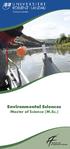 Campus Landau Environmental Sciences Master of Science (M.Sc.) INSTITUTE FOR ENVIRONMENTAL SCIENCES Hands-on: taking water samples to to assess the ecological and chemical quality. Environmental Sciences