
THE GETIN HOLDING CAPITAL GROUP
|
|
|
- Raymond Walsh
- 10 years ago
- Views:
Transcription
1 THE GETIN HOLDING CAPITAL GROUP CONSOLIDATED FINANCIAL STATEMENTS PREPARED IN ACCORDANCE WITH INTERNATIONAL FINANCIAL REPORTING STANDARDS FOR THE YEAR ENDED WITH THE OPINION OF INDEPENDENT AUDITOR

2 TABLE OF CONTENTS CONSOLIDATED INCOME STATEMENT... 4 CONDENSED CONSOLIDATED STATEMENT OF COMPREHENSIVE INCOME... 4 STATEMENT OF CHANGES IN THE CONSOLIDATED SHAREHOLDERS EQUITY... 6 STATEMENT OF CHANGES IN THE CONSOLIDATED SHAREHOLDERS EQUITY... 7 CONSOLIDATED CASH FLOW STATEMENT... 8 ADDITIONAL NOTES TO CONSOLIDATED FINANCIAL STATEMENTS General information Composition of the Capital Group together with associates Approval of the financial statements Discontinued activities spin-off of the Capital Group and sale of TU Europa Significant accounting policies Effect of the changes in accounting policies Financial risk management in the Capital Group Information on operating segments Interest income and interest expense Fee and commission income and fee and commission expense Insurance premiums Dividends received Result on financial instruments carried at fair value Result on financial instruments Hedge accounting Foreign exchange result Compensations and benefits Other income and operating expense Administrative expenses Payroll and employee benefits Impairment write-offs and provisions for off-balance sheet items Share in net profit (loss) of associates accounted for using the equity method Income tax Earnings per share Dividends paid and proposed Cash and balances with the Central Bank Amounts from the banks Financial assets held for trading Derivatives Financial assets carried at fair value through profit or loss Bank loans and credits due from customers Finance lease receivables Other loans and receivables Financial instruments Investments in associates Equity instruments available for sale Intangible assets Property, plant and equipment Investment property Reinsurer s share in the technical and insurance provisions Other assets Hyperinflation Assets providing security for liabilities Amounts due to Central Bank Amounts due to other banks and financial institutions Financial liabilities carried at fair value through profit or loss Amounts due to customers Liabilities from the issue of debt securities Other liabilities Technical and insurance provisions Other provisions Employment benefits Contingent liabilities Share capital Other reserves Additional information to cash flow statements Transactions with related parties Business combinations Other comprehensive income Result on loss of control in subsidiaries Post-balance sheet events /142

3 GETIN HOLDING S.A. To the Shareholders of Getin Holding S.A. In accordance with the provisions of the Decree of the Council of Ministers dated 19 October 2005 concerning current and periodic information submitted by issuers of securities (Journal of Laws, No ), the Management Board is pleased to present this consolidated annual report of the Getin Holding Capital Group (the Capital Group, Group ). The consolidated financial statements for the twelve-month period ended included in this consolidated annual Report have been prepared on the assumption that the Group will continue as a going concern without any significant limitation in the scope of its activities. This statement present truly and fairly the financial standing as at the balance day as well as the profitability of the Capital Group for this period. In preparing the consolidated financial statements, appropriate accounting policies were adopted, which were applied consistently throughout the period. The consolidated balance sheet, consolidated income statement, condensed consolidated statement of comprehensive income, statement of changes in consolidated shareholder s equity, consolidated cash flow statement and additional notes to the consolidated financial statements have been prepared in accordance with International Financial Reporting Standards and International Accounting Standards as adopted by the EU. They are presented in this document in the following order: Page Consolidated income statement 4 Condensed consolidated statement of comprehensive income 4 Consolidated balance sheet 5 Statement of changes in consolidated shareholders equity 6 Consolidated cash flow statement 8 Additional notes to consolidated financial statements 9 The Directors Report on the activities of the Capital Group has been appended to these financial statements. Wroclaw, 29 February /142
4 CONSOLIDATED INCOME STATEMENT comparable data Continuing Discontinued Total Continuing Discontinued Note operations operations operations operations Interest income Interest expense 9 ( ) ( ) ( ) (41 463) ( ) ( ) Net interest income Fee and commission income Fee and commission expense 10 (31 273) ( ) ( ) (15 684) ( ) ( ) Net fee and commission income Insurance premiums Dividend received Result on financial instruments measured to fair value (12 443) (11 908) Other financial instruments (2 447) (2 447) Result on the loss of control in an associate Foreign exchange result 16 (43 561) Loss on hyperinflation (IAS 29) 42 (23 879) - (23 879) Claims and benefits paid 17 - ( ) ( ) - (27 910) (27 910) Change of the value of insurance provisions Other operating income Other operating expenses 18 (9 684) ( ) ( ) (9 469) ( ) ( ) Net other operating income (22 513) Net operating income Impairment losses on loans and NIL 21 (40 291) ( ) ( ) ( ) ( ) Administrative expenses 19 ( ) ( ) ( ) ( ) ( ) ( ) Operating profit Profit / (loss) concerned with transactions on affiliates Share in net profit (loss) of associates (4 542) - (4 542) - - Profit / (loss) before income tax Corporate income tax 23 (8 573) ( ) ( ) (12 674) (9 169) Net profit /(loss) for the period Attributable to equity holders of the parent Attributable to non-controlling interest Earnings per share: basic for the period (in PLN) diluted for the period (in PLN) Total CONDENSED CONSOLIDATED STATEMENT OF COMPREHENSIVE INCOME comparable data Continuing Discontinued Total Continuing Discontinued Note operations operations operations operations Profit / (Loss) for the period Total Exchange differences from evaluation of foreign subsidiaries Valuation of available for sale investments (549) (549) The effect of cash flow hedge accounting (46 745) (46 745) Participation in an associate result on sale of Issuer shares Income tax relating to other comprehensive income (0) (17 710) (17 710) Other comprehensive income (34 140) (32 360) Total of comprehensive income for the period Attributable to equity holders of the parent Attributable to non-controlling interest Additional notes to the consolidated financial statements presented on pages 9 to 142 are their integral part 4/142

5 CONSOLIDATED BALANCE SHEET Note Comparable data ASSETS Cash and balances with the Central Bank Bills of exchange eligible for rediscounting with the Central Bank Amounts due from banks and financial institutions Financial assets held for trading Derivative financial instruments Financial instruments at fair value through profit or loss Loans and advances to customers Finance lease receivables Other loans and receivables Financial instruments Available for sale Held to maturity Share of reinsurer in insurance provisions Intangible assets Property, plant and equipment Investment properties Non current assets classified as held for sale Assets realated to discontinued operations Tax assets Current tax assets Deferred tax assets Other assets TOTAL ASSETS LIABILITIES AND EQUITY Liabilities Amounts due to Central Bank Amounts due to other banks and finance institutions Derivative financial instruments Other financial liabilities at fair value through profit or loss Deposits from customers Issued debt securities Corporate income tax payable Other liabilities Technical and insurance provisions Deferred tax liabilities Other provisions Liabilities realated to discontinued operations TOTAL LIABILITIES Equity (attributable to equity holders of the parent company) Share capital Net profit /(loss) Other reserves Non-controlling interest Total equity TOTAL EQUITY AND LIABILITIES Additional notes to the consolidated financial statements presented on pages 9 to 142 are their integral part 5/142

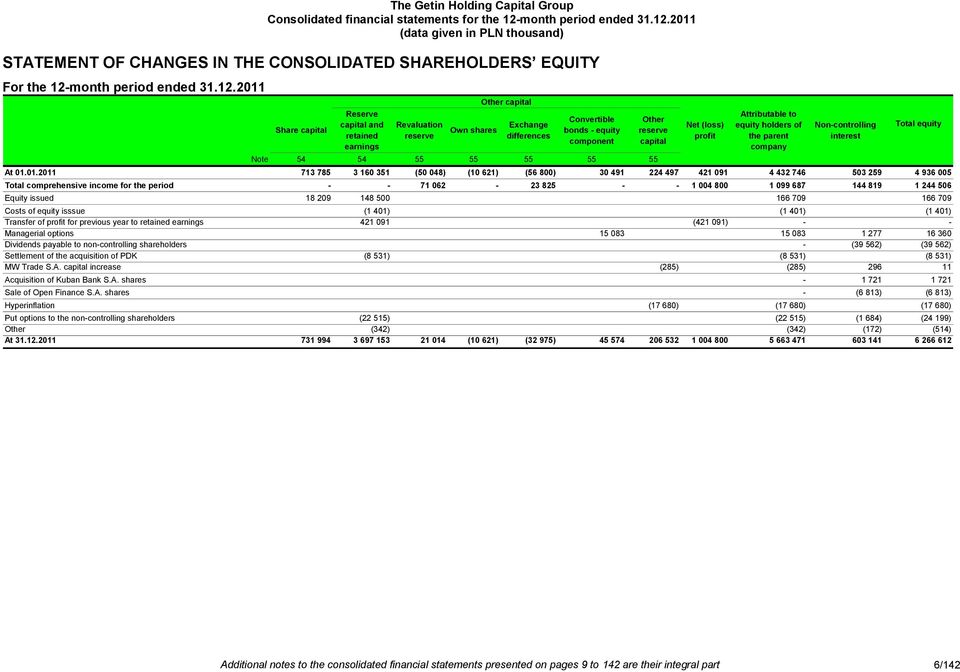
6 STATEMENT OF CHANGES IN THE CONSOLIDATED SHAREHOLDERS EQUITY For the 12-month period ended Share capital Reserve capital and retained earnings Revaluation reserve Own shares Other capital Exchange differences Convertible bonds - equity component Other reserve capital Note Net (loss) profit Attributable to equity holders of the parent company Non-controlling interest Total equity At (50 048) (10 621) (56 800) Total comprehensive income for the period Equity issued Costs of equity isssue (1 401) (1 401) (1 401) Transfer of profit for previous year to retained earnings ( ) - - Managerial options Dividends payable to non-controlling shareholders - (39 562) (39 562) Settlement of the acquisition of PDK (8 531) (8 531) (8 531) MW Trade S.A. capital increase (285) (285) Acquisition of Kuban Bank S.A. shares Sale of Open Finance S.A. shares - (6 813) (6 813) Hyperinflation (17 680) (17 680) (17 680) Put options to the non-controlling shareholders (22 515) (22 515) (1 684) (24 199) Other (342) (342) (172) (514) At (10 621) (32 975) Additional notes to the consolidated financial statements presented on pages 9 to 142 are their integral part 6/142
7 STATEMENT OF CHANGES IN THE CONSOLIDATED SHAREHOLDERS EQUITY For the 12-month period ended Share capital Reserve capital and retained earnings Revaluation reserve Own shares Other capital Exchange differences Convertible bonds - equity component Other reserve capital Net (loss) profit Attributable to equity holders of the parent company Non-controlling interest Total equity Note At (14 138) (10 621) (63 374) Total comprehensive income for the period - - (35 910) Equity issued Costs of equity isssue (29) (29) (29) Transfer of profit for previous year to retained earnings ( ) Merger of Getin Noble Bank (15 645) (21 320) (2 111) Managerial options Sombelbank capital increase (12 899) (12 899) Sale of own shares by Getin Noble Bank S.A S.C. Perfect Finance capital increase Decrease of TU Europa non-controlling interest as a result of banks' merger (6 062) Result on sale of TU Europa shares and SPO TU Europa Acquisition of Panorama Finansów S.A. shares from Open Finance (23) Acquisition of Idea Bank S.A. shares Acquisition and capital increase of MW Trade (268) (268) Sale of Fiolet PDK shares (650) (650) 283 (367) Put options to the non-controlling shareholders (18 722) (18 722) (7 679) (26 401) Dividends payable to non-controlling shareholders (3 920) (3 920) Other (1 512) (0) (42) (42) At (50 048) (10 621) (56 800) Additional notes to the consolidated financial statements presented on pages 9 to 142 are their integral part 7/142

8 CONSOLIDATED CASH FLOW STATEMENT Cash flows from operating activities Note comparable data Net profit (loss) Total adjustments: ( ) Depreciation Share in net profits (losses) of associates (10 674) Foreign exchange (profits)/losses (847) 472 (Profit) loss on investing activities ( ) Interest and dividend Change in receivables from banks and bills of exchange eligible for 56 ( ) ( ) rediscounting with the Central Bank Change in financial assets held for trading and other financial instruments at ( ) fair value through profit or loss Change in derivative financial instruments (assets) 56 (41 696) Change in loans and advances to customers 56 ( ) ( ) Change in finance lease receivables 56 ( ) ( ) Change in other loans and receivables 56 (14 165) - Change in securities held for sale 56 ( ) Change in deferred tax assets 56 (66 211) ( ) Change in share of reinsurer in technical provisions 56 (3 958) Change in other assets 56 ( ) ( ) Change in amounts due to banks and financial institutions Change in derivative financial instruments (liability) and other financial 56 ( ) liabilities at fair value through profit or loss Change in amounts due to customers Change in liabilities from the issue of debt securities (28 274) Change in provisions and deferred tax provision (9 035) Change in technical provisions 56 (60 265) Change in other liabilities Other adjustments 56 ( ) (11 997) Income tax paid ( ) ( ) Current tax expense (income statement) Net cash from operating activities Cash flows from investing activities Inflows Sale of shares in subsidiaries, net of cash disposed Sale of investment securities Proceeds from sale of intangible assets and tangible fixed assets Interests received Dividends received Other investing inflows Outflows ( ) ( ) Purchase of subsidiaries, net of cash acquired 56 ( ) ( ) Purchase of associates (224) - Purchase of investment securities (18 442) (35 349) Purchase of intangible assets and tangible fixed assets ( ) (74 492) Interest paid (403) - Other investing outflows (63) - Net cash used in investing activities (2 599) (7 489) Cash flows from financing activities, Issue of shares Issue of debt securities Redemption of debt securities issued ( ) ( ) Dividends paid to non-controlling interest (38 364) (3 922) Interests paid (21 189) (35 307) Interests received Repayment of credits and loans - ( ) Other net financing inflows / expenditure 56 (2 233) Net cash from (used in) financing activities ( ) - - Net change in cash and cash equivalents Net foreign exchange differences (11 899) Cash and cash equivalents at the beginning of the period Cash and cash equivalents at the end of the period of which is restricted use - - Additional notes to the consolidated financial statements presented on pages 9 to 142 are their integral part 8/142

9 ADDITIONAL NOTES TO CONSOLIDATED FINANCIAL STATEMENTS 1 General information The Getin Holding Capital Group ( Capital Group or Group ) consists of the parent company Getin Holding S.A. ("Getin Holding" or Company or "parent entity"), and its subsidiaries. The consolidated financial statements of the Group cover the 12-month period ended and contain the comparative data for the 12-month period ended for the income statement, the statement of changes in consolidated Shareholders equity, condensed consolidated statement of comprehensive income, the cash flow statement as well as the balance sheet data as at The registered office of Getin Holding S.A. is located in Wrocław, at Powstańców Śląskich 2-4. The Company was originally registered under the name Centaur S.A. on the Furthermore, on the the business name of the Company was changed to Getin Service Provider S.A. On the Getin Service Provider S.A. was incorporated to the National Court Register kept by the District Court for Wrocław-Fabryczna, 6 th Commercial Division of the National Court Register under the number KRS Since the Company has been acting under the business name Getin Holding S.A. The Company obtained the statistical number REGON The Company has set up the Branch Office in Warsaw located at Domaniewska 39. Getin Holding is a financial holding company which carries out the investment activities in the financial sector in Poland and beyond its borders. The Company and the remaining Group entities have an unlimited period of operation. Getin Holding is financial holding and is mainly engaged in capital investment on the domestic and foreign markets. The Company operates as the holding company of the Capital Group and the companies of the Capital Group run their activity within the scope of: - banking services; - insurance services. - leasing services; - financial agency; - investment funds; - brokerage. The type of the activities of individual companies of the Capital Group is described in note 2 of the additional notes to the consolidated financial statements. The entire Getin Holding Group is controlled by PhD Leszek Czarnecki. 9/142
10 2 Composition of the Capital Group together with associates As at the Getin Holding Group together with associates consists of the following companies: Subsidiaries consolidated full method: Company name Type of activity Effective share in capital Getin Noble Bank S.A. w ith its registered office in in Warsaw Banking 93.71% 93.71% Noble Funds TFI S.A. w ith its registered office in Warsaw Financial and investment consulting 65.60% 65.60% Getin Noble Bank S.A. ow ns 70% shares Noble Securities S.A. w ith its registered office in Kracow Brokerage 91.59% 74.74% Getin Noble Bank S.A. ow ns 97.74% shares Getin Leasing S.A. w ith its registered office in Wroclaw Leasing 91.30% 91.30% 93.18% shares are held by Getin Noble Bank S.A., and 3.98% by Getin Holding S.A. Getin Services S.A. w ith its registered office in Wroclaw Additional services connected w ith insurance 91.30% 91.30% Getin Leasing S.A. ow ns 100% shares Pośrednik Finansow y sp. z o.o. w ith its registered office in Wroclaw Mediation in the lease agreements 91.30% 91.30% Getin Leasing S.A. ow ns 100% shares Noble Concierge sp. z o.o.w ith its registered office in Warsaw Prestige concierge services for parent company clients 93.71% 93.71% Getin Noble Bank S.A. ow ns 100% shares Introfactor S.A. w ith its registered office in Warsaw Factoring services 93.71% 93.71% Getin Noble Bank S.A. ow ns 100% shares Getin Finance PLC w ith its registered office London (Great Britain) Financial services 93.71% 93.71% % shares are held by Getin Bank S.A., and 0.002% by Getin Holding S.A. Get Bank S.A. w ith its registered office in Warsaw Banking % na Until company operated under the name of Allianz Bank Polska S.A. Idea Bank S.A. w ith its registered office in Warsaw Banking 97.67% 93.71% 37.05% shares are held by Getin Noble Bank S.A., and 62.95% by Getin Holding S.A. Provista S.A. w ith its registered office in Warsaw Financial agency na 93.71% As at Provista S.A. w as merged w ith PDK S.A.; formerly Idea Bank S.A. (Poland) ow ned 100% shares Pow szechny Dom Kredytow y S.A. w ith its registered office in Wroclaw Financial and insurance agency 97.67% 99.69% Idea Bank S.A. (Poland) ow ns 100% shares Pow szechny Dom Kredytow y Biznes Sp. z o.o. w ith its registered office in Financial agency 97.67% 99.69% Wroclaw PDK S.A. ow ns 100% shares Panorama Finansów S.A. w ith its registered office in Wroclaw Leasing % % TU Europa S.A. w ith its registered office in Wroclaw Insurance services 66.54% 66.54% Additional information TU Na Życie Europa S.A. w ith its registered office in Wroclaw Insurance services 66.54% 66.54% TU Europa S.A. ow ned 100% shares TU Europa UA w ith its registered office in Lviv (Ukraine) Insurance services 69.80% na TU Europa S.A. ow ns 50% shares, TU Europa Na Życie S.A. ow ns 40% shares, Idea Bank (Ukraine) ow ns 10% shares TU Europa UA Życie w ith its registered office in Lviv (Ukraine) Insurance services 69.15% na TU Europa S.A. posiada 42% akcji, TU Europa Na Życie S.A. - 50% akcji, Idea Bank (Ukraina) - 8% akcji spółki MW Trade S.A. w ith its registered office in Wroclaw Financial services 51.27% 51.97% Carcade sp. z o.o. w ith its registered office Kaliningrad (Russian Federation) Lease % % AB Kubanbank S.A. w ith its registered office in Krasnodar (Russian Federation) Banking 96.03% na Carcade sp. z o.o. ow ns 96.03% akcji D2 Technologie Sp. z o.o. w ith its registered office in Krasnodar (Russian Federation) Terminal services for electronic banking % na Carcade sp. z o.o. ow ns % akcji RB Finance System sp. z o.o. w ith its registered office in Wroclaw Financial services % na Carcade sp. z o.o. ow ns 100% akcji Idea Bank w ith its registered office in Lviv (Ukraine) Banking 99.10% 99.06% Until the company had its registered office in Iw ano -Frankow sk (Ukraine), until company operated under the name of Plus Bank S.A.; 99.06% shares are held by Getin Holding S.A., and 0.044% by Gw arant Plus sp. z o.o. Idea Leasing sp. z o.o. w ith its registered office in Lviv (Ukraine) Lease 99.10% na Idea Bank S.A. (Ukraine) ow ns 100% shares Spółka Finansow a Gw arant Plus sp. z o.o. w ith its registered office Kiew Getin International S.A. ow ns 92.58% shares, Idea Bank S.A. (Ukraine) ow ns 0.003% Factoring, guaranting activity and financial agency % % (Ukraine) shares, Carcade Sp. z o.o. ow ns 7.417% shares Sombelbank S.A. w ith its registered office Minsk (Belarus) Banking 99.99% 99.99% % shares are held by Getin International S.a.r.l and 0.006% by Getin International S.A. Getin International S.A w ith its registered office in Wroclaw Holding activity for foreign subordinates % % Getin International S.a.r.l. w ith its registered office in Luxembourg (Grand Duchy of Luxembourg) Holding activity for foreign subordinates % % Getin International S.A. ow ns 100% shares Getin Inw estycje sp. z o.o. w ith its registered office in Wroclaw Holding activity % na % shares are held by Getin Holding S.A., and 0.001% by Getin International S.A. 10/142

11 Associates shown by equity method: Effective share in capital Company name Type of activity Additional information Open Finance S.A. w ith its registered office in Warsaw Financial agency 45,78% 93,71% Getin Noble Bank S.A. ow ns 48.85% shares At the date of and the total number of votes held by the Group subsidiaries equals to the Group s share in equity of these units. The only exception is share of Getin Noble Bank S.A. in Noble Securities S.A. (the Bank holds shares of Noble Securities SA representing 97.74% of share capital and 98.10% of the total number of votes) and share og Getin Noble Bank S.A. in Idea Bank S.A. (Poland) (Getin Noble Bank owns 37.05% shares of share capital in Idea Bank S.A. and 39.44% of the total number of votes, Getin Holding owns 62.95% shares of share capital in Idea Bank S.A. and 60.56% of the total number of votes). 11/142

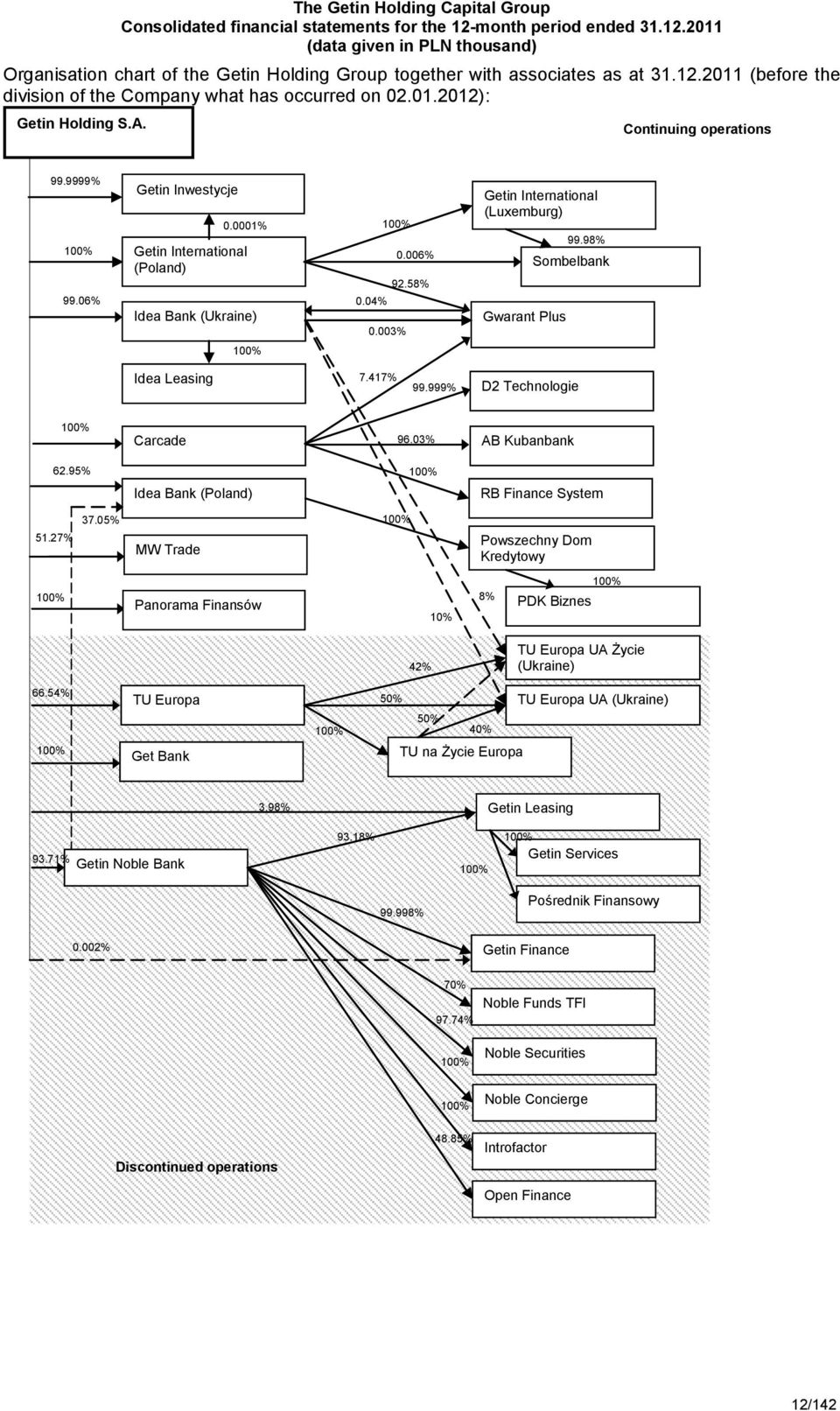
12 Organisation chart of the Getin Holding Group together with associates as at (before the division of the Company what has occurred on ): Getin Holding S.A. Continuing operations % 100% 99.06% Getin Inwestycje % Getin International (Poland) Idea Bank (Ukraine) 100% 0.006% 92.58% 0.04% 0.003% Getin International (Luxemburg) Gwarant Plus 99.98% Sombelbank 100% Idea Leasing 7.417% % D2 Technologie 100% Carcade 96.03% AB Kubanbank 62.95% 100% Idea Bank (Poland) RB Finance System 51.27% 37.05% MW Trade 100% Powszechny Dom Kredytowy 100% Panorama Finansów 10% 8% PDK Biznes 100% 42% TU Europa UA Życie (Ukraine) 66.54% 100% TU Europa Get Bank 100% 50% TU Europa UA (Ukraine) 50% 40% TU na Życie Europa 3.98% Getin Leasing 93.71% Getin Noble Bank 93.18% 100% Getin Services 100% % Pośrednik Finansowy 0.002% Getin Finance 70% 97.74% 100% Noble Funds TFI Noble Securities 100% Noble Concierge Discontinued operations 48.85% Introfactor Open Finance 12/142
13 Organisation chart of the Getin Holding Group together with associates at the date of publication of this report (after spin-off): Getin Holding S.A % 100% Getin Inwestycje % Getin International (Polska) 100% 0.006% 92.58% Getin International (Luxemburg) 99.98% Sombelbank 99.06% Idea Bank (Ukraina) 100% 0.04% 0.003% Gwarant Plus Idea Leasing 7.417% % D2 Technologie 100% Carcade 96.03% AB Kubanbank 62.95% Idea Bank (Polska) 100% RB Finance System 100% 51.27% MW Trade Powszechny Dom Kredytowy 100% Panorama Finansów 10% 8% PDK Biznes 100% 42% TU Europa UA Życie (Ukraina) 66.54% TU Europa 50% TU Europa UA (Ukraina) 50% 100% 40% TU na Życie Europa 51% Open Life TU na Życie During the period from until there have been following changes in the composition of the Capital Group together with associates: In 1 st quarter of 2011 Getin Noble Bank sold 23.5 million of shares of its subsidiary Open Finance as a result of two transactions in February 2011 (3 million of shares) and in March 2011 in public offering of Open Finance (20.5 million of shares). At the same time Open Finance raised the share capital in a public offering of 4.25 million of new shares, in which acquisition Getin Noble Bank did not participate. Management Board of Getin Noble Bank, on the basis of analysis of all the terms and conditions of contracts and their economic impact, has made the professional assessment of sale of shares in Open Finance and considered the following transactions as related and accounted as single transaction, also taking into account the fact, that the Supervisory Board considered the following transactions as package in single resolution: on the Bank signed the agreement with Mr. Leszek Czarnecki and Home Broker S.A. for the sale of 6% of Open Finance shares in March 2011 the sale of 41% of Open Finance shares owned by the Bank took place within IPO in April 2011 the share capital of Open Finance raised by 4.25 million of shares through a public issue of new shares. 13/142

14 The Getin Holding Capital Group On Getin Noble Bank Bank purchased from JA Investment Holding B.V. and Valoro Netherlands B.V. 698,250 Noble Securities shares with the nominal value of 1 PLN each, accounting for 19.98% of the share capital of this company and thus increased the shares in Noble Securities share capital to 99.74% and the votes number at the General Shareholders Meeting of Noble Securities to 99.78% vote. On Carcade purchased 60,466,458 shares of AB Kubanbank S.A. in Krasnodar with the nominal value of RUB 1.00 (PLN 0.1) each, accounting for 75.58% of the bank's share capital for the total price of RUB 36,280 thousand (PLN 3,690 thousand), i.e. for RUB 0.60 (PLN 0.06) for each share. At the same time, Carcade purchased % of shares in D2 Technologie Sp. z o.o. for the total price of RUB 20,867 thousand plus USD 6,897 thousand (PLN 22,151 thousand). The Company D2 Technologie Sp. z o.o. is providing services exclusively to the Open Joint Stock Company Kubanbank. Both companies were acquired from private persons, being previous shareholders of the aforementioned companies. D2 Technologie Sp. z o.o. provides its services to AB Kubanbank S.A. only. The aforementioned transaction was registered on and the acquisition became effective. Moreover, in reporting period Carcade bought from Kubanbank shareholders 3,796,470 Carcade shares (3,175,411 ordinary shares and 621,059 preferred shares) with the nominal value of RUB 1 each and the total value of RUB 2,278 thousand (PLN 242 thousand). After these acquisitions Carcade held % share in the share capital of Kubanbank. On Getin Holding purchased 103,060 (100%) shares of Allianz Bank Polska S.A. seated in Warsaw (currently Get Bank S.A.) for a total price PLN 149,219 thousand. On the basis of the agreement concluded with Mr. Czcibor Dawid, on , sold off to him 69,894 shares (2%) of Noble Securities. Consequently, Getin Noble Bank s share in the Noble Securities share capital at the end of 2011 stood at 97.74%. On Idea Leasing Sp. z o. o., a new company based in Lviv was set up. All shares in the company share capital worth UAH 100 thousand (PLN 33 thousand) were taken up by Idea Bank Ukraine. On Open Finance purchased from Towarzystwo Ubezpieczeniowe Link4 and Intouch Insurance BV 24,745,000 shares of MY LIFE Towarzystwo Ubezpieczeń Na Życie S.A. (currently Open Life) accounting for 49% share in the company for the total price of PLN 9,595, Getin Noble Bank purchased 9,595,000 shares of MY LIFE Towarzystwo Ubezpieczeń na Życie SA (currently Open Life) accounting for 19% share in the company at the total price PLN 3,721 thousand. On Getin Holding under the contract of sale dated sold off to Idea Bank 246,530 shares of Powszechny Dom Kredytowy with the nominal value PLN 100 each, accounting for 44.5% of PDK share capital. As a result of this transaction share of Idea Bank In the share capital of PDK increased to 49.5%. On the District Court for the capital city of Warsaw, the 13th Commercial Division of the National Court Register registered the increase in the share capital of Idea Bank by PLN 16,771,936 by the issue of 8,385,968 G-series ordinary registered shares with the face value of PLN 2 each, and on the said court registered another increase in the share capital of Idea Bank by PLN 16,771,934 by issuing 8,385,967 H-series ordinary registered shares with the face value of PLN 2 each. The shares of G- and H-series G were acquired by Getin Holding On Getin Holding purchased 50 shares of RB Investment System Sp. z o.o. with its registered office in Wrocław with the face value of 100 PLN each, for PLN 5,100, which constitute 100% stake in the company's share capital. On the District Court for Wrocław Fabryczna, the 6th Commercial Division of the National Court Register registered the change of the company s name to Getin Inwestycje Sp. z o. o. On Gwarant Plus purchased 64,126 shares of Idea Bank, Ukraine (former Plus Bank) for UAH 500 thousand (PLN 178 thousand). In consequence Getin Holding holds indirectly as at % stake in the Bank. On the increase in the share capital of Carcade by RUB 486,000 thousand (48,211 thousand PLN) was registered. All shares in the increased capital were taken up by Getin Holding. 14/142
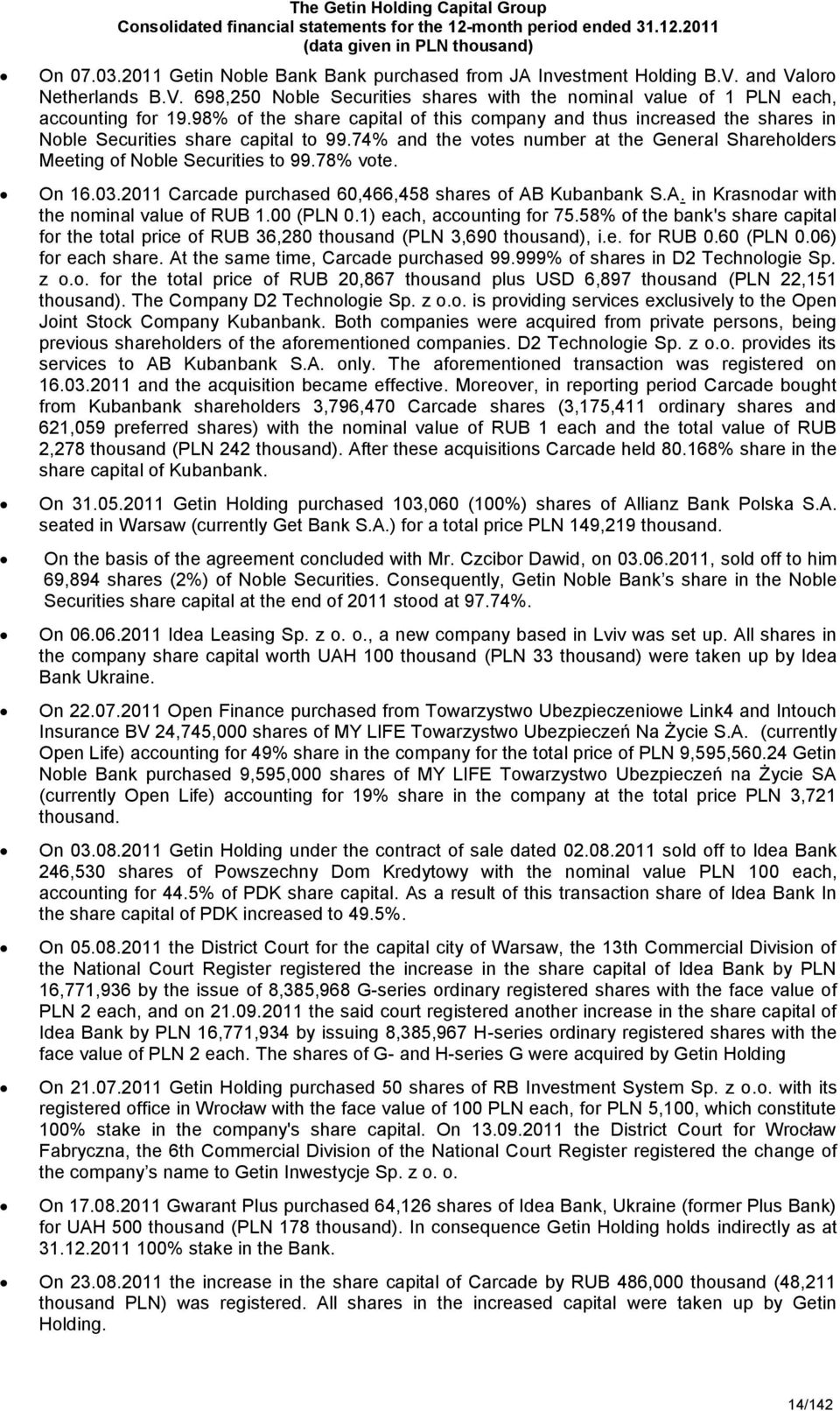
15 The Getin Holding Capital Group On Getin International purchased from Getin International S.a.r.l. 1 share of ZAO Sombelbank for EUR 448, i.e. PLN 2 thousand, the share face value was BYR 3,306 thousand, i.e. PLN 2 thousand. On TU Europa concluded with Getin Noble Bank and Mr. Leszek Czarnecki a conditional agreement to purchase 25,755 thousand shares in Open Life. The shares accounnted for 51% in Open Life share capital and conferred 51% votes at general meetings of shareholders (TU Europa has signed an agreement to purchase 19% of shares with Getin Noble Bank and the purchase of 32% of shares wih Mr. Leszek Czarnecki). The purchase transaction was executed on upon obtaining the required clearance of the Polish Financial Supervision Authority granted on On Getin Holding contributed 279,770 shares of PDK, i.e. 50.5% of the company s share capital, to Getin Inwestycje Sp. z o. o., which increased the company's share capital from PLN 5 thousand to PLN 111,105 thousand. On the District Court for Wrocław Fabryczna, the 6th Commercial Division of the National Court Register registered the increase in the share capital of Getin Inwestycje Sp. z o.o. On Idea Bank, Polska concluded with Getin Inwestycje Sp. z o. o. a conditional agreement to purchase 279,770 registered shares of PDK with the face value of PLN 100 each that constitute 50.5% of the company's share capital, for the price of PLN 111,100,000. On the transaction was finalized and Idea Bank became the owner of 100% shares of PDK. On Open Finance acquired 100% of Home Broker shares, seated in Warsaw from LC Corp B.V. seated in Amsterdam, H.P. Holding 3 B.V. seated in Rotterdam, Aegaeon B.V. seated in Rotterdam, Damian Milibrand and A. Nagelkerken Holding B.V. seated in Rotterdam, On the following companies based in Ukraine were registered: Private Joint-stock Company Europa Life Insurance Ukraine with the share capital of UAH 16,320 thousand (PLN 6,905 thousand), divided into 16,320 thousand shares with the face value of UAH 1 each. The shares were taken up by: a. TU na Życie Europa: 50% stake in the share capital, i.e. 8,160 thousand shares; b. TU Europa: 42% stake in the share capital, i.e. 6,854.4 thousand shares, c. Idea Bank Ukraine: 8% stake in the share capital, i.e. 1,305.6 thousand shares; Private Joint-stock Company Europa Insurance Ukraine with the share capital of UAH 10,880 thousand (PLN 4,603 thousand), divided into 10,880 thousand shares with the face value of UAH 1 each. The shares were taken up by: a. TU na Życie Europa S.A.: 40% stake in the share capital, i.e. 4,352 thousand shares; b. TU Europa SA: 50% stake in the share capital, i.e. 5,440 thousand shares; c. Idea Bank Ukraine: 10% stake in the share capital, i.e. 1,088 thousand shares. On the merger of Provista and PDK was registered in accordance with provisions of Art. 492 (1) (1) of the Code of Commercial Companies and Partnerships, through transfer of all assets of PDK (target company) to Provista (bidding company). Provista, the bidding company changed its name to Powszechny Dom Kredytowy Spółka Akcyjna. On an increase in the share capital of Kubanbank by RUB 316,964 thousand (PLN 33,630 thousand) effected by issuing 316,963,863 new shares was registered. All new shares were taken up by Carcade and thus Carcade interest in Kubanbank increased to 96.03%. 15/142
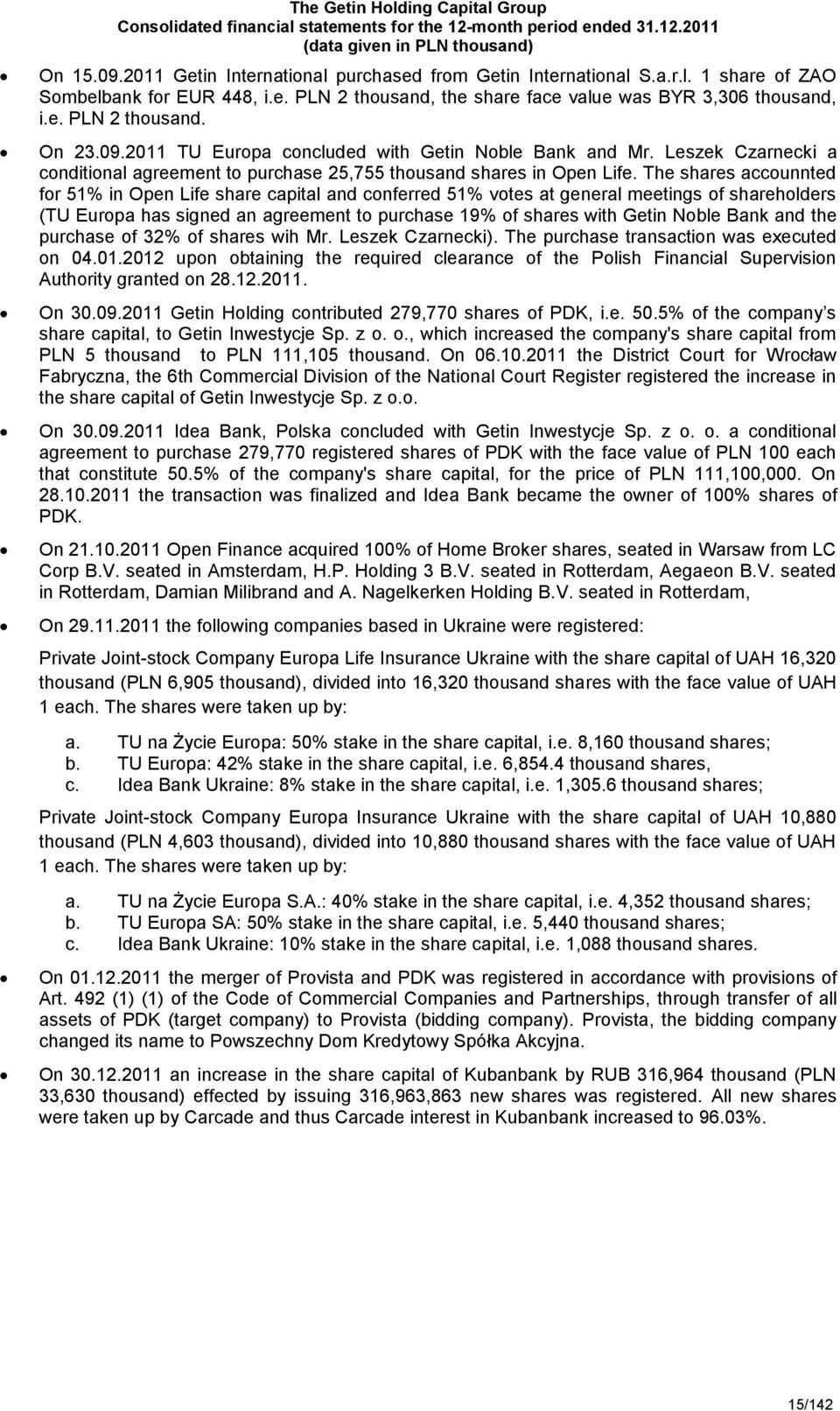
16 2.1. Employment in the Capital Group Employment (full-time posts) at companies of the Getin Holding Capital Group (unaudited) (unaudited) Change Getin Holding S.A Getin Noble Bank Group (130) Idea Bank Group (Poland) TU Europa Group (7) PDK S.A MW Trade S.A Panorama Finansów S.A Get Bank S.A. 138 Na 138 Carcade Sp. z o.o 1) Getin International S.A. 2) Sombelbank S.A Idea Bank S.A. (Ukraine) SC Perfect Finance S.r.l. Na 12 (12) Spółka Finansowa Gwarant Plus sp. z o.o. 1 4 (3) Total including: Poland International activities ) Carcade Sp. z o.o., AB KubanBank S.A., D2 Technologie Sp. z o.o. 2) Getin International S.A., Getin International S.a.r.l Management Board of the parent company As at the Management Board of Getin Holding S.A. was composed of: Radosław Boniecki President of the Management Board Łukasz Chojnacki I Vicepresidnet of the Management Board Katarzyna Beuch Member of the Management Board, CFO In the period covered by the financial statements, on Mr. Radosław Boniecki resigned from the post of the President of the Management Board of the Company, effective as of Next the Supervisory Board of the Company appointed Mr. Rafał Juszczak as President of the Management Board of the Company, effective as of Due to Mr. Radosław Boniecki s resignation from the post of President, the Company's Supervisory Board at the meeting dated appointed Mr. Radosław Boniecki as the Management Board Vice-president, effective as of At the same meeting the company's Supervisory Board made a decision to remove Mr. Łukasz Chojnacki from the post of the Company s Management Board I Vice-president, effective as of , and as of entrust Mr. Łukasz Chojnacki with the post of the Company s Management Board Vice-president. On Mr. Łukasz Chojnacki resigned from the function of Vicepresident in the Management Board of the Company with the effect from On the Supervisory Board of the Company appointed Mr. Robert Działak as the Management Board of the Company Member for the period from to Therefore, the composition of the Management Board at the date of these consolidated financial statements is as follows: Rafał Juszczak President of the Management Board Radosław Boniecki Vice-president of the Management Board Katarzyna Beuch Member of the Management Board, CFO Robert Działak Member of the Management Board 16/142
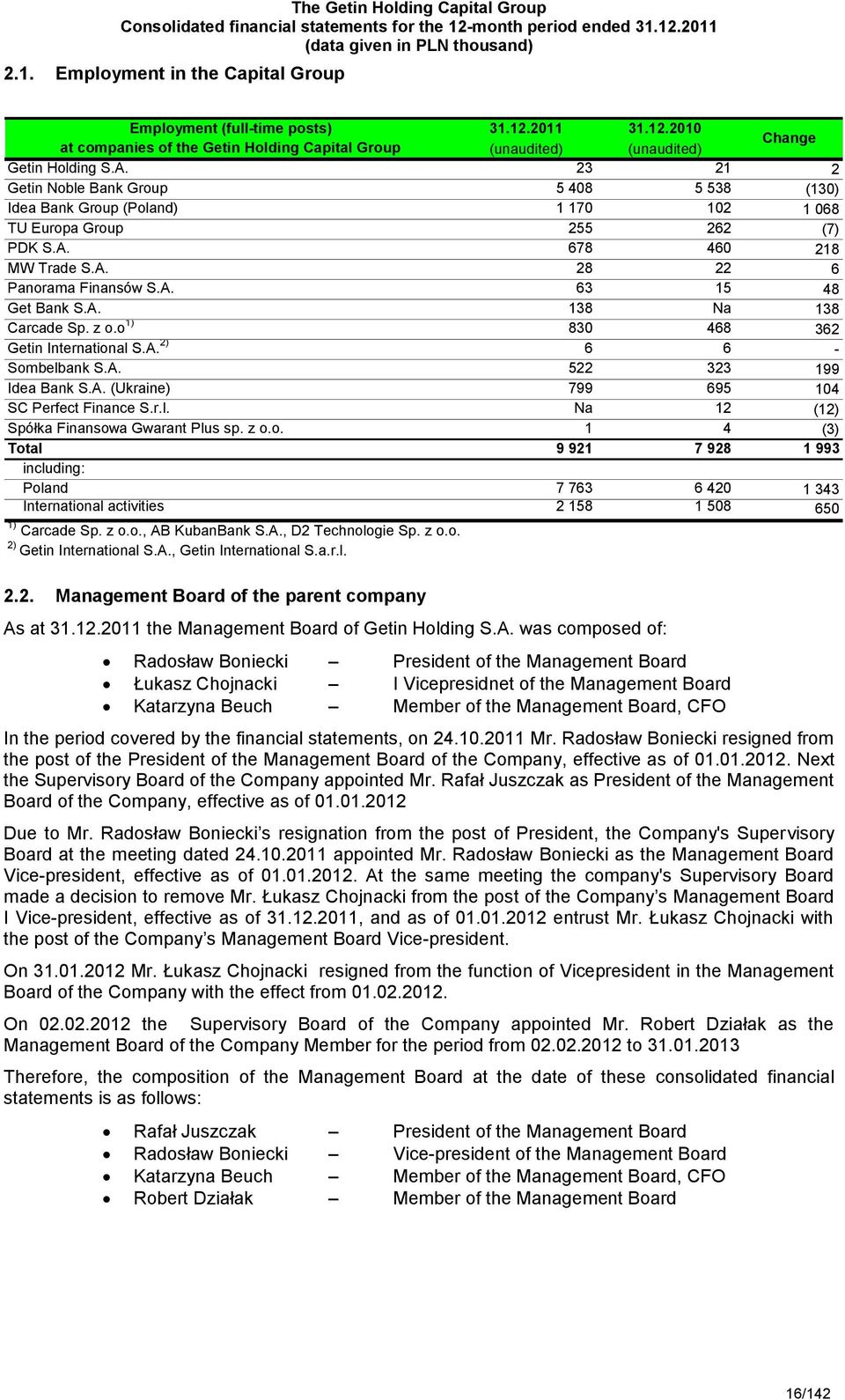
17 3 Approval of the financial statements These consolidated financial statements were approved for publication by the Management Board on Discontinued activities spin-off of the Capital Group and sale of TU Europa Capital Group division process In 2011 Getin Holding was implementing its changes strategy in the Capital Group, that is the process of spin-off of the company s organized enterprise, i.e. Getin Holding Branch in Warsaw to its subsidiary Get Bank S.A. (transfer of part of assets to an existing company). The Branch was responsible for domestic banking operations and related business, and its assets included a block of 93.71% shares in Getin Noble Bank held by Getin Holding. The main goals of the spin-off process are as follows: continuation of its present operations by Getin Holding and transferring only part of its assets and liabilities to its subsidiary unit Get Bank; making Getin Holding Group's structure transparent and separating well-established mature units from start-ups; allotting the new issue shares in Get Bank issued in a public offering to the existing shareholders of Getin Holding proportionally to the shares they hold in Getin Holding, applying the share swap parity ( shares in Get Bank for each share in Getin Holding) tied to valuation of Get Bank and the spun-off Getin Holding Branch in Warsaw; carrying out the division of Getin Holding and the process of introduction of Get Bank shares to trading in the regulated market maintained by Warsaw Stock Exchange S.A. (the "WSE"); finally trading Getin Noble Bank shares in a regulated market and in consequence satisfying the obligation made to the Polish Financial Supervision Authority (the "PFSA") ensuring that Getin Noble Bank shares 3.5 years after (Nobel Bank and Getin Bank merger date) will reach the required float rate in the WSE, which means that at least 15% shares will be held by other units than Mr. Leszek Czarnecki or his subsidiaries. This conditions will be satisfied at the final stage of the strategy implementation, i.e. upon Getin Noble Bank merger with Get Bank. Material events that occurred in implementation of the aforementioned strategy (reported in detail in Note 1.3): the Management Boards of Getin Holding and Get Bank agreed and signed Getin Holding Spin-off Plan; the EGMs of Getin Holding and Get Bank approved the spin-off of Getin Holding; the PFSA approved the prospectus for admission of the existing shares in Get Bank to trading; the PFSA issued clearances for changes of shareholders of the Capital Group regulated companies in connection with the spin-off process; the PFSA approved Get Bank's prospectus drawn up in connection with a public offering of new shares allotted to Getin Holding shareholders within the spin-off process; the relevant district court registered an increase in the share capital of Get Bank by spin-off issue shares, and thereby the spin-off of Getin Holding became effective; spin-off issue shares in Get Bank were introduced to trading at stock exchange. As the result of Getin Holding spin-off on two capital groups emerged: Getin Holding Group comprising Idea Bank and companies conducting other financial operations (MW Trade and Panorama Finansów) as well as insurance companies (TU Europa and its subsidiaries TUnŻ Europa and Open Life) and companies conducting financial operations abroad (Carcade, Kubanbank, Sombelbank, Idea Bank Ukraine, Europa Insurance Ukraine, Europa Insurance Ukraine Life, Getin International S.A. i Getin International S.a.r.l.), and the capital group composed of Get Bank and Getin Noble Bank with their subsidiaries. Due to that fact and pursuant to requirements of IFRS 5 "Assets held for sale and discontinued operations ie. due to classification of spin-off operations the Group disclosed the operations related to the spun-off assets, i.e. Get Bank and Getin Noble Bank as discontinued operations. 17/142

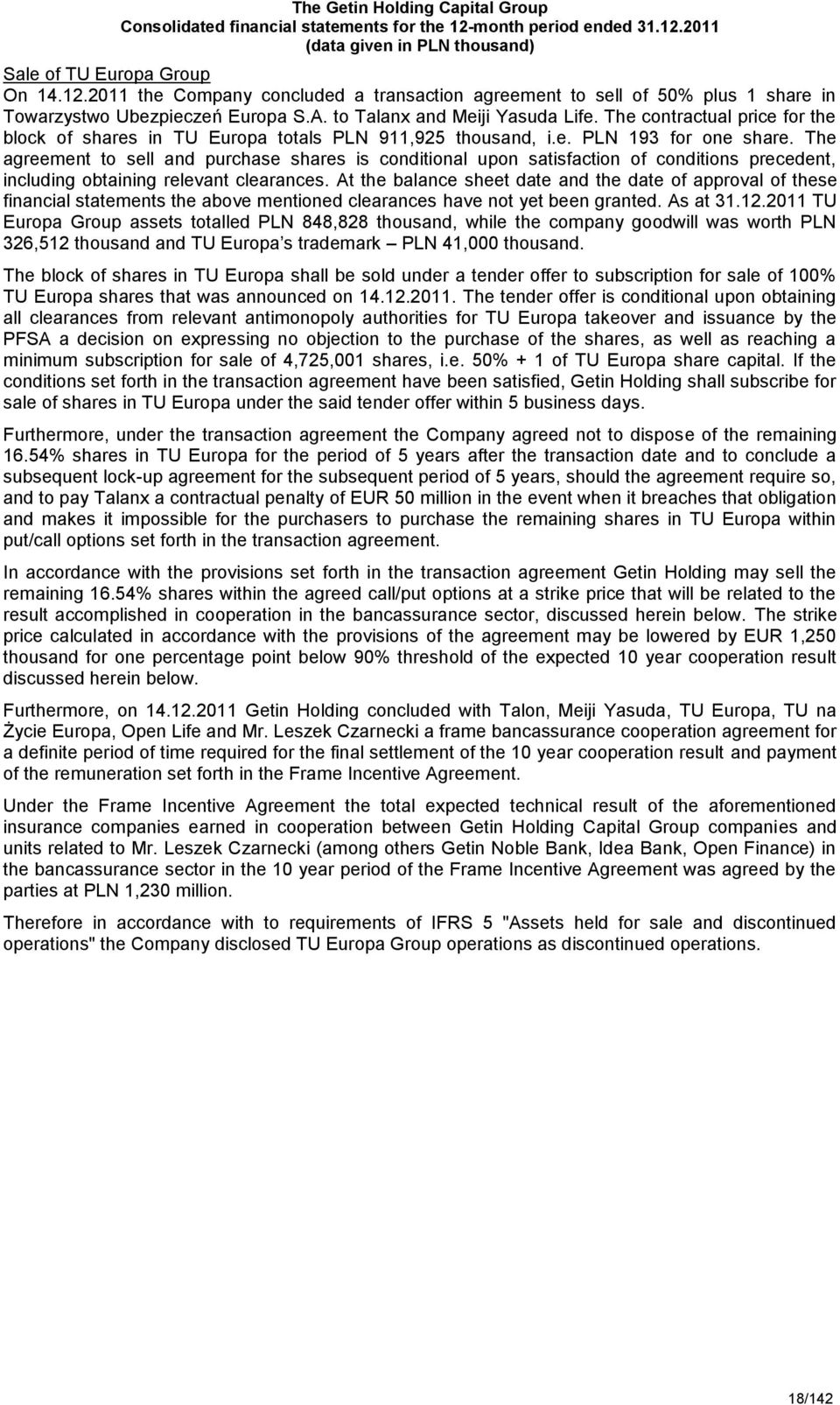
18 Sale of TU Europa Group On the Company concluded a transaction agreement to sell of 50% plus 1 share in Towarzystwo Ubezpieczeń Europa S.A. to Talanx and Meiji Yasuda Life. The contractual price for the block of shares in TU Europa totals PLN 911,925 thousand, i.e. PLN 193 for one share. The agreement to sell and purchase shares is conditional upon satisfaction of conditions precedent, including obtaining relevant clearances. At the balance sheet date and the date of approval of these financial statements the above mentioned clearances have not yet been granted. As at TU Europa Group assets totalled PLN 848,828 thousand, while the company goodwill was worth PLN 326,512 thousand and TU Europa s trademark PLN 41,000 thousand. The block of shares in TU Europa shall be sold under a tender offer to subscription for sale of 100% TU Europa shares that was announced on The tender offer is conditional upon obtaining all clearances from relevant antimonopoly authorities for TU Europa takeover and issuance by the PFSA a decision on expressing no objection to the purchase of the shares, as well as reaching a minimum subscription for sale of 4,725,001 shares, i.e. 50% + 1 of TU Europa share capital. If the conditions set forth in the transaction agreement have been satisfied, Getin Holding shall subscribe for sale of shares in TU Europa under the said tender offer within 5 business days. Furthermore, under the transaction agreement the Company agreed not to dispose of the remaining 16.54% shares in TU Europa for the period of 5 years after the transaction date and to conclude a subsequent lock-up agreement for the subsequent period of 5 years, should the agreement require so, and to pay Talanx a contractual penalty of EUR 50 million in the event when it breaches that obligation and makes it impossible for the purchasers to purchase the remaining shares in TU Europa within put/call options set forth in the transaction agreement. In accordance with the provisions set forth in the transaction agreement Getin Holding may sell the remaining 16.54% shares within the agreed call/put options at a strike price that will be related to the result accomplished in cooperation in the bancassurance sector, discussed herein below. The strike price calculated in accordance with the provisions of the agreement may be lowered by EUR 1,250 thousand for one percentage point below 90% threshold of the expected 10 year cooperation result discussed herein below. Furthermore, on Getin Holding concluded with Talon, Meiji Yasuda, TU Europa, TU na Życie Europa, Open Life and Mr. Leszek Czarnecki a frame bancassurance cooperation agreement for a definite period of time required for the final settlement of the 10 year cooperation result and payment of the remuneration set forth in the Frame Incentive Agreement. Under the Frame Incentive Agreement the total expected technical result of the aforementioned insurance companies earned in cooperation between Getin Holding Capital Group companies and units related to Mr. Leszek Czarnecki (among others Getin Noble Bank, Idea Bank, Open Finance) in the bancassurance sector in the 10 year period of the Frame Incentive Agreement was agreed by the parties at PLN 1,230 million. Therefore in accordance with to requirements of IFRS 5 "Assets held for sale and discontinued operations" the Company disclosed TU Europa Group operations as discontinued operations. 18/142
19 Assets and liabilities related to discontinued operations Assets realated to discontinued operations (thousand PLN) Note Cash and balances with the Central Bank Amounts due from banks and financial institutions Financial assets held for trading Derivative financial instruments Financial instruments at fair value through profit or loss Loans and advances to customers Finance lease receivables Other loans and receivables Financial instruments Available for sale Held to maturity Share of reinsurer in insurance provisions Inwestycje w jednostki stowarzyszone Intangible assets Property, plant and equipment Investment properties Non current assets classified as held for sale Tax assets Current tax assets Deferred tax assets Other assets Assets realated to discontinued operations Liabilities realated to discontinued operations (thousand PLN) (thousand Zobowiązania PLN) Amounts due to other banks and finance institutions Derivative financial instruments Other financial liabilities at fair value through profit or loss Deposits from customers Issued debt securities Corporate income tax payable Other liabilities Technical and insurance provisions Deferred tax liabilities Other provisions Liabilities realated to discontinued operations Significant accounting policies 5.1 Basis for preparing consolidated financial statements The consolidated financial statements have been prepared under the historical cost convention, except for derivative financial instruments and financial instruments that are available for sale, held for trading, valued at fair value through profit and loss, and other assets that are intended for sale at a fair value. The consolidated financial statements are presented in PLN (PLN thousand), and all figures are given in PLN thousands, unless indicated otherwise. The consolidated financial statements have been prepared on the assumption that the companies of the Group will continue their business activity in the foreseeable future i.e. at least for one year from the balance day. As at the date of approval of these consolidated financial statements, there were no circumstances that would indicate a threat to the continuing operations of the Companies of the Group in the period of at least for one year from the balance day, in connection with a spin-off of Getin Holding effective on the companies of the Group will continue its activities in 2012, respectively in Getin Holding Group or Get Bank and Getin Noble Bank Group, as more fully explained in note 4 above. 19/142

20 5.2 Statements of compliance The attached financial statements have been prepared in accordance with the International Financial Reporting Standards adopted by European Union (IFRS-UE). IFRS-UE comprise standards and interpretations accepted by the International Accounting Standards Board ( IASB ) and the International Financial Reporting Interpretations Committee ( IFRIC ). Under IFRS-UE the Group has the opportunity to choose the accounting policy. Accounting policies used by the Group are described in note 5 Significant accounting policies. As described in section 5.20 the Group applied the provisions of IAS 39 concerning hedge accounting under IAS 39, approved by EU. Certain entities of the Group keep their accounting books in accordance with accounting policies specified in the Accounting Act dated ( the Accounting Act ) as amended and with the regulations issued on the basis of this Act ( Polish Accounting Standards ). The foreign entities of the Group keep their accounting books in accordance with relevant domestic regulations. The consolidated financial statements include a number of adjustments not included in the books of account of those Companies of the Group, which were made to reconcile the financial statements of those companies to be in conformity with IFRS-UE. 5.3 Significant values based on professional judgment and estimates Professional assessment Classification of lease agreements The Group's lease classification into operating or capital lease is based on the price, depending on what portion of risk and benefits of holding the leased object is attributable to a lessor and to a lessee, which is each time decided based on the economic content of each transaction. Portfolio factors in measuring exposure Portfolio parameters such as PD (possible default separately for restructured exposure, performing exposure and additionally for exposures infected by impairment), RR (recovery rate), RestrR (restructuring rate) or CR (conversion rate of impaired exposure to restructured exposure) required for the calculation of impairment losses are based on historical data. The parameters are estimated separately for each product group applying statistical methods. Parameter estimation is made based on the historical exposure data. If required manual adjustment of portfolio parameters is possible so as to reflect the impact of current conditions. The Group verifies the portfolio estimation methodology and assumptions on regular basis so as to minimise discrepancies between their factual and estimated amounts. Additionally for the estimation of IBNR provision for each identified portfolio the loss incurred period (LIP), maximum quarantine period for restructured exposures, conditions for conversion from impaired to restructured exposures and others are estimated. In H Getin Noble Bank introduced to the methodology of measuring impairment losses, in accordance with IAS 39 and 37, infection effect of loan impairment of the same borrower within specific product groups and changed rules for exposures with recognized impairment. Furthermore, within portfolios a quarantine period was introduced for exposures converting from the default state for which impairment losses level was increased due to separately calculated default probability. Due to the changes reported hereinabove Getin Noble Bank introduced modifications to algorithms and formulas used for calculation of impairment losses. The changes did not have material impact over the impairment losses made due to the balancing effect of increasing the risk for default exposure and under the quarantine and decreasing the risk of other IBNR exposures, which however caused single jumping increase of nonperforming loans (NPL). Estimated increase of share of nonperforming loans due to mentioned above changes amounted to about 0.6 percentage point. Open Finance S.A. sale settlement Having analysed all terms and conditions of contracts and their economic effects, the Bank Management Board made professional judgment of the sale transaction of shares in Open Finance S.A. finding them related. The Management Board also took into account the fact that the Supervisory Board of Getin Noble Bank took the decision on the transactions in one resolution. The shares sale transactions were treated as one package and recognized as one transaction. 20/142
21 The Getin Holding Capital Group Liabilities due to investment and insurance contracts The Group concludes contracts that imply interest risk, financial risk, or both types of risk. Insurance contracts are agreements that cause substantial insurance risk. They may also cause some elements of financial risk. The Group classifies contracts to relevant categories according to the following principles: Substantial insurance risk occurs when discounted benefit value paid due to occurrence of an insurance event (irrespective of the payment date) differs from discounted benefit value paid if such an insurance event has not occurred by at least 10% of the discounted benefit value paid if the insurance event does not occur. Investment contracts are agreements that transfer financial risk without transferring substantial insurance risk. Goodwill impairment Upon preliminary recognition the goodwill is disclosed at the purchase price reduced by any accumulated impairment write-offs. The impairment test is carried once a year. In addition the assessment is carried out on each reporting date if the goodwill impairment premises are present. The adoption of other assumptions for the goodwill impairment could have impact on the valuation of the goodwill. The identified goodwill impairment is referred to the financial result. Credits, deposits and saving plans closure ratio The Group recognises the revenues due on account of the commissions on submitted credit applications (and not yet disbursed credits), the deposit opening applications and the saving plan applications (not realized yet) at other financial institutions based on the closure ratio. The closure ratio is based on historical data regarding the probability of the disbursement of the credit and realization of the deposits and saving plans in respect to the submitted applications. This ratio is also used in the calculation of accrued provision for the aforementioned credits, deposits and saving plans paid to Group advisors. Uncertainty of estimates The preparation of the consolidated financial statements in accordance with IFRS-UE requires that appropriate assumptions and estimates are made which may affect the amounts presented in the financial. The estimations and assumptions that are subject of continuous assessment by the Management of the Group are based on historical experiences and other factors, including the expectations regarding future events, which seem justified under given circumstances. Though these estimations are based on the best knowledge regarding the present conditions and the activities undertaken by the Group, the actual results might differ from these estimations of differences. The estimations made at the end of each reporting period reflect the conditions, which were present on these dates (e.g. exchange rate, interest rates, or market prices). Main areas for which the Group has made estimates include: Loans and credits impairment At the end of each reporting period the Group decides whether there is objective evidence of impairment of particular assets or a group of assets. The Group decides whether there are premises that indicate possibility of reliable measuring of a decrease of estimated future receipts from loan portfolio before such a decrease can be assigned to any particular loan in order to measure the loan impairment. Such estimation may account for observable data indicating material adverse change of liquidity of debtors that belong to a specific group or of the economic situation in a given country or its region, which is related to problems related to a given group of assets. Methodology and assumptions applied in estimation of cash flow and periods when they occur are reviewed on regular basis so as to identify any discrepancies between the estimated and actual losses. Uncertainty is related to portfolio impairment estimations (both non-performing and performing part of it, for which impairment loss is made based on IBNR), which results from the assumptions made and statistic models applied. Derivatives, assets and liabilities measured at their fair value through profit or loss Fair value of derivatives, financial assets and liabilities not listed in active markets is measured applying recognized measurement techniques. All models are approved before their application and calibrated so as to ensure that the measurements reflect actual data and comparable market prices. 21/142
22 To the extent reasonably possible, only observable data collected in active market are used, however in some circumstances the Bank estimates the uncertainty (such as client's risk, market changeability and correlations). Change in the terms of the underlying assumptions may affect the valuation in some of financial instruments. Valuation of discontinued operations At the end of each reporting period, the Group measures the assets and liabilities related to discontinued operations at the lower of two values: at the carrying amount or at fair value less costs to sell. Fair value is the amount for which an asset could be exchanged, or a liability settled, between knowledgeable and interested parties in a direct business relationship. To determine fair value, generally accepted methods of determining fair value are used. For example, for listed equity instruments reference is made to actual data and comparative market prices, and for listed equity instruments for which there is no active market appropriate valuation techniques are determined. All models are approved before they are applied. Where possible, the models only use observable data derived from an active market. The cost of the sale is the marginal cost directly attributable to the disposal or release by the owners, excluding finance costs and income tax. Asset due to deferred tax The Group recognizes deferred tax asset on the basis of the assumption that future tax profits will allow for its use. Deterioration of the future tax results can cause that this assumption may be unreasonable. Technical and insurance provisions Personal and non-life insurance The provisions for the capitalized value of allowance are set using the 0.33% discount rate. The provision is set as the discounted value of the future payments, assuming that the payment period is equal to the payment period of the terminated allowance and to an average life of the life allowanceearning person. The application of a deterministic period for the life allowance payment, which is equal to payment period, leads to the increase in the provisions by an additional safety margin. The premium provision is calculated by the individual method on the pro rata temporis base with the exception of the insurance cases such as: accidents, credits, various finance risks, in which the provision is divided in the proportion to the estimated risk and the division in these groups differs from the homogeneous division in the policy s validity. If the type of a specific good allows for estimation, without statistical analysis, of the nonlinear division of risk in policy s validity, then it is acceptable to set a function presenting the division of risk, also in case there is not enough statistical information that might enable the determination of the form of risk division pursuant to statistical methods. The new function for such a good can be set and implemented at any time. For all groups except for 1 (accident insurance), 14 (credit insurance), and 16 (different financial risk insurance), the method of making the premium provision proportionate to the period in which the written premium is due shall apply. Whereas for groups: 1, 14, and 16 the method of premium provision distribution resulting from risk distribution shall apply. For the product Insurance against the Impairment of Property Value, the nonlinear premium risk division has been implemented, other than for the remaining products from group 14. As a result of the fact that responsibility of an insurance company begins with the entry of a mortgage linked to a specific credit, there has been implemented risk division with the assumption of the probability division of the mortgage entry that was estimated on the basis of the times of entries registered by an insurance company linked to the mortgages during a bridge period. The obtained parameters are adapted to the present portfolio, which is confirmed by results of the tests of compliance. In the range of property and personal insurance, the Group estimates both the forecasted costs of reported damage on the balance day and incurred damage occurrences (i.e. IBNR), which are, however, not reported on the balance day. The final decision concerning the amount of the compensation is possible only after a significant period of time has elapsed, and for some types of insurance policies the IBNR provision is the greater part of the provisions balance. The rate of reported and not reported damage occurrences is mostly estimated on the basis of the future trends. On each balance day, the estimates concerning damage for the previous financial year are verified whether they are adequate and, if it is necessary, the provision is properly corrected. 22/142
23 Ratios presenting the share of damage value reported until the end of a specific period in the amount of all damage incurred in the previous periods, the forecast ultimate loss ratio, and the factors that adapt plans to real compensation are modified every year after the end of a financial year, and implemented to set the provisions at the end of every month of the following year, including December. If there are significant changes during the financial year and also in the case of important changes in the composition or characteristics of the insurance portfolio, they can be modified in the periods of time shorter than one year. Life insurance Technical rates used in life insurance range between 2-3% (however, in the instance of products of the longest time horizon a technical rate of 2% is applied). The life insurance provisions are made by means of the prospective actuarial method with the preservation of the safety rule. The life insurance preservation includes costs of agreement services and costs connected with the payment of damages and benefits. The provisions can be determined generally for specific insurance products, under the condition that they give approximately the same result as the individual method. The life insurance provision is made individually for each policy by means of the actuarial methods, pursuant to guidelines on making life provisions. The acceptance of different assumptions that those above could affect the amount of the technical and insurance provisions. Activated insurance acquisition costs The acquisition costs of the insurance products in the part that falls on the next statement periods are due for settlement within the time that is proportional to the duration of the insurance contracts to which they refer. The activated acquisition costs in life insurance policies are settled in time according to the method that is analogical to the one that is used in calculating the provisions of premiums or life insurance. 5.4 Functional and reporting currency The functional currency of the parent company and the reporting currency of these consolidated financial statements as well as the functional currency of the Companies of the Group is Polish zloty, PLN, with the following exceptions: The functional currency: for Carcade Sp. z o.o., AB Kubanbank S.A., D2 Technologie Sp. z o.o. is the Russian rouble (RUB); for Getin International S.a.r.l. and Getin Finance PLC is euro (EUR); for Idea Bank S.A. (Ukraine), Idea Leasing S.A. (Ukraine), Spółka Finansowa Gwarant Plus Sp. z o.o., TU Europa UA Życie S.A. (Ukraine), TU Europa UA S.A. (Ukraine) is the Ukrainian hryvnia (UAH); for Sombelbank S.A. is the Belarusian rouble (BYR). As of December 2011 the Belarusian ruble is recognized as the currency of a country whose economy is consumed by hyperinflation because of the presence in Belarus, the occurrences described in paragraph 3 of IAS 29 Financial reporting in hyperinflationary economies including the cumulative inflation rate over 3 years which has exceeded 100%. 5.5 Financial Reporting in Hyperinflationary Economies The financial statements of an entity whose functional currency is the currency of a hyperinflationary economy shall be stated in terms of the measuring unit current at the end of the reporting period. Over a period of inflation, any entity that maintains an excess of monetary liabilities over monetary assets, lost purchasing power, and any entity that maintains an excess of monetary liabilities over monetary assets, gain purchasing power, provided that such items are not subject to a price index. Gains or losses arising from the net monetary position may be determined as the algebraic sum, considering this is the sign of the quantities of all adjustments made for restatement of items for nonmonetary assets, equity, the state of the overall result and corrections of the assets and liabilities indexed. Losses or gains from the net monetary position should be included in income for the year, revealing this information in a separate. Moreover all amounts of profit and loss account need to be 23/142
24 restated by applying the general price index so that they are expressed in units of the current reporting period. At the end of the first year of implementation IAS 29 and in subsequent years, it shall restate all the components of net assets by applying a general price index to the items since the beginning of the period or since the date of contribution, if later. If the country in which the entity ceases to be regarded as an economy with hyperinflation, what results in discontinuing the use of IAS 29, the amounts expressed in the measuring unit current at the end of the previous reporting period are treated as the basis for the carrying amounts in subsequent financial statements. 5.6 Changes of applied accounting policies Accounting policies implemented to interim condensed consolidated financial statement preparation are coherent, to those implemented to annual consolidated financial statement for the year ended The following standards and interpretations effective for annual periods beginning on or after did not affect significantly the financial situation, results of the Group, nor the extent of the information presented in the consolidated financial statements: Amendments to IAS 24 Related Party Transactions Amendments to IFRIC 14 and IAS 19 The Limit on a Defined Benefit Asset, Minimum Funding Requirements and their Interaction. Prepayments of a Minimum Funding Requirement IFRIC 19 Extinguishing Financial Liabilities with Equity Instruments Amendments to IAS 32 Financial Instruments: Presentation. Classification of Rights Issues Changes resulting from IFRS review (published in May 2010) Amendments to IFRS 1 First-time Adoption of International Financial Reporting Standards. Limited Exemption from Comparative IFRS 7 Disclosures for First-time Adopters Amendments to IFRS 7 Financial Instruments: Disclosures: Transfers of Financial Assets. In the current period the Group did not introduce any significant changes to the accounting standards. Changes in presentation of financial data In order to ensure comparability of financial data the Group made the following revisions at comparable data: in the balance sheet prepared as at : 1) the amount of PLN 335,906 thousand have been extracted from the position of other assets to position of other loans and receivables, in which the most important values are claims under the agreements with hospitals and receivables from loans to Public Health institutions; 2) unlisted debt securities owned by PDK S.A. in the amount of PLN 47,884 thousand, mistakenly included in the financial instruments held to maturity, have been transferred to financial instruments available for sale, CONSOLIDATED ASSETS Historical data ) Presentation adjustment no.1 Presentation adjustment no.2 Comparable data ) ASSETS Other loans and receivables Financial instruments Available for sale Held to maturity (47 884) Other assets ( ) Other assets (except titles shown above) TOTAL ASSETS ) disclosed in the consolidated financial statement for the 12 month period ended ) disclosed in this consolidated financial statement 24/142
25 in profit and loss account for the period there was an adjustment made to the presentation of fee and commission income for the brokerage business and agency in sale of loans and investment products in the amount of PLN 24,313 thousand and cost of salaries paid to external agents in the amount of PLN 4,594 thousand. CONSOLIDATED INCOME STATEMENT ) Interest income Interest expense ( ) ( ) Net interest income Fee and commission income Fee and commission expense ( ) (4 594) ( ) Net fee and commission income Insurance premiums Dividend received Result on financial instruments measured to fair value (11 908) (11 908) Result on investment securities (2 447) (2 447) Foreign exchange result Claims and benefits paid (27 910) (27 910) Change of the value of insurance provisions Other operating income (24 313) Other operating expenses ( ) ( ) Net other operating income (24 313) Net operating income (4 594) Impairment losses on loans and NIL ( ) ( ) Administrative expenses ( ) ( ) Operating profit Share in net profit (loss) of associates (4 542) (4 542) Profit / (loss) concerned with transactions on affiliates Profit / (loss) before income tax Corporate income tax (9 169) (9 169) Net profit /(loss) Attributable to equity holders of the parent company Attributable to non-controlling interest ) disclosed in the consolidated financial statement for the 12 month period ended ) disclosed in this consolidated financial statement Historical data ) Presentation adjustment no.1 Comparable data In the opinion of the Group those changes improved the quality of reported data, and the current presentation reflects better the essence and the economic substance of the described items and is consistent with market practice. Data for the 12 month period ended presented in this report have been brought to comparability except for the balance of the division of continuing and discontinued operations in line with IFRS New standards and interpretations, published but not effective yet The following standards and interpretations have been issued by the International Accounting Standards Board (IASB) or the International Financial Reporting Interpretations Committee (IFRIC) but they are not effective yet: The first phase of IFRS 9 Financial Instruments: Classification and Measurement effective for financial years beginning on or after not endorsed by EU till the date of approval of these financial statements. In subsequent phases, the IASB will address hedge accounting and impairment. The application of the first phase of IFRS 9 will have impact on classification and measurement of the financial assets of the Group. The Group will quantify the effect in conjunction with the other phases, when issued, to present a comprehensive picture, Amendments to IAS 12 Income Taxe: Deferred Tax: Recovery of Underlying Assets effective for financial years beginning on or after not endorsed by EU till the date of approval of these financial statements, Amendments to IFRS 1 First time Adoption of International Financial Reporting Standards: Severe Hyperinflation and Removal of Fixed Dates for First time Adopters effective for financial years 25/142
26 beginning on or after not endorsed by EU till the date of approval of these financial statements, IFRS 10 Consolidated Financial Statements effective for financial years beginning on or after not endorsed by EU till the date of approval of these financial statements, IFRS 11 Joint Arrangements effective for financial years beginning on or after not endorsed by EU till the date of approval of these financial statements, IFRS 12 Disclosure of Interests in Other Entities effective for financial years beginning on or after not endorsed by EU till the date of approval of these financial statements, IFRS 13 Fair Value Measurement effective for financial years beginning on or after not endorsed by EU till the date of approval of these financial statements, Amendments to IAS 19 Employee Benefits - effective for financial years beginning on or after not endorsed by EU till the date of approval of these financial statements, Amendments to IAS 1 Presentation of Financial Statements: Presentation of Items of Other Comprehensive Income effective for financial years beginning on or after not endorsed by EU till the date of approval of these financial statements, IFRIC 20 Stripping Costs in the Production Phase of a Surface Mine - effective for financial years beginning on or after not endorsed by EU till the date of approval of these financial statements, Amendments to IFRS 7 Financial Instruments Disclosures: Offsetting Financial Assets and Financial Liabilities effective for financial years beginning on or after not endorsed by EU till the date of approval of these financial statements, Amendments to IAS 32 Financial Instruments Presentation: Offsetting Financial Assets and Financial Liabilities effective for financial years beginning on or after not endorsed by EU till the date of approval of these financial statements, IAS 27 Separate Financial Statements effective for financial years beginning on or after not endorsed by EU till the date of approval of these financial statements, IAS 28 Investments in Associates and Joint Ventures effective for financial years beginning on or after not endorsed by EU till the date of approval of these financial statements. The Management Board believes that new standards and interpretations (excluding the IFRS 9 and IFRS 10), won t have any significant effect on the accounting policies applied in the Group. 5.8 Consolidation principles The consolidated financial statements include the financial statements of Getin Holding S.A. and financial statements of the subsidiaries drawn up for relevant statement periods. The consolidation packages of subsidiaries, which are the basis for the preparation of the financial statement, are prepared for the same reporting period as the financial statements of the parent company, using the consistent accounting policies applied for the transactions and other similar economical events. Corrections have been made in order to eliminate any discrepancies in the accounting policies applied. All significant inter-company balances and transactions, including unrealized profits arising from intragroup transactions, have been eliminated in full. Unrealized losses are eliminated unless they are an impairment indicator. Subsidiaries are consolidated from the date on which control is transferred to the Group, and cease to be consolidated from the date such control ends. The control of the parent company over an entity takes place when it holds directly or indirectly, through its subsidiaries, more than half of the votes in a given company unless it may be proved that such ownership cannot be regarded as a control. Control is also exercised when the Company has the possibility to affect the financial and operating policies of a given entity (detailed conditions are laid down in IAS 27). Changes in a parent s ownership interest in a subsidiary that do not result in a loss of control are accounted for as equity transactions. In such cases, in order to reflect changes in parent s ownership interest in a subsidiary the Group adjusts book value of controlling and non-controlling interests. All 26/142
27 differences between amount of non-controlling interest adjustment and fair value of the amount paid or received are accounted for in equity attributable to controlling interest. In the consolidated financial statements of the Group, there is a liability recognized relating to the right of individual persons to call the Bank to buy shares of Noble Funds TFI S.A. held by those persons ( the put option ). The put option is held by the non-controlling interests, who have the dividend right and voting right which impacts the accounting treatment of the liability. Until 31 December 2010 the Group has accounted for the liability due to the put option held by non-controlling interests in the following manner: The Group determined the amount that would have been recognized within equity for the non-controlling interests including an update to reflect its share of profits or losses (and other changes of in equity) of Noble Funds TFI S.A. for each reporting date as if the non-controlling interests did not have the put option; The Group recognized the financial liability (equal to the present value of the amount payable under the put option), in correspondence with the non-controlling interest within equity, the difference between the higher value of the financial liability and the value of non-controlling interest within equity was presented as goodwill; The difference between the present value of the amount payable under the put option and the fair value of the shares subject to the put option as of that date (i.e. equivalent of the cost of the put option to the Group) is related to the cost of services rendered by individuals entitled to call the Bank to purchase the shares of Noble Funds TFI S.A. held by these individuals and according to IFRS 2 was charged to the income statement (in each reporting period). Due to changes in IFRS 3 and IAS 27 from the Group decided to adjust the above described policy, deciding that the goodwill recognized as of will not change and all future changes between the carrying amount of the financial liability and the carrying amount of noncontrolling interest are recognized in equity. The above change was introduced by the Group based on the principle that changes in IFRS 3 and IAS 27 should be applied prospectively. As of the date of approval of these consolidated financial statements, the impact of changes of IFRS 3 and IAS 27 on accounting of put option held by non-controlling interest is not specifically regulated in IFRS and discussions are in progress. The Group will modify its policy accordingly if a new method will be finally established. Affiliated companies are units on which the Group exerts material influence, but are neither subsidiaries nor joint venture. Consolidated financial statement discloses the Group's interest in an affiliated company profit and loss proportionally to the interest held in the equity, starting with the date when the Group starts to exert material influence on such an affiliated unit till the date when such influence expires. Excluding the Group's share in profit and loss of an affiliated company due to topdown and bottom-up transactions with the Bank and its subsidiaries and an affiliate company to the extent reflecting shares of unrelated investors in an affiliated company. Investments in affiliated companies are initially recognized at their purchase price and then settled applying the equity method. The Group's interest in financial result of affiliated units is recognized in Profit and Loss Account, while its share in changes of other reserves since the date of their purchase - in other reserves. Investment carrying forward is adjusted by aggregate changes in specific elements of capital since the date of its purchase. 5.9 Translation of positions denominated in foreign currencies Transactions denominated in currencies other than PLN are translated into PLN at the exchange rate prevailing on the transaction date. As at the balance sheet date, monetary assets and liabilities denominated in currencies other than PLN are translated into PLN at the average exchange rate set for a given currency by the National Bank of Poland prevailing at the end of the reporting period. Exchange differences resulting from the translation are recognized in respectively finance income (costs) or, in cases defined in the accounting policies, are capitalized in the cost of the assets. Non-monetary assets and liabilities recognized at historical cost denominated in a foreign currency are disclosed at historical cost prevailing on the 27/142
28 transaction date. Non-monetary assets and liabilities recognized at fair value expressed in a foreign currency are translated using the exchange rate prevailing at the date of re-measurement to fair value. The following exchange rates have been adopted for the balance sheet valuation purposes: Balance sheet Income statement USD EUR RUB UAH BYR RON The financial statements of foreign entities are translated into PLN as follows: balance sheet items at the average rate of exchange set by the National Bank of Poland as at the balance sheet date; income statement items at the rate representing the arithmetic mean of the average exchange rates set by the National Bank of Poland as at the last day of each reporting month. Foreign exchange differences arising from such translation are recognized directly in equity as a separate item (in position Foreign exchange differences ). Conversion of financial statements prepared in accordance with IAS 29 into presentation currency (PLN) Profit and loss account and balance sheet of an entity, whose functional currency is the currency of a hyperinflationary economy, are translated into the presentation currency of this consolidated financial statement (which is not the currency of a hyperinflationary economy) as follows: all amounts (i.e. assets, liabilities, equity, incomes and expenses) are translated at closing rates at balance sheet date. Before applying the above mentioned translation method the financial statements of the subsidiary is transformed in accordance with IAS 29 with the exception of the comparative data. Comparative data are presented as the current amounts in the financial statements for the preceding year, i.e. not adjusted for subsequent changes in price levels or changes in exchange rates Discontinued operations Non-current assets or disposal group classified as held for sale or held for distribution to owners should be measured at the lower of carrying amount and fair value less costs to sell held for distribution to owners. Such assets or disposal group are presented separately in the balance sheet and the results on discontinued operations are presented separately in profit and loss account. The criteria for classification of assets or disposal group as held for sale or held for distribution to owners: The carrying amount will be recovered principally through a sale transaction rather than through continuing use; assets must be available for immediate sale in its present condition, and its sale must be highly probable. For the sale to be highly probable, the appropriate level of management must be committed to a plan to sell the asset, and an active programme to locate a buyer and complete the plan must have been initiated. Further, the asset must be actively marketed for sale at a price that is reasonable in relation to its current fair value. In case of sale, which will entail loss of control of a subsidiary, all the assets and liabilities of that subsidiary are classified as held for sale when the above mentioned criteria are met, regardless of whether the entity will retain a non-controlling interest in its former subsidiary after the sale. The sales transactions include swaps of non-current assets by other non-current assets, if they have a commercial character, in accordance with IAS 16 Property, plant and equipment. 28/142
29 Non-current assets or disposal group are classified as held for distribution to owners, when the entity is committed to distribute the asset (or disposal group) to the owners, eg in case of spin-off of an entity or payment of dividend in kind. This situation occurs, when the assets are available for immediate distribution in their present condition and the distribution must be highly probable. For the distribution to be highly probable, actions to complete the distribution must have been initiated and should be expected to be completed within one year from the date of classification. A discontinued operation is a component of an entity that either has been disposed of, or is classified as held for sale, and: Represents a separate major line of business or geographical area of operations. Is part of a single co-ordinated plan to dispose of a separate major line of business or geographical area of operations. Is a subsidiary acquired exclusively with a view to resale Any gain or loss on the remeasurement of a non-current asset or disposal group classified as held for sale that does not meet the definition of a discontinued operation shall be included in profit or loss from continuing operations. Data presented in the previous reporting period which relate to operations classified as discontinued or assets held for sale in the current reporting period are not subject to conversion Property, plant and equipment Tangible fixed assets comprise fixed assets, construction in progress and prepayments for construction in progress. Fixed assets include fixed assets used for the Group s needs and owned by the Companies of the Group, as well as those used under lease agreements. Fixed assets are valued at acquisition cost or cost of production less accumulated depreciation and impairment losses. The initial value of fixed assets includes their acquisition price plus all direct costs incurred to effect the purchase and to bring the asset to a usable condition. In the case of a subsidiary included in consolidation, the acquisition cost of its fixed assets is their fair value estimated as at the acquisition date. Prepayments for construction in progress are stated at nominal value. Construction in progress is stated at its cost and/ or production cost less impairment losses. Construction in progress is not depreciated until completed and brought into use. At the time of acquisition, fixed assets are divided into components, which represent asset parts with a significant value and which may be assigned separate useful lives. Overhaul costs are classified as asset separate component. Fixed assets, except for land, are depreciated using the straight-line method using the following base rates arising from their estimated useful lives: Group of fixed assets Depreciation rate Buildings % Leasehold improvements (buildings) 10.0%-30% Plant and machinery (except from computer hardware) 20.0% Own computer hardware 20.0% % Own motor vehicles 14.0% % Other 10.0% % If, at the time of the preparation of the financial statements, circumstances occurred which indicate that the carrying amount of tangible fixed assets might not be recoverable, the assets are reviewed for possible impairment. If impairment indicators have been identified and the carrying amount exceeds the estimated recoverable value, then the value of those assets or cash-generating units to which those assets belong is reduced to the recoverable amount. The recoverable amount is the higher of the following two values: net selling price or the value in use. In determining the value in use, the estimated future cash flow is discounted to the present value using the gross discount rate reflecting current market assessment of the time value of money and the risk related to the given asset. In the case of assets which do not generate cash inflow in a sufficiently independent manner, 29/142
30 the recoverable amount is determined for the cash-generating unit to which the given asset belongs. Impairment write-downs are disclosed in the income statement. An item of tangible fixed assets may be removed from the balance sheet (de-recognized) after it is sold or if no future economic benefits are expected from its further use. Any gains or losses arising on asset de-recognition (calculated as the difference between potential net income from sales and the carrying amount of the given item) are recognized in the income statement in the period, in which asset de-recognition took place. Construction in progress relates to fixed assets under construction or assembly and is stated at acquisition cost or cost of production. Construction in progress is not depreciated until completed and brought into use. The residual values, useful lives or depreciation methods of fixed assets are verified, and if needed, corrected at the end of each financial year. The external financial costs are capitalized as a part of production costs. The external financial costs include interest and profits or losses on account of foreign exchange differences to the amount corresponding to the adjustment of interest costs Investment property Investment property is valued at acquisition cost which includes transaction costs. Investment property is removed from the balance sheet if the given investment property item is sold or permanently removed from use, and no future benefits are expected from its sale. Any gains or losses arising from de-recognition of investment property are disclosed in the income statement for the period, in which the item was de recognized. Investment property is depreciated using the straight-line method and the base rate of 2.5%, which results from estimates of investment property useful life. The principles of assessment as to whether there has been an impairment loss on investment property have been described in note Intangible assets Intangible assets are assets which meet the following criteria: - are separable or capable of being separated or divided from the entity and sold, transferred, licensed, rented or exchanged, either individually or together with a related contract, asset or liability; or - they arise from contractual or other legal rights, regardless of whether those rights are transferable or separable from an economical entity. Intangible assets are valued at acquisition cost or production cost reduced by the amortization and impairment losses. In the case of a subsidiary included in consolidation, the acquisition cost of the acquisition cost of an intangible asset is its fair value estimated as at the acquisition date. The Group applies the following amortization rates for intangible assets, taking into account their useful lives: costs of completed development works - 33% software - 20%-50% patents, licenses the useful lives are determined individually trademarks - indefinite useful lives The useful lives of intangible assets, depending on their type, were assessed as having finite or indefinite useful lives. Intangible assets with finite useful lives are amortized over their useful lives and tested for impairment each time impairment indicators have been identified. The amortization period and amortization method for intangible assets with finite useful lives are verified at least at the end of each financial year. Changes in the expected useful lives or the pattern, in which the assets future economic benefits are expected to be consumed in the future are recognized through the change in the amortization period or amortization method, as appropriate amortization charges of intangible assets with finite useful lives are taken to the income statement to the category which corresponds to the function of the given intangible asset. The amortization charges of intangible assets with finite 30/142
31 useful lives are taken to the income statement to the category which corresponds to the function of the given intangible asset. Intangible assets with indefinite useful lives and those, which are not used, are tested for impairment on an annual basis. In the case of other intangible assets, an assessment is made at each balance sheet date to determine whether circumstances or events occurred that might indicate asset impairment. Useful lives are also verified annually, and if necessary, they are adjusted with the effect at the beginning of the financial year Goodwill Goodwill resulting from an acquisition is initially measured as the excess of (a) over (b) below: the aggregate of: the consideration transferred, the amount of any non-controlling interest in the acquiree, and in a business combination achieved in stages, the acquisition-date fair value of the acquirer s previously held equity interest in the acquiree. the net of the acquisition-date amounts of the identifiable assets acquired and the liabilities assumed. After initial recognition, goodwill is measured at cost less any accumulated impairment losses. Tests for goodwill impairment are carried out once a year or more than once a year if required. Goodwill is not amortized. As at the acquisition date, goodwill is allocated to each cash-generating unit which may benefit from merger synergy. Each unit or group of units to which goodwill has been allocated: corresponds to the lowest level In the Group, on which goodwill is monitored for internal management needs, is not larger than an operating segment determined in accordance with IFRS 8 Operating Segments. An impairment loss is determined by the estimate of the recoverable amount of the cash-generating unit to which the goodwill is allocated. If the recoverable amount of the cash-generating unit is lower than its carrying amount, an impairment loss is recognized. If the goodwill is part of the cashgenerating unit and part of the business of that unit is sold, when determining profits or losses on the sale of such business, goodwill related to the sale of the business is included in its carrying amount. In such circumstances, the value of the goodwill sold is determined on the basis of the relative value of business sold and the value of the retained part of the cash-generating unit Business combinations of entities under a common control A business combination involving entities or businesses under common control is a business combination in which all of the combining entities or businesses are ultimately controlled by the same party or parties both before and after the business combination, and that control is not transitory (IFRS 3). IFRS 3 does not apply to a business combination of entities or businesses under common control. In such a situation (according to IAS 8; In the absence of an IFRS that specifically applies to a transaction, other event or condition ) Management uses judgment in developing and applying an accounting policy that results in information that is reliable (i.e. faithfully representing the situation, reflecting the economic substance of the transaction and not merely the legal form, are neutral and free from bias, prudent and complete) as well as relevant to the users of financial statements. In making its judgment, the Management considers the following sources: the requirements and guidance in IFRS s dealing with similar and related issues; and; the definitions, recognition criteria and measurement concepts for assets, liabilities, revenues and costs as described in the Conceptual Framework. In making the judgment, the Management may also consider the most recent pronouncements of other standard - setting bodies that use a similar conceptual framework. The company chose the purchase method of accounting as a policy of accounting for business combinations under common control. 31/142
32 5.16 Business combinations of entities not under a common control Business combination units that are not under common control concerns the combination of separate entities into the single reporting entity. Business combination units results in the acquisition of control by a parent company over the entities taken over. Business combinations that are not under common control are settled under the acquisition method. The acquisition method captures business combination on the perspective of the entity identified as the acquiring entity. The acquiring entity recognises the acquired assets, liabilities and accepted contingent liabilities including those which were not previously recognised by the acquired entity. The application of the acquisition method consists in the following: identification of the acquiring entity, identification of the cost of combination, allocation of the cost of the combination on the acquisition date to the acquired assets and accepted liabilities and contingent liabilities. The acquiring entity determines the cost of combination in the amount equal to the sum of the fair values on the date of exchange of the acquired assets, liabilities taken or assumed, and equity instruments issued by the acquiring entity in return for the control over the acquired entity Lease receivables The companies of the Group are parties to lease agreements under which they use third party tangible fixed assets or intangible assets over an agreed period of time, in return for payments. In the case of lease contracts that transfers substantially all of the risks and rewards from the ownership of the assets that are the subject matter of the contract, the leased asset is de-recognized (finance lease) in the balance sheet. The due amount equal to the current value of the minimum lease fees is recognized. Lease payments are apportioned between finance income and reduction of the outstanding lease receivable, so as to produce a constant rate of return on the outstanding lease receivable. Lease payments made under lease agreements which do not meet the criteria of finance leases are recognized as an expense in the income statement on a straight-line basis over the lease term. Fixed assets or intangible assets under operating lease are recognized in the balance sheet under noncurrent assets and are depreciated/amortized in accordance with the policies referred to in point 5.10 of the significant accounting policies notes Cash and cash equivalents Cash and cash equivalents include cash at hand and the funds on the current account in central bank and the current accounts and overnight deposits in other banks. Bills entitled for discounting in central bank are PLN bills with maturity period of 3 months or less Financial assets Financial assets are divided into the following categories: Financial assets held-to-maturity; Financial assets at fair value through profit or loss; Loans and receivables; and Financial assets available for sale. Financial assets held to maturity are investments with fixed or determinable payments and a fixed maturity date, which the Group is going and able to hold by that time. Held-to-maturity financial assets are measured at amortized cost using the effective interest rate method. Financial assets kept until their due date are classified as long-term assets, if their term exceeds 12 months counting from the balance date. Financial asset valued at fair value through profit and loss account financial asset, which meets one of the below criteria: it is classified as held for trading. Financial asset or financial liability is classified as held for trading if it is: 32/142
33 The Getin Holding Capital Group acquired or incurred principally for the purpose of selling or repurchasing it in the near term, part of a portfolio of identified financial instruments that are managed together and for which there is evidence of a recent actual pattern of short-term profit-taking; or a derivative (except for a derivative that is a financial guarantee contract or a designated and effective hedging instrument); Upon initial recognition it is designated by the entity as at fair value through profit or loss. An entity may use this designation only when permitted by paragraph 11A of IAS 39, or when doing so results in more relevant information, because either: it eliminates or significantly reduces a measurement or recognition inconsistency (sometimes referred to as 'an accounting mismatch') that would otherwise arise from measuring assets or liabilities or recognizing the gains and losses on them on different bases; or, a group of financial assets, financial liabilities or both is managed and its performance is evaluated on a fair value basis, in accordance with a documented risk management or investment strategy, and information about the group is provided internally on that basis to the entity's key management personnel. Financial assets estimated at their fair value based on financial results are initially recorded by their fair value, considering their market value as of the balance date, without considering sale transaction costs and in subsequent periods measured at fair value. The revaluation to fair value and the realized profit/losses are included in the profit and loss statement (result on financial instruments valued at fair value). Fair values of assets and financial liabilities quoted on an active market are based on market sale price of the last session of the balance day, provided it is easily accessible from the stock market, from a dealer or a broker, or by referring to the current market prices of similar financial instruments. If the sale rate is not easily accessible, then the fair value of financial instruments is set by internal evaluation techniques. Loans and receivables are financial assets with fixed or determinable payments that are not quoted on an active market, other than derivative instruments. Loans and receivables include the receivables from banks, credits and loans granted to other customers and receivables from financial lease. All other financial assets are financial assets available for sale. Available-for-sale financial assets are held at their fair value, without deducting transaction costs, and considering their market value as at the balance sheet date. If there are no quotations on an active market and when it is not possible to reliably determine assets fair value using alternative methods, available-for-sale-financial assets are valued at their acquisition price adjusted by impairment losses. A positive and negative difference between the fair value and acquisition price of assets available for sale, less deferred taxes, are both recognized under revaluation reserve (provided that there is a market price established on a regulated active market or for assets whose fair value can be determined in any other reliable way). Depletion of assets available for sale resulting from impairment is recognized in the profit and loss account under financial costs. An individual financial asset is removed from the balance sheet, when the Group loses control over contractual rights which make up a given financial instrument; it is usually the case when the instrument is sold or when all cash flows attributable to the instrument are transferred to an independent third party. Purchase and sale of financial assets are recognized as at the transaction date. At their initial recognition, these assets are held at their acquisition price i.e. at their fair value including transaction costs Allowance for impairment losses on loans, borrowings and receivables If there is objective evidence of loans and receivables or held-to-maturity investments measured at amortized cost impairment occurrence, then the amount of the impairment write-off equals to the difference between the carrying amount of an asset and the current amount of estimated future cash flows (excluding future credit losses that were not incurred), discounted on the basis of the original effective interest rate (ie determined at initial recognition) of the financial instrument. The carrying amount of an asset is reduced using the reserve account. The amount of the loss is recognised in the profit and loss account. The Group considers at first whether the objective evidence exists concerning the impairment of particular financial assets that individually are significant as well as indications of impairment of assets that are not significant. If the Group finds, that there is no objective evidence concerning the impairment of an asset individually assessed, notwithstanding whether it is significant 33/142
34 or not, this asset is included to the group of financial assets of similar characteristic of credit risk and jointly their impairment occurrence is assessed. The assets assessed individually in relation to the impairment occurrence for which the Group makes the impairment write-off or decides to recognize such a write-off are not taken into account in the joint assessment of impairment occurrence. The value of loans, borrowings and receivables, including purchased receivables, is subject to periodical evaluation in order to specify whether impairment has occurred, and if it has, in order to evaluate the impairment. Loans, credits and receivables which are considered to be individually significant, including those the capital of which is equal or exceeds 1 million PLN, are subject to individual evaluation for impairment. The impairment of an individual loan, credit or receivables is recognized and as a consequence a write-off due to the impairment is recognized in the situation where there are objective evidence of the impairment due to one or more events which shall influence future estimated cash flows on such loans, credits or receivables. Such events include the following: lack or delays in payments of interests or the capital of loan/credit; significant financial difficulties of a debtor that lower the category of credit risk; persistent lack of contact of the bank to the counterparty and the counterparty undetermined location loan/credit became due as a whole because of the contract termination (the exposure has been submitted to debt collection); the entity submitted an application for commencing the execution proceedings or learned about such proceedings against the debtor; an application has been submitted for declaring the debtor s bankruptcy or for commencing the reorganization proceedings; a receivership has been established or the debtor suspended the activity (in the case of bank institutions); loan/credit is questioned by the debtor in court; loan/credit is restructured loan / credit swindling infection of loan / credit impairment by another loan / credit of the same borrower within specific product groups failure to comply to the requirements of transition to a state of restructuring. The impairment write-off in the case of loan that is subject of individual evaluation is set as a difference between the balance value of this credit and the current value of the estimated future cash flows discounted on the basis of the original effective credit interest rate. In the case of credits for which collateral has been established the current value of estimated future cash flows includes cash flows that can be obtained by execution of collateral subject if the execution is probable. The credit balance value is decreased by the amount of the corresponding impairment write-off. Homogenous credit groups that are not significant individually and significant individual credits with reference to which the individual evaluation shows no impairment, are subject to group evaluation of credit impairment occurrence, including the losses incurred, but not disclosed (IBNR). In order to determine the group impairment, the Group divide the credits into portfolios of similar characteristics of the credit risk and evaluate the objective assumptions of impairment. The main assumption identifying objective evidence of the impairment occurrence are listed below: lack of or delay in interest or capital loan / credit payments infection of loan / credit impairment by another loan / credit of the same borrower within specific product groups failure to comply to the requirements of transition to a state of restructuring. The process of group evaluation consist of two elements: the decisions of group impairment write-offs for the individually insignificant exposures for which the impairment was reported, the decisions on the amount of write-offs for the losses incurred, but not reported yet (IBNR) for the exposure for which no impairment was reported; The current value of expected future cash flows for the exposures evaluated as a group is assessed on the basis of: expected future cash flows discounted on the basis of the effective interest rate for a given group, 34/142
35 historical data concerning the past-due, duration of exposure in the impairment and the payment of the debt in particular groups of exposure. On the basis of the historical data the portfolio parameters are determines that are indispensable to specify the amount of the write-offs i.e. PD (probability of default) - separately for exposures that are able to restructure and handled timely and in addition to the exposures that are impairment infected, RR (recovery rate) RestrR (restructuring rate) and CR (rate of healing - the transition from losses to the restructuring state). These parameters are determined separately for each product group using the statistical methods. The estimation of the parameters is made on the historical exposure basis. In justified cases it is possible to correct the portfolio parameters manually in order to reflect the influence of current conditions. The Group regularly checks the methodology and the assumptions that were accepted for the estimation of the portfolio parameters in order to reduce the divergences between their real and estimated values. Additionally, in order to determine the value of the IBNR write-off for each defined portfolio also the period duration is specified in which the incurred losses are disclosed i.e. so-called LIP (Loss Identification Period) - maximum period of quarantine for exposures capable of restructuring, the transition conditions of exposures from impaired to restructured and other Impairments of financial assets available for sale and held to maturity Investments held to maturity The group carries out analysis of the occurrence of the objective grounds enabling it to determine that the value of individual investments kept to impairments was impaired. If there is objective evidence of the impairment, the amount of the impairment write-off is the difference between the balance sheet value of the component of the assets and the present value of the estimated future cash flows (except for the future credit losses, which were not incurred), discounted with the support of the effective interest rate on the date of the occurrence of the premise for the given component of the financial assets. If the level of the impairment loss decreases during the next period as a result of an event which took place after the occurrence of the impairment, then the previously made impairment write-off is reversed by making the appropriate adjustment of the balance of the impairment write-offs. The amount of the reversal made is disclosed in the financial result. Financial assets available for sale The Group analyses at the end of each reporting period if there were objective grounds to determine the impairment of the value of individual assets and/or financial assets portfolio. If there are the objective premises that the impairment of the component of financial assets available for sale took place, then the amount constituting the difference between the purchase price of this component of the assets (reduced by any repayments of the principal and interest) and its present fair value reduced by any impairment write-offs of that component previously disclosed in the financial result, are derecognized from the equity and reclassified into the financial result. The reversal of the impairment write-off of the financial instruments classified as available for sale cannot be disclosed in the financial result. If the fair value of the debt instrument available for sale increases during the next period and this increase can be objectively associated with an event following the recognition of the impairment write-off in the financial result, then the amount of the reversed impairment write-off is disclosed in the financial result Derivatives Derivatives transactions are valued at the fair value calculated with the use of the appropriate valuation model. The fair value of currency forwards is determined with reference to forward rates for contracts with similar maturity periods. The fair value of interest rate swaps is set with reference to the market value of similar instruments. In case the Group does not apply security accounting principles, profits and losses which have arisen due to changes of the position secured and the security instrument fair value are recognized directly in the profit and loss statement for a given financial year. Derivatives that the Group uses in order to secure against risk of interest rate and foreign currency exchange rates (without security accounting usage) are mostly currency contracts and contracts for interest rates change (interest rate swaps). 35/142
36 5.23 Hedging instruments The Getin Holding Capital Group The Group adopted the accounting policy in the area of hedge accounting of the cash flows hedging the interest rate risk according to IAS 39 approved by the EU. Carve out in IAS 39 approved by the EU allows the Group to determine the group of derivative instruments as the hedging instrument and abolishes some of the limitations resulting from IAS 39 in the area of deposits hedging and the adoption of the strategy hedging for less than 100% of the cash flows. According to IAS 39 approved by the EU, hedge accounting can be applied to the deposits and the ineffectiveness of the hedging takes place only when the revaluated value of the cash flows during the given period is lower than the hedged value regarding the given period. In hedge accounting transactions are classified as a fair value hedge, which secures against the changes of the fair value of an asset or liability, or cash flow hedge, to hedge against changes in cash flows attributable to a particular risk associated with as listed asset, liability or forecast transaction, or hedging net investment in a foreign entity The hedging of currency risk of the likely future liability is settled as the hedging of cash flows. At the time when the collateral is established, the Group formally appoints and documents the hedging relationship as well as the risk management objective and strategy for undertaking the hedge. The documentation includes the identification of a hedge instrument, a hedged transaction or an item, the character of the hedged risk and also the manner of the evaluation of the effectiveness of the hedging instrument in its use as the compensation mechanism against the threat of the changes of the fair value of the hedged item. Hedging is expected to be highly effective in the compensation of changes in the fair value. The hedging effectiveness is evaluated on a regular basis in order to check whether it is highly effective in all reporting periods for which it has been established. The fair value hedge is a hedge of the exposure to a change in fair value of a recognized asset, or liability, or of an unrecognized probable future liability or a separated part of such asset, liability or probable future liability which can be attributed to a given type of risk and which can affect a profit and loss account. In the case of the fair value hedge, the carrying amount of a hedged item is adjusted by profits and/or losses on fair value changes resulting from the hedged risk, while the hedging instrument is carried at fair value, and profits and losses on the hedge instrument and on the hedged item are related to the profit and loss account. In the case of the fair value hedge of items recognized according to an adjusted purchase price, the adjustment to the carrying amount is recognized in the profit and loss account throughout the remaining period until the expiration of the maturity date of an instrument. The Group ceases to use the hedge accounting principles if a hedging instrument expires, is sold, dissolved or executed, if the hedging fails to fulfil the hedge accounting criteria, or when the Group cancels the hedging relationship. Each adjustment of the carrying amount of the hedged financial instrument to which the effective interest rate method is applied is subject to amortization, and the write-offs are recognized in the profit and loss account. The amortization can start at the moment of the adjustment, however no later than at the moment of the ceasing of the adjustment of the hedged item with the changes of the fair value resulting from the hedged risk Reassurance assets The Group transfers the insurance risks to reassurers in the course of the usual operating activity. The reassurance assets include mostly reassurers share in technical-insurance provisions. Settlements amounts with reassurers are estimated in accordance with appropriate reassured policies and reassurance contracts. The value impairment tests of the reassurance assets are performed when there are assumptions indicating the value impairment. A write-off on the impairment of reassurance assets is created when there are objective prerequisites indicating that the Group will not obtain all amounts due under a contract and when the value of such a write-off can be reliably defined. 36/142
37 5.25 Contingent liabilities or commitments Within the scope of operational activity the Companies of the Group execute transactions which are not recognized in the balance sheet as assets or liabilities at the transaction time, but result in contingent liabilities or commitments. The contingent liability is: a possible obligation that arises as a result of past events whose existence will be confirmed only by the occurrence or non-occurrence of one or more uncertain future events that cannot be wholly controlled by the Group a present obligation that arises from past events but is not recognised because it is not probable that an outflow of resources embodying economic benefits will be required to settle the obligation; or the amount of the obligation cannot be measured with sufficient reliability; Provisions are created, according to IAS 37, for granted off-balance sheet liabilities that bear a risk of the breach of contract conditions by the orderer. Guarantees are included and recognized according to IAS 39. Insurance contracts are included and recognized according to IFRS Shareholders equity of the Capital Group Shareholders equity includes equity and funds created in accordance with binding legal regulations i.e. relevant laws, and the Company s Statute or the Articles of Association. The issued share capital of the Group is recorded at the amount stated in the Company s Articles of Association and registered in the court register. Any differences between the fair value of the consideration obtained and the nominal value of shares are recorded under share premium. Reserve fund includes the capital from deductions from net profit and excess over the nominal value. Accumulated profits/losses include retained earnings and uncovered losses from previous year of the entities consolidated by full method. Revaluation reserve includes the effects of valuation of financial assets available-for-sale, valuation of cash flow hedges and deferred tax for items representing timing differences posted to revaluation reserve. Element of equity section cumulative translation adjustment includes foreign exchange differences arising from translation of the result of foreign entities consolidated using the full method. Share-based payments element of equity section includes the costs of transactions settled in the equity instruments under the payments in the form of own shares Non-controlling shareholders equity The non-controlling shareholders equity is the share in the equity of a subsidiary consolidated using the full method and belonging to the entity other than any of the entities of the Capital Group. Changes in a parent s ownership interest in a subsidiary that do not result in a loss of control are accounted for as equity transactions. In such cases, in order to reflect changes in parent s ownership interest in a subsidiary the Group adjusts book value of controlling and non-controlling interests. All differences between amount of non-controlling interest adjustment and fair value of the amount paid or received are accounted for in equity attributable to controlling interest Provisions Provisions are recognised when a company of the Group has a present obligation (legal or constructive) as a result of a past event, such that an outflow of resources embodying economic benefits is certain or highly probable to be required to settle the obligation and a reliable estimate can be made of the amount of the obligation. Where the effect of the time value of money is material, the balance of the provision is determined by discounting projected future cash flows to their present value using the gross discount rate, which reflects current market assessment of the time value of money and of the probable risk related to the liability. If the discounting method was used, the increase in the provision resulting from passage of time is recognised under finance costs. 37/142
38 5.29 Technical and insurance provisions Compensation provisions The value of technical-insurance provisions in property and personal insurances is based on the estimated final cost of all compensations that have not been settled as at the balance sheet date, regardless whether reported or not, and increased by the liquidation costs. Premium provisions A part of a premium due falling on subsequent reporting periods is deferred as a premium provision. The change of the premium provision value is recognized in the profit and loss account in order to relocate incomes for the whole period of the risk insured. A premium provision is created as a premium due falling on future reporting periods, proportionally to the period for which the premium is due or with reference to the rate of risk predicted in subsequent reporting periods. The premium provision is set by an individual method, with relation to each contract separately. Life insurance provisions The value of a life insurance provision in life insurances is created using prospective actuarial method, individually for each insurance contract. The value of the life insurance provision if the risk of a deposit is borne by an insurer in life insurances is set at the amount of a deposit amount according to the provisions of the concluded life insurance contract. Technical and insurance provisions adequacy test The Group performs the technical and insurance provisions adequacy test on each balance sheet day, which is aimed at ensuring that the technical and insurance provisions decreased by the deferred costs of the acquisition for covering possible commitments of the existing insurance contracts are sufficient. For the purpose of the test, the Group uses the best current estimates of cash flows resulting from insurance contracts, costs of damage liquidation, and costs of policy service. If the valuation shows the insufficiency of technical and insurance provisions with relation to the estimated future cash flows, then the whole difference is immediately recognized in the profit and loss account by the impairment of the deferred acquisition costs and/or by the creation of a provision for covering an unexpired risk Financial liabilities valued at amortised cost Financial liabilities valued on the basis of depreciated cost cover liabilities towards banks, customers, and issued debt securities. While setting the depreciated cost the costs connected with obtaining the liability and discounts or the bonuses obtained at liability settlement are taken into consideration. Profits and losses are recognized in profit and loss account at the moment of liability removal off balance and as a result of write-down calculation. At the initial recognition, all liabilities are recognized according to purchase price corresponding with fair value of cash received, less their acquisition costs Financial liabilities carried at fair value through profit or loss Financial liabilities valued at fair value through profit or loss include two categories: financial liabilities intended for trade and financial liabilities originally assigned to the categories valued at fair value through profit and loss. The financial liabilities are classified as intended for trading if they were acquired for sales purposes in the nearest future. The financial liabilities can be qualified at the first recognition to the categories carried at fair value through profit and loss if the following criteria are fulfilled: (i) such qualification eliminate or significantly reduces the incongruence of treatment when both the evaluation and the principles of recognizing the losses and profit are subject to other regulations, or (ii) the liabilities are a part of a group of financial liabilities that are managed and evaluated on the basis of the fair value in accordance with the documented strategy of risk management, or (iii) the financial liabilities include the built-in derivatives that should be recognized separately. The financial liabilities that are carried at fair value through profit and loss are carried at fair value taking into account their market value as at the balance day without taking into account the costs of 38/142
39 the sales transaction. The changes of the fair value of these instruments are included in the profit and loss statement as a result on financial instruments valued at fair value Retirement benefits According to the Company s payroll regulations, employees of Polish Companies of the Group are entitled to retirement benefits. These are one-off payments made upon retirement. The amount of the retirement benefit depends on the period of service and average remuneration of the employee. The Group creates a provision for future liabilities related to retirement benefits in order to allocate the costs to the periods to which they relate. According to IAS 19, retirement benefits are postemployment defined benefits programs. The present value of those liabilities is calculated and updated by an independent actuary at the end of each financial year. Employees of foreign Companies of the Group are entitled to retirement benefits under binding labor laws of the country, in which the given company operates Revenue recognition, costs and financial profit/loss Revenue is recognised to the extent that it is probable that the Company of the Group will obtain economic benefits that can be reliably measured. Costs are recognised in accordance with the accruals concept i.e. in the periods, to which they relate, irrespective of the payment date. The companies of the Group disclose in profit and loss account all incomes and interest costs referring to financial instruments valuated according to amortized cost while adopting method of effective interest rate and financial assets available for sale. The effective interest rate is the rate that exactly discounts the expected stream of future cash payments through maturity, and in justified cases, to the next-market-based re-pricing date, to the current net carrying amount of the financial asset or financial liability. The computation of the effective interest rate includes all commissions and interest paid and received by the parties to the contract, transaction costs and any other bonuses and discounts. The interest income covers the interest obtained or the interest due from credits, leasing receivables, cash on bank accounts, inter-bank deposits and the financial instruments that are evaluated according to the amortised cost and derivatives (CIRS, IRS, SWAP). At the time of recognition of the impairment of a financial instrument valued at amortised cost (except or credit and loan receivables and lease receivables) and financial assets available-for-sale, interest income is continued to be recognised in the income account, but is calculated on the value of the financial instrument carried at amortised cost (i.e. on the new lower value of the instrument, i.e. the value decreased by impairment write-down). The calculation of interest income on the value carried at amortised cost is performed using the interest rate applied to discount future cash flow for the purpose of impairment loss evaluation. The costs of the reporting period concerning interest payable on client accounts and liabilities from the issue of treasury securities are taken to the income account, also using the effective interest rate method. Fee and commission income and fee and commission expense relating to transactions on bank accounts, transactions of servicing payment cards, and brokerage, factoring, financial agency (including insurance and investment products) if it is possible to reliably estimate the amount of such income, and salaries of employees based on a variable basis are included in the financial result at the time the service is performed. Other commission and charges are subject to accrual. The Group distinguishes two basic types of commission related to lending activities: preparation fees and commission; commitment fees. Preparation fees and commission are adjusting items for the effective interest rate and constitute part of interest income. Unused commitment fees are recognised on a straight-line basis over the period of funds availability and are included in commission income. 39/142
40 For borrowings with unspecified instalment payment dates and unspecified changes in interest rates e.g. overdrafts and credit card loans, commissions are accrued over the period of credit card validity or overdraft limit availability using the straight line method and recognised as commission income. Estimates on the premium due that the Company has not received on the balance sheet date, and that refer to a current period, are executed on the basis of historical data and recognized in the calculated premium due. In the item Compensations and paid-out benefits, there are recognized all payments and financial liabilities executed in the reporting period and referring to the compensations and benefits for the damage and accidents that occurred in the reporting period and in the past periods (including pension benefits and redemptions in life insurances), including the costs of damage liquidation and the collection of regressions, decreased by received returns, regressions and all recoveries (including recoveries from the sales of the damage remains). The costs of damage liquidation and the collection of regressions include also litigation costs. The item includes also compensations and co-insurance benefits, in a part relating to a share of an insurance company, and compensations and benefits settled by assignors assigned to an insurance company due to an active reassurance. Financial instruments gains and losses are measured at the fair value taking into account the following: financial liabilities, classified at the moment of their initial recognition as liabilities are measured at their fair value through financial profit or loss and derivatives (IRS, CIRS, FX SWAP, FX FORWARD) measured at their fair value. F/X result reflects profit and loss on currency purchase and sale transactions as well as assets and liabilities expressed in foreign currencies, including: unrealized valuation due to initial exchange of derivatives Dividends Dividends are recognised at the time of establishment of the shareholders rights to the dividends Current tax expense and deferred tax Liabilities and receivables on current tax for current period and previous periods are evaluated at the amount of foreseen payment for the benefit of tax bodies (subject to return from tax bodies) with application of tax rates which legally or factually have been binding on balance sheet day. For the purpose of financial reporting, deferred tax is provided, using the liability method, on all temporary differences at the balance sheet date between the tax bases of assets and liabilities and their carrying amounts for financial reporting purposes. Deferred tax liabilities are recognised for all taxable temporary differences: except where the deferred tax liability arises from the initial recognition of goodwill or asset or liability in a transaction that is not a business combination and, at the time of the transaction, affects neither accounting profit nor taxable profit (tax loss). for all taxable temporary differences arising from investments in subsidiaries, associates and interests in joint ventures, except where the timing of the reversal of the temporary difference can be controlled and it is probable that the temporary difference will not reverse in the foreseeable future. Deferred tax assets are recognised for all deductible temporary differences, unused tax allowances, and carry-forward of unused tax losses, to the extent that it is probable that taxable profit will be available against which the deductible temporary differences, assets, and carry-forward of unused tax losses can be utilized: unless the deferred tax asset relating to the deductible temporary difference arises from the initial recognition of an asset or liability in a transaction that is not a business combination and, at the time of the transaction, affects neither the accounting profit nor taxable profit (tax loss). for deductible temporary differences associated with investments in subsidiaries, associates and interests in joint ventures, deferred tax assets are only recognised to the extent that it is probable that the temporary differences will reverse in the foreseeable future and taxable profit will be available against which the temporary difference can be utilized. The carrying value of a deferred income tax asset is verified as at each balance sheet date and is decreased in proportion to the improbability that a taxable income will be enough to realise the 40/142
41 deferred tax asset fully or in part. An unrecognised deferred tax asset is re-assessed as at each balance sheet date, and recognised up to the amount which reflects the probability to derive in future such taxable income that will allow recovering the asset in question. Deferred income tax assets and deferred tax liabilities are valued using the tax rates which are expected to be applicable as at the date of realisation of an asset or reversal of a reserve, based on the tax rates (and tax regulations) as at the balance sheet date or rates/regulations whose future application is certain as at the balance sheet date. The income tax on items registered outside profit and loss is recorded outside profit and loss: in other total income for items included in other total income or directly in the corporate capital for items included directly in the corporate capital. The Group offsets deferred income tax assets against deferred income tax liabilities only and exclusively when it holds an enforceable title to offset receivables against current income tax liabilities, and when the deferred income tax is related to the same taxpayer and the same tax authority Social assets and Social Fund liabilities In Poland, The Act on Social Fund requires that enterprises that have at least 20 employees (counted on a full time basis) establish and run a Social Fund. In the case of minor entities, the establishment of the fund is optional. The Companies of the Group operate such a Fund and make periodic contributions to it based on the minimum required amount. The purpose of the Fund is to finance the social activity. The Social Fund liability is made up of accumulated income of the Social Fund less non-refundable expenditure by the Fund. In the balance sheet, the balance of the Social Fund liability is presented net after the compensation with the Fund s assets Share-based payment transactions The management staff of the Group (including the members of the Management Boards and Supervisory Boards) receive bonuses in the form of convertible bonds with a pre-emptive right to take up treasury shares; therefore they provide services in exchange for shares or rights to shares ( equitysettled share-based payment transactions ). Equity-settled share-based payment transactions The cost of transactions settled with employees in equity instruments is valued by reference to the fair value as at the date the rights are granted. The fair value is determined on the basis of the Black- Scholes model which is further presented in note 52 of the additional notes to the consolidated financial statements. The valuation of transactions settled in equity instruments takes into account conditions concerning the results, specified in the adequate rules of option programs (conditions inconsistent) and or conditions related to the share price ( market conditions ). The cost of transactions settled in equity instruments is disclosed together with the underlying increase in the value of the equity in the period, in which the conditions set forth in the Rules of the Incentive Program have been fulfilled, and which ends on the day on which the given employees acquire full rights to the benefits (the grant date ). The accumulated cost of transactions settled in equity instruments as at each balance sheet date until the date the rights vest, reflects the passage of the vesting period as well as the number of bonuses, to which the rights, in the opinion of the Management Board of the Group companies based on the best possible estimates of the number of equity instruments, will vest. No costs are recorded for bonuses, to which the rights will not ultimately vest, except for those for which vesting rights depend on the market conditions; the rights to such bonuses are treated as vested irrespective of whether market conditions have been met or not, provided that all other effectiveness/results conditions have been met. If the terms and conditions for granting equity-settled awards were modified, as part of the fulfilments of the minimum requirement, costs are recognised as if the vesting conditions had not changed. Furthermore, costs are recognised for each increase in the value of the transaction resulting from the modification, valued as at the modification date. The diluting effect of the options issued is taken into account when determining the earnings per share as an additional dilution of shares (note 25 of the additional information). 41/142
42 Transactions settled in monetary assets Transactions settled in monetary assets are initially settled at the fair value set as at the day of granting with the application of a proper model after taking into consideration the principles and conditions of granting of an option. The fair value set in accordance with the above method is written off into costs throughout the whole period until the acquisition of rights, on the second side with the recognition of an appropriate liability. The value of the liability is revaluated for each balance sheet day until and including the settlement day, whereas any changes in the fair value are recognized in the profit and loss account. 6 Effect of the changes in accounting policies The Group did not change the accounting policy in Financial risk management in the Capital Group Methods and objectives of financial risk management The companies of the Capital Group during their operations are exposed to the following basic types of risk: credit risk, liquidity risk, market risk (including interest rate risk, currency risk), solvency risk, and operating risk. The objective of the asset and liability management policy (the ALM policy ) is to optimize the balance sheet structure and off-balance sheet items in order to maintain the assumed income to risk ratio. For the risk management at the strategic level, the management board of the Group s companies that for the purpose of the operational management, in particular in the bank of the Capital Group ( Group s banks or banks ) appoint committees that are responsible for particular areas of risk; the committees include: Loan Committee, Asset and Liability Management Committee ( ALCO ), and Operating Risk Committee. These committees are responsible for managing certain assigned risks at the operational level as well as for monitoring the risk level and establishing the day-to-day policy in line with the strategy adopted by the management board of the companies and the internal limits and supervisory regulations. Particular Companies of the Group, as far as market risk management is concerned, take into consideration the market regulations on which they are active and the requirements of the relevant supervisory institutions: the Polish Financial Supervision Authority, national banks in Ukraine, Russia and Belarus. The supervisory boards acting in particular Companies of the Group exercise the owner s supervision over the management policy on the financial risk 7.1. Credit risk Credit risk management is to ensure safety of the conducted credit activities while maintaining a rational approach to risk. The banks of the Group control the credit risk by introducing and observing internal procedures for monitoring the granted credits and by regular analysing the financial condition of the borrowers and repayments of the granted credits. In conducting the credit activities, the banks of the Group follow the following principles: the acquisition and maintenance in their portfolio of the credits and loans that ensure the safety of clients deposits by earning stable income, taking the decisions on granting credits, the banks examine the risks arising from a given transaction in the context of the general credit risk of the given client and industry as well as a number of other events that may have an impact on the client s ability to pay its debts. the credit or other exposures are granted when the client meets the conditions determined in the internal regulations. The Banks of the Group have procedures for particular credit products and the credit strategy and credit policy that sets the principles, instructions, guidelines and recommendations related to the issues connected with credit activities and that at the same time is the basic instrument of realising the chosen strategy towards the credit risk In order to ensure objective evaluation of the credit risk within the structures of the trading areas, the sales process (acquiring clients) has been separated from the process of credit risk evaluation and acceptance. Each area has a separate acceptance centre which is responsible for the evaluation and acceptance of the particular loan applications, and units responsible for credit risk management and 42/142
43 maintenance of an appropriate level of risk in respect of particular products. There is a rule that credit risk analysis shall be separated from credit risk control. The procedure applied to taking the decisions on granting credits is approved by the management board of the Banks of the Group. Such powers are granted to the employees on an individual basis, depending on their skills, experience and functions performed. Each acceptance centre has a Loan Committee which takes loan-granting decisions that go beyond the powers granted to the employees and director of the centre. The banks headquarters have Loan Committees that take decisions that exceed the powers granted to the particular acceptance centres. Decisions exceeding the powers of the Loan Committee are taken by the management boards of the banks. Any changes to the existing decision-taking procedure must be accepted by the management boards of the banks. The banks follow internal regulations that make it possible to determine the level of the credit risk associated with granting the credit to a given client or with providing other services encumbered with the credit risk as well as the level of the acceptability of that risk. Both in the phase of granting a loan, and subsequent monitoring of the loan, client s creditworthiness is evaluated as follows: for private individuals, based on detailed procedural regulations relating to the level of the required credit capability; the banks apply scoring for cash loans, for SMEs, credit analysis includes scoring. Criteria for the evaluation of credit capability are determined on the basis of the scoring obtained from the evaluation of financial condition and quality, and on the basis of an appropriate definition of credit capability. This system also enables the Bank to assess the client s creditworthiness based on information about the timeliness of payment of amounts due to the Bank, and allows for scoring and determining the value of the collateral used. The banks of the Capital Group apply a wide range of legally permissible securities, appropriate to the characteristics of the product and the scope of activity. The detailed principles of selecting, applying and establishing securities are included in the internal regulations and product procedures of particular trading areas. The assumed legal security should satisfy the banks in case some threats occur that hinder or prevent the fulfilment of the credit agreement obligations by the borrower. The basic security limiting the banks risk, in particular the credit risk, is a good financial standing of the borrower and the credit worthiness possessed by the borrower. While selecting the securities, the Banks of the Group take into account the type and value of the credit, its term, legal status and financial standing of the entity, as well as the bank risk and other threats. Securities in the form assuring full and quick recovery of the amounts due by means of debt recovery and exemption from the necessity of making provisions are preferred. The banks monitor the securities on the dates of carrying out periodic (quarterly or annual) reviews of credit exposure and during functional controls in the trading areas. The banks monitor and assess the quality of the credit portfolio on the basis of the internal procedure comprising monitoring of the portfolio, both by the separate units in the trading areas and by independent, appointed by the banks headquarters, Credit Risk Departments. The results of the analyses carried out by the trading areas are presented in the periodic reports and provided to the Credit Risk Departments. The conclusions drawn from these analyses are used by the Credit Risk Department for current managing of the credit risk. In particular the Credit Risk Department is responsible for monitoring the whole credit portfolio, as well as for the quality of the procedures applied and for ensuring that appropriate standards in the credit process are observed. Other tasks of that Department include providing proper classification of the credit exposures and making provisions, as well as charges for credit amounts due allowing for the assumed legal securities, as well as coordination of the credit portfolio valuation process in accordance with IAS 39 and IAS 37 and calculations of the capital requirements for the credit risk according to the requirements of the New Capital Agreement (Basel 2) or the regulations binding on a given market. The risk monitoring system includes the monitoring of the individual risk (associated with a given client) as well as an overall monitoring of the loan portfolio. As a part of the overall monitoring of the individual risk, the banks perform, on a regular basis, an assessment of the economic and financial condition of the borrower, the timeliness of repayment of liabilities to the Bank and the balance and value of accepted collateral. Both the scope and the frequency of the reviews complies with external regulations and depends in particular on the type of the borrower, amount of the loan exposure and the form of accepted collateral. As part of an overall monitoring of the loan portfolio, Credit Risk Department performs, among others, the following activities: 43/142
44 monitors the quality of the credit portfolio within the product range, performs a periodical evaluation of industry risk, determines the maximum limits for exposure to particular industries, performs an assessment of the financial condition of the banks with which it makes transactions, sets maximum limits for exposure to specific banks, monitors on a daily basis the great credit exposure and the granted limits for the mortgage credits, reviews the accuracy and adequacy of the created target provisions, carries out the tests of extreme conditions for the portfolio of car and mortgage credits. Management information in the form of periodic reports is provided to the management boards of the Banks of the Group and to their supervisory boards. In Getin Noble Bank Group, as at , the credit risk of the balance sheet and off-balance sheet financial instruments related to bank portfolio, measured by the risk-weighted amount of offbalance sheet assets and liabilities is PLN 34,699,954 thousand, while that measured by the equity requirement is PLN 2,775,996 thousand (as at respectively PLN 28,355,898 thousand and PLN 2,268,472 thousand). The equity requirement in respect of the exposure to the trading portfolio risk (currency risk, debt instrument specific risk, general interest rate risk, transaction settlement risk and business partner risk, commodity price risk, equity securities risk) as at was PLN 3,845 thousand ( : PLN 298 thousand). The capital requirement for operational risk as at was PLN 222,495 thousand ( : PLN 165,508 thousand). In Idea Bank Group, as at , the credit risk of the balance sheet and off-balance sheet financial instruments related to bank portfolio, measured by the risk-weighted amount of off-balance sheet assets and liabilities is PLN 1,223,138 thousand, while that measured by the equity requirement is PLN 97,851 thousand (as at respectively PLN 115,932 thousand and PLN 9,275 thousand). The capital requirement for operational risk as at was PLN 2,607 thousand ( : PLN 3,072 thousand). In Idea Bank (Ukraine), as at , the credit risk of the balance sheet and off-balance sheet financial instruments related to bank portfolio, measured by the risk-weighted amount of off-balance sheet assets and liabilities is PLN 556,099 thousand, while that measured by the equity requirement is PLN 44,488 thousand (as at respectively PLN 286,238 thousand and PLN 22,899 thousand). The equity requirement in respect of the exposure to the trading portfolio risk (currency risk, debt instrument specific risk, general interest rate risk, transaction settlement risk and business partner risk, commodity price risk, equity securities risk) as at was PLN 3,452 thousand ( : PLN 1,102 thousand). In Kubanbank, as at , the credit risk of the balance sheet and off-balance sheet financial instruments related to bank portfolio, measured by the risk-weighted amount of off-balance sheet assets and liabilities is PLN 73,197 thousand, while that measured by the equity requirement is PLN 5,856 thousand. The equity requirement in respect of the exposure to the trading portfolio risk (currency risk, debt instrument specific risk, general interest rate risk, transaction settlement risk, business partner risk, commodity price risk, equity securities risk) as at was PLN 13,769 thousand. The capital requirement for operational risk as at was PLN 723 thousand. In Sombelbank, as at , the credit risk of the balance sheet and off-balance sheet financial instruments related to bank portfolio, measured by the risk-weighted amount of off-balance sheet assets and liabilities is PLN 127,612 thousand, while that measured by the equity requirement is PLN 10,209 thousand ( : PLN 124,557 thousand, PLN 9,965 thousand). The equity requirement in respect of the exposure to the trading portfolio risk (currency risk, debt instrument specific risk, general interest rate risk, transaction settlement risk, business partner risk, commodity price risk, equity securities risk) as at was PLN 718 thousand. ( : PLN 25 thousand). The capital requirement for operational risk as at was PLN 1,372 thousand ( : PLN 2,041 thousand). 44/142
45 In the leasing activity the credit risk is minimized in the following way: Client s own contribution is set at the average level of 30%, Client s credit capability is examined before the agreement is signed; Payment discipline is monitored by particular security departments. For example, in the company Carcade Sp. z o.o. irregular lease agreements rate (terminated contracts and agreements with at least two installments past due) is at the level of 1.19% the net leasing investments in relation to active lease contracts (as at : 1.84%). The credit risk is much dispersed and divided into ca thousand contracts ( : PLN 8.4 thousand), of an average value of RUB 1,065 thousand ( : RUB 1,017 thousand). The credit risk in the insurance activities of the Capital Group is limited. The insurance companies of the Capital Group run the policy of self placement of all its assets. The funds are mainly invested into term deposits in banks, Treasury debt securities and municipal bonds. The possessed commercial debt securities are issued by the Group's associates. The Company also granted loans to the equity related companies (these funds, to limited extend, are the coverage of technical and insurance provisions pursuant to the limits specified in the Act on Insurance Activity). In other areas of the insurance activity, the credit risk appears mainly while collecting the retrospective debts from the perpetrators of damage (mainly in financial insurances). The risk from the lack of the possibility to carry out efficient debt collection is taken into account and accounted for while calculating the insurance premium. In the remaining companies of the Capital Group the credit risk occurs but in a very narrow scope due to the lack of any significant credit exposure outside the Group or due to the collaboration with such financial institutions whose credit rating is satisfactory, which means that the credit risk of these companies does not affect their financial situation Maximum exposure to credit risk Continuing Discontinued (thousand PLN) operations operations Financial assets: Total Cash and amounts due from Central Bank (excluding cash on hand) Debt securities eligible for rediscounting at the Central Amounts due from banks Finance lease receivables Other loans and reciveables Derivative financial instruments Financial assets held for trading Other financial instruments at fair value through profit or loss Loans and advances to customers Financial instruments Available for sale Held to maturity Other assets Total financial assets Guarantee liabilities Condiotional liaibilities Off-balance sheet liabilities, total Total credit risk exposure The tables below present the division of financial assets with regard to the degree of past-due. High quality means financial assets overdue up to 30 days, standard quality financial assets overdue between 31 to 60 days and lower quality financial assets overdue between 61 and 90 days. 45/142
46 Information about credit quality of financial assets as at 31 December 2011 (thousand PLN) The Getin Holding Capital Group Neither past due nor impairment Continuing operations (thousand PLN) Standard credit Sub-standard credit Past due or Impairmets Not overdue High credit quality Intrests Total quality quality imapirment (including IBNR) Amounts due from banks Finance lease receivables (41 574) Other loans and reciveables Loans and advances to customers (96 786) Corporation credits (22 708) Car credits (21 338) Mortgages (4 341) Cash and instalment loans (48 399) Financial instruments Available for sale issued by the central banks issued by other financial entities issued by non-financial entities issued by the State Treasury Total ( ) /142
47 Information about credit quality of financial assets as at 31 December 2011 (thousand PLN) The Getin Holding Capital Group Neither past due nor impairment Discontinued operations (thousand PLN) Standard credit Sub-standard credit Past due or Impairmets Not overdue High credit quality Intrests Total quality quality imapirment (including IBNR) Amounts due from banks (191) Finance lease receivables (59 098) Other loans and reciveables Financial assets held for trading Financial assets at fair value through profit or loss Loans and advances to customers ( ) Corporation credits ( ) Car credits ( ) Mortgages ( ) Cash and instalment loans ( ) Financial instruments (1 735) Available for sale (1 735) issued by the central banks issued by other banks issued by other financial entities issued by non-financial entities (1 735) issued by the State Treasury Held to maturity issued by the State Treasury Total ( ) /142
48 Information about credit quality of financial assets as at (in thousand PLN): Neither past due nor impairment (thousand PLN) Not overdue High credit quality Standard credit Sub-standard Past due or Impairmets Intrests quality credit quality impairment (including IBNR) Total Amounts due from banks (10) Finance lease receivables (71 426) Other loans and reciveables Financial assets held for trading Financial assets at fair value through profit or loss Loans and advances to customers ( ) Corporation credits ( ) Car credits ( ) Mortgages ( ) Cash and instalment loans ( ) Financial instruments (1 331) Available for sale (1 331) issued by the central Bank issued by other banks issued by other financial entities issued by non-financial entities (1 331) issued by the State Treasury Held to maturity issued by the State Treasury Total ( ) /142
49 Description of securities of the Group The Banks in the Group as a principle require one or more types of security for extended loans. The table below presents typical types of security measures required by the banks of the Group. Mortgages: mortgage established on the property with priority of satisfaction; assignment of rights from the insurance policy in the case of fire or other fortuitous events; property value decrease insurance policy, loss of job insurance policy and company bankruptcy insurance policy; insurance policy of low own contribution. Car credits: registered pledge on the vehicle, partial or total assignment of vehicle property right; assignment of rights from the insurance policy or indicating the bank as the beneficiary of the policy; blank promissory note; death insurance policy or insurance policy against total disability of the borrower. guarantee of a third party in the form of own promissory note or civil warranty. Consumer credits: death insurance policy or insurance policy against total disability of the borrower. guarantee of a third party in the form of own promissory note or civil warranty. Corporation credits: mortgage established on the property with priority of satisfaction; registered pledge on the property of the enterprise or total assignment of the enterprise property right of the borrower; registered pledge on the personal property of the borrower or the company s management; money deposit or pledge on funds on the trust account; assignment of claims, blank promissory note or civil surety ship. guarantee of a third party in the form of own promissory note or civil warranty. blank promissory note; In case the irregular credit payments need to paid from the security funds that cannot be forthwith changed into cash, the banks of the Group apply the policy of taking over the security and disposing of it at most favourable price or paying off the credit in other favourable way for the bank. Description of securities applied by the lease companies of the Group in order to reduce credit risk: an asset is owned by the lessor insurance of the leased asset blank promissory note insurance policy in case of death or total disability of the lessee sureties by private persons or corporate bodies Description of securities applied by the Group in case of contractual claim agreement with the hospitals: unconditional cession on NHF contract conditional cession on NHF contract guarantee given by founding body promissory note with a promissory note declaration 49/142
50 Loans with individualy impaired (thousand PLN) The Getin Holding Capital Group Continuing Discontinued operations operations Corporation credits Car credits Mortgages Cash and instalment loans Total Total The management of the Banks of the Group specifies the concentration of the credit risk in accordance with the requirements of the banking law and the regulations of relevant supervising body. Concentration of the credit risk of Getin Noble Bank S.A. As at and Getin Noble Bank did not exceed the exposure concentration ratio specified by the Banking Law. The largest exposure of the bank, as at to one customer is 12% of its equity, ie 1% of the loan portfolio. Involvement of the 10 largest customers include 7% of the balance of the loan portfolio, ie 79% of own funds. Exposure concentration of Getin Noble Bank by industries: Industry % % Agriculture and hunting Mining Production activity Delivery of electric energy and gas Construction industry Wholesale and retail trade Transport, warehouse management and communication Finance agency Real estate service Public administration Other sections Private persons Total /142
51 Structure of the loan portfolio of Getin Noble Bank, by private persons and business entities: Credit portfolio structure % % Private person credits, including: car credits instalment and cash loans mortgages other Corporate credits Total Structure of the loan portfolio of Getin Noble Bank, by geographical market segments in relation to the customer s place of residence: Administrative regions of Poland (voivodships) % % Dolnośląskie Kujawsko-Pomorskie Lubelskie Lubuskie Łódzkie Małopolskie Mazowieckie Opolskie Podkarpackie Podlaskie Pomorskie Śląskie Świętokrzyskie Warmińsko-Mazurskie Wielkopolskie Zachodniopomorskie Abroad offices Total Getin Noble Bank - credit and market risk as at Risk-weighted Carrying amount Type of instrument- balance sheet instruments value thousand PLN thousand PLN Cash Amounts due from Central Bank Receivables Debt securities Other securities, shares Non-current assets Other Total banking portfolio Total balance sheet instruments /142
52 Type of instrument-off-balance sheet instruments Replacement costs Balance Sheet equivalent Risk-weighted value thousand PLN thousand PLN thousand PLN Interest rate instruments : IRS Currency instruments : Forward Swap Options CIRS Other instruments : Forex Other Total derivative instruments in that: banking portfolio trade portfolio Type of instrument-off-balance sheet instruments Off-balance Credit equivqlent Risk-weighted sheet value value thousand PLN thousand PLN thousand PLN Credit facilities Guarantees issued Other Total banking portfolio Total trade portfolio Balance sheet and Off-balance sheet value Risk-weighted value Capital requirements Total banking portfolio (credit risk) Capital requirement for trade portfolio (market risk) Total of net items short position Total of net items long position Capital requirements Market risk of which Currency risk Price of goods risk Capital securities price risk Debt instruments specific risk General interes rate risk Risk of settlement - delivery and customer Other Capital requirement Operational risk Total capital requirements /142
53 Getin Noble Bank - credit and market risk as at Risk-weighted Carrying amount Type of instrument-balance sheet instruments value thousand PLN thousand PLN Cash Amounts due from Central Bank Receivables Debt securities Other securities, shares Non-current assets Other Total banking portfolio Total balance sheet instruments Type of instrument- off-balance-sheet instruments Replacement costs Balance Sheet equivalent Risk-weighted value thousand PLN thousand PLN thousand PLN Interest rate instruments : IRS Currency instruments : Forward Swap Options CIRS Other instruments : Forex Other Total derivative instruments in that: banking portfolio trade portfolio Type of instrument-off-balance sheet instruments Off-balance Credit equivqlent Risk-weighted sheet value value thousand PLN thousand PLN thousand PLN Credit facilities Guarantees issued Other Total banking portfolio Total trade portfolio Balance sheet and Off-balance sheet value Risk-weighted value Capital requirements Total banking portfolio (credit risk) /142
54 Capital requirement for trade portfolio (market risk) Total of net items short position Total of net items long position Capital requirements Market risk of which Currency risk Price of goods risk Capital securities price risk Debt instruments specific risk General interes rate risk Risk of settlement - delivery and customer Capital requirement Operational risk Total capital requirements Concentration of the credit risk of Idea Bank S.A. (Ukraine) The greatest exposure with relation to one client is 11% of own funds, i.e. 2% of credit portfolio. The exposure with relation to 10 biggest clients covers in total 21% of credit portfolio balance, i.e. 3% of own funds. Structure of the loan portfolio of Idea Bank S.A. (Ukraine) by private persons and business entities Credit portfolio structure % % Private person credits, including: car credits instalment and cash loans mortgages other Corporate credits Total Idea Bank S.A. (Ukraine) - credit and market risk as at Risk-weighted Carrying amount Type of instrument- balance sheet instruments value thousand PLN thousand PLN Cash Amounts due from Central Bank Bills of exchange eligible for rediscounting at the Central Bank Receivables Other securities, shares Non-current assets Other Total banking portfolio Total balance sheet instruments Type of instrument-off-balance sheet instruments Off-balance sheet value Credit equivqlent Risk-weighted value thousand PLN thousand PLN thousand PLN Credit facilities Total banking portfolio Total trade portfolio Balance sheet and Off-balance sheet value Risk-weighted value Capital requirements Total banking portfolio (credit risk) /142
55 Capital requirement for trade portfolio (market risk) Total of net items short position Total of net items long position Capital requirements Market risk Total capital requirements Idea Bank S.A. (Ukraine) - credit and market risk as at Risk-weighted Carrying amount Type of instrument- balance sheet instruments value thousand PLN thousand PLN Cash Amounts due from Central Bank Debt securities eligible for rediscounting at the Central - - Receivables Other securities, shares Non-current assets Other Total banking portfolio Total balance sheet instruments Off-balance Credit equivqlent Risk-weighted Type of instrument-off-balance sheet instruments sheet value value thousand PLN thousand PLN thousand PLN Credit facilities Guarantees issued 8-8 Total banking portfolio Total trade portfolio Balance sheet and Off-balance sheet value Risk-weighted value Capital requirements Total banking portfolio (credit risk) Capital requirement for trade portfolio (market risk) Total of net items short position Total of net items long position Capital requirements Market risk Total capital requirements Concentration of the credit risk of Sombelbank S.A. The greatest exposure with relation to one client is 2% of own funds, i.e. 1% of credit portfolio. The exposure with relation to 10 biggest clients covers in total 5% of credit portfolio balance, i.e. 13% of own funds. Credit portfolio structure % % Private person credits, including: car credits instalment and cash loans mortgages other Corporate credits Total /142
56 Sombelbank S.A. - credit and market risk as at Risk-weighted Carrying amount Type of instrument- balance sheet instruments value thousand PLN thousand PLN Cash Amounts due from Central Bank Receivables Non-current assets Other Total banking portfolio Total balance sheet instruments Off-balance Credit equivqlent Risk-weighted Type of instrument-off-balance sheet instruments sheet value value thousand PLN thousand PLN thousand PLN Credit facilities Guarantees issued Total banking portfolio Total trade portfolio Balance sheet and Off-balance sheet value Risk-weighted value Capital requirements Total banking portfolio (credit risk) Capital requirement for trade portfolio (market risk) Total of net items short position Total of net items long position Capital requirements Total capital requirements Sombelbank S.A. - credit and market risk as at Risk-weighted Carrying amount Type of instrument- balance sheet instruments value thousand PLN thousand PLN Cash Amounts due from Central Bank Receivables Non-current assets Other Total banking portfolio Total balance sheet instruments Off-balance Credit equivqlent Risk-weighted Type of instrument-off-balance sheet instruments sheet value value thousand PLN thousand PLN thousand PLN Credit facilities Guarantees issued Total banking portfolio Total trade portfolio Balance sheet and Off-balance sheet value Risk-weighted value Capital requirements Total banking portfolio (credit risk) /142
57 Capital requirement for trade portfolio (market risk) Total of net items short position Total of net items long position Capital requirements Total capital requirements Concentration of the credit risk of Idea Bank S.A. (Poland) The greatest exposure with relation to one client is 9% of own funds, i.e. 1% of credit portfolio. The exposure with relation to 10 biggest clients covers in total 6% of credit portfolio balance, i.e. 43% of own funds. Credit portfolio structure % Private person credits, including: car credits 13.8 Corporate credits 86.2 Total Idea Bank S.A. - credit and market risk as at Risk-weighted Carrying amount Type of instrument- balance sheet instruments value thousand PLN thousand PLN Cash Amounts due from Central Bank Receivables Debt securities Other securities, shares - - Non-current assets Other Total banking portfolio Total balance sheet instruments Type of instrument-off-balance sheet instruments Replacement costs Balance Sheet equivalent Risk-weighted value thousand PLN thousand PLN thousand PLN Currency instruments : Swap Total derivative instruments in that: banking portfolio Off-balance Credit equivqlent Risk-weighted Type of instrument-off-balance sheet instruments sheet value value thousand PLN thousand PLN thousand PLN Credit facilities Guarantees issued Total banking portfolio Total trade portfolio Balance sheet and Off-balance sheet value Risk-weighted value Capital requirements Total banking portfolio (credit risk) Capital requirement for trade portfolio (market risk) Total of net items short position Total of net items long position Capital requirements Operational risk Total capital requirements /142
58 Concentration of the credit risk of Kubanbank S.A. The greatest exposure with relation to one client is 4% of own funds, i.e. 3% of credit portfolio. The exposure with relation to 10 biggest clients covers in total 13% of credit portfolio balance, i.e. 18% of own funds. Credit portfolio structure % Private person credits in that: car credits other 7.3 Corporate credits 21.4 Total Administrative regions of Russian Federation (federal distrcits) % South Total Concentration of the credit risk of Carcade Sp. z o.o. Carcade does not report a significant credit concentration. Lease portfolio structure % % Private persons Companies Total Structure of the leasing portfolio of Carcade by geographical market segments Administrative regions of Russian Federation (federal distrcits) % % North Central South Ural Siberian Moscow Total Credit risk in MW Trade S.A. In the light of the former law regulations, liabilities of liquidated SPZOZ units (independent public healthcare institutions) as a rule became liabilities of the State Treasury or of a relevant local government. New law regulations introduce solutions that allow SPZOZ unit founder to choose between continuation of SPZOZ unit's operations, its liquidation or restructuring it into a commercial with bankruptcy capacity. Pursuant to Art. 59 of the Act on Healthcare Institutions, if SPZOZ unit generates negative financial result its founder is obliged to cover the negative result within 3 months after approval of the financial statement, or to make a decision on such SPZOZ unit restructuring or liquidation within 12 months. As of total amounts receivable under arrangements and due to loans granted were from SPZOZ units that do not have bankruptcy capacity. In the view of MW Trade the carrying amount attributed to receivables reflects the credit risk of the portfolio of SPZOZ debts. The Company operates in the sector of healthcare institutions that are part of the public finance. Due to the specific character of this sector frequently undergoing legal changes the company is exposed to instability of law regulations pertaining to financing, restructuring, including changing into commercial companies with bankruptcy capacity, and liquidation of public healthcare institutions. The risk is beyond the company's reasonable control and has material impact on its operations. Terms and principles of the Group s banks behaviour in the case of restructuring of receivables due to loan agreements are regulated by internal instructions. Before a compromise agreement is concluded, loan documentation gathered during the term of the loan agreement is thoroughly analysed in order to determine the most effective form of regaining the receivables. 58/142
59 The analysis includes: The Getin Holding Capital Group 1) historical and current profile of the debtor, 2) receivables profile, including modifications of contractual terms, 3) expiry date of claims against the main debtor and joint debtors, 4) type and scope of applied security, considering: for mortgage and pledge sequence of entries, for individual securities financial condition and liabilities of the joint debtor to other creditors, for material securities estimated value of the objects in question, actual assessment of possibilities to sell them, encumbrance in favour of other creditors, assessment of actual possibilities of satisfying the bank with applied securities, 5) information about property components of the debtors which may be used to satisfy the bank s claims, 6) description of the debtor s economic and financial situation, 7) the debtor s debts toward other creditors, including privileged debts and securities by the debtor s property, 8) advancement and efficiency of previous vindication action taken by the bank, 9) potential enhancement of previous security of the bank s receivables. Receivables may be restructured by way of: civil law compromise agreement, arrangement, takeover of the debt, acquisition of the debtor s stock or shares in exchange for release of the debt (conversion), exchange of the receivables for components of the debtor s property, sale of receivables, financial support for the debtor s repair programme. After the analysis of debtors financial and legal situation, possibilities to satisfy the Group s banks with the applied securities, expected debt collection costs and efficiency and possibilities of repair of the debtor s financial situation, a decision on the form of receivable s restructuring is taken, so as to make it the most efficient for the Group s banks and feasible for the debtor. If securities analysis reveals significant reduction of their values or there are expected difficulties in potential sale of fixed assets, the restructuring depends on establishment of an additional security of the loan Market risk Market risk is defined as uncertainty that the interest rates, currency exchange rates will assume values different from those that were originally expected, thus resulting in unexpected gains or losses arising from the positions maintained. a) currency risk The primary objective of currency risk management is to shape the structure of currency assets and liabilities and off-balance sheet items in line with the applicable prudence norms set forth by the banking law and the adopted internal limits. In the banks of the Group, the responsibility for the operational management of the currency risk lies with the Treasury Department, while the supervision role over the limits and prudence norms is carried out by ALCO. Reports on the exposure to the currency risk and the calculations of the equity requirement necessary to cover the risk are being monitored by the management made on daily basis. ALCO receive monthly the information on the exchange position result and the currency risk management, including the information on the currency positions in particular currencies and the observance of the limits of open currency positions. In the leasing activity of the Group, the currency risk is minimized through the process of constant adjustment of the currency structure of assets with the loans schedules. Assets/liabilities currency matching is monitored three times a month and reported to the management. 59/142
60 As far as the currency risk in insurances is concerned, the Group aims at eliminating it through depositing cash in the currency of the provisions. The Group offers product in which the Premium is collected in PLN, Chile the potential amount and number of reported damage depends on the exchange rate. The value and number of indemnities paid may increase or decrease depending on the position of the Polish currency. The Group minimizes the risk in question by shortening the insurance period and collecting the premium from the insurance sum, each time denominated to Polish zloty. Within the scope of the investment activity, the possible currency risk (loans in foreign currencies) is minimized through the conclusion of forward currency sales transactions and SWAP contracts. In the case of substantial change in the currency position, such information should be presented to Analyses and Planning Department that will possibly make a decision on the security means by taking appropriate position in derivatives. The tables below present currency exposures by individual types of assets, liabilities and off-balance sheet liabilities: 60/142
61 as at Balance sheet items (thousand PLN) Currency PLN EUR CHF RUB USD GBP UAH JPY BYR Other Total ASSETS Cash and amounts due from Central Bank Debt securities eligible for rediscounting at the Central Amounts due from banks Loans and advances to customers Finance lease receivables Other loans and receivables Debt securities Other assets Assets related to discontinued operations TOTAL ASSETS LIABILITIES - Amounts due to the Central Bank Amounts due to banks and other commercial institutions Amounts due to customers Debt securities in issue Provisions Other Liabilities related to discontinued operations TOTAL LIABILITIES Capital TOTAL NET EXPOSURE ( ) (313) OFF-BALANCE SHEET LIABILITIES - Assets Liabiliies GAP ( ) ( ) (24 869) (313) (9 238) /142
62 as at Balance sheet items (thousand PLN) Currency PLN EUR CHF RUB USD GBP UAH JPY BYR RON Other Total ASSETS Cash and amounts due from Central Bank Amounts due from banks Loans and advances to customers Net investments in financial leases Other loans and receivables Debt securities Other assets TOTAL LIABILITIES - Amounts due to banks and other commercial institutions Amounts due to customers Debt securities in issue Provisions Other TOTAL Capital (33 457) (18 502) (11 268) TOTAL (11 022) NET EXPOSURE ( ) (15) OFF-BALANCE SHEET LIABILITIES - Assets Liabiliies GAP ( ) (1 858) (15) /142
63 The Polish and foreign banks of the Group manage the credit risk on the currency credits and the credits indexed with currency rate, both at the stage of granting the credit, and in the period of monitoring it. Examining the credit capability of the borrower who applies for a credit, loan, or other product the value of which depends on the currency exchange rate, the banks take into account the exchange rate risk that results from the fluctuation of the exchange rate of national currency to foreign currencies as well as the interest rate risk and its effect on the credit capability of the borrower. The bank analyze the effect of the exchange rate changes and the effect of the percentage rate changes on the credit risk incurred by the banks both in financial and mortgage credits. They analyze the effect of the exchange rate risk both on the portfolio quality of the credit exposures secured by means of a mortgage, and the real property that is a security; they also test quarterly the extreme conditions within the scope of the effect of the exchange rate risk incurred by a debtor on the credit risk incurred by banks. b) interest rate risk The objective of the policy of the Group's banks within the scope of interest rate management is to mitigate the risk of decreasing the expected interest income that could occur as a result of the changes in market interest rates. The management of this risk lies with ALCO that receive and analyze monthly reports on this risk. The interest rate risk management consists in minimizing the risk of negative impact of changes in market interest rates on the financial situation of the Group s banks by: setting and observing limits on the admissible level of interest rate risk; preparing periodical analyses of the interest rate risk level and sensitivity of the profit and loss account to interest rate changes; Monitoring of the interest rate risk is performed by: analyzing the specification of assets and liabilities sensitive to interest rate changes by currency and according to interest revaluation dates, analyzing the value at risk (VaR) of the portfolio of the Bank s assets and liabilities related to market valuation; analyzing the basis risk. Once a month, Getin Noble Bank prepares the sensitivity analysis (the so-called VaR, value at risk ) for the interest rate risk and currency risk. The table below presents calculation results as at and : (thousand PLN) EaR VAR VAR BPV* (+/- 25 pb)* (1D, 99,9%)** (1D, 99,9%)** interest rate currency risk * since 2008 BPV indicator has been replaced by EaR ** since 2008 the confidence level VaR has been increased from 99% to 99.9% EaR means the potential change of the interest result the whole (sensitivity of financial profit or loss) for the next 12 months in the case of change in the interest rates by 25 base points. VaR consists in examining, with 99.9% probability, the value of the maximum loss that the bank may incur on average each day under the valuation of the portfolio, assuming normal market conditions. However, this value does not present the total maximum loss the bank may incur. BPV means the change of the value of the whole Bank portfolio (sensitivity of financial profit or loss) in the case of change of interest rates by 1 basis point. Idea Bank (Ukraine) manages the interest rate risk by limiting minimum loan interest rate and maximizing the rate of deposits. This mechanism of interest rate risk reduction comprises granting floating interest rate loans that may be revalued in changeable market conditions, such as e.g. changes in the basic interest rates, market changeability or other factors. Analyses results are discussed at meetings of the Assets and Liabilities Management Committee. Market conditions and constantly changing yield curve and market interest rates are the source of the interest rate risk in insurance operations. It is treasury bonds that mainly bear risk of fixed interest rate 63/142
64 measured at fair value. State Treasury securities are perceived as the most secure investment, however due to the application of measuring at fair value besides the interest income the Group bears the risk of change of the current bond capital. Deposit structure is shaped based on the expected changes in interest rates. The interest rate risk is limited by the share in the whole deposit portfolio of the deposits that may be subject to this risk, and also through imposing such time limits on deposits that prevent any significant loss in the event of an unfavourable change in the interest rates. The main tool adopted to evaluate the interest rate risk is the duration of treasury securities portfolio measured at fair value. The value of duration is calculated and analysed on a monthly basis. Maintaining the low value of duration is one of the assumptions accepted in investment policy of the company. Additionally, stress-tests are carried out monthly, indicating the change of value of the treasury securities portfolio intended for sale for changes in interest rates forecasted by the Monetary Policy Council. In the case of products of insurance and investment nature with single premium, a method of exact adjustment of the maturity of liabilities under the granted insurance protection and maturity of deposits constituting a security for the payment of the said liabilities is applied. The interest rate of deposits (fixed during the whole period) guarantees sufficient funds to satisfy future insurance liabilities. The table below (concerns TU Europa) presents the sensitivity analysis of net result and net assets to change of certain market factors, assuming that other factors do not change: Exchange rate risk (thousand PLN) p.p. (2 921) (1 094) +2 p.p. (1 169) (439) +1 p.p. (585) (218) -1 p.p p.p p.p In the leasing operations exposure to interest rate risk concerns mainly long-term financial liabilities. The interest rate risk is eliminated by taking out bank loans with the same interest rate features as the lease contracts. Since the leasing assets are based on a fixed interest rate (in Carcade and Getin Leasing) and on variable interest rate (in Panorama Finansów), they are financed with liabilities respectively with a fixed or variable interest rate. Interest rates of the leasing products are changed proportionally to the change in interest rates of liabilities. MW Trade, that earns on accounts receivable portfolio, bears material interest rate risk. The company increased the extent to which it finances its operations with debt instruments, which adds to its vulnerability to changes of interest rates of both long-term and short-term financial liabilities. The company manages the interest rate cost by using both fixed and floating interest rate and adapting the yield structure to them. Therefore interest rates may both negative and positive impact on the company's financial result. A break-down of financial assets and financial liabilities according to their exposure to interest rate risk is presented below. The carrying amounts of the fixed interest rate financial instruments are presented by groups of instruments held to maturity. The carrying amounts of variable interest rate financial instruments are presented by instrument groups according to contractual revaluation dates. The other assets and liabilities were presented in the item of assets/liabilities with no interest rates. The table below shows assets and liabilities and off-balance sheet liabilities of the Group classified as at and as at by the interest rate exposure (in PLN thousand): 64/142
65 Balance-sheet items exposures up to 1 month from 1 month to 3 months inclusive from 3 month to 1 year inclusive from 1 year to 5 years inclusive above 5 years Non interest bearings assets/ liabilities as at Assets: Cash and amounts due from Central Bank Debt securities eligible for rediscounting at the Central Bank Amounts due from banks Loans and advances to customers Net investments in financial leases Other loans and receivables Debt securities Others Assets related to discontinued operations Liabilities: Amounts due to the Central Bank Amounts due to banks Amounts due to customers Debt securities in issue Others Liabilities related to discontinued operations Capital TOTAL Gap ( ) ( ) ( ) - Off- balance sheet exposures - Interest rate transactions: - Assets Liabilities Gap ( ) ( ) ( ) (20 001) ( ) - Total Gap ( ) ( ) ( ) ( ) Total Balance-sheet items exposures up to 1 month from 1 month to 3 months inclusive from 3 month to 1 year inclusive from 1 year to 5 years inclusive above 5 years Non interest bearings assets/ liabilities as at Assets: Cash and amounts due from Central Bank Debt securities eligible for rediscounting at the Central Bank Amounts due from banks Loans and advances to customers Net investments in financial leases Other loans and receivables Debt securities Others Liabilities: Amounts due to the Central Bank Amounts due to banks Amounts due to customers Debt securities in issue Others Capital Total Gap ( ) ( ) ( ) - Off- balance sheet exposures - Interest rate transactions: - Assets Liabilities Gap ( ) ( ) ( ) - Total Gap (38 865) ( ) ( ) ( ) ( ) Total 7.3. Liquidity risk The main objective of the liquidity management is to minimise the risk of losing the current, mediumand long-term liquidity by ensuring the ability to discharge its current and future liabilities in the most optimal manner. Liquidity management in the banks of the Group, as an element of the ALM policy, is the responsibility of ALCO, while the management of the current liquidity is the responsibility of the Treasury Department. The Asset and Liability Management Committees monitors on a monthly basis the liquidity risk level. The evaluation of the liquidity risk is made using the following analysis: gap analysis, i.e. mismatch of maturity of assets and liabilities, which takes into account all balance sheet items by maturity; liquidity ratios in specified time horizons according to maturity; selected balance sheet ratios. 65/142
66 In order to ensure the required liquidity level, the banks of the Group shape the structure of assets and liabilities in line with the adopted internal limits and in line with the recommendations of central banks. In order to ensure the optimum liquidity level, the banks: maintain the liquidity reserves in secure marketable assets of the financial market; have the possibility to use additional sources of financing in the form of the NBP Lombard loan or technical loan. finance the credit activity with the obtained stable deposit base. In the event of a material increase in liquidity risk, Getin Noble Bank acts according to a procedure called Emergency plan for maintaining liquidity in Getin Noble Bank S.A. in crisis. The evaluation of the liquidity risk in the Group s insurance activity covers the whole of the monitoring and prognosis of the cash flow that are connected with particular insurance groups with the aim to minimise the probability and the size of unexpected payments. In order to ensure the demanded level of liquidity in the insurance activity, the Group shapes the structure of the assets (in particular technical and insurance provisions coverage) taking into consideration the structure of the maturities of the existing provisions and other financial flows that have been planned. For the evaluation and monitoring of the liquidity risk the following diagrams are made: assets and liabilities divided according to their maturities, specification of the changes in the worth of deposits and cash. The significant part of the deposits, in particular debt securities of the State Treasury, are the deposits that can be sold without any loss of value in a very short time (usually two weekdays), which makes safe the insurance activity of the Group in the event of a sudden and significant outflow of the financial means. Also a significant part of the time deposits may be terminated before their time with a loss of but a small part of the interest. In leasing companies the structure of cash flow from lease contracts is matched to the structure of cash flow from financial operations of the companies. 66/142
67 The table below presents assets and liabilities of the Group as at , by maturity dates (in PLN thousand): Balance-sheet items (thousand PLN) up to 1 month from 1 month to 3 months inclusive from 3 month to 1 year inclusive Total below 12 months from 1 year to 5 years inclusive above 5 years Total above 12 months with indefinite maturity Assets: Cash and amounts due from Central Bank Debt securities eligible for rediscounting at the Central Amounts due from banks Derivative financial instruments Loans and advances to customers Finance lease receivables Other loans and receivables Financial instruments Available for sale Held to maturity Intangible assets Tangible fixed assets Income taxes Current tax assets Deferred income tax assets Other assets Assets related to discontinued operations Total assets: Liabilities: Amounts due to the Central Bank Amounts due to banks and other commercial institutions Amounts due to customers Debt securities in issue Current income tax liabilities Other liabilities Provisions for deferred income tax Provisions Liabilities related to discontinued operations Total liabilities: Capital Total Gap liquidity ( ) ( ) ( ) ( ) ( ) - Cumulative gap liquidity ( ) ( ) ( ) ( ) ( ) Total 67/142
68 The table below presents assets and liabilities of the Group as at , by maturity dates (in PLN thousand): Balance-sheet items (thousand PLN) up to 1 month from 1 month to 3 months inclusive from 3 month to 1 year inclusive Total below 12 months from 1 year to 5 years inclusive above 5 years Total above 12 months with indefinite maturity Total Assets: Cash and amounts due from Central Bank Amounts due from banks Financial assets held for trading Derivative financial instruments Other financial instruments at fair value through profit or loss Loans and advances to customers Finance lease receivables Other loans and receivables Financial instruments Available for sale Held to maturity Share of reinsurer in technical provisions Investments in associates Intangible assets Tangible fixed assets Investment property Non-current assets held for trade Income taxes Current tax assets Deferred income tax assets Other assets Total assets: Liabilities: Amounts due to banks and other commercial institutions Derivative financial instruments Other financial liabilities at fair value through profit or loss Amounts due to customers Debt securities in issue Current income tax liabilities Other liabilities Technical provisions Provisions for deferred income tax Provisions Total liabilities: Capital Total Gap liquidity ( ) ( ) ( ) ( ) ( ) - Cumulative gap liquidity ( ) ( ) ( ) ( ) ( ) 68/142
69 The table below presents the analysis of the age of financial liabilities by remaining contractual terms to maturity before discounting as at (in PLN thousand): Balance-sheet items (thousand PLN) Continuing operations on demand from 1 month to 3 months inclusive from 3 month to 1 year inclusive Total below 12 months from 1 year to 5 years inclusive above 5 years Financial liabilities: Amounts due to the Central Bank Amounts due to banks and other commercial institutions Amounts due to customers Debt securities in issue Total non discounting financial liabilities Total Balance-sheet items (thousand PLN) Discontinued operations on demand from 1 month to 3 months inclusive from 3 month to 1 year inclusive Total below 12 months from 1 year to 5 years inclusive above 5 years Financial liabilities: Amounts due to banks and other commercial institutions Derivative financial instruments Other financial liabilities at fair value through profit or loss Amounts due to customers Debt securities in issue Total non discounting financial liabilities Total 69/142
70 The table below presents the analysis of the age of financial liabilities by remaining contractual terms to maturity before discounting as at (in PLN thousand): Balance-sheet items (thousand PLN) on demand from 1 month to 3 months inclusive from 3 month to 1 year inclusive Total below 12 months from 1 year to 5 years inclusive above 5 years Financial liabilities: Amounts due to banks and other commercial institutions Derivative financial instruments Other financial liabilities at fair value through profit or loss Amounts due to customers Debt securities in issue Total non discounting financial liabilities Total The fair value of financial instruments subject to market fluctuations. Cash flows arising from the implementation of contractual obligations before maturity dates may differ materially from the values shown in the statement. 70/142
71 7.4. Operating risk The operating risk is a risk of occurrence of a loss as a result of inadequacy or failure of internal processes, people and technical systems, or as a result of external circumstances. The Banks of the Group manage the operating risk in accordance with the operating risk management strategies arranged by the management boards; the strategies: take into account the prudence regulations resulting from the banking law and appropriate resolutions and recommendations of the national institution of the banking supervision; contain the description of principles already applied as well as those being developed and planned for introduction in the future. Operating risk management is a process comprising activities in the following areas: risk identification, risk evaluation, risk monitoring, risk reporting, and risk control. Operating risk management comprises all processes and systems connected with performing bank activities, providing the clients with financial services rendered under the activity scope of the banks. All banks organization units and entities as well as the Operating Risk Committees, supporting the activities of the banks, actively participate in the system of operating risk management. The Banks of the Group have a system of reporting on and measuring the operating risk supported by an appropriate IT system. The operating risk reporting system comprises reports for internal: management purposes and external: supervisory purposes. The management and supervisory reporting is based on assumptions resulting from: guidelines of the Recommendation M (issued by PFSA); supervisory regulations related to the principles and manner of announcing by the banks the information of qualitative and quantitative character related to capital adequacy; principles of supervisory reporting COREP in the area of operating risk. The reporting system comprises various types of reports, in particular: operating risk reports presenting its profile; reports on the taken precautionary measures aiming at limiting the operating risk; reports on effectiveness of methods of limiting the operating risk. Depending on the level and profile of the operating risk, various corrective and precautionary measures are taken, adequate to the diagnosed risk and providing the choice and implementation of the measures modifying the risk effectively. The following ways of securing the operating risk are applied in particular: preparing and implementing plans of maintaining the operations continuity, (including emergency plans), assuring continuous operations on a specified level; insuring against the effects of errors difficult to foresee or operating events of significant financial effects; commissioning activities outside (outsourcing). The effectiveness of the securities and methods of limiting the operating risk applied in the Banks of the Group is monitored by: continuous following, gathering and analysing the operating events and observations of the operating risk profile; controlling the qualitative and quantitative changes of the operating risk. In order to minimise and limit the operational risk of the insurance activities, the Group has and applies a variety of internal regulations. Apart from the internal control that is carried out by internal organisational entities and the functional control, the verification of the congruency of the activities with the regulations is additionally carried out by a special organisational entity whose members are in charge of the internal control (Control Department of TU Europa). The Control Department acts according to the control schedule and on orders from the management; the management also receives control reports. 71/142
72 7.5. Insurance risk The Getin Holding Capital Group The basic insurance risk is the risk of divergences between the actual indemnities and the planned ones that are estimated by actuarial (statistical) methods at the moment of product creation (calculating the premiums) or product plans for subsequent settlement periods (preparing loss ratio plans, mortality or incidence rate plans). Due to the fact that the loss ratio plans very often refer to the history and thus forecast the product development resulting from previous experiences, they are sensitive to factors changing in time, such as: changes of the demographic structure of the insured in the group life and health insurance agreements (especially in the case of group insurance agreements with premium independent from the age and sex), changes of mortality or incidence ratios in the groups of insured with long time horizon, during the term of these agreements, the structure and number of terminating the insurance contracts by the insured or insurers (applies especially to group agreements), legal changes regulating the insurance market, legal changes regulating areas other than the insurance market, influencing however the insurance products. Both practice and theory indicate that in large insurance portfolios the statistical laws allow for estimation of future claim phenomena with much lesser (relative) error than in small portfolios. Therefore, one of the methods limiting the loss risk is the construction of products of large number of insured risks, provided that underwriting eliminates the risk of insurance accumulation in a single entity insured or small territorial area which are potential source of increase the portfolio claims (including the risk because of financial difficulties or bankruptcy of insured persons and the risk of catastrophic injury). Erroneous or incorrect assumption for the products, especially relating to the future indemnities, may lead in the future to maladjustment between the assets to cover the liabilities. The phenomenon of insurance crime is more or less present in majority of insurance products and consists in obtaining indemnification or benefits that are in fact not due (e.g. on the basis of false documents), as an offence. The methods preventing the effects of this phenomenon are e.g. preventive activities undertaken by the insurance environments (records, etc.), the procedures preventing anti-selection of portfolio, and internal audit. Each year of insurance operations increases the pool of statistical information, allowing the Capital Group s insurance companies to measure risk more precisely and manage it more efficiently. Concentration of insurance risk Technical reserves Discontinued operations life insurance % % accident and sickness insurance % % accident insurance % % sickness insurance % % goods-in-transit insurance 82 0% 184 0% insurance against losses caused by natural forces % % insurance against other damage to property % % third part liability ensuring from the possesion and use of selfpropelled land vehicles risk % % general third part liability risk 788 0% 465 0% credit insurance % % insurance guarantee % % insurance of various financial risks % % law protection % % insurance of assistance % % Total % % The direct liquidation costs provisions, in principle, depend on straight-line basis on the share coefficient of liquidation costs in the paid damages and the change of coefficient of x% also involves change in the provisions of x%. The provisions for the incurred but not reported damage (IBNR) are sensitive to changes of ULR parameters (Ultimate Loss Ratio) and p(k) coefficients (describing the development of damage in subsequent months of delay). As at , the IBNR provision for the groups: accident, illness, car liability, credits, various financial risks, was 98.2% of the whole IBNR provision gross for the 72/142
73 companies, thus the sensitivity analysis was applied only to these seven groups of insurance types, as the most influential for changing the provisions. The table below presents changes in IBNR provision with decreasing/increasing the final parameters of the expected loss ratio, ULR, as at : Modification of URL structure The value of modified IBNR reserve divided by non-modified IBNR reserve IBNR reserve value Influence on gross financial result As at Influence on net assets 20% decrease 91% % decrease 95% no modification 100% % increase 105% (399) (323) 20% increase 109% (800) (648) The table below presents changes in IBNR provision with decreasing/increasing the final parameters of the expected loss ratio, ULR, as at : Modification of URL structure The value of modified IBNR reserve divided by non-modified IBNR reserve IBNR reserve value Influence on gross financial result As at Influence on net assets 20% decrease 92% % decrease 96% no modification 100% % increase 104% (311) (252) 20% increase 108% (622) (503) The table below presents changes to IBNR provision with shortening/extending the parameters that describe the time to report a p(k) claim (different for each group) as at : Modification of pk structure The value of modified IBNR reserve divided by non-modified IBNR reserve IBNR reserve value Influence on gross financial result As at Influence on net assets 25% shortening 86% no modification 100% % extending 138% (3 192) (2 586) The table below presents changes to IBNR provision with shortening/extending the parameters that describe the time to report a p(k) claim as at (different for each group): Modification of pk structure The value of modified IBNR reserve divided by non-modified IBNR reserve IBNR reserve value Influence on gross financial result As at Influence on net assets 25% shortening 88% no modification 100% % extending 127% (2 093) (1 695) 73/142
74 Sensitivity analysis in life insurances The loss provisions are subject to changes of the key assumptions mentioned above. The sensitivity of some assumptions e.g. changes in the legislation or uncertainty in the assessment process, are difficult to express in numbers. Moreover, the loss provisions cannot be determined as at the balance sheet day with unfailing certainty due to the fluctuating delays between the occurrence of damage, the time it is reported, and the final liquidation of it. Consequently, the final amount of the liabilities of GK Europa due to the incurred damage will differ according to the development of the portfolio of contracts concluded by GK Europa. The differences that result from the updating of the final amounts of the liabilities are recognised in the financial statements for the next financial years. The table below shows the influence of different changes of the assumptions that fall within the range of possible results related to the unknown quantities that concern the assessment process as at Changes of assumptions Change of provision with refference to primary state Amount of provision Impact on net result As at Impact on net assets w/o assumpions changes Average loss 10% 4.8% (5 549) (4 495) Average number of losses 10% 4.8% (5 572) (4 513) Average loss adjustment period 15% 0.0% (33) (27) Technical rate Change to 2% 0.5% (540) (437) Death rate Change to 110% current 4.8% (5 572) (4 513) Death rate Change to 90% current -4.8% The table below shows the influence of different changes of the assumptions that fall within the range of possible results related to the unknown quantities that concern the assessment process as at Changes of assumptions Change of provision with refference to primary state Amount of provision Impact on net result As at Impact on net assets w/o assumpions changes Average loss 10% 3.4% (6 841) (5 541) Average number of losses 10% 3.4% (6 950) (5 630) Average loss adjustment period 15% 0.1% (163) (132) Technical rate Change to 2% 0.6% (1 164) (943) Death rate Change to 110% current 3.4% (6 950) (5 630) Death rate Change to 90% current -3.4% Risk related to financial derivatives The basic risks related to derivatives are market risk and credit risk. At the time of initial recognition, derivatives usually do not have any or have insignificant market value. This results from the fact that derivatives do not require any net initial investments or require only an insignificant initial net investment as compared to other types of contracts which similarly react to changes in market conditions. Derivatives assume a positive or negative value along with a change in the given interest rate, price of security, price of goods, foreign currency exchange rate, price index, loan classification or loan index or other market parameter. As a result of those changes, the derivatives held become more or less advantageous than instruments of the same residual maturity period available on the market at the given time. Credit risk related to derivatives constitutes a potential cost of execution of a new contract on the original terms and conditions if the other party participating in the original contract does not perform its obligation. In order to evaluate the potential replacement cost, the Group Entities apply the same 74/142
75 methods as in evaluating the market risk. In order to control the credit risk level, the Group Entities evaluate the other participants in the contracts applying the same methods as in loan decisions. The Group Entities execute derivative transactions with domestic and foreign banks. Transactions are executed as part of credit limits awarded to individual institutions. The Group Entities set on the basis of the adopted procedure for evaluating the financial situation of banks, the limits of maximum exposure for banks. As part of those limits, percentage exposure limits are set for particular types of transactions Capital management The main aim of capital management is maintaining safe capital ratios in the companies belonging to the Group which would support their operating activities and increase the value of the companies and the whole Group for the shareholders. Capital management is carried out on the level of companies belonging to the Group and the management control is done by positions held within the Supervisory Boards of the companies. The banks belonging to the Capital Group are obliged to maintain their own funds adequate to the level of risk taken, pursuant to the regulations binding in the countries where they run their activities (i.e. in Poland in the case of Getin Noble Bank and Idea Bank (Poland), Ukraine in the case of Idea Bank (Ukraine), and in Belarus in the case of Sombelbank). The measurement of the capital adequacy is the solvency ratio of own funds (once they undergo obligatory reductions) to the sum of assets and off-balance sheet items weighted by risk. The solvency ratio assigns to the assets and off-balance sheet items the percentage weights, according to, among others, the level of credit risk, market risk, currency risk, or interest rate risk. The minimum level of the solvency ratio is specified by: - the Polish bank regulations and amounts to 8% - the Ukrainian bank regulations and amounts to 10% - the Belarusian bank regulations and amounts to 8% - the Russian bank regulations and amounts to 10% 75/142
76 The table below presents the calculations of up-to-date solvency ratios in accordance to the reporting regulations of the Financial Supervision Committee. Solvency (thousand PLN) Getin Noble Bank Group Idea Bank Group Core funds Share capital Reserved capital Own shares (-) (696) - Audited profit Non-controlling interest Other reserve capital Adjustments to the core funds ( ) (92 825) Adjustment for intangibles ( ) (92 810) Adjustments to core funds for unrealised losses on debt financial instruments classified as available for sale - 100% (4 345) (15) Adjustment of shares in financial institutions ( ) - Retained earnings ( ) - Total core funds (Tier 1) Supplementary funds Subordinated debt with the approval of PFSA Unrealised gains on debt financial instruments classified as available for sale - 80% Capital (fund) from revaluation of fixed assets - established on the basis of separate regulations - 2 Foreign exchange differences 547 Adjustments to supplementary funds ( ) - Adjustment of shares in financial institutions ( ) - Total supplementary funds (Tier 2) Short-term capital (Tier 3) Total own funds Capital requirements: Credit risk Counterparty credit risk 657 Operating risk Interest rate risk 804 Other risks Total adequacy ratio Solvency ratio 9.88% 18.46% As at the solvency ratio for Group of Getin Noble Bank amounted to 9.87%. The solvency ratio for Idea Bank S.A. (Poland) as at amounts to 83.25% Idea Bank S.A. (Ukraine) as at amounts to 14.29% (as at : 23.07%), in Sombelbank S.A. 35.8% (as at : 72.3%), in Kubanbank S.A %. The capital management according to the regulation requirements also takes place at the level of subsidiaries of Noble Funds TFI S.A. Noble Securities S.A., TU Europa S.A. and TUŻ Europa S.A. Noble Securities S.A. as a brokerage house is required to maintain the capital requirements according to the Act dated upon trading of financial instruments and the Regulation of the Minister of Finance dated on the scope and the detailed rules for determining the total capital requirement. The company controls on an on-going basis the financial liquidity and capital adequacy ratios. All material financial information including the information concerning the financial liquidity and capital adequacy are submitted to the Supervisory Board of Noble Securities S.A. The information on the development of the level of the supervised capital is submitted in the form of a report (monthly or current report) to the Polish Financial Supervision Authority. As of the company had equity at the level of PLN 37,867 thousand, which the level substantially higher than the required statutory level. As of the minimum statutory required level of equity was PLN 2,999 thousand. Moreover as at the company has set a total capital requirement (requirement of the socalled I Pillar) in the amount of PLN 13,123 thousand, has calculated internal capital (requirement of 76/142
77 the so-called II Pillar) in the amount of PLN 18,967 thousand and owned the level of supervised capital in the amount of PLN 37,867 thousand. Level of the supervised capital of Noble Securities S.A. as at was higher than total capital requirement and internal capital, what means, that the company complied with the requirements for capital adequacy. The control of the level of equity at Noble Funds TFI is carried out on an on-going basis based on the provisions of the investment funds act. The level of minimum equity of Noble Funds TFI depends on the scope of activity carried out by the company, the level of the managed assets, the value of the incurred total costs and the value of variable distribution costs. As of Noble Funds TFI had equity amounting to PLN 25,502 thousand, which is substantially higher than the level of the equity required under the investment funds act. As of the minimum required statutory level of equity of TFI amounts to PLN 3,322 thousand. In the insurance activity, the process of equity management is connected with constant monitoring of the main parameters of the insurers solvency, i.e., the value of own funds and the degree of solvency margin they cover as well as the guarantee capital; the parameters are presented in the table below: TU Europa TUŻ Europa Discontinued operations thousand PLN thousand PLN thousand PLN thousand PLN Value of own funds Solvency margin Minimal amount of guarantee fund /3 of amount of solvency margin Surplus (deficit) of own funds for the coverage of the solvency margin Guarantee fund Surplus (deficit) of own funds for the coverage of the guarantee fund Fair value of financial assets and liabilities Receivables from banks Investments made in the interbank market are short-term deposits, with maturities of up to 3 months. For this reason is assumed that the fair value of receivables from banks is equal to their book value. Credits and other receivables granted to clients The fair value was calculated for the credit with established payment schedule. For the contracts in which these payments were not determined (e.g. credits in the current account), it is accepted that their fair value equals to the carrying amount. Similar assumption is accepted for the realized payments and the contracts from the impairment group. In order to calculate the fair value, on the basis of the information saved in the transaction systems, for each contract the schedule of capital and interest flows is identified. The calculated flows are grouped by type of interest, commencement date, type of product and currency of a contract. So determined cash flows were discounted by using current rates taking into account the margins for each type of product. In the case of foreign currency loans for which there is no adequate number of trials of launch during the period, a margin analogous to that which is related to the EURO is adopted referenced to LIBOR 3M of the currency. By comparing the amount discounted by means of the aforesaid cash flow rate assigned to a given contract with its book value, it is possible to determine the difference between the fair value and the carrying amount. The identification of the rate appropriate for discounting a given flow is carried out on the basis of the contract currency, the product, and the date of the flow. Financial instruments held to maturity. The fair value of the instruments held to maturity is determined by their market value. Amounts due to banks It is accepted that the fair value of the deposits towards banks is their carrying amount. Amounts due to customers The fair value was calculated for the deposits with a fixed rate and the established payment date. For current deposits it is accepted that their fair value equals to the carrying amount. In order to calculate the fair value on the basis of the data from transaction systems, the future capital and interest flows are determined. The calculated future flows are grouped by currency, original deposit period, type of product, and the date of the flow. The calculated flows are discounted by means of the interest rate created as a sum of the market rate from the profitability curve for a given 77/142
78 currency and the date of terminating the deposit as well as the margin gained from the deposits started in the last month of the settlement period. The margin is calculated by comparing the interest of the deposits granted in the last month with the market interest. The discounting period is determined as the difference between the date of terminating the deposit (with the accepted exactness to the calendar month) and the date of the statement. The discounted value that was thus calculated is compared to the carrying amount as a result of which the difference between the carrying amount and the fair value is obtained for the contract portfolio accepted for the calculations. Liabilities from the issue of debt securities It is accepted that the fair value of the bonds and certificates is their carrying amount. The fair value of the securities was calculated on the basis of the principles established for the fair value of the amounts due to clients. The fair value of financial instruments from continuing operations of the Group is not significantly different from their carrying amount because the vast majority of financial instruments is remunerated at floating interest rates and repricing terms of fixed-rate instruments are mostly up to 3 months (thousand PLN) Continuing operations As per Balance sheet Fair value Surplus / shortfall in the fair value over book value Assets: Cash and amounts due from Central Bank Amounts due from banks Financial assets held for trading Derivative financial instruments Other financial instruments at fair value through profit or loss Loans and advances to customers Finance lease receivables Other loans and receivables Financial instruments available for sale Financial instruments held to maturity Liabilities: Amounts due to the Central Bank Amounts due to banks and other commercial institutions Derivative financial instruments Other financial liabilities at fair value through profit or loss Amounts due to customers Debt securities in issue /142
79 (thousand PLN) Discontinued operations The Getin Holding Capital Group As per Balance sheet Fair value Surplus / shortfall in the fair value over book value Assets: Cash and amounts due from Central Bank Amounts due from banks (84 665) Financial assets held for trading Derivative financial instruments Other financial instruments at fair value through profit or loss Loans and advances to customers ( ) Finance lease receivables Other loans and receivables Financial instruments available for sale Financial instruments held to maturity Liabilities: Amounts due to the Central Bank Amounts due to banks and other commercial institutions Derivative financial instruments Other financial liabilities at fair value through profit or loss Amounts due to customers Debt securities in issue (thousand PLN) As per Balance sheet Fair value Surplus / shortfall in the fair value over book value Assets: Cash and amounts due from Central Bank Amounts due from banks Financial assets held for trading Derivative financial instruments Other financial instruments at fair value through profit or loss Loans and advances to customers Finance lease receivables Other loans and receivables Financial instruments available for sale Financial instruments held to maturity Liabilities: Amounts due to banks and other commercial institutions Derivative financial instruments Other financial liabilities at fair value through profit or loss Amounts due to customers Debt securities in issue The Group classifies particular components of financial assets and liabilities estimated at their fair value applying the following hierarchy: Level 1 Financial assets and liabilities estimated according to market quotations available at active markets for identical instruments. Level 2 Financial assets and liabilities estimated by estimation techniques based on direct observation of market quotations or other information dependant on market quotations. Level 3 Financial assets and liabilities estimated by estimation techniques based on market quotations which cannot be observed directly. 79/142
80 In 2011 and 2010 the Group classified into level 3 of the fair value hierarchy the structured bonds, the assets of the insurance capital funds and options. During the year ending on no movements took place between level 1 and level 2 of the fair value hierarchy nor were any of the instruments moved from level 2 or from level 2 to level 3 of the fair value hierarchy. Below, the balance value of the financial instrumented estimated at their fair value, divided into the above described levels is presented as at : (thousand PLN) Continuing operations Level 1 Level 2 Level 3 Total Assets: Derivative financial instruments Financial instruments available for sale (thousand PLN) Discontinued operations Level 1 Level 2 Level 3 Total Assets: Financial assets held for trading Derivative financial instruments Other financial instruments at fair value through profit or loss Financial instruments available for sale Liabilities: Derivative financial instruments Financial liabilities at fair value through profit or loss Below, the balance value of the financial instrumented estimated at their fair value, divided into the above described levels is presented as at : (thousand PLN) Level 1 Level 2 Level 3 Total Assets: Financial assets held for trading Derivative financial instruments Other financial instruments at fair value through profit or loss Financial instruments available for sale Liabilities: Derivative financial instruments Financial liabilities at fair value through profit or loss /142
81 8 Information on operating segments For management purposes, the Group segment reporting was prepared in accordance with IFRS 8.11 and IFRS 8.12 based on entities combined because of similarity of economic characteristics, offered products and services, process of providing of services, type or category of customers, the distribution methods and the nature of the regulatory environment. Management monitors the operating results of business units separately for the purpose of making decisions about resource allocation and performance assessment. Segment performance is evaluated based on operating profit or loss. The continuing operating activity of the Capital Group has been divided into three main segments: Banking Segment covers services in the field of loans and credits, guarantees and warranties, and acceptance of deposits also in the field of planning and consulting and investment products provided by Getin Noble Bank S.A., Idea Bank S.A. (Poland), Idea Bank Group S.A. (Ukraine), Sombelbank S.A. in Belarus and Kubanbank in Russia. The Leasing Services Segment comprises services rendered by Carcade Sp. z o.o. in Russia and Panorama Finansów S.A. in Poland in the field of temporary transfer of leased assets by one entity to another entity, in exchange for periodical payments. The Financial Agency Segment includes services provided by PDK S.A. and MW Trade S.A. in sale of products and services of banks, insurance companies and the financial services in medical sector and the debt collection. The income and expenses of this segment include the income and expenses from the sale to external clients or from the transactions with other segments in the Group. Assets of the segment are operating assets used by the segment in its operating activity. It is possible to assign them to a given segment in a direct way or based on rational premises. Profit in a segment was determined after attributable to segment inter-segment and consolidation adjustments. The internal prices in the inter-segment transactions do not differ materially from the market prices. Reporting and operating segments of the Group are presented with regard to geographical segments, i.e. specified banking activities has also been shown by country. The activities of the Companies of the Group in Poland do not differ from region to region with respect to risk and level of return on capital expenditures incurred. 81/142
82 Consolidated profit and loss account for the 12-month period ended by segments Banking services Financial agency services Lease Services Poland Ukraine Belarus Russia Poland Poland Russia Getin Holding and consolidation adjustments Poland, Luxemburg Getin Holding Capital Group Interest income (19 452) External Internal (540) (19 524) - Interest expense (50 087) (55 725) (32 980) (2 852) (24 971) (2 667) (52 826) ( ) External (46 431) (42 468) (30 142) (2 292) (5 000) (237) (37 807) (11) ( ) Internal (3 656) (13 257) (2 838) (560) (19 971) (2 430) (15 019) Net interest income External Internal (2 672) (2 015) (2 837) (536) (12 197) (2 392) (15 559) Fee and commission income ( ) External Internal ( ) - Fee and commission expense (12 091) (562) (3 153) (134) (46 942) (1 942) (23) (31 273) External (11 958) (562) (2 949) (134) (13 799) (1 863) - (8) (31 273) Internal (133) - (204) - (33 143) (79) (23) Net fee and commission income (234) (75 951) External (157) (5) Internal (204) (77) (23) (75 946) - Other operating income and expense (34 839) (2 054) (29 113) (22 513) External (35 500) 146 (2 525) (18 138) (22 513) Internal (10 975) - Net operating income (66 795) External (18 082) Internal (2 015) (2 380) (2 459) (15 513) (48 713) - Provisions for impairment losses (22 604) (2 060) (3 975) (1 777) - (1 361) (5 563) (2 951) (40 291) Administrative expenses (71 292) (44 367) (33 025) (11 518) (50 530) (7 460) (79 138) (7 633) ( ) Internal (5 550) - - (2 098) (78) (153) (166) (0) Operating profit (6 817) (77 379) Profit / loss before income tax (6 817) (77 379) Net profit /loss for the period continued and discontinued operations (2 774) (5 554) (73 190) /142
83 Consolidated profit and loss account for the 12-month period ended by segments Banking services Poland Ukraine Belarus Russia Financial agency services Poland, Ukraine, Romania Poland Lease Services Russia Getin Holding and consolidation adjustments Poland, Luxemburg Getin Holding Capital Group Interest income (9 094) External Internal (11 117) - Interest expense (404) (25 468) (7 879) - (5 077) (9) (30 480) (41 463) External (334) (16 743) (6 133) - (1 881) - (16 363) (9) (41 463) Internal (70) (8 725) (1 746) - (3 196) (9) (14 117) Net interest income External Internal (681) (1 366) - (1 697) 1 (14 117) Fee and commission income (28 888) External Internal (29 234) - Fee and commission expense (41) (554) (1 934) - (13 877) (23) (5) 750 (15 684) External (30) (554) (1 822) - (13 261) (5) - (12) (15 684) Internal (11) - (112) - (616) (18) (5) Net fee and commission income (12) (28 138) External (7 485) Internal (112) (18) (5) (28 472) - Other operating income and expense (149) (1 975) External (149) (2 244) Internal (271) - Net operating income (4) (6 538) External Internal (678) (1 478) (17) (14 122) (11 997) - Provisions for impairment losses (1 543) (2 920) Administrative expenses (5 801) (28 414) (20 372) - (15 867) (681) (56 353) (22 551) ( ) Internal (86) (3) - - (15) (25) Operating profit (685) (29 089) Profit / loss before income tax (685) Net profit /loss for the period continued operations (559) /142
84 Balance sheet data by segments as at The Getin Holding Capital Group Banking services Financial agency services Lease Services Poland Ukraine Belarus Russia Russia Poland Russia Getin Holding and consolidation adjustments Poland, Luxemburg Getin Holding Capital Group Segment assets ( ) Assets not assigned Total assets According to IFRS 5 Non-current assets held for sale and discontinued operations balance sheet data as at has not been transformed, i.e. there were no division of this data on continuing and discontinued operations. Due to above balance sheet data are not presented in division on segments as at /142
85 9 Interest income and interest expense Interest income (thousand PLN) Continuing Discontinued Total Continuing Discontinued Total operations operations operations operations Income on loans to customers Income from securities Income on placements in other banks Interest on financial lease Obligatory provision interests Income on agreements with hospitals Income on other placements on money market Other interest Income on derivative financial instruments Total Interest income for the 12-month period ended includes revenues related to financial assets for which a permanent impairment loss has been recognized of PLN 183,087 thousand for discontinued operations (in 2010 PLN 136,218 thousand for discontinued operations). The total interest income calculated by means of the effective interest rate method in respect of the financial assets that are not carried at fair value through profit and loss in 2011 amounted to PLN 446,634 thousand for continuing operations and PLN 2,945,374 thousand (in 2010 it amounted to PLN 186,291 thousand for continuing operations and PLN 2,142,962 thousand for discontinued operations) Interest expense (thousand PLN) Continuing Discontinued Total Continuing Discontinued Total operations operations operations operations Expense on amounts due to customers Expense on debt securities issued Expense on credits Expense on other bank s deposits Other interest expense Expense on derivative financial instruments Total The interest expense calculated by means of the effective interest rate method in respect to the financial liabilities that are not carried at fair value through profit and loss in 2011 amounted to PLN 164,388 thousand for continuing operations and PLN 2,061,063 thousand for discontinued operations (in 2010 respectively it amounted to PLN 41,463 thousand and PLN 1,634,575 thousand). 85/142
86 10 Fee and commission income and fee and commission expense Fee and commission income (thousand PLN) From intermediations in sales of credits, investment products and sales Continuing Discontinued Total Continuing Discontinued Total operations operations operations operations From insurance sale From the credits and loans granted From the accounts maintenance From units of participation sale From asset management fees From the payment and credit cards From the clearing and cash operations From the guarantees and similar operations From brokerage activities From consulting Other Total The total amount of commission income from financial assets or liabilities that are measured at fair value through profit or loss in 2011 was PLN 877,759 thousand for discontinued operations, PLN 131,928 thousand for continuing operations (in 2010 respectively: PLN 763,665 thousand and PLN 46,866 thousand) Fee and commission expense (thousand PLN) Continuing Discontinued Total Continuing Discontinued Total operations operations operations operations Due to the securities operations Due to acquisition services Due to intermediations in sales of credits, investment products and sales of insurance Due to insurance Due to loans and credits Due to the payment and credit cards Due to clearing and cash operations Due to brokerage activity Other Total The total commission costs from the financial assets or liabilities that are not carried at fair value through profit and loss in 2011 amounted to PLN 343,967 thousand for discontinued operations, PLN 31,273 thousand for continued operations (in 2010 respectively: PLN 281,142 thousand, PLN 15,684 thousand). 11 Insurance premiums Insurance premiums (thousand PLN) Discontinued operations Life Property Total Gross insurance premiums Share of reinsurer in insurance premiums (1 956) (14 850) (16 806) Change in provision in insurance premiums (22 858) (20 347) Share of reinsurer in provision change in insurance premiums (51) Total Insurance premiums (thousand PLN) Discontinued operations Life Property Total Gross insurance premiums Share of reinsurer in insurance premiums 134 (8 260) (8 126) Change in provision in insurance premiums ( ) ( ) Share of reinsurer in provision change in insurance premiums Total /142
87 12 Dividends received Revenues related to dividends from issuers (thousand PLN): Continuing Discontinued Total Continuing Discontinued Total operations operations operations operations Securities classified as available for sale Total Result on financial instruments carried at fair value Result on financial instruments and liabilities at fair value (thousand PLN) Continuing Discontinued Total Continuing Discontinued operations operations operations operations Derivatives (15 948) (15 413) Equity instruments Debt instruments - (97) (97) Other loans and receivables Other Total (12 443) (11 908) Total 87/142
88 Result on financial instruments and liabilities at fair value through profit and loss - of the period Continuing operations Discontinued operations Total (thousand PLN) Profit Loss Net result Profit Loss Net result Profit Loss Net result Financial instruments at fair value through profit or loss (10 372) (3 947) (14 319) Financial liabilities at fair value through profit or loss ( ) ( ) - ( ) ( ) Total (10 372) ( ) ( ) Result on financial instruments and liabilities at fair value through profit and loss - of the period Continuing operations Discontinued operations Total (thousand PLN) Profit Loss Net result Profit Loss Net result Profit Loss Net result Financial instruments at fair value through profit or loss (646) (2 144) (2 790) Financial liabilities at fair value through profit or loss ( ) ( ) 678 ( ) ( ) Total (646) ( ) (12 443) ( ) (11 908) The profits and losses on financial instrument carried at fair value that are specified in the note concern as a whole the financial assets and liabilities that were indicated at initial recognition as carried at fair value through profit and loss and held for trading. The fair value of financial assets and liabilities valued through profit and loss account has been increased in 2011, mainly due to higher margins on the swap transactions. 88/142
89 14 Result on financial instruments The table below presents the realized result of the financial assets and liabilities other than those carried at fair value through profit or loss. Other financial instruments (in thousand PLN) Continuing Discontinued Total Continuing Discontinued operations operations operations operations Realised profit Financial instruments available for sale Other Total Realised loss Financial instruments available for sale - (564) (564) - ( ) ( ) Other Total - (564) (564) - ( ) ( ) Net profit (loss) (2 447) (2 447) Total 15 Hedge accounting Hedge accounting rules provide for symmetric recording of the compensating effect on net profit or loss due to changed fair value of the securing instrument or respective secured item. For accounting purposes, securing means setting one or more securing instruments so that a modification of the fair value or cash flow compensated partially or entirely the modification of the fair value of the secured item or future cash flow related to it. Before commencing to apply the hedge accounting, a formal documentation should be prepared, including the risk management policy, security strategy and methods of assessment and measurement of efficiency of a security. Efficiency of a security is defined by the degree of compensation of a change of the fair value of cash flow related to the secured risk and by relevant modifications of the secured instrument. The set high efficiency of about % is calculated by respective estimation models. Efficiency is assessed before and during implementation of a given security strategy. These values are constantly recorded in ledgers. The purpose of efficiency assessment is to determine whether the given strategy may be applied as security for accounting goals. An efficient result of value securing is recorded in the result account and in the case of cash flow security in capitals due to updated estimation. The Group ceased to use security accounting rules if: the securing instrument expired, is sold, terminated or executed the security does not meet the requirements indicated in par. 88 IAS 39, especially concerning high efficiency of securities the planned transaction or probable future liabilities will not be completed the bank decided to withdraw from application of hedge accountancy rules for the given securing instrument. In such a case, the cumulated profit or loss due to estimation of the securing instrument, recorded in the estimation updating capital, are registered in financial revenues or costs of the accounting period respectively. Hedge accounting in Getin Noble Bank The Bank secures changes of cash flows for the portfolio of mortgage indexed to CHF currency by a separated portfolio of clearly defined securing transactions CIRS float-to-fixed CHF/PLN and secures changes of cash flows for the portfolio of deposits in PLN by a portfolio separated from the actual CIRS transactions, clearly defined securing transactions IRS fixed-to-float. During the security term, the Bank measures the efficiency of the securing relation. A modification of the fair value of securing instruments is indicated in the estimation updating capital at the amount at which the security is efficient. The inefficient part of the security is registered in the profit and loss account. The efficient part accumulated as the estimation updating capital after the date of re-designation of the securing relation is gradually re-classified (depreciated) according to the schedule prepared by the Bank to the profit and loss account in the period until expiry of the initial portfolio. 89/142
90 The value of the efficient change of the fair value of the securing instruments presented in the estimation updating capital as of is PLN 38,602 thousand. Cash flows of the hedged item will be implemented during the period from to , it means the date of maturity of the longest transaction in the CIRS. Maturity dates of CIRS transactions as at (in thousand PLN) are presented below: CIRS till 1 month from 1 to 3 month from 3 month to 1 from 1 year to 5 year lyears Total receivables liabilities and as at (in thousand PLN) CIRS till 1 month from 1 to 3 month from 3 month to 1 from 1 year to 5 year lyears Total receivables liabilities Change in fair value of the collateral cash flow to cash flow is presented below: (thousand PLN) Opening balance (53 494) (6 749) Effective part of the profit/loss on hedge ( ) ( ) instrument ( ) ( ) Amount in income statement, including interest income correction correction of profit/loss from exchange ( ) ( ) differences inefficiency of security correction (59 415) (74 569). Closing balance (53 494) The depreciation of the national currency in 2011 resulted in a negative adjustment of profits and losses from foreign exchange gains on the hedging instrument in this period. Nominal values of base instruments and fair value of derivative financial instruments (in thousand PLN) by initial due dates as of years above 5 years Total Options Purchase Sale Total derivative Hedging of fair value in TU na Życie Europa S.A. Nominal value of host instruments Fair value (positive) Fair value (negative) The subsidiary TU na Życie Europa S.A. creates the financial insurances (structured products), where the insurance sum is guaranteed if the insured is living on the policy s maturity date; the insurances offer the possibility to obtain an additional bonus. The characteristic feature of such types of insurance is the fact that they have the exposure to chosen financial instruments (share, share basket or stock exchange indexes). While offering such products, the company takes on the liability toward the customer the value of which depends on the change in the basic financial instrument. The risk management aims at hedging of the company against the changes in the fair value of the liabilities towards the clients. The nominal values of host instruments and the fair value of derivatives (in PLN thousand) according to original maturity as at : 90/142
91 Nominal value of host instruments Fair value Fair value (positive) 1-5 years Total (negative) Options Purchase Total derivative and as at : from 3 months to 1 year Nominal value of host instruments 1-5 years Total Fair value (positive) Fair value (negative) Options Purchase Total derivative As at and , TU na Życie Europa S.A. had the following hedging contracts the fair value of which was as follows: Collateral hedge Deadline Purchase value Fair value Valuation result Deadline Purchase value Fair value Valuation result (thousand PLN) (thousand PLN) (thousand PLN) (thousand PLN) (thousand PLN) (thousand PLN) Various kind of options ( ) (85 599) Total ( ) (85 599) The table below presents the profit or loss on the hedging instrument and on the hedged item related to the hedged risk as at and : Collateral instrument Hedged item connected with the hedged risk Collateral instrument Hedged item connected with the hedged risk Profit Loss - (85 599) - Total - 0 (85 599) Foreign exchange result Foreign exchange result (thousand PLN) Continuing Discontinued Total Continuing Discontinued operations operations operations operations Foreign exchange differences resulting from financial instruments at fair value through profit or loss ( ) ( ) ( ) ( ) Valuation of credits, deposits and placements (96 829) (2 487) Other foreign exchange differences (1 445) (595) Valuation of lease receivables Total (43 561) Total 17 Compensations and benefits Compensations and benefits paid (thousand PLN) Discontinued operations Gross compensations and benefits paid Share of reinsurers in compensations and benefits paid (7 336) (4 458) Total /142
92 Gross compensations and benefits paid (thousand PLN) Discontinued operations GROSS COMPENSATIONS AND BENEFITS PAID from direct insurance, in this: loss adjustment costs Total gross compensations and benefits paid GROSS COMPENSATIONS AND BENEFITS PAID WITHIN THE SCOPE OF DIRECT PROPERTY AND PERSONAL INSURANCE (ACCORDING TO ACCOUNTING CLASSES) consequences of accidents and illness (group 1 and 2) car insurance - third party liability (group 10) other car insurance (group 3) - (1) fire insurance and insurance against other property damage (group 8 and 9) third party liability insurance (groups 11, 12, 13) 39 3 credits and guarancees (groups 14, 15) legal protection (group 17) assistance (group 18) other (group 16) I. Total gross compensations and benefits paid in direct insurance (according to accounting classes) LOSS ADJUSTMENT COSTS IN PROPERTY AND PERSONAL INSURANCE (ACCORDING TO ACCOUNTING CLASSES) consequences of accidents and illness (group 1 and 2) car insurance - third party liability (group 10) other car insurance (group 3) - 1 fire insurance and insurance against other property damage (group 8 and 9) third party liability insurance (groups 11, 12, 13) 15 2 credits and guarancees (groups 14, 15) legal protection (group 17) assistance (group 18) other (group 16) II. Total loss adjustment in direct insurance (according to accounting classes) GROSS COMPENSATIONS AND BENEFITS PAID (ACCORDING TO ACCOUNTING GROUPS) IN LIFE INSURANCE life insurance III. Total gross compensations and benefits paid (according to accounting groups) LOSS ADJUSTMENTS (ACCORDING TO ACCOUNTING CATEGORIES) IN LIFE INSURANCE life insurance IV. Total loss adjustment in life insurance (according to accounting classes) TOTAL GROSS COMPENSATIONS AND BENEFITS PAID (I+III) Change in technical and insurance provisions (thousand PLN) Discontinued operations The life insurance provision Provision for outstanding claims Provision for the capitalized value of pensions Salvages and recoveries (196) Reinsurers' share in life insurance provision (1 266) (2 989) Reinsurer's share in the provision for outstanding claims (3 409) (1 202) Reinsurers' share in provision for capitalized value of (46) 22 pensions Change in technical and insurance provisions /142
93 18 Other income and operating expense Other operating income (thousand PLN) Continuing Discontinued Total Continuing Discontinued Total operations operations operations operations Rental income Penalties, comapensations and fines received Sales of products and services Recouvered court costs and costs of debt collecion Reversal of write-downs against other assets Profit from sale of non-financial long-term assets Release of provisions Income from recovered bad debts Net income from sale of goods and materials Income from leasing activity Income from brokerage Reinsurance and co-insurance commissions Gain on a bargain purchase of Get Bank S.A.* Other income Total *calculation of gain on bargain purchase of Get Bank is shown in note Other operating expenses (thousand PLN) Continuing Discontinued Total Continuing Discontinued Total operations operations operations operations Rental costs Paid damages and penalties Cost of goods and materials sold Legal and administration proceedings Monitoring and vindication of borrow er Write-dow ns against receivables Loss from the sale and liquidation of the fixed assets, intangible assets Provisions for future liabilities Cost of insurance aquisition Other assets impairment losses Provisions for restructuring expenses Other expenses Total Administrative expenses Overhead costs (thousand PLN) Continuing Discontinued Total Continuing Discontinued operations operations operations operations Payroll/employee benefits Materials and energy comsumption Third party services, including: marketing, representation and advertisement IT services rent security and cash processing services maintenance and repairs telcommunication and post legal services advisory services insurance other Other real cost Taxes and charges Annual Bank Guarantee Fund and Polish Financial Supervision Authority fee Acquisition commisions expense Cost of insurance activities payments Depreciation Other Total Total 93/142
94 20 Payroll and employee benefits Payroll and employee benefits (thousand PLN) Continuing Discontinued Total Continuing Discontinued Total operations operations operations operations Salaries and wages Insurance and other employees benefits Costs of share-based payment programme Cost of other pension benefits Total /142
95 21 Impairment write-offs and provisions for off-balance sheet items Continuing and discontinued operations Credits and loans to clients 2011 corporation credits car credits mortgages consumer credits Provision for losses at the beginning of the period , including: Continuing operations Discontinued operations Continuing operations Formation Release (9 684) (9 755) (2 964) (23 967) (46 370) - (6) - (46 376) Net provisions in P&L (2 353) Write-offs (391) - (215) - (606) (606) Other increases Other decreases (4 771) - (56) (2 989) (2 989) Net other increases/decreases (4 254) Discontinued operations Formation Release ( ) ( ) ( ) ( ) ( ) (380) (1 265) (5 265) ( ) Net provisions in P&L (35) Write-offs (17 558) (27 223) (3 207) (23 820) (71 808) (71 808) Other increases Other decreases (5 765) (3 165) (25 148) (15 816) (49 894) (49 894) Net other increases/decreases (5 349) (3 164) (25 148) (14 359) (48 020) (47 777) Provision for losses at the end of the period , including: Continuing operations Discontinued operations Total Receivables from banks Lease accounts receivables Off-balance sheet liabilities Total 95/142
96 Continuing and discontinued operations Credits and loans to clients 2010 corporation credits car credits mortgages consumer credits Provision for losses at the beginning of the period , including: Continuing operations (3 589) Discontinued operations Continuing operations Formation Release (1 519) (795) (68) (7 440) (9 822) (766) - - (10 588) Net provisions in P&L (1 191) (12) (3 920) (3 876) (766) (1 705) Write-offs - (72) - (57) (129) (129) Other increases Other decreases (1 030) (3 445) (8 732) (8 886) (8 886) Net other increases/decreases (669) (2 335) (1 325) Discontinued operations Formation Release ( ) ( ) ( ) ( ) ( ) (11) (1 312) (3 304) ( ) Net provisions in P&L (4) Write-offs (13 867) (12 303) (2 739) (6 155) (35 064) (35 064) Other increases Other decreases (2 868) (6 658) - (34 964) (44 490) (44 490) Net other increases/decreases (1 728) (424) (34 964) (28 815) (27 501) Provision for losses at the end of the period , including: Continuing operations Discontinued operations Total Receivables from banks Lease accounts receivables Off-balance sheet liabilities Total 96/142
97 22 Share in net profit (loss) of associates accounted for using the equity method Share in profits (losses) of associates valued using the equity method (thousand PLN) Continuing Discontinued Continuing Discontinued operations operations Total operations operations Total Comapany name: Powszechny Dom Kredytowy S.A. - (4 542) - (4 542) Open Finance S.A Total (4 542) - (4 542) 23 Income tax Major components of tax expense (or income) (thousand PLN) Continuing Discontinued Continuing Discontinued operations operations Total operations operations Total Consolidated income statement Current income tax Current tax charge Adjustments related to the tax from previous years (123) (495) (618) - (4 852) (4 852) Other taxes (e.g. tax at the source) The amount of the benefit arising from a previously unrecognised tax loss, tax credit or temporary difference of a prior period that is (187) - (187) used Deferred to reduce income current tax tax expense (9 701) (48 551) (58 252) (5 619) (92 740) (98 359) Due to the timing differences (15 486) ( ) ( ) (7 767) ( ) ( ) The amount of the benefit from a previously unrecognised tax loss, tax credit or temporary difference of a prior period that is used to reduce deferred tax expense (978) (978) Deferred tax expense arising from the write-down, or reversal of the previous write-down of a deferred tax asset (498) - (498) Tax loss from previous years Tax charge disclosed in the consolidated profit and loss statement (3 505) Consolidated share capital - - Deferred income tax (2 039) (578) (9 583) (10 161) Due to the timing differences (2 039) (9 583) (9 583) related to financial instruments available for sale (4) (95) (95) related to the effect of cash flow hedge accounting (8 882) (8 882) other (2 035) (606) (606) Due to the changes in the tax rates and new tax charges (578) - (578) Tax charge disclosed in the consolidated equity (2 039) (578) (9 583) (10 161) Total (13 088) (992) The co-ordination of the income tax on profit before tax at the statutory tax rate with the income tax calculated at the effective tax rate for the 12-month periods ended and is as follows: Continuing Discontinued Total Continuing Discontinued Total (thousand PLN) operations operations operations operations Profit (loss) before tax Tax at applicable tax rate in Poland, at 19% (9 428) Influence of various tax rate applicable in other countries Non-taxable incomes (25 310) (22 506) (7 724) 663 (7 061) Non-tax-allowable costs Not inclosed tax loss (9 327) - (9 327) 47 (978) (931) Adjustments related to tax from previous years Investment tax allowance - (70 386) (70 386) Settlement of foreign exchange due to change in the method of tax accounting (88 624) (88 624) Other items affecting on the amount of tax charge (including asset for deferred income tax) (4 002) (1 540) (5 542) (977) Tax charge disclosed in the consolidated profit and loss statement (3 505) Effective tax rate 33.9% 12.7% 13.1% 16.2% -0.9% 1.9% Group's effective tax rate for 12 months of 2011 was 13.1% (in that 33.9% for continuing operations and 12.7% for discontinued operations). After eliminating the lack of recognition of tax on the revaluation of the residual share to fair value in Open Finance S.A. (amount PLN 70,386 thousand) and gain on bargain purchase of Get Bank (amount PLN 20,987 thousand) effective tax rate for the Group for 12 months of 2011 would be 20% (in that 33.9% on continuing operations and 19.8% on discontinued operations). Getin Noble Bank S.A. Group during 12 months of 2011 accounted in the current tax PLN 67,887 thousand tax losses from previous years, which is the maximum amount for the current year. 97/142
98 Regulations regarding VAT, corporate profits tax, personal income tax and social security contributions are subject to frequent changes. These changes result in there being little point of reference and few established precedents that may be followed. The binding regulations also contain uncertainties, resulting in differences in opinion regarding the legal interpretation of tax regulations both between government bodies, and between government bodies and companies. Tax and other settlements (e.g. customs or foreign currency settlements) may be subject to inspection by administrative bodies authorised to impose high penalties and fines, and any additional taxation liabilities calculated as a result must be paid together with high interest. The above circumstances mean that the tax exposure may be significantly greater in countries, in which the companies of the Group operate than in countries that have a more established taxation system. Tax settlements may become subject to inspection by tax authorities in Poland within a period of five years, in Russia within a year and in Belarus within a period of 3 years. Accordingly, the amounts shown in the financial statements may change at a later date as a result of the final decision of the tax authorities. The CIT rate in 2011 in Poland was 19%, in Russia 24%, in Ukraine 25%, and in Belarus 24%. In Poland the tax losses may be settled for 5 years, while the amount of deduction cannot exceed 50% of the tax base in a given tax year. In Russia the tax losses may be utilised for 10 years, while the amount of deduction cannot exceed 30% of tax base in a given tax year. Deferred tax asset/provision As at Change in period As at (thousand PLN) Foreign exchange Continuing operations Disclosed in Disclosed in Entity differences from Other P&L capital aquisition revaluation of foreign entities Deferred tax liability Revenue receivable from securities (64) Revenue receivable from credits and deposits (4 059) Cost of commisions paid in advance Cost of credit/loan commisions paid in advance (278) Surplus of tax depreciation Discounted interests from BFG loan Valuation of securities available for sale Valuation of fixed assets (65) Other (2 013) Deferred tax liability (2 013) 0 (4 253) Deferred tax asset Interest on deposits, issued securities, derivatives and bonds (4 082) Revenue taxed in advance (891) Provisions for expected liabilities and costs Provisions for impairment (2 642) - (7) Provisions for credit receivables Tax loss from previous years (1 412) Surplus balance amortization Financial lease receivables Other (24 246) Deferred tax assets (2 435) (24 246) Tax charge disclosed in the consolidated profit and loss statement (9 701) Tax charge disclosed in the consolidated equity (2 039) Deferred tax asset in balance sheet Deferred tax liability in balance sheet /142
99 As at Change in period As at (thousand PLN) Discontinued operations Disclosed in Disclosed in Entity Entity sales Other P&L capital aquisition Deferred tax liability Revenue receivable from securities Revenue receivable from credits and deposits (37 104) (1 780) Depreciation (fixed assets financed by investment credit) (449) Cost of commisions paid in advance Cost of credit/loan commisions paid in advance (6 160) Surplus of tax depreciation (651) (810) Valuation of securities available for sale - - (204) Valuation of fixed assets BO revision, settlement of aquisition (9 614) - - TU Europa aquisition Exchange differences and financial instrument valuation Claim alignment Other (7 623) (303) Deferred tax liability (18 667) Deferred tax asset Interest on deposits, issued securities, derivatives and bonds interests (connected w ith BFG loan to be settled at maturity) (12 713) Revenue taxed in advance Provisions for expected liabilities and costs (5 290) Provisions for impairment (1 515) Provisions for credit receivables Tax loss from previous years (52 799) Valuation of securities available for sale (538) Exchange differences (29) Surplus balance amortization Valuation connected w ith cash flow hedges (10 164) Other (26) 207 (4 763) Deferred tax assets (10 757) (10 053) Tax charge disclosed in the consolidated profit and loss (48 551) Tax charge disclosed in the consolidated equity Deferred tax asset in balance sheet connected w ith discontinued operations Deferred tax liability in balance sheet connected w ith discontinued operations The amount of tax loss of Get Bank as at amounts to PLN 507,431 thousand. In connection with the planned merger of Get Bank and Getin Noble Bank tax loss will be used in subsequent years. As at Disclosed in P&L Disclosed in capital As at Deferred tax liability Revenue receivable from securities and derivatives Revenue receivable from credits and deposits Depreciation (fixed assets financed by investment credit) (68) Cost of commisions paid in advance (899) Cost of loan commisions paid in advance Surplus of tax depreciation Discounted interests from BFG loan (1 260) Valuation of securities available for sale 41 - (41) Open Finance aquisition TU Europa aquisition (147) Other, including (93 411) (1 184) exchange differences and financial instrument valuation ( ) claim alignment other (1 184) Deferred tax liability (1 225) Deferred tax asset - Interest on deposits, issued securities, derivatives and bonds Revenue taxed in advance Provisions for expected liabilities and costs Provisions for impairment (1 950) Provisions for credit receivables Tax loss from previous years (78 363) Valuation of securities available for sale Other, including exchange differences (1 262) fixed assets revaluation valuation connected with cash flow hedges financial lease receivables revaluation other Deferred tax assets Tax charge disclosed in the consolidated profit and loss (98 359) Tax charge disclosed in the consolidated equity (10 161) Change in period Entity aquisition Deferred tax asset in balance sheet Deferred tax liability in balance sheet Other Foreign exchange differences from revaluation of foreign entities 99/142
100 24 Earnings per share Basic earnings per share Basic earnings per share is calculated on the basis of net profit or loss attributable to ordinary shareholders of the parent company, by dividing the net profit or loss attributable to such shareholders by the weighted average number of ordinary shares outstanding in a given period. Earnings per share Continuing Discontinued Continuing Discontinued operations operations Total operations operations Total Net profit allocated to ordinary shareholders (thousand PLN) Weighted average number of ordinary shares in the period Earnings per share (in PLN per share) Diluted earnings per share Diluted earnings per share is calculated on the basis of net profit or loss attributable to ordinary shareholders of the parent company, by dividing the net profit or loss attributable to such shareholders by the weighted average number of ordinary shares outstanding in a given period, adjusted for the effect of all dilutive potential ordinary shares. The Group has dilutive instruments in the form of share options. Details of the Management Options Plan are disclosed in Note 52. Diluted earnings per share Continuing Discontinued Continuing Discontinued operations operations Total operations operations Total Net profit attributable to ordinary shareholders (thousand PLN) Net profit for calculation of diluted EPS Weighted average number of ordinary shares in the period (thousand PLN) Adjustment of the number of shares for calculation of diluted EPS Weighted average number of ordinary shares for calculation of diluted EPS Diluted earnings per share (in PLN per share) Dividends paid and proposed On the Ordinary General Meeting of Shareholders of TU Europa adopted a resolution on distribution of the profit for the financial year 2010 and payment of the dividend from the profit for previous years, under which the company earmarked PLN 100,076 thousand for the dividend payment, pursuant to the following terms and conditions: (a) all shares shall participate in the dividend; for each share PLN dividend shall be paid; all company's shares are ordinary shares; (b) the dividend date shall be ; (c) the dividend payment date shall be In March 2011 Noble Funds TFI paid the total gross dividend of PLN 20,071 thousand being the company's profit for The dividend per ordinary share stood at PLN All company shares are ordinary shares. On the Ordinary General Meeting of Shareholders of Powszechny Dom Kredytowy adopted a resolution on payment of the dividend of: (a) PLN 11,778 thousand, i.e. in rounded figures PLN per one share from 2010 profit; (b) PLN 7,169 thousand, i.e. in rounded figures PLN per one share from the supplementary capital created from 2009 profit. Powszechny Dom Kredytowy paid the total dividend of PLN 18,947 thousand before All shares of the company are ordinary shares. Other companies of the Group did not pay a dividend for the year Management Board of Getin Holding plans to distribute the 2011 profit to the reserve capital of the Company, profit for the year 2010 has been fully transferred to the reserve capital. 100/14 2
101 26 Cash and balances with the Central Bank Cash and balances with the Central Bank Continuing Discontinued (thousand PLN) operations operations Total Cash Current account in Central Bank Other Total The banks of the Group in Poland may use during the day the funds on the accounts of the obligatory reserve for current monetary settlements on the basis of an instruction filed at the National Bank of Poland; however, they must ensure that the average monthly balance is maintained on the account in the appropriate amount arising from the obligatory reserve return. The funds on the obligatory reserve account bear interest of 0.9 of the promissory note rediscount rate; as at and as at this interest amounted respectively to 4.275% and 3.375%. 27 Amounts from the banks Amounts due from banks Continuing Discontinued (thousand PLN) operations operations Total Current accounts Deposits in other banks Loans and credits granted Boughted recevables Trade receivables Other receivables Total Provision for imapairment (-) - (4) (4) (10) Total, net As at , the amounts due from banks with variable interest rates stood at PLN 1,820,381 thousand (as at : PLN 1,605,880 thousand), and with fixed interest rates, PLN 2,474,228 thousand ( : PLN 1,865,004 thousand). As at , there were also non-interest amounts due from banks which stood at PLN 166,406 thousand ( : PLN 196,209 thousand) Amounts due from banks by maturity (from balance sheet date Continuing Discontinued to date of repayment) (thousand PLN) operations operations Total Current accounts and ON deposits Term deposits with a maturity period: up to 1 month from 1 to 3 months from 3 months to 1 year from 1 year to 5 years over 5 years Other receivables Total Provision for imapairment (-) - (4) (4) (10) Total, net Financial assets held for trading Financial assets held for trading (thousand PLN) Continuing Discontinued Total operations operations Debt securities issued by other financial entities Stock and shares in other entities listed in the stock exchange not listed Participation units in funds Financial assets held for trading, total /14 2
102 29 Derivatives The Getin Holding Capital Group Nominal values of host instruments and fair value of derivatives according to original maturity as at (in PLN thousand): Continuing operations (thousand PLN) up to 1 month from 1 month to 3 months inclusive from 3 month to 1 year inclusive from 1 year to 5 Fair value years inclusive above 5 years Total (negative) Fair value (positive) Currency transactions - out of stock exchange market Currency swaps Currency purchase Currency sale (30 589) (30 589) Currency forward (4) Purchase Sale (630) (630) Total derivative instruments Discontinued operations (thousand PLN) up to 1 month from 1 month to 3 months inclusive from 3 month to 1 year inclusive from 1 year to 5 Fair value years inclusive above 5 years Total (negative) Fair value (positive) Currency transactions - out of stock exchange market Currency swaps Currency purchase Currency sale CIRS Currency purchase Currency sale FX/purchase/sale Currency purchase Currency sale Currency options Purchase Sale Currency forward Purchase Sale Stock exchange transactions Interest Rate Swaps (IRS) Purchase Sale Forward Rate Agreement (FRA) Purchase Sale Interest rate transactions Options for indexes and materials Purchase Sale Total derivative instruments Nominal values of host instruments and fair value of derivatives according to original maturity as at (in PLN thousand): (thousand PLN) up to 1 month from 1 month to 3 months inclusive from 3 month to 1 year inclusive from 1 year to 5 Fair value years inclusive above 5 years Total (negative) Fair value (positive) Currency transactions - out of stock exchange market Currency swaps Currency purchase Currency sale CIRS Currency purchase Currency sale FX/purchase/sale Currency purchase Currency sale Currency options Purchase Sale Currency forward Purchase Sale (850) Stock exchange transactions Currency swaps (448) - (448) Currency purchase Currency sale (24 437) - (24 437) Interest Rate Swaps (IRS) Purchase Sale Forward Rate Agreement (FRA) Sale Other transactions Options for indexes and materials Purchase Sale Total derivative instruments Within its operations, the Group makes operations on derivatives CIRS, IRS, FX swap and forward. These transactions are estimated at their fair value by accounting of their total revenues. The basic types of risk involved in derivatives are loan risk and market risk. 102/14 2
103 Credit risk related to derivatives constitutes a potential cost of execution of a new contract on the original terms and conditions if the other party participating in the original contract does not perform its obligation. The Group evaluate the other participants in the contracts applying the same methods as in loan decisions. The Group concluded transactions concerning derivatives with Polish banks. The transactions are concluded within loan limits assigned to particular institutions. The Group defines, assessing banks financial situation, maximal involvement limits for banks and within these limits it concludes particular types of transactions. The above tables present fair value of derivatives. Nominal amounts of financial instruments are recorded in off-balance items. Nominal amounts of some types of derivatives are the basis of comparison to instruments recorded in the financial situation statement, but they do not indicate necessarily future amounts of cash flow or current fair value of these instruments and therefore they do not indicate the degree of the Group s exposure to loan or market risk. On the and , the Group held a derivative instrument, i.e. a product: investment deposit including a fixed-interest deposit and a portfolio option for stock exchange indices. At the end of the accounting period, the option was estimated at its fair value, the deposit was estimated at its depreciated cost considering effective interest rate. In the financial statement both financial instruments were presented separately. Deposits are presented in Amounts due from banks and finace institutions and the options are presented in Derivative financial instruments. 30 Financial assets carried at fair value through profit or loss Financial assets at fair value through profit and loss (thousand PLN) Continuing Discontinued Total Continuing and discontinued operations operations operations Debt securities issued by State Treasury Securities with variable amount of income Loans and credits Assets of insurance capital funds Other financial instruments at fair value through profit or loss, total The financial assets carried at fair value through profit and loss include only those financial assets that are classified to this category at the initial recognition. The assets of insurance capital funds include bank deposits measured at fair value. The Group acquires those instruments in accordance with investment policy described in insurance capital funds regulations. Those instruments reproduce withdrawals schedule resulting from specific characteristics of insurance capital funds, therefore their valuation does not impact net result. Change of fair value does not result from change of credit risk of those instruments. The securities with variable income include the structured bonds. The maturity dates of those securities range from to (as at : to ). As at the Company had no debt securities issued by State Treasury qualified for the portfolio of financial assets measured at fair value through profit or loss (as at : nominal value of these securities amounted to 22,102 thousand with the maturity dates between and , the average yield to maturity of those securities was from 3.83% to 5.31%). 103/14 2
104 Financial assets carried at fair value through profit or loss by maturity dates The Getin Holding Capital Group Book value of financial assets at fair value through profit or loss - up to 1 month - between 1 and 3 months - between 3 months and 1 year - between 1 and 5 years Undefined maturity according to residual maturities as at (thousand PLN) Discontinued operations Securities with variable amount of income Credits and loans Assets of insurance capital funds Total financial assets at fair value through profit or loss as at above 5 years Total Book value of financial assets at fair value through profit or loss according to residual maturities as at (thousand PLN) - up to 1 month - between 1 and 3 months - between 3 months and 1 year - between 1 and 5 years - above 5 years Undefined maturity Debt securities issued by the State Treasury Securities with variable amount of income Assets of insurance capital funds Total financial assets at fair value through profit or loss as at Total 104/14 2
105 31 Bank loans and credits due from customers Bank loans and credits due from customers Continuing Discontinued (thousand PLN) operations operations Total Bank loans and credits Purchased receivables Receivables due under credit cards Realised guarantees Total Impairment write downs (-) (98 747) ( ) ( ) ( ) Total, net Continuing operations (thousand PLN) as at Gross value notimpaired loans Gross value impaired loans Impairment charges for not impaired loans IBNR Impairment charges for impaired loans Total net value - corporation credits (11 393) (8 768) car credits (6 182) (15 792) mortgages (5 912) (1 517) consumer credits (4 466) (44 717) Total (27 953) (70 794) Discontinued operations (thousand PLN) as at Gross value notimpaired loans Gross value impaired loans Impairment charges for not impaired loans IBNR Impairment charges for impaired loans Total net value - corporation credits (25 325) ( ) car credits (52 558) ( ) mortgages ( ) ( ) consumer credits (50 638) ( ) Total ( ) ( ) As at (thousand PLN) Gross value notimpaired loans Gross value impaired loans Impairment charges for not impaired loans IBNR Impairment charges for impaired loans Total net value - corporation credits (19 988) ( ) car credits (73 527) ( ) mortgages ( ) ( ) consumer credits ( ) ( ) Total ( ) ( ) Bank loans and credits granted to customers by maturity Continuing Discontinued (thousand PLN) operations operations Total Up to 1 month from 1 month to 3 months from 3 months to 1 year from 1 year to 5 years more than 5 years Total Fixed interest credits and loans granted to clients as at represented 2.25% of the entire credit and loan portfolio, i.e. PLN 965 million ( respectively: 1.73% and PLN 580 million). They included such bank products as buy-out of lease receivables, buy-out of factoring receivables, part of car loans, instalment loans, and commercial currency loans. Changes in the level of impairment write-offs are presented in Note /14 2
106 32 Finance lease receivables Finance lease receivables as at (thousand PLN) Continuing operations Gross investment in finance leases Current value of minimum lease payments Up to 1 year From 1 year to 5 years More than 5 years - - Total Unearned interest ( ) - Net investment in finance leases Current value of minimum lease payments Impairment of receivables (-) (41 574) - Carrying amount including the unguaranteed residual values of the lessor Finance lease receivables as at (thousand PLN) Discontinued operations Gross investment in finance leases Current value of minimum lease payments Up to 1 year From 1 year to 5 years More than 5 years Total Unearned interest ( ) - Net investment in finance leases Current value of minimum lease payments Impairment of receivables (-) (59 098) - Carrying amount including the unguaranteed residual values of the lessor Finance lease receivables as at (thousand PLN) Gross investment in finance leases Current value of minimum lease payments Up to 1 year From 1 year to 5 years More than 5 years Total Unearned interest ( ) - Net investment in finance leases Unguaranteed residuals - - Current value of minimum lease payments Impairment of receivables (-) (71 411) - Carrying amount including the unguaranteed residual values of the lessor The average duration of the concluded leasing contracts as at amounts for Carcade to 2 years, for Getin Leasing to 4 years, for Panorama Finansów to 4 years (as at : Carcade 2 years, TU Europa 8 years, Getin Leasing to 4 years, Panorama Finansów to 3 years). The fair value of finance lease receivables as at is PLN 2,328,116 thousand ( : PLN 1,068,913 thousand). The impairment write-offs under minimum lease payments as at is PLN 100,672 thousand ( : PLN 71,411 thousand). The Group as the lessor concludes finance leasing transactions regarding transportation means, machines and devices, and real property. No conditional lease payments were recognized in the income statement in the said periods. 106/14 2
107 Leasing transactions concluded by the Group expose the Group first of all to credit risk, currency risk and cash flow risk related to interest rate. The principles of managing the risk related to financial instruments are described in Note Other loans and receivables Other loans and receivables (thousand PLN) Continuing Discontinued operations operations Total Receivables arising from agreements with hospitals Receivables on loans for public health organizations Bonds, bills, certificates of deposit Other loans Other Total other loans and receivables, gross Impairment of loans and other receivables (-) Total other loans and receivables, net Other loans and receivables by maturity (thousand PLN) Continuing Discontinued operations operations Total Other loans and receivables with maturity: up to 1 month from 1 to 3 months from 3 months to 1 year from 1 year to 5 years over 5 years Total Financial instruments Investment securities (thousand PLN) comparable data Continuing Discontinued Total operations operations Securities available for sale issued by central banks issued by other banks issued by other financial institutions issued by non-financial institutions issued by State Treasury Securities held to maturity issued by State Treasury Investment securities, total Impairment of investment securities - (1 735) (1 735) (1 331) Securities available for sale - (1 735) (1 735) (1 331) - issued by non-financial entities - (1 735) (1 735) (1 331) Investment securities, net total Changes of investment securities (thousand PLN) Continuing Discontinued Total operations operations Securities available for sale Net balance at the beginning of period Foreign exchange differences Additions Disposals (sale and repurchase) - ( ) ( ) ( ) Impairment write-downs - (403) (403) Change in fair value (22 355) Net balance at the end of period Securities held to maturity - Net balance at the beginning of period Foreign exchange differences Additions Disposals (sale and repurchase) - (1 899) (1 899) (3 855) Change in fair value Net balance at the end of period /14 2
108 Securities available for sale Debt securities issued by central banks as at include the money bills of a total nominal value of PLN 2,747,000 thousand. The maturity date of these securities is , while the average yield to maturity of these securities amounted as at to 4.5% (as at respectively: PLN 1,000,000 thousand, as at , 3.5%). The debt securities issued by the State Treasury include the treasury bills of a total nominal value of PLN 16,650 thousand and the treasury bonds of a total nominal value of PLN 2,172,259 thousand (as at respectively: PLN 40 thousand, PLN 1,750,000 thousand) The maturity dates of these securities range from to , while the coupons range from 4.57% to 10% (as at respectively: from to ; 4.03% to 5.75%). As at , the average yield to maturity of treasury securities amounted to 4.4% (as at the average yield to maturity of treasury securities amounted to 3.96%). The Companies of the Group own as at bonds issued by non-financial institutions and other financial institutions with a total nominal value of PLN 123,757 thousand, maturity ranged from maturity to and coupons range from 4.67% to 12.36%. The evaluation of securities that were available for sale recognised in 2011 directly in comprehensive income amounted to PLN -11,982 thousand, whereas the amount removed from the equity and recognised in the loss and profit account for 2011 in relation to the sale of the securities that were available for sale amounted to PLN 12,562 thousand (in 2010 it was recognised respectively: in the equity in connection with the evaluation PLN 21,267 thousand, in the profit and loss account in connection with the sale PLN -21,673 thousand). Securities held to maturity On the Group companies have securities held to maturity issued by the State Treasury with a nominal value of PLN 64,974 thousand, date of maturity from to and the coupon of 5% to 5.75%. In 2010, debt securities issued by the State Treasury also included government bonds with a total face value of PLN 44,974 thousand. Date of maturity of these securities ranged from to , and coupons from of 5% to 5.75%. The hedging accepted for the portfolio of the securities available for sale as at Liabilities (types) Value of the secured liabilities Types of assets providing security for liabilities BFG treasury bonds EIB loan treasury bonds The hedging accepted for the portfolio of the securities available for sale as at Liabilities (types) Value of the secured liabilities Types of assets providing security for liabilities BFG treasury bonds EIB loan treasury bonds /14 2
109 Securities available for sale, by maturity as at (thousand PLN) Continuing operations The Getin Holding Capital Group - up to 1 month - from - from - from 1 year to 5 - more than 5 Due date not 1 month 3 months Total years years determined Securities available for sale - issued by central banks issued by other banks issued by other financial institutions issued by other non-financial institutions issued by State Treasury Gross securities available for sale, total as at Impairment of investment securities (-) Securities available for sale, total net as at Securities available for sale, by maturity as at (thousand PLN) Discontinued operations - up to 1 month - from - from - from 1 year to 5 - more than 5 Due date not 1 month 3 months Total years years determined Securities available for sale - issued by central banks issued by other banks issued by other financial institutions issued by other non-financial institutions issued by State Treasury Gross securities available for sale, total as at Impairment of investment securities (-) (403) - (1 332) (1 735) Securities available for sale, total net as at /14 2
110 - from - from Securities available for sale, by maturity as at from 1 year to 5 - more than 5 Due date not - up to 1 month 1 month 3 months (thousand PLN) years years determined to 3 months to 1 year Total Securities available for sale - issued by central banks issued by other banks issued by other financial institutions issued by other non-financial institutions issued by State Treasury Gross securities available for sale, total as at Impairment of investment securities (-) (1 331) (1 331) Securities available for sale, total net as at Securities held to maturity, by maturity as at from - from - from 1 year to 5 - more than 5 Due date not (thousand PLN) - up to 1 month 1 month 3 months years years determined Discontinued operations to 3 months to 1 year Total Securities held to maturity - issued by State Treasury Gross securities held to maturity, total as at Securities held to maturity, total net as at Securities held to maturity, by maturity as at (thousand PLN) comparable data - up to 1 month - from - from - from 1 year to 5 - more than 5 Due date not 1 month 3 months Total years years determined to 3 months to 1 year Securities held to maturity - issued by State Treasury Gross securities held to maturity, total as at Securities held to maturity, total net as at /14 2
111 35 Investments in associates Associates as at : Open Finance S.A. As at the Company had no investments in associates Changes in investments in associates (thousand PLN) Continuing Discontinued Total operations operations Value of associates at the beginning of the period Acquisition Share in profit (losses) Obtain control an associate (18 072) Value of associates at the end of the period Brief information about associates accounted for by means of the equity method (in PLN thousand) : Entity Value of assets Value of liabilities Revenues Net profit/(loss) % shares 2011 Open Finance S.A. (Grupa) % Total Auditing investment impairment related to the investment in an affiliated company Open Finance S.A.: The recoverable value is estimated based on the investment s use value. Use value is a current, estimated amount of future cash glows for the period of 3 years taking into account the residual value. Residual value is calculated by extrapolation of expected future cash flows after the forecast period applying long-term growth rate at the rate long-term inflation targeting assumed by the Polish National Bank (2.5%) The current amount of future cash flows is calculated applying 9.43% discount rate, considering the risk-free interest rate and risk premium. As at no impairment of the investment in the affiliated company Open Finance was reported. 36 Equity instruments available for sale The financial instruments available for sale (for discontinued operations only) include the shares and stock of the companies that are not covered by consolidation or valuation by means of the equity method, because: The Group does not exercises any control or significant influence over them: Giełda Papierów Wartościowych Międzynarodowa Szkoła Bankowości i Finansów w Katowicach Agencja Rozwoju Lokalnego w Sosnowcu CENTROZAP BIK PREFSTAL Regionalna Agencja Poszanowania Energii Łódzki Rolno-Spożywczy Rynek Szkoła Bankowa Exatel PCH AGROHURT LR Hurtowy BPS Moreover, the Group holds the shares in the entities that are in liquidation or bankruptcy and although the Group holds more than 50% of the share, it does not exercise any control over them (IAS 27 point 21) KONWIN-Kruszwica Sp. z o.o. 111/14 2
112 The gross value of the equity instruments available for sale as at amounts to PLN 4,117 thousand, while the net value of these instruments amounts to PLN 2,785 thousand (as at respectively: gross value PLN 16,438 thousand, net value PLN 15,107 thousand). 37 Intangible assets Intangible assets (thousand Continuing Discontinued PLN) operations operations Total Development costs Patents and licences Goodwill Trademark Other Advances for intangibles Total Changes of intangibles for 12 month period ended (thousand PLN) Continuing operations Development costs Patents and licences Trademark Goodwill Other Advances for intangibles Total Initial value Openning balance as at Increases, of which: Acquisitions of subsidiaries Increase of own development works Purchases Transfer from investment Exchange differences Others Decreases, including: - (767) (25) (37 049) (519) - (38 360) Liquidation and sale, donation - (767) - (829) (127) - (1 723) Bussiness combinations Exchange differences - - (25) (9 975) (392) - (10 392) Others (26 245) - - (26 245) Closing balance as at Accumulated depreciation Openning balance as at Increases, of which: Depreciation Other Decreases, including: (127) Liquidation and sale, donation - (764) - - (127) - (891) Disposal of subsidiary Others Closing balance as at Impairment write-downs Openning balance as at Increases Decreases (15 564) - - (15 564) Closing balance as at Net book value Openning balance as at Closing balance as at /14 2
113 Changes of intangibles for 12 month period ended (thousand PLN) Discontinued operations Development costs Patents and licences Trademark Goodwill Other Advances for intangibles Total Initial value Openning balance as at Increases, of which: Acquisitions of subsidiaries Increase of own development works Purchases Transfer from investment Exchange differences Others Decreases, including: - (16 179) (50 600) (4 204) (10 364) (2 070) (83 417) Liquidation and sale, donation - (7 742) - - (4 530) - (12 272) Bussiness combinations - (8 437) (50 600) (4 204) - (812) (64 053) Exchange differences Others (5 834) (1 258) (7 092) Closing balance as at Accumulated depreciation Openning balance as at Increases, of which: Depreciation Other Decreases, including: - (8 792) - - (1 496) - (10 288) Liquidation and sale, donation - (375) - - (813) - (1 188) Disposal of subsidiary - (8 230) (8 230) Others - (187) - - (683) - (870) Closing balance as at Impairment write-downs Openning balance as at Increases Decreases - (5 936) (5 936) Closing balance as at Net book value Openning balance as at Closing balance as at Changes of intangibles for 12 month period ended (thousand PLN) Development costs Patents and licences Trademark Goodwill Other Advances for intangibles Initial value Openning balance as at Increases, of which: Acquisition of subsidiaries Purchases Acquisition due to business combination Transfer from investments Foreign exchange differences Other Decreases, of which: (12) (12 152) (9) (465) ( ) (4 887) ( ) Liquidation and sale, donation (9) (12 084) (9) (367) (569) - (13 038) Exchange differences - (56) (1) (57) Other (3) (12) - (98) ( ) (4 886) ( ) Closing balance as at Accumulated depreciation Openning balance as at Increases, of which: Subsidiary acquisition Depreciation Other Decreases, of which: (9) (12 127) (9) - (40 333) - (52 478) Liquidation and sale, donation (9) (12 071) (9) - (557) - (12 646) Subsidiary disposal Foreign exchange differences - (56) (56) Other (39 776) - (39 776) Closing balance as at Impairment write-downs Openning balance as at Increases Decreases (5 936) - (5 936) Closing balance as at (5 914) Net book value Openning balance as at Closing balance as at Total Amortization is presented in position Administrative expenses in the Income Statement. As at the balance sheet date, there were no intangible assets whose legal title would be limited or intangible assets pledged as security for claims. As at and , the Group did not have any contractual obligations to the purchase of intangible assets. 113/14 2
114 Intangible assets material for the continuing operations of the Group: electronic banking system - the carrying amount of the system as at amounts to PLN 6,418 thousand, centralized IT transaction system DEF 3000 the carrying amount of the system as at for discontinued operations amounts to PLN 9,041 thousand Intangible assets material for discontinued operations of the Group: centralized IT transaction system DEF 3000 the carrying amount of the system as at for discontinued operations amounts to PLN 6,849 thousand ( : PLN 8,765 thousand), trademarks of unspecified useful life of the company TU Europa with the carrying amount of those trademarks on was PLN 41,000 thousand (on TU Europa trademark with the carrying amount PLN 41,000 thousand and Open Finance trademark with the carrying amount PLN 50,600 thousand) In accordance with IFRS 3, as at the moment of settling the acquisition of the subsidiaries, the Capital Group assesses the fair value of significant trademarks on the basis of the evaluation conducted by independent experts. In line with IAS 38, a given entity determines as at the balance sheet date, whether the useful life of the assessed trademarks is definite or indefinite. Following the analysis of all material factors, the Management Board of the Parent Company decided that there was no foreseeable time limit when it could be expected that the assessed trademarks would stop generating net cash. The above decision was made on consideration of the following factors: there are no legal limitations that would influence the trademark useful life, there are no regulatory, economic limits, or other foreseeable activities of the competitors or potential competitors that could limit the trademark useful life, the trademark useful life is not subject to technological, technical or commercial expiry, the trademark useful life is independent of the useful lives of other assets. At the beginning of each financial year, the Management Board of the Parent Company decides whether the above factors are still valid, and consequently whether to abide by its decision or not. Information concerning the determination of goodwill on the acquisition of subsidiaries is presented in Note 59. Since , the goodwill has not been amortised and it has been annually tested for impairment. The tests results as at are presented below. The goodwill from acquiring other entities has been assigned to the whole subsidiaries as the units generating cash. Since operations of Getin Noble Bank Group and TU Europa Group were disclosed as discontinued, the company goodwill recognized at their purchase are measured along with their net assets, in accordance with provisions of IFRS 5 "Assets held for sale and discontinued operations". The recoverable value of other entities was determined on the value in use. To determine the recoverable value of the entities was determined on the basis of the value in use. To perform impairment tests the plans of entities cash flows were prepared to 3 years horizon. The assessment includes also the residual values of the entities. In order to calculate the free operational flows before tax, the operational result of the subsidiaries in particular years included in the prognosis was corrected by significant non-cash items and planned investment expenses. Cash flow plans were prepared based on 2012 budgets and financial plans for years , included in the consolidated budget of the Capital Group. Budgets and financial plans were prepared taking into consideration historic financial data and prognosis of growth adjusted to actual and expected macroeconomic conditions. Key plans assumptions relate among others to: product sales volumes and margins on those products, administration costs, costs of financing or cost of risk related with credit products. On the basis of sensitivity analysis, the Management Board of the parent is convinced that any probable changes in key assumptions do not cause a situation where the carrying amount of goodwill exceeds its recoverable amount. In the case of the recoverable value of the banks of the Group determined on value in use, the test was carried out using the dividend model through discounting the potential future dividend payments with the assumption that relevant level of solvency ratio is maintained. 114/14 2
115 lack of impairment The Getin Holding Capital Group Cash flow forecast residual Name of tested company Date of test according to financial plan for years extrapolation for years extrapolated growth rates value growth rates Discount rate as at Discount rate as at Carcade Sp. z o.o % 1% 9.1% 8.3% 3 years + Idea Bank S.A. (Ukraine) % 1% 20%-15% 35%-18% residual value MW Trade S.A % 1% 7.9% Na Sombelbank S.A % 1% 59.9%-29.2% 12.4% Getin International S.A.* years + 5% 1% 59.9%-29.2% 12.4% Getin International S.a.r.l.* residual value 5% 1% 59.9%-29.2% 12.4% PDK S.A % 1% 8.0% 7.0% *goodwill allocated to Sombelbank as the cash-generating unit, as it was recognised on the acquisition of the holding companies, in which the investment in Sombelbank is a significant asset 38 Property, plant and equipment Test result Property, plant and equipment (thousand Continuing Discontinued PLN) operations operations Total Land and buildings Plant and machinery Motor vehicles Other assets including equipment Construction in progress Property, plant and equipment, total Changes in property, plant and equipment for 12 month ended (thousand PLN) Continuing operations Land and buildings Plant and machinery Motor vehicles Other assets including equipment Total Initial value Opening balance as at Increases, of which: Acquisitions of subsidiaries Purchases Transfer from tangibles under construction Exchange differences Other Decreases, including: (159) (811) (1 702) (5 213) (7 885) Liquidation and sale (159) (811) (1 702) (4 741) (7 413) Disposal of subsidiary Classification as assets item held for trade Transfer to investment property Exchange differences (472) (472) Other Closing balance as at Accumulated depreciation Opening balance as at Increases, of which: Depreciation Other Transfers - - (3) 4 1 Decreases, including: (85) (790) (1 163) (1 408) (3 446) Liquidation and sale (85) (790) (1 163) (1 408) (3 446) Classification as assets item held for trade Other Closing balance as at Impairment write-downs Opening balance as at Increases Decreases (1 383) (1 383) Closing balance as at Net book value Opening balance as at Closing balance as at /14 2
116 Changes in property, plant and equipment for 12 month ended (thousand PLN) Discontinued operations Land and buildings Plant and machinery Motor vehicles Other assets including equipment Total Initial value Opening balance as at Increases, of which: (2 501) Acquisitions of subsidiaries (3 510) Purchases Transfer from tangibles under construction Exchange differences Other (1 513) Decreases, including: (62 090) (23 777) (11 987) (9 370) ( ) Liquidation and sale (27 686) (16 628) (10 129) (219) (54 662) Disposal of subsidiary (9 959) (6 674) (1 719) (8 186) (26 538) Classification as assets item held for trade (892) (255) - (117) (1 264) Transfer to investment property (23 553) (174) - - (23 727) Exchange differences Other - (46) (139) (848) (1 033) Closing balance as at Accumulated depreciation Opening balance as at Increases, of which: Acquisitions of subsidiaries Depreciation Other Transfers Decreases, including: (14 508) (10 518) (7 576) (8 060) (40 662) Liquidation and sale (7 099) (7 086) (6 326) (2 305) (22 816) Classification as assets item held for trade (192) (30) - (46) (268) Other (7 217) (3 402) (1 250) (5 709) (17 578) Closing balance as at Impairment write-downs Opening balance as at Increases Decreases (9 777) (21) - (4) (9 802) Closing balance as at Net book value Opening balance as at Closing balance as at /14 2
117 Changes in property, plant and equipment for 12 month ended (thousand PLN) Initial value Land and buildings Plant and machinery Motor vehicles Other assets including equipment Opening balance as at Increases, of which: Acquisitions of subsidiaries Purchases Transfer from tangibles under construction Transfer from investments property on own property Exchange differences Other Decreases, including: (4 512) (3 631) (8 856) (918) (17 917) Classification as assets item held for trade (501) (501) Liquidation and sale (2 312) (3 486) (6 431) (882) (13 111) Disposal of subsidiary (2) (2) Transfer to investment property (750) (750) Other (949) (145) (2 425) (34) (3 553) Closing balance as at Accumulated depreciation Opening balance as at Increases, of which: Acquisitions of subsidiaries Depreciation Other Transfers Decreases, including: (2 758) (3 278) (5 310) (1 254) (12 600) Liquidation and sale (1 622) (3 036) (4 055) (546) (9 259) (20) (20) Restructuring provisions releases (2) (2) Other (1 136) (242) (1 255) (686) (3 319) Closing balance as at Impairment write-downs Opening balance as at Increases Decreases (2) (77) - (168) (247) Classification as Non-current assets held for trade - (20) - - (20) Closing balance as at Net book value Opening balance as at Closing balance as at Total The carrying amount of the transportation means used under financial leasing contracts and rent contracts with the option of purchase as at was PLN 22,168 thousand ( : PLN 15,005 thousand). The expenditures included in the balance of construction in progress as at amounted to PLN 12,563 thousand ( : PLN 9,338 thousand). As at the balance sheet date, the Group did not have any contractual obligations to purchase items of property, plant and equipment. 39 Investment property The Group applies the cost model to measure its investment property. There are no constraints on the rights to dispose of investment properties or to transfer the related revenues and profits. The fair value of investment property as at was PLN 43,648 thousand ( : PLN 8,709 thousand) and was higher than their book value. The fair value was determined on the basis of valuations performed by property appraisers. 117/14 2
118 Changes in the value of the investment property (thousand PLN) Continuing operations Discontinued operations Gross book value Opening balance at the beginning of the period Increases Acquisitions of real estate Increases due to acquisition of subsidiaries Transfer from own real estate Other changes Decreases - (937) (937) (1 436) Sale of real estate - (937) (937) (1 436) Closing balance at the end of the period Accumulated depreciation Opening balance at the beginning of the period Increases Amortisation Increases due to acquisition of subsidiaries Decreases (34) Sale of real estate (34) Closing balance at the end of the period Impairment write-downs Opening balance at the beginning of the period Increases Decreases - (295) (295) (185) Using - (295) (295) - Closing balance at the end of the period Net book value Opening balance at the beginning of the period Closing balance at the end of the period Total The following revenues and costs related to investment property were recognised in the income statement: (thousand PLN) Continuing Discontinued Total operations operations Income on rental of investemnt property Direct operational expenses (including repair and maintenence) related to investment property bringing rental income Direct operational expenses (including repair and maintenence) related to investment property not bringing rental income Reinsurer s share in the technical and insurance provisions Share of reinsurer in technical provisions (thousand PLN) Discontinued operations Share of reinsurance in premiums provision and in the provision for the coverage of the unexpired risk Share of reinsurers in the provision for life insurance Share of reinsurers in the provision for unpaid compensations and benefits Share of reinsurer in technical provisions /14 2
119 41 Other assets The Getin Holding Capital Group Other assets (thousand Continuing Discontinued PLN) operations operations Total Deferred costs Receivables from sundry debtors Trade receivables Receivables from other taxation, subsidies and social security Debit cards settlements Income to receive Inventory Advances Direct insurance receivables Reinsurance receivables Regress and deposits Other Total other assets Impairment write-downs (8 198) (12 550) (20 748) (25 514) Total other assets, net The item of direct insurance receivables contains receivables due from clients under insurance policies Impairment of other assets Continuing Discontinued Total Continuing Discontinued (thousand PLN) operations operations operations operations Total Impairment write-downs at the begining of the period Increases included in P&L Decreases included in P&L (350) (1 518) (1 868) (1 189) (1 844) (3 033) Other increases (316) 15 (301) Other decreases - (7 241) (7 241) (504) (1 650) (2 154) Impairment write-downs at the end of the period Hyperinflation Since December 2011 the Belarusian rubble has been considered the currency of a country with economy engulfed with hyperinflation, since in Belorussia there were observed occurrences described in section 3 of IAS 29 Financial Reporting in Hyperinflationary Economies such as over 100% aggregate inflation rate in the period 3 years. Therefore the financial statement of Sombelbank subsidiary in Belorussia was converted in accordance with IAS 29, i.e. drawn up in measurement units applicable as at the end of the reported period. For the conversion CPI consumer price index was used, published by the Belarusian Statistic Office. CPIs and related conversion rates are as follows: Year Index Conversion rate % % Loss on the hyperinflation (thousand PLN) Continuing operations Conversion of non-cash items Conversion of equity components (32 945) Conversion profit and loss account Loss on the hyperinflation (23 879) 119/14 2
120 43 Assets providing security for liabilities The table below presents the carrying amount of assets constituting security as at : Types of assets providing security for liabilities (thousand PLN) Continuing and discontinued operations Types of liabilities Value of the secured liabilities Carrying amount of assets providing security for liabilities Continuing operations treasury bonds BFG* bank reserve requirements cash on the accounts real property mortgage debts credits cars and equipment loans Discontinued operations treasury bonds BFG* treasury bonds credits deposit CIRS transactions deposit SWAP transactions deposit deposit certificates Total, including: Continuing operations Discontinued operations *off-balance sheet liabilities The table below presents the carrying amount of assets constituting the security as at : Types of assets providing security for liabilities (thousand PLN) Continuing and discontinued operations Types of liabilities Value of the secured liabilities Carrying amount of assets providing security for liabilities cars and equipment loans property mortgage liabilities other credits liabilities Copernicus bonds treasury bonds BFG* treasury bonds credit deposit CIRS transactions deposit SWAP transactions deposit deposit certificates Total *off-balance sheet liabilities The Group will maintain the portfolio of the assets that constitute the security for the credits, loans, and deposit certificates until these liabilities are paid off. 44 Amounts due to Central Bank Amounts due to the Central Bank (thousand PLN) Continuing Discontinued operations operations Received credits Up to 1 month Interest charged Total amounts due to Central Bank Total /14 2
121 45 Amounts due to other banks and financial institutions Amounts due to other banks and financial institutions Continuing Discontinued (thousand PLN) operations operations Total Current accounts Deposits of other banks Received credits and loans Other liabilities to financial institutions and other banks Total amounts due to other banks and financial institutions The amounts due to other banks and financial institutions with a variable interest rate stood at PLN 112,960 thousand (2010: PLN 111,239 thousand), and with fixed interest rates, PLN 1,019,931 thousand (2010: PLN 763,883 thousand). As at , there were also non-interest amounts due from banks and financial institutions, which stood at PLN 30,635 thousand ( : PLN 10,147 thousand). Amounts due to other banks and financial institutions by maturity based on the remaining period from the balance sheet date to date of repayment (thousand PLN) Continuing operations Discontinued operations Current accounts Future liabilities with maturity period of: up to 1 month from 1 to 3 months from 3 months to 1 year from 1 to 5 years more than 5 years Total Total 46 Financial liabilities carried at fair value through profit or loss Financial liabilities at fair value through profit or loss (thousand PLN) Continuing operations Discontinued operations Liabilities from investment contracts Total Total The other financial liabilities carried at fair value through profit and loss include only those financial liabilities that are classified to this category at the initial recognition. The whole of other financial liabilities carried at fair value through profit and loss has variable interest rate. 47 Amounts due to customers Amounts due to customers Continuing Discontinued (thousand PLN) operations operations Amounts due to corporate entities Overdrafts and overnights Loans Term deposits Amounts due to state budget entities Overdrafts and overnights Term deposits Amounts due to individuals Overdrafts and overnights Term deposits Investment agreement Total of liabilities Total /14 2
122 Amounts due to customers with a variable interest rate as at stand at PLN 4,861,204 thousand ( : PLN 5,013,094 thousand), and those with a fixed interest rate at PLN 44,694,343 thousand ( : PLN 31,794,068 thousand). Other liabilities are non-interest bearing and stand as at at PLN 463,607 thousand (as at : PLN 651,888 thousand). Amounts due to customers by maturity based on the remaining period at the balance sheet date to date of repayment (thousand PLN) Continuing operations Discontinued operations Overdrafts and overnights Term liabilities by maturity: up to 1 month from 1 to 3 months from 3 months to 6 months from 6 months to 1 year from 1 year to 5 years more than 5 years Razem Total 48 Liabilities from the issue of debt securities Liabilities from issue of debt securities (thousand Continuing Discontinued PLN) operations operations Total Liabilities from issue of bonds certificates other Interests Total Only Getin Noble Bank has liabilities from debt securities in discontinued operations. In 2011 the bank issued subordinated bonds worth PLN 400 million, meeting conditions to include them into supplementary funds after the acceptance of the Polish Financial Supervision Authority. Until the bank received the required acceptance to include all of the issued bonds in the supplementary funds based on the decisions of the Polish Financial Supervision Authority, what has result in increase of value of the bank's capital adequacy ratio. The value of the liabilities from the issue of debt securities with a variable interest rate as at stands at PLN 579,904 thousand ( : PLN 80,465 thousand), and those with a fixed interest rate at PLN 346,175 thousand ( : PLN 28,037 thousand). The value of the non-interest liabilities as at stands at PLN 7,321 thousand (as at : PLN 1,242 thousand) Liabilities from issue of debt securities (thousand Continuing Discontinued PLN) operations operations Total Liabilities from issue of debt securities, payable in: up to 1 month from 1 to 3 months from 3 months to 1 year from 1 to 5 years more than 5 years Total The liabilities from the issue of the debt securities of the Group include the liabilities from the issue of the bonds and deposit certificates that are not admitted to public trading and the bonds admitted to public trading and bonds issued in the form of private placement to invited investors. 122/14 2
123 49 Other liabilities The Getin Holding Capital Group Other liabilities Continuing Discontinued (thousand PLN) operations operations Total Deferred income Provision for annual leave Provision for other liabilities to employees Provision for fixed cost Other costs to be paid in future Other creditors Interbank settlements Trade liabilities Valuation of options Lease liabilities Payroll liabilities Provision for contingent liabilities Liabilities form debit cards Advances received Direct insurance liabilities Reinsurance liabilities Liabilities due to budget Liabilities arising from the purchase of subsidiary Liabilities from the brokerage business titles Liabilities arising from the purchased receivables Other Other liabilities, total Technical and insurance provisions Technical provisions (thousand PLN) Discontinued operations Unearned premium reserve and provision for the coverage of the unexpired risk Provision for life insurance Provision for unpaid indemnities and benefits Provision for capitalized value of annuity Technical provisions, in this: short-term long-term Discontinued operations (thousand PLN) Gross Share of the Share of the reinsurers Own share Gross reinsurers Own share Unearned premium reserve and provision for the coverage of the unexpired risk Provision for life insurance Provision for unpaid indemnities and benefits submited not submited Provision for capitalized value of annuity Loss of value of share of the reinsurers in technical provisions - (95) 95 - (110) 110 Technical provisions, total The table below presents the change in provisions for unpaid compensations and the capitalised value of rents during financial year. Discontinued operations (thousand PLN) Gross Share of the Share of the reinsurers Own share Gross reinsurers Own share Value of loss provisions at the beginning of the period, including: for compensations reported for claims incurred but not reported (IBNR) for claim handling costs impairment - (110) (141) 141 Compensations concerning the losses (26 884) (3 640) (23 244) (27 592) (3 453) (24 139) - paid compensations concerning the losses incurred in the previous years (10 922) (1 838) (9 084) (13 163) (2 207) (10 956) - refused compensations concerning the losses incurred in the previous years (15 962) (1 802) (14 160) (14 429) (1 246) (13 183) Change in estimation change in estimation concerning the losses incurred in previous year (138) 541 (679) provisions concernig the losses incurred in this year Write-offs recognized within the financial year - 15 (15) - 31 (31) Value at the end of the period, including: Provisions concernig the losses incurred in current year Provisions concernig the losses incurred in previous years Impairment - (95) 95 - (110) /14 2
124 The table below presents change in provisions for life insurance. Discontinued operations (thousand PLN) Value at the beginning of the period Increases/creation on account of the concluded agreements in the previous reporting periods (23 966) (9 867) Increases/creation on account of the concluded agreements in this reporting period Increase / decrease due to the assumptions Utilization within the reporting period (76 388) (29 634) Value at the end of the period Technical and insurance provisions adequacy test The conducted test included the adequacy test of the provision for compensations reported and not paid, the IBNR adequacy test, the life provision adequacy test, and the cost test. On the basis of the performed tests and the assumptions, the Actuary Department of TU Europa S.A. states that the technical and insurance provisions (reduced by the activated acquisition costs and the expected premiums) as at were created at the level sufficient to cover the liabilities and costs that result from the insurance contracts up to /14 2
125 51 Other provisions Change in other provisions for the 12 month period ended (thousand PLN) Continuing and discontinued operations Restructuring provision Provision for litigation Provision for retirement benefits and similar Provision for granted liabilities and guarantees Charged insurance premiums and fees Other provisions Total value of provision at the begining of period obligations From continued operations From discontinued operations Continuing operations Creation/revaluation of reserves (235) Use of reserves (353) (353) Dissolution of reserves - - (308) - - (1 428) (1 736) Differences in exchange rates - - (24) (24) Other changes Discontinued operations Purchase of subsidiaries Creation/revaluation of reserves Use of reserves (5 259) (178) (2 024) - (17 434) - (24 895) Dissolution of reserves (16 841) (119) (2 278) (5 055) - (281) (24 574) Other changes - - (4 448) - - (1 335) (5 783) Total value of provision at the end of period From continued operations From discontinued operations Get Bank recognizes in the balance sheet provision for future liabilities due to restructuring. Provision for restructuring expenses shown in discontinued operations includes provision for restructuring expenses due to restructuring of Get Bank. Provision was established on the basis of a detailed formal plan, which included personnel costs (severances and compensations, other employee claims and court claims), branch closing costs (including inter alia costs from the signed agreements of the compensation due to restructuring process and adjustment of purchased assets to the structure and the current needs of the buyer and the costs of liquidation) and the cost of renegotiation or termination of contracts. Total 125/14 2
126 Change in other provisions for the 12 month period ended (thousand PLN) Continuing and discontinued operations The Getin Holding Capital Group Restructuring provision Provision for litigation Provision for retirement benefits and similar Provision for granted liabilities and guarantes Charged insurance premiums and fees Other provisions Total value of provision as at obligations Purchase of subsidiaries Creation/revaluation of reserves Use of reserves - - (1 860) (3 303) (14 262) (753) (20 178) Dissolution of reserves - - (258) - (1 000) (373) (1 631) Differences in exchange rates Other changes Balance at Total 126/14 2
127 The provision for retirement benefits and similar concerns the provisions for retirement benefit. Provision for retirement benefits and similar obligations Continuing Discontinued Total (thousand PLN) operations operations Retirement provisions Total Employment benefits Management Options Program of Getin Holding Group On the Ordinary General Meeting of the Company adopted a resolution on conditional increase in the Company's share capital by the maximum amount of PLN 5 million by an issue of maximum 5 million of P-series ordinary bearer shares, excluding subscription rights to implement a new Management Stock Option Programme in the Company whose implementation will occur in the years At the meeting dated the Supervisory Board of the Company adopted the key guidelines to the rules of the Management Stock Options Program, and then, on , has changed them and approved Management Stock Options Program in the Company. The Supervisory Board has set the following key guidelines to the rules of the Management Option: The participants of the Management Stock Options Program are the members of the Management or the Supervisory Board of the Company and the members of the Management Boards of the companies affiliated with Getin Holding SA, as well as the members of the senior management staff of the Company or the affiliated companies indicated by the Company Supervisory Board. The participants of the Management Stock Options Program are refrain from disposing of the Company shares acquired under the Management Stock Options Program until the expiry of the call option covering resale of all the stock by the Manager to Getin Holding if the consolidated net profit of Getin Holding Group for the years , allocated to the controlling shareholders, fails to reach the minimal level, i.e. PLN million. The Management Stock Options Program was launched in 2011 with the anticipated finish in The options shall be granted for the years 2011, 2012, The Group classifies this programme as equity-settled share-based payment transaction. The cost of this option is recognised taking into account the likelihood of realisation of its objectives and in a proportion of the vesting period. Until the Group recognised expense in the amount of PLN2,223 thousand included in salary cost and reserve capital. The fair value of the option is measured at the reporting date using the Black-Scholes model, taking into account the conditions under which the instrument was declared. Due to the conditions contained in the contract (award of shares in three tranches), the programme is measured as three separate options with different maturity dates and the valuation of fair value is the sum of valuations of these options. Under the agreement concluded on between Getin Holding and Mr. Krzysztof Rosiński President of the Management Board of Getin Noble Bank as at , 1 million of shares of the Company were allocated to Mr. Krzysztof Rosiński in scope of the Management Stock Options Programme. The right to sell those shares is limited and it depends, among other things, on performing the functions of the President of the Management Board of Getin Noble Bank and on the financial situation of Getin Noble Bank S.A. in the years In consolidated financial statement the cost of this option is recognized with probability of meeting the criteria included in the above agreement and in proportion to the vesting period. In 2011 the Group recognized on this account in the salary cost the amount of PLN 2,896 thousand. In 2011 TU Europa introduced an incentive program for the years for Supervisory Board members, members of the Management Board and managers. Under the program, eligible persons will be able to take into 31,200 shares. Options are granted in three tranches on specified dates falling for The list of entitled persons, and economic factors are determined independently for each year of the program. As of , under this program there were options granted on 7,525 ordinary shares with a nominal value of 4 PLN each, to be recovered in the period from to Option exercise price per share offered under the program is PLN The total fair value of options granted in the period ended is PLN 1,432 thousand and such amount was 127/14 2
128 included in salary cost and reserve capital. The fair value of employee share program is estimated at the grant date and based on the binomial model. Total cost of option programme implemented in the Group amounts to PLN 16,360 thousand and is included in salary costs and other reserves. The following table presents the figures assumed in determining the fair value of the priority rights to take up shares in the Company: Program for year 2011* Program for year 2010** Forseen variability ratio (%) 29.31% 37.47% Risk-free interest rate (%) 4.775% 4.025% Estimated option maturity (in years) Estimation of options on the basis of the Blacka- Scholesa model (in PLN) Weighted average of stock price during the grant/exercise options (in PLN *Valuation of Management Stock Options Program for implementation in years **Valuation of Management Stock Options Program for implementation in years The cost of the employee share plan as at each balance sheet date is adjusted if Management Board expectations concerning the number of rights to be exercised have changed. The anticipated validity term of the priority rights to take up shares in the Company is set on the basis of historical data and need not explicitly determine all possible realizations. 53 Contingent liabilities Investment commitments Before the Group did not conclude any significant contracts with contractors for the realisation of the planned investment expenditures in tangible and intangible assets. Contingent liabilities and off-balance sheet items Contingent liabilities and off-balance sheet items (thousand PLN) Continuing Discontinued operations operations 1. Contingent liabilities given a) financing b) guarantees given Liabilities related with purchase/sale transactions Other off-balance sheet items Contingent liabilities and off-balance sheet items, total Financial liabilities (thousand PLN) Continuing Discontinued Total operations operations Financial liabilities given, total: for financial entities for non-financial entities for budget entities The financial guarantee contracts which are not recognised as insurance contracts, are initially recognised at the fair value and next valued at the higher of the two values: the amount determined in accordance with IAS 37 Provisions, contingent liabilities and contingent assets or the initial amount, reduced if necessary by the value of the reduction recognised in accordance with IAS 18 Revenues. Guarantee liabilities given (thousand PLN) Continuing Discontinued Total operations operations 1) Liabilities granted to financial entities: guarantees ) Liabilities granted to non-financial entities: guarantees Guarantee liabilities given, total Total Details of contingent liabilities given to affiliated entities are presented in Note 58. For the companies of the Group that are the lessees, a total amount of the future minimum leasing payments under the irrevocable operational leasing amounts to: 128/14 2
129 (thousand PLN) Continuing Discontinued Total operations operations For the period: to 1 year from 1 to 5 years more than 5 years Total Share capital Series / issue Type of shares Number of shares Value of series / issue at nominal value (thousand PLN) Method of capital coverage Registration date Right to dividend (from date) Shares issue A series bearer cash Shares issue B series bearer cash Shares issue C series bearer cash Shares issue D series bearer cash Shares issue E series bearer cash Shares issue F series bearer cash Shares issue G series bearer cash Shares issue H series bearer cash Shares issue I series bearer contribution in kind bearer cash Shares issue J series bearer cash bearer cash Shares issue K series bearer cash Shares issue L series bearer cash bearer cash Shares issue M series bearer cash bearer cash Shares issue N series bearer cash bearer cash Shares issue O series bearer cash Shares issue P series bearer cash Total number of shares Total share capital in thousand PLN Nominal value of 1 share = 1 PLN Shares issued and fully paid (in thousands of units) As at Shares issue: N series O series P series As at The value of the issue of the O and P series shares that were issued in 2011 amounted to PLN 18,209 thousand, whereas the value of the issue of the N series shares that were issued in 2010 amounted to respectively PLN 1,486 thousand. 129/14 2
130 55 Other reserves The Getin Holding Capital Group Other reserves (thousand PLN) Reserve capital From sale of shares above their nominal value Other Retained earnings ( ) ( ) Revaluation reserve (50 048) Financial assets avaliable for sale valuation (61 788) Deffered tax (4 847) Own shares (10 621) (24 288) Foreign exchange differences (32 975) (56 800) Bonds convertible to shares equity component Other reserved capitals At the end of the period, total Changes in retained earnings (thousand PLN) Balance at the beginning of the period ( ) Transfer of profit for previous year to retained earnings Appropriation of profit of Getin Holding S.A. (49 675) (84 208) Appropriation of profit of Getin Noble Bank S.A. ( ) ( ) Appropriation of profit of MW Trade S.A. (3 657) - Appropriation of profit of PDK S.A. (1 021) - Appropriation of profit of TU Europa S.A. (49 985) ( ) Appropriation of profit of Sombelbank S.A. - (4 779) Appropriation of profit of Idea Bank S.A. (Ukraine) (2 912) - Other (31 046) (33 628) Balance at the end of the period, total ( ) ( ) 56 Additional information to cash flow statements Cash and cash equivalents: Balance Sheet items (thousnad PLN) thousand PLN thousand PLN Cash and balances with Central Bank Current amounts due from banks Short-term deposits Cash and cash equivalents presented in cash flow statement /14 2
131 Explanation of the differences between balance sheet changes in assets and liabilities and changes disclosed in the cash flow statement for 2011: Balance sheet Cash flow Difference Exchange differences from foreign entities revaluation Explanation of differences between value changes in assets and liabilities and value changes disclosed in cash flow statement Acquisition of subsidiaries Amounts due from banks disclosed in cash equivalents Valuation of AFS* instruments referenced to revaluation reserve Issue and repayment of debt securities disclosed in cash flow from financial activity Repayment of long-term loans disclosed in cash flow from financial activity Valuation of derivative instruments referenced to the revaluation reserve Acquisition of subsidiaries Change in amounts due from banks and bills of exchange eligible ( ) ( ) ( ) (12 616) (28 112) ( ) for rediscounting with the Central Bank Change in financial assets as held for trading and other financial instruments at fair value through profit or loss Change in derivative financial instruments (asset) (44 215) (41 696) (2 519) (2 790) - Change in loans and advances to customers ( ) ( ) ( ) ( ) Change in net investment in the finance lease ( ) ( ) (52 444) (52 444) Change in financial instruments available for sale ( ) ( ) ( ) (31) ( ) - (1 309) Change in deferred income tax assets ( ) (66 211) (76 939) (82 889) Change in share of reinsurer in technical provisions (3 958) (3 958) Change in other assets ( ) ( ) (15 165) (3 267) Change in amounts due to banks and other commercial institutions Change in derivative financial instruments and other financial ( ) ( ) (71 648) (2) (71 646) - liabilities at fair value through profit or loss Change in amounts due to customers (126) Change in debt securities in issue Change in provisions and provisions for deferred income tax (1 144) (9 365) (354) Change in technical provisions (60 265) (60 265) Change in other liabilities (51 215) (72 002) *financial instruments available for sale Cash flows from discontinued operations Cash flows from operating activities ( ) Cash flows from investment activities Cash flows from financial activities /14 2
132 Explanation of the differences between balance sheet changes in assets and liabilities and changes disclosed in the cash flow statement for 2010: Balance sheet Cash flow Difference Exchange differences from foreign entities revaluation Acquisition of subsidiaries Amounts due from banks disclosed in cash equivalents Valuation of AFS instruments referenced to revaluation reserve Issue and repayment of debt securities disclosed in cash flow from financial activity Repayment of long-term loans disclosed in cash flow from financial activity Valuation of derivative instruments referenced to the revaluation reserve Elimination of investment liabilities Change in amounts due from banks and bills of exchange eligible for rediscounting w ith the Central Bank ( ) ( ) ( ) (455) (74 357) ( ) Change in financial assets as held for trading and other financial instruments at fair value through profit or loss ( ) ( ) Change in derivative financial instruments (asset) Change in loans and advances to customers ( ) ( ) (88 273) 551 (88 824) Change in net investment in the finance lease ( ) ( ) (4 278) (4 278) Change in financial instruments available for sale Change in deferred income tax assets ( ) ( ) (4 260) (471) (3 789) Change in share of reinsurer in technical provisions Change in other amounts assets due to banks and other commercial ( ) ( ) ( ) (2 189) ( ) institutions ( ) ( ) - - Change in derivative financial instruments and other financial liabilities at fair value through profit or loss Change in amounts due to customers Change in debt securities in issue ( ) (28 274) ( ) ( ) Change in provisions and provisions for deferred income tax (4 420) (9 035) Change in technical provisions Change in other liabilities *financial instruments available for sale Explanation of differences betw een value changes in assets and liabilities and value changes disclosed in cash flow statement 132/14 2
133 Significant items in the consolidated cash flow statement for 2011: Item Purchase of subsidiaries, net of cash acquired in the amount of PLN228,338 thousand relates to cash outflows in the current period in relation to acquisition of Get Bank, Noble Securities, Kubanbank and D2 Technologie (PLN 253,179 thousand), minus cash acquired units (PLN 24,841 thousand). The item of other adjustments includes mainly the result on bargain purchase of Get Bank in the amount of PLN 110,459. Item Other investing inflows includes the inflows from sale of shares of Open Finance S.A. in the amount of PLN 361,067 thousand. Inflows from issuance of debt securities include inflows from the Getin Noble Bank and Sombelbank bond issue in the amount of PLN 1,298 million. For the purposes of the consolidated financial statements, the Group adopted that the flows resulting from financial instruments available for sale are presented in operational activities. Significant items in the consolidated cash flow statement for 2010: Item Purchase of subsidiaries, net of cash acquired in the amount of PLN 144,622 thousand relates to cash outflows in the current period in relation to acquisition of Idea Bank S.A. (PLN 132,218 thousand), MW Trade S.A. (PLN 26,864 thousand), PDK S.A. (PLN 19,715 thousand), Sombelbank S.A. (PLN 33,910 thousand), Getin Leasing S.A. (PLN 5,166 thousand), Provista S.A. (PLN 1,025 thousand) minus cash acquired units (PLN 74,276 thousand). Item Other investing inflows includes mainly the inflows from sale of shares of TU Europa S.A. minus costs of sales in the amount of PLN 232,888 thousand. The item of other adjustments includes: net inflows in the amount of PLN 230,868 thousand from the issuance of shares of TU Europa covered by non-controlling shareholders inflows from long-term loan from the EIB in the amount of PLN 101,190 thousand inflows from the sale of own shares by Getin Noble Bank SA EUR 9,975 thousand For the purposes of the consolidated financial statements, the Group adopted that the flows resulting from financial instruments available for sale are presented in operational activities. 57 Transactions with related parties The entire Getin Holding Group is controlled by PhD Leszek Czarnecki. The consolidated financial statements include the financial statements of Getin Holding S.A. and the financial statements of the subsidiaries and associates listed in the note 2. Moreover, there were the following subordinated entities which are not consolidated or accounted for using the equity method: Entities affiliated with Getin Holding S.A. through PhD Leszek Czarnecki: LC Corp BV the companies of the LC Corp S.A. Group the companies of RB Investcom sp. z o.o. Group LC Corp Sky Tower sp. z o.o. Tax Care S.A. TC Doradcy Finansowi sp. z o.o. sp. k. TC Doradcy Finansowi sp. z o.o. Jolanta and Leszek Czarnecki's Fundation The Group of LC Corp S.A. Arkady Wrocławskie S.A. Warszawa Przyokopowa sp. z o.o. Kraków Zielony Złocień sp. z o.o. LC Corp Invest I sp. z o.o. LC Corp Invest II sp. z o.o. 133/14 2
134 LC Corp Invest III sp. z o.o. LC Corp Invest VII sp. z o.o. LC Corp Invest VIII sp. z o.o. LC Corp Invest IX sp. z o.o. LC Corp Invest X sp. z o.o. LC Corp Invest XII sp. z o.o. LC Corp Invest XIV sp. z o.o. LC Corp Invest XV sp. z o.o. LC Corp Invest XV sp. z o.o. Projekt 1 sp. k. LC Corp Invest XV sp. z o.o. Projekt 2 sp. k. LC Corp Invest XV sp. z o.o. Projekt 3 sp. k. LC Corp Invest XV sp. z o.o. Projekt 4 sp. k. LC Corp Invest XV sp. z o.o. Projekt 5 sp. k. LC Corp Invest XV sp. z o.o. Projekt 6 sp. k. LC Corp Invest XV sp. z o.o. Projekt 7 sp. k. LC Corp Invest XVI sp. z o.o. The Group of RB Investcom sp. z o.o. RB Computer sp. z o.o. RB Consulting sp. z o.o. RB Nova sp. z o.o. Sax Development System sp. z o.o. Development System sp. z o.o. Affiliates of Open Finance S.A. Home Broker S.A. Open Life TU na Życie S.A. Transactions executed by entities of the Group are performed at an arm s length. Within the framework of the credit activity with affiliated entities, the Group applies standard credit conditions: transactions are executed on the basis of principles and conditions approved by the banks belonging to the Group; the evaluation of the subsidiary s creditworthiness is based on principles which apply in evaluating the creditworthiness of the clients of the banks belonging to the Group, the financial conditions are set taking into account interest rate fluctuations based on WIBOR 3M for corporate loans; the principles of securing transaction financing are in line with the instructions concerning legal security in effect at the banks belonging to the Group; the banks belonging to the Group also apply general principles of monitoring payments and principles of terminating agreements and collecting debts. 134/14 2
135 Transactions of companies of the Group with other related entities Transactions of companies of the Group w ith other related entities (thousand PLN) Continuing operations Gross receivables Balance sheet Liabilities Impairment allow ances charges on irregular receivables Interest income Income statement Interest expense Commission income Commission expense Off-balance sheet Financial obligations and quarantees granted Members of Management Boards and Supervisory Boards of dominant entity Other units; in that: LC Corp BV Arkady Wrocław skie S.A Tax Care S.A Home Broker S.A Transactions of companies of the Group w ith other related entities (thousand PLN) Discontinued operations Gross receivables Balance sheet Liabilities Impairment allow ances charges on irregular receivables Interest income Income statement Interest expense Commission income Commission expense Off-balance sheet Financial obligations and quarantees granted Associates Open Finance S.A.* Members of Management Boards and Supervisory Boards of dominant entity Other units; in that: LC Corp BV LC Corp S.A LC Corp Sky Tow er sp.z o.o Arkady Wrocław skie S.A Warszaw a Przyokopow a sp. z o.o Jolanta and Leszek Czarnecki's Fundation Tax Care S.A LC CORP Invest I sp. z o.o LC CORP Invest III sp. z o.o./komandytow a LC CORP Invest XV sp. z o.o. Projekt 6 Sp.k HB Doradcy Finansow i sp. z o.o TC Doradcy Finansow i sp. z o.o Open Life TU na Życie S.A Home Broker S.A Other units *in the cost of interest and commission, the amount of PLN 56,674 thousand is the amount of commission for mediation, which the Getin Noble Bank settles effectively because they are part of the internal rate of return on loan receivables 135/14 2
136 Balance sheet Income statement do Off-balance sheet Transactions of companies of the Group with other related entities (thousand PLN) Gross receivables Liabilities Impairment allow ances charges on irregular receivables Interest income Interest expense Commission income Commission expense Financial obligations and quarantees granted Associates Pow szechny Dom Kredytow y S.A Members of Management Boards and Supervisory Boards of dominant entity Other units; in that: LC Corp BV LC Corp S.A LC Corp Sky Tow er Sp. z o.o Arkady Wrocław skie S.A Warszaw a Przy Promenadzie sp. z o.o. sp. k. (formerly Europlan projekt Gocław sp. z o.o. sp.k.) Warszaw a Przyokopow a sp. z o.o. (formerly Europlan projekt II sp. z o.o.) Warszaw a Przy Promenadzie Sp. z o.o. (formerly Europlan Projekt Gocław Sp. z o.o.) RB Investcom sp. z o.o Home Broker S.A. (formerly JML S.A.) Jolanta and Leszek Czarnecki's Fundation (formerly Leszek Czarnecki Foundation) Other units /14 2
137 Benefits for members of Management Board Benefits for members of Management Board of Getin Holding S.A. Short-term employee benefits Equity-settled payments Total Benefits for members of Supervisory Board of Getin Holding S.A. (thousand PLN) Value of benefits thousand PLN thousand PLN Value of benefits Short-term employee benefits Equity-settled payments Total Benefits for members of Management Boards and Supervisory Boards of subsidiaries (thousand PLN) Value of benefits Management Board Short-term employee benefits Other long-term benefits Severance payments Equity-settled payments Total Supervisory Board Short-term employee benefits Total Aggregated value of benefits Valuation of warrants granted to members of Management Board and Supervisory Board of subsidiary Getin Noble Bank (thousand PLN) Management Board Supervisory Board Total Other transactions with subsidiaries Put option for sale of Noble Funds TFI shares to Getin Noble Bank by not-controlling shareholders was valuated as at the Group recognized liability in the amount of PLN 54,144 thousand due to expected payment for this option. During 2011 the Group recognized PLN 33 thousands of costs due to valuation of call option of Noble Securities S.A. shares granted to Mr Krzysztof Spyra, who did not exercise an option of buying shares, and thus the option expired in 2 nd quarter of In March 2011 in connection with the fulfillment of the conditions for the exercise of the option by Mr. Jarosław Augustyniak and Mr. Maurycy Kühn, Getin Noble Bank purchased from them Noble Securities shares at the price of PLN 28,195 thousand. On a basis of the agreement of between Getin Noble Bank S.A. and Mr. Czcibor Dawid, who was as at the President of the Management Board of Noble Securities S.A., Mr. Czcibor Dawid was granted call option of 69,894 shares of Noble Securities S.A. in two tranches. Simultaneously, in accordance with an agreement, Mr. Czcibor Dawid obtained the right to demand to purchase by Getin Noble Bank S.A. all shares held by him (put option). The right mentioned above may be exercised within the period from to If the put option is not exercised, Getin Noble Bank S.A. may demand from Mr. Czcibor Dawid to sell shares (call option). 137/142
138 On , on a basis of sale agreement concluded with Mr. Czcibor Dawid, part of call option was exercised, as a result of which Getin Noble Bank S.A. sold 69,894 shares of Noble Securities S.A. on behalf of Mr. Czcibor Dawid for PLN 359 thousand. The above mentioned program was jointly classified as share based payment transaction settled in cash in accordance with IFRS 2. The costs of program are recognized in correspondence with liabilities. As at the Group has recognized costs relating to the program in the amount of PLN 1,229 thousand. 58 Business combinations Company Goodwill as at Consideration paid in PLN thousand Goodwill acquired during the year Of which paid with cash The fair value of shares held before taking control Value of net assets acquired Goodwill on acquisition Disposal / Deconsolidation Goodwill as at Shares acquired/disp osed in net Share in net assets during assets at the the year end of 2011 Continuing operations (11 510) - (9 975) Carcade Sp. z o.o % AB Kubanbank S.A % 96.03% MW Trade S.A % 51.27% Idea Bank S.A. (Ukraine) % 99.10% Getin International S.A % PDK S.A (11 510) % 97.67% Sombelbank S.A (18 293) % Getin International S.a.r.l % Discontinued operations (4 204) Getin Noble Bank Group (4 204) % TU Europa Group % Total (15 714) - (9 975) Impairment Exchange differences Company Goodwill as at Consideration paid in PLN thousand Goodwill acquired during the year Of which paid with cash The fair value of shares held before taking control Value of net assets acquired Goodwill on acquisition Disposal / Deconsolidation Exchange Goodwill as at differences Shares acquired/disp osed in net Share in net assets during assets at the the year end of 2010 Carcade Sp. z o.o % MW Trade S.A (98) % 51.97% Getin Noble Bank Group % 93.71% TU Europa Group % 66.54% Idea Bank S.A. (Ukraine) % Getin International S.A % PDK S.A (367) % 99.69% SombelBank S.A % 99.99% S.C. Perfect Finance (829) (16) % 95.49% Getin International S.a.r.l (603) % Total (465) (829) Impairment Provisional acquisition settlement AB Kubanbank S.A. & D2 Technologie Sp. z o.o. On Carcade has acquired 75.58% shares of AB Kubanbank S.A. and 99.99% shares of D2 Technologie Sp. z o.o. and therefore the Capital Group has obtained control over these units. The acquisition was calculated under IFRS 3. Result on the provisional acquisition settlement of the above mentioned subsidiaries is shown in the table below. Assets at the moment of acquisition Liabilities at the moment of acquisition (34 884) Net assets at the moment of acquisition Non-controlling interest (valuation as a percentage of net assets) Capital Group s share in net assets Acquisition price including cash Goodwill /142
139 Provisional acquisition settlement Get Bank S.A. (previously Allianz Bank Polska S.A) On Getin Holding concluded the conditional purchase agreement of 100% of Allianz Bank Polska S.A. (currently Get Bank S.A.) shares, with its registered office in Warsaw, entitling to 100% of the votes at the General Meeting of Shareholders of this company. On the rights to shares of Allianz Bank has been transferred on Getin Holding and the seller has received the amount of PLN 158,835 thousand towards the purchase price of Allianz Bank shares. The final purchase price has been fixed on for an amount of PLN 149,219 thousand. On the amount of overpaid money was returned to Getin Holding. Income from the bargain purchase of Get Bank was recognized because the purchase price was established as the bank s net assets less the specific items of the financial statements, including deferred income tax, which is planned to be used by the Group. Assets at the moment of acquisition Liabilities at the moment of acquisition Net assets at the moment of acquisition Capital Group share in net assets Acquisition price including cash Gain on a bargain purchase Acquisition settlement of MW Trade S.A. and PDK S.A. In the final acquisition settlement of MW Trade S.A. made in the 2 nd quarter of 2011 and PDK S.A. made in 2011 there were no other intangible assets identified, that would meet the criteria to separate, or condition of resulting from agreement or law, according to which IFRS 3 requires their recognition at the acquisition date of these companies. In case of PDK S.A. the intangible asset in the form of trade mark has not been identified, because in recent years the company has merged with other companies of the Capital Group, changing its name and trade mark, and therefore no significant expenses was incurred on promotion the brand and its recognition among customers. Final settlement of the acquisition of PDK SA is shown in the following table: Assets at the moment of acquisition Liabilities at the moment of acquisition (15 754) Net assets at the moment of acquisition Non-controlling interest - Capital Group share in net assets Acquisition price including cash Discount on the purchase price (included in 2011) (11 510) The fair value of the shares held previously Goodwill In 2010, as a result of the revaluation of existing PDK shares to fair value, there was a gain recognized in the amount of PLN 35,041 thousand. In profit and losss account these gain was shown in the item Profit / (loss) concerned with transactions on affiliates Disclosure related to the entities acquired in the current financial period, pursuant to IFRS 3.67(i) and 3.70: 2011 Income Net profit/loss for the period Net profit/loss of acquired company form the date of acquistion not taken into account in net profit/loss of Group Income of acquired company form the date of acquistion not taken into account in net profit/loss of Group Net profit/loss of acquired company form the date of acquistion taken into account in net profit/loss of Group Income of acquired company form the date of acquistion taken into account in net profit/loss of Group Share in capital as at Getin Inwestycje sp. z o.o (2) % AB Kubanbank S.A (125) (1 823) % D2 Technologie sp. z o.o (3 806) (888) 329 (2 918) % Get Bank S.A ( ) (49 158) ( ) % 139/142
140 2010 Income Net profit/loss for the period Net profit/loss of acquired company form the date of acquistion not taken into account in net profit/loss of Group Income of acquired company form the date of acquistion not taken into account in net profit/loss of Group Net profit/loss of acquired company form the date of acquistion taken into account in net profit/loss of Group Income of acquired company form the date of acquistion taken into account in net profit/loss of Group Share in capital as at MW Trade S.A % Powszechny Dom Kredytowy S.A % Idea Bank S.A % 59 Other comprehensive income Other comprehensive income (thousand PLN) Continuing Discontinued Continuing Discontinued operations operations Total operations operations Total Exchange differences from evaluation of foreign subsidiaries Valuation of instruments available for sale financial (454) (454) Profit (loss) for the period (454) (454) Write-downs on the value of cash flow hedge (37 863) (37 863) Participation in an associate result on sale of Issuer shares Total of other comprehensive income (34 140) (32 360) Income tax relating to components of other comprehensive income (thousand PLN) Continuing Discontinued Continuing Discontinued operations operations Total operations operations Total Exchange differences from evaluation of foreign subsidiaries - amount not taxable Amount before income tax Valuation of financial instruments available for sale (454) (454) Amount before income tax (549) (549) Income tax amount (0) (212) (212) Write-downs on the value of cash flow hedge (37 863) (37 863) Amount before income tax (46 745) (46 745) Income tax amount - (17 498) (17 498) Total of income tax relating to other comprehensive income (0) (17 710) (17 710) Result on loss of control in subsidiaries Settlement of sale of Open Finance shares In 1 st quarter of 2011 Getin Noble Bank sold 23.5 million of shares of its subsidiary Open Finance as a result of two transactions in February 2011 (3 million of shares) and in March 2011 in public offering of Open Finance (20.5 million of shares). At the same time Open Finance raised the share capital in a public offering of 4.25 million of new shares, in which acquisition Getin Noble Bank did not participate. Management Board of Getin Noble Bank, on the basis of analysis of all the terms and conditions of contracts and their economic impact, has made the professional assessment of sale of shares in Open Finance and considered the following transactions as related and accounted as single transaction, also taking into account the fact, that the Supervisory Board considered the following transactions as package in single resolution: on the Bank signed the agreement with Mr. Leszek Czarnecki and Home Broker S.A. for the sale of 6% of Open Finance shares in March 2011 the sale of 41% of Open Finance shares owned by the Bank took place within IPO in April 2011 the share capital of Open Finance raised by 4.25 million of shares through a public issue of new shares. Loss of control over Open Finance and thus the settlement of result on sale of shares was included in the consolidated financial statement of the Group in the date of registration of the capital increase in Open Finance, i.e. in April In consequence of the aforementioned transactions the Group s share in that company decreased to 45.78% and the remaining shares in the associate will be disclosed in the consolidated financial statement in accordance with the equity method. The effect of transaction on the net consolidated result of the Group was about PLN 671 million plus non-controlling shareholders share amounting to PLN -49 million, i.e. the impact on net profit attributable to equity holders of the parent amounted to PLN 622 million. 140/142
141 The effect of transaction on the consolidated net result of the Group is shown in the table below: Income from the sale of Open Finance S.A. shares Deferred payment discount (2 861) Fair value of the residual interests Net assets at the date when control is lost ( ) Transaction cost (11 121) Profit (loss) on sale before income tax Income tax (70 481) Net profit (loss) on sale Non-controlling interest (48 831) Net profit (loss) attributable to parent company s shareholders* Post-balance sheet events Below we present the events that occurred after and might influence the future results obtained by the Group, but they did not require making any corrections in this statement. On Mr. Rafał Juszczak became the President of the Management Board of the Company in accordance to resolution of the Supervisory Board dated Mr. Radosław Boniecki, who was the President until became Vice-President of the Company, effective as of , due to resignation submitted on On the appropriate District Court in Warsaw registered the increase in the share capital of Get Bank S.A. from PLN 103,060 thousand to PLN 2,245,526 thousand by the issue in a public offering of 2,142,465,631 H-series ordinary bearer shares of Get Bank with the nominal value of PLN 1.00 each. Therefore the spin-off of Genin Holding Therefore spin-off of Getin Holding became effective. As a result of registration of spin-off share issue, stake of Getin Holding in share capital of Get Bank decreased from 100% to 4.59% and the Capital Group has lost control over Get Bank Group. Moreover, due to division of Getin Holding through spin-off of organized part of the enterprise operating under the name of Warsaw Branch to an existing company, 893,786,767 of Getin Noble Bank shares, constituting 93.71% of share capital and entitled to the same number of votes have been transferred to Get Bank. On non-controlling shareholders in Noble Funds TFI S.A. holding aggregate 30% company shares, filed a notice on exercising an opt-out option, that is their right to sell the shares held in Noble Funds TFI S.A. The shares titles shall be transferred upon receipt of an auditor's opinion on audited financial statement of Noble Funds TFI S.A. for Having obtained the clearance of the Polish Financial Supervision Authority on TU Europa purchased from Getin Noble Bank and Mr. Leszek Czarnecki 25,755 thousand shares in Open Life accounting for 51% in Open Life share capital and conferring 51% votes at the company general meetings of shareholders. The purchase of shares in Open Finance was made under a conditional share sale agreement dated On an increase in share capital of Carcade by RUB 200 million (PLN 21,840 thousand) was registered. All shares in the increased capital were taken up by Getin Holding that kept its 100% share in the company On Polish Financial Supervision Authority approved the prospectus prepared by Getin Noble Bank in connection with public offering of bearer bonds in the First Public Bond Issuance Programme. On Getin Noble Bank sold all its shares of the subsidiary Introfactor S.A. On Mr. Łukasz Chojnacki resigned from the function of Vicepresident in the Management Board of the Company with the effect from On the Supervisory Board of the Company appointed Mr. Robert Działak as the Management Board of the Company Member for the period from to /142
142 On the Management Board of Get Bank and Getin Noble Bank agreed on, and the Supervisory Boards of both Companies accepted, the Merger Plan of Getin Noble Bank S.A. and Get Bank S.A. drawn up according to Article 492(1)(1) of the Polish Commercial Companies Code by transferring all assets of Getin Noble Bank to Get Bank (merger by acquisition) with simultaneous increase of Get Bank share capital in the amount of PLN 144,618 thousand through the issue 144,617,688 shares of Get Bank in a public offer. The merger share issue shares will be assigned to the shareholders of Getin Noble Bank according to the following share swap parity: one share of Getin Noble Bank shall be exchagned for shares of Get Bank. Rafał Juszczak President of the Management Board Radosław Boniecki Vice-President of the Management Board Katarzyna Beuch Member of the Management Board, CFO Robert Działak Member of the Management Board This consolidated financial statement consists of 142 one by one numerated pages. Wroclaw, /142
REPORT ON THE AUDIT OF THE FINANCIAL STATEMENTS OF GETIN NOBLE BANK S.A. FOR THE 2012 FINANCIAL YEAR
 REPORT ON THE AUDIT OF THE FINANCIAL STATEMENTS OF GETIN NOBLE BANK S.A. FOR THE 2012 FINANCIAL YEAR I. GENERAL INFORMATION 1. Details of the audited Bank The Company operates under the business name Getin
GETIN NOBLE BANK S.A. CAPITAL GROUP LONG-FORM AUDITORS REPORT ON THE CONSOLIDATED FINANCIAL STATEMENTS FOR THE YEAR ENDED 31 DECEMBER 2010
 GETIN NOBLE BANK S.A. CAPITAL GROUP LONG-FORM AUDITORS REPORT ON THE CONSOLIDATED FINANCIAL STATEMENTS FOR THE YEAR ENDED 31 DECEMBER 2010 I. GENERAL NOTES 1. Background The holding company of the Getin
GETIN NOBLE BANK S.A. LONG-FORM AUDITORS REPORT ON THE FINANCIAL STATEMENTS FOR THE YEAR ENDED 31 DECEMBER 2010
 LONG-FORM AUDITORS REPORT ON THE FINANCIAL STATEMENTS FOR THE YEAR ENDED 31 DECEMBER 2010 I. GENERAL NOTES 1. Background Getin Noble Bank S.A. (hereinafter the Bank ), until 4 January 2010 operating under
Unconsolidated Financial Statements of Bank Pekao S.A. for the period ended on 31 December 2012
 This document is a free translation of the Polish original. Terminology current in Anglo-Saxon countries has been used where practicable for the purposes of this translation in order to aid understanding.
Consolidated Extended Financial Statements of Echo Investment Capital Group for the 1st half of 2009
 SEMI-ANNUAL REPORT 2009 Consolidated Extended Financial Statements of Echo Investment Capital Group for the 1st half of 2009 August 31, 2009 Semi-annual Report for the 1st half of 2009 1 I. Consolidated
BANK ZACHODNI WBK S.A. GROUP WROCŁAW, RYNEK 9/11 CONSOLIDATED FINANCIAL STATEMENTS FOR THE 2014 FINANCIAL YEAR WITH AUDITOR S OPINION AND
 WROCŁAW, RYNEK 9/11 CONSOLIDATED FINANCIAL STATEMENTS FOR THE 2014 FINANCIAL YEAR WITH AUDITOR S OPINION AND AUDIT REPORT TABLE OF CONTENTS AUDITOR S OPINION... 3 REPORT ON THE AUDIT OF THE CONSOLIDATED
Unconsolidated Financial Statements of Bank Pekao S.A. for the period ended on 31 December 2014
 This document is a free translation of the Polish original. Terminology current in Anglo-Saxon countries has been used where practicable for the purposes of this translation in order to aid understanding.
CAPITAL GROUP GETIN NOBLE BANK S.A.
 CAPITAL GROUP GETIN NOBLE BANK S.A. REPORT SUPPLEMENTING THE INDEPENDENT AUDITOR S OPINION ON THE CONSOLIDATED FINANCIAL STATEMENTS FOR THE YEAR ENDED ON 31 DECEMBER 2009 I. GENERAL 1. General information
NOBLE BANK S.A. CAPITAL GROUP
 NOBLE BANK S.A. CAPITAL GROUP REPORT SUPPLEMENTING THE INDEPENDENT AUDITOR S OPINION ON THE CONSOLIDATED FINANCIAL STATEMENTS FOR THE YEAR ENDED DECEMBER 31ST 2008 I. GENERAL 1. General information NOBLE
Note 2 SIGNIFICANT ACCOUNTING
 Note 2 SIGNIFICANT ACCOUNTING POLICIES BASIS FOR THE PREPARATION OF THE FINANCIAL STATEMENTS The consolidated financial statements have been prepared in accordance with International Financial Reporting
12.31.2014 CONSOLIDATED FINANCIAL STATEMENTS. (Unaudited figures)
 12.31.2014 CONSOLIDATED FINANCIAL STATEMENTS (Unaudited figures) CONTENTS Consolidated financial statements Consolidated balance sheet 1 Consolidated income statement 3 Statement of net income and unrealised
5N PLUS INC. Condensed Interim Consolidated Financial Statements (Unaudited) For the three month periods ended March 31, 2016 and 2015 (in thousands
 Condensed Interim Consolidated Financial Statements (Unaudited) (in thousands of United States dollars) Condensed Interim Consolidated Statements of Financial Position (in thousands of United States dollars)
Description of the Issuer s capital group organization, indicating entities being subject to consolidation
 GETIN NOBLE BANK S.A. CAPITAL GROUP REPORT OF THE MANAGEMENT BOARD ON OPERATIONS OF THE CAPITAL GROUP AND THE ISSUER FOR THE PERIOD OF SIX MONTHS ENDED ON 30 JUNE 2010 Description of the Issuer s capital
Financial Statements of Kredyt Bank S.A. for the Year Ended 31.12.2012
 Financial Statements of Kredyt Bank S.A. for the Year Ended 31.12.2012 On 04.01.2013 Kredyt Bank S.A. was merged with Bank Zachodni WBK S.A. CONTENTS I. Income Statement... 4 II. Statement of Comprehensive
raport roczny 2012 annual report CONTENTS
 SEPARATE ANNUAL REPORT OF ECHO INVESTMENT S.A. FOR CONTENTS I. LETTER TO SHAREHOLDERS, PARTNERS AND CUSTOMERS... 5 II. SEPARATE FINANCIAL STATEMENTS OF ECHO INVESTMENT S.A. FOR... 6 III. MANAGEMENT REPORT
Fortis Financial Statements 2006
 Fortis Financial Statements 2006 Fortis Financial Statements 2006 Fortis Consolidated Financial Statements Report of the Board of Directors of Fortis SA/NV and Fortis N.V. Fortis SA/NV Financial Statements
MATRIX IT LTD. AND ITS SUBSIDIARIES CONSOLIDATED FINANCIAL STATEMENTS
 CONSOLIDATED FINANCIAL STATEMENTS AS OF DECEMBER 31, 2013 CONSOLIDATED FINANCIAL STATEMENTS AS OF DECEMBER 31, 2013 NIS IN THOUSANDS INDEX Page Auditors' Reports 2-4 Consolidated Statements of Financial
INDUSTRIAL-ALLIANCE LIFE INSURANCE COMPANY. FIRST QUARTER 2000 Consolidated Financial Statements (Non audited)
 INDUSTRIAL-ALLIANCE LIFE INSURANCE COMPANY FIRST QUARTER 2000 Consolidated Financial Statements (Non audited) March 31,2000 TABLE OF CONTENTS CONSOLIDATED INCOME 2 CONSOLIDATED CONTINUITY OF EQUITY 3 CONSOLIDATED
Report and Non-Statutory Accounts
 Report and Non-Statutory Accounts 31 December Registered No CR - 117363 Cayman Islands Registered office: PO Box 309 GT, Ugland House, South Church Street, George Town, Grand Cayman, Cayman Islands Report
Residual carrying amounts and expected useful lives are reviewed at each reporting date and adjusted if necessary.
 87 Accounting Policies Intangible assets a) Goodwill Goodwill represents the excess of the cost of an acquisition over the fair value of identifiable net assets and liabilities of the acquired company
Statutory Financial Statements
 Statutory Financial Statements for the year ended December 31, 2007 by Kardan NV, Amsterdam, the Netherlands Consolidated IFRS Financial Statements Consolidated IFRS Balance Sheet 54 Consolidated IFRS
Condensed Consolidated Interim Financial Statements Q4 2014. aegon.com
 Condensed Consolidated Interim Financial Statements Q4 2014 aegon.com The Hague, February 19, 2015 Table of contents Condensed consolidated income statement 2 Condensed consolidated statement of comprehensive
SAGICOR FINANCIAL CORPORATION
 Interim Financial Statements Nine-months ended September 30, 2015 FINANCIAL RESULTS FOR THE CHAIRMAN S REVIEW The Sagicor Group recorded net income from continuing operations of US $60.4 million for the
NN Group N.V. 30 June 2015 Condensed consolidated interim financial information
 Interim financial information 5 August NN Group N.V. Condensed consolidated interim financial information Condensed consolidated interim financial information contents Condensed consolidated interim
How To Calculate Financial Position At 31 December 2011
 FINANCIAL STATEMENTS FOR YEAR ENDED 31 DECEMBER 2011 INCLUDING THE AUDITOR S REPORT Lubzina, 23 April 2012 Selected financial data... 3 Statement of comprehensive income... 4 Statement of financial position...
BANCO COOPERATIVO ESPAÑOL, S.A. AND SUBSIDIARIES. Consolidated Annual Accounts and Directors Report. 31 December 2010. (With Auditors Report Thereon)
 BANCO COOPERATIVO ESPAÑOL, S.A. AND SUBSIDIARIES Consolidated Annual Accounts and Directors Report 31 December 2010 (With Auditors Report Thereon) (Free translation from the original in Spanish. In the
eqube Gaming Limited Condensed Interim Consolidated Financial Statements For the Three and Nine Months Ended November 30, 2015 (Unaudited)
 Condensed Interim Consolidated Financial Statements For the Three and Nine Months Ended November 30, 2015 Notice to Reader The following interim consolidated financial statements and notes have not been
G8 Education Limited ABN: 95 123 828 553. Accounting Policies
 G8 Education Limited ABN: 95 123 828 553 Accounting Policies Table of Contents Note 1: Summary of significant accounting policies... 3 (a) Basis of preparation... 3 (b) Principles of consolidation... 3
Report on compliance of AB S.A. with the Corporate Governance Rules
 Report on compliance of AB S.A. with the Corporate Governance Rules Contents 1. Indication of corporate governance rules applicable to AB S.A.... 3 2. Indication of corporate governance rules which have
Capcon Holdings plc. Interim Report 2011. Unaudited interim results for the six months ended 31 March 2011
 Capcon Holdings plc Interim Report 2011 Unaudited interim results for the six months ended 31 March 2011 Capcon Holdings plc ("Capcon" or the "Group"), the AIM listed investigations and risk management
1 CONSOLIDATED FINANCIAL STATEMENTS (1) Consolidated Balance Sheets
 1 CONSOLIDATED FINANCIAL STATEMENTS (1) Consolidated Balance Sheets As of March 31,2014 As of March 31,2015 Assets Cash and due from banks 478,425 339,266 Call loans and bills bought 23,088 58,740 Monetary
Annual Consolidated Financial Statements of the ING Bank Śląski S.A. Group
 Annual Consolidated Financial Statements of the ING Bank Śląski S.A. Group for the year 2008 Table of contents Annual consolidated financial statements of the ING Bank Śląski S.A. Group Consolidated profit
PGE Polska Grupa Energetyczna S.A. Separate Financial Statements for the year 2014
 PGE Polska Grupa Energetyczna S.A. Separate Financial Statements for the year 2014 ended in accordance with IFRS EU (in PLN million) zakończony dnia 31 marca 2014 roku zgodne z MSSF (w tysiącach złotych)
International Financial Reporting Standard 3 Business Combinations
 International Financial Reporting Standard 3 Business Combinations Objective 1 The objective of this IFRS is to improve the relevance, reliability and comparability of the information that a reporting
FUBON LIFE INSURANCE CO., LTD. AND SUBSIDIARIES. CONDENSED CONSOLIDATED INTERIM FINANCIAL STATEMENTS JUNE 30, 2013 and 2012
 FUBON LIFE INSURANCE CO., LTD. AND SUBSIDIARIES CONDENSED CONSOLIDATED INTERIM FINANCIAL STATEMENTS JUNE 30, 2013 and 2012 (with Independent Auditors Report Thereon) Address: 14F, No. 108, Sec. 1, Tun
$ 2,035,512 98,790 6,974,247 2,304,324 848,884 173,207 321,487 239,138 (117,125) 658,103
 FINANCIAL SECTION CONSOLIDATED BALANCE SHEETS Aioi Insurance Company, Limited (Formerly The Dai-Tokyo Fire and Marine Insurance Company, Limited) and March 31, and ASSETS Cash and cash equivalents... Money
Fortis Bank Polska S.A.
 OPINION OF THE INDEPENDENT AUDITOR AND REPORT SUPPLEMENTING THE OPINION ON THE FINANCIAL STATEMENTS FOR THE FINANCIAL YEAR ENDED 31 DECEMBER 2004 OPINION OF THE INDEPENDENT AUDITOR To the General Meeting
Quarterly report containing interim financial statements of the Capital Group for Q1 of the financial year 2013-2014
 Quarterly report containing interim financial statements of the Capital Group for Q1 of the financial year 2013-2014 covering the period from 01-07-2013 to 30-09-2013 Publication date: 14 November 2013
Consolidated Statement of Financial Position
 18 Consolidated Statement of Financial Position As at December 31, 2010 and 2009 Notes SAR 000 SAR 000 Assets Cash and balances with SAMA 4 11,997,395 10,457,455 Due from banks and other financial institutions
CONSOLIDATED FINANCIAL STATEMENTS
 Consolidated financial statements CONSOLIDATED FINANCIAL STATEMENTS Consolidated balance sheet ASSETS IFRS (In millions of euros) December 31, 2009 December 31, 2008 Cash, due from central banks Note 5
ATS AUTOMATION TOOLING SYSTEMS INC.
 Interim Consolidated Financial Statements For the period ended June 29, 2014 (Unaudited) (Condensed) Interim Consolidated Statements of Financial Position (in thousands of Canadian dollars unaudited) June
Arab National Bank Saudi Joint Stock Company
 CONSOLIDATED STATEMENT OF FINANCIAL POSITION As at December 31, 2013 and 2012 ASSETS Note 2013 SAR 000 2012 SAR 000 Cash and balances with SAMA 4 14,971,749 20,334,429 Due from banks and other financial
Consolidated financial statements
 Summary of significant accounting policies Basis of preparation DSM s consolidated financial statements have been prepared in accordance with International Financial Reporting Standards (IFRS) as adopted
FLOW TRADERS COÖPERATIEF U.A.
 FLOW TRADERS COÖPERATIEF U.A. Condensed consolidated interim financial statements 30 June 2015 Content Report of Management Board 3 Condensed consolidated statement of financial position 4 Condensed consolidated
The Warsaw Stock Exchange Rules
 The Warsaw Stock Exchange Rules (text according to legal condition at 1 June 2015)* *The Warsaw Stock Exchange Rules adopted in Resolution No. 1/1110/2006 of the Exchange Supervisory Board dated 4 January
AcuityAds Inc. Condensed Consolidated Interim Financial Statements. Three months ended March 31, 2014 and 2013 (Unaudited)
 AcuityAds Inc. Condensed Consolidated Interim Financial Statements Condensed Consolidated Interim Statements of Financial Position March 31, December 31, 2014 2013 Assets Current assets: Cash $ 446,034
SCORPEX INTERNATIONAL, INC.
 AUDIT REPORT OF INDEPENDENT REGISTERED PUBLIC ACCOUNTING FIRM AND CONSOLIDATED FINANCIAL STATEMENTS C O N T E N T S Report of Independent Registered Public Accounting Firm.... 3 Consolidated Balance Sheets...
(Formerly CVTech Group Inc.)
 (Formerly CVTech Group Inc.) Condensed Interim Consolidated Financial Statements For the three months ended, 2014 Consolidated Statement of Financial Position (in thousands of Canadian dollars) December
A&W Food Services of Canada Inc. Consolidated Financial Statements December 30, 2012 and January 1, 2012 (in thousands of dollars)
 A&W Food Services of Canada Inc. Consolidated Financial Statements December 30, and January 1, (in thousands of dollars) February 12, 2013 Independent Auditor s Report To the Shareholders of A&W Food Services
EXPLANATORY NOTES. 1. Summary of accounting policies
 1. Summary of accounting policies Reporting Entity Taranaki Regional Council is a regional local authority governed by the Local Government Act 2002. The Taranaki Regional Council group (TRC) consists
Annual report for the financial year 2014-05-28-2014-12-31
 1 PZU Finance AB (publ) Org nr Office translation Annual report for the financial year 2014-05-28-2014-12-31 The Board of Directors presents the following annual report Contents Page - Administration Report
interim Consolidated financial statements For the nine months ended September 30, 2011 and 2010 (Unaudited)
 interim Consolidated financial statements For the nine months ended September 30, 2011 and 2010 (Unaudited) consolidated financial statements 2 Condensed Interim Consolidated Statements of Operations and
Interim consolidated financial statements as of September 30, 2007
 1 Interim consolidated financial statements as of September 30, 2007 January 1 through September 30, 2007 MeVis Medical Solutions AG laying the foundation for further dynamic growth: Sales plus other operating
Bank BPH Group Financial Report. 3 quarters
 Bank BPH Group Financial Report 3 quarters SELECTED FINANCIAL DATA 3 quarters in accruals (current year) from 01.01. to 30.09. PLN'000 3 quarters in accruals (previous year) from 01.01. to 30.09. 3 quarters
Notes to Consolidated Financial Statements Note 1: Basis of Presentation
 NOTES TO CONSOLIDATED FINANCIAL STATEMENTS to Consolidated Financial Statements Note 1: Basis of Presentation Bank of Montreal ( the bank ) is a public company incorporated in Canada having its registered
PGE Polska Grupa Energetyczna S.A.
 Separate Financial Statements prepared in accordance with International Financial Reporting Standards for the year ended 31 December 2012. TABLE OF CONTENTS SEPARATE STATEMENT OF COMPREHENSIVE INCOME...
Symbility Solutions Inc. Interim Condensed Consolidated Financial Statements (Unaudited) Quarter ended March 31, 2016
 Interim Condensed Consolidated Financial Statements (Unaudited) Quarter ended Interim Consolidated Statements of Financial Position (Unaudited - In thousands of Canadian dollars) As at Note March 31, 2016
Opinion on the audited financial statements of B3System S.A. for the period from January 1, 2009 to December 31, 2009 SPIS TREŚCI
 SPIS TREŚCI I. GENERAL PART OF THE REPORT... 2 1. Identification data of the unit... 2 2. Information on the financial statements for the previous year... 7 3. Identification data of the entity authorized
International Accounting Standard 7 Statement of cash flows *
 International Accounting Standard 7 Statement of cash flows * Objective Information about the cash flows of an entity is useful in providing users of financial statements with a basis to assess the ability
PRINCIPLES FOR PRODUCING AND SUBMITTING REPORTS
 December 2014 PRINCIPLES FOR PRODUCING AND SUBMITTING REPORTS (1) The balance sheet and income statement are in euros, rounded up to integers. Amounts recorded in foreign currencies must be converted into
Management s Discussion and Analysis
 Management s Discussion and Analysis of Financial Conditions and Results of Operations For the quarter and six months ended June 30, 2012 All figures in US dollars This Interim Management s Discussion
Dumfries Mutual Insurance Company Financial Statements For the year ended December 31, 2010
 Dumfries Mutual Insurance Company Financial Statements For the year ended December 31, 2010 Contents Independent Auditors' Report 2 Financial Statements Balance Sheet 3 Statement of Operations and Unappropriated
GETIN NOBLE BANK S.A. REPORT SUPPLEMENTING THE INDEPENDENT AUDITOR S OPINION ON THE FINANCIAL STATEMENTS FOR THE YEAR ENDED ON 31 DECEMBER 2009
 GETIN NOBLE BANK S.A. REPORT SUPPLEMENTING THE INDEPENDENT AUDITOR S OPINION ON THE FINANCIAL STATEMENTS FOR THE YEAR ENDED ON 31 DECEMBER 2009 I. GENERAL 1. General information Getin Noble Bank S.A. (until
Report on the compliance of AB S.A. with the corporate governance rules
 Report on the compliance of AB S.A. with the corporate governance rules Contents 1. Indication of corporate governance rules applicable to AB S.A.... 3 2. Indication of corporate governance rules which
Data Compilation Financial Data
 Data Compilation Financial Data CONTENTS 1. Transition of Significant Management Indicators, etc. Japan Post Group (Consolidated) 122 Japan Post Holdings Co., Ltd. (Non-consolidated) 122 Japan Post Co.,
BANCO COOPERATIVO ESPAÑOL AND SUBSIDIARIES
 BANCO COOPERATIVO ESPAÑOL AND SUBSIDIARIES Notes to the consolidated annual accounts prepared in accordance with the Spanish Companies Act and Spanish Code of Commerce Consolidated annual accounts authorised
SHUAA Capital PSC INTERIM CONDENSED CONSOLIDATED FINANCIAL STATEMENTS
 INTERIM CONDENSED CONSOLIDATED FINANCIAL STATEMENTS 30 SEPTEMBER INTERIM CONSOLIDATED STATEMENT OF INCOME Notes 1 July to (3 Months) 1 January to 1 July to (3 Months) 1 January to Interest income 31,906
Consolidated financial statements 2011
 Consolidated financial statements 2011 Page 1 4.2 Consolidated financial statements 4.2.1 Consolidated income statement ( million) 2011 2010 Sales of goods and services 41,192 37,654 Sales financing revenues
In addition, Outokumpu has adopted the following amended standards as of January 1, 2009:
 1. Corporate information Outokumpu Oyj is a Finnish public limited liability company organised under the laws of Finland and domiciled in Espoo. The parent company, Outokumpu Oyj, has been listed on the
IFRS IN PRACTICE. IAS 7 Statement of Cash Flows
 IFRS IN PRACTICE IAS 7 Statement of Cash Flows 2 IFRS IN PRACTICE - IAS 7 STATEMENT OF CASH FLOWS TABLE OF CONTENTS 1. Introduction 3 2. Definition of cash and cash equivalents 4 2.1. Demand deposits 4
Non-Banking Credit Organization Closed Joint-Stock Company National Settlement Depository
 Non-Banking Credit Organization Closed Joint-Stock Company National Settlement Depository Financial Statements for the year ended 31 December 2011 NON-BANKING CREDIT ORGANIZATION CLOSED JOINT-STOCK COMPANY
NEPAL ACCOUNTING STANDARDS ON CASH FLOW STATEMENTS
 NAS 03 NEPAL ACCOUNTING STANDARDS ON CASH FLOW STATEMENTS CONTENTS Paragraphs OBJECTIVE SCOPE 1-3 BENEFITS OF CASH FLOWS INFORMATION 4-5 DEFINITIONS 6-9 Cash and cash equivalents 7-9 PRESENTATION OF A
GUTBURG IMMOBILIEN S.A.
 CONSOLIDATED FINANCIAL STATEMENTS AS AT DECEMBER 31, 2015 Content Board of directors report 3-5 Report of the Réviseur d Entreprises agréé (independent auditor) 6-7 Consolidated statement of financial
The Warsaw Stock Exchange Rules
 (text consolidated at 20 June 2012)* * 1) The Rules adopted by the Supervisory Board by Resolution No. 1/1110/2006 dated 4 January 2006, as amended by the Exchange Supervisory Board: - by Resolution No.