
The big picture: 2014 and beyond
|
|
|
- Angel Robertson
- 10 years ago
- Views:
Transcription
1 The big picture: 2014 and beyond Life insurance and annuities industry Focus on the customer for growth kpmg.com

2 b The big picture: 2014 and beyond

3 Contents An open letter to our readers 1 Educate the masses 5 Put the customer first 11 More regulation; More uncertainty; More staff time 17 On the path of growth 19 Investment in predictive analytics and modeling 23 Sources of investment income 27 Cyber security 31 M&A: A combination of options 33 Demand a culture that accepts change 37 Getting going 39

4 d The big picture: 2014 and beyond

5 The big picture: 2014 and beyond 1 An open letter to our readers When opportunities and challenges converge as they are in 2014 s life and annuity industry it usually presents businesses with two choices: A chance to embrace transformation and leap forward, or the impulse to resist change and risk irrelevance. If industry leaders are going to take advantage of current conditions they must work much harder at connecting with, and educating, the masses of consumers who need more insurance protection and guaranteed-income investments. The data that provide context about these needs are staggering: The number of American households owning life insurance is at a 50-year low, and tens of millions of Americans know very little about how annuities can help them meet living expenses during retirement which, due to prolonged life expectancy, could last 25 years or more. The education efforts can t only be aimed at the people comprising the buyers in the mass-middle and mass-affluent segments of the American population. Equally as important, insurance companies must target many of the financial advisers, who are in a position to boost annuity sales. But, there is some concern that many advisers may not possess the appropriate knowledge to properly educate their clients about fixed, variable-rate, single-premium, and deferred-income annuities. While confronting these external challenges, insurance leaders must simultaneously focus on internal structural and operational issues that could be limiting potential progress toward sustainable growth. Mood swing Millions of people in the United States are reaping the benefits of a gradually improving economy, as jobs in a cross-section of industries from nanotechnology to oil production to durable-goods manufacturing to the service sector are being created at a steady clip. Since the economic recovery in the United States is geographically uneven, with some cities and regions experiencing better growth than others, insurers will be well-served to target the regions where the job growth is strongest. Still, overall consumer confidence is moving upward and more Americans, regardless of where they live, are considering how to financially protect their families and invest for the future. Those developments are welcome news after a period of time in the recent past where the industry was shrouded in a mist of misery. Now that the rising sun of economic improvement is burning off the fog, a new landscape is being revealed where much work remains, challenging the budding progress of the past several quarters.

6 2 The big picture: 2014 and beyond

7 The big picture: 2014 and beyond 3 Customers first There can be no question that, during the past several years, the customer didn t always make it to the top of management s agenda. Much of the attention in the C-suite at that time was on managing the fallout of the credit crisis and the resulting Great Recession. But now, with economic conditions on the upswing, it s jutst as obvious that it s the customer who will drive the life and annuity business. We are entering a time when life products will be bought, not sold. Among the primary questions life and annuity businesses must confront in 2014 is how they can allay fears among a growing number of Americans that they will outlive their assets, given the decline in private pension funds and the increasing reliance on self-directed retirement savings and investment strategies. Will the industry be able to solidly connect with the post Baby Boom generation whose members often don t know how much life coverage they need? With so many tech-savvy post-baby Boomers willing to buy through direct channels, along with their buying decisions so heavily influenced through social-media interaction, the industry also faces a major challenge regarding how to better leverage its independent and affiliated life agents. The industry also must continue to deal with the uncertainty that surrounds numerous regulatory issues. Those rules add complexity to operations while demanding new levels of transparency, better governance processes, and increased accountability. As a result, not only will insurers risk management processes and risk governance capabilities be put to the test, so too will their data quality and data accessibility capabilities. On a related front, when will more life businesses invest in next-generation predictive analytics and modeling tools, and where will insurers find the skilled people to build the tools and interpret the implications produced by the information? While many of the largest life insurers are beginning to more widely use predictive analytics and modeling, there are many more insurers that have not yet made the investment. Let s talk The work on these and other issues is just beginning: We take the view that the majority of insurers are in mile one in a marathon race rather than headed to the finish line. Those who are gaining ground realize that the work on key issues must be done with the customer in mind at all times. That job demands adoption of a new frame of mind regarding a commitment to change that is shared across the C-suite and throughout the organization. In offering this document, with our point of view on challenges and actions, we expect debate. After all, consensus is elusive when considering the industry s current key topics. Our team of professionals welcomes this opportunity to engage with you, and we hope you take the time to reach out to us with your feedback. We look forward to hearing from you. Laura Hay National Sector Leader Insurance [email protected]

8 4 The big picture: 2014 and beyond Fast facts a. An estimated 30 percent of households in the United States have no life insurance. b. At least 50 percent of households in the United States say they believe they lack adequate life insurance. c. Fixed annuity sales increased 31percent in 3rdQ 13, compared to 3rdQ 12. d. Variable annuities decreased 3.3 percent in 3rdQ 13, compared to same Q of previous year. e. The number of independent life insurance producers has declined 15 percent since 2007, when there were 163,400. f. The median age of a life insurance agent is 51; the median age of the U.S. worker is 42. g. There are 85 million Gen Y ers in the United States born between 1978 and 1994, with annual spending power of $1.5 trillion. h. There is an estimated retirement protection gap of $21 trillion in the United States. Sources: a and b: Facts of Life, LIMRA, 2013 c and d: Fixed Annuity Sales Push Industry-wide Sales to Highest Level in Two Years, Insured Retirement Institute, Dec. 5, 2013 e and f: Facing Up to an Aging Producer Workforce, Life Health Pro.com, July, 2012 g: 9 Ways to Sell to Gen Y, Life Health Pro.com, Aug. 5, 2013 h: Advisors Can Net Big Business From $21 Trillion Protection Gap, Insurance News Net Magazine

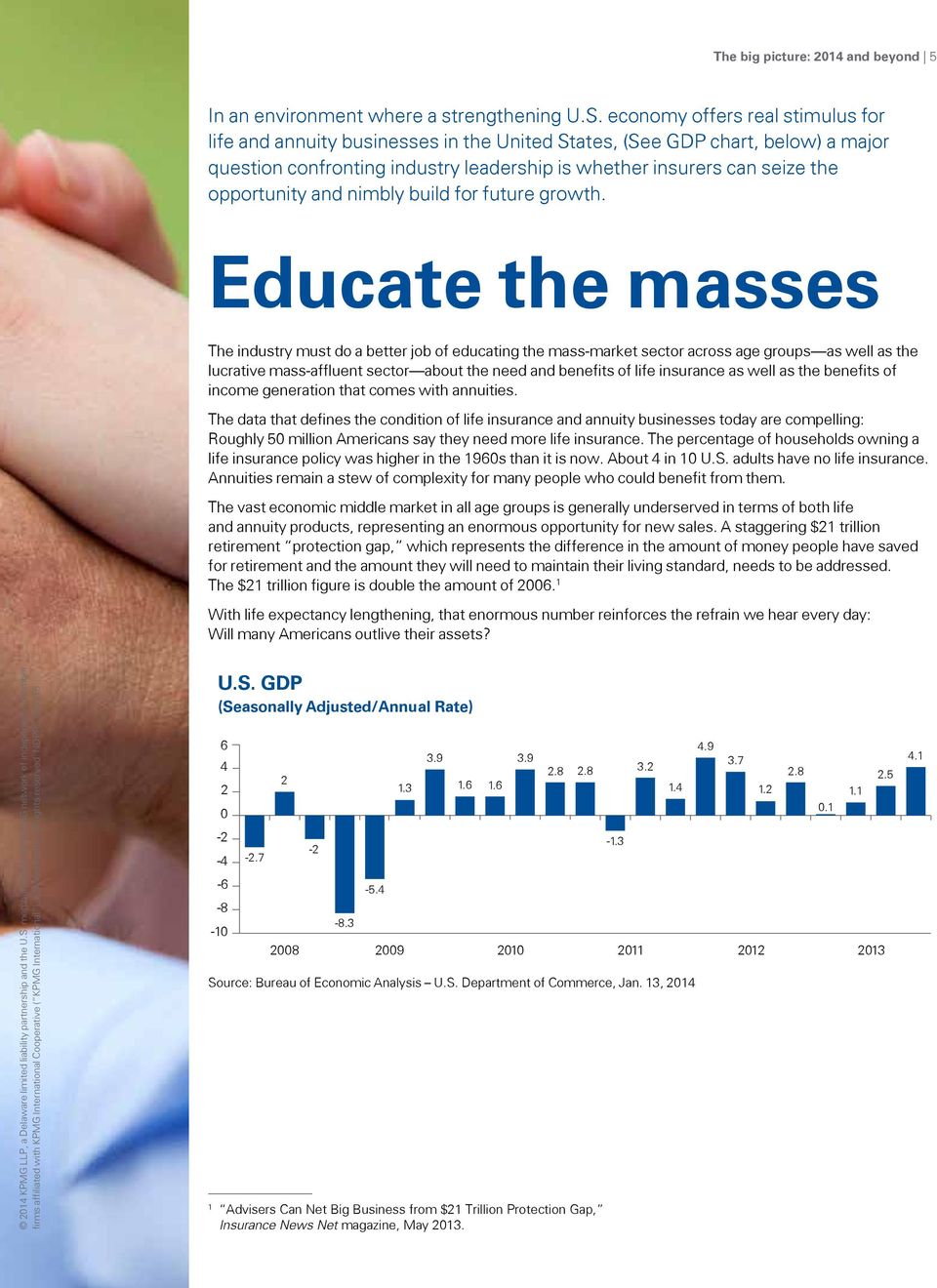
9 The big picture: 2014 and beyond 5 In an environment where a strengthening U.S. economy offers real stimulus for life and annuity businesses in the United States, (See GDP chart, below) a major question confronting industry leadership is whether insurers can seize the opportunity and nimbly build for future growth. Educate the masses The industry must do a better job of educating the mass-market sector across age groups as well as the lucrative mass-affluent sector about the need and benefits of life insurance as well as the benefits of income generation that comes with annuities. The data that defines the condition of life insurance and annuity businesses today are compelling: Roughly 50 million Americans say they need more life insurance. The percentage of households owning a life insurance policy was higher in the 1960s than it is now. About 4 in 10 U.S. adults have no life insurance. Annuities remain a stew of complexity for many people who could benefit from them. The vast economic middle market in all age groups is generally underserved in terms of both life and annuity products, representing an enormous opportunity for new sales. A staggering $21 trillion retirement protection gap, which represents the difference in the amount of money people have saved for retirement and the amount they will need to maintain their living standard, needs to be addressed. The $21 trillion figure is double the amount of With life expectancy lengthening, that enormous number reinforces the refrain we hear every day: Will many Americans outlive their assets? U.S. GDP (Seasonally Adjusted/Annual Rate) Source: Bureau of Economic Analysis U.S. Department of Commerce, Jan. 13, Advisers Can Net Big Business from $21 Trillion Protection Gap, Insurance News Net magazine, May
10 6 The big picture: 2014 and beyond Create connections With disposable income edging upward, employment on the rise, and with a larger portion of the population having to self-direct their retirement nest eggs, life insurance policies and annuities can and should fill a need in years to come. It will require, however, that the industry do much more in connecting with consumers in many more ways. While that connection will require leverage of the latest mobile technologies, whether they are tablets or smartphones, hardware represents just one small piece of the puzzle. The winners in the competitive U.S. market will be insurers that offer uncomplicated, valuable products. They will employ creative and technically savvy people who will design and deploy easy-to-understand education programs and messages for many more consumers about the products. Survey after survey during the past decade reinforce the notion that many potential buyers of life insurance and annuities are befuddled by the complexities built into what ought to be simple income-protection and income-producing products. Consumers say they need the industry to demystify products before any sale will happen. That said, it is important to realize education is a two-way street in this industry. Despite years of talking the talk about using social media and deploying new apps, many insurance executives and agents still face an enormous learning curve. Agents, especially, must better leverage the computing and communications systems preferred by a large segment of the population that brings high expectations for fast, efficient, and highly personalized customer service Top 10 Trends in Insurance, 2014: Becoming More Customer Centric, Aite Group LLC, January Unemployment rate The best way to get to millennials is to have millennial salespeople on the surface Millennials do not want to be sold, they want to be educated empowered and then arrive at a decision themselves. Mark Hug, executive vice president, Prudential Financial, Product and Marketing, Individual Life Insurance 6.8 What Millennials Want From Agents, LifeHealthPro.com, August 30, U.S. Unemployment Rate (As of Dec. 2013) U.S. Bureau of Labor Statistics

11 The big picture: 2014 and beyond 7 Beyond boomers While life and annuity agents have built solid connections with the mass-affluent Baby Boom generation that is in retirement or edging closer to that time, the agents have not yet connected well enough with the roughly 165 million Americans who make up: Generation X about 80 million born between 1960 and 1980 and are entering their prime earning years Generation Y the so-called Millennials, comprising about 85 million born after 1980 who are just now beginning to understand the need for insurance and savings for retirement. 3 Part of the challenge lies in the makeup and the technical savvy of the current population of agents. Many agents in the current pool are of a different generation than those who need more life insurance, creating a disconnect that must be addressed in two ways: adding more agents who have tech capabilities and share the demographic profile of the new wave of buyers, and a concerted effort to educate the current crop of agents, whose median age is about 20 years older than the buyers in the Gen Y segment. In addition, there are large portions of middle-market Baby Boomers who are underinsured and don t own annuities primarily because they don t understand them. That market segment needs more direct contact with agents, either through face-to-face meeting or through online means. Their retirement needs are underserved, and they could be ready to invest in annuities if they understood them better. There already is evidence that annuities are becoming attractive again: Sales of fixed annuities grew in 2013 after a period of contraction in previous years, and poised to grow in Insurers intent on boosting annuity sales must, however, focus more on customers and not just on sales, according to a recent Aite Group analysis of the annuity market s challenges. 5 Allianz Life in 2013 issued a report on a survey that found an astounding 87 percent of 1,400 survey respondents between the ages of 55 and 65 would prefer a financial product that provides a 4 percent return guaranteed to maintain its value over one that provides an 8 percent return that is vulnerable to loss. 6 3 U.S. Census Bureau, Pew Research Center. 4 3Q Annuity Sales at Highest Level in 2 Years, Insured Retirement Institute, December 5, Five Keys to Unlocking the Lifetime Income Annuity Safe, Aite Group, January Transition Boomers and Retirement Income Survey, Allianz Life, April 2013.
12 8 The big picture: 2014 and beyond Build the bridge It is no revelation that younger, tech-savvy buyers look first to direct channels to buy products and services. It is a mistake to believe that it is the only way to build bridges to Gen X and Gen Y consumers who at some point will need life and annuity products. A combination of face-to-face and direct channels may be needed in the not-too-distant future. And, insurers are not only struggling with Boomers, and Gen X ers and Gen Y ers: Financial advisers also often do not include annuities with lifetime income options in the investment strategies to clients because of several reasons, Aite analysts recently reported. The analysts say some advisers do not possess the technical skills to explain them to their clients, and fiduciary guidelines prevent their inclusions in 401(k) plans among other reasons. 7 Clearly, the time is now for the industry to study the facts and challenges that are affecting the potential for future growth of 7 Five Keys to Unlocking the Lifetime Income Annuity Safe, Aite Group, January Bank Channel Eyes Life Insurance Growth, Life Health Pro.com, September 1, the industry. The industry must create strategies to meet the challenges, and perhaps most important adopt a culture that accepts transformation as the means to grow in the future. If the industry does not act now, the completion, which is now already snatching market share, will grab even more in the years ahead. The Life Insurance Marketing and Research Association (LIMRA) estimates that at least half of Gen X and Gen Y consumers would consider buying life insurance from their bank instead of reaching out to an insurance broker. 8 Why? In many cases, agents are ignoring the entire generation and instead focusing on the mass-affluent segment the exact segment that already is saturated with brokers. These younger people may be the same people who, when the time comes to begin investing more aggressively for their future, would avoid insurers and instead turn to another financial services organization for advice and investment products.

13 The big picture: 2014 and beyond 9

14 10 The big picture: 2014 and beyond

15 The big picture: 2014 and beyond 11 Like so many buzzwords, when put the customer first is uttered in a discussion about sustainable growth and competitive advantage in the life business, it can be interpreted in a number of ways. Put the customer first We believe best-in-class insurers adopt a customer orientation that leverages four key attributes 9 : Constant focus on a strategy that keeps the long-term needs of their customers at the forefront Embracing a culture of efficiency that relies on the investment in scalable systems, processes, and delivery channels that resolves the legacy inefficiencies that have hamstrung growth efforts for the past decade or longer An agility that relies on a top-to-bottom organizational culture that embraces the idea of adapting swiftly to the rapidly changing environment surrounding the industry Emphasizing the importance of regaining trust among customers and regulators. If nothing else has been learned in the past several years, it is that customers are not shy about voicing expectations about how they want to learn about and purchase products and services. The expectations regarding insurance are being shaped in large measure by how these very same customers are interacting with other industries. The list of industries and businesses that have transformed just in the past few years through the creation and deployment of customized, consumer-friendly, easy-to-use technologies is long and getting longer. Think about how we rent movies, buy books, read newspapers, and buy music. Are we heading to big box retailers to shop for TVs and computers, or are we only stopping by to pick up the merchandise after we shopped and compared prices online? Isn t the only question left unanswered: What s next? These same changes that reshaped so many other industries may be creating chaos inside the walls of some of our insurers, but we believe that from chaos comes opportunity. Making matters challenging for insurers, however, is that, although the industry has long-enjoyed a reputation for being very successful, it also has been characterized as being slow at embracing change. Now, with the industry having gone through some of the toughest tests in decades, we are seeing a real movement among leaders in the industry toward adopting a customer-first mentality. We would agree with those who say that this customer-first mentality is the only source of competitive advantage remaining 10 in the current business environment. We have no doubt that a strategy that has at its heart the belief that great customer experience will ultimately lead to greater efficiency and profitable business is the sensible path forward. Mega-trends Two years ago, when KPMG International published The Intelligent Insurer, it described how powerful global mega-trends would shape the industry for the next 20 years. 11 In just the past two years, several of those mega-trends demographics, technology, and social values/ethics are being better understood. As more study is conducted about the mega-trends current and future impact, there is a growing realization about how insurers can understand them and harness their power in the quest to connect with consumers and grow the business. 9 The Valued Insurer: Leading the Pursuit of Sustainable Growth, KPMG LLP, Customer Advocacy 2013: How U.S. Consumers Rate Their Financial Firms, Forrester, November 8, The Intelligent Insurer: Creating Value from Opportunities in a Changing World, KPMG International, 2012.

16 12 The big picture: 2014 and beyond Demographics Several major U.S. demographic changes in the next several decades population size, length of life, as well as ethnic diversity of the U.S. population are having significant consequences for life and annuity businesses are having significant consequences, to: are expected to have significant consequences for life and annuity businesses. Obesity Trends* Among U.S. Adults BRFSS, 1990, 2000, 2010 (*BMI 30, or about 30 lbs. overweight for 5 4 person) 1990 While U.S. population growth currently is at its lowest rate in almost a century, a higher birthrate among an expanding immigrant population in the United States is expected to be a major driver of population growth in the years ahead. 12 The U.S. population is expected to grow by about 25 percent by 2060, compared to the population of about 317 million as of January 1, In that same period, the number of U.S. citizens age 65 and older is expected to more than double to about 92 million, 14 compared to the current number. Staying abreast of the population, age, and ethic trends in the United States will allow life insurers and annuity writers to align strategies with trends. U.S. Census Bureau studies predict that the number of U.S. citizens of Hispanic or Latino descent will grow rapidly in the United States by the end of the current decade, and will account for about a third of the overall U.S. population midway through this century. Between 2000 and 2010, the growth rate of the Hispanic population in the United States was four times the growth rate of the overall population. 15 Insurers that create brand-awareness campaigns among expanding population segments, and build paths and products to serve them, will gain a strong position in the marketplace of the future. Trends in obesity, however, may present increasing concern in the life industry as it relates to the ability to properly underwrite and price. According to the Centers for Disease Control and Prevention (CDC), more than one third of U.S. adults (35.7 percent) are obese, 16 meaning their body mass index (a measure of an adult s weight in relation to his or her height) is greater than 30. Overweight or obese people face a higher risk of heart disease, Type 2 diabetes, high cholesterol, high blood pressure, sleep apnea, stroke, and arthritis, among other medical problems. 12 Changing U. S. Demographics Offer Opportunities to Insurers Willing to Adapt, June 6, 2013, Property Casualty 360.com 13 U.S. Census Bureau, U.S. and World Population Clock, January 1, U.S. Census Bureau news release, December 12, Personal Lines Consumer Markets Annual, Conning, Inc., June 5, Adult Obesity Facts, Centers for Disease Control and Prevention, January No Data <10% 10% 14% 15% 19% 20% 24% 25% 29% 30% Source: Centers of Disease Control and Prevention
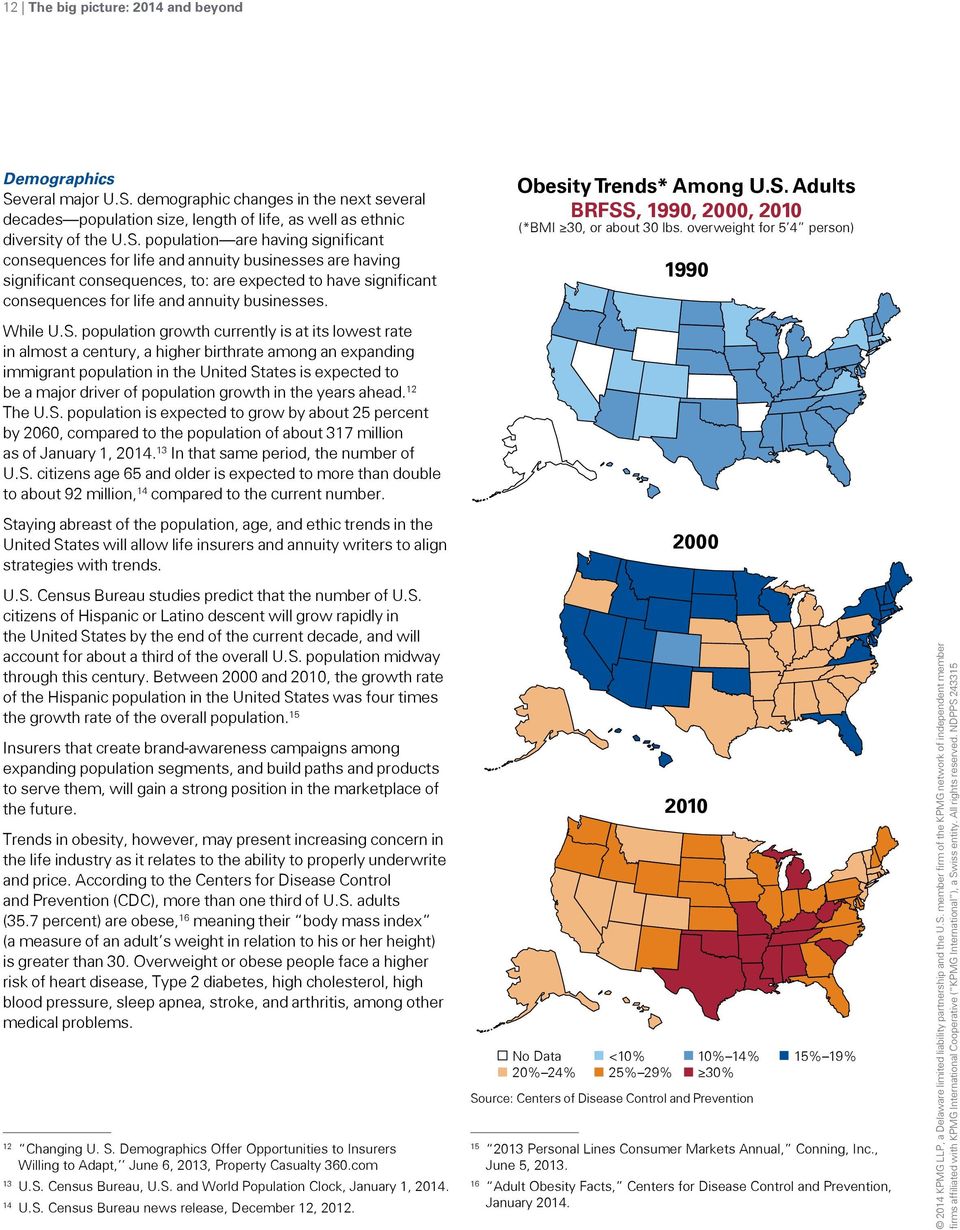
17 The big picture: 2014 and beyond 13 There has been a dramatic increase in obesity among the U.S. population since In 1990, there were 10 states that had prevalence of obesity of less than 10 percent and no state had a prevalence of obesity of equal or greater than 15 percent of its population. By 2010, there were no states in the country that had prevalence of less than 20 percent and 12 states had prevalence of obesity of greater than 30 percent. Among children, the rate of obesity has doubled to 18 percent in the past 30 years, and it has tripled among adolescents (also 18 percent) in the same period, according to CDC research. The implications for the life industry, already struggling with pricing and overall sales, could be severe if these trends continue into the future. Technology It is difficult to understate the role that technology and digital revolution continue to play in terms of greater connectivity between consumer and insurer, the use of social media to understand and meet consumer needs, and in gaining access to an unparalleled wealth of information. The industry s Achilles heel in terms of technology, however, is its continued reliance on too many legacy systems. Much work already has begun to address the issue, although much more work is ahead. The patchwork of hardware and software created through bolt-on additions to existing systems and through the attempt at systems integration after a merger or acquisition continues to cause major problems in the industry. Disparate systems and processes are a key cause of mistakes, they exacerbate the problems associated with duplication of efforts (which aggravate customers), and they add significant costs and time. Until the legacy issue is fixed, there will be a continued drag on productivity and profitability. From an industry competitive standpoint, we believe the slow uptake of the deployment of digital technologies to connect with consumers presents one of the greatest threats to established insurers. Already we have seen new entrants, not encumbered by the legacy systems of their more-established competitors, steadily grabbing more pieces of the market by meeting customers new connection and distribution demands. 17 The Intelligent Insurer: Creating Value from Opportunities in a Changing World, KPMG International, Social values and ethics In survey after survey with consumers in recent years, financial services organizations rank extremely low with regard to trust. Rebuilding a reputation that has been damaged takes more than time. The reverberations due to the financial crisis of 2008 are still being felt, and insurers as well as other organizations in the financial services industry still have not fully recovered. Rebuilding a reputation requires unstinting focus on the consumer, top-of-class governance, and a strong culture throughout the organization to do things right at all times. Life insurers have earned higher marks in recent years by leveraging social media to connect with a new generation, and social media will continue to play an important role in connecting with customers and in attempting to create a positive public opinion of the industry. Social media, however, is a dual-edged sword. Done well, social media programs can help build strong alliances; the penalty for breaching trust, however, almost always is immediate and severe. Successfully building trust creates value, an intangible that increasingly is being recognized on corporate balance sheets. 17

18 14 The big picture: 2014 and beyond Shift in the balance of power There literally are tens of millions of people who, without hesitation and at any time of day or night, use their mobile phones, tablets, laptops, gaming devices, and desktop personal computers to search online for products, comparison shop, and hold conversations with friends and total strangers about the utility and value of the product or services. These same people make instant and important decisions and recommendations about whether to buy or disparage products and services. Insurance executives, for many reasons, still are playing catch-up, while other industries are on pace. Anyone who doubts that the balance of power is in the hands of the consumer hasn t been paying attention. The life industry is showing signs of reacting quicker to customer demands for better and speedier customer service; better multichannel options to settle claims, buy, and receive products; and more use of social media. We believe, however, many insurers still are grappling with getting a handle on the scale of the transformation required. And fewer still are successfully achieving it. Midway through 2013, when KPMG conducted numerous industry events with leading global insurance companies, we learned that only about one third believed they have an agile business structure adaptable to changing customer and market needs. 18 It is important to understand what is meant by customer orientation, since it is frequently touted by major organizations including the insurance industry, without giving it a tangible, lasting strategic focus. In order to establish a customer orientation, firms must overcome the frequent conflicts in corporate mind-set that emphasize short-term priorities and next-quarter shareholder value. Customer centricity takes significant time and investment to embed in an organization and reap a meaningful competitive advantage and return on investment. 18 Valued Insurer Pulse Survey, KPMG International, conducted at industry events, June 2013.

19 The big picture: 2014 and beyond 15 Here, we identify four strategic building blocks, supported by a number of tactical enablers, which define the components of a customer-centric business model. 19 Better knowledge of customers Do you understand the needs of customers and develop propositions to match? Do you use predictive analytics and propensity modeling to target and cross-sell? Customercentric business model Relevant propositions at the right time Optimal distribution for each customer segment Are your propositions based on customer needs and do your customers reward you through greater loyalty, referrals, and retention? Can you comply with more consumer-focused regulation? Do you understand how customers want to buy and have you aligned your distribution strategy? Have you optimized the cost of acquiring your customers based on the value created by your propositions? Governance and People Source: The Valued Insurer, KPMG LLP, 2013 Optimal servicing for each customer segment Enablers Components of a customer-centric business model In an environment where competition is becoming ever more intense, it will become increasingly important for life and annuity businesses to: Develop differentiated products targeted at particular market segments Focus on building loyalty to reduce customer churn and pressure on business volumes Differentiate brands through enhanced customer service, and thus Deliver maximum value for customers. 19 The Valued Insurer: Leading the Pursuit of Sustainable Growth, KPMG LLP, Do you understand how your customers want to be serviced and through which channels? Do you promote a positive customer experience at every touch point? Regulation and Capital Management

20 16 The big picture: 2014 and beyond

21 The big picture: 2014 and beyond 17 The new and pending insurance regulations coming out of the reform wave of the past decade will continue to demand a significant amount of the life industry s attention this year in order to remain in compliance in a cost-effective way. More regulation; More uncertainty; More staff time In addition, the sheer number of new regulations continues to mount, while the scope of those regulations continues to broaden. The breadth of these rules and regulations will require that life insurers not only have more staff devote more time to completely understand the new rules and their current and future implications, but there also will be demands on whether the structure of current governance models are appropriate and whether any changes will need to be made. At the end of 2013, the U.S. Department of the Treasury s Federal Insurance Office (FIO) released its long-awaited report How to Modernize and Improve the System of Insurance Regulation in the United States on ways to modernize and improve the current system of insurance regulation. The FIO, created by mandate of The Dodd-Frank Wall Street Reform and Consumer Protection Act, was to have issued its report on January 21, Twenty-three months late, the FIO report does not challenge the legitimacy of the state-based insurance system. It did, however, offer a roadmap for improvement of the current state-based system and concluded that a hybrid model of state and federal authorities would help create uniformity and efficiency, improve solvency, and address certain market-conduct issues. If nothing else, the FIO report adds to the environment of regulatory uncertainty that has enveloped in the industry for the past several years. In the meantime, more concrete regulatory matters will occupy the time of industry executives, affecting certain business operations such as life businesses use of their captives for reinsurance (cited in the FIO report), financial reporting, the possible designation as a systemically important institution, systemically important financial institution (or a globally important systemic insurer), cost of capital, solvency, and pricing for universal life products. Through it all, the bottom line is that, collectively, these regulatory imperatives that are on 2014 s agenda add complexity and cost to operations, and they add even more compliance and reporting risk to the industry. Also remaining on the horizon are changes in accounting for insurance contracts. In February 2014, the Financial Accounting Standards Board (FASB) decided to change the direction of the insurance contracts project. For long duration contracts, the board will work on targeted improvements to current U.S. GAAP and then evaluate how those improvements compare to the building block approach as determined by the International Accounting Standards Board (IASB). This decision is likely to lead to further non-convergence with the IASB. Life Insurers should continue to expect much higher demands from consumers, lawmakers, regulators, and other stakeholders around transparency and accountability, which puts a premium on enhancing existing governance processes and risk-management capabilities while requiring a redoubling of efforts related to bolstering data quality and data accessibility capabilities. Gaining an unambiguous understanding of the implication of these regulations has been a challenge for the industry, primarily because many have been subject to debate and modification virtually from the day they were proposed. Nevertheless, insurers must devote more attention to the implications of the pending regulations in preparation for when they finally are adopted.
22 18 The big picture: 2014 and beyond
23 The big picture: 2014 and beyond 19 An improving economy, coupled with slowly rising interest rates, an uptick in disposable income, and job growth, provides potential positive momentum for the life and annuity business in On the path of growth Propelled by whole life and universal life products, insurance sales increased in 2013 and are expected to experience moderate growth this year. Sales of variable and indexed annuities could increase moderately (single-digit increase), driven by such factors as an increase in the number of retirees seeking to bolster and diversify their retirement investment portfolios, and an expected rise in disposable personal income positive equity market growth. Some factors that could limit growth in annuities in 2014 include some confusion about the products among both consumers and agents, and too few independent agents willing to offer the products. 20 At the same time, though, net investment income has been relatively flat for the past five years, and net yield on invested assets has been on a downward path since While the slight rise in long-term bond yields in the final quarter of 2013 helped boost life insurers investment income, the impact of the actions by the U.S. Federal Reserve Board (Fed) continues to create some uncertainty. As 2014 gets underway, the Fed continues to provide indications that it will continue to taper its bond buy back program, which some fear could slow economic growth. 22 Fixed annuity sales $50 $45 $40 $35 $30 $25 $20 $15 $10 $5 $0 $16.4 $18.1 $18 $19.6 $14.1 Q1, 2007 Q3, Conning s 2014 Life-Annuity and Health Industry Forecasts, November 14, SNL Financial LC Q1, 2008 $25.3 $27.7 Q3, 2008 $34.1 $34.8 $27.8 Source: Insured Retirement Institute, Morningstar, and Beacon Research (used with permission) 22 Rosengren Says Fed Needs to be Patient in Removing Stimulus, Bloomberg.com, January 4, Q1, 2009 $22.1 $19.5 $17.9 $20.4 $20.5 $17.6 $18.6 $20.7 $19 $17.3 $16.9 $17.1 $16.6 $16.2 $15 $17.1 $22.5 Q3, 2009 Q1, 2010 Q3, 2010 Q1, 2011 Q3, 2011 Q1, 2012 Q3, 2012 Q1, 2013 Q3, 2013
24 20 The big picture: 2014 and beyond Variable annuity sales $50 $40 $30 $41.3 $47.5 $46.5 $48.1 $41.7 $42.0 $37.8 $33.3 $30.5 $31.9 $31.1 $32.1 $31.8 $34.6 $34.3 $37.6 $39.2 $40 $39.1 $37.2 $36.2 $38.2 $36.3 $34.4 $34.6 $37.3 $35.1 $20 $10 $0 Q1, 2007 Q3, 2007 Q1, 2008 Q3, 2008 Q1, 2009 Q3, 2009 Q1, 2010 Q3, 2010 Q1, 2011 Q3, 2011 Q1, 2012 Q3, 2012 Q1, 2013 Q3, 2013 Source: Insured Retirement Institute, Morningstar, and Beacon Research (used with permission) With sales across the spectrum of life and annuity expected to generally follow the modest growth of 2013, now is not the time for taking a rest. Instead, the gradually strengthening position dictates that industry executives seize the momentum and accelerate investments in people, technologies, and processes that may have been given less-than-adequate attention earlier in the postcrisis period. These industry improvements should encourage the industry focus on the soft skills and hard investments. Those investments can help put the consumers first and drive increases in market share and create new ways to deliver the critical messages that consumes need to understand if they are going to buy new products and services. Insurers that work with lawmakers also stand to reap rewards through proposal legislation in the U.S. Senate that would overhaul the system now in place for the $3 trillion held in the public pensions for states and cities. If adopted, the law would allow funds to be turned over to life insurers, which would then take responsibility for making payments when workers retire Insurers Get Shot at $3 Trillion in Hatch s Pension Plan, Bloomberg, August 7, 2013 Recent trend: 10-yr. treasuries Source: Federal Reserve Board
25 The big picture: 2014 and beyond 21
26 22 The big picture: 2014 and beyond
27 The big picture: 2014 and beyond 23 The kind of online purchases people make, or the type of magazines they buy, or how they spend their leisure time, and the movies and TV shows they watch says a lot about the risks they represent from a life insurer s perspective. Consequently, predictive analytics and modeling techniques applied to deep mines of information that are increasingly made available about almost everybody are being used by life insurers. Investment in predictive analytics and modeling Predictive analytics and modeling already is widely used in non-life insurance lines, including personal auto, homeowners, commercial auto, and commercial property, but more life insurers are benefitting from leveraging these powerful tools to help drive profitability, reduce risk, grow revenue, and improve efficiency. The volume, velocity, and variety of data pouring into insurance organizations place enormous emphasis on the assurance that the data is reliable. Further, insurers must make certain that the organization has an outstanding data management environment to ensure quality and security. Sophisticated judgment and effective investment can deliver fundamental and lasting benefits to the most advanced companies. In fact, we believe that without strong technical and human capital capabilities to collate and synthesize the massive amounts of data available, insurers will find themselves, at a minimum, potentially missing an opportunity and, at worst, at a serious competitive disadvantage in the very near future. Sustainability and profitability depend on identifying the specific behavior characteristics of policyholders as well as developing lasting and deep relationships with clients. Modeling and analysis of customer data are, therefore, fundamental to a successful business model. Data and analysis Deployed hand-in-hand with more powerful computer hardware, new software applications allow companies to routinely undertake analyses that would have been prohibitively time-consuming or expensive only a few years ago. Hard figures costs, claims, dates, times and other customer details can be trawled automatically to extract significant correlations that can yield valuable insights into core business parameters. In addition, dramatic developments in the analysis of unstructured data, or text mining, can allow large volumes of text-based material held in-house to be scanned to extract potentially significant information. Furthermore, publicly available material can complement existing consumer behavior data. Internet technology and social media now allow customers and potential customers to chronicle their lifestyles and consumer experiences online. Many people also use social media networks to evaluate products, services, and providers. It is well known that certain key life events, such as buying a house, having a baby, or retiring, are associated with insurance purchases. Increasing numbers of analysts and modelers are experienced in the necessary actuarial and statistical analysis. Identifying these key life events can make targeted marketing much more effective.
28 24 The big picture: 2014 and beyond Benefit to customers The benefits of advanced data analysis and prediction do not all flow one way. Many aspects that create advantages for the company also improve the customer experience: Policies tailored to individual circumstances Premiums more closely related to actual risk, resulting in benefits to lower-risk customers Faster, more personalized service at every stage of customer interaction. Investment Developing these new analytical capabilities should not be undertaken lightly. Typically, significant investment is needed in people, hardware, software, collecting, collating and verifying data, in data cleansing, and the development of data warehouses. Embedding data analytics in the heart of the operating model as a routine and continuing dimension of management decision making can require major change. However, many companies will already have a number of key components in terms of hardware and capacity to host the infrastructure and existing analytical tools. As is often the case, when the topic turns to investment, it almost invariably is centered on hardware, software, and data capabilities. While vital, we believe that the industry also is facing a talent shortage, and investment in human capital must rise higher on the agenda. Finding the right people with the right skills, especially high-grade talent with background in investment and risk, is one of the industry s more important unmet challenges. With investment returns a major worry, insurance industry boards and senior management will need to target individuals with specific expertise in asset management in a variety of asset classes. And with increased regulatory scrutiny now part of business as usual in every insurance organization, professionals with deep quantitative and analytical skills are needed. Investments made in people, processes, and technology can have high returns. However, all insurance businesses are different in terms of their business model, risk appetite, target customer segments, and product profile. The challenge is to relate the investment to the return in a transparent way in order to evaluate the relevance and significance of modeling outputs. This is especially challenging in view of the very long lead times in the insurance business model. Securing corporate support at the senior executive level for business investments based on data analysis depends on getting buy-in to its relevance and significance in this way.
29 The big picture: 2014 and beyond 25
30 26 The big picture: 2014 and beyond
31 The big picture: 2014 and beyond 27 With the prospect of a relatively low interest rate environment persisting through 2014, and facing new liquidity and capital requirements that present ongoing operational and bottom-line risks for life insurers, leadership will need to consistently evaluate their investment strategies and product portfolios that are interest-rate sensitive. Sources of investment income Life insurers may consider stepping up efforts they ve already initiated to reach for higher yields by investing in certain alternative investments, such as private equity, commodities, hedge funds, and certain riskier classes of real estate. While those alternatives may produce returns that match higher guaranteed returns that were made in the past on products sold under much different economic circumstances, life insurers will need to revisit their risk-management and capital-management practices. But, because movement from more traditional fixed income investments to alternative investments will increase risk-based capital (RBC) requirements, boards and senior management should consider a variety of questions in making the decision. For example: Will the return on RBC requirements be greater? If the company measures capital performance using metrics other than RBC for example, economic capital will the return on economic capital be greater? Is the alternative investment within market risk tolerances, including allowable asset class, concentration risk to asset class, industry, or geography? If not, should tolerances be adjusted to accommodate the change? Since alternative investment strategies place a heavier burden on a life insurance company s investment professionals, management and the board also will need to evaluate the professionals level of investment sophistication and consider whether to use outside managers as a risk-management strategy. The protracted period of low rates already has compelled life insurers to alter product strategies, and more work may still need to be done in that regard into 2014 and perhaps beyond. The risks associated with investment-oriented products will continue to increase, giving new urgency to redesign such products, and where possible increase premiums and fees and change to minimum guarantee provision on life and annuity products. Insurers in 2014 are facing the challenge of reeducating their customers who, for a long time, expected attractive, guaranteed returns such as those offered by variable annuities. For some life insurers, the sale of annuity lines of business may make the most sense from a strategic and shareholder perspective.
32 28 The big picture: 2014 and beyond Life sector annual net investment income/net yield on invested assets Net Investment Income ($000) Net Yield on Invested Assets % 2013 is through the 3rdQ Source: SNL Financial As straightforward as it is to suggest such alternatives, there are legitimate questions about the challenges they present. In a 2013 report issued by State Street Corporation, in conjunction with The Economist Intelligence Unit, one in four insurers admitted their business had trouble hiring knowledgeable, qualified staff in the field of asset allocation. 24 For some, outsourcing the investment management function will be an answer, although with increasing demands by regulators for transparency, moving the investment function outside the organization could elevate risk. Expect regulators to heighten their scrutiny of alternative investment strategies in order to protect policyholders. While hedge funds can offer higher returns than U.S. Treasuries, 24 Facing the Future: Blueprint for Growth, State Street Corporation, many insurers other than the largest have avoided investing in them. However, with the specter of prolonged low rates and the steady decline in the industry s net yield on invested assets, hedge funds may become attractive in 2014 for a broader swath of insurers. The risks raised by investing in alternative classes of assets also point to the need to leverage data analytics to manage the associated risks. As it is with many aspects of the insurance industry, the difficult investment environment demands detailed focus on innovation. Questions remain, however, about the level of preparedness among the majority of insurers to meet this challenge.
33 The big picture: 2014 and beyond 29
34 30 The big picture: 2014 and beyond
35 The big picture: 2014 and beyond 31 The risks and opportunities associated with cyber security at insurers are significant. The average operational cost of a data breach in the United States is approximately $5 million. 25 But, the monetary impact is only one element of the fallout, however. There are issues associated with lost productivity, damage to the organization s reputation, and the very real possibility that the customer will walk away from the company. 26 Cyber security In a customer-sensitive business such as insurance, the potential impact is significant, especially in light of the increasing number of recent incidents where insurers have experienced data breaches. With the ubiquity of electronic content inside insurers computer systems and the incidence of hacking increasing, there is considerable pressure to review protection protocols against data breaches. In New York State, for example, Gov. Andrew Cuomo in 2013 issued so-called 308 letters to 31 of the state s largest insurance companies asking what steps they are taking to keep data safe from cyber threats as part of the governor s effort to protect critical infrastructure and information systems. The letters, so named after a section of the New York Insurance Law, sought information on: The cyber safeguards in place at the insurance companies The companies IT management policies The amount of funds and other resources the companies dedicate to cyber-security The companies governance and internal control policies related to cyber-security. Since these same questions surely apply to more than 31 insurers, we would suggest boards and senior management use this set of questions in examining their own operations. Further, we expect such emphasis on controls to increase in the future, and we advocate that insurers routinely test protection protocols. Though final statistics for 2013 are not yet tabulated, the expectation is that the final tally will show nearly 600 computer network breaches at U.S. companies, government agencies, and other institutions, according to the Identity Theft Resource Center Cyberinsurance Picks Up Steam, Study Finds, The Wall Street Journal, August 7, Customers Take Their Business Elsewhere After a Data Breach, Infosecurity Magazine.com, October 22, Data Breaches on the Rise, The Wall Street Journal CFO Journal, August 13, 2013.
36 32 The big picture: 2014 and beyond
37 The big picture: 2014 and beyond 33 For the past several years, there has been no shortage of predictions about a pending run-up in mergers and acquisitions (M&A) among life insures. But, for the most part, the pace has been slow, and the deal value modest. Yet the drivers the need to increase scale, cost synergies to name just two remain compelling. The strategic imperatives for growth through M&A, against the backdrop of relatively low interest rates and opportunities for expansion into niche markets in the United States and in rapidly developing markets, remain great. M&A: A combination of options Life M&A (U.S.) deals (Nov. 31) Source: Thomson Reuters/KPMG analysis With life premium growth and annuity sales slowing in mature economies, we expect more discussion in the boardroom during 2014 about such disparate topics as expansion into rapidly developing economies, particularly in Asia and Latin America (LatAm), or the sale of annuity lines to private equity firms. Expansion into new markets In the period beginning in 2000 and extending through 2007, North America and Western Europe accounted for 75 percent of the growth in the global insurance market. Since that time, however, roughly 70 percent of the premium growth in the global market came from South and East Asia and LatAm. And, according to the Organisation for Economic Co-operation and Development (OECD), in the years ahead, the size of the middle class in South and East Asia and LatAm is likely to exceed that of the United States. The OECD reports that in 2009, the U.S. middle class comprised the largest share of purchasing price parity globally with a 21 percent market share two-and-a-half times that of the next largest market, Japan. The study projects that by 2030 the U.S. market share will fall to 7 percent globally, taking a distant third place behind India (23 percent) and China (18 percent) Annual Report on the Insurance Industry, Federal Insurance Office, Department of the Treasury, June
38 34 The big picture: 2014 and beyond PE and annuities During the past several years, a number of private equity (PE) firms bought blocks of annuities that were spun off by insurers looking to shed noncore assets. The acquisitions have raised concerns among regulators that, while such purchases may be beneficial to the PE firms, holders of annuities might be placed in peril. Senior executives from some of the high-profile PE firms have met with a working group created by the National Association of Insurance Commissioners (NAIC), which is considering whether more stringent rules are needed to monitor risks that PE firms could present to the insurance sector and holders of annuities. 29 The risks most often raised by critics are that there could be a conflict between the insurers need to invest to meet the long term promises inherent in life/annuity products and the shortterm business model that many private equity firms espouse. 30 The next few months will certainly provide more insight into whether more PE/annuity activity will occur, or limitations will halt more such deals. Manage complexities Whether it is the sale of annuity blocks, or the purchase of a businesse at home or abroad, with such potential opportunity comes unknown risk. Life insurers seeking to benefit from the demand for insurance products accompanying the expected rising wealth in rapidly developing economies, for example, will likely need to identify, analyze, and manage the complexities that are routinely shifting in the region. Taking advantage of the current conditions and the expectations for future growth places a very high premium, however, on insurers abilities to develop strategies for the successfull execution of M&A that lower the potential downside risks, while enhancing chances for success. That approach to enhancing the odds for success begins by careful target selection, thoughtful structuring of deals, disciplined due diligence, and perhaps most important patience. 29 Apollo Would Support More Regulation for PE-Backed Insurers, The Wall Street Journal, December 16, Athene CEO Seeks Level Playing Field, Insurance News Net Magazine, December 31, The share of the global life and health insurance market in Latin America and Asia is expected to grow from 22 percent in 2010 to 37 percent in The relatively mature markets of Korea and Japan are also expected to significantly increase demand for life insurance products in the future. Annual Report on the Insurance Industry, Federal Insurance Office, Department of the Treasury, June 2013 The risk we re concerned about at [the Department of Financial Services] is whether these private-equity firms are more short-term-focused, when this is a business that s all about the long haul Their focus is on maximizing their immediate financial returns, rather than ensuring that promised retirement benefits are there at the end of the day for policyholders. Benjamin Lawsky, New York State Superintendent of Financial Services Risk Altered as Private Equity Moves into Insurance, Bloomberg News, May 12, 2013
39 The big picture: 2014 and beyond 35
40 36 The big picture: 2014 and beyond Culture, more than rule books, determines how an organization behaves. Warren Buffett
41 The big picture: 2014 and beyond 37 We can always count on one of the world s most revered investors to capture the essence of an idea. He seldom fails to provide perspective in a concise way. And, in the case of culture, his quote hits the mark. As pithy as it is, though, it still leaves room to wonder: How is culture defined in the context of an organization as complex as an insurance company? The answer? Well, it depends. Demand a culture that accepts change What we do understand is that, for far too long, the culture inside many insurers large and smaller didn t adequately allow for listening to the demands of a customer base that felt disconnected to their insurance company. One of our favorite comments on the subject of culture and corporate change comes from outside our industry. It was in a news article published a few years ago about the turnaround of a struggling automobile manufacturer. In it, the chief executive was asked about his top challenge. His answer was blunt: Overcoming resistance within the organization to change. 31 You have to create a culture that not only accepts change, he said, but seeks out how to change. Each of us who spends our days (and nights) focusing on the solutions to the industry s challenges presented by the shift of power to the consumer can take that message to heart. Our message to those at the helm is that the top issue on the agenda is not always necessarily figuring out how to create and deliver a new product or service. Rather, it is coming to grips with an entirely new way of doing business, given what is going on around us. In practice, the achievement of cultural transformation in order to become a customer-centric organization requires: 32 Senior management making a commitment to transformational change, including a review of the core beliefs and routines that exist within the organization. To be effective, it is vital to have visible and authentic role-modeling of values, with leadership demonstrating decisive action. A structured approach to managing people risk: Knowing the areas of the organization with the biggest impact on performance or reputation. What is the succession pipeline like for these areas? Is the organization s key talent in the critical roles and functions? Incorporation of talent risk into wider risk management governance and reporting. Is people risk being monitored in the same way and in the same forums as operational, market, or credit risk? Successful and credible cultural transformation will depend on two important elements: Statement of intent The change journey should start with some high-impact, symbolic actions that demonstrate that the organization is taking culture change seriously, and that there is no going back. These symbolic actions could include: Cessation of certain business activities and/or the sale of certain products that are perceived to be contentious or unfair Radical overhaul of traditional norms and routines. Conduct must be embedded through: An articulation of clear measures, making it easier for peers and the public to hold insurers accountable. The framing of behaviors that should be rewarded through incentive structures. 31 GM CEO Dan Akerson: Our Company Has a Resistance to Change, The Associated Press, December 11, Embedding Real Culture Change and Managing Talent Risk, KPMG, Frontiers in Finance, April 2013.
42 38 The big picture: 2014 and beyond
43 Looking ahead Getting going There is no denying that while the life and annuity industry has always focused on consumers there is validity in the observation that somehow that focus was less intense during the depths of the Great Recession, due to the ongoing financial chaos gripping the globe at that time. Now that we have regained a foothold, the industry must pivot to a strategy centered on the customer as a way to serve their interest and grow the industry. That pivot requires a new and unrelenting focus on developing new products and services that connect with customers and make them available via the channels they want to use as opposed to the channels the industry thinks are appropriate. Ambitious insurers will find ways to cater not only to their core customer base, but also to new customers in new locations. This refocus will require that insurers rethink and rebuild their systems and processes to be more agile and their analytical capabilities more insightful. Some institutions may find that the only way to meet these imperatives will be through mergers, acquisitions, or joint ventures. Others will opt strictly for organic growth. No matter the course, the way forward will require nothing less than a relentless focus on customer demands. By failing to adopt a strategy that has at its heart a total focus on the customer experience, insurers risk a gradual slide into irrelevance.
44 KPMG Leadership Team Please feel free to contact any of KPMG s Insurance Team: Laura J. Hay National Sector Leader Insurance [email protected] Tom Daugherty National Audit Leader Insurance [email protected] Ellen Hancock National Professional Practice Leader Insurance [email protected] Gordon Lunsford National Leader Insurance Management Consulting [email protected] Ram Menon National Leader Insurance Transactions and Restructuring [email protected] Craig Pichette National Tax Leader Insurance [email protected] Matt Smyth National Advisory Industry Leader Insurance [email protected] David White National Actuarial Leader Insurance [email protected] Matt McCorry National Leader Insurance Risk Consulting [email protected] kpmg.com/us/insurance The information contained herein is of a general nature and is not intended to address the circumstances of any particular individual or entity. Although we endeavor to provide accurate and timely information, there can be no guarantee that such information is accurate as of the date it is received or that it will continue to be accurate in the future. No one should act upon such information without appropriate professional advice after a thorough examination of the particular situation. firms affiliated with KPMG International Cooperative ( KPMG International ), a Swiss entity. All rights reserved. Printed in the U.S.A. The KPMG name, logo and cutting through complexity are registered trademarks or trademarks of KPMG International. NDPPS
Wealth and Asset Management Services. Accenture Health and Wealth Visualization Tool
 Wealth and Asset Management Services Accenture Health and Wealth Visualization Tool Accenture Wealth and Asset Management Services Part of our capital markets industry group, Accenture s Wealth and Asset
95% of asset management CEOs say they re very or somewhat confident about growth over the coming three years
 18th Annual Global CEO Survey Redefining competition in a world without boundaries 95% of asset management CEOs say they re very or somewhat confident about growth over the coming three years 82% of asset
Retail Industry Outlook Survey:
 Retail Industry Outlook Survey: Modest Gains Keep Cautious Optimism in Style kpmg.com KPMG s Industry Outlook Survey KPMG LLP, the audit, tax and advisory firm, surveyed C-suite and other top-level executives
Practice Management Value-Add Programs. TIAA-CREF Asset Management. Practice Management. Preparing you for new investors and new opportunities
 Practice Management Value-Add Programs TIAA-CREF Asset Management Practice Management Preparing you for new investors and new opportunities Say hello to today s new investors. And to tomorrow s retirement
Integrated Communications in Insurance The road to new winning strategies
 Integrated Communications in Insurance The road to new winning strategies Table of Contents New Winning Strategies in Insurance 3 A Key Lever for Success Winning Across All Lines of Business Drivers of
SAY NEW INVESTOR DEMANDS ARE RESHAPING THE COMPETiTIVE LANDSCAPE. Frontline Revolution: The New Battleground for Asset Managers
 Frontline Revolution: The New Battleground for Asset Managers Asset managers are rethinking their business models to capitalize on new trends in investor demand, according to a State Street survey of 300
Beyond Trust Build lasting relationships and brand loyalty by delivering superior client experiences
 Beyond Trust Build lasting relationships and brand loyalty by delivering superior client experiences Build lasting relationships and brand loyalty by delivering superior client experiences As the dust
Odgers Berndtson Board Survey. Among CEOs in Denmark s largest corporations
 Boards and CEOs preparing for growth Almost half of the CEOs in Denmark s largest corporations consider the financial crisis to be over and expect positive growth in the near future. This calls for preparation
Drive to the top. The journey, lessons, and standards of global business services. kpmg.com
 Drive to the top The journey, lessons, and standards of global business services kpmg.com The new normal for global enterprises is about doing more with less while at the same time driving the top line
2015 GLOBAL ASSET MANAGEMENT SURVEY
 2015 GLOBAL ASSET MANAGEMENT SURVEY It's not what happens to you, but how you react to it that matters." -Epictetus A survey carried out globally by Linedata. INTRODUCTION It's not what happens to you,
Explore the Possibilities
 Explore the Possibilities Seize the Moment 2013 HR Service Delivery and Technology Survey Executive Summary Report 2 towerswatson.com Explore the Possibilities Seize the Moment Table of Contents What the
Investment Company Institute and the Securities Industry Association. Equity Ownership
 Investment Company Institute and the Securities Industry Association Equity Ownership in America, 2005 Investment Company Institute and the Securities Industry Association Equity Ownership in America,
Seven ways to boost customer loyalty and profitability through an empowered contact center
 Seven ways to boost customer loyalty and profitability through an empowered contact center Is your bank using today s communications technology to its full potential? The financial services industry as
Business to business (B2B) corporations with strong cash. Merger and Acquisition Success: The Sales Force Integration Imperative
 S A L ES & M A R K E TING INSIGHTS Merger and Acquisition Success: The Sales Force Integration Imperative Michael B. Moorman and Ladd Ruddell Business to business (B2B) corporations with strong cash reserves
RetailSuite. The world s leading retail banking solution.
 The world s leading retail banking solution. We are set up now such that our sales agents have the capability and the discretion, within controllable limits, to set the terms and conditions of our products
4.5% 2014 Digital Marketing Optimization Survey results > 4.5% Top lessons learned from the leaders
 2014 Digital Marketing Optimization Survey results Top lessons learned from the leaders Table of contents 1: Introduction 2: Five lessons from the top 20% #1: They test to make decisions 3: #2: They put
Consumers and the IP Transition: Communications patterns in the midst of technological change
 Consumers and the IP Transition: Communications patterns in the midst of technological change John B. Horrigan, PhD vember 2014 1 Summary of Findings Americans today have a range of communications services
New Channels Create New Growth Opportunities for Insurers. North American Insurance Distribution Survey Findings
 New Channels Create New Growth Opportunities for Insurers North American Insurance Distribution Survey Findings Introduction After a period marked by disruption of the financial systems and heightened
LEVERAGING DATA ANALYTICS TO ACQUIRE AND RETAIN LIFE INSURANCE CUSTOMERS
 Tactful Management Research Journal ISSN: 2319-7943 Impact Factor : 2.1632(UIF) LEVERAGING DATA ANALYTICS TO ACQUIRE AND RETAIN LIFE INSURANCE CUSTOMERS Ms. Archana V. Rao Assistant Professor, Model College
Customer Lifecycle Management How Infogix Helps Enterprises Manage Opportunity and Risk throughout the Customer Lifecycle
 Customer Lifecycle Management How Infogix Helps Enterprises Manage Opportunity and Risk throughout the Customer Lifecycle Analytics can be a sustained competitive differentiator for any industry. Embedding
Global Trends in Non-Life Insurance: Policy Administration
 What you need to know NON-LIFE INSURANCE Global Trends in Non-Life Insurance: Policy Administration Key trends in policy administration and the implications for the non-life insurance industry Contents
White Paper Preparing Your Contact Centers for the Customer Experience Tsunami. Transforming Passion into Excellence
 Preparing Your Contact Centers for the Customer Experience Tsunami Executive Summary Recently, Gartner surveyed 315 international companies with revenues of at least $500 million across the financial services,
The following recap provides an overview of the topics covered at the event to help you better understand the growth opportunities of this business.
 The Principal Financial Group Retirement and Investor Services Workshop Recap On Sept. 12, 2014, the Principal Financial Group held an investor event in New York City to provide an update on its Retirement
HOTJOBS FORECAST OF TOP EXECUTIVE JOBS
 HOTJOBS FORECAST OF TOP EXECUTIVE JOBS 2015 A CTPartners Forecast of Top Executive Jobs in 2015 Even as companies continue to look for indicators of ongoing economic growth and stability that could boost
Title here. Successful Business Model Transformation. in the Financial Services Industry. KPMG s Evolving World of Risk Management SECTORS AND THEMES
 SECTORS AND THEMES Successful Business Model Transformation Title here in the Financial Services Industry Additional information in Univers 45 Light 12pt on 16pt leading KPMG s Evolving World of Risk Management
Managing HR on a Global Scale
 Survey Highlights Managing on a Global Scale Findings From Hewitt s 2009 Global Study What does it mean to be a global organization? As companies large small continue to exp their global footprint, the
Digital Strategy. Digital Strategy. 2015 CGI IT UK Ltd. Digital Innovation. Enablement Services
 Digital Strategy Digital Strategy Digital Innovation Enablement Services 2015 CGI IT UK Ltd. Contents Digital strategy overview Business drivers Anatomy of a solution Digital strategy in practice Delivery
Succession and Progression A Relay Race
 Succession and Progression A Relay Race Some compare an orderly company succession and progression plan to a relay race. In Canada s property and casualty insurance industry, a challenging labour market
Surviving & Thriving in Financial Services in the 2020 s
 Surviving & Thriving in Financial Services in the 2020 s INTRODUCTION: THE WORLD IS CHANGING We can all sense that something significant is happening around us; not only in the Financial Services Industry,
Get Better Business Results
 Get Better Business Results From the Four Stages of Your Customer Lifecycle Stage 1 Acquisition A white paper from Identify Unique Needs and Opportunities at Each Lifecycle Stage It s a given that having
2013 global economic outlook: Are promising growth trends sustainable? Timothy Hopper, Ph.D., Chief Economist, TIAA-CREF January 24, 2013
 2013 global economic outlook: Are promising growth trends sustainable? Timothy Hopper, Ph.D., Chief Economist, TIAA-CREF January 24, 2013 U.S. stock market performance in 2012 * +12.59% total return +6.35%
View Point. Customer Centric banking: A 360 degree view. Abstract. - Ashok Gopinath, Navdeep Gill
 View Point Customer Centric banking: A 360 degree view - Ashok Gopinath, Navdeep Gill Abstract Banks today are moving back to basics, shifting attention from complex product offerings to developing greater
Tapping the $7.5 Trillion Mass Affluent Market MARKETING SERVICES
 Tapping the $7.5 Trillion Mass Affluent Market MARKETING SERVICES Mass Affluents are growing in their importance to financial institutions. They ve spent a lifetime working to build successful careers.
10 Benefits of the Connected Financial Services Ecosystem
 April 2015 KEEPING UP WITH THE UPSTARTS 10 Benefits of the Connected Financial Services Ecosystem Let s face it we ve entered the Age of the Customer. Thanks to tech giants and their customer delight mantras,
Modernizing your annuity platform to reduce costs, improve customer service and increase business agility
 Modernizing your annuity platform to reduce costs, improve customer service and increase business agility 1 Modernizing your annuity system can pay big dividends to insurers. It can enable them to increase
Transforming risk management into a competitive advantage kpmg.com
 INSURANCE RISK MANAGEMENT ADVISORY SOLUTIONS Transforming risk management into a competitive advantage kpmg.com 2 Transforming risk management into a competitive advantage Assessing risk. Building value.
Symantec Global Intelligence Network 2.0 Architecture: Staying Ahead of the Evolving Threat Landscape
 WHITE PAPER: SYMANTEC GLOBAL INTELLIGENCE NETWORK 2.0.... ARCHITECTURE.................................... Symantec Global Intelligence Network 2.0 Architecture: Staying Ahead of the Evolving Threat Who
Wealth management offerings for sustainable profitability and enhanced client centricity
 Wealth the way we do it Wealth management offerings for sustainable profitability and enhanced client centricity The wealth management business is transforming. To delight their clients, firms must adopt
Powering Performance with Customer Intelligence. Are you ready to make Customer Intelligence your performance advantage to outpace the competition?
 Powering Performance with Customer Intelligence Are you ready to make Customer Intelligence your performance advantage to outpace the competition? Frequently Asked Questions (FAQs) PNT Marketing Services
Accenture Risk Management. Industry Report. Life Sciences
 Accenture Risk Management Industry Report Life Sciences Risk management as a source of competitive advantage and high performance in the life sciences industry Risk management that enables long-term competitive
Corporate websites as a premium acquisition channel
 Driving superior marketing performance across the full multichannel customer experience is an on-going challenge for chief marketing officers (CMOs). It s a complex task not made any easier by the proliferation
Commercial insurance: cyclicality and opportunity on the road to 2020 January 2016
 www.pwc.com/us/insurance Commercial insurance: cyclicality and opportunity on the road to 2020 January 2016 2 top issues Commercial insurance: cyclicality and opportunity on the road to 2020 Beyond the
The Path to High Performance in Insurance. Transforming Distribution and Marketing with Predictive Analytics
 The Path to High Performance in Insurance Transforming Distribution and Marketing with Predictive Analytics Table of Contents Introduction Distribution: A Cornerstone of Growth for Today s Insurers Transforming
Capital Markets Future of Investing. The Rise of Robo-Advice Changing the Concept of Wealth Management
 Capital Markets Future of Investing The Rise of Robo-Advice Changing the Concept of Wealth Management The concept of robo-advice the use of automation and digital techniques to build and manage portfolios
SYLLABUS. B.B.A. V SEM Subject Customer Relationship Management
 SYLLABUS B.B.A. V SEM Subject Customer Relationship Management UNIT I Introduction to CRM: Definition and concepts of CRM, Components of CRM, Understanding the goal of CRM and Customer Touch Points. UNIT
Economic Snapshot for February 2013
 Economic Snapshot for February 2013 Christian E. Weller on the State of the Economy Christian E. Weller, associate professor, Department of Public Policy and Public Affairs, University of Massachusetts
Capabilities overview. Retail Banking: A Transformational Model for Growth Using a Customer-Centric Approach
 Capabilities overview Retail Banking: A Transformational Model for Growth Using a Customer-Centric Approach Capabilities Overview It s a New World The retail banking industry is in the midst of a seismic
Household Trends in U.S. Life Insurance Ownership
 Household Trends in U.S. Life Insurance Ownership Full Report Cheryl D. Retzloff, LLIF, ACS Markets Research 860-285-7738 [email protected] Maximize the Value of LIMRA Research The value of LIMRA research
Security and Privacy Trends 2014
 2014 Agenda Today s cyber threats 3 You could be under cyber attack now! Improve 6 Awareness of cyber threats propels improvements Expand 11 Leading practices to combat cyber threats Innovate 20 To survive,
Internal audit value optimization for insurance organizations
 Internal audit value optimization for insurance organizations Webinar May 13, 2015 Baker Tilly refers to Baker Tilly Virchow Krause, LLP, an independently owned and managed member of Baker Tilly International.
2014 Global Asset Management Survey
 2014 Global Asset Management Survey It is always wise to look ahead, but difficult to look further than you can see. Winston Churchill A survey carried out globally by Linedata. Introduction It is always
CAREER OPPORTUNITIES IN FINANCE Department of Finance, Real Estate, and Insurance
 CAREER OPPORTUNITIES IN FINANCE Department of Finance, Real Estate, and Insurance PURPOSE OF THE ACADEMIC MAJORS The Bachelor of Science in Business Administration at CSUN offers options in Finance, Real
Digital Transformation: The Central Challenge for Asset Management Firms
 Digital Transformation: The Central Challenge for Asset Management Firms DIGITAL TRANSFORMATION: THE CENTRAL CHALLENGE FOR ASSET MANAGEMENT FIRMS Of all the changes confronting asset managers, perhaps
Infrastructure Asset Management Report
 Infrastructure Asset Management Report From Inspiration to Practical Application Achieving Holistic Asset Management 16th- 18th March 2015, London Supported by Table of contents Introduction Executive
Operations Excellence in Professional Services Firms
 Operations Excellence in Professional Services Firms Published by KENNEDY KENNEDY Consulting Research Consulting Research & Advisory & Advisory Sponsored by Table of Contents Introduction... 3 Market Challenges
Advisor Succession Planning
 Wealth and Asset Management Service Spotlight Advisor Succession Planning Managing the retirement of Baby Boomer advisors 1 As few as 29% of advisors have a succession plan in place or are ready for implementation
How international expansion is a driver of performance for insurers in uncertain times
 How international expansion is a driver of performance for insurers in uncertain times Accenture Global Multi-Country Operating Model Survey May 2009 Copyright 2009 Accenture. All rights reserved. Accenture,
A strategic approach to fraud
 A strategic approach to fraud A continuous cycle of fraud risk management The risk of fraud is rising at an unprecedented rate. Today s tough economic climate is driving a surge in first party fraud for
Claims 2.0: Rethinking High Performance in Claims. White Paper. Changing Channels. Accenture Multi-Channel Distribution Insurance Consumer Survey
 Claims 2.0: Rethinking High Performance in Claims White Paper Changing Channels Accenture Multi-Channel Distribution Insurance Consumer Survey Effective multi-channel distribution: the solution to an ever-changing
Driving Business Value. A closer look at ERP consolidations and upgrades
 IT advisory SERVICES Driving Business Value A closer look at ERP consolidations and upgrades KPMG LLP Meaningful business decisions that help accomplish business goals and growth objectives may call for
Asset Allocation Shifts at Pension and Retirement Plans
 Asset Allocation Shifts at Pension and Retirement Plans A report prepared by the Institutional Investor Custom Research Group in conjunction with AMP Capital Contents Welcome Executive summary About this
Life & Protection. Scott Ham CEO. John Hunter COO. Analyst & Investor Conference
 Life & Protection Scott Ham CEO John Hunter COO Analyst & Investor Conference New York City, December 2010 Key messages Grow profitable new sales Leverage expertise to increase recruiting and expand existing
Your asset is your business. The more challenging the economy, the more valuable the asset becomes. Decisions are magnified. Risk is amplified.
 Asset management Your asset is your business. The more challenging the economy, the more valuable the asset becomes. Decisions are magnified. Risk is amplified. Data is about more than numbers. It tells
Establishing successful closed book operations
 Establishing successful closed book operations The insurance market is not immune to the changes in recent years in financial services. A combination of economic recession in Europe and increased regulation
What we are seeing is sustained growth and increasing interest by corporates in adopting and enhancing a captive strategy.
 30 NATURAL RESOURCES MARKET REVIEW 2015 What we are seeing is sustained growth and increasing interest by corporates in adopting and enhancing a captive strategy. NATURAL RESOURCES MARKET REVIEW 2015 31
Just-in-Time Marketing: Lessons from the Masters
 Just-in-Time Marketing: Lessons from the Masters Marketers have changed the way they engage consumers, but have their changes taken them all the way back to the factory floor where marketing is produced?
Essential Knowledge Growing Pains: Strategic Relocation Concepts for a Recovering Economy
 Essential Knowledge Growing Pains: Strategic Relocation Concepts for a Recovering Economy VISION Relocation Group Vol. 6, No. 4 Navigating growth means turning talent management and employee relocation
2015 South African Cloud Based Solutions to the Contact Centre Product Leadership Award
 2015 2015 South African Cloud Based Solutions to the Contact Centre Product Leadership Award Contents Background and Company Performance... 3 Industry Challenges... 3 Implementation Excellence... 4 Product
Deutsche Bank UK Banks Conference 07 April 2011 Chris Lucas, Group Finance Director
 Deutsche Bank UK Banks Conference 07 April 2011 Chris Lucas, Group Finance Director Slide: Name Slide Thanks very much, it s a great pleasure to be here today and I d like to thank our hosts Deutsche Bank
The Business Case For SBA 7a Lending For Community Banks
 The Business Case For SBA 7a Lending For Community Banks How Community Banks Can Prudently Make Loans to Small Business By: Joanne Thompson SBA OneSource, LLC This paper examines the business reasons for
Major Trends in the Insurance Industry
 To survive in today s volatile marketplace? Information or more precisely, Actionable Information is the key factor. For no other industry is it as important as for the Insurance Industry, which is almost
How To Manage Social Media Risk
 www.pwc.co.uk/riskassurance Social media governance Harnessing your social media opportunity June 2014 Social media allows organisations to engage with people directly, express their corporate personality
The Business Case for Using Big Data in Healthcare
 SAP Thought Leadership Paper Healthcare and Big Data The Business Case for Using Big Data in Healthcare Exploring How Big Data and Analytics Can Help You Achieve Quality, Value-Based Care Table of Contents
How To Use Social Media To Improve Your Business
 IBM Software Business Analytics Social Analytics Social Business Analytics Gaining business value from social media 2 Social Business Analytics Contents 2 Overview 3 Analytics as a competitive advantage
BEST PRACTICES RESEARCH
 2013 Frost & Sullivan 1 We Accelerate Growth Entrepreneurial Company of the Year Award Pharmaceutical Knowledge Process Outsourcing North America, 2013 Frost & Sullivan s Global Research Platform Frost
FIRST HERITAGE FOOTNOTES A QUARTERLY NEWSLETTER FOR OUR PARTNERS
 FIRST HERITAGE FOOTNOTES A QUARTERLY NEWSLETTER FOR OUR PARTNERS VOLUME 1, ISSUE 1 MARCH 22, 2013 LETTER FROM THE CHAIRMAN The mortgage industry experienced a record year in 2012, and on behalf of the