
INTEGRALIS GROUP AT A GLANCE
|
|
|
- Nelson Marshall
- 10 years ago
- Views:
Transcription
1 ANNUAL REPORT 2012

2 INTEGRALIS GROUP AT A GLANCE Revenue EBITDA EBIT Net Earnings per share Income undiluted diluted M M M M GJ GJ GJ GJ GJ

3 ANNUAL REPORT 2012 CONTENTS CONTENTS 2 At a Glance 4 Letter to the Shareholders 6 Report of the Supervisory Board 10 Integralis Stock 12 Inside Integralis 14 Integralis Activities 20 The Integralis Business Model 25 Group Management Report 44 Consolidated Income Statement 45 Consolidated Statement of comprehensive income 46 Consolidated statement of financial position 48 Consolidated statement of cash flows 49 Consolidated statement of changes in equity 50 Notes 97 Responsibility Statement 98 Declaration of Conformity 103 Auditors Report 105 Integralis Worldwide 106 Ordinary Stock 106 Financial Calendar 106 Imprint 3

4 Dear Shareholders and Business Associates The global economy still has underlying issues with any upturn now expected to be more gradual than previously anticipated. In terms of global IT spend for 2013, IDC in its IDC 2013 Tech Predictions suggests that worldwide IT spending will exceed USD2.1 trillion, up 5.7% from Simon Church, Chief Executive Officer Alongside these mixed market conditions, the business environment is constantly shifting with several dominant factors driving this change including big data, cloud, mobility and social networking/collaboration. Whilst these are having a profound effect on how businesses look to grow and retain customers, there is a continued focus on driving efficiency and increasing visibility across the enterprise. Organisations want to be agile yet secure in the current economic climate, but are struggling to attract and retain the right skills to exploit new markets. These newly dominant factors, together with existing pressures, are set against the backdrop of a constantly evolving security threatscape. This plays increasingly well with Integralis core strengths and capabilities, as well as with current market opportunities. Throughout 2012, we moved to position Integralis to take advantage of this dynamic market opportunity and continued our journey to move the Company onto a secure and profitable business footing, supported by investment and resources from our majority shareholder NTT Communications. In doing this, we significantly extended our Consulting and Professional Services capabilities to further position our Trusted Advisor credentials. Helping customers to develop, establish and maintain effective and efficient security policies also helped reduce our reliance on the technology and product-focused side of our business. Additionally, we reduced the pressure on equity and cash flow by working closely with NTT Communications to change the ownership around core IP (Intellectual Property) assets, including the design, development and licensing of the Next Generation MSS (Managed Security Services) platform and services. Furthermore, we increased our expansion 4

5 ANNUAL REPORT 2012 LETTER TO THE SHAREHOLDERS into the fast-growing Asia Pacific market whilst reducing operations in non-strategic markets, as well as continuing to extend the depth and breadth of our global management team by adding proven leadership at both regional and group level. These initiatives helped enable us to post 2012 revenues of 204.9m, an increase of 15.1% over 2011 and to improve EBITDA by 14.1m. Looking ahead, I am confident that the strategic decisions and changes that we initiated in the second half of 2011 and continued throughout 2012, together with the strong leadership team and depth of employee experience that we now have in place, will allow us to take advantage of the increasingly attractive market opportunity ahead of us. Together with my fellow board member Heiner Luntz, I wish to thank our shareholders and business partners for their support, and all our employees for their hard work, commitment and dedication. The Management Board of Integralis AG: Heiner Luntz and Simon Church Simon Church 5

6 REPORT OF THE SUPERVISORY BOARD 2012 During the year under review, the Supervisory Board performed the duties imposed on it by law and by the Company s articles of incorporation, monitoring and advising the Company s Management Board on an ongoing basis. The Management Board briefed the Supervisory Board in detail on the Company s condition, compliance with the principles of good corporate governance, the risk situation and risk management as well as planned business strategies including corporate forecasts in written and oral reports. These were submitted at a total of three meetings and seven telephone conferences in the different regions. All material investment decisions as well as decisions of fundamental and strategic importance, were reviewed and approved by the Supervisory Board. Luc Loos, Chairman of the Supervisory Board The Management Board and the Supervisory Board worked together closely and consulted on the Company s strategic orientation at regular intervals. For this purpose, the Management Board kept us regularly informed in both written and oral reports, of all relevant aspects of the Group s plans and strategic development, its business and financial performance, the course of business and its status on a timely and comprehensive basis. In addition to the risk situation and risk management, the Supervisory Board also devoted its attention to Integralis compliance programme. As well as this, the remuneration system for the Management Board including the main contractual elements was regularly reviewed. For more details, reference should be made to the remuneration report on pages At its meetings, the Supervisory Board also discussed the semi-annual and quarterly financial reports with the Management Board prior to their publication. The details of any departures in business performance from targets and plans were submitted to the Supervisory Board and examined on the basis of the documents provided. 6

7 ANNUAL REPORT 2012 REPORT OF THE SUPERVISORY BOARD No conflicts of interest on the part of the members of the Management Board and the Supervisory Board, which must be disclosed to the Supervisory Board and reported to the shareholders at the annual general meeting, arose in the year under review. All Supervisory Board members attended all of the meetings of the Supervisory Board. Meetings of and resolutions passed by the Supervisory Board At its meeting on 21 March in Sweden, the Supervisory Board approved the annual financial statements of Integralis AG as of 31 December In addition, the dependence report for 2011 stipulated by Section 312 of the German Stock Corporation Act was discussed and approved. During this meeting, the Management Board reported on the Company s profitability, particularly the return on capital in accordance with Section 90 (1) No. 2 of the German Stock Corporation Act. Following lengthy deliberations with the statutory auditors, we approved Integralis AG s annual financial statements and the consolidated financial statements as of 31 December We finalised the agenda and worded the proposed solutions for the annual general meeting to be held on 23 May Thereupon, the Management Board reported on the current state of the Company s business and elaborated on the forecast for the rest of Finally, we submitted the declaration of conformity to the Corporate Governance Code in accordance with Section 161 of the German Stock Corporation Act in consultation with the Management Board. We discussed the budget situation and forecast for the Company including the development of the new platform, the building of the presence in Asia, the integration of Secode and the Business results of February and Year to Date. At its meeting on 23 May 2012 held after the annual general meeting, the Supervisory Board reviewed the Business for the first four months of 2012 and the forecast for the second quarter. The Intellectual Property sale to the major Shareholder was presented by the board and discussed with the Supervisory Board. The main item on the agenda of the Supervisory Board s meeting held on 26 September 2012 in Ismaning was the discussion on the potential new structure and organisation for The management presented in detail the proposed sale of Intellectual Property Rights to NTT Communications including the discussion of alternatives. The transaction was unanimously approved. The business situation was reviewed and the forecast for the rest of the year discussed. The budget process for 2013 was presented and expectations were discussed with the Management Board. Besides the face to face meetings there were seven teleconferences with all members of the Supervisory Board and the Management Board to discuss and review the performance of Integralis. In the teleconference of 5 September 2012 the resignation of Georg Magg as member of the Management Board and CEO of Integralis was discussed and approved and Simon Church appointed as CEO of Integralis by unanimous vote of the Supervisory Board. Corporate governance The German Corporate Governance Code was modified and supplemented in a number of areas. The Supervisory Board consulted with the Management Board on the recommendations contained in the Code and submitted the Declaration of Conformity stipulated by Section 161 of the German Stock Corporation Act in conjunction with the Management Board. The current Declaration of Conformity stipulated by Section 161 of the German Stock Corporation Act has been included in the annual report and made permanently available to shareholders on the Company s website. 7

8 Annual and consolidated financial statements The annual financial statements for 2012, the consolidated financial statements and the management report and Group management report were audited by auditing company KPMG Deutsche Treuhand Gesellschaft AG, Munich, which issued an unqualified auditors report. In connection with their activities, the statutory auditors were also required to assess whether the Management Board had complied with the statutory requirements and, in particular, had established a monitoring system for the early detection of any events liable to impair the status of the Company or the Group as a going concern. The statutory auditors were satisfied that the Management Board had established an appropriate information and monitoring system whose structure and operation are suitable for the timely detection of any threats to the Company s going-concern status. At its meeting on 21 March 2013, the Supervisory Board deliberated at length with the Management Board and in the presence of the statutory auditors on the report on the audit of the annual financial statements and the management report as well as the consolidated financial statements and Group management report as of 31 December The statutory auditors presented the material results of their audit to the Supervisory Board at its meeting on 21 March The Supervisory Board approved the results of the audit. The audit of the management reports revealed that they were consistent with the reports which the Management Board had submitted to the Supervisory Board in the course of the year. Related parties The statutory auditors also examined the related parties report stipulated by Section 312 of the German Stock Corporation Act and issued the following unqualified auditors report: Having examined and assessed the related parties report in accordance with our duties, we hereby confirm that 1. the facts stated in the report are correct, 2. the Company s transactions as detailed in the report were not unreasonably high and that any disadvantages were duly eliminated, 3. in the measures described in the report there are no circumstances warranting a materially different assessment to that provided by the Management Board. The related parties report was submitted to the Supervisory Board together with statutory auditors report. It was discussed with the Management Board at the Supervisory Board s meeting on 21 March 2013 in the presence of the statutory auditors and particularly checked for any errors or omissions. The statutory auditors reported on the main findings of their audit and were available to the Supervisory Board for any additional questions. On the basis of its conclusive review, the Supervisory Board did not raise any objections to the related parties report and the Management Board s declaration which it contains and is therefore in agreement with the results of the audit performed by the statutory auditors. In addition, the Supervisory Board examined the annual financial statements as of 31 December 2012, the management report, the consolidated financial statements and the Group management report. As no grounds for any objections were found, the Supervisory Board approved the Company s annual financial statements and the consolidated financial statements. Accordingly, the annual financial statements are duly adopted. 8

9 ANNUAL REPORT 2012 REPORT OF THE SUPERVISORY BOARD Composition of the Supervisory Board and the Management Board There was no change in the composition of the Supervisory Board during The following changes to the composition of Integralis AG s Management Board arose in the year under review: Mr. Simon Church was appointed as Chief Executive Officer as of 6 September 2012 for the resigning Management Board member Mr. Georg Magg. The Supervisory Board wishes to thank all employees of the Integralis Group as well as the members of the Management Board for their great personal dedication and service. Luc Loos Chairman of the Supervisory Board 9

10

11 ANNUAL REPORT 2012 INTEGRALIS STOCK INTEGRALIS stock In 2012, stock markets were driven by returning confidence in equities as an asset class, in tandem with the lack of any attractive alternatives given the extremely low yields on bonds. Although the initial sharp rise in the first quarter was followed by a weak spell, which caused the TECDAX to dip below the level at which it had entered the year in June, equities returned to their upward trend until the end of the year. As a result, the TECDAX made substantial gains over the year as a whole, advancing by 18%, while the DAX was up by as much as 25%. As a result, the German market substantially outperformed the US, where the Dow Jones and the NASDAQ rose by only around 5% and 12%, respectively. Integralis Stock ISIN: DE WKN: Reuters: AAGGn.DE Bloomberg: AAGN:GY In this market, Integralis stock showed only minor activity up until August, fluctuating between 5.00 and 5.94 after entering the year at In doing so, it substantially underperformed all the above-mentioned indices. From September onwards and particularly in the fourth quarter, it displayed impressive strength, hitting a high for the year of 8.30 in December. It ultimately closed the year at 7.55, up 33% on the beginning of the year. This performance also reflects shareholders greater confidence in Integralis AG s strategic reorientation and the heightened appeal of its business environment. 11

12

13 ANNUAL REPORT 2012 Inside INTEGRALIS INTEGRALIS HIGHLIGHTS 2012 COMPANY NEWS AND ACTIVITIES 31 March Integralis publishes its financial statements for May Strong technology sector spurring top-line growth in the first quarter Earnings dragged down by ongoing spending on the future security platform 23 May All resolutions passed with large majorities at the annual general meeting 10 August Revenue growth in the first half of the year driven by all divisions Earnings impacted by ongoing scheduled spending on future services and expansion in Asia 5 September Simon Church appointed Chief Executive Officer of Integralis AG 28 September NTT Communications acquires Intellectual Property (IP) assets from Integralis AG 12 November Revenue growth in the year to date driven by all divisions Earnings achieved through the sale of intangible assets 13

14 FOCUS ON SECURE MOBILITY Integralis Security World (Germany, Austria, Switzerland) 2012 This successful event took place for the fifth year running on 19 and 20 June. This year, more than 600 participants from Germany, Austria and Switzerland accepted our invitation to join them at Integralis Security World (ISW). This year s ISW focused on mobile security. 40 of the top IT Security companies delivered around 60 presentations on current strategies and challenges, as well as the key trends in IT Security. Users, vendors and Integralis experts used the unique platform of ISW to compare experiences and discuss new approaches. 14

15 ANNUAL REPORT 2012 INTEGRALIS ACTIVITIES The Security partners presentations were particularly well attended and a number of vendors sent their technical experts to answer users questions. At the well-established Integralis Solution Campus, attendees could update themselves about the Integralis portfolio, and find out more about the innovative solutions and new technology developments offered by Integralis and its partners. During the popular Live-Hacking lectures, the Integralis experts demonstrated the impact of attacks on mobile devices and ways to minimise the risks of these. The Integralis Partner Award For the fourth year, Integralis nominated 40 vendors for the Integralis Partner Award, recognising excellence. Five partners were winners in the following categories: Best Newcomer: Good Technology Best Support Services: TLK Best Partner Program: RSA Best Channel Management: FireEye Best Growth: Q1Labs 15

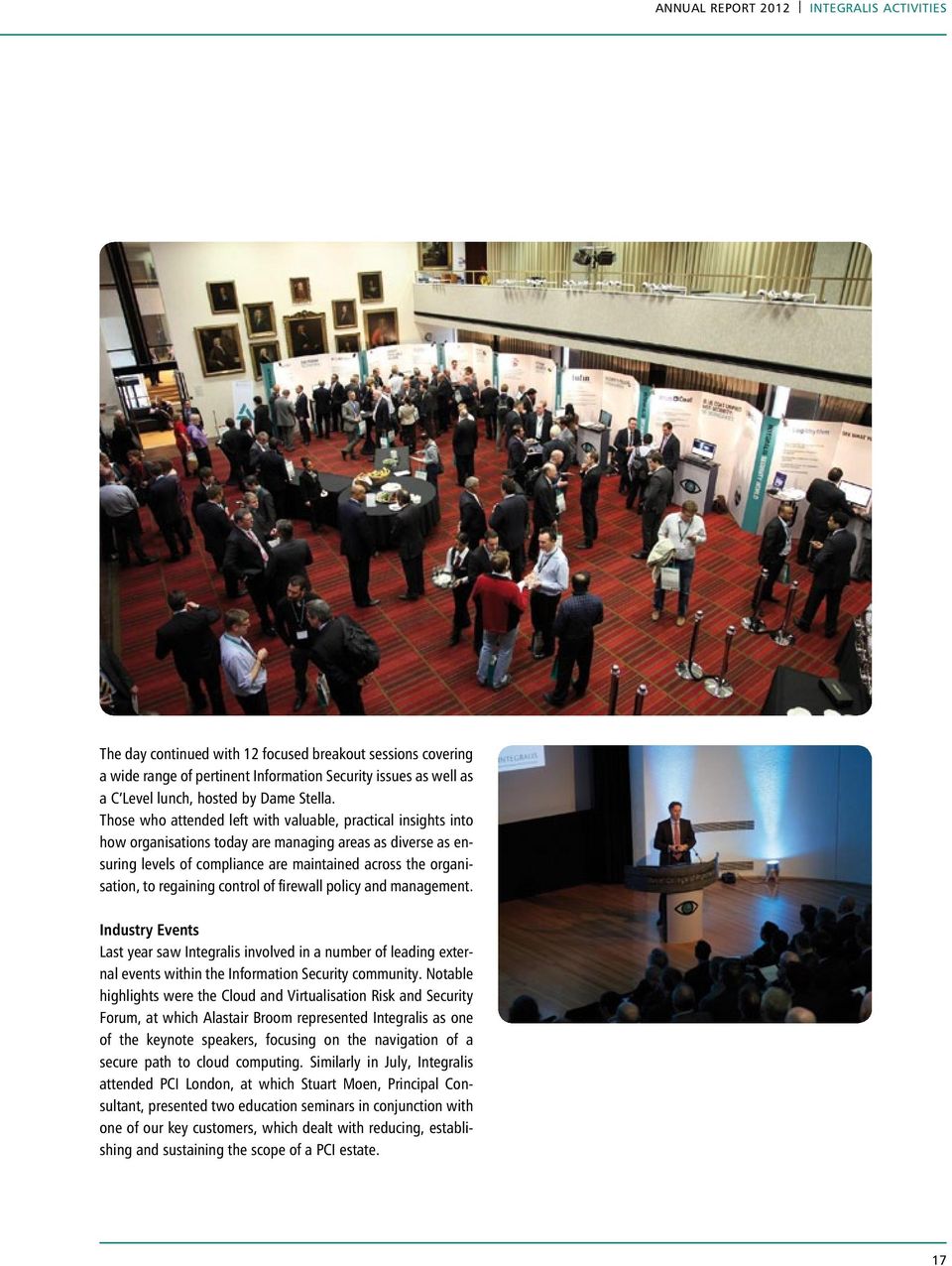
16 Integralis Roadshows Two Integralis roadshows took place in the Spring and Autumn of The first roadshow focused on security intelligence, covering a range of best practice methodologies including Information Security benchmarking, project statements and operational models, as well as the latest thinking on ISMS and webification. The second roadshow looked in detail at the hottest topics on the radars of IT decision makers, including BYOD, identity management and secure data. These customer events attracted over 500 attendees from more than 400 organisations. Activities in the UK Infosecurity Europe 2012 Following on from the success of the 2011 event, customers and prospects were once again invited to Take a break from Infosecurity, an exclusive event at a local pub, to discuss what they had seen on the show floor and how it could be applied to their organisation. Over the two days, more than 150 customers and prospects gained greater insight into Integralis services and people, through conversations with the sales and professional services teams. Integralis Security World (UK) 2012 The annual Integralis Security World customer conference took place in October at the Royal College of Physicians, London. This year s theme, Taking the Pulse of Information Security Prevention, Diagnosis and Cure enabled Integralis to display the continued investment in talented people, as well as to showcase the exceptional delivery track records and Information Security know-how our customers expect and trust. With over 250 customers, prospects and partners in attendance on the day, delegates enjoyed sessions from our customers, Bupa and Spendvision, as well as a keynote speech from Dame Stella Rimington, the first woman to become Director General of MI5. 16

17 ANNUAL REPORT 2012 INTEGRALIS ACTIVITIES The day continued with 12 focused breakout sessions covering a wide range of pertinent Information Security issues as well as a C Level lunch, hosted by Dame Stella. Those who attended left with valuable, practical insights into how organisations today are managing areas as diverse as ensuring levels of compliance are maintained across the organisation, to regaining control of firewall policy and management. Industry Events Last year saw Integralis involved in a number of leading external events within the Information Security community. Notable highlights were the Cloud and Virtualisation Risk and Security Forum, at which Alastair Broom represented Integralis as one of the keynote speakers, focusing on the navigation of a secure path to cloud computing. Similarly in July, Integralis attended PCI London, at which Stuart Moen, Principal Consultant, presented two education seminars in conjunction with one of our key customers, which dealt with reducing, establishing and sustaining the scope of a PCI estate. 17
18 Activities in the US New England Security Summit and Wine Tasting Several dozen IT executives from major financial, education and pharmaceutical companies attended an executive security summit to hear about emerging trends in Information Security and risk management. From BYOD to APT, all of the major topics affecting today s business were covered. With generous sponsorship from partners such as Juniper, Blue Coat and Check Point, several of the industry s major technologies were represented. Executive Dinner: SIEM, The Lifeblood of Security Decision-Making Integralis brought together a small, elite group of IT executives within the Chicago area for an evening of networking and knowledge sharing. Integralis expert, Dale Tesch, delivered a brief discussion on improving security intelligence, shutting down APTs and incorporating SIEM without expanding the security team. Activities in France Integralis Security World As a major event in Integralis European calendar, Integralis Security World (France) is dedicated to our prospects and customers, with the participation of key vendors. More than 100 people attended ISW to learn about current security issues and topics like MDM, authentication and SIEM, at the day s workshops and presentations. Positioning Integralis as a trusted security partner, this event was a real success and we look forward to the next ISW in June VIP Event Integralis France regularly organises VIP events with its customers to network and discuss strategic security issues. In May 2012, Integralis invited a group of senior customers to take a helicopter flight across Paris, followed by a gourmet dinner at the Abbaye des Vaux de Cernay. RSA 2012 Integralis hosted a security café at RSA With over 500 visitors to the booth over the course of three days, Integralis delivered key messages surrounding data protection, GRC, secure mobility and ethical hacking. Technical Dinner Once a quarter, Integralis France organises Le Diner des Gentlemen, a technical dinner for the consulting team and its customers. This is a valuable opportunity for networking and information sharing among IT security colleagues. 18

19 ANNUAL REPORT 2012 INTEGRALIS ACTIVITIES Awards During 2012, Integralis was presented with several awards including the following: Customer Support Partner of the Year: F5 EMEA Reseller of the Year (Integralis Deutschland): Palo Alto Networks Elite Partner of the Year: Blue Coat EMEA Security Management Partner of the Year: RSA EMEA Partner of the Year, Northern EMEA Region: SafeNet 19

20 The Integralis business model The business environment is changing and four dominant factors are driving this: big data, cloud, mobility and social networking/collaboration. Whilst these are having a profound effect on how businesses look to grow and retain customers, there is a continued focus on driving efficiency and increasing visibility across the enterprise. Organisations want to be agile in the current economic climate, but are struggling to attract and retain the right skills to exploit new markets. These newly dominant factors, together with existing pressures, are set against the backdrop of a constantly evolving threatscape. Over the last decade, we witnessed the growing impact of viruses and malcode on business. The archetypal hacker, working alone in a darkened room, has developed into what is now typically termed the cybercriminal. Significant sums of money can be made from what was once seen as an opportunistic exploitation of vulnerabilities, but is now the wellplanned exploitation of business for money. Businesses and governments have also seen the rise of the social voice, not necessarily aligned to a social conscience, (often labeled hacktivism ) where the power of collaboration and social media can galvanise a movement. Finally, state-sponsored malware continues to thrive, part of the spectrum of advanced persistent threats (APTs). These constant and progressive threats have traditionally been addressed by bolting on security technologies. Whilst this approach has been reasonably successful, it doesn t address the new business model of cloud computing and, more importantly, doesn t provide the visibility that is essential in understanding the business risks. Security breaches over the last few years have highlighted a lack of visibility and correlation of events, which has led to businesses and consumers alike becoming increasingly concerned about the ability of organisations to protect their assets and information. This focus on bolted on technology has not helped the business to exploit emerging markets; technology has constrained rather than enabled the business. The IT dam has been breached. Information Security professionals need to provide the right balance of Managed and Professional services, enriched by the right 20

21 ANNUAL REPORT 2012 INTEGRALIS BUSINESS MODEL technologies, that enable the business to make informed decisions which are aligned to the overall strategy and governance. Manage Risk Managed Security Services have been available for a considerable time and have mainly concentrated on the perimeter security of an organisation. In recent years, further services have been included as the technology matures and business sees the benefit of reducing costs through a trusted partner. However, Traditional IT delivery models and architectures are increasingly obsolete, as the cloud and mobility are dramatically changing the way we work and access information. Also, significant changes to the way information is managed and the pressures that statutory, industry and corporate regulations bring to business, require a fundamental change in the way that Managed Security Services are delivered and developed. This new working environment necessitates a different approach which is no longer reliant on perimeter security and bolted on technical solutions. Organisations need a provider that can embed security into the services that they offer, with a client-focused approach that puts information into a business context and allows the organisation to make informed decisions based on continuous risk management. According to analysts, enterprise clients top concerns when implementing change within the business remain the security of services and privacy of their data. Integralis Seamless Trusted Services are designed to directly address these concerns by alleviating the data security, privacy and compliance risks associated with the changing business environment. But, more importantly, our services ensure that security is embedded into the fabric of the organisation, independent of the business model, whether this is in the cloud, on-premise or in the data centre. Organisations often struggle to control, measure, and articulate either the Information Security risks, or the effectiveness of the implemented controls and their impact on business success. For the board to effectively manage and embed IT security and information risk management into the business, a formal governance structure is essential. Integralis has made significant investments in changing the architecture of our Managed Security Services. We have designed an enterprise methodology to architect security into your business and not bolt it on after the fact. By embedding Information Security into the services we provide, we can demonstrate the fundamental security principles of Confidentiality, Integrity and Availability through a governance model that ensures that your business has the assurance and ownership to effectively manage risk. Global Cloud Vision Industry is looking to reduce costs by integrating Information Communication Technology (ICT) systems that are scattered across different locations, driving improved productivity and management. Organisations are also realising the advantages of cloud and mobility, but have made an investment in on-premise systems. NTT provides a blend of secure managed services for on-premise and cloud services, enabling businesses to transition to integrated ICT systems which are cloud based. By embedding Integralis services into a global ICT model, we can ensure that Information Security is maintained no matter which cloud model is implemented or which device is used. Within NTT, Integralis is aligning our global services, enabling our customers to have a Seamless Trusted Service model. By integrating comprehensive services across the NTT group, including: business applications, networking, service integration, and networking and Information Security, we deliver Seamless Trusted Services to our clients. Managed and Professional Services Organisations are seeking ways to gain the maximum value from the four dominant forces driving business decisions today. Businesses are asking how to control access to big data to address compliance issues, yet continue to make the changes necessary for the business to retain and grow its client base. How can organisations drive efficiency through the cloud, when Information Security extends beyond the corporate network? True mobility is about more than smart phones, it is the ability to have your people working from anywhere using any device, which requires a different approach to Information Security and risk management. Finally, how do organisations leverage social media and collaboration to maximise limited 21
22 Integralis embeds IT Security and Information Risk Management throughout your business Project & Programme Management Data & Trust Expert Support Infrastructure Layer Business Operations Application Layer Network Layer Consumer Layer Integralis Managed & Professional Services Application & Database Server Engineering Desktop Operations Security Operations Network Operations Assess Design Deploy Support Manage resources and embrace the business benefits of client and employee satisfaction? In today s complex business environment, the increasing pressures on time and resources mean it is difficult for organisations to maintain a comprehensive view of these challenges. Integralis works closely with our clients to put in effective controls and harmonised reporting to enable the business to take a comprehensive approach to managing risk. This approach enables organisations to meet their external requirements, whilst improving the overall security of the business and exploiting new opportunities, as Information Security and risk management is embedded into the business. Integralis security professionals act as trusted advisors to help the business develop, establish and maintain effective and efficient security policies. With the risk landscape constantly shifting, it is increasingly difficult to understand technology and business risk. No matter how carefully an organisation manages risk, it still needs a plan to do so. Whilst major disruptions to business may be unusual, the cost can be significant. Integralis uses a consistent engagement model to understand current risk exposure and transition business to a state of continuous risk management and improvement, where Information Security and risks are clearly defined and informed business decisions can be made. 22
23 ANNUAL REPORT 2012 INTEGRALIS BUSINESS MODEL Seamless Trusted Services The threatscape facing organisations is expanding and changing at an unimaginable rate. To protect themselves, our clients need a Secure Operations model that combines Information Security (IS) policies and processes with a robust enterprise security architecture, underpinned by a credible control framework. With all these in place, the client has the assurance and confidence that systems are secure and they can focus on core business. Unfortunately this isn t always the case. Experience shows that responsibility for Information Security is typically fragmented throughout a client s organisation, and security problems can pass unnoticed. In the worst case, critical breaches of security are being missed, resulting in interruptions to business operations, unplanned costs and the risk of reputational damage. Integralis provides IT Security and Information Risk Management solutions on a global basis. We work with our clients across the full security lifecycle by providing consulting, integrated technology and managed services. We help organisations lower IT costs and increase the depth of security protection, compliance and service availability. We enable our clients to understand and respond to the threatscape, because we have the scalability and flexibility to adapt our Security Operations services to their business needs. In order to deploy and operationally maintain Seamless Trusted Services throughout the new business models, Integralis has developed a standard, robust, scalable service delivery platform. This platform is flexible enough to support a wide variety of trusted, managed services and underlying vendor technologies. Each business has unique technical and operational requirements for everything from multinational and industry regulations to market-based technology preferences. The Integralis Seamless Trusted Services are based on a completely modular architecture which is flexible, scalable and can leverage commodity technology for faster deployment and lower maintenance. The modular design tightly integrates into the security fabric of existing solutions and operational systems, ensuring that regional data privacy concerns are addressed. This new architecture is supported through an operational model which is delivered by our Global Secure Operation Centre (SOC) and focuses on business risk and not device availability and alerts. This modular architecture combined with NTT ICT group capabilities and a strong focus on business risk, allows Integralis to provide Seamless Trusted Services to our clients. 23
24
25 ANNUAL REPORT 2012 GROUP MANAGEMENT REPORT Integralis AG Group Management Report for General disclosures Integralis AG is the parent company. Its shares are listed in Deutsche Börse AG s Prime Standard segment in Frankfurt and it holds all of the capital of the companies within the Integralis Group either directly or indirectly. The Integralis Group is an internationally active provider of IT security solutions and services. As of the balance sheet date, it had 24 branches in nine European countries, the United States, the United Arab Emirates and Singapore. Integralis helps companies to establish a secure communications infrastructure and to handle transactions via public and private networks. The broad range of services comprises extensive IT security solutions, consulting, system integration and support. There were no changes in the companies consolidated in Business performance, underlying conditions and competition The global economy still has underlying issues, with the International Monetary Fund (IMF) predicting in its January 2013 World Economic Outlook that any upturn is now expected to be more gradual than anticipated three months prior. Its additional outlook proposed that 2013 was on course to be a better year for the global economy than 2012, with growth of 3.5 in 2013, up from 3.2 in However, concerns persist about renewed problems in the eurozone and excessive action to cut the United States budget deficit. In terms of global IT spend for 2013, IDC predicts in its IDC 2013 Tech Predictions that worldwide IT spending will exceed USD 2.1 trillion, up 5.7% from The biggest category driving this growth will once again be smart mobile devices (smartphones, tablets, ereaders), which will grow by almost 20% in 2013 and generate nearly 57% of the industry s overall growth. Excluding mobile devices, the IT industry s growth is forecast to be just 2.9%. Among the other major IT categories, worldwide software and services spending are forecast to grow 6% and 4%, respectively. The PC and server markets are also expected to return to modest positive growth in 2013, aided in part by more favourable year-on-year comparisons. Information Security will remain a key growth area in According to Gartner (Forecast: Information Security, Worldwide, , 4Q12 Update) overall worldwide Information Security spending will reach USD 60.5 billion in 2012 up from USD 56.0 billion in 2011 and is forecast to total USD 85.0 billion in 2016, translating into a CAGR of 8.7%. At the same time, significant growth is forecast in IT outsourcing (including Managed Security Services) and consulting, two of Integralis most important offerings. Gartner s view is backed up by Forrester s security survey (*Forrester s Forrsights Security Survey, Q2, 2012), according to which 21% of the companies surveyed planned to spend more of their budget with Managed Security Service Providers (MSSPs) in the coming year. The numbers suggest a growing trend that outsourcing security is a viable option for many companies. The experts at Integralis have identified a number of IT Security trends for 2013 including the following developments. Securing the cloud Cloud security will continue to dominate business decisionmaking in Global statistics indicate that whilst most enterprises have cloud projects underway, very few have embraced the cloud throughout the organisation will see the emergence of truly embedded services that will finally start to bridge the confidence gap. Providers that can clearly demonstrate separation of services and adherence to service level agreements as well as alignment to strategic goals, will have a clear advantage. Device divergence Mobility will mature in the post-pc era, developing beyond smart devices into a fully mobile workforce that embraces different working environments and allows collaboration and social interaction to support and enrich existing services. The proliferation of new devices will bring Information Security concerns to the fore, as no single operating system will dominate and the continued explosion of applications for just about everything will increase the pressure on businesses to secure and extend business applications. 25
26 Digital convergence Consolidation (doing more with less) will continue to be a hot topic during An increasing number of organisations will be adopting the additional functionality offered by traditional security vendors and benefiting from consolidation and partnerships to provide a more comprehensive security suite. Consolidation looks attractive from a business point of view but may prove less effective from a security and risk perspective. Technology should be aligned to the business goals of the organisation and balanced against the business risk. Digital convergence will also drive collaboration as faster and faster networks will again change the way we access and use information. Wireless, wired, business and open networks will be used to access information, increasing the requirement for Information Security to be embedded into the services provided. Multiple business pressures Today s business environment is being driven by multiple forces that all have an impact on each other. For example, the use of big data analytics is not the only reason for businesses looking to the cloud; but the cloud does provide a good testing ground for new services and a cost model that makes experimentation affordable. The cloud is also having an effect on mobility in that employees and consumers want easy access to applications and information and the cloud provides a flexible platform for this. Finally, mobility is forcing organisations to look at collaboration services to enable a mobile workforce to be more efficient and productive. Secure users and information We have seen a shift towards protecting applications and users as opposed to ports and protocols. As attacks become more sophisticated, organisations will have to take a multi-faceted approach to Information Security and align the enterprise security architecture to the business. With this shift in focus comes an understanding that data is now the perimeter. Cloud and mobility are changing the way we access data, so protecting and controlling access is essential, whilst ensuring that the app is risk-assessed. Organisations will look beyond encryption into managing document access and availability through application controls. Continuous and progressive threat landscape Advanced persistent threats continue to hit the headlines, and to detect these, the use of analytics and intelligence services including correlation of low level data, will increase. Big data will not only be used to improve customer satisfaction and increase efficiencies, but will also be deployed by Information Security professionals to enrich the information gathered across the organisation. Consequently there will be an increase in research and development to try and stay ahead of the progressive threat landscape. 26
27 ANNUAL REPORT 2012 GROUP MANAGEMENT REPORT 3. Results of operations The figures at a glance: * In M Revenues Gross profit Gross margin (%) Personnel expenses Personnel expenses (%) Other operating expenses Other operating expenses (%) Other operating income Other operating income (%) EBITDA EBITDA margin (%) EBIT (operating profit) EBIT margin (%) Net profit after tax Net profit after tax (%) Earnings/loss per share basic Earnings/loss per share diluted * All percentages in these financial statements have been calculated on the basis of rounded EUR 27
28 3.1 Revenues by region Revenues as a whole increased substantially in At million, consolidated revenues were up 15.1% on the previous year. Revenues in M Change in % United Kingdom Germany/Austria/ Switzerland United States France Nordics n/a* United Arab Emirates Singapore n/a Headquarters and shared services n/a Total Revenue by Region in M in % % 1% % % % Headquarters & shared services Singapore USA France GAS United Kingdom 44% UAE 3% 7% 11% 7% 28% 44% Nordics * Year-ago figures only for one month EBITDA in M Change in % United Kingdom Germany/Austria/ Switzerland United States France n/a Nordics n/a United Arab Emirates Integralis Global Services n/a Headquarters and shared services Eliminations n/a Total n/a The breakdown by country paints a very mixed picture which largely correlates with the successful implementation of the strategic focus on high-quality consulting and Managed Security Services initiated in In the United Kingdom, spending on additional consulting capacity in 2012 ushered in strong growth in both the top line (up 15.1%) and the bottom line (up 122.2%). This unit currently best reflects Integralis AG s strategic model. In GAS (Germany/Austria/Switzerland), good revenue growth was achieved, although margins were hampered by the strong pressure on prices in technology business in particular. The loss of a strong technology-oriented key account in the United States at the end of 2011 made itself felt for the first full year in 2012, causing revenues to decline by 28.7%. At the same time, however, the loss was reduced substantially (up 34.1%) by means of strict cost management and by channelling resources into consulting business. The French unit remains heavily dependent on technology business, with consulting and MSS making only small contributions. As a result, it barely broke even despite the substantial 13.5% increase in revenues. Nordics revenues grew sharply to 14.6 million as a result of the full-year inclusion of the Secode Group, which had been acquired in the previous year. However, earnings ini- 28
29 ANNUAL REPORT 2012 GROUP MANAGEMENT REPORT tially fell short of their full potential due to integration and adjustment expense. The Nordics Group generates almost all of its revenues from consulting and MSS business. Business in the United Arab Emirates no longer forms part of the Company s strategy. As no follow-up business was found in 2012 to maintain revenues and earnings at the levels achieved in earlier years, a decision was made to sell the unit. Given the lack of any interested buyers, a decision was consequently made to wind down the unit. At 0.5 million, revenues fell well short of the previous year s figure of 1.7 million. EBITDA dropped substantially below the previous year (loss of 0.7 million), resulting in a loss of 1.0 million. Substantial EBITDA was achieved in 2012 due to the gains from the sale of intangible assets to NTT Communications. This profit was allocated to Integralis Global Services as this is where the technology originated. Revenue by Solution Segment in M in % 225 6% 9% % 20% % % % % Managed Security Service (MSS) Consulting, Integration & Training Support Services Technology Sales Revenues by segment Revenues by product were materially driven by the capital spending initiated in 2011 in consulting, integration and training as well as Managed Services, resulting in correspondingly higher revenues in the larger regions. The decline in technology sales, which had already been evident in 2011, continued in 2012 and was partially caused by deliberate decisions not to engage in business with very low margins. Revenue Growth by Solution Segment in M Technology Sales Support Services Consulting, Integration and Training Managed Security Services % 0% 20% 40% 60% 80% 100% Growth rate 2011 >
30 Revenue by Solution Segment Change M in % M in % in % Technology Sales Support Services Consulting, Integration and Training Managed Security Services (MSS) Total Recurring vs Change Non-recurring Revenue M in % M in % in % Recurring revenues Non-recurring revenues Total Recurring vs. Non-recurring Revenue in M Recurring vs. Non-recurring Revenue in % Recurring Revenues Non-recurring Revenues Recurring Revenues Non-recurring Revenues In the year under review, solid growth was recorded in the proportion of recurring revenues as well as in non-recurring revenues. Recurring revenues grew by an absolute 15.0 million, resulting in substantially greater relative growth to a share of 28.3%. 3.3 Gross profit and gross margins At 80.9 million, gross profit was well up on the previous year ( 60.3 million). The gross margin widened from 33.9 percent to 39.5 percent, reflecting the greater proportion of revenues contributed by personnel-intensive consulting and service business, the personnel costs for which are not included in gross profit. 3.4 Personnel expenses, other operating expenses and income The average headcount rose sharply over the previous year, with Integralis employing an annual average of 624 people around the world (previous year 549). At 639, the worldwide end-of-year headcount was slightly down on the previous year (654). Personnel expenses climbed to 62.2 million (previous year 48.3 million). In addition to the increased headcount, this was chiefly due to investments in highly experienced consulting capacities as well as further reinforcements to central functions to additionally support the global growth strategy. 30
31 ANNUAL REPORT 2012 GROUP MANAGEMENT REPORT As well as the rise in personnel costs, other operating expenses also climbed substantially to 32.3 million (previous year 26.1 million). This was chiefly due to non-capitalised spending on our IT infrastructure, improvements to the service structure and the establishment of global functions, which particularly entailed the deployment of external service providers. As of 1 October 2012, various intangible assets were sold to NTT Communications for a total of million. This resulted in other operating income of EUR 14.2 million due to the low book values and expenses offsetting the sale. All told, EBITDA came to 6.2 million (previous year loss of 7.8 million at the EBITDA level). Sales 28 % Administration 13% Technical 59% 3.5 Depreciation/amortisation, interest, taxes and net profit/loss for the year Depreciation and amortisation came to 3.8 million in 2012, materially less than in the previous year ( 11.4 million). This was due to the necessary impairment expense on goodwill in In 2012, the remaining goodwill arising from previous acquisitions was retained, with amortisation returning to historical levels. Spurred by the aforementioned sales, substantial EBIT of 2.4 million was recorded in the year under review, thus reversing the previous year s loss of 19.1 million at the EBIT level. Net finance expenses now stand at 0.1 million following an exceptional item in the previous year (net finance income of 0.2 million). In this connection, the very inexpensive funding provided by NTT Communications, which furnishes the main credit facilities for Integralis, is continuing to help. Earnings before tax improved substantially in 2012, coming to 2.3 million (previous year loss before tax of 18.9 million). In the previous year, the weak earnings situation prompted the inclusion of an impairment on the deferred income tax assets which had been recognised on account of unused tax losses and temporary differences. No new deferred income tax assets were recognised in the year under review. In the year under review it was possible to utilise the unused tax losses for which no deferred income taxes had been recognised. As a result, tax expenses of 0.4 million were incurred due to the profit situation. Consequently, earnings after tax of 1.9 million were recorded (previous year loss after tax of 21.8 million). This translates into earnings per share of 0.15 (previous year loss per share of 1.93). Earnings in in M EBITDA EAT EBITDA EAT
32 4. Financial position, net assets and order situation Total assets increased to million as of the balance sheet date (previous year million). On the assets side, current assets rose to 94.7 million ( 90.1 million) due to the higher prepaid cost of materials ( 33.8 million; previous year 30.0 million) and the increase in cash and cash equivalents ( 11.7 million; previous year 6.9 million). Receivables contracted to 42.9 million (previous year 50.5 million) due to improved receivables management. A substantial net cash outflow of 5.0 million (previous year net cash outflow of 3.2 million) arose from operating activities. At 32.2 million, non-current assets remained unchanged (previous year 32.2 million). As a result, non-current prepaid cost of materials also rose ( 12.6 million, previous year 8.1 million), while intangible assets decreased ( 3.7 million, previous year 8.5 million). On the other side of the balance sheet, current liabilities contracted slightly to 96.4 million (previous year 98.7 million). In line with the prepaid expenses, deferred revenue rose ( 47.9 million, previous year 42.3 million), whereas trade payables declined ( 22.7 million, previous year 29.0 million). Current financial liabilities declined to 7.1 million due to the repayment of short-term funding provided by NTT Communications Corporation, Japan (previous year 9.4 million). Bank liabilities of an insignificant volume are only held within the Secode Group. Whereas deferred revenues increased by a total of 10.7 million, the prepaid cost of materials rose by 8.3 million due to wider margins. The total volume of non-current liabilities rose to 18.3 million (previous year 13.4 million) due to an increase of 5.1 million in non-current deferred revenues. The equity ratio widened to 9.6 percent (previous year 8.35 percent) chiefly as a result of earnings of 1.9 million. Equity stood at 12.2 million as of 31 December 2012 (previous year 10.2 million). The Company is in the throes of a necessary strategic realignment, which can only be achieved by heavy spending on infrastructure, the range of services and employees. The principal shareholder NTT Communications is supporting this strategy by providing the necessary funding to cover the losses which have arisen as well as the capital spending and remains committed to a long-term partnership. This gives Integralis the basis for successfully completing its strategic realignment. 32
33 ANNUAL REPORT 2012 GROUP MANAGEMENT REPORT 5. Finance management 6. Research and development The purpose of finance management at Integralis is to ensure the Group s solvency at all times and to minimise financial risks such as currency or credit risks. Cash pools are utilised in the Group s three main currencies EUR, USD and GBP to ensure effective and centralised cash management at the Group level and to optimise interest income/expense and reduce bank fees. For the purposes of currency management, existing foreign exchange positions are hedged centrally for all national companies in the light of internal hedging capabilities. Over the last few years, the Integralis Group s research and development activities have chiefly concentrated on the ongoing updating of the hardware used for Managed Security Services. In addition, responses to new security requirements are developed continuously in the consulting area. In 2012, the strategic realignment which had commenced in the previous year was continued and work on developing a new MSS platform initiated. The necessary spending on development and the market launch was estimated to equal up to 40 million. Given the limited financial possibilities, management decided to sell the concepts which had been developed and to place orders for the continued development and implementation. In this connection, an innovative strategy was defined and will result in substantial additions to the range of services between 2012 and Development expense of a total of 0.9 million was capitalised in 2012 as a whole in accordance with IAS 38 (previous year 0.6 million). 33
34 7. Remuneration report 7.1 Management Board remuneration The members of Integralis AG s Management Board receive annual remuneration comprising fixed and variable components. In addition, there are remuneration components with a longterm incentive effect. The Supervisory Board reviews the reasonableness of the variable components at regular intervals. The Management Board remuneration is performance-oriented and primarily comprises the following two components: a fixed component a variable component with a short and long-term objective The fixed component is paid in the form of a monthly salary. The variable remuneration comprises a short-term (annual) and a long-term (3-year) component depending in both cases on the extent to which the quantitative and qualitative objectives for the Group agreed upon with the Supervisory Board are achieved. Monthly advance payments are made towards the short-term component and must be repaid in the event of any failure to achieve the objectives. There is no share-based remuneration. The Management Board did not hold any shares in the Company or related subscription rights as of 31 December In addition, the members of the Management Board receive a monthly flat-rate car allowance to cover the use of private cars on company business. The members of the Management Board receive allowances for private pension savings schemes, which are paid directly into corresponding insurance policies (e.g. support funds) by the Company. No direct pension obligations are held by the Company or any other Group members. In September 2012, Georg Magg, who had been Chief Executive Officer up until that date, left the Company. His successor was Simon Church, who had hitherto held the position of Chief Operating Officer (COO). The vacant COO position was not filled. In 2012, total Management Board remuneration came to T 1,439 (2011: T 1,026). The individualised breakdown is as follows: Breakdown of compensation Georg Magg* Heiner Luntz Simon Church Total in accordance with in T in T in T in T Section 314 para. 1 No. 6 of the German Commercial Code Fixed remuneration Variable compensation Car allowance Allowances for private pension savings Allowances for private health insurance Settlement payments Total ,439 1,026 * Georg Magg stepped down from Integralis AG s Management Board effective 5 September
35 ANNUAL REPORT 2012 GROUP MANAGEMENT REPORT 7.2 Remuneration of the Supervisory Board The Supervisory Board of Integralis AG receives total fixed compensation of T 50 plus VAT, if applicable, as approved by the shareholders. If the Supervisory Board has three members, the Chairman of the Supervisory Board receives 4/9, his deputy 3/9 and an ordinary member of the Supervisory Board 2/9 per year. The remuneration is paid on a pro-rated basis if office is held on the Supervisory Board for less than a full year. In addition, a resolution was passed by the shareholders at the annual general meeting on 18 May 2011 providing for the members of the Supervisory Board to receive a performancetied remuneration component. Accordingly, they receive variable performance-tied annual remuneration based on the Company s earnings and revenues. The annual variable compensation is capped at a maximum of T 150 per year. 50% of the variable annual remuneration is deemed to have been earned if the Company s earnings before interest and taxes ( EBIT ) as stated in its consolidated financial statements exceed 5.36 million in the financial year in question. This share of 50% is deemed not to have been earned if EBIT for the financial year in question equals 2.68 million or less. If EBIT for the financial year in question is between 2.68 million and 5.36 million, a proportionate share of this 50% part of the variable remuneration is deemed to have been earned in an amount proportionate to the EBIT of 5.36 million by which it exceeds 2.68 million. The remaining 50% of the variable annual remuneration is deemed to have been earned if the Company s revenues as stated in its consolidated financial statements amount to or exceed million in the financial year in question. This share of 50% is deemed not to have been earned if the revenues for the financial year in question equal or are less than million. If revenues for the financial year in question are between million and million, a proportionate share of this 50% part of the variable remuneration is deemed to have been earned in an amount proportionate to the revenues of million by which they exceed million. In 2012, total remuneration paid to the Supervisory Board came to T 153 (2011: T 112). The breakdown is as follows: in T in T Fixed remuneration Reimbursement of expenses Variable compensation Total
36 8. Explanatory report on the disclosures made in accordance with Section 315 (4) of the German Commercial Code As of the end of the year, the Company s subscribed capital stood at 13,036,884 and is divided into 13,036,884 no-parvalue registered shares. There is no right to claim the issue of individual share certificates. The shares are ordinary shares granting full voting and asset rights. There are no restrictions on voting rights or the transfer of shares. As of 31 December 2012, NTT Communications Deutschland GmbH held 78.30% of the capital of Integralis AG. As the 296,840 shares (2.28%) held by Integralis AG as treasury stock are not voting-entitled, this means that NTT Communications Deutschland GmbH holds 80.13% of the voting rights in Integralis AG. The number of shares held as treasury stock dropped by 14,000 over the previous year, due solely to the satisfaction of commitments under maturing employee options and to a small number of shares held as treasury stock. There are no shares with special rights. The Company s Management Board comprises two or more persons according to the articles of association. The Management Board currently comprises two persons. The members of the Management Board are appointed by the Supervisory Board. Otherwise, the appointment and dismissal of the members of the Management Board is governed by Sections 84, 85 of the German Stock Corporation Act. Amendments to the articles of incorporation are governed by the provisions contained in Sections 133, 179 of the German Stock Corporation Act. In the absence of any binding statutory provisions to the contrary, the Company s articles of incorporation stipulate that resolutions are passed with a simple majority of the votes cast and that the majority of capital is deemed to constitute the simple majority of the share capital represented during the passing of the resolution. As of 31 December 2012, the following authorised and contingent capital was available for future use: Authorised capital 2012: In accordance with a resolution passed at the annual general meeting on 23 May 2012, the Management Board is autho-rised until 30 April 2014 subject to the Supervisory Board s approval to increase the Company s share capital by up to 2,600, (say: two million six hundred thousand euros) on a cash or non-cash basis by issuing new bearer shares (ordinary shares) once or repeatedly. The Management Board is additionally authorised with the Supervisory Board s approval to determine further details of the equity issue and its execution. The Supervisory Board is authorised to amend the Company s articles of incorporation to reflect the scope of the equity issued using authorised capital and, if the authorised capital is not used in full or only in part on or before 30 April 2014, to amend them again following the expiry of the authorisation. The Company s Management Board is additionally authorised subject to the Supervisory Board s approval to exclude the pre-emptive subscription rights in the following cases: (a) to eliminate fractional amounts; (b) to purchase all or part of other companies or entities on a non-cash basis unless the acquisition is executed by the shareholder NTT Communications Deutschland GmbH in Munich or any company affiliated with it in accordance with Sections 15 et seq. of the German Stock Corporation Act; (c) for cash equity issues provided that the issue price of the new shares is not materially less than the listed price of the shares in Integralis AG. However, this authorisation applies only if the shares issued subject to the exclusion of the pre-emptive subscription rights in accordance with Section 186 (3) Sentence 4 of the German Stock Corporation Act do not exceed 10% of the Company s share capital either on the date on which this authorisation takes effect or on the date on which it is exercised unless the issue is subscribed by the shareholder NTT Communications Deutschland GmbH in Frankfurt am Main or any company affiliated with it in accordance with Sections 15 et seq. of the German Stock Corporation Act. 36
37 ANNUAL REPORT 2012 GROUP MANAGEMENT REPORT 9. Corporate governance declaration Contingent capital 2007/I: Contingent capital 2007/I of T 945 was created in accordance with a resolution passed at the annual general meeting on 10 May The share capital may be increased by up to T 945 through the issue of up to 945,000 shares on a contingent basis. The contingent capital 2007/I is required to grant option rights to members of the Management Board and staff of the Company and affiliated companies as well as the managements of other companies affiliated with the Company in accordance with stock option programme SOP As of 31 December 2012, no subscription right had been granted under contingent capital 2007/I. The Company s corporate governance declaration in accordance with Section 289a of the German Commercial Code may be inspected at the Investor Relations section of its website at Authorisation to buy back the Company s own stock: In a resolution passed at the annual general meeting on 29 June 2010, the shareholders authorised the Company to acquire its own shares in a proportion of up to 10% of the share capital of T 11,585 on or before 28 June
38 10. Dependence report 11. Opportunities and risks Integralis AG s principal shareholder has been NTT Communications Deutschland GmbH, Munich, since 1 October As there is no control contract in force with the principal shareholder, the Management Board of Integralis AG is required to prepare a report on relations with related companies. The Management Board confirms in accordance with Section 312 (3) of the German Stock Corporation Act that Integralis AG has received reasonable consideration for all transactions and activities referred to in the related parties report in the light of the circumstances known to the Management Board on the date on which such transactions or activities were executed and has not suffered any disadvantage as a result of such activities being performed or omitted. The business environment in which we operate is characterised by swift technological progress and also heightened competition. We respond to these market conditions by analysing opportunities and risks on the basis of an integrated risk early detection system. Our Group risk management system covers all organisational and strategic control and monitoring measures. This means we pay particular attention to detecting and analysing risks at an early stage and taking suitable precautions to avert them. At the same time, the system seeks to ensure that the Group s objectives, particularly its financial, operating and strategic goals, can be achieved as intended. One of the core elements of corporate governance is to detect, analyse and manage risks. The Company endeavours to make optimum use of opportunities while minimising the risks as far as possible. Risk management plays a crucial role in the early detection of any trends liable to jeopardise the Company s goingconcern status and in the definition of suitable strategies for ensuring its continued existence. As a matter of principle, the risk management system covers the organisational, reporting and management structures and is supplemented with specific elements. Specifically, this entails an analysis of the risk dimensions strategy, market and competition, service and support, partner and technology management, personnel, finance, IT and compliance. The risk management system identifies and evaluates risks and monitors and caps them by means of a regular management, reporting and controlling system. Group management monitors operating risks in the form of regular reports on business performance and particular occurrences in the individual companies. The parameters of relevance for steering the Group and the national companies are available at short notice and updated on a bi-weekly or monthly basis in line with Groupwide rules. Where necessary, measures to reduce risk are then taken. The Management Board meets regularly at the offices of the individual national companies to review their situation at close quarters. Risks are quantified and their estimated probability assessed. 38
39 ANNUAL REPORT 2012 GROUP MANAGEMENT REPORT Integralis AG s risk management reports are delivered directly to the Chief Financial Officer. Group management tracks operating business and potential risks for the subsidiaries at all times. For this purpose, bi-weekly and monthly reports describing the subsidiaries performance and target-achievement and setting out the main performance indicators and trends are prepared. These reports are regularly discussed at the meetings of the Management Board and any necessary measures are decide on. In addition, meetings are regularly held with the local management of the subsidiaries to discuss, record and manage possible risks. The Management Board works with the management of the subsidiaries on an ongoing basis to enhance processes, utilise potential synergies, strengthen marketing activities and boost profitability so as to reinforce and secure the subsidiaries business performance. Information about the market, the competition and the technological developments of the subsidiaries is regularly shared by various bodies, reconciled with Group controlling data and supplemented with evaluations on a case-by-case basis. One key component of risk management and the internal control system is the internal management assertion letters, which are updated quarterly by all of the Company s management around the world. These letters describe the main corporate risks and allow executives to disclose and identify risks or shortcomings in the internal controlling system. These can then be examined by the Management Board and evaluated in terms of appropriate precautions and their effect on the accounting process. Reconciliation with financial reporting, both chronologically and in terms of content, provides an additional checking mechanism for accounting purposes. Additionally, monthly review calls are conducted to provide accounting staff with a platform for reporting on both risks and opportunities in their areas of responsibility. The figures for the previous month are analysed and a forecast for the future provided. The Group s consolidated monthly earnings are explained to the Supervisory Board by the Chief Financial Officer in a monthly conference call on which the entire Management Board participates. The Chief Operating Officer also submits a monthly report to the Supervisory Board setting out details of the market situation, recent customer developments and the resultant consequences for the Company s continued performance. A risk management manual, which is regularly reviewed and updated, describes and documents the various components of the risk management system. The purpose of the internal control system as it relates to accounting is to ensure uniform processes complying with the statutory requirements, the principles of good accounting, the rules stipulated in the International Financial Reporting Standards (IFRS) and Group-wide policies and to provide appropriate and reliable information. The organisational structures are defined in accounting policies. A Group-wide schedule ensures that all financial statements are completed within the requisite period of time. The basis for the internal and particularly the accounting-related control systems, is provided by a uniform and centrally managed ERP system as well as a CRM system, which tracks more than 95% of all of the Company s global business. This ensures a high degree of predefined functions in central sales and business processes. Clearly defined processes and roles and responsibilities, together with uniform IT systems, reduce risk. All accounting-relevant IT systems are equipped with appropriate access restrictions. Similarly, the subsidiaries observe the double-sign-off principle. As part of consolidated accounting, a large number of processes have been standardised and documented to ensure more effective supervision of consolidation-related matters. The inclusion of Integralis AG s financial statements in the NTT Group s consolidated financial statements provides a further mechanism for verifying the Group s data. In addition, local management has numerous internal controls and measures, e.g. process descriptions and documentation in the local Intranets, which are aimed at avoiding unnecessary risks. During the year under review, Group-wide policies were revised and new ones published to implement a harmonised approach across the entire Group. 39
40 Following the acquisition by NTT Com, Integralis has been able to reduce its risk exposure substantially. Over the last few years, NTT Com has proven that it is pursuing long-term goals with this investment and will support the Company in the event of any unexpected difficulties. Integralis AG also has access, for example, to considerable credit facilities provided by NTT Communications Corporation, Japan, to bridge any short-term funding gaps. In addition, it is now able to harness growth potential more effectively. An attempt is being made to offer joint customers shared solutions in specific projects. Extensive investments are being implemented in Asia in connection with which Integralis is able to utilise NTT Com s existing structure and market access Currency risks As a large part of our business is transacted in US dollars and pounds sterling, we are exposed to exchange rate risks when these amounts are translated into our Group currency, the euro. At our national companies, our main suppliers issue their invoices in the local currency, meaning that the currency risk is primarily confined to the translation of the national companies financial statements (translation risk). In Germany and the UK, some of the goods are purchased in US dollars. To reduce the currency risk within the Integralis Group, various hedges, such as currency forwards, zero-cost options and currency swaps, were used in the year under review. A detailed description of hedging activities can be found in the consolidated financial statements. In addition, a centralised foreign currency management system was in operation in the year under review for Central Europe, the United States and the United Kingdom to centrally measure, monitor and hedge foreign currency risks arising from operating business. These hedges reduce exposure to volatile currency markets. The Secode Group was also integrated in this central and foreign currency management system in Market and sector risks Over the past few years, IT security business has grown more quickly than the economy as a whole, a trend which sector experts assume will continue. As the wider economy picks up, IT security should grow at a disproportionately strong rate. The IT security market is subject to permanent change. With the speed of technological progress accelerating, the ability to react quickly to security-relevant situations is a competitive factor. As a result of changes in individual technological areas, margins on the main revenue drivers may erode, thus exerting pressure on the Integralis Group s earnings. The competitive situation and nascent trends in the sector and the economy as a whole are therefore closely observed and analysed to detect risks at an early stage so that the Company s range of products and services can be adjusted accordingly with minimum delay. Incremental efforts to extend the range of high-quality services and to increase the proportion of recurring revenues are minimising the Integralis Group s exposure to market and sector risks, whilst allowing it to harness economies of scale. This strategy entails extensions to the range as well as a reduction in the dependence on products and producers. Systematic spending on technological expertise through the development of the Company s own services and new IT security technologies, will help to increase market penetration and enhance the Company s standing in its relations with project partners. Efforts to extend Integralis Services are to substantially boost the Group s profitability in the future. The renown and acknowledged skills of Integralis consultants should also generate revenue growth in consulting business. The global management of services, which was successfully implemented in 2012 and the planned systematic extensions to consulting services in strategic security questions in 2013 will support this growth, as will the uniform global quality management of consulting services. 40
41 ANNUAL REPORT 2012 GROUP MANAGEMENT REPORT 11.3 Product portfolio and vendor risks Integralis works closely with numerous top international companies. Accordingly, it is exposed to the risk of strategic changes on the part of the vendors from whom it sources technology. This entails changes to price and discount structures as well as modifications to corporate policy. Producers may sign contracts with our competitors or change their distribution or marketing strategies. In the past few years, several producers with whom Integralis works closely have been the subject of takeovers. The concentration process amongst producers continued in 2012 and is likely to exert considerable influence in 2013 as well. The ramifications of these trends are difficult to assess. In an effort to minimise such risks, we maintain permanent contact with the management of our suppliers and technological partners on an international and national level. This ensures that we are kept informed at short notice of any possible positive or negative changes and allows us to take action quickly to benefit from such changes, or to alleviate their effects. The dual sourcing strategy is still being pursued. As a result, Integralis has alternative suppliers as well as product and solution vendors. To date, there is no evidence of any monopolistic structures in the market resulting in any undue dependence on individual producers Staff expertise and motivation Our employees skills are a crucial element of our success and are part of the basis on which we are extending and defending our competitive lead. For this reason, human resources management is a key aspect of corporate management. The Integralis Group s continued success hinges materially on its ability to recruit new qualified staff and to motivate, retain and train existing employees. In addition to an interesting area of activity and systematic personnel development policies, appropriate remuneration and participation in the Company s success are an important source of motivation, providing employees with an incentive to remain with the Group. A large part of the Group s staff have a technical background. For this reason, the Company is particularly committed to offering staff scope for professional and career development in order to hold onto staff with real expertise on a long-term basis. As part of the integrated human resources strategy, new career models are being continuously developed for scientific/technical staff. In addition, the sustained organisational changes are making high demands of staff. For this reason, the planned activities call for a high degree of management competence on the part of the individual supervisors. To support this, international HR standards and processes have been receiving continuous enhancements over the past few years, backed up by annual global employee surveys. A global HR function was created for the first time in IT risks This comprises network failure, the risk of data being corrupted, destroyed or stolen as a result of operating errors and/ or external factors and restrictions in the availability of applications. These risks are addressed by means of ongoing spending on our infrastructure and by keeping up to date with the latest knowledge and security technology, not only on customer projects, but also inside the Group itself. We are increasingly using standardised software on a crossborder basis and making greater use of server infrastructure virtualisation and encryption for mobile terminals. In 2012, large parts of the IT infrastructure were outsourced to data centres operating in accordance with the latest security standards, resulting in a further improvement in availability and reliability Impairment risks This refers to the risk of further impairment losses on goodwill or other assets. The goodwill recognised in connection with Secode in 2011 is monitored on an ongoing basis and it is currently assumed that there is no evidence of any impairment. 41
42 12. Non-financial performance indicators 11.7 Customer risks This risk particularly entails dependence on individual keyaccount customers, the possibility of losing them and exposure to undue economic pressure. This situation can particularly occur in technology business in which customer ties tend to be looser and it is easier to substitute suppliers. We will therefore continue the increasingly orientation of our range to high-quality recurring services. Corporate values We place our customers and their needs at the core of everything we do. We are committed to integrity, a passion for skills and mutual trust to ensure our customers satisfaction. We encourage the striving for professional expertise by means of continuous improvements and international partnerships. We make a contribution and assume responsibility. Business strategy We are leaders in Information Security thanks to our skills and experience. We consistently develop the best solutions and strategic partnerships. We offer proactive and innovative added value for our customers. We seek the highest possible quality in providing our global services. Management guidelines We communicate openly and transparently and treat each other with respect. Our employees receive all the information they require for their work. We jointly formulate clear targets and work towards achieving them. Our employees know their field of responsibility and the scope which they have for action. We encourage our employees to think and act on a holistic (and enterpreneurial) basis. We offer them a model to follow and thus demonstrate the responsibility which each employee bears. We encourage our employees and provide them with active support. We pay particular attention to tapping individual potential for further development. In this way, we are able to steadily enhance the high professional quality of our joint work. We encourage a team spirit which also goes beyond the confines of our teams. We work with our employees on a oneto-one level. We encourage our employees to participate in efforts to find a solution. Our attitudes and actions set a moral example for our employees to follow. For this reason, we make sure that we protect our own integrity. 42
43 ANNUAL REPORT 2012 GROUP MANAGEMENT REPORT 13. Material events occurring after the balance sheet date No particular events of relevance for the Company have occurred since the end of the year under review. 14. Outlook Last year, the Integralis Group again invested heavily in the consulting segment in particular. Further expansion of these particular skills together with the expected availability in 2013 of new MSS solutions which we are developing with NTT Communications will form the basis for a further increase in our importance to our customers as well as margins. Assuming continued success in the United Kingdom and the systematic roll-out of the business model in GAS and the United States, the Company will systematically return to profitability at the operating level. The close partnership with the majority shareholder remains a key determinant of success. The Management Board projects a continuation in revenue growth at the Group level in 2013 driven by strong demand for high-quality security consulting. Although the continued pressure on margins in the technology segment will depress the profitability of this part of the business, operating earnings are generally expected to rise. We will be ploughing part of these additional earnings back into additional reinforcements to our central functions and expansion of our global presence. All told, we therefore expect revenues to grow to more than EUR 220 million in tandem with a return to operating profitability in the second half of the year. Ismaning, 20 March
44 Consolidated Income Statement 01/01/ - 31/12/ /01/ - 31/12/2011 Notes T T Revenues , ,037 Increase in stock 5.3 2,300 Cost of materials , ,762 Gross profit 80,882 60,275 Own work capitalised Other operating income ,902 5,742 Personnel costs ,202-48,279 Other operating expenses ,268-26,068 Earnings before interest, taxes, depreciation and amortisation (EBITDA) 6,200-7,764 Amortisation of intangible assets and depreciation of property, plant and equipment 5.8-3,803-11,373 Earnings before interest and taxes (EBIT) 2,397-19,137 Other interest and similar income Interest and similar expenses Net finance expense Earnings before taxes (EBT) 2,298-18,980 Income taxes ,863 Earnings after tax 1,873-21,843 Of which attributable to: Shareholders of Integralis AG 1,873-21,843 Minority interest Average outstanding shares (basic) ,731,544 11,332,621 Basic result per share ( ) Average outstanding shares (diluted) ,733,395 11,375,527 Diluted result per share ( )
45 ANNUAL REPORT 2012 FInancial report Consolidated Statement of comprehensive income 01/01/ - 31/12/ /01/ - 31/12/2011 Notes T T Earnings after tax 1,873-21,843 Foreign currency translation gains and losses Comprehensive income 1,933-22,020 Total result 1,933-22,020 Of which attributable to: Shareholders of Integralis AG 1,933-22,020 Minority interest 45
46 Consolidated statement of financial position Assets 31/12/ /12/2011 Notes T T Cash and cash equivalents ,743 6,905 Trade and other receivables ,852 50,504 Inventories 4.3 2, Prepaid cost of materials ,848 29,966 Other assets 4.5 3,650 2,419 Current assets 94,683 90,111 Deferred income tax assets 4.9 1,729 1,653 Prepaid cost of materials ,551 8,092 Goodwill 4.8 9,465 9,465 Intangible assets 4.7 3,667 8,507 Property, plant and equipment 4.6 4,752 4,443 Non-current assets 32,164 32,160 Total assets 126, ,271 46
47 ANNUAL REPORT 2012 FInancial report Consolidated statement of financial position Equity and liabilities 31/12/ /12/2011 Notes T T Financial liabilities ,052 9,360 Trade payables ,716 29,015 Deferred revenues ,888 42,344 Income tax liabilities Other current liabilities ,855 17,313 Current liabilities 96,372 98,693 Financial liabilities ,668 10,649 Deferred revenues Deferred income tax liabilities Non-current provisions ,155 1,108 Non-current liabilities 18,303 13,372 Subscribed capital 13,037 13,037 Treasury shares Share premium 23,224 23,205 Other reserves -1,536-1,596 Unappropriated surplus/accumulated deficit -22,256-24,129 Equity ,172 10,206 Total equity and liabilities 126, ,271 47
48 Consolidated statement of cash flows 01/01/ - 31/12/ /01/ - 31/12/2011 T T Earnings after tax 1,873-21,843 Net finance income/expenses Current net tax expenses Depreciation/amortisation 3,803 11,373 (Increase) / decrease in deferred income taxes ,320 Increase / (decrease) in provisions Book gains(-)/loss from the sale of assets -10, Unrealised currency translation losses / (gains) Interest received Interest paid Taxes paid Changes in net current assets 676 3,440 Cash flow from operating activities -5,041-3,177 Payments from disposal of intangible assets 15,300 Received cash from acquisition 1,775 Acquisition of property, plant and equipment and intangible assets -3,122-2,894 Cash flow from investing activities 12,178-1,119 Income from exercise of share options Payments received from raising current or non-current financial liabilities 2,500 4,101 Payments made from raising current or non-current financial liabilities -4, Cash flow from financing activities -2,328 4,259 Currency translation effects on cash and cash equivalents Decrease/increase in cash and cash equivalents 4,838 3 Cash and cash equivalents at the beginning of the period 6,905 6,902 Cash and cash equivalents at the end of the period 11,743 6,905 48
49 ANNUAL REPORT 2012 FInancial report Consolidated statement of changes in equity Number of shares Subscribed Treasury Capital Currency Accumulated Total issued at 31/12/2011: capital stock reserves translation loss registered shares differences T T T T T T 01/01/ , ,427-1,419-2,286 20,898 Treasury stock used for options exercised Net loss after tax -21,843-21,843 Sale of treasury stocks Capital increase 1,452 9,641 11,093 Currency translation differences Comprehensive income ,843-22,020 31/12/ , ,025-1,596-24,129 10,206 Number of shares Subscribed Treasury Capital Currency Accumulated Total issued at 31/12/2012: capital stock reserves translation loss registered shares differences T T T T T T 01/01/ , ,205-1,596-24,129 10,206 Treasury stock used for options exercised Net loss after tax 1,873 1,873 Currency translation differences Comprehensive income ,873 1,965 31/12/ , ,224-1,536-22,256 12,172 49
50
51 ANNUAL REPORT 2012 notes Notes to the 2012 consolidated financial statements of Integralis AG 1. General disclosures The Integralis Group is an internationally active provider of IT security solutions and services. As of the reporting date, it had 639 employees and 24 branches in nine European countries, the United States, the United Arab Emirates and Singapore. Integralis helps companies to establish secure communications networks and to handle transactions via public and private networks. The broad range of services comprises extensive IT security solutions, consulting, systems integration and support. Integralis AG is the parent company. Its shares are listed in Deutsche Börse AG s Prime Standard segment in Frankfurt and it holds all of the capital of the companies within the Integralis Group either directly or indirectly. Since 1 October 2009, Integralis AG s parent company has been NTT Communications Deutschland GmbH, Munich, (NTT Com Germany). Integralis AG s subscribed capital was increased with the issue of 1,451,747 new shares in connection with the acquisition of Secode AB in The new shares were subscribed to in full by NTT Communications Deutschland GmbH, which now holds 78.3% of Integralis AG s capital (Section 160 (1) No. 8 in connection with Section 16 (1) of the German Stock Corporation Act). Integralis AG holds treasury stock comprising 296,840 non-voting shares, meaning that NTT holds roughly 80% of the voting rights. The number of shares held as treasury stock dropped by 14,000 over the previous year. NTT Communications Deutschland GmbH is an indirect subsidiary of Nippon Telephone and Telegraph Corporation (NTT), Tokyo, Japan, which prepares consolidated financial statements as the ultimate parent company. NTT s consolidated financial statements are published in Japan, the United States and the UK, where it is listed. Integralis AG prepares its consolidated financial statements in accordance with the International Financial Reporting Standards (IFRS) published by the International Accounting Standards Board (IASB) as endorsed in the European Union, as well as the supplementary accounting provisions contained in Section 315a of the German Commercial Code. The consolidated balance sheet, consolidated income statement, consolidated statement of comprehensive income, consolidated cash flow statement and the consolidated statement of changes in equity have been prepared in thousands of euros (T ). The income statement has been presented using the nature of expense method. The Management Board of Integralis AG released the consolidated financial statements and the Group management report for submission to the Supervisory Board on 20 March Legal disclosures Integralis AG is a listed joint stock company (Aktiengesellschaft) incorporated and operating in accordance with German law with registered offices in Ismaning, Robert-Bürkle- Straße 3, Germany. It is entered in the Munich commercial register under the number HRB Application of International Financial Reporting Standards (IFRS) and declaration of conformity As of 31 December 2012, the consolidated financial statements of Integralis AG as the parent company in the Integralis Group, have been prepared using uniform recognition and measurement principles. As such, the International Accounting Standards (IAS)/International Financial Reporting Standards (IFRS) including the interpretations of the Standing Interpretation Committee (SIC)/International Financial Reporting Interpretations Committee (IFRIC), as endorsed by the European Union, in force as of the reporting date are applied. The additional provisions of German corporate law were observed in accordance with Section 315a (1) of the German Commercial Code. The figures for the previous year were calculated using the same methods. All standards issued by the International Accounting Standards Board (IASB) and valid and endorsed by the European Union as of the date on which the consolidated financial statements were prepared, were duly applied. 1.3 Consolidated companies All domestic and non-domestic subsidiaries are consolidated in full by Integralis AG. In the year under review, the following companies in which Integralis AG holds a 100% share either directly or indirectly or which are controlled by it were consolidated: 51
52 Subsidiary Domicile Share in capital held in % Articon-Integralis SAS Paris, France 100 Integralis SAS Paris, France 100 Secode AB Stockholm, Sweden 100 Secode Sverige AB Stockholm, Sweden 100 Secode Norge AS Arendal, Norway 100 Secode Finland Oy Helsinki, Finland 100 Secode Netherlands B.V. Maastricht, Netherlands 100 Integralis Inc. Hartford, United States 100 Integralis Services LLC Hartford, United States 100 Integralis Schweiz AG Glattbrugg, Switzerland 100 Integralis Services Ltd. Reading, UK 100 Integralis Ltd. Reading, UK 100 Integralis Services GmbH Ismaning, Germany 100 Integralis Deutschland GmbH Ismaning, Germany 100 Integralis Österreich GmbH Vienna, Austria 100 Nocitra Ltd. Reading, UK 100 Integralis ME FZ LLC (vormals ProtechT FZ LLC) Dubai, UAE 100 ProtechT Technical Services LLC* Abu Dhabi, UAE 49 Integralis Services Pte. Ltd. Singapore 100 * 100% allocated on account of a trusteeship relationship and possession of all shareholder rights. The profit or loss of subsidiaries acquired or sold during the year under review is reported in the consolidated financial statements as of the date of actual acquisition, i.e. from the date as of which the Group is able to exercise a controlling influence, or until the date on which such controlling influence is no longer exercised, as the case may be. 1.4 Balance sheet date The consolidated balance sheet was prepared effective 31 December The consolidated income statement, the consolidated statement of comprehensive income, the consolidated cash flow statement and the consolidated statement of changes in equity cover the period from 1 January 2012 until 31 December The reporting date for the consolidated financial statements is identical to that used in the single-entity financial statements prepared by the consolidated companies. 1.5 Summary of significant accounting and consolidation policies The consolidated financial statements are prepared in euros (EUR). In the absence of any indication to the contrary, all figures are rounded up or down to the closest thousand euros (TEUR). It should be noted that the use of rounded figures and percentages may result in differences due to commercial rounding. In accordance with IAS 1, the current/non-current distinction is applied to assets and liabilities. Assets and liabilities are classed as current if they are expected to be realised or settled within twelve months of the reporting date. The consolidated income statement is prepared using the total-cost method. The consolidated financial statements are prepared on the basis of historical cost with the exception of the remeasurement of certain non-current assets and financial instruments. The main recognition and measurement methods are explained below. The consolidated financial statements include the parent company s financial statements and those of the companies which it controls. Control is the power to govern the financial and operating policies of an enterprise so as to obtain benefits from its activities. Under IFRS all business combinations must be accounted for using the purchase method. The price of the subsidiary acquired is allocated to the assets, liabilities and contingent liabilities acquired at the values applicable as of the date on which control is obtained over the subsidiary. The assets received and liabilities and contingent liabilities absorbed are recorded at their full fair values, regardless of the size of the share. Non-current available-for-sale assets are recognised at fair value less the cost to sell. Any remaining positive difference between the cost of the business combination and the pro-rated net assets is recognised as goodwill, which is reported using the full goodwill approach. 52
53 ANNUAL REPORT 2012 notes The determination of fair value calls for certain estimates and judgements, particularly with respect to intangible assets and property, plant and equipment acquired and liabilities assumed, as well as the useful life of the intangible assets and property, plant and equipment acquired. These calculations are largely performed on the basis of anticipated cash inflows and outflows. Any deviations between actual cash inflows and outflows and those used to calculate fair values may exert an influence on future consolidated profit and loss. The impairment-only approach stipulated by IAS 36 is applied to any subsequent measurement of goodwill. Where necessary, goodwill is adjusted to match its fair value. Intragroup revenues and profits, expenses and income as well as all receivables and liabilities between consolidated companies, are eliminated in accordance with IAS Deferred taxes are set aside in accordance with IAS 12 for consolidation transactions. The consolidation methods applied are unchanged over the previous year. 1.6 Currency translation Single-entity financial statements in foreign currencies The currencies of all the single-entity financial statements prepared in a currency other than the euro were translated in accordance with IAS 21 using the functional currency principle. The functional currencies of the Integralis Group companies are the same as their respective national currencies. The consolidated financial statements were prepared using the euro, this also being the parent company s functional currency. The assets and liabilities of foreign subsidiaries whose functional currency is not the euro were translated into euros at the end-of-year exchange rate and their expenses and income using the temporal method. The resultant translation differences were recognised within other comprehensive income in the statement of comprehensive income. The cumulative amount recorded within equity is reclassified upon the sale of the entity and reported through profit and loss. The goodwill arising from the acquisition of a foreign business as well as any adjustments to fair value, are translated using the end-of-year exchange rate. The single-entity financial statements not prepared in euros were translated using the following exchange rates: End-of-year rate Average exchange rate 31/12/12 31/12/11 31/12/12 31/12/11 GBP USD CHF SEK SGD AED Foreign currency transactions Foreign currency transactions which are not executed in the functional currency are translated at the exchange rate prevailing on the date on which they are executed. Any translation differences arising between the date of transaction and the date of payment are taken to the income statement. All foreign currency monetary items are translated into the functional currency at the end-of-year exchange rate, with any resultant translation gains or losses taken to the income statement. 1.7 Changes in presentation The presentation of the balance sheet and the income statement was not altered in
54 2. Summary of significant accounting policies 2.1 Changes in accounting policies due to new standards Integralis applied all the accounting standards which were mandatory for the first time as of The recognition and measurement methods applied are fundamentally the same as in the previous year. Moreover, it was necessary for the following standards and interpretations to be applied in the year under review. However, this did not have any material effect on the presentation of the consolidated financial statements: IFRS 7 Disclosures Transfers of Financial Assets The IASB published IFRS 7 Disclosures Transfers of Financial Assets on 7 October The amendments to IFRS 7 concern disclosures in connection with the derecognition of financial assets. The additional disclosure duties will allow users of financial statements to improve their understanding of transfer transactions of financial assets (e.g. securitisations). Extensive disclosures are necessary for financial assets which are derecognised fully or in part, if the transferring entity retains any risks from the transferred financial assets. Among other things, the opportunities and risks remaining with the transferring entity must be disclosed for financial assets which are partially derecognised. In addition, the financial obligations linked to the transferred financial assets must be described. IFRS 1 Severe Hyperinflation and Removal of Fixed Date for First-Time Adopters The IASB published amendments to IFRS 1 Severe Hyperinflation and Fixed Transition Dates for First-Time Adopters on 20 December This first amendment concerns the date of transition for the first-time adoption of IFRS. The previous reference to a fixed transition date of 1 January 2004 has been replaced by the words date of transition to IFRS. This eliminates the need for companies adopting IFRS for the first time to restate derecognition transactions that occurred before the date of transition to IFRSs. The second amendment introduces guidance on how an entity should resume presenting financial statements in accordance with IFRS, after a period in which it was unable to comply with IFRS because its functional currency was subject to severe hyperinflation. In such a situation, the entity is permitted to measure its assets and liabilities at the fair value which they had as of the date on which the severe hyperinflation ended and to use these values as the assumed historical cost in its opening balance sheet. This particularly applies to the comparative financial statements which must be published. IAS 12 Deferred Taxes: Recovery of Underlying Assets The IASB published amendments to IAS 12 Deferred Taxes: Recovery of Underlying Assets on 20 December IAS 12 requires an entity to measure the deferred tax relating to an asset depending on whether it expects to recover the carrying amount of the asset through use of sale. In practice, this is difficult to determine and often subjective. The amendment introduces a presumption. As a matter of principle, it is assumed that recovery of the carrying amount will normally be through sale in the absence of any clear indication to the contrary. This affects the deferred taxes arising from the remeasurement of investment properties (IAS 40). Remeasured intangible assets and property, plant and equipment continue to come within the principles set out in SIC 21 In-come Taxes Recovery of Revalued Non-Depreciable Assets, which have now been integrated within IAS 12. Accordingly, Standard Interpretation SIC 21 has been reversed. 54
55 ANNUAL REPORT 2012 notes In its consolidated financial statements for 2012, Integralis AG did not early adopt the following standards which had been issued by the IASB as they were not yet subject to compulsory application in the year under review. Standard/Interpretation Published Mandatory Endorsed Expected by IASB application by the EU impact IAS 1 Presentation of individual items 16/06/ /07/2012 Yes No material in other comprehensive income changes IFRS 1 Government loans 13/03/ /01/2013 No None IFRS 7 Disclosures in the notes 16/12/ /01/2013 Yes Additional discloon the netting of financial sures in the notes assets and liabilities IFRS 9 Financial Instruments: 28/10/ /01/2015 No No material Classification and Measurement changes IFRS 10 Consolidated Financial Statements 12/05/ /01/2014 Yes None IFRS 11 Joint arrangements 12/05/ /01/2014 Yes None IFRS 12 Disclosures of interests 12/05/ /01/2014 Yes Additional discloin other entities sures in the notes IFRS 10,11,12 Consolidated financial 28/06/ /01/2014 No Additional disclostatements, joint activities, sures in the notes disclosures on shares in other companies, transitional provisions IFRS 13 Fair value measurement 12/05/ /01/2013 Yes Additional disclosures in the notes IFRIC 20 Stripping costs in the 10/08/ /01/2013 Yes None production phase of a surface mine IAS 19 Employee benefits 16/06/ /01/2013 Yes None changes in accounting for pensions IAS 27 Separate financial statements 12/05/ /01/2014 Yes None IAS 28 Investments in associates 12/05/ /01/2014 Yes Additional discloand joint ventures sures in the notes IAS 32 Netting of financial 16/12/ /01/2014 Yes No material assets and liabilities changes 55
56 2.2 Classification and recognition of financial assets A financial instrument is a contract that gives rise to a financial asset of one entity and a financial liability or equity instrument of another entity. Financial assets particularly comprise cash and cash equivalents, trade receivables and other loans and receivables, held-to-maturity investments and originated and derivative financial assets held for trading. Financial liabilities generally entail a contractual obligation to deliver cash or some other financial asset to another entity. This particularly includes trade payables, bank borrowings, liabilities from finance leases and derivative financial liabilities. Financial instruments are recognised as soon as Integralis becomes a party to them. However, in the case of purchases and sales (purchases or sales under the terms of a contract, the conditions of which provide for delivery of the asset within a period which is customarily determined by the rules or conventions of the market in question), the settlement day, i.e. the day on which the asset is delivered to Integralis, is decisive for recognising the first-time addition to or disposal from the balance sheet. Financial assets and liabilities are not netted against each other. Financial assets held for trading purposes are measured at their fair value. This primarily entails derivative financial instruments which are not effectively hedged in accordance with IAS 39 and must therefore be classified as held for trading. Any gains or losses derived from subsequent measurement are reported through profit and loss. Some financial assets are intended and can be assumed with reasonable certainty to be held until maturity. Such financial assets are measured at amortised cost using the effective interest method. Integralis has not made use of the possibility for initially recognising financial assets at fair value through profit and loss. Effective interest method The effective interest method is a means of calculating the amortised cost of a liability and of allocating the interest income to the corresponding period. It equals the interest rate with which the estimated future payments (including all fees forming part of the effective interest rate and other premiums and discounts) can be discounted over the experted term of the liability or, where applicable, a shorter period to arrive at its net carrying amount upon first-time recognition. Income from liabilities is recorded using the effective interest method. This does not apply to financial assets at fair value through profit or loss. Financial assets at fair value through profit and loss Financial assets are classified as being at fair value through profit and loss if they are held for trading purposes or are designated as being at fair value through profit and loss. A financial asset is classified as held for trading if: It was acquired primarily for the purpose of being sold again in the near term, or On initial recognition it is part of a portfolio of identified financial instruments that are managed together and for which there is evidence of a recent actual pattern of shortterm profit-taking, or It is a derivative except for a derivative that is a financial guarantee contract or a designated and effective hedging instrument. Financial assets at fair value through profit and loss are measured at their fair value. Any gains or losses arising from fair value measurement are recognised in profit and loss. 56
57 ANNUAL REPORT 2012 notes Held-to-maturity financial instruments Non-derivative financial assets with fixed or determinable payments and fixed maturities that the Company has the positive intention and ability to hold to maturity, are categorised as held-to-maturity financial instruments. They are recognised at amortised cost using the effective interest method less impairments. Interest income is calculated using the effective interest method. Loans and receivables Trade receivables, loans and other receivables with fixed or determinable payments that are not quoted in an active market are classified as loans and receivables. Loans and receivables are measured using the effective interest method at amortised cost net of any impairment. Interest income is recognised using the effective interest method with the exception of current receivables, with which the interest effect is negligible. Impairment of financial assets The carrying amounts of financial assets which are not measured at fair value through profit and loss are examined on each reporting date, to determine whether there is any objective evidence (e.g. considerable financial difficulties on the part of the debtor, significant changes in underlying technological, economic and legal conditions as well as the market environment of the debtor) pointing to impairment. Loans and receivables. The amount of the impairment in the case of loans and receivables equals the difference between the asset s carrying amount and the present value of expected future cash flows discounted at the financial instrument s original effective interest rate. The impairment is reported through profit and loss. If, in a subsequent period, the amount of the impairment decreases and the decrease can be objectively attributed to an event occurring after the adjustment, the impairment is reversed through profit and loss. Impairments of loans and receivables (trade receivables) are very largely recorded by means of impairment accounts. A decision on whether the risk of default is to be recorded by means of an impairment account or by means of a direct adjustment to the receivable, depends on the probability of default. If receivables are classified as irretrievable, the correspondingly impaired asset is derecognised. An impairment results in a direct reduction in the carrying amount of the financial assets. Any subsequent receipts of payments towards derecognised assets are recognised through profit and loss. 2.3 Cash and cash equivalents For the purpose of the cash flow statement in accordance with IAS 7, all cash and cash equivalents which are due for settlement in less than three months are recognised at their nominal value. The cash and cash equivalents reported in the consolidated balance sheet comprise cash in hand, cheques and cash at banks. The cash and cash equivalents recognised in the consolidated cash flow statement are deferred on the basis of the above definition. 2.4 Receivables and other financial assets Receivables and other financial assets are recognised at amortised cost subject, where applicable, to the effective interest method. Allowance is made for individual interest and credit risks. Profit and loss is assigned to earnings for the period if the receivables are derecognised or impaired. 57
58 2.5 Other non-financial assets Other non-financial assets are measured at amortised cost net of any impairments. 2.6 Derivative financial instruments Derivative financial instruments such as currency forwards, currency swaps and zero-cost options are used to partially hedge the risks arising from currency fluctuations. The derivative financial instruments do not satisfy the hedge accounting conditions set forth in IAS 39 and are classified as held for trading. Accordingly, they are measured at their fair value as of the reporting date. Negative fair values are reported within financial liabilities. Positive fair values are reported within financial assets. Any changes in fair value are reported through profit and loss within net financial income/net financial expense. Fair value is defined as the value which can be achieved in business operations under prevailing market conditions. 2.7 Inventories Inventories are stated at the lower of cost and net realisable value. Cost includes costs of purchase, conversion and overheads incurred in bringing inventories to their present location and condition. Net realisable value is the estimated selling price in the ordinary course of business, less the estimated costs of completion and the estimated costs necessary to make the sale and less reasonable adjustments for all discernible risks arising from reduced or absent marketability. All goods are measured using the FIFO (first in-first out) method. 2.8 Prepaid cost of materials The prepaid cost of materials primarily comprises payments made for maintenance contracts purchased from suppliers which do not yet give rise to any expenditure in the year under review. This item is reversed over the remaining term of the contract. 2.9 Property, plant and equipment In accordance with IAS 16, property, plant and equipment are recognised at cost less cumulative scheduled straight-line depreciation. Production costs include directly attributable costs as well as a reasonable proportion of the attributable overheads. Where necessary, they are adjusted to match their recoverable amount, if this is lower. Maintenance costs are reported as expenses for the period. Land is not depreciated. Depreciation/amortisation is calculated on a straight-line basis for all assets. For this purpose, the historical cost is written down to the residual carrying amount over the expected useful lives of the assets. Buildings Motor vehicles Business equipment years 5 years 3-10 years In accordance with IAS 16.67, property, plant and equipment is either derecognised upon being disposed of or when continued use or sale of the asset is not expected to generate any economic benefits. The gains or losses resulting from the disposal of an asset are calculated as the difference of the net proceeds of the sale and the carrying value of the asset and recognised in the income statement for the period in which the asset is derecognised. The expected useful lives, residual values and depreciation methods are reviewed once a year and all necessary changes to estimates made on a preemptive basis. The Group leases certain assets. Leases for assets in which the Group holds the material risks and benefits from ownership of the leased assets are classified as finance leases. As a result, the asset in question is capitalised as of the date on which it is used for the first time. Assets leased under finance leases are recognised at the lower of their fair values and the present 58
59 ANNUAL REPORT 2012 notes value of the minimum lease payment at the beginning of the lease. A lease liability of the same amount is recorded within non-current liabilities. In accordance with IAS 17, the determination as to whether an agreement is or contains a lease is made on the basis of the economic nature of the agreement, as of the date on which this agreement is entered into and calls for an estimate of whether the performance of the contractual agreement depends on the utilisation of a certain asset or assets and whether the agreement grants a right to utilise the asset. Each lease payment is divided into an interest and a repayment portion to ensure that a constant interest rate is applied to the lease liability. The present value of the lease liability is reported within non-current as well as short-term liabilities. The interest component of the lease payment is recorded in the income statement and straight-line spread over the term of the lease. Assets under finance leases are written off over the shorter of their expected useful life and the term of the lease. If leases provide for economic ownership to remain with the lessor (operating lease), the asset in question is carried on the lessor s books. In this case, the lease expense is recorded as expense on a straight-line basis over the term of the lease Intangible assets Intangible assets acquired other than as a result of a business combination are recognised at historical cost. Software and licences are written down on a straight-line basis over their expected useful lives of three to five years. Where necessary, they are adjusted to match their fair value, if this is lower. The costs of such intangible assets acquired under business combinations equal their fair value on their date of acquisition. They are subsequently recorded at historical cost less cumulative amortisation. Contractual customer relations acquired as a result of a business combination are reported at their fair value on the date of acquisition. They have a limited useful life and are measured at amortised cost net of scheduled depreciation. Depreciation expenses are calculated on the basis of the expected duration of the customer relations (five to ten years). The useful lives of and the amortisation method selected for intangible assets are examined at least once a year on each reporting date; in the event of any difference in the expectations over previous estimates, the corresponding changes are recorded as changes to estimates in accordance with IAS 8. The cost of development activities, i.e. for activities which implement research results in a plan or draft for the production of new or substantially improved products are capitalised. Development expenses are capitalised as intangible assets if the conditions for recognition stated in IAS 38 are satisfied. This means that development costs are recognised as intangible assets, if in the light of technical and economic viability it is likely that the Company will derive a future economic benefit from the development project and the costs attributable to the project during the development phase, can be reliably calculated. The development costs recognised in accordance with IAS 38 are written down over three years, started with the date of use. Research costs are not capitalised but recognised as expenses upon arising Impairment of property, plant and equipment and intangible assets except for goodwill As a matter of principle, a distinction is drawn between intangible assets with a definite useful life and those with an indefinite useful life. The useful life is either the period of time over which an asset is expected to be used by the enterprise, or the number of production or similar units expected to be obtained from the asset by the enterprise. At each reporting date the Group reviews the carrying amounts of the property, plant and equipment and intangible assets to identify any evidence of impairment of these assets. If such evidence is found, the recoverable amount of the asset is estimated to determine the extent of any impairment loss. If the recoverable amount cannot be estimated, the recoverable amount of the cash-generating unit to which the asset belongs is estimated. In the case of intangible assets with an indefinite useful life or those which are not yet available for use, an impairment test is performed once a year and whenever any evidence of impairment arises. The recoverable amount is the higher of an asset s fair value less costs to sell and value in use. In measuring value in use, the estimated future payment flows are discounted using a 59
60 pre-tax interest rate. This pre-tax interest rate takes account of the current market estimate of the present value of the present value and the risks inherent in the asset, unless these are already reflected in the estimate of the payment flows. If the estimated recoverable amount of an asset (or cash-generating unit) is less than its carrying amount, the carrying amount is written down to the recoverable value of the asset (or the cash-generating unit). The impairment loss is recognised in profit and loss. In the event of any ensuing reversal of the impairment loss, the carrying amount of the asset (or the cash-generating unit) is increased to reflect the new estimate of the recoverable amount. The increase in the carrying amount is limited to the amount which would have arisen had no impairment loss been recorded for the asset (or cash-generating unit) in previous periods. The reversal of impairment losses is recognised in profit and loss Goodwill Any excess in acquisition costs over the Group s share in the fair values of the identifiable assets, liabilities and contingent liabilities acquired as a result of a business combination is recognised initially as goodwill. Goodwill is subsequently measured at amortised cost less any impairments. It does not undergo regular amortisation but is instead subjected to an impairment test at least once a year at the level of the cash-generating unit. In the event of special events indicating that the carrying amount of a cash-generating unit may no longer be covered by the recoverable amount, an impairment test must also be performed during the year. New goodwill is always allocated to the cash-generating unit which is expected to derive benefits from the business combination. Goodwill is tested for impairment by comparing the recoverable amount of a cash-generating unit with its carrying amount including goodwill. If the carrying amount exceeds the realisable amount, the asset is deemed to be impaired and written down to such realisable amount. For this purpose, Integralis initially calculates the value in use on the basis of generally acknowledged measuring methods based on the medium-term forecasts of the cash-generating units in question. A discounted cash flow model is used. The discounted cash flow calculations are based on forecasts derived from the company plans approved by management and also used for internal purposes. The material assumptions used to calculate value in use relate to sales and costs, growth rates and the discount rate. Any impairment identified is initially deducted from goodwill. If the impairment exceeds the goodwill, it is applied to the other assets held by the unit coming within the scope of IAS 36 pro rata on the basis of the carrying amount of each asset. In allocating an impairment, the carrying amount of the asset must not be reduced below the highest of Its fair value less costs to sell, The value in use, and Zero. The amount of the impairment loss that would otherwise have been allocated to the asset should be allocated to the other assets of the unit on a pro-rata basis. A later reversal of the impairment, due to the fact that the indication that an impairment loss recognised in prior periods for an asset may no longer exist, is not permissible Taxes Current tax assets and liabilities for the current and prior periods are measured at the amount expected to be paid to (recovered from) the taxation authorities using the tax rates (and tax laws) that have been enacted or substantively enacted by the reporting date. Deferred taxes are calculated using the balance-sheet oriented liability method (IAS 12), under which deferred taxes are recognised for all accounting and measurement differences arising between IFRS-based measurement and the applicable tax bases. 60
61 ANNUAL REPORT 2012 notes In addition, current tax assets are recognised for future tax reduction claims arising from tax losses. Deferred income tax assets are calculated for all deductible temporary differences and tax losses; however only to the extent that it is probable that the Company will have sufficient taxable income in the future, against which the temporary differences or unused tax losses can be utilised in the next five years. Deferred taxes were measured on the basis of the tax rates expected to be applicable. These are based on the statutory rules in force or enacted on the reporting date. Non-domestic income taxes are based on the rules and laws applicable or enacted in the individual countries. The income tax rates applied to the non-domestic companies is between 0% and 39% Deferred revenues Deferred revenues primarily comprise income received from customers for maintenance and MSS (Managed Security Services) contracts. The contracts entered into with customers in this area generally have a term of between one and three years or, to a minor extent, a longer period. The service is partially sourced from external partners over this period and the customer invoiced for the service at the beginning of the period. Deferred revenues include the part of the service invoice which does not yet constitute any income for the year under review. This item is reversed over the remaining term of the contracts Provisions and liabilities Classification of financial liabilities Financial liabilities are classified either as financial liabilities at fair value through profit and loss or as other financial liabilities. Financial liabilities at fair value through profit and loss Financial liabilities are classified as being at fair value through profit and loss if they are held for trading or are voluntarily designated as being at fair value through profit and loss. A financial liability is classified as held for trading if: It is acquired primarily for the purpose of being sold again in the near term, or On initial recognition it is part of a portfolio of identified financial instruments that are managed together and for which there is evidence of a recent actual pattern of shortterm profit-taking, or It is a derivative except for a derivative that is a financial guarantee contract or a designated and effective hedging instrument. Other financial liabilities Other financial liabilities, including loans raised, are initially recorded at their fair value less transaction costs. They are subsequently measured at amortised cost using the effective interest method. In this case, interest expense is recorded on the basis of the effective interest rate. The effective interest method is a means of calculating the amortised cost of a financial liability and of allocating the interest expense to the corresponding period. It equals the interest rate with which the estimated future payments can be discounted over the expected term of the financial instrument or, where applicable, a shorter period to arrive at its net carrying amount upon first-time recognition. Provisions Provisions are recognised in accordance with IAS 37 if the Group has a present obligation towards third party (legal or constructive) as a result of a past event, it is probable that an outflow of resources embodying economic benefits will be required to settle the obligation and a reliable estimate can be made of the amount of the obligation. Provisions are recognised at the most likely amount. 61
62 If the Group is expecting a refund covering at least part of the provisions recognised (e.g. under an insurance policy), such refund is recorded as a separate asset provided that the receipt of this refund is virtually certain. Expense from the recognition of provisions is recorded in the income statement net of the refund. The cost of setting aside provisions is taken to the income statement and recorded in the other operating income as income from release of accruals. Provisions which are not expected to be used for more than one year are discounted on normal market terms Equity The breakdown of and changes in equity can be seen from the consolidated statement of changes in equity and the notes to the balance sheet. In accordance with IAS 32, treasury stock is deducted from the Company s equity in an amount equalling the cost of such treasury stock. Treasury stock is reported separately within equity and deducted from subscribed capital at its nominal value of 1 per share. The difference between the nominal value and the buying or selling price is netted with the share premium Revenues Revenues are measured at the fair value of the consideration received or owing and are recognised when it is likely that the economic benefit will flow to the Group and the amount of the reve-nues can be reliably determined. Revenues are recognised upon the sale of a product provided that the material opportunities and risks arising from ownership of the products sold are transferred to the buyer. This generally occurs upon the products being dispatched. Revenues are not recognised if there is any uncertainty as to the consideration or if there is a high likelihood of the goods being returned. In the case of long-term maintenance, support and MSS contracts, the revenues and related costs are distributed over the term of the contracts. Some services are provided by third parties, while in other cases the Company sells its own services. In the case of the Company s own services, the resultant revenues are recorded in accordance with the percentage of completion achieved as of the reporting date. If it is not possible to reliably determine the percentage of completion of a contract, only revenues equalling the expenses which have arisen and are subject to reimbursement are recognised Borrowing costs Borrowing costs are recognised in the income statement for the period in which they arise (IAS 23). Borrowing costs that are directly attributable to qualifying assets are as part of the cost of that asset. 62
63 ANNUAL REPORT 2012 notes 2.19 Earnings/loss per share Basic earnings per share are calculated by dividing the net profit for the year attributable to the shares by the average number of shares outstanding. This figure may be diluted by potential shares (primarily share options). Earnings per shares are calculated in accordance with IAS 33. The stock options awarded prior to 1 January 2007 were measured in accordance with the Black-Scholes option price model. Options awarded after 1 January 2007 undergo Monte- Carlo simulation to determine their fair value on the date of award. The expected number of vested stock options is regularly reviewed as of the reporting date Employee benefits Post-retirement benefit plans The subsidiaries in the UK and the United States have established defined-benefit pension plans for employees. With all these plans, the subsidiaries pay a certain percentage of their employees remuneration into a pension fund; employees are entitled to join the post-retirement benefit plan. The Group s financial obligation is confined solely to the pro-rated share; it has no other obligations beyond this. There are no obligations for post-retirement benefits on the face of the balance sheet. Share-based compensation In the past Integralis awarded stock options to members of the Management Board as well as the officers of affiliated companies and employees of the Group. If the stock options are exercised, the obligation is settled either by utilising treasury shares or by issuing new shares from the Company s contingent capital. The programmes are classified as share-based. All existing stock option programmes are tied to the performance of Integralis AG s stock. Accordingly, the utilisation of option rights is subject to market conditions. When options are awarded, their fair value is calculated and distributed over the period ending upon the options vesting in full. 63
64 3. Key sources of estimation uncertainty In accordance with IFRS, proper and full preparation of the consolidated financial statements requires the use of estimates and assumptions, which affect the assets and liabilities reported, the disclosure of contingent liabilities and receivables on the balance sheet and the income and expenses recognised. The estimates and underlying assumptions are based on historical experience and other factors which are considered to be relevant. Actual figures may differ from the estimates. The assumptions underlying the estimates chiefly relate to the uniform Group-wide definition of useful lives, the calculation of fair values of financial instruments, the recognition and measurement of provisions, the realisability of future tax losses and assumptions in connection with the annual impairment test and the allocation of the cost of business combinations. The assumptions underlying the estimates are reviewed regularly. Any changes in estimates which concern only a single period are allowed for only in such period. If the changes concern the current and future periods, allowance is made for them in this and future periods. The key assumptions concerning the future, and other key sources of estimation uncertainty as of the reporting date that have a significant risk of causing a material adjustment to the carrying amounts of assets and liabilities within the next financial years are discussed below. 3.1 Impairment of goodwill To identify any impairment of goodwill, it is necessary to calculate the value in use of the cash-generating unit to which the goodwill has been allocated. The calculation of the value in use necessitates an estimate of future cash flows (which include material assumptions such as future selling prices and volumes) from the cash-generating unit as well as a suitable discount rate for calculating the present value. The carrying amount of the goodwill as of the reporting date stands at T 9,465 (see Note 4.8). 3.2 Threatened losses in connection with vacant buildings In the United Kingdom, there are rental leases in force for office space expiring in The Group does not use all of the office space concerned and has not sublet all of it or for the remainder of the lease. As of 31 December 2012, it has set aside provisions of T 968 (2011: T 867) to cover rental shortfalls on the assumption that only a small part of the premises which it does not use itself will be sublet. If the vacant space increases or there is any other unfavourable change in the valuation parameters, this will exert corresponding pressure on earnings. If a long-term sublease is signed for all of the unused premises, this may result in the provisions being reversed, in which case the proceeds from such reversal will be taken to the income statement. 3.3 Recognition of deferred income tax assets for future tax reimbursement claims as a result of unused tax losses and temporary differences The Group recognised deferred tax assets from temporary differences as well as unused tax losses as of 31 December Deferred income tax assets are recorded only to the extent that it can be assumed from the Company s forecasts that there is sufficient probability that future profit will be available to justify the recognition of deferred income tax. The estimate as to future taxable profit has been made on the basis of historical experience as well as future expectations of the business performance of the companies in question. If business does not perform as expected and it is no longer considered probable that sufficient taxable profit will be available to realise all or part of the tax reimbursement claims, the carrying value of the deferred tax assets will be lowered as of the next reporting date and the resultant expense taken to the income statement. Conversely, an improvement in business expectations may also generate income tax reimbursements if the amount of deferred income taxes recognised is too high. 64
65 ANNUAL REPORT 2012 notes 4. Notes on the consolidated balance sheet 4.1 Cash and cash equivalents As of the reporting date, there were cash and cash equivalents of T 11,743 (previous year T 6,905). This amount was available in full as of the reporting date. 4.2 Trade receivables, other assets and other receivables Trade receivables are shown net of impairments for bad debts. Individual impairments of a total of T 137 (2011: T 280) have been included to allow for any reduced payment receipts in T in T Trade receivables 42,669 50,422 Other receivables Derivatives 4 92 Impairments Total 42,852 50,504 Current receivables and assets amount to T 42,852 (2011: T 50,504). Of these, receivables from affiliated companies are valued at T 1,169 (2011: T 0). 4.3 Inventories Inventories break down as follows: in T in T Finished goods and merchandise Assets under construction 2,300 0 Total 2, No impairments were recognised as of 31 December 2012 or 31 December Prepaid cost of materials Of the prepaid cost of materials of T 46,399 (2011: T 38,058), a sum of T 33,848 (2011: T 29,966) is current in nature and a sum of T 12,551 (2011: T 8,092) is non-current. This item chiefly comprises payments made for maintenance contracts purchased from suppliers which do not yet give rise to any expenditure in the year under review. This item is reversed over the remaining term of the contract. 4.5 Other assets Other assets come to T 3,650 (2011: T 2,419) and chiefly comprise prepaid expenses of T 3,004 (2011: T 1,840). Prepaid expenses primarily entail rentals, insurance premiums and maintenance contracts. 4.6 Property, plant and equipment Property, plant and equipment are analysed in the statement of changes in assets (see appendix). Currency translation differences between the reporting dates are reported in the consolidated statement of change in assets under Currency translation. There were no impairment losses in connection with property, plant and equipment in the year under review. 65
66 fixed assets movements 2012 Costs of Acquisition or Production 01/01/2012 Additions Disposals Reclassifi- Currency 31/12/2012 cation conversion T T T T T T Property, plant and equipment Property and leasehold rights including buildings on non-owned land 2, ,185 Other equipment, fixtures, fittings and equipment 10,040 1, ,398 12,044 1, ,583 Intangible assets Industrial property rights and similar rights and licences to such rights 12, , ,688 Self-developed intangible assets 6, , ,837 19,470 1,174-7, ,525 Goodwill Goodwill 37, ,814 37, ,814 69,328 3,122-7, ,922 66
67 ANNUAL REPORT 2012 notes Accumulated Depreciation Net Book Value 01/01/2012 Additions Impairment Disposals Reclassifi- Currency 31/12/ /12/ /12/2011 cation conversion T T T T T T T T T ,266 1,162 6,759 1, ,912 3,486 3,281 7,601 1, ,831 4,752 4,443 6,712 1, ,270 2,418 5,936 4, , ,588 1,249 2,571 10,963 1, , ,858 3,667 8,507 28, ,349 9,465 9,465 28, ,349 9,465 9,465 46,913 3, , ,038 17,884 22,415 67
68 fixed assets movements 2011 Costs of Acquisition or Production 01/01/2011 Additions First con- Disposals Reclassifi- Currency 31/12/2011 solidation cation conversion T T T T T T T Property, plant and equipment Property and leasehold rights including buildings on non-owned land 1, ,004 Other equipment, fixtures, fittings and equipment 9,856 1,655 1,037-2, ,040 11,751 1,661 1,161-2, ,044 Intangible assets Industrial property rights and similar rights and licences to such rights 6, , ,648 Self-developed intangible assets 6, ,822 12,495 1,233 5, ,470 Goodwill Goodwill 30, , ,814 30, , ,814 Investments Investments in subsidiaries 1, , ,685 2,894 14,151-4, ,328 68
69 ANNUAL REPORT 2012 notes Accumulated Depreciation Net Book Value 01/01/2011 Additions Impairment First Con- Disposals Currency 31/12/ /12/ /12/2010 solidation conversion T T T T T T T T T ,162 1,221 7,465 1, , ,759 3,281 2,391 8,139 1, , ,601 4,443 3,612 6, ,712 5, , ,251 2,571 2,831 9,429 1, ,963 8,507 3,066 19, , ,349 9,465 10,847 19, , ,349 9,465 10, ,969 37,191 2,647 8, , ,913 22,415 19,494 69
70 Property, plant and equipment includes assets valued at T 980 (previous year: T 1,061) for which the Group company in question is deemed to be the economic owner on account of the structure of the underlying leases. There were no contingent lease payments. Finance leases primarily concern two buildings and a plot of land, for which call options may be exercised in The leased items are recognised at their fair value by the lessee in accordance with IAS 17. A depreciation rate of 4% is applied. The interest expenses arising in connection with finance leases stands at T 70.8 (2011: T 75.4) on the basis of an interest rate of 5.84% (previous year: 5.84%). As of the reporting date, future lease payments break down as follows: 2012 Duration Future Interest Repaypayments ment in T in T in T Less than one year Between one and five years 1, More than five years Total 1, , Duration Future Discount Present payments value in T in T in T Less than one year Between one and five years More than five years Total 1, , Intangible assets The Secode Group was taken over in full effective 1 December The assets recognised include technology at a historical cost of T 3,300 and the brand at a historical cost of T 2,137. These assets are being written down over a period of 5 years (technology) and 10 years (brand). The residual carrying amount for the brand stands at T 1,897 as of 31 December The technology was sold to NTT Communications in a contract dated 28 September In a contract dated 28 September 2012, NTT Communications acquired various intellectual property rights, particularly software rights in the Managed Security Services area from Integralis AG. In addition, Integralis provided various consulting services. The agreed remuneration under this contract came to 23.8 million. A book gain of T 10,971 was achieved from the disposal of these assets. Together with this contract, an agreement was entered into providing for NTT Communications to license these intellectual property rights back to Integralis AG for a period of ten years. The licence contract came into effect on 1 October The royalties payable to NTT Communications are based on the revenues which Integralis AG or its subsidiaries generate through the provision of services using the licensed intellectual property rights. 4.8 Goodwill Impairment testing involved a comparison of the carrying amounts in question with the recoverable amount. The recoverable amount of the cash-generating unit in question is determined on the basis of the value in use. The assumed weighted average cost of capital (WACC) is 9.59% (2011: 9.59%) with an unlevered beta of 1.44 (2011: 1.44). The value in use is calculated on the basis of the following assumptions: 70
71 ANNUAL REPORT 2012 notes Disclosures on Individual Carrying Pre-tax Post-tax Revenue Long-term impairment testing adjustments amount WACC WACC growth growth of goodwill /12/ rate T T % % % % GAS (Germany/Austria/Switzerland) 0 2, Integralis UK Nordics 0 7, Total 0 9,465 Period of five years commencing in 2013 Perpetual annuity with growth rates of between one and two percent Use of internal forecasts for 2013 For the years after 2013: o Perpetual annuity with growth rates of between 1% and 2% o Revenue growth of 5% respectively 15% respectively 20% in new markets o Pre-tax discount rates of between 13.01% and 14.53% In the year under review, impairments of T 0 (2011: T 8,726) were recognised on goodwill of T 9,465 (2011: T 9,465). The carrying amounts of the goodwill were assigned to the following cash-generating units (CGUs): in T in T GAS (Germany/Austria/Switzerland) 2,099 2,099 Integralis UK Secode Group 7,344 7,344 Total 9,465 9,465 71
72 The recoverable amounts of all the cash-generating units were calculated on the basis of the following assumptions, which are subject to estimation uncertainties: Revenue growth and growth rates used to extrapolate the cash flow forecasts beyond the current planning period: The growth rates are based on various studies on the future performance of the market. These include a risk discount on account of the management estimates. For example, it was assumed that the smaller CGUs have greater growth potential than the larger ones. In the past, the forecast for the sector as a whole as well as the Group s revenue growth before currency translation were taken into account in order to allow for any estimating uncertainty. Since 2011, Integralis has been investing heavily in strengthening its service business in order to address the sustained pressure on the technology margin. Gross margin: Gross margins were calculated on the basis of management s experience and historical performance. Personnel and other costs relative to changes in revenues: It was assumed that costs will increase at a slightly slower rate than that at which revenues increase. 4.9 Deferred income taxes Deferred income tax assets break down as follows: In T Tax refund Tax Income/ Tax refund Tax Income/ claims liabilities expense (-) claims liabilities expense (-) Property, plant and equipment Intangible assets Receivables and other assets Prepaid cost of materials Unused tax losses ,850 Deferred revenues Lease liabilities Provisions Other debt and amounts payable Additions as a result of first-time consolidation Total 1, , ,348 72
73 ANNUAL REPORT 2012 notes All changes in deferred income taxes were recognised in profit and loss. In accordance with IAS 12.34, a deferred income tax asset should be recognised for the carryforward of unused tax losses and unused tax credits, to the extent that it is probable that future taxable profit will be available against which the unused tax losses and unused tax credits can be utilised. The tax forecast is derived from the Company forecast. Accordingly, the deferred income tax assets on unused tax losses were mainly eliminated in the previous year. In the case of subsidiaries which continued to operate profitably in the year under review, deferred tax assets were recognised for unused tax losses at an amount equalling the expected tax income from the utilisation of the existing tax losses against the forecast profit. The tax losses and the periods in which they must be utilised are set out below: Expiry date 31/12/ /12/2011 in T in T Less than one year 0 0 Between one and five years 0 0 Between six and 20 years 9,906 20,666 No expiry date 3,658 5,827 Total 13,564 26,493 No deferred income taxes have been recognised on unused tax losses of T 3,760 (2011: T 7,216) Trade payables All the trade payables of T 22,716 (2011: T 29,015) are due for settlement in less than one year. Of these, liabilities to affiliated companies account for T 131 (2011: T 0) Financial liabilities In the year under review, financial liabilities were valued at a total of T 7,980 (2011: T 10,340). Of these, a sum of T 7,052 (2011: T 9,360) is current and T 928 (2011: T 980) non-current. Current financial liabilities break down as follows: in T in T Liabilities to affiliated companies 6,750 8,880 Bank borrowings Current liabilities from finance leases Fair value of derivatives Total 7,052 9,360 The liability towards affiliated companies of T 6,750 (2011: T 8,880) is due to NTT Communications Corporation, Tokyo, Japan (related party). On 15 April 2010, Integralis AG and NTT Communications Corporation signed a contract for a global cash management service, providing for accounts to be held with Mizuho Corporate Bank and credit facilities to be granted. Integralis AG has a credit facility available to it of T 12,000; as of the reporting date, an amount of T 5,250 was unutilised. As of the reporting date, there were bank borrowings of T 153 (2011: T 318). These liabilities arise in Finland. Integralis AG has a guarantee facility of T 1,842. As of the reporting date, an amount of T 482 was being utilised under this facility. Non-current financial liabilities comprise liabilities from finance leases of T 928 (2011: T 980). 73
74 4.12 Deferred revenues In the year under review, deferred revenues came to T 63,556 (2011: T 52,993). Of this, a sum of T 15,668 (2011: 10,649) is non-current. Deferred revenues primarily comprise income received from customers for maintenance and MSS contracts which do not yet constitute any income in the year under review. This item is reversed over the remaining term of the contract Other current liabilities Other liabilities include accruals of T 9,477 (2011: T 9,939), chiefly missing cost of goods sold of T 5,523 (2011: T 5,853). Of these, accruals for outstanding invoices to affiliated companies account for T 125 (2011: T 0). Personnel obligations include social security liabilities of T 1,210 (2011: T 1,175), provisions for variable compensation components of T 456 (2011: T 338), liabilities for termination settlements of T 578 (2011: T 318) and other personnel-related liabilities of T 66 (2011: T 84). Other current liabilities of T 17,855 (2011: T 17,313) break down as follows: in T in T Accruals for missing cost of goods sold 5,523 5,853 Accruals for outstanding invoices 3,954 4,086 Deferred income 2,305 1,203 Liabilities for outstanding social security contributions 1,210 1,175 Personnel obligations 2,296 1,820 Miscellaneous Value added tax 2,448 3,064 Total 17,855 17,313 74
75 ANNUAL REPORT 2012 notes 4.14 Non-current provisions The changes in non-current provisions were as follows in the year under review: In T 01/01/2012 Utilised Reversed Added Interest 31/12/2012 expense Building restoration obligations Rental vacancies Total 1, ,155 The provisions for rental vacancies concern the office space in the United Kingdom under a lease expiring in The rental and lease contracts entered into by Nocitra Ltd. valued at 7.2 million (2011: 9.0 million) have a remaining term of around 7 years. Please refer to the relevant disclosures in Section Equity Share capital, authorised capital and contingent capital The share capital stood at 13,036,884 as of 31 December 2012 (31 December 2011: 13,036,884) and is divided into 13,036,884 registered no-par-value shares. Integralis AG utilised its treasury stock in the year under review to settle obligations under the staff option programme. The 296,840 shares held as of the reporting date equal 2.28% of the Company s subscribed capital. In a resolution passed at the annual general meeting on 29 June 2010, the shareholders authorised the Company to acquire its own shares in a proportion of up to 10% of the share capital on or before 28 June The authorisation granted at the annual general meeting of 14 May 2009 permitting the Company to buy treasury stock was cancelled upon this new authorisation taking effect. As of 31 December 2012, the following authorised and contingent capital was available for future use: Authorised capital 2012: In accordance with a resolution passed at the annual general meeting on 23 May 2012, the Management Board is authorised until 30 April 2014 subject to the Supervisory Board s approval to increase the Company s share capital by up to 2,600, (say: two million six hundred thousand euros) on a cash or non-cash basis by issuing new bearer shares (ordinary shares) once or repeatedly. The Management Board is additionally authorised with the Supervisory Board s approval to determine further details of the equity issue and its execution. The Supervisory Board is authorised to amend the Company s articles of incorporation to reflect the scope of the equity issued using authorised capital and, if the authorised capital is not used in full or only in part on or before 30 April 2014, to amend them again following the expiry of the authorisation. The Company s Management Board is additionally authorised subject to the Supervisory Board s approval to exclude the pre-emptive subscription rights in the following cases: (a) To eliminate fractional amounts; (b) To purchase all or part of other companies or entities on a non-cash basis unless the acquisition is executed by the shareholder NTT Communications Deutschland GmbH in Frankfurt am Main or any company affiliated with it in accordance with Sections 15 et seq. of the German Stock Corporation Act; 75
76 (c) for cash equity issues provided that the issue price of the new shares is not materially less than the listed price of the shares in Integralis AG. However, this authorisation shall apply only if the shares issued subject to the exclusion of the pre-emptive subscription rights in accordance with Section 186 (3) Sentence 4 of the German Stock Corporation Act do not exceed 10% of the Company s share capital either on the date on which this authorisation takes effect or on the date on which it is exercised unless the issue is subscribed by the shareholder NTT Communications Deutschland GmbH in Frankfurt am Main or any company affiliated with it in accordance with Sections 15 et seq. of the German Stock Corporation Act. Contingent capital 2007/I: In accordance with a resolution passed at the annual general meeting on 10 May 2007, contingent capital 2007/I of T 945 was created. The share capital may be increased by up to T 945 through the issue of up to 945,000 shares on a contingent basis. The contingent capital 2007/I is required to grant option rights to members of the Management Board and staff of the Company and affiliated companies as well as the managements of other companies affiliated with the Company in accordance with stock option programme SOP As of 31 December 2012, no subscription right had been granted under contingent capital 2007/I Disclosures concerning capital management As of 31 December 2012, the equity ratio stood at 9.60% (previous year: 8.35%). The Integralis Group s main financial objectives are to ensure adequate equity and to achieve an appropriate funding structure for its future business. In view of the need to strengthen service business and the advanced layouts which this entails, the equity ratio is likely to continue shrinking in the absence of any injection of fresh capital. The Group s approach to capital management is unchanged over the previous year. Neither the Company nor any of its subsidiaries were subject to any externally imposed capital requirements. Integralis AG also has access to considerable credit facilities provided by NTT Communications Corporation, (Japan) to bridge any short-term funding gaps Net loss for the year and loss carried forward The Management Board will be recommending to the Supervisory Board that it pass a resolution at its meeting on 21 March 2013 to carry forward Integralis AG s unappropriated loss of T 15,667 (previous year: unappropriated loss of T 17,200) Share premium reserve The Group s share premium in an amount of T 23,224 (2011: T 23,205) comprises the share premium of Integralis AG and the share option reserve of T 968 (2011: T 950) Other reserves In the year under review, the foreign currency translation reserve decreased slightly from T -1,596 to T -1,
77 ANNUAL REPORT 2012 notes 5. Notes on the consolidated income statement 5.1 Revenues Consolidated revenues for the year break down as follows: in T in T Technology Sales 73,611 76,558 Support Services 70,685 67,914 Consulting, Integration and Training 41,652 22,497 Managed Security Services (MSS) 18,965 11,068 Total 204, , Other operating income Other operating income breaks down as follows: in T in T Income from exchange-rate differences 3,529 4,162 Income from disposal of non-current assets 10,971 0 Other income from sale of non-current assets 3,321 0 Other operating income from advertising Income from subletting Other operating income in personnel area Reversal of impairment losses on trade receivables 96 0 Other operating income from consulting Miscellaneous other operating income Total 18,902 5,742 A sum of T 60 (2011: T -177) from the currency translation of non-domestic subsidiaries was recognised within equity. 5.3 Changes in inventories A contract dated 28 September 2012 provides for Integralis to continue developing the software bought by NTT. As a result of this contract, work in progress of 2.3 million was recognised as of the reporting date. 5.4 Own work capitalised In the year under review, staff costs of T 886 (previous year: T 503) arose in connection with the further development of the software utilised. In previous year additional T 63 for other expenses for purchased services. 5.5 Cost of materials Consolidated cost of materials for the year breaks down as follows: in T in T Technology Sales 58,427 62,375 Support Services 54,242 50,343 Consulting, Integration and Training 8,189 3,991 Managed Security Services (MSS) 5,228 1,500 Discounts, rebates, other concessions, purchasing price differences Total 126, , Staff costs In the year under review, wages and salaries came to T 52,388 (2011: T 41,767). Social security payments were valued at T 9,814 (2011: T 6,512) and included expenditure on defined-contribution post-retirement benefits of T 1,634 (2011: T 1,453) (see also Note 8.6). 77
78 5.7 Other operating expenses Other operating expenses break down as follows: in T in T Miscellaneous staff costs (e.g. travel, training, temporary staff) 6,995 3,795 Cost of freelance staff 5,151 2,873 Expenses from exchange-rate differences 3,539 4,504 Company cars (maintenance, leases, insurance etc.) 2,500 2,267 Legal and consulting costs 2,400 1,899 Rental, repairs, maintenance 4,433 4,025 Marketing 1,390 1,314 Insurance Recruiting 1, Finance costs (e.g. bank fees, net currency translation gains and losses) Telecommunications costs Other administration expenses 3,093 3,136 Total 32,268 26,068 Expenses from exchange-rate differences include currency translation losses. The corresponding currency translation gains are recorded within other operating income. Personnel and other operating expenses for research and development came to T 970 in 2012 (2011: T 976). 5.8 Depreciation/amortization The breakdown of depreciation/amortisation expense by intangible assets, property, plant and equipment can be seen in the statement of changes in assets. Total depreciation/amortisation expense came to T 3,803 in 2012 (2011: T 11,373) and includes goodwill amortisation of T 0 (2011: T 8,726). 5.9 Net finance expense Interest income and expenses breaks down as follows: in T in T Interest income Interest income from discounting liabilities Other interest and similar income Interest expenses Interest cost of provisions Interest and similar expenses Net finance expense Income taxes Income taxes include the current and deferred income taxes paid or owed in the individual countries. Deferred taxes are calculated on the basis of the tax rates applicable or expected as of the date of recognition in the individual countries. As a matter of principle, these are based on the statutory rules in force or enacted as of the reporting date. Non-domestic income taxes are based on the rules and laws applicable or enacted in the individual countries. The income tax rates applied to the non-domestic companies is between 0% and 39%. Tax expenses for 2012 and 2011 are as follows: in T in T Current tax Tax refunds for earlier years Deferred income tax assets/liabilities - from tax losses 71-2,883 - from temporary differences Total ,863 In the year under review, deferred income tax assets of T 133 (2011: liabilities of T 2,883) arose due to the continued utilisation of unused tax losses. 78
79 ANNUAL REPORT 2012 notes The reversal of a previous impairment of a deferred tax asset resulted in a sum of T 140 (2011: T 0). Income tax expenses on net profit/loss before tax are calculated as follows: in T in T Net profit/loss before taxes 2,298-18,980 Income tax expenses on the basis of the German tax rate of 29.64% (previous year: 29.2%) ,540 Differences in tax rates Differences in foreign tax rates Differences arising from changes in national tax rates 19 0 Tax effects from differences in tax bases Goodwill impairments 0-2,547 Non-deductible expenses Recognition and measurement of deferred income tax assets Additions to deferred income taxes on unused tax losses Reduction in deferred income taxes on unused tax losses ,883 Non-recognition of deferred income tax assets 775-3,543 Off-period effects Current and deferred taxes in previous years Tax refund from the utilisation of unused tax losses Actual tax expenses / (income) ,863 In 2012, the corporate tax rate stood at 15% plus the solidarity surcharge of 5.5%. This results in an effective corporate tax rate of 15.8%. Including trade tax of 13.84%, the total tax rate stood at 29.64%. No deferred income taxes were recognised on currency translation differences. 79
80 5.11 Earnings/loss per share Basic earnings per share as defined in IAS 33 are calculated by dividing the consolidated post-tax profit by the average number of outstanding shares. In addition, the diluted average number of shares is calculated. There was an average number of basic shares of 12,731,544 in the year under review (2011: 11,332,621) and diluted shares of 12,733,395 (2011: 11,375,527). The basic number of shares is reconciled with the diluted number of shares as of 31 December 2012 as follows: Basic and diluted earnings per share as defined in IAS 33 came to 0.15 in 2012 (2011: loss of 1.93). To calculate the average number of shares, new shares issued were included on a time-proportionate basis. In addition, shares bought back and reissued were also included on a time-proportionate basis. To calculate the diluted number of shares, the weighted average number of shares is adjusted by the number of all potentially diluting shares. Shares Number of shares on 31 December ,036,884 Less treasury stock as of 31 December ,840 Adjusted number of shares as of 31 December ,740,044 Weighted average number of shares in 2012 (basic) 12,731,544 Plus weighted average number of options in ,851 Weighted average number of shares in 2012 (diluted) 12,733,395 The basic number of shares is reconciled with the diluted number of shares as of 31 December 2011 as follows: Shares Shareholdings as of 31 December ,036,884 Less treasury stock as of 31 December ,840 Adjusted number of shares as of 31 December ,726,044 Weighted average number of shares in 2011 (basic) 11,332,621 Plus weighted average number of options in ,906 Weighted average number of shares in 2011 (diluted) 11,375,527 80
81 ANNUAL REPORT 2012 notes 6. Segment report Segment reporting complies with the requirements of IFRS 8 Operating Segments. IFRS 8 stipulates that entities must disclose financial and descriptive information on their reportable segments. Reportable segments are operating segments or aggregations of operating segments that meet specified criteria. Operating segments are components of an entity on which separate financial information is available, whose operating results are regularly reviewed by the entity s chief operating decision maker to make decisions about resources to be allocated to the segment and assess its performance. Generally speaking, financial information must be reported on the basis of the internal management system used to assess the output of the operating segments and to decide how resources are to be allocated to the operating segments. IFRS 8 stipulates the use of the management approach to distinguish the individual segments. Accordingly, segments are fundamentally defined in accordance with the internal reporting system. Management reporting at Integralis is based on national companies. Under certain circumstances, two or more segments may be aggregated and treated as a single operating segment provided that they exhibit similar economic characteristics. Switzerland, Austria and Germany are combined to form the Central Europe segment. Further reporting duties are tied to the measure of profit or loss selected, i.e. what is reviewed by the chief operating decision maker. If, for example, EBITDA is used as the measurement of profit or loss, there is no need to disclose segment depreciation and amortisation. Integralis Global Services (IGS) are also combined. IGS is the internal Group supplier of all managed security services and internal support outside of the Secode Group. Integralis Global Services is responsible for all Security Operation Centres (SOCs) and the Global Support Centre as well as the development of our MSS services. The regional segments source their MSS and support services from IGS and resell them to their final customers. This concerns the service companies in the UK, Germany and Singapore. The Group headquarters and shared services segment comprises the Group management in Germany and the administrative unit in the United Kingdom, which cannot be allocated to any of the operating segments. The segment referred to as elimination of intra-segmental revenues/consolidation comprises intragroup revenues and consolidation bookings. The measure of profit or loss selected is EBITDA. The performance of the responsible national managers is also measured on the basis of EBITDA. The chief operating decision makers do not use any other measures of profit or loss such as EBIT, EBT or net result for the segments. Accordingly, the following segment disclosures are waived: Depreciation and amortisation Share of profit of associates Investments in non-current assets Borrowing costs Interest income Income tax expense/income Material non-cash expenses and income Main expense and income items in accordance with IAS 1.86 No monthly balance-sheet figures are reported to the chief operating decision makers; only outstanding receivables, trade payables and liabilities to affiliated companies are monitored. Accordingly, only receivables, trade payables and liabilities to affiliated companies are recorded in the segment report. As no major customer accounts for more than 10% of revenues, the disclosures required by IFRS 8.34 can be waived. 81
82 Revenues from continuing business, which entail the same products and services in all segments with the exception of Integralis Global Services, break down as follows: in T in T Technology Sales 73,611 76,558 Support Services 70,685 67,914 Consulting, Integration and Training 41,652 22,497 Managed Security Services (MSS) 18,965 11,068 Total 204, ,037 Revenues in T in T United Kingdom external revenues 90,016 78,161 United Kingdom internal revenues Germany/Austria/Switzerland external revenues 56,841 52,227 Germany/Austria/Switzerland internal revenues 9 33 United States external revenues 22,890 32,074 United States internal revenues 11-7 France external revenues 14,268 12,604 France internal revenues Nordics external revenues 14,594 1,188 Nordics internal revenues 0 28 United Arab Emirates external revenues 454 1,725 United Arab Emirates internal revenues 0 0 Integralis Global Services external revenues Integralis Global Services internal revenues 8,787 8,347 Total for all segments 208, ,493 Elimination of intrasegmental revenues / consolidation -9,360-8,456 Headquarters external revenues 5,344 0 Headquarters internal revenues Integralis Group 204, ,037 Revenues of T 53,490 were recorded in Germany in 2012 (2011: T 44,271) and T 151,423 outside Germany (2011: T 133,766). EBIDTA in T in T United Kingdom 1, Germany/Austria/Switzerland 2,130 2,783 United States -2,930-4,411 France Nordics United Arab Emirates -1, Integralis Global Services 11,692-1,719 Total for all segments 12,037-3,032 Elimination of intrasegmental revenues / consolidation -3, Headquarters and shared services -2,576-5,127 Integralis Group 6,200-7,764 EBITDA margin in % in % United Kingdom Germany/Austria/Switzerland United States France Nordics United Arab Emirates Integralis Global Services 2, Total for all segments Elimination of intrasegmental revenues / consolidation Headquarters and shared services Integralis Group
83 ANNUAL REPORT 2012 notes Trade receivables 31/12/ /12/2011 in T in T United Kingdom 30,617 32,651 Germany/Austria/Switzerland 19,886 16,224 United States -3,339 7,782 France 5,034 4,002 Nordics 2,024 1,998 United Arab Emirates 1,239 3,588 Integralis Global Services 8,148-3,534 Total for all segments 63,609 62,711 Elimination of segment receivables -25,044-16,485 Headquarters and shared services 3,967 3,916 Integralis Group 42,532 50,142 Trade liabilities 31/12/ /12/2011 in T in T United Kingdom 11,734 13,589 Germany/Austria/Switzerland 12,319 9,458 United States 1,771 9,080 France 3,598 3,249 Nordics 1, United Arab Emirates 967 1,810 Integralis Global Services 1,849 1,345 Total for all segments 33,583 38,938 Elimination of segment liabilities -57,183-48,846 Headquarters and shared services 46,317 38,924 Integralis Group 22,716 29,015 The Group is active in seven geographic regions Central Europe (Germany, Austria, Switzerland), France, the United Kingdom, Sweden, the United States, Singapore and the United Arab Emirates. Non-current assets (net of deferred income taxes ) break down by geographic region as follows: 31/12/ /12/2011 in T in T Germany/Austria/Switzerland 7,005 8,079 France United Kingdom 11,152 6,936 United States 1,816 2,045 Nordics 9,978 13,324 Singapore United Arab Emirates 0 25 Headquarters and shared services Total 30,435 30,507 In addition to scheduled amortisation, goodwill impairment of T 0 (2011: T 8,726) was recognised. Last year s impairment was attributable to the United States, France and United Arab Emirates segments. The reconciliation statement eliminates the intra-group activities between the segments. The measurement principles used in the segment report are based on the IFRS rules applied to the consolidated financial statements (see also Note 2 et.seq). 83
84 7. Notes on the cash flow statement 8. Other disclosures The cash flow statement has been prepared using the indirect method in accordance with IAS 7. For this purpose, non-cash investing and financing activities are ignored. Cash and cash equivalents include cash in hand, cash at banks and fixed-term deposits available at short notice. Current account loans are not included. 8.1 Disclosures in accordance with Section 314 (1) No. 9 of the German Commercial Code The fees for the auditors of the consolidated financial statements reported as expenses in 2012 break down as follows: in T in T Audit of financial statements Other consulting activities 0 0 Tax consulting services Other services 0 0 Total Disclosures in accordance with Section 314 (1) No. 6 of the German Commercial Code In accordance with Section 315 (2) No. 4 of the German Commercial Code, the disclosures on management compensation are included in the remuneration report, which forms part of the Group management report. The compensation of the Management Board and the Supervisory Board is described in Section Financial instruments Categorisation of financial instruments The following table analyses the allocation of financial assets and liabilities to the individual categories in accordance with IAS 39 as well as their carrying amounts and fair values as of 31 December The fair value of derivative instruments is calculated by reference to the listed market prices as of the reporting date. The fair values of cash and cash equivalents, current receivables and trade payables and other current financial liabilities match their carrying amounts, due in particular to the short-term nature of these instruments. Explanation of the categories (see Note 2.2): LaR: Loans and receivables Afv: Financial assets at fair value through profit and loss FLAC: Other financial liabilities 84
85 ANNUAL REPORT 2012 notes Recognised Category in Carrying Amortised Fair value Fair value IAS 17 in accordance accordance amount on coost in equity in P/L with IAS 39 with IAS 39 31/12/2012 in T in T in T in T in T in T Assets Cash and cash equivalents LaR 11,743 11,743 Trade receivables, other assets and receivables LaR 42,848 42,848 Other receivables LaR Derivatives with no hedging relationship Afv 4 4 Equity and liabilities Trade payables FLAC 22,716 22,716 Liabilities to banks FLAC Financial liabilities to affiliated companies FLAC 6,750 6,750 Liabilities under finance leases FLAC Derivatives with no hedging relationship Afv Of which aggregated by category in accordance with IAS 39 Loans and receivables (LaR) 54,595 Financial assets (net) through P/L (Afv) 60 Financial liabilities at amortised costs (FLAC) 30,663 85
86 Recognised Category in Carrying Amortised Fair value Fair value IAS 17 in accordance accordance amount on coost in equity in P/L with IAS 39 with IAS 39 31/12/2011 in T in T in T in T in T in T Assets Cash and cash equivalents LaR 6,905 6,905 Trade receivables, other assets and receivables LaR 50,412 50,412 Other receivables LaR Derivatives with no hedging relationship Afv Equity and liabilities Trade payables FLAC 29,015 29,015 Liabilities to banks FLAC Liabilities to affiliated companies FLAC 8,880 8,880 Liabilities under finance leases FLAC Derivatives with no hedging relationship Afv Of which aggregated by category in accordance with IAS 39 Loans and receivables (LaR) 57,409 Financial assets (net) through P/L (Afv) 11 Financial liabilities at amortised costs (FLAC) 39,193 The financial liabilities at fair value through profit and loss comprise derivative financial instruments not included in hedge accounting. Financial assets at fair value through profit and loss can be assigned to the following hierarchy for measurement purposes: 86
87 ANNUAL REPORT 2012 notes Level 1* Level 2** Level 3*** Level 1* Level 2** Level 3*** in T in T in T in T in T in T Financial assets at fair value through profit and loss Financial assets at fair value through profit and loss 4 92 Financial liabilities at fair value through profit and loss Financial liabilities at fair value through profit and loss * The market price is determined by reference to quoted, unadjusted prices in active markets for these assets and liabilities. ** The market price of these assets and liabilities is determined on the basis of parameters for which directly or indirectly derived quoted prices are available in an active market. *** The market price of these assets and liabilities is determined on the basis of parameters for which no observable market data is available. Collateral As of 31 December 2012, no financial assets had been pledged as collateral. In the previous year, Integralis AG had similarly not pledged any financial assets as collateral. Derivative financial instruments As part of its risk management activities (see Section 11 of the Group management report for more details on risk management), Integralis uses various derivative financial instruments, chiefly to limit exposure to exchange rate fluctuation. The approved derivative financial instruments used in 2012 comprised the following: The following tables set out the derivative financial instruments outstanding as of the reporting date, all of which expire in less than 3 months. Derivatives have been designated as hedges and are therefore classified as held for trading. Currency forwards Currency swaps Plain-vanilla options, primarily zero-cost options 87
88 The following derivatives were outstanding for the EUR/USD currency pair as of 31 December 2012: Derivates Foreign currency Contract Measured Fair EUR/USD amount value amount value in TUSD in T in T in T Currency forwards with a positive fair value 1,500 1,134 1,137 3 Currency forwards with a negative fair value 2,750 2,116 2, Currency swaps with a negative fair value -2,388-1,800-1, Options with a negative fair value 2,000 1,552 1, Options with a positive fair value The following derivatives were outstanding for the USD/GBP currency pair as of 31 December 2012: Derivates Foreign currency Contract Fair EUR/GBP amount value value in TUSD in TCHF in T Currency forwards The following derivatives were outstanding for the EUR/USD currency pair as of 31 December 2011: Derivates Foreign currency Contract Measured Fair EUR/USD amount value amount value in TUSD in T in T in T Currency forwards with a positive fair value 3,800 2,875 2, Currency forwards with a negative fair value Currency swap with a negative fair value -9,158 7,000 7, Currency forwards with a positive fair value 1,400-1,058-1, Currency forwards with a negative fair value The following derivatives were outstanding for the EUR/USD currency pair as of 31 December 2011: Derivates Foreign currency Contract Fair EUR/GBP amount value value in TUSD in TCHF in T Currency forwards with a positive fair value
89 ANNUAL REPORT 2012 notes All derivatives are recorded at their market value in the consolidated balance sheet. As the derivatives are not part of hedging relationships, any changes in market value are reported in profit and loss. Net gains or losses The following net gains/losses were recognised in profit and loss: in T in T Financial assets and liabilities at fair value through profit and loss* Loans and receivables Financial liabilities at amortised cost Total * These amounts are attributable to derivative financial instruments. Foreign currency translation of loans and receivables and other financial liabilities: currency translation losses of a total of T -10 (2011: currency translation losses of T 342) Reversal of impairments on receivables of T 96 (2011: recognition of impairments on receivables of T 180) Interest income on loans and receivables of T 128 (2011: T 138) The net losses on financial liabilities at amortised cost result from interest expense of T 196 (2011: T 185) net of interest income of T 112 (2011: T 218) from discounting liabilities. There were no adjustments to receivables due to receipts towards derecognised receivables in the year under review or in the previous year. Reference should be made to Note 5.8 for an analysis of the interest income and expenses recorded. All assets classified as loans and receivables are due for settlement in less than one year. Impairments of T 137 (2011: T 280) were recognised on trade receivables. Overdue receivables were tested for any impairment. For the purpose of identifying impairment, the causes of the payment delay (possible payment difficulties, poor credit rating, other reasons) were analysed. With respect to the loans and receivables which are not overdue and have not been adjusted, there is no evidence as of the reporting date indicating that debtors will be unable to honour their payment obligations. Management of financial risks Foreign currency risks The Group s international business operations particularly expose it to foreign currency risks. These arise from the measurement of balance sheet items as of the reporting date, outstanding transactions in a foreign currency (transaction-related foreign currency risks) and from the translation of the financial statements of the non-euro national companies into euros (translation-related foreign currency risk). Integralis uses value-at-risk analyses as part of its risk management system. These analyses regularly measure risk exposure against changes in market risk factors such as exchange rates by calculating a maximum loss given a certain confidence level and holding period. Value at risk is calculated on the basis of the following assumptions: Potential loss refers to changes in market values The confidence level equals 99% for a holding period of 7 days. The transaction-related foreign currency risks arise with transactions with international partners which are not settled in the functional currency of the national Integralis company in question. In addition, a centralised foreign currency management system was in operation in the year under review for Central Europe and the United Kingdom to uniformly measure, monitor and hedge foreign currency risks arising from operating business. 89
90 Foreign currency sensitivity analysis Consolidated earnings are particularly influenced by fluctuations in the US dollar and pound sterling relative to the euro. The following table shows the Group s sensitivity to a ten percent rise or fall in the euro against the US dollar and pound sterling. The ten percent shift represents the Management Board s appraisal of a reasonable possible change in exchange rates. The sensitivity analysis shows the influence of the local earnings denominated in US dollars and pounds sterling. A positive figure indicates an increase in consolidated earnings for the year if the euro increases by 10% against the US dollar and pound sterling. If the euro drops by 10% against the US dollar and pound sterling, this has an opposite effect of the same amplitude on net earnings for the year and equity. Effect of US dollar Effect of pound sterling in T in T in T in T Hypothetical effect on earnings +/-570 +/-601 +/-107 +/-197 Hypothetical on equity +/-570 +/-601 +/-107 +/-197 Interest risks As of the reporting date, the Company had raised external debt capital from its parent and is exposed to an interest risk as a floating rate has been agreed on these loans. The loans are denominated in both dollars and euros. Liquidity risk is managed by means of short and medium-term finance planning over a period of six months. In this way, it is possible to secure funding for any foreseeable liquidity shortfalls. There are bilateral credit facilities in force with NTT to ensure adequate liquidity. Liquidity risks The Company is exposed to liquidity risks if it is unable to honour its payment obligations at short notice. Integralis limits this risk by means of effective working capital and cash management as well as access to credit facilities. Operational liquidity management entails a cash-concentration process which pools cash on a daily basis. In this way, liquidity surpluses and requirements can be managed in accordance with the requirements of the entire Group as well as individual Group companies. 90
91 ANNUAL REPORT 2012 notes The following table of maturities shows how cash outflows for settling liabilities affect the Group s liquidity position as of 31 December in T Total Financial liabilities* 1, Derivatives Trade payables 22,716 22,716 Liabilities to affiliated companies 6,750 6,750 Total 30,985 29, * The cash outflows for settling financial liabilities comprise the non-discounted repayment and interest payments. Credit risks A credit risk is defined as the unexpected loss of cash or income. This occurs if the customer or counterparty is unable to honour its obligations upon maturity. Integralis limits this risk by means of effective receivables management, as a part of which a regular analysis of the age structure of receivables is performed and efficient monitoring procedures installed. The credit risk from financial contracts is minimised by engaging in business solely with investment-grade counterparties. The carrying amounts of the financial assets equal the maximum credit risk. Credit risks are allowed for by means of individual adjustments. As of the reporting date, there was no material clustering of credit risks; only one impairment of T 137 (2011: T 280) had been recognised. 91
92 8.3.1 Treasury stock As of 31 December 2012, Integralis AG held a total of 296,840 treasury shares, equivalent to 2.28% of its total share capital as of that date. Analysis of treasury stock holdings: Period Additions Disposal Number of Share in subat end of period scribed capital* , , , % , ,075 1,150, % , , % , % , , % , , % Value on 31/12/ ,117 1,495, , % * Proportion of share capital as of the end of the year in question 8.4 Other financial obligations The operating leases primarily cover office space and company cars. Lease and rental expense came to T 3,543 in 2012 (2011: T 2,869). Income from subletting stood at T 274 in 2012 (2011: T 658). Analysis of future lease payments and subletting income as of 31 December 2012 broken down by term: 2012 Duration Operating Subletting leases income in T in T Less than one year 3, Between one and five years 7,533 1,528 Over five years 2,573 1,022 Total 13,761 3, Duration Operating Subletting leases income in T in T Less than one year 3, Between one and five years 7,628 1,528 Over five years 4,053 1,022 Total 14,779 3, Employees The average headcount in the year under review stood at 624 (2011: 549) and breaks down as follows: Number Number Sales Technical Administration and management Total
93 ANNUAL REPORT 2012 notes 8.6 Pension obligations The subsidiaries in the UK and the United States have established post-retirement benefit plans for staff. The expenditure recorded in the income statement for the individual plans during the year stands at T 795 (2011: T 311). At the German companies, contributions for direct insurance for employees are valued at T 4 (2011: T 7). There are no post-retirement benefit plans at any of the other companies of the Integralis Group. 8.7 Related parties / group membership Parties are considered to be related if one party has the ability to control the other party or exercise significant influence over the other party in making financial and operating decisions. Related party transactions entail the transfer of resources or obligations between related parties, regardless of whether a price is charged [IAS 24.9]. Balances and transactions between the Company and its subsidiaries are eliminated as part of consolidation and not disclosed in these notes. Details of transactions between the Group and other related parties are disclosed below. In accordance with the definition in IAS 24, related parties include the Management Board and the Supervisory Board of Integralis AG as well as its main shareholders (NTT Communications GmbH and its affiliated companies). Management compensation In 2012, total Management Board compensation came to T 1,439 (2011: T 1,026). The individualised breakdown is as follows: Breakdown of compensation Georg Magg* Heiner Luntz Simon Church Total in accordance with in T in T in T in T Section 314 para. 1 No. 6 of the German Commercial Code Fixed remuneration Variable compensation Car allowance Allowances for private pension savings Allowances for private health insurance Settlement payments Total ,439 1,026 * Georg Magg stepped down from Integralis AG s Management Board effective 5 September
94 All the compensation components are short-term employee benefits as defined in IAS 24.16a. In addition, provisions of T 105 were set aside for a long-term bonus programme which has not yet been approved by the Supervisory Board. Payment of an amount of TGBP 190 per year in the event of premature termination until the regular end of the contract was agreed upon for one of the members of the Management Board. The Management Board did not hold any shares in the Company or related subscription rights as of 31 December Supervisory Board compensation The members of the Supervisory Board received the following compensation during the year under review: in T in T Fixed remuneration Reimbursement of expenses Variable compensation Total The remuneration paid to the members of the Supervisory Board and the Management Board is described in detail in the remuneration report, which forms part of the management report. Reportable transactions between the Group and companies affiliated with NTT Communications Deutschland GmbH On 28 September 2012, NTT Communications, Tokyo, Japan, and Integralis AG entered into agreements providing for the transfer to NTT of intangible assets, chiefly in the area of Managed Services. The agreed purchase price stood at JPY 2.38 billion with a resultant net effect of EUR 17.5 million. Integralis will have broad rights to utilise the transferred assets subject to payment of a variable sales-based licence fee to NTT. In this way, it will be possible for Integralis Managed Services to be continued in full in the future. In addition, contracts for the provision of services by Integralis were entered into. These particularly provide for NTT Communications to be advised on the continued development of the intangible assets and development by NTT itself. All contracts have been entered into on a customary arm s length basis. Sales to related parties complied with arm s length principles. The outstanding amounts are not secured and are subject to settlement in cash. No guarantees were given or received. No impairments were recognised on receivables from related parties in the period under review. 8.8 Management Board and Supervisory Board The members of the Management Board in the year under review were: Georg Magg (Chief Executive Officer), Bad Wörishofen, Germany (until 5 September 2012) Simon Church, (Chief Operating Officer; since 5 September 2012, Chief Executive Officer), London, United Kingdom Heiner Luntz, (Chief Financial Officer), Markdorf, Germany The members of the Supervisory Board in the year under review were: Luc Loos (Chairman) General Manager Verio Europe GmbH, Brakel, Germany Makoto Takei (Deputy Chairman) President of Digital Knowledge Co. Ltd., Tokyo, Japan Kazu Yozawa Senior Vice President NTT Communications Corporation, Tokyo, Japan 94
95 ANNUAL REPORT 2012 notes 9. Declaration of conformity with the German Corporate Governance Code 8.9 Exemption of subsidiaries in accordance with Section 264 (3) of the German Commercial Code In accordance with Section 264 (3) of the German Commercial Code, Integralis Deutschland GmbH, Ismaning, and Integralis Services GmbH, Ismaning, are exempt from provisions of the first, third and fourth subsection of the second section of the third book of the German Commercial Code and are thus absolved of the obligation to prepare notes to the financial statements, a management report and to have the financial statements for 2012 audited and published. The declaration of conformity with the Corporate Governance Code stipulated by Section 161 of the German Stock Corporation Act together with the corporate governance declaration has been issued by the Management Board and the Supervisory Board and is available to the public for inspection by the shareholders at all times at the Company s website. Ismaning, 20 March 2013 The Management Board 95
96 96
97 ANNUAL REPORT 2012 responsibility statement Responsibility statement To the best of our knowledge, and in accordance with the applicable reporting principles for financial reporting, the consolidated financial statements give a true and fair view of the assets, liabilities, financial position and profit or loss of the Group, and the management report of the Group includes a fair review of the development and performance of the business and the position of the Group, together with a description of the principal opportunities and risks associated with the expected development of the Group. Ismaning, 20 March 2013 Integralis AG The Management Board Heiner Luntz Simon Church 97
98 DECLARATION OF CONFORMITY OF INTEGRALIS AG FOR 2013 I. Introduction Under Section 161 of the German Stock Corporation Act, the Management Board and Supervisory Board are required to declare once a year whether and to what extent the Company conforms to the recommendations set out in the German Corporate Governance Code and to specify which recommendations have not been applied. This declaration must be made available to the shareholders at all times. This is an indicative English translation of the original Germanlanguage declaration issued by Integralis AG. The declaration for 2013 applies to both 2012 and The Management Board and the Supervisory Board have examined the recommendations contained in the German Corporate Governance Code carefully. At the Company s annual general meetings, the Company s shareholders are regularly informed of individual matters relating to corporate governance. II. Declaration issued by the Management Board and the Supervisory Board if Integralis AG pursuant to Section 161 of the German Stock Corporation Act On the basis of the German Corporate Governance Code (GCGC) as amended on 15 May 2012 and in accordance with Section 161 of the German Stock Corporation Act, the Management Board and the Supervisory Board of Integralis AG hereby declare that the Company conformed to the recommendations of the German Corporate Governance Code in the prevailing version for 2012 and will continue to do so in 2013 with the exception of the following: Article Sentence 2 and 3 The convening of the meeting, as well as the reports and documents, including the Annual Report, required by law for the General Meeting, are to be made easily accessi- ble to the shareholders on the Company s internet site together with the agenda, unless they are sent directly to the shareholders. If a postal vote is offered, the same shall apply to the forms which are to be used for it. Integralis AG offers proxies allowing the shareholders to exercise their voting rights but does not permit postal voting. For this reason, it will not be publishing any postal voting form on its internet site. Article 3.8: If the Company takes out a D&O (directors and officers liability insurance) policy for the Management Board, a deductible of at least 10% of the loss up to at least the amount of one and a half times the fixed annual compensation of the Management Board member must be agreed upon. A similar deductible must be agreed upon in any D&O policy for the Supervisory Board. Integralis AG took out D&O cover for the Management Board and Supervisory Board in This is group insurance which also covers numerous other national and international employees. We see the reason for this cover as being to protect the Company from any risks and do not think that the motivation and responsibility of the members of the Supervisory Board in the performance of their duties is enhanced through the imposition of a deductible. Accordingly, we will not be introducing any deductible for members of the Supervisory Board. Arrangements have been implemented for the Management Board in accordance with the statutory requirements. Article 4.2.3: The compensation structure must be oriented toward sustainable growth of the enterprise. [ ] The Supervisory Board must make sure that the variable compensation elements are in general based on a multi-year assessment. Both positive and negative developments shall be taken into account when determining variable compensation components. [...] For extraordinary developments a possibility of limitation (cap) must in general be agreed upon 98
99 annual report 2012 DECLARATION OF CONFORMITY by the Supervisory Board. [ ] In concluding Management Board contracts, care shall be taken to ensure that payments made to a Management Board member on premature termination of his contract do not exceed the value of two years compensation (severance payment cap) and compensate no more than the remaining term of the contract. If the employment contract is terminated for a serious cause for which the Management Board member is responsible, no payments are made to the Management Board member. The contract with Heiner Luntz was revised in 2010 and the compensation structure largely adjusted in the light of the stipulations contained in the Corporate Governance Code. This also applies to the contract with the former Management Board member Georg Magg, who resigned on 5 September Accordingly, the variable remuneration has been split into a single-year and a multiple-year component, which also takes account of negative trends. Provision has been made for a limit and several payment caps. However, the contracts do not include any provision stipulating that if the employment contract is terminated for a serious cause for which the Management Board member is responsible, no payments are made to the Management Board member. The compensation paid to the third member of the Management Board, Simon Church, currently does not comply with the recommendations of the German Corporate Governance Code as no provision has been made for a cap for extraordinary developments or for a severance pay cap. Similarly, this contract does not include any provision stipulated that if the employment contract is terminated for a serious cause for which the Management Board member is responsible, no payments are made to the Management Board member. The Company holds the view that these conditions should be fundamentally determined by the Supervisory Board. However, it takes efforts in negotiations with the individual members of the Management Board to ensure that the recommendations of the Corporate Governance Code with respect to compensation structures are largely observed. Article 5.2: The Chairman of the Supervisory Board shall also chair the committees that handle contracts with members of the Management Board and prepare the Supervisory Board meetings. As the Supervisory Board currently only comprises three members and a committee must have no less than three members, there is no need to establish any committees at this stage. Accordingly, the Supervisory Board in its entirety performs the duties of the committees. Article 5.3.1: Depending on the specifics of the enterprise and the number of its members, the Supervisory Board shall form committees with sufficient expertise. See the notes on Article 5.2 of the German Corporate Governance Code for the reasons for non-conformity to Article of the German Corporate Governance Code. Article 5.3.2: The Supervisory Board shall set up an Audit Committee which, in particular, handles the monitoring of the accounting process, the effectiveness of the internal control system and the internal audit system, the audit of the Annual Financial Statements, here in particular the independence of the auditor, the services rendered additionally by the auditor, the issuing of the audit mandate to the auditor, the determination of auditing focal points and the fee agreement, and unless another committee is entrusted therewith compliance. On account of its small size, the Supervisory Board in its entirety deals with the aforementioned questions relating to monitoring of the accounting system and the efficacy of the internal control system and internal auditing system. Similarly, it deals in its entirety with all matters concerning the audit of the annual financial statements and the auditor as well as compliance. 99
100 Article 5.3.3: The Supervisory Board shall form a nomination committee composed exclusively of shareholder representatives which proposes suitable candidates to the Supervisory Board for recommendation to the General Meeting. See the notes on Article 5.2 of the German Corporate Governance Code for the reasons for non-conformity to Article of the German Corporate Governance Code. Article (2) and (3) The Supervisory Board shall specify concrete objectives regarding its composition which, whilst considering the specifics of the enterprise, take into account the international activities of the enterprise, potential conflicts of interest, the number of independent Supervisory Board members within the meaning of number 5.4.2, an age limit to be specified for the members of the Supervisory Board and diversity. These concrete objectives shall, in particular, stipulate an appropriate degree of female representation. Recommendations by the Supervisory Board to the competent election bodies shall take these objectives into account. The concrete objectives of the Supervisory Board and the status of the implementation shall be published in the Corporate Governance Report. The German Corporate Governance provides specific recommendations for the composition of the Supervisory Board. Thus, among other things, it recommends the definition of an age limit for members of the Supervisory Board as well as an appropriate degree of female representation and a reasonable number of independent members of the Supervisory Board (Article (2)). In addition, it states that the concrete objectives of the Supervisory Board and the status of the implementation are to be published in the Corporate Governance Report (Article Paragraph 3). The Supervisory Board of Integralis AG comprises three members. Integralis AG takes the view that personal qualifications and individual capabilities rather than gender, age or independence as defined in Article of the Code should be the decisive criteria for appointments to the Supervisory Board. Application of this recommendation would restrict the shareholders right to elect the members of the Supervisory Board. For this reason, the Supervisory Board of Integralis AG has waived the imposition of such criteria. The Supervisory Board currently does not consider it necessary to disclose any specific goals. The Supervisory Board particularly considers a formal target for the number of independent Supervisory Board members to be unnecessary as its proposals for the election and appointment of Supervisory Board members have been consistent with the Company s interests even in the absence of such a target; consequently, it does not wish to limit its discretion by adopting specific targets. Accordingly, Integralis AG will not be publishing the status of implementation in new appointments to the Supervisory Board in the Corporate Governance Report. Article (4) In its election recommendations to the General Meeting, the Supervisory Board shall disclose the personal and business relations of each individual candidate with the enterprise, the executive bodies of the Company and with a shareholder holding a material interest in the Company. Article (4) stipulates that in its election recommendations to the General Meeting, the Supervisory Board should disclose the personal and business relations of each individual candidate with the enterprise, the executive bodies of the Company and with a shareholder holding a material interest in the Company in the light of Article (5) and (6). The requirements set forth in Article Paragraphs 4-6 of the Code and their extent are unclear with respect to the Supervisory Board s election recommendations for the annual general meeting. Purely as a precautionary measure, the Management Board and the Supervisory Board have not adopted this recommendation. Notwithstanding this, the Supervisory Board will endeavour to observe the requirements set forth in Article Paragraphs
101 annual report 2012 DECLARATION OF CONFORMITY Article 5.4.2: The Supervisory Board shall include what it considers an adequate number of independent members. Within the meaning of this recommendation, a Supervisory Board member is not to be considered independent in particular if he/she has personal or business relations with the Company, its executive bodies, a controlling shareholder or an enterprise associated with the latter which may cause a substantial and not merely temporary conflict of interests. Integralis AG s principal shareholder is NTT Communications Deutschland GmbH, a wholly owned subsidiary of NTT Communications Corporation (NTT Com). NTT Communications Germany GmbH is the majority shareholder of Integralis AG, holding more than 78% of its shares. The chairman of the Supervisory Board, Mr. Luc Loos, is general manager of Verio Europe GmbH, Brakel, a company affiliated with NTT Com. The Supervisory Board member, Mr. Kazunori Yozawa, is Senior Vice President of NTT Com. In the view of the Supervisory Board and the Management Board, these relations do not give rise to any risk of an actual conflict of interests and do not impair the ability of the Supervisory Board members Luc Loos and Kazunori Yozawa to perform their duties. The Supervisory Board takes the view that the decisive factor in the due and proper exercise of their offices as Supervisory Board members is their independence from the Management Board. However, as a precaution, the Management Board and the Supervisory Board have decided to disclose this departure from Article of the German Corporate Governance Code. Integralis AG takes the view that it is appropriate for the Supervisory Board to be filed with offices of the majority shareholder or of companies affiliated with it. Moreover, it is customary practice in group companies for representatives of the parent company or other companies affiliated with it to hold positions on the Supervisory Board of the group company in question. Article 5.4.3: Proposed candidates for the Supervisory Board chair shall be announced to the shareholders. This recommendation stipulates that the candidates for the Supervisory Board chair should be announced to the shareholders even though the Supervisory Board has generally not yet been elected at that stage. The election of the chairman of the Supervisory Board is the sole responsibility of the newly elected Supervisory Board, which elects one of its number to this position. There is no provision in the law for candidates for the Supervisory Board chair to be elected from amongst the other members of the Supervisory Board, who themselves have not yet been elected. This would effectively result in a preliminary determination with respect to the shareholders not anticipated by the law. For this reason, we do not follow this recommendation. Article 5.4.6: Members of the Supervisory Board receive compensation which is in an appropriate relation to their tasks and the situation of the Company. If members of the Supervisory Board are promised performance-related compensation, it shall be oriented toward sustainable growth of the enterprise. In addition to reimbursement of their expenses, the members of the Supervisory Board receive fixed and performance-related annual remuneration. Half of the performance-related remuneration introduced in 2011 is based on the Company s earnings before interest and taxes as reported in the consolidated financial statements and the other half on the Company s revenues as reported in the consolidated financial statements. Accordingly, it is not sustained in the sense referred to in the Code as it is not based on a multi-year measurement. Despite this, Integralis AG takes the view that the existing performance-related remuneration paid to the Supervisory Board, which is based on the Company s earnings and revenues, is consistent with the interests of both the Company and its shareholders and sufficiently takes account of the advisory and monitoring duties of the Supervisory Board despite the fact that it is not based on a multi-year measure of the Company s performance. 101
102 Article Sentence 1: In its report, the Supervisory Board shall inform the General Meeting of any conflicts of interest which have occurred together with their treatment. Individual court decisions have tightened the requirements with respect to the scope of information on conflicts of interests to be included in the Supervisory Board s report to the shareholders. Accordingly, the Management Board and Supervisory Board of Integralis AG do not rule out the possibility that in individual cases the Supervisory Board s report may not comply with the reporting requirements specified in Article Sentence 1 of the German Corporate Governance Code. Particularly in the light of the statutory duties of confidentiality under Sections 99 and 116 of the German Stock Corporation Act, the court rulings have caused a certain degree of uncertainty with respect to the scope of the report required by the Code. Accordingly, Integralis AG has as a precaution disclosed its failure to observe Article Sentence 1. Article 7.1.2: The Consolidated Financial Statements shall be publicly accessible within 90 days of the end of the financial year; interim reports shall be publicly accessible within 45 days of the end of the reporting period. Given the heightened financial reporting requirements, the Company may deviate from this recommendation in individual cases and publish the reports within the extended periods stipulated by Deutsche Börse AG for the applicable stock market segment so as to ensure compliance with its own standards with respect to the highest possible quality of financial reporting. Ismaning, February 2013 Integralis AG For the Supervisory Board For the Management Board Luc Loos Simon Church Heiner Luntz Contact persons: Simon Church, Heiner Luntz [email protected] 102
103 annual report 2012 AUDITOrs report Auditors Report We have audited the consolidated financial statements, comprising the consolidated balance sheet, the consolidated income statement, the consolidated statement of comprehensive income, the consolidated statement of cash flows, the consolidated statement of changes in equity, and the notes to the consolidated financial statements, as well as the group management report prepared by Integralis AG, Ismaning, for the financial year from 1 January to 31 December The preparation of the consolidated financial statements and group management report in accordance with IFRS, as applicable in the EU, and in accordance with the supplementary applicable provisions of Section 315a (1) of the German Commercial Code (HGB) are the responsibility of the Company s legal representatives. Our responsibility is to express an opinion on the consolidated financial statements and the group management report, based on our audit. We conducted our audit of the annual financial statements in accordance with Section 317 HGB and the German generally accepted standards for the audit of financial statements promulgated by the Institute of Public Auditors in Germany (IDW). Those standards require that we plan and perform our audit such that misstatements materially affecting the presentation of the net assets, financial position and results of operations in the consolidated financial statements in accordance with the principles of proper accounting and in the group management report are detected with reasonable assurance. Knowledge of the business activities and the economic and legal environment of the Group and expectations as to possible misstatements are taken into account in the determination of audit procedures. The effectiveness of the accounting-related internal control system and the evidence supporting the disclosures in the consolidated financial statements and group management report are examined primarily on a test basis within the framework of the audit. The audit includes assessing the individual financial statements of the entities included in the consolidated financial statements, the determination of the scope of consolidation, the accounting and consolidation principles used and significant estimates made by the Company s legal representatives, as well as evaluating the overall presentation of the consolidated financial statements and group management report. We believe that our audit provides a reasonable basis for our opinion. Our audit has not led to any reservations. In our opinion, based on the findings of our audit, the consolidated financial statements comply with IFRS, as applicable in the EU, and the supplementary applicable provisions of Section 315a (1) HGB, and give a true and fair view of the net assets, financial position and results of operations of Group in accordance with these regulations. The group management report is consistent with the consolidated financial statements and, as a whole, provides a suitable view of the Group s position and suitably presents the opportunities and risks of future development. Munich, 20 March 2013 KPMG AG Wirtschaftsprüfungsgesellschaft [original German version signed by:] Maurer Wirtschaftsprüfer [German Public Auditor] Hössl Wirtschaftsprüfer [German Public Auditor] 103
104
105 ANNUAL REPORT 2012 integralis worldwide integralis worldwide Headquarters Integralis AG Robert-Bürkle-Straße Ismaning Germany Tel: +49 (0) Fax: +40 (0) [email protected] Austria Integralis Österreich GmbH Vienna Millennium Tower, Handelskai A-1200 Wien Tel.: +43 (1) [email protected] Finland Secode Finland Oy Helsinki Lintulahdenkatu Helsinki Tel.: +35 (0) [email protected] France Integralis SAS Paris Parc de Garlande 1 Rue de l égalité F Bagneux Tel: +33 (0) [email protected] Germany Integralis Deutschland GmbH Munich Robert-Bürkle-Straße Ismaning Tel: +49 (0) Fax: +40 (0) [email protected] Integralis Deutschland GmbH Heilbronn Ferdinand-Braun-Straße Heilbronn Tel: +49 (0) [email protected] Integralis Deutschland GmbH Cologne Industriestraße 23a Burscheid Tel: +49 (0) [email protected] Integralis Deutschland GmbH Hamburg Behringstraße 16b Hamburg Tel: +49 (0) [email protected] Hong Kong* Integralis Hong Kong Limited 10th Floor Central Building 1-3 Pedder Street Central Hong Kong [email protected] Tel : Norway Secode Norge AS Oslo Vollsveien 2B, 1366 Lysaker Tel: +47 (0) [email protected] Secode Norge AS Arendal PO Box 721, Stoa 4808 Arendal Tel: +47 (0) [email protected] Sweden Secode AB / Secode Sverige AB Stockholm Råsundavägen Solna Tel:+46 (0) [email protected] Secode Sverige AB Gothenburg Krokslätts Fabriker Mölndal Tel:+46 (0) [email protected] Singapore Integralis Services (Singapore) Pte Ltd. Singapore 152 Beach Rd #10-05 Gateway East Singapore Tel: [email protected] Switzerland Integralis Schweiz AG Zürich Zunstraße 11 CH Glattbrugg Tel: +41 (0) [email protected] Integralis Schweiz AG Givisiez Route du Crochet 7 CH Givisiez Tel: +41 (0) [email protected] The Netherlands Secode The Netherlands B.V. Maastricht Stadionweg 70b 6225 XR Maastricht Tel: +31 (0) [email protected] United Kingdom Integralis Ltd. Theale Theale House Brunel Road Theale, Reading RG7 4AQ Tel: +44 (0) [email protected] Integralis Ltd. London The Gherkin 30 St. Mary Axe London EC3A 8EP Tel: +44 (0) [email protected] Integralis Ltd. Manchester Manchester Business Park 3000, Aviator Way M22 5TG Manchester Tel: +44 (0) [email protected] Integralis Ltd. Leeds Princes Exchange Princes Square Leeds LS1 4HY Tel: +44 (0) [email protected] USA Integralis Inc. Connecticut 310 West Newberry Road Bloomfield, CT Tel: Fax: [email protected] Integralis Inc. Massachusetts 60 Hickory Drive 6th Floor Waltham, MA Tel: [email protected] Integralis LLC. Virginia Devin Shafron Drive Suite 105 Ashburn, VA Tel: [email protected] Integralis LLC. California 65 Enterprise Aliso Viejo, CA Tel: [email protected] * Since 18 January
106 ANNUAL REPORT 2012 OTHER INFORMATION Ordinary stock Imprint Integralis stock is listed in Deutsche Börse AG s Prime Standard. Tickersymbol: AAGN WKN: ISIN: DE Reuters: AAGGn.DE Bloomberg: AAGN:GY Financial calendar For 2013 Thursday, 28 March 2013 Annual Report 2012 Our Annual Report 2012 will be released Friday, 10 May 2013 Q1-Report 2013 Our Quarterly Report for the first three months 2013 will be released Tuesday, 4 June 2013 Annual General Meeting 2013, Convention Centre, Munich Friday, 9 August 2013 Q2-Report 2013 Our Half Year Report 2013 will be released Monday, 11 November 2013 Q3-Report 2013 Our Nine Month Report 2013 will be released Tuesday, 10 December 2013 Analyst conference, Robert-Bürkle-Str. 3, Ismaning, Conference area, 4 pm Management Board Simon Church, CEO Heiner Luntz, CFO Supervisory Board Luc Loos (Chairman) Makoto Takei (Deputy Chairman) Kazu Yozawa Shareholder Information Integralis AG is a Stock corporation registered at: Robert-Bürkle-Straße Ismaning Germany Tel: +49 (0) Fax: +49 (0) [email protected] The Company is entered on the Munich Commercial Register number HRB Investor Relations You can [email protected] to receive regular financial information on Integralis AG. Please also use this address for any other requests for financial information such as quarterly reports or answers to investment-related questions. Or contact us at the following address: Integralis AG Investor Relations Robert-Bürkle-Straße Ismaning Deutschland Tel: +49 (0) Fax: +49 (0) Our latest financial reports and corporate updates are available on the Internet at Design: ad Borsche GmbH, Munich 106
107 Headquarters Integralis AG Munich Robert-Bürkle-Strasse Ismaning Germany Tel: +49 (0) Fax:+49 (0) [email protected]
HALF YEAR REPORT AS OF JUNE 30
 2 0 1 4 HALF YEAR REPORT AS OF JUNE 30 T O O U R S H A R E H O L D E R S Dear shareholders, ladies and gentlemen, The Nemetschek Group continued its successful development in the second quarter of 2014
Unaudited Nine Months Financial Report
 RECRUITING SERVICES Amadeus FiRe AG Unaudited Nine Months Financial Report January to September 2015 Temporary Staffing. Permanent Placement Interim Management. Training www.amadeus-fire.de Unaudited Nine
CLINICAL COMPUTING PLC 2009 PRELIMINARY RESULTS
 CLINICAL COMPUTING PLC 2009 PRELIMINARY RESULTS Clinical Computing Plc (the Company or the Group ), the international developer of clinical information systems and project and resource management software,
Key figures as of June 30, 2013 1st half
 Never standing still. Interim Report as of June 30, 2013 Contents 2 Key figures as of June 30, 2013 1st half 3 Key figures as of June 30, 2013 2nd quarter 6 Strong revenue growth 12 Consolidated interim
Unaudited Financial Report
 RECRUITING SERVICES Amadeus FiRe AG Unaudited Financial Report Quarter I - 2015 Temporary Staffing. Permanent Placement Interim Management. Training www.amadeus-fire.de Unaudited Amadeus FiRe Group Financial
Interim report as at 31 March 2015
 Interim report as at 31 March 2015 Increase of unit sales, revenue and profit Dividend raises to 1.60 per share Fielmann expects continuation of positive business performance Fielmann Aktiengesellschaft
Consolidated sales of 6,347 million euros, up 10% on a like-for-like basis (7% as reported)
 14.18 Order intake surged 25% to 9.1 billion euros Sales came in at 6.3 billion euros, up 10% like for like (7% as reported) Operating margin (1) up 15% to 442 million euros, or 7.0% of sales Net income
Overview of the key figures for the first nine months
 Continued revenue growth: up 12% on previous year Results impacted by revenue structure and one-off effects High volume of orders: outlook remains optimistic Q3 Overview of the key figures for the first
FOR IMMEDIATE RELEASE 23 September 2010 UNAUDITED INTERIM RESULTS. Commenting on the results, Group Chief Executive Steve Russell said:
 FOR IMMEDIATE RELEASE 23 September 2010 UNAUDITED INTERIM RESULTS Bond International Software plc ( the Group ), the specialist provider of software for the international recruitment and human resources
Overview of the key figures for the first half of the year
 Half-Year Report 2015 Q2 Revenues increase in the first half of the year by 23% EBIT increased by 1.5 million euros compared to the previous year Order book is growing Overall annual forecast remains unchanged
INTERIM REPORT ON FIRST QUARTER OF 2015 201fehlungBild austauschen) Q1
 Interim Report Q1 2015 INTERIM REPORT ON FIRST QUARTER OF 2015 201fehlungBild austauschen) Q1 1 Interim Report Q1 2015 2 Letter from the Management Board Dear Shareholders, Ladies and Gentlemen, These
FINANCIAL REPORT H1 2014
 FINANCIAL REPORT H1 2014 HIGH SPEED BY PASSION 02_Key Figures 03_Group Status Report 05_Consolidated Financial Statements 10_Notes 11_Declaration of the Legal Representatives 02 PANKL KEY FIGURES EARNING
TO OUR SHAREHOLDERS DYNAMIC FIRST HALF YEAR
 HALF YEAR REPORT AS OF JUNE 30, 2015 TO OUR SHAREHOLDERS Patrik Heider, Spokesman of the Executive Board and CFOO The Nemetschek Group maintained its dynamic development from the first quarter of 2015
Q1 / 2015: INTERIM REPORT WITHIN THE FIRST HALF-YEAR OF 2015. Berentzen-Gruppe Aktiengesellschaft Haselünne / Germany
 Q1 / 2015: INTERIM REPORT WITHIN THE FIRST HALF-YEAR OF 2015 Berentzen-Gruppe Aktiengesellschaft Haselünne / Germany Securities Identification Number 520 163 International Securities Identification Numbers
Interim report as at 30 September 2014
 Interim report as at 30 September 2014 Fielmann increases unit sales, revenue and profit Result registers significant growth in the 3 rd quarter of 2014 Fielmann trains more than 2,900 opticians Fielmann
Consolidated Nine-month Report of Baader Bank AG as of 30 September 2012
 Consolidated Nine-month Report of Baader Bank AG as of 30 September 2012 Overview of key figures EARNINGS 1 Jan. - 30 Sept. 2012 1 Jan. - 30 Sept. 2011 Change % Net interest income thou. 4.06 4.66-13.0
FOR IMMEDIATE RELEASE 28 September 2015 BOND INTERNATIONAL SOFTWARE PLC UNAUDITED INTERIM RESULTS
 FOR IMMEDIATE RELEASE 28 September 2015 BOND INTERNATIONAL SOFTWARE PLC UNAUDITED INTERIM RESULTS Bond International Software Plc ( the Group ), the specialist provider of software for the international
Half Year 2015 Results
 Half Year 2015 Results Letter to shareholders LifeWatch First Half Highlights Revenue growth of 9.1% to USD 52.5 million Above-market growth of over 12% in core monitoring services resulting in market
How To Calculate Earnings In Euro
 3 MONTH REPORT AS AT 31 DECEMBER 2014 KEY FIGURES IFRS in KEUR 10/2014 12/2014 10/2013 12/2013 Difference in % Earnings situation Sales revenues 61,403 56,296 5,107 9% EBITDA 7,159 5,901 1,258 21% EBITDA
2015 Quarterly Report II
 2015 Quarterly Report II 2 Key data Eckert & Ziegler 01 06/2015 01 06/2014 Change Sales million 69.0 61.9 + 11 % Return on revenue before tax % 16 % 9 % + 87 % EBITDA million 15.6 9.7 + 61 % EBIT million
Interim report as at 31 March 2014. Unit sales, revenue and profit increase Dividend increases to 2.90 per share Stock split ratio of two-for-one
 Interim report as at 31 March 2014 Unit sales, revenue and profit increase Dividend increases to 2.90 per share Stock split ratio of two-for-one Fielmann Aktiengesellschaft Group interim report as at 31
Interim consolidated financial statements as of September 30, 2007
 1 Interim consolidated financial statements as of September 30, 2007 January 1 through September 30, 2007 MeVis Medical Solutions AG laying the foundation for further dynamic growth: Sales plus other operating
TO OUR SHAREHOLDERS PROFITABLE GROWTH COURSE INTERNATIONALIZATION FURTHER EXTENDED US MARKET IN FOCUS
 QUARTERLY STATEMENT AS OF MARCH 31, 2015 TO OUR SHAREHOLDERS Patrik Heider, Spokesman of the Executive Board and CFOO The Nemetschek Group has made a dynamic start in the 2015 financial year and continues
FOR IMMEDIATE RELEASE 17 September 2013 BOND INTERNATIONAL SOFTWARE PLC UNAUDITED INTERIM RESULTS
 FOR IMMEDIATE RELEASE 17 September 2013 BOND INTERNATIONAL SOFTWARE PLC UNAUDITED INTERIM RESULTS Bond International Software Plc ( the Group ), the specialist provider of software for the international
PRELIMINARY UNAUDITED RESULTS FOR THE YEAR ENDED 31 DECEMBER 2014
 DENSITRON TECHNOLOGIES PLC PRELIMINARY UNAUDITED RESULTS FOR THE YEAR ENDED 31 DECEMBER 2014 Densitron Technologies plc ( Densitron or the Company or the Group ), the designer, developer and distributor
9-MONTHS REPORT. Stable development of business in Q3 Lila Logistik confirms full-year forecast
 /08 9-MONTHS REPORT Stable development of business in Q3 Lila Logistik confirms full-year forecast Key figures for the first three quarters of 2008 in accordance with IFRS 01.01. 01.01. Change in Change
Full year results. Corero Network Security plc, the AIM network security company, announces its audited results for the year ended 31 December 2014.
 26 March 2015 Corero Network Security plc (AIM: CNS) ( Corero or the Company ) Full year results Corero Network Security plc, the AIM network security company, announces its audited results for the year
Travel24.com AG. Quarterly Report Q1 2015
 Travel24.com AG Quarterly Report Q1 2015 2 Selected Key Group Data January 1 - March 31 Change In thousands of euro 2015 2014 % Revenue 4,494 7,810-42 % EBIT 806 1,231-35 % Net profit 66 518-87 % Earnings
Financial results for the six months ended 30 June 2007
 13 August 2007 Fleet Place House 2 Fleet Place, Holborn Viaduct London EC4M 7RF Tel: +44 (0)20 7710 5000 Fax: +44 (0)20 7710 5001 www.mcgplc.com Financial results for the six months 2007 Management Consulting
2015 Results and Prospects
 PRESS RELEASE Paris, 23 March 2016 2015 Results and Prospects Revenues: 2,579.3 million, up 3.2% EBITDA: 342.0 million, an operating margin of 13.3% 2016 Objectives: revenues close to 3 billion and an
*See note 4 to our Summary Financial Information table below concerning our current operational and reporting structure
 INTERIM REPORT 1(39) Nokia Corporation Interim Report for Q1 2014 FINANCIAL AND OPERATING HIGHLIGHTS First quarter 2014 highlights for continuing operations*: Nokia s non-ifrs diluted EPS in Q1 2014 of
Adecco returns to growth in October
 Adecco returns to growth in October Improving revenue trends and strong profitability in Q3 2013 Q3 2013 HIGHLIGHTS Revenues flat in constant currency Gross margin of 18.7%, up 80 bps SG&A down 2% in constant
The ReThink Group plc ( ReThink Group or the Group ) Unaudited Interim Results. Profits double as strategy delivers continued improved performance
 The ReThink Group plc ( ReThink Group or the Group ) Unaudited Interim Results Profits double as strategy delivers continued improved performance The Group (AIM: RTG), one of the UK s leading recruitment
iomart Group plc Interim Report 6 months ended 30 June 2001
 iomart Group plc Interim Report 6 months ended 30 June 2001 Interim Report 6 months ended 30 June 2001 iomart Group plc ("iomart"), the Glasgow based internet services business, presents its consolidated
BLACKBERRY REPORTS THIRD QUARTER RESULTS FOR FISCAL 2014
 NEWS RELEASE FOR IMMEDIATE RELEASE December 20, 2013 BLACKBERRY REPORTS THIRD QUARTER RESULTS FOR FISCAL 2014 Waterloo, ON BlackBerry Limited (NASDAQ: BBRY; TSX: BB), a global leader in wireless innovation,
2013 results in line with objectives
 2013 results in line with objectives 53.2 million in operating profit; 6.1% operating margin 27.1 million in attributable net profit, Group share 22.3 million in free cash flow (Paris 12 March 2014 5:35
Net interest-bearing debt at 30 June 2015 was DKK 560 million (30 June 2014: DKK 595 million).
 H+H International A/S Interim financial report Company Announcement No. 327, 2015 H+H International A/S Dampfærgevej 3, 3rd Floor 2100 Copenhagen Ø Denmark Tel. +45 35 27 02 00 [email protected] www.hplush.com
BlackBerry Reports Software and Services Growth of 106 Percent for Q4 and 113 Percent for Fiscal 2016
 April 1, FOR IMMEDIATE RELEASE BlackBerry Reports Software and Services Growth of 106 Percent for Q4 and 113 Percent for Fiscal Company reports positive free cash flow for eighth consecutive quarter and
A strategic approach to fraud
 A strategic approach to fraud A continuous cycle of fraud risk management The risk of fraud is rising at an unprecedented rate. Today s tough economic climate is driving a surge in first party fraud for
Significant reduction in net loss
 press release 12 May 2015 Royal Imtech publishes first quarter 2015 results Significant reduction in net loss Order intake in Q1 at a satisfactorily level of 912 million Revenue 3% down excluding Germany
Significantly improved cash flow from operations of 1.3m (2013: outflow 1.3m)
 Thu, 24th Jul 2014 07:00 RNS Number : 1728N RTC Group PLC 24 July 2014 RTC Group Plc ("RTC", "the Company" or "the Group") Interim results for the six months June 2014 RTC Group Plc,the business services
Letter from the Management Board 3. Key Financial Figures 4. Management Report 5. Consolidated Income Statement (IFRS) 9
 3-Months Report 2015 Content Letter from the Management Board 3 Key Financial Figures 4 Management Report 5 Consolidated Income Statement (IFRS) 9 Consolidated Statement of Comprehensive Income (IFRS)
Semi-annual Report 01/2000
 Semi-annual Content Page 1. At a Glance 1 2. The Company 2 3. Business Trends 2 4. Group Profit and Loss 4 5. Group Balance Sheet 5 6. Group Cash Flow Statement 6 7. Development of Shareholders' Equity
Unaudited Half Year Financial Report January June 2013. Creating career prospects and deploying targeted professional skills.
 Creating career prospects and deploying targeted professional skills Amadeus FiRe AG Unaudited Half Year Financial Report January June 2013 Unaudited Half Year Financial Report, January June 2013 1 Unaudited
Investor Presentation
 Investor Presentation June 2015 Safe Harbor Statement Statements in this presentation, which are not historical facts, may be deemed to be "forward looking statements. Actual and anticipated future results
Investeringsselskabet. Nasdaq OMX Copenhagen A/S Announcement No 7 Nikolaj Plads 6 page 1 of 19 PO Box 1040 date 27 August 2015
 Investeringsselskabet LUXOR Frederiksborggade 50, 1360 København K Telefon 33 32 50 15 Telefax 33 12 41 70 CVR-nr. 49 63 99 10 Nasdaq OMX Copenhagen A/S Announcement No 7 Nikolaj Plads 6 page 1 of 19 PO
K3 Business Technology Group plc. Unaudited Half Yearly Report for the six months to 31 December 2014
 K3 Business Technology Group plc Unaudited Half Yearly Report for the six months to 31 December 2014 World World Class Class Software. Software. World World Class Class Service. Service. K3 Business Technology
INSIDE Secure First half of 2015 results
 INSIDE Secure First half of results Q2 revenue of $18.6 million is up 14% compared with low point reached in Q1 leading to a total of $35.0 million in H1 Adjusted gross margin 1 of $16.4 million (47.0%
CENIT AG Systemhaus. Industriestraße 52-54 D-70565 Stuttgart Tel: + 49 711 7825-30 Fax: + 49 711 7825-4000 Internet: http://www.cenit.
 9 Months Report 2007 CENIT AG Systemhaus Industriestraße 52-54 D-70565 Stuttgart Tel: + 49 711 7825-30 Fax: + 49 711 7825-4000 Internet: http://www.cenit.de Investor Relations: ISIN:DE0005407100 Fabian
Charteris plc Interim Report 2007
 Charteris plc Interim Report 2007 Charteris plc, the business and IT consultancy, announces its interim results for the six months to 31 January 2007. HIGHLIGHTS Trading for the first half in line with
Interim report as at 30 September 2015
 Interim report as at 30 September 2015 Fielmann improves unit sales, revenue and profit Specialists of tomorrow: 3,000 apprentices Fielmann creates 500 new jobs Fielmann Aktiengesellschaft Group interim
1 st QUARTER 2015/2016
 INTERIM REPORT HORNBACH-BAUMARKT-AG GROUP 1 st QUARTER 2015/2016 (MARCH 1 MAY 31, 2015) 2 HORNBACH-BAUMARKT-AG GROUP INTERIM REPORT: 1 ST QUARTER OF 2015/2016 HORNBACH-BAUMARKT-AG GROUP Interim Report:
3 M O N T H S R E P O R T 2 O O 3 / 2 O O 4
 3 M O N T H S R E P O R T 2 O O 3 / 2 O O 4 Content 03 Hönle at a glance 04 Letter to the Shareholders 06 Management Report 09 Consolidated financial statement 17 Shareholdings of the corporate bodies
Earnings Release Q1 FY 2016 October 1 to December 31, 2015
 Munich, Germany, January 25, 2016 Earnings Release FY 2016 October 1 to December 31, 2015 Strong start into the fiscal year earnings outlook raised»we delivered a strong quarter and are well underway in
Letter to shareholders 1. Quarter of
 Letter to shareholders 1. Quarter of 216 JDC Group Financial Services Annual Report 27 2 Dr. Sebastian Grabmaier CEO Ralph Konrad CFO 3 Management Board letter to shareholders Dear Shareholders, Dear Business
Summary of Consolidated Financial Statements for the Second Quarter of Fiscal Year Ending March 31, 2012 (Japanese GAAP)
 This document is a translation of the Japanese financial statements and is not in conformity with accounting principles of the United States. Summary of Consolidated Financial Statements for the Second
PONSSE PLC, STOCK EXCHANGE RELEASE, 26 OCTOBER 2010, 9:00 a.m. PONSSE S INTERIM REPORT FOR 1 JANUARY 30 SEPTEMBER 2010
 PONSSE PLC, STOCK EXCHANGE RELEASE, 26 OCTOBER 2010, 9:00 a.m. PONSSE S INTERIM REPORT FOR 1 JANUARY 30 SEPTEMBER 2010 - Net sales were EUR 171.8 (Q1-Q3/2009 EUR 98.9) million. - Q3 net sales were EUR
Big Yellow Group PLC Interim 2003
 Big Yellow Group PLC Interim 2003 CONTENTS ifc Financial Highlights 01 Trading Summary 02 Chairman s Statement 04 Consolidated Profit and Loss Account 05 Consolidated Balance Sheet 06 Reconciliation of
www.pwc.co.uk Cyber security Building confidence in your digital future
 www.pwc.co.uk Cyber security Building confidence in your digital future November 2013 Contents 1 Confidence in your digital future 2 Our point of view 3 Building confidence 4 Our services Confidence in
N Brown Group plc Interim Report 2013
 N Brown Group plc Interim Report 2013 2013 4CUSTOMER CENTRIC SEGMENTS FINANCIAL SUMMARY Financial Highlights 2013 2012 Revenue 409.6m 379.3m Operating profit 48.4m 45.7m Adjusted profit before taxation*
Publishing Technology plc
 Publishing Technology plc 23 March 2009 Publishing Technology plc Announces Preliminary Results for 2008 Significant EBITDA growth underlines strong trading performance Publishing Technology plc (PTO.L)
Q3/2010 Interim report as of September 30, 2010
 Q3/2010 Interim report as of September 30, 2010 Overview of key figures 01.01.-30.09.2010 01.01.-30.09.2009 Change in % Net fee and commission income EUR million 25,89 27,03-4,2 Net trading income EUR
Quarterly Financial Report
 3/2012 Quarterly Financial Report Sales up by over 27 % to more than 35 million EBIT improved by 20 % to 3.4 million Quarterly Financial Report 3/2012 Dear shareholders, employees, partners and friends
METRO GROUP increases sales 2012 in a challenging consumer environment
 METRO GROUP increases sales in a challenging consumer environment Sales rose by 1.2% to 66.7 billion (adjusted for portfolio measures: +2.3%); EBIT before special items reached around 2.0 billion Operating
Consolidated Quarterly Report of Baader Bank AG as at 31.03.2015
 Consolidated Quarterly Report of Baader Bank AG as at 31.03.2015 OVERVIEW OF KEY FIGURES RESULTS OF OPERATIONS Q1 2015 Q1 2014 Change in % Net interest income EUR thousand -95 869 >-100.0 Current income
Roche Capital Market Ltd Financial Statements 2014
 Roche Capital Market Ltd Financial Statements 2014 1 Roche Capital Market Ltd - Financial Statements 2014 Roche Capital Market Ltd, Financial Statements Roche Capital Market Ltd, statement of comprehensive
Interim Report. January - September
 Interim Report January - September LETTER TO THE SHAREHOLDERS RIB SOFTWARE AG LETTER TO THE SHAREHOLDERS Dear Shareholders, With two strategic acquisitions in the third quarter of, we have taken a further
Addresses. Corporate Equity Partners AG. Subsidiaries. Company s Registered Head Office: Obmoos 4 CH 6301 Zug Switzerland. The Fantastic IP GmbH
 Corporate Equity Partners Group 9 Month Financial Statements 2009 Addresses Corporate Equity Partners AG Company s Registered Head Office: Obmoos 4 CH 6301 Zug Switzerland Subsidiaries The Fantastic IP
Northern Rock plc: Half Year Results 2011
 Press Release 3 August 2011 Northern Rock plc: Half Year Results 2011 Northern Rock has continued to build momentum during the first half of the year and considerably improved its position over 2010 The
Interim Report 201. Celesio AG. report as of 30 September 2015
 Interim Report 201 Celesio AG H1 Half-year financial report as of 30 September 2015 The Celesio Group Celesio is a leading international wholesale and retail company and provider of logistics and services
Aalberts Industries Net profit and earnings per share +15%
 PRESS RELEASE 1 ST HALF YEAR 2015 Aalberts Industries Net profit and earnings per share +15% Langbroek, 13 August 2015 Highlights o Revenue EUR 1,244 million, increase +18% (organic +2%). o Operating profit
Check against delivery. Hans Dieter Pötsch Speech at the Annual Media Conference and Investor Conference on March 13, 2014.
 Check against delivery Hans Dieter Pötsch Speech at the Annual Media Conference and Investor Conference on March 13, 2014 Part II Good morning, Ladies and Gentlemen, I, too, would like to wish you a very
Sales and profit expectations for 2014 fulfilled Distribution proposed Share buy-back agreed
 Press release Sales and profit expectations for 2014 fulfilled Distribution proposed Share buy-back agreed Sales up 4 percent on previous year Gross and EBIT margins reduced by temporary start-up costs
TIPTEL AG. Interim report of the TIPTEL Group. for the period from January 1 to September 30, 2006. tiptel
 TIPTEL AG Interim report of the TIPTEL Group for the period from January 1 to September 30, 2006 tiptel Letter to the Shareholders Dear shareholders and business friends, By September 30, 2006 our turnover
RIT Capital Partners plc Shareholder Disclosure Document January 2015
 RIT Capital Partners plc Shareholder Disclosure Document January 2015 This document is intended to provide shareholders with specific information required by the FCA and ESMA in accordance with the Alternative
Consolidated Interim Report
 Consolidated Interim Report as of 31 March 2015 UNIWHEELS AG CONTENTS 1. Key performance data 2. Condensed group management report as of 31 March 2015 3. Condensed consolidated financial statements as
Interim report April-June 2003
 Interim report April-June 2003 Pre-tax profit for the second quarter amounted to SEK -34m, which is a SEK 30m improvement compared to last year (SEK -64m). Software revenue grew by 5% during the second
Net attributable income totaled 64.7million in first-half 2015 compared with 69.0 million in firsthalf
 HALF-YEAR RESULTS 2015 H1 2015: FURTHER STRONG GROWTH FOR COMMUNICATION AND SHIPPING SOLUTIONS Sales up 10.4%, or -1.1% organically 1 CSS activities: organic growth of 16.0% Current operating margin 2
Consolidated Financial Results for the First Two Quarters of the Fiscal Year Ending March 31, 2016 (Japan GAAP)
 Consolidated Financial Results for the First Two Quarters of the Fiscal Year Ending March 31, 2016 (Japan GAAP) Name of Listed Company: Yokogawa Electric Corporation (the Company herein) Stock Exchanges
Report for the quarter ending March 31, 2004
 TAG Tegernsee Immobilien- und Beteiligungs-Aktiengesellschaft WKN 830 350 I S I N DE0008303504 Reuters TEGG Mu.F, Bloomberg TEG GR Report for the quarter ending March 31, 2004 TAG reporting consolidated
EMPRESARIA GROUP PLC
 5 September EMPRESARIA GROUP PLC Half Yearly Results for the six months ended Empresaria Group plc ( Empresaria or the Group, AIM: EMR), the international specialist staffing group announces its unaudited
NEWS CORPORATION REPORTS SECOND QUARTER RESULTS FOR FISCAL 2016
 NEWS CORPORATION REPORTS SECOND QUARTER RESULTS FOR FISCAL 2016 FISCAL 2016 SECOND QUARTER KEY FINANCIAL HIGHLIGHTS Revenues of $2.16 billion compared to $2.26 billion in the prior year; Excluding the
Adslot Ltd ABN 70 001 287 510 and controlled entities. Half-Year Financial Report 31 December 2013. Lodged with the ASX under Listing Rule 4.2A.
 Adslot Ltd ABN 70 001 287 510 and controlled entities Half-Year Financial Report 31 December 2013 Lodged with the ASX under Listing Rule 4.2A.3 The half-year financial report does not include full disclosures
THE WAY TO MAKE IT. Results 2013 and Outlook 2014. Agenda. 26 March 2014. Results 2013. Focus and outlook 2014 Discussion
 Results 2013 and Outlook 2014 26 March 2014 26 March 2014 / Results 2013 and Outlook 2014 / 1 Agenda Results 2013 Operational performance Financial performance Focus and outlook 2014 Discussion 26 March
Nemetschek Group Company Presentation. July 2014
 Nemetschek Group Company Presentation July 2014 Agenda Nemetschek Group: In brief Strategy Internationalization Industry mega trends Innovations Financial data Q1 2014 Nemetschek share Why invest? 2 A
OPTION REPORTS FULL YEAR 2013 RESULTS
 OPTION REPORTS FULL YEAR 2013 RESULTS Leuven, Belgium March 13, 2014 Option N.V. (EURONEXT Brussels: OPTI; OTC: OPNVY), a global leader in wireless connectivity, security and experience, today announced
BlackBerry Reports Record Software and Services Revenue for Q1 Fiscal 2017
 June 23, 2016 FOR IMMEDIATE RELEASE BlackBerry Reports Record Software and Services Revenue for Q1 Fiscal 2017 Company delivers positive non-gaap operating income and breakeven non-gaap EPS Waterloo, ON
Pfeiffer Vacuum announces results for FY 2014
 PRESS RELEASE Pfeiffer Vacuum announces results for FY 2014 Total sales of 406,6 million EBIT margin at 11,0 percent Dividend proposal of 2.65 euros Asslar, Germany, March 26, 2015. Total sales for FY
O2 Czech Republic January to September 2014 Financial Results
 Interim report O2 Czech Republic January to September 2014 Financial Results November 12, 2014 O2 Czech Republic a. s. announces its unaudited financial results for January to September 2014. These results
Year-end report for the period 1 January 31 December 2015. Revenue in the fourth quarter increased by 28 per cent
 Year-end report for the period 1 January 31 December 2015 ALL FIGURES IN THIS REPORT ARE EXPRESSED IN SEK, UNLESS STATED OTHERWISE. FIGURES IN PARENTHESES REFER TO THE CORRESPONDING PERIOD FOR THE PREVIOUS
2014 CONSOLIDATED RESULTS
 PRESS RELEASE Rabat, February 23, 2015 2014 CONSOLIDATED RESULTS Highlights: - Increase in the Group consolidated revenues (+2.1% at constant exchange rates over 2014) ; - Continued growth in customer
DOBUS And SBL Cloud Services Brochure
 01347 812100 www.softbox.co.uk DOBUS And SBL Cloud Services Brochure [email protected] DOBUS Overview The traditional DOBUS service is a non-internet reliant, resilient, high availability trusted
THINKSMART REVENUE UP 30% - ON TRACK TO ACHIEVE FULL YEAR PROSPECTUS FORECASTS
 ANNOUNCEMENT 29 th August, 2007 THINKSMART REVENUE UP 30% - ON TRACK TO ACHIEVE FULL YEAR PROSPECTUS FORECASTS ThinkSmart Limited (ASX:TSM) today reported a half year profit before tax for the six months
FOR IMMEDIATE RELEASE
 FOR IMMEDIATE RELEASE O-I REPORTS FULL YEAR AND FOURTH QUARTER 2014 RESULTS O-I generates second highest free cash flow in the Company s history PERRYSBURG, Ohio (February 2, 2015) Owens-Illinois, Inc.
RISK MANAGEMENt AND INtERNAL CONtROL
 RISK MANAGEMENt AND INtERNAL CONtROL Overview 02-09 Internal control the Board meets regularly throughout the year and has adopted a schedule of matters which are required to be brought to it for decision.