
NEW DOCTORAL PROGRAM REQUEST FORM. Eastern Kentucky University Institution Submitting Proposal
|
|
|
- Curtis Blair
- 10 years ago
- Views:
Transcription
1 NEW DOCTORAL PROGRAM REQUEST FORM Eastern Kentucky University Institution Submitting Proposal Occupational Therapy Doctorate - OTD Degree Designation as on Diploma Occupational Therapy Doctorate Title of Proposed Degree Program With specializations in: CIP Code Academic Unit (e.g. Department, Division, School) Name of Academic Unit Name of Program Director College of Health Sciences Occupational Therapy Colleen Schneck Intended Date of Implementation Spring 2013 Anticipated Date for Granting First Degrees Spring 2015 Specialty Accrediting Agency Name, Title and Information of Contact Person Date of CPE Approval New Program Request Form 1

2 PRE PROPOSAL/KENTUCKY POSTSECONDARY PROGRAM PROPOSAL SYSTEM IMPLEMENTATION GUIDE MISSION TAB Centrality to the Institution s Mission and Consistency with State s Goals A program should adhere to the role and scope of the institution as set forth in its mission statement and as complemented by the institution s strategic plan. There should be a clear connection between the program and the institution s mission and the state s goals. Provide a brief description of the program. The Doctor of Occupational Therapy (OTD) program is designed for students who are currently employed as occupational therapists. The mission of this advanced, post-professional program will be to create occupation-based practitioners who will be ethical leaders of change in occupational therapy services for diverse populations. Graduates will serve in leadership roles, affect educational and health care policy, and act as catalysts for excellence in intervention settings in order to better meet the needs of occupational therapy consumers. Specifically, graduates of the OTD program will have an increased understanding of legislative, policy, administrative issues affecting the profession, and health care delivery, with a particular emphasis on the needs of unique and underserved populations in Kentucky. Occupational therapists enrolled in the OTD Program will study and apply the recent advances in the areas of occupational science, occupation-based practice, evidence-based practice, and client education. Students will use research to assess needs, inform clinical practice, and complete collaborative research to improve services for clients. Students will gain an enhanced understanding of ethical issues impacting current clinical practice. What are the objectives of the proposed program? To respond to a need in the Commonwealth for occupational therapy leaders and advanced training in occupational therapy practice. To take a leadership role, as the only public occupational therapy education program in the Commonwealth, in the preparation of entry and advanced level practitioners for service and scholarship on behalf of the Commonwealth. To impact the engagement of individuals in meaningful occupations within the context of their lives. Occupation captures the breadth and meaning of everyday life activity (American Occupational Therapy Association, 2008a, p. 628) and enables humans to develop as individuals and as members of society (Townsend, 1997, p. 19).. Explain how the objectives support the institutional mission and strategic priorities, the statewide postsecondary education strategic agenda, and the statewide strategic implementation plan. Explain how the proposed program relates to the institutional mission and strategic plan. The proposed OTD program is directly aligned with the mission statement for Eastern Kentucky University as a comprehensive public institution [that] prepares students to lead productive, responsible, and enriched lives. More specifically, the OTD program aligns with the University s Strategic Direction 1.3 (Expand student opportunities for engagement, leadership, and scholarship), Strategic Direction 1.4 (Demonstrate faculty excellence in teaching and scholarship, staff excellence in support of academics and student services, and student excellence in academic achievement), and Strategic Direction 2.3 (Support and increase online and regional-campus enrollments and programs). The proposed OTD program is also in alignment with the Occupational Therapy Department s and the College of Health Science s strategic plans. The proposed OTD supports the statewide strategic agenda and the implementation plan. First, the OTD will advance Kentucky s STEM+H agenda (Policy Objective 6; Strategy 6.5). The OTD program will offer Kentucky therapists ongoing professional leadership and recognition and further the investment in New Program Request Form 2

3 the professional, scientific, and managerial workforce, following the educational approaches of medicine, dentistry, psychology, and other professions. The professional doctorate is emerging as the gold standard of preparation in many healthcare fields, including occupational therapy, physical therapy, audiology, and pharmacy. By providing the OTD Program, the EKU Occupational Therapy Department will further respond to national trends in education and health care reform, requiring professionals to implement evidence-based practice with clients in multiple settings. To best meet these federal requirements and societal needs, further educational preparation of occupational therapists in the region is needed and warranted. Occupational therapists who obtain advanced preparation in the OTD Program will assist in improving service and policy in the Commonwealth. The EKU OTD Program will equip therapists with advanced leadership and applied research skills in order to improve services to the citizens of the Commonwealth. Second, the OTD program will maximize the impact of postsecondary education s contribution to improving the health of Kentucky s people through regional stewardship, public service, and community outreach (Policy Objective 7; Strategy 7.3). The Department of Occupational Therapy has been lauded since its inception for its commitment to regional stewardship. The Department s faculty members and students regularly provide services to underserved areas. As a result, the people, communities, and economy of the Commonwealth benefit. With the development of an OTD Program, EKU will better serve the needs of occupational therapy professionals, providing an alternative to the high-priced graduate education of private universities outside of Kentucky. Further, this investment will allow Kentucky dollars to stay in Kentucky, rather than to support higher education in other states as therapists explore advanced educational opportunities. Providing an advanced professional doctorate at Eastern can be expected to produce leaders who will enhance the regional effectiveness of occupational therapy services, and thus improve health and educational outcomes for persons with a variety of disabling conditions across the lifespan. Due to the ever-increasing complexity of healthcare and the diversity of patient populations, such as those found in Kentucky, leaders who have the capacity to support the profession of occupational are greatly needed (Moyers, 2007). Finally, the OTD program will Increase productivity and maximize success for both traditional and nontraditional students through course redesign and alternative methods of program delivery (Policy Objective 8; Strategy 8.1). Based upon data in the needs assessment conducted for the program, an online program delivery method meets the needs of occupational therapists most effectively and efficiently. The target population for this post-professional program is currently employed occupational therapists. Occupational therapists working in Kentucky are place-bound due to full-time employment. The regional emphasis of the EKU OTD will allow practicing therapists to participate effectively in graduate education and apply advanced disciplinary knowledge in daily practice settings. Students will attend campus once a year during the spring semester. These intensive face-to-face meetings will reinforce synthesis of disciplinary information and increase professional socialization in multiple modes of delivery. Currently no public university in Kentucky offers the OTD. Clinicians desiring advanced specialization typically attend University of Indianapolis, Nova Southern University, Belmont, or Creighton University, all four of which are private institutions. The tuition is significantly higher at all of these institutions. Thus, EKU is an affordable option for Kentuckians, particularly through a quality online delivery method. 4 Is an approval letter from Education Professional Standards Board (EPSB) required? No. New Program Request Form 3
4 QUALITY TAB Program Quality and Student Success The curriculum should be structured to meet the stated objectives and student learning outcomes of the program. What are the intended student learning outcomes of the proposed program? Graduates of the OTD program will be able to: 1. Engage in occupation-based practice as a method of change to positively impact the future of the profession and the quality of occupational therapy services. 2. Ethically and responsibly meet the needs of diverse client populations, by addressing issues related to health disparity in rural and urban areas, as well as policy and legislation at local, state, and national levels. 3. Serve as leaders of change at local, state, and national levels using tools such as program development, participatory action research, client education, and evidence-based practice. 4. Use advanced clinical and ethical reasoning skills to improve occupational therapy services. The table below shows the relationship between the proposed curriculum and the program learning outcomes. Course Title Program Outcome OTS 853 Leadership and Change in OT 1 OTS 882 Advanced Occupational Science 1 OTS 886 Diversity and Disparity in OT 2 OTS 901 OTD Leadership Seminar I 2 OTS 910 Policy Analysis for OT 2 & 3 OTS 902 OTD Leadership Seminar II 2 & 3 OTS 911 Applied Research in OT 3 & 4 OTS 903 OTD Leadership Seminar III 3 & 4 OTS 912 Evidence-Based Practice for OT 3 & 4 OTS 904 OTD Leadership Seminar IV 3 & 4 OTS 913 Educational Practices for OT 1, 2, 3 & 4 OTS 905 OTD Practicum 1, 2, 3 & 4 OTS 906 Capstone 1, 2, 3 & 4 How will the program support or be supported by other programs within the institution? Many faculty already teaching in the occupational therapy bachelors and masters programs will teach in the OTD. 3. Will this program replace or enhance any existing program(s) or specializations within an existing program? The OTD curriculum is built around four core themes: Occupation-Based Practice, Diversity, Leadership, and Reasoning. The curricular themes of the OTD Program are directly tied to the curricular themes of the EKU Master of Science in Occupational Therapy and advance these themes to post-professional leadership levels. This provides a strong continuity of learning for those students advancing from EKU s M.S. in Occupational Therapy Program into the OTD Program. 4. Will this be a 100% distance learning program? No. 5. Will this program utilize alternative learning formats (e.g. distance learning, technology enhanced instruction, evening/weekend classes, accelerated courses)? If yes, please check all that apply. Distance learning Courses that combine various modes of interaction, such as face to face, videoconferencing, audio conferencing, mail, telephone, fax, e mail, interactive television, or World Wide Web? New Program Request Form 4

5 Technology enhanced instruction Evening/weekend/early morning classes Accelerated courses Instruction at nontraditional locations, such as employer worksite Courses with multiple entry, exit, and reentry points Courses with rolling entrance and completion times, based on self pacing Modularized courses 6. Are new or additional faculty needed? As the only Occupational Therapy Program in the Commonwealth s University System, the Department of Occupational Therapy would not be able to reduce its current student enrollment without severely impacting occupational therapy services in the region. Therefore, the Department would require a minimum of two additional 12-month faculty positions, one at program implementation, and an additional position when the second class cohort is admitted in order to ensure adequate coverage for all current programs. At the time the second class cohort is admitted, enrollment numbers in all programs will be analyzed and used to justify additional requested positions. DEMAND TAB Program Demand/Unnecessary Duplication Proposed programs must respond to the needs of the academy and to larger economic and social environments. Thus, the institution must demonstrate demand for the proposed program. All proposed programs must address student demand. Programs must also address either employer demand or academic disciplinary needs. 1. Provide justification and evidence to support the need and demand for this proposed program. Include any data on student demand; career opportunities at the regional, state, and national levels; and any changes or trends in the discipline(s) that necessitate a new program. A post-professional OTD degree is appropriate for practicing occupational therapists who seek continued competence in their practice area or wish to pursue administrative or service leadership. The OTD is a professional doctorate, similar in structure to an M.D., D.D.S., or Pharm.D. (Pierce & Peyton, 1999), and may help an occupational therapist to meet career goals by fulfilling institutional requirements for hiring and advancement. OTD graduates typically go on to serve in specialized clinical roles, leadership positions, and as agents of change in related fields such as health policy, administration, and ethics. The OTD is considered to be a terminal degree in occupational therapy. The first OTD program began in 1994 as an advanced, post-professional degree. There are currently 19 post-professional OTD programs in the United States, most within well-respected but expensive private institutions. In Kentucky, there are approximately 2,000 licensed occupational therapists (KBLOT, 2010, personal communication). They serve clients of all ages within schools, hospitals, homes, private practices, and industry. Eastern Kentucky University offers the only occupational therapy educational program within the higher education system of the Commonwealth. Results of the Department of Occupational Therapy s assessment of need indicate that occupational therapists in the Commonwealth are interested in enrolling in an OTD Program at Eastern. A survey was sent to 272 practicing clinicians in Kentucky and the surrounding states with 82 responses received. Of those interested in pursuing an OTD, 86% said they would be interested in a locally available program within the next one to three years. The majority of respondents, 65%, practice in rural areas. Just over half (51%) of respondents identified an area of specialization needed in their present practice setting that could be provided by a practitioner prepared at the doctoral level. Areas of specialization desired by respondents interested in enrolling in a doctoral program included: leadership (87%), children and youth (34%), and research (19%). A high percentage of respondents were interested in developing advanced competencies in evidence-based practice (84%) and school-based practice (53%). In addition, 65% were New Program Request Form 5

6 interested in developing teaching skills needed for leadership roles. Additionally, the Department of Occupational Therapy has graduated almost 200 students with a Master of Science degree since its entrylevel master s program began in This is a large pool of potential doctoral students, many of whom have expressed interest in furthering their professional development through a clinical doctorate. 2. Specify any distinctive qualities of the program. EKU s Occupational Therapy Department is unique in the profession by being the first to have an Endowed Chair in Occupational Therapy. This endowed position was created through legislative funding and accepted by Dr. Doris Pierce in The Endowed Chair in Occupational Therapy is a full time, scholarship-focused position, responsive to five goals: a) to give students opportunities to work with a nationally known scholar, b) to produce significant original scholarship for occupational therapy, c) to seek and manage grants, d) to contribute to the Department s culture of scholarship, and e) to enhance the reputation of the Department within the field. 3. If similar programs exist: Does the proposed program differ from existing programs in terms of curriculum, focus, objectives, etc.? EKU has the only Occupational Therapy educational program in a state institution in the Commonwealth of KY. Therefore there is no other similar program serving the same potential student population. Does the proposed program serve a different student population (i.e., students in a different geographic area, non traditional students) from existing programs? Is access to existing programs limited? Is there excess demand for existing similar programs Is there collaboration between the proposed program and existing programs? If program is an Advanced Practice Doctorate: 1. Does the curriculum include a clinical or experiential component? The EKU OT Department currently has 275 active clinical contracts throughout the United States. Students will have access to these sites and will also work within their leadership seminars to explore leadership opportunities at other sites. The current sites will provide appropriate practicum experiences for the students and, through engagement, will contribute to the development of a capstone project. 2. Describe how the doctorate builds upon the reputation and resources of the existing master s degree program in the field. The Occupational Therapy Master s program is ranked 24 th by US News and World Report for OT Programs. The OTD would serve to enhance the reputation and resources of the existing master s program. Due to this exceptional ranking, doctoral students would be attracted to this program. The faculty are highly qualified and already have experience in teaching and advising at the doctoral level. 3. Explain the new practice or licensure requirements in the profession and/or requirements by specialized accrediting agencies that necessitate a new doctoral program. As of January 1, 2007, the Accreditation Council for Occupational Therapy Education (ACOTE) required post-baccalaureate entry-level education for all occupational therapists. In other words, entrylevel occupational therapists now must obtain a master s or doctoral degree in order to qualify to practice (AOTA, 2001). In occupational therapy, there are now 5 entry-level OTD programs and 1 developing program. Several healthcare professions have now moved to doctoral entry-level education. Fields that presently require a minimum of a master s level degree for practice include occupational therapy, speechlanguage pathology, physician assistant, and genetic counseling. Fields requiring a minimum of a New Program Request Form 6
7 doctoral level degree for practice include physical therapy, audiology, medicine, dentistry, psychology, pharmacy, and others (Griffiths & Padilla, 2006). Many school-based professionals now are required to have master s degrees. Doctoral degrees are becoming increasingly necessary in order to meet the complex demands of healthcare. Occupational therapists in the Commonwealth will need to pursue doctoral education in order to compete and exert leadership in the educational and healthcare service arenas. 4. Explain the impact of the proposed program on undergraduate education at the institution. Within the explanation, note specifically if new undergraduate courses in the field will be needed, or if any courses will be cut. The OTD does not impact the undergraduate program. No undergraduate courses will be created nor undergraduate courses be removed in support of the OTD. 5. Provide evidence that funding for the program will not impair funding of any existing program at any other public university. For example: Because no similar programs exist at any other public university, the OTD at EKU will not impair funding for existing programs. Below is the text of a letter regarding the impact at EKU: The creation of the OTD will not impair the funding of existing programs at EKU. New faculty hired will having teaching responsibilities across multiple programs and, therefore, will benefit these programs. Dr. Janna P. Vice Provost and Vice President for Academic Affairs ASSESS TAB Program Review and Assessment Describe program evaluation procedures for the proposed program. These procedures may include evaluation of courses and faculty by students, administrators, and departmental personnel as appropriate. Program review procedures shall include standards and guidelines for the assessment of student outcomes implied by the program objectives and consistent with the institutional mission. 1. Identify both the direct and indirect methods by which the intended student learning outcomes will be assessed. The department curriculum committee annually reviews program effectiveness which is measured by the following: 1) Teaching effectiveness is evaluated through IDEA. 2) Graduation/Completion Rate Data. 3) Employment/Practice Data. 4) OTD end of program evaluation. 5) Community of interest satisfaction and assessment data. a. Employer Satisfaction Survey s b. Advisory Board Feedback 6) Review of various program feedback mechanisms for dynamic interaction of state of the art practice in the Commonwealth. The EKU OTD program will use a Quality Matters Assessment of Online Education (Maryland Online, 2010) to assure rigor in the instructional design and assessment of doctoral level courses. The nationally recognized Quality Matters Program has been introduced to EKU through its Instructional Design Center (IDC). To assure quality in the delivery of OTD courses and the development of advanced critical thinking in the discipline, interactivity in all courses will be necessary. The delivery methods will combine asynchronous and synchronous learning. Each course will evaluate participation based upon application of learning. All courses will have expectations for online participation to actively engage the learner, based upon Quality Matters. New Program Request Form 7

8 Cost of Proposal Cost Analysis Over First 5 Years of Operation Year 1 Year 2 Year 3 Year 4 Year 5 Income 10 Students 10 Continuing Students + 15 New Admits 15 Continuing Students + 20 New Admits + (10) 1 Semester 40 Students + (15) 1 Semester 40 Students + (20) 1 Semester (10 Students x $590 Per Hour x 4 Hours= $23,600) (15 Students x $590 Per Hour x 4 Hours= $35,400) (20 Students x $590 Per Hour x 4 Hours= $47,200) 10 students x $590 Per Hour x 6 hours= $35,400 $35,400 x 2 semesters= 25 students x $590 Per Hour x 6 Hours= $88,500 $88,500 x 2 Semesters= $177, students x $590 Per Hour x 6 Hours= $123,900 $123,900 x 2 Semesters= $247, students x $590 Per Hour x 6 Hours= $141,600 $141,600 x 2 Semesters= $283, students x $590 Per Hour x 6 Hours= $141,600 $141,600 x 2 Semesters= $283,200 $70,800 $247,800 + $23,600= $283,200+ $35,400= $283,200+ $47,200 = $271,400 $318,600 $358,400 TOTAL $70,800 $177,000 $271,400 $318,600 $358,400 Cost/Funding Explanation Complete the following table for the first five years of the proposed program and provide an explanation of how the institution will sustain funding needs. *The total funding and expenses in the table should be the same, or explain sources(s) of additional funding for the proposed program. New Program Request Form 8
9 A. Funding Sources, by year of program Total Resources Available from Federal Sources New Existing Narrative Explanation/Justification Total Resources Available from Other Non-State Sources New Existing Narrative Explanation/Justification: Sources State Resources New Existing Narrative Explanation/Justification: Internal Allocation Internal Reallocation 1 st Year 2 nd Year 3 rd Year 4 th Year 5 th Year Narrative Explanation/Justification: The source and process of allocation and reallocation should be detailed, including an analysis of the impact of the reduction on existing programs and/or organization units. Student Tuition New 76, , , , ,800 Existing Narrative Explanation/Justification: Describe the impact of this program on enrollment, tuition, and fees. TOTAL 76, , , , ,800 B. Breakdown of Budget Expenses/Requirements Staff: Administrative/Other Professional New Existing Faculty New (allocated from the College) Existing 1 st Year 2 nd Year 3 rd Year 4 th Year 5 th Year ,000/yr +.42% for benefits = $106, ,250 (3% merit pay increase) +.42% for benefits =$109,695 x 2 (faculty) = $219, ,567 (3% merit pay increase) +.42% for benefits =$112,985 x 2 (faculty) = $225, ,954 (3% merit pay increase) +.42% for benefits= $116,374 x 2 (faculty) = $232, ,412 (3% merit pay increase) +.42 % for benefits= $119,865 x 2 (faculty) = $ New Program Request Form 9
10 239,730 Graduate Assistants New Existing Student Employees New Existing Narrative Explanation/Justification: Includes salaries of all listed above. Identify the number of new faculty required and whether the new hires will be part-time or full-time. Identify the number of assistantships/stipends that will be provided. Include the level of support for each assistantship/stipend. Equipment and Instructional Materials New Existing Narrative Explanation/Justification: Library New Existing Narrative Explanation/Justification: $5,000 Contractual Services New Existing Narrative Explanation/Justification Academic and/or Student Support Services New Existing Narrative Explanation/Justification Other Support Services New Existing Narrative Explanation/Justification Faculty Development New Existing Narrative Explanation/Justification $5,000 $10,000 $10,000 $10,000 $10,000 Assessment New Existing Narrative Explanation/Justification Student Space and Equipment $30,000 New Program Request Form 10

11 New: Board Room Existing Narrative Explanation/Justification Faculty Space and Equipment New Existing Narrative Explanation/Justification: Computers Other: New Existing Narrative Explanation/Justification: $3,000 $3,000 Replace in 3 yrs Replace in 3 yrs $3,000 TOTAL New Existing $149,500 $232,390 $235,970 $242,748 $252,730 New Program Request Form 11

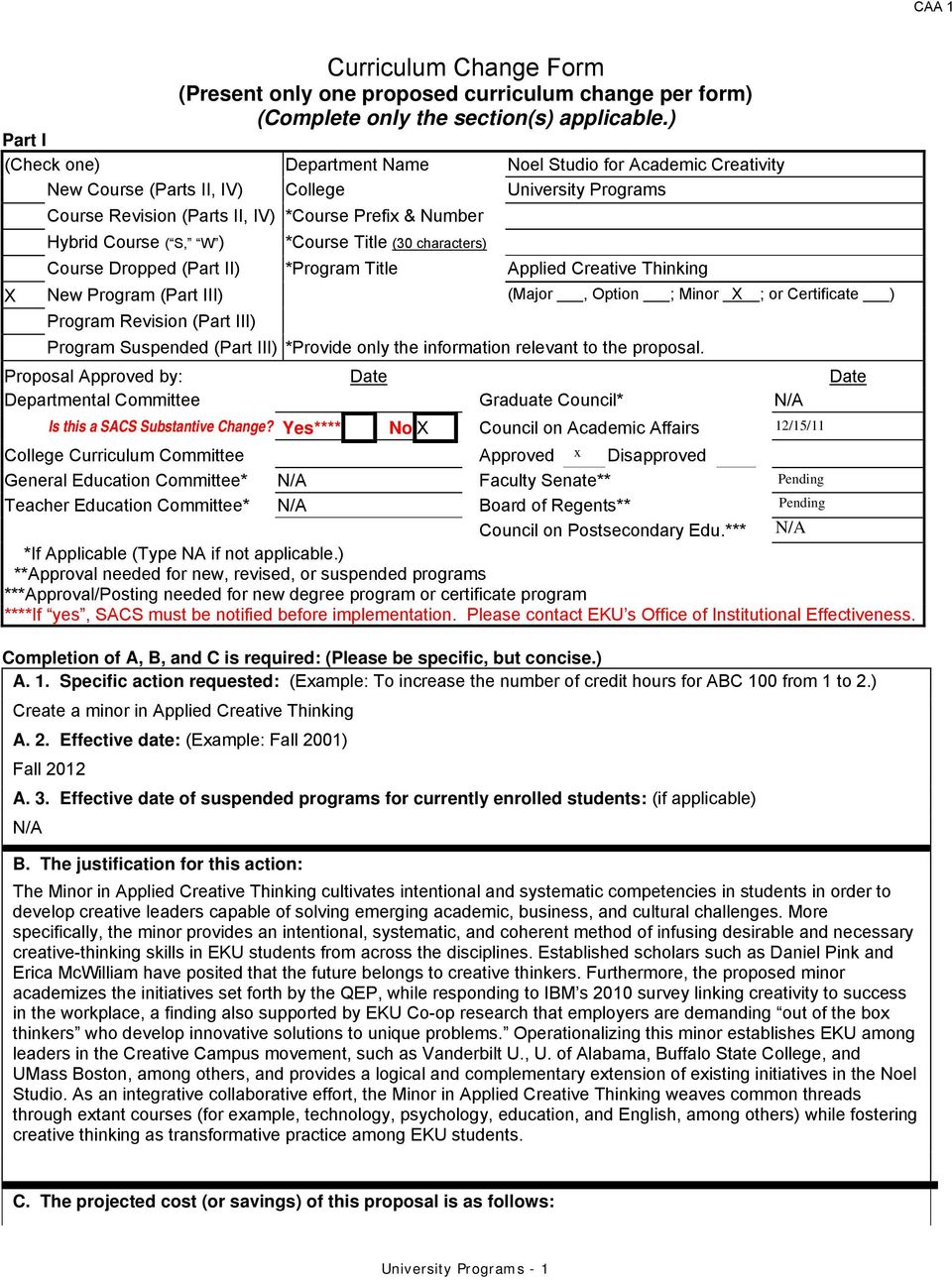
12 CAA 1 Curriculum Change Form (Present only one proposed curriculum change per form) (Complete only the section(s) applicable.) Part I (Check one) Department Name Noel Studio for Academic Creativity New Course (Parts II, IV) College University Programs Course Revision (Parts II, IV) *Course Prefix & Number Hybrid Course ( S, W ) *Course Title (30 characters) Course Dropped (Part II) *Program Title Applied Creative Thinking X New Program (Part III) (Major, Option ; Minor X ; or Certificate ) Program Revision (Part III) Program Suspended (Part III) *Provide only the information relevant to the proposal. Proposal Approved by: Date Date Departmental Committee Graduate Council* N/A Is this a SACS Substantive Change? Yes**** No X Council on Academic Affairs College Curriculum Committee Approved Disapproved General Education Committee* N/A Faculty Senate** Teacher Education Committee* N/A Board of Regents** Council on Postsecondary Edu.*** *If Applicable (Type NA if not applicable.) **Approval needed for new, revised, or suspended programs ***Approval/Posting needed for new degree program or certificate program ****If yes, SACS must be notified before implementation. Please contact EKU s Office of Institutional Effectiveness. Completion of A, B, and C is required: (Please be specific, but concise.) A. 1. Specific action requested: (Example: To increase the number of credit hours for ABC 100 from 1 to 2.) Create a minor in Applied Creative Thinking A. 2. Effective date: (Example: Fall 2001) Fall 2012 A. 3. Effective date of suspended programs for currently enrolled students: (if applicable) N/A B. The justification for this action: The Minor in Applied Creative Thinking cultivates intentional and systematic competencies in students in order to develop creative leaders capable of solving emerging academic, business, and cultural challenges. More specifically, the minor provides an intentional, systematic, and coherent method of infusing desirable and necessary creative-thinking skills in EKU students from across the disciplines. Established scholars such as Daniel Pink and Erica McWilliam have posited that the future belongs to creative thinkers. Furthermore, the proposed minor academizes the initiatives set forth by the QEP, while responding to IBM s 2010 survey linking creativity to success in the workplace, a finding also supported by EKU Co-op research that employers are demanding out of the box thinkers who develop innovative solutions to unique problems. Operationalizing this minor establishes EKU among leaders in the Creative Campus movement, such as Vanderbilt U., U. of Alabama, Buffalo State College, and UMass Boston, among others, and provides a logical and complementary extension of existing initiatives in the Noel Studio. As an integrative collaborative effort, the Minor in Applied Creative Thinking weaves common threads through extant courses (for example, technology, psychology, education, and English, among others) while fostering creative thinking as transformative practice among EKU students. C. The projected cost (or savings) of this proposal is as follows: University Programs - 1
13 CAA 2 Personnel Impact: Initial personnel are already in place. Operating Expenses Impact: None Equipment/Physical Facility Needs: None Library Resources: Yes Part III. Recording Data for New, Revised, or Suspended Program 1. For a new program, provide the catalog description as being proposed. MINOR IN APPLIED CREATIVE THINKING A minor in Applied Creative Thinking is offered for students in all disciplines. The minor consists of 18 hours of courses. CRE 101 and CRE 400 are required. CRE 400 must be taken after the completion of the other five courses. The additional 12 hours may be taken from a list of potential courses listed on the Noel Studio website at or from the following potential courses: ART 100, ART 152, ART 153, ART 164, ART 376, BEM 353W, ENG 350, ENG 351, ENG 352, ENG 358, ENG 410, ENG 490, FSE 200, FSE 300, HLS 201, JOU 305, JOU 480, MUS 171, MUS 271, MUS 272, MUS 273, PUB 415. Students pursuing the minor in Applied Creative Thinking must earn a C or above in all courses counting toward the minor. Catalog Format: MINOR IN APPLIED CREATIVE THINKING Requirements.18 hours CRE 101 and CRE 400 (CRE 400 must be taken after the completion of the other five courses), and 12 hours from a list of potential courses listed on the Noel Studio website at: or from the following potential courses: ART 100, ART 152, ART 153, ART 164, ART 376, BEM 353W, ENG 350, ENG 351, ENG 352, ENG 358, ENG 410, ENG 490, FSE 200, FSE 300, HLS 201, JOU 305, JOU 480, MUS 171, MUS 271, MUS 272, MUS 273, PUB 415. Students pursuing the minor in Applied Creative Thinking must earn a C or above in all courses counting toward the minor. University Programs - 2

14 CAA 3 Curriculum Change Form (Present only one proposed curriculum change per form) (Complete only the section(s) applicable.) Part I (Check one) Department Name Applied Engineering and Technology New Course (Parts II, IV) College Business and Technology Course Revision (Parts II, IV) *Course Prefix & Number Hybrid Course ( S, W ) *Course Title (30 characters) Course Dropped (Part II) *Program Title Minor in Web Publishing X New Program (Part III) (Major, Option ; Minor X ; or Certificate ) Program Revision (Part III) Program Suspended (Part III) *Provide only the information relevant to the proposal. Proposal Approved by: Date Date Departmental Committee 11/18/2011 Graduate Council* NA Is this a SACS Substantive Change? Yes**** No X Council on Academic Affairs College Curriculum Committee 12/16/2011 Approved Disapproved General Education Committee* NA Faculty Senate** Teacher Education Committee* NA Board of Regents** Council on Postsecondary Edu.*** *If Applicable (Type NA if not applicable.) **Approval needed for new, revised, or suspended programs ***Approval/Posting needed for new degree program or certificate program ****If yes, SACS must be notified before implementation. Please contact EKU s Office of Institutional Effectiveness. Completion of A, B, and C is required: (Please be specific, but concise.) A. 1. Specific action requested: (Example: To increase the number of credit hours for ABC 100 from 1 to 2.) To add a new minor degree. A. 2. Effective date: (Example: Fall 2001) Fall 2012 A. 3. Effective date of suspended programs for currently enrolled students: (if applicable) NA B. The justification for this action: There is a demand by students for a degree in Web Publishing. C. The projected cost (or savings) of this proposal is as follows: Personnel Impact: None Operating Expenses Impact: None Equipment/Physical Facility Needs: None Library Resources: None AET 33

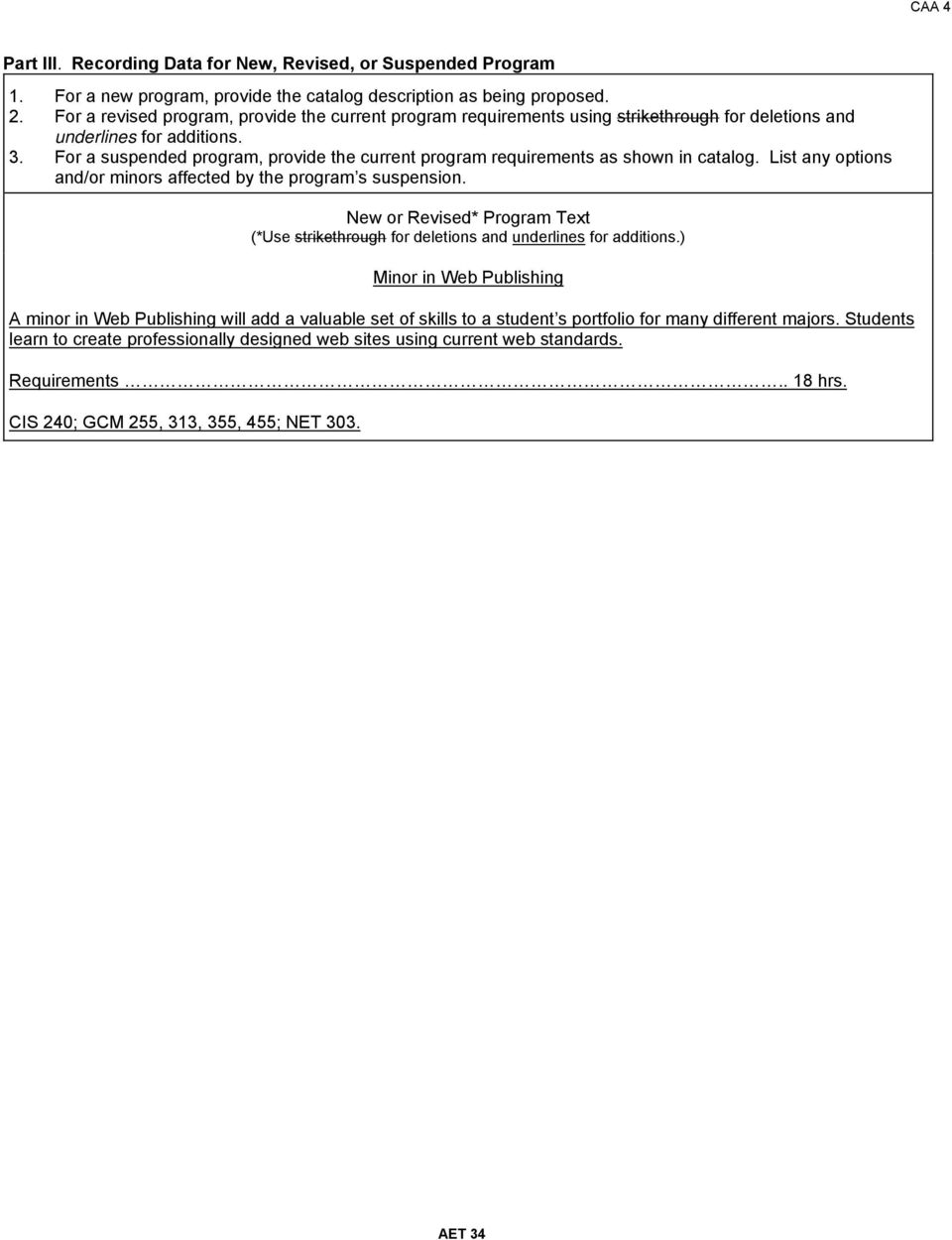
15 CAA 4 Part III. Recording Data for New, Revised, or Suspended Program 1. For a new program, provide the catalog description as being proposed. 2. For a revised program, provide the current program requirements using strikethrough for deletions and underlines for additions. 3. For a suspended program, provide the current program requirements as shown in catalog. List any options and/or minors affected by the program s suspension. New or Revised* Program Text (*Use strikethrough for deletions and underlines for additions.) Minor in Web Publishing A minor in Web Publishing will add a valuable set of skills to a student s portfolio for many different majors. Students learn to create professionally designed web sites using current web standards. Requirements.. 18 hrs. CIS 240; GCM 255, 313, 355, 455; NET 303. AET 34
16 CAA 5 Curriculum Change Form (Present only one proposed curriculum change per form) (Complete only the section(s) applicable.) Part I (Check one) Department Name MMAC New Course (Parts II, IV) College Business and Technology Course Revision (Parts II, IV) *Course Prefix & Number Hybrid Course ( S, W ) *Course Title (30 characters) Course Dropped (Part II) *Program Title International Business X New Program (Part III) (Major, Option ; Minor X ; or Certificate ) Program Revision (Part III) Program Suspended (Part III) *Provide only the information relevant to the proposal. Proposal Approved by: Date Date Departmental Committee 11/22/ Graduate Council* N/A Is this a SACS Substantive Change? Yes**** No X Council on Academic Affairs College Curriculum Committee 12/16/2011 Approved Disapproved General Education Committee* N/A Faculty Senate** Teacher Education Committee* N/A Board of Regents** Council on Postsecondary Edu.*** *If Applicable (Type NA if not applicable.) **Approval needed for new, revised, or suspended programs ***Approval/Posting needed for new degree program or certificate program ****If yes, SACS must be notified before implementation. Please contact EKU s Office of Institutional Effectiveness. Completion of A, B, and C is required: (Please be specific, but concise.) A. 1. Specific action requested: (Example: To increase the number of credit hours for ABC 100 from 1 to 2.) To establish a minor program in International Business A. 2. Effective date: (Example: Fall 2001) Fall 2012 A. 3. Effective date of suspended programs for currently enrolled students: (if applicable) NA B. The justification for this action: Students in majors outside of business are seeking ways to build international business expertise and knowledge to strengthen their major areas of study. This minor will allow for collaborative efforts in many departments across campus and will promote diversity and study abroad. C. The projected cost (or savings) of this proposal is as follows: Personnel Impact: None Operating Expenses Impact: None Equipment/Physical Facility Needs: None Library Resources: None MMAC 1

17 CAA 6 Part III. Recording Data for New, Revised, or Suspended Program 1. For a new program, provide the catalog description as being proposed. 2. For a revised program, provide the current program requirements using strikethrough for deletions and underlines for additions. 3. For a suspended program, provide the current program requirements as shown in catalog. List any options and/or minors affected by the program s suspension. New or Revised* Program Text (*Use strikethrough for deletions and underlines for additions.) Minor in International Business The International Business Minor is offered to students majoring in programs other than business who have a desire to gain knowledge in international business and experience business courses through study abroad. To enroll in a 300-level business course, students must have completed a minimum of 60 hours and have met the prerequisites of the specific course. Students must earn at least 12 of the 18 hours for the International Business Minor at EKU and earn a C in each of the minor courses. Requirements.18 hours CCT 310, GBU 201, MGT 301, 430, and six hours of business credit from approved courses studied and completed abroad. MMAC 2

18 CAA 7 Curriculum Change Form (Present only one proposed curriculum change per form) (Complete only the section(s) applicable.) Part I (Check one) Department Name Curriculum and Instruction New Course (Parts II, IV) College Education X Course Revision (Parts II, IV) *Course Prefix & Number Hybrid Course ( S, W ) *Course Title (30 characters) Course Dropped (Part II) *Program Title Middle Grade Education (5-9) New Program (Part III) (Major X, Option ; Minor ; or Certificate ) Program Revision (Part III) Program Suspended (Part III) *Provide only the information relevant to the proposal. Proposal Approved by: Date Date Departmental Committee 08/18/11 Graduate Council* 11/18/11 Is this a SACS Substantive Change? Yes**** No X Council on Academic Affairs College Curriculum Committee 10/04/11 Approved Disapproved General Education Committee* NA Faculty Senate** Teacher Education Committee* 10/25/11 Board of Regents** Council on Postsecondary Edu.*** NA *If Applicable (Type NA if not applicable.) **Approval needed for new, revised, or suspended programs ***Approval/Posting needed for new degree program or certificate program ****If yes, SACS must be notified before implementation. Please contact EKU s Office of Institutional Effectiveness. Completion of A, B, and C is required: (Please be specific, but concise.) A. 1. Specific action requested: (Example: To increase the number of credit hours for ABC 100 from 1 to 2.) LIB 501 changed to LIB 401; this course requirement revision needs to be reflected in the program. A. 2. Effective date: Fall 2012 A. 3. Effective date of suspended programs for currently enrolled students: (if applicable) B. The justification for this action: Course revision C. The projected cost (or savings) of this proposal is as follows: Personnel Impact: NONE Operating Expenses Impact: NONE Equipment/Physical Facility Needs: NONE Library Resources: NONE 1

19 CAA 8 Part III. Recording Data for New, Revised, or Suspended Program 1. For a new program, provide the catalog description as being proposed. 2. For a revised program, provide the current program requirements using strikethrough for deletions and underlines for additions. 3. For a suspended program, provide the current program requirements as shown in catalog. List any options and/or minors affected by the program s suspension. New or Revised* Program Text (*Use strikethrough for deletions and underlines for additions.) Middle Grade Education (5-9) Teaching (B.S.) CIP Code: Upon completion of a degree in Middle Grade Education, candidates will: 1) demonstrate the broad general background knowledge, dispositions, and skills necessary to function as a literate, informed, active citizen, and to serve as a model for middle level students; 2) demonstrate the pedagogical skills and content knowledge necessary to meet Kentucky s Teacher Standards in middle level classrooms; 3) demonstrate the appropriate dispositions to effectively meet the diverse needs of middle level students found in public schools. Major Requirements...40 hours Middle Grade Core...15 hours EMG 430, 445, 445W, 447, and six hours from 491, 492, 493, or 494 or 494W. Professional Education Requirements...25 hours EDF 103, 203, 319, 319W, 413, SED 401 or 401S, and EMG 499. Supporting Course Requirements...48 hours Options...24 hours Students seeking middle grade (5 9) certification must select two areas of emphasis from: English and communications, mathematics, science, social studies. Twenty four hours are required in each area. English and Communications...24 hours ENG 210 (block IIIB) and 211 or 212; 350 or 351; ENG 410; LIB , CMS 100 (block IC), and six hours selected from ENG 303, 405, 510, 520, or EME 551. Mathematics...24 hours MAT 106 (block II), 201, 202, 203, 205, 211 or 261 (block VIII); 303, and STA 270 (block VIII). (Candidates are advised to take CSC 104 as a symbolics option prior to enrolling in MAT 205 unless they already possess skills comparable to those acquired in CSC 104.) Candidates whose secondary education did not include a course equivalent to MAT 107 will need to take the course prior to enrolling in MAT 211, 261, 303, or STA 270. Science hours BIO 102 (block IVA), CHE 100, PHY 102 (block VIII), GLY 102 (block VIII), CNM 599, AST 130 or 135, GEO 215 and 3 hours selected from AST 330, BIO 121, BIO 131, BIO 141, BIO 303, BIO 317, GLY 109, GLY 304, GLY 307, PHY 131. Social Studies...24 hours ECO 120 (block VIII); GEO 200 or 220 (block VB); HIS 202; HIS 203, 303, 304, 305, 308, 401, 402, 403, 404, 405, 406, or 424; HIS 246 (block VA); HIS 247 (block VC), 320, 336, 339, 343, 344, 345, 363, 374, 383, or 385; POL 100 or 101 (block VIII); and 3 hours selected from ANT 120, 325, SOC 131, or 345. Must take at least one HIS course at the 300 or 400 level. General Education Requirements hours Standard General Education program, excluding courses identified as GEW in area of emphasis. Refer to Section Four of this Catalog for details on the General Education and University requirements. University Requirement...1 hour EDO 100. Free Electives hours Total Curriculum Requirements hours Candidates earning a degree that leads to teacher certification must take the PRAXIS Series (Professional Assessments for Beginning Teachers) and PLT (Principles of Learning and Teaching) exams as a requirement for graduation. Candidates are encouraged to review the schedule for PRAXIS and PLT registration deadlines prior to beginning the senior year (www. kyepsb.net/ AND Specialty exams are required for each certification area sought and it may take more than one test date to complete all requirements. Candidates should confer with their education advisor/counselor to determine the most optimal time to take required exams. 2

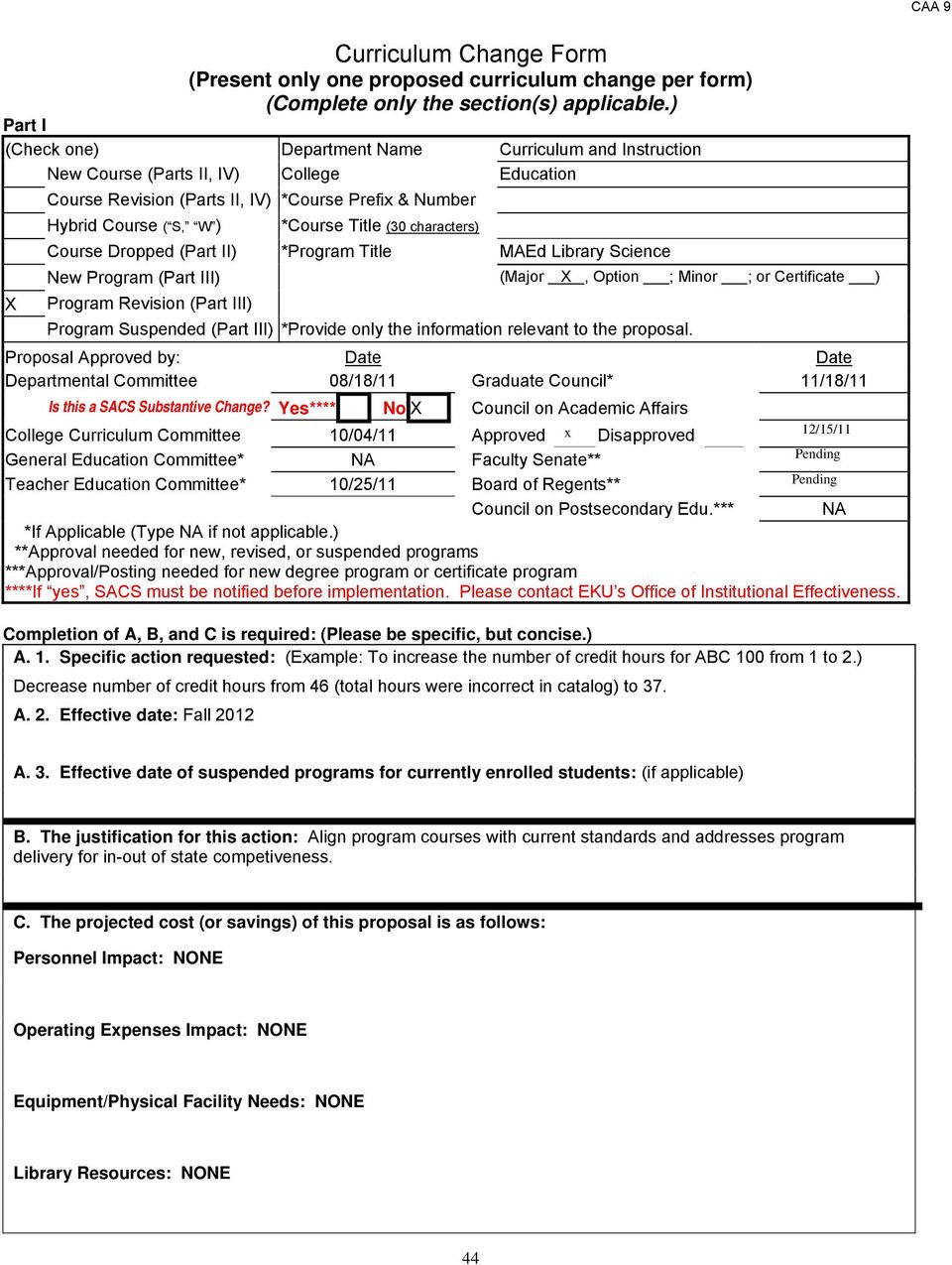
20 CAA 9 Curriculum Change Form (Present only one proposed curriculum change per form) (Complete only the section(s) applicable.) Part I (Check one) Department Name Curriculum and Instruction New Course (Parts II, IV) College Education X Course Revision (Parts II, IV) *Course Prefix & Number Hybrid Course ( S, W ) *Course Title (30 characters) Course Dropped (Part II) *Program Title MAEd Library Science New Program (Part III) (Major X, Option ; Minor ; or Certificate ) Program Revision (Part III) Program Suspended (Part III) *Provide only the information relevant to the proposal. Proposal Approved by: Date Date Departmental Committee 08/18/11 Graduate Council* 11/18/11 Is this a SACS Substantive Change? Yes**** No X Council on Academic Affairs College Curriculum Committee 10/04/11 Approved Disapproved General Education Committee* NA Faculty Senate** Teacher Education Committee* 10/25/11 Board of Regents** Council on Postsecondary Edu.*** NA *If Applicable (Type NA if not applicable.) **Approval needed for new, revised, or suspended programs ***Approval/Posting needed for new degree program or certificate program ****If yes, SACS must be notified before implementation. Please contact EKU s Office of Institutional Effectiveness. Completion of A, B, and C is required: (Please be specific, but concise.) A. 1. Specific action requested: (Example: To increase the number of credit hours for ABC 100 from 1 to 2.) Decrease number of credit hours from 46 (total hours were incorrect in catalog) to 37. A. 2. Effective date: Fall 2012 A. 3. Effective date of suspended programs for currently enrolled students: (if applicable) B. The justification for this action: Align program courses with current standards and addresses program delivery for in-out of state competiveness. C. The projected cost (or savings) of this proposal is as follows: Personnel Impact: NONE Operating Expenses Impact: NONE Equipment/Physical Facility Needs: NONE Library Resources: NONE 44
21 CAA 10 Part II. Recording Data for New, Revised, or Dropped Course (For a new required course, complete a separate request for the appropriate program revisions.) 13. For a new course, provide the catalog text. 14. For a revised course, provide the current catalog text with the proposed text using strikethrough for deletions and underlines for additions. 15. For a dropped course, provide the current catalog text. New or Revised* Catalog Text (*Use strikethrough for deletions and underlines for additions. Also include Crs. Prefix, No., and description, limited to 35 words.) Part III. Recording Data for New, Revised, or Suspended Program 16. For a new program, provide the catalog description as being proposed. 17. For a revised program, provide the current program requirements using strikethrough for deletions and underlines for additions. 18. For a suspended program, provide the current program requirements as shown in catalog. List any options and/or minors affected by the program s suspension. New or Revised* Program Text (*Use strikethrough for deletions and underlines for additions.) MASTER OF ARTS IN EDUCATION with Teacher Leader Endorsement Preparation Library Science CIP Code: (Online Program) I. GENERAL INFORMATION Master of Arts in Education, Rank II non-degree, and Rank I non-degree Library Science programs leading to certification as school media librarian for grades P-12 are offered. Candidates entering the program must be certified as classroom teachers in order to serve as instructional leaders, teacher mentors, literacy or math coaches, instructional facilitators, department chairs and/or team leaders. Teacher Leader Endorsement - Candidates will be eligible to apply for the Teacher Leader Endorsement upon completion of this program. II. ADMISSION REQUIREMENTS Candidates must meet the admissions requirements of the Graduate School and have completed an initial elementary, middle, or secondary teaching certification program. In addition, candidates must have earned an overall 3.0 undergraduate GPA or a 3.0 in the last 60 hours completed and submitted official test scores for either the GRE or Miller Analogies Test (MAT ). Scores on the GRE/MAT are used in conjunction with the undergraduate GPA and other criteria in selecting candidates for admission. III. PROGRAM REQUIREMENTS Library Science Curriculum for P-12 Teacher Leader Core hours ETL 800, 801, 802, hours LIB 863* 872 (capstone course for teacher leader)...3 hours Literacy Supporting Coursework...3 hours One of the following: ELE 871, EMG 806, ESE hours Library Media Specialization hours LIB 701*, 800, 801, 802, 805, 821, 831, and 870. Exit Requirement...0 hours Comprehensive Exam and Portfolio Review: GRD 878x and 878y Total Program Hours hours *Candidates who have completed LIB 501 with a grade of C or better may use them to reduce requirements in the Library Science block by 3 hours. Candidates who have completed LIB 501 for credit may not take LIB 701. LIB 863 will serve as the capstone course for Library Science. IV. EXIT REQUIREMENTS The following are the exit requirements for Library Science. Program GPA: Candidates must earn an overall GPA of 3.0 or higher, with no grade lower than a C. 45
22 CAA 11 Research Requirement: An action research project which culminates in a technology enhanced presentation is required in the Capstone Seminar, LIB Comprehensive Examinations: The candidate will have an opportunity to demonstrate professional growth through an oral examination (GRD 878x) covering education and major program components taken in conjunction with the Capstone Seminar. A portfolio review is also required (GRD 878y). 46
23 Curriculum Change Form (Present only one proposed curriculum change per form) (Complete only the section(s) applicable.) Part I (Check one) Department Name Curriculum and Instruction New Course (Parts II, IV) College Education X Course Revision (Parts II, IV) *Course Prefix & Number Hybrid Course ( S, W ) *Course Title (30 characters) Course Dropped (Part II) *Program Title Library Science Rank I New Program (Part III) (Major x, Option ; Minor ; or Certificate ) Program Revision (Part III) Program Suspended (Part III) *Provide only the information relevant to the proposal. Proposal Approved by: Date Date Departmental Committee 08/18/11 Graduate Council* 11/18/11 Is this a SACS Substantive Change? Yes**** No X Council on Academic Affairs College Curriculum Committee 10/04/11 Approved Disapproved General Education Committee* NA Faculty Senate** Teacher Education Committee* 10/25/11 Board of Regents** Council on Postsecondary Edu.*** NA *If Applicable (Type NA if not applicable.) **Approval needed for new, revised, or suspended programs ***Approval/Posting needed for new degree program or certificate program ****If yes, SACS must be notified before implementation. Please contact EKU s Office of Institutional Effectiveness. Completion of A, B, and C is required: (Please be specific, but concise.) A. 1. Specific action requested: (Example: To increase the number of credit hours for ABC 100 from 1 to 2.) Decrease number of credit hours from 34 to 31. A. 2. Effective date: Fall 2012 CAA 12 A. 3. Effective date of suspended programs for currently enrolled students: (if applicable) B. The justification for this action: Align program courses with current standards and addresses program delivery for in-out of state competiveness. C. The projected cost (or savings) of this proposal is as follows: Personnel Impact: NONE Operating Expenses Impact: NONE Equipment/Physical Facility Needs: NONE Library Resources: NONE 47
24 CAA 13 Part II. Recording Data for New, Revised, or Dropped Course (For a new required course, complete a separate request for the appropriate program revisions.) 16. For a new course, provide the catalog text. 17. For a revised course, provide the current catalog text with the proposed text using strikethrough for deletions and underlines for additions. 18. For a dropped course, provide the current catalog text. New or Revised* Catalog Text (*Use strikethrough for deletions and underlines for additions. Also include Crs. Prefix, No., and description, limited to 35 words.) Part III. Recording Data for New, Revised, or Suspended Program 19. For a new program, provide the catalog description as being proposed. 20. For a revised program, provide the current program requirements using strikethrough for deletions and underlines for additions. 21. For a suspended program, provide the current program requirements as shown in catalog. List any options and/or minors affected by the program s suspension. New or Revised* Program Text (*Use strikethrough for deletions and underlines for additions.) Curriculum for Sixth Year Rank I Program Library Science Professional Education...6 hours (As approved for Rank I Programs) Candidates who have not previously completed a graduate reading methods course must take ELE 871, EMG 806, or ESE 774. Library Science Courses* hours L IB 701*, 800, 801, 802, 805, 821, 831, 863, and 870. Total Program Hours hours *Candidates who have completed LIB 501 and/or LIB 569 with a grade of C or better may use them to reduce the number of hours required in the Library Science block by 3-6 hours. Candidates who have completed LIB 501 and/or LIB 569 for credit may not take LIB 701 and/or LIB
25 Curriculum Change Form (Present only one proposed curriculum change per form) (Complete only the section(s) applicable.) Part I (Check one) Department Name Special Education XX New Course (Parts II, IV) College Education Course Revision (Parts II, IV) *Course Prefix & Number Hybrid Course ( S, W ) *Course Title (30 characters) Course Dropped (Part II) *Program Title Master of Arts in Teaching IECE option New Program (Part III) (Major, Option ; Minor ; or Certificate ) Program Revision (Part III) Program Suspended (Part III) *Provide only the information relevant to the proposal. Proposal Approved by: Date Date Departmental Committee 9/1/2011 Graduate Council* 11/18/11 Is this a SACS Substantive Change? Yes**** No XX Council on Academic Affairs College Curriculum Committee 10/4/2011 Approved Disapproved General Education Committee* N/A Faculty Senate** Teacher Education Committee* 10/25/2011 Board of Regents** Council on Postsecondary Edu.*** *If Applicable (Type NA if not applicable.) **Approval needed for new, revised, or suspended programs ***Approval/Posting needed for new degree program or certificate program ****If yes, SACS must be notified before implementation. Please contact EKU s Office of Institutional Effectiveness. Completion of A, B, and C is required: (Please be specific, but concise.) A. 1. Specific action requested: (Example: To increase the number of credit hours for ABC 100 from 1 to 2.) Change one course of the program requirements in the MAT IECE to match the MAT in Middle Grades and Secondary Education. A. 2. Effective date: (Example: Fall 2001) Spring 2012 A. 3. Effective date of suspended programs for currently enrolled students: (if applicable) N/A CAA 14 B. The justification for this action: The MAT in IECE is proposing to change the requirement of EGC829 to EGC889 to match the requirements of the MAT in Middle Grades and Secondary Education since EGC829 is no longer offered. C. The projected cost (or savings) of this proposal is as follows: Personnel Impact: none Operating Expenses Impact: none Equipment/Physical Facility Needs: none 52
26 CAA 15 Library Resources: none Part III. Recording Data for New, Revised, or Suspended Program 1. For a new program, provide the catalog description as being proposed. 2. For a revised program, provide the current program requirements using strikethrough for deletions and underlines for additions. 3. For a suspended program, provide the current program requirements as shown in catalog. List any options and/or minors affected by the program s suspension. III. PROGRAM REQUIREMENTS Program Planning During the first term of enrollment, the candidate must develop and submit to the Office of Graduate Education and Research a planned program. In addition to the required professional preparation courses, candidates will take 12 hours of graduate course work in their field of certification. Faculty from the candidate s major field will evaluate his/her undergraduate transcript and take into consideration life/work experiences, and performance on the PRAXIS II in recommending courses to be taken in the program. Candidates in business-marketing may need to complete a semester of prerequisite undergraduate courses. Transfer Credit The candidate must complete the professional courses at Eastern Kentucky University. Acceptance of transfer subject matter courses will be determined on an individual basis. Curriculum Requirements for Master of Arts in Teaching Middle Grades 5-9 Option Professional Education Core...27 hours EGC 820, 830, 835, 836, 837, hours EMG hours SED hours Specialization...12 hours Courses will be selected with advisor approval. Exit Requirement GRD877f or 878k, and 878l Minimum Program Total...39 hours Secondary, P-12, 5-12 Education Option Professional Education Core...27 hours EGC 820, 830, 845, 846, 847, hours EMG806 or EMS hours SED hours Specialization...12 hours Courses will be selected with advisor approval. Exit Requirement GRD877g or 878m, and 878n Minimum Program Total...39 hours This program, offered out of the Department of Special Education, entitles certified individuals to teach children ages birth to five with and without disabilities. Interdisciplinary Early Childhood Education Option Professional Education Core...15 hours EGC 820, , hours SED hours Specialization...28 hours SED718, 722, 790, hours CDF 741, 744, hours OTS 715, ELE hours Exit Requirement GRD877h or 878o, and 878p Minimum Program Total...43 hours 53
27 CAA 16 Curriculum Change Form Part I (Check one) Department Name Recreation and Park Adm. New Course (Parts II, IV) College Health Sciences Course Revision (Parts II, IV) *Course Prefix & Number Hybrid Course ( S, W ) *Course Title (30 characters) Course Dropped (Part II) *Program Title Recreation and Park Administration (B.S.) New Program (Part III) (Major X, Option ; Minor ; or Certificate ) X Program Revision (Part III) Program Suspended (Part III) *Provide only the information relevant to the proposal. Proposal Approved by: Date Date Departmental Committee 10/20/11 Graduate Council* NA Is this a SACS Substantive Change? Yes**** No X Council on Academic Affairs College Curriculum Committee 11/17/11 Approved Disapproved General Education Committee* NA Faculty Senate** Teacher Education Committee* NA Board of Regents** Council on Postsecondary Edu.*** NA *If Applicable (Type NA if not applicable.) **Approval needed for new, revised, or suspended programs ***Approval/Posting needed for new degree program or certificate program ****If yes, SACS must be notified before implementation. Please contact EKU s Office of Institutional Effectiveness. Completion of A, B, and C is required: (Please be specific, but concise.) A. 1. Specific action requested: Drop current first aid and CPR certifications at time of graduation for all options. Change CHS105 to EMC105 due to prefix change A. 2. Effective date: Fall 2012 A. 3. Effective date of suspended programs for currently enrolled students: (if applicable) B. The justification for this action: Most agencies provide first aid and CPR certifications for students enrolled in REC 463, Senior Practicum. This eliminates the need for the certification requirements. C. The projected cost (or savings) of this proposal is as follows: Personnel Impact: NA Operating Expenses Impact: NA Equipment/Physical Facility Needs: NA Library Resources: NA Part III. Recording Data for New, Revised, or Suspended Program Recreation and Park Administration (B.S.) CIP Code: Major Requirements hours Core...43 hours REC 101(1), 102, 163(1), 200, 263(2), 311, 350, 401, 406, 410, 450, 460, and 463(12); current first aid CPR certification at time of graduation, and one of the following options: Options hours Natural Resources & Outdoor Recreation...13 hours REC 190, 290, 380, 516, 530. Public/Non-Profit Recreation Services...13 hours REC 190, 280, 530, and six hours from the following courses: POL 331, 332, 333, 377 or COM390. RPA - 1
28 CAA 17 Therapeutic Recreation...11 hours REC 190, 411, 511, 512S; CHS EMC 105. Tourism & Resort Recreation...15 hours REC 280, 380, 480; GEO 305; EHS 230. Supporting Course Requirements (all options)...3 hours CMS 210 Additional Supporting Course Requirements Therapeutic Recreation Option...15 hours BIO 171, 301; PSY 200, 280, 308. General Education Requirements...33 or 45 hours Standard general Education Program, excluding block IC for all options and Blocks VB, VC and VIII (6 hours) for the therapeutic recreation option only. Refer to Section Four of this Catalog for details on the general Education and University requirements. University Requirement...1 hour HSO 100. Free Electives hours Natural Resources & Outdoor Recreation...15 hours Public/Non-Profit Recreation Services...15 hours Therapeutic Recreation...14 hours Tourism & Resort Recreation...13 hours Total Curriculum Requirements hours RPA - 2
29 CAA 18 Curriculum Change Form (Present only one proposed curriculum change per form) (Complete only the section(s) applicable.) Part I (Check one) Department Name Applied Engineering and Technology New Course (Parts II, IV) College Business and Technology Course Revision (Parts II, IV) *Course Prefix & Number Hybrid Course ( S, W ) *Course Title (30 characters) Course Dropped (Part II) *Program Title Industrial Technology New Program (Part III) (Major, Option ; Minor X ; or Certificate ) X Program Revision (Part III) Program Suspended (Part III) *Provide only the information relevant to the proposal. Proposal Approved by: Date Date Departmental Committee 08/19/11 Graduate Council* NA Is this a SACS Substantive Change? Yes**** No X Council on Academic Affairs College Curriculum Committee 11/18/2011 Approved Disapproved General Education Committee* NA Faculty Senate** Teacher Education Committee* NA Board of Regents** Council on Postsecondary Edu.*** NA *If Applicable (Type NA if not applicable.) **Approval needed for new, revised, or suspended programs ***Approval/Posting needed for new degree program or certificate program ****If yes, SACS must be notified before implementation. Please contact EKU s Office of Institutional Effectiveness. Completion of A, B, and C is required: (Please be specific, but concise.) A. 1. Specific action requested: (Example: To increase the number of credit hours for ABC 100 from 1 to 2.) Change the name of the minor to Applied Engineering Management, drop AEM 238, reduce the number of credits required to obtain the AEM minor from 21 to 18 credits, drop the QMB 200 option from the list of prerequisites for AEM 202. A. 2. Effective date: (Example: Fall 2001) Fall 2012 A. 3. Effective date of suspended programs for currently enrolled students: (if applicable) NA B. The justification for this action: The BS program name has changed from Industrial Technology to Applied Engineering Management, AEM 238 has been dropped from the BS curriculum, QMB 200 is no longer listed as a prerequisite option for the BS program. The changes to the minor are requested to bring the program in line with the changes to the BS program. C. The projected cost (or savings) of this proposal is as follows: Personnel Impact: None Operating Expenses Impact: None Equipment/Physical Facility Needs: None Library Resources: None AET 1
30 CAA 19 Part III. Recording Data for New, Revised, or Suspended Program 1. For a new program, provide the catalog description as being proposed. 2. For a revised program, provide the current program requirements using strikethrough for deletions and underlines for additions. 3. For a suspended program, provide the current program requirements as shown in catalog. List any options and/or minors affected by the program s suspension. New or Revised* Program Text (*Use strikethrough for deletions and underlines for additions.) Minor in Industrial Technology Minor in Applied Engineering Management Requirements hours TEC 190, AEM 201, 202 +, 238 *, 308, and six hours of AEM upper division electives. No more than nine hours of courses taken for a major may be counted toward this minor. + *STA 215 or 270 (Gen. Ed. VII) or QMB 200 and MAT 107 or higher are prerequisites for AEM 202. *CHE 101, 107 (1) or CHE 111, 111L(1) Gen. Ed. Block IVB is a prerequisite for AEM 238. AET 2
31 CAA 20 Curriculum Change Form (Present only one proposed curriculum change per form) (Complete only the section(s) applicable.) Part I (Check one) Department Name Applied Engineering and Technology New Course (Parts II, IV) College Business and Technology Course Revision (Parts II, IV) *Course Prefix & Number Hybrid Course ( S, W ) *Course Title (30 characters) Course Dropped (Part II) *Program Title Construction Management New Program (Part III) (Major, Option ; Minor X ; or Certificate ) X Program Revision (Part III) Program Suspended (Part III) *Provide only the information relevant to the proposal. Proposal Approved by: Date Date Departmental Committee 08/19/11 Graduate Council* NA Is this a SACS Substantive Change? Yes**** No X Council on Academic Affairs College Curriculum Committee 11/18/2011 Approved Disapproved General Education Committee* NA Faculty Senate** Teacher Education Committee* NA Board of Regents** Council on Postsecondary Edu.*** NA *If Applicable (Type NA if not applicable.) **Approval needed for new, revised, or suspended programs ***Approval/Posting needed for new degree program or certificate program ****If yes, SACS must be notified before implementation. Please contact EKU s Office of Institutional Effectiveness. Completion of A, B, and C is required: (Please be specific, but concise.) A. 1. Specific action requested: (Example: To increase the number of credit hours for ABC 100 from 1 to 2.) Add purpose statement. A. 2. Effective date: (Example: Fall 2001) Fall 2012 A. 3. Effective date of suspended programs for currently enrolled students: (if applicable) NA B. The justification for this action: Purpose statement was missing from catalog C. The projected cost (or savings) of this proposal is as follows: Personnel Impact: None Operating Expenses Impact: None Equipment/Physical Facility Needs: None Library Resources: None AET 3
32 CAA 21 Part III. Recording Data for New, Revised, or Suspended Program 1. For a new program, provide the catalog description as being proposed. 2. For a revised program, provide the current program requirements using strikethrough for deletions and underlines for additions. 3. For a suspended program, provide the current program requirements as shown in catalog. List any options and/or minors affected by the program s suspension. New or Revised* Program Text (*Use strikethrough for deletions and underlines for additions.) Minor in Construction Management The Construction Management minor provides technical and managerial knowledge about the construction industry. It is an appropriate supplement to a student who is majoring in a profession affiliated with construction. This minor is particularly relevant to students majoring in business, insurance, management, manufacturing, and marketing. Requirements. 21 hours CON 121, 201, 202, 294, 323, 324, and 421. No more than nine hours of courses taken for a major may be counted toward this minor. AET 4
33 CAA 22 Curriculum Change Form (Present only one proposed curriculum change per form) (Complete only the section(s) applicable.) Part I (Check one) Department Name Applied Engineering and Technology New Course (Parts II, IV) College Business and Technology Course Revision (Parts II, IV) *Course Prefix & Number Hybrid Course ( S, W ) *Course Title (30 characters) Course Dropped (Part II) *Program Title Quality Assurance Technology New Program (Part III) (Major, Option ; Minor X ; or Certificate ) X Program Revision (Part III) Program Suspended (Part III) *Provide only the information relevant to the proposal. Proposal Approved by: Date Date Departmental Committee 08/19/11 Graduate Council* NA Is this a SACS Substantive Change? Yes**** No X Council on Academic Affairs College Curriculum Committee 11/18/2011 Approved Disapproved General Education Committee* NA Faculty Senate** Teacher Education Committee* NA Board of Regents** Council on Postsecondary Edu.*** NA *If Applicable (Type NA if not applicable.) **Approval needed for new, revised, or suspended programs ***Approval/Posting needed for new degree program or certificate program ****If yes, SACS must be notified before implementation. Please contact EKU s Office of Institutional Effectiveness. Completion of A, B, and C is required: (Please be specific, but concise.) A. 1. Specific action requested: (Example: To increase the number of credit hours for ABC 100 from 1 to 2.) Add one three-credit alternative, STA 585 (Experimental Design) to AEM 530 (Design of Experiments). A. 2. Effective date: (Example: Fall 2001) Fall 2012 A. 3. Effective date of suspended programs for currently enrolled students: (if applicable) NA B. The justification for this action: STA 585 is an acceptable alternative to AEM 530. C. The projected cost (or savings) of this proposal is as follows: Personnel Impact: None Operating Expenses Impact: None Equipment/Physical Facility Needs: None Library Resources: None AET 5
34 CAA 23 Part III. Recording Data for New, Revised, or Suspended Program 1. For a new program, provide the catalog description as being proposed. 2. For a revised program, provide the current program requirements using strikethrough for deletions and underlines for additions. 3. For a suspended program, provide the current program requirements as shown in catalog. List any options and/or minors affected by the program s suspension. New or Revised* Program Text (*Use strikethrough for deletions and underlines for additions.) Minor in Quality Assurance Technology Requirements...18 hours STA 215 or 270, AEM 202, 332, 336, 506, and 530 or STA 585. No more than nine hours of courses taken for a major may be counted toward this minor. AET 6
35 CAA 24 Curriculum Change Form (Present only one proposed curriculum change per form) (Complete only the section(s) applicable.) Part I (Check one) Department Name Anthropology, Sociology, Social Work New Course (Parts II, IV) College Arts & Sciences Course Revision (Parts II, IV) *Course Prefix & Number Hybrid Course ( S, W ) *Course Title (30 characters) Course Dropped (Part II) *Program Title Anthropology B.A. New Program (Part III) (Major, Option ; Minor ; or Certificate ) X Program Revision (Part III) Program Suspended (Part III) *Provide only the information relevant to the proposal. Proposal Approved by: Date Date Departmental Committee 09/15/11 Graduate Council* NA Is this a SACS Substantive Change? Yes**** No X Council on Academic Affairs College Curriculum Committee 11/21/11 Approved Disapproved General Education Committee* NA Faculty Senate** Teacher Education Committee* NA Board of Regents** Council on Postsecondary Edu.*** NA *If Applicable (Type NA if not applicable.) **Approval needed for new, revised, or suspended programs ***Approval/Posting needed for new degree program or certificate program ****If yes, SACS must be notified before implementation. Please contact EKU s Office of Institutional Effectiveness. Completion of A, B, and C is required: (Please be specific, but concise.) A. 1. Specific action requested: (Example: To increase the number of credit hours for ABC 100 from 1 to 2.) Revise program curriculum listing due to changes in courses offered. A. 2. Effective date: (Example: Fall 2001) Fall 2012 A. 3. Effective date of suspended programs for currently enrolled students: (if applicable) B. The justification for this action: Revisions and additions in course offerings have necessitated a program curriculum revision. Our ANT program has been growing in quantity and quality of major, and the enhanced program requirements reflect this new reality. C. The projected cost (or savings) of this proposal is as follows: Personnel Impact: NA Operating Expenses Impact: NA Equipment/Physical Facility Needs: NA Library Resources: NA
36 CAA 25 Part II. Recording Data for New, Revised, or Dropped Course (For a new required course, complete a separate request for the appropriate program revisions.) 1. For a new course, provide the catalog text. 2. For a revised course, provide the current catalog text with the proposed text using strikethrough for deletions and underlines for additions. 3. For a dropped course, provide the current catalog text. New or Revised* Catalog Text (*Use strikethrough for deletions and underlines for additions. Also include Crs. Prefix, No., and description, limited to 35 words.) Part III. Recording Data for New, Revised, or Suspended Program 1. For a new program, provide the catalog description as being proposed. 2. For a revised program, provide the current program requirements using strikethrough for deletions and underlines for additions. 3. For a suspended program, provide the current program requirements as shown in catalog. List any options and/or minors affected by the program s suspension. New or Revised* Program Text (*Use strikethrough for deletions and underlines for additions.) Anthropology B.A. CIP code: Major Requirements...33 hours ANT 120, 200, 201, 351W, 395 (15 hrs) and at least one course from each of the following three categories for the additional 18 hrs:, for a total of 18 hours: Archaeology: ANT 320, 341, 355, 357, 360, 439, 470, 471; Cultural Anthropology: ANT , 330, 333, 344, 375, 377, 393; Physical Anthropology: ANT 306, 308, 365, 370, 371, 380, or 385; ANT 490 will be classified where appropriate. General Education Requirements...48 hours Standard General Education program. Refer to Section Four of this Catalog for details on the General Education and University requirements. University Requirement...1 hour ASO 100. Free Electives...38 hours Total Curriculum Requirements hours
37 CAA 26 Curriculum Change Form (Present only one proposed curriculum change per form) (Complete only the section(s) applicable.) Part I (Check one) Department Name Economics New Course (Parts II, IV) College Arts & Sciences X Course Revision (Parts II, IV) *Course Prefix & Number Hybrid Course ( S, W ) *Course Title (30 characters) Course Dropped (Part II) *Program Title Economics B.A. New Program (Part III) (Major X, Option ; Minor ; or Certificate ) Program Revision (Part III) Program Suspended (Part III) *Provide only the information relevant to the proposal. Proposal Approved by: Date Date Departmental Committee 10/19/2011 Graduate Council* NA Is this a SACS Substantive Change? Yes**** No X Council on Academic Affairs College Curriculum Committee 11/21/2011 Approved Disapproved General Education Committee* NA Faculty Senate** Teacher Education Committee* NA Board of Regents** Council on Postsecondary Edu.*** NA *If Applicable (Type NA if not applicable.) **Approval needed for new, revised, or suspended programs ***Approval/Posting needed for new degree program or certificate program ****If yes, SACS must be notified before implementation. Please contact EKU s Office of Institutional Effectiveness. Completion of A, B, and C is required: (Please be specific, but concise.) A. 1. Specific action requested: (Example: To increase the number of credit hours for ABC 100 from 1 to 2.) Include residency requirement statement in catalog. A. 2. Effective date: (Example: Fall 2001) Fall A. 3. Effective date of suspended programs for currently enrolled students: (if applicable) B. The justification for this action: To ensure that students graduating with an EKU economics degree will have taken at least some of the required upper division courses in the major at EKU. C. The projected cost (or savings) of this proposal is as follows: Personnel Impact: NA Operating Expenses Impact: NA Equipment/Physical Facility Needs: NA Library Resources: NA
38 CAA 27 Part II. Recording Data for New, Revised, or Dropped Course (For a new required course, complete a separate request for the appropriate program revisions.) 1. For a new course, provide the catalog text. 2. For a revised course, provide the current catalog text with the proposed text using strikethrough for deletions and underlines for additions. 3. For a dropped course, provide the current catalog text. New or Revised* Catalog Text (*Use strikethrough for deletions and underlines for additions. Also include Crs. Prefix, No., and description, limited to 35 words.) Part III. Recording Data for New, Revised, or Suspended Program 1. For a new program, provide the catalog description as being proposed. 2. For a revised program, provide the current program requirements using strikethrough for deletions and underlines for additions. 3. For a suspended program, provide the current program requirements as shown in catalog. List any options and/or minors affected by the program s suspension.
39 CAA 28 New or Revised* Program Text (*Use strikethrough for deletions and underlines for additions.) Economics (B.A.) CIP Code: Upon completion of a degree in Economics students will: 1) demonstrate a solid knowledge of modern microeconomic and macroeconomic theory; 2) demonstrate the capacity to apply their knowledge of economic theory to issues of public policy and to problems faced by decision makers in the private sector; 3) demonstrate the capacity to do empirical work in economics, including problem formulation, the retrieval and documentation of data, and statistical techniques; 4) demonstrate the capacity to communicate effectively with different audiences. Additionally, students will be prepared for careers in government and business. Recent graduates are employed in commercial and investment banking, insurance, sales, manufacturing, retailing, and all levels of government. In fact, the federal government hires more Economics students than any other major. Major Requirements...33 hours A minimum grade of C is required in all courses counted towards the major. Students must earn no fewer than twelve upper-division hours in the major at EKU. Economics Core...21 hours ECO 220 or its equivalent, 230, 231, 320, 330W, 331, and 420. Majors must select an option in General Economics, Applied Economics, International Economics, or Public Policy. Options...12 hours General Economics...12 hours Twelve hours of upper division economics courses. Applied Economics...12 hours ECO 300 and nine hours of upper division economics courses. International Economics...12 hours ECO 394, 395, and six hours of upper division economics courses. Public Policy...12 hours ECO 315, 365, and six hours from ECO 324, 333, 370, 394, 580 or 590. Supporting Course Requirements...21 hours Additional supporting course requirements beyond those specified below must be approved by the advisor in consultation with the Chair of the Department of Economics. General Economics: MAT 211 plus 18 hours of courses approved by the advisor. Applied Economics: MAT 107 or 211; six hours of courses approved by the advisor; and twelve hours from a list of approved courses within specific program areas, including (but not limited to) Agriculture, Construction Technology, and Travel and Tourism. International Economics: MAT 107 or 211; six hours of courses approved by the advisor; and one of the following three alternatives: (1) twelve hours of foreign language, (2) twelve hours of area studies to be pre-approved by the advisor and the Chair, or (3) twelve hours from the core and elective courses listed in the International Studies minor. Public Policy: MAT 107 or 211; POL 101, 321, 374; three hours from POL 370, 371, 377; plus six hours of courses approved by the advisor. General Education Requirements...45 hours Standard General Education program, excluding general education block II. Refer to Section Four of this Catalog for details on the General Education and University requirements. University Requirement...1 hour ASO 100. Free Electives...20 hours Total Curriculum Requirements hours
40 CAA 29 Curriculum Change Form (Present only one proposed curriculum change per form) (Complete only the section(s) applicable.) Part I (Check one) Department Name English and Theatre New Course (Parts II, IV) College Arts and Sciences X Course Revision (Parts II, IV) *Course Prefix & Number Hybrid Course ( S, W ) *Course Title (30 characters) Course Dropped (Part II) *Program Title MFA in Creative Writing New Program (Part III) (Major, Option ; Minor ; or Certificate ) Program Revision (Part III) Program Suspended (Part III) *Provide only the information relevant to the proposal. Proposal Approved by: Date Date Departmental Committee 9/7/2011 Graduate Council* 11/18/2011 Is this a SACS Substantive Change? Yes**** No X Council on Academic Affairs College Curriculum Committee 10/24/2011 Approved Disapproved General Education Committee* NA Faculty Senate** Teacher Education Committee* NA Board of Regents** Council on Postsecondary Edu.*** NA *If Applicable (Type NA if not applicable.) **Approval needed for new, revised, or suspended programs ***Approval/Posting needed for new degree program or certificate program ****If yes, SACS must be notified before implementation. Please contact EKU s Office of Institutional Effectiveness. Completion of A, B, and C is required: (Please be specific, but concise.) A. 1. Specific action requested: (Example: To increase the number of credit hours for ABC 100 from 1 to 2.) To name the MFA in Creative Writing Bluegrass Writers Studio. A. 2. Effective date: (Example: Fall 2001) Fall 2012 A. 3. Effective date of suspended programs for currently enrolled students: (if applicable) NA B. The justification for this action: MFA programs around the country are known by names that identify them as a brand, such as the Iowa Writers Workshop (University of Iowa MFA), the New South Writing Workshop (Georgia State MFA), the Center for Writers (University of Southern Mississippi), among others. These names typically connote regional awareness beyond the name of the university. The EKU MFA Program in Creative Writing would like to identify itself as the Bluegrass Writers Studio, complete with a logo and tagline that will attract students and bring wider name recognition to the program. C. The projected cost (or savings) of this proposal is as follows: Personnel Impact: None Operating Expenses Impact: None Equipment/Physical Facility Needs: None Library Resources: None
41 CAA 30 Part III. Recording Data for New, Revised, or Suspended Program 1. For a new program, provide the catalog description as being proposed. 2. For a revised program, provide the current program requirements using strikethrough for deletions and underlines for additions. 3. For a suspended program, provide the current program requirements as shown in catalog. List any options and/or minors affected by the program s suspension. New or Revised* Program Text (*Use strikethrough for deletions and underlines for additions.) MASTER OF FINE ARTS: BLUEGRASS WRITERS STUDIO Creative Writing CIP Code: I. GENERAL INFORMATION This graduate program in English is designed to train students in various areas of the creative writing discipline and provide them with both depth and breadth appropriate to the advanced level. as this degree is considered terminal in the field of creative writing, students are trained to be able to teach at the college level as well as to develop their own writing talent. Graduate students in the MFA-CW program may prepare for careers of teaching on the college and pre-college level; engage in creative writing at a PhD level; or pursue other pre-professional or personal goals. II. ADMISSION REQUIREMENTS Applicants to the Bluegrass Writers Studio are required to submit a portfolio of work in their desired concentration (poetry, fiction, or creative nonfiction) to the department s MFA committee and have the work approved. The writing sample will consist of 15 pages of poetry or 20 pages of prose. The portfolio will also include a two-page statement of purpose that addresses the applicant s reasons for applying. Applicants should also have completed an undergraduate bachelor s degree, with at least a minor in English and/or be prepared to complete additional hours to remove any deficiency in their undergraduate preparations. ordinarily, a 3.0 standing must have been achieved in upper-division English courses. applicants must meet the general requirements of the graduate School, and achieve satisfactory scores on the Graduate Record Examination. The committee reserves the right to waive certain departmental requirements in the event that a writing sample is exceptional. III. PROGRAM REQUIREMENTS Students must complete 48 hours in the program, as well as an approved creative thesis. Students must also pass a written exit examination. Each year in the program, full-time students generally attend two ten-day residencies (for a total of six credit hours), and enroll in18 credit hours of online classes. the Winter MFA Residency (ENW 800) is held in early January each year at a hotel/conference center in Lexington, KY. The Summer Writing Residency (ENW 801) is held each year during June/July in an international location, such as Edinburgh, Scotland. The Summer Writing residency is hosted by the EKU MFA program in partnership with the Brief-Residency MFA program of the University of New Orleans. EKU students who attend the Summer residency study with students and faculty from a consortium of other creative writing programs from across the United States, including the creative writing programs of California State University at Fresno, Georgia State University, the University of Memphis, and the University of New Orleans. During both residencies, MFA students attend intensive creative writing workshops (in a selected genre), craft classes, lectures, public readings, and other events. Courses...48 hours ENW 800 and/or hours Students must complete four sections of any combination of ENW 800 and/or ENW 801. Topic must vary in each section. Course content is not to be repeated. ENW 810 (3-hour course)...12 hours Students must complete four sections of this course. topic must vary in each section. Course content is not to be repeated. ENW 820 (6-hour course)...24 hours Students must complete four sections of this course. topic must vary in each section. Course content is not to be repeated. Exit Requirement GRD 858f...0 hours Total Curriculum Requirements...48 hours IV. EXIT REQUIREMENTS Thesis By the time a student has completed the fourth required section of ENW 820 MFA Writing Workshop/Mentorship (6 credits) he/she will have produced a book-length creative thesis of publishable quality. the thesis must be approved by the MFA Committee. (Detailed information concerning the preparation and submission of the creative thesis may be obtained from the MFA program coordinator.) Exit Examination During the student s final residency, he/she will be required to successfully pass a written exit examination (GRD 858f). (Detailed information concerning the requirements for the exit examination may be obtained from the MFA program coordinator.)
42 Curriculum Change Form Part I (Check one) Department Name Associate Degree Nursing New Course (Parts II, IV) College College of Health Science X Course Revision (Parts II, IV) *Course Prefix & Number Hybrid Course ( S, W ) *Course Title (30 characters) Course Dropped (Part II) *Program Title Associate Degree Nursing New Program (Part III) (Major X, Option ; Minor ; or Certificate ) Program Revision (Part III) Program Suspended (Part III) *Provide only the information relevant to the proposal. Proposal Approved by: Date Date Departmental Committee 10/14/11 Graduate Council* NA Is this a SACS Substantive Change? Yes**** No X Council on Academic Affairs College Curriculum Committee 12/7/11 Approved Disapproved General Education Committee* NA Faculty Senate** Teacher Education Committee* NA Board of Regents** Council on Postsecondary Edu.*** NA *If Applicable (Type NA if not applicable.) **Approval needed for new, revised, or suspended programs ***Approval/Posting needed for new degree program or certificate program ****If yes, SACS must be notified before implementation. Please contact EKU s Office of Institutional Effectiveness. Completion of A, B, and C is required: (Please be specific, but concise.) A. 1. Specific action requested: Add #5 to Admissions Requirements: 5) Completed the Nursing Assessment (A2) exam with a minimum score of 75 in specified areas of Reading, Vocabulary, Grammar and Math. Students may contact the nursing office to schedule the Assessment Exam To Clinical Requirements: Add 8. Documentation of annual influenza vaccine. Add 10.Other documentation as required by specific clinical facilities, i.e. Drug Screening. A. 2. Effective date: Fall 2012 A. 3. Effective date of suspended programs for currently enrolled students: (if applicable) B. The justification for this action: The Nursing Assessment (A2) exam has shown to be a better predictor of success in the ADN program at EKU and nationally than the ACT exam. To help in improving the ADN s retention rate, the department would like to make the A2 exam a requirement for admission to the program. Annual influenza vaccine is required for the majority of clinical sites. Other clinical sites have or may request additional requirements for clinical students in the facility. C. The projected cost (or savings) of this proposal is as follows: Personnel Impact: NA Operating Expenses Impact: NA Equipment/Physical Facility Needs: NA Library Resources: NA CAA 31 ASN 1
43 Part III. Recording Data for New, Revised, or Suspended Program CAA 32 DEPARTMENT OF ASSOCIATE DEGREE NURSING (RN) Chair Dr. Peggy T. Tudor (859) Rowlett 220 Faculty R. Anderson-McCord, Y. Baker-Scalf, J. Brown, M. Brown- Davis, C. Frazer, R. Gaffney, V. Grubbs, C. Hubbard, J. Lindquist, K. Petrey, A. Potts, M. Powell, G. Purdue, D. Ricketts, B. Roberts, F. Sharp, C. Snider, P. Tudor, and M. Roberts. Admission Requirements and Procedures All students who are admitted to EKU and declare their major as associate degree nursing are admitted as preassociate degree nursing majors. However, admission to the University does not guarantee admission to the Associate Degree Nursing Program. Students are eligible to be considered for admission to the Associate Degree Nursing Program only after having been admitted to the University. Applications for the Associate Degree Nursing program are available through the department office or online at Applicants are eligible to be considered for admission who have: 1. Met University requirements for proficiency in English, reading and mathematics. 2. Met the Pre-College Curriculum requirements. 3. A high school or college (cumulative and EKU) GPA of 2.5 on a 4.0 scale. 4. G rades of C or better in any supporting courses that have been completed. 5. Completed the Nursing Assessment (A2) exam with a minimum score of 75 in specified areas of Reading, Vocabulary, Grammar and Math. Students may contact the nursing office to schedule the Assessment Exam. Applications are considered for the fall semester (received by March 1) and for the spring semester (received by October 1). Applications received after the deadline will be processed on a space availability basis. The Department Admissions Committee will evaluate each applicant s academic history and select those applicants who are the most academically qualified. Should there be more qualified applicants than spaces available, admission becomes competitive. Admission to the program is limited and completion of eligibility criteria does not ensure admission into the program. Students Transferring from Another Nursing Program Transfer students must meet the following criteria in addition to admission criteria of Eastern Kentucky University and the Department of Associate Degree Nursing: 1. T he nursing credits transferred must be comparable to Department nursing credits for a maximum of 16 semester hours credit. 2. A complete course outline must be submitted for each nursing course being evaluated for transfer credit. 3. T ransfer credits must meet passing standards of the nursing program from which they are transferred. 4. T ransfer credits must be from a nationally accredited program. Each transfer student s application will be evaluated on an individual basis by the department Chair and the department admissions Committee. Progression in the Program In order for students to follow the established progression of the program sequence, they must: 1. Meet all prerequisites. 2. Maintain a cumulative and EKU GPA of 2.0 on a 4.0 scale. 3. Complete all major courses and supporting courses with a C or better. ASN 2
44 Clinical Requirements Transportation to all clinical experiences is the responsibility of the student. Students are expected to adhere to the Department and clinical agency dress code policies. Before a student can progress to a clinical experience the following requirements must be met: 1. Proof of professional liability insurance purchased through the University. 2. Proof of CPR for the Health Care Professional. 3. Proof of Rubella, Rubeola, and Mumps immunity. 4. Proof of Hepatitis B immunity. 5. Proof of negative TB skin test or chest X-ray. 6. Proof of Varicella immunity. 7. D ocumentation of adult TDaP vaccine (Tetanus, Diptheria, Acellular Pertussis) 8. Documentation of annual influenza vaccine. 9. Documentation of the CHS-approved Criminal Background Check. 10. Other documentation as required by specific clinical facilities, i.e. Drug Screening. Readmission Policies and Procedures A student who fails to progress in the nursing curriculum is dismissed from the program and must apply for readmission and be processed through the Admissions/Progression Committee. This committee represents the Department of Associate Degree Nursing and has the authority in readmission decisions for the department. Readmission to a nursing course is not guaranteed to any student. The student is advised to refer to the Department Student Handbook for specific procedures concerning readmission. NursinG (A.S.N.) CIP Code: Major Requirements...37 hours NUR 114(8), 124(5), 126(3), 232(7), 234(3), 242(9), and 255(2). Supporting Course Requirements hours BIO 171*, BIO273(4) or CLT 209/CLT 211(2) MLT 209/MLT 211(2), BIO 301*, CHE105/105L(1), NFA 201*, PSY 200*, and SOC 131*. General Education Requirements...9 hours Three hours general education arts or humanities, and six hours of English composition. University Requirement...1 hour HSO 100. Total Curriculum Requirements hours *Courses meeting general education requirements. CAA 33 ASN 3
45 CAA 34 Curriculum Change Form (Present only one proposed curriculum change per form) (Complete only the section(s) applicable.) Part I (Check one) Department Name Applied Engineering and Technology New Course (Parts II, IV) College Business and Technology X Course Revision (Parts II, IV) *Course Prefix & Number Hybrid Course ( S, W ) *Course Title (30 characters) Course Dropped (Part II) *Program Title Graphic Communications Management New Program (Part III) (Major X, Option ; Minor ; or Certificate ) Program Revision (Part III) Program Suspended (Part III) *Provide only the information relevant to the proposal. Proposal Approved by: Date Date Departmental Committee 11/18/2011 Graduate Council* NA Is this a SACS Substantive Change? Yes**** No X Council on Academic Affairs College Curriculum Committee 12/16/2011 Approved Disapproved General Education Committee* NA Faculty Senate** Teacher Education Committee* NA Board of Regents** Council on Postsecondary Edu.*** *If Applicable (Type NA if not applicable.) **Approval needed for new, revised, or suspended programs ***Approval/Posting needed for new degree program or certificate program ****If yes, SACS must be notified before implementation. Please contact EKU s Office of Institutional Effectiveness. Completion of A, B, and C is required: (Please be specific, but concise.) A. 1. Specific action requested: (Example: To increase the number of credit hours for ABC 100 from 1 to 2.) Add GCM 318 and GCM 455 to the degree and drop MGT 330 and NET 303. Some course prefixes are being changed. Eliminate the statement Professional Skills Seminar from College Requirements. A. 2. Effective date: (Example: Fall 2001) Fall 2012 A. 3. Effective date of suspended programs for currently enrolled students: (if applicable) NA B. The justification for this action: Both GCM 318 and GCM 455 provide new content for segments of Graphic Communications that are experiencing broad growth. NET 303 and MGT 330 are being dropped to stay within ATMAE accreditation guidelines. C. The projected cost (or savings) of this proposal is as follows: Personnel Impact: None Operating Expenses Impact: None Equipment/Physical Facility Needs: None Library Resources: None
46 CAA 35 AET 35 Part III. Recording Data for New, Revised, or Suspended Program 1. For a new program, provide the catalog description as being proposed. 2. For a revised program, provide the current program requirements using strikethrough for deletions and underlines for additions. 3. For a suspended program, provide the current program requirements as shown in catalog. List any options and/or minors affected by the program s suspension. UNIVERSITY GRADUATION REQUIREMENTS New or Revised* Program Text (*Use strikethrough for deletions and underlines for additions.) Graphic Communications Management (B.S.) CIP Code: General Education hours Orientation Course (waived for transfers with 30+ hrs.). 1 hour Wellness... 3 hours Writing Intensive Course (Hrs. incorporated into Major/Supporting/Gen Ed/Free Electives category) Upper division courses ((42 hrs. distributed throughout Major/Supporting/Gen Ed/Free Electives categories) ACCT (Credit hours may be incorporated into Major or Supporting requirements) [Department to complete this information per the ACCT form]: Total hours University graduation requirements...40 hours MAJOR REQUIREMENTS College Requirement: Professional Skills Seminar BTS 300 (CR) and BTS 400 (CR). Core Courses hours AEM 202, 408; NET 303, GCM 211, 217, 255, 313, 316, 317, 318, 319, 349 (3 hours), 355, 410, 414, 455; TEC 161, 255, 313, and 355. Supporting Course Requirements hours ACC 201; CHE 101/101L,( G Element 4B); 107 (1); ECO 230 ( G Element 5B); GBU 204; MAT 107 ( G Element 2); MGT 301, 330, MKT 301; PHY 101 ( G Element 4B) and STA 215. ( G =Course also satisfies a General Education element. Hours are included within the 36 hour General Education requirement above. Only 3 credit hours may count toward Element 4B.) Free Electives hours At least 3 hours must be upper division credit. Exit Requirement..0 hours Students must take a Graphic Communications Management assessment examination before graduation. TOTAL HOURS TO COMPLETE DEGREE hours Students must take a Graphic Communications Management assessment examination before graduation.
47 CAA 36 Curriculum Change Form (Present only one proposed curriculum change per form) (Complete only the section(s) applicable.) Part I (Check one) Department Name Applied Engineering and Technology New Course (Parts II, IV) College Business and Technology X Course Revision (Parts II, IV) Hybrid Course ( S, W ) *Course Prefix & Number *Course Title (30 characters) Course Dropped (Part II) *Program Title Technology (A.A.S.) New Program (Part III) (Major X, Option ; Minor ; or Certificate ) Program Revision (Part III) Program Suspended (Part III) *Provide only the information relevant to the proposal. Proposal Approved by: Date Date Departmental Committee 11/18/2011 Graduate Council* NA Is this a SACS Substantive Change? Yes**** No X Council on Academic Affairs College Curriculum Committee 12/16/2011 Approved Disapproved General Education Committee* NA Faculty Senate** Teacher Education Committee* NA Board of Regents** Council on Postsecondary Edu.*** NA *If Applicable (Type NA if not applicable.) **Approval needed for new, revised, or suspended programs ***Approval/Posting needed for new degree program or certificate program ****If yes, SACS must be notified before implementation. Please contact EKU s Office of Institutional Effectiveness. Completion of A, B, and C is required: (Please be specific, but concise.) A. 1. Specific action requested: (Example: To increase the number of credit hours for ABC 100 from 1 to 2.) Change course prefixes from TEC to GCM. A. 2. Effective date: (Example: Fall 2001) Fall 2012 A. 3. Effective date of suspended programs for currently enrolled students: (if applicable) NA B. The justification for this action: The prefixes of a few courses have been changed. C. The projected cost (or savings) of this proposal is as follows: Personnel Impact: None Operating Expenses Impact: None Equipment/Physical Facility Needs: None Library Resources: None AET 37
48 CAA 37 Part III. Recording Data for New, Revised, or Suspended Program 1. For a new program, provide the catalog description as being proposed. 2. For a revised program, provide the current program requirements using strikethrough for deletions and underlines for additions. 3. For a suspended program, provide the current program requirements as shown in catalog. List any options and/or minors affected by the program s suspension. New or Revised* Program Text (*Use strikethrough for deletions and underlines for additions.) Technology (A.A.S.) CIP Code: University Requirement... 1 hour BTO 100 General Education Requirements hours ENG 101 and 102 or 105 (6 hours); MAT 107 or higher (3 hours); humanities (3 hours); ECO 230 (3 hours); CMS 100 or 210 (3 hours). Option Requirements hours Computer Aided Drafting (41 39 hours) AEM 195, 201, 338(4), 383, 390, 392, 397; CON 294; MAT 108; PHY 131 (5); TEC 161, 190. Computer Electronics (39 hours) CSC 160 or higher; EET 251, 252, 253, 257; NET 302, 303, 343, (EET 351 or NET 354), 399; MAT 108; PHY 101 in general education block IVB; TEC 161. Digital Imaging Design (37 hours) CHE 101/101L (1); 107; GBU 204; GCM 211, 217, 255, 313, 316, 317, 318, ; TEC 161, 255, 313, 355. Quality Assurance (38 hours) AEM 201, 202, 301, 332, 336, 338(4); CHE 101/101L(1), CHE 107 or CHE 111/111L (1) CHE 115 ; EET 251; MAT 108; QMB 200 or STA 215 or 270; TEC 161, 190. Free Electives hours Total Curriculum Requirements hours AET 38
49 CAA 38 Curriculum Change Form (Present only one proposed curriculum change per form) (Complete only the section(s) applicable.) Part I (Check one) Department Name Applied Engineering and Technology New Course (Parts II, IV) College Business and Technology X Course Revision (Parts II, IV) *Course Prefix & Number Hybrid Course ( S, W ) *Course Title (30 characters) Course Dropped (Part II) *Program Title Minor in Digital Imaging Design New Program (Part III) (Major, Option ; Minor X ; or Certificate ) Program Revision (Part III) Program Suspended (Part III) *Provide only the information relevant to the proposal. Proposal Approved by: Date Date Departmental Committee 11/18/2011 Graduate Council* NA Is this a SACS Substantive Change? Yes**** No X Council on Academic Affairs College Curriculum Committee 12/16/2011 Approved Disapproved General Education Committee* NA Faculty Senate** Teacher Education Committee* NA Board of Regents** Council on Postsecondary Edu.*** NA *If Applicable (Type NA if not applicable.) **Approval needed for new, revised, or suspended programs ***Approval/Posting needed for new degree program or certificate program ****If yes, SACS must be notified before implementation. Please contact EKU s Office of Institutional Effectiveness. Completion of A, B, and C is required: (Please be specific, but concise.) A. 1. Specific action requested: (Example: To increase the number of credit hours for ABC 100 from 1 to 2.) Add two new courses, update course prefixes and add a description. A. 2. Effective date: (Example: Fall 2001) Fall 2012 A. 3. Effective date of suspended programs for currently enrolled students: (if applicable) NA B. The justification for this action: Two new courses have been added to the curriculum that will benefit students in this minor. Also, add a description of this minor. C. The projected cost (or savings) of this proposal is as follows: Personnel Impact: None Operating Expenses Impact: None Equipment/Physical Facility Needs: None Library Resources: None AET 39
50 CAA 39 Part III. Recording Data for New, Revised, or Suspended Program 1. For a new program, provide the catalog description as being proposed. 2. For a revised program, provide the current program requirements using strikethrough for deletions and underlines for additions. 3. For a suspended program, provide the current program requirements as shown in catalog. List any options and/or minors affected by the program s suspension. Minor in Digital Imaging Design New or Revised* Program Text (*Use strikethrough for deletions and underlines for additions.) This minor provides students with the ability to create professional quality documents using the latest in computer technology. Students from various majors have found that the information and skills taught in these courses have been very valuable in assisting them to be successful in their occupation. Required Courses.. 12 hrs. GCM 211, 217, 313 and 317, and TEC 313. Supporting Courses.. 6 hrs. Select six semester hours from GCM 255, 316, 318, 319, 355 and 455., TEC 255 and 355. Total Requirements.. 18 hrs. AET 40
51 CAA 40 Curriculum Change Form (Present only one proposed curriculum change per form) (Complete only the section(s) applicable.) Part I (Check one) Department Name Communication New Course (Parts II, IV) College Business & Technology X Course Revision (Parts II, IV) *Course Prefix & Number Hybrid Course ( S, W ) *Course Title (30 characters) Course Dropped (Part II) *Program Title Public Relations B.A. New Program (Part III) (Major X, Option ; Minor ; or Certificate ) Program Revision (Part III) Program Suspended (Part III) *Provide only the information relevant to the proposal. Proposal Approved by: Date Date Departmental Committee 12/9/2011 Graduate Council* NA Is this a SACS Substantive Change? Yes**** No X Council on Academic Affairs College Curriculum Committee Approved Disapproved General Education Committee* NA Faculty Senate** Teacher Education Committee* NA Board of Regents** Council on Postsecondary Edu.*** NA *If Applicable (Type NA if not applicable.) **Approval needed for new, revised, or suspended programs ***Approval/Posting needed for new degree program or certificate program ****If yes, SACS must be notified before implementation. Please contact EKU s Office of Institutional Effectiveness. Completion of A, B, and C is required: (Please be specific, but concise.) A. 1. Specific action requested: (Example: To increase the number of credit hours for ABC 100 from 1 to 2.) Add PUB 415S Public Relations in the Performing Arts to the Supporting Course Requirements for the Public Relations major. A. 2. Effective date: (Example: Fall 2001) Fall 2012 A. 3. Effective date of suspended programs for currently enrolled students: (if applicable) N/A B. The justification for this action: PUB 415S is a new course and was previously covered in the Requirements as COM 400 Special Topics courses. C. The projected cost (or savings) of this proposal is as follows: Personnel Impact: None Operating Expenses Impact: None Equipment/Physical Facility Needs: None Library Resources: None COMM 10
52 CAA 41 Part III. Recording Data for New, Revised, or Suspended Program 1. For a new program, provide the catalog description as being proposed. 2. For a revised program, provide the current program requirements using strikethrough for deletions and underlines for additions. 3. For a suspended program, provide the current program requirements as shown in catalog. List any options and/or minors affected by the program s suspension. New or Revised* Program Text (*Use strikethrough for deletions and underlines for additions.) Public Relations B.A. CIP Code: UNIVERSITY GRADUATION REQUIREMENTS General Education hrs. Orientation Course (waived for transfers with 30+ hrs.). 1 hr. Wellness... 3 hrs. Writing Intensive Course (Hrs. incorporated into Major/Supporting/Gen Ed/Free Electives category) Upper division courses ((42 hrs. distributed throughout Major/Supporting/Gen Ed/Free Electives categories) ACCT (Credit hours may be incorporated into Major or Supporting requirements) [Complete this information per the ACCT form]: Select one of the following: study abroad, or a program approved leadership experience, or a program approved Psychobiology research project (credit or COMM non-credit 11 generating) that includes a written and oral presentation component. Total hours University graduation requirements...43 hrs. MAJOR REQUIREMENTS... College Requirements: BTS 300 (CR) and BTS 400 (CR). Major Requirements Public Relations Core hours BEM 295 (4), COM 201, 405, 420, ECO 130 or 230 or 231, JOU 305 or 305W, MKT 301, PUB 320, 375, 380, 470 (1) or 349 (1), 475, 490, and 491 (1); six hours from the following courses: COM 325, 400, 415, 425, JOU 325, PUB 385, 480, or 520. Emphasis (Choose one) hours Management Public Relations Emphasis hours MGT 301, and one of the following courses: COM 390, 400, 415, PUB 480, or 520. Creative Public Relations Emphasis hours PUB 412, and one of the following courses: COM 325, 400 or PUB 385. Supporting Course Requirements hours COM 200 or 200W, one of the following courses: ANT 120( G Element 5B), POL 100S( G Element 5B), POL 101( G Element 5B), PSY 200( G Element 5B), 200W( G Element 5B), or SOC 131( G Element 5B), and six hours from the following courses: COM 325, 400, 415, 425, JOU 325, PUB 385, 480, or 520. ( G = Course also satisfies a General Education element. Hours are included within the 36 hour General Education requirement above. Note that a maximum of only 3 credit hours will count toward Element 5B.) FreeElectives hours Total Curriculum Requirements hours Sciences
53 CAA 42 Curriculum Change Form (Present only one proposed curriculum change per form) (Complete only the section(s) applicable.) Part I (Check one) Department Name Accounting, Finance & Information Systems New Course (Parts II, IV) College Business & Technology X Course Revision (Parts II, IV) *Course Prefix & Number Hybrid Course ( S, W ) *Course Title (30 characters) Course Dropped (Part II) *Program Title Computer Information Systems B.B.A. New Program (Part III) (Major X, Option ; Minor ; or Certificate ) Program Revision (Part III) Program Suspended (Part III) *Provide only the information relevant to the proposal. Proposal Approved by: Date Date Departmental Committee 10/14/ Graduate Council* N/A Is this a SACS Substantive Change? Yes**** No X Council on Academic Affairs College Curriculum Committee 12/16/2011 Approved Disapproved General Education Committee* N/A Faculty Senate** Teacher Education Committee* N/A Board of Regents** Council on Postsecondary Edu.*** N/A *If Applicable (Type NA if not applicable.) **Approval needed for new, revised, or suspended programs ***Approval/Posting needed for new degree program or certificate program ****If yes, SACS must be notified before implementation. Please contact EKU s Office of Institutional Effectiveness. Completion of A, B, and C is required: (Please be specific, but concise.) A. 1. Specific action requested: (Example: To increase the number of credit hours for ABC 100 from 1 to 2.) Delete CIS 370 from Major Requirements and add a NET course to Network Management option. A. 2. Effective date: (Example: Fall 2001) Fall 2012 A. 3. Effective date of suspended programs for currently enrolled students: (if applicable) N/A B. The justification for this action: Hands-on computer networking is a critical skill for network management. C. The projected cost (or savings) of this proposal is as follows: Personnel Impact: None Operating Expenses Impact: None Equipment/Physical Facility Needs: None Library Resources: None AFIS 4
54 CAA 43 Part III. Recording Data for New, Revised, or Suspended Program 1. For a new program, provide the catalog description as being proposed. 2. For a revised program, provide the current program requirements using strikethrough for deletions and underlines for additions. 3. For a suspended program, provide the current program requirements as shown in catalog. List any options and/or minors affected by the program s suspension. New or Revised* Program Text (*Use strikethrough for deletions and underlines for additions.) Bachelor of Business Administration Computer Information Systems CIP Code: UNIVERSITY GRADUATION REQUIREMENTS General Education 36 hours Orientation Course (BTO 100; waived for transfers with 30+ hrs) 1 hour Wellness 3 hours Writing Intensive Course (Hrs. incorporated into Major/Supporting/Gen Ed/Free Electives category) Upper division courses (42 hrs. distributed throughout Major/Supporting/Gen Ed/Free Electives categories) ACCT (Credit hours may be incorporated into Major or Supporting requirements) Total Hours University Graduation Requirements 40 hours MAJOR REQUIREMENTS College Requirements: BTS 300 (CR only, no hours) and BTS 400 (CR only, no hours). Core Courses Pre Business Core 12 hours ACC 201, 202; GBU 204; QMB 200. Business Core 21 hours CCT 300W, CIS 300, FIN 300, GBU 480, MGT 300, 370, MKT 300. Major Core 18 hours CIS 215, 335, 340, 375, 380, 410 and one of the following options: Options (select one): General Computer Information Systems Option: 9 hours Nine hours from CIS 320, 325, 349 (up to a maximum of three hours), CIS 370, 400, 475, or an upper division course approved by the department. Network Management Option: 9 hours CIS 475, three hours from NET 343 or 354 or 403, and an additional three hours from one of the following (CIS 349, NET 343, 354, 403) CIS 349 (up to a maximum of three hours), CIS 370, EET 354, EET 403, or an upper division course approved by the department. Supporting Course Requirements 12 hours CIS 240; CIS 212 or CSC 104; ECO 230 (ᴳElement 5B), 231 (ᴳElement 5B); MAT 107 (ᴳElement 2) or 211 (ᴳElement 2); PSY 200 (ᴳElement 5B) or 200W (ᴳElement 5B) or SOC 131 (ᴳElement 5B). (ᴳ = Course also satisfies a General Education element. Hours are included within the 36 hour General Education requirement above. A maximum of 3 credit hours can be used toward Element 5B.) Free Electives (non business) 8 hours Total Curriculum Requirements 120 hours AFIS 5
55 CAA 44 Curriculum Change Form (Present only one proposed curriculum change per form) (Complete only the section(s) applicable.) Part I (Check one) Department Name Accounting, Finance and Information Systems New Course (Parts II, IV) College Business and Technology x Course Revision (Parts II, IV) *Course Prefix & Number Hybrid Course ( S, W ) *Course Title (30 characters) Course Dropped (Part II) *Program Title Insurance BBA New Program (Part III) (Major x, Option ; Minor ; or Certificate ) Program Revision (Part III) Program Suspended (Part III) *Provide only the information relevant to the proposal. Proposal Approved by: Date Date Departmental Committee 11/10/ Graduate Council* NA Is this a SACS Substantive Change? Yes**** No X Council on Academic Affairs College Curriculum Committee 12/16/2011 Approved Disapproved General Education Committee* NA Faculty Senate** Teacher Education Committee* NA Board of Regents** Council on Postsecondary Edu.*** NA *If Applicable (Type NA if not applicable.) **Approval needed for new, revised, or suspended programs ***Approval/Posting needed for new degree program or certificate program ****If yes, SACS must be notified before implementation. Please contact EKU s Office of Institutional Effectiveness. Completion of A, B, and C is required: (Please be specific, but concise.) A. 1. Specific action requested: (Example: To increase the number of credit hours for ABC 100 from 1 to 2.) Change the program title from Insurance to: Risk Management and Insurance A. 2. Effective date: (Example: Fall 2001) Fall 2012 A. 3. Effective date of suspended programs for currently enrolled students: (if applicable) NA B. The justification for this action: The title should be changed to Risk Management and Insurance to more accurately represent what is taught and learned in the curriculum and to reflect the Risk Management and Insurance industry standards that more openly accept the all-encompassing degree title. C. The projected cost (or savings) of this proposal is as follows: Personnel Impact: None Operating Expenses Impact: None Equipment/Physical Facility Needs: None Library Resources: None
56 CAA 45 AFIS 6 Part III. Recording Data for New, Revised, or Suspended Program 1. For a new program, provide the catalog description as being proposed. 2. For a revised program, provide the current program requirements using strikethrough for deletions and underlines for additions. 3. For a suspended program, provide the current program requirements as shown in catalog. List any options and/or minors affected by the program s suspension. New or Revised* Program Text (*Use strikethrough for deletions and underlines for additions.) Risk Management and Insurance (B.B.A.) CIP Code: UNIVERSITY GRADUATION REQUIREMENTS General Education hours Orientation Course (BTO 100;waived for transfers with 30+ hrs.)... 1 hour Wellness... 3 hours Writing Intensive Course (Hrs. incorporated into Major/Supporting/Gen Ed/Free Electives category) Upper division courses (42 hrs. distributed throughout Major/Supporting/Gen Ed/Free Electives categories) ACCT (Credit hours may be incorporated into Major or Supporting requirements) [Dept to complete this information per the ACCT form] Insurance B.B.A. majors will select one of the following: study abroad, or a program approved leadership experience, or a program approved Psychobiology research project (credit or non-credit generating) that includes a written and oral presentation component. Total Hours University Graduation Requirements hours MAJOR REQUIREMENTS College Requirements: BTS 300 (CR only, no hours) and BTS 400 (CR only, no hours). Core Courses: Pre-Business Core...12 hours ACC 201, 202; GBU 204; QMB 200. Business Core...21 hours CCT 300W, CIS 300, FIN 300, MGT 300, 370, MKT 300, GBU 480. Insurance Requirements hours INS 370, 372, 374, 378, 486 or 460 or 474, and twelve additional hours of insurance electives may be taken from the following: INS 349 up to a maximum of six hours, INS 380, 460, 474, 476, 486 and INS 400 up to a maximum of six hours total, INS 490 up to a maximum of six hours; APS 350, 351, 438, 465, FSE 221, 350, 361, 366, TRS 332, 342, GBU 310, 311, MGT 330, MKT 310, FIN 201 or FRM 352, FIN 310, 311 and 390S. Supporting Course Requirements...9 hours CIS 212 or CSC 104; ECO 230 (ᴳElement 5B), 231; MAT 107 (ᴳElement 2) or 211 (ᴳElement 2); PSY 200 (ᴳElement 5B) or 200W (ᴳElement 5B) or SOC 131 (ᴳElement 5B). (ᴳ = Course also satisfies a General Education element. Hours are included within the 36 hour General Education requirement above. A maximum of 3 credit hours will count toward Element 5B.) Free Electives (non-business)...11 hours TOTAL HOURS TO COMPLETE DEGREE hours Sciences
57 CAA 46 Curriculum Change Form (Present only one proposed curriculum change per form) (Complete only the section(s) applicable.) Part I (Check one) Department Name Accounting, Finance and Information Systems New Course (Parts II, IV) College Business and Technology x Course Revision (Parts II, IV) *Course Prefix & Number Hybrid Course ( S, W ) *Course Title (30 characters) Course Dropped (Part II) *Program Title Insurance BS New Program (Part III) (Major x, Option ; Minor ; or Certificate ) Program Revision (Part III) Program Suspended (Part III) *Provide only the information relevant to the proposal. Proposal Approved by: Date Date Departmental Committee 11/10/ Graduate Council* NA Is this a SACS Substantive Change? Yes**** No X Council on Academic Affairs College Curriculum Committee 12/16/2011 Approved Disapproved General Education Committee* NA Faculty Senate** Teacher Education Committee* NA Board of Regents** Council on Postsecondary Edu.*** NA *If Applicable (Type NA if not applicable.) **Approval needed for new, revised, or suspended programs ***Approval/Posting needed for new degree program or certificate program ****If yes, SACS must be notified before implementation. Please contact EKU s Office of Institutional Effectiveness. Completion of A, B, and C is required: (Please be specific, but concise.) A. 1. Specific action requested: (Example: To increase the number of credit hours for ABC 100 from 1 to 2.) Change the program title from Insurance to: Risk Management and Insurance A. 2. Effective date: (Example: Fall 2001) Fall 2012 A. 3. Effective date of suspended programs for currently enrolled students: (if applicable) NA B. The justification for this action: The title should be changed to Risk Management and Insurance to more accurately represent what is taught and learned in the curriculum and to reflect the Risk Management and Insurance industry standards that more openly accept the all-encompassing degree title. C. The projected cost (or savings) of this proposal is as follows: Personnel Impact: None Operating Expenses Impact: None Equipment/Physical Facility Needs: None Library Resources: None
58 CAA 47 AFIS 8 Part III. Recording Data for New, Revised, or Suspended Program 1. For a new program, provide the catalog description as being proposed. 2. For a revised program, provide the current program requirements using strikethrough for deletions and underlines for additions. 3. For a suspended program, provide the current program requirements as shown in catalog. List any options and/or minors affected by the program s suspension. New or Revised* Program Text (*Use strikethrough for deletions and underlines for additions.) Risk Management and Insurance (B.S.) CIP Code: UNIVERSITY GRADUATION REQUIREMENTS General Education hours Orientation Course (BTO 100;waived for transfers with 30+ hrs.)... 1 hour Wellness... 3 hours Writing Intensive Course (Hrs. incorporated into Major/Supporting/Gen Ed/Free Electives category) Upper division courses (42 hrs. distributed throughout Major/Supporting/Gen Ed/Free Electives categories) ACCT (Credit hours may be incorporated into Major or Supporting requirements) [Dept to complete this information per the ACCT form] Insurance B.S. majors will select one of the following: study abroad, or a program approved leadership experience, or a program approved Psychobiology research project (credit or non-credit generating) that includes a written and oral presentation component. Total Hours University Graduation Requirements hours MAJOR REQUIREMENTS College Requirements: BTS 300 (CR only, no hours) and BTS 400 (CR only, no hours). Core Courses: Pre-Business Core...12 hours ACC 201, 202; GBU 204; QMB 200. Business Core...21 hours CCT 300W, CIS 300, FIN 300, MGT 300, MKT 300; INS 370, 374. Insurance Requirements hours INS 372, 378; 460 or 474 or 486; and twelve hours from INS 349 (1-6 hours), 380, 400 (up to a maximum of six hours), 460, 474, 476, 486, 490 (1-6 hours), or any upper division INS course not taken as part of major requirements, GBU 310, 311, MGT 330, MKT 310, APS 350, 351, 438, 465, FSE 221, 350, 361, 366, TRS 332, 342, FIN 201 or FRM 352, FIN 310, 311 and 390S. Supporting Course Requirements...3 hours ECO 230(ᴳElement 5B), CIS 212 or CSC 104; MAT 107(ᴳElement 2) or 211(ᴳElement 2). (ᴳ = Course also satisfies a General Education element. Hours are included within the 36 hr. General Education requirement above.) Free Electives...23 hours Total Curriculum Requirements hours
59 Curriculum Change Form (Present only one proposed curriculum change per form) (Complete only the section(s) applicable.) Part I (Check one) Department Name Biological Sciences New Course (Parts II, IV) College Arts & Sciences and Graduate X Course Revision (Parts II, IV) *Course Prefix & Number Hybrid Course ( S, W ) *Course Title (30 characters) Course Dropped (Part II) *Program Title Master of Science- Biology New Program (Part III) (Major, Option ; Minor ; or Certificate ) Program Revision (Part III) Program Suspended (Part III) *Provide only the information relevant to the proposal. Proposal Approved by: Date Date Departmental Committee 10/19/2011 Graduate Council* 12/15/2011 Is this a SACS Substantive Change? Yes**** No X Council on Academic Affairs 1/19/12 College Curriculum Committee 11/21/2011 Approved x Disapproved General Education Committee* NA Faculty Senate** Teacher Education Committee* NA Board of Regents** Council on Postsecondary Edu.*** NA *If Applicable (Type NA if not applicable.) **Approval needed for new, revised, or suspended programs ***Approval/Posting needed for new degree program or certificate program ****If yes, SACS must be notified before implementation. Please contact EKU s Office of Institutional Effectiveness. Completion of A, B, and C is required: (Please be specific, but concise.) A. 1. Specific action requested: (Example: To increase the number of credit hours for ABC 100 from 1 to 2.) For each program and option: replace BIO 890 program with BIO 800 (new course), replace BIO 710 with BIO 810 (course # change from last year) as an option for a required course. We also request a change to the exit requirements by changing the three written comprehensive examinations to an oral examination. A. 2. Effective date: (Example: Fall 2001) Fall 2012 A. 3. Effective date of suspended programs for currently enrolled students: (if applicable) CAA 48 B. The justification for this action: Several changes have occurred to the program. New course BIO 800 replaces BIO 890. This action helps graduate students in Biology graduate programs by creating more structured guidance related to professional development and ethics in the biological sciences, and removes from the core requirements a course that was covering content and skills better addressed by other existing program requirements including the public thesis defense. BIO 710 was changed to BIO 810 last year and the program description is being updated to reflect that. BIO 724 no longer exists and this action removes it from the catalog. GEO 755 was previously renamed to GEO 753. Also, the department has changed the comprehensive exam exit requirement from three written exams to an oral proposal defense to enhance the quality of thesis research projects and to bring more rigor and equity to the examination process. C. The projected cost (or savings) of this proposal is as follows: Personnel Impact: None expected Operating Expenses Impact: None expected Equipment/Physical Facility Needs: No changes expected Library Resources: No changes expected.
60 CAA 49 Part II. Recording Data for New, Revised, or Dropped Course (For a new required course, complete a separate request for the appropriate program revisions.) 1. For a new course, provide the catalog text. 2. For a revised course, provide the current catalog text with the proposed text using strikethrough for deletions and underlines for additions. 3. For a dropped course, provide the current catalog text. New or Revised* Catalog Text (*Use strikethrough for deletions and underlines for additions. Also include Crs. Prefix, No., and description, limited to 35 words.) Part III. Recording Data for New, Revised, or Suspended Program 1. For a new program, provide the catalog description as being proposed. 2. For a revised program, provide the current program requirements using strikethrough for deletions and underlines for additions. 3. For a suspended program, provide the current program requirements as shown in catalog. List any options and/or minors affected by the program s suspension.. New or Revised* Program Text (*Use strikethrough for deletions and underlines for additions.) Master of Science Biology CIP Code: Core Requirements Graduate students must complete a minimum of graduate semester hours for the Master of Science degree, depending on whether a thesis or non-thesis program is followed. At least 50 percent of the course work hours (excluding thesis hours) must be at the 800 level. The planned program of study must consist of: (1) at least semester hours of biology including Biostatistics (BIO ; 3 hours) or Applied Statistical Inference (STA 700; 3 hours), Scientific Literature and Writing in Biology (BIO 801; 2 hours), Professional Development and Ethics Graduate Seminar (BIO ; 1 hour), and (2) 12 nine semester hours of additional electives in biology or other courses in the natural and mathematical sciences. A grade point average of 3.0 must be maintained; a maximum of six semester hours of course work with a grade of C may be applied toward degree requirements. III. PROGRAM REQUIREMENTS Curriculum for the Biology Thesis Program Biology Core...6 hours BIO 800, BIO 810 or STA 700, BIO 801, 890. Electives...18 hours Thesis...6 hours BIO 891 (credit will not be given for BIO 880 or BIO 881 in this program). Exit Requirement GRD 857a, 857b, 857c, 858a. Total Curriculum Requirements...30 hours Curriculum for the Biology Non-Thesis Program Biology Core...6 hours BIO 800, BIO 810 or STA 700, BIO 801, 890. Electives...27 hours Current Review in Biology...3 hours BIO 880 (credit will not be given for BIO 891 in this option) Exit Requirement GRD 857a, 857b, 857c, 858a. Total Curriculum Requirements...36 hours* Applied Ecology Option Biology Core...6 hours BIO 800, BIO 810 or STA 700, BIO 801, 890. Thesis...6 hours BIO 891. Applied Ecology...11 hours
61 BIO 848, 849, 850; One course from BIO 714, 718, 721, 722, 724, 725, 742, 753, 754, 756, 757, 758, 761, 802, 806, 816, 845, 846, GEO , 756. Electives...7 hours Exit Requirement GRD 857a, 857b, 857c, 858a. Total Curriculum Requirements...30 hours Bioinformatics Option Biology Core...6 hours BIO 800, BIO 810 or STA 700, BIO 801, 890. Bioinformatics*...27 hours BIO 711, CSC 730, 740 or 745, 815, 831, 834. A t the University of Louisville: CECS hours of applied research at the University of Louisville or the University of Kentucky. Exit Requirement GRD 857a, 857b, 857c, 858a. Total Curriculum Requirements...33 hours *Courses equivalent to BIO 111 and 112, or 121, 315, 348, CSC 190, 191, 195 may be required as prerequisites. III. EXIT REQUIREMENTS All students must demonstrate their knowledge of biology by successfully passing at least three written comprehensive examinations (GRD 857a, 857b, 857c) an oral examination (GRD 857a) and by successfully defending their thesis (or, if pursuing the non-thesis program, their current review) in an oral examination (GRD 858a). Thesis program Six semester hours of Thesis Research (BIO 891) are required in the 30-hour thesis program. A thesis based on the student s research must be submitted. Eighteen hours of electives will complete the requirements for the degree. The Applied Ecology Option requires completion of a thesis. Credit will not be given for BIO 880 (Current Review of Biology) or BIO 881 (Independent Study) in this program. Non-Thesis program Three semester hours of BIO 880 (Current Review of Biology) are required in the 36-hour non-thesis program. Twenty-seven hours of electives will complete the requirements for the degree. The Applied Ecology Option cannot be completed under this plan. Credit will not be given for BIO 891 (Thesis Research) in this program CAA 50
62 CAA 51 Curriculum Change Form (Present only one proposed curriculum change per form) (Complete only the section(s) applicable.) Part I (Check one) Department Name Biological Sciences New Course (Parts II, IV) College Arts & Sciences Course Revision (Parts II, IV) *Course Prefix & Number Hybrid Course ( S, W ) *Course Title (30 characters) Course Dropped (Part II) *Program Title Biology (BS) New Program (Part III) (Major X, Option ; Minor ; or Certificate ) X Program Revision (Part III) Program Suspended (Part III) *Provide only the information relevant to the proposal. Proposal Approved by: Date Date Departmental Committee 10/19/2011 Graduate Council* NA Is this a SACS Substantive Change? Yes**** No X Council on Academic Affairs College Curriculum Committee 11/21/2011 Approved Disapproved General Education Committee* NA Faculty Senate** Teacher Education Committee* NA Board of Regents** Council on Postsecondary Edu.*** NA *If Applicable (Type NA if not applicable.) **Approval needed for new, revised, or suspended programs ***Approval/Posting needed for new degree program or certificate program ****If yes, SACS must be notified before implementation. Please contact EKU s Office of Institutional Effectiveness. Completion of A, B, and C is required: (Please be specific, but concise.) A. 1. Specific action requested: (Example: To increase the number of credit hours for ABC 100 from 1 to 2.) Incorporate new courses (BIO 111, 112, and 495) into curriculum; update degree requirements to reflect changes in course numbers; reduce degree requirements to 120 hours; add additional information for Options within the major. A. 2. Effective date: (Example: Fall 2001) Fall 2012 A. 3. Effective date of suspended programs for currently enrolled students: (if applicable) B. The justification for this action: The new courses reflect revisions within the biology major. Other course listings need to reflect changes that have been made in course numbering in Biological Sciences. The requested waiver of General Education VII (NS) is consistent with current practice across campus. Biology majors are required to take at least 12 hours of Chemistry, 5 hours of Physics, and 6 hours of Mathematics and Statistics (not including MAT 107). This suite of courses insures that students pursue at least 2 courses outside the major in the areas of quantitative skills (already waived) and natural science (new waiver being sought). Reducing the required hours to 120 brings the degree in line with the new university standard of 120 hours. C. The projected cost (or savings) of this proposal is as follows: Personnel Impact: None. Operating Expenses Impact: None. Equipment/Physical Facility Needs: No additional needs. Library Resources: No additional resources needed.
63 CAA 52 Bachelor of Sciences (B.S.) Biology CIP Code: UNIVERSITY GRADUATION REQUIREMENTS General Education.. 36 hours Orientation Course (ASO 100-waived for transfers with 30+ hrs.)... 1 hour Wellness hours Writing Intensive Course (Hrs. incorporated into Major/Supporting/Gen Ed/Free Electives category) Upper division courses ((42 hrs. distributed throughout Major/Supporting/Gen Ed/Free Electives categories) ACCT (Credit hours may be incorporated into Major or Supporting requirements) [Dept to complete this information per the ACCT form] Biology majors will select one of the following: study abroad, or a program approved leadership experience, or a program approved Psychobiology research project (credit or non-credit generating) that includes a written and oral presentation component. Total Hours University Graduation Requirements hours MAJOR REQUIREMENTS Core Courses hours BIO 121, 111, 112, 131, 141, 315, 316, 318, 319,320; 328 or 348; 490, 514, 495. and one elective in biology at the level. Options: (Must select at least one; courses used for one option may not count toward another option.) Aquatic Biology hours BIO 525, 542, 557, 558, and one course from BIO 340, 556, 561, or GLY Botany hours BIO 335, 521, 598(Must enroll for at least 2 cr.hrs. credit), and two courses from BIO 522, 525, 536, 599 (Must enroll for 3 cr. hrs.); BIO 531 or CHE and General Biology hours At least 3 hours chosen from any 300, 400, or 500 level BIO course not included in Biology Core or from which Biology majors are not excluded. Microbial, Cellular and Molecular Biology...15 hours BIO 331; 511 or 527 or 528 and at least nine additional hours from BIO 511, 527, 528, 530, 531, 535, or 598. Pre-Professional Options: (students selecting this option should declare one of the following) A-E: A.Pre-Medical Sciences, B. Pre-Dental, C. Pre-Pharmacy, D. Pre-Physician s Assistant or E. Pre- Optometry hours BIO 331, 348, CHE 430 or 431, and 5-8 hours from BIO 342, 527, 528, 531, 535, 546, 547, 598, CHE 430 or 431, 432. F. Pre-Veterinary Science hours At least 6 hours from any 300, 400, 500 level BIO course not included in Biology Core or from which Biology majors are not excluded. Supporting Course Requirements: Supporting courses for all options hours CHE 111/111L(ᴳElement 4), 112/112L or 112HL, 361/361L, 362 and 362L; MAT 124(ᴳElement 2) or 261(ᴳElement 2); PHY 131(ᴳElement 4B), 132; STA 215 or STA 270/270L. Additional Supporting Course Requirements: General Biology Option...9 hours CHE 362/362L, PHY 132. Pre-Professional Option non Pre-Vet hours CHE 362/362L, PHY 132. Pre-Professional Option Pre-Vet hours CHE 362/362L, 430 or 431; PHY 132; AGR 321 or 421. (ᴳ = Course also satisfies a General Education element. Hours are included within the 36 hr. General Education requirement above.) Free Electives hours TOTAL HOURS TO COMPLETE DEGREE hours
64 CAA 53 Curriculum Change Form (Present only one proposed curriculum change per form) (Complete only the section(s) applicable.) Part I (Check one) Department Name Biological Sciences New Course (Parts II, IV) College Arts & Sciences Course Revision (Parts II, IV) *Course Prefix & Number Hybrid Course ( S, W ) *Course Title (30 characters) Course Dropped (Part II) *Program Title Biology Minor New Program (Part III) (Major, Option ; Minor X ; or Certificate ) X Program Revision (Part III) Program Suspended (Part III) *Provide only the information relevant to the proposal. Proposal Approved by: Date Date Departmental Committee 10/19/2011 Graduate Council* NA Is this a SACS Substantive Change? Yes**** No X Council on Academic Affairs College Curriculum Committee 11/21/2011 Approved Disapproved General Education Committee* NA Faculty Senate** Teacher Education Committee* NA Board of Regents** Council on Postsecondary Edu.*** NA *If Applicable (Type NA if not applicable.) **Approval needed for new, revised, or suspended programs ***Approval/Posting needed for new degree program or certificate program ****If yes, SACS must be notified before implementation. Please contact EKU s Office of Institutional Effectiveness. Completion of A, B, and C is required: (Please be specific, but concise.) A. 1. Specific action requested: (Example: To increase the number of credit hours for ABC 100 from 1 to 2.) Incorporate new courses (BIO 111 and 112) into curriculum; and update degree requirements to reflect changes in course numbers (BIO 318 and 319). A. 2. Effective date: (Example: Fall 2001) Fall 2012 A. 3. Effective date of suspended programs for currently enrolled students: (if applicable) B. The justification for this action: The new courses reflect revisions within the biology major. Other course listings need to reflect changes that have been made in course numbering in Biological Sciences. C. The projected cost (or savings) of this proposal is as follows: Personnel Impact: None Operating Expenses Impact: None Equipment/Physical Facility Needs: No additional needs Library Resources: No additional resources needed.
65 CAA 54 Part II. Recording Data for New, Revised, or Dropped Course (For a new required course, complete a separate request for the appropriate program revisions.) 1. For a new course, provide the catalog text. 2. For a revised course, provide the current catalog text with the proposed text using strikethrough for deletions and underlines for additions. 3. For a dropped course, provide the current catalog text. New or Revised* Catalog Text (*Use strikethrough for deletions and underlines for additions. Also include Crs. Prefix, No., and description, limited to 35 words.) Part III. Recording Data for New, Revised, or Suspended Program 1. For a new program, provide the catalog description as being proposed. 2. For a revised program, provide the current program requirements using strikethrough for deletions and underlines for additions. 3. For a suspended program, provide the current program requirements as shown in catalog. List any options and/or minors affected by the program s suspension. New or Revised* Program Text (*Use strikethrough for deletions and underlines for additions.) Minor in Biology A student may qualify for a minor in biology by completing 21 semester hours to include BIO 121, 131, 141,111, 112, 318, 319 and nine five additional hours selected from those 300 through 500 level courses normally taken for one of the majors in the department. Students may also seek a minor in biology in conjunction with the completion of a teaching certificate, which will qualify them to teach biology at the secondary level. A Minor in Biology will prepare students pursuing a teaching degree to seek certification to teach Biology at the secondary level. Students pursuing any degree offered by the Department of Biological Sciences may not declare a Minor in Biology. Teacher certification with a minor in biology requires the same 21 semester hours of course work stipulated in the above paragraph.
66 CAA 55 Curriculum Change Form (Present only one proposed curriculum change per form) (Complete only the section(s) applicable.) Part I (Check one) Department Name Computer Science New Course (Parts II, IV) College Arts and Sciences X Course Revision (Parts II, IV) *Course Prefix & Number Hybrid Course ( S, W ) *Course Title (30 characters) Course Dropped (Part II) *Program Title Master of Science in Applied Computing New Program (Part III) (Major X, Option ; Minor ; or Certificate ) Program Revision (Part III) Program Suspended (Part III) *Provide only the information relevant to the proposal. Proposal Approved by: Date Date Departmental Committee 10/26/11 Graduate Council* 12/16/2011 Is this a SACS Substantive Change? Yes**** No X Council on Academic Affairs College Curriculum Committee 11/21/11 Approved Disapproved General Education Committee* NA Faculty Senate** Teacher Education Committee* NA Board of Regents** Council on Postsecondary Edu.*** NA *If Applicable (Type NA if not applicable.) **Approval needed for new, revised, or suspended programs ***Approval/Posting needed for new degree program or certificate program ****If yes, SACS must be notified before implementation. Please contact EKU s Office of Institutional Effectiveness. Completion of A, B, and C is required: (Please be specific, but concise.) A. 1. Specific action requested: (Example: To increase the number of credit hours for ABC 100 from 1 to 2.) Revise the Software Engineering, Industrial Computing, and Bioinformatics options. Move the statement regarding 800 level courses and CS courses so it is clearer that this applies to the program and not the electives. Remove the option for students to take an oral comprehensive exam. A. 2. Effective date: (Example: Fall 2001) Fall 2012 A. 3. Effective date of suspended programs for currently enrolled students: (if applicable) B. The justification for this action: Update the program to fit current trends, clarify some requirements, and remove the oral comprehensive exam option since it has not been used. C. The projected cost (or savings) of this proposal is as follows: Personnel Impact: NA Operating Expenses Impact: NA Equipment/Physical Facility Needs: NA Library Resources: NA
67 CAA 56 DEPARTMENT OF COMPUTER SCIENCE I. GENERAL INFORMATION Dr. Ka Wing Wong, Chair Dr. Mengkun Yang, Graduate Coordinator/Advisor ww.cs.eku.edu. (859) MASTER OF SCIENCE Applied Computing CIP Code: The Department of Computer Science offers the Master of Science degree in Applied Computing with options in Software Engineering and Computer Security, Business Computing, Bioinformatics, Industrial Computing, and Statistical Computing. Program Objectives The objectives of the Master of Science in Applied Computing program are: 1. To provide an advanced degree accessible to computing professionals (offered online, evenings and weekends). 2. To improve the technical skills of computing professionals. 3. To improve the business skills of computing professionals, especially those in contracting positions. 4. To teach the analysis and design skills needed to make wise technical choices. 5. To provide in-depth studies in specific areas of computing. 6. To provide capable computing consultants. 7. To provide teachers for community colleges and technical schools. 8. To teach legal, social, and ethical issues related to computer professionals. The legal issues include obligations and liabilities. II. ADMISSION REQUIREMENTS To be eligible for a clear admission to graduate standing applicants must have (1) a baccalaureate degree from an accredited institution with minimum grade point average (GPA) of 2.75 overall, or 3.0 on the last 60 semester hours of the baccalaureate program, and (2) satisfactory scores on GRE or GMAT. The minimum satisfactory scores are: 1000 points of the sum of Verbal Quantitative with 600 points of Quantitative on GRE, or 500 points of Overall with 27 points of Quantitative on GMAT. III. PROGRAM REQUIREMENTS Students must complete 30 graduate hours* in the program as outlined below, including 15 credit hours from 800 level courses. For students concentrating in Software Engineering and Computer Security, Business Computing, Industrial Computing, and Statistical Computing, at least half of the course work (i.e., 15 credit hours) must be CSC courses. Additionally, all students must pass a written comprehensive examination designed to test the student s general knowledge of his/her program of study. * Some graduate level courses may require undergraduate courses as prerequisites. Curriculum for the Applied Computing Program Core Requirements...12 hours CSC 730, 745, 815, 834. Option in Software Engineering and Computer Security...12 hours CSC 825, 831, 835; one of CSC 720, 744, 747, 748, or 749 or 738. Electives...6 hours Exit Requirement GRD 857d or 858d Total Curriculum Requirements...30 hours
68 CAA 57 Option in Business Computing...12 hours CIS 850, 3 courses selected from ACC 820, ACC 850, CIS 860, FIN 824, FIN 850, CCT 850 and QMB 850. Electives...6 hours Exit Requirement GRD 857d or 858d Total Curriculum Requirements...30 hours Option in Industrial Computing...12 hours INT 730, 801, 804, 805. AEM 706, 801, 804, 805. Electives...6 hours Exit Requirement GRD 857d or 858d Total Curriculum Requirements...30 hours Option in Bioinformatics*...18 hours BIO 710 or STA 700, BIO , 800, 801, 810, 890, CECS 660 (Introduction to Bioinformatics at U of L University of Louisville) or BIO 733 (Bioinformatics at EKU), two (2) credit hours of BIO 798, plus six (6) and three (3) credit hours at 800 level Bioinformatics research at U of L University of Kentucky or University of Louisville, to be transferred in as BIO 881. Exit Requirement GRD 857d or 858d Total Curriculum Requirements...30 hours *Courses equivalent to BIO 121, 315, 348, CSC 190, 191, 195 may be required as prerequisites. Option in Statistical Computing...12 hours STA 700, 701 or 785, 775, 880. Electives...6 hours Exit Requirement GRD 857d or 858d Total Curriculum Requirements...30 hours ELECTIVES Select 6 hours of electives from the following: ACC 820, 850, BIO 710, 711, 731, 733, 798, 800, 801, 810, 890, CCT 850, CIS 850, 870, CSC 720, 735, 738, 740, 744, 746, 747, 748, 749, 750, 755, 812, 825, 831, 833, 835, 842, 860, 890, 895, ECO 854, INT 706, 730, 801, 804, 805, AEM 706, 801, 804, 805, FIN 824, 850, MAT 706, 755, 806, 871, 872, MGT 850, QMB 850, STA 700, 701, 720, 721, 775, 785, 880, TEC 830, 867. Credit in a student s declared option does not apply toward the elective requirements. At least half of the total hours must be from 800 level courses. Also at least half of the total hours must be CSC courses. IV. EXIT REQUIREMENTS Comprehensive Examination Each candidate, near the end of the Master s program, must pass a two-hour written or oral examination designed to test the student s general knowledge of his/her program of study. The student has the option of selecting the written or oral examination (GRD 857d or 858d).
69 CAA 58 Curriculum Change Form (Present only one proposed curriculum change per form) (Complete only the section(s) applicable.) Part I (Check one) Department Name English & Theatre New Course (Parts II, IV) College Arts & Sciences X Course Revision (Parts II, IV) *Course Prefix & Number Hybrid Course ( S, W ) *Course Title (30 characters) Course Dropped (Part II) *Program Title English (B.A.) New Program (Part III) (Major, Option ; Minor ; or Certificate ) Program Revision (Part III) Program Suspended (Part III) *Provide only the information relevant to the proposal. Proposal Approved by: Date Date Departmental Committee 9/7/2011 Graduate Council* NA Is this a SACS Substantive Change? Yes**** No X Council on Academic Affairs College Curriculum Committee 10/24/2011 Approved Disapproved General Education Committee* NA Faculty Senate** Teacher Education Committee* NA Board of Regents** Council on Postsecondary Edu.*** NA *If Applicable (Type NA if not applicable.) **Approval needed for new, revised, or suspended programs ***Approval/Posting needed for new degree program or certificate program ****If yes, SACS must be notified before implementation. Please contact EKU s Office of Institutional Effectiveness. Completion of A, B, and C is required: (Please be specific, but concise.) A. 1. Specific action requested: (Example: To increase the number of credit hours for ABC 100 from 1 to 2.) To revise the Undergraduate Catalog text to reflect the addition of ENG 335W to the curriculum of the Department of English & Theatre. A. 2. Effective date: (Example: Fall 2001) Fall 2012 A. 3. Effective date of suspended programs for currently enrolled students: (if applicable) B. The justification for this action: The Department of English & Theatre has created a Writing-Intensive section of Modern Drama (ENG 335W) in addition to the regular section of ENG 335, and the Catalog needs to reflect the change. C. The projected cost (or savings) of this proposal is as follows: Personnel Impact: None. Operating Expenses Impact: None. Equipment/Physical Facility Needs: None. Library Resources: None.
70 CAA 59 III. Arts and Humanities. [AH] (General Education Requirements Section, Page 46, Undergraduate Catalog) Select three hours in arts courses listed in IIIA and three hours in humanities courses listed in IIIB or select six hours in two of three courses listed IIIA/B, Integrated Arts and Humanities. IIIA Arts. Three hours required. [AH] ART 200 art appreciation ENG 335* or ENG 335W Modern drama HON 205W Honors Humanities I MUH 171 Music appreciation MUH 271 Jazz History MUH 272 Music literature MUH 273 Survey of american Popular Music PHE 200 dance and Culture THE 100 Introduction to theatre English (B.A.) CIP Code: Upon completion of an English degree with a Literature emphasis, graduates will: 1) demonstrate a clear sense of the chronological and thematic development of British and American literature, familiarity with canonical writers and works of the age, and a more specialized knowledge in various genres, periods, authors, and literary trends; 2) be prepared for post-baccalaureate professional lives; 3) demonstrate the ability to think, speak, and write more effectively as literary critics. Upon completion of an English degree with a Creative Writing emphasis, graduates will: 1) write a publishable work, critical or creative, and submit it through traditional means/e-submissions; 2) possess knowledge of appropriate writers, the history, pedagogies/theories/genres, 3) possess knowledge of and apply basic research methods in their works, creative or critical, as well as use these skills to research the literary/popular marketplace. Upon completion of the English degree with a Technical Writing emphasis, graduates will: 1) produce various types of technical documents required in the workplace that reflect knowledge of audience, purpose, clarity, and precision; 2) demonstrate competence with hardware/software expected of technical/professional writers. Major Requirements hours Core...9 hours ENG 301, 302*, 474. Options Literature Emphasis...40 hours ENG 350, 351, 352, 353, 410, 492, 499; three hours from one of the following courses: ENG 360, 361, 362, 363, 364, 365, or 366; three hours from one of the following courses: THE 100, 110, 135, 150, 220, 320, 390, 391, 430; and a minimum of 15 additional upper division literature hours, three of which must be in British literature and three in American literature, nine of the hours must be at the 400 and 500 level. Creative Writing Emphasis...30 hours ENG 350, 351, 352, 353, 410, 490; a minimum of 12 additional hours selected from the following: ENG 306, 406, 407, 408, 409, 420, 502, 503, 504, or one course, for which prerequisites have been met, from the Technical Writing Emphasis. Technical Writing Emphasis...30 hours ENG 350, 351, 352, 353, 410, and a minimum of 15 hours to include ENG 300, 400, 420, 491 and three hours selected from ENG 306, 406, 409, 500, 502, 510. Theatre Emphasis...48 hours ENG 335, 335W, 430, and THE 110, 135, 150, 200, 210, 220, 235; 285 or 385; 300; three hours from THE 310, 311 or 320; THE 341, 390, 391, and 130/330 (4), and THE 495. Supporting Course Requirements Creative Writing Emphasis...6 hours Six hours from the following with no more than three semester hours from any one group: CMS 320, 350; COM 201; JOU 305, 307; CIS 212 or CSC 104. Technical Writing Emphasis...12 hours Twelve hours from the courses below: CCT 290, 302, 570; ART 152, BEM 375; CIS 212 or CSC 104; TEC 255, 355; CMS 250, 300, 320, 350; CSC 160, 177, 190; GCM 211, 217, 316, 317. General Education Requirements...48 hours Standard General Education program with requirement of Option 2 from block VIII (6 hours) for the Literature Emphasis, Creative Writing Emphasis, or Technical Writing Emphasis. Refer to Section Four of this Catalog for details on the General Education and University requirements. University Requirement...1 hour ASO 100. Free Electives hours Total Curriculum Requirements hours *Should be taken before enrolling in upper level literature courses (with the exception of ENG 350, 351, 352, 353, and 499).
71 CAA 60 Curriculum Change Form (Present only one proposed curriculum change per form) (Complete only the section(s) applicable.) Part I (Check one) Department Name Curriculum & Instruction X New Course (Parts II, IV) College Education Course Revision (Parts II, IV) Hybrid Course ( S, W ) *Course Prefix & Number *Course Title (30 characters) Course Dropped (Part II) *Program Title Middle Grades (5-9) Teaching B.S. New Program (Part III) (Major x, Option ; Minor ; or Certificate ) Program Revision (Part III) Program Suspended (Part III) *Provide only the information relevant to the proposal. Proposal Approved by: Date Date Departmental Committee 10/20/11 Graduate Council* N/A Is this a SACS Substantive Change? Yes*** * No X Council on Academic Affairs College Curriculum Committee 11/01/11 Approved Disapprove General Education Committee* Teacher Education Committee* *If Applicable (Type NA if not applicable.) Faculty Senate** 11/29/11 Board of Regents** **Approval needed for new, revised, or suspended programs Council on Postsecondary Edu.*** ***Approval/Posting needed for new degree program or certificate program ****If yes, SACS must be notified before implementation. Please contact EKU s Office of Institutional Effectiveness. N/A 123
72 CAA 61 Completion of A, B, and C is required: (Please be specific, but concise.) A. 1. Specific action requested: (Example: To increase the number of credit hours for ABC 100 from 1 to 2.) To update Middle Grade Education (5-9) Teaching (B.S.); Emphasis Requirements in Mathematics to reflect a Mathematics Department course change. MAT 205 Problem Solving with Logic has been replaced with MAE Problem Solving and Technology (3). A. 2. Effective date: (Example: Fall 2001) Fall 2012 A. 3. Effective date of suspended programs for currently enrolled students: (if applicable) B. The justification for this action: Mathematics Department dropped MAT 205 and replaced with MAE 305 C. The projected cost (or savings) of this proposal is as follows: Personnel Impact: none Operating Expenses Impact: none Equipment/Physical Facility Needs: none Library Resources: none 124
73 CAA 62 Bachelor of Science (B.S.) Middle Grade Education (5 9) Teaching CIP Code: UNIVERSITY GRADUATION REQUIREMENTS General Education hours Middle Grade majors must meet General Knowledge for Professional Education requirements for math, arts, literature, history and science. Orientation Course (EDO 100; waived for transfers with 30+ hrs.) hour Wellness... 3 hours Writing Intensive Course (Hrs. incorporated into Major/Supporting/Gen Ed/Free Electives category) Upper division courses (42 hrs. distributed throughout Major/Supporting/Gen Ed/Free Electives categories) ACCT (Credit hours include in Professional Education requirements)..emg 499 Total Hours University Graduation Requirements hours MAJOR REQUIREMENTS Core Courses...15 hours EMG 430, 445 or 445W, 447, and six hours from 491, 492, 493, or 494, or 494W. Professional Education Requirements...28 hours EDF 103, 203, (319 or 319W); EDF 349Q, 349R, 413; EMS 349Q, 349R; EMG 349, 499; SED 401 or 401S. and EMG 499. Supporting Course Emphasis Requirements: EDF 204, CMS 104, or CIS hours Areas of Emphasis: Students seeking middle grade (5 9) certification must select two areas of emphasis from: English and Communications, Mathematics, Science, Social Studies. Twenty four hours are required in each area. Supporting courses which are also general education courses will have their credit hours count above in the 36 hr. Gen Ed area. English and Communications...18 hours ENG 210 or 210W(ᴳElement 3B) and (211or 211W or 212 or 212W); ENG 303, 350 or 351, 410; LIB 501; CMS 100 (ᴳElement 1C); three hours selected from ENG 405, 510, 520, or EME 551. Mathematics...21 hours MAT 106 (ᴳElement 2), 201, 202, 203, 205, 211 or 261, 303; MAE 305; and STA 270. Candidates are advised to take CSC 104 as a symbolic option prior to enrolling in MAT 205MAE 305 unless they already possess skills comparable to those acquired in CSC 104.) Candidates must have a Math ACT of 23 or higher or complete MAT 107 prior to enrolling in MAT 211, 261, 303, or STA 270 Science...18 hours BIO 102 (ᴳElement 4A), CHE 100 (ᴳElement 4B), PHY 102, GLY 102, CNM 599, AST 130 or 135, GEO 215, GEO 315 or 115, and 3 hours selected from AST 330, BIO 121, BIO 131, BIO 141, BIO 303, BIO 317, GLY 109, GLY 304, GLY 307, PHY Sciences
74 CAA 63 Social Studies...18 hours ECO 120, 130, 230, or 231 (ᴳElement 5B) ;GEO 200 or GEO 220; HIS 202(ᴳElement 5A); HIS 203, 303, 304, 305, 308, 401, 402, 403, 404, 405, 406, or 424; HIS 246; HIS 247, 320, 336, 339, 343, 344, 345, 363, 374, 383, or 385; POL 100 or 101; and 3 hours selected from ANT 120, 325, SOC 131, or SOC 345. Must take at least one HIS course at the 300 or 400 level. (ᴳ = Course also satisfies a General Education element. Hours are included within the 36 hr. General Education requirement above. Note that a max of 6 cr. hours will count toward Element 4 or 5.) Free Electives...0 hours TOTAL HOURS TO COMPLETE DEGREE hours 126
75 CAA 64 Part I Curriculum Change Form (Present only one proposed curriculum change per form) (Complete only the section(s) applicable.) (Check one) Department Name Special Education New Course (Parts II, IV) College Education Course Revision (Parts II, IV) Hybrid Course ( S, W ) *Course Prefix & Number *Course Title (30 characters) Course Dropped (Part II) *Program Title Communication Disorders (B.S.) New Program (Part III) (Major X, Option ; Minor ; or Certificate ) X Program Revision (Part III) Program Suspended (Part III) *Provide only the information relevant to the proposal. Proposal Approved by: Date Date Departmental Committee 10/28/2011 Graduate Council* NA Is this a SACS Substantive Change? Yes*** * No X Council on Academic Affairs College Curriculum Committee 11/1/2011 Approved Disapprove General Education Committee* NA Teacher Education Committee* *If Applicable (Type NA if not applicable.) Faculty Senate** 11/29/11 Board of Regents** **Approval needed for new, revised, or suspended programs Council on Postsecondary Edu.*** NA ***Approval/Posting needed for new degree program or certificate program ****If yes, SACS must be notified before implementation. Please contact EKU s Office of Institutional Effectiveness. 175
76 CAA 65 Completion of A, B, and C is required: (Please be specific, but concise.) A. 1. Specific action requested: (Example: To increase the number of credit hours for ABC 100 from 1 to 2.) 1) remove admission to Professional Education from the bachelor s degree program. 2) change program admission criteria. 3) change supporting course requirements. A. 2. Effective date: (Example: Fall 2001) Fall 2012 A. 3. Effective date of suspended programs for currently enrolled students: (if applicable) N/A B. The justification for this action: 1) EDF 103 and 203 are being dropped from the CD undergraduate program as this degree does not lead to initial teacher certification in Communication Disorders in Kentucky. Since initial teacher certification cannot be granted in Kentucky with a bachelor s degree in Communication Disorders, admission to Professional Education is not needed at the undergraduate level. 2) Changes in the admission criteria to the CD program are needed as students who have not completed CDS 275 before the application deadline for the Communication Disorders program must wait until the following year to apply. Thus, several students, who have high GPAs or high ACT composite scores, have had to wait until the following year to apply or have changed their major. CDS 275 has been offered only in the fall semester, but now is being offered both fall and summer semesters. The change in admission criteria allows students to apply for the CD program in February knowing they must take and pass CDS 275 in the summer if they are accepted into the program. Other changes are to clarify that the Pre-CD majors may take only CDS 275 and 360 in the CD major requirements, but can take any of the supporting course requirements. 3) SED 512 is no longer offered; therefore, add OTS 515 to the program and to provide our majors with needed information on sensorimotor development. STA 500 is added to meet a change in certification standards from the American Speech-Language-Hearing Association, which grants the Certificate of Clinical Competence in Speech-Language Pathology and our ASHA accreditation. 4) Revise total program hours as a result of these course changes. C. The projected cost (or savings) of this proposal is as follows: Personnel Impact: N/A Operating Expenses Impact: N/A Equipment/Physical Facility Needs: The current program has limited lab space, which may continue to be a concern with the program revision. Library Resources: N/A 176
77 CAA 66 Part III. Recording Data for New, Revised, or Suspended Program 142. For a new program, provide the catalog description as being proposed For a revised program, provide the current program requirements using strikethrough for deletions and underlines for additions For a suspended program, provide the current program requirements as shown in catalog. List any options and/or minors affected by the program s suspension. New or Revised* Program Text (*Use strikethrough for deletions and underlines for additions.) Admission to Communication Disorders Program Page 142, Undergraduate Catalog Any student who is accepted by Eastern Kentucky University s Admissions Office may declare their major as communication disorders (CDS). The student will be assigned to a program advisor and will be classified as a Pre-CD major. However, Pre-CD status does not guarantee admission into the CD undergraduate program. Pre-CD majors will be restricted to enrollment in the following major CDS courses: SED 104, CDS 275 and 360, and ASL 101. To apply for be admitted into admission to the CD undergraduate program, students must meet the following minimum criteria: (1) at least 27 credit hours earned on 100-level courses or higher, (2) at least a GPA on a 4.0 scale, and (3) at least a 21 composite score on the ACT., and (4) Once admitted to the CD program, the student must earned a grade of C or higher in CDS 275 or equivalent transferred course before registering for any CDS courses in the major requirements. Transfer students do not have to be enrolled in university courses at the time of submitting an application for admission. The CD program admits 30 new undergraduate students each year. Applicants are ranked by the GPA x ACT composite score. The most qualified applicants are admitted. Application forms are available from Wallace 245 or visit the CD program website at telephone (859) Completed applications and all required documentation must be submitted by February 14 to the CD Program Coordinator. It should be noted that enrollment in the graduate program in Communication Disorders is also limited. Admission into the undergraduate program does not guarantee admission into the graduate program. Refer to the Graduate Catalog for information on admission to the graduate program. Students must purchase the college student professional liability insurance prior to enrollment in CDS 374, 474, and 541. Further, that insurance coverage must be maintained throughout enrollment in these courses. [Revised Program Requirements and New General Education format on next page] Communication Disorders (B.S.) CIP Code: Major Requirements...58 hours CDS 250, 273, 275, 285, 360, 365, 372, 373, 374*, 380, 464, 465, 474*, 475, 485, 487, 488**, 541, 571, and 572. Supporting Course Requirements...27 hours ASL 101(Element 6) or SED 240; SED 104; 341 or 590; 512, 518; BIO 171; BIO 301 or 303; EDF 103, 203, and 319; ENG 410, 510, or 520; OTS 515; STA 500; and PSY 200 or 280 (Element 5). General Education Requirements...36 hours Standard General Education program. Refer to Section Four of this Catalog for details on the General Education and University requirements. University Requirement...4 hours EDO 100; Wellness and ACCT requirements Total Curriculum Requirements hours *to a maximum of six hours **to a maximum of two hours 177
78 CAA 67 Revised Program Description and New General Education format Bachelor of Science (B.S.) Communication Disorders CIP Code: UNIVERSITY GRADUATION REQUIREMENTS General Education hours Orientation Course (EDO 100; waived for transfers with 30+ hrs.) hour Wellness hours Writing Intensive Course (Hrs. incorporated into Major/Supporting/Gen Ed/Free Electives category) Upper division courses (42 hrs. distributed throughout Major/Supporting/Gen Ed/Free Electives categories) ACCT (Credit hours may be incorporated into Major or Supporting requirements) [Dept to complete this information per the ACCT form] Communication Disorders majors will select one of the following: study abroad, or a program approved leadership experience, or a program approved Psychobiology research project (credit or non credit generating) that includes a written and oral presentation component. Total Hours University Graduation Requirements hours MAJOR REQUIREMENTS Core Courses...56 hours CDS 250, 273(1), 275, 285, 360, 365, 372, 373, 374*, 380, 464, 465, 474*, 475, 485, 487, 488(1)**, 541, 571, and 572. Supporting Course Requirements hours ASL 101(ᴳElement 6) or SED 240; SED 104, 341 or 590, 512, 518 or 518S; BIO 171; BIO 301 or 303; EDF 103, 203, and 319; ENG 410, 510, or 520; OTS 515; STA 500; and PSY 200 or 200W or 280 or 280W(ᴳElement 5). (ᴳ = Course also satisfies a General Education element. Hours are included within the 36 hr. General Education requirement above.) Free Electives hours TOTAL HOURS TO COMPLETE DEGREE hours *to a maximum of six hours **to a maximum of two hours Sciences 178
79 CAA 68 Curriculum Change Form (Present only one proposed curriculum change per form) (Complete only the section(s) applicable.) Part I (Check one) Department Name Special Education X New Course (Parts II, IV) College Education Course Revision Hybrid Course ( S, W ) *Course Prefix & Number *Course Title (30 characters) Course Dropped (Part II) *Program Titles 1. Deaf and Hard of Hearing (P-12) with Elementary Education (P-5) Teaching B.S. 2. Deaf and Hard of Hearing (P-12) with Middle Grade Education (5-9) Teaching B.S. New Program (Part III) (Major x, Option ; Minor ; or Certificate ) Program Revision (Part III) Program Suspended (Part III) *Provide only the information relevant to the proposal. Proposal Approved by: Date Date Departmental Committee 11/28/2011 Graduate Council* NA Is this a SACS Substantive Change? Yes*** * No x Council on Academic Affairs College Curriculum Committee 12/6/2011 Approved Disapprove General Education Committee* Teacher Education Committee* *If Applicable (Type NA if not applicable.) Faculty Senate** 12/13/2011 Board of Regents** **Approval needed for new, revised, or suspended programs Council on Postsecondary Edu.*** NA ***Approval/Posting needed for new degree program or certificate program ****If yes, SACS must be notified before implementation. Please contact EKU s Office of Institutional Effectiveness. 248
80 CAA 69 Completion of A, B, and C is required: (Please be specific, but concise.) A. 1. Specific action requested: (Example: To increase the number of credit hours for ABC 100 from 1 to 2.) Drop SED 380 from the Deaf and Hard of Hearing (P-12) Program. Add SED 580. The Elem. Education and Middle Grade Education options are being listed together under Deaf and Hard of Hearing Education (P-12) in the new General Education format for the Catalog. A. 2. Effective date: (Example: Fall 2001) Fall 2012 A. 3. Effective date of suspended programs for currently enrolled students: (if applicable) B. The justification for this action: Based on action taken by all appropriate committees including final action by CAA in April 2011, SED 380 needs to be dropped from this program. (Action taken was approval of a new course SED 580_780.) SED 380 is no longer a course offered and does not appear in the course descriptions in the catalog. SED 580_780 which was approved in April 2011 is the current course covering this content and does appear in the course description. Program revision paper work was not submitted at the time the new course proposal went through committees. C. The projected cost (or savings) of this proposal is as follows: Personnel Impact: None Operating Expenses Impact: None Equipment/Physical Facility Needs: None Library Resources: None Part III. Recording Data for New, Revised, or Suspended Program 169. For a new program, provide the catalog description as being proposed For a revised program, provide the current program requirements using strikethrough for deletions and underlines for additions For a suspended program, provide the current program requirements as shown in catalog. List any options and/or minors affected by the program s suspension. 249
81 CAA 70 UNIVERSITY GRADUATION REQUIREMENTS New or Revised* Program Text (*Use strikethrough for deletions and underlines for additions.) Deaf and Hard of Hearing (P 12) with Elementary Education (P-5) Teaching (B.S.) Deaf and Hard of Hearing (P-12) with Middle Grade Education (5-9) Teaching B.S. Bachelor of Science (B.S.) Deaf and Hard of Hearing Education (P 12) CIP Code: General Education.. 36 hours Orientation Course (EDO 100; waived for transfers with 30+ hrs.)... 1 hour Wellness hours Writing Intensive Course (Hrs. incorporated into Major/Supporting/Gen Ed/Free Electives category) Upper division courses (42 hrs. distributed throughout Major/Supporting/Gen Ed/Free Electives categories) ACCT (Credit hours may be incorporated into Major or Supporting requirements) [Dept to complete this information per the ACCT form] Deaf and Hard of Hearing Education majors will select one of the following: study abroad, or a program approved leadership experience, or a program approved Psychobiology research project (credit or non credit generating) that includes a written and oral presentation component. Total Hours University Graduation Requirements hours MAJOR REQUIREMENTS Core Courses hours SED 104, 260, 337, 338, 375, 380, 545, 510, 518, 545, 580,581. Options (select one): 1. Elementary Education (P-5) Requirements...28 hours ELE 322, 361, 362, 365, 445 or 445W, 446 or 446W or 446S, 490, 491, 492 or 492S, and 493. [ELE 362 will be waived for candidates who are hard of hearing/deaf and who are majoring in the deaf and hard of hearing teacher certification program.] 2. Middle Grade Education (5-9) Requirements...12 hours EMG 430, 445 or 445W, 447, and three hours from EMG 491, 492, 493, or 494. (associated with option). Professional Education Requirements...19 hours EDF 103, 203, 319 or 319W, ELE or EMG 499, SED 499. Supporting Course Requirements: 1. Elementary Education (P-5) Supporting Courses...12 hours ASL 101(ᴳElement 6), 102 (ᴳElement 6), 201, LIB 301, MAT 201, and Middle Grade Supporting and Area of Emphasis Requirements a.) Supporting Courses:...9 hours ASL 101(ᴳElement 6), 102 (ᴳElement 6), 201, MAT 201 and 202. b.) Area of Emphasis...24 hours Candidates seeking middle grade (5-9) certification must select one area of emphasis from the following list and complete 24 hours: English and Communications, Mathematics, Science, Social Studies. (See options list under Middle Grade Education (5-9) for a list of courses and block statements. Some emphasis courses are also General Education courses and therefore will count in both areas, reducing total hours to degree.) 250 (ᴳ = Course also satisfies a General Education element. Hours are included within the 36 hr. General Education requirement above.) TOTAL HOURS TO COMPLETE DEGREE hours
82 CAA 71 Curriculum Change Form (Present only one proposed curriculum change per form) (Complete only the section(s) applicable.) Part I (Check one) Department Name Special Education New Course (Parts II, IV) College Education Course Revision (Parts II, IV) Hybrid Course ( S, W ) *Course Prefix & Number *Course Title (30 characters) Course Dropped (Part II) *Program Title Special Education (Non-Teaching) (B.S.) X New Program (Part III) (Major x, Option ; Minor ; or Certificate ) Program Revision (Part III) Program Suspended (Part III) *Provide only the information relevant to the proposal. Proposal Approved by: Date Date Departmental Committee 11/28/2011 Graduate Council* NA Is this a SACS Substantive Change? Yes*** * No x Council on Academic Affairs College Curriculum Committee 12/6/2011 Approved Disapprove General Education Committee* Teacher Education Committee* *If Applicable (Type NA if not applicable.) Faculty Senate** 12/13/2011 Board of Regents** **Approval needed for new, revised, or suspended programs Council on Postsecondary Edu.*** NA ***Approval/Posting needed for new degree program or certificate program ****If yes, SACS must be notified before implementation. Please contact EKU s Office of Institutional Effectiveness. 251
83 CAA 72 Completion of A, B, and C is required: (Please be specific, but concise.) A. 1. Specific action requested: (Example: To increase the number of credit hours for ABC 100 from 1 to 2.) Drop SED 380, and add SED 580 in the Special Education (Non Teaching) (B.S.) Deaf and Hard of Hearing Program A. 2. Effective date: (Example: Fall 2001) Fall 2012 A. 3. Effective date of suspended programs for currently enrolled students: (if applicable) B. The justification for this action: Based on action taken by all appropriate committees including final action by CAA in April 2011, SED 380 needs to be dropped from this program. (Action taken was approval of a new course SED 580_780.) SED 380 is no longer a course offered and does not appear in the course descriptions in the catalog. SED 580_780 which was approved in April 2011 is the current course covering this content and does appear in the course description. Program revision paper work was not submitted at the time the new course proposal went through committees. C. The projected cost (or savings) of this proposal is as follows: Personnel Impact: None Operating Expenses Impact: None Equipment/Physical Facility Needs: None Library Resources: None 252
84 CAA 73 Bachelor of Science (B.S.) Special Education/Non-Teaching Deaf and Hard of Hearing CIP Code: UNIVERSITY GRADUATION REQUIREMENTS General Education hours Orientation Course (EDO 100; waived for transfers with 30+ hrs.) hour Wellness hours Writing Intensive Course (Hrs. incorporated into Major/Supporting/Gen Ed/Free Electives category) Upper division courses (42 hrs. distributed throughout Major/Supporting/Gen Ed/Free Electives categories) ACCT (Credit hours may be incorporated into Major or Supporting requirements) [Dept to complete this information per the ACCT form] Special Education non teaching majors will select one of the following: study abroad, or a program approved leadership experience, or a program approved Psychobiology research project (credit or non credit generating) that includes a written and oral presentation component. Total Hours University Graduation Requirements hours MAJOR REQUIREMENTS Core Courses hours SED 104, 260, 341, 375 (9 hours), and 518. Core (DHH)...24 hours Options: SED 104, 260, 341, 375 (9 hours), 518, and 545. Deaf and Hard of Hearing (DHH)...15 hours ASL 101 and 102; SED 337, 545 and Interdisciplinary Early Childhood Education Special Education Early Childhood (IECE-SEEC)...12 hours SED 352, 436, 504 and 577. Minor Requirements...18 hours DHH (Refer to Section Five of this Catalog [Academic Programs] for list of minors offered.) IECE SEEC (Minor in Child Development and Family Studies) CDF 132, 236, six hours selected from CDF 235, 327, 342, 441, or 501; and six hours CDF electives. Supporting Course Requirements: DHH Option...12 hours PSY 280(ᴳElement 5B) or PSY 280W(ᴳElement 5B) and 12 hours selected from CDF 132, 437, NSC 500, OTS 515, PHI 130, PSY 308, REC 311, SOC 235, or SWK 358. Courses taken for General Education may not be used for Supporting Course Requirements.
85 CAA 74 IECE SEEC Options hours ELE 519, NSC 500, OTS 515, SWK 456. (ᴳ = Course also satisfies a General Education element. Hours are included within the 36 hr. General Education requirement above.) Free Electives (As needed to complete 128 hours) hours TOTAL HOURS TO COMPLETE DEGREE. 120 hours 254
86 CAA 75 Curriculum Change Form (Present only one proposed curriculum change per form) (Complete only the section(s) applicable.) Part I (Check one) Department Name Special Education x New Course (Parts II, IV) College Education Course Revision (Parts II, IV) Hybrid Course ( S, W ) *Course Prefix & Number *Course Title (30 characters) Course Dropped (Part II) *Program Title Special Education (Non-teaching) New Program (Part III) (Major, Option ; Minor x ; or Certificate ) Program Revision (Part III) Program Suspended (Part III) *Provide only the information relevant to the proposal. Proposal Approved by: Date Date Departmental Committee 11/30/2011 Graduate Council* NA Is this a SACS Substantive Change? Yes*** * No x Council on Academic Affairs College Curriculum Committee 12/6/2011 Approved Disapprove General Education Committee* NA Teacher Education Committee* *If Applicable (Type NA if not applicable.) Faculty Senate** 12/13/2011 Board of Regents** **Approval needed for new, revised, or suspended programs Council on Postsecondary Edu.*** NA ***Approval/Posting needed for new degree program or certificate program ****If yes, SACS must be notified before implementation. Please contact EKU s Office of Institutional Effectiveness. 255
87 CAA 76 Completion of A, B, and C is required: (Please be specific, but concise.) A. 1. Specific action requested: (Example: To increase the number of credit hours for ABC 100 from 1 to 2.) Remove SED 338 from the electives in the Special Education minor A. 2. Effective date: (Example: Fall 2001) Fall 2012 A. 3. Effective date of suspended programs for currently enrolled students: (if applicable) B. The justification for this action: SED 338 is not appropriate for students who are only seeking a minor in Special Education. Students who enroll in this course without the appropriate background find it difficult and struggle to complete the assignments. Content is highly specific to teaching deaf and hard of hearing students. C. The projected cost (or savings) of this proposal is as follows: Personnel Impact: None Operating Expenses Impact: None Equipment/Physical Facility Needs: None Library Resources: None Part III. Recording Data for New, Revised, or Suspended Program 172. For a new program, provide the catalog description as being proposed For a revised program, provide the current program requirements using strikethrough for deletions and underlines for additions For a suspended program, provide the current program requirements as shown in catalog. List any options and/or minors affected by the program s suspension. New or Revised* Program Text (*Use strikethrough for deletions and underlines for additions.) 256
88 CAA 77 Minor Special Education (Non-Teaching) Prerequisites must be honored. Required Courses...9 hours SED 104, 260, and 341. Electives...9 hours SED 207, 240, 337, 338, 349; SED 351 or 352; 356; SED 436; 500, 504, 518, 577, 578, 579. Total Requirements...18 hours 257
89 CAA 78 Curriculum Change Form (Present only one proposed curriculum change per form) (Complete only the section(s) applicable.) Part I (Check one) Department Name Curriculum and Instruction x New Course (Parts II, IV) College Education Course Revision (Parts II, IV) Hybrid Course ( S, W ) *Course Prefix & Number *Course Title (30 characters) Course Dropped (Part II) *Program Title Elementary Education P-5 Teaching B.S. New Program (Part III) (Major x, Option ; Minor ; or Certificate ) Program Revision (Part III) Program Suspended (Part III) *Provide only the information relevant to the proposal. Proposal Approved by: Date Date Departmental Committee 11/28/2011 Graduate Council* NA Is this a SACS Substantive Change? Yes*** * No x Council on Academic Affairs College Curriculum Committee 12/6/2011 Approved Disapprove General Education Committee* NA Teacher Education Committee* 12/13/2011; 1/4/12 (Electronic Vote) *If Applicable (Type NA if not applicable.) **Approval needed for new, revised, or suspended programs Faculty Senate** Board of Regents** Council on Postsecondary Edu.*** NA ***Approval/Posting needed for new degree program or certificate program ****If yes, SACS must be notified before implementation. Please contact EKU s Office of Institutional Effectiveness. Completion of A, B, and C is required: (Please be specific, but concise.) 284
90 CAA 79 A. 1. Specific action requested: (Example: To increase the number of credit hours for ABC 100 from 1 to 2.) To drop SED 401 from the Elementary Education program and add the new course SED 402 to the Elementary Education program. A. 2. Effective date: (Example: Fall 2001) Fall 2012 A. 3. Effective date of suspended programs for currently enrolled students: (if applicable) B. The justification for this action: The content in SED 401 is similar to the content in SED 104 which was recently added to the Elementary Education program. In order to build on SED 104 content, SED 402 was designed to focus on increasing knowledge and skill in differentiated instruction strategies, RtI and collaboration three areas that need to be strengthened for regular educators working in inclusive classrooms. C. The projected cost (or savings) of this proposal is as follows: Personnel Impact: None Operating Expenses Impact: None Equipment/Physical Facility Needs: None Library Resources: None Part III. Recording Data for New, Revised, or Suspended Program UNIVERSITY GRADUATION REQUIREMENTS New or Revised* Program Text (*Use strikethrough for deletions and underlines for additions.) Bachelor of Science (B.S.) Elementary Education (P 5) Teaching CIP Code: General Education hours Orientation Course (EDO 100; waived for transfers with 30+ hrs.) hour Wellness... 3 hours Writing Intensive Course (Hrs. incorporated into Major/Supporting/Gen Ed/Free Electives category) Upper division courses (42 hrs. distributed throughout Major/Supporting/Gen 285 Ed/Free Electives categories) ACCT (Credit hours included in Professional Education requirements) ELE 499 Total Hours University Graduation Requirements hours
91 CAA 80 MAJOR REQUIREMENTS Core Courses...34 hours ELE 322(2), 361, 362, 365(2), 445 or 445W, 446 or 446W or 446S, 490, 491, 492 or 492S, 493; SED 104; EDF 349Q, 349R; EMS 349Q, 349R; ELE 349. Professional Education Requirements...25 hours EDF 103, 203, 319 or 319W, 413; SED 401 or 401S,SED 402; and ELE 499. Supporting Course Requirements: LIB 301, MAT 107(ᴳElement 2) or higher; MAT 201 and 202; HIS 202 or HON 210W (ᴳElement 5A); GEO 100 (ᴳElement 5B); CIS 212, EDF 204, or CSC hours Multidisciplinary Content Supporting Courses Social Science (ᴳElement 5A and 5B): HIS 202 or HON 210W; ECO 120,130, or 230; POL 100; GEO hours Math: MAE hours English (ᴳElement 3B): ENG (210, 210W, 211, 211W, 212, or 212W) or HON 203W; ENG 303, hours Natural Sciences (ᴳElement 4A and 4B): BIO 102; 3 hours from PHY 102, CHE 100, or GLY 102; and one course from PHY 102, CHE 100, GLY 102, CNM 599, or BIO hours And 3 hours from one of the following areas:..3 hours Early Childhood Education: CDF 235. Social Studies: HIS 203, 204, 247, 300, 304, 305, 401, 516; GEO 101, 220; POL 101, 212. English: ENG 405, 510, 520 or any upper division literature. Mathematics: MAT 205, MAT 303, STA 215, STA 270. Arts/Humanities: Any FCC, ASL or other foreign language(ᴳelement 6); any class from ART, MUS, THE, or PHE 200 or 300. ᴳ = Course also satisfies a General Education element. Hours are included within the 36 hr. General Education requirement above. Note, a maximum of 3 cr. hrs. will apply each toward Gen. Ed Elements. The above supporting course requirements also fulfill Elements 2, 3B, 4, and 5 of General Education. TOTAL HOURS TO COMPLETE DEGREE hours
92 CAA 81 EASTERN KENTUCKY UNIVERSITY Serving Kentuckians Since 1906 Office of the Executive Assistant to the Provost for Academic Policy and Process CPO 30A, 111 Coates Building 521 Lancaster Avenue Richmond, Kentucky Phone: (859) FAX: (859) TO: Council on Academic Affairs FROM: Dr. Sherry Robinson, Executive Assistant to the Provost DATE: December 8, 2011 SUBJECT: Agenda items for Council on Academic Affairs Meeting The following item was presented to the CAA on November 17, for discussion, and is returning as an action item for vote by the Council: 1) Program Approval Process Eastern Kentucky University is an Equal Opportunity/Affirmative Action Employer and Educational Institution
93 Program Approval Process (new or significantly modified) Top is EKU internal process (red boxes), bottom arrow is external process (blue boxes are CPE related & green are SACS/other related) CAA 82 Approximately 6 to 12 months Department College CAA Faculty Senate Board of Regents Pre-Proposal Process Teacher Ed? General Ed? Graduate Council? Council of Deans Provost Provost will determine where in the internal process any feedback goes Otherwise, after 45-day review, the process moves to full CPE proposal CPE Full Proposal SACS Approval, if required CPE Pre- Proposal Posted Other Institutions Support via the CAOs Notifications, if required: SACS, EPSB, etc. SACS Prospectus, if required 45 days 3 to 7 months, depending on when submitted 6 months, if prior approval is required CPE Intitial Program Review Associate = 3 yrs Baccalaureate = 5 yrs Masters = 4 yrs Doctorate = 3 + 3
94 CAA 83
95 CAA 84
96 CAA 85
97 CAA 86
98 CAA 87
99 CAA 88
100 CAA 89 EASTERN KENTUCKY UNIVERSITY Serving Kentuckians Since 1906 Graduate Education and Research Office of the Dean and Associate Vice President for Research CPO 68, SSB Lancaster Avenue Richmond, Kentucky (859) FAX: (859) November 30, 2011 To: From: Re: Janna Vice, Provost Jerry Pogatshnik, Associate Vice President for Research and Dean of the Graduate School Items for CAA Consideration The Graduate School requests consideration of proposed changes to the Entrance Examination Requirements as published in the Graduate School Catalog, and curriculum guidelines for the implementation of joint 3+2 programs. Item 1: Changes to Entrance Examination Requirements for Admission to the Graduate School The Graduate School requests consideration to remove the entrance examination requirement for applicants whose cumulative undergraduate GPA is above 3.0. Graduate programs would have the option of continuing to require an entrance exam (GRE/MAT/GMAT) for all incoming students. The proposed policy, however, would provide graduate programs with the flexibility to accept students into their program who have reasonably demonstrated the ability to succeed through their undergraduate work. The proposed policy change requires amendments to two sections of the Graduate Catalog: Examination Scores and Clear Admission. Following discussion at the September CAA meeting, it was suggested that the language originally submitted be clarified. This involved a significant restructuring in the catalog language. Attachment 1A shows the requested changes and reorganization of the current language in the track changes mode. As the changes are rather substantial, Attachment 1B is the clean copy as it should read in the final publication. Item 2: Curriculum Guidelines for 3+2 Programs Following passage of the policy to offer 3+2 program, as approved by the Board in July 2011, the Graduate Council has approved curriculum guidelines for the structuring of these programs. Programs developed using these criteria will be able to use up to 9 graduate hours toward both their graduate (master s) and undergraduate degrees. The proposed guidelines have also been developed in collaboration with the Office of the Registrar and the Office of Financial Aid. The guidelines are included as Attachment 2. Eastern Kentucky University is an Equal Opportunity/Affirmative Action Employer and Educational Institution
101 CAA 90 Attachment 1A Changes to Entrance Examination Requirements for Admission to the Graduate School Track Changes Version Pages APPLICATION TO THE GRADUATE SCHOOL Admission to the Graduate School at Eastern Kentucky University is based upon evidence that the applicant has already attained a certain minimal academic proficiency and will be able to pursue creditably a program of graduate study in a given field. All programs assume certain formal and informal prerequisites. Normally any deficiencies in the program must be resolved at the time of admission. Eligibility for admission to the Graduate School does not insure admission to a specific graduate program. Some programs may have additional requirements beyond the University minimums. All students who intend to pursue a particular graduate program should refer to the specific program requirements listed listen in the college and/or department section of this Catalog. No student may receive graduate credit for a course without admission to the Graduate School. Students may apply to the Graduate School as either Degree-Seeking or Non-Degree students. The application and all supporting documents (transcripts, test scores, etc.) must be received at least two weeks prior to the beginning of the term in which the student wishes to enroll. Some graduate programs have earlier deadlines. Please check the Graduate School website for complete information regarding application deadlines. Applicants must assume responsibility for filing complete admission data with the Office of Graduate Education and Research including the following materials: Required Application Materials: Degree-Seeking and Non-Degree Application Form Each student must submit a completed application with all requested information provided. Students may apply online at gradschool.eku.edu/apply. If paper application is preferred, Aapplicants may also request a paper application form from the Office of Graduate Education and Research and submit the application by mail or in person. There is a nonrefundable $35 application fee for each online application and a $40 nonrefundable application fee for each paper form. An application submitted without the fee will not be processed. Transcripts One official copy of transcripts from the degree-granting institution showing all grades received and any degrees or certificates that have been awarded must be provided by each applicant at the time of application. An official transcript must bear the seal and signature of the registrar from the sending institution. Graduates from all schools other than Eastern Kentucky University should contact their registrar(s) and request the official copy of their transcript be forwarded directly to the Office of Graduate Education and Research, Eastern Kentucky University, SSB 310, CPO 68, Richmond KY Official transcripts marked Issued to student or similar language, and submitted in an envelope sealed by the sending institution or certified in some other way may also be acceptable. Students seeking admission must be graduates of a regionally-accredited four-year institution of higher learning authorized to grant the degree. Required Application Materials: Degree-Seeking Entrance Examination Scores: Graduate Record Examination, Miller Analogies Test, Graduate Management Admission Test, PRAXIS At the time of their application for admission to degree programs, All Aaapplicants for admission to degree programs must submit satisfactory official score reports from one of the following tests as required by their prospective program: (1) the general section of the Graduate Record Examination (GRE); (2) the Miller Analogies Test (MAT); or (3) the Graduate Management Admissions Test (GMAT.); or (4) PRAXIS at the time of application for admission to graduate studies as required by the applicant s degree program. Some graduate programs do not require the GRE/MAT/GMAT requirement for applicants whose cumulative undergraduate GPA is 3.0 (A=4.0) or higher. Please refer to the table on page x and in the program areas for specific information on required tests and target scores. All official test scores should be sent to: The Office of Graduate Education and Research, Eastern Kentucky University, SSB 310, CPO 68, 521 Lancaster Avenue, Richmond, KY Certain domestic students who have not had a prior opportunity to take the required test may be admitted provisionally for one semester provided they take the test during their initial semester as a graduate student. This opportunity is not available for all programs. Please refer to specific programs in this Catalog for this requirement. 2
102 CAA 91 Some programs require area scores in the subject field in addition to the general section of the exam. Students who are applying for a Master of Business Administration degree must provide official scores on the Graduate Management Admission Test (GMAT). Students can obtain GRE and GMAT information by visiting the Educational Testing Service at Additional information for the GMAT and GREMAT can also be found at and respectively.. Additional information for the GRE can be found at The school code for Eastern Kentucky University is Some students may be eligible for a fee waiver for the GRE. Students who are interested may contact the Graduate School for additional information. To schedule the Miller Analogies (MAT) students may contact the Office of Academic Testing at (859) or at It is the student s responsibility to apply for and take the examination(s) and to have the official scores sent to: The Office of Graduate Education and Research, Eastern Kentucky University, SSB 310, CPO 68, 521 Lancaster Avenue, Richmond, KY Other Application Materials: Degree-Seeking Letters of Recommendation Some graduate programs require letters of recommendation in support of an application. Applicants for degree programs should solicit three lettersletters of recommendation and request that theyshould be mailed directly to the department offering the degree program as soon as possible. Certain programs may withhold admission until letters have been received. Please refer to the table on page x and in the program areas for specific requirements regarding letters of recommendation. Application Deadlines To provide adequate time for evaluating and processing applications for admission, some departments/colleges require materials to be submitted well in advance of the start of the academic term when attendance is planned. Please check with the department/college sponsoring the program in which you have interest to obtain information about application deadlines. All other applications must be received no later than two weeks prior to the beginning of the semester for which the student wishes to enroll. Post-deadline applications will be considered by the Graduate School only in exceptional cases. Types of Graduate AdmissionADMISSION TO THE GRADUATE SCHOOL Admission to the Graduate School at Eastern Kentucky University is based upon evidence that the applicant has already attained a certain minimal academic proficiency and will be able to pursue creditably a program of graduate study in a given field. All programs assume certain formal and informal prerequisites. Normally any deficiencies in the program must be resolved at the time of admission. Eligibility for admission to the Graduate School does not insure admission to a specific graduate program. Some programs may have additional requirements beyond the University minimums. All students who intend to pursue a particular graduate program should refer to the specific program requirements listed in the college and/or department section of this Catalog. In certain programs, the University may need to limit the number of students accepted for graduate work if the number of applicants exceeds the capacity of available facilities/faculty. In no case does meeting the minimum criteria for admission guarantee acceptance into the Graduate School or any graduate program. After evaluation of an applicant s credentials by the appropriate department and by the Office of Graduate Education and Research, the applicant will be notified by letter from the Office of Graduate Education and Research that (1) admission has been granted under one of the categories listed below, or (2) admission has been denied, or (3) a decision has been deferred for reasons listed in the notice. If an applicant is granted admission, An admission a letterthe letter will be issued by from the Office of Graduate Education and Research will stipulate stating the conditions of admission and period of validity for the admission, or reasons for denial or deferment of admission. An applicant who has not received an admission, denial, or deferral notice 48 hours prior to the beginning of the final regular registration period should contact, in person, the Office of Graduate Education and Research for clarification. In certain areas programs, the University may need to limit the number of students accepted for graduate work if the number of applicants exceeds the capacity of available facilities/faculty.[1] No student may receive graduate credit for a course without admission to the Graduate School. Attendance in the Graduate School at Eastern Kentucky University is not a right. It is a privilege which may be withdrawn by the University or any area of graduate study if it is deemed necessary by the Office of Graduate Education and Research in order to safeguard the University s standards. [2][3] CATEGORIES OF ADMISSION FOR DEGREE-SEEKING STUDENTS After evaluation of an applicant s credentials by the appropriate department and by the Office of Graduate Education and Research, the applicant will be notified by letter from the Office of Graduate Education and Research that (1) admission has been granted under one of the categories listed below, or (2) admission has been denied, or (3) a decision has been deferred. The letter from the Office of Graduate Education and Research will stipulate the conditions of admission and period of validity for the admission, or reasons for denial or deferment of admission. An applicant who has not received an admission, denial, or deferral notice 48 hours prior to the beginning of the final regular registration period should contact, in person, the Office of Graduate Education and Research for clarification. 3
103 CAA 92 Clear Admission Applicants who have submitted a complete application and meet the requirements for both general admission to the Graduate School and their selected graduate degree program graduate degree study and for a particular program are eligible for clear admission. General The minimum requirements for clear admission to the Graduate School are: A. A baccalaureate degree from a regionally accredited institution. B. An overall undergraduate grade point average (UGPA) of 2.5 or of 2.75 (4.0 = A) on the last 60 semester hours of the baccalaureate program (all hours attempted in the semester in which the 60 th hour occurs will be counted) C. Submission of acceptable official Graduate Record Examination Scores (GRE/MAT/GMAT) General Test Scores or an approved alternative examination. (See specific program requirements for information on acceptable alternative examinations and scores)).applicants with a cumulative undergraduate GPA of 3.0 or higher or 3.25 (4.0 = A) in the last 60 semester hours of the baccalaureate program are exempt from the Entrance Examination requirement unless the GRE/MAT/GMAT is required by the graduate program *All hours attempted in the semester in which the 60 th hour occurs will be counted C. Submission of acceptable official Graduate Record Examination (GRE) General Test Scores or an approved alternative examination. (See specific program requirements for information on acceptable alternative examinations and scores). D. Individual programs may have additional or higher criteria for clear admission.. A department may waive the requirements for clear admission stipulated in B and Cand C for applicants having earned a graduate degree from a regional, accredited institution. E. Individual programs may have additional or higher criteria for clear admission. Provisional Admission An applicant unable to supply all of the requiredan official transcript showing the awarding of an undergraduate degree and/or official Entrance Examination scores application materials prior to admission consideration, but who otherwise meets the admission requirements, may be granted provisional admission upon the recommendation of the appropriate department and approval of the Office of Graduate Education and Research. Complete and satisfactory credentials must be received by the Office of Graduate Education and Research before a student is permitted to register for any subsequent termthe end of the semester in which the student has registered in a provisional status. A student will not be permitted to enroll in a graduate program with a provisional status for more than one semester. Provisional admission does not guarantee, in any way, subsequent clear admission. The Office of Graduate Education and Research reserves the right to withdraw, without credit or refund, any student for whom application is incomplete at the end of the first enrollment. International students may not be admitted on a provisional basis. Probationary Admission An applicant who has submitted all required application materials but does not meet either the minimum GPA requirement or attained acceptable entrance examination scores may be considered for probationary admission. To receive probationary admission, the applicant must show promise for successful graduate study and receive the recommendation of the appropriate department chair and approval of the Dean of Graduate Education and Research. Students must be removed from probationary admission prior to registering in any graduate course work beyond an initial 12 hours. After obtaining probationary admission, the minimum condition for transfer from probationary admission status to clear admission status is the successful completion of at least nine hours of approved graduate course work at Eastern Kentucky University with a graduate grade point average of at least 3.0 at the end of the term in which the nine-hour minimum was completed and with no more than one grade (regardless of the number of course credit hours) of C or lower. Special course requirements or other conditions may be imposed by the department, academic dean, and/or the Office of Graduate Education and Research. Students who do not attain the required 3.0 GPA at the end of the term in which the nine-hour minimum was completed will be dismissed from the graduate program without appeal. The Office of Graduate Education and Research will inform the student of all conditions for consideration for clear admission at the time the student is granted probationary admission status. Since the transfer from a probationary admission status to a clear admission status requires the successful completion of graduate course work at Eastern Kentucky University, no student should attempt to take graduate course work for transfer from another school during the probationary admission period. A student admitted under probationary admission may not attempt any graduate course work graded pass-fail. In the case where specific courses have been designated by a program for the satisfactoryunsatisfactory grading mode, a maximum of three hours of course work graded satisfactory-unsatisfactory may be permitted during the initial 12 hours. A student in probationary status may not hold an assistantship without first achieving clear admission status. International 4
104 CAA 93 students may not be admitted on a probationary admission basis. Non-Degree AdmissionNON-DEGREE ADMISSION General Non-Degree Admission An individual wishing to take graduate courses at Eastern Kentucky University for personal or professional development, but who does not plan to pursue a graduate degree program, may be admitted as a non-degree student with the approval of the Office of Graduate Education and Research. Non-degree students must hold a baccalaureate degree from an accredited institution and must have a minimum overall undergraduate grade point average of 2.0 (4.0 = A). Non-degree students are not eligible for graduate assistantships or financial aid offered through the University. A former or currently enrolled non-degree student who wishes to apply for admission to a graduate degree program must submit a Program Change application to the Office of Graduate Education and Research for admission to a degree programmay apply as a degree-seeking student. The student must meet all criteria for clear admission as stipulated by the department, above. Students admitted as General Non-Degree are not eligible for any form of Financial Aid offered through the University.. Certification Admission An individual wishing to take graduate courses as a part of initial or additional certification programs, including Rank II and or Rank I classification programs, is eligible for certification admission. However, students pursuing only Rank I are not eligible for Financial Aid. Students seeking Certification Admission are strongly advised to contact the Financial Aid office to determine their eligibility. A former or currently enrolled certification student who wants to apply for admission to a graduate degree program must submit a Program Change applicationan application for admission and all supporting documents as listed in this Catalog under the section APPLICATION TO THE GRADUATE SCHOOL. Admission as a certification or general non-degree student does not guarantee subsequent clear admission into a graduate program. Graduate credit earned as a certification or general non-degree student may be applied to a degree program only when the student meets all the minimum admission requirements; is granted clear admission after initial application; and approval is granted by the appropriate department, the college dean, and the Dean of Graduate Education and Research. Normally, no more than twelve semester hours of work earned as a certification or general non-degree student may be applied to a graduate degree. Only courses with 3.0 or above earned grade points may be applied, although a grade in any course taken as a certification or general non-degree student will be considered in computing a student s overall grade point average. Visiting Student Admission Because of its unique programs and facilities, faculty, diversified institutes and workshops, Eastern Kentucky University is attractive to many students who have been previously admitted to other accredited graduate schools. In order for a visiting student to be officially enrolled for graduate credit at Eastern Kentucky University, the student must file an application form and submit an official Visiting Student Certificate. The Visiting Student Certificate must bear the seal of the Graduate School and the signature of the Graduate Dean where the student has been admitted. Copies of the visiting student forms may be obtained from the Office of Graduate Education and Research or will be sent to the student when the Office of Graduate Education and Research receives an application for Visiting Student Admission. Undergraduate Concurrent Admission An Eastern Kentucky University undergraduate student who needs 30 or fewer credit hours to complete all of the requirements of the baccalaureate degree may be considered for undergraduate concurrent admission to the Graduate School to enroll in graduate course work or be considered for special provisional admission to a graduate degree program. To be eligible for undergraduate concurrent admission, the student must have an overall undergraduate grade point average of at least 3.0 at the time of admission. The student must maintain an overall undergraduate grade point average of at least 3.0 and a graduate grade point average of at least 3.0 to continue in the undergraduate concurrent program. Students who wish to be considered for provisional admission to a graduate degree program are advised to take the GRE or other appropriate test during their junior year or during the first semester they hold undergraduate concurrent admission status. Students may earn a maximum of 12 graduate credit hours while holding undergraduate concurrent admission status. A maximum academic load of 15 hours during a regular fall or spring semester and of nine hours during the summer session is permissible when the student is concurrently enrolled in graduate and undergraduate level course work. Application for undergraduate concurrent admission should be initiated by the student by completing an application to the Graduate School at least 30 days prior to requesting enrollment in any graduate classes. Undergraduate concurrent admission to Graduate School must be supported by all appropriate advisors and college deans, as well as the Dean of Graduate Education and Research. 5
105 CAA 94 NOTE: Federal regulations permit undergraduate students to receive financial assistance only for coursework required for their current degree program. Students who are enrolled in both undergraduate and graduate course work in the same semester may receive less financial aid than if only enrolled for undergraduate course work. Students are advised to contact EKU s Division of Student Financial Assistance to find how their financial aid amount would be adjusted for mixed enrollment. Senior Citizens Admission A senior citizen (65 years or older) who holds a bachelor s degree from an accredited institution may be granted special provisional admission to a degree program. Upon the completion of nine graduate credit hours with a minimum grade point average of 3.0, the student may be considered for clear admission to that degree program. 6
106 CAA 95 Attachment 1B Changes to Entrance Examination Requirements for Admission to the Graduate School Clean Version Pages APPLICATION TO THE GRADUATE SCHOOL Students may apply to the Graduate School as either Degree-Seeking or Non-Degree students. The application and all supporting documents (transcripts, test scores, etc.) must be received at least two weeks prior to the beginning of the term in which the student wishes to enroll. Some graduate programs have earlier deadlines. Please check the Graduate School website for complete information regarding application deadlines. Required Application Materials: Degree-Seeking and Non-Degree Application Form Each student must submit a completed application with all requested information provided. Students may apply online at gradschool.eku.edu/apply. Aapplicants may also request a paper application form from the Office of Graduate Education and Research and submit the application by mail or in person. There is a nonrefundable $35 application fee for each online application and a $40 nonrefundable application fee for each paper form. An application submitted without the fee will not be processed. Transcripts One official copy of transcripts from the degree-granting institution showing all grades received and any degrees or certificates that have been awarded must be provided by each applicant at the time of application. An official transcript must bear the seal and signature of the registrar from the sending institution. Graduates from all schools other than Eastern Kentucky University should contact their registrar(s) and request the official copy of their transcript be forwarded directly to the Office of Graduate Education and Research, Eastern Kentucky University, SSB 310, CPO 68, Richmond KY Official transcripts marked Issued to student or similar language, and submitted in an envelope sealed by the sending institution or certified in some other way may also be acceptable. Students seeking admission must be graduates of a regionally-accredited four-year institution of higher learning authorized to grant the degree. Required Application Materials: Degree-Seeking Entrance Examination Scores: At the time of their application for admission to degree programs, applicants must submit satisfactory official score reports from one of the following tests as required by their prospective program: (1) the general section of the Graduate Record Examination (GRE); (2) the Miller Analogies Test (MAT); or (3) the Graduate Management Admissions Test (GMAT).. Some graduate programs do not require the GRE/MAT/GMAT requirement for applicants whose cumulative undergraduate GPA is 3.0 (A=4.0) or higher. Please refer to the table on page x and in the program areas for specific information on required tests and target scores. All official test scores should be sent to: The Office of Graduate Education and Research, Eastern Kentucky University, SSB 310, CPO 68, 521 Lancaster Avenue, Richmond, KY Students can obtain GRE and GMAT information by visiting the Educational Testing Service at Additional information for the GMAT and GRE can also be found at and respectively. The school code for Eastern Kentucky University is To schedule the Miller Analogies (MAT) students may contact the Office of Academic Testing at (859) or at Other Application Materials: Degree-Seeking Letters of Recommendation Some graduate programs require letters of recommendation in support of an application. Letters of recommendation should be mailed directly to the department offering the degree program as soon as possible. Certain programs may withhold admission until letters have been received. Please refer to the table on page x and in the program areas for specific requirements regarding letters of recommendation. ADMISSION TO THE GRADUATE SCHOOL Admission to the Graduate School at Eastern Kentucky University is based upon evidence that the applicant has already attained a certain minimal academic proficiency and will be able to pursue creditably a program of graduate study in a given field. All programs assume certain formal and informal prerequisites. Normally any deficiencies in the program must be resolved at the time of admission. 7
107 CAA 96 Eligibility for admission to the Graduate School does not insure admission to a specific graduate program. Some programs may have additional requirements beyond the University minimums. All students who intend to pursue a particular graduate program should refer to the specific program requirements listed in the college and/or department section of this Catalog. In certain programs, the University may need to limit the number of students accepted for graduate work if the number of applicants exceeds the capacity of available facilities/faculty. In no case does meeting the minimum criteria for admission guarantee acceptance into the Graduate School or any graduate program. No student may receive graduate credit for a course without admission to the Graduate School. Attendance in the Graduate School at Eastern Kentucky University is not a right. It is a privilege which may be withdrawn by the University or any area of graduate study if it is deemed necessary by the Office of Graduate Education and Research in order to safeguard the University s standards. CATEGORIES OF ADMISSION FOR DEGREE-SEEKING STUDENTS After evaluation of an applicant s credentials by the appropriate department and by the Office of Graduate Education and Research, the applicant will be notified by letter from the Office of Graduate Education and Research that (1) admission has been granted under one of the categories listed below, or (2) admission has been denied, or (3) a decision has been deferred. The letter from the Office of Graduate Education and Research will stipulate the conditions of admission and period of validity for the admission, or reasons for denial or deferment of admission. An applicant who has not received an admission, denial, or deferral notice 48 hours prior to the beginning of the final regular registration period should contact, in person, the Office of Graduate Education and Research for clarification. Clear Admission Applicants who have submitted a complete application and meet the requirements for both general admission to the Graduate School and their selected graduate degree program are eligible for clear admission. The minimum requirements for clear admission to the Graduate School are: A. A baccalaureate degree from a regionally accredited institution. B. An overall undergraduate grade point average (UGPA) of 2.5 or of 2.75 (4.0 = A) on the last 60 semester hours* of the baccalaureate program C. Submission of acceptable official Examination Scores (GRE/MAT/GMAT) Applicants with a cumulative undergraduate GPA of 3.0 or higher or 3.25 (4.0 = A) in the last 60 semester hours of the baccalaureate program are exempt from the Entrance Examination requirement unless the GRE/MAT/GMAT is required by the graduate program. *All hours attempted in the semester in which the 60 th hour occurs will be counted Individual programs may have additional or higher criteria for clear admission.. A department may waive the requirements for clear admission stipulated in B and C for applicants having earned a graduate degree from a regional, accredited institution. Provisional Admission An applicant unable to supply an official transcript showing the awarding of an undergraduate degree and/or official Entrance Examination scores, but who otherwise meets the admission requirements, may be granted provisional admission upon the recommendation of the appropriate department and approval of the Office of Graduate Education and Research. Complete and satisfactory credentials must be received by the Office of Graduate Education and Research before a student is permitted to register for any subsequent term. A student will not be permitted to enroll in a graduate program with a provisional status for more than one semester. Provisional admission does not guarantee, in any way, subsequent clear admission. The Office of Graduate Education and Research reserves the right to withdraw, without credit or refund, any student for whom application is incomplete at the end of the first enrollment. International students may not be admitted on a provisional basis. Probationary Admission An applicant who has submitted all required application materials but does not meet either the minimum GPA requirement or attained acceptable entrance examination scores may be considered for probationary admission. To receive probationary admission, the applicant must show promise for successful graduate study and receive the recommendation of the appropriate department chair and approval of the Dean of Graduate Education and Research. Students must be removed from probationary admission prior to registering in any graduate course work beyond an initial 12 hours. 8
108 CAA 97 After obtaining probationary admission, the minimum condition for transfer from probationary admission status to clear admission status is the successful completion of at least nine hours of approved graduate course work at Eastern Kentucky University with a graduate grade point average of at least 3.0 at the end of the term in which the nine-hour minimum was completed and with no more than one grade (regardless of the number of course credit hours) of C or lower. Special course requirements or other conditions may be imposed by the department, academic dean, and/or the Office of Graduate Education and Research. Students who do not attain the required 3.0 GPA at the end of the term in which the nine-hour minimum was completed will be dismissed from the graduate program without appeal. The Office of Graduate Education and Research will inform the student of all conditions for consideration for clear admission at the time the student is granted probationary admission status. Since the transfer from a probationary admission status to a clear admission status requires the successful completion of graduate course work at Eastern Kentucky University, no student should attempt to take graduate course work for transfer from another school during the probationary admission period. A student admitted under probationary admission may not attempt any graduate course work graded pass-fail. In the case where specific courses have been designated by a program for the satisfactory-unsatisfactory grading mode, a maximum of three hours of course work graded satisfactory-unsatisfactory may be permitted during the initial 12 hours. A student in probationary status may not hold an assistantship without first achieving clear admission status. International students may not be admitted on a probationary admission basis. NON-DEGREE ADMISSION General Non-Degree Admission An individual wishing to take graduate courses at Eastern Kentucky University for personal or professional development, but who does not plan to pursue a graduate degree program, may be admitted as a non-degree student with the approval of the Office of Graduate Education and Research. Non-degree students must hold a baccalaureate degree from an accredited institution and must have a minimum overall undergraduate grade point average of 2.0 (4.0 = A). Non-degree students are not eligible for graduate assistantships or financial aid offered through the University. A former or currently enrolled non-degree student may apply as a degree-seeking student. The student must meet all criteria for clear admission as stipulated, above. Students admitted as General Non-Degree are not eligible for any form of Financial Aid offered through the University. Certification Admission An individual wishing to take graduate courses as a part of initial or additional certification programs, including Rank II and Rank I classification programs is eligible for certification admission. A former or currently enrolled certification student who wants to apply for admission to a graduate degree program must submit an application for admission and all supporting documents as listed in this Catalog under the section APPLICATION TO THE GRADUATE SCHOOL. Not all students admitted as General Non-Degree are eligible for Financial Aid. Students seeking Certification Admission are strongly advised to contact the Financial Aid office to determine their eligibility. Admission as a certification or general non-degree student does not guarantee subsequent clear admission into a graduate program. Graduate credit earned as a certification or general non-degree student may be applied to a degree program only when the student meets all the minimum admission requirements; is granted clear admission after initial application; and approval is granted by the appropriate department, the college dean, and the Dean of Graduate Education and Research. Normally, no more than twelve semester hours of work earned as a certification or general non-degree student may be applied to a graduate degree. Only courses with 3.0 or above earned grade points may be applied, although a grade in any course taken as a certification or general non-degree student will be considered in computing a student s overall grade point average. Visiting Student Admission Because of its unique programs and facilities, faculty, diversified institutes and workshops, Eastern Kentucky University is attractive to many students who have been previously admitted to other accredited graduate schools. In order for a visiting student to be officially enrolled for graduate credit at Eastern Kentucky University, the student must file an application form and submit an official Visiting Student Certificate. The Visiting Student Certificate must bear the seal of the Graduate School and the signature of the Graduate Dean where the student has been admitted. Undergraduate Concurrent Admission An Eastern Kentucky University undergraduate student who needs 30 or fewer credit hours to complete all of the requirements of the baccalaureate degree may be considered for undergraduate concurrent admission to the Graduate School to enroll in graduate course work or be considered for special provisional admission to a graduate degree program. To be eligible for undergraduate concurrent 9
109 CAA 98 admission, the student must have an overall undergraduate grade point average of at least 3.0 at the time of admission. The student must maintain an overall undergraduate grade point average of at least 3.0 and a graduate grade point average of at least 3.0 to continue in the undergraduate concurrent program. Students who wish to be considered for provisional admission to a graduate degree program are advised to take the GRE or other appropriate test during their junior year or during the first semester they hold undergraduate concurrent admission status. Students may earn a maximum of 12 graduate credit hours while holding undergraduate concurrent admission status. A maximum academic load of 15 hours during a regular fall or spring semester and of nine hours during the summer session is permissible when the student is concurrently enrolled in graduate and undergraduate level course work. Application for undergraduate concurrent admission should be initiated by the student by completing an application to the Graduate School at least 30 days prior to requesting enrollment in any graduate classes. Undergraduate concurrent admission to Graduate School must be supported by all appropriate advisors and college deans, as well as the Dean of Graduate Education and Research. NOTE: Federal regulations permit undergraduate students to receive financial assistance only for coursework required for their current degree program. Students who are enrolled in both undergraduate and graduate course work in the same semester may receive less financial aid than if only enrolled for undergraduate course work. Students are advised to contact EKU s Division of Student Financial Assistance to find how their financial aid amount would be adjusted for mixed enrollment. Senior Citizens Admission A senior citizen (65 years or older) who holds a bachelor s degree from an accredited institution may be granted special provisional admission to a degree program. Upon the completion of nine graduate credit hours with a minimum grade point average of 3.0, the student may be considered for clear admission to that degree program. 10
110 CAA 99 Attachment 2 Curriculum Guidelines for 3+2 Programs To be published on the Graduate School website Implementation Guidelines for 3+2 Joint Graduate-Undergraduate Programs Revised 11/18/11 Approved by Graduate Council 11/18/2011 Beginning Spring 2012, the Graduate Council will consider proposals for 3+2 programs. Approved programs will permit undergraduate students who have been duly admitted to the 3+2 program to enroll in coursework at the graduate level and apply up to 9 hours of graduate level coursework toward both the undergraduate and graduate degrees. Guidelines: Curriculum Programs that wish to offer 3+2 programs must submit a Curriculum Revision form for a 3+2 option to the baccalaureate degree program that identifies no more than 9 semester hours of eligible graduate coursework applicable to the undergraduate degree. Eligible courses are 700-level courses or 800-level courses that are part of a required core for the masterʼs degree The eligible course requirements are limited to 3 graduate courses that must be specified (e.g. 701, 702, and 703). Proposals that do not list three specific eligible courses (i.e. 9 hours from 701, 702, 703, 704, , etc.,) will not be eligible for consideration as 3+2 programs Only the three courses designated will be eligible for financial aid. The eligible courses listed in the 3+2 undergraduate program must be a part of the required curriculum of the corresponding masterʼs degree program. Programs must submit a two-year course-scheduling plan for eligible courses as part of the proposal. Proposals for 3+2 programs must be approved by the Graduate Council in addition to the normal approval committees for undergraduate programs. Guidelines: Admission Each proposal must include specific admissions criteria for the 3+2 program that are at least as high as the minimum requirements for concurrent enrollment. Entrance examinations (GRE/MAT/GMAT) are not required by the Graduate School for 3+2 admission but may be required by the program. Students may apply for admission to the 3+2 program in their junior or senior year. Applications for admission to a 3+2 program must be submitted to and approved by the Graduate School before a student will be permitted to enroll in eligible 3+2 courses. Students admitted to 3+2 programs and who achieve a 3.0 GPA or better in their graduate level courses and maintain at least a 3.0 undergraduate GPA should be granted admission to the graduate-level program upon receiving their baccalaureate degree. Programs that may not be able to admit all successful 3+2 students into their corresponding masterʼs degree due to highly competitive admission or other such reasons must state this explicitly in their proposal. Graduate Assistantships 11
111 CAA 100 Undergraduate students in the 3+2 who have applied for graduation for their baccalaureate degree, applied for admission to the Graduate School, and are enrolled in at least 3 hours of eligible coursework will be eligible for support as a graduate assistant. GA support is limited to one semester in a 3+2 program and no more than 4 semesters (excluding summers) for the combined 3+2 and masterʼs degree program. Other Considerations Undergraduate students admitted to 3+2 programs may take a total of up to 12 graduate hours to be counted toward the graduate degree (same as concurrent enrollment). However, only the 9 hours specified in the approved 3+2 curriculum will count toward both the undergraduate and graduate degrees and course substitutions for these will not be permitted. 12
112 CAA 101 Changes to current EKU AP and CLEP Equivalencies [Per Statewide KY AP and CLEP Equivalencies] 1. All CLEP minimum scores will now be The following specific tests will now have EKU credit awarded. CLEP Test Min.Score EKU Course Credit Awarded Analyzing and Interpreting Literature 50 ENG 210 Introduction to Business Law 50 GBU 204 Social Sciences and History 50 GSD X100 (general use free elective) 3. The following math and science statewide rubric will be employed for awarding AP and CLEP credit. Changes to current EKU AP and CLEP Equivalencies [Per Statewide KY AP and CLEP Equivalencies] AP Exam KY Statewide Course Rubric EKU Course Equivalencies Score = 3 Score = 4 Score = 5 Score = 3 Score = 4 Score = 5 Biology (APB) Pre-Majors /non-majors Biology 1 Biology 1&2 BIO 100 BIO 121 BIO BIO 131 Biology Chemistry (APC) Pre-Majors Chem 1 Chem 1&2 CHE 101/101L CHE 111/111L CHE 112/112L Environmental Science Gen Env Sci Gen Env Sci Gen Env Sci GLY 172 GLY 172 GLY 172 Physics B (APPB) Intro Non- Majors Physics Physics 1 (Alg Based) Physics 1&2 (Algebra PHY 101 PHY 131 PHY PHY 132 Physics C: Electricity (APPE) Physics C: Mechanics (APPM) Gen Ed Physics Physics 1 (calc based) Physics 1 (calc based) PHY 101 PHY 202 PHY 202 PHY 101 PHY 201 PHY 201 Calculus AB (APMA) Pre-Calc Calc 1 Calc 1 MAT 109 MAT 124 MAT 124 MAT 124 MAT 124 & MAT 124 & Calculus BC (APMB) Calc 1 Calc 1&2 Calc 1&2 MAT 224 MAT 224 Statistics (APMS) Intro Stat Intro Stat Intro Stat STA 215 STA 270 STA All CLEP minimum scores will now be The following specific tests will now have EKU credit awarded. CLEP Test Subject Minimum CLEP Score KY Course Credit Standard EKU Course (statewide min. for course credit) Biology 50 Biology1 BIO 121 Chemistry 50 Chemistry 1 CHE 111/111L Natural Sciences 50 Environmental Science Elective GLY 172 College Math 50 Basic Math MAT 105 College Algebra 50 College Algebra MAT 107 Pre-Calculus 50 Trig or PreCalculus MAT 109 Calculus 50 Calculus 1 MAT 124 Trigonometry 50 Trigonometry MAT 108 EKU Office of the Registrar 11/28/2011 University Programs - 18
113 CAA 102
114 Memorandum of Agreement Eastern Kentucky University For Office of Academic Affairs Use Only CAA 103 AGREEMENT NUMBER: College/Unit: Business & Technology Department: Military Science & Leadership Program: Effective: May 15, 2011 Renewed: Last Reviewed: Next Review Date: Terminated: FOR OFFICIAL USE ONLY Memorandum of Agreement between Eastern Kentucky University and the US Army ROTC Detachment for Awarding Credit for Non-Collegiate Instruction I. II. III. IV. Parties. The parties of this Agreement are Eastern Kentucky University and Eastern Kentucky University United States Army Reserve Officer Training Corps (ROTC) Detachment. Authority. Office of the Registrar Purpose. This Memorandum of Agreement (MOA) describes the conditionss under whichh academic credit will be awarded for summer military science instruction and practicum experience provided by the US Army ROTC, (namely the Leadership Development and Assessment Course, Leadership Training at Fort Knox, and Cadet Troop Leader Training), and assigns the responsibilities of the agreement s designated parties. Background and General Information. US Army ROTC directs, oversees, manages and ensures policies and procedures for the Leader Development and Assessment Course (LDAC), Leaders Training Course (LTC), and Internship in Leadership at various military installations. These leadership and training practicums form the centerpiece of the US Army' s ROTC program. These practicum experiences are conducted only during the summer months (June, July, and August). These practicums are normally attended by Cadets between their sophomore and junior years (LTC, Internship) or junior and senior years (LDAC, Internship) of college. The Cadet LDAC experience, which willl transfer intoo EKU as MSL 310 (6 undergraduate credit hours), refines Cadet leadership and teamwork building skills through intensivee practical application, rotating leader/ /command experience involving problem analysis, decision-making and troop leading in both garrison and field environments. It is held at Fort Lewis, Washington. FOR OFFICIAL USE ONLY Page 1 of 4
115 CAA 104 FOR OFFICIAL USE ONLY The Cadet LTC experience, which will transfer into EKU as MSL 210 (5 undergraduate credit hours) is a comprehensive leader training course which can be taken in lieu of MSL 201 and 202. It emphasizes an experiential, hands-on approach to leader development, held at Fort Knox, Kentucky. The Internship in Leadership, which will transfer into EKU as MSL 311 (3 undergraduate credit hours), assigns Cadets to leadership positions with active Army units for 3-4 weeks, where they will perform officer level duties and receive a written evaluation of their leadership and potential. V. Responsibilities. A. EKU: 1. Recruitment, Admission, and Advisement of Students: US Army ROTC will provide a dedicated team of academic advisors within the Department of Military Science and Leadership. All inquiries will be directed to an enrollment officer. The role of the enrollment officer is to provide prospective students with information regarding admission to the University and to the Army ROTC program. Individuals who wish to receive academic credit at EKU must be admitted to the University based on the normal requirements outlined in the Undergraduate Catalog. If they are matriculating as degree-seeking students, prospective students may also need to meet specific program admission requirements. Students will be advised by the EKU Army ROTC enrollment officer concerning the curriculum required to be commissioned as officers in the United States Army. 2. Awarding and Transcripting of Credit: Eastern Kentucky University agrees to award credit for MSL 310 (6 credit hours) upon verification by the Registrar of successful completion of LDAC. Additionally it is agreed that successful completion of the Leadership Training Course practicum at Fort Knox will be transcribed as MSL 210 (5 credit hours) and any Cadet completing the an Internship in Leadership may be awarded transfer credit for MSL 311 (3 credit hours). It is understood that it is possible that one cadet can complete all three military science practicums and thus earn 14 hours of transfer credit under this agreement. Credit for military science practicums will be transcribed as non-institutional credit with a grade of CR. The credit will include the name of the experience, the number of credit hours, and the level of credit awarded. Credit for non-collegiate instruction does not impact the student s grade point average (GPA) and will be recorded on student transcripts. An evaluation of a Cadet s practicum performance will be completed by the Chair of the EKU Department of Military Science. The evaluation results and recommendation of transfer credit for each individual cadet will be transmitted via formal memo, with original signature, to the Registrar at the close of each summer semester. 3. Monitoring and Assessment: EKU has determined the amount and level of credit by having the College of Business and Technology evaluate the topics covered during the military science practicum experiences to ensure that materials covered are at the appropriate level of credit received and consistent with academic content. FOR OFFICIAL USE ONLY Page 2 of 4
116 CAA 105 FOR OFFICIAL USE ONLY Furthermore, EKU and US Army ROTC agree that faculty from the College of Business and Technology will be permitted to monitor and assess all aspects of the practicum experiences including but not limited to the content, delivery, and program changes, on a periodic basis. A four year periodic review will be initiated by the College of Business and Technology to ensure that the content of these experiences is consistent with the Agreement. The EKU Department of MSL will be responsible for ensuring credit worthiness of the curricula and applicability toward program completion at EKU. B. Army Reserve Officer Training Corps, EKU Detachment: Curriculum and Faculty: The development and delivery of the curriculum as well as the determination of the qualifications and appointment of practicum instructors is the responsibility of Army ROTC. EKU and faculty from the College of Business and Technology have been provided access to and have conducted a thorough review of the experiences and content. Given the rigor and content of the training experiences, the Military Science and Leadership (MLS) faculty has recommended six (6) hours (MSL 310) for successful completion of LDAC, five (5) hours (MSL 210) for successful completion of the Leadership Training Course at Fort Knox, and three (3) hours of credit (MSL 311) for any cadet successfully completing an Internship in Leadership. EKU ROTC Detachment will provide names of Cadets to the Registrar s office no later than August 30 each year. VI. Points of Contact. EKU M. Tina Davis University Registrar US Army ROTC EKU Detachment LTC Ralph M. Hudnall Jr. Commander Chair, Department of Military Science and Leadership Begley 524 Eastern Kentucky University Richmond, KY [email protected]/ (859) VII. Recordkeeping. An original signed copy of this MOA will be maintained in the Academic Affairs Office at EKU and by EKU Army ROTC Detachment. Copies will be distributed at EKU to the Registrar, the appropriate dean and department. EKU Army ROTC will be responsible for ensuring that it maintains and distributes its copies of this Agreement. There is no requirement for status/progress reports from either of the parties. VIII. Term, Review, Renegotiation, and Review of MOA. A. Effective Date: This Agreement shall become retroactively effective to May 15, FOR OFFICIAL USE ONLY Page 3 of 4
117 CAA 106 FOR OFFICIAL USE ONLY B. Renewal and Renegotiation of the MOA: This Agreement shall automatically renew every year unless either party terminates, with or without cause, by adequate written notice in compliance with the termination provisions of paragraph C, of this Section VII. Any changes, alterations, modifications, or qualifications to the terms of this Agreement shall be made in writing signed by both parties. C. Termination of the MOA Either EKU or the EKU Army ROTC Detachment Commander may terminate this Agreement with adequate written notice. Adequate notice is defined as providing sufficient time to implement the affected students agreement below. Termination of the MOA may occur for various reasons, including but not limited to, changes in EKU s mission, State or Federal regulations, or accrediting policies. IX. D. Affected Students Agreement In the event that a decision is made to terminate this MOA, every effort will be made to accommodate students as to minimize the disruption to their academic path. To the extent possible, students admitted to EKU, or students who have a reasonable expectation of receiving credit for LDAC, will be accommodated. When this is not possible, students will be advised by EKU advisors as to their options. Other Provisions. Nothing in the Agreement is intended to conflict with current laws, regulations, or directives of EKU or the Department of the Army. If a term of this Agreement is inconsistent with such authority, then the term shall be invalid, but the remaining terms and conditions of this Agreement shall remain in full force and effect. X. Approvals. The undersigned agree to the terms and conditions set forth in this document. Eastern Kentucky University Dr. Janna Vice Provost/Vice President for Academic Affairs Date US Army ROTC LTC Ralph M. Hudnall Jr. Date EKU Army ROTC Detachment Commander Professor of Military Science FOR OFFICIAL USE ONLY Page 4 of 4
EASTERN KENTUCKY UNIVERSITY. Curriculum Proposals
 EASTERN KENTUCKY UNIVERSITY Serving Kentuckians Since 1906 Office of the Provost for Academic and Faculty Affairs CPO 46, 212 Coates Building 521 Lancaster Avenue Richmond, Kentucky 40475-3102 Phone: (859)
EKU MPH EHS Program for Graduate Certificate in Occupational/Environmental Health
 CAA 1 EKU MPH EHS Program for Graduate Certificate in Occupational/Environmental Health Students in the Graduate Certificate in Occupational/Environmental Health will interact in classes that include other
MASTER OF SCIENCE OCCUPATIONAL THERAPY
 Page 1 10/27/2014 10:31 AM MASTER OF SCIENCE OCCUPATIONAL THERAPY Occupational therapy is the art and science of facilitating participation in occupations. The core concepts and knowledge base of occupational
Doctor of Nursing Practice (DNP)
 REQUEST FOR NEW PROGRAM APPROVAL Catalog Copy for New Program Doctor of Nursing Practice (DNP) The doctor of nursing practice (DNP) degree prepares nurses with a blend of clinical, organizational, economic,
Guidelines for Massachusetts Early Educator Preparation Programs Participating in the Early Childhood Educator Scholarships Program.
 Guidelines for Massachusetts Early Educator Preparation Programs Participating in the Early Childhood Educator Scholarships Program Background The Departments of Higher Education and Early Education and
Name Last First Middle SSN (last 4 digits)
 Effective: 2009-2011 Undergraduate Bulletin Revised 3-31-10 ADVISOR Murray State University ELEMENTARY EDUCATION Bachelor of Science, Provisional Classroom Teaching Certification (Grades P-5) Program Guide
NEW UNITS OF INSTRUCTION, PUBLIC SERVICE, AND RESEARCH AT PUBLIC UNIVERSITIES
 Item #10 April 1, 2008 NEW UNITS OF INSTRUCTION, PUBLIC SERVICE, AND RESEARCH AT PUBLIC UNIVERSITIES Submitted for: Action. Summary: This item requests approval of seven degree programs and one center
Professional Education Unit Assessment System School of Education and Child Development Drury University
 Plan 7-30-12 1 Professional Education Unit Assessment System School of Education and Child Development Drury University Overview and Goals The PEU assessment system is designed to facilitate collection
Assessment Coordinator: Bill Freese 214 Reid Hall 994 3072
 MSU Departmental Assessment Plan 2009 2010 Department: Education Department Head: Dr. Joanne Erickson Assessment Coordinator: Bill Freese 214 Reid Hall 994 3072 Degrees/Majors/Options Offered by Department
College. Of Education
 College Of Education Contact Us 00971-2-5993111 (Abu Dhabi) 00971-4-4021111 (Dubai) 00971-2- 5993783 (College of Education) @Zayed_U www.facebook.com/zayeduniversity www.zu.ac.ae Introduction and Mission
PROGRAMS in the DEPARTMENT of OCCUPATIONAL SCIENCE AND OCCUPATIONAL THERAPY. BACHELOR OF SCIENCE in OCCUPATIONAL SCIENCE
 PROGRAMS in the DEPARTMENT of OCCUPATIONAL SCIENCE AND OCCUPATIONAL THERAPY BACHELOR OF SCIENCE in OCCUPATIONAL SCIENCE Occupational science is the study of human occupation how we occupy our time through
How To Become A Doctor Of Nursing Practice
 Department of Health Sciences Moss School of Nursing Doctor of Nursing Practice: Family Nurse Practitioner (DNP) DNP Program Information Packet The Doctor of Nursing Practice (DNP) degree is designed for
LANDER UNIVERSITY Greenwood, South Carolina 29649
 LANDER UNIVERSITY Greenwood, South Carolina 29649 Program Planning Summary Master of Science in Athletic Training Program Contact: Dr. Gina Barton ([email protected]) Program Contact Information: Chair,
PROPOSAL TO IMPLEMENT A NEW ACADEMIC PROGRAM (Major, Minor, Master s, Dual Degree, or Certificate)
 PROPOSAL TO IMPLEMENT A NEW ACADEMIC PROGRAM (Major, Minor, Master s, Dual Degree, or Certificate) New academic programs must be approved by the AAC/Grad Council, Faculty Plenary, VPAA, Board of Trustees,
Program in Rehabilitation Counseling
 Program in Rehabilitation Counseling The RC Profession Work and working are highly valued in our society. Rehabilitation Counselors provide and coordinate services for individuals with a range of physical,
COLLEGE OF EDUCATION
 COLLEGE OF EDUCATION 77 COLLEGE OF EDUCATION The mission of the College of Education is to prepare educators, counselors, administrators, and other professionals to be lifelong, innovative, informed, reflective
MASTER OF ARTS IN TEACHING ELEMENTARY EDUCATION. Primary 5
 MASTER OF ARTS IN TEACHING ELEMENTARY EDUCATION Primary 5 16 KAR 1:010 Standards for certified school personnel 16 KAR 1:020 Professional code of ethics for Kentucky school certified personnel 16 KAR 2:010
Doctorate in Occupational Therapy (OTD) Program Program Guide
 V1.5 July 8, 2013 Doctorate in Occupational Therapy (OTD) Program Program Guide A.T. Still University Home of the world s first osteopathic medical school, established in 1892, A.T. Still University is
COLLEGE OF HEALTH & HUMAN SERVICES
 COLLEGE OF HEALTH AND HUMAN SERVICES 159 COLLEGE OF HEALTH & HUMAN SERVICES Degree Program Dothan Campus Montgomery Campus The College of Health and Human Services provides quality education for professional
PROCEDURES AND GUIDELINES FOR FACULTY AND DEPARTMENTS The Graduate School of NMSU 575 646-5745 Revised on March 19, 2013
 PROCEDURES AND GUIDELINES FOR FACULTY AND DEPARTMENTS The Graduate School of NMSU 575 646-5745 Revised on March 19, 2013 Guidelines are provided on developing proposals for the following: Guidelines on
GRADUATE PROGRAM CURRICULUM
 GRADUATE PROGRAM CURRICULUM COLLEGE OF EDUCATION & HUMAN SERVICES Dr. Hank Weddington, Dean Dr. Kim Matthews, Chair SCHOOL OF EDUCATION MASTER OF ARTS IN COMMUNITY COLLEGE ADMINISTRATION OFFERED IN ASHEVILLE
Submitted to the Faculty Senate APC by the Stillman School of Business September 2013
 Proposal for New Graduate Accounting Certificate and Request for Approval to offer Accounting/Tax Certificates and Graduate Business Degree Programs at Verizon and other Corporate Locations Submitted to
Bachelor s Degrees. You may earn a maximum of 30 college credits by examination. See page 22 for further information.
 Bachelor s Degrees Maintaining Good Standing You must maintain a minimum cumulative grade-point average of 2.0 for the Bachelor of Applied Science, the Bachelor of Science in Nursing, and the Bachelor
Master of Arts in Higher Education (both concentrations)
 Higher Education Dickinson Hall, Room 419 (501) 569-3267 Master of Arts and Doctor of Education The Master of Arts in Higher Education is designed for those individuals who are interested in entering or
COLLEGE OF HEALTH & HUMAN SERVICES
 COLLEGE OF HEALTH AND HUMAN SERVICES 195 COLLEGE OF HEALTH & HUMAN SERVICES The College of Health and Human Services provides quality education for professional practice in a variety of areas associated
Academic Program Terminology and Approval Process Guidelines. Southern Illinois University System
 Academic Program Terminology and Approval Process Guidelines Southern Illinois University System What is the definition of a major? What is a minor? How is that different from a specialization, or an emphasis
University of Nevada, Las Vegas College of Education Box #453001 4505 S. Maryland Parkway Las Vegas, NV 89154-3001 Tel: 702-895-3375 Fax: 702-895-4068
 Institutional Overview The University of Nevada, Las Vegas (UNLV) College of Education (COE) offers its students a unique learning environment with direct preparation in PK-16 and other community settings.
COLLEGE OF EDUCATION
 COLLEGE OF EDUCATION 81 COLLEGE OF EDUCATION The mission of the College of Education is to prepare educators, counselors, ASL interpreters and other professionals to be informed, reflective, and innovative
Elementary and Early Childhood Education
 Elementary and Early Childhood Education-1 Elementary and Early Childhood Education Faculty: Beyers, Chair; Ammentorp, Burroughs, Carroll, Conte, Dell Angelo, Eberly, Heddy, Hinitz, Hornberger, Joshi,
Effective Fall 2013. I have received a copy of this advising sheet and the information has been explained to me by the person cosigning
 Rev. 3/13 ElGenEd COMMUNICATION DISORDERS (CD) "PREPROFESSIONAL" PROGRAM (Bachelor of Science Degree -- Speech-Language Pathology) 245 Wallace Building Eastern Kentucky University 521 Lancaster Avenue
Graduate Programs in Education and Human Development
 Graduate Programs in Education and Human Development Department of Curriculum and Instruction Two master s degree options and a doctorate degree are offered in Curriculum and Instruction. The Master of
Auerbach School of Occupational Therapy
 Auerbach School of Occupational Therapy School Overview The Auerbach School of Occupational Therapy is named in honor of Dr. S. P. Auerbach and his family in recognition of their outstanding support of
$100 per field education course (SWG 541; SWG 542; SWG 645; & SWG 646)
 ASU School of Social Work Online MSW Program Fact Sheet All applicants must have graduated with either an undergraduate liberal arts degree or a BSW degree from a CSWE accredited School of Social Work.
COLLEGE OF HEALTH & HUMAN SERVICES
 COLLEGE OF HEALTH AND HUMAN SERVICES 187 COLLEGE OF HEALTH & HUMAN SERVICES The College of Health and Human Services provides quality education for professional practice in a variety of areas associated
Estimated Program Costs and Revenue. (G) Total Revenue - Total Costs (F-(A+B)) Year 1 $56,322 $0 N/A $54,869 $0 $54,869 -$1,454.
 Summary New Program Proposal Masters of Arts in Teaching Middle Grades Concentrations in English, Mathematics, Science, and Social Science The Citadel and College of Charleston The Citadel and the College
Master of Science in Occupational Therapy
 Master of Science in Occupational Therapy Applicant Handbook (entering 202-20) Occupational Therapy: Living Life to Its Fullest Philadelphia University 420 Henry Avenue Philadelphia, PA 944-5497 25.95.29
ESTABLISHING GRADUATE CERTIFICATES ARIZONA STATE UNIVERSITY
 ESTABLISHING GRADUATE CERTIFICATES ARIZONA STATE UNIVERSITY GRADUATE EDUCATION This form should be used by programs seeking to establish a new graduate certificate. All sections should be completed. The
PROGRAM MODIFICATION PROPOSAL
 PROGRAM MODIFICATION PROPOSAL Name of Institution: South Carolina State University Name of Program: Doctor of Education Educational Administration (Ed.D.) Higher Education Concentration Program Designation
OAKLAND UNIVERSITY. Graduate Education. Modify Approved Graduate Academic Program. merge programs split program rename program X modify program
 OAKLAND UNIVERSITY GRADUATE COUNCIL Graduate Education 520 O Dowd Hall Modify Approved Graduate Academic Program The Graduate Council approves all major curriculum changes, deletions and additions to graduate
Curriculum, Instruction, and Special Education
 Mississippi State University 1 Curriculum, Instruction, and Special Education Department Head: Dr. Janice Nicholson, Interim Graduate Coordinator: Dr. Dana Franz 310 Allen Hall Box 9705 Mississippi State,
Florida Gulf Coast University Board of Trustees April 21, 2015
 ITEM: 10 Florida Gulf Coast University Board of Trustees April 21, 2015 SUBJECT: New Degree Program: Bachelor of Music Therapy PROPOSED BOARD ACTION Approve the Bachelor of Music Therapy (B.M.T.) new degree
NEW GRADUATE CONCENTRATION PROPOSALS ARIZONA STATE UNIVERSITY
 NEW GRADUATE CONCENTRATION PROPOSALS ARIZONA STATE UNIVERSITY GRADUATE COLLEGE This form should be used for academic units wishing to propose a new concentration for existing graduate degrees. A concentration
EXECUTIVE SUMMARY. List all of the program s learning outcomes: (regardless of whether or not they are being assessed this year)
 STUDENT LEARNING ASSESSMENT REPORT SUBMITTED BY: C.KOPAC AND M. VENZKE DATE: JUNE 26, 2014 REVISED JANUARY 2015 TO MEET UAC RECOMMENDATIONS SEE BELOW- HEADING HIGHLIGHTED IN GREY BRIEFLY DESCRIBE WHERE
Center for Medicine, Nursing and Health Sciences North Haven Campus
 School of Nursing School and Program Information..................................................168 Mission Statement.............................................................. 169 Values.........................................................................
Department of Teaching & Learning
 Department of Teaching & Learning 757-68-28, 757 68-284 KaaVonia Hinton-Johnson, Chair The Department of Teaching and Learning offers programs leading to the Master of Science in Education Degree with
GUIDELINES FOR GRADUATE COURSES OFFERED FOR PROFESSIONAL DEVELOPMENT OF SCHOOL PERSONNEL
 GUIDELINES FOR GRADUATE COURSES OFFERED FOR PROFESSIONAL DEVELOPMENT OF SCHOOL PERSONNEL Rationale: Professional development takes many forms, including such activities as workshops, courses, conferences,
Department of Health Sciences Moss School of Nursing. Master of Science Degree in Nursing (MSN)
 Department of Health Sciences Moss School of Nursing Master of Science Degree in Nursing (MSN) MSN Program Information Packet The Master of Science in Nursing degree will provide graduates with a foundation
BOARD OF HIGHER EDUCATION REQUEST FOR BOARD ACTION
 BOARD OF HIGHER EDUCATION REQUEST FOR BOARD ACTION NO.: BHE 06-15 BOARD DATE: May 31, 2006 MOVED: The Board of Higher Education hereby approves the expedited application of the University of Massachusetts
Alabama State Department of Education Educator Certification Section. Existing Approaches with NO Changes Proposed
 In addition to the requirements listed for each certification approach all applicants must also complete the background clearance process, verify their citizenship or national status, and submit an application
University of Pikeville Division of Nursing RN- to- BSN Program. Accreditation Statement. Admission Criteria* RN to BSN Program
 University of Pikeville Division of Nursing RN- to- BSN Program Accreditation Statement The University of Pikeville RN- BSN program is a candidate for accreditation by the National League for Nursing Accrediting
MASTER OF ARTS IN TEACHING PURPOSE
 MASTER OF ARTS IN TEACHING PURPOSE The purpose of the Master of Arts in Teaching (MAT) is to offer an alternative teacher certification pathway. REQUIREMENTS FOR ADMISSIONS Students accepted for admission
Oklahoma State Regents for Higher Education NEW PROGRAM REQUEST FORM FOR TRADITIONAL AND ONLINE PROGRAMS
 Oklahoma State Regents for Higher Education NEW PROGRAM REQUEST FORM FOR TRADITIONAL AND ONLINE PROGRAMS Page 1 of 11 Institution Submitting Proposal Formal Degree (Level I) (e.g. Bachelor of Science,
Program Description. Doctorate of Health Sciences to Be Offered by Indiana State University, Terre Haute, IN
 Program Description Doctorate of Health Sciences to Be Offered by Indiana State University, Terre Haute, IN 1. Characteristics of the Program a. Campus(es) Offering Program: Indiana State University, Terre
COLLEGE OF EDUCATION
 COLLEGE OF EDUCATION 81 COLLEGE OF EDUCATION The mission of the College of Education is to prepare educators, counselors, administrators, and other professionals to be lifelong, informed, reflective, innovative
Best way to contact. MAT 150 or MAT 146
 Effective 2014-2015 Catalogue Murray State University INTERDISCIPLINARY EARLY CHILDHOOD EDUCATION Murray State University/ Kentucky Community and Technical College Degree Pathway Bachelor of Art in Interdisciplinary
MASTER OF SCIENCE IN EDUCATION AND CERTIFICATION OPTIONS
 Overview MASTER OF SCIENCE IN EDUCATION (INSTRUCTIONAL LEADERSHIP) AND CERTIFICATION OPTIONS Neumann University s graduate program leading to the Master of Science in Education: Instructional Leadership
Best way to contact. HIS 108. MT 150 or MT 145
 Murray State University INTERDISCIPLINARY EARLY CHILDHOOD EDUCATION MSU/ Kentucky Community College 2 + 2 Program Bachelor of Science in Interdisciplinary Early Childhood Education, Associate in Applied
Master of Education in Career and Technology Education
 U N IVE RSIT Y OF MA RY LA ND E AST ER N S HO RE Master of Education in Career and Technology Education Dr. Gerald F. Day Coordinator of Graduate Studies Department of Technology University of Maryland
Educational Leadership Program
 Educational Leadership Program Experienced educators with a current Florida Professional Educators certificate who are interested in leadership positions in a K-12 school, district or private school system.
SECTION 4: MASTER OF EDUCATION DEGREE
 SECTION 4: MASTER OF EDUCATION DEGREE Beginning with the summer session in 1954, a fifthyear program of teacher education leading to the degree Master of Teaching was instituted at Northwestern Oklahoma
Adams State College Graduate School and School of Business Proposed Masters of Business Administration
 Adams State College Graduate School and School of Business Proposed Masters of Business Administration Overview of the Proposed Program: Name of Program: Business Administration Degree Type: Masters of
2. State the job opportunities for graduates of the proposed program. Include evidence documenting those opportunities.
 TO: GRADUATE PROGRAMS COMMITTEE FROM: DEPARTMENT OF PSYCHOLOGY SUBJECT: NEW MASTER S DEGREE OPTION IN PSYCHOLOGY: APPLIED BEHAVIOR ANALYSIS DATE FEBRUARY 14, 2014 1 The Department of Psychology is submitting
University of Pikeville Division of Nursing RN-to-BSN Program. Accreditation Statement
 University of Pikeville Division of Nursing RN-to-BSN Program Accreditation Statement The University of Pikeville RN-BSN completion program is a candidate for accreditation by the National League for Nursing
BOARD OF REGENTS EDUCATION AND STUDENT AFFAIRS COMMITTEE 7 STATE OF IOWA OCTOBER 24-25, 2012
 BOARD OF REGENTS EDUCATION AND STUDENT AFFAIRS COMMITTEE 7 STATE OF IOWA OCTOBER 24-25, 2012 Contact: Diana Gonzalez COLLEGE OF EDUCATION LICENSURE AND PROFESSIONAL ENDORSEMENT PROGRAMS ACCREDITATION REPORT
Occupational Therapy. School of Health. Bachelor of Science
 306 OCCUPATIONAL THERAPY Occupational Therapy School of Health Division of Health Sciences Bachelor of Science Faculty Marilyn Masunaka-Noriega, Program Coordinator Pat Nagaishi (vacant), Fieldwork Coordinator
Staff Analysis Checklist Request to Offer a New Degree Program. Board of Governors, State University System of Florida
 Staff Analysis Checklist Request to Offer a New Degree Program Board of Governors, State University System of Florida University Submitting Proposal Initial Review Date Proposed Implementation Term Last
Ch. 354 PROFESSIONAL EDUCATORS 22 CHAPTER 354. PREPARATION OF PROFESSIONAL EDUCATORS GENERAL PROVISIONS GENERAL CATEGORY PROGRAM DESIGN
 Ch. 354 PROFESSIONAL EDUCATORS 22 CHAPTER 354. PREPARATION OF PROFESSIONAL EDUCATORS Sec. 354.1. Definitions. 354.2. Purpose. GENERAL PROVISIONS GENERAL 354.11. Minimum requirements for approval. 354.12.
Mississippi Nursing Degree Programs Accreditation Standards Effective June 1, 2015
 Mississippi Nursing Degree Programs Accreditation Standards Effective June 1, 2015 Office of Academic and Student Affairs 3825 Ridgewood Road Jackson, Mississippi 39211 662.432.6501 http://www.mississippi.edu/nursing/
Dual Degree Programs in Dental Education: Exploring Benefits and Challenges
 Dual Degree Programs in Dental Education: Exploring Benefits and Challenges SESSION OBJECTIVES Describe how existing dual degree program models can be implemented in dental schools. Identify how a dual
Master of Library and Information Science (MLIS)
 St. Catherine University 1 Master of Library and Information Science (MLIS) Mission The Master of Library and Information Science (MLIS) program at St. Catherine educates students in the principles, practices
Program Outcomes At the completion of the baccalaureate program, the graduate will be able to:
 Bachelor of Science in Nursing Improving the nation s health in the twenty-first century requires increasing the variety of care delivery settings available to the general population. Professional nurses
M.S. in Curriculum and Instruction 31-36 credit hours
 M.S. in Curriculum and Instruction 31-36 credit hours College of Education Kansas State University Preparing Educators to Be Knowledgeable, Ethical, Caring Decision Makers in a Diverse World The Mission
College. Of Education COLLEGE OF EDUCATION
 College Of Education COLLEGE OF EDUCATION Contact Us 00971-2-5993111 (Abu Dhabi) 00971-4-4021111 (Dubai) 00971-4-4021278 (College of Education) @Zayed_U www.facebook.com/zayeduniversity www.zu.ac.ae Introduction
Robert Stempel College of Public Health and Social Work Picture Page
 Graduate Catalog 2010-2011 Robert Stempel College of Public Health and Social Work 545 Robert Stempel College of Public Health and Social Work Picture Page 546 Robert Stempel College of Public Health and
Graduate Programs Handbook
 Graduate Programs Handbook University of Arkansas at Monticello School of Education 106 University Place Monticello, AR 71655 Office: (870) 460-1062 Fax: (870) 460-1563 Donna R. Hunnicutt, Coordinator
Doctor of Architecture and Master of Architecture
 Michael Speaks, Ph.D., is Dean of the. David Biagi, M.Arch., is Director of the School of Architecture. Ann Whiteside-Dickson, M.S., is Director of the. The strives to be a leading force in the world of
NEW PROGRAM PROPOSAL: AAS IN INDUSTRIAL MAINTENANCE TECHNOLOGY Agenda Item I-3c BIG SANDY COMMUNITY AND TECHNICAL COLLEGE September 18, 2015
 NEW PROGRAM PROPOSAL: ACTION AAS IN INDUSTRIAL MAINTENANCE TECHNOLOGY Agenda Item I-3c BIG SANDY COMMUNITY AND TECHNICAL COLLEGE September 18, 2015 Recommendation That the Board of Regents approve an Associate
GRADUATE PROGRAM CURRICULUM
 GRADUATE PROGRAM CURRICULUM COLLEGE OF EDUCATION & HUMAN SERVICES Dr. Hank Weddington, Dean Dr. Kim Matthews, Chair SCHOOL OF EDUCATION CERTIFICATE IN COMMUNITY COLLEGE ADMINISTRATION OFFERED IN ASHEVILLE
MSW Online Program Fact Sheet
 ASU School of Social Work College of Public Service and Community Solutions MSW Online Program Fact Sheet Website: ASU School of Social Work MSW Online Program website https://socialwork.asu.edu/online