
Pre-Nursing Degree Care Experience Pilot
|
|
|
- Thomas Bell
- 10 years ago
- Views:
Transcription
1 F Allied Health Solutions Enterprise Innovation Partnership Pre-Nursing Degree Care Experience Pilot End of Evaluation Report

2 The PNEP HCA pilot has personally ignited a fire in me to carry on helping people with mental illness, such a sad cruel illness, people are often stigmatised for their illness. I am determined to enhance their lives and be a voice for them in some capacity or other. PNEP HCA My experience on this pilot project has been phenomenal! I have gained so much knowledge and skills in this short period of time. I deeply believe it was worthwhile as I now know I do want to become a nurse. Before I was not certain if I wanted to be a nurse but being on the front-line working alongside other nurses, has massively stretched my desire to be a nurse. The feeling you get from helping your patients is undeniably the greatest feeling you can get from a job. Thank you for giving me this opportunity to gain this valuable experience. PNEP HCA Great satisfaction comes from caring for people PNEP HCA 2

3 Contents 1.0 INTRODUCTION Background to the study About the study About this report CONTEXT AND EXISTING EVIDENCE STUDY DESIGN AND DATA COLLECTION CASE STUDY SITES AND PNEP HCA COHORTS MAIN FINDINGS Introduction Cohort 1 Pre-degree Nursing Experience Pilot Healthcare Assistants Cohort 2 Pre-degree Nursing Experience Pilot Healthcare Assistants First year pre-registration student nurses First year clinical professional education students Economic evaluation Cohort 1 Pre-degree Nursing Experience Pilot Healthcare Assistants clinical experience Findings from the focus groups and interviews The PNEP national event Summary of the main findings GENERAL DISCUSSION, CONCLUSIONS AND RECOMMENDATIONS REFERENCES THE STEERING GROUP

4 Index to tables Table 1 Number of responses per survey 17 Table 2 Focus groups and interviews by case study site 17 Table 3 Cohort 1 profile 20 Table 4 Cohort 2 profile 20 Table 5 Percentage of respondents with no previous care experience by clinical 80 professional programme Table 6 Recruitment (Cohort 1) 88 Table 7 Recruitment (Cohort 2) 89 Table 8 Cost of recruitment advertising (Cohort 1 and 2 ) 90 Table 9 Development support costs 92 Table 10 Mentor support: Cohort 1 and 2 93 Table 11 Destination of Cohort 1 and 2 93 Table 12 Focus group PNEP HCAs clinical experience 111 Table 13 Words that the PNEP HCAs associate with the acts of kindness and 116 compassion Table 14 Perceived benefits and challenges of the PNEP Scheme 127 Table 15 Cohort comparisons of previous care experience 130 Table 16 Economic scenarios based on case study site models 132 Index to boxes Box 1 Recommendation 187 of the report of the Public Inquiry into Mid 6 Staffordshire NHS Trust Box 2 Department of Health s initial response to the Francis Inquiry: Patients 7 First and Foremost. HCA Training before Nursing and other Degrees Box 3 Box 4 Box 5 House of Commons Health Committee. After Francis: making a difference Two of the Values of the NHS Constitution Evaluation of the Impact of Care Experience Prior to Undertaking NHS Funded Education and Training Box 6 Addition to guiding principles 50 Box 7 PNEP HCAs thoughts about kindness and compassion 117 Box 8 PNEP HCA 6Cs journey 128 Index to figures Figure 1 Governance structure for the evaluation 9 Figure 2 Data collection methods used in the study 13 Figure 3 Figure 4 Location of case study service provider institutions Fob given to a PNEP HCAs Figure 5 Cohort 1 s expectation of undertaking a period of care experience 49 Figure 6 Cohort 1 previous care experience 50 Figure 7 Cohort 1 previous paid care experience 51 Figure 8 Cohort 1 number of hours per week providing paid care 51 Figure 9 Cohort 1 period of time during which paid care was provided 52 Figure 10 Cohort 1 previous unpaid care experiences 52 Figure 11 Cohort 1 number of hours per week providing unpaid care 53 Figure 12 Cohort 1 period of time during which unpaid care was provided 53 Figure 13 Cohort 1 family members employed in healthcare 54 Figure 14 Cohort 1 previous non-health and non-social care employment 55 Figure 15 Cohort 2 Expectation of undertaking a period of care experience 61 4

5 Figure 16 Cohort 2 previous care experience 62 Figure 17 Cohort 2 previous paid care experience 63 Figure 18 Cohort 2 previous unpaid care experience 64 Figure 19 Cohort 2 previous non-health and non-social care employment 65 Figure 20 Student nurses pre-degree care experience 69 Figure 21 Student nurses previous paid care experience 70 Figure 22 Student nurses number of hours per week providing paid care 70 Figure 23 Student nurses previous unpaid care in a health or social care setting 71 Figure 24 Student nurses- number of hours per week providing unpaid care 71 Figure 25 Student nurses previous non-health and non-social care employment 72 Figure 26 Number of respondents to clinical professional education survey 76 Figure 27 Clinical professional education students previous care experience 77 Figure 28 Previous care experience by clinical professional education 78 programme Figure 29 Percentage of respondents previous care experience for each field of 79 nursing Figure 30 Survey 4 respondents with no previous care experience 80 Figure 31 Survey 4 respondents with paid care experience 81 Figure 32 Survey 4 respondents with unpaid care experience 81 Figure 33 Survey 4 respondents with both paid care and unpaid care experience 82 Figure 34 Adult nursing paid care experience 83 Figure 35 Adult nursing unpaid care experience 84 Figure 36 Survey 4 respondents who had been employed in non-health or nonsocial 85 care settings Figure 37 Survey 4 respondents non-care employment 86 Figure 38 The employment status of Cohort 1 PNEP HCAs 99 Figure 39 Range of shifts worked by PNEP HCAs 101 Figure 40 Length of introduction into the clinical setting 103 5

6 1.0 INTRODUCTION This report is the output of a one year evaluation commissioned by Health Education England (HEE). In July 2013 in response to a mandate from the Department of Health (DH) HEE launched a pilot project: The Pre-Nursing Degree Care Experience Pilot (PNEP). The purpose of this pilot project was to gain a greater understanding of the extent to which a fixed period in paid employment in a care environment would benefit prospective nursing students, particularly in relation to career choices. It also aimed to establish whether this employment opportunity would enhance their insight into the professional commitment required to provide compassionate care and be of benefit to the service they will ultimately deliver. The pilot project also sought to gather evidence about the cost associated with such an approach. This evaluation did not seek to formally capture the patients views and whilst their opinions are very important, they are recognised as being secondary to the main purpose of this pilot scheme. The evaluation was in two distinct parts: the experience of the stakeholders involved in the pilot scheme and the economic evaluation. In this first chapter we describe the background to the study, outline the study and explain the nature of the report 1.1 Background to the study In 2010 Sir Robert Francis QC published the first independent inquiry into the failings at Mid Staffordshire NHS Trust 1. One of the concerns reported from this inquiry was the lack of compassion for patients or lack of reassurance that staff cared. The findings from the first inquiry highlighted the need for a wider system public inquiry. Subsequently in February 2013 the landmark report of the second inquiry into Mid Staffordshire NHS Trust was published 2. Under the heading of Caring, compassionate and considerate nursing it was suggested that physical hands-on training and experience should be a prerequisite to entry into the nursing degree. This suggestion was further developed under recommendation 187 (Box 1). Box 1 Recommendation 187 of the report of the Public Inquiry into Mid Staffordshire NHS Trust There should be a national entry-level requirement that student nurses spend a minimum period of time, at least three months, working on the direct care of patients under the supervision of a registered nurse. Such experience should include direct care of patients, ideally including the elderly, and involve hands-on physical care. Satisfactory completion of this direct care experience should be a pre-condition to continuation in nurse training. Supervised work of this type as a healthcare support worker should be allowed to count as an equivalent. An alternative would be to require candidates for qualification for registration to undertake a minimum period of work in an approved healthcare support worker post involving the delivery of such care. 6

7 In March 2013, the DH published its initial response to the Francis Inquiry 3. In this response, entitled Patients First and Foremost, it stated that it would ensure staff are trained and motivated. It recommended healthcare assistant training before entering nursing and other degrees (Box 2). Box 2 Department of Health s initial response to the Francis Inquiry: Patients First and Foremost. HCA Training before Nursing and other Degrees Starting with pilots, every student who seeks NHS funding for nursing degrees should first serve up to a year as a healthcare assistant, to promote frontline caring experience and values, as well as academic strength. The scheme will need to be tested and implemented carefully to ensure it is neutral in terms of costs. Health Education England will work with the Nursing and Midwifery Council, professional leaders and trade unions in developing the pilots. We will explore whether there is merit in extending this principle to other NHS trainees. Two months later in May 2013, the DH published HEE s first mandate: Delivering high quality, effective, compassionate care: Developing the right people with the right skills and the right values 4. Central to this mandate was a section on recruiting and training staff to demonstrate NHS values in which the statement in Patients First and Foremost was restated and the DH tasked HEE to evaluate the impact and develop the learning through the pilots. It also required HEE to develop approaches to provide prospective student nurses with opportunities to work in care settings prior to entering pre-registration degree programmes. The DH continued this theme and in June 2013 it published its Corporate Plan in which was outlined the key overarching priorities, one of which was to improve the standard of care throughout the system so that the quality of care is considered as important as quality of treatment. In September 2013 the House of Commons Health Committee 6 considered the principal recommendations of the Francis Inquiry report and discussed the notion of every student who seeks NHS funding for a nursing degree should be required to demonstrate that they have served for up to one year as an HCA. They concluded that such a proposal should be fully evaluated (Box 3). Box 3 House of Commons Health Committee. After Francis: making a difference The Committee has noted the scepticism about the Government s proposal that every student seeking NHS funding for a nursing degree should be required to serve for up to a year as a healthcare assistant as part of a nurse training programme. The Committee is concerned that the maximum period proposed may be too long and may deter potential recruits: for this reason it recommends that the proposal should be fully piloted and carefully evaluated to determine the optimum maximum length of time for such placements. It is important that other lifetime experiences of potential trainees, including lived experience and voluntary work, are taken into account under this approach. 7
8 The background to the study as outlined above led HEE to establish a steering group to discuss how best to take forward the DH requirement to develop opportunities for prospective preregistration student nurses to gain experience in care settings. 1.2 About the study The study was a two part evaluation of HEE s pilot project that was set up to address the DH mandate. The initial aim of the pilot project was to recruit aspiring nurse students, with little or no experience, into paid HCA posts from September 2013, allowing them to gain caring experience in real jobs, and to test if they are right for the job and that the job is right for them. The pilot project ran for 15 months. The first part of the evaluation was to study the experience, of the PNEP healthcare assistants (PNEP HCAs) recruited to the pilot project, their mentors and supervisors, and staff at the partner Higher Education Institutions (HEIs). The second part of the evaluation was to investigate the actual cost of implementing such a model. To ensure robust governance of the pilot project and the associated evaluations, HEE established, right at the outset of development of the project, a PNEP Steering Group to as shown in figure 1. This group outlined the guiding principles (appendix 1) for the pilot sites and established the subgroups responsible for day to day operation and evaluation of the project. The Steering Group also advised on the part one experience evaluation question and part two economic evaluation aims. Experience evaluation question To what extent does a period of work experience as a healthcare assistant: a) Allow this specific cohort of HCAs to develop insight into the professional commitment required to provide competent, kind and compassionate patient care? b) Enable potential nursing students to determine whether nursing is the most appropriate career choice for them? c) Benefit the individual and their potential contribution to patient services Economic evaluation aims 1. To investigate the actual costs of the PNEP pilot project 2. To assess the extent to which the PNEP meets or could meet the objective of cost neutrality. In June 2013 HEE invited the Local Education and Training Boards (LETBs) to bid to become a pilot site for the PNEP project. Six LETBs were successful in their bids. The data for this evaluation is primarily sourced through these six different case study sites. 8

9 Secretary of State HEE Board PNEP Steering Group Chaired by Sir Stephen Moss Operation of the project (Operation Sub-group) Evaluation of experience of stakeholders (Evaluation Sub-group) Economic Evaluation (Economic Evaluation Subgroup) Figure 1 Governance structure for the evaluation 1.3 About this report Regarding sources and quotations in this report we have taken every effort to maintain confidentiality. The report starts with an overview of the context and existing evidence (chapter 2). Chapter 3 sets out the evaluation design and the approaches taken to collect the data. The activity for each of the six anonymised case study sites and an overview of the two cohorts is reported in chapter 4. The main findings of the evaluation constitute the body of the report and are set out in chapter 5. This detailed chapter includes the following: information from the baseline surveys completed by the two PNEP HCA cohorts and a sample of first year student nurses studying at case study site partner universities; information from a limited survey completed by a large sample of first year students studying a range of clinical professional education programmes; clinical experience of PNEP HCAs; report of the economic evaluation, and the findings from the focus groups and interviews. The final chapter (chapter 6) presents the overall discussion, conclusions and recommendations. Throughout the report there is reference to appendices which are presented in a separate document. 9

10 2.0 CONTEXT AND EXISTING EVIDENCE Policy First published in 2009 the NHS established an important set of principles and values for the NHS in England. This historic document: the NHS Constitution, has been revised twice since then, however, the seven key principles and values remained unchanged in the 2013 version 7. Embedded in the third principle is the statement that: Respect, dignity, compassion and care should be at the core of how patients and staff are treated not only because it is the right thing to do but because patient safety, experience and outcomes are all improved when staff are valued, empowered and supported. This statement is reflected in two of the six values of the Constitution: Respect and Dignity and Compassion (Box 4) Box 4 Two of the Values of the NHS Constitution Respect and Dignity We value every person-whether patient, their families or carers, or staff as an individual, respect their aspirations and commitments in life, and seek to understand their priorities, needs, abilities and limits. We take what others have to say seriously. We are honest and open about our point of view and what we can and cannot do. Compassion We ensure that compassion is central to the care we provide and respond with humanity and kindness to each person s pain, distress, anxiety or need. We search for the things we can do, however small, to give comfort and relieve suffering. We find time for patients, their families and carers, as well as those we work alongside. We do not wait to be asked, because we care. Dignity and compassion in care are such significant issues particularly for older people, that in response to a report on NHS care of older people 8, a Commission was set up between NHS Confederation, Age UK, and Local Government Association. In 2012 the Chairs of these organisations published their findings 9. In this report it is stated that All members of staff.need to make compassion and kindness an integral part of their everyday vocabulary and practice. One of the recommendations in this publication is that staff recruited to work with older people must demonstrate compassionate values and behaviours and that this core attribute should be seen to be as important as clinical and technical skill. 10

11 The reported failure by some healthcare staff to demonstrate care and compassion towards some service users prompted the Chief Nursing Officer for England and the Director of Nursing at Public Health England to set out their shared vision for nursing 10. This vision of six fundamental values: care, compassion, competence, communication, courage and commitment has become known as the 6Cs and over the past two years has become the mantra of all nurses and HCAs. Skills for Care and Skills for Health promote person-centred values 11 including knowing when to put them into practice, why it is important to promote them, in particular dignity, in every day practice. In May 2013 the Council of Deans of Health 12 published a working paper on healthcare assistant experience for pre-registration nursing students. In this paper they argued that student nurses usually have previous care experience and that as part of the selection process for a profession that has on average 11 applicants for every nursing place, universities use previous care experience as one of the criteria for considering whether a candidate is suitable to enter a pre-registration nursing programme. In the same year the Council published its response to the Francis Inquiry 13 in which it noted that the Government s response to recommendation 187 (page 6 above) has prompted a heated debate particularly in relation to how feasible such a proposal is. The Council of Deans of Health contend that adding further unqualified staff into an already overstretched clinical setting has the potential to have an impact on patient safety and the quality of the clinical learning environment for the large number of pre-registration student nurses. A robust partnership between service providers and partner higher education providers is crucial to ensuring confidence in the quality of the learning experience for those entering the nursing profession 14. The key stakeholders in this partnership should own a transparent shared vision for nursing practice and education and training of the nursing workforce 15. The values and behaviours that healthcare staff exhibit are influenced by their personal experience and education and training. The Cavendish Review 16 into healthcare support workers found that for many healthcare workers caring needs to be more of a career. Recommendation 9 in this report charged the NMC with making caring experience a pre-requisite to starting a nursing degree, and recommendation 8 charged HEE and the LETBs to develop innovative funding routes for nontraditional staff to progress. Pre-registration nursing students with experience of working as an HCA are reported to have greater confidence when compared with students with no previous care experience 17 and gave them a greater insight into nursing practice. These pre-registration students noted that familiarity with the service routines and interacting with staff and patients reduced the anxiety associated with going into a clinical setting. There is evidence 18 that some first year nursing students do not have a realistic expectation of the work that nurses undertake and the practical challenges of working in this service. The Francis report considered compassionate care to be a priority for nursing 2. From a recent study undertaken by Bramley and Matiti 19 about how patients experience compassion in nursing care it was acknowledged that compassion takes time and commitment from practitioners but the authors pointed out that fleeting elements of time can establish a compassionate connection between the patients and the nursing staff. They went on to explain that compassion in nursing is still seen as a moral virtue and the basis of nursing care. The patients interviewed for their survey acknowledged that the behaviour of the nursing staff is closely linked to the culture on the ward. If care is to be improved then there needs to be a focus on nurturing the correct cultures 20 based on shared values and agreed practices. 11
12 The PNEP HCA scheme could be regarded as a non-traditional grow your own model as they are employed into vacant HCA posts and supported to progress on to a pre-registration university course. A recent literature review on the approaches and impact of interventions to facilitate widening participation into healthcare degree programmes found a paucity of research. What research has been undertaken was small scale in sample size making generalisation difficult 21, 22 The results of available studies are also mixed. An earlier study by Draper and Watson 23 (2002) of cadet schemes found that cadets who entered pre-registration degrees were more confident on placements than traditional students because of their previous experience of nursing and because they had already developed a range of skills. Cadets found the expectations of academic performance challenging. In September 2014 the DH funded a longitudinal study into the whether this pilot scheme of care prior to entering education improves nursing practice and patient care (Box 5). Box 5 Evaluation of the Impact of Care Experience Prior to Undertaking NHS Funded Education and Training Nottingham University has been funded by the Department of Health to undertake a four year research study to compare the skills, values and caring behaviours of student nurses who were employed as PNEP HCAs with two other groups of student nurses who did not take part in the pilot project. 12

13 3.0 STUDY DESIGN AND DATA COLLECTION This study aimed to gain a better understanding of the extent to which a period of employment as a healthcare assistant enables the individual to develop insight into the professional commitment required to provide competent, kind and compassionate care. It also set out to investigate the costs associated with the PNEP pilot project. This chapter details the design of the study and the data collection methods used. The approach to collecting the data was pragmatic and based on the premise that, within this limited study, the findings would add to the existing knowledge base rather than develop a comprehensive understanding of the situation. Figure 2 Data collection methods used in the study Quantitative Data 3 PNEP HCA surveys (148, 46, 67, respondents) Student nurse-partner HEI survey (139) First clinical professional education survey ( 2,309) Operational lead data from 6 case study sites Qualitative Data Focus groups with PNEP HCAs (126) Focus groups with mentors (35) Focus groups with academic staff (8) Interviews with supervisors/mentors ( 7) tutors (6) senior managers (11) Economic Data Data for each metric item was collected from the following: Returns provided by HEE Survey to case study site LETBs (5), Trusts (31) and HEIs (7). Telephone interviews with PNEP HCA (2) 13

14 Approach to the evaluation The approach to this study was a real-time case study evaluation embedded within a wider process evaluation. This method enabled more detail and in-depth data than a single methodology 24. A process evaluation provides crucial insights as to whether a proposed policy will work and the case study approach enables a more contemporary contextualised collection and reporting of the data 25. Case studies are often focussed on localised aspects of policy delivery 24. The localised context was provided through the six case study sites that were self- nominated at the start of the pilot project. At the inception of the study HEE invited the 13 LETBs to bid to manage a pilot in their area. Subsequently six LETBs submitted a bid to become a pilot site for the prenursing degree care experience project. Although each bid was based on the guiding principles of the project (appendix 1) each bid differed according to local context and local need. Representatives from the proposed sites were asked to present their bid to the steering group. Following the presentations the sites reviewed their submissions in line with comments before the proposals were finally accepted by the steering group. Overview of the data collection method Throughout the study we have taken an ethical approach to collecting the data and respected the anonymity of the sites and the participants. We sought advice from the National Institute of Health Research concerning whether we needed ethics approval to conduct this case study evaluation and they advised that as long as we took an ethical approach we would be operating within the spirit of a service evaluation model (appendix 2). We used a mixed methods approach to collecting the data as illustrated in figure 2. The data collection tools were designed to gather as much information as possible about the HCAs experience of and exposure to aspects of care in line with the principles and values of the NHS Constitution 26. The quantitative components included descriptive data provided by the operational leads from the six case study sites and incorporated a detailed monitoring of the numbers of HCAs who entered the project, those who left the project and those who chose to stay in healthcare but not progress on to a pre-degree adult nursing course. It also included a detailed picture of the previous care experience of the PNEP HCAs, a sample of first year nurses from the pilot site partner HEIs and a sample from first year students studying a clinical professional education course across the UK who commenced their course during 2013/2014. Another quantitative approach to collating data was to use the returns collected or provided by HEE, for example on recruitment to posts and leavers. This helped inform the development of a metric (appendix 3) which identified all the quantifiable costs associated with the PNEP. Qualitative data were collected during the study through open ended questions in the surveys, focus groups with PNEP HCAs, mentors and supervisors and tutors from the case study sites. We also carried out a number of face-to-face or telephone interviews with a smaller number of participants from the case study sites including some of the operational leads. Through the qualitative evaluation we sought to capture the HCAs lived experience of being on the pilot and their understanding of what it means to provide compassionate care. The evaluation was enhanced by an economic evaluation of the costs and benefits associated with the establishment and running of the pilot. 14
15 The two main data collection tools were the online survey and the focus groups. The former was chosen as within one survey it is possible to collect different types of information from the respondents 24. The latter because it enabled us to bring participants together in stratified groups, and to learn about their individual and common experiences. Online surveys Six surveys were designed specifically for this study and made available via the web-based online survey facility: SurveyMonkey 27. Three of the surveys were designed specifically for the Pre- Nursing Degree Care Experience (PNEP) HCAs (surveys 1, 2 and 5), two for students in the HEI sector (surveys 3 and 5) and survey 6 was designed specifically to capture data to inform the economic evaluation: Survey 1- Cohort 1 PNEP HCA baseline survey Survey 2- Cohort 2 PNEP HCA baseline survey Survey 3- First year pre-registration student nurse survey Survey 4- First-year clinical professional education student survey Survey 5- PNEP HCA clinical experience survey Survey 6- PNEP economic evaluation survey. Surveys 1, 2 and 3 were identical other than the title, the introductory paragraph and the intended participant group. These surveys collected background information about the respondents education history and demographic data. They also collected information about their previous care experience, paid or unpaid and any other non-care related work experience they may have had. Importantly these surveys asked the respondents about their expectation of undertaking this period of formal care experience. We also aimed to capture, early on in the project, the respondents views on aspects of caring behaviours, specifically what they considered to be good behaviour and unacceptable behaviour from somebody employed in a caring role. This was further tested by asking the respondents to watch the Royal College of Nursing video Dignity at the Heart of Everything we do 28. Surveys 1, 2 and 3 were divided into the following seven sections: 1. Views on aspects of caring behaviours 2. Participant expectations 3. Previous care experience 4. Work experience 5. Education 6. Demographic data 7. Approach to dignity Survey 4 was a very limited survey and included only two of the seven sections: Previous care experience and work experience. This survey was specifically designed at the request of the evaluation sub-group. It was designed to capture a picture of the previous care experience and any work experience that first year students on clinical professional courses, had prior to starting their degree course in September Survey 5 was a very different survey designed specifically for the first cohort of PNEP HCAs. The purpose of this survey was to capture their experience on the pilot project including their route into the project, their clinical activity during the pilot project and the support they were given. This survey was divided into the following sections: 15
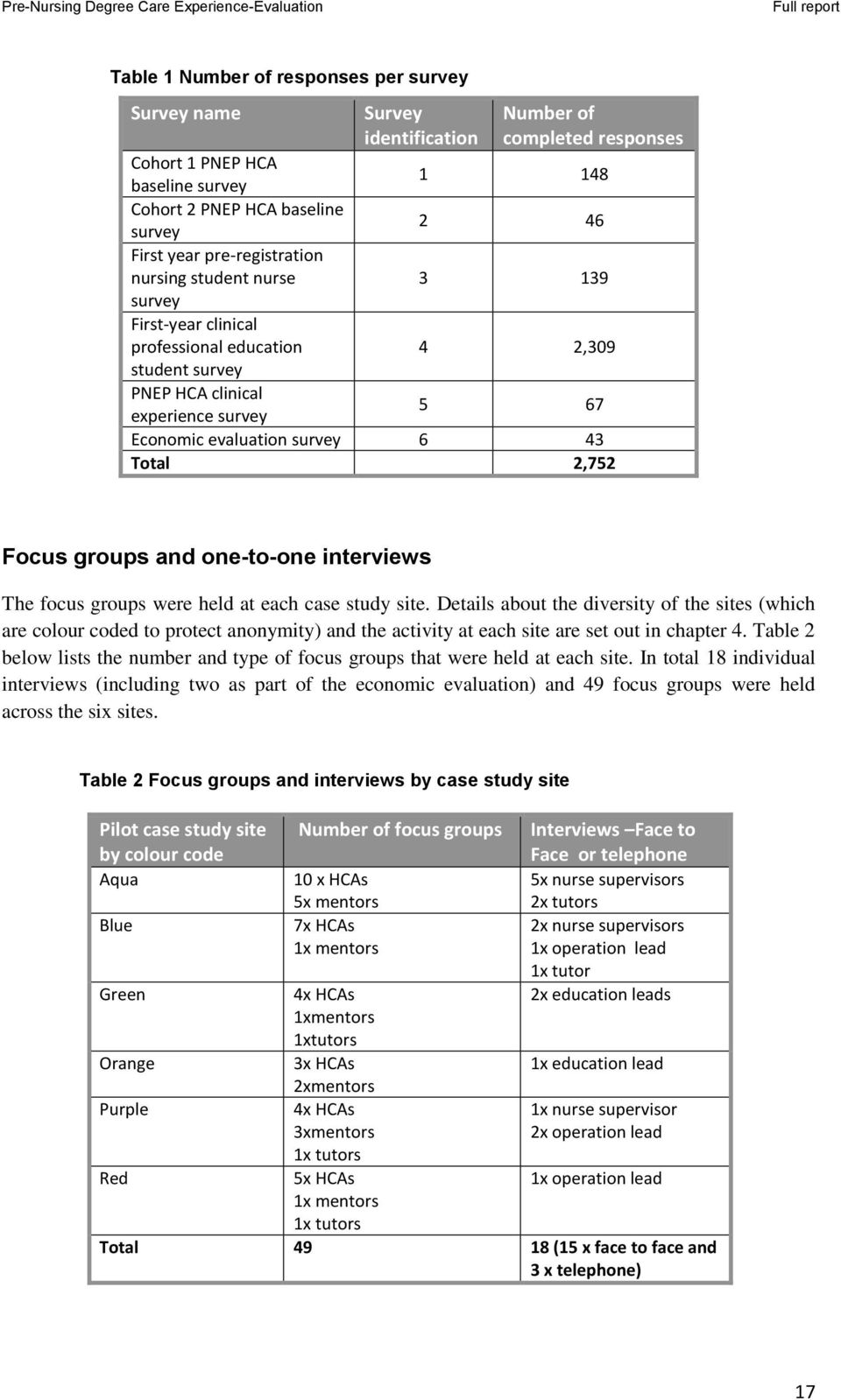
16 1. Background 2. Clinical setting and shift pattern 3. Introduction to the clinical area 4. Support in your first clinical area 5. Clinical activity 6. Training programme 7. Support from the university 8. Additional comments Distribution of the surveys and number of responses Baseline 1 survey was designed in partnership with the evaluation group. The survey was piloted with a sample of HCA students studying a Foundation Degree. It was tested for clarity of questions and time to complete. The feedback from this exercise informed the final survey. All PNEP HCAs in Cohorts 1 and 2 were issued with a number by a representative from HEE. This detail was not disclosed to the evaluation team. Any follow up requests for more respondents was undertaken by HEE. Each PNEP HCA was personally invited by to complete the surveys. Cohort 1 was invited to complete surveys 1 and 5; Cohort 2 to complete survey 2. With regards to survey 3 the Deans or Heads of School of the HEIs that were partners in the study were invited by the pilot site operation leads to distribute the survey to a sample of first year preregistration nurses who were studying at their university. They were asked to identify a sample that was similar in size to number of PNEP HCAs at their study site. These samples were issued with the survey login details and asked to complete within in a fixed timeframe. The development of survey 5 came part way through the pilot study. The evaluation sub-group decided that it would be of value to the study if the questions from survey 1,that related specifically to care and work experience prior to entering pre-registration clinical professional education and training, were collated into a limited survey and distributed to a wider clinical professional education sample. The aim of this survey was to capture an overview of the amount of care and work experience that clinical professional education students have prior to entering their course of study. This proposal was supported by the Steering Group. The next stage was to ask the Council of Deans of Health (CoDH) if their network could be invited to distribute this survey. The Council very kindly agreed and the survey was launched through the CoDH Bulletin. Survey 6 was developed specifically to collect data to inform the economic evaluation. This survey was developed with the support of the Economic Evaluation Sub-group It aimed to gather data that was either not available directly from HEE or for which greater details was required. For example, the cost of individual recruitment approaches. The number of completed responses by survey is shown in table 1. 16

17 Table 1 Number of responses per survey Survey name Survey identification Number of completed responses Cohort 1 PNEP HCA baseline survey Cohort 2 PNEP HCA baseline survey 2 46 First year pre-registration nursing student nurse survey First-year clinical professional education 4 2,309 student survey PNEP HCA clinical experience survey 5 67 Economic evaluation survey 6 43 Total 2,752 Focus groups and one-to-one interviews The focus groups were held at each case study site. Details about the diversity of the sites (which are colour coded to protect anonymity) and the activity at each site are set out in chapter 4. Table 2 below lists the number and type of focus groups that were held at each site. In total 18 individual interviews (including two as part of the economic evaluation) and 49 focus groups were held across the six sites. Table 2 Focus groups and interviews by case study site Pilot case study site by colour code Aqua Blue Green Orange Purple Red Number of focus groups 10 x HCAs 5x mentors 7x HCAs 1x mentors 4x HCAs 1xmentors 1xtutors 3x HCAs 2xmentors 4x HCAs 3xmentors 1x tutors 5x HCAs 1x mentors 1x tutors Interviews Face to Face or telephone 5x nurse supervisors 2x tutors 2x nurse supervisors 1x operation lead 1x tutor 2x education leads 1x education lead 1x nurse supervisor 2x operation lead 1x operation lead Total (15 x face to face and 3 x telephone) 17
18 Six months into the pilot a national event was held to share the participants experience of the Pre- Nursing Degree Care Experience between the six case study sites. This event generated a small amount of qualitative data from table discussions and presentations. Data analysis The quantitative data from the five surveys were carefully reviewed, cleansed and checked. The qualitative data from the survey responses were collated electronically and analysed thematically. The qualitative data from the focus groups and semi-structured interviews were tape recorded and transcribed long hand. The data from the transcripts were analysed thematically. The main findings are set out in chapter 5. 18

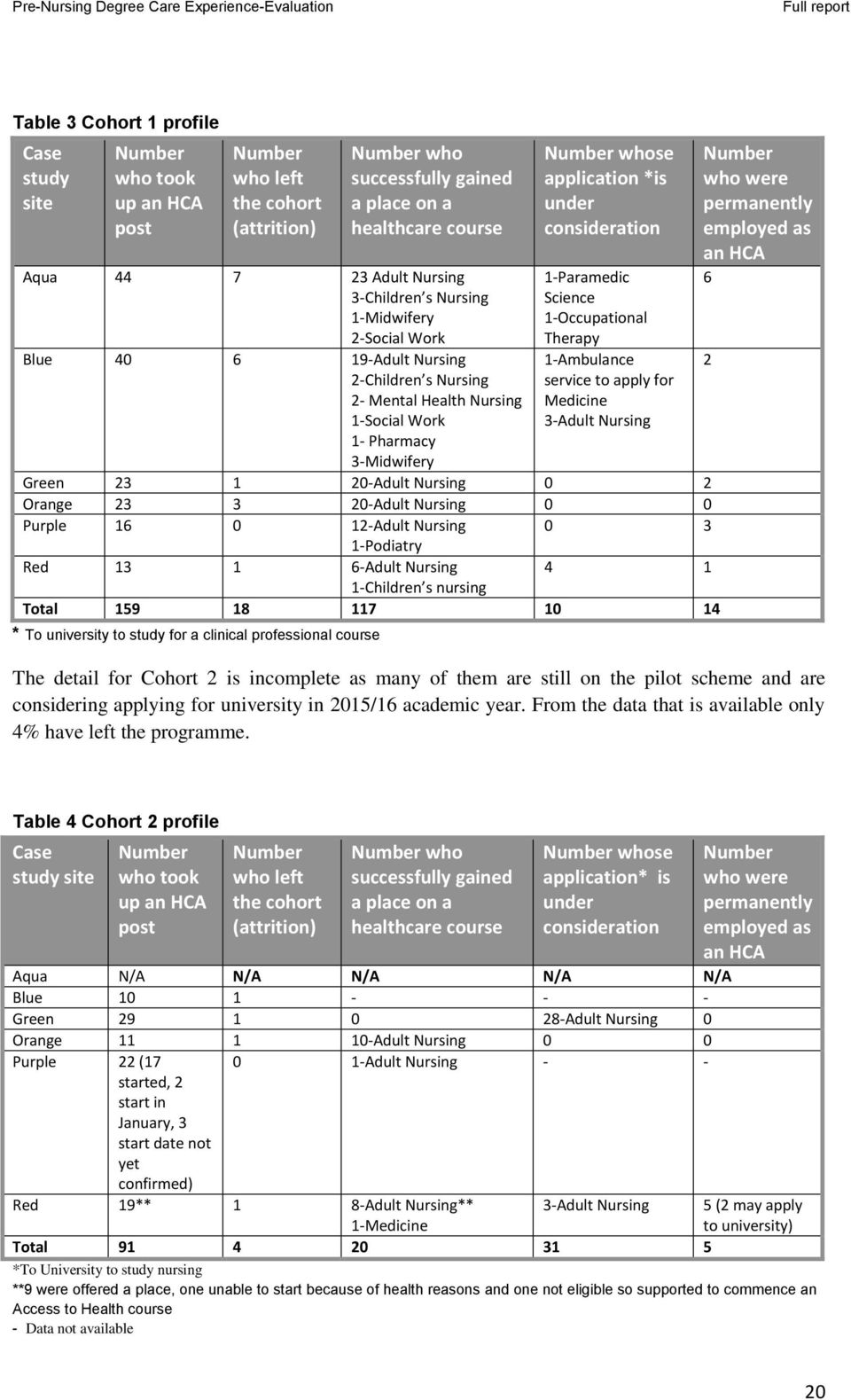
19 4.0 CASE STUDY SITES AND PNEP HCA COHORTS This chapter sets out an overview, by anonymised colour coding, of each of the six case study sites in England. Figure 3 Location of case study service providers 250 PNEP HCAs were recruited to the two cohorts employed by case study service providers (figure 3). Cohort 1 students were recruited at all six case study sites, Cohort 2 recruited at five of these six sites. At the beginning of the chapter is a summary of the number of PNEP HCAs recruited to these cohorts, the attrition and destination (table 3 and 4). 74% of Cohort 1 secured a place at university to study a clinical professional healthcare course. 11% left the pilot and the healthcare service, 9% stayed in post as HCAs the remainder are still applying for a place at university and have remained in post as an HCA until they successfully secure a place at university. 19

20 Table 3 Cohort 1 profile Case study site Number who took up an HCA post Number who left the cohort (attrition) Number who successfully gained a place on a healthcare course Aqua Adult Nursing 3-Children s Nursing 1-Midwifery 2-Social Work Blue Adult Nursing 2-Children s Nursing 2- Mental Health Nursing 1-Social Work 1- Pharmacy 3-Midwifery Number whose application *is under consideration 1-Paramedic Science 1-Occupational Therapy 1-Ambulance service to apply for Medicine 3-Adult Nursing Green Adult Nursing 0 2 Orange Adult Nursing 0 0 Purple Adult Nursing Podiatry Red Adult Nursing Children s nursing Total * To university to study for a clinical professional course Number who were permanently employed as an HCA The detail for Cohort 2 is incomplete as many of them are still on the pilot scheme and are considering applying for university in 2015/16 academic year. From the data that is available only 4% have left the programme. 6 2 Table 4 Cohort 2 profile Case study site Number who took up an HCA post Number who left the cohort (attrition) Number who successfully gained a place on a healthcare course Number whose application* is under consideration Number who were permanently employed as an HCA Aqua N/A N/A N/A N/A N/A Blue Green Adult Nursing 0 Orange Adult Nursing 0 0 Purple 22 ( Adult Nursing - - started, 2 start in January, 3 start date not yet confirmed) Red 19** 1 8-Adult Nursing** 1-Medicine 3-Adult Nursing 5 (2 may apply to university) Total *To University to study nursing **9 were offered a place, one unable to start because of health reasons and one not eligible so supported to commence an Access to Health course - Data not available 20
21 The information about each case study site is presented alphabetically by colour and recorded under the following headings: Overview of clinical sites Education providers Advertising, recruitment and selection model Induction and supervision model HCA development programme University support HCA attrition HCA progression The detail is shown by colour coding in the following pages (22-45). 21
22 Aqua case study site Overview of Aqua Service Provider (ASP) sites ASP1: NHS Foundation Trust with one Hospital and six community outpatient services. The hospital serves a population of around 275,000. It provides a wide range of services including A&E. ASP2: NHS Foundation Trust with two hospitals: one large internationally known teaching hospital providing a wide range of emergency, surgical and medical services for the local population and a centre of excellence for specialist services dealing with rare or complex conditions; one specialist 120 bedded hospital. ASP3: A medium sized NHS Foundation Trust providing acute services for a population of around 230,000. ASP4: A medium sized NHS Trust serving a population of around 370,000. It provides a wide range of emergency, surgical and medical services. ASP5: A medium sized NHS Foundation Trust serving a population of around 330,000. It provides a comprehensive range of specialist, acute, obstetrics and community-based services, including A&E ASP6: An NHS Foundation Trust providing acute hospital care for a tertiary catchment area of around 850,000 people. The Trust has two hospitals: one large 1,000 bedded teaching hospital providing a wide range of emergency, surgical and medical services; and a small local hospital providing a wide range of consultant-led outpatient services, day case operations and a Minor Injuries Unit. ASP7: Community Health and Care Trust with seven community hospitals. The Trust provides personalised health and care services across the age spectrum from the new born to those who are in need of end of life support. 22
23 Aqua site Higher Education Institutions (AHEI) AHEI1: Faculty of Health, Social Care and Education with over 10,000 students. The nursing portfolio includes three fields of nursing (adult, child and mental health). Students can elect to study nursing from one of its two main campus sites. AHEI2: School of Health Sciences offers the four fields of nursing (adult, child, mental health and learning disabilities). AHEI3: Faculty of Health and Science that includes a department of nursing studies that offers all four fields of nursing. Aqua site Further Education Colleges (AFEC) AFEC1: A rural further education college offering apprenticeships and extended diplomas in health and social care. AFEC2: A city college offering diplomas and foundation degrees in health and social care. Advertising model Cohort 1 The approach to advertising the pilot project was locally determined and dependent on whether Human Resources would allow an advertisement to be placed outside the Trust. Two Trusts placed advertisements in their local newspapers in addition to NHS jobs. The partner universities sent a letter, about the scheme, to all those who had been unsuccessful in their application for pre-registration nursing for the September 2013 intake because of lack of relevant care experience. Recruitment and selection model Applicants were assessed using numeracy and literacy tests Interview teams consisted of the project lead for each area as they were already in roles that included recruitment of HCAs; a Human Resources assistant and an education lead for the trust. Proposed number of HCAs recruited to pilot project: 42 Actual number recruited: 44 to vacant HCA posts 23
24 Previous care experience: 30 with no previous care experience 2 with paid care experience 2 with paid and unpaid care experience 7 with unpaid care experience 3 no response Trust induction model The induction models were very similar and normally lasted one week Trust supervision model The supervision models were very trust specific and included: More than one mentor- a sister, a nurse and two HCAs Excellent mentor who is an experienced nurse Assistant Practitioner HCA who is training to be an Assistant Practitioner (AP) Mentor who is always on a different shift The participant asked to pick a buddy No-one in particular especially at the beginning of the clinical experience Pilot HCA development programme The following development opportunities were provided: 1. The LETB organised for the Professional Education Facilitators at the three locations within the case study site to run ½ day workshops for the PNEP HCAs. The purpose of the workshop was to promote the NHS Values and Beliefs and the 6Cs from the Culture of Compassionate Care. 2. Apprenticeship Level 2 Health and Social Care programme. 3. Three day Sustain STEPS to Excellence course, commissioned by the LETB for the PNEP HCAs. This course helps the individual to develop greater motivation and self-belief to enable them to tackle the challenges facing their profession. It helps them build the confidence to deal with change and reach their full potential and a better understanding of the impact of their behaviour. In addition some Trusts required the participants to undertake the local HCA competency development programme. University application support This varied between the three universities. One university invited the HCAs to attend information days and supported them through the application process. One invited them to an open day and one did not contact them at all. 24
25 ½ day workshops provided by the 3 HEIs and the LETB to discuss applications, personal statements, course content. Attrition from the pilot Cohort 1 7 left during the pilot programme and left healthcare altogether Progression Progression to first year of a degree in adult nursing: 21 in September in Spring 2015 Progression to first year of another healthcare degree: 2 to children s nursing in September to midwifery in September to social work in September 2014 Employed as an HCA: 3 Other: 1 applying to study paramedic science 1 applying to study occupational therapy 25
26 Blue case study site Overview of Blue Service Provider (BSP) sites BSP1: The largest NHS trust in England with six hospitals serving 2.5 million people. One of the hospitals is a major trauma centre; three hospitals provide a comprehensive range of services, one is a specialist chest hospital and one is a small hospital providing services such as ophthalmology and rheumatology. BSP2: One of the largest acute hospital trusts in England serving a population of approximately 700,000. Two main hospitals both with A&E departments. It also has a cancer centre, regional neuroscience centre and a Hyper Acute Stroke unit. BSP3: Mental Health Foundation Trust with two inpatient facilities, one a separate site and the other within a hospital setting. In addition there are a number of community based services. BSP4: Large Foundation Trust with 3 hospitals: one is a major teaching hospital with expertise in transplant surgery; two hospitals have A&E departments and urgent care departments and the third is being redeveloped. BSP5: One of the largest NHS Trusts in the UK with one acute hospital and six specialist hospitals. The acute hospital services include: A&E, Hyper-Acute Stroke Unit and cancer care. The specialist hospitals are some of the leading centres in the world caring for patients with neurological and neurosurgical conditions, cardiac problems, dental problems and conditions that affect the ear, nose and throat. BSP6: This is a hospital that specialises in psychiatry and geriatrics and has no A&E. BSP7: Integrated care organisation with one hospital and community services Blue site Higher Education Institution (BHEI) BHEI1: Research led School of Health Sciences including undergraduate courses in nursing and midwifery. BHEI2: Industry facing School of Health and Social Care educating and training one of the highest number of pre-registration nursing students in all four fields of nursing. BHEI3: School of Health and Education currently educates and trains over 400 preregistration nursing and midwifery students. 26
27 Advertising model Cohort 1 The pilot was advertised in the local news media and one of the universitities contacted those who had been unsuccessful at interview because of lack of clinical experience. Cohort 2 The pilot was advertised in the local press and via the local Further Education Colleges Recruitment and selection model for cohort 1 and 2 Candidates were required to demonstrate they could meet the university entry requirements. They were assessed via the deanery assessment centre. Applicants assessed using the following: Cohort 1 and 2 Assessed for numeracy and literacy. Interview team: Applicants to the HCAs posts were interviewed by one clinical representative and one HEI representative. Profile of HCAs recruited Cohort 1 Proposed number of HCAs recruited to pilot project: 42 Actual number recruited: 40 to vacant HCA posts. Previous care experience: 23 with no previous care experience 2 with paid care experience 4 with paid and unpaid care experience 12 with unpaid care experience 27
28 Cohort 2 Proposed number of HCAs recruited to pilot project: 15 Actual number recruited: 13 to vacant HCA posts, however, only 10 commenced on the pilot Previous care experience: 3 with no previous care experience 0 with paid care experience 0 with paid and unpaid care experience 1 with unpaid care experience 6 no response Induction models both cohorts LETB facilitated centralised induction for the pilot HCAs to supplement local trust induction. This model exceeded the Skills for Health/Skills for Care minimum standards. Personal development plans to develop participants capability to be a compassionate, effective and safe undergraduate nurse. Pilot HCA development programme HCAs issued with personal development plans to help develop their capability to be compassionate, effective and safe undergraduate nurses. HCAs Assessed for values and behaviours against the 6Cs 9. All participants received dementia awareness training. They were supported with numeracy and literacy. University application support Cohorts 1 and 2 In preparation for these HCAs being undergraduate nurses or other clinical professionals universities provided mentor training, mentor support and quality assurance around sign-off of competence for those supporting them in the clinical setting. Day visits to universities to orientate the HCAs to the professional and academic world of nursing to increase their motivation and focus. Subject to satisfactory performance and conduct, the HCAs were guaranteed an interview for 2014 entry. 28
29 Attrition from the pilot Cohort 1 6 left the pilot scheme Cohort 2 1 had left the pilot scheme at the time the data was provided Progression Cohort 1 Progression to first year of a degree in adult nursing: 17 in September 2014 Progression to first year of a post-graduate diploma in adult nursing: 2 in September 2014 Progression to first year of a degree in children s nursing: 2 in September 2014 Progression to first year of a degree in mental health nursing: 1 in September 2014 Progression to first year of a post-graduate diploma in mental health nursing: 1 in September 2014 Progression to first year of another healthcare degree: 1 pharmacy September midwifery September Social Work Number employed as an HCA: 2 Other 1 joined the ambulance service with a view to applying for medicine in September are applying to study adult nursing at a later date. 29
30 Green case study site Overview of Green Service provider (GSP) sites GSP1: NHS Foundation Trust serving a population of around 375,000. One hospital providing full range of acute services including A&E and specialist Children s services. GSP2: NHS Foundation Trust serving a population of around 330,000. Essentially a medium sized district general hospital providing a wide range of services including A&E. GSP3: NHS Hospital Trust providing general services including A&E for a population of around 380,000. It also provides specialist hyper-acute, vascular and renal services to a larger population of around and hosts a regional cancer centre. In addition it provides services at a local community mental health hospital. GSP4: NHS Foundation Trust serving over 600,000 people. Two hospitals, one is an acute hospital incorporating a specialist children s hospital and the other is a community hospital. Green site Higher Education Institutions (GHEI) GHEI1: College of Health and Social Care which specialises in adult nursing. GHEI2: School of Health offers the four fields of nursing and a wide range of other undergraduate healthcare professional education and training programmes. Advertising model Cohort 1 Not applicable as potential candidates had already applied to one or other of the HEIs. Cohort 2 Two different models were used: a) Open days b) Potential applicants who had left school and applied to an HEI to study adult nursing in September 2015 were advised of this pilot. 30
31 Recruitment and selection model HCAs were recruited from a pool of people who had applied to the HEIs for a place on the pre-registration adult nursing September 2013 intake and although they but had demonstrated the potential to be nurses they had been unsuccessful in their application to the course. This pool of potential candidates was contacted by a representative from one or other of the HEIs who advised them of the opportunity to join the pilot project. They were promised that on successful completion of the Pre-Nursing Degree Care Experience pilot they would be guaranteed a place on the March 2014 pre-registration adult nursing programme. The candidates had already been assessed in line with the HEI s values based recruitment process. This had included numeracy and literacy tests. One of the service providers also conducted an additional interview prior to a formal offer of a place being agreed. Interview teams: One clinical representative and one HEI representative. Actual number recruited: 23 Previous care experience: 3 with no previous care experience 9 with paid care experience 8 with paid and unpaid care experience 2 with unpaid care experience 1 no response Cohort 2 Through NHS jobs the advert incorporated both the requirements of the organisation and the university requirements to under the BSc in Nursing. Applicants assessed using the following: Interview teams: One clinical representative and one HEI representative. 31
32 Actual number recruited: 29 Previous care experience: 13 with no previous care experience 0 with paid care experience 0 with paid and unpaid care experience 3 with unpaid care experience 13 no response Trust induction models both cohorts Existing trust specific induction and HCA programmes were used. A LETB framework was developed to enable transfer of statutory and mandatory training between trusts and university (avoiding repetition). Trust supervision models both cohorts The individuals were supported in the clinical area by a ward Buddy. This buddy was either an experienced HCA or an AP. It was the responsibility of the buddy to assist the PNEP HCAs in the day to day activities. In addition to this they had a supervisor allocated them, this was usually the ward sister/charge nurse; they provided day to day management. An educator oversaw the process from recruitment to supporting the buddy and supervisor and completing the work based competencies. The educator also provided all of training for the cohorts. Pilot HCA development programme HCAs attended group peer support sessions, they completed learning diaries and reflected on their clinical experience. They were formally assessed for their care, values and behaviours linked to the 6Cs 10. All the HCAs were asked to write a short piece on the pathway for patients suffering from dementia that were treated in the area where they were working clinically. 32
33 University application support University acclimatisation days included in the induction programme. E-portfolio developed to be continued into pre-registration adult nursing education. Attrition from the pilot Cohort 1: 1 Cohort 2: 1 Progression Cohort 1 Progression to first year of a degree in adult nursing: 18 in March September 2014 (stayed in HCA post until started at the HEI) Cohort 2 All 28 applying for pre-registration adult nursing for March
34 Orange case study site Overview of Orange Service Provider (OSP) sites OSP1: Large NHS Foundation Trust which provides direct clinical services to 800,000 patients every year serving a local, regional, national and international population. It provides a wide range of emergency, surgical and medical services for the local population and hosts centres of excellence for specialist services. Orange site Higher Education Institution (OHEI) OHEI1: Faculty of Health Education and Life Sciences offers all fours fields of nursing (adult, child, mental health and learning disabilities). Advertising model Cohort 1 Advertised through local media including radio. Initially directed to the university to check qualifications. Cohort 2 Advertised on the radio but the timing was wrong as many people waiting for academic results. Recruitment and selection model Cohort 1 If eligible the candidates were given a unique reference number to apply through NHS jobs. Over 1000 initial enquiries, 300 accessed NHS jobs and 106 applied who were shortlisted to were interviewed. Of these 32 those who were not successful in securing one of the pre-nursing degree care pilot HCA posts were appointed to vacant HCA posts. Cohort 2 Jointly interviewed by one member of the clinical staff and one member of the HEI staff. The focus was on both suitability to work as an HCA in the Trust and eligibility to gain access to university. This approach aimed to minimise the number of application, recruitment and selection rounds if the HCA successfully completes the period of care. 34
35 Applicants assessed using the following: Cohort 1 and 2 Numeracy and literacy Profile of HCAs recruited Cohort 1 Proposed number of HCAs recruited to pilot project: 20 Actual number recruited: 23 to vacant HCA posts Previous care experience: Cohort 2 9 with no previous care experience 3 with paid care experience 1 with paid and unpaid care experience 6 with unpaid care experience 4 no response Proposed number of HCAs recruited to pilot project: 20 Actual number recruited: 11 Previous care experience: 3 with no previous care experience 2 with paid care experience 1with paid and unpaid care experience 1 with unpaid care experience 4 no response Induction models cohort 1 and 2 Trust and specific HCA induction programme. A seven month programme with one study day a month. Each study day covers a different aspect of auxiliary nursing: mental health; last offices; dehydration; tissue viability; bereavement care; phlebotomy; ECGs etc. Every aspect of nursing care that all auxiliaries undertake is covered. The ward mentors are qualified nurses. Trust supervision models both cohorts Each HCA was allocated a clinical education support worker and a ward based mentor who reviewed their progress every three months. 35
36 Pilot HCA development programme both cohorts Trust competency based HCA development programme. University application support to both cohorts All HCAs were given university associate membership to allow them access to the university facilities. They were supported with writing personal statements and interview technique. Attrition from the pilot Cohort 1: 3 two stayed in healthcare Cohort 2: 1 Progression Cohort 1 Progression to first year of a degree in adult nursing: 1 Spring 2014 Cohort 2 12 September January offered a place for January 2015 on the partner university pre-registration degree course in adult nursing. 36
37 Purple case study site Overview of Purple Service Provider (PSP) sites PSP1: Large NHS Foundation Trust with two acute hospitals and a number of community hospitals. The main hospital is one of Europe s most modern with a wide range of district general hospital services and specialist services including neurosciences, major trauma, spinal injuries and cancer services. PSP2: NHS Foundation Trust with one main hospital, a day hospital and a number of community services. The main hospital is a relatively small offering a range of district general hospital services. PSP3: NHS Foundation Trust providing acute hospital services and a wide range of community health services. The 400 bedded hospital provides a full range of general secondary care services including an A&E. There are a number of community hospitals which this Trust runs in partnership with a neighbouring Foundation Trust. These facilities include minor injury units, general medicine, general surgery and a number of other local services. This large Foundation Trust runs a number of primary care centres which offer minor injury services, rehabilitation services and other local services. PSP4: NHS Foundation Trust providing acute services from two main hospitals: one large 1000 bedded hospital providing a wide range of emergency, surgical and medical services for the local population and one specialist hospital. PSP5: Large NHS Mental Health Foundation Trust serving a population of 1.4 million people. The Trust works from over 60 sites offering a number of regional and specialist services. PSP6: Large Foundation Trust that provides health and social care services to half a million people. Hospital services are provided from three modern general hospitals as well as community hospitals. The Trust also cares for people in their homes and provides services in local communities such as health centres. In addition the Trust manages adult social care services on behalf of the local County Council to ensure continuity of care. Purple site Higher Education Institutions (PHEI) PHEI1: Faculty of Health and Life Sciences offers the fours fields of nursing (adult, child, mental health and learning disabilities). PHEI2: School of Health and Social Care offers the fours fields of nursing (adult, child, mental health and learning disabilities). 37
38 Advertising model Cohort 1 Advertised through the local media and from existing support staff 280 applications received Cohort 2 Recruitment and selection model Cohort 1 The approach to recruitment and selection was determined by the employers. Staff from one of the university sites were involved in the interview selection process. There were three different models of recruitment and selection: 1. A practice placement facilitator and a university lecturer shortlisted those who met the academic requirement and demonstrated knowledge about the post and the opportunity it afforded. 2. A representative from a Trust shortlisted the educational qualifications and arranged a pre-interview test. 3. A Trust approached recently recruited HCAs who had not yet started work and who met the criteria and sought expressions of interest to join the pilot. Proposed number of HCAs recruited to pilot project: 20 Actual number recruited: 16 supernumerary Previous care experience: 8 with no previous care experience 1 with paid care experience 0 with paid and unpaid care experience 3 with unpaid care experience 5 no response Cohort 2 Three healthcare providers were partners for Cohort 2 and each took a different approach to recruiting and selecting the PNEP HCAs. One gave this opportunity to existing HCAs all of whom had a Foundation Degree and had been developed through their trust HCA development programme. The other two providers recruited specifically to the pilot scheme although one of these took in people who had been interviewed for Cohort 1 places and had been unsuccessful, many of whom the trust had chosen to employ into vacant HCA posts. 38
39 Proposed number of HCAs recruited to pilot project: 22 Actual number recruited: 22 Previous care experience: 0 with no previous care experience 4 with paid care experience 1 with paid and unpaid care experience 1 with unpaid care experience 16 no response Trust induction model Participants followed the Trust induction programme followed by the Trust HCA development programme, which included the requirements of the HCA post holder, their rights and responsibilities. Trust supervision model The PNEP HCAs were supported by a buddy and a mentor and had monthly meetings with their Trust PNE mentor. Pilot HCA development programme The PNEP HCA development programme included: A/ They developed relevant competencies in line with other Trust employed HCAs. They attended communication and compassion workshops run by the Trust. HCAs had an appointed trained mentor/assessor who agreed with them and their manager an individual development plan. B/ Progression, performance and attendance was regularly reviewed. Feedback on performance included reference to demonstration of the core values of the NHS Constitution, and organisational values and behaviours. University application support The HCAs were supported by the LETB to develop their CV, personal statements and interview skills through a series of structured training sessions, and with their application through UCAS to the university of their choice. They were also helped with presentation skills. Two of the partner universities also supported the students to develop their CV and prepare their UCAS applications. 39
40 Attrition from the pilot Cohort 1: 0 There was 1 PNEP HCA who left Cohort 1 at the start but was immediately replaced so the net attrition was 0 Progression Progression to first year of a degree in adult nursing: 1 in March in September in March 2015 Progression to first year of another healthcare degree: September to podiatry in Employed as an HCA: 3 Cohort 2 There has been no attrition Progression Progression to first year of a degree in adult nursing: 1 in September 2014 The remainder are still employed as HCAs on Cohort 2 of the pilot scheme. 40
41 Red case study site Overview of Red Service Provider (RSP) sites RSP1: A large NHS Foundation Trust serving a population of approximately 450,000 people. The Trust comprises a large busy acute hospital, two smaller community hospitals, three elderly rehabilitation hospitals and two specialist centres. RSP2: Specialist Heart and Chest Foundation Trust providing cardiothoracic, cardiology and respiratory medicine services. RSP3: Large acute NHS Trust with 750 beds and the largest A&E department in the country. It provides a number of acute services, regional specialist services and national cancer services RSP4: NHS Trust with two hospitals and a number of community clinics serving a local population of around 250,000 people. One hospital provides a range of district general hospital services including adult A&E and the other provides women s and children s services including maternity and a children s A&E. RSP5: NHS Foundation Trust of one hospital serving a local population of 250,000 people. It provides a range of district general hospital services including general and specialist medicine, general and specialist surgery and a full consultant led service for women and children. RSP6: NHS Foundation Trust of one major teaching hospital providing general services for the local population. As well as the general services it provides a number of specialist services most notably cancer and cardiac services. RSP7: An NHS Foundation Trust with two main hospitals: one a leading district general hospital focussing on emergency and urgent care and the other a centre of excellence for surgery and planned care. RSP8: NHS Foundation Trust with two hospital sites providing a full range of district general hospital services. RSP9: NHS trust serving a local population of 550,000 people. The Trust is comprised of two general hospitals, both providing a full range of hospital services and three community hospitals. One of the community hospitals provides in-patient rehabilitation services the other two provide out-patient and diagnostic services. 41
42 Red site Higher Education Institutions (RHEI) RHEI1: School of nursing and allied health offers three fields of nursing (adult, child, mental health). RHEI2: Faculty of Health and Social Care offers all fours fields of nursing (adult, child, mental health and learning disabilities) and two combined honours courses. RHEI3: Faculty of Health and Social Care offers all fours fields of nursing (adult, child, mental health and learning disabilities). RHEI4: School of Health offers three fields of nursing (adult, child, mental health). RHEI5: The School of Nursing, Midwifery, Social Work and Social Sciences within the College of Health and Social Care, offers three fields of nursing (adult, child, mental health). Advertising model Cohort 1 and Cohort 2 Open advertisement; advertised through local media. Also advertised on NHS jobs via the partner trusts Recruitment and selection model. A standardised job description and person specification were provided to those trusts who were interested in recruiting to Cohort 2. All recruitment was undertaken by the trust in partnership with their partner university and only candidates who were eligible to progress onto a degree programme were interviewed. Cohort 1 LETB managed recruitment. A centralised process was used through NHS jobs with shortlisting undertaken by the LETB who brought together a team which included senior managers and student quality ambassadors. Applicants were scored against their qualifications. Interview team: A Practice Education Facilitator, a member of staff from the university, and a member of staff from Skills for Health Academy and a student (minimum of four people on the panel). 42
43 Applicants assessed using the following stages: 1. Situational scenario 2. Third party observation 3. The recruitment centre tested for values, numeracy and desire and aptitude for nursing. 4. The recruitment centre sought to replicate University recruitment processes to help prepare all candidates for nurse application. Candidates who scored above 58 were deemed suitable to enter programmes. Out of 180 applicants, 66 were shortlisted. Proposed number of HCAs recruited to pilot project: 33 Actual number recruited: 16 to vacant HCA posts. 13 started as PNEP HCAs. Previous care experience: 9 with no previous care experience 1 with paid care experience 1 with paid and unpaid care experience 2 with unpaid care experience Cohort 2 Proposed number of HCAs recruited to pilot project: 36 Actual number recruited: 19 to vacant HCA posts Previous care experience: 6 with no previous care experience 1 with paid care experience 2 with paid and unpaid care experience 3 with unpaid care experience 7 no response Trust induction models both cohorts Cohort 1 Data not available Cohort 2 Mixed: Trust induction only Trust induction + HCA induction Two week supernumerary 43
44 Trust supervision models both cohorts Cohort 1 Data not available Cohort 2 Mixed: Trust supervisor with no ward buddy or supervision Trust supervisor and ward supervision Pilot HCA development programme No formal pilot HCA development programme University application support Cohorts 1 and 2 HCAs should be supported in their application for university through identified education needs e.g. support in numeracy, literacy and study skills and, if possible guaranteed an interview at the partnering university(ies) subject to them meeting the normal university criteria for selection to interview. Attrition from the pilot Cohort 1: 1 Cohort 2: 1 Progression Cohort 1 Progression to first year of a degree in adult nursing: 3 in September in March 2015 continue as HCA until then 1 in September 2015 Progression to first year of another healthcare degree: 1 children s nursing September 2014 Employed as an HCA: 1 Other: 4 stayed as HCAs while applying for pre-registration nursing in commenced an access to Health course in September
45 Cohort 2 Progression to first year of a degree in nursing course: 2 started in March started in September to start in March 2015 (one staying as HCA until entering university) 1 secured a place on a September 2015 intake meanwhile employed as an HCA Progression to first year of another healthcare degree course: 1 to medicine in September 2015 Employed as HCA: 5 (2 may apply to university later) Other: 1 applying for pre-registration nursing in March applying for pre-registration nursing to start in September commenced an Access to Health course in September deferred taking up a place on a pre-registration adult nursing course. 45
46 5.0 MAIN FINDINGS 5.1 Introduction In this chapter the detailed findings from all the evaluation data sources are presented in the following sections: 5.2 Cohort 1 Pre-degree Nursing Experience Pilot Healthcare Assistants 5.3 Cohort 2 Pre-degree Nursing Experience Pilot Healthcare Assistants 5.4 First year pre-registration student nurses 5.5 First year clinical professional education student s 5.6 Economic evaluation 5.7 PNEP HCAs clinical experience 5.8 Findings from the focus groups and interviews 5.9 The PNEP national event 5.10 Summary of the main findings 5.2 Cohort 1 Pre-degree Nursing Experience Pilot Healthcare Assistants This section details the responses to the baseline survey that the first cohort of PNEP HCAs completed. The findings from the 148 respondents are reported under the following headings: Cohort 1 s views on aspects of caring behaviour Cohort 1 s expectation of the pilot scheme Cohort 1 s previous care experience in a health or social care setting Cohort 1 s family members who are employed in healthcare Cohort 1 s work experience (other than working in a health or social care setting) Cohort 1 s demographic profile Education background-cohort Cohort 1 s approach to dignity 46
47 5.2.1 Cohort 1 s views on aspects of caring behaviour The HCAs were asked to consider what they thought constituted good and unacceptable behaviour for those working in healthcare settings. Good behaviour The HCAs comments about good behaviour have been thematically analysed and presented according to frequency with the most often noted comment listed first. Showing respect A caring attitude Good communication skills including listening Demonstrating compassion Maintaining dignity Working well as part of a team Being polite Displaying empathy Guaranteeing confidentiality Showing kindness Ensuring privacy Being honest Having courage Good practice in a healthcare setting is something that comes when you are doing the job purely because you care. PNEP HCA Seven of the respondents chose to comment on the importance of good behaviour towards friends, families and colleagues. The respondents were also asked to give examples of good practice. One respondent summarised good practice as: Good practice is listening to your patients and responding to their needs promptly. You should always put your patients first and not talk about other things or purely to other staff while providing their care. Staff should make sure the patient is comfortable and happy in their surroundings. PNEP HCA Three of the respondents commented on courage. One of these respondents noted that good practice is when someone is not afraid to stand up and highlight bad practice and correct it. Unacceptable behaviour Similarly The HCAs comments about unacceptable behaviour have been thematically analysed and presented according to frequency with the most often noted comment listed first. Unacceptable practice is being unsympathetic, intolerant and impatient to patients in an often vulnerable position. PNEP HCA 47
48 Being rude Abusive behaviour Disrespectful Negligent Aggressive The respondents were also asked to give examples of unacceptable practice. One respondent summarised unacceptable practice as: Anything that compromises, diminishes, undermines, threatens and infringes on the rights, worth, value and dignity of any individual in their sphere of contact including that of the trust and NHS as a whole e.g -negligence, lack of privacy, impatience, cutting corners, rude. PNEP HCA Cohort 1 s expectation of the pilot scheme The respondents were asked to select up to three statements from the following list about their expectation of undertaking a period of care experience as part of the pilot scheme: It will give me initial experience of working in healthcare. It will enable me to determine whether a career in nursing is really for me. It will enable me to find out more about the work that nurses undertake. It will provide me with valuable experience to become a nurse. It will make it easier for me to get onto a nursing degree programme. Other Between the 148 respondents they ticked 439 statements. The results are illustrated in the figure 5 below. Figure 4 Fob given to a PNEP HCA 48
49 Figure 5 Cohort 1's expectation of undertaking a period of care experience An initial experience of working in healthcare % % 3% % 98 22% 74 17% An opportunity to determine if nursing is the correct career choice Opportunity to find out more about nursing A valuable experience prior to becoming a nurse Help secure a place on a preregistration nursing programme Other The two main expectations from undertaking this care experience was that it would turn out to be a valuable experience prior to becoming a nurse and that it would provide an opportunity to determine whether nursing is the correct career choice. The additional comments that the respondents elected to make included the fact that as their previous care experience had been in a community or social care setting this pilot scheme would give them the opportunity to gain experience in an acute setting and working alongside other professionals. They also commented that they expected it would give them the necessary confidence to be an effective student nurse Cohort 1 s previous care experience in a health or social care setting The guiding principles for developing proposals to be a pilot site included recommendations about recruitment and selection (appendix 1). In addition the steering group discussed the value of recruiting HCAs with no previous care experience. This point was made explicit to the case study sites at a very early stage in the development of the scheme. The guiding principles were subsequently modified to take into account these changes (Box 6). 49
50 Box 6 Addition to guiding principles The potential pool of applicants can include: Those with no substantial paid or unpaid experience of providing care Applicants to university who have been unsuccessful because they have not been able to demonstrate experience, but otherwise meet the selection criteria Existing HCAs identified as suitable nursing degree candidates who need support either in preparation for university, e.g. study skills, or to reach the academic requirements. I specifically didn't want to become a bank HCA after the Francis Report. PNEP HCA The respondents were asked to provide details about their previous care experience prior to taking up a post as an HCA on the Pre-Nursing Degree Care Experience Pilot.The results from this sample are illustrated in figure HCAs answered this question, 82(56%) reported that they had no previous care experience, 18 (12%) previous paid care experience, 32 (22%) previous unpaid care experience and the remaining 15 (10%) reported they had both paid and unpaid previous care experience. Figure 6 Cohort 1-previous care experience 81 56% 18 12% 15 10% 32 22% questions are detailed below and illustrated in figure 7. Previous paid care experience Previous unpaid care experience Previous paid and unpaid care experience No previous care experience The HCAs were also asked to explain the nature of this care experience including whether this took place immediately prior to starting on the pilot scheme or sometime in the past and whether this was undertaken as an employee or as a volunteer in a health or social care setting and whether the care was provided for family, friends or neighbours. The responses to these 50
51 Number of Responses Pre-Nursing Degree Care Experience-Evaluation Previous paid care experience 32 HCAs provided 52 comments about their previous paid care experience (figure 7). The majority (35 comments) stated their paid care experience took place as an employee in a health or social care setting either or both immediately prior to taking up the PNEP HCA post or sometime in the past. Figure 7 Cohort 1- previous paid care experience Immediately prior to family members Immediately prior to friends Immediately prior to neighbours Immediately prior in a health or social care setting In the past to family members In the past to friends In the past to neighbours In the past in a health or social care setting 0 These respondents then went on to provide detail about the number of hours per week and for how long they had provided this care. As shown in figure 8, 40% (13 respondents) worked a traditional week with an even distribution of responses between the other categories. 45% (18) of the respondents noted that they had worked in paid care for less than a year (figure 9), 25% 1-2 years, 20% between three and five years and the remainder five years or more. Figure 8 Cohort 1- number of hours per week spent providing paid care 40 or more hours a week: 5 16% hours a week: 13 40% 1-8 hours a week: 7 22% 9-24 hours a week: 7 22% The care they provided during this period was very varied. For example those who had undertaken paid care experience immediately prior to taking up the HCA post (18 respondents) stated they had gained experience of working in the following care settings: 51

52 Number of Responses Pre-Nursing Degree Care Experience-Evaluation Care home Children s nursery Personal one to one care Day Centre Domiciliary care Only four respondents reported that they had carried out paid work in the past, either by giving essential care to a family member and or working as a nursery assistant. Figure 9 Cohort 1-period of time during which paid care was provided 8 20% 2 5% 2 5% 5 12% 13 33% 1 Week to 5 Months 6 to 11 months 1 to 2 years 3 to 5 years 5 to 10 years 14 of the respondents reported that they had. worked both in the past and more recently. Their experience differed in that 10 25% 10 years + in addition to the typical immediately prior experience some of them had worked for a while in a trust as a support worker. Previous unpaid care experience There were many more comments, from Cohort 1, about unpaid care experience than paid care experience. In total 52 HCAs made 82 comments about their previous unpaid care experience and the comments were much more evenly distributed as shown in figure 10. Much of the unpaid care that Cohort 1 respondents had provided had been delivered in the past, to either family members or in a health or social care setting, rather than immediately prior to starting on the pilot scheme. Figure 10 Cohort 1- previous unpaid care experiences Immediately prior to family members Immediately prior to friends Immediately prior to neighbours Immediately prior in a health or social care setting In the past to family members In the past to friends In the past to neighbours 2 In the past in a health or social care setting 0 52
53 As with paid experience the respondents went on to provide more detail about their unpaid care experience including the number of hours per week (figure 11) and over what period of time they had provided this unpaid care (figure 12). Figure 11 Cohort 1- number of hours per week providing unpaid care hours a week 3 6% 40 or more hours a week 9 18% 9-24hours a week 15 30% 1-8 hours a week 23 46% As shown in figure 11 the majority (46%) provided unpaid care for eight hours a week. In comparison very few noted that they had spent between hours a week providing unpaid care. The highest percentage (26%) of the respondents noted that they had worked in unpaid care for less than six months, 11% months and the rest of the responses were evenly distributed (figure 12). Figure 12 Cohort 1-period of time during which unpaid care was provided 6 12% 8 16% 13 26% 1 Week to 5 Months 6 to 11 months 1 to 2 years 3 to 5 years The respondents repeatedly noted that their unpaid work in a health and social care setting was as a volunteer or as part of course requirements. However, the respondents also recounted that they had provided the unpaid support to family member such as elderly relatives and young children. 5 10% 7 14% 5 to 10 years 11 22% 10 years + 53
54 I was responsible for providing food and drinks for patients in a hospice as well as ensuring they had eaten sufficiently and were comfortable and happy. I also volunteered in a youth club for those with special needs where I assisted with arts and crafts, providing food and helping with trips out. PNEP HCA past unpaid care experience The unpaid activities they have undertaken more recently include: first responder for the local ambulance trust, palliative care for close family member and pastoral support Cohort 1 s family members who are employed in healthcare Just over half (51%) of the sample of Cohort 1 advised they had one or more family members, mostly a mother or a sister, employed in healthcare (figure 13). Figure 13 Cohort 1 Family members employed in healthcare Mother Sister The respondents identified seven other family members: nan, wife, mother-in-law, cousin s wife, dad s cousin, husband and fiancé. The twenty unidentified family members are employed in a wide range of healthcare jobs: doctors (6), nurses (5), HCA (3), podiatrist, chiropractor, pharmacist, paramedic, manager, editor. 20, 19% 7, 7% 4, 4% 12, 11% 12, 11% 27, 25% 24, 23% Aunt Cousin Dad Others Unidentified relatives in healthcare Cohort 1 s work experience (other than working in health or social care setting) 80% of 147 respondents stated that they had been previously employed outside of health and social care settings (figure 14). 54
55 Figure 14 Cohort 1-previous non health and social care employment Transport, Logistics and Distribution Retail and Sales Property and Construction Office, Admin and Clerical Law Insurance Hospitality, Services, Catering and Events Management Education and Childcare Creative Arts and Design Business, Consulting and Management Agriculture and Animal Care Accountancy, Banking and Finance Number of Responses respondents provided information about the type of employed work they had undertaken. Many of the respondents noted that they had worked for more than one type of employer. Retail and hospitality accounted for 62% of the reported previous employment Cohort 1 s demographic profile At the end of the survey the PNEP HCAs were asked to provide standard demographic information to inform the pilot about the profile of the cohort of people who had been successful in securing a place on the scheme. As this data is anonymised it is not possible to attribute this data to any specific site. 90% of the 146 respondents stated their gender as female, 93% stated that English is their first language. The other first languages listed were: Arabic, African languages (Luganda, Somali and Twi), European languages (French, Lithuanian and Spanish) and a Filipino language (Tagalog). They detailed their national identify as English (61%,), British (32%), European (3%) African (2%) and Welsh (1%). The respondents were also asked which ethnic group they belonged to. Out of the 148 who responded to this question 79% (117) categorised themselves as white English/Welsh/Scottish/Northern Irish/British; 7% (10) as Black African; 3% (4) as White and Black Caribbean; 2% (3) as Black Caribbean; 1% (2) White Irish or Indian and less than 1% (1) as White and Black African, Pakistani or Arab. Seven respondents reported they did not fit into the categories listed two described themselves as mixed race; two as Asian; two as European and one as other white background. The majority of those who commented on their religion described themselves as Christian (47%). For the purposes of this survey Christian includes: Church of England, Catholic and all other 55
56 Christian Denominations. Almost as many (43%) noted they did not have a religion. The rest stated they were Muslims, Jews, Hindus or Sikhs, spiritualists or agnostics 1. To complete the demographic profile the age range was captured. 147 respondents advised which age range they were in. 44% were aged 20 years or under, 39% were between 21 and 30 years of age, 11% between 31 and 40 and the remaining 6% between 41 and Education background - Cohort 1 One of the principles of this pilot scheme stated that applicants must meet the academic requirements for entry to a nursing undergraduate programme (appendix 1). Therefore it was decided the survey should also collect educational background information (appendix 4). For a number of respondents from Cohort 1 more than one of the school qualification categories applied. As a result there were a 286 responses from 147 respondents. 65% of the responses indicated that the majority of HCAs had passed traditional school qualifications (187 responses): 2 A-Levels or equivalent (78), 5+ GCSE or equivalent (109). For people considering a career in care vocational and higher educational qualifications from college are as important as traditional school qualifications. Therefore the survey also sought to capture data about any vocational and or higher qualifications that the HCAs hold (appendix 4). 122 respondents provided 134 responses. The majority of responses stated they either hold an NVQ Level 3 or equivalent (35%/43 responses) or no vocational/higher qualification (34%/ 42 responses). In contrast 24 (19%) responses stated that these HCAs hold a degree and the remainder of responses stated the HCAs hold professional qualifications, NVQ Level 4 or equivalent in equal numbers. A few responses related to other qualifications which were not health related or specific health related awards such as a level 2 certificate in Understanding in Dementia Care and a diploma with distinction in Counselling/Psychotherapy Cohort 1 s approach to dignity As mentioned in chapter 3 the PNEP HCAs in Cohort 1 were asked to watch the Royal College of Nursing video Dignity at the Heart of Everything we do 28. This video shows five very different scenarios. Each scenario has a specific question that the HCAs were invited to answer. Set out below are the scenarios, the associated questions and Cohort 1 s responses in order of frequency of response. 1 This data is interesting as many HCAs are involved in End of Life Care and Last Offices. 56
57 Scenario 1 This scenario shows a man dressed in his pyjamas crossing the Millennium Bridge, London in the rush hour. The question asked in relation to this scenario was: How would you feel dressed like this? The main comments that the PNEP HCAs made were: Embarrassed Vulnerable Uncomfortable Self-conscious Being stared at Exposed Singled out and embarrassed like everyone was staring at me and judging, even laughing at me. PNEP HCA Vulnerable as pyjamas are usually worn in the comfort of your own home not in public where people may look at you. PNEP HCA Cohort 1 Scenario 2 This scenario shows a young lady sitting on a toilet in a lift that is ascending. The lift stop and two other people get into the lift. The question asked was: How would you feel if you couldn t be private even when you most needed to be? The main comments that the PNEP HCAs made were: Embarrassed Upset Lack of privacy Frustrated Loss of dignity Angry Exposed Ashamed Uncomfortable Vulnerable Loss of respect 57
58 I would feel nervous and worried in case somebody saw me doing something which should be private, I would be very self-conscious and maybe paranoid that I couldn't do certain things which I should be able to do in private. I would also be quite angry and upset that people were invading my privacy. PNEP HCA Scenario 3 This scenario shows a group of three people sitting in a café. Two of the group are talking and ignoring the third person who vainly attempts to engage their attention. The question asked was: How would you feel if you were ignored? The main comments that the PNEP HCAs made were: Frustrated Angry Upset Annoyed Lonely Worthless Disrespected I would be rather upset but also quite angry at how rude it is for other people to act as though you aren't there or not worth listening to. PNEP HCA I would either feel very lonely or I might feel depressed and hopeless, which would have an impact on my self-esteem and self-worth. PNEP HCA 58
59 Scenario 4 This scenario shows a young girl trying to take a drink with the movements of both her arms severely restricted. The question asked was: How would you feel if you were dependent? The main comments that the PNEP HCAs made were: Frustrate Burden Vulnerable Useless Helpless Embarrassed Loss of independence Very frustrated at my loss of independence and dignity. I might be mentally competent but be judged by others for not being able to physically look after myself. PNEP HCA I would feel like my independence had been completely taken away and that I was no longer myself. Even if patients require assistance with everything, they can still be given some independence by allowing them to hold the cup and you to guide it or similar options. By asking them what they want it gives them a level of control back. PNEP HCA Scenario 5 This scenario shows a male office worker at his computer. He is approached by a lady who squeezes his cheek and waves a teddy bear at him. The question asked was: How would you feel if you were treated like this? The main comments that the PNEP HCAs made were: Patronised Like a child Belittled Angry Annoyed Disrespected Embarrassed Stupid I would feel belittled and patronised like I was being treated like a child and being mocked and made fun of for someone else's entertainment. PNEP HCA 59
60 5.3 Cohort 2 Pre-degree Nursing Experience Pilot Healthcare Assistants This section details the responses to the baseline survey that the second cohort of PNEP HCAs completed. This survey was identical to the survey used for cohort one. The findings from 46 respondents are reported under the following headings: Cohort 2 s views on aspects of caring behaviour Cohort 2 s expectation of the pilot scheme Cohort 2 s previous care experience Cohort 2 s family members who are employed in healthcare Cohort 2 s work experience (other than working in a health or social care setting) Cohort 2 s demographic profile Education background-cohort Cohort 2 s approach to dignity Cohort 2 s views on aspects of caring behaviour As with Cohort 1 (5.2) Cohort 2 PNEP HCAs were asked to consider what they thought constituted good and unacceptable behaviour for those working in healthcare settings. The comments have been thematically analysed and presented according to frequency of comment. The clusters of comments from Cohort 2 are very similar to those from Cohort 1. Good behaviour Showing respect A caring attitude Maintaining dignity Demonstrating compassion Working well as part of a team Being polite Good communication skills Be approachable at all times and work within your limits. Always explain why things are happening and always listen to patients. Treat others as you would like to be treated. PNEP HCA 60
61 Unacceptable behaviour Being rude Breach of Confidentiality Disrespectful Unprofessional conduct Abusive behaviour I think talking to other staff members when you are treating a patient is both disrespectful and unprofessional. PNEP HCA Cohort 2 s expectation of the pilot scheme The respondents were asked to select up to three statements (see section 5.2.2) about their expectation of undertaking a period of care experience as part of the pilot scheme. Between the 46 respondents they ticked 133 statements that applied to them. The results are illustrated in the figure15. Figure 15 Cohort 2- Expectation of undertaking a period of care experience An initial experience of working in healthcare 42 32% 5 4% 4 3% 30 22% An opportunity to determine if nursing is the correct career choice An opportunity to find out more about the work that nurses undertake A valuable experience to become a nurse 20 15% Help secure a place on a preregistration nursing degree programme 32 24% Other The main expectations, for Cohort 2, from undertaking this care experience was that it would turn out to be a valuable experience prior to becoming a nurse, an opportunity to find out more about the work that nurses undertake and an initial experience of working in healthcare. 61

62 Cohort 2 s previous care experience As with Cohort 1 the respondents to Cohort 2 survey were asked to provide details about their previous care experience prior to taking up a post as an HCA on the Pre-Nursing Degree Care Experience Pilot. The results from this sample are illustrated in figure PNEP HCAs from Cohort 2 answered this question, 25 (54%) reported that they had no previous care experience, 9 (20%) had previous paid care experience, 8 (17%) had previous unpaid care experience and the remaining 4 (9%) reported they had both paid and unpaid previous care experience. Figure 16 Cohort 2- previous care experience 25 54% 9 20% 4 9% 8 17% Previous paid care experience Previous unpaid care experience Previous paid and unpaid care experience No previous care experience Previous paid care experience 14 HCAs in Cohort 2 provided 17 comments about their previous paid care experience (figure 17). All except one response stated their previous paid care experience took place as an employee in a health or social care setting either or both immediately prior to taking up the PNEP HCA post, or in the past. Seven respondents advised that during this time they had worked for between hours a week and five that they had worked for 40 or more hours a week. Thirteen respondents commented on the period during which they had provided paid care: twelve had worked in paid care for between one and two years, four between three and ten years and two less than five months. 62
63 Number of Responses Pre-Nursing Degree Care Experience-Evaluation Figure 17 Cohort 2- previous paid care experience Immediately Immediately prior to family prior to friends members Immediately prior to neighbours Immediately prior I worked in a health or social care setting 0 0 In the past to family members In the past to friends In the past to neighbours In the past in a health or social care setting Previous unpaid care experience In total 14 HCAs made 18 comments about their unpaid care experience and there was a wider spread of comments than for paid care experience as shown in figure 18. The respondents reported that their unpaid care experience had been primarily for family members (both immediately prior to taking up the post as a PNEP HCA and in the past) although a few had volunteered in the health or social care setting. As with paid experience the respondents went on to provide more detail about their unpaid care experience including the number of hours per week and for how long they had provided unpaid care. 63
64 Number of Responses Pre-Nursing Degree Care Experience-Evaluation Figure 18 Cohort 2 -previous unpaid care Immediately prior to family members 0 0 Immediately prior to friends Immediately prior to neighbours Immediately prior in a health or social care setting In the past to family members 0 In the past to friends In the past to neighbours In the past in a health or social care setting Nine respondents advised they had spent between 1-8 hours a week providing unpaid care, three between 9-24 hours a week and two providing unpaid care between hours per week. The fourteen respondents commented on the period during which they had provided paid care: five had provided unpaid care for between three and five years, three between six and 11 months and two less than five months. The remaining four respondents had provided unpaid care for five years or more Cohort 2 s family member employed in healthcare Just fewer than half (46 % /21) of the sample of 46 HCAs from cohort 2 advised they had a family member employed in healthcare Cohort 2 s work experience (other than working in a health or social care settings) 76 % of 46 respondents stated that they had previously been employed outside of health and social care settings. 35 respondents provided information about the type of employed work they had undertaken. Many of the respondents noted that they had worked for more than one type of employer (figure 19). Retail and hospitality accounted for 40% of the reported previous employment, office, administration and clerical for 16 % and education and childcare for 10%. 64
65 Figure 19 Cohort 2 -previous non-health and non-social care employment Transport, Logistics and Distribution Scientific Retail and Sales Public Sector Property and Construction Professional Office, Admin and Clerical Leisure, Sport, Travel and Tourism Law IT and Media Insurance HR and Employment Hospitality, Services, Catering and Events Management Engineering, Manufacturing and Production Education and Childcare Customer Service Creative Arts and Design Charity and Voluntary work Business, Consulting and Management Armed Forces, Police and Fire Service Agriculture and Animal Care Advertising, Marketing and PR Accountancy, Banking and Finance Number of Responses Cohort 2 s demographic profile As with Cohort 1, Cohort 2 PNEP HCAs were asked to provide standard demographic information 89% of the 46 respondents stated their gender as female, 100% stated that English is their first language. They detailed their national identify as 72 % English (33) 26 % British (12) and 2% from New Zealand (1). As for Cohort 1 the respondents from Cohort 2 were asked which ethnic group they belonged to. Out of the 46 who responded to this question 91% (42 ) stated they were white English/Welsh/Scottish/Northern Irish/British; the remaining four stated they were White Irish, White and Black Caribbean, Pakistani and a White New Zealander. 63% of the 46 respondents described themselves as Christian. 35% recorded they did not have a religion and one stated they were a Muslims. The profile of the age ranges of Cohort 2 to that of Cohort between years, slightly fewer (12) were aged 20 years or under, equal numbers (8) were aged between 26 and 30 and between years of age. Three reported being between 41 and 50 and one over 50 years of age. 65
66 5.3.7 Education background Cohort 2 As with the responses from Cohort 1 a number of respondents from Cohort 2 ticked that more than one of the school qualification (appendix 5) categories that applied to them resulting in a total of 109 responses between 46 respondents. 57% of the responses indicated that the majority of HCAs had passed traditional school qualifications (62 responses): 2 A-Levels or equivalent (27), 5+GCSE or equivalent (35). 42 respondents from Cohort 2 provided 56 responses about vocational and higher qualifications (appendix 5). As with Cohort 1 the majority of respondents stated they either hold an NVQ Level 3 or equivalent (45%/19 responses). 11 (26%) responses from HCAs reported that they hold a degree and 9 (21%) responses from HCAs stated they do not hold any vocational/higher qualification. From the 8 other awards identified 5 stated they already hold a Foundation Degree in Health and Social Care Cohort 2 s approach to dignity The final section of the survey invited the respondents to comment on the Royal College of Nursing video Dignity at the Heart of Everything we do 28 (see section 5.2.8). Cohort 2 PNEP HCAs responses to the different scenarios are shown below listed by frequency of comment. Scenario 1 Embarrassed Lacking in confidence Self-conscious I would feel out of place and vulnerable. PNEP HCA Unprepared for the day. Unable to walk tall in public. However for long stay and short stay patients pyjamas are sometimes their choice often easier to get on and comfier to wear in the day so its patient preference all the way on that scenario. PNEP HCA 66
67 Scenario 2 Embarrassed Lack of privacy Upset Frustrated Uncomfortable Again I would feel very uncomfortable in this situation, it would be like my privacy had been invaded. I would prefer to be on my own or to be able to lock the door. PNEP HCA Scenario 3 Frustrated Angry Upset Worthless This is why it is important to keep a friendly and open dialogue with the patient and explain why the care they are receiving is needed. It is frustrating to be ignored all the time. PNEP HCA Scenario 4 Frustrated Burden Helpless Embarrassed It would make me feel worthless, especially if I couldn't do the simplest things like picking up a glass. PNEP HCA Scenario 5 Like a child Patronised Angry Confused I would feel that I was being patronised and not being addressed as an adult. I would feel insulted and that the other person had no concept of how to address another adult regardless of who they are. PNEP HCA 67
68 5.4 First year pre-registration student nurses This section details the responses to the survey from a sample of first year pre-registration nursing students, studying adult nursing at case study site HEIs. This survey was designed to mirror the baseline survey completed by the two cohorts of PNEP HCAs and to capture responses from a similar sized sample of first year student nurses. 139 completed the survey and their responses are presented under the following headings: First year student nurses views on aspects of caring behaviour First year student nurses previous care experience First year student nurses family members employed in healthcare First year student nurses work experience (other than working in a health or social care setting) First year student nurse respondents demographic profile Education background-first year student nurses First year pre-registration student nurses approach to dignity First year student nurses views on aspects of caring behaviour As with the two PNEP HCA cohorts the first year pre-registration student nurses were asked to consider what they thought constituted good and unacceptable behaviour for those working in healthcare settings. Their comments have been thematically analysed and presented according to frequency of comment. The clusters of comments from this sample are similar to those of the PNEP HCAs. Good behaviour Showing respect Professional approach Good communication skills including listening Maintaining dignity Being polite Demonstrating compassion A caring attitude Showing kindness Good time keeping Working well as part of a team Displaying empathy Being friendly and approachable Being honest Guaranteeing confidentiality 68
69 To behave in a manner that accepts responsibility for self and to understand how own behaviour impacts on others. Behaving and working in line with trust policy, nursing guidelines and understanding the rationale. Consider patient's dignity and confidentiality; be aware of boundaries and differing cultures, being respectful and polite. Listening and good communication, using critical thinking, and being able to use your own initiative whilst working as a team. Be considerate and aware of ethical issues. Keep up to date with skills and education. If you don't know how to do something, say so and find out. If you see something wrong, speak up. First year pre-registration student nurse Unacceptable behaviour Being rude Breach of confidentiality Abusive and aggressive behaviour Disrespectful Neglecting patients Uncaring behaviour Talking over our patients or discussing our social lives with other members of staff while providing care to residents or patients; ignoring the wishes of the people in our care; breaking confidentiality; doing something against someone s wishes; negligence and walking into a patient s room or up to their bedside without introducing yourself. First year pre-registration student nurse First year student nurses previous care experience As with PNEP HCA Cohorts 1 and 2 the student nurses who respondent to this survey were asked to provide details about their previous care experience prior to taking up a place on a pre-registration course leading to eligibility to register as a nurse. 28% 33% The results from this sample are illustrated in figure (28%) reported that they had no previous % care experience, 46 (33%) that they 17% previous paid care experience, 23 (17%) previous unpaid care experience and the remaining 31 (22%) reported they had both paid and unpaid previous care experience. Figure 20 Student nurses' pre-degree care experience Previous paid care experience Previous unpaid care experience Previous paid and unpaid care experience No previous care experience 69
70 Number of Respondents Pre-Nursing Degree Care Experience-Evaluation The pre-registration nurses were asked to respond to identical questions to those asked of the PNEP HCAs concerning their previous paid care experieince. The survey questions were designed to capture information about whether the previous care experience had taken place immediately prior to starting the pre-registration course or sometime in the past. This section of the survey also captured information as to whether this experience was gained as an employee or a volunteer in a health or social care setting and whether the care was provided for family, friends or neighbours. The responses to these questions are detailed below. Previous paid care experience 47 first year nursing students provided 60 responses to the questions about previous paid care experience (figure 21). All except two of the responses stated that the respondents paid care experience was gained as an employee in a health or social care setting either or both immediately prior to starting the course at university or sometime in the past. The remaining two responses noted that paid care experience both immediately prior to taking up the course and sometime in the past was for their family members. Figure 21 Student nurses- previous paid care experience Immediately prior to family members 0 0 Immediately prior to friends Immediately prior to neighbours Immediately prior in a health or social care setting 1 In the past to family members 0 0 In the past to friends In the past to neighbours In the past in a health or social care setting Figure 22 Student nurses-number of hours per week providing paid care 16 22% 39 53% 3 4% 16 21% 1-8 hours a week 9-24hours a week hours a week 40 or more hours a week These respondents then went on to provide details about the number of hours per week and over what period of time they had provided this care. As shown in figure 22 there were 74 responses, 53% (39) worked a traditional week. Only 4% (3) reported working equivalent of one day week with an even distribution of responses between the other categories. 43% (31) of the respondents noted that they had worked in paid care for one to two years, 21% (15) 70

71 Number of Respondents Pre-Nursing Degree Care Experience-Evaluation between three and five years, 17% (12) between five and ten years, 11% (8) more than ten years and the remaining 8% (6) less than one year. The care they provided during this period was very varied. Previous unpaid care experience 42 student nurses provided 67 responses to the questions about previous unpaid care experience (figure 23). Their reported unpaid care experience was rather different to their paid care experience. 75% of the responses related to unpaid care experience that had been gained sometime in the past. Primarily this had taken place with family members or in a health and social care setting. However, 12 of the responses indicated unpaid care experience had been gained with friends and neighbours. The responses for unpaid care experience immediately prior to starting at university were equally weighted for unpaid care for family members and in a health and social care setting. Figure 23 Student nurses- previous unpaid care experience Immediately prior to family members 0 Immediately prior to friends 1 Immediately prior to neighbours Immediately prior in a health or social care setting In the past to family members In the past to friends In the past to In the past in a neighbours health or social care setting Figure 24 Student nurses-number of hours per week providing unpaid care 7 12% 15 26% 4 7% 32 55% 1-8 hours a week 9-24hours a week hours a week 40 or more hours a week The respondents also provided details about the number of hours per week and the period of time over which they had provided this unpaid care. As shown in figure 24 there were 58 responses. Only 26% (15) worked a traditional week. The majority, 55% (32) worked eight hours or less a week. This is very different to their reported paid care experience. 18% (10) of the respondents noted that they had worked in unpaid care for less than five 71
72 months, 19% (11) for between six and 11 months. The majority at 35% (20) had provided unpaid care for one to two years, 14% (8) between three and five years, 14% (8) over five years. As with paid care experience the student nurses reported that the care they had provided during this period was very varied First year student nurses family members employed in healthcare 53% (92) out of the 139 respondents stated that they had a family member employed in healthcare First year student nurses work experience (other than working in a health or social care setting) 81% of 133 respondents stated that they had previously been employed outside of health and social care settings. Many of the respondents noted that they had worked for more than one type of employer (figure 25), although hospitality (28%) and retail (24%) had accounted for just over half of the reported previous employment. Figure 25 Student nurses previous non-health and non-social care employment Transport, Logistics and Distribution Scientific Retail and Sales Public Sector Property and Construction Professional Office, Admin and Clerical Leisure, Sport, Travel and Tourism Law IT and Media Insurance HR and Employment Hospitality, Services, Catering and Events Management Engineering, Manufacturing and Production Education and Childcare Customer Service Creative Arts and Design Charity and Voluntary work Business, Consulting and Management Armed Forces, Police and Fire Service Agriculture and Animal Care Advertising, Marketing and PR Accountancy, Banking and Finance Number of Responses 72
73 5.4.5 First year student nurse respondents demographic profile The first year pre-registration adult nursing students were invited to provide the same demographic data as the PNEP HCA cohorts. 95% of the respondents stated their gender as female. 94% stated that English is their first language. The other first languages listed were: African languages (Kikuyu and Shona), European languages (French, and Hungarian) and Russian. They detailed their national identity as English (68%,), British (23%), European (4%) 2 African (1%) Northern Irish (1%), Scottish (1%), South African (1%) and Welsh (1%). As for Cohorts 1 and 2 the respondents first year student nurses sample were asked which ethnic group they belonged to. The responses reported a similar profile to Cohort 1 in that out of the 134 who responded to this question 78% (105) as White English/Welsh/Scottish/Northern Irish/British; 7% (10) as Black African; 4.5% (6) as White Irish; 2% (3) as Black Caribbean; 1.5% (2) as Pakistani and Indian less than 1% (1) as White and Black Caribbean. Five respondents reported they did not fit into the categories listed three described themselves as white, two as mixed race. 46% of the respondents who provided information about their religion described themselves as Christian (62). A similar number 44% (60) stated they had no religion. The rest stated they were Muslims, Jews, Hindus or Sikh, Baha i, Atheist, Pagan, Jehovah Witness and Humanist. The respondents also provided information about their age profile. 134 respondents advised which age range they were in. 29% were aged 20 years or under, 40% were between 21 and 30 years of age, 17% between 31 and 40, 12% between 41 and 50 and the remaining 1% over Education background-first year student nurses 135 student nurses provided 261 responses about their school qualifications (appendix 6). 58% of the responses indicated that the majority of HCAs had passed traditional school qualifications (153 responses): 2 A-Levels or equivalent (59), 5+ GCSE or equivalent (94). This is a very similar finding to Cohort respondents provided 130 responses about vocational and higher qualifications (appendix 6). As with Cohorts 1 and 2, the highest number of responses (45%) showed that the NVQ Level 3 or equivalent was the vocational qualification that the highest number of respondents held. 25% of the responses from this sample of first year pre-registration nurses stated they already held a degree. 16% (18) responses from this sample stated they do not hold any vocational or higher qualifications First year pre-registration student nurses approach to dignity The final section of this survey (survey 3) invited the respondents to comment on the Royal College of Nursing video Dignity at the Heart of Everything we do 28 (see section 5.2.8). 73
74 First year pre-registration student nurses responses to the different scenarios are shown below and listed by frequency of comment. Scenario 1 Embarrassed Uncomfortable Vulnerable Self-conscious Exposed I would feel like no one wanted to listen to me or help me and that I was being a burden on people, so eventually I would stop trying to speak up and make myself heard. PNEP HCA Scenario 2 Embarrassed Undignified Upset Frustrated Uncomfortable Lack of privacy Vulnerable I would feel extremely uncomfortable and would hope that the person I was dependent on would treat me in a way in which I wouldn't feel like a burden to them. PNEP HCA Scenario 3 Frustrated Angry Upset Worthless Annoyed I would feel very vulnerable and scared dressed in this way and very conscious that people were looking at me. PNEP HCA 74
75 Scenario 4 Frustrated Burden Useless Depressed Loss of independence Vulnerable I think it would be very embarrassing, I would feel like I had a lack of dignity and a lack of confidence to do the things I wanted to do in private so I would stop doing the things I needed to do to maintain my dignity. PNEP HCA Scenario 5 Patronised Angry Treated like a child I would hate to be treated like a child. I may be ill but I am still my own person in my own right. PNEP HCA 75
76 Number of Respondents Pre-Nursing Degree Care Experience-Evaluation 5.5 First year clinical professional education students The Evaluation Sub-group recommended that as part of the evaluation of the pre-nursing degree care experience pilot a limited survey based on the PNEP HCAs baseline survey should be sent to all pre-registration clinical professional students who commenced their clinical professional education studies in 2013/2014 at universities who are members of the Council of Deans of Health. This survey was designed to capture all care experience (paid and unpaid) that these students had gained prior to starting at university. With the support of the Council of Deans of Health the survey was made available to members of the Council through the weekly Bulletin. The Deans invited the students to complete the Survey 4 (chapter 3). Over 29,230 places for clinical professional education programmes run by these HEIs were commissioned for 2013/14. 2,399 respondents completed the survey. Although this is a very small percentage of the total potential sample it was deemed statistically acceptable as this evaluation is primarily about potential pre-registration adult nursing students and there were over 1000 adult nursing student responses (figure 26). Figure 26 Number of respondents to clinical professional education student survey

77 All the professions with the larger populations are represented in the respondent group. There were a small number of other respondents (25) including students on programmes such as Child Psychotherapy and dual awards in Adult Nursing and Mental Health Nursing. The respondents were asked to provide details about their previous care experience prior to starting their chosen clinical professional education programme. The results from this sample are illustrated in figure 27. From the total sample of respondents 73% reported that they had some previous care experience either paid, unpaid or both. Figure 27 Clinical professional education students' previous care experience % % % % Previous paid care experience Previous unpaid care experience Previous paid and unpaid care experience No previous care experience The detailed analysis of the responses from the clinical professional education sample by number of respondents is shown in the figure 28 and by percentage in appendix 7. The pattern of care experience prior to entering a pre-registration clinical professional education programme varies between professional clusters and within cluster. For example within AHP professions the profiles for those entering podiatry is very different to those entering paramedic science. The profile for podiatry is that 14% reported to have previous paid care experience, 5% unpaid care experience, 27% both paid and unpaid care experience and 55% entered the course with no previous care experience. However, the profile for paramedics shows 38% with previous paid care experience, 18% unpaid, 24% both paid and unpaid and 20% without previous care experience. Social work students on the other hand reported to have far more care experience prior to entering the course with only 7% reporting that they had no previous care experience either paid or unpaid. 77
78 Number of Respondents Pre-Nursing Degree Care Experience-Evaluation Figure 28 Previous care experience by clinical professional education programme 1200 Paid Unpaid Both None The profile of previous care experience of those entering the four fields of nursing is of particular interest for this evaluation and the detail is captured by percentage in figure 29. The percentage of those entering adult nursing with previous paid experience is reported to be 41%, entering children s nursing 23%, entering mental health nursing 57% and 40 % for those entering learning disabilities nursing. The percentage of those with previous unpaid care experience is reported to be only 16% for those entering adult nursing, 31% for those entering children s nursing, only 10% for those entering mental health nursing and a very low 4 % entering learning disabilities nursing. The profile for those with both previous paid and unpaid care experience again differs between the fields, although not as markedly, with 20% for those entering adult nursing, 17% for those entering children s nursing, only 20% for those entering mental health nursing and a very low 36 % entering learning disabilities nursing. Most notable is the different profiles of those who had no previous care experience with 23% for those entering adult nursing, 29% for those entering children s nursing, 13% for those entering mental health nursing and 20 % entering learning disabilities nursing. These profiles may reflect the ease with which prospective students can gain directly relevant care experience. For example it is much more difficult to gain relevant clinical care experience in children s nursing prior to entering a programme of study in children s nursing than in adult nursing. 78


79 Figure 29 Percentage of respondents previous care experience for each field of nursing 50% 40% 30% 20% 10% 41% Adult Nursing 20% 16% 23% 35% 30% 25% 20% 15% 10% 5% 23% Children's Nursing 31% 17% 29% 0% Paid Unpaid Both None 0% Paid Unpaid Both None Mental Health Nursing Learning Disabilities Nursing 60% 57% 50% 50% 40% 40% 36% 40% 30% 20% 10% 10% 20% 13% 30% 20% 10% 4% 20% 0% Paid Unpaid Both None 0% Paid Unpaid Both None For this study those respondents who reported they have no previous care experience are of specific interest. The number of respondents from a single clinical professional education programme with no care experience is illustrated in figure 30 and the percentage in table 5. Students on the first year course of an AHP professional education programme that stated they had the highest percentage of no previous care experience were: diagnostic radiographers (61%), podiatrists (55%) and therapeutic radiographers (55%). The percentages of respondents on clinical professional education programmes who reported having paid and unpaid care experience is shown in figures For example when comparing the relative percentage of paid care experience for students (allowing for sample size) on adult nursing courses at 41% with those on clinical psychology courses (42%), paramedic science (38%) and social work courses (22%) the evidence from this survey is that percentage of adult nurses who have paid experience prior to entering their course is comparable to other professions and in many cases higher. 79
80 Number of Respondents Pre-Nursing Degree Care Experience-Evaluation Figure 30 Survey 4 respondents with no previous care experience Table 5 Percentage of respondents with no previous care experience by clinical professional education programme Clinical professional education programme Percentage with no previous care experience Adult Nursing 23 Art Therapy 33 Audiology 0 Children s Nursing 29 Clinical Psychology 14 Diagnostic Radiography 61 Dietetics 37 Learning Disabilities Nursing 20 Mental Health Nursing 13 Midwifery 26 Music Therapy 0 Occupational Therapy 30 Operating Department Practice 22 Paramedic Science 20 Pharmacy 42 Physiotherapy 40 Podiatry 55 Social Work 7 Speech and Language Therapy 40 Therapeutic Radiography 55 80
81 Perecntage of respondents Perecntage of respondents Pre-Nursing Degree Care Experience-Evaluation Figure 31 Survey 4 respondents with paid care experience 60% 57% 50% 40% 41% 42% 40% 50% 44% 38% 30% 33% 30% 30% 20% 23% 17% 22% 20% 22% 21% 10% 11% 7% 7% 0% 0% 0% 0% 0% 0% 0% Similarly when comparing unpaid care experience for the same groups of students the pattern is different. 16% of the adult nursing students, 8% of clinical psychology students, 18% of paramedic science students and 0% of social work students reported unpaid care experience. Figure 32 Survey 4 respondents with unpaid care experience 100% 90% 80% % 60% 50% 40% 30% 20% 10% 0%
82 Percentage of respondents Pre-Nursing Degree Care Experience-Evaluation Figure 33 Survey 4 respondents with both paid and unpaid care experience 70% 67 60% 50% 40% % 20% % 8 9 0% The theme of variation in pattern of experience also applies to the percentage of respondents with paid and unpaid care experience. 20% of the adult nursing students, 36% of clinical psychology students, 24% of paramedic science students and 67% of social work students reported previous paid and unpaid care experience. The responses concerning whether the students undertook this care experience immediately prior to starting the course or sometime in the past is shown in appendices The period of time over which they gained this experience and the number of hours per week is shown in appendices The detailed responses from those studying adult nursing have been highlighted and are illustrated in figures 34 and 35 below. Of the adult nursing students who responded to Survey 4, 85% of those who reported that they had paid care experience immediately prior to starting the course stated this had taken place in a health or social care setting. Whereas only 49% reported that they had gained their unpaid care experience in this sector and 41% looking after family members. The extent of the paid care experience for the adult nursing students who responded to Survey 4 is also illustrated in figure 34,55% (338) reported they had worked between hours per week and 29% (148) reported they had gained this over a five-ten year period. The pattern is very different for the Survey 4 adult nursing student respondents unpaid care experience as illustrated in figure 35, 57% (229) reporting reported they had provided unpaid care for one-eight hours a week with the majority reporting this was provided for a period of between one and two years. 82

83 Number of Responses Number of Responses Pre-Nursing Degree Care Experience-Evaluation Figure 34 Adult nursing paid care experience Immediately prior to starting the course In the past To family members 3 2 To friends To In a health neighbours or social care setting To family members 9 6 To friends To In a health neighbours or social care setting Hours per week Period of time % 24 4% % 73 14% 32 6% 53 10% % 97 19% % % 1-8 hours a week 9-24hours a week 1 Week to 5 Months 6 to 11 months 1 to 2 years 3 to 5 years 5 to 10 years 10 years + 83

84 Number of Responses Number of Responses Pre-Nursing Degree Care Experience-Evaluation With regards to the experience pre-registration nursing students reported they had gained sometime in the past the relative percentages were the same although the number of responses for the unpaid experience was higher with 407 respondents compared to 365. Figure 35 Adult nursing unpaid care experience Immediately prior to starting the course In the past To family members To friends To In a health neighbours or social care setting 0 To family members To friends To In a health neighbours or social care setting Hours per week Period of time 54 13% 36 9% 44 11% 33 9% 81 21% 86 21% % 50 13% 52 14% % 1-8 hours a week 9-24hours a week hours a week 1 Week to 5 Months 6 to 11 months 1 to 2 years 3 to 5 years 84
85 Number of Respondents Pre-Nursing Degree Care Experience-Evaluation The respondents were asked to advise whether they had worked in a non-health or non-social care setting prior to starting at university. In all cases more students replied that they had gained work experience outside the health and social care sector than replied that they had no work experience in these sectors (figure 36). For adult and mental health nursing this ratio was approximately 2:1 for children s nursing it was about 25% and for learning disabilities nursing those who had gained work experience outside of health and social care was just slightly more than those who hadn t. They were asked to list the nature of this employment. The detail is illustrated in figure 37 below. The majority of them reported that they gained experience either in hospitality, catering or events management or in retail or sales. Figure 36 Survey 4 respondents who had been employed in non-health or non-social care settings Yes No
86 Figure 37 Survey 4 respondents non-care employment experience Transport, Logistics and Distribution Retail and Sales Property and Construction Office, Admin and Clerical Law Insurance Hospitality,Catering,Events Management Education and Childcare Creative Arts and Design Business, Consulting and Management Agriculture and Animal Care Accountancy, Banking and Finance Number of Responses 86
87 5.6 Economic evaluation This section outlines the findings from the economic evaluation under the following headings: Issues associated with the economic evaluation Costs related to the pilot scheme Economic scenario modelling Issues associated with the economic evaluation Economic evaluations seek to identify and quantify in a commensurate, normally monetary, way all the present and future economic costs and benefits associated with an intervention in order to assess whether resources have been efficiently allocated. In respect of the PNEP scheme the following issues came to bear: Current costs and benefits The cost of the PNEP scheme included elements that are solely related to establishing and running the pilot, such as the cost of committee meetings, the evaluations and a national event. As a result it was necessary to disaggregate the input costs necessary to support the pilot from the activity costs necessary to deliver the intervention, as these are unlikely to reoccur in the future. The issues of salary support are considered separately. A variety of approaches As outlined in chapter 4 the case study sites, and individual employers within the same site, adopted different approaches to recruitment, selection and support of the PNEP HCAs. The economic evaluation sought to capture this diversity. Benefits The issues associated with assessing whether PNEP HCAs may deliver costable benefits are considered below Costs associated with the pilot scheme The quantifiable costs incurred during the pilot phase were calculated on the basis of the information provided in the Economic Evaluation Metric (appendix 3). This was devised by the Economic Evaluation Sub-group and approved by the PNEP Steering Group. Pilot management costs This cluster of costs, which includes the national management infrastructure costs of the project (meetings, publications, events and evaluation), is treated as one-off input costs. HEE estimate these non-recurring central costs at 125,000. Employment costs are considered below. 87
88 Recruitment of PNEP HCAs Tables 6 and 7 below set out details of the recruitment processes and outcomes for Cohorts 1 and 2, disaggregated by anonymised case study site. Further details of the numbers who entered university to study pre-registration nursing are shown under the case study site detail in chapter 4. An estimate of the relative effectiveness of the different approaches can be seen in the case study scenarios section below. Table 6 Recruitment (Cohort 1) Approach Aqua Blue Green Orange Purple Red Local news media advert Local radio advert NHS Jobs HEI applicants Recruitment from existing support staff From unsuccessful HEI applicants Number of applications Number 66 (21.7) 57 (28.6) 23 (100) 32(30.8) 54 (16.0) 45 (25.0) (percentage) interviewed Number 44 (66.6) 40 (70.1) 23 (100) 23 (71.8) 16 (29.6) 16 (35.6) (percentage) of interviewees recruited Number (percentage) of leavers September (20.0) 5(12.5) 1 (4.3) 3(13.0) Includes one person offered a nursing degree place but remaining as a HCA and another who has left to join a nursing degree outside the region. 88
89 Table 7 Recruitment (Cohort 2) Approach Aqua Blue Green Orange Purple Red Local news media advert Local radio advert NHS Jobs HEI applicants Recruitment from existing support staff From unsuccessful HEI applicants Via Local FE Colleges Number of applications Number (percentage) interviewed Number (percentage) of interviewees recruited Number (percentage) of leavers September (funded for 22) The tables above show that although the majority of case study sites used advertisements placed in local news media to recruit participants, a range of other approaches were also adopted recruitment from people who had previously applied to university courses, local radio adverts, recruitment from existing support staff and via NHS Jobs. Of the various approaches adopted the one used in the green case study site - recruitment from previous applicants to universities - appears to have been the most effective. Almost all the 23 staff recruited, (a 100 per cent of applicants) are now starting their degree programmes (see chapter 4). This approach was also the most cost effective. In the economic evaluation survey (Survey 6), participants were asked to assess the cost of the various recruitment methods used for both cohorts. The range is shown in Table 8 below. Costs ranged from 300 up to 8966, with an overall average of It should be borne in mind that, as table 7 shows, most regions used more than one approach. 89
90 Table 8 Cost of recruitment advertising (Cohort 1 and 2 ) Approaches Min cost ( ) Max cost ( ) Average cost ( ) Recruitment of HEI applicants Local news media advert Local radio advert NHS jobs Other Average of all approaches 3688 In addition to the direct cost of recruiting (for example the cost of advertisements placed in news media), participants were also asked to estimate the number and amount of staff time taken to organise and administer the various recruitment processes such as reading applications, screening candidates, preparing for interviews, agreeing short lists, interviewing and providing feedback. Staffing time represents an additional resource. For example, the site that spent just 300 directly on recruiting PNEP HCAs from university applicants, in addition allocated three staff days to the process. Twenty-one respondents to the survey in total provided data on the amount of staff time they estimated that was taken up by recruitment, which ranged from a minimum of two days to a maximum of eight. However the majority spent between two and five days (average mean 3.6 days). From responses provided in an open text question it appeared that a significant contributor to staff time was the need to assess whether applicant s with vocational qualifications were eligible to apply to degree courses following their period of employment on the PNEP pilot. This seemed to be a particular issue when trust staff led the selection and where NHS Jobs was used as 3 Two survey respondents had recruited from Foundation Degree students and existing employees 90
91 the recruitment process. University staff were better able to understand the plethora of vocational qualifications applicants held. Not all areas incurred direct costs when recruiting to the pilot. One employer reported that a combination of a radio interview and (free) news story in the local media was sufficient to generate recruits, although substantial staff time was needed managing the selection process from answering initial phone queries to providing feedback following interviews. It was also reported that on-going running of the programme would result in economies as processes and procedures, such as advert design, became established. Employment costs Two key issues were taken into account when considering the cost of employing PNEP HCAs: The extent to which staff are filling existing vacancies The contribution staffs are able to make to service delivery. PNEP HCAs are not equivalent to undergraduate students on placement who are regarded as spending 100% of their time learning and no time delivering services 29 although as one employer in the survey reported PNEP HCA employees have required, in some instances, substantial support and guidance, beyond what would normally be expected of an HCA new recruit, as a result of their inexperience. Classic economic theory proposes that employee earnings reflect their marginal productivity to their employer. It would be unrealistic to regard the productive contribution of PNEP HCAs in the pilot scheme as equivalent to their full earnings. While providing a service to their employing organisation, PNEP HCAs were also learning and provided with development and organisational support, not normally provided to new HCA recruits. This impacts directly and indirectly on productivity. Throughout the pilot there has been a debate as to whether the PNEP HCAs were regarded as full time employees or more like student nurses, where they were regarded as full time students making no contribution to services, or whether they were more like F1/F2s (a mix of some service delivery and some learning opportunity). For the pilot PNEP HCAs it was reasonable to treat them like the F1 and F2 trainees. As discussed below this will not be the case in the future when PNEP HCAs will be recruited to existing vacancies. For Cohort 1 HEE made available to participating trusts funding to support earnings worth a total 1,495,725 and for phase 2 315,700. This was equivalent to 50% of total employment costs and included a notional 2k per PNEP HCA. In calculating employer costs the following calculations were used by HEE: Salary scale: bottom of Band 2 = 14,2954 London weighting (add 20%) = 2,859 Add on costs such as 25% = 3,570 Total employer cost per PNEP HCA outside London = 17,865 Total employer cost per PNEP HCA in London = 20,724 91
92 In addition to earnings, other employment costs were incurred as follows: Disclosure and Barring Service checks 44 per participant Occupational health assessments Therefore, for the pilot cohorts employers contributed 50% of employment costs and HEE 50%. Staff Turnover Employers were asked to report their annual turnover rate for their wider support workforce. Five responded in the survey with the following rates (%): 8, 9, 10, 13 and 16. This is an average rate of 11.2%, broadly in line with the national average. Trusts in the sample reported a total of 7671 wte support staff employed, suggesting some 859 staff left these trusts employment over the previous year. PNEP HCAs replaced 20% of these staff 4. Supporting PNEP HCAs in employment As shown above in some case study sites areas provided additional development support specifically for the PNEP HCAs. These included programmes to improve essential skills along with specific classroom based teaching for example on dementia awareness. Table 9 shows the self-reported costs of the various approaches (excluding mentors). Employers frequently utilised more than one method to support their PNEP HCAs at an average total cost of 16,163. Appendix 16 sets out examples of the nature of support provided, extracted from survey responses. It should be noted that not every employer provided PNEP HCA with support beyond what they would normally provide new HCA employees. As one respondent stated PNEP HCAs: worked a standard HCA role Therefore we did not give the participants any support or training over and above what we would normally have given any Band 2 HCA. Table 9 Development support costs Support Percent providing Min cost ( ) Max cost( ) Numeracy and literacy support Classroom teaching Seminars/lectures Group tutorials Other Two thirds of employers provided PNEP HCAs with dedicated practice facilitators/mentors. A disparate range of approaches were adopted in terms of the grades of mentors, from Band 3 to Band 7, and average time spent allocated to supporting PNEP HCAs (it was noted that actual hours varied depending on individual need). The results are shown in table Not all of these, however, will be band 2 vacancies 92
93 Table 10 Mentor support: Cohort 1 and 2 Mentor/Supervisor (Agenda for Time Change grade) Band 3 One day per week Band 5 30 minutes a week/pnep HCA Band 5 One day per week Band 6 One day per month Band 6 One day per week Band 6 2 hours per week Band 7 One day per week Band 8b One week The most frequently reported mentor arrangement was a dedicated band 7 registered nurse who spent one day a week supporting PNEP HCA staff. The green case study site allocated 8,750 to each employer for mentor support (Band 7/one day a week). Some employers in the survey noted that while they would normally provide new Band 2 staff with support, the grading of staff allocated to mentor PNEP HCAs was higher than would normally be the case for support roles although this was not always the case. In addition to workplace based mentors some universities provided additional support to assist PNEP HCA staff apply for degree places. Destination Table below shows the destination data as of September Further details are provided in tables 3 and 4, chapter 4. Table 11 Destination of Cohort 1 and 2 Total by cohort In pilot (actual) Attrition Accepted by HEIs HEI unconfirmed or reapplying Remaining as an HCA Destination data not available 5 Cohort Cohort Other costs The economic evaluation survey invited respondents to highlight any other costs incurred directly as a result of the scheme. They reported the following initiatives: One employer reported that they had appointed a full time Band 6 role to support the programme. The Aqua case study site placed the PNEP HCAs on an Intermediate Apprenticeship programme. The nature of the roles meant that the learners were unable to attract Skills 5 Participants still part of PNEP 93
94 Funding Agency support and this programme resulted in an education cost of 2480 per learner. In addition a dedicated Band 7 post provided guided workplace learning for 21 days at a cost of This was linked to the requirement of the apprenticeship framework. Limited data was provided, outside of mentors, of staff time taken delivering additional support to PNEP HCAs such as classroom teaching or general organisation. Respondents did report that 27% provided five or more classroom sessions for each cohort, 20% reported that they delivered five or more seminars and 18% reported they delivered five or more tutorials. It has not been possible to gather sickness and other absence data for the PNEP Economic scenario modelling The cost data gathered from the pilot sites provided insights into the potential costs associated with a more general application of the programme, however they do not provide a direct read over into the future resource implications of the programme. In assessing actual future costs the most significant factors to consider are the extent to which PNEP HCAs: Can be regarded to be contributing to service delivery Are recruited to pre-existing funded vacancies The duration of employment Will require development and other support over and above the normal support that new HCAs receive. On the final point a significant policy development since the running of the PNEP HCA pilots has been the design and field-testing of the fifteen standard 6 Care Certificate 30 that all patient/client facing health and social care support workers new to care will be required to complete over a three-month period, starting from April The introduction of the Certificate, which includes assessment in practice, means that it is reasonable to assume PNEP HCAs in the future should not require additional developmental support. Future PNEP HCAs will be recruited to funded establishment vacancies and be employed, following completion of the Care Certificate, for a period up to a year delivering support and care. As a result it is reasonable to assume (as at least one of the pilot sites who replied to the survey did), that PNEP HCA productivity will be equivalent to that of a normal HCA role and therefore will not represent an additional cost to the employer. In addition based on the survey data it appears that quit rates from the programme are unlikely to be higher than for standard HCA employment 7. While trusts currently invest resources recruiting HCAs, (for example advertising vacancies, organising open days and undertaking pre-employment activity and support), evidence from the PNEPs suggests that it is reasonable to assume that additional costs will be incurred recruiting and selecting PNEP HCAs. It is not, for example, currently the case that HEI staff are involved in the 6 Standards include: Working in A Person Centered Way, Dignity and Privacy, Safeguarding and Fluids and Nutrition. 7 This is potentially significant because if turnover was substantially higher this would represent a new cost to employers. 94
95 recruitment of support workers. Their involvement in PNEP recruitment, the evaluation suggests, is an important factor for successful selection. This represents a new cost to HEIs. Selection processes may also be different. Economic evaluation techniques seek to identify and assign costs and benefits that occur solely as a result of an intervention. As recorded above a number of approaches were adopted by stakeholders to recruit and support PNEP HCAs in the pilot sites. To reflect this three typical scenarios have been costed below to provide an example of the implications for national application. It should be noted that absence of data on normal HCA recruitment costs incurred by trusts, means that it has not been possible to assess the full additional cost of PNEP recruitment 8, meaning that the scenarios below potentially overestimate this expense (i.e. trusts may integrate PNEP recruitment into the usual HCA recruitment processes). Employers may choose to provide additional development support to PNEP HCAs and LETBs organisational support but this is not an essential requirement of the programme. The three scenarios below are illustrative. Scenario A 20 PNEP HCAs recruited into vacant posts for ten months and additional development support is provided by the employer. Item Amount Comment Recruitment: Preparation 170 Total of one day s work for various staff including identifying vacancies, based on mid-point Band 7 9. Advertising 3688 Based on average recruitment costs from PNEP pilot survey. Selection: Employment: 1. Organisati on 2. Interviews 3. Selection Sub-Total Two staff for four days (a Band 7 and a Band 3). Three days of tests and interviews involving nine staff per day (based on mid-point Band 7) One day, three staff mid-point Band 7. Development support 2000 Additional development and learning support provided to 20 HCAs- one study day/once a week (40 in total). Sub-Total 2000 Total cost Cost per PNEP HCA Those over and above normal recruitment and selection costs. 9 Staff costs will include NHS and HEI employees and are for total earnings (outside London). 95
96 Scenario B 40 PNEP HCAs recruited into vacant posts for eight months, supported by a dedicated LETB member of staff and provided with development programmes, including a mentor, over and above what would normally be provided to HCAs. Item Amount Comment Recruitment: Preparation Advertising Total of one day s work for various staff including identifying vacancies, based on mid-point Band 7 salary. Based on average recruitment costs from PNEP pilot survey Selection: LETB costs: Organisatio n Interviews & tests Selection 170 Sub-Total 2550 Undertaken by LETB member of staff (costed below). 14 staff days in total-excludes LETB staff contribution (costed below). Two staff (mid point band 7) for half a day, plus LETB staff (costed below). Employment costs Band 7 (0.5 wte) Employment: Sub-Total Development support 2400 Eight monthly LETB organised days, say 300 per day. Mentor 6880 HCA mentors (mid-point Band 3), assume one day month equivalent support for ten HCAs-cost in lost productivity University application 500 support Based on three staff for one day Sub-Total 9780 Total cost Cost per PNEP HCA 847 Eight months 96
97 Scenario C 14 PNEP HCAs recruited into vacant posts for eleven months on apprenticeship programme. The nature of the programme (i.e. as a route to assist progression into higher education) means that PNEP apprenticeships will not be eligible for Skills Funding Agency (SFA) funding support, even if HCAs are under 24 years of age. Item Amount Comment Recruitment: Preparation Advertising Total of one day s work for various staff including identifying vacancies, based on mid-point Band 7 salary Based on average recruitment costs from PNEP pilot survey Selection: Employment: Organisatio n Interviews & tests 340 Two staff for two days, include shortlisting 1190 Seven staff days in total Selection 170 Two staff for half a day Sub-Total 5558 Apprenticeship cost Development support Sub-Total Programme does not attract SFA funding. Education cost per PNEP HCA= 2480 (based on HEE reported costs) 1500 Attended 5 LETB training days at, say 300, per day Total cost Cost per PNEP HCA
98 5.7 Cohort 1 Pre-degree Nursing Experience Pilot Healthcare Assistants clinical experience This section sets out the Cohort 1 PNEP HCAs clinical experience of the pilot project. It reports the responses to the clinical experience survey for those who commenced the pilot during the autumn and winter period 2013/14 and were still part of the pilot in the spring, it did not capture any HCAs who progressed onto a pre-degree healthcare programme or left the scheme before April This survey captured a sample of 67 completed responses. This section is set out under the following headings: Recruitment and employment Clinical setting and shift pattern Induction to the clinical area Support in the first clinical area Clinical activity PNEP HCA development programme Support from the university Experience of the pilot scheme Recruitment and employment 63 respondents provided information about when they applied for the post of PNEP HCA: 41 (65%) respondents applied in August 2013; 16 (25%) applied in September (6%) in July 2013 and three were already in employed as HCAs and asked to be transferred to the pilot scheme (August 2013), one of whom had been in employment as an HCA for 11 years. The posts were advertised in a number of different ways that were locally determined by the case study site (see chapter 4). 67 respondents (73 responses) answered the question about how they found out about the scheme. Six responses noted that they had seen the advertisement in more than one place. 31 (42%) of the responses recorded that the advertisement had been found on NHS jobs. 18 (25%) in the local newspaper, 9 (12%) heard about it on the radio, 5(7%) saw the advertisement on other national online sites, 4(5%) were contacted by their local HEI, 3(4%) saw the scheme advertised on their local hospital website and 3 (4%) heard about it through word of mouth. These respondents also provided information about when they started in the clinical area as the impact of any delay between recruitment and care experience on a fixed term scheme is significant as evidenced in the focus group findings (section 5.8). The majority started in 2013: 37 (52%) started in October and 17 (25%) in November. Just seven (10%) started earlier in September and three started in December. Only two reported starting in 2014: one in January and one in February. However, one reported starting in 2002 and had been employed as a healthcare assistant for 11 years at the time of completing the survey. The guiding 98

99 principles of the scheme stated that the PNEP HCAs should be employed into existing HCA posts to ensure that they had a realistic experience of employment as an HCA. Nonetheless, the way in which the trusts employed the HCAs varied as shown in figure (69%) of the respondents were employed in full time HCA vacancies, 13 (19%) were employed partly as supernumerary. Figure 38 The employment status of Cohort 1 PNEP HCAs (number) Totally supernumerary Part supernumerary Full time in HCA vacancy Part time in HCA vacancy Other This confusing picture sometimes became more difficult when the PNEP HCAs reached the ward. For example some of them reported that they were supernumerary for the first few weeks like all newly recruited HCAs until they settled into the clinical areas, others that they were supernumerary for the first placement and not for the second. Others were supposed to be supernumerary all the time but this has not always been possible as one HCA explained Position was meant to be supernumerary however staffing levels meant that I had to be counted in the numbers. We have been employed and explained to the wards that we are totally supernumerary but due to staff levels on the ward, at times this has not been entirely possible. When I had my interview I was told I would be supernumerary most, if not all of the time however I am definitely not supernumerary I am like a permanent member of the ward. PNEP HCA 99
100 We explained to the wards that we are totally supernumerary but due to staff levels on the ward, at times this has not been entirely possible. Although this has its benefits as we have experienced the reality of a busy ward environment. PNEP HCA For some of the HCAs on the pilot scheme this became a longer term problem as the rota managers were not sure how to deal with the arrangement which for them was quite unclear. The result for the PNEP HCAs in this situation meant that they found themselves working unsocial hours without being paid for the extra commitment to the trust Clinical setting and shift pattern 64 PNEP HCAs provided details about their clinical experience (appendix 17 and section 5.8 focus groups and interviews). Their responses demonstrated the extensive range of different clinical sites where PNEP HCAs can gain care experience. 54 (84%) of these respondents recorded that they had gained their clinical experience in the one setting, 8 (12%) in two settings and the remaining 2 spent part of their PNEP time in three different clinical settings. In total the respondents mentioned 46 different clinical settings where they gained their care experience, the most commonly cited clinical areas where the HCAs were employed were: Gastrointestinal Mental Health- Rehabilitation and Recovery Unit Trauma and Orthopaedic Out of the 60 HCAs who offered a comment on the clinical area in which they preferred to work eight noted that they were not in a position to comment as they didn t feel they had enough clinical experience to make a judgement. Out of the 52 who chose to give some narrative 19 (32%) of the respondents to this question commented that they had only worked on one ward as the scheme had not given them the opportunity to gain experience in another area. For some they recognised this was always going to be the situation as illustrated by this quote from a PNEP HCA As I have only worked in one area I cannot comment on what I prefer. However I will comment and say I am glad to have been placed where I was as I have learnt a great deal and it has given me an insight into the kind of nurse I hope to be. However for others this was a cause for complaint: I have only had experience of one ward, in one trust. I have argued throughout that this should not be the case, as my experience has been very restricted. I enjoyed working in both clinical areas. However, I preferred working on the cardiology ward as it had a slightly more relaxed environment and I felt more settled into the ward. PNEP HCA Those who chose to comment on which of the clinical areas they preferred working there were a range of responses linked very much to their own experience. Surgical, including surgical assessment, proved to be the most popular amongst the respondents, followed by general medicine and interestingly cardiology. Those who gained experience on an elderly care ward commented how physically demanding this work is but they thoroughly enjoyed caring for elderly people. 100
101 64 PNEP HCAs answered the question as to whether they had worked a range of shifts. 63 (98.44%) of the respondents reported that they had and only one noted that they had always worked the same shift which was long days. The most likely explanation, as indicated in the qualitative data, is that this PNEP HCA asked to work the same shift because of travel distance between home and the clinical setting. The percentage of each type of shift that this group worked was very evenly matched as shown in the figure 39 below. Figure 39 Range of shifts worked by PNEP HCAs 23% 23% 4% 24% 26% Early Long day Late Night Other shifts that were noted included Twilight shifts e.g. 19:30-01:00, regular 09:00-17:00 day and the district nursing shift of 8:30-17:00. The respondents overwhelmingly preferred the long day (37) to the other shifts. Examples of the rationale they gave is I feel I get more patient contact and as you can get to know the patients better throughout the day. 11 stated they liked early shifts, mostly because they liked the rest of the day off. Eight reported they liked working the night because they learnt more from the team and only 3 liked working late shifts. 3 had more than one preference and 4 had no preference at all. No respondent reported requesting working only one type of shift Introduction to the clinical area Induction is a mandatory process 31 for all new staff where they are introduced to the new environment and the employment policies. This should be followed by a clear introduction to the clinical area. The survey sought to understand the PNEP HCAs experience when they entered the trust and subsequently when they arrived at clinical area where they were going to work. 60 HCAs gave information about whether they had attended a formal trust induction programme. 59 of them stated they had. The respondents were then The induction programme was very helpful we learnt how to do observations, we were given manual handling training and resuscitation training. We also were given presentations on dementia, incontinence, pain etc. PNEP HCAs 101
102 asked to comment on the length of the induction. 58 HCAs provided this information: 28 (48%) reported that the trust induction programme was one week long; 16 (28%) that it was two weeks long; 13 (22%) that it was less than a week, anything from one to four days. Only one HCA advised that the induction was more than two weeks long. The HCAs who could recall who had delivered the induction programme reported that it was normally the local hospital team either staff from human resources or the learning and development team. There were twice as many positive than negative comments about the local Trust induction programmes. Many of the HCAs commented that the Trust induction programmes were interesting, enjoyable and informative. Those who valued the induction programme made comments like: the induction was brilliant it gave me all the relevant information I needed to start the programme and the programme did provide information in preparation for the role for HCA for example clinical observations for patients, manual handling and how to care for the patient and it couldn't have prepared me better, we learnt everything we needed to know to go on the wards. Some organisations provided additional training which the HCAs appreciated. We also went on training called "10 core skills" which was ran over 3 days and incorporated the main skills for being an HCA e.g. washing, changing a bed, patient care, feeding etc.. PNEP HCA Several respondents noted that the trust induction included core information about the organisation such as fire safety, information governance and moving and handling and a range of other talks that provided them with general information about their employing organisation. Following this general induction these PNEP HCAs went on to complete an HCA specific induction to prepare for their role in the clinical area. While the induction programmes helped the PNEP HCAs to gain an insight into what was expected of them there was a consensus that the only way to learn about being an HCA is on the job as this give you the necessary experience and confidence. The negative comments mostly related to the fact that the induction programme was rushed, not very well organised with a lot of information to digest and that it was delivered in a classroom setting. There was some concern about the disconnect between what was taught on the induction programme and what actually happens on the ward, for example much of the induction focussed on physical care rather than care for patients suffering from mental illness as illustrated in the quote overleaf. When asked about whether they were given an introduction into the clinical area in which they worked 78% (47) of the 60 respondents advised they had and the remainder recorded that they hadn t. 16 (34%) out of them advised they had been introduced to their clinical area by the ward manager; 8 (17%) by the sister; 6 by a fellow HCA; 5 by their mentor who was either an HCA or an Assistant Practitioner and 2 by a team leader. Two respondents advised that nobody in particular had introduced them to the clinical area and one that a student nurse who had been on the ward for only four days had been asked to show them around. The remaining respondent noted that a training officer had acquainted them with their clinical area. 102
103 I am on a ward where the role of an HCA includes very little physical care and a lot of just sitting and talking to/helping patients. We had no introduction to the kinds of mental health problems that my patients suffer from, apart from when they were used as examples of bad practice. We were also not given any explicit warning of, or offer of help for, the heavy emotional impact this work has. I find it draining to the point of depression to work with long-term patients who I only see getting worse and self-neglecting, and for reasons that are often not obvious - unlike with physical health. It may be assumed that this would be obvious, but as I'd applied to be a general HCA, where my role would mainly be very practical (though it may include therapeutic talking), it has been very hard and I would expect the Trust to prepare people better. As this is the training offered to everyone, I am not surprised that many HCAs that I work with do not seem to be engaged in anything more than the physical care of patients - the Trust has withdrawn almost all activities from my patients, and therefore we are their therapy. PNEP HCA based in a mental health trust This group of respondents then went on to provide detail about the length of their clinical induction. The highest percentage noted that it had lasted less than one hour as shown in the figure 40 below. Figure 40 Length of introduction into the clinical setting 6, 13% 7, 15% 11, 23% 14, 30% 9, 19% 1 hour or less 1 day 1 week 2 weeks 4 weeks 103
104 Only 12 respondents chose to comment on additional information they would have liked to have been given when they started their clinical work. Mostly these suggestions related to more practical information about the nature of the clinical areas and the patients clinical condition and who their mentor was rather than being left alone to get on with the job as best as they could. One HCA made some recommendations that they thought would help staff new to healthcare: A list of acronyms and what they mean An organogram with staff roles and responsibilities Photographs of stock items to help identify the items in stock 16 respondents noted that they had not received any introduction into their clinical area and reported that they would have liked support in the following areas: A clear induction to the ward including where everything is kept and who the staff is. An introduction to the specialty of the clinical area and an overview of the types of clinical conditions routinely seen. Their role on the ward and what is expected of them. The problems that the few HCAs who did not have an effective induction to their clinical area is summed up in the following quote: What I would have liked would have been a thorough introduction to the ward and to the patients. Knowledge on the various mental illnesses the patients have and the risks. I was new to the care industry; it is unacceptable that I was not afforded this level of support. The environment is often hostile, volatile and violent. PNEP HCA Support in the first clinical area Both of my mentors are always there to answer any questions that I have. I have the support of the whole nursing team on the ward too, if there is something that I'm stuck with or unsure about I can ask anyone of the team. 59 PNEP HCAs responded to a question about whether they were assigned a clinical mentor when they started their first clinical placement. 40 (68%) reported that they had been allocated a clinical mentor. However, 19 (32%) reported that they had not been given this level of support. 38 HCAs commented on the role of their mentor (s). 44% had a senior nurse as a mentor, 33% a staff nurse, 16% a more experienced HCA and 7% an assistant practitioner. The HCAs on the pilot were asked if their original PNEP HCAs mentors were still supporting them towards the end of their time as a PNEP HCA. 37 HCAs choose to comment and 21 (57%) advised they were and many of these respondents chose to remark on the excellent help and support they had received throughout the time they had been working as a PNEP 104
105 HCA. 14 (38%) noted that they either no longer needed a supervisor or one or other of them had changed clinical sites. The remaining two PNEP HCAs reported that they had never been allocated a supervisor, which they would undoubtedly have benefitted from. They were then asked if they had been assigned a buddy at the outset of their first clinical placement. A buddy was defined as somebody who is also employed as an HCA and helps the PNEP HCA understand their role. 63% (37) of the 59 respondents advised that they had. The HCAs clarified the nature of the support that this buddy or in some cases buddies offered. 33 reported on the level of help and assistance they had received. 64% (21) of this group of respondents explained that the assigned buddy had showed them the routine of the ward for the first few shifts to help them gain their confidence and understanding of the role. The remainder of the respondents (12) commented very positively on the initial help they had given them but also on the continued encouragement and support. For some of the PNEP HCAs this effective partnership with a buddy HCA helped them to understand and develop appropriate care skills, she helps me on the daily duties of the ward and she is whom I benchmark my skills and duties against as she is experienced. It also showed them the benefit of giving that extra support when needed as illustrated in the quote below I had many HCAs that I worked with to help me learn. All of them were very good and allowed me to shadow them so I could pick up new skills. They helped me when I needed it and were there for me if I was worried about anything. One HCA wrote me a little booklet of everything you need to remember/do on shift and it was so helpful. PNEP HCA Many of the PNEP HCAs were supported not only by a mentor and buddy but also by other staff on the ward or in the team where they worked. 49 HCAs recounted the level of support that they had received. 50% (24) of this group were anxious to convey the excellent level of assistance they had received from all staff on their ward as one PNEP HCA noted I've been supported by everyone on my ward. 27% (13) of these respondents chose to All the staff were fantastic- from ward manager to the domestic. PNEP HCA name individuals, other than their mentors or buddies who had been really helpful. For example they identified their assessor, the HCA development nurse, the link support worker, nurse educator and the operational lead from the LETB. Unfortunately four respondents reported that they had not been given any additional support. One disillusioned PNEP HCA remarked If I had had support I think I would have felt not on my own and thrown in at the deep end. The respondents were asked to identify any additional support they would have linked during their period of care experience. 30 HCAs provided comments with 27% (8) stating they were very happy with the level of support and did not require any additional help. One respondent would have liked more help with developing their clinical skills and three asked for more guidance and support from the university sector. The majority of respondents (18) to this question suggested they would have benefitted from more personal and professional support for example: 105
106 Strengthening the mentor, buddy scheme More contact time and feedback from supervisors Stronger management and leadership of the HCA team Clinical activity When asked whether they provided essential care for the patients, such as support with eating, drinking, washing and toileting. 59 HCAs responded and 93% (55) advised that they did. They were asked to provide examples of other work that they do in their role as a PNEP HCA. 56 respondents provided a comprehensive list of the different types of tasks that they routinely undertake. These tasks have been collated according to whether they are clinical tasks, caring activities, domestic and general hygiene tasks, courier tasks, administrative tasks and emotional support for family and friends. A summary of the key responses are set out under these headings which are ordered by activity. Under each heading the list is similarly ordered with the highest frequency of comment at the top. For example: routine observations were the most frequently reported task and emotional support for patients and families was the least mentioned activity. Clinical Tasks Routine observations Blood glucose test Removal of cannulas and catheters Domestic and general hygiene General cleaning Cleaning and making beds Checking and replenishing stock Porter and Courier activities Escorting patients Taking items to different locations in the care setting Collecting items for patients and staff Administrative/documentation Recording patient data Admission Answering and making phone calls Communication with, emotional and physical support for, patients and families General support Talking with patients and relatives Listening to patients Emotional support 106
107 Some PNEP HCAs remarked that they undertake a wide range of additional tasks as illustrated below. Providing support to patients and relatives. Ensuring the ward area is tidy and clean. Escorting patients to scans and appointments. Taking items to and from the pharmacy and collecting blood. Taking routine observations, weighing patients. PNEP HCA PNEP HCA development programme 59 HCAs provided information about whether a specific training programme had been provided for them and their fellow PNEP HCAs. 73% (43) advised there was a specific training programme for them over and above the core HCA training that their employer would provide. As these responses were anonymous they cannot be attributed to any particular site. However, what is very clear from the information provided is that the PNEP HCAs had very different levels of learning support, other than the trust HCA induction programmes. The examples they gave included: 1 day each month over the duration of the employment as a PNEP HCA. A different topic was covered in each session. Examples of the topics covered included: bereavement care, nutrition, infection control, incontinence, catheter care. Some but not all of the sessions were backed up with competencies within a booklet that had to be signed off by a Band 5 mentor. The sessions were interactive but not assessed. Study days once a month in line with trust training. The assessments were integrated within the pre nursing competency booklet. Programme over 11 months supported by the local deanery including a 6 day programme of short courses delivered by a theatre company over a 6 month period. This company provided meditation lessons, voice coaching assertiveness and body-language training, a talk on nutrition and fitness, group work and the opportunity for discussions and the exchange of ideas. The HCAs were not assessed, but were encouraged to contribute and review their learning. The LETB also provided specific dementia awareness training. One day a week development programme which comprised of Level 2 Apprenticeship which included a Diploma in Clinical Healthcare Support and an Award in Employment and Personal Learning Skills in Health. This was in addition to the trust HCA competency development programme. 10 day programme for all trust employed HCAs which included a competency pack which was regularly assessed. 5 day programme provided by experienced HCAs who covered the basic clinical skills required of an HCA. The HCAs were asked to comment on their development programmes with reference to any perceived overlap with the learning outcomes for the first year of a pre-registration nursing course. 50 commented and 64% (18) said they were not concerned. 107
108 With regards to their status 58 commented on whether they were employees or students. 78% (45) stated they were employees, 14% (8) viewed themselves as both employees and students, 7% (4) saw themselves as students and one respondent didn t think they fitted into either category. Support from the university The PNEP HCAs were invited to comment on the information that they had been provided by the case study site partner university in preparation for entry into university. 56% (32) reported that they had been given the opportunity to attend a presentation by the local university. These respondents expanded on the information that had been presented by the universities which included: Course details Application process Student life at the university Interview process Funding The PNEP HCAs valued meeting some current nursing students as one commented it was good to have a chance to talk individually with current nursing students about their experiences of the application process and their experiences at university. 54 (95%) of 57 HCAs who answered the question about university application declared they had applied. Disappointingly only 55% of this group advised they had been supported by the local university in their application for a place on a pre-registration programme. However, 87% acknowledged that the period in clinical practice as a PNEP HCA had prepared them for their application to university Experience of the pilot scheme The respondents were invited to comment on the value of the period in clinical practice, as a PNEP HCA, in helping them understand the role of a nurse. 57 (97%) remarked that it had helped them to understand more about nursing and went on to set out why they thought this was the case. For many of them this experience has helped them to understand what a nurse does and helped them to differentiate between the responsibilities of an HCA and those of a nurse and that so much of what a nurse does is not written in a job description and cannot be taught in the university. This experience has highlighted how demanding and rewarding nursing is in equal measures. It has helped them to understand the determination and resilience required and whether they have the confidence and the capacity to deliver high quality nursing The PNEP HCA pilot has personally ignited a fire in me to carry on helping people with mental illness, such a sad cruel illness, people are often stigmatised for their illness. I am determined to enhance their lives and be a voice for them in some capacity or other. PNEP HCA 108
109 care every day. The pilot scheme has helped them to understand the importance of good communication and why the paperwork is so important even if it does mean less patient contact time. The period as a PNEP HCA has given them insight into the pressures of nursing, what it takes to be a brilliant nurse and more importantly what not to do as a nurse and the consequences for the patient when the nurses do not do their job properly. They have witnessed good and bad practice and watched nurses juggle the competing priorities so the patients get the attention they need and deserve. For some this experience has been a turbulent journey as shown in the quote. There have definitely been times during this experience that I felt I could drop out and that it wasn't for me but now that I have stuck at it I know I would never feel as fulfilled in any other job role. This is definitely the job for me, and I'm glad I got to experience those doubts before I began the degree. PNEP HCA This pilot scheme has helped the participants to gain a greater understanding of the NHS and about the public and staff attitudes towards nursing and realise that a lot needs to change. Arguably the most important learning that the participants remarked on was in relation to patient care. A number chose to record that the nurse is the patient s advocate that they are often the voices of the patients who cannot speak for themselves. This experience has helped them to understand that nurses are required to demonstrate empathy, sympathy, clinical expertise and patience often in equal proportions. The respondents have commented that nurses mentally and emotionally help the patients and their families at often the most difficult time in their lives. They have learnt, that patient centred care is key as all patients have differing needs, how to best care for patients and show them respect and dignity. Above all they have reported that this experience has shown them that great satisfaction comes from caring for people. At the end of the long survey the PNEP HCAs were asked to write any additional comments about their experience on the pilot scheme. Normally only a few respondents would make comments and these would often be balanced in favour of negative comments. However, for the clinical experience survey this position was not upheld. 44 (64%) participants chose to make comments out of a maximum of 69 who had initially accessed the survey. The very positive comments were interspersed with rather negative comments which should not go unheeded. The participants repeatedly asked that their thanks for this fantastic opportunity are conveyed. Many of them remarked that it was a stepping stone and how hard it is to gain clinical experience before applying for university, as one PNEP HCA observed without the pilot project I would never have stepped through the doors of a university and applied for nursing. 109
110 My experience on this pilot project has been phenomenal! I have gained so much knowledge and skills in this short period of time. I deeply believe it was worthwhile as I now know I do want to become a nurse. Before I was not certain if I wanted to be a nurse but being on the front-line working alongside other nurses, has massively stretched my desire to be a nurse. The feeling you get from helping your patients is undeniably the greatest feeling you can get from a job. Thank you for giving me this opportunity to gain this valuable experience. PNEP HCA The participants who viewed this as a very positive experience reported that it had put them in a strong position to start university. They added that a year as an HCA should be part of the normal route into university. In contrast not all the respondents had such a positive experience. It was reported that in some sites the scheme was poorly run and a complete shambles. Much of this negativity came from the promises that were never fulfilled such as: help with the university application, a guaranteed interview for university, regular contact with a clinical mentor. Some respondents noted they had little or no clinical support which led to a perceived lack of interest in the pilot scheme and the participants. There was also the additional problem of the considerable time lag between the HCAs being offered a place on the project and arriving in a clinical setting. One of the biggest complaints which has been repeatedly commented on in this survey and repeated in these additional comments is the additional pointless study burden that some PNEP HCAs had imposed on them and did not appear to help them secure a place at a university. However, on balance if the PNEP HCAs additional comments in this survey are an indication of the value of the pilot scheme then the following quote sums up the overall consensus from the participants. I would advise anyone thinking of going into nursing to go on this pilot if it was running again. I had a really positive time on it; it was one of the best decisions I've ever made in terms of my career. PNEP HCA 110
111 5.8 Findings from the focus groups and interviews In this section the findings from the focus groups and semi-structured interviews with PNEP HCAs, staff at the Trust sites and staff from the HEIs are presented. Details of the number of PNEP HCAs, clinical and academic staff involved in focus groups and interviews are set out in chapter 3. The analysis of this data is discussed under the following headings: PNEP HCAs clinical experience This section should be read in conjunction with the clinical experience survey (section 5.7). 126 PNEP HCAs took part in the focus groups and their views and experiences are set out under the following headings: Clinical experience Staff behaviour Selection and recruitment process Clinical experience Listed in table 12 are the clinical areas that the PNEP HCAs advised that they had been working in. There is no standardised naming of the clinical areas between organisations and the nature of the activity is locally determined. However, what this list highlights is the potential range of clinical areas that benefitted from employing these HCAs to work on the site. Table 12 Focus group PNEP HCAs Clinical experience Clinical site/specialty Surgical 11 Medical 20 Specialist respiratory 5 adult 2-paediatric Stroke ward 3 Rehabilitation Dementia 4 Elderly Medicine 9 Maternity 1 Orthopaedic 10 Mental illness 4 Gastro-intestinal 6 Assessment Number 2-Community 1-Psychiatric 3- Elderly rehabilitation 2- Rehabilitation ward 2-Stroke rehabilitation 2-Rehabilitation and recovery 1-Rehabilitation Centre 3 medical 1 acute 1 surgical 2 Clinical Decision Unit 111
112 Cardiology 5 Urology 3 Neurology 4 Liver 2 Oncology 4 Emergency Admissions 3 Metabolic medicine 1 Minor Injury 1 District Nursing Team 1 Transplant 1 Palliative 1 Staff behaviour The HCAs who attended the focus groups were invited to watch the Health Education England video 32 and comment on what they noticed on the video. Many of the HCAs commented on the fact that the video made them feel quite emotional and it showed them how much of a difference the staff can make to the patient experience and also the experience of the families. One HCA pointed out that the video reminded us that we are not just caring for the patients we are caring for the families as well. They also observed that the video highlighted the fact that the NHS looks after people throughout the life cycle. Repeatedly they mentioned that the staff, as shown on the video, were smiling and how important it is to smile. They pointed out that the patients have time to closely observe the behaviour of the staff and realise how busy the staff are and that the patients have commented that they do not like to see the staff looking so miserable. I think a smile is very healing. PNEP HCA As one HCA pointed out The patients often chose to comment when the staff smile and remark what a difference it makes when I come in with a smile. They also pointed out that when a patient smiles back it is a brilliant feeling particularly if they have found a rare moment to sit with a patient and to try to get to know them as individuals. The video depicted the staff sitting and chatting to the patients the HCAs reported that this rarely happened unless they were supernumerary when it was perceived to be acceptable to sit with the patients. The HCAs recognised that if you are the first person the patients see when they wake up it is natural that they want to speak to you. This situation results in tension for the HCA staff as the time to do the essential care for all patients is limited and if they do not get all their work done they are at risk of being viewed as a slow worker. Watching the video reminded one of the HCAs of the importance of giving that extra care as illustrated below. There is a lady on my ward who had MS and she is quite young. She has to be hoisted. The other day somebody took time to wash her hair, dry it and straighten it. She thought it was great, she smiled and said thank you so much. It meant so much to her to have her hair washed. PNEP HCA 112
113 It can take up to 90 minutes to finish a care plan. PNEP HCA Watching the video also gave the HCAs an opportunity to comment on the contrast between the ideal situation as shown on the video and the reality of the time limited care determined by workload pressure. The HCAs took this opportunity to comment on the time it takes to complete the paperwork in particular the care plans. They raised the issue of the dissonance that exists in nursing a lot of the nurses really care. It is not that they do not care but that on some wards they simply do not have the time to care. However, they recalled that some nurses who evidently enjoy nursing can find time to both talk to the patients and fill in the forms. Some of them will sit down with the patients and fill in the care plan while they are talking to a patient. I think this is a good model as the patients still have contact with people and the care plans get filled in. I am taking this approach on board and I am going to try to do this when I am a nurse. PNEP HCA Many of them noted that before they started as a PNEP HCA they were not aware of just how many different professions work in the NHS and the importance of the multi-disciplinary team. A recurring theme that emerged throughout the focus groups was the importance of a positive attitude towards caring for patients and supporting colleagues. Many of these comments related to staff who had been working in the sector for a long time or staff who appeared to be solely motivated by the financial rewards as one HCA reported It is about who wants to be at work and who doesn t. When you want to have a drink or go to the toilet you can but these patients cannot. PNEP HCA The HCAs recognised that many staff have challenges outside of work, and noted how frustrated they feel when the staff want to talk about their problems over the patients, They remarked that it is important for all staff to remember that the service the NHS delivers is not about the staff but about the patients. Selection and recruitment process The HCAs reported a mixed experience of the recruitment and selection process to a post as a PNEP HCA. For some of them it was a good process although as many of them had no care experience the interview was quite daunting. However, many of the participants noted that the process could have been more efficient and the communication better. The main concern was the lack of clarity about eligibility to get into university at the end of period of care experience. 113
114 Support for the HCA The participants reported a very varied experience about the level of support they were offered and needed. This varied between case study sites and within case study site. Some of the HCAs described the level of support they received in the clinical It has been an overwhelmingly positive experience. I think this has been because I have been very fortunate with my placement. PNEP HCA setting was good and they always knew who to contact if they had a problem. The participants recognised that they often received extra support for example attending study days and consequently they got to know the co-ordinators better than the other HCAs. As one HCA explained What I like about this pre-degree pilot is having the support for the first year and making sure it is a positive experience. Others chose to comment on the support they had from their family members who provided the childcare needed to enable them to take up the post of an HCA on the pilot scheme. However this was not the experience for all of the PNEP HCAs who mentioned they were not supported while in the clinical setting, other than during the brief initial introduction to that clinical area. They had often been promised, at induction, that there was a buddy system but this did not become evident and they felt left alone. The participants did recognise that staff tend to forget how little they know and leave them unsupervised while they focus on supervising the student nurses. Unfortunately a small minority of HCAs reported that they had been given no support whatsoever and had in fact been treated rather badly Finding yourself left on your own after the ½ hour on your first day is not good for your confidence. The specific level of support offered by a named mentor PNEP HCA also provided a very mixed response. Some of the HCAs reported they had several mentors and others that they had no mentor at all. This situation was similar to the more general support and varied within clinical site as well as between case study sites. The majority of them reported that their named mentor was an experienced HCA and that this arrangement worked very well. Ward sisters and ward managers were also listed as named mentors. Some of the HCAs commented on the fact that they had been told they had a mentor but they had no idea who it was. Some of the HCAs who advised that they didn t have a mentor explained that this situation didn t cause them a problem as there was so much help on the ward as illustrated below: I was never asked to do anything I wasn t comfortable with all the staff on the ward have been excellent in terms of mentorship. As far as I can tell I do not have any specific mentor. Some of the nurses have been really good and been going through not just the tasks of the HCA but also things like dressings and sliding scale. So I have been getting that education side of things as well. The overall experience has been very positive. But in terms of following the structure this hasn t happened. PNEP HCA without a named mentor 114
115 However, there were a few HCAs who complained that they didn t have a mentor and it would have made such a difference to their overall experience if they had been given that level of support. What the patient s think of the scheme When asked what the patients think of this scheme most of the PNEP HCAs noted that either the patients assume they are HCAs or they have decided it is easier to explain they are assisting the nurse. Some of them remarked that the only time it gets discussed is if the patients asks them to do something which is not within their scope of practice and they tell the patient they will have to fetch a nurse. This sometimes triggers a line of questioning and the HCAs explain about the predegree nursing care experience and they are really interested and say I think it is a good idea, you will make a great nurse. However a few of the HCAs reported that the patients are very interested and think this initiative is positive One man always called me lady red because of the burgundy colour of my uniform. Although he had recall problems he always remembered me. PNEP HCA because the patients believe that nurses who have spent time as an HCA before becoming a nurse make a better nurse. Making assumptions The HCAs observed it is important not to make assumptions about patients or their relatives. They noted that people are often very different to how they first seem. They noted that sometimes staff will explain that a particular patient is going to behave in a certain way but that does not always happen, or that they think a patient has dementia when in fact there is another communication problem as one HCA explained: It really irritates me as one of the patients is very alert but she struggles sometimes to get the words out. Everybody thinks she has dementia and then she gets really frustrated and upset and then starts to cry. PNEP HCA Interactions with patients During the focus group discussions the HCAs frequently made reference to the patients and their interactions with them. They explained that one of the reasons for applying for the scheme was to learn to speak to people, patients and family as this experience was very different to anything they had ever done before. For some of the HCAs this has been possible in that they have been able to go round the ward and speak to the patients which they really enjoy as some of the patients have the most amazing stories to tell. Nevertheless for many of the HCAs this has not been possible either because the patients they are caring for are too sick or because many of the patients are confused. The HCAs commented that although the patients may be confused there may be something about them that they will remember which is very rewarding. 115

116 They explained that they quickly realised that no two patients, no two clinical areas and no two shifts are the same. For example one night the patients may sleep whereas the following night they are wandering around and need support to get back into bed. The patients will tell you who are good staff and who are bad staff. PNEP HCA The PNEP HCAs reported that they came to realise, very early on during the period of care experience, that for some patients the ward staff are their family and that the patients spend all their time watching the staff on the ward and when they come on duty the patients are eager to share with them what has been going on. They learnt from this type of interaction with the patients that if the staff are caring and compassionate about looking after their patients then it makes the patients feel safe and comfortable and the relatives feel at ease as well. They explained it is for this reason that it is important to ask the patients if they need anything as some patients are too anxious to ring the bell and ask for help. One of the activities in the focus group sessions was to engage the HCAs in thinking about the concepts of kindness and compassion. They were asked to jot down three words that they associated with both these acts (table 13). Table 13 Words that the PNEP HCAs associate with the acts of kindness and compassion Kindness (number of times this word was listed) Compassion (number of times this word was listed) Listening (23) Empathy (56) Giving (18) Understanding (32) Smiling (15) Listening (16) Respect (15) Respect (16) Helpful (11) Dignity (13) Extra mile (10) Sympathy (9) Understanding (8) Giving (8) Empathy (7) Extra mile (5) Sympathy (4) Helpful (4) Dignity (2) Non-judgemental (3) Non-judgemental (2) Smiling (1) 116
117 Some of the HCAs elected to write a sentence about kindness and compassion as illustrated in the box 7 below Box 7 PNEP HCAs thoughts about kindness and compassion Kindness Describes the positive behaviour of someone who is helping people without the need for reciprocation. Kindness is the main attribute that healthcare assistants need to do their job well. If you are not kind towards patients then they won t respond to what you want them to do and will make your job even harder. Kindness is an act. Doing something which makes someone else smile. Compassion Is a state of understanding and allowing for the needs of another individual. Compassion is a way of behaving. Caring for someone as you would like to be cared for. The HCAs stated that for the most part they carry out the essential fundamental care and are pleased to do so. They did explain however that they were worried about caring for oncology patients as they were not sure how to behave towards them, but they were surprised to find that these patients are cheerful for most of the time. I had to grow up really fast by going onto the oncology ward. PNEP HCA Many of the HCAs reamarked on the fact that HCAs carryout far more clinical tasks than they had expected them to do. One HCA summed up the situation that they observed. HCAs do far more than I thought they would. When I first started I realised that HCAs do what I though nurses did. Nurses do what I though doctors did and doctors do what I though consultants did. We do not see the consultants very much. PNEP HCA 117
118 5.8.2 Supervisors /Mentors /buddies experience of the PNEP HCA scheme 35 supervisors, mentors, buddies contributed to the evaluation either by joining in one of the focus group events set up for this groups of stakeholders or one to one interviews. This group of staff shared their view of the scheme and the issues that need to be addressed if it was repeated. This group of staff have worked very closely with the PNEP HCAs and have first-hand experience of the impact of this scheme as evidenced by the following narrative. This section is set out under the following headings: We are learning from this idealistic model that could be transferred to other HCAs. Ward sister Positive view of the pilot scheme Negative view of the pilot scheme Initial introduction to the scheme Trust development programme Additional workload demands Meetings between mentors/supervisors/buddies and PNEP HCAs Guidelines Concerns expressed by existing HCAs Patients views of the pilot scheme Other comments Positive view of the pilot scheme 65% of this group of staff who took part in the focus groups made positive comments about this development. They all commented that the scheme is brilliant, really good or invaluable for PNEP HCAs. They gave a variety reasons to substantiate their views. The main reason they gave is that it enables the PNEP HCAs to learn about essential care and importantly what nursing is before embarking on their training. As they explained so often student nurses do not know what to expect when they come onto the ward and they leave within a relatively short time of starting the degree course and some decided to stay on the course for three years simply to get a degree. As one assistant practitioner noted I hear the student nurses say If I had known then what I know now I would not have gone into nursing. It is better that the PNEP HCA decides to leave the service at an early stage as they are not committed to the longer education and training programme. The staff were very complimentary about the PNEP HCAs caring skills as they have integrated well into the service and very quickly become part of the work family. This scheme works particularly well for those with very little life experience who wish to have a career in healthcare. For these people who have never been onto a ward it is really good to have a formal route to give them that experience. We have had nursing students who have come onto the ward who have never had nursing experience. They leave within two weeks as they had no idea it was going to be like this. Mentor/buddy 118
119 The expectation is that this scheme, if implemented, should benefit the service as it should help with long term employment and retention challenges. This group of HCAs is really motivated and have no previously acquired bad habits, when they join the organisation. There are also benefits for healthcare provider organisations such as the prompt to reflect on the experience the traditional HCA workforce has. The mentors really liked this model of learning about care skills as it will give them so much context when they start the pre-registration course. One learning and education development lead summed up the model as: a 70:20:10 rule. 70% of learning is on the job. 20% mentoring and coaching 10% is formal learning. Negative view of the pilot scheme Nobody held a strongly negative view about the scheme but several of the participants cautioned against making assumptions about the longer term benefits. The unknown is the economic impact and for some of the participants this is the main concern. For others it is the inflexible guiding principles and the suggestion that this scheme should only be open to those who have no care experience which might exclude a number of really good candidates. Some expressed a concern about the investment in these HCAs who prove to be valuable to the service today but will leave to go on to study nursing or another healthcare career in the health service. A significant concern that was strongly expressed was the issue of the PNEP HCAs being seen as special as a hybrid between a student and a full time employee. There was some concern that because of this status they did not fully embrace their job as a regular HCA. They should do the normal HCA training like all the other HCAs. They should not be seen as something special for that year. Staff nurse Some staff expressed the view that they have yet to be convinced that being an HCA is the best way to become a nurse. Nonetheless, although this scheme is still very new, there are some emerging benefits such as recruitment into the service, although it is not yet known whether this model will be sustainable. Initial introduction to the scheme This topic attracted the most negative comments from the participants of the focus groups. For the scheme to be successful it is important that staff who work with the PNEP HCAs have a clear understanding as to aim of the scheme. Lack of clarity can lead to lack of understanding and Colleagues do not understand what is happening, where have these HCAs have come from and what to do with them. Supervisor sometimes resentment. The risk is that parts of the organisation will have been told about this development the rest will learn through the informal network. For service providers that have very few of these post holders it is deemed unlikely that the wider organisation will know they exist. The problem for many is that it all happened too quickly and the PNEP HCAs were only going to be around for 12 months and the trust may not embark on this scheme again. Nonetheless a few participants 119
120 did report that they knew about the scheme and had been told that a PNEP HCA would be joining their ward. Trust development programme The participants reported a variety of different approaches to developing this group of HCAs, this included variation within case study site and trust determined. Some explained that their trust had an established apprenticeship scheme which was run in conjunction with a local Further Education college and the PNEP HCAs joined this programme. Others reported they ran an NVQ level 2 programme in house which the HCAs were expected to complete. Some of the contributors explained that their trust had developed a bespoke practice portfolio for the PNEP HCAs which as far as they were concerned worked really well. On the other hand the HCAs had the one week induction the same all trust HCAs received. The biggest variation between sites in the pilot scheme was the extent to which the PNEP HCAs, were supernumerary. These care experience HCAs were perceived to have a preferential opportunity to learn everything that an HCA does without the demands of the shift system or the daily pressures of the service. They were normally allocated a buddy, usually an experienced HCA, who supported them to learn all the essential care skills. Throughout the pilot project there was been concern as to whether the PNEP HCAs who have been given the opportunity to study while they are employed as an HCA, will feel that they have already covered the content of the first semester of a pre-registration nursing degree programme and then become disillusioned with the university course. This question was put to the focus group participants who didn t share this apprehension. They explained that they will learn many skills as an HCA that they will not be able to use as a student nurse such as phlebotomy and how to read an electrocardiogram, although for some this was a frustration as they explained we will teach them these skills and then they will stop using them. What they learn as a PNEP HCA that they will be able to take forward is the essential care skills of how to make a bed, how to help a patient with toileting, how to recognise pressure sores and how to report an early warning score to a nurse. One participant acknowledged that it was slight risk that these HCAs would duplicate their learning so where there is a significant cohort they will ensure they have different learning opportunities to new first year students when they go on their first clinical placement. However it was recognised that the PNEP HCAs will have a great deal of useful experience so that their first undergraduate nursing placement will be a valuable experience. Additional workload demands The participants were asked whether this scheme gave them additional work. The response was very mixed. For some it didn t feel like an extra burden as it fitted in very well with the work they were already doing. For others it meant some additional work but they enjoyed this extra responsibility and for some that additional work was a worrying responsibility, I feel the extra responsibility as they had no previous experience of mentoring anybody. Some of the participants were anxious about supporting the PNEP HCAs as they already had a large number of HCAs on their ward. However, some of the participants stated that this scheme had put them under a lot of extra pressure partly because the lead in time had been so short and partly because they were fully occupied before this initiative was launched. These problems were particularly manifested where the LETB had decided to run an in-depth development programme 120
121 for the care experience HCAs as any last minute change to the development programme meant a change to the ward rotas. This problem is illustrated below. This is a particular problem where we have more than one individual in a ward. When you ask them to release more than one person the impact on that service is very evident. Support worker coordinator Meetings between mentors/supervisors/buddies and PNEP HCAs Many of the mentors and buddies advised that they are experienced HCAs or Assistant Practitioners and the PNEP HCA works alongside them. Where possible their manager has reviewed the rotas to align the PNEP HCA s rota with that of the mentor so optimise opportunities for them to get together. The more senior staff who view their role as supervisory advised that they tried to meet with the HCAs once or twice a week depending on their schedule. However, this did not happen at all sites and some staff reported that they only saw the PNEP HCA who they were supervising once every three weeks or as infrequently as once a month. Guidelines about the pilot scheme The lack of standardised guidelines was reported as a problem for the focus group participants. While some of them reported they had a role in implementing any guidelines, the paucity of such However we do need guidelines as guidelines made the situation very difficult. They different areas are doing different noted that there were no clear guidelines for those things with their HCAs. supporting the PNEP HCAs and what the HCAs are allowed to do clinically. Some of the HCAs who Experienced mentor supported the PNEP HCA complained that they had not been told what to do or given any written information to help them. They were worried that without a formal structure they might be letting the HCAs down. Concerns expressed by existing HCAs Although many participants in the wider scheme have commented that the existing HCA workforce might be aggrieved by the support that the PNEP HCAs are getting this was not a significant issue for those who contributed to the focus group discussions. It was explained that many HCAs who are new to the trust have had the same induction and introduction to the service as the PNEP HCAs. However for those HCAs who have been working in the trust for a long time they have been left to develop themselves and are quite envious of the opportunity and wish they could have done this programme themselves. For some auxiliary staff this is frustrating, partly because they do not feel truly valued, and as one support worker explained partly because they believe they know so much more than the qualified staff. Some of the participants chose to make some system wide observations. For example one senior supervisor explained that one of the problems we currently have is that HCAs are teaching other HCAs and there is no monitoring as to whether this teaching is of a high standard and whether the 121
122 learning outcomes are correct. There was some expressed concern about the longer term impact of this arrangement particularly as HCAs are being buddied by HCAs who have been on the ward for a very long time but have not received any training updates, the influence of poor mentoring should not be underestimated. As one senior supervisor who oversees the PNEP HCAs explained we may not be talking about bad placements we may be talking about bad mentors. Patients views The evaluation has not sought to formally collect patients views of the scheme as this would have required ethical approval which is prohibitive for a time constrained study. Nonetheless if contributors to the evaluation made reference to patients these views were captured. Six participants of the focus groups chose to mention the patients awareness of the scheme. Two mentioned that none of the patients on their ward had enquired about the PENP HCAs and that this was largely because it was business as usual and these HCAs were no different to other HCAs on the ward. The remainder reported that the patients had The patients on our ward are intrigued and think it is a very good idea. Assistant practitioner shown an interest in the new staff and commented that they thought the scheme was a very good initiative as illustrated below: The few patients we have spoken to are very interested in how they are getting on and whether they are enjoying the experience and whether they will carry the journey through, they are very keen to know. Senior HCA 122
123 5.8.3 Service provider management view of the PNEP HCA scheme The strategic and operational management views of the Pre-Nursing Degree Care Experience Pilot Scheme are central to the sustainability of this model. Where possible the formal views of the senior staff were captured either as part of a wider focus group, face to face discussions or telephone interviews. In total 11 senior management staff shared their experience of the pilot scheme. These senior managers explained that initially they had some reservations about the scheme. They were particularly concerned about how sustainable the model would be if every single prospective student nurse had to undertake this period of care experience. They also expressed concerns about the type of post this HCA would hold and whether it would become a trainee post, especially if the PNEP HCAs were only in post for 6-9 months. Another concern was the pressure on the HR staffing process with the excessive number of applicants for this scheme particularly if people chose to leave the scheme. Where the PNEP HCA had not secured a post in university the managers explained this was a frustration for their organisation as they felt all the PNEP HCAs had demonstrated the potential to be successful nurses. They suggested that the PNEP HCAs should be jointly appointed by the HEIs and the service provider organisation to reduce the risk of this happening, as one strategic lead pointed out this would stop them having to go through the recruitment process twice. The interest in this scheme was reported to be overwhelming. The operational managers explained that they had closed the recruitment early as they couldn t interview all those who showed an interest. They suggested that a standard entry into the scheme might help alleviate this problem. The senior managers noted that once their initial reservations had been addressed they came to the conclusion that it was a good scheme. They acknowledged that they couldn t implement it on a large scale and that the numbers would need to be managed on an annual basis as one strategic lead observed the commissioning changes affect our ability to take in students for training. So as we lose some services we lose placements. This is fine for small numbers but it wouldn t work for big numbers. There wouldn t be the places in the system for it to work on a large scale. Clinical Operational Manager. Our pilot makes it mandatory that every PNEP HCA does one period in elderly medicine. Workforce Development Manager They all reported that an excellent aspect of the scheme was that it enabled the PNEP HCAs to determine whether nursing was the correct career choice or whether they would stay as an HCA or leave healthcare altogether. They hoped that it may reduce the attrition from the pre-registration nursing programmes. Other benefits from an organisational perspective were reported to include the opportunity to encourage 123
124 prospective nurses to work in areas that are more difficult to recruit to such as integrated care an elderly medicine. The managers reported that on balance the benefits for their organisations outweighed the challenges. They perceived that this model supported their institutions strategic aims and enabled them to judge whether PNEP HCAs displayed the correct values and attitudes for a career in healthcare Senior clinical staff s view of the PNEP HCA scheme Each service provider organisation operationalised the scheme differently. The way in which the PNEP HCAs were supported varied and consequently the people available to be interviewed about the scheme held somewhat different job titles and roles. Under this heading are grouped the views of staff who are employed in a senior clinical post such as matron, senior sister, nurse lead for practice placements or those who held a support role specifically set up for the pilot scheme. These staff choose to comment on the recruitment process as they had been directly involved in selecting the PNEP HCAs. They recognised the risk to I was surprised that we had so many people who were prepared to undertake the programme so I think it speaks volumes for the programme as it tells us there are lots of people out there who given the chance would like to have this preparation and the decision. Trust project support lead. PNEP HCA these applicants of applying to a new scheme and were surprised that so many people were prepared to take this risk. Similar to the senior managers comments (5.8.3) they noted the unanticipated interest in the scheme and that the numbers of suitable applicants far outweighed the number of vacant posts. Some of the service provider organisations choose to appoint the unsuccessful but very suitable applicants to vacant HCA posts. The senior nurses opted to be involved in the selection process if the schedule enabled them to do so because they wanted to be able to select the HCAs who were going to be employed on their ward. However, they thought that the scheme would eventually be embedded into central recruitment as the trusts are frequently recruiting to vacant HCA posts. The senior nurses who were interviewed or took part in focus groups did not consider 6 months to be too short a period of time for the HCAs to gain clinical care experience or for the clinical areas to manage the staff changes. The senior clinical staff who worked closely with the PNEP HCAs advised that the timing and planning of recruitment is very important. If the HCAs commence the period of care experience too late in the UCAS cycle they may not demonstrate they have enough clinical experience to secure a place for the following academic year. They recommended that the interviews should be undertaken jointly with the university staff and that should be in employment before October in the year preceding entry into university. These staff also helped the PNEP HCAs complete their statements for university and talked them through the interview process. Some of them reported that their organisations had elected to employ these staff on a supernumerary basis although the principles of the scheme stated they should be employed to 124
125 We arranged for more than one clinical placement so they could experience both aspects of adult nursing, in the hope it would encourage them to stay. Trust lead nurse for practice placements vacant posts. Their rationale was they wanted to keep the flexibility in the service to help them with the winter pressures and the fact that their PNEP HCAs would be attending scheduled development programmes including rotating them through more than one clinical area. This group of staff provided regular support for the PNEP HCAs and took on this responsibility in addition to their existing work. They noted the extra burden and commented that they could only manage to have a maximum of 2 PNEP HCAs on their ward in any one year. They all agreed it was worth the investment in this model particularly if the PNEP HCAs elected to spend clinical time on their wards in the final year and chose to work with them on bank shifts during their training. Where a service provider organisation operates a preceptorship rotation model for the newly qualified nurses the matrons found the proposal to rotate the PNEP HCAs very acceptable. The senior clinical staff commented on how pleased they were with the calibre of HCAs appointed to these PNEP HCA posts particularly as they had been recruited from a different pool of applicants. As one senior nurse explained this model has raised the profile of the Trust, enabled us to fill some of our vacant HCA posts as well as recruiting from a pool we might never have recruited from. This group of interviewees agreed with the operational managers and noted that this model would test whether working in some of the hard to recruit to areas would help the PNEP HCAs determine whether nursing was the correct career choice Views of senior academic staff at partner Higher Education Institution At the beginning of the project it was very evident how important the engagement of the HEI sector was. Unfortunately the HEI partners did not attract as much attention or support from the project as the service providers did. This resulted in the HEIs having to catch up with the development of the project as evidenced by the comments from the senior academic staff who were interviewed. Although the HEI staff reported that they already had well established partnerships with the service providers not all of them were engaged in the initial recruitment of the I was cynical about the project at the beginning and that was why I wanted to be involved. In the beginning we didn t have much information I think that was the problem. Pre-registration student nurse recruitment lead PNEP HCAs. The approach taken within a case study site was determined by the employer organisations recruitment process. 125
126 The speed with which the scheme was brought in was a problem for the HEIs. The HEI staff who represented institutions that were directly involved in the interviews for the first cohort commented on the short timeframe during which they were required to respond to this new I really do not think it would have worked if the partnership had not been as strong as it was. We really have worked at this together and made joint decisions. Head of pre-registration nursing initiative. In some cases they were only given two weeks notice to work with the trust to advertise and recruit, which was during the summer period. The staff chose to point out that their HEI wanted to be involved in the case study site so that they could get a greater understanding of the pilot and influence the outcome. As one dean explained Initially I didn t agree with the model as it was originally presented. I wanted to be on the inside to shape it rather than continue to shout about it. It would never have worked as originally presented and it has been shaped through the steering group. As explained in chapter 3 each case study site took a locally determined approach to designing and establishing their site, based on the guiding principles. The most successful approach was where the HEI was engaged from the outset and wrote part of the initial bid to become a pilot site. This has resulted in close partnership working throughout the pilot. Where the HEIs partnered the employers throughout the recruitment process, including jointly advertising and screening the applicants, the very high number of expressions of interest in the scheme resulted in a surge of work for those universities at a traditionally very busy time of the year. All the HEI staff who were interviewed reported that the pilot scheme had benefitted their organisation either because they had learnt from the successful approach to joint recruitment, which they have taken forward to their pre-registration recruitment process, or because they had developed a new partnership framework to enable them to continue to be engaged in the model. The scheme was of particular benefit to HEIs who are committed to widening access and the respondents noted this scheme could become one of the entry routes into pre-registration nursing. They reported that they could manage an agreed annual small percentage of student nurse posts dedicated to this scheme. Once the model is established the HEI representatives think it wouldn t result in a lot of extra work as the link tutors are already going onto the wards and they would be able to talk to the PNEP HCAs about any queries they have at the same time as visiting the preregistration students. For some HEIs the experience has turned out to be very positive and they are actively engaged in planning future cohorts. They acknowledged that the benefits have been such that they do not wish to see the scheme closing. Some of the participating HEIs were concerned about putting the PNEP HCAs through two sets of interviews and they have worked closely with the employer organisations to seek ways of limiting the number of interviews to just the one at the beginning. Other HEIs have defended their decision to stay with two interviews: one at the point where the PNEP HCA applies for an HCA post and one when they apply to the university. They contend that the two interviews serve different 126
127 purposes, when the service providers conduct an interview they are looking for somebody to take up an HCA post whereas when staff from an HEI interview they are looking for a student nurse. When asked whether it matters to the HEIs if the PNEP HCA has 6 months or a year gaining clinical care experience the consensus was that it doesn t matter as one director of pre-registration nursing observed 6 months experience is just as valuable as having a year s experience. 5.9 The PNEP national event Six months into the Pre-Nursing Degree Care Experience pilot scheme the case study sites were invited to take part in a national event to share their experience of this development. Approximately 200 people attended the event and engaged in a café style discussion about the benefits and challenges of project. The key perceived benefits and challenges agreed at each event table are set out below (table 14). A more detailed list is available in appendix 18. Table 14 Perceived benefits and challenges of the PNEP Scheme Benefits (number of comments by event table) Experience of nursing care (20) Insight into a caring career (19) Increased confidence of the participants (13) Reduced attrition (12) Time to focus on the fundamental 6Cs (12) Improve patient centred care (8) Challenges (number of comments by event table) Poor communication about the scheme in the trusts (13) Inconsistent implementation of the guiding principles (7) Different guarantees by the university sector (6) Resource intensive activity(6) Inconsistent clinical experience for the HCAs (6) Coordination at the start of the pilot and the recruitment cycle because of time pressures (5) 127
128 Overall the delegates reached a greater consensus about the perceived benefits of the pre-degree care experience than the challenges that it afforded. The main benefits focussed around the benefits for the individual HCAs who would gain useful experience of nursing care and a good insight into the roles and responsibilities of a qualified nurse. They also commented that this experience would give them an understanding about other caring careers. They reported that they witnessed increased personal confidence in the individuals and a comprehension of the 6Cs 9 which they hoped would lead to improved patient centred care. A longer term benefit they thought would be an overall reduction in attrition from pre-registration nursing programmes. There was a longer list of challenges than benefits, although there was much less agreement as to which were the key challenges. The main challenge that emerged from the discussions was the poor in-trust communication about the scheme and the inconsistent approach to implementing the scheme. There was concern about the lack of coordination at the start of the pilot because of the time pressures. The other challenge that some of the participants listed was the resource intensive nature of this development both in terms of manpower and also perceived economic resources. One of the PNEP HCAs gave an inspirational presentation about what the 6Cs meant to them part way through their journey. They have kindly given us permission to use their material and highlights are shown in box 8 below, for the full transcript please see appendix 19. Box 8 A PNEP HCA 6Cs journey Being a young adult, Care, Compassion, Communication, Competence, Courage, Commitment are not foremost on your mind. When I first started the PNEP scheme, I was not aware what the 6Cs were or the importance of them. I knew that the relationships I built with people I care about are based on respect, empathy and dignity and that I could talk, and these skills came easily. Competence, Courage and Commitment DID NOT come naturally. I am currently working on a Neuro-Rehabilitation unit, where I am faced with complex and challenging behaviours every day. When I first stood on the ward, all I kept thinking was how am I ever going to become competent to do this? I was full of self-doubt. Competence requires practice, and when I became more competent the more confident I became. I know now that having courage does not mean you have to carry out a massive gesture, but it is the simplest acts of courage that encourage change, therefore ultimately delivering a better quality of care. Commitment, I find committing hard to do; it doesn't come easily for me. The last few months have been a whirlwind. I've had highs and lows. So what have I learnt so far? I learnt how to communicate. I have learnt that without effective communication we cannot deliver even the most basics of care properly. It is the collaboration of the Cs that defines our values and behaviours. 128
129 5.10 Summary of the main findings In this chapter we have gathered the evaluation findings and arranged by data source: baseline survey for Cohort 1 PNEP HCAs, baseline survey for Cohort 2 PNEP HCAs, first year preregistration student nurse survey, first year clinical professional education student survey, economic evaluation, PNEP HCA clinical experience survey, focus groups and interviews. In this final section we aim to summarise the main findings from the evaluation. We set out a synopsis of the results that are detailed in the earlier sections of the chapter and draw together some of the significant and recurring messages that are discussed in more detail in chapter 6. Profile of the cohorts included in the evaluation At the start of the evaluation the plan was to include one cohort of PNEP HCAs. However as the evaluation developed the Evaluation Sub-group advised that the evaluation should capture data from other groups: a second cohort of PNEP HCAs; a sample of first year students studying adult nursing at the case study site universities, and from first year students studying health and social care programmes. This approach resulted in a sample totalling 2,732 respondents. The aim of collecting data from this large sample was to establish how the previous care experience of the PNEP HCA cohorts differed from the previous care experience of first year pre-registration adult nursing students and a cross section of first year students studying a range of clinical professional education programmes in England during 2013/2014. Table 15 below illustrates the overall care experience for the different cohorts within the evaluation. It also includes the care experience for the respondents studying the fields of nursing within the larger clinical professional cohort. This data shows a mixed picture whereby the two PNEP HCA cohorts have a similar care experience profile and the profiles for the student nurses and the clinical professional education cohort are similar. However when the nursing sub-sets, embedded in the clinical professional cohort, are looked at in more detail a mixed picture emerges. Detailed comparisons between the data samples of the paid and unpaid care experience for both immediately prior to taking up the role as a PNEP HCA or starting a course and sometime in the past (appendix 20) highlights trends. A high percentage of those who report having paid care experience immediately prior to starting work as a PNEP HCA or taking up a place on a clinical professional course state that they gained this experience in a health or social care setting. There is a similar pattern for those who report having paid experience sometime in the past. For the unpaid care experience the pattern is similar to paid experience in that the least amount of experience has been gained through supporting friends and neighbours. However it differs quite markedly in that there is a more even distribution between the experience gained by caring for family members and working unpaid in a health and social care setting. 129
130 Previous care experience Table 15 Cohort comparisons of previous care experience Cohort of respondents A Cohort 1-PNEP HCAs B Cohort 2-PNEP HCAs C First year student nurses at partner universities (adult field) D First year clinical professional students studying in England Adult nursing student subgroup of cohort D* Children s nursing student sub-group of cohort D Mental health student subgroup of cohort D Learning disabilities nursing student sub-group of cohort D Previous paid care experience (%) Previous unpaid care experience (%) Both paid and unpaid care experience (%) No previous care experience (%) * Cohort D Sample of students studying year one of a Clinical Professional Education programme The type of care they had provided was either in a care home, a children s nursery, personal one to one care, a day centre or general domiciliary care. 130
131 Previous general employment experience Each cohort provided detailed information about other employment experience prior to coming to coming into health and social care customer facing employment. For all cohorts the respondents reported that the highest number had worked either in retail or hospitality, or both. Other popular previous employment listed included office administration and clerical, and education and childcare. Very few of the total samples had worked in insurance or property and construction, reflecting the preference potential clinical professionals have for working with people. Demographic profile Demographic data was collected for the two PNEP HCA cohorts and the student nurse cohort. The demographic data for these three groups was remarkably similar. Between the three cohorts the percentage of respondents per cohort ranged from 89 to 95. For those that stated English was their first language the percentage responses ranged from between 93 to 100. For national identity again the responses were similar by cohort. The percentage that stated they were English ranged from 61 to 72 and the percentage who stated they were British ranged from 23 to 32. The age profiles were slightly different for each cohort. Cohort 1 had the highest percentage of respondents aged less than 30 (83%), cohort 2 had 56% respondents younger than 30 and the student nurse cohort 69% younger than 30. Family members Often young people s career choice is influenced positively or negatively by the careers of family members. For these cohorts 51% of Cohort 1 PNEP HCAs reported that they had at least one family member who was working in health and social care. Similarly 46% of cohort 2 and 53% of the student nurse cohort stated they had family members who were in health or social care. The majority of these relatives were mother, or sisters. Caring Behaviour Respondents based in the case study sites were asked to consider what they thought constituted good and unacceptable behaviour. For the most part the responses were carefully considered. The common themes that emerged from the data were for good behaviour: showing respect, a caring attitude, good communication skills and compassion. For unacceptable behaviour rude was considered to be the most unacceptable, abusive behaviour and disrespect were also on the list. Expectation of the pilot Scheme The two cohorts of PNEP HCAs were asked about their expectations of the pilot scheme. The overwhelming expectation was that it would turn out to be a valuable experience prior to becoming a nurse. Some thought that it would provide an opportunity to determine whether nursing is the correct career choice, some that it would provide them with the opportunity to find out more about the work that nurses undertake and for those who had never worked in a health or social care setting that this scheme would give them appropriate experience. 131
132 Economic Evaluation Central to the evaluation is the economic analysis of this model as a route into pre-registration nursing programmes. For the detailed economic analysis the costs associated with running the pilot were separated from the costs associated with delivering this intervention. The costs associated with this pilot study varied depending on the case study site and were influenced by the numbers of HCAs recruited, the approach taken to selection and recruitment, the support provided for the HCAs, and the potential contribution the HCAs can make to service delivery. The latter depended on the nature of the employment status of the PNEP HCA i.e full time employee or full time supernumerary. PNEP HCAs who are appointed to existing vacant posts should not present an additional recruitment cost to the trust. Three different future scenarios were modelled which reflected scenarios that existed at case study sites. The models were based on the following assumptions: 1. The pre-degree care experience HCAs will contribute to service delivery 2. The PNEP HCAs are recruited to pre-existing funded vacancies 3. The PNEP HCAs are employed for a period of 6-12 months 4. The PNEP HCAs will require development and support over and above the support that HCAs normally receive until the Care Certificate is fully implemented. The three scenarios (A-C section 5.6.3) that were modelled are summarised in table 16 below Table 16 Economic scenarios based on case study site models Scenario A/ 20 HCAs recruited into vacant posts for ten months and additional development support is provided by the employer B/ 40 HCAs recruited to vacant posts for eight months. Supported by a dedicated member of staff from a LETB, a mentor and a development programme over and above what would normally be provided to HCAs C/ 14 HCAs recruited to vacant posts for eleven months on an apprenticeship programme (not eligible for SFA funding) Cost per PNEP HCA ( ) PNEP HCAs experience The PNEP HCAs were invited to provide information and commentary about their experience of being recruited, employed, introduced into the service and actively engaged as clinical staff. The majority saw the advertisement for the pilot scheme on NHS Jobs or in their local newspaper. Most of them were recruited into post within three months of hearing about the pilot. The employment status for these HCAs was very varied not only between the case study sites but also within the case study sites. 69% of those who provided the information advised they were employed into full time vacancies. 25% reported to have some supernumerary status. The supernumerary status was unclear to the staff on the ward and also to some of the HCAs who had initially been told they were supernumerary but the ward thought they were full time staff. 132
133 Different HCAs were employed in a range of different clinical settings. The majority stayed in that clinical area for the whole time, while others moved placement midway through the pilot. All the PNEP HCAs reported working a balanced range of shifts. However they overwhelmingly preferred the long day for both clinical development and personal lifestyle reasons. All the HCAs reported to have had an induction programme which for most of them this was very good and provided them with the core knowledge and skills. However, for others their experience was not so positive because the programmes were rushed, disorganised with too much information to digest in a short time. The experience of the introduction to the clinical area was much more varied. 20 % advised there had been no introduction and they had been expected to start work immediately. Others reported introductory periods lasting between one hour and four weeks. Some of the HCAs would have liked more information about the clinical nature of the work and the organisation of the clinical area. The support that the HCAs were given, contrasted between those who had a dedicated mentor or buddy and support from everybody in the clinical area, and those who had no support whatsoever. The PNEP HCAs were asked to provide information about the work that they undertook during their care experience. The tasks they listed were in line with the routine work of an HCA or nursing assistant: routine clinical tasks, domestic and general hygiene tasks, courier activities, administrative tasks including documentation, communication and general emotional and physical support. The nature of any bespoke development programme varied between the case study sites and was locally determined. For some of the PNEP HCAs they had no additional development, for some they had monthly study days and for others they were required to attend a level 2 apprenticeship programme in addition to the trust HCA programme. The extra burden that any intensive development placed on the HCA was a source of expressed concern. This situation prompted an unexpected development in that some of the HCAs assumed more of a student role than an employee role. For these HCAs successful application for a place at university to study nursing was extremely important and they were hoping for support from the HEI sector. Just over half reported had been given support from the local university. The PNEP HCAs were almost unanimous in the fact that this pilot scheme had helped them to understand the role of a nurse and how demanding the job is. They reported gaining an insight into good nursing and the consequences of less than good nursing. They remarked that they now understand the importance of the nurse in relation to patient care. The majority of PNEP HCAs reported that the pilot scheme was a fantastic opportunity and they believed it would help them secure a place on a course to study nursing. Unfortunately not all the HCAs had such a good experience. Those that remarked their experience could have been improved reported problems of poor local organisation of the pilot or lack of support for them in the clinical setting. 133
134 Service Providers experience Views of the both the managers and the senior clinical nursing staff from the service providers at the case study sites were sought. The managers initially had some reservations about the scheme particularly as to how sustainable such a model would be, whether the posts that the PNEP HCAs were recruited to would effectively become training posts and consequently lost to the service. They also expressed concern about the pressure on the HR process. The senior clinical staff did not express these concerns. All the staff interviewed reported an overwhelming level of interest in the scheme and that the recruitment process had been closed early as the numbers expressing an interest in the scheme was far in excess of the very few places available. The consensus was that the PNEP HCA scheme was good and that although it couldn t be implemented on a large scale it was very manageable on a smaller scale and the exact numbers should be reviewed annually. The trusts were very pleased with the calibre of the participants and the fact that this model enabled the HCAs to decide whether nursing was the correct career choice for them. The senior managers hoped that this route into pre-registration nursing might support the organisations to attract prospective nurses into less popular clinical areas such as elderly medicine or mental health. Views of senior academic staff at partner Higher Education Institution The staff from the HEI sector noted that the speed with which the project was introduced was a significant problem for them. Some of the institutions had agreed to take part in the scheme in the hope that they would be able to gain a greater understanding of the scheme and influence the outcome. Early engagement between the service providers and the HEIs and a joint approach at the outset proved to be essential to the success of the scheme. For HEIs that are committed to widening access this scheme has the potential to become one of the standard routes into pre-registration nursing without adding significantly to the recruitment and selection process. For some of the HEIs engaging in the scheme has been of considerable benefit, for example it has strengthened the partnership between the HEI and the local service providers; highlighted best practice for joint recruitment, and enabled them to develop a sustainable model for phases 3 and 4 of the scheme as it is rolled out. The HEI view about the length of time to gain the appropriate clinical care experience was very pragmatic. They advised that from education perspective 6 months of physical care experience would be sufficient as nothing more would be gained from a longer period. 134
135 6.0 GENERAL DISCUSSION, CONCLUSIONS AND RECOMMENDATIONS 6.1 Introduction This evaluation is of a one year pilot scheme to test the DH s initial response to recommendation 187 of the Mid Staffordshire Inquiry that stated every student who seeks NHS funding for nursing degrees should serve up to a year as a healthcare assistant to promote frontline caring values, as well as academic strength. Before considering the findings of the evaluation it is important to consider the limitations of the evaluation itself that are relevant to firstly the conclusions that are drawn, any key messages from the evaluation and the recommendations that are made. There are three specific points to take into consideration. Firstly, the evaluation is based on six different pilot case study sites, which by their nature are unlikely to be typical of roll out. However, the pilot gave us good insight into how the programme could be run which allowed us to model impact. Secondly, the sample size and the response rates to the online surveys were adequate as this evaluation does not attempt to draw statistical significance. Also the results were consistent and partly validated by the operations and steering groups. Thirdly, the evaluation was time limited for a fixed period of one year. Consequently this evaluation did not collect any evidence about what happens when these PNEP HCAs join a clinical professional degree course. A strength of the approach to collecting data was that the themes produced from the manifest content analysis approach to analysing the qualitative data from the focus groups and interviews triangulated well with the data, both quantitative and qualitative, that was gathered via the surveys. A particular challenge for the evaluation was the diversity of approach at the case study sites. The evaluation has sought to capture and value this difference. The expectation is that any shortfall in the evaluation, in respect of the time span, will be addressed by the four year longitudinal study into the impact of care experience prior to undertaking NHS funded education and training. While reading this chapter it is important to take into account new policy developments in respect of support staff that have been introduced since this pilot scheme started. Most significant is the introduction of the Care Certificate which all new patient facing health and social care support staff will need to commence from April In the future pre-degree care experience participants, like all other newly recruited support workers, will over a three month period be required to complete the fifteen Certificate standards and be assessed in a work setting. The Certificate will provide fundamental caring knowledge, attitudes and skills. An implication of the Certificate is that it is likely to mitigate against the need for additional developmental support. It is important however that the overall effectiveness of the PNEP scheme is assessed on the basis of both the experience and economic evaluations. In this chapter we discuss the findings from the evaluation, identify the conclusions and set out the key recommendations. It is important to note that the recommendations are drawn from the process and impact data that has been collected from the pilot sites. These recommendations relate 135
136 solely to the pre-nursing degree care experience model that was used in the pilot project and the numbering of recommendations does not indicate any relative significance. Participants views of the Pre-Nursing Degree Care Experience Pilot The main finding from the evaluation is that the concept has been very successful. It has been successful for those who aspire to become nurses, who without this model would not have had the opportunity to be considered for nurse training. For example, traditionally the service providers look for people to employ as HCAs who are already experienced in delivering some level of essential care whether as a support worker in a care home or as healthcare worker trained overseas. The university sector also seeks to recruit students who have previous care experience. However, the data from this evaluation shows that between 25 and 30 % of first year student nurses and other clinical professional students have no care experience prior to entering university and for some professions it is as high as 60%. This development has also been successful for service providers in two ways: firstly, it has helped them fill some of their HCA vacancies and secondly, it has prompted them to review their induction and support for HCAs. Recommendation 1 Formalised pre-degree care experience should be one of the routes available to potential pre-registration nursing students. Throughout the pilot scheme there has been extensive speculation as to the impact of the predegree experience on attrition from pre-registration nurse education programmes. The evidence from the pilot sites (chapter 4) is that some HCAs who realised early on that nursing was not the career for them have chosen to opt out of the pilot, many of whom have stayed as HCAs in their employing service provider. While a reasonable case could be made to suggest that PNEP HCA cohorts might have lower attrition rates when compared to the current pre-registration students the detailed benefits realisation from any reduced pre-registration nursing attrition as a result of the pilot scheme will not be known until the longitudinal research is completed. The Willis Commission on Nursing in noted that it is difficult to obtain comprehensive figures on attrition rates, not least because of differing measures but while rates varied by university the trend is that attrition rates are falling. In addition within the scope of the evaluation and because of the complexity of factors that affect progression through a pre-registration nursing programme coupled with the paucity of current research in this area it has not been possible to estimate the economic effect of attrition. It should be noted that much of the existing research that might be regarded as relevant to understanding the possible future impact of pre-degree care focuses on widening participation (WP) strategies, this 136
137 pilot scheme was not established as a WP scheme but rather as a means for aspiring preregistration students to gain work caring. Length of time for pre-degree care experience Recommendation 187 of the report of the Public Inquiry into Mid Staffordshire NHS Trust (Box 1) stated that there should be a national entry-level requirement that student nurses spend a minimum period of time, at least three months, working on the direct care of patients, The DH in its initial response stated that every student seeking NHS funding for nursing degree should serve up to a year as a healthcare assistant (Box 2). This evaluation has shown that many of the PNEP HCAs, their mentors and supervisors believe that the optimum period of care experience is six months. This statement should be seen in the context that the HCAs will spend the full six months in full employment as an HCA, that they will not be supernumerary or withdrawn from the service for study purposes. Very few of the HCAs who were recruited to the pilot spent a full year in the role either because the HR process was lengthy which meant they could not take up the post immediately, or because they were partially supernumerary, or they were released from clinical duties to enable them to attend a study session. For the very few that spent nearly a year in the care experience role they reported that they were ready to start university earlier and were quite frustrated by the inevitable delay. However, it is important to note that from an employers point of view anything less than six months would represent an additional cost. Recommendation 2 There should be no fixed duration for pre-degree care experience. However, the study has shown that for this model, the optimum period is six months. National Support The majority of the PNEP HCAs were recruited to adult nursing HCA posts, a few were recruited to mental health organisations, a few worked in the community and two were employed on a paediatric ward. This model doesn t easily support movement within service provider organisations unless the HCAs are supernumerary. The evaluation has highlighted that some of the HCAs, who were placed in an area that they had previously no knowledge of or interest in, made the decision to continue to work in this area once they had qualified as a nurse, or indeed during their training through the trust nurse bank system. With the move towards more integrated care this model should attract more students into the hard to recruit to nursing fields such as mental health, learning 137
138 disabilities and social care. As the university sector reviews the nursing curriculum and it becomes more community focussed this model would be one of the many ways of attracting potential students into the community. Recommendation 3 HEE should continue to work with its partners to make this route available as an opportunity for pre-nursing degree care experience, irrespective of a participant s eventual chosen field or future models of nursing. Recommendation 4 HEE should work with its partners to make this route available in health and care settings where nursing is practised. Partnership working The ultimate success or otherwise of this pilot project has been determined by the relationships between the different partner organisations within the case study sites. It could be argued that this is always the situation. However, the particular nature of this scheme, where the HCAs are being recruited into the service with the expressed intention of becoming potential student nurses, dictates the need for a stronger partnership to ensure that the HCAs have a valuable experience. This scheme has supported different partnership models that have been case study site determined, including: - LETB led with multiple sites - LETB supported with multiple sites - One HEI with multiple service providers with some structured support from LETB - Service provider led with one HEI partner with initial approval from LETB This diversity has been one of the strengths of the pilot as it has enabled a best practice model to emerge. The evidence collected from this pilot indicates that the most successful approach is where the service provider and one or more HEI partners work closely together. This approach supports the HCAs in their quest to determine their future career path and strengthens the existing partnership. 138
139 Recommendation 5 Service providers and higher education institutions must ensure they have strong partnership working to support this model of pre-nursing degree care experience. The importance of this strong partnership has been particularly evident at the initial recruitment into the HCA post and subsequent interviews into university. The PNEP HCAs found it very stressful in situations where it was unclear what the arrangements were for them to progress onto an undergraduate clinical professional programme. They repeatedly remarked about the challenges of the multiple interviews and the changes in entry requirements into the university leaving them very uncertain about their progression from being an HCA to student nurse. For example a PNEP HCA applying for a place as an HCA was interviewed by both a representative from the LETB, a clinical nurse (practice educator) and a nurse lecturer. At that time they were deemed eligible to apply for a university place to study nursing. During the year the university increased the entry tariff leaving the HCA very unclear as to whether they would be eligible. This same HCA then applied to one of the partner universities. They were shortlisted on their personal statement and eligible entry qualifications. If successful they were invited to undertake an on-line values based test which if successful they then undertook a numeracy ad literacy test and finally if successful at all these stages they were interviewed by a clinical nurse and a nurse tutor who may or may not have been the same pair who interviewed them for their post as an HCA. This very resource intensive model was applied widely across the scheme particularly for Cohort 1. This process was reviewed for Cohort 2 and some sites changed their approach. A particularly successful scenario was where the HEI and the service provider worked together to agree the approach not only to the HCA post but also the progression to the university. In this situation the HCA had one set of interviews jointly agreed and managed. The successful prospective employee was offered a post at the service provider organisation and a place at the university subject to satisfactory completion of the period of employment as a PNEP HCA. 139
140 Recommendation 6 Although accountability for recruitment into employment lies with the employer, service providers must involve higher education partners in the recruitment and selection process of these employees. Recommendation 7 The organisations should work together to streamline the university application process for these participants, and the requirements for them to enter nurse training. Many of the participants in the focus groups commented on the fact that they were not clear about the arrangements with the university sector. Some of the HEIs provided very clear guidelines and met specifically with the HCAs, others invited them to open days alongside others considering a career in healthcare. It is fully recognised that the number of people that apply for the 18,000 HEE commissioned places is in excess of 40,000 so the recruitment demand on the university sector is very considerable. Nonetheless the PNEP HCAs were already on their journey to train to be a nurse, many of them had taken a career or life changing decision to become a PNEP HCA and understandably sought clarification from the universities and where the information was ambiguous they turned to their mentors and buddies for help. Recommendation 8 Service providers and their partner higher education providers should jointly agree the information that is provided to the pre-nursing degree care experience participants. Four out of the six case study sites provided a development programme for the PNEP HCAs. This was either an existing programme that all the Trust HCAs undertook or it was a bespoke 140
141 programme or in one site it was both. Many of the HCAs enquired as to whether the formal development programmes could be taken into account when they enter the university to avoid repetition of education and training. In the future this could also include the learning from the Care Certificate. Recommendation 9 Higher education institutions should explore whether learning undertaken through pre-degree care experience is eligible for accreditation. Support from service providers There was extensive confusion amongst the service provider staff and the HCAs as to the exact role of the PNEP HCAs. Although the guiding principles clearly set out a suggested approach, because of time pressures and weak communication in some provider organisations, many of the participants were uncertain about the scheme and what the HCAs could and should do. Repeatedly the mentors and buddies asked for guidelines about the scheme. Recommendation 10 Service providers must have clear guidelines for staff and participants, about their role in relation to this model, to ensure that their expectations accord with their experience. The uncertainty about the role of the PNEP HCAs led to a very mixed approach to support in the clinical setting. All HCAs reported receiving the minimum Trust induction. However, many had far more support from their employer, with some being supernumerary throughout the whole of the period of pre-degree care. This situation was mirrored in the introduction to the clinical setting and the level of support from a mentor or buddy. One implications of this scheme, if it were to be adapted to scale, would be the up-skilling of the current HCA workforce which should improve patient care. Some of the PNEP HCAs were never treated as full time staff, although they were paid as such and others were treated as full time staff after the first hour on the ward. This problem should be addressed by the Care Certificate as in the future no one will be able to work until they have completed all fifteen standards unsupervised and their practice has been assessed. 141
142 Recommendation 11 Service providers should ensure participants have the essential induction to and support in the clinical settings as part of this pre-nursing degree care experience model. Since the introduction of the PNEP scheme in 2013 there have been a series of wider policy developments in respect of support staff that will influence the future cost and organisation of prenursing degree care experience. As already mentioned the most significant is the introduction of the Care Certificate which all new health and social care support staff will need to commence from March In the future PNEP participants, like all other newly recruited support workers, will over a three month period be required to complete the fifteen Certificate standards and be assessed in a work setting. The Certificate will provide fundamental caring knowledge, attitudes and skills. An implication of the Certificate is that should mitigate against the need for additional developmental support. Part of the evaluation of the PNEP HCA experience was to ascertain whether this model enabled potential nursing students to determine whether nursing is the most appropriate career choice for them. The PNEP HCAs valued the opportunity to spend some time, however short, on either a different ward or in a different clinical setting. They argued that even if this was for a few days the additional experience gave them some insight into whether another field of nursing would be a better career choice, or indeed whether they should apply to study for a totally different clinical profession. Recommendation 12 Service providers should enable pre-nursing degree care participants to have a depth and breadth of experiences to make an informed career choice. Future costs and benefits One of the potential benefits of prior workforce caring experience might be that attrition rates are lower than for traditional students and employment rates higher. However within the scope of this time limited pilot study and because of the complexity of factors that affect progression 142
143 through a pre-registration nursing programme and the paucity of current research in this area, it has not been possible to estimate the effect of this. The Department of Health has separately commissioned a longitudinal research study to assess the on-going effect of the PNEP participants once they enter and progress through degree programmes and into employment. For the reasons set out in the following paragraphs caution is necessary at this stage in making any assumptions about the future impact of the PNEP on attrition and employment rates, prior to the completion of that study. By its nature economic evaluation requires costs and benefits associated with an intervention to be quantified. While there are methods that can be adopted to place monetary values on less tangible outcome measures, such as a greater understanding of compassionate care or dignity, no attempt has been made to do this. It is important however that the overall effectiveness of the PNEP is assessed on the basis of both the experience and economic evaluations. The cost of providing pre nursing experience depends on the following: Numbers recruited The approaches taken to selection and recruitment The support provided including dedicated mentors Dedicated administrative support Views on the productive contribution of staff As already discussed in assessing the cost (and benefit) of the PNEP HCA model it is important to isolate expenditure that is additional and incurred solely as a result of the scheme. If, for example, PNEP HCAs were supernumerary this would represent an extra and significant cost. Indeed 3,633,850 was provided to contribute to the pilot costs. In the future it is expected that all prenursing degree experience HCAs will be recruited to existing vacancies and be employed a minimum of six months providing care and support. As a result these HCAs will be part of normal funded establishment and will not represent an additional cost to employers and be accommodated within normal turnover rates. While employers may choose to provide dedicated mentor time and additional education support, the introduction of the Care Certificate means that this will not be essential in the future. It is reasonable to note that the recruitment and selection of PNEP HCAs will differ from standard HCA recruitment processes. A total of 250 staff were recruited to the first two cohorts. The average direct cost by LETB region of recruiting them was 3668, although the cheapest was 300. In addition participants reported that recruitment and selection took an average of 3.2 days per recruitment session. It is impossible prior to the longitudinal research to make any firm assumptions about future benefits once PNEP participants enter degree programmes. While costable benefits are clearly possible there is currently no evidence base to judge whether they will be realised or not. The aim of the economic evaluation of the PNEP is to assess whether the scheme can be implemented in a cost neutral way. To judge this, costs were gathered for each of the discreet elements of the pilot: recruitment, selection, employment costs and support such as mentors. Account was taken of the disparate approaches adopted in each of these across the various sites. It has been noted that in assessing the cost benefit of the scheme non- recurring costs associated with organising the pilot should be discounted from future cost considerations. 143
144 A key issue from an employer perspective is the extent to which PNEP HCA staff may be regarded as normal HCAs able to deliver care while employed, whether and to what extent they require additional support in the workplace, particularly taking into account the introduction of the Care Certificate, the duration of their care experience and numbers of staff involved. From the perspective of the NHS as a whole the PNEP HCA model has provided a number of potential longer term benefits in that it has: 1. Enabled the service providers to attract into vacant HCA posts people who previously might not have considered taking this step because of family or personal commitments; 2. Attracted into healthcare people who believed that without prior care experience they could not gain a place at university to study for a clinical professional degree; 3. Quantified the percentage of student nurses and other clinical professional students who enter pre-registration courses in England who do not have prior care experience and 4. Improved recruitment to degree courses through the strengthened partnership between the service provider and the local higher education provider. 144
145 7.0 REFERENCES 1. Francis R. (2010) Independent Inquiry into care provided by Mid Staffordshire NHS Foundation Trust January 2005-March 2009, Volume 1. Crown Copyright. Stationery Office: London. Available from: 2. Francis R. (2013) Report of the Mid Staffordshire NHS Foundation Trust Public Inquiry Volumes 1-3 Crown Copyright. Stationery Office: London. Available from: 3. Department of Health (2013) Patients First and Foremost. The Initial Government Response to the Report of the Mid Staffordshire NHS Foundation Trust Public Inquiry. Available at: st_and_foremost.pdf 4. Department of Health (2013) Delivering high quality, effective, compassionate care: Developing the right people with the right skills and the right values. A mandate from the Government to Health Education England: April 2013 to March Available at: 971_Delivering_Accessible.pdf 5. Department of Health (2014) Corporate plan 2013 to Available at: 6. House of Commons Health Committee (2013) After Francis: making a difference: Third Report of Session The Stationery Office: London. Available from: 7. Department of Health (2013) The NHS Constitution. Available at 8. Parliamentary and Health Service Ombudsman (2011) Care and Compassion? A report of the Health Service Ombudsman on ten investigations into NHS care of older people. 9. Commission on Dignity in Care for Older People (2012) Delivering Dignity. Securing dignity in care for older people in hospitals and care homes. 10. Department of Health (2012) Compassion in Practice. Nursing midwifery and Care Staff our Vision and Strategy. 11.Skills for Care and Skills for Health (2013) National Minimum Training Standards for Healthcare Support Workers and Adult Social Care Workers in England. 12. Council of Deans of Health (2013a) Healthcare Assistant Experience for Pre-registration Nursing Students in England, Working Paper 13. Council of Deans of Health (2013b) A Common Culture Made Real: The higher education contribution to putting patients first. 14. Royal College of Nursing (2012) Quality with compassion: the future of nursing education. Report of the Willis Commission on Nursing Education. Available from: 145
146 15.Carter M, Dewey A. (2013) Nursing Values for Pre-registration Nursing Recruitment, Education and Transition into Employment. 16.Cavendish C. (2013) The Cavendish Review. An independent Review into Healthcare Assistants and Support Workers in the NHS and social care settings.available at: Review.pdf 17.Hasson F, McKenna H, Keeney, S. (2013) 'A qualitative study exploring the impact of student nurses working part time as a health care assistant', Nurse Education Today, 33, 8, pp Wilson A, Chur-Hansen A, Marshall A, Air T. (2011) 'Should nursing-related work experience be a prerequisite for acceptance into a nursing programme? A study of students' reasons for withdrawing from undergraduate nursing at an Australian university', Nurse Education Today, 31, 5, pp Bramley L, Matiti M. (2014) How does it really feel to be in my shoes? Patients experiences of compassion within nursing care and their perceptions of developing compassionate nurses. Journal of Clinical Nursing 23, , doi: /jocn Published by John Wiley & Sons Ltd 20.West M, Eckert R, Stewart K, Pasmore B (2014) Developing collective leadership in health care. The King s Fund. 21. Kaehne A, Maden M, Thomas L, Brown J, Roe B, (2014) Literature review on approaches and impact of interventions to facilitate widening participation in health care programmes. Health Education North West. Edge Hill Uuiversity. Avaialble from : 22.Griffin R, Sines D, Lovegrove M. (2009) Healthcare Student Support Systems: A review of the literature. London South Bank University. 23.Draper J and Watson R (2002) Cadet and nursing students: same destination different route. Journal of Advanced Nursing, Nov; 40(4), pp HM Treasury (2011) The Magenta Book, Guidance for Evaluation. 25.Yin R.K (2014) 5 th edition, Case Study Research Design and Methods, Sage, London 26.Principles and Values that Guide the NHS. Available at: Royal College of Nursing (2011) Dignity-How Would You Feel? Available at: 29.Department of Health (2013) Calculating the costs of Education and Training, Yearend collection exercise. 30.Health Education England, Skills for Care, Skills for Health(2014) The Care Certificate Framework (draft). Available from: pdf 146
147 31.General Medical Council (2011) Clinical Placements for Medical Students. Available at
148 8.0 THE STEERING GROUP Chair: Vice Chair: Sir Stephen Moss, Non-executive Director, Health Education England Professor Lisa Bayliss-Pratt, Director of Nursing, Health Education England Organisations represented on the Steering Group Care Quality Commission Council of Deans of Health Department of Health Health Education England Local Education and Training Boards NHS Employers NHS England NHS Trust Development Authority Nursing and Care Quality Forum Nursing and Midwifery Council Royal College of Nursing UNISON 148
149 149
Pre-Nursing Degree Care Experience Pilot
 Allied Health Solutions Enterprise Innovation Partnership Pre-Nursing Degree Care Experience Pilot End of Evaluation Summary Report PRE-DEGREE CARE EXPERIENCE The concept of supervised pre-degree care
4. Proposed changes to Mental Health Nursing Pre-Registration Nursing
 Developments in nurse education in England Summary BSMHFT employs 1319 registered nurses and 641 health care assistants 53% of the total workforce. BSMHFT works in partnership with Birmingham City University
UKCPA - A Review of the Current Pharmaceutical Facility
 Modernising Pharmacy Careers Review of Post-Registration Career Development Discussion Paper PRO FORMA FOR CAPTURING RESPONSES TO STAKEHOLDER QUESTIONS Please complete and return to: [email protected]
Putting the patient first: issues for HR from the Francis report
 February 2013 Discussion paper 7 Putting the patient first: issues for HR from the Francis report This discussion paper has been designed to help inform and shape the format of our forthcoming listening
Delivering high quality, effective, compassionate care: Developing the right people with the right skills and the right values
 Delivering high quality, effective, compassionate care: Developing the right people with the right skills and the right values A mandate from the Government to Health Education England: April 2013 to March
Progress on the System Sustainability Programme. Submitted to: NHS West Norfolk CCG Governing Body, 31 July 2014
 Agenda Item: 9.1 Subject: Presented by: Progress on the System Sustainability Programme Dr Sue Crossman, Chief Officer Submitted to: NHS West Norfolk CCG Governing Body, 31 July 2014 Purpose of Paper:
National Approach to Mentor Preparation for Nurses and Midwives
 National Approach to Mentor Preparation for Nurses and Midwives Core Curriculum Framework (Second Edition) Incorporating Guidance for: identification and selection of mentors supervising mentor role continuing
NMC response to the Francis report July 2013 Page 1 of 42
 NMC response to the Francis report July 2013 Page 1 of 42 Contents Foreword from Mark Addison and Jackie Smith...3 Our role and purpose...5 Introduction...5 What we have done since the first Francis Independent
Healthcare support workers in England:
 Council of Deans of Health Healthcare support workers in England: Five proposals for investing in education and development to deliver high quality, effective and compassionate care Council of Deans of
Developing people for health and healthcare. Developing support roles in North West London
 Developing people for health and healthcare Developing support roles in North West London Around 14,000 people in North West London are employed in healthcare support roles such as pharmacy technicians,
NMC Mentor and Practice Teacher Handbook
 FACULTY OF HEALTH, SOCIAL CARE AND EDUCATION In partnership with local NHS Trusts and Organisations in London and Surrey NMC Mentor and Practice Teacher Handbook School of Midwifery and Child Health School
Raising the Bar. Shape of Caring: A Review of the Future Education and Training of Registered Nurses and Care Assistants
 Raising the Bar Shape of Caring: A Review of the Future Education and Training of Registered Nurses and Care Assistants Lord Willis, Independent Chair - Shape of Caring review Health Education England
Report on District Nurse Education in England, Wales and Northern Ireland 2012/13
 Report on District Nurse Education in England, Wales and Northern Ireland 2012/13 Introduction The QNI has become concerned at recent reports of a fall in the number of District Nurses currently in training
Quality Assurance of Medical Appraisers
 Quality Assurance of Medical Appraisers Recruitment, training, support and review of medical appraisers in England www.revalidationsupport.nhs.uk Contents 1. Introduction 3 2. Purpose and overview 4 3.
University of Surrey. PsychD Clinical Psychology Programme
 Selection Policy 2014: Introduction University of Surrey PsychD Clinical Psychology Programme The Surrey PsychD Programme in Clinical Psychology is aware of the importance of recruiting and selecting high
National publication of inpatient nursing staffing
 Report to: HPFT Board Date: 26 June 2014 Report by: Mary Mumvuri (Head of Nursing and Patient Safety) Subject: Nature of Report National publication of inpatient nursing staffing Open 1. Background This
Compassion In Practice: A Summary of the Implementation Plans. are. is our business. Developing our culture of compassionate care
 Compassion In Practice: A Summary of the Implementation Plans Care Compassion Commitment are Competence Courage is our business Communication Developing our culture of compassionate care 1 Compassion in
Childcare, Health and Care
 Childcare, Health and Care Do you aspire to pursue a career within the education, health or care sector? Whether you are looking for a career as a nursery assistant, nursery officer, early year s practitioner,
How to Become a Successful Retail Regulator
 Review of concerns and complaints handling within NHS Wales submission from the General Pharmaceutical Council Executive summary 1. The General Pharmaceutical Council (GPhC) is the regulator for pharmacists,
to a Degree in Mental Health Nursing
 to a Degree in Mental Health Nursing Let s Talk About Mental Health Mental health affects us all. Why? Because the way we think and feel about ourselves and our lives affects our behaviour and our ability
Position statement on the education and training of health care assistants (HCAs)
 Position statement on the education and training of 1 of health care care assistants (HCAs) Introduction This document provides commissioners, education providers and employers with guidance on best practice
Delivering High Quality Compassionate Care
 Strategy 2015-17 Nursing Delivering High Quality Compassionate Care 1 Foreword Lincolnshire Partnership NHS Foundation Trust (LPFT) is the main provider of NHS mental health and wellbeing services in Lincolnshire,
Programme Specification. MSc Children s Nursing (Pre-Registration) Valid from: September 2014 Faculty of Health and Life Sciences
 Programme Specification MSc Children s (Pre-Registration) Valid from: September 2014 Faculty of Health and Life Sciences SECTION 1: GENERAL INFORMATION Awarding body: Teaching institution and location:
HEE/NIHR Integrated Clinical Academic (ICA) Programme for Non-Medical/Dental Healthcare Professionals
 HEE/NIHR Integrated Clinical Academic (ICA) Programme for Non-Medical/Dental Healthcare Professionals Invitation to Tender for Masters in Clinical Research Studentships Introduction Health Education England
Guidance on professional conduct. For nursing and midwifery students
 Guidance on professional conduct For nursing and midwifery students 1 We are the nursing and midwifery regulator for England, Wales, Scotland, Northern Ireland and the Islands. We exist to safeguard the
Registered Nurses and Health Care Support Workers. A summary of RCN policy positions
 Registered Nurses and Health Care Support Workers A summary of RCN policy positions 2 Registered Nurses and Health Care Support Workers - A summary of RCN policy positions Overview Overview This briefing
NMC Standards of Competence required by all Nurses to work in the UK
 NMC Standards of Competence required by all Nurses to work in the UK NMC Standards of Competence Required by all Nurses to work in the UK The Nursing and Midwifery Council (NMC) is the nursing and midwifery
Delivering Quality in Primary Care National Action Plan. implementing the Healthcare Quality Strategy for NHSScotland
 Delivering Quality in Primary Care National Action Plan implementing the Healthcare Quality Strategy for NHSScotland Delivering Quality in Primary Care National Action Plan implementing the Healthcare
Reconfiguration of Surgical, Accident and Emergency and Trauma Services in the UK
 Reconfiguration of Surgical, Accident and Emergency and Trauma Services in the UK K Reconfiguration of Surgical, Accident and Emergency and Trauma Services in the UK Summary Our aim is to provide an excellent
Department of Health/ Royal College of General Practitioners. Implementing a scheme for General Practitioners with Special Interests
 Department of Health/ Royal College of General Practitioners Implementing a scheme for General Practitioners with Special Interests April 2002 Foreword Improved access and consistently high quality services
Research and Innovation Strategy: delivering a flexible workforce receptive to research and innovation
 Research and Innovation Strategy: delivering a flexible workforce receptive to research and innovation Contents List of Abbreviations 3 Executive Summary 4 Introduction 5 Aims of the Strategy 8 Objectives
The Care Certificate Framework Guidance Document
 The Care Certificate Framework Guidance Document Copyright Health Education England, Skills for Care and Skills for Health 1 Overall goal of the Care Certificate The introduction of the Care Certificate
National 5 Health Sector: Skills for Work Course Specification
 National 5 Health Sector: Skills for Work Course Specification Valid from August 2013 This edition: August 2013, version 2.0 This specification may be reproduced in whole or in part for educational purposes
MENTOR PREPARATION FOR NURSING EDUCATION IN NORTHERN IRELAND
 MENTOR PREPARATION FOR NURSING EDUCATION IN NORTHERN IRELAND QUEEN S UNIVERSITY BELFAST UNIVERSITY OF ULSTER OPEN UNIVERSITY and BELFAST HEALTH AND SOCIAL CARE TRUST NORTHERN HEALTH AND SOCIAL CARE TRUST
Graduate Nurse and Midwife Programs 2015
 Information sessions When: Wednesday 25 June 2014 Where: Academic Centre at Frankston Hospital Peninsula Health Times: 10:00am 2:00pm 7:00pm Graduate Nurse and Midwife Programs 2015 Please RSVP on 9784
Standards for pre-registration nursing education
 Standards for pre-registration nursing education Contents Standards for pre-registration nursing education... 1 Contents... 2 Section 1: Introduction... 4 Background and context... 4 Standards for competence...
DH INFORMATION READER BOX
 \ Compassion in Practice Nursing, Midwifery and Care Staff Our Vision and Strategy 1 DH INFORMATION READER BOX Policy Clinical Estates HR / Workforce Commissioner Development IM & T Management Provider
Council Meeting, 26/27 March 2014
 Council Meeting, 26/27 March 2014 HCPC response to the Final Report of A Review of the NHS Hospitals Complaint System Putting Patients Back in the Picture by Right Honourable Ann Clwyd MP and Professor
Quality with Compassion: the future of nursing education
 Quality with Compassion: the future of nursing education Report of the Willis Commission 2012 Executive summary Introduction Nursing is a demanding yet rewarding profession that asks a lot of its workers.
BOARD PAPER NHS ENGLAND
 Paper 1505142 BOARD PAPER NHS ENGLAND Title: Patient and Public Voice From: Tim Kelsey, National Director for Patients and Information Purpose of paper: NHS England is committed to: promoting and upholding
The Way Forward: Strategic clinical networks
 The Way Forward: Strategic clinical networks The Way Forward Strategic clinical networks First published: 26 July 2012 Prepared by NHS Commissioning Board, a special health authority Contents Foreword...
The role of the nurse
 June 2009 Discussion paper 3 The NHS Next Stage Review workforce report, A high quality workforce *, indicates that nurses will always be at the heart of shaping the patient experience and delivering care.
Mid Staffordshire NHSFT Public Inquiry
 REPORT TO THE TRUST BOARD 28 February 2013 C Title Mid Staffordshire NHSFT Public Inquiry Executive summary The purpose of this report is to present the recommendations of the Francis Report and confirm
Developing the workforce to support children and adults with learning disabilities described as challenging
 Developing the workforce to support children and adults with learning disabilities described as challenging Professor Lisa Bayliss- Pratt Director of Nursing- Health Education England Health Education
Rehabilitation Network Strategy 2014 2017. Final Version 30 th June 2014
 Rehabilitation Network Strategy 2014 2017 Final Version 30 th June 2014 Contents Foreword 3 Introduction Our Strategy 4 Overview of the Cheshire and Merseyside Rehabilitation Network 6 Analysis of our
Standards to support learning and assessment in practice. NMC standards for mentors, practice teachers and teachers
 Standards to support learning and assessment in practice NMC standards for mentors, practice teachers and teachers Front cover, from left to right: Julie Dalphinis, Clinical Learning Environment Lead (West)
CQC: The journey to excellence and The new approach to inspection of ambulance services
 CQC: The journey to excellence and The new approach to inspection of ambulance services Professor Sir Mike Richards Chief Inspector of Hospitals April 2014 1 Overview CQC: Our journey The approach we have
A strategy to develop the capacity, impact and profile of allied health professionals in public health 2015-2018
 A strategy to develop the capacity, impact and profile of allied health professionals in public health 2015-2018 Strategy from the Allied Health Professionals Federation supported by Public Health England
The practice of medicine comprises prevention, diagnosis and treatment of disease.
 English for Medical Students aktualizované texty o systému zdravotnictví ve Velké Británii MUDr Sylva Dolenská Lesson 16 Hospital Care The practice of medicine comprises prevention, diagnosis and treatment
Time to Act Urgent Care and A&E: the patient perspective
 Time to Act Urgent Care and A&E: the patient perspective May 2015 Executive Summary The NHS aims to put patients at the centre of everything that it does. Indeed, the NHS Constitution provides rights to
Report on District Nurse Education in the United Kingdom 2013-14
 Report on District Nurse Education in the United Kingdom 2013-14 Key Points 351 District Nurses are due to qualify in the summer of 2014 in comparison to 254 in 2013 - an increase of 38% (in England, Wales
Hub and Spoke Policy for Undergraduate Nursing and Midwifery Programmes
 Hub and Spoke Policy for Undergraduate Nursing and Midwifery Programmes 1 1.0 Introduction 1.1 The three Higher Education Institutions (HEIs) are committed to providing practice placements which maximise
Standards to support learning and assessment in practice
 NURSING & MIDWIFERY COUNCIL Standards to support learning and assessment in practice NMC standards for mentors, practice teachers and teachers Protecting the public through professional standards NURSING
Nursing and Midwifery Professional Advisory Board Wellington House Room LG17 14 th March 2012 14:00 16:30 Meeting Notes
 Nursing and Midwifery Professional Advisory Board Wellington House Room LG17 14 th March 2012 14:00 16:30 Meeting Notes Present: David Foster, Deputy Director of Nursing, DH (Co-Chair) Helen Langton, Pro
School of Broad Based Training (BBT) Core Trainee Year 1 JOB DESCRIPTION
 School of Broad Based Training (BBT) Core Trainee Year 1 JOB DESCRIPTION Human Resources Department Lead Employer Trust Waterfront 4 Goldcrest Way Newburn Riverside Newcastle upon Tyne Tyne and Wear NE15
SAMPLE. School of Health & Social Work. MSc in Nursing Year 2 Adult Field Practice Assessment Document (PAD) Student Name:... Student Number:.
 Student Name:... Student Number:. Cohort: September 2012 Module Code: School of Health & Social Work MSc in Nursing Year 2 Adult Field Practice Assessment Document (PAD) 1 Welcome to your Practice Assessment
The Care Certificate
 The Care Certificate Why is the Care Certificate being developed? In the wake of the Francis Inquiry, and following the identification of serious challenges in some other health and social care settings
How To Reform Social Work
 Social Work Reform Briefing from Children England March 2012 About This Briefing This briefing is provided on behalf of the Department for Education s overarching strategic partnership for voluntary, community
Health visiting. Introduction
 Health visiting Introduction 1 This document has been drafted to reflect the NMC's position on health visiting (HV) and to support the application of NMC standards as flexibly as possible. It supports
Programme Specification BSc (Hons) Nursing (Adult)
 Programme Specification BSc (Hons) Nursing (Adult) NOTE: This specification provides a concise summary of the main features of the course and the learning outcomes that a typical student might reasonably
Faculty of Education, Health and Sciences. PROGRAMME SPECIFICATION BA Applied Social Work. Valid from September 2012. www.derby.ac.
 Faculty of Education, Health and Sciences PROGRAMME SPECIFICATION BA Applied Social Work Valid from September 2012 www.derby.ac.uk/ehs CONTENTS SECTION ONE: GENERAL INFORMATION... 1 SECTION TWO: OVERVIEW
Valid from: 2012 Faculty of Humanities and Social Sciences Oxford and Cherwell Valley College Thames Valley Police
 APPENDIX H Programme Specification Programme Specification Foundation Degree Policing Valid from: 2012 Faculty of Humanities and Social Sciences Oxford and Cherwell Valley College Thames Valley Police
Delivering high quality, effective, compassionate care: Developing the right people with the right skills and the right values
 Delivering high quality, effective, compassionate care: Developing the right people with the right skills and the right values A mandate from the Government to Health Education England: April 2014 to March
Policy Statement 16/2006. Acute and Multidisciplinary Working
 RCN Policy Unit Policy Statement 16/2006 Acute and Multidisciplinary Working The Royal College of Nursing of the United Kingdom and the Royal College of Physicians (London) September 2006 Royal College
Personal Services Coordinator Scunthorpe, North Lincolnshire Services
 Ref: 6254 Personal Services Coordinator Scunthorpe, North Lincolnshire Services Dear Applicant Thank you for your interest in the above post, please find the specific role requirements and duties for this
Guide to the National Safety and Quality Health Service Standards for health service organisation boards
 Guide to the National Safety and Quality Health Service Standards for health service organisation boards April 2015 ISBN Print: 978-1-925224-10-8 Electronic: 978-1-925224-11-5 Suggested citation: Australian
BUILDING A HIGH PERFORMING SYSTEM. A business improvement plan for the Department for Education and Child Development
 BUILDING A HIGH PERFORMING SYSTEM A business improvement plan for the Department for Education and Child Development BUILDING A HIGH PERFORMING SYSTEM 1 Contents Executive summary 3 Increasing local decision-making
Honours Degree (top-up) Business Abbreviated Programme Specification Containing Both Core + Supplementary Information
 Honours Degree (top-up) Business Abbreviated Programme Specification Containing Both Core + Supplementary Information 1 Awarding Institution / body: Lancaster University 2a Teaching institution: University
Enhanced dementia practice for social workers and other professionals
 Guidance for trainers Enhanced dementia practice for social workers and other professionals Online resource http://workforcesolutions.sssc.uk.com/enhanced-dementia-practice Understanding dementia Personal
Florence Nightingale Faculty of Nursing & Midwifery. Older Person s Nurse Fellowship
 Florence Nightingale Faculty of Nursing & Midwifery 1 Older Person s Nurse Fellowship 2 Contents From left: Waterloo Campus, Guy s Campus, St Thomas Campus, the Millennium Wheel on London s South Bank.
Specialty Selection Test (SST) Pilot INFORMATION PACK
 Specialty Selection Test (SST) Pilot INFORMATION PACK Page 1 of 18 Contents Section 1: Introduction... 2 Section 2: One-page overview... 2 Section 3: FAQs for Applicants... 3 Section 2: FAQs for LETBs/Deaneries/Specialties...
The facts. www.nursing.manchester.ac.uk
 Nurses, Midwives and Allied Health Care Professionals Undergraduate and Postgraduate Continuing Professional Development 2015 www.nursing.manchester.ac.uk The facts International reputation for research,
Symposium report. The recruitment and retention of nurses in adult social care
 Symposium report The recruitment and retention of nurses in adult social care Overview 1. Social care employers providing nursing care services have been raising concerns about nursing recruitment and
This document has been archived International Programme for School Principals
 Inspiring leaders to improve children s lives This document has been archived International Programme for School Principals Training at the National College in England for school principals worldwide Prospectus
Appendix 1 Business Case to Support the Relocation of Mental Health Inpatient Services in Manchester (Clinical Foreword and Executive Summary)
 Appendix 1 Business Case to Support the Relocation of Mental Health Inpatient Services in Manchester (Clinical Foreword and Executive Summary) Together we are better Foreword by the Director of Nursing
Programme Specification
 Programme Specification GENERAL INFORMATION Awarding Institution//Body Teaching Institution Validated/Franchised (if appropriate) Programme accredited by (including date of accreditation) Programme approved
3 LOCATION: JORDANSTOWN/COLERAINE/MAGEE CAMPUS ONE (certain modules) 5 FINAL AWARD: BSc Honours in Specialist Nursing Practice
 COURSE TITLE: BSc Hons IN SPECIALIST NURSING PRACTICE 1 AWARDING INSTITUTION/BODY: UNIVERSITY OF ULSTER 2 TEACHING INSTITUTION: UNIVERSITY OF ULSTER 3 LOCATION: JORDANSTOWN/COLERAINE/MAGEE CAMPUS ONE (certain
Communication and Engagement Strategy 2014 2017. Final Version 30 th June 2014
 Communication and Engagement Strategy 2014 2017 Final Version 30 th June 2014 Contents Introduction 4 Strategic Objectives and Role of Communications 6 Communications now and by 2017 7 Communications and
Customers first Ideas into action Unleash potential Be courageous Empower people
 Role Description Job ad reference: RK6B204896 Hospital and Health Service: Role title: Allied Health Senior (Clinical Intake Officer) Status: Permanent Part Time (38 hrs p.f.) Unit: Child Development Services
Patient Choice Strategy
 Patient Choice Strategy Page 1 of 14 Contents Page 1 Background 4 2 Putting Patients and the Public at the Heart of Health and 5 Healthcare in West Lancashire 3 Where are we now and where do we need to
Nationwide providers of specialist care and rehabilitation
 Valuing People VP Community Care Nationwide providers of specialist care and rehabilitation 9 YEARS OF SPECIALIST CARE VP Community Care An introduction to what we do Registered with the CQC, we support
Postgraduate Master of Science in Nursing: Graduate Entry Nursing (GEN)
 School of Health Sciences Postgraduate Master of Science in Nursing: Graduate Entry Nursing (GEN) NMC Ongoing Achievement Record Achievement of Standards for for Entry to NMC Professional Register: Adult
Guidelines for the Employment of Assistant Psychologists in Ireland
 The Psychological Society of Ireland Policy Document: Guidelines for the Employment of Assistant Psychologists in Ireland 2014 Contents 1. Introduction...3 2. The Role of an Assistant Psychologist...4
University of York Coaching Scheme
 University of York Coaching Scheme Guidelines July 2014 Learning and Development Contents Introduction to Coaching... 2 What is the difference between Coaching, Mentoring, Counselling and Mediation?...