
Strawberry Leaf Diseases Identification and Management
|
|
|
- Joella Kennedy
- 9 years ago
- Views:
Transcription

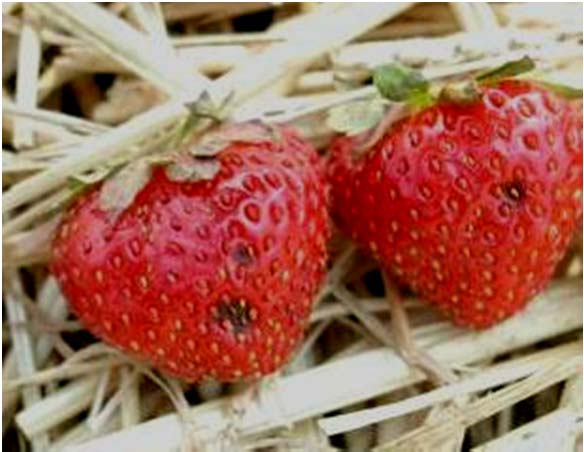

1 Berry Resources Strawberry Leaf Diseases Identification and Management Cathy Heidenreich, Berry Extension Support Specialist, Cornell Department of Horticulture First published in New York Berry News, Vol. 12(3), March Identification of Leaf Diseases Leaf Spot (caused by the fungus Mycosphaerella fragariae) On leaves: Look for small round purple to reddish spots on upper leaf surfaces. Centers of these spots become light tan to grey to white with age, with narrow reddish purple to brown borders; centers of the spots may dropout giving the leaves a shot-hole appearance. On fruit: Black seed disease occurs occasionally in heavily infected plantings. One to two black spots form on the surface of ripe berries under groups of up to 8 to 10 seeds. No fruit rot occurs below the spots but fruit are generally considered unmarketable due to appearance. Other plant parts infected: leaf stems (petioles), runners, fruit stalks (pedicels), flowers, berry caps (calyxes). Symptoms are almost identical to those described on leaves. Conditions favoring infection: Spores (conidia) are produced in spring on overwintering and dead leaves. They are rain-splashed onto newly growing leaves, stems, flowers and fruit. Infections occur during periods of leaf wetness lasting 12 to 96 hours and temperatures between 59 and 68 o F. 1
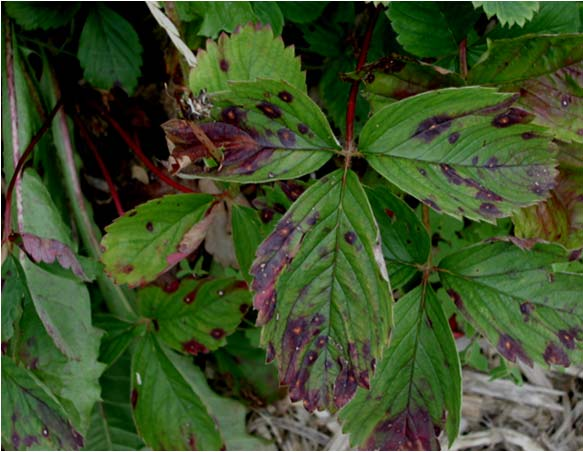
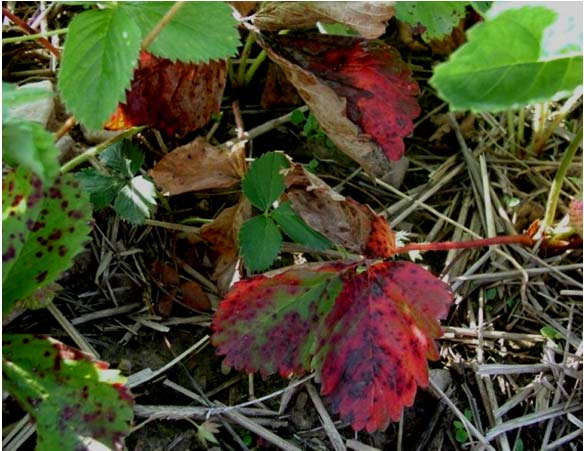
2 Leaf Scorch (caused by the fungus Diplocarpon earliana) On leaves: Spots may have 2 shapes; small pinpoint spots in large or small numbers and/or ¼ to ½ diameter blotchy spots. Scorch spots are typically reddish brown and often fuse together. As the disease progresses the leaves brown, wither and curl, becoming scorched in appearance. Note the centers of these spots do not become white, brown, or gray, as with leaf spot or leaf blight. On berry caps: dead cap, dead burr. Irregular brown spots form on the berry caps, often from the margins or tips of the caps inward. No fruit rot occurs but fruit are generally considered unmarketable due to appearance. Other plant parts infected: leaf stems (petioles), fruit stalks (pedicels), flowers, berry caps (calyxes). Flower and fruit trusses may be girdled and die. Severe leaf scorch infections reduce vegetative growth and fruit yield the season after infection. Scorch also reduces both numbers and vigor of crowns; highly infected plants may die when stressed by heat, cold or drought. Conditions favoring infection: Spores (conidia) are produced in spring on overwintering and dead leaves. They are splashed onto newly growing plant tissue by rain, heavy dew or overhead irrigation. Infections occur during periods of leaf wetness lasting 9 hours or more and temperatures between 59 and 86 o F. Leaf scorch infections may occur year round but hot dry conditions (>95 o F) and temperatures below freezing reduce the rate of disease. Leaf Blight (caused by the fungus Phomopsis obscurans) On leaves: Large, nearly circular spots with wide reddish purple margins and brown centers. Lesions (spots) from the leaf margin may also be V-shaped toward the midvein. On fruit: Phomopsis soft rot has not yet been reported in New York but does occur in Ohio and southern states to Florida. The disease affects ripening or fully matured fruits. Early symptoms are round, pink, water-soaked 2

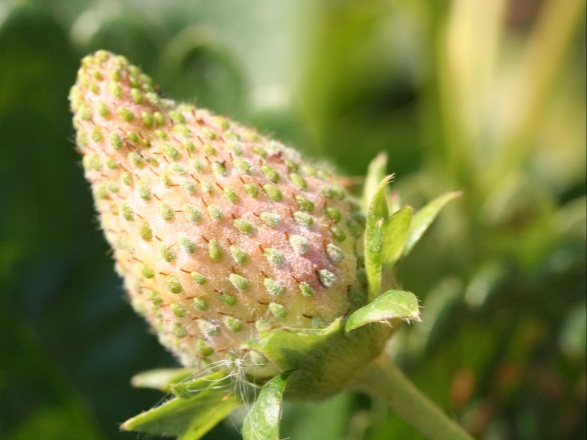
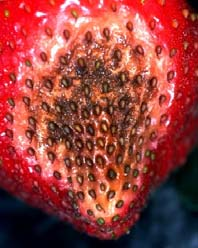
3 spots. Later these enlarge and turn brown with a crusty appearance. The crusty appearance is due to formation of clusters of tiny spore producing structures called pycnidia. These can be seen with a 10x hand lens or magnifying glass. Later stages of Phomopsis soft rot resemble those of anthracnose except anthracnose spots on fruit do not have a crusty appearance but rather develop salmon-colored ooze under moist conditions. Other plant parts affected: leaf stems (petioles), runners, fruit trusses (pedicels) may be girdled, collapse and die. Severely diseased plants may not yield well. Plants weakened from Phomopsis may be more susceptible to winter injury. Conditions favoring infection: Spores (conidia) are produced on overwintering and dead leaves. They are rain-splashed onto newly growing plant tissue in spring. The fungus is capable of causing infection over a wide range of temperatures (50 to 95 o F). Research indicates disease development is influenced more by wetting period length (6 to 15 hours) than temperature. Infections typically occur early in the season but remain latent until warmer weather with symptoms appearing during harvest or after renovation in late summer to early fall. Note leaf blight does not readily infect fruit caps. Powdery Mildew (caused by the fungus Podosphaera macularis) On leaves: White powdery patches typically develop on the lower surfaces of leaves first and may go unobserved until leaf margins begin to curl upward. These patches may enlarge and cover the entire leaf undersurface. Purple to reddish blotches may also occur on the lower leaf surface as a result of infection. Upper surfaces may have powdery patches as well. Numerous small dark round overwintering structures (cleistothecia) may appear on leaves in fall. On fruit: Powdery mildew may infect flowers, causing them to produce hard dry, misshapen fruit; older fruit may also be colonized giving them a seedy look. Both types of infection reduce fruit quality and marketable yields. Other plant parts infected: leaf stems (petioles), flower trusses (pedicels. Severe leaf infections damages leaves, reducing their ability to photosynthesize; leaves may eventually die and drop off depending on the 3
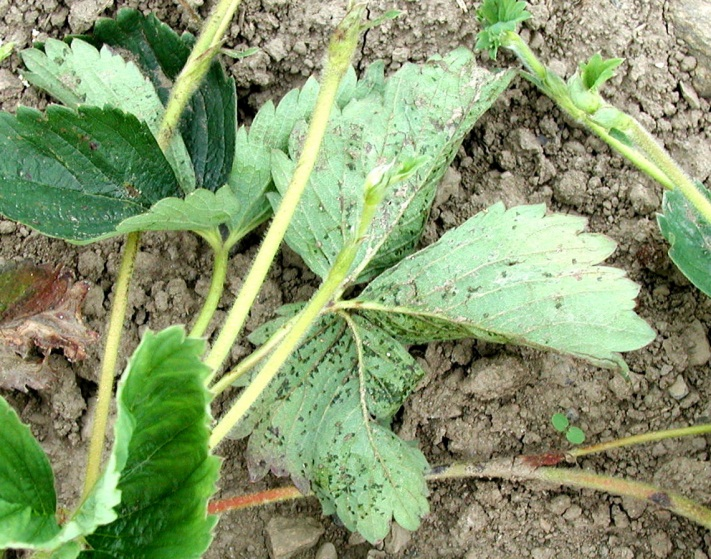


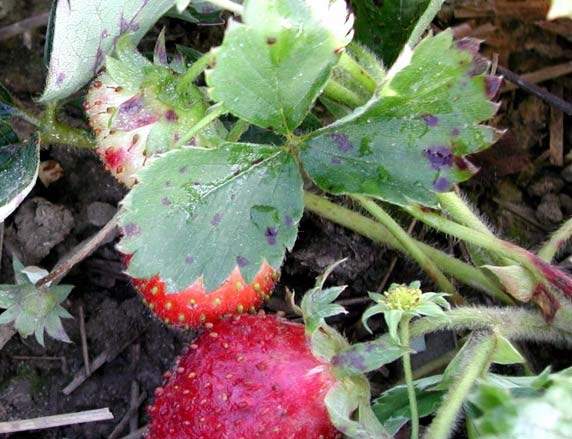
4 severity of infection. This in combination with infections of flowers and fruit may have a serious effect on yield. Conditions favoring infection: Unlike the leaf spot fungi, which are favored by the presence of free water on plant surfaces, the powdery mildew fungus is inhibited by wet, rainy conditions. Disease develops best under conditions of moderate to high humidity and warm temperatures (60 to 80 o F). This fungus also differs from the leaf spot fungi in that it is an obligate parasite requiring living host tissue to survive; thus it overwinters only in infected living tissue (crowns and leaves). Infected transplants may be a major source of disease initiation in a new planting. Angular Leaf Spot (caused by the bacterium Xanthomonas fragariae) On leaves: Angular leaf spot appears first as tiny watersoaked spots (lesions) on the lower leaf surface. These enlarge to form angular lesions, restricted by small leaf veins. The young spots are usually best viewed on the underside of the leaf and appear translucent when looked at with a light source behind them and dark green when viewed normally. This difference is an important distinguishing characteristic in identifying the disease. Spots eventually become visible on the upper leaf surface and appear as irregular, reddish brown spots. These may grow together to cover large leaf areas, causing infected leaves to appear scorched or blighted closely resembling leaf spot and leaf scorch. Dead tissue becomes dry and brittle, breaking off; giving leaves a frayed or ragged look. Heavily infected leaves may die if the bacterial infection moves into major veins. On fruit: When infections of angular leaf spot become systemic, the berry cap (calyx) may also be infected. The modified leaves of the berry cap (sepals) darken and dry. This reduces the marketability of the fruit. Other plant parts affected: Systemic infections may occur, with all types of plant tissue including the crown being infected. In severe cases, a decline similar to that caused by Phytophthora cactorum or anthracnose crown rot may develop. Water soaking at the base of newly emerging leaves may be the only visible 4
5 symptoms to be expressed before the plant suddenly dies. Conditions favoring infection: Moderate day time temperatures (68 o F) accompanied by low to near freezing night-time temperatures (36-39 o F) and precipitation events such as heavy rain or dews or overhead irrigation used for frost protection. Management of Leaf Diseases Leaf Spot, Leaf Scorch, Leaf Blight General management information: Frequent rains, overhead irrigation, and heavy dews favor disease development and spread. Promote good air circulation for rapid drying of leaves and fruit by using recommended in-row and between-row plant spacings and keeping plantings well-weeded. Minimize the use of overhead irrigation; consider installing a drip irrigation system and using floating row cover for frost protection instead. Whenever possible choose varieties that are resistant or tolerant to leaf diseases. Remove and destroy dead leaves at renovation. Apply nitrogen fertilizers only after renovation or in the fall to reduce chance of infection; applications of nitrogen in the spring produce an overabundance of young leaf tissue susceptible to leaf-disease fungi. New plantings or plantings with history of disease: Apply a protectant spray in early spring as new leaves begin to unfold and again before conditions that favorable for disease occur (check product labels for recommended intervals between sprays). Begin sprays again after renovation to protect new foliage from infection. Thorough coverage is necessary for good control; it is especially important to cover undersides of leaves as well as surfaces. Leaf Spot Conventional Products: Cabrio EG, Captan 50WP, Captan 4L, Captec 4L, Pristine, Rally 40WSP, or copper (several formulations). Organic Products: Basic Copper 53, Nu-Cop 50DF and 50WP, or Badge X 2. Leaf Scorch Conventional Products: Topsin-M 70WSP, or copper (several formulations). Organic Products: Badge X 2 ; check with certifier for allowable copper formulations. Leaf Blight Conventional Products: Agristar Sonoma 40WSP or Rally 40WSP, Topsin-M 70WP, or copper (several formulations). Organic Products: Nu-Cop 50DF and 50WP, or Oxidate. 5
6 Powdery Mildew General management information: Whenever possible choose varieties that are resistant or tolerant to powdery mildew. Infected transplants may be a major source of disease initiation; plant only clean plant material from certified nurseries. Ask your nursery about their powdery mildew management program for transplants. Note the standard practice of removing leaves from transplants during harvest and packing will also help reduce disease in new plantings although some powdery mildew may be present on crowns. New plantings or plantings with history of disease: It is important to begin management at the very first sign of disease in the field and continue applications as long as disease development continues (see product labels for recommended spray intervals). Effective control of powdery mildew in the fall will reduce disease development in the spring; reduction of powdery mildew development on leaves will also aid in reducing fruit infections. Conventional Products: Abound, Cabrio EG, Organic JMS Stylet Oil, Pristine, Quintec, Rally 40WSP or Agristar Sonoma 40WSP, Rampart, Topsin 4.5L, Microthiol Disperss or Kumulus DF. Organic Products: Actinovate-AG, Kaligreen or Milstop, Kumulus DF, Oxidate, or Organic JMS Stylet Oil. Angular Leaf Spot General management information: Frequent rains, overhead irrigation, and heavy dews favor disease development and spread. Promote good air circulation for rapid drying of leaves and fruit by using recommended in-row and between-row plant spacings and keeping plantings well-weeded. Minimize the use of overhead irrigation; consider installing a drip irrigation system and using floating row cover for frost protection instead. Begin applications when symptoms occur. Continue on a weekly basis until conditions no longer favor disease development; discontinue applications if signs of crop injury appear. Thorough coverage is necessary for good control; it is especially important to cover undersides of leaves as well as surfaces. Conventional Products: Kocide DF or Badge X 2. Organic Products: Badge X 2 or Oxidate. The information, including any advice or recommendations, contained herein is based upon the research and experience of Cornell Cooperative Extension personnel. While this information constitutes the best judgment/opinion of such personnel at the time issued, neither Cornell Cooperative Extension nor any representative thereof makes any representation, endorsement or warrantee, express or implied, of any particular result or application of such information, or regarding any product. Users of any product are encouraged to read and follow product-labeling instructions and check with the manufacturer or supplier for updated information. Cornell University provides equal program and employment opportunities. 6
Strawberry Leaf Spot
 Strawberry Leaf Spot Cathy Heidenreich and Bill Turechek Introduction - Leaf spot is one of the most common and widespread diseases of strawberry. Mycosphaerella fragariae is also the cause of black seed
Strawberry Anthracnose
 Strawberry Anthracnose Bill Turechek and Cathy Heidenreich Introduction - The term anthracnose is a general term used to describe plant diseases. Strawberry anthracnose refers to several diseases of strawberry
AGFACTS. Strawberry disease control guide MAJOR DISEASES OF STRAWBERRIES
 AGFACTS AGFACTS AGFACTS www.agric.nsw.gov.au Strawberry disease control guide Agfact H3.3.1 third edition, May 2004 Lawrence Ullio, District Horticulturist Elizabeth Macarthur Agricultural Institute Camden
Part 1: Knowing how to identify the problem. Author: Damon Polta, Friendly Aquaponics Farm Manager. For free distribution.
 Diseases, Deficiencies, and Toxicities in Plants Part 1: Knowing how to identify the problem. Author: Damon Polta, Friendly Aquaponics Farm Manager. For free distribution. Diseases Beet Western Yellow
IDENTIFICATION & MANAGEMENT OF. Pumpkin Diseases
 IDENTIFICATION & MANAGEMENT OF Pumpkin Diseases 2 Richard Latin and Karen Rane Department of Botany and Plant Pathology Disease Sclerotinia Rot Phytophthora Blight Bacterial Fruit Spot Powdery Mildew Downy
GENERAL WATERING & CARE GUIDE
 GENERAL WATERING & CARE GUIDE Between 30-60 percent of water applied to lawns and gardens is never absorbed by the plants. Water is often wasted because it is applied too quickly and runs off, evaporates
Bacterial Diseases of Tomato: 2012
 Bacterial Diseases of Tomato: 2012 Bacterial diseases of tomato Bacterial speck Bacterial spot Bacterial canker Bacterial diseases of tomato Bacterial speck- causes lesions on leaves, stems and fruit.
Tomato Disease Management in Greenhouses
 Purdue Extension publication BP-197-W University of Kentucky Cooperative Extension publication ID-233 Vegetable Diseases Tomato Disease Management in Greenhouses Photos by the authors Authors Daniel S.
Picture Tour: Dry Beans Diseases
 Picture Tour: Dry Beans Diseases Saginaw Valley Research and Extension Center agbioresearch.msu.edu 1 Images of: Blight Root rot White mold Common Mosaic virus Leaf spot Rust Anthracnose BLIGHT Common
Why Fruit Trees Die D. B. Meador, Extension Specialist (retired) University of Illinois
 Why Fruit Trees Die D. B. Meador, Extension Specialist (retired) University of Illinois Occasionally, fruit trees decline and often die. Diseases affecting the leaves, fruit, and twigs of fruit trees usually
Deficiency Symptoms in Vegetable Plants (Corrective Treatments Per 30ʼ-long Row)
 Deficiency Symptoms in Vegetable Plants (Corrective Treatments Per 30ʼ-long Row) BORON (1-2 ounces Borax) General Symptoms Rosette Crown terminal buds; Death of terminal buds; leaves are an off-green color;
Grape Diseases And Their Control: Powdery mildew and Botrytis bunch rot. Henry Ngugi, Bryan Hed, and Noemi Halbrendt Penn State University
 Grape Diseases And Their Control: Powdery mildew and Botrytis bunch rot Henry Ngugi, Bryan Hed, and Noemi Halbrendt Penn State University Powdery mildew is everywhere Infections at bloom can cause poor
Strawberry Production Basics: Matted Row
 Strawberry Production Basics: Matted Row David T. Handley, Vegetable and Small Fruits Specialist University of Maine Cooperative Extension Highmoor Farm, P.O. Box 179, Monmouth, Maine 04259 (207) 933-2100
Rose Diseases and Insects in the Bradenton-Sarasota Area
 Rose Diseases and Insects in the Bradenton-Sarasota Area By: Philip Paul, CR The 10 bad actors in our area are the fungi and pests that some days slow down our enjoyment of our rose gardens. This issue
WHAT IS WRONG WITH MY LAWN?
 WHAT IS WRONG WITH MY LAWN? Lawn problems can occur in small areas or larger patches and entire lawns can be affected. Sometimes the problems are due to poor growing conditions, improper lawn care practices,
Pecan Disease Management Mark Black, Texas AgriLife Extension Service, Uvalde
 T. A. Lee Pecan Disease Management Mark Black, Texas AgriLife Extension Service, Uvalde Scab Downy spot Powdery mildew Pecan diseases Crown gall Cotton root rot Root knot Kernel decay & contamination Kernel
Wheat Disease Identification
 Wheat Disease Identification Fusarium root, crown, and foot rots Stripe rust Tan spot Leaf rust Cephalosporium stripe Stagonospora nodorum blotch Contents Diseases affecting heads and grain Black chaff...
Growing Balaton - Horticultural Considerations
 Growing Balaton - Horticultural Considerations Amy Iezzoni Dept. of Horticulture Michigan State University Jim Nugent District Horticulturist MSU Extension The fruit industry in Michigan has generations
Pineapples. Ian Hewett Horticultural Marketing Inspectorate United Kingdom. Version - October 2011
 Pineapples Ian Hewett Horticultural Marketing Inspectorate United Kingdom Version - October 2011 1 Definition Of Produce This Standard applies to pineapples of varieties (cultivars) grown from Ananascomosus(L).
Identification and Prevention of Frost or Freeze Damage By Linda Reddick, Kingman Area Master Gardener
 KINGMAN IS GROWING! COLUMN Identification and Prevention of Frost or Freeze Damage By Linda Reddick, Kingman Area Master Gardener Again this year we have been experiencing some very cold weather, with
Chemical Control of Spotted Wing Drosophila in Berry Crops
 Berry Resources www.fruit.cornell.edu/berry Chemical Control of Spotted Wing Drosophila in Berry Crops Greg Loeb, Cathy Heidenreich, Laura McDermott, Peter Jentsch, Debbie Breth, and Juliet Carroll, Cornell
2014 Fungicides for home garden use in New York State. Diseases: Anthracnose. Bacterial Canker Bitter rot. Apple black spot and scab.
 APPLE Apple black spot and scab Bacterial Canker Bitter rot Black po Black rot Blossom and shoot blast Botryosphaeria (White rot) Botrytis rot Brooks fruit spot Brown rot Bullseye rot Cedar rust Fire blight
Onion & Leek Planting Guide
 Onion & Leek Planting Guide Important Remove plants from box immediately. Do not put in soil or water before planting. Keep cool and dry until you can plant. Follow the instructions inside for best results.
Wilt diseases of tomatoes can be caused
 A l a b a m a A & M a n d A u b u r n U n i v e r s i t i e s Wilt Diseases of Tomatoes ANR-0797 Wilt diseases of tomatoes can be caused by fungal, bacterial, viral, and nematode pathogens, as well as
Chapter 8: Diseases. Rust
 Chapter 8: Diseases Historically, fusarium wilt and rust have been considered major limiting factors in flax production in Western Canada. However, these two diseases have been effectively managed by multigenic
Summer Stress Arrives Early on Cool Season Lawns
 Summer Stress Arrives Early on Cool Season Lawns Figure 1. A fall installed tall fescue sod showing the first signs of summer stress following the arrival of record setting heat in central Virginia in
Chilli - Long Red Cayenne, Long Slim Cayenne, P2391, Serano, Skyline 3, Star 6601, Thai chili, Thai Dragon.
 CAPSICUMS Hot pepper (chilli), sweet pepper and paprika. CLIMATE These crops require warmer conditions than tomatoes, and are more sensitive to cold and frost. The optimum mean temperatures for growth,
runing & Orchard Renewal
 P runing & Orchard Renewal Richard G. St-Pierre, Ph.D. (January 2006) The Basics Of Pruning & Orchard Renewal Pruning is defined as the art and science of cutting away a portion of a plant to improve its
Cherokee Chief Plena Rubra Fragrant Cloud
 INTRODUCTION The natural range of dogwoods extends from Maine to the Gulf of Mexico. The trees color cities and countrysides white with dazzling displays in the early spring. Although they are most spectacular
Common Diseases of Leafy Greens
 ANR-1189 Common Diseases of Leafy Greens Production of leafy greens in Alabama and the Southeast can be affected by a variety of plant diseases. Damage can range from minor spotting on leaves to complete
FOLPAN 50 WP (FOLPET) FUNGICIDE COMMERCIAL
 21-NOV-2008 2008-4133 GROUP M FUNGICIDE FOLPAN 50 WP (FOLPET) FUNGICIDE COMMERCIAL A wettable powder fungicide for the control of a number of fungus diseases on certain fruit, vegetable, ornamental and
Custard apple information kit
 information kit Reprint information current in 1998 REPRINT INFORMATION PLEASE READ! For updated information please call 13 25 23 or visit the website www.deedi.qld.gov.au This publication has been reprinted
Tree Integrated Pest Management. Dan Nortman Virginia Cooperative Extension, York County
 Tree Integrated Pest Management Dan Nortman Virginia Cooperative Extension, York County IPM Refresher Definition: The use of a combination of appropriate pest control tactics to reduce pest population
o d Propagation and Moon Planting Fact Sheet
 o d Propagation and Moon Planting Fact Sheet Propagation Propagation is actually quite simple and requires very little effort on your part. Most seeds are ready to go, complete with all the nutrients and
Kumulus FUNGICIDES. Active ingredient: sulphur...800 g / kg
 Reg. No. L2404; N AR 0732 Act No. 36 of 1947 A water dispersible granular fungicide and acaricide for the control of powdery mildew, various other fungal diseases as well as certain mites and thrips on
Diagnosing Disorders of Trees
 148 Appendix A Diagnosing Disorders of Trees Diagnosing tree problems can be difficult. Symptoms and signs can be subtle or only visible using special techniques, important information can be missing,
Early Season Fungicide Applications. Document Classification: PUBLIC
 Early Season Fungicide Applications Controlling Dollar Spot Dollar spot (Sclerotinia homeocarpa) is becoming an increasingly troublesome disease to control. Several key factors and changes in golf course
GARDEN FACTS. When are apples ripe?
 A3743-E GARDEN FACTS U n i v e r s i t y o f W i s c o n s i n E x t e n s i o n When are apples ripe? Teryl R. Roper DIFFERENT APPLE CULTIVARS RIPEN over a long season. In Wisconsin, apples ripen from
Virginia Gardener http://www.hort.vt.edu/envirohort
 The Virginia Gardener http://www.hort.vt.edu/envirohort Name Help Sheets: Seeds What Is a Seed? A seed is a very young plant that is in the dormant, or resting stage. It is very much alive. There are three
Construction Damage to Trees
 Construction Damage to Trees When a building site is cleared, several large, well-established trees are often left to enhance the aesthetic value of the property. However, within about 2-8 years after
Virginia Gardener http://www.hort.vt.edu/envirohort
 The Virginia Gardener http://www.hort.vt.edu/envirohort Name Help Sheets: Things Plants Need There are certain things that every living thing needs in order to live and grow. Just like you, plants need
Care of Mature Backyard Apple Trees
 Education Center and Info Line practical solutions to everyday questions Toll free Info Line 1-877-398-4769 M-F 9 AM - 2 PM Care of Mature Backyard Apple Trees Introduction Backyard apple trees can be
NO-TILL AND NITROGEN FIXING INOCULANTS
 NO-TILL AND NITROGEN FIXING INOCULANTS Tom Wacek R & D Director for Urbana Laboratories St. Joseph, Missouri Nitrogen fixation is the utilization of the free gaseous nitrogen in the air by soil bacteria
Cloud Mountain Farm Center 6906 Goodwin Rd., Everson, WA 98247 (360)966-5859 voice, (360)966-0921 fax, www.cloudmountainfarmcenter.
 Disease and Pest Management in the Home Orchard Fruit trees have been grown in home orchards for centuries. The goal of many gardeners today is to have fresh fruit from their own trees with a minimum of
Biology, Epidemiology, and Control of Powdery Mildew: Use of the UC Davis Powdery Mildew Risk Index
 Sonoma County Grape Day February 15, 2012 Biology, Epidemiology, and Control of Powdery Mildew: Use of the UC Davis Powdery Mildew Risk Index W. D. Gubler, Department of Plant Pathology, University of
NUTRIENT DISORDERS IN TREE FRUITS
 PNW 121E NUTRIENT DISORDERS IN TREE FRUITS A Pacific Northwest Extension Publication Washington Idaho Oregon NUTRIENT DISORDERS IN TREE FRUITS By Nels R. Benson, Soil Scientist and Horticulturist (retired),
Cytospora Canker. A Hard Nut to Crack. My current ongoing projects 1/23/2013. 30% of Cherry trees
 Cytospora Canker: A Hard Nut to Crack Ramesh Pokharel My research and extension program is aimed at > Solving practical fruit production problems > Increased producer profitability > Strengthening the
Managing Wheat by Growth Stage
 Managing Wheat by Growth Stage Kiersten Wise, Bill Johnson....Purdue Botany and Plant Pathology Chuck Mansfield.......... Purdue Agronomy Christian Krupke.......... Purdue Entomology ID-422 Photos by Kiersten
Hydroseed Care Guide
 Hydroseed Care Guide Please read carefully and sign the invoice in the space provided to show us that you have received the Instructional Care Guide and acknowledge your responsibility to read and implement
Purpose: To determine the dew and point and relative humidity in the classroom, and find the current relative humidity outside.
 Lab Exercise: Dew Point and Relative Humidity Purpose: To determine the dew and point and relative humidity in the classroom, and find the current relative humidity outside. Relative humidity is a measure
Key Growth Stages. Kent McKay, NCREC. Minot, ND
 Growing Peas and Lentils Key Growth Stages Kent McKay, NCREC Area Extension Agronomist Minot, ND Pea and Lentil Growth Stages Seed Germination considerations Growth and development Desiccating Considerations
Horticulture Information Leaflet 33-E
 Department of Horticultural Science Horticulture Information Leaflet 33-E Revised 9/93 -- Author Reviewed 8/97 VEGETABLE CROP IRRIGATION Douglas C. Sanders, Extension Horticultural Specialist Distributed
Kindergarten Seasons and Weather Assessment
 Kindergarten Seasons and Weather Assessment 1a. Circle the pictures that represent the four seasons: snowman going to a teacher harvest fruits colorful flowers the beach 1b. Write the name of the season
OAK TREE DISEASES Anthracnose Oak Leaf Blister Actinopelte Leafspot Spot Anthracnose
 OAK TREE DISEASES Anthracnose (fungus Gloeosporium sp.): Anthracnose is more common on white oak group (Bur Oak, Over Cup Oak, White Oak and Post Oak) than on the other more common oaks. The disease is
Ligustrum, Privet Ligustrum japonicum
 Ligustrum, Privet Ligustrum japonicum http://edis.ifas.ufl.edu/mg022 Propagation L. japonicum Ligustrum are propagated by softwood cuttings taken in spring, or 5 10 cm semihardwood cuttings with a heel
Hop Pest Control. H. E. Morrison. jpf^vrsiolnrru; - «ibntoj."' «- '',orto JUN 6 I-JJ3
 Hop Pest Control H. E. Morrison its of jpf^vrsiolnrru; - «th ' s ibntoj."' «- '',orto JUN 6 I-JJ3 Agricultural Experiment Station Oregon State College Corvallis Circular of Information 589 May 1958 Hop
KINGMAN IS GROWING! Column
 KINGMAN IS GROWING! Column Protect Plants When Temperatures Drop By Charlee Ware, Kingman Area Master Gardener Fortunately for us, we had three extra weeks of warm fall weather. In most years, that 32-degree
POTASSIUM. Functions of Potassium in Plants. Potassium Deficiency Symptoms
 POTASSIUM Potassium is the last of what might be called the big three soil nutrients nitrogen, phosphorus, and potassium. These three primary nutrients are, by far, the nutrients most commonly limiting
LIME SULPHUR INSECTICIDE MITICIDE FUNGICIDE COMMERCIAL DANGER: CORROSIVE TO EYES READ THE LABEL AND ATTACHED BOOKLET BEFORE USING
 datapak group M fungicide LIME SULPHUR INSECTICIDE MITICIDE FUNGICIDE COMMERCIAL DANGER: CORROSIVE TO EYES READ THE LABEL AND ATTACHED BOOKLET BEFORE USING REGISTRATION NO. 16465 PEST CONTROL PRODUCTS
Irish potatoes are one of America s most
 E-511 11-10 Easy Gardening Joseph Masabni, Assistant Professor and Extension Horticulturist, The Texas A&M University System Irish potatoes are one of America s most popular vegetables the average American
Diagnosing Problems of Roses in the Landscape
 ARIZONA COOP E R AT I V E E TENSION AZ1528 September 2010 Diagnosing Problems of Roses in the Landscape Desert Southwest gardeners are fortunate to have fewer insect and disease problems on roses than
Wildfire Damage Assessment for the 2011 Southeast Complex Fires
 Wildfire Damage Assessment for the 2011 Southeast Complex Fires Chip Bates & Mark McClure, Forest Health Management Background: On March 24, 2011, multiple wildfires began across southeast Georgia. Strong,
The Alfalfa Weevil in Utah
 Page 1 of 5 The Alfalfa Weevil in Utah Fact Sheet No. 58 January 1989 Edward W. Evans Extension Entomologist Introduction The alfalfa weevil is a major pest throughout Utah. It is a beetle with one generation
Chapter D9. Irrigation scheduling
 Chapter D9. Irrigation scheduling PURPOSE OF THIS CHAPTER To explain how to plan and schedule your irrigation program CHAPTER CONTENTS factors affecting irrigation intervals influence of soil water using
DISEASES OF THE AVOCADO
 California Avocado Association 1931 Yearbook 16: 102-106 DISEASES OF THE AVOCADO C. W. Carpenter Associate Pathologist Experiment Station, H. S. P. A., Honolulu, T. H. The diseases of the avocado in Hawaii
Central Oregon Climate and how it relates to gardening
 Central Oregon Climate and how it relates to gardening Garden Note #1 Amy Jo Detweiler Horticulture Faculty Rev. July 2009 Behind the beauty of the High Desert landscape lies many factors that create challenges
Fertilizer, Weed Control, Grubs, and General Application Questions
 Lawn Care FAQ s Fertilizer, Weed Control, Grubs, and General Application Questions Why do we have so many weeds? Dandelions in particular, weeds in general, do not seem concerned about how long lawn has
FORMATIVE PRUNING OF BUSH TREES WINTER PRUNING OF ESTABLISHED BUSH TREES AIMS SPUR BEARERS & TIP BEARERS PRUNING OF SPUR BEARERS
 FORMATIVE PRUNING OF BUSH TREES Formative pruning is essential and should be carried out in the dormant season, November- March. Its purpose is to produce a well-balanced tree with a strong branch framework
Dieback, Twig blight or Canker (Colletotrichum gloeosporioides- asexual stage, Glomerella cingulata.)
 Camellia Camellia spp. Propagation Camellias are usually propagated by cuttings of new growth taken just as the stem is changing from green to brown. Wound the stem, use 3000-8000 ppm IBA-talc and grow
A Series on Diseases in the Florida Vegetable Garden: Tomato 1
 PP200 A Series on Diseases in the Florida Vegetable Garden: Tomato 1 Gary Vallad, Ken Pernezny, and Tim Momol 2 Many Floridians delight in maintaining a vegetable garden in their backyard. Others keep
Oaks represent the major shade trees of Texas and are also important components of
 GARDENING FACT SHEET Harris County Cooperative Extension 3033 Bear Creek Drive, Houston, Texas 77084 281.855.5600 http://harris-tx.tamu.edu/hort Major Oak Diseases and their Control by Jerral D. Johnson
Managing of Annual Winter Forages in Southwest Texas
 r r r rr EDUCATION RESEARCH EXTENSION The Texas A&M University System Soil & Crop Sciences Managing of Annual Winter Forages in Southwest Texas Mr Charles Stichler Assocaite Professor and Extension Agronomist
Developing Response Strategies Against Powdery Mildew of Strawberry Based on Risk Estimation and Fungicide Effectiveness.
 Developing Response Strategies Against Powdery Mildew of Strawberry Based on Risk Estimation and Fungicide Effectiveness Project QP0018CO Applicant Association des producteurs de fraises et framboises
Culture in field conditions - Challenges A South American point of view Roberto Campos Pura Natura, Argentina
 A South American point of view Roberto Campos Pura Natura, Argentina EUSTAS 6 th Stevia Symposium Leuven, July 3 rd and 4 th I. Area of cultivation II. Environment III. Production of seedlings IV. Planting
UNECE STANDARD FFV-52 concerning the marketing and commercial quality control of EARLY AND WARE POTATOES 2011 EDITION
 UNECE STANDARD FFV-52 concerning the marketing and commercial quality control of EARLY AND WARE POTATOES 2011 EDITION UNITED NATIONS New York and Geneva, 2011 NOTE Working Party on Agricultural Quality
Table 3. List of descritors for maize
 Table 3. List of descritors for maize Descriptor Descriptor Descriptor state Recording stage Remarks number 1 Accession number 2 Total no. of leaves Record the total number of At flowering leaves per plant
DEVELOPMENT GUIDELINES OAK TREES CARE AND MAINTENANCE
 DEVELOPMENT GUIDELINES OAK TREES CARE AND MAINTENANCE This guide will offer basic information for the preservation and maintenance of oak trees as a part of an overall landscape use. Unfortunately, oak
PICTORIAL DIAGNOSTIC GUIDE Compiled by Gaye Hammond, Past President, Houston Rose Society [email protected], 281/458-6116
 The following photographs in Section 1 identify symptoms in roses which have common causes and can sometimes be caused by Rose Rosette Disease (a/k/a Rose Rosette Virus). Just because you see a symptom
Two Main Precautions Before You Begin Working
 Pruning Mango Trees Roy Beckford, Ag/Natural Resources Agent, UF/IFAS Lee County Two Main Precautions Before You Begin Working 1. Mango peel and sap contain urushiol, the chemical in poison ivy and poison
Maintaining Cactus and Succulents
 Maintaining Cactus and Succulents Master Gardener Education February 22, 2011 Jack Kelly University of Arizona College of Agriculture and Life Sciences Pima County Cooperative Extension Tucson, Arizona
1 SEEDLING QUALITY. Seedling quality
 Seedling quality Quality versus quantity A nursery manager s most important goal is to produce quality trees. Quality is more important than quantity. It is a common mistake in nurseries to concentrate
Hail Damaged Corn and Soybean
 Hail Damaged Corn and Soybean By Jeff Coulter and Seth Naeve Recent storms left several areas affected by hail damage, including south-central and southeast Minnesota along interstate 90, and central Minnesota
JAPANESE KNOTWEED. What is Japanese Knotweed?
 JAPANESE KNOTWEED What is Japanese Knotweed? Japanese Knotweed (botanical name Fallopia japonica) was introduced into Britain from Japan in the early 1800 s. It was originally grown as an ornamental plant,
PUTTING FORAGES TOGETHER FOR YEAR ROUND GRAZING
 PUTTING FORAGES TOGETHER FOR YEAR ROUND GRAZING Jimmy C. Henning A good rotational grazing system begins with a forage system that allows the maximum number of grazing days per year with forages that are
GRAPE COLD INJURY Causes, Prevention, Assessment, and Compensation. Nevada Grape Growers
 GRAPE COLD INJURY Causes, Prevention, Assessment, and Compensation Nevada Grape Growers Washington Precipitation Washington AVA S Understanding Vine Cold Injury Mechanics of cold injury Avoiding cold injury
Jeremiah K.S. Dung Hermiston Agricultural Research and Extension Center Oregon State University
 Jeremiah K.S. Dung Hermiston Agricultural Research and Extension Center Oregon State University Species of Pectobacterium and Dickeya Formerly known as soft rot Erwinias P. carotovorum subspecies P. atrosepticum
Palm Trees for Landscapes in Tulare & Kings Counties Suggested by Nancy Gravender, UC Master Gardener
 Palm Trees for Landscapes in Tulare & Kings Counties Suggested by Nancy Gravender, UC Master Gardener MEDIUM-SIZED PALM TREES (10-25 Ft. Tall) FAN PALMS: Guadalupe Palm (Brahea edulis) Grows to 20 ft.,
GLOSSARY OF TREE TERMS
 GLOSSARY OF TREE TERMS Aeration providing air to the soil to alleviate compaction and improve structure. Arboriculture the practice and study of the care of trees and other woody plants. Arborist a professional
Tomato Year-Round IPM Program ANNUAL CHECKLIST (Reviewed 12/12)
 Tomato Year-Round IPM Program ANNUAL CHECKLIST (Reviewed 12/12) These practices are recommended for a monitoring-based IPM program that reduces water quality problems related to pesticide use. Track your
Gr o w i ng Ra s p b e r r i e s
 EC 1306 Revised March 2008 u $1.50 Gr o w i ng Ra s p b e r r i e s in Yo u r Ho m e Ga r d e n B.C. Strik Raspberries are among the most delicious and delicate of berry crops. This publication briefly
System of Rice Intensification (SRI)
 System of Rice Intensification (SRI) Ramasamy Selvaraju Climate, Energy and Tenure Division (NRC), FAO Fifth annual Investment Days, Rome, Italy; 17 December 2013 Contents What is SRI? Main concepts of
Enteric Septicemia of Catfish
 Enteric Septicemia of Catfish Jesse Chappell Extension Fisheries Specialist Revised 2008 Enteric Septicemia of Catfish (ESC) has become one of the two most significant diseases of economic significance
Nutrient Deficiencies
 Integrated Pest Management Nutrient Deficiencies and Application Injuries in Field Crops John Sawyer Department of Agronomy Nitrogen deficiency in corn IPM 42 Revised July 2004 Nutrient deficiencies in
Alfalfa Diseases in Seed Production. Faye Dokken-Bouchard Provincial Specialist, Plant Disease Crops Branch, Saskatchewan Ministry of Agriculture
 Alfalfa Diseases in Seed Production Faye Dokken-Bouchard Provincial Specialist, Plant Disease Crops Branch, Saskatchewan Ministry of Agriculture Introduction Alfalfa seed production is a well-established
BANANA PRODUCTION. ARC-Institute for Tropical and Subtropical Crops. Banana Production - English
 BANANA PRODUCTION ARC-Institute for Tropical and Subtropical Crops Banana Production - English BANANA PRODUCTION Compiled by Directorate Communication National Department of Agriculture and W. Willemse,
Integrated Pest Management
 Chapter 2 Integrated Pest Management In This Chapter Keywords After learning the information in this chapter, you will be able to: 1. Define Integrated Pest Management (IPM). 2. List and describe the 5