
ME230 Lecture Notes. DC Motors and PID Control
|
|
|
- Marianna Wood
- 9 years ago
- Views:
Transcription
1 ME3 Lecture Notes DC Motors and PID Control 1 Introduction to Control Systems The purpose of a control system is to achieve the desired output from a physical system by controlling the input to a system. The components of a control system include sensors which measure system output, actuators which generate the input to the system, and the controller which is responsible for deciding what input will be sent to the system based upon the measured output. In this handout the topic of actuators and controllers will be addressed. In particular, we will discuss permanent magnet DC brush motors and PID controllers. Permanent Magnet DC Brush Motors Motors are the primary method for actuation in a mechatronic system. Of the many types of motors available, the permanent magnet DC brush motor is the most basic, and are the type used in the lab. An example of this type of motor is given in Figure 1..1 Anatomy of a Permanent Magnet DC Brush Motor The motor can be divided into two main elements the stator (stationary component) and the rotor (rotational component). The stator resides on the outer part of the motor and is composed of permanent magnets that have the form of a hollow cylinder. Figure shows a stator which uses two permanent magnets. The purpose of the stator is to generate a constant magnetic field between the pieces. Note the gap between the magnets. The armature windings shown in Figure 3 are formed by highly elongated ovals of wire wound around deep grooves running down the length of the iron cylindrical rotor. When current flows through a winding that s near one of the gaps between the magnets, it produces a torque on the rotor that tends to turn it. This is caused due to the fact that a force is applied to a current carrying conductor in a magnetic field. To continue rotation of the motor, different armature windings must be energized. This process is taken care of through the use of brushes and commutator rings. Figure is a simplified diagram of this operation. 1

2 Figure 1: Permanent magnet DC brush motor. Note the voltage terminals and the motor shaft bearing. Figure : Permanent magnet stator. The two pieces establish a magnetic field.

3 Figure 3: Coils of copper run lengthwise along the rotor and are called armature windings. These are responsible for carrying the current through the magnetic field of the stator. Figure : Simplified diagram of commutation. 3
4 Historically, the brushes were small pads of short metal wire but nowadays are just blocks of carbon. The brushes are connected to power and ground, and the commutator rings contact the brushes and transfer current to the correct armature windings. Figure 5 provides a rough picture of the brushes, commutator rings, and armature windings. To reverse the direction of motor rotation, the polarity of the applied voltage is changed. An important property of permanent magnet DC brush motors is that generated torque increases linearly with the increasing current through the armature windings, which makes it very easy to control. 3 PID Controllers A control problem is generally defined as how to achieve the desired output from a physical system. For this purpose, automatic control systems are employed. The intelligence necessary to produce the desired output is the responsibility of the controller. The intelligence appears in the form of an algorithm, commonly referred to as a control law. The most common control used in industrial practice is PID control. 1 In the discussion that follows, we will use a DC motor as the physical system to be controlled. Recall that the two first order differential equations that describes the relationship of angular velocity and angular position to input voltage are given by dω = Aω + B V dt dθ = ω dt where ω is the angular velocity of the motor shaft, θ is the angular position, t represents time, A and B are experimental constants, and V is the input voltage. As far as numerical values are concerned, in future simulations, we will use A =.1 andb = 1. It is also important to note that both position or velocity can be considered as the output which we wish to control. We will never seek to control both at the same time because this is either redundant (desired position and velocity are both zero) or impossible. 3.1 Proportional Control Given the first order differential equation relating voltage V to velocity ω for a DC motor, ω = Aω + B V the control problem is how to achieve a desired rotational velocity ω des. One possibility would be to input set amounts of voltage and to take measurements on how fast the motor turned in each case. We could then tabulate the experimental input/output relationship. Given a desired rotational velocity we would look at our table and determine the voltage necessary to attain this. Alternatively, by experimentally determining the values of A and B we could also calculate the necessary voltage to produce the desired rotational velocity through our knowledge of differential equations. Both methods are examples of open-loop control in that in both cases, the actual output (ω) of the motor is not used in determining the input voltage. This causes a serious problem when we try 1 PID stands for [P]roportional-[I]ntegral-[D]erivative.
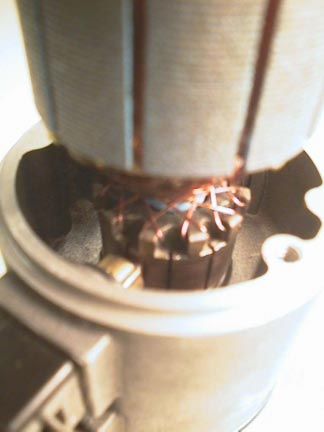
5 Figure 5: A blurry picture of the workings of the motor. A brush (carbon block) contacts a commutator ring which routes current to the correct armature winding. 5
6 1 Proportional Velocity Control of DC Motor, ω des = Angular Velocity (rad/s) =.5 =.1 = Time (s) Figure : Proportional velocity control results. to implement open-loop control in the real world. For example, what happens if over time the motor shaft bearings become stiffer, effectively changing the A parameter of our model? What if a load torque is applied to the motor shaft? A better alternative is to determine the voltage input based upon the desired performance and actual performance. This is referred to as closed-loop control. Define the velocity error e such that e = ω des ω Now make the input voltage proportional to the velocity error: V = e where is a constant value. Intuitively, the operation of proportional controllers are easy to understand. Take the initial condition that ω =rad/s and ω des =1rad/s. The initial value of rotational error would be 1rad/s and after being multiplied by a constant gain, the input voltage would be determined. The motor immediately starts accelerating. As the rotational velocity approaches the desired value, it can be seen that the velocity error decreases, reducing the input voltage, which reduces the acceleration of the motor. Over time, the velocity error reaches a finitely small value. The performance of our controller is given in Figure. For velocity control, a higher proportional gain leads to a faster response.
7 1 PI Velocity Control of DC Motor, ω des = 1, = Angular Velocity (rad/s) k i =. k i =.5 k i = Time (s) Figure 7: PI velocity control results. 3. Steady-State Error and the Use of Integral Control Given the differential equation above, it can be shown that for a finite value of proportional gain, there will be a steady-state error in the velocity tracking. Clearly this is shown in Figure. Intuitively it can be argued that if there is no velocity error, then input voltage is equal to zero, implying that the motor decelerates! The amount of steady state error is dependent upon the value of the proportional gain constant. For high gains, steady-state error is reduced. However, high gain controllers are sometimes undesirable, and a different method for eliminating steady state error is used. Amend the control law such that t V = e + k i edt Notice that the control signal is based upon current error information but also past error information through the use of the integral term. It can be shown that the addition of the integral component eliminates steady-state error in this system as shown in Figure 7. Integral control can be dangerous, however, as evidenced in Figure 7 by the choice of k i =.5. Moderate integral gains can lead to system instability. 7
8 Proportional Position Control of DC Motor, θ des = Angular Position (rad) 1 1 =.1 =.1 = Time (s) Figure : Proportional position control results. 3.3 Overshoot, Oscillation, and the Use of Derivative Gain High gain controllers benefit from fast response times and high frequency tracking. The downside of a high gain controller is that the system often exhibits overshoot to a step input, and oscillation during tracking. To demonstrate this, consider the problem of position control. Similar to velocity control, let the desired performance be specified as θ des, and the error be defined as e = θ des θ. Using proportional control the response of the DC motor to a step input in desired position is given in Figure. Note that using moderate gains causes extreme overshoot and oscillation in the actual response of the motor. Lowering the gain attenuates these problems but increases the response time. Realize that integral control is not a solution to this problem integral control increases this instability! A method for increasing the effective damping of the system is to once again amend the control law such that t de V = e + k i edt+ k d dt Intuitively, while the integral term gives past error information, the addition of the derivative term effectively acts to give future information. Derivative gain is used to smooth the response of the system and this is shown in Figure 9. It s important to realize, however, that implementing derivative control is usually very difficult. This stems from the fact that numerical differentiation is often used, and this procedure tends to amplify noise in the position measurement.
9 PD Position Control of DC Motor, θ des = 1, = Angular Position (rad) 1 1 k d =. k d =.5 k d = Time (s) Figure 9: PD position control results. 3. Tuning PID Controllers The act of selecting, k i,andk d for desired system performance is called gain tuning. The vast majority of the control effort should be supplied by the proportional component, while small amounts of integral and derivative control are added to address the specific problems described above. Start by just using proportional control to achieve roughly the desired transient response. Then add integral and derivative control in moderation if the system behavior requires it. 9
Motor Fundamentals. DC Motor
 Motor Fundamentals Before we can examine the function of a drive, we must understand the basic operation of the motor. It is used to convert the electrical energy, supplied by the controller, to mechanical
Motors and Generators
 Motors and Generators Electro-mechanical devices: convert electrical energy to mechanical motion/work and vice versa Operate on the coupling between currentcarrying conductors and magnetic fields Governed
Chen. Vibration Motor. Application note
 Vibration Motor Application note Yangyi Chen April 4 th, 2013 1 Table of Contents Pages Executive Summary ---------------------------------------------------------------------------------------- 1 1. Table
Simple Analysis for Brushless DC Motors Case Study: Razor Scooter Wheel Motor
 Simple Analysis for Brushless DC Motors Case Study: Razor Scooter Wheel Motor At first glance, a brushless direct-current (BLDC) motor might seem more complicated than a permanent magnet brushed DC motor,
DIRECT CURRENT GENERATORS
 DIRECT CURRENT GENERATORS Revision 12:50 14 Nov 05 INTRODUCTION A generator is a machine that converts mechanical energy into electrical energy by using the principle of magnetic induction. This principle
DC GENERATOR THEORY. LIST the three conditions necessary to induce a voltage into a conductor.
 DC Generators DC generators are widely used to produce a DC voltage. The amount of voltage produced depends on a variety of factors. EO 1.5 LIST the three conditions necessary to induce a voltage into
Inductance. Motors. Generators
 Inductance Motors Generators Self-inductance Self-inductance occurs when the changing flux through a circuit arises from the circuit itself. As the current increases, the magnetic flux through a loop due
2. A conductor of length 2m moves at 4m/s at 30 to a uniform magnetic field of 0.1T. Which one of the following gives the e.m.f. generated?
 Extra Questions - 2 1. A straight length of wire moves through a uniform magnetic field. The e.m.f. produced across the ends of the wire will be maximum if it moves: a) along the lines of magnetic flux
Manufacturing Equipment Modeling
 QUESTION 1 For a linear axis actuated by an electric motor complete the following: a. Derive a differential equation for the linear axis velocity assuming viscous friction acts on the DC motor shaft, leadscrew,
INSTRUMENTATION AND CONTROL TUTORIAL 2 ELECTRIC ACTUATORS
 INSTRUMENTATION AND CONTROL TUTORIAL 2 ELECTRIC ACTUATORS This is a stand alone tutorial on electric motors and actuators. The tutorial is of interest to any student studying control systems and in particular
Application Information
 Moog Components Group manufactures a comprehensive line of brush-type and brushless motors, as well as brushless controllers. The purpose of this document is to provide a guide for the selection and application
AC generator theory. Resources and methods for learning about these subjects (list a few here, in preparation for your research):
 AC generator theory This worksheet and all related files are licensed under the Creative Commons Attribution License, version 1.0. To view a copy of this license, visit http://creativecommons.org/licenses/by/1.0/,
Direct Current Motors
 Direct Current Motors DC MOTORS The DC machine can operate as a generator and as a motor. Chap 5. Electrical Machines by Wildi, 6 e Lecturer: R. Alba-Flores Alfred State College Spring 2008 When a DC machine
Brush DC Motor Basics. by Simon Pata Business Unit Manager, Brushless DC
 thinkmotion Brush DC Motor Basics by Simon Pata Business Unit Manager, Brushless DC Ironless DC Motor Basics Technical Note Brushed DC ironless motors are found in a large variety of products and applications
Chapter 22: Electric motors and electromagnetic induction
 Chapter 22: Electric motors and electromagnetic induction The motor effect movement from electricity When a current is passed through a wire placed in a magnetic field a force is produced which acts on
Principles and Working of DC and AC machines
 BITS Pilani Dubai Campus Principles and Working of DC and AC machines Dr Jagadish Nayak Constructional features BITS Pilani Dubai Campus DC Generator A generator consists of a stationary portion called
Induction Motor Theory
 PDHonline Course E176 (3 PDH) Induction Motor Theory Instructor: Jerry R. Bednarczyk, P.E. 2012 PDH Online PDH Center 5272 Meadow Estates Drive Fairfax, VA 22030-6658 Phone & Fax: 703-988-0088 www.pdhonline.org
EDUMECH Mechatronic Instructional Systems. Ball on Beam System
 EDUMECH Mechatronic Instructional Systems Ball on Beam System Product of Shandor Motion Systems Written by Robert Hirsch Ph.D. 998-9 All Rights Reserved. 999 Shandor Motion Systems, Ball on Beam Instructional
Drive circuit basics + V. τ e. Industrial Circuits Application Note. Winding resistance and inductance
 ndustrial Circuits Application Note Drive circuit basics For a given size of a stepper motor, a limited space is available for the windings. n the process of optimizing a stepper motor drive system, an
DC motors: dynamic model and control techniques
 DC motors: dynamic model and control techniques Luca Zaccarian Contents 1 Magnetic considerations on rotating coils 1 1.1 Magnetic field and conductors.......................... 1 1.2 The magneto-motive
13 ELECTRIC MOTORS. 13.1 Basic Relations
 13 ELECTRIC MOTORS Modern underwater vehicles and surface vessels are making increased use of electrical actuators, for all range of tasks including weaponry, control surfaces, and main propulsion. This
CHAPTER 4 DESIGN OF INTEGRAL SLOT AND FRACTIONAL SLOT BRUSHLESS DC MOTOR
 47 CHAPTER 4 DESIGN OF INTEGRAL SLOT AND FRACTIONAL SLOT BRUSHLESS DC MOTOR 4.1 INTRODUCTION This chapter deals with the design of 24 slots 8 poles, 48 slots 16 poles and 60 slots 16 poles brushless dc
Mathematical Modeling and Dynamic Simulation of a Class of Drive Systems with Permanent Magnet Synchronous Motors
 Applied and Computational Mechanics 3 (2009) 331 338 Mathematical Modeling and Dynamic Simulation of a Class of Drive Systems with Permanent Magnet Synchronous Motors M. Mikhov a, a Faculty of Automatics,
Understanding the Alternator
 http://www.autoshop101.com THIS AUTOMOTIVE SERIES ON ALTERNATORS HAS BEEN DEVELOPED BY KEVIN R. SULLIVAN PROFESSOR OF AUTOMOTIVE TECHNOLOGY AT SKYLINE COLLEGE SAN BRUNO, CALIFORNIA ALL RIGHTS RESERVED
The DC Motor/Generator Commutation Mystery. Commutation and Brushes. DC Machine Basics
 The DC Motor/Generator Commutation Mystery One small, yet vital piece of the DC electric motor puzzle is the carbon brush. Using the correct carbon brush is a key component for outstanding motor life,
Application Information Fully Integrated Hall Effect Motor Driver for Brushless DC Vibration Motor Applications
 Application Information Fully Integrated Hall Effect Motor Driver for Brushless DC Vibration Motor Applications By Shaun Milano Vibration motors are used in a variety of applications including mobile phone
Speed Control Methods of Various Types of Speed Control Motors. Kazuya SHIRAHATA
 Speed Control Methods of Various Types of Speed Control Motors Kazuya SHIRAHATA Oriental Motor Co., Ltd. offers a wide variety of speed control motors. Our speed control motor packages include the motor,
How to Turn an AC Induction Motor Into a DC Motor (A Matter of Perspective) Steve Bowling Application Segments Engineer Microchip Technology, Inc.
 1 How to Turn an AC Induction Motor Into a DC Motor (A Matter of Perspective) Steve Bowling Application Segments Engineer Microchip Technology, Inc. The territory of high-performance motor control has
Equipment: Power Supply, DAI, Wound rotor induction motor (8231), Electrodynamometer (8960), timing belt.
 Lab 13: Wound rotor induction motor. Objective: to examine the construction of a 3-phase wound rotor induction motor; to understand exciting current, synchronous speed and slip in this motor; to determine
AND8008/D. Solid State Control Solutions for Three Phase 1 HP Motor APPLICATION NOTE
 Solid State Control Solutions for Three Phase 1 HP Motor APPLICATION NOTE INTRODUCTION In all kinds of manufacturing, it is very common to have equipment that has three phase motors for doing different
THE LUCAS C40 DYNAMO & ITS ARMATURE.
 THE LUCAS C40 DYNAMO & ITS ARMATURE. H. Holden, March 2011. The Dynamo as a DC generating machine was used extensively in the pre- Alternator era, from the early 1900 s up to the late 1960 s and early
Lab 8: DC generators: shunt, series, and compounded.
 Lab 8: DC generators: shunt, series, and compounded. Objective: to study the properties of DC generators under no-load and full-load conditions; to learn how to connect these generators; to obtain their
Synchronous motor. Type. Non-excited motors
 Synchronous motor A synchronous electric motor is an AC motor in which the rotation rate of the shaft is synchronized with the frequency of the AC supply current; the rotation period is exactly equal to
DCMS DC MOTOR SYSTEM User Manual
 DCMS DC MOTOR SYSTEM User Manual release 1.3 March 3, 2011 Disclaimer The developers of the DC Motor System (hardware and software) have used their best efforts in the development. The developers make
Rotating Machinery Diagnostics & Instrumentation Solutions for Maintenance That Matters www.mbesi.com
 13 Aberdeen Way Elgin, SC 29045 Cell (803) 427-0791 VFD Fundamentals & Troubleshooting 19-Feb-2010 By: Timothy S. Irwin, P.E. Sr. Engineer [email protected] Rotating Machinery Diagnostics & Instrumentation
FUZZY Based PID Controller for Speed Control of D.C. Motor Using LabVIEW
 FUZZY Based PID Controller for Speed Control of D.C. Motor Using LabVIEW SALIM, JYOTI OHRI Department of Electrical Engineering National Institute of Technology Kurukshetra INDIA [email protected] [email protected]
Technical Guide No. 100. High Performance Drives -- speed and torque regulation
 Technical Guide No. 100 High Performance Drives -- speed and torque regulation Process Regulator Speed Regulator Torque Regulator Process Technical Guide: The illustrations, charts and examples given in
ELECTRODYNAMICS 05 AUGUST 2014
 ELECTRODYNAMICS 05 AUGUST 2014 In this lesson we: Lesson Description Discuss the motor effect Discuss how generators and motors work. Summary The Motor Effect In order to realise the motor effect, the
Principles of Adjustable Frequency Drives
 What is an Adjustable Frequency Drive? An adjustable frequency drive is a system for controlling the speed of an AC motor by controlling the frequency of the power supplied to the motor. A basic adjustable
HITACHI INVERTER SJ/L100/300 SERIES PID CONTROL USERS GUIDE
 HITACHI INVERTER SJ/L1/3 SERIES PID CONTROL USERS GUIDE After reading this manual, keep it for future reference Hitachi America, Ltd. HAL1PID CONTENTS 1. OVERVIEW 3 2. PID CONTROL ON SJ1/L1 INVERTERS 3
AC Induction Motor Slip What It Is And How To Minimize It
 AC Induction Motor Slip What It Is And How To Minimize It Mauri Peltola, ABB Oy, Helsinki, Finland The alternating current (AC) induction motor is often referred to as the workhorse of the industry because
8 Speed control of Induction Machines
 8 Speed control of Induction Machines We have seen the speed torque characteristic of the machine. In the stable region of operation in the motoring mode, the curve is rather steep and goes from zero torque
DC Motor control Reversing
 January 2013 DC Motor control Reversing and a "Rotor" which is the rotating part. Basically there are three types of DC Motor available: - Brushed Motor - Brushless Motor - Stepper Motor DC motors Electrical
Magnetic electro-mechanical machines
 Magnetic electro-mechanical machines Lorentz Force A magnetic field exerts force on a moving charge. The Lorentz equation: f = q(e + v B) f: force exerted on charge q E: electric field strength v: velocity
dspace DSP DS-1104 based State Observer Design for Position Control of DC Servo Motor
 dspace DSP DS-1104 based State Observer Design for Position Control of DC Servo Motor Jaswandi Sawant, Divyesh Ginoya Department of Instrumentation and control, College of Engineering, Pune. ABSTRACT This
Current Loop Tuning Procedure. Servo Drive Current Loop Tuning Procedure (intended for Analog input PWM output servo drives) General Procedure AN-015
 Servo Drive Current Loop Tuning Procedure (intended for Analog input PWM output servo drives) The standard tuning values used in ADVANCED Motion Controls drives are conservative and work well in over 90%
GENERAL POWER SYSTEM WIRING PRACTICES APPLIED TO TECNADYNE DC BRUSHLESS MOTORS
 1/5/2006 Page 1 of 6 GENERAL POWER SYSTEM WIRING PRACTICES APPLIED TO TECNADYNE DC BRUSHLESS MOTORS 1. Introduction The purpose of this application note is to describe some common connection and filtering
Preview of Period 16: Motors and Generators
 Preview of Period 16: Motors and Generators 16.1 DC Electric Motors What causes the rotor of a motor to spin? 16.2 Simple DC Motors What causes a changing magnetic field in the simple coil motor? 16.3
TwinCAT NC Configuration
 TwinCAT NC Configuration NC Tasks The NC-System (Numeric Control) has 2 tasks 1 is the SVB task and the SAF task. The SVB task is the setpoint generator and generates the velocity and position control
Active Vibration Isolation of an Unbalanced Machine Spindle
 UCRL-CONF-206108 Active Vibration Isolation of an Unbalanced Machine Spindle D. J. Hopkins, P. Geraghty August 18, 2004 American Society of Precision Engineering Annual Conference Orlando, FL, United States
SECTION 4 ELECTRIC MOTORS UNIT 17: TYPES OF ELECTRIC MOTORS
 SECTION 4 ELECTRIC MOTORS UNIT 17: TYPES OF ELECTRIC MOTORS UNIT OBJECTIVES After studying this unit, the reader should be able to Describe the different types of open single-phase motors used to drive
Time Response Analysis of DC Motor using Armature Control Method and Its Performance Improvement using PID Controller
 Available online www.ejaet.com European Journal of Advances in Engineering and Technology, 5, (6): 56-6 Research Article ISSN: 394-658X Time Response Analysis of DC Motor using Armature Control Method
MEASURING INSTRUMENTS. By: Nafees Ahmed, Asstt, Prof, EE Deptt, DIT, Dehradun
 MEASURING INSTRUMENTS By: Nafees Ahmed, Asstt, Prof, EE Deptt, DIT, Dehradun MEASURING INSTRUMENTS The device used for comparing the unknown quantity with the unit of measurement or standard quantity is
PID Control. Chapter 10
 Chapter PID Control Based on a survey of over eleven thousand controllers in the refining, chemicals and pulp and paper industries, 97% of regulatory controllers utilize PID feedback. Desborough Honeywell,
SYNCHRONOUS MACHINES
 SYNCHRONOUS MACHINES The geometry of a synchronous machine is quite similar to that of the induction machine. The stator core and windings of a three-phase synchronous machine are practically identical
CNC Machine Control Unit
 NC Hardware a NC Hardware CNC Machine Control Unit Servo Drive Control Hydraulic Servo Drive Hydraulic power supply unit Servo valve Servo amplifiers Hydraulic motor Hydraulic Servo Valve Hydraulic Servo
Electronic Speed Variator for a Brushless DC Motor
 Electronic Speed Variator for a Brushless DC Motor Jorge M. Jaimes Ponce, Jesús U. Liceaga C., Irma I. Siller A. and Enrique Arévalo Zamudio Abstract In this paper the development of an electronic speed
Prof. Krishna Vasudevan, Prof. G. Sridhara Rao, Prof. P. Sasidhara Rao
 6 Synchronous motor 6.1 Principle of operation In order to understand the principle of operation of a synchronous motor, let us examine what happens if we connect the armature winding (laid out in the
WINDER SYSTEMS GE Industrial Control Systems
 WINDER SYSTEMS Systems Concepts Terminology GE Industrial Control Systems APPLICATION TECHNIQUES With a smooth metal surface material, a paper liner is sometimes wound with a coil. The paper is lightweight
Tips For Selecting DC Motors For Your Mobile Robot
 Tips For Selecting DC Motors For Your Mobile Robot By AJ Neal When building a mobile robot, selecting the drive motors is one of the most important decisions you will make. It is a perfect example of an
AN3327 Application note
 AN3327 Application note L9942 back EMF stall detection algorithm Introduction The L9942 is an integrated stepper motor driver for bipolar stepper motors used primarily in automotive head lamp leveling.
3-Phase BLDC Motor Control with Hall Sensors Using 56800/E Digital Signal Controllers
 Freescale Semiconductor Application Note AN1916 Rev. 2.0, 11/2005 3-Phase BLDC Motor Control with Hall Sensors Using 56800/E Digital Signal Controllers Leonard N. Elevich Contents 1. Application Benefits...1
Introduction. Upon completion of Basics of AC Motors you should be able to:
 Table of Contents Introduction...2 AC Motors...4 Force and Motion...6 AC Motor Construction... 12 Magnetism... 17 Electromagnetism... 19 Developing a Rotating Magnetic Field...24 Rotor Rotation...29 Motor
UNIT 3 AUTOMOBILE ELECTRICAL SYSTEMS
 UNIT 3 AUTOMOBILE ELECTRICAL SYSTEMS Automobile Electrical Structure 3.1 Introduction Objectives 3.2 Ignition System 3.3 Requirement of an Ignition System 3.4 Types of Ignition 3.4.1 Battery or Coil Ignition
1. The diagram below represents magnetic lines of force within a region of space.
 1. The diagram below represents magnetic lines of force within a region of space. 4. In which diagram below is the magnetic flux density at point P greatest? (1) (3) (2) (4) The magnetic field is strongest
Vehicle Design Summit Electric Hub Motor (V2) Eric Conner Harvey Tang Matthew Peddie
 Vehicle Design Summit Electric Hub Motor (V2) Eric Conner Harvey Tang Matthew Peddie Motivation The AHPV from VDS 1.0 used an expensive, NGM electric hub motor, costing roughly $8000. (picture on right)
PC BASED PID TEMPERATURE CONTROLLER
 PC BASED PID TEMPERATURE CONTROLLER R. Nisha * and K.N. Madhusoodanan Dept. of Instrumentation, Cochin University of Science and Technology, Cochin 22, India ABSTRACT: A simple and versatile PC based Programmable
Brushless DC Motor Speed Control using both PI Controller and Fuzzy PI Controller
 Brushless DC Motor Speed Control using both PI Controller and Fuzzy PI Controller Ahmed M. Ahmed MSc Student at Computers and Systems Engineering Mohamed S. Elksasy Assist. Prof at Computers and Systems
Linear DC Motors. 15.1 Magnetic Flux. 15.1.1 Permanent Bar Magnets
 Linear DC Motors The purpose of this supplement is to present the basic material needed to understand the operation of simple DC motors. This is intended to be used as the reference material for the linear
Motor Modeling and Position Control Lab Week 3: Closed Loop Control
 Motor Modeling and Position Control Lab Week 3: Closed Loop Control 1. Review In the first week of motor modeling lab, a mathematical model of a DC motor from first principles was derived to obtain a first
How to Optimize Performance and Minimize Size in High Speed Applications High Performance Brushless DC Motors
 thinkmotion How to Optimize Performance and Minimize Size in High Speed Applications High Performance Brushless DC Motors I. Introduction II. III. IV. Optimization of a Brushless DC motor for high speed
Unit 33 Three-Phase Motors
 Unit 33 Three-Phase Motors Objectives: Discuss the operation of wound rotor motors. Discuss the operation of selsyn motors. Discuss the operation of synchronous motors. Determine the direction of rotation
BRUSHLESS DC MOTORS. BLDC 22mm. BLDC Gearmotor Size 9. nuvodisc 32BF. BLDC Gearmotor Size 5
 BRUSHLESS DC MOTORS BLDC Gearmotor Size 9 BLDC 22mm nuvodisc 32BF BLDC Gearmotor Size 5 Portescap Brushless DC motors are extremely reliable and built to deliver the best performances. Their high power
Power Electronics. Prof. K. Gopakumar. Centre for Electronics Design and Technology. Indian Institute of Science, Bangalore.
 Power Electronics Prof. K. Gopakumar Centre for Electronics Design and Technology Indian Institute of Science, Bangalore Lecture - 1 Electric Drive Today, we will start with the topic on industrial drive
Comparative Review Of PMSM And BLDCM Based On Direct Torque Control Method
 Comparative Review Of PMSM And BLDCM Based On Direct Torque Control Method Abdulaziz Bello, Ibrahim Muhammad Kilishi, Muntaka Musa Bari, Usman Abubakar Abstract: The direct torque control theory has achieved
Design and Analysis of Switched Reluctance Motors
 Design and Analysis of Switched Reluctance Motors İbrahim ŞENGÖR, Abdullah POLAT, and Lale T. ERGENE Electrical and Electronic Faculty, İstanbul Technical University, 34469, Istanbul, TURKEY [email protected],
Lab 14: 3-phase alternator.
 Lab 14: 3-phase alternator. Objective: to obtain the no-load saturation curve of the alternator; to determine the voltage regulation characteristic of the alternator with resistive, capacitive, and inductive
Lesson 3 DIRECT AND ALTERNATING CURRENTS. Task. The skills and knowledge taught in this lesson are common to all missile repairer tasks.
 Lesson 3 DIRECT AND ALTERNATING CURRENTS Task. The skills and knowledge taught in this lesson are common to all missile repairer tasks. Objectives. When you have completed this lesson, you should be able
Lecture 6: AC machinery fundamentals
 Lecture 6: AC machinery fundamentals 1 Instructor: Dr. Gleb V. Tcheslavski Contact: [email protected] Office Hours: TBD; Room 030 Class web site: http://ee.lamar.edu/gleb/ind ex.htm Preliminary notes AC
Basics of Electricity
 Basics of Electricity Generator Theory PJM State & Member Training Dept. PJM 2014 8/6/2013 Objectives The student will be able to: Describe the process of electromagnetic induction Identify the major components
HIGH SPEED PERMANENT MAGNET SYNCHRONOUS MOTOR / GENERATOR DESIGN FOR FLYWHEEL APPLICATIONS
 HIGH SPEED PERMANENT MAGNET SYNCHRONOUS MOTOR / GENERATOR DESIGN FOR FLYWHEEL APPLICATIONS Aleksandr Nagorny, Ph.D. National Research Council Outline Introduction Selection of the Rated Point The major
Service and Maintenance. SEW-EURODRIVE Driving the world
 SEW Brakes Service and Maintenance 2 Objectives Upon completion of this session, you will be able to do the following: - Identify the components of an SEW brakemotor - Explain the operation of the SEW
DC generator theory. Resources and methods for learning about these subjects (list a few here, in preparation for your research):
 DC generator theory This worksheet and all related files are licensed under the Creative Commons Attribution License, version 1.0. To view a copy of this license, visit http://creativecommons.org/licenses/by/1.0/,
Power Plant Electrical Distribution Systems
 PDH Course E184 Power Plant Electrical Distribution Systems Gary W Castleberry, PE 2008 PDH Center 2410 Dakota Lakes Drive Herndon, VA 20171-2995 Phone: 703-478-6833 Fax: 703-481-9535 www.pdhcenter.com
Basics electronic speed Governor
 Basics electronic speed Governor 1 MAN B&W Diesel Aktiengesellschaft, Augsburg Why do we need Governors? Power sources must be controlled to be converted to useful work. Uncontrolled prime movers, not
PID Control. Proportional Integral Derivative (PID) Control. Matrix Multimedia 2011 MX009 - PID Control. by Ben Rowland, April 2011
 PID Control by Ben Rowland, April 2011 Abstract PID control is used extensively in industry to control machinery and maintain working environments etc. The fundamentals of PID control are fairly straightforward
Microcontroller for Variable Speed BLDC Fan Control System. T.C. Lun System Engineer, Freescale Semiconductor, Inc.
 Microcontroller for Variable Speed BLDC Fan Control System T.C. Lun System Engineer, Freescale Semiconductor, Inc. 1 Introduction Portable, feature rich, high-performance and compact in size are typical
A simple method to determine control valve performance and its impacts on control loop performance
 A simple method to determine control valve performance and its impacts on control loop performance Keywords Michel Ruel p.eng., Top Control Inc. Process optimization, tuning, stiction, hysteresis, backlash,
Drivetech, Inc. Innovations in Motor Control, Drives, and Power Electronics
 Drivetech, Inc. Innovations in Motor Control, Drives, and Power Electronics Dal Y. Ohm, Ph.D. - President 25492 Carrington Drive, South Riding, Virginia 20152 Ph: (703) 327-2797 Fax: (703) 327-2747 [email protected]
Introduction. related products. Upon completion of Basics of DC Drives you will be able to: Explain the concepts of force, inertia, speed, and torque
 Table of Contents Introduction...2 Totally Integrated Automation and DC Drives...4 Mechanical Basics...6 DC Motors... 12 Basic DC Motor Operation... 15 Types of DC Motors...20 DC Motor Ratings...23 Speed/Torque
INSTRUMENTATION AND CONTROL TUTORIAL 3 SIGNAL PROCESSORS AND RECEIVERS
 INSTRUMENTATION AND CONTROL TUTORIAL 3 SIGNAL PROCESSORS AND RECEIVERS This tutorial provides an overview of signal processing and conditioning for use in instrumentation and automatic control systems.
Understanding Generator Ripple Waveforms
 Understanding Generator Ripple Waveforms 2 Understanding Generator Ripple Waveforms Chapter Page Preliminary Information and Setup 3 Generator Theory 6 Generator Ripple Theory 15 Factors that Influence
. Failure. Analysis... Report...
 . Failure. Analysis... Report..... for (Generation Company) (Station) Purchase Order Number XXXX (Dated XX/XX/XXXX) Report N-XXXX-FA, Revision 0 Schulz Electric Company Job Number N-XXXX Motor ID Number
System Modeling and Control for Mechanical Engineers
 Session 1655 System Modeling and Control for Mechanical Engineers Hugh Jack, Associate Professor Padnos School of Engineering Grand Valley State University Grand Rapids, MI email: [email protected] Abstract
Outline Servo Control
 Outline Servo Control Servo-Motor Drivers Control Modes orque Capability Servo-control Systems Direct/Indirect Control System Control Algorithm Implementation Controller Design by Emulation Discretization
Ampere's Law. Introduction. times the current enclosed in that loop: Ampere's Law states that the line integral of B and dl over a closed path is 0
 1 Ampere's Law Purpose: To investigate Ampere's Law by measuring how magnetic field varies over a closed path; to examine how magnetic field depends upon current. Apparatus: Solenoid and path integral
Available online at www.sciencedirect.com Available online at www.sciencedirect.com
 Available online at www.sciencedirect.com Available online at www.sciencedirect.com Procedia Procedia Engineering Engineering () 9 () 6 Procedia Engineering www.elsevier.com/locate/procedia International
LINEAR MOTOR CONTROL IN ACTIVE SUSPENSION SYSTEMS
 LINEAR MOTOR CONTROL IN ACTIVE SUSPENSION SYSTEMS HONCŮ JAROSLAV, HYNIOVÁ KATEŘINA, STŘÍBRSKÝ ANTONÍN Department of Control Engineering, Faculty of Electrical Engineering, Czech Technical University Karlovo
Tuning Up DC Motors and Generators for Commutation and Performance
 Tuning Up DC Motors and Generators for Commutation and Performance Rich Hall- National Electrical Carbon Western Mining Electrical Association June 8, 2007, Billings Montana Sometimes your machine may
Introduction to Linear Actuators: Precision Linear Motion Accomplished Easily and Economically
 Introduction to Linear Actuators: Precision Linear Motion Accomplished Easily and Economically Part 1 of 2 When students are trained in classic mechanical engineering, they are taught to construct a system