
A simple method to determine control valve performance and its impacts on control loop performance
|
|
|
- Damon Wright
- 9 years ago
- Views:
Transcription
1 A simple method to determine control valve performance and its impacts on control loop performance Keywords Michel Ruel p.eng., Top Control Inc. Process optimization, tuning, stiction, hysteresis, backlash, dead time, positionner, performance. Summary A control loop consists of the process, measurement, controller, and a final control element (valve, damper, etc. and its associated equipment such as positionner, I/P). Optimal process control depends on all of these components working properly. Hence, before tuning a loop, one must verify that each component is operating properly and that the design is appropriate. Choosing the optimal PID tuning should be done after making sure all of the other components are working properly. Our experience in the field has shown us that the impact of good tuning is more important than equipment performance itself. We will discuss a method to determine if the valve is performing well and this is done while the process is running. We will demonstrate how a poorly performing valve will have a minimal effect on control loop performance if the tuning parameters are not optimal. However, if a control loop is tuned to achieve performance, the control valve behavior will have a major impact on performance. Introduction In North America, the majority of control loops have not been tuned to reach optimal performance. Very often, during installation, the tuning parameters are left as the manufacturer defaults. When problems occur with control loops, people often tend to reduce the tuning parameters, as this is the quickest way to reduce instability. For example, if a valve has some backlash, the loop will have a tendency to oscillate. If the technician reduces the tuning parameters, he will then hide the problem (which will get bigger and bigger as time goes by) and will also make the loop slower to respond. Tuning should be considered a major part of a control loop. Why spend a lot of money on expensive equipment if we only use it to fraction of its potential? It is hard to identify when a valve is damaged or needs to be replaced, if the tuning has not been done correctly. In this article, disturbance responses of perfect and real world valves will be analyzed using aggressive and sluggish tuning. The results will show that tuning has a major impact on the performance of control loops. Many criteria can be used to evaluate control loops: stability, overshoot, removing quickly a disturbance, etc.

2 Valves, non linear devices When a command has been given to a control valve for a new position, the behavior of the valve will vary depending on its position, its direction and the amplitude of the signal. Examples: 1. When the position change is small, the dead time of the valve is generally longer than it would be for a bigger change. In fact, the positioner must supply enough to overcome stiction. When changes are more important, the behavior of the valve is similar to a linear system. 2. When the signal is very big, saturation will prevent the valve from moving faster than a set pace. 3. Certain valves will not behave the same when they are opened and when they are closed. 4. Since the torque that moves the valve varies in accordance with the opening and the process conditions, the valve s dynamic behavior is not the same on the entire range. 5. Backlash causes hysteresis. 6. Seals and seats cause stiction. 7. The positioner causes overshoot. 8. The inherent characteristic curve of the valve is often ignored during selection. Instead of reducing the gain variations according to the load, it increases them. The effects of control valves Dead time When a simple position change is made, the dead time is generally long. Indeed, the positioner provides a small airflow and pressure slowly builds up. If a positioner is not tuned to be sensitive, the dead time will be even longer. Time constant (tau) The valve time constant is due to the actuator reservoir which fills with air as a first order system (time constant). If a positioner has been tuned too loosely, the time constant will be longer. Many manufacturers offer positioners with different capacities, depending on the size of the actuator. When bigger changes are made, the speed is limited and the time constant appears longer. Hysteresis, Backlash, Dead Band The position of a valve with hysteresis will vary whether the signal increases or decreases. Hysteresis usually comes from backlash, but is can also be caused by non-linearities such as seals or friction. Hysteresis provokes oscillations and reduces performance. When a change occurs, hysteresis will also add to the dead time. Backlash :If mechanical parts are loose, when reversing direction, the valve movement will be different from the signal. Resolution:The resolution is the smallest increment of input signal in one direction for which movement of the valve is observed. Resolution is caused by a sensor like a wirewound resistor; each loop of wire

3 produces an output jumping each time a new loop is reached. Also, digitizing a signal will do the same. For example, the resolution for an 8 bits system is 1/256=0.4%. Figure 1 illustrates the terms: dead band, resolution, backlash and hysteresis. Figure 1 r d b r r b d h. :resolution :backlash :deadband :hysteresis :perfect valve h Signal applied If resolution is perfect, backlash=deadband=hysteresis. Figure 2 illustrates how a valve with backlash responds. Figure 3 shows how the valve responds to bumps. Figure 2 h=b=d r b d h. :resolution :backlash :deadband :hysteresis :perfect valve Signal applied Figure 3 illustrates also how to determine the backlash in a valve. If the backlash is zero, the valve position and hence the process variable will go back to the previous position. Ideally, backlash in a valve is zero, but in most valves, it is near 1 %. On most processes, a backlash of 2 or 3 % is acceptable if the

4 controller is not tuned too aggressively. Such backlash adds dead time to the loop and reduces performance. Usually, the backlash and hysteresis are almost equal. Figure 3 Applied signal backlash Stiction time Anything that comes in contact with the moving parts of a valve will create friction; the seats, the seal, etc. It is not possible to move a valve with stiction unless the command is big enough to overcome this friction. The problem becomes more obvious when an actuator is weak. When stiction occurs, the dead time will be longer as friction must be overcome before the valve will move. Stiction is the resistance to the start of motion, usually measured as the difference between the driving values required to overcome static friction upscale and down scale. The word stiction is made from the words stick and friction. For example, it is sometimes hard to move a piece of furniture. However, you apply pressure and it suddenly gives, moving rapidly. Similarly, stiction causes the piston of an air cylinder to suddenly lurch forward at the start of a stroke or to move jerkily during its travel. Stiction is caused when the static (starting) friction exceeds the dynamic (moving) friction inside the valve. Stiction describes the valve's stem (or shaft) sticking when small changes are attempted. Friction of a moving object is less than when it is stationary. Stiction can keep the stem from moving for small control input changes, and then the stem moves when the force is enough to free it. The result of stiction is that the force required to get the stem to move is more than is required to go to the desired stem position. In presence of stiction, the movement is jumpy. Figure 4 Applied signal stiction Positioner overshoot time

5 When overshoot occurs, the valve moves too far and this can destabilize the loop, particularly if the loop is fast. Volumetric coefficient Cv The Cv must be chosen so the process gain is close to one. If the Cv is too small, the measure will never reach a sufficient value. However, if the Cv is too big; all the valve s defects will be amplified. Inherent characteristic curve If the proper inherent characteristic curve is not chosen, the process gain variations may be amplified rather than reduced. The impact of the valve on the process model For fast processes such as flow and pressure, the dynamic response of the valve (dead time, time constant, positioner overshoot) will be important. However, hysteresis, stiction, Cv and the inherent characteristic curve always influence the behavior and the performance of the loop. Criteria for good functioning Before setting the parameters of a controller, it is important to determine if the characteristics of the loop would allow sufficient performance. Four 3s rule Process gain Linearity Hysteresis Noise band Stiction Practical Gp < 3 Ideal Gp 1 max < 3 Gp min Hyst < 3% N. b. < 3% <<1% Process gain If the process gain is too big, the problems of the valve will be amplified and the controller will have to be detuned. Performance will therefore be reduced. Linearity Solution: Recalibrate the transmitter or reduce the Cv (valves are often too big). The loop must be tuned within the range where maximum process gain is reached. However, this will decrease performance about the point where the process gain is minimal. Hysteresis Solution: Change the inherent characteristic curve of the valve or use a characterizer between the controller and the valve.

6 Large hysteresis will cause the dead time to increase when the output signal s amplitude is weak. This increase makes for a longer period (damped sine wave), since the process variable is close to the setpoint. The loop will then be destabilized. Figure 5 tpid tpid tpid Stiction Solution: fix the valve/positioner. If the valve sticks, the controller output will slowly increase until the valve finally moves. If the stiction is large, the valve will then move too much This will cause the controller to reverse and try to move the valve in the opposite direction; however, stiction will create an overshoot again. The controller output looks like a sawtooth and the process variable looks like a square wave. Figure 6 Solution: fix the valve/positioner. Noise If too much noise is present, the loop cannot be tuned aggressively or the controller will amplify this noise. This will cause the positioner to hunt back and forth, leading to a shorter valve life. Solution: Eliminate or reduce everything that causes noise. The valve movement will be reduced by choosing an adequate filter. Tuning of the controller parameters

7 The goal is to obtain a compromise between performance and stability. To obtain performance, it is best to use large values for each parameter (P, I, D). To obtain stability it is best to use low values for each parameter (P,I,D). A loop is robust when stability can be maintained while the characteristics of the process are changing. However, it is often possible to improve the robustness as well as the performance of a control loop. This happens when the proportional gain is too high (not robust and unstable) and the integral time is too long (long response time). Tests to determine the process characteristics and analyze the equipment To determine the process characteristics, it is necessary to do small bumps then a ramp. These tests are necessary to evaluate hysteresis (backlash and dead band), stiction and process gain. Also, asymmetry will be verified looking at the process moving in both directions. If possible, a series of bumps will be done to verify if the process is linear. Hysteresis test, Noise, Process gain Figure 7 Before C1, to determine noise, C1 removes the backlash, C2 to determine process gain, C3 to determine backlash. Stiction test Figure 8 The process variable moved after the 0.1 % change in the control output. Stiction is less than 0.1%. Asymmetry test Figure 9

8 Process increases Process decreases Small change (1 %) model Figure 10 The process is similar in both directions Small change model Process decreases Linearity test Figure 11 The process model is different for a small change. Typically, the dead time is longer for a small change. This loop is not linear, but this is acceptable.

9 Characteristics of the valves Speed A fast valve is required when: the loop is fast the tuning of the controller has been chosen to maximize performance (aggressive or moderate tuning) Precision A precise valve is required when: performance is important the loop is stable (and the loop s parameters have been set correctly). Setting the parameters Derivative has not been used in the simulation, since Lambda based tuning never uses it. In many processes, the use of the derivative will greatly increase performance when using moderately aggressive settings. The derivative also reduces problems caused by the control valve. Tuning Goal Pros Cons Aggressive Small errors Performance Not robust Oscillations Moderate Good compromise Performance and robustness Lambda (sluggish) No overshoot after setpoint change Simple Stable Performance varies Simulation The following process was simulated to observe the impacts of stiction and hysteresis. Gp=1, Dead time = 1 s, Time constant = 3 s, a white noise with a standard deviation of 0.1 % is added to the process variable. The displayed values are in %. Three situations were simulated: a perfect valve, a valve with 1% hysteresis (backlash=hysteresis), a valve with 1% stiction. For each case, 3 PI controllers (ISA algorithm) were used; in each case ExperTune was used to tune the loop and analyze the data : aggressive tuning based on Ziegler/Nichols, K p =: 2.7, T i =3 s; moderate tuning based, K p =: 0.84, T i =2.4 s; sluggish tuning based on Lambda tuning, K p =: 0.28, T i =3 s; At 100s, a set-point change of 3 % is applied and at 200s a load change of 3%. Each graphic displays the IAE (integral of absolute error) and SSE (integral of squared error).

10 Tuning Aggressive (Ziegler/Nichols) Figure 12 Moderate Sluggish (Lambda) Perfect valve Hysteresis=1% Stiction=1% Tuning Aggressive (Ziegler/Nichols) Moderate Sluggish (Lambda) Variability (300 to 600s) Settling time for SP change Time to remove a disturbance PV upset after load change IAE Variability (300 to 600s) Settling time for SP change Time to remove a disturbance PV upset after load change IAE Variability (300 to 600s) Settling time for SP change Time to remove a disturbance PV upset after load change IAE % s s % %s % s s % %s % s s % %s Perfect valve Hysteresis=1% Stiction=1%

11 Conclusions Finally, to summarize: with a perfect valve, more aggressive tuning reduces load change effect; aggressive tuning emphasizes valve problems; variability at steady state depends mainly on the noise level; variability in real life depends also on the amount of disturbances; sluggish tuning reduces valve problems but is slow to remove a disturbance and slow to follow the set-point; if hysteresis is present, then the valve will move more but the performances (variability, IAE, SSE) will be slightly affected; if stiction is present the variability will increase and cycling will appear; moderate tuning represents a good compromise for IAE, speed of response and variability; backlash or hysteresis is a problem but stiction is a lot worse; backlash has fewer impacts if sluggish tuning is used. To reduce stiction Select properly the valve and the actuator. Maintain your valves regularly. Buy a strong actuator and a good positionner. Check your valves often while the process is running, especially before a shutdown. Credit The graphics were done using ExperTune from ExperTune Inc. About the author: Michel is a registered professional engineer, university lecturer, author of several publications and books on instrumentation and control. Michel has 23 years of plant experience including these companies: Monsanto Chemicals, Domtar Paper, Dow Corning and Shell Oil. He is experienced in solving unusual process control problems and he is also a pioneer in the implementation of fuzzy logic in process control. Michel Ruel P.E., Top Control Inc. 555, Route 78, Swanton, VT, Tel Fax [email protected] References: K.J.Åstrom and T. Hägglund, PID Controllers : Theory, Design and Tuning, Instrument Society of America, Research Triangle Park, NC, USA, 1995 M. Ruel, Loop Optimization: Troubleshooting, Control Magazine, April 1999 M. Ruel, Loop Optimization: How to tune a loop, Control Magazine, May 1999 J.G. Ziegler and N.B. Nichols, Optimum settings for automatic controllers Trans, ASME, 64: , 1942

FAST METHODS FOR SLOW LOOPS: TUNE YOUR TEMPERATURE CONTROLS IN 15 MINUTES
 FAST METHODS FOR SLOW LOOPS: TUNE YOUR TEMPERATURE CONTROLS IN 15 MINUTES Michel Ruel P.E. President, TOP Control Inc 4734 Sonseeahray Drive 49, Bel-Air St, #103 Hubertus, WI 53033 Levis Qc G6W 6K9 USA
Best Practices for Controller Tuning
 Best Practices for Controller Tuning George Buckbee, P.E. ExperTune, Inc. 2009 ExperTune, Inc. Page 1 Best Practices for Controller Tuning George Buckbee, P.E., ExperTune Inc. 2009 ExperTune Inc Summary
Dr. Yeffry Handoko Putra, S.T., M.T
 Tuning Methods of PID Controller Dr. Yeffry Handoko Putra, S.T., M.T [email protected] 1 Session Outlines & Objectives Outlines Tuning methods of PID controller: Ziegler-Nichols Open-loop Coon-Cohen
Current Loop Tuning Procedure. Servo Drive Current Loop Tuning Procedure (intended for Analog input PWM output servo drives) General Procedure AN-015
 Servo Drive Current Loop Tuning Procedure (intended for Analog input PWM output servo drives) The standard tuning values used in ADVANCED Motion Controls drives are conservative and work well in over 90%
stable response to load disturbances, e.g., an exothermic reaction.
 C REACTOR TEMPERATURE control typically is very important to product quality, production rate and operating costs. With continuous reactors, the usual objectives are to: hold temperature within a certain
Measurement Products. PID control theory made easy Optimising plant performance with modern process controllers
 Measurement Products PID control theory made easy Optimising plant performance with modern process controllers 1. What are the main types of control applications? Introduction Accurate control is critical
Lambda Tuning the Universal Method for PID Controllers in Process Control
 Lambda Tuning the Universal Method for PID Controllers in Process Control Lambda tuning gives non-oscillatory response with the response time (Lambda) required by the plant. Seven industrial examples show
PID Control. Chapter 10
 Chapter PID Control Based on a survey of over eleven thousand controllers in the refining, chemicals and pulp and paper industries, 97% of regulatory controllers utilize PID feedback. Desborough Honeywell,
HITACHI INVERTER SJ/L100/300 SERIES PID CONTROL USERS GUIDE
 HITACHI INVERTER SJ/L1/3 SERIES PID CONTROL USERS GUIDE After reading this manual, keep it for future reference Hitachi America, Ltd. HAL1PID CONTENTS 1. OVERVIEW 3 2. PID CONTROL ON SJ1/L1 INVERTERS 3
054414 PROCESS CONTROL SYSTEM DESIGN. 054414 Process Control System Design. LECTURE 6: SIMO and MISO CONTROL
 05444 Process Control System Design LECTURE 6: SIMO and MISO CONTROL Daniel R. Lewin Department of Chemical Engineering Technion, Haifa, Israel 6 - Introduction This part of the course explores opportunities
Control System Asset Performance in Oil Refineries
 Control System Asset Performance in Oil Refineries 2007 ExperTune, Inc. George Buckbee, P.E. ExperTune, Inc. Control System Asset Performance in Oil Refineries George Buckbee, P.E., ExperTune Inc. 2007
Plant Wide Performance Monitor Bridges Resource Gap
 Plant Wide Performance Monitor Bridges Resource Gap Presented at ISA2003, Houston, TX October, 2003 Tom Kinney ExperTune Inc. Hubertus, WI www.expertune.com Copyright 2003 Instrumentation, Systems and
Chapter 10. Control Design: Intuition or Analysis?
 Chapter 10 Control Design: Intuition or Analysis? Dan P. Dumdie 10.1 Introduction In previous chapters, we discussed some of the many different types of control methods available and typically used in
Process Control Primer
 Process Control Primer At the onset of the Industrial Revolution, processes were controlled manually. Men turned valves, pulled levers or changed switches based on the need to turn devices on or off. As
EECE 460 : Control System Design
 EECE 460 : Control System Design PID Controller Design and Tuning Guy A. Dumont UBC EECE January 2012 Guy A. Dumont (UBC EECE) EECE 460 PID Tuning January 2012 1 / 37 Contents 1 Introduction 2 Control
Advantages of Auto-tuning for Servo-motors
 Advantages of for Servo-motors Executive summary The same way that 2 years ago computer science introduced plug and play, where devices would selfadjust to existing system hardware, industrial motion control
Frequently Asked Questions
 Frequently Asked Questions System and Valve Basics: 1. Q: What is good cooling coil performance? A: The temperature range is controlled within +/- 0.5 F (0.28 C) off the cooling coil at set point or below.
IPB-IB ELECTRIC ACTUATORS FOR INDUSTRIAL PROCESS CONTROL INDUSTRIAL STEAM BOILERS. BECK VIDEO Scan w/ Smartphone
 IPB-IB R ELECTRIC ACTUATORS FOR INDUSTRIAL PROCESS CONTROL INDUSTRIAL STEAM BOILERS BECK VIDEO Scan w/ Smartphone 1 Increasing Business Pressures Necessitate Boiler Control Improvements Today s industrial
A Design of a PID Self-Tuning Controller Using LabVIEW
 Journal of Software Engineering and Applications, 2011, 4, 161-171 doi:10.4236/jsea.2011.43018 Published Online March 2011 (http://www.scirp.org/journal/jsea) 161 A Design of a PID Self-Tuning Controller
DCMS DC MOTOR SYSTEM User Manual
 DCMS DC MOTOR SYSTEM User Manual release 1.3 March 3, 2011 Disclaimer The developers of the DC Motor System (hardware and software) have used their best efforts in the development. The developers make
Pneumatic Proportional Valve Selection Made Simple
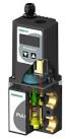 Pneumatic Proportional Valve Selection Made Simple by Tom Voth Product Marketing Manager for Proportional Products A White Paper From Numatics, Inc. Introduction Proportional valves which change outputs
Manufacturing Equipment Modeling
 QUESTION 1 For a linear axis actuated by an electric motor complete the following: a. Derive a differential equation for the linear axis velocity assuming viscous friction acts on the DC motor shaft, leadscrew,
TwinCAT NC Configuration
 TwinCAT NC Configuration NC Tasks The NC-System (Numeric Control) has 2 tasks 1 is the SVB task and the SAF task. The SVB task is the setpoint generator and generates the velocity and position control
PID Tuning Guide. A Best-Practices Approach to Understanding and Tuning PID Controllers. First Edition by Robert C. Rice, PhD
 PID Tuning Guide A Best-Practices Approach to Understanding and Tuning PID Controllers First Edition by Robert C. Rice, PhD Technical Contributions from: Also Introducing: Table of Contents 2 Forward 3
Loop Calibration and Maintenance
 Loop Calibration and Maintenance Application Note Introduction Process instrumentation requires periodic calibration and maintenance to ensure that it is operating correctly. This application note contains
FUZZY Based PID Controller for Speed Control of D.C. Motor Using LabVIEW
 FUZZY Based PID Controller for Speed Control of D.C. Motor Using LabVIEW SALIM, JYOTI OHRI Department of Electrical Engineering National Institute of Technology Kurukshetra INDIA [email protected] [email protected]
Precision Diode Rectifiers
 by Kenneth A. Kuhn March 21, 2013 Precision half-wave rectifiers An operational amplifier can be used to linearize a non-linear function such as the transfer function of a semiconductor diode. The classic
Basics electronic speed Governor
 Basics electronic speed Governor 1 MAN B&W Diesel Aktiengesellschaft, Augsburg Why do we need Governors? Power sources must be controlled to be converted to useful work. Uncontrolled prime movers, not
Control System Asset Management
 Control System Asset Management 2007 ExperTune, Inc. George Buckbee, P.E. ExperTune, Inc. Control System Asset Management George Buckbee, P.E., ExperTune Inc. 2007 ExperTune Inc Summary Most large process
Understanding Power Impedance Supply for Optimum Decoupling
 Introduction Noise in power supplies is not only caused by the power supply itself, but also the load s interaction with the power supply (i.e. dynamic loads, switching, etc.). To lower load induced noise,
Performance Monitor Improves Performance of FCC At a Refiner in Anacortes, WA
 Performance Monitor Improves Performance of FCC At a Refiner in Anacortes, WA By Tom Kinney, ExperTune Inc. www.expertune.com ABSTRACT The benefit of model predictive control or MPC can only be achieved
Chilled Water Valves: Resizing and Tuning for Peak Performance. IDEA Conference Feb. 2008 Jay Russell, PE University of Michigan
 Chilled Water Valves: Resizing and Tuning for Peak Performance IDEA Conference Feb. 2008 Jay Russell, PE University of Michigan Overview Introduction Discussion of Chilled Water (CHW) Control Valve Selection
Analog Amplifier Rexroth RA: Easy, user-friendly control of pumps and valves
 Electric Drives and Controls Hydraulics Linear Motion and Assembly Technologies Pneumatics Service Analog Amplifier Rexroth RA: Easy, user-friendly control of pumps and valves The Drive & Control Company
SELECTING PRESSURE TRANSMITTERS TO IMPROVE CENTRIFUGAL COMPRESSOR SAFETY & EFFICIENCY
 SELECTING PRESSURE TRANSMITTERS TO IMPROVE CENTRIFUGAL COMPRESSOR SAFETY & EFFICIENCY Mark Menezes Manager Pressure & PlantWeb (Americas) Rosemount Inc. Chanhassen, MN 55317 KEYWORDS Centrifugal compressor,
Transmission Line Terminations It s The End That Counts!
 In previous articles 1 I have pointed out that signals propagating down a trace reflect off the far end and travel back toward the source. These reflections can cause noise, and therefore signal integrity
COUNTERBALANCE VALVES
 COUNTERBALANCE VALVES Introduction They are modulating valves which allow free flow into the actuator and then block the reverse flow until they feel a pilot pressure inversely proportional to the load
Chapter 11 SERVO VALVES. Fluid Power Circuits and Controls, John S.Cundiff, 2001
 Chapter 11 SERVO VALVES Fluid Power Circuits and Controls, John S.Cundiff, 2001 Servo valves were developed to facilitate the adjustment of fluid flow based on the changes in the load motion. 1 Typical
10 tips for servos and steppers a simple guide
 10 tips for servos and steppers a simple guide What are the basic application differences between servos and steppers? Where would you choose one over the other? This short 10 point guide, offers a simple
Cane Creek Double Barrel Instructions
 Cane Creek Double Barrel Instructions Congratulations on your purchase of the Cane Creek Double Barrel (CCDB) rear shock. Developed in partnership with Öhlins Racing, the Double Barrel brings revolutionary
Op-Amp Simulation EE/CS 5720/6720. Read Chapter 5 in Johns & Martin before you begin this assignment.
 Op-Amp Simulation EE/CS 5720/6720 Read Chapter 5 in Johns & Martin before you begin this assignment. This assignment will take you through the simulation and basic characterization of a simple operational
Control of an industrial process using PID control blocks in automation controller
 Control of an industrial process using PID control blocks in automation controller by Michel Van Dessel 1 1 Abstract Many continuous industrial processes can be controlled using programmable automation
Implementation of Fuzzy and PID Controller to Water Level System using LabView
 Implementation of Fuzzy and PID Controller to Water Level System using LabView Laith Abed Sabri, Ph.D University of Baghdad AL-Khwarizmi college of Engineering Hussein Ahmed AL-Mshat University of Baghdad
Practical Process Control For Engineers and Technicians
 Practical Process Control For Engineers and Technicians THIS BOOK WAS DEVELOPED BY IDC TECHNOLOGIES WHO ARE WE? IDC Technologies is internationally acknowledged as the premier provider of practical, technical
1. s to Z-Domain Transfer Function
 1. s to Z-Domain Transfer Function 1. s to Z-Domain Transfer Function Discrete ZOH Signals 1. s to Z-Domain Transfer Function Discrete ZOH Signals 1. Get step response of continuous transfer function y
Switch Mode Power Supply Topologies
 Switch Mode Power Supply Topologies The Buck Converter 2008 Microchip Technology Incorporated. All Rights Reserved. WebSeminar Title Slide 1 Welcome to this Web seminar on Switch Mode Power Supply Topologies.
Industrial Steam System Process Control Schemes
 Industrial Steam System Process Control Schemes This paper was developed to provide a basic understanding of the different process control schemes used in a typical steam system. This is however a fundamental
Controller Design in Frequency Domain
 ECSE 4440 Control System Engineering Fall 2001 Project 3 Controller Design in Frequency Domain TA 1. Abstract 2. Introduction 3. Controller design in Frequency domain 4. Experiment 5. Colclusion 1. Abstract
POTENTIAL OF STATE-FEEDBACK CONTROL FOR MACHINE TOOLS DRIVES
 POTENTIAL OF STATE-FEEDBACK CONTROL FOR MACHINE TOOLS DRIVES L. Novotny 1, P. Strakos 1, J. Vesely 1, A. Dietmair 2 1 Research Center of Manufacturing Technology, CTU in Prague, Czech Republic 2 SW, Universität
Section 3. Sensor to ADC Design Example
 Section 3 Sensor to ADC Design Example 3-1 This section describes the design of a sensor to ADC system. The sensor measures temperature, and the measurement is interfaced into an ADC selected by the systems
Flightlab Ground School 5. Longitudinal Static Stability
 Flightlab Ground School 5. Longitudinal Static Stability Copyright Flight Emergency & Advanced Maneuvers Training, Inc. dba Flightlab, 2009. All rights reserved. For Training Purposes Only Longitudinal
Introduction to Process Control Actuators
 1 Introduction to Process Control Actuators Actuators are the final elements in a control system. They receive a low power command signal and energy input to amplify the command signal as appropriate to
QNET Experiment #06: HVAC Proportional- Integral (PI) Temperature Control Heating, Ventilation, and Air Conditioning Trainer (HVACT)
 Quanser NI-ELVIS Trainer (QNET) Series: QNET Experiment #06: HVAC Proportional- Integral (PI) Temperature Control Heating, Ventilation, and Air Conditioning Trainer (HVACT) Student Manual Table of Contents
AMS ValveLink SNAP-ON Application
 AMS Suite: Intelligent Device Manager Product Data Sheet AMS ValveLink SNAP-ON Application Communicate with both HART and Foundation fieldbus FIELDVUE digital valve controllers in the same application.
Operational Overview and Controls Guide
 DOCUMENT: ECSEQ2-1 EFFECTIVE: 02/14/07 SUPERSEDES: 02/26/03 Operational Overview and Controls Guide Standard Two or Three Pump Type VFD Booster Controls 6700 Best Friend Road. Norcross, GA 30071. (770)
ARCHITECTURE OF INDUSTRIAL AUTOMATION SYSTEMS
 ARCHITECTURE OF INDUSTRIAL AUTOMATION SYSTEMS Abdu Idris Omer Taleb M.M., PhD Majmaah University, Kingdom of Saudia Arabia Abstract This article is aimed to name the levels of industrial automation, describes
MANAGING ASSETS USING PERFORMANCE SUPERVISION
 MANAGING ASSETS USING PERFORMANCE SUPERVISION Michel Ruel P.E. President, Top Control Inc. [email protected] 49, Bel-Air, suite 103 Lévis, Qc G6V 6K9 Canada ABSTRACT In today s highly competitive worldwide
Technical Guide No. 100. High Performance Drives -- speed and torque regulation
 Technical Guide No. 100 High Performance Drives -- speed and torque regulation Process Regulator Speed Regulator Torque Regulator Process Technical Guide: The illustrations, charts and examples given in
E. K. A. ADVANCED PHYSICS LABORATORY PHYSICS 3081, 4051 NUCLEAR MAGNETIC RESONANCE
 E. K. A. ADVANCED PHYSICS LABORATORY PHYSICS 3081, 4051 NUCLEAR MAGNETIC RESONANCE References for Nuclear Magnetic Resonance 1. Slichter, Principles of Magnetic Resonance, Harper and Row, 1963. chapter
Rotating Machinery Diagnostics & Instrumentation Solutions for Maintenance That Matters www.mbesi.com
 13 Aberdeen Way Elgin, SC 29045 Cell (803) 427-0791 VFD Fundamentals & Troubleshooting 19-Feb-2010 By: Timothy S. Irwin, P.E. Sr. Engineer [email protected] Rotating Machinery Diagnostics & Instrumentation
Unit 24: Applications of Pneumatics and Hydraulics
 Unit 24: Applications of Pneumatics and Hydraulics Unit code: J/601/1496 QCF level: 4 Credit value: 15 OUTCOME 2 TUTORIAL 2 HYDRAULIC AND PNEUMATIC CYLINDERS The material needed for outcome 2 is very extensive
Choosing Between Electromechanical and Fluid Power Linear Actuators in Industrial Systems Design
 Choosing Between Electromechanical and Fluid Power Linear Actuators in Industrial Systems Design James Marek, Business Unit Director, Thomson Systems Thomson Industries, Inc. 540-633-3549 www.thomsonlinear.com
TLK 48 MICROPROCESSOR-BASED DIGITAL ELECTRONIC REGULATOR
 TLK 48 MICROPROCESSOR-BASED DIGITAL ELECTRONIC REGULATOR TECHNICAL DATA CARATTERISTICHE MECCANICHE Housing Self-extinguishing plastic, UL 94 V0 Dimensions 48x48 mm DIN depth 98 mm Weight 225 g approx.
A descriptive definition of valve actuators
 A descriptive definition of valve actuators Abstract A valve actuator is any device that utilizes a source of power to operate a valve. This source of power can be a human being working a manual gearbox
Welcome to FBL Gyro Configuration software
 Welcome to FBL Gyro Configuration software If you have gone flybarless and are using the ALZRC 3GYS, CopterX 3X1000, Helicox TG-1, Hobby King ZYX or Tarot ZYX then this software may be useful to you. Based
Accuracy and Tuning in CNC Machine Tools
 FAMA Technical Article/001 Accuracy and Tuning in CNC Machine Tools Introduction: This article explains how it is possible to achieve a better performance on High Speed CNC Machine Tools. Performance is
EE 402 RECITATION #13 REPORT
 MIDDLE EAST TECHNICAL UNIVERSITY EE 402 RECITATION #13 REPORT LEAD-LAG COMPENSATOR DESIGN F. Kağan İPEK Utku KIRAN Ç. Berkan Şahin 5/16/2013 Contents INTRODUCTION... 3 MODELLING... 3 OBTAINING PTF of OPEN
EBS Electronically controlled Brake system in the city bus CITARO / CITO
 Electronically controlled Brake system in the city bus CITARO / CITO System and functional description 1. Edition Copyright WABCO 2003 Vehicle Control Systems An American Standard Company 8150004073 The
DIGITAL-TO-ANALOGUE AND ANALOGUE-TO-DIGITAL CONVERSION
 DIGITAL-TO-ANALOGUE AND ANALOGUE-TO-DIGITAL CONVERSION Introduction The outputs from sensors and communications receivers are analogue signals that have continuously varying amplitudes. In many systems
Microcontroller-based experiments for a control systems course in electrical engineering technology
 Microcontroller-based experiments for a control systems course in electrical engineering technology Albert Lozano-Nieto Penn State University, Wilkes-Barre Campus, Lehman, PA, USA E-mail: [email protected]
INSTRUMENTATION AND CONTROL TUTORIAL 3 SIGNAL PROCESSORS AND RECEIVERS
 INSTRUMENTATION AND CONTROL TUTORIAL 3 SIGNAL PROCESSORS AND RECEIVERS This tutorial provides an overview of signal processing and conditioning for use in instrumentation and automatic control systems.
Frequency Response of Filters
 School of Engineering Department of Electrical and Computer Engineering 332:224 Principles of Electrical Engineering II Laboratory Experiment 2 Frequency Response of Filters 1 Introduction Objectives To
Applying Pressure Independent Control Valves in H.V.A.C. Systems. A Presentation to: Orange Empire ASHRAE Santa Ana Nov. 17, 2009
 Applying Pressure Independent Control Valves in H.V.A.C. Systems A Presentation to: Orange Empire ASHRAE Santa Ana Nov. 17, 2009 1 Introduction I know, as building design consultants, so much of your effort
Introduction to SMPS Control Techniques
 Introduction to SMPS Control Techniques 2006 Microchip Technology Incorporated. All Rights Reserved. Introduction to SMPS Control Techniques Slide 1 Welcome to the Introduction to SMPS Control Techniques
Positive Feedback and Oscillators
 Physics 3330 Experiment #6 Fall 1999 Positive Feedback and Oscillators Purpose In this experiment we will study how spontaneous oscillations may be caused by positive feedback. You will construct an active
Service Information CALIBRATION PROCEDURE AND TROUBLESHOOTING FOR LINEAR GOVERNOR CONTROLLERS NOTE
 Service Information Calibration & Adjustments CALIBRATION PROCEDURE AND TROUBLESHOOTING FOR LINEAR GOVERNOR CONTROLLERS Part Number DYN1-10752-000-0-12/24 DYN1-10752-001-0-12/24* DYN1-10753-000-0-12/24
PRODUCT PROFILE FEATURES
 PRODUCT PROFILE Pressure Transmitters & Pneumatic Transducer Airflow Transmitter, Differential Air Pressure Transmitter and Differential & Gauge Liquid/Gas Pressure Transmitter FEATURES AIRFLOW TRANSMITTER
Keywords: Fuzzy Logic, Control, Refrigeration Systems and Electronic Expansion Valves.
 POTENTIALITIES OF FUZZY LOGIC CONTROL APPLIED TO SMALL VAPOR COMPRESSION REFRIGERATION SYSTEMS Oscar S. H. Mendoza Fábio A. Carvajal José A. Tumialán Gustavo Luiz C. M. de Abreu Universidade Federal de
CONNECTOR AMPLIFIER FOR PROPORTIONAL VALVES (4-20 ma Input Version)
 TECHNICAL DATASHEET #TD1102AX CONNECTOR AMPLIFIER FOR PROPORTIONAL VALVES (4-20 ma Input Version) Part Number: Connector Amplifier CAPV-H-4-20MA-x complete with cable CAPV-4C-yM Where: x = current output
Note. OCXO: Oven Controlled Crystal Oscillator. Differential Amplifer
 Helping Customers Innovate, Improve & Grow Note OCXO: Oven Controlled Crystal Oscillator Application Note Introduction If stability requirements are too stringent to be met by a basic crystal oscillator
Daniel. Liquid Control Valves Technical Guide. Technical Guide DAN-LIQ-TG-44-rev0813. DAN-LIQ-TG-44-rev0208. February 2008.
 DAN-LIQ-TG-44-rev0208 February 2008 Daniel Liquid Control Valves Technical Guide www.daniel.com Daniel Measurement and Control Theory, Principle of Operation and Applications This brochure has been prepared
PID Control. Proportional Integral Derivative (PID) Control. Matrix Multimedia 2011 MX009 - PID Control. by Ben Rowland, April 2011
 PID Control by Ben Rowland, April 2011 Abstract PID control is used extensively in industry to control machinery and maintain working environments etc. The fundamentals of PID control are fairly straightforward
A Study of Speed Control of PMDC Motor Using Auto-tuning of PID Controller through LabVIEW
 A Study of Speed Control of PMDC Motor Using Auto-tuning of PID Controller through LabVIEW Priyanka Rajput and Dr. K.K. Tripathi Department of Electronics and Communication Engineering, Ajay Kumar Garg
Transistor Amplifiers
 Physics 3330 Experiment #7 Fall 1999 Transistor Amplifiers Purpose The aim of this experiment is to develop a bipolar transistor amplifier with a voltage gain of minus 25. The amplifier must accept input
System Modeling and Control for Mechanical Engineers
 Session 1655 System Modeling and Control for Mechanical Engineers Hugh Jack, Associate Professor Padnos School of Engineering Grand Valley State University Grand Rapids, MI email: [email protected] Abstract
Ziegler-Nichols-Based Intelligent Fuzzy PID Controller Design for Antenna Tracking System
 Ziegler-Nichols-Based Intelligent Fuzzy PID Controller Design for Antenna Tracking System Po-Kuang Chang, Jium-Ming Lin Member, IAENG, and Kun-Tai Cho Abstract This research is to augment the intelligent
PIDControlfor the future
 PIDControlfor the future Haruo TAKATSU Yokogawa Electric Corporation! 1! Agenda! 2! Discussion Items 1. Will PID control continue to be used in the future? Market Survey in Japan 2. When and why is derivative
PID control - Simple tuning methods
 - Simple tuning methods Ulf Holmberg Introduction Lab processes Control System Dynamical System Step response model Self-oscillation model PID structure Step response method (Ziegler-Nichols) Self-oscillation
PID Control. 6.1 Introduction
 6 PID Control 6. Introduction The PID controller is the most common form of feedback. It was an essential element of early governors and it became the standard tool when process control emerged in the
Raffaele Rea GE-Bayer Specialties Srl - Termoli Paolo Belli, Nunzio Bonavita ABB PS&S SpA - Genova ABB - 1 -
 Raffaele Rea GE-Bayer Specialties Srl - Termoli Paolo Belli, Nunzio Bonavita ABB PS&S SpA - Genova ABB - 1 - Agenda An Innovative Approach to Control Loop Performance Assessment Why Control Loop Condition
Second Order Systems
 Second Order Systems Second Order Equations Standard Form G () s = τ s K + ζτs + 1 K = Gain τ = Natural Period of Oscillation ζ = Damping Factor (zeta) Note: this has to be 1.0!!! Corresponding Differential
Analysis of PID Control Design Methods for a Heated Airow Process
 Helsinki University of Technology Faculty of Information and Natural Sciences Department of Mathematics and Systems Analysis Mat-.8 Independent research projects in applied mathematics Analysis of PID
OPERATION MANUAL VALVE CHECKER G040-123
 OPERATION MANUAL VALVE CHECKER AUSTRALIA PTY. LTD. L:\DWG_NO\DOCUMENT\MANUALS\Word File\A OPERATION MANUAL CN 20.4.99 VALVE CHECKER 1 of 20 CONTENTS Chapter Title Page 1. Description 3 2. Specification
CPW Current Programmed Winder. Application Handbook. Copyright 2002 by Eurotherm Drives, Inc.
 CPW Current Programmed Winder Application Handbook Copyright 2002 by Eurotherm Drives, Inc. All rights strictly reserved. No part of this document may be stored in a retrieval system, or transmitted, in
Electronics for Analog Signal Processing - II Prof. K. Radhakrishna Rao Department of Electrical Engineering Indian Institute of Technology Madras
 Electronics for Analog Signal Processing - II Prof. K. Radhakrishna Rao Department of Electrical Engineering Indian Institute of Technology Madras Lecture - 18 Wideband (Video) Amplifiers In the last class,
Hidetsugu KURODA 1, Fumiaki ARIMA 2, Kensuke BABA 3 And Yutaka INOUE 4 SUMMARY
 PRINCIPLES AND CHARACTERISTICS OF VISCOUS DAMPING DEVICES (GYRO-DAMPER), THE DAMPING FORCES WHICH ARE HIGHLY AMPLIFIED BY CONVERTING THE AXIAL MOVEMENT TO ROTARY ONE 0588 Hidetsugu KURODA 1, Fumiaki ARIMA,
Sensing and Control. A Process Control Primer
 Sensing and Control A Process Control Primer Copyright, Notices, and Trademarks Printed in U.S.A. Copyright 2000 by Honeywell Revision 1 July 2000 While this information is presented in good faith and
Why Lead Screws are the Best Fit for Many Linear Motion Applications - and How to Rightly Apply Them
 Why Lead Screws are the Best Fit for Many Linear Motion Applications - and How to Rightly Apply Them Robert Lipsett, Engineering Manager, Thomson BSA Thomson Industries, Inc. San Jose, CA 800.882.8857
Operational Amplifier - IC 741
 Operational Amplifier - IC 741 Tabish December 2005 Aim: To study the working of an 741 operational amplifier by conducting the following experiments: (a) Input bias current measurement (b) Input offset