
Seton Hall University
|
|
|
- Abigayle Ryan
- 10 years ago
- Views:
Transcription
1 Seton Hall University College of Education & Human Services Professional Psychology and Family Therapy Programs in Counseling and School Counseling Student Handbook The programs within the College of Education and Human Services strive to prepare competent, socially conscious, and reflective professionals.

2 Counseling Programs Handbook Table of Contents 1. Mission Statements and Program Objectives 3 Accreditation 3 Licensing and Certification 3 Counseling Program Goals and Objectives 4 Professional Counseling MA/EdS 4 School Counseling MA 5 Dual Major: Professional Counseling/School Counseling MA/EdS 6 Curriculum/Advisement Sheets Professional Counseling MA/EdS 7 School Counseling MA 8 2. Membership in Professional Counseling Organizations and Opportunities for Professional Involvement 9 3. Policy and Procedures for Recommending Students for Credentialing and Employment Student Retention Policy 14 Procedures for Student Remediation and/or Dismissal From the Program 17 Student Performance Cover Sheet 20 Student Performance Remediation Plan Academic Appeal Policy Other Department Policies Plagiarism/Academic Integrity Policy 27 Students with Disabilities 38 Independent Study Policy Additional Information for Online Students Agreement Form 42 Program students are required to abide by all university, college, and department policies in addition to the program specific policies and procedures outlined in this handbook. This includes, but is not limited to the Seton Hall Graduate Catalog, the Seton Hall University Student Handbook, the Practicum/Internship Manual and, for online students, the Online Student supplement. This document is also available online.

3 Counseling Programs Handbook Mission Statement and Program Objectives Seton Hall University is a major Catholic university. In a diverse and collaborative environment, it focuses on academic and ethical development. Seton Hall students are prepared to be leaders in their professional and community lives in a global society and are challenged by outstanding faculty, an evolving technologically advanced setting and values-centered curricula. The counseling programs at Seton Hall University are part of the Department of Professional Psychology and Family Therapy, which in turn, is part of the College of Education and Human Services at Seton Hall University. The vision of the College of Education and Human Services is to prepare competent, socially conscious, and reflective professionals. Accreditation Seton Hall University is accredited by the Middle States Association of Colleges and Schools. Seton Hall University is also a member of the Sloan Asynchronous Learning Network Consortium (ALN), an association of accredited institutions offering online degree or certification programs committed to quality distance education. The College of Education and Human Services is accredited by the National Council for the Accreditation of Teacher Education Programs (NCATE). The counseling programs work to meet the standards set forth by Council for Accreditation of Counseling and Related Educational Programs (CACREP) and the National Board for Certified Counselors (NBCC). The graduate programs in counseling prepare students for professional practice and/or further study. All students complete a core curriculum and choose one or both curricular paths. The combined MA/EdS in professional counseling meets the academic requirements for the New Jersey licensed professional counselor (LPC) credential. The MA in school counseling meets the academic requirements for New Jersey certification as a school counselor.
4 Counseling Programs Handbook Students interested in pursuing licensing as a professional counselor in other states should refer to the credentialing organizations in those states, and may find this link helpful: Students interested in pursuing school counselor certification in other states may find this link helpful: Counseling program goals and objectives The overarching goal of the counseling programs is to prepare competent, socially conscious, and reflective professional counselors, who are able to meet the needs of a diverse society. Graduates promote optimal human development and empower clients to solve personal, interpersonal, career and other mental health problems. Counselors use a wellness model in counseling clients as well diagnosis and treatment skills for clients with developmental problems and more serious mental health disorders. Professional counseling MA/EdS. The MA/EdS program in Professional Counseling works to follow the CACREP guidelines for programs in clinical mental health counseling. Upon completion of the professional counseling program, students will have gained knowledge and skills in the following areas: Individual appraisal and assessment, diagnosis and treatment planning, Individual and group counseling in agencies, counseling centers, and independent practice, Crisis prevention, intervention and community disaster response, Prevention and early identification of personal and interpersonal problems, Consultation and collaboration in multi-service agencies and institutions, Developmental, clinical, and peer supervision models,

5 Counseling Programs Handbook Career counseling and lifespan development, Advocacy for clients and community outreach to underrepresented groups, Work in a multicultural environment, Counselor self-care, and Preparation for licensure and independent practice. School counseling M.A. For students working towards certification as a school counselor, the overarching program goals are to prepare school counselors to maximize the potential of all students through comprehensive developmental school counseling programs and to develop skills as competent school counselors and effective consultants, collaborators, advocates, and leaders in an ever changing global society. The M.A. program in School Counseling works to follow CACREP school counseling guidelines. Upon completion of the school counseling program, students will have gained knowledge and skills to Advocate for the academic, career, and personal-social success of every student. Implement a comprehensive school counseling program to promote systemic school reform. Consult with teachers, parents, and school staff, to promote a positive environment for learning. Provide counseling, prevention, and early identification services to help children and adolescents achieve optimal development Empower students and their families to overcome educational difficulties through a multidisciplinary team intervention approach. Provide crisis prevention, intervention, disaster response, and coping strategies to students and families in the school community.

6 Counseling Programs Handbook Dual major: Professional counseling/school counseling program Students who are interested in pursuing state licensing as a professional counselor and certification as a school counselor may complete the requirements for both. Please note: school counseling certification requires 600 hours as a school counseling intern, generally as a full academic year placement (fall through spring). These hours may not be used to satisfy the requirements for licensure as a professional counselor in New Jersey.
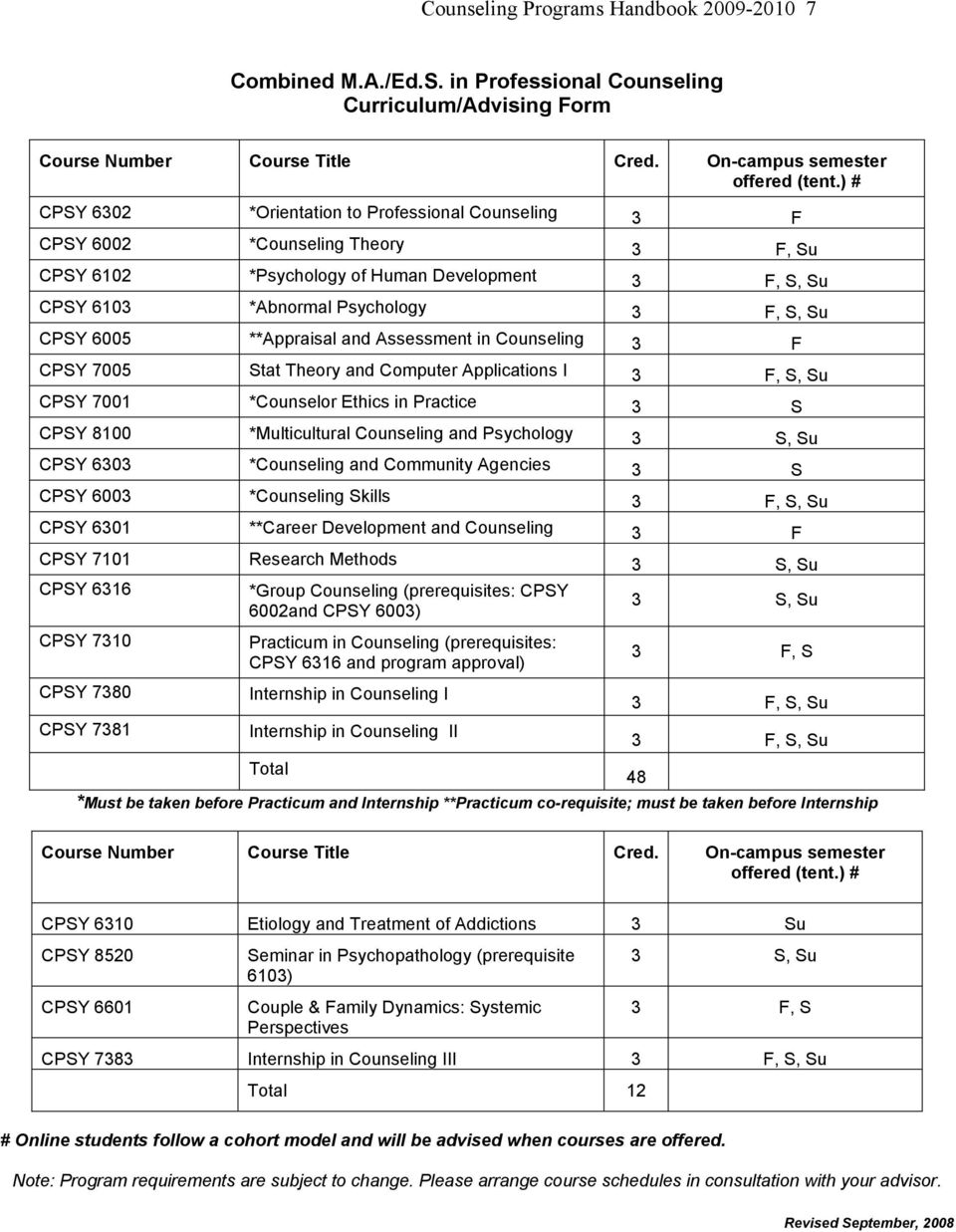
7 Counseling Programs Handbook Combined M.A./Ed.S. in Professional Counseling Curriculum/Advising Form Course Number Course Title Cred. On-campus semester offered (tent.) # CPSY 6302 *Orientation to Professional Counseling 3 F CPSY 6002 *Counseling Theory 3 F, Su CPSY 6102 *Psychology of Human Development 3 F, S, Su CPSY 6103 *Abnormal Psychology 3 F, S, Su CPSY 6005 **Appraisal and Assessment in Counseling 3 F CPSY 7005 Stat Theory and Computer Applications I 3 F, S, Su CPSY 7001 *Counselor Ethics in Practice 3 S CPSY 8100 *Multicultural Counseling and Psychology 3 S, Su CPSY 6303 *Counseling and Community Agencies 3 S CPSY 6003 *Counseling Skills 3 F, S, Su CPSY 6301 **Career Development and Counseling 3 F CPSY 7101 Research Methods 3 S, Su CPSY 6316 CPSY 7310 CPSY 7380 CPSY 7381 *Group Counseling (prerequisites: CPSY 6002and CPSY 6003) Practicum in Counseling (prerequisites: CPSY 6316 and program approval) Internship in Counseling I Internship in Counseling II Total 3 S, Su 3 F, S 3 F, S, Su 3 F, S, Su *Must be taken before Practicum and Internship **Practicum co-requisite; must be taken before Internship 48 Course Number Course Title Cred. On-campus semester offered (tent.) # CPSY 6310 Etiology and Treatment of Addictions 3 Su CPSY 8520 CPSY 6601 Seminar in Psychopathology (prerequisite 6103) Couple & Family Dynamics: Systemic Perspectives 3 S, Su 3 F, S CPSY 7383 Internship in Counseling III 3 F, S, Su Total 12 # Online students follow a cohort model and will be advised when courses are offered. Note: Program requirements are subject to change. Please arrange course schedules in consultation with your advisor. Revised September, 2008
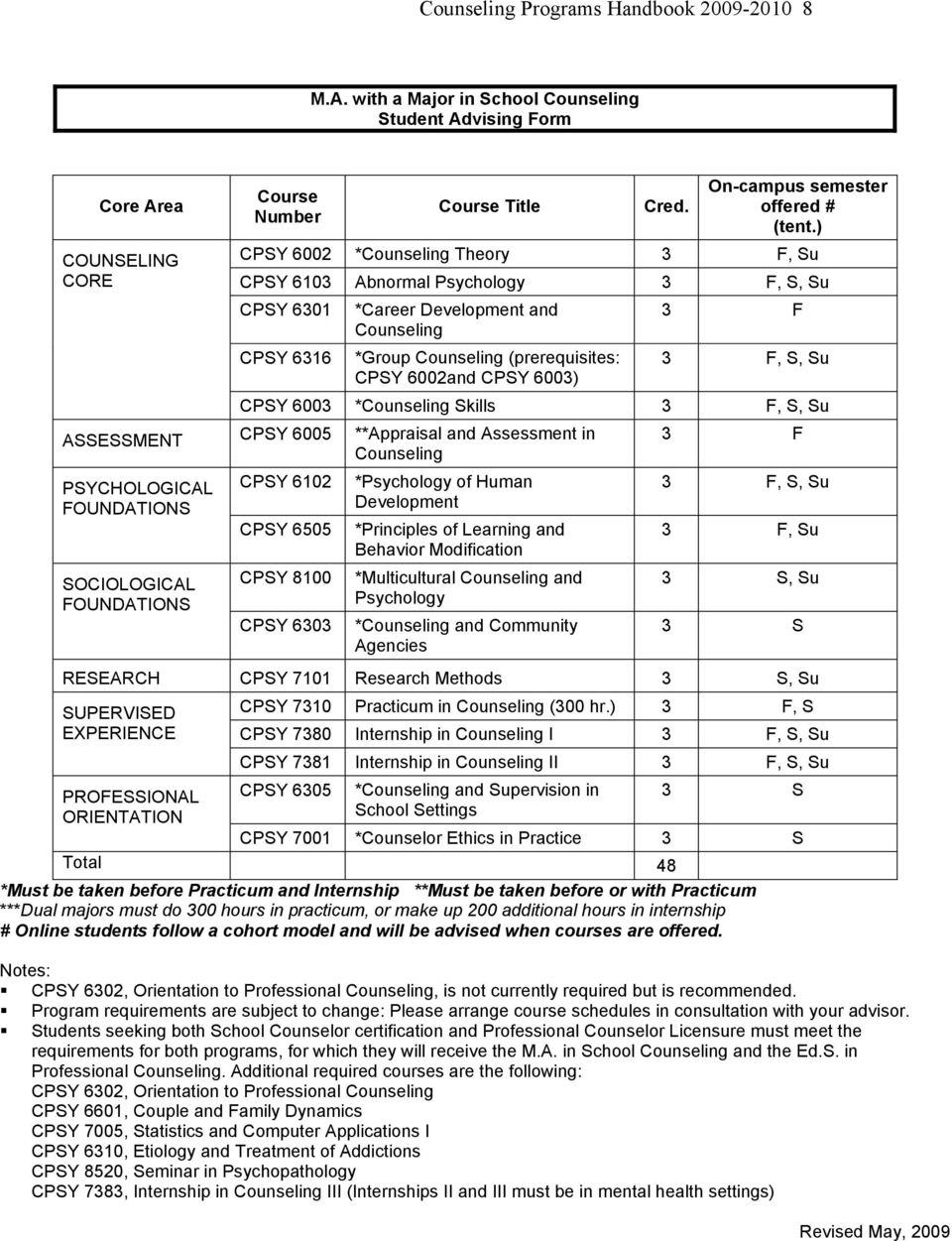
8 Counseling Programs Handbook M.A. with a Major in School Counseling Student Advising Form Core Area COUNSELING CORE Course Number Course Title Cred. On-campus semester offered # (tent.) CPSY 6002 *Counseling Theory 3 F, Su CPSY 6103 Abnormal Psychology 3 F, S, Su CPSY 6301 CPSY 6316 *Career Development and Counseling *Group Counseling (prerequisites: CPSY 6002and CPSY 6003) 3 F 3 F, S, Su CPSY 6003 *Counseling Skills 3 F, S, Su ASSESSMENT CPSY 6005 **Appraisal and Assessment in Counseling PSYCHOLOGICAL FOUNDATIONS SOCIOLOGICAL FOUNDATIONS CPSY 6102 CPSY 6505 CPSY 8100 CPSY 6303 *Psychology of Human Development *Principles of Learning and Behavior Modification *Multicultural Counseling and Psychology *Counseling and Community Agencies 3 F 3 F, S, Su 3 F, Su 3 S, Su 3 S RESEARCH CPSY 7101 Research Methods 3 S, Su SUPERVISED EXPERIENCE PROFESSIONAL ORIENTATION CPSY 7310 Practicum in Counseling (300 hr.) 3 F, S CPSY 7380 Internship in Counseling I 3 F, S, Su CPSY 7381 Internship in Counseling II 3 F, S, Su CPSY 6305 *Counseling and Supervision in School Settings 3 S CPSY 7001 *Counselor Ethics in Practice 3 S Total 48 *Must be taken before Practicum and Internship **Must be taken before or with Practicum ***Dual majors must do 300 hours in practicum, or make up 200 additional hours in internship # Online students follow a cohort model and will be advised when courses are offered. Notes: CPSY 6302, Orientation to Professional Counseling, is not currently required but is recommended. Program requirements are subject to change: Please arrange course schedules in consultation with your advisor. Students seeking both School Counselor certification and Professional Counselor Licensure must meet the requirements for both programs, for which they will receive the M.A. in School Counseling and the Ed.S. in Professional Counseling. Additional required courses are the following: CPSY 6302, Orientation to Professional Counseling CPSY 6601, Couple and Family Dynamics CPSY 7005, Statistics and Computer Applications I CPSY 6310, Etiology and Treatment of Addictions CPSY 8520, Seminar in Psychopathology CPSY 7383, Internship in Counseling III (Internships II and III must be in mental health settings) Revised May, 2009
9 Counseling Programs Handbook Opportunities for Professional Involvement An integral part of the graduate school experience is gaining a professional identity. Belonging to a professional organization provides knowledge on current developments and future directions of the field as well as information on ethical practice. Most professional organizations offer reduced membership fees and other benefits to student members. Belonging to professional organizations also provides opportunities for involvement. Activities potentially appropriate for students include 1) conference attendance and/or presenting at conferences, 2) advocacy, 3) networking, and 4) professional development. Counseling students are strongly encouraged to join one or more of the following professional organizations. AMERICAN COUNSELING ASSOCIATION The American Counseling Association (ACA) is the professional organization for counselors. ACA has 19 divisions, of which at least one should be of interest to the MA/Eds Counseling student. ACA divisions focus on mental health counseling, school counseling, career development, multicultural counseling, and family counseling among others. Opportunities to submit presentation proposals, win scholarships to the national conference, or receive free registration in exchange for volunteering, and other incentives for graduate students are publicized on the website site ACA has many state and local associations, many of which are also good resources. Please see below for New Jersey resources. This link provides a list of state associations:

10 Counseling Programs Handbook NEW JERSEY COUNSELING ASSOCIATION The New Jersey Counseling Association (NJCA) is the New Jersey state branch of ACA and is a wonderful local opportunity to network with counselors and graduate counseling students. NJCA sponsors graduate student awards and poster sessions at the spring conference. There are opportunities to apply for free registration in exchange for volunteering at the conference. AMERICAN SCHOOL COUNSELOR ASSOCIATION The American School Counselor Association (ASCA) is a division of ACA as well as a stand- alone organization for school counselors. Its website is full of helpful resources for school counselors and for graduate counseling students. You may also find your state association to be helpful. NEW JERSEY SCHOOL COUNSELOR ASSOCIATION The New Jersey School Counselor Association (NJSCA) is the state branch of ASCA. NJSCA hosts an annual spring conference and welcomes student participation. SETON HALL UNIVERSITY (SHU) COUNSELING STUDENT ASSOCIATION The SHU Counseling Student Association an inclusive organization that is open to all counseling students. Benefits to association participation include special guest lectures, advocacy activities, professional development opportunities, networking and social support.

11 Counseling Programs Handbook CHI SIGMA IOTA Chi Sigma Iota is the international honor society for academic and professional counseling. Graduate counseling students who have earned a minimum of 12 credits with at least a 3.5 GPA and demonstrate excellent character may be invited to apply for membership in Seton Hall s Sigma Alpha chapter. Faculty and other professional counselors may also be eligible for membership.

12 Counseling Programs Handbook Policy and Procedures for Recommending Students for Credentialing And Employment Endorsement and recommendation for credentialing Successful completion of the MA/Ed.S. in professional counseling meets the current academic requirements for credentialing and licensing in the State of New Jersey. Students should be aware that laws can change, and therefore they are encouraged to remain informed about the activities of the Professional Counselor Examiners Committee particularly if they do not plan to apply for licensure immediately after graduation. For further information about licensure as a professional counselor in New Jersey, please see Students interested in pursuing licensure in other states may find this link helpful: Graduates who successfully complete the requirements for the MA in school counseling and apply for New Jersey certification as a school counselor through the Associate Dean s office within one year of graduation will be endorsed for this certificate. NOTE: These degrees do not license or certify you as a professional counselor. There are additional credentialing requirements which (for New Jersey) can be obtained from the Professional Counselor Examiners Committee or similar board in your home state (see links above). These requirements generally include an examination (e.g., the NCE) and additional supervised experience in an appropriate setting. Please be aware that some clinical placement sites and State licensing/certifying boards have additional requirements for licensing and credentials, often including fingerprinting and a criminal background check.
13 Counseling Programs Handbook If you need a letter of recommendation, you may request one from a faculty member who knows you well. Faculty are not required to write a letter on your behalf. Note 2: Policies and procedures for recommendation to go on Practicum and Internship are outlined in the current Practicum/Internship Manual.
14 Counseling Programs Handbook Student Retention and Remediation Policy All students are expected to make satisfactory progress towards their academic and professional goals. Program faculty meet each semester to review student progress as well as to identify areas for student and program improvement. Online students are admitted to their program of study on a probationary status for their first 12 credits of coursework, including the first residency and first two semesters of classes. If a concern about suitability of a student for the profession, academic coursework, or personal behavior, faculty will follow the remediation policy as described in a later section. Only in cases where significant problematic behavior exists or where a serious ethical breach has been identified, will a process for program dismissal be initiated. In all other cases, program faculty will work diligently with students to ensure that the concerns are resolved and that the student remains in good standing in the program. Policy on the Retention and Remediation of Students The purpose of this policy is to clarify the areas of competence and professional behavior expected of each counseling student and the procedures for identifying and addressing problematic behaviors, incompetence, and/or ethical violations that occur during the course of their graduate training. Students are expected to demonstrate competence, social consciousness, and reflection in their work. This includes high standards of professional and ethical behavior in their interactions with clients, students, peers, supervisors, and faculty, including confidentiality, honesty, and academic integrity. Specific goals and expected competencies are described earlier in this Handbook.

15 Counseling Programs Handbook This policy describes the procedures used to monitor progress, to identify deficiencies and to assist the student in remediation where possible, or to dismiss the student from the Program when remediation is not possible. Definitions Problematic Behaviors refer to a student s behaviors, attitudes, or characteristics that may require remediation, but are perceived as not excessive or unexpected for professionals in training. Performance anxiety, discomfort with client s diverse life-styles and ethnic backgrounds, and lack of appreciation of agency norms are examples of problematic behaviors that are usually remedied and not likely to progress into impairment status (Lamb, Cochran, & Jackson, 1991, p. 292). These behaviors are further defined as an interference in professional functioning that is reflected in one or more of the following ways: Inability or unwillingness to acquire and integrate professional standards into one s repertoire of professional behavior; Inability to acquire professional skills and reach an accepted level of competency; or Inability to control personal stress, psychological dysfunction, or emotional reactions that may affect professional functioning. Incompetence is defined as a lack of ability, which may include either professional or interpersonal skill, or academic deficiency. When students continue to provide counseling services beyond their current level of competence, this is an ethical violation. Ethical Misconduct is when the American Counseling Association Code of Ethics and Standards of Practice (2005) is not followed. This code is intended to provide both the general principles and the decision rules to cover most situations encountered by current and future counselors in their professional activities. It has as its primary goal the welfare and protection of the
16 Counseling Programs Handbook individuals and groups with whom counselors work. It is the individual responsibility of counselors and counselors-in-training to aspire to the highest possible standards of conduct. Counselors respect and protect human and civil rights, and do not knowingly participate in or condone unfair discriminatory practices. It is assumed that unethical behavior and problematic behavior are overlapping concepts that all unethical behaviors are reflective of problematic behavior, whereas problematic behavior may involve other aspects of professional behavior that may or may not result in unethical behavior. Identification and Verification of Problems Requiring Remediation or Dismissal Incompetence, ethical violations, or problematic behaviors can be identified in a variety of ways. Formal evaluation of each student s progress takes place each semester. This evaluation involves a review of grades earned, credits accumulated, as well as professional behavior. Informal Identification of Problems Any faculty member, supervisor, or student may raise an issue at any time. Practicum and/or Internship supervisors should initially discuss their concerns with the Clinical Coordinator, who will gather additional information and raise the issue at the next scheduled Program faculty meeting. Students who have a concern about a fellow student should first discuss the issue with their own advisor, who will then raise the issue with the other Program faculty. Advisors and faculty members will protect the confidentiality of the student reporting the potential problem, but they may request that the student meet with them to provide additional information. The Program faculty will briefly discuss the potential problem during the meeting in which it is raised, and if necessary and/or the advisor of the student concerned will gather additional data and will report to the Program faculty within one week. If the concern appears valid, a formal review will take place as described below.

17 Counseling Programs Handbook Review Procedures for Possible Problems When a possible problematic behavior has been identified, the faculty of the Program meet with the student to review the evaluation, and to determine whether a problem actually exists. In addition the original report of the problem, information will be gathered from formal written and/or verbal evaluations of the student and from informal sources, including observations of students outside the training environment or reports from other interested parties. Areas to be reviewed and discussed include the nature, severity, and consequences of the reported problem behavior. The following questions will be posed at this stage (adapted from Lamb, Cochran, & Jackson, 1991): What are the actual behaviors that are of concern, and how are those behaviors related to the goals of the Program? How and in what settings have these behaviors been manifested? What were the negative consequences for the training agency or others (e.g., clients, other students) of the problematic behaviors? Who observed the behaviors in question? Who or what was affected by the behavior (clients, agency, atmosphere, training program, etc.)? What was the frequency of this behavior? Has the student been made aware of this behavior before the meeting, and, if so, how did he or she respond? Has the feedback regarding the behavior been documented in any way? How serious is this behavior on the continuum of ethical and professional behavior? What are the student s ideas about how the problem may be remediated?

18 Counseling Programs Handbook While each case is different and requires individual assessment, the following factors may indicate that the problem is more serious and may not be as easy to remediate: The student does not acknowledge, understand or address the problematic behavior when it is identified. The problematic behavior is not merely a reflection of a skill deficit that can be rectified by training. The quality of service delivered by the person suffers. The problematic behavior is not restricted to one area of professional functioning. The behavior has the potential for ethical or legal ramifications if not addressed. A disproportionate amount of attention by training personnel is required. Behavior that does change as a function of feedback. Behavior negatively affects public image of agency of the university or training site. After the initial meeting with the student, the faculty will meet to determine whether a problematic behavior exists. If the faculty determines that there is a problem, they will develop a written plan for remediation or a recommendation for dismissal and will schedule a meeting to discuss this plan within three weeks of their initial meeting with the student. Students are encouraged to submit their own ideas for remediation to the faculty, through their advisors. The faculty will consider the student s recommendations in developing their own recommendations. The plan will be documented by the student s advisor, using the Student Performance Remediation Plan that immediately follows this section. After the faculty members have presented their recommendations to the student and answered his or her questions, the student must sign the Performance Review Cover Sheet (also
19 Counseling Programs Handbook following this section) indicating that the recommendations have been presented and explained. The student will be given the opportunity to accept the recommendations, to provide a written rebuttal, and/or to appeal. If the student chooses to provide a rebuttal, the Program faulty will meet again to consider any new evidence presented by the student, and will provide written documentation of their decision within three weeks of the date the rebuttal was received. If the student wishes to appeal the faculty s decision, he or she may follow the appeal procedures outlined in the Seton Hall University Handbook. Regardless of the outcome of the feedback meeting, the student s advisor will schedule a follow-up meeting to evaluate the student s adjustment to the review process, and recommend potential sources of guidance and assistance when necessary. The remediation process will follow the written plan, which must include scheduled review dates and target dates for each issue identified. This plan must be made within three weeks of initial meeting. Examples of actions that may be included in the remediation plan are an increase in didactic instruction, a decrease in course load, a decrease in or temporary suspension of clinical responsibilities, increased supervision and/or faculty advisement, leave of absence, and individual psychotherapy. Progress must be reviewed at least once every semester for the Fall and Spring semesters, at least two weeks before registration. Additional reviews may be scheduled as necessary. After each review, a copy of the Remediation Plan including student comments and faculty signatures must be placed in the student s file. If progress against targets is viewed by the faculty as insufficient, they may recommend either a change in the remediation plan or dismissal. The student will have an opportunity for rebuttal or appeal, as described above.
20 Counseling Programs Handbook Student Performance Review Cover Sheet Date of Initial Meeting with Student: Faculty Members Present (Must include Program Director and Student s Advisor): Summary of Problem (include specific behaviors, setting, and who first identified the problem): Date of Faculty Review Meeting Faculty Recommendation: No action required Remediation required (attach copy of plan) Dismissal recommended (must be reviewed and approved by Department Chair and Dean) RECOMMENDATION APPROVED: Student s Advisor Date Program Director Date Date of Student Feedback Meeting Student Comments:

21 Counseling Programs Handbook Signature of Student: Date: (Does not indicate agreement) Student Performance Remediation Plan (check one ) Initial Plan Review Followup Final Review Student: Identified Areas of Concern: Date: A. B. C. D. Remediation Plan and Schedule: Area Specific Behavioral Objectives and Target Dates Method of Remediation Met? Y/N A B C D
22 Counseling Programs Handbook Progress Since Last Review (if applicable): Sufficient Insufficient Comments and Recommendations: Date of Next Review (if applicable): Student Reactions: Signatures: Student Signature: Advisor: Program Director:
23 Counseling Programs Handbook Personal Therapy The Professional Psychology and Family Therapy departmental faculty believes that participating as a client in individual or group counseling or therapy can be both a growth experience for the graduate student a significant educational aspect of a program to prepare counseling professionals. Experience as a client in personal counseling or therapy is, therefore, strongly recommended for all students in the counseling programs. Individual or group counseling should be conducted by a licensed professional counselor, a licensed marriage and family therapist, a licensed social worker, a licensed psychologist, or an equivalently trained professional. Personal therapy may at any time be required by the Department for the student to continue in the program. Such requirement would usually be in the context of a Remediation Plan, based on an identified student problem. Commencement of therapy and recommendation of additional therapy may be a stipulation or condition at the time of the student s screening or at any time during their continuation in the program. The student has the right to choose his/her own therapists for this requirement, and is responsible for any expenses related to the evaluation and/or therapy.
24 Counseling Programs Handbook Academic Appeal Policy Academic Grievance Procedure Concerning Grades The following concerns itself only with a departmental process for student grievances over grades. It is not intended to address the issue of grade disputes unless the student files a formal grievance through the department chair. Students should be aware that with very rare exception, the final decision on all grades rests with the professor. Insofar as grievances are concerned, the Seton Hall University Student Handbook states that a student may file a grievance through the department only if the student believes the grade attained is capricious and arbitrary. Mere disagreement with the grade given does not constitute a basis for grievance. Moreover, it is unlikely that a grade of B or better would be considered arbitrary and capricious. Departmental Procedure The student's first step in the event of a grade dispute is to confer directly with the professor in question. 1. If the student believes she or he has a grievance, that student must seek out the department chairperson who will initiate the departmental grievance procedures. 2. The matter will then be referred to the departmental grievance committee. The student will submit in writing to the committee the rationale for the grievance explaining in detail why the grade is arbitrary and capricious. The student will submit any supporting evidence to the claim being made within one year of the grade being given. 3. The departmental committee will review carefully the argument and data provided by the student and will proceed with any or all of the following steps:
25 Counseling Programs Handbook a) Based on the material submitted by the student, the committee may conclude there is insufficient evidence that an arbitrary and capricious evaluation has taken place. In this case, the student will be so notified by the committee chairperson in writing. b) The committee may confer with the professor in writing or verbally to attain that individual's views on the matter and an interpretation of the basis for the grade. c) The committee may also select to meet with the student directly and afford the student an opportunity to present his or her case in the matter. 2. Ultimate departmental committee outcomes: a) In the event the committee concludes that there is no compelling evidence to support a claim of arbitrary and capricious grading it will so inform the student. This action might occur at any point in the process at the committee level. b) In the event the committee believes there is some evidence but not particularly compelling, it will request that the professor in question re-evaluate the student's work and ultimate grade. In this situation, the decision on the grade will rest entirely with the professor. c) In the event the committee concludes that compelling evidence does exist that a grade was arbitrary and capricious, it will request that the professor adjust the grade accordingly. It is the department's position that a professor cannot be forced at the departmental level to change a grade. The strongest action that could be taken at the departmental level is a recommendation to a professor that a grade be changed. Should the student be dissatisfied with the departmental actions and the professor's ultimate decision, the aggrieved party must then present a written complaint to the Dean of the College of
26 Counseling Programs Handbook Education and Human Services who then will initiate subsequent grievance procedures as specified in the most recent edition of the Seton Hall University Student Handbook. It is strongly recommended that any student who is considering filing a grievance attain a current copy of the Seton Hall University Student Handbook and follow steps as prescribed for the grievance process. The handbook may be obtained through the Division of Student Affairs located in the Student Center. Academic Grievance Procedure for Other than Grades The procedure for resolving academic conflicts can be found in the most recent edition of the Seton Hall University Student Handbook, which is available from the Division of Student Affairs located in the Student Center. What follows extends the Academic Grievance Procedure Statement to the Program level. This modification is not intended to limit a student s ability or right to pursue resolution of an academic conflict. Program process Any individual student in the Program who feels that he/she has cause for a grievance against another member of the Program must confer directly with that individual in an attempt to resolve the dispute to the satisfaction of both parties. Should this action fail to resolve the dispute, the aggrieved student is advised to consult with his or her faculty advisor in order to generate and evaluate additional approaches to resolving the dispute. If, after conferring with the advisor, the student is still unable to bring the dispute to resolution, the aggrieved student should consult with Program Director. If the dispute involves the Program Director, the Program Director will refer the student to the Department Chair. At this point in the process, the Academic Grievance Procedure Statement in the Seton Hall University Student Handbook should be followed. Practicum/Internship Grievance Procedures are detailed in the Practicum/Internship Handbook.
27 Counseling Programs Handbook Seton Hall University College of Education & Human Services Department of Professional Psychology & Family Therapy Plagiarism/Academic Integrity Policy Academic Integrity Academic Integrity is an important basic responsibility that is taken by all students in higher education. An integral part of academic integrity is honesty and the freedom to express oneself without using the work of someone else and calling it one s own. Within the American Psychological Association (APA) a breach of academic integrity constitutes a serious offense and members of the University community are obliged to report all cases to the appropriate faculty including the Department Chair and the Dean. A copy of this policy is available to all students by visiting the Seton Hall University website at A reference to this policy is provided on every course syllabus within the department. All faculty members are aware of and have provided input to the Academic Integrity Policy. As mentioned above, information pertaining to academic integrity is provided on all course syllabi for both on-line and on-campus courses. Faculty are encouraged express both orally and in written form the importance of academic integrity and to give the students clear guidelines and expectations of what is acceptable behavior regarding the use of someone else s work. Such violations include, but are not limited to, cheating and plagiarism of academic assignments (i.e., research papers, critiques, presentations, and book/journal reviews). Cheating on exams is also a serious violation and is in violation of this policy. Faculty members that suspect academic
28 Counseling Programs Handbook dishonesty are expected to report violations to the department chair within 5 calendar days of the occurrence. Students must also take on the responsibility of academic integrity by promoting work that is original in content and properly referenced. The latest edition of the American Psychological Association s Manual of Style is used within the department to properly cite another author s work and to reference sources that do not come from the student directly. This policy in hand provides the student with a fair procedure for due process if a charge is brought to a student s attention from a faculty member. I. Professional Standards All of the professional organizations represented in our department include statements on plagiarism. In the American Psychological Association s, Ethical Principles of Psychologists and Code of Conduct (June 2003), p.11, states that: Psychologists do not represent portions of another s work or data as their own, even if the other work or data source is cited occasionally. Plagiarism in this document is defined as the use of someone else s work and claiming it as your own. In the American Association for Marriage and Family Therapists, AAMFT Code of Ethics, Principle VI, Responsibility to the Profession, item 6.4 states, Marriage and family therapists who are the authors of books or other materials that are published or distributed do not plagiarize or fail to cite persons to whom credit for original ideas or work is due. In the American Counseling Association, Code of Ethics (2005), item G.5.b states, Counselors do not plagiarize; that is, they do not present another person s work as their own work. In the National
29 Counseling Programs Handbook Association of School Psychologists, Principles for Professional Ethics (1997), item C states Plagiarism of ideas or product is a violation of professional ethics. I. Breach of Academic Integrity Listed below are typical violations of academic integrity. The examples used are provided as illustrations. These violations are merely examples and do not cover the entire spectrum of offenses. 1-A - Cheating Cheating is defined as use of inappropriate and unacknowledged use of materials, information, study aids, or any written or verbal material that has not been authorized by the author or faculty member for use. This includes students using another person s work (or part of their work) and claiming it as their own. Cheating can take the form of use of cell phones or other electronic devices to convey information via text messaging, picture taking, or conversing electronically while taking tests or exams. These acts are prohibited and are considered in violation of this document. Students must also have written permission to use another person s work, or provide proper reference notation citing the original author(s). 1-B Fabrication Fabrication is the falsification of information. Fabrication also involves the invention of information without the permission of the author. This may take on the form of creating information without the use of an author s work. For example, if a student uses a quotation from a book or journal, all relevant reference information should be made available to the reader at the end of the work. 1-C - Facilitating Academic Dishonesty Students who allow their work to be used by other students either knowingly or out of negligence are also in violation of the academic integrity
30 Counseling Programs Handbook policy. Students should make every attempt to keep their work secure so as not to allow others to use their work in any fashion or form. 1-D - Plagiarism As a graduate student, soon to be entering the field of psychology, plagiarism is a serious offense. In order to prevent plagiarism every direct quotation must be properly identified and cited in the paper with full reference to the author. The use of footnotes can be used to properly cite another person s work. Paraphrasing should have a reference to the original author in the text and be referenced at the end of the student s paper. With the use of Internet sources, see the proper referencing of electronic media in the APA Manual of Style. A reference page or bibliography section of cited authors should be used in all written manuscripts. 1-E - Denying access to information Denying any student access to information is another violation of the academic integrity policy. This violation occurs when a student gives misinformation about the sources of a reference or destroys written or electronic information that would hamper another student s progress within a class. Any violation of academic honesty is a serious offense and is therefore subject to an appropriate penalty. Violations at Seton Hall University are classified by severity according to the nature of the offense. For each level of offense a corresponding set of sanctions is recommended. Sanctioning bodies are not bound by these illustrations, which are intended as general guidelines. Examples are cited below for each level of offense. These examples, too, are illustrations and are not to be considered all-inclusive. Low Level - These offenses happen because of inexperience or lack of knowledge of academic standards by the persons committing the offense. These infringements are likely to involve a small fraction of the total course work, are not extensive, and/or occur on a minor assignment. The following are some examples:
31 Counseling Programs Handbook Working with another student on an assignment unless the instructor explicitly authorizes such work. Failure to footnote or give proper acknowledgment in an extremely limited section of an assignment. Recommended sanctions for low level offenses are listed below; one or more of these may be chosen in each case: Required attendance in a non-credit workshop or seminar on ethics or related subjects. An assigned paper or research project on a relevant topic. A make-up assignment at a more difficult level than the original assignment. A recommendation to the instructor that no credit be given for the original assignment. Records of students who commit low level offenses will be maintained in the respective Chair s Offices until graduation. One year after the student graduates, all paper/electronic low level offenses will be destroyed. Medium Level These violations are those characterized by dishonesty of a more serious nature or which affect a more significant aspect or portion of the course work. The following are some examples: Quoting directly or paraphrasing, to a moderate extent, without acknowledging the source. Submitting the same work or major portions thereof to satisfy the requirements of more than one course without permission from the instructor.
32 Counseling Programs Handbook Using data or interpretative material for a laboratory report without acknowledging the sources or the collaborators. All contributors to preparation of data and/or to writing the report must be acknowledged. Receiving assistance from others, such as research, statistical, computer programming, or field data collection help that constitutes an essential element in the undertaking, without acknowledging such assistance in a paper, examination, or project. The recommended sanction for medium level offenses is one year of academic probation. The student will receive an F on the work and be graded normally for the rest of the course. Notation of academic probation will be placed on the student's transcript and will remain for the period in which the sanction is in force. Records of students who commit Medium level offenses will be maintained in the respective Chair s Office until graduation. High Level Offense High level offenses include dishonesty that affects a major or essential portion of work done to meet course requirements and/or involves premeditation, or is preceded by one or more violations at low and medium levels. Examples include: Copying on examinations. Acting to facilitate copying during an exam. Using prohibited materials, e.g., books, notes, or calculators during an examination without permission from the instructor. Collaborating before an exam to develop methods of exchanging information and implementation thereof. Altering examinations for the purposes of regrading.
33 Counseling Programs Handbook Acquiring or distributing an examination from unauthorized sources prior to the examination. Plagiarizing major portions of a written assignment. Presenting the work of another as one's own. Using a purchased term paper or other materials. Removing posted or reserved material, or preventing other students from having access to it. Fabricating data or inventing or deliberately altering material (for example, citing sources that do not exist). Using unethical or improper means of acquiring data. The normal sanction to be sought for all high level offenses or repeated violations of low or medium offenses is a minimum of a one semester suspension from the University and a failing grade for the course. The Academic Standard Committee may also consider expulsion from the program. Severe Level Offenses These offenses represent the most serious breaches of intellectual honesty. Examples of serious level offenses include: All academic integrity infractions committed after return from suspension for a previous academic integrity violation. Infractions of academic integrity resembling to criminal activity (such as forging a grade form, stealing an examination from a professor or from a university office; buying an examination; or falsifying a transcript). Having a substitute take an examination or taking an examination for someone else.
34 Counseling Programs Handbook Fabrication of evidence, falsification of data, quoting directly or paraphrasing without acknowledging the source, and/or presenting the ideas of another as one's own within a master's thesis or doctoral dissertation, in scholarly articles submitted to refereed journals, or in other work represented as one's own as a graduate student. Sabotaging another student's work through actions designed to prevent the student from successfully completing an assignment. Willful violation of a canon of the ethical code of the profession (APA, AAMFT, ACA, NASP, etc.) for which a graduate student is preparing. The normal sanction for all severe level offenses and a repeat infraction at high level offenses is permanent expulsion from the University. Notation of expulsion will be placed on a student's transcript and remain permanently. II. Consequences of Violating the Academic Integrity Policy Students committing acts of academic dishonesty not only face university censure but run a serious risk of harming their future educational and employment opportunities. In addition to the notation for a specific sanction placed on the student's transcript and which remains for the term of the sanction, prospective employers and other educational institutions frequently use recommendation forms that ask for judgment and comment on an individual's moral or ethical behavior. Since such forms are sent with the permission of the student, University faculty and administrators who know of academic dishonesty infractions are ethically bound to report such incidents. In all cases in which a grade of "F" is assigned for disciplinary reasons, the "F" will remain on the student's transcript, even if the course is retaken and a passing grade is achieved.
35 Counseling Programs Handbook III. Administration of the Academic Integrity Policy If the instructor suspects evidence of a violation of a low level offense, the instructor will meet with the student and the instructor will determine the appropriate sanction. The instructor will report the incident to the Chairperson, who will keep a record until one year following the student s graduation. If the instructor suspects evidence of a violation of a medium level offense or higher, the student will be notified and the case and all supporting documents will be sent to the Department Chair and Academic Standards Committee. The instructor will write a report documenting the nature of the violation and provide supporting documentation. The committee will meet within 10 days to review the allegations. The Committee reserves the right to call in the student and instructor for follow up information. The decision of the Committee will be final and the student reserves the right to appeal, the process of which is described in the Student Handbook. Responsibility for administering the Policy on Academic Integrity rests with the Chairperson and the Academic Standards Committee of the Department. The above sanctions are general recommendations. The Academic Standards committee will consider each case in context looking at all factors. The committee reserves the right to suspend or expel a student at any level of offense if the committee deems that consequence appropriate. Evidence of academic dishonesty should initially be brought to the attention of the instructor. Any member of the academic community may present evidence of academic dishonesty to the instructor. If a student reports a breach of the policy, the instructor of the course is expected to
36 Counseling Programs Handbook cooperate in the investigation. If a student reports a violation by another student, the student making the allegation is expected to cooperate fully and submit any evidence or written report to the committee. The identity of the student making the allegation will remain anonymous throughout the process except to the faculty on the Academic Standards Committee. Students may continue to participate in a course or research activities until the case has been adjudicated. Under no circumstances should a student be offered a choice of either dropping a course or facing disciplinary action. A grade of I (Incomplete) should be assigned, pending resolution of this matter, and no penalties should be imposed until this complaint is resolved. All disciplinary proceedings are confidential. Faculty members and students are cautioned not to discuss cases of academic dishonesty outside of the proceedings prescribed by the policy. IV. Amendments to the Integrity Code Suggested changes to this policy may be recommended by the Faculty Senate, the College of Education and Human Services - Dean s Office, and the Provost. Changes shall be approved by Department vote upon review. (Portions of this policy adapted from Rutgers University Policy on Academic Integrity for Undergraduate and Graduate Students,
37 Counseling Programs Handbook References American Association of Marriage and Family Therapists. (2001). Code of Ethics. Alexandria, VA: Author. Retrieved June 5, 2006 from 7 American Counseling Association. (2005). Code of Ethics. Alexandria, VA: Author. Retrieved June 5, 2006 from American Psychological Association. (2002). Ethical Principles of Psychologists and Code of Conduct. American Psychologist, 57(12), Retrieved June 5, 2006 from American Psychological Association. (2001). Publication Manual of the American Psychological Association (5th ed.). Washington, DC: Author. National Association of School Psychologists. (2000). Professional Conduct Manual/ Principles for Professional Ethics. Bethesda, MD: Author. Retrieved June 5, 2006 from
38 Counseling Programs Handbook Students with Disabilities Under the Americans with Disabilities Act and Section 504 of the Civil Rights Restoration Act, students at Seton Hall University who have a disability may be eligible for accommodations in this course. Should a student require such accommodations, he or she MUST self identify at the Office for Disability Support Services (DSS), Room 67, Duffy Hall, provide documentation of said disability, and work with DSS to develop a plan for accommodations. Independent Study Policy (Campus-Based Programs Only) The following is the policy on Independent Study classes, which applies to all courses in the Department of Professional Psychology and Family Therapy. 1. The professor teaching an Independent Study course/project will typically be a full-time faculty member. 2. Adjunct faculty, who have taught for the department in the past and are recommended by student s Training/Program Director, may teach an Independent Study. 3. STUDENTS should initiate requests for an Independent Study to the faculty member with the expertise in the content area, after consulting with their advisor/mentor and Training/Program Director. 4. Under no circumstances will an Independent Study/Project be offered in a semester, in which a section of the course is running, UNLESS, the enrollment numbers are such that the course is not jeopardized, or full/pro-rated summer pay is not reduced for the professor teaching the regular section. 5. Similarly, an Independent Study will not be offered in the semester/summer before the regular offering of a course, UNLESS, as in 4 above, enrollment numbers are not a concern, since the course typically has strong (over 12) enrollments.
39 Counseling Programs Handbook The decision to offer an Independent Study is a voluntary choice to be made by the individual faculty member. 7. Students will know from the start that a grade of INCOMPLETE will only be approved in the event of serious unforeseen events. 8. The Chair will review the application for an Independent Study, which will require SIGNOFFS by the Training/Program Directors, indicating that the proposed course/project is in accord with items 1 through 6 above.
40 Counseling Programs Handbook Additional Information for Online Students Online Program Residency Information The online programs require two on-site residencies during the course of the program. The first residency is held at the start of the program, the second residency is held at about the same time the following year. The first residency is four days long, while the second residency is two days long. The first residency will typically begin on a Thursday and end the following Sunday and the second residency will typically begin on a Friday late afternoon and end on a Sunday. Room and meals are included in the cost of tuition for both residencies. Students begin their day around 9 a.m. and end around 5 p.m., although on some days evening classes take place. Students are required to participate in all classroom instruction and residency activities. Missing any part of the residency could result in a lowered grade in the course or the need to withdraw from the course and take it at the next available time. The Residency is a vital component of the online programs. Although online learning experiences assume the majority of learning will be technology mediated, face-to-face interaction is essential in light of the inherent nature of a degree founded in concepts and skills such as listening, reflecting, responding, empathy, immediacy, and genuineness. The purpose of the residency is threefold: to form a team into a community of learners who know and appreciate each other as individuals, each of whom will make a unique contribution to the team; to provide training with the online learning tools required for a successful learning process; and, most importantly, to provide direct skills practice and training under supervision.
41 Counseling Programs Handbook Students will also meet and interface with SHU faculty and staff to develop a firm foundation on which to build personalized communication and support to ensure successful completion of the degree. Advisement Students enter the online program as part of a learning team and stay with that team throughout the program. Dr. John Smith, Academic Director, serves as the academic advisor to online students. He can be reached at ([email protected]; ). Administrative questions (e.g., questions about course schedules, residencies, financial aid, text books), may be directed to Rosalie Maiorella ([email protected]; ). You may contact staff via phone or by , though it may be easier to reach staff via . Leaves of Absence It is hoped that you are able to proceed through your program with your team in a cohort. We recognize that there are times when a student may need to take a leave of absence, despite our attempts to help them work around it. In these situations, the student MUST request a leave of absence in writing to Dr. Smith with a copy to Rosalie Maiorella. Leaves of absence are given for up to a one year period. Leaves are granted in accordance with the University policy on leaves of absence, and are usually granted for no more than a year, with the exception of military service. See the Graduate Catalog for further information on this topic.
42 Counseling Programs Handbook AGREEMENT FORM I have received and read the Student Handbook for the Counseling Programs at Seton Hall University. I understand the policies and procedures as stated in the Handbook. I agree to fulfill the requirements as stated and to abide by the policies set forth herein. I further agree that the Counseling Program faculty at Seton Hall University has the right and responsibility to monitor my academic progress, my professional ethical behavior, and my personal characteristics as they are deemed relevant to my effective performance as a counselor. If in the opinion of the faculty, any or all of these are in question, I agree to abide by the faculty s decision as to whether or not I will continue in the program. Student Signature Date Program/Academic Director Date
The Comprehensive Evaluation of Student-Trainee Competence in Professional Psychology Programs
 The Comprehensive Evaluation of Student-Trainee Competence in Professional Psychology Programs I. Overview and Rationale Professional psychologists are expected to demonstrate competence within and across
M.A. Clinical Mental Health Counseling 2014-2015 Program Guidebook
 M.A. Clinical Mental Health Counseling 2014-2015 Program Guidebook NOTE: 1) This guidebook is subject to change. If it does, students will be notified via email and will be provided with the revised version.
Master of Arts in Psychology
 Master of Arts in Psychology Introduction This handbook describes the major milestones, program regulations and requirements that students will encounter as they complete the Master s program in Psychology
M.A. Counseling Psychology 2015 2016 Program Guidebook
 M.A. Counseling Psychology 2015 2016 Program Guidebook NOTE: 1) This guidebook is subject to change. If it does, students will be notified via email and will be provided with the revised version. 2) Policies
STUDENT HANDBOOK. Counselor Education Program
 STUDENT HANDBOOK Counselor Education Program PURPOSE OF Handbook Welcome to the CACREP accredited Counselor Education Program in the Department of Human Studies at the University of Alabama at Birmingham.
August 15, 2015 - December 15, 2015. Doctor of Philosophy (Ph.D.) in Counselor Education and Counseling Program Applicant:
 921 South 8 th Avenue, Stop 8120 Pocatello, Idaho 83209-8120 ISU-Meridian Health Science Center 1311 E Central Drive Meridian, Idaho 83642 August 15, 2015 - December 15, 2015 Doctor of Philosophy (Ph.D.)
Counseling Program Student Handbook:Policies and Procedures Department of Psychology University of West Florida
 Counseling Program Student Handbook:Policies and Procedures Department of Psychology University of West Florida (Revised 2014) Overview and General Issues A. This review of the Counseling Program s graduate
How To Become A Clinical Mental Health Counselor
 CMHC Student Handbook 1 APPALACHIAN STATE UNIVERSITY REICH COLLEGE OF EDUCATION DEPARTMENT OF HUMAN DEVELOPMENT AND PSYCHOLOGICAL COUNSELING (HPC) CLINICAL MENTAL HEALTH COUNSELING STUDENT HANDBOOK Revised
August 15 - December 15. Doctor of Philosophy (Ph.D.) in Counselor Education and Counseling Program Applicant:
 921 South 8 th Avenue, Stop 8120 Pocatello, Idaho 83209-8120 ISU-Meridian Health Science Center 1311 E Central Drive Meridian, Idaho 83642 August 15 - December 15 Doctor of Philosophy (Ph.D.) in Counselor
Thank you for your interest in the Department of Counseling and Idaho State University. We wish you the best of luck in the admissions process.
 921 South 8 th Avenue, Stop 8120 Pocatello, Idaho 83209-8120 ISU-Meridian Health Science Center 1311 E Central Drive Meridian, Idaho 83642 August 15 - January 15 Dear Master of Counseling (M.Coun.) Program
North Dakota State University Policy Manual
 North Dakota State University Policy Manual SECTION 335 CODE OF ACADEMIC RESPONSIBILITY AND CONDUCT SOURCE: NDSU Faculty Senate Policy The academic community is operated on the basis of honesty, integrity,
STUDENT HANDBOOK Department of Counselor Education 2014-2015
 STUDENT HANDBOOK Department of Counselor Education 2014-2015 STUDENT HANDBOOK Department of Counselor Education Northeastern Illinois University 2014-2015 Table of Contents Mission Statement 1 Accreditation
Counselor Education COLLEGE OF EDUCATION AND HUMAN SERVICES. Master of Science in Education. 136 / Graduate Catalog 2015-2016 Chapter 2
 136 / Graduate Catalog 2015-2016 Chapter 2 Counselor Education http://epse.ehs.siu.edu/ COLLEGE OF EDUCATION AND HUMAN SERVICES Graduate Faculty: Asner-Self, Kimberly K., Associate Professor, Ed.D., George
Binghamton University Thomas J. Watson School of Engineering and Applied Science Student Academic Honesty Code
 Binghamton University Thomas J. Watson School of Engineering and Applied Science Student Academic Honesty Code Preamble Like all universities, Binghamton University depends on the honesty and integrity
Adapted with permission from the University of Texas at Austin School of Social Work Standards for Social Work Education. Revised 10/12/2013.
 STANDARDS FOR SOCIAL WORK EDUCATION Adapted with permission from the University of Texas at Austin School of Social Work Standards for Social Work Education. Revised 10/12/2013. Criteria for Evaluating
Master s in Educational Psychology. School Counseling Track
 Master s in Educational Psychology School Counseling Track Student Handbook Summer 2013 Table of Contents Introduction 3 TAMU School Counseling Mission 3 Student Contract 4 School Counseling Track Faculty
Ph.D. Counselor Education and Supervision 2014 2015 Program Guidebook
 Ph.D. Counselor Education and Supervision 2014 2015 Program Guidebook NOTE: 1) This guidebook is subject to change. If it does, students will be notified via email and will be provided with the revised
GRADUATE DEGREE REGULATIONS
 Graduate Regulations-Spring 2014 1 GRADUATE DEGREE REGULATIONS DEPARTMENT OF PSYCHOLOGY UNIVERSITY OF FLORIDA GRADUATE DEGREE REGULATIONS 1 I. GENERAL INFORMATION 2 A. Graduate Advisor/Supervisory Committee.
School Counseling Internship Manual 1. Internship Manual. Master s Degree in School Counseling. Professional Counseling Program
 School Counseling Internship Manual 1 Internship Manual Master s Degree in School Counseling Professional Counseling Program Revised August, 2012 School Counseling Internship Manual 2 GRADUATE INTERNSHIP
Practicum and Internship Manual
 "One of America s Great Metropolitan Research Universities" DEPARTMENT OF COUNSELING, EDUCATIONAL PSYCHOLOGY AND RESEARCH The College of Education The University of Memphis Memphis, TN 38152 (901) 678-2841
2015-2016. University of Houston Victoria. Counseling Psychology Graduate Student Handbook D E P A R T M E N T O F A R T S & S C I E N C E S
 2015-2016 University of Houston Victoria Counseling Psychology Graduate Student Handbook D E P A R T M E N T O F A R T S & S C I E N C E S Welcome and Overview Welcome to the UHV Masters Program in Counseling
Master of Arts in Psychology
 Master of Arts in Psychology Administrative Unit This program is administered by the Office of Graduate Studies and Research through the faculty of Psychology, Department of Psychology, College of Arts
DSU DOCTORAL PROGRAM HANDBOOK
 DSU DOCTORAL PROGRAM HANDBOOK DELTA STATE UNIVERSITY CLEVELAND, MISSISSIPPI 38733 NONDISCRIMINATION Delta State University is committed to a policy of equal employment and educational opportunity for all
DOCTORAL PROGRAM HANDBOOK DELTA STATE UNIVERSITY CLEVELAND, MISSISSIPPI 38733
 DSU Doctoral Program Handbook 1 DOCTORAL PROGRAM HANDBOOK DELTA STATE UNIVERSITY CLEVELAND, MISSISSIPPI 38733 NONDISCRIMINATION Delta State University is committed to a policy of equal employment and educational
M.Ed. COUNSELING AND GUIDANCE School Counseling and Community Counseling
 College of Education M.Ed. COUNSELING AND GUIDANCE School Counseling and Community Counseling The Counseling and Guidance Program prepares qualified counselors who can work with diverse populations and
Counseling (MA) Degrees. Program Description. Learning Outcomes. Counseling (MA)
 This program offered by College of Arts & Sciences Program Description The mission of the Webster University graduate professional counseling degree program is to provide high-quality learning experiences
SCHOOL COUNSELING MARRIAGE AND FAMILY THERAPY PROFESSIONAL COUNSELING STUDENT DEVELOPMENT IN HIGHER EDUCATION
 M-1 SCHOOL COUNSELING MARRIAGE AND FAMILY THERAPY PROFESSIONAL COUNSELING STUDENT DEVELOPMENT IN HIGHER EDUCATION DEPARTMENT OF COUNSELING & FAMILY THERAPY CENTRAL CONNECTICUT STATE UNIVERSITY Telephone
STUDENT MANUAL FOR THE REHABILITATION COUNSELING PROGRAM. (M.S. Degree)
 STUDENT MANUAL FOR THE REHABILITATION COUNSELING PROGRAM (M.S. Degree) Department of Counselor Education Emporia State University Emporia, Kansas 66801 620-341-5220 http://www.emporia.edu/ce/rehabilitation-counseling/
CLINICAL PSYCHOLOGY HANDBOOK
 College of Humanities and Social Sciences Department of Psychology CLINICAL PSYCHOLOGY HANDBOOK 1 Table of Contents Introduction... 3 Training Objectives and Evaluation Tools... 3 General Rules and Guidelines...
2015-2016 BEHAVIORAL SCIENCE MANUAL
 2015-2016 BEHAVIORAL SCIENCE MANUAL BEHAVIORAL SCIENCE DOCTORAL PROGRAM University of North Texas Academic Year 2015-2016 Program Description... 1 Program Faculty... 2 Application and Admission Requirements...
Counselor Education Program
 Counselor Education Program Graduate Student Handbook Department of Educational & Clinical Studies 7th Edition UNLV Counselor Education Program Graduate Student Handbook 2 This handbook contains information
Stephen F. Austin State University
 Stephen F. Austin State University Department of Human Services School Counselor Education Program Information Packet Revised January 2016 1 THE DEPARTMENT OF HUMAN SERVICES Stephen F. Austin State University,
AUBURN UNIVERSITY TITLE XII STUDENT ACADEMIC HONESTY CODE
 AUBURN UNIVERSITY TITLE XII STUDENT ACADEMIC HONESTY CODE CHAPTER 1200 Definition 1200 This act shall be known as the Student Academic Honesty Code. The Student Academic Honesty Code applies to all students
MASTER OF EDUCATION COUNSELING PROGRAM. STUDENT HANDBOOK Mental Health Counseling Track (MHC)
 MASTER OF EDUCATION COUNSELING PROGRAM STUDENT HANDBOOK Mental Health Counseling Track (MHC) (Revised 04-08-16) - 1 - Table of Contents SECTION ONE: INTRODUCTION... 4 Welcome to Clinical Mental Health
COLLEGE OF BUSINESS GRADUATE PROGRAMS MBA STUDENT HANDBOOK
 COLLEGE OF BUSINESS GRADUATE PROGRAMS MBA STUDENT HANDBOOK Hattiesburg Campus College of Business The University of Southern Mississippi 118 College Drive, # 5021 Hattiesburg, MS 39406 P: 601.266.4659
2014-15 Spring 2015. Master of Arts in counseling degree programs Handbook. And Certificates of Graduate Study
 2014-15 Spring 2015 Master of Arts in counseling degree programs Handbook And Certificates of Graduate Study School of Psychology & Counseling 1000 Regent University Drive Virginia Beach, VA 23464 regent.edu/acad/schcou
2014-15 Revised September 2014
 2014-15 Revised September 2014 Master of Arts in Counseling Degree Program Handbook And Certificates of Graduate Study School of Psychology & Counseling 1000 Regent University Drive Virginia Beach, VA
PhD in Counselor Education & Supervision Handbook 2012-2014
 PhD in Counselor Education & Supervision Handbook 2012-2014 WELCOME TO THE UNIVERSITY OF WYOMING COUNSELOR EDUCATION & SUPERVISION DOCTORAL PROGRAM Students, faculty and staff join me in welcoming you
1. List proposed program changes related to merging, splitting, renaming or modifying a program. Community Counseling and School Counseling.
 Proposal to Modify the MA in School Counseling Department of Counseling Prepared and Submitted by Department of Counseling DATE: November, 2013 SEHS COI Approved: December 3, 2013 1. List proposed program
PROCEDURES FOR HANDLING ALLEGATIONS OF MISCONDUCT BY FULL-TIME & PART-TIME GRADUATE STUDENTS
 The Johns Hopkins University Krieger School of Arts & Sciences/Whiting School of Engineering PROCEDURES FOR HANDLING ALLEGATIONS OF MISCONDUCT BY FULL-TIME & PART-TIME GRADUATE STUDENTS Established March
TITLE 27 LEGISLATIVE RULE BOARD OF EXAMINERS IN COUNSELING SERIES 1 LICENSING RULE
 TITLE 27 LEGISLATIVE RULE BOARD OF EXAMINERS IN COUNSELING SERIES 1 LICENSING RULE 27-1-1. General. 1.1. Scope. -- This rule establishes standards for professional counselors to follow in applying, qualifying,
The Masters of Arts Program in Politics The Wilf Family Department of Politics Graduate School of Arts & Science New York University.
 The Masters of Arts Program in Politics The Wilf Family Department of Politics Graduate School of Arts & Science New York University Student Handbook Last Revised August 2014 Welcome to the Wilf Family
Virginia Tech Counselor Education Program ADVISING MANUAL
 Virginia Tech Counselor Education Program ADVISING MANUAL Revised April, 2014 1 Table of Contents VISION AND MISSION STATEMENT 5 DEGREE AUTHORIZATION 10 ADMISSION POLICIES 11 Master s Degree Admission
2015 2016 Forensic Psychology Handbook
 University of Houston Victoria College of Arts & Sciences Competence Theory Justice 2015 2016 Forensic Psychology Handbook Knowledge Skill Welcome and Overview Welcome to the UHV Masters Program in Forensic
National Standards. Council for Standards in Human Service Education. http://www.cshse.org 2013 (2010, 1980, 2005, 2009)
 Council for Standards in Human Service Education National Standards ASSOCIATE DEGREE IN HUMAN SERVICES http://www.cshse.org 2013 (2010, 1980, 2005, 2009) I. GENERAL PROGRAM CHARACTERISTICS A. Institutional
COLLEGE OF LIBERAL ARTS AND SCIENCES STUDENT ACADEMIC MISCONDUCT POLICY Effective April 29, 2009
 COLLEGE OF LIBERAL ARTS AND SCIENCES STUDENT ACADEMIC MISCONDUCT POLICY Effective April 29, 2009 The following policy defines a uniform approach to acts of academic misconduct involving students in courses
TEXTBOOK. American Psychological Association. (2010). Publication manual of the American Psychological Association (6th ed.). Washington, DC: Author.
 PROFESSIONAL COUNSELING PROGRAM Middle Tennessee State University 1301 East Main Street Murfreesboro, TN 37132 http://www.mtsu.edu/edu_leadership/professional_counseling/ COUN 6230 LEGAL AND ETHICS ISSUES
o Application for Admission to Graduate School Online Only [ http://www.umsl.edu/admissions/apply-now.html ]
![o Application for Admission to Graduate School Online Only [ http://www.umsl.edu/admissions/apply-now.html ]](/thumbs/21/1054143.jpg "o Application for Admission to Graduate School Online Only [ http://www.umsl.edu/admissions/apply-now.html ]") Department of Counseling and Family Therapy University of Missouri Saint Louis College of Education St. Louis, Missouri 63121-4400 314.516.5782 Admissions Procedures for the M.Ed. Programs in Counseling
Department of Counseling and Family Therapy University of Missouri Saint Louis College of Education St. Louis, Missouri 63121-4400 314.516.5782 Admissions Procedures for the M.Ed. Programs in Counseling
To demonstrate satisfactory performance, graduate students pursuing the M.A. degree will be expected to:
 ACADEMIC REQUIREMENTS The master s program in Speech-Language Pathology is accredited by the Council on Academic Accreditation (CAA) of the ASHA. The Master of Arts is awarded in Speech-Language Pathology.
Heritage University M.Ed. in Counseling
 Heritage University M.Ed. in Counseling A Master of Education Degree in Counseling is designed for students who wish to pursue graduate education beyond the bachelor level. The Counseling program offers
Augusta University Counselor Education Program. Information for Prospective Student (M.Ed.)
 Augusta University Counselor Education Program Information for Prospective Student (M.Ed.) The Counselor Education Master of Education (M.Ed.) degree graduate program at Augusta University prepares students
Certificate Program in Family and Relationship Therapy. Guidebook. Revised 08/12/14
 Certificate Program in Family and Relationship Therapy Guidebook Revised 08/12/14 Program Objectives: Certificate Program in Family and Relationship Therapy The Certificate Program in Family and Relationship
The University of Mississippi School of Education
 The University of Mississippi School of Education Master s Degree in Literacy Education Department of Teacher Education Educators as Reflective Professionals Graduate Handbook Revised Fall 2012 1 Table
GRADUATE PROFESSIONAL COUNSELOR
 CHAPTER 91 GRADUATE PROFESSIONAL COUNSELOR 9100 GENERAL PROVISIONS 9100.1 This chapter shall apply to applicants for and holders of a license to practice as a graduate professional counselor. 9100.2 Chapters
Master of Arts in Psychology
 Master of Arts in Psychology Administrative Unit This program is administered by the Office of Graduate Studies and Research through the faculty of Psychology, Department of Psychology, College of Arts
Statement of the Kelley School of Business MBA Code of Student Ethics
 Evening MBA Code of Conduct Members of the Indiana University community are governed by rules that support the university s mission of preserving, improving, increasing, transmitting, and applying knowledge.
Georgia Regents University M.Ed. Counselor Education Program
 Georgia Regents University M.Ed. Counselor Education Program Information for Prospective Students The Counselor Education Master of Education (M.Ed.) degree graduate program at Georgia Regents University
Academic Honor Code 1
 Academic Honor Code 1 1. Applicability. This code applies to all student-related academic aspects of the Ross School of Business (RSB) Statement of Community Values. It covers all student academic activities
Vision, Mission, and Process
 The Counselor Education and School Psychology Department regularly and systematically evaluates its programs for the purposes of ensuring student success, alignment with licensure and certification standards,
CHADRON STATE COLLEGE. Department of Counseling, Psychology, and Social Work. Counseling Program. Graduate Student Handbook
 CHADRON STATE COLLEGE Department of Counseling, Psychology, and Social Work Counseling Program Graduate Student Handbook Revised 2008 1 INTRODUCTION The Chadron State College Department of Counseling,
Rehabilitation & Mental Health Counseling Program Manual 1
 Rehabilitation & Mental Health Counseling Program Manual 1 I. INTRODUCTION ILLINOIS INSTITUTE OF TECHNOLOGY DIVISION OF COUNSELING AND REHABILITATION SCIENCE MASTER OF SCIENCE IN REHABILITATION AND MENTAL
Graduate Academic Policies and Procedures
 Graduate Academic Policies and Procedures Graduate Programs Sarah Lawrence offers 11 distinctive master s degree programs in the arts, humanities, and sciences: The Art of Teaching (Master of Science in
Instructional Technology Master of Education Program Handbook 2014-2015
 Instructional Technology Master of Education Program Handbook 2014-2015 College of Education Graduate Education and Research Texas Tech University Box 41071 Lubbock, TX 79409-1071 (806) 742-1997 Fax (806)
Code of Academic Integrity
 Policy V. 2.7.7 Responsible Official: Vice Provost for Student Affairs Effective Date: August 18, 2015 Code of Academic Integrity Policy Statement The University should provide an environment that encourages
DOCTOR OF PHILOSOPHY in POLITICAL SCIENCE 2013-2014
 DOCTOR OF PHILOSOPHY in POLITICAL SCIENCE 2013-2014 NOTE: THESE RULES ARE IN EFFECT FOR GRADUATE COHORTS STARTING IN THE FALL OF 2013. Department of Political Science Graduate Program 447 Philip G. Hoffman
Doctorate of Education (Ed.D.) in Counselor Education and Supervision. Admission to the Program
 Minnesota State University, Mankato Department of Counseling and Student Personnel Doctorate of Education (Ed.D.) in Counselor Education and Supervision ADMISSIONS INFORMATION AND FORMS The Doctorate of
WESTERN KENTUCKY UNIVERSITY Department of Counseling & Student Affairs INTRODUCTION TO COUNSELING -- CNS 550
 WESTERN KENTUCKY UNIVERSITY Department of Counseling & Student Affairs INTRODUCTION TO COUNSELING -- CNS 550 Instructor: Vernon Lee Sheeley, Ph.D. Gary A. Ransdell Hall, 2018, E-mail: [email protected]
COUNSELING PRACTICUM HANDBOOK
 COUNSELING PRACTICUM HANDBOOK Educational Leadership and Counseling Whitlowe R. Green College of Education Prairie View A&M University P.O. Box 519; MS 2430 Prairie View, TX 77446-0519 936-261- 3645 936-261-
Department of Architecture Graduate Programs in Architecture Morgan State University Student Guidelines Volume 5.3 7.11.13
 Department of Architecture Graduate Programs in Architecture Morgan State University Student Guidelines Volume 5.3 7.11.13 1. Welcome to the Graduate Programs in Architecture, Department of Architecture,
MISSION STATEMENT CURRICULUM
 DEPARTMENT OF PSYCHOLOGY University of Oregon Undergraduate Handbook 2014-2015 1715 Franklin Boulevard, Eugene, OR 97403-1227 (541) 346-4921 Web Page : psychology.uoregon.edu MISSION STATEMENT The mission
Graduate Student HANDBOOK. Rehabilitation Counseling Program
 Graduate Student HANDBOOK Rehabilitation Counseling Program 2014-2015 Dear Rehabilitation Counseling Students, On behalf of the Rehabilitation Counseling faculty, staff, and second year students, I would
DEGREE REQUIREMENTS & ACADEMIC GUIDELINES
 Sam Houston State University 1 DEGREE REQUIREMENTS & ACADEMIC GUIDELINES Graduate Degree Requirements (p. 1) Academic Expectations and Guidelines (p. 3) Graduate programs are typically regarded as either
Objectives In keeping with the mission statement and as a result of matriculation through the program, students will be able to:
 Master s of Education Degree in School Counseling, Community/Clinical Mental Health Counseling, and Student Affairs & College Counseling: A Handbook for Students Full-time Faculty Linda Autry, Ph.D., LPC-S,
Masters of Science in Clinical Psychology: MFT & LPCC Program Information Packet
 Masters of Science in Clinical Psychology: MFT & LPCC Program Information Packet Department of Psychology One Washington Square San Jose CA 95192-0120 psych.sjsu.edu/grad/clinical Dear Prospective Student,
140-50.3-004601 Definitions. (a) AMHCA is the American Mental Health Counselors Association.
 Notice of Adoption pub. 11/6/13 CR 140-50.3-004600 Part 4600. Licensed Professional Counselor, Licensed Mental Health Counselor, and Licensed Mental Health Counselor Associates. 140-50.3-004601 Definitions.
MASTER S STUDENT HANDBOOK DEPARTMENT OF COUNSELOR EDUCATION AND COUNSELING PSYCHOLOGY
 MA Handbook August 2013-1 MASTER S STUDENT HANDBOOK DEPARTMENT OF COUNSELOR EDUCATION AND COUNSELING PSYCHOLOGY 3521 Sangren Hall Kalamazoo, MI 49008-5226 269-387-5100 http://www.wmich.edu/cecp MA Handbook
Master of Science and Master of Arts Degree in Counseling with a concentration in Clinical Mental Health Counseling
 Master of Science and Master of Arts Degree in Counseling with a concentration in Clinical Mental Health Counseling Courses and Credit Hours The list of courses and credit hours needed for the M.S. in
CNL 8670 GRADUATE INTERNSHIP MANUAL FOR SCHOOL COUNSELING DEPARTMENT OF HUMAN SERVICES
 CNL 8670 GRADUATE INTERNSHIP MANUAL FOR SCHOOL COUNSELING DEPARTMENT OF HUMAN SERVICES COLLEGE OF EDUCATION AND HUMAN SERVICES Wright State University 108 Allyn Hall 3640 Colonel Glenn Highway Dayton,
Doctor of Philosophy in Counseling Psychology
 Doctor of Philosophy in Counseling Psychology Program Description Objectives The program aims to develop competent and effective academicians and practitioners in counseling psychology by: a. Exposing
100 Graduate Faculty Handbook
 100 Graduate Faculty Handbook 101 Introduction Graduate education is an integral component of Armstrong Atlantic State University (herein Armstrong). Armstrong s graduate programs provide graduate education
LexisNexis Public Access Portal: www.lexisnexis.com/njoal
 PLEASE READ Rules and regulations of the Division of Consumer Affairs, the boards and committees in, and other units of, the Division are codified in Title 13 of the New Jersey Administrative Code, published
UNIVERSITY COUNSELING SERVICES SOUTHERN CONNECTICUT STATE UNIVERSITY EN 219-B NEW HAVEN, CT 06515
 UNIVERSITY COUNSELING SERVICES SOUTHERN CONNECTICUT STATE UNIVERSITY EN 219-B NEW HAVEN, CT 06515 Dear Applicant: Thank you for your interest in our graduate internship program. The University Counseling
University of Nevada, Reno Division of Health Sciences Orvis School of Nursing. Professional Ethics and Academic Policy (PEAP)
 University of Nevada, Reno Division of Health Sciences Orvis School of Nursing Professional Ethics and Academic Policy (PEAP) Introduction to the Professional Ethics and Academic Policy The Orvis School
University of the Southwest. Student Handbook for the Master of Science in Education Program in Mental Health Counseling 2015-2016
 University of the Southwest School of Education Student Handbook for the Master of Science in Education Program in Mental Health Counseling 2015-2016 School of Education University of the Southwest 6610
National Standards. Council for Standards in Human Service Education. http://www.cshse.org 2013 (2010, 1980, 2005, 2009)
 Council for Standards in Human Service Education National Standards BACCALAUREATE DEGREE IN HUMAN SERVICES http://www.cshse.org 2013 (2010, 1980, 2005, 2009) I. GENERAL PROGRAM CHARACTERISTICS A. Institutional
FREQUENTLY ASKED QUESTIONS (FAQ) ABOUT PRACTICUM AND INTERNSHIP
 FREQUENTLY ASKED QUESTIONS (FAQ) ABOUT PRACTICUM AND INTERNSHIP These questions are intended to assist students in understanding the expectations and opportunities offered in their internship experiences.
Graduate Handbook. School of Architecture 2014-2015. [email protected]. [email protected]. [email protected]
 School of Architecture 2014-2015 Graduate Handbook CONTACT: Graduate Program Director Ramesh Krishnamurti [email protected] Graduate Program Coordinator Darlene Covington-Davis [email protected] Graduate
MASTER S IN PROFESSIONAL COUNSELING 2007-2008
 MASTER S IN PROFESSIONAL COUNSELING 2007-2008 THE COUNSELING PROFESSION Professional mental health counselors facilitate the growth and development of individuals, families, and groups. The helping relationship
Stephen F. Austin State University Department of Human Services. Clinical Mental Health Counselor Education Program
 Stephen F. Austin State University Department of Human Services Clinical Mental Health Counselor Education Program Information Packet Revised January 2016 THE DEPARTMENT OF HUMAN SERVICES Stephen F. Austin