
View Administration. VMware Horizon 6.0 EN
|
|
|
- Camron Harvey
- 10 years ago
- Views:
Transcription
1 VMware Horizon 6.0 This document supports the version of each product listed and supports all subsequent versions until the document is replaced by a new edition. To check for more recent editions of this document, see EN

2 You can find the most up-to-date technical documentation on the VMware Web site at: The VMware Web site also provides the latest product updates. If you have comments about this documentation, submit your feedback to: Copyright VMware, Inc. All rights reserved. Copyright and trademark information. VMware, Inc Hillview Ave. Palo Alto, CA VMware, Inc.
3 Contents View Administration 7 1 Using View Administrator 9 View Administrator and View Connection Server 9 Log In to View Administrator 9 Tips for Using the View Administrator Interface 10 Troubleshooting the Text Display in View Administrator 12 2 Configuring View Connection Server 13 Configuring vcenter Server and View Composer 13 Backing Up View Connection Server 25 Configuring Settings for Client Sessions 25 Disable or Enable View Connection Server 34 Edit the External URLs 34 Join or Withdraw from the Customer Experience Program 35 View LDAP Directory 36 3 Setting Up Authentication 37 Using Two-Factor Authentication 37 Using Smart Card Authentication 41 Using SAML Authentication for Workspace Integration 49 Using Smart Card Certificate Revocation Checking 51 Using the Log In as Current User Feature Available with Windows-Based Horizon Client 55 Allow Users to Save Credentials 55 4 Configuring Role-Based Delegated Administration 57 Understanding Roles and Privileges 57 Using Access Groups to Delegate Administration of Pools and Farms 58 Understanding Permissions 59 Manage Administrators 60 Manage and Review Permissions 61 Manage and Review Access Groups 63 Manage Custom Roles 65 Predefined Roles and Privileges 67 Required Privileges for Common Tasks 71 Best Practices for Administrator Users and Groups 73 5 Configuring Policies in View Administrator and Active Directory 75 Setting Policies in View Administrator 75 Using View Group Policy Administrative Template Files 77 VMware, Inc. 3

4 6 Maintaining View Components 81 Backing Up and Restoring View Configuration Data 81 Monitor View Components 89 Monitor Machine Status 89 Understanding View Services 90 Change the Product License Key 92 Monitor Concurrent Connections to View and Reset Historical Usage Data 92 Update General User Information from Active Directory 93 Migrate View Composer to Another Machine 93 Update the Certificates on a View Connection Server Instance, Security Server, or View Composer 98 Information Collected by the Customer Experience Improvement Program Managing Linked-Clone Virtual Machines 117 Reduce Linked-Clone Size with Machine Refresh 117 Update Linked-Clone Desktops 119 Rebalance Linked-Clone Virtual Machines 123 Manage View Composer Persistent Disks Managing Desktop Pools, Machines, and Sessions 131 Managing Desktop Pools 131 Managing Virtual Machine-Based Desktops 138 Managing Unmanaged Machines 143 Manage Remote Desktop and Application Sessions 146 Export View Information to External Files Managing Application Pools, Farms, and RDS Hosts 149 Managing Application Pools 149 Managing Farms 150 Managing RDS Hosts Managing ThinApp Applications in View Administrator 155 View Requirements for ThinApp Applications 155 Capturing and Storing Application Packages 156 Assigning ThinApp Applications to Machines and Desktop Pools 159 Maintaining ThinApp Applications in View Administrator 165 Monitoring and Troubleshooting ThinApp Applications in View Administrator 168 ThinApp Configuration Example Setting Up Clients in Kiosk Mode 173 Configure Clients in Kiosk Mode Troubleshooting View 183 Monitoring System Health 183 Monitor Events in View 184 Collecting Diagnostic Information for View 185 Update Support Requests 189 Troubleshooting an Unsuccessful Security Server Pairing with View Connection Server 189 Troubleshooting View Server Certificate Revocation Checking VMware, Inc.
5 Contents Troubleshooting Smart Card Certificate Revocation Checking 191 Further Troubleshooting Information Using the vdmadmin Command 193 vdmadmin Command Usage 195 Configuring Logging in View Agent Using the -A Option 197 Overriding IP Addresses Using the -A Option 198 Setting the Name of a View Connection Server Group Using the -C Option 199 Updating Foreign Security Principals Using the -F Option 200 Listing and Displaying Health Monitors Using the -H Option 200 Listing and Displaying Reports of View Operation Using the -I Option 201 Generating View Event Log Messages in Syslog Format Using the -I Option 202 Assigning Dedicated Machines Using the -L Option 203 Displaying Information About Machines Using the -M Option 205 Reclaiming Disk Space on Virtual Machines Using the -M Option 206 Configuring Domain Filters Using the -N Option 207 Configuring Domain Filters 209 Displaying the Machines and Policies of Unentitled Users Using the -O and -P Options 212 Configuring Clients in Kiosk Mode Using the -Q Option 214 Displaying the First User of a Machine Using the -R Option 218 Removing the Entry for a View Connection Server Instance or Security Server Using the -S Option 218 Displaying Information About Users Using the -U Option 219 Unlocking or Locking Virtual Machines Using the -V Option 220 Detecting and Resolving LDAP Entry Collisions Using the -X Option 221 Index 223 VMware, Inc. 5
6 6 VMware, Inc.

7 View Administration describes how to configure and administer VMware Horizon with View, including how to configure View Connection Server, create administrators, set up user authentication, configure policies, and manage VMware ThinApp applications in View Administrator. This document also describes how to maintain and troubleshoot View components. Intended Audience This information is intended for anyone who wants to configure and administer View. The information is written for experienced Windows or Linux system administrators who are familiar with virtual machine technology and datacenter operations. VMware, Inc. 7
8 8 VMware, Inc.

9 Using View Administrator 1 View Administrator is the Web interface through which you configure View Connection Server and manage your remote desktops and applications. For a comparison of the operations that you can perform with View Administrator, View cmdlets, and vdmadmin, see the View Integration document. This chapter includes the following topics: View Administrator and View Connection Server, on page 9 Log In to View Administrator, on page 9 Tips for Using the View Administrator Interface, on page 10 Troubleshooting the Text Display in View Administrator, on page 12 View Administrator and View Connection Server View Administrator provides a management interface for View. Depending on your View deployment, you use one or more View Administrator interfaces. Use one View Administrator interface to manage the View components that are associated with a single, standalone View Connection Server instance or a group of replicated View Connection Server instances. You can use the host name or IP address of any replicated instance to log in to View Administrator. You must use a separate View Administrator interface to manage the View components for each single, standalone View Connection Server instance and each group of replicated View Connection Server instances. You also use View Administrator to manage security servers associated with View Connection Server. Each security server is associated with one View Connection Server instance. Log In to View Administrator To perform initial configuration tasks, you must log in to View Administrator. You access View Administrator by using a secure (SSL) connection. Prerequisites Verify that View Connection Server is installed on a dedicated computer. Verify that you are using a Web browser supported by View Administrator. For View Administrator requirements, see the View Installation document. VMware, Inc. 9

10 1 Open your Web browser and enter the following URL, where server is the host name of the View Connection Server instance. NOTE You can use the IP address if you have to access a View Connection Server instance when the host name is not resolvable. However, the host that you contact will not match the SSL certificate that is configured for the View Connection Server instance, resulting in blocked access or access with reduced security. Your access to View Administrator depends on the type of certificate that is configured on the View Connection Server computer. If you open your Web browser on the View Connection Server host, use to connect, not This method improves security by avoiding potential DNS attacks on the localhost resolution. Option You configured a certificate signed by a CA for View Connection Server. The default, self-signed certificate supplied with View Connection Server is configured. Description When you first connect, your Web browser displays View Administrator. When you first connect, your Web browser might display a page warning that the security certificate associated with the address is not issued by a trusted certificate authority. Click Ignore to continue using the current SSL certificate. 2 Log in as a user with credentials to access the View Administrators account. You specify the View Administrators account when you install a standalone View Connection Server instance or the first View Connection Server instance in a replicated group. The View Administrators account can be the local Administrators group (BUILTIN\Administrators) on the View Connection Server computer or a domain user or group account. After you log in to View Administrator, you can use View Configuration > Administrators to change the list of users and groups that have the View Administrators role. Tips for Using the View Administrator Interface You can use View Administrator user-interface features to navigate View Pages and to find, filter, and sort View objects. View Administrator includes many common user interface features. For example, the navigation pane on the left side of each page directs you to other View Administrator pages. The search filters let you select filtering criteria that are related to the objects you are searching for. Table 1-1 describes a few additional features that can help you to use View Administrator. 10 VMware, Inc.

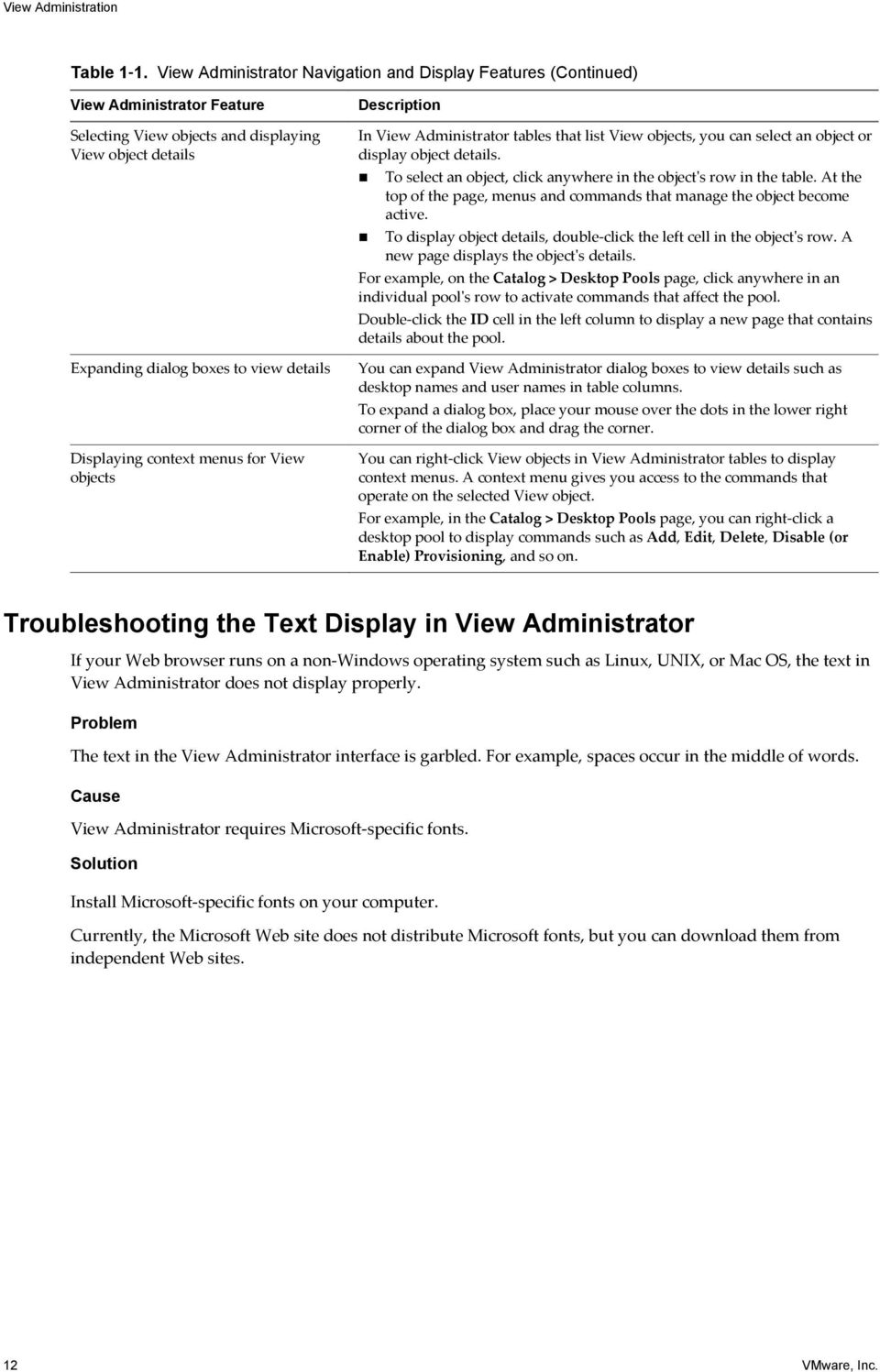
11 Chapter 1 Using View Administrator Table 1 1. View Administrator Navigation and Display Features View Administrator Feature Navigating backward and forward in View Administrator pages Bookmarking View Administrator pages Multicolumn sorting Customizing table columns Description Click your browser's Back button to go to the previously displayed View Administrator page. Click the Forward button to return to the current page. If you click the browser's Back button while you are using a View Administrator wizard or dialog box, you return to the main View Administrator page. The information you entered in the wizard or dialog is lost. In View versions that preceded the View 5.1 release, you could not use your browser's Back and Forward buttons to navigate within View Administrator. Separate Back and Forward buttons in the View Administrator window were provided for navigation. These buttons are removed in the View 5.1 release. You can bookmark View Administrator pages in your browser. You can sort View objects in a variety of ways by using multicolumn sorting. Click a heading in the top row of a View Administrator table to sort the View objects in alphabetical order based on that heading. For example, in the Resources > Machines page, you can click Desktop Pool to sort desktops by the pools that contain them. The number 1 appears next to the heading to indicate that it is the primary sorting column. You can click the heading again to reverse the sorting order, indicated by an up or down arrow. To sort the View objects by a secondary item, Ctrl+click another heading. For example, in the Machines table, you can click Users to perform a secondary sort by users to whom the desktops are dedicated. A number 2 appears next to the secondary heading. In this example, desktops are sorted by pool and by users within each pool. You can continue to Ctrl+click to sort all the columns in a table in descending order of importance. Press Ctrl+Shift and click to deselect a sort item. For example, you might want to display the desktops in a pool that are in a particular state and are stored on a particular datastore. You can select Resources > Machines, click the Datastore heading, and Ctrl+click the Status heading. You can customize the display of View Administrator table columns by hiding selected columns and locking the first column. This feature lets you control the display of large tables such as Catalog > Desktop Pools that contain many columns. Right-click any column header to display a context menu that lets you take the following actions: Hide the selected column. Customize columns. A dialog displays all columns in the table. You can select the columns to display or hide. Lock the first column. This option forces the left-hand column to remain displayed as you scroll horizontally across a table with many columns. For example, on the Catalog > Desktop Pools page, the desktop ID remains displayed as you scroll horizontally to see other desktop characteristics. VMware, Inc. 11

12 Table 1 1. View Administrator Navigation and Display Features (Continued) View Administrator Feature Selecting View objects and displaying View object details Expanding dialog boxes to view details Displaying context menus for View objects Description In View Administrator tables that list View objects, you can select an object or display object details. To select an object, click anywhere in the object's row in the table. At the top of the page, menus and commands that manage the object become active. To display object details, double-click the left cell in the object's row. A new page displays the object's details. For example, on the Catalog > Desktop Pools page, click anywhere in an individual pool's row to activate commands that affect the pool. Double-click the ID cell in the left column to display a new page that contains details about the pool. You can expand View Administrator dialog boxes to view details such as desktop names and user names in table columns. To expand a dialog box, place your mouse over the dots in the lower right corner of the dialog box and drag the corner. You can right-click View objects in View Administrator tables to display context menus. A context menu gives you access to the commands that operate on the selected View object. For example, in the Catalog > Desktop Pools page, you can right-click a desktop pool to display commands such as Add, Edit, Delete, Disable (or Enable) Provisioning, and so on. Troubleshooting the Text Display in View Administrator If your Web browser runs on a non-windows operating system such as Linux, UNIX, or Mac OS, the text in View Administrator does not display properly. Problem The text in the View Administrator interface is garbled. For example, spaces occur in the middle of words. Cause View Administrator requires Microsoft-specific fonts. Solution Install Microsoft-specific fonts on your computer. Currently, the Microsoft Web site does not distribute Microsoft fonts, but you can download them from independent Web sites. 12 VMware, Inc.
13 Configuring View Connection Server 2 After you install and perform initial configuration of View Connection Server, you can add vcenter Server instances and View Composer services to your View deployment, set up roles to delegate administrator responsibilities, and schedule backups of your configuration data. This chapter includes the following topics: Configuring vcenter Server and View Composer, on page 13 Backing Up View Connection Server, on page 25 Configuring Settings for Client Sessions, on page 25 Disable or Enable View Connection Server, on page 34 Edit the External URLs, on page 34 Join or Withdraw from the Customer Experience Program, on page 35 View LDAP Directory, on page 36 Configuring vcenter Server and View Composer To use virtual machines as remote desktops, you must configure View to communicate with vcenter Server. To create and manage linked-clone desktop pools, you must configure View Composer settings in View Administrator. You can also configure storage settings for View. You can allow ESXi hosts to reclaim disk space on linkedclone virtual machines. To allow ESXi hosts to cache virtual machine data, you must enable View Storage Accelerator for vcenter Server. Create a User Account for View Composer AD Operations If you use View Composer, you must create a user account in Active Directory that allows View Composer to perform certain operations in Active Directory. View Composer requires this account to join linked-clone virtual machines to your Active Directory domain. To ensure security, you should create a separate user account to use with View Composer. By creating a separate account, you can guarantee that it does not have additional privileges that are defined for another purpose. You can give the account the minimum privileges that it needs to create and remove computer objects in a specified Active Directory container. For example, the View Composer account does not require domain administrator privileges. 1 In Active Directory, create a user account in the same domain as your View Connection Server host or in a trusted domain. VMware, Inc. 13
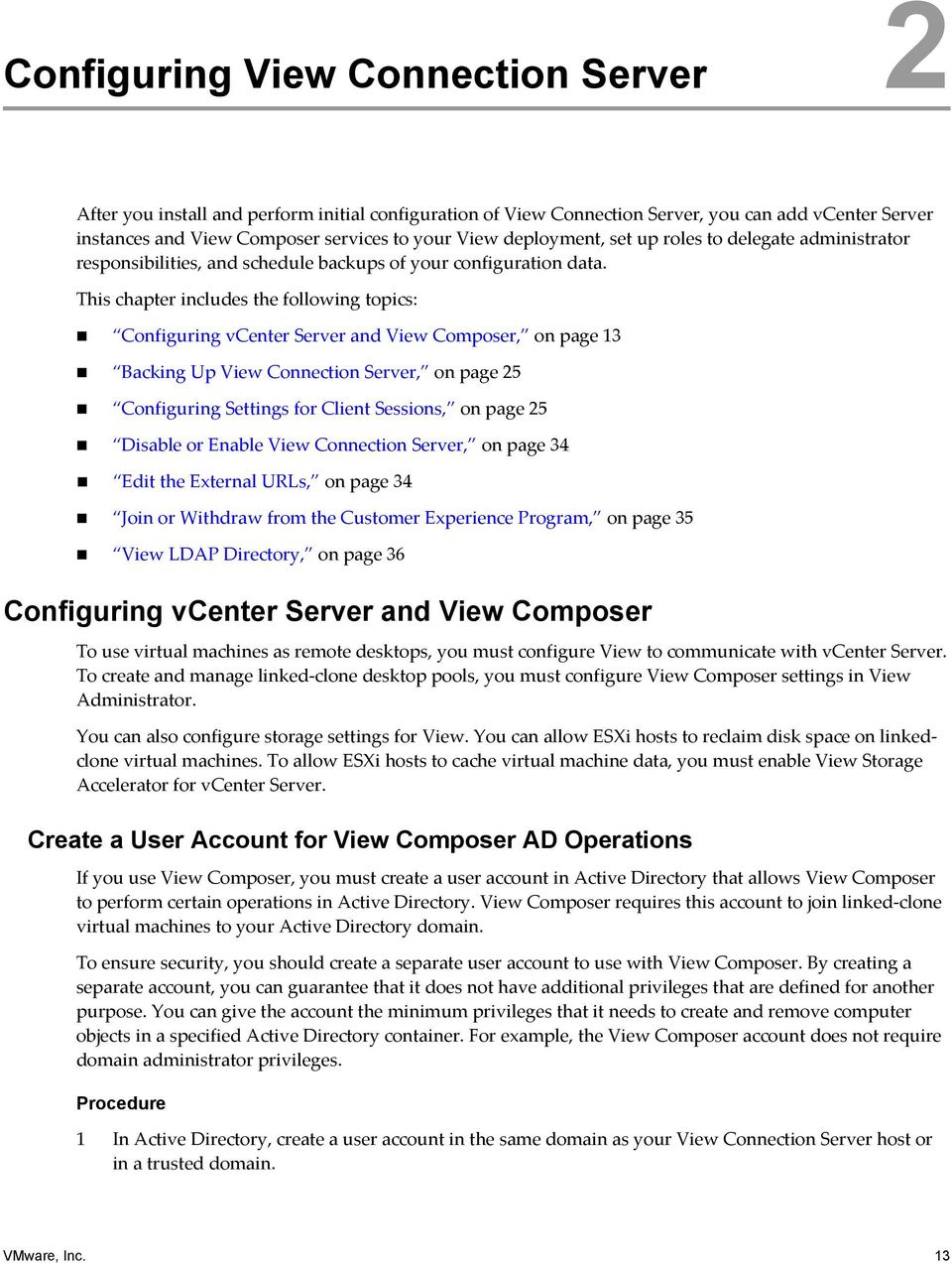
14 2 Add the Create Computer Objects, Delete Computer Objects, and Write All Properties permissions to the account in the Active Directory container in which the linked-clone computer accounts are created or to which the linked-clone computer accounts are moved. The following list shows all the required permissions for the user account, including permissions that are assigned by default: List Contents Read All Properties Write All Properties Read Permissions Reset Password Create Computer Objects Delete Computer Objects NOTE Fewer permissions are required if you select the Allow reuse of pre-existing computer accounts setting for a desktop pool. Make sure that the following permissions are assigned to the user account: List Contents Read All Properties Read Permissions Reset Password 3 Make sure that the user account's permissions apply to the Active Directory container and to all child objects of the container. What to do next Specify the account in View Administrator when you configure View Composer domains in the Add vcenter Server wizard and when you configure and deploy linked-clone desktop pools. Add vcenter Server Instances to View You must configure View to connect to the vcenter Server instances in your View deployment. vcenter Server creates and manages the virtual machines that View uses in desktop pools. If you run vcenter Server instances in a Linked Mode group, you must add each vcenter Server instance to View separately. View connects to the vcenter Server instance using a secure channel (SSL). Prerequisites Install the View Connection Server product license key. Prepare a vcenter Server user with permission to perform the operations in vcenter Server that are necessary to support View. To use View Composer, you must give the user additional privileges. For details about configuring a vcenter Server user for View, see the View Installation document. Verify that an SSL server certificate is installed on the vcenter Server host. In a production environment, install a valid SSL certificate that is signed by a trusted Certificate Authority (CA). In a testing environment, you can use the default certificate that is installed with vcenter Server, but you must accept the certificate thumbprint when you add vcenter Server to View. 14 VMware, Inc.

15 Chapter 2 Configuring View Connection Server Verify that all View Connection Server instances in the replicated group trust the root CA certificate for the server certificate that is installed on the vcenter Server host. Check if the root CA certificate is in the Trusted Root Certification Authorities > Certificates folder in the Windows local computer certificate stores on the View Connection Server hosts. If it is not, import the root CA certificate into the Windows local computer certificate stores. See "Import a Root Certificate and Intermediate Certificates into a Windows Certificate Store" in the View Installation document. Verify that the vcenter Server instance contains ESXi hosts. If no hosts are configured in the vcenter Server instance, you cannot add the instance to View. If you upgrade to vsphere 5.5 or a later release, verify that the domain administrator account that you use as the vcenter Server user was explicitly assigned permissions to log in to vcenter Server by a vcenter Server local user. Familiarize yourself with the settings that determine the maximum operations limits for vcenter Server and View Composer. See Concurrent Operations Limits for vcenter Server and View Composer, on page 20 and Setting a Concurrent Power Operations Rate to Support Remote Desktop Logon Storms, on page In View Administrator, select View Configuration > Servers. 2 On the vcenter Servers tab, click Add. 3 In the vcenter Server Settings Server address text box, type the fully qualified domain name (FQDN) of the vcenter Server instance. The FQDN includes the host name and domain name. For example, in the FQDN myserverhost.companydomain.com, myserverhost is the host name and companydomain.com is the domain. NOTE If you enter a server by using a DNS name or URL, View does not perform a DNS lookup to verify whether an administrator previously added this server to View by using its IP address. A conflict arises if you add a vcenter Server with both its DNS name and its IP address. 4 Type the name of the vcenter Server user. For example: domain\user or [email protected] 5 Type the vcenter Server user password. 6 (Optional) Type a description for this vcenter Server instance. 7 Type the TCP port number. The default port is Under Advanced Settings, set the concurrent operations limits for vcenter Server and View Composer operations. 9 Click Next to display the View Composer Settings page. What to do next Configure View Composer settings. If the vcenter Server instance is configured with a signed SSL certificate, and View Connection Server trusts the root certificate, the Add vcenter Server wizard displays the View Composer Settings page. VMware, Inc. 15
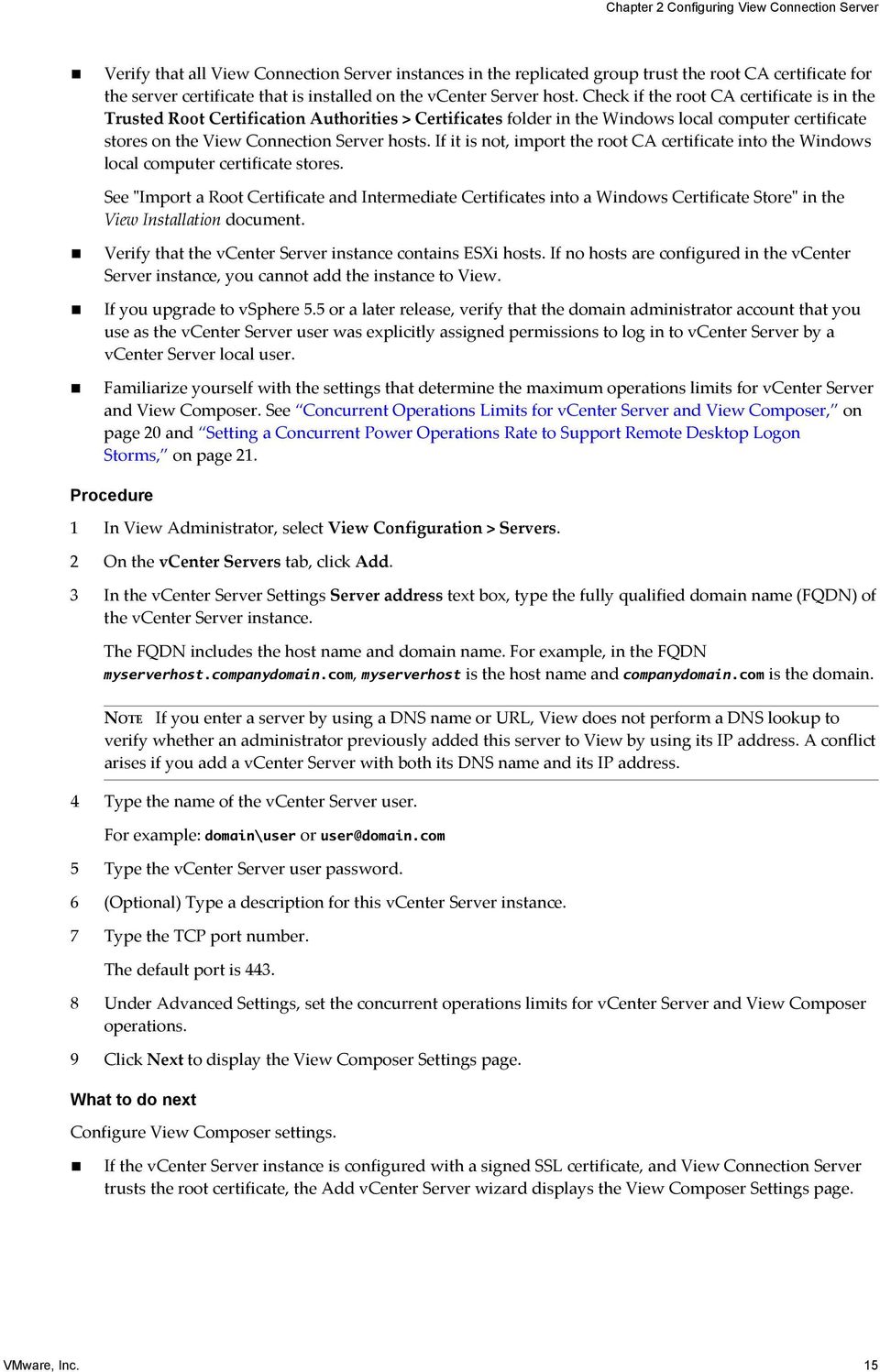
16 If the vcenter Server instance is configured with a default certificate, you must first determine whether to accept the thumbprint of the existing certificate. See Accept the Thumbprint of a Default SSL Certificate, on page 22. If View uses multiple vcenter Server instances, repeat this procedure to add the other vcenter Server instances. Configure View Composer Settings To use View Composer, you must configure settings that allow View to connect to the VMware Horizon View Composer service. View Composer can be installed on its own separate host or on the same host as vcenter Server. There must be a one-to-one mapping between each VMware Horizon View Composer service and vcenter Server instance. A View Composer service can operate with only one vcenter Server instance. A vcenter Server instance can be associated with only one VMware Horizon View Composer service. After the initial View deployment, you can migrate the VMware Horizon View Composer service to a new host to support a growing or changing View deployment. You can edit the initial View Composer settings in View Administrator, but you must perform additional steps to ensure that the migration succeeds. See Migrate View Composer to Another Machine, on page 93. Prerequisites Verify that you created a user in Active Directory with permission to add and remove virtual machines from the Active Directory domain that contains your linked clones. See Create a User Account for View Composer AD Operations, on page 13. Verify that you configured View to connect to vcenter Server. To do so, you must complete the vcenter Server Information page in the Add vcenter Server wizard. See Add vcenter Server Instances to View, on page 14. Verify that this VMware Horizon View Composer service is not already configured to connect to a different vcenter Server instance. 1 In View Administrator, complete the vcenter Server Information page in the Add vcenter Server wizard. a b Select View Configuration > Servers. On the vcenter Servers tab, click Add and provide the vcenter Server settings. 2 On the View Composer Settings page, if you are not using View Composer, select Do not use View Composer. If you select Do not use View Composer, the other View Composer settings become inactive. When you click Next, the Add vcenter Server wizard displays the Storage Settings page. The View Composer Domains page is not displayed. 16 VMware, Inc.

17 Chapter 2 Configuring View Connection Server 3 If you are using View Composer, select the location of the View Composer host. Option View Composer is installed on the same host as vcenter Server. View Composer is installed on its own separate host. Description a b a b c Select View Composer co-installed with the vcenter Server. Make sure that the port number is the same as the port that you specified when you installed the VMware Horizon View Composer service on vcenter Server. The default port number is Select Standalone View Composer Server. In the View Composer server address text box, type the fully qualified domain name (FQDN) of the View Composer host. Type the name of the View Composer user. d e For example: domain.com\user or [email protected] Type the password of the View Composer user. Make sure that the port number is the same as the port that you specified when you installed the VMware Horizon View Composer service. The default port number is Click Next to display the View Composer Domains page. What to do next Configure View Composer domains. If the View Composer instance is configured with a signed SSL certificate, and View Connection Server trusts the root certificate, the Add vcenter Server wizard displays the View Composer Domains page. If the View Composer instance is configured with a default certificate, you must first determine whether to accept the thumbprint of the existing certificate. See Accept the Thumbprint of a Default SSL Certificate, on page 22. Configure View Composer Domains You must configure an Active Directory domain in which View Composer deploys linked-clone desktops. You can configure multiple domains for View Composer. After you first add vcenter Server and View Composer settings to View, you can add more View Composer domains by editing the vcenter Server instance in View Administrator. Prerequisites Your Active Directory administrator must create a View Composer user for AD operations. This domain user must have permission to add and remove virtual machines from the Active Directory domain that contains your linked clones. To manage the linked-clone machine accounts in Active Directory, the domain user must have Create Computer Objects, Delete Computer Objects, and Write All Properties permissions. See Create a User Account for View Composer AD Operations, on page 13. In View Administrator, verify that you completed the vcenter Server Information and View Composer Settings pages in the Add vcenter Server wizard. 1 On the View Composer Domains page, click Add to add the View Composer user for AD operations account information. 2 Type the domain name of the Active Directory domain. For example: domain.com VMware, Inc. 17
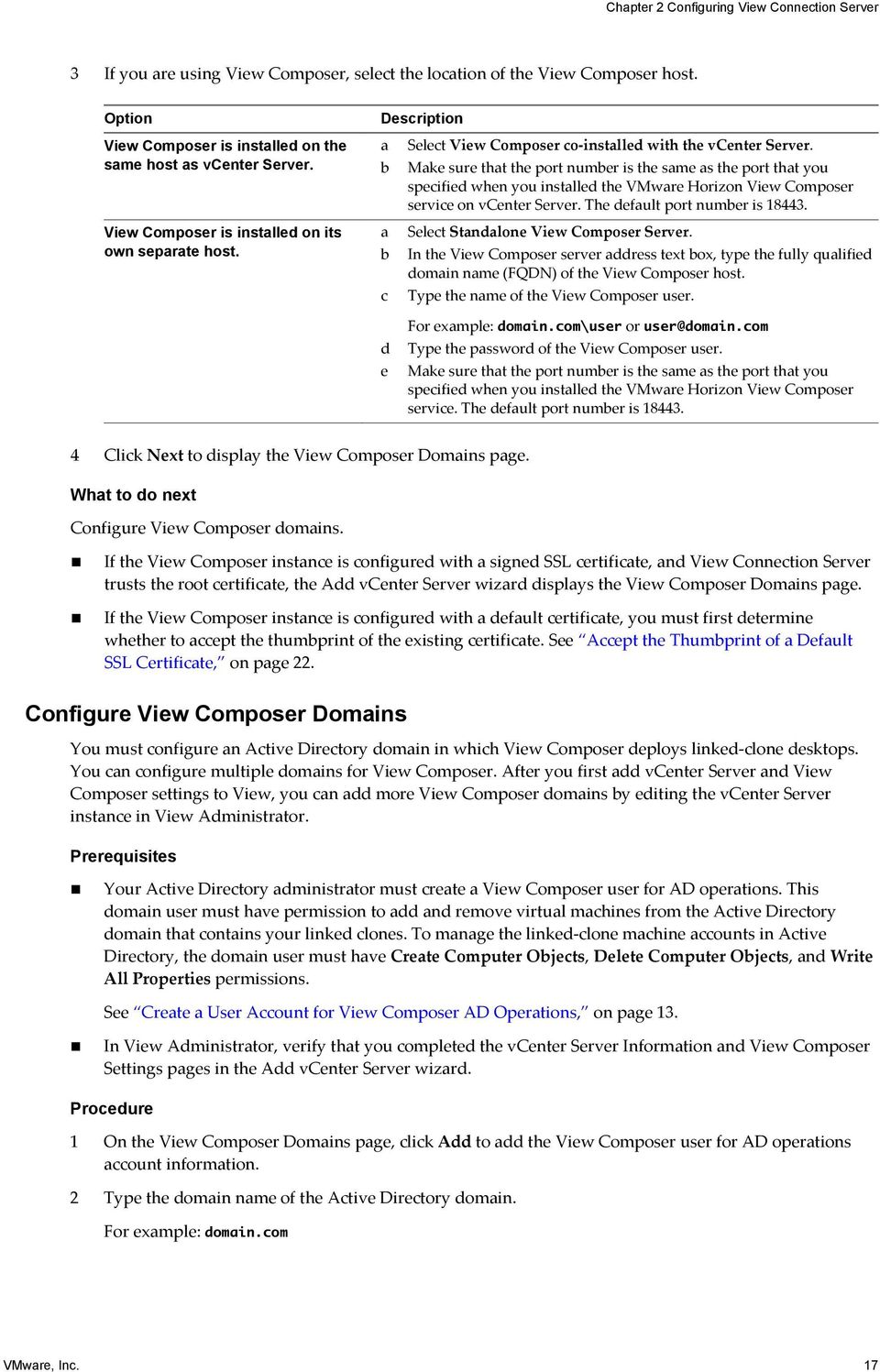
18 3 Type the domain user name, including the domain name, of the View Composer user. For example: domain.com\admin 4 Type the account password. 5 Click OK. 6 To add domain user accounts with privileges in other Active Directory domains in which you deploy linked-clone pools, repeat the preceding steps. 7 Click Next to display the Storage Settings page. What to do next Enable virtual machine disk space reclamation and configure View Storage Accelerator for View. Allow vsphere to Reclaim Disk Space in Linked-Clone Virtual Machines In vsphere 5.1 and later, you can enable the disk space reclamation feature for View. Starting in vsphere 5.1, View creates linked-clone virtual machines in an efficient disk format that allows ESXi hosts to reclaim unused disk space in the linked clones, reducing the total storage space required for linked clones. As users interact with linked-clone desktops, the clones' OS disks grow and can eventually use almost as much disk space as full-clone desktops. Disk space reclamation reduces the size of the OS disks without requiring you to refresh or recompose the linked clones. Space can be reclaimed while the virtual machines are powered on and users are interacting with their remote desktops. Disk space reclamation is especially useful for deployments that cannot take advantage of storage-saving strategies such as refresh on logoff. For example, knowledge workers who install user applications on dedicated remote desktops might lose their personal applications if the remote desktops were refreshed or recomposed. With disk space reclamation, View can maintain linked clones at close to the reduced size they start out with when they are first provisioned. This feature has two components: space-efficient disk format and space reclamation operations. In a vsphere 5.1 or later environment, when a parent virtual machine is virtual hardware version 9 or later, View creates linked clones with space-efficient OS disks, whether or not space reclamation operations are enabled. To enable space reclamation operations, you must use View Administrator to enable space reclamation for vcenter Server and reclaim VM disk space for individual desktop pools. The space reclamation setting for vcenter Server gives you the option to disable this feature on all desktop pools that are managed by the vcenter Server instance. Disabling the feature for vcenter Server overrides the setting at the desktop pool level. The following guidelines apply to the space reclamation feature: It operates only on space-efficient OS disks in linked clones. It does not affect View Composer persistent disks. It works only with vsphere 5.1 or later and only on virtual machines that are virtual hardware version 9 or later. It does not operate on full-clone desktops. It operates on virtual machines with SCSI controllers. IDE controllers are not supported. It operates on Windows XP and Windows 7 desktops only. It does not operate on Windows 8 desktops. Native NFS snapshot technology (VAAI) is not supported in pools that contain virtual machines with spaceefficient disks. VAAI is not supported on linked clones that are virtual hardware version 9 or later, because these OS disks are always space-efficient, even when you disable the space reclamation operation. 18 VMware, Inc.
19 Chapter 2 Configuring View Connection Server Prerequisites Verify that your vcenter Server and ESXi hosts, including all ESXi hosts in a cluster, are version 5.1 with ESXi 5.1 download patch ESXi or later. 1 In View Administrator, complete the Add vcenter Server wizard pages that precede the Storage Settings page. a b c Select View Configuration > Servers. On the vcenter Servers tab, click Add. Complete the vcenter Server Information, View Composer Settings, and View Composer Domains pages. 2 On the Storage Settings page, make sure that Enable space reclamation is selected. Space reclamation is selected by default if you are performing a fresh installation of View 5.2 or later. You must select Enable space reclamation if you are upgrading to View 5.2 or later from View 5.1 or an earlier release. What to do next On the Storage Settings page, configure View Storage Accelerator. To finish configuring disk space reclamation in View, set up space reclamation for desktop pools. Configure View Storage Accelerator for vcenter Server In vsphere 5.0 and later, you can configure ESXi hosts to cache virtual machine disk data. This feature, called View Storage Accelerator, uses the Content Based Read Cache (CBRC) feature in ESXi hosts. View Storage Accelerator improves View performance during I/O storms, which can take place when many virtual machines start up or run anti-virus scans at once. The feature is also beneficial when administrators or users load applications or data frequently. Instead of reading the entire OS or application from the storage system over and over, a host can read common data blocks from cache. By reducing the number of IOPS during boot storms, View Storage Accelerator lowers the demand on the storage array, which lets you use less storage I/O bandwidth to support your View deployment. You enable caching on your ESXi hosts by selecting the View Storage Accelerator setting in the vcenter Server wizard in View Administrator, as described in this procedure. Make sure that View Storage Accelerator is also configured for individual desktop pools. View Storage Accelerator is enabled for desktop pools by default, but this feature can be disabled or enabled when you create or edit a desktop pool. To operate on a desktop pool, View Storage Accelerator must be enabled for vcenter Server and for the individual desktop pool. You can enable View Storage Accelerator on desktop pools that contain linked clones and pools that contain full virtual machines. View Storage Accelerator is now qualified to work in configurations that use View replica tiering, in which replicas are stored on a separate datastore than linked clones. Although the performance benefits of using View Storage Accelerator with View replica tiering are not materially significant, certain capacity-related benefits might be realized by storing the replicas on a separate datastore. Hence, this combination is tested and supported. Prerequisites Verify that your vcenter Server and ESXi hosts are version 5.0 or later. In an ESXi cluster, verify that all the hosts are version 5.0 or later. VMware, Inc. 19
20 Verify that the vcenter Server user was assigned the Global > Act as vcenter Server privilege in vcenter Server. See the topics in the View Installation document that describe View and View Composer privileges required for the vcenter Server user. 1 In View Administrator, complete the Add vcenter Server wizard pages that precede the Storage Settings page. a b c Select View Configuration > Servers. On the vcenter Servers tab, click Add. Complete the vcenter Server Information, View Composer Settings, and View Composer Domains pages. 2 On the Storage Settings page, make sure that the Enable View Storage Accelerator check box is selected. This check box is selected by default. 3 Specify a default host cache size. The default cache size applies to all ESXi hosts that are managed by this vcenter Server instance. The default value is 1,024MB. The cache size must be between 100MB and 2,048MB. 4 To specify a different cache size for an individual ESXi host, select an ESXi host and click Edit cache size. a b In the Host cache dialog box, check Override default host cache size. Type a Host cache size value between 100MB and 2,048MB and click OK. 5 On the Storage Settings page, click Next. 6 Click Finish to add vcenter Server, View Composer, and Storage Settings to View. What to do next Configure settings for client sessions and connections. See Configuring Settings for Client Sessions, on page 25. To complete View Storage Accelerator settings in View, configure View Storage Accelerator for desktop pools. See "Configure View Storage Accelerator for Desktop Pools" in the Setting Up Desktop and Application Pools in View document. Concurrent Operations Limits for vcenter Server and View Composer When you add vcenter Server to View or edit the vcenter Server settings, you can configure several options that set the maximum number of concurrent operations that are performed by vcenter Server and View Composer. You configure these options in the Advanced Settings panel on the vcenter Server Information page. 20 VMware, Inc.

21 Chapter 2 Configuring View Connection Server Table 2 1. Concurrent Operations Limits for vcenter Server and View Composer Setting Max concurrent vcenter provisioning operations Max concurrent power operations Max concurrent View Composer maintenance operations Max concurrent View Composer provisioning operations Description Determines the maximum number of concurrent requests that View Connection Server can make to provision and delete full virtual machines in this vcenter Server instance. The default value is 20. This setting applies to full virtual machines only. Determines the maximum number of concurrent power operations (startup, shutdown, suspend, and so on) that can take place on virtual machines managed by View Connection Server in this vcenter Server instance. The default value is 50. For guidelines for calculating a value for this setting, see Setting a Concurrent Power Operations Rate to Support Remote Desktop Logon Storms, on page 21. This setting applies to full virtual machines and linked clones. Determines the maximum number of concurrent View Composer refresh, recompose, and rebalance operations that can take place on linked clones managed by this View Composer instance. The default value is 12. Remote desktops that have active sessions must be logged off before a maintenance operation can begin. If you force users to log off as soon as a maintenance operation begins, the maximum number of concurrent operations on remote desktops that require logoffs is half the configured value. For example, if you configure this setting as 24 and force users to log off, the maximum number of concurrent operations on remote desktops that require logoffs is 12. This setting applies to linked clones only. Determines the maximum number of concurrent creation and deletion operations that can take place on linked clones managed by this View Composer instance. The default value is 8. This setting applies to linked clones only. Setting a Concurrent Power Operations Rate to Support Remote Desktop Logon Storms The Max concurrent power operations setting governs the maximum number of concurrent power operations that can occur on remote desktop virtual machines in a vcenter Server instance. This limit is set to 50 by default. You can change this value to support peak power-on rates when many users log on to their desktops at the same time. As a best practice, you can conduct a pilot phase to determine the correct value for this setting. For planning guidelines, see "Architecture Design Elements and Planning Guidelines" in the View Architecture Planning document. The required number of concurrent power operations is based on the peak rate at which desktops are powered on and the amount of time it takes for the desktop to power on, boot, and become available for connection. In general, the recommended power operations limit is the total time it takes for the desktop to start multiplied by the peak power-on rate. For example, the average desktop takes two to three minutes to start. Therefore, the concurrent power operations limit should be 3 times the peak power-on rate. The default setting of 50 is expected to support a peak power-on rate of 16 desktops per minute. The system waits a maximum of five minutes for a desktop to start. If the start time takes longer, other errors are likely to occur. To be conservative, you can set a concurrent power operations limit of 5 times the peak power-on rate. With a conservative approach, the default setting of 50 supports a peak power-on rate of 10 desktops per minute. VMware, Inc. 21
22 Logons, and therefore desktop power on operations, typically occur in a normally distributed manner over a certain time window. You can approximate the peak power-on rate by assuming that it occurs in the middle of the time window, during which about 40% of the power-on operations occur in 1/6th of the time window. For example, if users log on between 8:00 AM and 9:00 AM, the time window is one hour, and 40% of the logons occur in the 10 minutes between 8:25 AM and 8:35 AM. If there are 2,000 users, 20% of whom have their desktops powered off, then 40% of the 400 desktop power-on operations occur in those 10 minutes. The peak power-on rate is 16 desktops per minute. Accept the Thumbprint of a Default SSL Certificate When you add vcenter Server and View Composer instances to View, you must ensure that the SSL certificates that are used for the vcenter Server and View Composer instances are valid and trusted by View Connection Server. If the default certificates that are installed with vcenter Server and View Composer are still in place, you must determine whether to accept these certificates' thumbprints. If a vcenter Server or View Composer instance is configured with a certificate that is signed by a CA, and the root certificate is trusted by View Connection Server, you do not have to accept the certificate thumbprint. No action is required. If you replace a default certificate with a certificate that is signed by a CA, but View Connection Server does not trust the root certificate, you must determine whether to accept the certificate thumbprint. A thumbprint is a cryptographic hash of a certificate. The thumbprint is used to quickly determine if a presented certificate is the same as another certificate, such as the certificate that was accepted previously. NOTE If you install vcenter Server and View Composer on the same Windows Server host, they can use the same SSL certificate, but you must configure the certificate separately for each component. For details about configuring SSL certificates, see "Configuring SSL Certificates for View Servers" in the View Installation document. You first add vcenter Server and View Composer in View Administrator by using the Add vcenter Server wizard. If a certificate is untrusted and you do not accept the thumbprint, you cannot add vcenter Server and View Composer. After these servers are added, you can reconfigure them in the Edit vcenter Server dialog box. NOTE You also must accept a certificate thumbprint when you upgrade from an earlier release and a vcenter Server or View Composer certificate is untrusted, or if you replace a trusted certificate with an untrusted certificate. On the View Administrator dashboard, the vcenter Server or View Composer icon turns red and an Invalid Certificate Detected dialog box appears. You must click Verify and follow the procedure shown here. Similarly, in View Administrator you can configure a SAML authenticator for use by a View Connection Server instance. If the SAML server certificate is not trusted by View Connection Server, you must determine whether to accept the certificate thumbprint. If you do not accept the thumbprint, you cannot configure the SAML authenticator in View. After a SAML authenticator is configured, you can reconfigure it in the Edit View Connection Server dialog box. 1 When View Administrator displays an Invalid Certificate Detected dialog box, click View Certificate. 2 Examine the certificate thumbprint in the Certificate Information window. 22 VMware, Inc.
23 Chapter 2 Configuring View Connection Server 3 Examine the certificate thumbprint that was configured for the vcenter Server or View Composer instance. a b On the vcenter Server or View Composer host, start the MMC snap-in and open the Windows Certificate Store. Navigate to the vcenter Server or View Composer certificate. c Click the Certificate Details tab to display the certificate thumbprint. Similarly, examine the certificate thumbprint for a SAML authenticator. If appropriate, take the preceding steps on the SAML authenticator host. 4 Verify that the thumbprint in the Certificate Information window matches the thumbprint for the vcenter Server or View Composer instance. Similarly, verify that the thumbprints match for a SAML authenticator. 5 Determine whether to accept the certificate thumbprint. Option The thumbprints match. The thumbprints do not match. Description Click Accept to use the default certificate. Click Reject. Troubleshoot the mismatched certificates. For example, you might have provided an incorrect IP address for vcenter Server or View Composer. Remove a vcenter Server Instance from View You can remove the connection between View and a vcenter Server instance. When you do so, View no longer manages the virtual machines created in that vcenter Server instance. Prerequisites Delete all the virtual machines that are associated with the vcenter Server instance. See Delete a Desktop Pool, on page Click View Configuration > Servers. 2 On the vcenter Servers tab, select the vcenter Server instance. 3 Click Remove. A dialog warns you that View will no longer have access to the virtual machines that are managed by this vcenter Server instance. 4 Click OK. View can no longer access the virtual machines created in the vcenter Server instance. Remove View Composer from View You can remove the connection between View and the VMware Horizon View Composer service that is associated with a vcenter Server instance. Before you disable the connection to View Composer, you must remove from View all the linked-clone virtual machines that were created by View Composer. View prevents you from removing View Composer if any associated linked clones still exist. After the connection to View Composer is disabled, View cannot provision or manage new linked clones. VMware, Inc. 23
24 1 Remove the linked-clone desktop pools that were created by View Composer. a b In View Administrator, select Catalog > Desktop Pools. Select a linked-clone desktop pool and click Delete. A dialog box warns that you will permanently delete the linked-clone desktop pool from View. If the linked-clone virtual machines are configured with persistent disks, you can detach or delete the persistent disks. c Click OK. The virtual machines are deleted from vcenter Server. In addition, the associated View Composer database entries and the replicas that were created by View Composer are removed. d Repeat these steps for each linked-clone desktop pool that was created by View Composer. 2 Select View Configuration > Servers. 3 On the vcenter Servers tab, select the vcenter Server instance with which View Composer is associated. 4 Click Edit. 5 Under View Composer Server Settings, click Edit, select Do not use View Composer, and click OK. You can no longer create linked-clone desktop pools in this vcenter Server instance, but you can continue to create and manage full virtual-machine desktop pools in the vcenter Server instance. What to do next If you intend to install View Composer on another host and reconfigure View to connect to the new VMware Horizon View Composer service, you must perform certain additional steps. See Migrate View Composer Without Linked-Clone Virtual Machines, on page 96. Conflicting vcenter Server Unique IDs If you have multiple vcenter Server instances configured in your environment, an attempt to add a new instance might fail because of conflicting unique IDs. Problem You try to add a vcenter Server instance to View, but the unique ID of the new vcenter Server instance conflicts with an existing instance. Cause Two vcenter Server instances cannot use the same unique ID. By default, a vcenter Server unique ID is randomly generated, but you can edit it. Solution 1 In vsphere Client, click Administration > vcenter Server Settings > Runtime Settings. 2 Type a new unique ID and click OK. For details about editing vcenter Server unique ID values, see the vsphere documentation. 24 VMware, Inc.
25 Chapter 2 Configuring View Connection Server Backing Up View Connection Server After you complete the initial configuration of View Connection Server, you should schedule regular backups of your View and View Composer configuration data. For information about backing up and restoring your View configuration, see Backing Up and Restoring View Configuration Data, on page 81. Configuring Settings for Client Sessions You can configure global settings that affect the client sessions and connections that are managed by a View Connection Server instance or replicated group. You can set the session timeout length, display prelogin and warning messages, and set security-related client connection options. Set Options for Client Sessions and Connections You configure global settings to determine the way client sessions and connections work. The global settings are not specific to a single View Connection Server instance. They affect all client sessions that are managed by a standalone View Connection Server instance or a group of replicated instances. You can also configure View Connection Server instances to use direct, nontunneled connections between Horizon clients and remote desktops. See Configure the Secure Tunnel and PCoIP Secure Gateway, on page 30 for information about configuring direct connections. Prerequisites Familiarize yourself with the global settings. See Global Settings for Client Sessions, on page 26 and Global Security Settings for Client Sessions and Connections, on page In View Administrator, select View Configuration > Global Settings. 2 Choose whether to configure general settings or security settings. Option General global settings Global security settings Description In the General pane, click Edit. In the Security pane, click Edit. 3 Configure the global settings. 4 Click OK. What to do next You can change the data recovery password that was provided during installation. See Change the Data Recovery Password, on page 25. Change the Data Recovery Password You provide a data recovery password when you install View Connection Server version 5.1 or later. After installation, you can change this password in View Administrator. The password is required when you restore the View LDAP configuration from a backup. When you back up View Connection Server, the View LDAP configuration is exported as encrypted LDIF data. To restore the encrypted backup View configuration, you must provide the data recovery password. VMware, Inc. 25
26 The password must contain between 1 and 128 characters. Follow your organization's best practices for generating secure passwords. 1 In View Administrator, select View Configuration > Global Settings. 2 In the Security pane, click Change data recovery password. 3 Type and retype the new password. 4 (Optional) Type a password reminder. NOTE You can also change the data recovery password when you schedule your View configuration data to be backed up. See Schedule View Configuration Backups, on page 82. What to do next When you use the vdmimport utility to restore a backup View configuration, provide the new password. Global Settings for Client Sessions General global settings determine session timeout lengths, SSO enablement and timeout limits, status updates in View Administrator, whether prelogin and warning messages are displayed, and whether View Administrator treats Windows Server 2008 R2 as a supported operating system for remote desktops. Changes to any of the settings in the table below take effect immediately. You do not need to restart View Connection Server or Horizon Client. Table 2 2. General Global Settings for Client Sessions Setting View Administrator session timeout Forcibly disconnect users Single sign-on (SSO) Description Determines how long an idle View Administrator session continues before the session times out. IMPORTANT Setting the View Administrator session timeout to a high number of minutes increases the risk of unauthorized use of View Administrator. Use caution when you allow an idle session to persist a long time. By default, the View Administrator session timeout is 30 minutes. You can set a session timeout from 1 to 4320 minutes (72 hours). Disconnects all desktops and applications after the specified number of minutes has passed since the user logged in to View. All desktops and applications will be disconnected at the same time regardless of when the user opened them. For clients that do not support application remoting, a maximum timeout value of 1200 minutes applies if the value of this setting is Never or greater than 1200 minutes. The default is After 600 minutes. If SSO is enabled, View caches a user's credentials so that the user can launch remote desktops or applications without having to provide credentials to log in to the remote Windows session. The default is Enabled. NOTE If a desktop is launched from Horizon Client, and the desktop is locked, either by the user or by Windows based on a security policy, and if the desktop is running View Agent 6.0 or later, View Connection Server discards the user's SSO credentials. The user must provide login credentials to launch a new desktop or a new application, or reconnect to any disconnected desktop or application. To enable SSO again, the user must disconnect from View Connection Server or exit Horizon Client, and reconnect to View Connection Server. However, if the desktop is launched from Workspace and the desktop is locked, SSO credentials are not discarded. 26 VMware, Inc.
27 Chapter 2 Configuring View Connection Server Table 2 2. General Global Settings for Client Sessions (Continued) Setting For clients that support applications. If the user stops using the keyboard and mouse, disconnect their applications and discard SSO credentials: Other clients. Discard SSO credentials: Enable automatic status updates Display a pre-login message Display warning before forced logoff Description Protects application sessions when there is no keyboard or mouse activity on the client device. If set to After... minutes, View disconnects all applications and discards SSO credentials after the specified number of minutes without user activity. Desktop sessions are not disconnected. Users must log in again to reconnect to the applications that were disconnected or launch a new desktop or application. IMPORTANT Users must be aware that when they have both applications and desktops open, and their applications are disconnected because of this timeout, their desktops remain connected. Users must not rely on this timeout to protect their desktops. If set to Never, View never disconnects applications or discards SSO credentials due to user inactivity. The default is Never. Discards SSO credentials after the specified number of minutes. This setting is for clients that do not support application remoting. If set to After... minutes, users must log in again to connect to a desktop after the specified number of minutes has passed since the user logged in to View, regardless of any user activity on the client device. If set to Never, View stores SSO credentials until the user closes Horizon Client, or the Forcibly disconnect users timeout is reached, whichever comes first. The default is After 15 minutes. Determines if status updates appear in the global status pane in the upper-left corner of View Administrator every few minutes. The dashboard page of View Administrator is also updated every few minutes. By default, this setting is not enabled. Displays a disclaimer or another message to Horizon Client users when they log in. Type your information or instructions in the text box in the Global Settings dialog box. To display no message, leave the check box unselected. Displays a warning message when users are forced to log off because a scheduled or immediate update such as a desktop-refresh operation is about to start. This setting also determines how long to wait after the warning is shown before the user is logged off. Check the box to display a warning message. Type the number of minutes to wait after the warning is displayed and before logging off the user. The default is 5 minutes. Type your warning message. You can use the default message: Your desktop is scheduled for an important update and will be shut down in 5 minutes. Please save any unsaved work now. VMware, Inc. 27
28 Table 2 2. General Global Settings for Client Sessions (Continued) Setting Enable Windows Server 2008 R2 desktops Mirage Server configuration Description Determines whether you can select available Windows Server 2008 R2 machines for use as desktops. When this setting is enabled, View Administrator displays all available Windows Server 2008 R2 machines, including machines on which View server components are installed. NOTE The View Agent software cannot coexist on the same virtual or physical machine with any other View server software component, including a security server, View Connection Server, or View Composer. Allows you to specify the URL of a Mirage server, using the format mirage://server-name:port or mirages://server-name:port. Here servername is the fully qualified domain name. If you do not specify the port number, the default port number 8000 is used. NOTE You can override this global setting by specifying a Mirage server in the desktop pool settings. Specifying the Mirage server in View Administrator is an alternative to specifying the Mirage server when installing the Mirage client. To find out which versions of Mirage support having the server specified in View Administrator, see the Mirage documentation, at Global Security Settings for Client Sessions and Connections Global security settings determine whether clients are reauthenticated after interruptions, message security mode is enabled, and IPSec is used for security server connections. SSL is required for all Horizon Client connections and View Administrator connections to View. If your View deployment uses load balancers or other client-facing, intermediate servers, you can off-load SSL to them and then configure non-ssl connections on individual View Connection Server instances and security servers. See Off-load SSL Connections to Intermediate Servers, on page VMware, Inc.
29 Chapter 2 Configuring View Connection Server Table 2 3. Global Security Settings for Client Sessions and Connections Setting Reauthenticate secure tunnel connections after network interruption Message security mode Use IPSec for Security Server connections Description Determines if user credentials must be reauthenticated after a network interruption when Horizon clients use secure tunnel connections to remote desktops. When you select this setting, if a secure tunnel connection is interrupted, Horizon Client requires the user to reauthenticate before reconnecting. This setting offers increased security. For example, if a laptop is stolen and moved to a different network, the user cannot automatically gain access to the remote desktop without entering credentials. When this setting is not selected, the client reconnects to the remote desktop without requiring the user to reauthenticate. This setting has no effect when the secure tunnel is not used. Determines if signing and verification of the JMS messages passed between View components takes place. For details, see Message Security Mode for View Components, on page 29. By default, message security mode is enabled. Determines whether to use Internet Protocol Security (IPSec) for connections between security servers and View Connection Server instances. By default, secure connections (using IPSec) for security server connections is enabled. NOTE If you upgrade to View 5.1 or later from an earlier View release, the global setting Require SSL for client connections is displayed in View Administrator, but only if the setting was disabled in your View configuration before you upgraded. Because SSL is required for all Horizon Client connections and View Administrator connections to View, this setting is not displayed in fresh installations of View 5.1 or later versions and is not displayed after an upgrade if the setting was already enabled in the previous View configuration. After an upgrade, if you do not enable the Require SSL for client connections setting, HTTPS connections from Horizon clients will fail, unless they connect to an intermediate device that is configured to make onward connections using HTTP. See Off-load SSL Connections to Intermediate Servers, on page 32. Message Security Mode for View Components You can set message security mode for View components. This setting determines how sender signatures in JMS messages are treated. By default, JMS messages are rejected if the signature is missing or invalid, or if a message was modified after it was signed. If any component in your View environment predates View 3.0, when message security was introduced, you can change the mode to log a warning if any of these conditions are found, or to not verify signatures at all. These options are not recommended and it is preferable to upgrade older components. Some JMS messages are encrypted because they carry sensitive information such as user credentials. Consider using IPSec to encrypt all JMS messages between View Connection Server instances, and between View Connection Server instances and security servers. Table 2-4 shows the options you can select to configure the message security mode. To set an option, select it from the Message security mode list in the Global Settings dialog window. VMware, Inc. 29
30 Table 2 4. Message Security Mode Options Option Disabled Mixed Enabled Description Message security mode is disabled. Message security mode is enabled but not enforced. You can use this mode to detect components in your View environment that predate View 3.0. The log files generated by View Connection Server contain references to these components. Message security mode is enabled. Unsigned messages are rejected by View components. Message security mode is enabled by default. NOTE View components that predate View 3.0 are not allowed to communicate with other View components When you first install View on a system, the message security mode is set to Enabled. If you upgrade View, the message security mode remains unchanged from its existing setting. Message security mode is supported in View 3.0 and later. If you change the message security mode from Disabled or Mixed to Enabled, you cannot launch a remote desktop with a View Agent from Virtual Desktop Manager version 2.1 or earlier. If you then change the message security mode from Enabled to Mixed or Disabled, the desktop still fails to launch. To launch a remote desktop after you change the message security mode from Enabled to Mixed or Disabled, you must restart the remote desktop. If you plan to change an active View environment from Disabled to Enabled, or from Enabled to Disabled, change to Mixed mode for a short time before you make the final change. For example, if your current mode is Disabled, change to Mixed mode for one day, then change to Enabled. In Mixed mode, signatures are attached to messages but not verified, which allows the change of message mode to propagate through the environment. Configure the Secure Tunnel and PCoIP Secure Gateway When the secure tunnel is enabled, Horizon Client makes a second HTTPS connection to the View Connection Server or security server host when users connect to a remote desktop. When the PCoIP Secure Gateway is enabled, Horizon Client makes a further secure connection to the View Connection Server or security server host when users connect to a remote desktop with the PCoIP display protocol. When the secure tunnel or PCoIP Secure Gateway is not enabled, a session is established directly between the client system and the remote desktop virtual machine, bypassing the View Connection Server or security server host. This type of connection is called a direct connection. IMPORTANT A typical network configuration that provides secure connections for external clients includes a security server. To use View Administrator to enable or disable the secure tunnel and PCoIP Secure Gateway on a security server, you must edit the View Connection Server instance that is paired with the security server. In a network configuration in which external clients connect directly to a View Connection Server host, you enable or disable the secure tunnel and PCoIP Secure Gateway by editing that View Connection Server instance in View Administrator. Prerequisites If you intend to enable the PCoIP Secure Gateway, verify that the View Connection Server instance and paired security server are View 4.6 or later. If you pair a security server to a View Connection Server instance on which you already enabled the PCoIP Secure Gateway, verify that the security server is View 4.6 or later. 30 VMware, Inc.
31 Chapter 2 Configuring View Connection Server 1 In View Administrator, select View Configuration > Servers. 2 On the Connection Servers tab, select a View Connection Server instance and click Edit. 3 Configure use of the secure tunnel. Option Enable the secure tunnel Disable the secure tunnel Description Select Use Secure Tunnel connection to machine. Deselect Use Secure Tunnel connection to machine. The secure tunnel is enabled by default. 4 Configure use of the PCoIP Secure Gateway. Option Enable the PCoIP Secure Gateway Disable the PCoIP secure Gateway Description Select Use PCoIP Secure Gateway for PCoIP connections to machine Deselect Use PCoIP Secure Gateway for PCoIP connections to machine The PCoIP Secure Gateway is disabled by default. 5 Click OK to save your changes. Configure Secure HTML Access In View Administrator, you can configure the use of the Blast Secure Gateway to provide secure HTML access to remote desktops. You can provide secure connections to external users who use HTML Access to connect to remote desktops. The Blast Secure Gateway, enabled by default on View Connection Server and security server hosts, ensures that only authenticated users can communicate with remote desktops. With HTML Access, the client software does not have to be installed on the users' endpoint devices. When the Blast Secure Gateway is not enabled, client Web browsers use HTML Access to establish direct connections to remote desktop virtual machines, bypassing the Blast Secure Gateway. IMPORTANT A typical network configuration that provides secure connections for external users includes a security server. To enable or disable the Blast Secure Gateway on a security server, you must edit the View Connection Server instance that is paired with the security server. If external users connect directly to a View Connection Server host, you enable or disable the Blast Secure Gateway by editing that View Connection Server instance. Prerequisites If users select remote desktops by using the Workspace App Portal, verify that Workspace is installed and configured for use with View Connection Server and that View Connection Server is paired with a SAML 2.0 Authentication server. Verify that the secure tunnel is enabled. If the secure tunnel is disabled, the Blast Secure Gateway cannot be enabled. 1 In View Administrator, select View Configuration > Servers. 2 On the Connection Servers tab, select a View Connection Server instance and click Edit. VMware, Inc. 31
32 3 Configure use of the Blast Secure Gateway. Option Enable the Blast Secure Gateway Disable the Blast secure Gateway Description Select Use Blast Secure Gateway for HTML access to machine Deselect Use Blast Secure Gateway for HTML access to machine The Blast Secure Gateway is enabled by default. 4 Click OK to save your changes. Open the Port Used by HTML Access on Security Servers When you install the HTML Access component during a View Connection Server installation, the installer creates and enables a Windows Firewall rule to open the port that is used by HTML Access for client connections. However, on security servers, you must manually enable the rule in Windows Firewall to allow communication to the port. By default, HTML Access uses TCP port 8443 for client connections to the Blast Secure Gateway. To open the port used by HTML Access on a View Connection Server computer, install HTML Access with View Connection Server on that computer. The installer enables the VMware View Connection Server (Blast-In) rule in Windows Firewall. To open the port for HTML Access on a security server, manually enable the VMware View Connection Server (Blast-In) rule in Windows Firewall. Off-load SSL Connections to Intermediate Servers Horizon Client must use HTTPS to connect to View. If your Horizon clients connect to load balancers or other intermediate servers that pass on the connections to View Connection Server instances or security servers, you can off-load SSL to the intermediate servers. Import SSL Off-loading Servers' Certificates to View Servers If you off-load SSL connections to an intermediate server, you must import the intermediate server's certificate onto the View Connection Server instances or security servers that connect to the intermediate server. The same SSL server certificate must reside on both the off-loading intermediate server and each offloaded View server that connects to the intermediate server. If you deploy security servers, the intermediate server and the security servers that connect to it must have the same SSL certificate. You do not have to install the same SSL certificate on View Connection Server instances that are paired to the security servers and do not connect directly to the intermediate server. If you do not deploy security servers, or if you have a mixed network environment with some security servers and some external-facing View Connection Server instances, the intermediate server and any View Connection Server instances that connect to it must have the same SSL certificate. If the intermediate server's certificate is not installed on the View Connection Server instance or security server, clients cannot validate their connections to View. In this situation, the certificate thumbprint sent by the View server does not match the certificate on the intermediate server to which Horizon Client connects. Do not confuse load balancing with SSL off-loading. The preceding requirement applies to any device that is configured to provide SSL off-loading, including some types of load balancers. However, pure load balancing does not require copying of certificates between devices. For information about importing certificates to View servers, see "Import a Signed Server Certificate into a Windows Certificate Store" in the View Installation document. 32 VMware, Inc.
33 Chapter 2 Configuring View Connection Server Set View Server External URLs to Point Clients to SSL Off-loading Servers If SSL is off-loaded to an intermediate server and Horizon Client devices use the secure tunnel to connect to View, you must set the secure tunnel external URL to an address that clients can use to access the intermediate server. You configure the external URL settings on the View Connection Server instance or security server that connects to the intermediate server. If you deploy security servers, external URLs are required for the security servers but not for the View Connection Server instances that are paired with the security servers. If you do not deploy security servers, or if you have a mixed network environment with some security servers and some external-facing View Connection Server instances, External URLs are required for any View Connection Server instances that connect to the intermediate server. NOTE You cannot off-load SSL connections from a PCoIP Secure Gateway (PSG) or Blast Secure Gateway. The PCoIP external URL and Blast Secure Gateway external URL must allow clients to connect to the computer that hosts the PSG and Blast Secure Gateway. Do not reset the PCoIP external URL and Blast external URL to point to the intermediate server unless you plan to require SSL connections between the intermediate server and the View server. For information about configuring External URLs, see Configuring External URLs for PCoIP Secure Gateway and Tunnel Connections in the View Installation document. Allow HTTP Connections From Intermediate Servers When SSL is off-loaded to an intermediate server, you can configure View Connection Server instances or security servers to allow HTTP connections from the client-facing, intermediate devices. The intermediate devices must accept HTTPS for Horizon Client connections. To allow HTTP connections between View servers and intermediate devices, you must configure the locked.properties file on each View Connection Server instance and security server on which HTTP connections are allowed. Even when HTTP connections between View servers and intermediate devices are allowed, you cannot disable SSL in View. View servers continue to accept HTTPS connections as well as HTTP connections. NOTE If your Horizon clients use smart card authentication, the clients must make HTTPS connections directly to View Connection Server or security server. SSL off-loading is not supported with smart card authentication. 1 Create or edit the locked.properties file in the SSL gateway configuration folder on the View Connection Server or security server host. For example: install_directory\vmware\vmware View\Server\sslgateway\conf\locked.properties 2 To configure the View server's protocol, add the serverprotocol property and set it to http. The value http must be typed in lower case. 3 (Optional) Add properties to configure a non-default HTTP listening port and a network interface on the View server. To change the HTTP listening port from 80, set serverportnonssl to another port number to which the intermediate device is configured to connect. VMware, Inc. 33
34 If the View server has more than one network interface, and you intend the server to listen for HTTP connections on only one interface, set serverhostnonssl to the IP address of that network interface. 4 Save the locked.properties file. 5 Restart the View Connection Server service or security server service to make your changes take effect. Example: locked.properties file This file allows non-ssl HTTP connections to a View server. The IP address of the View server's clientfacing network interface is The server uses the default port 80 to listen for HTTP connections. The value http must be lower case. serverprotocol=http serverhostnonssl= Disable or Enable View Connection Server You can disable a View Connection Server instance to prevent users from logging in to their remote desktops and applications. After you disable an instance, you can enable it again. When you disable a View Connection Server instance, users who are currently logged in to remote desktops and applications are not affected. Your View deployment determines how users are affected by disabling an instance. If this is a single, standalone View Connection Server instance, users cannot log in to their remote desktops or applications. They cannot connect to View Connection Server. If this is a replicated View Connection Server instance, your network topology determines whether users can be routed to another replicated instance. If users can access another instance, they can log in to their remote desktops and applications. 1 In View Administrator, select View Configuration > Servers. 2 On the Connection Servers tab, select the View Connection Server instance. 3 Click Disable. You can enable the instance again by clicking Enable. Edit the External URLs You can use View Administrator to edit external URLs for View Connection Server instances and security servers. By default, a View Connection Server or security server host can be contacted only by tunnel clients that reside within the same network. Tunnel clients that run outside of your network must use a clientresolvable URL to connect to a View Connection Server or security server host. When users connect to remote desktops with the PCoIP display protocol, Horizon Client can make a further connection to the PCoIP Secure Gateway on the View Connection Server or security server host. To use the PCoIP Secure Gateway, a client system must have access to an IP address that allows the client to reach the View Connection Server or security server host. You specify this IP address in the PCoIP external URL. A third URL allows users to make secure connections from their Web browsers through the Blast Secure Gateway. 34 VMware, Inc.
35 Chapter 2 Configuring View Connection Server Tthe secure tunnel external URL, PCoIP external URL, and Blast external URL must be the addresses that client systems use to reach this host. NOTE You cannot edit the external URLs for a security server that has not been upgraded to View Connection Server 4.5 or later. 1 In View Administrator, select View Configuration > Servers. Option View Connection Server instance Security server Action Select the View Connection Server instance on the Connection Servers tab and click Edit. Select the security server on the Security Servers tab and click Edit. 2 Type the secure tunnel external URL in the External URL text box. The URL must contain the protocol, client-resolvable host name and port number. For example: NOTE You can use the IP address if you have to access a View Connection Server instance or security server when the host name is not resolvable. However, the host that you contact will not match the SSL certificate that is configured for the View Connection Server instance or security server, resulting in blocked access or access with reduced security. 3 Type the PCoIP Secure Gateway external URL in the PCoIP External URL text box. Specify the PCoIP external URL as an IP address with the port number Do not include a protocol name. For example: :4172 The URL must contain the IP address and port number that a client system can use to reach this security server or View Connection Server instance. 4 Type the Blast Secure Gateway external URL in the Blast External URL text box. The URL must contain the HTTPS protocol, client-resolvable host name, and port number. For example: By default, the URL includes the FQDN of the secure tunnel external URL and the default port number, The URL must contain the FQDN and port number that a client system can use to reach this host. 5 Verify that all addresses in this dialog allow client systems to reach this host. 6 Click OK to save your changes. The external URLs are updated immediately. You do not need to restart the View Connection Server service or the security server service for the changes to take effect. Join or Withdraw from the Customer Experience Program When you install View Connection Server with a new configuration, you can choose to participate in a customer experience improvement program. If you change your mind about participating after the installation, you can join or withdraw from the program by using View Administrator. If you participate in the program, VMware collects anonymous data about your deployment in order to improve VMware's response to user requirements. No data that identifies your organization is collected. VMware, Inc. 35
36 To review the list of fields from which data is collected, including the fields that are made anonymous, see Information Collected by the Customer Experience Improvement Program, on page In View Administrator, select View Configuration > Product Licensing and Usage. 2 In the Customer Experience Program pane, click Edit Settings. 3 Decide whether to participate in or withdraw from the program by selecting or deselecting the Send anonymous data to VMware checkbox. 4 (Optional) If you participate, you can select the geographic location, type of business, and number of employees in your organization. 5 Click OK. View LDAP Directory View LDAP is the data repository for all View configuration information. View LDAP is an embedded Lightweight Directory Access Protocol (LDAP) directory that is provided with the View Connection Server installation. View LDAP contains standard LDAP directory components that are used by View. View schema definitions Directory information tree (DIT) definitions Access control lists (ACLs) View LDAP contains directory entries that represent View objects. Remote desktop entries that represent each accessible desktop. Each entry contains references to the Foreign Security Principal (FSP) entries of Windows users and groups in Active Directory who are authorized to use the desktop. Remote desktop pool entries that represent multiple desktops managed together Virtual machine entries that represent the vcenter Server virtual machine for each remote desktop View component entries that store configuration settings View LDAP also contains a set of View plug-in DLLs that provide automation and notification services for other View components. NOTE Security server instances do not contain a View LDAP directory. 36 VMware, Inc.
37 Setting Up Authentication 3 View uses your existing Active Directory infrastructure for user and administrator authentication and management. For added security, you can integrate View with smart card authentication. You can also use two-factor authentication solutions, such as RSA SecurID and RADIUS, to authenticate remote desktop and application users. This chapter includes the following topics: Using Two-Factor Authentication, on page 37 Using Smart Card Authentication, on page 41 Using SAML Authentication for Workspace Integration, on page 49 Using Smart Card Certificate Revocation Checking, on page 51 Using the Log In as Current User Feature Available with Windows-Based Horizon Client, on page 55 Allow Users to Save Credentials, on page 55 Using Two-Factor Authentication You can configure a View Connection Server instance so that users are required to use RSA SecurID authentication or RADIUS (Remote Authentication Dial-In User Service) authentication. RADIUS support offers a wide range of alternative two-factor token-based authentication options. View also provides an open standard extension interface to allow third-party solution providers to integrate advanced authentication extensions into View. Because two-factor authentication solutions such as RSA SecurID and RADIUS work with authentication managers, installed on separate servers, you must have those servers configured and accessible to the View Connection Server host. For example, if you use RSA SecurID, the authentication manager would be RSA Authentication Manager. If you have RADIUS, the authentication manager would be a RADIUS server. To use two-factor authentication, each user must have a token, such as an RSA SecurID token, that is registered with its authentication manager. A two-factor authentication token is a piece of hardware or software that generates an authentication code at fixed intervals. Often authentication requires knowledge of both a PIN and an authentication code. If you have multiple View Connection Server instances, you can configure two-factor authentication on some instances and a different user authentication method on others. For example, you can configure twofactor authentication only for users who access remote desktops and applications from outside the corporate network, over the Internet. VMware, Inc. 37
38 View is certified through the RSA SecurID Ready program and supports the full range of SecurID capabilities, including New PIN Mode, Next Token Code Mode, RSA Authentication Manager, and load balancing. Logging in Using Two-Factor Authentication on page 38 When a user connects to a View Connection Server instance that has RSA SecurID authentication or RADIUS authentication enabled, a special login dialog box appears in Horizon Client. Enable Two-Factor Authentication in View Administrator on page 38 You enable a View Connection Server instance for RSA SecurID authentication or RADIUS authentication by modifying View Connection Server settings in View Administrator. Troubleshooting RSA SecurID Access Denial on page 40 Access is denied when Horizon Client connects with RSA SecurID authentication. Troubleshooting RADIUS Access Denial on page 40 Access is denied when Horizon Client connects with RADIUS two-factor authentication. Logging in Using Two-Factor Authentication When a user connects to a View Connection Server instance that has RSA SecurID authentication or RADIUS authentication enabled, a special login dialog box appears in Horizon Client. Users enter their RSA SecurID or RADIUS authentication user name and passcode in the a special login dialog box. A two-factor authentication passcode typically consists of a PIN followed by a token code. If RSA Authentication Manager requires users to enter a new RSA SecurID PIN after entering their RSA SecurID username and passcode, a PIN dialog box appears. After setting a new PIN, users are prompted to wait for the next token code before logging in. If RSA Authentication Manager is configured to use system-generated PINs, a dialog box appears to confirm the PIN. When logging in to View, RADIUS authentication works much like RSA SecurID. If the RADIUS server issues an access challenge, Horizon Client displays a dialog box similar to the RSA SecurID prompt for the next token code. Currently support for RADIUS challenges is limited to prompting for text input. Any challenge text sent from the RADIUS server is not displayed. More complex forms of challenge, such as multiple choice and image selection, are currently not supported. After a user enters credentials in Horizon Client, the RADIUS server can send an SMS text message or , or text using some other out-of-band mechanism, to the user's cell phone with a code. The user can enter this text and code into Horizon Client to complete the authentication. Because some RADIUS vendors provide the ability to import users from Active Directory, end users might first be prompted to supply Active Directory credentials before being prompted for a RADIUS authentication user name and passcode. Enable Two-Factor Authentication in View Administrator You enable a View Connection Server instance for RSA SecurID authentication or RADIUS authentication by modifying View Connection Server settings in View Administrator. Prerequisites Install and configure the two-factor authentication software, such as the RSA SecurID software or the RADIUS software, on an authentication manager server. For RSA SecurID authentication, export the sdconf.rec file for the View Connection Server instance from RSA Authentication Manager. See the RSA Authentication Manager documentation. 38 VMware, Inc.
39 Chapter 3 Setting Up Authentication For RADIUS authentication, follow the vendor's configuration documentation. Make a note of the RADIUS server's host name or IP address, the port number on which it is listening for RADIUS authentication (usually 1812), the authentication type (PAP, CHAP, MS-CHAPv1, or MS-CHAPv2) and the shared secret. You will enter these values in View Administrator. You can enter values for a primary and a secondary RADIUS authenticator. 1 In View Administrator, select View Configuration > Servers. 2 On the Connection Servers tab, select the server and click Edit. 3 On the Authentication tab, from the 2-factor authentication drop-down list in the Advanced Authentication section, select RSA SecureID or RADIUS. 4 To force RSA SecurID or RADIUS user names to match user names in Active Directory, select Enforce SecurID and Windows user name matching or Enforce 2-factor and Windows user name matching. If you select this option, users must use the same RSA SecurID or RADIUS user name for Active Directory authentication. If you do not select this option, the names can be different. 5 For RSA SecurID, click Upload File, type the location of the sdconf.rec file, or click Browse to search for the file. 6 For RADIUS authentication, complete the rest of the fields: a Select Use the same username and password for RADIUS and Windows authentication if the initial RADIUS authentication uses Windows authentication that triggers an out-of-band transmission of a token code, and this token code is used as part of a RADIUS challenge. If you select this check box, users will not be prompted for Windows credentials after RADIUS authentication if the RADIUS authentication uses the Windows username and password. Users do not have to reenter the Windows username and password after RADIUS authentication. b From the Authenticator drop-down list, select Create New Authenticator and complete the page. Set Accounting port to 0 unless you want to enable RADIUS accounting. Set this port to a nonzero number only if your RADIUS server supports collecting accounting data. If the RADIUS server does not support accounting messages and you set this port to a nonzero number, the messages will be sent and ignored and retried a number of times, resulting in a delay in authentication. Accounting data can be used in order to bill users based on usage time and data. Accounting data can also be used for statistical purposes and for general network monitoring. If you specify a realm prefix string, the string is placed at the beginning of the username when it is sent to the RADIUS server. For example, if the username entered in Horizon Client is jdoe and the realm prefix DOMAIN-A\ is specified, the username DOMAIN-A\jdoe is sent to the RADIUS server. Similarly if you use the realm suffix, or postfix, the username [email protected] is sent to the RADIUS server. 7 Click OK to save your changes. You do not need to restart the View Connection Server service. The necessary configuration files are distributed automatically and the configuration settings take effect immediately. When users open Horizon Client and authenticate to View Connection Server, they are prompted for twofactor authentication. For RADIUS authentication, the login dialog box displays text prompts that contain the token label you specified. Changes to RADIUS authentication settings affect remote desktop and application sessions that are started after the configuration is changed. Current sessions are not affected by changes to RADIUS authentication settings. VMware, Inc. 39
40 What to do next If you have a replicated group of View Connection Server instances and you want to also set up RADIUS authentication on them, you can re-use an existing RADIUS authenticator configuration. Troubleshooting RSA SecurID Access Denial Access is denied when Horizon Client connects with RSA SecurID authentication. Problem A Horizon Client connection with RSA SecurID displays Access Denied and the RSA Authentication Manager Log Monitor displays the error Node Verification Failed. Cause The RSA Agent host node secret needs to be reset. Solution 1 In View Administrator, select View Configuration > Servers. 2 On the Connection Servers tab, select the View Connection Server and click Edit. 3 On the Authentication tab, select Clear node secret. 4 Click OK to clear the node secret. 5 On the computer that is running RSA Authentication Manager, select Start > Programs > RSA Security > RSA Authentication Manager Host Mode. 6 Select Agent Host > Edit Agent Host. 7 Select View Connection Server from the list and deselect the Node Secret Created check box. Node Secret Created is selected by default each time you edit it. 8 Click OK. Troubleshooting RADIUS Access Denial Access is denied when Horizon Client connects with RADIUS two-factor authentication. Problem A Horizon Client connection using RADIUS two-factor authentication displays Access Denied. Cause RADIUS does not receive a reply from the RADIUS server, causing View to time out. Solution The following common configuration mistakes most often lead to this situation: The RADIUS server has not been configured to accept the View Connection Server instance as a RADIUS client. Each View Connection Server instance using RADIUS must be set up as a client on the RADIUS server. See the documentation for your RADIUS two-factor authentication product. The shared secret values on the View Connection Server instance and the RADIUS server do not match. 40 VMware, Inc.
41 Chapter 3 Setting Up Authentication Using Smart Card Authentication You can configure a View Connection Server instance or security server so that users and administrators can authenticate by using smart cards. A smart card is a small plastic card that contains a computer chip. The chip, which is like a miniature computer, includes secure storage for data, including private keys and public key certificates. One type of smart card used by the United States Department of Defense is called a Common Access Card (CAC). With smart card authentication, a user or administrator inserts a smart card into a smart card reader attached to the client computer and enters a PIN. Smart card authentication provides two-factor authentication by verifying both what the person has (the smart card) and what the person knows (the PIN). See the View Installation document for information about hardware and software requirements for implementing smart card authentication. The Microsoft TechNet Web site includes detailed information on planning and implementing smart card authentication for Windows systems. To use smart cards, client machines must have smart card middleware and a smart card reader. To install certificates on smart cards, you must set up a computer to act as an enrollment station. For information about whether a particular type of Horizon Client supports smart cards, see the Horizon Client documentation at Logging In with a Smart Card When a user or administrator inserts a smart card into a smart card reader, the user certificates on the smart card are copied to the local certificate store on the client system. The certificates in the local certificate store are available to all of the applications running on the client computer, including Horizon Client. When a user or administrator initiates a connection to a View Connection Server instance or security server that is configured for smart card authentication, the View Connection Server instance or security server sends a list of trusted certificate authorities (CAs) to the client system. The client system checks the list of trusted CAs against the available user certificates, selects a suitable certificate, and then prompts the user or administrator to enter a smart card PIN. If there are multiple valid user certificates, the client system prompts the user or administrator to select a certificate. The client system sends the user certificate to the View Connection Server instance or security server, which verifies the certificate by checking the certificate trust and validity period. Typically, users and administrators can successfully authenticate if their user certificate is signed and valid. If certificate revocation checking is configured, users or administrators who have revoked user certificates are prevented from authenticating. Display protocol switching is not supported with smart card authentication in Horizon Client. To change display protocols after authenticating with a smart card in Horizon Client, a user must log off and log on again. Configure Smart Card Authentication To configure smart card authentication, you must obtain a root certificate and add it to a server truststore file, modify View Connection Server configuration properties, and configure smart card authentication settings. Depending on your particular environment, you might need to perform additional steps. 1 Obtain the Root Certificate from the CA on page 42 You must obtain the root certificate from the CA that signed the certificates on the smart cards presented by your users and administrators. VMware, Inc. 41
42 2 Obtain the Root Certificate from Windows on page 42 If you have a CA-signed user certificate or a smart card that contains one, and Windows trusts the root certificate, you can export the root certificate from Windows. 3 Add the Root Certificate to a Server Truststore File on page 43 You must add root certificates to a server truststore file for all users and administrators that you trust. View Connection Server instances and security servers use this information to authenticate smart card users and administrators. 4 Modify View Connection Server Configuration Properties on page 44 To enable smart card authentication, you must modify View Connection Server configuration properties on your View Connection Server or security server host. 5 Configure Smart Card Settings in View Administrator on page 44 You can use View Administrator to specify settings to accommodate different smart card authentication scenarios. Obtain the Root Certificate from the CA You must obtain the root certificate from the CA that signed the certificates on the smart cards presented by your users and administrators. If you do not have the root certificate of the CA that signed the certificates on the smart cards presented by your users and administrators, you can export a root certificate from a CA-signed user certificate or a smart card that contains one. See Obtain the Root Certificate from Windows, on page 42. u Obtain the root certificate from one of the following sources. A Microsoft IIS server running Microsoft Certificate Services. See the Microsoft TechNet Web site for information on installing Microsoft IIS, issuing certificates, and distributing certificates in your organization. The public root certificate of a trusted CA. This is the most common source of a root certificate in environments that already have a smart card infrastructure and a standardized approach to smart card distribution and authentication. What to do next Add the root certificate to a server truststore file. See Add the Root Certificate to a Server Truststore File, on page 43. Obtain the Root Certificate from Windows If you have a CA-signed user certificate or a smart card that contains one, and Windows trusts the root certificate, you can export the root certificate from Windows. 1 If the user certificate is on a smart card, insert the smart card into the reader to add the user certificate to your personal store. If the user certificate does not appear in your personal store, use the reader software to export the user certificate to a file. This file will be used in Step 4. 2 In Internet Explorer, select Tools > Internet Options. 3 On the Content tab, click Certificates. 42 VMware, Inc.
43 Chapter 3 Setting Up Authentication 4 On the Personal tab, select the certificate you want to use and click View. If the user certificate does not appear on the list, click Import to manually import it from a file. After the certificate is imported, you can select it from the list. 5 On the Certification Path tab, select the certificate at the top of the tree and click View Certificate. If the user certificate is signed as part of a trust hierarchy, the signing certificate might be signed by another higher-level certificate. Select the parent certificate (the one that actually signed the user certificate) as your root certificate. 6 On the Details tab, click Copy to File. The Certificate Export Wizard appears. 7 Click Next > Next and type a name and location for the file that you want to export. 8 Click Next to save the file as a root certificate in the specified location. What to do next Add the root certificate to a server truststore file. Add the Root Certificate to a Server Truststore File You must add root certificates to a server truststore file for all users and administrators that you trust. View Connection Server instances and security servers use this information to authenticate smart card users and administrators. Prerequisites Obtain the root certificates that were used to sign the certificates on the smart cards presented by your users or administrators. See Obtain the Root Certificate from the CA, on page 42 and Obtain the Root Certificate from Windows, on page 42. Verify that the keytool utility is added to the system path on your View Connection Server or security server host. See the View Installation document for more information. 1 On your View Connection Server or security server host, use the keytool utility to import the root certificate into the server truststore file. For example: keytool -import -alias alias -file root_certificate -keystore truststorefile.key In this command, alias is a unique case-sensitive name for a new entry in the truststore file, root_certificate is the root certificate that you obtained or exported, and truststorefile.key is the name of the truststore file that you are adding the root certificate to. If the file does not exist, it is created in the current directory. NOTE The keytool utility might prompt you to create a password for the truststore file. You will be asked to provide this password if you need to add additional certificates to the truststore file at a later time. 2 Copy the truststore file to the SSL gateway configuration folder on the View Connection Server or security server host. For example: install_directory\vmware\vmware View\Server\sslgateway\conf\truststorefile.key What to do next Modify View Connection Server configuration properties to enable smart card authentication. VMware, Inc. 43
44 Modify View Connection Server Configuration Properties To enable smart card authentication, you must modify View Connection Server configuration properties on your View Connection Server or security server host. Prerequisites Add the root certificates for all trusted users to a server truststore file. 1 Create or edit the locked.properties file in SSL gateway configuration folder on the View Connection Server or security server host. For example: install_directory\vmware\vmware View\Server\sslgateway\conf\locked.properties 2 Add the trustkeyfile, truststoretype, and usecertauth properties to the locked.properties file. a b c Set trustkeyfile to the name of your truststore file. Set truststoretype to jks. Set usecertauth to true to enable certificate authentication. 3 Restart the View Connection Server service or security server service to make your changes take effect. Example: locked.properties File The file shown specifies that the root certificate for all trusted users is located in the file lonqa.key, sets the trust store type to jks, and enables certificate authentication. trustkeyfile=lonqa.key truststoretype=jks usecertauth=true What to do next If you configured smart card authentication for a View Connection Server instance, configure smart card authentication settings in View Administrator. You do not need to configure smart card authentication settings for a security server. Settings that are configured on a View Connection Server instance are also applied to a paired security server. Configure Smart Card Settings in View Administrator You can use View Administrator to specify settings to accommodate different smart card authentication scenarios. When you configure these settings on a View Connection Server instance, the settings are also applied to paired security servers. Prerequisites Modify View Connection Server configuration properties on your View Connection Server host. Verify that Horizon clients make HTTPS connections directly to your View Connection Server or security server host. Smart card authentication is not supported if you off-load SSL to an intermediate device. 1 In View Administrator, select View Configuration > Servers. 2 On the Connection Servers tab, select the View Connection Server instance and click Edit. 44 VMware, Inc.
45 Chapter 3 Setting Up Authentication 3 To configure smart card authentication for remote desktop and application users, perform these steps. a On the Authentication tab, select a configuration option from the Smart card authentication for users drop-down menu in the View Authentication section. Option Not allowed Optional Required Action Smart card authentication is disabled on the View Connection Server instance. Users can use smart card authentication or password authentication to connect to the View Connection Server instance. If smart card authentication fails, the user must provide a password. Users are required to use smart card authentication when connecting to the View Connection Server instance. When smart card authentication is required, authentication fails for users who select the Log in as current user check box when they connect to the View Connection Server instance. These users must reauthenticate with their smart card and PIN when they log in to View Connection Server. NOTE Smart card authentication replaces Windows password authentication only. If SecurID is enabled, users are required to authenticate by using both SecurID and smart card authentication. b Configure the smart card removal policy. You cannot configure the smart card removal policy when smart card authentication is set to Not Allowed. Option Disconnect users from View Connection Server when they remove their smart cards Keep users connected to View Connection Server when they remove their smart cards and let them start new desktop or application sessions without reauthenticating Action Select the Disconnect user sessions on smart card removal check box. Deselect the Disconnect user sessions on smart card removal check box. The smart card removal policy does not apply to users who connect to the View Connection Server instance with the Log in as current user check box selected, even if they log in to their client system with a smart card. 4 To configure smart card authentication for administrators logging in to View Administrator, click the Authentication tab and select a configuration option from the Smart card authentication for administrators drop-down menu in the View Administration Authentication section. Option Not allowed Optional Required Action Smart card authentication is disabled on the View Connection Server instance. Administrators can use smart card authentication or password authentication to log in to the View Administrator. If smart card authentication fails, the administrator must provide a password. Administrators are required to use smart card authentication when they log in to View Administrator. 5 Click OK. VMware, Inc. 45
46 6 Restart the View Connection Server service. You must restart the View Connection Server service for changes to smart card settings to take effect, with one exception. You can change smart card authentication settings between Optional and Required without having to restart the View Connection Server service. Currently logged in user and administrators are not affected by changes to smart card settings. What to do next Prepare Active Directory for smart card authentication, if required. See Prepare Active Directory for Smart Card Authentication, on page 46. Verify your smart card authentication configuration. See Verify Your Smart Card Authentication Configuration, on page 48. Prepare Active Directory for Smart Card Authentication You might need to perform certain tasks in Active Directory when you implement smart card authentication. Add UPNs for Smart Card Users on page 46 Because smart card logins rely on user principal names (UPNs), the Active Directory accounts of users and administrators that use smart cards to authenticate in View must have a valid UPN. Add the Root Certificate to the Enterprise NTAuth Store on page 47 If you use a CA to issue smart card login or domain controller certificates, you must add the root certificate to the Enterprise NTAuth store in Active Directory. You do not need to perform this procedure if the Windows domain controller acts as the root CA. Add the Root Certificate to Trusted Root Certification Authorities on page 47 If you use a certification authority (CA) to issue smart card login or domain controller certificates, you must add the root certificate to the Trusted Root Certification Authorities group policy in Active Directory. You do not need to perform this procedure if the Windows domain controller acts as the root CA. Add an Intermediate Certificate to Intermediate Certification Authorities on page 48 If you use an intermediate certification authority (CA) to issue smart card login or domain controller certificates, you must add the intermediate certificate to the Intermediate Certification Authorities group policy in Active Directory. Add UPNs for Smart Card Users Because smart card logins rely on user principal names (UPNs), the Active Directory accounts of users and administrators that use smart cards to authenticate in View must have a valid UPN. If the domain a smart card user resides in is different from the domain that your root certificate was issued from, you must set the user s UPN to the Subject Alternative Name (SAN) contained in the root certificate of the trusted CA. If your root certificate was issued from a server in the smart card user's current domain, you do not need to modify the user's UPN. NOTE You might need to set the UPN for built-in Active Directory accounts, even if the certificate is issued from the same domain. Built-in accounts, including Administrator, do not have a UPN set by default. Prerequisites Obtain the SAN contained in the root certificate of the trusted CA by viewing the certificate properties. If the ADSI Edit utility is not present on your Active Directory server, download and install the appropriate Windows Support Tools from the Microsoft Web site. 46 VMware, Inc.
47 Chapter 3 Setting Up Authentication 1 On your Active Directory server, start the ADSI Edit utility. 2 In the left pane, expand the domain the user is located in and double-click CN=Users. 3 In the right pane, right-click the user and then click Properties. 4 Double-click the userprincipalname attribute and type the SAN value of the trusted CA certificate. 5 Click OK to save the attribute setting. Add the Root Certificate to the Enterprise NTAuth Store If you use a CA to issue smart card login or domain controller certificates, you must add the root certificate to the Enterprise NTAuth store in Active Directory. You do not need to perform this procedure if the Windows domain controller acts as the root CA. u On your Active Directory server, use the certutil command to publish the certificate to the Enterprise NTAuth store. For example: certutil -dspublish -f path_to_root_ca_cert NTAuthCA The CA is now trusted to issue certificates of this type. Add the Root Certificate to Trusted Root Certification Authorities If you use a certification authority (CA) to issue smart card login or domain controller certificates, you must add the root certificate to the Trusted Root Certification Authorities group policy in Active Directory. You do not need to perform this procedure if the Windows domain controller acts as the root CA. 1 On the Active Directory server, navigate to the Group Policy Management plug-in. AD Version Navigation Path Windows 2003 a Select Start > All Programs > Administrative Tools > Active Directory Users and Computers. b c d Right-click your domain and click Properties. On the Group Policy tab, click Open to open the Group Policy Management plug-in. Right-click Default Domain Policy, and click Edit. Windows 2008 a Select Start > Administrative Tools > Group Policy Management. b Expand your domain, right-click Default Domain Policy, and click Edit. 2 Expand the Computer Configuration section and open Windows Settings\Security Settings\Public Key. 3 Right-click Trusted Root Certification Authorities and select Import. 4 Follow the prompts in the wizard to import the root certificate (for example, rootca.cer) and click OK. 5 Close the Group Policy window. All of the systems in the domain now have a copy of the root certificate in their trusted root store. VMware, Inc. 47
48 What to do next If an intermediate certification authority (CA) issues your smart card login or domain controller certificates, add the intermediate certificate to the Intermediate Certification Authorities group policy in Active Directory. See Add an Intermediate Certificate to Intermediate Certification Authorities, on page 48. Add an Intermediate Certificate to Intermediate Certification Authorities If you use an intermediate certification authority (CA) to issue smart card login or domain controller certificates, you must add the intermediate certificate to the Intermediate Certification Authorities group policy in Active Directory. 1 On the Active Directory server, navigate to the Group Policy Management plug-in. AD Version Navigation Path Windows 2003 a Select Start > All Programs > Administrative Tools > Active Directory Users and Computers. b c d Right-click your domain and click Properties. On the Group Policy tab, click Open to open the Group Policy Management plug-in. Right-click Default Domain Policy, and click Edit. Windows 2008 a Select Start > Administrative Tools > Group Policy Management. b Expand your domain, right-click Default Domain Policy, and click Edit. 2 Expand the Computer Configuration section and open the policy for Windows Settings\Security Settings\Public Key. 3 Right-click Intermediate Certification Authorities and select Import. 4 Follow the prompts in the wizard to import the intermediate certificate (for example, intermediateca.cer) and click OK. 5 Close the Group Policy window. All of the systems in the domain now have a copy of the intermediate certificate in their intermediate certification authority store. Verify Your Smart Card Authentication Configuration After you set up smart card authentication for the first time, or when smart card authentication is not working correctly, you should verify your smart card authentication configuration. Verify that each client system has smart card middleware, a smart card with a valid certificate, and a smart card reader. For end users, verify that they have Horizon Client. See the documentation provided by your smart card vendor for information on configuring smart card software and hardware. On each client system, select Start > Settings > Control Panel > Internet Options > Content > Certificates > Personal to verify that certificates are available for smart card authentication. When a user or administrator inserts a smart card into the smart card reader, Windows copies certificates from the smart card to the user's computer. Applications on the client system, including Horizon Client, can use these certificates. 48 VMware, Inc.
49 Chapter 3 Setting Up Authentication In the locked.properties file on the View Connection Server or security server host, verify that the usecertauth property is set to true and is spelled correctly. The locked.properties file is located in install_directory\vmware\vmware View\Server\sslgateway\conf. The usecertauth property is commonly misspelled as usercertauth. If you configured smart card authentication on a View Connection Server instance, check the smart card authentication setting in View Administrator. a b c Select View Configuration > Servers. On the Connection Servers tab, select the View Connection Server instance and click Edit. If you configured smart card authentication for users, on the Authentication tab, verify that Smart card authentication for users is set to either Optional or Required. d If you configured smart card authentication for administrators, on the Authentication tab, verify that Smart card authentication for administrators is set to either Optional or Required. You must restart the View Connection Server service for changes to smart card settings to take effect. If the domain a smart card user resides in is different from the domain your root certificate was issued from, verify that the user s UPN is set to the SAN contained in the root certificate of the trusted CA. a b Find the SAN contained in the root certificate of the trusted CA by viewing the certificate properties. On your Active Directory server, select Start > Administrative Tools > Active Directory Users and Computers. c Right-click the user in the Users folder and select Properties. The UPN appears in the User logon name text boxes on the Account tab. If smart card users use the PCoIP display protocol to connect to remote desktops, verify that the View Agent PCoIP Smartcard subfeature is installed. The PCoIP Smartcard subfeature lets users authenticate with smart cards when they use the PCoIP display protocol. NOTE The PCoIP Smartcard subfeature is not supported on Windows Vista. Check the log files in drive:\documents and Settings\All Users\Application Data\VMware\VDM\logs on the View Connection Server or security server host for messages stating that smart card authentication is enabled. Using SAML Authentication for Workspace Integration The Security Assertion Markup Language (SAML) is an XML-based standard that is used to describe and exchange authentication and authorization information between different security domains. SAML passes information about users between identity providers and service providers in XML documents called SAML assertions. The Workspace and View integration implementation uses the SAML 2.0 standard to establish mutual trust, which is essential for single sign-on (SSO) functionality. When SSO is enabled, users who log in to Workspace with Active Directory credentials can launch remote desktops and applications without having to go through a second login procedure. When Workspace and View are integrated, Workspace Manager generates a unique SAML artifact whenever a user logs in to Workspace Gateway and clicks a desktop or application icon. Workspace Manager uses this SAML artifact to create a Universal Resource Identifier (URI). The URI contains information about the View Connection Server instance where the desktop or application pool resides, which desktop or application to launch, and the SAML artifact. VMware, Inc. 49
50 Workspace Manager sends the SAML artifact to the Horizon client through Workspace Gateway, which in turn sends the artifact to the View Connection Server instance. The View Connection Server instance uses the SAML artifact to retrieve the SAML assertion from Workspace Manager through Workspace Gateway. After a View Connection Server instance receives a SAML assertion, it validates the assertion, decrypts the user's password, and uses the decrypted password to launch the desktop or application. Setting up Workspace and View integration involves configuring Workspace with View information and configuring View to delegate responsibility for authentication to Workspace. To delegate responsibility for authentication to Workspace, you must create a SAML authenticator in View. A SAML authenticator contains the trust and metadata exchange between View and Workspace. You associate a SAML authenticator with a View Connection Server instance. NOTE If you intend to provide access to your desktops and applications through Workspace, verify that you create the desktop and application pools as a user who has the Administrators role on the root access group in View Administrator. If you give the user the Administrators role on an access group other than the root access group, Workspace will not recognize the SAML authenticator you configure in View, and you cannot configure the pool in Workspace. Configure SAML Authenticators in View Administrator To launch remote desktops and applications from Workspace, you must create a SAML authenticator in View Administrator. A SAML authenticator contains the trust and metadata exchange between View and Workspace. You associate a SAML authenticator with a View Connection Server instance. If your deployment includes more than one View Connection Server instance, you must associate the SAML authenticator with each instance. Prerequisites Verify that Workspace is installed and configured. See the VMware Workspace Portal Installation and Configuration Guide. Verify that the root certificate for the signing CA for the SAML server certificate is installed on the View Connection Server host. VMware does not recommend that you configure SAML authenticators to use self-signed certificates. For information about certificate authentication, see the View Installation document. Make a note of the FQDN or IP address of the Workspace Gateway server or external-facing load balancer. (Optional) Make a note of the URL of the Workspace Connector Web interface. 1 In View Administrator, select View Configuration > Servers. 2 On the Connection Servers tab, select a View Connection Server instance to associate with the SAML authenticator and click Edit. 50 VMware, Inc.
51 Chapter 3 Setting Up Authentication 3 On the Authentication tab, select a setting from the Delegation of authentication to VMware Horizon (SAML 2.0 Authenticator) drop-down menu to enable or disable the SAML authenticator. Option Disabled Allowed Required Description SAML authentication is disabled. You can launch remote desktops and applications only from Horizon Client. SAML authentication is enabled. You can launch remote desktops and applications from both Horizon Client and Workspace. SAML authentication is enabled. You can launch remote desktops and applications only from Workspace. You cannot launch desktops or applications from Horizon Client manually. You can configure each View Connection Server instance in your deployment to have different SAML authentication settings, depending on your requirements. 4 Select Create New Authenticator from the SAML Authenticator drop-down menu, or, if a SAML authenticator has already been added, click Manage Authenticators and click Add. 5 Configure the SAML authenticator in the Add SAML 2.0 Authenticator dialog box. Option Label Description Metadata URL Administration URL Description Unique name that identifies the SAML authenticator. Brief description of the SAML authenticator. This value is optional. URL for retrieving all of the information required to exchange SAML information between the SAML identity provider and the View Connection Server instance. Click <YOUR HORIZON SERVER NAME> and replace it with the FQDN or IP address of the Workspace Gateway server or external-facing load balancer. URL for accessing the administration console of the SAML identity provider. This URL should point to the Workspace Connector Web interface. This value is optional. 6 Click OK to save the SAML authenticator configuration. If you provided valid information, you must either accept the self-signed certificate (not recommended) or use a trusted certificate for View and Workspace. The SAML 2.0 Authenticator drop-down menu displays the newly created authenticator, which is now set as the selected authenticator. 7 In the System Health section on the View Administrator dashboard, select Other components > SAML 2.0 Authenticators, select the SAML authenticator that you added, and verify the details. If the configuration is successful, the authenticator's health is green. An authenticator's health can display red if the certificate is untrusted, if Workspace Gateway is unavailable, or if the metadata URL is invalid. If the certificate is untrusted, you might be able to click Verify to validate and accept the certificate. Using Smart Card Certificate Revocation Checking You can prevent users who have revoked user certificates from authenticating with smart cards by configuring certificate revocation checking. Certificates are often revoked when a user leaves an organization, loses a smart card, or moves from one department to another. View supports certificate revocation checking with certificate revocation lists (CRLs) and with the Online Certificate Status Protocol (OCSP). A CRL is a list of revoked certificates published by the CA that issued the certificates. OCSP is a certificate validation protocol that is used to get the revocation status of an X.509 certificate. VMware, Inc. 51
52 You can configure certificate revocation checking on a View Connection Server instance or on a security server. When a View Connection Server instance is paired with a security server, you configure certificate revocation checking on the security server. The CA must be accessible from the View Connection Server or security server host. You can configure both CRL and OCSP on the same View Connection Server instance or security server. When you configure both types of certificate revocation checking, View attempts to use OCSP first and falls back to CRL if OCSP fails. View does not fall back to OCSP if CRL fails. Logging in with CRL Checking on page 52 When you configure CRL checking, View constructs and reads a CRL to determine the revocation status of a user certificate. Logging in with OCSP Certificate Revocation Checking on page 52 When you configure OCSP certificate revocation checking, View sends a request to an OCSP Responder to determine the revocation status of a specific user certificate. View uses an OCSP signing certificate to verify that the responses it receives from the OCSP Responder are genuine. Configure CRL Checking on page 53 When you configure CRL checking, View reads a CRL to determine the revocation status of a smart card user certificate. Configure OCSP Certificate Revocation Checking on page 53 When you configure OCSP certificate revocation checking, View sends a verification request to an OCSP Responder to determine the revocation status of a smart card user certificate. Smart Card Certificate Revocation Checking Properties on page 54 You set values in the locked.properties file to enable and configure smart card certificate revocation checking. Logging in with CRL Checking When you configure CRL checking, View constructs and reads a CRL to determine the revocation status of a user certificate. If a certificate is revoked and smart card authentication is optional, the Enter your user name and password dialog box appears and the user must provide a password to authenticate. If smart card authentication is required, the user receives an error message and is not allowed to authenticate. The same events occur if View cannot read the CRL. Logging in with OCSP Certificate Revocation Checking When you configure OCSP certificate revocation checking, View sends a request to an OCSP Responder to determine the revocation status of a specific user certificate. View uses an OCSP signing certificate to verify that the responses it receives from the OCSP Responder are genuine. If the user certificate is revoked and smart card authentication is optional, the Enter your user name and password dialog box appears and the user must provide a password to authenticate. If smart card authentication is required, the user receives an error message and is not allowed to authenticate. View falls back to CRL checking if it does not receive a response from the OCSP Responder or if the response is invalid. 52 VMware, Inc.
53 Chapter 3 Setting Up Authentication Configure CRL Checking When you configure CRL checking, View reads a CRL to determine the revocation status of a smart card user certificate. Prerequisites Familiarize yourself with the locked.properties file properties for CRL checking. See Smart Card Certificate Revocation Checking Properties, on page Create or edit the locked.properties file in the SSL gateway configuration folder on the View Connection Server or security server host. For example: install_directory\vmware\vmware View\Server\sslgateway\conf\locked.properties 2 Add the enablerevocationchecking and crllocation properties to the locked.properties file. a b Set enablerevocationchecking to true to enable smart card certificate revocation checking. Set crllocation to the location of the CRL. The value can be a URL or a file path. 3 Restart the View Connection Server service or security server service to make your changes take effect. Example: locked.properties File The file shown enables smart card authentication and smart card certificate revocation checking, configures CRL checking, and specifies a URL for the CRL location. trustkeyfile=lonqa.key truststoretype=jks usecertauth=true enablerevocationchecking=true crllocation= Configure OCSP Certificate Revocation Checking When you configure OCSP certificate revocation checking, View sends a verification request to an OCSP Responder to determine the revocation status of a smart card user certificate. Prerequisites Familiarize yourself with the locked.properties file properties for OCSP certificate revocation checking. See Smart Card Certificate Revocation Checking Properties, on page Create or edit the locked.properties file in the SSL gateway configuration folder on the View Connection Server or security server host. For example: install_directory\vmware\vmware View\Server\sslgateway\conf\locked.properties 2 Add the enablerevocationchecking, enableocsp, ocspurl, and ocspsigningcert properties to the locked.properties file. a b c d Set enablerevocationchecking to true to enable smart card certificate revocation checking. Set enableocsp to true to enable OCSP certificate revocation checking. Set ocspurl to the URL of the OCSP Responder. Set ocspsigningcert to the location of the file that contains the OCSP Responder's signing certificate. VMware, Inc. 53
54 3 Restart the View Connection Server service or security server service to make your changes take effect. Example: locked.properties File The file shown enables smart card authentication and smart card certificate revocation checking, configures both CRL and OCSP certificate revocation checking, specifies the OCSP Responder location, and identifies the file that contains the OCSP signing certificate. trustkeyfile=lonqa.key truststoretype=jks usecertauth=true enablerevocationchecking=true enableocsp=true allowcertcrls=true ocspsigningcert=te-ca.signing.cer ocspurl= Smart Card Certificate Revocation Checking Properties You set values in the locked.properties file to enable and configure smart card certificate revocation checking. Table 3-1 lists the locked.properties file properties for certificate revocation checking. Table 3 1. Properties for Smart Card Certificate Revocation Checking Property enablerevocationchecking crllocation allowcertcrls enableocsp ocspurl ocsprespondercert ocspsendnonce ocspcrlfailover Description Set this property to true to enable certificate revocation checking. When this property is set to false, certificate revocation checking is disabled and all other certificate revocation checking properties are ignored. The default value is false. Specifies the location of the CRL, which can be either a URL or a file path. If you do not specify a URL, or if the specified URL is invalid, View uses the list of CRLs on the user certificate if allowcertcrls is set to true or is not specified. If View cannot access a CRL, CRL checking fails. When this property is set to true, View extracts a list of CRLs from the user certificate. The default value is true. Set this property to true to enable OCSP certificate revocation checking. The default value is false. Specifies the URL of an OCSP Responder. Specifies the file that contains the OCSP Responder's signing certificate. View uses this certificate to verify that the OCSP Responder's responses are genuine. When this property is set to true, a nonce is sent with OCSP requests to prevent repeated responses. The default value is false. When this property is set to true, View uses CRL checking if OCSP certificate revocation checking fails. The default value is true. 54 VMware, Inc.
55 Chapter 3 Setting Up Authentication Using the Log In as Current User Feature Available with Windows- Based Horizon Client With Horizon Client for Windows, when users select the Log in as current user check box, the credentials that they provided when logging in to the client system are used to authenticate to the View Connection Server instance and to the remote desktop. No further user authentication is required. To support this feature, user credentials are stored on both the View Connection Server instance and on the client system. On the View Connection Server instance, user credentials are encrypted and stored in the user session along with the username, domain, and optional UPN. The credentials are added when authentication occurs and are purged when the session object is destroyed. The session object is destroyed when the user logs out, the session times out, or authentication fails. The session object resides in volatile memory and is not stored in View LDAP or in a disk file. On the client system, user credentials are encrypted and stored in a table in the Authentication Package, which is a component of Horizon Client. The credentials are added to the table when the user logs in and are removed from the table when the user logs out. The table resides in volatile memory. Administrators can use Horizon Client group policy settings to control the availability of the Log in as current user check box and to specify its default value. Administrators can also use group policy to specify which View Connection Server instances accept the user identity and credential information that is passed when users select the Log in as current user check box in Horizon Client. The Log in as current user feature has the following limitations and requirements: When smart card authentication is set to Required on a View Connection Server instance, authentication fails for users who select the Log in as current user check box when they connect to the View Connection Server instance. These users must reauthenticate with their smart card and PIN when they log in to View Connection Server. The time on the system where the client logs in and the time on the View Connection Server host must be synchronized. If the default Access this computer from the network user-right assignments are modified on the client system, they must be modified as described in VMware Knowledge Base (KB) article The client machine must be able to communicate with the corporate Active Directory server and not use cached credentials for authentication. For example, if users log in to their client machines from outside the corporate network, cached credentials are used for authentication. If the user then attempts to connect to a security server or a View Connection Server instance without first establishing a VPN connection, the user is prompted for credentials, and the Log in as Current User feature does not work. Allow Users to Save Credentials Administrators can configure View Connection Server to allow Horizon Client mobile devices to remember a user's user name, password, and domain information. If users choose to have their credentials saved, the credentials are added to the login fields in Horizon Client on subsequent connections. On Windows-based Horizon clients, the feature for logging in as the current user avoids requiring users to supply credentials multiple times. With Horizon Client for mobile devices, such as Android and ipad, you can configure a feature that allows a Save Password check box to appear on the login dialog boxes. You configure a timeout limit that indicates how long to save credential information by setting a value in View LDAP. The timeout limit is set in minutes. When you change View LDAP on a View Connection Server instance, the change is propagated to all replicated View Connection Server instances. VMware, Inc. 55
56 Prerequisites See the Microsoft TechNet Web site for information on how to use the ADSI Edit utility on your Windows operating system version. 1 Start the ADSI Edit utility on your View Connection Server host. 2 In the Connection Settings dialog box, select or connect to DC=vdi,DC=vmware,DC=int. 3 In the Computer pane, select or type localhost:389 or the fully qualified domain name (FQDN) of the View Connection Server host followed by port 389. For example: localhost:389 or mycomputer.mydomain.com:389 4 On the object CN=Common, OU=Global, OU=Properties, set the pae-clientcredentialcachetimeout attribute. When this attribute is not set or is set to 0, the feature is disabled. To enable this feature, you can set the number of minutes to retain the credential information, or set a value of -1, meaning that there is no timeout. On View Connection Server, the new setting takes effect immediately. You do not need to restart the View Connection Server service or the client computer. 56 VMware, Inc.
57 Configuring Role-Based Delegated 4 Administration One key management task in a View environment is to determine who can use View Administrator and what tasks those users are authorized to perform. With role-based delegated administration, you can selectively assign administrative rights by assigning administrator roles to specific Active Directory users and groups. This chapter includes the following topics: Understanding Roles and Privileges, on page 57 Using Access Groups to Delegate Administration of Pools and Farms, on page 58 Understanding Permissions, on page 59 Manage Administrators, on page 60 Manage and Review Permissions, on page 61 Manage and Review Access Groups, on page 63 Manage Custom Roles, on page 65 Predefined Roles and Privileges, on page 67 Required Privileges for Common Tasks, on page 71 Best Practices for Administrator Users and Groups, on page 73 Understanding Roles and Privileges The ability to perform tasks in View Administrator is governed by an access control system that consists of administrator roles and privileges. This system is similar to the vcenter Server access control system. An administrator role is a collection of privileges. Privileges grant the ability to perform specific actions, such as entitling a user to a desktop pool. Privileges also control what an administrator can see in View Administrator. For example, if an administrator does not have privileges to view or modify global policies, the Global Policies setting is not visible in the navigation panel when the administrator logs in to View Administrator. Administrator privileges are either global or object-specific. Global privileges control system-wide operations, such as viewing and changing global settings. Object-specific privileges control operations on specific types of objects. Administrator roles typically combine all of the individual privileges required to perform a higher-level administration task. View Administrator includes predefined roles that contain the privileges required to perform common administration tasks. You can assign these predefined roles to your administrator users and groups, or you can create your own roles by combining selected privileges. You cannot modify the predefined roles. VMware, Inc. 57
58 To create administrators, you select users and groups from your Active Directory users and groups and assign administrator roles. Administrators obtain privileges through their role assignments. You cannot assign privileges directly to administrators. An administrator that has multiple role assignments acquires the sum of all the privileges contained in those roles. Using Access Groups to Delegate Administration of Pools and Farms By default, automated desktop pools, manual desktop pools, and farms are created in the root access group, which appears as / or Root(/) in View Administrator. RDS desktop pools and application pools inherit their farm's access group. You can create access groups under the root access group to delegate the administration of specific pools or farms to different administrators. NOTE You cannot change the access group of an RDS desktop pool or an application pool directly. You must change the access group of the farm that the RDS desktop pool or the application pool belongs to. A virtual or physical machine inherits the access group from its desktop pool. An attached persistent disk inherits the access group from its machine. You can have a maximum of 100 access groups, including the root access group. You configure administrator access to the resources in an access group by assigning a role to an administrator on that access group. Administrators can access the resources that reside only in access groups for which they have assigned roles. The role that an administrator has on an access group determines the level of access that the administrator has to the resources in that access group. Because roles are inherited from the root access group, an administrator that has a role on the root access group has that role on all access groups. Administrators who have the Administrators role on the root access group are super administrators because they have full access to all of the objects in the system. A role must contain at least one object-specific privilege to apply to an access group. Roles that contain only global privileges cannot be applied to access groups. You can use View Administrator to create access groups and to move existing desktop pools to access groups. When you create an automated desktop pool, a manual pool, or a farm, you can accept the default root access group or select a different access group. NOTE If you intend to provide access to your desktops and applications through Workspace, verify that you create the desktop and application pools as a user who has the Administrators role on the root access group in View Administrator. If you give the user the Administrators role on an access group other than the root access group, Workspace will not recognize the SAML authenticator you configure in View, and you cannot configure the pool in Workspace. Different Administrators for Different Access Groups on page 58 You can create a different administrator to manage each access group in your configuration. Different Administrators for the Same Access Group on page 59 You can create different administrators to manage the same access group. Different Administrators for Different Access Groups You can create a different administrator to manage each access group in your configuration. For example, if your corporate desktop pools are in one access group and your desktop pools for software developers are in another access group, you can create different administrators to manage the resources in each access group. Table 4-1 shows an example of this type of configuration. 58 VMware, Inc.
59 Chapter 4 Configuring Role-Based Delegated Administration Table 4 1. Different Administrators for Different Access Groups Administrator Role Access Group view-domain.com\admin1 Inventory Administrators /CorporateDesktops view-domain.com\admin2 Inventory Administrators /DeveloperDesktops In this example, the administrator called Admin1 has the Inventory Administrators role on the access group called CorporateDesktops and the administrator called Admin2 has the Inventory Administrators role on the access group called DeveloperDesktops. Different Administrators for the Same Access Group You can create different administrators to manage the same access group. For example, if your corporate desktop pools are in one access group, you can create one administrator that can view and modify those pools and another administrator that can only view them. Table 4-2 shows an example of this type of configuration. Table 4 2. Different Administrators for the Same Access Group Administrator Role Access Group view-domain.com\admin1 Inventory Administrators /CorporateDesktops view-domain.com\admin2 Inventory Administrators (Read only) /CorporateDesktops In this example, the administrator called Admin1 has the Inventory Administrators role on the access group called CorporateDesktops and the administrator called Admin2 has the Inventory Administrators (Read only) role on the same access group. Understanding Permissions View Administrator presents the combination of a role, an administrator user or group, and an access group as a permission. The role defines the actions that can be performed, the user or group indicates who can perform the action, and the access group contains the objects that are the target of the action. Permissions appear differently in View Administrator depending on whether you select an administrator user or group, an access group, or a role. Table 4-3 shows how permissions appear in View Administrator when you select an administrator user or group. The administrator user is called Admin 1 and it has two permissions. Table 4 3. Permissions on the Administrators and Groups Tab for Admin 1 Role Inventory Administrators Access Group MarketingDesktops Administrators (Read only) / The first permission shows that Admin 1 has the Inventory Administrators role on the access group called MarketingDesktops. The second permission shows that Admin 1 has the Administrators (Read only) role on the root access group. Table 4-4 shows how the same permissions appear in View Administrator when you select the MarketingDesktops access group. VMware, Inc. 59
60 Table 4 4. Permissions on the Folders Tab for MarketingDesktops Admin Role Inherited view-domain.com\admin1 Inventory Administrators view-domain.com\admin1 Administrators (Read only) Yes The first permission is the same as the first permission shown in Table 4-3. The second permission is inherited from the second permission shown in Table 4-3. Because access groups inherit permissions from the root access group, Admin1 has the Administrators (Read only) role on the MarketingDesktops access group. When a permission is inherited, Yes appears in the Inherited column. Table 4-5 shows how the first permission in Table 4-3 appears in View Administrator when you select the Inventory Administrators role. Table 4 5. Permissions on the Role Tab for Inventory Administrators Administrator view-domain.com\admin1 Access Group /MarketingDesktops Manage Administrators Users who have the Administrators role can use View Administrator to add and remove administrator users and groups. The Administrators role is the most powerful role in View Administrator. Initially, members of the View Administrators account are given the Administrators role. You specify the View Administrators account when you install View Connection Server. The View Administrators account can be the local Administrators group (BUILTIN\Administrators) on the View Connection Server computer or a domain user or group account. NOTE By default, the Domain Admins group is a member of the local Administrators group. If you specified the View Administrators account as the local Administrators group, and you do not want domain administrators to have full access to inventory objects and View configuration settings, you must remove the Domain Admins group from the local Administrators group. Create an Administrator on page 60 To create an administrator, you select a user or group from your Active Directory users and groups in View Administrator and assign an administrator role. Remove an Administrator on page 61 You can remove an administrator user or group. You cannot remove the last super administrator in the system. A super administrator is an administrator that has the Administrators role on the root access group. Create an Administrator To create an administrator, you select a user or group from your Active Directory users and groups in View Administrator and assign an administrator role. Prerequisites Become familiar with the predefined administrator roles. See Predefined Roles and Privileges, on page 67. Become familiar with the best practices for creating administrator users and groups. See Best Practices for Administrator Users and Groups, on page VMware, Inc.
61 Chapter 4 Configuring Role-Based Delegated Administration To assign a custom role to the administrator, create the custom role. See Add a Custom Role, on page 66. To create an administrator that can manage specific desktop pools, create an access group and move the desktop pools to that access group. See Manage and Review Access Groups, on page In View Administrator, select View Configuration > Administrators. 2 On the Administrators and Groups tab, click Add User or Group. 3 Click Add, select one or more search criteria, and click Find to filter Active Directory users or groups based on your search criteria. 4 Select the Active Directory user or group that you want to be an administrator user or group, click OK and click Next. You can press the Ctrl and Shift keys to select multiple users and groups. 5 Select a role to assign to the administrator user or group. The Applies to an access group column indicates whether a role applies to access groups. Only roles that contain object-specific privileges apply to access groups. Roles that contain only global privileges do not apply to access groups. Option The role you selected applies to access groups You want the role to apply to all access groups Action Select one or more access groups and click Next. Select the root access group and click Next. 6 Click Finish to create the administrator user or group. The new administrator user or group appears in the left pane and the role and access group that you selected appear in the right pane on the Administrators and Groups tab. Remove an Administrator You can remove an administrator user or group. You cannot remove the last super administrator in the system. A super administrator is an administrator that has the Administrators role on the root access group. 1 In View Administrator, select View Configuration > Administrators. 2 On the Administrators and Groups tab, select the administrator user or group, click Remove User or Group, and click OK. The administrator user or group no longer appears on the Administrators and Groups tab. Manage and Review Permissions You can use View Administrator to add, delete, and review permissions for specific administrator users and groups, for specific roles, and for specific access groups. Add a Permission on page 62 You can add a permission that includes a specific administrator user or group, a specific role, or a specific access group. VMware, Inc. 61
62 Delete a Permission on page 62 You can delete a permission that includes a specific administrator user or group, a specific role, or a specific access group. Review Permissions on page 63 You can review the permissions that include a specific administrator or group, a specific role, or a specific access group. Add a Permission You can add a permission that includes a specific administrator user or group, a specific role, or a specific access group. 1 In View Administrator, select View Configuration > Administrators. 2 Create the permission. Option Create a permission that includes a specific administrator user or group Create a permission that includes a specific role Create a permission that includes a specific access group Action a b c d a b c d e a b c d On the Administrators and Groups tab, select the administrator or group and click Add Permission. Select a role. If the role does not apply to access groups, click Finish. If the role applies to access groups, click Next, select one or more access groups, and click Finish. A role must contain at least one objectspecific privilege to apply to an access group. On the Roles tab, select the role, click Permissions, and click Add Permission. Click Add, select one or more search criteria, and click Find to find administrator users or groups that match your search criteria. Select an administrator user or group to include in the permission and click OK. You can press the Ctrl and Shift keys to select multiple users and groups. If the role does not apply to access groups, click Finish. If the role applies to access groups, click Next, select one or more access groups, and click Finish. A role must contain at least one objectspecific privilege to apply to an access group. On the Access Groups tab, select the access group and click Add Permission. Click Add, select one or more search criteria, and click Find to find administrator users or groups that match your search criteria. Select an administrator user or group to include in the permission and click OK. You can press the Ctrl and Shift keys to select multiple users and groups. Click Next, select a role, and click Finish. A role must contain at least one object-specific privilege to apply to an access group. Delete a Permission You can delete a permission that includes a specific administrator user or group, a specific role, or a specific access group. If you remove the last permission for an administrator user or group, that administrator user or group is also removed. Because at least one administrator must have the Administrators role on the root access group, you cannot remove a permission that would cause that administrator to be removed. You cannot delete an inherited permission. 62 VMware, Inc.
63 Chapter 4 Configuring Role-Based Delegated Administration 1 In View Administrator, select View Configuration > Administrators. 2 Select the permission to delete. Option Delete a permission that applies to a specific administrator or group Delete a permission that applies to a specific role Delete a permission that applies to a specific access group Action Select the administrator or group on the Administrators and Groups tab. Select the role on the Roles tab. Select the folder on the Access Groups tab. 3 Select the permission and click Delete Permission. Review Permissions You can review the permissions that include a specific administrator or group, a specific role, or a specific access group. 1 Select View Configuration > Administrators. 2 Review the permissions. Option Review the permissions that include a specific administrator or group Review the permissions that include a specific role Review the permissions that include a specific access group Action Select the administrator or group on the Administrators and Groups tab. Select the role on the Roles tab and click Permissions. Select the folder on the Access Groups tab. Manage and Review Access Groups You can use View Administrator to add and delete access groups and to review the desktop pools and machines in a particular access group. Add an Access Group on page 64 You can delegate the administration of specific machines, desktop pools, or farms to different administrators by creating access groups. By default, desktop pools, application pools, and farms reside in the root access group. Move a Desktop Pool or a Farm to a Different Access Group on page 64 After you create an access group, you can move automated desktop pools, manual pools, or farms to the new access group. Remove an Access Group on page 64 You can remove an access group if it does not contain any object. You cannot remove the root access group. Review the Desktop Pools, Application Pools, or Farms in an Access Group on page 65 You can see the desktop pools, the application pools, or the farms in a particular access group in View Administrator. VMware, Inc. 63
64 Review the vcenter Virtual Machines in an Access Group on page 65 You can see the vcenter virtual machines in a particular access group in View Administrator. A vcenter virtual machine inherits the access group from its pool. Add an Access Group You can delegate the administration of specific machines, desktop pools, or farms to different administrators by creating access groups. By default, desktop pools, application pools, and farms reside in the root access group. You can have a maximum of 100 access groups, including the root access group. 1 In View Administrator, navigate to the Add Access Group dialog box. Option Action From Catalog Select Catalog > Desktop Pools. From Resources Select Resources > Farms. From the Access Group drop-down menu in the top window pane, select New Access Group. From the Access Group drop-down menu in the top window pane, select New Access Group. From View Configuration Select View Configuration > Administrators. From the Access Groups tab, select Add Access Group. 2 Type a name and description for the access group and click OK. The description is optional. What to do next Move one or more objects to the access group. Move a Desktop Pool or a Farm to a Different Access Group After you create an access group, you can move automated desktop pools, manual pools, or farms to the new access group. 1 In View Administrator, select Catalog > Desktop Pools or Resources > Farms. 2 Select a pool or a farm. 3 Select Change Access Group from the Access Group drop-down menu in the top window pane. 4 Select the access group and click OK. View Administrator moves the pool to the access group that you selected. Remove an Access Group You can remove an access group if it does not contain any object. You cannot remove the root access group. Prerequisites If the access group contains objects, move the objects to another access group or to the root access group. See Move a Desktop Pool or a Farm to a Different Access Group, on page VMware, Inc.
65 Chapter 4 Configuring Role-Based Delegated Administration 1 In View Administrator, select View Configuration > Administrators. 2 On the Access Groups tab, select the access group and click Remove Access Group. 3 Click OK to remove the access group. Review the Desktop Pools, Application Pools, or Farms in an Access Group You can see the desktop pools, the application pools, or the farms in a particular access group in View Administrator. 1 In View Administrator, navigate to the main page for the objects. Object Desktop Pools Application Pools Farms Action Select Catalog > Desktop Pools. Select Catalog > Application Pools. Select Resources > Farms. By default, the objects in all access groups are displayed. 2 Select an access group from the Access Group drop-down menu in the main window pane. The objects in the access group that you selected are displayed. Review the vcenter Virtual Machines in an Access Group You can see the vcenter virtual machines in a particular access group in View Administrator. A vcenter virtual machine inherits the access group from its pool. 1 In View Administrator, select Resources > Machines. 2 Select the vcenter VMs tab. By default, the vcenter virtual machines in all access groups are displayed. 3 Select an access group from the Access Group drop-down menu. The vcenter virtual machines in the access group that you selected are displayed. Manage Custom Roles You can use View Administrator to add, modify, and delete custom roles. Add a Custom Role on page 66 If the predefined administrator roles do not meet your needs, you can combine specific privileges to create your own roles in View Administrator. Modify the Privileges in a Custom Role on page 66 You can modify the privileges in a custom role. You cannot modify the predefined administrator roles. Remove a Custom Role on page 66 You can remove a custom role if it is not included in a permission. You cannot remove the predefined administrator roles. VMware, Inc. 65
66 Add a Custom Role If the predefined administrator roles do not meet your needs, you can combine specific privileges to create your own roles in View Administrator. Prerequisites Familiarize yourself with the administrator privileges that you can use to create custom roles. See Predefined Roles and Privileges, on page In View Administrator, select View Configuration > Administrators. 2 On the Roles tab, click Add Role. 3 Type a name and description for the new role, select one or more privileges, and click OK. The new role appears in the left pane. Modify the Privileges in a Custom Role You can modify the privileges in a custom role. You cannot modify the predefined administrator roles. Prerequisites Familiarize yourself with the administrator privileges that you can use to create custom roles. See Predefined Roles and Privileges, on page In View Administrator, select View Configuration > Administrators. 2 On the Roles tab, select the role. 3 Click Privileges to display the privileges in the role and click Edit. 4 Select or deselect privileges. 5 Click OK to save your changes. Remove a Custom Role You can remove a custom role if it is not included in a permission. You cannot remove the predefined administrator roles. Prerequisites If the role is included in a permission, delete the permission. See Delete a Permission, on page In View Administrator, select View Configuration > Administrators. 2 On the Roles tab, select the role and click Remove Role. The Remove Role button is not available for predefined roles or for custom roles that are included in a permission. 3 Click OK to remove the role. 66 VMware, Inc.
67 Chapter 4 Configuring Role-Based Delegated Administration Predefined Roles and Privileges View Administrator includes predefined roles that you can assign to your administrator users and groups. You can also create your own administrator roles by combining selected privileges. Predefined Administrator Roles on page 67 The predefined administrator roles combine all of the individual privileges required to perform common administration tasks. You cannot modify the predefined roles. Global Privileges on page 69 Global privileges control system-wide operations, such as viewing and changing global settings. Roles that contain only global privileges cannot be applied to access groups. Object-Specific Privileges on page 70 Object-specific privileges control operations on specific types of inventory objects. Roles that contain object-specific privileges can be applied to access groups. Internal Privileges on page 70 Some of the predefined administrator roles contain internal privileges. You cannot select internal privileges when you create custom roles. Predefined Administrator Roles The predefined administrator roles combine all of the individual privileges required to perform common administration tasks. You cannot modify the predefined roles. Table 4-6 describes the predefined roles and indicates whether a role can be applied to an access group. VMware, Inc. 67
68 Table 4 6. Predefined Roles in View Administrator Role Administrators User Capabilities Perform all administrator operations, including creating additional administrator users and groups. In a Cloud Pod Architecture environment, administrators that have this role can configure and manage a pod federation and manage remote pod sessions. Administrators that have the Administrators role on the root access group are super users because they have full access to all of the inventory objects in the system. Because the Administrators role contains all privileges, you should assign it to a limited set of users. Initially, members of the local Administrators group on your View Connection Server host are given this role on the root access group. IMPORTANT An administrator must have the Administrators role on the root access group to perform the following tasks: Add and delete access groups. Manage ThinApp applications and configuration settings in View Administrator. Use the vdmadmin, vdmimport, and lmvutil commands. Applies to an Access Group Yes Administrators (Read only) View, but not modify, global settings and inventory objects. View, but not modify, ThinApp applications and settings. Run all PowerShell commands and command line utilities, including vdmexport but excluding vdmadmin, vdmimport and lmvutil. In a Cloud Pod Architecture environment, administrators that have this role can view inventory objects and settings in the Global Data Layer. When administrators have this role on an access group, they can only view the inventory objects in that access group. Yes Agent Registration Administrators Global Configuration and Policy Administrators Global Configuration and Policy Administrators (Read only) Register unmanaged machines such as physical systems, standalone virtual machines, and RDS hosts. View and modify global policies and configuration settings except for administrator roles and permissions, and ThinApp applications and settings. View, but not modify, global policies and configuration settings except for administrator roles and permissions, and ThinApp applications and settings. No No No Inventory Administrators Perform all machine, session, and pool-related operations. Manage persistent disks. Resync, Refresh, and Rebalance linked-clone pools and change the default pool image. When administrators have this role on an access group, they can only perform these operations on the inventory objects in that access group. Yes Inventory Administrators (Read only) View, but not modify, inventory objects. When administrators have this role on an access group, they can only view the inventory objects in that access group. Yes 68 VMware, Inc.
69 Chapter 4 Configuring Role-Based Delegated Administration Table 4 6. Predefined Roles in View Administrator (Continued) Role Local Administrators Local Administrators (Read Only) User Capabilities Perform all local administrator operations, except for creating additional administrator users and groups. In a Cloud Pod Architecture environment, administrators that have this role cannot perform operations on the Global Data Layer or manage sessions on remote pods. Same as the Administrators (Read Only) role, except for viewing inventory objects and settings in the Global Data Layer. Administrators that have this role have read-only rights only on the local pod. Applies to an Access Group Yes Yes Global Privileges Global privileges control system-wide operations, such as viewing and changing global settings. Roles that contain only global privileges cannot be applied to access groups. Table 4-7 describes the global privileges and lists the predefined roles that contain each privilege. Table 4 7. Global Privileges Privilege User Capabilities Predefined Roles Console Interaction Log in to and use View Administrator. Administrators Administrators (Read only) Inventory Administrators Inventory Administrators (Read only) Global Configuration and Policy Administrators Global Configuration and Policy Administrators (Read only) Direct Interaction Manage Global Configuration and Policies Manage Global Sessions Manage Roles and Permissions Register Agent Run all PowerShell commands and command line utilities, except for vdmadmin and vdmimport. Administrators must have the Administrators role on the root access group to use the vdmadmin, vdmimport, and lmvutil commands. View and modify global policies and configuration settings except for administrator roles and permissions. Manage global sessions in a Cloud Pod Architecture environment. Create, modify, and delete administrator roles and permissions. Install View Agent on unmanaged machines, such as physical systems, standalone virtual machines, and RDS hosts. During View Agent installation, you must provide your administrator login credentials to register the unmanaged machine with the View Connection Server instance. Administrators Administrators (Read only) Administrators Global Configuration and Policy Administrators Administrators Administrators Administrators Agent Registration Administrators VMware, Inc. 69
70 Object-Specific Privileges Object-specific privileges control operations on specific types of inventory objects. Roles that contain objectspecific privileges can be applied to access groups. Table 4-8 describes the object-specific privileges. The predefined roles Administrators and Inventory Administrators contain all of these privileges. Table 4 8. Object-Specific Privileges Privilege User Capabilities Object Enable Farms and Desktop Pools Entitle Desktop and Application Pools Manage Composer Desktop Pool Image Enable and disable desktop pools. Add and remove user entitlements. Resync, Refresh, and Rebalance linked-clone pools and change the default pool image. Desktop pool, farm Desktop pool, application pool Desktop pool Manage Machine Perform all machine and session-related operations. Machine Manage Persistent Disks Manage Farms and Desktop and Application Pools Manage Sessions Perform all View Composer persistent disk operations, including attaching, detaching, and importing persistent disks. Add, modify, and delete farms. Add, modify, delete, and entitle desktop and application pools. Add and remove machines. Disconnect and log off sessions and send messages to users. Persistent disk Desktop pool, application pool, farm Session Manage Reboot Operation Reset machines. Machine Internal Privileges Some of the predefined administrator roles contain internal privileges. You cannot select internal privileges when you create custom roles. Table 4-9 describes the internal privileges and lists the predefined roles that contain each privilege. Table 4 9. Internal Privileges Privilege Description Predefined Roles Full (Read only) Grants read-only access to all settings. Administrators (Read only) Manage Inventory (Read only) Manage Global Configuration and Policies (Read only) Grants read-only access to inventory objects. Grants read-only access to configuration settings and global policies except for administrators and roles. Inventory Administrators (Read only) Global Configuration and Policy Administrators (Read only) 70 VMware, Inc.
71 Chapter 4 Configuring Role-Based Delegated Administration Required Privileges for Common Tasks Many common administration tasks require a coordinated set of privileges. Some operations require permission at the root access group in addition to access to the object that is being manipulated. Privileges for Managing Pools An administrator must have certain privileges to manage pools in View Administrator. Table 4-10 lists common pool management tasks and shows the privileges that are required to perform each task. Table Pool Management Tasks and Privileges Task Enable or disable a desktop pool Entitle or unentitle users to a pool Add a pool Modify or delete a pool Add or remove desktops from a pool Refresh, Recompose, Rebalance, or change the default View Composer image Change access groups Required Privileges Enable Farms and Desktop Pools Entitle Desktop and Application Pools Manage Farms and Desktop and Application Pools Manage Farms and Desktop and Application Pools Manage Farms and Desktop and Application Pools Manage Composer Desktop Pool Image Manage Farms and Desktop and Application Pools on both the source and target access groups. Privileges for Managing Machines An administrator must have certain privileges to manage machines in View Administrator. Table 4-11 lists common machine management tasks and shows the privileges that are required to perform each task. Table Machine Management Tasks and Privileges Task Remove a virtual machine Reset a virtual machine Assign or remove user ownership Enter or exit maintenance mode Disconnect or log off sessions Required Privileges Manage Machine Manage Reboot Operation Manage Machine Manage Machine Manage Sessions Privileges for Managing Persistent Disks An administrator must have certain privileges to manage persistent disks in View Administrator. Table 4-12 lists common persistent disk management tasks and shows the privileges that are required to perform each task. You perform these tasks on the Persistent Disks page in View Administrator. VMware, Inc. 71
72 Table Persistent Disk Management Tasks and Privileges Task Detach a disk Attach a disk Edit a disk Change access groups Recreate desktop Import from vcenter Delete a disk Required Privileges Manage Persistent Disks on the disk and Manage Farms and Desktop and Application Pools on the pool. Manage Persistent Disks on the disk and Manage Farms and Desktop and Application Pools on the machine. Manage Persistent Disks on the disk and Manage Farms and Desktop and Application Pools on the selected pool. Manage Persistent Disks on the source and target access groups. Manage Persistent Disks on the disk and Manage Farms and Desktop and Application Pools on the last pool. Manage Persistent Disks on the folder and Manage Pool on the pool. Manage Persistent Disks on the disk. Privileges for Managing Users and Administrators An administrator must have certain privileges to manage users and administrators in View Administrator. Table 4-13 lists common user and administrator management tasks and shows the privileges that are required to perform each task. You manage users on the Users and Groups page in View Administrator. You manage administrators on the Global Administrators View page in View Administrator. Table User and Administrator Management Tasks and Privileges Task Update general user information Send messages to users Add an administrator user or group Add, modify, or delete an administrator permission Add, modify, or delete an administrator role Required Privileges Manage Global Configuration and Policies Manage Remote Sessions on the machine. Manage Roles and Permissions Manage Roles and Permissions Manage Roles and Permissions Privileges for General Administration Tasks and Commands An administrator must have certain privileges to perform general administration tasks and run command line utilities. Table 4-14 shows the privileges that are required to perform general administration tasks and run command line utilities. Table Privileges for General Administration Tasks and Commands Task Add or delete an access group Manage ThinApp applications and settings in View Administrator Install View Agent on an unmanaged machine, such as a physical system, standalone virtual machine, or RDS host View or modify configuration settings (except for administrators) in View Administrator Run all PowerShell commands and command line utilities except for vdmadmin and vdmimport. Required Privileges Must have the Administrators role on the root access group. Must have the Administrators role on the root access group. Register Agent Manage Global Configuration and Policies Direct Interaction 72 VMware, Inc.
73 Chapter 4 Configuring Role-Based Delegated Administration Table Privileges for General Administration Tasks and Commands (Continued) Task Use the vdmadmin and vdmimport commands Use the vdmexport command Required Privileges Must have the Administrators role on the root access group. Must have the Administrators role or the Administrators (Read only) role on the root access group. Best Practices for Administrator Users and Groups To increase the security and manageability of your View environment, you should follow best practices when managing administrator users and groups. Create new user groups in Active Directory and assign View administrative roles to these groups. Avoid using Windows built-in groups or other existing groups that might contain users who do not need or should not have View privileges. Keep the number of users with View administrative privileges to a minimum. Because the Administrators role has every privilege, it should not be used for day-to-day administration. Choose a local Windows user or group to have the Administrators role. Because it is highly visible and easily guessed, avoid using the name Administrator when creating administrator users and groups. Create access groups to segregate sensitive desktops and farms. Delegate the administration of those access groups to a limited set of users. Create separate administrators that can modify global policies and View configuration settings. VMware, Inc. 73
74 74 VMware, Inc.
75 Configuring Policies in View 5 Administrator and Active Directory You can use View Administrator to set policies for client sessions. You can configure Active Directory group policy settings to control the behavior of View Connection Server, the PCoIP display protocol, and View logging and performance alarms. You can also configure Active Directory group policy settings to control the behavior of View Agent, Horizon Client for Windows, View Persona Management, and certain features. For information about these policy settings, see the Setting Up Desktop and Application Pools in View document. This chapter includes the following topics: Setting Policies in View Administrator, on page 75 Using View Group Policy Administrative Template Files, on page 77 Setting Policies in View Administrator You use View Administrator to configure policies for client sessions. You can set these policies to affect specific users, specific desktop pools, or all client sessions users. Policies that affect specific users and desktop pools are called user-level policies and desktop pool-level policies. Policies that affect all sessions and users are called global policies. User-level policies inherit settings from the equivalent desktop pool-level policy settings. Similarly, desktop pool-level policies inherit settings from the equivalent global policy settings. A desktop pool-level policy setting takes precedence over the equivalent global policy setting. A user-level policy setting takes precedence over the equivalent global and desktop pool-level policy settings. Lower-level policy settings can be more or less restrictive than the equivalent higher-level settings. For example, you can set a global policy to Deny and the equivalent desktop pool-level policy to Allow, or vice versa. Configure Global Policy Settings on page 76 You can configure global policies to control the behavior of all client sessions users. Configure Policies for Desktop Pools on page 76 You can configure desktop-level policies to affect specific desktop pools. Desktop-level policy settings take precedence over their equivalent global policy settings. Configure Policies for Users on page 76 You can configure user-level policies to affect specific users. User-level policy settings always take precedence over their equivalent global and desktop pool-level policy settings. View Policies on page 77 You can configure View policies to affect all client sessions, or you can apply them to affect specific desktop pools or users. VMware, Inc. 75
76 Configure Global Policy Settings You can configure global policies to control the behavior of all client sessions users. Prerequisites Familiarize yourself with the policy descriptions. See View Policies, on page In View Administrator, select Policies > Global Policies. 2 Click Edit policies in the View Policies pane. 3 Click OK to save your changes. Configure Policies for Desktop Pools You can configure desktop-level policies to affect specific desktop pools. Desktop-level policy settings take precedence over their equivalent global policy settings. Prerequisites Familiarize yourself with the policy descriptions. See View Policies, on page In View Administrator, select Catalog > Desktop Pools. 2 Double-click the ID of the desktop pool and click the Policies tab. The Policies tab shows the current policy settings. When a setting is inherited from the equivalent global policy, Inherit appears in the Desktop Pool Policy column. 3 Click Edit Policies in the View Policies pane. 4 Click OK to save your changes. Configure Policies for Users You can configure user-level policies to affect specific users. User-level policy settings always take precedence over their equivalent global and desktop pool-level policy settings. Prerequisites Familiarize yourself with the policy descriptions. See View Policies, on page In View Administrator, select Catalog > Desktop Pools. 2 Double-click the ID of the desktop pool and click the Policies tab. The Policies tab shows the current policy settings. When a setting is inherited from the equivalent global policy, Inherit appears in the Desktop Pool Policy column. 3 Click User Overrides and then click Add User. 4 To find a user, click Add, type the name or description of the user, and then click Find. 5 Select one or more users from the list, click OK, and then click Next. The Add Individual Policy dialog box appears. 6 Configure the View policies and click Finish to save your changes. 76 VMware, Inc.
77 Chapter 5 Configuring Policies in View Administrator and Active Directory View Policies You can configure View policies to affect all client sessions, or you can apply them to affect specific desktop pools or users. Table 5-1 describes each View policy setting. Table 5 1. View Policies Policy Multimedia redirection (MMR) USB Access PCoIP hardware acceleration Description Determines whether MMR is enabled for client systems. MMR is a Microsoft DirectShow filter that forwards multimedia data from specific codecs on remote desktops directly through a TCP socket to the client system. The data is then decoded directly on the client system, where it is played. The default value is Deny. If client systems have insufficient resources to handle local multimedia decoding, leave the setting as Deny. MMR does not work correctly if the client system's video display hardware does not have overlay support. Multimedia Redirection (MMR) data is sent across the network without application-based encryption and might contain sensitive data, depending on the content being redirected. To ensure that this data cannot be monitored on the network, use MMR only on a secure network. Determines whether remote desktops can use USB devices connected to the client system. The default value is Allow. To prevent the use of external devices for security reasons, change the setting to Deny. Determines whether to enable hardware acceleration of the PCoIP display protocol and specifies the acceleration priority that is assigned to the PCoIP user session. This setting has an effect only if a PCoIP hardware acceleration device is present on the physical computer that hosts the remote desktop. The default value is Allow at Medium priority. Using View Group Policy Administrative Template Files View provides several component-specific Group Policy Administrative (ADM and ADMX) template files. You can optimize and secure remote desktops and applications by adding the policy settings in these ADM and ADMX template files to a new or existing GPO in Active Directory. All ADM and ADMX files that provide group policy settings for View are available in a bundled.zip file named VMware-Horizon-View-Extras-Bundle-x.x.x-yyyyyyy.zip, where x.x.x is the version and yyyyyyy is the build number. You can download the file from the VMware Horizon (with View) download site at The View ADM and ADMX template files contain both Computer Configuration and User Configuration group policies. The Computer Configuration policies set policies that apply to all remote desktops, regardless of who connects to the desktop. The User Configuration policies set policies that apply to all users, regardless of the remote desktop or application they connect to. User Configuration policies override equivalent Computer Configuration policies. Microsoft Windows applies policies at desktop startup and when users log in. VMware, Inc. 77
78 View ADM and ADMX Template Files The View ADM and ADMX template files provide group policy settings that let you control and optimize View components. Table 5 2. View ADM and ADMX Template Files Template Name Template File Description View Agent Configuration vdm_agent.adm Contains policy settings related to the authentication and environmental components of View Agent. See the Setting Up Desktop and Application Pools in View document. Horizon Client Configuration vdm_client.adm Contains policy settings related to Horizon Client for Windows. Clients that connect from outside the View Connection Server host domain are not affected by policies applied to Horizon Client. See the Using VMware Horizon Client for Windows document. View Server Configuration vdm_server.adm Contains policy settings related to View Connection Server. See View Server Configuration ADM Template Settings, on page 78. View Common Configuration vdm_common.adm Contains policy settings that are common to all View components. See View Common Configuration ADM Template Settings, on page 79. View PCoIP Session Variables pcoip.adm Contains policy settings related to the PCoIP display protocol. See the Setting Up Desktop and Application Pools in View document. View PCoIP Client Session Variables View Persona Management Configuration View Remote Desktop Services pcoip.client.adm ViewPM.adm vmware_rdsh.admx vmware_rdsh_server.admx Contains policy settings related to the PCoIP display protocol that affect Horizon Client for Windows. See the Using VMware Horizon Client for Windows document. Contains policy settings related to View Persona Management. See the Setting Up Desktop and Application Pools in View document. Contains policy settings related to Remote Desktop Services. See the Setting Up Desktop and Application Pools in View document. View Server Configuration ADM Template Settings The View Server Configuration ADM template file (vdm_server.adm) contains policy settings related to all View Connection Server. Table 5-3 describes each policy setting in the View Server Configuration ADM template file. The template contains only Computer Configuration settings. 78 VMware, Inc.
79 Chapter 5 Configuring Policies in View Administrator and Active Directory Table 5 3. View Server Configuration Template Settings Setting Recursive Enumeration of Trusted Domains Properties Determines whether every domain trusted by the domain in which the server resides is enumerated. To establish a complete chain of trust, the domains trusted by each trusted domain are also enumerated and the process continues recursively until all trusted domains are discovered. This information is passed to View Connection Server so that all trusted domains are available to the client on login. This setting is enabled by default. When it is disabled, only directly trusted domains are enumerated and connection to remote domain controllers does not take place. In environments with complex domain relationships, such as those that use multiple forest structures with trust between domains in their forests, this process can take a few minutes to complete. View Common Configuration ADM Template Settings The View Common Configuration ADM template file (vdm_common.adm) contains policy settings common to all View components. This template contains only Computer Configuration settings. Log Configuration Settings Table 5-4 describes the log configuration policy setting in the View Common Configuration ADM template file. Table 5 4. View Common Configuration Template: Log Configuration Settings Setting Number of days to keep production logs Maximum number of debug logs Maximum debug log size in Megabytes Log Directory Send logs to a Syslog server Properties Specifies the number of days for which log files are retained on the system. If no value is set, the default applies and log files are kept for seven days. Specifies the maximum number of debug log files to retain on the system. When a log file reaches its maximum size, no further entries are added and a new log file is created. When the number of previous log files reaches this value, the oldest log file is deleted. Specifies the maximum size in megabytes that a debug log can reach before the log file is closed and a new log file is created. Specifies the full path to the directory for log files. If the location is not writeable, the default location is used. For client log files, an extra directory with the client name is created. Allows View server logs to be sent to a Syslog server such as VMware vcenter Log Insight. Logs are sent from all View servers in the OU or domain in which this GPO is configured. You can send View Agent logs to a Syslog server by enabling this setting in a GPO that is linked to an OU that contains your desktops. To send log data to a Syslog server, enable this setting and specify the log level and the server's fully qualified domain name (FQDN) or IP address. You can specify an alternate port if you do not want to use default port 514. Separate each element in your specification with a vertical bar ( ). Use the following syntax: Log Level Server FQDN or IP [ Port number(514 default)] For example: Debug IMPORTANT Syslog data is sent across the network without softwarebased encryption. Because View server logs might contain sensitive data, avoid sending Syslog data on an insecure network. If possible, use link-layer security such as IPsec to prevent the possibility of this data being monitored on the network. VMware, Inc. 79
80 Performance Alarm Settings Table 5-5 describe the performance alarm settings in the View Common Configuration ADM template file. Table 5 5. View Common Configuration Template: Performance Alarm Settings Setting CPU and Memory Sampling Interval in Seconds Overall CPU usage percentage to issue log info Overall memory usage percentage to issue log info Process CPU usage percentage to issue log info Process memory usage percentage to issue log info Process to check, comma separated name list allowing wild cards and exclusion Properties Specifies the CPU and memory polling interval CPU. A low sampling interval can result in an high level of output to the log. Specifies the threshold at which the overall CPU use of the system is logged. When multiple processors are available, this percentage represents the combined usage. Specifies the threshold at which the overall committed system memory use is logged. Committed system memory is memory that has been allocated by processes and to which the operating system has committed physical memory or a page slot in the pagefile. Specifies the threshold at which the CPU usage of any individual process is logged. Specifies the threshold at which the memory usage of any individual process is logged. Specifies a comma-separated list of queries that correspond to the name of one or more processes to be examined. You can filter the list by using wildcards within each query. An asterisk (*) matches zero or more characters. A question mark (?) matches exactly one character. An exclamation mark (!) at the beginning of a query excludes any results produced by that query. For example, the following query selects all processes starting with ws and excludes all processes ending with sys: '!*sys,ws*' NOTE Performance alarm settings apply to View Connection Server and View Agent systems only. They do not apply to Horizon Client systems. General Settings Table 5-6 describes the general settings in the View Common Configuration ADM template file. Table 5 6. View Common Configuration Template: General Settings Setting Disk threshold for log and events in Megabytes Enable extended logging Properties Specifies the minimum remaining disk space threshold for logs and events. If no value is specified, the default is 200. When the specified value is met, event logging stops. Determines whether trace and debug events are included in the log files. 80 VMware, Inc.
81 Maintaining View Components 6 To keep your View components available and running, you can perform a variety of maintenance tasks. This chapter includes the following topics: Backing Up and Restoring View Configuration Data, on page 81 Monitor View Components, on page 89 Monitor Machine Status, on page 89 Understanding View Services, on page 90 Change the Product License Key, on page 92 Monitor Concurrent Connections to View and Reset Historical Usage Data, on page 92 Update General User Information from Active Directory, on page 93 Migrate View Composer to Another Machine, on page 93 Update the Certificates on a View Connection Server Instance, Security Server, or View Composer, on page 98 Information Collected by the Customer Experience Improvement Program, on page 100 Backing Up and Restoring View Configuration Data You can back up your View and View Composer configuration data by scheduling or running automatic backups in View Administrator. You can restore your View configuration by manually importing the backed-up View LDAP files and View Composer database files. You can use the backup and restore features to preserve and migrate View configuration data. Backing Up View Connection Server and View Composer Data After you complete the initial configuration of View Connection Server, you should schedule regular backups of your View and View Composer configuration data. You can preserve your View and View Composer data by using View Administrator. View stores View Connection Server configuration data in the View LDAP repository. View Composer stores configuration data for linked-clone desktops in the View Composer database. When you use View Administrator to perform backups, View backs up the View LDAP configuration data and View Composer database. Both sets of backup files are stored in the same location. The View LDAP data is exported in encrypted LDAP data interchange format (LDIF). For a description of View LDAP, see View LDAP Directory, on page 36. VMware, Inc. 81
82 You can perform backups in several ways. Schedule automatic backups by using the View configuration backup feature. Initiate a backup immediately by using the Backup Now feature in View Administrator. Manually export View LDAP data by using the vdmexport utility. This utility is provided with each instance of View Connection Server. The vdmexport utility can export View LDAP data as encrypted LDIF data, plain text, or plain text with passwords and other sensitive data removed. NOTE The vdmexport tool backs up the View LDAP data only. This tool does not back up View Composer database information. For more information about vdmexport, see Export Configuration Data from View Connection Server, on page 83. The following guidelines apply to backing up View configuration data: View can export configuration data from any View Connection Server instance. If you have multiple View Connection Server instances in a replicated group, you only need to export the data from one instance. All replicated instances contain the same configuration data. Do not rely on using replicated instances of View Connection Server to act as your backup mechanism. When View synchronizes data in replicated instances of View Connection Server, any data lost in one instance might be lost in all members of the group. If View Connection Server uses multiple vcenter Server instances with multiple View Composer services, View backs up all the View Composer databases associated with the vcenter Server instances. Schedule View Configuration Backups You can schedule your View configuration data to be backed up at regular intervals. View backs up the contents of the View LDAP repository in which your View Connection Server instances store their configuration data. You can back up the configuration immediately by selecting the View Connection Server instance and clicking Backup Now. Prerequisites Familiarize yourself with the backup settings. See View Configuration Backup Settings, on page In View Administrator, select View Configuration > Servers. 2 On the Connection Servers tab, select the View Connection Server instance to be backed up and click Edit. 3 On the Backup tab, specify the View configuration backup settings to configure the backup frequency, maximum number of backups, and the folder location of the backup files. 4 (Optional) Change the data recovery password. a b c d Click Change data recovery password. Type and retype the new password. (Optional) Type a password reminder. Click OK. 5 Click OK. 82 VMware, Inc.
83 Chapter 6 Maintaining View Components View Configuration Backup Settings View can back up your View Connection Server and View Composer configuration data at regular intervals. In View Administrator, you can set the frequency and other aspects of the backup operations. Table 6 1. View Configuration Backup Settings Setting Automatic backup frequency Max number of backups Folder location Description Every Hour. Backups take place every hour on the hour. Every 6 Hours. Backups take place at midnight, 6 am, noon, and 6 pm. Every 12 Hours. Backups take place at midnight and noon. Every Day. Backups take place every day at midnight. Every 2 Days. Backups occur at midnight on Saturday, Monday, Wednesday, and Friday. Every Week. Backups take place weekly at midnight on Saturday. Every 2 Weeks. Backups take place every other week at midnight on Saturday. Never. Backups do not take place automatically. Number of backup files that can be stored on the View Connection Server instance. The number must be an integer greater than 0. When the maximum number is reached, View deletes the oldest backup file. This setting also applies to backup files that are created when you use Backup Now. Default location of the backup files on the computer where View Connection Server is running: C:\Programdata\VMWare\VDM\backups When you use Backup Now, View also stores the backup files in this location. Export Configuration Data from View Connection Server You can back up configuration data of a View Connection Server instance by exporting the contents of its View LDAP repository. You use the vdmexport command to export the View LDAP configuration data to an encrypted LDIF file. You can also use the vdmexport -v (verbatim) option to export the data to a plain text LDIF file, or the vdmexport -c (cleansed) option to export the data as plain text with passwords and other sensitive data removed. You can run the vdmexport command on any View Connection Server instance. If you have multiple View Connection Server instances in a replicated group, you only need to export the data from one instance. All replicated instances contain the same configuration data. NOTE The vdmexport.exe command backs up the View LDAP data only. This command does not back up View Composer database information. Prerequisites Locate the vdmexport.exe command executable file installed with View Connection Server in the default path. C:\Program Files\VMware\VMware View\Server\tools\bin Log in to a View Connection Server instance as a user in the Administrators or Administrators (Read only) role. 1 Select Start > Command Prompt. VMware, Inc. 83
84 2 At the command prompt, type the vdmexport command and redirect the output to a file. For example: vdmexport > Myexport.LDF By default, the exported data is encrypted. You can specify the output file name as an argument to the -f option. For example: vdmexport -f Myexport.LDF You can export the data in plain text format (verbatim) by using the -v option. For example: vdmexport -f Myexport.LDF -v You can export the data in plain text format with passwords and sensitive data removed (cleansed) by using the -c option. For example: vdmexport -f Myexport.LDF -c NOTE Do not plan on using cleansed backup data to restore a View LDAP configuration. The cleansed configuration data is missing passwords and other critical information. For more information about the vdmexport command, see the View Integration document. What to do next You can restore or transfer the configuration information of View Connection Server by using the vdmimport command. For details about importing the LDIF file, see Restoring View Connection Server and View Composer Configuration Data, on page 84. Restoring View Connection Server and View Composer Configuration Data You can manually restore the View Connection Server LDAP configuration files and View Composer database files that were backed up by View. You manually run separate utilities to restore View Connection Server and View Composer configuration data. Before you restore configuration data, verify that you backed up the configuration data in View Administrator. See Backing Up View Connection Server and View Composer Data, on page 81. You use the vdmimport utility to import the View Connection Server data from the LDIF backup files to the View LDAP repository in the View Connection Server instance. You can use the SviConfig utility to import the View Composer data from the.svi backup files to the View Composer SQL database. NOTE In certain situations, you might have to install the current version of a View Connection Server instance and restore the existing View configuration by importing the View Connection Server LDAP configuration files. You might require this procedure as part of a business continuity and disaster recovery (BC/DR) plan, as a step in setting up a second datacenter with the existing View configuration, or for other reasons. For more information, see "Reinstall View Connection Server with a Backup Configuration" in the View Installation document. Import Configuration Data into View Connection Server You can restore configuration data of a View Connection Server instance by importing a backup copy of the data stored in an LDIF file. You use the vdmimport command to import the data from the LDIF file to the View LDAP repository in the View Connection Server instance. 84 VMware, Inc.
85 Chapter 6 Maintaining View Components If you backed up your View LDAP configuration by using View Administrator or the default vdmexport command, the exported LDIF file is encrypted. You must decrypt the LDIF file before you can import it. If the exported LDIF file is in plain text format, you do not have to decrypt the file. NOTE Do not import an LDIF file in cleansed format, which is plain text with passwords and other sensitive data removed. If you do, critical configuration information will be missing from the restored View LDAP repository. For information about backing up the View LDAP repository, see Backing Up View Connection Server and View Composer Data, on page 81. Prerequisites Locate the vdmimport command executable file installed with View Connection Server in the default path. C:\Program Files\VMware\VMware View\Server\tools\bin Log in to a View Connection Server instance as a user with the Administrators role. Verify that you know the data recovery password. If a password reminder was configured, you can display the reminder by running the vdmimport command without the password option. 1 Stop all instances of View Composer by stopping the Windows service VMware Horizon View Composer on the servers where View Composer runs. 2 Stop all security server instances by stopping the Windows service VMware Horizon Security Server on all security servers. 3 Uninstall all instances of View Connection Server. Uninstall both VMware Horizon View Connection Server and AD LDS Instance VMwareVDMDS. 4 Install one instance of View Connection Server. 5 Stop the View Connection Server instance by stopping the Windows service VMware Horizon Connection Server. 6 Click Start > Command Prompt. 7 Decrypt the encrypted LDIF file. At the command prompt, type the vdmimport command. Specify the -d option, the -p option with the data recovery password, and the -f option with an existing encrypted LDIF file followed by a name for the decrypted LDIF file. For example: vdmimport -d -p mypassword -f MyEncryptedexport.LDF > MyDecryptedexport.LDF If you do not remember your data recovery password, type the command without the -p option. The utility displays the password reminder and prompts you to enter the password. 8 Import the decrypted LDIF file to restore the View LDAP configuration. Specify the -f option with the decrypted LDIF file. For example: vdmimport -f MyDecryptedexport.LDF 9 Uninstall View Connection Server. Uninstall only the package VMware Horizon View Connection Server. 10 Reinstall View Connection Server. VMware, Inc. 85
86 11 Log in to View Administrator and validate that the configuration is correct. 12 Start the View Composer instances. 13 Reinstall the replica server instances. 14 Start the security server instances. If there is a risk that the security servers have inconsistent configuration, they should also be uninstalled rather than stopped and then reinstalled at the end of the process. The vdmimport command updates the View LDAP repository in View Connection Server with the configuration data from the LDIF file. For more information about the vdmimport command, see the View Integration document. NOTE Make sure that the configuration that is being restored matches the virtual machines that are known to vcenter Server, and to View Composer if it is in use. If necessary, restore the View Composer configuration from backup. See Restore a View Composer Database, on page 86. After you restore the View Composer configuration, you may need to manually resolve inconsistencies if the virtual machines in vcenter Server have changed since the backup of the View Composer configuration. Restore a View Composer Database You can import the backup files for your View Composer configuration into the View Composer database that stores linked-clone information. You can use the SviConfig restoredata command to restore View Composer database data after a system failure or to revert your View Composer configuration to an earlier state. IMPORTANT Only experienced View Composer administrators should use the SviConfig utility. This utility is intended to resolve issues relating to the View Composer service. Prerequisites Verify the location of the View Composer database backup files. By default, View stores the backup files on the C: drive of the View Connection Server computer, at C:\Programdata\VMWare\VDM\backups. View Composer backup files use a naming convention with a date stamp and an.svi suffix. Backup-YearMonthDayCount-vCenter Server Name_Domain Name.svi For example: Backup foobar_test_org.svi Familiarize yourself with the SviConfig restoredata parameters: DsnName - The DSN that is used to connect to the database. The DsnName parameter is mandatory and cannot be an empty string. Username - The user name that is used to connect to the database. If this parameter is not specified, Windows authentication is used. Password - The password for the user that connects to the database. If this parameter is not specified and Windows authentication is not used, you are prompted to enter the password later. BackupFilePath - The path to the View Composer backup file. The DsnName and BackupFilePath parameters are required and cannot be empty strings. The Username and Password parameters are optional. 1 Copy the View Composer backup files from the View Connection Server computer to a location that is accessible from the computer where the VMware Horizon View Composer service is installed. 86 VMware, Inc.
87 Chapter 6 Maintaining View Components 2 On the computer where View Composer is installed, stop the VMware Horizon View Composer service. 3 Open a Windows command prompt and navigate to the SviConfig executable file. The file is located with the View Composer application. The default path is C:\Program Files (x86)\vmware\vmware View Composer\sviconfig.exe. 4 Run the SviConfig restoredata command. sviconfig -operation=restoredata For example: -DsnName=target_database_source_name_(DSN) -Username=database_administrator_username -Password=database_administrator_password -BackupFilePath=path_to_View_Composer_backup_file sviconfig -operation=restoredata -dsnname=linkedclone -username=admin -password=pass -backupfilepath="c:\program Files (x86)\vmware\vmware View Composer\Backup foobar_test_org.SVI" 5 Start the VMware Horizon View Composer service. What to do next For output result codes for the SviConfig restoredata command, see Result Codes for Restoring the View Composer Database, on page 87. Result Codes for Restoring the View Composer Database When you restore a View Composer database, the SviConfig restoredata command displays a result code. Table 6 2. Restoredata Result Codes Code Description 0 The operation ended successfully. 1 The supplied DSN could not be found. 2 Invalid database administrator credentials were provided. 3 The driver for the database is not supported. 4 An unexpected problem occurred and the command failed to complete. 14 Another application is using the VMware Horizon View Composer service. Shut down the service before executing the command. 15 A problem occurred during the restore process. Details are provided in the onscreen log output. Export Data in View Composer Database You can export data from your View Composer database to file. IMPORTANT Use the SviConfig utility only if you are an experienced View Composer administrator. Prerequisites By default, View stores the backup files on the C: drive of the View Connection Server computer, at C:\Programdata\VMWare\VDM\backups. VMware, Inc. 87
88 Familiarize yourself with the SviConfig exportdata parameters: DsnName - The DSN that is used to connect to the database. If it is not specified, DSN name, user name and password will be retrieved from server configuration file. Username - The user name that is used to connect to the database. If this parameter is not specified, Windows authentication is used. Password - The password for the user that connects to the database. If this parameter is not specified and Windows authentication is not used, you are prompted to enter the password later. OutputFilePath - The path to the output file. 1 On the computer where View Composer is installed, stop the VMware Horizon View Composer service. 2 Open a Windows command prompt and navigate to the SviConfig executable file. The file is located with the View Composer application. View-Composer-installation-directory\sviconfig.exe 3 Run the SviConfig exportdata command. sviconfig -operation=exportdata For example: -DsnName=target_database_source_name_(DSN) -Username=database_administrator_username -Password=database_administrator_password -OutputFilePath=path_to_View_Composer_output_file sviconfig -operation=exportdata -dsnname=linkedclone -username=admin -password=pass -outputfilepath="c:\program Files\VMware\VMware View Composer\Export foobar_test_org.SVI" What to do next For export result codes for the SviConfig exportdata command, see Result Codes for Exporting the View Composer Database, on page 88. Result Codes for Exporting the View Composer Database When you export a View Composer database, the SviConfig exportdata command displays an exit code. Table 6 3. Exportdata ExitStatus Codes Code Description 0 Exporting data ended successfully. 1 The supplied DSN name can not be found. 2 The supplied credentials are invalid. 3 Unsupported driver for the provided database. 4 An unexpected problem has occurred. 18 Unable to connect to the database server. 24 Unable to open the output file. 88 VMware, Inc.
89 Chapter 6 Maintaining View Components Monitor View Components You can quickly survey the status of the View and vsphere components in your View deployment by using the View Administrator dashboard. View Administrator displays monitoring information about View Connection Server instances, the event database, security servers, View Composer services, datastores, vcenter Server instances, and domains. NOTE View cannot determine status information about Kerberos domains. View Administrator displays Kerberos domain status as unknown, even when a domain is configured and working. 1 In View Administrator, click Dashboard. 2 In the System Health pane, expand View components, vsphere components, or Other components. A green up arrow indicates that a component has no problems. A red down arrow indicates that a component is unavailable or not functioning. A yellow double arrow indicates that a component is in a warning state. A question mark indicates that the status of a component is unknown. 3 Click a component name. A dialog displays the name, version, status, and other component information. What to do next Use vcenter Server to monitor any Virtual SAN clusters and the disks that participate in a Virtual SAN datastore. For more information, see the vsphere Storage document and the vsphere Monitoring and Performance documentation. Monitor Machine Status You can quickly survey the status of machines in your View deployment by using the View Administrator dashboard. For example, you can display all disconnected machines or machines that are in maintenance mode. Prerequisites Familiarize yourself with the virtual machine status values. See Status of vcenter Server Virtual Machines, on page In View Administrator, click Dashboard. 2 In the Machine Status pane, expand a status folder. Option Preparing Problem Machines Prepared for use Description Lists the states while the machine is being provisioned, deleted, or in maintenance mode. Lists the error states. Lists the states when the machine is ready for use. 3 Locate the machine status and click the hyperlinked number next to it. The Machines page displays all machines with the selected status. VMware, Inc. 89
90 What to do next You can click a machine name to see details about the machine or click the View Administrator back arrow to return to the Dashboard page. Understanding View Services The operation of View Connection Server instances and security servers depends on several services that run on the system. These systems are started and stopped automatically, but you might sometimes find it necessary to adjust the operation of these services manually. You use the Microsoft Windows Services tool to stop or start View services. If you stop View services on a View Connection Server host or a security server, end users cannot connect to their remote desktops or applications until you restart the services. You might also need to restart a service if it has stopped running or if the View functionality that it controls appears to be unresponsive. Stop and Start View Services The operation of View Connection Server instances and security servers depends on several services that run on the system. You might sometimes find it necessary to stop and start these services manually when troubleshooting problems with the operation of View. When you stop View services, end users cannot connect to their remote desktops and applications. You should perform such an action at a time that is already scheduled for system maintenance, or warn end users that their desktops and applications will be unavailable temporarily. NOTE Stop only the VMware Horizon View Connection Server service on a View Connection Server host, or the VMware Horizon View Security Server service on a security server. Do not stop any other component services. Prerequisites Familiarize yourself with the services that run on View Connection Server hosts and security servers as described in Services on a View Connection Server Host, on page 91 and Services on a Security Server, on page Start the Windows Services tool by entering services.msc at the command prompt. 2 Select the VMware Horizon View Connection Server service on a View Connection Server host, or the VMware Horizon View Security Server service on a security server, and click Stop, Restart, or Start as appropriate. 3 Verify that the status of the listed service changes as expected. 90 VMware, Inc.
91 Chapter 6 Maintaining View Components Services on a View Connection Server Host The operation of View depends on several services that run on a View Connection Server host. Table 6 4. View Connection Server Host Services Service Name VMware Horizon View Blast Secure Gateway VMware Horizon View Connection Server VMware Horizon View Framework Component VMware Horizon View Message Bus Component VMware Horizon View PCoIP Secure Gateway VMware Horizon View Script Host VMware Horizon View Security Gateway Component VMware Horizon View Web Component Startup Type Automatic Automatic Manual Manual Manual Disabled Manual Manual Description Provides secure HTML Access services. This service must be running if clients connect to View Connection Server through the HTML Access Secure Gateway. Provides connection broker services. This service must always be running. If you start or stop this service, it also starts or stops the Framework, Message Bus, Security Gateway, and Web services. This service does not start or stop the VMwareVDMDS service or the VMware Horizon View Script Host service. Provides event logging, security, and COM+ framework services. This service must always be running. Provides messaging services between the View components. This service must always be running. Provides PCoIP Secure Gateway services. This service must be running if clients connect to View Connection Server through the PCoIP Secure Gateway. Provides support for third-party scripts that run when you delete virtual machines. This service is disabled by default. You should enable this service if you want to run scripts. Provides common gateway services. This service must always be running. Provides web services. This service must always be running. VMwareVDMDS Automatic Provides LDAP directory services. This service must always be running. During upgrades of View, this service ensures that existing data is migrated correctly. Services on a Security Server The operation of View depends on several services that run on a security server. Table 6 5. Security Server Services Service Name VMware Horizon View Blast Secure Gateway VMware Horizon View Security Server VMware Horizon View Framework Component Startup Type Automatic Automatic Manual Description Provides secure HTML Access services. This service must be running if clients connect to this security server through the HTML Access Secure Gateway. Provides security server services. This service must always be running. If you start or stop this service, it also starts or stops the Framework and Security Gateway services. Provides event logging, security, and COM+ framework services. This service must always be running. VMware, Inc. 91
92 Table 6 5. Security Server Services (Continued) Service Name VMware Horizon View PCoIP Secure Gateway VMware Horizon View Security Gateway Component Startup Type Manual Manual Description Provides PCoIP Secure Gateway services. This service must be running if clients connect to this security server through the PCoIP Secure Gateway. Provides common gateway services. This service must always be running. Change the Product License Key If the current license on a system expires, or if you want to access View features that are currently unlicensed, you can use View Administrator to change the product license key. You can add a license to View while View is running. You do not need to reboot the system, and access to desktops and applications is not interrupted. Prerequisites For the successful operation of View and add-on features such as View Composer and remote applications, obtain a valid product license key. 1 In View Administrator, select View Configuration > Product Licensing and Usage. 2 In the Licensing panel, click Edit License. 3 Enter the license serial number and click OK. The Product Licensing window shows the updated licensing information. 4 Verify the license expiration date. 5 Verify that the Desktop, Application Remoting, and View Composer licenses are enabled or disabled, based on the edition of VMware Horizon that your product license entitles you to use. Not all features and capabilities of VMware Horizon with View are available in all editions. For a comparison of feature sets in each edition, see FAQ.pdf. Monitor Concurrent Connections to View and Reset Historical Usage Data In View Administrator, you can monitor the active desktop sessions and application users who are concurrently connected to View. The Product Licensing and Usage page displays the current and highest historical concurrent connection numbers. You can use these numbers to keep track of your product license usage. You can also reset the historical usage data and start over with the current data. Remote desktop connections are counted per session. If a user runs multiple remote desktops, each connected desktop session is counted separately. Remote application connections are counted per user. If a user runs multiple remote applications, the user is counted only once, even if different applications are hosted on different RDS hosts. 92 VMware, Inc.
93 Chapter 6 Maintaining View Components The Highest column on the Product Licensing and Usage page displays the highest number of concurrent desktop sessions and remote application users since your View deployment was first configured or since the Reset Highest setting was last selected. An administrator with the Manage Global Configuration and Policies privilege can select the Reset Highest setting. To restrict access to the Reset Highest setting, give this privilege to designated administrators only. 1 In View Administrator, select View Configuration > Product Licensing and Usage. 2 (Optional) In the Usage pane, select Reset Highest. The highest historical number of concurrent connections is reset to the current number. Update General User Information from Active Directory You can update View with the current user information that is stored in Active Directory. This feature updates the name, phone, , user name, and default Windows domain of View users. The trusted external domains are also updated. Use this feature if you modify the list of trusted external domains in Active Directory, especially if the altered trust relationships between domains affect user permissions in View. This feature scans Active Directory for the latest user information and refreshes the View configuration. You can also use the vdmadmin command to update user and domain information. See Updating Foreign Security Principals Using the -F Option, on page 200. Prerequisites Verify that you can log in to View Administrator as an administrator with the Manage Global Configuration and Policies privilege. 1 In View Administrator, click Users and Groups. 2 Choose whether to update information for all users or an individual user. Option For all users Action Click Update General User Information. Updating all users and groups can take a long time. For an individual user a Click the user name to update. b Click Update General User Information. Migrate View Composer to Another Machine In some situations, you might need to migrate a VMware Horizon View Composer service to a new Windows Server virtual or physical machine. For example, you might migrate View Composer and vcenter Server to a new ESXi host or cluster to expand your View deployment. In addition, View Composer and vcenter Server do not have to be installed on the same Windows Server machine. You can migrate View Composer from the vcenter Server machine to a standalone machine or from a standalone machine to the vcenter Server machine. Guidelines for Migrating View Composer on page 94 The steps you take to migrate the VMware Horizon View Composer service depend on whether you intend to preserve existing linked-clone virtual machines. VMware, Inc. 93
94 Migrate View Composer with an Existing Database on page 95 When you migrate View Composer to another physical or virtual machine, if you intend to preserve your current linked-clone virtual machines, the new VMware Horizon View Composer service must continue to use the existing View Composer database. Migrate View Composer Without Linked-Clone Virtual Machines on page 96 If the current VMware Horizon View Composer service does not manage any linked-clone virtual machines, you can migrate View Composer to a new physical or virtual machine without migrating the RSA keys to the new machine. The migrated VMware Horizon View Composer service can connect to the original View Composer database, or you can prepare a new database for View Composer. Prepare a Microsoft.NET Framework for Migrating RSA Keys on page 97 To use an existing View Composer database, you must migrate the RSA key container between machines. You migrate the RSA key container by using the ASP.NET IIS registration tool provided with the Microsoft.NET Framework. Migrate the RSA Key Container to the New View Composer Service on page 98 To use an existing View Composer database, you must migrate the RSA key container from the source physical or virtual machine on which the existing VMware Horizon View Composer service resides to the machine on which you want to install the new VMware Horizon View Composer service. Guidelines for Migrating View Composer The steps you take to migrate the VMware Horizon View Composer service depend on whether you intend to preserve existing linked-clone virtual machines. To preserve the linked-clone virtual machines in your deployment, the VMware Horizon View Composer service that you install on the new virtual or physical machine must continue to use the existing View Composer database. The View Composer database contains data that is required to create, provision, maintain, and delete the linked clones. When you migrate the VMware Horizon View Composer service, you can also migrate the View Composer database to a new machine. Whether or not you migrate the View Composer database, the database must be configured on an available machine in the same domain as the new machine on which you install the VMware Horizon View Composer service, or on a trusted domain. View Composer creates RSA key pairs to encrypt and decrypt authentication information stored in the View Composer database. To make this data source compatible with the new VMware Horizon View Composer service, you must migrate the RSA key container that was created by the original VMware Horizon View Composer service. You must import the RSA key container to the machine on which you install the new service. If the current VMware Horizon View Composer service does not manage any linked-clone virtual machines, you can migrate the service without using the existing View Composer database. You do not have to migrate the RSA keys, whether or not you use the existing database. NOTE Each instance of the VMware Horizon View Composer service must have its own View Composer database. Multiple VMware Horizon View Composer services cannot share a View Composer database. 94 VMware, Inc.
95 Chapter 6 Maintaining View Components Migrate View Composer with an Existing Database When you migrate View Composer to another physical or virtual machine, if you intend to preserve your current linked-clone virtual machines, the new VMware Horizon View Composer service must continue to use the existing View Composer database. Follow the steps in this procedure when you migrate View Composer in any of the following directions: From a vcenter Server machine to a standalone machine From a standalone machine to a vcenter Server machine From a standalone machine to another standalone machine From a vcenter Server machine to another vcenter Server machine When you migrate the VMware Horizon View Composer service, you can also migrate the View Composer database to a new location. For example, you might need to migrate the View Composer database if the current database is located on a vcenter Server machine that you are migrating as well. When you install the VMware Horizon View Composer service on the new machine, you must configure the service to connect to the View Composer database. Prerequisites Familiarize yourself with the View Composer migration requirements. See Guidelines for Migrating View Composer, on page 94. Familiarize yourself with the steps for migrating the RSA key container to the new VMware Horizon View Composer service. See Prepare a Microsoft.NET Framework for Migrating RSA Keys, on page 97 and Migrate the RSA Key Container to the New View Composer Service, on page 98. Familiarize yourself with installing the VMware Horizon View Composer service. See "Installing View Composer" in the View Installation document. Familiarize yourself with configuring an SSL certificate for View Composer. See "Configuring SSL Certificates for View Servers" in the View Installation document. Familiarize yourself with configuring View Composer in View Administrator. See Configure View Composer Settings, on page 16 and Configure View Composer Domains, on page Disable virtual machine provisioning in the vcenter Server instance that is associated with the VMware Horizon View Composer service. a b In View Administrator, select View Configuration > Servers. On the vcenter Servers tab, select the vcenter Server instance and click Disable Provisioning. 2 (Optional) Migrate the View Composer database to a new location. If you need to take this step, consult your database administrator for migration instructions. 3 Uninstall the VMware Horizon View Composer service from the current machine. 4 (Optional) Migrate the RSA key container to the new machine. 5 Install the VMware Horizon View Composer service on the new machine. During the installation, specify the DSN of the database that was used by the original VMware Horizon View Composer service. Also specify the domain administrator user name and password that were provided for the ODBC data source for that database. VMware, Inc. 95
96 If you migrated the database, the DSN and data source information must point to the new location of the database. Whether or not you migrated the database, the new VMware Horizon View Composer service must have access to the original database information about the linked clones. 6 Configure an SSL server certificate for View Composer on the new machine. You might be able to copy the certificate that was installed for View Composer on the original machine, or you can install a new certificate. 7 In View Administrator, configure the new View Composer settings. a b c In View Administrator, select View Configuration > Servers. On the vcenter Servers tab, select the vcenter Server instance that is associated with this View Composer service and click Edit. In the View Composer Server Settings pane, click Edit and provide the new View Composer settings. If you are installing View Composer with vcenter Server on the new machine, select View Composer co-installed with the vcenter Server. If you are installing View Composer on a standalone machine, select Standalone View Composer Server and provide the FQDN of the View Composer machine and the user name and password of the View Composer user. d e In the Domains pane, click Verify Server Information and add or edit the View Composer domains as needed. Click OK. Migrate View Composer Without Linked-Clone Virtual Machines If the current VMware Horizon View Composer service does not manage any linked-clone virtual machines, you can migrate View Composer to a new physical or virtual machine without migrating the RSA keys to the new machine. The migrated VMware Horizon View Composer service can connect to the original View Composer database, or you can prepare a new database for View Composer. Prerequisites Familiarize yourself with installing the VMware Horizon View Composer service. See "Installing View Composer" in the View Installation document. Familiarize yourself with configuring an SSL certificate for View Composer. See "Configuring SSL Certificates for View Servers" in the View Installation document. Familiarize yourself with the steps for removing View Composer from View Administrator. See Remove View Composer from View, on page 23. Before you can remove View Composer, verify that it no longer manages any linked-clone desktops. If any linked clones remain, you must delete them. Familiarize yourself with configuring View Composer in View Administrator. See Configure View Composer Settings, on page 16 and Configure View Composer Domains, on page In View Administrator, remove View Composer from View Administrator. a b Select View Configuration > Servers. On the vcenter Servers tab, select the vcenter Server instance that is associated with the View Composer service and click Edit. 96 VMware, Inc.
97 Chapter 6 Maintaining View Components c d In the View Composer Server Settings pane, click Edit. Select Do not use View Composer and click OK. 2 Uninstall the VMware Horizon View Composer service from the current machine. 3 Install the VMware Horizon View Composer service on the new machine. During the installation, configure View Composer to connect to the DSN of the original or new View Composer database. 4 Configure an SSL server certificate for View Composer on the new machine. You might be able to copy the certificate that was installed for View Composer on the original machine, or you can install a new certificate. 5 In View Administrator, configure the new View Composer settings. a b c d In View Administrator, select View Configuration > Servers. On the vcenter Servers tab, select the vcenter Server instance that is associated with this View Composer service and click Edit. In the View Composer Server Settings pane, click Edit. Provide the new View Composer settings. If you are installing View Composer with vcenter Server on the new machine, select View Composer co-installed with the vcenter Server. If you are installing View Composer on a standalone machine, select Standalone View Composer Server and provide the FQDN of the View Composer machine and the user name and password of the View Composer user. e f In the Domains pane, click Verify Server Information and add or edit the View Composer domains as needed. Click OK. Prepare a Microsoft.NET Framework for Migrating RSA Keys To use an existing View Composer database, you must migrate the RSA key container between machines. You migrate the RSA key container by using the ASP.NET IIS registration tool provided with the Microsoft.NET Framework. Prerequisites Download the.net Framework and read about the ASP.NET IIS registration tool. Go to 1 Install the.net Framework on the physical or virtual machine on which the VMware Horizon View Composer service associated with the existing database is installed. 2 Install the.net Framework on the destination machine on which you want to want to install the new VMware Horizon View Composer service. What to do next Migrate the RSA key container to the destination machine. See Migrate the RSA Key Container to the New View Composer Service, on page 98. VMware, Inc. 97
98 Migrate the RSA Key Container to the New View Composer Service To use an existing View Composer database, you must migrate the RSA key container from the source physical or virtual machine on which the existing VMware Horizon View Composer service resides to the machine on which you want to install the new VMware Horizon View Composer service. You must perform this procedure before you install the new VMware Horizon View Composer service. Prerequisites Verify that the Microsoft.NET Framework and the ASP.NET IIS registration tool are installed on the source and destination machines. See Prepare a Microsoft.NET Framework for Migrating RSA Keys, on page On the source machine on which the existing VMware Horizon View Composer service resides, open a command prompt and navigate to the %windir%\microsoft.net\framework\v2.0xxxxx directory. 2 Type the aspnet_regiis command to save the RSA key pair in a local file. aspnet_regiis -px "SviKeyContainer" "keys.xml" -pri The ASP.NET IIS registration tool exports the RSA public-private key pair from the SviKeyContainer container to the keys.xml file and saves the file locally. 3 Copy the keys.xml file to the destination machine on which you want to install the new VMware Horizon View Composer service. 4 On the destination machine, open a command prompt and navigate to the %windir %\Microsoft.NET\Framework\v2.0xxxxx directory. 5 Type the aspnet_regiis command to migrate the RSA key pair data. aspnet_regiis -pi "SviKeyContainer" "path\keys.xml" -exp where path is the path to the exported file. The -exp option creates an exportable key pair. If a future migration is required, the keys can be exported from this machine and imported to another machine. If you previously migrated the keys to this machine without using the -exp option, you can import the keys again using the -exp option so that you can export the keys in the future. The registration tool imports the key pair data into the local key container. What to do next Install the new VMware Horizon View Composer service on the destination machine. Provide the DSN and ODBC data source information that allows View Composer to connect to the same database information that was used by the original VMware Horizon View Composer service. For installation instructions, see "Installing View Composer" in the View Installation document. Complete the steps to migrate View Composer to a new machine and use the same database. See Migrate View Composer with an Existing Database, on page 95. Update the Certificates on a View Connection Server Instance, Security Server, or View Composer When you receive updated server SSL certificates or intermediate certificates, you import the certificates into the Windows local computer certificate store on each View Connection Server, security server, or View Composer host. Typically, server certificates expire after 12 months. Root and intermediate certificates expire after 5 or 10 years. 98 VMware, Inc.
99 Chapter 6 Maintaining View Components For detailed information about importing server and intermediate certificates, see "Configure View Connection Server, Security Server, or View Composer to Use a New SSL Certificate" in the View Installation document. Prerequisites Obtain updated server and intermediate certificates from the CA before the currently valid certificates expire. Verify that the Certificate snap-in was added to MMC on the Windows Server on which the View Connection Server instance, security server, or VMware Horizon View Composer service was installed. 1 Import the signed SSL server certificate into the Windows local computer certificate store on the Windows Server host. a In the Certificate snap-in, import the server certificate into the Certificates (Local Computer) > Personal > Certificates folder. b c Select Mark this key as exportable. Click Next and click Finish. 2 For View Connection Server or security server, delete the certificate Friendly name, vdm, from the old certificate that was issued to the View server. a b Right-click the old certificate and click Properties On the General tab, delete the Friendly name text, vdm. 3 For View Connection Server or security server, add the certificate Friendly name, vdm, to the new certificate that is replacing the previous certificate. a b c Right-click the new certificate and click Properties On the General tab, in the Friendly name field, type vdm. Click Apply and click OK. 4 For a server certificate that is issued to View Composer, run the SviConfig ReplaceCertificate utility to bind the new certificate to the port used by View Composer. This utility replaces the old certificate binding with the new certificate binding. a b Stop the VMware Horizon View Composer service. Open a Windows command prompt and navigate to the SviConfig executable file. The file is located with the View Composer application. The default path is C:\Program Files (x86)\vmware\vmware View Composer\sviconfig.exe. c Type the SviConfig ReplaceCertificate command. For example: sviconfig -operation=replacecertificate -delete=false The utility displays a numbered list of SSL certificates that are available in the Windows local computer certificate store. d To select a certificate, type the number of the certificate and press Enter. 5 If intermediate certificates are issued to a View Connection Server, security server, or View Composer host, import the most recent update to the intermediate certificates into the Certificates (Local Computer) > Intermediate Certification Authorities > Certificates folder in the Windows certificate store. VMware, Inc. 99
100 6 Restart the VMware Horizon View Connection Server service, VMware Horizon View Security Server service, or VMware Horizon View Composer service to make your changes take effect. Information Collected by the Customer Experience Improvement Program You can participate in a customer experience improvement program (CEIP). If you participate in the program, VMware collects anonymous data about your deployment in order to improve VMware's response to customer requirements. VMware uses this information to improve the quality, reliability, and performance of our products. No data that identifies your organization is collected. Participation in this program is optional. You can choose not to participate by deselecting the option when you install View Connection Server with a new configuration. If you change your mind about participating at any time after the installation, you can either join or withdraw from the program by editing the Product Licensing and Usage page in View Administrator. Before collecting the data, VMware makes anonymous all fields that contain information that is specific to your organization. The sanitized fields identify computers, data storage, networking features, applications, and users. For example, IP addresses and virtual machine customization specifications are made anonymous. VMware sanitizes a field by generating a hash of the actual value. When a hash value is collected, VMware cannot identify the actual value but can detect changes in the value when you change your environment. To help you determine whether to join the program, you can review the fields from which VMware gathers data. You can also examine all the sanitized fields. The fields are organized by View component. See Global View Data Collected by VMware, on page 102 and the related topics that follow. How VMware Ensures Your Privacy VMware is committed to protecting your privacy and takes several steps to ensure that no data collected by the customer experience improvement program (CEIP) includes sensitive information that could uniquely identify a particular customer or user. The program does not collect any information that can be used to identify you or contact you. No data that identifies your organization or users is collected. When the CEIP feature is enabled, View Connection Server gathers information from your deployment and performs the following actions on the data: 1 Data that could uniquely identify your deployment such as users, server names, IP addresses, and network server paths is made anonymous by executing a one-way hash function on the data. This approach allows VMware to gather useful information about how many unique servers, machines, and users are included in your deployment without collecting any specific server names, user names, or addresses. 2 The entire data set is encrypted using a public key. The private key that is required to decrypt the data set is available only to VMware. 3 The encrypted, anonymized information is transmitted to VMware using HTTPS. You can review the complete list of fields from which data is collected, including which fields are made anonymous. See Global View Data Collected by VMware, on page 102 and the related topics that follow. 100 VMware, Inc.
101 Chapter 6 Maintaining View Components Preview Data Collected by the Customer Experience Improvement Program You can preview the data that VMware would receive before the data is encrypted and transmitted. When you enable this option, View Connection Server writes the data set to disk instead of encrypting and sending the data to VMware. You configure the option to write CEIP data to disk instead of transmitting the data to VMware as a global option in the View LDAP directory. You use the ADSI Edit utility to modify View LDAP. The ADSI Edit utility is installed with View Connection Server. When you change View LDAP on a View Connection Server instance, the change is propagated to all replicated View Connection Server instances. 1 Start the ADSI Edit utility on your View Connection Server host. 2 In the Connection Settings dialog box, select or connect to DC=vdi, DC=vmware, DC=int. 3 In the Computer pane, select or type localhost:389 or the fully qualified domain name (FQDN) of the View Connection Server host followed by port 389. For example: localhost:389 or mycomputer.mydomain.com:389 4 On the object CN=Common, OU=Global, OU=Properties, set the pae-ceipdumponly attribute value to 1. 5 Restart View Connection Server. The CEIP data files are written in plain-text JSON format to the %PROGRAMFILES%\VMware\VMware View\Server\broker\temp\spool directory on the View Connection Server instance. What to do next To revert the setting and begin sending data to VMware, change pae-ceipdumponly attribute value to 0 and restart View Connection Server. Additional Information About the Customer Experience Improvement Program After you choose to participate in the CEIP, data is collected on the first View Connection Server instance that starts in a View deployment. Configuration data is collected on a weekly basis. Performance and usage data is collected on an hourly basis. If your View Connection Server instance does not have access to the Internet, the information is saved on disk until the next time Internet connectivity is available. If you choose to participate, you can opt out later. You can join or end your participation at any time by editing the Send anonymous data to VMware setting in the Product Licensing and Usage page in View Administrator. In order for the change to take effect, restart each View Connection Server instance in the environment. Data collection by the CEIP does not have any negative performance or disk consumption impact on your View deployment. The information that is collected and sent to VMware is sent to the View Connection Server instance whether or not the CEIP feature is enabled. By default, enabling the feature can consume a maximum of 100MB of disk space on the View Connection Server instance to store data before it is sent to VMware. By default, unsent data that is more than eight days old is discarded. If your View Connection Server instances are blocked by a firewall from accessing the Internet, you can still use the CEIP. When the CEIP is enabled, your View Connection Server instances periodically attempt to connect using HTTPS to the data collection URL at If the connection is blocked or inaccessible due to a proxy server or firewall restriction, View Connection Server caches your CEIP data until the records exceed the configured maximum age, eight days by default, or the total collected data exceeds the configured maximum spool size, 100MB by default. VMware, Inc. 101
102 You can change the location, maximum size, and maximum age of the CEIP data spool. The spool location and size are governed by the following settings in the View LDAP database: pae-ceipspooldirectory Directory where CEIP data is cached before being sent to Vmware. Default: Program Files\VMware\VMware View\Server\broker\temp\spool pae-ceipmaxspoolsize Maximum size, in bytes, of temporary spool data. Default: 100 MB pae-ceipmaxspoolage Maximum age of records in the temporary local spool. Default: 8 days You will not be contacted or receive spam if you participate in the CEIP. The CEIP does not collect contact information such as your name, home address, address, or phone number. The CEIP will not ask you to participate in surveys or to read junk , and you will not be contacted in any other way. Global View Data Collected by VMware If you join the customer experience improvement program, VMware collects global data about the View environment. Fields containing sensitive information are made anonymous. Table 6 6. Information About Global Configuration Settings Description Is This Field Made Anonymous? Example Value Maximum lifespan, in seconds, for a View Connection Server session Amount of time, in seconds, before the View Connection Server forcibly disconnects users if no data is sent from the client Amount of time in seconds, that a user can be idle before View Connection Server locks the user's single sign-on (SSO) credentials No 180,000 No 36,000 No 900 Amount of time, in minutes, before SSO credentials are cleared for desktop launches Amount of time, in minutes, before SSO credentials are cleared for application launches No No -1 (which means never) -1 (which means never) View Administrator console session timeout, in seconds No 3,000 Show a pre-login message when users connect to View Connection Server instances in this pod No 0 or 1 Remote desktop can run a server operating system No True or false Mirage server is enabled No True or false URL of the Mirage server, including port number Yes None Table 6 7. Global Status Information Description Is This Field Made Anonymous? Example Value View servers can contact the domain controller. No True or false The DNS of the Active Directory domain Yes None The domain is an NT4-style domain. No True or false 102 VMware, Inc.
103 Chapter 6 Maintaining View Components Table 6 7. Global Status Information (Continued) Description Is This Field Made Anonymous? Example Value The name of the domain Yes None The status of the domain No OK The type of trust relationship with the domain No Primary domain, two-way, two-way forest, and so on View Connection Server Data Collected by VMware If you join the customer experience improvement program, VMware collects data from certain View Connection Server fields. Fields containing sensitive information are made anonymous. Table 6 8. Configuration Information Collected from View Connection Server Description The common name (CN) for the View Connection Server entry in View LDAP Is This Field Made Anonymous? Yes Example Value None View Connection Server is disabled No True or false SecureID authentication is configured and active No True or false RADIUS authentication is configured and active No True or false SAML server authentication is allowed, disabled, or required No 0 = Disabled 1 = Allowed 2 = Required Type of View Connection Server installation No 0 = View Connection Server 1 = security server Must the SecureID authentication name match the Active Directory name? No True = SecureID authentication name is mapped False = SecureID authentication name is not mapped Are clients allowed to bypass the secure tunnel? No True or false Are clients allowed to bypass the PCoIP Secure Gateway? No True or false Configuration of smart card authentication No Off, Optional, or Required Should users be automatically logged off when their smart card is removed? No True or false Folder in which View LDAP backups are stored Yes None Units of time for setting the View LDAP backup frequency No Hour, Day, or Week Frequency of View LDAP backups No Integer Time of View LDAP backup No Integer Maximum number of View LDAP backups to store No Integer Time of last View LDAP backup No Feb 21, :00:10 AM Status of the last View LDAP backup No OK Pending immediate View LDAP backup No True or false Tags associated with the View Connection Server instance Yes None VMware, Inc. 103
104 Table 6 8. Configuration Information Collected from View Connection Server (Continued) Description Whether the View Connection Server instance is paired with a security server The distinguished name (DN) of the View Connection Server instance in LDAP Length of time the security server pairing password is valid Is This Field Made Anonymous? No Yes No Example Value 0 = Not paired 1 = Paired None The host/node name of the View Connection Server instance Yes None The version number only of the View Connection Server instance The full build and version of the View Connection Server instance No No Auto-reconnect to the secure gateway No True or false Tunnel client protocol Protocol the View Connection Server instance or security server listens on No No Table 6 9. Status Information Collected from View Connection Server Description Is This Field Made Anonymous? Example Value The View Connection Server instance's build number No Name of the View Connection Server replicated group, typically the first View Connection Server instance's node name Yes None DNS name of the View Connection Server instance Yes None IP address of the View Connection Server instance Yes None NetBIOS host name of the View Connection Server instance Yes None The current number of sessions on this View Connection Server instance The maximum number of sessions on this View Connection Server instance The current number of View Composer sessions on this View Connection Server instance The maximum number of View Composer sessions on this View Connection Server instance No No No No Integer Integer Integer Integer The version of the View Connection Server instance No Table Dynamic Usage Data Collected from View Connection Server Description Number of times individual PowerShell cmdlets have been invoked Number of times individual View API methods have been invoked in the previous minute Is This Field Made Anonymous? No No Example Value List of integers List of integers 104 VMware, Inc.
105 Chapter 6 Maintaining View Components Table Dynamic Usage Data Collected from View Connection Server (Continued) Description Is This Field Made Anonymous? Example Value Login rate, using passwords, over time No Float Login rate, using the SSL server certificate, over time No Float Login rate, using delegated authentication such as SAML, over time No Float Average percent CPU utilization No Integer Average percent memory utilization No Integer Average logins with and without passwords available for SSO Number of times desktop connections have been launched with each type of display protocol (PCoIP, RDP, and Blast for HTML Access Number of times a new client connection has been made to a remote application, for each type of display protocol (PCoIP, RDP, and Blast for HTML Access Number of times launching a remote application results in a new connection, a reused connection, a new session connection, and a reused session connection Number of times desktop connections have been launched for a user who is entitled to n number of desktops Number of times application connections have been launched for a user who is entitled to n number of applications Number of times n protocol (such as PCoIP) sessions have been in existence when a user launches another application. For example, a user launches a fifth application but because all the applications are in the same server farm, only one session is in existence. No No No No No No No Float List of integers List of integers List of integers List of integers, such as a list of how many users are entitled to 1 desktop, 2 desktops, 3 desktops, and so on List of integers List of integers, such as a list of how many users have one session, how many have two sessions, and so on Security Server Data Collected by VMware If you join the customer experience improvement program, VMware collects data from security server fields. Fields containing sensitive information are made anonymous. Table Security Server Information Description The number of PCoIP sessions that are running on the security server secure gateway The number of sessions of any type that are running on the security server secure gateway Is This Field Made Anonymous? No No Example Value Integer Integer The security server build number No The host name of the security server Yes None IPsec is active No True or false The secure gateway is down No True or false The current number of sessions No Integer VMware, Inc. 105
106 Table Security Server Information (Continued) Description Is This Field Made Anonymous? Example Value The URL of the secure gateway Yes None The security server version number No Desktop Pool Data Collected by VMware If you join the customer experience improvement program, VMware collects data from certain desktop pool fields. Fields containing sensitive information are made anonymous. Table Configuration Information Collected from Desktop Pools Description The common name (CN) for the desktop pool entry in View LDAP Is This Field Made Anonymous? Yes Example Value None The descriptive, display name of the desktop pool Yes None The desktop pool is disabled No True or false Type of desktop pool No One of the following: IndividualVC, IndividualUnmanaged, Persistent, NonPersistent, SviPersistent, SviNonPersistent, ManualVCPersistent, Manual, ManualUnmanagedPersistent, ManualUnmanagedNonPersistent, TerminalService, OnRequestVcPersistent, OnRequestVcNonPersistent, OnRequestSviPersistent, OnRequestSviNonPersistent The View Administrator folder under which this desktop pool is grouped The list of virtual machine Distinguished Names (DNs) that belong to the desktop pool Yes No None An example list item: ["CN=8f11d7cfb0ef-43ad-92ce-691aa929d3c4,O U=Servers,DC=vdi,DC=vmware,DC =int"] Are multiple sessions allowed in the desktop pool? No True or false Are users of this desktop pool allowed to reset their virtual machines? No Off, Optional, or Required Time after which a forced logoff message is displayed No True or false The Distinguished Name (DN) of the vcenter Server instance that manages the virtual machines in the pool No "CN=e7a718ded0f7-444a dce289028,O U=VirtualCenter,OU=Properties,DC=vdi,DC=vmware,DC=int" Minimum number of virtual machines in the desktop pool No Integer Maximum number of virtual machines in the desktop pool No Integer Number of spare, provisioned virtual machines in the desktop pool No Integer 106 VMware, Inc.
107 Chapter 6 Maintaining View Components Table Configuration Information Collected from Desktop Pools (Continued) Description Is This Field Made Anonymous? Example Value Deletion policy for the desktop pool No Default, DeleteOnUse, or RefreshOnUse DNS suffix used in provisioning Yes None The naming pattern (prefix) to use for auto-deployed virtual machine names Yes None The template from which to clone virtual machines Yes None The folder in vcenter Server in which deployed virtual machines are stored Yes None The resource pool used for the virtual machines Yes None A list of datastores Yes None The customization specification used to deploy virtual machines Yes None Enable auto-provisioning for the desktop pool No True or false Errors encountered while provisioning No Stop provisioning when an error is encountered No True or false Start provisioning No True or false Pool values have been calculated No True or false The parent virtual machine used to provision linked clones Yes None The snapshot name used for linked-clone provisioning Yes None The snapshot ID used for linked-clone provisioning No "snapshot-38685" Deployment group ID used by the VMware Horizon View Composer service No View Composer persistent disk datastore path Yes None Type of View Composer disk No "SystemDisposable", UserProfile, and so on Create the persistent disk as a sparse disk No True or false The drive mount letter for the persistent disk or disposable data disk No "*", "C", and so on Target size of the persistent disk No Integer Type of refresh policy No Always, Never, or Conditional Usage threshold for refresh operations No Integer Time threshold for refresh operations No Integer Level of overcommit for a datastore that stores linked clones No None, Conservative, Moderate, Aggressive Datastore path for a datastore that stores linked clones Yes None List of IDs this datastore is used for No List of GUIDs, such as the following: " f-00a8-463d-bbbac3000f105aeb" [" f-00a8-463d-bbbac3000f105aeb"] Virtual machine state No Ready, Pre-provisioned, Cloning, Cloning Error, Customizing, Deleting, Maintenance, Error, or Logout VMware, Inc. 107
108 Table Configuration Information Collected from Desktop Pools (Continued) Description Is This Field Made Anonymous? Example Value Assign a virtual machine to a user when the user first logs in No True or false Flags for the desktop pool No Multimonitor configuration settings No svga.maxwidth:int, svga.vramsize:int, svga.maxheight:int, svga.enable3d:bool, svga.numdisplays:int An individual virtual machine was converted to a manual pool The linked-clone pool uses native snapshot cloning with VAAI No No True or false True or false View Storage Accelerator (CBRC) is enabled No True or false Frequency that the CBRC cache is refreshed No Integer CBRC cache refresh blackout periods No List The disk types that are cached for CBRC (OS disks, persistent disks) Virtual machine disk space reclamation (SE Sparse format) is enabled Disk space reclamation threshold, in bytes Minimum number of virtual machines that are ready during a refit operation No No No No List True or false The desktop pool uses a Virtual SAN datastore No True or false Number of remote desktop entitlements for this server pool No 0 or 1 Number of remote application entitlements for this pool No 0 or 1 Default display protocol No PCoIP or RDP The user can chose the display protocol used No True or false HTML Access is enabled No True or false Flash quality level No None used, low, medium, high Flash throttling level No None used, conservative, moderate, aggressive Pool is disabled No True or false Pool is marked for deletion No True or false Tags associated with the View Connection Server instance Yes None Use a different Mirage server than what is specified in the global settings No True or false Mirage server is enabled No True or false URL of the Mirage server, including port number Yes None 108 VMware, Inc.
109 Chapter 6 Maintaining View Components Machine Data Collected by VMware If you join the customer experience improvement program, VMware collects data from View and vcenter Server fields that describe virtual machines. Fields containing sensitive information are made anonymous. Table Machine Data Collected from View Description The machine was marked as dirty. The virtual machine was used when useonce=true, and therefore should not accept new sessions Is This Field Made Anonymous? No Example Value True or false Mapping of devices to change IDs No A set of IDs such as the following: An identifier for the machine that is used to correlate data No vm = ; &2016=3 910f513;3910f513 Sysprep customization is used for the guest operating system Timeout value. The period of time before the machine is disconnected. No No True or false Time A random ID for the View Agent for this machine No GUID Miscellaneous configuration values No Integers and booleans (true or false) View LDAP identifier for the previous View Composer persistent disk No LDAP entry Thinapps that are entitled to the machine Yes None Thinapps that are pending an uninstallation Yes None Thinapps that are installed in the machine Yes None The state of the machine No Undefined, Pre-provisioned, Cloning, Cloning error, Customizing, Ready, Deleting, Maintenance, Error, or Logout Timestamp of when customization started No Integer The machine is powered on for customization No Integer. The values are 0 or 1. The machine is powered on No True or false The machine is suspended No True or false The machine state is in transition No True or false The machine is configured No True or false The path to the virtual machine in vcenter Server Yes None Customization template used to customize the machine Yes None View Composer linked clone ID for the machine No GUID of the linked clone The virtual machine missing in vcenter Server No True or false Number of times View tried to power off the machine No Integer Status of CBRC (View Storage Accelerator) No Off, Current, Out of date, or Error Time of the latest CBRC refresh No Date Time of the latest CBRC error No Integer Time of the latest incomplete attempt to configure CBRC No Integer VMware, Inc. 109
110 Table Machine Data Collected from View (Continued) Description Is This Field Made Anonymous? Example Value The version of View Agent installed on the machine No View Persona Management is enabled on the machine No True or false Last amount, in bytes, of machine disk space reclaimed (if using SE Sparse format) No Time of last space reclamation No Timestamp Table Virtual Machine Data Collected from vcenter Server Description Is This Field Made Anonymous? Example Value The virtual machine hardware version No v8 The amount of RAM that is allocated to the virtual machine No 1024 The number of virtual CPUs that are configured in the virtual machine No Integer The operating system installed in the virtual machine No Microsoft Windows 7 (32-bit), Microsoft Windows 8 (32-bit), Microsoft Windows Server 2008 R2 (64-bit), and so on vcenter Server Data Collected by VMware If you join the customer experience improvement program, VMware collects data from certain vcenter Server fields. Fields containing sensitive information are made anonymous. Table Host System Information Collected from vcenter Server Description The time that View last communicated with this vcenter Server host Is This Field Made Anonymous? No Example Value Integer The URL of the vcenter Server instance Yes None The API version of the vcenter Server instance No 5.0 The build number of the vcenter Server instance No The version number of the vcenter Server instance No Table Host Status Information Collected from vcenter Server Description The internal status code of the connection status between vcenter Server and View Connection Server Is This Field Made Anonymous? No Example Value Status_Up Description of the connection status code No Connected The vcenter Server SSL certificate is valid No True or false The reason that the SSL certificate is not valid No Name mismatch, not trusted, cannot check revocation, and so on 110 VMware, Inc.
111 Chapter 6 Maintaining View Components Table Datastore Data Collected from vcenter Server Description Is This Field Made Anonymous? Example Value Disk capacity of this datastore No Integer Free disk space on this datastore No Integer The type of storage No NFS, VMFS Multiple hosts can access this datastore concurrently. No True or false Table ESX Node Information Description Identifier of the vcenter Server that manages a particular ESXi host, along with an identifier for the ESXi host Is This Field Made Anonymous? No Example Value 1234-ADEE-BECF-41AA-4950BCDAhost-14 Table Information About Direct-Attached Storage for an ESXi Host Description Is This Field Made Anonymous? Example Value Hardware vendor of the physical disk No SEAGATE Model of the physical disk No ST SS SSD No True or false Capacity, in bytes No Identifier for the ESXi host No host-123 Identifier of the vcenter Server that manages a particular ESXi host No 1234-ADEE-BECF-41AA-4950BCDA ThinApp Data Collected by VMware If you join the customer experience improvement program, VMware collects data from certain ThinApp fields. Fields containing sensitive information are made anonymous. Table ThinApp Information Description Display name of the ThinApp package Is This Field Made Anonymous? No Value Type Number of MSI packages associated with ThinApp No Integer Assignment count for full installation No Integer List of pools set to use full installation Yes List with hash of CN (common name) Remote desktops set to use full installation No List with CN (GUID) of desktops Assignment count for streaming the ThinApp No Integer List of pools set to stream ThinApp Yes List with hash of CN (common name) VMware, Inc. 111
112 Table ThinApp Information (Continued) Description Is This Field Made Anonymous? Value Type Remote desktops set to stream the ThinApp No List with CN (GUID) of desktops ThinApps in a group for pools set to use full installation No List with ID of ThinApps Cloud Pod Architecture Information Collected by VMware If you join the customer experience improvement program, VMware collects data from certain Cloud Pod Architecture fields. Fields containing sensitive information are made anonymous. Table Information Collected About Cloud Pod Architecture Description Is This Field Made Anonymous? Example or type The Cloud Pod Architecture feature is enabled No True or false Local pod ID Frequency, in seconds, that the system will perform a crosspod health check Maximum allowed time difference between the pods, in seconds Common name of the site that the pod belongs to List of global entitlement IDs (for example, a pod has desktop pools that support the global entitlements) Common name of the pod endpoint, which is a View Connection Server instance Common name of the pod that contains this endpoint No No No No No Yes No Integer Integer List of strings The pod endpoint is disabled No True or false Weighting to apply when randomly selecting endpoints (View Connection Server instances) for remote sessions No Integer The global entitlement is disabled No True or false Desktop lookup starts from the user's home site (If set to false, the lookup starts from the local pod) No True or false Global entitlement is for a dedicate desktop No 0 = No 1 = Yes Scope for which the existing session lookup is to be done No ANY, SITE, or LOCAL Scope for which the new session placement is to be done No ANY, SITE, or LOCAL User's home site is required for this global entitlement No True or false Automatic session cleanup is enabled No True or false Horizon Client Data Collected by VMware If your company participates in the customer experience improvement program, VMware collects data from certain Horizon Client fields. Fields containing sensitive information are made anonymous. Although the information is encrypted while in transit to View Connection Server, the information on the client system is logged unencrypted in a user-specific directory. The logs do not contain any personally identifiable information. 112 VMware, Inc.
113 Chapter 6 Maintaining View Components Table Data Collected from Horizon Clients for the Customer Experience Improvement Program Description Is This Field Made Anonymous? Example Value Company that produced the Horizon Client application No VMware Product name No VMware Horizon Client Client product version No (The format is x.x.x-yyyyyy, where x.x.x is the client version number and yyyyyy is the build number.) Client binary architecture No Examples include the following: i386 x86_64 arm Client build name No Examples include the following: VMware-Horizon-View-Client-Win32-Windows VMware-Horizon-View-Client-Linux VMware-Horizon-View-Client-iOS VMware-Horizon-View-Client-Mac VMware-Horizon-View-Client-Android VMware-Horizon-View-Client-WinStore Host operating system No Examples include the following: Windows 8.1 Windows 7, 64-bit Service Pack 1 (Build 7601 ) iphone OS (9B206) Ubuntu LTS Mac OS X (12F45) Host operating system kernel No Examples include the following: Windows SP1 Darwin Kernel Version : Sun Apr 8 21:52:26 PDT 2012; root:xnu ~1/release_arm_s5l8945x Darwin Linux generic #98-Ubuntu SMP Mon Sep 24 17:27:10 UTC 2012 unknown (for Windows Store) Host operating system architecture No Examples include the following: x86_64 i386 armv71 ARM Host system model No Examples include the following: Dell Inc. OptiPlex 960 ipad3,3 MacBookPro8,2 Dell Inc. Precision WorkStation T3400 (A04 03/21/2008) Host system CPU No Examples include the following: Intel(R) Core(TM)2 Duo CPU 3.00GH Intel(R) Core(TM)2 Quad CPU 2.40GH unknown (for ipad) Number of cores in the host system's processor No For example: 4 VMware, Inc. 113
114 Table Data Collected from Horizon Clients for the Customer Experience Improvement Program (Continued) Description Is This Field Made Anonymous? Example Value MB of memory on the host system No Examples include the following: 4096 unknown (for Windows Store) Number of USB devices connected No 2 (USB device redirection is supported only for Linux, Windows, and Mac OS X clients.) Maximum concurrent USB device connections No 2 USB device vendor ID No Examples include the following: Kingston NEC Nokia Wacom USB device product ID No Examples include the following: DataTraveler Gamepad Storage Drive Wireless Mouse USB device family No Examples include the following: Security Human Interface Device Imaging USB device usage count No (Number of times the device was shared) Data Collected by VMware If your company participates in the customer experience improvement program, VMware collects data from certain client fields. Fields containing sensitive information are made anonymous. Table Client Data Collected for the Customer Experience Improvement Program Description Field name Is This Field Made Anonymous? Example Value Company that produced the application <client-vendor> No VMware Product name <client-product> No Client product version <client-version> No build_number Client binary architecture <client-arch> No Examples include the following values: browser arm 114 VMware, Inc.
115 Chapter 6 Maintaining View Components Table Client Data Collected for the Customer Experience Improvement Program (Continued) Description Field name Is This Field Made Anonymous? Example Value Native architecture of the browser <browser-arch> No Examples include the following values: Win32 Win64 MacIntel ipad Browser user agent string <browser-user-agent> No Examples include the following values: Mozilla/5.0 (Windows NT 6.1; WOW64) AppleWebKit/ (KHTML, like Gecko) Chrome/ Safari/ Browser's internal version string <browser-version> No Examples include the following values: (for Safari), 29.0 (for Firefox) Browser's core implementation <browser-core> Examples include the following values: Chrome Safari Firefox MSIE (for Internet Explorer) Whether the browser is running on a handheld device <browser-ishandheld> No true VMware, Inc. 115
116 116 VMware, Inc.
117 Managing Linked-Clone Virtual 7 Machines With View Composer, you can update linked-clone virtual machines, reduce the size of their operating system data, and rebalance the linked-clone virtual machines among disk drives. You also can manage the View Composer persistent disks associated with linked clones. This chapter includes the following topics: Reduce Linked-Clone Size with Machine Refresh, on page 117 Update Linked-Clone Desktops, on page 119 Rebalance Linked-Clone Virtual Machines, on page 123 Manage View Composer Persistent Disks, on page 126 Reduce Linked-Clone Size with Machine Refresh A machine refresh operation restores the operating system disk of each linked clone to its original state and size, reducing storage costs. If possible, schedule refresh operations during off-peak hours. For guidelines, see Machine Refresh Operations, on page 118. Prerequisites Decide when to schedule the refresh operation. By default, View Composer starts the operation immediately. You can schedule only one refresh operation at a time for a given set of linked clones. You can schedule multiple refresh operations if they affect different linked clones. Decide whether to force all users to log off as soon as the operation begins or wait for each user to log off before refreshing that user's linked-clone desktop. If you force users to log off, View notifies users before they are disconnected and allows them to close their applications and log off. If you force users to log off, the maximum number of concurrent refresh operations on remote desktops that require logoffs is half the value of the Max concurrent View Composer maintenance operations setting. For example, if this setting is configured as 24 and you force users to log off, the maximum number of concurrent refresh operations on remote desktops that require logoffs is 12. If your deployment includes replicated View Connection Server instances, verify that all instances are the same version. 1 In View Administrator, select Catalog > Desktop Pools. VMware, Inc. 117
118 2 Select the desktop pool to refresh by double-clicking the pool ID in the left column. 3 Choose whether to refresh multiple virtual machines or a single virtual machine. Option Action To refresh all virtual machines in the desktop pool a b c d e In View Administrator, select Catalog > Desktop Pools. Select the desktop pool to refresh by double-clicking the pool ID in the left column. On the Inventory tab, click Machines. Use the Ctrl or Shift key to select all the machine IDs in the left column. Select Refresh from the View Composer drop-down menu. To refresh a single virtual machine a In View Administrator, select Resources > Machines. b c Select the machine to refresh by double-clicking the machine ID in the left column. On the Summary tab, select Refresh from the View Composer dropdown menu. 4 Follow the wizard instructions. The OS disks are reduced to their original size. In vcenter Server, you can monitor the progress of the refresh operation on the linked-clone virtual machines. In View Administrator, you can monitor the operation by selecting Catalog > Desktop Pools, doubleclicking the pool ID, and clicking the Tasks tab. You can click Cancel task, Pause task, or Resume task to terminate a task, suspend a task, or resume a suspended task. Machine Refresh Operations As users interact with linked clones, the clones' OS disks grow. A machine refresh operation restores the OS disks to their original state and size, reducing storage costs. A refresh operation does not affect View Composer persistent disks. A linked clone uses less storage space than the parent virtual machine, which contains the complete OS data. However, a clone's OS disk expands each time data is written to it from within the guest operating system. When View Composer creates a linked clone, it takes a snapshot of the clone's OS disk. The snapshot uniquely identifies the linked-clone virtual machine. A refresh operation reverts the OS disk to the snapshot. View Composer can refresh a linked clone in as little as half the time it takes to delete and recreate the clone. Apply these guidelines to refresh operations: You can refresh a desktop pool on demand, as a scheduled event, or when the OS data reaches a specified size. You can schedule only one refresh operation at a time for a given set of linked clones. If you start a refresh operation immediately, the operation overwrites any previously scheduled task. You can schedule multiple refresh operations if they affect different linked clones. Before you schedule a new refresh operation, you must cancel any previously scheduled task. You can refresh dedicated-assignment and floating-assignment pools. A refresh can only occur when users are disconnected from their linked-clone desktops. 118 VMware, Inc.
119 Chapter 7 Managing Linked-Clone Virtual Machines A refresh preserves the unique computer information set up by QuickPrep or Sysprep. You do not need to rerun Sysprep after a refresh to restore the SID or the GUIDs of third-party software installed in the system drive. After you recompose a linked clone, View takes a new snapshot of the linked clone's OS disk. Future refresh operations restore the OS data to that snapshot, not the one originally taken when the linked clone was first created. If you use native NFS snapshot (VAAI) technology to generate linked clones, certain vendors' NAS devices take snapshots of the replica disk when they refresh the linked clones' OS disks. These NAS devices do not support taking direct snapshots of each clone's OS disk. You can set a minimum number of ready, provisioned desktops that remain available for users to connect to during the refresh operation. See "Keeping Linked-Clone Desktops Provisioned and Ready During View Composer Operations" in the Setting Up Desktop and Application Pools in View document. NOTE You can slow the growth of linked clones by redirecting their paging files and system temp files to a temporary disk. When a linked clone is powered off, View replaces the temporary disk with a copy of the original temporary disk that View Composer created with the linked-clone pool. This operation shrinks the temporary disk to its original size. You can configure this option when you create a linked-clone desktop pool. Update Linked-Clone Desktops You can update linked-clone virtual machines by creating a new base image on the parent virtual machine and using the recompose feature to distribute the updated image to the linked clones. Prepare a Parent Virtual Machine to Recompose Linked Clones on page 119 Before you recompose a linked-clone desktop pool, you must update the parent virtual machine that you used as a base image for the linked clones. Recompose Linked-Clone Virtual Machines on page 120 Machine recomposition simultaneously updates all the linked-clone virtual machines anchored to a parent virtual machine. Updating Linked Clones with Recomposition on page 121 In a recomposition, you can provide operating system patches, install or update applications, or modify the virtual machine hardware settings in all the linked clones in a desktop pool. Correcting an Unsuccessful Recomposition on page 122 You can correct a recomposition that failed. You can also take action if you accidentally recompose linked clones using a different base image than the one you intended to use. Prepare a Parent Virtual Machine to Recompose Linked Clones Before you recompose a linked-clone desktop pool, you must update the parent virtual machine that you used as a base image for the linked clones. View Composer does not support recomposing linked clones that use one operating system to a parent virtual machine that uses a different operating system. For example, you cannot use a snapshot of a Windows 8, Windows 7, or Windows Vista parent virtual machine to recompose a Windows XP linked clone. VMware, Inc. 119
120 1 In vcenter Server, update the parent virtual machine for the recomposition. Install OS patches or service packs, new applications, application updates, or make other changes in the parent virtual machine. Alternatively, prepare another virtual machine to be selected as the new parent during the recomposition. 2 In vcenter Server, power off the updated or new parent virtual machine. 3 In vcenter Server, take a snapshot of the parent virtual machine. What to do next Recompose the linked-clone desktop pool. Recompose Linked-Clone Virtual Machines Machine recomposition simultaneously updates all the linked-clone virtual machines anchored to a parent virtual machine. If possible, schedule recompositions during off-peak hours. Prerequisites Verify that you have a snapshot of the parent virtual machine. See Prepare a Parent Virtual Machine to Recompose Linked Clones, on page 119. Familiarize yourself with the recomposition guidelines. See Updating Linked Clones with Recomposition, on page 121. Decide when to schedule the recomposition. By default, View Composer starts the recomposition immediately. You can schedule only one recomposition at a time for a given set of linked clones. You can schedule multiple recompositions if they affect different linked clones. Decide whether to force all users to log off as soon as the recomposition begins or wait for each user to log off before recomposing that user's linked-clone desktop. If you force users to log off, View notifies users before they are disconnected and allows them to close their applications and log off. If you force users to log off, the maximum number of concurrent recompose operations on remote desktops that require logoffs is half the value of the Max concurrent View Composer maintenance operations setting. For example, if this setting is configured as 24 and you force users to log off, the maximum number of concurrent recompose operations on remote desktops that require logoffs is 12. Decide whether to stop provisioning at first error. If you select this option and an error occurs when View Composer provisions a linked clone, provisioning stops for all clones in the desktop pool. You can select this option to ensure that resources such as storage are not consumed unnecessarily. Selecting the Stop at first error option does not affect customization. If a customization error occurs on a linked clone, other clones continue to be provisioned and customized. Verify that provisioning for the desktop pool is enabled. When desktop pool provisioning is disabled, View stops the desktops from being customized after they are recomposed. If your deployment includes replicated View Connection Server instances, verify that all instances are the same version. 120 VMware, Inc.
121 Chapter 7 Managing Linked-Clone Virtual Machines 1 Choose whether to recompose the whole desktop pool or a single machine. Option To recompose all virtual machines in the desktop pool To recompose selected virtual machines Action a b c d e a b c In View Administrator, select Catalog > Desktop Pools. Select the desktop pool to recompose by double-clicking the pool ID in the left column. On the Inventory tab, click Machines. Use the Ctrl or Shift keys to select all the machine IDs in the left column. Select Recompose from the View Composer drop-down menu. In View Administrator, select Resources > Machines. Select the machine to recompose by double-clicking the machine ID in the left column. On the Summary tab, select Recompose from the View Composer drop-down menu. 2 Follow the wizard instructions. You can select a new virtual machine to be used as the parent virtual machine for the desktop pool. On the Ready to Complete page, you can click Show Details to display the linked-clone desktops that will be recomposed. The linked-clone virtual machines are refreshed and updated. The OS disks are reduced to their original size. In a dedicated-assignment pool, unassigned linked clones are deleted and recreated. The specified number of spare virtual machines is maintained. In a floating-assignment pool, all selected linked clones are recomposed. In vcenter Server, you can monitor the progress of the recomposition on the linked-clone virtual machines. In View Administrator, you can monitor the operation by clicking Catalog > Desktop Pools, double-clicking the pool ID, and clicking the Tasks tab. You can click Cancel task, Pause task, or Resume task to terminate a task, suspend a task, or resume a suspended task. NOTE If you used a Sysprep customization specification to customize the linked clones when you created the desktop pool, new SIDs might be generated for the recomposed virtual machines. For details, see "Recomposing Linked Clones Customized with Sysprep" in the Setting Up Desktop and Application Pools in View document. Updating Linked Clones with Recomposition In a recomposition, you can provide operating system patches, install or update applications, or modify the virtual machine hardware settings in all the linked clones in a desktop pool. To recompose linked-clone virtual machines, you update the parent virtual machine in vcenter Server or select a different virtual machine to become the new parent. Next, you take a snapshot of the new parent virtual machine configuration. You can change the parent virtual machine without affecting the linked clones because they are linked to the replica, not directly to the parent. You then initiate the recomposition, selecting the snapshot to be used as the new base image for the desktop pool. View Composer creates a new replica, copies the reconfigured OS disk to the linked clones, and anchors the linked clones to the new replica. The recomposition also refreshes the linked clones, reducing the size of their OS disks. VMware, Inc. 121
122 Desktop recompositions do not affect View Composer persistent disks. Apply these guidelines to recompositions: You can recompose dedicated-assignment and floating-assignment desktop pools. You can recompose a desktop pool on demand or as a scheduled event. You can schedule only one recomposition at a time for a given set of linked clones. Before you can schedule a new recomposition, you must cancel any previously scheduled task or wait until the previous operation is completed. Before you can start a new recomposition immediately, you must cancel any previously scheduled task. You can schedule multiple recompositions if they affect different linked clones. You can recompose selected linked clones or all linked clones in a desktop pool. When different linked clones in a desktop pool are derived from different snapshots of the base image or from different base images, the desktop pool includes more than one replica. A recomposition can only occur when users are logged off of their linked-clone desktops. You cannot recompose linked clones that use one operating system to a new or updated parent virtual machine that uses a different operating system. You cannot recompose linked clones to a lower hardware version than their current version. For example, you cannot recompose hardware version 8 clones to a parent virtual machine that is hardware version 7. You can set a minimum number of ready, provisioned desktops that remain available for users to connect to during the recompose operation. See "Keeping Linked-Clone Desktops Provisioned and Ready During View Composer Operations" in the Setting Up Desktop and Application Pools in View document. NOTE If you used a Sysprep customization specification to customize the linked clones when you created the desktop pool, new SIDs might be generated for the recomposed virtual machines. For details, see "Recomposing Linked Clones Customized with Sysprep" in the Setting Up Desktop and Application Pools in View document. Correcting an Unsuccessful Recomposition You can correct a recomposition that failed. You can also take action if you accidentally recompose linked clones using a different base image than the one you intended to use. Problem The virtual machines are in an erroneous or outdated state as a result of an unsuccessful recomposition. Cause A system failure or problem might have occurred on the vcenter Server host, in vcenter Server, or on a datastore during the recomposition. Alternatively, the recomposition might have used a virtual-machine snapshot with a different operating system than the operating system of the original parent virtual machine. For example, you might have used a Windows 7 or later snapshot to recompose Windows XP linked clones. Solution 1 Select the snapshot that was used in the last successful recomposition. You can also select a new snapshot to update the linked clones to a new state. The snapshot must use the same operating system as the original parent virtual machine's snapshot. 122 VMware, Inc.
123 Chapter 7 Managing Linked-Clone Virtual Machines 2 Recompose the desktop pool again. View Composer creates a base image from the snapshot and recreates the linked-clone OS disks. View Composer persistent disks that contain user data and settings are preserved during the recomposition. Depending on the conditions of the incorrect recomposition, you might refresh or rebalance the linked clones instead of or in addition to recomposing them. NOTE If you do not configure View Composer persistent disks, all recompositions delete usergenerated changes in the linked-clone virtual machines. Rebalance Linked-Clone Virtual Machines A rebalance operation evenly redistributes linked-clone virtual machines among available datastores. You can also use the rebalance operation to migrate linked-clone virtual machines to another datastore. Do not use vsphere Client or vcenter Server to migrate or manage linked-clone virtual machines. See Migrate Linked-Clone Virtual Machines to Another Datastore, on page 125. If possible, schedule rebalance operations during off-peak hours. For guidelines, see Rebalancing Linked Clones Among Logical Drives, on page 124. Prerequisites Familiarize yourself with the rebalance operation. See Rebalancing Linked Clones Among Logical Drives, on page 124. Decide when to schedule the rebalance operation. By default, View Composer starts the operation immediately. You can schedule only one rebalance operation at a time for a given set of linked clones. You can schedule multiple rebalance operations if they affect different linked clones. Decide whether to force all users to log off as soon as the operation begins or wait for each user to log off before rebalancing that user's linked-clone desktop. If you force users to log off, View notifies users before they are disconnected and allows them to close their applications and log off. If you force users to log off, the maximum number of concurrent rebalance operations on remote desktops that require logoffs is half the value of the Max concurrent View Composer maintenance operations setting. For example, if this setting is configured as 24 and you force users to log off, the maximum number of concurrent rebalance operations on remote desktops that require logoffs is 12. Verify that provisioning for the desktop pool is enabled. When pool provisioning is disabled, View stops the virtual machines from being customized after they are rebalanced. If your deployment includes replicated View Connection Server instances, verify that all instances are the same version. VMware, Inc. 123
124 1 Choose whether to rebalance the whole pool or a single virtual machine. Option To rebalance all virtual machines in the pool To rebalance a single virtual machine Action a b c d e a b c In View Administrator, select Catalog > Desktop Pools. Select the pool to rebalance by double-clicking the pool ID in the left column. On the Inventory tab, click Machines. Use the Ctrl or Shift keys to select multiple all the machine IDs in the left column. Select Rebalance from the View Composer drop-down menu. In View Administrator, select Resources > Machines. Select the machine to rebalance by double-clicking the machine ID in the left column. On the Summary tab, select Recompose from the View Composer drop-down menu. 2 Follow the wizard instructions. The linked-clone virtual machines are refreshed and rebalanced. The OS disks are reduced to their original size. In View Administrator, you can monitor the operation by selecting Catalog > Desktop Pools, doubleclicking the pool ID, and clicking the Tasks tab. You can click Cancel task, Pause task, or Resume task to terminate a task, suspend a task, or resume a suspended task. Rebalancing Linked Clones Among Logical Drives A rebalance operation evenly redistributes linked-clone virtual machines among available logical drives. It saves storage space on overloaded drives and ensures that no drives are underused. When you create large linked-clone desktop pools and use multiple Logical Unit Numbers (LUNs), the space might not be used efficiently if the initial sizing was inaccurate. If you set an aggressive storage overcommit level, the linked clones can grow quickly and consume all the free space on the datastore. When the virtual machines use 95% of the space on the datastore, View generates a warning log entry. The rebalance also refreshes the linked clones, reducing the size of their OS disks. It does not affect View Composer persistent disks. Apply these guidelines to rebalances: You can rebalance dedicated-assignment and floating-assignment desktop pools. You can rebalance selected linked clones or all clones in a pool. You can rebalance a desktop pool on demand or as a scheduled event. You can schedule only one rebalance operation at a time for a given set of linked clones. If you start a rebalance operation immediately, the operation overwrites any previously scheduled task. You can schedule multiple rebalance operations if they affect different linked clones. Before you schedule a new rebalance operation, you must cancel any previously scheduled task. You can only rebalance virtual machines in the Available, Error, or Customizing state with no schedules or pending cancellations. As a best practice, do not mix linked-clone virtual machines with other types of virtual machines on the same datastore. This way View Composer can rebalance all the virtual machines on the datastore. 124 VMware, Inc.
125 Chapter 7 Managing Linked-Clone Virtual Machines If you edit a pool and change the host or cluster and the datastores on which linked clones are stored, you can only rebalance the linked clones if the newly selected host or cluster has full access to both the original and the new datastores. All hosts in the new cluster must have access to the original and new datastores. For example, you might create a linked-clone desktop pool on a standalone host and select a local datastore to store the clones. If you edit the desktop pool and select a cluster and a shared datastore, a rebalance operation will fail because the hosts in the cluster cannot access the original, local datastore. You can set a minimum number of ready, provisioned virtual machines that remain available for users to connect to during the rebalance operation. See "Keeping Linked-Clone Desktops Provisioned and Ready During View Composer Operations" in the Setting Up Desktop and Application Pools in View document. IMPORTANT If you use a Virtual SAN datastore, you can use the rebalance operation only to migrate all the virtual machines in a desktop pool from a Virtual SAN datastore to some other type of datastore, or the reverse. If a desktop pool uses a Virtual SAN datastore, Virtual SAN provides the load balancing functionality and optimizes the use of resources across the ESXi cluster. Migrate Linked-Clone Virtual Machines to Another Datastore To migrate linked-clone virtual machines from one set of datastores to another, use the rebalance operation. When you use rebalance, View Composer manages the movement of the linked clones between datastores. View Composer ensures that the linked clones' access to the replica is maintained during and after the rebalance operation. If necessary, View Composer creates an instance of the replica on the destination datastore. NOTE Do not use vsphere Client or vcenter Server to migrate or manage linked-clone virtual machines. Do not use Storage vmotion to migrate linked-clone virtual machines to other datastores. Prerequisites Familiarize yourself with the rebalance operation. See Rebalance Linked-Clone Virtual Machines, on page 123 and Rebalancing Linked Clones Among Logical Drives, on page In View Administrator, select Catalog > Desktop Pools, select the desktop pool that you want to migrate, and click Edit. 2 On the vcenter Settings tab, scroll down to Datastores and click Browse. 3 On the Select Linked Clone Datastores page, deselect the datastores that currently store the linked clones, select the destination datastores, and click OK. 4 In the Edit window, click OK. 5 On the Desktop Pools page, select the pool by double-clicking the pool ID in the left column. 6 Select Rebalance from the View Composer drop-down menu and follow the wizard instructions to rebalance the linked-clone virtual machines. The linked-clone virtual machines are refreshed and migrated to the destination datastores. Filenames of Linked-Clone Disks After a Rebalance Operation When you rebalance linked-clone virtual machines, vcenter Server changes the filenames of View Composer persistent disks and disposable-data disks in linked clones that are moved to a new datastore. The original filenames identify the disk type. The renamed disks do not include the identifying labels. VMware, Inc. 125
126 An original persistent disk has a filename with a user-disk label: desktop_name-vdm-user-disk-d-id.vmdk. An original disposable-data disk has a filename with a disposable label: desktop_name-vdm-disposable- ID.vmdk. After a rebalance operation moves a linked clone to a new datastore, vcenter Server uses a common filename syntax for both types of disks: desktop_name_n.vmdk. Manage View Composer Persistent Disks You can detach a View Composer persistent disk from a linked-clone virtual machine and attach it to another linked clone. This feature lets you manage user information separately from linked-clone virtual machines. View Composer Persistent Disks With View Composer, you can configure OS data and user information on separate disks in linked-clone virtual machines. View Composer preserves the user information on the persistent disk when the OS data is updated, refreshed, or rebalanced. A View Composer persistent disk contains user settings and other user-generated data. You create persistent disks when you create a linked-clone desktop pool. See "Worksheet for Creating a Linked-Clone Desktop Pool" in the Setting Up Desktop and Application Pools in View document. You can detach a persistent disk from its linked-clone virtual machine and store the disk on its original datastore or another datastore. After you detach the disk, the linked-clone virtual machine is deleted. A detached persistent disk is no longer associated with any virtual machine. You can use several methods to attach a detached persistent disk to another linked-clone virtual machine. This flexibility has several uses: When a linked clone is deleted, you can preserve the user data. When an employee leaves the company, another employee can access the departing employee's user data. A user who has multiple remote desktops can consolidate the user data on a single remote desktop. If a virtual machine becomes inaccessible in vcenter Server, but the persistent disk is intact, you can import the persistent disk and create a new linked clone using the disk. NOTE You cannot detach a persistent disk from a Windows XP linked clone and recreate or attach the persistent disk to a Windows 8, Windows 7, or Windows Vista linked clone. Persistent disks must be reconnected to the operating system that was used when they were created. View can manage persistent disks from linked-clone pools that were created in View 4.5 or later. Persistent disks that were created in earlier versions of View cannot be managed and do not appear on the Persistent Disks page in View Administrator. Detach a View Composer Persistent Disk When you detach a View Composer persistent disk from a linked-clone virtual machine, the disk is stored and the linked clone is deleted. By detaching a persistent disk, you can store and reuse user-specific information with another virtual machine. 1 In View Administrator, select Resources > Persistent Disks. 2 Select the persistent disk to detach and click Detach. 126 VMware, Inc.
127 Chapter 7 Managing Linked-Clone Virtual Machines 3 Choose where to store the persistent disk. Option Use current datastore Use the following datastore Description Store the persistent disk on the datastore where it is currently located. Select a new datastore on which to store the persistent disk. Click Browse, click the down arrow, and select a new datastore from the Choose a Datastore menu. You cannot select a local datastore to store a detached persistent disk. You must use a shared datastore or Virtual SAN datastore. If the persistent disk was originally stored on a Virtual SAN datastore, you can select a Virtual SAN or non-virtual SAN datastore to store the detached persistent disk. Similarly, if the persistent disk was stored on non-virtual SAN, you can detach the disk on a non-virtual SAN or Virtual SAN datastore. The View Composer persistent disk is saved on the datastore. The linked-clone virtual machine is deleted and does not appear in View Administrator. Attach a View Composer Persistent Disk to Another Linked Clone You can attach a detached persistent disk to another linked-clone virtual machine. Attaching a persistent disk makes the user settings and information in the disk available to the user of the other virtual machine. You attach a detached persistent disk as a secondary disk on the selected linked-clone virtual machine. The new user of the linked clone has access to the secondary disk and to the existing user information and settings. You cannot attach a persistent disk that is stored on a non-virtual SAN datastore to a virtual machine that is stored on a Virtual SAN datastore. Similarly, you cannot attach a disk that is stored on Virtual SAN to a virtual machine that is stored on non-virtual SAN. View Administrator prevents you from selecting virtual machines that span Virtual SAN and non-virtual SAN datastores. To move a detached persistent disk from non-virtual SAN to Virtual SAN, you can recreate the disk on a virtual machine that is stored on a non-virtual SAN datastore and rebalance the virtual machine's desktop pool to a Virtual SAN datastore. See Recreate a Linked Clone With a Detached Persistent Disk, on page 128. Prerequisites Verify that the selected virtual machine uses the same operating system as the linked clone in which the persistent disk was created. 1 In View Administrator, select Resources > Persistent Disks. 2 On the Detached tab, select the persistent disk and click Attach. 3 Select a linked-clone virtual machine to which to attach the persistent disk. 4 Select Attach as a secondary disk. 5 Click Finish. VMware, Inc. 127
128 What to do next Make sure that the user of the linked clone has sufficient privileges to use the attached secondary disk. For example, if the original user had certain access permissions on the persistent disk, and the persistent disk is attached as drive D on the new linked clone, the new user of the linked clone must have the original user's access permissions on drive D. Log in to the linked clone's guest operating system as an administrator and assign appropriate privileges to the new user. Edit a View Composer Persistent Disk's Pool or User You can assign a detached View Composer persistent disk to a new desktoop pool or user if the original desktop pool or user was deleted from View. A detached persistent disk is still associated with its original desktop pool and user. If the desktop pool or user is deleted from View, you cannot use the persistent disk to recreate a linked-clone virtual machine. By editing the desktop pool and user, you can use the detached persistent disk to recreate a virtual machine in the new desktop pool. The virtual machine is assigned to the new user. You can select a new desktop pool, a new user, or both. Prerequisites Verify that the persistent disk's desktop pool or user was deleted from View. Verify that the new desktop pool uses the same operating system as the desktop pool in which persistent disk was created. 1 In View Administrator, select Resources > Persistent Disks 2 Select the persistent disk for which the user or desktop pool has been deleted and click Edit. 3 (Optional) Select a linked-cloned desktop pool from the list. 4 (Optional) Select a user for the persistent disk. You can browse your Active Directory for the domain and username. What to do next Recreate a linked-clone virtual machine with the detached persistent disk. Recreate a Linked Clone With a Detached Persistent Disk When you detach a View Composer persistent disk, the linked clone is deleted. You can give the original user access to the detached user settings and information by recreating the linked-clone virtual machine from the detached disk. NOTE If you recreate a linked-clone virtual machine in a desktop pool that has reached its maximum size, the recreated virtual machine is still added to the desktop pool. The desktop pool grows larger than the specified maximum size. If a persistent disk's original desktop pool or user was deleted from View, you can assign a new one to the persistent disk. See Edit a View Composer Persistent Disk's Pool or User, on page 128. View does not support recreating a virtual machine with a persistent disk that is stored on a non-virtual SAN datastore if the new virtual machine is stored on a Virtual SAN datastore. Similarly, if the persistent disk is stored on Virtual SAN, View does not support recreating a virtual machine on non-virtual SAN. 128 VMware, Inc.
129 Chapter 7 Managing Linked-Clone Virtual Machines To move a detached persistent disk from non-virtual SAN to Virtual SAN, you can recreate the disk on a virtual machine that is stored on a non-virtual SAN datastore and rebalance the virtual machine's desktop pool to a Virtual SAN datastore. 1 In View Administrator, select Resources > Persistent Disks. 2 On the Detached tab, select the persistent disk and click Recreate Machine. You can select multiple persistent disks to recreate a linked-clone virtual machine for each disk. 3 Click OK. View creates a linked-clone virtual machine for each persistent disk you select and adds the virtual machine to the original desktop pool. The persistent disks remain on the datastore where they were stored. Restore a Linked Clone by Importing a Persistent Disk from vsphere If a linked-clone virtual machine becomes inaccessible in View, you can restore the virtual machine if it was configured with a View Composer persistent disk. You can import the persistent disk from a vsphere datastore into View. You import the persistent disk file as a detached persistent disk in View. You can either attach the detached disk to an existing virtual machine or recreate the original linked clone in View. 1 In View Administrator, select Resources > Persistent Disks. 2 On the Detached tab, click Import from vcenter. 3 Select a vcenter Server instance. 4 Select the datacenter where the disk file is located. 5 Select a linked-clone desktop pool in which to create a new linked clone virtual machine with the persistent disk. 6 In the Persistent Disk File text box, click Browse, click the down arrow, and select a datastore from the Choose a Datastore menu. You cannot import a persistent disk from a local datastore. Only shared datastores are available. 7 Click the datastore name to display its disk storage files and virtual-machine files. 8 Select the persistent-disk file you want to import. 9 In the User text box, click Browse, select a user to assign to the virtual machine, and click OK. The disk file is imported into View as a detached persistent disk. What to do next To restore the linked-clone virtual machine, you can recreate the original virtual machine or attach the detached persistent disk to another virtual machine. For details, see Recreate a Linked Clone With a Detached Persistent Disk, on page 128 and Attach a View Composer Persistent Disk to Another Linked Clone, on page 127. VMware, Inc. 129
130 Delete a Detached View Composer Persistent Disk When you delete a detached persistent disk, you can remove the disk from View and leave it on the datastore or delete the disk from View and the datastore. 1 In View Administrator, select Resources > Persistent Disks. 2 On the Detached tab, select the persistent disk and click Delete. 3 Choose whether to delete the disk from the datastore or let it remain on the datastore after it is removed from View. Option Delete from disk Delete from View only Description After the deletion, the persistent disk no longer exists. After the deletion, the persistent disk is no longer accessible in View but remains on the datastore. 4 Click OK. 130 VMware, Inc.
131 Managing Desktop Pools, Machines, 8 and Sessions In View Administrator, you can manage desktop pools, virtual machine-based desktops, physical machinebased desktops, desktop sessions, and application sessions. This chapter includes the following topics: Managing Desktop Pools, on page 131 Managing Virtual Machine-Based Desktops, on page 138 Managing Unmanaged Machines, on page 143 Manage Remote Desktop and Application Sessions, on page 146 Export View Information to External Files, on page 147 Managing Desktop Pools You can edit, disable, and delete desktop pools in View Administrator. Edit a Desktop Pool You can edit an existing desktop pool to configure settings such as the number of spare machines, datastores, and customization specifications. Prerequisites Familiarize yourself with the desktop pool settings that you can and cannot change after a desktop pool is created. See Modifying Settings in an Existing Desktop Pool, on page 132 and Fixed Settings in an Existing Desktop Pool, on page In View Administrator, select Catalog > Desktop Pools. 2 Select a desktop pool and click Edit. 3 Click a tab in the Edit dialog box and reconfigure desktop pool options. 4 Click OK. VMware, Inc. 131
132 Modifying Settings in an Existing Desktop Pool After you create a desktop pool, you can change certain configuration settings. Table 8 1. Editable Settings in an Existing Desktop Pool Configuration Tab General Desktop Pool Settings Provisioning Settings vcenter Settings Description Edit desktop pool-naming options and storage policy management settings. Storage policy management settings determine whether to use a Virtual SAN datastore. If you do not use Virtual SAN, you can select separate datastores for replica and OS disks. NOTE If you change to using Virtual SAN, you must use a rebalance operation to migrate all virtual machines in the desktop pool to the Virtual SAN datastore. Edit machine settings such as the power policy, display protocol, and Adobe Flash settings. Edit desktop pool provisioning options and add machines to the desktop pool. This tab is available for automated desktop pools only. Edit the virtual machine template or default base image. Add or change the vcenter Server instance, ESXi host or cluster, datastores, and other vcenter features. The new values only affect virtual machines that are created after the settings are changed. The new settings do not affect existing virtual machines. This tab is available for automated desktop pools only. 132 VMware, Inc.
133 Chapter 8 Managing Desktop Pools, Machines, and Sessions Table 8 1. Editable Settings in an Existing Desktop Pool (Continued) Configuration Tab Guest Customization Advanced Storage Description Select Sysprep customization specifications. If QuickPrep was used to customize a linked-clone desktop pool, you can change the Active Directory domain and container and specify QuickPrep power-off and postsynchronization scripts This tab is available for automated desktop pools only. Select or deselect advanced storage features such as View Storage Accelerator, virtual machine disk space reclamation, and native NFS snapshots (VAAI). If you select or deselect Use View Storage Accelerator, or reschedule when the View Storage Accelerator digest files are regenerated, the new settings do affect existing virtual machines. See "Configure View Storage Accelerator for Desktop Pools" in the Setting Up Desktop and Application Pools in View document. NOTE If you select Use View Storage Accelerator on an existing linked-clone desktop pool, and the replica was not previously enabled for View Storage Accelerator, this feature might not take effect right away. View Storage Accelerator cannot be enabled while the replica is in use. You can force View Storage Accelerator to be enabled by recomposing the desktop pool to a new parent virtual machine. If you select or deselect Reclaim VM disk space, or reschedule when the virtual machine disk space reclamation occurs, the new settings do affect existing virtual machines if they were created with space-efficient disks. See "Reclaim Disk Space on Linked-Clone Virtual Machines" in the Setting Up Desktop and Application Pools in View document. If you select or deselect Use native NFS snapshots (VAAI), the new setting only affects virtual machines that are created after the settings are changed. You can change existing virtual machines to become native NFS snapshot clones by recomposing and, if needed, rebalancing the desktop pool. See "Using View Composer Array Integration with Native NFS Snapshot Technology" in the Setting Up Desktop and Application Pools in View document. VAAI is not supported on virtual machines with spaceefficient disks. VAAI is not supported on machines that are virtual hardware version 9 or later, because these OS disks are always space-efficient, even when you disable the space reclamation operation. Fixed Settings in an Existing Desktop Pool After you create a desktop pool, you cannot change certain configuration settings. Table 8 2. Fixed Settings in an Existing Desktop Pool Setting Pool type User assignment Type of virtual machine Pool ID Description After you create an automated, manual, or RDS desktop pool, you cannot change the pool type. You cannot switch between dedicated assignments and floating assignments. You cannot switch between full virtual machines and linked-clone virtual machines. You cannot change the pool ID. VMware, Inc. 133
134 Table 8 2. Fixed Settings in an Existing Desktop Pool (Continued) Setting Machine-naming and provisioning method vcenter settings View Composer persistent disks View Composer customization method Description To add virtual machines to a desktop pool, you must use the provisioning method that was used to create the pool. You cannot switch between specifying machine names manually and using a naming pattern. If you specify names manually, you can add names to the list of machine names. If you use a naming pattern, you can increase the maximum number of machines. You cannot change vcenter settings for existing virtual machines. You can change vcenter settings in the Edit dialog box, but the values affect only new virtual machines that are created after the settings are changed. You cannot configure persistent disks after a linked-clone desktop pool is created without persistent disks. After you customize a linked-clone desktop pool with QuickPrep or Sysprep, you cannot switch to the other customization method when you create or recompose virtual machines in the pool. Change the Size of an Automated Pool Provisioned by a Naming Pattern When you provision an automated desktop pool by using a naming pattern, you can increase or decrease the size of the pool by changing the maximum number of machines. Prerequisites Verify that you provisioned the desktop pool by using a naming pattern. If you specify machine names manually, see Add Machines to an Automated Pool Provisioned by a List of Names, on page 134. Verify that the desktop pool is automated. 1 In View Administrator, select Catalog > Desktop Pools. 2 Select the desktop pool and click Edit. 3 On the Provisioning Settings tab, type the new number of machines in the desktop pool in the Max number of machines text box. If you increase the desktop pool size, new machines can be added to the pool up to the maximum number. If you decrease the size of a floating-assignment pool, unused machines are deleted. If more users are logged into the pool than the new maximum, the pool size decreases after users log off. If you decrease the size of a dedicated-assignment pool, unassigned machines are deleted. If more users are assigned to machines than the new maximum, the pool size decreases after you unassign users. NOTE When you decrease the size of a desktop pool, the actual number of machines might be larger than Max number of machines if more users are currently logged in or assigned to machines than the value that is specified in Max number of machines. Add Machines to an Automated Pool Provisioned by a List of Names To add machines to an automated desktop pool provisioned by manually specifying machine names, you provide another list of new machine names. This feature lets you expand a desktop pool and continue to use your company's naming conventions. Follow these guidelines for manually adding machine names: Type each machine name on a separate line. 134 VMware, Inc.
135 Chapter 8 Managing Desktop Pools, Machines, and Sessions A machine name can have up to 15 alphanumeric characters. You can add a user name to each machine entry. Use a comma to separate the user name from the machine name. In this example, two machines are added. The second machine is associated with a user: Desktop-001 Desktop-002,abccorp.com/jdoe NOTE In a floating-assignment pool, you cannot associate user names with machine names. The machines are not dedicated to the associated users. In a floating-assignment pool, all machines that are not currently in use remain accessible to any user who logs in. Prerequisites Verify that you created the desktop pool by manually specifying machine names. You cannot add machines by providing new machine names if you created the pool by providing a naming pattern. 1 Create a text file that contains the list of additional machine names. If you intend to add only a few machines, you can type the machine names directly in the Add Desktop Pool wizard. You do not have to create a separate text file. 2 In View Administrator, select Catalog > Desktop Pools. 3 Select the desktop pool to be expanded. 4 Click Edit. 5 Click the Provisioning Settings tab. 6 Click Add Machines. 7 Copy your list of machine names in the Enter Machine Names page and click Next. The Enter Machine Names wizard displays the machine list and indicates validation errors with a red X. 8 Correct invalid machine names. a b c Place your cursor over an invalid name to display the related error message at the bottom of the page. Click Back. Edit the incorrect names and click Next. 9 Click Finish. 10 Click OK. View adds the new machines to the pool. In vcenter Server, you can monitor the creation of the new virtual machines. In View Administrator, you can view the machines as they are added to the desktop pool by selecting Catalog > Desktop Pools. VMware, Inc. 135
136 Disable or Enable a Desktop Pool When you disable a desktop pool, the pool is no longer presented to users and pool provisioning is stopped. Users have no access to the pool. After you disable a pool, you can enable it again. You can disable a desktop pool to prevent users from accessing their remote desktops while you prepare the desktops for use. If a desktop pool is no longer needed, you can use the disable feature to withdraw the pool from active use without having to delete the desktop pool definition from View. 1 In View Administrator, select Catalog > Desktop Pools. 2 Select a desktop pool and change the status of the pool. Option Disable the pool Enable the pool Action Select Disable Desktop Pool from the Status drop-down menu. Select Enable Desktop Pool from the Status drop-down menu. 3 Click OK. Disable or Enable Provisioning in an Automated Desktop Pool When you disable provisioning in an automated desktop pool, View stops provisioning new virtual machines for the pool. After you disable provisioning, you can enable provisioning again. Before you change a desktop pool's configuration, you can disable provisioning to ensure that no new machines are created with the old configuration. You also can disable provisioning to prevent View from using additional storage when a pool is close to filling up the available space. When provisioning is disabled in a linked-clone pool, View stops new machines from being provisioned and stops machines from being customized after they are recomposed or rebalanced. 1 In View Administrator, select Catalog > Desktop Pools. 2 Select a desktop pool and change the status of the pool. Option Disable provisioning Enable provisioning Action Select Disable Provisioning from the Status drop-down menu. Select Enable Provisioning from the Status drop-down menu. 3 Click OK. Configure Adobe Flash Quality and Throttling You can set Adobe Flash quality and throttling modes to reduce the amount of bandwidth that is used by Adobe Flash content in remote desktops. This reduction can improve the overall browsing experience and make other applications that run in the remote desktop more responsive. Prerequisites Familiarize yourself with Adobe Flash quality and throttling settings. See Adobe Flash Quality and Throttling, on page In View Administrator, select Catalog > Desktop Pools. 136 VMware, Inc.
137 Chapter 8 Managing Desktop Pools, Machines, and Sessions 2 Select a desktop pool and click Edit. 3 On the Desktop Pool Settings tab, select a quality mode from the Adobe Flash quality menu and a throttling mode from the Adobe Flash throttling menu. 4 Click OK. NOTE Adobe Flash bandwidth-reduction settings do not take effect until Horizon Client reconnects with the remote desktop. Adobe Flash Quality and Throttling You can specify a maximum allowable level of quality for Adobe Flash content that overrides Web page settings. If Adobe Flash quality for a Web page is higher than the maximum level allowed, quality is reduced to the specified maximum. Lower quality results in more bandwidth savings. To make use of Adobe Flash bandwidth-reduction settings, Adobe Flash must not be running in full screen mode. Table 8-3 shows the available Adobe Flash render-quality settings. Table 8 3. Adobe Flash Quality Settings Quality Setting Do not control Low Medium High Description Quality is determined by Web page settings. This setting results in the most bandwidth savings. This setting results in moderate bandwidth savings. This setting results in the least bandwidth savings. If no maximum level of quality is specified, the system defaults to a value of Low. Adobe Flash uses timer services to update what is shown on the screen at a given time. A typical Adobe Flash timer interval value is between 4 and 50 milliseconds. By throttling, or prolonging, the interval, you can reduce the frame rate and thereby reduce bandwidth. Table 8-4 shows the available Adobe Flash throttling settings. Table 8 4. Adobe Flash Throttling Settings Throttling Setting Disabled Conservative Moderate Aggressive Description No throttling is performed. The timer interval is not modified. Timer interval is 100 milliseconds. This setting results in the lowest number of dropped frames. Timer interval is 500 milliseconds. Timer interval is 2500 milliseconds. This setting results in the highest number of dropped frames. Audio speed remains constant regardless of which throttling setting you select. Delete a Desktop Pool When you delete a desktop pool, users can no longer launch new remote desktops in the pool. Depending on the type of desktop pool, you have various options regarding how View handles persistent disks, vcenter Server full virtual machines, and users' active sessions. VMware, Inc. 137
138 With an automated desktop pool of View Composer linked-clone virtual machines, View always deletes the virtual machines from disk. IMPORTANT Do not delete the virtual machines in vcenter Server before you delete a desktop pool with View Administrator. This action could put View components into an inconsistent state. 1 In View Administrator, select Catalog > Desktop Pools. 2 Select a desktop pool and click Delete. 3 Choose how to delete the desktop pool. Pool Automated desktop pool of linked clones without persistent disks. Automated desktop pool of linked clones with persistent disks. Automated desktop pool of full virtual machines. Manual desktop pool of vcenter Server virtual machines. RDS desktop pool. Automated desktop pool of full virtual machines. Manual desktop pool. Options No available options. View deletes all virtual machines from disk. Users' sessions to their remote desktops are terminated. Choose whether to detach or delete the persistent disks when the linkedclone virtual machines are deleted. In both cases, View deletes all virtual machines from disk, and users' sessions to their remote desktops are terminated. If you detach a persistent disk, the linked-clone virtual machine that contained the persistent disk can be recreated, or the persistent disk can be attached to another virtual machine. You can store detached persistent disks in the same datastore or a different one. If you select a different datastore, you cannot store detached persistent disks on a local datastore. You must use a shared datastore. You can only detach persistent disks that were created in View 4.5 or later releases. Choose whether to keep or delete the virtual machines in vcenter Server. If there are users who are connected to their remote desktops, choose whether to keep users' sessions active or terminate them. Note that View Connection Server does not keep track of sessions that are kept active. The desktop pool is removed from View. Even if you keep the virtual machines in vcenter Server, View cannot access them. When you delete a desktop pool, linked-clone virtual machines' computer accounts are removed from Active Directory. Full virtual machines' computer accounts remain in Active Directory. To remove these accounts, you must manually delete them from Active Directory. Managing Virtual Machine-Based Desktops A virtual machine-based desktop is a desktop that is from an automated desktop pool or a manual desktop pool that contains vcenter Server virtual machines. You can view, disconnect, and log off desktop sessions, send a message to the client device, and reset the virtual machine that hosts the remote desktop. See Manage Remote Desktop and Application Sessions, on page VMware, Inc.
139 Chapter 8 Managing Desktop Pools, Machines, and Sessions Assign a Machine to a User In a dedicated-assignment pool, you can assign a user to be the owner of the virtual machine that hosts a remote desktop. Only the assigned user can log in and connect to the remote desktop. View assigns machines to users in these situations. When you create a desktop pool and select the Enable automatic assignment setting. NOTE If you select the Enable automatic assignment setting, you can still manually assign machines to users. When you create an automated pool, select the Specify names manually setting, and provide user names with the machine names. If you do not select either setting in a dedicated-assignment pool, users do not have access to remote desktops. You must manually assign a machine to each user. You can also use the vdmadmin command to assign machines to users. See Assigning Dedicated Machines Using the -L Option, on page 203. Prerequisites Verify that the remote desktop virtual machine belongs to a dedicated-assignment pool. In View Administrator, the desktop pool assignment appears in the Desktop Pool column the Machines page. 1 In View Administrator, select Resources > Machines, or select Catalog > Desktop Pools, double-click a pool ID, and click the Inventory tab. 2 Select the machine. 3 Select Assign User from the More Commands drop-down menu. 4 Choose whether to find users or groups, select a domain, and type a search string in the Name or Description text box. 5 Select the user or group name and click OK. Unassign a User from a Dedicated Machine In a dedicated-assignment pool, you can remove a machine assignment to a user. You can also use the vdmadmin command to remove a machine assignment to a user. See Assigning Dedicated Machines Using the -L Option, on page In View Administrator, select Resources > Machines or select Catalog > Desktop Pools, double-click a pool ID, and click the Inventory tab. 2 Select the machine. 3 Select Unassign User from the More Commands drop-down menu. 4 Click OK. The machine is available and can be assigned to another user. VMware, Inc. 139
140 Customize Existing Machines in Maintenance Mode After a desktop pool is created, you can customize, modify, or test individual machines by placing them in maintenance mode. When a machine is in maintenance mode, users cannot access the virtual-machine desktop. You place existing machines in maintenance mode one at a time. You can remove multiple machines from maintenance mode in one operation. When you create a desktop pool, you can start all the machines in the pool in maintenance mode if you specify machine names manually. For details, see "Customizing Desktops in Maintenance Mode" in the Setting Up Desktop and Application Pools in View document. 1 In View Administrator, select Resources > Machines or select Catalog > Desktop Pools, double-click a pool ID, and select the Inventory tab. 2 Select a machine. 3 Select Enter Maintenance Mode from the More Commands drop-down menu. 4 Customize, modify, or test the virtual-machine desktop. 5 Repeat Step 2 through Step 4 for all virtual machines that you want to customize. 6 Select the customized machines and select Exit Maintenance Mode from the More Commands dropdown menu. The modified virtual-machine desktops are available to users. Monitor Virtual-Machine Desktop Status You can quickly survey the status of virtual-machine desktops in your View deployment by using the View Administrator dashboard. For example, you can display all disconnected virtual machines or virtual machines that are in maintenance mode. Prerequisites Familiarize yourself with the virtual machine states. See Status of vcenter Server Virtual Machines, on page In View Administrator, click Dashboard. 2 In the Machine Status pane, expand a status folder. Option Preparing Problem Machines Prepared for use Description Lists the machine states while the virtual machine is being provisioned, deleted, or in maintenance mode. Lists the machine error states. Lists the machine states when the virtual machine is ready for use. 3 Locate the machine status and click the hyperlinked number next to it. The Machines page displays all virtual machines with the selected status. 140 VMware, Inc.
141 Chapter 8 Managing Desktop Pools, Machines, and Sessions What to do next You can click a machine name to see details about the virtual machine or click the View Administrator back arrow to return to the dashboard page. Status of vcenter Server Virtual Machines Virtual machines that are managed by vcenter Server can be in various states of operation and availability. In View Administrator, you can track the status of machines in the right-hand column of the Machines page. Table 8-5 shows the operational state of virtual-machine desktops that are displayed in View Administrator. A desktop can be in only one state at a time. Table 8 5. Status of Virtual Machines That Are Managed by vcenter Server Status Provisioning Customizing Deleting Waiting for Agent Maintenance mode Startup Agent disabled Agent unreachable Invalid IP Agent needs reboot Protocol failure Domain failure Already used Configuration error Provisioning error Description The virtual machine is being provisioned. The virtual machine in an automated pool is being customized. The virtual machine is marked for deletion. View will delete the virtual machine soon. View Connection Server is waiting to establish communication with View Agent on a virtual machine in a manual pool. The virtual machine is in maintenance mode. Users cannot log in or use the virtual machine. View Agent has started on the virtual machine, but other required services such as the display protocol are still starting. For example, View Agent cannot establish an RDP connection with client computers until RDP has finished starting. The View Agent startup period allows other processes such as protocol services to start up as well. This state can occur in two cases. First, in a desktop pool with the Delete or refresh machine on logoff or Delete machine after logoff setting enabled, a desktop session is logged out, but the virtual machine is not yet refreshed or deleted. Second, View Connection Server disables View Agent just before sending a request to power off the virtual machine. This state ensures that a new desktop session cannot be started on the virtual machine. View Connection Server cannot establish communication with View Agent on a virtual machine. The subnet mask registry setting is configured on the virtual machine, and no active network adapters have an IP address within the configured range. A View component was upgraded, and the virtual machine must be restarted to allow View Agent to operate with the upgraded component. A display protocol did not start before the View Agent startup period expired. NOTE View Administrator can display machines in a Protocol failure state when one protocol failed but other protocols started successfully. For example, the Protocol failure state might be displayed when HTML Access failed but PCoIP and RDP are working. In this case, the machines are available and Horizon Client devices can access them through PCoIP or RDP. The virtual machine encountered a problem reaching the domain. The domain server was not accessible, or the domain authentication failed. In a desktop pool with the Delete or refresh machine on logoff or Delete machine after logoff setting enabled, there is no session on the virtual machine, but the session was not logged off. This condition might occur if a virtual machine shuts down unexpectedly or the user resets the machine during a session. By default, when a virtual machine is in this state, View prevents any other Horizon Client devices from accessing the desktop. The display protocol such as RDP or PCoIP is not enabled. An error occurred during provisioning. VMware, Inc. 141
142 Table 8 5. Status of Virtual Machines That Are Managed by vcenter Server (Continued) Status Error Unassigned user connected Unassigned user disconnected Unknown Provisioned Available Connected Disconnected In progress Description An unknown error occurred in the virtual machine. A user other than the assigned user is logged in to a virtual machine in a dedicated pool. For example, this state can occur if an administrator starts vsphere Client, opens a console on the virtual machine, and logs in. A user other than the assigned user is logged in and disconnected from a virtual machine in a dedicated-assignment pool. The virtual machine is in an unknown state. The virtual machine is powered off or suspended. The virtual machine is powered on and ready for a connection. In a dedicated pool, the virtual machine is assigned to a user and will start when the user logs in. The virtual machine is in a session and has a remote connection to the Horizon Client device. The virtual machine is in a session, but it is disconnected from the Horizon Client device. The virtual machine is in a transitional state during a maintenance operation. While a machine is in a particular state, it can be subject to further conditions. View Administrator displays these conditions as suffixes to the machine state. For example, View Administrator might display the Customizing (missing) state. Table 8-6 shows these additional conditions. Table 8 6. Machine Status Conditions Condition Missing Task halted Description The virtual machine is missing in vcenter Server. Typically, the virtual machine was deleted in vcenter Server, but the View LDAP configuration still has a record of the machine. A View Composer operation such as refresh, recompose, or rebalance was stopped. For details about troubleshooting a recompose operation, see Correcting an Unsuccessful Recomposition, on page 122. For details about View Composer error states, see "View Composer Provisioning Errors" in the Setting Up Desktop and Application Pools in View document. The Task halted condition applies to all virtual machines that were selected for the operation, but on which the operation has not yet started. Virtual machines in the pool that are not selected for the operation are not placed in the Task halted condition. A machine state can be subject to both conditions, (missing, task halted), if a View Composer task was stopped and the virtual machine is missing in vcenter Server. Delete Virtual-Machine Desktops When you delete a virtual-machine desktop, users can no longer access the desktop. A virtual-machine desktop is either a vcenter Server virtual machine or an unmanaged virtual machine. Users in currently active sessions can continue to use full virtual-machine desktops if you keep the virtual machines in vcenter Server. After the users log off, they cannot access the deleted virtual-machine desktops. 142 VMware, Inc.
143 Chapter 8 Managing Desktop Pools, Machines, and Sessions With linked-clone virtual machines, vcenter Server always deletes the virtual machines from disk. NOTE Do not delete the virtual machines in vcenter Server before you delete virtual-machine desktops with View Administrator. This action could put View components into an inconsistent state. 1 In View Administrator, select Resources > Machines. 2 Select the vcenter VMs tab or the Others tab. 3 Select one or more machines and click Remove. 4 Choose how to delete the virtual-machine desktop. Option Pool that contains full virtualmachine desktops Linked-clone pool with View Composer persistent disks Linked-clone pool without View Composer persistent disks Description Choose whether to keep or delete the virtual machines in vcenter Server. If you delete the virtual machines from disk, users in active sessions are disconnected from their desktops. If you keep the virtual machines in vcenter Server, choose whether to let users in active sessions stay connected to their desktops or disconnect them. Choose whether to detach or delete the persistent disks when the virtualmachine desktops are deleted. In both cases, vcenter Server deletes the linked-clone virtual machines from disk. Users in currently active sessions are disconnected from their remote desktops. If you detach a persistent disk, the linked-clone virtual machine that contained the persistent disk can be recreated, or the persistent disk can be attached to another virtual machine. You can store detached persistent disks in the same datastore or a different one. If you select a different datastore, you cannot store detached persistent disks on a local datastore. You must use a shared datastore. You can only detach persistent disks that were created in View 4.5 or later releases. vcenter Server deletes the linked-clone virtual machines from disk. Users in currently active sessions are disconnected from their remote desktops. The machines are removed from View Connection Server. If you keep the virtual machines in vcenter Server, View cannot access them. When you delete virtual-machine desktops, linked-clone virtual machine computer accounts are removed from Active Directory. Full virtual machine accounts remain in Active Directory. To remove these accounts, you must manually delete them from Active Directory. Managing Unmanaged Machines In View Administrator, you can add and remove unmanaged machines from manual desktop pools and remove registered machines from View. Unmanaged machines include physical computers and virtual machines that are not managed by vcenter Server. For information about deleting a desktop pool that contains unmanaged machines, see Delete a Desktop Pool, on page 137. VMware, Inc. 143
144 When you reconfigure a setting that affects an unmanaged machine, it can take up to 10 minutes for the new setting to take effect. For example, if you change the Message security mode in Global Settings or change the Automatically logoff after disconnect setting for a pool, View might take up to 10 minutes to reconfigure the affected unmanaged machines. NOTE RDS hosts are also unmanaged machines, since they are not generated from a parent virtual machine or template and managed by vcenter Server. RDS hosts support session-based desktops and applications and are treated as a separate category. See Managing RDS Hosts, on page 151. Add an Unmanaged Machine to a Manual Pool You can increase the size of a manual desktop pool by adding unmanaged machines to the pool. Prerequisites Verify that View Agent is installed on the unmanaged machine. For information about preparing an unmanaged machine, see "Install View Agent on an Unmanaged Machine" in the Setting up Desktop and Application Pools in View document. 1 In View Administrator, select Catalog > Desktop Pools. 2 Double-click the pool ID of the manual pool. 3 In the Inventory tab, click Add. 4 Select unmanaged machines from the Add Desktops window and click OK. The unmanaged machines are added to the pool. Remove an Unmanaged Machine from a Manual Desktop Pool You can reduce the size of a manual desktop pool by removing unmanaged machines from the pool. 1 In View Administrator, select Catalog > Desktop Pools. 2 Double-click the pool ID of the manual pool. 3 Select the Inventory tab. 4 Select the unmanaged machines to remove. 5 Click Remove. 6 If users are logged in to the unmanaged machine-based desktops, choose whether to terminate the sessions or let the sessions remain active. Option Leave active Terminate Description Active sessions remain until the user logs off. View Connection Server does not keep track of these sessions. Active sessions end immediately. 7 Click OK. The unmanaged machines are removed from the pool. 144 VMware, Inc.
145 Chapter 8 Managing Desktop Pools, Machines, and Sessions Remove Registered Machines from View If you do not plan to use a registered machine again, you can remove it from View. There are two types of registered machines in View: RDS Hosts and Others. Unmanaged machines are in the Others category. Unmanaged machines include physical computers and virtual machines that are not managed by vcenter Server. They are used to form manual desktop pools that do not contain vcenter Server virtual machines. After you remove a registered machine, it becomes unavailable in View. To make the machine available again, you must reinstall View Agent. Prerequisites Verify that the registered machines that you want to remove are not being used in any desktop pool. 1 In View Administrator, select View Configuration > Registered Machines. 2 Click the Others tab. 3 Select one or more machines and click Remove. You can select only machines that are not being used by a desktop pool. 4 Click OK to confirm. Status of Unmanaged Machines Unmanaged machines, which are physical computers or virtual machines that are not managed by vcenter Server, can be in various states of operation and availability. In View Administrator, you can track the status of unmanaged machines in the right-hand column of the Machines page under the Others tab. Table 8-7 shows the operational state of unmanaged machines that are displayed in View Administrator. A machine can be in only one state at a time. Table 8 7. Status of Unmanaged Machines Status Startup Validating Agent disabled Agent unreachable Invalid IP Agent needs reboot Description View Agent has started on the machine, but other required services such as the display protocol are still starting. The View Agent startup period allows other processes such as protocol services to start up as well. This state occurs after View Connection Server first becomes aware of the machine, typically after View Connection Server is started or restarted, and before the first successful communication with View Agent on the machine. Typically, this state is transient. It is not the same as the Agent unreachable state, which indicates a communication problem. This state can occur if View Connection Server disables View Agent. This state ensures that a new desktop session cannot be started on the machine. View Connection Server cannot establish communication with View Agent on the machine. The machine might be powered off. The subnet mask registry setting is configured on the machine, and no active network adapters have an IP address within the configured range. A View component was upgraded, and the machine must be restarted to allow View Agent to operate with the upgraded component. VMware, Inc. 145
146 Table 8 7. Status of Unmanaged Machines (Continued) Status Protocol failure Domain failure Configuration error Unassigned user connected Unassigned user disconnected Unknown Available Connected Disconnected Description A display protocol did not start before the View Agent startup period expired. NOTE View Administrator can display machines in a Protocol failure state when one protocol failed but other protocols started successfully. For example, the Protocol failure state might be displayed when HTML Access failed but PCoIP and RDP are working. In this case, the machines are available and Horizon Client devices can access them through PCoIP or RDP. The machine encountered a problem reaching the domain. The domain server was not accessible, or the domain authentication failed. The display protocol such as RDP or another protocol is not enabled. A user other than the assigned user is logged in to a machine in a dedicatedassignment pool. For example, this state can occur if an administrator logs in to the unmanaged machine without using Horizon Client. A user other than the assigned user is logged in and disconnected from a machine in a dedicated-assignment pool. The machine is in an unknown state. The desktop-source computer is powered on and the desktop is ready for a connection. In a dedicated pool, the desktop is assigned to a user. The desktop starts when the user logs in. The desktop is in a session and has a remote connection to a Horizon Client device. The desktop is in a session, but it is disconnected from the Horizon Client device. Manage Remote Desktop and Application Sessions When a user launches a remote desktop or application, a session is created. You can disconnect and log off sessions, send messages to clients, and reset virtual machines. 1 In View Administrator, navigate to where session information is displayed. Session Type Remote desktop sessions Remote desktop and application sessions Sessions associated with a user or user group Navigation Select Catalog > Desktop Pools, double-click a pool's ID, and click the Sessions tab. Select Monitoring > Sessions. Select Users and Groups. Double-click a user's name or a user group's name. Click on the Sessions tab. 2 Select a session. To send a message to users, you can select multiple sessions. You can perform the other operations on only one session at a time. 3 Choose whether to disconnect, log off, send a message, or reset a virtual machine. Option Disconnect Session Logoff Session Description Disconnects the user from the session. Logs the user off the session. Data that is not saved is lost. 146 VMware, Inc.
147 Chapter 8 Managing Desktop Pools, Machines, and Sessions Option Reset Virtual Machine Send Message Description Restarts the virtual machine without a graceful shutdown. This action applies only to a desktop session in an automated pool or a manual pool that contains vcenter Server virtual machines. Send a message to Horizon Client. You can label the message as Info, Warning, or Error. 4 Click OK. Export View Information to External Files In View Administrator, you can export View table information to external files. You can export the tables that list users and groups, pools, machines, View Composer persistent disks, ThinApp applications, events, and VDI sessions. You can view and manage the information in a spreadsheet or another tool. For example, you might collect information about machines that are managed by more than one View Connection Server instance or group of replicated View Connection Server instances. You can export the Machines table from each View Administrator interface and view it in a spreadsheet. When you export a View Administrator table, it is saved as a comma-separated value (CSV) file. This feature exports the entire table, not individual pages. 1 In View Administrator, display the table you want to export. For example, click Resources > Machines to display the machines table. 2 Click the export icon in the upper right corner of the table. When you point to the icon, the Export table contents tooltip appears. 3 Type a filename for the CSV file in the Select location for download dialog box. The default filename is global_table_data_export.csv. 4 Browse to a location to store the file. 5 Click Save. What to do next Open a spreadsheet or another tool to view the CSV file. VMware, Inc. 147
148 148 VMware, Inc.
149 Managing Application Pools, Farms, 9 and RDS Hosts In View Administrator, you can perform management operations such as configuring or deleting desktop pools, farms, or RDS hosts. This chapter includes the following topics: Managing Application Pools, on page 149 Managing Farms, on page 150 Managing RDS Hosts, on page 151 Managing Application Pools You can add, edit, delete, or entitle application pools in View Administrator. To add an application pool, see "Creating Application Pools" in the Setting Up Desktop and Application Pools in View document. To entitle an application pool, see "Entitling Users and Groups" in the Setting Up Desktop and Application Pools in View document. Edit an Application Pool You can edit an existing application pool to configure settings such as display name, version, publisher, path, start folder, parameters, and description. You cannot change the ID or access group of an application pool. Prerequisites Familiarize yourself with the settings of an application pool. See Creating Application Pools in the Setting Up Desktop and Application Pools in View document. 1 In View Administrator, select Catalog > Application Pools. 2 Select a pool and click Edit. 3 Make changes to the pool settings. 4 Click OK. Delete an Application Pool When you delete an application pool, users can no longer launch the application in the pool. You can delete an application pool even if users are currently accessing the application. After the users close the application, they can no longer access the application. VMware, Inc. 149
150 1 In View Administrator, select Catalog > Application Pools. 2 Select one or more application pools and click Delete. 3 Click OK to confirm. Managing Farms In View Administrator, you can add, edit, delete, enable, and disable farms. To add a farm, see "Creating Farms" in the Setting Up Desktop and Application Pools in View document. For information on access groups, see Chapter 4, Configuring Role-Based Delegated Administration, on page 57. After you create a farm, you can add or remove RDS hosts to support more or fewer users. Edit a Farm For an existing farm, you can configure settings such as description, access group, and empty session timeout. Prerequisites Familiarize yourself with the settings of a farm. See Creating Farms in the Setting Up Desktop and Application Pools in View document. 1 In View Administrator, select Resources > Farms. 2 Select a farm and click Edit. 3 Make changes to the farm settings. 4 Click OK. Delete a Farm You can delete a farm if you no longer need it or if you want to create a new one with different RDS hosts. You can only delete a farm that is not associated with an RDS desktop pool or an application pool. Prerequisites Verify that the farm is not associated with any RDS desktop pool or application pool. 1 In View Administrator, select Resources > Farms. 2 Select one or more farms and click Delete. 3 Click OK to confirm. Disable or Enable a Farm When you disable a farm, users can no longer launch RDS desktops or applications from the RDS desktop pools and the application pools that are associated with the farm. Users can continue to use RDS desktops and applications that are currently open. You can disable a farm if you plan to do maintenance on the RDS hosts in the farm or on the RDS desktop and application pools that are associated with the farm. After you disable a farm, some users might still be using RDS desktops or applications that they opened before you disable the farm. 150 VMware, Inc.
151 Chapter 9 Managing Application Pools, Farms, and RDS Hosts 1 In View Administrator, select Resources > Farms. 2 Select one or more farms and click More Commands. 3 Click Enable or Disable. 4 Click OK to confirm. The status of the RDS desktop pools and application pools that are associated with the farm are now Unavailable. You can view the status of the pools by selecting Catalog > Desktop Pools or Catalog > Application Pools. Managing RDS Hosts You can edit, remove, enable, and disable an RDS host in View Administrator. After you set up an RDS host, it automatically registers with View Connection Server. You cannot manually register an RDS host with View Connection Server. See "Setting Up Remote Desktop Session Hosts" in the Setting Up Desktop and Application Pools in View document. Edit an RDS Host You can change the number of connections that an RDS host can support. This setting is the only one that you can change. The default value is 150. You can set it to any positive number, or to unlimited. 1 In View Administrator, select View Configuration > Registered Machines. 2 Select an RDS host and click Edit. 3 Specify a value for the setting Number of connections. 4 Click OK. Remove an RDS Host from a Farm You can remove an RDS host from a farm to reduce the scale of a farm, to perform maintenance on the RDS host, or for other reasons. As a best practice, disable the RDS host and ensure that users are logged off from active sessions before you remove a host from a farm. If users have application or desktop sessions on hosts that you remove, the sessions remain active, but View no longer keeps track of them. A user who disconnects from a session will be unable to reconnect to it, and any unsaved data might be lost. 1 In View Administrator, select Resources > Farms. 2 Select the RDS Hosts tab. 3 Select one or more RDS hosts. 4 Click Remove from farm. 5 Click OK. VMware, Inc. 151
152 Remove an RDS Host from View You can remove an RDS host from View that you no longer plan to use. You can remove only RDS hosts that do not belong to a farm. Prerequisites Verify that the RDS host does not belong to a farm. 1 In View Administrator, select View Configuration > Registered Machines. 2 Select an RDS host and click Remove. 3 Click OK. After you remove an RDS host, to use it again, you must reinstall View Agent. See Setting Up Remote Desktop Session Hosts in the Setting Up Desktop and Application Pools in View document. Disable or Enable an RDS Host When you disable an RDS host, View no longer uses it to host new RDS desktops or applications. Users can continue to use RDS desktops and applications that are currently open. 1 In View Administrator, select View Configuration > Registered Machines. 2 Select an RDS host and click More Commands. 3 Click Enable or Disable. 4 Click OK. If you enable the RDS host, a check mark appears in the Enabled column, and Available appears in the Status column. If you disable the RDS host, the Enabled column is empty and Disabled appears in the Status column. Monitor RDS Hosts You can monitor the status and view the properties of RDS hosts in View Administrator. u In View Administrator, navigate to the page that displays the properties that you want to view. Properties RDS Host, Farm, Desktop Pool, Agent Version, Sessions, Status DNS Name, Type, RDS Farm, Max Number of Connections, Agent Version, Enabled, Status Action In View Administrator, select Resources > Machines. Click the RDS Hosts tab. In View Administrator, select View Configuration > Registered Machines. Click the RDS Hosts tab. The properties are displayed and have the following meanings: 152 VMware, Inc.
153 Chapter 9 Managing Application Pools, Farms, and RDS Hosts Property RDS Host Farm Desktop Pool Agent Version Sessions DNS Name Type RDS Farm Max Number of Connections Enabled Status Description Name of the RDS host. Farm to which the RDS host belongs. RDS desktop pool associated with the farm. Version of ViewView Agent that runs on the RDS host. Number of client sessions. DNS name of the RDS host. Version of Windows Server that runs on the RDS host. Farm to which the RDS host belongs. Maximum number of connections that the RDS host can support. Whether the RDS host is enabled. State of the RDS host. See Status of RDS Hosts, on page 153 for a description of the possible states. Status of RDS Hosts An RDS host can be in various states from the time that it is initialized. As a best practice, check that RDS hosts are in the state that you expect them to be in before and after you perform tasks or operations on them. Table 9 1. Status of an RDS Host Status Startup Disable in progress Disabled Validating Agent disabled Agent unreachable Invalid IP Agent needs reboot Protocol failure Domain failure Configuration error Description View Agent has started on the RDS host, but other required services such as the display protocol are still starting. The View Agent startup period also allows other processes such as protocol services to start up. RDS host is in the process of being disabled while sessions are still running on the host. When the sessions end, the status changes to Disabled. Process of disabling the RDS host is complete. Occurs after View Connection Server first becomes aware of the RDS host, typically after View Connection Server is started or restarted, and before the first successful communication with View Agent on the RDS host. Typically, this state is transient. This state is not the same as the Agent unreachable state, which indicates a communication problem. Occurs if View Connection Server disables View Agent. This state ensures that a new desktop or application session cannot be started on the RDS host. View Connection Server cannot establish communication with View Agent on an RDS host. Subnet mask registry setting is configured on the RDS host, and no active network adapters have an IP address within the configured range. View component was upgraded, and the RDS host must be restarted to allow View Agent to operate with the upgraded component. The RDP display protocol is not running correctly. If RDP is not running and PCoIP is running, clients cannot connect using either RDP or PCoIP. However, if RDP is running and PCoIP is not running, clients can connect using RDP. RDS host encountered a problem reaching the domain. The domain server was not accessible, or the domain authentication failed. RDS role is not enabled on the server. VMware, Inc. 153
154 Table 9 1. Status of an RDS Host (Continued) Status Unknown Available Description RDS host is in an unknown state. RDS host is available. If the host is in a farm, and the farm is associated with an RDS or application pool, it will be used to deliver RDS desktops or applications to users. Configure Adobe Flash Throttling with Internet Explorer in RDS Desktops To ensure that Adobe Flash throttling works with Internet Explorer in RDS desktops, users must enable third-party browser extensions. 1 Start Horizon Client and log in to a user's remote desktop. 2 In Internet Explorer, click Tools > Internet Options. 3 Click the Advanced tab, select Enable third-party browser extensions, and click OK. 4 Restart Internet Explorer. 154 VMware, Inc.
155 Managing ThinApp Applications in 10 View Administrator You can use View Administrator to distribute and manage applications packaged with VMware ThinApp. Managing ThinApp applications in View Administrator involves capturing and storing application packages, adding ThinApp applications to View Administrator, and assigning ThinApp applications to machines and desktop pools. You must have a license to use the ThinApp management feature in View Administrator. IMPORTANT If, instead of distributing ThinApps by assigning them to machines and desktop pools, you would rather assign ThinApps to Active Directory users and groups, you can use Workspace. This chapter includes the following topics: View Requirements for ThinApp Applications, on page 155 Capturing and Storing Application Packages, on page 156 Assigning ThinApp Applications to Machines and Desktop Pools, on page 159 Maintaining ThinApp Applications in View Administrator, on page 165 Monitoring and Troubleshooting ThinApp Applications in View Administrator, on page 168 ThinApp Configuration Example, on page 171 View Requirements for ThinApp Applications When capturing and storing ThinApp applications that will be distributed to remote desktops in View Administrator, you must meet certain requirements. You must package your applications as Microsoft Installation (MSI) packages. You must use ThinApp version 4.6 or later to create or repackage the MSI packages. You must store the MSI packages on a Windows network share that resides in an Active Directory domain that is accessible to your View Connection Server host and remote desktops. The file server must support authentication and file permissions that are based on computer accounts. You must configure the file and sharing permissions on the network share that hosts the MSI packages to give Read access to the built-in Active Directory group Domain Computers. If you plan to distribute ThinApp applications to domain controllers, you must also give Read access to the built-in Active Directory group Domain Controllers. To allow users access to streaming ThinApp application packages, you must set the NTFS permission of the network share that hosts the ThinApp packages to Read&Execute for users. VMware, Inc. 155
156 Make sure that a disjoint namespace does not prevent domain member computers from accessing the network share that hosts the MSI packages. A disjoint namespace occurs when an Active Directory domain name is different from the DNS namespace that is used by machines in that domain. See VMware Knowledge Base (KB) article for more information. To run streamed ThinApp applications on remote desktops, users must have access to the network share that hosts the MSI packages. Capturing and Storing Application Packages ThinApp provides application virtualization by decoupling an application from the underlying operating system and its libraries and framework and bundling the application into a single executable file called an application package. To manage ThinApp applications in View Administrator, you must use the ThinApp Setup Capture wizard to capture and package your applications in MSI format and store the MSI packages in an application repository. An application repository is a Windows network share. You use View Administrator to register the network share as an application repository. You can register multiple application repositories. NOTE If you have multiple application repositories, you can use third-party solutions to manage load balancing and availability. View does not include load balancing or availability solutions. See the Introduction to VMware ThinApp and the ThinApp User's Guide for complete information on ThinApp features and how to use the ThinApp Setup Capture wizard. 1 Package Your Applications on page 156 You use the ThinApp Setup Capture wizard to capture and package your applications. 2 Create a Windows Network Share on page 157 You must create a Windows network share to host the MSI packages that are distributed to remote desktops and pools in View Administrator. 3 Register an Application Repository on page 157 You must register the Windows network share that hosts your MSI packages as an application repository in View Administrator. 4 Add ThinApp Applications to View Administrator on page 158 You add ThinApp applications to View Administrator by scanning an application repository and selecting ThinApp applications. After you add a ThinApp application to View Administrator, you can assign it to machines and desktop pools. 5 Create a ThinApp Template on page 158 You can create a template in View Administrator to specify a group of ThinApp applications. You can use templates to group applications together by function, vendor, or any other logical grouping that makes sense in your organization. Package Your Applications You use the ThinApp Setup Capture wizard to capture and package your applications. Prerequisites Download the ThinApp software from and install it on a clean computer. View supports ThinApp version 4.6 and later. Familiarize yourself with the ThinApp software requirements and application packaging instructions in the ThinApp User's Guide. 156 VMware, Inc.
157 Chapter 10 Managing ThinApp Applications in View Administrator 1 Start the ThinApp Setup Capture wizard and follow the prompts in the wizard. 2 When the ThinApp Setup Capture wizard prompts you for a project location, select Build MSI package. 3 If you plan to stream the application to remote desktops, set the MSIStreaming property to 1 in the package.ini file. MSIStreaming=1 The ThinApp Setup Capture wizard encapsulates the application, all of the necessary components to run the application, and the application itself into an MSI package. What to do next Create a Windows network share to store the MSI packages. Create a Windows Network Share You must create a Windows network share to host the MSI packages that are distributed to remote desktops and pools in View Administrator. Prerequisites Use the ThinApp Setup Capture wizard to package the applications. Verify that the network share meets View requirements for storing ThinApp applications. See View Requirements for ThinApp Applications, on page 155 for more information. 1 Create a shared folder on a computer in an Active Directory domain that it accessible to both your View Connection Server host and remote desktops. 2 Configure the file and sharing permissions on the shared folder to give Read access to the built-in Active Directory group Domain Computers. 3 If you plan to assign ThinApp applications to domain controllers, give Read access to the built-in Active Directory group Domain Controllers. 4 If you plan to use streaming ThinApp application packages, set the NTFS permission of the network share that hosts the ThinApp packages to Read&Execute for users. 5 Copy your MSI packages to the shared folder. What to do next Register the Windows network share as an application repository in View Administrator. Register an Application Repository You must register the Windows network share that hosts your MSI packages as an application repository in View Administrator. You can register multiple application repositories. Prerequisites Create a Windows network share. VMware, Inc. 157
158 1 In View Administrator, select View Configuration > ThinApp Configuration and click Add Repository. 2 Type a display name for the application repository in the Display name text box. 3 Type the path to the Windows network share that hosts your application packages in the Share path text box. The network share path must be in the form \\ServerComputerName\ShareName where ServerComputerName is the DNS name of the server computer. Do not specify an IP address. For example: \\server.domain.com\msipackages 4 Click Save to register the application repository with View Administrator. Add ThinApp Applications to View Administrator You add ThinApp applications to View Administrator by scanning an application repository and selecting ThinApp applications. After you add a ThinApp application to View Administrator, you can assign it to machines and desktop pools. Prerequisites Register an application repository with View Administrator. 1 In View Administrator, select Catalog > ThinApps. 2 On the Summary tab, click Scan New ThinApps. 3 Select an application repository and a folder to scan and click Next. If the application repository contains subfolders, you can expand the root folder and select a subfolder. 4 Select the ThinApp applications that you want to add to View Administrator. You can press Ctrl+click or Shift+click to select multiple ThinApp applications. 5 Click Scan to begin scanning the MSI packages that you selected. You can click Stop Scan if you need to stop the scan. View Administrator reports the status of each scanning operation and the number of ThinApp applications that were added to View Administrator. If you select an application that is already in View Administrator, it is not added again. 6 Click Finish. The new ThinApp applications appear on the Summary tab. What to do next (Optional) Create ThinApp templates. Create a ThinApp Template You can create a template in View Administrator to specify a group of ThinApp applications. You can use templates to group applications together by function, vendor, or any other logical grouping that makes sense in your organization. With ThinApp templates, you can streamline the distribution of multiple applications. When you assign a ThinApp template to a machine or desktop pool, View Administrator installs all of the applications that are currently in the template. 158 VMware, Inc.
159 Chapter 10 Managing ThinApp Applications in View Administrator Creating ThinApp templates is optional. NOTE If you add an application to a ThinApp template after assigning the template to a machine or desktop pool, View Administrator does not automatically assign the new application to the machine or desktop pool. If you remove an application from a ThinApp template that was previously assigned to a machine or desktop pool, the application remains assigned to the machine or desktop pool. Prerequisites Add selected ThinApp applications to View Administrator. 1 In View Administrator, select Catalog > ThinApps and click New Template. 2 Type a name for the template and click Add. All of the available ThinApp applications appear in the table. 3 To find a particular ThinApp application, type the name of the application in the Find text box and click Find. 4 Select the ThinApp applications that you want to include in the template and click Add. You can press Ctrl+click or Shift+click to select multiple applications. 5 Click OK to save the template. Assigning ThinApp Applications to Machines and Desktop Pools To install a ThinApp application on a remote desktop, you use View Administrator to assign the ThinApp application to a machine or desktop pool. When you assign a ThinApp application to a machine, View Administrator begins installing the application on the virtual machine a few minutes later. When you assign a ThinApp application to a desktop pool, View Administrator begins installing the application the first time a user logs in to a remote desktop in the pool. Streaming Full View Administrator installs a shortcut to the ThinApp application on the remote desktop. The shortcut points to the ThinApp application on the network share that hosts the repository. Users must have access to the network share to run streamed ThinApp applications. View Administrator installs the full ThinApp application on the local file system. The amount of time it takes to install a ThinApp application depends on the size of the application. IMPORTANT You can assign ThinApp applications to virtual machine-based desktops and automated desktop pools or manual pools that contains vcenter Server virtual machines. You cannot assign ThinApp applications to RDS desktops or traditional PCs. Best Practices for Assigning ThinApp Applications on page 160 Follow best practices when you assign ThinApp applications to machines and desktop pools. Assign a ThinApp Application to Multiple Machines on page 160 You can assign a particular ThinApp to one or more machines. Assign Multiple ThinApp Applications to a Machine on page 161 You can assign one or more ThinApp applications to a particular machine. VMware, Inc. 159
160 Assign a ThinApp Application to Multiple Desktop Pools on page 162 You can assign a particular ThinApp application to one or more desktop pools. Assign Multiple ThinApp Applications to a Desktop Pool on page 162 You can assign one more ThinApp applications to a particular desktop pool. Assign a ThinApp Template to a Machine or Desktop Pool on page 163 You can streamline the distribution of multiple ThinApp applications by assigning a ThinApp template to a machine or desktop pool. Review ThinApp Application Assignments on page 164 You can review all of the machines and desktop pools that a particular ThinApp application is currently assigned to. You can also review all of the ThinApp applications that are assigned to a particular machine or desktop pool. Display MSI Package Information on page 165 After you add a ThinApp application to View Administrator, you can display information about its MSI package. Best Practices for Assigning ThinApp Applications Follow best practices when you assign ThinApp applications to machines and desktop pools. To install a ThinApp application on a particular remote desktop, assign the application to the virtual machine that hosts the desktop. If you use a common naming convention for your machines, you can use machine assignments to quickly distribute applications to all of the machines that use that naming convention. To install a ThinApp application on all of the machines in a desktop pool, assign the application to the desktop pool. If you organize your desktop pools by department or user type, you can use desktop pool assignments to quickly distribute applications to specific departments or users. For example, if you have a desktop pool for your accounting department users, you can distribute the same application to all of the users in your accounting department by assigning the application to the accounting pool. To streamline the distribution of multiple ThinApp applications, include the applications in a ThinApp template. When you assign a ThinApp template to a machine or desktop pool, View Administrator installs all of the applications currently in the template. Do not assign a ThinApp template to a machine or desktop pool if the template contains a ThinApp application that is already assigned to that machine or desktop pool. Also, do not assign a ThinApp template to the same machine or desktop pool more than once with a different installation type. View Administrator will return ThinApp assignment errors in both of these situations. Assign a ThinApp Application to Multiple Machines You can assign a particular ThinApp to one or more machines. Prerequisites Scan an application repository and add selected ThinApp applications to View Administrator. See Add ThinApp Applications to View Administrator, on page In View Administrator, select Catalog > ThinApps and select the ThinApp application. 160 VMware, Inc.
161 Chapter 10 Managing ThinApp Applications in View Administrator 2 Select Assign Machines from the Add Assignment drop-down menu. The machines that the ThinApp application is not already assigned to appear in the table. Option Find a specific machine Find all of the machines that follow the same naming convention Action Type the name of the machine in the Find text box and click Find. Type a partial machine name in the Find text box and click Find. 3 Select the machines that you want to assign the ThinApp application to and click Add. You can press Ctrl+click or Shift+click to select multiple machines. 4 Select an installation type and click OK. Option Streaming Full Action Installs a shortcut to the application on the machine. The shortcut points to the application on the network share that hosts the repository. Users must have access to the network share to run the application. Installs the full application on the machine's local file system. Some ThinApp applications do not support both installation types. How the application package was created determines which installation types are available. View Administrator begins installing the ThinApp application a few minutes later. After the installation is finished, the application is available to all of the users of the remote desktops hosted by the virtual machines. Assign Multiple ThinApp Applications to a Machine You can assign one or more ThinApp applications to a particular machine. Prerequisites Scan an application repository and add selected ThinApp applications to View Administrator. See Add ThinApp Applications to View Administrator, on page In View Administrator, select Resources > Machines and double-click the name of the machine in the Machine column. 2 On the Summary tab, click Add Assignment in the ThinApps pane. The ThinApp applications that are not already assigned to the machine appear in the table. 3 To find a particular application, type the name of the application in the Find text box and click Find. 4 Select a ThinApp application to assign to the machine and click Add. Repeat this step to add multiple applications. 5 Select an installation type and click OK. Option Streaming Full Action Installs a shortcut to the application on the machine. The shortcut points to the application on the network share that hosts the repository. Users must have access to the network share to run the application. Installs the full application on the machine's local file system. Some ThinApp applications do not support both installation types. How the application package was created determines which installation types are available. VMware, Inc. 161
162 View Administrator begins installing the ThinApp applications a few minutes later. After the installation is finished, the applications are available to all of the users of the remote desktop that is hosted by the virtual machine. Assign a ThinApp Application to Multiple Desktop Pools You can assign a particular ThinApp application to one or more desktop pools. If you assign a ThinApp application to a linked-clone pool and later refresh, recompose, or rebalance the pool, View Administrator reinstalls the application for you. You do not have to manually reinstall the application. Prerequisites Scan an application repository and add selected ThinApp applications to View Administrator. See Add ThinApp Applications to View Administrator, on page In View Administrator, select Catalog > ThinApps and select the ThinApp application. 2 Select Assign Desktop Pools from the Add Assignment drop-down menu. The desktop pools that the ThinApp application is not already assigned to appear in the table. Option Find a specific desktop pool Find all of the desktop pools that follow the same naming convention Action Type the name of the desktop pool in the Find text box and click Find. Type a partial desktop pool name in the Find text box and click Find. 3 Select the desktop pools that you want to assign the ThinApp application to and click Add. You can press Ctrl+click or Shift+click to select multiple desktop pools. 4 Select an installation type and click OK. Option Streaming Full Action Installs a shortcut to the application on the machine. The shortcut points to the application on the network share that hosts the repository. Users must have access to the network share to run the application. Installs the full application on the machine's local file system. Some ThinApp applications do not support both installation types. How the application package was created determines which installation types are available. View Administrator begins installing the ThinApp application the first time a user logs in to a desktop in the pool. After the installation is finished, the application is available to all of the users of the desktop pool. Assign Multiple ThinApp Applications to a Desktop Pool You can assign one more ThinApp applications to a particular desktop pool. If you assign a ThinApp application to a linked-clone pool and later refresh, recompose, or rebalance the pool, View Administrator reinstalls the application for you. You do not have to manually reinstall the application. Prerequisites Scan an application repository and add selected ThinApp applications to View Administrator. See Add ThinApp Applications to View Administrator, on page VMware, Inc.
163 Chapter 10 Managing ThinApp Applications in View Administrator 1 In View Administrator, select Catalog > Desktop Pools and double-click the pool ID. 2 On the Inventory tab, click ThinApps and then click Add Assignment. The ThinApp applications that are not already assigned to the pool appear in the table. 3 To find a particular application, type the name of the ThinApp application in the Find text box and click Find. 4 Select a ThinApp application to assign to the pool and click Add. Repeat this step to select multiple applications. 5 Select an installation type and click OK. Option Streaming Full Action Installs a shortcut to the application on the machine. The shortcut points to the application on the network share that hosts the repository. Users must have access to the network share to run the application. Installs the full application on the machine's local file system. Some ThinApp applications do not support both installation types. How the application package was created determines which installation types are available. View Administrator begins installing the ThinApp applications the first time a user logs in to a desktop in the pool. After the installation is finished, the applications are available to all of the users of the desktop pool. Assign a ThinApp Template to a Machine or Desktop Pool You can streamline the distribution of multiple ThinApp applications by assigning a ThinApp template to a machine or desktop pool. When you assign a ThinApp template to a machine or desktop pool, View Administrator installs the ThinApp applications currently in the template. Prerequisites Create a ThinApp template. See Create a ThinApp Template, on page In View Administrator, select Catalog > ThinApps. 2 Select the ThinApp template. 3 Select Assign Machines or Assign Desktop Pools from the Add Assignment drop-down menu. All machines or desktop pools appear in the table. Option Find a specific machine or desktop pool Find all of the machines or desktop pools that follow the same naming convention Action Type the name of the machine or desktop pool in the Find text box and click Find. Type a partial machine or desktop pool name in the Find text box and click Find. 4 Select the machines or desktop pools that you want to assign the ThinApp template to and click Add. Repeat this step to select multiple machines or desktop pools. VMware, Inc. 163
164 5 Select an installation type and click OK. Option Streaming Full Action Installs a shortcut to the application on the machine. The shortcut points to the application on the network share that hosts the repository. Users must have access to the network share to run the application. Installs the full application on the machine's local file system. Some ThinApp applications do not support both installation types. How the application package was created determines which installation types are available. When you assign a ThinApp template to a machine, View Administrator begins installing the applications in the template a few minutes later. When you assign a ThinApp template to a desktop pool, View Administrator begins installing the applications in the template the first time a user logs in to a remote desktop in the desktop pool. After the installation is finished, the applications are available to all of the users of the machine or desktop pool. View Administrator returns an application assignment error if a ThinApp template contains an application that is already assigned to the machine or desktop pool. Review ThinApp Application Assignments You can review all of the machines and desktop pools that a particular ThinApp application is currently assigned to. You can also review all of the ThinApp applications that are assigned to a particular machine or desktop pool. Prerequisites Familiarize yourself with the ThinApp installation status values in ThinApp Application Installation Status Values, on page 164. u Select the ThinApp application assignments that you want to review. Option Review all of the machines and desktop pools that a particular ThinApp application is assigned to Review all of the ThinApp applications that are assigned to a particular machine Review all of the ThinApp applications that are assigned to a particular desktop pool Action Select Catalog > ThinApps and double-click the name of the ThinApp application. The Assignments tab shows the machines and desktop pools that the application is currently assigned to, including the installation type. The Machines tab shows the machines that are currently associated with the application, including installation status information. NOTE When you assign a ThinApp application to a pool, machines in the pool appear on the Machines tab only after the application is installed. Select Resources > Machines and double-click the name of the machine in Machine column. The ThinApps pane on Summary tab shows each application that is currently assigned to the machine, including the installation status. Select Catalog > Desktop Pools, double-click the pool ID, select the Inventory tab, and click ThinApps. The ThinApp Assignments pane shows each application that is currently assigned to the desktop pool. ThinApp Application Installation Status Values After you assign a ThinApp application to a machine or pool, View Administrator indicates the status of the installation. Table 10-1 describes each status value. 164 VMware, Inc.
165 Chapter 10 Managing ThinApp Applications in View Administrator Table ThinApp Application Installation Status Status Assigned Install Error Uninstall Error Installed Pending Install Pending Uninstall Description The ThinApp application is assigned to the machine. An error occurred when View Administrator attempted to install the ThinApp application. An error occurred when View Administrator attempted to uninstall the ThinApp application. The ThinApp application is installed. View Administrator is attempting to install the ThinApp application. You cannot unassign an application that has this status. NOTE This value does not appear for machines in desktop pools. View Administrator is attempting to uninstall the ThinApp application. Display MSI Package Information After you add a ThinApp application to View Administrator, you can display information about its MSI package. 1 In View Administrator, select Catalog > ThinApps. The Summary tab lists the applications that are currently available and shows the number of full and streaming assignments. 2 Double-click the name of the application in the ThinApp column. 3 Select the Summary tab to see general information about the MSI package. 4 Click Package Info to see detailed information about the MSI package. Maintaining ThinApp Applications in View Administrator Maintaining ThinApp applications in View Administrator involves tasks such as removing ThinApp application assignments, removing ThinApp applications and application repositories, and modifying and deleting ThinApp templates. NOTE To upgrade a ThinApp application, you must unassign and remove the older version of the application and add and assign the newer version. Remove a ThinApp Application Assignment from Multiple Machines on page 166 You can remove an assignment to a particular ThinApp application from one or more machines. Remove Multiple ThinApp Application Assignments from a Machine on page 166 You can remove assignments to one or more ThinApp applications from a particular machine. Remove a ThinApp Application Assignment from Multiple Desktop Pools on page 167 You can remove an assignment to a particular ThinApp application from one or more desktop pools. Remove Multiple ThinApp Application Assignments from a Desktop Pool on page 167 You can remove one or more ThinApp application assignments from a particular desktop pool. Remove a ThinApp Application from View Administrator on page 167 When you remove a ThinApp application from View Administrator, you can no longer assign the application to machinse and desktop pools. VMware, Inc. 165
166 Modify or Delete a ThinApp Template on page 168 You can add and remove applications from a ThinApp template. You can also delete a ThinApp template. Remove an Application Repository on page 168 You can remove an application repository from View Administrator. Remove a ThinApp Application Assignment from Multiple Machines You can remove an assignment to a particular ThinApp application from one or more machines. Prerequisites Notify the users of the remote desktops that are hosted by the machines that you intend to remove the application. 1 In View Administrator, select Catalog > ThinApps and double-click the name of the ThinApp application. 2 On the Assignments tab, select a machine and click Remove Assignment. You can press Ctrl+click or Shift+click to select multiple machines. View Administrator uninstalls the ThinApp application a few minutes later. IMPORTANT If an end user is using the ThinApp application at the time when View Administrator attempts to uninstall the application, the uninstallation fails and the application status changes to Uninstall Error. When this error occurs, you must first manually uninstall the ThinApp application files from the machine and then click Force Clear Assignment in View Administrator. Remove Multiple ThinApp Application Assignments from a Machine You can remove assignments to one or more ThinApp applications from a particular machine. Prerequisites Notify the users of the remote desktop that is hosted by the machine that you intend to remove the applications. 1 In View Administrator, select Resources > Machines and double-click the name of the machine in the Machine column. 2 On the Summary tab, select the ThinApp application and click Remove Assignment in the ThinApps pane. Repeat this step to remove another application assignment. View Administrator uninstalls the ThinApp application a few minutes later. IMPORTANT If an end user is using the ThinApp application at the time when View Administrator attempts to uninstall the application, the uninstallation fails and the application status changes to Uninstall Error. When this error occurs, you must first manually uninstall the ThinApp application files from the machine and then click Force Clear Assignment in View Administrator. 166 VMware, Inc.
167 Chapter 10 Managing ThinApp Applications in View Administrator Remove a ThinApp Application Assignment from Multiple Desktop Pools You can remove an assignment to a particular ThinApp application from one or more desktop pools. Prerequisites Notify the users of the remote desktops in the pools that you intend to remove the application. 1 In View Administrator, select Catalog > ThinApps and double-click the name of the ThinApp application. 2 On the Assignments tab, select a desktop pool and click Remove Assignment. You can press Ctrl+click or Shift+click to select multiple desktop pools. View Administrator uninstalls the ThinApp application the first time a user logs in to a remote desktop in the pool. Remove Multiple ThinApp Application Assignments from a Desktop Pool You can remove one or more ThinApp application assignments from a particular desktop pool. Prerequisites Notify the users of the remote desktops in the pool that you intend to remove the applications. 1 In View Administrator, select Catalog > Desktop Pools and double-click the pool ID. 2 On the Inventory tab, click ThinApps, select the ThinApp application, and click Remove Assignment. Repeat this step to remove multiple applications. View Administrator uninstalls the ThinApp applications the first time a user logs in to a remote desktop in the pool. Remove a ThinApp Application from View Administrator When you remove a ThinApp application from View Administrator, you can no longer assign the application to machinse and desktop pools. You might need to remove a ThinApp application if your organization decides to replace it with a different vendor's application. NOTE You cannot remove a ThinApp application if it is already assigned to a machine or desktop pool or if it is in the Pending Uninstall state. Prerequisites If a ThinApp application is currently assigned to a machine or desktop pool, remove the assignment from the machine or desktop pool. 1 In View Administrator, select Catalog > ThinApps and select the ThinApp application. 2 Click Remove ThinApp. 3 Click OK. VMware, Inc. 167
168 Modify or Delete a ThinApp Template You can add and remove applications from a ThinApp template. You can also delete a ThinApp template. If you add an application to a ThinApp template after assigning the template to a machine or desktop pool, View Administrator does not automatically assign the new application to the machine or desktop pool. If you remove an application from a ThinApp template that was previously assigned to a machine or desktop pool, the application remains assigned to the machine or desktop pool. u In View Administrator, select Catalog > ThinApps and select the ThinApp template. Option Add or remove ThinApp applications from the template Delete the template Action Click Edit Template. Click Remove Template. Remove an Application Repository You can remove an application repository from View Administrator. You might need to remove an application repository if you no longer need the MSI packages that it contains, or if you need to move the MSI packages to a different network share. You cannot edit the share path of an application repository in View Administrator. 1 In View Administrator, select View Configuration > ThinApp Configuration and select the application repository. 2 Click Remove Repository. Monitoring and Troubleshooting ThinApp Applications in View Administrator View Administrator logs events that are related to ThinApp application management to the Events and Reporting database. You can view these events on the Events page in View Administrator. An event appears on the Events page when the following situations occur. A ThinApp application is assigned or an application assignment is removed A ThinApp application is installed or uninstalled on a machine A ThinApp application cannot be installed or uninstalled A ThinApp application repository is registered, modified, or removed from View Administrator A ThinApp application is added to View Administrator Troubleshooting tips are available for common ThinApp application management problems. Cannot Register an Application Repository You cannot register an application repository in View Administrator. Problem You receive an error message when you attempt to register an application repository in View Administrator. 168 VMware, Inc.
169 Chapter 10 Managing ThinApp Applications in View Administrator Cause The View Connection Server host cannot access the network share that hosts the application repository. The network share path that you typed in the Share path text box might be incorrect, the network share that hosts the application repository is in a domain that is not accessible from the View Connection Server host, or the network share permissions have not been set up properly. Solution If the network share path is incorrect, type the correct network share path. Network share paths that contain IP addresses are not supported. If the network share is not in an accessible domain, copy your application packages to a network share in a domain that is accessible from the View Connection Server host. Verify that the file and sharing permissions on the shared folder give Read access to the built-in Active Directory group Domain Computers. If you plan to assign ThinApps to domain controllers, verify that the file and sharing permissions also give Read access to the built-in Active Directory group Domain Controllers. After you set or change permissions, it can take up to 20 minutes for the network share to become accessible. Cannot Add ThinApp Applications to View Administrator View Administrator cannot add ThinApp applications to View Administrator. Problem No MSI packages are available when you click Scan New ThinApps in View Administrator. Cause Either the application packages are not in MSI format or the View Connection Server host cannot access the directories in the network share. Solution Verify that the application packages in the application repository are in MSI format. Verify that the network share meets View requirements for ThinApp applications. See View Requirements for ThinApp Applications, on page 155 for more information. Verify that the directories in the network share have the proper permissions. See Cannot Register an Application Repository, on page 168 for more information. Messages appear in the View Connection Server debug log file when an application repository is scanned. View Connection Server log files are located on the View Connection Server host in the drive:\documents and Settings\All Users\Application Data\VMware\VDM\logs directory. Cannot Assign a ThinApp Template You cannot assign a ThinApp template to a machine or desktop pool. Problem View Administrator returns an assignment error when you attempt to assign a ThinApp template to a machine or desktop pool. Cause Either the ThinApp template contains an application that is already assigned to the machine or desktop pool, or the ThinApp template was previously assigned to the machine or desktop pool with a different installation type. VMware, Inc. 169
170 Solution If the template contains a ThinApp application that is already assigned to the machine or desktop pool, create a new template that does not contain the application or edit the existing template and remove the application. Assign the new or modified template to the machine or desktop pool. To change the installation type of a ThinApp application, you must remove the existing application assignment from the machine or desktop pool. After the ThinApp application is uninstalled, you can assign it to the machine or desktop pool with a different installation type. ThinApp Application Is Not Installed View Administrator cannot install a ThinApp application. Problem The ThinApp application installation status shows either Pending Install or Install Error. Cause Common causes for this problem include the following: There was not enough disk space on the machine to install the ThinApp application. Network connectivity was lost between the View Connection Server host and the machine or between the View Connection Server host and the application repository. The ThinApp application was not accessible in the network share. The ThinApp application was previously installed or the directory or file already exists on the machine. You can see the View Agent and View Connection Server log files for more information about the cause of the problem. View Agent log files are located on the machine in drive:\documents and Settings\All Users\Application Data\VMware\VDM\logs for Windows XP systems and drive:\programdata\vmware\vdm\logs for Windows 7 systems. View Connection Server log files are located on the View Connection Server host in the drive:\documents and Settings\All Users\Application Data\VMware\VDM\logs directory. Solution 1 In View Administrator, select Catalog > ThinApps. 2 Click the name of the ThinApp application. 3 On the Machines tab, select the machine and click Retry Install to reinstall the ThinApp application. ThinApp Application Is Not Uninstalled View Administrator cannot uninstall a ThinApp application. Problem The ThinApp application installation status shows Uninstall Error. Cause Common causes for this error include the following: The ThinApp application was busy when View Administrator tried to uninstall it. Network connectivity was lost between the View Connection Server host and the machine. 170 VMware, Inc.
171 Chapter 10 Managing ThinApp Applications in View Administrator You can see the View Agent and View Connection Server log files for more information about the cause of the problem. View Agent log files are located on the machine in drive:\documents and Settings\All Users\Application Data\VMware\VDM\logs for Windows XP systems and drive:\programdata\vmware\vdm\logs for Windows 7 systems. View Connection Server log files are located on the View Connection Server host in the drive:\documents and Settings\All Users\Application Data\VMware\VDM\logs directory. Solution 1 In View Administrator, select Catalog > ThinApps. 2 Click the name of the ThinApp application. 3 Click the Machines tab, select the machine, and click Retry Uninstall to retry the uninstall operation. 4 If the uninstall operation still fails, manually remove the ThinApp application from the machine and then click Force Clear Assignment. This command clears the ThinApp application assignment in View Administrator. It does not remove any files or settings in the machine. IMPORTANT Use this command only after manually removing the ThinApp application from the machine. MSI Package Is Invalid View Administrator reports an invalid MSI package in an application repository. Problem View Administrator reports that an MSI package is invalid during a scanning operation. Cause Common causes of this problem include the following: The MSI file is corrupted. The MSI file was not created with ThinApp. The MSI file was created or repackaged with an unsupported version of ThinApp. You must use ThinApp version 4.6 or later. Solution See the ThinApp User's Guide for information on troubleshooting problems with MSI packages. ThinApp Configuration Example The ThinApp configuration example takes you step-by-step through a typical ThinApp configuration, beginning with capturing and packaging applications and ending with checking the status of an installation. Prerequisites See these topics for complete information about how to perform the steps in this example. Capturing and Storing Application Packages, on page 156 Assigning ThinApp Applications to Machines and Desktop Pools, on page 159 VMware, Inc. 171
172 1 Download the ThinApp software from and install it on a clean computer. View supports ThinApp version 4.6 and later. 2 Use the ThinApp Setup Capture wizard to capture and package your applications in MSI format. 3 Create a shared folder on a computer in an Active Directory domain that it accessible to both your View Connection Server host and your remote desktops and configure the file and sharing permissions on the shared folder to give Read access to the built-in Active Directory group Domain Computers. If you plan to assign ThinApp applications to domain controllers, also give Read access to the built-in Active Directory group Domain Controllers. 4 Copy your MSI packages to the shared folder. 5 Register the shared folder as an application repository in View Administrator. 6 In View Administrator, scan the MSI packages in the application repository and add selected ThinApp applications to View Administrator. 7 Decide whether to assign the ThinApp applications to machines or desktop pools. If you use a common naming convention for your machines, you can use machine assignments to quickly distribute applications to all of the machines that use that naming convention. If you organize your desktop pools by department or user type, you can use desktop pool assignments to quickly distribute applications to specific departments or users. 8 In View Administrator, select the ThinApp applications to assign to your machines or desktop pools and specify the installation method. Option Streaming Full Action Installs a shortcut to the application on the machine. The shortcut points to the application on the network share that hosts the repository. Users must have access to the network share to run the application. Installs the full application on the machine's local file system. 9 In View Administrator, check the installation status of the ThinApp applications. 172 VMware, Inc.
173 Setting Up Clients in Kiosk Mode 11 You can set up unattended clients that can obtain access to their desktops from View. A client in kiosk mode is a thin client or a lock-down PC that runs Horizon Client to connect to a View Connection Server instance and launch a remote session. End users do not typically need to log in to access the client device, although the remote desktop might require them to provide authentication information for some applications. Sample applications include medical data entry workstations, airline check-in stations, customer self-service points, and information terminals for public access. You should ensure that the desktop application implements authentication mechanisms for secure transactions, that the physical network is secure against tampering and snooping, and that all devices connected to the network are trusted. Clients in kiosk mode support the standard features for remote access such as automatic redirection of USB devices to the remote session and location-based printing. View uses the Flexible Authentication feature in View 4.5 and later to authenticate a client device in kiosk mode rather than the end user. You can configure a View Connection Server instance to authenticate clients that identify themselves by their MAC address or by a user name that starts with the characters "custom-" or with an alternate prefix string that you have defined in ADAM. If you configure a client to have an automatically generated password, you can run Horizon Client on the device without specifying a password. If you configure an explicit password, you must specify this password to Horizon Client. As you would usually run Horizon Client from a script, and the password would appear in clear text, you should take precautions to make the script unreadable by unprivileged users. Only View Connection Server instances that you enable to authenticate clients in kiosk mode can accept connections from accounts that start with the characters "cm-" followed by a MAC address, or that start with the characters "custom-" or an alternate string that you have defined. Horizon Client in View 4.5 and later does not allow the manual entry of user names that take these forms. As a best practice, use dedicated View Connection Server instances to handle clients in kiosk mode, and to create dedicated organizational units and groups in Active Directory for the accounts of these clients. This practice not only partitions these systems against unwarranted intrusion, but also makes it easier to configure and administer the clients. Configure Clients in Kiosk Mode To configure Active Directory and View to support clients in kiosk mode, you must perform several tasks in sequence. Prerequisites Verify that you have the privileges required to perform the configuration tasks. Domain Admins or Account Operators credentials in Active Directory to make changes to the accounts of users and groups in a domain. VMware, Inc. 173
174 Administrators, Inventory Administrators, or an equivalent role to use View Administrator to entitle users or groups to remote desktops. Administrators or an equivalent role to run the vdmadmin command. 1 Prepare Active Directory and View for Clients in Kiosk Mode on page 174 You must configure Active Directory to accept the accounts that you create to authenticate client devices. Whenever you create a group, you must also entitle that group to the desktop pool that a client accesses. You can also prepare the desktop pool that the clients use. 2 Set Default Values for Clients in Kiosk Mode on page 175 You can use the vdmadmin command to set the default values for the organizational unit, password expiry, and group membership in Active Directory for clients in kiosk mode. 3 Display the MAC Addresses of Client Devices on page 176 If you want to create an account for a client that is based on its MAC address, you can use Horizon Client to discover the MAC address of the client device. 4 Add Accounts for Clients in Kiosk Mode on page 177 You can use the vdmadmin command to add accounts for clients to the configuration of a View Connection Server group. After you add a client, it is available for use with a View Connection Server instance on which you have enabled authentication of clients. You can also update the configuration of clients, or remove their accounts from the system. 5 Enable Authentication of Clients in Kiosk Mode on page 178 You can use the vdmadmin command to enable authentication of clients that attempt to connect to their remote desktops via a View Connection Server instance. 6 Verify the Configuration of Clients in Kiosk Mode on page 179 You can use the vdmadmin command to display information about clients in kiosk mode and View Connection Server instances that are configured to authenticate such clients. 7 Connect to Remote Desktops from Clients in Kiosk Mode on page 180 You can run the client from the command line or use a script to connect a client to a remote session. Prepare Active Directory and View for Clients in Kiosk Mode You must configure Active Directory to accept the accounts that you create to authenticate client devices. Whenever you create a group, you must also entitle that group to the desktop pool that a client accesses. You can also prepare the desktop pool that the clients use. As a best practice, create a separate organizational unit and group to help minimize your work in administering clients in kiosk mode. You can add individual accounts for clients that do not belong to any group, but this creates a large administrative overhead if you configure more than a small number of clients. 1 In Active Directory, create a separate organizational unit and group to use with clients in kiosk mode. You must specify a pre-windows 2000 name for the group. You use this name to identify the group to the vdmadmin command. 2 Create the image or template for the guest virtual machine. You can use a virtual machine that is managed by vcenter Server as a template for an automated pool, as a parent for a linked-clone pool, or as a virtual machine in a manual desktop pool. You can also install and configure applications on the guest operating system. 174 VMware, Inc.
175 Chapter 11 Setting Up Clients in Kiosk Mode 3 Configure the guest operating system so that the clients are not locked when they are left unattended. View suppresses the pre-login message for clients that connect in kiosk mode. If you require an event to unlock the screen and display a message, you can configure a suitable application on the guest operating system. 4 In View Administrator, create the desktop pool that the clients will use and entitle the group to this pool. For example, you might choose to create a floating-assignment, linked-clone desktop pool as being most suitable for the requirements of your client application. You might also associate one or more ThinApp applications with the desktop pool. IMPORTANT Do not entitle a client or a group to more than one desktop pool. If you do, View assigns a remote desktop at random from the pools to which a client is entitled, and generates a warning event. 5 If you want to enable location-based printing for the clients, configure the Active Directory group policy setting AutoConnect Location-based Printing for VMware View, which is located in the Microsoft Group Policy Object Editor in the Software Settings folder under Computer Configuration. 6 Configure other policies that you need to optimize and secure the remote desktops of the clients. For example, you might want to override the policies that connect local USB devices to the remote desktop when it is launched or when the devices are plugged in. By default, Horizon Client for Windows enables these policies for clients in kiosk mode. Example: Preparing Active Directory for Clients in Kiosk Mode A company intranet has a domain MYORG, and its organizational unit has the distinguished name OU=myorg-ou,DC=myorg,DC=com. In Active Directory, you create the organizational unit kiosk-ou with the distinguished name OU=kiosk-ou,DC=myorg,DC=com and the group kc-grp for use with clients in kiosk mode. What to do next Set default values for the clients. Set Default Values for Clients in Kiosk Mode You can use the vdmadmin command to set the default values for the organizational unit, password expiry, and group membership in Active Directory for clients in kiosk mode. You must run the vdmadmin command on one of the View Connection Server instances in the group that contains the View Connection Server instance that clients will use to connect to their remote desktops. When you configure defaults for password expiry and Active Directory group membership, these settings are shared by all View Connection Server instances in a group. u Set the default values for clients. vdmadmin -Q -clientauth -setdefaults [-b authentication_arguments] [-ou DN] [ -expirepassword -noexpirepassword ] [-group group_name -nogroup] Option -expirepassword -group group_name Description Specifies that the expiry time for passwords on the client accounts is the same as for the View Connection Server group. If no expiry time is defined for the group, passwords do not expire. Specifies the name of the default group to which client accounts are added. The name of the group must be specified as the pre-windows 2000 group name from Active Directory. VMware, Inc. 175
176 Option -noexpirepassword -nogroup -ou DN Description Specifies that passwords on client accounts do not expire. Clears the setting for the default group. Specifies the distinguished name of the default organizational unit to which client accounts are added. For example: OU=kiosk-ou,DC=myorg,DC=com NOTE You cannot use the command to change the configuration of an organizational unit. The command updates the default values for clients in the View Connection Server group. Example: Setting Default Values for Cients in Kiosk Mode Set the default values for the organizational unit, password expiry, and group membership of clients. vdmadmin -Q -clientauth -setdefaults -ou "OU=kiosk-ou,DC=myorg,DC=com" -noexpirepassword -group kc-grp What to do next Find out the MAC addresses of client devices that use their MAC address for authentication. Display the MAC Addresses of Client Devices If you want to create an account for a client that is based on its MAC address, you can use Horizon Client to discover the MAC address of the client device. Prerequisites Log in on the console of the client. u To display the MAC address, type the appropriate command for your platform. Option Windows Linux Action Enter C:\Program Files (x86)\vmware\vmware Horizon View Client\vmware-view.exe -printenvironmentinfo The client uses the default View Connection Server instance that you configured for it. If you have not configured a default value, the client prompts you for the value. The command displays the IP address, MAC address, and machine name of the client device. Enter vmware-view --printenvironmentinfo -s connection_server You must specify the IP address or FQDN of the View Connection Server instance that the client will use to connect to the desktop. The command displays the IP address, MAC address, machine name, domain, name and domain of any logged-on user, and time zone of the client device. What to do next Add accounts for the clients. 176 VMware, Inc.
177 Chapter 11 Setting Up Clients in Kiosk Mode Add Accounts for Clients in Kiosk Mode You can use the vdmadmin command to add accounts for clients to the configuration of a View Connection Server group. After you add a client, it is available for use with a View Connection Server instance on which you have enabled authentication of clients. You can also update the configuration of clients, or remove their accounts from the system. You must run the vdmadmin command on one of the View Connection Server instances in the group that contains the View Connection Server instance that clients will use to connect to their remote desktops. When you add a client in kiosk mode, View creates a user account for the client in Active Directory. If you specify a name for a client, this name must start with a recognized prefix string, such as "custom-", or with an alternate prefix string that you have defined in ADAM, and it cannot be more than 20 characters long. If you do not specify a name for a client, View generates a name from the MAC address that you specify for the client device. For example, if the MAC address is 00:10:db:ee:76:80, the corresponding account name is cm-00_10_db_ee_76_80. You can only use these accounts with View Connection Server instances that you enable to authenticate clients. IMPORTANT Do not use a specified name with more than one client device. Future releases might not support this configuration. u Run the vdmadmin command using the -domain and -clientid options to specify the domain and the name or the MAC address of the client. vdmadmin -Q -clientauth -add [-b authentication_arguments] -domain domain_name -clientid client_id [-password "password" -genpassword] [-ou DN] [-expirepassword -noexpirepassword] [-group group_name -nogroup] [-description "description_text"] Option -clientid client_id -description "description_text" -domain domain_name -expirepassword -genpassword -group group_name -noexpirepassword -nogroup -ou DN -password "password" Description Specifies the name or the MAC address of the client. Creates a description of the account for the client device in Active Directory. Specifies the domain for the client. Specifies that the expiry time for the password on the client's account is the same as for the View Connection Server group. If no expiry time is defined for the group, the password does not expire. Generates a password for the client's account. This is the default behavior if you do not specify either -password or -genpassword. A generated password is 16 characters long, contains at least one uppercase letter, one lowercase letter, one symbol, and one number, and can contain repeated characters. If you require a stronger password, use the -password option to specify the password. Specifies the name of the group to which the client's account is added. The name of the group must be specified as the pre-windows 2000 group name from Active Directory. If you previously set a default group, client's account is added to this group. Specifies that the password on the client's account does not expire. Specifies that the client's account is not added to the default group. Specifies the distinguished name of the organizational unit to which the client's account is added. For example: OU=kiosk-ou,DC=myorg,DC=com Specifies an explicit password for the client's account. VMware, Inc. 177
178 The command creates a user account in Active Directory for the client in the specified domain and group (if any). Example: Adding Accounts for Clients Add an account for a client specified by its MAC address to the MYORG domain, using the default settings for the group kc-grp. vdmadmin -Q -clientauth -add -domain MYORG -clientid 00:10:db:ee:76:80 -group kc-grp Add an account for a client specified by its MAC address to the MYORG domain, using an automatically generated password. vdmadmin -Q -clientauth -add -domain MYORG -clientid 00:10:db:ee:76:80 -genpassword Add an account for a named client, and specify a password to be used with the client. vdmadmin -Q -clientauth -add -domain MYORG -clientid custom-terminal21 -password "guest" -ou "OU=kiosk-ou,DC=myorg,DC=com" -description "Terminal 21" Add an account for a named client, using an automatically generated password. vdmadmin -Q -clientauth -add -domain MYORG -clientid custom-kiosk11 -genpassword -ou "OU=kioskou,DC=myorg,DC=com" -description "Kiosk 11" What to do next Enable authentication of the clients. Enable Authentication of Clients in Kiosk Mode You can use the vdmadmin command to enable authentication of clients that attempt to connect to their remote desktops via a View Connection Server instance. You must run the vdmadmin command on one of the View Connection Server instances in the group that contains the View Connection Server instance that clients will use to connect to their remote desktops. Although you enable authentication for an individual View Connection Server instance, all View Connection Server instances in a group share all other settings for client authentication. You need only add an account for a client once. In a View Connection Server group, any enabled View Connection Server instance can authenticate the client. If you plan to use kiosk mode with a session-based View desktop on an RDS host, you must also add the user account to the Remote Desktop Users group. 1 Enable authentication of clients on a View Connection Server instance. vdmadmin -Q -enable [-b authentication_arguments] -s connection_server [-requirepassword] Option -requirepassword Description Specifies that you require clients to provide passwords. IMPORTANT If you specify this option, the View Connection Server instance cannot authenticate clients that have automatically generated passwords. If you change the configuration of a View Connection Server instance to specify this option, such clients cannot authenticate themselves and they fail with the error message Unknown username or bad password. -s connection_server Specifies the NetBIOS name of the View Connection Server instance on which to enable authentication of clients. The command enables the specified View Connection Server instance to authenticate clients. 178 VMware, Inc.
179 Chapter 11 Setting Up Clients in Kiosk Mode 2 If the remote desktop is provided by a Microsoft RDS host, log in to the RDS host and add the user account to the Remote Desktop Users group. For example, say that on the View server, you entitle the user account custom-11 to a session-based View desktop on an RDS host. You must then log in to the RDS host, and add the user custom-11 to the Remote Desktop Users group by going to Control Panel > System and Security > System > Remote settings > Select users > Add. Example: Enabling Authentication of Clients in Kiosk Mode Enable authentication of clients for the View Connection Server instance csvr-2. Clients with automatically generated passwords can authenticate themselves without providing a password. vdmadmin -Q -enable -s csvr-2 Enable authentication of clients for the View Connection Server instance csvr-3, and require that the clients specify their passwords to Horizon Client. Clients with automatically generated passwords cannot authenticate themselves. vdmadmin -Q -enable -s csvr-3 -requirepassword What to do next Verify the configuration of the View Connection Server instances and the clients. Verify the Configuration of Clients in Kiosk Mode You can use the vdmadmin command to display information about clients in kiosk mode and View Connection Server instances that are configured to authenticate such clients. You must run the vdmadmin command on one of the View Connection Server instances in the group that contains the View Connection Server instance that clients will use to connect to their remote desktops. u Display information about clients in kiosk mode and client authentication. vdmadmin -Q -clientauth -list [-b authentication_arguments] [-xml] The command displays information about clients in kiosk mode and the View Connection Server instances on which you have enabled client authentication. Example: Displaying Information for Clients in Kiosk Mode Display information about clients in text format. Client cm-00_0c_29_0d_a3_e6 has an automatically generated password, and does not require an end user or an application script to specify this password to Horizon Client. Client cm-00_22_19_12_6d_cf has an explicitly specified password and requires the end user to provide this. The View Connection Server instance CONSVR2 accepts authentication requests from clients with automatically generated passwords. CONSVR1 does not accept authentication requests from clients in kiosk mode. C:\ vdmadmin -Q -clientauth -list Client Authentication User List =============================== GUID ClientID Domain : 94be6344-0c9b-4a92-8d54-1brc1c2dc282 : cm-00_0c_29_0d_a3_e6 : myorg.com Password Generated: true GUID ClientID Domain : 471d9d35-68b2-40ee-b693-56a7d92b2e25 : cm-00_22_19_12_6d_cf : myorg.com VMware, Inc. 179
180 Password Generated: false Client Authentication Connection Servers ======================================== Common Name : CONSVR1 Client Authentication Enabled : false Password Required : false Common Name : CONSVR2 Client Authentication Enabled : true Password Required : false What to do next Verify that the clients can connect to their remote desktops. Connect to Remote Desktops from Clients in Kiosk Mode You can run the client from the command line or use a script to connect a client to a remote session. You would usually use a command script to run Horizon Client on a deployed client device. NOTE On a Windows or Mac OS X client, by default USB devices on the client are not forwarded automatically if they are in use by another application or service when the remote desktop session starts. On all clients, human interface devices (HIDs) and smart card readers are not forwarded by default. 180 VMware, Inc.
181 Chapter 11 Setting Up Clients in Kiosk Mode u To connect to a remote session, type the appropriate command for your platform. Option Windows Description Enter C:\Program Files (x86)\vmware\vmware Horizon View Client\vmware-view.exe -unattended [-serverurl connection_server] [-username user_name] [-password password] -password password -serverurl connection_ser ver -username user_name Specifies the password for the client's account. If you defined a password for the account, you must specify this password. Specifies the IP address or FQDN of the View Connection Server instance that Horizon Client will use to connect to its remote desktop. If you do not specify the IP address or FQDN of the View Connection Server instance that the client will use to connect to its remote desktop, the client uses the default View Connection Server instance that you configured for it. Specifies the name of the client's account. If you want a client to authenticate itself using an account name that begins with a recognized prefix string, such as "custom-", rather than using its MAC address, you must specify this name. Linux Enter vmware-view --unattended -s connection_server [--once] [-u user_name] [-p password] --once Specifies that you do not want Horizon Client to retry connecting in the case of an error occurring. IMPORTANT You should usually specify this option, and use the exit code to handle the error. Otherwise, you might find it difficult to kill the vmware-view process remotely. -p password Specifies the password for the client's account. If you defined a password for the account, you must specify this password. -s connection_ser ver Specifies the IP address or FQDN of the View Connection Server instance that the client will use to connect to its desktop. -u user_name Specifies the name of the client's account. If you want a client to authenticate itself using an account name that begins with a recognized prefix string, such as "custom-", rather than using its MAC address, you must specify this name. If the server authenticates the kiosk client and a remote desktop is available, the command starts the remote session. Example: Running Horizon Client on Clients in Kiosk Mode Run Horizon Client on a Windows client whose account name is based on its MAC address, and which has an automatically generated password. C:\Program Files (x86)\vmware\vmware Horizon View Client\vmware-view.exe -unattended -serverurl consvr2.myorg.com VMware, Inc. 181
182 Run Horizon Client on a Linux client using an assigned name and password. vmware-view -unattended -s once -u custom-terminal21 -p "Secret1!" 182 VMware, Inc.
183 Troubleshooting View 12 You can use a variety of procedures for diagnosing and fixing problems that you might encounter when using View. You can use troubleshooting procedures to investigate the causes of such problems and attempt to correct them yourself, or you can obtain assistance from VMware Technical Support. For information about troubleshooting desktops and desktop pools, see the Setting Up Desktop and Application Pools in View document. This chapter includes the following topics: Monitoring System Health, on page 183 Monitor Events in View, on page 184 Collecting Diagnostic Information for View, on page 185 Update Support Requests, on page 189 Troubleshooting an Unsuccessful Security Server Pairing with View Connection Server, on page 189 Troubleshooting View Server Certificate Revocation Checking, on page 190 Troubleshooting Smart Card Certificate Revocation Checking, on page 191 Further Troubleshooting Information, on page 191 Monitoring System Health You can use the system health dashboard in View Administrator to quickly see problems that might affect the operation of View or access to remote desktops by end users. The system health dashboard in the top left of the View Administrator display provides a number of links that you can use to view reports about the operation of View: Sessions Problem vcenter VMs Problem RDS Hosts Provides a link to the Sessions screen, which displays information about the status of remote desktop and application sessions. Provides a link to the Machines screen, which displays information about vcenter virtual machines, RDS hosts, other machines that View has flagged as having problems. Provides a link to the RDS Hosts tab on the Machines screen, which displays information about RDS hosts that View has flagged as having problems. VMware, Inc. 183
184 Events System Health Provides links to the Events screen filtered for error events and for warning events. Provides links to the Dashboard screen, which displays summaries of the status of View components, vsphere components, domains, desktops, and datastore usage. The system health dashboard displays a numbered link against each item. This value indicates the number of items that the linked report provides details about. Monitor Events in View The event database stores information about events that occur in the View Connection Server host or group, View Agents, and the View Administrator, and notifies you of the number of events on the dashboard. You can examine the events in detail on the Events screen. NOTE Events are listed in the View Administrator interface for a limited time period. After this time, the events are only available in the historical database tables. You can use Microsoft SQL Server or Oracle database reporting tools to examine events in the database tables. For more information, see the View Integration document. In addition to monitoring events in View Administrator, you can generate View events in Syslog format so that the event data can be accessible to analytics software. See Generating View Event Log Messages in Syslog Format Using the -I Option, on page 202 and "Configure Event Logging for Syslog Servers" in the View Installation document. Prerequisites Create and configure the event database as described in the View Installation document. 1 In View Administrator, select Monitoring > Events. 2 (Optional) In the Events window, you can select the time range of the events, apply filtering to the events, and sort the listed events by one or more of the columns. View Event Messages View reports events whenever the state of the system changes or it encounters a problem. You can use the information in the event messages to take the appropriate action. Table 12-1 shows the types of events that View reports. Table Types of Event Reported by View Event Type Audit Failure or Audit Success Error Information Warning Description Reports the failure or success of a change that an administrator or user makes to the operation or configuration of View. Reports a failed operation by View. Reports normal operations within View. Reports minor problems with operations or configuration settings that might lead to more serious problems over time. You might need to take some action if you see messages that are associated with Audit Failure, Error, or Warning events. You do not need to take any action for Audit Success or Information events. 184 VMware, Inc.
185 Chapter 12 Troubleshooting View Collecting Diagnostic Information for View You can collect diagnostic information to help VMware Technical Support diagnose and resolve issues with View. You can collect diagnostic information for various components of View. How you collect this information varies depending on the View component. Create a Data Collection Tool Bundle for View Agent on page 185 To assist VMware Technical Support in troubleshooting View Agent, you might need to use the vdmadmin command to create a Data Collection Tool (DCT) bundle. You can also obtain the DCT bundle manually, without using vdmadmin. Save Diagnostic Information for Horizon Client on page 186 If you encounter problems using Horizon Client, and cannot resolve the problems using general network troubleshooting techniques, you can save a copy of the log files and information about the configuration. Collect Diagnostic Information for View Composer Using the Support Script on page 187 You can use the View Composer support script to collect configuration data and generate log files for View Composer. This information helps VMware customer support diagnose any issues that arise with View Composer. Collect Diagnostic Information for View Connection Server Using the Support Tool on page 187 You can use the support tool to set logging levels and generate log files for View Connection Server. Collect Diagnostic Information for View Agent, Horizon Client, or View Connection Server from the Console on page 188 If you have direct access to the console, you can use the support scripts to generate log files for View Connection Server, Horizon Client, or remote desktops that are running View Agent. This information helps VMware Technical Support diagnose any issues that arise with these components. Create a Data Collection Tool Bundle for View Agent To assist VMware Technical Support in troubleshooting View Agent, you might need to use the vdmadmin command to create a Data Collection Tool (DCT) bundle. You can also obtain the DCT bundle manually, without using vdmadmin. For your convenience, you can use the vdmadmin command on a View Connection Server instance to request a DCT bundle from a remote desktop. The bundle is returned to View Connection Server. You can alternatively log in to a specific remote desktop and run a support command that creates the DCT bundle on that desktop. If the operating system of the remote desktop is Windows 8 or Windows 7 and User Account Control (UAC) is turned on, you must obtain the DCT bundle in this fashion. 1 Log in as a user with the required privileges. Option On View Connection Server, using vdmadmin On the remote desktop Action Log in to a standard or replica instance View Connection Server as a user with the Administrators role. Log in to the remote desktop as a user with administrative privileges. VMware, Inc. 185
186 2 Open a command prompt and run the command to generate the DCT bundle. Option On View Connection Server, using vdmadmin On the remote desktop Action To specify the names of the output bundle file, desktop pool, and machine, use the -outfile, -d, and -m options with the vdmadmin command. vdmadmin -A [-b authentication_arguments] -getdct -outfile local_file -d desktop -m machine Change directories to c:\program Files\VMware\VMware View\Agent\DCT and run the following command: support The command writes the bundle to the specified output file. Example: Example of Using vdmadmin to Create a Bundle File for View Agent Create the DCT bundle for the machine machine1 in the desktop pool dtpool2 and write it to the zip file C:\myfile.zip. vdmadmin -A -d dtpool2 -m machine1 -getdct -outfile C:\myfile.zip What to do next If you have an existing support request, you can update it by attaching the DCT bundle file. Save Diagnostic Information for Horizon Client If you encounter problems using Horizon Client, and cannot resolve the problems using general network troubleshooting techniques, you can save a copy of the log files and information about the configuration. You can attempt to resolve connection problems for Horizon Client before saving the diagnostic information and contacting VMware Technical Support. For more information, see "Connection Problems Between Horizon Client and View Connection Server" in the Setting Up Desktop and Application Pools in View document. 1 In Horizon Client, click Support Information, or, on the remote desktop menu, select Options > Support Information. 2 In the Support Information window, click Collect Support Data and click Yes when prompted. A command window shows the progress of gathering the information. This process can take several minutes. 3 In the command window, respond to the prompts by entering the URLs of the View Connection Server instances against which you want to test the configuration of Horizon Client, and, if required, selecting to generate diagnostic dumps of the View processes. The information is written to a zip file in a folder on the client machine's desktop. 4 File a support request on the Support page of the VMware Web site, and attach the output zip file. 186 VMware, Inc.
187 Chapter 12 Troubleshooting View Collect Diagnostic Information for View Composer Using the Support Script You can use the View Composer support script to collect configuration data and generate log files for View Composer. This information helps VMware customer support diagnose any issues that arise with View Composer. Prerequisites Log in to the computer on which View Composer is installed. Because you must use the Windows Script Host utility (cscript) to run the support script, familiarize yourself with using cscript. See 1 Open a command prompt window and change to the C:\Program Files\VMware\VMware View Composer directory. If you did not install the software in the default directories, substitute the appropriate drive letter and path. 2 Type the command to run the svi-support script. cscript ".\svi-support.wsf" /zip You can use the /? option to display information about other command options that are available with the script. When the script finishes, it informs you of the name and location of the output file. 3 File a support request on the Support page of the VMware Web site and attach the output file. Collect Diagnostic Information for View Connection Server Using the Support Tool You can use the support tool to set logging levels and generate log files for View Connection Server. The support tool collects logging data for View Connection Server. This information helps VMware Technical Support diagnose any issues that arise with View Connection Server. The support tool is not intended to collect diagnostic information for Horizon Client or View Agent. You must instead use the support script. See Collect Diagnostic Information for View Agent, Horizon Client, or View Connection Server from the Console, on page 188. Prerequisites Log in to a standard or replica instance View Connection Server instance as a user in the Administrators role. 1 Select Start > All Programs > VMware > Set View Connection Server Log Levels. 2 In the Choice text box, type a numeric value to set the logging level and press Enter. Option Description 0 Resets the logging level to the default value. 1 Selects a normal level of logging. 2 Selects a debug level of logging (default). 3 Selects full logging. The system starts recording log information with the level of detail that you have selected. VMware, Inc. 187
188 3 When you have collected enough information about the behavior of View Connection Server, select Start > All Programs > VMware > Generate View Connection Server Log Bundle. The support tool writes the log files to a folder called vdm-sdct on the desktop of the View Connection Server instance. 4 File a support request on the Support page of the VMware Web site and attach the output files. Collect Diagnostic Information for View Agent, Horizon Client, or View Connection Server from the Console If you have direct access to the console, you can use the support scripts to generate log files for View Connection Server, Horizon Client, or remote desktops that are running View Agent. This information helps VMware Technical Support diagnose any issues that arise with these components. Prerequisites Log in to the system that you want to collect information for. You must log in as a user with administrator privileges. For View Agent, log in to the virtual machine with View Agent installed. For Horizon Client, log in to the system with Horizon Client installed. For View Connection Server, log in to the View Connection Server host. 1 Open a command prompt window and change to the appropriate directory for the View component that you want to collect diagnostic information for. Option View Agent Horizon Client View Connection Server Description Change to the C:\Program Files\VMware View\Agent\DCT directory. Change to the C:\Program Files\VMware View\Client\DCT directory. Change to the C:\Program Files\VMware View\Server\DCT directory. If you did not install the software in the default directories, substitute the appropriate drive letter and path. 2 Type the command to run the support script..\support.bat [loglevels] If you want to enable advanced logging, specify the loglevels option and enter the numeric value for the logging level when prompted. Option Description 0 Resets the logging level to the default value. 1 Selects a normal level of logging. 2 Selects a debug level of logging (default). 3 Selects full logging. 4 Selects informational logging for PCoIP (View Agent and Horizon Client only). 5 Selects debug logging for PCoIP (View Agent and Horizon Client only). 6 Selects informational logging for virtual channels (View Agent and Horizon Client only). 188 VMware, Inc.
189 Chapter 12 Troubleshooting View Option Description 7 Selects debug logging for virtual channels (View Agent and Horizon Client only). 8 Selects trace logging for virtual channels (View Agent and Horizon Client only). The script writes the zipped log files to the folder vdm-sdct on the desktop. 3 You can find the View Composer guest agent logs in the C:\Program Files\Common Files\VMware\View Composer Guest Agent svi-ga-support directory. 4 File a support request on the Support page of the VMware Web site and attach the output file. Update Support Requests You can update your existing support request at the Support Web site. After you file a support request, you might receive an request from VMware Technical Support asking for the output file from the support or svi-support scripts. When you run the scripts, they inform you of the name and location of the output file. Reply to the message and attach the output file to the reply. If the output file is too large to include as an attachment (10MB or more), contact VMware Technical Support, tell them the number of your support request, and request FTP upload instructions. Alternatively, you can attach the file to your existing support request at the Support Web site. 1 Visit the Support page at the VMware Web site and log in. 2 Click Support Request History and find the applicable support request number. 3 Update the support request and attach the output that you obtained by running the support or svisupport script. Troubleshooting an Unsuccessful Security Server Pairing with View Connection Server A security server might not be working if it failed to pair successfully with a View Connection Server instance. Problem The following security server issues might occur if a security server failed to pair with View Connection Server: When you try to install the security server a second time, the security server cannot connect to View Connection Server. Horizon Client cannot connect to View. The following error message appears: The View Connection Server authentication failed. No gateway is available to provide a secure connection to a desktop. Contact your network administrator. The security server is displayed in the View Administrator dashboard as Down. Cause This problem can occur if you started to install a security server and the attempt was cancelled or otherwise aborted after you entered a security server pairing password. VMware, Inc. 189
190 Solution If you intend to keep the security server in your View environment, take these steps: 1 In View Administrator, select View Configuration > Servers. 2 On the Security Servers tab, select a security server, select Prepare for Upgrade or Reinstallation from the More Commands drop-down menu, and click OK. 3 On the Connection Servers tab, select the View Connection Server instance that you want to pair with the security server, select Specify Security Server Pairing Password from the More Commands dropdown menu, type a password, and click OK. 4 Install the security server again. If you intend to remove the security server entry from your View environment, run the vdmadmin -S command. For example: vdmadmin -S -r -s security_server_name Troubleshooting View Server Certificate Revocation Checking A security server or a View Connection Server instance that is used for secure Horizon Client connections might show as red in View Administrator if certificate revocation checking cannot be performed on the server's SSL certificate. Problem A security server or View Connection Server icon is red on the View Administrator dashboard. The View server's status shows the following message: Server's certificate cannot be checked. Cause Certificate revocation checking might fail if your organization uses a proxy server for Internet access, or if a View Connection Server instance cannot reach the servers that provide revocation checking because of firewalls or other controls. A View Connection Server instance performs certificate revocation checking on its own certificate and on those of the security servers paired to it. By default, the VMware Horizon View Connection Server service is started with the LocalSystem account. When it runs under LocalSystem, a View Connection Server instance cannot use the proxy settings configured in Internet Explorer to access the CRL DP URL or OCSP responder to determine the revocation status of the certificate. You can use Microsoft Netshell commands to import the proxy settings to the View Connection Server instance so that the server can access the certificate revocation checking sites on the Internet. Solution 1 On the View Connection Server computer, open a command-line window with the Run as administrator setting. For example, click Start, type cmd, right-click the cmd.exe icon, and select Run as administrator. 2 Type netsh and press Enter. 3 Type winhttp and press Enter. 4 Type show proxy and press Enter. Netshell shows that the proxy was set to DIRECT connection. With this setting, the View Connection Server computer cannot connect to the Internet if a proxy is in use in your organization. 190 VMware, Inc.
191 Chapter 12 Troubleshooting View 5 Configure the proxy settings. For example, at the netsh winhttp> prompt, type import proxy source=ie. The proxy settings are imported to the View Connection Server computer. 6 Verify the proxy settings by typing show proxy. 7 Restart the VMware Horizon View Connection Server service. 8 On the View Administrator dashboard, verify that the security server or View Connection Server icon is green. Troubleshooting Smart Card Certificate Revocation Checking The View Connection Server instance or security server that has the smart card connected cannot perform certificate revocation checking on the server's SSL certificate unless you have configured smart card certificate revocation checking. Problem Certificate revocation checking might fail if your organization uses a proxy server for Internet access, or if a View Connection Server instance or security server cannot reach the servers that provide revocation checking because of firewalls or other controls. IMPORTANT Make sure the CRL file is up to date. Cause View supports certificate revocation checking with certificate revocation lists (CRLs) and with the Online Certificate Status Protocol (OCSP). A CRL is a list of revoked certificates published by the CA (Certificate Authority) that issued the certificates. OCSP is a certificate validation protocol that is used to get the revocation status of an X.509 certificate. The CA must be accessible from the View Connection Server or security server host. This issue can only occur if you configured revocation checking of smart card certificates. See Using Smart Card Certificate Revocation Checking, on page 51. Solution 1 Create your own (manual) procedure for downloading an up-to-date CRL from the CA website you use to a path on your View server. 2 Create or edit the locked.properties file in the SSL gateway configuration folder on the View Connection Server or security server host. For example: install_directory\vmware\vmware View\Server\sslgateway\conf\locked.properties 3 Add the enablerevocationchecking and crllocation properties in the locked.properties file to the local path to where the CRL is stored. 4 Restart the View Connection Server service or security server service to make your changes take effect. Further Troubleshooting Information You can find further troubleshooting information in VMware Knowledge Base articles. The VMware Knowledge Base (KB) is continually updated with new troubleshooting information for VMware products. For more information about troubleshooting View, see the KB articles that are available on the VMware KB Web site: VMware, Inc. 191
192 192 VMware, Inc.
193 Using the vdmadmin Command 13 You can use the vdmadmin command line interface to perform a variety of administration tasks on a View Connection Server instance. You can use vdmadmin to perform administration tasks that are not possible from within the View Administrator user interface or to perform administration tasks that need to run automatically from scripts. For a comparison of the operations that are possible in View Administrator, View cmdlets, and vdmadmin, see the View Integration document. vdmadmin Command Usage on page 195 The syntax of the vdmadmin command controls its operation. Configuring Logging in View Agent Using the -A Option on page 197 You can use the vdmadmin command with the -A option to configure logging by View Agent. Overriding IP Addresses Using the -A Option on page 198 You can use the vdmadmin command with the -A option to override the IP address reported by a View Agent. Setting the Name of a View Connection Server Group Using the -C Option on page 199 You can use the vdmadmin command with the -C option to set the name of a View Connection Server group. The Microsoft System Center Operations Manager (SCOM) console displays this name to help you identify the group within SCOM. Updating Foreign Security Principals Using the -F Option on page 200 You can use the vdmadmin command with the -F option to update the foreign security principals (FSPs) of Windows users in Active Directory who are authorized to use a desktop. Listing and Displaying Health Monitors Using the -H Option on page 200 You can use the vdmadmin command -H to list the existing health monitors, to monitor instances for View components, and to display the details of a specific health monitor or monitor instance. Listing and Displaying Reports of View Operation Using the -I Option on page 201 You can use the vdmadmin command with the -I option to list the available reports of View operation and to display the results of running one of these reports. Generating View Event Log Messages in Syslog Format Using the -I Option on page 202 You can use the vdmadmin command with the -I option to record View event messages in Syslog format in event log files. Many third-party analytics products require flat-file Syslog data as input for their analytics operations. VMware, Inc. 193
194 Assigning Dedicated Machines Using the -L Option on page 203 You can use the vdmadmin command with the -L option to assign machines from a dedicated pool to users. Displaying Information About Machines Using the -M Option on page 205 You can use the vdmadmin command with the -M option to display information about the configuration of virtual machines or physical computers. Reclaiming Disk Space on Virtual Machines Using the -M Option on page 206 You can use the vdmadmin command with the -M option to mark a linked-clone virtual machine for disk space reclamation. View directs the ESXi host to reclaim disk space on the linked-clone OS disk without waiting for the unused space on the OS disk to reach the minimum threshold that is specified in View Administrator. Configuring Domain Filters Using the -N Option on page 207 You can use the vdmadmin command with the -N option to control the domains that View makes available to end users. Configuring Domain Filters on page 209 You can configure domain filters to limit the domains that a View Connection Server instance or security server makes available to end users. Displaying the Machines and Policies of Unentitled Users Using the -O and -P Options on page 212 You can use the vdmadmin command with the -O and -P options to display the virtual machines and policies that are assigned to users who are no longer entitled to use the system. Configuring Clients in Kiosk Mode Using the -Q Option on page 214 You can use the vdmadmin command with the -Q option to set defaults and create accounts for clients in kiosk mode, to enable authentication for these clients, and to display information about their configuration. Displaying the First User of a Machine Using the -R Option on page 218 You can use the vdmadmin command with the -R option to find out the initial assignment of a managed virtual machine. For example, in the event of the loss of LDAP data, you might need this information so that you can reassign virtual machines to users. Removing the Entry for a View Connection Server Instance or Security Server Using the -S Option on page 218 You can use the vdmadmin command with the -S option to remove the entry for a View Connection Server instance or security server from the View configuration. Displaying Information About Users Using the -U Option on page 219 You can use the vdmadmin command with the -U option to display detailed information about users. Unlocking or Locking Virtual Machines Using the -V Option on page 220 You can use the vdmadmin command with the -V option to unlock or lock virtual machines in the datacenter. Detecting and Resolving LDAP Entry Collisions Using the -X Option on page 221 You can use the vdmadmin command with the -X option to detect and resolve colliding LDAP entries on replicated View Connection Server instances in a group. 194 VMware, Inc.
195 Chapter 13 Using the vdmadmin Command vdmadmin Command Usage The syntax of the vdmadmin command controls its operation. Use the following form of the vdmadmin command from a Windows command prompt. vdmadmin command_option [additional_option argument]... The additional options that you can use depend on the command option. By default, the path to the vdmadmin command executable file is C:\Program Files\VMware\VMware View\Server\tools\bin. To avoid having to enter the path on the command line, add the path to your PATH environment variable. vdmadmin Command Authentication on page 195 You must run the vdmadmin command as a user who is in the Administrators role for a specified action to succeed. vdmadmin Command Output Format on page 195 Some vdmadmin command options allow you to specify the format of the output information. vdmadmin Command Options on page 196 You use the command options of the vdmadmin command to specify the operation that you want it to perform. vdmadmin Command Authentication You must run the vdmadmin command as a user who is in the Administrators role for a specified action to succeed. You can use View Administrator to assign the Administrators role to a user. See Chapter 4, Configuring Role-Based Delegated Administration, on page 57. If you are logged in as a user with insufficient privileges, you can use the -b option to run the command as a user who has been assigned the Administrators role, if you know that user's password. You can specify the -b option to run the vdmadmin command as the specified user in the specified domain. The following usage forms of the -b option are equivalent. -b username domain [password *] -b username@domain [password *] -b domain\username [password *] If you specify an asterisk (*) instead a password, you are prompted to enter the password. You can use the -b option with all command options except the -R and -T options. vdmadmin Command Output Format Some vdmadmin command options allow you to specify the format of the output information. Table 13-1 shows the options that some vdmadmin command options provide for formatting output text. Table Options for Selecting Output Format Option -csv Description Formats the output as comma-separated values. -n Display the output using ASCII (UTF-8) characters. This is the default character set for comma-separated values and plain text output. VMware, Inc. 195
196 Table Options for Selecting Output Format (Continued) Option Description -w Display the output using Unicode (UTF-16) characters. This is the default character set for XML output. -xml Formats the output as XML. vdmadmin Command Options You use the command options of the vdmadmin command to specify the operation that you want it to perform. Table 13-2 shows the command options that you can use with the vdmadmin command to control and examine the operation of View. Table Vdmadmin Command Options Option Description -A Administers the information that a View Agent records in its log files. See Configuring Logging in View Agent Using the -A Option, on page 197. Overrides the IP address reported by a View Agent. See Overriding IP Addresses Using the -A Option, on page 198 -C Sets the name for a View Connection Server group. See Setting the Name of a View Connection Server Group Using the -C Option, on page F Updates the Foreign Security Principals (FSPs) in Active Directory for all users or for specified users. See Updating Foreign Security Principals Using the -F Option, on page H Displays health information about View services. See Listing and Displaying Health Monitors Using the -H Option, on page I Generates reports about View operation. See Listing and Displaying Reports of View Operation Using the -I Option, on page L Assigns a dedicated desktop to a user or removes an assignment. See Assigning Dedicated Machines Using the -L Option, on page M Displays information about a virtual machine or physical computer. See Displaying Information About Machines Using the -M Option, on page N Configures the domains that a View Connection Server instance or group makes available to Horizon Client. See Configuring Domain Filters Using the -N Option, on page O Displays the remote desktops that are assigned to users who are no longer entitled to those desktops. See Displaying the Machines and Policies of Unentitled Users Using the -O and -P Options, on page P Displays the user policies that are associated with the remote desktops of unentitled users. See Displaying the Machines and Policies of Unentitled Users Using the -O and -P Options, on page Q Configures the account in Active Directory account and View configuration of a client device in kiosk mode. See Configuring Clients in Kiosk Mode Using the -Q Option, on page R Reports the first user who accessed a remote desktop. See Displaying the First User of a Machine Using the -R Option, on page S Removes a configuration entry for a View Connection Server instance from the configuration of View. See Removing the Entry for a View Connection Server Instance or Security Server Using the -S Option, on page U Displays information about a user including their remote desktop entitlements and ThinApp assignments, and Administrator roles. See Displaying Information About Users Using the -U Option, on page V Unlocks or locks virtual machines. See Unlocking or Locking Virtual Machines Using the -V Option, on page X Detects and resolves duplicated LDAP entries on replicated View Connection Server instances. See Detecting and Resolving LDAP Entry Collisions Using the -X Option, on page VMware, Inc.
197 Chapter 13 Using the vdmadmin Command Configuring Logging in View Agent Using the A Option You can use the vdmadmin command with the -A option to configure logging by View Agent. Syntax vdmadmin -A [-b authentication_arguments] -getdct-outfile local_file -d desktop -m machine vdmadmin -A [-b authentication_arguments] -getlogfile logfile -outfile local_file -d desktop -m machine vdmadmin -A [-b authentication_arguments] -getloglevel [-xml] -d desktop [-m machine] vdmadmin -A [-b authentication_arguments] -getstatus [-xml] -d desktop [-m machine] vdmadmin -A [-b authentication_arguments] -getversion [-xml] -d desktop [-m machine] vdmadmin -A [-b authentication_arguments] -list [-xml] [-w -n] -d desktop -m machine vdmadmin -A [-b authentication_arguments] -setloglevel level -d desktop [-m machine] Usage Notes To assist VMware Technical Support in troubleshooting a View Agent, you can create a Data Collection Tool (DCT) bundle. You can also change the logging level, display the version and status of View Agent, and save individual log files to your local disk. Options Table 13-3 shows the options that you can specify to configure logging in View Agent. Table Options for Configuring Logging in View Agent Option Description -d desktop Specifies the desktop pool. -getdct -getlogfile logfile -getloglevel -getstatus -getversion -list Creates a Data Collection Tool (DCT) bundle and saves it to a local file. Specifies the name of the log file to save a copy of. Displays the current logging level of View Agent. Displays the status of View Agent. Displays the version of View Agent. List the log files for View Agent. -m machine Specifies the machine within a desktop pool. -outfile local_file -setloglevel level Specifies the name of the local file in which to save a DCT bundle or a copy of a log file. Sets the logging level of View Agent. debug normal trace Logs error, warning, and debugging events. Logs error and warning events. Logs error, warning, informational, and debugging events. VMware, Inc. 197
198 Examples Display the logging level of the Agent for the machine machine1 in the desktop pool dtpool2. vdmadmin -A -d dtpool2 -m machine1 -getloglevel Set the logging level of the View Agent for the machine machine1 in the desktop pool dtpool2 to debug. vdmadmin -A -d dtpool2 -m machine1 -setloglevel debug Display the list of View Agent log files for the machine machine1 in the desktop pool dtpool2. vdmadmin -A -d dtpool2 -m machine1 -list Save a copy of the View Agent log file log txt for the machine machine1 in the desktop pool dtpool2 as C:\mycopiedlog.txt. vdmadmin -A -d dtpool2 -m machine1 -getlogfile log txt -outfile C:\mycopiedlog.txt Display the version of the View Agent for the machine machine1 in the desktop pool dtpool2. vdmadmin -A -d dtpool2 -m machine1 -getversion Display the status of the View Agent for the machine machine1 in the desktop pool dtpool2. vdmadmin -A -d dtpool2 -m machine1 -getstatus Create the DCT bundle for the machine machine1 in the desktop pool dtpool2 and write it to the zip file C:\myfile.zip. vdmadmin -A -d dtpool2 -m machine1 -getdct -outfile C:\myfile.zip Overriding IP Addresses Using the A Option Syntax You can use the vdmadmin command with the -A option to override the IP address reported by a View Agent. vdmadmin -A [-b authentication_arguments] -override -i ip_or_dns -d desktop -m machine vdmadmin -A [-b authentication_arguments] -override -list -d desktop -m machine vdmadmin -A [-b authentication_arguments] -override -r -d desktop [-m machine] Usage Notes A View Agent reports the discovered IP address of the machine on which it is running to the View Connection Server instance. In secure configurations where the View Connection Server instance cannot trust the value that the View Agent reports, you can override the value provided by the View Agent and specify the IP address that the managed machine should be using. If the address of a machine that the View Agent reports does not match the defined address, you cannot use Horizon Client to access the machine. Options Table 13-4 shows the options that you can specify to override IP addresses. Table Options for Overriding IP Addresses Option Description -d desktop Specifies the desktop pool. -i ip_or_dns Specifies the IP address or resolvable domain name in DNS. 198 VMware, Inc.
199 Chapter 13 Using the vdmadmin Command Table Options for Overriding IP Addresses (Continued) Option Description -m machine Specifies the name of the machine in a desktop pool. -override Specifies an operation for overriding IP addresses. -r Removes an overridden IP address. Examples Override the IP address for the machine machine2 in the desktop pool dtpool2. vdmadmin -A -override -i d dtpool2 -m machine2 Display the IP addresses that are defined for the machine machine2 in the desktop pool dtpool2. vdmadmin -A -override -list -d dtpool2 -m machine2 Remove the IP addresses that is defined for the machine machine2 in the desktop pool dtpool2. vdmadmin -A -override -r -d dtpool2 -m machine2 Remove the IP addresses that are defined for the desktops in the desktop pool dtpool3. vdmadmin -A -override -r -d dtpool3 Setting the Name of a View Connection Server Group Using the C Option Syntax You can use the vdmadmin command with the -C option to set the name of a View Connection Server group. The Microsoft System Center Operations Manager (SCOM) console displays this name to help you identify the group within SCOM. vdmadmin -C [-b authentication_arguments] [-c groupname] Usage Notes You must name a View Connection Server group if you intend to use SCOM to monitor and manage the state of View components. View Administrator does not display the name of a group. Run the command on a member of the group that you want to name. If you do not specify a name for the group, the command returns the GUID of the group to which the local View Connection Server instance belongs. You can use the GUID to verify whether a View Connection Server instance is a member of the same View Connection Server group as another View Connection Server instance. Options For a description of how to use SCOM with View, see the View Integration document. The -c option specifies the name of the View Connection Server group. If you do not specify this option, the command returns the GUID of the group. Examples Set the name of a View Connection Server group to VCSG01. vdmadmin -C -c VCSG01 VMware, Inc. 199
200 Return the GUID of the group. vdmadmin -C Updating Foreign Security Principals Using the F Option You can use the vdmadmin command with the -F option to update the foreign security principals (FSPs) of Windows users in Active Directory who are authorized to use a desktop. Syntax vdmadmin -F [-b authentication_arguments] [-u domain\user] Usage Notes If you trust domains outside of your local domains, you allow access by security principals in the external domains to the local domains' resources. Active Directory uses FSPs to represent security principals in trusted external domains. You might want to update the FSPs of users if you modify the list of trusted external domains. Options The -u option specifies the name and domain of the user whose FSP you want to update. If you do not specify this option, the command updates the FSPs of all users in Active Directory. Examples Update the FSP of the user Jim in the EXTERNAL domain. vdmadmin -F -u EXTERNAL\Jim Update the FSPs of all users in Active Directory. vdmadmin -F Listing and Displaying Health Monitors Using the H Option You can use the vdmadmin command -H to list the existing health monitors, to monitor instances for View components, and to display the details of a specific health monitor or monitor instance. Syntax vdmadmin -H [-b authentication_arguments] -list -xml [-w -n] vdmadmin -H [-b authentication_arguments] -list -monitorid monitor_id -xml [-w -n] vdmadmin -H [-b authentication_arguments] -monitorid monitor_id -instanceid instance_id -xml [-w -n] Usage Notes Table 13-5 shows the health monitors that View uses to monitor the health of its components. Table Health Monitors Monitor CBMonitor DBMonitor DomainMonitor Description Monitors the health of View Connection Server instances. Monitors the health of the events database. Monitors the health of the View Connection Server host's local domain and all trusted domains. 200 VMware, Inc.
201 Chapter 13 Using the vdmadmin Command Table Health Monitors (Continued) Monitor SGMonitor VCMonitor Description Monitors the health of security gateway services and security servers. Monitors the health of vcenter servers. If a component has several instances, View creates a separate monitor instance to monitor each instance of the component. The command outputs all information about health monitors and monitor instances in XML format. Options Table 13-6 shows the options that you can specify to list and display health monitors. Table Options for Listing and Displaying Health Monitors Option -instanceid instance_id -list -list -monitorid monitor_id -monitorid monitor_id Description Specifies a health monitor instance Displays the existing health monitors if a health monitor ID is not specified. Displays the monitor instances for the specified health monitor ID. Specifies a health monitor ID. Examples List all existing health monitors in XML using Unicode characters. vdmadmin -H -list -xml List all instances of the vcenter monitor (VCMonitor) in XML using ASCII characters. vdmadmin -H -list -monitorid VCMonitor -xml -n Display the health of a specified vcenter monitor instance. vdmadmin -H -monitorid VCMonitor -instanceid 4aec2c b2-de408064d035 -xml Listing and Displaying Reports of View Operation Using the I Option You can use the vdmadmin command with the -I option to list the available reports of View operation and to display the results of running one of these reports. Syntax vdmadmin -I [-b authentication_arguments] -list [-xml] [-w -n] vdmadmin -I [-b authentication_arguments] -report report -view view [-startdate yyyy-mm-dd- HH:mm:ss][-enddate yyyy-mm-dd-hh:mm:ss] [-w -n] -xml -csv Usage Notes You can use the command to display the available reports and views, and to display the information that View has recorded for a specified report and view. You can also use the vdmadmin command with the -I option to generate View log messages in syslog format. See Generating View Event Log Messages in Syslog Format Using the -I Option, on page 202. VMware, Inc. 201
202 Options Table 13-7 shows the options that you can specify to list and display reports and views. Table Options for Listing and Displaying Reports and Views Option -enddate yyyy-mm-dd-hh:mm:ss -list -report report -startdate yyyy-mm-dd-hh:mm:ss -view view Description Specifies a upper limit for the date of information to be displayed. Lists the available reports and views. Specifies a report. Specifies a lower limit for the date of information to be displayed. Specifies a view. Examples List the available reports and views in XML using Unicode characters. vdmadmin -I -list -xml -w Display a list of user events that occurred since August 1, 2010 as comma-separated values using ASCII characters. vdmadmin -I -report events -view user_events -startdate :00:00 -csv -n Generating View Event Log Messages in Syslog Format Using the I Option You can use the vdmadmin command with the -I option to record View event messages in Syslog format in event log files. Many third-party analytics products require flat-file Syslog data as input for their analytics operations. Syntax vdmadmin -I -eventsyslog -disable vdmadmin -I -eventsyslog -enable -localonly vdmadmin -I -eventsyslog -enable -path path vdmadmin -I -eventsyslog -enable -path path -user DomainName\username -password password Usage Notes You can use the command to generate View event log messages in Syslog format. In a Syslog file, View event log messages are formatted in key-value pairs, which makes the logging data accessible to analytics software. You can also use the vdmadmin command with the -I option to list the available reports and views and to display the contents of a specified report. See Listing and Displaying Reports of View Operation Using the -I Option, on page VMware, Inc.
203 Chapter 13 Using the vdmadmin Command Options You can disable or enable the eventsyslog option. You can direct the Syslog output to the local system only or to another location. Direct UDP connection to a Syslog server is supported with View 5.2 or later. See "Configure Event Logging for Syslog Servers" in the View Installation document. Table Options for Generating View Event Log Messages in Syslog Format Option -disable -e -enable -eventsyslog -localonly -password password -path -u -user DomainName\username Description Disables Syslog logging. Enables Syslog logging. Specifies that View events are generated in Syslog format. Stores the Syslog output on the local system only. When you use the -localonly option, the default destination of the Syslog output is %PROGRAMDATA %\VMware\VDM\events\. Specifies the password for the user that authorizes access to the specified destination path for the Syslog output. Determines the destination UNC path for the Syslog output. Specifies the domain and username that can access the destination path for the Syslog output. Examples Disable generating View events in Syslog format. vdmadmin -I -eventsyslog -disable Direct Syslog output of View events to the local system only. vdmadmin -I -eventsyslog -enable -localonly Direct Syslog output of View events to a specified path. vdmadmin -I -eventsyslog -enable -path path Direct Syslog output of View events to a specified path that requires access by an authorized domain user. vdmadmin -I -eventsyslog -enable -path \\logserver\share\viewevents -user mydomain\myuser -password mypassword Assigning Dedicated Machines Using the L Option You can use the vdmadmin command with the -L option to assign machines from a dedicated pool to users. Syntax vdmadmin -L [-b authentication_arguments] -d desktop -m machine -u domain\user vdmadmin -L [-b authentication_arguments] -d desktop [-m machine -u domain\user] -r VMware, Inc. 203
204 Usage Notes View assigns machines to users when they first connect to a dedicated desktop pool. Under some circumstances, you might want to preassign machines to users. For example, you might want to prepare their system environments in advance of their initial connection. After a user connects to a remote desktop that View assigns from a dedicated pool, the virtual machine that hosts the desktop remains assigned to the user for the life span of the virtual machine. You can assign a user to a single machine in a dedicated pool. You can assign a machine to any entitled user. You might want to do this when recovering from the loss of View LDAP data on a View Connection Server instance, or when you want to change ownership of a particular machine. After a user connects to a remote desktop that View assigns from a dedicated pool, that remote desktop remains assigned to the user for the life span of the virtual machine that hosts the desktop. You might want to remove the assignment of a machine to a user who has left the organization, who no longer requires access to the desktop, or who will use a desktop in a different desktop pool. You can also remove assignments for all users who access a desktop pool. NOTE The vdmadmin -L command does not assign ownership to View Composer persistent disks. To assign linked-clone desktops with persistent disks to users, use the Assign User menu option in View Administrator or the View PowerCLI Update-UserOwnership cmdlet. If you do use vdmadmin -L to assign a linked-clone desktop with a persistent disk to a user, unexpected results can occur in certain situations. For example, if you detach a persistent disk and use it to recreate a desktop, the recreated desktop is not assigned to the owner of the original desktop. Options Table 13-9 shows the options that you can specify to assign a desktop to a user or to remove an assignment. Table Options for Assigning Dedicated Desktops Option Description -d desktop Specifies the name of the desktop pool. -m machine Specifies the name of the virtual machine that hosts the remote desktop. -r Removes an assignment to a specified user, or all assignments to a specified machine. -u domain\user Specifies the login name and domain of the user. Examples Assign the machine machine2 in the desktop pool dtpool1 to the user Jo in the CORP domain. vdmadmin -L -d dtpool1 -m machine2 -u CORP\Jo Remove the assignments for the user Jo in the CORP domain to desktops in the pool dtpool1. vdmadmin -L -d dtpool1 -u Corp\Jo -r Remove all user assignments to the machine machine1 in the desktop pool dtpool3. vdmadmin -L -d dtpool3 -m machine1 -r 204 VMware, Inc.
205 Chapter 13 Using the vdmadmin Command Displaying Information About Machines Using the M Option You can use the vdmadmin command with the -M option to display information about the configuration of virtual machines or physical computers. Syntax vdmadmin -M [-b authentication_arguments] [-m machine [-u domain\user][-d desktop]] [-xml -csv] [-w -n] Usage Notes The command displays information about a remote desktop's underlying virtual machine or physical computer. Display name of the machine. Name of the desktop pool. State of the machine. The machine state can be one of the following values: UNDEFINED, PRE_PROVISIONED, CLONING, CLONINGERROR, CUSTOMIZING, READY, DELETING, MAINTENANCE, ERROR, LOGOUT. The command does not display all dynamic machine states, such as Connected or Disconnected, that are displayed in View Administrator. SID of the assigned user. Account name of the assigned user. Domain name of the assigned user. Inventory path of the virtual machine (if applicable). Date on which the machine was created. Template path of the machine (if applicable). URL of the vcenter Server (if applicable). Options Table shows the options that you can use to specify the machine whose details you want to display. Table Options for Displaying Information About Machines Option Description -d desktop Specifies the name of the desktop pool. -m machine Specifies the name of the virtual machine. -u domain\user Specifies the login name and domain of the user. Examples Display information about the underlying machine for the remote desktop in the pool dtpool2 that is assigned to the user Jo in the CORP domain and format the output as XML using ASCII characters. vdmadmin -M -u CORP\Jo -d dtpool2 -xml -n VMware, Inc. 205
206 Display information about the machine machine3 and format the output as comma-separated values. vdmadmin -M -m machine3 -csv Reclaiming Disk Space on Virtual Machines Using the M Option Syntax You can use the vdmadmin command with the -M option to mark a linked-clone virtual machine for disk space reclamation. View directs the ESXi host to reclaim disk space on the linked-clone OS disk without waiting for the unused space on the OS disk to reach the minimum threshold that is specified in View Administrator. vdmadmin -M [-b authentication_arguments] -d desktop -m machine -markforspacereclamation Usage Notes With this option, you can initiate disk space reclamation on a particular virtual machine for demonstration or troubleshooting purposes. Space reclamation does not take place if you run this command when a blackout period is in effect. The following prerequisites must be met before you can reclaim disk space by using the vdmadmin command with the -M option: Options Verify that View is using vcenter Server and ESXi version 5.1 or later. Verify that VMware Tools that are provided with vsphere version 5.1 or later are installed on the virtual machine. Verify that the virtual machine is virtual hardware version 9 or later. In View Administrator, verify that the Enable space reclamation option is selected for vcenter Server. See Allow vsphere to Reclaim Disk Space in Linked-Clone Virtual Machines, on page 18. In View Administrator, verify that the Reclaim VM disk space option was selected for the desktop pool. See "Reclaim Disk Space on Linked-Clone Desktops" in the Setting Up Desktop and Application Pools in View document. Verify that the virtual machine is powered on before you initiate the space reclamation operation. Verify that a blackout period is not in effect. See "Set Blackout Times for ESXi Operations on Remote Desktops" in the Setting Up Desktop and Application Pools in View document. Table Options for Reclaiming Disk Space on Virtual Machines Option Description -d desktop Specifies the name of the desktop pool. -m machine Specifies the name of the virtual machine. -MarkForSpaceReclamation Marks the virtual machine for disk space reclamation. Example Marks the virtual machine machine3 in the desktop pool pool1 for disk space reclamation. vdmadmin -M -d pool1 -m machine3 -markforspacereclamation 206 VMware, Inc.
207 Chapter 13 Using the vdmadmin Command Configuring Domain Filters Using the N Option You can use the vdmadmin command with the -N option to control the domains that View makes available to end users. Syntax vdmadmin -N [-b authentication_arguments] -domains {-exclude -include -search} -domain domain -add [-s connsvr] vdmadmin -N [-b authentication_arguments] -domains -list [-w -n] [-xml] vdmadmin -N [-b authentication_arguments] -domains -list -active [-w -n] [-xml] vdmadmin -N [-b authentication_arguments] -domains {-exclude -include -search} -domain domain -remove [-s connsvr] vdmadmin -N [-b authentication_arguments] -domains {-exclude -include -search} -removeall [-s connsvr] Usage Notes Specify one of the -exclude, -include, or -search options to apply an operation to the exclusion list, inclusion list, or search exclusion list respectively. If you add a domain to a search exclusion list, the domain is excluded from an automated domain search. If you add a domain to an inclusion list, the domain is included in the results of the search. If you add a domain to an exclusion list, the domain is excluded from the results of the search. Options Table shows the options that you can specify to configure domain filters. Table Options for Configuring Domain Filters Option -add -domain domain -domains -exclude -include -list -list -active -remove -removeall Description Adds a domain to a list. Specifies the domain to be filtered. You must specify domains by their NetBIOS names and not by their DNS names. Specifies a domain filter operation. Specifies an operation on a exclusion list. Specifies an operation on an inclusion list. Displays the domains that are configured in the search exclusion list, exclusion list, and inclusion list on each View Connection Server instance and for the View Connection Server group. Displays the available domains for the View Connection Server instance on which you run the command. Removes a domain from a list. Removes all domains from a list. VMware, Inc. 207
208 Table Options for Configuring Domain Filters (Continued) Option Description -s connsvr Specifies that the operation applies to the domain filters on a View Connection Server instance. You can specify the View Connection Server instance by its name or IP address. If you do not specify this option, any change that you make to the search configuration applies to all View Connection Server instances in the group. -search Specifies an operation on a search exclusion list. Examples Add the domain FARDOM to the search exclusion list for the View Connection Server instance csvr1. vdmadmin -N -domains -search -domain FARDOM -add -s csvr1 Add the domain NEARDOM to the exclusion list for a View Connection Server group. vdmadmin -N -domains -exclude -domain NEARDOM -add Display the domain search configuration on both View Connection Server instances in the group, and for the group. C:\ vdmadmin -N -domains -list Domain Configuration ==================== Cluster Settings Include: Exclude: Search : FARDOM DEPTX Broker Settings: CONSVR-1 Include: (*)Exclude: YOURDOM Search : Broker Settings: CONSVR-2 Include: Exclude: Search : View limits the domain search on each View Connection Server host in the group to exclude the domains FARDOM and DEPTX. The characters (*) next to the exclusion list for CONSVR-1 indicates that View excludes the YOURDOM domain from the results of the domain search on CONSVR-1. Display the domain filters in XML using ASCII characters. vdmadmin -N -domains -list -xml -n Display the domains that are available to View on the local View Connection Server instance. C:\ vdmadmin -N -domains -list -active Domain Information (CONSVR) =========================== 208 VMware, Inc.
209 Chapter 13 Using the vdmadmin Command Primary Domain: MYDOM Domain: MYDOM DNS:mydom.mycorp.com Domain: YOURDOM DNS:yourdom.mycorp.com Domain: FARDOM DNS:fardom.mycorp.com Domain: DEPTX DNS:deptx.mycorp.com Domain: DEPTY DNS:depty.mycorp.com Domain: DEPTZ DNS:deptz.mycorp.com Display the available domains in XML using ASCII characters. vdmadmin -N -domains -list -active -xml -n Remove the domain NEARDOM from the exclusion list for a View Connection Server group. vdmadmin -N -domains -exclude -domain NEARDOM -remove Remove all domains from the inclusion list for the View Connection Server instance csvr1. vdmadmin -N -domains -include -removeall -s csvr1 Configuring Domain Filters You can configure domain filters to limit the domains that a View Connection Server instance or security server makes available to end users. View determines which domains are accessible by traversing trust relationships, starting with the domain in which a View Connection Server instance or security server resides. For a small, well-connected set of domains, View can quickly determine a full list of domains, but the time that this operation takes increases as the number of domains increases or as the connectivity between the domains decreases. View might also include domains in the search results that you would prefer not to offer to users when they log in to their remote desktops. If you have previously set the value of the Windows registry key that controls recursive domain enumeration (HKEY_LOCAL_MACHINE\SOFTWARE\VMware, Inc.\VMware VDM\RecursiveDomainEnum) to false, recursive domain searching is disabled, and the View Connection Server instance uses only the primary domain. To use the domain filtering feature, delete the registry key or set its value to true, and restart the system. You must do this for every View Connection Server instance on which you have set this key. Table shows the types of domain lists that you can specify to configure domain filtering. Table Types of Domain List Domain List Type Search exclusion list Exclusion list Inclusion list Description Specifies the domains that View can traverse during an automated search. The search ignores domains that are included in the search exclusion list, and does not attempt to locate domains that the excluded domain trusts. You cannot exclude the primary domain from the search. Specifies the domains that View excludes from the results of a domain search. You cannot exclude the primary domain. Specifies the domains that View does not exclude from the results of a domain search. All other domains are removed apart from the primary domain. The automated domain search retrieves a list of domains, excluding those domains that you specify in the search exclusion list and domains that are trusted by those excluded domains. View selects the first nonempty exclusion or inclusion list in this order. 1 Exclusion list configured for the View Connection Server instance. 2 Exclusion list configured for the View Connection Server group. 3 Inclusion list configured for the View Connection Server instance. VMware, Inc. 209
210 4 Inclusion list configured for the View Connection Server group View applies only the first list that it selects to the search results. If you specify a domain for inclusion, and its domain controller is not currently accessible, View does not include that domain in the list of active domains. You cannot exclude the primary domain to which a View Connection Server instance or security server belongs. Example of Filtering to Include Domains You can use an inclusion list to specify the domains that View does not exclude from the results of a domain search. All other domains, apart from the primary domain, are removed. A View Connection Server instance is joined to the primary MYDOM domain and has a trusted relationship with the YOURDOM domain. The YOURDOM domain has a trusted relationship with the DEPTX domain. Display the currently active domains for the View Connection Server instance. C:\ vdmadmin -N -domains -list -active Domain Information (CONSVR) =========================== Primary Domain: MYDOM Domain: MYDOM DNS:mydom.mycorp.com Domain: YOURDOM DNS:yourdom.mycorp.com Domain: FARDOM DNS: fardom.mycorp.com Domain: DEPTX DNS:deptx.mycorp.com Domain: DEPTY DNS:depty.mycorp.com Domain: DEPTZ DNS:deptz.mycorp.com The DEPTY and DEPTZ domains appear in the list because they are trusted domains of the DEPTX domain. Specify that the View Connection Server instance should make only the YOURDOM and DEPTX domains available, in addition to the primary MYDOM domain. vdmadmin -N -domains -include -domain YOURDOM -add vdmadmin -N -domains -include -domain DEPTX -add Display the currently active domains after including the YOURDOM and DEPTX domains. C:\ vdmadmin -N -domains -list -active Domain Information (CONSVR) =========================== Primary Domain: MYDOM Domain: MYDOM DNS:mydom.mycorp.com Domain: YOURDOM DNS:yourdom.mycorp.com Domain: DEPTX DNS:deptx.mycorp.com View applies the include list to the results of a domain search. If the domain hierarchy is very complex or network connectivity to some domains is poor, the domain search can be slow. In such cases, use search exclusion instead. 210 VMware, Inc.
211 Chapter 13 Using the vdmadmin Command Example of Filtering to Exclude Domains You can use an inclusion list to specify the domains that View excludes from the results of a domain search. A group of two View Connection Server instances, CONSVR-1 and CONSVR-2, is joined to the primary MYDOM domain and has a trusted relationship with the YOURDOM domain. The YOURDOM domain has a trusted relationship with the DEPTX and FARDOM domains. The FARDOM domain is in a remote geographical location, and network connectivity to that domain is over a slow, high-latency link. There is no requirement for users in the FARDOM domain to be able to access the View Connection Server group in the MYDOM domain. Display the currently active domains for a member of the View Connection Server group. C:\ vdmadmin -N -domains -list -active Domain Information (CONSVR-1) ============================= Primary Domain: MYDOM Domain: MYDOM DNS:mydom.mycorp.com Domain: YOURDOM DNS:yourdom.mycorp.com Domain: FARDOM DNS: fardom.mycorp.com Domain: DEPTX DNS:deptx.mycorp.com Domain: DEPTY DNS:depty.mycorp.com Domain: DEPTZ DNS:deptz.mycorp.com The DEPTY and DEPTZ domains are trusted domains of the DEPTX domain. To improve connection performance for Horizon Client, exclude the FARDOM domain from being searched by the View Connection Server group. vdmadmin -N -domains -search -domain FARDOM -add The command displays the currently active domains after excluding the FARDOM domain from the search. C:\ vdmadmin -N -domains -list -active Domain Information (CONSVR-1) ============================= Primary Domain: MYDOM Domain: MYDOM DNS:mydom.mycorp.com Domain: YOURDOM DNS:yourdom.mycorp.com Domain: DEPTX DNS:deptx.mycorp.com Domain: DEPTY DNS:depty.mycorp.com Domain: DEPTZ DNS:deptz.mycorp.com Extend the search exclusion list to exclude the DEPTX domain and all its trusted domains from the domain search for all View Connection Server instances in a group. Also, exclude the YOURDOM domain from being available on CONSVR-1. vdmadmin -N -domains -search -domain DEPTX -add vdmadmin -N -domains -exclude -domain YOURDOM -add -s CONSVR-1 Display the new domain search configuration. C:\ vdmadmin -N -domains -list Domain Configuration ==================== VMware, Inc. 211
212 Cluster Settings Include: Exclude: Search : FARDOM DEPTX Broker Settings: CONSVR-1 Include: (*)Exclude: YOURDOM Search : Broker Settings: CONSVR-2 Include: Exclude: Search : View limits the domain search on each View Connection Server host in the group to exclude the domains FARDOM and DEPTX. The characters (*) next to the exclusion list for CONSVR-1 indicates that View excludes the YOURDOM domain from the results of the domain search on CONSVR-1. On CONSVR-1, display the currently active domains. C:\ vdmadmin -N -domains -list -active Domain Information (CONSVR-1) ============================= Primary Domain: MYDOM Domain: MYDOM DNS:mydom.mycorp.com On CONSVR-2, display the currently active domains. C:\ vdmadmin -N -domains -list -active Domain Information (CONSVR-2) ============================= Primary Domain: MYDOM Domain: MYDOM DNS:mydom.mycorp.com Domain: YOURDOM DNS:yourdom.mycorp.com Displaying the Machines and Policies of Unentitled Users Using the O and P Options You can use the vdmadmin command with the -O and -P options to display the virtual machines and policies that are assigned to users who are no longer entitled to use the system. Syntax vdmadmin -O [-b authentication_arguments] [-ld -lu] [-w -n] [-xml [-noxslt -xsltpath path]] vdmadmin -P [-b authentication_arguments] [-ld -lu] [-w -n] [-xml [-noxslt -xsltpath path]] 212 VMware, Inc.
213 Chapter 13 Using the vdmadmin Command Usage Notes If you revoke a user's entitlement to a persistent virtual machine or to a physical system, the associated remote desktop assignment is not automatically revoked. This condition might be acceptable if you have temporarily suspended a user s account or if the user is on a sabbatical. When you reenable entitlement, the user can continue using the same virtual machine as previously. If a user has left the organization, other users cannot access the virtual machine, and it is considered to be orphaned. You might also want to examine any policies that are assigned to unentitled users. Options Table shows the options that you can specify to display the virtual machines and policies of unentitled users. Table Options for Displaying the Machines and Policies of Unentitled Users Option -ld -lu -noxslt -xsltpath path Description Orders output entries by machine. Orders output entries by user. Specifies that the default stylesheet should not be applied to the XML output. Specifies the path to the stylesheet that is used to transform XML output. Table shows the stylesheets that you can apply to the XML output to transform it into HTML. The stylesheets are located in the directory C:\Program Files\VMware\VMware View\server\etc. Table XSL Stylesheets Stylesheet File Name unentitled-machines.xsl unentitled-policies.xsl Description Transforms reports containing a list of unentitled virtual machines, grouped either by user or system, and which are currently assigned to a user. This is the default stylesheet. Transforms reports containing a list of virtual machines with user-level policies that are applied to unentitled users. Examples Display the virtual machines that are assigned to unentitled users, grouped by virtual machine in text format. vdmadmin -O -ld Display virtual machines that are assigned to unentitled users, grouped by user, in XML format using ASCII characters. vdmadmin -O -lu -xml -n Apply your own stylesheet C:\tmp\unentitled-users.xsl and redirect the output to the file uu-output.html. vdmadmin -O -lu -xml -xsltpath "C:\tmp\unentitled-users.xsl" > uu-output.html Display the user policies that are associated with unentitled users virtual machinse, grouped by desktop, in XML format using Unicode characters. vdmadmin -P -ld -xml -w VMware, Inc. 213
214 Apply your own stylesheet C:\tmp\unentitled-policies.xsl and redirect the output to the file upoutput.html. vdmadmin -P -ld -xml -xsltpath "C:\tmp\unentitled-policies.xsl" > up-output.html Configuring Clients in Kiosk Mode Using the Q Option You can use the vdmadmin command with the -Q option to set defaults and create accounts for clients in kiosk mode, to enable authentication for these clients, and to display information about their configuration. Syntax vdmadmin -Q -clientauth -add [-b authentication_arguments] -domain domain_name-clientid client_id [-password "password" -genpassword] [-ou DN] [-expirepassword -noexpirepassword] [-group group_name -nogroup] [-description "description_text"] vdmadmin -Q -disable [-b authentication_arguments] -s connection_server vdmadmin -Q -enable [-b authentication_arguments] -s connection_server [-requirepassword] vdmadmin -Q -clientauth -getdefaults [-b authentication_arguments] [-xml] vdmadmin -Q -clientauth -list [-b authentication_arguments] [-xml] vdmadmin -Q -clientauth -remove [-b authentication_arguments] -domain domain_name-clientid client_id vdmadmin -Q -clientauth -removeall [-b authentication_arguments] [-force] vdmadmin -Q -clientauth -setdefaults [-b authentication_arguments] [-ou DN] [ -expirepassword -noexpirepassword ] [-group group_name -nogroup] vdmadmin -Q -clientauth -update [-b authentication_arguments] -domain domain_name-clientid client_id [-password "password" -genpassword] [-description "description_text"] Usage Notes You must run the vdmadmin command on one of the View Connection Server instances in the group that contains the View Connection Server instance that clients use to connect to their remote desktops. When you configure defaults for password expiry and Active Directory group membership, these settings are shared by all View Connection Server instances in a group. When you add a client in kiosk mode, View creates a user account for the client in Active Directory. If you specify a name for a client, this name must start with the characters "custom-" or with one of the alternate strings that you can define in ADAM, and it cannot be more than 20 characters long. You should use each specified name with no more than one client device. You can define alternate prefixes to "custom-" in the pae-clientauthprefix multi-valued attribute under cn=common,ou=global,ou=properties,dc=vdi,dc=vmware,dc=int in ADAM on a View Connection Server instance. Avoid using these prefixes with ordinary user accounts. If you do not specify a name for a client, View generates a name from the MAC address that you specify for the client device. For example, if the MAC address is 00:10:db:ee:76:80, the corresponding account name is cm-00_10_db_ee_76_80. You can only use these accounts with View Connection Server instances that you enable to authenticate clients. Some thin clients allow only account names that start with the characters "custom-" or "cm-" to be used with kiosk mode. An automatically generated password is 16 characters long, contains at least one uppercase letter, one lowercase letter, one symbol, and one number, and can contain repeated characters. If you require a stronger password, you must use the -password option to specify the password. 214 VMware, Inc.
215 Chapter 13 Using the vdmadmin Command If you use the -group option to specify a group or you have previously set a default group, View adds the client's account to this group. You can specify the -nogroup option to prevent the account being added to any group. If you enable a View Connection Server instance to authenticate clients in kiosk mode, you can optionally specify that clients must provide a password. If you disable authentication, clients cannot connect to their remote desktops. Although you enable or disable authentication for an individual View Connection Server instance, all View Connection Server instances in a group share all other settings for client authentication. You need only add a client once for all View Connection Server instances in a group to be capable of accepting requests from the client. If you specify the -requirepassword option when enabling authentication, the View Connection Server instance cannot authenticate clients that have automatically generated passwords. If you change the configuration of a View Connection Server instance to specify this option, such clients cannot authenticate themselves, and they fail with the error message Unknown username or bad password. Options Table shows the options that you can specify to configure clients in kiosk mode. Table Options for Configuring Clients in Kiosk Mode Option -add -clientauth -clientid client_id -description "description_text" -disable -domain domain_name -enable -expirepassword -force -genpassword -getdefaults -group group_name -list -noexpirepassword Description Adds an account for a client in kiosk mode. Specifies an operation that configures authentication for a client in kiosk mode. Specifies the name or the MAC address of the client. Creates a description of the account for the client device in Active Directory. Disables authentication of clients in kiosk mode on a specified View Connection Server instance. Specifies the domain for the account for the client device. Enables authentication of clients in kiosk mode on a specified View Connection Server instance. Specifies that the expiry time for the password on client accounts is the same as for the View Connection Server group. If no expiry time is defined for the group, passwords do not expire. Disables the confirmation prompt when removing the account for a client in kiosk mode. Generates a password for the client's account. This is the default behavior if you do not specify either -password or -genpassword. Gets the default values that are used for adding client accounts. Specifies the name of the default group to which client accounts are added. The name of the group must be specified as the pre-windows 2000 group name from Active Directory. Displays information about clients in kiosk mode and about the View Connection Server instances on which you have enabled authentication of clients in kiosk mode. Specifies that the password on an account does not expire. VMware, Inc. 215
216 Table Options for Configuring Clients in Kiosk Mode (Continued) Option -nogroup -ou DN -password "password" -remove -removeall -requirepassword Description When adding an account for a client, specifies that the client's account is not added to the default group. When setting the default values for clients, clears the setting for the default group. Specifies the distinguished name of the organizational unit to which client accounts are added. For example: OU=kiosk-ou,DC=myorg,DC=com NOTE You cannot use the -setdefaults option to change the configuration of an organizational unit. Specifies an explicit password for the client's account. Removes the account for a client in kiosk mode. Removes the accounts of all clients in kiosk mode. Specifies that clients in kiosk mode must provide passwords. View will not accept generated passwords for new connections. -s connection_server Specifies the NetBIOS name of the View Connection Server instance on which to enable or disable the authentication of clients in kiosk mode. -setdefaults -update Sets the default values that are used for adding client accounts. Updates an account for a client in kiosk mode. Examples Set the default values for the organizational unit, password expiry, and group membership of clients. vdmadmin -Q -clientauth -setdefaults -ou "OU=kiosk-ou,DC=myorg,DC=com" -noexpirepassword -group kc-grp Get the current default values for clients in plain text format. vdmadmin -Q -clientauth -getdefaults Get the current default values for clients in XML format. vdmadmin -Q -clientauth -getdefaults -xml Add an account for a client specified by its MAC address to the MYORG domain, and use the default settings for the group kc-grp. vdmadmin -Q -clientauth -add -domain MYORG -clientid 00:10:db:ee:76:80 -group kc-grp Add an account for a client specified by its MAC address to the MYORG domain, and use an automatically generated password. vdmadmin -Q -clientauth -add -domain MYORG -clientid 00:10:db:ee:76:80 -genpassword -ou "OU=kiosk-ou,DC=myorg,DC=com" -group kc-grp Add an account for a named client, and specify a password to be used with the client. vdmadmin -Q -clientauth -add -domain MYORG -clientid custom-terminal21 -password "guest" -ou "OU=kiosk-ou,DC=myorg,DC=com" -description "Terminal 21" Update an account for a client, specifying a new password and descriptive text. vdmadmin -Q -clientauth -update -domain MYORG -clientid custom-terminal21 -password "Secret1!" - description "Foyer Entry Workstation" 216 VMware, Inc.
217 Chapter 13 Using the vdmadmin Command Remove the account for a kiosk client specified by its MAC address from the MYORG domain. vdmadmin -Q -clientauth -remove -domain MYORG -clientid 00:10:db:ee:54:12 Remove the accounts of all clients without prompting to confirm the removal. vdmadmin -Q -clientauth -removeall -force Enable authentication of clients for the View Connection Server instance csvr-2. Clients with automatically generated passwords can authenticate themselves without providing a password. vdmadmin -Q -enable -s csvr-2 Enable authentication of clients for the View Connection Server instance csvr-3, and require that the clients specify their passwords to Horizon Client. Clients with automatically generated passwords cannot authenticate themselves. vdmadmin -Q -enable -s csvr-3 -requirepassword Disable authentication of clients for the View Connection Server instance csvr-1. vdmadmin -Q -disable -s csvr-1 Display information about clients in text format. Client cm-00_0c_29_0d_a3_e6 has an automatically generated password, and does not require an end user or an application script to specify this password to Horizon Client. Client cm-00_22_19_12_6d_cf has an explicitly specified password, and requires the end user to provide this. The View Connection Server instance CONSVR2 accepts authentication requests from clients with automatically generated passwords. CONSVR1 does not accept authentication requests from clients in kiosk mode. C:\ vdmadmin -Q -clientauth -list Client Authentication User List =============================== GUID ClientID Domain : 94be6344-0c9b-4a92-8d54-1brc1c2dc282 : cm-00_0c_29_0d_a3_e6 : myorg.com Password Generated: true GUID : 471d9d35-68b2-40ee-b693-56a7d92b2e25 ClientID : cm-00_22_19_12_6d_cf Domain : myorg.com Password Generated: false Client Authentication Connection Servers ======================================== Common Name : CONSVR1 Client Authentication Enabled : false Password Required : false Common Name : CONSVR2 Client Authentication Enabled : true Password Required : false VMware, Inc. 217
218 Displaying the First User of a Machine Using the R Option You can use the vdmadmin command with the -R option to find out the initial assignment of a managed virtual machine. For example, in the event of the loss of LDAP data, you might need this information so that you can reassign virtual machines to users. NOTE The vdmadmin command with the -R option works only on virtual machines that are earlier than View Agent 5.1. On virtual machines that run View Agent 5.1 and later versions, this option does not work. To locate the first user of a virtual machine, use the Events database to determine which users logged into the machine. Syntax vdmadmin -R -i network_address Usage Notes You cannot use the -b option to run this command as a privileged user. You must be logged in as a user in the Administrator role. Options The -i option specifies the IP address of the virtual machine. Examples Display the first user who accessed the virtual machine at the IP address vdmadmin -R -i Removing the Entry for a View Connection Server Instance or Security Server Using the S Option Syntax You can use the vdmadmin command with the -S option to remove the entry for a View Connection Server instance or security server from the View configuration. vdmadmin -S [-b authentication_arguments] -r -s server Usage Notes To ensure high availability, View allows you to configure one or more replica View Connection Server instances in a View Connection Server group. If you disable a View Connection Server instance in a group, the entry for the server persists within the View configuration. You can also use the vdmadmin command with the -S option to remove a security server from your View environment. You do not have to use this option if you intend to upgrade or reinstall a security server without removing it permanently. To make the removal permanent, perform these tasks: 1 Uninstall the View Connection Server instance or security server from the Windows Server computer by running the View Connection Server installer. 2 Remove the Adam Instance VMwareVDMDS program from the Windows Server computer by running the Add or Remove Programs tool. 218 VMware, Inc.
219 Chapter 13 Using the vdmadmin Command 3 On another View Connection Server instance, use the vdmadmin command to remove the entry for the uninstalled View Connection Server instance or security server from the configuration. If you want to reinstall View on the removed systems without replicating the View configuration of the original group, restart all the View Connection Server hosts in the original group before performing the reinstallation. This prevents the reinstalled View Connection Server instances from receiving configuration updates from their original group. Options The -s option specifies the NetBIOS name of the View Connection Server instance or security server to be removed. Examples Remove the entry for the View Connection Server instance connsvr3. vdmadmin -S -r -s connsvr3 Displaying Information About Users Using the U Option Syntax You can use the vdmadmin command with the -U option to display detailed information about users. vdmadmin -U [-b authentication_arguments] -u domain\user [-w -n] [-xml] Usage Notes Options The command displays information about a user obtained from Active Directory and View. Details from Active Directory about the user's account. Membership of Active Directory groups. Machine entitlements including the machine ID, display name, description, folder, and whether a machine has been disabled. ThinApp assignments. Administrator roles including the administrative rights of a user and the folders in which they have those rights. The -u option specifies the name and domain of the user. Examples Display information about the user Jo in the CORP domain in XML using ASCII characters. vdmadmin -U -u CORP\Jo -n -xml VMware, Inc. 219
220 Unlocking or Locking Virtual Machines Using the V Option Syntax You can use the vdmadmin command with the -V option to unlock or lock virtual machines in the datacenter. vdmadmin -V [-b authentication_arguments] -e -d desktop -m machine [-m machine]... vdmadmin -V [-b authentication_arguments] -e -vcdn vcenter_dn -vmpath inventory_path vdmadmin -V [-b authentication_arguments] -p -d desktop -m machine [-m machine]... vdmadmin -V [-b authentication_arguments] -p -vcdn vcenter_dn -vmpath inventory_path Usage Notes You should only use the vdmadmin command to unlock or lock a virtual machine if you encounter a problem that has left a remote desktop in an incorrect state. Do not use the command to administer remote desktops that are operating normally. If a remote desktop is locked and the entry for its virtual machine no longer exists in ADAM, use the -vmpath and -vcdn options to specify the inventory path of the virtual machine and the vcenter Server. You can use vcenter Client to find out the inventory path of a virtual machine for a remote desktop under Home/Inventory/VMs and Templates. You can use ADAM ADSI Edit to find out the distinguished name of the vcenter Server under the OU=Properties heading. Options Table shows the options that you can specify to unlock or lock virtual machines. Table Options for Unlocking or Locking Virtual Machines Option Description -d desktop Specifies the desktop pool. -e Unlocks a virtual machine. -m machine Specifies the name of the virtual machine. -p Locks a virtual machine. -vcdn vcenter_dn -vmpath inventory_path Specifies the distinguished name of the vcenter Server. Specifies the inventory path of the virtual machine. Examples Unlock the virtual machines machine 1 and machine2 in desktop pool dtpool3. vdmadmin -V -e -d dtpool3 -m machine1 -m machine2 Lock the virtual machine machine3 in desktop pool dtpool3. vdmadmin -V -p -d dtpool3 -m machine3 220 VMware, Inc.
221 Chapter 13 Using the vdmadmin Command Detecting and Resolving LDAP Entry Collisions Using the -X Option Syntax You can use the vdmadmin command with the -X option to detect and resolve colliding LDAP entries on replicated View Connection Server instances in a group. vdmadmin -X [-b authentication_arguments] -collisions [-resolve] Usage Notes If duplicate LDAP entries are created on two or more View Connection Server instances, this can cause problems with the integrity of LDAP data in View. For example, this condition can happen during an upgrade while LDAP replication is inoperative. Although View checks for this error condition at regular intervals, you can run the vdmadmin command on one of the View Connection Server instances in the group to detect and resolve LDAP entry collisions manually. Options Table shows the options that you can specify to detect and resolve colliding LDAP entries. Table Options for Detecting and Resolving LDAP Entry Collisions Option -collisions -resolve Description Specifies an operation for detecting LDAP collisions in a View Connection Server group. Resolves all detected LDAP collisions. Examples Detect LDAP entry collisions in a View Connection Server group. vdmadmin -X -collisions Detect and resolve LDAP entry collisions. vdmadmin -X -collisions -resolve VMware, Inc. 221
222 222 VMware, Inc.
223 Index A access groups changing, for a desktop pool or a farm 64 creating 58, 59, 64 managing 63 organizing desktops and pools 58 removing 64 reviewing desktop pools, application pools, or farms 65 reviewing vcenter virtual machines 65 root 58 Active Directory preparing for clients in kiosk mode 174 preparing for smart card authentication 46 updating Foreign Security Principals of users 200 updating general user information 93 ADM template files View components 77 View Common Configuration 79 View Server Configuration 78 where to find 78 administration configuring 57 delegating 58 administrator groups creating 60 managing 57, 60 removing 61 administrator permissions adding 62 deleting 62 managing 61 viewing 63 administrator privileges command line utilities 72 common tasks 71 desktop management 71 general administration 72 global 69 internal 70 object-specific 70 persistent disk management 71 pool management 71 predefined 67 understanding 57 user and administrator management 72 administrator roles adding custom 57, 66, 67 managing custom 65 modifying custom 66 predefined 57, 67 removing custom 66 understanding 57 administrator users creating 60, 61 managing 60 Administrators (Read only) role 67 Administrators role 67 Adobe Flash quality modes 137 RDS desktops 154 reducing bandwidth 136 setting quality modes 136 setting throttling modes 136 throttling modes 137 Agent Registration Administrators role 67 alarm settings, performance 79 allowcertcrls property 54 application pools deleting 149 editing 149 managing 149 application packages, capturing and storing 156 application repositories creating a network share 157 load balancing 156 problems registering 168 problems scanning 169 registering 157 removing 168 scanning 158 applications, monitoring concurrent users 92 ASP.NET IIS registration tool, RSA key container 97 audience information 7 authentication enabling for clients in kiosk mode 178 vdmadmin command 195 VMware, Inc. 223
224 automated desktop pools adding machines manually 134 changing the pool size 134 B backing up configuration backup settings 83 scheduling backups 82 View configuration data 81 View Connection Server 25 Blast Secure Gateway service 91 C CBRC, configuring for vcenter Server 19 certificate revocation checking enabling 51 troubleshooting for security server 190 certificates accept the thumbprint 22 updating on View Connection Server 98 certutil command 47 client accounts, adding for kiosk mode 177 client session policies configuring global 76 configuring pool-level 76 configuring user-level 76 defined 75 general 77 inheritance 75 client sessions global settings 25, 26 session timeouts 26 setting timeouts 25 client systems configuring in kiosk mode 173 displaying information about kiosk mode 179, 214 displaying MAC addresses 176 preparing Active Directory for kiosk mode 174 setting defaults for kiosk mode 175 setting up in kiosk mode 173 configuration data exporting with vdmexport 83 importing with vdmimport 84 Connection Server service 91 Console Interaction privilege 69 credentials 55 credentials, user 55 CRL checking configuring 53 logging in 52 crllocation property 53, 54 CSV output, vdmadmin command 195 custom administrator roles creating 57 managing 65 modifying 66 removing 66 customer experience program additional features 101 Cloud Pod Architecture data 112 collecting data 100 desktop pool data 106, 112, 114 ensuring privacy 100 global data 102 joining or withdrawing 35 machine data 109 previewing collected data 101 security server data 105 ThinApp data 111 vcenter Server data 110 View Connection Server data 103 D dashboard, monitoring View components 89 Data Collection Tool bundles, creating for View Agent 185, 197 data recovery password, changing 25 database restore, View Composer sviconfig 86 DCT bundles, creating for View Agent 185, 197 dedicated-assignment pools assigning user ownership 139 removing user assignments 139 user ownership 203 delegating administration 58 desktop management deleting machines 142 monitoring concurrent sessions 92 understanding 138 desktop pool management deleting desktop pools 137 disabling provisioning 136 disabling desktop pools 136 editable desktop pool settings 132 editing desktop pools 131 fixed desktop pool settings 133 understanding 131 desktop recomposition linked-clone virtual machines 120 preparing a parent virtual machine 119 detached persistent disks attaching 127 deleting 130 editing the desktop pool or user 128 recreating a virtual machine 128 detecting LDAP entry collisions VMware, Inc.
225 Index diagnostic information collecting 185 collecting for View Composer 187 collecting using the support tool 187 using support scripts 188 direct connections, configuring 30 Direct Interaction privilege 69 disjoint namespaces 155 domain filters configuring 209 displaying 207 example of excluding domains 211 example of including domains 210 domains enumerating trusted 78 filter lists 207 E Enable Farms and Desktop Pools privilege 70 enableocsp property 53, 54 enablerevocationchecking property 53, 54 encryption, of user credentials 55 Enterprise NTAuth store, adding root certificates 47 Entitle Desktop and Application Pools privilege 70 events generating output in syslog format 202 monitoring 184 types and descriptions 184 exclusion lists 209 external URL, editing 34 F farms deleting 150 disabling 150 editing 150 enabling 150 managing 149, 150 filter lists, adding and removing domains 207 Flexible Authentication 173 Foreign Security Principals, updating 200 Framework Component service 91 FSPs, updating 200 Full (Read only) privilege 70 G global policies, configuring 76 Global Configuration and Policy Administrators role 67 Global Configuration and Policy Administrators (Read only) role 67 global settings client sessions 25, 26 message security mode 29 group policies ADM template files 78 View common configuration 79 View components 77 View Connection Server 78 GUIDs, displaying for View Connection Server group 199 H health monitors, listing and displaying 200 Horizon Client collecting diagnostic information 188 saving log files 186 troubleshooting 183 using with kiosk clients 180 host caching, for vcenter Server 19 HTML access, configuring 31 HTML Access, opening port 32 HTTP, allowing for SSL off-loading 33 I inclusion lists 209 intermediate certificates adding to intermediate certification authorities 48 See also certificates Intermediate Certification Authorities policy 48 Inventory Administrators (Read only) role 67 Inventory Administrators role 67 IP addresses, overriding for View Agent 198 IPSec, security server connections 28 K keytool utility 43 kiosk mode adding client accounts 177 configuring 173 connecting to desktops 180 displaying information about clients 179 displaying MAC address of client devices 176 enabling authentication of clients 178 managing client authentication 214 preparing Active Directory 174 setting defaults for clients 175 setting up 173 viewing and modifying client accounts 214 Knowledge Base articles, where to find 191 VMware, Inc. 225
226 L LDAP entries, detecting and resolving collisions 221 LDAP repository backing up 83 importing 84 licenses adding to View 92 monitoring usage 92 linked-clone desktop management, managing persistent disks 126 linked-clone machine management refresh operation guidelines 118 refreshing 117 linked-clone virtual machine management detaching persistent disks 126 disk filenames after a rebalance 125 managing persistent disks 126 migrating to another datastore 125 preparing a parent virtual machine for recompositon 119 rebalancing 123, 124 recomposing 120, 121 recomposing machines 119 restoring persistent disks from vsphere 129 understanding 117 linked-clone virtual machine troubleshooting, correcting an unsuccessful recomposition 122 Linux systems, using with View Administrator 12 load balancers, off-loading SSL connections 32 load balancing, application repositories 156 locked.properties file configuring CRL checking 53 configuring OCSP checking 53 configuring smart card authentication 44 configuring smart card certificate revocation 54 off-loading SSL connections 33 locking, machines 220 log files collecting for Horizon Client 186 configuring settings 79 configuring in View Agent 197 displaying for View Connection Server 48 Log in as current user feature 55 logging levels, View Agent 197 M MAC addresses, displaying for client systems 176 Mac systems, using with View Administrator 12 machine management displaying machines for unentitled users 212 displaying the first user of a machine 218 exporting information to a file 147 monitoring machine status 89, 140 machine recomposition, linked-clone virtual machines 119 machine refresh, linked clones 118 machine status locating machines 89, 140 physical computers 145 RDS hosts 145, 153 virtual machines 141 machines locking and unlocking 220 managing physical computers 143 maintenance mode entering 140 exiting 140 Manage Composer Desktop Pool Image privilege 70 Manage Farms and Desktop and Application Pools privilege 70 Manage Global Configuration and Policies privilege 69 Manage Global Configuration and Policies (Read only) privilege 70 Manage Inventory (Read only) privilege 70 Manage Persistent Disks privilege 70 Manage Reboot Operation privilege 70 Manage Roles and Permissions privilege 69 Manage Sessions privilege 70 max concurrent power operations, configuration guidelines 21 Message Bus Component service 91 message security mode, global settings 29 migrating linked-clone virtual machines 125 View Composer with an existing database 95 View Composer without linked clones 96 View Composer to another machine 93 MSI packages creating 156 invalid 171 N NET Framework, migrating RSA key container 97 O OCSP certificate revocation checking configuring 53 logging in 52 ocspcrlfailover property 54 ocspsendnonce property 54 ocspsigningcert 54 ocspsigningcert property 53 ocspurl property 53, VMware, Inc.
227 Index orphaned machinse, displaying 212 OS disks, machine refresh 117, 118 OUs, creating for kiosk mode clients 174 output formats, vdmadmin command 195 overriding IP addresses for View Agent 198 P passwords 55 pcoip.adm, ADM template files 78 performance alarms, configuring 79 permissions adding 62 deleting 62 viewing 59 persistent disks attaching 127 deleting detached disks 130 detaching 126 editing the desktop pool or user 128 importing from a vsphere datastore 129 recreating a virtual machine 128 understanding 126 View Composer 126 physical computers adding to a pool 144 displaying information about 205 machine status 145 removing from a pool 144 policies client session 75 client session inheritance 75 configuring for View 75 displaying for unentitled users 212 general client session 77 global 76 Intermediate Certification Authorities 48 pool-level 76 Trusted Root Certification Authorities 47 user-level 76 pool size, changing 134 power operations, setting concurrency limits 21 pre-login messages, displaying to clients 26 predefined administrator roles 57 privileges, See administrator privileges problem desktops, viewing 183 R RADIUS authentication enabling 38 logging in 38 RDS desktops, Adobe Flash Throttling 154 RDS hosts desktop status 145 disabling 152 editing 151 enabling 152 machine status 153 managing 149, 151 monitoring 152 removing from View 152 removing from a farm 151 view properties of 152 rebalancing linked-clone virtual machines, disk filenames after a rebalance 125 recomposing linked-clone virtual machines 120 recomposing machines, View Composer 119 recomposing virtual machines correcting an unsuccessful recomposition 122 View Composer 121 refresh linked-clone machines 117 View Composer 118 Register Agent privilege 69 registered machines removing 145 removing from View 145 remote sessions privileges for managing 71 viewing 183 removing registered machines 145 reports, displaying 201 resolving LDAP entry collisions 221 restoredata, result codes 87 restoring, View configuration data 81, 84 result codes, restoredata operation 87 role-based delegated administration best practices 73 configuring 57 roles, See administrator roles root certificates adding to the Enterprise NTAuth store 47 adding to trusted roots 47 exporting 42 importing to a server truststore file 43 obtaining 42 root access group 58 RSA Agent host node secret, resetting 40 RSA key container migrating to View Composer 98 using NET Framework 97 RSA SecurID authentication configuring 37 enabling 38 logging in 38 troubleshooting 40 S SAML 50 VMware, Inc. 227
228 SAML 2.0 Authentication 49 SAML 2.0 authenticators, configuring in View Administrator 50 Save Password check box 55 saving credential information 55 SCOM, setting the name of a View Connection Server group 199 Script Host service 91 search exclusion lists 209 security server problems with certificate revocation checking 190 removing entry from configuration 218 troubleshooting pairing with View Connection Server 189 Security Gateway Component service 91 Security Server service 91 security servers enabling smart card authentication 44 opening port for HTML Access 32 services 91 updating certificates 98 services security server hosts 91 stopping and starting 90 understanding 90 View Connection Server hosts 91 session management 146 sessions, privileges for managing 70 Setup Capture wizard, ThinApp 156 single sign-on (SSO) 55 smart card authentication Active Directory preparation 46 certificate revocation checking 51 configuring 41, 44 understanding 41 UPNs for smart card users 46 verifying configuration 48 smart card certificates, revoking 51 smart cards exporting user certificates 42 using to authenticate 41 sparse disks, configuring for vcenter Server 18 SSL accept a certificate thumbprint 22 enabling for client connections 25, 28 importing certificates to View servers 32 off-loading to intermediate servers 32 setting external URLs for intermediate servers 33 SSL certificates, See certificates SSO disabling 26 enabling 26 setting timeout limits 26 storage, reclaiming disk space 18 Storage vmotion, migrating linked clones 125 support requests collecting log files 186 updating 189 support scripts collecting diagnostic information 188 View Composer 187 support tool, using to collect diagnostic information 187 sviconfig utility restoring the database 86 result codes for restoredata 87 Syslog format, generating log messages 202 system health dashboard 183 T text display issues, View Administrator 12 ThinApp applications assigning checking installation status 164 configuration walkthrough 171 displaying MSI package information 165 maintaining 165 packaging 156 problems assigning 169 problems installing 170 problems uninstalling 170 removing assignments 166, 167 removing from View Administrator 167 requirements 155 reviewing assignments 164 troubleshooting 168 upgrading 165 ThinApp templates assigning 163 creating 158 removing 168 ThinApp Setup Capture wizard 156 thumbprint, accept for a default certificate 22 trusted domains, enumerating 78 Trusted Root Certification Authorities policy 47 trustkeyfile property 44 truststoretype property 44 two-factor authentication 37, 40 U unassigning users, dedicated-assignment pools 139 unentitled users, displaying machines 212 Unix systems, using with View Administrator 12 Unknown username or bad password 178, VMware, Inc.
229 Index unlocking, machines 220 unmanaged machines adding to a pool 144 managing 143 removing from a pool 144 updating linked-clone virtual machines correcting an unsuccessful recomposition 122 machine recomposition 119 UPNs, smart card users 46 usecertauth property 44, 48 user authentication, configuring 37 user accounts, View Composer AD operations 13 userprincipalname attribute 46 users displaying information about 219 updating general user information 93 V vcenter Server configuring concurrent operations limits 20 configuring host caching 19 configuring sparse disks 18 vcenter Server instances adding in View Administrator 13, 14 correcting conflicting unique IDs 24 removing in View Administrator 23 vdm_agent.adm 78 vdm_client.adm 78 vdm_common.adm 78, 79 vdm_server.adm 78 vdmadmin command authentication 195 command options 196 introduction 193 output formats 195 syntax 195 View Storage Accelerator, configuring for vcenter Server 19 View Administrator logging in 9 managing a View deployment 9 navigating 10 overview 9 text display issues 12 tips for using 10 using the health dashboard 183 using with Linux, Unix, or Mac 12 View Agent collecting diagnostic information 188 configuring logging levels 197 creating a Data Collection Tool bundle 185 overriding IP addresses 198 View components, maintaining 81 View Composer configuration concurrent operations limits 20 configuring settings for vcenter Server 16 creating a user account 13 domains 17 removing the service from vcenter Server 23 View Composer maintenance backing up configuration data 25, 81 guidelines for migrating 94 migrating an RSA key container 98 migrating View Composer to another machine 93 migrating with the existing database 95 restoring configuration data 84 restoring the database 86 scheduling backups 82 View Composer persistent disks attaching 127 deleting detached 130 detaching 126 editing the desktop pool or user 128 importing from vsphere 129 management overview 126 understanding 126 View Composer troubleshooting collecting diagnostic information 187 correcting an unsuccessful recomposition 122 overview 183 View Composer use managing linked-clone virtual machines 117 migrating linked-clone virtual machines 125 preparing a parent virtual machine for recomposition 119 rebalancing linked-clone virtual machines 123, 124 recomposing linked-clone virtual machines 120 recreating a virtual machine with a detached persistent disk 128 refreshing machines 117 understanding desktop recomposition 119 understanding machine refresh operations 118 understanding virtual machine recomposition 121 View Connection Server backing up configuration data 25, 81 collecting diagnostic information 188 configuring 13 configuring direct connections 30 disabling 34 editing the external URL 34 exporting configuration data 83 removing entry from configuration 218 VMware, Inc. 229
230 restoring configuration data 84 scheduling backups 82 services 90, 91 setting names of groups 199 View LDAP configuration data 36 View Connection Server configuration, server certificate 98 View LDAP, configuration data 36 View services, stopping and starting 90 ViewPM.adm, ADM template files 78 virtual machines displaying information about 205 machine status 141 managing 131, 138 reclaiming disk space 206 virtual machine recomposition correcting an unsuccessful recomposition 122 linked-clone virtual machines 121 VMware ThinApp integrating with View 155 using the Setup Capture wizard 156 VMwareVDMDS service 91 W Web Component service 91 X XML output, vdmadmin command VMware, Inc.
View Administration. VMware Horizon 6 Version 6.2 EN-001909-01
 VMware Horizon 6 Version 6.2 This document supports the version of each product listed and supports all subsequent versions until the document is replaced by a new edition. To check for more recent editions
vcenter Operations Manager for Horizon Supplement
 vcenter Operations Manager for Horizon Supplement vcenter Operations Manager for Horizon 1.6 This document supports the version of each product listed and supports all subsequent versions until the document
vsphere Replication for Disaster Recovery to Cloud
 vsphere Replication for Disaster Recovery to Cloud vsphere Replication 5.8 This document supports the version of each product listed and supports all subsequent versions until the document is replaced
VMware vcenter Operations Manager for Horizon Supplement
 VMware vcenter Operations Manager for Horizon Supplement vcenter Operations Manager for Horizon 1.7 This document supports the version of each product listed and supports all subsequent versions until
VMware vrealize Operations for Horizon Administration
 VMware vrealize Operations for Horizon Administration vrealize Operations for Horizon 6.1 This document supports the version of each product listed and supports all subsequent versions until the document
vsphere Replication for Disaster Recovery to Cloud
 vsphere Replication for Disaster Recovery to Cloud vsphere Replication 6.0 This document supports the version of each product listed and supports all subsequent versions until the document is replaced
Installing and Configuring vcenter Support Assistant
 Installing and Configuring vcenter Support Assistant vcenter Support Assistant 5.5 This document supports the version of each product listed and supports all subsequent versions until the document is replaced
Reconfiguring VMware vsphere Update Manager
 Reconfiguring VMware vsphere Update Manager vsphere Update Manager 6.0 This document supports the version of each product listed and supports all subsequent versions until the document is replaced by a
vsphere Upgrade vsphere 6.0 EN-001721-03
 vsphere 6.0 This document supports the version of each product listed and supports all subsequent versions until the document is replaced by a new edition. To check for more recent editions of this document,
Installing and Configuring vcloud Connector
 Installing and Configuring vcloud Connector vcloud Connector 2.7.0 This document supports the version of each product listed and supports all subsequent versions until the document is replaced by a new
Installing and Configuring vcenter Multi-Hypervisor Manager
 Installing and Configuring vcenter Multi-Hypervisor Manager vcenter Server 5.1 vcenter Multi-Hypervisor Manager 1.1 This document supports the version of each product listed and supports all subsequent
Setting Up Resources in VMware Identity Manager
 Setting Up Resources in VMware Identity Manager VMware Identity Manager 2.4 This document supports the version of each product listed and supports all subsequent versions until the document is replaced
Managing Multi-Hypervisor Environments with vcenter Server
 Managing Multi-Hypervisor Environments with vcenter Server vcenter Server 5.1 vcenter Multi-Hypervisor Manager 1.0 This document supports the version of each product listed and supports all subsequent
VMware vcenter Log Insight Getting Started Guide
 VMware vcenter Log Insight Getting Started Guide vcenter Log Insight 1.5 This document supports the version of each product listed and supports all subsequent versions until the document is replaced by
Reconfiguring VMware vsphere Update Manager
 Reconfiguring VMware vsphere Update Manager vsphere Update Manager 5.5 This document supports the version of each product listed and supports all subsequent versions until the document is replaced by a
vcloud Director User's Guide
 vcloud Director 5.5 This document supports the version of each product listed and supports all subsequent versions until the document is replaced by a new edition. To check for more recent editions of
Scenarios for Setting Up SSL Certificates for View
 Scenarios for Setting Up SSL Certificates for View VMware Horizon 6.0 This document supports the version of each product listed and supports all subsequent versions until the document is replaced by a
Integrating VMware Horizon Workspace and VMware Horizon View TECHNICAL WHITE PAPER
 Integrating VMware Horizon Workspace and VMware Horizon View TECHNICAL WHITE PAPER Table of Contents Introduction.... 3 Requirements.... 3 Horizon Workspace Components.... 3 SAML 2.0 Standard.... 3 Authentication
Setting Up Desktop and Application Pools in View
 Setting Up Desktop and Application Pools in View VMware Horizon 6 Version 6.2 This document supports the version of each product listed and supports all subsequent versions until the document is replaced
VMware vrealize Operations for Horizon Installation
 VMware vrealize Operations for Horizon Installation vrealize Operations for Horizon 6.0 This document supports the version of each product listed and supports all subsequent versions until the document
VMware Horizon FLEX User Guide
 Horizon FLEX 1.1 This document supports the version of each product listed and supports all subsequent versions until the document is replaced by a new edition. To check for more recent editions of this
Setting Up Desktop and Application Pools in View
 Setting Up Desktop and Application Pools in View VMware Horizon 6.0 This document supports the version of each product listed and supports all subsequent versions until the document is replaced by a new
Getting Started with ESXi Embedded
 ESXi 4.1 Embedded vcenter Server 4.1 This document supports the version of each product listed and supports all subsequent versions until the document is replaced by a new edition. To check for more recent
Setting Up Desktop and Application Pools in View
 Setting Up Desktop and Application Pools in View VMware Horizon 6.0.0 VMware Horizon 6.0.1 VMware Horizon 6.0.2 This document supports the version of each product listed and supports all subsequent versions
VMware Mirage Web Manager Guide
 Mirage 5.1 This document supports the version of each product listed and supports all subsequent versions until the document is replaced by a new edition. To check for more recent editions of this document,
VMware Identity Manager Connector Installation and Configuration
 VMware Identity Manager Connector Installation and Configuration VMware Identity Manager This document supports the version of each product listed and supports all subsequent versions until the document
VMware Horizon FLEX User Guide
 Horizon FLEX 1.5 This document supports the version of each product listed and supports all subsequent versions until the document is replaced by a new edition. To check for more recent editions of this
Basic System Administration ESX Server 3.0.1 and Virtual Center 2.0.1
 Basic System Administration ESX Server 3.0.1 and Virtual Center 2.0.1 This document supports the version of each product listed and supports all subsequent versions until the document is replaced by a
vrealize Operations Manager Customization and Administration Guide
 vrealize Operations Manager Customization and Administration Guide vrealize Operations Manager 6.0.1 This document supports the version of each product listed and supports all subsequent versions until
VMware View Upgrade Guide
 View 4.5 View Manager 4.5 View Composer 2.5 This document supports the version of each product listed and supports all subsequent versions until the document is replaced by a new edition. To check for
Reconfiguration of VMware vcenter Update Manager
 Reconfiguration of VMware vcenter Update Manager Update 1 vcenter Update Manager 4.1 This document supports the version of each product listed and supports all subsequent versions until the document is
VMware Identity Manager Administration
 VMware Identity Manager Administration VMware Identity Manager 2.4 This document supports the version of each product listed and supports all subsequent versions until the document is replaced by a new
Basic System Administration ESX Server 3.0 and VirtualCenter 2.0
 Basic System Administration ESX Server 3.0 and VirtualCenter 2.0 Basic System Administration Revision: 20090213 Item: VI-ENG-Q206-219 You can find the most up-to-date technical documentation at: http://www.vmware.com/support/pubs
VMware vcenter Discovered Machines Import Tool User's Guide Version 5.3.0.25 for vcenter Configuration Manager 5.3
 VMware vcenter Discovered Machines Import Tool User's Guide Version 5.3.0.25 for vcenter Configuration Manager 5.3 This document supports the version of each product listed and supports all subsequent
VMware Software Manager - Download Service User's Guide
 VMware Software Manager - Download Service User's Guide VMware Software Manager 1.1 This document supports the version of each product listed and supports all subsequent versions until the document is
Offline Data Transfer to VMWare vcloud Hybrid Service
 Offline Data Transfer to VMWare vcloud Hybrid Service vcloud Connector 2.5.0 This document supports the version of each product listed and supports all subsequent versions until the document is replaced
vcenter Configuration Manager Backup and Disaster Recovery Guide VCM 5.3
 vcenter Configuration Manager Backup and Disaster Recovery Guide VCM 5.3 This document supports the version of each product listed and supports all subsequent versions until the document is replaced by
vsphere Upgrade Update 1 ESXi 6.0 vcenter Server 6.0 EN-001804-02
 Update 1 ESXi 6.0 vcenter Server 6.0 This document supports the version of each product listed and supports all subsequent versions until the document is replaced by a new edition. To check for more recent
VMware vsphere Replication Administration
 VMware vsphere Replication Administration vsphere Replication 6.1 This document supports the version of each product listed and supports all subsequent versions until the document is replaced by a new
Advanced Service Design
 vcloud Automation Center 6.0 This document supports the version of each product listed and supports all subsequent versions until the document is replaced by a new edition. To check for more recent editions
Migrating to vcloud Automation Center 6.1
 Migrating to vcloud Automation Center 6.1 vcloud Automation Center 6.1 This document supports the version of each product listed and supports all subsequent versions until the document is replaced by a
VMware vcenter Operations Manager Administration Guide
 VMware vcenter Operations Manager Administration Guide Custom User Interface vcenter Operations Manager 5.6 This document supports the version of each product listed and supports all subsequent versions
vsphere Host Profiles
 ESXi 5.1 vcenter Server 5.1 This document supports the version of each product listed and supports all subsequent versions until the document is replaced by a new edition. To check for more recent editions
Upgrading VMware Identity Manager Connector
 Upgrading VMware Identity Manager Connector VMware Identity Manager This document supports the version of each product listed and supports all subsequent versions until the document is replaced by a new
Administering View Cloud Pod Architecture
 Administering View Cloud Pod Architecture VMware Horizon 6.0 This document supports the version of each product listed and supports all subsequent versions until the document is replaced by a new edition.
How to Migrate Citrix XenApp to VMware Horizon 6 TECHNICAL WHITE PAPER
 How to Migrate Citrix XenApp to VMware Horizon 6 TECHNICAL WHITE PAPER Table of Contents Introduction... 3 Horizon and XenApp Components Comparison.... 4 Preparing for the Migration.... 5 Three Approaches
VMware Identity Manager Administration
 VMware Identity Manager Administration VMware Identity Manager 2.6 This document supports the version of each product listed and supports all subsequent versions until the document is replaced by a new
VMware Horizon FLEX User Guide
 Horizon FLEX 1.0 This document supports the version of each product listed and supports all subsequent versions until the document is replaced by a new edition. To check for more recent editions of this
Cloud Director User's Guide
 Cloud Director 1.0 This document supports the version of each product listed and supports all subsequent versions until the document is replaced by a new edition. To check for more recent editions of this
Vista View Client for Android
 May 2012 View Client for Android This document supports the version of each product listed and supports all subsequent versions until the document is replaced by a new edition. To check for more recent
WhatsUp Gold v16.3 Installation and Configuration Guide
 WhatsUp Gold v16.3 Installation and Configuration Guide Contents Installing and Configuring WhatsUp Gold using WhatsUp Setup Installation Overview... 1 Overview... 1 Security considerations... 2 Standard
2XApplication Server XG v10.1
 2XApplication Server XG v10.1 Introduction 1 URL: www.2x.com E-mail: [email protected] Information in this document is subject to change without notice. Companies, names, and data used in examples herein are
vcenter Support Assistant User's Guide
 vcenter Support Assistant 5.5 This document supports the version of each product listed and supports all subsequent versions until the document is replaced by a new edition. To check for more recent editions
Management Pack for vrealize Infrastructure Navigator
 Management Pack for vrealize Infrastructure Navigator This document supports the version of each product listed and supports all subsequent versions until the document is replaced by a new edition. To
VMware Data Recovery. Administrator's Guide EN-000193-00
 Administrator's Guide EN-000193-00 You can find the most up-to-date technical documentation on the VMware Web site at: http://www.vmware.com/support/ The VMware Web site also provides the latest product
View Installation. VMware Horizon 6 Version 6.2 EN-001905-01
 VMware Horizon 6 Version 6.2 This document supports the version of each product listed and supports all subsequent versions until the document is replaced by a new edition. To check for more recent editions
Deploying Remote Desktop Connection Broker with High Availability Step-by-Step Guide
 Deploying Remote Desktop Connection Broker with High Availability Step-by-Step Guide Microsoft Corporation Published: May 2010 Abstract This guide describes the steps for configuring Remote Desktop Connection
Remote Application Server Version 14. Last updated: 25-02-15
 Remote Application Server Version 14 Last updated: 25-02-15 Information in this document is subject to change without notice. Companies, names, and data used in examples herein are fictitious unless otherwise
Installing and Administering VMware vsphere Update Manager
 Installing and Administering VMware vsphere Update Manager Update 1 vsphere Update Manager 5.1 This document supports the version of each product listed and supports all subsequent versions until the document
vrealize Air Compliance OVA Installation and Deployment Guide
 vrealize Air Compliance OVA Installation and Deployment Guide 14 July 2015 vrealize Air Compliance This document supports the version of each product listed and supports all subsequent versions until the
Remote Application Server Version 14. Last updated: 06-02-15
 Remote Application Server Version 14 Last updated: 06-02-15 Information in this document is subject to change without notice. Companies, names, and data used in examples herein are fictitious unless otherwise
VMware vcenter Configuration Manager Backup and Disaster Recovery Guide vcenter Configuration Manager 5.4.1
 VMware vcenter Configuration Manager Backup and Disaster Recovery Guide vcenter Configuration Manager 5.4.1 This document supports the version of each product listed and supports all subsequent versions
Obtaining SSL Certificates for VMware Horizon View Servers
 Obtaining SSL Certificates for VMware Horizon View Servers View 5.2 View Composer 5.2 This document supports the version of each product listed and supports all subsequent versions until the document is
Deployment and Configuration Guide
 vcenter Operations Manager 5 This document supports the version of each product listed and supports all subsequent versions until the document is replaced by a new edition. To check for more recent editions
Installing and Configuring vcloud Connector
 Installing and Configuring vcloud Connector vcloud Connector 2.0.0 This document supports the version of each product listed and supports all subsequent versions until the document is replaced by a new
Using HTML Access. March 2015 VMware Horizon 6 EN-001116-06
 March 2015 VMware Horizon 6 This document supports the version of each product listed and supports all subsequent versions until the document is replaced by a new edition. To check for more recent editions
Quick Start Guide for VMware and Windows 7
 PROPALMS VDI Version 2.1 Quick Start Guide for VMware and Windows 7 Rev. 1.1 Published: JULY-2011 1999-2011 Propalms Ltd. All rights reserved. The information contained in this document represents the
Veeam Backup Enterprise Manager. Version 7.0
 Veeam Backup Enterprise Manager Version 7.0 User Guide August, 2013 2013 Veeam Software. All rights reserved. All trademarks are the property of their respective owners. No part of this publication may
VMware vcenter Operations Standard Installation and Administration Guide
 VMware vcenter Operations Standard Installation and Administration Guide vcenter Operations Standard 1.0 This document supports the version of each product listed and supports all subsequent versions until
vsphere Single Host Management
 vsphere 5.5 ESXi 5.5 This document supports the version of each product listed and supports all subsequent versions until the document is replaced by a new edition. To check for more recent editions of
Quick Start Guide for Parallels Virtuozzo
 PROPALMS VDI Version 2.1 Quick Start Guide for Parallels Virtuozzo Rev. 1.1 Published: JULY-2011 1999-2011 Propalms Ltd. All rights reserved. The information contained in this document represents the current
User Manual. Onsight Management Suite Version 5.1. Another Innovation by Librestream
 User Manual Onsight Management Suite Version 5.1 Another Innovation by Librestream Doc #: 400075-06 May 2012 Information in this document is subject to change without notice. Reproduction in any manner
VMware vcenter Update Manager Administration Guide
 VMware vcenter Update Manager Administration Guide Update 1 vcenter Update Manager 4.0 This document supports the version of each product listed and supports all subsequent versions until the document
Sophos Enterprise Console Help. Product version: 5.1 Document date: June 2012
 Sophos Enterprise Console Help Product version: 5.1 Document date: June 2012 Contents 1 About Enterprise Console...3 2 Guide to the Enterprise Console interface...4 3 Getting started with Sophos Enterprise
RSA Authentication Manager 8.1 Virtual Appliance Getting Started
 RSA Authentication Manager 8.1 Virtual Appliance Getting Started Thank you for purchasing RSA Authentication Manager 8.1, the world s leading two-factor authentication solution. This document provides
vsphere Web Access Administrator's Guide
 vsphere Web Access Administrator's Guide vsphere Web Access 4.1 ESX 4.1 vcenter Server 4.1 This document supports the version of each product listed and supports all subsequent versions until the document
CTERA Agent for Linux
 User Guide CTERA Agent for Linux September 2013 Version 4.0 Copyright 2009-2013 CTERA Networks Ltd. All rights reserved. No part of this document may be reproduced in any form or by any means without written
VMware vcenter Log Insight Administration Guide
 VMware vcenter Log Insight Administration Guide vcenter Log Insight 1.5 This document supports the version of each product listed and supports all subsequent versions until the document is replaced by
Legal Notes. Regarding Trademarks. 2012 KYOCERA Document Solutions Inc.
 Legal Notes Unauthorized reproduction of all or part of this guide is prohibited. The information in this guide is subject to change without notice. We cannot be held liable for any problems arising from
View Security. VMware Horizon 6 Version 6.1 EN-001726-00
 VMware Horizon 6 Version 6.1 This document supports the version of each product listed and supports all subsequent versions until the document is replaced by a new edition. To check for more recent editions
CTERA Agent for Mac OS-X
 User Guide CTERA Agent for Mac OS-X September 2013 Version 4.0 Copyright 2009-2013 CTERA Networks Ltd. All rights reserved. No part of this document may be reproduced in any form or by any means without
OnCommand Performance Manager 1.1
 OnCommand Performance Manager 1.1 Installation and Administration Guide For VMware Virtual Appliances NetApp, Inc. 495 East Java Drive Sunnyvale, CA 94089 U.S. Telephone: +1 (408) 822-6000 Fax: +1 (408)
VMware vrealize Operations for Horizon Installation
 VMware vrealize Operations for Horizon Installation vrealize Operations for Horizon 6.3 This document supports the version of each product listed and supports all subsequent versions until the document
VMware vcenter Operations Manager Enterprise Administration Guide
 VMware vcenter Operations Manager Enterprise Administration Guide vcenter Operations Manager Enterprise 5.0 This document supports the version of each product listed and supports all subsequent versions
vcenter Server and Host Management
 ESXi 5.0 vcenter Server 5.0 This document supports the version of each product listed and supports all subsequent versions until the document is replaced by a new edition. To check for more recent editions
F-Secure Messaging Security Gateway. Deployment Guide
 F-Secure Messaging Security Gateway Deployment Guide TOC F-Secure Messaging Security Gateway Contents Chapter 1: Deploying F-Secure Messaging Security Gateway...3 1.1 The typical product deployment model...4
VMware vcenter Update Manager Administration Guide
 VMware vcenter Update Manager Administration Guide vcenter Update Manager 4.0 This document supports the version of each product listed and supports all subsequent versions until the document is replaced
vshield Administration Guide
 vshield Manager 5.1 vshield App 5.1 vshield Edge 5.1 vshield Endpoint 5.1 This document supports the version of each product listed and supports all subsequent versions until the document is replaced by
vrealize Operations Manager User Guide
 vrealize Operations Manager User Guide vrealize Operations Manager 6.0.1 This document supports the version of each product listed and supports all subsequent versions until the document is replaced by
Copyright 2012 Trend Micro Incorporated. All rights reserved.
 Trend Micro Incorporated reserves the right to make changes to this document and to the products described herein without notice. Before installing and using the software, please review the readme files,
2XApplication Server XG v10.6
 2XApplication Server XG v10.6 Introduction 1 URL: www.2x.com E-mail: [email protected] Information in this document is subject to change without notice. Companies, names, and data used in examples herein are
VMware vcenter Configuration Manager Administration Guide vcenter Configuration Manager 5.5
 VMware vcenter Configuration Manager Administration Guide vcenter Configuration Manager 5.5 This document supports the version of each product listed and supports all subsequent versions until the document
VMware vcloud Air - Disaster Recovery User's Guide
 VMware vcloud Air - Disaster Recovery User's Guide vcloud Air This document supports the version of each product listed and supports all subsequent versions until the document is replaced by a new edition.
VMware vcenter Log Insight Getting Started Guide
 VMware vcenter Log Insight Getting Started Guide vcenter Log Insight 2.0 This document supports the version of each product listed and supports all subsequent versions until the document is replaced by
WhatsUp Gold v16.2 Installation and Configuration Guide
 WhatsUp Gold v16.2 Installation and Configuration Guide Contents Installing and Configuring Ipswitch WhatsUp Gold v16.2 using WhatsUp Setup Installing WhatsUp Gold using WhatsUp Setup... 1 Security guidelines
Upgrading Horizon Workspace
 Horizon Workspace 1.5 This document supports the version of each product listed and supports all subsequent versions until the document is replaced by a new edition. To check for more recent editions of
User Guide for VMware Adapter for SAP LVM VERSION 1.2
 User Guide for VMware Adapter for SAP LVM VERSION 1.2 Table of Contents Introduction to VMware Adapter for SAP LVM... 3 Product Description... 3 Executive Summary... 3 Target Audience... 3 Prerequisites...
RealPresence Platform Director
 RealPresence CloudAXIS Suite Administrators Guide Software 1.3.1 GETTING STARTED GUIDE Software 2.0 June 2015 3725-66012-001B RealPresence Platform Director Polycom, Inc. 1 RealPresence Platform Director