
GlobalGuard Alarm System HISK1
|
|
|
- Quentin Small
- 10 years ago
- Views:
Transcription
1 GlobalGuard Alarm System HISK1 Hardware Installation and Operating Manual 1
2 FOREWORD All devices in this wireless Alarm System are designed and manufactured to provide long reliable service. The system is designed for ease of installation using only conventional domestic tools. However, it is essential that the installer reads and fully understands the advice and procedures contained in this manual and plans the system before proceeding with the installation. IMPORTANT: LOCAL AUTHORITY REGULATIONS AND LEGISLATION' This alarm system should be installed and operated in accordance with the requirements of any current local and/or national regulations and legislation. We recommend that you contact your authority to obtain details of your area's requirements local and/or national regulations. For example in Belgium, the installation and use of an alarm system including notification by telephone (Voice Dialler) functionality and the optional use of an external siren is controlled by Belgium legislation "KB" of 19/06/2002. DECLARATION Novar ED&S hereby declares that this wireless alarm system is in compliance with the essential requirements and other relevant provisions of the Radio and Telecommunications Terminal Equipment (R&TTE) directive, 1999/5/EC. Tools and Equipment Required: No.0 Philips Screwdrivers Bradawl No.1 Philips Screwdrivers Drill No.2 Philips Screwdrivers 3mm Drill Bit Small Spirit Level 5 & 6mm Masonry Drill Bits DEVICE RANGE The quoted range of the system devices (see component specification on rear cover) is measured in ideal conditions. Any solid object (e.g. walls, ceilings, reinforced PVC doors etc) placed between the transmitter and Receiver device will reduce the radio range. The amount by which the range will be reduced is dependent upon the nature of the barrier. For example: Wall Type Reduction Range Dry-lined partition wall: 10-30% Single layer brick wall: 20-40% Double layer brick wall: 30-70% Metal panel/radiator: % Note: The effect on the range of multiple walls is cumulative. i.e. if there are 2 brick walls in the way, the range will be reduced by up to 40% by each wall. SYSTEM SECURITY This system has been designed to both detect intruders and act as a strong deterrent to wouldbe intruders when installed correctly. Please remember that given adequate knowledge and time it is possible to overcome any alarm system and we therefore recommend that your Alarm is used in conjunction with good 2
3 physical protection such as security window and door locks. All units in the system are encoded to operate together using an 20 bit rolling House Code. The system House Code is automatically changed each time the system is armed/disarmed or triggered by a detector. The system can be operated from one or more accessory Remote Control Units and/or Keypads. It can also be operated remotely over the internet using a PC or mobile device(android/apple IOS device). Care should be taken to ensure that any of your Remote Control Units are not lost or the User Access PIN Code for the Control Panel do not become known to other people as this will compromise the security of your system. The User Access PIN Code should be changed as soon as possible. HOME AUTOMATION CONTROL The system allows you to create Programmes, Schedules and Events using the GlobalGuard PC setup software. Home automation allows you to control wireless ON/OFF switching devices together with security arming. There are 3 function keys I/II/III located on the side of the Control Panel which are programmable via the PC software and each function key can store a Programme. The activation of a Programme can be instantly activated simply by pressing one of the corresponding function keys. REMOTE ACCESS AND SYSTEM REQUIREMENTS This system is supplied pre-linked to an IP gateway module which allows you to remotely access and control your system via the internet. In order to get the full benefits of the system, please ensure you meet the following requirements: A broadband router with x2 spare LAN ports (x1 for IP gateway and other for an optional IP Camera if added in future) - An unrestricted internet broadband connection with wired or wireless (Wifi) connectivity. (For optional wireless indoor CCTV accessory, Wifi will allow you connect the camera to the router wirelessly) - A PC with; Operating System: Windows XP/Vista/Window7 Internet Explorer 6.x or higher Internet Web Browser CPU: Pentium 4, 1GHz or above VGA Card Resolution: 800x600 or above Video Memory Size: 128Mb or above Recommended internet upload speed 512kbp/s for 1 x IP Camera (optional) or 2Mbp/s for 8 x cameras connected Optional Android or Apple IOS Smartphone/mobile device; IOS: iphone1/2/3/4, ipad1/2, ipod Touch 4 up to IOS V4.3. 4(latest ios Version release) Android: Android phone V2.X, tablet PC tested up to V4.0 PROGRAMMING THE SYSTEM The system can be setup using the instructions in this manual or alternatively using the GlobalGuard PC setup software available at Note that home automation Programmes, Events and Schedules can only programmed using the PC software. This means that the function keys I/II/III located on the side of the Control Panel can only be programmed from the PC software. If using a PC to run the setup software then ensure that it is connected wired or wirelessly (WIFI) to the same internet broadband router as that connected to the IP 3
4 Gateway otherwise the software will not run correctly. If using a WIFI connection, ensure the PC is within operating range of the router. SECURITY DEVICES BACKWARD COMPATIBILITY Please note that earlier versions of the Response branded 868MHz security PIR movement detectors, magnetic door/window contact detectors, remote control and remote keypad devices are also compatible with this system. If you are upgrading an existing Response 868MHz wireless security system you already purchased in the past, then you can reuse the existing security devices installed by simply linking one each to the GlobalGuard system. SAFETY Always follow the manufacturer s advice when using power tools; steps, ladders etc. and wear suitable protective equipment (e.g. safety goggles) when drilling holes etc. Before drilling holes in walls, check for hidden electricity cables and water pipes, the use of a cable/pipe locater maybe advisable if in doubt. When using ladders, ensure that they are positioned on a firm stable surface at the correct angle and suitably secured before use. The use of ear defenders is advisable when working in close proximity to the Siren due to the high sound level produced by this device. 4
5 CONTENTS KIT CONTENTS 7 INTRODUCTION AND OVERVIEW 8 Multiple Users 8 User Access PIN Code 8 System Arming 8 Entry/Exit Delay 8 Zones 9 Zone Lockout 9 Quick Set 9 Event Log 9 Chime 10 Tamper Protection 10 Jamming Detection 10 Battery Monitoring 10 Home Automation 10 PLANNING AND EXTENDING 11 YOUR ALARM SYSTEM EXTERNAL SOLAR SIREN 14 Configuring the Solar Siren 14 Charging the Solar Siren Battery 15 CONTROL PANEL 16 Positioning the Control Panel 16 Control Panel Overview 16 Installing the Control Panel 17 IP GATEWAY 18 Installing the IP Gateway 19 LED Indications 19 Linking An IP Gateway To The Control Panel(Optional) 19 Deleting The IP Gateway From The Control Panel(Optional) 20 PASSIVE INFRA-RED (PIR) MOVEMENT DETECTOR 20 Positioning the PIR Detectors 21 Installing the PIR Movement Detector 21 Testing the PIR Detector Independently 22 Linking A PIR Detector To The Control Panel 23 Testing the PIR Detector with the Control Panel 24 MAGNETIC CONTACT DETECTORS 25 Positioning the Magnetic Contact Detectors 25 Installing and Configuring the Magnetic Contact Detectors 25 Testing A Magnetic Contact Detector Independently 27 Linking A Magnetic Contact Detector To The Control Panel 27 Testing the Magnetic Contact Detector with the Control Panel 28 INSTALLING THE SOLAR SIREN AFTER CHARGING 29 Testing the Siren from the Control Panel 30 Mounting the Siren on the wall 31 REMOTE CONTROL UNIT (OPTIONAL ACCESSORY) 31 Configuring the Remote Control 31 Testing the Remote Control 32 Linking a Remote Control or Remote Keypad to the Control Panel 32 EXTERNAL CONNECTIONS 35 TESTING THE SYSTEM 37 5
6 DEFAULT SETTINGS 39 RESET 41 PROGRAMMING 42 User Setup 42 Learn Remote Control 44 System Setup 46 Internal Siren 47 Alarm Duration 47 Wireless Siren 47 Night Alarm 47 Warning/Error Beep 48 Jamming Detection 48 Alarm Relay 48 Zone Lockout 49 Part-Arm I Setup 49 Part-Arm II Setup 49 Fully Arm Setup 49 Holiday Arm Setup 50 Date and Time Setup 50 Learn Wireless Keypad 50 Link Panel To Friedland Spectra Receiver (Optional) 52 Lighting Setup For Spectra Receiver 52 Security Detector/Zone Setup 53 Learn Detector Code 53 Chime 55 Part-Arm I Setup For Zone Detector 55 Part-Arm II Setup For Zone Detector 55 Detector Status 56 Detector Remove 56 Siren At Trigger 56 Entry Delay 56 Home Automation Setup 58 Home Automation Control 59 Learning a receiver 59 All Turn ON 59 Device Remote Access Control 59 Home Automation/Remote Sensor 60 Learning a transmitter 60 Communication Device Setup 61 Learning/replacing a communication device 61 Backup & Restore 62 OPERATING INSTRUCTIONS Fully Arming The System 62 Holiday Arming The System 63 Part-Arming The System: Part-Arm-I 64 Part-Arming The System: Part-Arm-II 64 Disarming the System 64 Disarming the System with the Duress Code 64 Spectra Lightening 64 Quick Set 65 Home Automation Function Keys I/II/III 65 Personal Attack (PA) Alarm 65 Zone Lockout 65 Device Tamper 66 Chime 66 Keyboard Beep Mute 66 Entry/Exit Beeps 66 Event Log 66 Siren Service/Operating Mode 67 Battery Monitoring 68 MAINTENANCE 69 ALARM RECORD 71 USER PIN CODE NOTES 72 TROUBLESHOOTING 73 EXTENDING YOUR ALARM SYSTEM 75 COMPONENT SPECIFICATION 77 6
7 KIT CONTENTS The Alarm System should contain the following devices Please visit to view an online installation video. Further details on setup and operation can be found in both this and the online software manual 1 x Solar Siren 1 x LCD Control Panel 1 x IP Gateway 1 x Wireless USB Dongle 1 x PIR Movement Detector 1 x Magnetic Door /Window Detector Also included: 1 x 12VDC Power Supply Adaptor (For Control Panel and charging Siren) 1 x 5VDC Power Supply Adaptor 1 x 0.5m Ethernet cable Siren Mounting Template Quick Start Guide Fixings Pack Batteries PIR Movement Detector Solar Siren Door/Window Contact Detector 2 x NiMH batteries (6V for Control Panel and 7.2V for Siren) Control Panel Wireless IP Gateway 9V PP3 Alkaline Battery (for PIR Movement Detector) 3V CR2032 Lithium Coin Cells (for Door/Window Detector) 12V DC Power supply adaptor 5V DC Power supply adaptor HEALTH WARNING: Do not put the coin cell battery in your mouth as this could impair your health. Keep this cell out of reach from young children as they could swallow it and choke. Ethernet cable 7

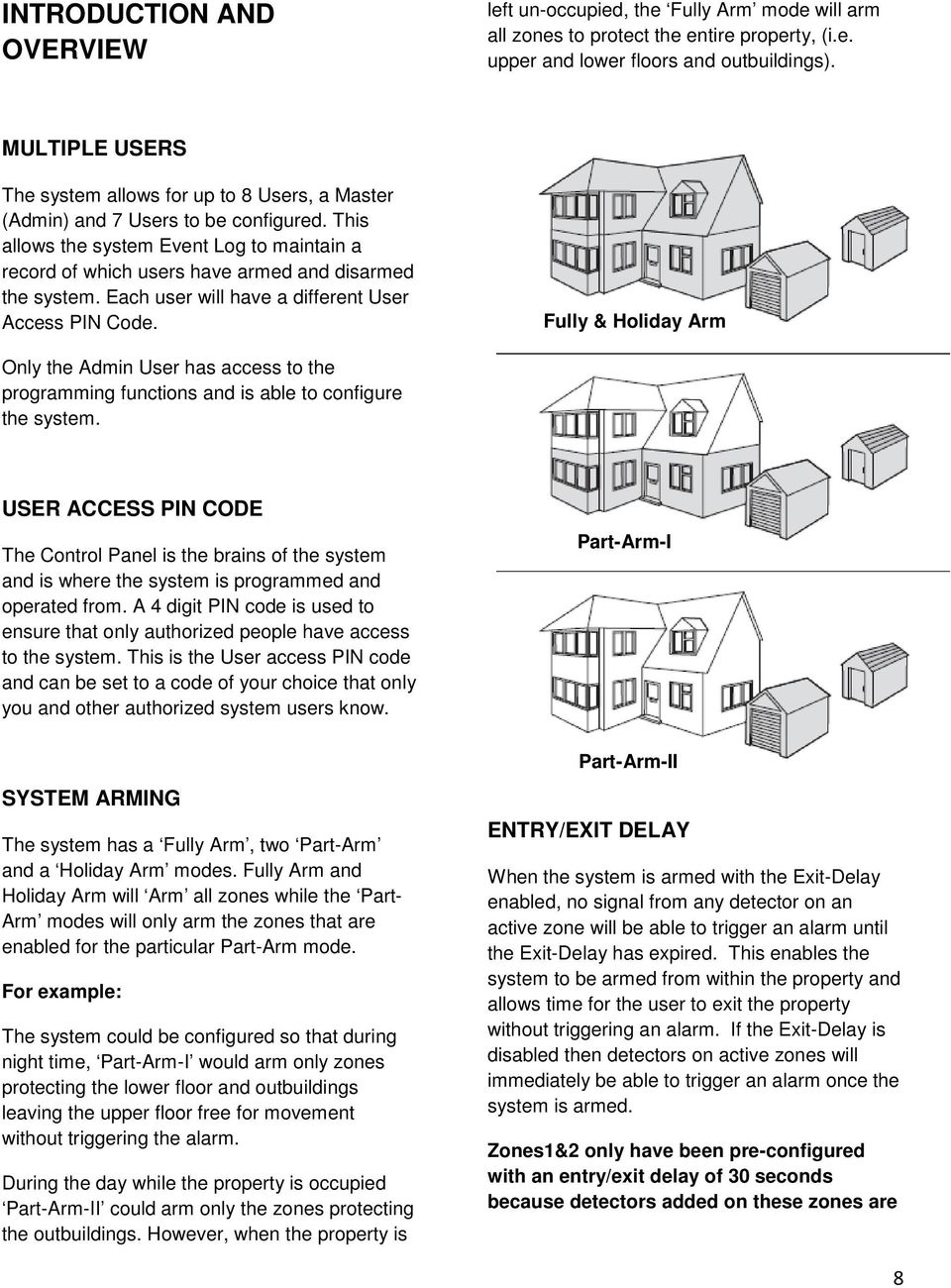
8 INTRODUCTION AND OVERVIEW left un-occupied, the Fully Arm mode will arm all zones to protect the entire property, (i.e. upper and lower floors and outbuildings). MULTIPLE USERS The system allows for up to 8 Users, a Master (Admin) and 7 Users to be configured. This allows the system Event Log to maintain a record of which users have armed and disarmed the system. Each user will have a different User Access PIN Code. Fully & Holiday Arm Only the Admin User has access to the programming functions and is able to configure the system. USER ACCESS PIN CODE The Control Panel is the brains of the system and is where the system is programmed and operated from. A 4 digit PIN code is used to ensure that only authorized people have access to the system. This is the User access PIN code and can be set to a code of your choice that only you and other authorized system users know. SYSTEM ARMING The system has a Fully Arm, two Part-Arm and a Holiday Arm modes. Fully Arm and Holiday Arm will Arm all zones while the Part- Arm modes will only arm the zones that are enabled for the particular Part-Arm mode. For example: The system could be configured so that during night time, Part-Arm-I would arm only zones protecting the lower floor and outbuildings leaving the upper floor free for movement without triggering the alarm. During the day while the property is occupied Part-Arm-II could arm only the zones protecting the outbuildings. However, when the property is Part-Arm-I Part-Arm-II ENTRY/EXIT DELAY When the system is armed with the Exit-Delay enabled, no signal from any detector on an active zone will be able to trigger an alarm until the Exit-Delay has expired. This enables the system to be armed from within the property and allows time for the user to exit the property without triggering an alarm. If the Exit-Delay is disabled then detectors on active zones will immediately be able to trigger an alarm once the system is armed. Zones1&2 only have been pre-configured with an entry/exit delay of 30 seconds because detectors added on these zones are 8
9 typically installed at entry/exit points of your property. The system Exit-Delay may be configured for between 10 to 250 seconds or disabled completely. If a detector on a zone with its Entry-Delay enabled is triggered, then an alarm will not sound until the Entry-Delay period has expired. This allows time for the user to re-enter the property and disarm the system before an alarm occurs. Generally only the zones on the main entry route to the property will be configured with an Entry-Delay. The remaining zones would be configured with their Entry-Delay disabled allowing them to immediately initiate an alarm the instant a detector on the zone is triggered. The Entry-Delay for each zone may be configured for between 10 to 250 seconds or disabled completely. Note: To conserve power and maximize battery life the PIR movement Detector will only detect movement if there has been no movement detected within the previous 2 minutes. Consequently the PIR Detector will not become active until the protected area has been free from movement for more than 3 minutes. ZONES The system incorporates 32 wireless alarm zones for the connection of a PIR movement or door/window contact detector per zone used to independently monitor different areas of the property. In addition to standard intruder protection, each zone can also be configured to operate in alternative modes. For example: Intruder mode provides standard intruder monitoring. 24-hour Intruder mode provides 24 hour intruder protection for areas where continuous monitoring is required, (e.g. gun lockers). Fire mode provides 24 hour monitoring of any Smoke detectors incorporated into the system. Test mode allows a zone to be monitored while the system is armed. If a detector on a zone is triggered an entry will be recorded in the Event Log but an alarm will not occur. In addition there is the facility to connect up to 4 hard wired zones to the Control Panel, each of which is configurable with most of the features of the wireless zones. ZONE LOCKOUT If a detector on an active zone is triggered while the system is armed an alarm will sound. After the programmed alarm duration has expired the alarm will stop and the system will automatically reset. Subsequent detectors triggered will again trigger an alarm. If a single zone triggers an alarm more than 3 times then that zone will be Locked Out and any further alarm signals from that zone will be ignored until the system is disarmed. Note: The Zone Lockout feature can be disabled if required. QUICK SET The system may be fully armed in 10 seconds using the quick set facility, overriding the programmed exit-delay. This is useful for setting the system at night when the Exit-Delay warning beep will be silenced after just a few seconds. EVENT LOG The Control Panel incorporates a memory capable of storing the last 99 system events. 9
10 This enables the user to see which user has Armed/Disarmed the system and if and when any alarms occurred. The time, date and details of the event type will be recorded for each system event. CHIME Chime is a low security facility for use when the system is in Standby mode. If the Chime feature is ON, and a detector on a zone that has its Chime function enabled is triggered, the internal sounder will produce a low volume warning tone. A typical use of the Chime function would be to warn that a door or particular area has been entered. TAMPER PROTECTION All security related system devices (except any Remote Control Units) incorporate Tamper protection features to protect against unauthorized attempts to interfere with the device. Any attempt to remove the battery cover from any device (except a Remote Control) or to remove the Solar Siren or Control Panel from the wall will trigger the alarm even if the system is Disarmed (unless the system is in Test or Program modes). JAMMING DETECTION In order to detect any attempts to illegally jam the radio channel used by your alarm system, a special jamming detection function is incorporated into the Control Panel. If this feature is enabled, an alarm will be triggered if the radio channel is jammed continuously for more than 30 seconds or if the system is jammed for more than 3 periods of 10 seconds in a 5 minute period. At full alarm it will beep for 3 seconds and will alarm after 10 seconds. At Part Arm it will beep for 3 seconds. The jamming detection circuit will constantly scan for jamming signals. However, it will also detect and could in extreme cases be triggered by radio signals from other radio equipment within range operating on the same frequency which would not interfere with the normal operation of your alarm. If you are planning to operate the Jamming Detection feature we recommend that you wait at least 30 days before activating this feature to allow time for you to become familiar with the operation of your system. When activating jamming detection the system should be monitored carefully for false jamming alarms for at least 2 weeks before leaving the Jamming Detection function permanently enabled. BATTERY MONITORING All security devices powered by nonrechargeable batteries incorporate a battery level monitoring feature which will warn of a low battery status. In addition the Control Panel will also indicate a low battery status on any PIR (Passive Infra- Red) movement or Magnetic Door /Window Detector on the system. The batteries on any device indicating a low battery status should be replaced immediately. HOME AUTOMATION This system can also accommodate up to 32 wireless receiver home automation devices. Devices include an ON/OFF Plugin Controller or Bayonet Lampholder. These devices are used to simulate the presence of occupants whilst you are away from the home. 10

11 This hardware manual will only detail how to link these devices to the Control Panel. To operate these devices with a Programme, Schedule or Event, please refer to the online software manual available at PLANNING AND EXTENDING YOUR ALARM SYSTEM Before attempting to install your Alarm System it is important to study your security requirements and plan your installation accordingly. PIR Movement Detectors are used to protect the main areas of the property, (e.g. lounge, study, hallway and landing). Magnetic Door/Window Detectors are typically used to protect the main access points to the property, (e.g. front door, back door, patio doors etc). However, they can also be used to protect other vulnerable doors/ windows or access doors to important rooms. The use of ON/OFF wireless home automation devices such as a Plugin Controller module (HIS1A) or Bayonet Lampholder module (HIS2A) can be used to simulate the presence of occupants within the home whilst you are away. TYPICAL INSTALLATION The following example shows a typical property incorporating the suggested positions for the External Siren, PIR movement and Magnetic Door/Window Contact Detectors. Use this as a guide for your installation in conjunction with the detailed positioning requirements for each device provided in the appropriate installation sections in this manual for planning your intruder alarm system. 11
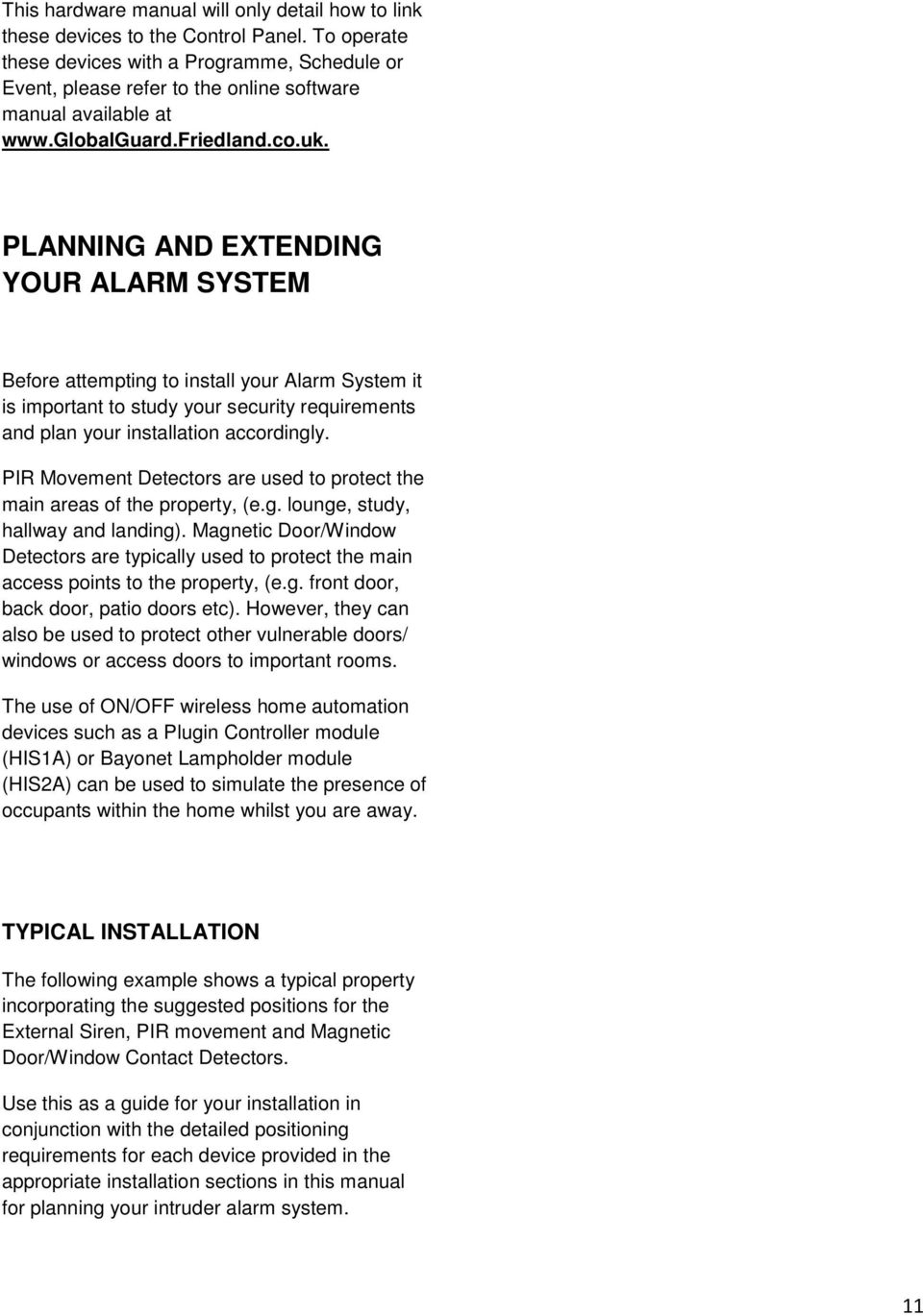
12 Typical Installation using only the detectors supplied: 1. Place the 1st Door/Window Detector (configured on zone 1) on the front door. 2. Place a 2nd Door/Window Detector (configured on zone 2) on the back or patio doors. 3. Place the 1st PIR Detector (set on zone 3) and the 2nd PIR Detector (set on zone 4) in two of the following locations: i) downstairs in the main living room containing most valuables, or ii) on the landing covering the access routes between bedrooms and the stairs, or iii) in the hall covering the Control Panel and routes between downstairs rooms. The system may be expanded with additional detectors, Remote Controls and Keypads to provide even greater protection. However, the following rules should be followed: a. Any detectors covering the main door and the route to the Control Panel should be set on zone 1 only. Another detector covering another entry/exit point can be added to zone2. 12
13 b. Any detectors covering the remainder of the lower floor apart from the entry/exit points (zones1&2) should be left with an instant delay (default for all other zones) for maximum security. c. Any detectors placed upstairs (which are not required when activating Part-Arm-I mode) should not be setup with Part-Arm I ON. Typical basic installations: Detectors on zones 1 and 2 will have a 30 second entry delay period. Detectors on all other zones are configured as INSTANT, (i.e. they have no entry delay). The system has a 3 minute alarm duration. The Zone Lockout feature is ON so that if any single zone triggers an alarm more than 3 times they will be ignored until the system is next disarmed, (this feature helps protect against continuous false alarms). PART-ARM-I is OFF. PART-ARM-II is OFF. IMPORTANT: As soon as installation is complete The default Master User Access PIN Code for the Control Panel should be changed to your own code that only you know. User Access PIN Codes 1-7 for the Control Panel should be changed to your own codes that only the relevant system user knows. The system Time and Date must be configured. Note: If you wish to change the system configuration away from the above example and factory settings and customize it to your own unique requirements or activate any of the more advanced system features then refer to the Programming section from page
14 EXTERNAL SOLAR SIREN The Siren is encapsulated within a tough polycarbonate housing that also provides full protection against adverse weather conditions. An LED indicator unit is built into the Siren to act as a visible deterrent and indication that the system is active. The LEDs will slowly and alternately flash whether the system is Armed or Disarmed. When an alarm occurs the LEDs will flash rapidly together. An integral tamper switch provides additional security protection to the Siren and will immediately trigger an alarm should any unauthorized attempt be made to interfere with and remove the Siren cover. The Siren is powered by a rechargeable nickelmetal hydride (NIMH) battery. A solar panel mounted on the top of the housing charges the battery during daylight hours. During darkness, only a small amount of energy is required to operate the Siren unit. POSITIONING THE SOLAR SIREN The recommended mounting height for the Siren is at first floor window height of your property on the external wall so that it can be easily seen and heard. The Siren should be mounted on a sound flat surface so that the rear tamper switch is not activated when mounted. Shadows cast by neighboring walls, trees and roof overhangs should also be avoided. If the Siren is to be mounted below the eaves, it should be positioned a distance of at least twice the width of the eaves overhang below the eaves. Remember that in winter the sun is lower in the sky and you should avoid winter shadows where possible. The Solar Siren contains a sophisticated radio receiver. However, reception of radio signals can be affected by the presence of metallic objects within the vicinity of the Siren. It is therefore important to mount the Siren a minimum distance of 1 metre away from any external or internal metalwork, (i.e. drainpipes, gutters, radiators, mirrors etc). Be especially aware of radiators mounted on the inside wall behind possible locations for the Siren. Ensure that the position selected for the Siren is within effective range of the Control Panel. CONFIGURING THE SOLAR SIREN The Siren has already been pre-linked to the Control Panel from the factory. It has also been preconfigured to operate with your system. Ensure that the tamper switch does not fall into the recess between brick courses as this could prevent the switch from closing and give a permanent tamper signal. In order to provide the maximum amount of daylight to the solar panel, the Siren should ideally be mounted on a south facing wall. However, an easterly or westerly position will suffice. Mounting the device on a north facing wall should be avoided as this could mean that during the short dark days of winter months the solar panel may not receive sufficient daylight in order to maintain the battery charge at acceptable levels. However should you wish to change the DIP switch settings in the battery compartment, please read as follows: 14

15 ON Under the cover you will also find a row of 5 DIP Switches labeled SW3 and a LEARN button. 1. Ensure that DIP Switch5 of SW3 on the LED indicator board is set to OFF ( SIREN ) for use with this alarm system. CHARGING THE SOLAR SIREN BATTERY Before getting your system up and running, it is important to initially charge up the battery for the Solar Siren for approximately 4 hours. 1. Remove the rear battery cover as shown below. 2. DIPswitch1 marked ALARM TIME is used to limit the maximum period for which the external siren will sound before it will be automatically shut down, (even if the Control Panel is still in alarm): ON OFF 3 minutes 10 minutes 3. DIPswitch2 marked AJ does not function for this system and should be ignored. 2. Connect the 6V NiMH battery pack inside as shown below. 4. DIPswitch3 marked ALARM SOUND if OFF will prevent the siren from sounding during an alarm, (this will not affect the warning beeps): ON OFF Siren enabled Siren disabled 6V NiMH Battery Battery connector DC charging jack 5. The Solar Siren will acknowledge signals from the Remote Control, Keypad and Control Panel by beeping and flashing the LEDs. It is possible to disable these acknowledgement beeps DIPSwitch4 marked BEEP SOUND. ON OFF beeps enabled beeps disabled 3. Connect the Control Panel s 12V Power supply adaptor to the DC charging jack shown above and plug the adaptor into the mains to charge the battery. 4. Charge the battery for approximately 4 hours. In the meantime you can install the PIR movement detector, door/ window contact detector and Control Panel in position. 5. After charging is complete, remove the Control Panel s adaptor and refit the siren s battery cover in place. Note: The Control Panel cannot be fully installed until the Siren has completed charging. 15

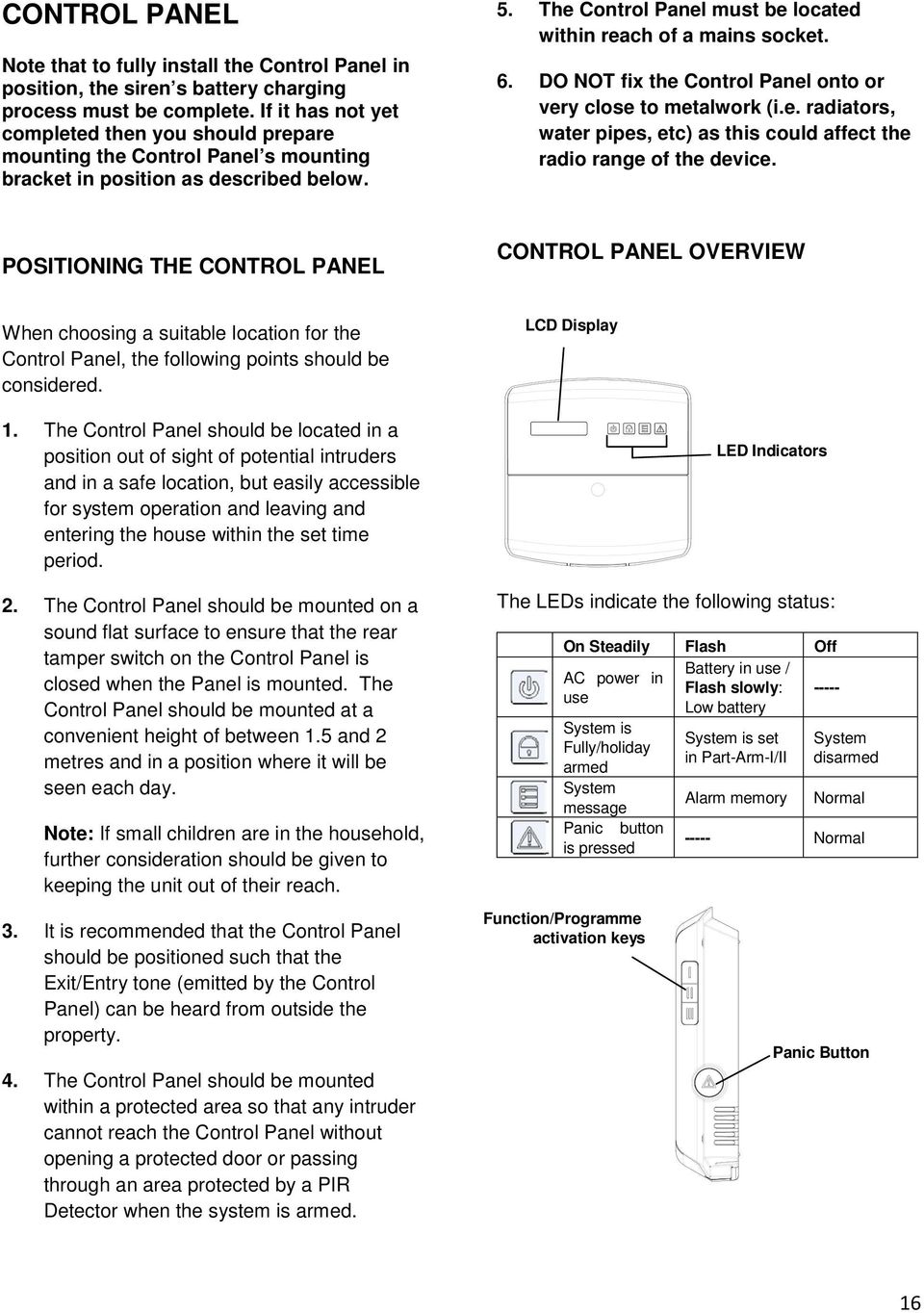
16 CONTROL PANEL Note that to fully install the Control Panel in position, the siren s battery charging process must be complete. If it has not yet completed then you should prepare mounting the Control Panel s mounting bracket in position as described below. 5. The Control Panel must be located within reach of a mains socket. 6. DO NOT fix the Control Panel onto or very close to metalwork (i.e. radiators, water pipes, etc) as this could affect the radio range of the device. POSITIONING THE CONTROL PANEL CONTROL PANEL OVERVIEW When choosing a suitable location for the Control Panel, the following points should be considered. 1. The Control Panel should be located in a position out of sight of potential intruders and in a safe location, but easily accessible for system operation and leaving and entering the house within the set time period. 2. The Control Panel should be mounted on a sound flat surface to ensure that the rear tamper switch on the Control Panel is closed when the Panel is mounted. The Control Panel should be mounted at a convenient height of between 1.5 and 2 metres and in a position where it will be seen each day. Note: If small children are in the household, further consideration should be given to keeping the unit out of their reach. 3. It is recommended that the Control Panel should be positioned such that the Exit/Entry tone (emitted by the Control Panel) can be heard from outside the property. 4. The Control Panel should be mounted within a protected area so that any intruder cannot reach the Control Panel without opening a protected door or passing through an area protected by a PIR Detector when the system is armed. LCD Display The LEDs indicate the following status: On Steadily Flash Off Battery in use / Flash slowly: Low battery AC power in use System is Fully/holiday armed System message Panic button is pressed Function/Programme activation keys LED Indicators System is set in Part-Arm-I/II Alarm memory System disarmed Normal Normal Panic Button 16
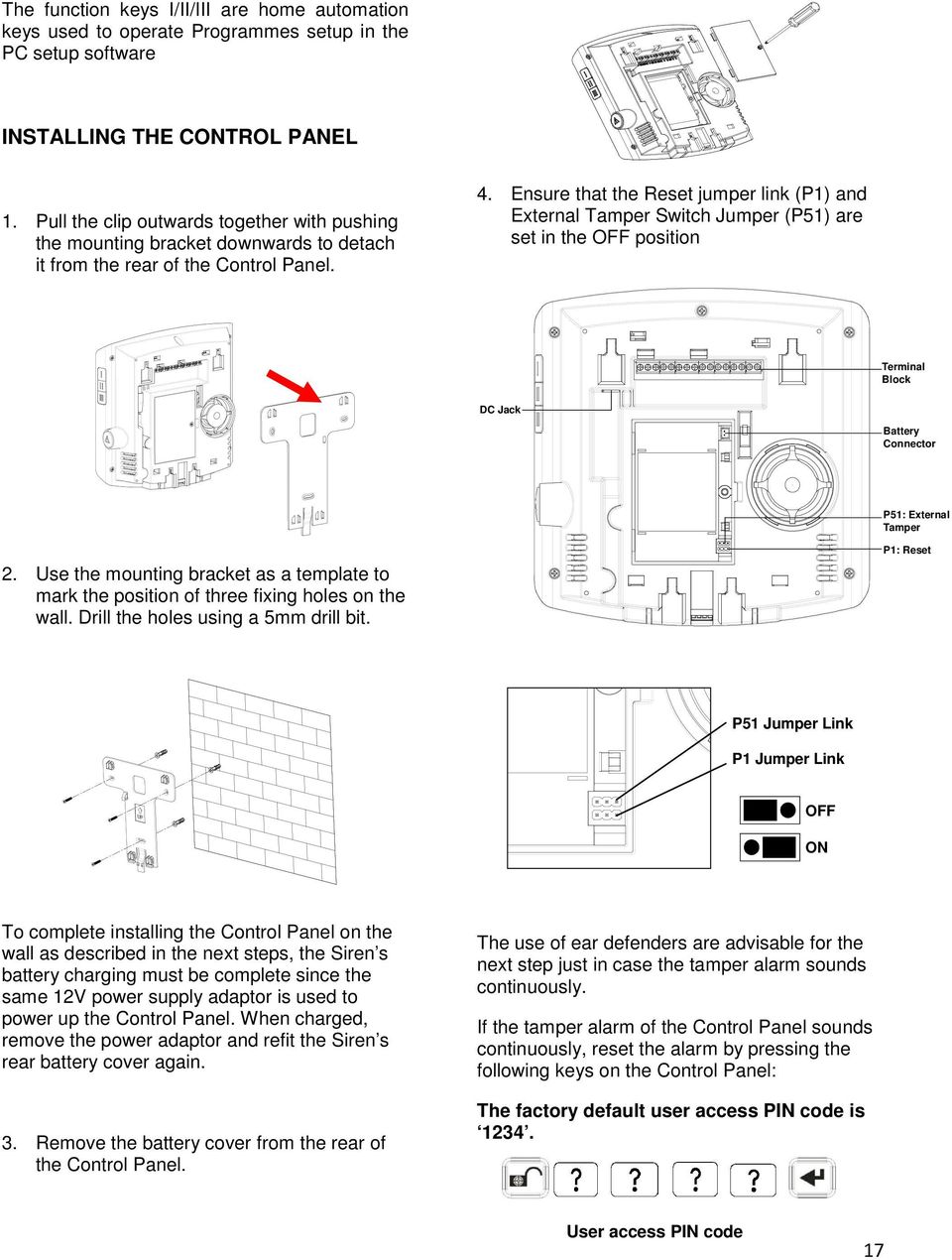
17 The function keys I/II/III are home automation keys used to operate Programmes setup in the PC setup software INSTALLING THE CONTROL PANEL 1. Pull the clip outwards together with pushing the mounting bracket downwards to detach it from the rear of the Control Panel. 4. Ensure that the Reset jumper link (P1) and External Tamper Switch Jumper (P51) are set in the OFF position Terminal Block DC Jack Battery Connector P51: External Tamper 2. Use the mounting bracket as a template to mark the position of three fixing holes on the wall. Drill the holes using a 5mm drill bit. P1: Reset P51 Jumper Link P1 Jumper Link OFF ON To complete installing the Control Panel on the wall as described in the next steps, the Siren s battery charging must be complete since the same 12V power supply adaptor is used to power up the Control Panel. When charged, remove the power adaptor and refit the Siren s rear battery cover again. 3. Remove the battery cover from the rear of the Control Panel. The use of ear defenders are advisable for the next step just in case the tamper alarm sounds continuously. If the tamper alarm of the Control Panel sounds continuously, reset the alarm by pressing the following keys on the Control Panel: The factory default user access PIN code is User access PIN code 17
18 IMPORTANT: The keys must be pressed firmly and within 5 seconds. If you make a mistake, press the ESC button and start the sequence again. 5. Connect the connector of the 7.2V NiMH rechargeable battery pack to the connector in the battery compartment. so, again it is advisable to wear ear defenders as the tamper alarm will sound. 6. Connect the plug of the 12V power adaptor to the DC jack in the panel. Route the cable along the cable track. DC Jack Connector 8. If the Control Panel is powered up and left for approximately 15 minutes before proceeding to the next step, it may begin producing a beeping sound and the event log indicator icon will flash on the Control Panel because it is searching for the IP gateway which needs to be power up Cable Track Event log icon To cancel the beeping and indication, press on the Control Panel followed by. 7. Fit the Panel to the mounting bracket. IP GATEWAY The IP gateway of the system allows you to remotely access and control your system over the internet using the free online web software at or using the Android/Apple IOS GlobalGuard mobile device App. If removing the Control Panel from the wall, use a flat blade screwdriver to push the clip towards the wall and push the Panel upwards and away from the bracket. Before doing The gateway communicates to the Control Panel wirelessly. In order to ensure you can remotely access your system, your internet connection must be active that the gateway is connected to. 18

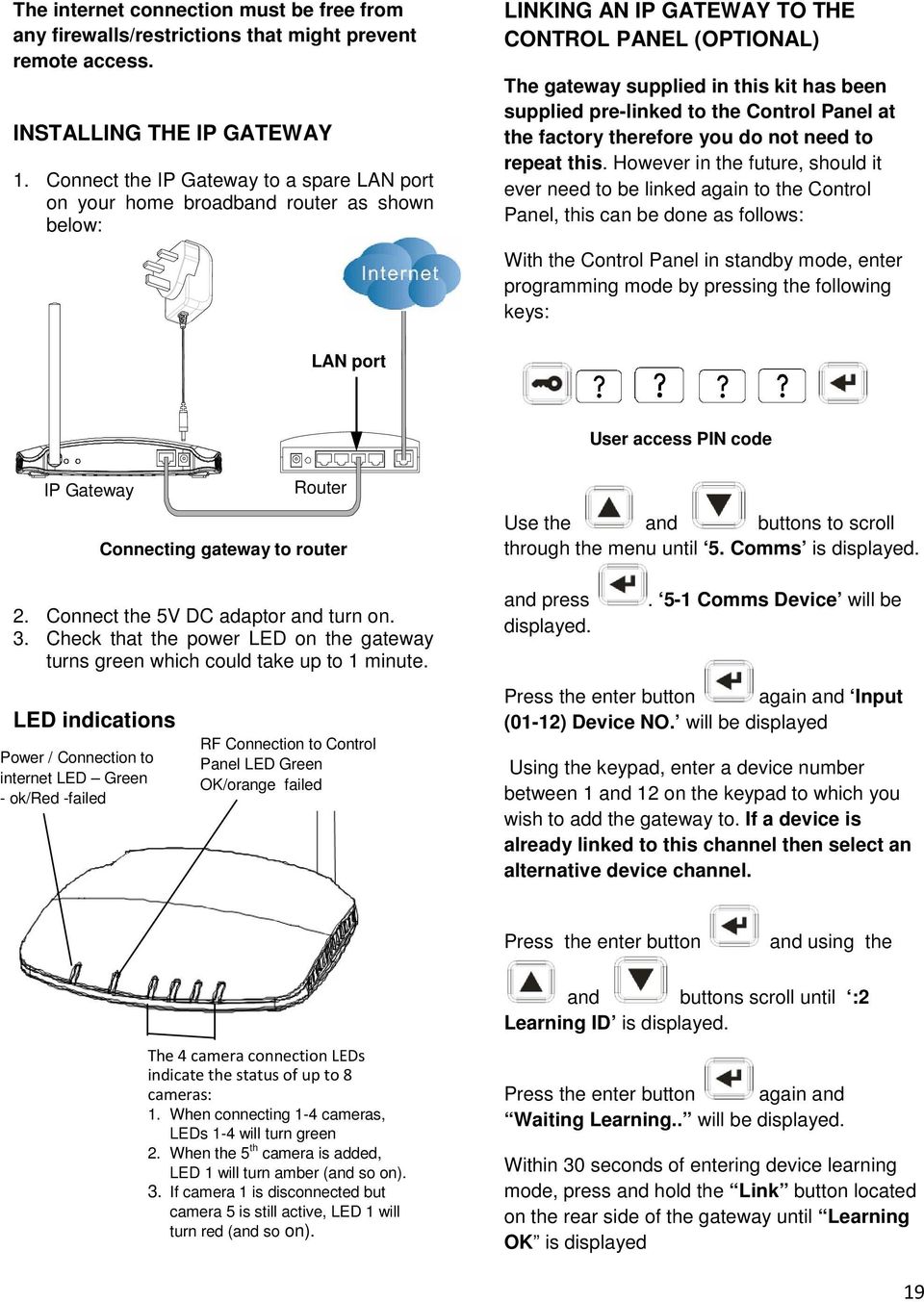
19 The internet connection must be free from any firewalls/restrictions that might prevent remote access. INSTALLING THE IP GATEWAY 1. Connect the IP Gateway to a spare LAN port on your home broadband router as shown below: LINKING AN IP GATEWAY TO THE CONTROL PANEL (OPTIONAL) The gateway supplied in this kit has been supplied pre-linked to the Control Panel at the factory therefore you do not need to repeat this. However in the future, should it ever need to be linked again to the Control Panel, this can be done as follows: With the Control Panel in standby mode, enter programming mode by pressing the following keys: LAN port, User access PIN code IP Gateway Connecting gateway to router 2. Connect the 5V DC adaptor and turn on. 3. Check that the power LED on the gateway turns green which could take up to 1 minute. LED indications Power / Connection to internet LED Green - ok/red -failed Router RF Connection to Control Panel LED Green OK/orange failed Use the and buttons to scroll through the menu until 5. Comms is displayed. and press displayed Comms Device will be the enter button again and Input (01-12) Device NO. will be displayed Using the keypad, enter a device number between 1 and 12 on the keypad to which you wish to add the gateway to. If a device is already linked to this channel then select an alternative device channel. the enter button and using the The 4 camera connection LEDs indicate the status of up to 8 cameras: 1. When connecting 1-4 cameras, LEDs 1-4 will turn green 2. When the 5 th camera is added, LED 1 will turn amber (and so on). 3. If camera 1 is disconnected but camera 5 is still active, LED 1 will turn red (and so on). and buttons scroll until :2 Learning ID is displayed. the enter button again and Waiting Learning.. will be displayed. Within 30 seconds of entering device learning mode, press and hold the Link button located on the rear side of the gateway until Learning OK is displayed 19
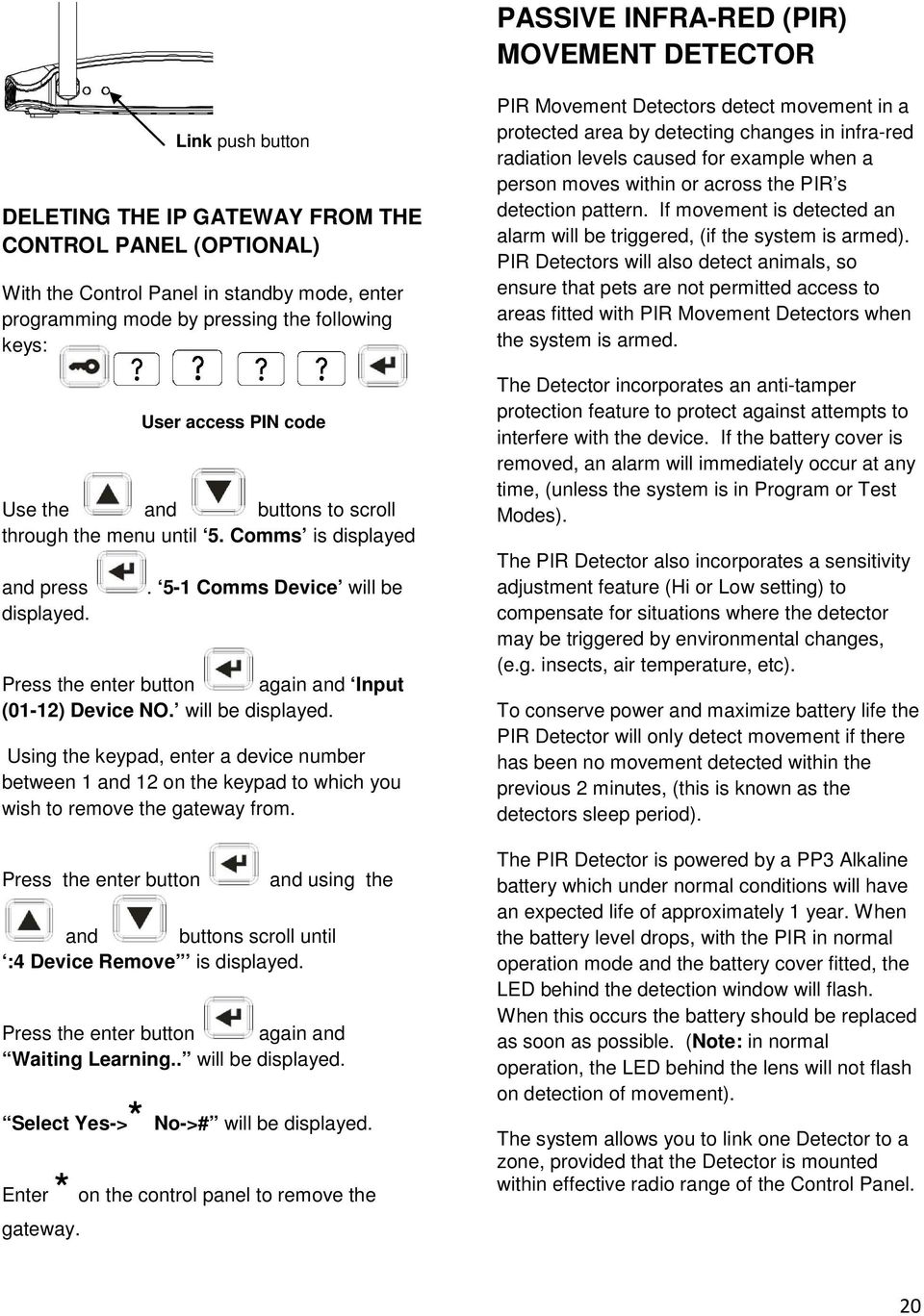
20 PASSIVE INFRA-RED (PIR) MOVEMENT DETECTOR DELETING THE IP GATEWAY FROM THE CONTROL PANEL (OPTIONAL) With the Control Panel in standby mode, enter programming mode by pressing the following keys: Use the and buttons to scroll through the menu until 5. Comms is displayed and press displayed Comms Device will be the enter button again and Input (01-12) Device NO. will be displayed. Using the keypad, enter a device number between 1 and 12 on the keypad to which you wish to remove the gateway from. the enter button and using the and buttons scroll until :4 Device Remove is displayed. the enter button again and Waiting Learning.. will be displayed. Select Yes->* No-># will be displayed. Enter * on the control panel to remove the gateway. Link push button User access PIN code PIR Movement Detectors detect movement in a protected area by detecting changes in infra-red radiation levels caused for example when a person moves within or across the PIR s detection pattern. If movement is detected an alarm will be triggered, (if the system is armed). PIR Detectors will also detect animals, so ensure that pets are not permitted access to areas fitted with PIR Movement Detectors when the system is armed. The Detector incorporates an anti-tamper protection feature to protect against attempts to interfere with the device. If the battery cover is removed, an alarm will immediately occur at any time, (unless the system is in Program or Test Modes). The PIR Detector also incorporates a sensitivity adjustment feature (Hi or Low setting) to compensate for situations where the detector may be triggered by environmental changes, (e.g. insects, air temperature, etc). To conserve power and maximize battery life the PIR Detector will only detect movement if there has been no movement detected within the previous 2 minutes, (this is known as the detectors sleep period). The PIR Detector is powered by a PP3 Alkaline battery which under normal conditions will have an expected life of approximately 1 year. When the battery level drops, with the PIR in normal operation mode and the battery cover fitted, the LED behind the detection window will flash. When this occurs the battery should be replaced as soon as possible. (Note: in normal operation, the LED behind the lens will not flash on detection of movement). The system allows you to link one Detector to a zone, provided that the Detector is mounted within effective radio range of the Control Panel. 20
21 POSITIONING THE PIR DETECTORS The recommended position for a PIR Movement Detector is in the corner of a room mounted at a height between 2 and 2.5 metres. At this height, the detector will have a maximum range of up to 12 metres with a field of view of Do not fix the PIR Detector onto or very close to metalwork (i.e. radiators, water pipes, etc) as this could affect the radio range of the device. Note: When the system is Armed, pets should not be allowed into an area protected by a PIR Detector as their movement could be detected and trigger an alarm. INSTALLING THE PIR MOVEMENT DETECTOR When deciding upon the mounting position for the detector the following points should be considered to ensure trouble free operation: 1. Undo and remove the fixing screw from the bottom edge of the PIR Detector, (keep the screw safe for later). Carefully pull the bottom edge of the detector away from the rear cover and then slide down to release the top clips. 1. Do not position the Detector facing a window or where it is exposed to or facing direct sunlight. PIR Detectors are not suitable for use in conservatories. 2. Do not position the Detector where it is exposed to draughts. 3. Do not position the Detector directly above a heat source, (e.g. fire, radiator, boiler, etc). 4. Where possible, mount the Detector in the corner of the room so that the logical path of an intruder would cut across the fan detection pattern. PIR Detectors respond more effectively to movement across the device than to movement directly towards it. 5. Do not position the Detector in a position where it is subject to excessive vibration. 6. Ensure that the position selected for the PIR Detector is within effective range of the Control Panel. 2. Carefully drill out the required mounting holes in the rear cover using a 3mm drill according to whether the unit is being mounted in a corner or against a flat wall. Drill holes for flat wall mount Flat wall Drill holes for corner mount Corner 21
22 3. Use the rear cover as a template and mark the positions of the fixing holes on the wall. Fix the rear cover to the wall using the two 18mm No.4 screws and 22mm wall plugs, (a 5mm hole will be required for the wall plugs). Do not over-tighten the screws as this may distort or damage the cover. until the PIR has stabilized. Then the LED will stop flashing and turn OFF. Test Mode SW1 button SW3 Sensitivity switch Testing the PIR Detector independently: Flat Wall Corner Note: The wall plugs supplied with the product are not suitable for plasterboard walls, if mounting the detector onto plasterboard use appropriate wall plugs. 4. To select the required sensitivity, set switch SW3 as follows: 1. After the LED stops flashing, it should now be walk tested in position to ensure that the detection coverage is sufficient from its mounting location. To do this, first press and hold the Test Mode push button (SW1) for 2-3 seconds. 2. Refit the PIR detector in position to the rear cover mounted on the wall and walk around the detection area. The LED behind the front lens will flash upon detecting your movement. UP Down HIGH sensitivity LOW sensitivity The PIR will remain in walk test mode for a fixed 5 minute period before automatically exiting. 3. Repeat these steps for any additional PIR detectors you may have purchased. 4. Ensure that the LED indicator has stopped flashing rapidly. Note: The recommended setting is LOW for most normal environments. If set to HIGH and false alarms are experience, set back to LOW. 5. Connect the PP3 alkaline battery to the battery clip. The LED behind the lens will rapidly flash for approximately 2-3 minutes 5. Push button SW1 (Test Mode) is used to put the PIR Detector into Walk Test mode, which overrides the 2 minute sleep period and allows the operation of the detector to be checked during installation. the button for 2 seconds to activate test mode for a fixed 5 minute after which it will automatically revert to normal operation. 22
23 On initial installation the detector should be configured into Walk Test ready for testing, (i.e. ing down SW1 for 2s). 2. Scroll through the programming menu until 3. Security Sensor Zone is displayed and press. 3-1 Wireless Sensor Zone will be displayed. 3. again and enter a zone number between 1-32 to which the detector is to be linked to. :1 Learning ID will be displayed. 6. Refit the PIR Detector to the rear cover by offering the detector up to the rear cover and locate the clips in the top edge into the rear cover. Push the lower edge of the detector into place and refit the fixing screw in the bottom edge of the PIR to secure in position. Do not over-tighten the screws as this may damage the casing. 7. Walk into and move slowly around the protected area within 5 minutes of pressing SW1. Each time the detector senses movement the LED indicator behind the lens will flash. 4. again and the following will be displayed on the Control Panel: Send Code Waiting 30s.. The panel will now listen for a valid signal from a new detector to link to the zone. The Panel will remain in Learn Mode for 30s. If a valid signal is not received from a new detector within 30s it will automatically exit Learn Mode and return to :1 Learning ID LINKING A PIR MOVEMENT DETECTOR TO THE CONTROL PANEL: A PIR detector can be added to the Control Panel using the GlobalGuard PC setup software or directly as described below: Tamper button Remove the PIR Detector from its rear cover after installing and configuring it. 1. Enter on the Control Panel s keypad; User access code to enter Programming mode 5. Activate the Tamper Switch on the PIR detector. Note: If the detector is already linked to the control panel on any other zone then the panel will produce a single long beep and the received signal from the detector will be ignored. 23
24 If the detector is new and not already linked on any security zone the panel will produce two short beeps and the display will show New Device 6. Confirm the new device ID code by activating the Tamper Switch on the same new PIR detector within 15s. Note: If the confirmation signal is not received within 15s the control panel will produce a single long beep and exit the learning process. The learning process will need to be started again to learn the new device into memory. 7. The panel will produce three short beeps and the LCD will show Device Confirmed. 8. The LCD will then show Saving New Device while the ID code of the new detector is stored into memory. 9. Refit the PIR to its rear cover. 10. After completing the Zone Setup, press to return to the top level of programming menu. Note: If the PIR detector has been installed on the wall, allow at least 2-3 minutes for it stabilize before testing with the Control Panel. For information about linking the device using the PC software, please refer to the online software manual. 2. Use the and buttons to scroll through the menu until Detector Walk Test is displayed and press. Walk Test waiting... will be displayed. Note: If no signal is received by the Control Panel within 60 seconds, the display will return to Detector Walk Test. 3. Walk into and move slowly around the protected area. The Control Panel will beep to indicate that the alarm signal has been received and the identity of the zone that the detector is configured for will be displayed. 4. Remove the back cover of the PIR detector. The Control Panel should beep and display: Location ZXX Tamper to show that the detector s tamper switch has been activated. 5. Refit the cover to the PIR Detector. Testing the PIR Detector with the Control Panel: 6. to exit test mode and return to standby. 1. Ensure that the system is in Test Mode In standby mode, enter: User access code 24
25 IMPORTANT: In normal operation, the LED indicator behind the detector lens will not flash on movement detection, (unless the battery is low). When the detector is fully installed i.e. battery cover fitted and in operating mode; in order to conserve power and maximize battery life the PIR Detector will only detect movement if there has been no movement detected within the previous 2 minutes. MAGNETIC DOOR/ WINDOW CONTACT DETECTORS The Magnetic Contact Set comprises of two parts; a Detector and a Magnet. They are designed to be fitted to either doors or windows with the Magnet mounted on the opening part of the door/window and the Detector mounted to the frame. When the protected door or window is opened and the Magnet is moved away from the Detector an alarm will be triggered, (if the system is armed). The Magnetic Contact Detector has the facility to connect an additional wired Magnetic Contact. This must be of a normally closed contact type with the contact being opened in order to generate an alarm condition. The Magnetic Contact Detector is powered by two CR2032 type Lithium cells which under normal conditions will have an expected life of approximately 1 year. Under normal battery conditions the LED on the Detector will not illuminate when the Detector is triggered, (unless the detector is in test mode with the battery cover removed). However, under lowbattery conditions this LED will be illuminated for approximately 1 second when the detector is triggered. When this occurs the batteries should be replaced as soon as possible. The system allows you to link one Detector to a zone, provided that the Detector mounted within effective radio range of the Control Panel. POSITIONING THE MAGNETIC CONTACT DETECTOR The Magnetic Contact Detector is suitable for mounting in dry interior locations only. Decide which doors and windows are to be protected by fitting Magnetic Contact Detectors, (usually the front and back doors as a minimum will have Magnetic Contact Detectors fitted). However additional detectors may be fitted where required to other more vulnerable doors or windows, (e.g. garage, patio/conservatory doors etc). Ensure that the position selected for the Magnetic Contact Detector is within effective range of the Control Panel. Do not fix the Detector onto or very close to metalwork (i.e. radiators, water pipes, etc) as this could affect the radio range of the device. On PVC Door/Window frames, it may be necessary to space the Detector and Magnet away from the metal surface using a plastic or wooden spacer to achieve the necessary radio range. INSTALLING AND CONFIGURING THE MAGNETIC CONTACT DETECTORS 1. Remove the battery cover by sliding and lifting it off. (DO NOT use a screwdriver to lever it off). Slide open and lift the cover off. 25
26 2. The Detector and Magnet should be mounted together along the opening edge of the Window/Door opposite the hinges. Ensure that the parallel gap between the Magnet and Detector is less than 10mm and that the arrow on the magnet is aligned with the mark on the detector. The Detector should be mounted on the fixed part of the frame and the magnet on the opening part. The Detector and Magnet should be mounted using the double sided adhesive pads or screws provided. Note: If mounting the device using the adhesive pads ensure that the mounting surfaces are clean and dry before mounting. 4. If an additional wired Magnetic Contact is required, this should be wired to the terminal block provided in the battery compartment. The wired contact should be connected using a maximum length of 1.5 metres of any of the following: - 6 core alarm cable - 2 core bell wire (6 x 0.2mm minimum) - 2 core 24AWG wire A cable entry cut-out is provided beside the terminal block in the battery cover. 5. Switch SW3 is used to enable/disable the internal/external wired magnetic contact. 3. If fixing the detector with screws first remove the battery holder by carefully tilting up the end and pulling away from the printed circuit board (PCB). The top of the Detector is secured by hanging the keyhole slot over the head of the 10mm pan head screw. The bottom of the Detector is secured using the 12mm counter-sunk head screw fitted within the battery compartment. Carefully drill out the centre of the fixing screw hole in the battery compartment using a 3mm drill. Fit the Magnet using the two 15mm fixing screws. Do not over tighten the screws as this may distort or damage the casing. Position of SW3 Top Bottom Function Internal Contact ON Internal & External Contacts ON Set the magnetic contact detector by setting the position of the switch (SW3). If setting to the top position, only the internal contact will be active. When two contacts are in use for internal and external connections 26
27 simultaneously (bottom position) only one activation event will be counted if one of the contacts is opened. If one contact is left open and the other closed contact is opened then an activation event will be counted. Important: If not using external contacts, set to the top position for the Detector to operate correctly 6. Slide the two batteries supplied into the battery holder, ensuring that the + side is uppermost on each battery as it is installed. LINKING A MAGNETIC CONTACT DETECTOR TO THE CONTROL PANEL: A magnetic contact detector can be added to the Control Panel using the GlobalGuard PC setup software or directly as described below: Remove the battery cover on the device 1. Enter on the Control Panel s keypad; User access PIN code to enter Programming mode 2. Scroll through the programming menu until 3. Security Sensor Zone is displayed and press. 3-1 Wireless Sensor Zone will be displayed. 7. Refit the battery holder into the detector 3. again and enter a zone number between 1-32 to which the detector is to be linked to. :1 Learning ID will be displayed. 8. Refit the battery cover TESTING THE MAGNETIC CONTACT DETECTOR INDEPENDENTLY 1. Remove battery cover to activate the tamper switch. As the button is released the LED indicator will illuminate for approximately 1 second to show that the tamper switch has been triggered and a signal is being transmitted. 2. Open the door/window to remove the Magnet from the Detector. 4. again and the following will be displayed on the Control Panel: Send Code Waiting 30s.. The panel will now listen for a valid signal from a new detector to link to the zone. The Panel will remain in Learn Mode for 30s. If a valid signal is not received from a new detector within 30s it will automatically exit Learn Mode and return to :1 Learning ID 27
28 Tamper button Note: If the magnetic contact detector has been installed, allow at least 2 minutes for it stabilize before testing with the Control Panel. For information about linking the device using the PC software, please refer to the online software manual. 5. Activate the Tamper Switch on the magnetic contact detector. Note: If the detector is already linked to the control panel on any other zone then the panel will produce a single long beep and the received signal from the detector will be ignored. If the detector is new and not already linked on any security zone the panel will produce two short beeps and the display will show New Device 6. Confirm the new device ID code by activating the Tamper Switch on the same new magnetic contact detector within 15s. Note: If the confirmation signal is not received within 15s the control panel will produce a single long beep and exit the learning process. The learning process will need to be started again to learn the new device into memory. 7. The panel will produce three short beeps and the LCD will show Device Confirmed. 8. The LCD will then show Saving New Device while the ID code of the new detector is stored into memory. 9. Refit the magnetic contact to its rear cover. 10. After completing the Zone Setup press to return to the top level of programming menu. Testing the Magnetic Contact Detector with the Control Panel: 1. Ensure that the system is in Test Mode In standby mode, enter: 2. Use the and buttons to scroll through the menu until Detector Walk displayed. User access PIN code Test is displayed and press. Walk Test waiting... will be Note: If no signal is received by the Control Panel within 60 seconds, the display will return to Detector Walk Test 3. Open the door/window to remove the Magnet from the Detector. In addition, the Control Panel will beep to indicate that the alarm signal has been received and the identity of the zone that the detector is configured for will be displayed. 28
29 4. Remove the battery cover. The Control Panel should beep and display: Location ZXX Tamper to show that the detector s tamper switch has been activated. 5. Refit the battery cover. 6. to exit test mode and return to standby. IMPORTANT: With the battery cover fitted the LED indicator will not flash when the door/window is opened, (unless the battery is low). 2. Drill four 6mm holes and fit the wall plugs. 3. Fit the two 30mm fixing screws in the top holes leaving approximately 9mm of the screw protruding. (Do not fit the bottom screw yet) INSTALLING THE SOLAR SIREN AFTER CHARGING Fit Solar Siren unit to the outside of the building in a position that is clearly visible and at a height which is relatively inaccessible to an intruder. Avoid mounting it in shaded areas or under the eaves that may prevent the solar panel from sufficiently charging the siren s battery. 1. Mark the 4 holes on the walls using the supplied plastic mounting template. A spirit level placed on the top edge will help to ensure you get the unit level. 4. Remove the mounting plate from the siren. 5. Fit the siren to the wall ensuring that the keyhole slots are correctly fitted over the heads of the two top fixing screws. Make adjustments to the screw position if needed. As the tamper button is press and released against the wall, the LEDs behind the front red lens will flash together to indicate it is powered up (still in service mode). Two LEDs will then flash alternately every 5 seconds 29
30 Tamper Switch Place the Control Panel into Test Mode: Battery Cover User access PIN code 8. Use the and buttons to scroll through the menu until Wirefree Siren Service Off is displayed and press. The Siren will produce a single long beep followed by two short beeps 9. Do not exit Test Mode at this stage. Now test the Solar Siren as follows Ensuring that the Control Panel is still in Test Mode 6. Remove the siren again and screw the wall mounting plate in position using the two 25mm fixing screws. 10. Use the and buttons to scroll through the menu until Alarm Test is displayed 11.. Use the and buttons to scroll through the menu until Wirefree Siren Test is displayed Metal wall mounting plate At this stage it is advisable to wear ear defenders before activating the siren test in the next step Testing the Solar Siren from the Control Panel 7. The Siren can be tested using the Auto Test feature from the PC setup software or directly from the Control Panel. To test from the Control Panel, it first needs to be switched out of service mode as follows: 12.. The Siren will activate for 5 seconds to show that it is working. 13. After testing, the Siren needs to be placed back into service mode ON prior to mounting on the wall as described in the next step. 30
31 Mounting the Siren On To the Wall Prior to mounting the Siren, the Siren needs to be placed into Service mode again else pressing the Siren s Tamper Switch against the wall will trigger the Siren. Fully Arm Part-Arm-I/II 1. Scroll through the Test Mode menu using and until Wirefree Siren Service ON is displayed and press. The Siren will produce two short beeps followed by one long beep. 2. Now the Siren is ready for mounting on the external wall. Fit the Siren to the wall ensuring that the keyhole slots are correctly fitted over the head of the top two fixing screws and the lower fixing hole lines up with the mounting plate. 3. To finalize installation of the Siren for correct operation with your system, it now needs to be switched back out of service mode Scroll through the Test Mode menu using and until Wirefree Siren Service OFF is displayed and press. The Siren will produce a single long beep followed by two short beeps. The Remote Control Unit also incorporates a Personal Attack (PA) button. ing and holding the PA button for 3 seconds will immediately trigger an Alarm (unless the Control Panel is in Test or Program Modes) even if the system is disarmed. The alarm can be cancelled using the Remote Control by pressing the DISARM button. Up to a total of 8 Remote Controls and/or Keypad Units can be used with this system, providing they are all operated within effective radio range of the Control Panel. The Remote Control is powered by a CR2032 type Lithium cell which under normal conditions will have an expected life of approximately 1 year. Under normal battery conditions the Transmit LED on the Remote Control will only illuminate when a button is pressed. However, under low-battery conditions this LED will continue to flash after the button has been released. When this occurs the battery should be replaced as soon as possible. CONFIGURING THE REMOTE CONTROL REMOTE CONTROL UNIT (OPTIONAL ACCESSORY) The Remote Control Unit(s) is used to either Arm or Part-Arm and to Disarm your system. 1. Remove the rear cover by using a small coin to lever open the cover, see diagram below 2. Insert the battery under the clip ensuring that the + terminal faces upwards away from the Circuit Board. 3. Replace the rear cover. 31
32 To link a Remote Control With unit in Standby mode (Power LED only illuminated). User access PIN code This puts the Control Panel into Programming Mode. User Setup will be displayed. TESTING THE REMOTE CONTROL 1. the button. The Transmit LED should illuminate while the button is pressed and extinguish within 1 second of releasing the button. 2. ing any button on the Remote Control will illuminate the Transmit LED as before to check that it is functioning correctly. 3. Wait until the LED extinguishes before pressing another button. LINKING A REMOTE CONTROL OR REMOTE KEYPAD TO THE CONTROL PANEL The Control Panel supports up to 8 Remote Controls and 6 Remote Keypads. If the linked devices have reached the limitation, linking a new device would mean to replace an old device s ID. A remote can be added to the Control Panel using the GlobalGuard PC setup software or directly as described here: 1. Use the and buttons to select Admin or User(1-7) Setup. 2.. :1 PIN Code will be displayed 3. Use the and buttons to scroll through the menu until :3 Remote is displayed and press ID will be displayed. 4. again Learning The Panel will remain in Learn Mode for 30s. If a valid signal is not received from a new device within 30s it will automatically exit Learn Mode and return to :1 Learning ID 5. on the Remote Control Note: If the device is already linked to the control panel then the panel will produce a single long beep and the received signal from the device will be ignored. 32
33 If the device is new and not already linked to the system the control panel will produce two short beeps and the display will show New Device Confirm the new device ID code from the same new Remote Control within 15s as follows: on the Remote Control. 4.. Wirefee Keypad 1:Off will be displayed. 5. Use the and buttons to select any device number between 1-6 and press Note: If the confirmation signal is not received within 15s the control panel will produce a single long beep and exit the learning process. The learning process will need to be started again to learn the new device into memory. The panel will produce three short beeps and the LCD will show Device Confirmed. The LCD will then show Saving New Device while the ID code of the new detector is stored into memory. 6. :1 Learning ID will be displayed. 7. again The Panel will remain in Learn Mode for 30s. If a valid signal is not received from a new device within 30s it will automatically exit Learn Mode and return to :1 Learning ID 6. twice to return to standby. To link a Remote Keypad With unit in Standby mode (Power LED only illuminated). User access PIN code on the Remote Keypad. Note: If the device is already linked to the control panel then the panel will produce a single long beep and the received signal from the device will be ignored. User access PIN code This puts the Control Panel into Programming Mode. 1. User Setup will be displayed. 2..Use the and buttons to select 2. System Setup. If the device is new and not already linked to the system the control panel will produce two short beeps and the display will show New Device Confirm the new device ID code from the same new Remote Keypad within 15s as follows: User access PIN code 3.. Use the and buttons to select 2-15 Wirefree Keypad. on the Remote Keypad. 33
34 Note: If the confirmation signal is not received within 15s the control panel will produce a single long beep and exit the learning process. The learning process will need to be started again to learn the new device into memory. The panel will produce three short beeps and the LCD will show Device Confirmed. The LCD will then show Saving New Device while the ID code of the new detector is stored into memory When signals are received from linked Remote Control, the appropriate messages will be displayed on the LCD screen: Remote Control - ARM Remote Control - DISARM Admin/UserX R0X Fully Arm Admin/UserX R0X Disarm 8. twice to return to standby. TESTING THE CONTROL PANEL & REMOTE CONTROL 1. Place the system into test mode: Remote Control PART-ARM Remote ControlPANIC/PA Admin/UserX R0X Part-Arm- I Admin R0X Panic Siren User access PIN code Use and to scroll through the menu until Walk Test is displayed. 2. to activate Walk Test. When signals are received from linked Remote Control, the appropriate messages will be displayed on the LCD screen: Remote Keypad - ARM Wirefree Keypad Fully Arm During the test the LCD will display Walk Test waiting... Remote Keypad - DISARM Wirefree Keypad Disarm 3. the Arm, Disarm, Personal Attack buttons in turn on the Remote Control. Note: If no signal is received by the Control Panel within 10 minutes, the display will return to Walk Test Remote Control PART-ARM-I/II Wirefree Keypad Part-Arm 34
35 Remote ControlPANIC/PA Wirefree Keypad Panic Siren block you must first put the system into Test Mode to prevent an alarm occurring when the Control Panel is removed from the wall mounting bracket. To do this: 4. to return to the top level menu of TEST MODE.,, User access PIN code EXTERNAL CONNECTIONS (Optional) Then remove the Control Panel from the wall bracket as shown below: Before making any connections, ensure that the Reset Jumper Link P1 is in the OFF position and then remove the DC power adaptor and disconnect the rechargeable battery located inside the rear battery compartment. P51 Jumper Link P1 Jumper Link OFF ON The connection terminal block is located on the rear of the Control Panel. To access the terminal 35
36 The signaling contacts on all hardwired alarm and tamper zones must be volt free. (i.e. they must only open and close and not apply any self generated voltage across the contacts). The contacts on zones 33, 34, 35 and the tamper circuit should be normally closed. An alarm will be triggered when the contacts open. On zones 33, 34 and 35, additional Wired Magnetic Door/Window Contact Detectors can be hardwired to these terminals. The contacts on zone 36 should be normally open. An alarm will be triggered when the contacts close. Note: The External Tamper Switch jumper link P51 should be fitted into the ON position only if the hardwired tamper circuit is used. Otherwise it must be in the OFF position. After making your external connections reconnect the power supply and back-up Battery. Then close the Control Panel battery cover and refit the panel to the wall bracket. Standby. to leave Test Mode and return to 36
37 TESTING THE SYSTEM The Control Panel has a built in test facility to enable you to test the system at any time. However it is recommended that the system is tested at regular intervals not exceeding 3 months. With the system in Disarm Mode, press; Use the and buttons to scroll through the menu and press to select the displayed test function or sub-menu. Note: After completing all required test functions, press to leave Test mode and return to Disarm mode. User access PIN code This puts the system into Test Mode. TEST MODE Walk Test RF Environment Wirefree Siren Service On/Off Alarm Test Waiting Test RF Environment Service On/Off Wait for 10s Relay Test Wireless Siren Test 37
38 WALK TEST Before commencing testing, please ensure that there is no movement for 3 minutes in any area where a PIR movement detector is installed, all doors/windows protected by a Magnetic Contact Detector are closed and that all battery covers and housings are correctly fitted. If a PIR Movement Detector is in low battery status, the Control Panel will chime and Z0X Low Battery will be displayed. to exit Walk Test and return to the top level Test Mode menu. Scroll through the top level Test Mode menu until WALK TEST is displayed and press. Walk Test Waiting will be displayed. 1. Trigger each detector by either walking into a PIR protected area or by opening a door/window protected by a Magnetic Contact detector. As each detector is triggered the Control Panel will chime to indicate that an alarm signal has been received and the identity of the zone that the detector is configured to will be displayed. 2. Operate the tamper switches by remove the battery covers from the Magnetic Contact Detectors and the PIR detectors. The Control Panel will chime and Z0X Tamper will be displayed. 3. Activate each button on the Remote Control (optional accessory sold separately) in turn, the Control Panel will chime and display the message as following: RF ENVIRONMENT TEST Scroll through the top level Test Mode menu until RF Environment is displayed. If the environment around is full of radio frequency interference, an indication of ENVIRON.. POOR will be d display on the LCD screen. WIREFREE SIREN SERVICE ON/OFF The Solar Siren includes a Service Mode facility which prevents the siren s tamper switch from triggering an alarm when it is removed from the wall for maintenance or to change the batteries. After changing the batteries and refitting in position, the Siren must be put back into Operating Mode (or Service Mode Off), otherwise the siren will not sound in the event of an alarm. Before removing it from the wall it must be set to Service Mode ON Scroll through the top level Test Mode menu until Wirefree Siren Service ON/OFF is displayed and press. Button ed Disarm Part Arm-I Fully Arm Panic Switch Message Display R01 Disarm R01 Part Arm-I R01 Fully Arm R01 Panic The Siren will produce a series of beeps and indications depending on the mode selected; Wirefree Siren Service ON The Siren will produce two short beeps followed by 1 long beep: beep-beep. beeeeeeeeeep 38
39 Wirefree Siren Service OFF The Siren will produce a single long beep followed by two short beeps: Beeeeeeeeeep. beep-beep ALARM TEST Scroll through the top level Test Mode menu until ALARM TEST is displayed and press. DEFAULT SETTINGS User Setup PIN Code Admin: 1234 User 1~7: Not Programmed Name Admin. User 1~7 Remote Duress PIN Code Not Programmed Not programmed Scroll though the menu until the required alarm is displayed and press to operate the selected alarm for 5 seconds. Select Wirefree Siren Test to operate the External Solar Siren. Select Hardwire Siren Test to operate the Control Panel Siren and external hardwired Siren (if connected). Select Relay Test to operate the External hardwired (N.O./N.C.) relay contacts. to exit Alarm Test and return to the top level Test Mode menu. System Setup Alarm Time Internal Siren External Siren Error Beep Wireless Siren Night Alarm RF Jamming Detection Alarm Relay Zone Lock Part-Arm-I Part-Arm-II Fully-Arm Holiday-Arm Date dd/mm/yy 180s ON ON ON 30s OFF On Until Disarm ON 30s Exit delay 30s Exit delay 30s Exit delay 30s Exit delay 01/01/12 Sun. Time hh:mm:ss 12:00:00 Wirefree Keypad Link Panel to Spectra Lighting Setup OFF OFF OFF 39
40 Security Sensor Zone (1-36) Communication Devices Learning ID Not Programmed Comms Device Location None Model Type Not Programmed Model Type None Learning ID Not Programmed Security Type Intruder Device Status OFF Chime Mode OFF Part-Arm-I OFF Part-Arm-II OFF Backup & Restore Detector Status OFF Backup Today s DD/MM/YY Detector Remove Not Programmed Restore Not Programmed Siren at Trigger ON Entry Delay 30sec.(Zones1&2); For entry/exit points Instant (Zones 3-36) Home Automation Home Automation Control Setup Link Panel to control All On Remote Access Model Type Control Status Control Remove Not Programmed OFF ON None OFF Not Programmed Home Auto Remote/Detector Learning ID Device Status Device Remove Not Programmed OFF Not Programmed 40
41 RESET After following the steps below, the Control Panel will not return to factory default, instead, the memory of any settings and learnt devices (e.g. PIR movement detector, magnetic contact detector and remote control) will all be erased. To reset the Control Panel: 10. Refit the Control Panel to wall bracket. Note: please always remember the next step you should carry out after resetting the Control Panel is relearning each device to it again. 1.,, User access PIN code to place the system in Test Mode. 2. Switch OFF the mains supply to the power supply adaptor. 3. Remove the Control Panel from the wall bracket. 4. Remove the plug from the DC power socket on the rear of the Control Panel. 5. Remove the rear battery cover, remove and disconnect the back-up battery inside the compartment. 6. Set jumper link P1 to the ON position. 7. Reconnect the backup battery and refit in position. Reconnect the PSU Adaptor plug to the DC power socket in the Control Panel and switch On the supply to the PSU Adaptor. 8. As the Control Panel powers-up, EEPROM Reset will be displayed indicating reset is taking progress. Once the memory reset has been completed, DISARM READY will be displayed. The Control Panel will now be reconfigured with new settings. 9. Reset jumper link P1 to the OFF position. 41
42 PROGRAMMING INSTRUCTIONS With the system in Disarm Mode.,, Admin PIN Code The system is now in the Programming Mode Use the and buttons to scroll through the programming menu. to select the displayed programming function or sub-menu. Note: Programming is only available under Disarm Mode. If you are using the PC software to amend the program settings, the keypad on the Control Panel will become inactive unless you press and hold for 3 seconds. After programming all required functions press to exit Programming mode and return to Disarm mode. USER SETUP PROGRAM MODE Code: 1. User Setup 1-2 USER1 1-3 USER2 1-4 USER3 1-5 USER4 1-6 USER5 1-7 USER6 1-8 USER7 1-9 Duress Code: 1-1 Admin SETUP :1 PIN Code xxxx Enter PIN: Code: :1 PIN Code xxxx :2 Name xxx :3 Remote Enter PIN: Code: Enter Name: :3-1 Learning ID :3-2 Panic :3-3 Status :3-4 Del Data Wait Learning Select Select Select 42
43 Scroll through the top level programming menu until 1. USER SETUP is displayed and press. Use the and buttons to scroll through the menu until the required user to be configured is displayed and press. Note: After configuring all required users press to return to the top level programming menu. ADMIN/USERS 1-7/DURESS PIN CODE USER NAME This enables each user s name to be shown on the display once the system is armed/disarmed by the particular user. The maximum memorized capacity for each user name is 15 digits. Scroll through the menu until :2 Name is displayed. To change the setting press. Enter the user name by using the Control Panel s keypad. Default setting: not programmed Scroll through the menu until :1 PIN Code is displayed to be configured is displayed and press. to save and exit, or to exit without saving. Enter the new 4 digit PIN code and then DURESS CODE 1-9 to save and exit, or to exit without saving. If the system is disarmed at the Control Panel using the Duress PIN Access code, the system will disarm as normal. However, an alert will be sent and mobile App will be alerted (after the entry delay) and the appropriate duress message sent. All contacts setup in the online account will receive an alert and all mobile devices running the App connected to the account will be alerted also. Default setting: not programmed The table below lists the alphabets & no. on keypad: Alphabet / : - _ ^ 1 ABC abc 2 DEF def 3 GHI ghi 4 JKL jkl 5 MNO mno 6 PQRS pqrs 7 TUV tuv 8 WXYZ wxyz 9 # $ % * + < > <> = [ ] ` 0!? -, ' ; ( ) & " * # 43
44 number. to toggle between alphabet and to move the cursor left. to move the cursor right. Note: If the confirmation signal is not received within 15s the control panel will produce a single long beep and exit the learning process. The learning process will need to be started again to learn the new device into memory. to delete the character under the cursor. and hold to erase all characters. LEARN REMOTE CONTROL The Control Panel can learn up to 8 remote controls (or each user). This setting enables the Control Panel to learn the specific code from each remote control. 1. Scroll through menu until :3 Remote is displayed and press. 2. Scroll through the menu until :3-1 Learning ID is displayed. 3. again. On the remote control, press Note: Note: If the device is already linked to the control panel then the panel will produce a single long beep and the received signal from the device will be ignored. If the device is new and not already linked to the system the control panel will produce two short beeps and the display will show New Device The panel will produce three short beeps and the LCD will show Device Confirmed. The LCD will then show Saving New Device while the ID code of the new detector is stored into memory Three results would turn up after learning as follows: Learning OK the ID code was learned by the Control Panel successfully. Time Out the time involved for learning the ID code is 60s. During this duration, failure to press the buttons on the remote control would result in time out. ID Duplicate the same ID code was learned by the Control Panel beforehand. Panic Switch This feature, if enabled, allows the Control Panel to alarm when the panic switch on the remote control is pressed in case of an emergency. Default setting: ON Scroll through the menu until :3-2 Panic is displayed. To change the setting press. Confirm the new device ID code from the same new Remote Control within 15s as follows: Switch, or to enable the function of Panic on the Remote Control. Switch. to disable the function of Panic 44
45 Status This enables the remote control to control the Control Panel in the event that the remote control was lost unexpectedly. Default setting: ON Scroll through the menu until :3-3 Status is displayed. Delete Remote Control This facility allows you to delete the remote control setting from the Control Panel. Scroll through the menu until :3-4 Del data is displayed. To change the setting press. to delete the remote control setting, To change the setting press. to keep the same setting. control or control. to enable the function of remote to disable the function of remote menu. to return to the top level User-Setup Note: After the system enters the programming mode, if no further programming setting is taken within 10 minutes, the system will return to disarm mode automatically. 45
46 SYSTEM SETUP PROGRAM MODE 2. System Setup 2-1 Alarm Time 2-2 INT. Siren 2-3 EXT. Siren 2-4 Error Beep 2-5 RF Jamming 10SEC 30SEC 1MIN 3MIN 5MIN 10MIN Select ON->* OFF-># :3-1 Wirefree Siren :3-2 Night Alarm Select ON->* OFF-># 10SEC 30SEC 1MIN 2MIN 4MIN OFF Select ON->* OFF-># ;1-1 Link Panel to Siren ;1-2 Siren Working: xxx 2-6 Alarm Relay 2-7 Zone Lock 2-8 Part-Arm-I Setup 2-9 Part-Arm-II Setup Pulse 2SEC Pulse 30SEC Pulse 1Minute Pulse 3Minutes Pulse 5Minutes On Until Disarm Select ON->* OFF-># :9-1 Exit Delay Select ON->* OFF-># :9-2 Entry Delay Beep xx Select ON->* OFF-># :9-3 Exit Delay Beep Select ON->* OFF-># :10-1 Exit Delay Select ON->* OFF-># :10-2 Entry Delay Beep xx Select ON->* OFF-># :10-3 Exit Delay Beep xx Select ON->* OFF-># 2-10 Fully Arm Setup 2-11 Holiday Arm Setup 2-12 Date dd/mm/yy 2-13 Time hh:mm:ss :11-1 Exit Delay :11-2 Entry Delay Beep xx :11-3 Exit Delay Beep xx :12-1 Exit Delay :12-2 Entry Delay Beep xx :12-3 Exit Delay Beep xx DD/MM/YY HH:MM:SS Select ON->* OFF-># Select ON->* OFF-># Select ON->* OFF-># Select ON->* OFF-># Select ON->* OFF-># Select ON->* OFF-># 2-14 Wirefree Keypad 2-15 Link Panel to Spectra :1 Wirefree Keypad 1: XXX :2 Wirefree Keypad 2: XXX :3 Wirefree Keypad 3: XXX :4 Wirefree Keypad 4: XXX :5 Wirefree Keypad 5: XXX :6 Wirefree Keypad 6: XXX Sending ID Code 2-16 Lighting Setup :1 Operation Mode: XXXX :2 Lamp On Time XXXXX Off Time 24-Hour 1 Minute 3 Minute 5 Minute 10 Minute 30 Minute 60 Minute 46
47 Scroll through the top level programming menu until 2. SYSTEM SETUP is displayed and press. to enable the Siren, or to disable the Siren. Note: After completing the system setup press to return to the top level programming menu. ALARM DURATION It sets the length of time alarm is on once the system is triggered. Default setting: 180s Scroll through the menu until 2-1 Alarm Time is displayed. The current setting will also be displayed. To change the setting press. WIRELESS SIREN Scroll through the menu until 2-3 EXT. Siren is displayed and press Scroll through the menu until :3-1 Wirefree Siren is displayed. The current setting will also be displayed. Default setting: ON To change the setting press. Scroll through available options, (10SEC, 30SEC, 1MIN, 3MIN, 5MIN AND 10MIN) until the required setting is displayed and then to enable the Wireless Siren, or to disable the Wireless Siren. to save and exit, or to exit without saving. Night Alarm Note: Following initiation of a Full Alarm condition the External Siren will continue to sound until either the system is disarmed; or the Control Panel Alarm Duration Time expires. To avoid the alarm sound disturbing the neighborhood between 22:00pm to 6:00am if an alarm is triggered, this feature, if disabled, will prevent the Control Panel from initiating a full alarm condition during this period of time. menu. to return to top level System Setup Default setting: ON INTERNAL SIREN To enable/disable the function of internal siren, scroll through the menu until 2-2 INT. Siren is displayed. The current setting will also be displayed. Default setting: ON Scroll through the menu until :3-2 Night Alarm is displayed. To change the setting press. to enable the alarm sound, or to disable the alarm sound. To change the setting press. 47
48 ERROR BEEP If any abnormal conditions have occurred such as the system being triggered or detectors low battery, the event log indicator LED on the Control Panel will flash and a warning beep will be produced as a reminder. This feature, if enabled, allows the Control Panel to be emitted a warning beep periodically once abnormal conditions is occurred. Note: to avoid warning beep being disturbed from 10:00 pm to 6:00 am, the Control Panel will not emit warning beep during this period of time. If the event log LED is flashing while the system is disarmed and the Control Panel beeps periodically, this indicates an alarm has occurred. To cancel the LED and stop the beeping you must access the event log. Default setting: 30 seconds Scroll through the menu until 2-4 Error Beep is displayed. The current setting will also be displayed. To change the setting press. Scroll through available options, (10SEC, 30SEC, 1MIN, 2MIN, 4MIN and OFF) until the required setting is displayed and then to save and exit, or to exit without saving. Scroll through the menu until 2-5 RF Jamming Detection is displayed. The current setting will also be displayed. To change the setting press. ALARM RELAY to enable Jamming Detection, or to disable Jamming Detection. This setting controls the operation period for the NO/NC hardwired output relay contacts following an alarm condition being initiated. If this is set to ON Until Disarm then the relay will latch and remain On until the system is next disarmed. Scroll through the menu until 2-6 Alarm Relay is displayed. The current setting will also be displayed. Default setting: ON Until Disarm To change the setting press. Scroll through available options, (Pulse 2Sec, 30Sec, 1Min, 3Min, 5Min and On Until Disarm) until the required setting is displayed and then to save and exit, or to exit without saving. JAMMING DETECTION This feature controls the Control Panel RF jamming detection circuitry, which if enabled, will continuously scan for radio jamming signals on the system operating frequency. Default setting: OFF 48
49 ZONE LOCKOUT This feature, if enabled, prevents a single zone from triggering an alarm condition more than three times before the system is disarmed. However, if disabled, there is no limit on the number of times a zone can trigger an alarm condition. Default setting: ON Scroll through the menu until 2-7 Zone Lock is displayed. The current setting will also be displayed. PART-ARM-II SETUP It controls how long the exit delay expires when system is armed as Part-Arm-II mode. Default setting: 30s Scroll through the menu until :2-9 Part-Arm-II Setup is displayed. The current setting will also be displayed. To change the setting press. Scroll through available options, (ExitDelay, Entry Delay Beep, and Exit Delay Beep) until the required setting is displayed and then: To change the setting press. to enable, or to enable Zone Lockout, or to disable Zone Lockout. to disable. If enabled, the system can be set to a delay between 1 and 250 second(s). PART-ARM-I SETUP It controls how long the exit delay expires when system is armed as Part-Arm-I mode. Default setting: 30s Scroll through the menu until :2-8 Part-Arm-I Setup is displayed. The current setting will also be displayed. To change the setting press. Scroll through available options, (ExitDelay, Entry Delay Beep, and Exit Delay Beep) until the required setting is displayed and then: FULLY ARM SETUP It controls how long the exit delay expires when system is armed as Fully Arm mode. Default setting: 30s Scroll through the menu until :2-10 Fully Arm Setup is displayed. The current setting will also be displayed. To change the setting press. Scroll through available options, (ExitDelay, Entry Delay Beep, and Exit Delay Beep) until the required setting is displayed and then: to enable, or to enable, or to disable. to disable. If enabled, the system can be set to a delay between 1 and 250 second(s). If enabled, the system can be set to a delay between 1 and 250 second(s). 49
50 HOLIDAY ARM SETUP It controls how long the exit delay expires when system is armed as Holiday Arm mode. Enter the time in the format hh:mm:ss. Default setting: 30s Scroll through the menu until :2-11 Holiday Arm Setup is displayed. The current setting will also be displayed. to save and exit, or to exit without saving. To change the setting press. Scroll through available options, (ExitDelay, Entry Delay Beep, and Exit Delay Beep) until the required setting is displayed and then: to enable, or to disable. If enabled, the system can be set to a delay between 1 and 250 second(s). DATE This feature is for setting the date Default setting: 01/01/12 Sun. Scroll through the menu until 2-12 Date is displayed and press. LEARN WIRELESS KEYPAD This feature, if enabled, allows the Control Panel to learn up to 6 wireless keypads. Default setting: OFF Scroll through the menu until 2-14 Wirefree Keypad is displayed. The current setting will also be displayed and press. Scroll through the menu until :1 Wirefree Keypad 1: xxx is displayed and press to enter code learning. Code Learning 1. Scroll through the menu until :1 Learning ID is displayed. Enter the date in the format DD/MM/YY. to save and exit, or to exit without saving. TIME This feature is for setting the time. Default setting: 12:00:00 Scroll through the menu until 2-13 Time is displayed and press. 50
51 User access Pin code on the Remote Keypad. Note: If the device is already linked to the control panel then the panel will produce a single long beep and the received signal from the device will be ignored. If the device is new and not already linked to the system the control panel will produce two short beeps and the display will show New Device Confirm the new device ID code from the same new Remote Keypad within 15s as follows: User access Pin code the buttons on the remote control would result in overdue programming. ID Duplicate the same ID code was learned by the Control Panel beforehand. Keypad Off Scroll through the menu until :2 Keypad Work: xxx is displayed and press. Delete Keypad to enable the Wireless Keypad, or to disable the Wireless Keypad Up to 6 wireless keypads can be stored in the Control Panel. Scroll through the menu until :3 Del Keypad is displayed and press. on the Remote Keypad. to delete the Wireless Keypad, or Note: If the confirmation signal is not received within 15s the control panel will produce a single long beep and exit the learning process. The learning process will need to be started again to learn the new device into memory. to keep the Wireless Keypad. The same method is applied for learning other keypads, for example scroll through the menu until :2 Wirefree Keypad 2: xxx is displayed and press to enter code learning. The panel will produce three short beeps and the LCD will show Device Confirmed. The LCD will then show Saving New Device while the ID code of the new detector is stored into memory. Three possibilities would happen as follows: Learning OK the ID code was learned by the Control Panel successfully. Time Out the time involved for learning the ID code is 60s. During this duration, failure to press 51
52 LINK PANEL TO FRIEDLAND SPECTRA RECEIVER (OPTIONAL) To link a Spectra Receiver device to the system, scroll through the menu until 2-15 Link Panel to Spectra is displayed. Ensure that the receiver is first placed into learn mode. To link the receiver press. LIGHTING SETUP FOR SPECTRA RECEIVER To set up a Spectra device in the system, scroll through the menu until 2-16 Lighting Setup is displayed. Scroll through the menu until :1 Operation Mode is displayed and press to set up operation mode. The available modes are Off, Time, and 24-Hour. To set up Lamp-On time, scroll through the menu until :2 Lamp On Time is displayed and press. The available time periods are 1, 3, 5, 10, 30, and 60 minute(s). 52
53 SECURITY DETECTOR/ZONE SETUP PROGRAM MODE 3. Security 3-1 Wireless Detector Zone 3-2 Wired Detector Zone Input (01-32) Detector Zone Input (33-36) Detector Zone :1 Wired Zone xxx :1 Learning ID :2 Location xxx :3 Model Type xxxxxxxx :4 Security Type xxx :5 Chime Mode xxx :6 Part-Arm-I xxx :7 Part-Arm-II xxx For Wired Detector Zones only (Zones 33-36) Saving New Device Send Code ID Duplicate For Wireless Detector Zones only (Zones 1-32) Time Out 0 None 1 Front Door 2 Back Door 3 Patio Door 4 Dining room 5 Living room 6 Lounge 7 Study 8 Play Room 9 Kitchen 10 Utility Room 11 Hall 12 Landing 13 Bedroom 1 14 Bedroom 2 15 Bedroom 3 16 Bedroom 4 17 Bedroom 5 18 Shed 19 Garage 20 PIR 21 Mag 22 Smoke 1 23 Smoke 2 24 Smoke 3 PIR Detector Door Contact Fire/Smoke Flood Detector Gas Detector CO Detector Emergency Unit :8 Detector Status: xxx Select ON->*OFF-># Intruder 24 hr Intruder Fire Test Panic/PA :9 Detector Remove Select YES->*NO-># Select ON->*OFF-> :10 Siren at Trigger: xxx Select ON->*OFF-># Select ON->*OFF-> :11 Entry Delay Select ON->*OFF-># Select ON->*OFF-># This section is for adding and categorizing security devices (e.g. PIR movement detector). Scroll through the programming menu until 3. Security Detector Zone is displayed and press. Enter the sensor zone number to be configured and press. LEARN DETECTOR CODE (Zones 1-32 only) This allows an 868MHz wireless PIR movement or door/window contact detector to be learnt to the Control Panel into zones 1-32 only. Scroll through the menu until :1 Learning ID is displayed and press. Note: Zones1&2 are preconfigured with an entry/exit delay of 30 seconds. the tamper switch on the detector once; wait 2 seconds and then press again to link it. 53
54 Three possibilities would happen as follows: Learning OK the ID code was learned by the Control Panel successfully. Time Out the time involved for learning the ID code is 60 seconds. During this duration, failure to press the tamper switch on the detector would result in exiting learn mode. ID Duplicate the same ID code was learned by the Control Panel beforehand. Default setting: None for Wireless detectors; Wired for wired detectors. SECURITY TYPE Each sensor zone may be programmed to operate in one of 5 different modes depending on the type of alarm function it is required to perform. The following security types are available: Note: Once code learning is completed, it is recommended to assign an appropriate Location Model Type and Security Type for the learned detectors to ensure correct event codes are received when an event occurs. For wire zone (33-36), the function of :1 Wire Zone is disabled. LOCATION Default setting: None Scroll through the menu until :2 Location is displayed. To change the setting press. Scroll through available options until the required setting is displayed. to save and exit, or to exit without saving. Intruder - provides standard intruder monitoring with ARM functions. 24 Hour Intruder - used to provide 24 hour monitoring of areas requiring continuous security protection even the system is disarmed, (e.g. gun lockers). Activation of any detector on a security zone will immediately initiate a Full Alarm condition. Fire - used to provide 24-hour monitoring of any Fire/Smoke detectors fitted to the system. Activation of any detector will immediately initiate a Full Alarm condition. Test MODEL Each detector can be defined as one of model types. Scroll through the menu until :3 Model Type is displayed. The current setting will also be displayed. - When the system is armed, any detector setup will not initiate an alarm but will generate an event in the event log and send an alert to the contacts setup in the online GlobalGuard web account. Also it will alert the GlobalGuard mobile App. 54
55 Panic/PA - used to provide 24-hour monitoring of any emergency being occurred. Activation of any Panic status will immediately initiate a Full Alarm condition. Note: Panic/PA, 24-hour Intruder Test and Fire modes all operate on a 24 hour basis, (i.e. they are able to initiate Full Alarm condition at any time irrespective of whether the system is Armed or Disarmed). Default setting: Intruder Scroll through the menu until :4 Security Type is displayed. The current setting will also be displayed. To change the setting press. Scroll through available options until the required setting is displayed. Scroll through the menu until :5 Chime Mode is displayed. The current setting will also be displayed. To change the setting press. to enable the sensor zone s Chime facility, or to disable the sensor zone s Chime facility. PART-ARM I SETUP FOR DETECTOR This facility controls whether the detector/zone is active when the system is set to Part Arm I Default setting: OFF Scroll through the menu until 6: Part Arm-I is displayed. The current setting will also be displayed. To change the setting press. to save and exit, or to enable the sensor zone in Part- to exit without saving. Arm I, or to disable the sensor zone in Part- Arm I. CHIME This controls whether the Chime facility is available on the zone. For example, if a Magnetic Door/Window Contact Detector is set as disable in Part Arm while the Chime facility is set to ON, then once the Detector has been triggered, the Control Panel will send out a Ding- Dong sound. Default setting: OFF PART-ARM II SETUP FOR DETECTOR This facility controls whether the detector/zone is active when the system is set to Part Arm II Default setting: OFF Scroll through the menu until 7: Part Arm-II is displayed. The current setting will also be displayed. To change the setting press. 55
56 to enable the sensor zone in Part- Arm II, or to disable the sensor zone in PartArm II. to keep the latest setting without changing. DECTECTOR STATUS SIREN AT TRIGGER This controls whether the detector is operational on the detector zone. Default setting: OFF Scroll through the menu until :8 Detector Status is displayed. The current setting will also be displayed. To change the setting press. This decides whether the Control Panel will sound or become silent when the sensor is triggered. Default setting: ON Scroll through the menu until :12 Siren at Trigger is displayed. The current setting will also be displayed. To change the setting press. to enable the implementation of Detector on the sensor zone, or to disable the implementation of Detector on the sensor zone. Note: Once device learning is complete, the setting will be set to ON. zone, or zone. to enable the Sirens on the sensor to disable the Sirens on the sensor ENTRY DELAY DETECTOR REMOVE This feature, if enabled, allows the deletion of the detector on the zone. Scroll through the menu until :9 Detector Remove is displayed. This sets the entry delay time period for the system. On entering the property after armed, it sets the period between triggering a detector configured with a delay and the alarm occurring. This affects all arming modes and is no longer configurable for each individual Fully Arm/Part- Arm-I/Part-Arm-II/Holiday Arm mode. to delete the setting of Detector on the detector zone, or Scroll through the menu until :11 Entry Delay is displayed. The current setting will also be displayed. To change the setting press. 56
57 to enable, or without delay). to disable (the alarm starts If enabled, the system can be further set up to a delay of second(s). 57
58 HOME AUTOMATION SETUP PROGRAM MODE 4. Home Auto 4-1 Home Auto Control Setup 4-2. Home Auto Remote/Sensor Input (1-32) Cont. Number Input (1-32) Device Number :1 Link Panel to Control :2. All ON xxx :4. Model Type xxx :6 Control Remove xxx :1 Learning ID :2 Device Status Status: xxx :3 Device Remove Sending ID Code Wait 2s Select ON->* OFF-># Dimmer Curtain Swtich Select YES->* NO-># Wait Learning Select ON->* OFF-># Select YES->* NO-># Wait 2 Second Test 1 :3. Remote Access xxx Switch Device Learning ok Time Out ID Duplicate xxx Select ON->* OFF-># :5 Cont. Status xxx Select ON->* OFF-># 58
59 Home automation setting is designed specially for home automation types of devices, i.e. ON/OFF devices with 433 MHz radio frequency. Scroll through the top level programming menu until 4. Home Auto is displayed and press. Note: To return to top level programming menu, press Default setting: OFF To change the setting press. With the Control Panel in standby mode: to turn on the group devices, or to turn off the group devices. Home Automation Control For receiver type of devices (e.g. ON/OFF, dimmer), scroll through the menu until 4-1 Home Auto Control Setup is displayed. Enter Home Automation Control number (1-32) to be configured and press. Learning a receiver This is used to link the device to the Control Panel Firstly, press and hold the learn button for 3 seconds on the receiver until the LED flashes rapidly. The receiver will wait to learn the ID code of the Control Panel. In the Control Panel scroll through the menu until :1 Link Panel to Control is displayed and press. The LED on the receiver will stop flashing if learning is successful Two possibilities would happen as follows on the display: Sending ID code Wait 2s the ID code was emitted from Control Panel. Wait 2 Second Test the code was learned by the receiver. The receiver turns On/Off automatically once after learning was successful. All Turn ON This sets the receivers of this group to turn ON/OFF. Scroll through the menu until :2 All On is displayed. Device Remote Access Control It enables/disables the device to be controlled remotely via the internet. For instance, if the Home Automation Controller is connected to a coffee maker and this feature is set to ON (ON by default), then this coffee maker will turn to ON via the online remote access GlobalGuard web software or mobile App. IMPORTANT: Please pay attention to the type of appliance (e.g, Coffee Maker) connected to the ON/OFF controller as it may require your attention during operation. If this is the case then set the remote access to OFF for that controller. To disable this function, scroll through the menu until :3 Remote Access is displayed. Default setting: ON To change the setting press. Model Type to enable Remote Access, or to disable Remote Access. To select device type, scroll through the menu until :4 Model Type is displayed and press. Scroll through available options, (Curtain Switch, Dimmer and Switch Device) until the required model type is displayed and then to save and exit, or to exit without saving. 59
60 Note: If model type is selected incorrectly, the device will not function properly. Control Status Learning a transmitter This is used to link the transmitter device to the Control Panel Scroll through the menu until :5 Control Status is displayed. Scroll through the menu until :1 Learning ID is displayed and press. Default setting: OFF To change the setting press. and hold the learn button for 3 seconds on the transmitter to emit ID code to the Control Panel instantly. to enable the status Three possibilities would happen as follows: to disable the staus Learning OK the ID code was learned by the Control Panel successfully. to save and exit, or to exit without saving. Note: ON implies enable whereas OFF implies disable. The default setting will switch to ON automatically once code learning is completed. Time Out the time for ID code learning is 30s. During this time, if the Control Panel failed to capture the ID code emitted by transmitter, it would result in overdue programming. ID Duplicate the same ID code was learned by the Control Panel beforehand. Control Remove Scroll through the menu until :6 Control Remove is displayed. To change the setting press. to delete the group, or to retain the group. Note: Once delete is selected, the Home Automation Control (receiver) is removed together with any setting that is related to the Home Automation Control. Device Status This sets the Remote/Sensor is to be enabled or disabled. Scroll through the menu until :2 Device Status is displayed. Default setting: OFF To change the setting press. to enable the Remote/Sensor, or to disable the Remote/Sensor. Note: ON implies enable whereas OFF implies disable. The default setting will change to ON automatically once code learning is completed. Home Automation Remote/Sensor Device Remove For all transmitter type of devices, scroll through the menu until 4-2 Home Auto Remote/Sensor is displayed. Enter device number (1-32) to be configured and press. To delete the device, scroll through the menu until :3 Device Remove is displayed. To change the setting press. to delete the device, or to retain the device. 60
61 COMMUNICATION DEVICE SETUP PROGRAM MODE 5. Comms 5-1 Comms Device Input (01-12) E Device NO. :1 Model Type xxxx :2 Learning ID :3 Device Status : xxx :4 Device Remove Wait Learning Select ON->* OFF-># Select YES->* NO-># Learning ok Time Out ID Duplicate Communication device setting is designed specifically for 868MHz transceiver type of devices, which are used to communicate with the Control Panel to allow remote access/control and configuration. Note: For this HISK1 kit, it is specifically the IP Gateway communication device which is supplied pre-linked to the Control Panel already. Scroll through the top level programming menu until 5. Comms Device is displayed and press. Enter device number (1-12) to be configured and press. Model Type After inputting Device Number, :1 Model Type is displayed. The model name of the learned device will be displayed. Learning/replacing a communication device This allows you to link the communication device to the Control Panel if required in future. This might be for instance if you need to replace your existing gateway with another one. If replacing it, first remember to delete the existing one from the Control Panel before learning the new one. Normally the supplied gateway will be linked to device number 1. Scroll through the menu until :2 Learning ID is displayed and press. and hold the learn button on the device to link it to the Control Panel. Three possibilities would happen as follows: Learning OK the ID code was learned by the Control Panel successfully. Time Out the time for ID code learning is 30s. During this time, if the Control Panel failed to capture 61
62 the ID code emitted by device, it would result in overdue programming. Scroll through the programming menu until 6. BACKUP & RESTORE is displayed and press. ID Duplicate the same ID code was learned by the Control Panel beforehand. Device Status Use the and buttons to scroll through the menu until the required option is displayed and press This sets the device to be enabled or disabled. Scroll through the menu until :3 Device Status is displayed. BACKUP Default setting: OFF To change the setting press. to enable the device, or to disable the device. Note: ON implies enable whereas OFF implies disable. The default setting will change to ON automatically once code learning is completed. Scroll through the menu until 6-1 Backup DD/MM/YY is displayed. To enter the setting press. to backup, or to cancel backup. Note: the date displayed will be the current date. Device Remove To delete the device, scroll through the menu until :4 Device Remove is displayed. To change the setting press. RESTORE Scroll through the menu until 6-2 Restore DD/MM/YY is displayed. To enter the setting press. to restore, or to delete the device, or to cancel deletion. to cancel restoration. BACKUP & RESTORE Note: the date displayed will be last back-up date. Backup is used to save the current settings in the Control Panel for archiving purpose. Restore is used to recover these settings stored if required in future: Program Mode Code 6. Backup & Restore 6-1 Backup DD/MM/YY 6-2 Restore DD/MM/YY Select YES->* NO-># Select YES->* NO-># 62
63 OPERATING INSTRUCTIONS When leaving the premises, the system must be Armed. However, before doing so, check that all windows are closed and locked, all protected doors are closed and any PIR Movements Detectors are not obstructed. Ensure that pets are restricted to areas not protected by PIR Detectors. The system has 4 arming modes: Fully Arm, Holiday Arm, Part-Arm-I and Part-Arm-II. The Part-Arm modes allow for any selected zones/detectors to be left in a Disarmed state whilst the remainder of the system is Armed. When the system is armed, the mode being activated will be displayed on the screen. The programmed system exit-delay will be displayed and counted down on the screen. If exit-delay beeps are enabled the panel will beep with the beep rate increasing in steps as the exit-delay expires. At the end of the Exit period all active zones will be fully armed. By this time the user must have left the property and closed the final protected door. Note that while the system is armed and a detector on an active zone is triggered, the programmed entrydelay for that zone will be displayed and counted down on the screen. If entry-delay beeps are enabled the panel will beep with the beep rate increasing in steps as the entry-delay expires. If the system has not been disarmed when the entry-delay expires a Full Alarm will occur. (Note: if the entry-delay for the zone triggering the alarm is disabled then an alarm will occur immediately the detector is triggered instead). Details of the zone event that triggered the alarm will be recorded in the Event Log. At the end of the set alarm duration the Siren and Control Panel alarms will stop and the system will automatically re-arm itself, (subject to the conditions of the Zone Lockout feature). Notes: To conserve power and maximize battery life, the PIR movement detector will only detect movement if there has been no movement detected within the previous 2 minutes. If the Solar Siren is fitted and the 3 minute limit is enabled then the siren will stop when the programmed alarm duration expires or after 3 minutes, whichever occurs first. FULLY ARMING THE SYSTEM The system can be set to FULLY ARM mode using either the Remote Control or the Control Panel as follows: a. on the Remote Control, or b.,, on the Control Panel. User access PIN code HOLIDAY ARMING THE SYSTEM The system can be set to HOLIDAY ARM mode using either the Remote Control or the Control Panel as follows: a. on the Remote Control, or b.,, on the Control Panel. User access PIN code Note: Holiday Arm mode is a duplicate of Fully Arm mode. Fully Arm mode might be used daily when you commute to work for example, whereas Holiday Arm may be used when you are away on Holiday for longer period. For Holiday Arm mode particularly, you may wish to consider setting up Schedules or Events to operate home automation ON/OFF devices whilst you are away. This allows your home to simulate the presence of occupants whilst away. For details on setting up Schedules and Events with any of the arming modes, please refer to the GlobalGuard software manual available at 63
64 PART-ARMING THE SYSTEM: PART-ARM-I The system can be set to PART-ARM-I mode using either the Remote Control or the Control Panel as follows: a. on the Remote Control, or If the system has been triggered the event log indicator icon on the front of the Control Panel will flash and the panel will beep every 10 seconds. To stop the icon flashing and panel beeping a. Ensure the Control Panel is in standby mode, and press. b.,, on the Control Panel. User access PIN code b. Inspect the Event Log on the LCD display to find out the cause of the alarm. c. to exit the event log display. PART-ARMING THE SYSTEM: PART-ARM-II The system can be set to PART-ARM-II mode using either the Remote Control or the Control Panel as follows: a., on the Remote Control, or press b.,, User access PIN code Note: If the system is disarmed with the Remote Control, the Solar Siren will beep twice, (unless the warning beeps have been disabled on the Siren). DISARMING THE SYSTEM WITH THE DURESS CODE If the system is disarmed at the Control Panel using the Duress Access code, the system will disarm as normal. However, an alert will be sent and mobile App will be alerted (after the entry delay) and the appropriate duress message sent. All contacts setup in the online account will receive an alert and all connected mobile devices running the App will be alerted also. on the Control Panel. DISARMING THE SYSTEM The system can be Disarmed using either the Remote Control or the Control Panel as follows: a. on the Remote Control, or b.,, FRIEDLAND SPECTRA PLUS LIGHTING If the Control panel is linked to a Spectra plus Lighting Receiver and the Spectra lighting control is enabled then any alarm condition (except Fire alarms) will cause the linked lighting to be switched on for the set light-on duration. Note: The Start and Stop time can only be setup from in the GlobalGuard PC setup software. User access PIN code on the Control Panel. 64
65 on the Control Panel. Alternatively, pressing during the exit-delay period of any armed mode (including Part-Arm-I and Part-Arm-II) will reset the remaining exit-delay period to 5 seconds. If the spectra lighting is configured as 24-hour then the lights will be triggered (for the set fixed period) at any time an alarm occurs. However, if it is configured as time controlled then the lights will only be triggered if the alarm occurs either before the programmed stop time or after the start time. If the alarm occurs between the stop and start time, the lights will not be triggered. Notes: 1. Spectra lighting signal to be sent (subject to mode and timed programmed settings) each time a Tamper or PA switch is triggered and each time a detector on an enabled zone is triggered when the panel is armed. 2. Spectra lighting will not be triggered by Smoke Alarm events. Spectra Manual-On/Auto switching: to switch the linked Spectra lighting ON. to switch the linked Spectra lighting OFF and back to automatic operation. HOME AUTOMATION FUNCTION KEYS I/II/III The 3 home automation push buttons located on the side of the Control Panel above the Panic button are used to operate Programmes setup from in the GlobalGuard PC setup software. Please refer to the software manual for details on programming the key(s) When activating a programme by pressing a key, wait a few seconds between pressing another key, otherwise a programme may not activate if pressed too quickly. PERSONAL ATTACK (PA) ALARM An alarm can be immediately triggered at any time (whether the system is Armed or Disarmed) in the event of threat or danger by activating a Personal Attack (PA) button on either the Remote Control or the Control Panel as follows: a. and hold the Personal Attack button on the Remote Control for 3 seconds, or b. and hold the large round button located on the side of the Control Panel with the! symbol for approximately 3 seconds. c. The alarm will continue either for the alarm duration when the system will automatically reset or until the system is disarmed. QUICK SET The Quick Set function fully arms the system with a 10-second exit delay:,, User access PIN code ZONE LOCKOUT If while the system is armed a single alarm zone triggers an alarm more than three times and zone lockout is enable then the particular zone will be locked out and any further alarm signals from that zone will be ignored by the siren and an alarm will not be triggered again during that armed session. The zone lockout will be cancelled when the siren is disarmed. 65
66 If zone lockout is disabled then there is no limit to the number of alarms that any single zone can initiate. Zone lockout is applicable to Alarm zones only. It does not operate with the Fire zone. ENTRY/EXIT BEEPS If the entry/exit delay beeps are enabled then they may be temporarily switched OFF during the active DEVICE TAMPER The Tamper zone operates on a 24 hour basis. (i.e. Receipt of a Tamper signal from any device will immediately trigger an alarm irrespective of systems armed/disarmed status unless the system is in program or Test modes). If the battery cover of any device (except a Remote Control) is removed or if the Siren or Control Panel are removed from the wall then an alarm will immediately occur (unless the system is in Test or Program modes), even if the system is disarmed. delay period only by pressing. When the next entry/exit delay period starts the beep will follow the main system setting as normal. EVENT LOG Any new event entered into the event log will be indicated by the event log indicator icon flashing every 5 seconds. The Alarm will sound until the set alarm duration time expires or the system is disarmed from the Remote Control or Keypad. The event log indicator icon on the Control Panel will flash and the panel will beep every few seconds to indicate an alarm has occurred. Event log icon on front of the Control Panel: CHIME The Chime facility can only be operated with the system in Standby mode. Note: Alarm events only will cause the panel to beep every 10 seconds. Other system events entered into the event log (e.g. low battery) will not initiate the warning beeps. To stop the LED flashing press Event Log to read the event message. To read the event log press or access the in standby mode. to toggle the Chime facility between ON and OFF. Also see page in Security Detector/Zone Setup menu, :5 Chime Mode to enable the required zone. KEYBOARD BEEP MUTE Use and buttons to manually scroll through the events. Events are displayed starting with event 1 which is the most recent through to event 99. Note: The Event Log will not automatically scroll through the display as before. The keyboard beeps can be temporarily switch on/off to return to Standby. by pressing. Event Log Message Structure: The event log messages are to be structured as follows. Each event will be shown on 2 displays. The first display details the event number and when the 66
67 event occurred. The second display details the actual content of the event: Display 1 Display 2 Event 74 13/03 14:23:25 Wirefree Keypad 5 Low Battery e.g. Event 74 occurred on 13th March at 2:23:25pm, Wirefree keypad NO.5 Low battery Display1: Event nnn // DD/MM hh:mm:ss Where: nnn = event number, 001 to 100 DD = date of event MM = month of event hh:mm:ss = hour:minute:second Event Messages: Description Message display Event xxx date & time No event The panic button on the Control Panel has been triggered Panic siren is triggered by wireless keypad Panic siren triggered by zone Panic siren triggered by user xx Intruder warning Fire warning Fully arm by user xx Holiday arm by user xx Part-Arm-I by user xx Part-Arm-II by user xx System disarmed by user xx Zone sensor TAMPER Wireless keypad Message Event Log Key In Up/Down Event xxx MM/DD hh:mm:ss No Event Panic Siren Wirefree Keypad Panic Siren [Location] Zxx Panic/PA Userxx Rxx Panic Siren [Location] Zxx Intruder [Location] Zxx Fire Fully Arm Userxx Holiday Arm Userxx Part-Arm-I Userxx Part-Arm-II Userxx Disarm Userxx [Location] Zxx Tamper Tamper TAMPER Control Panel TAMPER Comms device TAMPER Comms device connection failure Control Panel low battery Comms Device No.xx low battery Remote/Sensor device No.xx low battery Zone sensor xx low battery RF is being jammed Control Panel lost AC power Comms device No.xx lost AC power Schedule function No.xx is triggered Event function No.xx is triggered Programme function No.xx is triggered Zone trigger (Zone type is Test) Wireless keypad xx low battery Remote control xx low battery Wirefree Keypad Tamper Comms Device NO.xx Tamper Comms Device xx Inactive Control Panel Low Battery Comms Device xx Low Battery Remote/Detector xx Low Battery [Location] Zxx Low Battery RF Jammed Control Panel AC Power Loss Comms Device xx AC Power Loss Schedule Func. NO.xx Trigger Event Func. NO.xx Trigger Prog. Func. NO.xx Trigger [Location] Zxx Test Wirefree Keypad xx Low Battery Userxx Rxx Low Battery SIREN SERVICE /OPERATING MODE In order to remove the Solar Siren from the wall to change the rechargeable battery, it is necessary to place the Siren into Service mode to prevent the Tamper switch on the Siren operating and triggering an Alarm. When you have completed any alterations to the system you must remember to switch the Siren back into Operating Mode. The Siren can be switched between Service and Operating modes using either the Remote Control or Control Panel as follows: 67
68 Remote Control: and hold the Control for about 5 seconds. Control Panel: button on the Remote With the system in Standby with the Power LED ON:,, to enter Test Mode. User access PIN code Use and buttons to scroll through the available options until Wirefree Siren Service ON/OFF is displayed.. The mode into which the Siren is switching will be indicated as follows: Service Mode ON: The siren will produce two short beeps followed 1 second later by a single long beep. The Siren LEDs will flash together in conjunction with the beeps. Service Mode OFF: The siren will produce a single long beep followed 1 second later by two short beeps. The Siren LEDs will flash together in conjunction with the beeps. to return to Standby mode. BATTERY MONITORING Low battery condition All system devices continuously monitor their battery condition. When a low battery indicator is activated, the battery for that device should be replaced as soon as possible. In addition if any PIR Movement or Door /Window Contact Detector has a low battery status it will be recorded by the Control Panel and a message stored in the Event Log. In addition a low battery status on any PIR or Door/Window Detector will be recorded by the Control Panel and stored in the Event Log. Note: Before removing the battery cover on any device to replace the battery, ensure that the system is put into Test mode to avoid initiating an alarm. The low battery indication built into each system device is as follows: Control Panel: During a period of mains supply interruption the Control Panel will be powered by the rechargeable backup battery pack. Under normal battery conditions the Power LED on the panel will flash at 1 second intervals. However, under low battery conditions the Power LED will flash at 3 second intervals Remote Control: When the Remote Control is operated under low battery conditions the transmit LED will continue to flash after the button has been released. Under normal battery conditions the LED will extinguish within 2 seconds of the button being released. PIR Movement Detector: Under low battery conditions the LED behind the detector lens will flash when movement is detected to indicate that the battery needs to be replaced. Under normal battery conditions the LED does not illuminate unless the PIR Detector is in Walk Test mode. 68
69 Door Contact: When the Door Contact is activated, under low battery conditions the Transmit LED will be illuminated for approx. 1 second as the door/window is opened. Under normal battery conditions the LED does not illuminate as the Door Contact is operated, (unless the Door Contact is in Test Mode with the battery cover removed). MAINTENANCE Your Alarm System requires very little maintenance. However, a few simple tasks will ensure its continued reliability and operation. page 37) and then switch the Siren into Service Mode ON (see pages 67-68). The Siren must be switched back into Operating Mode (or Service Mode OFF), otherwise the Siren cannot be Armed. CONTROL PANEL The rechargeable batteries have a typical life in excess of 3 to 4 years and need no maintenance during this period, provided they are kept charged. The batteries will be damaged if they are stored in a discharged state for long periods. SOLAR SIREN 1. It is recommended that the solar panel on the top of the siren housing should be cleaned at least twice a year, preferably in the Spring and Autumn, using a soft damp cloth. Do not use abrasive, solvent based or aerosol cleaners. Do not attempt to clean inside the unit or allow water to enter the unit. This will ensure that the solar panel does not become affected by the build-up of excessive dirt and receives all the available light. 2. The Siren should not be left for long periods with the battery connected, unless the unit is able to receive sufficient light to maintain the battery charge. Failure to maintain charge to the unit will result in the rechargeable battery running unacceptably low. Should this occur, the unit must be recharged from a 12Vdc/1A power supply adaptor (e.g. from a mains adaptor power supply). The main rechargeable battery has a typical life of 3-4 years and needs no maintenance during this period, provided the battery is kept charged. The battery will be damaged if it is stored in a discharged state for long periods. DETECTORS, REMOTE CONTROL AND KEYPAD The Detectors and Remote Control require very little maintenance. The batteries should be replaced once a year or when a low battery status is indicated. BATTERIES Note: Before removing the battery cover on any device to replace the battery ensure that the system is switched into Test Mode to avoid triggering an alarm. The specifications for replacement batteries are: Remote Control: 1 x 3V CR2032 Lithium Cell (or equivalent) Door/Window Detector: 2 x 3V CR2032 Lithium Cells (or equivalent) PIR Movement Detector: 1 x 9V PP3 Alkaline Battery Keypad: 1 x 9V PP3 Alkaline Battery Note: Rechargeable batteries should NOT be fitted in to any detector. IMPORTANT: Before removing the Siren from the wall ensure that the Siren is first switched into Service Mode to prevent the Tamper switch operating and triggering an alarm. First, place the Control Panel into Test Mode (see 69
70 DISPOSAL At the end of their useful life the packaging, product and batteries should be disposed of via a suitable Recycling Centre. Do not dispose of with your normal household waste. DO NOT BURN. The Rechargeable Batteries contain Sulphuric Acid DO NOT ATTEMPT TO OPEN THE CASING. 70
71 ALARM RECORD Complete the following information during installation for future reference, when adding to your system and to assist trouble shooting. Zone Detector Type(s) Location Type Entry Delay Chime Fully/Holiday Arm Part- Arm-I Part- Arm-II
72 Control Panel Notes Admin access PIN code: User 1 access PIN code: User 2 access PIN code: User 3 access PIN code: User 4 access PIN code: User 5 access PIN code: User 6 access PIN code: User 7 access PIN code: Duress User PIN code: Online website login ( Home ID: User1 ID: Password: User2 ID: Password: User3 ID: Password: User4 ID: Password: User5 ID: Password: IP Gateway ID (Located at the bottom of the gateway): 72
73 TROUBLE SHOOTING Symptom / Recommendation Detection Zone triggered (LED flashing) but no alarm is sounding. 1. Entry/Exit delay still running and not yet expired. Control Unit not working - Power LED OFF or flashing. 1. Mains power failure - check if other electrical circuits are operable. 2. Alarm duration period has already expired and system has reset. 3. Alarm duration programmed to no alarm. 2. Check that mains adaptor is plugged in and socket is switched ON. 3. Check that DC jack plug from mains adaptor is connected in Control Panel. 4. Check fuse /MCB in Consumer Unit on the circuit serving the Control Panel. Note: Before replacing any fuses or resetting the MCB, the cause of the failure should be investigated and rectified. Siren and Indicator LEDs operating but no alarm at Control Panel. 1. Siren s Tamper switch activated. Check security of Siren fixing to wall and adjustment of anti-tamper switch to ensure switch is fully depressed. Siren not responding to Control Panel. 1. Ensure ID Code of the Siren is learnt by the Control Panel. Control Unit event log LED flashing. 1. Check all PIR, Door/Window, Remote, Keypad and Smoke Detectors for low battery indication, (i.e. LED behind detection lens flashes when movement detected). Renew batteries as required. 2. Check event log message for details of event Control Unit not accepting User Access Code. 1. Pause between key depressions too long. Do not pause for more than 5 seconds between pressing keys. 2. Incorrect code entered. before re-entering correct code. 2. Ensure main Siren configuration switch is set to SIREN. 3. Incorrect User Access Code being entered at Control Panel. 4. Ensure Siren is within effective radio range of Control Panel and equipment is not mounted close to metal objects. 5. Siren rechargeable battery discharged a. Clean Solar Panel. b. Check age of rechargeable battery - replace if at end of useful life. c. Charge the rechargeable battery first for approximately 4 hours if required 3. Reset to factory defaults and reprogram system. 73
74 Full Alarm sounds when system has not been triggered by an intruder or is disarmed. 1. Tamper switch activation a. Check all detector battery covers to ensure correctly fitted. b. Check Control Panel and Siren are securely mounted to the wall and Tamper switch is closed. 2. Personal Attack Alarm operated from a Remote Control or Control Panel. 3. Jamming Detection circuit operated. LED on Remote Control not illuminating, or is dim when unit is operated. 1. Ensure battery is fitted with correct polarity. PIR Detector not detecting a person s movement. 1. Ensure the battery clip is securely connected. 2. Ensure ID Code of the detector is learnt for a particular zone. 3. Sensitivity set too LOW - reset to HIGH sensitivity. (i.e. SW3 to up position). 4. Ensure that detector is mounted the correct way up, (i.e. with detection window at the bottom). 5. Ensure that the detector is mounted at the correct height, (i.e metres). 6. Allow up to 3 minutes for detector to stabilize and become fully operational. Leave the area for this period. 7. Ensure detector is within effective radio range of the Control Panel and is not mounted close to metal objects which may interfere with Radio transmission. 2. Ensure battery holder connections are making good contact with the battery. 3. Battery flat - replace battery. PIR Detector false alarming. 1. Ensure that the detector is not pointing at a source of heat or a moving object. 2. Ensure that the detector is not mounted above a radiator or heater. 3. Ensure that the detector is not facing a window or in direct sunlight. 4. Ensure that the detector is not in a draughty area. 5. Sensitivity set too HIGH - reset to LOW sensitivity. (i.e. SW3 to down position). PIR Detector LED flashes on detection of movement, (device in normal operation mode). 1. PIR still in Walk Test Mode for fixed 5 minutes after the PCB button was activated. 2. Low battery - replace battery. Door Contact not working. 1. Ensure that Magnet is correctly positioned in relation to Detector and that the gap between Magnet and Detector is less than 10mm. 2. Ensure batteries are fitted with correct polarity (correct way around). 3. Ensure battery holder connections are making good contact with the batteries and Circuit Board. 4. Ensure ID Code of the detector is learnt for a particular zone. 74
75 5. If an additional wired Magnetic Contact is connected: a. Check that both contacts are closed. b. Check that additional contact is correctly wired and switch SW3 set to the INT./EXT. position. 6. Ensure detector is within effective radio range of Control Panel and is not mounted close to metal objects which may interfere with Radio transmission. EXTENDING YOUR ALARM SYSTEM For further details on the full accessory range, please visit to view the full range of accessories Door Contact false alarming. 1. Ensure that magnet is correctly positioned in relation to detector. 2. Ensure that gap between magnet and detector is less than 10mm. 3. Tamper switch below battery cover is not depressed - check battery cover is fitted correctly and that fixing lugs are not broken. LED on Door Contact illuminating when door or window is opened. 1. Low battery - replace batteries. IP Gateway 1. Two LED s on Gateway remain as orange and not stabilizing to green Check internet connection gateway connected to is active and not restricted. Check Control Panel powered ON and within operating range of the Control Panel otherwise the RF LED on the Gateway (2 nd LED from left) will remain orange colour. CUSTOMER HELPLINE Most issues can be solved over the phone. Call the customer helpline on Monday to Friday 9.00am to 5.00pm Calls charged at service providers national rate. 75
76 Disposal and Recycling (Directive 2002/96/EC) The product is classified by the Waste Electrical or Electronic Equipment (WEEE) Directive. It should not be disposed of with other household or other commercial waste. At the end of its useful life the packaging and product should be disposed of via a suitable recycling centre. For information on available facilities, please contact your local authority or retailer from where the product was purchased. Guarantee Novar ED&S undertakes to replace or repair at its discretion goods (excluding non rechargeable batteries) should they become defective within 1 year solely as a result of faulty materials and workmanship. Understandably if the product has not been installed, operated or maintained in accordance with the instructions, has not been used appropriately or if any attempt has been made to rectify, dismantle or alter the product in any way the guarantee will be invalidated. The guarantee states Novar ED&S entire liability. It does not extent to cover consequential loss or damage or installation costs arising from the defective product. This guarantee does not in any way affect the statutory or other rights of a consumer and applies to products installed within UK and Eire only. If an item develops a fault, the product must be returned to the point of sale with: 1. Proof of purchase. 2. A full description of the fault. 3. All relevant batteries (disconnected). RESEARCH & DEVELOPMENT Our R&D Department is constantly developing new products. We practice a policy of continued improvement and reserve the right to change specifications without prior notice Novar Electrical Devices & Systems are Quality Assurance Registered to BS EN IS , by Asta 76
77 COMPONENT SPECIFICATION External Solar Siren Control Panel IP Gateway RF operating frequency: 868MHz Range: 125m max. 7.2V / 2100mAH Solar Panel 7.5V Charge Rate typically 60mA Operation time in complete darkness - Up to 65 days 95dB Piezo Siren 10 minutes alarm duration limiter (optional) Siren disable (selectable) Rear anti-tamper protection Jamming Detection Audible confirmation PIR Infra-Red Movement Detector(s) RF operating frequency: 868MHz Range: 125m max Battery back-up Detector Low-Battery Status Indication RF Jamming Detection 90dB Piezo Siren Rear anti-tamper 7 Users + Master (Admin) + Duress 4 Digit User Access PIN code 32 Wireless Zones + 4 Wired Zones 2 Part-Arm facilities Programmable Entry/Exit delay Entry/Exit delay warning beeps (selectable) Programmable alarm duration Quick Set Zone lockout Chime Event log (99) Remote Internet Access and Control via IP Gateway Personal Attack (PA) facility Home automation function keys I/II/III Power supply 12 / 1A Remote Control (Optional) RF operating frequency: 868MHz Range: 150 metre max. Communicates internet remote access commands to and from the Control Panel RJ45 Ethernet connection port Indicates number of IP Cameras connected (8 max) and registered to the system Internet connection status LED RF status LED Magnetic Contact Detector(s) RF operating frequency: 868MHz Range: 150m max Detection range: 12m at 110 Walk Test facility LOW / HIGH Detection Sensitivity Anti-Tamper protected Corner or surface mount Battery Life > 1year Low Battery Indicator HELPLINE If you have any problems with your alarm, please call the Helpline on (Lines open 9.00am to 5.00pm, Monday to Friday. Calls charged at service providers national rate). RF operating frequency: 868MHz Range: 150 metre max. Personal Attack (PA) button Operates all ARM, PART-ARM, and DISARM functions Transmission indicator Battery life >1 year Low battery indicator Novar Electrical Devices and Systems Limited (A Honeywell Company) The Arnold Centre, Paycocke Road, Basildon, Essex SS14 3EA. UK RF operating frequency: 868MHz Range: 150m max Test Mode Anti-Tamper protected Facility to connect additional wired Magnetic Contact Battery Life > 1year Low Battery Indicator Novar Electrical Devices and Systems Limited Rev.A 77
78 77
Wireless Security Alarm
 Wireless Security Alarm SL1/SL2 0 1 2 3 4 5 6 1 7 8 9 2 Installation & Operating Manual FOREWORD All devices in this Wireless Alarm System are designed and manufactured to provide long reliable service.
WIRELESS HOME ALARM SYSTEM (WHA1)
 WIRELESS HOME ALARM SYSTEM (WHA1) IMPORTANT : PLEASE READ THIS MANUAL CAREFULLY BEFORE ATTEMPTING TO INSTALL AND OPERATE THIS ALARM SYSTEM. SAFETY Please note: Before you start to install this alarm, we
SA5. 6 Zone Communicating Wirefree Alarm System. Installation & Operating Manual ESC ENTER
 SA5 6 Zone Communicating Wirefree Alarm System 1 4 2 5 3 6 7 8 9 * 0 # Installation & Operating Manual FOREWORD All components in this wirefree Alarm System are designed and manufactured to provide a high
How To Set Up A Wirefree Alarm System
 SA1 E, SA1 E PLUS, SA1PF E and SA2 E Alarm Systems 0 1 2 3 4 5 6 1 7 8 9 2 Installation and Operating Instructions Contents Page No. Kit Contents 3 Introduction and Overview 4 System Arming 4 Entry/Exit
6 Zone Wireless Security Alarm
 ZONE 1 6 Zone Wireless Security Alarm SL3/SL8 ZONE 2 ZONE 3 ZONE 4 ZONE 5 ZONE 6 FIRE TAMPER POWER PART ARM ARM LOW BATT. 1 2 3 4 5 6 7 8 9! 0 Installation & Operating Manual FOREWORD All devices in this
Wire Free Alarm System LHK100SU
 Wire Free Alarm System LHK100SU Instruction Guide For a Control Panel operated system please refer to the Operating and Installation Instructions supplied with the Control Panel Table of Contents Kit Contents
PA4. 4 Zone Wired Intruder Alarm System. Installation & Operating Manual. MAINS CLEAR 24Hr. Zone 1 Zone 2 Zone 3 Zone 4
 PA4 4 Zone Wired Intruder Alarm System MAINS CLEAR 24Hr Zone 1 Zone 2 Zone 3 Zone 4 1 2 3 4 5 6 7 8 9 OMIT AWAY 0 ER HOME EXIT 1. Check all windows and doors are closed. 2. a) Fullguard - 'Away' then 'Arm'.
Home Integrated System
 Home Integrated System Wireless Security & Home Automation System Installation & Operating Manual CONTENTS KIT CONTENTS 1 INTRODUCTION AND OVERVIEW 2 Multiple Users 2 System Arming 2 Zones 2 Entry/Exit
Wireless Home Security Alarm System AM 500
 Wireless Home Security Alarm System AM 500 12 MONTH GUARANTEE Installation & Operating Instructions INTRODUCTION The AM500 is a simple self-contained alarm system. It protects the home by sounding a siren
Wireless Alarm System
 Wireless Alarm System BLY1 Barcode 5397007039283 BLY1 Wireless Alarm System - Version: 01 Wireless Alarm System.indd 1 01/06/2012 10:57 Getting started... Let s get started... These instructions are for
User Guide. Model: MAS-WA-SYS
 User Guide Model: MAS-WA-SYS CONTENTS Section : Getting started... 4. General system overview. Introduction to the system.3 Items included with the system.4 Introduction to the Wireless Alarm Panel.5 Introduction
WIRELESS ALARM SYSTEM WITH TELEPHONE AUTO DIALER
 BAT.LOW AC WIRELESS ALARM SYSTEM WITH TELEPHONE AUTO DIALER THE SYSTEM THAT CALLS YOU! Our WIRELESS ALARM SYSTEM WITH TELEPHONE AUTO DIALER is designed to allow you to create your own security system.
WIRELESS ALARM SYSTEM WITH TELEPHONE AUTO DIALER
 BAT.LOW AC WIRELESS ALARM SYSTEM WITH TELEPHONE AUTO DIALER THE SYSTEM THAT CALLS YOU! Our WIRELESS ALARM SYSTEM WITH TELEPHONE AUTO DIALER is designed to allow you to create your own security system.
Alarm Security Kit - NVR
 Alarm Security Kit - NVR EN The alarm configuration menu (see above right screenshot) allows you to configure and change settings for the PIR movement sensors, window/door sensors, remote controls (key
How To Program An Autodialer
 GJD HYL005 GSM Autodialer Instruction Manual Please read these instructions before you start the installation Features: LCD display. Programmable 9 x 32 digit phone numbers for each trigger. 10 second
868 Mhz. Wirefree DIY. Friendly. Easy Fit Range of Alarms
 DIY Friendly Easy Fit Range of Alarms 60% of burglaries attempted on UK homes fitted with burglar alarms are unsuccessful. Introducing the new Easy Fit range of alarms With decades of experience in residential
Wireless Home Security System Product Manual (Model #80355)
 Wireless Home Security System Product Manual (Model #80355) Installation Instructions During set-up, if no key is pressed for 15 seconds it will come out of the setup mode and you will have to start over.
HWS100 Wireless Home Security System
 4902000 HWS100 Wireless Home Security System Owner s Manual WARNING: Security system devices cannot compensate for loss of life or property. Company is not responsible for any loss or intrusion. CONTENTS
CONTENTS QUICK SETUP & INSTALLATION USER MANUAL. SUPA8 Quick Setup & User Manual
 SUPA8 Quick Setup & User Manual QUICK SETUP & INSTALLATION CONTENTS FACTORY DEFAULTS... 1 INSTALLATION OF THE SECURITY SYSTEM... 2 COMMISSIONING THE DIALLER PANEL... 5 ZONE INPUT CONNECTIONS... 7 PANEL
GSM AD05 Slave GSM Auto Dialer- Instruction Manual
 GSM AD05 Slave GSM Auto Dialer- Instruction Manual Please read these instructions before you start the installation Features LCD display Programmable 9 x 32 digit phone numbers for each trigger. 10 second
CAD-05 Kit GSM Auto Dialer. Owner s Manual
 CAD-05 Kit GSM Auto Dialer Owner s Manual CAD-05 Kit Manual.indd 1 Warnings: This device complies with Part 15 of the FCC rules, Operation of this device is subject to the following conditions: 1. This
500r+ Installation and User Guide
 500r+ Installation and User Guide Compatible Equipment 502rUK-50 Watch/Pendant PA. 509rUK-50 Smoke Detector 515rUK-00 10 metre passive infra red movement detector. 525rUK-00 Remote Set/Unset (Full and
WIRELESS ALARM KIT INSTRUCTION MANUAL COMPLETE ALARM SYSTEM FOR HOME OR BUSINESS. Model Number: IT214054
 WIRELESS ALARM KIT COMPLETE ALARM SYSTEM FOR HOME OR BUSINESS Model Number: IT214054 INSTRUCTION MANUAL Warranty Details/Support This product is warranted against defects for a period of One year if the
Users Guide to Keypad Functions
 Users Guide to Keypad Functions MANUAL NO. 700-175-01J ISSUED JAN 2002 VERSION 1.41 Summary of Operation A rm/ disarm [#] + [USER CODE] Quick Quick Quick Panic Fire Medical Away Arm Stay Arm Stay Arm &
Two-way communication, keep checking the commnunication between the panel and accessories, make sure the system safer.
 Innovative GSM & WIFI dual network operating platform. On WIFI network, the alarm system will work without any fee. If no WIFI, it will work on GSM automatically. With state-of-the-art WIFI network technology,
Home Security Alarm System
 Home Security Alarm System User Manual (ALM-S02) Read manual carefully before use. PiSector Inc., USA www.pisector.com Thank you for purchasing this home security alarm system. For your safety and better
Total Protection Alarm System
 www.skylinkhome.com Total Protection Alarm System MODEL: SC-10 101A073-001 AUG, 2005. CUSTOMER SERVICE 17 Sheard Avenue, Brampton, Ontario, Canada L6Y 1J3 Tel : (800) 304-1187 Fax : (800) 286-1320 Email
TX GSM SMS Auto-dial Alarm System. Installation and User Manual
 TX GSM SMS Auto-dial Alarm System Installation and User Manual Product Features: 1. 16 wireless zones, 3 wired zones alarm system, suitable for small to medium size offices and homes. 2. The system uses
Wireless Alarm system s manual
 MOUNTVIEW TECH AUSTRALIA PTY LTD Wireless Alarm system s manual ADS A180 Series ADS Security 1/11/2011 1. Before You Begin For your safety and the safety of others, and to ensure that you get the most
Additional Instruction
 Additional Instruction Note: a. Please connect the camera with 2.4G WIFI router or Ethernet cable, can t support 5G router. b. For first time wifi connection, please put your mobile close to camera within
Emergency Dialer DIAL-ALERT MODEL: AD-105. www.skylinkhome.com
 www.skylinkhome.com Emergency Dialer TM DIAL-ALERT MODEL: AD-105 If you would like to order Skylink s products or have difficulty getting them to work or download information and user manual, please :
PiSector Home security systems
 PiSector Home security systems User Manual (ALM-S02) Read manual fully before use. PiSector Inc., USA, www.pisector.com Thank you for purchase this alarm system, For proper use and your safety, please
INSTRUCTION MANUAL All-In-One GSM Home Alarm System SB-SP7200-GSM
 INSTRUCTION MANUAL All-In-One GSM Home Alarm System SB-SP7200-GSM Revised: August 28, 2014 PRODUCT REFERENCE MOUNTING ACCESSORIES PIR / MOTION DETECTION UNIT MAIN UNIT POWER ADAPTER MOUNTING ACCESSORIES
GSM ALARM SYSTEM USER MANUAL
 GSM ALARM SYSTEM USER MANUAL 1. Instruction The alarm system is based on GSM network. With a GSM SIM card, it can be used wherever you want and no need to connect any wire, which is convenient and easy
ALARM SYSTEM INSTALLATION GUIDE
 ALARM SYSTEM INSTALLATION GUIDE Congratulations on the purchase of your Egardia alarm system. Egardia's website www.egardia.com Customer services Please visit www.egardia.com if you would like further
SECURITY ALARM CONTROL PANEL QUICK SETUP & USER MANUAL
 SECURITY ALARM CONTROL PANEL QUICK SETUP & USER MANUAL PINKERTON Quick Setup & User Manual QUICK SETUP & INSTALLATION CONTENTS FACTORY DEFAULTS...1 INSTALLATION OF THE SECURITY SYSTEM...2 COMMISSIONING
CONTENTS 4. HOW TO UNSET THE PANEL...7
 Pi-8 USER MANUAL CONTENTS 1. THE KEYPAD AND ITS OPERATION...3 1.1 DESCRIPTION OF THE KEYPAD LEDS... 3 1.1.1 READY LED (RED)...3 1.1.2 TAMPER LED (RED)...3 1.1.3 POWER LED (GREEN)...3 1.1.4 CIRCUIT LEDs
LW-2000-3A. Wireless Auto Dial Alarm System. Sentry Plus User Manual By Global Gadgets
 LW-2000-3A Wireless Auto Dial Alarm System Sentry Plus User Manual By Global Gadgets Main Features Simple to use keypad for operation and control. The system can store up to 9 telephone numbers: positions
IDS X-Series User Manual 700-398-01D Issued July 2012
 1 2 Contents 1. Introduction to the IDS X-Series Panels... 7 2. Before Operating Your Alarm System... 7 3. Understanding the Keypad LEDs... 8 3.1 Viewing Data on an LED Keypad... 12 3.1.1 LED Status Indicators...
IDS. Users Guide to Keypad Functions S E C U R I T Y MANUAL NO. 700-171-01B ISSUED AUG 2002 VERSION 1.18
 INHEP DIGITAL IDS S E C U R I T Y Users Guide to Keypad Functions MANUAL NO. 700-171-01B ISSUED AUG 2002 VERSION 1.18 Summary of Operation A rm/ disarm [#] + [USER CODE] Quick Quick Quick Away Arm Stay
PROFESSIONAL HOME ALARM SYSTEM. Important! Please read these instructions carefully.
 WIRELESS AUTODIAL HOME ALARM SYSTEM AM2000 Instructions for use Important! Please read these instructions carefully. IMPORTANT 1 IDENTIFICATION PLEASE CONTACT BEFORE RETURNING THIS PRODUCT TO THE RETAILER
NetworX NX-6V2. LED Keypad User Manual
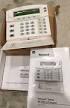 NetworX NX-6V2 LED Keypad User Manual POWER Light is on when AC power is present; flashes to indicate a low battery condition. ARMED Light is on when armed; off when disarmed; flashes to indicate a previous
Ademco Vista-20P/First Alert FA-168C Basic Commands
 Zones 64 total Ademco Vista-20P/First Alert FA-168C Basic Commands Wireless Yes, Zones 09 to 48 + 16 Keyfob Zones (Zones 49 to 64) Batteries Downloadable Partitions 2 12 volt Rechargable inside main Panel,
User Manual GSM Alarm System. www.deltasecurity.cn. All rights reserved by Delta Security Co., Ltd
 User Manual GSM Alarm System All rights reserved by Delta Security Co., Ltd Dear Clients, Thank you for using our GSM Alarm System. We are committed to giving you the best home security available today
Using your LED Plus keypad
 Using your LED Plus keypad System 238 System 2316 System 238i System 2316i Part Number 5-051-372-00 Rev B Thank you for purchasing this C&K alarm system Your system is one of the most powerful and advanced
tattletale User Guide Consumer unit version 2.48 1 P a g e
 tattletale User Guide Consumer unit version 2.48 1 P a g e Contents Basic 1... 4 Base Unit Features... 4 Initial Setup... 4 Arming... 5 Disarming... 5 Quiet Button... 5 Settings... 5 Settings 2... 6 Quick
Firmware version: 1.10 Issue: 7 AUTODIALER GD30.2. Instruction Manual
 Firmware version: 1.10 Issue: 7 AUTODIALER GD30.2 Instruction Manual Firmware version: 2.0.1 Issue: 0.6 Version of the GPRS transmitters configurator: 1.3.6.3 Date of issue: 07.03.2012 TABLE OF CONTENTS
Setting Up the Cisco Unified IP Phone
 CHAPTER 3 This chapter includes the following topics, which help you install the Cisco Unified IP Phone on an IP telephony network: Before You Begin, page 3-1 Understanding the Cisco Unified IP Phone 7962G
Your Simple Guide to Battery. www.firstalertpro.com. Replacement. Customer Care: 1-800-852-0086. www.firstalertpro.
 Previous Menu Your Simple Guide to Battery www.firstalertpro.com Replacement p e t s ts ep -by Customer Care: 1-800-852-0086 FA/1565 9/00 www.firstalertpro.com Table of Contents: page Introduction...............................
HILLS Series LED Code Pad User Manual
 HILLS Series LED Code Pad User Manual Not all features may be available on your system Check with your installer to find out which features are programmed Page 2 TABLE OF CONTENTS Code Pad Diagrams...2
PhoneWatch Smart Security System User Manual - Domonial
 PW0002 10/13 Customer Support: 1850 753 753 PhoneWatch Ltd., Unit 3/4, Sandyford Park, Burton Hall Rd, Sandyford Industrial Estate, Dublin 18. Email: [email protected] PhoneWatch Smart Security System
Home & Office Security, Personal Alarms & Safety Products
 Home & Office Security, Personal Alarms & Safety Products Safe is Smart Easy Installation Wireless Alarms No Monthly Fees Standalone Alarms Standalone Alarms from SABRE are a great solution to help protect
FIRST ALERT INSTRUCTION MANUAL FOR FA 270 KEYPADS SECURITY SYSTEM
 FIRST ALERT INSTRUCTION MANUAL FOR FA 270 KEYPADS SECURITY SYSTEM Page 0 Table of Contents Introduction 1 System Basics.. 1 Burglary Protection.. 1 Fire Protection.. 1 Security Codes. 1 Zones and Partitions
ABUS WIRELESS ALARM SYSTEM
 ABUS WIRELESS ALARM SYSTEM These installation instructions are published by Security-Center GmbH & Co. KG, Linker Kreuthweg 5, D-86444 Affing/Mühlhausen. All rights including translation reserved. Reproductions
o^c a (fg 1) Telephone Line Socket ( flcg. 2b ) ) fig. 2a ) TeiePhone b ^^I r DC Adaptor
 INTRODUCTION Our jnique passive in`raroc ^ys,e^ii conccotrates on the protected area you select. Whenever the unit is set at ARMED, the motion detector will concentrate on the protected area. Once there
FA701 Series. User s Guide. K6249-2V2 5/09 Rev. A
 FA701 Series TouchCenter Keypads User s Guide K6249-2V2 5/09 Rev. A Table of Contents ABOUT THE TOUCHCENTER... 5 Introduction... 5 2 The TouchCenter Interface... 5 Navigating through the TouchCenter...
Security System User Guide
 Security System User Guide Contents 1. Introduction... 1 Controls and Displays... 3 Displays... 3 Controls:... 4 2. Everyday Operation... 5 Access to the System... 5 Entering and Leaving the Protected
NetworX Series. NX- 4/8 Code Pad. User Manual (Australian Version)
 NetworX Series NX- 4/8 Code Pad User Manual (Australian Version) Table Of Contents Code Pad Diagram... Inside Front Glossary of Terms...2 Understanding the Code Pad lights...3 Code Pad Tones...4 Fully
USER GUIDE SERIES 4250 AUDIO ALARM CONFIRMATION SYSTEM CONTROL UNIT
 USER GUIDE SERIES 4250 AUDIO ALARM CONFIRMATION SYSTEM CONTROL UNIT CONTENTS Page INTRODUCTION... 2 Security conditions... 3 Full Set (Fully armed)... 3 Part Set (Partially armed)... 3 Unset (Disarmed)...
PiSector Land Line Auto Dial Professional Wireless Alarm System
 PiSector Land Line Auto Dial Professional Wireless Alarm System User Manual ( PS03 ) Read manual fully before use. PiSector Inc., USA, www.pisector.com Welcome to PiSECTOR Thank you for choosing PiSECTOR.
NESS D16. 16 Zone Control Panel and Dialler OWNER S MANUAL
 NESS D16 16 Zone Control Panel and Dialler OWNER S MANUAL REVISION 2, JULY 2001 Ness Security Products Pty Ltd Quality Endorsed Company ISO9001 LIC.No. QEC2074 NSW Head Office only WWW.NESS.COM.AU Australia
Welcome to Bell Aliant NextGen Home Security
 Quick Start Guide Welcome to Bell Aliant NextGen Home Security Congratulations! Your home is now protected by the most advanced security technology available. This guide is intended to familiarize you
Understanding the Code Pad lights...4. Code Pad tones...5. Fully arming the system On MODE...6. Fully arming the system - Quick Arm MODE...
 TABLE OF CONTENTS...Glossary of terms...2...code Pad Diagram...3 Understanding the Code Pad lights...4 Code Pad tones...5 Fully arming the system On MODE...6 Fully arming the system - Quick Arm MODE...6
SECURITY SYSTEM NOTES
 SECURITY SYSTEM NOTES Installing/Service Company For Service Call Central Station Duress Code FUNCTION CODES Function Code Controls Function This system is is not partitioned. EMERGENCY ACTIVATION KEYS
Wireless AUTODIAL GSM SMS Home Alarm Security System 900/ 1800/ 1900Mhz(CK-GSM-9003)
 CN2HK LIMITED Wireless AUTODIAL GSM SMS Home Alarm Security System 900/ 1800/ 1900Mhz(CK-GSM-9003) User Manual Please read this manual before operating this product. After you finish reading this manual,
Self-Install Security System Installation and User Guide
 Self-Install Security System Installation and User Guide Contents Installation Installation guide 4 Codepad and accessories 6 Step 1 Determine security system location 8 Step 2 Mounting motion sensors
GSM Alarm System User Manual
 GSM Alarm System User Manual For a better understanding of this product, please read this user manual thoroughly before using it. Quick Guider After getting this alarm system, you need to do the following
Total Protection Alarm System
 www.skylinkhome.com Total Protection Alarm System MODEL: SC-1000W If you would like to order Skylink s products or have difficulty getting them to work or download information and user manual, please :
1pcs. 1pcs. 2pcs 1pcs 1pcs 2pcs
 Home security alarm system LX-HS06 Instruction Brief introduction LX-HS06 is a set of entirely new English home security alarm system, it uses advanced MCU control and SMD technology. it innovate multiple
Autodialler. Installation & Programming Guide HYL004. Please read these instructions before you start the installation. Installation.
 Autodialler HYL004 Installation & Programming Guide Features Please read these instructions before you start the installation LCD Display Programmable 9 x 32 digit phone numbers for each trigger. 10 second
S I E R R A PRODUCT INFORMATION GUIDE FOR HOME SECURITY. SIERRA Page 1
 S I E R R A PRODUCT INFORMATION GUIDE FOR HOME SECURITY SIERRA Page 1 C O N T E N T S USING YOUR SIERRA SYSTEM: Turning On/Off Home Arming Instant Home Arming Quick Exit Mode Chime Mode SPECIAL FUNCTIONS:
www.ealarm.com.my P/N 5-051-371-00 Rev D
 System 236 System 236i P/N 5-051-371-00 Rev D Thank you for purchasing this C&K alarm system Your system is one of the most powerful and advanced alarm systems on the market today, designed to provide
AC-115 Compact Networked Single Door Controller. Installation and User Manual
 AC-115 Compact Networked Single Controller Installation and User Manual December 2007 Table of Contents Table of Contents 1. Introduction...5 1.1 Key Features... 6 1.2 Technical Specifications... 7 2.
HARDWIRED CONTROL PANELS
 USER GUIDE 9651 HARDWIRED CONTROL PANELS Contents 1. Introduction...3 The Alarm System...3 The Keypad...3 About This Guide...5 2. Everyday Operation...6 How Do I Know if the System is Working?...6 Setting
PCS300 Universal IP Reporting Module V1.0
 PCS300 Universal IP Reporting Module V1.0 Reference and Installation Manual Patents: One or more of the following US patents may apply: 7046142, 6215399, 6111256, 6104319, 5920259, 5886632, 5721542, 5287111,
GE Concord 4 Quick User Guide
 GE Concord 4 Quick User Guide GE Concord 4 Quick User Guide Page 1 Before Calling Is the keypad beeping? Press *. This will silence the beeping and let you know where the trouble is. Is there a flashing
BURGLAR ALARM SYSTEMS BURGLAR ALARM SYSTEMS BURGLAR ALARM SYSTEM EURO ALARM WIRELESS BURGLAR ALARM SYSTEM OASIS
 BURGLAR ALARM SYSTEMS BURGLAR ALARM SYSTEMS BURGLAR ALARM SYSTEM EURO ALARM WIRELESS BURGLAR ALARM SYSTEM OASIS BURGLAR ALARM SYSTEM EURO ALARM Six zones with the following connection capabilities: One
D24 ALARM CONTROL PANEL USER S MANUAL REVISION 1.1 A$12.00 INC GST
 D24 ALARM CONTROL PANEL USER S MANUAL REVISION 1.1 A$12.00 INC GST Ness Security Products Pty Ltd Quality Endorsed Company ISO9001 LIC.No. QEC2074 NSW Head Office only WWW.NESS.COM.AU Australia s largest
Iphone & Android App Smart GSM Home Alarm System
 Iphone & Android App Smart GSM Home Alarm System PST-GA242Q User Guide Version V14.3 Dear User, Thanks for selecting the intelligent alarm system. Please read through this guide before installation so
VR8. User Guide Intruder Alarm System
 VR8 EN User Guide Intruder Alarm System VR8 User Guide Notices EN 2 Copyright Notice Unless otherwise indicated, this publication is the copyright of Bosch Security Systems Pty Ltd ( Bosch ). All rights
GlobalGuard Alarm System
 GlobalGuard Alarm System Software Operating Manual 1 CONTENTS SYSTEM REQUIREMENTS AND 3 FUNCTION OVERVIEW IMPORTANT NOTE WHEN RUNNING SOFTWARE 4 GlobalGuard PC Setup Software Operating Instructions 5 1.
HILLS Series LED Code Pad User Manual
 HILLS Series LED Code Pad User Manual Not all features may be available on your system Check with your installer to find out which features are programmed Page 2 TABLE OF CONTENTS Code Pad Diagrams...2
SPECIAL CODES AUXILIARY CODES SYSTEM NOTES
 Installing/Service Company Monitoring Center SPECIAL CODES Master Code Duress Code AUXILIARY CODES "Quick Arm" " Chime" 08 02 09 03 10 04 11 05 12 06 13 07 14 SYSTEM NOTES Exit Delay Time Entry Delay Time
National Security Systems Inc (800)457-1999. Security System User's Guide
 National Security Systems Inc (800)457-1999 Security System User's Guide Security System Glossary As security system technology has evolved, a special jargon has developed. Some terms widely used within
SECURITY SYSTEM NOTES SPECIAL CODES ENTRY / EXIT DELAY TIMES ARM / DISARM CODES
 SECURITY SYSTEM NOTES Installing/Service Company For Service Call SPECIAL CODES "Chime" Digit 1 "Partial Arm" Digit 2 "Quick Arm" Digit 3 ENTRY / EXIT DELAY TIMES Exit Delay Time Entry Delay Time Secondary
TS590. Intruder Alarm Control Panel. SYSTEM OPEN 17:30 01 Jan ENT 0 ESC
 TS590 Intruder Alarm Control Panel 7:0 0 Jan _ ~ A B 5 6 C 7 8 9 D 0 ESC Setting the System Enter your passcode XXXX then leave the protected area. Unsetting the System Go directly to the keypad and en
9452/9453 Installation and User Guide
 9452/9453 Installation and User Guide Compatible Equipment 9425 Remote Keypad 9040 Internal Sounder 660 Speech Communicator 8440 4-Channel Minicom 496330 Issue 1 1 of 10 9452/3 Introduction The 9452 and
SECURITY SYSTEM NOTES
 SECURITY SYSTEM NOTES Installing/Service Company For Service Call Central Station Duress Code FUNCTION CODES Function Code Controls Function EMERGENCY ACTIVATION KEYS (check if enabled) Fire Auxiliary
Welcome to a whole new level of interactive home security
 Welcome to a whole new level of interactive home security User Manual TouchScreen Key Fob Keychain Remote Web Access Mobile Access ReadyHome User Manual Introducing a whole new level of security for the
Using Your. Security System With Icon Keypad S5020, S5021, S5022
 Using Your Security System With Icon Keypad S5020, S5021, S5022 Contents 1 Overview Your Security System... 1 How Your Security System Works... 2 Your System's Programming... 3 Getting Used to Your System...
SECURITY SYSTEM NOTES. Security System Configuration
 Installing / Service Company: For Service Call: SECURITY SYSTEM NOTES Security System Configuration Master Code: Auxiliary Code(s) 2 3 4 5 6 "Quick Arm" Digit: Exit Delay Time Auxiliary Exit Delay Time
User Manual CN2HK LIMITED. Complete Wireless Home Alarm Security System (CK-8806) ENG. Please read this manual before operating this product.
 CN2HK LIMITED Complete Wireless Home Alarm Security System (CK-8806) User Manual Please read this manual before operating this product. After you finish reading this manual, store it in a safe place for
MELALEUCA SECURITY QUICK START GUIDE. 877.760.3444 www.melaleucasecurity.com PROTECTION YOU CAN COUNT ON FROM PEOPLE YOU CAN TRUST
 MELALEUCA SECURITY QUICK START GUIDE 877.760.3444 www.melaleucasecurity.com LICENSES: AL 09-1312, DE 09-172, FL MSI s license number is EG13000363. Alarm companies are regulated by the Department of Business
Accenta/Optima. User Guide. Servicing Organisation (Installer) name: Telephone Number: Date of Installation: Account Number: Honeywell Security
 Accenta/Optima User Guide ZONE 1 2 3 4 5 6 7 8 9 Chime Omit Prog PA 0 1 2 3 4 5 6 7 8 9 CHIME OMIT RESET PROG SET Accenta + TA PA DAY POWER PA! " # $ % & 0 1 2 3 5 6 7 8 Chime Omit Reset Prog 4 9 Set PA
Business/ Home GSM Alarm System
 Business/ Home GSM Alarm System BUSINESS/HOME GSM ALARM SYSTEM POWER STATUS RECORD SIGNAL User Manual Profile For a better understanding of this product, please read this user manual thoroughly before
TS510 & TS500. Installation & User Guide. Compatible Equipment
 Installation & User Guide Compatible Equipment TS510 REM - Remote Keypad 9040 - Loudspeaker DC54/58 - Digital Communicator SD1+ - Speech Dialler 496525 Issue A 1 of 10 TS510 and TS500 Overview Introduction
How To Control A Marmitek X10 With A Remote Control
 SAFEGUARD TOTALGUARDtm ENGLISH USER S GUIDE 20071 / 20070228 SAFEGUARD TM / TOTALGUARD TM ALL RIGHTS RESERVED 2007 INDEX Introduction Safety warnings BASIC OPTIONS 1. Your Marmitek surveillance system
ST815 Illumination Sensor with LCD
 ST815 Illumination Sensor with LCD The Illumination Sensor with LCD (refer to as Illumination Sensor hereafter) is a Z-Wave TM enabled device which is fully compatible with any Z-Wave TM enabled network.