
HP ProLiant SL230s Gen8 Server User Guide
|
|
|
- Gyles Carter
- 10 years ago
- Views:
Transcription
1 HP ProLiant SL230s Gen8 Server User Guide Abstract This document provides detailed instructions to configure and use the HP ProLiant SL230s Gen8 Server. Part Number: March 2012 Edition: 1

2 Copyright 2012 Hewlett-Packard Development Company, L.P. The information contained herein is subject to change without notice. The only warranties for HP products and services are set forth in the express warranty statements accompanying such products and services. Nothing herein should be construed as constituting an additional warranty. HP shall not be liable for technical or editorial errors or omissions contained herein. Confidential computer software. Valid license from HP required for possession, use or copying. Consistent with FAR and , Commercial Computer Software, Computer Software Documentation, and Technical Data for Commercial Items are licensed to the U.S. Government under vendor s standard commercial license. Microsoft and Windows are U.S. registered trademarks of Microsoft Corporation. Bluetooth is a trademark owned by its proprietor and used by Hewlett-Packard Company under license.

3 Contents Component identification... 6 Front panel components... 6 Front panel LEDs and buttons... 7 Rear panel components... 8 Rear panel LEDs and buttons... 8 System board components... 9 DIMM slot locations System maintenance switch NMI jumper Device numbers Drive LED definitions Operations Power up the server Power down the server Remove the server from the chassis Remove the hard drive air baffle Remove the processor air baffle Setup Optional installation services Rack planning resources Optimum environment Space and airflow requirements Temperature requirements Power requirements Electrical grounding requirements Rack warnings Contents of the server shipping carton Installing the chassis Installing options Installing components Installing the server into the chassis Powering up the chassis Configuring the chassis Powering on and selecting boot options Installing the system software Registering the server Hardware options installation Introduction Processor option Memory options HP SmartMemory Memory subsystem architecture Single-, dual-, and quad-rank DIMMs DIMM identification Contents 3

4 Memory configurations General DIMM slot population guidelines Installing a DIMM Hot-plug hard drive guidelines Removing the hard drive blank Installing a hot-plug SAS hard drive Controller options Installing the cache module Installing the FBWC capacitor pack Expansion board options Installing an expansion board Installing a PCI riser board assembly Installing a FlexibleLOM riser assembly LFF quick-release hard drive cage option SFF hot-plug HDD cage option X LFF Smart Array enable option X SFF Smart Array enable option Connecting the SUV cable Redundant hot-plug power supply option HP Trusted Platform Module option Installing the Trusted Platform Module board Retaining the recovery key/password Enabling the Trusted Platform Module Cabling Cabling overview FBWC capacitor pack cabling Software and configuration utilities Server mode Server QuickSpecs HP ilo Management Engine HP ilo Intelligent Provisioning Scripting Toolkit HP Service Pack for ProLiant HP Smart Update Manager HP ROM-Based Setup Utility Using RBSU Auto-configuration process Boot options Configuring AMP modes Re-entering the server serial number and product ID Utilities and features Array Configuration Utility Option ROM Configuration for Arrays ROMPaq utility Automatic Server Recovery USB support Redundant ROM support Keeping the system current Drivers Software and firmware Version control Contents 4
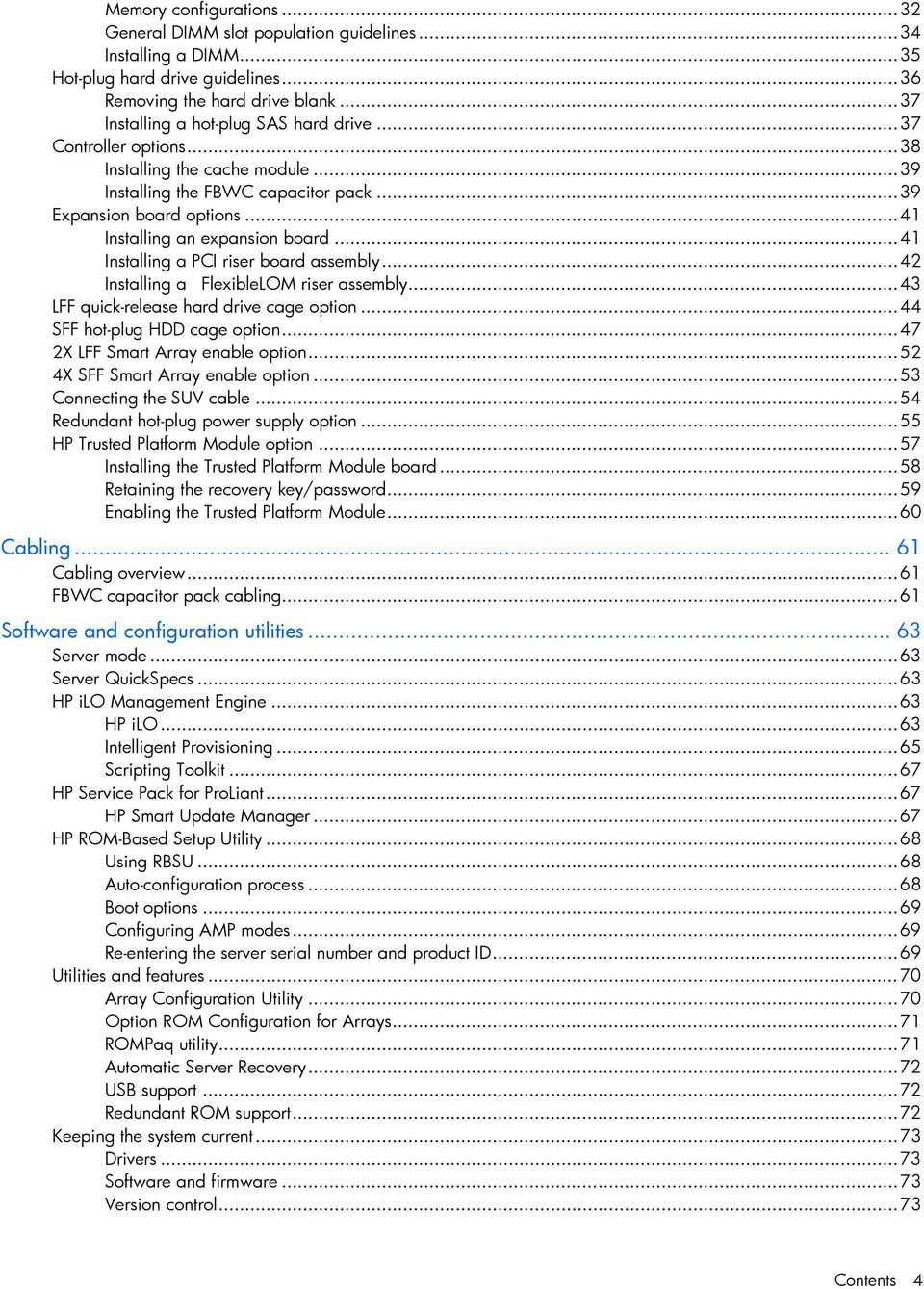
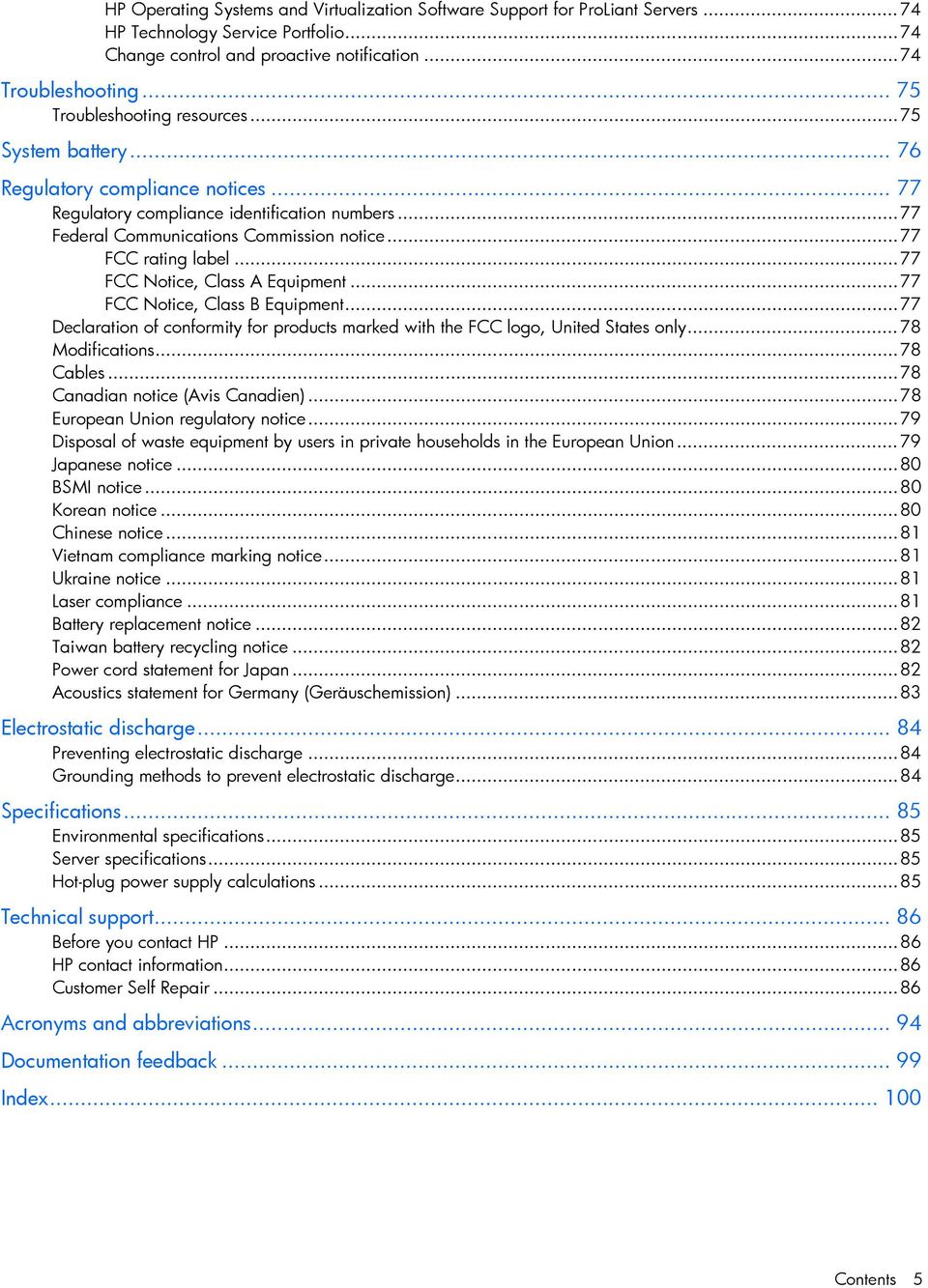
5 HP Operating Systems and Virtualization Software Support for ProLiant Servers HP Technology Service Portfolio Change control and proactive notification Troubleshooting Troubleshooting resources System battery Regulatory compliance notices Regulatory compliance identification numbers Federal Communications Commission notice FCC rating label FCC Notice, Class A Equipment FCC Notice, Class B Equipment Declaration of conformity for products marked with the FCC logo, United States only Modifications Cables Canadian notice (Avis Canadien) European Union regulatory notice Disposal of waste equipment by users in private households in the European Union Japanese notice BSMI notice Korean notice Chinese notice Vietnam compliance marking notice Ukraine notice Laser compliance Battery replacement notice Taiwan battery recycling notice Power cord statement for Japan Acoustics statement for Germany (Geräuschemission) Electrostatic discharge Preventing electrostatic discharge Grounding methods to prevent electrostatic discharge Specifications Environmental specifications Server specifications Hot-plug power supply calculations Technical support Before you contact HP HP contact information Customer Self Repair Acronyms and abbreviations Documentation feedback Index Contents 5
6 Component identification Front panel components NOTE: This figure illustrates the left and right system trays. Item Description 1 Option bay 1: Hot-plug hard drive 1 PCI riser board* 2 Option bay 2: Hot-plug hard drive 2 FlexibleLOM riser* 3 SUV port 4 Serial port 5 NIC 1 network port 6 NIC 2 network port 7 ilo 4 network port * Not shown Component identification 6

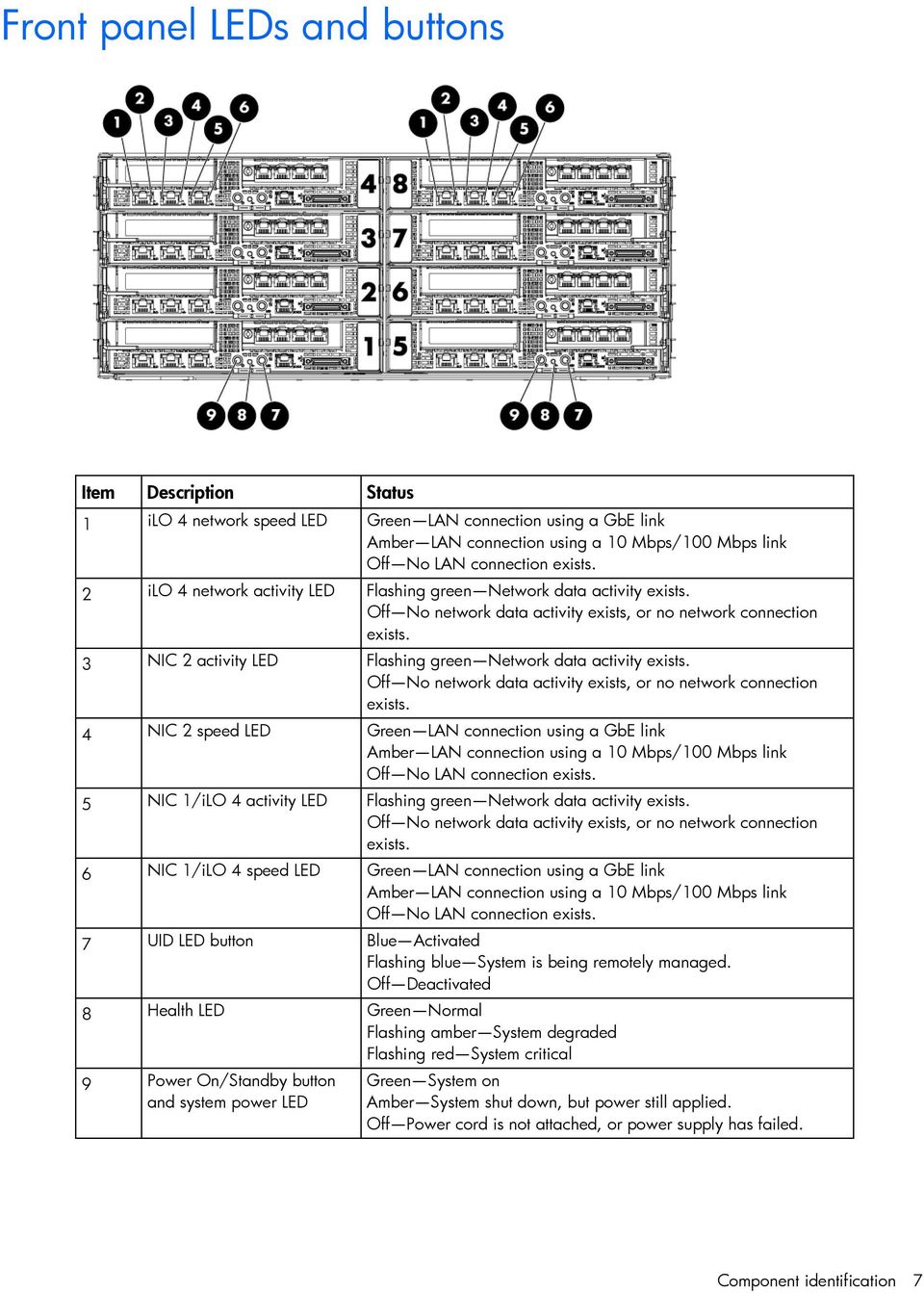
7 Front panel LEDs and buttons Item Description Status 1 ilo 4 network speed LED Green LAN connection using a GbE link Amber LAN connection using a 10 Mbps/100 Mbps link Off No LAN connection exists. 2 ilo 4 network activity LED Flashing green Network data activity exists. Off No network data activity exists, or no network connection exists. 3 NIC 2 activity LED Flashing green Network data activity exists. Off No network data activity exists, or no network connection exists. 4 NIC 2 speed LED Green LAN connection using a GbE link Amber LAN connection using a 10 Mbps/100 Mbps link Off No LAN connection exists. 5 NIC 1/iLO 4 activity LED Flashing green Network data activity exists. Off No network data activity exists, or no network connection exists. 6 NIC 1/iLO 4 speed LED Green LAN connection using a GbE link Amber LAN connection using a 10 Mbps/100 Mbps link Off No LAN connection exists. 7 UID LED button Blue Activated Flashing blue System is being remotely managed. Off Deactivated 8 Health LED Green Normal Flashing amber System degraded Flashing red System critical 9 Power On/Standby button and system power LED Green System on Amber System shut down, but power still applied. Off Power cord is not attached, or power supply has failed. Component identification 7
8 Rear panel components The server has four power supplies, eight fans, and a single SLAPM interface located on the rear panel of the chassis. Item Description 1 SLAPM interface 2 Power supply 4 3 Power supply 3 4 Power supply 2 5 Power supply 1 Rear panel LEDs and buttons Item Description Status 1 Fan 8/16 power LED Off Normal Amber Fan has failed. 2 Fan 7/15 power LED Off Normal Amber Fan has failed. 3 UID LED button Blue Activated Component identification 8

9 Item Description Status Flashing blue System is being remotely managed. Off Deactivated 4 Fan 4/12 power LED Off Normal Amber Fan has failed. 5 Fan 3/11 power LED Off Normal Amber Fan has failed. 6 Fan 1/9 power LED Off Normal Amber Fan has failed. 7 Fan 2/10 power LED Off Normal Amber Fan has failed. 8 Power supply 1 power LED Green Normal Off No AC power 9 Power supply 2 power LED Green Normal Off No AC power 10 Power supply 3 power LED Green Normal Off No AC power 11 Power supply 4 power LED Green Normal Off No AC power 12 Fan 5/13 power LED Off Normal Amber Fan has failed. 13 Fan 6/14 power LED Off Normal Amber Fan has failed. System board components Item Description 1 Cache module connector 2 x24 riser connector 3 SATA HDD connector 1 Component identification 9
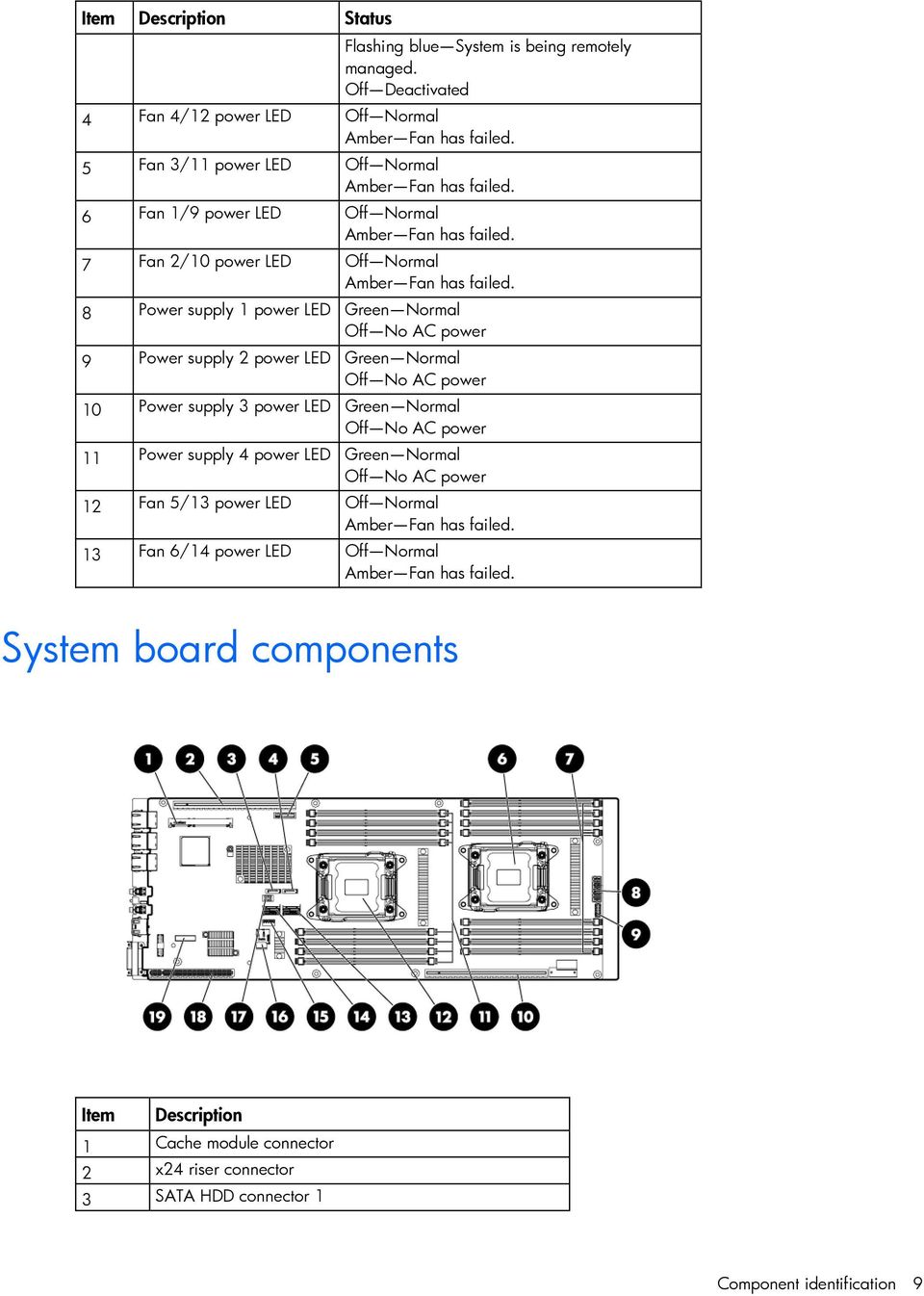
10 Item Description 4 SATA HDD connector 2 5 System battery 6 Processor socket 2 7 Processor 2 DIMM slots 8 Power connector 9 RPS connector 10 x32 riser connector 11 Processor 1 DIMM slots 12 Processor socket 1 (populated) 13 Mini-SAS HDD connector port 2i 14 Mini-SAS HDD connector port 1i 15 Internal USB connector 16 usd card slot 17 Data LED connector 18 x16 FlexibleLOM slot 19 System maintenance switch NOTE: This server supports PCIe Gen3 in the front LP PCIe slot and FlexibleLOM slot. DIMM slot locations DIMM slots are numbered sequentially (1 through 8) for each processor. The supported AMP modes use the alpha assignments for population order, and the slot numbers designate the DIMM slot ID for spare replacement. The arrow points to the front of the server. System maintenance switch Position Default Function S1 Off Off = ilo 4 security is enabled. On = ilo 4 security is disabled. Component identification 10

11 Position Default Function S2 Off Off = System configuration can be changed. On = System configuration is locked. S3 Off Reserved S4 Off Reserved S5 Off Off = Power-on password is enabled. On = Power-on password is disabled. S6 Off Off = No function On = ROM reads system configuration as invalid. S7 Reserved S8 Reserved S9 Reserved S10 Reserved S11 Reserved S12 Reserved To access redundant ROM, set S1, S5, and S6 to on. When the system maintenance switch position 6 is set to the On position, the system is prepared to erase all system configuration settings from both CMOS and NVRAM. CAUTION: Clearing CMOS and/or NVRAM deletes configuration information. Be sure to properly configure the server or data loss could occur. NMI jumper The NMI jumper allows administrators to perform a memory dump before performing a hard reset. Crash dump analysis is an essential part of eliminating reliability problems, such as hangs or crashes in OSs, device drivers, and applications. Many crashes can freeze a system, requiring you to do a hard reset. Resetting the system erases any information that would support root cause analysis. Systems running Microsoft Windows experience a blue-screen trap when the OS crashes. When this happens, Microsoft recommends that system administrators perform an NMI event by temporarily shorting the NMI header with a jumper. The NMI event enables a hung system to become responsive again. Component identification 11

12 Device numbers Front hot-plug hard drive bay numbering (box 1) Rear LFF hard drive bay numbering (box 0) Component identification 12

13 Rear SFF hard drive bay numbering (box 0) Drive LED definitions Item LED Status Definition 1 Locate Solid blue The drive is being identified by a host application. Flashing blue 2 Activity ring Rotating green Drive activity Off The drive carrier firmware is being updated or requires an update. No drive activity 3 Do not remove Solid white Do not remove the drive. Removing the drive causes one or more of the logical drives to fail. Off Removing the drive does not cause a logical drive to fail. 4 Drive status Solid green The drive is a member of one or more logical drives. Flashing green The drive is rebuilding or performing a RAID migration, stripe size migration, capacity expansion, or logical drive extension, or is erasing. Flashing amber/green Flashing amber Solid amber The drive is a member of one or more logical drives and predicts the drive will fail. The drive is not configured and predicts the drive will fail. The drive has failed. Component identification 13

14 Item LED Status Definition Off The drive is not configured by a RAID controller. Component identification 14

15 Operations Power up the server To power up the server, press the Power On/Standby button. Power down the server Before powering down the server for any upgrade or maintenance procedures, perform a backup of critical server data and programs. IMPORTANT: When the server is in standby mode, auxiliary power is still being provided to the system. To power down the server, use one of the following methods: Press and release the Power On/Standby button. This method initiates a controlled shutdown of applications and the OS before the server enters standby mode. Press and hold the Power On/Standby button for more than 4 seconds to force the server to enter standby mode. This method forces the server to enter standby mode without properly exiting applications and the OS. If an application stops responding, you can use this method to force a shutdown. Use a virtual power button selection through ilo 4. This method initiates a controlled remote shutdown of applications and the OS before the server enters standby mode. Before proceeding, verify the server is in standby mode by observing that the system power LED is amber. Remove the server from the chassis 1. Power down the server (on page 15). 2. Disconnect all peripheral cables from the server. Operations 15
16 3. Remove the server from the chassis. 4. Place the server on a flat, level surface. Remove the hard drive air baffle 1. Power down the server (on page 15). 2. Disconnect all peripheral cables from the server. 3. Remove the server from the chassis (on page 15). 4. Remove the HDD air baffle. Remove the processor air baffle 1. Power down the server (on page 15). 2. Disconnect all peripheral cables from the server. Operations 16

17 3. Remove the server from the chassis (on page 15). 4. Remove the processor air baffle. Operations 17

18 Setup Optional installation services Delivered by experienced, certified engineers, HP Care Pack services help you keep your servers up and running with support packages tailored specifically for HP ProLiant systems. HP Care Packs let you integrate both hardware and software support into a single package. A number of service level options are available to meet your needs. HP Care Pack Services offer upgraded service levels to expand your standard product warranty with easy-to-buy, easy-to-use support packages that help you make the most of your server investments. Some of the Care Pack services are: Hardware support o 6-Hour Call-to-Repair o o 4-Hour 24x7 Same Day 4-Hour Same Business Day Software support o Microsoft o Linux o HP ProLiant Essentials (HP SIM and RDP) o VMWare Integrated hardware and software support o Critical Service o Proactive 24 o Support Plus o Support Plus 24 Startup and implementation services for both hardware and software For more information on HP Care Pack Services, see the HP website ( Rack planning resources The rack resource kit ships with all HP branded or Compaq branded 9000, 10000, and H9 series racks. For more information on the content of each resource, see the rack resource kit documentation. Optimum environment When installing the server in a rack, select a location that meets the environmental standards described in this section. Setup 18
19 Space and airflow requirements To allow for servicing and adequate airflow, observe the following space and airflow requirements when deciding where to install a rack: Leave a minimum clearance of 63.5 cm (25 in) in front of the rack. Leave a minimum clearance of 76.2 cm (30 in) behind the rack. Leave a minimum clearance of cm (48 in) from the back of the rack to the back of another rack or row of racks. HP servers draw in cool air through the front door and expel warm air through the rear door. Therefore, the front and rear rack doors must be adequately ventilated to allow ambient room air to enter the cabinet, and the rear door must be adequately ventilated to allow the warm air to escape from the cabinet. CAUTION: To prevent improper cooling and damage to the equipment, do not block the ventilation openings. When vertical space in the rack is not filled by a server or rack component, the gaps between the components cause changes in airflow through the rack and across the servers. Cover all gaps with blanking panels to maintain proper airflow. CAUTION: Always use blanking panels to fill empty vertical spaces in the rack. This arrangement ensures proper airflow. Using a rack without blanking panels results in improper cooling that can lead to thermal damage. The 9000 and Series Racks provide proper server cooling from flow-through perforations in the front and rear doors that provide 64 percent open area for ventilation. CAUTION: When using a Compaq branded 7000 series rack, install the high airflow rack door insert (PN B21 for 42U rack, PN B21 for 22U rack) to provide proper front-to-back airflow and cooling. CAUTION: If a third-party rack is used, observe the following additional requirements to ensure adequate airflow and to prevent damage to the equipment: Front and rear doors If the 42U rack includes closing front and rear doors, you must allow 5,350 sq cm (830 sq in) of holes evenly distributed from top to bottom to permit adequate airflow (equivalent to the required 64 percent open area for ventilation). Side The clearance between the installed rack component and the side panels of the rack must be a minimum of 7 cm (2.75 in). Temperature requirements To ensure continued safe and reliable equipment operation, install or position the system in a well-ventilated, climate-controlled environment. The maximum recommended ambient operating temperature (TMRA) for most server products is 35 C (95 F). The temperature in the room where the rack is located must not exceed 35 C (95 F). CAUTION: To reduce the risk of damage to the equipment when installing third-party options: Do not permit optional equipment to impede airflow around the server or to increase the internal rack temperature beyond the maximum allowable limits. Do not exceed the manufacturer s TMRA. Setup 19

20 Power requirements Installation of this equipment must comply with local and regional electrical regulations governing the installation of information technology equipment by licensed electricians. This equipment is designed to operate in installations covered by NFPA 70, 1999 Edition (National Electric Code) and NFPA-75, 1992 (code for Protection of Electronic Computer/Data Processing Equipment). For electrical power ratings on options, refer to the product rating label or the user documentation supplied with that option. WARNING: To reduce the risk of personal injury, fire, or damage to the equipment, do not overload the AC supply branch circuit that provides power to the rack. Consult the electrical authority having jurisdiction over wiring and installation requirements of your facility. CAUTION: Protect the server from power fluctuations and temporary interruptions with a regulating uninterruptible power supply (UPS). This device protects the hardware from damage caused by power surges and voltage spikes and keeps the system in operation during a power failure. When installing more than one server, you might need to use additional power distribution devices to safely provide power to all devices. Observe the following guidelines: Balance the server power load between available AC supply branch circuits. Do not allow the overall system AC current load to exceed 80 percent of the branch circuit AC current rating. Do not use common power outlet strips for this equipment. Provide a separate electrical circuit for the server. For more information on the hot-plug power supply and calculators to determine server power consumption in various system configurations, refer to the HP Enterprise Configurator website ( Electrical grounding requirements The server must be grounded properly for proper operation and safety. In the United States, you must install the equipment in accordance with NFPA 70, 1999 Edition (National Electric Code), Article 250, as well as any local and regional building codes. In Canada, you must install the equipment in accordance with Canadian Standards Association, CSA C22.1, Canadian Electrical Code. In all other countries, you must install the equipment in accordance with any regional or national electrical wiring codes, such as the International Electrotechnical Commission (IEC) Code 364, parts 1 through 7. Furthermore, you must be sure that all power distribution devices used in the installation, such as branch wiring and receptacles, are listed or certified grounding-type devices. Because of the high ground-leakage currents associated with multiple servers connected to the same power source, HP recommends the use of a PDU that is either permanently wired to the building s branch circuit or includes a nondetachable cord that is wired to an industrial-style plug. NEMA locking-style plugs or those complying with IEC are considered suitable for this purpose. Using common power outlet strips for the server is not recommended. Rack warnings Setup 20

21 WARNING: To reduce the risk of personal injury or damage to the equipment, be sure that: The leveling jacks are extended to the floor. The full weight of the rack rests on the leveling jacks. The stabilizing feet are attached to the rack if it is a single-rack installation. The racks are coupled together in multiple-rack installations. Only one component is extended at a time. A rack may become unstable if more than one component is extended for any reason. WARNING: To reduce the risk of personal injury or equipment damage when unloading a rack: At least two people are needed to safely unload the rack from the pallet. An empty 42U rack can weigh as much as 115 kg (253 lb), can stand more than 2.1 m (7 ft) tall, and might become unstable when being moved on its casters. Never stand in front of the rack when it is rolling down the ramp from the pallet. Always handle the rack from both sides. Contents of the server shipping carton Unpack the server shipping carton and locate the materials and documentation necessary for installing the server. All the rack mounting hardware necessary for installing the server into the rack is included with the rack or the server. The contents of the server shipping carton include: Server Power cord Printed setup documentation, Documentation CD, and software products Rack mounting hardware kit and documentation In addition to these supplied items, you might need: T-10/T-15 Torx screwdriver Hardware options Operating system or application software Installing the chassis The chassis can be installed either in a rack or rack-free environment. For rack installations, install the rack rails, and then install the chassis and other components. For more information, see the HP ProLiant s6500 Chassis Setup and Installation Guide, Quick Deploy Rail System Installation Instructions that ship with the rack hardware kit, and applicable installation instructions. Installing options Install any hardware options before initializing the server. For options installation information, see the documentation that ships with the option. For server-specific information, see the server user guide on the HP website ( Setup 21
22 Installing components WARNING: The server is very heavy. To reduce the risk of personal injury or damage to the equipment: Reduce the weight of the server by removing the hard drives and power supplies before installing the server into the rack. Get help to lift and stabilize the server during installation. When the server weighs more than 22.5 kg (50 lb), two people might be required to install the server into the rack. CAUTION: Always plan the rack installation so that the heaviest item is on the bottom of the rack. Install the heaviest item first, and continue to populate the rack from the bottom to the top. Before installing front or rear components into the chassis, review chassis bay numbering for each component. For slot numbering information, see the quick setup instructions. Based on the total number ordered and the planned configuration, install the following components: Nodes Power supplies System fans For more information, see the appropriate chassis setup and installation guide and the node installation instructions. Installing the server into the chassis 1. Insert the system tray into the chassis. Setup 22
23 2. Connect peripheral devices to the server. NOTE: This figure illustrates the left and right system trays. Item Description 1 Option bay 1: Hot-plug hard drive 1 PCI riser board* 2 Option bay 2: Hot-plug hard drive 2 FlexibleLOM riser* 3 SUV port 4 Serial port 5 NIC 1 network port 6 NIC 2 network port 7 ilo 4 network port * Not shown WARNING: To reduce the risk of electric shock, fire, or damage to the equipment, do not plug telephone or telecommunications connectors into RJ-45 connectors. 3. Connect the power cords to the power supplies. 4. Connect the power cord to the AC power source. Setup 23
24 WARNING: To reduce the risk of electric shock or damage to the equipment: Do not disable the power cord grounding plug. The grounding plug is an important safety feature. Plug the power cord into a grounded (earthed) electrical outlet that is easily accessible at all times. Unplug the power cord from the power supply to disconnect power to the equipment. Do not route the power cord where it can be walked on or pinched by items placed against it. Pay particular attention to the plug, electrical outlet, and the point where the cord extends from the server. Powering up the chassis Connect the AC or DC power cables, depending on the power configuration. When the circuit breakers are powered, the chassis and HP ProLiant SL Advanced Power Manager have power. By default, each installed component also powers up. Examine the HP ProLiant SL Advanced Power Manager for any errors which may prevent installed components from powering up. Configuring the chassis For further information on setting up and configuring your system, see the HP ProLiant s6500 Chassis Quick Setup Instructions and the HP ProLiant s6500 Chassis Setup and Installation Guide. Powering on and selecting boot options 1. Connect the Ethernet cable and press the Power On/Standby button. 2. During the initial boot: o o To modify the server configuration ROM default settings, press F9 when prompted from the start up sequence to enter the RBSU. By default, RBSU runs in the English language. If you do not need to modify the server configuration and are ready to install the system software, press F10 to access Intelligent Provisioning. NOTE: If an HP Smart Array controller has been added or is embedded in the system, the controller defaults to a RAID configuration based on the size and number of hard drives installed. For more information on modifying the controller default settings, see the documentation on the Documentation CD. For more information on automatic configuration, see the HP ROM-Based Setup Utility User Guide on the Documentation CD or the ilo Management Engine Information Library ( Installing the system software To install an operating system on a single server using Intelligent Provisioning: 1. If needed, access Intelligent Provisioning by rebooting the server and pressing F In the application, complete step 1, Set Intelligent Provisioning preferences. 3. From the Home screen, click Perform Maintenance, and then click Firmware Update. Setup 24
25 4. Ensure the latest drivers are available for installation. Select Intelligent Provisioning Software from the list of firmware and click Update. If the check box is not selected, the latest drivers are already installed. 5. From the Home screen, click Configure and Install. 6. Follow the on-screen prompts to finish the installation. To update your drivers and system software: Intelligent Provisioning automatically integrates optimized ProLiant server support software from the HP SPP. SPP is the installation package for operating system-specific bundles of ProLiant optimized drivers, utilities, management agents, and system firmware. For more information on using SPP, see the HP Service Pack for ProLiant User Guide on the Documentation CD or the SPP Information Library ( The Smart Update Firmware DVD ISO image is also available at the download tab on the HP website ( Registering the server To register the server, refer to the HP Registration website ( Setup 25
26 Hardware options installation Introduction If more than one option is being installed, read the installation instructions for all the hardware options and identify similar steps to streamline the installation process. WARNING: To reduce the risk of personal injury from hot surfaces, allow the drives and the internal system components to cool before touching them. CAUTION: To prevent damage to electrical components, properly ground the server before beginning any installation procedure. Improper grounding can cause electrostatic discharge. Processor option 1. Update the system ROM. Locate and download the latest ROM version from the HP website ( Follow the instructions on the website to update the system ROM. 2. Power down the server (on page 15). 3. Remove the server from the chassis (on page 15). 4. Place the server on a flat, level work surface. 5. Remove any necessary components to obtain access to the system board. For procedures to remove server components, see the maintenance and service guide. 6. Remove the air baffle. Hardware options installation 26
27 WARNING: To reduce the risk of personal injury from hot surfaces, allow the drives and the internal system components to cool before touching them. CAUTION: To prevent possible server malfunction and damage to the equipment, multiprocessor configurations must contain processors with the same part number. CAUTION: The heatsink thermal interface media is not reusable and must be replaced if the heatsink is removed from the processor after it has been installed. CAUTION: To prevent possible server overheating, always populate processor socket 2 with a processor and a heatsink or a processor socket cover and a heatsink blank. IMPORTANT: Processor socket 1 must be populated at all times or the server does not function. 7. Open each of the processor locking levers in the order indicated, and then open the processor retaining bracket. Hardware options installation 27
28 8. Remove the clear processor socket cover. Retain the processor socket cover for future use. 9. Install the processor. Verify that the processor is fully seated in the processor retaining bracket by visually inspecting the processor installation guides on either side of the processor. THE PINS ON THE SYSTEM BOARD ARE VERY FRAGILE AND EASILY DAMAGED. CAUTION: THE PINS ON THE SYSTEM BOARD ARE VERY FRAGILE AND EASILY DAMAGED. To avoid damage to the system board, do not touch the processor or the processor socket contacts. 10. Close the processor retaining bracket. When the processor is installed properly inside the processor retaining bracket, the processor retaining bracket clears the flange on the front of the socket. Hardware options installation 28
29 CAUTION: Do not press down on the processor. Pressing down on the processor may cause damage to the processor socket and the system board. Press only in the area indicated on the processor retaining bracket. 11. Press and hold the processor retaining bracket in place, and then close each processor locking lever. Press only in the area indicated on the processor retaining bracket. 12. Remove the thermal interface protective cover from the heatsink. CAUTION: Heatsink retaining screws should be tightened in diagonally opposite pairs (in an "X" pattern). Hardware options installation 29
30 13. Install the heatsink. 14. Install the air baffle. 15. Install the server into the chassis. 16. Power up the server. Memory options IMPORTANT: This server does not support mixing LRDIMMs, RDIMMs, or UDIMMs. Attempting to mix any combination of these DIMMs can cause the server to halt during BIOS initialization. The memory subsystem in this server can support LRDIMMs, RDIMMs, or UDIMMs. All three types are referred to as DIMMs when the information applies to all three types. When specified as LRDIMM, RDIMM, or UDIMM, the information applies to that type only. All memory installed in the server must be the same type. The server supports the following DIMM speeds: Single-rank and dual-rank PC (DDR-1600) DIMMs operating at 1600, 1333, and 1066 MHz Single-rank and dual-rank PC (DDR-1333) DIMMs operating at 1333 and 1066 MHz Quad-rank PC (DDR-1333) LRDIMMs operating at 1333 and 1066 MHz Depending on the processor model, the number of DIMMs installed, and whether LRDIMMs, UDIMMs, or RDIMMs are installed, the memory clock speed might be reduced to 1333, 1066 or 800 MHz. For more information on the effect of DIMM slot population, see "General DIMM slot population guidelines (on page 34)." HP SmartMemory HP SmartMemory, introduced for Gen8 servers, authenticates and unlocks certain features available only on HP Qualified memory and verifies whether installed memory has passed HP qualification and test processes. Qualified memory is performance-tuned for HP ProLiant and BladeSystem servers and provides future enhanced support through HP Active Health and manageability software. Hardware options installation 30
31 Certain performance features are unique with HP SmartMemory. HP SmartMemory 1.35V DDR Registered memory is engineered to achieve the same performance level as 1.5V memory. For example, while the industry supports DDR RDIMM at 1.5V, this Gen8 server supports DDR RDIMM at 1.35V. This difference equates to up to 20% less power at the DIMM level with no performance penalty. Memory subsystem architecture The memory subsystem in this server is divided into channels. Each processor supports four channels, and each channel supports two DIMM slots, as shown in the following table. Channel Slot Slot number 1 A E 2 B F 3 C G 4 D H For the location of the slot numbers, see "DIMM slot locations (on page 10)." This multi-channel architecture provides enhanced performance in Advanced ECC mode. This architecture also enables the Lockstep memory mode. DIMM slots in this server are identified by number and by letter. Letters identify the population order. Slot numbers indicate the DIMM slot ID for spare replacement. Single-, dual-, and quad-rank DIMMs To understand and configure memory protection modes properly, an understanding of single-, dual-, and quad-rank DIMMs is helpful. Some DIMM configuration requirements are based on these classifications. A single-rank DIMM has one set of memory chips that is accessed while writing to or reading from the memory. A dual-rank DIMM is similar to having two single-rank DIMMs on the same module, with only one rank accessible at a time. A quad-rank DIMM is, effectively, two dual-rank DIMMs on the same module. Only one rank is accessible at a time. The server memory control subsystem selects the proper rank within the DIMM when writing to or reading from the DIMM. Dual- and quad-rank DIMMs provide the greatest capacity with the existing memory technology. For example, if current DRAM technology supports 8-GB single-rank DIMMs, a dual-rank DIMM would be 16 GB, and a quad-rank DIMM would be 32 GB. LRDIMMs are labeled as quad-rank DIMMs; however, they function more like dual-rank DIMMs. There are four ranks of DRAM on the DIMM, but the LRDIMM buffer creates an abstraction that allows the DIMM to appear as a dual-rank DIMM to the system. The LRDIMM buffer also isolates the electrical loading of the DRAM from the system to allow for faster operation. These two changes allow the system to support up to three LRDIMMs per memory channel, providing for up to 50% greater memory capacity and higher memory operating speed compared to quad-rank RDIMMs. Hardware options installation 31
32 DIMM identification To determine DIMM characteristics, use the label attached to the DIMM and the following illustration and table. Item Description Definition 1 Size 2 Rank 1R = Single-rank 2R = Dual-rank 4R = Quad-rank 3 Data width x4 = 4-bit x8 = 8-bit 4 Voltage rating L = Low voltage (1.35v) U = Ultra low voltage (1.25v) Blank or omitted = Standard 5 Memory speed = 1600-MT/s = 1333-MT/s 8500 = 1066-MT/s 6 DIMM type R = RDIMM (registered) E = UDIMM (unbuffered with ECC) L = LRDIMM (load reduced) For the latest supported memory information, see the QuickSpecs on the HP website ( At the website, choose the geographic region, and then locate the product by name or product category. Memory configurations To optimize server availability, the server supports the following AMP modes: Advanced ECC Provides up to 4-bit error correction and enhanced performance over Lockstep mode. This mode is the default option for this server. Online spare memory Provides protection against failing or degraded DIMMs. Certain memory is reserved as spare, and automatic failover to spare memory occurs when the system detects a DIMM that Hardware options installation 32
33 is degrading. This configuration enables DIMMs that have a higher probability of receiving an uncorrectable memory error (resulting in system downtime) to be removed from operation. Advanced Memory Protection options are configured in RBSU. If the requested AMP mode is not supported by the installed DIMM configuration, the server boots in Advanced ECC mode. For more information, see "HP ROM-Based Setup Utility (on page 68)." The server also can operate in independent channel mode or combined channel mode (lockstep). When running in lockstep mode, you gain reliability in one of two ways: If running with UDIMMs (built with x8 DRAM devices), the system can survive a complete DRAM failure (SDDC). In independent channel mode, this failure would be an uncorrectable error. If running with RDIMM (built with x4 DRAM devices), the system can survive the complete failure of two DRAM devices (DDDC). Running in independent mode, the server can only survive the complete failure of a single DRAM device (SDDC). Maximum capacity DIMM type DIMM rank One processor Two processors RDIMM Single-rank 64GB 128 GB RDIMM Dual-rank 128 GB 256 GB UDIMM Single-rank 32 GB 64 GB UDIMM Dual-rank 64 GB 128GB For the latest memory configuration information, see the QuickSpecs on the HP website ( Maximum memory configurations The server supports a maximum of 256 GB of memory with one processor (8 x 32 GB), or 512 GB of memory with two processors (16 x 32 GB). Advanced ECC memory configuration Advanced ECC memory is the default memory protection mode for this server. Standard ECC can correct single-bit memory errors and detect multi-bit memory errors. When multi-bit errors are detected using Standard ECC, the error is signaled to the server and causes the server to halt. Advanced ECC protects the server against some multi-bit memory errors. Advanced ECC can correct both single-bit memory errors and 4-bit memory errors if all failed bits are on the same DRAM device on the DIMM. Advanced ECC provides additional protection over Standard ECC because it is possible to correct certain memory errors that would otherwise be uncorrected and result in a server failure. Using HP Advanced Memory Error Detection technology, the server provides notification when a DIMM is degrading and has a higher probability of uncorrectable memory error. Online Spare memory configuration Online spare memory provides protection against degraded DIMMs by reducing the likelihood of uncorrected memory errors. This protection is available without any operating system support. Online spare memory protection dedicates one rank of each memory channel for use as spare memory. The remaining ranks are available for OS and application use. If correctable memory errors occur at a rate higher than a specific threshold on any of the non-spare ranks, the server automatically copies the memory Hardware options installation 33
34 contents of the degraded rank to the online spare rank. The server then deactivates the failing rank and automatically switches over to the online spare rank. Lockstep memory configuration Lockstep mode provides protection against multi-bit memory errors that occur on the same DRAM device. Lockstep mode can correct any single DRAM device failure on x4 and x8 DIMM types. The DIMMs in each channel must have identical HP part numbers. General DIMM slot population guidelines Observe the following guidelines for all AMP modes: Install DIMMs only if the corresponding processor is installed. When two processors are installed, balance the DIMMs across the two processors. White DIMM slots denote the first slot of a channel (Ch 1-A, Ch 2-B, Ch 3-C, Ch 4-D) Do not mix RDIMMs, UDIMMs, or LRDIMMs. When one processor is installed, install DIMMs in sequential alphabetic order: A, B, C, D, E, F, and so forth. When two processors are installed, install the DIMMs in sequential alphabetic order balanced between the two processors: P1-A, P2-A, P1-B, P2-B, P1-C, P2-C, and so forth. For DIMM spare replacement, install the DIMMs per slot number as instructed by the system software. For detailed memory configuration rules and guidelines, use the Online DDR3 Memory Configuration Tool on the HP website ( DIMM speeds are supported as indicated in the following table. Populated slots (per channel) Rank Speeds supported (MHz) 1 Single- or dual-rank 1066, 1333, Quad-rank 1066, Single- or dual-rank 1066, 1333, Quad-rank 1066, 1333 Advanced ECC population guidelines For Advanced ECC mode configurations, observe the following guidelines: Observe the general DIMM slot population guidelines (on page 34). DIMMs may be installed individually. Online spare population For online spare memory mode configurations, observe the following guidelines: Observe the general DIMM slot population guidelines (on page 34). Each channel must have a valid online spare configuration. Each channel can have a different valid online spare configuration. Hardware options installation 34
35 Each populated channel must have a spare rank: o o A single dual-rank DIMM is not a valid configuration. LRDIMMs are treated as dual-rank DIMMs. Lockstep Memory population guidelines For Lockstep memory mode configurations, observe the following guidelines: Observe the general DIMM slot population guidelines (on page 34). DIMM configuration on all channels of a processor must be identical. In multi-processor configurations, each processor must have a valid Lockstep Memory configuration. In multi-processor configurations, each processor may have a different valid Lockstep Memory configuration. Population order For memory configurations with a single processor or multiple processors, populate the DIMM slots in the following order: LRDIMM: Sequentially in alphabetical order (A through H) RDIMM: Sequentially in alphabetical order (A through H) UDIMM: A through H, sequentially in alphabetical order After installing the DIMMs, use RBSU to configure Advanced ECC, online spare, or lockstep memory support. Installing a DIMM CAUTION: To avoid damage to the hard drives, memory, and other system components, the air baffle, and drive blanks must be installed when the server is powered up. 1. Power down the server (on page 15). 2. Remove the server from the chassis (on page 15). 3. If installed, remove the FBWC capacitor pack. 4. Remove the processor air baffle. 5. Open the DIMM slot latches. Hardware options installation 35
36 6. Install the DIMM. 7. Install the processor air baffle. 8. If removed, install the FBWC capacitor pack. 9. Install the server into the chassis. 10. Power up the server (on page 15). If you are installing DIMMs in online spare, mirrored, or lock-step configuration, configure this mode in RBSU ("HP ROM-Based Setup Utility" on page 68). For more information about LEDs and troubleshooting failed DIMMs, see "Systems Insight Display LED combinations." Hot-plug hard drive guidelines When adding hard drives to the server, observe the following general guidelines: The system automatically sets all device numbers. If only one hard drive is used, install it in the bay with the lowest device number ("Device numbers" on page 12). Drives should be the same capacity to provide the greatest storage space efficiency when drives are grouped together into the same drive array. Hardware options installation 36
37 Removing the hard drive blank Remove the component as indicated. Installing a hot-plug SAS hard drive 1. Remove the drive blank. 2. Prepare the drive. Hardware options installation 37
38 3. Install the drive. 4. Determine the status of the drive from the drive LED definitions (on page 13). Controller options The server ships with an embedded Smart Array P420i Controller. For more information about the controller and its features, see the HP Smart Array Controllers for HP ProLiant Servers User Guide on the HP website ( To configure arrays, see the Configuring Arrays on HP Smart Array Controllers Reference Guide on the HP website ( Upgrade options exist for the integrated array controller. For a list of supported options, see the QuickSpecs on the HP website ( The server supports FBWC. FBWC consists of a cache module and a capacitor pack. The DDR cache module buffers and stores data being written by the controller. When the system is powered on, the capacitor pack charges fully in about 5 minutes. In the event of a system power failure, a fully charged capacitor pack provides power for up to 80 seconds. During that interval, the controller transfers the cached data from DDR memory to flash memory, where the data remains indefinitely or until a controller retrieves the data. CAUTION: The cache module connector does not use the industry standard DDR3 mini DIMM pinout. Do not use this controller with cache modules designed for other controller models, because the controller can malfunction and you can lose data. Also, do not transfer this cache module to an unsupported controller model, because you can lose data. CAUTION: To prevent a server malfunction or damage to the equipment, do not add or remove the battery pack while an array capacity expansion, RAID level migration, or stripe size migration is in progress. CAUTION: After the server is powered down, wait 15 seconds and then check the amber LED before unplugging the cable from the cache module. If the amber LED blinks after 15 seconds, do not remove the cable from the cache module. The cache module is backing up data, and data is lost if the cable is detached. Hardware options installation 38
39 IMPORTANT: The battery pack might have a low charge when installed. In this case, a POST error message is displayed when the server is powered up, indicating that the battery pack is temporarily disabled. No action is necessary on your part. The internal circuitry automatically recharges the batteries and enables the battery pack. This process might take up to four hours. During this time, the cache module functions properly, but without the performance advantage of the battery pack. NOTE: The data protection and the time limit also apply if a power outage occurs. When power is restored to the system, an initialization process writes the preserved data to the hard drives. Installing the cache module CAUTION: In systems that use external data storage, be sure that the server is the first unit to be powered down and the last to be powered back up. Taking this precaution ensures that the system does not erroneously mark the drives as failed when the server is powered up. 1. Power down the server (on page 15). 2. Disconnect all peripheral cables from the server. 3. Remove the server from the chassis (on page 15). 4. Remove the PCI riser board assembly. 5. Install the cache module in the SAS cache module connector on the system board. For connector locations, see "System board components (on page 9)." 6. Install the PCI riser board assembly. 7. Install the server into the chassis. 8. Power up the server (on page 15). Installing the FBWC capacitor pack WARNING: To reduce the risk of personal injury from hot surfaces, allow the drives and the internal system components to cool before touching them. Hardware options installation 39
40 CAUTION: To prevent damage to electrical components, properly ground the server before beginning any installation procedure. Improper grounding can cause ESD. 1. Back up all data on the server. 2. Power down the server (on page 15). 3. Disconnect all peripheral cables from the server. 4. Remove the server from the chassis (on page 15). 5. Place the server on a flat, level work surface. 6. Remove any necessary components to obtain access to the system board. For procedures to remove server components, see the maintenance and service guide. 7. Install the FBWC module into the holder mounted in the server tray. 8. Route the FBWC cable as indicated for your server: HP ProLiant SL250s Gen8 Server, left node Hardware options installation 40
41 HP ProLiant SL250s Gen8 Server, right node 9. Attach the FBWC cable to the cache module on the system board or to the controller card. 10. Install the server into the chassis. 11. Power up the server (on page 15). Expansion board options Installing an expansion board The server ships with PCIe riser boards and expansion slots. PCI-X expansion boards are supported with optional riser boards. 1. Power down the server (on page 15). 2. Remove the server from the chassis (on page 15). 3. Remove the PCI riser board assembly. 4. Remove the expansion slot cover from the PCI riser board assembly. Hardware options installation 41
42 IMPORTANT: If the expansion board ships with an extender bracket, remove it from the expansion board before inserting the board into the expansion slot of the PCI riser board assembly. 5. Install the expansion board into the slot until it seats firmly. The same procedures apply for installing an expansion board in PCI expansion slot Install the PCI riser board assembly. IMPORTANT: The server does not power up if the PCI riser board assembly is not seated properly. 7. Connect all internal or external cabling to the expansion boards. 8. Install the server into the chassis. 9. Power up the server (on page 15). Installing a PCI riser board assembly 1. Power down the server (on page 15). 2. Remove the server from the chassis (on page 15). IMPORTANT: If the expansion board ships with an extender bracket, remove it from the expansion board before inserting the board into the expansion slot of the PCI riser board assembly. 3. If necessary, install the expansion boards ("Installing an expansion board" on page 41). Hardware options installation 42
43 4. Install the PCI riser board assembly. IMPORTANT: The server does not power up if the PCI riser board assembly is not seated properly. 5. Connect all internal cabling to the expansion boards. 6. Install the server into the chassis. 7. Power up the server (on page 15). Installing a FlexibleLOM riser assembly 1. Power down the server (on page 15). 2. Remove the server from the chassis (on page 15). 3. If necessary, install the expansion boards ("Installing an expansion board" on page 41). 4. Install the FlexibleLOM riser assembly. Hardware options installation 43
44 5. Connect all internal cabling to the expansion boards. 6. Install the server into the chassis. 7. Power up the server (on page 15). LFF quick-release hard drive cage option 1. Power down the server (on page 15). 2. Remove the server from the chassis (on page 15). 3. Remove the hard drive air baffle (on page 16). 4. Align the keyed slots in the drive cage with the HDD guide pins on the server. 5. Slide the drive cage to the side of the server, and secure it using three screws. 6. Attach the two power connectors from the HDD cage to the personality board. The power connectors can plug into either port on the personality board. 7. Attach the temperature sensor cable from the HDD cage to the personality board. Hardware options installation 44
45 o Left node o Right node Hardware options installation 45
46 8. Remove the capacitor pack holder. 9. Route the mini-sas cable through the cable clips along the side of the server. 10. Connect the mini-sas cable to the front port of the system board. o Left node Hardware options installation 46
47 o Right node 11. Install the capacitor pack holder. 12. Install the air baffle. 13. Install the server into the chassis. 14. Power up the server (on page 15). SFF hot-plug HDD cage option The following configurations are supported for the front components in the server. Left bay PCI card PCI card SFF hot-plug HDD cage SFF hot-plug HDD cage Right bay FlexibleLOM SFF hot-plug HDD cage FlexibleLOM SFF hot-plug HDD cage NOTE: An SFF hot-plug HDD cage cannot be connected to a controller card. 1. Power down the server (on page 15). 2. Remove the server from the chassis (on page 15). Hardware options installation 47
48 3. Remove the PCI riser or FlexibleLOM riser, depending on where the HDD cage will be installed in the server. Hardware options installation 48
49 4. Install the bracket to the system board. 5. Install the HDD cage by lining up the guide pins into the keyed holes in the bracket. Slide the HDD cage forward and secure with three screws. Hardware options installation 49
50 6. Remove the capacitor pack holder. 7. Connect the power cable to the personality board. 8. Route the power cable along the side of server through the cable clips. 9. Connect the power cable to the HDD backplane. If only one HDD cage is being installed, route the unused cable to the side of the tray in the cable clips. o Left node Hardware options installation 50
51 o Right node 10. Install the capacitor pack holder. 11. Connect the mini-sas cable to the rear port on the system board and the SAS connection on the HDD cage. IMPORTANT: If only one HDD cage is installed, be sure to connect the longer SAS cable to the HDD backplane. Route the shorter unused cable to the side of the tray in the cable clip. o Left node Hardware options installation 51
52 o Right node 12. Install the server into the chassis. 13. Power up the server (on page 15). 2X LFF Smart Array enable option Install this optional cable to use the LFF quick-release hard drive cage with a controller card. 1. Power down the server (on page 15). 2. Remove the server from the chassis (on page 15). 3. Remove the hard drive air baffle (on page 16). 4. Remove the existing mini-sas cable from the LFF HDD cage. NOTE: Be sure to retain these screws because they are required to install the new mini-sas cable. Hardware options installation 52
53 5. Install the mini-sas cable included in this kit to the HDD cage. NOTE: Install connectors with cables oriented upward. 4X SFF Smart Array enable option Install this cable to use the SFF quick-release hard drive cage with a controller card. 1. Power down the server (on page 15). 2. Remove the server from the chassis (on page 15). 3. Remove the hard drive air baffle (on page 16). 4. Remove the existing mini-sas cable from the SFF HDD cage. NOTE: Be sure to retain these screws because they are required to install the new mini-sas cable. Hardware options installation 53
54 5. Install the mini-sas cable included in this kit to the HDD cage. NOTE: Install connectors with cables oriented upward. Connecting the SUV cable CAUTION: Before disconnecting the SUV cable from the connector, always squeeze the release buttons on the sides of the connector. Failure to do so can result in damage to the equipment. Hardware options installation 54
55 Item Connector Description 1 SUV port SUV port on the server front panel 2 SUV connector For connecting to the SUV connector on the server front panel 3 Video For connecting a video monitor 4 USB For connecting up to two USB devices 5 Serial For trained personnel to connect a null modem serial cable and perform advanced diagnostic procedures Redundant hot-plug power supply option CAUTION: All power supplies installed in the server must have the same output power capacity. Verify that all power supplies have the same part number and label color. The system becomes unstable and may shut down when it detects mismatched power supplies. Label color Output Orange 750W Green 1,200W White 1,200W -48Vdc CAUTION: To prevent improper cooling and thermal damage, do not operate the server unless all bays are populated with either a component or a blank. To install the component: 1. Unfasten the cable management solution to access the power supply bays. Hardware options installation 55
56 2. Remove the power supply blank. 3. Remove the protective cover from the connector pins on the power supply. WARNING: To reduce the risk of electric shock or damage to the equipment, do not connect the power cord to the power supply until the power supply is installed. Hardware options installation 56
57 4. Install the redundant power supply into the bay until it clicks. 5. Connect the power cord to the power supply. 6. Use the strain relief clip from the server hardware kit to secure the power cord. 7. Route the power cord through the cable management solution. 8. Connect the power cord to the power source. 9. Be sure that the power supply LED is green. HP Trusted Platform Module option Use these instructions to install and enable a TPM on a supported server. This procedure includes three sections: 1. Installing the Trusted Platform Module board (on page 58). 2. Retaining the recovery key/password (on page 59). 3. Enabling the Trusted Platform Module (on page 60). Hardware options installation 57
58 Enabling the TPM requires accessing RBSU ("HP ROM-Based Setup Utility" on page 68). For more information about RBSU, see the HP website ( TPM installation requires the use of drive encryption technology, such as the Microsoft Windows BitLocker Drive Encryption feature. For more information on BitLocker, see the Microsoft website ( CAUTION: Always observe the guidelines in this document. Failure to follow these guidelines can cause hardware damage or halt data access. When installing or replacing a TPM, observe the following guidelines: Do not remove an installed TPM. Once installed, the TPM becomes a permanent part of the system board. When installing or replacing hardware, HP service providers cannot enable the TPM or the encryption technology. For security reasons, only the customer can enable these features. When returning a system board for service replacement, do not remove the TPM from the system board. When requested, HP Service provides a TPM with the spare system board. Any attempt to remove an installed TPM from the system board breaks or disfigures the TPM security rivet. Upon locating a broken or disfigured rivet on an installed TPM, administrators should consider the system compromised and take appropriate measures to ensure the integrity of the system data. When using BitLocker, always retain the recovery key/password. The recovery key/password is required to enter Recovery Mode after BitLocker detects a possible compromise of system integrity. HP is not liable for blocked data access caused by improper TPM use. For operating instructions, see the encryption technology feature documentation provided by the operating system. Installing the Trusted Platform Module board WARNING: To reduce the risk of personal injury, electric shock, or damage to the equipment, remove the power cord to remove power from the server. The front panel Power On/Standby button does not completely shut off system power. Portions of the power supply and some internal circuitry remain active until AC power is removed. WARNING: To reduce the risk of personal injury from hot surfaces, allow the drives and the internal system components to cool before touching them. 1. Power down the server (on page 15, 2. Extend the server from the rack. 3. Remove the access panel. 4. Remove the PCI riser board assembly. CAUTION: Any attempt to remove an installed TPM from the system board breaks or disfigures the TPM security rivet. Upon locating a broken or disfigured rivet on an installed TPM, administrators should consider the system compromised and take appropriate measures to ensure the integrity of the system data. Hardware options installation 58
59 5. Install the TPM board. Press down on the connector to seat the board ("System board components" on page 9). 6. Install the TPM security rivet by pressing the rivet firmly into the system board. 7. Install the PCI riser board assembly. 8. Install the access panel. 9. Slide the server into the rack. 10. Power up the server (on page 15). Retaining the recovery key/password The recovery key/password is generated during BitLocker setup, and can be saved and printed after BitLocker is enabled. When using BitLocker, always retain the recovery key/password. The recovery key/password is required to enter Recovery Mode after BitLocker detects a possible compromise of system integrity. To help ensure maximum security, observe the following guidelines when retaining the recovery key/password: Hardware options installation 59
60 Always store the recovery key/password in multiple locations. Always store copies of the recovery key/password away from the server. Do not save the recovery key/password on the encrypted hard drive. Enabling the Trusted Platform Module 1. When prompted during the start-up sequence, access RBSU by pressing the F9 key. 2. From the Main Menu, select Server Security. 3. From the Server Security Menu, select Trusted Platform Module. 4. From the Trusted Platform Module Menu, select TPM Functionality. 5. Select Enable, and then press the Enter key to modify the TPM Functionality setting. 6. Press the Esc key to exit the current menu, or press the F10 key to exit RBSU. 7. Reboot the server. 8. Enable the TPM in the OS. For OS-specific instructions, see the OS documentation. CAUTION: When a TPM is installed and enabled on the server, data access is locked if you fail to follow the proper procedures for updating the system or option firmware, replacing the system board, replacing a hard drive, or modifying OS application TPM settings. For more information on firmware updates and hardware procedures, see the HP Trusted Platform Module Best Practices White Paper on the HP website ( For more information on adjusting TPM usage in BitLocker, see the Microsoft website ( Hardware options installation 60
61 Cabling Cabling overview This section provides guidelines that help you make informed decisions about cabling the server and hardware options to optimize performance. For information on cabling peripheral components, refer to the white paper on high-density deployment at the HP website ( CAUTION: When routing cables, always be sure that the cables are not in a position where they can be pinched or crimped. FBWC capacitor pack cabling HP ProLiant SL230s Gen8 Server, left node Cabling 61
62 HP ProLiant SL230s Gen8 Server, right node Cabling 62
63 Software and configuration utilities Server mode The software and configuration utilities presented in this section operate in online mode, offline mode, or in both modes. Software or configuration utility HP ilo (on page 63) Active Health System (on page 64) Integrated Management Log (on page 65) Intelligent Provisioning (on page 65) HP Insight Diagnostics (on page 66) Erase Utility (on page 66) Scripting Toolkit (on page 67) HP Service Pack for ProLiant (on page 67) HP Smart Update Manager (on page 67) HP ROM-Based Setup Utility (on page 68) Array Configuration Utility (on page 70) Option ROM Configuration for Arrays (on page 71) ROMPaq utility (on page 71) Server mode Online and Offline Online and Offline Online and Offline Offline Online and Offline Offline Online Online and Offline Online and Offline Offline Online and Offline Offline Offline Server QuickSpecs For more information about product features, specifications, options, configurations, and compatibility, see the QuickSpecs on the HP website ( At the website, choose the geographic region, and then locate the product by name or product category. HP ilo Management Engine HP ilo The HP ilo Management Engine is a set of embedded management features supporting the complete lifecycle of the server, from initial deployment through ongoing management. The ilo 4 subsystem is a standard component of selected HP ProLiant servers that simplifies initial server setup, server health monitoring, power and thermal optimization, and remote server administration. The ilo 4 subsystem includes an intelligent microprocessor, secure memory, and a dedicated network interface. This design makes ilo 4 independent of the host server and its operating system. Software and configuration utilities 63
64 ilo 4 enables and manages the Active Health System (on page 64) and also features Agentless Management. All key internal subsystems are monitored by ilo 4. SNMP alerts are sent directly by ilo 4 regardless of the host operating system or even if no host operating system is installed. Using ilo 4, you can do the following: Access a high-performance and secure Remote Console to the server from anywhere in the world. Use the shared ilo 4 Remote Console to collaborate with up to six server administrators. Remotely mount high-performance Virtual Media devices to the server. Securely and remotely control the power state of the managed server. Have true Agentless Management with SNMP alerts from ilo 4 regardless of the state of the host server. Access Active Health System troubleshooting features through the ilo 4 interface. For more information about ilo 4 features (which may require an ilo Advanced Pack or ilo Advanced for BladeSystem license), see the ilo 4 documentation on the Documentation CD or on the HP website ( Active Health System HP Active Health System provides the following features: Combined diagnostics tools/scanners Always on, continuous monitoring for increased stability and shorter downtimes Rich configuration history Health and service alerts Easy export and upload to Service and Support The HP Active Health System monitors and records changes in the server hardware and system configuration. The Active Health System assists in diagnosing problems and delivering rapid resolution when server failures occur. The Active Health System collects the following types of data: Server model Serial number Processor model and speed Storage capacity and speed Memory capacity and speed Firmware/BIOS HP Active Health System does not collect information about Active Health System users' operations, finances, customers, employees, partners, or data center, such as IP addresses, host names, user names, and passwords. HP Active Health System does not parse or change operating system data from third-party error event log activities, such as content created or passed through by the operating system. The data that is collected is managed according to the HP Data Privacy policy. For more information see the HP website ( Software and configuration utilities 64
65 The Active Health System log, in conjunction with the system monitoring provided by Agentless Management or SNMP Pass-thru, provides continuous monitoring of hardware and configuration changes, system status, and service alerts for various server components. The Agentless Management Service is available in the SPP, which is a disk image (.iso) that you can download from the HP website ( The Active Health System log can be downloaded manually from ilo 4 or HP Intelligent Provisioning and sent to HP. For more information, see the HP ilo User Guide or HP Intelligent Provisioning User Guide on the HP website ( Integrated Management Log The IML records hundreds of events and stores them in an easy-to-view form. The IML timestamps each event with 1-minute granularity. You can view recorded events in the IML in several ways, including the following: From within HP SIM From within operating system-specific IML viewers o For Windows: IML Viewer o For Linux: IML Viewer Application From within the ilo 4 user interface From within HP Insight Diagnostics (on page 66) Intelligent Provisioning Several packaging changes have taken place with HP ProLiant Gen8 servers: SmartStart CDs and the Smart Update Firmware DVD will no longer ship with these new servers. Instead, the deployment capability is embedded in the server as part of HP ilo Management Engine s Intelligent Provisioning. Intelligent Provisioning is an essential single-server deployment tool embedded in HP ProLiant Gen8 servers that simplifies HP ProLiant server setup, providing a reliable and consistent way to deploy HP ProLiant server configurations. Intelligent Provisioning assists with the OS installation process by preparing the system for installing "off-the-shelf" versions of leading operating system software and automatically integrating optimized HP ProLiant server support software from SPP. SPP is the installation package for operating system-specific bundles of HP ProLiant optimized drivers, utilities, management agents, and system firmware. Intelligent Provisioning provides maintenance-related tasks through Perform Maintenance features. Intelligent Provisioning provides installation help for Microsoft Windows, Red Hat and SUSE Linux, and VMware. For specific OS support, see the HP Intelligent Provisioning Release Notes. For more information on Intelligent Provisioning software, see the HP website ( For more information about Intelligent Provisioning drivers, firmware, and SPP, see the HP website ( Software and configuration utilities 65
66 HP Insight Diagnostics Erase Utility HP Insight Diagnostics is a proactive server management tool, available in both offline and online versions, that provides diagnostics and troubleshooting capabilities to assist IT administrators who verify server installations, troubleshoot problems, and perform repair validation. HP Insight Diagnostics Offline Edition performs various in-depth system and component testing while the OS is not running. To run this utility, boot the server using Intelligent Provisioning (on page 65). HP Insight Diagnostics Online Edition is a web-based application that captures system configuration and other related data needed for effective server management. Available in Microsoft Windows and Linux versions, the utility helps to ensure proper system operation. For more information or to download the utility, see the HP website ( HP Insight Diagnostics Online Edition is also available in the SPP. For more information, see the HP website ( HP Insight Diagnostics survey functionality HP Insight Diagnostics (on page 66) provides survey functionality that gathers critical hardware and software information on ProLiant servers. This functionality supports operating systems that are supported by the server. For operating systems supported by the server, see the HP website ( If a significant change occurs between data-gathering intervals, the survey function marks the previous information and overwrites the survey data files to reflect the latest changes in the configuration. Survey functionality is installed with every Intelligent Provisioning-assisted HP Insight Diagnostics installation, or it can be installed through the SPP ("HP Service Pack for ProLiant" on page 67). CAUTION: Perform a backup before running the System Erase Utility. The utility sets the system to its original factory state, deletes the current hardware configuration information, including array setup and disk partitioning, and erases all connected hard drives completely. Refer to the instructions for using this utility. The Erase utility enables you to erase system CMOS, NVRAM, and hard drives. Run the Erase Utility if you must erase the system for the following reasons: You want to install a new operating system on a server with an existing operating system. You encounter an error when completing the steps of a factory-installed operating system installation. To access the Erase Utility, click the Perform Maintenance icon from the Intelligent Provisioning home screen and then select Erase. Run the Erase utility to: Reset all settings erases all drives, NVRAM, and RBSU Reset all disks erases all drives Reset RBSU erases current RBSU settings After selecting the appropriate option, click Erase System. Click Exit to reboot the server after the erase task is completed. Click Cancel Erase to exit the utility without erasing. Software and configuration utilities 66
67 Scripting Toolkit The Scripting Toolkit is a server deployment product that enables you to build an unattended automated installation for high-volume server deployments. The Scripting Toolkit is designed to support ProLiant BL, ML, DL, and SL servers. The toolkit includes a modular set of utilities and important documentation that describes how to apply these tools to build an automated server deployment process. The Scripting Toolkit provides a flexible way to create standard server configuration scripts. These scripts are used to automate many of the manual steps in the server configuration process. This automated server configuration process cuts time from each deployment, making it possible to scale rapid, high-volume server deployments. For more information, and to download the Scripting Toolkit, see the HP website ( HP Service Pack for ProLiant SPP is a release set that contains a comprehensive collection of firmware and system software components, all tested together as a single solution stack for HP ProLiant servers, their options, BladeSystem enclosures, and limited HP external storage. SPP has several key features for updating HP ProLiant servers. Using HP SUM as the deployment tool, SPP can be used in an online mode on a Windows or Linux hosted operating system, or in an offline mode where the server is booted to the ISO so that the server can be updated automatically with no user interaction or updated in interactive mode. For more information or to download SPP, see the HP website ( HP Smart Update Manager The HP SUM provides intelligent and flexible firmware and software deployment. This technology assists in reducing the complexity of provisioning and updating HP ProLiant Servers, options, and Blades within the data center. HP SUM is used to deploy firmware and software in SPP. HP SUM enables system administrators to upgrade ROM images efficiently across a wide range of servers and options. This tool has the following features: Enables GUI and a command-line, scriptable interface Provides scriptable, command-line deployment Requires no agent for remote installations Enables dependency checking, which ensures appropriate install order and dependency checking between components Deploys software and firmware on Windows and Linux operating systems Performs local or remote (one-to-many) online deployment Deploys firmware and software together Supports offline and online deployment Deploys necessary component updates only Downloads the latest components from Web Software and configuration utilities 67
68 Enables direct update of BMC firmware (HP ilo) For more information about HP SUM and to access the HP Smart Update Manager User Guide, see the HP website ( HP ROM-Based Setup Utility RBSU is a configuration utility embedded in ProLiant servers that performs a wide range of configuration activities that can include the following: Configuring system devices and installed options Enabling and disabling system features Displaying system information Selecting the primary boot controller Configuring memory options Language selection For more information on RBSU, see the HP ROM-Based Setup Utility User Guide on the Documentation CD or the HP website ( Using RBSU To use RBSU, use the following keys: To access RBSU, press the F9 key during power-up when prompted. To navigate the menu system, use the arrow keys. To make selections, press the Enter key. To access Help for a highlighted configuration option, press the F1 key. IMPORTANT: RBSU automatically saves settings when you press the Enter key. The utility does not prompt you for confirmation of settings before you exit the utility. To change a selected setting, you must select a different setting and press the Enter key. Default configuration settings are applied to the server at one of the following times: Upon the first system power-up After defaults have been restored Default configuration settings are sufficient for proper typical server operation, but configuration settings can be modified using RBSU. The system will prompt you for access to RBSU with each power-up. Auto-configuration process The auto-configuration process automatically runs when you boot the server for the first time. During the power-up sequence, the system ROM automatically configures the entire system without needing any intervention. During this process, the ORCA utility, in most cases, automatically configures the array to a default setting based on the number of drives connected to the server. NOTE: If the boot drive is not empty or has been written to in the past, ORCA does not automatically configure the array. You must run ORCA to configure the array settings. Software and configuration utilities 68
69 NOTE: The server may not support all the following examples. Drives installed Drives used RAID level 1 1 RAID RAID 1 3, 4, 5, or 6 3, 4, 5, or 6 RAID 5 More than 6 0 None To change any ORCA default settings and override the auto-configuration process, press the F8 key when prompted. For more information on RBSU, see the HP ROM-Based Setup Utility User Guide on the Documentation CD or the HP website ( Boot options Near the end of the boot process, the boot options screen is displayed. This screen is visible for several seconds before the system attempts to boot from a supported boot device. During this time, you can do the following: Access RBSU by pressing the F9 key. Access Intelligent Provisioning Maintenance Menu by pressing the F10 key. Access the boot menu by pressing the F11 key. Force a PXE Network boot by pressing the F12 key. Configuring AMP modes Not all ProLiant servers support all AMP modes. RBSU provides menu options only for the modes supported by the server. Advanced memory protection within RBSU enables the following advanced memory modes: Advanced ECC Mode Provides memory protection beyond Standard ECC. All single-bit failures and some multi-bit failures can be corrected without resulting in system downtime. Online Spare Mode Provides protection against failing or degraded DIMMs. Certain memory is set aside as spare, and automatic failover to spare memory occurs when the system detects a degraded DIMM. DIMMs that are likely to receive a fatal or uncorrectable memory error are removed from operation automatically, resulting in less system downtime. For DIMM population requirements, see the server-specific user guide. Re-entering the server serial number and product ID After you replace the system board, you must re-enter the server serial number and the product ID. 1. During the server startup sequence, press the F9 key to access RBSU. 2. Select the Advanced Options menu. 3. Select Service Options. 4. Select Serial Number. The following warnings appear: Software and configuration utilities 69
70 WARNING! WARNING! WARNING! The serial number is loaded into the system during the manufacturing process and should NOT be modified. This option should only be used by qualified service personnel. This value should always match the serial number sticker located on the chassis. Warning: The serial number should ONLY be modified by qualified service personnel. This value should always match the serial number located on the chassis. 5. Press the Enter key to clear the warning. 6. Enter the serial number and press the Enter key. 7. Select Product ID. The following warning appears: Warning: The Product ID should ONLY be modified by qualified service personnel. This value should always match the Product ID on the chassis. 8. Enter the product ID and press the Enter key. 9. Press the Esc key to close the menu. 10. Press the Esc key to exit RBSU. 11. Press the F10 key to confirm exiting RBSU. The server automatically reboots. Utilities and features Array Configuration Utility ACU is a browser-based utility with the following features: Runs as a local application or remote service accessed through the HP System Management Homepage Supports online array capacity expansion, logical drive extension, assignment of online spares, and RAID or stripe size migration Suggests the optimum configuration for an unconfigured system For supported controllers, provides access to licensed features, including: o o o Moving and deleting individual logical volumes Advanced Capacity Expansion (SATA to SAS and SAS to SATA) Offline Split Mirror o RAID 6 and RAID 60 o o RAID 1 (ADM) and RAID 10 (ADM) HP Drive Erase o Video-On-Demand Advanced Controller Settings Provides different operating modes, enabling faster configuration or greater control over the configuration options Remains available any time that the server is on Displays on-screen tips for individual steps of a configuration procedure Provides context-sensitive searchable help content Provides diagnostic and SmartSSD Wear Gauge functionality on the Diagnostics tab Software and configuration utilities 70
71 ACU is now available as an embedded utility, starting with HP ProLiant Gen8 servers. To access ACU, use one of the following methods: If an optional controller is not installed, press F10 during boot. If an optional controller is installed, when the system recognizes the controller during POST, press F5. For optimum performance, the minimum display settings are resolution and 16-bit color. Servers running Microsoft operating systems require one of the following supported browsers: Internet Explorer 6.0 or later Mozilla Firefox 2.0 or later For Linux servers, see the README.TXT file for additional browser and support information. For more information about the controller and its features, see the HP Smart Array Controllers for HP ProLiant Servers User Guide on the HP website ( To configure arrays, see the Configuring Arrays on HP Smart Array Controllers Reference Guide on the HP website ( Option ROM Configuration for Arrays Before installing an operating system, you can use the ORCA utility to create the first logical drive, assign RAID levels, and establish online spare configurations. The utility also provides support for the following functions: Reconfiguring one or more logical drives Viewing the current logical drive configuration Deleting a logical drive configuration Setting the controller to be the boot controller Selecting the boot volume If you do not use the utility, ORCA will default to the standard configuration. For more information regarding the default configurations that ORCA uses, see the HP ROM-Based Setup Utility User Guide on the Documentation CD or the HP website ( For more information about the controller and its features, see the HP Smart Array Controllers for HP ProLiant Servers User Guide on the HP website ( To configure arrays, see the Configuring Arrays on HP Smart Array Controllers Reference Guide on the HP website ( ROMPaq utility The ROMPaq utility enables you to upgrade the system firmware (BIOS). To upgrade the firmware, insert a ROMPaq USB Key into an available USB port and boot the system. In addition to ROMPaq, Online Flash Components for Windows and Linux operating systems are available for updating the system firmware. The ROMPaq utility checks the system and provides a choice (if more than one exists) of available firmware revisions. Software and configuration utilities 71
72 For more information, see the Download drivers and software page for the server. To access the server-specific page, enter the following web address into the browser: For example: Automatic Server Recovery ASR is a feature that causes the system to restart when a catastrophic operating system error occurs, such as a blue screen, ABEND (does not apply to HP ProLiant DL980 Servers), or panic. A system fail-safe timer, the ASR timer, starts when the System Management driver, also known as the Health Driver, is loaded. When the operating system is functioning properly, the system periodically resets the timer. However, when the operating system fails, the timer expires and restarts the server. ASR increases server availability by restarting the server within a specified time after a system hang. At the same time, the HP SIM console notifies you by sending a message to a designated pager number that ASR has restarted the system. You can disable ASR from the System Management Homepage or through RBSU. USB support HP provides both standard USB 2.0 support and legacy USB 2.0 support. Standard support is provided by the OS through the appropriate USB device drivers. Before the OS loads, HP provides support for USB devices through legacy USB support, which is enabled by default in the system ROM. Legacy USB support provides USB functionality in environments where USB support is not available normally. Specifically, HP provides legacy USB functionality for the following: POST RBSU Diagnostics DOS Operating environments which do not provide native USB support Redundant ROM support The server enables you to upgrade or configure the ROM safely with redundant ROM support. The server has a single ROM that acts as two separate ROM images. In the standard implementation, one side of the ROM contains the current ROM program version, while the other side of the ROM contains a backup version. NOTE: The server ships with the same version programmed on each side of the ROM. Safety and security benefits When you flash the system ROM, ROMPaq writes over the backup ROM and saves the current ROM as a backup, enabling you to switch easily to the alternate ROM version if the new ROM becomes corrupted for any reason. This feature protects the existing ROM version, even if you experience a power failure while flashing the ROM. Software and configuration utilities 72
73 Keeping the system current Drivers IMPORTANT: Always perform a backup before installing or updating device drivers. The server includes new hardware that may not have driver support on all OS installation media. If you are installing an Intelligent Provisioning-supported OS, use Intelligent Provisioning (on page 65) and its Configure and Install feature to install the OS and latest supported drivers. If you do not use Intelligent Provisioning to install an OS, drivers for some of the new hardware are required. These drivers, as well as other option drivers, ROM images, and value-add software can be downloaded as part of an SPP. If you are installing drivers from SPP, be sure that you are using the latest SPP version that your server supports. To verify that your server is using the latest supported version and for more information about SPP, see the HP website ( To directly locate the OS drivers for a particular server, enter the following web address into the browser: In place of <servername>, enter the server name. For example: Software and firmware Software and firmware should be updated before using the server for the first time, unless any installed software or components require an older version. For system software and firmware updates, download the SPP ("HP Service Pack for ProLiant" on page 67) from the HP website ( Version control The VCRM and VCA are web-enabled Insight Management Agents tools that HP SIM uses to schedule software update tasks to the entire enterprise. VCRM manages the repository for SPP. Administrators can view the SPP contents or configure VCRM to automatically update the repository with internet downloads of the latest software and firmware from HP. VCA compares installed software versions on the node with updates available in the VCRM managed repository. Administrators configure VCA to point to a repository managed by VCRM. For more information about version control tools, see the HP Systems Insight Manager User Guide, the HP Version Control Agent User Guide, and the HP Version Control Repository User Guide on the HP website ( Software and configuration utilities 73
74 HP Operating Systems and Virtualization Software Support for ProLiant Servers For information about specific versions of a supported operating system, see the HP website ( HP Technology Service Portfolio HP Technology Services offers a targeted set of consultancy, deployment, and service solutions designed to meet the support needs of the most business and IT environments. Foundation Care services deliver scalable hardware and software support packages for HP ProLiant server and industry-standard software. You can choose the type and level of service that is most suitable for your business needs. HP Collaborative Support With a single call, HP addresses initial hardware and software support needs and helps to quickly identify if a problem is related to hardware or software. If the problem is identified as hardware, HP will resolve as per service level commitments. If the reported incident is related to HP or supported 3rd party software product and cannot be resolved by applying known fixes, HP will contact the third-party vendor and create a problem incident on the your behalf. HP Proactive Care For customers running business critical environments where down time is not an option, then HP Proactive Care helps to deliver high levels of application availability. Key to these service options is the delivery of proactive service management offers to help you avoid the causes of down time. If a problems arises than HP offers advanced technical response from critical system support specialist for fast problem identification and resolution. HP Support Center All service options include HP Support Center delivering information, tools, and experts required to support HP business products. HP Insight Remote Support Provides 24x7 secure remote monitoring, diagnosis and problem resolution. For more information, see the HP website ( or the HP website for the HP BladeSystem ( Change control and proactive notification HP offers Change Control and Proactive Notification to notify customers 30 to 60 days in advance of upcoming hardware and software changes on HP commercial products. For more information, refer to the HP website ( Software and configuration utilities 74
75 Troubleshooting Troubleshooting resources The HP ProLiant Gen8 Troubleshooting Guide, Volume I: Troubleshooting provides procedures for resolving common problems and comprehensive courses of action for fault isolation and identification, issue resolution, and software maintenance on ProLiant servers and server blades. To view the guide, select a language: English ( French ( Spanish ( German ( Japanese ( Simplified Chinese ( The HP ProLiant Gen8 Troubleshooting Guide, Volume II: Error Messages provides a list of error messages and information to assist with interpreting and resolving error messages on ProLiant servers and server blades. To view the guide, select a language: English ( French ( Spanish ( German ( Japanese ( Simplified Chinese ( Troubleshooting 75
76 System battery If the server no longer automatically displays the correct date and time, you might have to replace the battery that provides power to the real-time clock. Under normal use, battery life is 5 to 10 years. WARNING: The computer contains an internal lithium manganese dioxide, a vanadium pentoxide, or an alkaline battery pack. A risk of fire and burns exists if the battery pack is not properly handled. To reduce the risk of personal injury: Do not attempt to recharge the battery. Do not expose the battery to temperatures higher than 60 C (140 F). Do not disassemble, crush, puncture, short external contacts, or dispose of in fire or water. Replace only with the spare designated for this product. To remove the component: 1. Power down the server (on page 15). 2. Disconnect all peripheral cables from the server. 3. Remove the server from the chassis (on page 15). 4. If installed, remove the PCI riser board assembly. 5. Locate the battery on the system board ("System board components" on page 9). 6. Remove the battery. IMPORTANT: Replacing the system board battery resets the system ROM to its default configuration. After replacing the battery, reconfigure the system through RBSU. To replace the component, reverse the removal procedure. For more information about battery replacement or proper disposal, contact an authorized reseller or an authorized service provider. System battery 76
77 Regulatory compliance notices Regulatory compliance identification numbers For the purpose of regulatory compliance certifications and identification, this product has been assigned a unique regulatory model number. The regulatory model number can be found on the product nameplate label, along with all required approval markings and information. When requesting compliance information for this product, always refer to this regulatory model number. The regulatory model number is not the marketing name or model number of the product. Federal Communications Commission notice Part 15 of the Federal Communications Commission (FCC) Rules and Regulations has established Radio Frequency (RF) emission limits to provide an interference-free radio frequency spectrum. Many electronic devices, including computers, generate RF energy incidental to their intended function and are, therefore, covered by these rules. These rules place computers and related peripheral devices into two classes, A and B, depending upon their intended installation. Class A devices are those that may reasonably be expected to be installed in a business or commercial environment. Class B devices are those that may reasonably be expected to be installed in a residential environment (for example, personal computers). The FCC requires devices in both classes to bear a label indicating the interference potential of the device as well as additional operating instructions for the user. FCC rating label The FCC rating label on the device shows the classification (A or B) of the equipment. Class B devices have an FCC logo or ID on the label. Class A devices do not have an FCC logo or ID on the label. After you determine the class of the device, refer to the corresponding statement. FCC Notice, Class A Equipment This equipment has been tested and found to comply with the limits for a Class A digital device, pursuant to Part 15 of the FCC Rules. These limits are designed to provide reasonable protection against harmful interference when the equipment is operated in a commercial environment. This equipment generates, uses, and can radiate radio frequency energy and, if not installed and used in accordance with the instructions, may cause harmful interference to radio communications. Operation of this equipment in a residential area is likely to cause harmful interference, in which case the user will be required to correct the interference at personal expense. FCC Notice, Class B Equipment This equipment has been tested and found to comply with the limits for a Class B digital device, pursuant to Part 15 of the FCC Rules. These limits are designed to provide reasonable protection against harmful interference in a residential installation. This equipment generates, uses, and can radiate radio frequency energy and, if not installed and used in accordance with the instructions, may cause harmful interference to Regulatory compliance notices 77
78 radio communications. However, there is no guarantee that interference will not occur in a particular installation. If this equipment does cause harmful interference to radio or television reception, which can be determined by turning the equipment off and on, the user is encouraged to try to correct the interference by one or more of the following measures: Reorient or relocate the receiving antenna. Increase the separation between the equipment and receiver. Connect the equipment into an outlet on a circuit that is different from that to which the receiver is connected. Consult the dealer or an experienced radio or television technician for help. Declaration of conformity for products marked with the FCC logo, United States only This device complies with Part 15 of the FCC Rules. Operation is subject to the following two conditions: (1) this device may not cause harmful interference, and (2) this device must accept any interference received, including interference that may cause undesired operation. For questions regarding this product, contact us by mail or telephone: Hewlett-Packard Company P. O. Box , Mail Stop Houston, Texas HP-INVENT ( ). (For continuous quality improvement, calls may be recorded or monitored.) For questions regarding this FCC declaration, contact us by mail or telephone: Hewlett-Packard Company P. O. Box , Mail Stop Houston, Texas To identify this product, refer to the part, series, or model number found on the product. Modifications Cables The FCC requires the user to be notified that any changes or modifications made to this device that are not expressly approved by Hewlett-Packard Company may void the user s authority to operate the equipment. Connections to this device must be made with shielded cables with metallic RFI/EMI connector hoods in order to maintain compliance with FCC Rules and Regulations. Canadian notice (Avis Canadien) Class A equipment Regulatory compliance notices 78
79 This Class A digital apparatus meets all requirements of the Canadian Interference-Causing Equipment Regulations. Cet appareil numérique de la classe A respecte toutes les exigences du Règlement sur le matériel brouilleur du Canada. Class B equipment This Class B digital apparatus meets all requirements of the Canadian Interference-Causing Equipment Regulations. Cet appareil numérique de la classe B respecte toutes les exigences du Règlement sur le matériel brouilleur du Canada. European Union regulatory notice Products bearing the CE marking comply with the following EU Directives: Low Voltage Directive 2006/95/EC EMC Directive 2004/108/EC Ecodesign Directive 2009/125/EC, where applicable CE compliance of this product is valid if powered with the correct CE-marked AC adapter provided by HP. Compliance with these directives implies conformity to applicable harmonized European standards (European Norms) that are listed in the EU Declaration of Conformity issued by HP for this product or product family and available (in English only) either within the product documentation or at the following HP website ( (type the product number in the search field). The compliance is indicated by one of the following conformity markings placed on the product: For non-telecommunications products and for EU harmonized telecommunications products, such as Bluetooth within power class below 10mW. For EU non-harmonized telecommunications products (If applicable, a 4-digit notified body number is inserted between CE and!). Please refer to the regulatory label provided on the product. The point of contact for regulatory matters is Hewlett-Packard GmbH, Dept./MS: HQ-TRE, Herrenberger Strasse 140, Boeblingen, GERMANY. Disposal of waste equipment by users in private households in the European Union Regulatory compliance notices 79
80 This symbol on the product or on its packaging indicates that this product must not be disposed of with your other household waste. Instead, it is your responsibility to dispose of your waste equipment by handing it over to a designated collection point for the recycling of waste electrical and electronic equipment. The separate collection and recycling of your waste equipment at the time of disposal will help to conserve natural resources and ensure that it is recycled in a manner that protects human health and the environment. For more information about where you can drop off your waste equipment for recycling, please contact your local city office, your household waste disposal service or the shop where you purchased the product. Japanese notice BSMI notice Korean notice Class A equipment Regulatory compliance notices 80
81 Class B equipment Chinese notice Class A equipment Vietnam compliance marking notice This marking is for applicable products only. Ukraine notice Laser compliance This product may be provided with an optical storage device (that is, CD or DVD drive) and/or fiber optic transceiver. Each of these devices contains a laser that is classified as a Class 1 Laser Product in accordance with US FDA regulations and the IEC The product does not emit hazardous laser radiation. Each laser product complies with 21 CFR and except for deviations pursuant to Laser Notice No. 50, dated June 24, 2007; and with IEC :2007. Regulatory compliance notices 81
82 WARNING: Use of controls or adjustments or performance of procedures other than those specified herein or in the laser product's installation guide may result in hazardous radiation exposure. To reduce the risk of exposure to hazardous radiation: Do not try to open the module enclosure. There are no user-serviceable components inside. Do not operate controls, make adjustments, or perform procedures to the laser device other than those specified herein. Allow only HP Authorized Service technicians to repair the unit. The Center for Devices and Radiological Health (CDRH) of the U.S. Food and Drug Administration implemented regulations for laser products on August 2, These regulations apply to laser products manufactured from August 1, Compliance is mandatory for products marketed in the United States. Battery replacement notice WARNING: The computer contains an internal lithium manganese dioxide, a vanadium pentoxide, or an alkaline battery pack. A risk of fire and burns exists if the battery pack is not properly handled. To reduce the risk of personal injury: Do not attempt to recharge the battery. Do not expose the battery to temperatures higher than 60 C (140 F). Do not disassemble, crush, puncture, short external contacts, or dispose of in fire or water. Batteries, battery packs, and accumulators should not be disposed of together with the general household waste. To forward them to recycling or proper disposal, use the public collection system or return them to HP, an authorized HP Partner, or their agents. For more information about battery replacement or proper disposal, contact an authorized reseller or an authorized service provider. Taiwan battery recycling notice The Taiwan EPA requires dry battery manufacturing or importing firms in accordance with Article 15 of the Waste Disposal Act to indicate the recovery marks on the batteries used in sales, giveaway or promotion. Contact a qualified Taiwanese recycler for proper battery disposal. Power cord statement for Japan Regulatory compliance notices 82
83 Acoustics statement for Germany (Geräuschemission) Schalldruckpegel L pa < 70 db(a) Zuschauerpositionen (bystander positions), Normaler Betrieb (normal operation) Nach ISO 7779:1999 (Typprüfung) Regulatory compliance notices 83
84 Electrostatic discharge Preventing electrostatic discharge To prevent damaging the system, be aware of the precautions you need to follow when setting up the system or handling parts. A discharge of static electricity from a finger or other conductor may damage system boards or other static-sensitive devices. This type of damage may reduce the life expectancy of the device. To prevent electrostatic damage: Avoid hand contact by transporting and storing products in static-safe containers. Keep electrostatic-sensitive parts in their containers until they arrive at static-free workstations. Place parts on a grounded surface before removing them from their containers. Avoid touching pins, leads, or circuitry. Always be properly grounded when touching a static-sensitive component or assembly. Grounding methods to prevent electrostatic discharge Several methods are used for grounding. Use one or more of the following methods when handling or installing electrostatic-sensitive parts: Use a wrist strap connected by a ground cord to a grounded workstation or computer chassis. Wrist straps are flexible straps with a minimum of 1 megohm ±10 percent resistance in the ground cords. To provide proper ground, wear the strap snug against the skin. Use heel straps, toe straps, or boot straps at standing workstations. Wear the straps on both feet when standing on conductive floors or dissipating floor mats. Use conductive field service tools. Use a portable field service kit with a folding static-dissipating work mat. If you do not have any of the suggested equipment for proper grounding, have an authorized reseller install the part. For more information on static electricity or assistance with product installation, contact an authorized reseller. Electrostatic discharge 84
85 Specifications Environmental specifications Specification Temperature range* Operating Shipping Maximum wet bulb temperature Value 10 C to 35 C (50 F to 95 F) -40 C to 70 C (-40 F to 158 F) 28 C (82.4 F) Relative humidity (noncondensing)** Operating 10% to 90% Non-operating 5% to 95% * All temperature ratings shown are for sea level. An altitude derating of 1 C per 300 m (1.8 F per 1,000 ft) to 3048 m (10,000 ft) is applicable. No direct sunlight allowed. ** Storage maximum humidity of 95% is based on a maximum temperature of 45 C (113 F). Altitude maximum for storage corresponds to a pressure minimum of 70 kpa. Server specifications Specification Height Depth Width Weight (maximum: two processors, six hard drives) Value 4.13 cm (1.63 in) cm (32.25 in) cm (8.69 in) 7.71 kg (17.00 lb) Hot-plug power supply calculations For hot-plug power supply specifications and calculators to determine electrical and heat loading for the server, refer to the HP Enterprise Configurator website ( Specifications 85
86 Technical support Before you contact HP Be sure to have the following information available before you call HP: Active Health System log Download and have available an Active Health System log for 3 days before the failure was detected. For more information, see the HP ilo 4 User Guide or HP Intelligent Provisioning User Guide on the HP website ( Onboard Administrator SHOW ALL report (for HP BladeSystem products only) For more information on obtaining the Onboard Administrator SHOW ALL report, see the HP website ( ). Technical support registration number (if applicable) Product serial number Product model name and number Product identification number Applicable error messages Add-on boards or hardware Third-party hardware or software Operating system type and revision level HP contact information For United States and worldwide contact information, see the Contact HP website ( In the United States: To contact HP by phone, call For continuous quality improvement, calls may be recorded or monitored. If you have purchased a Care Pack (service upgrade), see the Support & Drivers website ( If the problem cannot be resolved at the website, call For more information about Care Packs, see the HP website ( Customer Self Repair HP products are designed with many Customer Self Repair (CSR) parts to minimize repair time and allow for greater flexibility in performing defective parts replacement. If during the diagnosis period HP (or HP service Technical support 86
87 providers or service partners) identifies that the repair can be accomplished by the use of a CSR part, HP will ship that part directly to you for replacement. There are two categories of CSR parts: Mandatory Parts for which customer self repair is mandatory. If you request HP to replace these parts, you will be charged for the travel and labor costs of this service. Optional Parts for which customer self repair is optional. These parts are also designed for customer self repair. If, however, you require that HP replace them for you, there may or may not be additional charges, depending on the type of warranty service designated for your product. NOTE: Some HP parts are not designed for customer self repair. In order to satisfy the customer warranty, HP requires that an authorized service provider replace the part. These parts are identified as "No" in the Illustrated Parts Catalog. Based on availability and where geography permits, CSR parts will be shipped for next business day delivery. Same day or four-hour delivery may be offered at an additional charge where geography permits. If assistance is required, you can call the HP Technical Support Center and a technician will help you over the telephone. HP specifies in the materials shipped with a replacement CSR part whether a defective part must be returned to HP. In cases where it is required to return the defective part to HP, you must ship the defective part back to HP within a defined period of time, normally five (5) business days. The defective part must be returned with the associated documentation in the provided shipping material. Failure to return the defective part may result in HP billing you for the replacement. With a customer self repair, HP will pay all shipping and part return costs and determine the courier/carrier to be used. For more information about HP's Customer Self Repair program, contact your local service provider. For the North American program, refer to the HP website ( Réparation par le client (CSR) Les produits HP comportent de nombreuses pièces CSR (Customer Self Repair = réparation par le client) afin de minimiser les délais de réparation et faciliter le remplacement des pièces défectueuses. Si pendant la période de diagnostic, HP (ou ses partenaires ou mainteneurs agréés) détermine que la réparation peut être effectuée à l'aide d'une pièce CSR, HP vous l'envoie directement. Il existe deux catégories de pièces CSR: Obligatoire - Pièces pour lesquelles la réparation par le client est obligatoire. Si vous demandez à HP de remplacer ces pièces, les coûts de déplacement et main d'œuvre du service vous seront facturés. Facultatif - Pièces pour lesquelles la réparation par le client est facultative. Ces pièces sont également conçues pour permettre au client d'effectuer lui-même la réparation. Toutefois, si vous demandez à HP de remplacer ces pièces, l'intervention peut ou non vous être facturée, selon le type de garantie applicable à votre produit. REMARQUE: Certaines pièces HP ne sont pas conçues pour permettre au client d'effectuer lui-même la réparation. Pour que la garantie puisse s'appliquer, HP exige que le remplacement de la pièce soit effectué par un Mainteneur Agréé. Ces pièces sont identifiées par la mention "Non" dans le Catalogue illustré. Les pièces CSR sont livrées le jour ouvré suivant, dans la limite des stocks disponibles et selon votre situation géographique. Si votre situation géographique le permet et que vous demandez une livraison le jour même ou dans les 4 heures, celle-ci vous sera facturée. Pour bénéficier d'une assistance téléphonique, appelez le Centre d'assistance technique HP. Dans les documents envoyés avec la pièce de rechange CSR, HP précise s'il est nécessaire de lui retourner la pièce défectueuse. Si c'est le cas, vous devez le faire dans le délai indiqué, généralement cinq (5) jours ouvrés. La pièce et sa documentation doivent être retournées dans l'emballage fourni. Si vous ne retournez pas la pièce défectueuse, HP se réserve le droit de vous facturer les coûts de remplacement. Dans le cas d'une pièce CSR, HP supporte l'ensemble des frais d'expédition et de retour, et détermine la société de courses ou le transporteur à utiliser. Technical support 87
88 Pour plus d'informations sur le programme CSR de HP, contactez votre Mainteneur Agrée local. Pour plus d'informations sur ce programme en Amérique du Nord, consultez le site Web HP ( Riparazione da parte del cliente Per abbreviare i tempi di riparazione e garantire una maggiore flessibilità nella sostituzione di parti difettose, i prodotti HP sono realizzati con numerosi componenti che possono essere riparati direttamente dal cliente (CSR, Customer Self Repair). Se in fase di diagnostica HP (o un centro di servizi o di assistenza HP) identifica il guasto come riparabile mediante un ricambio CSR, HP lo spedirà direttamente al cliente per la sostituzione. Vi sono due categorie di parti CSR: Obbligatorie Parti che devono essere necessariamente riparate dal cliente. Se il cliente ne affida la riparazione ad HP, deve sostenere le spese di spedizione e di manodopera per il servizio. Opzionali Parti la cui riparazione da parte del cliente è facoltativa. Si tratta comunque di componenti progettati per questo scopo. Se tuttavia il cliente ne richiede la sostituzione ad HP, potrebbe dover sostenere spese addizionali a seconda del tipo di garanzia previsto per il prodotto. NOTA: alcuni componenti HP non sono progettati per la riparazione da parte del cliente. Per rispettare la garanzia, HP richiede che queste parti siano sostituite da un centro di assistenza autorizzato. Tali parti sono identificate da un "No" nel Catalogo illustrato dei componenti. In base alla disponibilità e alla località geografica, le parti CSR vengono spedite con consegna entro il giorno lavorativo seguente. La consegna nel giorno stesso o entro quattro ore è offerta con un supplemento di costo solo in alcune zone. In caso di necessità si può richiedere l'assistenza telefonica di un addetto del centro di supporto tecnico HP. Nel materiale fornito con una parte di ricambio CSR, HP specifica se il cliente deve restituire dei componenti. Qualora sia richiesta la resa ad HP del componente difettoso, lo si deve spedire ad HP entro un determinato periodo di tempo, generalmente cinque (5) giorni lavorativi. Il componente difettoso deve essere restituito con la documentazione associata nell'imballo di spedizione fornito. La mancata restituzione del componente può comportare la fatturazione del ricambio da parte di HP. Nel caso di riparazione da parte del cliente, HP sostiene tutte le spese di spedizione e resa e sceglie il corriere/vettore da utilizzare. Per ulteriori informazioni sul programma CSR di HP contattare il centro di assistenza di zona. Per il programma in Nord America fare riferimento al sito Web HP ( Customer Self Repair HP Produkte enthalten viele CSR-Teile (Customer Self Repair), um Reparaturzeiten zu minimieren und höhere Flexibilität beim Austausch defekter Bauteile zu ermöglichen. Wenn HP (oder ein HP Servicepartner) bei der Diagnose feststellt, dass das Produkt mithilfe eines CSR-Teils repariert werden kann, sendet Ihnen HP dieses Bauteil zum Austausch direkt zu. CSR-Teile werden in zwei Kategorien unterteilt: Zwingend Teile, für die das Customer Self Repair-Verfahren zwingend vorgegeben ist. Wenn Sie den Austausch dieser Teile von HP vornehmen lassen, werden Ihnen die Anfahrt- und Arbeitskosten für diesen Service berechnet. Optional Teile, für die das Customer Self Repair-Verfahren optional ist. Diese Teile sind auch für Customer Self Repair ausgelegt. Wenn Sie jedoch den Austausch dieser Teile von HP vornehmen lassen möchten, können bei diesem Service je nach den für Ihr Produkt vorgesehenen Garantiebedingungen zusätzliche Kosten anfallen. Technical support 88
89 HINWEIS: Einige Teile sind nicht für Customer Self Repair ausgelegt. Um den Garantieanspruch des Kunden zu erfüllen, muss das Teil von einem HP Servicepartner ersetzt werden. Im illustrierten Teilekatalog sind diese Teile mit No bzw. Nein gekennzeichnet. CSR-Teile werden abhängig von der Verfügbarkeit und vom Lieferziel am folgenden Geschäftstag geliefert. Für bestimmte Standorte ist eine Lieferung am selben Tag oder innerhalb von vier Stunden gegen einen Aufpreis verfügbar. Wenn Sie Hilfe benötigen, können Sie das HP technische Support Center anrufen und sich von einem Mitarbeiter per Telefon helfen lassen. Den Materialien, die mit einem CSR-Ersatzteil geliefert werden, können Sie entnehmen, ob das defekte Teil an HP zurückgeschickt werden muss. Wenn es erforderlich ist, das defekte Teil an HP zurückzuschicken, müssen Sie dies innerhalb eines vorgegebenen Zeitraums tun, in der Regel innerhalb von fünf (5) Geschäftstagen. Das defekte Teil muss mit der zugehörigen Dokumentation in der Verpackung zurückgeschickt werden, die im Lieferumfang enthalten ist. Wenn Sie das defekte Teil nicht zurückschicken, kann HP Ihnen das Ersatzteil in Rechnung stellen. Im Falle von Customer Self Repair kommt HP für alle Kosten für die Lieferung und Rücksendung auf und bestimmt den Kurier-/Frachtdienst. Weitere Informationen über das HP Customer Self Repair Programm erhalten Sie von Ihrem Servicepartner vor Ort. Informationen über das CSR-Programm in Nordamerika finden Sie auf der HP Website unter ( Reparaciones del propio cliente Los productos de HP incluyen muchos componentes que el propio usuario puede reemplazar (Customer Self Repair, CSR) para minimizar el tiempo de reparación y ofrecer una mayor flexibilidad a la hora de realizar sustituciones de componentes defectuosos. Si, durante la fase de diagnóstico, HP (o los proveedores o socios de servicio de HP) identifica que una reparación puede llevarse a cabo mediante el uso de un componente CSR, HP le enviará dicho componente directamente para que realice su sustitución. Los componentes CSR se clasifican en dos categorías: Obligatorio: componentes para los que la reparación por parte del usuario es obligatoria. Si solicita a HP que realice la sustitución de estos componentes, tendrá que hacerse cargo de los gastos de desplazamiento y de mano de obra de dicho servicio. Opcional: componentes para los que la reparación por parte del usuario es opcional. Estos componentes también están diseñados para que puedan ser reparados por el usuario. Sin embargo, si precisa que HP realice su sustitución, puede o no conllevar costes adicionales, dependiendo del tipo de servicio de garantía correspondiente al producto. NOTA: Algunos componentes no están diseñados para que puedan ser reparados por el usuario. Para que el usuario haga valer su garantía, HP pone como condición que un proveedor de servicios autorizado realice la sustitución de estos componentes. Dichos componentes se identifican con la palabra "No" en el catálogo ilustrado de componentes. Según la disponibilidad y la situación geográfica, los componentes CSR se enviarán para que lleguen a su destino al siguiente día laborable. Si la situación geográfica lo permite, se puede solicitar la entrega en el mismo día o en cuatro horas con un coste adicional. Si precisa asistencia técnica, puede llamar al Centro de asistencia técnica de HP y recibirá ayuda telefónica por parte de un técnico. Con el envío de materiales para la sustitución de componentes CSR, HP especificará si los componentes defectuosos deberán devolverse a HP. En aquellos casos en los que sea necesario devolver algún componente a HP, deberá hacerlo en el periodo de tiempo especificado, normalmente cinco días laborables. Los componentes defectuosos deberán devolverse con toda la documentación relacionada y con el embalaje de envío. Si no enviara el componente defectuoso requerido, HP podrá cobrarle por el de sustitución. En el caso de todas Technical support 89
90 sustituciones que lleve a cabo el cliente, HP se hará cargo de todos los gastos de envío y devolución de componentes y escogerá la empresa de transporte que se utilice para dicho servicio. Para obtener más información acerca del programa de Reparaciones del propio cliente de HP, póngase en contacto con su proveedor de servicios local. Si está interesado en el programa para Norteamérica, visite la página web de HP siguiente ( Customer Self Repair Veel onderdelen in HP producten zijn door de klant zelf te repareren, waardoor de reparatieduur tot een minimum beperkt kan blijven en de flexibiliteit in het vervangen van defecte onderdelen groter is. Deze onderdelen worden CSR-onderdelen (Customer Self Repair) genoemd. Als HP (of een HP Service Partner) bij de diagnose vaststelt dat de reparatie kan worden uitgevoerd met een CSR-onderdeel, verzendt HP dat onderdeel rechtstreeks naar u, zodat u het defecte onderdeel daarmee kunt vervangen. Er zijn twee categorieën CSR-onderdelen: Verplicht: Onderdelen waarvoor reparatie door de klant verplicht is. Als u HP verzoekt deze onderdelen voor u te vervangen, worden u voor deze service reiskosten en arbeidsloon in rekening gebracht. Optioneel: Onderdelen waarvoor reparatie door de klant optioneel is. Ook deze onderdelen zijn ontworpen voor reparatie door de klant. Als u echter HP verzoekt deze onderdelen voor u te vervangen, kunnen daarvoor extra kosten in rekening worden gebracht, afhankelijk van het type garantieservice voor het product. OPMERKING: Sommige HP onderdelen zijn niet ontwikkeld voor reparatie door de klant. In verband met de garantievoorwaarden moet het onderdeel door een geautoriseerde Service Partner worden vervangen. Deze onderdelen worden in de geïllustreerde onderdelencatalogus aangemerkt met "Nee". Afhankelijk van de leverbaarheid en de locatie worden CSR-onderdelen verzonden voor levering op de eerstvolgende werkdag. Levering op dezelfde dag of binnen vier uur kan tegen meerkosten worden aangeboden, indien dit mogelijk is gezien de locatie. Indien assistentie gewenst is, belt u een HP Service Partner om via de telefoon technische ondersteuning te ontvangen. HP vermeldt in de documentatie bij het vervangende CSR-onderdeel of het defecte onderdeel aan HP moet worden geretourneerd. Als het defecte onderdeel aan HP moet worden teruggezonden, moet u het defecte onderdeel binnen een bepaalde periode, gewoonlijk vijf (5) werkdagen, retourneren aan HP. Het defecte onderdeel moet met de bijbehorende documentatie worden geretourneerd in het meegeleverde verpakkingsmateriaal. Als u het defecte onderdeel niet terugzendt, kan HP u voor het vervangende onderdeel kosten in rekening brengen. Bij reparatie door de klant betaalt HP alle verzendkosten voor het vervangende en geretourneerde onderdeel en kiest HP zelf welke koerier/transportonderneming hiervoor wordt gebruikt. Neem contact op met een Service Partner voor meer informatie over het Customer Self Repair programma van HP. Informatie over Service Partners vindt u op de HP website ( Reparo feito pelo cliente Os produtos da HP são projetados com muitas peças para reparo feito pelo cliente (CSR) de modo a minimizar o tempo de reparo e permitir maior flexibilidade na substituição de peças com defeito. Se, durante o período de diagnóstico, a HP (ou fornecedores/parceiros de serviço da HP) concluir que o reparo pode ser efetuado pelo uso de uma peça CSR, a peça de reposição será enviada diretamente ao cliente. Existem duas categorias de peças CSR: Obrigatória Peças cujo reparo feito pelo cliente é obrigatório. Se desejar que a HP substitua essas peças, serão cobradas as despesas de transporte e mão-de-obra do serviço. Technical support 90
91 Opcional Peças cujo reparo feito pelo cliente é opcional. Essas peças também são projetadas para o reparo feito pelo cliente. No entanto, se desejar que a HP as substitua, pode haver ou não a cobrança de taxa adicional, dependendo do tipo de serviço de garantia destinado ao produto. OBSERVAÇÃO: Algumas peças da HP não são projetadas para o reparo feito pelo cliente. A fim de cumprir a garantia do cliente, a HP exige que um técnico autorizado substitua a peça. Essas peças estão identificadas com a marca "No" (Não), no catálogo de peças ilustrado. Conforme a disponibilidade e o local geográfico, as peças CSR serão enviadas no primeiro dia útil após o pedido. Onde as condições geográficas permitirem, a entrega no mesmo dia ou em quatro horas pode ser feita mediante uma taxa adicional. Se precisar de auxílio, entre em contato com o Centro de suporte técnico da HP para que um técnico o ajude por telefone. A HP especifica nos materiais fornecidos com a peça CSR de reposição se a peça com defeito deve ser devolvida à HP. Nos casos em que isso for necessário, é preciso enviar a peça com defeito à HP dentro do período determinado, normalmente cinco (5) dias úteis. A peça com defeito deve ser enviada com a documentação correspondente no material de transporte fornecido. Caso não o faça, a HP poderá cobrar a reposição. Para as peças de reparo feito pelo cliente, a HP paga todas as despesas de transporte e de devolução da peça e determina a transportadora/serviço postal a ser utilizado. Para obter mais informações sobre o programa de reparo feito pelo cliente da HP, entre em contato com o fornecedor de serviços local. Para o programa norte-americano, visite o site da HP ( Technical support 91
92 Technical support 92
93 Technical support 93
94 Acronyms and abbreviations ABEND abnormal end ACU Array Configuration Utility ADM Advanced Data Mirroring AMP Advanced Memory Protection ASR Automatic Server Recovery BMC baseboard management controller CMOS complementary metal-oxide semiconductor CSA Canadian Standards Association CSR Customer Self Repair DDDC Double Device Data Correction DDR double data rate DIMM dual inline memory module Acronyms and abbreviations 94
95 DOS disk operating system DRAM dynamic random access memory DVD digital video disc ECC error checking and correcting ESD electrostatic discharge FBWC flash-backed write cache HDD hard drive HP SIM HP Systems Insight Manager IEC International Electrotechnical Commission ilo Integrated Lights-Out IML Integrated Management Log LED light-emitting diode LFF large form-factor LOM LAN on Motherboard Acronyms and abbreviations 95
96 LRDIMM Load Reduced DIMM NFPA National Fire Protection Association NIC network interface controller NMI non-maskable interrupt NVRAM non-volatile memory ORCA Option ROM Configuration for Arrays PCI peripheral component interface PCIe peripheral component interconnect express PCI-X peripheral component interconnect extended POST Power-On Self Test RAID redundant array of inexpensive (or independent) disks RBSU ROM-Based Setup Utility RDIMM Registered Dual In-line Memory Module RDP Rapid Deployment Pack Acronyms and abbreviations 96
97 SAS serial attached SCSI SATA serial ATA SD Secure Digital SDDC Single Device Data Correction SFF small form-factor SIM Systems Insight Manager SLAPM SL Advanced Power Manager SNMP Simple Network Management Protocol SPP HP Service Pack for ProLiant SSD solid-state drive SUV serial, USB, video TMRA recommended ambient operating temperature TPM trusted platform module UDIMM Unregistered Dual In-Line Memory Module Acronyms and abbreviations 97
98 UID unit identification UPS uninterruptible power system USB universal serial bus VCA Version Control Agent VCRM Version Control Repository Manager Acronyms and abbreviations 98
99 Documentation feedback HP is committed to providing documentation that meets your needs. To help us improve the documentation, send any errors, suggestions, or comments to Documentation Feedback Include the document title and part number, version number, or the URL when submitting your feedback. Documentation feedback 99
100 Index 4 4X SFF Smart Array enable option 53 A ACU (Array Configuration Utility) 63, 70 Advanced ECC memory 33, 34, 69 air baffle 16 airflow requirements 19 Array Configuration Utility (ACU) 70 ASR (Automatic Server Recovery) 72 authorized reseller 86 auto-configuration process 68 Automatic Server Recovery (ASR) 72 B batteries, replacing 82 battery 76, 82 BIOS upgrade 63, 71 boot options 69 BSMI notice 80 buttons 6, 7, 8 C cables 61, 78 cabling 54, 61 cache module 39 Canadian notices 78 Care Pack 18, 74 Change Control 74 chassis, removing server 15 components 6 components, identification 6, 7, 8, 9 components, system board 9, 11 configuration of system 24, 63 connectors 6 contacting HP 86 controller options 38 D Declaration of Conformity 78 default settings 33 device numbers 12 diagnosing problems 75 diagnostic tools 63, 66, 71, 72 diagnostics utility 66 DIMM installation guidelines 34 DIMM population guidelines 34 DIMM slot locations 10 DIMM slots 34 DIMMs 10, 31 DIMMs, dual-rank 31 DIMMs, quad-rank 31 DIMMs, single- and dual-rank 31 drive LEDs 13 drivers 73 E electrical grounding requirements 20 electrostatic discharge 84 environmental requirements 18, 85 Erase Utility 63, 66 European Union notice 79 expansion blade, installing 41 expansion board 41 F FBWC capacitor cabling 61 FBWC capacitor pack 39 features 6, 70 Federal Communications Commission (FCC) notice 77, 78 FlexibleLOM 43 front panel components 6, 7 front panel LEDs 7 G grounding methods 84 grounding requirements 20 H hard drive bays 12 hard drive blanks 37 Index 100
101 hard drive cage baffle 16 hard drive LEDs 13 hard drives 12, 13 hard drives, determining status of 13 hard drives, installing 26, 36 hardware options 26 hardware options installation 26 health driver 72 hot-plug hard drive cage 47 hot-plug power supply 55 HP Insight Diagnostics 66 HP Smart memory 30 I identification number 77 ilo (Integrated Lights-Out) 63 IML (Integrated Management Log) 63, 65 Insight Diagnostics 66, 73 installation services 18 installation, server options 26 installing hardware 22, 26 installing server into chassis 22 Integrated Lights-Out (ilo) 63 Integrated Management Log (IML) 65 J Japanese notice 80 K Korean notices 80 L laser devices 81 LEDs 6, 7, 8 LEDs, hard drive 13 LEDs, power supply 8 LEDs, SAS hard drive 13 LEDs, troubleshooting 75 LFF drive cage 44 LFF Smart Array enable option 52 M memory 10, 31, 32, 33 memory subsystem architecture 31 memory, Advanced ECC 33, 69 memory, configuration requirements 33, 35 memory, configuring 33, 34 memory, online spare 33, 69 N NMI jumper 11 O online spare memory 33, 69 operating systems 74 operations 15 optimum environment 18 Option ROM Configuration for Arrays (ORCA) 63, 71 options installation 26, 36, 38, 41, 42, 44, 47, 52, 53 ORCA (Option ROM Configuration for Arrays) 63, 71 P PCI expansion slots 15, 41 PCI riser board 42 phone numbers 86 population guidelines, Advanced ECC 34 power cord 82 power distribution unit (PDU) 20 Power On button 15, 24 power requirements 85 power supply 85 power supply LEDs 8 powering down 15 powering up 15, 24, 68 preparation procedures 15 problem diagnosis 75 processor air baffle 16 processor option 26 Q quick-release hard drive cage 44 R rack installation 18, 20 rack mounting hardware 21 rack resources 18 rack warnings 20 RBSU (ROM-Based Setup Utility) 68, 69 RBSU configuration 68 rear panel components 8 rear panel LEDs 8 redundant power supply 55 redundant ROM 72 registering the server 25 Index 101
102 regulatory compliance notices 77, 79 required information 86 requirements, airflow 19 requirements, power 20, 85 requirements, space 19 requirements, temperature 19 riser board 42, 43 ROM redundancy 72 ROM-Based Setup Utility (RBSU) 60, 63, 68 ROMPaq utility 63, 71, 72 V ventilation 18 W warnings 20 S safety considerations 20 safety information 72 SAS drive numbers 12 scripted installation 67 serial number 69 series number 77 server features and options 26 server, installation 15, 22 SFF drive cage 47 shipping carton contents 21 software 73 space requirements 19 specifications 85 static electricity 84 support 86 supported operating systems 74 system battery 76 system board battery 82 system board components 9 System Erase Utility 66 system maintenance switch 10 T Taiwan battery recycling notice 82 technical support 74, 86 telephone numbers 86 temperature requirements 19 TPM (Trusted Platform Module) 57, 58, 59, 60 troubleshooting 75 Trusted Platform Module (TPM) 57, 58, 59, 60 U UID LED 8 updating the system ROM 72 USB support 72 utilities 63, 70 utilities, deployment 63, 67, 68 Index 102
HP ProLiant DL360 G7 Server User Guide
 HP ProLiant DL360 G7 Server User Guide Part Number 608341-003 September 2010 (Third Edition) Copyright 2010 Hewlett-Packard Development Company, L.P. The information contained herein is subject to change
HP ProLiant WS460c Gen8 Workstation Blade User Guide
 HP ProLiant WS460c Gen8 Workstation Blade User Guide Abstract This guide provides operation information for the HP ProLiant WS460c Gen8 Workstation Blade. This guide is for technicians that install, administer,
HP ProLiant BL460c Gen9 Server Blade User Guide
 HP ProLiant BL460c Gen9 Server Blade User Guide Abstract This document is for the person who installs, administers, and troubleshoots servers and storage systems. HP assumes you are qualified in the servicing
HP ProLiant ML310e Gen8 Server User Guide
 HP ProLiant ML310e Gen8 Server User Guide Abstract This document is for the person who installs, administers, and troubleshoots servers and storage systems. HP assumes you are qualified in the servicing
HP ProLiant DL320 G6 Server User Guide
 HP ProLiant DL320 G6 Server User Guide Part Number 530514-001 April 2009 (First Edition) Copyright 2009 Hewlett-Packard Development Company, L.P. The information contained herein is subject to change without
HP ProLiant ML310e Gen8 v2 Server User Guide
 HP ProLiant ML310e Gen8 v2 Server User Guide Abstract This document is for the person who installs, administers, and troubleshoots servers and storage systems. HP assumes you are qualified in the servicing
HP ProLiant BL660c Gen9 Server Blade User Guide
 HP ProLiant BL660c Gen9 Server Blade User Guide Abstract This document is for the person who installs, administers, and troubleshoots servers and storage systems. HP assumes you are qualified in the servicing
HP ProLiant ML350p Gen8 Server User Guide
 HP ProLiant ML350p Gen8 Server User Guide Abstract This document is for the person who installs, administers, and troubleshoots servers and storage systems. HP assumes you are qualified in the servicing
HP ProLiant ML350e Gen8 Server User Guide
 HP ProLiant ML350e Gen8 Server User Guide Abstract This document is for the person who installs, administers, and troubleshoots servers and storage systems. HP assumes you are qualified in the servicing
HP ProLiant ML350 G6 Server User Guide
 HP ProLiant ML350 G6 Server User Guide Abstract This document is for the person who installs, administers, and troubleshoots servers and storage systems. HP assumes you are qualified in the servicing of
HP ProLiant ML350 Gen9 Server User Guide
 HP ProLiant ML350 Gen9 Server User Guide Abstract This document is for the person who installs, administers, and troubleshoots servers and storage systems. HP assumes you are qualified in the servicing
HP ProLiant BL660c Gen8 Server Blade User Guide
 HP ProLiant BL660c Gen8 Server Blade User Guide Abstract This document is for the person who installs, administers, and troubleshoots servers and storage systems. HP assumes you are qualified in the servicing
HP ProLiant DL380 G7 Server User Guide
 HP ProLiant DL380 G7 Server User Guide Abstract This document is for the person who installs, administers, and troubleshoots servers and storage systems. HP assumes you are qualified in the servicing of
HP ProLiant ML350 Generation 5 Server User Guide
 HP ProLiant ML350 Generation 5 Server User Guide Part Number 405047-003 September 2007 (Third Edition) Copyright 2006, 2007 Hewlett-Packard Development Company, L.P. The information contained herein is
HP ProLiant DL320e Gen8 v2 Server User Guide
 HP ProLiant DL320e Gen8 v2 Server User Guide Abstract This document is for the person who installs, administers, and troubleshoots servers and storage systems. HP assumes you are qualified in the servicing
HP ProLiant ML350 Gen9 Server User Guide
 HP ProLiant ML350 Gen9 Server User Guide Abstract This document is for the person who installs, administers, and troubleshoots servers and storage systems. HP assumes you are qualified in the servicing
HP ProLiant DL580 Gen8 Server User Guide
 HP ProLiant DL580 Gen8 Server User Guide Abstract This document is for the person who installs, administers, and troubleshoots servers and storage systems. HP assumes you are qualified in the servicing
HP ProLiant DL/ML370 G6 Server User Guide
 HP ProLiant DL/ML370 G6 Server User Guide Abstract This document is for the person who installs, administers, and troubleshoots servers and storage systems. HP assumes you are qualified in the servicing
HP ProLiant DL380 Generation 5 Server User Guide
 HP ProLiant DL380 Generation 5 Server User Guide Part Number 403166-005 September 2007 (Fifth Edition) Copyright 2006, 2007 Hewlett-Packard Development Company, L.P. The information contained herein is
HP ProLiant DL160 Gen9 Server User Guide
 HP ProLiant DL160 Gen9 Server User Guide Abstract This document is for the person who installs, administers, and troubleshoots servers and storage systems. HP assumes you are qualified in the servicing
HP ProLiant ML10 v2 Server User Guide
 HP ProLiant ML10 v2 Server User Guide Abstract This document is for the person who installs, administers, and troubleshoots servers and storage systems. HP assumes you are qualified in the servicing of
HP ProLiant DL380p Gen8 Server User Guide
 HP ProLiant DL380p Gen8 Server User Guide Abstract This document is for the person who installs, administers, and troubleshoots servers and storage systems. HP assumes you are qualified in the servicing
HP UPS R1500 Generation 3
 HP UPS R1500 Generation 3 Installation Instructions Part Number 650952-001 NOTE: The rating label on the device provides the class (A or B) of the equipment. Class B devices have a Federal Communications
HP ProLiant DL360p Gen8 Server User Guide
 HP ProLiant DL360p Gen8 Server User Guide Abstract This document is for the person who installs, administers, and troubleshoots servers and storage systems. HP assumes you are qualified in the servicing
HP ProLiant DL165 G7 Server. Installation Instructions
 HP ProLiant DL165 G7 Server Installation Instructions Identifying server components Front panel components Figure 1 Front Panel Components / 4 3.5 HDD Item 1 Thumbscrews for rack mounting 2 Drive status
HP ProLiant ML370 Generation 4 Server Reference and Troubleshooting Guide. May 2005 (Second Edition) Part Number 346896-002
 HP ProLiant ML370 Generation 4 Server Reference and Troubleshooting Guide May 2005 (Second Edition) Part Number 346896-002 Copyright 2004, 2005 Hewlett-Packard Development Company, L.P. The information
HP ProLiant SL4540 Gen8 Server Node User Guide
 HP ProLiant SL4540 Gen8 Server Node User Guide Abstract This document is for the person who installs, administers, and troubleshoots servers and storage systems. HP assumes you are qualified in the servicing
ProLiant DL380 Generation 2 Server Maintenance and Service Guide
 ProLiant DL380 Generation 2 Server Maintenance and Service Guide Second Edition (June 200) Part Number 203840-002 Spare Part Number 228520-00 Compaq Computer Corporation Notice 200 Compaq Computer Corporation
HP ProLiant MicroServer User Guide
 HP ProLiant MicroServer User Guide Abstract This document is for the person who installs, administers, and troubleshoots servers and storage systems. HP assumes you are qualified in the servicing of computer
HP ProLiant DL140 Server Setup and Installation Guide
 HP ProLiant DL140 Server Setup and Installation Guide November 2003 (Second Edition) Part Number 349109-002 This guide provides IT administrators and technicians setup and installation requirements, precautions,
HP ProLiant BL685c G6 Server Blade User Guide
 HP ProLiant BL685c G6 Server Blade User Guide Part Number 508505-001 April 2009 (First Edition) Copyright 2009 Hewlett-Packard Development Company, L.P. The information contained herein is subject to change
How to register. Who should attend Services, both internal HP and external
 mm Servicing HP Rack and Tower Server Solutions - Rev 12.31 Course data sheet Certification: Exam(s): The Learning Center: Format: Recommended Duration: How to register HP ATP - Rack and Tower Server Solutions
HP ProLiant BL460c Server Blade User Guide
 HP ProLiant BL460c Server Blade User Guide August 2006 (Second Edition) Part Number 405779-002 Copyright 2006 Hewlett-Packard Development Company, L.P. The information contained herein is subject to change
HP ProLiant DL360 Generation 5 Server User Guide
 HP ProLiant DL360 Generation 5 Server User Guide Second Edition (May 2006) Part Number 406316-002 Copyright 2006 Hewlett-Packard Development Company, L.P. The information contained herein is subject to
HP ProLiant Gen8 Server with HP ilo Management Engine
 HP ProLiant Gen8 Server with HP ilo Management Engine Setup Guide Abstract This document, intended for network administrators and installers, provides an overview of a single HP ProLiant Gen8 server installation
HP StorageWorks 60 Modular Smart Array Enclosure User Guide
 HP StorageWorks 60 Modular Smart Array Enclosure User Guide November 2006 (Second Edition) Part Number 405868-002 Copyright 2006 Hewlett-Packard Development Company, L.P. The information contained herein
HP R12000 and R18000 DirectFlow UPS User Guide
 HP R12000 and R18000 DirectFlow UPS User Guide Abstract This document includes installation, configuration, and operation information for the HP R12000 and R18000 DirectFlow UPS. This document is for the
HP ProLiant Moonshot Cartridge User and Maintenance Guide
 HP ProLiant Moonshot Cartridge User and Maintenance Guide Abstract This document is for the person who installs, administers, services, and troubleshoots cartridges. This guide describes identification
HP SATA/SAS hard drive and Solid State Drive installation
 HP SATA/SAS hard drive and Solid State Drive installation This document describes how to install Serial ATA (SATA) and Serial Attached SCSI (SAS) hard drives or Solid State Drives (SSD) in an internal
Getting Started. rp5800, rp5700 and rp3000 Models
 Getting Started rp5800, rp5700 and rp3000 Models Copyright 2011 Hewlett-Packard Development Company, L.P. The information contained herein is subject to change without notice. Microsoft, Windows, and Windows
Express5800/120Ed. Rack Mount Kit Installation Procedures PN: 455-01607-001
 Express5800/120Ed Rack Mount Kit Installation Procedures PN: 455-01607-001 Proprietary Notice and Liability Disclaimer The information disclosed in this document, including all designs and related materials,
HP StoreEasy 1000 Storage Administrator Guide
 HP StoreEasy 000 Storage Administrator Guide This document describes how to install, configure, and maintain all models of HP StoreEasy 000 Storage and is intended for system administrators. For the latest
HP Smart Array B110i SATA RAID Controller User Guide
 HP Smart Array B110i SATA RAID Controller User Guide Part Number 531480-003 March 2010 (Third Edition) Copyright 2009, 2010 Hewlett-Packard Development Company, L.P. The information contained herein is
McAfee Data Loss Prevention
 Hardware Guide Revision B McAfee Data Loss Prevention 1650, 3650, 4400, 5500 This guide describes the features and capabilities of McAfee Data Loss Prevention (McAfee DLP) appliances to help you to manage
HP AD397A rx2660 SAS Smart Array P400 Controller Installation Guide Manufacturing Part Number: AD397-9001A February 2007
 HP AD397A rx2660 SAS Smart Array P400 Controller Installation Guide Manufacturing Part Number: AD397-9001A February 2007 United States Copyright 2007 Hewlett-Packard Development Company L.P.. Legal Notices
HP VMware ESXi 5.0 and Updates Getting Started Guide
 HP VMware ESXi 5.0 and Updates Getting Started Guide Abstract This guide is intended to provide setup information for HP VMware ESXi. HP Part Number: 616896-002 Published: August 2011 Edition: 1 Copyright
HP ProLiant s6500 Chassis Setup and Installation Guide
 HP ProLiant s6500 Chassis Setup and Installation Guide Abstract This guide describes the setup, configuration, and usage of the HP ProLiant s6500 Chassis. Part Number: 653239-005 June 2014 Edition: 5 Copyright
HP Smart Array P400 Controller User Guide
 HP Smart Array P400 Controller User Guide October 2005 (First Edition) Part Number 399716-001 Copyright 2005 Hewlett-Packard Development Company, L.P. The information contained herein is subject to change
Cisco NAC Appliance Hardware Platforms
 1 CHAPTER This chapter provides general information on the Cisco NAC Appliance network access control system, as well as hardware specifications for all Clean Access Manager (CAM) and Clean Access Server
DD670, DD860, and DD890 Hardware Overview
 DD670, DD860, and DD890 Hardware Overview Data Domain, Inc. 2421 Mission College Boulevard, Santa Clara, CA 95054 866-WE-DDUPE; 408-980-4800 775-0186-0001 Revision A July 14, 2010 Copyright 2010 EMC Corporation.
HP BladeSystem c7000 Enclosure Setup and Installation Guide
 HP BladeSystem c7000 Enclosure Setup and Installation Guide Abstract This guide describes identification, operations, setup, configuration and utilities, troubleshooting, regulatory notices, specifications,
Taurus Super-S3 LCM. Dual-Bay RAID Storage Enclosure for two 3.5-inch Serial ATA Hard Drives. User Manual March 31, 2014 v1.2 www.akitio.
 Dual-Bay RAID Storage Enclosure for two 3.5-inch Serial ATA Hard Drives User Manual March 31, 2014 v1.2 www.akitio.com EN Table of Contents Table of Contents 1 Introduction... 1 1.1 Technical Specifications...
QuickSpecs. What's New. At A Glance. Models. HP StorageWorks SB40c storage blade. Overview
 DA - 12587 Worldwide Version 5 2.16.2007 Page 1 Overview The HP StorageWorks SB40c is a half-height c-class storage blade supporting up to six hot-plug Small Form Factor (SFF) Serial Attached SCSI (SAS)
StorTrends 3400 Hardware Guide for Onsite Support
 StorTrends 3400 Hardware Guide for Onsite Support MAN-3400-SS 11/21/2012 Copyright 1985-2012 American Megatrends, Inc. All rights reserved. American Megatrends, Inc. 5555 Oakbrook Parkway, Building 200
Tyan Computer. Transport PX22. Service Engineer s Manual
 Tyan Computer Transport PX22 Service Engineer s Manual 1 Precaution To read through the user manual, check all assembly and follow setup process before any operation on this server To keep paper clips,
DF-7506 1-to-2 SATA II RAID Box
 DF-7506 1-to-2 SATA II RAID Box Version 1.0 Table of Contents Chapter 1 Product Introduction...3 1.1 Features...3 1.1.1 Shipping Package Content...3 1.2 Front View...4 1.3 Rear View...6 1.4 Disk Drive
Rack Installation. Unpacking the System. Choosing a Setup Location. General Server Precautions. Barracuda Appliances
 This set of instructions applies to racking and rail kit installation for 6XX and above. The Rack Mounting Instructions section below provides information on installing the SC825 chassis into a rack unit
HP Integrity rx2660 Server Installation Guide
 HP Integrity rx2660 Server Installation Guide HP Part Number: AB419-9000C Published: November 2007 Copyright 2007 Hewlett-Packard Development Company, L.P Legal Notices The information contained herein
TS500-E5. Configuration Guide
 TS500-E5 Configuration Guide E4631 Second Edition V2 March 2009 Copyright 2009 ASUSTeK COMPUTER INC. All Rights Reserved. No part of this manual, including the products and software described in it, may
ProLiant DL380p Gen8 Customer presentation
 ProLiant DL380p Gen8 Customer presentation Agenda Family/product positioning Product overview Key features and benefits What s new Gen to gen compare System detail Competitive comparison (TBD after launch)
HP ProLiant DL380 G6 Carrier-Grade Server Read Before Install
 HP ProLiant DL380 G6 Carrier-Grade Server Read Before Install Carrier-Grade Instructions HP Part Number: AM275-9001A Published: July 2012 Edition: 3 Copyright 2009, 2012 Hewlett-Packard Development Company,
Compaq Presario Desktop Products. Upgrading and Servicing Guide
 Compaq Presario Desktop Products Upgrading and Servicing Guide The information in this document is subject to change without notice. Hewlett-Packard Company makes no warranty of any kind with regard to
QuickSpecs. Models HP Smart Array E200 Controller. Upgrade Options Cache Upgrade. Overview
 Overview The HP Smart Array E200 is HP's first entry level PCI Express (PCIe) Serial Attached SCSI (SAS) RAID controller. The full size card has 8 ports and utilizes DDR1-266 memory. The E200 is ideal
AU-110 racking guide NBXPN: 023
 AU-110 racking guide NBXPN: 023 1. Overview NIMBOXX AU-110 Rack Installation This guide provides setup instructions for installing your NIMBOXX AU-110 in a rack. Following these steps in the order given
Upgrading and Servicing Guide
 Upgrading and Servicing Guide The only warranties for Hewlett-Packard products and services are set forth in the express statements accompanying such products and services. Nothing herein should be construed
DE1600 DSA E-Series iscsi Disk Arrays. Installation Manual
 DE1600 DSA E-Series iscsi Disk Arrays en Installation Manual DE1600 DSA E-Series iscsi Disk Arrays Table of Contents en 3 Table of Contents 1 Safety Precautions 4 1.1 Warning Notices 4 1.2 Caution Notices
HP Smart Array 5i Plus Controller and Battery Backed Write Cache (BBWC) Enabler
 Overview HP Smart Array 5i Plus Controller and Battery Backed Write Cache (BBWC) Enabler Models Smart Array 5i Plus Controller and BBWC Enabler bundled Option Kit (for ProLiant DL380 G2, ProLiant DL380
HP StoreVirtual 4630 Storage Maintenance Guide
 HP StoreVirtual 4630 Storage Maintenance Guide Abstract This guide explains how to back up, restore, upgrade, and otherwise maintain the HP StoreVirtual 4630 storage system and solution components. The
Implementing Red Hat Enterprise Linux 6 on HP ProLiant servers
 Technical white paper Implementing Red Hat Enterprise Linux 6 on HP ProLiant servers Table of contents Abstract... 2 Introduction to Red Hat Enterprise Linux 6... 2 New features... 2 Recommended ProLiant
HP Common Slot power supply technology
 Technology brief HP Common Slot power supply technology 3 rd edition Table of contents Abstract 2 Introduction 2 HP Common Slot power supplies 2 Load Balanced and High Efficiency Modes 7 Right-sizing the
HP Managed and Unmanaged Notebook Charging Carts Overview. Models HP 30-Notebook Charging Cart. HP 30-Notebook Managed Charging Cart
 Overview Models HP 20-Notebook Charging Cart HP 30-Notebook Charging Cart HP 20-Notebook Managed Charging Cart HP 30-Notebook Managed Charging Cart QL488AA#ABA H4F31AA#ABA QL489AA#ABA QL490AA#ABA Introduction
High Density RocketRAID 2711 + Rocket EJ220 Device Board Data RAID Installation Guide
 High Density RocketRAID 2711 + Rocket EJ220 Device Board Data RAID Installation Guide Introduction The HighPoint High Density Storage Solutions hammer down high density storage cost over a single mini-
ReadyNAS OS 6 Desktop Storage Systems
 ReadyNAS OS 6 Desktop Storage Systems Hardware Manual Models: ReadyNAS 102 ReadyNAS 104 ReadyNAS 312 ReadyNAS 314 ReadyNAS 316 ReadyNAS 516 ReadyNAS 716X EDA 500 October 2013 202-11206-04 350 East Plumeria
UPGRADING AND SERVICING GUIDE
 UPGRADING AND SERVICING GUIDE HPTouchSmart 610 PC Computer features may vary by model. Removing and Replacing a CD/DVD Drive...2 Removing the CD/DVD Drive... 2 Installing a New CD/DVD Drive... 5 Removing
Models Smart Array 6402A/128 Controller 3X-KZPEC-BF Smart Array 6404A/256 two 2 channel Controllers
 Overview The SA6400A is a high-performance Ultra320, PCI-X array controller. It provides maximum performance, flexibility, and reliable data protection for HP OpenVMS AlphaServers through its unique modular
Chapter 5 Cubix XP4 Blade Server
 Chapter 5 Cubix XP4 Blade Server Introduction Cubix designed the XP4 Blade Server to fit inside a BladeStation enclosure. The Blade Server features one or two Intel Pentium 4 Xeon processors, the Intel
H ARDWARE C ONSIDERATIONS
 H ARDWARE C ONSIDERATIONS for Sidewinder 5 firewall software Compaq ProLiant ML370 G2 This document provides information on specific system hardware required for running Sidewinder firewall software on
Small form factor bay converter and hard drive installation
 Small form factor bay converter and hard drive installation HP xw6600 and HP xw8600 Workstations This document describes how to convert HP xw6600 and HP xw8600 Workstation 3.5-inch hard drive bays to hold
XL-RAID-SATA2-USB. User Manual. v.1.2 (January, 2010)
 XL-RAID-SATA2-USB User Manual v.1.2 (January, 2010) With regard to this manual Thank you for using the product of Xtendlan Technology Inc. This manual will introduce XTENDLAN XL-RAID-SATA2-USB. Before
QuickSpecs. HP Managed and Unmanaged Notebook Charging Carts. Models HP 30-Notebook Charging Cart
 Overview HP Managed and Unmanaged Notebook Charging Carts Models HP 20-Notebook Charging Cart HP 30-Notebook Charging Cart HP 20-Notebook Managed Charging Cart HP 30-Notebook Managed Charging Cart QL488AA#ABA
RAID 1(+0): breaking mirrors and rebuilding drives
 RAID 1(+0): breaking mirrors and rebuilding drives How to, 5 th edition Introduction... 2 Splitting a mirrored array using the Array Configuration Utility... 2 Recombining a split mirrored array using
Infinity C Reference Guide
 1 2! Infinity C Reference Guide Table of Contents Components... 1 Hardware Setup... 5 SmartDrive Configuration... 12 Startup... 15 Login... 16 System Configuration... 19 DICOM Setup... 20 Monitoring Status...
Notebook Tour User Guide
 Notebook Tour User Guide Copyright 2007 Hewlett-Packard Development Company, L.P. Microsoft and Windows are U.S. registered trademarks of Microsoft Corporation. Bluetooth is a trademark owned by its proprietor
Manual IB-3620 Series
 IB-RD3620SU3 1 IB-3620U3 CONTENT 1. Introduction... 3 1.1 General Information... 3 2. Hardware IB-3620 Series... 4 2.1 LED Indication / Button Front Panel... 4 2.2 Rear View... 5 3. HDD Installation...
Hydra Super-S Combo. 4-Bay RAID Storage Enclosure (3.5 SATA HDD) User Manual July 29, 2009 - v1.3
 4-Bay RAID Storage Enclosure (3.5 SATA HDD) User Manual July 29, 2009 - v1.3 EN Introduction 1 Introduction 1.1 System Requirements 1.1.1 PC Requirements Minimum Intel Pentium III CPU 500MHz, 128MB RAM
esata External Storage
 esata External Storage Operation Manual DA-ES110 Before reading this manual This operation manual contains basic instruction on installing and using esata External Storage, an IDIS product. Users who are
USB3.0/eSATA/1394b-to-SATA II RAID SUBSYSTEM
 USB3.0/eSATA/1394b-to-SATA II RAID SUBSYSTEM Revision 1.0 Contents Preface... 3 Before You Begin... 4 Chapter 1 Introduction... 6 1.1 Technical Specification... 7 1.2 Identifying Parts of the RAID Subsystem...
This user guide describes features that are common to most models. Some features may not be available on your computer.
 RAID User Guide Copyright 2011 Hewlett-Packard Development Company, L.P. Intel is a trademark of Intel Corporation in the U.S. and other countries. Microsoft and Windows are U.S. registered trademarks
Getting Started. HP Retail Systems
 Getting Started HP Retail Systems Copyright 2012, 2013 Hewlett-Packard Development Company, L.P. The information contained herein is subject to change without notice. Microsoft and Windows are U.S. registered
3.5 Dual Bay USB 3.0 RAID HDD Enclosure
 3.5 Dual Bay USB 3.0 RAID HDD Enclosure User Manual August 11, 2011 v1.1 MFG Part # MT2U3-MP BARCODE Introduction 1 Introduction 1.1 System Requirements 1.1.1 PC Requirements Minimum Intel Pentium III
Taurus - RAID. Dual-Bay Storage Enclosure for 3.5 Serial ATA Hard Drives. User Manual
 Dual-Bay Storage Enclosure for 3.5 Serial ATA Hard Drives User Manual v1.0 August 23, 2007 EN Table of Contents CHAPTER 1 - INTRODUCTION 1 CHAPTER 3 - SYSTEM SET UP 9 ICON KEY 1 THE TAURUS RAID 1 AVAILABLE
Quick Start Guide. Cisco Small Business. 200E Series Advanced Smart Switches
 Quick Start Guide Cisco Small Business 200E Series Advanced Smart Switches Welcome Thank you for choosing the Cisco 200E series Advanced Smart Switch, a Cisco Small Business network communications device.
Using RAID Admin and Disk Utility
 Using RAID Admin and Disk Utility Xserve RAID Includes instructions for creating RAID arrays and monitoring Xserve RAID systems K Apple Computer, Inc. 2003 Apple Computer, Inc. All rights reserved. Under
is605 Dual-Bay Storage Enclosure for 3.5 Serial ATA Hard Drives FW400 + FW800 + USB2.0 Combo External RAID 0, 1 Subsystem User Manual
 is605 Dual-Bay Storage Enclosure for 3.5 Serial ATA Hard Drives FW400 + FW800 + USB2.0 Combo External RAID 0, 1 Subsystem User Manual (English/Deutsch/ 中 文 ) v1.0 August 23, 2007 Table of Contents CHAPTER
QuickSpecs. HP Smart Array 5312 Controller. Overview
 Overview Models 238633-B21 238633-291 (Japan) Feature List: High Performance PCI-X Architecture High Capacity Two Ultra 3 SCSI channels support up to 28 drives Modular battery-backed cache design 128 MB
QuickSpecs. HP IP Console Switch with Virtual Media Overview
 Overview HP's IP Console Switch with Virtual Media is a key component in managing the heterogeneous data center and along with the IP Viewer software allows remote access to multiple servers running various
Dell Inspiron 660s Owner s Manual
 Dell Inspiron 660s Owner s Manual Computer model: Inspiron 660s Regulatory model: D06S Regulatory type: D06S001 Notes, Cautions, and Warnings NOTE: A NOTE indicates important information that helps you
HP Education Services Course Overview
 HP Education Services Course Overview Introduction to HP ProLiant Servers (HE643S) This two-day course provides essential HP ProLiant training to system administrators who are responsible for ProLiant
Intel RAID Module RMS3CC080/ RMS3CC040 and Intel RAID Maintenance Free Backup Unit 5 Quick Installation User's Guide
 Intel RAID Module RMS3CC080/ RMS3CC040 and Intel RAID Maintenance Free Backup Unit 5 Quick Installation User's Guide Thank you for buying an Intel RAID Module. Your Intel RAID Module provides reliability,
Wall-Mounting your HP computer. User Guide
 Wall-Mounting your HP computer User Guide The only warranties for Hewlett-Packard products and services are set forth in the express statements accompanying such products and services. Nothing herein should