
Sanitary Sewer Overflows Response to EPA Rule Making
|
|
|
- Katherine Alexander
- 10 years ago
- Views:
Transcription
1 Massachusetts Water Resources Authority Sanitary Sewer Overflows Response to EPA Rule Making October 15, 2010

2 MASSACHUSETTS WATER RESOURCES AUTHORITY SUMMARY OF EPA RULE MAKING SUMMARY OF MWRA, ADVISORY BOARD & OUTSIDE AGENCY RESPONSES
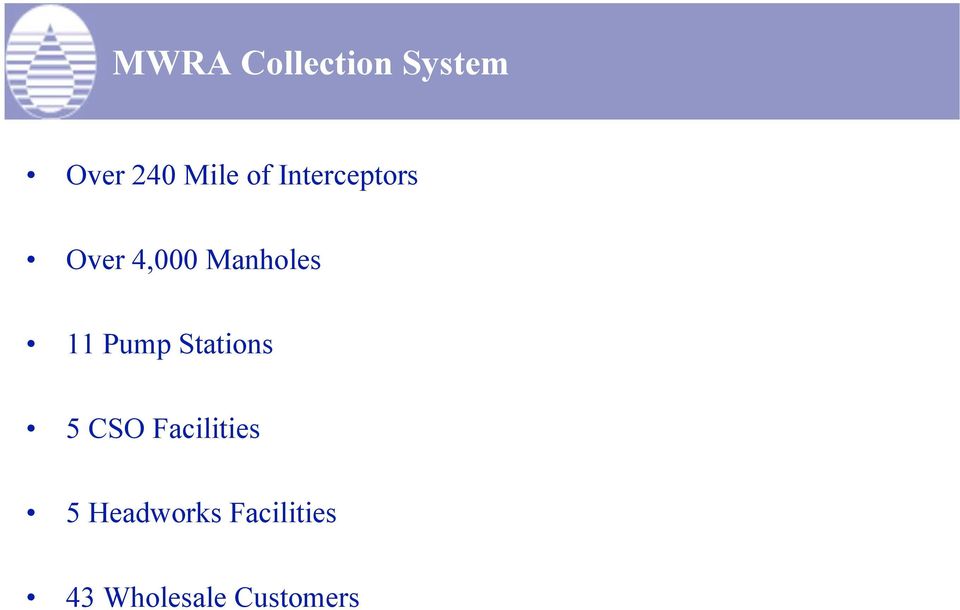
3 MWRA Collection System Over 240 Mile of Interceptors Over 4,000 Manholes 11 Pump Stations 5 CSO Facilities 5 Headworks Facilities 43 Wholesale Customers
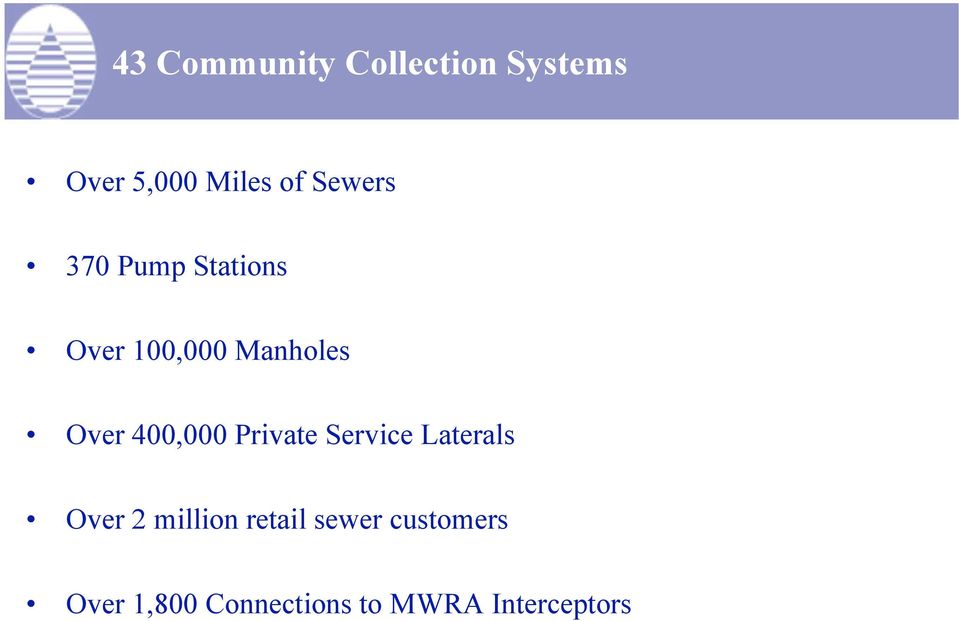
4 43 Community Collection Systems Over 5,000 Miles of Sewers 370 Pump Stations Over 100,000 Manholes Over 400,000 Private Service Laterals Over 2 million retail sewer customers Over 1,800 Connections to MWRA Interceptors
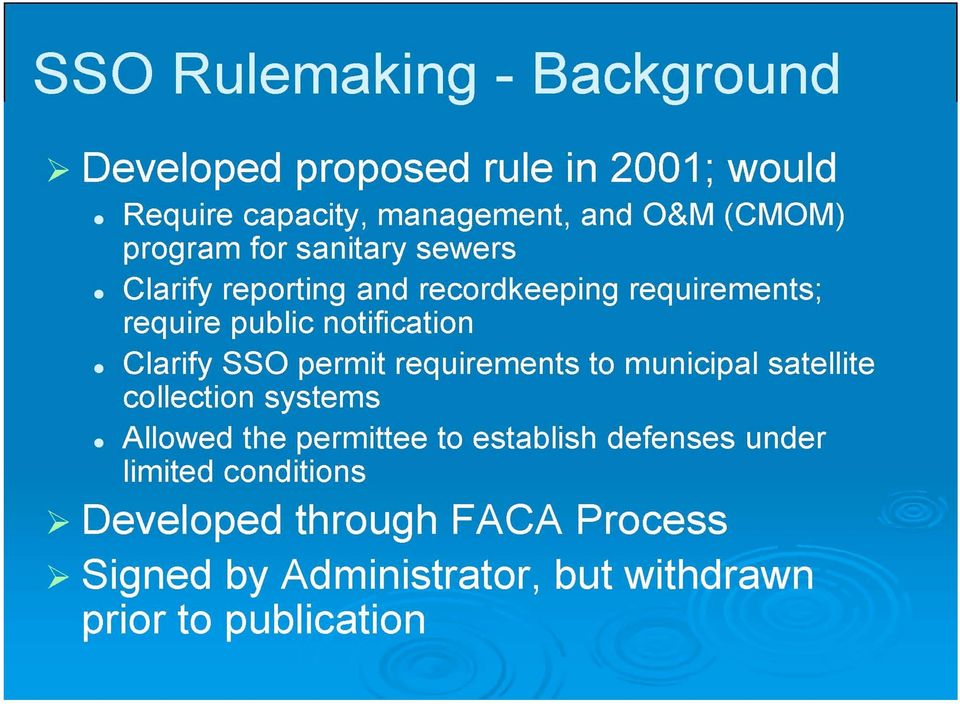
5 10/19/10 7/17/01

6 10/19/10 7/17/01

7 10/19/10 7/17/01
8 Massachusetts Water Resources Authority MWRA s s Role in Community Collection Systems DEP vs MWRA Vision on Regional O&M Wastewater Advisory Committee September 6, 2002
9 MWRA s s Vision on Regional O&M MWRA has full legal/fiscal responsibility for O&M in MWRA-owned system Communities have full legal/fiscal responsibility for O&M in locally- owned systems MWRA to provide technical & financial assistance to local communities
10 MWRA s s Vision on Regional O&M MWRA to provide summary flow metering of each community and flow- based wholesale sewer charges MWRA, Communities, DEP & EPA to work cooperatively MWRA to regulate discharge of wastewater and pollutants to MWRA- owned system DEP & EPA to regulate communities O&M and addition of new connections

11 MWRA s s Enabling Act Section 26 (d) clearly delineates local responsibility for O&M of municipal-owned systems Section 26 (d): Municipalities or local government bodies shall have charge and control of the respective water, waterworks, and sewer works owned and used by the municipality or local government. Said governmental body shall manage and improve municipal water works and sewer works, extend pipes and other works as they may deem expedient, and keep the pipes, fixtures, and other works under their charge in good condition and repair..

12 MWRA s s Response Current MWRA programs are sufficient MWRA does not want to regulate local issues Role change places MWRA on a slippery slope Enabling Act clearly delineates local O&M responsibility

13 10/19/10 7/17/01
14 10/19/10 7/17/01

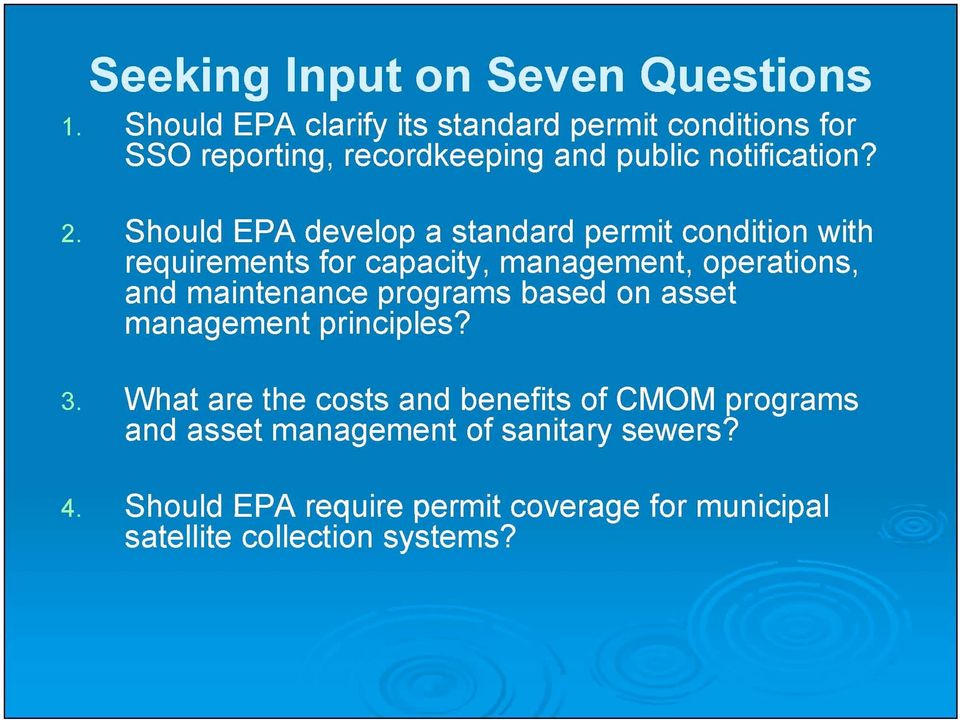
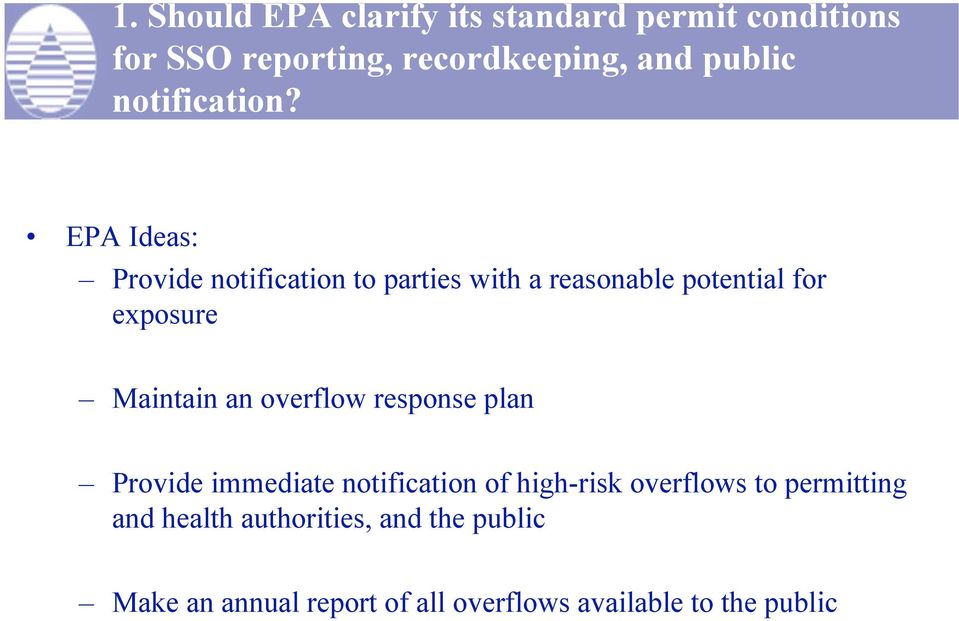
15 1. Should EPA clarify its standard permit conditions for SSO reporting, recordkeeping, and public notification? EPA Ideas: Provide notification to parties with a reasonable potential for exposure Maintain an overflow response plan Provide immediate notification of high-risk overflows to permitting and health authorities, and the public Make an annual report of all overflows available to the public
16 MWRA Response to Question #1 Reasonable, standard recording and public notification of SSOs is appropriate Leave it up to each state to set more detailed recording and reporting requirements MWRA does not agree that an SSO reporting system within the Clean Water Act should include backups into buildings, or other SSOs that do not reach a receiving water of the United States

17 WEF Response to Question #1 Yes, EPA should ensure that there is nationally consistent, accurate, and timely reporting, recording keeping, and public notification However, in order to facilitate accurate reporting and record keeping, EPA must provide a clear definition of SSOs Definition should be limited to discharges covered by CWA, which includes only discharges to the waters of the US. Reporting of basement backups should be limited to reporting associated with evaluation of collection system performance (i.e. CMOM reporting/auditing process) Public notice should be handled on a case-by-case basis with clearly defined guidelines in order not to overload public with too many inconsequential notifications.

18 NACWA Response to Question #1 Public should be notified of spills that pose a risk to public health Most NACWA members are already subject to notification requirements imposed by EPA regulations and guidance under CWA, local ordinances, or state regulations Any additional federal requirements on monitoring and reporting should acknowledge programs already in place, and ensure that any new requirements do not interfere with existing efforts or impose duplicative, unnecessary, or unduly costly mandates EPA does not have the authority to require reporting, monitoring, or notification of overflows which do not reach waters of the US Recognizes that there will be cases in which an overflow which does not reach waters of the US may pose threats to public health or the environment In these cases, protocols concerning reporting and/or notification should be developed and controlled by the utilities, local public health authorities, and the state environmental regulators.

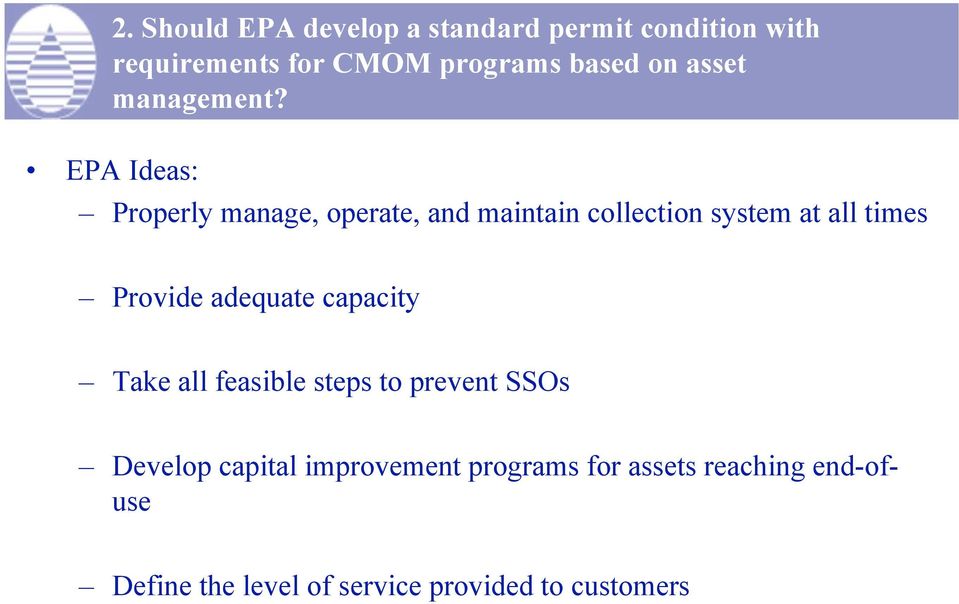
19 2. Should EPA develop a standard permit condition with requirements for CMOM programs based on asset management? EPA Ideas: Properly manage, operate, and maintain collection system at all times Provide adequate capacity Take all feasible steps to prevent SSOs Develop capital improvement programs for assets reaching end-ofuse Define the level of service provided to customers
20 MWRA Response to Question #2 MWRA favors proper management, operations and maintenance programs of collection systems Requirements should not include specific standards as all collection systems differ Capacity is a separate issue, presently not defined nor is there criteria developed to define it Proper asset management should involve good O&M practices, annual/sustainable investments in sewer rehabilitation, and appropriately engineered capacity improvements Proper asset management does not include investing in oversized capacity projects aimed at capturing extreme peak flows, the expense of which will limit funding for good O&M practices and annual rehabilitation Therefore, it is not appropriate to deal with capacity issues through a standardized NPDES permit requirement, but rather a comprehensive planning and public process guided by a regulatory framework which allows for an informed discussion of its impacts

21 WEF Response to Question #2 A general permit condition should cover the principles of a CMOM program. Specific details should be addressed in EPA guidance. The EPA guidance should reflect the WEF/NACWA Core Attributes of Effectively Managed Collection Systems and WEF s Guide to Managing Peak Wet Weather Flows in Municipal Wastewater Collection and Treatment Systems
22 NACWA Response to Question #2 Clear requirements for sewer management will assist municipalities in establishing and maintaining sufficient funding to adequately manage and operate their collection systems currently this does not exist nationally; regulations of SSOs is patchwork of state and regional approaches SSOs should be addressed through a nationally consistent technologybased BAT/BCT approach using the MOM concept as the standard for measuring compliance Adequate system capacity should be established through development of a site-specific capacity assurance plan, using a metric such as sitespecific design storms or overflow recurrence characteristics to develop performance standards that is protective of water quality and public health
23 3. How should EPA clarify permit coverage for municipal satellite collection systems? EPA Ideas: Municipal satellite must have permit; or Permit for regional operator must require regional operator to implement CMOM, reporting, and other provisions in satellite systems Include satellite systems as co-permittees and require all copermittees to implement CMOM provisions Use a general permit for each State
24 MWRA Response to Question #3 POTW should only be responsible, in its NPDES permit, for the parts of the system that it owns and/or operates. Locally owned and operated collection systems should not be in a POTW s NPDES permit.
25 MWRA Advisory s Board s Response to Question #3 EPA should only expect MWRA and other POTWs to be responsible for parts of the sewer system that it owns and operates Local collection systems should not be incorporated into MWRA s NPDES permit
26 WEF Response to Question #3 Satellite collection systems must be held accountable for managing, operating and maintaining their collection system to minimize the risk of SSOs for their customers and the POTW receiving flows from the satellite collection system. All satellite collection systems should adopt the Core Attributes of Effectively Managed Wastewater Collection Systems as part of their required asset management program. This should be a general permit condition for satellite collection systems.
27 NACWA Response to Question #3 Satellite collection systems must be brought into the CWA permit program In order to address all capacity and flow issues in situation where there is one or more satellite collection systems, all satellite systems involved must be subject to some type of capacity controls Private sewers and collection systems must also be considered as well when determining how to better regulate the flow coming from satellite systems Collection system owners/operators should be required to establish MOM and capacity assurance programs Permits should be issued directly to collection system owner/operator, but existing regional agreements should be studied to determine other possible approaches EPA should provide flexibility to state and regional NPDES permitting authorities to issue joint permits to multiple co-permittees on a regional or system-wide basis
28 4. What is the appropriate role of NPDES permits in addressing unauthorized SSOs that are caused by exceptional circumstances? EPA Ideas: SSO discharges remain prohibited Enforcement defenses analogous to bypass/upset provisions For wet weather SSOs, enforcement discretion if: Severe natural conditions, and No feasible alternatives Does not contain advanced approval language but specific criteria (e.g. design storm) could possible be in permit For other SSOs, affirmative defense if notice; and SSO was an exception, beyond reasonable control; and Took all reasonable steps to stop and mitigate
29 MWRA Response to Question #4 MWRA supports the development of a standard permit condition that would provide a framework for evaluating the specific circumstances of overflows. MWRA supports an affirmative defense rather than enforcement discretion. Appropriate criterion would be having an approved MOM plan and being in compliance with the MOM plan. MWRA believes the existing zero-discharge standard is not technologically achievable and is not supported by science. There will always be a storm that can overwhelm as system.
30 WEF Response to Question #4 EPA should continue to recognize that exceptional circumstances can cause unavoidable failures of real world systems. NPDES permit systems should reflect such recognition of exception circumstances beyond the control of POTWs or owners of collection systems. EPA should develop a regulation for collection system failures, which would support a standard permit condition, to provide an affirmative defense for exceptional circumstances or conditions beyond the control of the utility, provided that the utility has adopted and continues to implement the Core Attributes of Effectively Managed Wastewater Collection Systems.
31 NACWA Response to Question #4 Any regulation must include a meaningful defense of overflows that are beyond the reasonable control of the collection system operator A zero-discharge standard for SSOs is technologically impossible and does not reflect the risks posed to water quality by overflows The prohibition and excuse approach adopted in the NPRM imposes an unrealistic standard that would expose even the best-designed and operated systems to costly enforcement actions with little environmental benefit Systems that are in compliance with the capacity assurance and MOM requirements of the final regs. should not be held liable for overflows that are caused by exceptional circumstances beyond the control of the system operator Protection from liability for SSOs should be either in the form of a permit shield defense or available as a specific affirmative defense that will protect the collection system operator from citizen suit liability
32 5. How should EPA address peak flow diversions at POTWs? EPA Ideas: Finalize the draft Peak Flows Policy Incorporate the Peak Flows Policy into SSO rulemaking Finalize draft Implementation Guidance (including Utility Analysis Guidance)
33 MWRA Response to Question #5 Current bypass regulation does not apply to the management of peak flows (this is in agreement with NACWA s comments) Provisions should be made to authorize peak flow scenarios at POTW s as well as permitting of peak excess flow treatment facilities in the collection systems MWRA strongly recommends that NPDES permits include appropriate standards for permitting of peak excess flow treatment facilities located in the collection system
34 6. What are the costs and benefits of CMOM programs and asset management of sanitary sewers? EPA 10 Years of CMOM Experience Economic Analysis Defined Health Benefits Reductions in SSOs Principles of Asset Management Relationship between CMOM and Asset Management
35 MWRA Response to Question #6 MWRA agrees with NACWA that Management, Operation, and Maintenance requirements should not prescribe specific standards for collection system management, which should be site-specific.
36 7. How should municipalities balance all of the needs to meet water quality requirements?
37 MWRA Response to Question #7 It is important that any new federal mandates must be matched with federal funds. Several issues raised by EPA as possible components of an SSO policy are individually complex, and each warrants individual and careful discussion through a public process with considerable stakeholder involvement. This will take time We ask EPA to establish a public and stakeholder process that acknowledges the complexity of these issues, prioritizes issues, considers phased decision-making and implementation to best address the current risks, demands and existing regulatory burdens, and considers the differences that may exist among regional contexts as well the differences in system conditions and problems faced by permittees or potential permittees. MWRA agrees with NACWA that EPA should explore inclusion of watershed-based planning principles that provide flexibility to prioritized collection system management activities based on risk and potential environmental benefit.
38 MWRA s Advisory Board Response to Question #7 EPA cannot and must not introduce any new federal mandates without the matching funds to implement them Broad-based SSO regulations places into the NPDES permit could place substantial financial impacts on communities at a time when there is less money and significantly less personnel
39 WEF Response to Question #7 When possible, managing wet weather flows should be approached on a watershed basis considering all water pollution problems, sources, and priorities Environmental and financial sustainability must be carefully weighed A watershed wet weather management strategy should support the best use of available resources to cost-effectively address the most pressing water quality problems first, then proceeding at a sustainable pace to address remaining problems The wet weather management strategy should provide flexibility and time to apply tools that focus on sustainable practices, green infrastructure and pollution prevention in concert with more traditional approaches
40 I/I Local Financial Assistance Program Program began May 1993 $260M budgeted through FY18 $196M distributed through August 2010 $40 million new funds budgeted for FY14 45 percent grant / 55 percent interest-free loan Loan repayment over 5 years 43 communities 392 projects funded Program Goal Projects are intended to at least offset ongoing collection system deterioration to prevent a net increase in regional I/I
41 I/I Local Financial Assistance Program - Results 1100 miles sewer TV inspected (22%) 100 miles sewer replaced or CIP lined (2%) 110 miles sewer tested/chemical sealed (2%) 1,800 sewer spot repairs 5,800 service connection repairs (1.5%) 5 miles underdrains sealed
42 I/I Local Financial Assistance Program - Results 750 catch basins disconnected 35 miles storm drains new or replaced 9,000 manholes rehabilitated/sealed (9%) 1,400 manhole covers replaced/inflow seals installed (1.5%) 450 sump pumps redirected 6,000 downspouts/area drains disconnected
Tim Schneller, P.E. GBA Engineers and Architects
 Tim Schneller, P.E. GBA Engineers and Architects Portions of the presentation were taken from a presentation prepared by a member of the Water Environment Federation Collection Systems Committee CMOM Subcommittee.
DRAFT Public Outreach Document for What s an SSMP?
 DRAFT Public Outreach Document for What s an SSMP? This easy to read document is developed and provided to interested parties to assist in educating cities, agencies, their management, elected officials
M E M O R A N D U M. Among the standard conditions contained in the NPDES permit is also a Duty to
 M E M O R A N D U M DATE: August 7, 2015 TO: FROM: SUBJECT: Metropolitan Wastewater Management Commission (MWMC) Matt Stouder, MWMC General Manager Capacity Management, Operations, and Maintenance (CMOM)
Sanitary Sewer Overflow(SSO)/Bypass Notification Form Instructions
 Bureau of Resource Protection Wastewater Management Progr Sanitary Sewer Overflow(SSO)/Bypass Who must notify DEP about an overflow or bypass, and when? Any owner or operator of the following facilities:
Source Water Protection Practices Bulletin Managing Sanitary Sewer Overflows and Combined Sewer Overflows to Prevent Contamination of Drinking Water
 United States Office of Water EPA 916-F-01-032 Environmental Protection (4606) July 2001 Agency Source Water Protection Practices Bulletin Managing Sanitary Sewer Overflows and Combined Sewer Overflows
ecmar SECTION INSTRUCTIONS: Sanitary Sewer Collection Systems
 ecmar SECTION INSTRUCTIONS: Sanitary Sewer Collection Systems Please see the DEFINITIONS of terms at the end of this section. If you have any questions about these definitions, do not understand a question,
ELIMINATE STORM WATER FROM ENTERING SANITARY SEWER SYSTEMS
 (408) 761 5882 http://www.sewerlock.net ELIMINATE STORM WATER FROM ENTERING SANITARY SEWER SYSTEMS 1. `The United States and various State Environmental Protection Agency regulations require elimination
Number 2014-20 September 2014 SEWER LIABILITY
 Number 2014-20 September 2014. SEWER LIABILITY Sewer Backups: Most of us take the use of our wastewater and sewer systems for granted, while municipalities must be vigilant to ensure that citizens of the
City and County of San Francisco 2030 Sewer System Master Plan TASK 400 TECHNICAL MEMORANDUM NO. 405
 City and County of San Francisco 2030 Sewer System Master Plan TASK 400 TECHNICAL MEMORANDUM NO. 405 REGULATORY CONSIDERATIONS FOR WET WEATHER COLLECTION SYSTEM BACKUPS FINAL DRAFT August 2009 2700 YGNACIO
City of Bakersfield Public Works Department Sewer System Management Plan December 2014
 City of Bakersfield Public Works Department Sewer System Management Plan December 2014 C:\Users\hmayberry\Desktop\SEWER SYSTEM MANAGEMENT PLAN 2014.doc 1 Sewer System Management Plan Index: Section 1 Goals
Sanitary Sewer Master Plan
 , Illinois Sanitary Sewer Master Plan EXECUTIVE SUMMARY Prepared by September 9, 2010 1670 South Taylorville Road Decatur, Illinois 62521 www.bgmengineering.com Sanitary Sewer Master Plan A. SCOPE OF STUDY
COMBINED SEWER OVERFLOW LONG-TERM CONTROL PLAN Executive Summary
 CITY OF LAKEWOOD COMBINED SEWER OVERFLOW LONG-TERM CONTROL PLAN Executive Summary MAY 2006 storage conveyance treatment performance Prepared for: City of Lakewood, Ohio Prepared by: Metcalf & Eddy of Ohio,
Kansas City s Overflow Control Program
 Kansas City s Overflow Control Program Kansas City Water Services Water Wastewater Stormwater 2 Water Services Department 1000 Positions 835 Employees 3 Utilities FY 13/14 Budget = $307 million Water Wastewater
What is a CSO / SSO? Sewer Overflows. Prevalence of CSOs in the US. Magnitude of Problem (Local)
 Sewer Overflows Combined Sewer Overflows (CSOs( CSOs) Older, large cities built combined networks to convey sewage and stormwater Stormwater overwhelmed sewage flow, but only for short periods To reduce
TOWN OF HILLSBOROUGH Compliance with Regulatory Mandates. Private Sewer Lateral Inspection and Repair Program
 TOWN OF HILLSBOROUGH Compliance with Regulatory Mandates Private Sewer Lateral Inspection and Repair Program SEWER SYSTEM- BACKGROUND 116 miles of gravity sanitary sewer pipelines 1 mile of force main
How To Get A Plan For A Water Treatment Plant
 Sanitary Sewer Overflow Initiative What is a Sanitary Sewer Overflow (SSO) A type of unauthorized discharge of untreated or partially treated wastewater from the collection system or it s associated components.
Unauthorized Discharges and Sanitary Sewer Overflows
 TCEQ REGULATORY GUIDANCE Field Operations Support Division RG-395 Revised April 2011 Unauthorized Discharges and Sanitary Sewer Overflows What does this document cover? The Texas Commission on Environmental
City of Dallas Wastewater Collection System: TCEQ Sanitary Sewer Outreach Agreement City Council Briefing January 17, 2007
 City of Dallas Wastewater Collection System: TCEQ Sanitary Sewer Outreach Agreement City Council Briefing January 17, 2007 1/12/2007 1 Briefing Purpose Provide update on Wastewater Collection Activities
ORDINANCE NO. 15 BE IT ORDAINED BY THE COUNCIL OF KANSAS CITY:
 ORDINANCE NO. 15 Amending Chapter 60 of the Code of Ordinances of Kansas City, Missouri, entitled Sewers and Sewage Disposal by adding Sections 60-349 through 60-360; and establishing an effective date.
Element 3: OVERFLOW EMERGENCY RESPONSE PLAN
 Element 3: OVERFLOW EMERGENCY RESPONSE PLAN The section of the SSMP discusses the City s overflow emergency response plan, which is included in full in Appendix B. This section fulfills the Overflow Emergency
Sewer System Management Plan (SSMP) Development Guide
 J U L Y 2 0 0 5 SAN FRANCISCO BAY REGIONAL WATER QUALITY CONTROL BOARD in cooperation with BAY AREA CLEAN WATER AGENCIES Sewer System Management Plan (SSMP) Development Guide San Francisco Bay Regional
Almonte Sanitary District Sewer System Management Plan Adopted by the ALMONTE Board of Directors on_08/28/06
 Almonte Sanitary District Sewer System Management Plan Adopted by the ALMONTE Board of Directors on_08/28/06 1. Goals The goal of this SSMP is to provide a plan and schedule to properly manage, operate,
Components of a Basement Flooding Protection Plan: Sewer System Improvements. November 2000
 Components of a Basement Flooding Protection Plan: Sewer System Improvements November 2000 Components of a Basement Flooding Protection Plan: Sewer System Improvements November 2000 SEMCOG 2000 Prepared
Dan Ott Managing Engineer Collection System Johnson County Wastewater, KS and Rick Nelson CH2M HILL
 Dan Ott Managing Engineer Collection System Johnson County Wastewater, KS and Rick Nelson CH2M HILL What is JCW s strategy for meeting wet weather performance targets? SSO s Basement Back-ups Serving Johnson
COMBINED SEWER OVERFLOW OPERATIONAL AND MAINTENANCE PLAN SUMMARY
 COMBINED SEWER OVERFLOW OPERATIONAL AND MAINTENANCE PLAN SUMMARY Revised: April 2014 Village of Wilmette, Illinois NPDES CSO Permit No. ILM580012 Chapter 1 Introduction This Operational and Maintenance
Chapter 2 Asset Management and CMOM
 Chapter 2 Asset Management and CMOM Chapter Outline This chapter is organized into the following sections: Introduction Asset Management Capacity, Management, Operation and Maintenance (CMOM) Introduction
Jeff Haby, P.E. Director Sewer System Improvements. September 15, 2015. Agenda
 SAWS Sanitary Sewer Overflow Reduction Program Jeff Haby, P.E. Director Sewer System Improvements SA Military Engineers Meeting Agenda SAWS Overview Consent Decree CD Compliance Programs Program Transition
A Systematic Approach to Reduce Infiltration and Inflow (I&I) and Sanitary Sewer Overflows (SSO) PETE GORHAM, P.E. MIKE LYNN FEBRUARY 19, 2015
 A Systematic Approach to Reduce Infiltration and Inflow (I&I) and Sanitary Sewer Overflows (SSO) PETE GORHAM, P.E. MIKE LYNN FEBRUARY 19, 2015 Infiltration/Inflow (I/I) I & I Reduction: Three-Prong Attack
CHELTENHAM TOWNSHIP. SANITARY SEWER UPDATE Public Works Committee Meeting September 7, 2010 Curtis Hall
 CHELTENHAM TOWNSHIP SANITARY SEWER UPDATE Public Works Committee Meeting September 7, 2010 Curtis Hall 1 SANITARY SEWER UPDATE 1. Overview a. The Problem b. Pennsylvania Department of Environmental Protection
FWEA Utility Council Sanitary Sewer Overflow (SSO) Enforcement Policy Recommendations
 FWEA Utility Council Sanitary Sewer Overflow (SSO) Enforcement Policy Recommendations Purpose and Objective The FWEA Utility Council formed the SSO Sub-Workgroup to provide a venue to discuss the increase
Work Practice: Wastewater Collection System Maintenance Plan Potential Safety Hazards
 Potential Safety Hazards Required items Potential PPE None Additional References - Collection System Related Work Practices & Forms Jet Truck Cleaning Work Practice (Do not drive on peoples driveway) CDL
1. Water Line Maintenance 2. Sanitary Sewer Maintenance 3. Spill/Leak/Overflow Control, Response, and Containment
 WATER AND SEWER UTILITY OPERATION AND MAINTENANCE Although sewage systems the operation and maintenance of public utilities are not considered themselves are not a chronic sources of stormwater pollution,
The Clean Water Project What Is The Stormwater Impact?
 The Clean Water Project What Is The Stormwater Impact? Presentation To: Seminar On Water Issues Bob Weimar, PE, BCEE Chief of Program Management The Metropolitan District Sewage Overflows Have Become More
Sanitary Sewer Management Plan (SSMP)
 Sanitary Sewer Management Plan (SSMP) SALT LAKE CITY DEPARTMENT OF PUBLIC UTILITIES Table of Contents Preface 1 Goals... 3 Definitions and General Requirements.. 4 Part 1 Organization 6 1.1 SLCDPU Organization...
Element 4: FATS, OILS, AND GREASE (FOG) CONTROL PROGRAM
 Element 4: FATS, OILS, AND GREASE (FOG) CONTROL PROGRAM This section of the SSMP discusses the City s FOG control measures, including identification of problem areas, focused cleaning, and source control.
SAWS SSO Reduction Program
 SAWS SSO Reduction Program Jeff Haby, P.E. Director Sewer System Improvements February 20, 2014 TMDL Implementation Plan Technical Committee Overview Sanitary Sewer Overflows Consent Decree Overview Major
CMOM How to Develop Your Collection System Maintenance Program NWOWEA Pre-Conference Utility Workshop June 22, 2015 Kalahari Conference Center
 CMOM How to Develop Your Collection System Maintenance Program NWOWEA Pre-Conference Utility Workshop June 22, 2015 Kalahari Conference Center Thomas A. Fishbaugh Ohio RCAP What is CMOM? CMOM: Capacity,
Sewer System Management Plan University of California Kearney Agricultural Research & Extension Center 9240 S. Riverbend Ave.
 Sewer System Management Plan University of California Kearney Agricultural Research & Extension Center 9240 S. Riverbend Ave. Parlier, CA 93648 Wastewater ID # 5SSO11453 1 Goals 1.1 Regulatory Requirements
CODE OF REGULATIONS OF THE NORTHEAST OHIO REGIONAL SEWER DISTRICT TITLE III SEPARATE SANITARY SEWER CODE
 CODE OF REGULATIONS OF THE NORTHEAST OHIO REGIONAL SEWER DISTRICT TITLE III SEPARATE SANITARY SEWER CODE Adopted July, 1991 Revised March, 1995 NORTHEAST OHIO REGIONAL SEWER DISTRICT CODE OF REGULATIONS
SANITARY SEWER SYSTEM ASSESSMENT
 SANITARY SEWER SYSTEM ASSESSMENT What is this tool? The Sanitary Sewer System Assessment is a form that helps your utility identify and document all of the components in your utility s sanitary sewer system.
Asset Management Guidance and Best Practices
 The standards and best practices contained in this document are required elements for new projects seeking State funding under the New Jersey Environmental Infrastructure Finance Program (NJEIFP). Further
REQUEST FOR PROPOSALS SANITARY SEWER MAINTENANCE SERVICES FOR THE TOWN CENTER SEWER ASSESSMENT DISTRICT WITHIN THE TOWN OF WOODSIDE
 REQUEST FOR PROPOSALS SANITARY SEWER MAINTENANCE SERVICES FOR THE TOWN CENTER SEWER ASSESSMENT DISTRICT WITHIN THE TOWN OF WOODSIDE Submit Proposals to: Town of Woodside Public Works Department 2955 Woodside
Minimizing Municipal Costs for Infiltration & Inflow Remediation. A Handbook for Municipal Officials. June 30, 2007
 Minimizing Municipal Costs for Infiltration & Inflow Remediation A Handbook for Municipal Officials June 30, 2007 Prepared for: Executive Office of Energy and Environmental Affairs Watershed Improvement
Sanitary District No.5 of Marin County SSMP
 2014 Sanitary District No.5 of Marin County SSMP Tony Rubio Sanitary District No.5 of Marin County 6/1/2014 INTRODUCTION...7 SSMP Requirement Background...7 Document Organization...7 District Service Area
Beechmont Park Project
 Beechmont Park Project Foundation Drain Project Why pre -1972 homes are chosen in your neighborhood? Results of pilot study in your area showed the majority of homes built prior to 1972 within your neighborhood
CITY OF CORONADO SEWER SYSTEM MANAGEMENT PLAN
 CITY OF CORONADO SEWER SYSTEM MANAGEMENT PLAN June 2009 Prepared For: The City of Coronado Public Services 101 B Avenue Coronado, California 92118 Prepared By: 9275 Sky Park Court, Suite 200 San Diego,
Sanitation District No. 1 of Northern Kentucky. SD1's Sanitary and Storm Water Asset Management Program. KSPE Annual Convention
 Sanitation District No. 1 of Northern Kentucky SD1's Sanitary and Storm Water Asset Management Program KSPE Annual Convention April 28, 2011 Background Outline CSAP Program Development CSAP Program Implementation
Sewer System Management Plan (SSMP)
 Sewer System Management Plan (SSMP) City of Santa Ana Water Resources Division 4/10/2014 Prepared Under the Supervision of: Nabil Saba, P.E. Water Resources Manager Table of Contents/Definitions/Abbreviations
Review of Footing Drain Disconnection Projects
 Wastewater Master Plan DWSD Project No. CS-1314 Review of Footing Drain Disconnection Projects Technical Memorandum Original Date: August 8 2002 Revision Date: September 2003 Author: CDM Table of Contents
Sanitary Sewer Overflows Emergency Response Plan (SSOERP)
 Final Report Sanitary Sewer Overflows Emergency Response Plan (SSOERP) Prepared for Boston Water and Sewer Commission November 23, 2012 18 Tremont Street Boston, MA 02108 Contents Acronyms and Abbreviations...
GIS Applications for Regulatory Compliance
 4 GIS Applications for Regulatory Compliance Uzair (Sam) M. Shamsi Many cities in the world especially in the United States and Canada are dealing with regulatory enforcement actions for sewer overflows,
Name: Date: P.O. Box 2449, San Antonio, Texas 78298 (210) 233-3683. Number of Taps
 PRIVATE LATERAL PROGRAM QUESTIONNAIRE The WEF Collection System Committee is primarily interested in successfully operating programs for work performed on the privately-owned portion of the lateral line;
VILLAGE OF GRANVILLE SEWER BACK-UP and WATER LEAK POLICIES
 VILLAGE OF GRANVILLE SEWER BACK-UP and WATER LEAK POLICIES SEWER BACK-UP POLICY General Sewer back-ups are an unfortunate, but common problem in older communities. A sewer back-up can create a health or
Appendix C3: Response Plan for Investigations of Illegal Discharges, 2016
 Appendix C3: Response Plan for Investigations of Illegal Discharges, 2016 Response Plan for Investigations For the City and County of Honolulu Municipal Separate Storm Sewer System National Pollutant Discharge
Allegany County Combined Sewer Overflows - Long Term Control Plan
 Allegany County Combined Sewer Overflows - Long Term Control Plan On December 14, 2001 the Maryland Department of the Environment (MDE) filed a Consent Decree and Judgment (Consolidated Case No. 01-C-00-18342-L)
Sanitary Sewer Overflow (SSO) Incident Report Form
 Submit completed form to EHS. Date of SSO spill: Sanitary Sewer Overflow (SSO) Incident Report Form Identify the SSO category (check one): Category 1 SSO Spills of any volume that reach surface water Category
Addressing SSOs in Austin, Texas: Initial Call to Final Fix
 Addressing SSOs in Austin, Texas: Initial Call to Final Fix Gopal K. Guthikonda, P.E., Barbara L. Wilde, Steven W. Schrader, P.E., and Rajendra P. Bhattarai, P.E. Austin Water Utility City of Austin 2600
CAPACITY, MANAGEMENT, OPERATION & MAINTENANCE (CMOM) MANUAL HOWARD COUNTY, MARYLAND
 CAPACITY, MANAGEMENT, OPERATION & MAINTENANCE (CMOM) MANUAL HOWARD COUNTY, MARYLAND Howard County Department of Public Works Bureau of Utilities Updated: December 2010 Developed by: George, Miles & Buhr,
READ THIS FIRST. Check here if you believe that fats, oils and/or grease (FOG) caused or contributed to the SSO. Date: Time: Title:
 READ THIS FIRST In the event of a Sanitary Sewer Overflow Check here if you believe that fats, oils and/or grease (FOG) caused or contributed to the SSO Address: Date: 1 st : Open this envelope. Instructions
Sewer System Management Plan (SSMP) 2009. Eastern Municipal Water District
 Sewer System Management Plan (SSMP) 2009 Eastern Municipal Water District Table of Contents 1.0 SSMP Goals... 3 Goal 1A:... 3 Goal 1B:... 3 2.0 Organizational Structure... 3 3.0 Legal Authority... 4 4.0
Storm Drain System Operation and Maintenance
 Santa Clara Valley Urban Runoff Pollution Prevention Program PUBLIC AGENCY ACTIVITIES Performance Standard and Supporting Documents for Storm Drain System Operation and Maintenance December 19, 1996 March
City of Mebane Wastewater Collection and Treatment Facility
 City of Mebane Wastewater Collection and Treatment Facility For the Fiscal Year July 1, 2014 - June 30, 2015 City of Mebane Wastewater Collection and Treatment Facility For the Fiscal Year July 1, 2014
Update on the Metro Nashville Consent Decree Program. Scott Potter Ron Taylor
 Update on the Metro Nashville Consent Decree Program Scott Potter Ron Taylor 1 Why We Are Here Planned actions to meet Clean Water Act The types of projects that will be constructed The impacts of these
PREVENTING WET OR FLO ODED BASEMENTS
 PREVENTING WET OR FLO ODED BASEMENTS TABLE OF CONTENTS Prevention Tips...Page 1 Why is there Water in my Basement?...Page 2 City of Saskatoon Sewer Systems...Page 3 Why Does Saskatoon Have Two Separate
John J. Cronley Marketing Communications Manager Mission Communications 678-969-0021, x1008 [email protected]
 1 Supervisory Control and Data Acquisition (SCADA) Utilization For Capacity, Management, Operations, and Maintenance (CMOM) Program Compliance in Wastewater Collection Systems John J. Cronley Marketing
OVER-HEAD SEWER ASSISTANCE GRANT
 OVER-HEAD SEWER ASSISTANCE GRANT The Village of North Aurora has a vested interest in the proper operation of the North Aurora sanitary system. Understanding that some residential users of the sanitary
Sanitary Sewer Overflow (SSO) Contingency and Emergency Response Plan (CERP)
 Sanitary Sewer Overflow (SSO) Contingency and Emergency Response Plan (CERP) Department of Watershed Management (DWM) Capacity, Management, Operations, and Maintenance (CMOM) Program December 2012 Version
Lansdowne Stormwater UPDATE
 Lansdowne Stormwater UPDATE August 22, 2012 Ann Arbor Footing Drain Disconnection Stormwater Review Presentation Agenda Welcome and introductions Background on stormwater and sanitary sewer issues Footing
SEWER SYSTEM MANAGEMENT PLAN
 SEWER SYSTEM MANAGEMENT PLAN Prepared for San Bernardino Community College District February, 2010 SEWER SYSTEM MANAGEMENT PLAN Prepared for the San Bernardino Community College District Holmes International
ELASTOMERIC INLINE CHECK VALVES FOR CONTROL AND PREVENTION OF SANITARY SEWER OVERFLOW
 A Red Valve Company And Tideflex Technologies White Paper 600 North Bell Avenue Carnegie, PA 15106 (412)279-0044 www.redvalve.com ELASTOMERIC INLINE CHECK VALVES FOR CONTROL AND PREVENTION OF SANITARY
2012 Stormwater Management Report
 2012 Stormwater Management Report Boston Water and Sewer Commission (This Page Left Intentionally Blank) Municipality/Organization: Boston Water and Sewer Commission EPA NPDES Permit Number: MASO 10001
City of Hillsboro Inflow and Infiltration Elimination Program
 City of Hillsboro Inflow and Infiltration Elimination Program Because of continuing problems with overloaded sanitary sewers, the City of Hillsboro is inspecting the sewer system in your neighborhood.
2012 2016 Capital Improvement Plan City of Houston WASTEWATER TREATMENT FACILITIES
 2012 2016 Capital Improvement Plan City of Houston WASTEWATER TREATMENT FACILITIES 2012 2016 Capital Improvement Plan City of Houston WASTEWATER TREATMENT FACILITIES The Wastewater Treatment System (System)
Town of Essex NE Lagoon. Service Area. Essex Plant. Service Area. Pumping Station No. 4. Wastewater Pumped To NE Lagoons (Treatment Plant No.
 Town of Essex Basement Flooding Study Town of Essex NE Lagoon Service Area Pumping Station No. 4 Essex Plant Service Area Wastewater Pumped To NE Lagoons (Treatment Plant No. 2) Essex Treatment Plant (Treatment
AN UPDATE ON LOUISVILLE MSD s BASEMENT BACKFLOW PREVENTION PROGRAM 10 YEARS AND 6,700 INSTALLATIONS LATER
 AN UPDATE ON LOUISVILLE MSD s BASEMENT BACKFLOW PREVENTION PROGRAM 10 YEARS AND 6,700 INSTALLATIONS LATER W. Brian Bingham Louisville Jefferson Metropolitan Sewer District 700 W. Liberty Street Louisville,
Affordable Asset Management Making Use of the Data You Have: An Owner s Perspective
 Affordable Asset Management Making Use of the Data You Have: An Owner s Perspective An Owner Operator s Approach for Asset Management on a Budget Lane Longley, City of St. Petersburg Presented by the April