
FALSE ADDRESS CAN LEAD TO ARREST
|
|
|
- Ashley Maxwell
- 10 years ago
- Views:
Transcription
1
2 FALSE ADDRESS CAN LEAD TO ARREST SUBJECT: RESIDENCY IMPORTANT NOTICE TO PARENTS Your child has the right to attend school in the boundary in which you, the parent, reside. It is the responsibility of the parent to provide proper and accurate documentation to the school to prove residency. The school shall have the right to verify any information that is provided to them. Submission of Fraudulent Documentation In accordance with School Board Policy 5.1, any parent who submits fraudulent documentation to register a student gives cause for such student to be withdrawn immediately and referred for enrollment in the appropriate boundaried school. False Information Florida Statute states: whoever knowingly makes a false statement in writing with intent to mislead a public servant in the performance of his or her official duty shall be guilty of a misdemeanor of the second degree, punishable by law. Additionally, a person who knowingly makes a false declaration under penalties of perjury is guilty of the crime of perjury by false written declaration, a felony of the third degree under Florida Statute and will be reported to the State s Attorney s office. Potential Loss of Homestead Exemption Florida Statute requires that you reside on the property qualifying for Homestead Exemption. Renting Homestead Exemption Property Florida Statute states that the rental of all or substantially all of a dwelling previously claimed to be a homestead for tax purposes shall constitute the abandonment of such dwelling as a homestead. Homestead Exemption may be lost. 2

3 Please review this book with your students so that your family is aware of what is and is not appropriate in school, during school-sponsored activities and on school bus transportaiotn. IMPORTANT THINGS TO DO Since *parent(s) can be held responsible for the actions of their children, it is important that they are aware of the rules and the consequences if their students break the rules. However, parents also have the right to advocate for their children. Therefore, the school system must have proof that every student and every parent has had a chance to read this Code for Student Conduct. 1. The Acknowledgement Form on page viii of this Code for Student Conduct book must be signed and returned within 3 days of receipt of the form. Your signature does not mean you agree or disagree with the rules, but rather that you have reviewed the electronic book and know the rules. A copy of the Acknowledgement Form is provided on page xv of this booklet and should be retained for your records. 2. Choose your options for Media Release on page ix. You must select one option in Section A and another option in Section B. If you do not choose an option in either section, you will default to allow the school to photograph your child, videotape your child, or for your child to be interviewed by the news media or the School District for school and district purposes. 3. Parents of students in any grade level (or independent students 18 or over) may opt out of (prevent) having any or all directory information provided to certain outside agencies as well as for certain uses within their child s school or school district (for example, information published in yearbooks and school programs). To request that directory information is not disclosed to specific entities, please complete the Opt-Out Notification Form on page x and return it to your school. 4. For 11th and 12th grade students who do not wish to share directory information with armed services/military recruiters and/or postsecondary educational institutions, complete the opt-out section on page xi and submit the form to the principal within 10 days from the date of enrollment. 5. The District s Discipline Matrix assigns specific consequences for violating the rules of the Code for Student Conduct and is part of the school s discipline plan. A copy is now located in Appendix A of this booklet. Please review the Discipline Matrix with your child. For more information on the matrix, talk with a school administrator. *Whenever the term parent is used, it also refers to either or both parents, any guardian of a student, any person in a parental relationship to a student, or any person exercising supervisory authority over a student in place of a parent. i

4 THE SCHOOL BOARD OF BROWARD COUNTY, FLORIDA 600 SOUTHEAST THIRD AVENUE FORT LAUDERDALE, FLORIDA TEL FAX ROBERT W. RUNCIE Superintendent of Schools Chair Vice Chair SCHOOL BOARD LAURIE RICH LEVINSON PATRICIA GOOD ROBIN BARTLEMAN ABBY M. FREEDMAN DONNA P. KORN KATHERINE M. LEACH ANN MURRAY DR. ROSALIND OSGOOD NORA RUPERT Welcome to the New School Year! Dear Students and Parents: As your Superintendent, I am dedicated to working with the staff, parents and community to meeting the educational needs of all students in a safe learning environment. The Code of Student Conduct, Policy 5.8, provides specific information regarding the rules that all students are expected to adhere to, as well as consequences for violations of the policy set forth in this document. The Code of Student Conduct policy addresses expectations for all students in terms of consistent and timely attendance, respect for people and property, appropriate dress, technology usage, student publications, student activities, student records and the right to appeal, including grievance procedures. Please review all information in the Code of Student Conduct policy carefully and together discuss the consequences of violating the rules. The Code of Student Conduct, Policy 5.8 will be distributed electronically. Students and parents are required to sign a statement indicating that they have received their Code of Student Conduct booklet, are aware of the explanation of rules it provides in policy, and have selected their options for media and directory information release. It is important for you to review the Code of Student Conduct, Policy 5.8 annually because it incorporates changes from previous versions. A list of substantive changes can be found on page vi. You may view the Code of Student Conduct under School Board Policies on the District website ( You may also view the Code of Student Conduct video on BECON television and on the District s website. Schools will provide parents and students with the program schedule. I hope you experience a fulfilling, engaging and safe school year as we strive to continue educating today s students for tomorrow s world. Sincerely, RWR/MVP/ACN/NS:gd Robert W. Runcie Superintendent Educating Today s Students For Tomorrow s World Broward County Public Schools Is An Equal Opportunity/Equal Access Employer ii

5 2-1-1 Speciality Service Helplines Homeless Helpline HELP (4357) Gateway to accessing homeless services in Broward County. Special Needs Connections or Helps parents, caregivers, and professionals who serve children with disabilities. TeenSpace or TEEN (8336) Safe, anonymous helpline for youth. Help provided by live counselors, audio tapes at and an interactive website at Behavioral Health INFOLine INFO (4636) Frontdoor entry to child and adolescent mental health services or substance abuse. Touchline for Seniors Free, daily reassurance calls to seniors age 60 or over who live alone. TTY iii

6 Table of Contents TABLE OF CONTENTS FORMS Acknowledgement Form...viii Media Release Form...ix FERPA Opt Out Notification Form (All Grades)... x NCLB Opt Out Notification Form 11th & 12 Grades...xii Authorization for Medication Form...xi Authorization for Treatment Form...xiii Health Screenings-Parent Opt Out Form (Grades K, 1, 3 and 6)... xiv Acknowledgement Form (Parent Copy)... xv POLICY Preface: Guiding Principals...xvi Section A & B...xviii Section I: Attendance Section II: Respect for Persons and Property Expected Behaviors Unacceptable Behaviors Leading to Disciplinary Action School Bus Behavior Discrimination and/or Harassment Section III: Dress Code Section IV: Technology Usage Social Media Use Guidelines Section V: Student Activities and Assembly Section VI: Student Free Speech and Distribution of Materials Section VII: School Sponsored Publications Section VIII: Privacy of Student Records Family Educational Rights and Privacy Act (FERPA) Protection of Pupil Rights Amendment (PPRA) Notice...43 Privacy Practices Related to Students and Family Medical/Mental Health Records (HIPAA) Section IX: Interventions and/or Consequences Possible Interventions and/or Consequences of Misbehavior Consequences of Serious Misbehavior Leading to Suspension and/or Expulsion...49 Preventiing Recidivism through Opportunities, Mentoring, Interventions, Supports and Education (PROMISE)...50 Medications: Use, Possession, Sale and/or Transmittal Leading to Suspension and Possible Expulsion Drug and Substance Abuse Offenses Leading to Suspension and Possible Expulsion iv

7 Other Offenses (Non-Drug and Non-Substance Abuse Offenses) Leading to Suspension and Possible Expulsion Offenses Leading to Mandatory Expulsion Alternative to Expulsion Programs...58 Workback Out-of-District Expulsion...60 Definition of Weapons Other Definitions for this Policy Section X: Right to Appeal and Grievance Procedures OTHER Appendix A: Discipline Matrix Index...69 Committee Members Haitian-Creole Règleman sou Kondwit Elèv disponib an kreyòl nan lekòl-la. Spanish El Código de Conducta de Estudiantes está a su disposición en español, en la escuela. Portuguese O Código de Conduta do Estudante encontra-se disponível em português, em sua escola. v
8 Summary of Changes Grades K-5 Video Grades 6-12 Video Additional forms: Authorization for Medication/Treatment & Health Screenings Parent Opt Out Form Addition: Guiding Principles for students, parents, teachers, administrators, additional school-based staff and district staff Clarification: Parents of adult students shall continue to perform parental functions for the dependent student Revision: College/university campus visits/tours are considered excused absences Addition: Inclusion of the District s Social Media Guidelines Revision: Language regarding disclosure of student directory information Addition: Language for parents regarding notification of the Protection of Pupil Rights Amendment (PPRA) Revision: Sale, attempted sale and/or transmittal of authorized or unauthorized over-the-counter medications shall receive a consequence per the Discipline Matrix Revision: Elementary and Secondary Level Discipline Matrices vi

9 vii

10 Acknowledgment This booklet lists the District s rules in Policy 5.8, for students in Broward County Public Schools. The rules apply to all activities occurring on school grounds, on other sites being used for school activities, and on any vehicles authorized to transport students. Your signature below does not indicate that you agree or disagree with the rules, but rather that you have reviewed the electronic copy of these rules ( Return this form to school within 3 days from the first day of school or from the date of enrollment. Parents need to be involved in the education of their children and have the responsibility to: Know that for school safety, schools are not required to provide supervision more than 30 minutes prior to the official starting time, nor are they required to provide supervision for more than 30 minutes after the official closing time (F.S (2)). Know that for school safety, for students who ride a school bus, drivers are NOT permitted to let students off the bus except at the designated stop. Provide the school with the names of current emergency contact person(s) and/or telephone numbers on an annual basis and when there are changes. Notify the school of anything that may affect their child s ability to learn, to attend school regularly, or to take part in school activities. Be aware that medicine must be administered in accordance with SB Policy 6305, as may be amended, and that consequences for transmittal and/or sale or attempted sale of over-the-counter medications and possession and/or use of unauthorized medications can be found in SB Policy SB Policy 6305 outlines the rules regarding over-the-counter and prescription drugs and SB Policy 5006 outlines the consequences for violating those rules. You may view the complete health and suspension and/or expulsion policies, as well as all School Board policies, on the Web at: Be aware that parents have rights with regard to the privacy and confidentiality of student records that are maintained by schools as defined in Section VIII of this booklet. Neither the School Board of Broward County nor its employees will be held liable for items that are prohibited and are lost, stolen, or confiscated; or for wireless communication devices or other personal technology that is lost, stolen, or confiscated. Be aware that confiscated items not claimed by the end of the school year will be donated to local charities. Recognize that they are responsible for their student s behavior on the way to and from school and at the bus stop. A safe and respectful learning environment is key to academic achievement; therefore any student s off campus actions that seriously affect a student s ability to learn or a staff member s ability to teach may be handled as a disciplinary infraction. For serious incidents that occur at bus stops and/or that are not on School Board property, parents should contact law enforcement directly. For bullying incidents (see bullying definition, Section II), school officials should be notified and will investigate and/or provide assistance and intervention, as the principal/designee deems appropriate, which may include the use of the School Resource Officer. Ensure their child demonstrates legal, ethical and responsible use of technology including networks, digital tools, the Internet, and software, as defined in Section IV of this booklet. Parents will continue to maintain responsibility for students who reach the age of majority, (18 years or older), for all educational and discipline purposes, with exceptions as provided by statute. Student Name (PRINT) Student Signature Parent Signature Date viii

11 Media Release Form 2013/2014 Form 2013/2014 School Year School Year As a parent of a student in Broward County Public Schools, I understand that my student may be photographed, videotaped or interviewed by the news media or by the School District to promote Broward County Public Schools. I understand that pictures and interviews may be used on the District s Web site, in School District publications, external publications and electronic media, as indicated below. You Must Mark a Choice in Both Section A and Section B Section A Please Check Choice #1 or Choice #2 (If no choice is marked, then it will default to Choice #1.) 1. I WILL permit my student to be photographed, filmed or interviewed by the news media or by the School District to promote Broward County Public Schools. 2. I WILL NOT permit my student to be photographed, filmed or interviewed by the news media or by the School District to promote Broward County Public Schools. Section B Please Check Choice #1 or Choice #2 (If no choice is marked, then it will default to Choice #1.) 1. I WILL permit my student to be photographed, videotaped or interviewed for school publications, such as school yearbooks, school newspapers, class pictures, or other school communications tools. I understand the District is required to release this information if requested by the media or other members of the public (i.e., public records requests). 2. I WILL NOT permit my student to be photographed, videotaped or interviewed for school publications, such as school yearbooks, school newspapers, class pictures, or other school communications tools. I understand my student will not be included in school publications, such as school yearbooks, school newspapers, class pictures or other school communications tools. Student Name (PRINT) Student Signature Date Parent Name (PRINT) Parent Signature Date ix

12 FERPA Opt-Out Notification Form 2013/2014 Form School 2013/2014 Year (All Grades) School Year (All Grades) ATTENTION! Checking items below will prevent the selected information from appearing in school publications, including, but not limited to, the yearbook, even if you select the I Will option on the Media Release Form. Note: Checking Student s Name below will also prevent the student s photograph from appearing in the yearbook. Directory information is personally identifiable information that would not generally be considered harmful or an invasion of privacy if disclosed. Pursuant to the Family Educational Rights and Privacy Act (FERPA), the School Board of Broward County, Florida may disclose in its discretion directory information of a student in any grade level, without prior consent only to (a) colleges, universities or other institutions of higher education in which the student is enrolled, may seek enrollment or may be recruited, (b) for school publications, instructional materials and other school communication tools (including, but not limited to, yearbooks, athletic programs, graduation programs, recruitment brochures, theatrical programs and websites), and/or (c) agencies that provide food, shelter or clothing to students and their families, as determined by District Family Counselors, District Guidance Counselors and District Social Workers. Parents/guardians of students in any grade level, or eligible students (those over the age of 18, emancipated, or attending a postsecondary institution), may opt out of having any or all of the following types of directory information disclosed by indicating, with a check mark ( ), those items NOT TO BE DISCLOSED: Student s Name Residential Address Awards Received Telephone Number Date Of Birth Place Of Birth Major Field Of Study School-Sponsored Height and Weight Of Activities And Sports Athletic Team Members Dates Of School Attendance Degrees Received Name Of The Most Recent School Or Program Attended NOTE: This form must be completed and submitted to the school on an annual basis regardless of whether any of the above items were checked or not, WITHIN 10 DAYS FROM THE FIRST DAY OF SCHOOL or from the date of enrollment if a student enrolls after the start of each school year. Student Name School Parent/Guardian/Eligible Student s Name (Print) Parent/Guardian/Eligible Student s Signature Date x

13 (NCLB) Opt-Out Form - 11th & 12th Grades 2013/2014 School Year Military Opt-Out Form - 11th & 12th Grades /2014 School Year Pursuant to the No Child Left Behind Act (NCLB), the School Board of Broward County, Florida may disclose student name, address, and telephone number without prior consent to armed services/military institutions for recruitment purposes and to postsecondary educational institutions (colleges, universities, and institutions of higher education), when requested. However, parents/guardians and eligible students (those over the age of 18) may opt out of having this information disclosed by indicating their choice below. Information disclosed to armed services/military recruiters: 1. I WILL permit the limited directory information listed above to be disclosed to armed services/military recruiters. 2. I WILL NOT permit the limited directory information listed above to be disclosed to armed services/military recruiters without my prior permission. Information disclosed to postsecondary institutions: 1. I WILL permit the limited directory information listed above to be disclosed to postsecondary institutions. 2. I WILL NOT permit the limited directory information listed above to be disclosed to postsecondary institutions without my prior permission. NOTE: This form must be completed and submitted to the principal on an annual basis, regardless of the chosen option, WITHIN 10 DAYS FROM THE FIRST DAY OF SCHOOL or from the date of enrollment if a student enrolls after the start of each school year. In addition to this form, all 11th and 12th grade students must also complete the FERPA Opt Out Notification Form/All Grades provided in the Code for Student Conduct. Student Name High School Parent/Guardian/Eligible Student s Name (Print) Parent/Guardian/Eligible Student s Signature Date xi

14 THE SCHOOL BOARD OF BROWARD COUNTY, FLORIDA Coordinated Student Health Services (formerly Health Education Services), 600 SE 3 Avenue, 9 th Floor, Ft. Lauderdale, FL Phone: AUTHORIZATION FOR MEDICATION Prescription or Over-the-Counter Medication Student's Name: Date of Birth: Grade: School: Phone #: Fax#: *********************************************************************************************************************************** Allergies: Diagnosis: MEDICATION DOSAGE & ROUTE FREQUENCY SPECIFIC TIMES SPECIAL INSTRUCTIONS/ SIDE EFFECTS List any emergency precautions / health emergencies that should be anticipated for this student; e.g. allergy triggers, diabetic reactions, etc.) : There are no extraordinary emergency medical services available at school. Since only CPR and first aid are available until 911 arrives, is this adequate for student survival? o YES o NO, IF "NO", specify: *********************************************************************************************************************************** Physician s Name (Printed) Physician s Signature Physician s Telephone & Fax Numbers Physician s Office Address Date Completed *********************************************************************************************************************************** This information will be obtained by School Board District Personnel PARENTAL PERMISSION FOR MEDICATION (TO BE COMPLETED BY THE STUDENT S PARENT / GUARDIAN) Student's Name: Date of Birth: Grade: I grant the principal or his/her designee the permission to assist or perform the administration of each medication to or for my child during the school day, including when he/she is away from school property for official school events. If my child has been authorized by his/her physician to self-administer their medication(s), I grant permission for my child to self-administer their medication at school and when they are away from school property for official school events. In the event that my child is unable to self-administer their medication, I give permission for the principal/designee to perform the administration of the prescribed medication. NOTE: Medications must be supplied in the original container. Ask the pharmacist to divide the medication into two completely labeled containers, providing one for home and one for school. Only medications authorized by a physician may be administered by school personnel. It is your responsibility to notify the school when there is a change in medication regimen. Parent/Guardian Name (Printed) Date Signed Signature of Parent/Guardian Home Phone Number Form #2240 Rev. 6/13 Work/Cell Phone Number (Include Ext. if any) xii
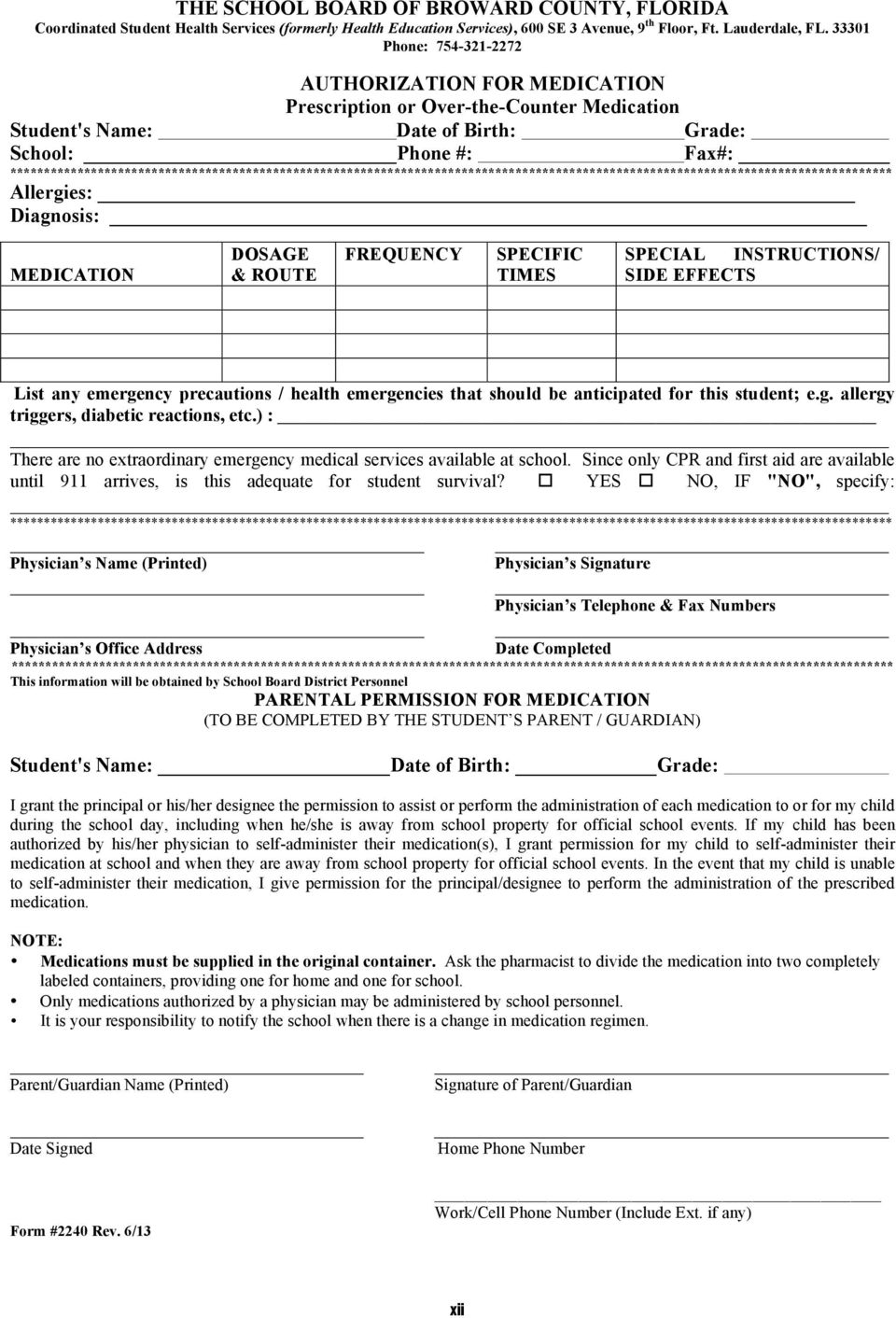
15 THE SCHOOL BOARD OF BROWARD COUNTY, FLORIDA Coordinated Student Health Services, 600 SE 3 Ave, 9 th Floor, Ft. Lauderdale, FL Phone: AUTHORIZATION FOR TREATMENT Student's Name: Date of Birth: Grade: School: Phone #: Fax#: *********************************************************************************************************************************** Diagnosis: Allergies: TREATMENTS DURING SCHOOL HOURS Treatment Plan: PROCEDURE Catheterization Feedings Suctioning TYPE o G-Tube o J-Tube o NG-Tube o Special o Oropharynx o Tracheostomy o Deep o Surface Tracheostomy o Tube Replacement o Care (Cleaning) MEDS / FEEDING AMOUNT FREQUENCY SPECIFIC TIMES RATE / FLOW CPT Oxygen /Misting Ventilator Nebulizer Tx Pulse Oximeter Are any of the above procedures required for emergency care? o YES o NO, IF "YES", specify: List any procedures the student has been trained to perform List any limitations / precautionary measures that should be considered; e.g. physical education, outdoor activities, transporting, lifting, moving, special devices / equipment: List any emergency precautions / health emergencies that should be anticipated for this student; e.g. allergy triggers, diabetic reactions, etc.): There are no extraordinary emergency medical services available at school. Since only CPR and first aid are available until 911 arrives, is this adequate for student survival? o YES o NO, IF "NO", specify: Physician s Name (Printed) Physician s Signature xiii Physician s Telephone & Fax Numbers Physician s Office Address Date Completed *********************************************************************************************************************************** This information will be obtained by School Board District Personnel PARENTAL PERMISSION FOR TREATMENT (TO BE COMPLETED BY THE STUDENT S PARENT / GUARDIAN) Student's Name: Date of Birth: Grade: I grant the principal or his/her designee the permission to assist or perform the administration of each treatment/procedure to or for my child during the school day, including when he/she is away from school property for official school events. If my child has been authorized by his/her physician to self-administer their medication(s), I grant permission for my child to self-administer their treatment at school and when they are away from school property for official school events. In the event that my child is unable to self-administer their treatment, I give permission for the principal/designee to perform the administration of the prescribed treatment. NOTE: Only treatments authorized by a physician may be administered by school personnel. It is your responsibility to notify the school when there is a change in treatment regimen. Parent/Guardian Name (Printed) Signature of Parent/Guardian Date Signed Home Phone Number Work/Cell Phone Number (Include Ext. if any)
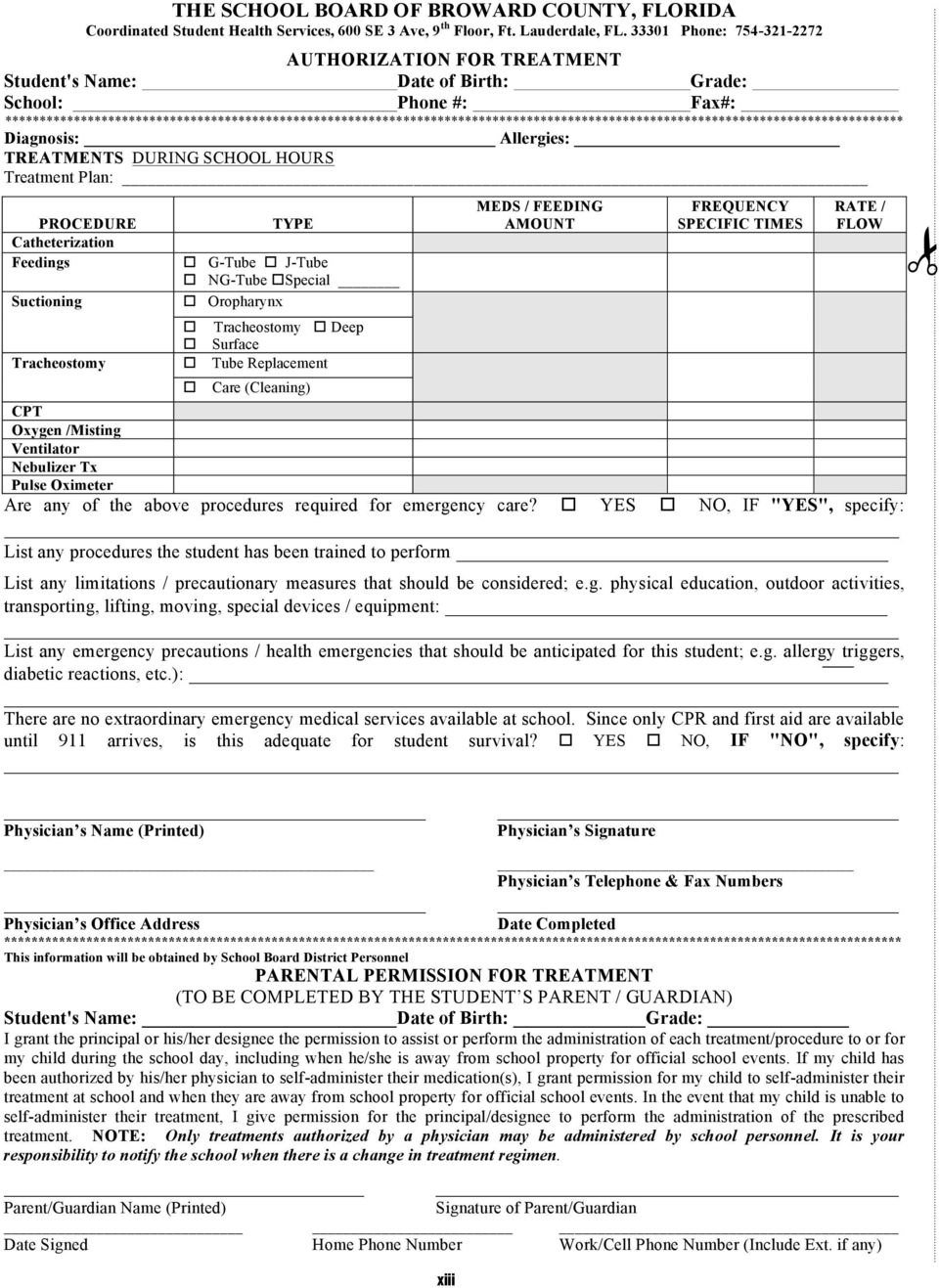
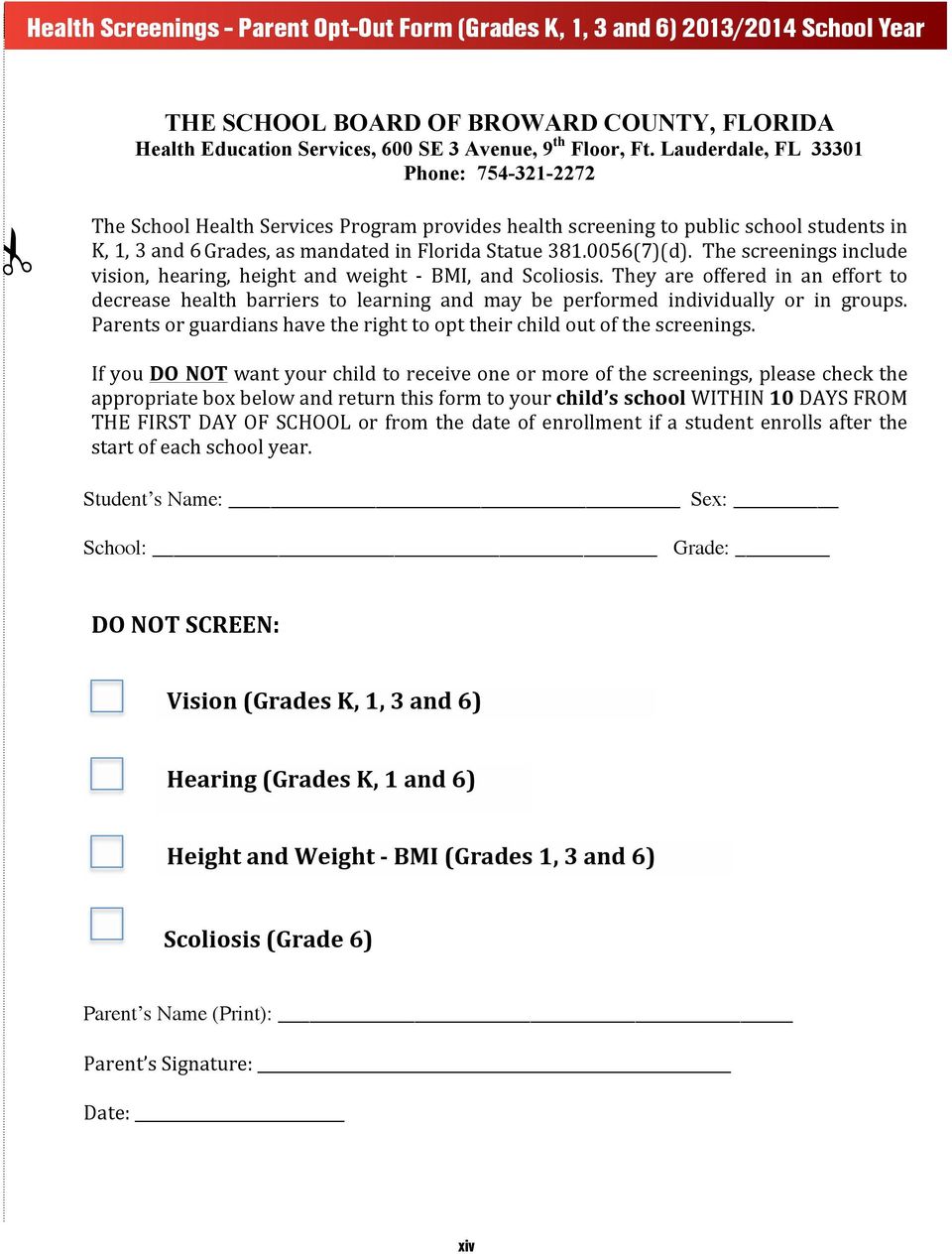
16 HEALTH Health SCREENINGS Screenings - Parent - Parent Opt Out Opt-Out Form (GRADES Form K, (Grades 1, 3 and 6) K, /2014 1, 3 and 6) School 2013/2014 Year School Year HEALTH SCREENINGS - PARENT OPT OUT FORM (GRADES K, 1, 3 and 6) THE SCHOOL BOARD OF BROWARD COUNTY, FLORIDA Health Education Services, 600 SE 3 Avenue, 9 th Floor, Ft. Lauderdale, FL Phone: The School Health Services Program provides health screening to public school students in K, 1, 3 and 6 Grades, as mandated in Florida Statue (7)(d). The screenings include vision, hearing, height and weight - BMI, and Scoliosis. They are offered in an effort to decrease health barriers to learning and may be performed individually or in groups. Parents or guardians have the right to opt their child out of the screenings. If you DO NOT want your child to receive one or more of the screenings, please check the appropriate box below and return this form to your child s school WITHIN 10 DAYS FROM THE FIRST DAY OF SCHOOL or from the date of enrollment if a student enrolls after the start of each school year. Student s Name: Sex: School: Grade: DO NOT SCREEN: Vision (Grades K, 1, 3 and 6) Hearing (Grades K, 1 and 6) Height and Weight - BMI (Grades 1, 3 and 6) Scoliosis (Grade 6) Parent s Name (Print): Parent s Signature: Date: xiv
17 Acknowledgment This booklet lists the District s rules in Policy 5.8, for students in Broward County Public Schools. The rules apply to all activities occurring on school grounds, on other sites being used for school activities, and on any vehicles authorized to transport students. Your signature below does not indicate that you agree or disagree with the rules, but rather that you have reviewed the electronic copy of these rules ( Return this form to school within 3 days from the first day of school or from the date of enrollment. Parents need to be involved in the education of their children and have the responsibility to: Know that for school safety, schools are not required to provide supervision more than 30 minutes prior to the official starting time, nor are they required to provide supervision for more than 30 minutes after the official closing time (F.S (2)). Know that for school safety, for students who ride a school bus, drivers are NOT permitted to let students off the bus except at the designated stop. Provide the school with the names of current emergency contact person(s) and/or telephone numbers on an annual basis and when there are changes. Notify the school of anything that may affect their child s ability to learn, to attend school regularly, or to take part in school activities. Be aware that medicine must be administered in accordance with SB Policy 6305, as may be amended, and that consequences for transmittal and/or sale or attempted sale of over-the-counter medications and possession and/or use of unauthorized medications can be found in SB Policy SB Policy 6305 outlines the rules regarding over-the-counter and prescription drugs and SB Policy 5006 outlines the consequences for violating those rules. You may view the complete health and suspension and/or expulsion policies, as well as all School Board policies, on the Web at: Be aware that parents have rights with regard to the privacy and confidentiality of student records that are maintained by schools as defined in Section VIII of this booklet. Neither the School Board of Broward County nor its employees will be held liable for items that are prohibited and are lost, stolen, or confiscated; or for wireless communication devices or other personal technology that is lost, stolen, or confiscated. Be aware that confiscated items not claimed by the end of the school year will be donated to local charities. Recognize that they are responsible for their student s behavior on the way to and from school and at the bus stop. A safe and respectful learning environment is key to academic achievement; therefore any student s off campus actions that seriously affect a student s ability to learn or a staff member s ability to teach may be handled as a disciplinary infraction. For serious incidents that occur at bus stops and/or that are not on School Board property, parents should contact law enforcement directly. For bullying incidents (see bullying definition, Section II), school officials should be notified and will investigate and/or provide assistance and intervention, as the principal/designee deems appropriate, which may include the use of the School Resource Officer. Ensure their child demonstrates legal, ethical and responsible use of technology including networks, digital tools, the Internet, and software, as defined in Section IV of this booklet. Parents will continue to maintain responsibility for students who reach the age of majority, (18 years or older), for all educational and discipline purposes, with exceptions as provided by statute. Student Name (PRINT) Student Signature Parent Signature Date xv

18 Preface - Guiding Principles Policy 5.8: Code for Student Conduct Adopted 7/23/13 Broward County Public Schools firmly believes a positive school culture promotes equal educational opportunity and establishes the framework for a safe learning environment. The Code for Student Conduct is comprised of a set of policies, rules, and laws by which order is established and maintained for the benefit of all. Discipline within a school must have the qualities of objectivity, consistency and equity. It is the responsibility of all school personnel, students, parents, external stakeholders and the greater community to ensure the school environment encourages a climate conducive to learning. The Code for Student Conduct is intended to be an instructive policy based on interventions and supports for students. However, when consequences are warranted, they shall be implemented based on a system of progressive discipline. Minor infractions and first offenses have less serious consequences than major infractions and repeat offenses. Factors such as age, grade level, social, emotional and intellectual development, and overall student rights and responsibilities shall also be considered. Disciplinary issues will be resolved by every means possible prior to exclusion from school. Equitable and reasonable procedures will be followed to assure students of their rights. Broward County Public Schools expects all stakeholders to demonstrate mutual respect for the rights of others. It is expected that all involved in teaching and learning fully accept their responsibilities to model and practice the Character Traits - Responsibility, Citizenship, Kindness, Honesty, Self-Control, Tolerance, Respect and Cooperation. Stakeholders responsibilities are outlined below. Responsibility of Students Attend school daily, be prepared for class and complete assignments to the best of their abilities Follow the Code for Student Conduct and school-based rules Model and practice the expected behaviors and character traits Notify school staff about any dangerous behavior, bullying or activity that occurs on school grounds, or off school grounds when it may result in disruption to the educational setting Accept and respect individual differences and people Bring only those materials to school that are allowed Keep parents informed of school-related issues and ensure communications are brought home Responsibility of Parents/Guardians Read the Code for Student Conduct Make sure your child attends school regularly and on time Notify the school of absences or tardiness in a timely manner Monitor your child s academic and behavioral progress Talk with your child about school and behavioral expectations Visit your child s school, as necessary Play an active role and support your child s educational experience Be a positive role model and practice the expected behaviors and character traits Teach your child to respect the rights and property of others Responsibility of Teachers Use well-planned, creative and engaging instructional plans daily Teach and review the Code for Student Conduct, as necessary Set expectations, teach, model and reinforce positive behavior xvi

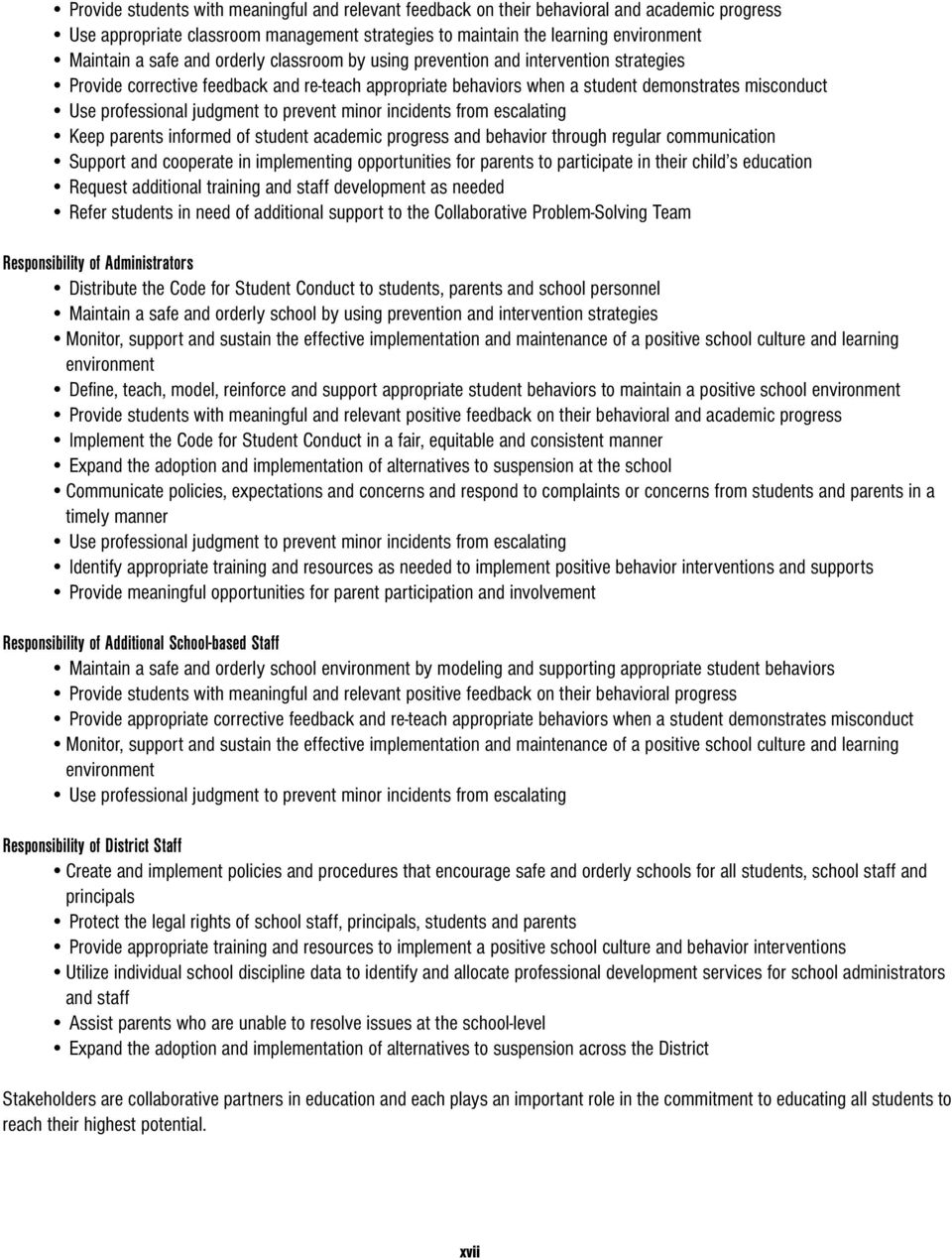
19 Provide students with meaningful and relevant feedback on their behavioral and academic progress Use appropriate classroom management strategies to maintain the learning environment Maintain a safe and orderly classroom by using prevention and intervention strategies Provide corrective feedback and re-teach appropriate behaviors when a student demonstrates misconduct Use professional judgment to prevent minor incidents from escalating Keep parents informed of student academic progress and behavior through regular communication Support and cooperate in implementing opportunities for parents to participate in their child s education Request additional training and staff development as needed Refer students in need of additional support to the Collaborative Problem-Solving Team Responsibility of Administrators Distribute the Code for Student Conduct to students, parents and school personnel Maintain a safe and orderly school by using prevention and intervention strategies Monitor, support and sustain the effective implementation and maintenance of a positive school culture and learning environment Define, teach, model, reinforce and support appropriate student behaviors to maintain a positive school environment Provide students with meaningful and relevant positive feedback on their behavioral and academic progress Implement the Code for Student Conduct in a fair, equitable and consistent manner Expand the adoption and implementation of alternatives to suspension at the school Communicate policies, expectations and concerns and respond to complaints or concerns from students and parents in a timely manner Use professional judgment to prevent minor incidents from escalating Identify appropriate training and resources as needed to implement positive behavior interventions and supports Provide meaningful opportunities for parent participation and involvement Responsibility of Additional School-based Staff Maintain a safe and orderly school environment by modeling and supporting appropriate student behaviors Provide students with meaningful and relevant positive feedback on their behavioral progress Provide appropriate corrective feedback and re-teach appropriate behaviors when a student demonstrates misconduct Monitor, support and sustain the effective implementation and maintenance of a positive school culture and learning environment Use professional judgment to prevent minor incidents from escalating Responsibility of District Staff Create and implement policies and procedures that encourage safe and orderly schools for all students, school staff and principals Protect the legal rights of school staff, principals, students and parents Provide appropriate training and resources to implement a positive school culture and behavior interventions Utilize individual school discipline data to identify and allocate professional development services for school administrators and staff Assist parents who are unable to resolve issues at the school-level Expand the adoption and implementation of alternatives to suspension across the District Stakeholders are collaborative partners in education and each plays an important role in the commitment to educating all students to reach their highest potential. xvii
20 Section A In order for teaching and learning to take place, a safe and secure school environment is essential. This policy provides specific information on the rules that all students are expected to adhere to, as well as consequences for violations of these rules. The rules apply to all activities occurring on the grounds or other sites being used for such activities and on any vehicle authorized to transport students to and from school, and other activities and various school functions. The School Board is not responsible for students, their conduct and activities, when attending non-school sponsored activities. Section B Florida law supports the active involvement of parents until the student graduates from school (F.S , , ). It is presumed that students are dependent students (as defined by FERPA 34 C.F.R 99.31(a)(8) and by Internal Revenue Code 152). Parents will be notified that when a student reaches the age of majority (18 years of age), the parent shall continue to perform the parental functions of a dependent student, including, but not limited to, provide excusal of absences and tardiness, permission slips for early release, field trips, other activities, as necessary, and to register or terminate (withdraw) school enrollment, until the student graduates, except under the following circumstances: (1) The student has been emancipated in compliance with Florida laws (F.S ) which provides the procedures for a court to remove the disabilities of nonage upon the filing of the appropriate papers and making the appropriate showing to the court. (2) When the student has no parent and this fact is verified by the school administrator (e.g., by communications with relatives, the Homeless Education Program, or the Florida Department of Children and Families, as is appropriate). (3) The student has submitted specific and acceptable documentation (such as rental agreement, lease, etc.) to establish that he or she is independent of his/her parents and that the presumption of dependency does not apply to him or her. xviii

21 1
22 The parent of a child of compulsory school age is responsible for the child s daily school attendance (F.S ). School staff, parents, students, and appropriate state agencies are expected to work together to ensure that laws are obeyed including, but not limited to, referral to the state designated agency for possible court action for extended absence or truancy (F.S ). SB Policy 5.5 outlines the rules that apply to attendance and attendance procedures. You may view this policy and all School Board policies on the Web at: Florida law supports the active involvement of parents until the student graduates from school (F.S , , ). This serves as notice to the parent, that when a student reaches the age of majority (18 years of age) the parent shall continue to perform the parental functions of a dependent student, including, but not limited to, provide reasons for absences and tardiness, permission slips for early release, field trips, other activities, as necessary, and to register or terminate (withdraw) school enrollment, until the student graduates. A student s presence in class is required to maximize the attainment of instructional objectives. For students who demonstrate patterns of non-attendance, interventions may be recommended. 2 Section I Attendance
23 Rights Students have a right to know how the District defines and handles excused absences, unexcused absences, and tardiness. The District s Discipline Matrix that assigns specific consequences for misbehavior is part of the school s discipline plan. The Discipline Matrix, attached hereto as Appendix A, is hereby made part of this Code for Student Conduct. The Discipline Matrix sets forth the guidelines for assessing consequences for violations of School Board policies. School principals have the discretion to deviate from these guidelines by assessing an appropriate consequence other than stated in the Matrix if he or she determines in his or her sole discretion that there are mitigating or aggravating circumstances. Students have a right to make-up work they missed during an excused absence or suspension. Students who are married, are parents, or are expectant mothers have a right to remain in the regular school program or to attend a special program designed to meet their needs. Students have a right to be protected from exposure to communicable diseases and infestations when in school. Responsibilities Students have a responsibility to attend all classes. Students have a responsibility to be on time for school and all classes. Students have a responsibility to ask their parents to notify the school when they are absent. Students have a responsibility to ask teachers for, and to complete, make-up assignments. Students have a responsibility to get medical advice and/or counseling about how to adjust their schooling for marriage, pregnancy, and parenthood. Students having or suspected of having a communicable disease are not allowed to attend school. In order to return to school, parents must obtain a doctor s note stating that the student is no longer contagious. Chickenpox is the only infectious disease that does not require a doctor s note. Rule The School Board of Broward County, Florida stresses the importance that all students attend school regularly and remain in school until they graduate from high school. However, a child who attains the age of 16 years [or age specified by state statute, whichever is older] during the school year is not subject to compulsory school attendance beyond the date upon which he or she attains that age if the child files a formal declaration of intent to terminate school enrollment with the District s School Board. The declaration must acknowledge that terminating school enrollment is likely to reduce earning potential and must be signed by the child and the child s parent. The school district must notify the child s parent of receipt of the child s declaration of intent to terminate school enrollment (F.S ). Declaration of Intent Forms are available at each school s administration office. Also be aware that students who drop out of school are not eligible to receive a driver s license or driver s permit or will have their license or permit revoked. NON-ATTENDANCE AND EARLY SIGNS OF TRUANCY IT IS IMPORTANT TO BE IN SCHOOL EVERY DAY. If your child is not in school, he or she MAY BE showing early signs of truancy through a pattern of non-attendance (SB Policy 5.5). WHAT IS A PATTERN OF NON-ATTENDANCE? A student may be establishing a pattern of non-attendance when: 1) He or she has an accumulation of tardiness, early sign outs, and/or absences (excused and unexcused) that exceed 5 days in one marking period or 10 days in 2 marking periods; or 2) He or she is absent and unexcused 5 days in 30 calendar days or 10 days in 90 calendar days (F.S (b)). 3
24 However, a student does establish a pattern of non-attendance when he or she has an accumulation of 15 unexcused absences within 90 calendar days, with or without a parent s knowledge (habitual truant) (F.S (8)). Parents and students may verify absences at any time at school or at home by contacting the school or by accessing electronic attendance records through Virtual Counselor. If after an accumulation of absences as noted above, the principal and/or his designee determines that the reasons for time out of school are invalid, the principal/designee shall refer the student to the Collaborative Problem Solving Team to determine if early patterns of truancy are developing and provide appropriate interventions (F.S (1)(b)), and/or the State Attorney s Office will be notified due to non-compliance with compulsory school attendance laws. However, if the principal and/or his designee determine that the reasons for the absences are valid and there are no early signs of truancy, the parent must provide a note (to be kept on file at the school) that provides the reasons for those absences. No further action will be taken. ABSENCE REPORTS Absences may be reported by telephone or written note. The report must come from a parent and give the date(s) of the absence(s) and the reason for the absence(s). Parents MUST report these absences within two (2) days, although school principals MAY make exceptions in cases of need. School staff members have a legal right to ask for a written medical excuse. For High School Only, absences for shared-time students must be reported to both schools. For Elementary Only, the Broward Truancy Intervention Program (BTIP) is a joint partnership program of the Broward State Attorney s Office and the School Board of Broward County. The program is designed to prevent excessive absences through parent notification and accountability, school interventions, and daily monitoring of attendance. Parents are expected to communicate with school personnel regarding absences. Parents who do not comply are referred to the State Attorney s Office for failure to comply with F.S which provides that a parent commits a misdemeanor of the second degree, punishable as provided by law, if the parent refuses or fails to have a child attend school regularly or refuses to participate in meetings concerning the child s truancy. EXCUSED ABSENCES Students must be in school. However, when it is necessary to be out of school, absences may be excused for one of the reasons listed below. (Students on field trips, in internal in-school suspension, or attending alternative-to-suspension programs are not considered absent.) Parents must report the absence the day before, the day of, or within 2 school days following the absence, or the absence will be considered unexcused. Any absence is unexcused until the school receives a telephone call or a note to excuse the absence. A reason for the absence must be provided and absences can only be excused for one of the eight School Board allowed reasons for absences. Some situations will require written documentation from a private physician or public health unit. Excused absences include: 1. Illness. Students who expect to miss at least 15 consecutive school days due to illness, a medical condition, or for social/ emotional reasons, or who would miss excessive days intermittently throughout the school year for the same reasons and could benefit from instruction, should obtain a copy of the Hospital/Homebound referral packet from the Hospital/Homebound contact person at their school. 2. Illness of an immediate family member. 3. Death in the family. 4. Religious holidays of the student s specific faith. 4 Section I Attendance
25 5. Required court appearance or subpoena by a law enforcement agency. 6. Special event. Examples of special events include important public functions, conferences, state/national competitions, college/ university campus tour/visit as well as exceptional cases of family need. 7. Scheduled doctor or dentist appointments. 8. Students having or suspected of having a communicable disease or infestation that can be transmitted are to be excluded from school and are not allowed to return to school until they no longer present a health hazard (F.S ). Examples of communicable diseases and infestations include, but are not limited to, fleas, head lice, ringworm, impetigo, and scabies. Students are allowed a maximum of five (5) days excused absence for each infestation of head lice. UNEXCUSED ABSENCES It is the responsibility of the school principal to ensure that parents are contacted after each unexcused absence and to ensure that there are specific, appropriate consequences/interventions as a result of each unexcused absence. Parents may receive letters to inform them of their student s unexcused absences. These letters are generated from official attendance records. 1. Absences are excused only for the reasons previously listed. If absences are not excused, as defined in the previous section, the absences are considered unexcused. This does not apply to suspensions. 2. Students without a completed Certificate of Immunization indicating compliance with the current required schedule of immunizations will not be allowed to attend classes until the certificate is provided or a waiver is obtained. Students who receive the first shot in a series of immunizations but who are late obtaining subsequent shots will be given 3 days grace period after which they will be excluded from school and the resulting absences will be considered unexcused. 3. For Secondary Only, students years of age who drop out of school or who have 15 unexcused absences within 90 calendar days and have a driver s license or driver s permit will have their driving privileges suspended by the Division of Highway Safety and Motor Vehicles or will not be issued a license or permit if they apply for one. Additional information about procedures and waivers is available from school administration or guidance offices. SUSPENSIONS 1. Students who have been assigned an out-of-school suspension and choose not to participate at the alternative-to-suspension site will be considered suspended. 2. Students who have been assigned an out-of-school suspension and do not attend all of the assigned days in the alternative-tosuspension site, those days that they do not attend will be considered suspended. MAKE-UP WORK 1. Make-up work for credit and grade is allowed for all excused absences. 2. Students have two (2) class days to make-up the work for each class day of an excused absence, not including the day of return. However, previously assigned work is due the day of return. These deadlines may be extended by the principal for extenuating circumstances. 5
26 3. Middle School Students: Make-up work for credit and grade is allowed for all absences due to the statutory promotion requirements to high school and the impact on course recovery. 4. For Secondary Only, when class work is not completed for a marking period due to excused absences, a grade of I may be given. Students must complete the work prior to the end of the next marking period and may earn a grade to replace the I. In extenuating circumstances, the principal has the authority to extend the deadline. But in most cases, when these deadlines are not met, the I changes to an F and may cause a semester course failure. If and when the class is repeated and students earn a grade, the I or the F will not be counted in computing grade point averages. 5. For Secondary Only, when a semester exam is not completed, a grade of I is given. If students are absent on an exam day, the exam must be made up in order for credit to be given. For each semester exam day students are absent, they will have two (2) days to make-up the exam, not including the day of return. These deadlines may be extended by the principal for extenuating circumstances. 6. Suspensions: Make-up work for credit and grade is allowed. It is the student s responsibility to get the missed work. All work is due on the day of return from the suspension. Student is NOT allowed to participate in any school activities during the suspension period. Students who are assigned in-school suspension are expected to be in school. These students must complete assignments and turn in work daily. For students who are not offered the option to attend an alternative-to-suspension site, specific homework assignments will be provided (F.S ). These absences will be considered suspensions. TARDINESS Tardiness is disruptive to the learning environment and can have a negative impact on student achievement. Tardiness may also count toward establishing a pattern of non-attendance that may indicate early signs of truancy. A pattern of non-attendance may be established by an accumulation of tardiness, absences (excused and unexcused), and early sign outs that exceed five (5) days in a marking period or ten (10) days in two (2) marking periods. 1. A tardy is excused for the same reasons that an absence is excused. Excused absences/tardiness include: illness, illness of an immediate family member, death in the family, religious holidays of the student s faith, required court appearance or subpoena by a law enforcement agency, special event, scheduled doctor or dentist appointments, or communicable disease. In extenuating circumstances, principals and/or their designee may also excuse a tardy for reasons other than those stated if documentation is provided. Parents must follow the same process to excuse a tardy as they do to excuse an absence. 2. Tardiness is defined as a student not being in the classroom when classes are scheduled to begin. A student who has an excused tardy (note or telephone call) should report directly to class after first checking in at the designated check-in area of the school. 3. Excessive tardiness will be addressed on a case-by-case basis to determine if there is a pattern of non-attendance. 4. Tardiness to any class without documentation may be considered unexcused. EARLY SIGN OUTS When students are signed out early on an ongoing basis, their academic performance may be negatively impacted. The school system strongly encourages parents to ensure their student is in school for the full school day every day. Signing out early may count toward establishing a pattern of non-attendance that may indicate early signs of truancy. A pattern of non-attendance may be 6 Section I Attendance
27 established by an accumulation of tardiness, absences (excused and unexcused), and early sign outs that exceeds five (5) days in a marking period or ten (10) days in two (2) marking periods. 1. All schools will establish procedures for early release that ensure that all students are treated consistently. 2. Students shall not be released within the final 30 minutes of the school day unless the principal/designee determines that it is an emergency or the student has a medical/dental appointment that cannot be reasonably scheduled at another time. 3. Excessive early sign outs will be addressed on a case-by-case basis to determine if there is a pattern of non-attendance. 7
28 8 This page was intentionally left blank.
29 9
30 Character education is woven into the policies and procedures of Broward County Public Schools. Responsibility, Citizenship, Kindness, Respect, Honesty, Self-Control, Tolerance, and Cooperation are the foundation of this Code for Student Conduct. Rights Students have the right to be treated with respect and honesty. Students have the right to privacy. Students have the right to a safe and orderly school. Responsibilities Students have the responsibility to demonstrate the character education traits. Students have the responsibility to treat others with respect and honesty. Students have the responsibility to respect the rights of others. Students have the responsibility to treat school property and the property of others with respect and to act in a way that does not interfere with the rights of others and is not harmful to the health and safety of others. Students have the responsibility to provide information on any potentially dangerous situations to a staff member or through one of the anonymous tip lines provided by the school system (see the BrowardSchools.com website). Rule It is important for students to know their rights and responsibilities, which include obeying teachers and all other school employees, obeying each individual rule as defined by the school, and obeying bus drivers. Students are expected to honor their responsibilities and behave in ways that respect the rights of all. Consequences for unacceptable behaviors are found in the Discipline Matrix - see Appendix A. EXPECTED BEHAVIORS Treat others with respect and honesty Prepare for class by bringing paper, pencil, pen, books, and other needed supplies Complete all class work and homework Use class time properly Take home and return necessary forms Follow rules and regulations, including those for field trips Take care of and return all textbooks, library books, or other school-owned materials loaned to them Act responsibly on campus, on buses, on field trips, and at all school-sponsored events, regardless of location Wear properly fitted safety-rated helmets when riding a bicycle. Law enforcement officers may issue traffic citations and assess fines to riders under age 16 who do not comply (F.S ) Secondary students must wear identification (ID) badges, if the school has the infrastructure and/or funding in place to require ID badges and the school s handbook specifies the rules and consequences for ID badges 10 Section II Respect for Persons and Property
31 UNACCEPTABLE BEHAVIORS LEADING TO DISCIPLINARY ACTION ATTENDANCE INCIDENTS Leaving class or school without permission Not attending school (truancy) Being tardy excessively Skipping class Out of assigned area RULE VIOLATION INCIDENTS (INCLUDING, BUT NOT LIMITED TO) Violating the dress code Taking, possessing, displaying, distributing, and/or transmitting pictures using a camera telephone during the school day. Note: Use of a camera telephone may result in additional consequences (beyond confiscation) if used to take pictures that are pornographic or obscene or to break rules or laws Littering DISRUPTIVE INCIDENTS (INCLUDING BUT NOT IMITED TO) Disturbing the class or school by: being disrespectful or rude, refusing to obey any staff member, failing to follow classroom rules, running in the halls, throwing objects, possessing or igniting fireworks or firearms, fighting, gambling, or bringing distracting items to school. Examples of distracting items include, but are not limited to: skateboards, scooters, in-line skates/roller blades/heelies (sneakers with wheels), toys, playing cards, games, cigarette lighters, radios, audio recorders, or laser pointers/pens and other laser devices Sole possession of a wireless communication device is not a violation of the Code for Student Conduct. However, the possession of a wireless communication device which disrupts the educational process; the use of a wireless communication device during school hours; except as indicated below; the use of a wireless communication device on school buses in the absence of an emergency concerning safety-to-life issues (defined as a bus accident, mechanical breakdown which delays the normal route, and/or thirty (30) minutes or more in a route delay); and the possession or use of a cellular telephone (other than text messaging that does not disrupt the bus driver), would be a violation of the Code for Student Conduct, subjecting violators to progressive discipline. [Note: School Board employees will not be held liable for wireless communication devices that are lost, stolen, or confiscated. Violations of this policy will result in confiscation, and the device will only be released to the parent. F.S (2)(e) requires school districts to notify parents that students who use wireless communication devices in the commission of a criminal act may face school disciplinary action and/or criminal penalties.] Students will not be subject to disciplinary action for the use of their cell phones or other personal technology used to report a potentially dangerous situation. Sole possession of personal technology is not a violation of the Code for Student Conduct. Personal technology, should be turned off and kept out-of-sight during all instructional and class time activities. No cell phones or other personal technology may be used for communication purposes except under the direction of a teacher or administrator for instructional purposes. Using personal technology during all non-instructional or non-class time activities or during class time at the direction of a teacher will not be subject to discipline under this policy. Time before or after school, passing time between classes, or during lunch is not considered instructional time for secondary students. For elementary students, instructional time is defined as time from the beginning bell until the end of the school day bell: non- instructional time is time prior to the first bell or the bell at the end of the school day. When personal technology is used, headphones, ear buds or other accessories must be used so that it can not be heard by others. Violations of this policy will result in confiscation, and the device will only be released to the parent. Progressive discipline will apply for repeated violations. 11
32 Using scooters and inline skates/rollerblades/heelies in the school building Behaving inappropriately on field trips Possessing pornographic/obscene material or drug paraphernalia at school Misrepresenting oneself by cheating, copying, plagiarizing, counterfeiting, using false identification, or making false reports by posing as a parent to excuse absences or tardiness, sign a report card, etc. Unauthorized possession or use of school/county documents or forms Abusing another student or staff member including, but not limited to, verbal abuse, actual or threatened physical harm, extortion, destruction of personal property, intentionally making a false accusation, or intentionally providing misinformation Conducting, recruiting, or participating in youth gang activities on campus Using gang-related or cult-related gestures, language, and/or signs Unauthorized presence on school property For Secondary Students Only, parking a motorized vehicle on school grounds without an official permit or in unauthorized areas Endangering the lives of students and staff by setting off unfounded fire alarms Gambling SUBSTANCE ABUSE/DRUG INCIDENTS (INCLUDING, BUT NOT LIMITED TO) Possessing or using drugs, alcohol, and/or tobacco products, including unauthorized over-the-counter medications or unauthorized prescription medications Sale or attempted sale and/or transmittal of drugs, alcohol, and/or tobacco products, including authorized or unauthorized over-thecounter medications or prescription medications Possessing drug paraphernalia ACTS AGAINST PERSONS (INCLUDING, BUT NOT LIMITED TO) Bullying and/or harassment Cyberbullying Taking part in physical acts of a sexual nature, engaging in sexual harassment, or offending others by indecent exposure Using insulting, abusive, profane, racially or sexually offensive written or oral language, or making obscene remarks or gestures Harassing others because of age, color, gender, gender identity, gender expression, national origin, marital status, race, religion, or sexual orientation Harassing others because of a disability Harassing others because of ethnicity, socio-economic background, or linguistic differences Harassing others because of physical appearance or for any other reason Hazing Threatening, stalking, hitting, or hurting a teacher or other school personnel Intentionally making a false accusation that jeopardizes the professional reputation, employment, or certification of a teacher or other member of a school staff Committing a hate crime See definitions section PROPERTY INCIDENTS (INCLUDING, BUT NOT LIMITED TO) Damaging, destroying, or vandalizing school property Misusing technology Starting a fire (arson) Committing petty theft 12 Section II Respect for Persons and Property
33 Breaking and entering/burglary OTHER CRIMINAL INCIDENTS (INCLUDING, BUT NOT LIMITED TO) Having and/or hiding a weapon (see definitions of weapons) Threatening or hurting a person with a weapon Committing robbery Forcing someone to give money, possessions, or other things of value to another or oneself (extortion) Endangering the lives of students and staff by failing to report a threat of violence against others Making a bomb threat Sexual battery Kidnapping or abduction Homicide Committing other criminal acts DEFINITIONS Hazing means any action or situation that recklessly or intentionally endangers the mental or physical health or safety of a student regardless of: 1) the student s willingness to participate or; 2) that the conduct or activity was not sanctioned by the organization or; 3) that the activity was not done as a condition of membership to an organization (F.S ). Hate crime refers to an attack or offense against an individual or his/her property in which the individual is intentionally selected because of his/her race, color, religion, national origin, gender, gender identity, gender expression, disability, or sexual orientation. The attack or offense may range from racial remarks or graffiti on school walls to threats of physical harm, intimidation, hate mail and hate , vandalism, arson, physical assault, etc. Students who believe they have been victims of a hate crime must immediately report the act to a teacher and/or school administrator. Broward District Schools Police conducts hate crime investigations. National origin pertains to, but is not limited to, an individual s or his/her ancestor s place of origin, as well as, physical, cultural, or linguistic characteristics. Bullying means systematically and chronically inflicting physical hurt or psychological distress on one or more students or employees. It is further defined as unwanted purposeful written, verbal, nonverbal or physical behavior, including, but not limited to, any threatening, insulting, or dehumanizing gesture, by an adult or student, that has the potential to create an intimidating, hostile, or offensive educational environment or cause long term damage; cause discomfort or humiliation; or unreasonably interfere with the individual s school performance or participation, is carried out repeatedly and is often characterized by an imbalance of power. Bullying may involve, but is not limited to: 1. Unwanted teasing 2. Threatening 3. Intimidating 4. Stalking 5. Cyberbullying 6. Physical violence 7. Theft 8. Sexual, religious, or racial harassment 9. Public humiliation 10. Destruction of school or personal property 11. Social exclusion, including incitement and/or coercion 12. Rumor or spreading of falsehoods 13
34 Sexting the use of a computer, or any other device capable of electronic data transmission or distribution, to transmit or distribute to another, any photograph or video of any person, which depicts nudity as defined in F.S (1) (a). Harassment means any threatening, insulting, or dehumanizing gesture, use of technology, computer software, or written, verbal or physical conduct directed against a student or school employee that: 1. Places a student or school employee in reasonable fear of harm to his or her person or damage to his or her property; 2. Has the effect of substantially interfering with a student s educational performance, and employee s work performance, either s opportunities, or benefits; 3. Has the effect of substantially negatively impacting a student s or employee s emotional or mental well-being; or 4. Has the effect of substantially disrupting the orderly operation of a school. Cyberstalking as defined in F.S (d) means to engage in a course of conduct to communicate, or to cause to be communicated, words, images, or language by or through the use of electronic mail or electronic communication, directed at or about a specific person, causing substantial emotional distress to that person and serving no legitimate purpose. Cyberbullying is defined as the willful and repeated harassment and intimidation of a person through the use of digital technologies, including, but not limited to, , blogs, texting on cell phones, social websites (e.g., MySpace, Facebook, Twitter, etc.), chat rooms, sexting, instant messaging, or video voyeurism. Note: Per F.S , voyeurism, which may be utilized in cyberbullying, in and of itself, is a criminal offense. Bullying, Cyberbullying, and/or Harassment also encompasses: 1. Retaliation against a student or school employee by another student or school employee for asserting or alleging an act of bullying, harassment, or discrimination. 2. Retaliation also includes reporting a baseless act of bullying, harassment, or discrimination that is not made in good faith. 3. Perpetuation of conduct listed in the definition of bullying, harassment, and/or discrimination by an individual or group with intent to demean, dehumanize, embarrass, or cause emotional or physical harm to a student or school employee by: a. Incitement or coercion; b. Accessing or knowingly and willingly causing or providing access to data or computer software through a computer, computer system, or computer network within the scope of the district school system; or c. Acting in a manner that has an effect substantially similar to the effect of bullying, harassment, or discrimination. Bullying, Cyberbullying, Harassment, and Discrimination also encompass, but are not limited to, unwanted harm towards a student or employee in regard to their real or perceived: sex, race, color, religion, national origin, age, disability (physical, mental, or educational), marital status, socioeconomic background, ancestry, ethnicity, gender, gender identity or expression, linguistic preference, political beliefs, sexual orientation, social/family background or being viewed as different in its education programs or admissions to education programs and therefore prohibits bullying of any student or employee by any Board member, District employee, consultant, contractor, agent, parent, visitor, volunteer, student, or other person in the school or outside the school at school-sponsored activities or events, on school buses, and at training facilities or training programs sponsored by the District. 14 Section II Respect for Persons and Property
35 Disciplinary sanctions may be imposed when the alleged bullying, cyberbullying, harassment or discrimination takes place off campus provided that a nexus exists between the off campus conduct and conduct at a school or during a school sponsored event. This is determined on a case-by-case basis after reviewing the facts and circumstances unique to each situation. If a sufficient nexus exists, appropriate discipline shall be issued in accordance with this policy and as provided for in current law. Nothing in this section shall be construed to abridge the rights of students or school board employees that are protected by the First Amendment to the state or federal constitutions. ( )(10). Note: Suspected acts of persistent bullying encompassing Discrimination relating to any Protected Category by any student, Board member, District employee, consultant, contractor, agent, visitor, volunteer, student, or other person in the school or outside the school at school-sponsored activities or events, on school buses, and at training facilities or training programs sponsored by the District (refer to the School Board of Broward County (SBBC) Policy , Nondiscrimination Policy Statement) shall be reported to the school based administration, but the complaint shall also be filed with, and investigated by, the EEO/Title IX Coordinator (754) SCHOOL BUS BEHAVIOR Misconduct by any student while riding a school bus represents a serious threat to the safety of all occupants of the bus as well as other motorists, pedestrians, and members of the community. All rules that apply to the school grounds and school activities also apply to the school bus. Parents are responsible for their student s behavior on the way to and from school and at the bus stop. While the District does not assume any liability for incidents that occur at a bus stop or en route to and from school, a student, parent, or witness may file a complaint following the same procedures for bullying against a student and the school will investigate and/or provide assistance and intervention as the principal/designee deems appropriate, which may include the use of the School Resource Officer. The principal/designee shall use all District Reporting Systems to log all reports and interventions. Unacceptable Behaviors on a School Bus Leading to Disciplinary Action Level One Violations Eating or drinking on the bus Failing to sit in the seat assigned by the bus operator Level One Consequences First Offense Verbal or written reprimand from the school principal or designee. Second Offense Parent Conference. Third Offense 3-day suspension from school bus transportation. Repeated Offenses Repeated Level One unacceptable behaviors will be considered willful disobedience and/or open defiance of authority, resulting in suspension from the bus for the remainder of the school year and/or suspension and/or possible expulsion from school. Level Two Violations Disrupting, distracting, or disobeying a bus operator Failing to utilize required safety equipment on the bus Getting out of the seat while the bus is in motion Loud talking, inappropriate remarks, or spitting out of the bus window at other students, pedestrians, or motorists 15
36 Level Two Consequences First Offense Verbal or written reprimand from the school principal or designee. Second Offense 1-day to 10-days suspension from school bus transportation. Repeated Offenses Repeated Level Two unacceptable behaviors will be considered willful disobedience and/or open defiance of authority, resulting in suspension from the bus for the remainder of the school year and/or suspension and/or possible expulsion from school. Level Three Violations Placing head, arms, or legs outside the window of the bus Opening a school bus emergency door and/or exiting the bus when the bus is stopped, unless directed by the school bus operator in an emergency or during an evacuation drill Threats against the bus operator, bus attendant, or passengers on the bus Use of profanity Fighting on the bus Smoking on the bus Opening a school bus emergency exit door while the bus is in motion Throwing objects out of the window of the bus, which may or may not cause injury to persons or physical damage Throwing objects at a bus after leaving the bus, which may or may not cause injury to persons or physical damage Vandalism of seats or other bus equipment Boarding or attempting to board a bus route other than the student s assigned bus route or attempting to leave the school bus at other than the student s assigned bus stop without permission of the school principal or designee Level Three Consequences First Offense 1-day to 10-days suspension from school bus transportation and/or school. Second Offense 10-days suspension from school bus transportation and/or school. Third Offense Repeated Level Three unacceptable behaviors will be considered willful disobedience and/or open defiance of authority, resulting in suspension from the bus for the remainder of the school year and/or suspension and/or possible expulsion from school. *For IDEA-eligible ESE students, suspension and expulsions shall follow applicable laws, School Board policies, and provisions of the Individual Education Plan (IEP). Likewise, for students determined to be disabled under Section 504 of the Rehabilitation Act of 1973, suspension, expulsion, and other disciplinary measures shall follow applicable laws, School Board policies, and provisions of the Section 504 Accommodation Plan. The principal or designee may review individual cases before assigning consequences. Discrimination and/or Harassment The School Board of Broward County, Florida, prohibits any policy or procedure which results in discrimination on the basis of age, color, disability, gender identity, gender expression, national origin, marital status, race, religion, sex or sexual orientation. If any **student feels that he or she has been discriminated against or harassed, there are specific procedures to report such offenses. See p. 66 for further information. **Whenever the word student appears, parents may become involved. 16 Section II Respect for Persons and Property
37 FORMS OF DISCRIMINATION Harassment is a form of discrimination. Harassment based on age, color, disability, ethnicity, gender, gender identity, gender expression, linguistic differences, *national origin, marital status, race, religion, or sexual orientation are violations of School Board policies, civil rights laws and statutes and should be addressed in a similar manner as detailed above. *National origin pertains to, but is not limited to, an individual s or his/her ancestor s place of origin, as well as physical, cultural, or linguistic characteristics. SEXUAL HARASSMENT AND SEXUAL VIOLATIONS Sexual harassment is a form of sex discrimination that violates the Civil Rights Act of 1964, Title IX of the Education Amendments of 1972, and SB Policy Sexual violence is a physical act of aggression that includes a sexual act of sexual purpose. Sexual violence is also a violation of these same statutes and may also represent a criminal law violation. The school district prohibits any form of sexual harassment and sexual violence. Sexual harassment and sexual violence are unlawful and will be grounds for disciplinary action. Students who believe they have been victims of sexual harassment or sexual violence should report the alleged act immediately to a teacher and/or school administrator. Because sexual harassment can take on many forms, the following are some examples of sexual harassment/violence. SEXUAL HARASSMENT/SEXUAL VIOLENCE DEFINED Sexual harassment consists of unwelcome sexual advances, requests for sexual favors, sexually motivated physical conduct, or communication of a sexual nature. Sexual harassment includes, but is not limited to, the following behaviors: Unwelcome statements of a sexual nature Unwelcome solicitation or pressure for sexual activity Intentional brushing against, patting, or pinching of another s body Suggestive or obscene letters, notes, invitations, derogatory comments, slurs, jokes, epithets, unwanted physical contact, and blocking movements Leering with sexual overtones, gestures, display of sexually suggestive objects, posters, or cartoons Indecent exposure NOTE: Section 504 of the Rehabilitation Act of 1973 and the Americans with Disabilities Act of 1990 (ADA) SB Policy , Section 504 of the Rehabilitation Act of 1973, and the Americans with Disabilities Act of 1990 (ADA) prohibits discrimination against any students with regard to access to programs, services, and activities on the basis of disability. If any student feels he or she has been discriminated against because of such disabilities or perception of a disability, there are specific procedures to report such offenses located in Section X. PEA E VIOLENCE 2010 BCPS 17
38 18 This page was intentionally left blank.
39 19
40 Appropriate dress and grooming can help to create a positive learning environment. Other attire may be allowed for special school activities with approval of the school administration. Possible consequences for violating the dress code are found in the Discipline Matrix. Changes in clothing trends will not override the dress code policy. Rights Students have a right to wear stylish clothes of their choice as long as those clothes are appropriate for school, are not dangerous to health and safety, and do not create a substantial and material disruption of the school. Responsibilities Students have a responsibility to dress neatly appropriately, to be clean and well groomed. Rule All students are expected to honor their responsibilities and dress in a way that respects the rights of others. 1. Footwear must be worn at all times. For grades K-12, bedroom slippers are not allowed, and for elementary students, backless footwear is not allowed. Additionally, elementary students may not wear backless, sling-backs, or open-toed footwear. Socks may not be worn with backless shoes as a substitute back for backless shoes. 2. Special clothing, including footwear, may be required for safety reasons in certain programs or activities such as physical education, home economics, career/technical education, and science. 3. Revealing clothing or clothing that exposes the torso is not allowed. Examples include, but are not limited to: tank tops or spaghetti straps without overblouses (long shirts) or jackets; see-through garments; mini-skirts or mini-dresses; halters; backless dresses; jackets, shirts, or blouses tied at the midriff; and bare midriff outfits. 4. Clothing which is not worn appropriately, is not properly fastened, or has tears that are *indecent will not be permitted. All trousers, including oversized or low-hanging trousers, must be worn and secured at waist level. 5. Garments including, but not limited to, pajamas, boxer shorts, bloomers, and bustiers, which were traditionally designed as undergarments, sleepwear, or beachwear, may not be worn as outer garments. Other clothing not allowed are: leggings without overblouses (long shirts) that reach mid-thigh, tights, bodysuits, or hosiery, including those with lace trim, and bicycle racing attire unless they are worn underneath dresses, skirts, or shorts of appropriate length. Appropriate T-shirts may be worn as outer garments. 6. Clothing that exposes the upper thigh is not allowed. Shorts that are not shorter than mid-thigh, including walking shorts, Bermuda shorts, and split skirts (culottes), are allowed. For Pre-K through 3, shorter shorts may be worn since these are standard attire for these ages. 7. Clothing, jewelry, buttons, haircuts, or other items or markings which are, *suggestive, *revealing, or *indecent, associated with gangs or cults, encourage the use of drugs, alcohol, or violence, or support discrimination on the basis of age, color, disability, ethnicity, gender, gender identity, gender expression, linguistic differences, marital status, national origin, race, religion, socioeconomic background, sexual orientation, physical appearance, or on any other basis are not allowed. 8. Head coverings including, but not limited to, caps and hats are not allowed unless they are necessary for safety in programs such as home economics, technology education, vocational education, and athletics or are worn for religious or medical reasons. Bandannas are not allowed. Hats, that do not violate #7 above, are allowed to be worn outdoors for physical education and recess 20 Section III Dress Code
41 as a safety precaution from sun damage. 9. Curlers and other hair grooming aids are not allowed. Personal grooming including, but not limited to, combing, brushing, and/or spraying hair, and applying cosmetics is allowed only in restrooms and/or designated areas. 10. Sunglasses may not be worn indoors unless a doctor s authorization is on file. Sunglasses are allowed to be worn outdoors for physical education and recess as a safety precaution from sun damage. 11. Any articles of clothing or jewelry that may cause injury including, but not limited to: items with spikes or sharp objects, wallet chains, and heavy link chains are not allowed. 12. Parents/guardians may request exemptions for their students from participation in the mandatory unified dress program, and shall be informed by the principal, in writing, of the following procedure in this regard: a. Parents/guardians may request an application for exemption from the current school. b. An application for exemption must be made annually. c. The application for exemption must be completed in full and must be submitted to the school principal within the first ten (10) school days of a student s initial attendance. d. The school principal (or a designated school administrator) shall communicate with the parents to discuss the unified dress policy and the nature of the request for the exemption. The purpose of this communication shall include: (1) Ensuring that the parents/guardians understand the unified dress policy and its intent. (2) Verifying the accuracy of the information on the application for an exemption. e. The principal s response in this regard shall be transmitted to the parents/guardians in writing via the Application For Exemption form within ten (10) school days of submission. Principal may only deny an application if the application is received on or after the 11th school day after enrollment. 13. Violators of the uniform policy (SB Policy 5309) shall be subject to the same penalties as violators of the dress code policy. For further clarification, see the District s Discipline Matrix that assigns specific consequences and is part of the attached school s discipline plan. You may view the complete uniform policy and all School Board policies on the Web at: *Indecent, suggestive, and revealing refer to exposure of private body parts and/or pictures or words with a sexual connotation. 21
42 22 This page was intentionally left blank.
43 23
44 Computers, networks, and online communications and information systems such as the Internet and are becoming more commonplace in our classrooms and media centers every year. Digital Curriculum and Resources for students provided by SBBC are becoming commonplace via the Broward Enterprise Education Portal (BEEP) and accessible via the Internet. While these systems deliver a huge number of resources to our classrooms, their ability to serve students and teachers depends on the responsible and ethical use of every device and system. Use of the school district s technology and/or software for any unauthorized purpose is prohibited. This includes the unauthorized use of a computer/technology, including, but not limited to, accessing or breaking into restricted accounts or networks, creating, modifying or destroying files/records without permission, copying software, entering, distributing or printing unauthorized files/records, uploading to the Internet and/or sharing or distributing, offensive or inappropriate material, including video, and any other misuse or violation of the School Board of Broward County Technology-Acceptable Use Policy 5306, Section 6. Rights Students have a right to use appropriate online communications and information systems, the Internet and networks to increase their access to information and resources. Students have a right to use appropriate online communications and information systems, the Internet and networks to obtain information, create intellectual products, collaborate and communicate for educational purposes. Students have a right to use appropriate online communications and information systems, the Internet and networks without the fear that their products or their personal reputation will be violated, misrepresented, tampered with, destroyed, or stolen. Responsibilities Students have a responsibility to understand the difference between appropriate and unacceptable uses of online communications and information systems, the Internet and networks. Students have a responsibility to use online communications and information systems, the Internet and networks in a responsible, efficient, ethical, and legal manner in accordance with their educational mission. Students have a responsibility to recognize that the use of online communications and information systems, the Internet and networks is a privilege that can be withdrawn if they engage in unacceptable or illegal use of this resource. Rule Students are expected to use technology responsibly. SB Policy 5306 defines the appropriate use of technology throughout the District. This policy describes how computers and networks must be used to support research and instructional activities in our classrooms, labs, and media centers. It also includes the use of the digital resources provided by SBBC and made available through the Broward Education Enterprise Portal (BEEP) for students. First, it promotes the use of technology as a powerful educational tool that is increasingly becoming a common part of every student s day. Second, it provides those students who use these computers, and the networks to which they are connected, to act in accordance with prescribed rules and behavioral codes detailed in the policy. Several major provisions are noted below. The full text of SB Policy 5306 is available upon request from each school s media center and on the School Board web site. You may view the complete technology policy and all School Board policies on the Web at: Major Policy Provisions: Use of computers, networks, the Internet and online communication and information systems must be related to students educational activities Students must recognize that computers, networks, and equipment used to support online learning are shared devices and agree 24 Section IV Technology Usage
45 to use them in ways which will maintain their continued operability for all users No illegal activity may be conducted using the District s computers, networks, or online communication and information systems Students must not access or distribute offensive, obscene, inflammatory, or pornographic materials, or participate in sexting (see Section II for the definition) Students shall not intentionally spread, or attempt to spread computer viruses, vandalize data, infiltrate systems, or degrade/ disrupt computer and/or network performance All users of computers, networks, and online communications and information systems shall adhere to laws regarding copyright FCAT Administration Policy It is unlawful for anyone knowingly and willfully to violate test security rules adopted by the State Board of Education for mandatory tests, such as FCAT, and knowingly and willfully fail to follow test administration directions specified in the test administration manuals (F.S ) The FCAT Administration Manual states: During FCAT testing, possession of any electronic device that reproduces, transmits, calculates, or records is cause for invalidation. Possession is defined as within arm s reach, even if the electronic device is not visible. For example, students [shall] not have cellular phones in their pockets, clipped to their belts, at their desks, or anywhere they can be easily accessed during testing. Schools will direct students on the appropriate storage of electronic devices during testing It is strongly advised that you do not bring a cell phone or any other prohibited electronic device to any testing environment including but not limited to: Advanced Placement exams, PSAT or International Baccalaureate. If your electronic device makes any noise, or you are seen using it at any time including breaks you may be dismissed immediately, your scores may be canceled, and the device may be confiscated Illegally using school district technology and/or software to alter information is a felony. Misusing school district technology and/ or software to transmit insulting, profane, racially or sexually offensive written language, or to make obscene remarks or gestures is unacceptable behavior that will lead to disciplinary action. Using technology including, but not limited to, computers, networks, online telecommunication systems, cellular telephones, and camera telephones to bully, extort, or libel another student or staff member is a violation of the Code for Student Conduct and will result in disciplinary action. 25
46 Broward County Public Schools Social Media Use Guidelines Broward County Public Schools (BCPS) realizes that part of 21st century learning is adapting to the changing methods of communication. The importance of teachers, students and parents engaging, collaborating, learning, and sharing in these digital environments is a part of 21st century learning. As such, educational standards are now requiring the use of online educational tools to demonstrate proficiency. To address related issues, BCPS has developed the following guidelines to provide direction for employees, students and the school district community when participating in online social media activities. Social Media refers to the use of web-based and mobile technologies that enable all Broward County Public Schools internal and external stakeholders to connect, collaborate, and form virtual communities via the computer and/or Internet. For some, social media is used mainly for social purposes, but for others, these sites and technologies are used as tools to teach and to connect with the community. The First Amendment, in general, protects the rights of individuals to participate in social media. However, the laws and courts have ruled that schools can discipline students and staff if their speech, including online postings, disrupts school operations or constitutes a violation of federal or state laws or School Board policies. The BCPS social media guidelines allow employees to participate in online social activities. However, when participating it is important to create an atmosphere of trust and individual accountability; keeping in mind that information produced by BCPS staff and students is a reflection on the entire district and is subject to the District s School and District Technology Usage (Policy 5306), Acceptable Use Policy (AUP), Federal and State Statutes, Educator Code of Ethics and the Principles of Professional Conduct for the Education Profession in Florida, and other related applicable policies and guidelines. By utilizing social media staff, students and parents agree to abide by these guidelines. Please read them carefully before using, posting, or commenting on any social media sites. It is important to remember that parents and guardians play a critical role in supporting and reinforcing these objectives. General Etiquette for Social Media Be Honest/Truthful: Always be transparent about who you are and who you represent. How you represent yourself online is an extension of yourself. Do not misrepresent yourself by using someone else s identity. Maintain confidentiality: Do not post any confidential or proprietary information in regards to yourself and/or others. Students can reveal some information about themselves (ethnicity, political beliefs, stance on issues, interests) but should not offer any confidential information (place of residence, phone number, discretely identifiable information, common hang-out locations). Know You Are Always On : You must assume that your social media usage is visible to the world. Be sure to manage what and with whom you are sharing. Keep in mind that while we all have occasional frustrations, social media are not the best venues in which to air frustration as those comments are available to everyone. Be Respectful: Avoid remarks that are off topic or offensive. Always demonstrate respect for others points of view, even when they re not offering the same in return. Never bully, pick fights, and do not respond to abusive comments. If you are sharing a negative experience, please try to do so in a constructive way. Think Ahead: Be smart about protecting yourself, your privacy and the privacy of others, and confidential or personal information. What you publish is widely accessible and will be around for a long time so consider the content and consequences carefully. Show good judgment as future employment and/or academic opportunities may be adversely affected by your comments. The Internet is not anonymous, nor does it forget: Everything written on the Web can be easily traced back to its author. Information is backed up often and repeatedly, and posts in one forum are usually replicated in others through trackbacks and reposts or references. Avoid hazardous materials: Do not post or link to any materials that are inflammatory, defamatory, harassing or indecent. Your online behavior should reflect honesty, respect, and consideration. When bringing your own technology to work make sure that you follow the guidelines set out in the BCPS Personally Owned Device Guidelines. 26 Section IV Technology Usage
47 Faculty and Staff Guidelines Personal information of the employees and other individuals associated with the services that we are delivering to our students and staff must not be shared on or disclosed through social media. When contributing online, do not post confidential student or employee information. No last names, school names, addresses or phone numbers should appear on social media sites. No student identifiable information, as defined in FERPA, can be posted on social media sites. As part of Policy 5306, faculty and staff are prohibited from using student photographs on personal social media sites, and can only use them on District approved social media sites in accordance with Board policies and applicable laws. BCPS employees are personally responsible for the content they publish online. Be mindful that what you publish could be public indefinitely and may be subject to Florida Statutes including the Florida Public Records Law and the Educator Code of Ethics and the Principles of Professional Conduct for the Education Profession in Florida. Failure to adhere to these principles and guidelines will be subject to disciplinary action. It is recommended that BCPS employees include disclaimers within their personal social media sites that the views posted are their own and not those of BCPS. Teachers should monitor content contributed by students to school sponsored social media and must contact the Legal Department if and when First Amendment issues arise. Teachers should communicate with parents regarding involvement of their child in any project using online social media sites, applications and services, i.e., blogs, wikis, podcast, etc. Remember that school sponsored social media sites are an extension of your classroom and workplace. What is inappropriate in your classroom or workplace will be deemed inappropriate online. Respect the intellectual property of others, copyright laws, and fair use guidelines. Be sure not to plagiarize and be sure to give credit where it is due. When uploading digital pictures or avatars in school sponsored social media that represent yourself, make sure you select a school appropriate image. Also, remember not to utilize images protected by law. All postings on social media that are created as part of the official business of BCPS are subject to the Florida Records Retention Schedules and must be retained for the applicable period of time. Student Guidelines Be aware of what you post online. Social media venues including wikis, blogs, photo and video sharing sites are very public. What you contribute leaves a digital footprint for all to see. Do not post anything you wouldn t want friends, enemies, parents, teachers, or a future employer to see. Follow the school s code of conduct when writing online. It is acceptable to disagree with someone else s opinions, however, do it in a respectful way. Make sure that criticism is constructive and not hurtful. What is inappropriate in the classroom will be inappropriate online. Be safe online. Never give out personal information, including, but not limited to, last names, phone numbers, addresses, exact birthdates, and pictures. Do not share your password with anyone besides your teachers and parents. Linking to other websites to support your thoughts and ideas is recommended when appropriate. However, be sure to read the entire article prior to linking to ensure that all information is appropriate for a school setting. Do your own work! Do not use other people s intellectual property without their permission. It is a violation of copyright law to copy and paste other s thoughts, images, designs, etc. When paraphrasing another s idea(s) be sure to cite your source with the URL. It is good practice to hyperlink to your sources. Be aware that pictures may also be protected under copyright laws. Verify that you have permission to use the image or that it is under Creative Commons attribution. How you represent yourself online is an extension of yourself. Do not misrepresent yourself by using someone else s identity. Blog and wiki posts should be well written. Follow writing conventions including proper grammar, capitalization, and punctuation. If you edit someone else s work be sure it is in the spirit of improving the writing. If you run across inappropriate material that makes you feel uncomfortable, or is not respectful, tell your teacher right away. Students who do not abide by these guidelines may lose their opportunity to take part in the project and/or access to future 27
48 use of BCPS online tools. In addition, disciplinary or legal action may apply. Parent Guidelines Parents should expect communication from teachers regarding their child s involvement in any project using online social media applications, i.e., blogs, wikis, podcast, etc. Parents will not attempt to destroy or harm any information online. Instead they will report objectionable material to a school administrator. Parents will not use classroom social media sites for any illegal activity, including violation of data privacy laws. Parents are highly encouraged to be aware of their child s electronic communications and participation in social media projects. Parent participation is encouraged to help ensure that student involvement in social media networking is appropriate and that the privacy concerns are protected. Referenced from: SocialMediaGuidelines.pbworks.com Reference List of District Documents: School Board Policy 5306: School and District Technology Use TINKER Rule: Ruling states that school officials may not silence student expression just because they dislike it. They must reasonably forecast, based on evidence and not on an undifferentiated fear or apprehension of disturbance, that the student expression would lead to either (a) a substantial disruption of the school environment, or (b) an invasion of the rights of others. Children s Internet Protection Act (CIPA) Children s Online Privacy Protection (COPPA) Neighborhood Children s Internet Protection Act School Board Policy 5.9: Anti-Bullying Policy School Board Policy : Pupil Progression Student Code of Conduct (in District Discipline Matrix) Teacher Professional Standards Education Code of Ethics Web publishing guidelines National Education Technology Standards for Students and Teachers School Board Policy 6318: Copyright School Board Policy 4212: Intellectual Property 28 Section IV Technology Usage
49 29
50 School activities give students a chance to interact in positive ways. They can learn from each other how to work together harmoniously for common goals. Rights Students have a right to tak e part in extracurricular activities, assemblies, and school-approved organizations without discrimination on the basis of age, color, disability, ethnicity, gender, gender identity, gender expression, linguistic differences, marital status, national origin, race, religion, socioeconomic background, sexual orientation, physical appearance, or on any other basis. Students have a right to take part in electing officers for student government. Students have a right to consult with faculty advisors of schoolapproved clubs and groups. Students have a right to seek office in student government and/ or school-approved clubs and groups without discrimination on the basis of age, color, disability, ethnicity, gender, gender identity, gender expression, linguistic differences, marital status, national origin, race, religion, socioeconomic background, sexual orientation, physical appearance, or on any other basis. Students have a right to attend educational field trips or educational school-sponsored activities. However, noneducational field trips are a privilege. Students on field trips will have the same rights, as it pertains to make-up work, as students with excused absences. Responsibilities Students have a responsibility to keep their extracurricular activities from interfering with their academic work and to know and follow the rules for the activities they choose. Students have a responsibility to ensure that their actions as members of school clubs and groups meet the standards that have been set by the school administration. Students have a responsibility to educate themselves as to the qualities needed for leadership and choose officers who have those qualities. Students who hold office have a responsibility to learn how to do their jobs, support the goals of the group that elected them, and to treat other members of the group fairly. Students who participate in field trips, social and/or extra curricular activities that are school-approved and/or sponsored by school clubs or groups, have a responsibility to follow the rules set forth in the Code for Student Conduct, and where applicable, by the conferences, conventions or contests they may attend. (See SB Policy 6303.) You may view the complete field trip policy and all School Board policies on the Web: Rule Many students take part in school-related activities that are extracurricular (take place outside of school hours), social, and interscholastic (engage in competition with other schools). Students must attend half of the classes on the day of an activity in which they want to take part unless they have been excused or exempted from class by the school administration in advance. Students are expected to have prior approval from the school administration for many activities related to school-approved and school-sponsored clubs and groups. They need approval to: Present a program or an assembly Collect funds. Items cannot be sold for personal gain such as food, jewelry, T-shirts, etc. Have a fundraising project on or off school grounds. Fundraising drives among students initiated by outside organizations such as the Salvation Army, United Way, Girl Scouts, etc., are not permitted in the schools Hold a demonstration 30 Section V Student Activities and Assembly
51 FIELD TRIPS Under special conditions, students may be denied participation in educational or non-educational field trips and educational schoolsponsored activities (See SB Policy 6303). INTERSCHOLASTIC EXTRACURRICULAR ACTIVITIES Rule Students must maintain satisfactory conduct in school and in the community to participate in interscholastic, extracurricular activities (See SB Policy 6201). This policy outlines the requirements to participate in these activities. You may view the complete student eligibility policy and all School Board policies on the Web at: MIDDLE SCHOOL ELIGIBILITY (Based on each 9-week marking period) To participate in interscholastic extracurricular athletics, middle school students must meet the following requirements: 1. Students must have been regularly promoted and must maintain a quarterly grade point average of 2.0 or above on a 4.0 scale. Middle school students must pass 5 of 6, or 4 of 5 classes, depending on the schedule. 2. Middle school students may receive no more than one unsatisfactory U in conduct. 3. Failure to meet requirements makes the student/athlete ineligible for contests for the entire next nine weeks. This will take effect as of report card issue date. 4. Requirements are subject to the principal s appeal based on extreme circumstances. A copy of the principal s appeal must be filed with the County Athletic Department. HIGH SCHOOL ELIGIBILITY (Based on an 18-week semester regardless of class scheduling format, i.e., block and rotator) To participate in interscholastic extracurricular athletics, high school students must meet the following requirements: 1. Students shall be progressing satisfactorily toward graduation as provided for in the District s approved pupil progression plan. 2. Students must have been regularly promoted from the 8th grade and must maintain a cumulative grade point average of 2.0 or above on a 4.0 scale or its equivalent in the courses required for high school graduation. The cumulative grade point average and courses for graduation include all attempted credits in high school. 3. Student participation will be disallowed if the student is convicted of, or found to have committed, a felony or a delinquent act that would have been a felony if committed by an adult, regardless of whether adjudication is withheld. 4. Since representing a school either as an elected school officer or in extracurricular activities is both an honor and a privilege, only students meeting requirements established by their club, school, instructional services, and/or the Board shall be eligible to serve as representatives of their school. 31
52 32 This page was intentionally left blank.
53 33
54 The Constitution of the United States guarantees to its citizens the right to express ideas freely. A basic education should prepare students to do that in responsible ways. Rights Students have a right to hear all sides of subjects about which people disagree. Students have a right to give their opinions and points of view. Students have a right to be free of censorship within a framework of mutual respect. Students have a right to expect that materials listed under Section 1 below will not be allowed in the schools. Responsibilities Students have a responsibility to be informed about all sides of controversial issues. Students have a responsibility to listen politely to the viewpoints of others. Students have a responsibility to use good judgment in developing student publications. Students have a responsibility to use good judgment in selecting sources of information. 1. No printed or written materials or electronic media (hereafter material ) may be distributed in the schools or on school grounds unless the principal or his/her designee has granted permission. A principal or designee may deny permission to distribute if the material can reasonably be interpreted as: a. Obscene or pornographic; b. Libelous or slanderous; c. Likely to create a substantial disruption of, or material interference with, normal school activity or appropriate discipline in the operation of the school. Material will not be deemed to fall within this subsection only because students, faculty or staff may disagree with or find the contents of the material offensive; d. Profane, vulgar, or lewd language; e. Selling a commercial product or attempting to make a commercial profit from the sale of products. (For rules governing student/ school fundraisers, refer to Section V, Student Activities and Assembly. 2. If material is denied distribution, the principal or designee must state to the student the specific reasons why such material was denied distribution. 3. If the material is denied distribution under Subsection (1)(c) as likely to cause a substantial disruption or material interference, the principal or designee must state to the student the specific reasons why a disruption is likely to occur as a result of the distribution and why such disruption would be substantial. 4. Notices of student non-curricular group meetings posted on general purpose student bulletin boards do not represent the viewpoint of the School Board and/or the administration. The Board is only offering physical space to such groups and does not promote, endorse, or otherwise sponsor such materials. Students are encouraged to be sensitive to other viewpoints and beliefs when posting such notices. 5. Students may not hand out petitions or surveys during class time unless curriculum-based. 6. A principal or designee must either approve or reject a request from a student to distribute materials within 24 hours of the request by the student. Any request to distribute materials not acted upon within 24 hours by the principal or designee is deemed approved. a. For approved materials, the principal or designee may assign reasonable restrictions with regard to time, place, and manner 34 Section VI Student Free Speech and Distribution of Materials
55 of distribution. b. For approved materials, the publication shall contain this phrase: THE OPINIONS AND/OR ACTIVITIES ARE NOT ENDORSED OR SPONSORED BY THE SCHOOL BOARD. 7. Any student aggrieved by a decision made under this section has the right to appeal such decision as specified in Section X of this policy. 35
56 36 This page was intentionally left blank.
57 37
58 School sponsored publications are important components of school based instructional programs. All school publications shall be consistent with the educational curriculum and the cultural values of the school community and appropriate for the school setting. In this regard, considerable latitude shall be provided to individual school leadership to plan and develop school publications. The contents of all school publications must meet the district s journalism standards, which prohibit obscenity, profanity, libelous or slanderous material, vulgar or lewd language, or material that may cause substantial disruption of normal school activities. All school sponsored publications must include the following statement: The opinions expressed in this publication are not necessarily those of [insert name of school] or Broward County Public Schools. Approval for publication shall be based on: 1. Consistency with the educational curriculum of the School Board; 2. Reasonable school community standards and cultural values; and 3. The overall purpose of the publication in relation to the academic curriculum and school setting. The principal or designee(s) shall retain final authority to approve the design and content of all school publications prior to publication or posting. Any advertisements in school-sponsored publications must adhere to School Board Policy 6300-Advertising. Publications include, but are not limited to, items such as school newspapers, yearbooks, student newspapers, and publications put out by the PTA, Booster Clubs, and the like. 38 Section VII School Sponsored Publications
59 39
60 Rights Students have the right to expect that schools will keep student records safe, secure, and private. Students who are eighteen (18) years or older have the right to see their own school records. Responsibilities Students have a responsibility to learn how the information in their school records is gathered, how it is used, and what it means. Students have a right to expect that others will respect personal belongings. Collection, Use and Disclosure of Social Security Numbers of Students Pursuant to Florida Statute (5), The School Board of Broward County, Florida (SBBC) collects, uses, and/or discloses Social Security numbers (SSNs) as mandated or authorized by law and as otherwise authorized in writing by the parent or adult/emancipated student (authorized by FS (5)(a)6c). Students are not required to provide their social security number as a condition of enrollment or graduation. Social Security numbers are kept confidential and are exempt from public inspection in accordance with FS (5)(a)5. Our District collects, uses, and/or discloses the Social Security numbers of students and/or parents for the following purposes: 1. Compensation or financial assistance provided from state or federal funds and administered by the Florida Department of Education. (Authorized by FS et seq.) 2. Criminal history, Level 1 and Level 2 background screenings, including Youth Mentoring and Volunteer applicants. (Required by FS (5)(a)2 & 6) 3. Employment documents utilized in hiring student workers. (Required by FAC 6A and FS (5)(a)6) 4. Enrollment & Salary Reduction Authorization Form (Benefits Department) for employee and dependent (student) if the student is being added to the Benefits plan. (Authorized by FS (5)(a)6f) 5. Financial aid, including the Free Application for Federal Student Aid (FAFSA), Florida Pre-Paid form, grants (including Pell Grants for vocational schools), 1098T tax form (Tuition Payment Statement) for vocational students, etc. (Authorized by FS (5)(a)6b) 6. Information received from the Florida Department of Education to locate missing Florida school children. (Required by FAC 6A and FS (5)(a)6) 7. Information sharing pursuant to the Interagency Agreement between SBBC, the Department of Juvenile Justice, Circuit 17, the Broward County Chiefs of Police Association, Inc., the Seventeenth Judicial Circuit In and For Broward County, Florida, the Florida Department of Children and Families, the State Attorney of the Seventeenth Circuit In and For Broward County, and the Sheriff of Broward County, Florida. (Authorized by FERPA 34 CFR 99.31(5)) 8. Reports from the Department of Motor Vehicles of each student whose driver s license is suspended for excessive unexcused absences and reports to the Department of non-enrollment or non-attendance upon the part of a student who is required to attend some school. (Required by FS (5), , and (5)(a)6) 9. Reports on students required to be submitted to the Florida Department of Education. (Authorized by FS (5)(a) 2&6) 10. SBBC s management information system and school district databases (Required to request by Florida Statutes and (5)(a)6) 11. Selected state and national test documents, as part of the student identification and test security process. (Authorized by FS (5)(a)6b) 12. Student registration and student identification numbers. (Required to request by FS and (5)(a)6. Pursuant to , SSNs are not required for enrollment or graduation. Required by FAC 6A for adult students.) 13. The collection and/or disclosure are imperative and necessary for the performance of the School District s duties and responsibilities as prescribed by law, including but not limited to child abuse reports to the Department of Children and Families (student victim and subjects of report); password identification to the School District s network, reports to federal and state agencies who conduct discrimination investigations; and information pertaining to Social Security Assistance, court orders and subpoenas, and military purposes. (Authorized by FS (5)2.a.; required by FAC 65C , FS , and FS (5)(a)6b) 40 Section VIII Privacy of Student Records
61 14. The disclosure is made to a commercial entity for the permissible uses set forth in the federal Driver s Privacy Protection Act of 1994, 18 USC Sec et seq; the Fair Credit Reporting Act, 15 USC Sec et seq.; or the Financial Services Modernization Act of 1999, 15 USC Sec et seq., provided that the authorized commercial entity complies with the requirements of paragraph 5 in FS (Authorized by FS (5)(a)6) 15. The disclosure is made to prevent and combat terrorism, to comply with the USA Patriot Act of 2001, Pub. L. No , or Presidential Executive Order (Required by 31 USC 5318 and FS (5)(a)6) 16. The disclosure is necessary for the receiving agency or governmental entity to perform its duties and responsibilities as prescribed by law. (Authorized by FS (5)(a)6b) 17. To determine eligibility for the school lunch program. (Required by 42 USC 1758, 7 CFR 245.6a, and FS (5)(a)6) 18. Tort claims and tort notices of claims against SBBC. (Required by FS (6) and FS (5)(a)6) 19. Transcripts, applications, and other records sent to the school officials of educational institutions schools, colleges, and universities. (Authorized by FERPA 34 CPR (2)) 20. Written verification from employer for vocational education, student follow up. (Required by FAC 6A ) Rule Students have the right to personal privacy and have the responsibility of respecting the rights of others. 1. Information about another person must be treated with respect and privacy. 2. Student aides may not be in areas where they would be able to read student records and files that are private. Family Educational Rights and Privacy Act (FERPA) Notice The Family Educational Rights and Privacy Act is a federal law that protects the accuracy and privacy of students educational records. The Family Educational Rights and Privacy Act (FERPA), F.S , F.S and SB Policy afford parents, guardians or eligible students (students over 18 years of age or attending a postsecondary institution) certain rights with respect to the student s education records. These rights are: (1) The right to inspect and review a student s education records within 30 days of the day the District receives a request for access. Parents or eligible students should submit to the school principal a written request that identifies the record(s) they wish to inspect. The principal will make arrangements for access and notify the parent or eligible student of the time and place where the records may be inspected. When the educational records contain information about more than one student, parents may review the information related only to his or her child. (2) The right to request the amendment of a student s education records. Parents or eligible students may ask the Broward County School District to amend a record that they believe is inaccurate, misleading, or in violation of the student s privacy rights. They should write the school principal, clearly identify the part of the record they want changed, and specify the reasons for the request. If the District decides not to amend the record as requested, the District will notify the parent or eligible student of the decision and advise them of their right to a hearing within a reasonable period of time regarding the request for amendment. Additional information regarding the hearing procedures will be provided when the parent or eligible student is notified of the right to a hearing. (3) The right to consent to disclosures of personally identifiable information contained in the student s education records, except to the extent that FERPA authorizes disclosure without consent. FERPA permits disclosure without consent in many situations, including, to a school official 1 with a legitimate educational interest, to appropriate parties in connection with an emergency if necessary to protect the health or safety of the student or other individuals, to an agency caseworker or representative of a state 41
62 or local child welfare agency, or tribal organization, when the agency is legally responsible for the care and protection of the student, and to governmental agencies. Additional requirements and conditions may apply to non-consensual disclosures. When disclosure is made in response to a court order or subpoena, the parent/guardian/majority age student will be notified, except where the law prohibits said notification. Directory Information is personally identifiable information that would not generally be considered harmful or an invasion of privacy if disclosed. The School Board of Broward County designates the following as directory information : student s name, residential address, telephone number, date and place of birth, major field of study, participation in school-sponsored activities and sports, height and weight of athletic team members, dates of school attendance, degrees and awards received, and the name of the most recent previous school or program attended. The School Board reserves the right to release Directory Information only to (a) colleges, universities or other institutes of higher education in which the student is enrolled, may seek enrollment or may be recruited, (b) for school publications instructional materials and other school communication tools (including, but not limited to, yearbooks, athletic programs, graduation programs, and theatrical programs) or (c) agencies that provide food, shelter or clothing to students and their families, as determined by District Family Counselors, District Guidance Counselors and District Social Workers. Parents/guardians of students in any grade level (or eligible students, those over the age of 18 or attending a postsecondary institution) may opt out of (refuse to permit) the release of any or all of the above Directory Information. On the FERPA Opt Out Form provided in this Code for Student Conduct, parents/guardians or eligible student must indicate the types of Directory Information they do not want disclosed. The FERPA Opt Out Form must be submitted to the school principal annually. The School Board of Broward County may also release student name, address, and telephone number of 11th and 12th grade students to the armed services, military recruiters, and/or postsecondary institutions. Parents/guardians of students or eligible students in 11th and 12th grade may opt out of having Directory Information provided to the armed services, military recruiters, and/or postsecondary institutions. On the No Child Left Behind (NCLB) Opt Out Form provided in this Code for Student Conduct, parents/guardians and eligible students must indicate the categories they wish not be disclosed. The NCLB Opt Out Form must be submitted to the school principal annually. (4) The right to file a complaint with the U.S. Department of Education concerning alleged failures by the District to comply with the requirements of FERPA. The name and address of the office that administers FERPA is Family Policy Compliance Office U. S. Department of Education 400 Maryland Avenue, S.W. Washington, DC If you wish to discuss and try to resolve any FERPA concerns before contacting the Family Policy Compliance Office, you may contact the SBBC Privacy Officer at School official is a person employed by the District as an administrator, supervisor, instructor, or support staff member (including health and medical staff and law enforcement unit personnel); a person serving on the School Board; a person or company with whom the District has contracted to perform a special function that would normally be performed by SBBC personnel (such as an attorney, auditor, medical consultant or therapist); a clerical or paraprofessional staff member assisting another school official in performing his or her professional duties. 2 Legitimate educational interest exists when a school official needs to review an educational record in order to fulfill his or her professional responsibility. For additional information refer to SB Policy This policy outlines the privacy rights of parents and students with respect to students educational records. You may view the complete student records policy and all School Board policies on the Web at: 42 Section VIII Privacy of Student Records
63 PROTECTION OF PUPIL RIGHTS AMENDMENT (PPRA) NOTICE Pursuant to the Protection of Pupil Rights Amendment (PPRA) (20 USC 1232h; 34 CFR Part 98), parents, guardians, or eligible students (over the age of 18 or emancipated) have certain rights pertaining to surveys, the collection and use of information for marketing purposes, and certain physical exams. These rights are as follows: 1. The right to give prior written consent before students are required to submit to surveys concerning protected information (regarding political affiliation or beliefs; mental or psychological problems of the student or student s family, sex behavior or attitudes; illegal, anti-social, self-incriminating, or demeaning behavior; critical appraisals of others with whom survey respondents have close family relationships; legally recognized privileged relationships, such as with lawyers, doctors, or ministers; religious practices, affiliations, or beliefs of the student or parents; or income, other than as required by law to determine program eligibility) if the survey is funded in whole or in part by a program of the U.S. Department of Education, 2. The right to opt a student out of participation in any other protected information survey, regardless of funding, 3. The right to opt a student out of any non-emergency invasive physical exam or screening required as a condition of school attendance administered by the school or its agent, and not necessary to protect the immediate health and safety of a student. 4. The right to opt a student out of non-invasive health screenings, including hearing, vision, or body mass index screenings, for any reason (F.S ). The right to opt out does not apply to scoliosis screenings, except on grounds of religious beliefs or physician certifications pursuant to F.S (5). 5. The right to opt a student out of activities involving the collection, disclosure, or use of personal information obtained from students for marketing or to sell or otherwise distribute the information to others, and 6. The right to inspect, upon request and prior to administration or use (a) protected information surveys of students, (b) instruments used to collect personal information from students for any marketing, sales, or distribution purposes, and (c) instructional material used as part of the educational curriculum used in connection with activities noted above. The District will ensure that student privacy is protected in the administration of protected information surveys and the collection, disclosure, or use of personal information for marketing, sales, or other distribution purposes. The District will directly notify (including, but not limited to, mail, , in-person, or by acknowledgement form) parents of their PPRA rights at least annually at the start of each school year and after any substantive changes. The District will also directly notify parents of students who are scheduled to participate in the specific activities or surveys noted above and will provide an opportunity for the parent to opt his or her child out of participation of the specific activity or survey. The District will make this notification to parents at the beginning of the school year if the District has identified the specific or approximate dates of the activities or surveys at that time. For surveys and activities scheduled after the school year starts, parents will be provided reasonable notification of the planned activities and surveys and will be provided an opportunity to opt their child out of such activities and surveys and to review any pertinent surveys. Those who believe their rights have been violated may file a complaint with the Family Policy Compliance Office, U.S. Department of Education, 400 Maryland Avenue, S.W., Washington, D.C If you wish to discuss and try to resolve any PPRA concerns before contacting the Family Policy Compliance Office, you may contact the SBBC Privacy Officer at
64 PLEASE REVIEW IT CAREFULLY THE SCHOOL BOARD OF BROWARD COUNTY S NOTICE OF PRIVACY PRACTICES RELATED TO STUDENTS & FAMILY MEDICAL/MENTAL HEALTH RECORDS PROTECTED BY HIPAA This notice describes how protected health information about you and/or your child may be used and disclosed and how you can get access to this information. HEALTH INSURANCE PORTABILITY AND ACCOUNTABILITY ACT (HIPAA) NOTICE Effective Date of Notice: 7/23/2013 The School Board of Broward County (SBBC) Duties Under HIPAA All medical and health records are protected by Florida Statute, FERPA or HIPAA depending on who the health care provider is who created the records and the age of the student. Medical records of a student received from health care providers who are not acting on behalf of the School District are protected by the HIPAA. This HIPAA notice pertains only to the information that is protected by HIPAA. HIPAA, a Federal law, requires entities covered by this law, including school districts in some limited situations, to maintain the privacy of all mental and physical health records. These records are referred to as protected health information (PHI). HOW THE SCHOOL DISTRICT USES AND SHARES YOUR AND YOUR CHILD S PROTECTED HEALTH INFORMATION PHI includes demographic and medical information about the past, present, or future physical or mental health of an individual. Demographic information may include your and your child s name, address, telephone number, Social Security number, and any other means of identifying you and/or your child as a specific person. PHI is information the school district has received from outside health care providers, such as a report from your child s doctor. Your or your child s PHI may be used or shared by the school district for purposes of medical and/or mental health treatment and/or payment for services. Health care professionals may use this information in the clinics, schools, and/or hospitals to take care of you or your child. It is important for you to be aware that this law allows the school district to share your and your child s PHI without your consent under the following circumstances: With another health care provider for purposes of your or your child s treatment; With insurance companies, Medicaid, or local, state, or federal agencies to pay for the services provided to you or your child; Reporting abuse of children, adults, or disabled persons; Investigations related to a missing child; Internal investigations and audits by the school district or any grant funding body; Investigations and audits by the State s Inspector General, Department of Education, and Auditor General; Public health purposes including vital statistics, disease reporting, and regulation of health professionals; Medical examiner investigations; Research approved by the school district; Court orders and/or subpoenas; and, Judicial and administrative proceedings. 44 Section VIII Privacy of Student Records
65 The school district may share your and/or your child s PHI at other times with your written authorization. This authorization will have an expiration date. Additionally, you may revoke the authorization in writing at any time. Certain uses and sharing of psychotherapy (counseling) notes may also require your written authorization, except when required by a subpoena or court order. INDIVIDUAL RIGHTS You have the right to request the school district to restrict the use and with whom your and/or your child s PHI may be shared. The school district will consider any of your requests, but is not required to agree to them. You have the right to request confidential communications. The school district may mail or call you with appointment reminders or regarding your responsibility to pay for services. We will make contact with you in the manner and at the address or telephone number you select. You may provide an address other than your residence where you can receive mail and where you may be contacted. You will be asked to put your contact information in writing. You have the right to review and receive a copy of your PHI. Your review of the PHI will be supervised and will be at a time and place that is convenient to you and a representative of the school district. You may be denied access as specified by law. This might occur if your child consented to care and the parent s consent was not required by law or if your child is receiving care at the direction of a court or a person appointed by the court. If access is denied, you have the right to request a review by a licensed health care professional who is not involved in the decision to deny access. The licensed health care professional will be designated by the school district. You have the right to correct your and/or your child s PHI. Your request to correct your or your child s PHI must be in writing and provide a reason to support your requested correction. If your correction is accepted, the school district will make the correction and tell you and others who need to know about the correction. The school district may deny your request, in whole or part, if it finds the PHI: Was not created by school district; Does not qualify as PHI; Is by law not available for your review; or, Is accurate and complete. If your request is denied, the school district will place your request for corrections with your PHI. You may also send a letter detailing the reason you disagree with the decision. The school district will respond to your letter in writing. You may also file a complaint, as described in the section entitled Complaints. You have the right to receive a list of the individuals and/or agencies with which the school district has shared your PHI within six years from the date of the request, except for those listed below: Information shared with you; Information shared with individuals involved with your care; Information you authorized to be shared; Information shared to carry out treatment and/or payment; Information shared for public health purposes; Information shared for the purposes of research, other than those you authorized in writing; Information shared for health professional regulatory purposes; Information shared to report abuse of children, adults, or disabled persons; and Information shared in response to court orders and/or subpoenas. 45
66 This notice tells you how your and your child s PHI may be used and how the school district keeps this information private and confidential. The school district has always kept this information confidential; this notice simply explains the school district s legal responsibilities, with regard to PHI. The law requires the school district to give this Notice of Privacy Practices to you. The school district is required to do what this notice says it will do. If the school district changes how it handles your or your child s PHI records, you will be informed. The most current notice will be posted on the SBBC website, FOR FURTHER INFORMATION Requests for further information about the matters covered in this notice may be directed to the SBBC Privacy Officer, Risk Management Department, who can be reached at COMPLAINTS If you believe your HIPAA privacy rights have been violated, you may file a complaint with the SBBC Privacy Officer at 600 S.E. 3rd Avenue, 11th Floor, Fort Lauderdale, FL 33301/Telephone (754) and/or Region IV, Office for Civil Rights, U.S. Department of Health and Human Services, Atlanta Federal Center, Suite 3B70 61 Forsyth Street, SW, Atlanta,GA / HIPAA Privacy Hotline (404) ; Fax: (404) ; TDD: (404) Please be advised the SBBC will not retaliate against you or your child for filing a complaint. This Notice Privacy Practices shall be in effeect unitl a new Notice is approved and posted. 46 Section VIII Privacy of Student Records
67 47
68 When students do not follow the rules and expectations outlined in this Code for Student Conduct policy, one or more of the following actions may be taken until the problem is resolved. Possible Interventions and/or Consequences of Misbehavior The district will make every reasonable effort to correct student misbehavior through schoolbased resources at the lowest possible level, and to support students in learning the skills necessary to enhance a positive school environment and avoid negative behavior. The vast majority of disciplinary issues should be addressed at the classroom level by teachers. Additionally, students exhibiting serious or chronic behavior issues will be referred to the school s Collaborative Problem Solving Team (CPST) for the development of multi-tiered interventions to address targeted behavior problems. For an overview of the CSP/RtI process, see page 4 of the following link or speak to administration: STUDENTSUPPORT/psychologicalservices/pdf/CPS%20RtI%20Manual.pdf. In all instances, school discipline should be reasonable, timely, fair, age-appropriate, and should match the severity of the student s misbehavior. Any disciplinary or prosecutorial action taken against a student who violates this policy must be based on particular circumstances of the student s misconduct. It will not be necessary to use each consequence or to use consequences in the order listed below. However, as provided in the Discipline Matrix, certain rule violations do require specific consequences. The District s Discipline Matrix is attached and also available on the District s website at: Guidance Counselor intervention Social Worker intervention Family Counselor intervention Timeout for students Teacher/student conference, including record review Disciplinary action initiated by teacher Restitution, work detail, etc. Before or after school detention (parent responsible for transportation). Saturday School (parent responsible for transportation) Referral to administrator School/parent contact School/parent conference Conflict mediation Alternative probationary contract Confiscation Principal involvement Guidance/administration referral to school Social Worker Removal from class by teacher Suspension from the bus. Students must attend school and the parent(s) must provide transportation For Secondary Only, warning, notification, or towing for motor vehicle violations: a. First offense: Warning b. Second offense: Parent notification c. Third offense: Tow vehicle Administrative referral to student services, outside agencies, counseling programs, alternative education programs, and/or placement in other special programs, such as a state-licensed drug rehabilitation program Out-of-school suspension from classes and all school activities in accordance with SB Policy This policy outlines the violations and the procedures for out-of-school 48 Section IX Interventions and/or Consequences
69 suspension and expulsion. You may view the complete suspension/expulsion policy and all School Board policies on the Web at: Recommendation for expulsion in accordance with SB Policy 5006 Referral to Special Investigative Unit/police Full restitution by parent(s) for damage done by student in accordance with SB Policy This policy presents the School Board s position on financial responsibility for children s acts. You may view this complete policy and all School board policies on the Web at: Notice of the suspension, using the district-approved suspension form, shall be sent within twenty-four (24) business hours from the suspension decision by mail or hand-delivered to the parent/guardian (F.S (1)(b) or to the student, if the student is not a dependent (18 years or older) student as defined in the Internal Revenue Code 152 or has been emancipated per Florida Statute, Section or whose parent is unknown as per policy 5.5: Attendance. *For IDEA-eligible ESE students, suspension and expulsions shall follow applicable laws, School Board policies, and provisions of the Individual Education Plan (IEP). Likewise, for students determined to be disabled under Section 504 of the Rehabilitation Act of 1973, suspension, expulsion, and other disciplinary measures shall follow applicable laws, School Board policies, and provisions of the Section 504 Accommodation Plan. Consequences of Serious Misbehavior Leading to Suspension and/or Expulsion (Sections II-V of SB Policy 5006: Discipline Policy: Suspensions and/or Expulsion) The Code also includes provisions for action that MUST be taken if there are serious problems involving weapons, drugs (including alcohol), mood-altering substances, steroids, and criminal acts. Specific action, outlined in SB Policy 5006, will be taken as a result of these violations. However, if the principal determines that the student uses an instrument or object in self-defense, the student will not be suspended or expelled. Self-defense is an attempt to ward off an attack or stop the process of confrontation. It is not selfdefense when an object is used in retaliation or when the student uses an object to become an aggressor. SB Policy 5006 outlines all the violations that result in out-of-school suspension and expulsion and/or the consequences. You may view the complete suspension/ expulsion policy and all School Board policies on the Web at: All violations under SB Policy 5006 will involve the following steps: Principal involvement Immediate parent contact Suspension from school grounds, all classes, and all school activities Referral to Special Investigative Unit and police, as specified in Policy 5006, Section VI OUT-OF-SCHOOL SUSPENSION When, by the school s administration, a student is removed from school and school-related activities on or off school grounds. EXPULSION When, by action of the School Board, a student is removed from school and school-related activities on or off school grounds. 49
70 PREVENTING RECIDIVISM through OPPORTUNITIES, MENTORING, INTERVENTIONS, SUPPPORTS and EDUCATION (PROMISE) PROMISE is an intervention-based program designed to correct student behavior that violate this policy or Policy 5006: Suspension and Expulstion through a comprehensive set of supports and education. PROMISE is designed to address these policy violations that rise to the level of entrance into the delinquency system. The intent of PROMISE is to safeguard the student from entering the said system. The list of PROMISE eligible incidents are outlined below. 1. Disruption on Campus-Major 2. Trespassing 3. Alcohol Use/Possession/Under the Influence 4. Alcohol Sale/Attempted Sale/Transmittal 5. Drug Use/Possession/Under the Influence 6. Drug Paraphernalia Possession 7. Bullying 8. Harassment 9. Fighting-Mutual Combat 10. False Accusation Against School Staff 11. Assault/Threat (no harm or injury) 12. Theft-Petty <$ Vandalism/Damage to Property <$1,000 Although Policy 5006: Suspension and Expulsion specifically outlines consequences for drug offenses by incident (i.e. first, second, third offense, etc.), the continuum of consequences for all other PROMISE incidents are referenced in the Discipline Matrix (Policy 5.8: Code for Student Conduct Appendix A). For PROMISE eligible incidents/violations: if the parent/student refuses the PROMISE program, then they will be referred to the Juvenile Justice System of Care. The Juvenile Justice System of Care (JJSC) is an intervention created by an Interagency Agreement of which Broward County Public Schools is a party. Should the parent/student still refuse to participate in the PROMISE program, the child may be arrested. When a parent/student accepts the PROMISE program but fails to fulfill the requirements of the program, the parent/student shall be referred to the Juvenile Justice System of Care. Should the parent/student still refuse to complete the program, the child may be arrested. 50 Section IX Interventions and/or Consequences
71 Medications: Use, Possession, Sale, and/or Transmittal Leading to Suspension and Possible Expulsion School Board Policy 6305 (Administration of Medications/Treatments), provides the guidelines for the administration of medication and/or treatment for students receiving prescription and over-the-counter (OTC) medication. A new Authorization for Medication/Treatment Form must be completed and signed by the healthcare provider and parent for any new medication(s), changes in dosage, or changes in current medication(s). As per Policy 6305, students with special health conditions, e.g., asthma, diabetes and hypersensitivity, regardless of grade, may carry medication on self, only if approved by their physician and noted on the Medication/Treatment Authorization form. All other medications, including over-the-counter, must be transported by the parents/guardians. Therefore students are prohibited from possessing any medication while on school grounds except as indicated above. Students found to be in violation of School Board Policy 6305 shall be subject to the disciplinary action identified below. Disciplinary consequences for violations at the elementary level (Grades K-5) shall not be counted when subsequent violations occur at the secondary level (Grades 6-12). A. USE AND/OR POSSESSION OF UNAUTHORIZED OVER-THE-COUNTER MEDICATIONS IS PROHIBITED First and Second Offense Procedures Upon committing the first or second offense, the substance shall be confiscated from the student. The student shall receive a verbal warning and the parent shall be notified. School administration shall inform the parent if medication (prescribed or over-the-counter) needs to be taken/carried by the student, then an Authorization for Medication/Treatment form should be completed annually or as needed by the parent and a physician. Third and Subsequent Offense Procedures The student shall be administered a consequence as outlined in the Discipline Matrix Appendix A. The student shall be referred to the District substance abuse manager. Note: Use of over-the-counter medication in excess of the manufacturer s prescribed limits may be treated as a mood-altering substance and assigned a consequence under Section III of this policy. B. SALE, ATTEMPTED SALE, AND/OR TRANSMITTAL OF AUTHORIZED OR UNAUTHORIZED OVER-THE-COUNTER MEDICATION IS PROHIBITED First Offense Procedures Upon committing the first offense, the substance shall be confiscated from the student. The parent shall be notified and the student shall receive a consequence as outlined in the Discipline Matrix Appendix A. Second and Subsequent Offense Procedures Upon committing the second and subsequent offense, the substance shall be confiscated from the student. The parent shall be 51
72 notified and the student shall receive a consequence as outlined in the Discipline Matrix-Appendix A. The student shall be referred to the District s substance abuse case manager. Drug and Substance Abuse Offenses Leading to Suspension and Possible Expulsion Each principal shall post, in a place readily seen by students, a notice stating that a student s locker or other storage area may be subject to search based upon reasonable suspicion of possession of prohibited, unauthorized or illegal materials/objects, or substances and may also result in a search of person, possessions, locker and/or vehicle. School personnel shall report to the principal/designee the suspected unlawful use, possession, sale or attempted sale by a student of any drugs, over-the-counter or prescription substances except those authorized under Policy 6305 (Administration of Medication/Treatments), alcoholic beverage or inhalant, and shall be exempt from the civil liability when making such reports. However, any personal property brought on school grounds may be inspected by drug-sniffing dogs for alcohol, drugs, or other prohibited substances. Personal property that may be inspected includes, but is not limited to, cars parked on school grounds, desks, backpacks, lockers, book bags, and gym bags. Reasonable suspicion of improper conduct is not required to use drug-sniffing dogs to inspect personal property. Drug-sniffing dogs will not be used to inspect students for alcohol, drugs, or other prohibited substances. If a student has been suspended or expelled for a prior drug offense by any in-state or out-of-state public, private, charter or research school, then the disposition of this offense shall constitute a second offense and the procedures for second offenses shall apply. The following section address: (A) USE, POSSESSION, AND/OR BEING UNDER THE INFLUENCE OF MOOD-ALTERING SUBSTANCES, (B) USE/POSSESSION OF UNAUTHORIZED OR MOOD-ALTERING SUBSTANCES IS PROHIBITED AND (C) SALE, ATTEMPTED SALE, AND/OR TRANSMITTAL Note: In the case of a change of placement, the IEP/504 TEAM should convene as soon as possible to address the student s program and determine appropriate action. (A) USE, POSSESSION, AND/OR BEING UNDER THE INFLUENCE OF MOOD-ALTERING SUBSTANCES Use, possession, and/or being under the influence of mood-altering substances, including alcohol and alcoholic beverages, is prohibited. Disciplinary consequences for violations at the elementary level (Grades K-5) shall not be counted when subsequent violations occur at the secondary level (Grades 6-12). First Offense Procedures Elementary students, (Grades K-5): The student shall be suspended from the regular school program for four (4) days and referred to the District substance abuse case manager who shall refer the student to an appropriate counseling program. Two (2) days of the suspension shall be waived if the student attends and completes a counseling program authorized by the principal/designee in conjunction with the District substance abuse case manager. If the student does not complete the recommended counseling program, the remaining days of the initial four (4) day suspension shall be imposed. Secondary students, (Grades 6-12): The student shall be suspended from the regular school program for six (6) days and referred to the District substance abuse case manager who shall refer the student to an appropriate counseling program. Three (3) days of the suspension shall be waived if the student attends a counseling program authorized by the principal/designee in conjunction with the District substance abuse case manager. If the student does not complete the recommended counseling program, the remaining days of the initial six (6) day suspension shall be imposed. 52 Section IX Interventions and/or Consequences
73 Second Offense Procedures Elementary students, (Grades K-5): The student shall be suspended from the regular school program for ten (10) days and referred for the Behavior Intervention Program. The student shall be placed on a Probationary Substance Contract in lieu of the Behavior Intervention Program Assignment. The Behavior Intervention Program will not be required if the student successfully completes the requirements of the Probationary Substance Contract while at a regular school program. The District substance abuse case manager shall monitor/verify that the student remains in compliance with the terms of the Probationary Substance Contract. If the student violates the terms of the Probationary Substance Contract then the student shall be placed in a Behavior Intervention Program, with Substance Workback. The student shall complete the state-certified drug/alcohol rehabilitation or treatment program with a certified addiction professional. If the student fails to complete the state certified drug/alcohol rehabilitation or treatment program, the full term of the Behavior Intervention Program Assignment shall be implemented. The student may return to a regular school program upon successful completion of the prescribed rehabilitation or treatment program. The District substance abuse case manager shall monitor/verify that the student has completed the program. Secondary students, (Grades 6-12): The student shall be suspended from the regular school program for ten (10) days and expulsion shall be mandatory. The student shall be placed on a Probationary Substance Contract in lieu of an expulsion abeyance program. The Expulsion Abeyance Program will not be required if the student successfully completes the requirements of the Probationary Substance Contract while at a regular school program. The District substance abuse case manager shall monitor/verify that the student remains in compliance with the terms of the Probationary Substance Contract. If the student violates the terms of the Probationary Substance Contract then the student shall be placed in an expulsion abeyance program, with Substance Workback. The expulsion shall be held in abeyance if the student completes the state-certified drug/alcohol rehabilitation or treatment program with a certified addiction professional. The student may return to a regular school program upon successful completion of the prescribed rehabilitation or treatment program. The District substance abuse case manager shall monitor/verify that the student has completed the prescribed program. If the student fails to complete the state-certified drug/alcohol rehabilitation or treatment program, the full term of the expulsion abeyance program shall be implemented. Third and Subsequent Offense Procedures Elementary students, (Grades K-5): The student shall be suspended from the regular school program for ten (10) days and recommended for the Behavior Intervention Program for a period of one (1) calendar year commencing with the date of the offense, (F.S (3)), with Substance Workback. The student shall complete the District approved or state-certified drug/alcohol rehabilitation or treatment program with a certified addiction professional. The District substance abuse case manager shall monitor/verify that the student has completed the program. The student may return to a regular school program upon successful completion of the prescribed rehabilitation or treatment program. Secondary students, (Grades 6-12): The student shall be suspended from the regular school program for ten (10) days and expulsion shall be mandatory (F.S (3)). The student shall be placed in the Expulsion Abeyance Program for a period of one (1) calendar year commencing with the date of the offense, with Substance Workback. The expulsion shall be held in abeyance if the student completes the District approved or state-certified drug/alcohol rehabilitation or treatment program with a certified addiction professional. The District substance abuse case manager shall monitor/verify that the student has completed the program. The student may return to a regular school program upon successful completion of the prescribed rehabilitation or treatment program. (B) USE/POSSESSION OF UNAUTHORIZED SUBSTANCES IS PROHIBITED Disciplinary consequences for violations at the elementary level (Grades K-5) shall not be counted when subsequent violations occur at the secondary level (Grades 6-12). 53
74 Note: Students violating Policy 6305: Administration of Medication/Treatment, by possessing their own prescription medication on school grounds, on school transportation, or at a school-sponsored activity shall not receive a consequence under this section of the policy. In such instances, students shall be required to follow Policy 6305 and receive a consequence as outlined in Section II, A of this policy. First Offense Procedures Elementary students, (Grades K-5): The student shall be suspended from the regular school program for ten (10) days and recommended for the Behavior Intervention Program for a period of one (1) calendar year commencing with the date of the offense, with Substance Workback. The student shall complete the District approved or state-certified drug rehabilitation or treatment program with a certified addiction professional. The District substance abuse case manager shall monitor/verify that the student has completed the program. The student may return to a regular school program upon successful completion of the prescribed rehabilitation or treatment program. Secondary students, (Grades 6-12): The student shall be suspended from the regular school program for ten (10) days and expulsion shall be mandatory. The student shall be placed in the Expulsion Abeyance Program for a period of one (1) calendar year commencing with the date of the offense, with Substance Workback. The expulsion shall be held in abeyance if the student completes the District approved or state-certified drug rehabilitation or treatment program with a certified addiction professional. The District substance abuse case manager shall monitor/verify that the student has completed the program. The student may return to a regular school program upon successful completion of the prescribed rehabilitation or treatment program. Second and Subsequent Offense Procedures Elementary students, (Grades K-5): The student shall be suspended from the regular school program for ten (10) days and recommended for the Behavior Intervention Program, for a period of one (1) calendar year commencing with the date of the offense, with Substance Workback. The student shall complete the District approved or state-certified drug rehabilitation or treatment program. The District substance abuse case manager shall monitor/verify that the student has completed the program. The student may return to a regular school program upon successful completion of the prescribed rehabilitation or treatment program. Secondary students, (Grades 6-12): The student shall be suspended from the regular school program for ten (10) days and expulsion shall be mandatory. The student shall be placed in the Expulsion Abeyance Program for a period of one (1) calendar year commencing with the date of the offense, with no Workback allowed. The student shall complete the District approved or state-certified drug rehabilitation or treatment program with a certified addiction professional. The District substance abuse case manager shall monitor/ verify that the student has completed the program. (C) SALE, ATTEMPTED SALE, AND/OR TRANSMITTAL OF DRUGS OR MOOD-ALTERING SUBSTANCES, UNAUTHORIZED SUBSTANCES, OR OTHER SUBSTANCES HELD OUT OR REPRESENTED TO BE DRUGS OR MOOD-ALTERING SUBSTANCES, INCLUDING ALCOHOL OR ALCOHOLIC BEVERAGES* IS PROHIBITED. Note: Broward School employees shall report this offense to the Department of Children and Families (F.S ) as appropriate. PROCEDURES FOR SALE, ATTEMPTED SALE, AND/OR TRANSMITTAL OF ALCOHOL OR ALCOHOLIC BEVERAGES, INCLUDING SUBSTANCES HELD OUT OR REPRESENTED TO BE ALCOHOL OR ALCOHOLIC BEVERAGES 54 Section IX Interventions and/or Consequences
75 First Offense Procedures Elementary students, (Grades K-5): The student shall be referred to the District substance abuse case manager who shall refer the student to an appropriate counseling program. The student shall be assigned to internal suspension for one to two (1-2) days. Secondary students, (Grades 6-12): The student shall be suspended from the regular school program for ten (10) days and expulsion shall be mandatory. The student shall be placed in the Expulsion Abeyance Program not to exceed one (1) calendar year, commencing with the date of the offense, with Substance Workback. The expulsion shall be held in abeyance if the student completes the District approved or state-certified alcohol rehabilitation or treatment program with a certified addiction professional. The District substance abuse case manager shall monitor/verify that the student has completed the program. The student may return to a regular school program upon successful completion of the prescribed rehabilitation or treatment program. Second Offense Procedures Elementary students, (Grades K-5): The student shall be referred to the District substance abuse case manager who shall refer the student to an appropriate counseling program. The student shall be suspended from the regular school program for two (2) days. Secondary students, (Grades 6-12): The student shall be suspended from the regular school program for ten (10) days and expulsion shall be mandatory. The student shall be placed in the Expulsion Abeyance Program for a period of one (1) calendar year commencing with the date of the offense, with Workback. The expulsion shall be held in abeyance if the student completes that District approved or state-certified alcohol rehabilitation or treatment program with a certified addiction professional and all other components of the prescribed Workback Program. The District substance abuse case manager shall monitor/verify that the student has completed the program. Third and Subsequent Offense Procedures Elementary students, (Grades K-5): The student shall be referred to the District substance abuse case manager who shall refer the student to an appropriate counseling program. The student shall be suspended from the regular school program for four (4) days. Secondary students, (Grades 6-12): The student shall be suspended from the regular school program for ten (10) days and expulsion shall be mandatory. The student shall be placed in the Expulsion Abeyance Program for a period of one (1) calendar year commencing with the date of the offense, with no Workback. The student shall complete a District approved or state-certified alcohol rehabilitation or treatment program with a certified addiction professional. The District substance abuse case manager shall monitor/verify that the student has completed the program. PROCEDURES FOR SALE, ATTEMPTED SALE, AND/OR TRANSMITTAL OF DRUGS OR MOOD-ALTERING SUBSTANCES, UNAUTHORIZED SUBSTANCES, OR OTHER SUBSTANCES HELD OUT OR REPRESENTED TO BE DRUGS OR MOOD-ALTERING SUBSTANCES, OTHER THAN ALCOHOL OR ALCOHOLIC BEVERAGES First Offense Procedures Elementary students, (Grades K-5): The student shall be referred to the District substance abuse case manager who shall refer the student to an appropriate counseling program. The student shall be suspended from the regular school program for two (2) days. Secondary students, (Grades 6-12): The student shall be suspended from the regular school program for ten (10) days and expulsion shall be mandatory. The student shall be placed in the Expulsion Abeyance Program for a period of one (1) calendar year commencing with the date of the offense, with Workback. The expulsion shall be held in abeyance if the student completes that District approved or state-certified drug rehabilitation or treatment program with a certified addiction professional and all other components of the prescribed Workback Program. The District substance abuse case manager shall monitor/verify that the student has completed the program. 55
76 Second Offense Procedures Elementary students, (Grades K-5): The student shall be referred to the District substance abuse case manager who shall refer the student to an appropriate counseling program. The student shall be suspended from the regular school program for three to five (3-5) days. Secondary students, (Grades 6-12): The student shall be suspended from the regular school program for ten (10) days and expulsion shall be mandatory. The student shall be placed in the Expulsion Abeyance Program for a period of one (1) calendar year commencing with the date of the offense, with no Workback. The student shall complete a District approved or state-certified drug rehabilitation or treatment program with a certified addiction professional. The District substance abuse case manager shall monitor/verify that the student has completed the program. Third and Subsequent Procedures Elementary students, (Grades K-5): The student shall be suspended from the regular school program for ten (10) days and recommended for the Behavior Intervention Program for a period of one (1) calendar year commencing with the date of the offense, with Workback. The student shall complete the District approved or state-certified drug rehabilitation or treatment program with a certified addiction professional. The District substance abuse case manager shall monitor/verify that the student has completed the program. Secondary students, (Grades 6-12): The student shall be suspended from the regular school program for ten (10) days and expulsion shall be mandatory. The student shall be placed in the Expulsion Abeyance Program for a period of one (1) calendar year commencing with the date of the offense, with no Workback. The student shall complete a District approved or state-certified drug rehabilitation or treatment program with a certified addiction professional. The District substance abuse case manager shall monitor/verify that the student has completed the program. Other Offenses (Non-Drug and Non-Substance Abuse Offenses) Leading to Suspension and Possible Expulsion Students shall be suspended and may be recommended for expulsion when they: 1. Repeatedly commit a serious breach of conduct including, but not limited to, willful disobedience and/or open defiance of authority or violations of Policy 5.9: Anti-Bullying. 2. Commit assault 3. Commit battery 4. Commit or threaten to commit vandalism/damage to property 5. Commit any act on campus or off campus that substantially disrupts the orderly conduct of the classroom or school activities 6. Commit grand theft, including motor vehicle theft 7. Possess and/or display or transmit a Class B weapon 8. Use of laser pens/pointers and other laser devices in a manner that could potentially harm or injure another individual 9. Make an internet/electronic transmission of a threat to do harm to person(s) on school grounds, or to school property that results in a substantial disruption (see Definitions Section IX) to the school climate 10. Conduct, recruit, or participate on campus in a formal or informal manner in order to foster youth gang activity. This activity may include an association or group of three (3) or more persons who are gang-related individually or collectively who engage in a pattern of youth or street gang activity and have a common name or common identifying clothing, jewelry, buttons, colors, signs, symbols, or markings with the intent to threaten and/or present a danger to public order and safety 11. Transmit or distribute any video voyeurism or images that depict nudity or sexual content or that violate the rights of individuals having a reasonable expectation of privacy and/or violate privacy laws 12. Commit other criminal actions on School Board property, or during school events or activities not already set forth in Policy 5006, including, but not limited to, when the student a. is formally charged with having committed a delinquent act which would be a felony, if committed by an adult (F.S (2)); 56 Section IX Interventions and/or Consequences
77 b. the student has had adjudication withheld for a delinquent act which, if committed by an adult, would be a felony; or c. the student has been found guilty of a felony. 13. Use the school district s technology and/or software for any unauthorized purpose. This includes the unauthorized use of a computer/technology, including, but not limited to, accessing or breaking into restricted accounts or networks, creating, modifying or destroying files/records without permission, copying software, entering, distributing or printing unauthorized files/records, uploading to the Internet and/or sharing or distributing, offensive or inappropriate material, including video, and any other misuse or violation of the School Board of Broward County Technology-Acceptable Use Policy 5306, Section 6 Note: Administrative reassignment may be imposed when a student is formally charged under 12a above, for an event that takes place off campus and is determined via an administrative hearing that the incident may have adverse impact on the educational program, discipline or welfare in the school in which the student is enrolled (F.S ) (2)). Mandatory Expulsion Students shall not be subject to mandatory suspension and expulsion proceedings when the principal determines that an instrument or object was used solely for the purpose of defense against an aggressor. A student shall not be subject to mandatory expulsion proceedings if it is determined that the student immediately* returned a firearm to the person who gave it to her or him, or if the student took a firearm to a staff member or was in the process of taking it to a staff member. (*The term immediately means without delay.) Offenses Leading to Mandatory Expulsion Students found to have committed one of the following offenses will be expelled, with or without continuing educational services, from the student s regular school for a period not less than 1 full year, and will be referred to the criminal justice or juvenile justice system: (1) Bringing a firearm or weapon, as defined in Chapter 790, to school, to any school function, or onto any school-sponsored transportation or possessing, displaying, using, selling or transmitting a firearm at school. (2) Making a threat or false report, as defined by F.S and , respectively, involving school or school personnel s property, school transportation, or a school-sponsored activity, including: a. Threatening to throw, project, place, or discharge a destructive device with intent to do bodily harm to any person or with intent to damage any property of any person. b. Making a false report, with intent to deceive, mislead, or otherwise misinform a person concerning the placing or planting of any bomb, dynamite, or other deadly explosive, or weapon of mass destruction. In addition, students found to have committed the following offenses on school property, school-sponsored transportation, or during a school-sponsored activity shall receive the most severe consequences provided in this policy which shall be mandatory suspension and administrative assignment to the Behavior Intervention Program or expulsion, referral to appropriate counseling services, and may be referred to the local law enforcement agency for criminal prosecution. (See section on Workback. This provision is not available for some of the following offenses.) These acts pose a serious threat to school safety and include: Serious assault Arson or attempted arson Sexual battery (rape) or attempted sexual battery (rape) Possessing, displaying, using, selling or transmitting of a Class A weapon Homicide Kidnapping or abduction Bringing, possessing using, or selling of any explosive propellant or destructive device Robbery or attempted robbery Armed robbery or attempted armed robbery Serious battery *Battery on School Board of Broward County employee, sports official, or other specified officials as listed in F.S
78 *Found, by a court, to have committed an assault on specified officials, or School Board employees or sports official. (F.S ) *Found, by a court, to have committed an assault on a law enforcement officer, firefighter, emergency medical care provider, etc., (F.S ) Extortion Threatening to throw, project, place, or discharge a destructive device that may cause bodily harm to any person or damage any property of any person Making a false report concerning the placing or planting of any bomb, dynamite, or other deadly explosive *When charged with these acts, the student shall be immediately removed from the classroom and placed in an alternative school setting pending disposition (F.S (5)). AT NO TIME is it appropriate for any student to possess or bring a weapon of any kind onto a school campus. Federal and state laws require local school districts to notify parents, through the Code for Student Conduct, that any student who is determined to have brought a firearm, projectile device, electric weapon or device, or flare gun to school, to any school function, or on any school-sponsored transportation will be recommended for expulsion, with or without continuing educational services, from the student s regular school for a period of not less than one full year and referred for criminal prosecution. Possession of a firearm, projectile device, electric weapon or device, or flare gun shall be defined as knowingly, intentionally, deliberately, or inadvertently (without meaning to do it) bringing a firearm on school property, school-sponsored transportation, or to a school-sponsored activity. Expulsion/Expulsion Abeyance 1. The expulsion shall commence with the date of the School Board s final order or, in the case of a student with a disability, the date established by the IEP/504 Team. However, the term of exclusion from the regular school shall not exceed one calendar year from the date of the offense. Additionally the expulsion shall be held in abeyance and the student shall be given the opportunity to participate in an established Expulsion Abeyance Program. 2. If a student enrolls in an expulsion abeyance program or in a program designated by the Superintendent and successfully completes the program, the expulsion shall not be documented on the student s official transcript. The District student services substance abuse/expulsion case manager will facilitate the student s re-entry into the regular school program, except where indicated otherwise in this policy. In the case of a student with a disability, return to a school placement may require action by the IEP/504 Team. 3. Refusal or failure to meet conditions specified in the Expulsion Abeyance Agreement may result in the removal of the abeyance option, and the student may be expelled from all programs and schools in the Broward County Schools until the duration of the original expulsion has lapsed. 4. The appropriate expulsion code shall be entered into the student s permanent record. This record shall be forwarded to any school requesting that record for the purpose of student admission. 5. The District student services case manager shall monitor/verify that the student has completed the program. 6. All steps necessary to protect the victim, of any acts set forth in this policy, from further victimization will be taken. With infractions that require mandatory expulsion (See Section V) or involve serious repeated acts of bullying, such actions may include assignment of the student (perpetrator) to a different school from that where the offense occurred. Only the Superintendent/ designee may assign a student to another school after completion of the mandatory requirements for expulsion abeyance or after compliance with the bullying complaint procedures. Should the district make such a reassignment, transportation will be provided by the District. All no contact orders entered by a court shall be enforced. Transportation is not provided by the District when there is a court order for no contact requiring reassignment of the student to another school, unless there is transportation 58 Section IX Interventions and/or Consequences
79 available at no additional cost to the District. Workback Elementary students, (Grades K-5) shall be administratively placed in the Behavior Intervention Program for one (1) calendar school year. Elementary students may complete a Workback Program within 45-school days and be reinstated to a traditional school program. If the student is unsuccessful at Workback Program completion within 45-school days, then the student shall continue in the Workback Program for up to 90-school days. If the student is unsuccessful after 90 school days, the full term of the administrative assignment shall be served. Secondary students, (Grades 6-12) shall be expelled for one (1) calendar school year. For infractions that are eligible for Workback consideration, the student may complete the Workback Program within 90-school days and be reinstated to a traditional school program. If the student is unsuccessful after 90-school days, the full term of the expulsion shall be served. Substance Workback Substance Workback shall mean that the student is eligible to return to a regular school program upon successful completion of the state-certified rehabilitation or treatment program as determined by the District substance abuse case manager. Workback requirements are reviewed with the student by the District case manager and include specific responsibilities the student must comply with to be considered for Workback. Students are not eligible for the Workback Program if they commit any of the following offenses: Elementary Students a. Arson or attempted arson b. Sexual battery (rape) or attempted sexual battery (rape) c. Possession, use, sale, or transmittal of a firearm, projectile device*, electric weapon or device, or flare gun d. Homicide e. Kidnapping or abduction f. Armed robbery or attempted armed robbery g. Battery of a School Board of Broward County employee h. Battery on a law enforcement officer Secondary Students a. Arson or attempted arson b. Sexual battery (rape) or attempted sexual battery (rape) c. Possession, use, sale, or transmittal of a firearm, projectile device*, electric weapon or device, or flare gun d. Homicide e. Kidnapping or abduction f. Armed robbery or attempted armed robbery g. Second and subsequent offense for use/possession of an unauthorized substance h. Third and subsequent offenses of sale, attempted sale, and/or transmittal of alcohol or alcoholic beverages, including substances held out or represented to be alcohol or alcoholic beverages i. Second and subsequent offenses of sale, attempted sale, and/or transmittal of drugs or mood-altering substances, unauthorized substances, or other substances held out or represented to be drugs or mood-altering substances, other than alcohol or alcoholic beverages j. Battery of a School Board of Broward County employee k. Battery on a law enforcement officer 59
80 *Elementary students, Grades K-5, (at the time of infraction), in possession of a projectile device on campus or any school sponsored event, will be eligible for a 45-day Workback Program. Students unable to meet the requirements of the 45-day Workback Program will have an opportunity to complete a 90-day Workback Program. Secondary students, Grades 6-8, (at the time of infraction), in possession of a projectile device on campus or any school-sponsored event, will be eligible for a 90-day Workback Program. Upon successful completion of the Workback Program, the student shall transition back to the regular school program, except when indicated otherwise in this policy. In the case of a student with a disability, return to a school placement, is a change in placement and will require action by the IEP/504 Team. Out-of-District Expulsions Expulsion or dismissal of a student from any in-state or out-of-state public, private, charter, or research school will be honored by the Broward County School Board if the act committed is one that would be grounds for expulsion under this policy. If a student who has been expelled or dismissed from another district, charter school or private school wishes admission, he/she shall be placed in an appropriate expulsion abeyance program or a program designated by the Superintendent/designee for a period of time commensurate with the terms of the original expulsion. Definition of Weapons For purposes of this policy, weapons are defined in two categories, Class A or Class B. An object which can be defined as a Class A weapon pursuant to this policy shall be conclusively determined to be a Class A weapon and further classifications shall not be considered. Use/Possession/Transmittal of Class A weapons include, all weapons defined in Chapter 790, Florida Statute and: Firearms, (whether operable or inoperable, loaded or unloaded) including, but not limited to, hand, zip, pistol, rifle, shotgun, and starter gun Projectile devices including, but not limited to BB guns, pellet (hard and soft) guns, and paintball guns Explosive propellants or destructive devices (operable or inoperable) Dirks Brass knuckles and/or metallic knuckles Billy clubs Tear gas Electric weapon or device including, but not limited to, stun guns and taser guns Slungshot - is a striking weapon consisting of weight or other hard object affixed on a flexible handle or strap. Chemical weapon or devices Flare guns Knives All knives, including razor blades, box cutters, but excluding, blunt-bladed table knives and common pocketknives. A common pocketknife is defined as a folding knife with a blade measuring not greater than three (3) inches. Use/Possession/Transmittal of Class B weapons include: Possession of a toy gun Toys which resemble weapons, when used in a threatening manner Knives - Blunt-bladed table knives and common pocketknives. A common pocketknife is defined as a folding knife with a blade measuring not greater than three (3) inches Chains, including any chain not being used for the purpose for which it was normally intended that is capable of harming an individual 60 Section IX Interventions and/or Consequences
81 Pipe - any length of metal or other hard substance not being used for the purpose for which it was normally intended Razorblades of any kind or similar instruments with a sharp cutting edge Ice picks and other pointed instruments Nunchakus, Chinese stars Pepper spray - a mace device with the capacity to hold two (2) ounces or less of the chemical Any tool or instrument when used in a threatening manner, including, but not limited to, scissors, compass, or similar items Ammunition and any component thereof, including but not limited to bullets, shotgun shells, bullet casings, magazines, or clips Slingshot - a hand-held and hand-powered device consisting of a frame with attached rubber strap/straps, used for shooting objects Other Definitions for this Policy Assault is defined as an intentional threat by words or action to do harm to another person, coupled with an apparent ability to carry out the threat, and/or committing an act that creates a well-founded fear in such person that such violence is imminent. Days shall be construed to be school days (as determined by the applicable school calendar) whenever mentioned in this policy. Serious Assault is defined as an assault in which a Class A or Class B weapon is used to commit the assault. Battery is defined as an intentional touching or striking another person without their consent or against their will or causing bodily injury to another person. In the case of battery on a School Board employee or Law Enforcement Officer there must be evidence of an unprovoked, deliberate act with intent to cause physical harm to the person. Serious Battery is defined as committing battery (1) using a Class A or Class B weapon or (2) causing serious injury. Minor Injury is defined as an injury which solely requires treatment by a professional medical personnel. Serious Injury is defined as an injury which requires treatment by professional medical personnel. Petty Theft is defined as taking property of another that is less than $300. Grand Theft is defined as taking property of another worth $300 or more. Mood-Altering Substance is any substance that is or may be detrimental to the user or to others, including, but not limited to, alcohol or alcoholic beverages, marijuana (less than 20 grams), hallucinogens/chemical intoxication, inhalants, over-the counter medication taken in excess of prescribed amount. Over-the-counter (OTC) medications are medications that may be sold directly to a consumer without a prescription from a physician or licensed healthcare provider. Unauthorized Substances/Drugs include any substances deemed to be illegal, any prescription drugs not prescribed for the student who is in possession of the medication, and any medication that is not authorized as part of Policy Disruptive Behavior is that which causes confusion or disorder or interrupts, interferes, or impedes normal classroom or school activity. Violent Behavior is that using physical force that causes damage or injury or violates or abuses another person or property. Fighting-Mutual Combat/Altercation is when two or more persons mutually participate in use of force or physical violence that requires either 1) physical restraint or 2) results in injury requiring first aid or medical attention. Substantial Disruption is defined as an incident which results in the temporary suspension of the educational process due to a school evacuation, interference with learning activities/educational process, and/or requires the intervention of outside agencies such as the police or fire department. Possession is the knowing, intentional, deliberate or inadvertent control of any article, object, asset, or property. Transmittal is the transfer of an object, thing, electronic message or image, or substance from one person to another. Transmittal does not occur when the person immediately* returns the item back to the person who gave it to them or if it is immediately delivered to a teacher or school administrator. *The term immediately means without delay. Parent is one or both parents, any guardian of a student, surrogate or any person in a parental relationship to a student or any person exercising supervisory authority over a student in place of a parent. Majority Age Student is any student who is 18 years or older. 61
82 62 This page was intentionally left blank.
83 63
84 RIGHT TO AN APPEAL There may be times when students feel they have been unfairly penalized. Most problems can be solved if students speak with the teacher or staff member who was involved. If students feel uncomfortable with this person, they may request a conference with the next level of authority. Students may also request the presence of a third party, such as a counselor, assistant principal, other staff person, translator, interpreter, or attorney. Parents also have the right to be included. If talking things over does not solve the problem, the following steps may be taken: 1. A written statement must be presented to the principal within five (5) school days after the last conference. The statement must tell what happened, when it happened, who was involved, and how the student would like the problem resolved. A copy of the statement should be filed and maintained as an educational record. The principal or the administrator with the most knowledge of the incident has 5 school days to respond in writing. 2. If the problem still has not been resolved within five (5) school days from receipt of the written response, the student may request in writing, an appointment with the Chief Service Quality Officer/designee. The letter asking for the appointment must include a copy of the first written statement and the response. In the case of Charter Schools: If the problem still has not been resolved within five (5) school days from receipt of the written response, the charter school student may request, in writing, a meeting with the Governing Board. Items 3-5 below do not apply to Charter School students. 3. Upon receipt of the letter, the Superintendent s/designee will schedule a meeting within five (5) school days with the district student and his or her parent. This meeting will include the person(s) involved in the appeal process, the principal, the district student, the parent(s) and anyone else he or she wishes to attend. An attorney may be present to represent either the district student and/or the school. The Superintendent s/designee has five (5) school days after the date of the meeting to send a written response to the district student. 4. If district students still are not satisfied, they may take the problem to the Superintendent following the above procedures. 5. The Superintendent will schedule another meeting to see how the matter can be resolved. After the date of this meeting, the Superintendent has five (5) school days to send a written response. The decision of the Superintendent shall be final for the appeal of any penalties fewer than ten (10) days. For appeals of ten (10) days, district students have the right to appeal to the School Board. 6. A student shall serve his or her suspension during the pendency of any appeals. If the student is successful in his or her appeal, the student s record shall be corrected to remove all indications of the suspension and the absences shall be reflected as excused, for the period in question. Refer to pages 5-6, regarding make-up work. 64 Section X Right to Appeal and Grievance Procedures
85 GRIEVANCE PROCEDURES for DISCRIMINATION, BULLYING and/or HARASSMENT OFFENSES, including SECTION 504 DISCRIMINATION REPORTING DISCRIMINATION, BULLYING and/or HARASSMENT OFFENSES If any district school student feels that he or she has been discriminated against or harassed, he or she may contact the Executive Director of Benefits and EEO Compliance in the Department of Equal Educational Opportunities, 600 Southeast Third Avenue, 14th Floor, Fort Lauderdale, Florida 33301, Phone: Teletype Machine (TTY): com. Complaints relating to discrimination may also be addressed to the Office for Civil Rights, 61 Forsyth Street, S.W., Suite 19T70, Atlanta, GA 30303, or the state or federal Office for Civil Rights. REPORTING SECTION 504 DISCRIMINATION The steps below have been developed to comply with the law for resolution of individual complaints under Section 504/ADA. Persons aggrieved by district school actions are not required by law to exhaust the District s grievance procedures before filing a complaint at the federal or state level. The following steps should be followed if resolution on Section 504/ADA issues through informal discussion with appropriate district school personnel is not achieved. All meetings, discussions, etc., should be documented. Appropriate district school personnel could include teachers, the Section 504 liaison, counselors, school administrator, etc. 1. If informal discussions do not resolve the issue, the district school student/parent/guardian may obtain a Grievance Filing Form from the principal. The completed form should be submitted to the district school principal within 15 school days. 2. Within 15 school days of receipt of the written grievance, the district school principal shall provide the grievant with a Grievance Resolution Notice that upholds, modifies, or denies the resolution sought. 3. If the district school student/parent/guardian is not satisfied with the response issued in Step 2, he/she may file a complaint with the Director of Benefits and EEO Compliance in the Department of Equal Educational Opportunities at , who will inform the district school student of his or her rights under Section 504/ADA, including an impartial hearing pursuant to federal and state regulations. The Department of Equal Educational Opportunities will conduct an investigation, convene pertinent parties, including legal counsel, and make a determination as to whether probable cause exists to believe that the district student was, in fact, discriminated against. A determination of probable cause will include specific recommendations for corrective behavior. 65
86 Right to Appeal Process When a student feels he/she has been unfairly penalized Submit a written statement of appeal to the Principal Denied District Schools Submit a written statement of appeal to the Chief Service Quality Officer/Designee Appeal Status Granted Charter Schools Submit a written statement of appeal to the area Charter School s Governing Board Administrative decision or penalty is reversed (No further action on the students part.) Consequences not imposed or the student will receive the remedy as provided for in Section 10, item 6 Appeal Status Denied Granted District Schools Administrative decision or penalty is reversed (No further action on the students part.) Consequences not imposed or the student will receive the remedy as provided for in Section 10, item 6 District Schools Submit a written statement of appeal to the Superintendent/Designee Appeal Status Denied Granted Administrative decision or penalty is reversed (No further action on the students part.) Consequences not imposed or the student will receive the remedy as provided for in Section 10, item 6 For 10 day suspensions: Submit a written letter to the Superintendent requesting a School Board review 66 Section X Right to Appeal and Grievance Procedures
87 67
88 What is the Discipline Matrix? The Discipline Matrix: A Tool For Administrators To Assign Consequences For Serious Misbehavior The Discipline Matrix is a tool for administrators to respond appropriately when students have committed serious violations, per the Code for Student Conduct. This tool is designed to offer consistency at all levels across the District so that students are disciplined fairly from school to school when their behavior requires punishment beyond the classroom. There are two different versions of the Matrix: One to assign consequences to elementary students (Grades K-5) and the other to assign consequences to secondary students (Grades 6-12). A copy of the Matrix is included at the bottom of this page to assist you and your child in understanding the consequences of seriously violating school rules. While most parents will have no need to be familiar with the Matrix, the School Board and the District want to ensure that parents are knowledgeable about the actions of its school administrators when students misbehave. The Matrix enables administrators to assign consequences consistently, regardless of the school your child attends. HOW DO I READ THE MATRIX? The Matrix outlines the violations in the same way as the Code for Student Conduct. Each incident type contains interventions and consequences for each violation. The letters within the consequence boxes correspond to the Action Legend beneath the Types of Incident grid. Therefore, if a student commits a first offense violation for an incident, the actions that can be taken will be listed in the box for the 1st Consequence. Second offense violation will be listed in the box for the 2nd Consequence, and so forth. It is important to note however, that school administrators have the discretion to deviate from these guidelines by assessing an appropriate consequence other than stated in the Matrix if he or she determines in his or her sole discretion that there are mitigating or aggravating circumstances. IS THERE ANYTHING ELSE I NEED TO KNOW? Yes. The Discipline Matrix does not apply to classroom management as assigned by the teacher but rather as a progressive step when a student has broken the rules requiring a principal and/or designee to assign consequences. While continuous disregard for classroom rules will almost always be referred to an administrator, certain violations of the rules, e.g. weapon possession, assault, sexual harassment, require initial administrative action. Like the Code for Student Conduct, the Matrix is reviewed annually by District stakeholders, including parents, teachers, administrators, counselors, and other community representatives. WHERE DO I GO IF I WANT FURTHER EXPLANATION OF THIS DOCUMENT? Should you require further explanation of the Discipline Matrix, please call your school administrator. 68
89 Absence Report 4 Abuse of staff and/or students 12 Academic penalties 6 Alcohol, Tobacco, & Drugs viii, xv, 12, 20, 49, 50, , 59, 61 Alternative to Suspension Program xvii, 4-6 Attendance x, 2-7, 11-21, 42-43, 49 Bicycle Helmets 10 Broward Truancy Intervention Program (BTIP) 4 Bullets and Shell Casings 61 Bullying and Cyberbullying viii, xv, xvi, 12-15, 50, 58, Bus Behavior 15 Communicable/contagious diseases 3, 5-6 Camera Telephones, Cellular Telephones 11, 14, 25 Character Education 10 Clubs and Extracurricular Activities 30-31, 38 Confiscated items viii, xv, 11, 25, 51 Consequences and Interventions Consequences of Serious Misbehavior Leading to Suspension and/or Expulsion 49 Damage to school property Dating Violence 71 Directory Information i, vi, x, xi, 42 Discrimination 14-17, 20, 30, 41, Discrimination and/or Harassment and Grievance Procedures 64 Doctor/Dentist Appointments 3, 5-6, 21, Dress Code 11, Driver s License Suspension 3, 5, 40 Drug and Substance Abuse Offenses Leading to Suspension and Possible Expulsion 52 Drug-sniffing dogs 42 Early Sign Outs 3, 6-7 Excused Absences vi, 3-6, 30, 40 Expected Behaviors xvi, 10 Expulsion/Expulsion Abeyance 58 Failing to report threats 13 Field Trips xviii, 1, 4, 10-11, Fire alarms 12 Firearms 11, 60 Fireworks 11 Footwear 20 Index Forms of Discrimination 17 Free Speech (student publications) 34 Fundraising 30 Gangs 20 Hair Harassment/Discrimination other than Sexual Harassment 12-17, 50, Hate Crime Hats 21 Hazing Health Records 44 High School Eligibility 31 Hospital/Homebound instruction 4 IDEA (Individuals with Disabilities Education Act (IDEA) 16, 49 Immunization 5 Littering 11 Lying to staff intentionally 12 Make-Up Work 3, 5-6, 30, 64 Matrix, Discipline i, 3, 10, 20-21, 28, 48-49, 51, 68 Media Release Formi i, ix, x Medicine, administration of xii, xii, xv, Middle School Eligibility 31 Mood-Altering Substances 49, 51, 54-55, 59 Motor Vehicle Violations 48 NCLB Opt-Out xi Offenses Leading to Mandatory Expulsion 57 Possible Interventions and/or Consequences of Misbehavior 48 Other Offenses (Non-Drug and Non-Substance Abuse Offenses) Leading to Suspension and Possible Expulsion 56 Over-the-Counter Medications vi, viii, xv, 12, 51 Pajamas 20 Pattern of Non-Attendance 3-4, 6-7 Petitions 34 Physical (Body) Contact 17 Pornographic/Obscene Materials 11-12, 25, 34 Posters 17 Privacy of Student Records Family Educational Rights and Privacy Act (FERPA) x-xi, xviii, 27, 40-42, 44 Protection of Pupil Rights Amendment (PPRA) Notice 43 Physical/Mental Health Records (HIPAA) Prescription Drugs viii, xv, 61 Release of Records Respect for Persons and Property 10 Right to Appeal 35, Rules Violations xviii, 3, 11, 17, 24-27, 48, 51 School Sponsored Publications 38 School s discipline plan i, 3, 21 Search of Persons and/or Property 52 Section , 49, Self-Defense 49 Sexual Harassment 12, 17, 68 Sexual Harassment and Sexual Violations 17 Sexual Harassment/Sexual Violence Defined 17 Silence Hurts 72 Skateboards, scooters, in-line skates/ rollerblades/heelies Social Media Guidelines vi, Student Activities and Assembly 30, 34 Student Records viii, xv, Substance Abuse iii, 12, 51-56, Summary of Changes vi, Sunglasses 21 Surveys 34, 43 Suspension viii, xv, xvii, 3-6, 15-16, 48-50, 52, 54, 56-57, 61, 64, 66 Tardiness xvi, xviii, 2-3, 6-7, 12 Toys 11, 60 Technology Usage Computers and telecommunications viii, xv, 11-12, 14, 21, 24-26, 28, 57 Unacceptable Behaviors Leading to Disciplinary Action 11 Unexcused Absences 3-5, 40 Uniform 21 Weapons, Definitions of 60 Weapons 13, 49, 60 Wireless Communication Devices vii, xiv, 11, 53-57, Workback 53-57, iii 69
90 THE SCHOOL BOARD OF BROWARD COUNTY, FLORIDA Laurie Rich Levinson, Chair Patricia Good, Vice Chair Robin Bartleman Abby M. Freedman Donna P. Korn Katherine M. Leach Ann Murray Dr. Rosalind Osgood Nora Rupert Robert W. Runcie, Superintendent of Schools CODE FOR STUDENT CONDUCT COMMITTEE SCHOOL-BASED ADMINISTRATORS Angela Iudica, Silver Shores Elementary School Michael Gleason, Whispering Pines Center Priscilla Ribeiro, Fort Lauderdale High School Wendy Bernstein, Arthur Ashe Middle School BTU DESIGNEES Anita Richardson, Seminole Middle School Carissa Werder, Pioneer Middle School Derrick Huff, Virgina Shulman Young Elementary School Djuna Robinson, Blanche Ely High School Marie Howard, Rickards Middle School Michael Altschuler, Piper High School Thieshia Cox, Oriole Elementary School Steven Beauchamp, Coral Glades High School Yadiris Ferreira, Cypress Bay High School PARENTS/COMMUNITY MEMBERS Ivan Baratz, ESE Advisory Jeanne Jusevic, PTA, Advisory Jodi Klein, District Advisory Council Marsha Ellison-NAACP Zayra Climes-Lenchus, ESOL Leadership Advisory SUPERINTENDENT/DISTRICT DESIGNEES Amalio Nieves, Diversity, Cultural Outreach & Prevention Dr. Daryl Diamond, Sheridan Technical Center Debra Kearns, Student Support Initiatives Elizabeth Williams, Exceptional Student Education & Support Services Jose-David Laverde, McFatter Technical High School Joseph Tamburino, College & Career Readiness Lacresha Cooper, North Fork Elementary School Loriece Glover, Dillard Elementary School Nordia Sappleton, Diversity, Cultural Outreach & Prevention Richard Mijon, Broward District Schools Police Saemone Hollingsworth, Silver Ridge Elementary Scott Jarvis, Office of Service Quality Taina Sierra, New River Middle Todd Sussman, Risk Management Yva Dieudonne, Social Work and Attendance STUDENT GOVERNMENT Julia Santana, Fort Lauderdale High School Shariff Martin, Piper High School 600 Southeast Third Avenue Fort Lauderdale, Florida Educating Today s Students For Tomorrow s World. Broward County Public Schools Is an Equal Opportunity/Equal Access Employer 70
91 WE ALL DESERVE TO FEEL SAFE AND RESPECTED! Did you know? Each year 1 in 4 adolescents reports verbal, physical, emotional or sexual abuse by their dating partner * Dating violence is when one person uses their power to control and/or abuse another person in a dating relationship Dating violence is unacceptable and against the law in: School Home Community EVERYWHERE! Who can you talk to for help? DATING VIOLENCE SIU s Anonymous Tip Hotline , your school administrators, or other trusted adults 211 First Call for Help 24-hour Info. & Referral, Dial 211 or Women In Distress 24-hour Crisis Line Florida Domestic Violence Hotline * Foshee VA, Linder GF, Bauman KE, et al. The safe dates project: theoretical basis, evaluation design, and selected baseline findings. American Journal of Preventive Medicine 1996;12(2): Avery-Leaf S, Cascardi M, O'Leary KD, Cano A. Efficacy of a dating violence prevention program on attitudes justifying aggression. Journal of Adolescent Health 1997; 21: READ ALL ABOUT IT! Get familiar with the Social Media Guidelines in Policy
92 YOU HAVE THE POWER TO MAKE A DIFFERENCE... Send an To: [email protected] Cc: Call Subject: crime SBBC there is going to be a fight after school Send Message must begin with SBBC Then a space Followed by the message Click on Report a Crime Online Send a text message to CRIMES (274637) COMPLETELY ANONYMOUS
TECHNOLOGY USAGE ACKNOWLEDGEMENT
 TECHNOLOGY USAGE ACKNOWLEDGEMENT (Grades 3-8) Computers, networks, and online communications and information systems such as the Internet and email are becoming more commonplace in our classrooms and media
5.5 5.5 ATTENDANCE POLICY
 5.5 5.5 ATTENDANCE ATTENDANCE POLICY ALL COMPULSORY AGE STUDENTS ARE REQUIRED TO ATTEND SCHOOL EVERY DAY OF THE 180-DAY SCHOOL YEAR OR THE EQUIVALENT ON AN HOURLY BASIS PURSUANT TO THE STATE BOARD OF EDUCATION.
CLARK COUNTY SCHOOL DISTRICT REGULATION
 CLARK COUNTY SCHOOL DISTRICT REGULATION R-5113 ATTENDANCE ENFORCEMENT Attendance enforcement is a shared responsibility between the Clark County School District and the student s parent or legal guardian.
Please note that this Act can also be viewed online on the Illinois General Assembly website at www.ilga.gov.
 Please note that this Act can also be viewed online on the Illinois General Assembly website at www.ilga.gov. SCHOOLS (105 ILCS 10/) Illinois School Student Records Act. (105 ILCS 10/1) (from Ch. 122,
6Gx13-5A-1.041. Attendance STUDENT ATTENDANCE--SPECIFIC RESPONSIBILITIES
 Attendance STUDENT ATTENDANCE--SPECIFIC RESPONSIBILITIES There are probably no factors more important to a student s progress in school than regular and punctual attendance. Miami-Dade County Public Schools
Other Forms from Seattle Public School District
 SEATTLE PUBLIC SCHOOLS Other Forms from Seattle Public School District Medical & Other Forms Privacy Rights Student Survey Form to Identify Disabled Students (504-2) Authorization for Medications to be
COATESVILE AREA SCHOOL DISTRICT ATTENDANCE POLICY 2014/2015 SCHOOL YEAR
 COATESVILE AREA SCHOOL DISTRICT ATTENDANCE POLICY 2014/2015 SCHOOL YEAR I. Compulsory Attendance (Section 1326of the PA School Code) Section 1326 of the PA School Code, defines compulsory school age as
WYOMING VALLEY WEST SCHOOL DISTRICT
 No. 204 WYOMING VALLEY WEST SCHOOL DISTRICT SECTION: TITLE: ADOPTED: REVISED: PUPILS ATTENDANCE 204. ATTENDANCE 1. Purpose The Board of Education requires that school aged pupils enrolled in the schools
Houston County Schools. Policy Regarding Homebound Services (Updated 2013)
 Houston County Schools Policy Regarding Homebound Services (Updated 2013) 1 Superintendent Date: 2 Houston County Schools Policy Regarding Homebound Services In accordance with School Board Policy, Houston
HARTFORD PUBLIC SCHOOLS DISTRICT SAFE SCHOOL CLIMATE PLAN
 HARTFORD PUBLIC SCHOOLS DISTRICT SAFE SCHOOL CLIMATE PLAN The Hartford Public Schools Board of Education is committed to creating and maintaining a physically, emotionally, and intellectually safe educational
THE NEWARK PUBLIC SCHOOLS Newark, New Jersey POLICY
 THE NEWARK PUBLIC SCHOOLS Newark, New Jersey POLICY FILE CODE: 5113 (Page 1 of 6) ABSENCES AND EXCUSES In order for the Newark Public Schools to fulfill its responsibility for providing a thorough and
LEE COUNTY SCHOOL SYSTEM STUDENT ATTENDANCE PROTOCOL
 LEE COUNTY SCHOOL SYSTEM STUDENT ATTENDANCE PROTOCOL Lee County Student Attendance Protocol Table of Contents I. School System Procedures 2 II. Criminal Prosecution for Violation of School Attendance Law
DRUG, NARCOTIC, AND ALCOHOL POLICY 6360
 POTTSTOWN SCHOOL DISTRICT DRUG, NARCOTIC, AND ALCOHOL POLICY 6360 6360.1 Through the use of an up-to-date curriculum, classroom activities, community support and resources, a strong and consistent administrative
REGULATION POINT PLEASANT SCHOOLS. PUPILS R 5530/page 1 of 12 Substance Abuse M R 5530 SUBSTANCE ABUSE
 R 5530/page 1 of 12 M R 5530 SUBSTANCE ABUSE The following procedures are established in implementation of Policy No. 5530, Substance Abuse. A. Definitions 1. Evaluation means those procedures used by
TITLE 23: EDUCATION AND CULTURAL RESOURCES SUBTITLE A: EDUCATION CHAPTER I: STATE BOARD OF EDUCATION SUBCHAPTER k: SCHOOL RECORDS
 ISBE 23 ILLINOIS ADMINISTRATIVE CODE 375 TITLE 23: EDUCATION AND CULTURAL RESOURCES : EDUCATION CHAPTER I: STATE BOARD OF EDUCATION : SCHOOL RECORDS PART 375 STUDENT RECORDS Section 375.10 Definitions
ATTENDANCE. The attendance policy will be included in student handbooks and will be reviewed with students at the start of the school year.
 ATTENDANCE (X) Required (x) Local ( ) Notice Good attendance is a central component of the educational process. The educational program offered by the district is predicated upon student presence and requires
How To Deal With A Pupil Who Is Under The Influence Of Alcohol Or Drugs
 R 5530/Page 1 of 12 R 5530 The following procedures are established in implementation of Policy No. 5530, Substance Abuse. A. Definitions 1. Evaluation means those procedures used by a certified or licensed
South Dakota Parental Rights and Procedural Safeguards
 South Dakota Parental Rights and Procedural Safeguards Special Education Programs Revised July 2011 Prior Written Notice... 1 Definition of Parental Consent... 3 Definition of a Parent... 3 Parental Consent...
REGULATIONSPEQUANNOCK TOWNSHIP BOARD OF EDUCATION
 5530R - SUBSTANCE ABUSE PUPILS 5530R / PAGE 1 0F 11 M The following procedures are established in implementation of Policy No. 5530, Substance Abuse. A. Definitions 1. "Evaluation" means those procedures
(e) Truant any child subject to compulsory attendance who during the school calendar year has more than five days of unexcused absences.
 Code: JB 160-5-1-.10 STUDENT ATTENDANCE. (1) DEFINITIONS. (a) Foster Care Student a student who is in a foster home or otherwise in the foster care system under the Division of Family and Children Services
CSBA Sample Board Policy
 CSBA Sample Board Policy Students BP 5113.1(a) CHRONIC ABSENCE AND TRUANCY Note: The following optional policy addresses both chronic absence, which refers to students missing an excessive number of school
REGULATION STANHOPE BOARD OF EDUCATION. PUPILS R 5530/page 1 of 15 Substance Abuse M R 5530 SUBSTANCE ABUSE
 R 5530/page 1 of 15 M R 5530 SUBSTANCE ABUSE The following procedures are established in implementation of Policy No. 5530, Substance Abuse. A. Definitions 1. Evaluation means those procedures used by
Springfield School District Policy Springfield, Vermont STUDENT ALCOHOL AND DRUG ABUSE
 Springfield School District Policy Springfield, Vermont STUDENT ALCOHOL AND DRUG ABUSE Code F7 Policy 1. The Springfield School District is concerned with the safety, health and well-being of all of its
5530 SUBSTANCE ABUSE (M)
 Haddonfield 5530 / Page 1 of 10 5530 SUBSTANCE ABUSE (M) The following procedures are established in implementation of Policy No. 5530, Substance Abuse. A. Definitions 1. Evaluation means those procedures
ATTENDANCE POLICY. 1.0 Purpose. 2.0 Definitions
 1.0 Purpose 1.1 The Mercer County Board of Education firmly supports the concept that regular attendance in school correlates with success in the classroom and helps create a positive, safe environment
DISTRICT VIRTUAL INSTRUCTION PROGRAM GUIDELINES AND PROCEDURES 2014-15
 DISTRICT VIRTUAL INSTRUCTION PROGRAM GUIDELINES AND PROCEDURES 2014-15 GENERAL INFORMATION, PROCEDURES, RULES, AND REGULATIONS GENERAL SCHOOL INFORMATION Broward Virtual School (BVS) is a Broward County
SANTA MONICA-MALIBU UNIFIED SCHOOL DISTRICT INFORMATION FOR STUDENTS AND PARENTS Controlled Substance
 SANTA MONICA-MALIBU UNIFIED SCHOOL DISTRICT INFORMATION FOR STUDENTS AND PARENTS Controlled Substance Controlled Substance BP 5131.61 Students Possession or use of drugs or alcohol on a school campus represents
How To Get A Career Dual Enrollment At A Baltimore College
 BROWARD TECHNICAL COLLEGES CAREER DUAL ENROLLMENT (CDE) ADMISSIONS PACKET The School Board of Broward County, Florida School Board Members Patricia Good, School Board Chair Donna P. Korn, School Board
MARYLAND STATE SCHOOL HEALTH SERVICES GUIDELINES. Model Policy for the Management of Students Requiring a Private Duty Nurse in Schools
 Department of Health and Mental Hygiene Maryland State Department of Education Maryland State School Health Council MARYLAND STATE SCHOOL HEALTH SERVICES GUIDELINES Model Policy for the Management of Students
Arizona School Immunization Requirements
 Arizona School Immunization Requirements Parents: 1. Children must have proof of all required immunizations, or valid exemption, in order to attend the first day of school. Arizona law allows exemptions
Section XVII. School Admission
 Section XVII. School Admission 123 124 125 126 127 128 FORMS 129 Student s Contract for Alcohol Abuse Policy Violation First Offense Policy A Student s Contract for Alcohol Abuse Policy Violation First
Brentwood School District
 Brentwood School District Dear Families, It is a pleasure to welcome you to kindergarten and to the Brentwood School District! Our commitment is to grow capable learners and inspire lifetime leaders. We
La Porte ISD Administrative Guidelines Attendance Program and Procedures
 1. Attendance. Regular attendance at school is one of the most reliable indicators for academic success. Failure to attend school as prescribed in the following policy can have serious consequences including
The following procedures are established in implementation of Policy No. 5530, Substance Abuse.
 R5530.DR Page 1 of 11 The following procedures are established in implementation of Policy No. 5530,. A. Definitions 1. Evaluation means those procedures used by a certified or licensed professional to
PINE HILL BOARD OF EDUCATION School Board Policy 1003 Turnerville Road Pine Hill, New Jersey 08021 5530- SUBSTANCE ABUSE
 PINE HILL BOARD OF EDUCATION School Board Policy 1003 Turnerville Road Pine Hill, New Jersey 08021 Phone: 856-783-6900 ext. 1115 FAX: 856-783-2955 Website: www.pinehill.k12.nj.us 5530- SUBSTANCE ABUSE
POLICY TINTON FALLS BOARD OF EDUCATION. PUPILS 5530/Page 1 of 10 SUBSTANCE ABUSE 5530 SUBSTANCE ABUSE
 5530/Page 1 of 10 M 5530 The Board of Education recognizes that a pupil's abuse of harmful substances seriously impedes that pupil's education and threatens the welfare of the entire school community.
Chicago Public Schools Policy Manual
 Chicago Public Schools Policy Manual Title: ENROLLMENT AND TRANSFER OF STUDENTS IN THE CHICAGO PUBLIC SCHOOLS Section: 702.1 Board Report: 10-0623-PO1 Date Adopted: June 23, 2010 Policy: THE CHIEF EXECUTIVE
TASB Legal Services: Snapshot Truancy Guide for the 2015-16 School Year
 : Snapshot Truancy Guide for the 2015-16 School Year House Bill 2398, passed this 84th legislative session, made numerous sweeping changes to the landscape of truancy laws in the state of Texas. This piece
Family Educational Rights Privacy (FERPA) Act
 F l o r i d a H o u s e o f R e p r e s e n t a t i v e s Family Educational Rights Privacy (FERPA) Act EDUCATION FACT SHEET 2010-11 What is the Family Educational Rights Privacy Act? The Family Educational
THE SCHOOL DISTRICT OF PHILADELPHIA
 No. 204 SECTION: PUPILS THE SCHOOL DISTRICT OF PHILADELPHIA TITLE: ATTENDANCE ADOPTED: September 22, 2010 REVISED: 204. ATTENDANCE 1. Purpose SC 1301, 1326, 1327 Sec. 11.12, 11.13, 11.41, 12.1 Pol. 200
EAST QUOGUE UNION FREE SCHOOL DISTRICT PROGRAMS FOR STUDENTS WITH DISABILITIES UNDER THE IDEA AND NEW YORK EDUCATION LAW ARTICLE 89 Policy 4321
 I. General The Board of Education shall make available a free appropriate public education to all students with disabilities who reside within the School District and are eligible for special education
POLICY HIGH BRIDGE BOARD OF EDUCATION. Pupils 5530/Page 1 of 6 SUBSTANCE ABUSE 5530 SUBSTANCE ABUSE
 5530/Page 1 of 6 5530 M The Board of Education recognizes that a pupil s abuse of harmful substances seriously impedes that pupil s education and threatens the welfare of the entire school community. The
Public Notice. Family Education Rights and Privacy Act (FERPA) Protection of Pupil Rights Amendment (PPRA) District Contacts for Non-Discrimination
 Public Notice Family Education Rights and Privacy Act (FERPA) Protection of Pupil Rights Amendment (PPRA) District Contacts for Non-Discrimination Medical Information and New Vaccines North Carolina s
Revised 12, 2012 STUDENT HANDBOOK
 Revised 12, 2012 STUDENT HANDBOOK INTRODUCTION: elearning East and West offer a unique opportunity to students with 12 or more credits who are not successful in the traditional high school setting or who
MINNETONKA PUBLIC SCHOOLS. Policy #502 ATTENDANCE AND TRUANCY
 MINNETONKA PUBLIC SCHOOLS Policy #502 ATTENDANCE AND TRUANCY I. PHILOSOPHY AND PURPOSE The School Board believes that regular attendance in school and punctuality in being at school and in class on time
Santa Barbara Unified School District Administrative Regulation
 Santa Barbara Unified School District Administrative Regulation Students AR 5113.1 CHRONIC ABSENCE AND TRUANCY Definitions Chronic absentee means a student who is absent for any reason on 10 percent or
Student Attendance Protocol
 Student Attendance Protocol I. Definitions for Attendance Protocol A. Tardy: A student is tardy when he/she arrives to school after the beginning of the official school day or is not in the assigned class
HILLSDALE BOARD OF EDUCATION FILE CODE: 5131.6* SUBSTANCE ABUSE
 HILLSDALE BOARD OF EDUCATION Hillsdale, NJ 07642 SUBSTANCE ABUSE Possible Drug and Alcohol Related Situations Whenever it shall appear to any teaching staff member, school nurse or other education personnel
HIPAA Privacy Rule CLIN-203: Special Privacy Considerations
 POLICY HIPAA Privacy Rule CLIN-203: Special Privacy Considerations I. Policy A. Additional Privacy Protection for Particularly Sensitive Health Information USC 1 recognizes that federal and California
Security of Student Information: Family Educational Rights and Privacy Act (FERPA)
 Security of Student Information: Family Educational Rights and Privacy Act (FERPA) FAMILY EDUCATIONAL RIGHTS AND PRIVACY ACT The Family Educational Rights and Privacy Act of 1974, as amended ("FERPA")
LAKE TRAVIS ISD POLICY FOR RANDOM STUDENT DRUG TESTING
 LAKE TRAVIS ISD POLICY FOR RANDOM STUDENT DRUG TESTING STATEMENT OF NEED AND PURPOSE Lake Travis ISD has a vital interest in maintaining a positive learning environment that is safe and healthy for all
Franklin Technology Center s Code of Conduct
 Franklin Technology Center s Code of Conduct Franklin Technology Center is comprised of students, faculty, staff and administrators. This community recognizes the need to establish a code of conduct that
PATIENT INTAKE FORM PATIENT INFORMATION. Name Soc. Sec. # Last Name First Name Initial Address. City State Zip. Home Phone Work/Mobile Phone
 PATIENT INTAKE FORM PATIENT INFORMATION Name Soc. Sec. # Last Name First Name Initial Address City State Zip Home Phone Work/Mobile Phone Sex M F Age Birth date Single Married Widowed Separated Divorced
THE RANDOM DRUG TESTING PROGRAM RDT VISION STATEMENT
 THE RANDOM DRUG TESTING PROGRAM RDT VISION STATEMENT The Drug, Alcohol, and Tobacco Procedures at North Harrison High School are focused upon the welfare of students. The policy and procedures support
SUSPENSIONS. A record of the suspension will be included in your child s Ontario Student Record (OSR).
 SUSPENSIONS Having your child sent home from school can be one of the most difficult situations for a parent or guardian, and can be very disruptive for your family. If your child is suspended, expelled,
Young Scholars of Central Pennsylvania Charter School 1530 Westerly Parkway State College, PA 16801. 2015-2016 School Year
 Young Scholars of Central Pennsylvania Charter School 1530 Westerly Parkway State College, PA 16801 2015-2016 School Year Annual Notification of Rights under Family Educational Rights and Privacy Act (FERPA)
Out-of-District Transfer Student Information and Registration Packet. 2015-2016 School Year
 Out-of-District Transfer Student Information and Registration Packet 2015-2016 School Year The Tri-Creek School Corporation and Community Engaged to Learn Equipped to Achieve Empowered to Succeed Dear
WHITTIER UNION HIGH SCHOOL DISTRICT Whittier, California
 Whittier, California BP 5113 CHILD WELFARE AND ATTENDANCE Board 3-7-63 Revised 5-12-2015 Renumbered 2-8-11 Attendance Accounting A systematic procedure for attendance accounting is to be established and
Annual Public Notice of Special Education Services and Programs
 Annual Public Notice of Special Education Services and Programs It is the responsibility of the Pennsylvania Department of Education to ensure that all children with disabilities residing in the Commonwealth,
***IMPORTANT INFORMATION***
 MEMORANDUM NO. 2010-174 TO: FROM: School District Superintendents School Principals Guidance Counselors Joe Simpson, Deputy Superintendent Administrative Division DATE: October 1, 2010 SUBJECT: Compulsory
Seven Generations Charter School 154 East Minor Street Emmaus, PA 18049. Board of Trustees Policy
 Seven Generations Charter School 154 East Minor Street Emmaus, PA 18049 Board of Trustees Policy Disciplinary Exclusions of Special Education Students Policy There are special rules in Pennsylvania for
PINE HILL BOARD OF EDUCATION School Board Policy 1003 Turnerville Road Pine Hill, New Jersey 08021
 PINE HILL BOARD OF EDUCATION School Board Policy 1003 Turnerville Road Pine Hill, New Jersey 08021 Phone: 856-783-6900 ext. 1115 FAX: 856-783-2955 Website: www.pinehill.k12.nj.us 5530- SUBSTANCE ABUSE
Blinn College Dual Credit Student Handbook
 Blinn College Dual Credit Student Handbook 2015-2016 1 Blinn College Dual Credit Program Table of Contents Table of Contents Welcome... 3 Introduction...3 Student Records... 4 FERPA 4 Annual Notification
PUPILS 5530/page 1 of 7 Substance Abuse Sep 14 M [See POLICY ALERT Nos. 105, 121, 144 156, 157, 161, 179 and 204] 5530 SUBSTANCE ABUSE
![PUPILS 5530/page 1 of 7 Substance Abuse Sep 14 M [See POLICY ALERT Nos. 105, 121, 144 156, 157, 161, 179 and 204] 5530 SUBSTANCE ABUSE](/thumbs/24/3455003.jpg "PUPILS 5530/page 1 of 7 Substance Abuse Sep 14 M [See POLICY ALERT Nos. 105, 121, 144 156, 157, 161, 179 and 204] 5530 SUBSTANCE ABUSE") 5530/page 1 of 7 M [See POLICY ALERT Nos. 105, 121, 144 156, 157, 161, 179 and 204] 5530 SUBSTANCE ABUSE The Board of Education recognizes that a student s abuse of harmful substances seriously impedes
5530/page 1 of 7 M [See POLICY ALERT Nos. 105, 121, 144 156, 157, 161, 179 and 204] 5530 SUBSTANCE ABUSE The Board of Education recognizes that a student s abuse of harmful substances seriously impedes
MANDATED REPORTING OF CHILD NEGLECT OR PHYSICAL OR SEXUAL ABUSE
 No. _414 I. PURPOSE MANDATED REPORTING OF CHILD NEGLECT OR PHYSICAL OR SEXUAL ABUSE The purpose of this policy is to make clear the statutory requirements of school personnel to report suspected child
Student Drug & Alcohol Testing Policy for Extracurricular Activities
 Student Drug & Alcohol Testing Policy for Extracurricular Activities The Geary Board of Education, in an effort to protect the health and safety of its students from illegal drug and/or alcohol use and
THE NEWARK PUBLIC SCHOOLS Newark, New Jersey POLICY
 THE NEWARK PUBLIC SCHOOLS Newark, New Jersey POLICY FILE CODE: 5131.6 (Page 1 of 7) Drugs, Alcohol, Tobacco and Steroids DRUGS, ALCOHOL, TOBACCO (Substance Abuse) It is the responsibility of the District
MANDATED REPORTING OF CHILD NEGLECT OR PHYSICAL OR SEXUAL ABUSE 214. A. Child means a person under age 18.
 I. PURPOSE It is the policy of Lakes International Language Academy (the school ) to maintain this policy on mandated reporting of child neglect or physical or sexual abuse. The purpose of this policy
NC General Statutes - Chapter 115C Article 26 1
 Article 26. Attendance. Part 1. Compulsory Attendance. 115C-378. Children required to attend. (a) Every parent, guardian or custodian in this State having charge or control of a child between the ages
5530 SUBSTANCE ABUSE
 5530/page 1 of 6 M 5530 SUBSTANCE ABUSE The Board of Education recognizes that a pupil s abuse of harmful substances seriously impedes that pupil s education and threatens the welfare of the entire school
TASB Legal Services: Snapshot Truancy Guide for the 2015-16 School Year
 : Snapshot Truancy Guide for the 2015-16 School Year House Bill 2398, passed this 84th legislative session, made numerous sweeping changes to the landscape of truancy laws in the state of Texas. This piece
414 MANDATED REPORTING OF CHILD NEGLECT OR PHYSICAL OR SEXUAL ABUSE
 I. PURPOSE 414 MANDATED REPORTING OF CHILD NEGLECT OR PHYSICAL OR SEXUAL ABUSE The purpose of this policy is to make clear the statutory requirements of school personnel to report suspected child neglect
EAST BRUNSWICK PUBLIC SCHOOLS Pupils 5530. SUBTANCE ABUSE (M) Page 1 of 7
 Page 1 of 7 The Board of Education recognizes that an effective educational program, providing accurate information and promoting positive decision-making skills, is the first step in preventing pupils
Jefferson County School District 509J
 Jefferson County School District 509J Code: IGDJA-AR(3) Adopted: 6/24/02 Revised: 1/22/07; 1/26/09 4/26/10 effective 7/1/10 Orig. Code(s): 741.3 District Athletics and Activities Program Eligibility Athletics
Within the context of this policy, the following definitions apply:
 BOARD OF EDUCATION POLICY 9300 HOMELESS CHILDREN AND YOUTH Effective: June 9, 2011 I. Policy Statement The Board of Education of Howard County is committed to ensuring that all children and youth have
Landmark School Bullying Prevention & Intervention Plan
 I. Introduction Landmark School Bullying Prevention & Intervention Plan Landmark School believes that a healthy environment depends upon every student's trust in the safety and integrity of the community.
Texas & Louisiana Child Labor Resource Sheet
 TEXAS TEXAS WORKFORCE COMMISSION Hours Requirements for Children Under 16 Texas & Louisiana Child Labor Resource Sheet www.twc.state.tx.us/ui/lablaw/texas-child-labor-law.html May not work more than: (1)
Sec. 17-136d page 1. Department on Aging TABLE OF CONTENTS
 Department on Aging Sec. 17-136d page 1 TABLE OF CONTENTS An Act Creating a Nursing Home Ombudsman Office Purpose... 17-136d- 1 Nursing home ombudsman office... 17-136d- 2 Complaints and reports of abuse,
EXTRA CURRICULAR CODE OF CONDUCT
 EXTRA CURRICULAR CODE OF CONDUCT Statement of Expectations: The Keller Independent School District believes that being involved in extra curricular activities is an honor. Participation in one or more
Student Drug, Alcohol and Tobacco Use ABERDEEN SCHOOL DISTRICT #58. POLICY NO: 551 PAGE 1 of 5 PHILOSOPHY
 POLICY TITLE: Student Drug, Alcohol and Tobacco Use ABERDEEN SCHOOL DISTRICT #58 POLICY NO: 551 PAGE 1 of 5 PHILOSOPHY It is the Idaho Legislature s intent that parental involvement in all aspects of a
STUDENT SUBSTANCE ABUSE 5131.61. 1 - Express concern with education and prevention in all areas of substance abuse.
 The Monmouth Regional High School Board of Education recognizes that for the safety, well-being, health and welfare of its students, procedures must be adopted that will aid students in seeking help to
MINNETONKA PUBLIC SCHOOLS
 MINNETONKA PUBLIC SCHOOLS #707 TRANSPORTATION OF PUBLIC SCHOOL STUDENTS I. PURPOSE The purpose of this policy is to provide for the transportation of students consistent with the requirements of law. II.
FERPA and Homelessness A Technical Assistance Tool for NAEHCY Members
 NATIONAL ASSOCIATION FOR THE EDUCATION OF HOMELESS CHILDREN Building Futures Through Education AND YOUTH The Family Educational Rights and Privacy Act FERPA and Homelessness A Technical Assistance Tool
(POLICY AND OPT-OUT FORMS WILL BE DISTRIBUTED IN CLASS.)
 Science Department Dissection Opt Out Law P.L. 2005, Chapter 266 (C.18A: 35-4.24 & C.18A: 35-4.25) January 5, 2006 (effective) Experimentation Involving Animals http://www.state.nj.us/njded/aps/cccs/science/dissection/faq.htm
MANDATED REPORTING OF CHILD NEGLECT OR PHYSICAL OR SEXUAL ABUSE
 POLICY #414 MANDATED REPORTING OF CHILD NEGLECT OR PHYSICAL OR SEXUAL ABUSE I. PURPOSE The purpose of this policy is to make clear the statutory requirements of school personnel to report suspected child
Sussex County Charter School for Technology POLICY
 Drugs, Alcohol, Tobacco, and Steroids 5131.6 Substance Abuse Policy It is the responsibility of the board of trustees to safeguard the health, character, citizenship, and personality development of the
BP 5141.4(a) Students CHILD ABUSE PREVENTION & REPORTING
 Students BP 5141.4(a) CHILD ABUSE PREVENTION & REPORTING The Governing Board is committed to supporting the safety and well-being of district students and desires to facilitate the prevention of and response
Regulation 757-3 STUDENTS November 13, 2013 STUDENTS. Student Health Services and Requirements
 STUDENTS November 13, 2013 STUDENTS Student Health Services and Requirements Guidelines for School Staff/Child Care Contractor (CCC) to Carry Out Health Treatment Procedure and/or Emergency Treatment Procedures
POLICY 5290. Student Discipline - Drugs/Alcohol/Tobacco
 A. Authority POLICY 5290 Student Discipline - Drugs/Alcohol/Tobacco The Box Elder School District Board of Education recognizes that the use, possession, distribution, or sale of tobacco, nicotine (including