
Published by the IEEE Computer Society
|
|
|
- Dominic Lloyd
- 10 years ago
- Views:
Transcription
1 CLOUD COMPUTING FOR MOBILE USERS: CAN OFFLOADING COMPUTATION SAVE ENERGY? Karthik Kumar and Yung-Hsiang Lu, Purdue University The cloud heralds a new era of computing where application services are provided through the Internet. Cloud computing can enhance the computing capability of mobile systems, but is it the ultimate solution for extending such systems battery lifetimes? Cloud computing1 is a new paradigm in which computing resources such as processing, memory, and storage are not physically present at the user s location. Instead, a service provider owns and manages these resources, and users access them via the Internet. For example, Amazon Web Services lets users store personal data via its Simple Storage Service (S3) and perform computations on stored data using the Elastic Compute Cloud (EC2). This type of computing provides many advantages for businesses including low initial capital investment, shorter start-up time for new services, lower maintenance and operation costs, higher utilization through virtualization, and easier disaster recovery that make cloud computing an attractive option. Reports suggest that there are several benefits in shifting computing from the desktop to the cloud. 1,2 What about cloud computing for mobile users? The primary constraints for mobile computing are limited energy and wireless bandwidth. Cloud computing can provide energy savings as a service to mobile users, though it also poses some unique challenges. SAVING ENERGY FOR MOBILE SYSTEMS Mobile systems, such as smart phones, have become the primary computing platform for many users. Various studies have identified longer battery lifetime as the most desired feature of such systems. A 2005 study of users in 15 countries 3 found longer battery life to be more important than all other features, including cameras or storage. A survey last year by ChangeWave Research 4 revealed short battery life to be the most disliked characteristic of Apple s iphone 3GS, while a 2009 Nokia poll showed that battery life was the top concern of music phone users. Many applications are too computation intensive to perform on a mobile system. If a mobile user wants to use such applications, the computation must be performed in the cloud. Other applications such as image retrieval, voice recognition, gaming, and navigation can run on a mobile system. However, they consume significant amounts of energy. Can offloading these applications to the cloud save energy and extend battery lifetimes for mobile users? Low-power design has been an active research topic for many years. In IEEE Xplore, searching low and power in the document title produces more than 5,000 results. There are four basic approaches to saving energy and extending battery lifetime in mobile devices: Adopt a new generation of semiconductor technology. As transistors become smaller, each transistor consumes less power. Unfortunately, as transistors become smaller, more transistors are needed to provide more functionalities and better performance; as a result, power consumption actually increases /10/$ IEEE Published by the IEEE Computer Society APRIL

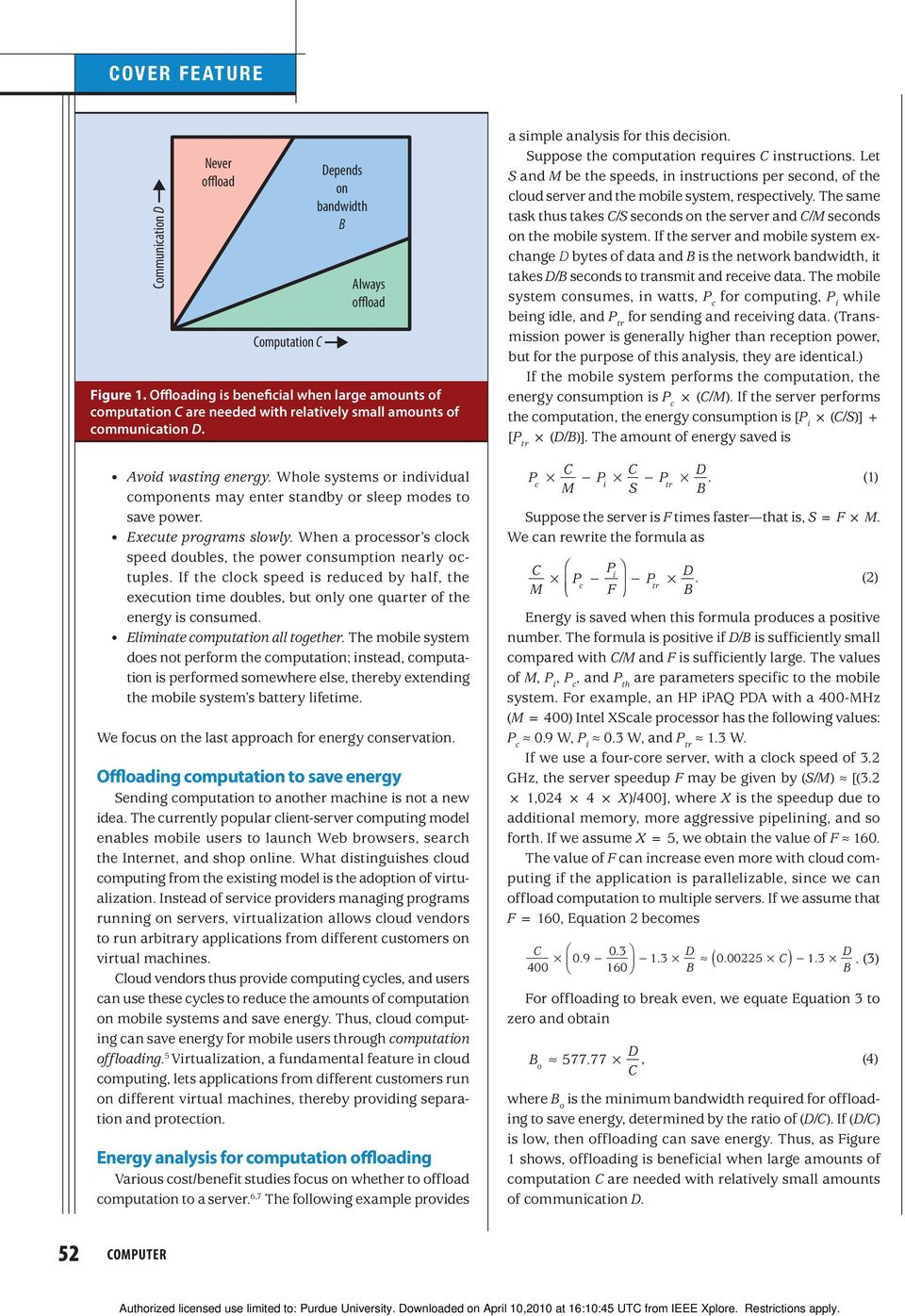
2 Communication D Never offload Computation C Depends on bandwidth B Always offload Figure 1. Offloading is beneficial when large amounts of computation C are needed with relatively small amounts of communication D. Avoid wasting energy. Whole systems or individual components may enter standby or sleep modes to save power. Execute programs slowly. When a processor s clock speed doubles, the power consumption nearly octuples. If the clock speed is reduced by half, the execution time doubles, but only one quarter of the energy is consumed. Eliminate computation all together. The mobile system does not perform the computation; instead, computation is performed somewhere else, thereby extending the mobile system s battery lifetime. We focus on the last approach for energy conservation. Offloading computation to save energy Sending computation to another machine is not a new idea. The currently popular client-server computing model enables mobile users to launch Web browsers, search the Internet, and shop online. What distinguishes cloud computing from the existing model is the adoption of virtualization. Instead of service providers managing programs running on servers, virtualization allows cloud vendors to run arbitrary applications from different customers on virtual machines. Cloud vendors thus provide computing cycles, and users can use these cycles to reduce the amounts of computation on mobile systems and save energy. Thus, cloud computing can save energy for mobile users through computation offloading. 5 Virtualization, a fundamental feature in cloud computing, lets applications from different customers run on different virtual machines, thereby providing separation and protection. Energy analysis for computation offloading Various cost/benefit studies focus on whether to offload computation to a server. 6,7 The following example provides a simple analysis for this decision. Suppose the computation requires C instructions. Let S and M be the speeds, in instructions per second, of the cloud server and the mobile system, respectively. The same task thus takes C/S seconds on the server and C/M seconds on the mobile system. If the server and mobile system exchange D bytes of data and B is the network bandwidth, it takes D/B seconds to transmit and receive data. The mobile system consumes, in watts, P c for computing, P i while being idle, and P tr for sending and receiving data. (Transmission power is generally higher than reception power, but for the purpose of this analysis, they are identical.) If the mobile system performs the computation, the energy consumption is P c (C/M). If the server performs the computation, the energy consumption is [P i (C/S)] + [P tr (D/B)]. The amount of energy saved is P c C M P i C S P tr D B. (1) Suppose the server is F times faster that is, S = F M. We can rewrite the formula as C M P P i c F P D tr B. (2) Energy is saved when this formula produces a positive number. The formula is positive if D/B is sufficiently small compared with C/M and F is sufficiently large. The values of M, P i, P c, and P th are parameters specific to the mobile system. For example, an HP ipaq PDA with a 400-MHz (M = 400) Intel XScale processor has the following values: P c 0.9 W, P i 0.3 W, and P tr 1.3 W. If we use a four-core server, with a clock speed of 3.2 GHz, the server speedup F may be given by (S/M) [(3.2 1,024 4 X)/400], where X is the speedup due to additional memory, more aggressive pipelining, and so forth. If we assume X = 5, we obtain the value of F 160. The value of F can increase even more with cloud computing if the application is parallelizable, since we can offload computation to multiple servers. If we assume that F = 160, Equation 2 becomes C D B C ( ) 1.3 D B. (3) For offloading to break even, we equate Equation 3 to zero and obtain B o D C, (4) where B o is the minimum bandwidth required for offloading to save energy, determined by the ratio of (D/C). If (D/C) is low, then offloading can save energy. Thus, as Figure 1 shows, offloading is beneficial when large amounts of computation C are needed with relatively small amounts of communication D. 52 COMPUTER
3 Sample applications benefiting from offloading Two sample applications illustrate the benefits of offloading: a chess game and image retrieval. Chess is one of the world s most popular games. A chessboard has 8 8 = 64 positions. Each player controls 16 pieces at the beginning of the game. Chess is Markovian, meaning that the game is fully expressed by the current state. Each piece may be in one of the 64 possible locations and needs 6 bits to represent the location. (This is an overestimate: Some pieces have restrictions for example, a bishop can move to only half of the board, that is, 32 possible locations). To represent a chess game s current state, it is sufficient to state that 6 bits 32 pieces = 192 bits = 24 bytes; this is smaller than the size of a typical wireless packet. The amount of computation for chess is very large; Claude Shannon and Victor Allis estimated the complexity of chess to exceed the number of atoms in the universe. Chess can be parallelized, 8 making the value of F in Equation 2 very large. Since the amount of computation C is extremely large, and D is very small, chess provides an example where offloading is beneficial for most wireless networks. An image retrieval application retrieves images similar in content to a query from an image collection. The program accomplishes this by comparing numerical representations of the images, called features. The features for the image collection can be computed in advance; for a query, the program computes its features during retrieval and compares these with the image collection. Since most of the computation is done in advance, less computation is performed online, and the value of C is small. D is large since considerable data must be sent. As a result, even if the values of F become, D/B might still be too large when compared to C/M in Equation 2. Thus, offloading saves energy only if B is very large that is, at high bandwidths. The Mobile Image Processing sidebar has more detail on the advantages of mobile devices offloading image retrieval to the cloud. Making computation offloading more attractive Analysis indicates that the energy saved by computation offloading depends on the wireless bandwidth B, the amount of computation to be performed C, and the amount of data to be transmitted D. Existing studies thus focus on determining whether to offload computation by predicting the relationships among these three factors. However, there is a fundamental assumption underlying this analysis with the client-server model: Because the server does not already contain the data, all the data must be sent to the service provider. The client must offload the program and data to the server. For example, typically a newly discovered server for computation offloading does not already contain a mobile user s personal image collec- MOBILE IMAGE PROCESSING Mobile devices such as cell phones and PDAs are becoming increasingly popular. Most of these devices are equipped with cameras and have several gigabytes of flash storage capable of storing thousands of images. With such large image collections, two functionalities become important: accessing specific sets of images from the collection, and transmitting the images over a wireless network to other devices and servers for storage. For accessing a specific set of images, content-based image retrieval (CBIR) can be a better alternative than manually browsing through all of them. For example, a user might want to view all images containing a specific person or captured at a specific location. Mobile image retrieval allows the user to obtain the relevant pictures by comparing images and eliminating the irrelevant matches on the mobile system. Several studies propose performing CBIR on mobile devices. 1-4 Because these mobile devices are battery powered, energy conservation is important. 2-4 It is energy efficient to partition CBIR between the mobile device and server depending on the wireless bandwidth. 3 As the bandwidth increases, offloading image retrieval saves more energy. Most of the energy consumption for offloaded applications is due to transmission. For image retrieval, transmitting the images over a wireless network consumes significant amounts of energy. The images may be preprocessed on the mobile device before transmission 5 to reduce the transmission energy. This reduction in transmission energy is achieved by reducing the file sizes. However, the amount of energy saved depends on the wireless bandwidth and the image contents. Preprocessing the images saves energy if the reduction in transmission energy compensates for the energy spent due to preprocessing. If the wireless bandwidth is high, the value of the former reduces. Moreover, different images may have different values of the latter based on their contents. Hence preprocessing must be adaptive based on the wireless bandwidth and the image contents. Wireless transmission energy is the most significant bottleneck to energy savings in mobile cloud computing, and such techniques will become increasingly significant as it becomes more popular. References 1. J. Yang et al., A Fast Image Retrieval System Using Index Lookup Table on Mobile Device, Proc. 19th Int l Conf. Pattern Recognition (ICPR 08), IEEE Press, 2008, pp C. Zhu et al., iscope: Personalized Multimodality Image Search for Mobile Devices, Proc. 7th Int l Conf. Mobile Systems, Applications, and Services (Mobisys 09), ACM Press, 2009, pp Y-J. Hong, K. Kumar, and Y-H. Lu, Energy-Efficient Content- Based Image Retrieval for Mobile Systems, Proc. IEEE Int l Symp. Circuits and Systems (ISCAS 09), IEEE Press, 2009, pp D. Chen et al., Tree Histogram Coding for Mobile Image Matching, Proc Compression Conf., IEEE CS Press, 2009, pp Y. Nimmagadda, K. Kumar, and Y-H. Lu, Energy-Efficient Image Compression in Mobile Devices for Wireless Transmission, Proc. IEEE Int l Conf. Multimedia and Expo (ICME 09), IEEE Press, 2009, pp APRIL

4 (a) User Encrypt Internet E(data) Cloud storage (b) User Encrypt Internet Decrypt Cloud storage Figure 2. Two encryption scenarios for cloud computing. (a) remain decrypted at the cloud storage site, preventing unauthorized access through the Internet; the cloud vendor cannot access the data either. (b) are decrypted by the cloud vendor to enable necessary operations on the data. tion. However, cloud computing changes that assumption: The cloud stores data and performs computation on it. For example, services like Google s Picasa and Amazon S3 can store data, and Amazon EC2 can be used to perform computation on the data stored using S3. This results in a significant change in the value of D for most applications. There is no longer a need to send the data over the wireless network; it suffices to send a pointer to the data. Also, the value of F is elastic: Large numbers of processors can be obtained on the cloud. This increases the energy savings in Equation 2: A very small D and very large F imply that energy can always be saved. CHALLENGES AND POSSIBLE SOLUTIONS Does this make cloud computing the ultimate solution to the energy problem for mobile devices? Not quite. While cloud computing has tremendous potential to save energy, designers must consider several issues including privacy and security, reliability, and handling real-time data. Privacy and security In cloud computing, Web applications and data replace traditional stand-alone programs, which are no longer stored in users computers. Shifting all data and computing resources to the cloud can have implications for privacy and security. Because the data is stored and managed in the cloud, security and privacy settings depend on the IT management the cloud provides. A bug or security loophole in the cloud might result in a breach of privacy. For example, in March 2009, a bug in Google caused documents to be shared without the owners knowledge, 9 while a July 2009 breach in Twitter allowed a hacker to obtain confidential documents. 10 Cloud service providers typically work with many thirdparty vendors, and there is no guarantee as to how these vendors safeguard data. For example, a phishing attack in 2007 duped a staff member for salesforce.com into reveal- ing a password; 13 the attacker then used the password to access confidential data. Another potential privacy violation is the tracking of individuals through location-based navigation data offloaded to the cloud. Moreover, data stored at one location may not be secure at another due to different access rules. For example, the EU has stricter privacy protection than the US, where laws such as the Patriot Act give government agencies and other entities more power to access personal information. Since the storage locations are typically unknown to the user, determining what laws apply to safeguarding data can be difficult. This may raise serious security concerns for a company that stores its trade secrets in the cloud, or a user who uploads a patentable idea from a mobile system to the cloud. Clearly, some types of data cannot be stored in the cloud without considering these privacy and security implications. One possible solution is to encrypt data before storage. However, encryption alone will not solve the problem. Figure 2 shows two encryption scenarios. In Figure 2a, the data remain encrypted at the cloud storage site. This can prevent unauthorized access even when the storage is breached in the cloud; the cloud vendor cannot access the data either. In Figure 2b, the cloud vendor decrypts data to perform operations on that data. For example, in the case of a document, the cloud vendor must know which words are used to check spelling; for a spreadsheet, the cloud application must know the numbers for calculation. This is the general case for cloud services. Another possible privacy and security solution is to use a technique called steganography, as described in the Outsourcing and Privacy sidebar. Steganographic techniques can be used to transform the data so that operations can be performed without exposing them. Performing encryption or steganographic techniques before sending data to the cloud requires some additional processing C p on the mobile system and consumes additional energy. Equation 2 thus can be rewritten as 54 COMPUTER

5 DATA OUTSOURCING AND PRIVACY outsourcing refers to sending data outside users immediate computing environment. This is an increasingly important concern for cloud computing. As government agencies shift to the cloud (for example, and gov), information like healthcare, criminal, and tax records move to the cloud. This makes security and privacy a critical concern. Multimedia content like images and videos have significant redundancy. This makes it possible to hide data in multimedia using steganography. 1 Figure A shows an example of steganography: images (a) and (c) look identical, but image (c) contains image (b) hidden in it. Applying appropriate transformations to image (c) can obtain image (b). Steganographic techniques can be used to transform the data before storage so that operations can still be performed on the data. (a) (b) (c) Figure A. An example of steganography: images (a) and (c) look identical, but image (c) contains image (b) hidden in it. Applying appropriate transformations to image (c) can obtain image (b). For text documents and spreadsheets, however, there is little redundancy. This makes it difficult to transform the data and still perform operations. For example, it is hard to spell check a text document that has alphabets mapped onto symbols. If the mapping is one-to-one and onward, alphabet frequency can be easily used to determine the words. Similarly, if the elements in a spreadsheet are transformed, performing meaningful mathematical operations on them is difficult. Performing computation on encrypted or steganographic data still remains an open research problem. Developing a hybrid cloud is an interim solution to the data outsourcing problem. A hybrid cloud is a cloud computing environment in which an organization provides and manages some resources in-house and has others provided externally (searchcloudcomputing.com). The claim is that this is more feasible currently because large enterprises already have the substantial investments in their infrastructure required to provide resources in-house. In addition, many organizations would prefer to keep sensitive data under their own control to ensure privacy and security. Reference 1. F.A.P. Petitcolas, R.J. Anderson, and M.G. Kuhn, Information Hiding A Survey, Proc. IEEE, Special Issue on Protection of Multimedia Content, vol. 87, no. 7, 1999, pp C M P P i c F P D tr B P C p c M, (5) where P c (C p /M) is the additional energy required to protect privacy and security. If this value is significant, cloud computing might not save energy for the mobile user. Instead, it may be more energy efficient to perform operations on the mobile system, since C p = 0 when the device performs the computation. Reliability Another potential concern with mobile cloud computing is reliability. 11 A mobile user performing computation in the cloud depends on the wireless network and cloud service. Dependence on the wireless network implies that cloud computing may not even be possible, let alone energy efficient, when connectivity is limited. This is typical in regions like national parks; a user may thus not be able to organize, retrieve, or identify any images captured in the park. Mobile cloud computing is also difficult in locations such as the basement of a building, interior of a tunnel, or subway. In these cases, where the value of B in Equation 2 can become very small or even zero, cloud computing does not save energy. Dependence on the cloud for important computations could lead to problems during service outages. Several service providers such as Google, Amazon, and T-Mobile have experienced such outages, as Table 1 shows. These can significantly reduce the value of F in Equation 2. storage presents another reliability problem. In October 2009, both T-Mobile s and Microsoft s mobile Sidekick service crashed, and all customers lost their data and contacts. One option in such scenarios involves an independent backup of data with an alternate service provider, which might increase the value of D in Equation 2. Real-time data Some applications including chess, searching newly captured images for content-based image retrieval, mobile surveillance, and context-aware navigation have real-time data. In such scenarios, D in Equation 2 is no longer a pointer to the data; it refers to the actual data. For applications like chess, the value of D is small and hence offloading can still save energy. When the value of D is large, offloading may not save energy. In such cases, performing the computation on the mobile system may be more energy efficient. A possible solution is partitioning computation between the mobile system and the cloud to reduce energy consumption. Such a solution may include partially APRIL

6 processing the real-time data on the mobile system. If the processed data are smaller in size, sending the processed data to the server reduces the wireless transmission energy. Our analysis suggests that cloud computing can potentially save energy for mobile users. However, not all applications are energy efficient when migrated to the cloud. Mobile cloud computing services would be significantly different from cloud services for desktops because they must offer energy savings. The services should consider the energy overhead for privacy, security, reliability, and data communication before offloading. Acknowledgments We thank Jibang Liu for the steganography images used in this article. References Table 1. Service provider outages. 11,12 Outage date Vendor Service July 2008 Amazon S3 outage Feb 2008 Amazon S3 outage August 2008 Google Gmail service outage October 2009 T-Mobile/Microsoft Sidekick loses users data 1. M. Creeger, CTO Roundtable: Cloud Computing, ACM Queue, June 2009, pp Google Tech Talk, Away with Applications: The Death of the Desktop, 4 May 2007; videoplay?docid= CNN.com, Battery Life Concerns Mobile Users, 23 Sept. 2005; study. 4. J. Paczkowski, Iphone Owners Would Like to Replace Battery, All Things Digital, 21 Aug. 2009; digitaldaily.allthingsd.com/ /iphone-ownerswould-like-to-replace-battery-att. 5. K. Yang, S. Ou, and H.H. Chen, On Effective Offloading Services for Resource-Constrained Mobile Devices Running Heavier Mobile Internet Applications, IEEE Comm. Magazine, vol. 46, no. 1, 2008, pp C. Wang and Z. Li, Parametric Analysis for Adaptive Computation Offloading, ACM SIGPLAN Notices, vol. 39, no. 6, 2004, pp R. Wolski et al., Using Bandwidth to Make Computation Offloading Decisions, Proc. IEEE Int l Symp. Parallel and Distributed Processing (IPDPS 08), 2008, pp M. Newborn, A Parallel Search Chess Program, Proc. ACM Ann. Conf. Range of Computing: Mid-80 s Perspective, ACM Press, 1985, pp J. Kincaid, Google Privacy Blunder Shares Your Docs without Permission, TechCrunch, 7 Mar. 2009; techcrunch.com/2009/03/07/huge-google-privacy-blundershares-your-docs-without-permission. 10. R. McMillan, Hacker: I Broke into Twitter, PCWorld. com, 1 May 2009; article/164182/hacker_i_broke_into_twitter.html. 11. M. Armbrust et al., Above the Clouds: A Berkeley View of Cloud Computing, tech. report UCB/EECS , EECS Dept., Univ. of California, Berkeley, T-Mobile Forums, A Message from Our Chief Operations Officer, Jim Alling, 6 Oct. 2009; com/t5/previous-sidekick-models/a-message-from-our- Chief-Operations-Officer-Jim-Alling/m-p/ R. McMillan, Salesforce.com Warns Customers of Phishing Scam, PCWorld, 6 Nov. 2007; com/businesscenter/article/139353/salesforcecom_warns_ customers_of_phishing_scam.html. Karthik Kumar is a PhD candidate in the School of Electrical and Computer Engineering at Purdue University. His research interests include energy conservation for mobile systems and resource allocation for scalable computing. Kumar is a student member of IEEE. Contact him at [email protected]. Yung-Hsiang Lu is an associate professor in the School of Electrical and Computer Engineering at Purdue University. His research focuses on energy efficiency of computing systems. Lu received a PhD in electrical engineering from Stanford University. He is a senior member of IEEE. Contact him at [email protected]. build your career IN COMPUTING 56 COMPUTER

perform computations on stored data (Elastic Compute Cloud (EC2). )
 Karthik Kumar and Yung-Hsiang Lu, Purdue University Presenter Yifei Sun Take Amazon cloud for example. store personal data (Simple Storage Service (S3) ) perform computations on stored data (Elastic Compute
Security in Offloading Computations in Mobile Systems Using Cloud Computing
 Security in Offloading Computations in Mobile Systems Using Cloud Computing S.Masiperiyannan 1,C.M.Mehathaf Begum 2,I.Mohammed Farook Ali 3,G.Mayuri Priya 4,S.Sudhakar 5 UG Student, Dept. of CSE, K S R
International Journal of Advance Foundation and Research in Computer (IJAFRC) Volume 2, Special Issue (NCRTIT 2015), January 2015.
 Survey On Cloud Computing For Mobile Users Using Machine Servers Ms. Deepali Gothawal 1, Deepali Patil 2, Sneha Chavan 3, Tejaswini Chandekar 4, Rohit Koti 5 Department of Computer Engineering, DYPCOE,
Saving Mobile Battery Over Cloud Using Image Processing
 Saving Mobile Battery Over Cloud Using Image Processing Khandekar Dipendra J. Student PDEA S College of Engineering,Manjari (BK) Pune Maharasthra Phadatare Dnyanesh J. Student PDEA S College of Engineering,Manjari
CLOUD COMPUTING USABILITY IN MOBILE COMMUNICATION NETWORK
 BEST: International Journal of Management, Information Technology and Engineering (BEST: IJMITE) ISSN 2348-0513 Vol. 2, Issue 3, Mar 2014, 105-110 BEST Journals CLOUD COMPUTING USABILITY IN MOBILE COMMUNICATION
Mobile Image Offloading Using Cloud Computing
 Mobile Image Offloading Using Cloud Computing Chintan Shah, Aruna Gawade Student, Dept. of Computer., D.J.Sanghvi College of Engineering, Mumbai University, Mumbai, India Assistant Professor, Dept. of
Mobile Cloud Computing: Survey & Discussion. Jianting Yue Sep 27, 2013
 Mobile Cloud Computing: Survey & Discussion Jianting Yue Sep 27, 2013 1 Outline Lead-in Definition Main Functions Architecture Computation Offloading: an example Challenges Potential Ideas Summary 2 3
The Cloud at Crawford. Evaluating the pros and cons of cloud computing and its use in claims management
 The Cloud at Crawford Evaluating the pros and cons of cloud computing and its use in claims management The Cloud at Crawford Wikipedia defines cloud computing as Internet-based computing, whereby shared
IMCM: A Flexible Fine-Grained Adaptive Framework for Parallel Mobile Hybrid Cloud Applications
 Open System Laboratory of University of Illinois at Urbana Champaign presents: Outline: IMCM: A Flexible Fine-Grained Adaptive Framework for Parallel Mobile Hybrid Cloud Applications A Fine-Grained Adaptive
Security Benefits of Cloud Computing
 Security Benefits of Cloud Computing FELICIAN ALECU Economy Informatics Department Academy of Economic Studies Bucharest ROMANIA e-mail: [email protected] Abstract: The nature of the Internet is
Cloud Computing for hand-held Devices:Enhancing Smart phones viability with Computation Offload
 IOSR Journal of Computer Engineering (IOSR-JCE) e-issn: 2278-0661, p- ISSN: 2278-8727Volume 13, Issue 1 (Jul. - Aug. 2013), PP 01-06 Cloud Computing for hand-held Devices:Enhancing Smart phones viability
Part V Applications. What is cloud computing? SaaS has been around for awhile. Cloud Computing: General concepts
 Part V Applications Cloud Computing: General concepts Copyright K.Goseva 2010 CS 736 Software Performance Engineering Slide 1 What is cloud computing? SaaS: Software as a Service Cloud: Datacenters hardware
OPTIMIZED CONSUMPTION AND ACCESS OF REMOTE DISPLAY ON MOBILE DEVICE ENVIRONMENT
 IMPACT: International Journal of Research in Engineering & Technology (IMPACT: IJRET) ISSN(E): 2321-8843; ISSN(P): 2347-4599 Vol. 2, Issue 2, Feb 2014, 167-174 Impact Journals OPTIMIZED CONSUMPTION AND
Offloading file search operation for performance improvement of smart phones
 Offloading file search operation for performance improvement of smart phones Ashutosh Jain [email protected] Vigya Sharma [email protected] Shehbaz Jaffer [email protected] Kolin Paul
ENERGY EFFICIENT DATA TRAFFIC MANAGEMENT IN MOBILE CLOUD COMPUTING
 ENERGY EFFICIENT DATA TRAFFIC MANAGEMENT IN MOBILE CLOUD COMPUTING Bharath V 1, Priyadarsini K 2 1 Department of CSE, SRM University, [email protected] 2 Department of CSE, SRM University, [email protected]
Security Considerations for Public Mobile Cloud Computing
 Security Considerations for Public Mobile Cloud Computing Ronnie D. Caytiles 1 and Sunguk Lee 2* 1 Society of Science and Engineering Research Support, Korea [email protected] 2 Research Institute of
Cloud Computing for Libraries: A SWOT Analysis
 Cloud Computing for Libraries: A SWOT Analysis 8 th Convention PLANNER 2012 Abstract Cloud Computing for Libraries: A SWOT Analysis Miteshkumar Pandya This paper provides brief information on cloud computing
Cloud and Mobile Computing
 Cloud and Mobile Computing Protect Privacy in Offloading Yung-Hsiang Lu Electrical and Computer Engineering Purdue University Technological Trends Mobile systems become primary computing platforms for
DELEGATING LOG MANAGEMENT TO THE CLOUD USING SECURE LOGGING
 Available Online at www.ijcsmc.com International Journal of Computer Science and Mobile Computing A Monthly Journal of Computer Science and Information Technology ISSN 2320 088X IJCSMC, Vol. 3, Issue.
AN ENHANCED ATTRIBUTE BASED ENCRYPTION WITH MULTI PARTIES ACCESS IN CLOUD AREA
 Available Online at www.ijcsmc.com International Journal of Computer Science and Mobile Computing A Monthly Journal of Computer Science and Information Technology IJCSMC, Vol. 3, Issue. 1, January 2014,
Next Generation Mobile Cloud Gaming
 Next Generation Mobile Cloud Gaming Wei Cai, Victor C.M. Leung Department of Electrical and Computer Engineering The University of British Columbia Min Chen School of Computer Science and Technology Huazhong
DATA SECURITY MODEL FOR CLOUD COMPUTING
 DATA SECURITY MODEL FOR CLOUD COMPUTING POOJA DHAWAN Assistant Professor, Deptt of Computer Application and Science Hindu Girls College, Jagadhri 135 001 [email protected] ABSTRACT Cloud Computing
Load Balancing and Maintaining the Qos on Cloud Partitioning For the Public Cloud
 Load Balancing and Maintaining the Qos on Cloud Partitioning For the Public Cloud 1 S.Karthika, 2 T.Lavanya, 3 G.Gokila, 4 A.Arunraja 5 S.Sarumathi, 6 S.Saravanakumar, 7 A.Gokilavani 1,2,3,4 Student, Department
INVESTIGATION OF RENDERING AND STREAMING VIDEO CONTENT OVER CLOUD USING VIDEO EMULATOR FOR ENHANCED USER EXPERIENCE
 INVESTIGATION OF RENDERING AND STREAMING VIDEO CONTENT OVER CLOUD USING VIDEO EMULATOR FOR ENHANCED USER EXPERIENCE Ankur Saraf * Computer Science Engineering, MIST College, Indore, MP, India [email protected]
Cloud Data Storage Services Considering Public Audit for Security
 Global Journal of Computer Science and Technology Cloud and Distributed Volume 13 Issue 1 Version 1.0 Year 2013 Type: Double Blind Peer Reviewed International Research Journal Publisher: Global Journals
Alaa Alhamami, Avan Sabah Hamdi Amman Arab University Amman, Jordan
 World of Computer Science and Information Technology Journal (WCSIT) ISSN: 2221-0741 Vol. 5, No. 5, 87-91, 2015 Mobile Secure Transmission Method Based on Audio Steganography Alaa Alhamami, Avan Sabah
Session 11 : (additional) Cloud Computing Advantages and Disadvantages
 INFORMATION STRATEGY Session 11 : (additional) Cloud Computing Advantages and Disadvantages Tharaka Tennekoon B.Sc (Hons) Computing, MBA (PIM - USJ) POST GRADUATE DIPLOMA IN BUSINESS AND FINANCE 2014 Cloud
Cloud SQL Security. Swati Srivastava 1 and Meenu 2. Engineering College., Gorakhpur, U.P. Gorakhpur, U.P. Abstract
 International Journal of Information and Computation Technology. ISSN 0974-2239 Volume 4, Number 5 (2014), pp. 479-484 International Research Publications House http://www. irphouse.com /ijict.htm Cloud
Mobile Hybrid Cloud Computing Issues and Solutions
 , pp.341-345 http://dx.doi.org/10.14257/astl.2013.29.72 Mobile Hybrid Cloud Computing Issues and Solutions Yvette E. Gelogo *1 and Haeng-Kon Kim 1 1 School of Information Technology, Catholic University
Optimal Service Pricing for a Cloud Cache
 Optimal Service Pricing for a Cloud Cache K.SRAVANTHI Department of Computer Science & Engineering (M.Tech.) Sindura College of Engineering and Technology Ramagundam,Telangana G.LAKSHMI Asst. Professor,
A Survey on Scalable Data Security and Load Balancing in Multi Cloud Environment
 IJIRST International Journal for Innovative Research in Science & Technology Volume 1 Issue 8 January 2015 ISSN (online): 2349-6010 A Survey on Scalable Data Security and Load Balancing in Multi Cloud
Montgomery College Course Designator/Course Number: CS 110 Course Title: Computer Literacy
 Montgomery College Course Designator/Course Number: CS 11 Course Title: Computer Literacy Course Length: 3 credits 3 5-minute meetings per week or equivalent Course Description: An introduction to the
Development of enhanced Third party Auditing Scheme for Secure Cloud Storage
 Development of enhanced Third party Auditing Scheme for Secure Cloud Storage Bhanu Prakash Chamakuri*1, D. Srikar*2, Dr. M.Suresh Babu*3 M.Tech Scholar, Dept of CSE, Grandhi Varalakshmi Institute Of Technology,
International Journal of Advance Research in Computer Science and Management Studies
 Volume 2, Issue 11, November 2014 ISSN: 2321 7782 (Online) International Journal of Advance Research in Computer Science and Management Studies Research Article / Survey Paper / Case Study Available online
Analysis on Secure Data sharing using ELGamal s Cryptosystem in Cloud
 Analysis on Secure Data sharing using ELGamal s Cryptosystem in Cloud M.Jayanthi, Assistant Professor, Hod of MCA.E mail: [email protected] MahatmaGandhi University,Nalgonda, INDIA. B.Ranganatha
A Comparative Study of cloud and mcloud Computing
 A Comparative Study of cloud and mcloud Computing Ms.S.Gowri* Ms.S.Latha* Ms.A.Nirmala Devi* * Department of Computer Science, K.S.Rangasamy College of Arts and Science, Tiruchengode. [email protected]
Mobile Cloud Computing. Chamitha de Alwis, PhD Senior Lecturer University of Sri Jayewardenepura [email protected]
 Mobile Cloud Computing Chamitha de Alwis, PhD Senior Lecturer University of Sri Jayewardenepura [email protected] Mobile Computing Rapid progress of mobile computing have become a powerful trend in the
Identifying Data Integrity in the Cloud Storage
 www.ijcsi.org 403 Identifying Data Integrity in the Cloud Storage Saranya Eswaran 1 and Dr.Sunitha Abburu 2 1 Adhiyamaan College of Engineering, Department of Computer Application, Hosur. 2 Professor and
Ch. 4 - Topics of Discussion
 CPET 581 Cloud Computing: Technologies and Enterprise IT Strategies Lecture 6 Cloud Platform Architecture over Virtualized Data Centers Part -4 Cloud Security and Trust Management Text Book: Distributed
EFFICIENT AND SECURE ATTRIBUTE REVOCATION OF DATA IN MULTI-AUTHORITY CLOUD STORAGE
 EFFICIENT AND SECURE ATTRIBUTE REVOCATION OF DATA IN MULTI-AUTHORITY CLOUD STORAGE Reshma Mary Abraham and P. Sriramya Computer Science Engineering, Saveetha University, Chennai, India E-Mail: [email protected]
A Review of Load Balancing Algorithms for Cloud Computing
 www.ijecs.in International Journal Of Engineering And Computer Science ISSN:2319-7242 Volume - 3 Issue -9 September, 2014 Page No. 8297-8302 A Review of Load Balancing Algorithms for Cloud Computing Dr.G.N.K.Sureshbabu
Energy Constrained Resource Scheduling for Cloud Environment
 Energy Constrained Resource Scheduling for Cloud Environment 1 R.Selvi, 2 S.Russia, 3 V.K.Anitha 1 2 nd Year M.E.(Software Engineering), 2 Assistant Professor Department of IT KSR Institute for Engineering
How cloud computing can transform your business landscape
 How cloud computing can transform your business landscape Introduction It seems like everyone is talking about the cloud. Cloud computing and cloud services are the new buzz words for what s really a not
An Intelligent Approach for Data Fortification in Cloud Computing
 An Intelligent Approach for Data Fortification in Cloud Computing Supriya Mandhare 1, Prof. A. K. Sen 2, Asso. Prof. Rajkumar Shende 3 1,3 Department of Computer Engineering, St. Francis Institute of Technology,
A Novel Approach for Calculation Based Cloud Band Width and Cost Diminution Method
 A Novel Approach for Calculation Based Cloud Band Width and Cost Diminution Method Radhika Chowdary G PG Scholar, M.Lavanya Assistant professor, P.Satish Reddy HOD, Abstract: In this paper, we present
HIPAA COMPLIANCE AND DATA PROTECTION. [email protected] +39 030 201.08.25 Page 1
 HIPAA COMPLIANCE AND DATA PROTECTION [email protected] +39 030 201.08.25 Page 1 CONTENTS Introduction..... 3 The HIPAA Security Rule... 4 The HIPAA Omnibus Rule... 6 HIPAA Compliance and EagleHeaps
Improving data integrity on cloud storage services
 International Journal of Engineering Science Invention ISSN (Online): 2319 6734, ISSN (Print): 2319 6726 Volume 2 Issue 2 ǁ February. 2013 ǁ PP.49-55 Improving data integrity on cloud storage services
EFFICIENT AND SECURE DATA PRESERVING IN CLOUD USING ENHANCED SECURITY
 EFFICIENT AND SECURE DATA PRESERVING IN CLOUD USING ENHANCED SECURITY Siliveru Ashok kumar* S.G. Nawaz ## and M.Harathi # * Student of M.Tech, Sri Krishna Devaraya Engineering College, Gooty # Department
PRIVACY PRESERVATION ALGORITHM USING EFFECTIVE DATA LOOKUP ORGANIZATION FOR STORAGE CLOUDS
 PRIVACY PRESERVATION ALGORITHM USING EFFECTIVE DATA LOOKUP ORGANIZATION FOR STORAGE CLOUDS Amar More 1 and Sarang Joshi 2 1 Department of Computer Engineering, Pune Institute of Computer Technology, Maharashtra,
Cloud Computing Security Issues and Controls
 Cloud Computing Security Issues and Controls ACC 626 Information System Assurance & Computer-Assisted Auditing Peter Shih-Hsien Chen June 30th, 2013 Table of Contents Introduction... 1 History of Cloud
This session was presented by Jim Stickley of TraceSecurity on Wednesday, October 23 rd at the Cyber Security Summit.
 The hidden risks of mobile applications This session was presented by Jim Stickley of TraceSecurity on Wednesday, October 23 rd at the Cyber Security Summit. To learn more about TraceSecurity visit www.tracesecurity.com
A Secure Strategy using Weighted Active Monitoring Load Balancing Algorithm for Maintaining Privacy in Multi-Cloud Environments
 IJSTE - International Journal of Science Technology & Engineering Volume 1 Issue 10 April 2015 ISSN (online): 2349-784X A Secure Strategy using Weighted Active Monitoring Load Balancing Algorithm for Maintaining
Power Benefits Using Intel Quick Sync Video H.264 Codec With Sorenson Squeeze
 Power Benefits Using Intel Quick Sync Video H.264 Codec With Sorenson Squeeze Whitepaper December 2012 Anita Banerjee Contents Introduction... 3 Sorenson Squeeze... 4 Intel QSV H.264... 5 Power Performance...
Features Security. File Versioning. Intuitive User Interface. Fast and efficient Backups
 IBackup Professional provides a secure, efficient, reliable, cost effective and easy to use Internet based backup solution with additional emphasis on security and data retention. IBackup Professional
Bringing the Cloud into Focus. A Whitepaper by CMIT Solutions and Cadence Management Advisors
 Bringing the Cloud into Focus A Whitepaper by CMIT Solutions and Cadence Management Advisors Table Of Contents Introduction: What is The Cloud?.............................. 1 The Cloud Benefits.......................................
Efficient Energy Reduction and Enhancing Security Privacy in Mobile Cloud Computing
 Efficient Energy Reduction and Enhancing Security Privacy in Mobile Cloud Computing B.Sudhanantham 1, M.Shankar 2 PG Scholar, Dept. of CSE, Angel College of Engineering and Technology, Tirupur, India 1
2013 USER GROUP CONFERENCE
 2013 USER GROUP CONFERENCE The Cloud This session will touch anything and everything cloud based that is important to districts today. We will compare and contrast Google Apps and Office 365, Cloud storage
Cloud Computing for Agent-based Traffic Management Systems
 Cloud Computing for Agent-based Traffic Management Systems Manoj A Patil Asst.Prof. IT Dept. Khyamling A Parane Asst.Prof. CSE Dept. D. Rajesh Asst.Prof. IT Dept. ABSTRACT Increased traffic congestion
Cloud Computing an introduction
 Prof. Dr. Claudia Müller-Birn Institute for Computer Science, Networked Information Systems Cloud Computing an introduction January 30, 2012 Netzprogrammierung (Algorithmen und Programmierung V) Our topics
CLOUD SECURITY SECURITY ASPECTS IN GEOSPATIAL CLOUD. Guided by Prof. S. K. Ghosh Presented by - Soumadip Biswas
 CLOUD SECURITY SECURITY ASPECTS IN GEOSPATIAL CLOUD Guided by Prof. S. K. Ghosh Presented by - Soumadip Biswas PART 1 A brief Concept of cloud Issues in cloud Security Issues A BRIEF The Evolution Super
Ranked Keyword Search Using RSE over Outsourced Cloud Data
 Ranked Keyword Search Using RSE over Outsourced Cloud Data Payal Akriti 1, Ms. Preetha Mary Ann 2, D.Sarvanan 3 1 Final Year MCA, Sathyabama University, Tamilnadu, India 2&3 Assistant Professor, Sathyabama
Cloud Computing TODAY S TOPICS WHAT IS CLOUD COMPUTING? ICAC Webinar Cloud Computing September 4, 2012. What Cloud Computing is and How it Works
 Cloud Computing TODAY S TOPICS What Cloud Computing is and How it Works Security & Privacy Issues Investigative Challenges WHAT IS CLOUD COMPUTING? Cloud computing refers to software or processes offered
Quantifying the Performance Degradation of IPv6 for TCP in Windows and Linux Networking
 Quantifying the Performance Degradation of IPv6 for TCP in Windows and Linux Networking Burjiz Soorty School of Computing and Mathematical Sciences Auckland University of Technology Auckland, New Zealand
INTERNATIONAL JOURNAL OF PURE AND APPLIED RESEARCH IN ENGINEERING AND TECHNOLOGY
 INTERNATIONAL JOURNAL OF PURE AND APPLIED RESEARCH IN ENGINEERING AND TECHNOLOGY A PATH FOR HORIZING YOUR INNOVATIVE WORK GEARING THE RESOURCE POOR MOBILE DEVICES INTO RESOURCEFULL BY USING THE MOBILE
SECURITY ARCHITECTURE FOR MOBILE CLOUD COMPUTING
 SECURITY ARCHITECTURE FOR MOBILE CLOUD COMPUTING Ali Newaz Bahar 1*, Md. Ahsan Habib 2, Md. Manowarul Islam 3 1, 2, 3 Department of Information and Communication Technology, Mawlana Bhashani Science and
Data management using Virtualization in Cloud Computing
 Data management using Virtualization in Cloud Computing A.S.R. Krishna Kanth M.Tech (CST), Department of Computer Science & Systems Engineering, Andhra University, India. M.Sitha Ram Research Scholar Department
Cloud computing doesn t yet have a
 The Case for Cloud Computing Robert L. Grossman University of Illinois at Chicago and Open Data Group To understand clouds and cloud computing, we must first understand the two different types of clouds.
A comprehensive survey on various ETC techniques for secure Data transmission
 A comprehensive survey on various ETC techniques for secure Data transmission Shaikh Nasreen 1, Prof. Suchita Wankhade 2 1, 2 Department of Computer Engineering 1, 2 Trinity College of Engineering and
HIPAA COMPLIANCE AND
 INTRONIS CLOUD BACKUP & RECOVERY HIPAA COMPLIANCE AND DATA PROTECTION CONTENTS Introduction 3 The HIPAA Security Rule 4 The HIPAA Omnibus Rule 6 HIPAA Compliance and Intronis Cloud Backup and Recovery
Ensuring HIPAA Compliance with AcclaimVault Online Backup and Archiving Services
 Ensuring HIPAA Compliance with AcclaimVault Online Backup and Archiving Services 1 Contents 3 Introduction 5 The HIPAA Security Rule 7 HIPAA Compliance & AcclaimVault Backup 8 AcclaimVault Security and
Secure Cloud Computing through IT Auditing
 Secure Cloud Computing through IT Auditing 75 Navita Agarwal Department of CSIT Moradabad Institute of Technology, Moradabad, U.P., INDIA Email: [email protected] ABSTRACT In this paper we discuss the
CLOUD COMPUTING SECURITY ISSUES
 CLOUD COMPUTING SECURITY ISSUES Florin OGIGAU-NEAMTIU IT Specialist The Regional Department of Defense Resources Management Studies, Brasov, Romania The term cloud computing has been in the spotlights
How To Secure Cloud Computing, Public Auditing, Security, And Access Control In A Cloud Storage System
 REVIEW ARTICAL A Novel Privacy-Preserving Public Auditing and Secure Searchable Data Cloud Storage Dumala Harisha 1, V.Gouthami 2 1 Student, Computer Science & Engineering-Department, JNTU Hyderabad India
15-2394-3696 RIGOROUS PUBLIC AUDITING SUPPORT ON SHARED DATA STORED IN THE CLOUD BY PRIVACY-PRESERVING MECHANISM
 RIGOROUS PUBLIC AUDITING SUPPORT ON SHARED DATA STORED IN THE CLOUD BY PRIVACY-PRESERVING MECHANISM Dhanashri Bamane Vinayak Pottigar Subhash Pingale Department of Computer Science and Engineering SKN
IMPROVING QUALITY OF VIDEOS IN VIDEO STREAMING USING FRAMEWORK IN THE CLOUD
 IMPROVING QUALITY OF VIDEOS IN VIDEO STREAMING USING FRAMEWORK IN THE CLOUD R.Dhanya 1, Mr. G.R.Anantha Raman 2 1. Department of Computer Science and Engineering, Adhiyamaan college of Engineering(Hosur).
CLOUDDMSS: CLOUD-BASED DISTRIBUTED MULTIMEDIA STREAMING SERVICE SYSTEM FOR HETEROGENEOUS DEVICES
 CLOUDDMSS: CLOUD-BASED DISTRIBUTED MULTIMEDIA STREAMING SERVICE SYSTEM FOR HETEROGENEOUS DEVICES 1 MYOUNGJIN KIM, 2 CUI YUN, 3 SEUNGHO HAN, 4 HANKU LEE 1,2,3,4 Department of Internet & Multimedia Engineering,
Mona: Secure Multi-Owner Data Sharing for Dynamic Groups in the Cloud
 Mona: Secure Multi-Owner Data Sharing for Dynamic Groups in the Cloud Arpitha.K 1,Aawini.T 2,Divya J. 3, Kalyani P 4, Prof. Sudhakar Avareddy 5 1,2,3,4 Department of CSE, BITM Bellary, Karnataka. 5 Department
A Road Map on Security Deliverables for Mobile Cloud Application
 A Road Map on Security Deliverables for Mobile Cloud Application D.Pratiba 1, Manjunath A.E 2, Dr.N.K.Srinath 3, Dr.G.Shobha 4, Dr.Siddaraja 5 Asst. Professor, Department of Computer Science and Engineering,
Comparison of Cloud vs. Tape Backup Performance and Costs with Oracle Database
 JIOS, VOL. 35, NO. 1 (2011) SUBMITTED 02/11; ACCEPTED 06/11 UDC 004.75 Comparison of Cloud vs. Tape Backup Performance and Costs with Oracle Database University of Ljubljana Faculty of Computer and Information
Module 1: Facilitated e-learning
 Module 1: Facilitated e-learning CHAPTER 3: OVERVIEW OF CLOUD COMPUTING AND MOBILE CLOUDING: CHALLENGES AND OPPORTUNITIES FOR CAs... 3 PART 1: CLOUD AND MOBILE COMPUTING... 3 Learning Objectives... 3 1.1
Email: [email protected]. 2 Prof, Dept of CSE, Institute of Aeronautical Engineering, Hyderabad, Andhrapradesh, India,
 www.semargroup.org, www.ijsetr.com ISSN 2319-8885 Vol.03,Issue.06, May-2014, Pages:0963-0968 Improving Efficiency of Public Cloud Using Load Balancing Model SHRAVAN KUMAR 1, DR. N. CHANDRA SEKHAR REDDY