
User s Guide for Nokia 7600
|
|
|
- Egbert Brown
- 10 years ago
- Views:
Transcription
1 User s Guide for Nokia 7600

2 DECLARATION OF CONFORMITY We, NOKIA CORPORATION declare under our sole responsibility that the product NMM-3 is in conformity with the provisions of the following Council Directive: 1999/5/EC. A copy of the Declaration of Conformity can be found from Copyright Nokia All rights reserved. Reproduction, transfer, distribution or storage of part or all of the contents in this document in any form without the prior written permission of Nokia is prohibited. Nokia, Nokia Connecting People, Pop-Port and Xpress-on are trademarks or registered trademarks of Nokia Corporation. Other product and company names mentioned herein may be trademarks or tradenames of their respective owners. Nokia tune is a sound mark of Nokia Corporation. Bluetooth is a registered trademark of Bluetooth SIG, Inc. US Patent No and other pending patents. T9 text input software Copyright (C) Tegic Communications, Inc. All rights reserved. Includes RSA BSAFE cryptographic or security protocol software from RSA Security. Java is a trademark of Sun Microsystems, Inc. USE OF THIS PRODUCT IN ANY MANNER THAT COMPLIES WITH THE MPEG-4 VISUAL STANDARD IS PROHIBITED, EXCEPT FOR USE DIRECTLY RELATED TO (A) DATA OR INFORMATION (i) GENERATED BY AND OBTAINED WITHOUT CHARGE FROM A CONSUMER NOT THEREBY ENGAGED IN A BUSINESS ENTERPRISE, AND (ii) FOR PERSONAL USE ONLY; AND (B) OTHER USES SPECIFICALLY AND SEPARATELY LICENSED BY MPEG LA, L.L.C. Copyright 2004 Nokia. All rights reserved. iii

3 Nokia operates a policy of continuous development. Nokia reserves the right to make changes and improvements to any of the products described in this document without prior notice. Under no circumstances shall Nokia be responsible for any loss of data or income or any special, incidental, consequential or indirect damages howsoever caused. The contents of this document are provided "as is". Except as required by applicable law, no warranties of any kind, either express or implied, including, but not limited to, the implied warranties of merchantability and fitness for a particular purpose, are made in relation to the accuracy, reliability or contents of this document. Nokia reserves the right to revise this document or withdraw it at any time without prior notice. The availability of particular products may vary by region. Please check with the Nokia dealer nearest to you. Issue 1 iv Copyright 2004 Nokia. All rights reserved.
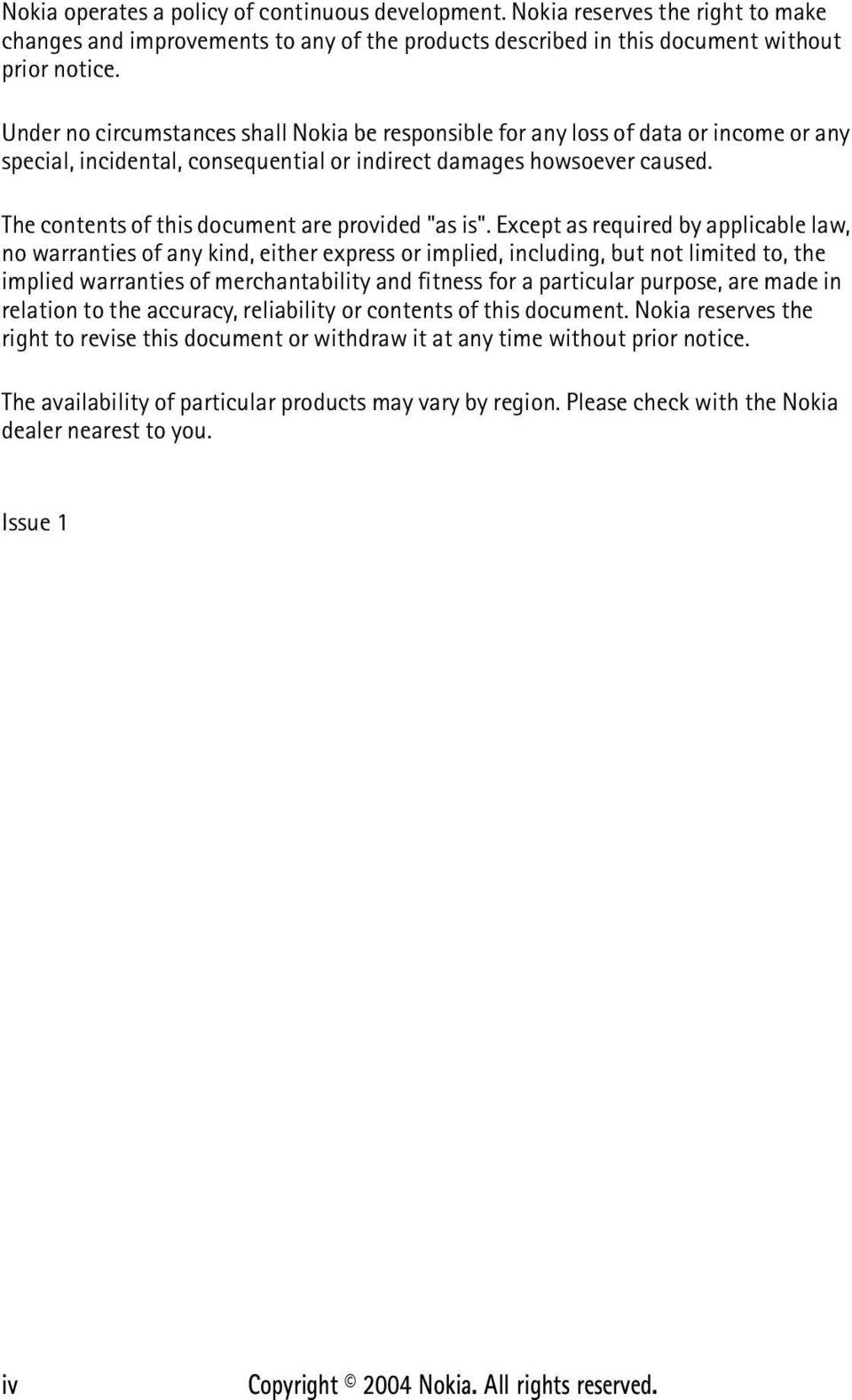
4 Contents FOR YOUR SAFETY...viii Network services...x About accessories...x General information... xi Stickers in the sales package... xi Access codes... xi Downloading content and applications... xii Saving a file received from a compatible device... xii Saving a file downloaded from a browser service... xiii Nokia 7600 imaging phone - Overview... xiv Camera and multimedia messages... xiv Music player... xiv Nokia PC Suite and Nokia Audio Manager... xiv Shared memory... xv Support for GSM and UMTS networks... xv GPRS for fast data transfer... xv 1. Your phone... 1 Keys and connectors... 1 Front keys and earpiece... 1 Top keys... 2 Side keys and infrared port... 2 Bottom connectors... 2 Three selection keys... 2 Standby mode and display indicators... 3 Putting on the wrist strap... 3 Using the Nokia HS-3 headset Getting started... 5 Installing the SIM card and the battery... 5 Installation... 5 Charging the battery... 6 Switching the phone on and off... 7 Changing the Xpress-on sleeves... 7 Using the camera Basic functions Making a call Answering or rejecting an incoming call Functions available during a call Using the loudspeaker Using the voice key Keypad lock (Keyguard) Writing text Predictive text input Using traditional text input Using the menu Accessing a menu function List of menu functions Menu functions Messages (Menu 1) Text and picture messages (SMS) Multimedia messages (MMS) messages Deleting messages Chat Voice messages Info messages Message settings Service commands Distribution lists Copyright 2004 Nokia. All rights reserved. v

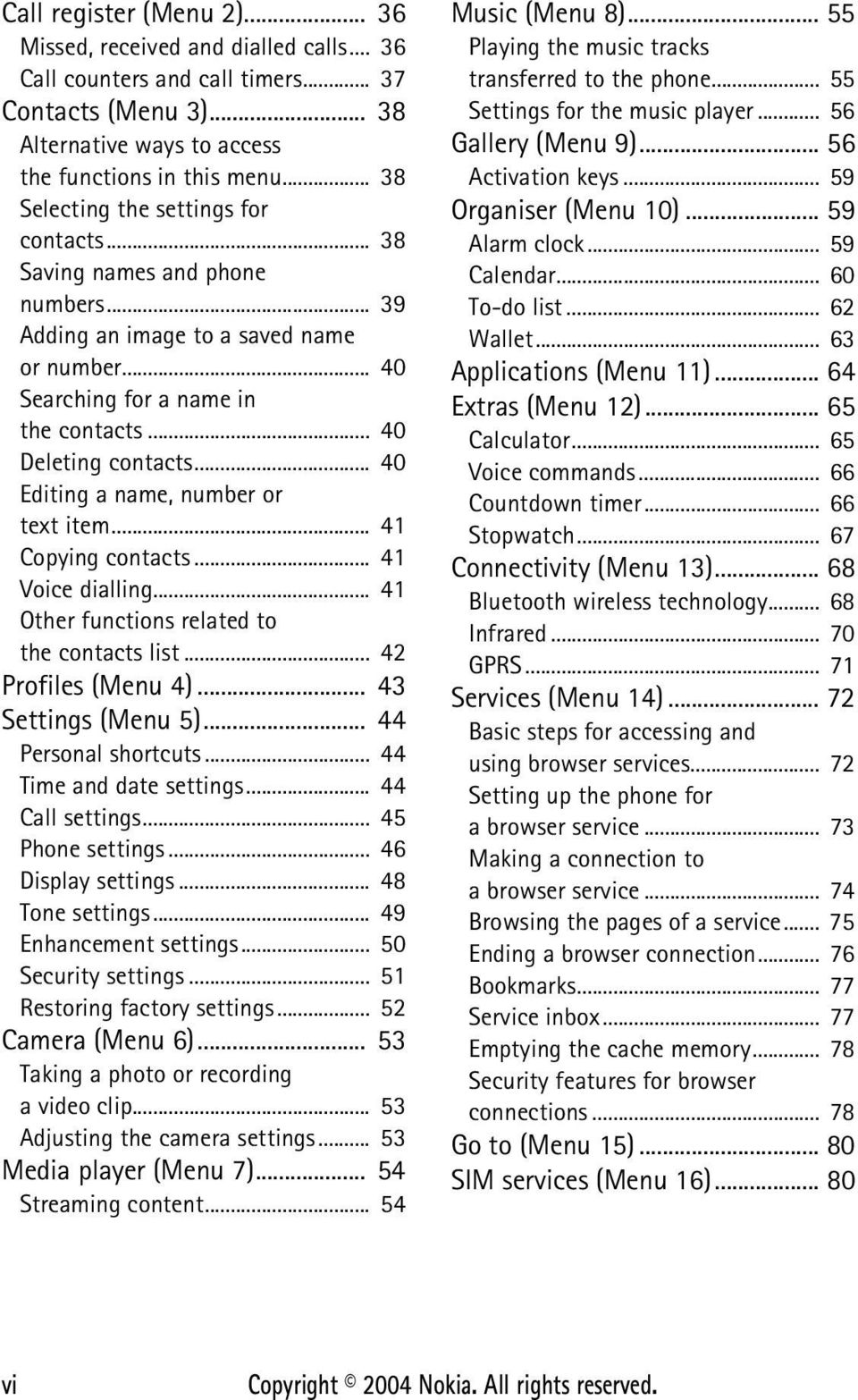
5 Call register (Menu 2) Missed, received and dialled calls Call counters and call timers Contacts (Menu 3) Alternative ways to access the functions in this menu Selecting the settings for contacts Saving names and phone numbers Adding an image to a saved name or number Searching for a name in the contacts Deleting contacts Editing a name, number or text item Copying contacts Voice dialling Other functions related to the contacts list Profiles (Menu 4) Settings (Menu 5) Personal shortcuts Time and date settings Call settings Phone settings Display settings Tone settings Enhancement settings Security settings Restoring factory settings Camera (Menu 6) Taking a photo or recording a video clip Adjusting the camera settings Media player (Menu 7) Streaming content Music (Menu 8) Playing the music tracks transferred to the phone Settings for the music player Gallery (Menu 9) Activation keys Organiser (Menu 10) Alarm clock Calendar To-do list Wallet Applications (Menu 11) Extras (Menu 12) Calculator Voice commands Countdown timer Stopwatch Connectivity (Menu 13) Bluetooth wireless technology Infrared GPRS Services (Menu 14) Basic steps for accessing and using browser services Setting up the phone for a browser service Making a connection to a browser service Browsing the pages of a service Ending a browser connection Bookmarks Service inbox Emptying the cache memory Security features for browser connections Go to (Menu 15) SIM services (Menu 16) vi Copyright 2004 Nokia. All rights reserved.
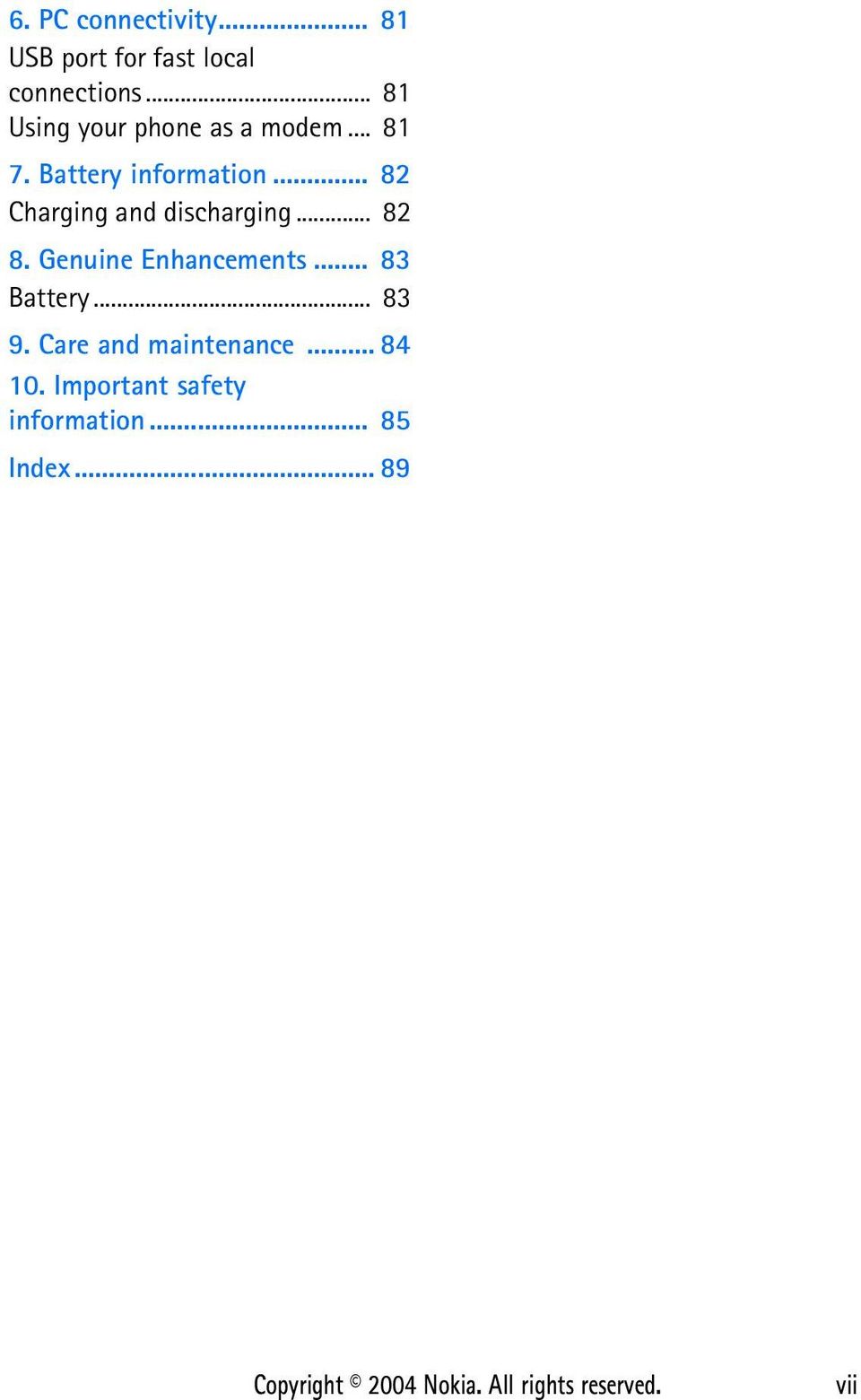
6 6. PC connectivity USB port for fast local connections Using your phone as a modem Battery information Charging and discharging Genuine Enhancements Battery Care and maintenance Important safety information Index Copyright 2004 Nokia. All rights reserved. vii
7 FOR YOUR SAFETY Read these simple guidelines. Breaking the rules may be dangerous or illegal. Further detailed information is given in this manual. Do not switch the phone on when wireless phone use is prohibited or when it may cause interference or danger. ROAD SAFETY COMES FIRST Don't use a hand-held phone while driving. INTERFERENCE All wireless phones may get interference, which could affect performance. SWITCH OFF IN HOSPITALS Follow any regulations or rules. Switch the phone off near medical equipment. SWITCH OFF IN AIRCRAFT Wireless devices can cause interference in aircraft. SWITCH OFF WHEN REFUELLING Don't use the phone at a refuelling point. Don't use near fuel or chemicals. SWITCH OFF NEAR BLASTING Don't use the phone where blasting is in progress. Observe restrictions, and follow any regulations or rules. USE SENSIBLY Use only in the normal position. Don't touch the antenna unnecessarily. QUALIFIED SERVICE Only qualified personnel may install or repair phone equipment. ACCESSORIES AND BATTERIES Use only approved accessories and batteries. Do not connect incompatible products. CONNECTING TO OTHER DEVICES When connecting to any other device, read its user's guide for detailed safety instructions. Do not connect incompatible products. BACKUP COPIES Remember to make backup copies of all important data. WATER-RESISTANCE Your phone is not waterresistant. Keep it dry. CALLING Ensure the phone is switched on and in service. Enter the phone number, including the area code, then press. To end a call, press. To answer a call, press. viii Copyright 2004 Nokia. All rights reserved.

8 EMERGENCY CALLS Ensure the phone is switched on and in service. Press as many times as needed (e.g. to exit a call, to exit a menu, etc.) to clear the display. Enter the emergency number, then press. Give your location. Do not end the call until told to do so. When using the features in this device, obey all laws and honor privacy and legitimate rights of others. Copyright 2004 Nokia. All rights reserved. ix

9 Network services The wireless phone described in this guide is approved for use on the EGSM 900, GSM 1800 and UMTS networks. Dual mode (operation in both GSM/EGSM and UMTS networks) is a network dependent feature. Check with your local service provider if you can subscribe to and use this feature. This wireless phone is a 3GPP GSM Release 99 terminal supporting GPRS service, and is designed to support also Release 97 GPRS networks. However, proper functionality in all Release 97 GPRS networks cannot be guaranteed. For more information, contact your service provider or local Nokia dealer. This phone supports WAP 2.0 protocols (HTTP and SSL) that run on TCP/IP protocols. Some features of this phone, such as MMS, browsing, and content downloading via browser or over MMS, require network support for these technologies. A number of features included in this guide are called Network Services. These are special services that you arrange through your wireless service provider. Before you can take advantage of any of these Network Services, you must subscribe to them through your service provider and obtain instructions for their use from your service provider. Note: Some networks may not support all language-dependent characters and/or services. About accessories Check the model number of any charger before use with this device. This device is intended for use when supplied with power from AC-1, ACP-12, LCH-9 and LCH-12. Warning: Use only batteries, chargers and accessories approved by the phone manufacturer for use with this particular phone model. The use of any other types may invalidate any approval or warranty applying to the phone, and may be dangerous. For availability of approved accessories, please check with your dealer. When you disconnect the power cord of any accessory, grasp and pull the plug, not the cord. x Copyright 2004 Nokia. All rights reserved.

10 General information Stickers in the sales package The stickers contain important information for services and customer support purposes. Keep these stickers in a safe and secure place. Access codes Security code: This code is supplied with your phone. The security code protects your phone against unauthorised use. The preset code is Change the code and set the phone to request it using the Access codes and Security level functions in the Security settings menu. Keep the new code secret and in a safe place separate from your phone. PIN code: The PIN (Personal Identification Number) code may be supplied with the SIM card. It protects the SIM card against unauthorised use. If you activate the PIN code request function in the Security settings menu, the code is requested each time the phone is switched on. If you enter an incorrect PIN code three times in succession, the SIM card is blocked. Key in the PUK code and press OK. Key in a new PIN code and press OK. Key in the new code again and press OK. PIN2 code: This code may be supplied with the SIM card and is required to access some functions, such as charging unit counters. PUK and PUK2 codes: The PUK and PUK2 codes may be supplied with the SIM card. If this is not the case, contact your service provider. Barring password: The barring password is needed when using the Call barring service function in the Security settings menu. Module PIN and signing PIN: The module PIN is needed to access the information in the security module. The signing PIN is needed for the digital signature. These PIN codes may be supplied with the SIM card if the card contains a security module. Copyright 2004 Nokia. All rights reserved. xi

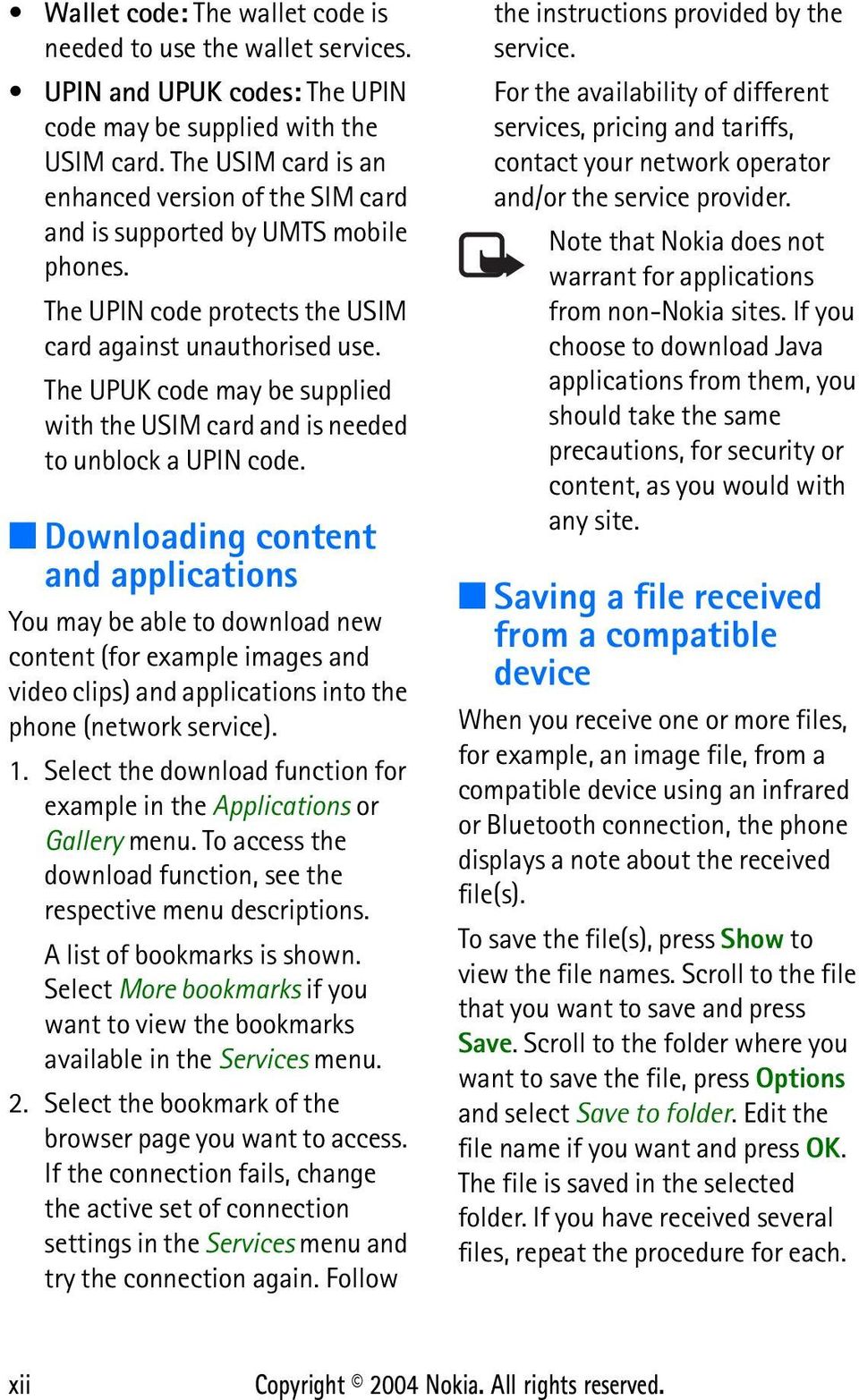
11 Wallet code: The wallet code is needed to use the wallet services. UPIN and UPUK codes: The UPIN code may be supplied with the USIM card. The USIM card is an enhanced version of the SIM card and is supported by UMTS mobile phones. The UPIN code protects the USIM card against unauthorised use. The UPUK code may be supplied with the USIM card and is needed to unblock a UPIN code. Downloading content and applications You may be able to download new content (for example images and video clips) and applications into the phone (network service). 1. Select the download function for example in the Applications or Gallery menu. To access the download function, see the respective menu descriptions. A list of bookmarks is shown. Select More bookmarks if you want to view the bookmarks available in the Services menu. 2. Select the bookmark of the browser page you want to access. If the connection fails, change the active set of connection settings in the Services menu and try the connection again. Follow the instructions provided by the service. For the availability of different services, pricing and tariffs, contact your network operator and/or the service provider. Note that Nokia does not warrant for applications from non-nokia sites. If you choose to download Java applications from them, you should take the same precautions, for security or content, as you would with any site. Saving a file received from a compatible device When you receive one or more files, for example, an image file, from a compatible device using an infrared or Bluetooth connection, the phone displays a note about the received file(s). To save the file(s), press Show to view the file names. Scroll to the file that you want to save and press Save. Scroll to the folder where you want to save the file, press Options and select Save to folder. Edit the file name if you want and press OK. The file is saved in the selected folder. If you have received several files, repeat the procedure for each. xii Copyright 2004 Nokia. All rights reserved.
12 Saving a file downloaded from a browser service When you download a file from a browser service, the phone displays a note about the file to be downloaded. Scroll to the folder where you want to save the file, press Options and select Downld. to folder. Edit the file name if you want and press OK. The phone starts to download the file. After the file has been downloaded, press Yes to view the file or No to return to the browser. Copyright 2004 Nokia. All rights reserved. xiii

13 Nokia 7600 imaging phone - Overview The Nokia 7600 imaging phone is a versatile multimedia phone that provides many convenient features for daily use. Some of these features are briefly described here. Camera and multimedia messages Your phone has a built-in camera that can be used for taking photos and recording short video clips with sound. You can attach the photo or video clip to a multimedia message and send it via the Multimedia Messaging Service (MMS) to a compatible device (network service). The photos can also be used as wallpaper in standby mode or as thumbnail pictures in the contacts list. Music player The phone includes a music player that allows you to listen to audio files using a headset or the phone s loudspeaker. You can transfer audio files to your phone via the Nokia Audio Manager PC software included on the CD-ROM in the sales package. Nokia PC Suite and Nokia Audio Manager The CD-ROM supplied with the phone contains the Nokia PC Suite software which includes an extensive collection of different applications. With these applications you can, for example, create new ringing tones, manage the photos and video clips captured with the phone s camera, and install new Java TM applications to your phone. With the Nokia Audio Manager application you can transfer AAC or MP3 music files from a compatible PC to your phone via the USB cable (DKU-2). This cable is supplied with the phone. You can then play the music files in your phone s Music menu. Nokia PC Suite is also available on Nokia s Web site at For more information, refer to the documentation and Help files that come with Nokia PC Suite and Nokia Audio Manager. xiv Copyright 2004 Nokia. All rights reserved.

14 Shared memory The following features in this phone may share memory: multimedia messages; images, video clips, recorded voice files, ringing tones and music files in the Gallery menu; images in the contacts list; voice tags. Using any such features may reduce the memory available for any features sharing memory. This is especially true with heavy use of any of the features. For example, saving many images may take all of the shared memory and your phone may display a message that the memory is full. In this case, it is recommended to delete some images or other items from the Gallery menu. You can check the amount of free and used shared memory with the Memory status function in the Phone settings menu, see page 46. Support for GSM and UMTS networks Your phone can be used in GSM 900, GSM 1800 and UMTS networks. The UMTS network allows fast communications and simultaneous use of several call functions. When the phone is using a UMTS network you can, for example, take a photo during a call and send it in a multimedia message without ending the call (network service). The phone selects the GSM or UMTS network automatically according to the network parameters and the roaming agreements between the network operators. When the phone is being used in a UMTS network, is shown in standby mode, if supported by the network. GPRS for fast data transfer You can use the phone for fast GPRS (General Packet Radio Service) data services (network services). GPRS can be used for accessing WAP and Internet services, sending and receiving text and multimedia messages and downloading Java games and applications as well as streaming content and video and music clips (network services). Subscribe to the GPRS service from your network operator or service provider and save the GPRS settings for the functions (for example multimedia messages) that you want to use with the GPRS service. Copyright 2004 Nokia. All rights reserved. xv
15 xvi Copyright 2004 Nokia. All rights reserved.

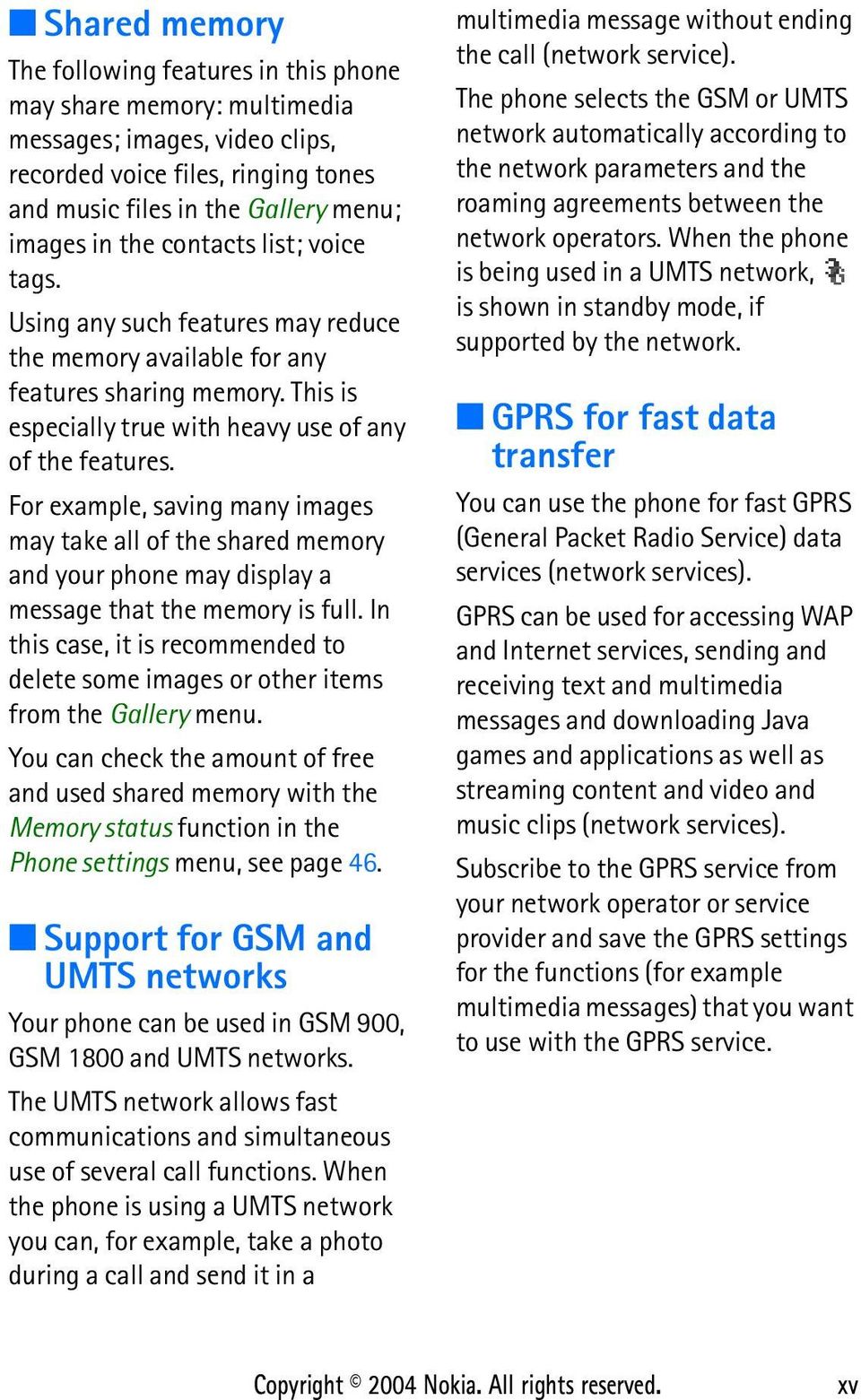
16 Your phone 1. Your phone Keys and connectors Front keys and earpiece 1. Earpiece 2. - enter numbers and characters. Pressing and holding in standby mode calls your voice mailbox (network service). Pressing and holding in standby mode opens the homepage that you have defined in the active browser service settings (network service). and are used for various purposes in different functions. 3. dials a phone number or answers a call. Pressing this key in standby mode shows the most recently dialled numbers way scroll key With this key you can scroll through different lists, such as contacts and menu functions, and move the cursor for example when writing a message. If you press the centre of the scroll key, the phone performs the function displayed above it. Pressing left in standby mode opens a text editing screen where you can write and send a text message. Pressing right in standby mode opens the calendar. 5. Three selection keys Each key performs the function that is displayed above it. The middle selection key (indicated with a blue spot) can be found in the centre of the 4-way scroll key. See also Three selection keys on page ends an active call or rejects a call. This key also exits from any function. Copyright 2004 Nokia. All rights reserved. 1
17 Your phone Top keys Bottom connectors 1. Charger connector 1. Power key Press and hold this key to switch the phone on or off. If you press this key while the keypad is locked, the phone s lights turn on for about 15 seconds. 2. Camera key for activating the camera to take a picture or record a video clip. Side keys and infrared port 1. Voice key Press this key to start voice recording. Press and hold this key to activate voice dialling. See also Using the voice key on page Volume up key 3. Volume down key 4. Infrared port for a wireless connection with a compatible device 2. Pop-Port TM connector with an integrated USB port 3. Microphone 4. Holes for a carrying strap Three selection keys The function of these keys depends on the guiding text displayed above them. The left selection key ( ) usually opens a list of options related to the currently displayed function. In standby mode, this selection key is Gallery. The middle selection key, located in the centre of the scroll key, usually performs the default operation of the current function. In standby mode, this selection key is Menu. 2 Copyright 2004 Nokia. All rights reserved.

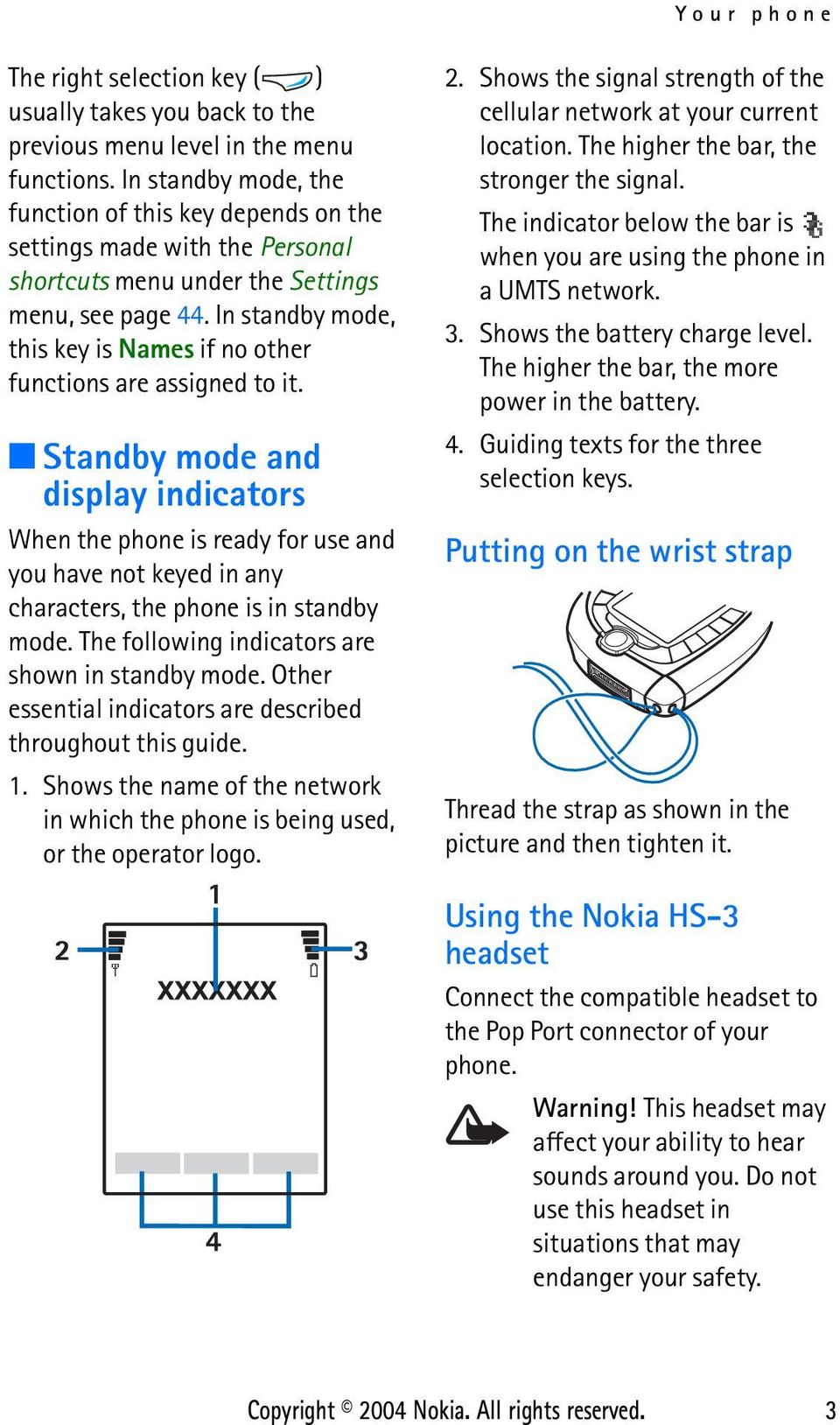
18 Your phone The right selection key ( ) usually takes you back to the previous menu level in the menu functions. In standby mode, the function of this key depends on the settings made with the Personal shortcuts menu under the Settings menu, see page 44. In standby mode, this key is Names if no other functions are assigned to it. Standby mode and display indicators When the phone is ready for use and you have not keyed in any characters, the phone is in standby mode. The following indicators are shown in standby mode. Other essential indicators are described throughout this guide. 1. Shows the name of the network in which the phone is being used, or the operator logo. 2. Shows the signal strength of the cellular network at your current location. The higher the bar, the stronger the signal. The indicator below the bar is when you are using the phone in a UMTS network. 3. Shows the battery charge level. The higher the bar, the more power in the battery. 4. Guiding texts for the three selection keys. Putting on the wrist strap Thread the strap as shown in the picture and then tighten it. Using the Nokia HS-3 headset Connect the compatible headset to the Pop Port connector of your phone. Warning! This headset may affect your ability to hear sounds around you. Do not use this headset in situations that may endanger your safety. Copyright 2004 Nokia. All rights reserved. 3
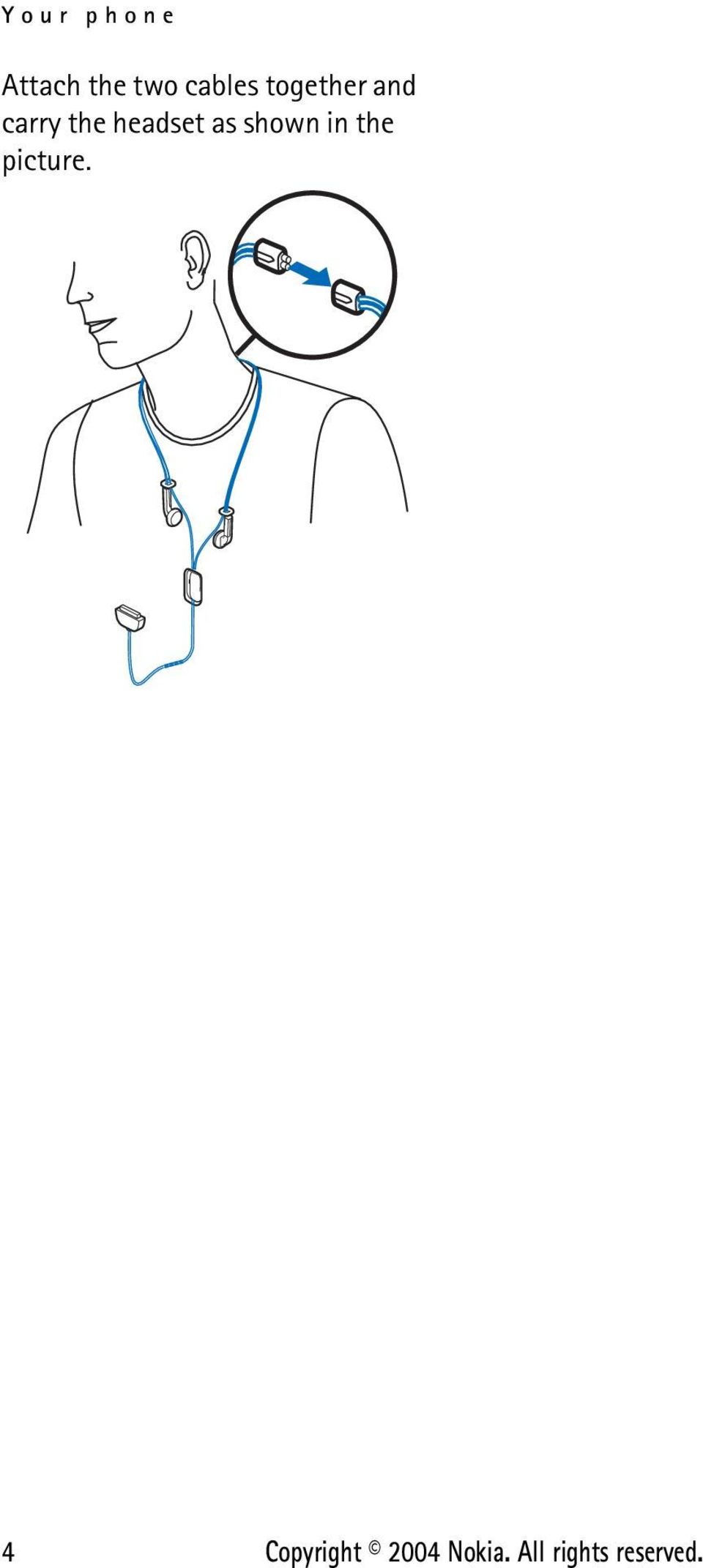
19 Your phone Attach the two cables together and carry the headset as shown in the picture. 4 Copyright 2004 Nokia. All rights reserved.
20 Getting started 2. Getting started Installing the SIM card and the battery Keep all miniature SIM cards out of the reach of small children. The SIM card and its contacts can easily be damaged by scratches or bending, so be careful when handling, inserting or removing the card. Before installing or removing the SIM card, always switch off the power and disconnect the phone from the charger and any other device. Installation To open the back cover of the phone, you first need to remove one of the two side covers ( sleeves ) from the phone. 1. With the display facing downwards and the camera lens pointing to the top left, remove the right sleeve from the phone (1). 2. Slide the back cover to the bottom of the phone (2) and lift it off the phone (3). 3. Remove the battery by lifting it from the edge (4). 4. Slide the SIM card into the SIM card slot (5). Make sure that the golden contacts on the card are facing downwards and that the bevelled corner points towards the camera lens. Copyright 2004 Nokia. All rights reserved. 5
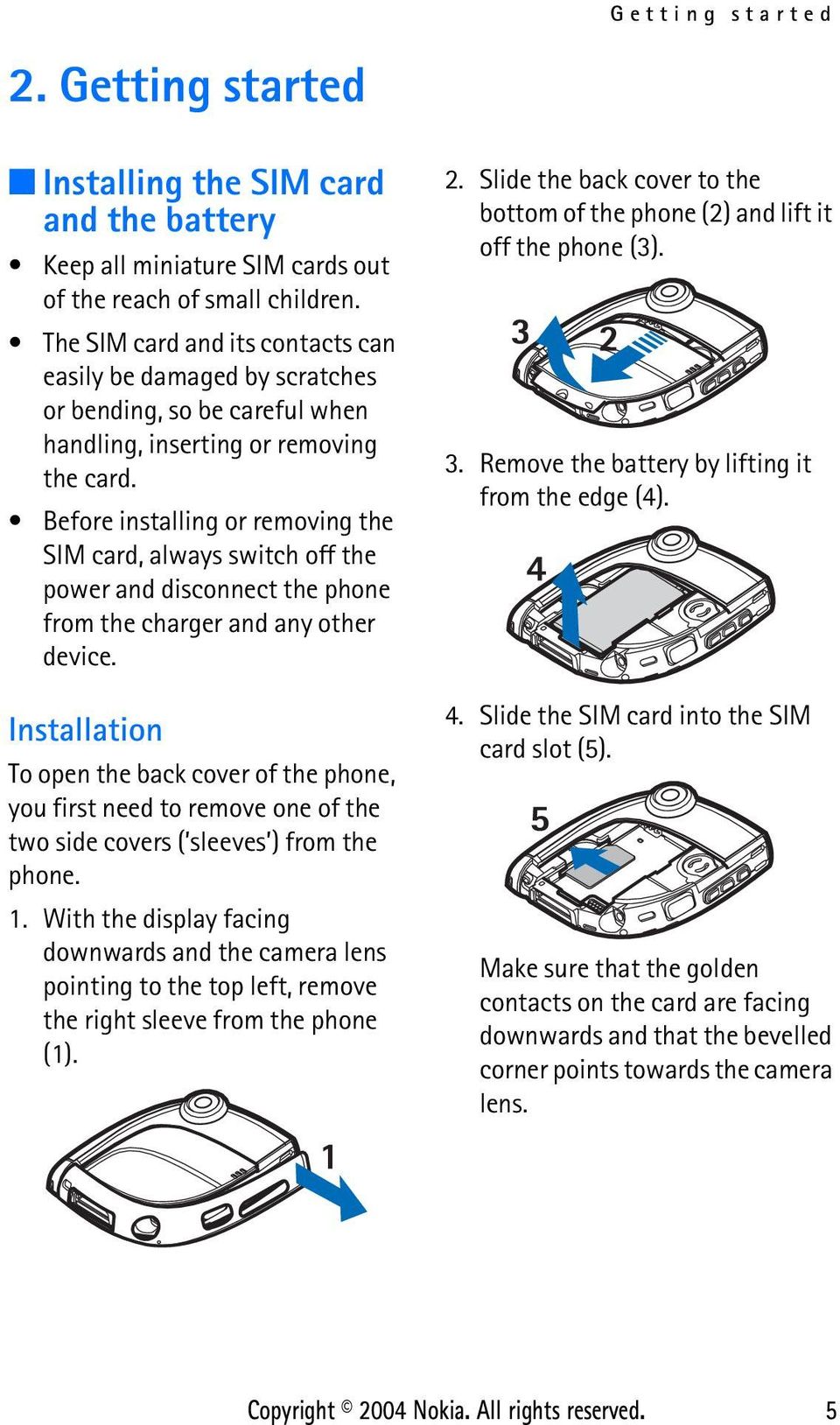
21 Getting started 5. Align the battery contacts with the corresponding contacts on the phone (6) and push the battery towards the phone until it locks into place. 6. Place the back cover over the battery (7) and slide it gently into place (8). Make sure that the cover is properly in place. 7. Replace the sleeve by pushing it towards the phone. Make sure that the sleeve is properly in place. Charging the battery Do not charge the battery when the back cover or the sleeves of the phone are removed. See also Battery information on page Connect the lead from the charger to the bottom of your phone. 2. Connect the charger to an AC wall socket. The charging indicator bar starts scrolling on the display. If the battery is completely flat, it may take a few minutes before this indicator appears. You can use the phone during charging. Charging the battery supplied with the phone takes about 1 hour 30 minutes when using the AC-1 or ACP-12 charger. If Not charging is displayed, wait for a while, disconnect the charger, plug it in again and retry. If charging still fails, contact your dealer. 3. When the battery is fully charged, the charging indicator bar stops scrolling. Disconnect the charger from the AC wall outlet and the phone. 6 Copyright 2004 Nokia. All rights reserved.
22 Getting started Switching the phone on and off Warning: Do not switch the phone on when wireless phone use is prohibited or when it may cause interference or danger. Press and hold the power key. If the phone asks for a PIN or UPIN code or security code, key in the code and press OK. See also Access codes on page xi. If the phone displays Insert SIM card even though the SIM card is properly inserted, or SIM card not supported, insert the card again. If the text still appears on the display, contact your network operator or service provider. Your phone does not support 5 Volt SIM cards and the card may need to be changed. TIPS ON EFFICIENT OPERATION: Your phone has two internal antennas (blue areas in the picture). As with any other radio transmitting device, do not touch the antennas unnecessarily when the phone is switched on. Contact with the antennas affects call quality and may cause the phone to operate at a higher power level than otherwise needed. Not touching the antenna area during a phone call optimises the antenna performance and the talktime of your phone. Changing the Xpresson sleeves Before changing the sleeves, always switch off the power and disconnect the phone from the charger or any other device. Always store and use the phone with the covers attached. You can change the side covers (sleeves) of the phone. 1. With the display facing upwards and the camera lens pointing to the right, remove the sleeves from the phone starting from the corner indicated with the text Nokia (1). 2. Align the new right sleeve with the phone (2). Copyright 2004 Nokia. All rights reserved. 7
23 Getting started 3. Install the new right sleeve by pushing its ends towards the phone. Make sure that the sleeve is properly in place. 4. Align the new left sleeve with the phone. 5. Install the new left sleeve by pushing its ends towards the phone. Make sure that the sleeve is properly in place. Using the camera The phone has a built-in camera that can be used for taking photos and recording video clips. For information about the camera settings, see Camera (Menu 6) on page 53. Photos and video clips use shared memory, see page xv. Note: Your phone must be switched on to use this function. Do not switch the phone on when wireless phone use is prohibited or when it may cause interference or danger. 1. To activate the camera, press the camera key on top of the phone in standby mode. The live image appears on the display. You can use the display as a viewfinder. Pressing Options allows access to the following functions. Select Change mode to set the camera to the desired operation mode. You can set the default mode in the Camera menu. For details, see Camera (Menu 6) on page 53. Tip: To quickly change the camera mode, press and hold left or right. 8 Copyright 2004 Nokia. All rights reserved.
24 Getting started Self-timer to set the camera to take the photo within 10 seconds after you press Start. Mute to turn off the microphone when the selected camera mode is Video. Open Gallery to view the photos in the desired folder of the Gallery menu. 2. Press Capture (or the camera key) to take a photo or Record (or the camera key) to record a video clip. If you do not take a photo or record a video clip within one minute, press Continue or the camera key to activate the camera again. The approximate number of photos that can be saved in the phone is shown at the top of the display. If the distance to the subject is closer than 30 centimetres it may affect the sharpness of your photo. When you record a video clip, the red indicator and the amount of remaining recording time is shown at the top of the display. The default maximum length of a video clip is 10 seconds. You can change this time in the Camera menu. To stop the recording and save the video clip, press Stop. To pause the recording, press Pause or the camera key. To resume the recording, press Continue or the camera key. 3. The photo or video clip is saved with the default name in the Images or Video clips folder of the Gallery menu. You can define the default name in the Camera menu. The photos are saved in JPEG format and the video clips in 3GP format. To delete the displayed photo, press Delete. To view the video clip, press Play. To capture a new photo or video clip, press Back. If you press Options, you can, for example, send the photo or video clip in a multimedia message (network service) or via an infrared or Bluetooth connection to a compatible device. You can also attach a portrait photo to a name or phone number in the contacts list. Note that a video clip can be sent in a multimedia message only if the length of the clip is 10 seconds at the most. Copyright 2004 Nokia. All rights reserved. 9
25 Basic functions 3. Basic functions Making a call 1. Key in the phone number, including the area code. If you key in an incorrect character, press left or right to move the cursor and Clear to delete the character to the left of the cursor. To make an international call: Press twice for the + character (replaces the international access code) and key in the country code, area code (omit the leading zero, if necessary) and phone number. 2. Press to call the number. To adjust the volume: Use the volume keys on the side of the phone. See Side keys and infrared port on page 2. To take a photo and send it in a multimedia message (in UMTS networks only): Press the camera key and press Capture (or the camera key again). To send the photo to a compatible device (network service), press Options, and select Send. 3. Press to end the call or to cancel the call attempt. Calling a phone number saved in the contacts list Press down (or up) in standby mode. Key in the first letter(s) of the name that has been saved with the phone number. Scroll to the name with. To view the default phone number saved with the name, press Details or press and hold. Press to make the call. Calling a recently dialled number In standby mode, press once to view up to 20 numbers that you have last called or attempted to call. Scroll to the desired number or name, and press to call the number. To call the last dialled number, press twice in standby mode. Calling your voice mailbox To call your voice mailbox (network service) in standby mode, press and hold, or press and. If the phone asks for the voice mailbox number, key it in and press OK. See also Voice messages on page 31. When you have received a voice message, may be shown at the top of the display (network service). Press Listen to call your voice mailbox. 10 Copyright 2004 Nokia. All rights reserved.
26 Basic functions Voice dialling You can dial a phone number by saying one or more words that have been attached to it. See Voice dialling on page 41. Speed dialling a phone number If you have assigned a phone number to one of the keys to (see Speed dials on page 42), you can call the phone number in the following ways: In standby mode, press the desired number key and. OR: If the Speed dialling function (see page 46) is set on, press and hold the number key in standby mode until the call is started. Making another call during a call (network service) During a call, press Options and select New call. Key in the phone number, or search for it in the contacts, and press Call or. The first call is put on hold. To switch between the two calls, press. To end the active call, press, or press Options and select End call. To end both calls, press Options and select End all calls. To join the two calls into a conference call (network service), press Options and select Conference. To have a private conversation with one of the participants, select Private call and the participant. To rejoin the call, select Conference. To end the call, press. Answering or rejecting an incoming call Press to answer the call. If you want to mute the ringing tone, press Silence. To reject the call, press, or press Options and select Reject. The rejected call will be diverted if you have activated a call divert option such as Divert if busy. If a compatible headset, such as the Nokia HS-3 headset, is connected to the phone, you can answer and end a call by pressing the headset button. Call waiting You can answer a call while you have another call in progress if you have activated the Call waiting function in the Call settings menu (network service). To answer the waiting call, press Answer or. The first call is put on hold. Copyright 2004 Nokia. All rights reserved. 11
27 Basic functions Functions available during a call You can press Options for some of the following functions during a call: Mute or Unmute, End call, End all calls, Contacts, Menu, Hold or Unhold, New call (network service), Conference (network service), Private call (network service), Answer, Reject, Swap (network service), Send DTMF, Loudspeaker or Handset, Lock keypad, Transfer (network service), Headset, Handsfree, Record. Select Send DTMF to send DTMF tone strings, for example, a password. Key in the DTMF string, or search for it in the contacts list. To key in a wait character (w) or a pause character (p), press repeatedly. Transfer to connect the held call to the active call and to disconnect yourself from the call. Headset or Handsfree to switch the active call to the respective compatible enhancement connected to the phone. Using the loudspeaker The phone has a loudspeaker that allows you to use the phone hands free during a call. Do not hold the phone to your ear during loudspeaker operation. Important! Do not hold the phone near to your ear when the loudspeaker is in use because the volume may be extremely loud. To activate the loudspeaker during a call: Press Options and select Loudspeaker, or press Loudsp. if available. When the loudspeaker is active, is shown at the top of the display. To deactivate the loudspeaker: Press Options and select Handset, or press Normal if available. If a compatible car kit, such as the CK-1W, or headset, such as the HS-3, is connected to the phone, the Handset option is replaced with Handsfree or Headset, and the selection key Normal changes to Handsf. or Heads., respectively. 12 Copyright 2004 Nokia. All rights reserved.
28 Basic functions Using the voice key The voice key is located above the volume keys on the side of the phone. This key can be used for voice recording, voice dialling and voice commands. To use the voice key for voice dialling, see pages 11 and 41. To use the voice key for voice commands, see page 66. These functions can be used only in standby mode. Voice recording You can record for example a name and a phone number and write them down later. Press the voice key to start voice recording. When recording, hold the phone in the normal position near to your ear. To stop the recording, press the voice key. The recording is saved in the Recordings folder of the Gallery menu, see page 56. Voice recording can be used also during a call (press Options and select Record). While recording a call, all parties to the call hear a faint beep approximately every five seconds. Keypad lock (Keyguard) You can lock the keypad to prevent the keys being accidentally pressed, for example when your phone is in your handbag. To lock the keypad, press Menu in standby mode and then within 1.5 seconds. To unlock the keypad, press Unlock and then within 1.5 seconds. When the keypad is locked: The indicator is shown. To answer a call, press. During the call, the phone can be operated normally. When you end or reject the call, the keypad will automatically be locked. You can also set the keypad to lock automatically after a certain length of time (see Automatic keyguard on page 47), or you can set the phone to ask for the security code when you unlock the keypad (see Security keyguard on page 47). Note: When Keyguard is on, calls may be possible to the emergency number programmed into your phone (e.g. 112 or other official emergency number). Key in the emergency number and press. The number is displayed only after you have keyed in its last digit. Copyright 2004 Nokia. All rights reserved. 13
29 Basic functions Writing text You can key in text, for example messages or calendar notes, using predictive or traditional text input. Predictive text input In predictive text input, you can key in characters by pressing a letter key once for each character. This input method uses a dictionary built into the phone. Setting predictive text input on or off When writing text, press Options and select Dictionary. To set predictive text input on, select the language you want from the dictionary list. Predictive text input is only available for the languages on the list. To revert to traditional text input, select Dictionary off. Tip: To quickly set predictive text input on or off when writing text, press twice, or press and hold Options. Using predictive text input Check that is shown at the top of the display. 1. Write a word by using the keys to. Press each key only once for one letter. The word may change after each keypress. For general instructions on writing text, see page 15. For example, to write Nokia, press. To insert a common punctuation mark, press and then repeatedly. OR: Press and hold, scroll to the desired character and press Use. To insert a special character: Press and hold, scroll to the desired character and press Use or. 2. If the displayed word is the one that you want, press (a space is inserted) and write the next word. If the word is not the one that you want, press Options, select Matches and the desired word, and press Use. OR: Press repeatedly until the word appears. To view the previous match, press Prev. If the? character is shown after the word, no words in the dictionary correspond to your keypresses. To add a word to the dictionary: Press Spell, key in the word using traditional text input and press Save. When the dictionary becomes full, the new word replaces the oldest one that was added. 14 Copyright 2004 Nokia. All rights reserved.
30 Basic functions To edit the previous word, press left to select it and modify it. 3. When using predictive text input, pressing Options can also allow access to the following functions: Insert word or Edit word: You can key in a word using traditional text input and add it into the dictionary. Insert symbol: You can select a special character from a list. Writing compound words Key in the first part of the word and confirm it by pressing right. Repeat this with the last part of the word. Using traditional text input Check that is shown at the top of the display. Press a key one or more times until the desired character is displayed. Not all available characters are printed on the keys. The characters available depend on the language selected in the Language settings menu. If the next letter that you want is located on the same key as the present one, wait until the cursor is shown and key in the letter. To add a common punctuation mark or special character, press repeatedly. OR: Press, scroll to the desired character and press Use. General instructions on writing text To insert a space, press. To move the cursor, use the key. To delete the character to the left of the cursor, press Clear. Press and hold Clear to delete several characters. To change the character case, press repeatedly and check the indicator, for example Abc, at the top of the display. To insert a number, press and hold the desired key. To insert several numbers, press and hold and key in the numbers. To continue writing text, press and hold. Copyright 2004 Nokia. All rights reserved. 15
31 Using the menu 4. Using the menu Your phone offers a wide range of functions that are grouped in menus. Most of the menu functions are provided with a brief help text. To view the help text, scroll to the desired menu function and wait for about 15 seconds. To exit the help text, press Back. The help text can be set to on or off using the Help text activation function in the Phone settings menu, see page 46. Accessing a menu function By scrolling 1. Press Menu in standby mode. 2. Press down, up, left or right to scroll to a main menu, for example Settings, and press Select to open it. When the menu view is List, you can press to scroll up or down through the main menus. To change the menu view, see Menu view in Display settings on page Scroll to a submenu, for example Call settings, and press Select. If the submenu contains further submenus, for example Speed dialling, repeat this step. 4. Scroll to a setting option, for example Off, and press Select. Press Back to return to the previous menu level, and Exit to exit to standby mode. By using a shortcut number The menus, submenus and setting options are numbered. This shortcut number is shown at the top right of the display. Press Menu in standby mode. Within two seconds, key in the shortcut number of the main menu that you want to open. Repeat this for the submenu and setting option. 16 Copyright 2004 Nokia. All rights reserved.
32 Using the menu List of menu functions 1. Messages 1. Text messages 1. Create message 2. Inbox 3. Sent items 4. Saved items 5. Templates 6. My folders 7. Distribution lists 8. Delete messages 2. Multimedia msgs. 1. Create message 2. Inbox 3. Outbox 4. Sent items 5. Saved items 6. Delete messages Chat 5. Voice messages 1. Listen to voice messages 2. Voice mailbox number 6. Info messages 7. Message settings 1. Text messages 2. Multimedia msgs. 3. messages 4. Other settings 8. Service commands 2. Call register 1. Missed calls 2. Received calls 3. Dialled numbers 4. Delete recent call lists 1. All 2. Missed 3. Received 4. Dialled 5. Call duration 1. Last call duration 2. Received calls' duration 3. Dialled calls' duration 4. All calls' duration 5. Clear timers 6. GPRS data counter 1. Data sent in last session 2. Data received in last session 3. All sent data 4. All received data 5. Clear counters 7. GPRS connection timer 1. Duration of last session 2. Duration of all sessions 3. Clear timers 3. Contacts 1. Search 2. Add contact 3. Delete 4. Copy 5. Settings 1. Memory in use 2. Contacts view 3. Memory status 6. Speed dials 7. Voice tags 8. Service numbers 1 1. Shown if supported by your SIM card. For availability, contact your network operator or service provider. Copyright 2004 Nokia. All rights reserved. 17
33 Using the menu 9. My numbers 10.Caller groups 4. Profiles 1. General 1. Activate 2. Personalise 3. Timed 2. Silent (same submenus as in General) 3. Meeting (same submenus as in General) 4. Outdoor (same submenus as in General) 5. Pager (same submenus as in General) 5. Settings 1. Personal shortcuts 2. Time and date settings 1. Clock 2. Date 3. Auto-update of date & time 3. Call settings 1. Call divert 2. Anykey answer 3. Automatic redial 4. Speed dialling 5. Call waiting 6. Summary after call 7. Send my caller ID 8. Line for outgoing calls 1 4. Phone settings 1. Language settings 2. Automatic keyguard 3. Security keyguard 4. Cell info display 5. Welcome note 6. Operator selection 7. Network mode 2 8. Confirm SIM service actions 9. Help text activation 10.Start-up tone 11.Memory status 5. Display settings 1. Wallpaper 2. Colour schemes 3. Menu view 4. Operator logo 5. Screen saver time-out 6. Tone settings 1. Incoming call alert 2. Ringing tone 3. Ringing volume 4. Vibrating alert 5. Message alert tone 6. Keypad tones 7. Warning tones 8. Alert for 7. Enhancement settings 3 1. Headset 2. Handsfree 3. Loopset 8. Security settings 1. Code in use 2. PIN code request or UPIN code request 4 1. For availability, contact your network operator or service provider. 2. The availability depends on the network operator. 3. Shown only if the phone is or has been connected to a compatible headset, handsfree unit or loopset. 4. The name of this setting depends on the Code in use setting. 18 Copyright 2004 Nokia. All rights reserved.
34 Using the menu 3. Call barring service 4. Fixed dialling 1 5. Closed user group 6. Security level 7. Access codes 9. Restore factory settings 6. Camera 1. Standard photo 2. Portrait photo 3. Night mode 4. Video 5. Settings 7. Media player 8. Music 9. Gallery 10.Organiser 1. Alarm clock 2. Calendar 3. To-do list 4. Wallet 11.Applications 1. Select application 2. App. downloads 3. Memory 12. Extras 1. Calculator 2. Voice commands 3. Countdown timer 4. Stopwatch 13. Connectivity 1. Bluetooth 1. Bluetooth 2. Search for audio enhancements 3. Active device 4. Paired devices 5. Bluetooth settings 2. Infrared 3. GPRS 1. GPRS connection 2. GPRS modem settings 14. Services 1. Home 2. Bookmarks 3. Download links 4. Last web addr. 5. Service inbox 6. Settings 7. Go to address 8. Clear the cache 15. Go to 16. SIM services 2 1. Shown only if supported by your SIM card. 2. Shown only if supported by your SIM card. The name and contents depend on the SIM card. Copyright 2004 Nokia. All rights reserved. 19
35 5. Menu functions Messages (Menu 1) You can read, write, send and save text and multimedia messages and messages. The messages are organised into folders. Text and picture messages (SMS) Your phone supports the sending of text messages beyond the 160 characters limit (network service). If your message exceeds this limit, it will be sent as a series of two or more messages. Text messages can contain pictures. Each picture message is made up of several text messages. Therefore, sending one picture message may cost more than sending one text message. Before you can send text or picture messages, you need to save your message centre number, see Message settings on page 31. Note: The picture message function can be used only if it is supported by your network operator or service provider. Only phones that offer picture message features can receive and display picture messages. Writing and sending a text or picture message 1. Press Menu in standby mode, and select Messages, Text messages and Create message. OR: Press left in standby mode. 2. Key in the message, see Writing text on page 14. At the top the display, you can see the message length indicator counting backwards from 160. For example, 10/2 means that you can still add 10 characters for the text to be sent as two messages. Using special (Unicode) characters such as á takes up more space. Note that predictive text input may use Unicode characters. To insert a picture into the message, press Options and select Insert picture. The list of folders in the Gallery is shown, see page 56. Scroll to the desired picture, press Options and select Insert. There are no preset pictures for picture messages in the phone. 20 Copyright 2004 Nokia. All rights reserved.
36 To view the text and picture together, press Options and select Preview. To change the picture or delete it from the message, press Options and select the desired function. To use a predefined text as a base for the message, press Options, select Use template, scroll to the desired template, press Options and select Insert. To insert a phone number from the contacts list, press Options and select Insert number. Press Search or press down and select the number from the contacts list. To insert a name from the contacts list, press Options and select Insert contact and the desired name. To insert a number or text item saved with the name, press Options and select View details and the desired number or text item. To save the message in the Saved items or Templates folder or in a folder that you have created inside the My folders folder, press Options and select Save message. 3. To send the message, press Send or, key in the recipient s phone number or search for it in the contacts list, and press OK. Alternatively: Press Options and select Sending options. Select Send to many to send the message to several recipients. Scroll to the first recipient and press Send. When you have sent the message to everyone you want, press Done. Send to list to send the message using a distribution list, see page 36. Sending profile to send the message using the settings that you have defined earlier. See Message settings on page 31. The sent message is saved in the Sent items folder. Note that a separate text message is sent to each recipient when you are using the Send to many or Send to list function. Note: When sending messages via the SMS network service, your phone may display the words Message sent. This is an indication that the message has been sent by your phone to the message centre number programmed into your phone. This is not an indication that the message has been received at the intended destination. For more details about SMS services, check with your service provider. Copyright 2004 Nokia. All rights reserved. 21
37 Reading and replying to a text or picture message When you receive a message, the indicator and the number of new messages followed by... messages received are displayed. If the indicator blinks, the text message memory is full. Before you can receive new messages, you need to delete some old ones. See page Press Show to view the newly received message right away, or press Exit to view it later. Viewing the message later: Press Menu in standby mode, and select Messages, Text messages and Inbox. Select the desired message from the list. An unread message is indicated by. 2. Scroll through the message. 3. To reply to the displayed message, press Reply. Select Original text if you want to include the original message in the reply. Template or a standard answer such as Please call if you want to use a preset text as a base for the new message. 4. To send your reply, press Send or. Alternatively: Press Options and select Sending options and the desired option. The options are the same as when sending a text or picture message, see page 20. Other functions accessible with the Options key While reading a message, pressing Options also allows access to the following functions: Delete, Use detail, Chat, Forward, Edit (for text messages) / Edit text (for picture messages), Move, Rename, Copy to calendar, Save picture (for picture messages), Message details. Tip: You can use most of these functions without opening a message. For example, to forward a message, scroll to the desired message on the list, press Options and select Forward. Select Use detail to extract a phone number, address or Web address from the message. Move to move the message to the Saved items or Templates folder or to a folder that you have created inside the My folders folder. Copy to calendar to copy the message text to your phone s calendar as a reminder note. 22 Copyright 2004 Nokia. All rights reserved.
38 Save picture to save the picture in the Gallery menu, if you are viewing a picture message. Message details to view the sender s name and phone number, the message centre used, and the date and time of receipt. Folders for text and picture messages The phone has different folders for saving sent and received text and picture messages. To open a folder, press Menu in standby mode, and select Messages, Text messages and one of the following folders: Inbox where the phone saves received messages. Sent items where the phone saves sent messages. Saved items where you can save messages for later use. Templates where you can save text messages that you want to use as a base when writing or replying to a message. To edit or delete a template, select the desired template, press Options, and select the desired function. My folders where you can create new folders for your messages. To add a folder, press Add (if the folder list is empty) or press Options and select Add folder. To delete or rename a folder, press Options and select the desired function. Multimedia messages (MMS) The phone allows you to send and receive multimedia messages of up to 100 kilobytes. Note: This function can be used only if it is supported by your network operator or service provider. Only phones that offer compatible multimedia message features can receive and display multimedia messages. If Allow multimedia reception is set to Yes or In home network, your operator or service provider may charge you for every message you receive. Note that multimedia messages cannot be received in GSM networks during a call. Because delivery of multimedia messages can fail for a variety of reasons, do not rely solely upon them for essential communications. Sent and received multimedia messages use shared memory, see page xv. Copyright 2004 Nokia. All rights reserved. 23
39 Writing and sending a multimedia message Before you can use the multimedia messaging service, you need to define its settings, see page 32. For the settings, availability and subscription to this service, contact your network operator or service provider. Before sending a multimedia message, read the notes on page Press Menu in standby mode, and select Messages, Multimedia msgs. and Create message. 2. Key in a message, see Writing text on page 14. To insert an image, sound clip or video clip, press Options and select Insert and the desired option. The list of folders in the Gallery menu is shown. Scroll to the desired file, press Options and select Insert. Your phone supports the sending and receiving of multimedia messages that contain several pages ( slides ). To add a new slide to the message, press Options and select Insert and Slide. Each slide can contain text, one image and one sound clip. If you have added several slides to the message, you can open the desired slide by pressing Options and selecting Previous slide, Next slide or Slide list. To define how long each slide is shown, press Options and select Slide timing. To move the text part to the top or bottom of the message, press Options and select Text on top or Text on bottom. To insert a name from the contacts list, press Options and select More options, Insert contact and the name from the name list. To insert a text item attached to the name, for example a postal address, press Options in the name list and select View details and the desired text item. To insert a number from the contacts list, press Options and select More options and Insert number. Select the name and then the desired number. To insert a business card or a calendar note for sending it to a compatible device, press Options and select Insert and the desired option. To delete an object or slide from the message, press Options and select Delete and the appropriate option. 24 Copyright 2004 Nokia. All rights reserved.
40 To save the message in the Saved items folder, press Options and select Save message. 3. To add a subject to the message, press Options and select More options and Edit subject. Key in the subject and press OK. To view for example the size, subject and recipient of the message, press Options and select More options and Message details. To view the message or slide presentation before sending it, press Options and select Preview. The function of the middle selection key depends on the displayed object. The presentation is played automatically. 4. To send the message to a phone number, press Send or. To send the message to an address, press Options and select Send to . To send the message to several recipients, press Options and select Send to many. 5. Key in the recipient s phone number or address, or search for it in the contacts list. Press OK to send the message. If you pressed Options and selected Send to many in step 4, press Options, select Search number or Search , and select the recipients one by one from the contacts list. When you have selected all the recipients, press Done. Press Send or to send the message separately to each recipient. The message is saved in the Outbox folder until it is sent. The sent messages are saved in the Sent items folder if the Save sent messages setting is Yes. See Settings for multimedia messages on page 32. Notes for sending a multimedia message Copyright protections may prevent some images, ringing tones, and other content from being copied, modified, transferred or forwarded. It may take more time to send a multimedia message than a text message. During sending, the animated indicator is displayed and you can use other functions of the phone. If the sending is interrupted, the phone tries to resend the message a few times. If the sending fails, the message remains in the Outbox folder where you can try to resend it later. Copyright 2004 Nokia. All rights reserved. 25
41 If you send a multimedia message to a phone that does not support multimedia messaging, the network may send a text message to the recipient that includes an Internet address where the multimedia message can be viewed (network service). Reading and replying to a multimedia message While the phone is receiving a multimedia message, the animated indicator is displayed. When the message has been received, the indicator and the text Multimedia message received are shown. If the indicator blinks, the memory for multimedia messages is full. Before you can receive new messages, you need to delete some old ones, see page 30. Multimedia messages use shared memory, see page xv. Read also the notes for receiving multimedia messages on page Press Show to view the newly received message right away or press Exit to view it later. To view the message later: Press Menu in standby mode, and select Messages, Multimedia msgs. and Inbox. Select the desired message from the list. An unread message is indicated by. 2. Scroll through the message. The function of the middle selection key changes according to the displayed object. If the message contains a slide presentation, the presentation is played automatically. To reply to the message, press Reply or press Options and select Reply. To listen to a sound clip, view a video clip or play a slide presentation, press Play. To save an image, sound clip or video clip in the Gallery menu, press Options, select Open image, Open sound clip or Open video clip, press Options and select the appropriate function. Select the desired folder, press Options, select Save to folder, key in the desired file name and press OK. To view an image in a larger size, press Options, select Open image and press Zoom. You can scroll the image with. Pressing Options also allows access to the following functions: View text, Delete message, Reply to all, Use detail, Forward to no., Forward to e- mail, Forward to many, Message details. With Use detail you can extract a phone number, address or Web address from the message. 26 Copyright 2004 Nokia. All rights reserved.
42 Notes for receiving a multimedia message If you receive a multimedia message that is too large for the phone (over 100 kilobytes), the network may send you a text message that includes an Internet address where you can view the multimedia message on your PC (network service). If the received message contains an object such as an image or sound clip that is not supported by the phone, the object may be replaced with its name and the text Object format not supported. Copyright protections may prevent some images, ringing tones, and other content from being copied, modified, transferred or forwarded. Folders for multimedia messages The phone has different folders for saving received and sent multimedia messages. To open a folder, press Menu in standby mode, and select Messages, Multimedia msgs. and one of the following folders: Inbox where the phone saves received messages. Sent items where the phone saves sent messages if the Save sent messages setting in the Multimedia msgs. menu is Yes. See Settings for multimedia messages on page 32. Saved items where you can save messages for later use. Outbox where a message is saved until it is sent. Press Options to, for example, resend a message whose sending has failed. messages You can send and receive messages without attachments (network service). To send or receive messages: You need an account. For the settings that are needed with your phone, contact your network operator or service provider. Define the service settings that contain the GPRS access point settings for . See Setting up the phone for a browser service on page 73. Define the settings on your phone: Press Menu and select Messages, Message settings and messages. See Settings for settings on page 33. Copyright 2004 Nokia. All rights reserved. 27
43 Writing and sending an message You can write your message before connecting to the service or connect to the service first and then write and send the message. 1. Press Menu in standby mode and select Messages, and Create Key in the recipient s address and press OK. OR: To search for the address in the phone s internal contacts list, press Options, select Search, select the name under which the address is saved and press OK. 3. Key in a subject for the message if you want and press OK. To add a new recipient, copy recipient or hidden copy recipient, press Options in the screen that shows the address and subject and select Add new recipient, Add cc or Add bcc. 4. To write a message, press Options in the screen that shows the address and subject and select Message editor. Key in the message. The number of available characters is shown on the top right of the display. 5. To send the message, press Send. Select Send now to send the message immediately or Send later to save it in the Outbox folder from which you can send it later. If you want to continue writing the message later, press Options and select Save draft msg. to save it in the Drafts folder. To edit the recipient or subject, press Options and select Edit header details. Sending the message later: Press Menu, select Messages and , press Options and select Send now. Note: When sending s, your phone may display the words Message sent. This is an indication that the has been sent by your phone to the server. This is not an indication that the has been received at the intended destination. For more details about services, check with your service provider. 28 Copyright 2004 Nokia. All rights reserved.
44 Connecting to the service and retrieving new messages 1. To connect to the service and retrieve new messages that you have received into your account: Press Menu and select Messages, and Retrieve. The messages are saved in the Inbox folder. To retrieve new messages and send the messages saved in the Outbox folder: press Menu and select Messages and , press Options and select Retrieve and send. If the message memory is full, first delete some old messages and then retrieve new ones. 2. Press Select to view a new message or press Back to view it later. An unread message is indicated by. Reading the message later: Press Menu and select Messages, and Inbox. 3. To reply to the displayed message, press Reply. Select Original text if you want to include the original message in the reply. Confirm or edit the address and subject, and write your reply message. Press Send and select Send now to send the message. Folders for messages Your phone has different folders for messages. To open the Inbox folder, press Menu in standby mode, and select Messages, and Inbox. To open any other folder, press Menu in standby mode, and select Messages, and Other folders. Inbox is the folder where the phone saves the messages that you have retrieved from your account. While reading a message, you can press Options, for example, to delete or forward the message, reply to it, move it to the Archive folder, mark it as unread, view its details or view its next or previous page. Outbox is the folder where the phone saves the message that you are writing if you press Send and select Send later. While reading a message, you can press Options for example to edit the message. Sent items is the folder where the phone saves sent messages. Drafts is the folder where you can save unfinished messages. Archive is the folder where you can save messages for later use. Copyright 2004 Nokia. All rights reserved. 29
45 Deleting messages To delete a text, multimedia or message that you are reading or viewing, press Options and select the appropriate function. To delete text or multimedia messages from a folder or all the folders: 1. Press Menu in standby mode and select Messages, Text messages or Multimedia msgs., and Delete messages. 2. To delete all the messages from a folder, select the desired folder and press Yes. To delete messages from a folder or all the folders: 1. Press Menu in standby mode and select Messages and , press Options and select Delete messages. 2. To delete all the messages from a folder, select the desired folder and press Yes. To delete all the messages from all the folders, select All messages and press Yes. Chat Chat is a fast way to have a conversation using text messages. Each chat message is sent as a separate text message. The messages received and sent during a chat are not saved. 1. To start a chat, press Menu in standby mode and select Messages and Chat. Key in or search the contacts list for the phone number of the person with whom you want to chat, and press OK. Another way to start a chat: While reading a text message, press Options and select Chat. 2. Key in your nickname for the chat and press OK. 3. Write your message, and press Send or to send it. 4. The reply message from the other person is shown above the message that you sent. To reply to the message, press OK and repeat step To end the chat, press Options and select Quit in the editor screen. During a chat, you can press Options and select Chat history to view the most recent messages of the current chat, or select Chat name to edit your nickname. 30 Copyright 2004 Nokia. All rights reserved.
46 Voice messages Voice mailbox is a network service and you may need to subscribe to it before using it for the first time. Press Menu in standby mode, and select Messages and Voice messages. Select Voice mailbox number to save the number of your voice mailbox or Listen to voice messages to call it. Each phone line may have its own voice mailbox number, see Line for outgoing calls on page 46. Tip: To quickly call your voice mailbox, press and hold. Info messages This network service allows you to receive messages on various topics from your service provider. Press Menu in standby mode, and select Messages and Info messages. Select Info service and then On or Off to allow or prevent the receipt of info messages on the active topics or Topic index to set the phone to receive a topic list from the network. Topics to mark topics as active or inactive, add a new topic to the list, or edit or delete the existing topics. Language to choose the languages for info messages. Only info messages in the selected languages will be shown. If you select All, info messages in all languages will be shown. Info topics saved on SIM card to add new topics to the SIM card or to delete existing topics from it. This menu is shown only if supported by your SIM card. Read to view the received info messages. Select the topic and view the messages by scrolling through them. To pick a number, address or Web address from the message, press Use info. To deactivate the topic, press Options and select Close topic. In UMTS networks, it may not be possible to receive info messages. Message settings Text message settings affect the sending of text messages. Multimedia message settings affect the sending and receiving of multimedia messages. settings affect the sending and receiving of messages in the submenu. The Font size setting in the Other settings submenu affects text and multimedia messages. Copyright 2004 Nokia. All rights reserved. 31
47 Settings for text messages Press Menu in standby mode, and select Messages, Message settings, Text messages and Sending profile. Select the group of settings ( sending profile ) whose settings you want to change, if your SIM card supports several profiles. Default profile is the sending profile that the phone will use if you do not select another profile. Select Message centre number to save the phone number needed for sending text and picture messages. You obtain this number from your service provider. Messages sent via to choose the message type Text, Paging or Fax (network service). Message validity to choose how long the network should attempt to deliver your message to its recipient (network service). Default recipient number to save a phone number where messages are sent by default when this sending profile is used. Delivery reports to request the network to send delivery reports on your messages (network service). Use GPRS to set GPRS as the preferred bearer for sending text messages. When this setting is Yes, the phone sends a text message over a GPRS connection if this is possible. Reply via same centre to allow the recipient of your message to send you a reply message via your message centre (network service). Rename sending profile to change the name of the sending profile. The name of the default profile cannot be changed. Overwriting settings You can set the phone to automatically replace old messages with new ones. Press Menu in standby mode, and select Messages, Message settings, Text messages and Overwriting in sent items or Overwriting in inbox. Select Allowed to set the phone to replace the old text messages with new ones in the Sent items or Inbox folder, respectively. Settings for multimedia messages Press Menu in standby mode, and select Messages, Message settings and Multimedia msgs.. Select 32 Copyright 2004 Nokia. All rights reserved.
48 Save sent messages and Yes to set the phone to save sent multimedia messages in the Sent items folder. If you select No, the sent messages are not saved. Delivery reports to request the network to send delivery reports on your messages (network service). Scale image down to select whether images are scaled to a smaller size when inserted into a message. Default slide timing to define how long each slide in your presentations is shown by default. Allow multimedia reception to allow (Yes) or prevent (No) the receipt of multimedia messages or to allow it only in your home network (In home network). Incoming multimedia messages to set the phone to automatically fetch newly received multimedia messages (Retrieve), or select Reject if you do not want to receive multimedia messages. This setting is not shown if Allow multimedia reception is set to No. Connection settings to define the settings for fetching newly received multimedia messages. Activate the connection set in which you want to save the settings and then edit them. See also Keying in the service settings manually on page 73. For proper settings, contact your network operator or service provider. Allow adverts to allow or prevent the receipt of advertisements. This setting is not shown if Allow multimedia reception is set to No or Incoming multimedia messages is set to Reject. Settings for settings You may receive the connection settings as an Over The Air (OTA) message from the service provider. You can also key in the settings manually. To key in the settings manually: 1. Press Menu in standby mode and select Messages, Message settings, and messages. 2. Select Active settings and activate the set in which you want to save the settings. These settings are needed for sending and retrieving messages. For the correct settings, contact your service provider. 3. Select Edit active settings and define the settings one by one. Mailbox name: Key in the name that you want to use for the mailbox. Copyright 2004 Nokia. All rights reserved. 33
49 address: Key in your address. My name: Key in your name or nickname if you want the recipient to see it. Outgoing (SMTP) server: Key in the address of the outgoing server. Incoming server type: Select POP3 or IMAP4. If the incoming server supports both types, select IMAP4. Changing the server type also changes the port number for incoming . Incoming (POP3) server, POP3 user name and POP3 password: These settings are shown if you have selected POP3 as a server type. Enter the address of the incoming server and then enter the user name and password that are needed to access your account. If you have not defined your SMTP user name, the server uses the POP3 user name instead. Incoming (IMAP4) server, IMAP4 user name and IMAP4 password: These settings are shown if you have selected IMAP4 as a server type. Enter the address of the incoming server and then enter the user name and password that are needed to access your account. If you have not defined your SMTP user name, the server uses the IMAP4 user name instead. Other settings and select Include signature: You can define a text that is automatically added to the end of the messages that you send. Use SMTP authorisation: Set this setting to Yes if your service provider requires authentication for sending . In this case, you also have to define the SMTP user name and SMTP password settings. SMTP user name: Key in the user name for the outgoing server that you have obtained from your service provider. SMTP password: Key in the password for the outgoing server. If you do not define the password, the phone asks for it when you make a connection to your account. 34 Copyright 2004 Nokia. All rights reserved.
50 Outgoing (SMTP) port: Key in the port number for outgoing . If you have selected POP3 as a server type, define the following settings: Incoming (POP3) port: Key in the port number for incoming . Reply-to address: Key in the address to which you want the replies to be sent. Secure login: Select On if your connection requires an encrypted login. Using encrypted login enables increased security for user names and passwords. It does not increase security for the connection itself. Retrieve s: Key in the maximum number of s that you want to retrieve at a time. SMTP connection settings: Define the connection settings for outgoing . POP3 connection settings: Define the connection settings for incoming . See Keying in the service settings manually on page 73. If you have selected IMAP4 as a server type, define the following settings: Incoming (IMAP4) port, Reply-to address, Retrieve s, SMTP connection settings, IMAP4 connection settings: Define these settings in the same way as when the selected server type is POP3. Retrieval method: Select Latest if you want to retrieve all new received messages or select Latest unread if you want to retrieve only messages that you have not read. Other settings To select the font size for viewing text and multimedia messages, press Menu in standby mode, and select Messages, Message settings, Other settings, and Font size. Copyright 2004 Nokia. All rights reserved. 35
51 Service commands You can send service requests to your service provider (network service). For proper commands, contact your service provider. Press Menu in standby mode, and select Messages and Service commands. Key in the desired characters. Press and hold to switch between letters and numbers. Press Send to send the request. Distribution lists You can create distribution lists for sending text and picture messages to several recipients at a time. Note that you may be charged separately for each recipient of a message to a distribution list. 1. Press Menu in standby mode, and select Messages, Text messages and Distribution lists. 2. To create a new list, press Add if there are no existing distribution lists, or press Options and select Add list if there are existing lists. Key in a name for the new list and press OK. To view the names on a list, scroll to the desired list and press View. To rename a list, clear it or delete it, press Options, and select the appropriate function. 3. If you opened a distribution list by pressing View in step 2, you can do one of the following: To add a new name to the list, press Add and select the desired name from the phone s internal contacts list. To view the contact information of a recipient, scroll to the desired name, press Options and select View details. To delete a recipient from the list, scroll to the desired name, press Options and select Delete contact. Sending a message using a distribution list Press Menu in standby mode, and select Messages, Text messages and Create message. Write the message. Press Options and select Sending options, Send to list and the desired list. Call register (Menu 2) In this menu you can view the phone numbers of missed, received and dialled calls, and the approximate length of your calls. Missed, received and dialled calls To view the phone numbers of missed, received and dialled calls, press Menu in standby mode and select Call register. Select 36 Copyright 2004 Nokia. All rights reserved.
52 Missed calls to view up to ten phone numbers from which somebody has most recently tried to call you with no success (network service). Tip: When a note about missed calls is shown in standby mode, press List to view the phone numbers. Scroll to the number that you want to call back and press. Received calls to view up to ten phone numbers from which you have most recently accepted calls (network service). Dialled numbers to view up to 20 phone numbers that you have most recently called or attempted to call. See also Calling a recently dialled number on page 10. Delete recent call lists to clear the lists of missed, received, and dialled calls. Notes about missed, received and dialled calls The phone registers missed and received calls only if the network supports these functions and the phone is switched on and within the network s service area. If the phone number of a registered call has been saved with a name in your contacts list, the name is shown on the call list. To view the phone number, press View. To call the number, press. If you press Options in the Missed calls, Received calls or Dialled numbers menu, you can view the date and time of the call and edit or call the registered phone number, save it in the contacts list, delete it from the list or send a message to the number. Call counters and call timers Note: The actual invoice for calls and services from your service provider may vary, depending upon network features, rounding-off for billing, taxes and so forth. Press Menu in standby mode and select Call register. Select Call duration to view the approximate duration of your incoming and outgoing calls. Each phone line may have its own call timers. See Line for outgoing calls on page 46. Copyright 2004 Nokia. All rights reserved. 37
53 GPRS data counter to view the amount of data that was sent and received during the last GPRS connection or the total amount of sent and received data. The counter unit is a byte. Text messages sent and received over a GPRS connection are not included in the data count. GPRS connection timer to view the approximate duration of the last GPRS connection or all GPRS connections. Contacts (Menu 3) You can save names and phone numbers (contacts) in the phone s memory and in the SIM card s memory. To access this menu: Press Menu in standby mode and select Contacts. The number of names that can be saved depends on their length, and the number and length of related phone numbers and text items. The phone supports SIM cards that can save up to 250 names and phone numbers. Alternative ways to access the functions in this menu You can access the functions also by pressing Names in standby mode (or by pressing Go to and selecting Contacts). Some of the functions can also be accessed as follows: Press down (or up) in standby mode, scroll to the name that you want, press Details, scroll to a number or text item, press Options and select the desired function. To access the contacts during a call, press Options and select Contacts. Selecting the settings for contacts Press Menu in standby mode and select Contacts and Settings. Select Memory in use to select the contact memory that you want to use. If you want to search for names and phone numbers in both memories, select Phone and SIM. In this case, the names and numbers will be saved in the phone s memory. Contacts view to select how the names, numbers and images are displayed in the contacts list. For example, select Name and image to view the names with the attached images. Memory status to view how much free memory is available in each contact memory. 38 Copyright 2004 Nokia. All rights reserved.
54 Saving names and phone numbers 1. Press Menu in standby mode and select Contacts and Add contact. 2. Key in the name and press OK to save it. 3. Key in the phone number, including the area code, and press OK to save it. To use the phone number while abroad, press twice (for the + character) and key in the country code, area code (omit the leading zero, if necessary) and phone number. Tip: To quickly save a name and phone number, key in the phone number in standby mode and press Save. Key in the name and press OK. Saving multiple numbers and text items per name You can save different types of numbers and text items per name in the phone s contact memory. The first phone number that you save with the name is the default number. It is indicated with a frame around the number type indicator, for example. When you select a name from the contacts list, for example to make a call, the default number is used unless you select another number. 1. Make sure that the selected memory is Phone or Phone and SIM. 2. Press down (or up) in standby mode. 3. Scroll to the name to which you want to add a number or text item, and press Details. 4. Press Options, and select Add number, Add detail or Change type. To add a phone number, select Add number and a number type. To add a text item, select Add detail and a text type. To change the type of the selected number or text item, select Change type and the desired type. 5. Press to return to standby mode. Changing the default number Press down (or up) in standby mode, scroll to the desired name and press Details. Scroll to the number that you want to set as the default number. Press Options and select Set as default. Copyright 2004 Nokia. All rights reserved. 39
55 Adding an image to a saved name or number You can add an image to a name or number saved in the phone s memory. The image is shown when you receive a call from the given phone number. Press down (or up) in standby mode, scroll to the name (and number) to which you want to add an image and press Details. Press Options and select Add image. The list of folders in the Gallery menu is shown. Scroll to the desired image, press Options and select Save to contacts. Changing the image attached to a saved name Press down (or up) in standby mode, scroll to the desired name and press Details. Scroll to the image, press Options and select Change image. OR: If the Contacts view setting is Name and number, scroll to the image and press Change. Scroll to the desired image in the Gallery menu, press Options and select Save to contacts. Searching for a name in the contacts 1. Press Menu in standby mode and select Contacts and Search. OR: Press down (or up) in standby mode. 2. Key in the first letter(s) of the desired name, if you want. 3. Scroll to the desired name, and press Details. If the name is saved on the SIM card, is shown at the top of the display. 4. Scroll through the phone numbers and text items added to the name. Deleting contacts Press Menu in standby mode and select Contacts and Delete. Select One by one or Delete all. Deleting a name and number will also delete the additional numbers, text items and image added to it. Deleting an image from the contacts list does not delete it from the Gallery menu. Deleting a number, text item or image added to a name Press down (or up) in standby mode, scroll to the desired name (and number) and press Details. Scroll to the number, text item or image you want to delete, press Options, select the appropriate function, and press Yes. 40 Copyright 2004 Nokia. All rights reserved.
56 Editing a name, number or text item 1. Press down (or up) in standby mode, scroll to the desired name and press Details. 2. Scroll to the desired name, number or text item, press Options and select the desired function. OR: If the Contacts view setting is Name and number, scroll to the desired name, number or text item and press Edit. 3. Edit the name, number or text item, and press OK. Copying contacts You can copy names and phone numbers from the phone to the SIM card and vice versa. Text items or images saved in the phone will not be copied to the SIM card. Press Menu in standby mode and select Contacts and Copy. Select the copying direction. Select One by one, All or Default numbers (shown when you copy from the phone). Select whether you want to keep the original names and numbers (Keep original) or delete them (Move original). Voice dialling You can dial a phone number by saying one or more words ( voice tag ) attached to it. Voice tags are saved in the phone. All the voice tags are deleted if you insert another SIM card into the phone and save new voice tags. Before using voice dialling, note that: Voice tags are not language dependent. They are dependent on the speaker s voice. Voice tags are sensitive to background noise. Record them and make calls in a quiet environment. When recording a voice tag or making a call by saying a voice tag, hold the phone in the normal position near to your ear. Very short names are not accepted. Use long names and avoid similar names for different numbers. Note: You must say the name exactly as you said it when you recorded it. This may be difficult in, for example, a noisy environment or during an emergency, so you should not rely solely upon voice dialling in all circumstances. Copyright 2004 Nokia. All rights reserved. 41
57 Recording a voice tag Press down (or up) in standby mode, scroll to the desired name, and press Details. Press Options and select Add voice tag. Press Start and clearly say the word(s) that you want to record as the voice tag. Making a call using a voice tag Press and hold the right selection key or the voice key in standby mode until you hear a short tone, and say the voice tag clearly. Playing, changing or deleting a voice tag Press Menu in standby mode and select Contacts and Voice tags. Select the desired name or phone number and the function that you want. Other functions related to the contacts list To access the following functions, press Menu in standby mode and select Contacts. Select Service numbers to call the service numbers of your service provider if they are available on your SIM card (network service). My numbers to view the phone numbers assigned to your SIM card if this is allowed by the card. Caller groups to arrange the names and phone numbers saved in the Contacts menu into caller groups. For each group, you can select a ringing tone and a logo that is shown when you receive a call from an identified phone number that belongs to the given group. You can select from the following functions: Group name, Group ringing tone, Group logo, Group members. If you selected Group members, press Add to add a name to the group or press Options and select Remove contact to delete a name from the group. See also Alert for in Tone settings on page 49. Speed dials You can set the keys to to work as speed dialling keys. To make a call using speed dialling, see page 11. Assigning a phone number to a speed dialling key Press Menu in standby mode and select Contacts and Speed dials. Scroll to the desired key and press Assign. Press Search and select the name and number that you want to assign to the selected key. 42 Copyright 2004 Nokia. All rights reserved.
58 If a phone number is already assigned to the key, you can view the number by pressing View or change the number or delete the assignment by pressing Options and selecting the desired option. Business cards You can send or receive a person s contact information as a business card. To send a business card to a compatible phone or other device which supports the vcard standard: Press down (or up) in standby mode, scroll to the desired name, and press Details. Press Options and select Send bus. card. Select Via infrared, Via text message (network service), Via Bluetooth or Via multimedia (network service). When you receive a business card as a text message or via an infrared or Bluetooth connection, press Show and Save to save the business card in the phone s memory. To save a business card that you have received as a multimedia message, press Show and Options, select Open bus. card and press Save. To discard the business card, press Exit and Yes. Profiles (Menu 4) Your phone has several setting groups, profiles, for which you can customise the phone tones for different events and environments. To access this menu: Press Menu in standby mode and select Profiles. 1. Select a profile that you want to activate or whose settings you want to change. 2. Select Activate, Personalise or Timed. To activate the selected profile, select Activate or Timed. To activate the profile for a certain amount of time, select Timed and set the end time. When this time expires, the previous profile that was not timed, becomes active. To change the profile settings, select Personalise. Select the setting that you want to change and make the change. For information on the settings, see Tone settings on page 49. With Profile name you can rename the selected profile. The General profile cannot be renamed. Copyright 2004 Nokia. All rights reserved. 43
59 The name of the currently active profile is shown in standby mode, except when the General profile is active. If the profile is timed, is shown in front of its name. Tip: To change the profile quickly in standby mode, briefly press the power key and select the profile you want to activate. Settings (Menu 5) In this menu you can change various settings of the phone. You can also reset some menu settings to their default values. To access this menu: Press Menu in standby mode and select Settings. Personal shortcuts You can select the function for the right selection key shown in standby mode and the functions ( personal shortcuts ) that can be accessed by pressing Go to (if available) in standby mode or by entering the Go to menu. To access this menu: Press Menu in standby mode, and select Settings and Personal shortcuts. Select Right selection key to select the function for the right selection key. You can select, for example, Go to to access the personal shortcut list or Contacts to open the Contacts menu. If you select Contacts, the right selection key is Names in standby mode. Select 'Go to' options to select the functions that you can access by pressing Go to in standby mode or by entering the Go to menu. The Go to key is available in standby mode if you have selected Go to in the Right selection key setting. Scroll to a function and press Mark to add it to the list. To remove a function from the list, press Unmark. To save the changes, press Done and Yes. Organise 'Go to' options to change the order of the functions on the list. Scroll to the desired function, press Move and select where you want to move the function to. To save the changes, press Done and Yes. Time and date settings To access this menu: Press Menu in standby mode, and select Settings and Time and date settings. Select 44 Copyright 2004 Nokia. All rights reserved.
60 Clock to set the time, show (or hide) the time in standby mode or select the 12-hour or 24-hour time format and the time zone. The time zone setting is used with the Auto-update of date & time function. If the battery is removed from the phone for a long time, you may need to set the time again. Date to show (or hide) the date in standby mode, set the date or select the date format or date separator. If the battery is removed from the phone for a long time, you may need to set the date again. Auto-update of date & time to set the phone to automatically update the time and date according to the current time zone (network service). Automatic update of date and time does not change the time you have set for the alarm clock, calendar or alarm notes. They remain in local time, which may cause some alarms that you have set to expire immediately after the update. Call settings To access this menu: Press Menu in standby mode, and select Settings and Call settings. Select Call divert to direct your incoming calls to your voice mailbox or another phone number (network service). Divert options that are not supported by your SIM card or your network operator may not be shown. Select the desired divert option, for example Divert if busy to divert the calls when your number is busy or when you reject an incoming call. Set the divert option on (Activate) or off (Cancel), or check whether the option is activated (Check status). If you selected Activate, select where the calls are to be diverted to. If you activate the divert option Divert if not answered or Divert if not available, you can also select the delay time after which the call is diverted. If you selected Check status, press Number to view the phone number to which the calls are diverted, or press Details to view the phone number and the delay time (available for Divert if not answered). Check status is not available for Divert if not available. Copyright 2004 Nokia. All rights reserved. 45
61 Several divert options can be active at the same time. When all calls are diverted, is shown in standby mode. Each phone line may have its own call divert settings. See Line for outgoing calls. Anykey answer and On if you want to answer an incoming call by briefly pressing any key, except the power key, the selection keys and. Automatic redial to set the phone to make up to ten attempts to connect the call after an unsuccessful call attempt. Speed dialling and On if you want to call the names and phone numbers assigned to the speed dial keys to by pressing and holding the corresponding key. See also Speed dials on page 42. Call waiting and Activate to request the network to notify you when you receive a new call during a call (network service). See also Call waiting on page 11. Summary after call and On to set the phone to briefly display the approximate duration of the last call. Send my caller ID to show (Yes) your phone number to the person you are calling or to hide it (No). This is a network service. Line for outgoing calls to select the phone line 1 or 2 for making calls (network service). Calls on both lines can be answered regardless of the selected line. If you select Line 2 and have not subscribed to this network service, you will not be able to make calls. When line 2 is selected, 2 is shown in standby mode. Phone settings To access this menu: Press Menu in standby mode, and select Settings and Phone settings. Select Language settings to select the language for the display texts. If you select Phone language and Automatic, the phone selects the language according to the information on the SIM card. If the card includes several languages, you can select the desired one with the SIM language setting. This setting also affects the date and time formats used, for example, in the calendar. 46 Copyright 2004 Nokia. All rights reserved.
62 Automatic keyguard to set the keypad to lock automatically after a certain length of time when the phone is in standby mode. To activate the automatic keyguard, select On and set the time after which the keypad is locked. To deactivate the automatic keyguard, select Off. See also Keypad lock (Keyguard) on page 13. Note: When Keyguard is on, calls may be possible to the emergency number programmed into your phone (e.g. 112 or other official emergency number). Key in the emergency number and press. The number is displayed only after you have keyed in its last digit. Security keyguard to set the phone to ask for the security code when the keypad lock is opened. Note that activating this function does not protect your phone data from PC Suite access. To activate the security keyguard, key in the security code, press OK and select On. To deactivate the security keyguard, select Off. See also Keypad lock (Keyguard) on page 13. Cell info display to set the phone to indicate when it is used in a cellular network based on the Micro Cellular Network (MCN) technology (network service). Welcome note to create a note that is shown briefly when the phone is switched on. Key in the note and save it by pressing Save. To delete the note, press Options and select Delete. Operator selection to set the phone to automatically select a cellular operator that is available in your area (Automatic) or to select the desired operator from a list (Manual). If you selected Manual, the available operators are shown as a list. If the operator only provides access to a GSM network, the icon is shown beside the operator name. If the operator only provides access to an UMTS network, the icon is. If the operator provides access both to a GSM and UMTS network, the icon is. The selected operator must have a roaming agreement with your home network. If no such agreement exists, No network access will be displayed and you must select another operator. Copyright 2004 Nokia. All rights reserved. 47
63 The phone stays in manual mode until automatic mode is selected or another SIM card is inserted into the phone. Network mode to set the phone to automatically select the GSM or UMTS network (Dual mode) or set the phone to use the GSM network. The availability of this menu depends on the network operator. If you select Dual mode, the phone selects a GSM or UMTS network automatically according to the network parametres and the roaming agreements between the network operators. If you select GSM, the phone only tries to use the GSM network. To save power, it is advised that you select GSM if you have not subscribed to the UMTS service. If the selected network is not available in your location, you need to change this setting. Warning: If you set the phone to use only the GSM network, you will not be able to make any calls, including emergency calls, or use other features requiring a network connection, if the GSM network is not available. Confirm SIM service actions to set the phone to show confirmation messages (Yes) when you use SIM card services. Help text activation to set the phone to show help texts that guide you in using the menu functions. Start-up tone to set the phone to play a tone when the phone is switched on. Memory status to view the total amount of free and used shared memory and the amount of memory used by different functions. Display settings To access this menu: Press Menu in standby mode, and select Settings and Display settings. Select Wallpaper to set the phone to show a background image, wallpaper, when the phone is in standby mode. The wallpaper images can be found in the Gallery menu. You can save new images in supported formats from received multimedia messages, download them from browser pages, or transfer them with Nokia PC Suite from a compatible PC. Also photos taken with the phone s camera can be used as wallpaper. 48 Copyright 2004 Nokia. All rights reserved.
64 To set an image as the wallpaper, do either of the following: To select the wallpaper image for the first time or to change the image, select Select wallpaper. Scroll to the desired folder in the Gallery menu and press Open. Scroll to the image you want. Press Open and Options, and select Set as wallpaper. If you have previously used the wallpaper but have then selected Off, select On. Colour schemes to select the colour for some parts of the phone display, such as the indicators for the signal strength and battery charge level. Menu view to set the manner in which the phone displays the main menu. If you select List, the menus are shown as a list. If you select Grid, the menus are shown as a grid. In the grid view, the menu name is shown at the top of the display. Operator logo to set the phone to display or hide the operator logo saved in the phone. If there is no operator logo available in the phone, this function is dimmed. For availability of operator logos, contact your network operator or service provider. You can create your own operator logos using the Nokia Image Converter application, see Nokia PC Suite and Nokia Audio Manager on page xiv. Screen saver time-out to set the time after which the screen saver feature is activated. The screen saver is a power saving feature that becomes active if the phone is not used for a certain length of time in standby mode. When the screen saver is active, a digital clock moves from the top to the bottom of the display and the rest of the display is blank. Select the time-out from the available values, or select Other and set the value. You can deactivate the screen saver by pressing any key. Tone settings You can change the tone and vibrator settings of the currently selected profile. The same settings can also be found in the Profiles menu, see page 43. To access this menu: Press Menu in standby mode, and select Settings and Tone settings. Select Copyright 2004 Nokia. All rights reserved. 49
65 Incoming call alert to choose how the phone notifies you of an incoming voice call. The options are Ringing, Ascending, Ring once, Beep once and Off. For example, if you select Off, the phone remains silent when you receive a call. Ringing tone to select the tone that rings when you receive a voice call. If you want to select a tone, for example an MP3 file, saved in the Gallery menu, select Open gallery from the tone list. Ringing volume to select the volume level for the ringing tones and message alert tones. Vibrating alert to set the phone to vibrate when you receive a call or message. The vibrating alert does not work when the phone is connected to a charger, desktop stand or car kit. Message alert tone to select the tone that you hear when you receive a message. To select the tone from the ringing tone list, select Ringing tone and the desired tone. Keypad tones to select the volume for keypad tones. Warning tones to set the phone to sound tones, for example, when the battery is running out of power. Alert for to set the phone to ring only upon calls from phone numbers that belong to a certain caller group. Scroll to the desired caller group or All calls and press Mark. You can select several groups. After you have made your selections, press Done and Yes. For adding a member to a caller group, see Other functions related to the contacts list on page 42. When Incoming call alert is set to Off and Message alert tone is set to Off, is shown in standby mode. Adding new tones to your phone For availability of tones for example via the text messaging service (SMS), contact your network operator or service provider. The tones are saved in the Gallery menu. You can create your own tones using the Nokia Sound Converter application included in the Nokia PC Suite software. Enhancement settings You can define the settings that the phone uses by default when it is connected to a compatible headset, car kit or inductive loopset. This menu is shown only if the phone has been connected to one of these enhancements at least once. 50 Copyright 2004 Nokia. All rights reserved.
66 To access this menu: Press Menu in standby mode, and select Settings and Enhancement settings. Select Headset, Handsfree or Loopset, if available. Select Default profile to select the profile that is automatically activated when you connect the selected enhancement to the phone. You can select another profile while the enhancement is connected. Automatic answer to set the phone to automatically answer an incoming call after five seconds. If Incoming call alert is set to Beep once or Off, automatic answer cannot be used. Lights to set the lights permanently on (On) or to remain on for 15 seconds after a keypress (Automatic). This setting is available only when Handsfree is selected. Ignition detector and On to set the phone to automatically switch off about 20 seconds after the car s ignition is turned off. This function is shown if the phone is or has been connected to a compatible car kit. Enhancement indicators in standby mode When a compatible enhancement is connected to the phone, the corresponding indicator (, or ) is shown on the display in standby mode. Security settings To access this menu: Press Menu in standby mode, and select Settings and Security settings. Note: When security features that restrict calls are in use (call barring, closed user group and fixed dialling), calls may be possible to certain emergency numbers in some networks (e.g. 112 or other official emergency numbers). Select Code in use to set the phone to use the UPIN or PIN code. The UPIN code option is shown only if a USIM card is inserted into the phone. PIN code request (or UPIN code request, depending on the Code in use setting) to set the phone to ask for the PIN code of the SIM card (or the UPIN code of the USIM card) when the phone is switched on. Some cards do not allow this setting to be changed. Copyright 2004 Nokia. All rights reserved. 51
67 Call barring service to restrict the calls that can be made or received with the phone (network service). Select the desired barring option and set it on (Activate) or off (Cancel), or check whether the option is active (Check status). Fixed dialling to restrict calls and messages from your phone to selected phone numbers, if allowed by your SIM card. To view the numbers on the fixed dialling list, select Number list, scroll to the desired name and press View. To modify the fixed dialling list, press Options and select the appropriate function. When you use fixed dialling, GPRS connections are not possible, except when sending text messages over a GPRS connection. In this case, the message centre number and the recipient s phone number have to be included on the fixed dialling list. Closed user group to specify a group of people whom you can call and who can call you (network service). Select Default to set the phone to use the group that you have agreed with your service provider. For more information, contact your network operator or service provider. Security level to define when the phone asks for the security code. If you select Phone, the phone asks for the security code when a new SIM card is inserted into the phone. If you select Memory, the security code is requested when the memory in use is SIM card and you want to change the memory to Phone or Phone and SIM or copy names and numbers from one contacts list to another. See also Memory in use under Selecting the settings for contacts on page 38. Access codes to change the security code, PIN code, PIN2 code, barring password or UPIN code. The codes can only include numbers from 0 to 9. Restoring factory settings You can reset some of the menu settings to their original values. Press Menu in standby mode, and select Settings and Restore factory settings. Key in the security code and press OK. Note that this function does not delete the information that you have saved or downloaded to the phone. 52 Copyright 2004 Nokia. All rights reserved.
68 Camera (Menu 6) In this menu you can start the phone s camera and adjust its settings. Note: Your phone must be switched on to use this function. Do not switch the phone on when wireless phone use is prohibited or when it may cause interference or danger. To access this menu: Press Menu in standby mode and select Camera. Taking a photo or recording a video clip To use the camera within this menu, select the camera mode (Standard photo, Portrait photo, Night mode, or Video) and take a photo or record a video clip. For more information and to use the camera in standby mode, see page 8. Select Standard photo to take a regular photo (in landscape orientation). Select Portrait photo to take a photo that can be attached to a name in the contacts list. Select Video to record a video clip. Select Night mode to take a photo when the lighting is dim and the camera needs a longer exposure time. The photos and video clips are saved in shared memory, see page xv. If there is not enough memory to use the camera, delete some old photos or other files from the Gallery menu, see page 56. Adjusting the camera settings In the Camera menu, select Settings and Default mode to select the camera mode that will be used by default when you activate the camera by pressing the camera key. Image quality to select how much a photo will be compressed when the phone saves it. High provides the best image quality but takes more memory. Normal and Basic provide lower image quality but take less memory. Video clip length to set the maximum length for video clips recorded with the camera. If you select Default, the maximum length is 10 seconds. Default title to define a default name for photos and video clips. If you want to use the preset title, select Automatic. If you want to define your own title, select My title. Copyright 2004 Nokia. All rights reserved. 53
69 Media player (Menu 7) In this menu you can view images and play sounds and video clips saved in the phone and access services from which new images, sounds and video clips can be downloaded. Note: Your phone must be switched on to use this function. Do not switch the phone on when wireless phone use is prohibited or when it may cause interference or danger. To access this menu: Press Menu in standby mode and select Media player. Select Open Gallery, Bookmarks, Go to address, Media downloads or Streaming sett.. Select Open Gallery to open the files saved in the Gallery menu. Media downloads to download for example images and ringing tones to your phone (network service). For more information, see Downloading content and applications on page xii. For functions that you can access by pressing Options while viewing or listening to multimedia content, see Gallery (Menu 9) on page 56. Copyright protections may prevent some images, ringing tones, and other content from being modified, transferred or forwarded. Streaming content Streaming content refers to an audio or video file that you can listen to or watch while downloading it from a streaming content server. The streaming content is only available while you are connected to the server. The availability of the streaming feature depends on your service provider or network operator. The supported file format is 3GP (with H.263 or MPEG-4 video and AMR audio). Select Bookmarks if you want to view the browser bookmarks that can be used to access content servers. The same bookmarks are available in the Services menu. If the bookmark associated with a service does not work with the current settings, activate another set of settings in Active connection settings of this menu and try again. Select Go to address if you want to key in the address of the content server that you want to access. Key in the address (press for special characters), and press OK. 54 Copyright 2004 Nokia. All rights reserved.
70 Select Streaming sett. if you want to define the settings that are needed to access a streaming content server. Select Active connection settings, scroll to the set of connection settings to which you want to save the streaming settings, and press Activate. Next, select Edit active connection settings and define the settings that you have received from the provider of the streaming content service. For more information, see Keying in the service settings manually on page 73. Music (Menu 8) Your phone includes a music player for listening to music tracks or other MP3 or AAC sound files that you have transferred to the phone with the Nokia Audio Manager application. You can listen to the sound files via a compatible headset or the phone s loudspeaker. Note: Your phone must be switched on to use this function. Do not switch the phone on when wireless phone use is prohibited or when it may cause interference or danger. To access this menu: Press Menu in standby mode and select Music. To transfer music tracks from a compatible PC and manage the music tracks, see the instructions for the Nokia Audio Manager application that is included with the Nokia PC Suite software. You can make or answer a call while using the music player. During a call, the playback is paused. Playing the music tracks transferred to the phone When you open the Music menu, the details of the first track on the default track list are shown. To play a track, scroll to the track that you want and press Play or press right. To adjust the volume level, use the volume keys on the side of the phone. To stop the playing, press Stop or press left. To skip to the beginning of the next track, press down. To skip to the beginning of the previous track, press up twice. To rewind the current track, press and hold up. To fast forward the current track, press and hold down. Release the key at the position you want. Copyright 2004 Nokia. All rights reserved. 55
71 Warning! Listen to music at a moderate level. Continuous exposure to high volume may damage your hearing. Settings for the music player In the Music menu, pressing Options allows access to the following settings. Play options: Select Random to play the tracks on the track list in random order. Select Repeat to play the current track or the entire track list repeatedly. Music downloads: You can connect to a browser service related to the current track. This function is only available when the address of the service is included in the track. For more information, see Downloading content and applications on page xii. Loudspeaker: You can listen to the music player via the phone s loudspeaker when the headset is connected to the phone. Headset: You can listen to the music player via a compatible headset connected to the phone. Tip: When using a headset, you can skip to the next track by pressing the headset key quickly. Track list: You can view all the tracks available on the track list and play the desired track. To play a track, scroll to the desired track and press Play or press right. If you press Options, you can refresh the track list (for example after adding new tracks to the list). Gallery (Menu 9) In this menu you can manage graphics, images, recordings, tones, music files and video clips saved in the phone. These files are arranged in folders. The phone supports the following file formats: Pictures: JPEG, GIF, WBMP, BMP, OTB, and PNG. Audio: MP3, AAC, Scalable Polyphonic MIDI (SP-MIDI), AMR and monophonic ringing tones. Video clips: 3GP (with H.263 or MPEG4 video and AMR audio) and MPEG-4 with AMR audio (playback only). The phone does not necessarily support all variations of these file formats. The gallery uses shared memory, see page xv. 56 Copyright 2004 Nokia. All rights reserved.
72 Note: Your phone must be switched on to use this function. Do not switch the phone on when wireless phone use is prohibited or when it may cause interference or danger. To access this menu: Press Menu in standby mode and select Gallery, or press Gallery in standby mode. A list of folders is shown. 1. In the Gallery menu, scroll to the desired folder. 2. Press Open to open the selected folder, for example Images, or press Options and select Add folder to create a new folder. Key in a name for the folder and press OK. Delete folder to delete the selected folder. The preset folders cannot be deleted. Move to move the selected folder. Scroll to where you want to move the selected folder, press Options and select Move here. The preset folders cannot be moved. Rename folder to give a new name to the selected folder. The preset folders cannot be renamed. Details to view information about the selected folder. Type of view to define how the folders and their contents are shown. The Grid option is useful with images and video clips. Sort to arrange the folders by name, date, format or size. Downloads to download video clips, images and tones (network service). See Downloading content and applications on page xii. Memory status to view the total amount of free and used shared memory and the amount of memory used by different functions. Activation key list to view the list of available activation keys. Scroll to the desired file and press Options. Select Details to view the activation keys. See Activation keys on page If you opened a folder in step 2, select the file that you want to view or play and press Open. Alternatively, press Options and select, for example, Delete to delete the selected file. Send to send the file in a multimedia message (network service) or via an infrared or Bluetooth connection to a compatible device. Tip: To send the file in a multimedia message, you can press instead of using the Send function. Copyright 2004 Nokia. All rights reserved. 57
73 Set as wallpaper to use the selected image as the wallpaper. See also Wallpaper on page 48. Set as ring tone to use the selected sound as a ringing tone for the active profile. See also Profiles (Menu 4) on page 43. Edit image to add text, frames and clip-art to the selected image or to crop the image. Press Options and select Insert text, Insert frame, Insert clip-art or Crop image. If you selected Insert text, key in the text you want, press OK and move the text with the scroll keys. If you press Options, you can select the style, size and colour of the text font and rotate the text. To confirm the changes, press OK. To add a frame or clip-art, scroll to the desired image, press Options and select Insert. Move the added image with the scroll keys and press OK, or press Back to change the frame or clip-art. To save the changed image in GIF format, press Save, scroll to the desired folder, press Options, select Save to folder, edit the image name and press OK. Move to move the file to the desired folder. Scroll to the folder to which you want to move the file, press Options and select Move here. Rename to give a new name to the file. Details to view for example the size and format of the file. Delete all to delete all the files from the selected folder. Open in sequence to show or play all the files in the selected folder one by one. 4. If you opened a file in step 3, press Play to play a sound clip or video clip, or press Zoom to view an image in a larger size. You can scroll the image with. Pressing Options allows access, for example, to the following functions: Set contrast, Mute audio/unmute audio, Activate content. Select Mute audio/unmute audio to turn the sound of a video clip off or on. Activate content to update the activation key of the selected file. This option is only shown if the activation key of the file can be updated. Tip: If you opened a file by pressing Open in step 3, you can browse through the files in the selected folder by pressing down or up. Copyright protections may prevent some images, ringing tones, and other content from being copied, modified, transferred or forwarded. 58 Copyright 2004 Nokia. All rights reserved.
74 Activation keys Your phone supports digital rights management to protect content that you have acquired to the phone. A piece of content, such as a ringing tone, can be protected and associated with certain usage rules, for example the number of usage times. The usage rules are defined in the content s activation keys that can be delivered with the content or separately, depending on the service provider. You may be able to update these activation keys. Always check the delivery terms of any content and activation keys before acquiring them, as they may be subject to a fee. Organiser (Menu 10) This menu contains an alarm clock, calendar, to-do list and electronic wallet. To access this menu: Press Menu in standby mode and select Organiser. Note: Your phone must be switched on to use the functions in the Organiser menu. Do not switch the phone on when wireless phone use is prohibited or when it may cause interference or danger. Alarm clock You can set the phone to alarm at the desired time. The alarm clock works even when the phone is switched off if there is enough power in the battery. To access this menu: Press Menu in standby mode and select Organiser and Alarm clock. To set an alarm, select Alarm time, key in the alarm time and press OK. To change the alarm time, select On. To set a tone for the alarm, select Alarm tone and the desired tone. Standard is the ringing tone that you have selected for the active profile in the Profiles menu, see page 43. When the alarm time expires The phone will sound the alarm tone and flash Alarm! and the current time on the display. Press Stop to stop the alarm. If you let the phone alarm for a minute or press Snooze, the alarm stops for about ten minutes and then resumes. If the alarm time is reached while the phone is switched off, the phone switches itself on and starts sounding the alarm tone. If you press Stop, the phone asks whether you want to activate the phone for calls, Switch the phone on?. Press No to switch off the phone or Yes to make and receive calls. Copyright 2004 Nokia. All rights reserved. 59
75 Note: Do not press Yes when wireless phone use is prohibited or when it may cause interference or danger. Calendar The calendar helps you to keep track of reminders, calls you need to make, meetings and birthdays. To access this menu: Press Menu in standby mode and select Organiser and Calendar. The month view is shown. You can scroll through the days, weeks and months with. Tip: To quickly open the calendar in standby mode, press right. Using the different calendar views Month view: This view shows the weeks of a month. The current day is indicated by a frame around it. If there are notes for the day, the day is shown in bold. To view the notes set for a day ( day view ), scroll to the desired day and press View. In the month view, you can press Options for the following functions: Make a note, Go to date, Settings, Go to to-do list, Delete all notes. Select Make a note to create a note for the selected day. Go to date to move to the desired day in the calendar. Settings to set the date and time or to select their format, the time zone, the separator character (for example -) or the first day of the week (Week starts on). With Autodelete you can set the phone to delete old notes automatically after a certain length of time. Go to to-do list to access the To-do list menu where you can create a task and then copy it to the calendar. See also To-do list on page 62. Delete all notes to remove all the notes from the calendar. Day view: This view shows the notes set for the selected day. Press View to open the selected note ( note view ), or if there are no notes for the day, press Add note to create a new note. Tip: To view the notes for the previous or next day, press left or right. In the day view, you can press Options for the following functions: Make a note, Delete, Edit, Move, Repeat, Go to date, Send note, Copy, Settings, Go to to-do list. Select 60 Copyright 2004 Nokia. All rights reserved.
76 Repeat to select the interval at which the note is repeated, for example Every week. Send note to send the note to a compatible device via infrared or Bluetooth connection, or as a calendar note, text message or multimedia message. Move or Copy to move or copy the note to another day. Note view: This view shows the note that you opened in the day view. If you have set an alarm for the note, is shown at the top of the note. You can scroll through the notes set for the selected day by pressing left or right. Press Edit to modify the displayed note. In the note view, you can press Options for the following functions: Delete, Move, Repeat, Send note, Copy, Settings, Go to to-do list. Making a calendar note You can create a new note in the month or day view. In the month view, scroll to the desired day, press Options and select Make a note. In the day view, press Add note if there are no notes for the day, or press Options and select Make a note. Select one of the following note types: Meeting: Key in the subject for the meeting and press Save. Key in the location for the meeting and press Save. Key in the start time for the meeting and press OK. Key in the end time and press OK. When setting the time, you can also press up or down to scroll through the hours and minutes or left or right to select the hours or minutes. To set the alarm for the note, select With tone or Silent (no alarm tone) and set the alarm time. Reminder: Key in the note and press Save. To set the alarm for the note, select Alarm on and set the alarm time. Call: Key in the phone number, press Save, key in the name and press Save. OR: If you want to search for the name and number in the contacts list, press Options, select Search and select the desired name. Key in the time for the call and press OK. To set the alarm for the note, select With tone or Silent (no alarm tone) and set the alarm time. Copyright 2004 Nokia. All rights reserved. 61
77 Birthday: Key in the person s name and press Save. OR: If you want to search for the name in the contacts list, press Options, select Search, select the desired name, edit the name to your liking and press Save. Key in the year of birth and press OK. To set the alarm for the note, select With tone or Silent (no alarm tone) and set the alarm time. Memo: Key in the subject for the memo and press Save. Key in the start day for the memo and press OK. Key in the end day and press OK. To set the alarm for the note, select With tone or Silent (no alarm tone) and set the alarm time. When the phone sounds an alarm for a note The phone beeps and displays the note. When a Call note is displayed, you can call the displayed number by pressing. To stop the alarm and view the note, press View. To stop the alarm without viewing the note, press Exit. To-do list In the to-do list, you can save notes for tasks that you need to do and manage the tasks in different ways. To access this menu: Press Menu in standby mode, and select Organiser and To-do list. The current tasks are shown in order of priority. To add a new task, press Add note if the task list is empty, or press Options and select Add if there are existing tasks. Key in the subject for the task and press Save. Select the task s priority, for example High. In the task list, you can press Options for example to add a new task, sort the tasks by deadline, or delete all the notes that you have marked as done. You can also delete the selected task, send it to a compatible phone, or save it to the calendar (without deadline and alarm). To view a task, scroll to the desired task on the list and press View. To edit the displayed task, press Edit. You can press Options for example to mark the task as done or not done, or change its priority. 62 Copyright 2004 Nokia. All rights reserved.
78 Wallet In the Wallet menu, you can save personal information, such as credit card numbers, for paying for purchases with your phone in browser services that support this function. To access this menu: Press Menu in standby mode, and select Organiser and Wallet. You can open the wallet also by pressing Options and selecting Use wallet info in different browser services, see page 75. When you open the wallet for the first time, you need to create your own wallet code. At Create wallet code:, key in the code (at least 4 digits) and press OK. Key in the code again at Verify wallet code:. The code is requested when you open the wallet, if the Code request setting is on. If you want to delete the wallet contents and the wallet code, key in *# # in standby mode and enter the phone s security code. Saving and changing personal card information Before you can use the wallet, you need to save your credit card number and other information needed in paying for purchases. Select Cards in the Wallet menu, select the desired card and define the required settings. To copy, clear or rename a card, select Cards in the Wallet menu, select the desired card, press Options and select the function you want. Personal notes You can also save personal notes in the wallet. Select Personal notes in the Wallet menu. The phone shows a list of existing notes, if any. To create a personal note, press Add new if the note list is empty, or press Options and select Add new if there are existing notes. If there are existing notes, you can press Options and select an option for example to delete or edit the selected note. To view a note on the list, press View. When the note is shown, press Edit to modify the note, or press Options and select an option to send the note as a text message, copy the note to the calendar, pick a number, address or Internet address from the note (Use detail) or delete the note. Wallet settings Select Settings in the Wallet menu. Select Code request or Change code. Copyright 2004 Nokia. All rights reserved. 63
79 Applications (Menu 11) In this menu you can use and manage Java applications installed on your phone. The phone supports Java 2 Micro Edition (J2ME TM ), which is a version of Java technology specifically designed for small consumer electronics products. Various service providers offer Java applications. Before you can use a Java application you have to transfer it to your phone. To access this menu: Press Menu in standby mode, and select Applications. Note: The phone must be switched on to use this function. Do not switch on the phone when the use of a wireless phone is prohibited or when it may cause interference or danger. Launching an application 1. In the Applications menu, select Select application and the application or application set that you want to use. 2. Press Open or to launch the application or to open the application set. If you opened an application set, scroll to the desired application and launch it by pressing Open or. Other options available for an application or application set You can access the functions below by pressing Options in the applications list. Select Delete to delete the selected application or application set from the phone. Web access to set the application to ask for your permission to connect to the network (Ask first). If you select Allowed, the permission is not requested and the application may connect to the network automatically. If you select Not allowed, the connection is not allowed. Update version to check if a new version of the application is available for downloading from a site (network service). Web page to access a browser page related to the application. This option is shown only if the application contains the IP address of the site. Connect via to set the phone to use specific service settings if the application needs them. The phone uses as default the service settings for the browser. Details to view additional information about the application. 64 Copyright 2004 Nokia. All rights reserved.
80 Downloading a Java application You can download new Java applications in the following ways: In the Applications menu, select App. downloads. For details, see Downloading content and applications on page xii. Press Menu in standby mode and select Services to access a browser page from which you can download the Java application you want. See Browsing the pages of a service on page 75. Use the Nokia Application Installer included in the Nokia PC Suite software to transfer new applications from a compatible PC to your phone. Note that Nokia does not warrant for applications from non-nokia sites. If you choose to download any content from them, you should take the same precautions, for security or content, as you would with any site. Checking the memory status To check the amount of memory available for Java applications, select Memory in the Applications menu. Extras (Menu 12) In this menu you can use a calculator, countdown timer and stopwatch, and record voice commands. To access this menu: Press Menu in standby mode, and select Extras. Note: Your phone must be switched on to use the functions in the Extras menu. Do not switch the phone on when wireless phone use is prohibited or when it may cause interference or danger. Calculator The phone includes a calculator that can also be used for approximate currency conversions. This calculator has a limited accuracy and rounding errors may occur, especially in long divisions. To access this menu: Press Menu in standby mode, and select Extras and Calculator. 1. When 0 is shown on the display, key in the first number in the calculation. Press for a decimal point. Copyright 2004 Nokia. All rights reserved. 65
81 2. Press Options and select Add, Subtract, Multiply, Divide, Square, Square root or Change sign. OR: Press as many times as needed. 3. Key in the second number, if needed in the calculation. 4. For a total, press Equals. 5. Press and hold Clear for a new calculation. Making a currency conversion 1. To save the exchange rate, press Options and select Exchange rate. Select either of the available conversion options. Key in the exchange rate (press for a decimal point) and press OK. 2. To make the conversion, key in the desired amount, press Options and select In domestic or In foreign. Tip: To make a currency conversion in standby mode, key in the amount, press Options and select In domestic or In foreign. Voice commands You can access certain menu functions by saying a voice command. The voice command can be, for example, a function name. To access this menu: Press Menu in standby mode, and select Extras and Voice commands. Before using voice commands: Read the notes for using voice dialling on page 41. Adding a voice command to a menu function In the Voice commands menu, scroll to the desired function, press Select, scroll to the option you want and press Add. Press Start and clearly say the word(s) that you want to record as the voice command. If the function already has a voice command, the indicator is shown beside its name. Using a voice command Press and hold the right selection key or the voice key in standby mode until you hear a short tone. Say the command clearly while holding the phone in the normal position near to your ear. Playing, changing or deleting a voice command In the Voice commands menu, scroll to the desired function. To listen to the command, press Playback. To change or delete it, press Options and select Change or Delete. Countdown timer You can set the phone to alarm after a certain length of time. 66 Copyright 2004 Nokia. All rights reserved.
82 To access this menu: Press Menu in standby mode, and select Extras and Countdown timer. Key in the amount of time (in hours, minutes and seconds) after which the phone will alarm, and press OK. If you wish, write a note that will be displayed when the time expires, and press Start to start the countdown timer. When the countdown timer is on, is shown in standby mode. To change the countdown time, access the Countdown timer menu and select Change time. To stop the timer, select Stop timer. If the alarm time is reached when the phone is in standby mode, the phone sounds a tone and shows the note, if available, or Countdown time up. If you press Restart, you can start the countdown timer again. If you want to stop the alarm, press Exit. Tip: To start the countdown timer in standby mode, key in the countdown time, press Options, select Countdown timer and press OK. For example, key in to set the phone to alarm after 8 hours, 17 minutes and 12 seconds. Stopwatch You can measure time and take split times or lap times, for example, in different sports. To access this menu: Press Menu in standby mode, and select Extras and Stopwatch. Taking split times or lap times In the Stopwatch menu, select Split timing or Lap timing, and press Start. Press Split to take a split time, Lap to take a lap time or Stop to stop the timing. You can scroll through the split or lap times shown below the overall time. When the timing is stopped, you can press Save to save the lap or split times as a time set. To reset the times or to continue the timing, press Options and select Reset or Start. Setting the timing to continue in the background If you want to use other functions while the stopwatch is running, press. When the stopwatch is on, is shown in standby mode. To view the running time, access the Stopwatch menu and select Continue. Copyright 2004 Nokia. All rights reserved. 67
83 Note: Using the stopwatch consumes the battery and the phone's operating time will be reduced. Be careful not to let it run in the background when performing other operations with your phone. Viewing and deleting saved time sets In the Stopwatch menu, select Show last, View times or Delete times. With Delete times you can delete the saved time sets. To delete all the time sets, select Delete all and press Yes. To delete time sets one at a time, select One by one, scroll to the time set you want to delete, and press Delete and Yes. Connectivity (Menu 13) In this menu, you can connect the phone to a compatible device via a Bluetooth or infrared connection. You can also define the settings for GPRS dial-up connections. To save a file that you have received using an infrared or Bluetooth connection, see Saving a file received from a compatible device on page xii. Note: Your phone must be switched on to use the functions in the Connectivity menu. Do not switch the phone on when wireless phone use is prohibited or when it may cause interference or danger. Bluetooth wireless technology In this menu, you can set up and manage Bluetooth connections. To access this menu: Press Menu in standby mode, and select Connectivity and Bluetooth. General information The phone supports Bluetooth technology that allows you to wirelessly connect the phone to a compatible Bluetooth device within 10 meters. The phone is compliant with the Bluetooth Specification 1.1 and supports the following Bluetooth profiles: Serial Port Profile (DevA & DevB), Object Push Profile (as a client and server), File Transfer Profile (as a server), Dial-Up Networking Profile (as a gateway), Headset Profile (as a gateway), Hands-Free Profile (as a gateway). 68 Copyright 2004 Nokia. All rights reserved.
84 To ensure interoperability between Bluetooth devices, use Nokia approved enhancements for this phone. Check with the manufacturers of other Bluetooth devices to determine their compatibility with this phone. The Bluetooth connection can be subject to interference from obstructions such as walls or other electronic devices. In some countries, there may be restrictions on using Bluetooth devices. Check with the local authorities. Note: Using Bluetooth consumes the battery and the phone's operating time will be reduced. Be careful not to let it run in the background when performing other operations with your phone. Setting up a Bluetooth connection 1. Activate the Bluetooth feature: In the Bluetooth menu, select Bluetooth and On. When the Bluetooth feature is on, the indicator is shown at the top of the display. 2. Select Search for audio enhancements in the Bluetooth menu to search for compatible Bluetooth devices. 3. Select the device that you want to connect to the phone. 4. Enter the device s Bluetooth passcode to associate ( pair ) and connect the device to your phone. You only need to give this passcode when you connect to the device for the first time. 5. Start using the device. To check which Bluetooth device is currently connected to the phone, select Active device in the Bluetooth menu. If you want to close the connection to the selected device, press Disconn.. Deactivating the Bluetooth feature If you do not intend to use the Bluetooth feature for some time, you can deactivate it to save power. In the Bluetooth menu, select Bluetooth and Off. Viewing the paired devices You can check which Bluetooth devices are currently paired with the phone. In the Bluetooth menu, select Paired devices and scroll to the desired device. If you want to delete the pairing to the device, press Delete. Pressing Options may allow access to the following functions, depending on the status of the device and the Bluetooth connection. Select Copyright 2004 Nokia. All rights reserved. 69
85 Assign short name to give a nickname (visible only to you) to the selected device Auto-conn. with- out confirmation to select whether the phone connects to the selected device automatically (Yes) or only with your permission (No). Bluetooth settings You can define how your phone is shown to other Bluetooth devices. In the Bluetooth menu, select Bluetooth settings and My phone's visibility and Shown to all to show the phone to all other Bluetooth devices or Hidden to show the phone only to the paired devices. My phone's name to change your phone s Bluetooth device name that can be seen by other Bluetooth device users. Infrared The phone has an infrared port that you can use for connecting your phone to another IrDA-compliant device. Over an infrared connection, you can transfer, for example, business cards and calendar notes. To activate the infrared port: Press Menu in standby mode, and select Connectivity and Infrared. Do not point the IR (infrared) beam at anyone's eye or allow it to interfere with other IR devices. This device is a Class 1 Laser product. Sending and receiving data via infrared Ensure that the infrared ports of your phone and the other device are pointing at each other and that there are no obstructions between the devices. The preferable distance between the two devices in an infrared connection is one meter at the most. To receive data, activate the infrared port by accessing this menu. To send data from your phone, select the function from which you want to send data over the infrared connection. For example, to send a calendar note when you are viewing it in the Calendar menu, press Options and select Send note and Via infrared. If data transfer is not started within two minutes after the activation of the infrared port, the connection is cancelled and has to be started again. 70 Copyright 2004 Nokia. All rights reserved.
86 Checking the status of the infrared connection When is shown continuously, the infrared connection is active and your phone is ready to send or receive data via its infrared port. When blinks, your phone is trying to connect to the other device or the connection has been lost. GPRS In this menu you can define when the phone connects to the GPRS network (network service). You can also define the GPRS settings for using the phone as a modem with a compatible PC (network service). To access this menu: Press Menu in standby mode, and select Connectivity and GPRS. GPRS indicators When the GPRS connection is active, is shown on the display. If the GPRS connection is suspended, for example because you make or receive a call during the connection, is shown on the display (in GSM networks only). Selecting the GPRS connection mode In the GPRS menu, select GPRS connection and Always online or When needed. If you select Always online, the phone automatically registers to a GPRS network when you switch the phone on. The phone remains registered to the GPRS network even when you do not use it. When Always online is selected and the GPRS service is available, is shown on the display. If you select When needed, the phone registers to the GPRS network only when you access a service, for example a WAP site, over a GPRS connection. The phone does not remain registered to the GPRS network after the connection. If you select When needed, establishing a GPRS connection may take longer than when Always online is selected. GPRS modem settings You can use the phone as a modem for GPRS connections (network service) when the phone is connected to a compatible PC via an infrared, Bluetooth or cable connection. To define the settings for GPRS connections from your PC: In the GPRS menu, select GPRS modem settings and Active access point or Edit active access point. Select Copyright 2004 Nokia. All rights reserved. 71
87 Active access point to activate an access point. Scroll to the access point you want to use and press Activate. The access point is a server that your phone contacts for an Internet connection. Edit active access point to change the access point settings. Select Alias for access point to create a nickname for the active access point. GPRS access point to define the access point name that is needed for GPRS connections. Contact your network operator or service provider for the access point name. If the access point name is set both in the phone and in the Nokia Modem Options software on a compatible PC, the name defined in the Nokia Modem Options will be used. Services (Menu 14) This menu contains a browser that you can use to access various services. These services may include, for example, weather reports, news or flight times. To access this menu: Press Menu in standby mode and select Services. Note: Your phone must be switched on to use this function. Do not switch the phone on when wireless phone use is prohibited or when it may cause interference or danger. Check the availability, pricing and tariffs of these browser services with your network operator and/or the service provider. They will also give you instructions on how to use their services. With your phone s browser you can view services that use Wireless Mark-Up Language (WML) or extensible HyperText Markup Language (xhtml) on their pages. The appearance of a page may vary due to the limited screen size and some details of the page may not be visible. Basic steps for accessing and using browser services 1. Save the settings that are needed to access the service that you want to use. See Setting up the phone for a browser service below. 2. Make a connection to the given service, see page Start browsing the pages of the service, see page Copyright 2004 Nokia. All rights reserved.
88 4. When you want to finish browsing, end the connection to the service, see page 76. Setting up the phone for a browser service You may receive the service settings as an Over The Air (OTA) message from the network operator or service provider that offers the service you want to use. You can also key in the settings manually. For more information and the appropriate settings, contact your network operator or service provider that offers the service. The settings may be available, for example, on their Web site. Saving the service settings received as a message To save the received settings, press Options and select Save. If the phone asks for the PIN code of the received settings, key it in and press OK. For this PIN code needed with downloaded OMA (Open Mobile Alliance) settings, contact your service provider or network operator. OMA settings cannot be edited. If no settings are saved yet under Active service settings, the new settings are saved under the first free connection set. To view or discard the received settings, press Options and select View or Discard. Keying in the service settings manually 1. In the Services menu, select Settings, Connection settings and Active service settings to activate the connection set to which you want to save the service settings. 2. Scroll to the set you want to activate and press Activate. 3. Select Edit active service settings. 4. Select and key in the settings below according to the information you have received from your network operator or service provider. Settings' name: Key in the new name for the connection set and press OK. Homepage: Key in the homepage address of the service that you want to use (press for a dot) and press OK. Proxies: Select Enable or Disable. If you enable the proxies, you can edit the Primary proxy and Secondary proxy settings. Bearer settings: Define the following settings: GPRS access point: Key in the access point name and press OK. Copyright 2004 Nokia. All rights reserved. 73
89 Authentication type: Select Secure or Normal. Login type: Select Manual or Automatic. If you select Automatic, the phone uses the User name and Password settings that you have defined. User name: Key in the user name and press OK. Password: Key in the password and press OK. This setting is shown only if the Login type setting is Automatic. Appearance settings 1. While browsing, press Options and select Other options and Appear. settings, or in the Services menu, select Settings and Appearance settings. 2. Select Text wrapping to define whether the text continues on the next line if it cannot be shown on one line. Show images to show or hide the images on browser pages. Font size to select the size for text shown on browser pages. Alerts to set the phone to alert when the connection or downloaded items are not secure. Character encoding to select the character set that the phone uses for showing browser pages that do not include that information or to use Unicode (UTF-8) encoding when sending information that you have entered on browser pages. Cookie settings You can set the phone to allow or prevent the receipt of cookies. A cookie is data that a service saves in the cache memory of your phone. The cookie can be, for example, your user information. Cookies are deleted if you clear the cache memory, see page While browsing, press Options and select Other options, Security and Cookies, or in the Services menu, select Settings, Security settings and Cookies. 2. Select Allow or Reject. Making a connection to a browser service 1. Activate the settings of the service that you want to use: In the Services menu, select Settings, Connection settings and Active service settings. Scroll to the set you want to use and press Activate. 74 Copyright 2004 Nokia. All rights reserved.
90 If you want to use the same browser service as the previous time, you can skip this step. 2. Make a connection in one of the following ways: Open the homepage of the service: In the Services menu, select Home. Tip: To quickly open the homepage, press and hold in standby mode. Select the bookmark of the service: In the Services menu, select Bookmarks and a bookmark. If the bookmark does not work with the current service settings, activate another set of service settings and try again. Key in the address of the service: In the Services menu, select Go to address, key in the address (press for special characters), and press OK. To connect to the same Web address as the previous time, select Last web addr. in the Services menu. Browsing the pages of a service After you have made a connection to the service, you can start browsing its pages. The functions of the phone keys may vary in different services. Follow the text guides on the display. If you receive or make a call during a GPRS connection, will be shown to indicate that the GPRS connection is suspended (in GSM networks only). Using the phone keys while browsing Use to browse through the page. To select a highlighted item, for example a link shown as underlined text, press Select or. Tip: The function of the middle selection key depends on the item that you have selected on the page. To key in letters and numbers, use the keys to. To insert a special character, press, scroll to the desired character and press Use or. Copyright 2004 Nokia. All rights reserved. 75
91 Some of the following options may be available while browsing. Press Options and select the desired option. The service provider may also offer other options. The options are: Home, Shortcuts, Add bookmark, Bookmarks (see page 77), History, Download links, Save to folder, Other options, Reload, Quit (to end the connection, see page 76). Select Home to return to the homepage of the service provider. Shortcuts to open a new list of options that can be, for example, specific to the page. Add bookmark to save the current page as a bookmark. History to view a list of Web addresses that you have visited previously. Scroll to the desired Internet address and press Go to. Download links to view a list of bookmarks for downloading content. Save to folder to save the current page as a bookmark to the desired bookmark list. Other options to view a list of other available options. These include, for example, Save image (scroll to an image on the page, press Save, scroll to a gallery folder, press Options and select Save to folder), Use detail (to copy, for example, a phone number from the page), Go to address, Service inbox (see page 77), Contacts (to open your contacts list), Appear. settings (see page 74), Security (includes Security info and Cookies), Clear the cache (see page 78) and wallet-related functions. Reload to reload and update the current page. Functions available during browsing on a 3G network While you are browsing the pages of a browser service, you can, for example, open the contacts list and make a voice call. Ending a browser connection To quit browsing, press Options and select Quit. When Quit browsing? is shown, press Yes. Alternatively, press twice. The phone ends the connection to the service. See also Emptying the cache memory on page Copyright 2004 Nokia. All rights reserved.
92 Note: The information or services you have accessed are stored in the cache of your phone. A cache is a buffer memory, which is used to store data temporarily. If you have tried to access or have accessed confidential information requiring passwords (for example, your bank account), empty the cache of your phone after each use. Bookmarks You can save page addresses as bookmarks in the phone. 1. While browsing, press Options and select Bookmarks, or select Bookmarks in the Services menu. 2. Scroll to the desired bookmark and press Select (or ) to make a connection to the page associated with the bookmark, or press Options for the following functions: View, Edit or Delete to view, modify or delete the selected bookmark. Send to send the selected bookmark directly to a compatible device (select As bookmark), or to send the bookmark as a text message (Via text message). New bookmark to create a new bookmark without connecting to the associated page. Key in the address and the title of the page and press OK. Tip: To see the full title or address of a bookmark on the bookmark list, press and hold. Note: Your phone may have some pre-installed bookmarks for sites not affiliated with Nokia. Nokia does not warrant or endorse these sites. If you choose to access them, you should take the same precautions, for security or content, as you would with any Internet site, for example. Receiving a bookmark When you have received a bookmark as an Over The Air (OTA) message, press Save to add it to the bookmark list, or press Options and select View to view the bookmark or Delete to discard it. Service inbox The phone is able to receive service messages ( pushed messages ) from your service provider (network service). Copyright 2004 Nokia. All rights reserved. 77
93 1. When a note about a new service message is shown, press Show to view the message right away or press Exit to view it later in Service inbox in the Services menu. OR: While browsing, press Options and select Other options and Service inbox. 2. Press Retrieve to fetch the content indicated in the message, or press Options to view the details about the message or to delete the message. Settings for the service inbox Press Menu in standby mode, and select Services, Settings and Service inbox settings. Select Service messages to allow or prevent the receipt of service messages. Automatic connection to set the phone to automatically activate the browser when the phone receives a service message. Message filter and select Message filter on if you only want to accept service messages from sources that are approved by your service provider. You can also view the sources from which you can receive service messages (Trusted channels). Emptying the cache memory Press Menu in standby mode, and select Services and Clear the cache. OR: Press Options while browsing and select Other options and Clear the cache. Security features for browser connections Security features may be required for some services, such as banking services. For such connections you need security certificates and possibly a security module which may be available on your SIM card. For more information, contact your service provider. Security module The security module can contain certificates as well as private and public keys. The security module is to improve security services for functions requiring a browser connection. The certificates are saved in the security module by the service provider. Press Menu in standby mode and select Services, Settings, Security settings and Security module settings. Select Security module details to view the security module s title, status, manufacturer and serial number. 78 Copyright 2004 Nokia. All rights reserved.
94 Module PIN request to set the phone to ask for the module PIN code when using services provided by the security module. Key in the code and select On. To disable this request, select Off. Change module PIN to change the module PIN code, if allowed by the security module. Enter the current module PIN code and then enter the new code twice. See also Access codes on page xi. Certificates There are three kinds of certificates: server certificates, authority certificates and user certificates. To view the available certificates, press Menu in standby mode and select Services, Settings, Security settings and User certificates or Authority certificates. Server certificates The phone uses a server certificate to improve security in the connection between the phone and the gateway. The phone receives the server certificate from the service provider before the connection is established and its validity is checked using the authority certificates saved in the phone. Server certificates are not saved. The security indicator is displayed during a connection, if the data transmission between the phone and the Internet server is encrypted. However, the security indicator does not indicate that the data transmission between the gateway and the content server (place where the requested resource is saved) is secure. It is up to the service provider to secure the data transmission between the gateway and the content server. Authority certificates Authority certificates are used by some online services, such as banking services, for checking the validity of other certificates. Authority certificates can be saved in the security module by the service provider, or they can be downloaded from the network, if the service supports the use of authority certificates. User certificates User certificates are issued to users by a Certifying Authority. User certificates are needed, for example, to create a digital signature, and they associate the user with a specific private key in a security module. Copyright 2004 Nokia. All rights reserved. 79
95 Important: Note, however, that even if the use of certificates makes the risks involved in remote connections and software installation considerably smaller, they must be used correctly in order to benefit from increased security. The existence of a certificate does not offer any protection by itself; the certificate manager must contain correct, authentic, or trusted certificates for increased security to be available. Certificates have a restricted lifetime. If Expired certificate or Certificate not valid yet is shown even if the certificate should be valid, check that the current date and time in your phone are correct. Before changing these settings, you must make sure that you really trust the owner of the certificate and that the certificate really belongs to the listed owner. Go to (Menu 15) In this menu you can activate the same functions that can be accessed by pressing Go to, if this key is available in standby mode. To access this menu: Press Menu in standby mode and select Go to. To remove functions from or add more functions to the list, see Personal shortcuts on page 44. SIM services (Menu 16) In addition to the functions available on the phone, your SIM card may provide additional services that you can access in this menu. The menu is shown only if it is supported by your SIM card. The name and contents of the menu depend on the services available. Note: For availability, rates and information on using SIM services, contact your SIM card vendor, e.g. network operator, service provider or other vendor. You can set the phone to show the confirmation messages sent between your phone and the network when you are using a SIM service. Select the option Yes in the Confirm SIM service actions setting, see page 48. Note that using SIM services may involve sending a text message or making a phone call for which you may be charged. 80 Copyright 2004 Nokia. All rights reserved.
96 PC connectivity 6. PC connectivity You can connect the Nokia 7600 imaging phone to a compatible PC via an infrared or Bluetooth connection or the USB cable (DKU-2) supplied with the phone. You can use the phone with a variety of PC connectivity and data communications applications. You may find more information and downloadable files on the Nokia Web site at USB port for fast local connections The Pop-Port connector at the bottom of the phone includes a Universal Serial Bus (USB) port that allows fast data transfer via the DKU-2 cable between the phone and a PC provided with a compatible USB port. For the USB connection, you need to have one of the following operating systems installed on your PC: Windows 2000 or Windows XP with Service Pack 1. Install the USB driver that came on the CD-ROM supplied with the phone. For installation instructions, see the documentation supplied with the driver. Exit all the phone functions before connecting your phone to the PC with the USB cable. Important! Do not connect the USB cable to your PC before you have installed the DKU-2 driver from the CD-ROM that came in the sales package. Using your phone as a modem For information about connecting your phone to a compatible PC, see the documentation provided with Nokia PC Suite. For information about using a data communication application, refer to the documentation provided with it. Note that you cannot make a PC connection during a call in GSM networks. For better performance during data calls, place the phone on a stationary surface with the keypad facing downward and do not move the phone or hold it in your hand. Copyright 2004 Nokia. All rights reserved. 81
97 Battery information 7. Battery information Charging and discharging Your phone is powered by a rechargeable battery. Note that a new battery's full performance is achieved only after two or three complete charge and discharge cycles! The battery can be charged and discharged hundreds of times but it will eventually wear out. When the operating time (talk-time and standby time) is noticeably shorter than normal, it is time to buy a new battery. Use only batteries approved by the phone manufacturer and recharge your battery only with the chargers approved by the manufacturer. Unplug the charger when not in use. Do not leave the battery connected to a charger for longer than a week, since overcharging may shorten its lifetime. If left unused a fully charged battery will discharge itself over time. Temperature extremes can affect the ability of your battery to charge. Use the battery only for its intended purpose. Never use any charger or battery which is damaged. Do not short-circuit the battery. Accidental short-circuiting can occur when a metallic object (coin, clip or pen) causes direct connection of the + and - terminals of the battery (metal strips on the battery) for example when you carry a spare battery in your pocket or purse. Short-circuiting the terminals may damage the battery or the connecting object. Leaving the battery in hot or cold places, such as in a closed car in summer or winter conditions, will reduce the capacity and lifetime of the battery. Always try to keep the battery between 15 C and 25 C (59 F and 77 F). A phone with a hot or cold battery may temporarily not work, even when the battery is fully charged. Batteries' performance is particularly limited in temperatures well below freezing. Do not dispose of batteries in a fire! Dispose of batteries according to local regulations (e.g. recycling). Do not dispose as household waste. 82 Copyright 2004 Nokia. All rights reserved.
98 8. Genuine Enhancements Genuine Enhancements A new extensive range of enhancements is available for your phone. Select the enhancements which accommodate your specific communication needs. Some of the enhancements are described in detail below. List of compatible enhancements: 1. BL-5C Li-Ion Battery 2. AC-1 Retractable Charger 3. ACP-12 Travel Charger 4. LCH-9 Mobile Charger 5. LCH-12 Mobile Charger 6. BHF-1 Headrest handsfree 7. CK-1W Wireless Carkit 8. DKU-2 Connectivity cable 9. HDW-2 Wireless Headset 10. HS-3W Wireless Headset 11. HS-3 Stereo Headset 12.HS-5 Headset 13.HDB-4 Boom headset 14.HS-10 Retractable headset 15.HS-2R FM radio headset 16.LPS-4 Inductive Loopset 17.SU-2 & SU-5 Image viewer 18.SU-4 & SU-7 Image Frame 19.PD-1 Image Album 20.HS-4W Wireless Boom Headset For availability of the enhancements, please check with your local dealer. A few practical rules for enhancements operation: Keep the enhancements out of small children's reach. When you disconnect the powercord of any accessory, grasp and pull the plug, not the cord. Check regularly that all mobile phone equipment in a vehicle is mounted and operating properly. Use only batteries, chargers and enhancements approved by the phone manufacturer. The use of any other types may invalidate any approval or warranty applying to the phone, and may be dangerous. Battery Type Tech Talktime* Standby* BL-5C Li-lon Up to 1.8 hr hr (WCDMA) Up to 3 hr - 4 hr (GSM) Up to 7 days days (WCDMA & GSM) * Variation in operation times may occur depending on SIM card, network and usage settings, usage style and environments. Copyright 2004 Nokia. All rights reserved. 83
99 Care and maintenance 9. Care and maintenance Your phone is a product of superior design and craftsmanship and should be treated with care. The suggestions below will help you to fulfil any warranty obligations and to enjoy this product for many years. Keep the phone and all its parts and accessories out of the reach of small children. Keep the phone dry. Precipitation, humidity and all types of liquids or moisture can contain minerals that will corrode electronic circuits. Do not use or store the phone in dusty, dirty areas. Its moving parts can be damaged. Do not store the phone in hot areas. High temperatures can shorten the life of electronic devices, damage batteries, and warp or melt certain plastics. Do not store the phone in cold areas. When it warms up (to its normal temperature), moisture can form inside, which may damage electronic circuit boards. Do not attempt to open the phone. Non-expert handling may damage it. Do not drop, knock or shake the phone. Rough handling can break internal circuit boards. Do not use harsh chemicals, cleaning solvents, or strong detergents to clean the phone. Do not paint the phone. Paint can clog the moving parts and prevent proper operation. Use a soft, clean and dry cloth to clean the camera s lense. Use only the supplied or an approved replacement antenna. Unauthorised antennas, modifications or attachments could damage the phone and may violate regulations governing radio devices. All of the above suggestions apply equally to your phone, battery, charger or any accessory. If any of them is not working properly, take it to your nearest qualified service facility. The personnel there will assist you and, if necessary, arrange for service. 84 Copyright 2004 Nokia. All rights reserved.
100 Important safety information 10. Important safety information Traffic Safety Do not use a hand-held telephone while driving a vehicle. Always secure the phone in its holder; do not place the phone on the passenger seat or where it can break loose in a collision or sudden stop. Remember road safety always comes first! Operating environment Remember to follow any special regulations in force in any area and always switch off your phone whenever it is forbidden to use it, or when it may cause interference or danger. Use the phone only in its normal operating positions. To maintain compliance with radio frequency exposure guidelines only use Nokia approved accessories. When the phone is on and being worn on the body, always use a Nokia approved carrying case. Parts of the phone are magnetic. Metallic materials may be attracted to the phone, and persons with a hearing aid should not hold the phone to the ear with the hearing aid. Always secure the phone in its holder, because metallic materials may be attracted by the earpiece. Do not place credit cards or other magnetic storage media near the phone, because information stored on them may be erased. Electronic devices Most modern electronic equipment is shielded from radio frequency (RF) signals. However, certain electronic equipment may not be shielded against the RF signals from your wireless phone. Pacemakers Pacemaker manufacturers recommend that a minimum separation of 20 cm (6 inches) be maintained between a handheld wireless phone and a pacemaker to avoid potential interference with the pacemaker. These recommendations are consistent with the independent research by and recommendations of Wireless Technology Research. Persons with pacemakers: Should always keep the phone more than 20 cm (6 inches) from their pacemaker when the phone is switched on; Should not carry the phone in a breast pocket; Should use the ear opposite the pacemaker to minimise the potential for interference. If you have any reason to suspect that interference is taking place, switch off your phone immediately. Copyright 2004 Nokia. All rights reserved. 85
101 Important safety information Hearing aids Some digital wireless phones may interfere with some hearing aids. In the event of such interference, you may want to consult your service provider. Other medical devices Operation of any radio transmitting equipment, including cellular phones, may interfere with the functionality of inadequately protected medical devices. Consult a physician or the manufacturer of the medical device to determine if they are adequately shielded from external RF energy or if you have any questions. Switch off your phone in health care facilities when any regulations posted in these areas instruct you to do so. Hospitals or health care facilities may be using equipment that could be sensitive to external RF energy. Vehicles RF signals may affect improperly installed or inadequately shielded electronic systems in motor vehicles (e.g. electronic fuel injection systems, electronic anti-skid (anti-lock) braking systems, electronic speed control systems, air-bag systems). Check with the manufacturer or its representative regarding your vehicle. You should also consult the manufacturer of any equipment that has been added to your vehicle. Posted facilities Switch your phone off in any facility where posted notices so require. Potentially explosive atmospheres Switch off your phone when in any area with a potentially explosive atmosphere and obey all signs and instructions. Sparks in such areas could cause an explosion or fire resulting in bodily injury or even death. Users are advised to switch off the phone when at a refuelling point (service station). Users are reminded of the need to observe restrictions on the use of radio equipment in fuel depots (fuel storage and distribution areas), chemical plants or where blasting operations are in progress. Areas with a potentially explosive atmosphere are often but not always clearly marked. They include below deck on boats; chemical transfer or storage facilities; vehicles using liquified petroleum gas (such as propane or butane); areas where the air contains chemicals or particles, such as grain, dust or metal powders; and any other area where you would normally be advised to turn off your vehicle engine. Vehicles Only qualified personnel should service the phone, or install the phone in a vehicle. Faulty installation or service may be dangerous and may invalidate any warranty which may apply to the unit. Check regularly that all wireless phone equipment in your vehicle is mounted and operating properly. Do not store or carry flammable liquids, gases or explosive materials in the same compartment as the phone, its parts or accessories. 86 Copyright 2004 Nokia. All rights reserved.
102 Important safety information For vehicles equipped with an air bag, remember that an air bag inflates with great force. Do not place objects, including both installed or portable wireless equipment in the area over the air bag or in the air bag deployment area. If in-vehicle wireless equipment is improperly installed and the air bag inflates, serious injury could result. Using your phone while in the air is prohibited. Switch off your phone before boarding an aircraft. The use of wireless telephones in an aircraft may be dangerous to the operation of the aircraft, disrupt the wireless telephone network and may be illegal. Failure to observe these instructions may lead to suspension or denial of telephone services to the offender, or legal action or both. Emergency calls Important: This phone, like any wireless phone, operates using radio signals, wireless and landline networks as well as user-programmed functions. Because of this, connections in all conditions can not be guaranteed. Therefore, you should never rely solely upon any wireless phone for essential communications (e.g. medical emergencies). Emergency calls may not be possible on all wireless phone networks or when certain network services and/or phone features are in use. Check with local service providers. To make an emergency call: 1. If the phone is not on, switch it on. Check for adequate signal strength. Some networks may require that a valid SIM card is properly inserted in the phone. 2. Press as many times as needed (e.g. to exit a call, to exit a menu, etc.) to clear the display and ready the phone for calls. 3. Key in the emergency number for your present location (e.g. 112 or other official emergency number). Emergency numbers vary by location. 4. Press the key. If certain features are in use, you may first need to turn those features off before you can make an emergency call. Consult this guide and your local cellular service provider. When making an emergency call, remember to give all the necessary information as accurately as possible. Remember that your wireless phone may be the only means of communication at the scene of an accident: do not cut off the call until given permission to do so. Copyright 2004 Nokia. All rights reserved. 87
103 Important safety information Certification information (SAR) THIS MODEL PHONE MEETS INTERNATIONAL GUIDELINES FOR EXPOSURE TO RADIO WAVES. Your mobile phone is a radio transmitter and receiver. It is designed and manufactured not to exceed the limits for exposure to radio frequency (RF) recommended by international guidelines (ICNIRP). These limits are part of comprehensive guidelines and establish permitted levels of RF energy for the general population. The guidelines were developed by independent scientific organisations through periodic and thorough evaluation of scientific studies. The guidelines include a substantial safety margin designed to assure the safety of all persons, regardless of age and health. The exposure standard for mobile phones employs a unit of measurement known as the Specific Absorption Rate, or SAR. The SAR limit stated in the international guidelines is 2.0 W/kg*. Tests for SAR are conducted using standard operating positions with the phone transmitting at its highest certified power level in all tested frequency bands. Although the SAR is determined at the highest certified power level, the actual SAR of the phone while operating can be well below the maximum value. This is because the phone is designed to operate at multiple power levels so as to use only the power required to reach the network. In general, the closer you are to a base station, the lower the power output of the phone. The highest SAR value for this model phone when tested for use at the ear is 0.71 W/kg. While there may be differences between the SAR levels of various phones and at various positions, they all meet the relevant international guidelines for RF exposure. This product meets RF exposure guidelines when used either in the normal use position against the ear or when positioned at least 1.5 cm away from the body. When a carry case, belt clip or holder is used for body-worn operation, it should not contain metal and should position the product at least 1.5 cm away from your body. * The SAR limit for mobile phones used by the public is 2.0 watts/kilogram (W/kg) averaged over ten grams of body tissue. The guidelines incorporate a substantial margin of safety to give additional protection for the public and to account for any variations in measurements. SAR values may vary depending on national reporting requirements and the network band. For SAR information in other regions please look under product information at 88 Copyright 2004 Nokia. All rights reserved.
104 Index A Access codes xi Accessing a menu function 16 accessories compatible devices for battery charging x using with the loudspeaker 12 Activation keys 59 Adding an image to a saved name or number 40 Adjusting the camera settings 53 Alarm clock 59 Alternative ways to access the functions in Contacts 38 Ansering or rejecting an incoming call 11 answering a call 1 Applications 64 B Basic functions 10 Basic steps for accessing and using browser services 72 Battery 83 battery charge level 3 charging 6 installing or removing 5 battery charge 3 Battery information 82 type 83 Bluetooth wireless technology 68 Bookmarks 77 Bottom connectors 2 browser security security module for WAP applications 78 Browsing the pages of a service 75 C Calculator 65 Calendar 60 Call counters and call timers 37 Call register 36 Call settings 45 calling. See calls calls answering a call 1 calling voice mailbox 1 ending a call 1 functions during a call 12 making a call 10 Camera 53 Camera and multimedia messages xiv Care and maintenance 84 Certification information (SAR) 88 Changing Xpress-on sleeves 7 charging battery 6 Charging and discharging 82 Chat 30 compound words writing with predictive text input 15 Connectivity 68 Contacts 38 Copying contacts 41 Countdown timer 66 coverage area 3 D Deleting contacts 40 Deleting messages 30 display 3 Display settings 48 Distribution lists 36 E Editing a name, number or text item 41 Electronic devices 85 messages See messages Emergency calls 87 Emptying the cache memory 78 Ending a browser connection 76 ending a call 1 Enhancement settings 50 Extras 65 Copyright 2004 Nokia. All rights reserved. 89
105 G Gallery 56 General information xi Genuine Enhancements 83 Getting started 5 GPRS 71 GPRS for fast data transfer xv I Important safety information 85 indicators 3 Info messages 31 Infrared 70 installing battery 5 SIM card 5 K keyguard. See keypad lock keying in with predictive text input 14 with traditional text input 15 keying in text 14 keypad lock locking or unlocking 13 keys power key 2 scroll keys 1 three selection keys 1, 2 Keys and connectors 1 L letters keying in 1 loudspeaker activating/deactivating 12 M Making a connection to a browser service 74 menu list of functions 17 Menu functions 20 Message settings 31 Messages 20 messages downloading from your account 29 reading 29 writing/sending writing 14 writing with predictive text input 14 writing with traditional text input 15 Missed, received and dialled calls 36 Multimedia messages (MMS) 23 Music 55 Music player xiv N network name 3 signal strength 3 Network services x Nokia PC Suite and Nokia Audio Manager xiv numbers keying in 1 O Operating environment 85 operator name 3 Organiser 59 Other functions related to the contacts list 42 P PC connectivity 81 Personal shortcuts 44 Phone settings 46 PIN code keying in 7 Playing the music tracks transferred to the phone 55 Potentially explosive atmospheres 86 power key 2 predictive text input 14 compound words 15 setting on or off 14 using 14 Profiles Copyright 2004 Nokia. All rights reserved.
106 R Restoring factory settings 52 S Safety viii SAR value 88 Saving names and phone numbers 39 scroll keys 1 Searching for a name in the contacts 40 security code keying in 7 Security features for browser connections 78 Security settings 51 Selecting the settings for contacts 38 selection key 1, 2 Service commands 36 Service inbox 77 Services 72 Setting up the phone for a browser service 73 Settings 44 Settings for the music player 56 Shared memory xv Side keys and infrared port 2 signal strength 3 SIM card installing 5 SIM services 80 SMS messages. See messages standby mode exiting to 1 Standby mode and display indicators 3 Stickers in the sales package xi Stopwatch 67 Support for GSM and UMTS networks xv switching on or off power 2 Switching the phone on and off 7 T Taking a photo or recording a video clip 53 text keying in 14 writing 14 Time and date settings 44 To-do list 62 Tone settings 49 Top keys 2 traditional text input 15 Traffic safety 85 U USB port for fast local connections 81 Using the camera 8 Using the menu 16 Using the voice key 13 Using your phone as a modem 81 V Vehicles 86 Voice commands 66 Voice dialling 41 voice key 2 voice mailbox calling 1 Voice messages 31 W Wallet 63 WAP services security module in SIM 78 warnings 6 writing 14 compound words 15 messages with predictive text input 14 with traditional text input 15 Copyright 2004 Nokia. All rights reserved. 91
User s Guide 9357246 Issue 5
 Electronic user's guide released subject to "Nokia User's Guides Terms and Conditions, 7th June, 1998" User s Guide 9357246 Issue 5 DECLARATION OF CONFORMITY We, NOKIA CORPORATION declare under our sole
User s Guide for Nokia 3530
 User s Guide for Nokia 3530 List of menu functions 1. Phone book 1. Search 2. Add name 3. Edit name 4. Delete 5. Copy 6. Add number 7. Settings 1. Memory in use 2. Phone book view 3. Memory status 8. Speed
User s Guide for Nokia 6510
 User s Guide for Nokia 6510 List of menu functions 1. Messages 1. Write message 2. Inbox 3. Outbox 4. Archive 5. Templates 6. My folders 7. Erase messages 8. Voice messages 9. Info messages 10.Service
User s Guide for Nokia 6310i
 User s Guide for Nokia 6310i List of menu functions 1. Messages 1. Write message 2. Write e-mail 3. Inbox 4. Outbox 5. Archive 6. Templates 7. My folders 8. Erase messages 9. Voice messages 10.Info messages
User s Guide for Nokia 6131
 User s Guide for Nokia 6131 DECLARATION OF CONFORMITY We, NOKIA CORPORATION declare under our sole responsibility that the product RM-115 is in conformity with the provisions of the following Council Directive:
User s Guide for Nokia 1108
 User s Guide for Nokia 1108 DECLARATION OF CONFORMITY We, NOKIA CORPORATION declare under our sole responsibility that the product Rh-18 is in conformity with the provisions of the following Council Directive:
This product includes software licensed from Symbian Software Ltd 1998-2004. Symbian and Symbian OS are trademarks of Symbian Ltd.
 DECLARATION OF CONFORMITY We, NOKIA CORPORATION declare under our sole responsibility that the product RH-51 is in conformity with the provisions of the following Council Directive: 1999/5/EC. A copy of
USER GUIDE. Copyright 2004 Nokia. All rights reserved.
 USER GUIDE 1 The wireless device described in this guide is approved for the use in GSM 850 and GSM 1900 networks. LEGAL INFORMATION Part No. 9310037, Issue No. 1 Nokia, N-Gage, N-Gage QD, Nokia Connecting
Nokia 6303 classic User Guide
 Nokia 6303 classic User Guide 9214002 Issue 3 2 Contents Contents Safety 4 Start up 5 Keys and parts 5 Install SIM card and battery 5 Insert and remove the memory card 6 Charge the battery 6 Antenna 7
Nokia N90-1 User Guide
 Nokia N90-1 User Guide DECLARATION OF CONFORMITY We, NOKIA CORPORATION declare under our sole responsibility that the product RM-42 is in conformity with the provisions of the following Council Directive:
User s Guide for Nokia 1100. 9356144 Issue 1
 User s Guide for Nokia 1100 9356144 Issue 1 DECLARATION OF CONFORMITY We, NOKIA CORPORATION declare under our sole responsibility that the product Rh-18 is in conformity with the provisions of the following
Nokia 8800 Gol d Arte User s Guide
 Nokia 8800 Gol d Arte User s Guide DECLARATION OF CONFORMITY Hereby, NOKIA CORPORATION declares that this RM-233 product is in compliance with the essential requirements and other relevant provisions of
Get started. Issue 1
 Get started Issue 1 2008 Nokia. All rights reserved. Nokia, Nokia Connecting People, Nseries, N85, Navi, and Nokia Care are trademarks or registered trademarks of Nokia Corporation. Other product and company
Nokia 603 User Guide. Issue 3.0
 Nokia 603 User Guide Issue 3.0 2 Contents Contents Safety 5 Get started 6 Keys and parts 6 Insert the SIM card 6 Insert a memory card 8 Charge your phone 10 Switch the phone on or off 11 Lock the keys
Nokia 6700 classic User Guide
 Nokia 6700 classic User Guide Issue 5.2 2 Contents Contents Safety 4 General information 5 About your device 5 Network services 5 Access codes 5 Configuration setting service 6 My Nokia 6 Download content
Nokia N8-00 User Guide
 Nokia N8-00 User Guide Issue 3.2 2 Contents Contents Safety 5 Get started 6 Keys and parts 6 Change the volume of a call, song, or video 8 Lock or unlock the keys and screen 8 Insert or remove the SIM
Nokia 6350 User Guide
 Nokia 6350 User Guide Issue 2 0434 DECLARATION OF CONFORMITY Hereby, NOKIA CORPORATION declares that this RM-455 product is in compliance with the essential requirements and other relevant provisions of
This product includes software licensed from Symbian Software Ltd 1998-2009. Symbian and Symbian OS are trademarks of Symbian Ltd.
 User Guide Issue 3 2009 Nokia. All rights reserved. DECLARATION OF CONFORMITY Hereby, NOKIA CORPORATION declares that this RM-424 product is in compliance with the essential requirements and other relevant
Nokia X3-02 User Guide
 Nokia X3-02 User Guide Issue 3.0 2 Contents Contents Safety 4 Get started 5 Keys and parts 5 Insert the SIM card and battery 6 Insert or remove a memory card 7 Charge the battery 8 Charge the battery over
Nokia 300 User Guide. Issue 1.2
 Nokia 300 User Guide Issue 1.2 2 Contents Contents Safety 4 Get started 5 Keys and parts 5 Insert the SIM card and battery 5 Insert a memory card 7 Charge the battery 8 Charge the battery over USB 9 Antenna
Nokia 700 User Guide. Issue 1.1
 Nokia 700 User Guide Issue 1.1 2 Contents Contents Safety 5 Get started 7 Keys and parts 7 Insert the SIM card 7 Insert a memory card 9 Charge the battery 11 Charge the battery over USB 12 Change the volume
Electronic user s guide released subject to "Nokia User s Guides Terms and Conditions, 7th June, 1998" User s Guide
 Electronic user s guide released subject to "Nokia User s Guides Terms and Conditions, 7th June, 1998" User s Guide NOKIA and the Arrows logo are registered trademark of Nokia Corporation, Finland. 1996
X3 02 User Guide. Issue 2.
 X3 02 User Guide Issue 2. 0 2 Contents Contents Safety 4 Get started 5 Keys and parts 5 Insert the SIM card and battery 6 Insert or remove a memory card 7 Charge the battery 8 Charge the battery over USB
Contents. Getting started 3 Make and receive the first call.
 Contents Getting started 3 Make and receive the first call. Getting to know your phone 6 Key functions, quick keys, entering letters and characters. Personalizing your phone 15 Choose ring signal, theme
Nokia N8 00 User Guide
 Nokia N8 00 User Guide Issue 2.1 2 Contents Contents Safety 5 Get started 6 Keys and parts 6 Change the volume of a call, song, or video 8 Lock or unlock the keys and screen 8 Insert or remove the SIM
Nokia Bluetooth Headset BH-604 User Guide
 Nokia Bluetooth Headset BH-604 User Guide Issue 1 EN DECLARATION OF CONFORMITY Hereby, NOKIA CORPORATION declares that this HS-96W product is in compliance with the essential requirements and other relevant
Nokia 2610 User Guide
 Nokia 2610 User Guide 9200283 Issue 1 1 LEGAL INFORMATION PART NO. 9200283, Issue NO. 1 Copyright 2007 Nokia. All rights reserved. Reproduction, transfer, distribution or storage of part or all of the
User Manual. Vogue2.8-D6
 User Manual Vogue2.8-D6 S L E E C Index 1. iball Vogue2.8-D6...1 1.1 Phone Overview...1 1.2 Functions of Keys...2 2. Getting Started...3 2.1 Installing the SIM Cards and the Battery...3 2.2 Installing
Nokia C2 03 User Guide
 Nokia C2 03 User Guide Issue 1.0 2 Contents Contents Safety 4 Get started 5 Your dual SIM phone 5 Keys and parts 5 Insert a SIM card and battery 6 Insert a second SIM card 7 Insert a memory card 8 Charge
WiFi Phone WP589 User Guide
 WiFi Phone WP589 User Guide 001.001.024 2010/06/22 1 n CONTENTS For your safety...5 Getting Started...6 Phone Overview...6 To insert the battery...6 Charging the battery...7 Turn on and turn off the phone...7
Nokia E52 User Guide. Issue 6.1
 Nokia E52 User Guide Issue 6.1 2 Contents Contents Safety 4 About your device 5 Network services 5 About Digital Rights Management 6 Find help 7 Support 7 Keep your device software and applications up
Nokia 2610 User Guide. 9248173 Issue 1
 Nokia 2610 User Guide 9248173 Issue 1 DECLARATION OF CONFORMITY Hereby, NOKIA CORPORATION declares that this RH-86 product is in compliance with the essential requirements and other relevant provisions
GLOBAL. The world s local mobile phone. Quick Start Guide
 GLOBAL The world s local mobile phone Quick Start Guide 1 SAR This mobile phone meets applicable national SAR limits of 2.0 W/Kg. The specific maximum SAR values can be found in the SAR information section
TABLE OF CONTENTS YOUR PHONE 3
 TABLE OF CONTENTS 3 Front View Features 3 Bottom View 4 Side by Side View 5 Cool Apps 6 SIM Card 7 Memory Card 11 Battery 13 Power 15 Making a Call 16 Sending a Message 16 Home Screen 18 Ringtone 24 Volume
Back, start, and search key... 3. Lock the keys and screen... 6. Unlock the keys and screen... 7. Set the keys and screen to lock automatically...
 Userguide Nokia Lumia 620 Table of Contents Keys and parts... 3 Back, start, and search key... 3 How to Insert a SIM card... 4 First start-up... 6 Switching Phone ON and OFF... 6 Switch the phone on...
Welcome to the GreatCall Family.
 pms2603 pms1235 pms226 pms298 How-To Guide Welcome to the GreatCall Family. Thank you for choosing the Jitterbug. At GreatCall, we ve made it easy for you to stay Orange - pms 143 connected to friends
User Guide for the Wireless Headset (HS-11W) 9235346 Issue 1
 User Guide for the Wireless Headset (HS-11W) 9235346 Issue 1 DECLARATION OF CONFORMITY We, NOKIA CORPORATION declare under our sole responsibility that the product HS-11W is in conformity with the provisions
MOTO. Quick Start Guide
 MOTO 9h Quick Start Guide welcome Technology promised to make things easier... but then it gave you more to do phone calls, e-mails, music, photos, videos, the Internet, and more. It s time to take back
E51 User Guide. 2222222 Issue 1.0
 E51 User Guide 2222222 Issue 1.0 DECLARATION OF CONFORMITY Hereby, NOKIA CORPORATION declares that this RM-244 / RM-426 product is in compliance with the essential requirements and other relevant provisions
Nokia C3 00 User Guide
 Nokia C3 00 User Guide Issue 4.0 2 Contents Contents Safety 4 Support 5 Nokia C3 in brief 5 Key features 5 Keys and parts 5 Get started 7 Insert SIM card and battery 7 Switch on or off 8 Antennas 8 Charge
SGH-S275. User Manual Please read this manual before operating your phone and keep it for future reference.
 SGH-S275 M O B I L E P H O N E User Manual Please read this manual before operating your phone and keep it for future reference. Intellectual Property All Intellectual Property, as defined below, owned
Samba W - Table of Contents
 Samba W - Table of Contents 1.Getting Started... 3 1.1 Installing the SIM Card, SD Card and Battery... 3 2. Input Type... 4 3. Menu Guide... 6 1.2 Messaging... 6 1.3 Call History... 6 1.4 Calculator...
Doro PhoneEasy 607. English
 Doro PhoneEasy 607 English 1 13 2 3 4 5 12 11 14 15 16 17 18 19 20 6 10 7 9 8 1. Earpiece 2. Microphone 3. Arrow buttons 4. Left selection button 5. Call button 6. Speed dial 7. Voice mail 8. Silent /
Optional. The Rugged Phone RUGGED MOBILE PHONE. Language. Type of product
 The Rugged Phone RUGGED MOBILE PHONE Language Type of product WELCOME Thank you for choosing the WORKZONE mobile phone. The phone is shockproof, waterproof and dustproof. Please take some time to read
User Guide Nokia 215 Dual SIM
 User Guide Nokia 215 Dual SIM Issue 1.0 EN User Guide Nokia 215 Dual SIM Contents For your safety 3 Get started 4 Keys and parts 4 Insert SIM, battery, and memory card 4 Charge the battery 6 Lock or unlock
User guide. T250i. This is the Internet version of the User's guide. Print only for private use.
 User guide T250i Congratulations on your purchase of the Sony Ericsson T250i. For additional phone content, go to www.sonyericsson.com/fun. Register now to get free online storage and special offers at
Doro PhoneEasy 612. English
 Doro PhoneEasy 612 English 17 18 19 1. Earpiece 2. Camera shortcut 3. Left selection button 4. Call button 5. Speed dial 6. Voice mail 7. Silent/Input method 8. Microphone 9. SMS shortcut 10. Arrow buttons
Nokia E72 User Guide. Issue 5.1
 Nokia E72 User Guide Issue 5.1 DECLARATION OF CONFORMITY Hereby, NOKIA CORPORATION declares that this RM-530 product is in compliance with the essential requirements and other relevant provisions of Directive
User Guide Nokia 130. Issue 1.0 EN
 User Guide Nokia 130 Issue 1.0 EN User Guide Nokia 130 Contents For your safety 3 Get started 4 Keys and parts 4 Insert the SIM and memory card and battery 4 Charge the battery 6 Lock or unlock the keys
Phone User Guide. 6165i Phone by Nokia
 Phone User Guide 6165i Phone by Nokia. Table of Contents Introduction.......................................i Your Phone s Menu................................ ii Legal Information...............................
Nokia 2720 fold User Guide
 Nokia 2720 fold User Guide 9216121 Issue 2.0 2 Contents Contents Safety 4 Get started 5 Insert SIM card and battery 5 Charge the battery 5 Antenna 6 Headset 6 Magnets and magnetic fields 6 Keys and parts
User Guide. BlackBerry Storm 9530 Smartphone. Version: 4.7
 BlackBerry Storm 9530 Smartphone Version: 4.7 SWD-490426-0909090640-001 Contents Shortcuts... 9 BlackBerry basics shortcuts... 9 Phone shortcuts... 9 Camera shortcuts... 9 Media shortcuts... 9 Typing shortcuts...
Nokia Lumia 800 User Guide
 Nokia Lumia 800 User Guide Issue 2.0 2 Contents Contents Safety 4 Get started 6 Keys and parts 6 Back, start, and search keys 7 Insert the SIM card 8 Charge your phone 9 Antenna locations 12 Switch the
This is the Internet version of the user's guide. Print only for private use.
 Contents Instruction symbols.............. 4 Getting started.................. 4 Assemble the phone, SmartChip, battery, make a call. Getting to know your phone........ 9 Phone overview, use the menus,
Nokia Bluetooth Headset BH-800 User Guide. 9246974 Issue 2
 Nokia Bluetooth Headset BH-800 User Guide 9246974 Issue 2 DECLARATION OF CONFORMITY We, NOKIA CORPORATION declare under our sole responsibility that the product HS-24W is in conformity with the provisions
i560 TELUS Handset User s Guide
 i560 TELUS Handset User s Guide Contents Getting Started... 1 Battery... 3 Activating your Mike Account... 6 Powering On and Off... 6 Finding Your Phone Number and Private ID... 7 Handset Basics... 7
KYOCERA Kona. User Guide
 KYOCERA Kona User Guide Table of Contents Phone Basics... 1 Battery... 1 Install the Battery... 1 Charge the Battery... 2 Turn Your Phone On and Off... 2 Turn Your Phone On... 2 Turn Your Phone Off...
SGH-S150G. User Manual Please read this manual before operating your phone and keep it for future reference. GH68_37909A Printed in China
 SGH-S150G M O B I L E P H O N E User Manual Please read this manual before operating your phone and keep it for future reference. GH68_37909A Printed in China Intellectual Property All Intellectual Property,
Z222 Mobile Phone User guide
 Z222 Mobile Phone User guide LEGAL INFORMATION Copyright 2013 ZTE CORPORATION. All rights reserved. No part of this publication may be excerpted, reproduced, translated or utilized in any form or by any
F2400 User Guide - ENGLISH
 F2400 User Guide F2400 User Guide Some of contents in this manual may differ from your phone depending on the software of the phone or your service provider. Part No. MMBB0163204 Issue 1.0 Printed in Korea
2011 ZTE CORPORATION.
 LEGAL INFORMATION Copyright 2011 ZTE CORPORATION. All rights reserved. No part of this publication may be quoted, reproduced, translated or used in any form or by any means, electronic or mechanical, including
Nokia C2 02 User Guide
 Nokia C2 02 User Guide Issue 1.2 2 Contents Contents Safety 4 Get started 5 Keys and parts 5 Insert a SIM card and battery 5 Insert a memory card 7 Charge the battery 8 Attach a strap 8 Switch the phone
BT Paragon 550. User Guide
 BT Paragon 550 User Guide Section Welcome to your BT Paragon 550 corded digital telephone and answering machine Directory lets you store up to 100 names and numbers for easy dialling. Send and receive
BLU Vivo 4.3 User Manual
 BLU Vivo 4.3 User Manual 1 Table of Contents Phone Safety Information... 3 Appearance and Key Functions... 4 Installation and Charging... 5 Phone Operation... 7 Communication... 10 Camera... 11 Gallery...
Otium Gear S Smart Watch User Guide Please read the manual before use. * For further information, please visit www.otiumobile.com
 Otium Gear S Smart Watch User Guide Please read the manual before use. * For further information, please visit www.otiumobile.com 1 About this manual You can use this Gear S as a companion device to some
Professional answering machine with time control, SMS service and message transfer. Retell 540 office
 Manual (UK) Professional answering machine with time control, SMS service and message transfer Retell 540 office Safety instructions Safety instructions When installing, connecting and operating the Retell
DIGITAL WIRELESS TELEPHONE. Reference Guide
 DIGITAL WIRELESS TELEPHONE Reference Guide Welcome Welcome to the world of Motorola digital wireless communications! Motorola is a global leader in communications technology. We are pleased that you have
Nokia and Nokia Connecting People are registered trademarks of Nokia Corporation
 Nokia and Nokia Connecting People are registered trademarks of Nokia Corporation Nokia E70 Configuring connection settings Nokia E70 Configuring connection settings Legal Notice Copyright Nokia 2006. All
User Guide. Orion Pro X500. www.poshmobile.com
 User Guide Orion Pro X500 www.poshmobile.com 1 Introduction... 3 2 Safety & Notice... 4 3 Start to use... 5 3.1 Touch & type... 5 3.2 Assemble & charge... 5 3.2.1 Switch On and Off... 6 3.2.2 Unlock SIM
9236245 Issue 2EN. Nokia and Nokia Connecting People are registered trademarks of Nokia Corporation
 9236245 Issue 2EN Nokia and Nokia Connecting People are registered trademarks of Nokia Corporation Nokia 9300 Configuring connection settings Legal Notice Copyright Nokia 2005. All rights reserved. Reproduction,
2.4 GHz Dual Handset Cordless Telephone Answering System 2255 with Caller ID/Call Waiting
 USER S MANUAL Part 2 2.4 GHz Dual Handset Cordless Telephone Answering System 2255 with Caller ID/Call Waiting Please also read Part 1 Important Product Information AT&T and the globe symbol are registered
Nokia Bluetooth Headset BH-200 User Guide
 Nokia Bluetooth Headset BH-200 User Guide 1 9246085 Issue 2 DECLARATION OF CONFORMITY We, NOKIA CORPORATION declare under our sole responsibility that the product HS-58W is in conformity with the provisions
Your Phone This section introduces you to the hardware of the device.
 Your Phone This section introduces you to the hardware of the device. No. Items Functions 1 Earphone jack 2 Strap hole 3 LED / Speaker Use a headset for hands-free conversation or listening to music. It
Doro PhoneEasy 612. English
 Doro PhoneEasy 612 English 17 18 19 1. Earpiece 2. Camera shortcut 3. Left selection button 4. Call button 5. Speed dial 6. Voice mail 7. Silent/Input method 8. Microphone 9. SMS shortcut 10. Arrow buttons
Nokia Call Connect v1.1 for Cisco User s Guide. Part Number: N450000431 Rev 003 Issue 1
 Nokia Call Connect v1.1 for Cisco User s Guide Part Number: N450000431 Rev 003 Issue 1 Reproduction, transfer, distribution or storage of part or all of the contents in this document in any form without
Nokia 3110 classic/nokia 3109 classic User Guide
 Nokia 3110 classic/nokia 3109 classic User Guide 9200417 Issue 4 DECLARATION OF CONFORMITY Hereby, NOKIA CORPORATION declares that this RM-237/RM-274 product is in compliance with the essential requirements
Nokia Car Kit CK-300 Quick Guide and Safety Information
 Nokia Car Kit CK-300 Quick Guide and Safety Information Issue 1 EN DECLARATION OF CONFORMITY Hereby, NOKIA CORPORATION, declares that this HF-21W product is in compliance with the essential requirements
Thank you for choosing our mobile phone! Please read this manual before use.
 Thank you for choosing our mobile phone! Please read this manual before use. We reserve the right to upgrade the software and product and/or to make changes to this user manual without prior notice. from
GT-B2710. user manual
 GT-B2710 user manual Using this manual Thank you for purchasing this Samsung mobile phone. This phone will provide you with high quality mobile communication and entertainment based on Samsung s exceptional
Avaya one-x Deskphone Edition for 9620 IP Telephone User Guide
 Avaya one-x Deskphone Edition for 9620 IP Telephone User Guide 16-300699 Issue 3 January 2007 Contents Contents Notices... 5 Introduction to the 9620 IP Telephone... 7 Overview... 7 About Scrolling and
User Guide Nokia 106. Issue 1.3 EN
 User Guide Nokia 106 Issue 1.3 EN User Guide Nokia 106 Contents For your safety 3 Get started 4 Keys and parts 4 Get your phone ready 4 Charge the battery 5 Lock the keys 6 Basics 7 Explore your phone
Android Mobile Phone User Manual
 Android Mobile Phone User Manual The manual is applicable for the Grand X mobile phone. Contents Let s get started... 1 Getting to know your phone... 2 Screen control... 2 Open and switch applications...