
System Dynamics and the Lessons of 35 Years
|
|
|
- Angelica Booth
- 10 years ago
- Views:
Transcription
1 D System Dynamics and the Lessons of 35 Years by Jay W. Forrester Germeshausen Professor Emeritus and Senior Lecturer Sloan School of Management Massachusetts Institute of Technology A chapter for The Systemic Basis of Policy Making in the 1990s edited by Kenyon B. De Greene April 29, 1991 Copyright 1991 by Jay W. Forrester

2 2 D

3 D Table of Contents 1. INTRODUCTION 5 2. DESIGNING MANAGERIAL AND SOCIAL SYSTEMS 6 3. A NEW KIND OF MANAGEMENT EDUCATION MODELING FOR WHAT PURPOSE? UNIFYING KNOWLEDGE ENHANCING MENTAL MODELS SMALL MODELS VERSUS LARGE MODELS THE SYSTEM DYNAMICS PARADIGM ENDOGENOUS BEHAVIOR SOURCES OF INFORMATION LEARNING FROM MODELS SURPRISE DISCOVERIES GENERAL CHARACTERISTICS OF SYSTEMS SYSTEM DYNAMICS AND PUBLIC RESPONSES A NEW BASIS FOR PRE-COLLEGE EDUCATION REFERENCES 32

4 4 D

5 D INTRODUCTION The professional field known as system dynamics has been developing for the last 35 years and now has a world-wide and growing membership. System dynamics combines the theory, methods, and philosophy needed to analyze the behavior of systems in not only management, but also in environmental change, politics, economic behavior, medicine, engineering, and other fields. System dynamics provides a common foundation that can be applied wherever we want to understand and influence how things change through time. The system dynamics process starts from a problem to be solved a situation that needs to be better understood, or an undesirable behavior that is to be corrected or avoided. The first step is to tap the wealth of information that people possess in their heads. The mental data base is a rich source of information about the parts of a system, about the information available at different points in a system, and about the policies being followed in decision making. The management and social sciences have in the past unduly restricted themselves to measured data and have neglected the far richer and more informative body of information that exists in the knowledge and experience of those in the active, working world. System dynamics uses concepts drawn from the field of feedback control to organize available information into computer simulation models. A digital computer as a simulator, acting out the roles of the operating people in the real system, reveals the behavioral implications of the system that has been described in the model. The first articles based on this work appeared in the Harvard Business Review (Forrester, 1958). From over three decades in system dynamics modeling have come useful guides for working toward a better understanding of the world around us. The continued search for better understanding of social and economic systems represents the next great frontier. Frontiers of the past have included creating the written literatures, exploring geographical limits of earth and space, and penetrating mysteries of physical science. Those are no longer frontiers; they have become a part of everyday activity. By contrast, insights into behavior of social systems have not advanced in step with our understanding of the natural world. To quote B. F. Skinner: "Twenty-five hundred years ago it might have been said that man understood himself as well as any other part of his world... Today he is the thing he understands least. Physics and biology have come a long way, but there has been no comparable development of anything like a science of human

6 6 D behavior... Aristotle could not have understood a page of modern physics or biology, but Socrates and his friends would have little trouble in following most current discussions of human affairs." (Skinner, 1971, p. 3) The great challenge for the next several decades will be to advance understanding of social systems in the same way that the past century has advanced understanding of the physical world. 2. DESIGNING MANAGERIAL AND SOCIAL SYSTEMS Everyone speaks of systems: computer systems, air traffic control systems, economic systems, and social systems. But few realize how pervasive are systems, how imbedded in systems we are in everything we do, and how influential are systems in creating most of the puzzling difficulties that confront us. People deal differently with different kinds of systems. Engineering systems are designed using the most advanced methods of dynamic analysis and computer modeling to anticipate behavior of a system when finally constructed. On the other hand, although political, economic, and managerial systems are far more complex than engineering systems, only intuition and debate have ordinarily been used in building social systems. But, powerful system-design methodologies have evolved over the last 50 years. In designing an engineering system, say a chemical plant, engineers realize that the dynamic behavior is complicated and that the design can not successfully be based only on rules of thumb and experience. There would be extensive studies of the stability and dynamic behavior of the chemical processes and their control. Computer models would be built to simulate behavior before construction of even a pilot plant. Then, if the plant were of a new type, a small pilot plant would be built to test the processes and their control. But observe how differently social systems are designed. We change laws, organizational forms, policies, and personnel practices on the basis of impressions and committee meetings, usually without any dynamic analysis adequate to prevent unexpected consequences. "Designing" social systems or corporations may seem mechanistic or authoritarian. But all governmental laws and regulations, all corporate policies that are established, all computer systems that are installed, and all organization charts that are drawn up constitute partial designs of social systems. Such redesigns are then tested experimentally on the organization as a whole without dynamic modeling of the long-term effects and without first running small-scale pilot experiments. For example, bank deregulation and the wave of corporate mergers

7 D in the 1980s constituted major redesigns of our economy with inadequate prior consideration for the results. All systems within which we live have been designed. The shortcomings of those systems result from defective design, just as the shortcomings of a power plant result from inappropriate design. Consider the contrast between great advances during the last century in understanding technology, and the relative lack of progress in understanding economic and managerial systems. Why such a difference? Why has technology advanced so rapidly while social systems continue to exhibit the same kinds of misbehavior decade after decade? I believe the answer lies in failing to recognize that countries and corporations are indeed systems. There is an unwillingness to accept the idea that families, corporations, and governments belong to the same general class of dynamic structures as do chemical refineries and autopilots for aircraft. There is a reluctance to accept the idea that physical systems, natural systems, and human systems are fundamentally of the same kind, and that they differ primarily in their degree of complexity. To admit the existence of a social system is to admit that the relationships between its parts have a strong influence over individual human behavior. The idea of a social system implies sources of behavior beyond that of the individual people within the system. Something about the structure of a system determines what happens beyond just the sum of individual objectives and actions. In other words, the concept of a system implies that people are not entirely free agents but are substantially responsive to their surroundings. To put the matter even more bluntly, if human systems are indeed systems, it implies that people are at least partly cogs in a social and economic machine, that people play their roles within the totality of the whole system, and that they respond in a significantly predictable way to forces brought to bear on them by other parts of the system. Even though this is contrary to our cherished illusion that people freely make their individual decisions, I suggest that the constraints implied by the existence of systems are true in real life. As an example, we see the dominance of the political system over the individual in the evolution of the Federal budget deficit. Every presidential candidate since 1970 has campaigned with the promise to reduce the federal deficit. But the deficit has on the average doubled every four years. The social forces rather than the president have been controlling the outcome. How to harness those social forces has not been effectively addressed. The feedback structure of an organization can dominate decision making far beyond the realization of people in that system. By a feedback structure, I mean a
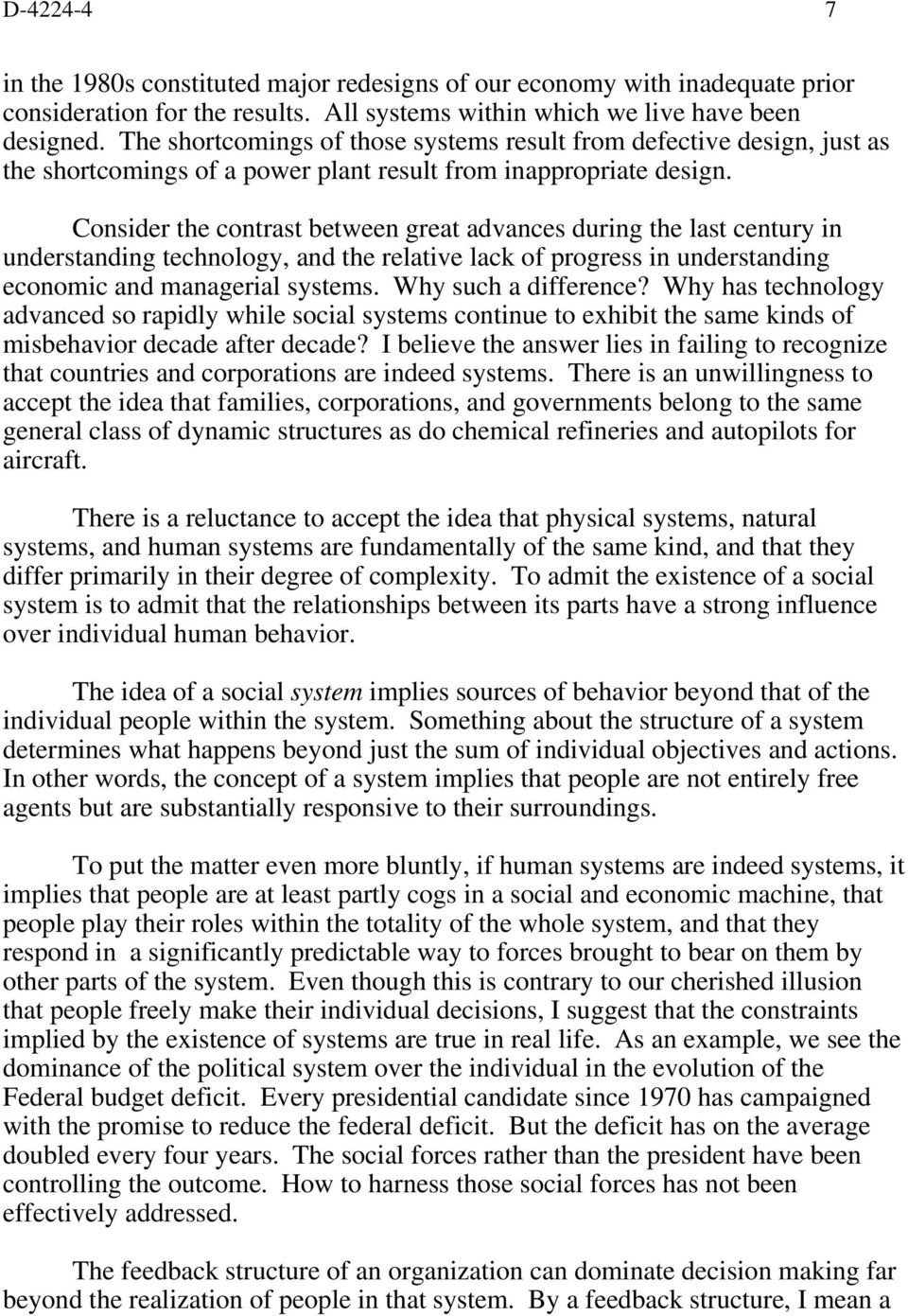
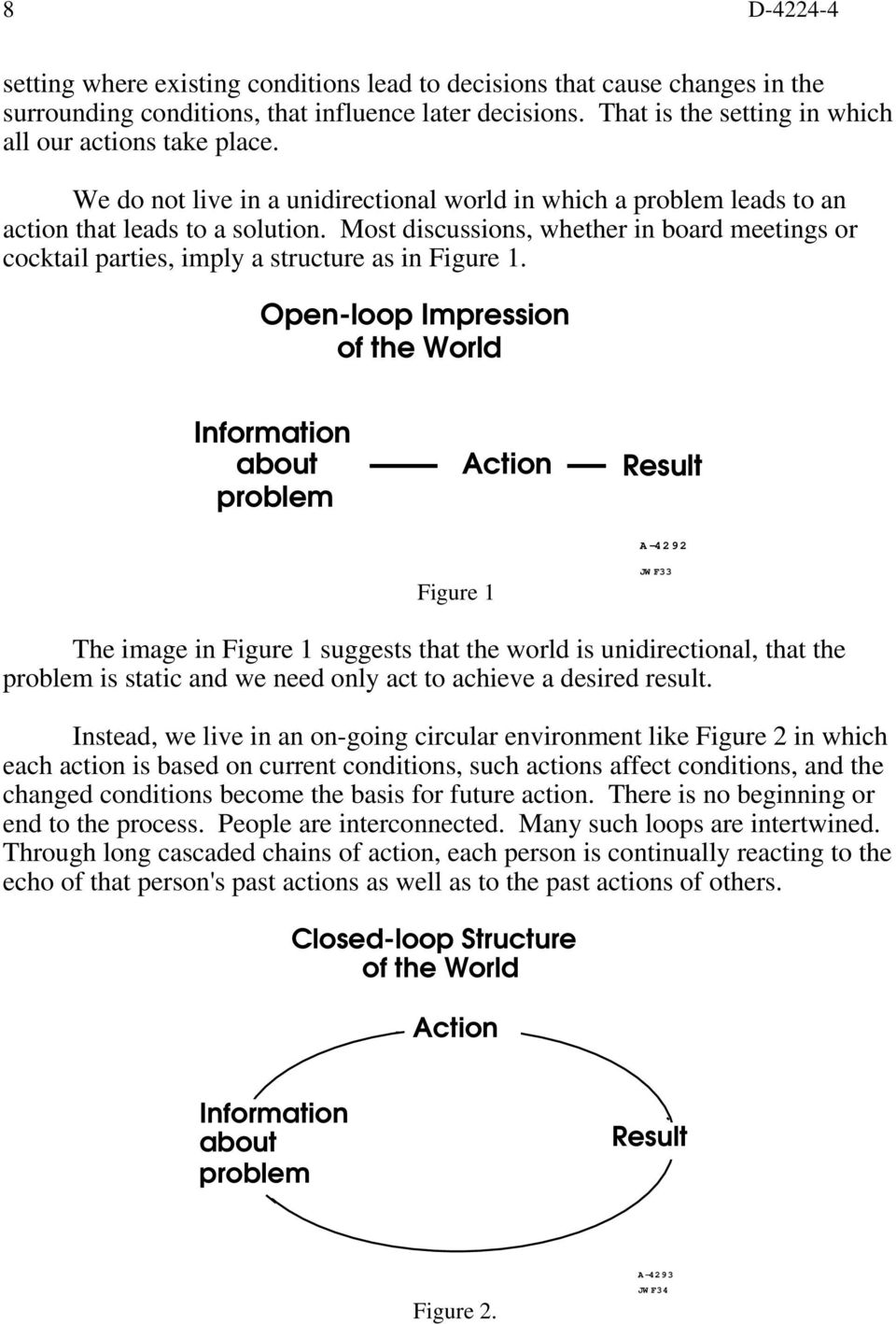
8 8 D setting where existing conditions lead to decisions that cause changes in the surrounding conditions, that influence later decisions. That is the setting in which all our actions take place. We do not live in a unidirectional world in which a problem leads to an action that leads to a solution. Most discussions, whether in board meetings or cocktail parties, imply a structure as in Figure 1. Open-loop Impression of the World Information about problem Action Result Figure 1 A-4292 JWF33 The image in Figure 1 suggests that the world is unidirectional, that the problem is static and we need only act to achieve a desired result. Instead, we live in an on-going circular environment like Figure 2 in which each action is based on current conditions, such actions affect conditions, and the changed conditions become the basis for future action. There is no beginning or end to the process. People are interconnected. Many such loops are intertwined. Through long cascaded chains of action, each person is continually reacting to the echo of that person's past actions as well as to the past actions of others. Closed-loop Structure of the World Action Information about problem Result Figure 2. A-4293 JWF34
9 D We discovered surprising things in our early work with corporations that we now realize carry over to all social systems (Roberts, 1978 (Edward)). First, most difficulties are internally caused, even though there is an overwhelming and misleading tendency to blame troubles on outside forces. Second, the actions that people know they are taking, usually in the belief that the actions are a solution to difficulties, are often the cause of the problems being experienced. Third, the very nature of the dynamic feed-back structure of a social system tends to mislead people into taking ineffective and even counterproductive action (Sterman, 1989). Fourth, people are sufficiently clear and correct about the reasons for local decision making they know what information is available and how that information is used in deciding on action. But, people often do not understand correctly what overall behavior will result from the complex interconnections of known local actions. In our early system dynamics work we found we could go into a troubled company and uncover the reasons for its problems. The difficulty might be falling market share (Forrester, 1968), or fluctuations in production with employment varying from working overtime one year to having half the work force laid off two years later (Forrester, 1961), or a lower profitability than other companies in the industry. Such difficulties are widely known to employees and the community, and are discussed in the business press. Such an analysis draws on knowledge about how structure and policy relate to behavior. Information comes primarily from interviewing people in the company about how they make decisions at their individual operating points. Statements describing the basis for decisions are the rules or policies governing action. As I use the term "policy," it represents all the reasons for action, not just formal written policy. These interviews are extensive and penetrating. There might be several sessions with each of many individuals. The discussions range widely from normal operations, to what was done in various kinds of past crises, what is in the self interest of the individual, where are the influential power centers in the organization, what would be done in various hypothetical situations that have never happened, and what is being done to help in solving the serious problem facing the company. Talking to a manager usually reveals a clear and comprehensive picture of the rules and conditions driving decisions at that position in the corporation. Then, when talking to another manager about the first manager, the same picture usually emerges. In other words, people see themselves very much as others see them. There is substantial consistency throughout the organization as to the actual operational policies that are guiding decisions. Furthermore, the policies are

10 10 D justified in terms of how those policies are expected to correct the great difficulty that the company is experiencing. Up to this point, the study of such a company follows the case-study approach to management education. That is, a comprehensive examination of all related parts of the company is made in the context of the problem that is to be solved. But, if left at this point, the weakness of the case-study method would dominate the outcome. A descriptive model of the company would have been assembled, but the human mind is not able to deal with the inherent dynamic complexity of such a situation. For those who have studied mathematics through differential equations, such a descriptive model is equivalent to a high-order nonlinear differential equation. No scientist or mathematician can solve such a system mentally. Just as with the operation of a chemical plant, only computer simulation methods are capable of revealing the behavior implicit in the structure that can be built from knowledge about the many local decision-making individuals and how they are connected. After obtaining a description of the important policies, information flows, and interconnections in a company, the next step is to translate that description into a computer simulation model. A simulation model does not involve complicated mathematics but instead is a language translation from the original description to computer instructions. Such a model allows the computer to act out the roles of each decision point in the model and feed the results to other connected decision points to become the basis for the next round of decisions. In other words, a laboratory replica of the company then exists in the computer where one can observe the behavioral consequences of the policies that had been described in the interviews policies that are intended to solve the company's problem. To the surprise of those unfamiliar with the devious nature of such dynamic systems, the computer model, based on policies known to people in the company, will usually generate the very difficulties that the company had been experiencing. In short, the policies that were believed to solve the problem are, instead, the cause of the problem. Such a situation creates a serious trap and often a downward spiral. If the policies being followed are believed to alleviate the problem, but, in hidden ways, are causing the problem, then, as the problem gets worse, pressures increase to apply still more strongly the very policies that are causing the problem. Sometimes, one need not even go into a company to identify the system creating a problem. Many readers will remember the People Express airline. During its early history People Express was spectacularly successful with one of the highest growth rates in the history of American corporations. Don Burr, the founder, was a popular speaker at business schools on the philosophy and policies

11 D for corporate success. In 1983, the Harvard Business School published a management case on the history, practices, and success of People Express (Harvard Business School, 1983). From Don Burr's public speeches and the published case study, Professor John D. Sterman at the MIT Sloan School of Management created a system dynamics simulation model of the People Express corporation. The model represents the propensity to expand the air fleet, the relatively greater difficulty in expanding trained service personnel, and the competitive effects of low fares on other airlines and on the financial position of People Express. The model generates a powerful growth mode followed by sudden failure, just as happened with the actual airline. One discovers from the model that it was implicit in publicly stated policies that the company was doomed to collapse after an initial unusual success. John Sterman has been using the computerized People Express case as a dramatic introduction to management for the 200 students enrolling each fall for a master's degree in management at MIT. For more than six hours, in the ballroom of the Marriott Hotel, with 100 Macintosh computers, students explore various policies affecting corporate profitability and the rate and stability of growth. They are able to appreciate how a mix of apparently reasonable policies can produce rapid unbalanced expansion followed by deteriorating quality and sudden collapse. Misjudgments rather similar to those at People Express lie behind much of the foreign encroachment on American markets in the 1980s. Foreign infiltration was initially blamed by American companies on lower foreign wages and lower product price. In response, domestic prices were reduced until there were insufficient profit margins to permit fixing the real difficulties, which were usually more in design and in quality of product and service than in price. As so often happens, the domestic failure to compete arose more from mismatched internal policies than from external forces. 3. A NEW KIND OF MANAGEMENT EDUCATION All of this points to a new kind of management education. Beyond that, it suggests a new kind of manager for the future. One can now see clearly a kind of management education that we might call "enterprise design." And in the future there is a role for the output of such an education, the "enterprise designer." A fundamental difference exists between an enterprise operator and an enterprise designer. To illustrate, consider the two most important people in the successful operation of an airplane. One is the airplane designer and the other is
12 12 D the airplane pilot. The designer creates an airplane that the ordinary pilot can fly successfully. Is not the usual manager more a pilot than a designer? A manager is appointed to run an organization. Often there is no one who consciously and intentionally fills the role of organizational designer. Organizations built by committee, by intuition, and by historical happenstance often work no better than would an airplane built by the same methods. Time after time one sees venture capital groups backing a new enterprise in which the combination of corporate policies, characteristics of products, and nature of the market are mismatched in a way that predetermines failure, just as with People Express airline. Like a bad airplane design that no pilot can fly successfully, such badly designed corporations lie beyond the ability of real-life managers. I first began to glimpse the possibilities of enterprise design in the 1960s when, for its first ten years, I was on the board of directors of the Digital Equipment Corporation. To guide my own position on the board, I developed a system dynamics model of how high-technology growth companies evolve. The model incorporated some 250 variables ranging from physical processes, to managerial goals and leadership characteristics, to interactions among company, market, and competitors. The model exhibited the full range of typical behaviors for such companies from early failure, through limited growth followed by stagnation, to sustained growth with repeated major crises, and on to untroubled growth. These differences emerged in the model as a result of different policies that could be clearly identified in the various companies having the corresponding kinds of behavior. From the model came improved understanding of how corporate policies determine the corporate future (Forrester, 1964). Management education, in all management schools, has tended to train operators of corporations. But there has been rather little academic attention to the design of corporations. The determination of corporate success and failure seldom arises from functional specialties alone, but grows out of the interactions of functional specialities with one another and with markets and competitors. The policies governing such interactions have not been adequately handled in management education. We need to deal with the way policies determine corporate stability and growth in an intellectual, challenging, quantitative, and effective way. Such management education leads to what I refer to as enterprise design. Such an education would build on three major innovations that have already occurred in this century. The first innovation was the case-study method of management education as pioneered by the Harvard Business School beginning around Second was the development of theory and concepts related to dynamic behavior of feedback

13 D systems as first developed in engineering at the Bell Telephone Laboratories and MIT in the 1930s and 1940s. Third has been digital computers, especially the recent personal desk-top computers, that permit simulation modeling of systems that are too complex for mathematical analysis. The first innovation, the case method of management education, has achieved a wide following because it addresses the problems of general management and the interactions among parts of the corporate-market-competitor system. The case method also draws great strength from being based on the full range of descriptive information and managerial knowledge that is available in the actual working world. But the case method, has a major weakness. The description of a case captures policies and relationships that together describe a system so complex that it can not be reliably analyzed by discussion and intuition. Such attempts often draw the wrong dynamic conclusions and fail to reveal why corporations in apparently similar situations can behave so differently. The second innovation, the understanding of the dynamics of feedback systems, has now emerged from engineering to be seen as an organizing concept for human systems as well. Feedback processes govern all growth, fluctuation, and decay. They are the fundamental basis for all change. They allow new insights into the nature of managerial and economic systems that have escaped past descriptive and statistical analysis. The third innovation, the digital computer, for the first time allows efficient simulation of complex dynamic models. Such simulation is the only known way to determine behavior in complicated nonlinear systems. Bringing these three innovations together offers the potential for a major breakthrough in management education. The combination will permit going far beyond the case-study method of management education by adding a rigorous dynamic dimension to the rich policy and structural knowledge possessed by managers. The difference between present management schools and management education in the future will be as great as the difference between a trade school that trains airplane pilots and a university engineering department that trains aircraft designers. Pilots continue to be needed, and so will operating managers. But just as successful aircraft are possible only through skilled designers, so in the future will competition create the necessity for enterprise designers who can reduce the number of design mistakes in the structure and policies of corporations. Correct design can make the difference between a corporation that is vulnerable to changes in the outside business environment and one that exhibits a high degree of independence from outside forces. Correct design can improve the stability of employment and production. Correct design, in the balance of policies
14 14 D for pricing, capital plant acquisition, and sales force, can often make the difference between growth burdened by debt and growth out of earnings. Correct design can help avoid the adoption of policies offering short-term advantage at the expense of long-term degradation. Correct design can help prevent expenditure of managerial time in debating policies that are inherently of low leverage and therefore unimportant. Correct design can help identify the very small number of highleverage policies capable of yielding desirable change. Future training in enterprise design will include study of a library of generic management situations combining descriptive case studies with dynamic computer models, each of which have wide applicability in business. I estimate that about 20 such general, transferrable, computerized cases would cover perhaps 90 percent of the situations that managers ordinarily encounter. Several powerful examples already exist. They include a model of stability and fluctuation in a distribution system (Forrester, 1961, Chapters 2, 15, and 16), a model of sales budget and capital investment as they often restrict growth (Forrester, 1968), a model of promotion chains and evolution into a top-heavy distribution of management personnel when growth slows, and a model dealing with imbalances between design, production, marketing, and service as these influence market share. Each such model manifests many different modes of behavior ranging from troublesome to successful depending on the policies employed within it. In management there is a tendency to identify a weakness, then try to find ways to relieve the symptoms. But it would be more fundamental to insist on understanding why the objectives are not already being met. What is it in the design of a corporation that is inhibiting success? A frontal assault on the symptoms, while the underlying causes remain in place, almost always fails. Success will follow when the designs of corporations give greater emphasis to removing the causes of problems rather than to trying to counteract the symptoms. I see the solution of many corporate problems coming in time from a new profession of enterprise designers. 4. MODELING FOR WHAT PURPOSE? System Dynamics does not impose models on people for the first time. Models are already present in everything we do. One does not have a family or corporation or city or country in one s head. Instead, one has observations and
15 D assumptions about those systems. Such observations and assumptions constitute models. Such mental models are then used as a basis for action (Senge, 1990). 1 The ultimate success of a system dynamics investigation depends on a clear initial identification of an important purpose and objective. Presumably a system dynamics model will organize, clarify, and unify knowledge. The model should give people a more effective understanding about an important system that has previously exhibited puzzling or controversial behavior. In general, influential system dynamics projects are those that change the way people think about a system. Mere confirmation that current beliefs and policies are correct may be satisfying but hardly necessary, unless there are differences of opinion to be resolved. Changing and unifying viewpoints means that the relevant mental models are being altered. But whose mental models are to be influenced? If a model is to to have impact, it must couple to the concerns of a target audience. Successful modeling should start by identifying the target audience for the model Unifying Knowledge Complex systems defy intuitive solutions. Even a third order, linear differential equation is unsolvable by inspection. Important situations in management, economics, medicine, and social behavior usually lose reality if simplified to less than fifth-order nonlinear dynamic systems. Often the model representation must be twentieth order or higher. Attempts to deal with nonlinear dynamic systems, using ordinary processes of description and debate, lead to internal inconsistencies. Underlying assumptions may have been left unclear and contradictory. Mental models are often logically incomplete. Assumed resulting behavior is likely to be contrary to that implied by the assumptions being made about underlying system structure and governing policies. System dynamics modeling can be effective because it builds on the reliable part of our understanding of systems while compensating for the unreliable part. The system dynamics procedure untangles several threads that cause confusion in ordinary debate. The modeling process separates consideration of underlying assumptions (structure, policies, and parameters) from the implied behavior. By 1 The Fifth Discipline by Senge discusses systems thinking and mental models. It provides a transition from non-systemic thought processes to the field of system dynamics. The necessary further step, after becoming aware of systems, leads into system dynamics and introduces computerized simulation models to provide the discipline needed to help the unaided thought processes from arriving at fallacious conclusions about dynamic behavior.

16 16 D considering assumptions independently from resulting behavior, there is less inclination for people to differ on assumptions, with which they actually can agree, merely because they initially disagree with the dynamic conclusions that might follow. Figure 3 divides knowledge of systems into three categories to illustrate wherein lie the strengths and weaknesses of mental models and simulation models. a a b b Observed structure and policies Expectations about behavior Actual behavior Figure 3. Three categories of information in the mental data base. The top of the figure represents knowledge about structure and policies, that is, about the elementary parts of a system. This is local non-dynamic knowledge. It describes information available at each decision-making point. It identifies who controls each part of a system. It reveals how pressures and crises influence decisions. In general, information about structure and policies is far more reliable, and is more often seen in the same way by different people, than is generally assumed. It is only necessary to dig out the information, guided by knowing how structure is related to dynamics, that is, by using system dynamics insights about how to organize structural information to address a particular set of dynamic issues. The middle of the figure represents assumptions about how the system will behave, based on the observed structure and policies in the top section. This middle body of beliefs are, in effect, the assumed intuitive solutions to the dynamic

17 D equations described by the structure and policies in the top section of the diagram. The center section of the diagram represents the solutions, arrived at by introspection and debate and compromise, to the high-order nonlinear system described in the top part of the figure. In the middle lie the presumptions that lead managers to change policies or lead governments to change laws. Based on assumptions about how behavior is expected to change, policies and laws in the top section are altered in an effort to achieve assumed improved behavior in the middle section. The bottom of the figure represents the actual system behavior as it is observed in real life. Very often, actual behavior differs substantially from expected behavior. Discrepancies exist across the boundary b-b. The surprise, arising from the fact that observed structure and policies do not lead to the expected behavior, is usually explained by assuming that information about structure and policies must have been incorrect. Unjustifiably blaming inadequate knowledge about parts of the system has resulted in devoting uncounted millions of man-hours to data gathering, questionnaires, and interviews that have failed to significantly improve the understanding of systems. A system dynamics investigation usually shows that the important discrepancy is not across the boundary b-b, but across the boundary a-a. When a model is built from the observed and agreed upon structure and policies, the model usually exhibits the actual behavior of the real system. The existing knowledge about the parts of the system is shown to explain the actual behavior. The dissidence in the diagram arises because the intuitively expected behavior in the middle section is inconsistent with the known structure and policies in the top section. The discrepancies of Figure 3 can be found repeatedly in the corporate world. A frequently recurring example in which known corporate policies cause loss of market share and instability of employment arises from the way delivery delay affects sales and expansion of capacity. Rising backlog (and the accompanying increase in delivery delay) discourage incoming orders for product even while management favors larger backlogs as a safety buffer against business downturns. As management waits for still higher backlogs before expanding capacity, orders are driven down by unfavorable delivery until orders equal capacity. The awaited signal for expansion of capacity never comes because capacity is controlling sales rather than potential demand controlling capacity. When sales fail to rise because of long delivery delays, without management perceiving the true cause, management then lowers prices in an attempt to stimulate more sales. Sales increase briefly but only long enough to build up sufficient additional backlog and delivery delay to compensate for the lower prices. Price reductions lower profit margins until there is no longer economic justification

18 18 D for expansion. In such a situation, adequate information about individual relationships in the system is always available for successful modeling, but managers are not aware of how the different activities of the company are influencing one another. Lack of capacity may exist in manufacturing, product service, skilled salesmen, or even in prompt answering of telephones (Airlines cut fares to attract passengers. But, how often, because of inadequate telephone capacity, are potential customers put on "hold" until they hang up in favor of another airline?) In a similar way at the national level, the System Dynamics National Model shows that puzzling and controversial economic behavior arises directly from known structure and managerial policies (Forrester, 1979). By building production sectors of the National Model using managerial policies derived from 20 years of corporate modeling, we find that most economic behavior arises from the private sector. Governmental taxation and monetary policies have less effect than usually assumed and lack the expected leverage for controlling economic behavior. The Great Depression of the 1930s has been blamed both on restrictive monetary policy and on protective tariffs, but we find that depressions arise at 45 to 60 year intervals as a result of the economic long wave, or Kondratieff cycle, which is driven primarily by major shifts in private-sector incentives for investing in capital plant, borrowing, and saving (Forrester, 1977; Sterman, 1986). Debate about the economic long wave illustrates the situation depicted in Figure 3 (Kondratieff, 1984; Freeman, 1983; van Duijn, 1983). There is little acceptance by economists of the idea that structures could exist capable of producing a major economic fluctuation with some 50 years between peaks. Yet much of the theory for such a long economic wave already is established in the mainstream of economic thought. In teaching macroeconomics, the classic multiplier-accelerator process is often used to explain short-term business cycles having 3 to 10 years between peaks. The multiplier (rising consumer income causing increased demand) and the accelerator (rising demand causing increased capital investment, wages, and consumer income) represent widely accepted and fundamentally correct assumptions about structure and policies belonging in the top category in Figure 3. However, the belief that the multiplier and accelerator interact to cause short-term business cycles arises from an assumed dynamic solution to the equations describing the structure. The assumed dynamic solution belongs to the middle category in Figure 3 where beliefs are often incorrect. While investigating cyclic economic behavior, several system dynamics investigators have shown that the multiplier and accelerator are not significant in creating short-term business cycles but are powerful contributors to generating
19 D much longer cycles having several decades between peaks (Forrester, 1982, (Nathan B.); Low, 1980; Mass, 1975). Even though the economic long wave has been broadly rejected in economics, the accepted multiplier-accelerator relationships go far in explaining long-wave behavior. Here we see a common situation. Both sides in a debate can usually agree on underlying assumptions. But there is disagreement about the dynamic consequences. Building those accepted assumptions into a dynamic model begins to resolve differences arising from incorrect intuitive solutions to complex systems Enhancing Mental Models Because of errors of dynamic interpretation in mental models, policy changes have often led to ineffective results, or worse, to the opposite of the intended results. A policy giving opposite of the intended result was identified in Urban Dynamics (Forrester, 1969, pages 65-70; Alfeld and Graham, 1976; Mass, 1974; Schroeder, et al., 1975). Economic distress in declining American cities in the 1960s generated symptoms of high unemployment and deteriorating housing. It appeared natural enough to combat such symptoms by government intervention to build low-cost housing. But the modeling study showed, as events have since confirmed, that such urban areas already have more low-cost housing than the economy of the city can sustain. Public policy to build more such housing merely occupies land that could instead have been used for job-creating businesses, while at the same time the housing attracts people who needed jobs. A low-cost housing program introduces a powerful double force for increasing unemployment, both by reducing employment while at the same time attracting people seeking work. Low-cost housing programs in inner cities become a social trap. The policy of building low-cost housing actually creates poor and unemployed people, rather than alleviating personal hardship. The lesson here is to avoid attacking symptoms of difficulty until the causes of those symptoms have been identified, and a highleverage policy has been found that will cause the system itself to correct the problem. System dynamics models have little impact unless they change the way people perceive a situation. A model must help to organize information in a more understandable way. A model should link the past to the present by showing how present conditions arose, and extend the present into persuasive alternative futures under a variety of scenarios determined by policy alternatives. In other words, a system dynamics model, if it is to be effective, must communicate with and modify the prior mental models. Only people's beliefs, that is, their mental models, will
20 20 D determine action. Computer models must relate to and improve mental models if the computer models are to fill an effective role Small Models versus Large Models What kind of system dynamics model interacts best with mental models? Clearly, a small model has advantages over a large model. A recent trend in system dynamics has been toward small models to be used for enhancing insight. Often, such models have been built directly from mental models. The process is one of discussing with a small group their concerns, assumptions, and expectations. While the conversation is in progress, a system dynamics model can be created on a desktop computer. Recent software advances, especially the userfriendly STELLA (High Performance Systems, 1990; Richmond, 1985, pages ), facilitate the interaction between mental models and computer models (Vescuso, 1985, ). Simple models used as interactive games, such as one demonstrating the economic long wave, or Kondratieff cycle (Sterman and Meadows, 1985), can also create a dramatic impact as they reveal unexpected implications of existing mental models. If small models align best with mental models, and thereby have the greatest effect, what is the role for large models? The answer must depend on the circumstances. First, the size of a model that can interact with mental models depends on the amount of time and effort that will be devoted to making connections between the mental and the computer simulation models. If the available time is a half day, clearly the computer model can have no more than a few variables. On the other hand, if the computer model is for research purposes and months or even years are available to explore its implications, then the model can be of far wider scope. Even with more time available, there must be a clear justification for a large model. Special system dynamics software is also available for professional work with larger models (Pugh, 1986; Eberlein, 1991). The System Dynamics National Model serves to put large and small models into perspective. The National Model is large, with more than two thousand equations. However, it is much smaller than was originally projected. As we have come to understand the Model better, and to relate its behavior to actual economic behavior, it has become apparent that the originally envisioned far larger model was not necessary. The proper balance between size and clarity suggested simplification. Many planned production sectors have now been aggregated into just two capital plant and equipment, and consumer goods. Within sectors, there has been simplification especially in labor mobility and banking.
21 D Research with the National Model focuses on four distinct modes of economic behavior business cycles, the economic long wave, money inflation, and growth. Simple models have been created for demonstrating most of these modes separately (Sterman, 1985). Such simple models are possible because the separate modes arise from different structures within an economy. Simple models are far easier to understand than the full National Model and for many purposes are more effective. However, simple models alone do not answer certain important questions. There are many interactions between the four basic modes of economic behavior (short-term business cycles, economic long waves, money inflation, and growth) that do not reveal themselves in separate simple models of individual modes. An example is the way in which the economic long wave, having some 45 to 60 years between peaks, modulates the amplitude of short-term 3-to-10-year business cycles. During a long-wave expansion as in the 1950s and 1960s, excess demand and limited output caused by shortages of both capital and labor, suppress business cycles. Near and after the long-wave peak, as in the 1970s and 1980s, the amplitude of business cycles becomes larger because the oversupply of capital and labor allows business-cycle expansions to be more aggressive, to overbuild inventories, and then to induce sharper cutbacks to rebalance supply and demand. This interpretation of economic behavior during the last several decades is different from that which has been conventionally accepted. After World War II, mild business cycles were attributed to Keynesian economics and fine tuning of monetary policy, but such beliefs were shattered in the 1970s when business cycles again became more severe. Our work shows the shifting nature of business-cycle behavior as arising from interactions among major dynamic modes in the private economy, rather than from governmental policies. 5. THE SYSTEM DYNAMICS PARADIGM System dynamics adheres to viewpoints and practices that set it apart from other fields dealing with the behavior of systems (Randers, 1980). But even so, the unique character of system dynamics has never been adequately set forth. Each aspect of system dynamics is accepted by some other professional group at least to a degree. System dynamics is distinguished not only by the particular cluster of beliefs that guide the work but also by the degree to which those characteristics are indeed practiced.
22 22 D Endogenous Behavior I believe the best system dynamics practice puts rather extreme demands on a model for generating within itself the behavior modes of interest. That is, the model boundary is to be established so that the causal mechanisms lie inside the boundary. This expectation of finding endogenous causes of behavior is in sharp contrast to the view often found elsewhere (Richardson, 1991). 2 People are far more comfortable blaming their troubles on uncontrollable external causes rather than looking to their own policies as the central cause. Business managers attribute product and corporate failures to competitors, bankers, and government rather than to their own handling of resource allocations, pricing, and interpretation of customer needs. Governments blame balance of trade difficulties on other countries rather than recognizing the cause in domestic deficits, tax policies, and monetary actions. In contrast to the endogenous viewpoint, economists often imply that the economic system is almost in equilibrium almost all the time with important behavior arising only from unexpected exogenous forces. The exogenous viewpoint common in economics leads to seeing the monetary authority as a freewill arm of government policy for unilaterally controlling economic behavior, whereas, in the National Model, we represent the monetary authority as an integral, interacting part of the economic system and as being responsive to forces such as unemployment, liquidity, and interest rates. Economists have explained business cycles in terms of exogenous actions of government, whereas, we find that business cycles arise out of internal oscillatory tendencies in production, employment, and inventories excited by those continuous streams of small random variations existing in all decision processes. The system dynamics emphasis on endogenous behavior is more like that of an engineer in designing an oil refinery. The engineer looks at the individual working characteristics of the chemical reactors, evaporators, and distillation towers; considers how they are interconnected and controlled; and evaluates the dynamic behavior implied by their feedback loops. The engineer does not attempt to improve a refinery by using only information about the feed stocks that go in and the products that come out. He does not assume that the refinery exists in a state of equilibrium that is affected only by exogenous events that impact the plant from outside its surrounding fence. 2 Richardson discusses how system dynamics relates to other traditions of thinking about closedloop behavior in the social sciences.
23 D System dynamics models build from the inside to determine and to modify the processes that cause desirable and undesirable behavior Sources of Information Effectiveness of a model depends on how it uses the wide range of information arising from the system being represented (Forrester, 1980). In creating a system dynamics model, information is used in a substantially different way from that in other branches of the social sciences. The differences arise from the system dynamics focus on policy statements as the basic building blocks of a model and from a broader range of information sources used for creating a model. Information is available from many sources. Figure 4 suggests three classifications of information the mental data base, the written data base, and the numerical data base. Although "data" is a term that is often used to mean only numerical information, the dictionary meaning is far broader. Data is "something that is given from being experientially encountered" and "material serving as a basis for discussion, inference, or determination of policy" and "detailed information of any kind" (Webster's Third, Unabridged). Mental data base Written data base Numerical data base Figure 4. Decreasing information content in moving from mental to written to numerical data bases. Human affairs are conducted primarily from the mental data base. Anyone who doubts the dominance of remembered information should imagine what would
24 24 D happen to an industrial society if it were deprived of all knowledge in people's heads and if action could be guided only by written policies and numerical information. There is no written description adequate for building an automobile, or managing a family, or governing a country. People absorb operating information from apprenticeship and experience. The dominant significance of information from the mental data base is not adequately appreciated in the social sciences. The mental data base contains vastly more information than the written data base, which, in turn, contains far more information than the numerical data base. Furthermore, the character of the information differs in the three categories. As one moves down the diagram, each category of information contains a smaller fraction devoted to structure and to description of policies. That is, the written and numerical data bases contain not only less information, but progressively smaller proportions of the information needed for constructing a dynamic model. If the mental data base is so important to the conduct of human systems, then a model of such a system should include relevant knowledge from all available sources, including that which resides only in the mental data base. The mental data base is rich in structural detail; in it is knowledge of what information is available at various decision-making points, where people and goods move, and what decisions are made. The mental data base is especially concerned with policy, that is, why people respond as they do, what each decision-making center is trying to accomplish, what are the perceived penalties and rewards, and where self-interest clashes with institutional objectives. In general, the mental data base relating to policy and structure is reliable. Of course, it must be cross-checked with all other available information. Exaggerations and over simplifications exist and must be corrected. Interviewees must be pressed beyond quick first responses. Interrogation must be guided by a system dynamics knowledge of what different structures imply for behavior. But from the mental data base, a consensus usually emerges that is useful and sufficiently correct. The written data base contributes to a dynamic model at several stages. Published material makes information more widely available than if it is only exchanged between mental data bases. In terms of usefulness for modeling of business and economic systems, the daily and weekly public and business press is frequently more useful than the professional press or historical accounts that adopt a longer time horizon. The current press reports the pressures of the moment that surround decisions. The temporal nature of a decision sharply restricts the kind of literature in which operating policy will be revealed. Policies govern decisions and decisions control action. Decisions are fleeting. There is only a single instant in
25 D time when one can act. That time is now. Action must take place in the present moment that separates history from the future. The ever-advancing present moment is the business person's and politician's world of action. It is the world of placing orders, hiring people, buying equipment, borrowing money, bargaining with unions, and extending credit. As a consequence of the short life of a decision, it is primarily in the literature of the present that decisions are discussed in terms of goals, threats, limited information, and restraints on action. The multifaceted conflicting pressures of real decision making are almost absent from economics textbooks and professional journals. The professional literature emphasizes how decisions should be made rather than how they actually are made, how equilibrium is determined rather than how dynamic behavior arises, and how macroeconomic theory might apply rather than how the microstructure creates the macrobehavior. The numerical data base is of narrower scope than either the written or mental data bases. Missing from numerical data is direct evidence of the structure and policies that created the data. The numerical data do not reveal the cause and effect directions among variables. In complex nonlinear feedback systems, statistical analysis of historical data should be used cautiously (Graham, 1980; Senge, 1978). Even so, numerical data can contribute to system dynamics model building in three ways. First, numerical information is available on some parameter values. For example, average delivery delays for filling orders, typical ratios of factor inventories to production, normal bank balances, and usual inventory coverages can be determined from business records. Second, numerical data has been collected by many authors in the professional literature summarizing characteristics of economic behavior such as average periodicity of business cycles and phase relationships between variables. Third, the numerical data base contains time series information that in system dynamics is often best used for comparison with model output rather than for determining model parameters. With regard to the use of data, system dynamics operates more like the engineering and medical professions, and less like practices in economics. All information is admissible to the process of model building. Information from the mental data base is recognized as a rich source of knowledge about structure and the policies governing decisions. Parameter values are drawn from all available sources, not merely from statistical analysis of time series. The mental and written data bases are the only sources of information about limiting conditions that have not occurred in practice but which are important in determining the nonlinear relationships that govern even normal behavior.
26 26 D LEARNING FROM MODELS Model building should be a circular process of creating a model structure, testing behavior of the model, comparing that behavior with knowledge about the real world being represented, and reconsidering structure (Forrester, 1975). During the process of modeling, the system dynamicist should always be alert to new discoveries about behavior. The new discoveries may relate either to the particular system being studied or to the general nature of systems Surprise Discoveries Only if there is a standard against which the model is being compared existing knowledge of the real system can one be prepared for surprises from the model. Surprising behavior means behavior that was not expected in terms of what was known about behavior of the actual system. Surprising behavior will usually point to model defects. But the modeler must be always alert to the possibility that the unexpected behavior of the model is revealing a new insight about the real system. Our work on the economic long wave, or Kondratieff cycle, in the System Dynamics National Model Project arose as a surprise discovery. When sectors for consumer goods and capital equipment were first connected, a large fluctuation arose in the demand for capital equipment with peaks some 50 years apart. In response to such a surprise, one should first assume a major error in a model. However, as a model is improved and errors are removed, there is a rising probability that surprising behavior is revealing a new insight about the real system. In the National Model, after study, the 50-year rise and fall of economic activity seemed plausible. Turning to historical economic behavior, we found extensive and diverse evidence of behavior like that which the model was generating. As other sectors of the model were added, additional model variables became involved in the long-wave process and repeatedly the expanded model behavior was found to have a real-life counterpart. For example, only recently we found that real interest rate (nominal interest minus inflation) in the model is low or negative before the long-wave peak, just as it was in the 1970s, and that real interest rate in the model moves quickly positive after the peak, as it did in the early 1930s and as it did again in the 1980s. Such behavior of real interest arises mostly from the private sector rather than from government policy as is commonly assumed.
27 D General Characteristics of Systems Even more important than finding unexpected behavior of a specific system is the discovery of general characteristics that are applicable to a broad class of systems, or even to nearly all systems. In complex nonlinear systems, such generalizing must be interpreted with caution, but, even so, rules of thumb can be identified that are usually valid and give a useful basis for thinking about systems. In such generalizing, one should make ties to history, myths, fables, and lessons from the great religions. The lessons that come to us from such traditional sources contain powerful threads of truth that are being ignored in modern attitudes dominated by short-run considerations. Several general characteristics of systems were identified in Urban Dynamics (Forrester, 1969, pages ). Two examples will illustrate. First, a characteristic like the long-term versus short-term trade off applies to most decisions. But the inherent conflict between immediate and ultimate consequences is not given its proper weight in management and political decisions. On the other hand, the recognition of the trade off goes back at least as far as the ancient Greeks. Aesop's fable of the grasshopper and the ant contrasts the shortterm advantage of playing in the summer with the long-term penalty of freezing in the winter. In building a public understanding of systems, we should seek general insights and make connections to where the same themes have already appeared. Second, another inadequately appreciated general characteristic of systems lies in high resistance to policy changes. Perhaps as many as 98 percent of the policies in a system have little effect on its behavior because of the ability of the system to compensate for changes in most policies. One author criticized the Urban Dynamics book on the basis that it contained a very bad model because the critic had been unable to find any policy in the model that substantially changed the behavior of the model. 3 But, have not mayors of cities also discovered most of their policies to have been without effect? Such insensitivity is not a defect in the model, it is the nature of the cities being represented by the model. Governments of American cities have expended billions of dollars over several decades without substantially altering the social problems with which they started. The waste and frustration are a consequence of attempting corrective action through policies having inherently low influence. 3 The book does explain the only high-leverage policy that we discovered, which can convert stagnation and high unemployment to a normal level of unemployment in balance with industry and housing.
28 28 D In a similar way, national governments have debated monetary policy, have tried all variations and theories, and are still left with worsening economic problems. In our work with the National Model, we find that monetary policy often has low leverage over economic conditions. 7. SYSTEM DYNAMICS AND PUBLIC RESPONSES System dynamics models have the potential for raising the quality of managerial and political debate. The books, World Dynamics (Forrester, 1971), Limits to Growth (Meadows, et al., 1972), Toward Global Equilibrium (Meadows and Meadows, 1973), and Dynamics of Growth in a Finite World (Meadows, 1974), launched intense world-wide debate even though their subject had been treated in many preceding descriptive publications. Why? I believe there are two reasons. The first reason for intense public response to the books arose because of the way the books illuminated long-run issues. It is commonplace to assert that people take only a short-run view of life, but that is only partially true. In fact, most people live in a world of split personalities in which business and political actions are dominated by short-run objectives while at the same time personal goals remain long-term. Individuals hope for the future well-being of their children and grandchildren even while responding unknowingly to short-run pressures in ways that jeopardize that future. The four books offered a way to understand the past and present that could assist in seeing into the future. Good system dynamics modeling contributes to relating the legacy of the past to decisions of the moment, and actions of the present to their implications for years to come. In World Dynamics and the successor books, readers found an embodiment of their concerns. The models contained assumptions that had everyday meaning, and behavior that corresponded to what people were seeing in the world around them. More and more in the intervening twenty years since the books appeared, newspaper headlines have been revealing the reality of the limits to growth theme. Every week one sees accounts of polluted wells, acid rain damage to forests, falling water tables, atomic waste disposal uncertainties, hunger in many parts of the world, and social pressures from crowding such as terrorism and illegal immigration. The second reason for intense public involvement arose because a presentation based on a system dynamics model can have an internal consistency that is beyond the reach of the usual discussion processes. Such consistency commands attention and yields persuasiveness. By contrast, the usual writing and debate about a complex social system contains internal contradictions. Those
29 D contradictions usually occur in going from the structural assumptions to the implied dynamic consequences. In the step from assumptions to behavior, a writer tries to solve intuitively in his head the high-order nonlinear equations of the system; such is rarely done correctly. But a model simulation provides certainty in going from the assumptions about structure and policies to the implied behavior. A presentation based on a model can have complete internal consistency. One knows the assumptions in the model. Simulation gives the behavior implied by those assumptions. Policy changes can be made and the resulting changes in behavior can be determined beyond doubt within the context of the model. Within the modeling process, there need be no contradictions. But internal consistency is not enough. An argument can be internally consistent and still erroneous in comparison with the real world. But, the persuasiveness of the system dynamics process reaches its full power when the listener or reader finds agreement wherever his independent knowledge matches the presentation of assumptions, behavior, or policy implications. 8. A NEW BASIS FOR PRE-COLLEGE EDUCATION The greatest impact of system dynamics on public understanding can be expected from pioneering projects now starting for introducing systems thinking into high school and undergraduate studies (Forrester, 1990; Forrester, 1976; Roberts, et al., 1983; Roberts, 1978; Roberts, et al., 1987). Traditional educational methods have tended to discourage synthesis and use of the knowledge that a student has already acquired. Too much emphasis has been put on the written data base and not enough on the mental data base. Education has taught static facts rather than dynamics of natural and social change. System dynamics offers a basis for a new kind of education that leads to a better understanding of change in social and environmental conditions. But the dynamic viewpoint takes time to absorb. Several years are needed to organize a student's thinking to a dynamic frame of reference. By starting in the first year of junior high school and weaving a dynamic thread through high school and college, we can hope for a society that is better able to cope with growing social complexity. Only when dynamic considerations are introduced throughout the educational process will students have time to develop improved mental models to guide personal and public action. Just as understanding of the natural world rests on science studies woven into all educational levels, so will a comparable
30 30 D understanding of dynamic systems in society and nature need to be made a part of the entire educational sequence. Education in the United States is generally recognized as serving less and less well in meeting modern needs. Failures in education appear in the form of corporate executives who cannot cope with the complexities of growth and competition, government leaders who are at a loss to understand economic and political change, and a public that supports inappropriate responses to immigration pressures, changing international conditions, rising unemployment, the drug culture, governmental reform, and inadequacies in education. The weakness in education arises not so much from poor teachers as from the inappropriateness of the material that is being taught. Students are stuffed with facts but without having a frame of reference for making those facts relevant to the complexities of life. Responses to educational deficiencies are apt to result in demands for still more of what is already not working for more science, humanities, and social studies in an already overcrowded curriculum rather than moving toward a common foundation that pulls all fields of study into a unity that becomes mutually reinforcing and far easier to teach and to understand. Education is fragmented. Social studies, physical science, biology, and other subjects are taught as if they were inherently different from one another even though dynamic behavior in each rests on the same underlying concepts. For example, the dynamic structure that causes a pendulum to swing is identically the same as the core structure that causes employment and inventories to fluctuate in a product-distribution system and in economic business cycles. Humanities are taught without relating the dynamic sweep of history to similar behaviors on a shorter time scale that the student can experience in a week or a year. Missing from most education is a direct treatment of the time dimension. What causes change from the past to the present and the present to the future? How do present decision-making policies determine the future toward which we are moving? How are the lessons of history to be interpreted to the present? Why are so many corporate, national and personal decisions ineffective in achieving their intended objectives? Two mutually reinforcing developments now promise a learning process that can enhance breadth, depth, and insight in education. These two threads are system dynamics and learner-directed learning. System dynamics can provide a dynamic framework to give meaning to detailed facts. Such a dynamic framework provides a common foundation beneath mathematics, physical science, social studies, biology, history, and even literature.
31 D As this is being written several introductory books on system dynamics are available (Goodman, 1974; Roberts, et al., 1983; Richardson and Pugh, 1981; Forrester, 1961). None of this material is ideally organized for classroom use. However teaching materials are now under development in many places in the United States and abroad. In his penetrating discussion of the learning process, Jerome Bruner states, "the most basic thing that can be said about human memory is that unless detail is placed into a structured pattern, it is rapidly forgotten" (Bruner, 1963). For most purposes, such a structure is inadequate if it is only a static framework. The structure should show the dynamic significance of the detail how the details are connected, how they influence one another, and how past behavior and future outcomes are influenced by decision-making policies and their interconnections. System dynamics can provide such a dynamic framework. Learner-directed learning, refers to a way of organizing a school so that students work together in teams of two or three to cooperate in meaningful projects for which they must do research and creative thinking. Learner directed learning shifts the role of a teacher from being a dispenser of knowledge to being a guide and resource person. Students are no longer merely passive receptors of what the teacher says. Instead the students work together to help one another and to explore issues that are new to both them and the teacher. There are now several dozen high schools and junior high schools making substantial progress in combining system dynamics and learner-directed learning. In several hundred schools some activity is under way. The most advanced experiment in the United States in bringing system dynamics and learner-directed learning together into a more powerful educational environment appears to be in the Catalina Foothills School District of Tucson, Arizona. In that community the necessary building blocks for successful educational innovation are coming together. The process combines a fundamental new concept of education, a receptive community, talented teachers who are willing to try unfamiliar ideas, teachers who are at ease in the nonauthoritarian environment of learner-directed learning, a supportive school administration, and a "citizen champion" operating outside the school system. Without a personal vested interest except a desire to facilitate improved education, the citizen champion inspires teachers, finds funding, arranges for computers, and facilitates convergence of the political processes in the community. To quote an eighth-grade biology teacher who has been a key player in this dramatic experiment in moving toward a fundamentally new kind of education:
32 32 D "We now see students come early to class (even early to school), stay after the bell rings, work through lunch and work at home voluntarily (with no assignment given). When we work on a systems project even when the students are working on the book research leading up to system work there are essentially no motivation or discipline problems in our classrooms." (Draper, 1989) The results have been so persuasive in this junior high school that in 1990 the district voted a $30 million bond issue to build a high school to carry on in the educational pattern that has been established in the junior high school. It is time to explore a new frontier. We have been through the frontier of science and technology. The next frontier is to achieve a broadly based understanding of social systems that can provide a foundation for effectively dealing with economic and social stresses. 9. REFERENCES Alfeld, Louis Edward, and Alan K. Graham Introduction to Urban Dynamics. Waltham, MA: Pegasus Communications. 333 pp. Bruner, Jerome S The Process of Education. New York: Vintage Books. Draper, Frank Letter to Jay Forrester. personal communication, Orange Grove Junior High School, 1911 E. Orange Grove Rd., Tucson, AZ May 2. Eberlein, Robert Vensim Reference Manual. IBM PC, DEC VMS, and UNIX workstations. 72 Grafton St., Arlington, MA 02174: Ventana Systems, Inc. Forrester, Jay W "Industrial Dynamics--A Major Breakthrough for Decision Makers." Harvard Business Review, Vol. 36, No. 4, pp Also appears in revised form as Chapter 2 in the author's Industrial Dynamics 1961 and Chapter 1, pp. 1-29, of Collected Papers 1975; also as Chapter 2, pp in Edward B. Roberts, ed., Managerial Applications of System Dynamics, 1978, all from Waltham, MA: Pegasus Communications Industrial Dynamics. Waltham, MA: Pegasus Communications. 464 pp "Common Foundations Underlying Engineering and Management." IEEE Spectrum, Vol. 1, No. 9, pp Also appears as Chapter 4, pages 61-80, in the author's Collected Papers, 1975, Waltham, MA: Pegasus Communications "Market Growth as Influenced by Capital Investment." Industrial Management Review (MIT), Vol. 9, No. 2, pp Also appears as Chapter 7, pages , in the author's Collected Papers 1975; and as Chapter 12, pp , in Edward B. Roberts, ed., Managerial Applications of System Dynamics, 1978, both from Waltham, MA: Pegasus Communications Urban Dynamics. Waltham, MA: Pegasus Communications. 285 pp.
33 D World Dynamics. (1973 second ed.). Waltham, MA: Pegasus Communications. 144 pp. Second edition has an added chapter on physical vs. social limits Collected Papers of Jay W. Forrester. Waltham, MA: Pegasus Communications. 284 pp "Moving into the 21st Century: Dilemmas and Strategies for American Higher Education." Liberal Education, Vol. LXII, No. 2, pp "Growth Cycles." De Economist, Vol. 125, No. 4, pp H. E. Stenfert Kroese B. V., Leiden, The Netherlands "An Alternative Approach to Economic Policy: Macrobehavior from Microstructure." In Nake M. Kamrany and Richard H. Day (ed.), Economic Issues of the Eighties. pp Baltimore: Johns Hopkins University Press "Information Sources for Modeling the National Economy." Journal of the American Statistical Association, Vol. 75, No. 371, pp "System Dynamics as a Foundation for Pre-College Education." In George P. Richardson David F. Anderson and John D. Sterman, ed., Volume 1: System Dynamics '90, pp , 49 Bedford Road, Lincoln MA, USA: System Dynamics Society. Also available as Memo D-4133, System Dynamics Group, Sloan School, Massachusetts Institute of Technology. Forrester, Nathan B A Dynamic Synthesis of Basic Macroeconomic Theory: Implications for Stabilization Policy Analysis. Ph.D. thesis, Sloan School, Massachusetts Institute of Technology. 268 pp. Freeman, Christopher, ed., Long Waves in the World Economy, London and Boston, MA: Butterworths, 245 pp. Goodman, Michael R Study Notes in System Dynamics. Waltham, MA: Pegasus Communications. 388 pp. Graham, Alan K "Parameter Estimation in System Dynamics Modeling." In Jorgen Randers (ed.), Elements of the System Dynamics Method. pp Waltham, MA: Pegasus Communications. Harvard Business School People Express ( ). Case study. Boston, MA: Harvard Business School Case Services. 22 pp. High Performance Systems STELLA II Users Guide. Macintosh. 45 Lyme Road, Hanover, NH: High Performance Systems. Kondratieff, Nikolai The Long Wave Cycle. New York: Richardson and Snyder, available through E. P. Dutton. 138 pp. A translation into English of papers written in Russian in the 1920s. Low, Gilbert W "The Multiplier-Accelerator Model of Business Cycles Interpreted from a System Dynamics Perspective." In Jorgen Randers (ed.), Elements of the System Dynamics Method. pp Waltham, MA: Pegasus Communications. Mass, Nathaniel J., ed., Readings in Urban Dynamics: Volume I, Waltham, MA: Pegasus Communications, 303 pp. Mass, Nathaniel J Economic Cycles: An Analysis of Underlying Causes. Waltham, MA: Pegasus Communications. 185 pp. Meadows, Donella H., Dennis L. Meadows, Jorgen Randers, and William W. Behrens III The Limits to Growth. New York: Universe Books. 205 pp.
34 34 D Meadows, Dennis L., et al Dynamics of Growth in a Finite World. Waltham, MA: Pegasus Communications. 637 pp. Meadows, Dennis L., and Donella H. Meadows, ed., Toward Global Equilibrium: Collected Papers, Waltham, MA: Pegasus Communications. 358 pp. Pugh, Alexander L., III Professional DYNAMO Plus Reference Manual. IBM PC computers. 5 Lee St, Cambridge, MA: Pugh-Roberts Associates. Randers, Jorgen, ed., Elements of the System Dynamics Method, Waltham, MA: Pegasus Communications. 488 pp. Richardson, George P Feedback Thought in Social Science and Systems Theory. Philadelphia, PA: University of Pennsylvania Press. 374 pp. Richardson, George P., and Alexander L. Pugh III Introduction to System Dynamics Modeling with DYNAMO. Waltham, MA: Pegasus Communications. 413 pp. Richmond, Barry M "STELLA: Software for Bringing System Dynamics to the Other 98%." In Proceedings of the 1985 International Conference of the System Dynamics Society: 1985 International System Dynamics Conference, pp , 49 Bedford Road, Lincoln, MA USA: System Dynamics Society. Roberts, Edward B Managerial Applications of System Dynamics. Waltham, MA: Waltham, MA: Pegasus Communications. 562 pp. Roberts, Nancy "Teaching Dynamic Feedback Systems Thinking: an Elementary View." Management Science, Vol. 24, No. 8, pp Roberts, Nancy, David Andersen, Ralph Deal, Michael Garet, and William Shaffer Introduction to Computer Simulation: A System Dynamics Modeling Approach. Waltham, MA: Pegasus Communications. 562 pp. Roberts, Nancy, Tim Barclay, and David Kreutzer "Modeling Tools for Problem Solving." In Proceedings of the 1987 International Conference of the System Dynamics Society, Shanghai, China: 1987 international Conference of the System Dynamics Society, pp , 49 Bedford Road, Lincoln, MA USA: System Dynamics Society. Schroeder, Walter W., III, Robert E. Sweeney, and Louis Edward Alfeld, ed., Readings in Urban Dynamics: Volume 2, Waltham, MA: Pegasus Communications. 305 pp. Senge, Peter M The System Dynamics National Model Investment Function: A Comparison to the Neoclassical Investment Function. Ph.D thesis, Cambridge, MA, Massachusetts Institute of Technology. Senge, Peter M The Fifth Discipline. New York: Doubleday. 424 pp. Skinner, B. F Beyond Freedom and Dignity. New York: Bantam Books. 215 pp. Sterman, John D "A Behavioral Model of the Economic Long Wave." Journal of Economic Behavior and Organization, Vol. 6, pp Sterman, John D "The Economic Long Wave: Theory and Evidence." System Dynamics Review, Vol. 2, No. 2, pp Sterman, John D "Modeling Managerial Behavior: Misperceptions of Feedback in a Dynamic Decision Making Experiment." Management Science, Vol. 35, No. 3, March, pp Sterman, John D., and Dennis Meadows "STRATEGEM-2: A Microcomputer Simulation Game of the Kondratiev Cycle." Simulation and Games, Vol. 16, No. 2, pp
35 D van Duijn, J. J The Long Wave in Economic Life. London: George Allen & Unwin. 239 pp. Vescuso, Peter "Using STELLA to Create Learning Laboratories: An Example from Physics." In Proceeding of the 1985 International Conference of the System Dynamics Society: pp , 49 Bedford Road, Lincoln, MA USA: System Dynamics Society.
Designing the Future. by Jay W. Forrester. at Universidad de Sevilla Sevilla, Spain. December 15, 1998
 D-4726 1 Designing the Future by Jay W. Forrester at Universidad de Sevilla Sevilla, Spain December 15, 1998 Copyright 1998 by Jay W. Forrester Permission granted for copying and electronic distribution
A Comparison of System Dynamics (SD) and Discrete Event Simulation (DES) Al Sweetser Overview.
 A Comparison of System Dynamics (SD) and Discrete Event Simulation (DES) Al Sweetser Andersen Consultng 1600 K Street, N.W., Washington, DC 20006-2873 (202) 862-8080 (voice), (202) 785-4689 (fax) [email protected]
Understanding Business Cycles in the Airline Market
 Understanding Business Cycles in the Airline Market Martin Liehr, Andreas Größler *, Martin Klein Industrieseminar der Universität Mannheim D - 68131 Mannheim, Germany Phone: (+49 621) 292-314 Fax: (+49
Applying System Dynamics to Business: An Expense Management Example
 Applying System Dynamics to Business: An Expense Management Example Bill Harris Facilitated Systems http://facilitatedsystems.com/ May 17, 2000 Abstract If you re new to system dynamics, it may be hard
CHAPTER 3 THE LOANABLE FUNDS MODEL
 CHAPTER 3 THE LOANABLE FUNDS MODEL The next model in our series is called the Loanable Funds Model. This is a model of interest rate determination. It allows us to explore the causes of rising and falling
Why a Floating Exchange Rate Regime Makes Sense for Canada
 Remarks by Gordon Thiessen Governor of the Bank of Canada to the Chambre de commerce du Montréal métropolitain Montreal, Quebec 4 December 2000 Why a Floating Exchange Rate Regime Makes Sense for Canada
Risk Analysis Overview
 What Is Risk? Uncertainty about a situation can often indicate risk, which is the possibility of loss, damage, or any other undesirable event. Most people desire low risk, which would translate to a high
System Behavior and Causal Loop Diagrams
 C H A P T E R 1 System Behavior and Causal Loop Diagrams Human beings are quick problem solvers. From an evolutionary standpoint, this makes sense if a sabertooth tiger is bounding toward you, you need
Discussion of Capital Injection, Monetary Policy, and Financial Accelerators
 Discussion of Capital Injection, Monetary Policy, and Financial Accelerators Karl Walentin Sveriges Riksbank 1. Background This paper is part of the large literature that takes as its starting point the
Chapter 9 Aggregate Demand and Economic Fluctuations Macroeconomics In Context (Goodwin, et al.)
 Chapter 9 Aggregate Demand and Economic Fluctuations Macroeconomics In Context (Goodwin, et al.) Chapter Overview This chapter first introduces the analysis of business cycles, and introduces you to the
Introduction. C h a p t e r O n e
 Contents Foreword vii Preface ix Acknowledgments xiii 1. Introduction 1 2. Caring and the Nursing Administrator 10 3. The Element of Caring in Nursing Administration 27 4. Organizational Theory 38 5. Leadership
LEVEL ECONOMICS. ECON2/Unit 2 The National Economy Mark scheme. June 2014. Version 1.0/Final
 LEVEL ECONOMICS ECON2/Unit 2 The National Economy Mark scheme June 2014 Version 1.0/Final Mark schemes are prepared by the Lead Assessment Writer and considered, together with the relevant questions, by
Supplemental Unit 5: Fiscal Policy and Budget Deficits
 1 Supplemental Unit 5: Fiscal Policy and Budget Deficits Fiscal and monetary policies are the two major tools available to policy makers to alter total demand, output, and employment. This feature will
Underutilization in U.S. Labor Markets
 EMBARGOED UNTIL Thursday, February 6, 2014 at 5:45 PM Eastern Time OR UPON DELIVERY Underutilization in U.S. Labor Markets Eric S. Rosengren President & Chief Executive Officer Federal Reserve Bank of
The Credit Card Model
 D-4683-2 1 The Credit Card Model Prepared for the MIT System Dynamics in Education Project Under the Supervision of Prof. Jay W. Forrester by Manas Ratha June 16, 1997 Vensim Examples added October 2001
Chapter 11: ORGANIZATIONAL STRUCTURES: CONCEPTS AND F0RMATS
 Montana, P. and Charnov, B. Management: A Streamlined Course for Students and Business People. (Hauppauge, New York: Barron s Business Review Series, 1993), pp. 155-169. Chapter 11: ORGANIZATIONAL STRUCTURES:
Security Solutions in the Aerospace/Defense Industry A Pinkerton Government Services White Paper
 Security Solutions in the Aerospace/Defense Industry A Pinkerton Government Services White Paper Robert Maydoney Vice President Sales Pinkerton Government Services, Inc. 740 North Main Street Mansfield,
C LOUD E RP: HELPING MANUFACTURERS KEEP UP WITH THE TIMES
 June 2013 C LOUD E RP: HELPING MANUFACTURERS KEEP UP WITH THE TIMES MORE I NNOVATION, L ESS C OST W ITH S AAS E RP Data Source In late 2012 and early 2013 Mint Jutras collected more than 475 qualified
Management Accounting and Decision-Making
 Management Accounting 15 Management Accounting and Decision-Making Management accounting writers tend to present management accounting as a loosely connected set of decision making tools. Although the
Procurement Programmes & Projects P3M3 v2.1 Self-Assessment Instructions and Questionnaire. P3M3 Project Management Self-Assessment
 Procurement Programmes & Projects P3M3 v2.1 Self-Assessment Instructions and Questionnaire P3M3 Project Management Self-Assessment Contents Introduction 3 User Guidance 4 P3M3 Self-Assessment Questionnaire
The Credit Card Model
 D-4683-2 1 The Credit Card Model Prepared for the MIT System Dynamics in Education Project Under the Supervision of Prof. Jay W. Forrester by Manas Ratha June 16, 1997 Vensim Examples added October 2001
How To Change A Business Model
 SOA governance and organizational change strategy White paper November 2007 Enabling SOA through organizational change Sandy Poi, Global SOA Offerings Governance lead, associate partner, Financial Services
Why Your Strategy Isn t Working
 Published in Business Strategy November 2011 Why Your Strategy Isn t Working By Gary Getz and Joe Lee Setting the company or business unit s strategy has always been one of the most important jobs for
paying jobs in manufacturing, telecommunications,
 8 Occupational Outlook Quarterly Fall 1999 ow many people would object to a raise in pay? Not many. Everyone agrees that high earnings are better than low earnings. Statistics show that high-earning workers
Management Accounting Theory of Cost Behavior
 Management Accounting 63 Management Accounting Theory of Cost Behavior Management accounting contains a number of decision making tools that require the conversion of all operating costs and expenses into
ANSWERS TO END-OF-CHAPTER QUESTIONS
 ANSWERS TO END-OF-CHAPTER QUESTIONS 9-1 Explain what relationships are shown by (a) the consumption schedule, (b) the saving schedule, (c) the investment-demand curve, and (d) the investment schedule.
Building A System Dynamics Model for Strategic Knowledge Management in IT Company
 Building A System Dynamics Model for Strategic Knowledge Management in IT Company Sang-hyun Park*, Seung-jun Yeon**, Dong-ho Kim***, Sang-wook Kim**** Department of MIS, Chungbuk National University #48
THE MISSING LINKS IN INVESTMENT ANALYSIS A PORTFOLIO MANAGEMENT STRATEGY TO MAKE INVESTMENTS WORK
 THE MISSING LINKS IN INVESTMENT ANALYSIS A PORTFOLIO MANAGEMENT STRATEGY TO MAKE INVESTMENTS WORK MICHAEL HEPINSTALL DANIEL LYONS MARK PELLERIN Confronted with tighter profit margins and greater risks,
G u i d e l i n e s f o r K12 Global C l i m a t e Change Education
 G u i d e l i n e s f o r K12 Global C l i m a t e Change Education Adapted by: by the National Wildlife Federation from the Environmental Education Guidelines for Excellence of the North American Association
Chapter 11. Keynesianism: The Macroeconomics of Wage and Price Rigidity. 2008 Pearson Addison-Wesley. All rights reserved
 Chapter 11 Keynesianism: The Macroeconomics of Wage and Price Rigidity Chapter Outline Real-Wage Rigidity Price Stickiness Monetary and Fiscal Policy in the Keynesian Model The Keynesian Theory of Business
East Midlands Development Agency/Bank of England Dinner, Leicester 14 October 2003
 1 Speech given by Mervyn King, Governor of the Bank of England East Midlands Development Agency/Bank of England Dinner, Leicester 14 October 2003 All speeches are available online at www.bankofengland.co.uk/publications/pages/speeches/default.aspx
Keynesian Economics I. The Keynesian System (I): The Role of Aggregate Demand
 Keynesian Economics I The Keynesian System (I): The Role of Aggregate Demand Labor Market Excess supply and excess demand are not equally strong forces in the labor market. The supply of workers is such
In this chapter we learn the potential causes of fluctuations in national income. We focus on demand shocks other than supply shocks.
 Chapter 11: Applying IS-LM Model In this chapter we learn the potential causes of fluctuations in national income. We focus on demand shocks other than supply shocks. We also learn how the IS-LM model
0 100 200 300 Real income (Y)
 Lecture 11-1 6.1 The open economy, the multiplier, and the IS curve Assume that the economy is either closed (no foreign trade) or open. Assume that the exchange rates are either fixed or flexible. Assume
Remarks by. Carolyn G. DuChene Deputy Comptroller Operational Risk. at the
 Remarks by Carolyn G. DuChene Deputy Comptroller Operational Risk at the Bank Safety and Soundness Advisor Community Bank Enterprise Risk Management Seminar Washington, D.C. October 22, 2012 Good afternoon,
Today s bond market is riskier and more volatile than in several generations. As
 Fixed Income Approach 2014 Volume 1 Executive Summary Today s bond market is riskier and more volatile than in several generations. As interest rates rise so does the anxiety of fixed income investors
How To Compare Six Sigma, Lean and the Theory of Constraints
 P R O C E S S M P R O V E M E N T How To Compare Six Sigma, Lean and the Theory of Constraints A framework for choosing what s best for your organization WTHN THE AMERCAN business community a multitude
Chapter 2 A Systems Approach to Leadership Overview
 Chapter 2 A Systems Approach to Leadership Overview 2.1 Introduction Developing a high performance organisation is an appropriate and achievable goal in today s business environment. High performance organisations
Chapter 10 Fiscal Policy Macroeconomics In Context (Goodwin, et al.)
 Chapter 10 Fiscal Policy Macroeconomics In Context (Goodwin, et al.) Chapter Overview This chapter introduces you to a formal analysis of fiscal policy, and puts it in context with real-world data and
ITIL V3 and ASL Sound Guidance for Application Management and Application Development
 For IT V3 and Sound Guidance for Application and Application Development Machteld Meijer, Mark Smalley & Sharon Taylor Alignment White Paper January 2008 V3 & : A Comparison Abstract In May 2007, the Office
What is Undergraduate Education?
 Education as Degrees and Certificates What is Undergraduate Education? K. P. Mohanan For many people, being educated means attending educational institutions and receiving certificates or degrees. This
Ivo Wenzler: Simulations as learning from the future
 SIMULATION GAMES ARE POWERFUL PLAYFUL INTERVENTIONS. WE COME ACROSS SIMULATIONS OFTEN, IN ALL FORMS AND SHAPES. IVO WENZLER, SENIOR EXECUTIVE (PARTNER) AT ACCENTURE AND ASSOCIATE PROFESSOR AT THE DELFT
Edmonds Community College Macroeconomic Principles ECON 202C - Winter 2011 Online Course Instructor: Andy Williams
 Edmonds Community College Macroeconomic Principles ECON 202C - Winter 2011 Online Course Instructor: Andy Williams Textbooks: Economics: Principles, Problems and Policies, 18th Edition, by McConnell, Brue,
Course Descriptions Master of Science in Finance Program University of Macau
 Course Descriptions Master of Science in Finance Program University of Macau Principles of Economics This course provides the foundation in economics. The major topics include microeconomics, macroeconomics
A Primer on Forecasting Business Performance
 A Primer on Forecasting Business Performance There are two common approaches to forecasting: qualitative and quantitative. Qualitative forecasting methods are important when historical data is not available.
3 rd GENERATION KNOWLEDGE MANAGEMENT and Beyond!
 KNOWLEDGE MANAGEMENT TALKS: 3 rd GENERATION KNOWLEDGE MANAGEMENT and Beyond! Even given its short life span, Knowledge Management has clearly evolved through three distinct eras, and is already entering
Level 1 Articulated Plan: The plan has established the mission, vision, goals, actions, and key
 S e s s i o n 2 S t r a t e g i c M a n a g e m e n t 1 Session 2 1.4 Levels of Strategic Planning After you ve decided that strategic management is the right tool for your organization, clarifying what
Process Intelligence: An Exciting New Frontier for Business Intelligence
 February/2014 Process Intelligence: An Exciting New Frontier for Business Intelligence Claudia Imhoff, Ph.D. Sponsored by Altosoft, A Kofax Company Table of Contents Introduction... 1 Use Cases... 2 Business
S.Y.B.COM. (SEM-III) ECONOMICS
 Fill in the Blanks. Module 1 S.Y.B.COM. (SEM-III) ECONOMICS 1. The continuous flow of money and goods and services between firms and households is called the Circular Flow. 2. Saving constitute a leakage
Chapter 4 Specific Factors and Income Distribution
 Chapter 4 Specific Factors and Income Distribution Chapter Organization Introduction The Specific Factors Model International Trade in the Specific Factors Model Income Distribution and the Gains from
Lesson 1: The more things change, the more they stay the same
 413 CHAPTER 15 TEN LESSONS FOR INVESTORS While the investment stories examined in this book reflect very different investment philosophies and are designed for a wide range of investors, there are some
Chapter 10 Keynes and the Multiplier
 Page 42 Chapter 10 Keynes and the Multiplier Economists, supposedly, are able to make accurate forecasts, and give valuable advice on dealing with economic problems. When Presidents have problems with
Chapter 4 Technological Progress and Economic Growth
 Chapter 4 Technological Progress and Economic Growth 4.1 Introduction Technical progress is defined as new, and better ways of doing things, and new techniques for using scarce resources more productively.
Chapter 17. Fixed Exchange Rates and Foreign Exchange Intervention. Copyright 2003 Pearson Education, Inc.
 Chapter 17 Fixed Exchange Rates and Foreign Exchange Intervention Slide 17-1 Chapter 17 Learning Goals How a central bank must manage monetary policy so as to fix its currency's value in the foreign exchange
Introduction to Health Care Accounting. What Is Financial Management?
 Chapter 1 Introduction to Health Care Accounting and Financial Management Do I Really Need to Understand Accounting to Be an Effective Health Care Manager? Today s health care system, with its many types
(Refer Slide Time: 01:52)
 Software Engineering Prof. N. L. Sarda Computer Science & Engineering Indian Institute of Technology, Bombay Lecture - 2 Introduction to Software Engineering Challenges, Process Models etc (Part 2) This
REVIEW ONE. Name: Class: Date: Matching
 Name: Class: Date: ID: A REVIEW ONE Matching Complete the following using these terms. a. outsourcing b. diversity c. entrepreneur d. competitive differentiation e. strategic alliance f. capital g. vision
Investment Portfolio Philosophy
 Investment Portfolio Philosophy The performance of your investment portfolio and the way it contributes to your lifestyle goals is always our prime concern. Our portfolio construction process for all of
MACROECONOMIC AND INDUSTRY ANALYSIS VALUATION PROCESS
 MACROECONOMIC AND INDUSTRY ANALYSIS VALUATION PROCESS BUSINESS ANALYSIS INTRODUCTION To determine a proper price for a firm s stock, security analyst must forecast the dividend & earnings that can be expected
Errors in Operational Spreadsheets: A Review of the State of the Art
 Errors in Operational Spreadsheets: A Review of the State of the Art Stephen G. Powell Tuck School of Business Dartmouth College [email protected] Kenneth R. Baker Tuck School of Business Dartmouth College
INTRODUCTION AGGREGATE DEMAND MACRO EQUILIBRIUM MACRO EQUILIBRIUM THE DESIRED ADJUSTMENT THE DESIRED ADJUSTMENT
 Chapter 9 AGGREGATE DEMAND INTRODUCTION The Great Depression was a springboard for the Keynesian approach to economic policy. Keynes asked: What are the components of aggregate demand? What determines
Chapter 12. Aggregate Expenditure and Output in the Short Run
 Chapter 12. Aggregate Expenditure and Output in the Short Run Instructor: JINKOOK LEE Department of Economics / Texas A&M University ECON 203 502 Principles of Macroeconomics Aggregate Expenditure (AE)
MULTIPLE CHOICE. Choose the one alternative that best completes the statement or answers the question.
 Suvey of Macroeconomics, MBA 641 Fall 2006, Final Exam Name MULTIPLE CHOICE. Choose the one alternative that best completes the statement or answers the question. 1) Modern macroeconomics emerged from
A Beginner s Guide to the Stock Market
 A beginner s guide to the stock market 1 A Beginner s Guide to the Stock Market An organized market in which stocks or bonds are bought and sold is called a securities market. Securities markets that deal
CRM and Relationship Profitability in Banking
 Corporate Technology Solutions CRM and Relationship Profitability in Banking A White Paper by Haitham Salawdeh 1. Executive Overview... 3 2. It is the relationships that count... 4 3. Sharing Profitability
2 0 0 0 E D I T I O N CLEP O F F I C I A L S T U D Y G U I D E. The College Board. College Level Examination Program
 2 0 0 0 E D I T I O N CLEP O F F I C I A L S T U D Y G U I D E College Level Examination Program The College Board Principles of Macroeconomics Description of the Examination The Subject Examination in
The fact is that 90% of business strategies are not implemented through operations as intended. Overview
 Overview It is important to recognize that a company s network determines its supply chain efficiency and customer satisfaction. Designing an optimal supply chain network means the network must be able
Response to Critiques of Mortgage Discrimination and FHA Loan Performance
 A Response to Comments Response to Critiques of Mortgage Discrimination and FHA Loan Performance James A. Berkovec Glenn B. Canner Stuart A. Gabriel Timothy H. Hannan Abstract This response discusses the
ARE YOU TAKING THE WRONG FX RISK? Focusing on transaction risks may be a mistake. Structural and portfolio risks require more than hedging
 ARE YOU TAKING THE WRONG FX RISK? Focusing on transaction risks may be a mistake Structural and portfolio risks require more than hedging Companies need to understand not just correlate the relationship
CONTROL OF PROJECTS - A CYBERNETIC CONTROL
 CONTROL OF PROJECTS - A CYBERNETIC CONTROL Elena DOBRE PhD, Senior Lecturer, Finance and Accounts Department, Ovidius University, Constanta, Romania E-mail: [email protected] Abstract: Control is
Tapping the benefits of business analytics and optimization
 IBM Sales and Distribution Chemicals and Petroleum White Paper Tapping the benefits of business analytics and optimization A rich source of intelligence for the chemicals and petroleum industries 2 Tapping
Answers to Text Questions and Problems. Chapter 22. Answers to Review Questions
 Answers to Text Questions and Problems Chapter 22 Answers to Review Questions 3. In general, producers of durable goods are affected most by recessions while producers of nondurables (like food) and services
A Study in Learning Styles of Construction Management Students. Amit Bandyopadhyay, Ph.D., PE, F.ASCE State University of New York -FSC
 A Study in Learning Styles of Construction Management Students Amit Bandyopadhyay, Ph.D., PE, F.ASCE State University of New York -FSC Abstract Students take in and process information in different ways.
Statement by Dean Baker, Co-Director of the Center for Economic and Policy Research (www.cepr.net)
 Statement by Dean Baker, Co-Director of the Center for Economic and Policy Research (www.cepr.net) Before the U.S.-China Economic and Security Review Commission, hearing on China and the Future of Globalization.
Chapter 4 Specific Factors and Income Distribution
 Chapter 4 Specific Factors and Income Distribution Chapter Organization Introduction The Specific Factors Model International Trade in the Specific Factors Model Income Distribution and the Gains from
Demand forecasting & Aggregate planning in a Supply chain. Session Speaker Prof.P.S.Satish
 Demand forecasting & Aggregate planning in a Supply chain Session Speaker Prof.P.S.Satish 1 Introduction PEMP-EMM2506 Forecasting provides an estimate of future demand Factors that influence demand and
Evaluation of degree programs. Self-Evaluation Framework
 Evaluation of degree programs Self-Evaluation Framework COVER, December 2009 FOREWORD UNIL's approach to quality emphasizes procedures based on reflection that encourage the faculties and units concerned
Massachusetts Institute of Technology Sloan School of Management System Dynamics II: Applications of System Dynamics. Professor Jim Hines
 Massachusetts Institute of Technology Sloan School of Management System Dynamics II: Applications of System Dynamics Professor Jim Hines Guidelines for kickoff meeting and first breakout Group presentation:
What s Wrong with the Airline Industry? Diagnosis and Possible Cures. Statement of
 What s Wrong with the Airline Industry? Diagnosis and Possible Cures Statement of Steven A. Morrison Professor and Chair, Department of Economics Northeastern University Boston, MA 02115 617-373-2873 [email protected]
In this chapter, we build on the basic knowledge of how businesses
 03-Seidman.qxd 5/15/04 11:52 AM Page 41 3 An Introduction to Business Financial Statements In this chapter, we build on the basic knowledge of how businesses are financed by looking at how firms organize
As you discovered in Chapter 10, unemployment and inflation impose costs
 Keynes and the Classical Economists: The Early Debate on Policy Activism LEARNING OBJECTIVES 1. Discuss why the classical economists believed that a market economy would automatically tend toward full
The Business Cycle and The Great Depression of the 1930 s
 The Business Cycle and The Great Depression of the 1930 s With the stock market crash in October, 1929, the U.S. entered a period in its history known as the Great Depression. This lasted for almost the
5 Comparison with the Previous Convergence Programme and Sensitivity Analysis
 5 Comparison with the Previous Convergence Programme and Sensitivity Analysis 5.1 Comparison with the Previous Macroeconomic Scenario The differences between the macroeconomic scenarios of the current
Chapter 4 SUPPLY CHAIN PERFORMANCE MEASUREMENT USING ANALYTIC HIERARCHY PROCESS METHODOLOGY
 Chapter 4 SUPPLY CHAIN PERFORMANCE MEASUREMENT USING ANALYTIC HIERARCHY PROCESS METHODOLOGY This chapter highlights on supply chain performance measurement using one of the renowned modelling technique
The Case for a Tax Cut
 The Case for a Tax Cut Alan C. Stockman University of Rochester, and NBER Shadow Open Market Committee April 29-30, 2001 1. Tax Increases Have Created the Surplus Any discussion of tax policy should begin
Finance and Economics Course Descriptions
 Finance and Economics Course Descriptions Finance Course Descriptions FIN 250 Financial Management This course addresses the theory and practice of financial management and the role of the Financial Manager.
With lectures 1-8 behind us, we now have the tools to support the discussion and implementation of economic policy.
 The Digital Economist Lecture 9 -- Economic Policy With lectures 1-8 behind us, we now have the tools to support the discussion and implementation of economic policy. There is still great debate about
COMMENTARY ON THE RESTRICTIONS ON PROPRIETARY TRADING BY INSURED DEPOSITARY INSTITUTIONS. By Paul A. Volcker
 COMMENTARY ON THE RESTRICTIONS ON PROPRIETARY TRADING BY INSURED DEPOSITARY INSTITUTIONS By Paul A. Volcker Full discussion by the public, and particularly by directly affected institutions, on the proposed
Anatomy of a Decision
 [email protected] @BlueHillBoston 617.624.3600 Anatomy of a Decision BI Platform vs. Tool: Choosing Birst Over Tableau for Enterprise Business Intelligence Needs What You Need To Know The demand
The Keynesian Total Expenditures Model
 The Keynesian Total Expenditures Model LEARNING OBJECTIVES 1. Draw the consumption function and explain its appearance. 2. Discuss the factors that will shift the consumption function to a new position.
Chapter Managing Knowledge in the Digital Firm
 Chapter Managing Knowledge in the Digital Firm Essay Questions: 1. What is knowledge management? Briefly outline the knowledge management chain. 2. Identify the three major types of knowledge management
Study Questions for Chapter 9 (Answer Sheet)
 DEREE COLLEGE DEPARTMENT OF ECONOMICS EC 1101 PRINCIPLES OF ECONOMICS II FALL SEMESTER 2002 M-W-F 13:00-13:50 Dr. Andreas Kontoleon Office hours: Contact: [email protected] Wednesdays 15:00-17:00 Study
The Opportunity Cost of Study Abroad Programs: An Economics-Based Analysis
 Frontiers: The Interdisciplinary Journal of Study Abroad The Opportunity Cost of Study Abroad Programs: An Economics-Based Analysis George Heitmann Muhlenberg College I. Introduction Most colleges and
chapter: Solution Fiscal Policy
 Fiscal Policy chapter: 28 13 ECONOMICS MACROECONOMICS 1. The accompanying diagram shows the current macroeconomic situation for the economy of Albernia. You have been hired as an economic consultant to