
Test Content Outline Effective Date: January 29, 2013
|
|
|
- Marianna Cummings
- 10 years ago
- Views:
Transcription
1 Board Certification Examination There are 200 questions on this examination. Of these, 175 are scored questions and 25 are pretest questions that are not scored. Pretest questions are used to determine how well these questions will perform before they are used on the scored portion of the examination. The pretest questions cannot be distinguished from those that will be scored, so it is important for a candidate to answer all questions. A candidate's score, however, is based solely on the 175 scored questions. Performance on pretest questions does not affect a candidate's score. This Test Content Outline identifies the areas that are included on the examination. The percentage and number of questions in each of the major categories of the scored portion of the examination are also shown. Category Domains of Practice No. of Percent Questions I Foundations of Advanced 58 33% Practice Nursing II Professional Roles 44 25% III Independent Practice 73 42% Total % 1

2 Note: Each item written within the test content outline classifications IA1 IA8 addresses at least one of the age groups noted below 1. Adolescent 13 to 17 years (L4) 4. Middle-Old 75 to 84 years (L7) 2. Adult 18 to 64 years (L5) 5. Oldest-Old 85 years and Older 3. Young-Old 65 to 74 years (L6) (L8) I. Foundations of Advanced Practice Nursing (33%) A. Advanced Pathophysiology 1. Physiology, pathogenesis, clinical manifestations, and etiology of altered physical/psychological health/disease states across the aging continuum 2. Impact of genetics on health states, risk for disease, and clinical management of health disease states across the aging continuum 3. Impact of aging on health states, function, and clinical management of health disease states 4. Differentiating between normal and abnormal physiologic changes associated with development and aging 5. Analyzing the relationship between normal physiology and pathology 6. Analyzing the complex relationships of comorbid pathologies 7. Synthesizing and applying current evidence-based knowledge regarding pathological changes in disease states 8. Analyzing physiologic responses to illness and treatment modalities Note: Each item written within the test content outline classifications IB1 IB6 addresses at least one of the drug agents noted below 1. Antiinfective (D1) 2. Antineoplastic (D2) 3. Cardiovascular (D3) 4. Endocrine (D4) 5. Eye, ear, and skin (D5) 6. Gastrointestinal (D6) 7. Genitourologic/Reproductive (D7) 8. Immunologic (D8) 9. Musculoskeletal/analgesic (D9) 10. Neurologic (D10) 11. Psychiatric (D11) 12. Respiratory (D12) B. Advanced Pharmacology 1. Pharmacotherapeutics, pharmacokinetics, pharmacodynamics, pharmacogenetics of broad categories of drugs 2. Impact of aging on pharmacological regimens 3. Motivations of patients for seeking prescriptions and willingness to adhere to prescribed regimens 4. Potential barriers for patient adherence to prescribed regimens 5. Drug side effects and interactions (e.g., drug-drug interactions, drug-food interactions, adverse effects) 2

3 6. Analyzing the relationship between pharmacological agents and physiologic/pathologic responses Note: Each item written within the test content outline classifications IC1 IC7 addresses at least one of the body systems noted below 1. Head, eyes, ears, nose, and throat 7. Neurological (including (B1) psychiatric) (B7) 2. Respiratory (B2) 8. Endocrine (B8) 3. Cardiovascular (B3) 9. Hematopoietic (B9) 4. Gastrointestinal (B4) 10. Immune (B10) 5. Genitourinary/Reproductive (B5) 11. Integumentary (B11) 6. Musculoskeletal (B6) C. Advanced Physical Health Assessment 1. Components of history, physical, and psychosocial assessments across the aging continuum (individuals, family, and communities; including development, life stages) 2. Signs and symptoms of common physical and psychological illnesses 3. Age-appropriate examination considerations 4. Developing a comprehensive database, including developmental/functional assessment, comprehensive or problem-focused health history, comprehensive or problem-focused physical examination, and appropriate testing 5. Correlating assessment findings with underlying pathology or physiologic changes across the aging continuum 6. Conducting a risk assessment of the patient, including the assessment of development, genetic, behavioral, lifestyle, and other risk factors, including abuse/neglect, exposure to violence, and traumatic events 7. Evaluating the patient s ability to function in societal roles (e.g., employee, parent, student) D. Theories and Frameworks 1. Theories and frameworks relevant to the adult-gerontology primary care nurse practitioner (e.g., theories of development and aging, nursing conceptual models) 2. Integrating theories and frameworks to guide advanced nursing care (individual, families, and communities) 3

4 E. Clinical Prevention and Population Health 1. Health promotion and population-based health policy 2. Environmental, global, and social determinants of health 3. Epidemiology 4. Designing and delivering clinical prevention interventions and strategies (e.g., immunizations, disaster preparedness, health screenings) 5. Evaluating the effectiveness of clinical prevention interventions 6. Advocating for equitable and efficient prevention services and populationbased health policies (e.g., frailty, underserved populations, other vulnerable populations) F. Management for Diverse Populations 1. Cultural competencies (including common beliefs, values, practices, and behaviors shared by subgroups or individuals that influence the meaning of their health and health-related behaviors) 2. Influence of aging, socioeconomic status, culture, gender, ethnicity, and spirituality on the mental and physical health of the individual and family in various health care settings 3. Patient-centered care 4. Incorporating individual, cultural, ethnic, and spiritual preferences, values, and beliefs into health care in a non-biased and respectful manner II. Professional Roles (25%) A. Translational Science/Evidence-Based Practice 1. Research process 2. Evidence-based practice 3. Integrating evidence, clinical judgment, research, and inter-professional perspectives using translational processes to improve patient outcomes and practice 4. Critiquing meaningful evidence for practice (including identifying gaps in evidence for practice, determining cultural relevance, patterns of behavior, and outcomes) 5. Applying clinical investigative skills to practice 6. Disseminating evidence from inquiry to diverse audiences using multiple modalities 4
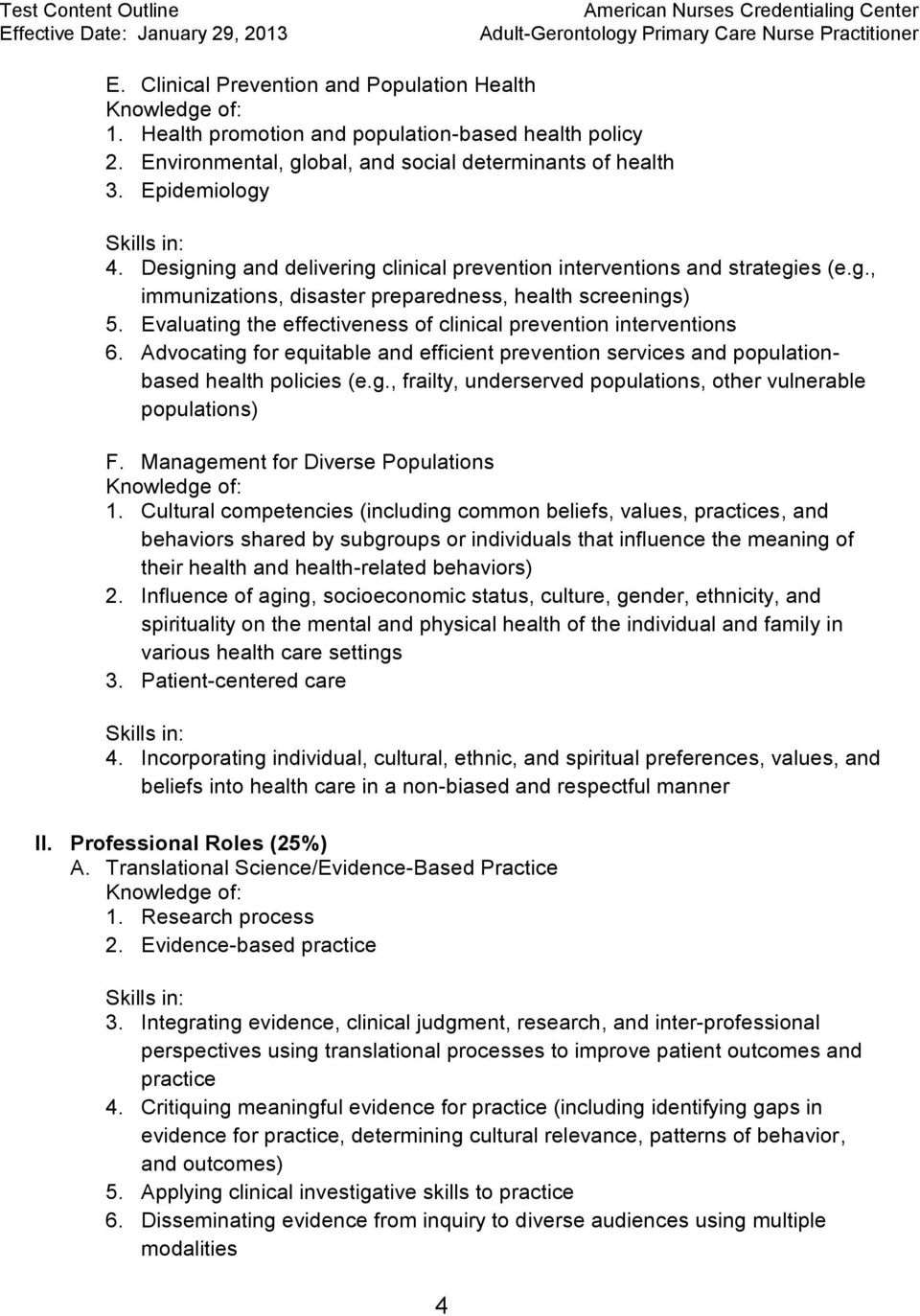
5 B. Legal and Ethical Issues/Scope and Standards/Regulation 1. Ethical and legal issues (e.g., informed consent/assent, guardianship, decisional capacity, surrogate decision-making, patient privacy, confidentiality, research participation, advance care planning, accountability) 2. Role, scope, and standards of the adult-gerontology primary care nurse practitioner 3. Concepts and principles associated with bioethics 4. Identifying and referring situations beyond scope of practice 5. Complying with regulatory guidelines (e.g., reimbursement regulations; reporting of communicable disease, abuse/neglect; Health Insurance Portability and Accountability Act [HIPAA]) 6. Applying ethical principles to issues related to the care of patients, populations, and systems 7. Evaluating the ethical consequences of decisions C. Quality Improvement and Safety 1. Methods, tools, performances measures, quality improvement models, culture of safety principles, and standards related to quality 2. Monitoring, analyzing, and prioritizing outcomes to improve quality of clinical practice 3. Identifying actual or potential failures in processes and systems that lead to breakdowns and errors 4. Implementing quality improvement initiatives (including peer review, safety, error reduction, self-monitoring, use of technology) D. Leadership, Advocacy, and Inter-Professional Communication and Collaboration 1. Leadership concepts, including interdisciplinary communication, collaboration, and coordination (e.g., group dynamics, negotiation, conflict resolution, safe and healthy work environments, team building, mentoring) 2. Communicating (orally or in writing) and collaborating with other professionals to manage and coordinate patient-centered care across systems (e.g., multidisciplinary teams, integration of care, transitions of care, medical home, documentation) 3. Developing and implementing innovations incorporating principles of change 4. Advocating for the needs of patients and their families 5
![Identifying and referring situations beyond scope of practice 5. Complying with regulatory guidelines (e.g., reimbursement regulations; reporting of communicable disease, abuse/neglect; Health Insurance Portability and Accountability Act [HIPAA]) 6.](/docs-images/58/3476263/images/page_5.jpg "Applying ethical principles to issues related to the care of patients, populations, and systems 7. Evaluating the ethical consequences of decisions C. Quality Improvement and Safety 1.")
6 5. Advocating for the role of the nurse practitioner 6. Documenting in accordance with current regulatory processes and payor systems E. Health Policy and Delivery 1. Interdependence between policy and practice (e.g., health care economics, health disparity, globalization, organizational structure, federal health care policies) 2. Organizational practices and complex systems to improve practice (e.g., systems theory, root cause analysis, change theory) 3. Advocating for policies that improve health (e.g., autonomy, social justice, access to care, equity, quality, and cost) 4. Evaluating the impact of health care delivery/policy on patients, providers, other stakeholders, and the environment 5. Minimizing risk to patients and providers at the individual and systems level 6. Analyzing the implications of health policy across the aging continuum F. Informatics and Health Care Technologies 1. Health care technologies 2. Legal and ethical issues related to the use of informatics and health care technologies (e.g., confidentiality, privacy, copyright, standardized language) 3. Integrating technology systems into the delivery and coordination of care (e.g., electronic records, decision support systems, telehealth, data management) III. Independent Practice (42%) A. Advanced Patient-Centered Communication 1. Adapting communications to specific patients needs/situations across the aging continuum (e.g., surrogate decision-makers, adolescents, cognitive impairments, fostering trusting relationships) 2. Using observational skills/nonverbal communication to enhance decisionmaking 3. Identifying barriers to communication (e.g., language, nonverbal, sensory level) 4. Using multiple modalities (including technology, print) to enhance communication 6

7 B. Health Promotion and Disease Prevention 1. Anticipatory guidance (e.g., developmental, functional, cognitive, and/or behavioral expectations for both patients and caregivers, disease progression, crisis management, palliative care, end-of-life care) 2. Health behavior modification 3. Patient-specific primary, secondary, and tertiary prevention (e.g., immunizations/vaccines, nutrition and exercise, injury prevention/safety, health literacy, screenings) 4. Life transitions (e.g., role changes, care giving, sexuality, loss) 5. Conducting an age-/developmental-/life stage-appropriate wellness visit, including health promotion, disease prevention, psychosocial assessment, anticipatory guidance, and counseling 6. Ordering and Interpreting appropriate screenings based on age and/or situation 7. Selecting interventions for the maintenance of health/wellness (including pharmacologic, nonpharmacologic, psychosocial) 8. Evaluating patient outcomes/response and modifying the plan of care accordingly 9. Facilitating advance care planning 10. Using technology for patient education and/or counseling C. Illness/Disease Management 1. Clinical guidelines and standards of care 2. Risk, cost, and benefits of interventions 3. Illness, injury, disease management 4. Complications and comorbidities as related to disease management 5. Effects of the aging process on disease management 6. Considerations for prescribing medications across the aging continuum (e.g., polypharmacy, potentially inappropriate drugs in the older adult) 7. Common geriatric syndromes Note: Each item written within the test content outline classification IIIC9 addresses at least one of the drug agents noted below 1. Antiinfective (D1) 7. Genitourologic (D7) 2. Antineoplastic (D2) 8. Immunologic (D8) 3. Cardiovascular (D3) 9. Musculoskeletal/analgesic (D9) 4. Endocrine (D4) 10. Neurologic (D10) 5. Eye, ear, and skin (D5) 11. Psychiatric (D11) 6. Gastrointestinal (D6) 12. Respiratory (D12) 7

8 8. Selecting nonpharmacological interventions (e.g., nutrition, physical therapy, complementary/alternative therapies, psychotherapy) for the management of illness, injury, and/or disease across the aging continuum 9. Selecting pharmacologic agents for the management of illness, injury, and/or disease across the aging continuum 10. Selecting appropriate interventions for the management of comorbid conditions across the aging continuum 11. Managing disease/health status over time (episodic, chronic, end-of-life, palliative care, sexual/reproductive health, mental health) 12. Engaging the patient and/or family in the management of illness, injury, and/or disease (e.g., educating, counseling, coaching, motivating, negotiating) 13. Evaluating patient outcomes/response and modifying the plan of care accordingly Note: Each item written within the test content outline classifications IIID1 IIID6 addresses at least one of the body systems noted below 1. Head, eyes, ears, nose, and throat 7. Neurological (including (B1) psychiatric) (B7) 2. Respiratory (B2) 8. Endocrine (B8) 3. Cardiovascular (B3) 9. Hematopoietic (B9) 4. Gastrointestinal (B4) 10. Immune (B10) 5. Genitourinary/Reproductive (B5) 11. Integumentary (B11) 6. Musculoskeletal (B6) D. Diagnostic Reasoning/Critical Thinking 1. Selecting appropriate tests and procedures (e.g., laboratory, diagnostic) 2. Interpreting laboratory and diagnostic data 3. Synthesizing data from multiple sources (e.g., assessment, diagnostic, laboratory, screening, etc.) to inform clinical decision-making (e.g., need for further testing, verification of data, follow up, referral/consultation) 4. Establishing and prioritizing differential diagnoses 5. Prioritizing current and potential problems within a climate of patient-centered care 6. Formulating a patient-centered, mutually acceptable plan of care Last Updated 4/4/2012 Copyright 2012 by. All rights reserved. No part of this publication may be reproduced or transmitted in any form or by any means, electronic or mechanical, including photocopy, recording, or by any information storage or retrieval system. 8

Test Content Outline Effective Date: February 9, 2016. Family Nurse Practitioner Board Certification Examination
 February 9, 2016 Board Certification Examination There are 200 questions on this examination. Of these, 175 are scored questions and 25 are pretest questions that are not scored. Pretest questions are
Test Content Outline Effective Date: August 6, 2013. Psychiatric-Mental Health Nurse Practitioner Board Certification Examination
 Board Certification Examination There are 200 questions on this examination. Of these, 175 are scored questions and 25 are pretest questions that are not scored. Pretest questions are used to determine
Test Content Outline Effective Date: January 29, 2013. Adult-Gerontology Acute Care Nurse Practitioner Board Certification Examination
 Board Certification Examination There are 200 questions on this examination. Of these, 175 are scored questions and 25 are pretest questions that are not scored. Pretest questions are used to determine
Graduate Program Objective #1 Course Objectives
 1 Graduate Program Objective #1: Integrate nursing science and theory, biophysical, psychosocial, ethical, analytical, and organizational science as the foundation for the highest level of nursing practice.
Scope and Standards of Practice for The Acute Care Nurse Practitioner. American Association of Critical-Care Nurses
 Scope and Standards of Practice for The Acute Care Nurse Practitioner American Association of Critical-Care Nurses Editor: Linda Bell, RN MSN Copy Editor: Anne Bernard Designer: Derek Bennett An AACN Critical
Primary Care Pediatric Nurse Practitioner Competencies
 Primary Care Pediatric Nurse Practitioner The following are entry-level competencies for the primary care pediatric nurse practitioner. These pediatric population-focused competencies expand upon the core
Psychiatric-Mental Health Nurse Practitioner Competencies
 Psychiatric-Mental Health Nurse Practitioner These are entry-level competencies for the psychiatric-mental health nurse practitioner (PMHNP) and supplement the core competencies for all nurse practitioners.
Graduate Curriculum Guide Course Descriptions: Core and DNP
 Graduate Curriculum Guide Course Descriptions: Core and DNP APN Core Courses (35 credits total) N502 Theoretical Foundations of Nursing Practice (3 credits) Theoretical Foundations of Nursing Practice
UNCG S.O.N. Nurse Practitioner Competency Metrics
 Yes Module on Clinical Prevention in Long-Term Care that students complete Assessment of Health Status: Obtains a relevant health history, which may be comprehensive or focused. Post test on Clinical prevention
Acute Care Pediatric Nurse Practitioner Certification Exam. Detailed Content Outline
 Acute Care Pediatric Nurse Practitioner Certification Exam Description of the Specialty This exam is for the pediatric nurse practitioner (PNP) who has graduated from a formal acute care PNP program with
Subdomain Weight (%)
 CLINICAL NURSE LEADER (CNL ) CERTIFICATION EXAM BLUEPRINT SUBDOMAIN WEIGHTS (Effective June 2014) Subdomain Weight (%) Nursing Leadership Horizontal Leadership 7 Interdisciplinary Communication and Collaboration
Master s Entry into Nursing. Academic Manual 2015-2016
 Master s Entry into Nursing Academic Manual 2015-2016 TABLE OF CONTENTS Overview of the Master s Entry into Nursing (MEN) Program 2 Outcomes 2 Plan of Study 3-4 Course Descriptions 5-11 Overview of the
National Organization of Nurse Practitioner Faculties
 1 National Organization of Nurse Practitioner Faculties SAMPLE CURRICULUM TEMPLATES FOR DOCTORATE of NURSING PRACTICE (DNP) NP EDUCATION Introduction NONPF presents these templates as exemplars of Doctor
Recommended Geropsychiatric Competency Enhancements for Nurse Practitioners Who Provide Care to Older Adults but are not Geriatric Specialists
 Recommended Geropsychiatric Competency Enhancements for Nurse Practitioners Who Provide Care to Older Adults but are not Geriatric Specialists These recommended competency enhancement statements are not
Personal Assessment Form for RN(NP) Practice for the SRNA Continuing Competence Program (CCP)
 Personal Assessment Form for RN(NP) Practice for the SRNA Continuing Competence Program (CCP) Completing a personal assessment is a mandatory component of the SRNA CCP. It allows a RN and RN(NP) to strategically
Test Content Outline Effective Date: October 25, 2014. Psychiatric and Mental Health Nursing Board Certification Examination
 Board Certification Examination There are 175 questions on this examination. Of these, 150 are scored questions and 25 are pretest questions that are not scored. Pretest questions are used to determine
Nurse Practitioner Core Competencies Content
 Nurse Practitioner Core Content A delineation of suggested content specific to the NP core 2014 Content Work Group Anne Thomas (Chair), PhD, ANP-BC, GNP, FAANP M. Katherine Crabtree, DNSc, APN-BC, FAAN
Learning Assurance Report. for the. WellStar Primary Care Nurse Practitioner Program. in the. Wellstar College of Health and Human Services
 Learning Assurance Report for the WellStar Primary Care Nurse Practitioner Program in the Wellstar College of Health and Human Services Spring 2004 Prepared by WellStar School of Nursing Curriculum Committee
Crosswalk of the Master s Essentials with the Baccalaureate and DNP Essentials
 Crosswalk of the Master s Essentials with the Baccalaureate and DNP Essentials Essential 1: Background for Practice from Sciences and Humanities Baccalaureate: Liberal Education for Baccalaureate Generalist
Test Content Outline Effective Date: February 6, 2015. Cardiac-Vascular Nursing Board Certification Examination
 Effective Date: February 6, 2015 Board Certification Examination There are 175 questions on this examination. Of these, 150 are scored questions and 25 are pretest questions that are not scored. Pretest
Medical College of Georgia Augusta, Georgia School of Medicine Competency based Objectives
 Medical College of Georgia Augusta, Georgia School of Medicine Competency based Objectives Medical Knowledge Goal Statement: Medical students are expected to master a foundation of clinical knowledge with
Nurse Practitioner Student Learning Outcomes
 ADULT-GERONTOLOGY PRIMARY CARE NURSE PRACTITIONER Nurse Practitioner Student Learning Outcomes Students in the Nurse Practitioner Program at Wilkes University will: 1. Synthesize theoretical, scientific,
Shelby Polk DNP, FNP-BC, RN, CDE Monica Jones, DNP, FNP-BC, RN Addie Herrod, MSN, FNP-BC, RN
 Shelby Polk DNP, FNP-BC, RN, CDE Monica Jones, DNP, FNP-BC, RN Addie Herrod, MSN, FNP-BC, RN 1. Compare and contrast competence and competency. 2. Recognize advantages of incorporating technology to improve
Purpose. Admission Requirements NURSING EDUCATION STUDENT LEARNING OUTCOMES RESIDENCY REQUIREMENTS. Clinical Requirements
 NURSING EDUCATION Purpose This program is designed for professional nurses who have earned a Master s or Doctoral Degree in Nursing and seek further education in advanced nursing practice. Concentrations
Care Definition, Practice Foundations, and Ability-Based Outcomes Updated May 23, 2013
 University of Washington School of Pharmacy Care Definition, Practice Foundations, and Ability-Based Outcomes The pharmacist graduating from the University of Washington School of Pharmacy promotes the
Scope of Practice for the Acute Care CNS. Introduction
 Scope of Practice for the Acute Care CNS Introduction The historical conceptualization of nursing delineates clinical practice dimensions according to the practitioner s role, the practice environment,
MN-NP GRADUATE COURSES Course Descriptions & Objectives
 MN-NP GRADUATE COURSES Course Descriptions & Objectives NURS 504 RESEARCH AND EVIDENCE-INFORMED PRACTICE (3) The purpose of this course is to build foundational knowledge and skills in searching the literature,
RN-MS Program. Purpose. Admission Requirements. State Requirements for Online/Distance Education. Degree Requirements
 RN-MS PROGRAM RN-MS Program Purpose This accelerated program is designed for the experienced, practicing registered nurse who plans to continue nursing studies through the master's level and does not hold
Doctor of Nursing Practice (DNP)
 DOCTOR OF NURSING PRACTICE (DNP) Doctor of Nursing Practice (DNP) Purpose The distance education program leading to the Doctor of Nursing Practice degree at Wilkes University is linked to the mission statements
Nursing Science (NUR SCI)
 University of California, Irvine 2015-2016 1 Nursing Science (NUR SCI) Courses NUR SCI 40. Introduction to Nursing and Health Care. 2 Units. Introduction to roles and responsibilities of nursing professionals,
Standards for the School Nurse [23.120]
![Standards for the School Nurse [23.120]](/thumbs/25/4559478.jpg "Standards for the School Nurse [23.120]") Standards for the School Nurse [23.120] STANDARD 1 Content Knowledge The certificated school nurse understands and practices within a framework of professional nursing and education to provide a coordinated
Standards for the School Nurse [23.120] STANDARD 1 Content Knowledge The certificated school nurse understands and practices within a framework of professional nursing and education to provide a coordinated
Post Graduate/APRN Certificate Programs
 POST-GRADUATE CERTIFICATE Post Graduate/APRN Certificate Programs Purpose This distance education program is designed for the experienced registered nurse who has earned a master s or doctoral degree in
Master of Science in Nursing Courses
 Master of Science in Nursing Courses ACNS 619 CNS Specialty Role and Practice Foundations (3) Provides an overview of the role of the Clinical Nurse Specialist (CNS) with a practice focus on adults and
NURSING (NURS) Explanation of Course Numbers
 NURSING (NURS) Explanation of Course Numbers Courses in the 1000s are primarily introductory undergraduate courses Those in the 2000 4000s are upper-division undergraduate courses that can also be taken
Doctor of Nursing Practice School of Nursing. Academic Assessment Plan
 School of Nursing Academic Assessment Plan Adopted by The Graduate Nursing Program faculty: February, 2014 Submitted to the Academic Assessment Committee via: [email protected] March 2014 Mission Statement
NMNEC CURRICULUM BSN
 NMNEC CURRICULUM BSN 1 NMNEC Program Objectives 1. Engage in professional nursing practice that is patient-centered and culturally appropriate for individuals, families, and communities. 2. Integrate principles
The MPH. ability to. areas. program. planning, the following. Competencies: research. 4. Distinguish. among the for selection
 MPH COMPETENCIES The MPH competencies are based on those approved by the Association of Schools of Public Health (ASPH) in 2006. By graduation, all MPH students must demonstrate the ability to apply public
Nursing (NURS) NURSING Courses. The University of Texas Health Science Center at San Antonio 1
 The University of Texas Health Science Center at San Antonio 1 Nursing (NURS) NURSING Courses NURS3110. Health Assessment: Clinical Application. 1 Credit Hour. This course provides an opportunity for application
Canadian Nurse Practitioner Core Competency Framework
 Canadian Nurse Practitioner Core Competency Framework January 2005 Table of Contents Preface... 1 Acknowledgments... 2 Introduction... 3 Assumptions... 4 Competencies... 5 I. Health Assessment and Diagnosis...
p. 185 The director of the Nuclear Medicine Technology program is Cindy Turchin, MBA, RT(R)(N), CNMT
 Corrections to the 2011-2012 Undergraduate Catalog: p. 100 -- The correct number of credit hours for the first semester of the sophomore year of the Medical Science major is 17 credits. The correct number
How To Be A Health Care Provider
 Program Competency & Learning Objectives Rubric (Student Version) Program Competency #1 Prepare Community Data for Public Health Analyses and Assessments - Student 1A1. Identifies the health status of
CLINICAL REHABILITATION COUNSELING
 CLINICAL REHABILITATION COUNSELING Students who are preparing to work as rehabilitation counselors will demonstrate the professional knowledge, skills, and practices necessary to address a wide variety
ICMSN Preceptor Orientation Packet. Preceptor Orientation Packet Family Nurse Practitioner Program 2015-2016
 Preceptor Orientation Packet Family Nurse Practitioner Program 2015-2016 Intercollegiate Consortium for a Master s of Science in Nursing McNeese State University, Nicholls State University, Southeastern
Examination Content Blueprint
 Examination Content Blueprint Overview The material on NCCPA s certification and recertification exams can be organized in two dimensions: (1) organ systems and the diseases, disorders and medical assessments
ASPH Education Committee Master s Degree in Public Health Core Competency Development Project
 ASPH Education Committee Master s Degree in Public Health Core Competency Development Project Version 2.3 Word Format Domains and Competencies Only May 2007 Discipline-specific Competencies A. BIOSTATISTICS
The UNE Master of Public Health Program and Graduate Certificate in Public Health Programs Competencies
 The UNE Master of Public Health Program and Graduate Certificate in Public Health Programs Competencies A. BIOSTATISTICS Biostatistics is the development and application of statistical reasoning and methods
SOUTHERN UNIVERSITY AND A&M COLLEGE BATON ROUGE, LOUISIANA
 MASTER OF SCIENCE IN NURSING (MSN) COURSE DESCRIPTIONS 600. THEORETICAL FOUNDATIONS OF ADVANCED NURSING (Credit, 3 hours). A systematic examination of the concepts of nursing, human beings, health, and
Brooks College of Health Nursing Course Descriptions
 CATALOG 2010-2011 Graduate Information Brooks College of Health Nursing Course Descriptions NGR500C: Health Assessment and Diagnostics Prerequisites: Admission to the MSN Program or consent of instructor.
Objectives of Training in Radiation Oncology
 Objectives of Training in Radiation Oncology 2008 This document applies to those who begin training on or after July 1 st, 2009. (Please see also the Policies and Procedures. ) DEFINITION Radiation Oncologists
NURSE PRACTITIONER CORE COMPETENCIES April 2011
 NURSE PRACTITIONER CORE COMPETENCIES April 2011 Task Force Members Anne C. Thomas, PhD, ANP-BC, GNP - Chair M. Katherine Crabtree, DNSc, FAAN, APRN-BC Kathleen R. Delaney, PhD, PMH-NP Mary Anne Dumas,
Expected Competencies of graduates of the nursing program at Philadelphia University
 Expected Competencies of graduates of the nursing program at Philadelphia University Background Educational programs are prepared within the context of the countries they serve. They are expected to respond
ICMSN Preceptor Orientation Packet. Preceptor Orientation Packet Family Nurse Practitioner Program 2013-2014
 Preceptor Orientation Packet Family Nurse Practitioner Program 2013-2014 Intercollegiate Consortium for a Master s of Science in Nursing McNeese State University, Nicholls State University, Southeastern
From the 2011 Accreditation Council for Occupational Therapy Education (ACOTE ) Standards and Interpretive Guide:
 From the 2011 Accreditation Council for Occupational Therapy Education (ACOTE ) Standards and Interpretive Guide: FOUNDATIONAL CONTENT REQUIREMENTS: Program content must be based on a broad foundation
Primary Care Pediatric Nurse Practitioner Certification Exam. Detailed Content Outline
 Primary Care Pediatric Nurse Practitioner Certification Exam Description of the Speciality Detailed Content Outline This exam is for the pediatric nurse practitioner (PNP) who has graduated from a formal
NURSING. Kathleen Hirthler, DNP, CRNP, FNP-BC; Chair, Graduate Nursing Program; Assistant Professor 570-408-5027 kathleen.hirthler
 NURSING Deborah A. Zbegner, Ph.D., CRNP, WHNP-BC; Dean of Nursing; Associate Professor 570-408-4086 [email protected] Kathleen Hirthler, DNP, CRNP, FNP-BC; Chair, Graduate Nursing Program; Assistant
Following are detailed competencies which are addressed to various extents in coursework, field training and the integrative project.
 MPH Epidemiology Following are detailed competencies which are addressed to various extents in coursework, field training and the integrative project. Biostatistics Describe the roles biostatistics serves
Program of Study: Master of Science in Nursing: Family Nurse Practitioner
 Program of Study: Master of Science in Nursing: Family Nurse Practitioner Program Description The Master of Science in Nursing: Family Nurse Practitioner program prepares experienced professional nurses
Nursing - Graduate (NGRD)
 Loma Linda University 2015-2016 1 Nursing - Graduate (NGRD) Courses NGRD 500. Primary Care Adult-Gerontology Nurse Practioner: Fragile elders. 2 Continues development of the A-GNP role of health promotion,
BS, MS, DNP and PhD in Nursing Competencies
 BS, MS, DNP and PhD in Nursing Competencies The competencies arise from the understanding of nursing as a theory-guided, evidenced -based discipline. Graduates from the curriculum are expected to possess
Test Content Outline Effective Date: June 9, 2014. Pain Management Nursing Board Certification Examination
 Pain Management Nursing Board Certification Examination There are 175 questions on this examination. Of these, 150 are scored questions and 25 are pretest questions that are not scored. Pretest questions
Nurse practitioner standards for practice
 Orientating statements Nurse practitioners have the capability to provide high levels of clinically focused nursing care in a variety of contexts in Australia. Nurse practitioners care for people and communities
SCHOOL NURSE COMPETENCIES SELF-EVALUATION TOOL
 Page 1 of 12 SCHOOL NURSE COMPETENCIES SELF-EVALUATION TOOL School Nurse School Date Completed School Nurse Supervisor Date Reviewed The school nurse competencies presume that some core knowledge has been
(Revised Curriculum 2008)
 Master of Nursing Science Program in Community Nurse Practitioner (Revised Curriculum 2008) Curriculum Master of Nursing Science Program in Community Nurse Practitioner Academic Degree Master of Nursing
M.S.N. Graduate Program
 M.S.N. Graduate Program Graduate Program Mission The Saint Luke s College of Health Sciences is an educational leader serving exceptional students pursuing a graduate nursing degree. An institution of
STUDY PLAN Master Degree in Clinical Nursing/ Palliative Care (Thesis )
 STUDY PLAN Master Degree in Clinical Nursing/ Palliative Care (Thesis ) I. GENERAL RULES AND CONDITIONS: 1. This plan conforms to the valid regulations of the programs of graduate studies. 2. Areas of
Online MPH Program Supplemental Application Handbook
 Online MPH Program Supplemental Application Handbook Table of Contents Online MPH Supplemental Application Handbook Completing & Submitting the Supplemental Application 2 Eligible Previous Public Health
TUFTS UNIVERSITY SCHOOL OF MEDICINE Institutional Educational Objectives
 1 TUFTS UNIVERSITY SCHOOL OF MEDICINE Institutional Educational Objectives The central aim of the School of Medicine is to produce highly competent, intellectually curious and caring physicians. To this
PROGRAM ASSESSMENT MATRIX 12-13 NURSING AAS Degree Submitted by Pamela Covault Current as of 2/24/12
 PROGRAM ASSESSMENT MATRIX 12-13 NURSING AAS Degree Submitted by Pamela Covault Current as of 2/24/12 Outcomes: We believe the purpose of associate degree nursing education is to prepare graduates to practice
How To Be A Nurse Practitioner
 NURSE PRACTITIONER PROGRAM THE PENNSYLVANIA STATE UNIVERSITY College of Nursing Preceptor Evaluation of Student Clinical Performance: Adult Gerontology Acute Care Nurse Practitioner Option Nursing 863
Advanced Practice Nursing
 Wegmans School of Nursing Master of Science in: Advanced Practice Nursing Program Overview The mission of the program at St. John Fisher College is to provide a stimulating milieu of academic and clinical
H. FAMILY NURSE PRACTITIONER ADVANCED PRACTICE ROLE OVERVIEW
 H. FAMILY NURSE PRACTITIONER ADVANCED PRACTICE ROLE OVERVIEW The Family Nurse Practitioner role emphasizes health promotion, health maintenance, prevention and detection of alterations in health through
Master of Nursing Science Program in Mental Health and Psychiatric Nursing
 Master of Nursing Science Program in Mental Health and Psychiatric Nursing Curriculum Master of Nursing Science Program in Mental Health and Psychiatric Nursing Academic Degree Master of Nursing Science
TUSKEGEE UNIVERSITY College of Veterinary Medicine, Nursing and Allied Health School of Nursing and Allied Health. Occupational Therapy Program
 TUSKEGEE UNIVERSITY College of Veterinary Medicine, Nursing and Allied Health School of Nursing and Allied Health Occupational Therapy Program Student Success for Health Science Majors Course Number: HLSC
Appendix Health Service Psychology: Preparing Competent Practitioners
 Appendix Health Service Psychology: Preparing Competent Practitioners This document is copyrighted by the American Psychological Association or one of its allied publishers. Advances in psychological science
Content Outlines and KSAs Social Work Licensing Examinations
 Content Outlines and KSAs Social Work Licensing Examinations What are KSAs? A KSA is a Knowledge, Skills, and Abilities statement. These statements describe the discrete knowledge components that may be
A: Nursing Knowledge. Alberta Licensed Practical Nurses Competency Profile 1
 A: Nursing Knowledge Alberta Licensed Practical Nurses Competency Profile 1 Competency: A-1 Anatomy and Physiology A-1-1 A-1-2 A-1-3 A-1-4 A-1-5 A-1-6 A-1-7 A-1-8 Identify the normal structures and functions
Nursing (NUR) The University of Alabama in Huntsville 1. NUR 000 - NURSING-CREDIT BY VALIDATION Semester Hours: 4-39
 The University of Alabama in Huntsville 1 Nursing (NUR) NUR 000 - NURSING-CREDIT BY VALIDATION Semester Hours: 4-39 NUR 201 - MULTIDIM ASPECTS HL CAREER OPT This course is designed for the student who
Common Outcomes/Competencies for the CCN Nursing Web Page
 Common Outcomes/Competencies for the CCN Nursing Web Page NURS 120: Foundations of Nursing This course introduces concepts related to the practical nurse s roles and responsibilities in today s society.
Standards of Professional Performance for the Acute Care Clinical Nurse Specialist. Introduction
 Standards of Professional Performance for the Acute Care Clinical Nurse Specialist Introduction Standards of professional performance describe a competent level of behavior in the professional role, including
ARN Competency Model For Professional Rehabilitation Nursing
 ARN Competency Model For Professional Rehabilitation Nursing Copyright @ 2014, Association of Rehabilitation Nurses 8735 W. Higgins Rd, Suite 300 Chicago, IL 60631 Introduction The specialty of rehabilitation
Old Dominion University. BS-MSN-DNP Neonatal Nurse Practitioner. Full-Time Curriculum
 Old Dominion University BS-MSN-DNP Neonatal Nurse Practitioner Full-Time Curriculum First Semester (Fall) NURS 715 Ethical Concepts and Issues in Advanced Practice Nursing 2 NURS 771 Physical Assessment
Midterm Final US S E NA 0 1 2 3 4 5. 8. Applies principles of epidemiology and demography in clinical practice.
 Indiana University-Purdue University Fort Wayne College of Health and Human Services Department of Nursing Clinical Evaluation Form: Nurse Practitioner Graduate Program Student Name: Preceptor Name: Semester
College of Education. Rehabilitation Counseling
 * 515 MEDICAL AND PSYCHOSOCIAL ASPECTS OF DISABILITIES I. (3) This course is designed to prepare rehabilitation and mental health counselors, social works and students in related fields with a working
American Psychological Association D esignation Criteria for Education and
 American Psychological Association D esignation Criteria for Education and Training Programs in Preparation for Prescriptive Authority Approved by APA Council of Representatives, 2009 Criterion P: Program
2014-2015 Graduate Nursing Student Handbook, Policies, and Procedures
 2014-2015 Graduate Nursing Student Handbook, Policies, and Procedures JoAnn McGrath School of Nursing 1 TABLE OF CONTENTS I. The Nursing Program Welcome to Nursing 3 Mission of Alverno College 4 Mission
Doctor of Nursing Practice
 308 Doctor of Nursing Practice Clarke University offers a Doctor of Nursing degree in Family Nurse Practice to serve the needs of the working health care professionals seeking post baccalaureate study.
BOARD OF PHARMACY SPECIALITIES 2215 Constitution Avenue, NW Washington, DC 20037-2985 202-429-7591 FAX 202-429-6304 [email protected] www.bpsweb.
 BOARD OF PHARMACY SPECIALITIES 2215 Constitution Avenue, NW Washington, DC 20037-2985 202-429-7591 FAX 202-429-6304 [email protected] www.bpsweb.org Content Outline for the PSYCHIATRIC PHARMACY SPECIALTY
Nurse Practitioner Mentor Guideline NPAC-NZ
 Nurse Practitioner Mentor Guideline NPAC-NZ Purpose To provide a framework for the mentorship of registered nurses to prepare for Nurse Practitioner (NP) registration from the Nursing Council of New Zealand.
CACREP STANDARDS: CLINICAL MENTAL HEALTH COUNSELING Students who are preparing to work as clinical mental health counselors will demonstrate the
 CACREP STANDARDS: CLINICAL MENTAL HEALTH COUNSELING Students who are preparing to work as clinical mental health counselors will demonstrate the professional knowledge, skills, and practices necessary
Illinois Licensure Testing System
 Illinois Licensure Testing System FIELD 182: SCHOOL NURSE February 2004 Subarea Range of Objectives I. Foundations of Knowledge 01 04 II. The Coordinated School Health Program 05 09 III. Professional Roles
Test Content Outline Effective Date: January 12, 2016. Nurse Executive Board Certification Examination
 Board Certification Examination There are 175 questions on this examination. Of these, 150 are scored questions and 25 are pretest questions that are not scored. Pretest questions are used to determine
MASTER OF SCIENCE IN NURSING
 300 MASTER OF SCIENCE IN NURSING Clarke University offers a Master of Science in Nursing degree in Nurse Educator and Family Nurse Practitioner programs, a post-master s certificate program and a master
Program of Study: Bachelor of Science in Counseling with an Emphasis in Addiction, Chemical Dependency, and Substance Abuse
 Program of Study: Bachelor of Science in with an Emphasis in Addiction, Dependency, and Substance Abuse Program Description The Bachelor of Science in with an Emphasis in Addiction, Dependency, and Substance