
LOGISTICS OFFICE ANNUAL REPORT 2013/14
|
|
|
- Hugo Reeves
- 10 years ago
- Views:
Transcription
1 LOGISTICS OFFICE RETAIL ANNUAL REPORT 2013/14
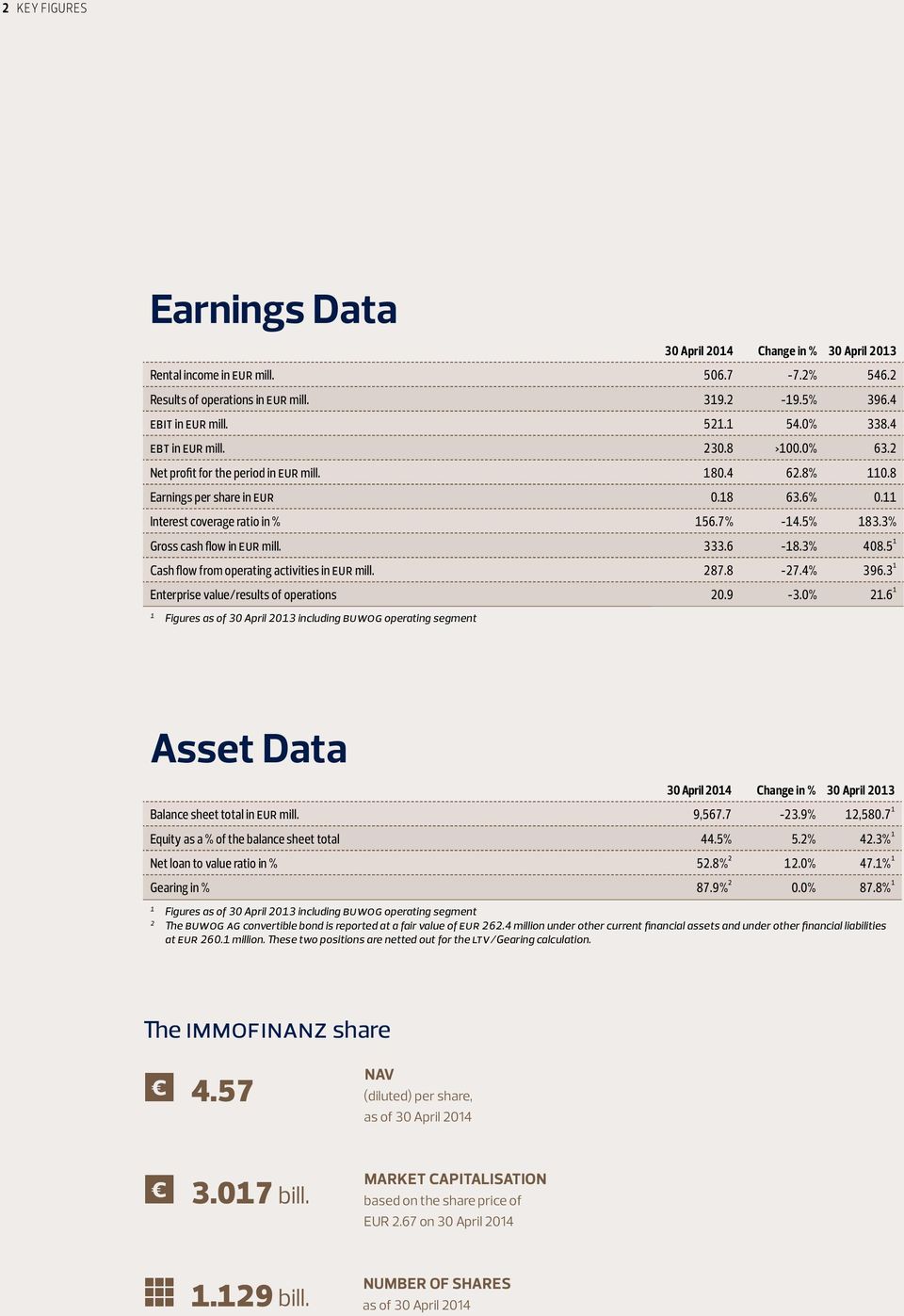
2 2 Key Figures Earnings Data 30 April 2014 Change in % 30 April 2013 Rental income in EUR mill % Results of operations in EUR mill % EBIT in EUR mill % EBT in EUR mill >100.0% 63.2 Net profit for the period in EUR mill % Earnings per share in EUR % 0.11 Interest coverage ratio in % 156.7% -14.5% 183.3% Gross cash flow in EUR mill % Cash flow from operating activities in EUR mill % Enterprise value/results of operations % Figures as of 30 April 2013 including BUWOG operating segment Asset Data 30 April 2014 Change in % 30 April 2013 Balance sheet total in EUR mill. 9, % 12, Equity as a % of the balance sheet total 44.5% 5.2% 42.3%1 Net loan to value ratio in % 52.8%2 12.0% 47.1%1 Gearing in % 87.9%2 0.0% 87.8%1 1 Figures as of 30 April 2013 including BUWOG operating segment 2 The BUWOG AG convertible bond is reported at a fair value of EUR million under other current financial assets and under other financial liabilities at EUR million. These two positions are netted out for the LT V /Gearing calculation. The IMMOFINANZ share A 4.57 NAV (diluted) per share, as of 30 April 2014 A bill. MARKET CAPITALISATION based on the share price of EUR 2.67 on 30 April 2014 F bill. NUMBER OF SHARES as of 30 April 2014
3 Key Figures 3 Property Data 30 April 2014 Change in % 30 April 2013 Total number of properties % 1,7591 Lettable space in sqm 3,825, % 6,526,5501 Occupancy rate 85.0% -5.0% 89.5%1 Carrying amount of investment properties in EUR mill. 6, % 9, Carrying amount of properties under construction in EUR mill % Carrying amount of inventories in EUR mill % Figures as of 30 April 2013 including BUWOG operating segment Stock Exchange Data 30 April 2014 Change in % 30 April 2013 Book value per share in EUR % Net asset value per share diluted in EUR % Share price at end of period in EUR % 3.111, 2 Discount of share price to diluted NAV per share in % 41.5% -10.6% 46.4%1 Number of shares 1,128,952, % 1,128,952,687 Number of treasury shares 112,895, % 112,895,268 Market capitalisation at end of period in EUR mill. 3, % 3, Figures as of 30 April 2013 including BUWOG operating segment 2 After an adjustment for the effects of the BUWOG spin-off, the share performance was positive with an increase of 7.1% from EUR 2.50 to EUR Standing Investments A bill. D 363 STANDING INVESTMENTS Carrying amount as of 30 April 2014 STANDING INVESTMENTS Number of properties as of 30 April 2014 E mill. RENTABLE SPACE in the standing investments in sqm as of 30 April 2014

4 4 Highlights Highlights of the 2013/14 Financial Year

5 Highlights 5 7 May 2013 Listing in Warsaw The IMMOFINANZ share starts its listing on the Warsaw Stock Exchange and confirms the expectations of increased demand from Polish investors. May 2013 September 13 September 2013 Silesia City Center sold The Silesia City Center shopping mall in Poland is sold for EUR million to an international consortium of investors headed by Allianz. This sale was one of the largest single transactions in Poland during 2013.

6 6 Highlights 28 October 2013 Continued construction at the Gerling Quartier Gerling Quartier all ten building shells in the first section of this Cologne project are now complete. October February 2014 February 2014 Acquisition of DGAG portfolio BUWOG acquires the DGAG portfolio in Northern Germany and paves the way for its separation. IMMOFINANZ announces the listing of BUWOG through a spin-off.

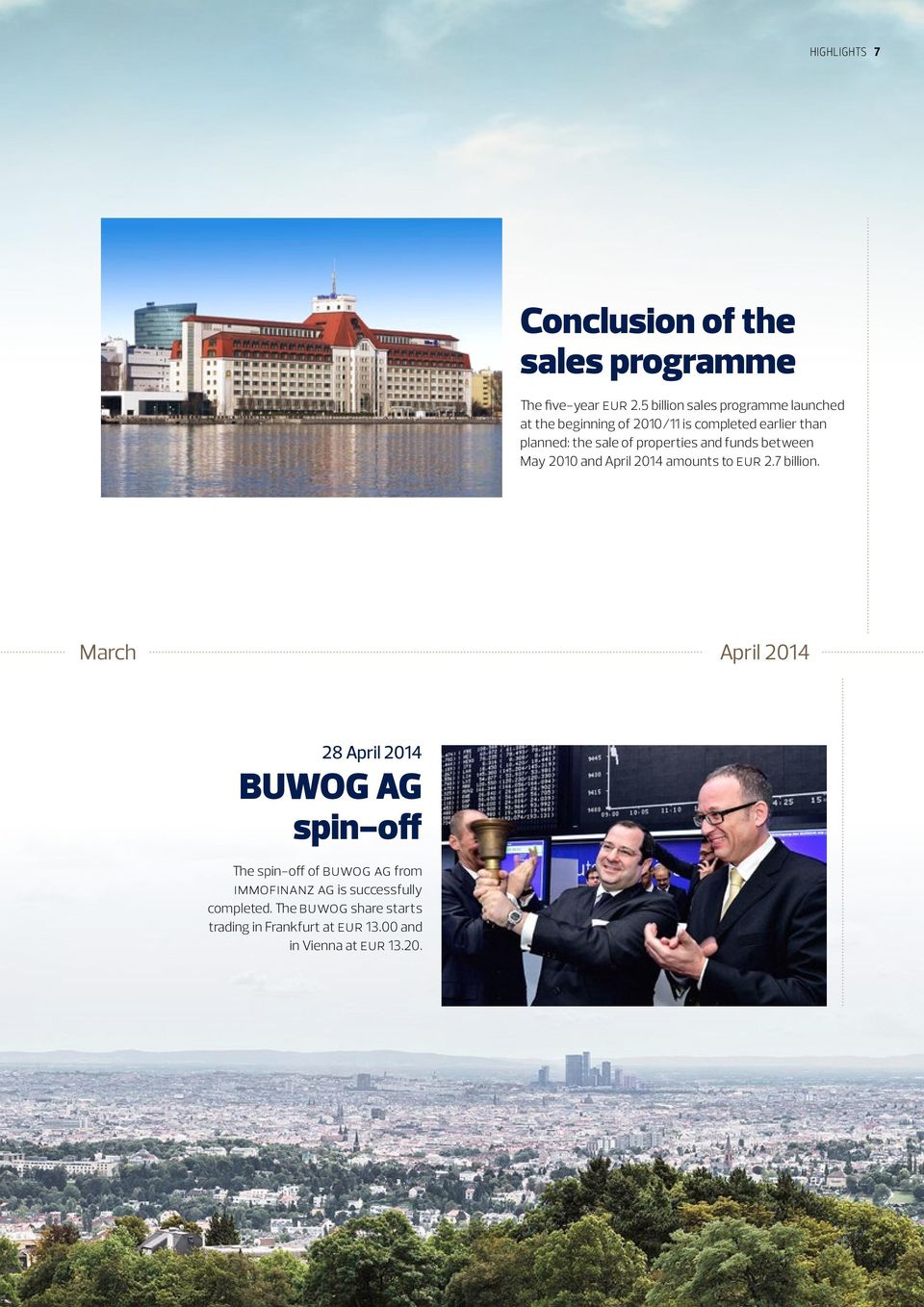
7 Highlights 7 Conclusion of the sales programme The five-year EUR 2.5 billion sales programme launched at the beginning of 2010/11 is completed earlier than planned: the sale of properties and funds between May 2010 and April 2014 amounts to EUR 2.7 billion. March April April 2014 BUWOG AG spin-off The spin-off of BUWOG AG from IMMOFINANZ AG is successfully completed. The BUWOG share starts trading in Frankfurt at EUR and in Vienna at EUR
8 8 Content VIVO! Center Pila PL T The first VIVO! shopping center based on IMMOFINANZ Group s new development concept will open in Q approx. 24,000 E rentable space

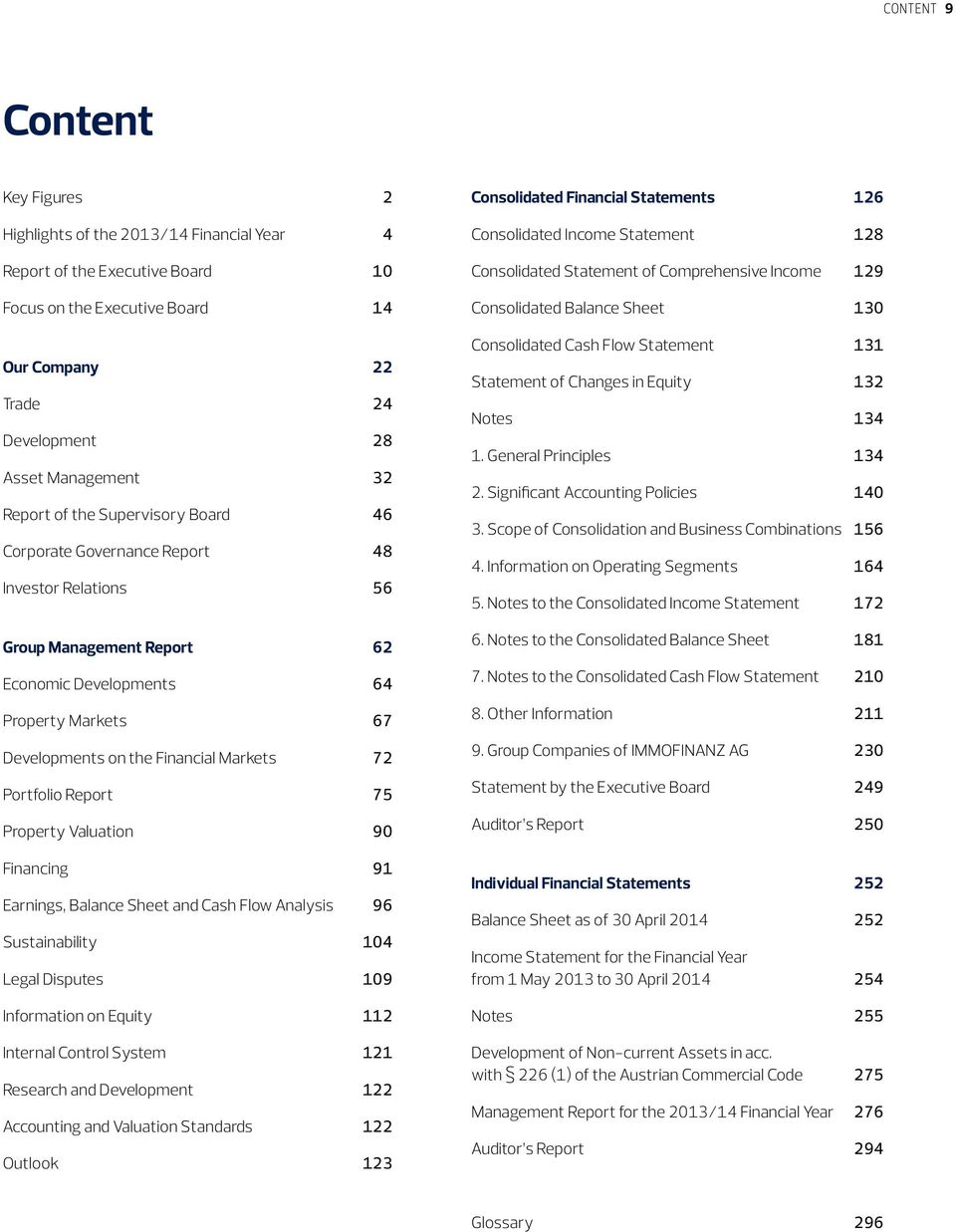
9 Content 9 Content Key Figures 2 Highlights of the 2013/14 Financial Year 4 Report of the Executive Board 10 Focus on the Executive Board 14 Our Company 22 Trade 24 Development 28 Asset Management 32 Report of the Supervisory Board 46 Corporate Governance Report 48 Investor Relations 56 Group Management Report 62 Economic Developments 64 Property Markets 67 Developments on the Financial Markets 72 Portfolio Report 75 Property Valuation 90 Financing 91 Earnings, Balance Sheet and Cash Flow Analysis 96 Sustainability 104 Legal Disputes 109 Information on Equity 112 Internal Control System 121 Research and Development 122 Accounting and Valuation Standards 122 Outlook 123 Consolidated Financial Statements 126 Consolidated Income Statement 128 Consolidated Statement of Comprehensive Income 129 Consolidated Balance Sheet 130 Consolidated Cash Flow Statement 131 Statement of Changes in Equity 132 Notes General Principles Significant Accounting Policies Scope of Consolidation and Business Combinations Information on Operating Segments Notes to the Consolidated Income Statement Notes to the Consolidated Balance Sheet Notes to the Consolidated Cash Flow Statement Other Information Group Companies of IMMOFINANZ AG 230 Statement by the Executive Board 249 Auditor s Report 250 Individual Financial Statements 252 Balance Sheet as of 30 April Income Statement for the Financial Year from 1 May 2013 to 30 April Notes 255 Development of Non-current Assets in acc. with 226 (1) of the Austrian Commercial Code 275 Management Report for the 2013/14 Financial Year 276 Auditor s Report 294 Glossary 296
10 10 Report of the Executive Board From left to right: Dietmar Reindl, Birgit Noggler, Eduard Zehetner

11 Report of the Executive Board 11

12 12 Report of the Executive Board Dear Ladies and Gentlemen, In our introduction to last year s annual report, we defined BUWOG s expansion in Germany and the separation of this residential property subsidiary via the capital market as one of our main objectives for 2013/14. Our reasoning was that IMMOFINANZ and BUWOG address different types of investors and when they are presented together as a single corporation, they do not receive the individual market valuation they really deserve. One year and a great deal of work later, we met this objective: BUWOG successfully established a position as a German-Austrian residential property company with the purchase of roughly 18,000 apartments in Northwest Germany its share started trading on the stock exchanges in Vienna and Frankfurt on 28 April 2014, followed by Warsaw one day later. As we expected, BUWOG, which stands out from the German peer group with its real estate machine business model, was very well received on the capital market. Investors have valued the BUWOG share and the underlying residential properties with a substantially lower discount to the net asset value compared with its previous position as part of IMMOFINANZ Group. Market leader for commercial properties in CEE The spin-off of BUWOG gave IMMOFINANZ a sharper profile as a commercial property specialist with a focus on Central and Eastern Europe. Russia is now our largest single market, followed by Austria, Romania, Poland and Germany. As emphasised in the past, our business in Russia is a source of considerable satisfaction in spite of smaller setbacks: the returns are significantly higher than in Eastern and Western Europe, and the occupancy in our properties is well over 90%. However, the crisis in Ukraine, its further development and the sanctions imposed by the west and Russia represent uncertainty factors that have substantially clouded the mood of investors over the past weeks. This has had a negative effect on the market in Vienna as well as on the IMMOFINANZ share. IMMOFINANZ Group is not directly affected by the sanctions announced or imposed by mid-august. We are, however, indirectly involved as the operator of major shopping centers in Moscow, as consumer spending is not positively influenced by latent fears of war or economic sanctions. We are therefore hoping for an early end to the crisis and a victory for common sense. Apart from these developments, the transaction market has been very active. The sale of the Silesia City Center, our Polish shopping center, during 2013/14 represented a benchmark deal for the CEE region. The interest in Eastern Europe has grown significantly over the past 12 months and, with its attractive risk-return profile, the region is becoming an interesting alternative to investments in the western markets. The European Central Bank has also set a signal in favour of real estate investments with its interest rate announcements. There is no end in sight to the loose monetary policy and the related low interest rates. That, in turn, has increased investors search for relatively safe investments as an alternative to the money market. The economic recovery in Central and Eastern Europe is continuing, with GDP growth in many of these countries better than expected in the first quarter of In spite of these positive signs, we would welcome stronger momentum as support for our rental business in individual states. We are very comfortable with our positioning as a leading commercial property investor and developer in CEE and are convinced of the long-term growth story and the convergence potential of this region. In addition to comparatively healthy national budgets, the pent-up demand in these countries compared with Western Europe will remain an important growth driver. This development will also be supported by exports above all to Western Europe and increasingly by domestic demand. Improvement in earnings Net profit rose by 63% to EUR million in the 2013/14 financial year. Rental income adjusted for property sales, acquisitions and completions (like-for-like) was largely stable. We are generally satisfied with these results, which reflect our forecasts. Not all operating targets were met, even though the negative results from property development, which were recorded primarily in Russia, were offset by a major negotiating success, also in Russia. The negative results from property development were caused, above all, by delays in the completion of the GOODZONE shopping center in Moscow and the related higher construction costs. This shopping center has since

13 Report of the Executive Board 13 been completed and is now open for business. Based on the low valuation of GOODZONE which is substantially lower per square meter than Golden Babylon Rostokino, our largest shopping center in Moscow we expect an increase in value over the coming years. Revaluation results, adjusted for foreign exchange effects, illustrate the slight increase in the discount rates used by the external appraisers for the Russian properties. This adjustment reflects the appraisers more cautious evaluation due to the political situation and potential sanctions. In the end, the decline in the value of our Russian properties equalled less than 5% of the portfolio in that country. We would now like to highlight a number of important events from the 2013/14 financial year in addition to BUWOG s successful expansion in Germany and its spin-off and stock exchange listing: > Our original plan to sell EUR 2.5 billion of properties within five years was more than met after only four years. IMMOFINANZ sold properties and funds with a total value of EUR 2.7 billion during these four years and that at an average double-digit margin over the book value. > The listing of the IMMOFINANZ share on the Warsaw Stock Exchange in May 2013 has led to a sound increase in the number of Polish investors. > In the operating business we concentrated even more on our markets and customers, and transferred greater responsibility to our core countries for both asset management and development. We are convinced that these changes will create a competitive advantage and act as value drivers. We previously announced our intention not to recommend a dividend for the 2013/14 financial year to you, our shareholders, at the annual general meeting on 30 September IMMOFINANZ invested a major part of its generated liquidity in the expansion of BUWOG during the past year and, in this way, made the spin-off and successful listing possible. The automatic credit of BUWOG shares (one BUWOG share for every 20 IMMOFINANZ shares) to your securities depository allows you to benefit directly from the potential of this residential property portfolio. BUWOG will also pay sustainable dividends and has stated its plans to pay the first dividend this autumn, assuming the distribution is approved by the annual general meeting. That should compensate at least part of the absent IMMOFINANZ dividend. Our plans call for the resumption of dividend payments for the current financial year. We, the Executive Board of IMMOFINANZ, also intend to do everything in our power to sustainably improve the profitability of IMMOFINANZ Group and the valuation of the share on the capital market. Eduard Zehetner CEO Birgit Noggler CFO Dietmar Reindl COO
14 14 Focus on the Executive Board Interview with the Executive Board Market consolidation will also be an issue for the real estate sector in Central and Eastern Europe The most important event in the 2013/14 financial year was the spin-off of BUWOG, which was listed on 28 April. How would you describe the development so far? Eduard Zehetner: We always maintained that IMMOFINANZ and BUWOG, as a single corporation, didn t receive the market valuation they deserve based on the quality of their portfolios. And we were right: as an independent listed company, BUWOG has received a significantly higher valuation from investors than it did under the IMMOFINANZ umbrella. The discount between the price of the BUWOG share and the net asset value (NAV) has declined substantially since the initial listing. This discount, which was implicitly roughly 36% before the spin-off based on the IMMOFINANZ share price, fell by half on the first trading day alone. At EUR 13.2, BUWOG s initial trading price in Vienna was higher than we expected. And the share price has risen further over the past few months the annual high up to now was EUR Birgit Noggler: Our road shows have shown that investors value BUWOG s business model as well as the focus on Germany and Austria. The first analysts ratings have also been very positive. At the same time, BUWOG finalised its major acquisition in Germany, the DGAG portfolio with roughly 18,000 apartments and a related management platform with nearly 300 employees. In other words, everything is going as planned. But the IMMOFINANZ share is still trading at a high discount to the NAV. Zehetner: The past months were not very helpful, above all due to the political unrest in Ukraine but we re not the only ones affected by these developments. If you take a look at the entire market since the beginning of 2014, our share has more or less followed the ATX. How is the spin-off presented in the IMMOFINANZ financial statements for 2013/14? Noggler: The separation of BUWOG is clearly reflected in the consolidated financial statements. We deconsolidated BUWOG following the spin-off, and then recognised the remaining 49% as an investment based on the equity method. You now see it as an investment in an associated company. The valuation at the time of recognition was based on the stock exchange price plus a control premium. This control premium was derived from external factors, meaning comparable transactions on the European capital markets, and reflects the de- domination agreement between BUWOG and IMMOFINANZ. The basic idea is that a third party who acquires a 49% package in BUWOG would be able to control the company and can therefore be expected to pay a higher price to obtain this control. Zehetner: The use of the equity accounting method was possible because IMMOFINANZ no longer has control over BUWOG. You can see that in the composition of the five-member BUWOG supervisory board, which only includes one member of the IMMOFINANZ Executive Board. In addition to the 49% stake, IMMOFINANZ also invested in a EUR million convertible bond issued by BUWOG. What are your plans for these two investments? Zehetner: We want to sell the BUWOG equity stake over the medium-term but at least at the book value per share and with a minimal impact on the market. That s what we said before the spin-off, and nothing has changed since that time. As far as the convertible bond is concerned, BUWOG is entitled to call and redeem the bond at any time up to the end of January If they decide not to do this, we will place the bond on the capital market after the call option expires and use the proceeds to repay our bridge loan. And where do you intend to invest the proceeds from the sale of the BUWOG shares? Zehetner: In our real estate machine, more exactly in the expansion of our development activities and in portfolio investments in Eastern and Western Europe. Right now, in other words at the end of April 2014, our development projects under construction had an expected fair value after completion of EUR million. We want to raise this level up to a maximum of EUR 2.0 billion over the medium-term with new projects, whereby the focus will be on our markets in Germany, Poland, Russia and Romania. Naturally, this expansion requires a higher capital investment. Are you also planning dividends and share buybacks? Zehetner: The necessary liquidity for such distributions has to come from the operating business. We

15 Focus on the Executive Board 15 announced that we intend to resume dividends starting with the current financial year. From the current point of view, we re targeting a dividend of EUR 0.15 to EUR 0.20 per share for 2014/15 whereby this can basically cover a dividend payment and a share buyback programme. Noggler: We, as the Executive Board, will not be recommending a dividend for the 2013/14 financial year to the annual general meeting. The major part of the liquidity generated by IMMOFINANZ during the past year was invested in the purchase of residential properties in Germany to position BUWOG as a German-Austrian residential property company. Zehetner: And that was the underlying requirement for the spin-off of a majority stake in BUWOG, where our shareholders received one BUWOG share for every 20 IMMOFINANZ shares. BUWOG also intends to follow a sustainable dividend policy and is expected to distribute approx. EUR 0.65 per share for 2013/14. IMMOFINANZ will then receive roughly EUR 32.0 million from its 49% investment. Noggler: With respect to future share buybacks, we plan to withdraw the 9.00% of treasury shares that are currently used for financing after this debt is repaid or restructured. Portfolio investments can also include acquisitions: do you see any opportunities for consolidation? Zehetner: The market is definitely moving in this direction. The consolidation in the German residential property sector started several quarters ago because of the readily available synergies. BUWOG played a role in this process with the acquisition of the DGAG portfolio. With a view to the retail sector in Western Europe, Klépierre and Corio recently announced merger plans. We also expect further consolidation on the commercial property markets in Central and Eastern Europe. As the market leader in this region, we intend to play an active role and evaluate opportunities in our core markets with a view towards synergies and economies of scale. What dimensions do you have in mind? Zehetner: That always depends on the available opportunities, and can generally range from the purchase of

16 16 Focus on the Executive Board individual investments or entire portfolios to mergers. However, any consolidation steps we take will be connected with obtaining entrepreneurial responsibility for IMMOFINANZ. Are you also considering the further simplification of the IMMOFINANZ portfolio after the BUWOG spin-off and the separation of the West European residential properties? Zehetner: Over the medium-term we definitely intend to remain by our current three commercial asset classes retail, office and logistics. On the other hand, the spinoff of BUWOG and the realisation of larger transactions have demonstrated that we can react very quickly to market opportunities. For that reason, I wouldn t exclude the possible sale of a segment from our retail or logistics business for example our STOP.SHOP. retail warehouse chain at a later date if the opportunities are available and the prices are attractive. Is that one of the reasons for your focus on brand creation in the portfolio? Dietmar Reindl: Exactly. Starting with the BUWOG residential property brand and including our STOP.SHOP. retail warehouse chain plus Deutsche Lagerhaus and LOG CENTER, which stand for our logistics activities in Germany and Eastern Europe, we have already established a number of successful brands that form the basis for further expansion in our core countries. With VIVO! we also launched a new brand in the retail segment during the past year. VIVO! shopping centers are positioned between the STOP.SHOP.s, on the one side, and large shopping centers, on the other side, with respect to size, focus and offering. What we have here are generally single-storey shopping centers with a strong fashion and entertainment focus that are ideal for smaller and medium-sized cities. Our first VIVO! center will open in the last quarter of 2014 in the Polish city of Pila, the second presumably during the 2015 calendar year in Stalowa Wola, a city in the south-eastern region of Poland. We currently have five VIVO! locations in Poland in the construction or planning stage. This concept is also well suited for Moscow and the surrounding region. What are your expansion plans for the STOP.SHOP.s and logistics? Reindl: Under the LOG CENTER umbrella brand, we want to concentrate on the development of logistics projects in Romania and Russia, while Deutsche Lagerhaus is expanding its project pipeline in Germany. With our STOP.SHOP.s we are currently operating at 50 locations in six countries and are now starting to expand into Serbia the first two locations have already been identified. The STOP.SHOP. concept is ideal for the Balkan countries because of the size of the cities, the purchasing power of the population etc. The feedback from tenants has been very positive. Zehetner: We re also continuing the roll-out of our STOP. SHOP.s in Poland. The second Polish location opened last November in Mlawa, Ketrzyn and Zary will follow in the second half of Ten further retail warehouses are planned for this country over the medium-term. In Romania, we will be entering the market with the STOP. SHOP. brand in the near future we have a number of very interesting sites that are currently part of our land reserves. We also acquired and rebranded five retail parks during the 2013/14 financial year four in Slovenia and one in the Czech Republic. These facilities are fully occupied and generate a high return. When we see attractive acquisition opportunities like this, we definitely take a closer look. Reindl: International retailers value our large network. In order to realise the required economies of scale, they need a certain minimum number of locations when they enter a new country. They want a reliable partner and developer, just like IMMOFINANZ, who can move with them and quickly complete a roll-out in several countries. The BUWOG spin-off shifted IMMOFINANZ Group s geographical focus even more towards Eastern Europe. Nearly 70% of the portfolio is now located in the CEE region or Russia. Do you expect to continue this concentration with your future development activities? Zehetner: We re not really planning any major changes. But I don t want to exclude a shift in percentage rates due to possible consolidation steps in the future. The specific circumstances and opportunities will make that decision. The outlook for growth in the CEE region is positive. Have you seen any signs of a gradual improvement in the economy? Zehetner: Eastern Europe is still not the growth story we would like to see. It would be good to have stronger impulses from the economy for our rental business. If you look at the first quarter of 2014, the GDP indicators were very good in a number of countries, but like I said: the situation could be better. Reindl: In addition to comparatively healthy national budgets, we see an important growth driver in the pent-up demand in these countries compared with Western Europe. This growth will also be supported by exports above all to Western Europe and increasingly by domestic demand. In Romania, there is a growing demand for high-quality logistics space. The logistics business is a type of early indicator for economic recovery among the commercial property asset classes. After the latest large-volume rental to Ursus Breweries (note: after the end of the reporting period), the occupancy rate in our Romanian logistics portfolio was at roughly 93%. And as I said before, we are planning to start new projects.

17 Focus on the Executive Board 17 We have already implemented a number of operating measures to raise the occupancy in our office properties towards the level in the retail portfolio in other words, over 90%. Dietmar Reindl, COO

18 18 Focus on the Executive Board Zehetner: On the other hand, the economic recovery in Romania still hasn t reached the local population. The increase in domestic demand has been very slow. And how about the transaction market? Noggler: There is a growing interest in East European properties. Of course, the CEE transactions still only represent a fraction of the volume in Western Europe we re talking about 6% of the total transactions in Europe during the first quarter of But you can detect a definite trend by investors towards Eastern Europe. Zehetner: Based on the demand, we should see a clear yield compression in Eastern Europe over the next 18 to 24 months: in other words, the difference between the exit yields in Eastern Europe and Western Europe should drop by almost half from the current level of roughly 200 to 300 basis points. I also expect a decline in the exit yields in Russia, whereby the situation in Ukraine naturally represents an uncertainty factor. But Russia is currently attracting an increased number of buyers from China and the Arabian Peninsula. Let s continue with Russia: The BUWOG spin-off increased the focus of many investors on IMMOFINANZ Group s Russian portfolio. A number of things coincided recently: delays on the GOODZONE development project, a weak Ruble, the unrest in Ukraine. How would you evaluate the situation? Zehetner: Our GOODZONE shopping center which, by the way, has already opened has set new quality standards in Moscow. The original plans called for GOODZONE to make a contribution to rental income in 2013/14 and offset the sale of other properties, above all Silesia City Center. Now this will happen in 2014/15 because of delays with the completion that were outside our influence. Of course, the further development of the political unrest in Ukraine is an uncertainty factor that has a negative effect on the mood of investors as well as the population. What we would like to see is an early easing of the current tensions. A weak Ruble and general fears of war among the population are not supportive of our business over the medium- to long-term because they lead to a decline in consumer spending. And that, in turn, has a negative influence on our tenants revenues. With regard to the weak Ruble, you recently announced your intention to possibly provide some support for your tenants. Has anything actually happened? Reindl: As we indicated, we helped individual tenants in our Moscow shopping centers by offering them agreements for a limited period of time to offset the exchange rate effects in the first quarter of 2014/15. The rental income from our Russian portfolio is generally fixed in Euros or US Dollars, but a steady decline in the Ruble has a negative effect on our tenants cost structures. These temporary reactions were not broad-based meaning for an entire shopping center but arranged on an individual basis. We re also talking about a period of only several months. During the 2008/09 financial crisis, this procedure proved to be a successful way of strengthening customer ties. So there isn t any change in strategy? Zehetner: When you invest in a long-term asset class like real estate, you can t throw your strategy overboard with every single disturbance. The current events in Ukraine are not helpful, but the Russian market is still characterised by a clear shortage of quality retail and logistics properties. And there s one other point you can t forget: the returns on the Russian market are clearly higher than in other parts of Eastern or Western Europe. In general, there is still substantial economic potential in Russia. Is that the reason for your continued evaluation of development projects? Zehetner: Yes, with a focus on the retail and logistics sectors in Moscow and the surrounding area. We will probably start a number of development projects in 2014/15, whereby we expect the total investment for each project will be in the high double-digit million Euro range instead of triple-digits as in the past. Reindl: In Moscow, the vacancy rate in these two asset classes recently equalled 2.5% which really means fully occupied. The occupancy level in the IMMOFINANZ portfolio fell by roughly five percentage points year-on-year to 85% in 2013/14. A result of the BUWOG spin-off? Reindl: Exactly. The BUWOG residential properties have a high occupancy rate which is typical for that asset class. Our focus for asset management is on the further reduction of vacancies, above all in the office segment. We ve already implemented a number of operating measures to raise the occupancy in our office properties towards the level in our retail portfolio in other words, over 90%. To give you a few examples: we decentralised our organisational structures to move us even closer to our customers and are also prepared to develop cross-border growth strategies for our tenants. We also plan to invest more in the quality of our standing investments. The motto now is in shape as new. That will not only attract new customers, but also help us to remain an attractive partner for our current tenants. One of our latest projects involves the planned modernisation of our Polus Tower I and II office towers in Bratislava. How would you describe the rental situation in the past year? Reindl: We were able to hold rental prices stable, on average, in our core markets. You can also see that in a like-

19 Focus on the Executive Board 19 The reduction in the purchase price for Rostokino below our original estimates was the result of successful negotiations by IMMOFINANZ. Birgit Noggler, CFO

20 20 Focus on the Executive Board With the spin-off of BUWOG and the realisation of larger transactions, we have demonstrated our ability to react very quickly to market opportunities. Eduard Zehetner, CEO

21 Focus on the Executive Board 21 for-like comparison, by that I mean the development of rental income adjusted for property sales, acquisitions and completions. We only recorded a clear decline in Poland, where the occupancy level fell by 11 percentage points to 77.8%. This shift resulted from the sale of the fully rented Silesia City Center as well as higher vacancies in a number of office buildings and one logistics property. In these properties, several larger leases expired at the same time and not all of the contracts were extended. However, we re working hard to rent this space and have already had some successful results. You set another new record for the volume of property sales in 2013/14, but earnings were lower than the previous year. How does that fit? Zehetner: It was a very successful year. We sold properties with a total value of slightly more than EUR 1.0 billion. Originally, we planned to sell EUR 2.5 billion of properties over a period of five years. In reality, we reached a volume of EUR 2.67 billion after only four years and that at a double-digit margin over the book value. Our target for the future still calls for average sales of EUR million to EUR million each year. Noggler: When you look at the results of property sales, you need to consider that the revaluation gains on two of the largest transactions Silesia City Center and Egerkingen logistics property were included in our earnings for 2012/13 as required by IFRS, but the derecognition of the properties and cash flows were only recorded in 2013/14. We called attention to that last year because our results on property sales were extraordinarily good. The results from property development were negative. Zehetner: Here we were confronted with the negative effects of the delays in completing GOODZONE and the related increase in construction costs. However, this shopping center has been completed and is now open. In Russia, we are also faced with the more cautious valuation of our properties by the external appraisers as a result of the Ukraine crisis. Development results were clearly positive not only in Germany, but also in the Czech Republic. That underscores our ability to do a profitable job, as long as we don t have to deal with external factors or events from the past. place in February 2014 and the purchase price was reduced by EUR 77.7 million, which had a positive effect on valuation results for 2013/14. This reduction in the purchase price below our original estimates was, however, the result of our successful negotiations and not a deterioration of the market situation or lower valuation. What other factors had an influence on valuation results? Noggler: As regards foreign exchange effects, we benefited from the increase in the Euro versus the Russian Ruble. Revaluation results adjusted for foreign exchange effects were negative, above all in the Russian portfolio, due to the unrest in Ukraine and the imposed or threatened sanctions against Russia. The external appraisers have become more cautious concerning this market. In conclusion, let s take a look at refinancing. What are your major plans? Zehetner: A replacement for the Forrest Finance CMBS structure is on our agenda for the current or next financial year. This financing has a volume of roughly EUR million and bundles a number of our prime properties in Austria as mortgage backing. When the financing expires, we will have an opportunity to place a number of properties in Vienna s inner city on the market and this market has very attractive opportunities for sellers at the present time. The exit yields are low and the prices high. Noggler: In general, the current interest rate environment is positive for our refinancing. For that reason we should be able to achieve very good results, even if the banks raise the margins. And what about the 2018 convertible bond? The bondholders can exercise a put option in 2016? Zehetner: We assume the convertible bond will be in the money by that time, that is to say the bondholders are going to convert into IMMOFINANZ shares. Valuation results were influenced by a purchase price adjustment for the Rostokino shopping center in Moscow. Could you explain this? Noggler: According to the contract, the purchase price for Rostokino would depend, above all, on net operating income for the 2013 calendar year. In 2012/13 we increased our estimates for the expected purchase price to reflect the high occupancy in the shopping center. That reduced revaluation results by EUR million in the 2012/13 financial year. The final negotiations took
22 22 Overview IMMOFINANZ Group The market leader for commercial properties in CEE A real estate machine with profitability along the entire value chain Who we are IMMOFINANZ Group is a real estate investment and development corporation that is listed on the Vienna and Warsaw Stock Exchanges. Since our founding in 1990, we have compiled a high-quality property portfolio that now includes 363 standing investments with a carrying amount of roughly EUR 6.3 billion. We currently manage 3,825,325 sqm of rentable space, which generate a gross return of 7.9% based on a current occupancy of roughly 85.0%. Where we operate We generate sustainable income for our investors with high-quality properties. Our activities are concentrated on prime properties in three asset classes retail, office and logistics. Eight core countries represent the geographic focus of our portfolio: Austria, Germany, Poland, Czech Republic, Slovakia, Romania, Hungary and Russia. What we work on every day As a real estate machine, we concentrate on linking our three core business areas: the development of sustainable, specially designed prime properties in premium locations (Development), the professional management of these properties (Asset Management) and cycle-optimised sales (Trade). Our active and decentralised asset management increases rental income and reduces vacancies. When we sell a property, the liquid funds we receive are reinvested in new development projects. Our goal is to generate greater profitability along the entire value chain with a clearly defined, standardised and industrialised process, maintain a steady pace of sales to make sure our portfolio stays modern and attractive and generate high cash flow for our shareholders. Why we believe in CEE The spin-off of BUWOG in the 2013/14 financial year shifted our geographic focus even more towards Eastern Europe. At the same time, we sharpened our profile as the leading specialist for office, retail and logistics properties in Central and Eastern Europe. Two-thirds of the IMMOFINANZ portfolio are located in CEE and Russia and one-third in Western Europe. In 2013 the total return on our CEE properties brought us the IPD Property Investment Award in Central & Eastern Europe for the highest performance among the 49 portfolios surveyed in this region. We believe in the long-term growth story and the convergence potential of Eastern Europe IPD Award winning standing investment portfolio in CEE & Russia
23 Overview 23 Carrying amounts, occupancy rates and rentable space in the standing investments as of 30 April 2014 Germany Carrying amount in MEUR Occupancy rate 87.8% Rentable space in sqm 881,942 Poland Carrying amount in MEUR Occupancy rate 77.8% Rentable space in sqm 272, % Russia Carrying amount in MEUR 1,744.3 Occupancy rate 94.2% (97.9) 1 Rentable space in sqm 320,076 Czech Republic Carrying amount in MEUR Occupancy rate 84.7% Rentable space in sqm 296, % 8.2% 8.1% 3.8% Slovakia Carrying amount in MEUR Occupancy rate 91.0% Rentable space in sqm 138, % 7.7% 10.4% Romania Carrying amount in MEUR Occupancy rate 82.2% Rentable space in sqm 405,393 Austria Carrying amount in MEUR 1,316.1 Occupancy rate 84.8% Rentable space in sqm 716,242 Hungary Carrying amount in MEUR Occupancy rate 81.2% Rentable space in sqm 388, % 100% Non-core countries Carrying amount in MEUR Occupancy rate 80.1% Rentable space in sqm 406,788 IMMOFINANZ Group Carrying amount in MEUR 6,328.2 Occupancy rate 84.8% (85.0%)1 Rentable space in sqm 3,825,325 Share of the standing investment portfolio (based on the carrying amount) 1 Excluding the GOODZONE development project in Russia, which was completed during the reporting year Distribution of the standing investments as of 30 April 2014 Rounding differences may result from the use of automatic data processing equipment for the addition of rounded amounts and percentage rates.
24 24 Overview Silesia City Center, Katowice, PL Segment Trade Property sales top one billion Euros Profitable portfolio optimisation IMMOFINANZ dwarfed its former record for property sales in 2013/14: real estate totalling EUR million was sold in 2012/13, but the reporting year topped this record with EUR 1, The transactions closed at a profit and again confirm the value of the Group s properties in both Western and Eastern Europe. Faster than expected By the end of the first three quarters of the reporting year (i.e. at the end of January 2014), we announced that we had already completed the five-year EUR 2.5 billion sales programme that was launched at the beginning of 2010/11. From May 2010 to April 2014, property sales amounted to EUR 2.7 billion and generated an average margin of 14.1% on the book value. The sales of properties will, of course, continue since these activities represent an important part of the real estate machine. We also plan to retain the speed we have reached over the past years. Our goal is to make the portfolio stronger and even more profitable over the long-term through selective, cycle-optimised sales that reflect the IMMOFINANZ strategy. In this way, we release equity and create liquidity to invest in new development projects or acquisitions. Operating the real estate machine at high speed, meaning with fast property turnover, keeps the portfolio attractive and modern. The perfect example: Silesia City Center The sale of a property close to or at the peak of its lifecycle is designed to maximise the return for shareholders. The Silesia City Center in Poland, which we sold for EUR million to an international consortium headed by Allianz, is a perfect example of our strategy. This sale was also one of the largest single transactions on the Polish real estate market in The sale of two office buildings, the Airport Office III in Düsseldorf and Arbes in Prague, to institutional investors also fall in this category. These two properties changed hands for a combined total of nearly EUR 29.0 million and therefore above the book value. Also included in the sales programme are properties that do not fit in with our target portfolio because of their size, quality, location for example, properties in sec-
25 Overview 25 Airport Office III, Düsseldorf, DE Arbes, Prague, CZ FMZ Horn, Horn, AT ondary or tertiary cities or locations outside the core countries or use. In line with this focus, we continued our exit from the asset class hotels in 2013/14 and sold the Hilton Vienna Danube for EUR 48.4 million to a fund subsidiary of the German Internos Real Investors Kapitalanlagegesellschaft. This transaction brought us very close to our complete exit from this asset class. The hotel segment now includes only one property (based on the primary use), the Leonardo Vienna, which is also designated for sale. The IMMOFINANZ strategy for the Segment Trade also includes opportunistic acquisitions, which is the case when we can buy a property below our own development cost or an acquisition makes sense from a strategic standpoint. For example, IMMOFINANZ purchased five operational commercial parks four in Slovenia and one in the Czech Republic for a total of EUR 26.0 million at year-end These fully rented retail parks will be rebranded during 2014 and will expand the existing STOP.SHOP. portfolio by nearly 19,000 sqm of rentable space to approx. 330,000 sqm. Our exit from Switzerland, which is not classified as a core market, continued with the sale of a logistics property in Egerkingen for nearly CHF 60.0 million to a Credit Suisse real estate fund. Portfolio optimisation in Austria In Austria, we not only sold a number of office buildings in Vienna for example in the Brünner Strasse and Laxenburger Strasse but also optimised the portfolio in the retail segment through several disposals. The retail warehouse in Horn was bought by the German institutional investor KGAL (IMMOFINANZ held an 80% stake), while the retail warehouses in Rosental and Wels as well as retail properties in Leonding and Winklern were also sold at a profit. Historical sales in MEUR 3,000 2,500 2,000 1,500 1, Sales in the respective year Cumulative sales , , ,671.1 FY2010/11 FY 2011/12 FY 2012/13 FY 2013/14
26 26 Overview Interview Trade We just made good deals IMMOFINANZ set another record for property sales in 2013/14. Does this reflect the general mood on the market? Marco Kohla: We again sold large volumes over their fair value, in part with margins of 10% and more, during the past financial year. We re happy, and also proud, over the successful continuation of our active trading strategy and plan to follow this course in the future. However, I don t really see these results as a reflection of the market. The transaction market has improved in a number of segments, but CEE is still far away from record levels. We just made good deals. In other words, you still see substantial differences between Western and Eastern Europe? There is still a basic difference between the West European countries and Eastern Europe. You can see that alone in the transaction volumes: in 2013 transactions amounted to EUR billion in Western Europe, but only EUR 10.0 billion in Eastern Europe. And this figure, which has almost reached the pre-crisis level, also includes Russia. Poland and the Czech Republic are still considered by far the most active markets in Eastern Europe. But the signs of recovery are definitely there, for example in the increased attention on Bucharest. How did investor sentiment change during the past year? The western markets are again becoming almost too expensive for a number of major investors. With initial returns below 5%, it s hard to generate a double-digit internal rate of return (note: annualised return). Eastern Europe is therefore viewed as a valid alternative with an attractive risk-return profile. Investors interest has risen substantially over the past 12 months, and I expect this will soon lead to a number of deals. In any event, the mood is much more optimistic than a year ago. Have new buyers entered the market? Yes, definitely. It s good to see that there are new players in all major asset classes, from local private investors and family offices to medium-sized funds and global heavyweights in the private equity branch or government funds. And we have also had the pleasure to accompany one or the other into territory that was completely new for them. What developments do you see on the investment market during the coming year? The interest in real estate investments will remain high in Germany and Austria. The fundamental indicators are good, money is available and, in particular, so-called core investments, meaning very good properties in very good locations, will continue to be popular. In addition, the trend toward more courageous acquisitions should grow stronger because you can also earn good money with B-class properties. And as I already mentioned, a number of investors are shifting their attention to Eastern Europe.
27 Overview 27 Marco Kohla MRICS Director Transactions Marco Kohla, born in 1978, received a master degree from the European Business School. Following positions with fund management companies and investment banks, he joined IMMOFINANZ Group in March Here he began as Head of Portfolio Strategy and was appointed Director of Transactions in January Trade Poland and the Czech Republic are still considered the most active markets. But Bucharest is again starting to attract increased attention. Marco Kohla MRICS, Director Transactions Has the focus turned more towards opportunistic acquisitions? Is that where the opportunities are? We see excellent opportunities for selective acquisitions in the current market environment. A number of markets have already bottomed out, and the right time for the best purchases is before recovery starts. The opportunities haven t increased they were always there, but their relative attractiveness has now improved.
28 28 Overview Interview Development In development we focus on our strengths as a large corporation In our discussion last year, you indicated that you wanted to increase the intensity of development activities. What has happened since that time? Andreas Thamm: We took a number of steps to increase the focus on our strengths and make better use of them in our work. On the one hand, our structure is now more decentralised. And on the other hand, we re concentrating more on the development of brands and portfolios, which means a higher degree of standardisation for our projects. Let s take a closer look. How would you describe this structure? In the core markets for our development business meaning Germany, Poland, Russia and Romania we re now working through local teams and doing everything ourselves: from the search for suitable sites up to the start of construction. We ve also identified local specialists who can accompany the construction phase. The commercial and residential development departments were combined, and the team from our Romanian subsidiary Adama was integrated. The result is a total of 106 employees in real estate development for IMMOFINANZ Group. We can roll out a product very quickly in several countries you can compare this with an industrial production process. Andreas Thamm, Director Development What difference does it make whether the site search is done by a third party or by your local staff? Put simply: When I contact one of the many service providers, he or she will show me a project that 20 other developers have already seen and refused for any number of reasons. With our own scouts, we can do real basis research. As an example, let s take the Moscow Oblast the heavily populated and economically well-developed area surrounding the capital city: It s an enormous catchment area which, even without the city of Moscow, has almost as many residents as the entire country of Austria. The municipal government has ambitious urban development plans for this region. Our analyses are designed to identify the cities that could make sense for us we look at the purchasing power, traffic flows, development and infrastructure plans for the respective area etc. and select the best sites for possible retail or logistics properties based on our defined parameters. In the best case, we might just be the first to look at a particular site. And when you see sufficient quantitative demand, do you develop a brand concept? Yes, exactly. We want to rely on our strengths as a large corporation. On individual projects, we might not be able to react as quickly as a local medium-sized developer. But we do have considerable financial strength and a presence in numerous markets, which means we can rely on available structures. That allows us to roll out a product very quickly in several countries you can compare this with an industrial production process. Our STOP.SHOP. retail warehouse chain is a good example with its uniform quality standards, functionality and high recognition. In addition to the expansion in Poland, we re currently developing the first STOP.SHOP.s in Romania and Serbia. Our latest shopping center concept the VIVO! shopping center is based on the same strategy. And under the LOG CENTER umbrella brand, we want to develop logistics projects with a focus on Romania and Russia. Do you expect to start projects in these countries during the coming year? We ve been working on this for some time. Yes, the purchase of sites by the end of the 2014/15 financial year is definitely possible. IMMOFINANZ has extensive land reserves, above all in Romania. Do you see any new possibilities here? Our procedure for these sites is very structured and includes the regular evaluation of potential projects. The fact that some of these sites are located in very interest-
29 Overview 29 ing areas is a great advantage. That helps us to shorten the entire development process by roughly one-third. You named four core countries that are the target areas for most of your development activities or possible locations for in new projects. Where exactly is your focus? Primarily on the retail sector in Poland, where we are currently completing the Tarasy Zamkowe shopping center in Lublin and working on the roll-out of our STOP. SHOP.s. In addition, the first VIVO! shopping center will open during the 2014 calendar year in Pila, a city in the northwest of Poland. We ve already started work on further VIVO!s, but also have projects in the office sector on our radar. In Germany we re concentrating on the completion of the Gerling Quartier, our urban development project in Cologne. We re also active in the office and logistics sectors through our Deutsche Lagerhaus subsidiary we have already become a major player on the logistics real Andreas Thamm Director Development Andreas Thamm, born in 1967, has been with IMMOFINANZ Group since June 2013 and is responsible for the entire development segment. He is an experienced real estate specialist whose interests are concentrated, above all, on the realisation and growth of commercial development projects. estate market with locations across the country. North Rhine-Westphalia is the focal point for further office projects because we re well recognised in this region due to our latest development projects. We also see substantial opportunities in the office segment, above all in Berlin. Our activities in Romania are currently centered on the retail and logistics sectors, but we also plan to use some of our land reserves for further residential property investments under our Adama brand. However, these investments only involve apartments that are designated for sale. And after we completed construction on our GOODZONE shopping center in Moscow during the 2013/14 financial year, we started to evaluate further investment opportunities in the retail and logistics areas. We ve identified a number of prospects in recent months, but they are smaller projects not on the scale of GOODZONE. Development
30 30 Overview Earnings Driver Development Panorama The third construction phase... is now complete was the report from Dębowe Tarasy, our residential construction project in the Polish city of Katowice, in June This third step involved the construction of 317 apartments, most of which are already sold. The event was attended by 100 guests, including the mayor of Katowice, Piotr Uszok. By the way, IMMOFINANZ is well known in this city: Dębowe Tarasy is located close to the Silesia City Center, which we sold for more than EUR million in In this former traditional Polish industrial city where coal and steel previously set the tone there have been significant changes in recent years. Wide-ranging investments in infrastructure have accompanied the transformation of previous industrial buildings into shopping centers, art galleries and museums. Over 5,000 plants on a large green wall in the lobby supply fresh oxygen and natural humidity for the air in our Jindřišská 16 office building in Prague. The refurbishment of this historical building was completed last spring. And this vertical green facade is only one of the property s many distinctive features: 6,620 sqm of rentable space in the heart of the Prague s city center, a prime commercial location, excellent connections to the public transportation network, a combination of historical elements with state-of-the-art technology and LEED Gold building pre-certification. The 1st VIVO!... shopping center is scheduled to open in the fourth quarter of 2014 in the Polish city of Pila. Construction is proceeding at full speed and will provide nearly 24,000 sqm of space for roughly 60 shops. Numerous well-known tenants have already signed up including, among others, H&M, Reserved, Media Expert, Deichmann, CCC and Adidas- Reebok- Nike. VIVO! is our newest brand and our shopping center concept for smaller and medium-sized cities. It s a typical single- storey shopping center with a strong fashion and entertainment focus.
31 Overview 31 The first tenants... have already moved into our Gerling Quartier urban development project in Cologne. After we celebrated the completion of the first section shells with a topping-out ceremony in autumn 2013, a number of other key project targets were met during the first half of The first commercial tenants are now working in their offices, and the transfer of apartments to their new owners is in progress. Tenants are also opening for business in the gastronomy areas and shops. Over 400 persons were at work on the construction site in early summer The Torhaus was finished in April, and interior construction started in the Haus Gerling during May. In May we also completed the exterior facilities needed to reopen the historical city archive and chapel. At the same time, demolition began on the facade for the second section. According to master planner Johannes Kister, Cologne has never seen such a quiet and perfectly organised construction site. And as a local resident, I can really confirm that. Incidentally, a number of fast-moving fights and shooting, jumps off the top of the building and smaller explosions were witnessed at the construction site in summer 2013 when it served as the film location for the RTL television series Alarm für Cobra 11 Die Autobahnpolizei with Erdogan Atalay and Tom Beck. 38,000 sqm of rentable space are what make up our Tarasy Zamkowe fashion and entertainment shopping center in Lublin. The official cornerstone ceremony was held on 30 October Teamwork was the motto for the installation of the time capsule: IMMOFINANZ CEO Eduard Zehetner, representatives of the general contractor Warbud and the architects Stelmach I Partnerzy took turns at the trowel under the watchful eyes of a priest. Only a few months later in June 2014 we celebrated the completion of the building shell. 50% of the space has already been rented to well-known fashion brands, and occupancy has reached 70% in total. In the first quarter of 2015 there will be another reason to celebrate: the completion and opening of this Polish retail development project by IMMOFINANZ Group. Over 1,000 visitors came to the inaugural of our second Polish STOP.SHOP. The retail warehouse in Mlawa opened on 27 November 2013 and marks the first STOP.SHOP. developed directly by IMMOFINANZ Group. A fun-filled entertainment programme continued throughout the entire day, including attractive prizes for various games. The official ceremony started in the early evening and was followed by a concert with pop star Jula. In spite of the icy cold, the festivities drew a large number of visitors who were able to see just how enjoyable everyday shopping will be. The next STOP. SHOP., which is located in the Polish city of Ketrzyn, is planned to open in late summer 2014.
32 32 Overview Segments in the Asset Class Office Offices with the right solutions and a strong service orientation Experience and service for sustainable income IMMOFINANZ Group has been active in the office asset class since At the end of April 2014, our portfolio in this segment covered 93 standing investments. These assets have a combined carrying amount of EUR 2.5 billion, which represents 39.8% of our standing investment portfolio. Our activities in the office asset class are concentrated in Austria, Germany, Poland, Czech Republic, Romania, Hungary and Slovakia. The successful management and development of these office properties is based on our know-how and many years of experience in the individual markets. Our strong service orientation, which is also reflected in the recent decentralisation of our structure, as well as the flexibility and synergies resulting from our size are the guarantee for sustainable earnings. Our Office Segments International High-Class Office > Prime properties at premium locations for superior demands > High-quality office portfolio as an important source of revenues and stability > Focus: further strengthening and expansion Secondary Office AT/DE > Concentration on the stable markets of Austria and Germany > Good, functional properties for cost-conscious tenants > Focus: increase in occupancy and optimisation of quality in selected properties Secondary Office East > Located in the capital cities of Central and Eastern Europe > Good B-class properties for cost-conscious tenants > Focus: increase in occupancy, further development of selected projects, active buy and sell strategy Opportunistic Office > Properties with conceptual challenges like size, location or quality > Repositioning or sale You can find detailed information on the office properties in the portfolio report on pages Key Figures Asset Classes2 D 93 STANDING INVESTMENTS number of properties as of 30 April 2014 E 1.3 mill. sqm RENTABLE SPACE in the standing investments in sqm as of 30 April 2014 A 2,520.8 mill. STANDING INVESTMENTS carrying amount as of 30 April 2014 B 77.5% OCCUPANCY as of 30 April 2014 V 10.8% A 37.6 mill. RENTAL INCOME 1 in Q4 2013/14 B 6.0% GROSS RETURN based on rental income in Q4 2013/14 1 Rental income in Q4 2013/14 based on the primary use of the property (Rental income reported in the income statement is based on the actual use of the property; marginal differences to the income statement are therefore possible) T39.8 % *5.2 % R44.2% R RETAIL T OFFICE V LOGISTICS * OTHER 2 Share of the standing investment portfolio
33 Overview 33 City Tower Vienna Vienna AT T This office high rise has an ideal location on the border to Vienna s first district and is fully rented to the Republic of Austria 26,600 E rentable space 93 G underground parking spaces
34 34 Overview Interview Asset Management Office Our asset managers don t just fly in for two days a week from Vienna In keeping with the motto More than office, your latest themes for the office segment were customer orientation and customer satisfaction. Have you added any new slogans? Dennis Lin: Yes. Decentralisation, proximity to the market and a stronger focus on strategies for cross-border rentals and growth. During the past financial year, the entire asset management organisation was reorganised to strengthen our customer orientation. We also created two new areas: Key Account Management and Central Asset Management. That s why Christian and I are here to answer your questions (laughs). As far as we know, that was the largest tender to date in the CEE real estate sector. Christian Bauer, Head of Central Asset Management Office & Logistics Christian Bauer: Real estate is a local business and our structures are now more in line with local conditions and regional characteristics. What does that mean in detail? Lin: We ve shifted more responsibility to the individual countries. All our asset managers grew up in the country where they now work. They not only speak the language, but are also integrated in the community and don t fly there for just two or three days each week from their headquarters in Vienna. This change should also be seen in light of development in the past few years: earlier, during the first wave of expansion in CEE, many tenants used international real estate firms so-called expatriates were in high demand. The business is different now: tenants are looking for stronger contacts to local market experts. This local to local principle shortens decision paths. And the establishment of contacts is always easier in the local language. The advantages of decentralisation are clear, especially when you look at close contacts to customers and markets. But doesn t that make coordination and the identification of synergies more difficult? After all, we re talking about 93 office properties. Bauer: No, not at all. That s the job of Central Asset Management. We handle cross-border management and efficiency improvements. And with regard to synergies, we ve been very successful. In 2013 we put our property management services in the office and logistics segments out to tender in seven of the core countries. Here we re talking about 1.6 million sqm of rentable space. Nearly 60 companies submitted bids in this Christian Bauer Head of Central Asset Management Office & Logistics Christian Bauer, born in 1978, has been with IMMOFINANZ Group since January 2007 and was previously responsible for the company s office and logistics portfolio in Hungary. In autumn 2013 he was appointed Head of the newly created department Central Asset Management Office & Logistics.
35 Overview 35 process, which took a number of months. As far as we know, that was the largest tender to date in the CEE real estate sector. The results were really good above all for our tenants. We not only reduced the number of property managers by a significant amount, from 22 to 13 in these seven core countries, but also expect a substantial reduction in operating costs for our office and logistics tenants. And with substantial, I mean something our tenants will notice on their invoices. Key Account Management is another new department within IMMOFINANZ. What is its job? Lin: We provide support for large international tenants and work to expand these business relationships over the long-term, e.g. through active assistance with expansion plans. Our top 15 customers alone have rented more than 20% of our office space. Our objective is to give these customers a direct contact partner who can offer fast solutions. We re also working on cross-border rental and growth strategies as well as on the further development of our office and service offering. Dennis Lin Head of Key Account Management Office & Logistics Europe Dennis Lin, born in 1982, is responsible for IMMOFINANZ Group s Key Account Management Office & Logistics Europe. He has been with IMMOFINANZ Group since 2008 and was previously responsible for the company s office and logistics portfolio in Poland. Our top 15 customers have rented more than 20% of our office space. Dennis Lin, Head of Key Account Management Office & Logistics Europe Can you give us some examples? Lin: First of all: InPost. This company, which is the largest private mail and courier service provider in Poland, has leased nearly 2,000 sqm of office space with us in Warsaw. InPost has global expansion plans and currently operates in 20 markets. We re working on a European cooperation for parcel services and a concierge service. Meaning: together with InPost, we plan to set up terminals in our office buildings or reception areas that offer both parcel and laundry services. Everything can be handled via barcode and Internet which is both practical and efficient for our tenants. Another example is our Clusterhaus cooperation, which we introduced in 2012 to improve our access to the start-up scene. Together with our partner, we are now renting dedicated space exclusively to start-ups in five of our office buildings. The future will certainly bring additions to our current locations in Cologne, Vienna, Bratislava, Budapest and Brno. We want to create longterm ties to these innovative firms as IMMOFINANZ customers. Asset Management
36 36 Overview Segments in the Asset Class Retail Retail customer closeness as a key success factor Balanced tenant mix plus leisure and entertainment alternatives IMMOFINANZ Group has been active in the retail sector since At the end of April 2014 our portfolio included 171 standing investments with a combined carrying amount of EUR 2.8 billion. That represents 44.2% of our standing investment portfolio. Russia, or to be more precise Moscow, is our single most important retail market followed by Austria, Romania, the Czech Republic, Poland, Hungary and Slovakia. Many years of experience und well-established connections with international retail chains and partners in relevant markets are two of our success factors for the successful management of shopping centers. Over the past years we have gradually internationalised our services as well as our staffs. We also integrated center management for our retail properties in Poland, Slovakia and Romania at the beginning of That guarantees the same high IMMOFINANZ standards in our properties based on the expertise of our local staffs. And above all this is our central approach: customer-oriented asset management. Through a balanced mix of tenants and the combination of leisure and entertainment activities, we bring people into the shopping centers and create an environment that helps our tenants to maximise their revenues. We also rely on this same potential for the development of our own projects. Our Retail Segments Quality Shopping Center > Large, modern retail properties > For superior demands in prime locations > Constant high occupancy and stable earnings STOP.SHOP./Retail Warehouse > Standardised retail properties and smaller shopping centers for everyday needs > Locations with good traffic connections in regional population centers throughout Central and Eastern Europe > Cost efficiency and synergy effects for tenants through high standardisation > Currently represented in six countries Opportunistic Retail > Properties with conceptual challenges like size, location or quality > Repositioning or sale You can find detailed information on the retail properties in the portfolio report on pages Key Figures Asset Classes2 D 171 STANDING INVESTMENTS number of properties as of 30 April 2014 E 1.0 mill. sqm RENTABLE SPACE in the standing investments in sqm as of 30 April 2014 A 2,796.6 mill. STANDING INVESTMENTS carrying amount as of 30 April 2014 B 92.7% OCCUPANCY as of 30 April 2014 V 10.8% A 62.5 mill. RENTAL INCOME 1 in Q4 2013/14 B 8.9% GROSS RETURN based on rental income in Q4 2013/14 1 Rental income in Q4 2013/14 based on the primary use of the property (Rental income reported in the income statement is based on the actual use of the property; marginal differences to the income statement are therefore possible) T39.8 % *5.2 % R44.2% R RETAIL T OFFICE V LOGISTICS * OTHER 2 Share of the standing investment portfolio
37 Overview 37 Golden Babylon Rostokino moscow ru R One of the largest shopping and entertainment centers in Europe 168,000 E rentable space > 400 F Shops
38 38 Overview Interview Asset Management Retail The shopping center is an entertainment company For years, asset management has followed a policy that involves the gradual internationalisation of both services and the staff. In the retail segment, center management for the properties in Romania, Poland and Slovakia was taken over at the beginning of the 2014 calendar year. What are you trying to achieve? Wolfgang Idl: The basic idea is to move us closer to our customers and improve our support for tenants. We want to manage the shopping center directly and know exactly what s going on. That leads to better occupancy and, in total, increases the depth of the value chain. After the integration of property management for our retail In large shopping centers, specialty leasing can generate six-digit rental income in a single year. Wolfgang Idl, Director Retail warehouse portfolio in the Czech Republic, Slovakia and Hungary, it was the next logical step. This high degree of internalisation is now reflected in internal rentals of roughly 50% in the retail segment, which means without agents participation. And this rate will increase further in the future. Excluding Russia, we have already reached 90%. Our goals in taking over center management activities are to improve quality and optimise costs. And results from the first months show that we re on the right course. Where can you see this? The above-mentioned integration of property management cut operating costs by roughly 10% in the 2013 calendar year. These cost savings were supported by new tenders for all types of services, greater weight in the purchasing area and efficiency improvements. We now intend to take these same steps in center management. What is your motto for center management? We do everything in our power to create an ideal environment for our tenants and support them with the best possible service. Our goal is to create an exciting tenant mix that ideally fits with the particular location. Each shopping center has up to 15 persons working in different areas of center management. Exactly what does this staff do? The staff is headed by a center manager who more or less serves as the mayor of the shopping center. He or she takes care of matters that concern the tenants and also represents the property owner, meaning IMMOFINANZ. The center manager is supported by a strong structure: the rental department is responsible for the ongoing rental of shop units, while specialty leasing rents out kiosks, stands, advertising billboards and similar objects in the general areas. In large shopping centers, specialty leasing can generate six-digit rental income in a single year. It also creates a good opportunity to involve local trade specialists. The operations department organises all maintenance, repairs and services like cleaning and security. The marketing department is responsible for ongoing marketing and event management. By the way, these activities are becoming more and more important we need to offer entertainment and emotional factors that make the shopping center attractive for customers. Actually, the role of a
39 Overview 39 mayor is no longer enough for the center manager, he or she also needs to act as a circus director, to quote Wolfgang Richter, Managing Director of RegioPlan. The shopping center as an entertainment company? Yes, the shopping center has become a kind of entertainment company. We have to offer regular events and attractions ranging from fashion shows to special activities for children, cooking shows, make-up tips and pop-up stores to Facebook campaigns just to name a few examples from our center marketing. That sounds like a lot of new staff for center management? Yes, that s right. We ve already integrated roughly 80 employees and increased the total asset management retail staff to roughly 130. This is a well-coordinated team: these men and women previously already worked for our shopping centers, but now they can identify more closely with IMMOFINANZ. That also reflects our experience in integrating property management for our 32 STOP.SHOP. retail warehouses in the Czech Republic, Slovakia and Hungary. Wolfgang Idl Director Retail Wolfgang Idl, born in 1967, joined IMMOFINANZ Group in 2006 and has been the Director of the Retail Department since He has over 15 years of experience in retail property management which he gained, among others, in his functions with Gern gross Kaufhaus AG and Jones Lang LaSalle. One excellent example is our STOP.SHOP. in Gödöllo. This city is located roughly 30 kilometres northeast of Budapest, near the Hungaroring motorsport racecourse. The STOP.SHOP. has nearly 8,300 sqm of space, which we are now expanding by 1,600 sqm. The opening is scheduled for September 2014, and the new space has been fully rented since the start of this year to retailers like DM, Fressnapf and KIK. They will provide a good addition to the already excellent tenant mix, which includes H&M, New Yorker, C&A, Takko, Deichmann and Hervis. We also have expansion plans for the Hungarian STOP. SHOP. in Veszprem and already commitments from wellknown western retailers. Asset Management
40 40 Overview Segments in the Asset Class Logistics Logistics: expertise in Eastern and Western Europe Numerous successful rentals in 2013/14 IMMOFINANZ Group has been active in the logistics sector since At the end of April 2014 our logistics portfolio covered 63 standing investments with a combined carrying amount of EUR million. That represents 10.8% of our standing investment portfolio. Our most important logistics market is Germany, and the focal point of our activities lies in the active asset management of our standing investments. Our goals are to continuously increase occupancy and optimise the portfolio. We also want to utilise interesting market opportunities and expand our project pipeline in Germany and a number of East European countries. The 2013/14 financial year brought another series of successful rentals. Through a cycle-optimised sale, we also continued our exit from the non-core Swiss market. > Expansion of DLG s position as a key logistics player on the German market. This company also serves as our logistics competence center for further growth. Logistics East > Central locations in Eastern Europe > Close cooperation with our West European competence center > LOG CENTER umbrella brand for Romania, Hungary and Slovakia You can find detailed information on the logistics properties in the portfolio report on pages Our Logistics Segments Logistics West > Activities in Germany, which are bundled in the wholly owned subsidiary Deutsche Lagerhaus (DLG), as well as in Switzerland and the Netherlands (City Box) > Focus on a full-service approach Key Figures Asset Classes2 D 63 STANDING INVESTMENTS number of properties as of 30 April 2014 E 1.3 mill. RENTABLE SPACE in the standing investments in sqm as of 30 April 2014 A mill. STANDING INVESTMENTS carrying amount as of 30 April 2014 B 84.9% OCCUPANCY as of 30 April 2014 V 10.8% A 15.2 mill. RENTAL INCOME 1 in Q4 2013/14 B 8.9% GROSS RETURN based on rental income in Q4 2013/14 1 Rental income in Q4 2013/14 based on the primary use of the property (Rental income reported in the income statement is based on the actual use of the property; marginal differences to the income statement are therefore possible) T39.8 % *5.2 % R44.2% R RETAIL T OFFICE V LOGISTICS * OTHER 2 Share of the standing investment portfolio
41 Overview 41 Łopuszańska Business Park Warsaw PL V The business park is located in the Wlochy District in the south of Warsaw 14,000 E rentable space
42 42 Overview Networking and discussion event in ThirtyFive in the Twin Tower Asset Management Real estate marketing Maritimo Shopping Center: 88,000 fans at the birthday celebration Satisfied customers Real estate marketing plays a key role in asset management and development for IMMOFINANZ Group. The initial concept for a project whether in the retail, office or logistics sector also involves detailed planning for the design, brand and communication strategy. In asset management, which covers activities related to the management of standing investments, regular marketing events and location-related measures are important. They create added value for the visitors to a shopping center, increase customer frequency and strengthen customer ties and, in this way, maximise revenues for tenants. Special attractions The numerous examples of real estate marketing in 2013/14 include a birthday celebration for our Maritimo Shopping Center in the Romanian city of Constanta during October This event, which marked the center s second birthday took place on an extended weekend: the music was provided by local bands and we offered a huge cake for all the visitors. And there were lots of them: namely 88,000. There was also a great deal of interest in the opening party for the STOP.SHOP. retail warehouse in the Polish city of Mlawa at the end of November. The pop star Jula rocked the event, electrifying the atmosphere for more than 1,000 visitors with her show in spite of the icy cold. In April 2014 IMMOFINANZ Group hosted a huge spring and welcoming party at its newest shopping center in Moscow: starting at midday, GOODZONE was the scene for a variety of attractions ranging from numerous raffles to entertainment programmes for children and photo-boxes. The party ended in the evening with a live concert by the popular pop-star Vera Brezhneva. New trends Our Retail Day has already become a tradition: at this event, we provide our retail tenants with information on the latest plans and trends and, of course, use the opportunity for a get-together in a pleasant atmosphere. In 2013/14 we welcomed our retailers in Bucharest (the motto of the event: Rock me Amadeus ) and Warsaw (motto: First Arrivals in Spring ). The focus was on fashion in our Tarasy Zamkowe shopping center project in Lublin and our STOP.SHOP. expansion in Poland. Superman sets the tone The office segment represented a focal point of our marketing activities at the beginning of 2013 with our More than office concept. The approach: we offer more than just office space our services concentrate on our tenants and their employees. In 2013/14 we con-
43 Overview 43 When Clark Kent prefers to stay in the office IMMOFINANZ Group s first image and brand campaign tinued this focus with our Superman advertising campaign. It represents the first image and brand campaign in the history of IMMOFINANZ Group. The testimonial is none other than Superman, the best known superhero in film history, and his civilian alter ego Clark Kent. Under the motto When Clark Kent prefers to stay in the office, the perfect office and the service expertise of IMMOFINANZ form the key point of the advertising. The feedback to date has confirmed this new type of image for a real estate group: the hits on our marketing platform office.immofinanz.com rose by over 100%, and our spots were viewed more than 300,000-times. The Superman campaign also received a number of awards: best online campaign in 2013, the Superbrands Award 2014, Top 3 ranking in the 2013 awards by Immobilien Manager Verlag and a shortlisting in the German Eco Verlag s Jahr der Werbung. New event series For the Twin Tower in the Business Park Vienna, our prime property in Austria s capital city, we launched a networking and discussion event in ThirtyFive, the event location on the 35th floor of the Twin Tower, during the past year. The invitation to the first Talk in the Tower in November 2013 drew more than 140 guests. The subject was The economy, stupid? How much finance does the real economy need? The discussion in April 2014 centered on the topic Crossroads Mozart: What is the difference between Austria s self-image and its perception by outsiders? IMMOFINANZ Group also maintains roughly 50 Internet sites for its properties. Included here are the websites for numerous shopping centers, which also serve as the platform for regular marketing activities, and the marketing websites for the office and logistics segments. Regular participation in real estate trade fairs, including the international MAPIC in Cannes and the EXPO Real in Munich, gives us an opportunity to improve our contacts with international investors, real estate buyers and sellers and real estate fund asset managers. Asset Management
44 44 Overview Real Estate Marketing Panorama More than 1,000 bars of ice cream are handed out every summer at our IMMOFINANZ office locations: outside temperatures that rose to nearly 40 C. at the end of July were the ideal time to surprise our tenants with a summery refreshment. Armed with a well-filled refrigerated van, our promoter team toured across Austria for three days. After the Easter bunny delivery in March, this is just another way to stay close to our customers and further seasonal surprises are planned. 46,639 Advent calendars were distributed before the Christmas holidays to our tenants in six IMMOFINANZ core countries. Since our Superman campaign was so well-received by the market and our customers, we changed the saying for this year s Advent calendar slightly from When Clark Kent prefers to stay in the office to When Santa Claus prefers to stay in the office. Another example of the seasonal surprises we have in store for our tenants. 1 Superhero for our 93 office properties. For the first time in the history of our company, we launched an image and brand campaign. It covers several of our core countries and was also shown on TV. The testimonial is none other than Superman, the best known superhero in film history, and his civilian alter ego Clark Kent. The advertising is focused on the perfect office and our service expertise based on the motto When Clark Kent prefers to stay in the office. The TV advertising started in October, and oversized banners and signs were also attached to numerous IMMOFINANZ office buildings. With this step, we want to position the IMMOFINANZ offices as a brand and catch the interest of companies looking to relocate. Our goal: anyone who thinks about offices should immediately think of IMMOFINANZ Group.
45 Overview 45 Nearly 800 people attended the 20th annual general meeting (AGM) at the beginning of October 2013 and only a few less the extraordinary general meeting (EGM) in March 2014 that approved the BUWOG spinoff. That makes our EGM one of the most popular events of its kind in Austria. Prior to the spinoff, our private investors were provided with information on the EGM and the planned procedure, among others, in two letters. Our live blogs from the meetings also received a lot of attention (blog.immofinanz.com). Almost 60,000 fans like our STOP.SHOP.s in Hungary on Facebook. Our buy and win daily campaign was held for the second time during the past year. A balanced media mix was accompanied by floor stickers, flyers and billboards. The first 30 days of the campaign brought over 10,000 new Facebook friends for an increase of almost 25%. The 35th Floor... of the Vienna Twin Tower is the location of our new event series Talk in the Tower. The first roundtable discussion took place in November 2013 under the motto The economy, stupid? How much finance does the real economy need? In April the discussion with our tenants in the Business Park and other guests centered on the topic Crossroads Mozart: What is the difference between Austria s self-image and its perception by outsiders? The top-notch panel included Austria s former Foreign Minister Ursula Plassnik and the evening was a popular success. Definitely to be continued. Pictures and video clips from the event can be found here: businessparkvienna.com/talk-im-tower/
46 46 Report of the Supervisory Board Report of the Supervisory Board The Supervisory Board of IMMOFINANZ AG can look back on a productive and successful year in 2013/14. In a total of seven meetings, we discussed the economic environment and the strategy of IMMOFINANZ Group as well as the latest market conditions and developments. In accordance with the articles of association, the Supervisory Board held an organisational session immediately after the 20th annual general meeting of shareholders in October The presidium and committees structures were changed at this meeting following the election of Michael Knap as chairman. Extension of Executive Board contract In May 2013 Birgit Noggler s term of office as Chief Financial Officer was extended for four years to 30 September Sale of Silesia City Center The Supervisory Board also approved the sale of the Silesia City Center in Katowice, Poland, in May BUWOG spin-off The restructuring process to separate BUWOG and preparations for the spin-off and the acquisition of a portfolio in Northern Germany (DGAG portfolio) were approved by the Supervisory Board in its December 2013 meeting. In the January 2014 meeting, the Supervisory Board approved the spin-off documents for presentation to and voting by the extraordinary general meeting. Changes on the Supervisory Board Herbert Kofler resigned from the Supervisory Board for personal reasons at the end of January Vitus Eckert and Klaus Hübner resigned from the Supervisory Board at the end of April 2014 with the registration of the spin-off of BUWOG AG. They were elected by the annual general meeting of BUWOG AG to the Supervisory Board in May 2014, after the end of the 2013/14 financial year. As of 30 April 2014 the following persons served as shareholder representatives on the Supervisory Board of IMMOFINANZ AG: Michael Knap, Rudolf Fries, Christian Böhm and Nick J. M. van Ommen FRICS. Budget for the 2014/15 financial year The budget for the 2014/15 financial year was presented by the Executive Board and approved by the Supervisory Board during the April 2014 meeting. A revised medium-term forecast was also presented to and approved by the Supervisory Board. New appointment to the Executive Board At the April meeting Dietmar Reindl was appointed to the Executive Board as of 1 May 2014 for a three-year term. He succeeds Daniel Riedl FRICS, who resigned from the IMMOFINANZ Executive Board following the spin-off of BUWOG. Announcement of a successor to the CEO A successor to Eduard Zehetner was appointed after the end of the 2013/14 financial year. Oliver Schumy will take over as CEO at the beginning of May Eduard Zehetner s term of office, which would have expired on 30 November 2014, was extended to 30 April Audit Committee The Audit Committee of the Supervisory Board, which met twice during the reporting year, is responsible, among others, for monitoring accounting processes and overseeing the audit of the annual and consolidated financial statements. This committee also monitors the effectiveness of the company s internal control, internal audit and risk management systems. At the March meeting, the Supervisory Board received an interim report on the results of internal audits in the Group as well as a schedule for the implementation of audit recommendations. The Audit Committee meeting in August 2014 covered the following topics: preparations for a recommendation on the selection of an auditor; a review of the annual financial statements and management report of IMMOFINANZ AG; a review of the consolidated financial statements
47 Report of the Supervisory Board 47 and group management report; a recommendation for the distribution of profit; and the corporate governance report, each for the 2013/14 financial year. The results of this review were presented to the full Supervisory Board. Strategy Committee The Strategy Committee is responsible for defining the company s strategic orientation and approving investments and divestments. The duties of the Strategy Committee were filled by the full Supervisory Board in 2013/14. Personnel and Nominating Committee The duties of the Supervisory Board s Personnel and Nominating Committee cover the appointment and remuneration of the Executive Board members as well as their employment contracts. This committee met once during the reporting year. Extensive information from the Executive Board The Executive Board provided the Supervisory Board with comprehensive, regular and timely information on the development and financial position of the company throughout the reporting year. In addition to the above-mentioned issues, discussions by the Supervisory Board centered on the company s strategic orientation, financial position and developments in the target markets as well as capital market trends. A special focus was placed on the optimisation and financing of the property portfolio. Selected topical issues were also handled outside the scheduled meetings in direct discussions between the Executive Board and the chairman and members of the Supervisory Board. Approval of the 2013/14 annual financial statements The Executive Board presented the Supervisory Board with the following documents: the annual financial statements for 2013/14, which were prepared in accordance with the Austrian Commercial Code, and the management report; the consolidated financial statements for 2013/14, which were prepared in accordance with International Financial Reporting Standards (IFRS), and the group management report; the recommendation of the Executive Board for the distribution of profit and the corporate governance report for 2013/14. The annual financial statements for 2013/14 and the management report as well as the consolidated financial statements for 2013/14 and the group management report were audited by Deloitte Audit Wirtschaftsprüfungs GmbH and each awarded an unqualified opinion. The annual financial statements and consolidated financial statements as well as the related auditor s reports were discussed by the Audit Committee in detail in the presence of the auditor and the Executive Board and reviewed in accordance with 96 of the Austrian Stock Corporation Act. Following this examination and discussion, the members of the Audit Committee unanimously agreed to recommend the unqualified acceptance of these documents to the Supervisory Board. The Supervisory Board accepted the annual financial statements as of 30 April 2014, which are considered approved in accordance with 96 (4) of the Austrian Stock Corporation Act. The Supervisory Board would like to thank the members of the Executive Board and the employees of IMMOFINANZ Group for their outstanding commitment and also express its gratitude to shareholders for their confidence. Vienna, 1 August 2014 For the Supervisory Board Michael Knap Chairman
48 48 Corporate Governance Report Corporate Governance Report of IMMOFINANZ AG for 2013/14 Commitment to compliance with the Austrian Corporate Governance Code We stand for transparent value added with responsibility The Executive Board and Supervisory Board of IMMOFINANZ AG confirm their intent to comply with the rules of the Austrian Corporate Governance Code and underscore their commitment to transparency and good corporate management. The Austrian Corporate Governance Code, which was developed by the Austrian Working Group for Corporate Governance in 2002, represents a vital component of the Austrian capital market system as well as an essential tool for strengthening investors confidence in the management and monitoring of companies. It is a voluntary self-imposed obligation for listed companies, which exceeds legal requirements and is reviewed and adapted each year to reflect national and international developments. The code (in the version dated July 2012) is published on the IMMOFINANZ AG website and on the website of the Austrian Working Group for Corporate Governance under The Corporate Governance Code includes legal requirements (L-Rules) as well as standard international regulations that must be met or explained and justified (comply or explain, C-Rules). It also includes rules with a recommendation attribute (R-Rules). IMMOFINANZ AG complied with the Austrian Corporate Governance Code during the 2013/14 financial year. However, there was a deviation from the following Comply or Explain rule: Rule 83: A separate review of the effectiveness of risk management by the auditor was not carried out in 2013/14; this audit is scheduled for 2014/15. Shareholders and annual general meeting The share capital of IMMOFINANZ AG was divided into 1,128,952,687 shares as of 30 April Most of the IMMOFINANZ shares are held in free float. The company was notified that the Fries Group (FRIES Familien- Privatstiftung, Dr. Rudolf FRIES Familien-Privatstiftung, Mr. and Mrs. Rudolf Fries and other closely related persons) held over 5% of the shares (5.8%) directly and indirectly as of 30 April In connection with financing through the use of treasury shares, JPMorgan Chase & Co. notified the company that it together with companies under its control held an investment representing 6.1% of the voting rights in the share capital of IMMOFINANZ AG. All Supervisory Board members (shareholder representatives) were elected by the annual general meeting. IMMOFINANZ AG endeavours to provide its shareholders with the best possible support for attending the annual general meeting and exercising their rights. In accordance with the Austrian Stock Corporation Act and the Austrian Corporate Governance Code, annual general meetings are announced at least four weeks (28 days) in advance and extraordinary general meetings at least three weeks (21 days) in advance. Documents are also published on the company s website three weeks (21 days) before an annual general meeting wherever possible, and remain on the website for one month after the meeting. The results of voting and any amendments to the articles of association are published immediately on the website Executive Board The composition of the IMMOFINANZ AG Executive Board changed during the reporting year. The Executive Board had three members up to 25 April 2014, two members as of 26 April 2014 and again comprised three members as of 1 May Daniel Riedl FRICS resigned from the Executive Board as of 26 April 2014 with the spin-off of BUWOG. Dietmar Reindl was appointed to the Executive Board as of 1 May 2014 for a three-year term. Eduard Zehetner currently serves as the chief executive officer of IMMOFINANZ AG. In 2013/14 the term of office for Birgit Noggler as chief financial officer was extended for four years to 30 September 2017.
49 Corporate Governance Report 49 The following table shows the responsibilities of the Executive Board members as defined in the rules of procedure. Personal data Eduard Zehetner, born on 9 August 1951 Term of office Appointed from 21 November 2008 to 30 April 2015 Responsibilities Chief executive officer, development of commercial office and retail properties, corporate finance, legal, investor and public relations, commercial and strategic investments and funds, portfolio strategy and management, commercial property transactions, human resources (as of 26 April 2014) Other supervisory board positions1 > A.M.I Agency for Medical Innovation GmbH Member of the Supervisory Board > BUWOG AG² Member of the Supervisory Board > HSF Vermögensverwaltung GmbH Managing Director > Privatstiftung Sparkasse Niederösterreich Member of the Supervisory Board > Sparkasse Niederösterreich Mitte West Aktiengesellschaft Member of the Supervisory Board 1 Or comparable functions in other domestic or foreign companies not included in the consolidated financial statements ² Following the spin-off of BUWOG AG as of 26 April 2014, IMMOFINANZ AG holds a 49% (financial) investment in BUWOG AG and concluded a de-domination agreement with BUWOG AG. Personal data Birgit Noggler, born on 10 September 1974 Term of office Appointed from 1 October 2011 to 30 September 2017 Responsibilities Accounting and reporting, controlling, taxes, general procurement, property financing, treasury, internal audit, internal control system and risk management (whereby the full Executive Board carries the overall responsibility for these areas), process development, information technology (as of 26 April 2014) Personal data Daniel Riedl FRICS, born on 7 September 1969 Term of office Appointed from 1 July 2008 to 25 April 2014 Responsibilities Property development, management and transactions in the residential sector (including investments such as BUWOG, ESG and Adama), personnel, IT, marketing Personal data Dietmar Reindl, born on 3 August 1969 Term of office Appointed from 1 May 2014 to 30 April 2017 Responsibilities Management of commercial office, logistics (including operating investments) and retail properties, marketing Cooperation between the Executive Board and Supervisory Board The cooperation between the two bodies is based on open and constructive discussions. The Executive Board provides the Supervisory Board with regular, timely and comprehensive information on all issues related to the development of business. In addition, the presidium of the Supervisory Board is immediately informed of all important events also outside of the meetings that could influence the profitability or liquidity of IMMOFINANZ Group. Remuneration of the Executive Board and Supervisory Board The remuneration of the Executive Board members includes a fixed component as well a performance-based, or variable, component that currently equals up to 75% of fixed remuneration. The performance-based payment is tied to the fulfilment of qualitative and quantitative targets. In contrast, the variable component of remuneration for the chief executive officer equals 0.5% of the dividend (before the deduction of the respective withholding tax). The contracts with all members of the Executive Board include a change of control clause that defines the entitlements in the event of premature termination.
50 50 Corporate Governance Report Defined contribution pension plans that involve annual contributions by the company were concluded on behalf of the Executive Board members. The company has no other obligations on behalf of the Executive Board. The pension fund contributions (defined contribution commitments) for the Executive Board amounted to EUR 149, in 2013/14 (2012/14: EUR 188,700.00). These contributions included EUR 47, for Eduard Zehetner, EUR 60, for Daniel Riedl and EUR 41, for Birgit Noggler. The decline in the total expense resulted primarily in the reduction of the Executive Board from four to three members. These amounts are disclosed in the notes to the consolidated financial statements. A directors and officers insurance policy (D&O insurance) with coverage of EUR 40.0 million was concluded for the corporate bodies of IMMOFINANZ AG. This policy does not include any deductible for the insured persons. IMMOFINANZ AG Executive Board remuneration for 2013/14 in TEUR Fixed Variable Total Eduard Zehetner 1, ,170.0 Daniel Riedl FRICS ,071.0 Birgit Noggler , , ,874.0 The above data reflect the amounts paid; the actual amount of the variable remuneration for 2013/14 will only be available after the completion of the financial statements. The 20th annual general meeting on 2 October 2013 approved remuneration of EUR 300, for the members of the Supervisory Board for the 2012/13 financial year. This remuneration is voted on each year by the annual general meeting. Therefore, remuneration for the 2013/14 financial year will be the subject of voting by the 21st annual general meeting on 30 September The remuneration for the Supervisory Board of IMMOFINANZ AG in 2012/13 was based on a fixed payment of EUR 25, plus EUR 5, for services performed on a committee. The remuneration for the chairman and vice-chairman of the Supervisory Board equals twice and one and a half times this amount, respectively IMMOFINANZ AG Supervisory Board remuneration for 2012/13 Fixed payment in EUR Committee1 in EUR Number of committees Chairman/ vice-chairman2 Michael Knap 25, , , Rudolf Fries 25, , , Christian Böhm 25, , , Vitus Eckert 25, , , Klaus Hübner 25, , , Herbert Kofler 25, , , Nick J. M. van Ommen FRICS 25, , , Member of a committee in 2012/13 2 Chairman/vice-chairman of the Supervisory Board in 2012/13 Total in EUR 175, , , Supervisory Board and Committees The Supervisory Board monitors the Executive Board and provides support for the management of the company, particularly on decisions of fundamental importance. In addition to its primary function as a monitoring and support body, the Supervisory Board constantly strives to further increase the efficiency of its work through self-evaluation. The Supervisory Board currently has four members who were elected by the annual general meeting and two members delegated by the Works Council. One organisational session, five regular meetings and one extraordinary meeting were held during the 2013/14 financial year. The composition of the IMMOFINANZ AG Supervisory Board changed during the reporting year. Herbert Kofler resigned from the Supervisory Board for private reasons. In connection with the spin-off of the BUWOG Group, Vitus Eckert and Klaus Hübner transferred to the Supervisory Board of BUWOG AG. Representatives of the Works Council were also delegated to the Supervisory Board of IMMOFINANZ AG in September 2013.
51 Corporate Governance Report 51 From left to right: Nick J. M. van Ommen FRICS, Michael Knap, Christian Böhm, Rudolf Fries The following members of the Supervisory Board were elected by the annual general meting Michael Knap born on 18 May 1944 Chairman of the Supervisory Board since 2 October 2013 First appointed in: 2008 Term of office ends in: 2016 > Vice-president of IVA Interessenverband für Anleger, Vienna Christian Böhm born on 20 September 1958 Member First appointed in: 2010 Term of office ends in: 2014 Chairman of the management board of: > APK Pensionskasse AG, Vienna > APK Versicherung AG, Vienna > APK Vorsorgekasse AG, Vienna Nick J. M. van Ommen FRICS born on 17 August 1946 Member First appointed in: 2008 Term of office ends in: 2016 Member of the supervisory boards of the following companies: > BABIS VOVOS INTERNATIONAL CONSTRUCTION S.A., Greece > Intervest Retail Actions au Port. O.N., Belgium > Intervest Offices SICAFI Actions Nom. O.N., Belgium > W.P. Carey & Co. LLC, USA > Allianz Nederland Asset Management B.V., Netherlands > Former chief executive officer of the European Public Real Estate Association (EPRA) Rudolf Fries born on 9 May 1958 Vice-Chairman of the Supervisory Board since 2 October 2013 First appointed in: 2008 Term of office ends in: 2016 > Chairman of the supervisory board of EAG- Beteiligungs Aktien gesellschaft, Baden near Vienna > Attorney, partner of Eckert Fries Prokopp Rechtsanwälte GmbH, Baden near Vienna Herbert Kofler born on 14 May 1949 Member up to 30 January 2014, Chairman of the Supervisory Board up to 2 October 2013 First appointed in: 2008 > Chairman of the Supervisory Board of B+S Banksysteme AG, Germany > Member of the Supervisory Board of Kärntner Sparkasse AG, Klagenfurt > Professor Emeritus (former head of the Institute for Financial Management, Alpen Adria University of Klagenfurt) Vitus Eckert born on 14 July 1969 Member up to 25 April 2014 First appointed in: 2008 > Attorney, partner of Eckert Fries Prokopp Rechtsanwälte GmbH, Baden near Vienna Klaus Hübner born on 9 November 1952 Member up to 25 April 2014 First appointed in: 2010 > Austrian Chartered Accountant, Vienna > Chairman of the Chamber of Austrian Chartered Accountants, Vienna
52 52 Corporate Governance Report The following members of the Supervisory Board were delegated by the Works Council The Works Council of IMMOFINANZ AG held its organisational meeting on 9 September 2013 and delegated the following members to the Supervisory Board: Nikolaus Obermair born on 24 January 1985 > Cash Management Mark Anthony Held born on 8 May 1979 > Central Controlling Philipp Obermair born on 10 March 1979 Member up to 30 January 2014 > Controlling East Team Polen Siegfried Burger-Schattauer born on 4 March 1970 Member up to 25 April 2014 > Engineering The Supervisory Board has established three committees Audit Committee Michael Knap, Chairman Rudolf Fries, Vice-Chairman Christian Böhm, Member Klaus Hübner, Member up to 25 April 2014 Philipp Obermair, Member up to 30 January 2014 Mark Anthony Held, Member as of 30 January 2014 Siegfried Burger-Schattauer, Member up to 25 April 2014 Nikolaus Obermair, Member as of 25 April 2014 The Audit Committee deals with accounting issues as well as the audit of the company and the Group. It is responsible for examining and preparing the approval of the annual financial statements and management report, the consolidated financial statements and group management report, the recommendation for the distribution of profit and the corporate governance report. Other duties include the monitoring of accounting, the effectiveness of the internal control system and the audit of the annual and consolidated financial statements as well as the verification and control of the auditor s independence. The Audit Committee held two meetings during the 2013/14 financial year. In accordance with legal requirements and the provisions of the code, the Audit Committee includes at least one financial expert. Strategy Committee Michael Knap, Chairman Vitus Eckert, Vice-Chairman up to 25 April 2014 Nick J. M. van Ommen, Vice-Chairman since 25 April 2014 Herbert Kofler, Member up to 30 January 2014 Mark Anthony Held, Member Nikolaus Obermair, Member The Strategy Committee is responsible for the regular evaluation of the Group s strategy and consultations with the Executive Board on the definition of this strategy. It evaluates strategic opportunities for development, with the aim of improving the Group s competitive position and increasing the sustainable creation of value for shareholders. The Strategy Committee is also authorised to make decisions in urgent cases, when a decision by the full Supervisory Board is not possible for scheduling reasons. Any such approvals are discussed at the next meeting of the Supervisory Board. The responsibilities of the Strategy Committee were fulfilled by the full Supervisory Board during the reporting year. Personnel Committee Michael Knap, Chairman Rudolf Fries, Vice-Chairman Vitus Eckert, Member up to 25 April 2014 Klaus Hübner, Member up to 25 April 2014 The Personnel and Nominating Committee handles issues related to the remuneration of the Executive Board members and the content of their employment contracts. It also prepares recommendations for the Supervisory Board on appointments to fill vacant positions on the Executive and Supervisory Boards. The Personnel and Nominating Committee held one meeting during the 2013/14 financial year.
53 Corporate Governance Report 53 Independence and avoidance of conflicts of interest The members of the Executive Board are required to make their decisions independent of any personal interests or the interests of controlling shareholders. Moreover, these decisions must be based on well-founded knowledge and comply with all relevant legal regulations. The members of the Executive Board must disclose any personal interests in the company s transactions or other conflicts of interest to the Supervisory Board without delay and also inform their colleagues on the board. Persons serving on the Executive Board may only accept appointments to the supervisory bodies of non-group companies with the consent of the Supervisory Board. The legal prohibition on competition was not revoked. The members of the Supervisory Board are also required to represent the interests of the company and must disclose any conflicts of interest. They may not accept positions on the corporate bodies of any companies that compete with IMMOFINANZ AG. Rudolf Fries and Vitus Eckert, who are members of the Supervisory Board of IMMOFINANZ AG, are partners in Eckert Fries Prokopp Rechtsanwälte GmbH, a law firm located in Baden near Vienna. This law firm charged fees of EUR 65, for legal advising provided to IMMOFINANZ Group companies in 2013/14. The terms of these fees, above all the hourly rates, reflect standard market conditions. A former subsidiary of IMMOFINANZ Group (BUWOG-Facility Management GmbH) manages properties owned by ARSENAL Immobilien Development GmbH. Rudolf Fries, a member of the Supervisory Board, is the managing director of this company and Dr. Rudolf FRIES Familien-Privatstiftung is an indirect shareholder of this company. The property management fees reflect standard market rates. In 2013/14 these property management fees totalled EUR 418, As a result of the spin-off of BUWOG from IMMOFINANZ, BUWOG-Facility Management GmbH is no longer a subsidiary of IMMOFINANZ Group but is attributable to the BUWOG Group. As part of the remuneration for the members of the Executive Board, IMMOFINANZ AG makes payments to APK Pensionskasse AG. These payments are related to company pensions for the Executive Board members and reflect standard market conditions. Christian Böhm, a member of the Supervisory Board, is a member of the management board of this company. The contributions made in 2013/14 are reported in the notes. Apart from the above business relationships, there are no contracts in the sense of Rule L-48 between the members of the Supervisory Board or companies in which a member of the Supervisory Board holds a significant financial interest and IMMOFINANZ AG or one of its subsidiaries. The members of the IMMOFINANZ AG Supervisory Board have defined rule C-53 and the guidelines presented in Appendix 1 of the Austrian Corporate Governance Code as the criteria for their independence. All members have declared their independence in accordance with these criteria. Investment companies attributable to Supervisory Board member Rudolf Fries held approx. 5.8% of the voting rights in IMMOFINANZ AG as of 30 April No Supervisory Board member represents a shareholder with a stake of more than 10% or his/her interests. The Supervisory Board does not include any former members of the Executive Board or key employees of the company. All Supervisory Board members are independent Criteria for the independence of the Supervisory Board A Supervisory Board member is deemed independent if he/she has no professional or personal relationship with the company or its Executive Board that could constitute a material conflict of interest, and thus be likely to influence the behaviour of the member. The Supervisory Board has defined the following guidelines, which are included in Appendix 1 to the Austrian Corporate Governance Code, as decisive for determining the independence of a Supervisory Board member: > The Supervisory Board member may not have been a member of the Executive Board or a key employee of the company or a subsidiary of the company during the past five years. > The Supervisory Board member may not presently have/or have had in the previous year any business relations with the company or a subsidiary of the company of a scale that is significant for the Supervisory Board member. This also applies to business relationships with companies in which the Supervisory Board member holds a significant financial interest, but does not include positions on corporate bodies. The approval of individual transactions by the Supervisory Board in accordance with L-Rule 48 does not automatically result in qualification as not independent.
54 54 Corporate Governance Report > The Supervisory Board member may not have been an auditor of the company or a participant in or employee of the examining audit company during the previous three years. > The Supervisory Board member may not be an executive board member in another company in which an Executive Board member serves on the supervisory board. > The Supervisory Board member may not serve on this body for more than 15 years. This criterion does not apply to Supervisory Board members who are shareholders with an entrepreneurial interest or who represent the interests of such shareholders. > The Supervisory Board member may not be a close family member (direct descendant, spouse, life partner, parent, uncle/aunt, brother/sister, nephew/niece) of an Executive Board member or a person in one of the positions described above. Compliance In accordance with the Austrian Issuer Compliance Guidelines, the Executive Board has issued an internal directive for the distribution of information in order to prevent insider violations. The rules defined in these compliance guidelines apply to all employees and corporate bodies working for IMMOFINANZ AG. This underscores the efforts of the Executive Board to ensure the equal treatment of all shareholders, to prevent conflicts of interest and to represent the interests of all stakeholder groups. Adherence to the compliance guidelines is monitored on an on-going basis. Directors Dealings In accordance with 48d (4) of the Austrian Stock Exchange Act, members of management and persons closely related to these members are required to report all purchases and sales of IMMOFINANZ shares to the Financial Market Authority. These transaction reports are disclosed on the IMMOFINANZ AG website via a link to the relevant section of the Financial Market Authority homepage. The following tables present an overview of the direct and indirect shareholdings by members of the corporate bodies. Executive Board as of 30 April 2014 Name IMMOFINANZ shares Eduard Zehetner 1,806,788 Birgit Noggler 240,000 Daniel Riedl FRICS 1 400,942 1 Up to 25 April 2014 Supervisory Board as of 30 April 2014 Name IMMOFINANZ shares Michael Knap 1,250 Rudolf Fries (incl. investment companies under the scope of influence and related parties) 65,051,048 Christian Böhm 0 Nick J. M. van Ommen FRICS 50,000 Herbert Kofler1 65,400 Vitus Eckert2 20,000 Klaus Hübner2 80,000 Mark Anthony Held 0 Nikolaus Obermair 0 1 Up to 30 January Up to 25 April 2014
55 Corporate Governance Report 55 Internal audit and risk management In agreement with C-Rule 18 of the Austrian Corporate Governance Code, internal audit was established as a separate staff department reporting directly to the Executive Board. The Audit Committee of the Supervisory Board receives at least one report each year on the audit schedule and the results of these reviews. External evaluation Compliance with the provisions of the Austrian Corporate Governance Code by IMMOFINANZ AG was evaluated and confirmed by Deloitte Audit Wirtschaftsprüfungs GmbH. The results of this evaluation are available for download under Women in IMMOFINANZ AG IMMOFINANZ AG offers equal compensation, equal opportunities for promotion and equal working conditions to male and female employees. Women filled 25% of the management positions and represented 59% of the total workforce during the reporting year. IMMOFINANZ Group has implemented coaching measures that focus on specialised professional training and personal development to further increase the share of women in management positions. With Birgit Noggler, IMMOFINANZ Group appointed its first female member to the Executive Board in September She was the only female CFO in an ATX company at the time of her appointment.
56 56 Investor Relations Development of international stock market indexes 50% 40% 30% IMMOFINANZ share ATX Euro STOXX 50 EPRA/NAREIT Emerging Europe EPRA/NAREIT Developed Europe 20% 10% 0% -10% -20% May 2012 June July Aug. Sep. Oct. Nov. Dec. Jan. Feb. Mar. April May June July Aug. Sep. Oct. Nov. Dec. Jan. Feb. Mar. April May Investor Relations The capital markets and share development The international financial markets were characterised by high volatility during the 2013/14 financial year. The firt quarter brought new highs, but the markets came under increasing pressure in June also due to the negative effects of the Syrian conflict. The second quarter saw a return to a more optimitic mood. The prospects of tabilisation in a number of Euro crisis countries and trong impulses for economic growth supported an upward trend that continued during September, the tatitically weaket tock exchange month, and on into the third quarter of the 2013/14 financial year. The tart of the Ukraine crisis was reflected in growing uncertainty during the fourth quarter, which triggered in part sharp price declines on the financial markets. At the beginning of June 2014, positive economic indicators and the hitoric interet rate cut by the European Central Bank sparked a market upturn: the DAX broke the 10,000 point mark for the firt time in its hitory. The ATX tarted the reporting year at 2, points and closed on 30 April 2014 at 2, points. The IATX rose from to points and the Euro Stoxx 50 from 2, to 3, points. The EPRA/NAREIT Emerging Europe Index fell from 1, to points, while the EPRA/NAREIT Developed Europe increased from 1, to 1, points. Extraordinary general meeting for the BUWOG spin-off In an extraordinary general meeting on 14 March 2014 in Vienna, the shareholders of IMMOFINANZ AG voted on the spin-off of 51% of the shares in the residential property subsidiary BUWOG AG. The meeting was attended by 3,680 shareholders and shareholder delegates, representing 34.4% of share capital. The spin-off was approved by a subtantial majority: 99.96% of the valid votes cat. BUWOG spin-off completed IMMOFINANZ AG successfully completed the spin-off of BUWOG AG during the reporting year. The BUWOG share (ISIN: AT00BUWOG001) was lited in the Prime Standard Market of the Frankfurt Stock Exchange and the Prime Market of the Vienna Stock exchange for the firt time on 28 April The share tarted trading at EUR in Frankfurt and EUR in Vienna. A second liting in the Main Market of the Warsaw Stock Exchange followed on 29 April. The BUWOG share closed on 30 April 2014 at EUR in Frankfurt and EUR in Vienna. Accordingly, the market capitalisation of BUWOG AG equalled approx. EUR 1.3 billion on that date. The BUWOG share has continued its positive development, rising to a closing price of EUR in Frankfurt and EUR in Vienna on 14 Augut.
57 Investor Relations 57 When the spin-off of BUWOG from IMMOFINANZ was finalised, every shareholder who held IMMOFINANZ shares in his or her security depository as of 25 April 2014 received one common share of BUWOG AG for every 20 IMMOFINANZ shares. This tep did not involve any changes in the number of IMMOFINANZ shares. The allocation of BUWOG shares to IMMOFINANZ shareholders was automatic and free of charge. The method chosen for the separation (i.e. spin-off) allows exiting shareholders to participate at once in the further development of both BUWOG and IMMOFINANZ. Sharper profile The spin-off and resulting separation of the BUWOG residential properties in Germany and Autria from the commercial properties owned by IMMOFINANZ make both companies more attractive for invetors who value a clear focus. IMMOFINANZ now has a sharper profile as a specialit for office, retail and logitics properties in Central and Eatern Europe, including Russia. Further information on the BUWOG spin-off can be found under: Portfolio distribution before and after the spin-off¹ T Office 28.2% V Logistics 7.6% *Other 0.2% S R esid e ntial % ¹ Share of total portfolio as of 31 January 2014 R Retail 30.3% V Logistics 10.5% T O ffice % R Residential 100% *Other 8.7% R Retail 41.9% The IMMOFINANZ share IMMOFINANZ AG trades in the leading index of the Vienna Stock Exchange with approx. 1.1 billion zero par value, voting shares (bearer shares, no preferred or regitered shares). The price of the IMMOFINANZ share generally paralleled the ATX during the reporting year. It tarted 2013/14 at EUR 2.50, adjuted for the BUWOG spin-off1 (unadjuted: EUR 3.11) and closed the firt quarter at EUR 2.47 (before the spin-off: EUR 3.08). The IMMOFINANZ share ended the second quarter at EUR 2.59 (EUR 3.23) and the third quarter at EUR 2.81 (EUR 3.50). On 30 April 2014, the closing price equalled EUR The reporting year low of EUR 2.31 (EUR 2.87) was reached on 29 June 2013, and the high of EUR 2.99 (EUR 3.72) was recorded on 26 February A comparison of the closing prices on 30 April 2013 and 2014 shows an increase of 7.1% in the price of the IMMOFINANZ share (30 April 2013, adjuted: EUR 2.50). With a discount of -41.5% between the share price and NAV as of 30 April 2014, the IMMOFINANZ share has a high potential for an increase in value. The market capitalisation of IMMOFINANZ AG totalled EUR 3.0 billion as of 30 April 2014 (30 April 2013: EUR 3.5 billion). The average daily traded volume equalled EUR 5.83 million. Listing in Warsaw The IMMOFINANZ share has also traded in the Main Segment of the Warsaw Stock Exchange since 7 May 2013 and was added to the WIG Index on 24 June. This represents a second liting without the issue of new shares and is intended to make it easier for Polish invetors, above all pension funds, to invet in IMMOFINANZ. The share tarted trading at an opening price of PLN (unadjuted: 13.55) and closed at PLN on 30 April Polish intitutional invetors held approx. 2.4% of IMMOFINANZ in July 2014, which represents an increase of more than 200% over the previous year (July 2013: approx. 0.70% based on a shareholder survey). 1 Sample calculation for the IMMOFINANZ share price adjusted for the BUWOG spin-off: actual closing price for the IMMOFINANZ share on the Vienna Stock Exchange as of 30 April 2013 = EUR 3.11 x price adjustment factor of = EUR 2.50.
58 58 Investor Relations Dividend policy The annual general meeting in the Autria Center Vienna on 2 October 2013 approved a dividend of EUR 0.15 per share for the 2012/13 financial year. The meeting was attended by 3,665 shareholders and shareholder delegates, representing 29.4% of share capital. The dividend was treated as a repayment of capital in accordance with 4 (12) of the Autrian Income Tax Act and was therefore tax-free for natural persons resident in Autria who hold IMMOFINANZ shares as part of their private assets. The dividend was exempt from withholding tax and was paid on 11 October As a consequence of the spin-off of BUWOG AG, IMMOFINANZ AG does not plan to pay a dividend for the 2013/14 financial year. This decision is based on the fact that IMMOFINANZ inveted major parts of its internally generated funds in German residential properties during the pat year to pave the way for the separation of BUWOG. IMMOFINANZ plans to resume dividend payments tarting in 2014/15, whereby the ditribution should range from EUR 0.15 to 0.20 per share (including a possible share buyback). Bond & convertible bonds The conversion prices for the 2014, 2017 and 2018 convertible bonds issued by IMMOFINANZ AG were adjuted as of 4 October 2013 to reflect the dividend payment for 2012/13: for the 2014 convertible bond to EUR 12.62, for the 2017 convertible bond to EUR 7.97 and for the 2018 convertible bond to EUR The 2014 convertible bond was scheduled to mature on 20 January 2014, and the outtanding nominal amount of EUR 25.7 million (incl. accrued interet) was repaid. The following bonds with a total nominal value of EUR million were outtanding as of 30 April 2014: the 2017 corporate bond and the 2017 and 2018 convertible bonds. The terms of the conversion rights and conversion prices for the IMMOFINANZ 2017 und 2018 convertible bonds were adjuted to reflect the regitration of the spin-off of BUWOG AG from IMMOFINANZ AG on 26 April The conversion price on the spin-off date represents the theoretical conversion price after the spin-off. It is based on the number of IMMOFINANZ shares and BUWOG shares to be delivered on conversion. In connection with the spin-off, an adjutment was made to reflect the allocation ratio (one BUWOG share for 20 IMMOFINANZ shares). In addition to the IMMOFINANZ shares received on conversion, each bondholder is also entitled to receive 0.05 BUWOG shares for each IMMOFINANZ share. One 2018 convertible bond certificate (nominal value: EUR 4.12) carries conversion rights to IMMOFINANZ shares and BUWOG shares. One 2017 convertible bond certificate (nominal value: EUR 100,000.0) carries conversion rights to 12, IMMOFINANZ shares and BUWOG shares. Future adjutments to the conversion rights involving IMMOFINANZ shares and BUWOG shares will be made by the respective calculation agents in agreement with IMMOFINANZ and published in accordance with the issue terms (also see page 94 under Financing and page 113 under Information on equity). The following securities issued by IMMOFINANZ AG were traded on public exchanges as of 30 April 2014: Description ISIN Type of security IMMOFINANZ share AT Share Convertible bond XS Convertible bond Convertible bond XS Convertible bond Corporate bond AT0000A0VDP8 Corporate bond
59 Investor Relations 59 Analysis of shareholder structure IMMOFINANZ AG is one of the leading listed property companies in Europe. It serves as the parent company of IMMOFINANZ Group and is a public company whose shares are held in free float. This free float, excluding treasury shares, represents more than 90% and is ditributed, for the mot part, among Autrian private invetors and national and international intitutional invetors. Autrian private invetors hold 32.4% of the shares, or slightly less than intitutional invetors with approx. 51.3%. Mot of the intitutional invetors come from Autria (15.1%), followed by North America (8.7%), Great Britain (5.5%), the Netherlands (3.9%) and Norway (2.5%). The share of Polish invetors in IMMOFINANZ AG rose from 0.7% to 2.4% between July 2013 and July Private and institutional investors by country Private and institutional investors Not identified: 6.16% Private other: 0.16% Treasury shares: 10.00% US 8.65% Institutional investors UK 5.51% NL 3.89% NO 2.53% Private AT: 32.37% Data as of July 2014, IPREO Institutional: 51.31% AT 15.12% PL 2.38% DE 2.01% CH 1.91% FR 1.82% CI 1.57% Other incl. trading: 5.91% The company was informed that FRIES Familien-Privattiftung, Dr. Rudolf FRIES Familien-Privattiftung, Mr. and Mrs. Rudolf Fries and other closely related persons (together the Fries Group ) have directly and indirectly held over 5% of the shares since 15 April As of 30 April 2014, the Fries Group held approx. 5.8% of the voting rights in IMMOFINANZ AG. On 11 January 2013 the US bank JPMorgan Chase & Co. announced that, together with the holdings of companies under its control, it held a relevant take in IMMOFINANZ, which represented approx. 6.1% of the total voting shares. There are no further reports of holding over 4%, respectively 5%. Indexes As of 30 April 2014 the IMMOFINANZ share was included, among others, in the following indexes: Index ATX ATX five ATX Prime Immobilien-ATX NTX (New Europe Blue Chip Index) WBI EMEA Real Estate Index Europe 500 Real Estate Index World Real Estate Index Emerging Europe Index EURO STOXX Real Estate (Price) EUR STOXX EUROPE 600 Real Estate (Price) EUR STOXX 600 Optimised Real Estate Index EUR Price WIG Index manager Vienna Stock Exchange Vienna Stock Exchange Vienna Stock Exchange Vienna Stock Exchange Vienna Stock Exchange Vienna Stock Exchange Bloomberg Bloomberg Bloomberg EPRA/NAREIT STOXX Ltd. STOXX Ltd. STOXX Ltd. Warsaw Stock Exchange
60 60 Investor Relations External analyses Analyts views of a company have a significant influence on the opinions of invetors. Accordingly, the provision of information for well-subtantiated corporate analyses represents a focal point of activities for the IMMOFINANZ invetor relations team. The following companies publish regular analyses on IMMOFINANZ and its share: Institution Date Recommendation Target price in EUR Erste Group 8 August 2014 Buy 3.00 Alpha Value 6 August 2014 Buy 3.32 Wood & Company 5 August 2014 Buy 4.08 Société Generale 4 August 2014 Hold 2.80 Kempen & Co 4 August 2014 Neutral 2.75 Kepler Cheuvreux 4 August 2014 Buy 3.30 Raiffeisen Centrobank 7 July 2014 Buy 3.15 Baader Bank 17 June 2014 Hold 3.00 Morgan Stanley 11 April 2014 Equal-weight 3.20 HSBC 27 February 2014 Overweight 4.40 Deutsche Bank 13 February 2014 Hold 3.20 The average target price in the analysts reports is EUR 3.29, which is 40.6% higher than the share price on 14 Augut 2014 (EUR 2.34). Communications with target groups Activities in 2013/14 also involved numerous, intensive contacts with financial analyts, intitutional and private investors, business and contract partners, employees and media representatives. IMMOFINANZ Group provided timely and transparent information on the corporate trategy, recent developments and events in individual meetings, road shows and invetor conferences, on the corporate website and under blog.immofinanz.com. Direct contact with individual target groups has high priority for IMMOFINANZ. The members of the Executive Board and Head of Corporate Finance & Invetor Relations held roughly 230 one-onone discussions and meetings with small groups at road shows and conferences during the reporting year, for example in Amterdam, Boton, Den Haag, Frankfurt/Main, Helsinki, Hollywood/Florida, London, Montreal, Munich, New York, Paris, Prague, Rotterdam, Stegersbach, Stockholm, Tallinn, Toronto, Warsaw, Vienna, Zurich and Zürs. In addition, numerous invetors and analyts took advantage of the opportunity to obtain detailed information on IMMOFINANZ Group in personal meetings at the corporate headquarters and to learn about the IMMOFINANZ portfolio through property tours at various locations. The Executive Board presents the latet business indicators to analyts and intitutional invetors on the publication date in a moderated conference call. IMMOFINANZ Group also organises conference calls for special events like the acquisition of the DGAG portfolio and the announcement of the BUWOG spin-off. In-depth discussions on results and events are also available, among others, at a breakfat meeting with invetors. At the 4th Capital Markets Day on 4 June 2013 in Vienna, roughly 35 institutional investors and analysts were given an opportunity to learn about the trategy and operating topics. These discussions were followed by a tour of IMMOFINANZ Group s Vienna properties. Private invetors and other intereted parties were given an opportunity to learn more about IMMOFINANZ Group, among others at the GEWINN invetors trade fair. CEO Eduard Zehetner spoke on the GEWINN tage, answered quetions from invetors at the IMMOFINANZ tand and took part in a roundtable discussion on real etate shares. IMMOFINANZ shareholders were also provided with extensive information in advance of the BUWOG spin-off. In addition to a special event for bank cutomer service representatives, the Executive Board contacted private shareholders directly in writing: the firt letter was sent before the annual general meeting to explain the planned transaction and ask shareholders to exercise their voting rights; the second letter was sent before the spin-off took effect to explain the effects on securities depositories and describe the orientation of the new IMMOFINANZ. Extensive Q&A-sheets were also provided on the transaction.
61 Investor Relations 61 Our media platform (presentations.immofinanz.com) includes video clips of our press conferences and invetor events. The IMMOFINANZ blog (blog.immofinanz.com) provides a wide range of articles under tories from the company, including project miletones (cornertone ceremonies, topping-out events), press conferences and marketing activities. It also deals with invetors quetions, for example on the effects of a weaker Ruble on our retail business in Moscow. Our live blog during the annual general meeting and the extraordinary general meeting on the BUWOG spin-off were particularly popular. The IMMOFINANZ newsletter (in German and English), which provides up-to-date information through press releases, blog pot and events, now has more than 700 subscribers.
62 62 Group Management Report Group Management Report
63 Group Management Report 63 S-Park Bucharest RO T A modern prime office building in the rapidly growing northern section of Bucharest 34,200 E rentable space 8 F floors
64 64 Group Management Report Economic Developments Economic Developments in the Core Countries of IMMOFINANZ Group Analyses and outlook The global economy has now returned to stronger growth after several years of weakness. The Economist Intelligence Unit (EIU) estimates the increase in the global gross domestic product (GDP) at 2.1% for 2013 and is forecasting a further improvement of 2.9% in 2014 and in The USA has recorded sound growth since the second half of 2013, and continued recovery is expected in Europe. Developments on the European markets The European Union (EU) started its slow recovery from recession and the massive negative effects of the Euro crisis with a 0.1% GDP increase in Forecasts by the EIU indicate that the GDP in the EU should rise by 1.6% in 2014 and 1.7% in The crisis-ridden Euro zone recorded a GDP decline of 0.4% in 2013, but the projections for 2014 and 2015 are positive with growth of 1.1% and 1.4%. The consequences of the financial crisis are still very present: high unemployment has weakened household income and the reduction in household debt has been slow and these two factors are responsible for the very reserved improvement in consumer spending. Overview of the IMMOFINANZ Group core markets The upward trend after the European financial crisis is also evident in the IMMOFINANZ core countries. The Central and East European countries, such as Romania, are slowly confirming their substantial growth potential and benefitting from exports to Germany, Austria and other countries in Western Europe. An overview of the most important indicators including GDP growth, inflation, sovereign debt and the unemployment rate, is presented in the following section. According to the EIU, the average GDP in the EU will increase by 1.6% in 2014 (2013: plus 0.1%). Developments in the CEE region are significantly better: the average GDP for the CEE core countries of IMMOFINANZ Group, weighted by fair value, should rise by 1.8% in 2014 (2013: 1.1%) with Poland (+3.1%) and Romania (+3.0%) serving as the main growth drivers. This development confirms IMMOFINANZ Group s strategic focus on the growth markets in CEE. Inflation in the European Union is still significantly below the 2.0% target. The European Central Bank (ECB) reported an inflation rate of 0.8% in April 2014, which is the lowest level since November Low inflation rates can help to stimulate economic growth, but can also lead to deflation in a number of member states, like Greece or Portugal. The ECB has implemented a series of base interest rate reductions in an attempt to counter this too low inflation and support the economy. Generally positive development in the IMMOFINANZ core countries The average unemployment rate in the EU has improved slightly in recent months according to EuroStat and equalled 10.3% in May However, unemployment is substantially lower in the core countries of IMMOFINANZ Group, with the exception of Slovakia. Sovereign debt in the CEE region is also much lower than the EU average: according to the EIU, the gross national debt in relation to GDP averaged 88.4% for the EU member states and 94.9% for the Euro zone at year-end 2013 which represents another increase in year-on-year comparison. In contrast, the gross national debt in the IMMOFINANZ core countries, e.g. Romania (36.0%) and the Czech Republic (46.0%), is substantially lower.
65 Group Management Report Economic Developments 65 Unemployment rate in May 2014 in % Annual inflation rate in May 2014 in %1 Gross national debt 2013 in % des GDP Deficit/surplus in % of GDP in 2013 GDP growth rate 2013 in %2 Forecasted GDP growth rate 2014 in % 2 Forecasted GDP growth rate 2015 in % 2 Germany 5.1% 0.6% 78.3% 0.0% 0.5% 2.0% 1.7% Austria 4.7% 1.5%p 74.5% -1.5% 0.3% 1.4% 1.8% Poland 9.6% 0.3% 49.7% -2.6% 1.6% 3.1% 3.6% Romania 7.3% 1.3% 36.0% -2.5% 3.5% 3.0% 3.5% Russia 5.3% 7.3% 8.1% -0.5% 1.3% 0.5% 1.4% Slovakia 13.9% 0.0% 55.4% -2.7% 0.9% 2.6% 2.7% Czech Republic 6.3% 0.5% 46.0% 0.5% -0.9% 2.4% 2.6% Hungary 7.9%a 0.0% 79.3% -2.3% 1.1% 2.5% 2.3% EU % 0.6%p 88.4% -3.3% 0.1% 1.6% 1.7% Euro zone (17 countries) 11.6% 0.5%p 94.9% -3.0% -0.4% 1.1% 1.4% IMMOFINANZ Group (weighted by fair value) 1 Change in the annual average of the harmonised index of consumer prices (HICP) 2 Growth in GDP volume per cent change in relation to the prior year EU = EuroStat; Economist Intelligence Unit (EIU) RU = Rosstat; EIU p = Preliminary a = April % 2.6% 45.9% -1.3% 1.1% 1.8% 2.2% Germany > GDP forecast for 2014: 2.0%1 > National debt/deficit in 2013: 78.3%/0.0% (in relation to GDP)1 > Unemployment rate: May 2014: 5.1%; May 2013: 5.3%1 Germany again served as a key economic driver for Western Europe in Growth amounted to 0.5%, according to the EIU, and outpaced the GDP average of -0.4% for the Euro zone. Analysts are projecting an increase in momentum to 2.0% in 2014, whereby domestic demand will continue to provide important support for the German economy and exports should show sound recovery. Developments on the labour market remain positive: the unemployment rate equals 5.1%, which is low in comparison with the EU. Germany: the driver for the European economy Austria > GDP forecast for 2014: 1.4%1 > National debt/deficit in 2013: 74.5%/-2.6% (in relation to GDP)1 > Unemployment rate: May 2014: 4.7%; May 2013: 4.7%1 According to the EIU, the Austrian economy slightly exceeded the 0.1% EU average with GDP growth of 0.3% in A further improvement is expected in the future with a plus of 1.4% in 2014 and 1.8% in In comparison with previous years, this growth was supported substantially, and above all, by the recovery in the Euro zone and the resulting increase in exports. The labour market in Austria remains healthy with an unemployment rate of 4.7% in May That represents the lowest level of unemployment in the entire EU: in May 2014 the average equalled 10.3% for the EU and 11.6% for the Euro zone. Austria with the lowest unemployment rate in the EU Poland > GDP forecast for 2014: 3.1%1 > National debt/deficit in 2013: 49.7%/-2.6% (in relation to GDP)1 > Unemployment rate: May 2014: 9.6%; May 2013: 10.5%1 Poland, one of the largest countries in the European Union based on population, generated GDP growth of 1.6% in This represents a decline below the 2.1% recorded in 2012 and resulted, above all, from weakness in the export sector. In spite of this shift, the Polish economy outperformed most of the other CEE countries and EU states. The EIU is forecasting a plus of 3.1% for 2014 and 3.6% for 2015, which will be driven primarily by exports and an improvement in domestic demand. The unemployment rate has fallen in recent quarters and reflected the EU average at 9.6% in May Poland: one of the fastest growing CEE countries 1 GDP forecast and national debt/deficit: EIU; unemployment rate: EuroStat
66 66 Group Management Report Economic Developments Romania > GDP forecast for 2014: 3.0%1 > National debt/deficit in 2013: 36.0%/-2.5% (in relation to GDP)1 > Unemployment rate: May 2014: 7.3%; May 2013: 7.2%1 Romania: sound start into 2014 At 3.5%, GDP growth in Romania was substantially above the EU average of 0.1% in EIU projections point to a GDP increase of 3.0% in Since the pace of recovery in domestic demand remains slow, exports will provide the main support for this positive development. The Romanian economy grew by 3.8% in the first quarter of The unemployment rate equalled 7.3% in May 2013, based on the latest survey published by EuroStat and is relatively low compared with the entire EU. Russia > GDP forecast for 2014: 0.5%2 > National debt/deficit in 2013: 8.1%/-0.5% (in relation to GDP)2 > Unemployment rate: May 2014: 5.3%; May 2013: 5.6%2 Russia: negative effects of Ukraine crisis Russia s economy grew by 1.3% in 2013, but forecasts show a plus of only 0.5% in 2014 due to the Ukraine crisis and possible economic sanctions by the international community. The end of the crisis should bring an easing of the current tensions. In general, Russia has considerable economic catch-up potential. The unemployment rate equalled 5.3% in May 2014 and is substantially lower than many countries in the European Union. Slovakia > GDP forecast for 2014: 2.6%1 > National debt/deficit in 2013: 55.4%/-2.7% (in relation to GDP)1 > Unemployment rate: May 2014: 13.9%; May 2013: 14.2%1 Slovakia: economic growth driven by exports GDP growth in Slovakia totalled 0.9% in 2013, which is significantly higher than the EU average of 0.1%. Analysts are expecting a generally export-driven increase of 2.6% in However, the crisis in Ukraine represents an uncertainty factor because Slovakian exports are also dependent on Russia. The unemployment rate has fallen steadily since the beginning of 2014 to 13.9% in May 2014 according to EuroStat, but is still higher than the EU average of 10.3%. Czech Republic > GDP forecast for 2014: 2.4%1 > National debt/deficit in 2013: 46.0%/0.5% (in relation to GDP)1 > Unemployment rate: May 2014: 6.3%; May 2013: 7.0%1 Czech Republic: positive growth forecasts Economic growth in the Czech Republic amounted to 0.9% in 2013 and was tied primarily to the country s high dependency on exports - above all to Germany and the other countries in Western Europe and their recovery. The GDP forecast for 2014 calls for an increase of 2.4%, which should be supported by rising export demand as well as recovery in the industrial and construction sectors. The unemployment rate equalled 6.3% in May 2014, which represents a low value in European comparison. Hungary > GDP forecast for 2014: 2.5%1 > National debt/deficit in 2013: 79.3%/-2.3% (in relation to GDP)1 > Unemployment rate: April 2014: 7.9%; April 2013: 10.5%1 Hungary: stronger growth forecasted for 2014 Hungary s GDP rose by 1.1% in 2013 and is forecasted to increase by 2.5% in Growth in this country will also be driven by exports and rising domestic demand. Prime Minister Viktor Orban was re-elected for a second term of office in April The unemployment rate declined considerably below the previous year to a low 7.9% in April Source: GDP forecast and national deb/deficit: EIU; unemployment rate: EuroStat 2 Source: Russia: GDP forecast and national debt/deficit: EIU; all other data: Rosstat
67 Group Management Report Property Markets 67 The Property Markets in the Core Regions of IMMOFINANZ Group Developments. Results. Outlook. The real estate markets followed further stabilisation in 2013 with positive development in the first quarter of The market recovery in Europe was confirmed by a steady rise in transaction volumes, and this trend should continue if economic growth remains sound. The transaction volume in Europe increased significantly over the previous quarters during the last three months of 2013 (similar to developments in the fourth quarter of 2012). According to CBRE, properties with a total value of EUR 53.4 billion were traded during this period. That represents approx. 35% of the total annual volume of EUR billion and an increase of 21% over the EUR billion traded in CBRE sees a continuation of this trend in the first quarter of 2014: in these three months, EUR 38.0 billion of property transactions were recorded in Europe (+18% over the first quarter of 2013). The demand for investments in stable and safe markets, for example Germany, continued to rise, but stronger interest was also noted in South European countries like Spain and Italy. The situation also improved in a number of Central and East European (CEE) countries, above all in Poland but also in Romania. CBRE estimated the transaction volume in CEE at approx. EUR 2.0 billion from January to March 2014 (roughly 6% of the total volume in Europe). The Ukraine crisis continues to have a negative effect not only on the real estate market in Russia, but also on a number of other markets in the region. Confidence has declined, especially among large international investors, but a final solution to the conflict should remedy this situation the demand by local investors is still high. Continued strong growth in transaction volume in Europe The market indicators in the asset classes and core countries of IMMOFINANZ Group were stable and generally positive during the reporting year. The Group continues to benefit from its commitment in CEE because a number of these economies still demonstrate substantially better development and greater growth potential than the countries in Western Europe. In contrast, the development of the Russian market is heavily dependent on the Ukraine crisis: the related uncertainty led to a foreign exchange-based decline in the value of IMMOFINANZ Group s Russian portfolio during the reporting year. This political situation has had only a minor effect on IMMOFINANZ Group s operating results because of the continuing high domestic demand in the key Russian retail sector. Office Core market/city Vacancy rate Q for office properties in % Prime yields Q for office properties in % Germany/Düsseldorf 11.5% 4.7% 5.6% Austria/Vienna 6.8% 4.7% Poland/Warsaw 12.1% 6.0% 6.3% Romania/Bucharest 14.7% 8.3% Russia/Moscow 13.9% 9.0% Slovakia/Bratislava 14.5% 7.0% 7.3% Czech Republic/Prague 13.7% 6.0% 6.3% Hungary/Budapest 18.5% 7.5% 7.8% Source: JLL, EHL (Vienna data) The office markets in Europe remain stable with respect to take-up. The average vacancy rate for office properties in the EMEA region (Europe, Middle East, Africa) equalled 9.7% in the first quarter of 2014 according to JLL, which reflects the past five quarters. Rental prices on the European markets were generally constant during the past year due to the limited production of new space (+4% in new construction volume versus 2012) and additional demand is only expected to materialise with the recovery of the economy in JLL is expecting a 20% year-on-year increase in the new construction volume during 2014, whereby roughly half of this space has already been rented or will be owner-occupied. Office properties in Europe increase in new construction, vacancies stable
68 68 Group Management Report Property Markets In the South European countries, the office market appears to have bottomed out. Experts are projecting an improvement in demand as well as a related decline in vacancy rates and higher rental prices. The 2013 calendar year brought a 5% year-on-year increase in demand on the CEE markets. This positive trend should continue throughout 2014, at least on most of the East European markets, while the development of the Russian market is heavily dependent on the future direction of the Ukraine crisis. The key data for the core office markets of IMMOFINANZ Group show sound development in year-on-year comparison (first quarter 2014 versus first quarter 2013). The vacancy rate improved or remained constant. Only the markets with a high volume of new space, e.g. Prague or Warsaw, saw an increase of roughly one or two percentage points in the vacancy rate. Prime rents generally remained stable. In 2013 and at the beginning of 2014, investors continued to focus on the safe havens of Germany and Austria and in the office segment particularly on Warsaw and Prague, where a further slight hardening was recorded in prime yields. Retail Core market/city Vacancy rate Q for shopping centers in % Prime yields Q for shopping centers in % Germany/Düsseldorf n.a. 4.6% 5.1% Austria/Vienna n.a. 5.8% Poland/Warsaw 1.5% 5.8% Romania/Bucharest 9.0% 9.5% 8.3% Russia/Moscow 2.5% 9.3% 9.5% Slovakia/Bratislava 8.0% 6.8% 7.0% Czech Republic/Prague 3.5% 6.3% Hungary/Budapest 10.0% 7.3% 7.5% Source: JLL, EHL (Vienna data) Positive development in retail sector of IMMOFINANZ core markets The transaction market for retail properties closed 2013 with record results. CBRE estimated the volume at EUR 41.3 billion, for a plus of roughly 20% over the previous year (2012 volume: EUR 34.3 billion). Nearly EUR 15.5 billion of properties were traded in the fourth quarter alone. That made the last quarter of 2013 the strongest since the final quarter of Volume growth was particularly strong on the Iberian Peninsula and Italy, but also in CEE and Great Britain. The key data for the core retail markets of IMMOFINANZ Group show a positive trend compared with the previous quarters. Prime rents remained relatively stable, and there was only a marginal shift in vacancy rates. The highest prime rents were again recorded in Moscow, which also has a very low vacancy rate of 2.5%. Logistics Core market/city Vacancy rate Q for logistics properties in % Prime yields Q for logistics properties in % Germany/Düsseldorf n.a. 6.5% 7.8% Austria/Vienna n.a. 7.0% Poland/Warsaw 14.5% 7.3% 7.5% Romania/Bucharest 13.5% 14.0% 10.0% 10.5% Russia/Moscow 2.5% 11.0% Slovakia/Bratislava 6.3% 8.5% 8.8% Czech Republic/Prague 8.0% 7.5% 8.0% Hungary/Budapest 21.7% 9.3% 9.5% Source: JLL, EHL (Vienna data) The rental market for logistics properties is influenced, above all, by the rising demand for space by online retailers and is therefore characterised by steady growth. JLL sees the strongest demand in Russia, Turkey and Poland.
69 Group Management Report Property Markets 69 After a very positive year in 2012, developments on the logistics investment market were very dynamic in JLL reported the sale of properties with a value of EUR 15.2 billion in this segment during 2013, which represents roughly 10% of the total investment volume in Europe and a plus of 73% over the previous year. The interest in logistics properties was substantially higher, above all in Germany and Great Britain. Of special note is the fact that nearly half this volume (EUR 7.5 billion) was traded in portfolio deals. Dynamic year for logistics investments The key data for the core logistics markets of IMMOFINANZ Group in the first quarter 2014 remained stable in comparison with previous quarters. Prime rents were generally unchanged. The vacancy rate declined, especially in Prague, Bratislava and Budapest. In addition to Austria and Germany, prime yields also hardened slightly in the EU part of the CEE region, e.g. in Warsaw, Prague and Bucharest. The development of the markets in the respective asset classes of IMMOFINANZ Group s core markets is described in the following section1,2: Germany/Düsseldorf > Office: prime rents: EUR 27.5 per sqm; prime yields: %; vacancy rate: 11.5% > Retail: prime rents: EUR 65.0 per sqm; prime yields: %; vacancy rate: n.a. > Logistics: prime rents: EUR 5.4 per sqm; prime yields: %; vacancy rate: n.a. The office market in Düsseldorf was stable during the reporting year. The take-up volume amounted to approx. 388,000 sqm in 2013, or 12.0% more than in The vacancy rate remained relatively constant at 11.5% in the first quarter according to JLL, while prime rents rose slightly over the comparable prior year period to EUR 27.5 per sqm and month. New completions were estimated at only 27,000 sqm in 2013, but should increase above this level in The logistics segment in Germany declined slightly to a normal level in 2013 after unusually high rental activity in The take-up volume amounted to 4.6 million sqm, including roughly 2.2 million sqm in the top seven markets of Berlin, Düsseldorf, Frankfurt am Main, Hamburg, Cologne, Leipzig and Munich. The investment market rose by a record 57% to EUR 2.8 billion. Austria/Vienna > Office: prime rents: EUR 26.0 per sqm; prime yields: 4.7%; vacancy rate: 6.8% > Retail: prime rents: n.a.; prime yields: 5.8%; vacancy rate: n.a. > Logistics: prime rents: EUR 6.4 per sqm; prime yields: 7.0%; vacancy rate: n.a. The Vienna office market remained stable in 2013/14. The vacancy rate equalled 6.8% in the first quarter of 2014 and is still very low in international comparison. The volume of space rose by only 153,000 sqm (incl. general renovations) to roughly 10.8 million sqm in Prime rents were according to EHL unchanged at EUR 26.0, and the production of new space is expected to remain low in The indicators for Austria s retail warehouses and shopping centers were generally constant during the reporting year. Tenant demand was very dynamic, above all for premium space in Vienna. Increases in individual subsegments were responsible for a slight year-on-year rise in prime rents for retail warehouse space to EUR 14.0 per sqm and month, which was accompanied by a decline in the respective prime yields. In general, the shopping centers recorded stable economic development. Poland/Warsaw > Office: prime rents: EUR 24.0 per sqm; prime yields: %; vacancy rate: 12.1% > Retail: prime rents: EUR per sqm; prime yields: 5.8%; vacancy rate: 1.5% > Logistics: prime rents: EUR 3.6 per sqm; prime yields: %; vacancy rate: 14.5% The Warsaw office market recorded sound development in 2013, with another year-on-year increase in take-up (+4.0%) to roughly 633,000 sqm. This positive trend continued during the first quarter of 2014 a good sign for a region with extensive construction activity. In Warsaw, roughly 40 buildings with approx. 600,000 sqm of space are currently under construction. This is reflected in a steady rise in the vacancy rate, which now equals 12.1% (first quarter 2013: 9.9%). The vacancies are found, above all, in B-category buildings since the tenants in older buildings are relo- 1 The information for the countries/cities reflects the first quarter of 2014; the prime yields are understood to represent monthly figures; retail = shopping centers; source: JLL; for Vienna: EHL. 2 When not indicated otherwise, CBRE is the source for these texts.
70 70 Group Management Report Property Markets cating to prime properties with better facilities. However, investment interest in Warsaw remains strong, especially from international sources, because this market is considered one of the most mature in the CEE region. Prime yields are currently low at %. The retail market in Poland continues to receive substantial support from the economic recovery and rising per capita income. An analysis of the property markets shows very different developments at the regional level: the markets in a number of regions can be seen as saturated and competition is increasing. Retail warehouses, above all in smaller cities and population centers, are becoming more popular and are viewed by consumers, developers and tenants as an alternative to conventional shopping centers. Poland currently has approx. 10 million sqm of modern retail space: only 161,000 sqm were added in 2013; approx. 625,000 sqm are presently under construction; and substantially more than 90.0% of this space is not located in Warsaw. The sound economic growth in Poland and the growing interest of foreign companies have had a favourable influence on the local logistics market. Poland has over 7.7 million sqm of logistics space, especially in and around Warsaw and in the central and Silesian regions. In addition, roughly 630,000 sqm of new space are currently under construction. Take-up was again positive in 2013 with approx. 2.0 million sqm, and the vacancy rate rose slightly to 14.5%. Romania/Bucharest > Office: prime rents: EUR 18.5 per sqm; prime yields: 8.3%; vacancy rate: 14.7% > Retail: prime rents: EUR 70.0 per sqm; prime yields: 8.3%; vacancy rate: % > Logistics: prime rents: EUR 4.0 per sqm; prime yields: %; vacancy rate: % The office market in Bucharest has approx. 1.7 million sqm of modern space and is characterised by stable development according to Colliers. After a very weak year for new construction in 2012, Colliers reports that approx. 116,000 sqm of new space were added in 2013, the major part in the rapidly growing Floreasca Quarter. Following an increase of roughly 20% in the net absorption to approx. 100,000 sqm according to Colliers, the vacancy rate fell slightly quarter-on-quarter to 14.7% at the end of the first quarter of The shopping center market in Romania is stable. New completions totalled only approx. 130,000 sqm in 2012 and 2013 as reported by Colliers. The first quarter of 2014 brought a slight quarter-on-quarter improvement in prime rents to roughly EUR 70.0 per sqm and month according to JLL. Construction in the retail segment is recovering slowly and at a reasonable level. In Bucharest, approx. 300,000 sqm of new shopping center space should be added by Developments on the logistics market in Romania are still reserved. There were no completions in Bucharest during 2013, and Colliers placed the net absorption at only approx. 36,000 sqm. However, the economic recovery and resulting increase in production should lead to stronger demand for logistics and industrial space in the coming quarters. Russia/Moscow > Office: prime rents: USD 91.7 per sqm; prime yields: 9.0%; vacancy rate: 13.9% > Retail: prime rents: USD per sqm; prime yields: %; vacancy rate: 2.5% > Logistics: prime rents: USD 11.7 per sqm; prime yields: 11.0%; vacancy rate: 2.5% In the first quarter of 2014 the demand for space by international retailers was contrasted by a comparatively low level of new construction on the Moscow retail market. The mood of international investors was overshadowed by the substantial weakening of the Russian currency versus the Euro and US Dollar and the Ukraine crisis. However, domestic demand and private consumption have remained satisfactory. The Russian capital had roughly 4.1 million sqm of modern shopping space at the end of 2013, whereby only approx. 262,000 sqm were completed in that year. A further 600,000 sqm should open during The vacancy rate (according to JLL, 2.5% in the first quarter 2014) is expected to remain stable or increase by only a marginal amount. Prime yields reflected the first quarter of 2013 at %. Approx. 930,000 sqm of logistics space were completed in Moscow during 2013 that represents the 2011 level as well as a 40% increase over The logistics space in Moscow and the surrounding region now totals approx. 7.0 million sqm. The vacancy rate is still low (according to JLL, 2.5% in the first quarter of 2014). A further 1.7 million sqm are expected to be added in 2014, but most of this space should be absorbed due to the sound demand. Prime rents have been stable at USD 11.7 per sqm and month since the first quarter of 2013.
71 Group Management Report Property Markets 71 Slovakia/Bratislava > Office: prime rents: EUR 15.0 per sqm; prime yields: %; vacancy rate: 14.5% > Retail: prime rents: EUR 70.0 per sqm; prime yields: %; vacancy rate: 8.0% > Logistics: prime rents: EUR 3.9 per sqm; prime yields: %; vacancy rate: 6.3% The office market in Bratislava is characterised by low new demand. Only about 25,000 sqm of new space was added in Prime rents remain constant at EUR 15.0 per sqm and month (at the end of the first quarter of 2014 according to JLL). The vacancy rate rose slightly during the 2013/14 financial year and equalled 14.5% in the first quarter of 2014 according to JLL. The retail market in Slovakia is unchanged. An outlet center opened in Voderady during the last quarter of 2013, but the volume of new construction has been very low in keeping with the demand by foreign retailers. Prime rents have held steady at EUR 70.0 per sqm and month for several quarters. The logistics market in Slovakia had approx. 1.3 million sqm of space at the end of 2013, with less than 50,000 sqm attributable to new production. In addition to Bratislava, project developers are concentrating, above all, on secondary cities like Zlina and Kosice. Czech Republic/Prague > Office: prime rents: EUR 20.0 per sqm; prime yields: %; vacancy rate: 13.7% > Retail: prime rents: EUR 95.0 per sqm; prime yields: 6.3%; vacancy rate: 3.5% > Logistics: prime rents: EUR 4.0 per sqm; prime yields: %; vacancy rate: 8.0% The office market in Prague (approx. 1.5 million sqm) remains unchanged. The vacancy rate of 13.7% at the end of the first quarter of 2014 (according to JLL) represents a slight increase over Net absorption equalled 25,000 sqm in the previous year, while new production reached 75,000 sqm. Only a limited volume of space is currently under construction and should amount to roughly 128,000 sqm for the full 12 months of Only approx. 4,000 sqm were completed in the first quarter of Shopping centers with approx. 160,000 sqm of total space opened on the Czech retail market during A substantially lower increase of approx. 80,000 sqm is expected in The take-up on the Czech logistics market totalled approx. 600,000 sqm (excluding contract extensions) in 2013, which represents a slight increase over According to JLL, the vacancy rate amounted to 8.0% in the first quarter of 2014, while prime rents equalled EUR 4.0 per sqm and month; both indicators improved slightly in comparison with the first quarter of the previous year. Nearly 250,000 sqm of new space was added in 2013, and projections for 2014 point to a similar increase of 250,000 sqm. Hungary/Budapest > Office: prime rents: EUR 20.0 per sqm; prime yields: %%; vacancy rate: 18.5% > Retail: prime rents: EUR 65.0 per sqm; prime yields: %; vacancy rate: 10.0% > Logistics: prime rents: EUR 3.8 per sqm; prime yields: %; vacancy rate: 21.7% The Budapest office market continued to gain momentum in Net take-up totalled 200,000 sqm (+21% versus 2012) and rentals, including extensions, amounted to roughly 400,000 sqm. The vacancy rate equalled 18.5% in the first quarter of 2014 according to JLL, which reflects an improvement of slightly more than one percentage point over the comparable prior year period. However, a continued low level of new construction and an increase in the demand for space should bring about a more optimistic mood on the market. After stagnation in 2013, the retail market in Hungary has improved slightly since the first quarter of The crisisrelated drop in consumer spending over the past years should fade and together with a decline in the production of space lead to a decline in the vacancy rate. In 2013 the demand for space on the Hungarian logistics market was low and almost no new space was added. The vacancy rate in the Hungarian capital equalled 21.7% at the end of the first quarter according to JLL, which reflects a comparatively high level. An improvement in the demand for space is not expected before sustainable recovery takes hold in the commercial and industrial sectors.
72 72 Group Management Report Financial Markets Developments on the Financial Markets Interest rates & refinancing in the core markets Interest rates remained at a historical low throughout the 2013/14 financial year. The brief increase in the European Central Bank (ECB) base rate (main refinancing rate) to 1.50% in mid-2011 was retracted in early November 2011 and followed by a series of reductions to 0.75% in July The base rate remained at this level for a longer period of time, until it was reduced by the ECB to 0.50% in May 2013 and to 0.25% later that year in November. This decision represents a continuation of the strategy to ease the Euro crisis by increasing bank liquidity, stimulating investments and providing the crisis countries with lower-cost loans. The extremely low inflation that now dominates the Euro zone and the resulting, feared spiral of declining prices, weaker growth and rising unemployment led to a further 0.10% interest rate cut by the ECB to a historical low of 0.15% in June 2014 (after the end of the reporting year). Further interest rate reductions are unlikely because the ECB has virtually exhausted its manoeuvring room and announced its intention to hold interest rates constant at the current level for a longer period of time. Therefore, an end to the loose monetary policies in the Euro zone is still not in sight. ECB main refinancing rate Source: Thomson Reuters Eikon 1.25 Values in % ECB main refinancing rate April 2012 May June July Aug. Sep. Oct. Nov. Dec. Jan. Feb. Mar. April May June July Aug. Sep. Oct. Nov. Dec. Jan. Feb. Mar April 2014 The ECB liquidity offensive represents another measure to provide relief for the credit markets. Against the backdrop of the sovereign debt crisis in the Euro zone, the ECB carried out a number of longer-term refinancing transactions to support the normalisation process and the functioning of the Euro money market. The ECB made unlimited liquidity available through two three-year tenders (December 2011 and February 2012), whereby the interest rate payable by the banks at maturity equals the ECB base rate (main refinancing rate) prevailing during the term of the loan. This rate equalled 1.00% at the time of the three-year basis tender. This liquidity offensive was intended to prevent a credit shortage in the Euro zone, but a large component of these funds flowed back to the ECB and overnight deposits reached a record high of over EUR 800 billion in mid A 25-basis point reduction in the interest rate for overnight bank deposits by the ECB from 0.25% to 0.00% in July 2012 removed any incentive for banks to park excess billions with the ECB over the short-term. This measure was successful in that it triggered a sharp drop of more than half in overnight deposits within only a few days. The downward trend continued, but at a slower pace, with deposits totalling only approx. EUR 50.0 billion at the end of the reporting year in April Businesses benefited to only a limited extent from the billions pumped by the ECB into the financial system during the crisis to revive the stagnating flow of loans into parts of the currency union these low-cost funds were used by many banks to purchase higher interest government bonds. The latest interest rate cut in June 2014 reduced the short-term interest rate for bank deposits with the ECB to a negative figure, i.e. from the previous level of 0.00% to -0.10%. Further multi-billion euro injections were also announced to stimulate lending, above all in the southern Euro countries. The ECB is again lending low-cost money, but for the first time with a four-year term ending in 2018 and an interest rate that was reduced by 0.35% points to 0.40%. In contrast to previous programmes, the credits granted as part of the LT R O (Long Term Refinancing Operations) are
73 Group Management Report Financial Markets 73 tied to the condition that the commercial banks lend at least part of the funds to companies and private customers to stimulate the economy. The crisis-ridden Euro zone recorded a GDP decline of 0.4% in 2013, according to the Economist Intelligence Unit (EIU), but the projections for 2014 and 2015 are positive with growth of 1.1% und 1.4%. ECB overnight deposits 900,000 Values in MEUR 800,000 Source: European Central Bank 700, , , , ,000 ECB overnight deposits 200, ,000 May 2009 November May November May November May November May November The European Central Bank establishes not only one, but three base rates for the Euro zone. The most important base rate is the above-mentioned main refinancing rate, which the ECB applies to one-week loans for commercial banks. Changes in this rate normally have a direct influence on money market and capital market interest rates. Short-term borrowings by banks are generally based on the marginal lending rate, which is usually one percentage point higher than the main refinancing rate. These loans have a term of one day. When banks decide to deposit surplus funds with the ECB until the next business day, interest is paid at the deposit facility rate. The lower this rate, the lower the incentive for banks to deposit funds with the ECB, and the higher the probability that they will lend these funds and thereby supply liquidity to the real economy. The development of the three-month EURIBOR (3-M-EURIBOR), the reference rate for most floating rate financing, was similar to the base rate. It fell from a high of 5.39% in October 2008 to less than 1.00% for the first time in July 2009 to less than 1.00% and thereby below the ECB base rate for the first time in July This decline continued up to the end of March 2010 when the historical low of 0.63% was reached. The 3-M- EURIBOR then rose steadily to break the base rate hurdle of 1.00% in mid-october The first signs of normalisation since the beginning of the financial crisis were noted towards the end of the first quarter of 2011, when the 3-M- EURIBOR exceeded the base rate by 20 basis points. In anticipation of the expected interest rate cuts, the EURIBOR started along a downward trend in mid-october 2011 which changed to a sideward movement during the reporting year. The EURIBOR has moved closely with the base rate since the interest rate cut in November Development of ECB main financing rate and 3-M-EURIBOR Source: Thomson Reuters Eikon 6.0 Values in % ECB main refinancing rate M-EURIBOR May 2008 November May 2009 November May 2010 November May 2011 November May 2012 November May 2013 November May 2014
74 74 Group Management Report Financial Markets Medium- and long-term interest rates increased significantly in several steps during the 2013/14 financial year to a high at the beginning of September This upturn was followed by a countermovement that lasted into April 2014 and beyond. In total, the curves moved within a range of roughly 75 basis points during the reporting year. Of special note is the stabilisation of the interest rate spread: the gap between the interest rate curves was narrow before the financial crisis in 2007, but shifted to an inverse structure in 2008 at the high point of the liquidity shortage. A further downward trend began after the end of the reporting year, not least due to the ECB measures, and interest rates are again moving closer to the record lows of the past year. Development of EUR-swap rates 1 May April May 2008 Values in % 10-year-swap 7-year-swap 5-year-swap Source: Thomson Reuters Eikon Nov. May Nov. May Nov. May Nov. May Nov. May Nov May 2014 In connection with financing arrangements for standing investments, commercial banks continue to focus on the eligibility of loans to serve as coverage for mortgage bonds. This leads to slightly more favourable refinancing costs on the covered portion, but also to a lower loan-to-value ratio. The availability and terms of financing are still heavily dependent on the asset class and the market. Attractive terms are available for high-quality properties in established markets such as Austria and Germany, while stable markets like the Czech Republic and Poland are again approaching the pre-crisis level. In contrast, significant downgrades in the country ratings for Hungary and Romania have limited the availability of financing and led to comparatively high margins. Russia remains a special case: although financing conditions have deteriorated, they are still more favourable than in the other IMMOFINANZ Group core markets. Financing in Russia is still very attractive because of the difference to the realisable double-digit yields. Financing volumes are currently related less to market value (loan-to-value ratio) and more to cash flow or net operating income (NOI), whereby a key objective is to ensure that the related financial liabilities can be serviced over the long-term. The extremely low interest rates are offset, in part, by higher margins. Major market players with a strong reputation like IMMOFINANZ Group can obtain sufficient financing for development projects, even though it is tied to certain requirements. Margins during the construction phase are higher than the comparable mark-ups for standing investment financing. However, the combination of development financing with previously arranged follow-up financing creates a potential for optimisation. The decisive factors are the reliable estimation of costs and secured, verified pre-letting of the property in advance to ensure that at least interest payments can be met after completion. IMMOFINANZ Group normally finances its projects in Euros because most of the rental agreements are concluded in this currency. Financing and income in the same currency eliminate exchange rate risk. Russia is a special case in this respect since both financing and rental agreements are generally concluded in US Dollars. IMMOFINANZ Group has both fixed and floating rate Euro financing. The interest rate is based primarily on the general interest rate level in the Euro zone and the term of the respective financing. The general interest rate level reflects the current economic climate in the Euro zone and is expressed by the ECB through its main refinancing rate. This base rate influences the EURIBOR as well as the medium- and long-term EUR-swap rates. Most of the floating rate Euro financing is tied to the three-month EURIBOR. This rate is redefined each day in Brussels, which means the fixed rate on the date the interest rate is set will be valid for the next three months. Based on an average term of five years for refinancing, this means IMMOFINANZ Group is exposed to an interest rate risk. This interest rate risk can be hedged
75 Group Management Report Portfolio Report 75 with interest rate derivatives (see page 95 in the section Financing for details on the interest rate hedges used by IMMOFINANZ Group). The value of these derivatives is determined primarily on the basis of EUR-swap rates that reflect the expected development of the applicable EURIBOR rate. Interest rate derivatives are valued each quarter and the gain or loss from this valuation is recorded to the income statement. The valuation process is based on the EUR-swap rates, and the resulting cash flows are discounted back to the valuation date. IMMOFINANZ Group has concluded interest rate derivatives to hedge interest rate risk, and the development of the EUR-swap rates therefore has a significant influence on financial results. Portfolio Report The core activities of IMMOFINANZ Group cover the rental of standing investments and the development of real estate in the countries of Central and Eastern Europe. These activities are designed to create a diversified, risk-optimised, sustainable portfolio of standing investments. The objective is to maximise profitability along the entire value chain from the in-house development of properties to optimisation through active asset management and sale. In the extraordinary general meeting of IMMOFINANZ AG on 14 March 2014, the shareholders approved the spin-off of 51% of the shares in BUWOG AG to the shareholders of IMMOFINANZ AG with a substantial majority. This step paved the way for the separation of the residential property subsidiary BUWOG. The spin-off took effect on 26 April 2014 and led to a change in the property portfolio and the weighting of the various business activities of IMMOFINANZ Group: the residential properties in Austria and Germany that were bundled in BUWOG and reported by IMMOFINANZ Group as a separate segment since 30 April 2013 were eliminated with the spin-off therefore, the BUWOG segment is no longer included as of 30 April Residential properties in Austria that were not attributable to BUWOG or its subsidiaries were included in the other segment as of 30 April IMMOFINANZ Group now has a sharper profile as a commercial property specialist in the office, retail and logistics asset classes of its core markets: Austria, Germany, the Czech Republic, Poland, Hungary, Romania, Slovakia and Russia. In order to allow for more efficient and targeted actions in these different markets, IMMOFINANZ Group s activities are further divided into ten strategic business segments based on homogeneous product groups. Property portfolio The property portfolio of IMMOFINANZ Group is reported on the balance sheet under the following positions: investment property, property under construction, properties held for sale and real estate inventories. Investment property consists of standing investments as well as temporarily suspended development projects and undeveloped land. Property under construction consists solely of development projects currently in progress, which will be reclassified by IMMOFINANZ Group as standing investment properties after completion. Inventories comprise properties that are developed for sale after completion. The classic example of an inventory property is a condominium apartment. Properties held for sale represent standing assets for which the Group had concrete sale plans as of 30 April 2014 that were realised after the balance sheet date. In the portfolio report, these properties are included under standing investments at a total of EUR million. The portfolio report covers all properties held by IMMOFINANZ Group, independent of the balance sheet classification. These properties are reported as standing investments (properties that generate rental income), development projects (projects under construction and completed condominium apartments) or pipeline projects (temporarily suspended projects, future planned development projects and undeveloped land).
76 76 Group Management Report Portfolio Report The following charts reconcile the property assets of IMMOFINANZ Group as reported on the balance sheet as of 30 April 2014 with the presentation in this portfolio report: Balance sheet classification of the property portfolio Description All amounts in MEUR Classification in portfolio report Non-current assets Current assets Investment property 6,574 Property under construction 252 Properties held for sale Inventories 159 6,106 Standing investments 491 Pipeline projects 252 Development projects 222 Standing investments 132 Development projects 27 Pipeline projects 6,328 Standing investments 384 Development projects 517 Pipeline projects Property portfolio 7,230 7,230 7,230 1 Properties of EUR million held for sale are included on the balance sheet under non-current assets held for sale. Rounding differences may result from the use of automatic data processing equipment for the addition of rounded amounts and percentage rates. Property portfolio The following table shows the carrying amount of IMMOFINANZ Group s property portfolio as of 30 April 2014: Number of properties Standing investments in MEUR Development projects in MEUR Pipeline projects in MEUR Property portfolio in MEUR Property portfolio in % Austria 200 1, , % Germany % Czech Republic % Hungary % Poland % Romania % Russia 6 1, , % Slovakia % Non-core countries % IMMOFINANZ Group 521 6, , % 87.5% 5.3% 7.2% 100.0% Rounding differences may result from the use of automatic data processing equipment for the addition of rounded amounts and percentage rates. The IMMOFINANZ Group property portfolio had a carrying amount of EUR 7,229.7 million as of 30 April Of this total, standing investments represent the largest component at EUR 6,328.2 million or 87.5%. Active development projects comprise EUR million or 5.3% of the carrying amount of the property portfolio. A carrying amount of EUR million or 7.2% is attributable to the project pipeline, which comprises temporarily suspended development projects, future planned development projects and undeveloped land. An analysis shows the main focus of IMMOFINANZ Group s portfolio in Russia with 24.1%, followed by Austria with 18.7% and Romania with 13.5%. Poland ranks fourth with 9.0% of the total portfolio. A description of IMMOFINANZ Group s property portfolio is provided in the following sections: Office The business segment International High-Class Office consists solely of prime office properties in the most attractive European markets. Outstanding quality and a top location are the basic requirements for this business segment. The properties are selected, above all, with a view to meeting international standards. With 17.6% of the total portfolio, the International High-Class Office portfolio represents an important source of revenues and can be seen as the main source of stability for IMMOFINANZ Group. This group of properties includes, among others, the City Tower Vienna (Vienna, Austria) and the Park Postepu (Warsaw, Poland), both of which are fully rented, as well as the S-Park and Iride Business Park (Bucharest, Romania).
77 Group Management Report Portfolio Report 77 The Secondary Office AT/DE portfolio comprises good quality, functional office properties. The target group consists primarily of cost-conscious tenants. With 7.8% of the total portfolio, the focal points of this business segment are the stable markets in Austria and Germany. The properties in the Secondary Office CEE portfolio are located in the capital cities of Central and Eastern Europe. With 10.8% of the total portfolio, this business segment also concentrates primarily on cost-conscious tenants and is intended to strengthen the market position in Eastern Europe. A focus on high-quality properties at good locations also requires the sale of assets that have a sizeable potential for repositioning, but do not match the target portfolio of IMMOFINANZ Group with respect to size, location, quality or other features. These properties are designated for sale over the medium-term and are combined under the business segment Opportunistic Office. This category represents 2.7% of the entire portfolio Retail Retail activities are concentrated in the Quality Shopping Center segment. With a 30.8% share of the total portfolio, these prime shopping facilities with international tenants are found exclusively in large, strong locations. The demands on size, quality, location and an international tenant mix are very high in this segment. Substantial retail expertise and an extensive international network make it possible for IMMOFINANZ Group to generate sustainable competitive advantages in this area. The properties in this segment include, among others, the Polus Center Cluj (Cluj-Napoca, Romania) and the Golden Babylon Rostokino (Moscow, Russia), with approx. 168,000 sqm of rentable retail space the largest and most profitable property in IMMOFINANZ Group s retail portfolio. Also included here is GOODZONE, a Moscow shopping center recently completed by IMMOFINANZ. The business segment STOP.SHOP./Retail Warehouse, with a 6.7% share of the total portfolio, comprises retail warehouses in Austria and Eastern Europe that are characterised by a standardised format and an attractive tenant mix. These properties are situated mainly at top locations in catchment areas with 30,000 to 150,000 residents and generally have at least 3,000 sqm of space on a single level. In this segment IMMOFINANZ Group created the STOP.SHOP. brand in 2002 and has since successfully established it in CEE and Austria. Following the rebranding of selected Austrian retail warehouses at the end of 2012 and the acquisition of five existing retail parks at the end of December 2013 (five in Slovenia and one in the Czech Republic), the STOP.SHOP. brand is now represented with 50 locations in six countries. These retail warehouses offer convincing benefits, above all, with uniform quality standards, planning with a focus on easy shopping and high recognition. Plans call for the further expansion of this brand in the future with a focus on the Polish market With VIVO!, IMMOFINANZ Group has also developed a new shopping center brand. VIVO! shopping centers will generally have at least 15,000 sqm of rentable space on a single level with locations in cities that have a catchment area of 40,000 to 100,000 residents. The market launch of the first VIVO! shopping center is planned for the fourth quarter of 2014 in the Polish city of Pila and will be followed by a second center in Stawola Wola during The VIVO! concept similar to the STOP.SHOP.s is based on high standardisation and is also well suited for a systematised rollout. Therefore, plans are currently in progress for the development of further VIVO! locations. A concentration on high-quality properties at good locations also requires the sale of assets that have a sizeable potential for repositioning, but do not match the target portfolio of IMMOFINANZ Group with respect to size, location, quality or other features. These retail properties are designated for sale over the short- to medium-term and are combined under the business segment Opportunistic Retail. They comprise 3.9% of the total portfolio. Logistics Logistics activities in Western Europe are located primarily in Germany, Switzerland and the Netherlands and are combined in the Logistics West business segment. IMMOFINANZ Group has successfully developed a strong position in the logistics market with its subsidiaries Deutsche Lagerhaus and Citybox. This market is characterised by outstanding growth prospects and is considered one of the most dynamic asset classes in Western Europe. This category represents 7.4% of the total portfolio The Logistics East portfolio, with a share of 3.2%, is concentrated mainly in the promising Central and East European region and covers all logistics activities in the Czech Republic, Romania, Hungary, Russia, Poland and Slovakia. With LOG CENTER a strong international umbrella brand was established for the properties in this asset class in Romania, Hungary and Slovakia. Close cooperation with the Logistics West portfolio creates a strong competitive advantage, which also allows IMMOFINANZ Group to offer logistics space from a single hand to tenants in large parts of Europe.
78 78 Group Management Report Portfolio Report IMMOFINANZ Group intends to expand its position as a major logistics player not only on the German market, but also in Hungary, Romania and Russia. Plans also call for the further optimisation of the portfolio. The dynamic demand in these countries is driven, above all, by the expansion of online retailing. The gradual economic recovery was accompanied by positive signals for this segment during the reporting period, especially in Romania. Other The Other segment, with a 9.1% share of the total portfolio, comprises all other business activities of IMMOFINANZ Group that cannot be allocated to one of the three defined asset classes (office, retail, logistics). This segment includes, above all, the residential properties that remained with IMMOFINANZ Group after the BUWOG spin-off, e.g. residential properties for rental in Austria and the USA. The apartments in the Gerling Quartier in Germany that are designated for sale and the condominium apartments developed by IMMOFINANZ in Romania (Adama) and Poland are also part of this segment. Another property is the Hotel Leonardo in Vienna, which is designated for sale. IMMOFINANZ Group is reporting this new segment for the first time as of 30 April The standing investments in this segment are designated for sale over the short- to medium-term because they do not fit with the strategic focus of IMMOFINANZ Group. The following table shows the carrying amount of IMMOFINANZ Group s property portfolio as of 30 April 2014: Property portfolio Number of properties Standing investments in MEUR Development projects in MEUR Pipeline projects in MEUR Property portfolio in MEUR Property portfolio in % Intern. High-Class Office 24 1, , % Secondary Office AT/DE % Secondary Office CEE % Opportunistic Office % Office 117 2, , % Quality Shopping Center 16 2, , % STOP.SHOP./Retail Warehouse % Opportunistic Retail % Retail 201 2, , % Logistics West % Logistics East % Logistics % Other % IMMOFINANZ Group 521 6, , % Rounding differences may result from the use of automatic data processing equipment for the addition of rounded amounts and percentage rates. The IMMOFINANZ Group portfolio had a carrying amount of EUR 7,229.7 million as of 30 April An analysis by carrying amount ranks the Quality Shopping Center segment first with 30.8%, followed by International High-Class Office with 17.6% and Secondary Office CEE with 10.8%.
79 Group Management Report Portfolio Report 79 Standing investments Standing investments are properties held by IMMOFINANZ Group as of 30 April 2014 for the purpose of generating rental income. The standing investment portfolio represents a carrying amount of EUR 6,328.2 million, or 87.5% of the total property portfolio. Standing investments Number of properties Carrying amount in MEUR Carrying amount in % Rentable space in sqm Rented space in sqm Occupancy rate in % Austria 181 1, % 716, , % Germany % 881, , % Czech Republic % 296, , % Hungary % 388, , % Poland % 272, , % Romania % 405, , % Russia 6 1, % 320, , % (97.9)3 Slovakia % 138, , % Non-core countries % 406, , % IMMOFINANZ Group 363 6, % 3,825,325 3,245, % (85.0%)3 Rental income Q4 2013/14 in MEUR1 Gross return in % Remaining liability on existing financing in MEUR Financing costs in % Financing costs incl. derivatives in % Austria % % 3.3% 41.0% Germany % % 3.6% 70.2% Czech Republic % % 2.6% 39.6% Hungary % % 2.8% 40.2% Poland % % 3.7% 56.9% Romania % % 4.6% 39.4% Russia % (11.0%) % 7.1% 37.0% Slovakia % % 4.0% 50.8% Non-core countries % % 3.4% 45.8% IMMOFINANZ Group % (7.9%)3 2, % 4.3% 43.5% Development and pipeline projects % 3.5% Properties sold in Q4 2013/ % 0.0% Investment financing % 2.0% Group financing % 4.8% IMMOFINANZ Group , % 4.2% 55.9% Cash and cash equivalents IMMOFINANZ Group 3, % 1 Rental income in Q4 2013/14 based on the primary use of the property (Rental income reported in the income statement is based on the actual use of the property; marginal differences to the income statement are therefore possible) 2 LT V = Actual remaining debt (nominal debt) divided by fair value as of the reporting date 3 Excluding the GOODZONE development project in Russia, which was completed during the reporting year Rounding differences may result from the use of automatic data processing equipment for the addition of rounded amounts and percentage rates. LT V in %2 IMMOFINANZ Group held 363 standing investments with a carrying amount of EUR 6,328.2 million and a return of 7.9% as of 30 April The occupancy rate in the IMMOFINANZ Group s standing investments equalled 85.0% as of 30 April Based on the carrying amount, the main focus of the standing investments is Russia (EUR 1,744.3 million), Austria (EUR 1,316.1 million) and Romania (EUR million). The standing investments in the non-core countries amount to EUR million, including EUR million in the USA, EUR million in the Netherlands and EUR 94.4 million in Switzerland. IMMOFINANZ Group also owns standing investments in Croatia, Slovenia and Bulgaria.
80 80 Group Management Report Portfolio Report Office The 93 office standing investments had a combined carrying amount of EUR 2,520.8 million as of 30 April 2014, which represents 39.8% of the standing investment portfolio of IMMOFINANZ Group. This office portfolio has 1,258,934 sqm of rentable space and an occupancy rate of 77.5%. Rental income for the fourth quarter of the reporting year amounted to EUR 37.6 million, which reflects a return of 6.0%. The regional focus of IMMOFINANZ Group s office standing investment portfolio is formed by the core markets of Austria (EUR million), Poland (EUR million) and the Czech Republic (EUR million). The most important properties in this portfolio include the City Tower Vienna in Vienna, Austria, the Park Postepu in Warsaw, Poland, the Atrium Park in Budapest, Hungary, and the BB Centrum Gamma in Prague, Czech Republic. Contract expiration office 15% up to 30 April % up to 30 April % up to 30 April % up to 30 April % up to 30 April % up to 30 April % up to 30 April % as of 1 May % unlimited 0% 10% 20% 30% 40% Key data on the individual business segments as of 30 April 2014 is presented in the following table: Standing investments Number of properties Carrying amount in MEUR Carrying amount in % Rentable space in sqm Rented space in sqm Occupancy rate in % Intern. High-Class Office 18 1, % 451, , % Secondary Office AT/DE % 246, , % Secondary Office CEE % 419, , % Opportunistic Office % 141,688 95, % IMMOFINANZ Group 93 2, % 1,258, , % Rental income Q4 2013/14 in MEUR1 Gross return in % Remaining liability on existing financing in MEUR Financing costs in % Financing costs incl. derivatives in % Intern. High-Class Office % % 3.5% 47.5% Secondary Office AT/DE % % 3.2% 63.3% Secondary Office CEE % % 3.6% 37.4% Opportunistic Office % % 3.5% 42.3% IMMOFINANZ Group % 1, % 3.5% 47.7% 1 Rental income in Q4 2013/14 based on the primary use of the property (Rental income reported in the income statement is based on the actual use of the property; marginal differences to the income statement are therefore possible) 2 LT V = Actual remaining debt (nominal debt) divided by fair value as of the reporting date Rounding differences may result from the use of automatic data processing equipment for the addition of rounded amounts and percentage rates. LT V in %2
81 Group Management Report Portfolio Report 81 T The office sector in the IMMOFINANZ core markets Germany Properties 4 Carrying amount in MEUR Rentable space in sqm 55,903 Occupancy rate 72.7% Rent. income Q4 in MEUR1 1.6 Return 5.5% 4.7% 15.4% Poland Properties 18 Carrying amount in MEUR Rentable space in sqm 198,844 Occupancy rate 79.2% Rent. income Q4 in MEUR1 6.7 Return 6.0% 17.8% 1.3% 34.8% 10.5% 13.9% Czech Republic Properties 12 Carrying amount in MEUR Rentable space in sqm 191,101 Occupancy rate 79.6% Rent. income Q4 in MEUR1 6.5 Return 6.8% Slovakia Properties 1 Carrying amount in MEUR 31.9 Rentable space in sqm 22,576 Occupancy rate 100.0% Rent. income Q4 in MEUR1 0.9 Return 10.9% Romania Properties 9 Carrying amount in MEUR Rentable space in sqm 206,402 Occupancy rate 76.8% Rent. income Q4 in MEUR1 6.1 Return 6.9% Austria Properties 34 Carrying amount in MEUR Rentable space in sqm 389,413 Occupancy rate 80.4% Rent. income Q4 in MEUR Return 5.4% Hungary Properties 12 Carrying amount in MEUR Rentable space in sqm 165,457 Occupancy rate 71.0% Rent. income Q4 in MEUR1 3.3 Return 5.0% 1.6% 100% n Share of the standing investment portfolio 1 Rental income in Q4 2013/14 based on the primary use of the property (Rental income reported in the income statement is based on the actual use of the property; marginal differences to the income statement are therefore possible) Rounding differences may result from the use of automatic data processing equipment for the addition of rounded amounts and percentage rates. Non-core countries Properties 3 Carrying amount in MEUR 41.3 Rentable space in sqm 29,238 Occupancy rate 49.7% Rent. income Q4 in MEUR1 0.6 Return 5.5% IMMOFINANZ Group Properties 93 Carrying amount in MEUR 2,520.8 Rentable space in sqm 1,258,934 Occupancy rate 77.5% Rent. income Q4 in MEUR Return 6.0%
82 82 Group Management Report Portfolio Report Retail The 171 retail standing investments have a combined carrying amount of EUR 2,796.6 million, which represents 44.2% of the standing investment portfolio. The occupancy rate equalled 93.6% as of 30 April Rental income amounted to EUR 62.5 million in the fourth quarter of the reporting year, for a return of 9.6%. The highest return was recorded in Russia with 11.0% followed by Austria with 9.9% and the Czech Republic with 7.8%. Based on the carrying amount as of 30 April 2014, the most important markets in the retail asset class are the core markets of Russia with EUR 1,710.2 million, Romania with EUR million and Austria with EUR million. The most important retail properties in this portfolio based on the carrying amount are the Golden Babylon Rostokino, GOODZONE and the Golden Babylon I in Moscow, Russia, as well as the Polus Center Cluj in Romania. Contract expiration retail 8% 8% 8% up to 30 April 2015 up to 30 April 2016 up to 30 April % up to 30 April % up to 30 April % up to 30 April % up to 30 April % as of 1 May % unlimited 0% 10% 20% 30% 40% Key data on the individual business segments as of 30 April 2014 is presented in the following table: Standing investments Number of properties Carrying amount in MEUR Carrying amount in % Rentable space in sqm Rented space in sqm Occupancy rate in % Quality Shopping Center 12 2, % 478, , % (95.1%)3 STOP.SHOP./Retail Warehouse % 342, , % Opportunistic Retail % 221, , % IMMOFINANZ Group 171 2, % 1,042, , % (93.6%)3 Rental income Q4 2013/14 in MEUR1 Gross return in % Remaining liability on existing financing in MEUR Financing costs in % Financing costs incl. derivatives in % Quality Shopping Center % (10.1%) % 6.5% 37.6% STOP.SHOP./Retail Warehouse % % 3.1% 44.0% Opportunistic Retail % % 2.9% 16.2% IMMOFINANZ Group % (9.6%)3 1, % 5.7% 37.2% 1 Rental income in Q4 2013/14 based on the primary use of the property (Rental income reported in the income statement is based on the actual use of the property; marginal differences to the income statement are therefore possible) 2 LT V = Actual remaining debt (nominal debt) divided by fair value as of the reporting date 3 Excluding the GOODZONE development project in Russia, which was completed during the reporting year Rounding differences may result from the use of automatic data processing equipment for the addition of rounded amounts and percentage rates. LT V in %2
83 Group Management Report Portfolio Report 83 R The retail sector in the IMMOFINANZ core markets Poland Properties 3 Carrying amount in MEUR 31.7 Rentable space in sqm 25,049 Occupancy rate 87.4% Rent. income Q4 in MEUR1 0.5 Return 6.9% 61.2% Russia Properties 5 Carrying amount in MEUR 1,710.2 Rentable space in sqm 278,771 Occupancy rate 93.3% (97.6%)2 Rent. income Q4 in MEUR Return 9.7% (11.0%)2 1.1% 4.8% 6.9% 8.4% 5.8% 10.2% Czech Republic Properties 12 Carrying amount in MEUR Rentable space in sqm 105,490 Occupancy rate 93.9% Rent. income Q4 in MEUR1 2.6 Return 7.8% Slovakia Properties 12 Carrying amount in MEUR Rentable space in sqm 90,363 Occupancy rate 94.6% Rent. income Q4 in MEUR1 3.5 Return 7.3% Romania Properties 5 Carrying amount in MEUR Rentable space in sqm 146,651 Occupancy rate 91.6% Rent. income Q4 in MEUR1 4.9 Return 6.9% Austria Properties 115 Carrying amount in MEUR Rentable space in sqm 245,205 Occupancy rate 91.5% Rent. income Q4 in MEUR1 5.8 Return 9.9% Hungary Properties 13 Carrying amount in MEUR Rentable space in sqm 121,035 Occupancy rate 93.0% Rent. income Q4 in MEUR1 2.9 Return 7.3% n Share of the standing investment portfolio 1 Rental income in Q4 2013/14 based on the primary use of the property (Rental income reported in the income statement is based on the actual use of the property; marginal differences to the income statement are therefore possible) 2 Excluding the GOODZONE development project in Russia, which was completed during the reporting year Rounding differences may result from the use of automatic data processing equipment for the addition of rounded amounts and percentage rates. 1.6% 100% Non-core countries Properties 6 Carrying amount in MEUR 45.4 Rentable space in sqm 30,372 Occupancy rate 94.5% Rent. income Q4 in MEUR1 0.9 Return 7.7% IMMOFINANZ Group Properties 171 Carrying amount in MEUR 2,796.6 Rentable space in sqm 1,042,937 Occupancy rate 92.7% (93.6%)2 Rent. income Q4 in MEUR Return 8.9% (9.6%)2
84 84 Group Management Report Portfolio Report Logistics The 63 logistics standing investments have a total carrying amount of EUR million and comprise 10.8% of the standing investment portfolio. The highest return among the core markets is recorded in Russia at 12.2%. The occupancy rate in the logistics portfolio was 84.9% as of 30 April The main focal point of the logistics portfolio is Germany where, based on the carrying amount, 46.1% of the logistics standing properties are located. The other core markets of IMMOFINANZ Group each represent less than 10% of the portfolio. Important logistics portfolios in non-core countries are located in the Netherlands (EUR million) and Switzerland (EUR 94.4 million). Contract expiration logistics 16% up to 30 April % up to 30 April % up to 30 April % up to 30 April % up to 30 April % up to 30 April % up to 30 April % as of 1 May % unlimited 0% 10% 20% 30% 40% Key data on the individual business segments as of 30 April 2014 is presented in the following table: Standing investments Number of properties Carrying amount in MEUR Carrying amount in % Rentable space in sqm Rented space in sqm Occupancy rate in % Logistics West % 1,055, , % Logistics East % 268, , % IMMOFINANZ Group % 1,323,720 1,123, % Rental income Q4 2013/14 in MEUR1 Gross return in % Remaining liability on existing financing in MEUR Financing costs in % Financing costs incl. derivatives in % Logistics West % % 3.6% 55.2% Logistics East % % 4.0% 53.3% IMMOFINANZ Group % % 3.7% 54.7% 1 Rental income in Q4 2013/14 based on the primary use of the property (Rental income reported in the income statement is based on the actual use of the property; marginal differences to the income statement are therefore possible) 2 LT V = Actual remaining debt (nominal debt) divided by fair value as of the reporting date Rounding differences may result from the use of automatic data processing equipment for the addition of rounded amounts and percentage rates. LT V in %2
85 Group Management Report Portfolio Report 85 V The logistics sector in the IMMOFINANZ core markets Germany Properties 25 Carrying amount in MEUR Rentable space in sqm 826,038 Occupancy rate 88.8% Rent. income Q4 in MEUR1 6.9 Return 8.8% Poland Properties 3 Carrying amount in MEUR 31.3 Rentable space in sqm 48,117 Occupancy rate 67.2% Rent. income Q4 in MEUR1 0.6 Return 7.1% 5.0% Russia Properties 1 Carrying amount in MEUR 34.1 Rentable space in sqm 41,305 Occupancy rate 100.0% Rent. income Q4 in MEUR1 1.0 Return 12.2% 46.1% 4.6% Slovakia Properties 1 Carrying amount in MEUR 12.3 Rentable space in sqm 25,088 Occupancy rate 70.1% Rent. income Q4 in MEUR1 0.2 Return 6.0% 1.8% 9.0% 3.3% Romania Properties 3 Carrying amount in MEUR 22.5 Rentable space in sqm 52,341 Occupancy rate 76.9% Rent. income Q4 in MEUR1 0.5 Return 8.3% Hungary Properties 5 Carrying amount in MEUR 61.6 Rentable space in sqm 101,763 Occupancy rate 83.7% Rent. income Q4 in MEUR1 1.1 Return 7.1% 30.2% 100% n Share of the standing investment portfolio 1 Rental income in Q4 2013/14 based on the primary use of the property (Rental income reported in the income statement is based on the actual use of the property; marginal differences to the income statement are therefore possible) Rounding differences may result from the use of automatic data processing equipment for the addition of rounded amounts and percentage rates. Non-core countries Properties 25 Carrying amount in MEUR Rentable space in sqm 229,067 Occupancy rate 75.5% Rent. income Q4 in MEUR1 4.9 Return 9.5% IMMOFINANZ Group Properties 63 Carrying amount in MEUR Rentable space in sqm 1,323,720 Occupancy rate 84.9% Rent. income Q4 in MEUR Return 8.9%
86 86 Group Management Report Portfolio Report Standing investments Other The carrying amount of the standing investments in the Other segment totals EUR million, or 5.2% of the standing investment portfolio. Rental income in the fourth quarter of 2013/14 amounted to EUR 6.1 million and generated a return of 7.4%. This segment includes the residential properties in Austria (EUR 183,7 million) remaining in IMMOFINANZ Group after the spin-off of BUWOG as part of the CMBS financing structure that will expire in May 2015 and residential properties in the USA (EUR million) as well as the Hotel Leonardo in Vienna. The hotel and the residential properties in the USA were classified as held for sale as of 30 April 2014, which means they are designated for sale after the balance sheet date. The residential portfolio in Austria will also be designated for sale beginning in 2015 after the expiration of the CMBS financing. Key data on the individual business segments as of 30 April 2014 is presented in the following table: Number of properties Carrying amount in MEUR Carrying amount in % Rentable space in sqm Rented space in sqm Occupancy rate in % Other % 199, , % IMMOFINANZ Group % 199, , % Rental income Q4 2013/14 in MEUR1 Gross return in % Remaining liability on existing financing in MEUR Financing costs in % Financing costs incl. derivatives in % Other % % 3.4% 42.1% IMMOFINANZ Group % % 3.4% 42.1% 1 Rental income in Q4 2013/14 based on the primary use of the property (Rental income reported in the income statement is based on the actual use of the property; marginal differences to the income statement are therefore possible) 2 LT V = Actual remaining debt (nominal debt) divided by fair value as of the reporting date Rounding differences may result from the use of automatic data processing equipment for the addition of rounded amounts and percentage rates. LT V in %2 Development projects Development projects comprise real estate projects currently under construction by IMMOFINANZ Group as well as completed condominium apartments. These properties are reported on the balance sheet under property under construction and real estate inventories. IMMOFINANZ Group Development projects Carrying amount: MEUR Completed condominium apartments 10.1% Carrying amount: MEUR 38.7 Condominium apartments under construction: 24.4% Carrying amount: MEUR 93.7 Development projects under construction: 65.6% Carrying amount: MEUR Rounding differences may result from the use of automatic data processing equipment for the addition of rounded amounts and percentage rates. The development projects currently under construction have a carrying amount of EUR million, which represents 65.6% of all development projects. These properties are designated for rental after completion and will be held as standing investments. A share of 24.4% is attributable to condominium apartments under construction and the remaining 10.1% represent completed condominium apartments that remained in IMMOFINANZ Group after the BUWOG spin-off.
87 Group Management Report Portfolio Report 87 Development projects Number of properties Thereof properties for sale Carrying amount in MEUR Carrying amount in % Outstanding construction costs in MEUR Planned rentable/ sellable space in sqm Expected fair value upon completion in MEUR Austria % 0.6 1, Germany % , Czech Republic % , Hungary % Poland % , Romania % , Non-core countries % 0.0 4, IMMOFINANZ Group % , Capitalised advance costs for a project in Hungary Rounding differences may result from the use of automatic data processing equipment for the addition of rounded amounts and percentage rates. The current focus of development activity, based on the carrying amount, is formed by the core markets of Germany and Poland. The Czech Republic is also a focal point for development. The development projects include 20 completed projects designated for sale, which have a carrying amount of EUR million. Of these, 11 projects represent completed, but not yet fully sold residential developments in Romania with a carrying amount of EUR 32.5 million. The development projects in non-core countries are also completed condominium apartments. Based on the expected fair value after completion, the most important development projects are located in Germany with EUR million, Poland with EUR million and the Czech Republic with EUR 86.1 million. Development projects Number of properties Thereof properties for sale Carrying amount in MEUR Carrying amount in % Outstanding construction costs in MEUR Planned rentable/ sellable space in sqm Expected fair value upon completion in MEUR Intern. High-Class Office % , Opportunistic Office % Quality Shopping Center % , STOP.SHOP./Retail Warehouse % , Other % , IMMOFINANZ Group % , Rounding differences may result from the use of automatic data processing equipment for the addition of rounded amounts and percentage rates. As of 30 April 2014, the most important property development projects based on the expected fair value after completion are as follows: Project Country Primary use Planned rentable/ sellable space in sqm (rounded)1 Consolidation quote of the project in % Gerling Quartier Germany Office/Other (Residential) 75, % Tarasy Zamkowe Poland Retail 38, % Riverpark Poland Other (Residential) 29, % Nimbus Poland Office 19, % Debowe Tarasy Poland Other (Residential) 18, % CSOB Na Příkopě 14 Czech Republic Retail/Office 17, % CSOB Jungmannova 15 Czech Republic Office 8, % 1 These amounts are based on 100% of the project and not on the stake owned by IMMOFINANZ Group. Pipeline projects The pipeline projects represent planned development projects, undeveloped land or temporarily suspended projects. These projects are monitored regularly to identify the best timing for their (re)activation. The decision parameters include the availability of building permits, the progress of construction, the legal situation, the amount of equity previously invested by IMMOFINANZ Group, the amount of capital required to complete the project, the availability of bank
88 88 Group Management Report Portfolio Report financing, the level of pre-rentals, the expected return, the returns available on alternative projects, expected opportunities to sell the project and other project-specific factors as well as the macroeconomic environment. Pipeline projects Number of properties Carrying amount in MEUR Carrying amount in % Austria % Germany % Czech Republic % Hungary % Poland % Romania % Slovakia % Non-core countries % IMMOFINANZ Group % Rounding differences may result from the use of automatic data processing equipment for the addition of rounded amounts and percentage rates. IMMOFINANZ Group had temporarily suspended projects, future planned projects and undeveloped land with a carrying amount of EUR million as of 30 April A ranking of the project pipeline by carrying amount shows Romania as the most important core market with EUR million followed by Hungary with EUR 40.2 million. Properties held for sale Properties held for sale represent standing assets for which the Group had concrete sale plans as of 30 April 2014 that will be realised soon after the balance sheet date. In the portfolio report, these properties are reported under standing investments or pipeline projects at a total of EUR million. Like-for-like analysis of the IMMOFINANZ portfolio The following section presents a like-for-like analysis of rental income and valuation effects in comparison with the previous year. The analysis is based only on properties that were owned in full by IMMOFINANZ Group during both years, i.e. an adjustment was made for new acquisitions, completions and sales. The like-for-like analysis shows a 2.3% decline in valuation results during 2013/14 (see explanation below) compared with a 1.3% drop in rental income. The latter figure is an indication of nearly stable operating development, while the decline in valuation results reflects the cautious estimates of our external appraisers. Rental income In a like-for-like analysis, rental income fell by EUR 6.0 million or 1.3% year-on-year in 2013/14. The decline resulted primarily from negative effects in Poland, where rental income was EUR 4.0 million lower than 2012/13. The main reason for this development was a reduction in the occupancy rate of three properties. The occupancy rate in Poland equalled 88.6% as of 30 April 2013, but dropped to 77.8% as of 30 April The decline in occupancy reflected the sale of the fully rented Silesia City Center in Katowice as well as higher vacancies in a number of office buildings and a logistics property. In these cases, several leases expired at the same time and not all contracts were extended. IMMOFINANZ used the vacancy and blockage of the access road during underground railway construction to completely renovate the technical equipment in one building. The occupancy rate in these three properties has already risen to nearly 70%. The negative development in Poland was also amplified by a high pace of new office construction, above all in Warsaw. The positive development of the Polish economy should support the re-rental process. GDP growth in Poland has been stronger than most of the other CEE countries and EU states: the EIU is projecting a further increase of 3.1% in 2014 and 3.6% in 2015.
89 Group Management Report Portfolio Report 89 Standing investments Carrying amount 2013/14 in MEUR Carrying amount in % Carrying amount 2012/13 in MEUR Rental income 2013/14 in MEUR Rental income 2012/13 in MEUR Change in rental income 2013/14 vs. 2012/13 in MEUR Gross return 2013/14 in % Gross return 2012/13 in % Austria 1, % 1, % 6.1% Germany % % 8.6% Czech Republic % % 6.9% Hungary % % 6.2% Poland % % 6.9% Romania % % 7.4% Russia 1, % 1, % 10.2% Slovakia % % 7.6% Non-core countries % % 9.2% IMMOFINANZ Group 5, % 6, % 7.9% Rental income from properties sold in 2013/ Rental income from development projects and properties acquired 2013/ IMMOFINANZ Group Standing investments Carrying amount 2013/14 in MEUR Carrying amount in % Carrying amount 2012/13 in MEUR Rental income 2013/14 in MEUR Rental income 2012/13 in MEUR Change in rental income 2013/14 vs. 2012/13 in MEUR Gross return 2013/14 in % Gross return 2012/13 in % Office 2, % 2, % 6.2% Retail 2, % 2, % 9.2% Logistics % % 9.4% Other % % 6.8% IMMOFINANZ Group 5, % 6, % 7.9% Valuation effects In like-for-like comparison, the external valuation of the property portfolio as of 30 April 2014 led to negative valuation effects of EUR million or 2.3% in 2013/14. The like-for-like analysis of the valuation effects is based only on properties that were owned in full by IMMOFINANZ Group during both years. Most of the negative valuation effects are attributable to Russia and are directly linked to the political unrest in Ukraine and the related or potential sanctions against Russia. A like-for-like comparison shows a year-on-year decline of only 0.5% in rental income from the Russian properties. Higher negative valuation effects were also recorded in Poland with EUR million and the Czech Republic with EUR million. These negative effects were caused by lower occupancy in a number of properties in Poland (see the above explanation) and the Czech Republic. Standing investments Carrying amount 30 April 2014 in MEUR Carrying amount in % Valuation effects 2013/14 in MEUR Austria 1, % -9.3 Germany % -3.4 Czech Republic % Hungary % -3.0 Poland % Romania % 3.6 Russia 1, % Slovakia % -8.2 Non-core countries % -4.8 IMMOFINANZ Group 5, % Standing investments Carrying amount 30 April 2014 in MEUR Carrying amount in % Valuation effects 2013/14 in MEUR Office 2, % Retail 2, % Logistics % -7.2 Other % 8.2 IMMOFINANZ Group 5, %
90 90 Group Management Report Property Valuation Property Valuation The consolidated financial statements of IMMOFINANZ Group as of 30 April 2014 were prepared in accordance with International Financial Reporting Standards (IFRS), which include the application of the fair value method. Accordingly, properties must be appraised on a regular basis by independent experts. The valuation of the property portfolio follows the EPRA s Best Practices Policy Recommendation for the application of the fair value method as defined in IFRS. Details on the valuation methods are provided in the notes in chapter In accordance with its corporate guidelines, IMMOFINANZ Group carried out a tender for the valuation of its properties during the 2012/13 financial year. The following independent, external appraisers were appointed to value the various components of the portfolio as of 30 April 2014: Jones Lang LaSalle IMMOFINANZ Group s properties in the CEE, SEE and CIS regions are appraised by Jones Lang LaSalle (JLL). This service and investment management company offers specialised services for real estate owners, users and investors. With over 200 offices in 75 countries throughout the world, JLL generated revenues of approx. USD 4.0 billion in JLL supports its clients with a wide range of management and real estate services for a portfolio that currently covers roughly 3.0 billion sqm. In 2013 the company concluded approx. USD 99.0 billion of sale, purchase and financial transactions. LaSalle Investment Management, the JLL investment management subsidiary, manages real estate with a value of approx. USD 48.0 billion. JLL is the brand name of Jones Lang LaSalle Incorporated.1 BNP Paribas Real Estate Consult BNP Paribas Real Estate Consult GmbH (BNPP REC) was commissioned to appraise the IMMOFINANZ Group properties in the Netherlands, USA, Switzerland and Germany. As a result of the new property valuation tender, BNPP REC was also commissioned by IMMOFINANZ Group to value the commercial real estate portfolio in Austria as of 30 April BNPP REC is, in addition, responsible for appraising the residential properties in Germany that remained after the BUWOG spin-off. This company has over 20 years of experience in advising national and international investors, owners and other firms in the development and optimisation of their properties. BNP Paribas Real Estate (BNPPRE) operates worldwide with over 180 offices in 38 countries: in 17 countries with its own branches and in a further 21 countries through cooperation agreements.2 CB Richard Ellis IMMOFINANZ Group commissioned CB Richard Ellis (CBRE) to value the Austrian residential properties remaining after the BUWOG spin-off as well as individual office and retail properties in Austria. This company is headquartered in Los Angeles and, according to its own reports, is the world s largest service company in the commercial real estate sector based on annual revenues for With approx. 44,000 employees in nearly 350 offices throughout the world (excluding affiliated companies and subsidiaries), CBRE serves as a property service provider for owners, investors and users. CBRE Residential Valuation Germany is one of the market leaders for residential property appraisals in Germany and Austria. In 2013 the company valued roughly 940,000 residential units with a total volume of approx. EUR 54.0 billion. Development of property valuation in 2013/14 The valuation of the property portfolio was characterised by a foreign exchange-based decline in value during 2013/14. This decline is attributable, above all, to the Russia portfolio and resulted from the current uncertainty caused by the Ukraine crisis. The above-mentioned appraisers valued the following shares of IMMOFINANZ Group s property portfolio as of 30 April 2014: Appraiser Carrying amount as of 30 April 2014 in MEUR in % Jones Lang LaSalle 4, % BNP Paribas Real Estate Consult 1, % CB Richard Ellis % Properties carried at sale price % Internal valuation % IMMOFINANZ Group 7, % In accordance with IFRS 5, properties sold after the balance sheet date are carried at the respective sale price. Rounding differences may result from the use of automatic data processing equipment for the addition of rounded amounts and percentage rates.
91 Group Management Report Financing 91 Financing As in the previous financial year, IMMOFINANZ Group was also able to arrange all necessary refinancing and extensions for standing investments and development projects as scheduled during 2013/14. Acquisitions made during the reporting year were financed with newly contracted borrowings. The Group also secured additional liquidity through an increase in existing credit lines. Scheduled repayments The remaining tranche of the syndicated loan (EUR million) was repaid as scheduled shortly after the start of the 2013/14 financial year, and plans did not call for refinancing. Other maturing credit liabilities from former land loans (pure land financing) were also repaid as planned and will be refinanced only when the site is used for the development of a specific project. Restructuring & rescheduling In 2012/13 IMMOFINANZ Group arranged bank financing with a volume of EUR million based on treasury shares. This innovative form of financing released the capital locked in treasury shares for profitable real estate investments, while retaining the potential for an increase in the price of the IMMOFINANZ share. The spin-off of the BUWOG subsidiary resulted in the mandatory restructuring of this financing. Following the amendment of the related documentation, the funds are now available for use by IMMOFINANZ Group at the same conditions. Information on the financing with treasury shares is provided under Information on Equity starting on page 112. The financing for an office property in Salzburg, Austria, was also restructured prematurely during the reporting year. This transaction involved the premature repayment of financing for a standing investment at an attractive discount, combined with rescheduling plus an increase in the loan volume with another financial institution. Another transaction concerned the restructuring and medium-term extension of maturing standing investment financing for the mixed use Polus City Center in Bratislava, Slovakia, which consists of an office tower and adjoining shopping center. Refinancing, extensions and additional borrowings One of the reporting year highlights was the successful conclusion of EUR million in refinancing for the Business Park Vienna in Vienna, Austria, the largest office complex in the portfolio. Other examples include the premature long-term refinancing and increase of a standing investment loan to USD million for the Golden Babylon I & II shopping centers in Moscow, Russia, and refinancing for the Kranj and Novo Mesto STOP.SHOP. retail parks, Slovenia, and the STOP. SHOP. Puchóv, Slovakia. The asset class logistics represented a focal point of refinancing in 2013/14: long-term standing investment financing was arranged for properties in Vienna, Nove Mesto, Slovakia, Otzberg, Germany and the Euro Business Park near Budapest, Hungary, and for logistics properties in Essen, Minden, Neuss and Nuremberg that are owned by Deutsche Lagerhaus. Acquisition financing Follow-up financing was arranged with the current financing bank for the acquisition of a retail warehouse in Kladno, Czech Republic. Other, in part large-scale acquisition financing was concluded for the expansion of BUWOG AG in Germany prior to the spin-off, including financing for the purchase of a residential property portfolio in Kassel with 1,190 apartments as well as further portfolios in Lüneburg, Syke and Berlin. However, the absolute highlight was the conclusion of approx. EUR million in acquisition financing for the DGAG portfolio (approx. 18,000 apartments) in Northern Germany after the end of the reporting year. The BUWOG Group finalised this acquisition in June 2014 following the approval of the transaction by the antitrust authorities and the fulfilment of all conditions. The purchase price for the DGAG residential property portfolio with its regional focus on Lübeck, Kiel, the greater Hamburg area and Braunschweig totalled approx. EUR million. The acquisition was financed with a mortgage loan provided by BerlinHyp AG and the transfer of subsidised loans as well as the revenues from the EUR million convertible bond that was issued by BUWOG in April 2014 and subscribed in full by IMMOFINANZ AG. IMMOFINANZ financed the purchase of the BUWOG convertible bond with credit financing of EUR million that was concluded with several banks. This financing was drawn after the end of the reporting year and has a maximum term of two and one-half years. Collateral for the financing is provided by the BUWOG convertible bond and BUWOG shares.
92 92 Group Management Report Financing Development financing Development loans were also arranged for numerous projects during the construction phase in 2013/14. Of special note is the conclusion of large-scale development financing for the Tarasy Zamkowe project in Lublin, Poland. This financing was concluded in Euros, whereby an FX-future ensures the timely availability of Polish Zloty. Development financing with follow-up standing investment financing was also arranged for the Panta Rhei development project in Düsseldorf, Germany, and for the Nimbus office project in Warsaw, Poland. Other examples of current development financing are the Jungmannova 15 and Jindřišská 16 office projects and the mixed use project Na Příkopě 14 in Prague, Czech Republic. These successful arrangements demonstrate that financing is still available for good projects by high-equity companies like IMMOFINANZ Group, in spite of the volatile market environment. IMMOFINANZ Group is able to obtain financing for its standing investment portfolio, acquisitions and development projects at favourable conditions, even against the backdrop of a difficult economic climate. The company benefits from long-standing business relationships with over 70 banks and financial institutions in Austria and other countries. With this broad diversification, IMMOFINANZ Group is not dependent on the actions of individual lenders and has access to a wide variety of financing sources. The total volume of refinancing, long-term extensions and cash inflows from new financing 2013/14, excluding BUWOG, amounted to approx. EUR million. Of this total, EUR million have already been received. Financing bank groups as of 30 April 2014 Other: 16.51% OTP Group: 2.22% Bayern LB Group: 2.36% Volksbanken Group: 2.54% HELABA: 2.62% Commerzbank Group: 2.64% Aareal Bank AG: 2.68% J.P. Morgan: 2.95% Nordea: 3.07% CMBS Forest Finance: 5.96% Raiffeisen Group: 17.43% Sberbank: 14.66% UniCredit Group: 9.33% Erste Group: 8.98% Sparkasse KölnBonn: 6.05% The financing concluded by IMMOFINANZ Group is not only widely diversified by source, but also by country origin. IMMOFINANZ Group works directly and selectively with international and, in recent times, increasingly with local financing partners. For example, all properties in Russia are financed exclusively with Russian banks to reduce the refinancing risk associated with the possible market exit of international banks. Financing national/international 100% 80% 60% 40% 20% 100% 55.95% 44.05% Germany 0% Austria Poland 4.31% 95.69% Romania 8.51% 91.49% Russia 100% 0% Slovakia 20.30% 79.70% Czech Republic 55.08% 44.92% 82.29% Hungary 17.71% Non-core countries 77.64% 22.36% national international IMMOFINANZ Group 58.60% 41.40% 0%
93 Group Management Report Financing 93 The major financial liabilities of IMMOFINANZ Group comprise liabilities from convertible bonds and corporate bonds and amounts due to financial institutions. The weighted average remaining term equalled 4 ¾ years and the individual positions as of 30 April 2014 are shown in the following table: Weighted average interest rate of the major financial liabilities Outstanding liability¹ in TEUR as of 30 April 2014 Weighted average interest rate Fixed interest rate in % Floating interest rate in % Fixed interest rate, share in TEUR Floating interest rate, share in TEUR Fixed interest rate in % Floating interest rate in % Convertible bonds in EUR 543, % % 0.00% 543, % n.a. Corporate bonds in EUR 100, % % 0.00% 100, % n.a. Bank liabilities in EUR 2,626, % 10.18% 89.82% 267, ,359, % 2.62% Bank liabilities in CHF 43, % 0.00% % ,081.4 n.a. 0.92% Bank liabilities in USD 714, % 0.03% 99.97% , % 6.71% Bank liabilities in RON/PLN 11, % 0.00% % ,409.6 n.a. 5.91% IMMOFINANZ Group 4,039, % 22.56% 77.44% 911, ,127, % 3.54% 1 Actual remaining debt (nominal amount) The remaining balance of the major financial liabilities held by IMMOFINANZ Group totalled EUR 4.0 billion as of 30 April 2014 and comprised two outstanding convertible bonds, one corporate bond (see the following table) as well as amounts due to financial institutions and local authorities. As of 30 April 2014, 80.97% of the major financial liabilities were denominated in Euros, 17.68% in US Dollars and 1.35% in Swiss Francs, Polish Zloty and Romanian Lei. The weighted average interest rate of the major financial liabilities equalled 3.69% (excl. expenses for hedging purpose). Financial liabilities by currency as of 30 April 2014 Financial liabilities in other currencies: 1.35% Financial liabilities in USD: 17.68% Financial liabilities in EUR: 80.97% Corporate bond and convertible bonds IMMOFINANZ AG has two convertible bonds and one corporate bond with a total nominal value of EUR million outstanding. The conversion period for the holders of the 2014 convertible bonds expired on 9 January 2014 and the outstanding nominal value of EUR 25.7 million was subsequently repaid. The bond liabilities as of 30 April 2014 are listed in the following table: ISIN Maturity Interest rate in % Nominal value as of 30 April 2013 in TEUR Conversions 2013/14 in TEUR Repurchases/redemptions/new issues 2013/14 in TEUR Nominal value as of 30 April 2014 in TEUR Convertible bond XS Nov % 2 35, ,100.0 Convertible bond XS Jan % 25, , Convertible bond XS March % 508, ,684.5 Corporate bond AT0000A0VDP8 3 July % 100, , Put option for convertible bondholders 2 Held to maturity (coupon 1.25%) 669, , ,784.5
94 94 Group Management Report Financing The terms for the conversion rights and conversion prices of the convertible bonds due in 2017 and 2018 were amended with the spin-off of BUWOG AG from IMMOFINANZ AG on 26 April One certificate of the 2018 convertible bond (nominal value: EUR 4.12) currently entitles the bondholder to conversion into IMMOFINANZ shares and BUWOG shares. One certificate of the 2017 convertible bond (nominal value: EUR 100,000.0) currently entitles the bondholder to conversion into 12, IMMOFINANZ shares and BUWOG shares. If dividends are paid by IMMOFINANZ or BUWOG in the future, the conversion rights to shares in IMMOFINANZ and BUWOG will be adjusted in accordance with the respective bond terms. The following table uses the 2018 convertible bond to explain this adjustment mechanism based on theoretical calculations: Sample calculation for the adjustment of the conversion price for the 2018 convertible bond to reflect possible future dividends (assumptions) IMMOFINANZ Number of shares currently underlying each 2018 convertible bond certificate New conversion price = CP x (M V) / M = IMMOFINANZ: 3.56 x ( ) / 2.65 BUWOG: 3.56 x ( ) / Number of shares currently underlying each 2018 convertible bond certificate new (Current number of underlying shares / (New conversion price / Current conversion price) IMMOFINANZ: / (3.36 / 3.56) BUWOG: / (3.40 / 3.56) BUWOG Input factor CP Current conversion price Input factor M Average market price (assumption) Input factor V Dividend (assumption) Term structure of financial liabilities by financial year as of 30 April 2014 Values in MEUR 1,800 1,600 Corporate bond Financing through treasury shares Convertible bonds CMBS transaction Financing secured by cash collateral Investment financing Property financing end of maturity Property financing; scheduled repayments from rental income (ongoing) 1,400 1,200 1, Liquid funds (EUR mill.) Liquid funds & cash collateral (EUR mill.) FY 2011/12 FY 2012/13 FY 2013/14 FY 2014/15 FY 2015/16 FY 2016/17 FY 2017/18 FY 2018/19 FY 2019/20 FY 2020/21 FY 2021/22 FY 2022/23 FY 2023/24 as of FY 2024/25 Historical refinancing volumes Cash and cash equivalents totalled EUR million as of 30 April 2014.
95 Group Management Report Financing 95 Derivatives As of 30 April 2014 IMMOFINANZ Group held derivatives with a notional amount of EUR 1,520.0 million to hedge or cap interest rates. Together with the fixed interest financing, 60.2% of the major financial liabilities are secured against interest rate risk. Derivative Floating leg Market value incl. accrued interest & DVA _ CVA as of 30 April 2014 in TEUR Notional amount in TEUR Average (hedged) interest rate in % Cap 3-M-EURIBOR , % Collar 3-M-EURIBOR -3, , % Interest rate swap 1-M-EURIBOR , % Interest rate swap 3-M-EURIBOR -43, ,036, % Interest rate swap 6-M-EURIBOR -3, , % Interest rate swap 1-M-LIBOR USD , % Interest rate swap 3-M-LIBOR CHF -1, , % IMMOFINANZ Group -52, ,520,037.1 A cap defines an upper limit for an interest rate: if the reference rate (e.g. 3-M-EURIBOR) exceeds this limit, IMMOFINANZ Group receives a settlement payment from its contract partner. A premium-neutral interest rate collar represents the combination of a cap and a floor (contractually agreed upper and lower interest limits). This type of derivative involves the establishment of a minimum and maximum interest rate (corridor) at a cost-neutral level. There are no fixed premium payments or additional costs, and the interest rate is hedged at the same time. A swap exchanges floating for fixed interest payments: floating interest rate liabilities that are hedged with a swap can be regarded as fixed interest rate liabilities from an economic standpoint. The market value of the derivatives was determined internally for the first time by discounting the related future cash flows. The interest rates used for discounting are based on interest rate curves for each currency that are observable on the market. In accordance with IFRS 13, the resulting market values are adjusted to include a credit value adjustment (CVA) and a debit value adjustment (DVA). Details on the application of IFRS 13 are provided in section of the notes to the consolidated financial statements. Including the expenses for derivatives, the weighted average interest rate for the major financial liabilities equalled 4.23%. Excluding the expenses for derivatives, the weighted average interest rate for the major financial liabilities amounted to 3.69%. Financial liabilities type of interest as of 30 April 2014 Fixed interest rate liabilities: 22.56% Floating interest rate liabilities: 39.81% 60.19% Floating interest rate liabilities hedged by derivatives: 37.63%
96 96 Group Management Report Earnings, Balance Sheet and Cash Flow Analysis Earnings, Balance Sheet and Cash Flow Analysis Income Statement A condensed version of IMMOFINANZ Group s income statement for the 2013/14 and 2012/13 financial years is presented in the following table: Values in TEUR 1 May April May April 2013 Rental income 506, ,202.3 Results of asset management 401, ,484.0 Results of property sales 32, ,833.1 Results of property development -39, ,505.8 Other operating income 17, ,170.6 Expenses not directly attributable -92, ,607.7 Results of operations 319, ,374.2 Other revaluation results 201, ,021.3 Operating profit (EBIT) 521, ,353.0 Financial results -290, ,148.3 Earnings before tax (EBT) 230, ,204.7 Net profit from continuing operations 75, ,668.1 Results from discontinued operations 104, ,167.9 Net profit 180, ,836.0 The spin-off of the residential property subsidiary BUWOG led to the adjustment of values on individual lines for both of the above financial years. BUWOG s results are only included on the income statement under results from discontinued operations. Net profit includes earnings from discontinued operations. Results of asset management Results of asset management include rental income, other revenues, operating income and operating costs as well as directly allocated expenses. Rental income fell by 7.2% to EUR million in 2013/14 (2012/13: EUR million). This decline resulted from the planned sale of properties and was not fully offset due to the delayed completion of the GOODZONE shopping center in Moscow. The compensatory effects of the reinvestment will only take effect during the 2014/15 financial year and equalise these declines when the shopping center reaches full operations. Other rental income, which includes the residential and hotel asset classes, was substantially lower during the reporting year. This decline reflects IMMOFINANZ Group s strategy to withdraw from these areas of business. The property sales in these asset classes were reflected in a further sharpening of the corporate profile. Further planned sales will lead to a continued decline in other rental income in the future. Among the properties sold during the reporting year was the Hilton Vienna Danube. In like-for-like comparison (i.e. after an adjustment for new acquisitions, completions and sales), rental income was generally stable (-1.3% from EUR million to EUR million; also see the portfolio report on page 88). Revenues declined similar to rental income by 7.8% to EUR million. Results of asset management totalled EUR million, for a year-on-year decrease of 5.9%. This decrease was less than the change in revenues and rental income due to a reduction in costs, above all maintenance and building owner s expenses. Asset management will continue to focus on the further reduction of vacancies in the individual asset classes. A wide range of operational measures (stronger customer orientation and local market presence through decentralisation, relationship and key account management etc.) should raise occupancy rates in the office segment to the retail level (> 90%) over the medium-term.
97 Group Management Report Earnings, Balance Sheet and Cash Flow Analysis 97 Results of property sales Results of property sales amounted to EUR 32.8 million in 2013/14 (2012/13: EUR 68.8 million). Properties with a combined value of EUR million were sold during the first three quarters alone and marked the premature conclusion of the five-year EUR 2.5 billion sales programme that was launched at the beginning of 2010/11. Property sales, including fund sales, totalled EUR 2,671.1 million from May 2010 to April IMMOFINANZ Group plans to maintain the speed reached in the transaction area during the past years, which represents an average annual volume of approx. EUR million to EUR million. The portfolio optimisation involved the sale of smaller properties in Austria as well as the Hilton Vienna Danube in Vienna, the retail warehouse in Horn, the Silesia City Center in Poland and the Egerkingen logistics property in Switzerland. The sale of the Silesia City Center shopping center for EUR million to an international consortium headed by Allianz represents one of the largest transactions on the Eastern European real estate market in recent years. In accordance with IFRS, the revaluation gains connected with the Silesia and Egerkingen sales were included in the financial statements as of 30 April 2013, while the derecognition of the properties and the cash flows were reported in 2013/14. In addition to further cycle -optimised sales, the portfolio optimisation will continue during 2014/15 (exit from non-core countries and non-strategic asset classes) above all in Switzerland and the USA. Results of property development Results of property development cover the sale of real estate inventories as well as the valuation of development projects completed during the reporting year or currently in progress. In 2013/14 results of property development equalled EUR million (2012/13: EUR million). These negative results were caused, among others, by delays and construction cost overruns on the GOODZONE project in Moscow due to the bankruptcy of the former general contractor and the higher discount rates used by the appraisers for property valuation due to the current political situation. Based on the comparatively low valuation of GOODZONE, appropriate increases in value can be expected over the coming years. After the end of the reporting year, the first condominium apartments in the Gerling Quartier in Cologne were transferred to their new owners. The first phase of construction on the Gerling Quartier should be completed in 2014/15. In addition, IMMOFINANZ Group s first VIVO! shopping center is scheduled to open in Pila (Poland) during the final quarter of 2014 and a further VIVO! in the Polish city of Stalowa Wola will follow during Results of operations Results of operations amounted to EUR million, or 19.5% below the previous year (EUR million). This decline is attributable primarily to lower rental revenues and lower results from property sales. Expenses not directly attributable (overhead costs and personnel expenses) were reduced by 3.0% to EUR million (2012/13: EUR million) in spite of the higher expenses connected with the BUWOG spin-off. EBIT, financial results and EBT EBIT rose by 54.0% year-on-year to EUR million in 2013/14. Other revaluation results were positive at EUR million (2012/13: EUR million). Revaluation results adjusted for foreign exchange effects amounted to EUR million (2012/13: EUR million) and are attributable, above all, to the Russian property portfolio. These results reflect the political unrest in Ukraine and the previously imposed, as well as potential sanctions against Russia. Revaluation results resulting from foreign exchange effects improved from EUR 96.6 million to EUR million, above all due to an increase in the Euro versus the Russian Ruble during the reporting year. The revaluation results also include a positive non-recurring effect of EUR 77.7 million from an earn-out adjustment for the Rostokino shopping center in Moscow (versus a negative non-recurring effect of EUR million in the prior year). This positive effect reflected successful negotiations by IMMOFINANZ over the price for the remaining 50% of the shopping center. Financial results declined slightly to EUR million (2012/13: EUR million). Financing costs were reduced by 5.8% to EUR million, among others through the sale of properties. Financial results also include non-cash foreign exchange effects of EUR million (2012/13: EUR million), which more or less represent the counterparts to the currency-related value increases in the Russian portfolio. The share of profit/loss from associated companies increased, among others, due to the positive development of the Hungarian TriGránit investment and a valuation effect from the BUWOG investment to EUR 43.5 million (2012/13: EUR -2.9 million).
98 98 Group Management Report Earnings, Balance Sheet and Cash Flow Analysis,The earn-out adjustment for the purchase of the remaining 50% of Rostokino and positive foreign exchange effects led to an increase in earnings before tax to EUR million (2012/13: EUR 63.2 million). Net profit Net profit rose by 62.8% to EUR million. The year-on-year increase in income taxes is attributable to property sales and to subsequent tax payments following a tax audit in Russia. The increase in deferred taxes resulted primarily from non-recoverable deferred tax assets that were not recognised and from tax effects related to a possible future tax liability on the sale of the BUWOG investment. Due to the spin-off of BUWOG, this group s results are reported separately under discontinued operations.the results of discontinued operations rose by 4.8% from EUR million to EUR million in 2013/14. Additional information is provided in section 3.8 of the notes to the consolidated financial statements. Earnings per share Diluted earnings per share from continuing operations equalled EUR 0.08 as of 30 April 2014 (2012/13: EUR 0.01). Diluted earnings per share from discontinued operations equalled EUR 0.10 as of 30 April 2014 (2012/13: EUR 0.10). Balance Sheet The condensed version of the balance sheet is as follows: Values in TEUR 30 April 2014 in % 30 April in % Investment property 6,574, % 9,297, % Property under construction 251, ,170.1 Non-current assets held for sale 261, ,403.2 Real estate inventories 159, ,649.6 Other property, plant and equipment 8, % 19, % Intangible assets 219, % 275, % Investments in associated companies 827, % 72, % Trade and other receivables 550, % 696, % Income tax receivables 37, % 32, % Other financial assets 417, % 213, % Deferred tax assets 15, % 45, % Cash and cash equivalents 244, % 738, % Assets 9,567, % 12,580, % Equity 4,259, % 5,327, % Liabilities from convertible bonds 538, % 554, % Financial liabilities 3,709, % 4,863, % Trade and other payables 376, % 854, % Income tax liabilities 35, % 31, % Provisions 99, % 110, % Deferred tax liabilities 467, % 577, % Financial liabilities held for sale 80, % 262, % Equity and Liabilities 9,567, % 12,580, % 1 Figures as of 30 April 2013 including BUWOG operating segment,
99 Group Management Report Earnings, Balance Sheet and Cash Flow Analysis 99 Investment property represented 75.7% of total assets as of 30 April 2014 and is reported on the balance sheet under the following positions: investment property, property under construction, real estate inventories and non-current assets held for sale. IMMOFINANZ Group recorded a year-on-year decline of EUR 3.2 billion in investment property to EUR 7.2 billion in 2013/14, chiefly due to the BUWOG spin-off and the sale of properties as part of the five-year sales programme. Investments in associated companies rose from EUR 72.3 million to EUR million. This increase resulted from the partial spin-off of BUWOG together with the subsequent accounting for the remaining stake held by IMMOFINANZ Group as a financial investment and from an increase in the carrying amount of the Hungarian TriGránit investment. This represents 8.6% of the company s assets and explains the decline in investment property as a per cent of total assets. Other financial assets rose from EUR million to EUR million. The increase reflected IMMOFINANZ s subscription of the BUWOG convertible bond, a step that enabled BUWOG to purchase nearly 18,000 housing units in Germany. This strong positioning on the German market was an important prerequisite for the independence and spin-off of BUWOG. The EUR million convertible bond was issued at the end of April 2014, with IMMOFINANZ as the sole subscriber. Cash and cash equivalents fell from EUR million to EUR million and represent 2.6% of total assets. This decline resulted mainly from the decrease in cash and cash equivalents following the BUWOG spin-off, the financing of residential property acquisitions by BUWOG in Germany, the repayment of the syndicated loan and the payment of the outstanding purchase price for the remaining 50% stake in Rostokino Assets totalled EUR 9.57 billion as of 30 April The non-current component equalled EUR 8.42 billion and the current component EUR 1.14 billion. IMMOFINANZ Group had equity of EUR 4.3 billion as of 30 April 2014 (2012/13: EUR 5.3 billion), whereby the yearon-year decline was related chiefly to the BUWOG spin-off. Additional information is provided in section 6.12 of the notes to the consolidated financial statements. The equity ratio equalled 44.5% as of 30 April 2014 and was slightly higher than the prior year despite the decline in equity (2012/13: 42.3%). Financial liabilities, including liabilities from convertible bonds, fell by EUR 1.2 billion year-on-year due to the BUWOG spin-off and totalled EUR 4.2 billion as of 30 April Trade and other payables fell from EUR million to EUR million also as a consequence of the BUWOG spin-off. Liabilities totalled EUR 5.3 billion as of 30 April The non-current component equalled EUR 3.6 billion and the current component EUR 1.7 billion. The individual positions as a per cent of total capital show the very limited influence of the BUWOG spin-off on the balance sheet structure.
100 100 Group Management Report Earnings, Balance Sheet and Cash Flow Analysis Cash Flow Statement The condensed version of the cash flow statement of IMMOFINANZ Group, incl. BUWOG, for 2013/14 and 2012/13 is as follows: Values in TEUR 1 May April May April 2013 Earnings before tax from continuing operations 230, ,204.2 Earnings before tax from discontinued operations 127, ,837.9 Revaluation/impairment losses/recognition of gains on bargain purchases -148, ,526.1 Shares of profit/loss from associated companies -42, ,910.6 Gains/losses from the disposal of non-current assets Temporary changes in the fair value of financial instruments 109, ,469.8 Income taxes paid -50, ,672.5 Net interest 228, ,394.3 Results from the change in investments -19, ,067.7 Other non-cash income/expense -102, ,739.5 Gross cash flow 333, ,461.6 Cash flow from operating activities 287, ,347.7 Cash flow from investing activities 105, ,315.9 Cash flow from financing activities -910, ,071.7 Net foreign exchange differences 24, ,331.6 Change in cash and cash equivalents -493, ,291.7 Cash and cash equivalents at the beginning of the period 738, ,163.2 Cash and cash equivalents at the end of the period 244, ,454.9 All cash flow figures include cash flow from discontinued operations. Gross cash flow fell by 18.3% from EUR million to EUR million and cash flow from operating activities declined by 27.4% to EUR million (2012/13: EUR million). Property sales and the resulting lower operating income, negative one-off tax payments and costs for the BUWOG spin-off were the main reasons for this shift. As explained above in the analysis of the results of asset management, delays in the completion of development projects (above all, the GOODZONE shopping center) prevented the full offset of this decline. Cash flow from investing activities amounted to EUR million for the reporting year (2012/13: EUR million). Cash flow from financing activities consisted primarily of additions to and reductions in financial liabilities, bonds and convertible bonds as well as the dividend payment. This position totalled EUR million for the reporting year (2012/13: EUR million) due to the repayment of the syndicated loan and other loan repayments related to property sales. Cash and cash equivalents fell from EUR million to EUR million. The main factors for this decline were the decrease in cash and cash equivalents following the BUWOG spin-off, the financing of residential property acquisitions by BUWOG in Germany, the repayment of the syndicated loan and the payment of the outstanding purchase price for the remaining 50% stake in Rostokino IMMOFINANZ Group s sustainable cash flow1, excluding BUWOG and adjusted for non-recurring effects, totals EUR million. 1 Sustainable cash flow (adjusted for non-recurring effects excl. BUWOG): Gross cash flow (EUR million) + interest received on financial investments (EUR 9.7 million) - interest paid (EUR million) - cash outflows for derivative transactions (EUR 26.4 million) + results of property sales (EUR 32.8 million) + BUWOG spin-off costs (EUR 10.0 million) + Rostokino tax audit (EUR 24.4 Mio.)
101 Group Management Report Earnings, Balance Sheet and Cash Flow Analysis 101 Key Data The following table provides a summary of key data on the financial, asset and earnings positions of IMMOFINANZ Group: Earnings data 30 April 2014 Change in % 30 April 2013 Rental income in EUR mill % Results of operations in EUR mill % EBIT in EUR mill % EBT in EUR mill >100.0% 63.2 Net profit for the period in EUR mill % Earnings per share in EUR % 0.11 Interest coverage ratio in % % -14.5% 183.3% Gross cash flow in EUR mill % Cash flow from operating activities in EUR mill % Enterprise value/results of operations % Asset data 30 April 2014 Change in % 30 April 2013 Balance sheet total in EUR mill. 9, % 12, Equity as a % of the balance sheet total in %3 44.5% 5.2% 42.3%6 Net loan to value ratio in %4 52.8%7 12.0% 47.1%6 Gearing in %5 87.9% 7 0.0% 87.8%6 Property data 30 April 2014 Change in % 30 April 2013 Number of properties % 1,7596 Lettable space in sqm 3,825, % 6,526,5506 Occupancy rate in % 85.0% -5.0% 89.5%6 Carrying amount of investment properties in EUR mill. 6, % 9, Carrying amount of properties under construction in EUR mill % Carrying amount of real estate inventories in EUR mill % Stock exchange data 30 April 2014 Change in % 30 April 2013 Book value per share in EUR % Net asset value per share diluted in EUR % Share price at end of period in EUR % Discount of share price to diluted NAV per share in % 41.5% -10.6% 46.4%6 Number of shares 1,128,952, % 1,128,952,687 Number of treasury shares 112,895, % 112,895,268 Market capitalisation at end of period in EUR mill. 3, % 3, Results of operations (EUR million) divided by financing costs (EUR million) 2 Market capitalisation = Number of shares, excl. treasury shares (1,016.1 million) times the share price on 30 April 2014 (EUR 2.67) + non-current and current financial liabilities (EUR 3,709.4 million) + non-current and current liabilities from convertible bonds (EUR million) - cash and cash equivalents (EUR million) - other current financial assets (money market funds) (EUR 23.6 million) divided by results of operations (EUR million) 3 Equity (EUR 4,259.9 million) divided by total capital (EUR 9,567.7 million) 4 (Non-current and current financial liabilities (EUR 3,709.4 million) + non-current and current liabilities from convertible bonds (EUR million) + financial liabilities held for sale (EUR 80.7 million) BUWOG convertible bond (EUR million7) - cash and cash equivalents (EUR million)) divided by (investment property (EUR 6,574.4 million) + property under construction (EUR million) + non-current assets held for sale (EUR million) + real estate inventories (EUR million)) 5 (Non-current and current financial liabilities (EUR 3,709.4 million) + non-current and current liabilities from convertible bonds (EUR million) - cash and cash equivalents (EUR million)) divided by equity (EUR 4,259.9 million) 6 Figures as of 30 April 2013 including BUWOG operating segment 7 The BUWOG AG convertible bond is reported at a fair value of EUR million under other current financial assets and under other financial liabilities at EUR million. These two positions are netted out for the LTV / Gearing calculation.
102 102 Group Management Report Earnings, Balance Sheet and Cash Flow Analysis Earnings data The year-on-year decline in the operating indicators was related to property sales and the delayed completion of development projects. For example: rental income and results of operations were 7.2% and 19.5%, respectively, lower than the previous year. Cash flow was also negatively influenced by these developments. In contrast, EBIT rose by 54.0% and net profit by 62.8%. Additional details are provided in the analysis of the income statement and cash flow statement. Asset data IMMOFINANZ s balance sheet total declined by 23.9% as a result of the BUWOG spin-off. The reporting year brought an improvement in the equity ratio from 42.3% to 44.5%. The net loan to value and gearing indicators rose to 52.8% and 87.9%, respectively (2012/13: 47.1% and 87.8%) due to the comparatively low debt in the spun-off BUWOG properties. Property data The 2013/14 financial year was shaped by the BUWOG spin-off, as is illustrated by the development of the property indicators. The number of properties fell by 70.4% to 521 and rentable space dropped 41.4% to 3,825,325 sqm. The occupancy rate declined from 89.5% to 85.0%. The lower occupancy rate is explained by the spun-off residential properties in the BUWOG portfolio the occupancy in these properties is very high and represents a typical feature of this asset class. Stock exchange data The book value per share equalled EUR 4.18 (2012/13: EUR 5.23). Net asset value amounted to EUR 4.57 as of 30 April 2014 (2012/13: EUR 5.79) these indicators were also influenced by the BUWOG spin-off. Further details are provided by the following calculations. The unadjusted share price declined 13.9% to EUR After an adjustment for the effects of the BUWOG spin-off, the share performance was positive with an increase of 7.1% from EUR to EUR Net Asset Value (NAV) Net asset value is calculated in accordance with the Best Practices Recommendations issued by the European Public Real Estate Association (EPRA). The EPRA NAV concept is used to present the fair value of equity on a long-term basis to give investors an impression of a company s sustainable asset position. The calculation of EPRA NAV also includes the undisclosed reserves in real estate inventories as well as the (negative) fair value of derivative financial instruments. The former are not included in carrying amounts in accordance with IFRS accounting rules, while the latter regularly serve as a means of hedging long-term financing to prevent the realisation of hypothetical losses if settlement were to take place on the balance sheet date. The deferred taxes on these items are included. In accordance with the EPRA recommendations, the calculation should include the deferred taxes that would be realised on the sale of property. Goodwill, which arises as a technical figure due to the recognition of deferred taxes on business combinations, is deducted. The results of the calculation are shown below: 30 April April in TEUR in EUR per share in TEUR in EUR per share Equity excl. non-controlling interests 4,251, ,316,315.2 Diluted equity excl. non-controlling interests after an adjustment for convertible bonds 4,251, ,316,315.2 and the exercise of options Undisclosed reserves in real estate inventories 10, ,914.5 Fair value of derivative financial instruments 48, ,055.3 Deferred taxes on investment property 557, ,529.9 Deferred taxes on real estate inventories and derivative financial instruments -11, ,270.9 Goodwill excl. deferred taxes -216, ,948.2 Number of shares excl. treasury shares (in 1,000) 1,016, ,016,057.4 EPRA NAV 4,641, ,886, Sample calculation for the IMMOFINANZ share price after adjustment for the BUWOG spin-off: actual IMMOFINANZ closing price on the Vienna Stock Exchange as of 30 April 2013: EUR 3.11 x adjustment factor of = EUR Figures as of 30 April 2013 including BUWOG operating segment
103 Group Management Report Earnings, Balance Sheet and Cash Flow Analysis 103 The net asset value declined from EUR 5.79 to EUR 4.57 as of 30 April 2014, above all due to the spin-off of BUWOG. Book value per share The book value per share is calculated by dividing equity before non-controlling interests by the number of shares. The results of the calculation are shown below: 30 April April Equity before non-controlling interests in TEUR 4,251, ,316,315.2 Number of shares excl. treasury shares (in 1,000) 1,016, ,016,057.4 Book value per share in EUR Figures as of 30 April 2013 including BUWOG operating segment Triple Net Asset Value (NNNAV) Triple net asset value is also calculated in accordance with the Best Practices Recommendations issued by the European Public Real Estate Association (EPRA). The calculation of EPRA NNNAV involves an adjustment to reverse the (negative) fair value of derivative financial instruments that was included in the calculation of NAV. In addition, financial liabilities are restated at their fair value. The calculation also reflects the deduction of the deferred taxes expected from the sale of properties which is regularly the case with asset deals in certain business segments. Also included are the deferred taxes from the adjustments to derivative financial instruments and from the valuation of financial liabilities at their fair value. The objective of the NNNAV is to give investors an overview of the current value of all assets and liabilities. The results of the calculation are shown below: 30 April April in TEUR per share in TEUR per share EPRA NAV 4,641, ,886, Fair value of derivative financial instruments -48, ,055.3 Effect of fair value measurement of financial liabilities -16, ,178.0 Deferred taxes on investment property 12, ,678.0 EPRA NNNAV -176, ,586.8 EPRA NNNAV 4,412, ,463, Figures as of 30 April 2013 including BUWOG operating segment Triple net asset value declined from EUR 5.38 to EUR 4.34 as of 30 April 2014, above all due to the spin-off of BUWOG.
104 104 Group Managemement Report Sustainability Sustainability One of IMMOFINANZ Group s most important goals as a real estate investor and developer is to generate sustainable success for its stakeholders: private and institutional investors, business and contract partners, the general public and employees. Since this objective can only be met in harmony with society and the environment, IMMOFINANZ Group takes this responsible role seriously. The Group focuses not only on climate protection and resource conservation, but also on opportunities for the advancement of human potential and, above all, on business operations that are reasonable and sustainable. An important internal focus is the creation of a working environment that supports the optimal development of all IMMOFINANZ employees. For IMMOFINANZ Group, sustainability therefore has an ecological, an economic and a social aspect. Each of these aspects has a different effect on the company s stakeholders. Sustainability Investors Economic aspects (corporate governance, profitability, internal controls ) Business and contract partners (tenants, customers, buyers, service providers) General public (media, politics, competitors, neighbouring residents) Ecological aspects (environmental protection, resource conservation, energy-efficient construction ) Social aspects (public welfare, fairness, human resources policies, social responsibility ) Employees The Three Levels of Sustainability Ecological aspects As a real estate company, IMMOFINANZ Group views environmental protection as a social and economic necessity. Energy efficiency and resource-conserving construction methods for renovation, new acquisitions and internal project development therefore take on a high priority. Environmentally friendly construction and revitalisation Environmental and climate protection can be supported by a variety of very practical measures in line with the relevant directives and regulations especially in construction: through the responsible use of resources, the use of climate-friendly technologies, a well-defined strategy for the reduction of energy consumption, the renovation of suitable building substance and the construction of new buildings that meet energy efficiency standards. Two key focal points in this respect are the minimisation of energy consumption and an increase in the use of sustainable energy sources: all new construction projects meet low energy standards as a minimum. IMMOFINANZ Group s development department is committed to sustainable construction and to the ecological and commercial optimisation of projects throughout the entire development cycle. An important role in this connection is played by the Group s comprehensive, sustainable process, which covers all steps from planning and realisation to
105 Group Managemement Report Sustainability 105 start-up. In order to also make this environmental commitment visible and understandable outside IMMOFINANZ Group, all current and future development projects will be certified in line with sustainability criteria. In addition to Green Building, a certification system for commercial properties initiated by the European Commission, plans call for the certification of office buildings under LEED (Leadership in Energy and Environment Design) and shopping centers under BREEAM (BRE Environmental Assessment Method). Comparisons are also made with the DGNB systems developed by the German Sustainable Building Council, depending on local requirements. In the Czech Republic, a refurbishment project was completed during the reporting year. The extensive renovation of the historical building at Jindřišská 16 in Prague was successfully concluded in spring This office building has 6,620 sqm of rentable space and is located in the heart of Prague s inner city near Wenceslas Square. It offers a prime location combined with excellent connections to the public transportation network. Tenants and visitors are welcomed in the uniquely designed lobby by a large green wall, a vertical garden with over 5,000 plants that improve the indoor climate with fresh oxygen and natural humidity. The combined use of stone, glass and the green wall reflect the concept of sustainability and also illustrate the well-balanced interaction of design elements and energy efficiency. The renovation was carried out in close cooperation with historical preservation officials in Prague. The distinctive architectonic original elements including the building facade, the interior structure of the historic substance, the impressive stairwells, windows, interior furnishings etc. remained intact. This combination of historical elements with state-ofthe-art technology gives the Jindřišská 16 a unique character and special atmosphere. The property has already been pre-certified as LEED Gold and the final certificate is expected in the coming weeks. The Casa Stupenda, a plus-energy house, is currently under development in Düsseldorf s Medienhafen. This prime office building will have approx. 28,000 sqm of rentable office space. Maximum sustainability is the overriding goal for the project. The Casa Stupenda will not only cover its own energy requirements, but can also generate surplus energy that will be fed into the public grid. LEED Platinum and plus energy house certification are planned for this project. The certification processes for other projects were also completed during the reporting year. The office buildings in Cologne s Gerling Quartier have already received DGNB Silver pre-certification. LEED Gold pre-certified status was reached by the Jungmannova 15, the second refurbishment project in Prague, and the Panta Rhei, IMMOFINANZ Group s office development project in Düsseldorf that was completed in 2013/14. In Poland the Nimbus office building in Warsaw completed LEED Gold Pre-Assessments during the past year, while BREEAM Excellent certification is planned for the Tarasy Zamkowe Quality Shopping Center in Lublin and the VIVO! shopping center in Stalowa Wola concluded a BREEAM Pre-Assessment with very good. Green building audits were also carried out in a number of standing investments during the reporting year. For example, the Polus Tower I and Polus Tower II office buildings in Bratislava recently completed the pre-assessment process with positive results. Environmental awareness in the Group headquarters IMMOFINANZ Group is not only committed to environmental protection in its core business, but has also implemented numerous measures in the corporate headquarters. This reflects the growing importance of energy management for earnings growth in all companies. As an example: IMMOFINANZ Group s IT organisation is based on efficient, energy-saving operations. State-of-theart hardware, the implementation of energy-saving concepts and conduct guidelines as well as organisational adjustments have led to a substantial reduction in energy consumption. The greatest savings are the result of modern architecture concepts that include the consistent virtualisation and centralising of systems through terminal-server solutions. Energy awareness in the IMMOFINANZ IT organisation starts in the two computing centers. Energy consumption was significantly reduced by the installation of high-tech cooling systems that are continuously monitored for efficiency and capacity utilisation. This new equipment gives off less heat and therefore requires less cooling. Modern software- and hardware-related methods for all equipment such as standby, night shutdown and the automatic deactivation of inactive hardware components also play an important role in improving energy efficiency. Another element of the green IT strategy the video conference initiative was successfully implemented in recent years: this new communication medium has been very well received and has led to a substantial reduction in both travel expenses and the company s carbon footprint.
106 106 Group Managemement Report Sustainability GROHE fittings were installed in February 2014 to supply mineral water for the Group s headquarters. These new GROHE water faucets now draw water directly from the Vienna water network and provide employees with carbonated water. The changeover has completely eliminated the use of plastic bottles. A solution for the proper disposal of coffee capsules was also found and implemented during the reporting year. Social aspects Employees the most important asset of IMMOFINANZ Group IMMOFINANZ Group s success is dependent not only on its real estate, but also on its employees. The human resources department, in close cooperation with management, is responsible for recruiting and retaining motivated and competent staff, placing these men and women in the right positions and developing their potential. This department is in charge of personnel management and recruiting as well as organisational and staff development. Activities by this department in 2013/14 focused on accompanying the decentralisation process in IMMOFINANZ Group and on the further development of managers and employees. New organisational structure through decentralisation The decentralisation process initially concentrated on expanding the previous commercial orientation of the local subsidiaries to also include operating responsibilities. The underlying objective is to move the company closer to its customers, above all tenants, in order to strengthen relationships and ties. This organisational development led to changes throughout Group, especially for asset management office, logistics & hotels and the development department: a number of employees used this opportunity for a foreign assignment, while others took over new functions in Vienna, such as key account management or central asset management. Management teams were also appointed in the subsidiaries and given responsibility for operations as well as local management. As of 1 January 2014, the 82 employees working in center management (incl. administration) for the IMMOFINANZ retail properties in Poland, Slovakia and Romania were also integrated. IMMOFINANZ employees: facts and figures The fully and proportionately consolidated companies of IMMOFINANZ Group had a total of 791 employees as of 30 April 2014 (30 April 2013: 1,132). The year-on-year decline reflects the spin-off of the BUWOG Group as of 26 April The IMMOFINANZ workforce operates in 10 countries. Approx. 88% of the staff work in the eight core markets and roughly 12% are employed by the other CEE, CIS and SEE companies. Geographic distribution of IMMOFINANZ employees¹ Non-core countries: 93 IMMOFINANZ Group total employees: 791 Czech Republic: 32 Hungary: 36 Germany: 37 Austria: 274 Slovakia: 41 Poland: 51 Russia: 63 Romania: Note: the above graph does not include the BUWOG Group.
107 Group Managemement Report Sustainability 107 Areas of activity of IMMOFINANZ employees ¹ IMMOFINANZ Group employees excl. BUWOG: 791 Transactions: 6 Legal: 49 Other: 21 Property Manager/Center Manager: 54 Finance (Accounting, Controlling ): 256 Development: 106 Staff departments (HR, Marketing, IT, Assistants, Corporate Communications, Internal Audit): 109 Asset Management: Note: the above graph does not include the BUWOG Group. The development and implementation of a new business travel guideline led to a substantial year-on-year reduction in costs. The integration of property and center management has had a number of positive effects: it has helped to improve rentals and the motivation of employees, brought cost advantages for tenants and strengthened customer ties. Procurement processes were optimised, and the quality of services and tenant support were improved. For example: the integration of property management for the STOP.SHOP. portfolio in the Czech Republic, Slovakia and Hungary in 2013 reduced operating costs by 10%. Careers with IMMOFINANZ Group Convincing personal responsibility, motivation, flexibility and professionalism these are the qualities that characterise the IMMOFINANZ teams in all core countries. As an expression of the high regard for employees and to support their continuous development, appraisal meetings are held each year and include the definition of specific goals. Personalised training plans in the form of individual courses or Group workshops are important components of this process. The IMMOFINANZ Academy offers interested employees an opportunity to obtain basic real estate training. An in-depth training programme (comprising eight modules) was developed together with selected real estate experts during the reporting year and started in April This programme is designed to attract new employees who are interested in gaining detailed knowledge of the individual business areas. It is also directed to employees who have completed the basic real estate training and want to improve their knowledge through selected modules. The annual appraisal meetings also identified a need for training in negotiating techniques, presentation techniques and project management. This demand has largely been met and the remaining courses will be held by December The participants in the national and international management development programme successfully completed their training during the reporting year. These courses will be offered to all new managers in the future. The Experts Curriculum, which was launched in February 2013, was successfully concluded in April Three area heads and team leader positions in the financial and legal area were filled internally during the reporting year. Key positions in international asset management were also filled internally. IMMOFINANZ expects high motivation and commitment from its employees, and therefore honours performance and productivity with variable compensation: 79.6% of the staff of IMMOFINANZ AG receive a variable bonus that averages 15.2% of their annual salary. The exact amount of the bonus is dependent on the attainment of defined and verifiable, qualitative and quantitative goals for each employee. IMMOFINANZ Group: a sign of diversity and equal opportunity IMMOFINANZ Group unites 23 countries under a single corporate roof and views this international orientation and diversity as a competitive advantage. In keeping with the motto think global act local, the Group relies, among others, on local experts in the individual core markets. The basis for successful coexistence is formed by the regular exchange of ideas and the smooth flow of information, which is guaranteed, on the one hand, by the IMMnet information and knowledge management platform and, on the other hand, by regular Group-wide personnel development
108 108 Group Managemement Report Sustainability measures. Equal opportunity between women and men is also a central corporate goal. IMMOFINANZ Group is a pioneer in this respect: women comprise 59% of the total workforce and hold 25% of the managerial positions including Birgit Noggler as chief financial officer. Focus on people: the IMMOFINANZ feel-good factor IMMOFINANZ employees are hard workers. For this reason, IMMOFINANZ Group places high value on increasing the feel-good factor at work for example with small tokens. Team-building activities represent a focal point of these efforts: including sport events like the Business Run and the Vienna City Marathon or regular staff soccer tournaments and additional benefits like low-cost massages. In 2013/14 many employees took advantage of the opportunity to enjoy a get-together at the night skiing event on the Semmering. Another important focus was to ensure good support for employees in the areas of occupational medicine and safety, in part through the development of an annual action plan together with external experts. An employee survey was carried out during the reporting year. The results have been the subject of discussion by focus groups since July 2014 and possible measures will subsequently be discussed with the Executive Board. Modern and comfortable offices are a further sign of the company s high regard for its employees. In 2013/14 the offices of the CEE subsidiaries were brought up to Vienna standards large, modern and completely furnished. The last renovation was completed in August Employee representation: establishment of the IMMOFINANZ Works Council In order to support the advancement and representation of the interests of IMMOFINANZ employees, an employees assembly was held for the first time in August 2013 and elections for the works council were held four weeks later. The two lists standing for election, Arbeitnehmer Aktiv and Kommunikation und Kooperation, each received three seats based on a participation of 66% (175 votes cast). Siegfried Burger-Schattauer serves as the chairman of the Works Council, and Philipp Amadeus Obermair was designated as his deputy. The other founding members are Mark Held, Barbara Hörmanseder, Nikolaus Obermair and Rita Macskási-Temesváry. Due to her approaching maternity leave, Barbara Hörmanseder transferred her seat to Carmen Balazs in January Internal communications represented a special focus for the Works Council during its first six months in office. In order to strengthen these communications, the six-member team initiated numerous activities to improve networking among the staff outside normal working hours. Employees assemblies also improved the information flow to the workforce. Another important element was the positive communication with management, which was always prepared to listen to the requests and concerns of the employee representatives. From left to right: Nikolaus Obermair, Rita Macskási-Temesváry, Siegfried Burger-Schattauer, Philipp Obermair, Mark Anthony Held (absent: Carmen Balazs)
109 Group Management Report Legal Disputes 109 The Clusterhaus project: the international headquarters support for young entrepreneurs In 2012 IMMOFINANZ Group entered into a cooperation with Clusterhaus, a project for young start-up entrepreneurs: it covers smaller, so-called cluster rentals in IMMOFINANZ office properties and is directed to meet the needs of young entrepreneurs who are looking to enter and position their firms in a particular market. Central locations give these start-up companies an opportunity to develop their business ideas at attractive prices and with flexible rental contracts. Two years after the opening of the first Clusterhause in Cologne, the fifth property in the fifth countries was opened in June 2014: after Germany (Cologne), Austria (Vienna), Slovakia (Bratislava) and Hungary (Budapest), the first Clusterhaus in the Czech Republic opened in Brno. This concept is enjoying increasing demand and popularity: roughly 12,000 sqm of rentable space in five IMMOFINANZ office properties are reserved for this target group and over 100 start-up companies are currently taking advantage of this offering. Economic aspects The economic aspect of sustainability means designing the business activities of a company to create a lasting, viable foundation for earnings. That implies using economic resources wisely and protecting them from exploitation. In IMMOFINANZ Group, transparency in connection with various control processes also plays an important role. Voluntary commitment to transparency and good management IMMOFINANZ Group is committed to compliance with the rules of the Austrian Corporate Governance Code (which was first issued on 1 October 2002) and to transparency in its business activities. The corporate governance report is included in this annual report on pages The internal control system (ICS) of IMMOFINANZ Group In order to support the early identification and monitoring or risks, IMMOFINANZ Group installed an internal audit department and further optimised its functions during the reporting year. The internal control system (ICS) comprises a wide range of methods and measures to safeguard assets and to ensure the accuracy and reliability of data for accounting and financial reporting. Additional information on the ICS is provided in the notes to the consolidated financial statements on page 121. Legal Disputes This section presents information on the status of legal proceedings related to lawsuits filed by (former) shareholders and lawsuits related to the management contract with Constantia Privatbank Aktiengesellschaft (now: Aviso Zeta AG). The reported values in dispute include, in part, identical items and can therefore not be added. Legal proceedings by shareholders against IMMOFINANZ AG and IMBEA IMMOEAST Beteiligungsverwaltung GmbH Since November 2008 a number of shareholders have filed claims against IMMOFINANZ AG (in short: IFAG) and IMMOEAST AG (now: IMBEA IMMOEAST Beteiligungsverwaltung GmbH, in short: IMBEA). Some of the plaintiffs are IMMOFINANZ AG shareholders, while others are shareholders of the former IMMOEAST AG, who are asserting various claims against IMMOFINANZ AG or against IMBEA as the legal successor of IMMOEAST AG. In all cases, the plaintiffs are claiming damages based on prospectus liability or other alleged inadequate capital market information. The plaintiffs argumentation is based primarily on alleged deficiencies in the prospectuses of IMMOFINANZ AG or IMMOEAST AG. Many of the plaintiffs claims are also based on other legal grounds, e.g. the violation of ad-hoc reporting requirements. Among others, the plaintiffs contend that the funds raised from the public offering were not used for acquisitions or the development of new real estate projects, but for the financing of IMMOFINANZ AG and IMMOEAST AG and for the purchase of shares in IMMOFINANZ AG and IMMOEAST AG. IMMOFINANZ AG and IMBEA reject these claims. Of special note are 19 class action lawsuits of Austrian origin involving between ten and 908 plaintiffs who have filed claims against IMMOFINANZ AG largely together with IMBEA.
110 110 Group Management Report Legal Disputes By the end of April 2014 a total of 810 lawsuits had been filed against IMMOFINANZ AG (whereby IMBEA was also named in some of the cases) and 78 lawsuits only against IMMOEAST AG/IMBEA, for a total of 888 lawsuits with a value in dispute of approx. EUR million. Most of the plaintiffs are covered by insurance for legal expenses or represented by AdvoFin, a company that finances such proceedings. The status of the pending proceedings is different, whereby most are still in the early stages. In many of the cases the plaintiffs have already been heard, and a more extensive hearing of evidence has only taken place in a few cases. In 64 cases, a judgment in the first instance or a final judgment was issued, each for different reasons in favour of IMMOFINANZ AG or IMMOEAST AG/IMBEA. A decision in 13 further cases is expected during the coming months. In one case the lawsuit was upheld; IMMOFINANZ AG has filed an appeal and a decision by the Regional Appeals Court in Vienna is expected in the coming months. Some of the first-instance decisions were reversed by the Regional Appeals Court in Vienna or the Austrian Supreme Court and remanded to the first-instance court for renegotiation. In total, 138 of the proceedings have been completed to date (39 legally binding judgments rejecting the lawsuits, 19 withdrawals of lawsuits and 74 agreements for withdrawal of the lawsuit under the waiver of claims and six settlements that did not involve any payments by IMMOFINANZ AG and IMBEA to the plaintiffs). The following table shows the status of the pending legal proceedings at the end of April 2014 after the deduction of the 138 previous concluded lawsuits from the above-mentioned 888 lawsuits that had been filed by the end of April Pending proceedings: IFAG/IMBEA Number of proceedings Value in dispute in MEUR IFAG IMBEA IFAG and IMBEA Total Legal proceedings by shareholders against investment consultants and Aviso Zeta AG and third party notices against IMMOFINANZ AG/IMBEA At the beginning of August 2008 shareholders of IMMOFINANZ AG and IMMOEAST AG (now: IMBEA) filed lawsuits against Constantia Privatbank Aktiengesellschaft (now: Aviso Zeta AG) and AWD Gesellschaft für Wirtschaftsberatung GmbH (now: Swiss Life Select Österreich GmbH), through which they had purchased IMMOFINANZ and IMMOEAST shares. The plaintiffs allege, in particular, incorrect investment advising, misleading advertising and false depiction of IMMOFINANZ AG and IMMOEAST AG in public due to the withholding of information on the close relationship between the former Constantia Privatbank AG and IMMOFINANZ AG/IMMOEAST AG. Furthermore, the lawsuits contend that information was withheld on material transactions by the former Constantia Privatbank AG with shares of IMMOFINANZ AG and IMMOEAST AG and maintain that investors funds were not used for the purposes stated in the prospectuses. The plaintiffs are seeking compensation and/or the assessment of the resulting financial losses. The plaintiffs did not lodge any direct claims against IMMOFINANZ AG in these cases. IMMOFINANZ AG and IMBEA are involved as intervening parties in some of the cases against Aviso Zeta AG or Swiss Life Select Österreich GmbH. An intervening party is someone who has a legal interest in the success of one party to pending legal proceedings between other persons or entities. The reason behind this type of intervention is that the defendant can file a recourse claim against IMMOFINANZ AG/IMBEA if the case is lost and is therefore taking action against IMMOFINANZ AG/IMBEA. If IMMOFINANZ AG/IMBEA did not join in these proceedings, IMMOFINANZ AG/IMBEA would not be able to raise the points addressed during the preliminary proceedings in any subsequent regress proceedings. The defendants main argument against IMMOFINANZ AG/IMBEA is that the damages incurred by the plaintiffs were caused by actions on the part of IMMOFINANZ AG and IMMOEAST AG, which are currently under investigation by the Vienna public prosecutor in connection with criminal proceedings. By the end of April 2014 Aviso Zeta AG had served IMMOFINANZ AG and/or IMBEA in most cases both companies, with third party noticed in 397 cases. Swiss Life Select Österreich GmbH has also served IMMOFINANZ AG and/or IMBEA with third party noticed in 229 cases, also in class action suits that were filed against Swiss Life Select Österreich GmbH. IMMOFINANZ AG and IMBEA joined in most of these cases. According to the information currently available to IMMOFINANZ AG, judgments have been issued in 54 lawsuits against Swiss Life Select Österreich GmbH and Aviso Zeta AG. Some of these judgments were issued in favour of the respective defendant, others against. Neither Swiss Life Select Österreich GmbH nor Aviso Zeta AG has filed recourse claims against IMMOFINANZ AG or IMBEA. Most of the lawsuits against Swiss Life Select Österreich GmbH have already been concluded.
111 Group Management Report Legal Disputes 111 Third party notices to IFAG/IMBEA Number of proceedings Value in dispute in MEUR Aviso Zeta AWD (now: Swiss Life Select Österreich GmbH) Total Legal proceedings against Aviso Zeta AG At the end of April 2014, 1,245 proceedings with a total value in dispute of EUR million were still pending against Aviso Zeta AG as the dependent or intervening party. These proceedings are based on different facts and circumstances. The purchase of IMMOFINANZ/IMMOEAST shares is still the primary issue in 1,122 proceedings with a value in dispute of EUR million. Moreover, 365 proceedings had been concluded by the end of the 2013/14 financial year (30 April 2014). In 201 of these cases, permanent suspension of the proceedings was agreed in exchange for the waiver of costs. The lawsuits were withdrawn under the waiver of claims in a further 23 cases and rejected in 53 cases. Only 12 proceedings were lost from the viewpoint of Aviso Zeta AG, and settlements were reached in 76 cases. Lawsuits have been filed against Aviso Zeta AG in a further 921 cases (value in dispute: EUR 18.5 million) involving securities brokerage (in particular, Lehman Brothers products with the designation Dragon FX Garant ). The proceedings were concluded in 799 cases: the results were positive for Aviso Zeta AG (withdrawal, rejection, settlements or permanent suspension of the proceedings) in 796 cases and the lawsuits were allowed in only three cases. Several proceedings were interrupted pending a decision by the Court of Justice of the European Union on the correctness of the prospectus publication. The Court of Justice has since remanded the proceedings to the national courts, where they will be continued at the end of In a further 273 still pending proceedings, Aviso Zeta AG was served with third-party notices and joined in the proceedings. These cases deal solely with the purchase of IMMOFINANZ/IMMOEAST shares. No regress claims have been filed against Aviso Zeta AG to date. Furthermore, Aviso Zeta AG has been sued by two former members of the Executive Board for termination benefits. At the end of 2012 Aviso Zeta AG filed lawsuits against three former members of the Executive Board of Constantia Privatbank AG for compensation for damages and declaration by judgment. The purpose of these lawsuits is to allow for the possible future filing of a recourse claim based on false advising in connection with share purchases. These legal proceedings are still in the early stages. Defendant s litigation Aviso Zeta AG Aviso Zeta AG Number of proceedings Value in dispute in MEUR Defendant 1, Defendant i.c. IMMOFINANZ/IMMOEAST Defendant i.c. Dragon FX Garant Intervening party Other Proceedings to review the exchange ratio applied to the merger of IMMOEAST AG and IMMOFINANZ AG IMMOFINANZ AG, as the accepting company, was merged with IMMOEAST AG, as the transferring company, in accordance with a merger agreement dated 21 January In connection with this merger, the former shareholders of IMMOEAST AG were granted a total of 567,363,702 shares in IMMOFINANZ AG based on an agreed exchange ratio of three IMMOFINANZ shares for each two IMMOEAST shares. Petitions were subsequently filed with the commercial court of Vienna by IMMOFINANZ shareholders and shareholders of the former IMMOEAST AG for a review of this exchange ratio pursuant to 225c ff of the Austrian Stock Corporation Act. This step led to the start of court proceedings, and IMMOFINANZ AG has filed an extensive statement in response to the petitions. In accordance with legal regulations ( 225g of the Austrian Stock Corporation Act), the commercial court of Vienna ordered an expert opinion on the exchange ratio. In April 2014 Hans Bodendorfer was appointed by the court to prepare an expert opinion that will determine whether the defined exchange ratio complies reflects the factual and legal situation and evaluate whether the applied valuation methods are plausible. Decisions or settlements in the proceedings to review the exchange ratio will apply to all shareholders in the respective shareholder groups (erga omnes right). If the proceedings lead to additional payments (additional settlement payments), the shareholders in the disadvantaged shareholder group will receive these payments plus interest at a rate
112 112 Group Management Report Information on Equity of 2% over the base interest rate on the registration date (28 April 2010). IMMOFINANZ AG has requested permission to grant additional IMMOFINANZ shares in place of cash settlements. The outcome of the proceedings to review the exchange ratio cannot be predicted at the present time. It is not possible to estimate whether the shareholder groups will be granted additional payments (additional settlement payments) or what the amount of these payments might be. Other legal disputes In March 2011 IMMOFINANZ AG filed a lawsuit against three former members of the Executive Board and members of the Supervisory Board of the former Constantia Privatbank AG that involved option transactions to the detriment of the former IMMOEAST AG. The proceedings were suspended after the first hearing in September 2011 until a final binding decision is issued in the criminal proceedings against these former Executive and Supervisory Board members. These criminal proceedings resulted in the (not yet legally binding) first-instance conviction, among others, of two of the three defendants. IMBEA was also awarded approx. EUR 7.0 million by this first-instance decision (not yet legally binding). In addition, Aviso Zeta was awarded approx. EUR 4.0 million. The proceedings pertaining to the nullity appeal are currently pending with the Austrian Supreme Court and a decision is expected in autumn IMMOFINANZ AG filed a further lawsuit in September 2011 to enforce claims against a former member of the Executive Board and other persons in connection with payments made to third parties without justifiable grounds on the instructions of this former board member. This case is still in the early stages and only a number of parties have been heard. In 2013 IMMOFINANZ AG and IMBEA filed a lawsuit against a former member of the Executive Board for payment of EUR 10.0 million as compensation for damages. This case is still in the early stages. In August 2011 a former member of the Executive Board filed a lawsuit against IMMOFINANZ AG to claim payment of remuneration for his duties on the Executive Board for a period of roughly three months. These proceedings are currently suspended until a decision is issued on a parallel case, which represents separate proceedings against IMBEA. The separate proceedings involve a claim by the same former Executive Board member for payment of remuneration for his duties on the Executive Board for the same period of roughly three months. Following a change in the presiding judge, the proceedings will be continued in autumn As mentioned above, the values in dispute cover in part identical content. Based on estimates for the expected outcome of these proceedings, IMMOFINANZ Group has recognised an appropriate amount of provisions for legal disputes and provisions for legal proceedings in the consolidated financial statements. In specific East European countries, legal uncertainty could arise in connection with land ownership. Information on the liabilities held by IMMOFINANZ is provided in section of the notes to the consolidated financial statements. Information on Equity The share capital of IMMOFINANZ AG totalled EUR 1,172,059, as of 30 April It is divided into 1,128,952,687 zero par value shares with voting rights, each of which represents a proportional share of EUR 1.04 (rounded) in share capital. The share capital and number of shares remain unchanged in comparison with 30 April All IMMOFINANZ shares are zero par value bearer shares that entitle the holders to participate in the annual general meeting and to exercise voting rights and other shareholder rights in accordance with applicable legal regulations. Each bearer share is entitled to one vote. The Executive Board is not aware of any agreements between shareholders that restrict voting rights or the transfer of shares. There are no shares with special controlling rights as defined in 243a (1) no. 4 of the Austrian Commercial Code.
113 Group Management Report Information on Equity 113 IMMOFINANZ AG has no employee share participation programme. Therefore, no information is provided on the control of voting rights pursuant to 243a (1) no. 5 of the Austrian Commercial Code. Convertible bonds Convertible bond 2014 (CB 2014) On 19 January 2007 IMMOFINANZ AG issued convertible bonds with a total nominal value of EUR million and a term ending on 20 January 2014 (ISIN XS ). The CB 2014 was due for repayment on 20 January The CB 2014 certificates held by IMMOFINANZ AG, which had a total nominal value of EUR 96.2 million, were withdrawn. The remaining outstanding nominal value of EUR 25.7 million (plus accrued interest) was redeemed. Convertible bond 2017 (CB 2017) On 19 November 2007 IMMOFINANZ AG issued convertible bonds with a total nominal value of EUR million and a term ending on 19 November 2017 (ISIN XS ). In accordance with the terms of the issue, the CB 2017 bondholders are entitled to register their certificates for premature repayment on 19 November IMMOFINANZ AG holds repurchased CB 2017 bonds that have not yet been withdrawn with a total nominal value of EUR 22.4 million. CB 2017 bonds with a total nominal value of EUR 35.1 million were outstanding as of 30 April In connection with the spin-off of the BUWOG Group and the allocation of shares in BUWOG AG to the shareholders of IMMOFINANZ AG, the conversion rights for the CB 2017 were adjusted to reflect the allocation ratio for the spinoff (one BUWOG share for 20 IMMOFINANZ shares) and additional proportional conversion rights were granted for shares in BUWOG AG. The conversion price of EUR 7.97 on the 25 April 2014 adjustment date reflects this adjustment and represents the theoretical conversion price for the shares of IMMOFINANZ AG and shares of BUWOG AG to be transferred on the conversion date; this conversion price is subject to adjustments in accordance with the issue terms. Based on the adjusted conversion rights, the outstanding CB 2017 convertible bonds carry rights for conversion into a total of 4,404,015 shares in IMMOFINANZ AG and 220,200 shares in BUWOG AG. Convertible bond 2018 (CB 2018) On 8 March 2011 IMMOFINANZ AG issued 125,029,692 convertible bonds with a total nominal value of EUR million and a term ending on 8 March 2018 (ISIN XS ). The terms of the issue entitle all bondholders to register their CB 2018 certificates for premature repayment on 8 March IMMOFINANZ AG holds repurchased CB 2018 bonds that have not yet been withdrawn with a total nominal value of EUR 6.4 million. CB 2018 bonds with a total nominal value of EUR 508,684,500 were outstanding as of 30 April In connection with the spin-off of the BUWOG Group and the allocation of shares in BUWOG AG to the shareholders of IMMOFINANZ AG, the conversion rights for the CB 2018 were adjusted to reflect the allocation ratio for the spinoff (one BUWOG share for 20 IMMOFINANZ shares) and additional proportional conversion rights were granted for shares in BUWOG AG. The conversion price of EUR 3.56 on the 25 April 2014 adjustment date reflects this adjustment and represents the theoretical conversion price for the shares of IMMOFINANZ AG and shares of BUWOG AG to be transferred on the conversion date; this conversion price is subject to adjustments in accordance with the issue terms. Based on the adjusted conversion rights, the outstanding CB 2018 convertible bonds carry rights for conversion into a total of 142,888,904 shares in IMMOFINANZ AG and 7,144,445 shares in BUWOG AG.
114 114 Group Management Report Information on Equity No conversion rights exercised or new shares issued in 2013/14 No conversion rights for convertible bonds were exercised during the reporting year. Consequently, no new shares were issued by IMMOFINANZ AG. The following table shows the development of the nominal value of the convertible bonds in 2013/14: ISIN Nominal value as of 30 April 2013 in TEUR Conversions in 2013/14 in TEUR Repurchased/redeemed in 2013/14 in TEUR Nominal value as of 30 April 2014 in TEUR CB 2014 XS , , CB 2017 XS , ,100.0 CB 2018 XS , ,684.5 Total 569, ,784.5 Authorisation to issue new convertible bonds The annual general meeting of the company on 28 September 2011 authorised the Executive Board to issue convertible bonds with a total nominal amount of up to EUR 1.2 billion. These bonds may carry exchange and/or subscription rights for up to 212,804,717 bearer shares in the company with a proportional share of up to EUR 220,930, in share capital, and may be issued with or without the exclusion of subscription rights and in one or more tranches. This annual general meeting also approved a conditional capital increase of EUR 220,930, in accordance with 159 of the Austrian Stock Corporation Act to service the exchange or subscription rights of the holders of convertible bonds that were or will be issued or equipped with exchange rights for new shares (i) based on a resolution of the annual general meeting on 28 September 2011 and/or (ii) the annual general meeting on 27 September Treasury shares Purchase of treasury shares in 2010/11 based on agreements for the IBAG Bond and Aviso Zeta On 23 August ,005,409 IMMOFINANZ shares were purchased from IMBEA IMMOEAST Beteiligungsverwaltung GmbH, a wholly owned subsidiary of IMMOFINANZ AG, at the closing price of EUR 2.75 per share in exchange for settlement of the financial receivables held by IMBEA IMMOEAST Beteiligungsverwaltung GmbH. This transaction represented part of the contract performance by Constantia Packaging B.V. in connection with the closing of the agreements between IMMOFINANZ Group and Constantia Packaging B.V. on the so-called IBAG Bond (EUR million). This purchase was based on the statutory provision for the prevention of damages as defined in 65 (1) no. 1 of the Austrian Stock Corporation Act. IMBEA IMMOEAST Beteiligungsverwaltung GmbH also purchased 2,066,020 IMMOFINANZ shares from Aviso Zeta AG (now a wholly owned subsidiary of IMMOFINANZ AG) on 29 September 2010 at the closing price of the IMMOFINANZ share on that date (i.e. EUR per share). This purchase was based on the statutory provision for the prevention of damages as defined in 65 (1) no. 1 of the Austrian Stock Corporation Act. The 57,071,429 IMMOFINANZ shares purchased by IMBEA IMMOEAST Beteiligungsverwaltung GmbH represented a proportional amount of EUR 59,250,607.08, or 5.06%, in share capital as of 30 April The purchase of the shares previously held by Aviso Zeta AG by IMBEA IMMOEAST Beteiligungsverwatung GmbH in December 2010 also included the indirect purchase of six bearer shares (formerly registered shares) of IMMOFINANZ AG. This purchase was based on the statutory provision for the prevention of damages as defined in 65 (1) no. 1 of the Austrian Stock Corporation Act. The six IMMOFINANZ shares represent a proportional amount of EUR 6.23 in share capital. Share buyback programme A resolution by the annual general meeting on 28 September 2010 authorised the Executive Board to repurchase the company s shares in accordance with 65 (1) no. 8 of the Austrian Stock Corporation Act. Based on this resolution, IMMOFINANZ AG carried out a share buyback programme from 12 November 2010 to 18 March This programme led to the repurchase of 47,350,248 IMMOFINANZ shares for a total price of EUR 145,755, These shares represented a proportional amount of EUR 49,158,238.87, or 4.19%, in share capital as of 30 April 2014.
115 Group Management Report Information on Equity 115 Withdrawal of treasury shares in 2012/13 Based on a resolution of the annual general meeting on 28 September 2011 that authorised the Executive Board pursuant to 65 (1) no. 8 of the Austrian Stock Corporation Act to withdraw the company s shares, 11,526,415 of the 47,350,248 IMMOFINANZ shares repurchased during the share buyback programme were withdrawn as of 3 October The withdrawn shares represented a proportional amount of EUR 11,966, in share capital. The company s share capital was subsequently reduced through a simplified capital decrease as defined in 192 (3) no. 2 of the Austrian Stock Corporation Act by EUR 11,966, to EUR 1,172,059,877.27, divided into 1,128,952,687 bearer shares. Authorisation of the Executive Board to purchase treasury shares The annual general meeting of IMMOFINANZ AG on 5 October 2012 authorised the Executive Board, with the consent of the Supervisory Board, to repurchase the company s shares in accordance with 65 (1) no. 8 and (1b) of the Austrian Stock Corporation Act at an amount equalling up to 10% of share capital. This authorisation is valid for a period of 30 months beginning on the date the resolution was passed. The shares may be purchased in one or more transactions over the stock exchange or over the counter with repeated utilisation of the 10% limit, also with the exclusion of the proportional subscription rights of shareholders. Authorisation of the Executive Board to sell treasury shares The annual general meeting of IMMOFINANZ AG on 5 October 2012 authorised the Executive Board, with the consent of the Supervisory Board, to sell treasury shares in another manner than over the stock exchange or through a public offering in accordance with 65 (1b) of the Austrian Stock Corporation Act. These shares may be sold or used for any legal purpose, whereby the proportional purchase rights of shareholders are excluded (exclusion of subscription rights). This authorisation is valid for a period of five years beginning on the date the resolution was passed. Share buyback programme Based on resolutions of the annual general meetings on 28 September 2011 and 5 October 2012 for the repurchase of treasury shares, IMMOFINANZ AG carried out a share buyback programme from 1 October 2012 to 25 February This programme led to the repurchase of 20,000,000 IMMOFINANZ shares for a total price of EUR 62,361,443.45, including fees. The shares represented a proportional amount of EUR 20,763,666.91, or 1.77%, in share capital as of 30 April Of the total shares purchased in connection with this buyback, IMMOFINANZ AG sold 8,710,479 in January 2013 as part of a financing transaction with treasury shares (see the following). In August 2013 IMMOFINANZ AG sold the remaining 11,289,521 shares purchased after the conclusion of the financing to its wholly owned subsidiary IMBEA IMMOEAST Beteiligungsverwaltung GmbH at the market price on the sale date (EUR 3.14 per share). Financing with treasury shares Based on a resolution of the annual general meeting on 5 October 2012 to sell treasury shares in accordance with 65 (1b) of the Austrian Stock Corporation Act and to purchase treasury shares in accordance with 65 (1) no. 8 and (1b) of the Austrian Stock Corporation Act, IMMOFINANZ AG sold and transferred 101,605,741 treasury shares to financial institutions on 10 January 2013 for financing purposes. In exchange, IMMOFINANZ AG received financing of EUR million for a term of up to three years. These 101,605,741 shares represented a proportional amount of EUR 105,485,388.09, or 9.00%, in share capital as of 30 April In this connection, the 57,071,429 IMMOFINANZ shares held by IMBEA IMMOEAST Beteiligungsverwaltung GmbH (a wholly owned subsidiary of IMMOFINANZ AG) were also sold to IMMOFINANZ AG in January 2013 in exchange for a proportional share of the financing. This transfer of financing between IMMOFINANZ AG and IMBEA IMMOEAST Beteiligungsverwaltung GmbH generally reflects the same conditions for the sale, financing and repurchase of the IMMOFINANZ shares as defined in the contract between IMMOFINANZ AG and the financing financial institutions. The company is entitled to repurchase the 101,605,741 shares in exchange for repayment of the financing (EUR million) at any time during the term. At the end of the term, the company is required to repay the financing and repurchase the shares. The interest payments during the term of the financing are linked to the EURIBOR. Dividends paid by IMMOFINANZ AG during the term will be returned to the company. The agreed repurchase price for the shares equals the sale price, i.e. the market risk and opportunities associated with the shares remain with the company. Based on the agreed right of IMMOFINANZ AG to repurchase the 101,605,741 shares during the term of the financing and the obligation to repurchase the shares at the end of the term, these 101,605,741 IMMOFINANZ shares are accounted for as treasury shares in accordance with International Financial Reporting Standards (IFRS) and the financing of EUR million is reported as a liability.
116 116 Group Management Report Information on Equity In connection with the spin-off of the BUWOG Group, the financing credit institutions were granted 5,080,287 BUWOG shares for their 101,605,741 IMMOFINANZ shares based on the allocation ratio defined for the spin-off (1 : 20). The terms of the financing transactions were amended to include these BUWOG shares in addition to the IMMOFINANZ shares in the financing and to allow for the repurchase of these BUWOG shares when the financing is repaid and the IMMOFINANZ shares are repurchased by IMMOFINANZ AG. The purchase price to be paid by IMMOFINANZ AG for the repurchase of the shares (= sale price) will not change and applies to the IMMOFINANZ shares and the BUWOG shares. The agreements between IMMOFINANZ AG and IMBEA were adjusted accordingly. The development of treasury shares is shown in the following table: Date Number of shares Circumstances and statutory provision August ,005,409 Closing of the agreements with Constantia Packaging B.V.on the IBAG bond ( 65 (1) no. 1 of the Austrian Stock Corporation Act) September ,066,020 Termination of banking activities by Aviso Zeta ( 65 (1) no. 1 of the Austrian Stock Corporation Act) December Acquisition of Aviso Zeta ( 65 (1) no. 1 of the Austrian Stock Corporation Act) November 2010 March ,350,248 Share buyback programme ( 65 (1) no. 8 of the Austrian Stock Corporation Act) October ,526,415 Withdrawal of treasury shares ( 65 (1) no. 8 of the Austrian Stock Corporation Act) October 2012 February ,000,000 Share buyback programme ( 65 (1) no. 8 of the Austrian Stock Corporation Act) January ,605,741 Sale for financing with treasury shares ( 65 (1b) of the Austrian Stock Corporation Act)1 IMMOFINANZ Group total April 2014 IMMOFINANZ Group total April 2014 according to IFRS2 Proportional share of share capital as of 30 April 2014 in EUR Proportional share of share capital as of 30 April 2014 in % Purchase/sale price in EUR 57,105, % 151,264, (Group settlement) 2,144, % 5,594, % ,158, % 145,755, ,966, % n.a. 20,763, % 62,361, ,485, % 150,000, (total financing) 11,289,527 11,720, % n.a. 112,895, ,205, % n.a. 1 The company is entitled to repurchase the 101,605,741 shares at any time during the term in exchange for repayment of the financing. At the end of the term, the company is required to repurchase the shares in exchange for repayment of the financing. 2 The treasury shares used for the financing are included under equity in the IFRS consolidated financial statements. As of 30 April 2014 IMBEA IMMOEAST Beteiligungsverwaltung GmbH (a wholly owned subsidiary of IMMOFINANZ AG) was the owner under civil law of 11,289,521 treasury shares. Six of these shares are held by Aviso Zeta AG, which is a wholly owned subsidiary of IMMOFINANZ AG. These 11,289,527 shares represented a proportional amount of EUR 11,720,598.91, or 1.00%, of the company s share capital as of 30 April Authorised capital The annual general meeting on 2 October 2009 authorised the Executive Board, with the consent of the Supervisory Board, pursuant to 169 of the Austrian Stock Corporation Act to increase the company s share capital by up to EUR 238,289, through the issue of up to 229,525,447 new shares in exchange for cash or contributions in kind. These new shares may also be issued under the exclusion of subscription rights for contributions in kind, to service a greenshoe option or for the settlement of peak amounts. The authorisation is valid up to 22 October 2014.
117 Group Management Report Information on Equity 117 Change of Control Convertible bonds The issue terms of the CB 2017 and CB 2018 entitle the bondholders to put some or all of the securities not yet converted or redeemed in the event of a change of control. In such case, IMMOFINANZ AG must redeem the tendered securities at the nominal value plus accrued interest as of the respective date. Details on these provisions are provided in the terms of issue for convertible bonds CB 2017 and CB Corporate bond 2017 In July 2012 IMMOFINANZ AG issued a 5.25% partial debenture (corporate bond 2017, ISIN AT0000A0VDP8) with a total volume of EUR million. This bond has a five-year term extending from 3 July 2012 to 2 July If there is a change of control and this change significantly impairs the ability of IMMOFINANZ AG to meet its obligations under the terms of the debenture, the bondholders are entitled to put their partial debentures to the company and to demand immediate repayment of the nominal amount plus accrued interest up to the repayment date. A change of control is defined as the attainment of a controlling majority of 30% in IMMOFINANZ AG by a person (or several persons acting in concert), who did not hold a controlling investment at the time the corporate bond 2017 was issued. Financing with treasury shares The ISDA standard framework agreements that form the basis for the financing transactions stipulate that, in the event of a change of control, the financing banks (in their function as calculation agent) may amend the contract terms to reflect any economic effects on the financing transactions or terminate the financing transactions if a suitable amendment is not possible. Equity Bridge In order to finance the subscription of the 3.5% BUWOG convertible bond (ISIN AT0000A17CA5; total nominal amount EUR million; due in 2019), a facility agreement for a loan of EUR million was concluded with a bank consortium. The terms of the facility agreement allow the lenders to terminate the commitment and to call any utilised and outstanding amounts if there is a change of control. Executive Board and Supervisory Board The employment agreements with the members of the Executive Board contain a change of control clause that may lead to the cancellation of a contract. The company and the members of the Executive Board have concluded compensation agreements that will take effect in the event of a public takeover bid. Depending on the remaining term of the Executive Board member, the respective contract entitlement will equal one or two years at most. There are no such agreements for the members of the Supervisory Board or for employees. There are no other significant agreements which enter into force, change or terminate in the event of a change of control in the company following a takeover bid. Amendments to the articles of association, board appointments and dismissals In accordance with 21 of the articles of association of IMMOFINANZ AG, the annual general meeting passes its resolutions based on a simple majority of the votes cast and, for resolutions that require a majority of capital, based on a simple majority of the share capital represented at the time of voting, unless legal regulations require another majority. The same applies to amendments to the articles of association and to the premature dismissal of members from the Supervisory Board. In accordance with the articles of association of IMMOFINANZ AG, the person chairing the respective meeting will cast the deciding vote in the event of a tie in voting on the Supervisory Board. The same applies to the election to and dismissal of members from the Executive Board.
118 118 Group Management Report Risk Management Significant holdings On 15 April 2011 the company was informed that FRIES Familien-Privatstiftung, Dr. Rudolf FRIES Familien-Privatstiftung, Mr. and Mrs. Rudolf Fries and other closely related persons (together the Fries Group ) held a total of 65,006,048 voting rights directly and through their holdings. That represented a combined investment of more than 5% in the share capital of IMMOFINANZ AG as of 15 April The Fries Group held an investment of 5.8% as of 30 April In connection with the conclusion of financing with treasury shares, IMMOFINANZ AG sold 67,737,161 treasury shares to J.P. Morgan Securities plc on 10 January On 11 January 2013 JPMorgan Chase & Co. announced that its holding, together with the holdings of controlled companies, exceeded a reportable threshold on 10 January These combined holdings equalled a relevant stake of 69,131,831 IMMOFINANZ shares, or 6.12% of the total voting shares of IMMOFINANZ AG, on 10 January Risk Management As an international property investor and developer, IMMOFINANZ Group is exposed to a variety of risks. A continuous risk management process ensures the timely identification of developments that could endanger the realisation of strategic and operating goals and also allows for the inclusion of important information in decision-making processes. IMMOFINANZ Group has integrated an active risk management system in its operating processes and reporting paths. This system supports the rapid implementation of measures to counter risk and also has a direct impact on strategic decisions and operating processes. Internal guidelines, reporting systems and control measures have been installed throughout IMMOFINANZ Group to support the monitoring, evaluation and control of risks related to the operating business. Risk management in IMMOFINANZ Group takes place at all levels and is ultimately the responsibility of the Executive Board, which is involved in all risk-related decisions. In addition, the internal control system (ICS) was further optimised to support the early identification and monitoring of risks. A description of the ICS is provided beginning on page 121 of the management report. The most significant risk factors can be summarised under strategic, financial and market/property-specific risks. The major financial risk factors result from fluctuations in foreign exchange rates and interest rates as well as negative changes in the credit standing or liquidity of customers and business partners. A description of the financial risk factors is provided in section 8.2 of the notes to the consolidated financial statements. Market- and property-specific risks arise from micro- and macroeconomic events in individual countries and developments at the property level. Included here are the market price risk as well as the competitive situation and transaction risk. Strategic risks Concentration risk Concentration risk is understood to mean the accumulation of similar risks that contradict the principle of risk diversification. IMMOFINANZ Group consciously reduces these risks in two ways: with the diversification of the property portfolio by sector and region, and through the realisation of larger real estate projects in cooperation with a partner based on the retention of a controlling majority interest. In addition to sector and regional diversification, IMMOFINANZ Group also works to achieve a diversified tenant structure. In this way, the loss of a tenant will not have a significant influence on the Group. IMMOFINANZ Group has a very well balanced and diversified tenant mix, whereby no single tenant is responsible for more than 2% of total rental income. Investments with a disproportionate share of the total portfolio in a particular region have a higher inherent risk potential. The regional distribution of the portfolio shifted more towards Eastern Europe after the spin-off of BUWOG AG, and Russia is now the largest single market for IMMOFINANZ Group. The Russian market is associated with a number of specific concentration risks: on the one hand, IMMOFINANZ Group has a single investment, the Golden 1 There are no reporting requirements for investments between 5% and 10%; therefore the stake held by JP Morgan based on the reported information could have been within this range as of 30 April 2014.
119 Group Management Report Risk Management 119 Babylon Rostokino shopping center in Moscow, which represents more than 15% of the total standing investment portfolio based on fair value; on the other hand, the investments in Russia are concentrated in the Moscow retail market, which comprises 27.0% of the Group s standing investment portfolio. Capital market and financing risk The ability to obtain refinancing on the capital markets is an important strategic factor for IMMOFINANZ Group. Significant fluctuations on these markets can limit the availability to raise equity and/or debt. In order to minimise refinancing risk, IMMOFINANZ Group works to maintain a balance between equity and debt and distributes bank financing over various terms. In order to eliminate the risks associated with the failure to meet capital market regulations, IMMOFINANZ Group has issued a compliance guideline. This guideline is designed to ensure the fulfilment of all capital market regulations and, above all, to prevent the misuse or distribution of insider information. The measures implemented in this connection include the following: the development of a compliance organisation; the definition of authorisations and duties for the compliance officer; the implementation of permanent and, where necessary, temporary classified units as well as blackout periods and trading prohibitions for persons assigned to these units. The generation of liquidity from the operating business represents a central element of IMMOFINANZ Group s strategy. The evaluation of opportunities to optimise or further reduce operating costs is a focal point of implementation and continuous improvement. Internal procurement guidelines for the operating business, above all in the area of property services, construction and facility management, form an important part of this cost reduction and optimisation potential. In order to receive or continue the use of funds obtained through loan agreements, IMMOFINANZ Group must meet certain obligations so-called financial covenants. The Group continuously monitors compliance with these covenants and remains in close contact with the lending institutions. If these obligations are not met, the lender is entitled to cancel the loan agreement under certain circumstances. At the present time IMMOFINANZ Group is not aware of and does not expect a breach of any major covenants that could negatively influence its business activities. The breach of covenants is discussed in section 6.14 of the notes to the consolidated financial statements. Market risk and property-specific risks Branch and market risk IMMOFINANZ Group is invested primarily in three commercial asset classes at the present time. In addition to the specific risks associated with each of these asset classes, the Group as a whole is exposed to risk factors that are dependent on economic growth and macroeconomic trends. These risks are based on the microeconomic, macroeconomic and political development of the countries where IMMOFINANZ Group is active and on developments on the global financial and investment markets. These factors can have a significant effect on the market value of real estate (risk of changes in value) and on earnings, development plans and investment and sales activities. Recent transaction volumes confirm the recovery of the property market in Europe, despite the still substantial differences between Western and Eastern Europe. According to CBRE, the transaction volume rose by 21.0% to EUR billion in Real estate with a value of roughly EUR 10.0 billion (+31.0% versus 2012) was bought and sold in the CEE countries during In general, risky investments are no longer categorically seen as negative. The readiness to take on risk has apparently increased, as is illustrated by the rise in transactions e.g. in Romania (EUR million in Q versus EUR 85.0 million in Q according to CBRE). However, a standstill on individual transaction markets (transaction risk) cannot be offset or only offset with a delay by the further optimisation of the portfolio. Rentals and rental default risk There is a high correlation between the risk associated with rentals and the general economic situation in the individual countries. Growing weakness in the economy can lead to lower demand by tenants for space and/or to the nonextension of rental contracts and an increase in vacancies. A like-for-like analysis shows that rentals in IMMOFINANZ Group s core markets were relatively stable in 2013/14. The only decline in rental income was recorded in Poland with a like-for-like drop of EUR 4.0 million. This resulted from a reduction in the occupancy levels in a number of office buildings due to the expiration of several major leases during the reporting year. However, the positive development of the re-rental process leads to expectations that these declines should be offset in the near future.
120 120 Group Management Report Risk Management The competitive situation can also influence rentals. A high volume of newly produced space that is not absorbed by the market can lead to increased pressure on rental prices as well as the non-extension of rental contracts and the relocation of tenants to new buildings. In addition, the reduction of rents or higher financial incentives to achieve contract extensions can lead to a decline in earnings. In order to minimise inflation risk, IMMOFINANZ Group includes index clauses in its standard rental contracts. IMMOFINANZ Group is also exposed to a default risk through its tenants. Group guidelines call for credit evaluations for future tenants and, among others, require security deposits. In spite of these measures, a tenant may still fail to pay on time or fall behind on rental payments, especially when the economy is weak. This can lead to a significant deterioration in the Group s operating performance. Real estate development risks Real estate development projects involve risks that can lead to schedule and construction cost overruns as well as risks related to rentals. Examples of these risks are delays in the procedures required to obtain zoning and construction permits or loans, problems with general contractors or subcontractors, construction defects and a lack of demand for rental space due to prevailing market conditions or unexpected events. Delays during the construction or initial rental phase (project stabilisation) can have a negative effect on the results of development activities; the related delays in generating rental income can have a negative effect on cash flow and the offset of rental income from sold properties. IMMOFINANZ Group minimises these risks by accompanying projects with regular cost and schedule controls and related variance analyses. Property valuation risk A change in macroeconomic conditions or property-specific factors can lead to a risk of substantial fluctuations in the value of the property portfolios. Declines in the market value of properties can have a negative influence on Group earnings and equity. Results for the 2013/14 financial year show a decline in the value of IMMOFINANZ Group s property portfolio, after an adjustment for foreign exchange effects. This decline was related primarily to the Russian portfolio and is explained by the current uncertainty over the Ukraine crisis. The sector and regional diversification of the property portfolio provides an excellent balance for market cycles and fluctuations as well as concentration risks. IMMOFINANZ Group generally owns high-quality properties in good locations, and this provides special protection against the above-mentioned risks. Detailed market studies are prepared on a regular basis and analysed in connection with reports by recognised real estate experts to allow for timely reaction to changes in the market environment. All market changes are included in the portfolio analysis and have an important influence on investment, sales and project plans and thereby also on the Group s medium-term planning. The acquisition process used by IMMOFINANZ Group includes extensive due diligence audits together with independent experts that are intended to identify any such risks in advance and to evaluate all risks related to legal, tax, economic, technical and social issues. IMMOFINANZ Group does not purchase land (real estate development projects) or properties that fail to meet its high quality standards. Other Risks Legal risks As an international company, IMMOFINANZ Group is exposed to a variety of legal risks. Included here are risks related to the purchase or sale of property and risks arising from legal disputes with tenants or joint venture and development partners. A list of the major legal proceedings in which the Group is involved is provided in the section on legal disputes, which can be found on pages of the management report. The outcome of current and future proceedings cannot be predicted with certainty. Therefore, expenses may arise from decisions or settlements by the courts or public authorities that are not covered in full or in part by insurance or provisions. These expenses could have an impact on the earnings recorded by IMMOFINANZ Group.
121 Group Management Report Internal Control System 121 Environmental risks IMMOFINANZ Group is exposed to environmental risks as well as the risks associated with natural or man-made disasters and their effects on its properties. Natural disasters and extreme weather conditions, such as earthquakes, floods, storms and hail, can result in severe damage to completed properties and properties under construction. Severe damages can also result from man-made disasters such as nuclear accidents. IMMOFINANZ Group regularly evaluates the scope of its insurance coverage based on risk, cost and availability. This assessment can lead to a situation where risks like liability or natural disasters are only insured in part or not at all, or risks arising from the environment, terrorism or war are not covered by insurance. Consequently, IMMOFINANZ Group is exposed to the risk of being underinsured or not insured for risks such as flooding, fire and similar natural disasters as well as terrorism and other events that could result in damage to its properties. IMMOFINANZ Group has not created any collective reserves or other types of precautionary reserves to cover potential losses or third party claims arising from uninsured risks. If a loss exceeds the insurance coverage or is not insured, IMMOFINANZ Group could lose the invested capital, expected income or value appreciation associated with a particular property. Moreover, IMMOFINANZ Group could incur additional costs for the repair of damages from uninsured risks. IMMOFINANZ Group would also remain liable for debt or other financial liabilities related to the involved property. Major losses that exceed the respective insurance coverage can therefor occur. Tax risks As an international real estate company, IMMOFINANZ Group is subject to numerous national tax systems that undergo continuous changes, for example with respect to taxes on property, revenue and/or income. These changes can lead to unscheduled tax effects and therefore represent a constant risk for earnings. The relevant discussions and decisions by local lawmakers are monitored on a regular basis. BUWOG investment Following the spin-off of the majority investment in the BUWOG residential property subsidiary during 2013/14, IMMOFINANZ Group holds an investment of 49% in this company. Plans call for the sale of the 49% investment in BUWOG over the medium-term. The BUWOG Group is exposed to various risks in connection with its activities as a real estate investor and developer. The results of its business operations are dependent on the residential property markets in Austria and Germany. Moreover, the 49% stake and listing of the BUWOG share are connected with risks for the planned sale of the investment. The BUWOG Group issued a EUR million convertible bond at the end of April 2014, which was subscribed in full by IMMOFINANZ. BUWOG is entitled to call and repay this bond at any time up to 27 January If BUWOG does not exercise this call option, IMMOFINANZ Group plans to place the convertible bond on the capital market. The bond is exposed to credit and market risks, and a placement would be dependent on the general situation on the capital market. Internal Control System IMMOFINANZ Group continued the professionalisation of its internal audit department in 2013/14. An assessment by an independent expert confirmed the quality of internal audit. This certification is proof that internal audit complies with international standards and provides reliable auditing and consulting services. Further measures to optimise the Internal Control System (ICS) were also implemented during the reporting year. The ICS comprises a wide range of methods and measures to safeguard assets and to ensure the accuracy and reliability of data for accounting and financial reporting. The ICS is also intended to support compliance with the corporate policies defined by the Executive Board. The goals are to meet internal and external requirements and ensure that corporate processes and controls remain efficient. As a multinational company, IMMOFINANZ Group utilises the framework developed by the Committee of Sponsoring Organisation of the Treadway Commission (COSO) in developing its ICS. This framework consists of five components: control environment, risk assessment, control activities, information and communication, and monitoring. The control environment at the group level represents the general framework under which internal control activities are designed and implemented. The most important components are statutory regulations and the standards and guidelines issued by IMMOFINANZ Group e.g. the authorisation guideline, compliance guideline, investment guide- Control environment: standards and guidelines
122 122 Group management report research and development accounting and valuation standards line and general IT controls as well as a clear management and organisational structure and the communication of basic values by management. Process-based risk assessment The existing process landscape forms the starting point for the evaluation of the ICS at the process level. The control activities of IMMOFINANZ Group are integrated into procedures with special process management and ICS software as part of a risk control matrix. The ICS in corporate accounting and financial reporting guarantees accuracy, security and efficiency and also ensures the correct, complete and timely preparation of all necessary information. The key features of the ICS in IMMOFINANZ Group s accounting processes are the appropriate segregation of duties, the application of the four-eyes principle in all order and invoice release procedures, compliance with internal guidelines (e.g. IMMOFINANZ Group s IFRS Accounting Manual), the review of accounting data by Group controlling for correctness, plausibility and completeness, the integration of preventive and detective controls in processes as well as the automation of key controls through specific system settings in the Navision financial accounting software and Hyperion consolidation software. The implementation of new guidelines and control measures is supported by information events and feedback rounds. Progress and opportunities for improvement are subsequently reported at regularly scheduled management meetings. The monthly internal reporting includes a comparison of budget and actual data as well as a variance analysis, which supports the early identification of risks and the timely implementation of countermeasures. Compliance with internal controls is monitored by the internal audit department as part of its auditing activities. The internal audit department is responsible for audits throughout the entire Group. It reports to the Executive Board, but the organisational responsibility lies with Chief Financial Officer Birgit Noggler. The corresponding corporate organisational guidelines apply to all auditing activities. Monitoring by internal audit The internal audit department independently and regularly reviews operating processes and business transactions based on an annual audit plan that is approved by the Supervisory Board. The priorities for this schedule are defined on the basis of risk criteria and organisational goals. These reviews focus primarily on compliance, the internal control systems and opportunities to improve efficiency. The results of the audits are reported to the Executive Board of IMMOFINANZ AG on a regular basis and to the Supervisory Board twice a year. As part of an annual report, the internal audit department gives an account of its performance during the audit year and presents a summary of all significant audit areas and results. Research and Development IMMOFINANZ Group incurrs no expenditures for research and development. Accounting and Valuation Standards New accounting standards or a change in the options selected for the application of these standards could have a significant influence on the consolidated financial statements of IMMOFINANZ Group and could also limit comparability with earlier financial statements. Detailed information on the accounting and valuation methods applied by the Group is provided in the notes.
123 Group management report outlook 123 Outlook Following the spin-off of the majority stake in the BUWOG residential property subsidiary during 2013/14, IMMOFINANZ Group and its business model, i.e. the real estate machine, are now concentrated on commercial properties with a special focus on Central and Eastern Europe and Russia. IMMOFINANZ Group is not only the largest listed property company, but also the major player in this region. The new focus entails a sharper corporate profile and an improvement in key operating indicators, but also creates better prospects for strategic transactions. For example: we expect the market consolidation that has taken hold in the German residential property sector will now spread to the commercial property markets in Central and Eastern Europe. As the market leader in this region, we want to play an active role and evaluate opportunities with a view toward synergies and economies of scale. Important events after the balance sheet date are described in the notes to the consolidated financial statements under 8.6. Expected market environment According to the Economist Intelligence Unit (EIU), the average GDP in the EU should rise by 1.6% in 2014 (2013: plus 0.1%). The situation in the CEE region appears to be slightly better: following an increase of 1.1% in 2013, the average GDP for the eight core countries of IMMOFINANZ Group, weighted by fair value, should increase by 1.8% in Poland (3.1%) and Romania (3.0%) will serve as the main drivers for growth. However, the further course of the political unrest in Ukraine represents an uncertainty factor. Recent events in connection with possible economic sanctions against Russia have led to a reduction in growth expectations for both markets. The effects of this crisis on the commercial development of our target markets, above all Russia, are impossible to estimate at the present time. Neither a weak Ruble nor underlying fears of war among the population is beneficial for our business in Russia over the medium- to long-term because either of these factors could lead to a decline in consumer spending. We therefore hope for an early easing of the situation in Ukraine. In general, Russia still has substantial potential for growth. Expected business development For the core markets of IMMOFINANZ Group, we expect continued positive development or steady economic recovery during the coming year. Growth in these countries will be supported by healthy government budgets and pent-up demand compared with Western Europe. The same is true for Russia, assuming an escalation of the crisis and longterm negative effects on the purchasing power of the population can be avoided. The rental income from our Russian portfolio is generally denominated in Euros or US Dollars, but an ongoing decline in the Ruble would have a negative effect on our tenants cost structures. As indicated in our report on the first three quarters of 2013/14, we have concluded short-term arrangements with a number of tenants in our Moscow shopping centers to reduce the currency-related pressure on rental costs and thereby support their economic viability. This also proved to be a sustainable procedure during the 2008/09 financial crisis. With regard to the weakness in the Ruble versus the Euro and US Dollar, an easing of the situation was noted at the beginning of March The Ruble was able to recover part of the exchange rate losses, above all versus the US Dollar. Asset management Rental income remained generally stable during the reporting year in like-for-like comparison (i.e. after an adjustment for new acquisitions, completions and sales) with a decline of 1.3% or EUR -6.0 million (also see the portfolio report on pages 88 89). In contrast, a like-for-like comparison of property valuation (-2.3% or EUR million, also see the portfolio report on page 89) reflects not only the generally stable operating results, but also the effects of events in Ukraine and the cautious estimates of our external appraisers. We see similar developments during the 2014/15 financial year. The retail segment in Russia could experience increased volatility due to the rental reductions granted in the first quarter, but this should be offset by rental income from GOODZONE, our new shopping center in Moscow.
124 124 Group management report outlook Asset management will continue to focus on the further reduction of vacancies in the individual asset classes. A wide range of operating measures (stronger customer orientation and local market presence through decentralisation, relationship and key account management etc.) is designed to raise occupancy rates in the office segment to the retail level (> 90%) over the medium-term. Trade Our plans call for maintaining the speed reached in property sales during the past year, which represents an average annual volume of approx. EUR million to EUR million. We are optimistic that the realisable sale prices will continue to confirm the conservative valuation of our portfolio, as we impressively demonstrated over the past four years. The average margin on our property sales of EUR 2.5 billion reached the double-digit range. Poland and the Czech Republic are currently the most active transaction markets in Eastern Europe. However, investors are also shifting their attention to other CEE destinations e.g. Bucharest because of the attractive riskreturn profiles. Development Our goal for this area in 2014/15 is to increase development activities and generate solid earnings contributions. As of 30 April 2014 the development projects under construction had an expected post-completion fair value of EUR million. We are targeting a level of EUR 2.0 billion for these activities in a rolling three-year pipeline over the medium-term. Our focus will be directed to the markets in Germany, Poland, Russia and Romania. We expect to complete a number of larger development projects in 2014/15, including the first section of construction on the Gerling Quartier in Cologne, where we have already transferred the first apartments to their new owners. In Poland our project completions will include the Tarasy Zamkowe shopping center in Lublin and our first VIVO! shopping center in Pila. BUWOG investment IMMOFINANZ intends to sell its 49% stake in BUWOG over the medium-term. The resulting funds will be used for portfolio investments in Western and Eastern Europe and the optimisation of the financing structure. Additional capital will also be required for the proposed expansion of development activities. The BUWOG Group issued a EUR million convertible bond at the end of April 2014, with IMMOFINANZ as the sole subscriber. BUWOG is entitled to call and redeem this bond prematurely up to 27 January If the call option is not exercised, IMMOFINANZ Group plans to place the convertible bond on the capital market. Based on the dividend proposed by BUWOG for 2013/14, IMMOFINANZ will receive approx. EUR 31.7 million from this investment. Capital market The Executive Board of IMMOFINANZ will not propose a dividend payment to the annual general meeting for the 2013/14 financial year. This decision is based on the fact that IMMOFINANZ invested major parts of its internally generated funds in German residential properties during the past year. This strategy supported the positioning of BUWOG as a German-Austrian residential property company and paved the way for the majority spin-off from IMMOFINANZ. The dividend payment should be resumed starting with the current financial year. From the present point of view, we are targeting a distribution of EUR 0.15 to EUR 0.20 per share for 2014/15, whereby a combination of dividend and share buyback programme is possible. In connection with future share buyback programmes, plans call for the 9.00% of treasury shares (in total 101,605,741 shares) which are currently used for financing to be withdrawn after the financing is repaid or restructured.
125 Group management report outlook 125 Management structure The Supervisory Board has appointed a successor for Eduard Zehetner, who will retire as CEO at the end of the 2014/15 financial year. The Executive Board of IMMOFINANZ will therefore include four persons from March to the end of April Oliver Schumy was appointed to the Executive Board of IMMOFINANZ AG for a five-year term starting on 1 March On 1 May 2015 he will succeed Eduard Zehetner as CEO and Speaker of the Executive Board. Vienna, 1 August 2014 The Executive Board Eduard Zehetner CEO Birgit Noggler CFO Dietmar Reindl COO
126 126 Consolidated Financial Statements Consolidated Financial Statements LOG CENTER Timişoara RO V Logistics property with 8 modules and an adjoining office building. Further development potential on an additional 70,000 sqm of land 20,000 E rentable space 43,000 E of land
127 Consolidated Financial Statements 127 Consolidated Financial Statements Consolidated Income Statement 128 Consolidated Statement of Comprehensive Income 129 Consolidated Balance Sheet 130 Consolidated Cash Flow Statement 131 Statement of Changes in Equity General Principles Significant Accounting Policies Scope of Consolidation and Business Combinations Information on Operating Segments Notes to the Consolidated Income Statement Notes to the Consolidated Balance Sheet Notes to the Consolidated Cash Flow Statement Other Information Group Companies of IMMOFINANZ AG 230 Statement by the Executive Board 249 Auditor s Report 250 Individual Financial Statements Balance Sheet as of 30 April Income Statement for the Financial Year from 1 May 2013 to 30 April Notes 255 Development of Non-current Assets in acc. with 226 (1) of the Austrian Commercial Code 275 Management Report for the 2013/14 Financial Year 276 Auditor s Report 294
128 128 Consolidated Financial Statements Consolidated Income Statement All amounts in TEUR Notes 1 May April May April Rental income , ,202.3 Operating costs charged to tenants 125, ,050.9 Other revenues 11, ,673.2 Revenues , ,926.4 Expenses from investment property , ,124.2 Operating expenses , ,318.2 Results of asset management , ,484.0 Sale of properties 568, ,709.8 Carrying amount of sold properties -568, ,709.8 Gains/losses from deconsolidation 18, ,785.9 Expenses from property sales -5, ,368.8 Revaluation of properties sold and held for sale adjusted for foreign exchange effects 19, ,041.4 Results of property sales before foreign exchange effects 32, ,458.5 Revaluation of properties sold and held for sale resulting from foreign exchange effects 0.0-2,625.4 Results of property sales , ,833.1 Sale of real estate inventories 9, ,778.0 Cost of real estate inventories sold -9, ,100.3 Expenses from real estate inventories -7, ,487.3 Real estate development expenses -21, ,681.3 Revaluation of properties under construction adjusted for foreign exchange effects , ,819.4 Results of property development before foreign exchange effects , ,310.3 Revaluation of properties under construction resulting from foreign exchange effects , ,804.5 Results of property development , ,505.8 Other operating income , ,170.6 Other not directly attributable expenses , ,607.7 Results of operations 319, ,374.2 Revaluation of investment properties adjusted for foreign exchange effects , ,382.0 Revaluation of investment properties resulting from foreign exchange effects , ,634.2 Goodwill impairment and earn-out effects on income , ,273.4 Other revaluation results 201, ,021.2 Operating profit (EBIT) 521, ,353.0 Financing costs -203, ,281.9 Financing income 13, ,420.1 Foreign exchange differences -135, ,462.9 Other financial results -8, ,913.0 Shares of profit/loss from associated companies , ,910.6 Financial results , ,148.3 Earnings before tax (EBT) 230, ,204.7 Current income taxes , ,106.8 Deferred tax expenses (from 49% investment in BUWOG Group) , Deferred tax expenses (other) , ,429.8 Net profit for the period from continued operations 75, ,668.1 Net profit from discontinued operations , ,167.9 Net profit for the period 180, , The comparable prior year figures were adjusted accordingly (see section 2.4). 2 This deferred tax expense provides for the future income tax effects of the possible sale of the at equity investment in the BUWOG Group at the current carrying amount.
129 Consolidated Financial Statements 129 All amounts in TEUR Notes 1 May April May April Net profit for the period 180, ,836.0 Thereof attributable to owners of IMMOFINANZ AG 178, ,094.8 Thereof attributable to non-controlling interests 2, Basic earnings per share in EUR Net profit for the period from continued operations per share in EUR Net profit from discontinued operations per share in EUR Diluted earnings per share in EUR Net profit for the period from continued operations per share in EUR Net profit from discontinued operations per share in EUR The comparable prior year figures were adjusted accordingly (see section 2.4). Consolidated Statement of Comprehensive Income All amounts in TEUR 1 May April May April 2013 Net profit for the period 180, ,836.0 Other comprehensive income (reclassifiable) Valuation of available-for-sale financial instruments -3, ,700.4 Currency translation adjustment -191, ,667.8 Thereof changes during the reporting period -196, ,124.2 Thereof reclassification to profit or loss 4, Other comprehensive income from associates recorded at equity -3, ,755.8 Total other comprehensive income (reclassifiable) -199, ,612.4 Other comprehensive income (not reclassifiable) Revaluation of defined benefit plans Income taxes Total other comprehensive income (not reclassifiable) Total other comprehensive income after tax -199, ,612.4 Total comprehensive income -18, ,223.6 Thereof attributable to owners of the parent company -21, ,461.0 Thereof attributable to non-controlling interests 2,
130 130 Consolidated Financial Statements Consolidated Balance Sheet All amounts in TEUR Notes 30 April April 2013 Investment property 6.1 6,574, ,297,431.3 Property under construction , ,170.1 Other tangible assets 6.3 8, ,594.7 Intangible assets , ,243.7 Investments in associated companies , ,320.4 Trade and other receivables , ,603.4 Income tax receivables 16, ,861.0 Other financial instruments , ,859.3 Deferred tax assets , ,034.2 Non-current assets 8,423, ,675,118.1 Trade and other receivables , ,887.7 Income tax receivables 20, ,190.8 Other financial assets , Non-current assets held for sale , ,403.2 Real estate inventories , ,649.6 Cash and cash equivalents , ,454.9 Current assets 1,144, ,905,586.2 Assets 9,567, ,580,704.3 Share capital 1,172, ,172,059.9 Capital reserves 3,629, ,518,235.9 Treasury shares -329, ,504.5 Accumulated other equity -373, ,168.5 Retained earnings 153, ,692.4 Thereof attributable to owners of the parent company 4,251, ,316,315.2 Non-controlling interests 8, ,751.7 Equity ,259, ,327,066.9 Liabilities from convertible bonds , ,221.4 Long-term financial liabilities ,455, ,106,969.8 Trade and other payables , ,943.3 Income tax liabilities Provisions 6.16/ , ,380.2 Deferred tax liabilities , ,181.0 Non-current liabilities 3,628, ,507,062.4 Liabilities from convertible bonds , ,887.0 Short-term financial liabilities ,254, ,533.5 Trade and other payables , ,076.9 Income tax liabilities 35, ,583.8 Provisions 6.16/ , ,018.0 Financial liabilities held for sale , ,475.8 Current liabilities 1,679, ,746,575.0 Equity and liabilities 9,567, ,580,704.3
131 Consolidated Financial Statements 131 Consolidated Cash Flow Statement All amounts in TEUR Notes 1 May April May April 2013 Earnings before tax (EBT) from continued operations 230, ,204.7 Earnings before tax (EBT) from discontinued operations 127, ,837.9 Revaluation/impairment losses/recognition of gains on bargain purchases -148, ,526.1 Gains/losses from associated companies , ,910.6 Gains/losses from disposal of non-current assets Temporary changes in the fair value of financial instruments 109, ,469.8 Income taxes paid -50, ,672.5 Net interest 228, ,394.3 Results from the change in investments -19, ,067.7 Other non-cash income/expense -102, ,739.5 Gross cash flow 333, ,461.6 Receivables and other assets -86, ,578.8 Trade payables 40, ,687.1 Provisions 9, ,374.6 Other liabilities -8, ,403.2 Cash flow from operating activities 287, ,347.7 Thereof from discontinued operations 57, ,738.8 Acquisition of/investments in investment property -129, ,246.0 Acquisition of/investments in property under construction -275, ,142.6 Acquisition of property companies including change in joint venture receivables, net of cash and cash equivalents (EUR 1.2 mill.; 2012/13: EUR 8.0 mill.) -246, ,871.4 Acquisition of other tangible assets -2, ,657.7 Acquisition of intangible assets -1, ,655.8 Acquisition of financial investments -2, ,056.6 Proceeds from disposal of property companies net of cash and cash equivalents (EUR 9.8 mill. excl. spin-off of BUWOG ; 2012/13: EUR 20.8 mill.) , ,777.0 Disposal of cash and cash equivalents from spin-off of BUWOG , Proceeds from disposal of non-current assets 727, ,051.5 Proceeds from disposal of financial assets 33, ,684.4 Interest received 11, ,801.3 Cash flow from investing activities 105, ,315.9 Thereof from discontinued operations 59, ,686.4 Cash inflows from long-term financing 373, ,759.3 Cash inflows from issue of corporate bond ,729.8 Cash outflows for long-term financing -907, ,945.6 Purchase of treasury shares ,361.4 Cash in-/outflows from the change in investments 3, ,364.0 Cash outflows for convertible bonds -25, ,130.9 Cash outflows for derivative transactions -35, ,535.2 Interest paid -164, ,530.7 Distributions -152, ,248.1 Distributions to non-controlling interests -2, Cash outflows for capital decreases Cash flow from financing activities -910, ,071.7 Thereof from discontinued operations -30, ,386.8 Net foreign exchange differences 24, ,331.6 Change in cash and cash equivalents 7-493, ,291.7 Cash and cash equivalents at the beginning of the period 7 738, ,163.2 Cash and cash equivalents at the end of the period 7 244, ,454.9 Change in cash and cash equivalents 7-493, ,291.7
132 132 Consolidated Financial Statements Statement of Changes in Equity Attributable to owners of the parent company 2013/14 Accumulated other equity All amounts in TEUR Share capital Capital reserves Treasury shares Revaluation reserve AFS reserve IAS 19 reserve Balance on 30 April ,172, ,518, , , Revaluation of defined benefit plans Income taxes 13.2 Revaluation of available-for-sale financial instruments -3,948.0 Currency translation adjustment Other comprehensive income from associates Other comprehensive income for the financial year 2013/14-3, Net profit for the financial year 2013/14 Total comprehensive income -3, Distributions Dividend in kind BUWOG -888,489.6 Structural changes 2.6 Change in consolidation method/addition to the scope of consolidation Deconsolidations -87, Common control transactions Balance on 30 April ,172, ,629, , , , /13 All amounts in TEUR Share capital Capital reserves Treasury shares Revaluation reserve AFS reserve IAS 19 reserve Balance on 30 April 2012 (adjusted) 1,184, ,541, , , , Revaluation of available-for-sale financial instruments -8,700.4 Currency translation adjustment Other comprehensive income from associates Other comprehensive income for the financial year 2012/13-8,700.4 Net profit for the financial year 2012/13 Total comprehensive income -8,700.4 Share buyback -62,361.4 Withdrawal of treasury shares -11, , ,472.2 Distributions Structural changes Minorities from Gangaw Investments Ltd. 275,449.9 Change in consolidation method/addition to the scope of consolidation Deconsolidations -15,146.6 Balance on 30 April ,172, ,518, , ,
133 Consolidated Financial Statements /14 Accumulated other equity All amounts in TEUR Currency translation reserve Attributable to owners of the parent company Retained earnings Total Noncontrolling interests Total equity Balance on 30 April , , ,316, , ,327,066.9 Revaluation of defined benefit plans Income taxes Revaluation of available-for-sale financial instruments -3, ,948.0 Currency translation adjustment -191, , ,731.2 Other comprehensive income from associates -3, , ,681.3 Other comprehensive income for the financial year 2013/14-195, , ,400.0 Net profit for the financial year 2013/14 178, , , ,424.7 Total comprehensive income -195, , , , ,975.3 Distributions -152, , , ,568.6 Dividend in kind BUWOG -888, ,489.6 Structural changes , , , ,087.1 Change in consolidation method/addition to the scope of consolidation Deconsolidations -4, , , ,122.0 Common control transactions Balance on 30 April , , ,251, , ,259, /13 All amounts in TEUR Currency translation reserve Retained earnings Total Noncontrolling interests Total equity Balance on 30 April 2012 (adjusted) -110, , ,229, , ,517,535.9 Revaluation of available-for-sale financial instruments -8, ,700.4 Currency translation adjustment -67, , ,667.8 Other comprehensive income from associates 4, , ,755.8 Other comprehensive income for the financial year 2012/13-62, , ,612.4 Net profit for the financial year 2012/13 111, , ,836.0 Total comprehensive income -62, , , ,223.6 Share buyback -62, ,361.4 Withdrawal of treasury shares 0.0 Distributions -155, , ,333.6 Structural changes -1, , ,773.6 Minorities from Gangaw Investments Ltd. 275, , Change in consolidation method/addition to the scope of consolidation Deconsolidations , , ,482.7 Balance on 30 April , , ,316, , ,327,066.9
134 134 Consolidated Financial Statements Notes 1. General Principles 1.1 Introduction IMMOFINANZ AG is the parent company of IMMOFINANZ Group, the largest publicly traded real estate company in Austria. The company headquarters are located at A-1100 Vienna, Wienerbergstrasse 11. The business activities of IMMOFINANZ Group cover the development, acquisition, rental and best possible commercial utilisation of properties to optimise asset management. The IMMOFINANZ AG share is listed in the Prime Market Segment of the Vienna Stock Exchange. These consolidated financial statements of IMMOFINANZ Group were prepared as of 30 April 2014 in accordance with 245a (1) of the Austrian Commercial Code and in agreement with International Financial Reporting Standards (IFRS), as adopted by the EU. The consolidated financial statements are presented in thousand Euros ( TEUR, rounded). The consolidated financial statements of IMMOFINANZ Group comprise the consolidated income statement, the consolidated statement of comprehensive income, the consolidated balance sheet, the consolidated cash flow statement, the consolidated statement of changes in equity and the notes. The use of automatic data processing equipment can lead to rounding differences in the addition of rounded amounts or percentage rates. 1.2 Conformity with IFRS Statement of compliance with IFRS The consolidated financial statements prepared by IMMOFINANZ Group reflect the full scope of International Financial Reporting Standards (IFRS) in their current version, to the extent these IFRS were adopted by the European Union into the European Union body of law in accordance with Art. 6 para. 2 of IAS Regulation 1606/2002 through the special unification procedure. IFRS comprise IFRS and the International Accounting Standards (IAS) issued by the International Accounting Standards Board (IASB) as well as the interpretations of the Standing Interpretations Committee (SIC) and the IFRS Interpretations Committee (IFRIC) First-time application of standards and interpretations The following changes to or new versions of standards and interpretations were applied for the first time in 2013/14: Standard Content Published by the IASB (endorsed by the EU) New standards and interpretations Mandatory application for IMMOFINANZ IFRS 13 Fair Value Measurement 12 May 2011 (11 December 2012) 1 May 2013 Changes to standards and interpretations IFRS 1 Severe Hyperinflation and the Removal of Fixed Dates for First-time Adopters 20 December 2010 (11 December 2012) 1 May 2013 IFRS 1 Government Loans 13 March 2012 (4 March 2013) 1 May 2013 IFRS 7 Disclosure-Offsetting Financial Assets and Financial Liabilities 16 December 2011 (13 December 2012) 1 May 2013 IAS 1 Presentation of Individual Components of Other Comprehensive Income 16 June 2011 (5 June 2012) 1 May 2013 IAS 12 Deferred Taxes: Recovery of Underlying Assets 20 December 2010 (11 December 2012) 1 May 2013 IAS 19 Employee Benefits 16 June 2011 (5 June 2012) 1 May 2013 IFRIC 20 Stripping Costs in the Production Phase of a Surface Mine 19 October 2011 (11 December 2012) 1 May 2013 Various Improvements to IFRS May 2012 (27 March 2013) 1 May 2013
135 Consolidated Financial Statements 135 IFRS 13 Fair Value Measurement IFRS 13 provides a general definition of fair value for all standards, specifies a more precise procedure for the determination of fair value and requires extensive disclosures in the notes. The standard defines fair value as the exit price for a theoretical transaction, i.e. the price that would be received to sell an asset or paid to transfer a liability on the measurement date. The transaction is generally assumed to be carried out on the primary or most advantageous market. The application of IFRS 13 did not lead to any changes in the valuation of the assets and liabilities in the consolidated financial statements of IMMOFINANZ Group. IFRS 13 required prospective application as of 1 May The initial application of IFRS 13 had an effect on IMMOFINANZ Group, above all with regard to investment properties. IFRS 13 significantly expands the required disclosures in the notes, in particular concerning valuation methods, processes and the parameters used for valuation, including extensive quantitative information. These disclosures must be presented separately for each of the defined categories of real estate assets (see Fair value). IFRS 7 Disclosures offsetting of financial assets and financial liabilities The changes to this standard expand the required disclosures in the notes on the net presentation of financial assets and liabilities, i.e. on offsetting financial instruments and netting arrangements. This change did not have any effect on the consolidated financial statements of IMMOFINANZ Group. IAS 1 Presentation of individual components of other comprehensive income The components of other comprehensive income must be presented in two categories items that will be reclassified (recycled) to the income statement at a later date under certain circumstances and items that will not be reclassified. The presentation on the consolidated statement of comprehensive income was adjusted accordingly. IAS 12 Deferred taxes: recovery of underlying assets In accounting for investment property, it is often not possible to clearly determine whether temporary tax differences will reverse during the continued use or sale of the asset. The change to IAS 12 introduced the refutable presumption that the reversal generally occurs through sale. As a consequence of this change, SIC 21 Income Taxes Recovery of Revalued Non-depreciable Assets no longer applies to investment property measured at fair value. The other contents of the interpretation were integrated into IAS 12, and SIC 21 was withdrawn. The change in this standard did not have any effects on the consolidated financial statements of IMMOFINANZ Group. IAS 19 Employee Benefits The changes to IAS 19 involve, among others, accounting for post-employment benefits. In the future, the net liability arising from employee benefits must be recorded in full on the balance sheet. The components of personnel expenses were redefined and binding rules were established for the presentation of these components on the statement of other comprehensive income. Actuarial gains and losses must be reported under other comprehensive income in the future. Another change involves the expected income on plan assets: the discount rate applied to the net liability must now also be used to calculate the interest on plan assets. In addition, extensive disclosures are required in the notes. The application of these changes to the consolidated financial statements of IMMOFINANZ Group as of 30 April 2014 led to changes in the presentation of actuarial gains and losses in other comprehensive income and to additional disclosures in the notes. Since IMMOFINANZ Group recorded actuarial gains and losses in full during previous financial years, the application of the revised IAS 19 did not result in any adjustments to equity. The changes to IAS 19 generally require retrospective application to consolidated financial statements for financial years beginning on or after 1 January IMMOFINANZ Group applied the changes to IAS 19 prospectively with the beginning of the 2013/14 financial year. Retrospective application would have led to a shift of TEUR 18.1 between other comprehensive income and Group net profit in the previous financial year.
136 136 Consolidated Financial Statements Annual improvements to IFRS cycle The annual improvements to IFRS included changes in five standards. The adjustment of the wording in individual IFRSs is designed to clarify the existing rules. Other changes have an effect on accounting, recognition and/or measurement as well as the disclosures in the notes and involve IAS 1, IAS 16, IAS 32, IAS 34 and IFRS 1. These changes to these standards did not have a material effect on the consolidated financial statements of IMMOFINANZ Group Standards and interpretations adopted by the EU, but not yet applied The following changes to standards and interpretations had been adopted by the EU as of the balance sheet date, but did not require mandatory application for the reporting year and were not applied prematurely: Standard Content Published by the IASB (endorsed by the EU) Mandatory application for IMMOFINANZ New interpretations IFRS 10 Consolidated Financial Statements 12 May 2011 (11 December 2012) 1 May 2014 IFRS 11 Joint Arrangements 12 May 2011 (11 December 2012) 1 May 2014 IFRS 12 Disclosure of Interests in Other Entities 12 May 2011 (11 December 2012) 1 May 2014 Changes to standards and interpretations IFRS 10,11,12 Transition Guidance 28 June 2012 (4 April 2013) 1 May 2014 IAS 27 Separate Financial Statements 12 May 2011 (11 December 2012) 1 May 2014 IAS 27, Investment Entities (Amendments to IFRS 10, IFRS 12 and IAS 27) 31 October 2012 (20 November 2013) 1 May 2014 IFRS 10, 12 IAS 28 Investments in Associates and Joint Ventures 12 May 2011 (11 December 2012) 1 May 2014 IAS 32 Offsetting Financial Assets and Financial Liabilities 16 December 2011 (13 December 2012) 1 May 2014 IAS 36 Recoverable Amount Disclosures for Non-Financial Assets 29 May 2013 (19 December 2013) 1 May 2014 IAS 39 Novation of Derivatives and Continuation of Hedge Accounting 27 June 2013 (19 December 2013) 1 May 2014 IFRIC 21 Interpretation Levies 20 May 2013 (13 June 2014) 1 May 2015 IFRS 10 Consolidated Financial Statements IFRS 10 replaces IAS 27 Consolidated and Separate Financial Statements and SIC-12 Consolidation Special Purpose Entities. In the future, IAS 27 Separate Financial Statements will only regulate the accounting treatment of (investments in) subsidiaries, joint ventures and associates in separate financial statements under IFRS. IFRS 10 provides a new definition of control that applies to all companies, including special purpose entities. In accordance with IFRS 10, control is considered to exist when the parent company is entitled to receive or is exposed to the risk of variable returns from its investment in a company ( the investee ) and has the ability to affect these returns. Furthermore, IFRS 10 provides specific information on how to apply the control principle through the acknowledgment or evaluation of potential voting rights, joint decision-making powers or protective rights of third parties as well as constellations that are characterised by delegated or retained decision-making rights or de facto control. The assessment of control will require a more comprehensive assessment (i.e. more dependent on judgment) of the parent company s influence over the investee. The circle of companies included in the consolidated financial statements of IMMOFINANZ Group through full consolidation will remain generally unchanged despite the application of the new standard in 2014/15. IFRS 11 Joint Arrangements IFRS 11 replaces the accounting rules for joint ventures, joint operations and jointly managed assets in IAS 31 Interests in Joint Ventures and SIC 13 Jointly Controlled Entities Non-Monetary Contributions by Venturers. IAS 28 was therefore renamed. IFRS 11 eliminates proportionate consolidation as an optional method for consolidating investments in joint ventures; in the future, these investments must be consolidated at equity. The difference between joint ventures and joint operations was also defined more precisely; the latter now also includes jointly managed assets. If the partner companies to a joint arrangement have direct rights to the assets of the joint arrangement or obligations arising from its liabilities based on the legal form, contract terms or other facts and circumstances, the joint arrangement is no longer classified as a joint venture but as a joint operation. Under a
137 Consolidated Financial Statements 137 joint operation, the partner companies must recognize their proportional share of the assets, liabilities, income and expenses in their IFRS consolidated financial statements. IMMOFINANZ Group previously included joint ventures in its consolidated financial statements through proportionate consolidation. In accordance with IFRS 11, these proportionately consolidated companies must be included at equity beginning with the 2014/15 financial year. Specific transition guidance was provided for the changeover from proportionate consolidation to the equity method and the change in the consolidation method must be made retrospectively. The initial application of IFRS 11 in connection with the revised IAS 28 will change the structure of IMMOFINANZ Group s income statement. The application of IFRS 11 to corporate relationships as of 30 April 2014 would reduce revenues by EUR 28.2 million (thereof rental revenues: EUR 23.6 million) and operating earnings by EUR 26.2 million. However, these effects are offset by the results from investments consolidated at equity. Similar effects are to be expected in 2014/15. The investment property and the related financing for the companies included at equity are generally aggregated on the balance sheet. This leads to a reduction of EUR million in investment property and property under construction property with a carrying amount of EUR million is already classified as long-term assets held for sale as well as a reduction of EUR million in financial liabilities. In the consolidated financial statements of IMMOFINANZ Group, the accounts receivable from joint venture companies previously represented only the non-controlling interest in the related financing. One consequence of accounting under the equity method is the presentation of these receivables at their full amount because equity accounting does not include the consolidation of liabilities. IFRS 12 Disclosure of Interests in Other Entities IFRS 12 represents the new comprehensive standard for disclosures on investments in subsidiaries, joint ventures, associated companies and structured entities. The disclosures currently defined in IAS 27, IAS 28 and IAS 31 were expanded, above all, to include information on the significant judgments and assumptions made in determining the scope of consolidation. This new standard will lead to additional or revised disclosures in the consolidated financial statements of IMMOFINANZ Group. IFRS 10, 11, 12 Transition Guidance The changes to IFRS 10, 11 and 12 included the clarification of the transition guidance in IFRS 10 and the simplification of all three standards. The clarification defines the timing for the initial application of IFRS 10 as the beginning of the reporting period in which this standard is initially applied. For all three standards, the presentation of comparative information for corrections as required by IAS 8 is limited to the prior reporting period, but the voluntary disclosure of corrections for earlier reporting periods is permitted. The changes to IFRS 12 included the elimination of the requirement to present comparative information for non-consolidated special purpose entities in connection with the initial application of this standard. IMMOFINANZ Group will incorporate these changes when the revised IFRS 10, 11 and 12 are applied. IAS 27 Separate Financial Statements, IAS 28 Investments in Associates and Joint Ventures The announcement of IFRS 10 involves the transfer of the rules governing control and the requirements for the preparation of consolidated financial statements from IAS 27 to IFRS 10. IAS 27 now only includes the rules for the accounting treatment of subsidiaries, joint ventures and associated companies in separate financial statements prepared in accordance with IFRS. The announcement of IFRS 11 also led to changes in IAS 28. IAS 28 now regulates as in the past the application of the equity method. However, the scope of application of IAS 28 was substantially expanded by the announcement of IFRS 11 because not only investments in associated companies but also investments in joint ventures must be recorded at equity in the future. A further standard change involves accounting in accordance with IFRS 5 Non-current Assets Held for Sale and Discontinued Operations, when only part of the investment in an associated company or joint venture is designated for sale. IFRS 5 is to be applied to the component designated for sale, while the retained component is to be accounted for at equity until the first component is sold.
138 138 Consolidated Financial Statements IAS 27, IFRS 10, 12 Investment entities The changes to these standards include the definition of investment entities and exclude these types of companies from the scope of application of IFRS 10 Consolidated Financial Statements. According to this standard, investment entities do not include the companies under their control in their IFRS consolidated financial statements however this exception from general principles is not to be seen as an option. Instead of full consolidation, they measure the stakes in other companies that held for investment purposes at fair value and recognise the periodic changes in value to profit or loss. The changes to these standards will have no effect on the consolidated financial statements of IMMOFINANZ Group. IAS 32 Presentation disclosure requirements for offsetting financial assets and liabilities The changes to IAS 32 specify and expand the requirements for offsetting financial instruments. The offsetting of financial assets and financial liabilities is still only possible under the following conditions: the company currently has a legally enforceable right to set off the recognised amounts and intends to settle on a net basis or to realise the asset and settle the liability simultaneously. These changes improve and refine the application guidance in regard to the terms current and simultaneous. The change to IFRS 7 should also be seen in this connection: the notes must include additional disclosures on offset financial instruments and on financial instruments that were not offset but are subject to a global settlement or other similar agreement. The change in this standard will not have a significant effect on the consolidated financial statements of IMMOFINANZ Group. IAS 36 Disclosures recoverable amount for non-financial assets A subsequent revision to IFRS 13 introduced a new mandatory disclosure on the impairment testing of goodwill under IAS 36: the recoverable amount of the cash-generating unit would have to be reported independently of any impairment. The requirement was introduced unintentionally and subsequently retracted with this change. The revision also includes additional information as to when an impairment loss was actually recognised and the recoverable amount was determined on the basis of fair value. The changes in this standard will possibly lead to additional or revised disclosures in the notes to the consolidated financial statements of IMMOFINANZ Group. IAS 39 Novation of Derivatives and Continuation of Hedge Accounting This change permits the continuation of hedge accounting under certain circumstances when a derivative, which has been designated as a hedging instrument, is novated to a central counterparty as a result of legal regulations. Since IMMOFINANZ Group does not use hedge accounting, the change in this standard will have no effect on its consolidated financial statements. IFRIC 21 Levies IFRIC 21 represents an interpretation to IAS 37 Provisions, Contingent Liabilities and Contingent Assets. It addresses, above all, the issues of when a current obligation to pay a levy imposed by a government arises and when to recognise a provision or a liability. The scope of application of IFRIC 21 does not cover, in particular, penalties and duties resulting from public law contracts or items that fall under the scope of application of other standards (e.g. IAS 12 Income Taxes). In accordance with IFRIC 21, a liability must be recognised for a levy when the obligating event occurs. The obligating event is the activity that triggers the payment of the levy in accordance with the relevant legislation. The decisive factor for recognition is the formulation of the relevant legislation. IMMOFINANZ Group is currently evaluating the effects of this interpretation, above all on property-related duties and taxes. However, this interpretation is not expected to have a significant effect on the consolidated financial statements of IMMOFINANZ Group.
139 Consolidated Financial Statements Standards and interpretations announced, but not yet adopted by the EU The following changes or revisions to standards and interpretations had been announced as of the balance sheet date, but have not yet been adopted by the EU and are therefore not applicable: Standard Content Announced by the IASB Expected mandatory application by IMMOFINANZ New interpretations IFRS 9 Financial Instruments and Subsequent Amendments to IFRS 9 and IFRS 7: Mandatory Effective Date and Transition Disclosures, Hedge Accouting and Amendments to IFRS 9, IFRS 7 and IAS November 2009 and 16 December May 2018 IFRS 14 Regulatory Deferral Accounts 30 January May 2016 IFRS 15 Revenue from Contracts with Customers 28 May May 2017 Changes to standards and interpretations IFRS 11 Accounting for Aquisitions of Interests in Joint Operations 6 May May 2016 IAS 16, 38 Clarification of Acceptable Methods of Depreciation and Amortisations 12 May May 2016 IAS 16, 41 Agriculture: Bearer Plants 21 November May 2016 IAS 19 Employee Contributions 21 November May 2015 Various Improvements to IFRS November May 2015 Various Improvements to IFRS November May 2015 IFRS 9 Financial Instruments IFRS 9 will replace the previous IAS 39, which defined the rules for the accounting and measurement of financial instruments. Financial assets will only be classified in two groups in the future with measurement either at amortised cost or fair value. Financial assets carried at amortised cost comprise financial assets which are held within a business model whose objective is to hold assets in order to collect contractual cash flows, whereby the only contractual cash flows are payments of principal and related interest on specified dates. All other financial assets must be accounted for at fair value. Under certain circumstances, financial assets which would require classification at amortised cost can be designated at fair value ( fair value option ). Changes in the fair value of financial assets must basically be recognised in profit or loss. An option is available for certain equity instruments that permits the changes in value to be recorded under other comprehensive income, but claims to dividends from these assets must be recognised in profit or loss. The requirements for financial liabilities were basically taken over from IAS 39. The most important difference involves the recognition of changes in the value of financial liabilities carried at fair value. These changes must be separated in the future: the change in fair value attributable to changes in the credit risk must be recorded under other comprehensive income; the remaining change should be recorded in profit or loss. The initial application date for IFRS 9 is still open, but is not expected to be scheduled before 1 January IFRS 14 Regulatory Deferral Accounts IFRS 14 permits first-time adopters of IFRS that operate in a rate-regulated environment to continue to apply their previous accounting policies for regulatory deferral accounts with certain limitations. This standard does not apply to IMMOFINANZ Group. IFRS 15 Revenue from Contracts with Customers The IASB and the FASB developed and announced this joint standard for revenue recognition as part of a convergence project. The new IFRS 15 replaces the previous IAS 18 Revenue, IAS 11 Construction Contracts and the related interpretations. Its objective, among others, is to unify the realisation of revenues between these two standard setters and eliminate the inconsistencies between IAS 18 and IAS 11. The basis for the new standards includes a comprehensive model for the recognition of revenues from contracts with customers. Under this model, a company recognises revenues in the amount that reflects the consideration expected in exchange for the obligation(s) accepted or for the transfer of goods or the provision of services. IMMOFINANZ Group is currently in the process of evaluating the effects of this standard on the consolidated financial statements.
140 140 Consolidated Financial Statements IFRS 11 Accounting for the purchase of an interest in a joint operation This change to IFRS 11 requires the purchaser of an interest in a joint operation in which the activity constitutes a business to apply IFRS 3 Business Combinations and other IFRSs unless they conflict with the guidance in IFRS 11. IAS 16, 38 Clarification of acceptable depreciation methods The changes to IAS 16 and IAS 38 provide additional information on the guidelines for the application of certain depreciation and amortisation methods. As a result of these changes, revenue-based methods are not acceptable. The change in this standard will not have any effect on the consolidated financial statements of IMMOFINANZ Group. Annual improvements to IFRS cycle The annual IFRS improvement project included changes to seven standards. The phrasing of individual IFRSs was modified to clarify existing rules. Other changes had an effect on the disclosures in the notes. This cycle involved IFRS 2, IFRS 3, IFRS 8, IFRS 13, IAS 16, IAS 24 and IAS 38. The changes are applicable to financial years beginning on or after 1 July 2014, contingent upon their adoption into the body of law of the EU. The change to IFRS 2 on share-based remuneration is applicable to financial years beginning on or after 1 July Annual improvements to IFRS cycle The annual IFRS improvement project included changes to four standards. The phrasing of individual IFRSs was modified to clarify existing rules. This cycle involved IFRS 1, IFRS 3, IFRS 13 and IAS 40. The changes are applicable to financial years beginning on or after 1 July 2014, contingent upon their adoption into the body of law of the EU. 2. Significant Accounting Policies 2.1 Consolidation methods Basis of consolidation The annual financial statements of all significant Austrian and foreign companies included in the consolidated financial statements, either through full or proportionate consolidation (see Fully consolidated companies and Companies included through proportionate consolidation) were converted to IFRS. The financial statements of newly acquired companies were revalued (see section Business combinations). The accounting and valuation principles applied by all companies included in the consolidated financial statements were standardised; uniform options and judgments were applied throughout the Group. The balance sheet date for the consolidated financial statements of IMMOFINANZ Group is the same as the balance sheet date of IMMOFINANZ AG. The annual financial statements of all companies included in the consolidation were prepared on the same balance sheet date as the consolidated financial statements. All receivables and liabilities, revenues, other income and expenses from the provision of goods and services between companies included through full or proportionate consolidation were eliminated. Interim profits, which arise primarily from the transfer of stakes in other companies and properties between member companies of the group, were also eliminated.
141 Consolidated Financial Statements Fully consolidated companies A subsidiary is an entity that is controlled by a parent company. Subsidiaries are included in the consolidated financial statements of IMMOFINANZ Group through full consolidation. The control concept defined in IAS 27 forms the basis for deciding when a company must be classified as a subsidiary. Control is understood to mean the power to govern the financial and operating policies of an entity so as to obtain benefits from its activities. The possibility of exercising control is sufficient for this classification, while actual control is less important. Direct or indirect control over more than 50% of the voting rights in an entity is considered to be a refutable presumption for the existence of control. Control can also arise through voting trust agreements or contractual agreements between shareholders, e.g. to determine the majority of members in management or supervisory bodies and the like. A subsidiary is included in the consolidated financial statements when control is obtained and deconsolidated when control ends. The control concept defined in IAS 27 will be replaced in the future by IFRS 10 (see section Standards and interpretations adopted by the EU, but not yet applied). In contrast to IFRS 10, IAS 27 does not provide any accounting guidance for cases of de-facto control a controlling influence can, for example, be presumed when there is an attendance majority in the annual general meetings of a publicly held company. The selection of the consolidation method therefore represents a discretionary decision by management. The 49% stake in the BUWOG Group that resulted from the spin-off (see section 3.8 Spin-off of the BUWOG operating segment) could represent this type of case. In order to ensure the autonomy and independence of the BUWOG Group over the long-term, IMMOFINANZ AG and BUWOG AG concluded a de-domination agreement, which establishes limitations on voting rights for the BUWOG shares held by IMMOFINANZ Group. The de-domination agreement limits the number of supervisory board members to be appointed by IMMOFINANZ AG in order to prevent majority decisions by these appointees, even if there is a change in the number of members on the supervisory board. The supervisory board of BUWOG AG currently has five members; IMMOFINANZ AG is represented on this body by Eduard Zehetner and Vitus Eckert. IMMOFINANZ AG is also obliged not to exercise its voting right in the annual general meeting of BUWOG AG, among others in the following cases: resolutions on the release of the executive board or other supervisory board members from liability, resolutions on the dismissal of another supervisory board member or resolutions on management issues that are presented by the executive board or supervisory board to the annual general meeting for voting. The de-domination agreement can only be cancelled by IMMOFINANZ AG or BUWOG AG for important reasons. The term of the de-domination agreement ends on 29 April 2020; if IMMOFINANZ AG does not raise any objections, the term of the de-domination agreement will be extended automatically. Compliance with the de-domination agreement can be required by shareholders of BUWOG AG who alone or together represent 5% of share capital or by any member of the executive board of BUWOG AG. Against this backdrop, it can be assumed that IMMOFINANZ AG does not exercise control over BUWOG AG based on the control concept defined in IAS 27 or IFRS 10. BUWOG AG is therefore included in the consolidated financial statements of IMMOFINANZ AG as an associated company and the 49% investment is accounting for by applying the equity method Companies included through proportionate consolidation A joint venture is a contractual agreement whereby two or more parties undertake an economic activity that is subject to contractually agreed joint control. The partner companies are the shareholders of the joint venture and share management responsibility for the entity. The form of the contractual agreement is determined by the relevant legal regulations. The provisions of IAS 31 that are applicable to the consolidated financial statements allow for the use of the equity method or proportionate consolidation for the inclusion of joint ventures. The selected method must then be applied throughout the corporate group. IMMOFINANZ Group considers the depiction of joint ventures through proportionate consolidation to be the more appropriate form of presentation because it makes the asset, financial and earnings position more easily understandable for the users of the financial statements. IAS 31 will be replaced by IFRS 11, which will result in a changeover from proportionate consolidation to the equity method for IMMOFINANZ Group s joint ventures (see section Standards and interpretations adopted by the EU, but not yet applied).
142 142 Consolidated Financial Statements Associated companies An associated company is a company in which IMMOFINANZ Group holds an investment and can exercise significant influence. In accordance with IAS 28, associated companies are to be accounted for at equity. The equity method is a consolidation and valuation method under which the investment is initially recognised at its acquisition cost. Subsequent measurement involves the adjustment of the carrying amount to reflect changes in the share held by IMMOFINANZ AG in the net assets of the associated company; the result is a one-line consolidation. The accounting treatment for the purchase of shares in an associated company includes comparing the cost of the investment with the proportional share of revalued net assets. Positive differences between the acquisition cost and the proportional share of revalued net assets represent goodwill. This goodwill is not reported separately, but as part of the carrying amount of the investment in the associated company. Negative differences are recognised immediately to profit or loss. The shares in associated companies that are accounted for at equity are assessed for indications of impairment as of every balance sheet date in accordance with IAS 39. If such indications are identified, the shares in the associated companies are tested for impairment in accordance with IAS 36. Any goodwill included in the carrying amount of shares in associated companies is not tested separately for impairment in keeping with IAS Business combinations Property companies acquired by IMMOFINANZ are accounted for as business combinations that fall under the scope of application of IFRS 3 when the transaction involves the purchase of business operations. In all other cases, the acquisition cost is allocated to the identifiable assets and liabilities based on their fair value on the acquisition date. These transactions do not lead to the recognition of goodwill. Acquired property companies with real estate assets frequently represent business operations from IMMOFINANZ Group s point of view. The decision as to the extent acquired property assets represent business operations in the sense of IFRS 3 is based on judgment and requires regular detailed analyses of the acquired processes and structures, especially with regard to property management. A business combination gives IMMOFINANZ Group control over one (or more) business operations through an asset deal or a share deal. Business combinations ae accounted for by applying the acquisition method. The compensation transferred in the form of acquisition costs (plus any non-controlling interests and/or any investment previously held by IMMOFINANZ Group) is compared with the fair value of the acquired net assets to determine a potential difference. A positive difference represents goodwill; a negative difference initially results in the reassessment of the assets acquired and liabilities assumed to verify their correct identification. Any negative difference remaining after this review is recognised to profit or loss. Non-controlling interests are measured at their proportional share of revalued net assets. The acquisition of property companies and the application of the acquisition method generally lead to goodwill because of the obligation to record deferred taxes on the difference between the fair value and the tax base of the acquired real estate assets. Consequently, goodwill normally results as a technical figure. Joint ventures are initially consolidated at their proportionate share based on the general principles described above Structural changes Structural changes represent shifts in investments in other companies that do not lead to the attainment or loss of control between sets of shareholders, i.e. between IMMOFINANZ Group (the shareholders) and the non-controlling interests in the relevant consolidated subsidiaries or companies included through proportionate consolidation which, in turn, have their own consolidated companies with non-controlling interests. An increase or decrease in the investment in a controlled subsidiary is accounted for as an equity transaction between shareholders. The carrying amounts of assets and liabilities, including any initially recognised goodwill, remain unchanged; the structural changes do not have any effect on the income statement or statement of comprehensive income. Differences between the proportional carrying amount of the respective equity, which represents the structural change in the investment in the subsidiary, and the fair value of the compensation received are recognised directly in equity.
143 Consolidated Financial Statements Deconsolidations A subsidiary is excluded from the consolidated financial statements (i.e. deconsolidated) when it is sold or when the parent company loses control. The income and expenses of the deconsolidated subsidiary are included in the consolidated financial statements of IMMOFINANZ Group up to the date on which control is lost. Deconsolidation involves the comparison of the disposed assets and transferred liabilities with the fair value of the compensation received; the resulting amount represents the proceeds from deconsolidation. When a foreign subsidiary is deconsolidated, the proceeds from the deconsolidation are increased or decreased to reflect any items recorded under other comprehensive income during the subsidiary s membership in the group, e.g. from foreign currency translation. 2.2 Foreign currency translation Functional currency The Group reporting currency is the Euro. For subsidiaries or joint ventures that prepare their financial statements in a foreign currency, the determination of the functional currency is based on the primary (macro)economic environment in which the respective company operates. One determining factor is the currency in which the majority of cash flows, goods and services are denominated and settled in the relevant country. When the functional currency cannot be clearly identified, IAS 21 allows management to use its judgment to determine the functional currency that most faithfully represents the economic effects of the underlying transactions and events. Any change in the functional currency must be made prospectively in accordance with IAS 21. In 2012/13 the local situation of the subsidiaries in in Romania, Poland, Czech Republic and Hungary was reassessed with respect to the functional currency. The local currency previously represented the functional currency for these companies. However, it can be assumed that numerous indicators speak in favour of the Euro as the functional currency: these indicators include the growing influence of the Euro zone on economic development in these countries and/or on the synchronisation of growth with the Euro zone; the role of the Euro as the primary currency for most of the business transactions in the companies controlled by IMMOFINANZ Group intragroup financing is concluded in Euros, cash balances are held in or converted into Euros as quickly as possible; and the Euro increasing represents the contract currency for rental agreements. In light of the above, the management of IMMOFINANZ Group decided to change the functional currency of the subsidiaries in Romania, Poland, Czech Republic and Hungary to the Euro prospectively as of 1 May The conversion involved the translation of all balance sheet items into the Euro at the applicable rates in effect on 30 April The converted amounts are treated as historical acquisition or production cost. The currency translation differences previously recorded under other comprehensive income will only be transferred to profit or loss when a company is deconsolidated Foreign currency transactions The individual Group companies record foreign currency transactions at the average exchange rate in effect on the date of the event. Monetary assets and liabilities denominated in foreign currencies are translated on the balance sheet date at the average exchange rate in effect on this date. Any resulting foreign exchange gains or losses are recognised to the income statement for the reporting year Translation of financial statements from foreign subsidiaries, associated companies and joint ventures In accordance with IAS 21, foreign currency translation for the Group s foreign subsidiaries, joint ventures and associated companies (in the following referred to collectively as foreign operations) is based on the functional currency concept as reflected in the modified current rate method. The assets and liabilities in the financial statements to be consolidated are translated at the average exchange rate on the balance sheet date; the income statement positions are translated at the weighted average exchange rate for the reporting year. Goodwill allocated to a foreign operation is translated at the closing rate. The equity of foreign operations and foreign currency investments in other foreign entities are translated at the historical exchange rate on the date of initial consolidation. Foreign currency distributions are translated at the average exchange rate for the purpose of elimination. Historical changes in
144 144 Consolidated Financial Statements the equity of foreign operations are translated at the average historical exchange rate. Differences arising from the above-mentioned application of different exchange rates to the individual components of financial statements or from period to period changes in exchange rates are recognised to the currency translation reserve under equity. Changes in this reserve are reported under other comprehensive income. Foreign currency translation is based on the following exchange rates issued by the European Central Bank and by the respective national banks: Currency Closing rate on 30 April 2014 Closing rate on 30 April 2013 Average rate 2013/14 Average rate 2012/13 HUF PLN CZK RON BGN RSD HRK BAM LVL RUB UAH USD CHF SEK TRY GBP Specific accounting policies Revenue realisation Revenues from property rentals are recognised during the period defined by the underlying rental agreement. Incentives granted for the conclusion or extension of rental agreements, e.g. rent-free periods or the assumption of relocation costs, are recognised on a straight-line basis as a reduction of rental revenues over the term of the rental contract. In addition, contractually defined rent increases are accrued on a straight-line basis over the term of the respective rental contract. The sale of inventories is reported under income from property development, with the transfer of ownership representing the date of realisation. Revenues are recognised when the risks and opportunities of ownership as well as control over the goods or services are transferred to the buyer. In accordance with IFRIC 15, contracts relating to inventories that are sold during the planning or construction stage fall under IAS 18. Revenue recognition also requires the reliable measurement of the revenues and costs arising from the sale of an asset. If these criteria are met, revenues are recognised in the respective period. Revenues are not recognised in other cases. Any payments received are reported as liabilities.
145 Consolidated Financial Statements Impairment In accordance with IAS 36, impairment tests must be performed when there are indications that an asset may be impaired. Independent of this practice, intangible assets with an indefinite useful life and intangible assets that are not yet available for use must be tested each year for signs of impairment. In cases where cash inflows cannot be directly allocated to a specific asset and individual valuation is not possible, the impairment test takes place at the cash-generating unit level. Cash-generating units represent the smallest groups of units to which independent cash flows can be allocated. A cash-generating unit may not be larger than an operating segment defined in accordance with IFRS 8. IAS 36 defines the recoverable amount as the relevant benchmark for the impairment test. The recoverable amount equals the higher of fair value less costs to sell and the value in use. Fair value less costs to sell represents the amount obtainable from the sale of an asset or cash-generating unit in an arm s length transaction at normal market conditions between knowledgeable and willing parties, less the costs of disposal. The costs of disposal are incremental costs directly attributable to the disposal of an asset or cash-generating unit. The value in use equals the present value of the estimated future cash flows that are expected to arise from the continuing use of an asset or cash-generating unit. Cash flow planning must be based on reasonable and justifiable assumptions. A net present value method, e.g. the discounted cash flow (DCF) method, is generally used to determine the value in use. If the carrying amount of an asset or disposal group exceeds the recoverable amount, the difference is recognised as an impairment loss. An impairment loss calculated in accordance with the above principles must then be allocated to the assets in the cash-generating unit as follows: First, the carrying amount of goodwill in the cash-generating unit is written down; any remaining impairment loss is then allocated to the other assets in the cash- generating unit in proportion to their carrying amount. The impairment loss may not be allocated to an individual asset if the resulting carrying amount would be lower than the fair value of the asset less cost to sell, the value in use or zero. If there is an indication that the reasons for impairment no longer exist or have decreased, the impairment loss is reversed to the carrying amount that would have been determined (net of amortisation or depreciation) if the impairment loss had not been recognised in prior years. IFRS do not permit the write-up of goodwill that was previously reduced through an impairment loss. If the acquisition of a property company through a share deal falls under the scope of application of IFRS 3 Business Combinations, accounting based on the acquisition method generally leads to goodwill (as a technical figure) due to the mandatory recognition of deferred taxes on the difference between fair value and the tax base of the acquired property. This goodwill must be tested annually for signs of impairment. The cash-generating units generally represent individual properties or property portfolios. Since it is assumed that above-market returns are not sustainable, the recoverable amount is normally not based on the value in use but on fair value less costs to sell. The recoverable amount of the cash-generating units corresponds to the fair value of the included property (properties) as determined by an expert opinion. The determination of fair value reflects the assumption that the underlying hypothetical transaction is structured in a way that does not change the tax base of the asset(s); this is regularly the case with share deals. The recoverable amount of a cash-generating unit is then compared with the carrying amount of the included properties less the related deferred taxes (as a rule, deferred tax liabilities). Deferred taxes are included in accordance with IAS 36 because they were implicitly reflected at an amount of zero in the determination of the recoverable amount. Unless it not possible to assume with sufficient certainty that properties in a particular market can be sold through share deals i.e. without the realisation of deferred taxes goodwill is generally not considered to be recoverable.
146 146 Consolidated Financial Statements Investment property Investment property includes land, buildings and/or parts of buildings that are held to generate rental income or for capital appreciation or both and are not used in production or for administrative purposes or sold as part of the company s ordinary business activities. Land purchased as a site for the construction of investment property is classified as investment property on the date of acquisition. In accordance with IAS 40, investment property is initially recognised at acquisition or production cost; subsequent measurement is based on fair value. Valuation process The valuation of investment property in accordance with the fair value model requires regular revaluation. In IMMOFINANZ Group, the valuation of de facto all properties is carried out by independent appraisers in accordance with the recommendations of the European Public Real Estate Association ( EPRA s Best Practices Policy Recommendations ). As of 30 April 2014 IMMOFINANZ Group had commissioned the following appraisers: Jones Lang LaSalle (for the CEE, SEE and CIS regions), BNP Paribas Real Estate Consult (for the valuation of the properties in the Netherlands, USA, Switzerland, Germany and Austria, excluding residential properties in Austria) and CB Richard Ellis (for residential properties in Austria and Germany as well as selected office and retail properties in Austria). The valuations by these external appraisers are based on their knowledge of the markets and inspection of the properties as well as distributed information, e.g. rental lists, rental contracts, land register excerpts and investment budgets. This data is reviewed by the appraisers, who verify its plausibility through comparisons with market data. The experts also make estimates, among others, for the occupancy, future rental income, scheduled investments and expected returns. This process is accompanied by discussions with members of IMMOFINANZ Group s asset management and controlling staffs. A Group guideline and the contracts concluded with IMMOFINANZ Group require the appraisers to fully inspect all properties in connection with their initial valuation. Starting with the first follow-up valuation, the appraisers are required to inspect selected properties and examine all newly acquired properties each year. The IMMOFINANZ Group properties are appraised as of 30 April for the preparation of the consolidated financial statements and as of 31 October for the preparation of the interim financial statements. An internal valuation by asset management and/or controlling is carried out for the preparation of the interim financial statements as of 31 July and 31 January. The review by asset management and controlling is designed to identify any changes in rental income, occupancy or value-increasing investments since the last external appraisal and to make any necessary adjustments to fair value. The above-mentioned appraisers were commissioned for a three-year period in connection with the tender of various valuation services as of 30 April A very limited internal valuation was also carried out. In accordance with the Group guideline, a new tender will be held for valuations as of 30 April Valuation methods The investment properties were generally valued using a discounted cash flow method, specifically in the form of the term and reversion model as well as the hard core and top-slice method. The application of the term and reversion model to existing rental contracts involves the following: net income up to the end of the contract term and the market-based net income over the following ten years are discounted back to the valuation date ( term ); for the time after this period, the stabilised net rental income is capitalised at the market interest rate and also discounted back to the valuation date to determine the perpetual yield ( reversion ). Depending on the estimates of risk which are based on the type of property, location and region as well as current market circumstances different discount rates are applied to the current rental income and the capitalisation of the perpetual yield. The assumptions underlying the valuation, e.g. for risk, vacancies or maintenance costs, are based on estimates by relevant market players, on derived data or the appraisers experience. The calculation methodology for the hard core and top-slice method is similar to the logic behind the term and reversion model. Net income generated by the property up to the market rent (hard core component) is capitalised at a normal market interest rate as a perpetual yield over the entire term (term of the rental contract plus subsequent rental).
147 Consolidated Financial Statements 147 The top-slice component (the net income for this same term that exceeds the market rent) is then discounted at a risk-adjusted market interest rate. The amount of the risk premium is dependent on the probability of vacancy. Quantitative disclosures on the parameters used for valuation are provided in section Fair value. The valuation of undeveloped land is based on a comparable value method. This method uses the realised purchase prices from other sites with a similar location and size to determine the value of the target property. Properties under construction, development objects and investment properties that were acquired for possible redesign and renovation (redevelopment) are also measured at fair value using the residual value method. Suspended development projects were valued according to the sales comparison approach. All changes in the fair value of investment properties, properties under construction, properties held for sale and properties sold are recognised to the income statement. These items are reported under the revaluation of investment properties, properties under construction or properties sold adjusted for or resulting from foreign exchange effects (also see sections Revaluation of properties adjusted for foreign exchange effects and revaluation of properties and Foreign exchange risk). The revaluation results resulting from foreign exchange effects are calculated by multiplying the beginning balance by the difference between the exchange rates in effect on 30 April 2014 and 30 April In addition, all movements in the reporting year are multiplied by the difference between the average exchange rate for 2013/14 and the exchange rate in effect on 30 April The revaluation results adjusted for foreign exchange effects represent the difference between the total revaluation results and the revaluation results resulting from foreign exchange effects Leasing In accordance with IAS 17, the classification of a leased asset is based on the extent to which the risks and rewards incidental to the ownership of the leased asset lie with the lessor or lessee. Fixed assets obtained through finance leases are recognised by the lessee at fair value or the lower present value of the minimum lease payments, and depreciated on a straight-line basis over the expected useful life or the shorter term of the lease. Under an operating lease, the economic ownership of the lease asset remains with the lessor. The lessee recognizes the lease payments as an expense on a straight-line basis over the term of the lease. The costs to prepare the lease agreement and other similar expenses are recognised to profit or loss analogously over the term of the lease. In accordance with IAS 40, investment property that is utilised on the basis of an operating lease may be classified as such if the fair value method is applied and the asset meets the other criteria for inclusion under investment property. Investment property includes assets obtained through finance leases as well as operating leases. All these assets are classified as investment property and measured at fair value as of the balance sheet date Government grants Government grants represent assistance, subsidies or public sector support provided to a company through the transfer of funds in return for past of future compliance with certain conditions relating to the company s operating activities. IMMOFINANZ Group generally uses the net method to account for investment subsidies provided by public bodies, i.e. the government grant reduces the acquisition or production cost of the subsidised asset.
148 148 Consolidated Financial Statements The government grants received by IMMOFINANZ Group to date are generally concentrated on the residential property portfolio in the BUWOG operating segment. BUWOG receives loans from local authorities, in part at low-interest rates, to finance residential construction projects. These low-interest loans are related to the subsidy of real estate development by the public sector and are generally connected with the obligation to meet certain conditions (e.g. rent control). The fair value of these non-market rate loans is determined when the funds are received; the difference to the repayment amount represents the government grant and is contrasted by the regular reduction of the property s fair value due to the limitations on the realisable rents. The recognition under revaluation results of the present value advantage from the low-interest loan on the pay-out date ensures the correct matching of the negative effect on earnings connected with the fulfilment of the grant conditions and the benefit arising from the grant for the respective accounting periods in accordance with IAS 20. In contrast, regular interest subsidies from the public sector are recognised to profit or loss in the period granted Borrowing costs Borrowing costs directly attributable to the acquisition, construction or production of assets whose purchase or development requires a longer period of time are capitalised as part of acquisition or production cost. In accordance with IAS 23, this accounting requirement does not require application if the acquired or developed assets are measured at fair value. Since IMMOFINANZ Group uses the fair value model for the subsequent measurement of investment property, borrowing costs are not capitalised for properties accounted for in accordance with IAS 40. The borrowing costs for real estate inventories under construction are capitalised on the basis of actual interest expense. For financing provided by the Group, the average interest expense is capitalised. The average borrowing costs for IMMOFINANZ Group in 2013/14 equalled approx. 3.7%. Borrowing costs of EUR 5.6 million were capitalised for real estate inventories during the reporting year Other tangible assets In accordance with IAS 16, tangible assets not covered by IAS 40 are carried at cost less accumulated depreciation and any recognised impairment losses. Acquisition or production cost includes all costs incurred to bring the asset to the location and condition necessary for it to be capable of operating in the intended manner. When the payment for a tangible asset extends beyond the normal payment period, interest expense at market rates is also recognised or included. Depreciation is calculated on a straight-line basis beginning in the month of acquisition. Ordinary straight-line depreciation on depreciable tangible assets is based on the following useful lives: Useful life in years Administrative buildings (own use) Other tangible assets 2 10 The useful lives of the various assets and the depreciation method are reviewed regularly in agreement with IAS 16 to ensure they reflect the expected development of the economic value in use of the tangible asset Other intangible assets Intangible assets represent identifiable, non-monetary assets without physical substance that can be expected to generate a future economic benefit. In accordance with IAS 38, intangible assets are carried at cost less amortisation. With the exception of goodwill, all intangible assets held by IMMOFINANZ Group have a finite useful life and are amortised on a straight-line basis (pro rata temporis).
149 Consolidated Financial Statements 149 Ordinary straight-line amortisation is based on the following useful lives: Useful life in years Other intangible assets 2 10 IMMOFINANZ Group had no internally generated intangible assets or capitalised market rights as of 30 April Trade and other receivables Receivables and other financial assets are generally classified as loans and receivables (L&R) in accordance with IAS 39 and carried at amortised cost. Recognisable individual risks are reflected in appropriate valuation adjustments. Non-financial receivables, e.g. claims against administrative authorities for the reimbursement of input VAT, are also basically carried at amortised cost after the deduction of any necessary impairment losses. Information on the distinction between financial and non-financial assets is provided under the definition of financial instruments in section 8.1 Information on financial instruments Other financial assets Other non-current financial instruments comprise securities and similar rights, other investments, originated loans and derivative financial instruments. Securities and similar rights as well as investments acquired prior to 1 May 2004 are classified as available for sale (AFS) in accordance with IAS 39 and carried at fair value, i.e. at the market of stock exchange value as of the balance sheet date. If fair value cannot be determined and comparable market prices are not available, fair value is established using generally accepted valuation methods. The initial valuation is made as of the settlement date. Market-based fluctuations in fair value are recorded under other comprehensive income and only recognised to the income statement when the assets are sold or in the event of impairment. If there are objective indications of solvency-related impairment as defined in IAS 39, an impairment loss is recognised. Investments in other companies that were acquired after 1 May 2004 are generally designated as financial instruments at fair value through profit or loss in accordance with IAS 39. This classification reflects the fact that the investments are part of a portfolio whose results are measured at fair value, which also forms the basis for periodic reporting to management. Originated loans are classified as loans and receivables (L&R) in accordance with IAS 39. These items are generally carried at amortised cost. Derivatives are accounted for as independent transactions. These financial instruments are used to reduce the risks associated with foreign exchange and interest rate fluctuations. Derivative transactions are only concluded with financial institutions that have first-rate credit standings. Derivatives are assigned to the category held for trading (HFT) and valued through profit or loss at the market value applicable on the balance sheet date. IMMOFINANZ Group does not apply hedge accounting. Information on the conditions and market values of derivatives is provided under section Interest rate risk. Other short-term financial assets are classified as held for trading (HFT) in accordance with IAS 39 and carried at the applicable market or stock exchange value as of the balance sheet date. All purchases and sales are recognised as of the settlement date, which represents the date on which the asset is transferred. Temporary fluctuations in fair value are recognised through profit or loss.
150 150 Consolidated Financial Statements Deferred tax assets and deferred tax liabilities Income tax expenses as reported on the income statement include the current taxes payable by fully consolidated subsidiaries and proportionately consolidated joint ventures for the reporting year based on their taxable income and the applicable tax rate as well as changes in deferred tax assets and deferred tax liabilities. In accordance with the balance sheet liability method defined in IAS 12, deferred taxes are calculated on temporary differences between the carrying amount of an asset or liability in the IFRS consolidated financial statements and the respective tax base at the subsidiary or joint venture level. Deferred taxes are calculated for temporary differences that lead to taxable or deductible amounts for the determination of taxable income in future periods. Temporary differences can be: > Taxable temporary differences that lead to taxable amounts for the determination of taxable profit (tax loss) in future periods when the carrying amount of the respective asset or liability is recovered or settled; or > Deductible temporary differences that lead to taxable amounts for the determination of taxable profit (tax loss) in future periods when the carrying amount of the respective asset or liability is recovered or settle. A deferred tax asset or deferred tax liability must be recorded for each taxable temporary difference unless the difference arises from the initial recognition of goodwill or the initial recognition of an assets or liability in a transaction that is not a business combination as defined in IFRS 3 and affects neither accounting profit (before tax) nor taxable profit (tax loss) at the time of the transaction. Expected realisable tax credits from unused tax loss carryforwards and deductible temporary differences are included in the determination of deferred taxes to the extent it is probable that they can be used against taxable profit in the future. The relevant estimates by management are updated as of every balance sheet date based on the latest tax planning. With regard to the deferred taxes resulting from the use of the fair value model for the valuation of investment property, it assumed that the carrying amount is realised through the sale of the property. Goodwill arising during the initial recognition of a subsidiary does not lead to deferred taxes. Another exception to the extensive recognition of deferred taxes involves regular temporary differences in regard to the carrying amounts of investments, in cases where these differences do not result from tax deductible depreciation. The calculation of deferred taxes is based on the tax rate that is expected to apply when the temporary differences are reversed. The applicable corporate tax rate for IMMOFINANZ AG is 25% Properties held for sale IFRS 5 classifies all non-current assets and groups of assets (disposal groups) as held for sale if they can be sold in their present condition and the intention to sell indicates that a sale is highly probable within 12 months. If the requirements for classification as held for sale are no longer met, the assets or groups of assets are reclassified under their original balance sheet positions. Non-current assets and groups of assets classified as held for sale are measured at the lower of the carrying amount and fair value less costs to sell. The following items, among others, are excluded from the IFRS 5 valuation requirements: investment properties that are measured at fair value, financial assets and deferred taxes. However, these non-current assets must be reported separately according to IFRS 5. The carrying amount of investment property is reduced in cases where an impairment loss required for a group of assets held for sale cannot be allocated to assets covered by the scope of application of IFRS 5 for example, based on the need to deduct the expected costs to sell from fair value.
151 Consolidated Financial Statements Real estate inventories Inventories represent assets that are held for sale during the ordinary course of business, or are in the process of production for such sale, or take the form of materials or supplies to be consumed in the production process or in the rendering of services. The business activities of IMMOFINANZ as a property company include the acquisition, rental and best possible commercial utilisation of assets to optimise asset management. The properties held for sale by IMMOFINANZ Group s subsidiaries during the course of ordinary business operations do not fall under the scope of application of IAS 40 investment properties), and are therefore treated as inventories in accordance with IAS 2. Inventories are capitalised at cost and measured at the lower of carrying amount or net realisable value as of the balance sheet date. Net realisable value is determined as the estimated selling price less any outstanding production costs and costs to sell. The acquisition or production cost of inventories includes all purchase and processing costs as well as other expenses incurred to bring the asset to the current location and condition. Sales of inventories are reported under the results of property development, whereby revenue is realised when ownership is transferred. In the event of a sale, the relevant production costs are recorded as a disposal under the production cost of sold inventories. The production cost of all real estate inventories is compared with the net realisable value, which is determined in part by expert opinions. If the net realisable value is lower than production cost, an impairment loss is recognised. Information on the determination of net realisable value and the related uncertainty is provided in sections Investment property and 2.5 Judgments and estimation uncertainty Cash and cash equivalents Cash and cash equivalents comprise cash on hand, funds-in-transit and deposits with financial institutions with a term of up to three months. These items are carried at the value applicable on the balance sheet date Financial liabilities, trade and other liabilities Financial liabilities are generally classified as financial liabilities measured at amortised cost (FLAC) in accordance with IAS 39. These items are carried at amortised cost. Non-financial liabilities are also carried at amortised cost. Financial liabilities are recorded at the amount of funds received less transaction costs. The amount received generally represents fair value. Any difference (premium, discount or other difference) between the amount received and the repayment amount is allocated over the term of the financing according to the effective interest rate method and recorded under financial results. Hybrid financial instruments, which include both equity and debt components, must be separated for accounting purposes. Financial instruments can consist of a non-derivative underlying contract and a derivative financial instrument. Embedded derivatives are accounted for as independent derivatives if they meet the separation criteria defined in IAS 39. Derivatives with a negative fair value as well as derivatives with a positive fair value (see section Other financial assets) are classified as held for trading (HFT) and carried at fair value through profit or loss as of the balance sheet date.
152 152 Consolidated Financial Statements Provisions In accordance with IAS 37, an obligation arising from a past event whose timing or amount is uncertain is recorded as a provision when it becomes probable that an outflow of resources will be required to settle this obligation and when the amount can be reliably estimated. The provision is based on the best estimate at the time the financial statements are prepared. The best estimate of the amount required to meet the present obligation is the amount the entity would rationally pay to settle the obligation at the balance sheet date or to transfer the obligation to a third party at that time. The risks and uncertainties that inevitably surround many events and circumstances must be taken into account in determining the best estimate. The expected cash flows must be discounted to their present value if the time value of money is material. In cases where some or all of the expenditure required to settle an obligation is expected to be reimbursed by another party, the reimbursement may only be recognised when it is virtually certain that this reimbursement will be received if the entity settles the obligation. This reimbursement must be treated as a separate asset. The amount recognised for the reimbursement may not exceed the amount of the provision. Provisions must be reviewed as of each balance sheet date and adjusted through profit or loss if an outflow of resources is no longer probable Obligations to employees The provisions for termination benefits, pensions and long-service bonuses are calculated in accordance with the projected unit credit method, whereby an actuarial valuation is carried out as of each balance sheet date. The actuarial gains and losses which are referred to as revaluations are recognised under other comprehensive income. The revaluations recognised under other comprehensive income are considered part of equity and are not reclassified to the income statement at a later date. The service cost and net interest cost are reported on the income statement. The calculation of the provisions for pensions, termination benefits and long-service bonuses are based on assumptions and estimates as of the balance sheet date. The following actuarial assumptions form the basis for the major parameters: 30 April April 2013 Discount rate 3.000% 3.500% Increase in wages/salaries 2.000% 2.000% Employee turnover (graduated by length of employment) 0.000% 0.000% Remaining life expectancy as per mortality tables Pagler & Pagler AVÖ 2008-P Pagler & Pagler AVÖ 2008-P The Austrian Group companies currently recognise provisions for termination benefits. Labour regulations in Austria grant employees whose employment relationship began before 1 January 2003 specific benefits on termination or retirement. The amount of this payment is dependent on the length of service and remuneration at the end of employment. The provisions for termination benefits expose the company to risks that can influence the amount of these provisions in the future. However, these risks are not considered to be material because of the scope of the provisions for termination benefits. The provisions for termination benefits are not covered by plan assets; the obligations will be financed through future cash flows.
153 Consolidated Financial Statements Change in comparative information The following items were reclassified on the income statement during the reporting year to provide a clearer presentation of earnings. The comparable prior year data were adjusted accordingly: Consolidated Income Statement 1 May April 2013 All amounts in TEUR Reported Discontinued Operations Adjustments 1 May April 2014 Transactions with BUWOG-Facility Management GmbH Reclassification Operating costs charged to tenants 198, , ,050.9 Other revenues 14, , ,673.2 Revenues 869, , ,926.4 Expenses from investment property -162, , , , ,124.2 Operating expenses -194, , , ,318.2 Results of asset management 513, , , , ,484.0 Expenses from real estate inventories -2, , , ,487.3 Results of property development -18, , , ,505.8 Other operating income 35, , ,170.6 Other not directly attributable expenses -98, , , ,607.7 Results of operations 542, , , , ,374.2 Impairment, related reversals and earn-out adjustments -168, , , Goodwill impairment and earn-out effects on income , ,273.4 Addition to/reversal of provision for onerous contracts 1, , Other revaluation results -33, , , ,021.2 Operating profit (EBIT) 508, , , , ,353.0 Other financial results -43, , , ,913.0 Financial results -313, , , ,148.3 Earnings before tax (EBT) 195, , , ,204.7 Income Taxes -84, , ,536.6 Net profit from discontinued operations , , ,167.9 Net profit for the period 110, ,836.0 Adjusted Depreciation of TEUR 6,713.4 (2012/13: TEUR 13,387.7) on real estate inventories, which was reported under impairment, related reversals and earn-out adjustments in the prior year, is now included under results of property development. The addition to/reversal of provisions for onerous contracts totalling TEUR -7,414.4 (2012/13: TEUR 1,138.8), which was shown as a separate position on the income statement, is now included under expenses not directly attributable. Depreciation and amortisation of TEUR 3,923.6 (2012/13: TEUR 5,114.5), which were previously included under impairment, related reversals and earn-out adjustments, are now shown under expenses not directly attributable. Valuation adjustments to receivables of TEUR 23,494.5 (2012/2013: TEUR 21,168.5), which were previously reported under expenses not directly attributable, are now included on the income statement based on the related functional area: TEUR 5,645.3 (2012/13: TEUR 6,600.7) under expenses directly related to investment property and TEUR 17,849.2 (2012/13: TEUR 14,567.8) under other financial results. On the income statement of IMMOFINANZ Group, transactions between continuing and discontinued operations are generally eliminated, i.e. the consolidation of income and expenses as well as the elimination of interim profits was carried out for all reported periods. The only exception to this procedure involved the charges for services provided by BUWOG Facility Management GmbH, which is basically responsible for facility management in the investment properties attributable to the operating segment Austria. Since income and expenses, especially from this service relationship, are expected to continue after the spin-off, the incremental approach was selected for presentation, i.e. the consolidation of income and expenses was not applied to this service relationship.
154 154 Consolidated Financial Statements 2.5 Judgments and estimation uncertainty The preparation of consolidated financial statements in accordance with IFRS requires judgments and assumptions for future developments by the management of IMMOFINANZ Group. These judgments and assumptions can have a significant influence on the recognition and measurement of assets and liabilities, the disclosure of other obligations as of the balance sheet date and the reporting of income and expenses for the financial year. Numerous discretionary decisions were required by the management of IMMOFINANZ Group in 2013/14, above all due to the complex structure of the spin-off of the BUWOG operating segment (see 3.8 Spin-off of the BUWOG operating segment) and the lack of specific accounting rules in the existing IFRS. > The application of the acquisition method prescribed by IFRS 3 to business combinations is dependent on whether a business is acquired. The assessment of whether the acquired property assets represent a business in the sense of IFRS 3 involves judgments and regularly requires a detailed analysis of the acquired processes and structures, above all with respect to property management. If the acquisition method is applied, the related transaction costs are treated as an expense; deferred taxes on temporary differences between the fair value of the acquired property assets and their respective tax bases must be recognised in full; and any resulting goodwill must be tested annually for indications of impairment. The acquisition method is not used if a business is not acquired. In this case the acquisition costs, including transaction costs, are distributed to the acquired assets and liabilities based on their fair value; deferred taxes are not recognised (initial recognition exemption); and goodwill does not arise. > If a subsidiary s functional currency is not obvious, IAS 21 permits management to use judgment to determine the functional currency that most faithfully represents the economic effects of the underlying transactions, events and conditions. Against this backdrop, the management of IMMOFINANZ Group decided to convert the functional currency for the subsidiaries in Romania, Poland, Czech Republic and Hungary to the Euro prospectively as of 1 May > In connection with the spin-off of the BUWOG operating segment, IMMOFINANZ AG and BUWOG AG concluded a de-domination agreement that establishes limitations on voting rights for the BUWOG shares held by IMMOFINANZ Group. The potential sanctions defined by the de-domination agreement lead to the assumption that IMMOFINANZ Group can no longer exercise a controlling influence over the significant activities of the BUWOG Group in spite of its 49% investment. In the future IMMOFINANZ AG will not be able to exercise significant influence over the BUWOG Group in the sense of IAS 28 through the members it appoints to that company s supervisory board. > The accounting requirements of IFRIC 17 Distributions of Non-cash Assets to Owners are relevant for the accounting treatment of the spin-off of the BUWOG operating segment. IFRIC 17 requires measurement at fair value in cases where a business is distributed. Fair value is to be determined de facto through a retrograde purchase price allocation that covers all identifiable assets and liabilities as well as any goodwill. The fair value of the business was derived from capital market data and represents a Level 2 valuation based on a 100% acquisition. The remaining 49% investment held by IMMOFINANZ Group in the BUWOG Group was also measured at fair value in accordance with IAS 27. This figure was also derived from capital market data and also represents a Level 2 valuation. The liability which was recognised in connection with the spin-off and settled through the deconsolidation of the BUWOG operating segment was measured as the difference between the fair value of the business and the 49% investment valued under the equity method. > The spin-off of the BUWOG operating segment also required the determination of fair values for the business operations of BUWOG and for a 49% investment in the BUWOG Group. Since Level 1 fair values were not available for these units of account, a discretionary decision was required to select a valuation method for the determination of fair value. The current IFRSs do not include any rules for determining the fair value of these two units of account. Therefore, the management of IMMOFINANZ Group decided in favour of a near-market valuation. The basis for this valuation was derived from the first share price quotation on the Vienna Stock Exchange, which represents the main market as defined in IFRS 13. In accordance with IFRS 13, premiums may be included when they reflect the economic characteristics of the valuation object; when hypothetical buyers would incorporate the premium in determining the purchase price; and when the inclusion of premiums does not contradict the unit of account which, in this case, is the business operation, respectively the investment accounted for at equity. The current case meets these requirements in full. Under these circumstances, appropriate control premiums must be included in the determination of fair value. These control premiums were derived from comparable transactions which reflect the purchase of shares in European property companies from 2009 to 2013 based on capital market data. The valuations of BUWOG s business were then tested for plausibility based on current NAV and a DCF calculation.
155 Consolidated Financial Statements 155 The following assumptions carry a significant risk that they may lead to a material adjustment in the value of assets and liabilities during the next financial year: > The fair value of the investment property, property under construction and properties held for sale recognised by IMMOFINANZ Group (carrying amount on 30 April 2014: EUR 7,070.6 million) and, in part, the net realisable of real estate inventories are determined on the basis of appraisals prepared by independent property experts. These appraisals are prepared on the basis of net present value methods, in most cases based on the DCF method, by discounting the expected future cash flows from the respective property. The preparation of these appraisals involves the use of assumptions, e.g., for the applied discount rate, expected occupancy, development of rental prices or outstanding construction costs. One characteristic of net present value methods is their sensitivity to the underlying assumptions and parameters. For example, a reduction in the applied discount rate without any changes to the other assumptions or parameters will lead to an increase in the value of the respective property. In contrast, a reduction in the expected occupancy rate or the expected rental prices without any changes to the other assumptions or parameters will lead to a decline in the value of the respective property. These assumptions and parameters relevant for valuation are determined through a careful process as of each balance sheet date based on the best possible estimates of the current market environment by management and the appraisers. The estimates are updated as of every balance sheet date, which can lead to substantial fluctuations in the value of the appraised properties. > The net realisable value of inventories is calculated, in part, on the basis of the expected sale proceeds minus the estimated costs for completion and sale. These estimates are updated as of every balance sheet date, which can lead to substantial fluctuations in the value of the appraised properties. > The fair value of the 49% investment in the BUWOG Group that remained after the spin-off of the BUWOG operating segment was derived from capital market data. The purchase price allocation, which was based on the recognition of the negative difference through profit or loss in accordance IAS 28, should be considered temporary as of 30 April 2014 due to the timing of the transaction shortly before the balance sheet date. The value of the carrying amount of the investment, which was accounted for at equity, was confirmed as of 30 April 2014 by a value in use calculation that was based primarily on the spin-off valuation. A decline in the share price of the BUWOG Group and the value in use could lead to an impairment loss in the future. > The impairment testing of intangible assets, goodwill and tangible assets is based on forward-looking assumptions because net present value models are also used here. With regard to the impairment testing of goodwill, in particular, the management of IMMOFINANZ Group assumes that goodwill primarily arises as a technical figure due to the mandatory recognition of deferred taxes. Impairment testing based on fair value less costs to sell reflects the assumption that the hypothetical transaction, which forms the basis for determining the fair value of the property, is structured in a way that does not change the tax base of the property to be transferred. It is also assumed that most of the costs to sell will be carried by the buyer. If these assumptions are not tenable or if there is a decline in the fair values of the properties in the cash-generating units that carry the goodwill, an impairment loss will be required for the recognised goodwill. > Alternative financial valuation methods are used in the impairment testing of financial instruments for which there is no active market. The parameters used to establish fair value are based in part on forward-looking assumptions. > The valuation of pension and severance compensation obligations includes the use of assumptions for the interest rate, retirement age, life expectancy, employee turnover and future increase in salaries and wages. > The recognition of deferred tax assets, in general, and deferred taxes on unused tax loss carryforwards, in particular, is based on expectations by the management of IMMOFINANZ Group concerning the availability of sufficient taxable profits in the future. Accounting decisions regarding the recognition or impairment of deferred taxes are based, on the one hand, on assumptions for the timing of the reversal of deferred tax liabilities and, on the other hand, on the latest data from tax planning over a five-year period. > The measurement of outstanding purchase price liabilities from earn-out payments is regularly based on the latest expert estimates for the relevant parameters and estimates for current developments. > The valuation of provisions is based on the best possible estimates, which were developed in part by experts. The factors included in this valuation process include, among others, past experience, the probability of the outcome of legal or tax proceedings, future cost trends and assumptions for interest rates. > The contingent liabilities arising from sureties, guarantees and other liabilities that are not recognised on IMMOFINANZ Group s balance sheet are evaluated regularly with respect to the probability of their occurrence. If an outflow of resources embodying economic benefits is neither sufficiently probable to require the recognition of a provision nor improbable, the obligations are recognised as contingent liabilities. The estimates are made by IMMOFINANZ Group specialists based on market-related inputs (where possible) and expert opinions (in individual cases).
156 156 Consolidated Financial Statements > In connection with the initial recognition of convertible bonds, the fair value of the liability component is calculated in accordance with IAS 32 based on applicable swap rates with similar terms in effect at that time and on the average risk premiums for financing obtained by IMMOFINANZ Group. The estimates and related underlying assumptions used by IMMOFINANZ Group are reviewed regularly. Actual values may vary from these estimates and assumptions when the development of the general parameters is different than expectations on the balance sheet date. Changes are made when more accurate information is available, and the assumptions and parameters are adjusted accordingly. 3. Scope of Consolidation and Business Combinations 3.1 Development of the scope of consolidation The changes in the scope of consolidation during the 2013/14 financial year are shown in the following table: Scope of consolidation Full consolidation Proportionate consolidation Equity method Balance on 30 April Initially included due to founding Initially included due to business combination in acc. with IFRS Initially included due to acquisition Disposal Disposal through BUWOG spin-off Merger Change in consolidation method Balance on 30 April Thereof foreign companies Total A list of the IMMOFINANZ Group companies is presented at the end of the notes. 3.2 Fully consolidated companies In addition to IMMOFINANZ AG, these consolidated financial statements include 247 domestic and 385 foreign subsidiaries in which IMMOFINANZ directly or indirectly holds the majority of shareholder voting rights or can exercise legal and actual control.
157 Consolidated Financial Statements Companies included through proportionate consolidation The companies included in the consolidated financial statements through proportionate consolidation are listed in the following table. The indented companies are direct subsidiaries of the company listed on the above line. The column direct stake shows the ownership based on the direct parent-subsidiary relationship. Segment Country Headquarters Company Direct Stake Austria AT Vienna CFE Immobilienentwicklungs GmbH 50.00% Austria AT Vienna Mollardgasse 18 Projektentwicklungs GmbH 50.00% Poland PL Warsaw Vertano Residence Sp. z o.o % Romania RO Bucharest S.C. IE Baneasa Project s.r.l % Slovakia SK Bratislava BUWON s.r.o % Other BG Sofia VTI Varna Trade Invest OOD 50.00% Other MD Chisinau IM TAL Development SRL 50.00% Other US Houston IMF Investments 105 LP 90.00% Other US Houston IMF Investments 111 LP 90.00% Other US Houston IMF Investments 205 LP 90.00% Other US Houston IMF Investments 307 LP 90.00% Czech Republic CZ Prague NP Investments a.s % Holding LU Luxembourg HEPP III Luxembourg MBP SARL 50.00% Poland PL Warsaw MBP I Sp. z o.o % Poland PL Warsaw MBP II Sp. z o.o % Other SE Stockholm MBP Sweden Finance AB % Holding CY Nicosia Caterata Limited 50.00% Poland PL Warsaw Metropol NH Sp. z o.o % Romania RO Bucharest Polivalenta Building SRL 50.00% Romania RO Bucharest Confidential Business SRL 50.00% Poland CY Nicosia Residea Limited 50.00% Poland PL Warsaw Residea Alpha Sp. z o.o % Romania CY Nicosia Phelma Investments Limited 50.10% Romania RO Bucharest GAD Real Estate SRL % Other NL Rotterdam Efgad Europe BV 50.01% Other HR Pula SBE Rijeka d.o.o % Other HR Porec Raski Zalijey Vile d.o.o % Other LU Luxembourg Hekuba S.à r.l % Other TR Istanbul Anadolu Gayrimenkul Yatirimciligi ve Ticaret A.S % Other TR Istanbul Bersan Gayrimenkul Yatirim A.S % Other TR Istanbul Manisa Cidersan Gayrimenkul Yatirim A.S % Other TR Istanbul Kilyos Gayrimenkul Yatirim A.S % Other TR Istanbul Sehitler Gayrimenkul Yatirim A.S % Other CY Nicosia Termanton Enterprises Limited 75.00% Romania RO Bucharest Hadas Management SRL % Other CY Nicosia Sadira Ltd % Other UA Odessa Alpha Arcadia LLC % Other CY Nicosia Maramando Trading & Investment Limited 50.00% Other UA Kiev TOV Evro-Luno-Park %
158 158 Consolidated Financial Statements The following table shows the pro rata values for companies that were included in the consolidated financial statements at their proportionate share (before the elimination of intercompany relations): All amounts in TEUR 30 April April 2013 Non-current property assets 174, ,810.6 Current property assets 129, ,668.4 Other non-current assets 70, ,543.9 Other current assets 42, ,528.8 Non-current liabilities -256, ,365.4 Current liabilities -129, ,392.8 Proportional share of net assets 31, ,793.5 All amounts in TEUR 2013/ /13 Revenues 28, ,959.0 Revaluation of properties 12, ,378.2 Operating profit (EBIT) 38, ,401.5 Financial results -8, ,158.1 Income taxes ,846.0 Net profit for the period ,3-910,6 3.4 Associated companies As of 30 April 2014, six domestic and 13 foreign companies were included in the consolidated financial statements by applying the equity method. The requirement for application of the equity method is the ability of the investing company to exercise significant influence over the associate. This is normally evidenced by one or more of the factors defined in IAS 28. For example, the appointment of individual representatives to a management or supervisory body or participation in decision processes can be considered in determining whether the requirements for significant influence are met. In contrast, the actual exercise of significant influence is not required. Significant influence is considered to exist when the stake owned in a company equals 20.00% or more of the voting rights. Stakes of more than 20.00% are held in the net assets of the following companies, which were not classified as associated companies due to a lack of significant influence: > Dikare Holding Ltd. (22.00%) > E-Stone Central Europe AT Holding GmbH (28.00%) > E-Stone Central Europe Holding B.V. (28.00%) > E-Stone TriCapitals Holding B.V. (40.00%) > FFA Utility P. West (31.32%) > Global Emerging Property Fund L.P. (25.00%) > M.O.F. Immobilien AG (20.00%) > M.O.F. Beta Immobilien AG (20.00%) > Russia Development Fund L.P. (50.66%) For the above companies, the presumption of significance is refuted by the absence of IMMOFINANZ Group s staff or corporate bodies on the managing bodies of the above companies or in the shareholding that is required to pass resolutions. Therefore, these stakes are accounted for in accordance with IAS 39.
159 Consolidated Financial Statements Business combinations In 2013/14 IMMOFINANZ Group acquired the following subsidiaries through business combinations as defined in IFRS 3: Aquired company Primary activity Direct stake Aquisition date STOP.SHOP. Kladno s.r.o. Retail warehouse 100,00% 9 December 2013 C.E. Investicije d.o.o. Retail warehouse 100,00% 19 December 2013 Interoffice Irodaepület Kft. Retail warehouse 100,00% 27 March 2014 EHL Real Estate Romania S.R.L. Asset management 100,00% 30 December 2013 EHL Real Estate Slovakia S.R.O. Asset management 100,00% 30 December 2013 The STOP.SHOP. portfolio in the Czech Republic was expanded by the acquisition of STOP.SHOP. Kladno s.r.o. C.E. Investicije d.o.o. holds and operates five retail parks and strengthens the STOP.SHOP. portfolio in Slovenia. The acquired Interoffice Irodaepület Kft. holds and operates two office properties and expands IMMOFINANZ Group s office portfolio in Hungary. EHL Real Estate Romania S.R.L. and EHL Real Estate Slovakia S.R.O. supplement asset management functions in their respective locations. Control over these subsidiaries was obtained through share deals. Acquired assets and liabilities In connection with the acquisition of the above property companies, the following revalued assets and liabilities were recognised in accordance with IFRS 3: All amounts in TEUR 2013/14 Cash and cash equivalents 1,224.1 Receivables and other assets 2,071.5 Deferred tax assets 39.8 Investment property 31,410.0 Tangible assets 60.8 Intangible asssets (excl. goodwill) 13.6 Financial liabilities -18,222.1 Trade accounts payable Other liabilities -3,197.7 Provisions Deferred tax liabilities -1,278.8 Net assets acquired 11,585.2 (Negative) goodwill -2,351.9 Purchase price retained Purchase price paid in cash 9,028.3 Less cash and cash equivalents -1,224.1 Net purchase price for property companies 7,804.2 The acquisition of STOP.SHOP. Kladno s.r.o and C.E. Investicije d.o.o. led to negative differences, which resulted from the utilisation of favourable purchase opportunities ( lucky buy ). These negative differences were recognised through profit or loss and are reported under impairment of goodwill and earnings effects of earn-out adjustments. The main component of EUR 2.2 million is attributable to the initial consolidation of C.E. Investicije d.o.o. The receivables of the acquired subsidiaries were generally considered collectible as of the acquisition date.
160 160 Consolidated Financial Statements The influence of the acquired property companies on Group earnings since their initial inclusion in the scope of consolidation is as follows: All amounts in TEUR 2013/14 Revenues 1,682.3 Revaluation results After-tax results 1,114.4 Based on linear estimates, revenues of EUR 3.6 million and profit after tax of EUR 1.5 million would have been included in the consolidated financial statements of IMMOFINANZ Group if the above companies had been initially consolidated as of 1 May Adjustments to the fair value of properties were not included in the determination of profit after tax. Transaction costs of TEUR 264 were recognised in connection with the above acquisitions. 3.6 Deconsolidations The following table shows the total effects of the deconsolidations recognised in 2013/14: All amounts in TEUR BUWOG Other 2013/14 Cash and cash equivalents 132, , ,551.8 Other financial instruments 17, ,032.8 Receivables and other assets 119, , ,469.9 Deferred tax assets 62, , ,329.8 Investment property 2,812, , ,989,347.0 Tangible assets 7, ,948.5 Intangible asssets (excl. goodwill) 1, ,471.1 Goodwill 1, ,869.7 Financial liabilities -1,063, , ,088,838.4 Trade accounts payable -27, ,915.3 Other liabilities -230, , ,961.7 Income tax liabilities -14, , ,778.5 Provisions -10, , ,308.4 Deferred tax liabilities -206, , ,328.3 Foreign exchange differences Non-controlling interests -8, ,374.6 Net assets acquired 1,595, , ,710,903.6 Results of deconsolidation -1,595, , ,577,138.3 Sale price , ,765.3 Less cash and cash equivalents -132, , ,551.8 Disposal of cash and cash equivalents/net sale price -132, , ,786.5 Deconsolidation results from the BUWOG spin-off are offset by the clearance of the non-cash dividend liability and the recognition of the 49% investment in the BUWOG Group (see section 3.8 Spin-off of the BUWOG operating segment). 3.7 Structural changes The following table lists the companies in which IMMOFINANZ Group s investment changed during 2013/14 without a loss of control as well as companies merged during that financial year. The latter are reported at an investment of 0.00% in the column Direct stake after.
161 Consolidated Financial Statements 161 Structural changes Company Stake before Stake after Segment Country Headquarters Consolidation method Romania CY Nicosia Ahava Ltd % 98.71% F 8 October 2013 Romania RO Bucharest Harborside Imobiliara s.r.l % 90.00% F 30 October 2013 Romania CY Nicosia Adama Ukraine Ltd 98.40% 98.71% F 8 October 2013 Other CY Nicosia Fawna Limited 99.20% 99.36% F 8 October 2013 Other CY Nicosia Sadira Ltd % 49.45% P 8 October 2013 Other CY Nicosia Sigalit Ltd % 98.71% F 8 October 2013 Other CY Nicosia Vastator Limited 99.20% 99.36% F 8 October 2013 Other CY Nicosia Ventane Ltd % 98.71% F 8 October 2013 Other NL Amsterdam City Box Exploitatie I B.V % % F 31 July 2013 Other NL Amsterdam City Box Holding B.V % % F 31 July 2013 Other NL Amsterdam City Box Local B.V % % F 31 July 2013 Other NL Amsterdam City Box Properties B.V % % F 31 July 2013 Other NL Amsterdam IMMOWEST Storage Holding B.V % % F 31 July 2013 Other UA Kiev Adama Management Ukraine LLC 98.40% 98.71% F 8 October 2013 Other UA Kiev Ahava Ukraine LLC 98.40% 98.71% F 8 October 2013 Other UA Kiev Best Construction LLC 98.40% 98.71% F 8 October 2013 Other UA Kiev Medin-Trans LLC 98.40% 98.71% F 8 October 2013 Other UA Kiev Obrii LLC 98.40% 98.71% F 8 October 2013 Other UA Kiev Probo Management LLC 98.40% 98.71% F 8 October 2013 Other UA Kiev Property Holding LLC 98.40% 98.71% F 8 October 2013 Other UA Kiev TOV Arsenal City 99.20% 99.35% F 8 October 2013 Other UA Kiev TOV Vastator Ukraine 99.20% 99.35% F 8 October 2013 Other UA Kiev Ventane Ukraine LLC 98.40% 98.71% F 8 October 2013 Other UA Kiev Village Management LLC 98.40% 98.71% F 8 October 2013 Other UA Odessa Alpha Arcadia LLC 49.30% 49.45% P 8 October 2013 Mergers Germany DE Essen Deutsche Lagerhaus Dormagen GmbH u. Co KG % 0.00% F 15 March 2013 Germany DE Essen Deutsche Lagerhaus dreiundzwanzigste Objekt GmbH & Co KG % 0.00% F 29 May 2013 Germany DE Essen Deutsche Lagerhaus einundzwanzigste Objekt GmbH & Co KG % 0.00% F 24 June 2013 Germany DE Essen Deutsche Lagerhaus Hamburg I GmbH u. Co KG % 0.00% F 14 May 2013 Germany DE Essen Deutsche Lagerhaus Heusenstamm GmbH u. Co KG % 0.00% F 1 November 2013 Germany DE Essen Deutsche Lagerhaus Kirchheim GmbH u. Co KG % 0.00% F 1 November 2013 Germany DE Essen Deutsche Lagerhaus zwanzigste Objekt GmbH & Co KG % 0.00% F 13 May 2013 Germany DE Essen Deutsche Lagerhaus zweiundzwanzigste Objekt GmbH & Co KG % 0.00% F 3 June 2013 Germany DE Essen Rheinische Lagerhaus Hannover GmbH u. Co KG % 0.00% F 1 February 2014 Austria AT Vienna ECE Shoppingcenter Projektentwicklungs- und Management GmbH 50.00% 0.00% P 12 December 2013 Austria AT Vienna EHL Asset Management GmbH 49.00% 0.00% E 17 June 2013 Austria AT Vienna ESG Beteiligungs GmbH % 0.00% F 23 October 2013 Poland PL Warsaw Atlantis Invest Sp. z o.o % 0.00% F 6 May 2013 Poland PL Warsaw Omega Invest Sp. z o.o % 0.00% F 29 May 2013 Other NL Amsterdam City Box Amsterdam Zuid B.V % 0.00% F 30 April 2014 Other NL Amsterdam City Box Eindhoven Centrum B.V % 0.00% F 30 April 2014 Other NL Amsterdam City Box Euroborg B.V % 0.00% F 30 April 2014 Other NL Amsterdam City Box Exploitatie II B.V % 0.00% F 30 April 2014 Other NL Amsterdam City Box Properties II B.V % 0.00% F 30 April 2014 Other NL Amsterdam City Box Rijswijk B.V % 0.00% F 30 April 2014 Other NL Amsterdam Europa City Box B.V % 0.00% F 30 April 2014 F = Full consolidation, P = Proportionate consolidation, E = Equity method Date
162 162 Consolidated Financial Statements 3.8 Spin-off of the BUWOG operating segment On 12 February 2014 IMMOFINANZ Group announced its intention to separate the BUWOG operating segment through a spin-off (a spin-off for absorption in accordance with the Austrian Spin-off Act). IMMOFINANZ AG held a diversified portfolio of commercial and residential properties up to that time. The IMMOFINANZ share previously traded at a substantial discount to the NAV (30 April 2013: -43.6%; 31 January 2014: -36.2%). The establishment of an independent residential property portfolio with BUWOG AG as the parent company of an independent listed corporation, BUWOG Group, would from the viewpoint of IMMOFINANZ Group s management support an improvement in the joint market capitalisation of IMMOFINANZ Group and BUWOG Group. In preparation for the spin-off, the BUWOG operating segment was transferred to Artemis Immobilien GmbH, a wholly owned subsidiary of IMMOFINANZ AG following the change in that company s corporate form and renaming as BUWOG AG. All Group transactions in preparation of the spin-off were made on the basis of common control. Transactions under common control in IMMOFINANZ Group involve the carryforward of the carrying amounts of the transferred company and the elimination of interim results. In February 2014 IMMOFINANZ AG provided its shareholders with a draft spin-off and takeover contract and an audited spin-off report in preparation for requesting their approval for the spin-off of 56.67% of the shares in BUWOG AG at an extraordinary general meeting on 14 March The spin-off was approved by 99.96% of the valid votes cast at this extraordinary general meeting. In accordance with the spin-off and takeover contract, the shareholders of IMMOFINANZ AG received one share in BUWOG AG for every 20 shares held in IMMOFINANZ AG. The 56,447,635 shares in BUWOG AG were allocated when the spin-off took effect upon recording in the commercial register. The treasury shares held by IMMOFINANZ Group resulted in the allocation of 5,644,763 shares, which resulted in the spin-off of 51% of the shares in BUWOG AG. IMMOFINANZ Group therefore retained 49% of the shares in BUWOG AG, which management intends to sell over the medium-term. Based on the widely diversified shareholder structure and the expected attendance quorum in the annual general meetings, it was assumed that the 49% investment held by IMMOFINANZ AG would create the possibility of effective control over the BUWOG Group. Not least for the purpose of presenting the separation of the BUWOG Group in the consolidated financial statements of IMMOFINANZ Group over the long-term, IMMOFINANZ AG and BUWOG AG concluded a de-domination agreement that took effect with the recording of the spin-off in the commercial register. The 49% investment in the BUWOG Group is therefore reported in the consolidated financial statements of IMMOFINANZ Group as a share in an associated company and is accounted for by applying the equity method. In its entirety, the spin-off represents a non-cash transaction. The spin-off of BUWOG falls under the scope of application of IFRIC 17 Distributions of Non-cash Assets to Owners. The related spin-off liability was recognised at fair value on 26 April 2014 concurrent with the recording of the spinoff for absorption and the legal effectiveness of the de-domination agreement (see Fully consolidated companies). The execution of the spin-off and the resulting loss of control over the BUWOG operating segment led to the following: the derecognition of BUWOG net assets totalling EUR 1,595.9 million (including non-controlling interests of EUR 8.4 million); the reclassification of components of other comprehensive income totalling EUR 0.0 million; to the servicing of the spin-off liability of EUR million; and to the recognition of a 49% investment in the BUWOG Group at a value of EUR million. The resulting effect on earnings amounted to EUR 14.9 million; it represents the deconsolidation results from the BUWOG operating segment and is presented under results of discontinued operations. The deconsolidation results had no effect on income taxes; the spin-off was tax-neutral. IMMOFINANZ Group determined the fair value of the spin-off liability and the remaining 49% investment in the BUWOG Group based on capital market data. Since the start of trading on 28 April 2014, the fair value of the BUWOG AG share can be determined on the basis of a Level 1 input; the initial price on the main market as defined in IFRS 13 which is the Vienna Stock Exchange based on the trading volumes was EUR In accordance with the requirements of IFRIC 17, the measurement of the spin-off liability first involved the determination of the fair value of BUWOG business operations. The initial recognition in accordance with IAS 27 of the remaining 49% investment in the BUWOG Group entailed the measurement at fair value of a block of shares which would (without the dedomination agreement and the related restrictions on voting rights) give an independent third party a controlling influence over the BUWOG Group. Comparable transactions which reflect the purchase of shares in European property companies from 2009 to 2013 were therefore used to derive the control premiums based on capital market data. These control premiums were derived for the hypothetical purchase of the entire business operations, i.e. for a 100% investment, and for a 49% investment. The resulting control premiums equalled 22.5%, respectively 12.1%. The initial quotation for the BUWOG share was adjusted by these control premiums to reflect the economic characteristics of the valuation objects. The higher control premium for a 100% investment is justified by the fact
163 Consolidated Financial Statements 163 that the blocking minority and squeeze-out threshold are exceeded. The fair value for the entire business operations of BUWOG would equal EUR 1,610.8 million, while the fair value for the 49% stake in the BUWOG Group would equal EUR million. The fair value of the spin-off liability represents the difference between these two amounts and equals EUR million. The results of the BUWOG operating segment are presented as discontinued operations on the income statement of IMMOFINANZ Group for all reported periods: All amounts in TEUR 1 May April May April 2013 Revenues 191, ,232.4 Expenses from asset management -115, ,370.4 Results of asset management 76, ,862.0 Sale of properties 121, ,077.4 Gains/losses from deconsolidation Other expenses from property sales -124, ,248.6 Revaluation of properties sold and held for sale 36, ,103.4 Results of property sales 34, ,932.2 Sale of real estate inventories 94, ,175.4 Expenses from real estate development and real estate inventories -90, ,552.6 Revaluation of properties under construction adjusted for foreign exchange effects ,710.6 Results of property development 2, ,912.2 Other operating income 5, ,057.4 Expenses not directly attributable -14, ,073.0 Results of operations 103, ,690.8 Revaluation of investment properties 40, ,321.4 Goodwill impairment and earn-out effects on income -1, Other revaluation results 39, ,342.3 Operating profit (EBIT) 142, ,033.1 Financing costs -42, ,368.6 Other financial results 12, ,826.6 Financial results -29, ,195.2 Results from deconsolidation of BUWOG 14, Earnings before tax (EBT) 127, ,837.9 Income taxes -22, ,670.0 Earnings from discontinued operations 104, ,167.9 Thereof attributable to owners of the parent company 104, ,364.2 Thereof attributable to non-controlling interests The assets and liabilities of the BUWOG operating segment were carried on the balance sheet of IMMOFINANZ Group up to the spin-off on 26 April The transferred assets and liabilities are explained under section 3.6 Deconsolidations. The outstanding receivables and liabilities due to/from IMMOFINANZ Group by/to the BUWOG Group totalled TEUR 3,347.1, respectively TEUR 261,333.4 as of 30 April The respective amounts are also disclosed in the notes under section Associated and proportionately consolidated companies. On the income statement of IMMOFINANZ Group, transactions between continuing and discontinued operations are generally eliminated, i.e. the consolidation of income and expenses as well as the elimination of interim profits was carried out for all reported periods. The only exception to this procedure involved the charges for services provided by BUWOG Facility Management GmbH, which is basically responsible for facility management in the investment properties attributable to the operating segment Austria. Since income and expenses, especially from this service relationship, are expected to continue after the spin-off, the incremental approach was selected for presentation, i.e. the consolidation of income and expenses was not applied to this service relationship.
164 164 Consolidated Financial Statements 4. Information on Operating Segments 4.1 Internal reporting The chief operating decision-maker of IMMOFINANZ is the Executive Board as a collegial body. Internal reporting to the Executive Board is based on the classification of data into eight regional core markets (Austria, Germany, Czech Republic, Slovakia, Hungary, Romania, Poland and Russia). Within these core markets, rental income is reported by asset class (office, retail, residential and logistics). Regions with a low volume of business are included in the column Other non-core countries. The presentation of segment results is based on internal reporting to the Executive Board (management approach). The spin-off of BUWOG led to the classification of this operating segment as a discontinued operation. The following segment information does not include any specifics on discontinued operations. Detailed information on discontinued operations is provided in section 3.8 Spin-off of the BUWOG operating segment. 4.2 Information on reportable operating segments Segment assets consist primarily of investment properties, property under construction, goodwill, properties held for sale and inventories. Segment investments include additions to investment properties, property under construction and investments in property companies. Liabilities were not allocated to the individual segments. Results of asset management and operating profit (EBIT) are used to evaluate earning power and to allocate resources. The development of financial results and tax expense in the Group is managed centrally; reporting does not take place at the operating segment level. The accounting and valuation methods applied by the reportable segments comply with the accounting and valuation methods described in section 2 Significant accounting policies. 4.3 Transition from segments to Group results There are no material transactions between the segments, and the elimination of intersegment amounts is therefore not reported separately. Central services are allocated to the operating segments based on actual expenses. Service companies that only provide services for a particular segment are allocated to that segment. Investments in holding companies that cannot be assigned to a specific segment and non-operating companies are included in the transition column. Also included in this column is elimination of immaterial intersegment transactions.
165 Consolidated Financial Statements Regions as operating segments The allocation of revenues and non-current assets to the individual regions is based on the location of the property. > Austria: The Austria segment represents a major focal point for the office standing investments. These properties include, among others, the Business Park Vienna and the City Tower Vienna. This portfolio also includes properties from the retail and other asset classes. > Germany: The majority of the logistics portfolio is located in this core market properties owned by Deutsche Lagerhaus. Important investments in the asset class office are also under development in Germany. > Poland: This country represents another focal point for the office standing investments which include, above all, the Park Postepu and EMPARK in Warsaw. Properties in the retail (Tarasy Zamkowe), office and other asset class are also under development in Poland. > Czech Republic: The Czech Republic is another focal point for the portfolio of office properties. Included here are the BB Centrum, Pankrac House and Jindřišská. Major retail properties are also included in this portfolio, while office properties are currently under development. > Slovakia: The core business in Slovakia lies primarily in the asset class retail with the Polus City Center in Bratislava. The portfolio also includes a substantial share of office properties (e.g. Polus Tower). > Hungary: The properties in this country are allocated primarily to the asset classes office (among others, the Atrium Park) and retail (STOP.SHOP. properties). > Romania: The operating segment Romania is focused, above all, on the asset classes office and retail. The main properties in the asset class office include the S Park and Iride Business Park. Important properties in the asset class retail are, above all, the Polus Center Cluj and the Maritimo Shopping Center. The residential property specialist Adama, which is active in the asset class other, is also allocated to this segment. > Russia: Business activities in this country are concentrated in the asset class retail. The largest properties are the Golden Babylon Rostokino, GOODZONE and Golden Babylon I shopping centers in Moscow. > Other non-core countries: This segment consists primarily of logistics properties owned by Citybox and residential properties in the USA. 4.5 Information on key customers IMMOFINANZ Group had no individual customers who accounted for 10.00% or more of revenues in 2013/14 or 2012/ Segment reporting The segment information for the 2012/13 financial year on the reportable segment Austria was adjusted to reflect the spin-off of the BUWOG Group companies allocated to that segment and the retention of companies previously allocated to the BUWOG segment in IMMOFINANZ Group. Information on the reportable segments of IMMOFINANZ Group is provided in the following section:
166 166 Consolidated Financial Statements Segment Reporting Austria Germany All amounts in TEUR 2013/ / / /13 Office 37, , , ,500.2 Logistics 1, , , ,633.1 Retail 32, , Other 15, , , ,749.8 Rental income 87, , , ,405.8 Operating costs charged to tenants 18, , , ,095.1 Other revenues 2, , Revenues 108, , , ,618.0 Expenses directly related to investment property -28, , , ,948.5 Operating expenses -17, , , ,204.2 Results of asset management 63, , , ,465.3 Sale of properties 86, , , ,235.0 Carrying amount of sold properties -86, , , ,235.0 Gains/losses from deconsolidation 13, , Expenses from property sales -1, , , Revaluation of properties sold and held for sale adjusted for foreign exchange effects 5, , ,866.6 Results of property sales before foreign exchange effects 17, , , ,043.9 Revaluation of properties sold and held for sale resulting from foreign exchange effects Results of property sales 17, , , ,043.9 Sale of real estate inventories Cost of real estate inventories sold Expenses from real estate inventories ,622.8 Real estate development expenses , ,135.2 Revaluation of properties under construction adjusted for foreign exchange effects 0.0 1, , ,138.0 Results of property development before foreign exchange effects , , ,896.0 Revaluation of properties under construction resulting from foreign exchange effects Results of property development , , ,896.0 Other operating income 2, , ,011.3 Other not directly attributable expenses -4, , , ,327.5 Results of operations 78, , , ,297.0 Revaluation of investment properties adjusted for foreign exchange effects -4, , , ,539.7 Revaluation of investment properties resulting from foreign exchange effects Goodwill impairment and earn-out effects on income , ,376.6 Other revaluation results -4, , , ,916.3 Operating profit (EBIT) 73, , , ,380.7 Financial results Income taxes Net profit from discontinued operations Net profit for the period Segment investments 28, , , , April April April April 2013 Investment property 1,349, ,460, , ,800.0 Property under construction , ,198.0 Goodwill Properties held for sale 1, , ,720.2 Real estate inventories 4, , , ,859.6 Segment assets 1,354, ,524, , ,086.2
167 Consolidated Financial Statements 167 Poland Czech Republic All amounts in TEUR 2013/ / / /13 Office 26, , , ,930.4 Logistics 1, , , ,137.2 Retail 12, , , ,617.3 Other 2, , , ,571.6 Rental income 42, , , ,256.5 Operating costs charged to tenants 14, , , ,158.7 Other revenues 1, , Revenues 59, , , ,931.6 Expenses directly related to investment property -8, , , ,570.0 Operating expenses -14, , , ,143.6 Results of asset management 36, , , ,218.0 Sale of properties 410, Carrying amount of sold properties -410, Gains/losses from deconsolidation 1, , ,649.7 Expenses from property sales Revaluation of properties sold and held for sale adjusted for foreign exchange effects , , Results of property sales before foreign exchange effects , , ,225.7 Revaluation of properties sold and held for sale resulting from foreign exchange effects 0.0-2, Results of property sales , , ,225.7 Sale of real estate inventories 1, Cost of real estate inventories sold Expenses from real estate inventories -1, , Real estate development expenses -1, , ,951.4 Revaluation of properties under construction adjusted for foreign exchange effects -3, , , Results of property development before foreign exchange effects -5, , , ,775.4 Revaluation of properties under construction resulting from foreign exchange effects , ,592.6 Results of property development -5, , , Other operating income 2, , Other not directly attributable expenses -6, , , ,439.8 Results of operations 28, , , ,374.8 Revaluation of investment properties adjusted for foreign exchange effects -19, , , ,015.8 Revaluation of investment properties resulting from foreign exchange effects 1, , ,169.2 Goodwill impairment and earn-out effects on income -4, , , Other revaluation results -22, , , ,041.0 Operating profit (EBIT) 5, , , ,415.8 Financial results Income taxes Net profit from discontinued operations Net profit for the period Segment investments 54, , , , April April April April 2013 Investment property 520, , , ,259.1 Property under construction 93, , , ,884.8 Goodwill 8, , , ,681.8 Properties held for sale , , Real estate inventories 36, , Segment assets 659, ,008, , ,825.7
168 168 Consolidated Financial Statements Segment Reporting Slovakia Hungary All amounts in TEUR 2013/ / / /13 Office 3, , , ,481.9 Logistics , ,932.6 Retail 13, , , ,437.6 Other Rental income 18, , , ,821.2 Operating costs charged to tenants 9, , , ,737.3 Other revenues Revenues 28, , , ,799.0 Expenses directly related to investment property -5, , , ,537.5 Operating expenses -7, , , ,473.6 Results of asset management 14, , , ,787.9 Sale of properties Carrying amount of sold properties Gains/losses from deconsolidation Expenses from property sales Revaluation of properties sold and held for sale adjusted for foreign exchange effects Results of property sales before foreign exchange effects Revaluation of properties sold and held for sale resulting from foreign exchange effects Results of property sales Sale of real estate inventories Cost of real estate inventories sold Expenses from real estate inventories -2, Real estate development expenses Revaluation of properties under construction adjusted for foreign exchange effects Results of property development before foreign exchange effects -1, Revaluation of properties under construction resulting from foreign exchange effects Results of property development -1, Other operating income ,314.8 Other not directly attributable expenses -1, , , ,079.0 Results of operations 12, , , ,020.4 Revaluation of investment properties adjusted for foreign exchange effects -19, , , ,807.3 Revaluation of investment properties resulting from foreign exchange effects ,275.2 Goodwill impairment and earn-out effects on income Other revaluation results -19, , , ,428.0 Operating profit (EBIT) -7, , , ,448.4 Financial results Income taxes Net profit from discontinued operations Net profit for the period Segment investments , , April April April April 2013 Investment property 263, , , ,470.0 Property under construction , Goodwill 1, , , ,603.5 Properties held for sale Real estate inventories 12, , Segment assets 276, , , ,102.0
169 Consolidated Financial Statements 169 Romania Russia All amounts in TEUR 2013/ / / /13 Office 21, , Logistics 3, , , ,112.2 Retail 19, , , ,316.0 Other 3, , Rental income 47, , , ,322.3 Operating costs charged to tenants 20, , , ,215.3 Other revenues 1, , , ,956.5 Revenues 69, , , ,494.1 Expenses directly related to investment property -14, , , ,441.1 Operating expenses -19, , , ,215.3 Results of asset management 35, , , ,837.7 Sale of properties , Carrying amount of sold properties , Gains/losses from deconsolidation Expenses from property sales Revaluation of properties sold and held for sale adjusted for foreign exchange effects Results of property sales before foreign exchange effects Revaluation of properties sold and held for sale resulting from foreign exchange effects Results of property sales Sale of real estate inventories 7, , Cost of real estate inventories sold -7, , Expenses from real estate inventories -3, , Real estate development expenses -1, , , ,974.3 Revaluation of properties under construction adjusted for foreign exchange effects , ,353.8 Results of property development before foreign exchange effects -5, , , ,328.1 Revaluation of properties under construction resulting from foreign exchange effects , ,415.4 Results of property development -5, , , ,912.7 Other operating income 8, , ,034.5 Other not directly attributable expenses -12, , , ,905.3 Results of operations 25, , , ,005.6 Revaluation of investment properties adjusted for foreign exchange effects -21, , , ,082.9 Revaluation of investment properties resulting from foreign exchange effects , , ,148.9 Goodwill impairment and earn-out effects on income , ,845.8 Other revaluation results -21, , , ,386.0 Operating profit (EBIT) 4, , , ,391.6 Financial results Income taxes Net profit from discontinued operations Net profit for the period Segment investments 1, , , , April April April April 2013 Investment property 941, , ,744, ,610,000.0 Property under construction ,970.0 Goodwill 20, , , ,099.9 Properties held for sale Real estate inventories 36, , Segment assets 999, ,024, ,881, ,952,069.9
170 170 Consolidated Financial Statements Segment Reporting Other non-core countries Total reportable segments All amounts in TEUR 2013/ / / /13 Office 1, , , ,971.5 Logistics 19, , , ,666.6 Retail 2, , , ,616.3 Other 14, , , ,947.9 Rental income 38, , , ,202.3 Operating costs charged to tenants 1, , , ,050.9 Other revenues , ,673.2 Revenues 41, , , ,926.4 Expenses directly related to investment property -18, , , ,124.2 Operating expenses -1, , , ,318.2 Results of asset management 21, , , ,484.0 Sale of properties 1, , , ,709.8 Carrying amount of sold properties -1, , , ,709.8 Gains/losses from deconsolidation 2, , , ,785.9 Expenses from property sales , , ,368.8 Revaluation of properties sold and held for sale adjusted for foreign exchange effects 10, , , ,041.4 Results of property sales before foreign exchange effects 12, , , ,458.5 Revaluation of properties sold and held for sale resulting from foreign exchange effects ,625.4 Results of property sales 12, , , ,833.1 Sale of real estate inventories , , ,778.0 Cost of real estate inventories sold , , ,100.3 Expenses from real estate inventories , ,487.3 Real estate development expenses , , ,681.3 Revaluation of properties under construction adjusted for foreign exchange effects 0.0 2, , ,819.4 Results of property development before foreign exchange effects , , ,310.3 Revaluation of properties under construction resulting from foreign exchange effects , ,804.5 Results of property development , , ,505.8 Other operating income , , ,298.3 Other not directly attributable expenses -6, , , ,431.9 Results of operations 27, , , ,677.7 Revaluation of investment properties adjusted for foreign exchange effects -9, , , ,382.0 Revaluation of investment properties resulting from foreign exchange effects 7, , ,634.2 Goodwill impairment and earn-out effects on income , ,273.4 Other revaluation results -2, , , ,021.2 Operating profit (EBIT) 25, , , ,656.5 Financial results Income taxes Net profit from discontinued operations Net profit for the period Segment investments 4, , , , April April April April 2013 Investment property 254, , ,574, ,785,635.1 Property under construction , ,338.1 Goodwill 13, , , ,554.0 Properties held for sale 220, , ,598.2 Real estate inventories 2, , , ,366.4 Segment assets 491, , ,446, ,024,491.8
171 Consolidated Financial Statements 171 Total reportable segments Transition to consolidated financial statements IMMOFINANZ Group All amounts in TEUR 2013/ / / / / /13 Office 134, , , ,971.5 Logistics 62, , , ,666.6 Retail 266, , , ,616.3 Other 43, , , ,947.9 Rental income 506, , , ,202.3 Operating costs charged to tenants 125, , , ,050.9 Other revenues 11, , , ,673.2 Revenues 643, , , ,926.4 Expenses directly related to investment property -120, , , ,124.2 Operating expenses -122, , , ,318.2 Results of asset management 401, , , ,484.0 Sale of properties 568, , , ,709.8 Carrying amount of sold properties -568, , , ,709.8 Gains/losses from deconsolidation 18, , , ,785.9 Expenses from property sales -5, , , ,368.8 Revaluation of properties sold and held for sale adjusted for foreign exchange effects 19, , , ,041.4 Results of property sales before foreign exchange effects 32, , , ,458.5 Revaluation of properties sold and held for sale resulting from foreign exchange effects 0.0-2, ,625.4 Results of property sales 32, , , ,833.1 Sale of real estate inventories 9, , , ,778.0 Cost of real estate inventories sold -9, , , ,100.3 Expenses from real estate inventories -7, , , ,487.3 Real estate development expenses -21, , , ,681.3 Revaluation of properties under construction adjusted for foreign exchange effects -47, , , ,819.4 Results of property development before foreign exchange effects -76, , , ,310.3 Revaluation of properties under construction resulting from foreign exchange effects 36, , , ,804.5 Results of property development -39, , , ,505.8 Other operating income 17, , , , ,170.6 Other not directly attributable expenses -47, , , , , ,607.7 Results of operations 364, , , , , ,374.2 Revaluation of investment properties adjusted for foreign exchange effects -177, , , ,382.0 Revaluation of investment properties resulting from foreign exchange effects 310, , , ,634.2 Goodwill impairment and earn-out effects on income 68, , , ,273.4 Other revaluation results 201, , , ,021.2 Operating profit (EBIT) 566, , , , , ,353.0 Financial results -290, ,148.3 Income taxes -110, ,536.6 Net profit from discontinued operations 104, ,167.9 Net profit for the period 180, ,836.0 Segment investments 493, , , , April April April April April April Investment property 6,574, ,785, ,574, ,785,635.1 Property under construction 251, , , ,338.1 Goodwill 216, , , ,554.0 Properties held for sale 244, , , ,598.2 Real estate inventories 159, , , ,366.4 Segment assets 7,446, ,024, ,446, ,024, Excluding the BUWOG operating segment
172 172 Consolidated Financial Statements 5. Notes to the Consolidated Income Statement 5.1 Results of asset management Rental income The following table shows the classification of rental income by asset class: All amounts in TEUR 1 May April May April 2013 Office 134, ,971.5 Logistics 62, ,666.6 Retail 266, ,616.3 Other 43, ,947.9 Total 506, , Revenues Revenues are presented by core market in the section on segment reporting. Revenues comprise rental income, operating costs charged to tenants and other revenues Expenses directly related to investment property All amounts in TEUR 1 May April May April 2013 Vacancies -16, ,050.6 Commissions -1, ,717.3 Maintenance -19, ,161.5 Operating costs charged to building owners -29, ,434.7 Property marketing -8, ,658.9 Personnel expenses from asset management -9, ,617.4 Other expenses from asset management -4, ,892.3 Lease payments -6, ,964.7 Extension costs -4, ,150.4 Write-off of receivables from asset management -5, ,600.7 Other expenses -13, ,875.7 Total -120, ,124.2 The position vacancies covers the operating costs for vacant properties that must be carried by IMMOFINANZ Group as the owner. The year-on-year decline in maintenance costs resulted, among others, from maintenance carried out in the Vienna Business Park during 2012/13.
173 Consolidated Financial Statements Operating expenses Operating expenses amounted to EUR million for the reporting year (2012/13: EUR million) and include EUR 0.8 million (2012/13: EUR 0.2 million) of personnel and other expenses from the direct management of properties as well as directly allocated operating expenses and represent operating costs charged to tenants. 5.2 Results of property sales Results from the sale of properties show the income from asset deals. This income represents the fair value of the property on the transaction date and is therefore contrasted by book value disposals of the same amount. The gains and losses on deconsolidation show the results of share deals as a net total of the income and disposal of net assets. A list of the deconsolidated assets and liabilities as well as the respective sale prices is provided in section 3.6 Deconsolidations. Expenses from property sales include all personnel and operating expenses directly related to the sale process for a property or property company. The expenses for property sales comprise the following: All amounts in TEUR 1 May April May April 2013 Sales commissions -3, ,822.4 Personnel expenses from property sales -1, ,066.5 Legal, auditing and consulting fees from property sales Miscellaneous expenses ,145.1 Total -5, ,368.8 A description of the valuation effects resulting from foreign exchange factors is provided in section Foreign exchange risk. 5.3 Results of property development The expenses arising from real estate inventories are as follows: All amounts in TEUR 1 May April May April 2013 Marketing for real estate inventories Brokerage fees for real estate inventories Other transaction costs for real estate inventories Depreciation of real estate inventories -6, ,387.7 Total -7, ,487.3 Development expenses of EUR 21.5 million (2012/13: EUR 12.7 million) include costs for the development and realisation of projects as well as costs that cannot be capitalised. This position also includes EUR 12.0 million of (discount-related) impairment losses to input VAT claims.
174 174 Consolidated Financial Statements 5.4 Other operating income Other operating income comprises the following items: All amounts in TEUR 1 May April May April 2013 Expenses passed on 1, ,056.1 Reversal of provisions ,037.7 Insurance compensation 1, ,028.0 Income from derecognised liabilities 4, ,552.1 Reimbursement for penalties 1, ,418.7 Miscellaneous 9, ,078.0 Total 17, , Expenses not directly attributable Other expenses not directly attributable consist of the following: All amounts in TEUR 1 May April May April 2013 Administration ,209.0 Legal, auditing and consulting fees -23, ,852.1 Penalties -1, Taxes and duties -6, ,297.5 Advertising -2, ,287.1 Rental and lease expenses -1, ,340.1 EDP and communications -2, ,382.3 Expert opinions -1, ,070.3 Personnel expenses -26, ,382.9 Addition to/reversal of provision for onerous contracts -7, ,138.8 Other write-downs -3, ,114.5 Miscellaneous -16, ,852.8 Total -92, ,607.7 Section Corporate bodies provides further information on the remuneration of the Supervisory Board that is reported under this position. The personnel expenses shown in the above table cover non-operating areas whose services could not be directly allocated to the functional areas of IMMOFINANZ Group. The position miscellaneous in the above table consists primarily of expenses for legal proceedings (see section Contingent liabilities and guarantees).
175 Consolidated Financial Statements Personnel expenses Personnel expenses for the employees of IMMOFINANZ Group include the following: All amounts in TEUR 1 May April May April 2013 Wages -2, ,790.7 Salaries -28, ,384.2 Expenses for defined contribution plans Expenses for defined benefit plans Expenses for legally required social security and other employee-related expenses -7, ,682.8 Other personnel expenses -7, ,301.3 Total -46, ,078.1 Personnel expenses of EUR 20.1 million (2012/13: EUR 16.7 million) were directly allocated to the functional operating areas. Expenses charged on include personnel expenses of EUR 0.7 million (2012/13: EUR 0.2 million). A further EUR 9.7 million (2012/13: EUR 8.6 million) were reported under the results of asset management. The results of property sales include EUR 1.4 million (2012/13: EUR 1.1 million) of personnel expenses. The results of property development include personnel expenses totalling EUR 9.9 million (2012/13: EUR 6.6 million) which were, for the most part, capitalised on property under construction during the reporting year. The following table shows the average workforce employed by the consolidated subsidiaries and joint ventures as of the balance sheet date: Fully consolidated companies 30 April April 2013 Proportionately Total Fully consolidated Proportionately consolidated companies consolidated companies companies Wage employees Salaried employees Total The employees in the proportionately consolidated companies are included on a proportional basis. The prior year figures include 101 wage employees and 302 salaried employees attributable to the BUWOG operating segment. 5.7 Operating profit (EBIT) Revaluation of properties adjusted for foreign exchange effects and revaluation of properties resulting from foreign exchange effects Revaluation results include all write-ups and impairment losses recognised to assets reported under real estate on the balance sheet. The write-ups and impairment losses resulting from revaluation are presented by operating segment in section 4 Information on operating segments. These write-ups and impairment losses are classified as follows: All amounts in TEUR 1 May April 2014 Investment property Property under construction Properties sold and held for sale 1 May April May April May April May April May April 2013 Revaluation gains 278, , , , , ,898.4 Impairment losses -145, , , , , ,482.4 Total 133, , , , , ,416.0
176 176 Consolidated Financial Statements The following table shows the classification by operating segment of the write-ups adjusted for foreign exchange effects and the write-ups resulting from foreign exchange effects in 2013/14: All amounts in TEUR Investment property Property under construction Properties sold and held for sale Austria 20, ,493.5 Germany 7, , ,250.0 Poland 2, Czech Republic 1, , ,869.8 Slovakia Hungary 2, ,1 Romania 8, Russia 227, Other 7, ,488.8 Total 278, , ,320.2 The following table shows the classification by operating segment of the write-ups adjusted for foreign exchange effects and the write-ups resulting from foreign exchange effects in 2012/13: All amounts in TEUR Investment property Property under construction Properties sold and held for sale Austria 41, , ,899.4 Germany 2, , ,866.6 Poland 1, , ,668.3 Czech Republic 14, , Slovakia Hungary 5, Romania 6, Russia 160, Other 7, ,214,1 3,464.1 Total 239, ,090,1 27,898.4 The following table shows the classification by country of the impairment losses adjusted for foreign exchange effects and the impairment losses resulting from foreign exchange effects in 2013/14: All amounts in TEUR Investment property Property under construction Properties sold and held for sale Austria -24, Germany -12, , Poland -20, , Czech Republic -20, Slovakia -20, Hungary -6, Romania -29, Russia , Other -10, ,513.1 Total -145, , ,649.5
177 Consolidated Financial Statements 177 The following table shows the classification by country of the impairment losses adjusted for foreign exchange effects and the impairment losses resulting from foreign exchange effects in 2012/13: All amounts in TEUR Investment property Property under construction Properties sold and held for sale Austria -27, Germany -7, , Poland -22, , Czech Republic -10, Slovakia -18, Hungary -3, Romania -52, Russia 0.0-4, Other -31, Total -174, , , Impairment of goodwill and earn-out adjustments This position includes the impairment losses recognised to goodwill, differences from the acquisitions of subsidiaries and joint ventures recognised to profit or loss and the earnings effects of conditional purchase price payments. All amounts in TEUR 1 May April May April 2013 Impairment of goodwill -11, ,835.8 Purchase price adjustments 77, ,442.7 Negative differences recognised through profit or loss 2, Total 68, ,273.4 The purchase price adjustments are related to the acquisition of shares in in Gangaw Investments Limited, Nicosia, a holding company that owns 100% of the Russian property company OAO Kashirskij Dvor-Severyanin, Moscow. The latter company is the owner of the Golden Babylon Rostokino shopping center. The purchase price is dependent, above all, on net operating income (NOI) for the 2013 calendar year; the final purchase was determined through negotiations in February The purchase price was set and paid in US Dollars. There was a reduction of EUR 77.7 million in comparison with the final purchase price expected as of 30 April This income is a result of the successful negotiations by IMMOFINANZ Group in regard to the purchase price for the remaining 50% of the shopping center. The expenses recognised in the previous year reflected expectations for the final purchase price and reflected the increase in occupancy and rental income at that time, which also had a positive effect on revaluation results for 2012/13. A tax audit at OAO Kashirskij Dvor-Severyanin, the owner of the Golden Babylon Rostokino shopping center, resulted in a subsequent tax payment of EUR 24.4 million for the period from 2009 to IMMOFINANZ Group recognised this payment under current income tax expenses. This subsequent tax payment was included in the final purchase price calculation and reduced the earn-out, which led to higher income from the purchase price adjustment. However, an appeal has been filed against the related tax assessment. The success of the appeal would result in tax income; a tax refund would lead to a further adjustment of the purchase price, which would represent an expense for IMMOFINANZ Group.
178 178 Consolidated Financial Statements 5.8 Financial results All amounts in TEUR 1 May April May April 2013 Net financing costs -203, ,281.9 Net financing revenue 13, ,420.1 Foreign exchange differences -135, ,462.9 Profit/(loss) on other financial instruments and proceeds on the disposal of financial instruments 16, ,335.8 Valuation of financial instruments at fair value through profit or loss -6, ,100.4 Income from distributions ,091.0 Write-off of receivables -17, ,567.8 Other financial results -8, ,913.0 Share of profit/loss from associated companies 43, ,910.6 Financial results -290, ,148.3 Financing revenue and financing costs are related primarily to financial instruments that are not carried at fair value. Financing costs included interest of EUR 24.3 million (2012/13: EUR 22.0 million) for derivatives carried at fair value that are classified as held for trading. The financing costs attributable to financial instruments carried at amortised cost amounted to EUR million (2012/13: EUR million). Financing revenue includes interest income of EUR 0,3 million (2012/13: EUR 0,2 million) on derivatives carried at fair value as well as interest income of EUR 0.1 million (2012/13: EUR 0.0 million) on the BUWOG AG convertible bond, which is carried at fair value and classified as a fair value option. The interest income on financial instruments carried at amortised cost totalled EUR 13.3 million (2012/13: EUR 18.3 million). The foreign exchange differences resulted chiefly from the valuation of loans and group financing in US Dollars. Profit/loss on other financial instruments and proceeds on the disposal of financial instruments include EUR 19.9 million (2012/13: EUR million) from the valuation of derivatives. The valuation of financial instruments at fair value through profit or loss comprises write-ups of EUR 6.2 million (2012/13: EUR 5.3 million) and impairment losses of EUR 13.2 million (2012/13: EUR 25.4 million). Information on the fair value of investments valued through profit or loss as well as the investments valued through other comprehensive income is provided in section 6.7 Other financial assets. Information on the share of profit/loss received from associated companies is provided in section 6.5 Investments in associated companies. 5.9 Income taxes This position includes income taxes paid or owed by Group companies as well as the deferred taxes resulting from tax liabilities. Interest and penalties from tax proceedings are also included here. All amounts in TEUR 1 May April May April 2013 Current income taxes -50, ,106.8 Current income tax expense/income -31, ,235.0 Current income tax expense/income from prior periods -18, Deferred tax expenses (from 49% investment in BUWOG Group) -44, Deferred tax expenses (other) -60, ,429.8 Deferred tax expense/income -37, ,609.9 Deferred tax expense/income from changes in tax rates 4, ,360.5 Deferred tax expense/income from prior periods 3, ,823.1 Deferred tax expense/income from revaluation -31, ,282.5 Total -155, ,536.6
179 Consolidated Financial Statements 179 The difference between calculated income tax expenses and the actual income tax expenses shown on the income statement is attributable to the following factors. All amounts in TEUR 2013/ /13 Earnings before tax 230, ,204.7 Income tax expense at 25% tax rate -57, % -15, % Effect of different tax rates 443,3-0.2% -7, % Effect of changes in tax rates 4,278,7-1.9% -8, % Impairment losses to goodwill/reversal of negative goodwill -2, % -3, % Loss carryforwards and deferred taxes not recognised -33, % -42, % Non-deductible income and expenses -20, % -7, ,6% Effects related to other periods -21, % 63, % Purchase price adjustment Rostokino 19, % -26, % Outside basis differences from investment in BUWOG -44, % % Other non temporary differences % -4, % Effective tax rate -155, % -52, % The impact of the different tax rates on the effective tax rate for the Group results from the difference between the Austrian corporate tax rate of 25% and the respective local tax rates (see section 6.8 Deferred tax assets). The effects of changes in tax rates resulted primarily from a decrease in the relevant tax rate in Slovakia from 23% to 22% with an effect of EUR 1.6 million and the end of trade tax liability for a number of German companies with an effect of EUR 2.5 million. The non-deductible income and expenses consist mainly of non-deductible interest expense, tax-free income from investments and gains on the sale of properties which were sold from a tax-exempt Polish fund. The effects related to other periods consist chiefly of impairment losses recognised to deferred tax assets, the use of loss carryforwards for which deferred taxes were not recognised. This item also includes subsequent tax payments, penalties and interest resulting from a tax audit in Russia and miscellaneous effects related to other periods. A tax audit at OAO Kashirskij Dvor-Severyanin, the owner of the Golden Babylon Rostokino shopping center, resulted in a subsequent tax payment of EUR 24.4 million for the period from 2009 to IMMOFINANZ Group recognised this payment under current income tax expenses. This subsequent tax payment was included in the final purchase price calculation and reduced the earn-out, which led to higher income from the purchase price adjustment. However, an appeal has been filed against the related tax assessment. The success of the appeal would result in tax income; a tax refund would lead to a further adjustment of the purchase price, which would represent an expense for IMMOFINANZ Group. The positive effects in 2012/13 consisted primarily of the reversal of deferred tax liabilities from five Polish subsidiaries due their transfer to a tax-exempt fund. The dividend distributed by IMMOFINANZ Group to its shareholders has no income tax consequences. In 2004/05 the major Austrian companies joined together into a corporate group in the sense of 9 of the Austrian Corporate Tax Act. IMMOFINANZ AG serves as the head company of this group. The company and the members of the tax group concluded an agreement for the settlement of taxes, which was amended in 2011/12. In accordance with the amended agreement, each member of the Group with positive results must pay a tax charge to the head of the group. This charge currently equals 25% of the assessment base and is based on the tax rate defined in 22 (1) of the Austrian Corporate Tax Act. Any losses by members of the group are registered and can be offset in full against taxable profit recorded by the respective member in subsequent years. Group members with registered tax losses are not required to make payments to the head of the group; no payments for (negative) charges are made by the head of the group to the group members.
180 180 Consolidated Financial Statements Up to and including the 2010/11 financial year, members of the group were required to pay a tax charge to the head of the group when taxable results were positive. A tax loss by a group member resulted in the payment of a (negative) tax charge by the head of the group to the member, whereby a rate of 12.50% was applied in both cases. In 2009/10 another corporate group was established in accordance with 9 of the Austrian Corporate Tax Act. CPB Enterprise GmbH serves as the head of this group. Based on the group and tax assessment agreement concluded on 22 December 2009, the taxable income generated by the members of this group is allocated to CPB Enterprise GmbH, as the head of the group, after an offset against any pre-group losses. The group contract also calls for a tax charge as settlement for the transfer of taxable income. The tax charge procedure for this tax group is the same as the new tax charge agreement implemented for the IMMOFINANZ AG corporate group; it took effect starting in the 2011/12 financial year Earnings per share In accordance with IAS 33, earnings per share are calculated by dividing net profit for the period by the weighted average number of shares outstanding. 2013/ /13 Weighted average number of shares (basic) 1,016,057,419 1,031,823,676 Diluting effect IMMOFINANZ convertible bond ,280,199 0 Weighted average number of shares (diluted) 1,017,337,618 1,031,823,676 Net profit for the period (excl. non-controlling interests) in EUR 178,075, ,094, Diluting effect IMMOFINANZ convertible bond , Net profit excl. non-controlling interests in EUR (diluted) 178,296, ,094,800,00 Basic earnings per share in EUR Diluted earnings per share in EUR Diluting effects are created by the potential common shares from the issue of the IMMOFINANZ convertible bond (the outstanding nominal value of this convertible bond was redeemed as scheduled on 20 January 2014) as well as the convertible bond and the convertible bond. These diluting effects may only be included if they reduce earnings per share or increase the loss per share. The calculation of the number of shares outstanding reflects the deduction of the 112,895,268 treasury shares (2012/13: 112,895,268 treasury shares) held by the company Outstanding construction costs The following table shows the outstanding construction costs classified by segment and group. In cases where expert opinions were prepared with the residual value method, the outstanding construction costs were taken from the expert opinion and therefore reflect the expected costs required to complete the project. The values in the expert opinions are released by controlling in agreement with asset management and are also verified by the appraiser for plausibility. The outstanding construction costs reported for real estate inventories represent projects in different stages of completion. The outstanding construction costs were not assessed for inventories in cases where only the land was valued because the sale of these projects is more likely than completion at the present time.
181 Consolidated Financial Statements 181 All amounts in TEUR Inventories Property under construction 2013/ /13 Inventories Property under construction Austria Germany 83, , , ,535.3 BUWOG , ,185.6 Poland 26, , , ,795.5 Czech Republic , ,317.3 Romania , Russia ,070.4 Total 111, , , , Notes to the Consolidated Balance Sheet 6.1 Investment property Fair value Details on the development of the fair value of investment property are presented in the following section. The influence of changes in the scope of consolidation and the disposal through the spin-off of the BUWOG operating segment are shown separately. Foreign exchange differences resulting from the translation of foreign company assets at the rates in effect at the beginning and the end of the year are also presented separately. The development of the investment properties is shown below: All amounts in TEUR Investment property Balance on 1 May ,915,201.1 Addition to the scope of consolidation 115,368.9 Deconsolidation -198,039.4 Change in scope of consolidation 35,757.7 Currency translation adjustments -97,199.1 Additions 95,246.0 Disposals -282,190.8 Revaluation 206,093.0 Reclassifications (incl. accrued lease incentives) 90,597.1 Reclassification IFRS 5-583,403.2 Balance on 30 April ,297,431.3 Balance on 1 May ,297,431.3 Addition to the scope of consolidation 73,410.1 Deconsolidation -162,003.6 Disposal through BUWOG spin-off -2,564,947.0 Currency translation adjustments -318,177.8 Additions 129,527.5 Disposals -182,097.6 Revaluation 229,901.6 Reclassifications (incl. accrued lease incentives) 315,642.0 Reclassification IFRS 5-244,307.0 Balance on 30 April ,574,379.5
182 182 Consolidated Financial Statements The additions recognised during the reporting year include EUR 97.5 million (2012/13: EUR 35.1 million) of additions resulting from asset deals. Measurement hierarchy and classes of investment property IFRS 13 requires the classification of assets and liabilities measured at fair value in three hierarchy levels (the so-called fair value hierarchy) based on the inputs used to determine fair value. All investment properties are classified under Level 3 of the fair value hierarchy because of the various parameters used in property valuation that are not directly or indirectly observable on the market (see the following table for information on the most important non-observable input factors). The investment properties were assigned to classes based on their respective characteristics, features and risks. The criteria used for allocation include the operating segments (in accordance with IFRS 8) and the asset classes (office, retail, logistics and other). The former were aggregated into four country groups based on specific homogeneity criteria: West (Austria, Germany), CEE (Poland, Czech Republic, Slovakia, Hungary and Romania), Russia and other non-core countries. This aggregation resulted in the following 14 classes: > Office in each of the country groups West, CEE, other non-core countries > Retail in each of the country groups West, CEE, Russia, other non-core countries > Logistics in each of the country groups West, CEE, Russia, other non-core countries > Other in each of the country groups West, CEE, other non-core countries The valuation of investment properties generally involves a net present value procedure based on the DCF method (see section Investment property). The following table shows the non-observable input factors used for valuation. Jones Lang LaSalle and CB Richard Ellis use DCF methods in the form of the term and reversion model; BNP Paribas Real Estate Consult values primarily with the hardcore and top slice methods, but also carries out present value-equivalent calculations with the term and reversion model. To improve comparability, the underlying input factors for the term and reversion model are shown for all three appraisers calculations. The key input parameters used in the valuation of investment property are then listed for each asset class. A minimum and maximum amount is shown for each input parameter in the class; as a result, the various parameters are generally not related to the same property. In addition to the minimum and maximum amounts, a weighted average and median amount are provided for each input parameter within the individual classes. Office Lettable space in sqm Rent per sqm and month Discount rate Exit yield Vacancy rate West min 1, % 3.60% 0.00% max 68, % 7.25% 65.91% weighted average 12, % 5.48% 20.83% median 6, % 5.70% 15.96% CEE min % 6.60% 0.00% max 92, % 9.25% 72.46% weighted average 15, % 7.96% 21.81% median 10, % 8.25% 19.66% Other non-core countries min 3, % 8.25% 36.69% max 15, % 9.75% 81.50% weighted average 9, % 8.78% 50.30% median 9, % 8.50% 60.83%
183 Consolidated Financial Statements 183 Retail Lettable space in sqm Rent per sqm and month Discount rate Exit yield Vacancy rate West min % 6.10% 0.00% max 24, % 10.75% 65.44% weighted average 2, % 8.10% 3.16% median 1, % 9.25% 0.00% CEE min % 7.40% 0.00% max 61, % 9.00% 39.71% weighted average 11, % 8.44% 6.95% median 6, % 8.25% 3.95% Russia min 9, % 10.50% 0.44% max 167, % 11.50% 23.88% weighted average 55, % 10.94% 6.68% median 25, % 11.00% 1.24% Other non-core countries min 1, % 7.75% 0.00% max 12, % 8.50% 32.68% weighted average 5, % 7.92% 5.47% median 4, % 8.00% 0.00% Logistics Lettable space in sqm Rent per sqm and month Discount rate Exit yield Vacancy rate West min 2, % 6.75% 0.00% max 116, % 9.25% 71.42% weighted average 33, % 7.95% 11.19% median 31, % 8.00% 0.48% CEE min 13, % 8.50% 0.00% max 33, % 10.50% 95.05% weighted average 18, % 9.26% 22.87% median 17, % 9.00% 8.81% Russia min 41, % 12.50% 0.00% max 41, % 12.50% 0.00% weighted average 41, % 12.50% 0.00% median 41, % 12.50% 0.00% Other non-core countries min % 8.25% 22.72% max 6, % 9.00% 57.35% weighted average 4, % 8.60% 40.43% median 4, % 8.63% 42.24% Other Lettable space in sqm Rent per sqm and month Discount rate Exit yield Vacancy rate West min 1, % 3.75% 0.00% max 12, % 5.90% 46.14% weighted average 3, % 4.66% 12.22% median 2, % 4.50% 7.03% An increase in the input factors rentable space and rental income per square meter would lead to an increase in fair value, while a decrease in these parameters would cause a decrease in fair value. An increase in the input factors discount rate, exit yield and vacancy rate would lead to a reduction in fair value, while a reduction in these factors would result in a higher fair value.
184 184 Consolidated Financial Statements The following table shows the input factors for properties valued according to the comparable value method (undeveloped land and vacant buildings). Office Land in sqm Price per sqm West min max 8,723 6, weighted average 3,596 1, median 3,084 3, CEE min 2, max 170, weighted average rate 32, median 20, Other non-core countries min 69, max 69, weighted average rate 69, median 69, Retail Land in sqm Price per sqm West min 1, max 3, weighted average rate 2, median 2, CEE min 16, max 126, weighted average rate 54, median 43, Other non-core countries min 25, max 25, weighted average rate 25, median 25, Logistics Land in sqm Price per sqm West min 17, max 53, weighted average rate 31, median 23, CEE min 28, max 564, weighted average rate 144, median 75, Other non-core countries min 4, max 16,640 1, weighted average rate 7, median 5,
185 Consolidated Financial Statements 185 Other Land in sqm Price per sqm West min 4, max 4, weighted average rate 4, median 4, CEE min 1, max 210, weighted average rate 26, median 13, Other non-core countries min max 3,807, weighted average rate 415, median 28, An increase in the input factors land size and price per square meter would lead to an increase in fair value, while a decrease would lead to a comparatively lower fair value. The following table shows a transition calculation from the opening balance sheet to the closing balance sheet, arranged by property class. Office All amounts in TEUR West CEE Russia Other non-core countries Balance on 1 May ,050, ,604, ,760.0 Addition to the scope of consolidation 0.0 2, Deconsolidation , Disposal through BUWOG spin-off -8, Currency translation adjustments 0.0-1, Additions 2, Disposals -34, Valuation of properties in the portfolio as of the balance sheet date -15, , ,981.3 Valuation of properties no longer in the portfolio as of the balance sheet date 3, Reclassifications (incl. accrued lease incentives) 30, , ,111.4 Balance on 30 April ,028, ,568, , ,655,521.1 Total Retail All amounts in TEUR West CEE Russia Other non-core countries Balance on 1 May , , ,575, ,493.5 Addition to the scope of consolidation 0.0 8, ,600.0 Deconsolidation -69, ,713.5 Disposal through BUWOG spin-off -24, Currency translation adjustments , Additions 2, , Disposals -7, Valuation of properties in the portfolio as of the balance sheet date -1, , , Valuation of properties no longer in the portfolio as of the balance sheet date 8, Reclassifications (incl. accrued lease incentives) , , Reclassification IFRS 5-1, Balance on 30 April , , ,710, , ,895,927.2 Total
186 186 Consolidated Financial Statements Logistics All amounts in TEUR West CEE Russia Other non-core countries Balance on 1 May , , , ,394.7 Currency translation adjustments , Additions 1, ,350.9 Disposals -5, Valuation of properties in the portfolio as of the balance sheet date -2, , ,218.4 Valuation of properties no longer in the portfolio as of the balance sheet date Reclassifications (incl. accrued lease incentives) 30, , , Currency translation adjustments , ,426.2 Balance on 30 April , , , , ,620.0 Total Other All amounts in TEUR West CEE Russia Other non-core countries Balance on 1 May ,702, , ,898.7 Addition to the scope of consolidation 42, Deconsolidation -75, ,579.4 Disposal through BUWOG spin-off -2,531, Currency translation adjustments ,824.2 Additions 105, Disposals -133, ,548.7 Valuation of properties in the portfolio as of the balance sheet date 4, , ,202.8 Valuation of properties no longer in the portfolio as of the balance sheet date 77, Reclassifications (incl. accrued lease incentives) 14, , ,025.2 Currency translation adjustments ,970.9 Balance on 30 April , , , ,311.2 Total All amounts in TEUR West CEE Russia Other non-core countries Balance on 30 April ,797, ,778, ,744, , ,574,379.5 Total Sensitivity analysis for revaluation results Property valuation in IMMOFINANZ Group follows general branch practices and is based on fair value as defined in IAS 40. The resulting values are heavily dependent on the calculation method and the underlying assumptions (input factors). For example: a change in the assumed occupancy or future investment costs can have a direct effect on the fair value of the property and, in turn, on the revaluation results of IMMOFINANZ Group. Therefore, the derived fair values are directly related to the underlying assumptions and the calculation model. Even minor changes to the economic or property-specific assumptions used for valuation can have a significant influence on the earnings reported by IMMOFINANZ Group.
187 Consolidated Financial Statements 187 The following two tables show the per cent change in the fair value of investment property that would result from changes in rental income and interest rates, respectively from changes in rental income and the vacancy rate: Change in rental income in % Change in interest rate in basis points1-5.0% -2.5% 0.0% 2.5% 5.0% % 1.9% 4.6% 7.3% 10.0% % -0.4% 2.2% 4.9% 7.5% 0-5.2% -2.6% 0.0% 2.6% 5.2% % -4.6% -2.1% 0.4% 2.9% % -6.6% -4.1% -1.6% 0.8% 1 Discount rate and capitalisation rate Change in vacancy rate in percentage points Change in rental income in % % -3.1% -4.2% -5.2% -7.2% -9.2% -2.5% 0.2% -2.3% -2.6% -4.7% -6.8% 0.0% 2.7% 0.2% 0.0% -2.2% -4.3% 2.5% 5.5% 2.8% 2.6% 0.4% -1.8% 5.0% 8.0% 5.4% 5.2% 2.9% 0.7% The above data are based on the top 30 standing investments. As of 30 April 2014 the carrying amount of investment property totalled EUR 6,574.4 million, while the book value of the top 30 standing investments equalled EUR 3,557.0 million or 54.1% of the standing investment portfolio. For the top 30 standing investments, the interest rates (capitalisation, resp. discount rate) used by the appraisers for valuation as of 30 April 2014 ranged from 5.39% to 12.75%. The interest rates were highest in Russia with a range of 11.50% to 12.75% and lowest in Austria with a range of 5.39% to 7.09%. Changes in exchange rates also have an effect on profit or loss through revaluation results. Property appraisals are generally prepared on the basis of Euro values. An increase in foreign exchange rates compared to the Euro leads to a translation-based increase in the Euro fair value of investment properties over the fair value reported in the previous year s appraisal. When the latest higher value is compared with the prior year Euro equivalent, translation back into the functional currency (local currency) produces a lower value because of the higher exchange rate and therefore leads to a write-down. If the value in the appraisal rises, this foreign exchange effect reduces the upward valuation of the property; if the value in the appraisal is lower, this effect increases the write-down. A decline in foreign exchange rates versus the Euro results in the opposite effect. A higher appraisal value increases the foreign exchange effect of the property revaluation, while a lower appraisal reduces the write-down. The following table shows how the revaluation of investment properties, property under construction and properties held for sale would be influenced by an increase or decrease of 2% and 5% in the local currency as of 30 April This calculation is based on the exchange rates specified in section Translation of financial statements from foreign subsidiaries, associated companies and joint ventures. The analysis assumes that all other relevant variables, especially interest rates, remain constant.
188 188 Consolidated Financial Statements Based on the following exchange rate movements as of 30 April 2014 All amounts in TEUR 2013/14 +2% -2% +5% -5% Poland -21, , , , ,421.2 Czech Republic -9, , ,611.8 Romania -20, Russia 203, , , , ,599.4 Other 8, , , , ,954.3 Operating segments excl. revaluation resulting from foreign exchange effects -18, Total 141, , , , , Concentration risk Concentration risk is understood to mean the accumulation of similar risks that contradict the principle of risk diversification. IMMOFINANZ Group consciously reduces these risks through the sector and regional diversification of the property portfolio. In addition to this sector and regional diversification, IMMOFINANZ Group also works to achieve a diversified tenant structure. In this way, the loss of a tenant will not have a significant influence on the company. IMMOFINANZ Group has a very well balanced and diversified tenant mix. No single tenant is responsible for more than 2% of total rental income. The Russian market is associated with a number of specific concentration risks. On the one hand, IMMOFINANZ Group has a single investment the Golden Babylon Rostokino shopping center in Moscow which represents more than 15.0% of the total portfolio based on fair value. On the other hand, the investments in Russia are concentrated in the Moscow retail market, which comprises 23.7% of the Group s standing investment portfolio. Given the high share of the total portfolio represented by the Golden Babylon Rostokino, a change in the underlying input factors and resulting change in the value of this asset could have a significant effect on Group earnings. The following table shows the changes in fair value that would result from a shift in the valuation parameters: Rostokino Change in rental income in % Change in interest rate in basis points1-5.0% -2.5% 0.0% 2.5% 5.0% % 1.7% 4.5% 7.3% 10.2% % -0.5% 2.2% 5.0% 7.7% 0-5.4% -2.7% 0.0% 2.7% 5.4% % -4.7% -2.1% 0.5% 3.2% % -6.7% -4.1% -1.6% 1.0% 1 Discount rate and capitalisation rate Rostokino Change in vacancy rate in percentage points Change in rental income in % % -2.7% -5.4% -5.4% -7.8% -10.3% -2.5% 2.4% -5.0% -2.7% -5.2% -7.7% 0.0% 5.2% -2.3% 0.0% -2.6% -5.2% 2.5% 8.0% 0.3% 2.7% 0.0% -2.6% 5.0% 10.8% 2.9% 5.4% 2.7% -0.1% Leasing IMMOFINANZ Group as the lessee Investment property include standing assets with a combined value of EUR 30.1 million (2012/13: EUR 74.6 million) that were obtained through finance leases. The future minimum lease payments arising from finance lease objects totalled EUR 12.8 million as of 30 April 2014 (2012/13: EUR 34.8 million). The corresponding present value is EUR 10.2 million (2012/13: EUR 28.7 million).
189 Consolidated Financial Statements 189 All amounts in TEUR 30 April 2014 Due within 1 year Due in 1 to 5 years Due in over 5 years Present value 10, , , ,086.8 Interest component 2, ,354.1 Total 12, , , ,440.9 All amounts in TEUR 30 April 2013 Due within 1 year Due in 1 to 5 years Due in over 5 years Present value 28, , , ,425.6 Interest component 6, , , ,007.2 Total 34, , , ,432.8 Expenses of EUR 8.4 million were recognised for operating leases in 2013/14 (2012/13: EUR 5.3 million). This amount includes conditional lease payments of EUR 0.2 million (2012/13: EUR 0.2 million). The minimum lease payments for the operating leases are as follows: All amounts in TEUR 30 April 2014 Due within 1 year Due in 1 to 5 years Due in over 5 years Minimum lease payments 242, , , ,192.2 Total 242, , , ,192.2 All amounts in TEUR 30 April 2013 Due within 1 year Due in 1 to 5 years Due in over 5 years Minimum lease payments 251, , , ,289.5 Total 251, , , ,289.5 The operating leases are related chiefly to leases for land. These contracts have an average term of 16.3 years and are normally indexed or include an adjustment of the lease payment to reflect the development of the land price. As a rule, the lease contracts do not include a purchase option. The present value of the minimum lease payments was calculated at the discount rate underlying the lease and apportioned into a finance charge and the repayment of the outstanding liability. IMMOFINANZ Group as the lessor The investment properties held by IMMOFINANZ include properties in the office, logistics, retail and other asset classes which are leased to third parties. The revenues generated by these leases are shown in section Rental income. The leases differ substantially due to the diversity of the properties and their broad geographical distribution. At the beginning of the lease, the lessee normally waives all cancellation rights for a period of three months to ten years. The leases do not include a purchase option, and extension and price adjustment clauses are negotiated separately with each lessee. Contingent lease payments include ordinary market-related index adjustments. All leases in which IMMOFINANZ serves as the lessor are classified as operating leases. Therefore, all leased property is carried on the IMMOFINANZ balance sheet. Turnover-based rents of EUR 8.8 million were recognised during the reporting year. The future rental income from the leases in effect as of 30 April 2014 is as follows: All amounts in TEUR FY 2014/15 FY 2015/16 FY 2016/17 FY 2017/18 FY 2018/19 Thereafter Total Total 487, , , , , ,180, ,137,532.7 This estimated rental income from existing leases includes future index adjustments. Break options and additional rental income from turnover-based rents were not included. An average lease term of 15 years was applied to openend rental contracts.
190 190 Consolidated Financial Statements 6.2 Property under construction The development of the property under construction is shown in the following table: All amounts in TEUR Property under construction Balance on 1 May ,615.8 Change in consolidation method 23,872.7 Currency translation adjustments -7,550.5 Additions 131,142.6 Disposals -3,185.0 Revaluation -9,725.5 Reclassification -91,000.0 Balance on 30 April ,170.1 Balance on 1 May ,170.1 Addition to the scope of consolidation 2,304.1 Disposal through BUWOG spin-off -18,757.8 Currency translation adjustments -36,799.9 Additions 275,870.7 Disposals -2,160.7 Revaluation -11,700.7 Reclassification -300,984.9 Reclassification IFRS Balance on 30 April ,916.1 The additions reported under development projects represent capitalised construction costs. The residual value method is used to value property under construction. Residual value is understood to represent the amount remaining after the deduction of all development costs from the property s estimated selling price after completion. The most important input factors for this valuation method are the future net proceeds from the project, the discount rate (these two parameters generally determine the estimated fair value on completion) and the outstanding development costs. The discount rate for IMMOFINANZ Group s major development projects ranges from 5.25% to 7.25%; the estimated fair values of the projects on completion range from EUR 39.7 million to EUR million; and the estimated outstanding construction costs by property range from EUR 3.4 million to EUR 70.0 million.
191 Consolidated Financial Statements Other tangible assets The following table shows the development of other tangible assets: All amounts in TEUR Other tangible assets Acquisition cost as of 1 May ,145.4 Change in scope of consolidation Currency translation adjustments Additions 3,487.1 Disposals -1,077.0 Reclassification Acquisition cost as of 30 April ,624.8 Accumulated depreciation as of 1 May ,245.4 Change in scope of consolidation Currency translation adjustments Disposals Reclassification 81.8 Current depreciation -5,583.5 Impairment losses 0.0 Accumulated depreciation as of 30 April ,030.1 Carrying amount as of 30 April ,594.7 All amounts in TEUR Other tangible assets Acquisition cost as of 1 May ,624.8 Change in scope of consolidation Disposal through BUWOG spin-off -18,915.5 Currency translation adjustments Additions 2,573.6 Disposals -1,105.5 Reclassification 1,901.9 Reclassification IFRS Acquisition cost as of 30 April ,939.9 Accumulated depreciation as of 1 May ,030.1 Change in scope of consolidation 39.4 Disposal through BUWOG spin-off 11,055.8 Currency translation adjustments Disposals Reclassification -1,923.2 Reclassification IFRS Current depreciation -4,505.6 Impairment losses 0.0 Accumulated depreciation as of 30 April ,171.4 Carrying amount as of 30 April ,768.5
192 192 Consolidated Financial Statements 6.4 Intangible assets The carrying amounts of goodwill (see section Goodwill) and other intangible assets (see section Other intangible assets) are as follows: All amounts in TEUR 30 April April 2013 Goodwill 216, ,948.2 Other intangible assets 2, ,295.5 Total 219, , Goodwill The development of goodwill is shown in the following table: All amounts in TEUR Goodwill Balance on 1 May ,579.0 Additions 16,425.7 Disposals -6,367.6 Currency translation adjustments 2,126.0 Impairment losses -17,814.9 Balance on 30 April ,948.2 Balance on 1 May ,948.2 Additions 2,681.7 Disposals -1,869.7 Currency translation adjustments -45,292.8 Impairment losses -11,140.0 Balance on 30 April ,327.4 Goodwill totalling EUR 11.1 million (2011/12: EUR 17.8 million) was written off through impairment charges during the reporting year in accordance with IAS 36. These impairment charges represent expenses that are not deductible for tax purposes. The disposals of goodwill consist primarily of goodwill in the BUWOG operating segment. The following table shows goodwill and the fair values of the related properties by operating segment: Segment Goodwill Investment Property Poland 8, ,050.0 Czech Republic 30, ,570.0 Slovakia 1, ,800.0 Hungary 5, ,500.0 Romania 20, ,900.0 Russia 136, ,467,500.0 Other 13, ,342.7 Total 216, ,760,662.7 IMMOFINANZ Group is exposed to a substantial concentration risk in Russia, in general, and in the Golden Babylon Rostokino shopping center in Moscow, in particular. As of 30 April 2014, the value of this goodwill was confirmed. If the fair value of the related cash-generating unit were reduced by 35.3%, the recoverable amount of the related cash-generating unit would reflect the carrying amount and an impairment charge would not be required for goodwill.
193 Consolidated Financial Statements 193 All goodwill is tested for indications of impairment. The required disclosures on the determination of the recoverable amount are provided in section 6.1 Investment property. Detailed information on impairment charges to goodwill is shown in the following table: All amounts in TEUR Goodwill 38,351.4 Investment property 543,405.7 Deferred tax liability -27,211.4 Carrying amount of cash-generating units 554,545.7 Fair value less cost to sell of cash-generating units 543,405.7 Impairment loss -11,140.0 The impairment charges to goodwill are allocated to the operating segments as follows: All amounts in TEUR Germany -3,110.8 Poland -4,459.7 Czech Republic -1,252.9 Romania Other -1,718.9 Total -11, Other intangible assets Other intangible assets consist primarily of software and various rights. The development of other intangible assets (excluding goodwill) is shown in the following table: All amounts in TEUR Other intangible assets Acquisition cost as of 1 May ,699.5 Change in scope of consolidation Currency translation adjustments Additions 1,655.8 Disposals Reclassification Acquisition cost as of 30 April ,934.0 Accumulated depreciation as of 1 May ,358.0 Change in scope of consolidation Currency translation adjustments 15.4 Disposals 92.6 Current depreciation -1,662.8 Accumulated depreciation as of 30 April ,638.5 Carrying amount as of 30 April ,295.5
194 194 Consolidated Financial Statements All amounts in TEUR Other intangible assets Cost as of 1 May ,934.0 Change in scope of consolidation 21.3 Disposal through BUWOG spin-off -6,648.7 Currency translation adjustments Additions 2,402.0 Disposals Reclassification 82.2 Cost as of 30 April ,731.1 Accumulated depreciation as of 1 May ,638.5 Change in scope of consolidation Disposal through BUWOG spin-off 5,189.1 Currency translation adjustments 10.8 Disposals 19.3 Reclassification Depreciation for the year -1,420.0 Accumulated depreciation as of 30 April ,945.6 Carrying amount as of 30 April ,785.5 None of the intangible assets are encumbered. 6.5 Investments in associated companies For associated companies, the carrying amounts of the assets and liabilities as well as the income and expenses are determined in accordance with the accounting policies defined by IMMOFINANZ Group. The associated companies latest available financial statements form the basis for accounting under the equity method. Associated companies that use a different balance sheet date prepare interim financial statements as of 30 April. In cases where it is not possible to prepare interim financial statements, IMMOFINANZ Group recognises adjustments for material transactions or other events that occur between the balance sheet date of the associated company and the balance sheet date of IMMOFINANZ Group during the equity accounting process. The consolidated financial statements of TriGránit Holding Ltd. have a balance sheet date of 31 December The associated companies Walk about Beteiligungs GmbH and Visionär Beteiligungs GmbH also prepared their annual financial statements as of 31 December The preparation of interim financial statements by these companies was not possible. All major transactions and events for these companies that occurred between their balance sheet date and the balance sheet date of IMMOFINANZ AG were included according to best judgment..
195 Consolidated Financial Statements 195 The cost and carrying amounts of the shares in associated companies as of 30 April 2014 and 30 April 2013 comprised the following: 30 April 2014 All amounts in TEUR TriGránit Centrum a.s. TriGránit Holding Ltd. Bulreal EAD C.A.P. Immobilienprojektentwicklungs- und Beteiligungs-Aktiengesellschaft IMMOFINANZ Group: Stake 25.00% 25.00% 49.00% 50.00% 49.00% BUWOG Group Other Total Acquisition cost as of 1 May , , , , ,506.5 Additions , ,260.3 Disposal , ,247.3 Acquisition cost as of 30 April , , , , ,180,519.5 Carrying amount as of 1 May , , , , , ,320.4 Changes in the scope of consolidation , ,260.3 Disposal , ,234.7 Other comprehensive income from associates 0.0-3, ,681.3 Distributions , ,296.8 Share of profit/(loss) from investments in other companies , , , ,647.4 Recognition of negative differences through profit or loss , ,063.5 Impairment losses Carrying amount as of 30 April , , , , , , April 2013 All amounts in TEUR TriGránit Centrum a.s. TriGránit Holding Ltd. Bulreal EAD C.A.P. Immobilienprojektentwicklungs- und Beteiligungs-Aktiengesellschaft IMMOFINANZ Group: Stake 25.00% 25.00% 49.00% 50.00% 49.00% BUWOG Group Other Total Acquisition cost as of 1 May , , , , , ,615.3 Additions Disposal , ,144.7 Acquisition cost as of 30 April , , , , ,506.5 Carrying amount as of 1 May , , , , , ,910.4 Changes in the scope of consolidation Disposal Other comprehensive income from associates 0.0 4, ,755.8 Distributions , , ,471.1 Share of profit/(loss) from investments in other companies , , ,633.0 Impairment losses Carrying amount as of 30 April , , , , , ,320.4 The share of profit/loss from the investment in the BUWOG Group represents the negative difference recognised to profit or loss from the initial recognition in connection with the spin-off. The purchase price allocation should be regarded as preliminary. The investments in C.A.P. Immobilienprojektentwicklungs- und Beteiligungs Aktiengesellschaft (a subgroup comprising three companies), FMZ Gydinia Sp.z.o.o., NOA D Invest s.r.l., EHL Real Estate Czech Republic s.r.o., EHL Real Estate Romania s.r.l. and EHL Real Estate Slovakia s.r.o. were sold during the reporting year. The sale of these investments generated a profit of EUR 0.8 million. As of 30 April 2014 the major investments in associated companies were: a 49%ige stake in the BUWOG Group, a 25% stake in TriGránit Holding Ltd. and TriGránit Centrum a.s., and a 49% stake in Bulreal EAD.
196 196 Consolidated Financial Statements The aggregated net assets of the associated companies are as follows: 30 April 2014 All amounts in TEUR TriGránit Centrum a.s. TriGránit Holding Ltd.1 Bulreal EAD C.A.P. Immobilienprojektentwicklungs- und Beteiligungs-Aktiengesellschaft BUWOG Group Other Total Property 55, , , ,541, , ,286,208.2 Other non-current assets , , , , ,548.5 Inventories , ,969.0 Other current assets 3, , , , , ,432.4 Total assets 58, , , ,415, , ,604,158.1 Equity 9, , , ,612, , ,837,189.9 Non-current liabilities 47, , , ,478, , ,132,763.3 Current liabilities 1, , , , , ,204.9 Total liabilities 49, , , ,802, , ,766,968.2 Total equity and liabilities 58, , , ,415, , ,604, December 30 April 2013 All amounts in TEUR TriGránit Centrum a.s. TriGránit Holding Ltd.1 Bulreal EAD C.A.P. Immobilienprojektentwicklungs- und Beteiligungs-Aktiengesellschaft BUWOG Group Other Total Property 57, , , , , ,102.0 Other non-current assets , , , ,119.1 Inventories Other current assets 2, , , , ,705.8 Total assets 60, , , , , ,236,438.3 Equity 8, , , , , ,647.6 Non-current liabilities 50, , , , ,119.8 Current liabilities 1, , , , ,670.9 Total liabilities 52, , , , , ,063,790.7 Total equity and liabilities 60, , , , , ,236, December With regard to the BUWOG Group, the aggregated balance sheet does not include the present value adjustments from undisclosed reserves or obligations to be recorded in connection with the preliminary purchase price allocation for the 49% investment. The aggregated income statements of the associated companies are as follows: 2013/14 All amounts in TEUR TriGránit Centrum a.s. TriGránit Holding Ltd.1 Bulreal EAD C.A.P. Immobilienprojektentwicklungs- und Beteiligungs-Aktiengesellschaft BUWOG Group Other Total Revenues 5, , , , ,450.2 Operating profit , , , ,170.1 Financial results , , ,1 Earnings before tax , , , , December 2012/13 All amounts in TEUR TriGránit Centrum a.s. TriGránit Holding Ltd.1 Bulreal EAD C.A.P. Immobilienprojektentwicklungs- und Beteiligungs-Aktiengesellschaft BUWOG Group Other Total Revenues 5.549, , ,6 699, , ,1 Operating profit 5.940, , , , , ,7 Financial results -819, , ,2 4, , ,8 Earnings before tax 5.120, , , , , , December
197 Consolidated Financial Statements 197 Results from the investment in the BUWOG Group for the 2013/14 financial year have not yet been recognised. The income statement for the discontinued BUWOG operations is presented in section 3.8 Spin-off of the BUWOG operating segment. The proportional share of unrecognised losses from associated companies is shown below: 2013/14 All amounts in TEUR TriGránit Centrum a.s. TriGránit Holding Ltd.1 Bulreal EAD C.A.P. Immobilienprojektentwicklungs- und Beteiligungs-Aktiengesellschaft BUWOG Group Other Total Accumulated losses ,971,5-7,971,5 Proportional share of loss for the period ,1-452,1 Disposal through deconsolidation ,692,9 3,692,9 Earnings after tax ,730,7-4,730, December 2012/13 All amounts in TEUR TriGránit Centrum a.s. TriGránit Holding Ltd.1 Bulreal EAD C.A.P. Immobilienprojektentwicklungs- und Beteiligungs-Aktiengesellschaft BUWOG Group Other Total Accumulated losses ,035,6-6,035,6 Proportional share of loss for the period ,662,0-4,662,0 Disposal through deconsolidation ,726,1 2,726,1 Earnings after tax ,971,5-7,971, December 6.6 Trade and other receivables The following table shows the development and remaining terms of receivables and other assets: All amounts in TEUR 30 Apr Thereof remaining term under 1 year Trade accounts receivable Thereof remaining term between 1 and 5 years Thereof remaining term over 5 years 30 Apr Thereof remaining term under 1 year Thereof remaining term between 1 and 5 years Thereof remaining term over 5 years Rents receivable 24, , , , Miscellaneous 18, , , , , Total trade accounts receivable 42, , , , , Accounts receivable from joint venture companies 61, , , , , ,163.2 Accounts receivable from associated companies 72, , , , , ,627.3 Other financial receivables Restricted funds 189, , , , , , , ,134.8 Financing 27, , , , , ,357.4 Administrative duties Property management 3, , , , Insurance 1, , , , Commissions 2, , , , , , Accrued interest Outstanding purchase price receivables sale of properties 18, , , , Outstanding purchase price receivables sale of shares in other companies 7, , , , , , ,351.3 Receivables due from administrative authorities 28, , Miscellaneous 32, , , , , , , ,047.0 Total other financial receivables 311, , , , , , , ,176.9 Other non-financial receivables Tax authorities 61, , , , , , , Total other non-financial receivables 61, , , , , , , Total 550, , , , , , , ,981.9
198 198 Consolidated Financial Statements Receivables due from joint ventures represent the non-consolidated part of the financing for proportionately consolidated companies. Information on amounts due to joint ventures is presented in section 6.15 Trade and other payables. The surplus of receivables results from the fact that the financing provided by IMMOFINANZ AG and its partners is often based on a different ratio than the respective investments. The reduction in outstanding purchase price receivables from the sale of properties reflects the fact that BUWOG operating segment is no longer included in the scope of fully consolidated companies. This segment had high outstanding purchase price receivables in the previous year due to the lengthy time required for the registration of real estate sales in the land register. IFRS 7 requires an analysis of the contractual maturity of financial instruments that are past due but not impaired as of the reporting date as well as an analysis of the individual financial instruments that are considered to be impaired as of the reporting date. This analysis is shown below: Contractual maturity analysis 2013/14 All amounts in TEUR Carrying amount 30 April 2014 Thereof not overdue Thereof overdue but not impaired Thereof overdue and impaired Value allowance Rents receivable 24, , , , ,217.0 Miscellaneous 18, , , , ,414.3 Financing 27, , , ,770.3 Other financial receivables 389, , , , ,701.8 Total 459, , , , ,103.4 Financial instruments past due but not impaired All amounts in TEUR Carrying amount 30 April 2014 Overdue up to 3 months* Overdue between 3 and 6 months Overdue between 6 and 12 months Overdue more than 12 months Rents receivable 6, , Miscellaneous 2, , Other financial receivables 11, , , ,674.0 Total 20, , , ,833.6 * The column overdue up to 3 months also includes receivables that are due immediately. Contractual maturity analysis 2012/13 All amounts in TEUR Carrying amount 30 April 2013 Thereof not overdue Thereof overdue but not impaired Thereof overdue and impaired Value allowance Rents receivable 30, , , , ,381.6 Miscellaneous 25, , , , ,737.4 Financing 37, , , ,852.2 Other financial receivables 525, , , , ,253.9 Total 618, , , , ,225.1 Financial instruments past due but not impaired All amounts in TEUR Carrying amount 30 April 2013 Overdue up to 3 months* Overdue between 3 and 6 months Overdue between 6 and 12 months Overdue more than 12 months Rents receivable 13, , , ,924.6 Miscellaneous 4, , ,373.4 Other financial receivables 76, , ,804.2 Total 95, , , , ,102.2 * The column overdue up to 3 months also includes receivables that are due immediately. The risk associated with accounts receivable due from tenants is low because the respective credit standings are monitored on a regular basis and no single contract partner is responsible for more than 5% of total receivables. Furthermore, the tenant is generally required to provide a deposit of one to five months rent or an appropriate bank guarantee. A valuation adjustment is recognised for receivables that carry an increased risk of default. Conse-
199 Consolidated Financial Statements 199 quently, all uncollectible and doubtful receivables had been adjusted as of the balance sheet date. Valuation adjustments are reported on the income statement under results of asset management. With respect to the trade accounts receivable that were neither impaired nor overdue as of the balance sheet date, there are no signs that the debtors will be unable to meet their payment obligations. As in the prior year individual valuation adjustments were recognised to trade accounts receivable, financing receivables and receivables from joint venture companies in 2013/14. Therefore, the balance sheet only includes these receivables at the expected collection amount. Valuation adjustments of EUR 23.5 million were recognised through profit or loss during the reporting year (2012/13: EUR 21.2 million). The following table shows the change in valuation adjustments recognised through profit or loss as well as the income and expenses related to doubtful and uncollectible receivables: All amounts in TEUR 1 May April 2014 Receivables and other assets 1 May April 2013 Trade accounts receivables -5, ,600.7 Financing receivables -16, ,554.0 Loans and other receivables -1, ,013.8 Total impairment losses -23, , Other financial assets Other non-current financial assets developed as follows in 2013/14: All amounts in TEUR Investments in other companies Securities (non-current) Loans granted Other financial Instruments Cost as of 1 May , , , , ,568.0 Change in scope of consolidation Additions 6, , ,702.7 Disposials -8, , , ,343.4 Reclassification Currency translation adjustments Cost as of 30 April , , , , ,715.5 Cost as of 1 May , , , , ,715.5 Disposal through BUWOG spin-off , ,959.1 Additions , ,678.3 Disposials -99, , , ,622.2 Reclassification , ,091.1 Currency translation adjustments -2, ,449.1 Cost as of 30 April , , , ,454.5 Carrying amount as of 30 April , , , , ,609.2 Carrying amount as of 30 April , , , , ,859.3 Carrying amount as of 30 April , , , ,932.0 Total Other financial instruments consist solely of the positive market value of derivatives.
200 200 Consolidated Financial Statements The following table shows the development of the IAS 39 investments: All amounts in TEUR 30 April April 2013 Change in % Real estate funds AFS Focal points in Europe 26, , % Real estate funds fair value option Focal points in Europe 95, , % Focal points in Asia % Focal points in America 1, , % Other investments 1, , % Total 126, , % The actual realised transaction prices can differ from the reported fair values due to market fluctuations. Of the IAS 39 investments attributable to the category fair value option, carrying amounts totalling USD 2.6 million are recorded in foreign currencies. The largest component of the IAS 39 investments is the investment in the Russian Development Fund at EUR 52.4 million. All of the shares in Carlyle Realty Foreign Investors IV L.P., Broadway Partners Real Estate Fund III L.P. and Morgan Stanley Real Estate Special Situations Fund III L.P. were sold during the reporting year. The BUWOG AG convertible bond, which had been issued by not disbursed by the balance sheet date, is recorded at a fair value of EUR million under other financial assets and also included under other financial liabilities (see section 6.14 Financial liabilities, 8.6 Subsequent events and 8.4 Transactions with related parties). 6.8 Deferred tax assets and deferred tax liabilities Deferred taxes as of 30 April 2014 resulted from the following temporary valuation and accounting differences between the carrying amounts in the IFRS consolidated financial statements of IMMOFINANZ Group and the respective tax bases: 30 April April 2013 All amounts in TEUR Assets Liabilities Assets Liabilities Property 12, , , ,290.6 Other financial assets and miscellaneous assets 53, ,072, , Total 66, ,643, , ,728,312.8 Other liabilities and provisions 7, , , ,766.8 Financial liabilities 5, , , ,784.1 Total 13, , , ,550.9 Tax loss carryfowards 1,198, ,137, Deferred tax assets and deferred tax liabilities 1,278, ,731, ,311, ,843,863.7 Offset of deferred tax assets and deferred tax liabilities due to the same taxation authority -1,263, ,263, ,266, ,266,682.7 Net deferred tax assets and deferred tax liabilities 15, , , ,181.0 Deferred tax assets are created for tax loss carryforwards in cases where it is probable that sufficient taxable income will be available to utilise these tax loss carryforwards in the future. Deferred tax assets are also recorded in cases where sufficient deferred tax liabilities relating to the same tax subject and taxation authority were recognised and will reverse at the same time as the deferred tax assets on loss carryforwards. The realisation of deferred tax assets by Group companies that recorded losses for the reporting year or prior year (EUR 5.8 million; 2012/13: EUR 43.1 million) is dependent on future taxable income, which is higher than the earnings effect from the reversal of existing taxable temporary differences.
201 Consolidated Financial Statements 201 Deferred tax assets were not recorded for tax loss carryforwards totalling EUR million (2012/13: EUR million). A number of these items have an indefinite term, while others will expire within the next five to ten years. Deferred tax liabilities were not recognised for temporary differences of EUR million that result from shares in subsidiaries, joint ventures or associated companies ( outside-basis differences ). The calculation of deferred taxes for Austrian companies is based on a tax rate of 25%. The applicable local tax rate is used for foreign companies. The tax rates used to value deferred taxes in the individual countries are listed below: Country Applicable tax rate 2013/14 Applicable tax rate 2012/13 Austria 25.00% 25.00% Bulgaria 10.00% 10.00% Croatia 20.00% 20.00% Cyprus 12.50% 12.50% Czech Republic 19.00% 19.00% Germany 15.83% 32.98% 15.83% 32.98% 1 France 33.33% 33.33% Hungary 10.00% 19.00% 10.00% 19.00% 3 Luxembourg 28.59% 29.20% 28.59% 28.80% 2 Malta 35.00% 35.00% Moldova 12.00% 12.00% Netherlands 20% 25% 20% 25% 3 Poland 19.00% 19.00% Romania 16.00% 16.00% Russia 20.00% 20.00% Serbia 15.00% 15.00% Slovakia 23.00% 23.00% Slovenia 17.00% 15.00% Sweden 22.00% 26.30% Switzerland 16.68% 21.62% 16.68% 21.62% 2 Turkey 20.00% 20.00% Ukraine 16.00% 16.00% USA 34.00% 34.00% 4 1 The tax rate in Germany can vary and is dependent on the company s headquarters and liability under trade tax. 2 The tax rate can vary and is dependent on the company s headquarters. 3 The tax rate can vary and is dependent on the company s revenues. 4 The taxable income of corporations in the USA is taxed at the rates defined in federal law, which generally range from 15% to 35%. The Slovakian Parliament passed an amendment to the income and corporate tax act which, among others, includes a reduction of the corporate tax rate from 23% to 22%. This change applies to companies with a financial year beginning on 1 January The federal law on direct taxes in Switzerland defines a proportional tax rate of 8.5% for corporate profits. The cantons apply different taxation methods, tax rates and tax bases. The corporate income tax rate was reduced from 10% to 15% in Serbia and from 26.3% to 22% in Sweden as of 1 January On 18 April 2013 the Cypriote Parliament approved an increase in the corporate tax rate from 10% to 12.5%.
202 202 Consolidated Financial Statements 6.9 Non-current assets held for sale and non-current liabilities IMMOFINANZ Group classifies investment properties as held for sale when there is a high probability of sale as of the balance sheet date. In accordance with IFRS 5, non-current assets classified as held for sale are measured at the lower of the carrying amount and fair value less costs to sell. Under this premise, nine properties from the asset class logistics (four properties) and the asset class other (five properties) with a value of EUR million (2012/13: EUR million), other assets and the related financial liabilities of EUR 73.1 million (2012/13: EUR million) were classified as held for sale as of 30 April Five of these properties are expected to be sold through a share deal. The properties held for sale are attributable primarily to the other and Czech Republic segments. The planned sales reflect the corporate strategy to concentrate on the development of commercial properties in Central and Eastern Europe Real estate inventories The carrying amount of inventories totalled EUR million as of 30 April 2014 (2012/13: EUR million). In 2013/14 revaluations of EUR 0.3 million (2012/13: EUR 0.9 million) and impairment losses of EUR 7.0 million (2012/13: EUR 14.2 million) were recognised. For real estate inventories with a carrying amount of EUR 59.9 million (2012/13: EUR million), an impairment loss was recognised to amortised purchase or production cost. The write-up is related entirely to Adama Cash and cash equivalents The balance sheet shows cash and cash equivalents of EUR million as of 30 April 2014 (2012/13: EUR million). In addition, other financial receivables include bank deposits whose use is restricted (see section 6.6 Trade and other receivables) Equity The development of equity in IMMOFINANZ Group during the 2013/14 and 2012/13 financial years is shown on the Statement of Changes in Equity, which represents an integral part of the consolidated financial statements as of 30 April Share capital totalled EUR 1,172.1 million as of 30 April 2014 and is divided into 1,128,952,687 zero par value shares. All shares are fully paid. Share capital did not change in comparison with 30 April Capital reserves changed due to the recognition, in accordance with IFRIC 17, of the EUR million spin-off liability from the spin-off of the BUWOG operating segment (see 3.8 Spin-off of the BUWOG operating segment). The number of treasury shares remained constant in 2013/14 and totalled 112,895,268 as of 30 April In accordance with IAS 32, these shares are not recorded as financial assets but deducted from equity. A total of 101,605,741 treasury shares serve as collateral for a loan (see section 6.14 Financial liabilities).
203 Consolidated Financial Statements 203 The classification of shares as of 30 April 2014 is as follows: 30 April April 2013 Number of shares Share capital in EUR Number of shares Share capital in EUR Bearer shares 1,128,952,687 1,172,059, ,128,952,687 1,172,059, Total 1,128,952,687 1,172,059, ,128,952,687 1,172,059, The Executive Board is not aware of any agreements between shareholders that restrict voting rights or the transfer of shares. All shares of IMMOFINANZ AG are bearer shares and entitle the holders to participate in the annual general meeting and to exercise their voting rights. Each bearer share is entitled to one vote. The number of shares developed as follows: 2013/ /13 Balance at the beginning of the financial year 1,128,952,687 1,140,479,102 Withdrawal of treasury shares 0-11,526,415 Balance at the end of the financial year 1,128,952,687 1,128,952,687 Accumulated other equity comprises the currency translation reserve, the reserve for the fair value measurement of AFS financial instruments ( AFS reserve ) and the revaluation reserve. The currency translation reserve comprises all foreign exchange differences resulting from the translation of subsidiary financial statements that are prepared in a foreign currency (see section Translation of financial statements from foreign subsidiaries, associated companies and joint ventures). The reserve for the fair value measurement of AFS financial instruments ( AFS reserve ) contains the accumulated changes in the value of AFS financial instruments held by Group companies which have not yet been realised through the sale of these instruments. Accumulated other equity also includes a revaluation reserve of EUR 3.9 million (2012/13: EUR 91.4 million). The difference is attributable to the disposal of ESG Wohnungsgesellschaft mbh Villach. This revaluation reserve includes the components of undisclosed reserves that relate to the previous shareholdings and, according to the old IFRS 3.58 (2004), must be determined through the revaluation of net assets on the transaction date in connection with a successive share purchase. Differences arising from transactions with non-controlling interests that do not lead to a loss of control are accounted for as an increase or decrease in the equity attributable to the shareholders of IMMOFINANZ AG. Detailed information is presented in section 3.7 Structural changes. Information on conditional capital is provided in section 6.13 Liabilities from convertible bonds. The annual general meeting of IMMOFINANZ AG on 2 October 2013 approved a cash dividend of EUR 0.15 per share for the 2012/13 financial year. Based on this approval, a total dividend of EUR million was distributed during the reporting period (2012/13: EUR million). The Executive Board of IMMOFINANZ AG will not propose a dividend payment to the annual general meeting for the 2013/14 financial year. This decision is based, above all, on the fact that IMMOFINANZ Group invested major parts of its internally generated funds in the acquisition of German residential properties during the past year. This strategy supported the positioning of BUWOG as a German-Austrian residential property company and paved the way for the majority spin-off from IMMOFINANZ Group.
204 204 Consolidated Financial Statements 6.13 Liabilities from convertible bonds As of 30 April 2014 IMMOFINANZ AG had two convertible bonds with a nominal value of EUR million outstanding. All amounts in TEUR 30 April 2014 Thereof remaining term under 1 year Convertible bond Convertible bond Convertible bond Thereof remaining term between 1 and 5 years Thereof remaining term over 5 years 30 April 2013 Thereof remaining term under 1 year Thereof remaining term between 1 and 5 years Thereof remaining term over 5 years , , , , , , , , , , , , Total 538, , , , , , Convertible bond , ISIN XS (CB 2014) Based on an authorisation of the annual general meeting on 28 September 2006, IMMOFINANZ AG issued convertible bonds on 19 January These convertible bonds have a total nominal value of EUR million and a term ending on 20 January 2014 (ISIN XS ). The conversion rights for the CB 2014 will be serviced by authorised capital ( 159 of the Austrian Stock Corporation Act), which was approved by the annual general meetings of IMMOFINANZ AG on 28 September 2006, 27 September 2007 and 2 October The conversion period for the holders of the CB 2014 expired on 9 January 2014 and the nominal value of EUR 25.7 million as of 30 April 2013 was redeemed as scheduled on 20 January No conversions took place in 2013/14. Convertible bond , ISIN XS (CB 2017) Based on an authorisation of the annual general meeting on 27 September 2007, IMMOFINANZ AG issued convertible bonds on 19 November These convertible bonds have a total nominal value of EUR million and a term ending on 19 November 2017 (ISIN XS ). The conversion rights for the CB 2017 will be serviced by authorised capital ( 159 of the Austrian Stock Corporation Act), which was approved by the annual general meetings of IMMOFINANZ AG on 28 September 2006, 27 September 2007 and 2 October In accordance with the terms of the issue, the CB 2017 bondholders were entitled to register their certificates for premature repayment on 19 November CB 2017 convertible bonds with a total nominal value of EUR million were registered for repayment and redeemed by IMMOFINANZ AG. A nominal value of EUR 35.1 million remained after the redemption of the CB 2017 bonds registered for repayment. This outstanding nominal value will be redeemed on 19 November 2017 (due date) if there are no conversions into the company s shares before that date or the second opportunity for premature repayment is not used. IMMOFINANZ AG holds repurchased CB 2017 bonds that have not yet been withdrawn with a total nominal value of EUR 22.4 million. CB 2017 bonds with a total nominal value of EUR 35.1 million were outstanding as of 30 April 2014 (2012/13: EUR 35.1 million). The convertible bonds held by IMMOFINANZ Group were deducted from the outstanding nominal value. In connection with the spin-off of the BUWOG Group and the allocation of shares in BUWOG AG to the shareholders of IMMOFINANZ AG, the conversion rights for the CB 2017 were adjusted to reflect the allocation ratio for the spin-off and additional proportional conversion rights were granted for shares in BUWOG AG. The conversion price of EUR 7.97 on the 25 April 2014 adjustment date (which was last adjusted on 2 October 2013 following the dividend payment for the 2012/13 financial year) reflects this adjustment and represents the theoretical conversion price for the shares of IMMOFINANZ AG and shares of BUWOG AG to be transferred on the conversion date; this conversion price is subject to adjustments in accordance with the issue terms. Based on the adjusted conversion rights, the outstanding CB 2017 convertible bonds carry rights for conversion into a total of 4,404,015 shares in IMMOFINANZ AG and 220,200 shares in BUWOG AG.
205 Consolidated Financial Statements 205 Convertible bond , ISIN XS (CB 2018) Based on an authorisation of the annual general meeting on 27 September 2007 (issue of convertible bonds) and 28 September 2010 (sale of treasury shares), IMMOFINANZ AG issued 125,029,692 convertible bonds on 8 March These convertible bonds have a total nominal value of EUR million and a term ending on 8 March 2018 (ISIN XS ). The terms of the issue entitle all bondholders to register their CB 2018 certificates for premature repayment on 8 March The annual general meeting of IMMOFINANZ AG on 28 September 2011 subsequently approved the issue of the convertible bond 2018 as well as an accompanying conversion right that initially involved up to 104,421,677 new bearer shares of common stock in the company. Moreover, the issue terms of the convertible bond 2018 were approved in accordance with 174 of the Austrian Stock Corporation Act. In order to service the conversion rights to the CB 2018, the annual general meeting of IMMOFINANZ AG on 28 September 2011 approved a EUR million conditional capital increase in accordance with 159 of the Austrian Stock Corporation Act. IMMOFINANZ AG holds repurchased CB 2018 bonds that have not yet been withdrawn with a total nominal value of EUR 6.4 million. CB 2018 bonds with a total nominal value of EUR million were outstanding as of 30 April 2014 (2012/13: EUR million). The convertible bonds held by IMMOFINANZ Group were deducted from the outstanding nominal value. In connection with the spin-off of the BUWOG Group and the allocation of shares in BUWOG AG to the shareholders of IMMOFINANZ AG, the conversion rights for the CB 2018 were adjusted to reflect the allocation ratio for the spin-off and additional proportional conversion rights were granted for shares in BUWOG AG. The conversion price of EUR 3.56 on the 25 April 2014 adjustment date (which was last adjusted on 2 October 2013 following the dividend payment for the 2012/13 financial year) reflects this adjustment and represents the theoretical conversion price for the shares of IMMOFINANZ AG and shares of BUWOG AG to be transferred on the conversion date; this conversion price is subject to adjustments in accordance with the issue terms. Based on the adjusted conversion rights, the outstanding CB 2018 convertible bonds carry rights for conversion into a total of 142,888,904 shares in IMMOFINANZ AG and 7,144,445 shares in BUWOG AG. Conversions and repurchases No conversion rights were exercised during the reporting year or prior year. Moreover, no shares were repurchased during 2013/14. In 2012/13 convertible bonds with a total nominal value of EUR 22.0 million were repurchased. The repurchase of convertible bonds and the non-utilisation of premature cancellation rights by convertible bondholders (CB 2017) led to the realisation of income totalling EUR 2.6 million during the 2012/13 financial year. Distribution between equity and debt, and embedded derivatives The convertible bonds issued by IMMOFINANZ represent structured financial instruments whose equity and debt components must be reported separately. The equity component at the time of issue was recognised as follows: EUR 84.7 million for the CB 2017 and EUR 37.1 million for the CB 2018 (less deferred taxes of EUR 27.7 million). These equity components are reported under reserves. Derivative components were identified for the liability, which represent the call option for the company, respectively the put option for the bondholders. These derivative components were not valued separately. The carrying amount of the liabilities from convertible bond totalled EUR million as of 30 April 2014 (30 April 2013: EUR million).
206 206 Consolidated Financial Statements 6.14 Financial liabilities The following table shows the composition and classification of financial liabilities by remaining term as of 30 April 2014 and 30 April 2013: All amounts in TEUR 30 April 2014 Thereof remaining term under 1 year Thereof remaining term between 1 and 5 years Thereof remaining term over 5 years 30 April 2013 Thereof remaining term under 1 year Thereof remaining term between 1 and 5 years Thereof remaining term over 5 years Amounts due to financial institutions 3,073, , ,295, , ,085, , ,941, ,435,895.1 Thereof secured by collateral 3,072, , ,295, , ,993, , ,868, ,424,384.4 Thereof not secured by collateral 1, , , , , ,510.7 Amounts due to local authorities , , , ,398.4 Liabilities arising from finance leases 10, , , , , , , ,425.6 Liabilities arising from the issue of bonds 306, , , , , , Financial liability limited partnership interest 10, , , , Other financial liabilities 307, , , , , Total 3,709, ,254, ,632, , ,863, , ,382, ,724,280.3 The liabilities from bonds include a corporate bond with a total nominal value of EUR million, a five-year term and an interest rate of 5.25%, which was issued in July This position also includes CMBS (Commercial Mortgage-Backed Security) financing of EUR million (2012/13: EUR million). Other financial liabilities include the BUWOG AG convertible bond at EUR million, these funds have not yet been disbursed (see section 8.6 Subsequent events). Of the total amount due to financial institutions EUR million are due in the first quarter of 2014/15 (2013/14: EUR million). The conditions of the major financial liabilities are as follows: 30 April 2014 Interest rate Currency fixed/ variable Weighted average interest rate Remaining liability per company1 Consolidated remaining liability per company2 in 1,000 in TEUR in 1,000 in TEUR Balance sheet in TEUR Liabilities with financial institutions CHF variable 0.92% 52, , , ,081.4 (loans and advances) EUR fixed 3.82% 80, , , ,143.0 EUR variable 2.64% 2,427, ,427, ,299, ,299,569.2 RON variable 5.95% USD fixed 3.97% USD variable 7.02% 909, , , ,324.4 PLN variable 5.95% 47, , , ,398.9 Total amounts due to financial institutions 3,219, ,074, ,073, Liabilities with local authorities EUR fixed 0.00% Liabilities arising from the issue of bonds EUR fixed 4.19% 302, , , , ,897.3 Liabilities arising from finance leases EUR 12, , Financial liability limited partnership interest 10,704.9 Other 307, Total 3,709, Amounts on unquoted basis, excl. associated companies 2 Amounts on quoted basis, excl. associated companies 3 Includes accumulated amortisation on the differences between the original amount and the amount at maturity (transaction fees) 4 Discounted interest component of finance lease liabilities 5 Includes the liability from the BUWOG AG convertible bond, which has not yet been paid
207 Consolidated Financial Statements April 2013 Interest rate Weighted average interest rate Remaining liability per company1 Consolidated remaining liability per company2 in 1,000 in TEUR in 1,000 in TEUR Balance sheet in TEUR Liabilities with financial institutions CHF variable 0.93% 62, , , ,513.0 (loans and advances) EUR fixed 5.21% 104, , , ,739.8 EUR variable 2.38% 2,728, ,728, ,590, ,590,787.8 RON variable 13.00% USD fixed 3.97% USD variable 6.86% 983, , , ,377.0 PLN variable 6.71% 18, , , ,478.2 EUR fixed 3.19% 65, , , , EUR variable 1.45% 558, , , , Total amounts due to financial institutions 4,261, ,098, ,085, Liabilities with local authorities EUR fixed 1.33% 536, , , , , Liabilities arising from the issue of bonds EUR fixed 4.18% 308, , , , ,399.0 Liabilities arising from finance leases EUR 34, , Financial liability limited partnership interest 9,893.9 Other 46,644.2 Total 4,863, Amounts on unquoted basis, excl. associated companies 2 Amounts on quoted basis, excl. associated companies 3 Relates to BUWOG Bauen und Wohnen Gesellschaft mbh, ESG Wohnungsgesellschaft mbh and Heller Fabrik Liegenschaftsverwertungs GmbH 4 Includes accumulated amortisation on the differences between the original amount and the amount at maturity (transaction fees) 5 Present value of the liabilities held by BUWOG Bauen und Wohnen Gesellschaft mbh and ESG Wohnungsgesellschaft mbh, which are due to local authorities 6 Discounted interest component of finance lease liabilities The liabilities with financial institutions shown in the above table have a present value of EUR 3,071.0 million (2012/13: EUR 4,106.5 million). The present value calculation was based on the following discount rates, which reflect the market interest rates as of 30 April 2014 and 30 April 2013 as well as the weighted average credit spreads for the loans held by IMMOFINANZ Group companies in the relevant local currencies as of the balance sheet date. Since the USD liabilities with financial institutions only comprise current fixed-interest liabilities as of 30 April 2014, a present value calculation is not performed and discount rates are not reported for the US Dollar. Discount rates 2013/14 EUR Up to 31 October % Up to 30 April % Up to 30 April % Up to 30 April % Up to 30 April % Up to 30 April % Up to 30 April % As of 1 May % Discount rates 2012/13 USD EUR Up to 31 October % 3.141% Up to 30 April % 3.154% Up to 30 April % 3.299% Up to 30 April % 3.573% Up to 30 April % 3.891% Up to 30 April % 4.296% Up to 30 April % 4.732% As of 1 May % 4.887%
208 208 Consolidated Financial Statements The financial covenants for a number of bank loans, in particular the debt service coverage ratio (DSCR), were not met during the 2013/14 financial year. Negotiations with the financing banks led in part to the waiver or amendment of the existing contracts, whereby the involved loans amounted to EUR million (2012/13: EUR 40.7 million). In this connection, EUR million were reclassified from non-current financial liabilities to current financial liabilities Trade and other payables All amounts in TEUR 30 April 2014 Thereof remaining term under 1 year Thereof remaining term between 1 and 5 years Thereof remaining term over 5 years 30 April 2013 Thereof remaining term under 1 year Thereof remaining term between 1 and 5 years Thereof remaining term over 5 years Trade accounts payable 87, , , , , , Other financial liabilities Fair value of derivative financial instruments (liabilities) 53, , , , , , ,482.7 Property management 3, , , , Amounts due to joint venture companies 43, , , , , , , ,345.4 Deposits and guarantees received 43, , , , , , , ,989.7 Prepayments received on apartment sales 34, , , , , , Construction and refurbishment 17, , , , , ,120.0 Outstanding purchase prices (share deals) 3, , , , , , ,600.0 Outstanding purchase prices (acquisition of properties) 1, , , , Liabilities from financial contributions , , Miscellaneous 32, , , , , , ,195.8 Total financial liabilities 233, , , , , , , ,733.6 Other non-financial liabilities Tax authorities 19, , , , Rental and lease prepayments 36, , , , , Income from the sale of rental rights Total non-financial liabilities 56, , , , , Total 376, , , , , , , ,441.3 In 2012/13 the liabilities arising from outstanding purchase prices included EUR million (USD million) for the preliminary, outstanding purchase price for the acquisition of Gangaw Investments Limited, Nicosia, a holding company that owns 100% of the Russian property company OAO Kashirskij Dvor-Severyanin, Moscow. This property company owns the Golden Babylon Rostokino shopping center. In Austria, the BUWOG operating segment collects financial contributions from the tenants in subsidised apartments; these contributions, less a usage-related deduction, are returned at the end of the lease. These leases are generally open-ended, but can be cancelled by the tenant at any time. These liabilities are therefore carried at their nominal value and classified as other liabilities. Due to the spin-off of BUWOG, IMMOFINANZ Group s balance sheet as of 30 April 2014 does not include any liabilities from financial contributions.
209 Consolidated Financial Statements Provisions The following table shows the development of provisions recognised by the Group, excluding employee-related provisions: All amounts in TEUR Provision for onerous contracts Other provisions Total Balance on 1 May , , ,184.8 Addition to scope of consolidation 0.0 2, ,767.0 Removal from scope of consolidation 0.0-1, ,299.8 Disposal through BUWOG spin-off , ,685.2 Additions 8, , ,356.8 Disposals , ,386.0 Use -1, , ,244.6 Compounding/discounting 0.0 1, ,886.8 Reclassification , ,563.5 Currency translation adjustments Balance on 30 April , , ,704.1 Thereof current 16, , ,455.6 Thereof non-current , ,248.5 Other provisions consist chiefly of provisions for guarantee claims, special payments and legal proceedings as well as auditing and appraisal costs. In accordance with IAS 37.92, no information is provided on the provisions for legal proceedings because such disclosures could seriously prejudice the position of IMMOFINANZ Group. A general description of the nature of the major legal proceedings is provided in section 8.3 Financial obligations. In 2013/14 a total of EUR 18.6 million was reclassified to trade payables. These amounts represent outstanding invoices for previously performed services Obligations to employees The actuarial expert opinion to determine the defined benefit obligation as of 30 April 2014 was prepared by AKTUAR Versicherungsmathematik GmbH. The development of employee-related provisions is shown in the following table: All amounts in TEUR 2013/ /13 Cost as of 1 May 3, ,135.6 Change in scope of consolidation Disposal through BUWOG spin-off -2, Interest cost/income Service cost Actuarial gains/losses on experience-based adjustments Payments -1, Cost as of 30 April ,213.4 Thereof current Thereof non-current ,103.4 The obligations to employees in 2013/14 represent termination benefits. This position also included TEUR 5.0 of service anniversary bonuses in 2012/13.
210 210 Consolidated Financial Statements As of 30 April 2014 the average term of the termination benefit obligations equalled 16.6 years (2012/13: 17.6 years). Additions of TEUR 12 to the plan in the form of service cost are expected in 2014/15. The amount of the provision for termination benefits is significantly influenced by the selection of the actuarial parameters. The following sensitivity analysis describes the results of changes in one parameter, when all other parameters are held constant. However, a complete lack of correlation between these factors is unlikely. The determination of the changed obligation, similar to the determination of the actual obligation, is based on the projected unit credit method defined by IAS 19. A change of +/- 0.5 percentage points in the discount rate would lead to a change of TEUR -16 / TEUR 17 in the provision for termination benefits. A change of +/- 0.5 percentage points in the salary trend would lead to a change of TEUR 17 / TEUR -15 in the provision for termination benefits. 7. Notes to the Consolidated Cash Flow Statement The cash flow statement of IMMOFINANZ Group shows the changes in cash and cash equivalents resulting from the inflow and outflow of funds during the reporting year. The cash flow statement distinguishes between cash flows from operating activities, investing activities and financing activities. Cash flow from operating activities is calculated using the indirect method. Cash and cash equivalents of EUR 13.3 million were attributable to companies consolidated on a proportionate basis as of 30 April 2014 (2012/13: EUR 15.3 million). Cash and cash equivalents comprise liquid funds of EUR million (2012/13: EUR million). Cash flows are translated at the average exchange rate for the respective local currency. Translation differences arising from the use of the average exchange rate and the exchange rate on the balance sheet date are charged or credited to the currency translation reserve. Information is not provided on the cash flows arising from operating, investing and financing activities for joint ventures included under proportionate consolidation because the development of this data would have only been possible at substantial expense. The consolidated cash flow statement includes cash inflows and outflows from discontinued operations. An addition position provides a transition to Group earnings before tax including discontinued operations because earnings before tax on the income statement are presented excluding discontinued operations. Cash flows from operating activities, investing activities and financing activities from discontinued operations, i.e. from the BUWOG operating segment, are presented separately from the continuing operations of IMMOFINANZ Group. The spin-off of BUWOG and the issue of the convertible bond by BUWOG AG basically represent non-cash transactions that are not part of the consolidated cash flow statement. The spin-off only led to cash outflows of EUR million from the BUWOG operating segment, which are reported under cash flow from investing activities.
211 Consolidated Financial Statements Other Information 8.1 Information on financial instruments Financial instruments is a collective term used to represent financial assets and financial liabilities. A financial instrument is defined as a contract that gives rise to a financial asset of one entity and a financial liability or equity instrument of another entity. One or more companies may serve as the contract partner. This definition covers securities, receivables, liabilities, equity and derivatives, regardless of whether the obligation is conditional or unconditional Classes and categories of financial instruments IFRS 7 requires the breakdown of financial instruments by classes as well as the reconciliation of these classes with the line items shown on the balance sheet. Since the reporting company is entitled to define these classes, they generally differ from the categories defined by IAS 39 for the measurement of financial instruments. The definition of the reportable classes reflects the different characteristics of the major financial instruments held by IMMOFINANZ Group. Accordingly, similar financial instruments are grouped together in a single class. The classes are also defined to facilitate reconciliation with the line items shown on the balance sheet. These factors led to the definition of the following classes: trade accounts receivable, financing receivables, loans and other receivables, IAS 39 investments, derivative financial assets, current securities, miscellaneous other financial instruments and cash and cash equivalents (asset classes) as well as liabilities arising from convertible bonds, bonds, liabilities with financial institutions, other financial liabilities, trade accounts payable, derivative financial liabilities and miscellaneous other liabilities (liability classes). In addition to the assignment of financial instruments to classes, IFRS 7 calls for the disclosure of the carrying amount of financial assets and financial liabilities in accordance with the categories defined in IAS 39. The following table presents the carrying amount and fair value of each class of financial assets and financial liabilities as well as each IAS 39 category, and reconciles these amounts to the appropriate balance sheet line item. Since the balance sheet positions trade and other receivables and trade and other liabilities can contain financial instruments as well as non-financial assets/liabilities (e.g. tax receivables), the column Non- FI allows for a full reconciliation with the balance sheet line items.
212 212 Consolidated Financial Statements Assets Carrying amount All amounts in TEUR AFS Fair Value Option HFT L&R/at Cost Cash and cash equivalents Fair value Non-FI 30 April April 2014 Trade and other receivables , , , ,495.4 Trade accounts receivable , , ,581.2 Financing receivables , , ,347.8 Loans and other receivables , , , ,566.4 Other financial assets 26, , , , , ,298.1 Investments acc. to IAS 39 26, , , ,016.7 Derivatives , , ,053.0 Other current financial assets , , ,366.1 Miscellaneous other financial instruments , , ,862.3 Cash and cash equivalents , , ,859.9 Total assets 26, , , , , , ,212, ,212,653.4 Liabilities Carrying amount All amounts in TEUR Fair Value Option Fair value HFT FLAC Non-FI 30 April April 2014 Liabilities from convertible bonds , , ,112.0 Financial liabilities ,709, ,709, ,715,741.4 Bonds , , ,087.3 Amounts due to financial institutions ,073, ,073, ,071,040.4 Other financial liabilities , , ,613.7 Trade and other liabilities , , , , ,994.3 Trade accounts payable , , ,254.9 Derivatives , , ,385.2 Miscellaneous other liabilities , , , ,354.2 Total liabilities , ,514, , ,624, ,640,847.7 AFS: available for sale financial assets at fair value through profit or loss financial liabilities at fair value through profit or loss HFT: held for trading L&R/at cost: loans and receivables; miscellaneous other financial instruments at cost HTM: held to maturity FLAC: financial liabilities measured at amortised cost Non-FI: non-financial assets/liabilities
213 Consolidated Financial Statements 213 Assets Carrying amount All amounts in TEUR AFS Fair Value Option HFT L&R/at Cost Cash and cash equivalents Fair value Non-FI 30 April April 2013 Trade and other receivables , , , ,491.1 Trade accounts receivable , , ,660.9 Financing receivables , , ,081.0 Loans and other receivables , , , ,749.2 Other financial assets 33, , , , , ,859.3 Investments acc. to IAS 39 33, , , ,903.5 Derivatives , , ,655.3 Other current financial assets Miscellaneous other financial instruments , , ,300.5 Cash and cash equivalents , , ,454.9 Total assets 33, , , , , , ,648, ,648,805.3 Liabilities Carrying amount All amounts in TEUR Fair Value Option Fair value HFT FLAC Non-FI 30 April April 2013 Liabilities from convertible bonds , , ,053.3 Financial liabilities ,863, ,863, ,979,736.4 Bonds , , ,309.7 Amounts due to financial institutions ,085, ,085, ,106,498.1 Other financial liabilities , , ,928.6 Trade and other liabilities , , , , ,020.2 Trade accounts payable , , ,967.6 Derivatives , , ,710.6 Miscellaneous other liabilities , , , ,342.0 Total liabilities , ,099, , ,271, ,440,809.9 AFS: available for sale financial assets at fair value through profit or loss financial liabilities at fair value through profit or loss HFT: held for trading L&R/at cost: loans and receivables; miscellaneous other financial instruments at cost HTM: held to maturity FLAC: financial liabilities measured at amortised cost Non-FI: non-financial assets/liabilities The fair values shown in the table were derived from stock exchange prices or determined by applying recognised valuation methods, depending on the class (see the fair value hierarchy of financial instruments presented in section Hierarchy of financial instruments carried at fair value). Trade accounts receivable are generally considered to be current or are carried net of any necessary valuation adjustments and, for this reason, fair value reflects the carrying amount. The same applies to cash and cash equivalents. The fair value of financing receivables, other receivables and the components of miscellaneous other financial instruments carried at amortised cost also reflects the carrying amount because valuation adjustments have already been deducted. Current securities include the BUWOG AG convertible bond, which is carried at fair value and was accounted for by applying the fair value option defined in IAS 39. The fair value of liabilities from convertible bonds in the above table equals the present value of future interest and principal payments. The fair value based on the stock exchange price as of the balance sheet date (which covers the debt component and the equity component that are reported separately on the balance sheet) equals EUR million.
214 214 Consolidated Financial Statements The fair value of the miscellaneous other liabilities generally reflects the carrying amount Net gains and losses IFRS 7 requires the disclosure of net gains and losses for each category of financial instrument defined in IAS 39. This information is presented in the following table: 30 April 2014 All amounts in TEUR Measurement at fair value Impairment loss/value allowance Revaluation Recycling Income from disposals/ repurchase Other gains/ losses Net gain/loss AFS -3, ,932.3 Thereof recognised in profit or loss Thereof recognised in other comprehensive income -3, ,948.0 FA@FV/P&L -6, ,315.1 Thereof fair value option -6, ,908.5 Thereof HFT L&R , , ,973.1 FL@FV/P&L 19, , ,582.4 Thereof fair value option Thereof HFT 19, , ,582.4 FLAC April 2013 All amounts in TEUR Measurement at fair value Impairment charge/valuation adjustment Revaluation Recycling Income from disposals /repurchase Other gains/ losses Net gain/loss AFS -8, ,689.1 Thereof recognised in profit or loss Thereof recognised in other comprehensive income -8, ,700.5 FA@FV/P&L -19, , ,743.7 Thereof fair value option -19, , ,948.3 Thereof HFT L&R , , ,168.5 FL@FV/P&L -11, , ,461.2 Thereof fair value option Thereof HFT -11, , ,461.2 FLAC , ,620.6 AFS: available for at fair value through profit or loss HFT: held for trading L&R: loans and receivables HTM: held to maturity FLAC: financial liabilities measured at amortised cost FLHFT: financial liabilities held for trading The valuation category financial assets and financial liabilities held for trading (HFT) includes standalone derivatives. There was no recycling of valuation effects from other comprehensive income to profit or loss in connection with the disposal of available-for-sale financial instruments in 2013/14 or 2012/13. The category loans and receivables (L&R) consists primarily of valuation adjustments. Information on financing costs and financing income is provided in section 5.8 Financial results.
215 Consolidated Financial Statements Hierarchy of financial instruments carried at fair value The following section includes an analysis of the financial instruments carried at fair value. A three-level classification was developed for this analysis in accordance with the measurement hierarchy defined in IFRS 13: > Level 1: Quoted prices for identical assets or liabilities on an active market (without any adjustments) > Level 2: Inputs that can be derived directly (e.g. as prices) or indirectly (e.g. based on prices) for the individual assets or liabilities and cannot be classified under Level 1 > Level 3: Inputs for assets or liabilities that are not based on observable market data. 30 April 2014 All amounts in TEUR Financial assets available for sale Level 1 Level 2 Level 3 Total IAS 39 investments , ,411.6 Financial assets at fair value through profit or loss Fair value option IAS 39 investments , ,605.1 Held for trading Derivatives , ,053.0 Other current financial assets , ,366.1 Financial liabilities at fair value through profit or loss Held for trading Derivatives , , April 2013 All amounts in TEUR Financial assets available for sale Level 1 Level 2 Level 3 Total IAS 39 investments , ,396.3 Financial assets at fair value through profit or loss Fair value option IAS 39 investments , ,507.2 Held for trading Derivatives , ,655.3 Financial liabilities at fair value through profit or loss Held for trading Derivatives , ,710.6 The following table shows the reconciliation of the opening and closing balances of the financial instruments classified under level 3: IAS 39 investments Derivatives Other current financial assets All amounts in TEUR 2013/ / / / / /13 Cost as of 1 May 165, , , , Recognised in profit or loss -9, , , , , Recognised in other comprehensive income -3, , Additions , Disposals -26, , , Disposal through BUWOG spin-off , Cost as of 30 April 126, , , , ,
216 216 Consolidated Financial Statements Valuation procedures and input factors used to determine the fair value of financial instruments Level Financial instruments Valuation method Major input factors 3 IAS 39 investments (real estate funds) Net present value methods, valuations based on NAV calculations with risk discounts, valuation based on contractually guaranteed minimum interest with risk discounts Discount rate, exit yield, vacancy rate, rental prices, risk discount to NAV based on expert estimates 3 Derivatives (interest rate swaps) Net present value method Interest rate curves observable on the market, default probabilities, default rates, liability at the time of default 3 Current securities (BUWOG AG convertible bond) Net present value method, option pricing models Risk-free interest rate, credit spread, volatility IMMOFINANZ Group calculates the fair value of derivatives by discounting the future cash flows based on a net present value method. The interest rates used to discount the future cash flows are based on an interest curve that is observable on the market. The following three parameters are required to calculate the credit value adjustment (CVA) and the debt value adjustment (DVA): the probability of default (PD), the loss given default (LGD) and the exposure at default (EAD). The probability of default is derived from the credit default swap (CDS) spreads of the respective counterparty. Derivatives with a positive fair value represent receivables for IMMOFINANZ Group; in these cases, a CVA calculation is used to calculate the amount of the receivable. One parameter for this calculation is the probability of default for the counterparties. IMMOFINANZ Group concludes contracts with over 70 financial institutions, and observable CDS spreads are available on the market for many of them. In exceptional cases, average branch benchmarks are used as a substitute for unavailable spreads. These benchmarks represent Level 1 and 2 input factors on the fair value measurement hierarchy. Derivatives with a negative fair value represent liabilities for IMMOFINANZ Group; in these cases, a DVA calculation is used to calculate the amount of the liability and IMMOFINANZ Group s own probability of default must be determined. IMMOFINANZ Group generally concludes derivatives at the level of the property company that manages a particular property. Neither observable market CDS spreads, nor benchmarks are available for these property companies. CDS spreads are therefore used to estimate credit margins which, in turn, form the basis for deriving the probability of default. The credit margin for IMMOFINANZ Group is determined in a two-step procedure. The first step involves the calculation of an average margin based on previously concluded credit agreements and term sheets, whereby the time horizon for the applied margins equals 12 months. The second step involves obtaining indicative credit margin offers from banks and averaging these values with the margins from the credit agreements and term sheets. These offers are grouped by country and asset class. The individual property companies that have concluded financial instruments are assigned to a group based on country and asset class. The plausibility of the calculated credit margins is also verified by comparison with external market reports. This procedure results in market-conform credit margins that can be used as estimates for valuing the company s own credit risk. These input factors represent Level 3 on the IFRS 13 measurement hierarchy. The loss given default (LGD) is the relative value that would be lost on default. IMMOFINANZ Group used an ordinary market LGD to calculate the CVA and DVA. The exposure at default (EAD) represents the expected amount of the asset or liability at the time of default. The calculation of the EAD is based on a Monte Carlo simulation. For net present value methods, an increase in the discount rate, exit yield or credit spread leads to a reduction in fair value. In contrast, fair value is increased by a reduction in these input factors. The valuation of shares in property funds includes assumptions for rental prices and vacancy rates. An expected increase in rental prices leads to an increase in fair value, while an expected reduction leads to a decrease in fair value. An increase in the vacancy rate leads to a reduction in fair value, while a decrease in the vacancy rate leads to a higher fair value. For the valuation of derivatives, the estimation of the default risk includes assumptions for the probability of default, loss rate and the outstanding amount at the time of expected default. An increase in the probability of default and the loss rate will reduce the fair value of a derivative with a positive outstanding amount (receivable) and reduce the liability for a derivative with a negative outstanding amount (liability). A decrease in the probability of default and the loss rate leads to the opposite effect.
217 Consolidated Financial Statements Collateral IFRS 7 requires the disclosure of collateral. IMMOFINANZ Group companies normally provide collateral for loans related to project financing. Financing is generally concluded at the individual project level, and each company or property is responsible for the related debt service. There are no rights of regress involving IMMOFINANZ AG. As security for the loan, the lending bank receives a package of collateral that can be used to satisfy the receivable in the event a loan is called. This package can include the following types of collateral: > Mortgage on the land or the land and building > Pledge of shares in the project company > Pledge of receivables (from rental agreements, insurance contracts, property management contracts etc.) > Pledge of bank accounts (accounts for rental payments or other project-related accounts) > Promissory notes > Treasury shares The conditions, type and scope of collateral is defined on an individual basis (for each company and property) and is dependent on the project volume and the amount and term of the loan. Investment property with a carrying amount of EUR 5,716.4 million (2012/13: EUR 8,798.1 million) was pledged as collateral for long-term financing of EUR 2,753.9 million (2012/13: EUR 4,396.4 million). Property under construction with a carrying amount of EUR million (2012/13: EUR million) and real estate inventories with a carrying amount of EUR 98.0 million (2012/13: EUR 70.4 million) also serve as collateral. The corresponding liabilities total EUR million (2012/13: EUR 91.4 million) and EUR 89.6 million (2012/13: EUR 69.8 million). Based on an authorisation of the annual general meeting on 5 October 2012 to sell treasury shares in accordance with 65 (1b) of the Austrian Stock Corporation Act and to repurchase the company s shares in accordance with 65 (1) no. 8 and (1b) of the Austrian Stock Corporation Act, IMMOFINANZ AG sold and transferred 101,605,741 treasury shares to financing credit institutions for financing purposes on 10 January 2013 and received EUR million of financing for a period of up to three years. Collateral for this financing is provided by 101,605,741 treasury shares and 5,080,287 shares BUWOG AG. The company is entitled to repurchase the shares in exchange for repayment of the financing at any time during the term. At the end of the term, the company is obliged to repurchase the shares in exchange for repayment of the financing. The interest on this financing is coupled with the EURIBOR. Dividends paid by the companies during the financing term will be refunded. The agreed repurchase price for the shares represents the sale price, and the market risk/opportunities associated with the shares therefore remain with the companies. Additional information on collateral is provided in section 8.4 Transactions with related parties. 8.2 Financial risk management General information IFRS 7 requires the disclosure of information that enables the users of financial statements to evaluate the nature and extent of risks arising from financial instruments to which the company is exposed as of the balance sheet date. As an international corporation, IMMOFINANZ Group is exposed to various financial risks. The most important financial risks for the Group arise from possible changes in foreign exchange rates and interest rates and from the credit standing and solvency of its customers and business partners. IMMOFINANZ Group has integrated an active risk management system into its operating processes and reporting paths. This system supports the rapid implementation of measures to counter risk and also has a direct impact on strategic decisions and operating processes. Internal guidelines, reporting systems and control measures have been installed throughout IMMOFINANZ Group to support the monitoring, evaluation and control of risks related to the operating business. Risk management in IMMOFINANZ Group takes place at all levels and is ultimately the responsibility of the Executive Board, which is involved in all risk-related decisions. The internal control system (ICS) was also expanded to support the early identification and monitoring of risk. A description of the ICS is provided in the management report.
218 218 Consolidated Financial Statements In accordance with IAS 32 and IAS 39, a distinction is made between primary and derivative financial instruments. Primary financial instruments reported under assets consist primarily of trade accounts receivable, financing receivables, loans and other receivables, IAS 39 investments ( property funds ),current securities, miscellaneous other financial instruments and cash and cash equivalents. Available-for-sale (AFS) financial assets, current securities and financial instruments recognised at fair value through profit or loss in accordance with the IAS 39 (fair value option) are carried at fair value; all other financial assets are shown at amortised cost. Fair value is based on market prices or calculated in accordance with recognised valuation methods. Primary financial instruments recorded under liabilities consist primarily of financial liabilities carried at amortised cost, liabilities arising from bonds, convertible bonds and trade accounts payable. Derivative financial instruments are used to hedge the risk arising from fluctuations in foreign exchange rates and interest rates on business operations as well as the risk associated with monetary investments and financing (see section Interest rate risk) Default/credit risk Credit risks arise from the possibility that the counterparty to a transaction could fail to meet the related obligations, and the Group incurs financial damages as a result. The maximum credit risk represents the amounts reported under assets on the balance sheet and the amounts attributable to these risks. Default risk is reflected in appropriate valuation adjustments. The most important instrument for managing default risk is the continuous evaluation of the credit standing of contract partners. In various development projects, IMMOFINANZ Group works together with local developers. This cooperation can represent a risk for IMMOFINANZ Group if the business partners are unable to meet their contractual obligations in full or on time. Appropriate contractual provisions e.g. penalties or damage payments in cases where performance does not meet the contract terms are used to address this risk. In addition, specific activities and goal attainment are monitored regularly by the Group s asset management. The risk of default on receivables due from tenants is low because tenants are generally required to provide security deposits cash deposits for residential properties, bank guarantees or cash deposits for commercial properties and the credit standing of tenants is monitored on a regular basis. The default risk associated with receivables due from banks is also considered to be low because all financing transactions are concluded with financial institutions that have excellent credit ratings. The counterparty default risk is limited by continuous monitoring, fixed investment limits and the diversification of financial institutions. In 2012/13 and earlier years, IMMOFINANZ and its subsidiaries issued comfort letters for third parties with a maximum exposure of EUR million (2012/13: EUR 99.7 million). The probability of occurrence for these contingent liabilities is linked to the fulfilment or non-fulfilment of future conditions and considered to be low at the present time Liquidity risk Liquidity risks are minimised by the preparation of a medium-term forecast covering five years, an annual budget with monthly segmentation and monthly revolving liquidity reports that include variance analyses. Daily liquidity management ensures that all operating obligations can be met and funds can be optimally invested, and also gives the Group the necessary flexibility to realise short-term acquisition opportunities. IMMOFINANZ Group also uses long-term financing that reflects the financial capability of the individual properties (interest coverage ratio and/or debt service coverage ratio) as well as their market value (loan-to-value ratio). In order to prevent cost overruns and the resulting excess outflow of liquidity, IMMOFINANZ Group routinely monitors budgets and the progress of construction on all development projects and maintenance work. The following table shows the term structure of derivative and non-derivative financial liabilities based on the contractually defined outflow of funds. In particular, the reported amounts include current and maturing repayments for financial liabilities and net payments from derivatives.
219 Consolidated Financial Statements 219 All amounts in TEUR Cash outflows under 1 year Cash outflows between 1 and 5 years Cash outflows over 5 years Liabilities arising from convertible bonds 58, , Liabilities arising from the issue of bonds 18, , Amounts due to financial institutions 916, ,642, ,028,850.7 Miscellaneous 441, , ,229.3 Total non-derivative financial liabilities 1,434, ,639, ,056,080.0 Derivative financial instruments (liabilities) 20, , Total derivative financial liabilities 20, , Total 1,454, ,677, ,056,877.0 Miscellaneous non-derivative financial liabilities include, among others, the liability from the deferred payment of the BUWOG AG convertible bond, trade payables, liabilities to joint ventures and liabilities from deposits and guarantees received Foreign exchange risk IMMOFINANZ Group is exposed to various forms of foreign exchange risk in connection with its balance sheet and cash flows: fluctuations in foreign exchange rates can influence valuation results and also have an impact on the asset position of the company. Effects on the asset and earnings positions IAS 21 calls for the translation of monetary assets and liabilities at the average exchange rate in effect on the balance sheet date. In this way, exchange rate fluctuations can have a direct impact on the asset position of the Group. The individual Group companies record transactions in a currency that differs from their functional currency (e.g. USD loans for property financing) at the average exchange rate on the date of the respective transaction. Foreign currency monetary assets and liabilities are translated at the average exchange rate in effect on the balance sheet date. The resulting foreign exchange gains and losses are recognised to profit or loss for the financial year. The following table shows the sensitivity of the foreign currency liabilities with financial institutions that are reported in the consolidated financial statements to exchange rate changes. The list shows the theoretical amount of the liabilities based on a change of -/+2% or -/+5% in the exchange rate compared with the rate in effect on the balance sheet date. 2013/14 Amounts due to financial institutions All amounts in TEUR Currency -5% -2% 2% 5% 655,516.4 USD 690, , , , ,081.4 CHF 45, , , , ,398.9 PLN 11, , , , RON
220 220 Consolidated Financial Statements The risk of devaluation associated with foreign currency cash balances is offset by the rapid conversion of these funds into the Euro. Derivative financial instruments are used in some cases to manage foreign exchange risk. The derivative financial instruments used by IMMOFINANZ to hedge this risk are recorded as standalone transactions and not as hedge transactions. Hedge accounting as defined in IAS 39 is not applied. The standalone derivatives are recognised to profit or loss and reported on the income statement. Section Interest rate risk provides a list of the market values and conditions of all derivative financial instruments purchased by IMMOFINANZ Group and held as of the balance sheet date as protection against foreign exchange risk. Cash and cash equivalents are held in the following currencies: All amounts in TEUR 30 April April 2013 EUR 169, ,355.4 USD 8, ,705.3 CHF 1, ,104.7 HUF 7, ,035.8 PLN 18, ,306.7 CZK 7, ,884.5 RON 13, ,628.6 RUB 17, ,212.9 Other ,221.0 Total 244, , Interest rate risk As an international company, IMMOFINANZ Group is exposed to the risk of interest rate fluctuations on various property submarkets. Changes in interest rates can have a negative impact on Group earnings by increasing the cost of floating rate financing. A change in interest rates will have a direct influence on financial results through its impact on floating rate financing. IMMOFINANZ Group limits the risk associated with rising interest rates which would lead to higher interest expense and a decline in financial results through the use of fixed interest rate financing contracts and derivative financial instruments (above all caps and swaps). These derivative financial instruments are accounted for as standalone derivatives and not as hedges. Hedge accounting as defined in IAS 39 is not applied. The classification of financial liabilities by type of interest rate is shown in the following table: All amounts in TEUR 30 April April 2013 Fixed interest financial liabilities 1,239, ,472,459.8 Variable interest financial liabilities 3,008, ,945,151.9 Total interest-bearing financial liabilities 4,247, ,417,611.7
221 Consolidated Financial Statements 221 The following table shows the market values and conditions of all derivative financial instruments that were purchased and held by IMMOFINANZ Group as of 30 April 2014 to hedge interest rate and foreign exchange risk: Derivative Reference value as of 30 April 2014 in TEUR Market value incl. interest in EUR Maturity Interest rate up to 2% Interest rate swap 88, FY 2015 Interest rate swap 84, ,559.2 FY 2016 Interest rate swap 57, ,398.0 FY 2017 Interest rate swap 243, ,121.8 FY 2018 Interest rate swap 133, ,178.1 FY 2019 Interest rate swap 98, ,726.8 FY 2020 Interest rate swap 10, FY 2022 Interest rate swap 10, FY 2023 Number of derivatives: , ,029.2 Interest rate from 2% to 3.5% Cap 23, FY 2015 Collar 201, ,888.1 FY 2017 Interest rate swap 66, ,090.4 FY 2015 Interest rate swap 23, FY 2016 Interest rate swap 169, ,256.4 FY 2017 Interest rate swap 75, ,311.4 FY 2018 Interest rate swap 81, ,641.8 FY 2019 Interest rate swap 15, FY 2020 Interest rate swap 6, FY 2021 Number of derivatives: , ,364.2 Interest rate over 3.5% Interest rate swap 20, ,060.6 FY 2016 Interest rate swap 60, ,034.5 FY 2018 Interest rate swap 1, FY 2019 Number of derivatives: 10 82, ,253.9 Sell Cross currency swap USD/ILS -8, FY 2015 Cross currency swap EUR/ILS -50, ,534.7 FY 2015 Number of derivatives: 4-58, ,393.3 Buy Cross currency swap USD/ILS 8, FY 2015 Cross currency swap EUR/ILS 50, ,615.3 FY 2015 Number of derivatives: 5 58, ,090.4 FX forward EUR/PLN 100, FY 2015 Number of derivatives: 1 100, Total number of derivatives: 99 1,573, , As of the balance sheet date, 94 securities had a total negative value of EUR million and 5 securities had a positive market value of EUR 5.1 million. The reference value forms the basis value for derivatives outstanding as of the balance sheet date. The market value represents the amount that the respective company would receive or be required to pay if the transaction were terminated as of the balance sheet date.
222 222 Consolidated Financial Statements A change in the market interest rate will influence the valuation of interest rate derivatives. Net present value calculations based on the DCF method which is also used to value derivatives discount future cash flows with current interest rate curves to determine market value. Rising interest rates lead to a higher discount factor and to a reduction in the present value of the derivative. Sensitivity analyses are used to illustrate the risk associated with interest rate fluctuations. They show the effects of changes in market interest rates on market values and interest payments as well as interest income and expense. The following sensitivity analysis shows the effect of a change in the interest rate level on the market value of interest rate derivatives (interest rate swaps, caps and collars). An increase of 10 and 25 basis points is assumed (the effects of falling interest rates were not analysed due to the current very low interest rate level). The following market values include accrued interest, but exclude credit risk adjustments. Sensitivity analysis Interest rate scenarios Basis points All amounts in TEUR 2013/ Market value based on increase in interest rate -54, , ,304.8 A further sensitivity analysis shows the influence of floating interest rates on the interest expense associated with financial liabilities. It presents the effect of an assumed average increase of 50 and 100 basis points in interest rates on the interest expense recognised in 2013/14. This analysis assumes that all other variables, in particular foreign exchange rates, remain constant. Due to the very low level of interest rates during the reporting year (e. g. 3-month EURIBOR: 0.339%, 3-month LIBOR USD: 0.223%), a sensitivity analysis for falling interest rates was not prepared for the 2013/14 financial year. Sensitivity analysis Interest rate scenarios Basis points All amounts in TEUR 2013/ Interest expense based on increase in interest rate 203, , ,743.9 Details on the conditions of financial liabilities are provided in section 6.14 Financial liabilities. In addition to financial liabilities, securities and other receivables above all financing receivables (loans granted to third parties) can be sensitive to interest rate changes. The financing receivables generally carry fixed interest rates, and the Group is therefore exposed to no risk or only limited risk from these items Capital management The goal of IMMOFINANZ Group s management is to protect the Group s liquidity at all times. Interest rate hedging instruments such as caps and swaps are used to manage liquidity, above all when interest rates are low. The medium-term target calls for a balanced ratio of equity and debt, respectively an LT V (loan-to- value) ratio of 50.00%. All amounts in TEUR 30 April April 2013 Equity 4,259, ,327,066.9 Debt 5,047, ,253,637.4 Capital structure 84.4% 73.4% The BUWOG AG convertible bond, which had been issued but not paid as of 30 April 2014, is reported at a fair value of EUR million under other current financial assets and under other financial liabilities at EUR million (see sections 6.7 Other financial assets, 6.14 Financial liabilities, 8.4 Transactions with related parties and 8.6 Subsequent events). These two positions are netted out to determine the capital structure. IMMOFINANZ is not subject to any minimum capital requirements defined by external sources. There were no changes in the capital management policies of IMMOFINANZ Group during the reporting year.
223 Consolidated Financial Statements Financial obligations Contingent liabilities and guarantees Contingent liabilities represent possible or existing obligations arising from past events, in cases where it is not probable that an outflow of resources will be required to settle the obligation. In accordance with IFRS 3, contingent liabilities are only recorded on the balance sheet if they are assumed in connection with the acquisition of a company and the fair value on the acquisition date can be measured with sufficient reliability. In subsequent years, contingent liabilities and guarantees are measured through profit or loss at the higher of the expected value determined in accordance with IAS 37 (see section Provisions) and the initially recognised amount less accumulated amortization in accordance with IAS 18. This section presents information on the status of legal proceedings related to lawsuits filed by (former) shareholders and lawsuits related to the management contract with Constantia Privatbank Aktiengesellschaft (now: Aviso Zeta AG). The reported values in dispute include, in part, identical items and can therefore not be added. Legal proceedings by shareholders against IMMOFINANZ AG and IMBEA IMMOEAST Beteiligungsverwaltung GmbH Since November 2008 a number of shareholders have filed claims against IMMOFINANZ AG (in short: IFAG) and IMMOEAST AG (now: IMBEA IMMOEAST Beteiligungsverwaltung GmbH, in short: IMBEA). Some of the plaintiffs are IMMOFINANZ AG shareholders, while others are shareholders of the former IMMOEAST AG, who are asserting various claims against IMMOFINANZ AG or against IMBEA as the legal successor of IMMOEAST AG. In all cases, the plaintiffs are claiming damages based on prospectus liability or other alleged inadequate capital market information. The plaintiffs argumentation is based primarily on alleged deficiencies in the prospectuses of IMMOFINANZ AG or IMMOEAST AG. Many of the plaintiffs claims are also based on other legal grounds, e.g. the violation of ad-hoc reporting requirements. Among others, the plaintiffs contend that the funds raised from the public offering were not used for acquisitions or the development of new real estate projects, but for the financing of IMMOFINANZ AG and IMMOEAST AG and for the purchase of shares in IMMOFINANZ AG and IMMOEAST AG. IMMOFINANZ AG and IMBEA reject these claims. Of special note are 19 class action lawsuits of Austrian origin involving between ten and 908 plaintiffs who have filed claims against IMMOFINANZ AG largely together with IMBEA. By the end of April 2013 a total of 810 lawsuits had been filed against IMMOFINANZ AG (whereby IMBEA was also named in some of the cases) and 78 lawsuits only against IMMOEAST AG/IMBEA, for a total of 888 lawsuits with a value in dispute of approx. EUR million. Most of the plaintiffs are covered by insurance for legal expenses or represented by AdvoFin, a company that finances such proceedings. The status of the pending proceedings is different, whereby most are still in the early stages. In many of the cases the plaintiffs have already been heard, and a more extensive hearing of evidence has only taken place in a few cases. In 64 cases, a judgment in the first instance or a final judgment was issued, each for different reasons in favour of IMMOFINANZ AG or IMMOEAST AG/IMBEA. A decision in 13 further cases is expected during the coming months. In one case the lawsuit was upheld; IMMOFINANZ AG has filed an appeal and a decision by the Regional Appeals Court in Vienna is expected in the coming months. Some of the first-instance decisions were reversed by the Regional Appeals Court in Vienna or the Austrian Supreme Court and remanded to the first-instance court for renegotiation. In total, 138 of the proceedings have been completed to date (39 legally binding judgments rejecting the lawsuits, 19 withdrawals of lawsuits and 74 agreements for withdrawal of the lawsuit under the waiver of claims and six settlements that did not involve any payments by IMMOFINANZ AG and IMBEA to the plaintiffs). The following table shows the status of the pending legal proceedings at the end of April 2014 after the deduction of the 138 previous concluded lawsuits from the above-mentioned 888 lawsuits that had been filed by the end of April Pending proceedings: IFAG/IMBEA Number of proceedings Value in dispute in MEUR IFAG IMBEA IFAG and IMBEA Total
224 224 Consolidated Financial Statements Legal proceedings by shareholders against investment consultants and Aviso Zeta AG and third party notices against IMMOFINANZ AG/IMBEA At the beginning of August 2008 shareholders of IMMOFINANZ AG and IMMOEAST AG (now: IMBEA) filed lawsuits against Constantia Privatbank Aktiengesellschaft (now: Aviso Zeta AG) and AWD Gesellschaft für Wirtschaftsberatung GmbH (now: Swiss Life Select Österreich GmbH), through which they had purchased IMMOFINANZ and IMMOEAST shares. The plaintiffs allege, in particular, incorrect investment advising, misleading advertising and false depiction of IMMOFINANZ AG and IMMOEAST AG in public due to the withholding of information on the close relationship between the former Constantia Privatbank AG and IMMOFINANZ AG/IMMOEAST AG. Furthermore, the lawsuits contend that information was withheld on material transactions by the former Constantia Privatbank AG with shares of IMMOFINANZ AG and IMMOEAST AG and maintain that investors funds were not used for the purposes stated in the prospectuses. The plaintiffs are seeking compensation and/or the assessment of the resulting financial losses. The plaintiffs did not lodge any direct claims against IMMOFINANZ AG in these cases. IMMOFINANZ AG and IMBEA are involved as intervening parties in some of the cases against Aviso Zeta AG or Swiss Life Select Österreich GmbH. An intervening party is someone who has a legal interest in the success of one party to pending legal proceedings between other persons or entities. The reason behind this type of intervention is that the defendant can file a recourse claim against IMMOFINANZ AG/IMBEA if the case is lost and is therefore taking action against IMMOFINANZ AG/IMBEA. If IMMOFINANZ AG/IMBEA did not join in these proceedings, IMMOFINANZ AG/IMBEA would not be able to raise the points addressed during the preliminary proceedings in any subsequent regress proceedings. The defendants main argument against IMMOFINANZ AG/IMBEA is that the damages incurred by the plaintiffs were caused by actions on the part of IMMOFINANZ AG and IMMOEAST AG, which are currently under investigation by the Vienna public prosecutor in connection with criminal proceedings. By the end of April 2014 Aviso Zeta AG had served IMMOFINANZ AG and/or IMBEA in most cases both companies, with third party noticed in 397 cases. Swiss Life Select Österreich GmbH has also served IMMOFINANZ AG and/ or IMBEA with third party noticed in 229 cases, also in class action suits that were filed against Swiss Life Select Österreich GmbH. IMMOFINANZ AG and IMBEA joined in most of these cases According to the information currently available to IMMOFINANZ AG, judgments have been issued in 54 lawsuits against Swiss Life Select Österreich GmbH and Aviso Zeta AG. Some of these judgments were issued in favour of the respective defendant, others against. Neither Swiss Life Select Österreich GmbH nor Aviso Zeta AG has filed recourse claims against IMMOFINANZ AG or IMBEA. Most of the lawsuits against Swiss Life Select Österreich GmbH have already been concluded. Third party notices to IFAG/IMBEA Number of proceedings Value in dispute in MEUR Aviso Zeta AWD (now: Swiss Life Select Österreich GmbH) Total Legal proceedings against Aviso Zeta AG At the end of April 2014, 1,245 proceedings with a total value in dispute of EUR million were still pending against Aviso Zeta AG as the dependent or intervening party. These proceedings are based on different facts and circumstances. The purchase of IMMOFINANZ/IMMOEAST shares is still the primary issue in 1,122 proceedings with a value in dispute of EUR million. Moreover, 365 proceedings had been concluded by the end of the 2013/14 financial year (30 April 2014). In 201 of these cases, permanent suspension of the proceedings was agreed in exchange for the waiver of costs. The lawsuits were withdrawn under the waiver of claims in a further 23 cases and rejected in 53 cases. Only 12 proceedings were lost from the viewpoint of Aviso Zeta AG, and favourable settlements were reached in 76 cases. Lawsuits have been filed against Aviso Zeta AG in a further 921 cases (value in dispute: EUR 18.5 million) involving securities brokerage (in particular, Lehman Brothers products with the designation Dragon FX Garant ). The proceedings were concluded in 799 cases: the results were positive for Aviso Zeta AG (withdrawal, rejection or permanent suspension of the proceedings) in 796 cases and the lawsuits were allowed in only three cases. Several proceedings were interrupted pending a decision by the Court of Justice of the European Union on the correctness of the prospectus publication. The Court of Justice has since remanded the proceedings to the national courts, where they will be continued at the end of In a further 273 still pending proceedings, Aviso Zeta AG was served with third-party notices and joined in the proceedings. These cases deal solely with the purchase of IMMOFINANZ/IMMOEAST shares. No regress claims have been filed against Aviso Zeta AG to date.
225 Consolidated Financial Statements 225 Furthermore, Aviso Zeta AG has been sued by two former members of the Executive Board for termination benefits. At the end of 2012 Aviso Zeta AG filed lawsuits against three former members of the Executive Board of Constantia Privatbank AG for compensation for damages and declaration by judgment. The purpose of these lawsuits is to allow for the possible future filing of a recourse claim based on false advising in connection with share purchases. These legal proceedings are still in the early stages. Defendant s litigation Aviso Zeta AG Aviso Zeta AG Number of proceedings Value in dispute in MEUR Defendant: IMMOFINANZ/IMMOEAST Defendant: Dragon FX Garant Intervening party Other Total 1, Proceedings to review the exchange ratio applied to the merger of IMMOEAST AG and IMMOFINANZ AG IMMOFINANZ AG, as the accepting company, was merged with IMMOEAST AG, as the transferring company, in accordance with a merger agreement dated 21 January In connection with this merger, the former shareholders of IMMOEAST AG were granted a total of 567,363,702 shares in IMMOFINANZ AG based on an agreed exchange ratio of three IMMOFINANZ shares for each two IMMOEAST shares. Petitions were subsequently filed with the commercial court of Vienna by IMMOFINANZ shareholders and shareholders of the former IMMOEAST AG for a review of this exchange ratio pursuant to 225c ff of the Austrian Stock Corporation Act. This step led to the start of court proceedings, and IMMOFINANZ AG has filed an extensive statement in response to the petitions. In accordance with legal regulations ( 225g of the Austrian Stock Corporation Act), the commercial court of Vienna ordered an expert opinion on the exchange ratio. In April 2014 Hans Bodendorfer was appointed by the court to prepare an expert opinion that will determine whether the defined exchange ratio complies reflects the factual and legal situation and evaluate whether the applied valuation methods are plausible. Decisions or settlements in the proceedings to review the exchange ratio will apply to all shareholders in the respective shareholder groups (erga omnes right). If the proceedings lead to additional payments (additional settlement payments), the shareholders in the disadvantaged shareholder group will receive these payments plus interest at a rate of 2% over the base interest rate on the registration date (28 April 2010). IMMOFINANZ AG has requested permission to grant additional IMMOFINANZ shares in place of cash settlements. The outcome of the proceedings to review the exchange ratio cannot be predicted at the present time. It is not possible to estimate whether the shareholder groups will be granted additional payments (additional settlement payments) or what the amount of these payments might be. Other legal disputes In March 2011 IMMOFINANZ AG filed a lawsuit against three former members of the Executive Board and members of the Supervisory Board of the former Constantia Privatbank AG that involved option transactions to the detriment of the former IMMOEAST AG. The proceedings were suspended after the first hearing in September 2011 until a final binding decision is issued in the criminal proceedings against these former Executive and Supervisory Board members. These criminal proceedings resulted in the (not yet legally binding) first-instance conviction, among others, of two of the three defendants. IMBEA was also awarded approx. EUR 7 million by this first-instance decision (not yet legally binding). In addition, Aviso Zeta was awarded approx. EUR 4 million. The proceedings pertaining to the nullity appeal are currently pending with the Austrian Supreme Court and a decision is expected in autumn IMMOFINANZ AG filed a further lawsuit in September 2011 to enforce claims against a former member of the Executive Board and other persons in connection with payments made to third parties without justifiable grounds on the instructions of this former board member. This case is still in the early stages and only a number of parties have been heard. In 2013 IMMOFINANZ AG and IMBEA filed a lawsuit against a former member of the Executive Board for payment of EUR 10.0 million as compensation for damages. This case is still in the early stages.
226 226 Consolidated Financial Statements In August 2011 a former member of the Executive Board filed a lawsuit against IMMOFINANZ AG to claim payment of remuneration for his duties on the Executive Board for a period of roughly three months. These proceedings are currently suspended until a decision is issued on a parallel case, which represents separate proceedings against IMBEA. The separate proceedings involve a claim by the same former Executive Board member for payment of remuneration for his duties on the Executive Board for the same period of roughly three months. Following a change in the presiding judge, the proceedings will be continued in autumn As mentioned above, the values in dispute cover in part identical content. Based on estimates for the expected outcome of these proceedings, IMMOFINANZ Group has recognised an appropriate amount of provisions for legal disputes and provisions for legal proceedings in the consolidated financial statements. In specific East European countries, legal uncertainty could arise in connection with land ownership. Information on the liabilities held by IMMOFINANZ is provided in the notes under section Default/credit risk Outstanding construction costs The following table shows the actual obligations arising from outstanding construction costs for properties under construction: Number of properties Carrying amount in TEUR Carrying amount in % Outstanding construction costs in TEUR Planned rentable space in sqm Expected fair value after completion in TEUR Austria 2 4, % ,520 5,353.2 Germany 4 177, % 153, , ,800.0 Poland 9 120, % 107, , ,605.6 Czech Republic 4 46, % 24, ,525 86,052.5 Romania 11 32, % ,067 42,891.7 Other 2 4, % 0.0 4,432 4,474.3 Total , % 286, , , Transactions with related parties Related parties in the sense of IAS 24 include all associated companies and companies included through proportionate consolidation. In addition to persons who have a significant influence over IMMOFINANZ AG, related parties include the members of the Executive Board and Supervisory Board of IMMOFINANZ AG and their close family members. All transactions carried out with related parties during the reporting year reflected arm s length conditions. Rudolf Fries and Vitus Eckert, who are members of the Supervisory Board of IMMOFINANZ AG, are partners in Eckert Fries Prokopp Rechtsanwälte GmbH, a law firm located in Baden bei Wien. This law firm charged fees of EUR 65,945 for legal advising provided to IMMOFINANZ Group companies in 2013/14. The terms of these fees, above all the hourly rates, reflect standard market conditions. A former subsidiary of IMMOFINANZ Group (BUWOG-Facility Management GmbH) manages properties owned by ARSENAL Immobilien Development GmbH. Rudolf Fries, a member of the Supervisory Board, is the managing director of this company and Dr. Rudolf FRIES Familienprivatstiftung is an indirect shareholder of this company. The property management fees reflect standard market rates. In 2013/14 these property management fees totalled EUR 418, Following the spin-off, BUWOG-Facility Management GmbH is no longer a subsidiary of IMMOFINANZ Group. A member of the Executive Board rented an apartment from BUWOG at normal market conditions prior to the board appointment. This tenant relationship remains intact. In addition, a member of the Executive Board purchased an apartment from BUWOG during the reporting year at standard market conditions.
227 Consolidated Financial Statements 227 As part of the remuneration for the members of the Executive Board, IMMOFINANZ AG makes payments to APK Pensionskasse AG. These payments are related to company pensions for the Executive Board members and reflect standard market conditions. Christian Böhm, a member of the Supervisory Board, is a member of the management board of this company. The contributions made in 2013/14 are reported in section Corporate bodies. Transactions between fully consolidated subsidiaries are eliminated during the consolidation and are therefore not explained in detail Associated companies and companies included through proportionate consolidation Relations with proportionately consolidated companies All amounts in TEUR 30 April April 2013 Receivables 61, ,600.3 Liabilities 43, , May April May April 2013 Other income Interest income 3, ,469.0 Interest expense Relations with associated companies All amounts in TEUR 30 April April 2013 Receivables 72, ,754.3 Liabilities 261, May April May April 2013 Share of profit/loss from associated companies 43, ,910.6 Interest income from associated companies Transactions with associated companies and companies included through proportionate consolidation are carried out at standard market prices and conditions. The financing for joint ventures is frequently arranged by IMMOFINANZ Group and its partners in a ratio that differs from the respective investments. Receivables and liabilities due from/to the joint venture companies from such transactions are reported in the tables on receivables (see section 6.6 Trade and other receivables) and liabilities (see section 6.15 Trade and other payables). Based on an authorisation of the annual general meeting on 7 March 2014 and prior to the spin-off on 25 April 2014, BUWOG AG issued a 3.5% convertible bond with a total nominal value of EUR million and a term extending to 25 April This convertible bond was subscribed in full by IMMOFINANZ AG based on the takeover contract 25 April It is reported at fair value through profit or loss in the consolidated financial statements of IMMOFINANZ Group. In accordance with the issue terms, the conversion price was initially set at EUR 18.93; this price reflected a 40% premium over the arithmetic average of the XETRA closing prices for the BUWOG AG share on the first five trading days (28 April 2014 to 5 May 2014). The conversion right can be exercised at any time during the conversion period from 29 January 2015 to 25 April The conversion rights will be serviced by conditional capital in accordance with 159 (2) no. 1 of the Austrian Stock Corporation Act based on an authorisation of the annual general meeting on 7 March BUWOG AG is entitled to call the entire convertible bond on or before 27 January 2015 with a minimum of 30 days notice, with payment equalling 101% of the nominal value plus accrued interest. The issue proceeds will be used by the BUWOG Group to purchase a residential property portfolio with roughly 18,000 units and approx million sqm of rentable space in Northern Germany. The transfer of the issue proceeds by IMMOFINANZ Group has been postponed by agreement until the closing of the DGAG portfolio transaction. The agreed interest reflects ordinary market conditions, and the postponement ended in June 2014 (see section 8.6 Subsequent events). As of 30 April 2014 there were still a number of mutual guarantees and commitments between the BUWOG Group and IMMOFINANZ Group. These liabilities resulted from acquisition financing for various property companies in previous years and from a placement guarantee in connection with the purchase of the DGAG portfolio by the BUWOG Group. The liability provisions reflect ordinary market conditions.
228 228 Consolidated Financial Statements IMMOFINANZ AG has provided the BUWOG Group with support in typical administrative corporate functions for example, information technology, taxes, group accounting and consolidation since the spin-off took effect. This support is dependent, above all, on the available of physical data at IMMOFINANZ AG. The organisational structures, technical components and system requirements for the independent performance of these corporate functions by BUWOG AG are still under development at the present time. IMMOFINANZ AG is acting as a service provider on a temporary basis and is bound to the instructions of BUWOG s management. Service contracts were concluded to cover these services; they precisely describe the scope of the work to be performed by IMMOFINANZ AG and define normal market prices for these activities Corporate bodies The corporate bodies of IMMOFINANZ AG are: Executive Board Eduard Zehetner Chief Executive Officer Birgit Noggler Chief Financial Officer Daniel Riedl FRICS Chief Operating Officer (up to 25 April 2014) Dietmar Reindl Chief Operating Officer (as of 1 May 2014) Supervisory Board Michael Knap Chairman (since 2 October 2013), Vice-Chairman up to 2 October 2013 Rudolf Fries Vice-Chairman (since 2 October 2013), Member up to 2 October 2013 Christian Böhm Member Nick J. M. van Ommen FRICS Member Herbert Kofler Chairman (up to 2 October 2013), Member (up to 30 January 2014) Vitus Eckert Member (up to 25 April 2014) Klaus Hübner Member (up to 25 April 2014) Members delegated by the Works Council to the Supervisory Board The Works Council of IMMOFINANZ AG held its constituent meeting on 9 September 2013 and delegated the following persons to the Supervisory Board: Nikolaus Obermair (delegated by the Works Council since 9 October 2013) Mark Anthony Held (delegated by the Works Council since 9 October 2013) Philipp Obermair (delegated by the Works Council from 9 October 2013 to 30 January 2014) Siegfried Burger-Schattauer (delegated by the Works Council from 9 October 2013 to 25 April 2014) Executive Board remuneration All amounts in TEUR Fixed Variable Total Eduard Zehetner 1, ,170.0 Daniel Riedl ,071.0 Birgit Noggler Total 2, , ,874.0 The above data reflect the amounts paid; the actual amount of the variable remuneration for 2013/14 will only be available after the completion of the consolidated financial statements. The members of the Executive Board received remuneration of EUR 3.8 million in 2013/14 (2012/13: EUR 4.7 million). Contributions of TEUR 59 (2012/13: TEUR 117.2) were made to the employee severance compensation fund and TEUR (2012/13: TEUR 188.5) to the pension fund. In May 2012, EUR 3.0 million of turnaround bonuses were granted to the three Executive Board members who were active during the reorganisation phase from 2008 to 2011 and are still employed by the company. IMMOFINANZ Group was successfully directed out of the life-threatening crisis in the 2008/09 financial year, and equity and the NAV were substantially increased. Furthermore, dividend payments were made possible.
229 Consolidated Financial Statements 229 Supervisory Board remuneration The members of the Supervisory Board received remuneration of EUR 300,300 in 2013/14. This remuneration is approved each year by the annual general meeting. Therefore, remuneration for the 2013/14 financial year will be the subject of voting by the 21st annual general meeting on 30 September The remuneration for the Supervisory Board of IMMOFINANZ AG for 2012/13 was based on a fixed payment of EUR 25,025 plus EUR 5,005 for services performed on a committee. The remuneration for the chairman and vice-chairman of the Supervisory Board equals twice and one and a half times this amount, respectively. The remuneration received by the members of the Supervisory Board is shown in the following table: All amounts in TEUR 30 April April 2013 IMMOFINANZ Other IMMOFINANZ Other Klaus Hübner Michael Knap Herbert Kofler Vitus Eckert Rudolf Fries Guido Schmidt-Chiari Christian Böhm Nick van Ommen FRICS Total The members of the Executive and Supervisory Boards hold 67,715,428 IMMOFINANZ shares (2012/13: 67,510,428 shares). 8.5 Auditor s fees The fees charged by Deloitte Austria during the 2013/14 financial year comprise TEUR (2012/13: TEUR 498.1) for the audit of the individual and consolidated financial statements, TEUR 1,224.5 (2012/13: TEUR 331.4) for other assurance services and TEUR (2012/13: TEUR 160.1) for tax advising. 8.6 Subsequent events The signing for the sale of a retail property in Klagenfurt, St. Peter, took place on 21 May This transaction represents an asset deal. A logistics property in the Czech Republic was sold on 30 June 2014 in the form of a share deal. On 25 April 2014 BUWOG AG issued a EUR million convertible bond with a 3.5% nominal interest rate and a term ending in This convertible bond was subscribed in full by IMMOFINANZ Group. The issue proceeds will be used by the BUWOG Group to purchase a residential property portfolio with roughly 18,000 units and approx million sqm of rentable space in Northern Germany. The transfer of the issue proceeds by IMMOFINANZ Group has been postponed until the closing of the DGAG portfolio transaction; the related interest reflects ordinary market conditions. The funds were transferred to BUWOG AG on 6 June 2014 and the closing took place on 30 June Release of the consolidated financial statements These consolidated financial statements were completed and signed by the Executive Board of IMMOFINANZ AG on 1 August 2014 and subsequently distributed to the Supervisory Board. The Supervisory Board is responsible for examining the consolidated financial statements and stating whether or not it approves these documents.
230 230 Consolidated Financial Statements 9. Group Companies of IMMOFINANZ AG The following list covers the subsidiaries, joint ventures and associated companies of IMMOFINANZ AG. It was prepared in accordance with 245a (1) of the Austrian Commercial Code in connection with 265 (2) of the Austrian Commercial Code. This list also includes individual subsidiaries that were not fully consolidated for materiality reasons, joint ventures that were not included through proportionate consolidation, associated companies not included at equity and other investments held by IMMOFINANZ Group with a share of 20.00%. Current financial year Company Country Headquarters Interest in capital Type of consolidation Prior year Interest in capital Type of consolidation Agroprodaja d.o.o. Beograd RS Belgrade % F % F Heller Fabrik Liegenschaftsverwertungs GmbH AT Vienna n.a. n.a % F Wienerberg City Errichtungsges.m.b.H. AT Vienna % F % F AAX Immobilienholding GmbH AT Vienna % F % F ABLO Property s.r.o. CZ Prague % F % F ABSTEM Holdings Ltd. CY Nicosia % F % F ACE 2 Sp. z o.o. PL Warsaw 86.00% F n.a. n.a. Adama Holding Public Ltd CY Nicosia % F % F Adama Luxemburg S.A LU Luxembourg % F % F Adama Management SRL RO Bucharest % F % F Adama Management Ukraine LLC UA Kiev 98.71% F 98.40% F Adama Romania Ltd. CY Nicosia % F % F Adama Ukraine Ltd CY Nicosia 98.71% F 98.40% F AEDIFICIO Liegenschaftsvermietungs- und Beteiligungsgesellschaft m.b.h. AT Vienna % F % F AEDIFICIO Liegenschaftsvermietungs- und Beteiligungsgesellschaft m.b.h. & Co Kaiserstraße KG AT Vienna n.a. n.a % F Ahava Ltd. CY Nicosia 98.71% F 98.40% F Ahava Ukraine LLC UA Kiev 98.71% F 98.40% F Airport Property Development a.s. CZ Prague % F % F Al Sp. z o.o. PL Warsaw % F % F Allgemeine Verwertungs-GmbH DE Rodgau n.a. n.a % NC Aloli Management Services Limited CY Nicosia % F % F Alpha Arcadia LLC UA Odessa 49.45% P 49.30% P Alpha real d.o.o. SI Laibach % F % F Anadolu Gayrimenkul Yatirimciligi ve Ticaret A.S. TR Istanbul 64.89% P 64.89% P Appartement im Park ErrichtungsGmbH AT Vienna % F % F Aragonit s.r.o. CZ Prague % F % F Arbor Corporation s.r.l. RO Bucharest 90.00% F 90.00% F ARE 5 Sp. z o.o. PL Warsaw % F % F ARE 8 Sp. z o.o. PL Warsaw % F % F ARMONIA CENTER ARAD S.R.L. RO Bucharest % F % F ARO Eferding Immobilien GmbH AT Vienna % F % F ARO IBK GmbH AT Vienna % F % F ARO Immobilien GmbH AT Vienna % F % F Arpad Center Kft. HU Budapest % F % F Atlantis Invest Sp. z o.o. PL Warsaw n.a. n.a % F ATLAS 2001 CR s.r.o. CZ Prague % F % F F = Full Consolidation, P = Proportionate consolidation, E = Equity method, NC = Not consolidated companies
231 Consolidated Financial Statements 231 Current financial year Company Country Headquarters Interest in capital Type of consolidation Prior year Interest in capital Type of consolidation Atom Centrum a.s. CZ Prague % F % F Atrium Park Kft. HU Budapest % F % F Aviso Delta GmbH AT Vienna % F % F Aviso Zeta AG AT Vienna % F % F BA Energetika s.r.o. SK Bratislava % F % F Banniz Ltd CY Nicosia % F % F Barby Holding Sàrl LU Luxembourg % F % F Baron Development SRL RO Bucharest % F % F Baslergasse 65 Errichtungsges.m.b.H. AT Vienna n.a. n.a % F Bauteil M Errichtungsges.m.b.H. AT Vienna % F % F Bauteile A + B Errichtungsges.m.b.H. AT Vienna % F % F Bauteile C + D Errichtungsges.m.b.H. AT Vienna % F % F BB C Building A, k.s. CZ Prague % F % F BB C Building B, k.s. CZ Prague % F % F BB C Building Gamma a.s. CZ Prague % F % F Berga Investment Limited CY Nicosia % F % F Bermendoca Holdings Ltd CY Nicosia % F % F Bersan Gayrimenkul Yatirim A.S. TR Istanbul 64.89% P 64.89% P Bertie Investments Sp. z o.o. PL Warsaw % F n.a. n.a. Bertie Investments Sp. z o.o. SKA PL Warsaw % F % F Best Construction LLC UA Kiev 98.71% F 98.40% F Beta real d.o.o. SI Laibach % F % F BEWO International Kft. HU Budapest n.a. n.a % F Bivake Consultants Ltd. CY Nicosia % F % F Bloczek Ltd CY Nicosia % F % F Blue Danube Holding Ltd. MT Valletta % F % F Boondock Holdings Ltd CY Nicosia % F % F Borisov Holdings Ltd. CY Nicosia % F % F Braddock Holding Sàrl LU Luxembourg % F % F Brno Estates a.s. CZ Prague % F % F Bubkas Limited CY Nicosia % F % F Bucharest Corporate Center s.r.l. RO Bucharest % F % F Bulgarian Circuses and Fun-Fair OOD BG Sofia 49.00% E 49.00% E Bulreal EAD BG Sofia 49.00% E 49.00% E Business Park Beteiligungs GmbH AT Vienna % F % F Business Park West-Sofia EAD BG Sofia % F % F BUWOG Berlin GmbH AT Vienna n.a. n.a % F BUWOG Breitenfurter Straße 239 GmbH AT Vienna n.a. n.a % F BUWOG Brunnenstraße GmbH & Co. KG DE Berlin n.a. n.a % F BUWOG Brunnenstraße Verwaltungs GmbH DE Berlin n.a. n.a % F BUWOG Chausseestraße 88 GmbH & Co. KG DE Berlin n.a. n.a % F BUWOG Chausseestraße 88 Verwaltungs GmbH DE Berlin n.a. n.a % F BUWOG Deutschland GmbH AT Vienna n.a. n.a % F BUWOG Facility Management GmbH AT Vienna n.a. n.a % F BUWOG Gerhard Bronner Straße GmbH AT Vienna n.a. n.a % F BUWOG Gervinusstraße GmbH & Co. KG DE Berlin n.a. n.a % F F = Full Consolidation, P = Proportionate consolidation, E = Equity method, NC = Not consolidated companies
232 232 Consolidated Financial Statements Current financial year Company Country Headquarters Interest in capital Type of consolidation Prior year Interest in capital Type of consolidation BUWOG Gervinusstraße Verwaltungs GmbH DE Berlin n.a. n.a % F BUWOG Gombrichgasse GmbH AT Vienna n.a. n.a % F BUWOG Humboldt Palais GmbH & Co. KG DE Berlin n.a. n.a % F BUWOG Lindengasse 62 GmbH AT Vienna n.a. n.a % F BUWOG Lindenstraße GmbH & Co. KG DE Berlin n.a. n.a % F BUWOG Lindenstraße Verwaltungs GmbH DE Berlin n.a. n.a % F BUWOG Meermann GmbH DE Berlin n.a. n.a % F BUWOG Palais/Scharnhorststraße Verwaltungs GmbH DE Berlin n.a. n.a % F BUWOG Penzinger Straße 76 GmbH AT Vienna n.a. n.a % F BUWOG Projektholding GmbH AT Vienna n.a. n.a % F BUWOG PSD Holding GmbH AT Vienna n.a. n.a % F BUWOG Regattastraße GmbH & Co. KG DE Berlin n.a. n.a % F BUWOG Regattastraße Verwaltungs GmbH DE Berlin n.a. n.a % F BUWOG Scharnhorststraße GmbH & Co. KG DE Berlin n.a. n.a % F BUWOG Scharnhorststraße Verwaltungs GmbH DE Berlin n.a. n.a % F BUWOG Scharnhorststraße 4 Townhouse GmbH & Co. KG DE Berlin n.a. n.a % F BUWOG Scharnhorststraße 4 Verwaltungs GmbH DE Berlin n.a. n.a % F BUWOG Scharnhorststraße 4 Wohnbauten GmbH & Co. KG DE Berlin n.a. n.a % F BUWOG Seefeld GmbH & Co. KG DE Berlin n.a. n.a % F BBUWOG Seefeld Verwaltungs GmbH DE Berlin n.a. n.a % F BUWOG Universumstraße GmbH AT Vienna n.a. n.a % F BUWOG AG AT Vienna 49.00% E % F BUWOG Bauen und Wohnen Gesellschaft mbh AT Vienna n.a. n.a % F BUWOG High-Deck GmbH DE Berlin n.a. n.a % F BUWOG High-Deck Residential GmbH & Co. KG DE Berlin n.a. n.a % F BUWOG Holding GmbH DE Berlin % NC n.a. n.a. BUWOG Immobilien Beteiligungs GmbH & Co KG AT Vienna n.a. n.a % F BUWOG Slovakia s.r.o. SK Bratislava % F % F BUWON s.r.o. SK Bratislava 50.00% P 50.00% P C.A.P. Immobilienprojektentwicklungs- und Beteiligungs Aktiengesellschaft AT Vienna n.a. n.a % E C.E. Immobilienprojekte und Beteiligungs GmbH AT Vienna % F % F C.E. Investicije d.o.o. SI Ljubljana % F n.a. n.a. C.E. Management GmbH AT Vienna % F % F C.E.P.D. Kft. HU Budapest % F % F C.I.M. Beteiligungen 1998 GmbH AT Vienna 33.00% E 33.00% E C.I.M. Unternehmensbeteiligungs- und Anlagenvermietungs GmbH AT Vienna 33.00% E 33.00% E C.I.M. Verwaltung und Beteiligungen 1999 GmbH AT Vienna 33.00% E 33.00% E Campus Budapest Bt. HU Budapest 74.96% F 74.96% F Capri Trade s.r.l. RO Bucharest % F % F Casa Stupenda Franziusstraße GmbH & Co. KG DE Düsseldorf 80.00% F 80.00% NC Caterata Limited CY Nicosia 50.00% P 50.00% P CBB-L Beta Beteiligungs GmbH in Liqu. AT Vienna % F % F CBB-L Jota Beteiligungs GmbH in Liqu. AT Vienna % F % F CBB-L Realitäten Beteiligungs GmbH inliqu. AT Vienna % F % F Center Invest Bcsaba Kft. HU Budapest % F % F Center Invest DEB Kft. HU Budapest % F % F F = Full Consolidation, P = Proportionate consolidation, E = Equity method, NC = Not consolidated companies
233 Consolidated Financial Statements 233 Current financial year Company Country Headquarters Interest in capital Type of consolidation Prior year Interest in capital Type of consolidation Center Invest Gödöll Kft. HU Budapest % F % F Center Invest International Kft. HU Budapest % F % F Center Invest Keszt Kft. HU Budapest % F % F Center Invest Kft. HU Budapest % F % F Center Invest Nkanizsa Kft. HU Budapest % F % F Central Business Center Kft. HU Budapest % F % F Centre Investments s.r.o. CZ Prague % F % F Centrum Opatov a.s. CZ Prague % F % F CEREP Poseidon A7 SAS IT Mestre n.a. n.a % P CEREP Poseidon A9 Srl IT Milan n.a. n.a % P CFE Immobilienentwicklungs GmbH AT Vienna 50.00% P 50.00% P CGS Gamma Immobilien Vermietung GmbH AT Vienna % F % F CHB Immobilienholding GmbH AT Vienna % F % F CHB Immobilienholding GmbH & Co. KG DE Frankfurt % F % F Chronos Immoblien GmbH AT Vienna % F % F C-I-D RealEstate GmbH AT Vienna n.a. n.a % F City Box Amsterdam Zuid B.V. NL Amsterdam n.a. n.a % F City Box Eindhoven Centrum B.V. NL Amsterdam n.a. n.a % F City Box Euroborg B.V. NL Amsterdam n.a. n.a % F City Box Exploitatie I B.V. NL Amsterdam % F 95.01% F City Box Exploitatie II B.V. NL Amsterdam n.a. n.a % F City Box Holding B.V. NL Amsterdam % F 95.01% F City Box Local B.V. NL Amsterdam % F 95.01% F City Box Properties B.V. NL Amsterdam % F 95.01% F City Box Properties II B.V. NL Amsterdam n.a. n.a % F City Box Rijswijk B.V. NL Amsterdam n.a. n.a % F City Tower Vienna Errichtungs- und Vermietungs-GmbH AT Vienna % F % F Confidential Business SRL RO Bucharest 25.00% P 25.00% P Constantia Beteiligungsgesellschaft m.b.h. AT Vienna % F % F CONSTANTIA Immobilienvermietungs GmbH AT Vienna % F % F Constantia Treuhand und Vermögensverwaltungs GmbH AT Vienna % F % F Constari Liegenschaftsvermietungsgesellschaft m.b.h. in Liqu. AT Vienna % F % F Contips Limited CY Nicosia % F % F Cora GS s.r.l. RO Bucharest % F % F CPB Advisory GmbH AT Vienna % F % F CPB ALPHA Anlagen Leasing GmbH AT Vienna % F % F CPB Anlagen Leasing Gesellschaft m.b.h. AT Vienna % F % F CPB BETA Anlagen Leasing GmbH AT Vienna % F % F CPB Beteiligungs GmbH AT Vienna % F % F CPB Corporate Finance Consulting GmbH in Liqu. AT Vienna % F % F CPB D E LTA Anlagen Leasing GmbH AT Vienna % F % F CPB DREI Anlagen Leasing GmbH AT Vienna % F % F CPB Enterprise GmbH AT Vienna % F % F CPB EPSILON Anlagen Leasing GmbH AT Vienna % F % F CPB GAMMA Anlagen Leasing GmbH AT Vienna % F % F CPB Gesellschaft für Unternehmensbeteiligungen m.b.h. AT Vienna % F % F F = Full Consolidation, P = Proportionate consolidation, E = Equity method, NC = Not consolidated companies
234 234 Consolidated Financial Statements Current financial year Company Country Headquarters Interest in capital Type of consolidation Prior year Interest in capital Type of consolidation CPB Grundstücks und Mobilien Vermietungs GmbH AT Vienna % F % F CPB Holding GmbH AT Vienna % F % F CPB Immobilien und Mobilien Vermietungs GmbH in Liqu. AT Vienna % F % F CPB Investitionsgüter Leasing GmbH AT Vienna % F % F CPB JOTA Anlagen Leasing GmbH AT Vienna % F % F CPB KAPPA Anlagen Leasing GmbH in Liqu. AT Vienna n.a. n.a % F CPB Maschinen Leasing Gesellschaft m.b.h. AT Vienna % F % F CPB Mobilien Leasing Gesellschaft m.b.h. AT Vienna % F % F CPB OMIKRON Anlagen Leasing GmbH AT Vienna % F % F CPB Pegai Anlagen Leasing GmbH AT Vienna % F % F CPB PRIMA Anlagen Leasing GmbH AT Vienna % F % F CPB Realitäten und Mobilien Vermietungs GmbH AT Vienna % F % F CPB TERTIA Anlagen Leasing GmbH AT Vienna % F % F CPBE Clearing GmbH AT Vienna % F % F Credo Immobilien Development GmbH AT Vienna % F % F CREDO Real Estate GmbH AT Vienna % F % F Dalerise Limited CY Nicosia % F % F Dapply Trading Ltd. CY Nicosia % F % F Debowe Tarasy Sp. z o.o. PL Warsaw % F % F Debowe Tarasy Sp. z o.o. II sp.k. PL Warsaw % F % F Debowe Tarasy Sp. z o.o. III sp.k. PL Warsaw % F % F Debowe Tarasy Sp. z o.o. IV sp.k. PL Warsaw % F % F Decima Immobilienanlagen GmbH AT Vienna % F % F Deutsche Lagerhaus Beteiligungs GmbH u. Co KG DE Mülheim % F % F Deutsche Lagerhaus Bönen GmbH u. Co KG DE Essen % F % F Deutsche Lagerhaus Bremen I GmbH u. Co KG DE Essen % F % F Deutsche Lagerhaus Dormagen GmbH u. Co KG DE Essen n.a. n.a % F Deutsche Lagerhaus dreiundzwanzigste Objekt GmbH & Co KG DE Essen n.a. n.a % F Deutsche Lagerhaus Düsseldorf GmbH u. Co KG DE Essen % F % F Deutsche Lagerhaus einundzwanzigste Objekt GmbH & Co KG DE Essen n.a. n.a % F Deutsche Lagerhaus Essen GmbH u. Co KG DE Essen % F % F Deutsche Lagerhaus Freystadt GmbH u. Co KG DE Essen % F % F Deutsche Lagerhaus GmbH u. Co KG DE Essen % F % F Deutsche Lagerhaus Grefrath GmbH DE Essen % F % F Deutsche Lagerhaus Groß-Gerau GmbH u. Co KG DE Essen % F % F Deutsche Lagerhaus Hamburg I GmbH u. Co KG DE Essen n.a. n.a % F Deutsche Lagerhaus Hamm GmbH u. Co KG DE Essen % F % F Deutsche Lagerhaus Heusenstamm GmbH u. Co KG DE Essen n.a. n.a % F Deutsche Lagerhaus Kirchheim GmbH u. Co KG DE Essen n.a. n.a % F Deutsche Lagerhaus Lahr GmbH u. Co KG DE Essen % F % F Deutsche Lagerhaus Minden GmbH u. Co KG DE Essen % F % F Deutsche Lagerhaus Neuss GmbH u. Co KG DE Essen % F % F Deutsche Lagerhaus Niederaula GmbH u. Co KG DE Essen % F % F Deutsche Lagerhaus Niederaula II GmbH & Co KG DE Essen % F % F Deutsche Lagerhaus Nürnberg I GmbH u. Co KG DE Essen % F % F Deutsche Lagerhaus Nürnberg II GmbH & Co. KG DE Essen % F % F F = Full Consolidation, P = Proportionate consolidation, E = Equity method, NC = Not consolidated companies
235 Consolidated Financial Statements 235 Current financial year Company Country Headquarters Interest in capital Type of consolidation Prior year Interest in capital Type of consolidation Deutsche Lagerhaus Nürnberg-Hafen GmbH & Co. KG DE Düsseldorf % F % F Deutsche Lagerhaus Oberhausen GmbH u. Co KG DE Essen % F % F Deutsche Lagerhaus Poing GmbH u. Co KG DE Essen % F % F Deutsche Lagerhaus Service GmbH DE Essen % F % F Deutsche Lagerhaus Vaihingen GmbH & Co. KG DE Düsseldorf % F % F Deutsche Lagerhaus Verwaltungs GmbH DE Essen % F n.a. n.a. Deutsche Lagerhaus Willich GmbH u. Co KG DE Essen % F % F Deutsche Lagerhaus zwanzigste Objekt GmbH & Co KG DE Essen n.a. n.a % F Deutsche Lagerhaus zweiundzwanzigste Objekt GmbH & Co KG DE Essen n.a. n.a % F DH Logistik Kft. HU Budapest % F % F Dikare Holding Ltd. RO Voluntari 22.00% Fund 22.00% Fund Dionysos Immobilien GmbH AT Vienna % F % F Duist Holdings Ltd. CY Nicosia % F % F DUS Plaza GmbH DE Frankfurt % F % F Ebulliente Holdings Ltd CY Nicosia % F % F ECE Einkaufs-Centrum Kapfenberg Gesellschaft m.b.h. AT Vienna n.a. n.a % P ECE Shoppingcenter Projektentwicklungs- und Management GmbH AT Vienna n.a. n.a % P Efgad Europe BV NL Rotterdam 50.01% P 50.01% P EFSP Immobilienentwicklung GmbH AT Vienna % F % F EHL Asset Management GmbH AT Vienna n.a. n.a % E EHL Immobilien GmbH AT Vienna 49.00% E 49.00% E EHL Investment Consulting GmbH AT Vienna 49.00% E 49.00% E EHL Real Estate Czech Republic s.r.o., v likvidaci CZ Prague n.a. n.a % E EHL Real Estate Hungary Kft. végelszámolás alatt HU Budapest 49.00% E 49.00% E EHL Real Estate Poland SP.Z O.O. PL Katowice 49.00% E 49.00% E EHL Real Estate Romania S.R.L. RO Floresti % F n.a. n.a. EHL Real Estate Slovakia S.R.O. SK Bratislava % F n.a. n.a. EKZ Horn Beteiligungsverwaltung GmbH AT Vienna 80.00% NC n.a. n.a. ELCO Energy Sp. z o.o. PL Katowice n.a. n.a % F ELCO ICT Sp. z o.o. PL Katowice n.a. n.a % F Elmore Investments Sp. z o.o. PL Warsaw % F n.a. n.a. Elmore Investments Sp. z o.o. SKA PL Warsaw % F % F Emolu Trading Ltd. CY Nicosia % F % F Eos Immobilien GmbH AT Vienna % F % F Ephesus Gayrimenkul Yatirim A.S. TR Istanbul n.a. n.a % P equal Projekt GmbH DE Frankfurt % F 99.00% NC Equator Real Sp. z o.o. PL Warsaw % F % F Erlend Investments Sp. z o.o. PL Warsaw % F n.a. n.a. Erlend Investments Sp. z o.o. SKA PL Warsaw % F % F Erste FMZ Rosental Beteiligungsverwaltung GmbH AT Vienna n.a. n.a % F ESCENDO Liegenschaftshandelsgesellschaft m.b.h. AT Vienna % F % F ESCENDO Liegenschaftshandelsgesellschaft m.b.h. & Co KG AT Vienna % F % F ESG Beteiligungs GmbH AT Vienna n.a. n.a % F ESG Wohnungsgesellschaft mbh Villach AT Villach n.a. n.a % F E-Stone Central Europe AT Holding GmbH AT Vienna 28.00% NC 28.00% NC E-Stone Central Europe Holding B.V. NL Amsterdam 28.00% NC 28.00% NC F = Full Consolidation, P = Proportionate consolidation, E = Equity method, NC = Not consolidated companies
236 236 Consolidated Financial Statements Current financial year Company Country Headquarters Interest in capital Type of consolidation Prior year Interest in capital Type of consolidation E-Stone Metropoles AT Holding GmbH AT Vienna % NC % NC E-Stone TriCapitals Holding B.V. NL Amsterdam 40.00% NC 40.00% NC Etsu Ltd CY Nicosia % F % F Euréal Lambda Vastgoed B.V. NL Amsterdam n.a. n.a % F EURL DU LOGISTIQUES NICE FR Paris % F % F Euro Businesspark Kft. HU Budapest % F % F Europa City Box B.V. NL Amsterdam n.a. n.a % F EXIT 100 Projektentwicklungs GmbH AT Vienna % F % F Eye Shop Targu Jiu s.r.l. RO Bucharest % F % F Fawna Limited CY Nicosia 99.36% F 99.20% F Final Management s.r.o. CZ Prague % F % F Flureca Trading ltd CY Nicosia % F % F FMZ Baia Mare Imobiliara s.r.l. RO Bucharest % F % F FMZ Gydinia Sp. z o.o. PL Warsaw n.a. n.a % E FMZ Lublin Sp. z o.o. PL Warsaw 30.00% E 30.00% E FMZ Rosental Betriebs GmbH AT Vienna n.a. n.a % F FMZ Sosnowiec Sp. z o.o. PL Warsaw 45.00% E 45.00% E FRANKONIA Eurobau Königskinder GmbH DE Nettetal 50.00% E 50.00% E Freeze 1 Development s.r.l. RO Bucharest % F % F Frescura Investments B.V. NL Amsterdam % F % F FUTUR-IMMOBILIEN GmbH AT Vienna % F % F G2 Beta Errichtungs- und Verwertungs GmbH AT Vienna n.a. n.a % F G2 Beta Errichtungs- und VerwertungsGmbH & Co KG AT Vienna n.a. n.a % F GAD Real Estate SRL RO Bucharest 50.10% P 50.10% P GAL Development SRL RO Bucharest % F % F Galeria Zamek Sp. z o.o. PL Lublin % F % F Gangaw Investments Limited CY Nicosia % F % F Geiselbergstraße Immobilienbewirtschaftungsgesellschaft m.b.h. AT Vienna % F % F GENA DREI Immobilienholding GmbH AT Vienna % F % F Gena Fünf Immobilienholding GmbH AT Vienna n.a. n.a % F GENA SECHS Immobilienholding GmbH AT Vienna n.a. n.a % F GENA SIEBEN Immobilienholding GmbH AT Vienna % F n.a. n.a. Gena Vier Immobilienholding GmbH AT Vienna % F % F GENA ZWEI Immobilienholding GmbH AT Vienna n.a. n.a % F Gendana Ventures Ltd. CY Nicosia % F % F Gewerbepark Langen DE Langen 60.00% NC 60.00% NC GF Amco Development srl RO Ilfov 22.00% NC 22.00% NC Gila Investment SRL RO Bucharest % F % F Global Emerging Property Fund L.P. GB Jersey, Channel Islands 25.00% Fund 25.00% Fund Global Trust s.r.l. RO Bucharest % F % F Globe 13 Kft. HU Budapest % F % F Globe 3 Ingatlanfejlesztö Kft. HU Budapest % F % F Gordon Invest Kft. HU Budapest % F % F Gordon Invest Netherlands B.V. NL Amsterdam % F % F Grand Centar d.o.o. HR Zagreb % F % F F = Full Consolidation, P = Proportionate consolidation, E = Equity method, NC = Not consolidated companies
237 Consolidated Financial Statements 237 Current financial year Company Country Headquarters Interest in capital Type of consolidation Prior year Interest in capital Type of consolidation Graviscalar Limited CY Nicosia % F % F Greenfield Logistikpark Schwerte GmbH & Co. KG DE Düsseldorf n.a. n.a % F Greenfield Logistikpark Vaihingen-Ost GmbH DE Düsseldorf 75.00% F n.a. n.a. Hadas Management SRL RO Bucharest 75.00% P 75.00% P Hadimköy Gayrimenkul Yatirim A.S. TR Istanbul n.a. n.a % P Haller Kert Kft. HU Budapest % F % F Harborside Imobiliara s.r.l. RO Bucharest 90.00% F 75.00% F HDC Investitii SRL RO Bucharest % F % F Hekuba S.à r.l. LU Luxembourg 64.89% P 64.89% P Heller Beteiligungsverwaltung GmbH AT Vienna n.a. n.a % F Heller Geriatrie GmbH AT Vienna n.a. n.a % F HEPP III Luxembourg MBP SARL LU Luxembourg 50.00% P 50.00% P Herva Ltd. CY Nicosia % F % F HL Bauprojekt GesmbH AT Vienna % F % F HM 7 Liegenschaftsvermietungsgesellschaft m.b.h. in Liqu. AT Vienna % F % F I&I Real Estate Asset Management GmbH AT Vienna % F % F IA Holding 1 Kft. HU Budapest % F % F ICS Ani Roada Gilei SRL MD Chisinau 99.90% F 99.90% F ICS Noam Development SRL MD Chisinau 99.90% F 99.90% F ICS Shay Development SRL MD Chisinau 99.90% F 99.90% F IE Equuleus NL B.V. NL Amsterdam % F % F I-E Immoeast Real Estate GmbH AT Vienna % F % F IE Narbal NL B.V. NL Amsterdam % F % F I-E-H Holding GmbH AT Vienna % F % F I-E-H Immoeast Holding GmbH AT Vienna % F % F IM Sharon Development SRL MD Chisinau 99.90% F 99.90% F IM TAL Development SRL MD Chisinau 50.00% P 50.00% P IMAK CEE N.V. NL Amsterdam % F % F IMAK Finance B.V. NL Amsterdam % F % F IMBEA Immoeast Beteiligungsverwaltung GmbH AT Vienna % F % F IMF Casa Stupenda GmbH DE Frankfurt % F % NC IMF Casa Stupenda Verwaltungs GmbH DE Frankfurt % F % NC IMF Deutschland GmbH DE Essen % F % F IMF Holdings LLC US Wilmington 73.33% F 73.33% F IMF Investments 105 LP US Houston 66.00% P 66.00% P IMF Investments 106 LP US Houston n.a. n.a % P IMF Investments 107 LP US Houston n.a. n.a % P IMF Investments 111 LP US Houston 90.00% P 90.00% P IMF Investments 205 LP US Houston 66.00% P 66.00% P IMF Investments 307 LP US Houston 90.00% P 90.00% P IMF Königskinder GmbH DE Frankfurt % F % F IMF Lagerhaus GmbH DE Essen % F % F IMF PRIMA Liegenschafts- und Mobilienvermietungsgesellschaft m.b.h. AT Vienna % F % F IMF QUARTA Liegenschafts- und Mobilienvermietungsgesellschaft m.b.h. AT Vienna % F % F IMF SECUNDA Liegenschafts- und Mobilienvermietungsgesellschaft m.b.h. AT Vienna % F % F IMF Solo Investments LLC US Wilmington % F % F F = Full Consolidation, P = Proportionate consolidation, E = Equity method, NC = Not consolidated companies
238 238 Consolidated Financial Statements Current financial year Company Country Headquarters Interest in capital Type of consolidation Prior year Interest in capital Type of consolidation IMMOASIA Beteiligungs GmbH AT Vienna % F % F IMMOASIA IMMOBILIEN ANLAGEN GmbH AT Vienna % F % F Immobilia Holding GmbH AT Vienna % F % F IMMOBILIA Immobilienhandels GmbH AT Vienna % F % F IMMOBILIA Immobilienhandels GmbH & Co KG AT Vienna % F % F Immobilia L Liegenschafts Vermietungs GmbH AT Vienna % F % F Immobilia L Liegenschafts Vermietungs GmbH & Co Bischoffgasse 14/ Rosasgasse 30 KG AT Vienna % F % F Immobilia L Liegenschafts Vermietungs GmbH & Co Viriotgasse 4 KG AT Vienna % F % F IMMOEAST Acquisition & Management GmbH AT Vienna % F % F IMMOEAST ALLEGRO Beteiligungs GmbH AT Vienna % F % F Immoeast Baneasa Airport Tower srl RO Bucharest % F % F IMMOEAST Beteiligungs GmbH AT Vienna % F % F IMMOEAST Bulgaria 1 EOOD BG Sofia % F % F Immoeast Cassiopeia Financing Holding Ltd. CY Nicosia % F % F IMMOEAST Despina I B.V. NL Amsterdam % F % F IMMOEAST Despina II B.V. NL Amsterdam % F % F IMMOEAST Despina III B.V. NL Amsterdam % F % F IMMOEAST Despina IV B.V. NL Amsterdam % F % F IMMOEAST Despina V B.V. NL Amsterdam % F % F IMMOEAST HRE Investment dwa Sp. z o.o. PL Warsaw % F % F IMMOEAST Immobilien GmbH AT Vienna % F % F IMMOEAST Iride IV Project s.r.l. RO Bucharest % F % F IMMOEAST Netherlands II B.V. NL Amsterdam % F % F IMMOEAST Polonia Sp. z o.o. PL Warsaw % F % F Immoeast Polonia Sp. z o.o. S.k.a. PL Katowice % F % F IMMOEAST Presto Beteiligungs GmbH AT Vienna % F % F IMMOEAST Projekt Abdallo Holding GmbH AT Vienna % F % F IMMOEAST Projekt Almansor Holding GmbH AT Vienna % F % F IMMOEAST Projekt Almaria Holding GmbH AT Vienna % F % F IMMOEAST Projekt Alpha Holding GmbH AT Vienna % F % F IMMOEAST Projekt Amfortas Holding GmbH AT Vienna % F % F IMMOEAST Projekt ANDROMACHE Holding GmbH AT Vienna % F % F IMMOEAST Projekt Annius Holding GmbH AT Vienna % F % F IMMOEAST Projekt Arbaces Holding GmbH AT Vienna % F % F IMMOEAST Projekt Aries Holding GmbH AT Vienna % F % F IMMOEAST Projekt Babekan Holding GmbH AT Vienna % F % F IMMOEAST Projekt Barbarina Holding GmbH AT Vienna % F % F IMMOEAST Projekt Beta Holding GmbH AT Vienna % F % F IMMOEAST Projekt Caelum Holding GmbH AT Vienna % F % F IMMOEAST Projekt Cassiopeia Holding GmbH AT Vienna % F % F Immoeast Projekt Centesimus Holding GmbH AT Vienna % F % F IMMOEAST Projekt Cepheus Holding GmbH AT Vienna % F % F IMMOEAST Projekt Cherubino Holding GmbH AT Vienna % F % F IMMOEAST Projekt Chorebe Holding GmbH AT Vienna % F % F IMMOEAST Projekt Cimarosa Holding GmbH AT Vienna % F % F IMMOEAST Projekt Cinna Holding GmbH AT Vienna % F % F F = Full Consolidation, P = Proportionate consolidation, E = Equity method, NC = Not consolidated companies
239 Consolidated Financial Statements 239 Current financial year Company Country Headquarters Interest in capital Type of consolidation Prior year Interest in capital Type of consolidation IMMOEAST Projekt Circinus Holding GmbH AT Vienna % F % F IMMOEAST Projekt Curzio Holding GmbH AT Vienna % F % F IMMOEAST Projekt Cygnus Holding GmbH AT Vienna % F % F IMMOEAST Projekt Decimus Holding GmbH AT Vienna % F % F IMMOEAST Projekt Delta Holding GmbH AT Vienna % F % F IMMOEAST Projekt DESPINA Holding GmbH AT Vienna % F % F IMMOEAST Projekt Dorabella Holding GmbH AT Vienna % F % F IMMOEAST Projekt Ducentesimus Holding GmbH AT Vienna % F % F IMMOEAST Projekt Duodecimus Holding GmbH AT Vienna % F % F IMMOEAST Projekt Epsilon Holding GmbH AT Vienna % F % F IMMOEAST Projekt Equuleus Holding GmbH AT Vienna % F % F IMMOEAST Projekt Eridanus Holding GmbH AT Vienna % F % F IMMOEAST Projekt Fenena Holding GmbH AT Vienna % F % F IMMOEAST Projekt Gamma Holding GmbH AT Vienna % F % F IMMOEAST Projekt Hekuba Holding GmbH AT Vienna % F % F IMMOEAST Projekt Hüon Holding GmbH AT Vienna % F % F IMMOEAST Projekt Hydrus Holding GmbH AT Vienna % F % F IMMOEAST Projekt Hylas Holding GmbH AT Vienna % F % F IMMOEAST Projekt Idamantes Holding GmbH AT Vienna % F % F IMMOEAST Projekt Investment jeden Sp.z o.o. w likwidacji PL Warsaw % F % F IMMOEAST Projekt Jota Holding GmbH AT Vienna % F % F IMMOEAST Projekt Kappa Holding GmbH AT Vienna % F % F IMMOEAST Projekt Lambda Holding GmbH AT Vienna % F % F IMMOEAST Projekt Marcellina Holding GmbH AT Vienna % F % F IMMOEAST Projekt Masetto Holding GmbH AT Vienna % F % F IMMOEAST Projekt Montano Holding GmbH AT Vienna % F % F IMMOEAST Projekt Moskau Holding GmbH AT Vienna % F % F IMMOEAST Projekt Narbal Holding GmbH AT Vienna % F % F Immoeast Projekt Nonagesimus Holding GmbH AT Vienna % F % F IMMOEAST Projekt Nonus Holding GmbH AT Vienna % F % F IMMOEAST Projekt Octavus Holding GmbH AT Vienna % F % F Immoeast Projekt Octogesimus Holding GmbH AT Vienna % F % F IMMOEAST Projekt Omega Holding GmbH AT Vienna % F % F IMMOEAST Projekt Pantheus Holding GmbH AT Vienna % F % F IMMOEAST Projekt Polyxene Holding GmbH AT Vienna % F % F IMMOEAST Projekt Quadragesimus Holding GmbH AT Vienna % F % F IMMOEAST Projekt Quartus Holding GmbH AT Vienna % F % F IMMOEAST Projekt Quindecimus Holding GmbH AT Vienna % F % F IMMOEAST Projekt Radames Holding GmbH AT Vienna % F % F IMMOEAST Projekt Rezia Holding GmbH AT Vienna % F % F IMMOEAST Projekt ROSCHANA Holding GmbH AT Vienna % F % F IMMOEAST Projekt Sarastro Holding GmbH AT Vienna % F % F IMMOEAST Projekt Secundus Holding GmbH AT Vienna % F % F IMMOEAST Projekt Semos Holding GmbH AT Vienna % F % F IMMOEAST Projekt Septendecimus Holding GmbH AT Vienna % F % F IMMOEAST Projekt Septimus Holding GmbH AT Vienna % F % F F = Full Consolidation, P = Proportionate consolidation, E = Equity method, NC = Not consolidated companies
240 240 Consolidated Financial Statements Current financial year Company Country Headquarters Interest in capital Type of consolidation Prior year Interest in capital Type of consolidation IMMOEAST Projekt Sexagesimus Holding GmbH AT Vienna % F % F IMMOEAST Projekt Sextus Holding GmbH AT Vienna % F % F IMMOEAST Projekt Sita Holding GmbH AT Vienna % F % F IMMOEAST Projekt Tertius Holding GmbH AT Vienna % F % F IMMOEAST Projekt Titania Holding GmbH AT Vienna % F % F IMMOEAST Projekt Titurel Holding GmbH AT Vienna % F % F IMMOEAST Projekt Trecenti Holding GmbH AT Vienna % F % F IMMOEAST Projekt Tredecimus Holding GmbH AT Vienna % F % F IMMOEAST Projekt Vicesimus Holding GmbH AT Vienna % F % F IMMOEAST Projekt Zerlina Holding GmbH AT Vienna % F % F IMMOEAST Silesia Holding Ltd. CY Nicosia % F % F IMMOEAST Slovakia s.r.o. SK Bratislava % F % F IMMOFINANZ Accounting Services Deutschland GmbH DE Cologne % F n.a. n.a. Immofinanz Advice GmbH AT Vienna % F % F IMMOFINANZ AG AT Vienna % F % F IMMOFINANZ Aleos Anlagen Leasing GmbH AT Vienna % F % F IMMOFINANZ ALPHA Immobilien Vermietungsgesellschaft m.b.h. AT Vienna % F % F IMMOFINANZ Artemis Immobilien Vermietung GmbH AT Vienna % F % F IMMOFINANZ Asset- und Beteiligungsmanagement Deutschland GmbH DE Cologne % F n.a. n.a. Immofinanz Beta Liegenschaftsvermietungsgesellschaft m.b.h. AT Vienna % F % F IMMOFINANZ BETEILIGUNGS GmbH AT Vienna % F % F Immofinanz Center Management Poland Sp. z o.o. PL Warsaw % F n.a. n.a. Immofinanz Corporate Finance Consulting GmbH AT Vienna % F % F IMMOFINANZ Demophon Immobilienvermietungs GmbH AT Vienna n.a. n.a % F IMMOFINANZ Enodia Realitäten Vermietungs GmbH AT Vienna % F % F IMMOFINANZ Enodia Realitäten Vermietungs GmbH & Co OG AT Vienna % F % F Immofinanz Epsilon Liegenschafts- und Mobilienvermietungsgesellschaft m.b.h. AT Vienna % F % F IMMOFINANZ Finance BV NL Amsterdam % F % F IMMOFINANZ Friesenquartier GmbH DE Cologne 94.90% F 94.90% F IMMOFINANZ Friesenquartier II GmbH DE Cologne 94.90% F 94.90% F IMMOFINANZ Friesenquartier Management GmbH DE Cologne % F % F Immofinanz Gamma Liegenschafts- und Mobilienvermietungsgesellschaft m.b.h. AT Vienna % F % F Immofinanz Gesellschaft für Unternehmensbeteiligungen GmbH AT Vienna % F % F Immofinanz Holding GmbH AT Vienna % F % F IMMOFINANZ Hungária Harmadik Kft. HU Budapest % F % F IMMOFINANZ IMMOBILIEN ANLAGEN Schweiz AG CH Luterbach % F % F IMMOFINANZ Immobilien Vermietungs-Gesellschaft m.b.h. AT Vienna % F % F IMMOFINANZ Ismene Immobilien Vermietungs-Gesellschaft m.b.h. AT Vienna % F % F IMMOFINANZ JOTA Liegenschafts- und Mobilienvermietungsgesellschaft m.b.h. AT Vienna % F % F IMMOFINANZ KAPPA Liegenschafts- und Mobilienvermietungsgesellschaft m.b.h. AT Vienna % F % F IMMOFINANZ LAMBDA Liegenschafts- und Mobilienvermietungsgesellschaft m.b.h. AT Vienna % F % F Immofinanz Liegenschaftsverwaltungs- und Beteiligungsgesellschaft m.b.h. AT Vienna % F % F IMMOFINANZ Metis Anlagen Leasing GmbH AT Vienna % F % F IMMOFINANZ MONTAIGNE Liegenschaftsvermietungs GmbH AT Vienna % F % F IMMOFINANZ OMEGA Liegenschafts- und Mobilienvermietungsgesellschaft m.b.h. AT Vienna % F % F F = Full Consolidation, P = Proportionate consolidation, E = Equity method, NC = Not consolidated companies
241 Consolidated Financial Statements 241 Current financial year Company Country Headquarters Interest in capital Type of consolidation Prior year Interest in capital Type of consolidation IMMOFINANZ OMIKRON Liegenschafts- und Mobilienvermietungsgesellschaft m.b.h. AT Vienna % F % F IMMOFINANZ Phoenix LLC US Scottsdale % F % F Immofinanz Polska Sp. z o.o. PL Warsaw % F % F IMMOFINANZ Services Czech Republic, s.r.o. CZ Prague % F % F IMMOFINANZ SERVICES HUNGARY Kft. HU Budapest % F % F Immofinanz Services Poland PL Warsaw % F % F IMMOFINANZ Services Romania s.r.l. RO Bucharest % F % F IMMOFINANZ Services Slovak Republic, s.r.o. SK Bratislava % F % F IMMOFINANZ SIGMA Liegenschafts- und Mobilienvermietungsgesellschaft m.b.h. AT Vienna % F % F IMMOFINANZ SITA Liegenschafts- und Mobilienvermietungsgesellschaft m.b.h. AT Vienna % F % F Immofinanz TCT Liegenschaftsverwertungs GmbH AT Vienna % F % F IMMOFINANZ USA REAL ESTATE Inc. II US Wilmington % F % F IMMOFINANZ USA, Inc. US Wilmington % F % F Immofinanz Zeta Liegenschafts- und Mobilienvermietungsgesellschaft m.b.h. AT Vienna % F % F Immofinanz zwei Liegenschafts- und Mobilienvermietungsgesellschaft m.b.h. AT Vienna % F % F IMMOKRON Immobilienbetriebsgesellschaft m.b.h. AT Vienna 80.00% F 80.00% F ImmoPoland Sp. z o.o. PL Warsaw % F % F IMMOWEST Beteiligungs GmbH AT Vienna % F % F IMMOWEST IMMOBILIEN ANLAGEN GMBH AT Vienna % F % F Immowest Lux I S.à.r.l. LU Esch-sur-Alzette n.a. n.a % F Immowest Lux II S.à.r.l. LU Luxembourg % F % F IMMOWEST Lux III S.à.r.l. LU Luxembourg % F % F Immowest Lux IV S.à.r.l. LU Luxembourg % F % F Immowest Lux V S.à.r.l. LU Luxembourg % F % F Immowest Lux VI S.à.r.l. LU Luxembourg % F % F Immowest Lux VII S.à.r.l. LU Luxembourg % F % F Immowest Lux VIII Sarl LU Esch-sur- Alzette % F % F Immowest Netherland I B.V. NL Amsterdam % F % F IMMOWEST OVERSEAS REAL ESTATE GmbH AT Vienna % F % F Immowest Primus GmbH DE Frankfurt % F % F IMMOWEST PROMTUS Holding GmbH AT Vienna % F % F Immowest Spandau 1 GmbH & Co. KG DE Frankfurt n.a. n.a % F Immowest Spandau 2 GmbH & Co. KG DE Frankfurt n.a. n.a % F Immowest Spandau 3 GmbH & Co. KG DE Frankfurt n.a. n.a % F Immowest Spandau Primus GmbH DE Frankfurt n.a. n.a % F IMMOWEST Storage Holding B.V. NL Amsterdam % F 95.01% F IMMOWEST Storage Holding GmbH AT Vienna % F % F Infinitas ProjektentwicklungsgesmbH AT Vienna % F % F INFRA 1 Grundstückverwaltungs-Gesellschaft m.b.h. AT Vienna % F % F Interbüro Tervezö, Kivitelezö es Üzemeltetö Kft. HU Budapest n.a. n.a % E International Real Estate Services Szolgáltató és Tanácsadó Korlátolt Felelõsségû Társaság végelszámolás alatt HU Budapest n.a. n.a % NC Interoffice Irodaepület Kft. HU Budapest % F n.a. n.a. IP1 Liegenschaftsverwaltungsgesellschaft m.b.h. AT Vienna % F % F F = Full Consolidation, P = Proportionate consolidation, E = Equity method, NC = Not consolidated companies
242 242 Consolidated Financial Statements Current financial year Company Country Headquarters Interest in capital Type of consolidation Prior year Interest in capital Type of consolidation IP1 Liegenschaftsverwaltungsgesellschaft m.b.h. & Co. Alpha KG in Liquidation AT Vienna n.a. n.a % F Ipari Park Körmend Kft HU Budapest % F % F IPOPEMA 78 Fundusz Inwestycyjny Zamkniety Aktywów Niepublicznych PL Warsaw % F % F Irascib Holdings Ltd. CY Nicosia % F % F IRES Slovakia s.r.o. SK Bratislava % NC % NC IRES Sp. z o.o. PL Warsaw % F % F IRIDE S.A. RO Bucharest % F % F Itteslak Trading Ltd CY Nicosia % F % F IWD IMMOWEST Immobilienholding GmbH AT Vienna % F % F J.H. Prague a.s. CZ Prague % F % F JUNGMANNOVA ESTATES a.s. CZ Prague % F % F Kastor Real Sp. z o.o. PL Warsaw % F % F Kibiq Ltd CY Nicosia % F % F Kilyos Gayrimenkul Yatirim A.S. TR Istanbul 64.89% P 64.89% P Klio Real Sp. z o.o. PL Warsaw % F n.a. n.a. Klyos Media s.r.l. RO Bucharest % F % F Koral Residence EOOD BG Sofia % F % F Lagerman Properties Limited CY Nicosia % F % F Lasiantus Ltd CY Nicosia % F % F Lasuvu Consultants Ltd. CY Nicosia % F % F Leah Investments SRL RO Voluntari n.a. n.a % F LeasCon Anlagen Leasing und Beteiligungs GmbH AT Vienna % F % F LeasCon Gesellschaft für Unternehmensbeteiligungen GmbH AT Vienna % F % F LeasCon Holding GmbH AT Vienna % F % F LeasCon Maschinen Leasing und Handels GmbH AT Vienna % F % F LeasCon Mobilien Leasing GmbH AT Vienna % F % F Lentia Real (1) Kft. HU Budapest % F % F Lepus sp. z o.o. w likwidacji PL Warsaw n.a. n.a % NC Leretonar Ltd CY Nicosia % F % F Leurax Consultants Ltd CY Nicosia % F % F Leutselinge Ltd CY Nicosia % F % F Lifestyle Logistik II s.r.o. SK Bratislava % F % F Lifestyle Logistik s.r.o. SK Bratislava % F % F Linzer Straße 80 Gesellschaft mbh AT Vienna n.a. n.a % F Log Center Brasov s.r.l. RO Bucharest % F % F Log Center Ploiesti s.r.l. RO Bucharest % F % F Log Center Sibiu s.r.l. RO Bucharest % F % F Logistic Contractor s.r.l. RO Bucharest % F % F Lonaretia Consultants ltd CY Nicosia % F % F Loudaumcy Investments Ltd CY Nicosia % F % F LUB Leasing- und Unternehmensbeteiligungs GmbH AT Vienna % F % F LZB Bülach AG CH Bülach % F % F M.O.F. Beta Immobilien AG AT Vienna 20.00% Fund 20.00% Fund M.O.F. Immobilien AG AT Vienna 20.00% Fund 20.00% Fund Maalkaf BV NL Amsterdam % F % F Madeley Investments Sp. z o.o. PL Warsaw % F n.a. n.a. F = Full Consolidation, P = Proportionate consolidation, E = Equity method, NC = Not consolidated companies
243 Consolidated Financial Statements 243 Current financial year Company Country Headquarters Interest in capital Type of consolidation Prior year Interest in capital Type of consolidation Malemso Trading Ltd CY Nicosia % F % F Manisa Cidersan Gayrimenkul Yatirim A.S. TR Istanbul 64.89% P 64.89% P Maramando Trading & Investment Limited CY Nicosia 50.00% P 50.00% P MARINA Handelsgesellschaft m.b.h. AT Vienna % F % F Master Boats Vertriebs- und Ausbildungs GmbH AT Vienna % F % F MBP I Sp. z o.o. PL Warsaw 50.00% P 50.00% P MBP II Sp. z o.o. PL Warsaw 50.00% P 50.00% P MBP Sweden Finance AB SE Stockholm 50.00% P 50.00% P Medin-Trans LLC UA Kiev 98.71% F 98.40% F Merav Development SRL RO Bucharest % F % F Merav Finance BV NL Rotterdam % F % F Metropol Consult SRL RO Bucharest % F % F Metropol NH Sp. z o.o. PL Warsaw 25.00% P 25.00% P MH 114 GmbH & Co OG AT Vienna n.a. n.a % F Mil. Holding Kft. HU Budapest 38.90% E 38.90% E Mollardgasse 18 Projektentwicklungs GmbH AT Vienna 50.00% P 50.00% P MONESA LIMITED CY Nicosia % F % F Monorom Construct SRL RO Bucharest % F % F Nakupni Centrum AVENTIN Tabor s.r.o. CZ Prague % F % F Nakupni Centrum Trebic s.r.o. CZ Prague % F % F Nimbus Real Sp. z o.o. PL Warsaw % F % F NOA D Invest SRL RO Bucharest n.a. n.a % E Nona Immobilienanlagen GmbH AT Vienna % F % F Norden Maritime Service Limited CY Nicosia % F % F Norden Maritime SRL RO Bucharest % F % F NP Investments a.s. CZ Prague 50.00% P 50.00% P Nuptil Trading Ltd CY Nicosia % F % F Nutu Limited CY Nicosia % F % F OAO Kashirskij Dvor-Severyanin RU Moscow % F % F OBJ Errichtungs- und Verwertungsgesellschaft m.b.h. AT Vienna % F % F Objurg Consultants Ltd CY Nicosia % F % F Obrii LLC UA Kiev 98.71% F 98.40% F OCEAN ATLANTIC DORCOL DOO RS Belgrad 80.00% F 80.00% F Octo Immobilienanlagen GmbH AT Vienna % F % F ODP Office Development Praha spol.s.r.o. CZ Prague n.a. n.a % F Office Campus Budapest Kft. HU Budapest 75.00% F 75.00% F Omega Invest Sp. z o.o. PL Warsaw n.a. n.a % F OOO Berga Development RU Moscow % F % F OOO Fenix Development RU Moscow % F % F OOO IMMOconsulting RU Moscow % F % F OOO Krona Design RU Moscow % F % F OOO Real Estate Investment Management RU Moscow % F % F OOO Torgoviy Dom Na Khodinke RU Moscow % F % F Optima A Kft. HU Budapest % F % F Oscepar Consultants Ltd CY Nicosia % F % F OSG Immobilienhandels G.m.b.H. AT Vienna % F % F F = Full Consolidation, P = Proportionate consolidation, E = Equity method, NC = Not consolidated companies
244 244 Consolidated Financial Statements Current financial year Company Country Headquarters Interest in capital Type of consolidation Prior year Interest in capital Type of consolidation P&U Büro- und Wohnparkerrichtungsges.m.b.H. AT Vienna n.a. n.a % F Parthica Immobilien GmbH AT Vienna n.a. n.a % F PBC Liegenschaftshandelsgesellschaft m.b.h. AT Vienna % F % F PBC Liegenschaftshandelsgesellschaft m.b.h. & Co KG AT Vienna % F % F PBC Liegenschaftshandelsgesellschaft m.b.h. & Co Projekt "alpha" KG AT Vienna % F % F PDMS 3 Sp. z o.o. in Liquidation PL Warsaw n.a. n.a % NC Perlagonia 1 Holding GmbH AT Vienna % F % F Perlagonia 2 Holding GmbH AT Vienna % F % F Perlagonia NL 1 B.V. NL Amsterdam % F % F Perlagonia NL 2 B.V. NL Amsterdam % F % F Phelma Investments Limited CY Nicosia 50.10% P 50.10% P PIO Liegenschaftsverwertungs GmbH AT Vienna % F % F Pivuak Trading Ltd. CY Nicosia % F % F Polivalenta Building SRL RO Bucharest 25.00% P 25.00% P Polluks Real Sp. z o.o. PL Warsaw % F % F Polus a.s. SK Bratislava % F % F Polus Tower 2 a.s. SK Bratislava % F % F Polus Tower 3 a.s. SK Bratislava % F % F Polus Transilvania Companie de Investitii S.A. RO Floresti % F % F Portunus Ltd. VG Road Town % NC % NC Poseidon Investment A S.a.r.l. LU Luxembourg n.a. n.a % P Poseidon Investment B S.a.r.l. LU Luxembourg n.a. n.a % P Poseidon Italy GP SAS IT Mestre n.a. n.a % P Poseidon JV S.a.r.l. LU Luxembourg n.a. n.a % P Prague Office Park I s.r.o. CZ Prague % F % F Prelude 2000 SRL RO Bucharest % F % F Prinz-Eugen-Straße Liegenschaftsvermietungs GmbH AT Vienna % F % F Probo Management LLC UA Kiev 98.71% F 98.40% F ProEast Holding GmbH AT Vienna % F % F Progeo Development SRL RO Bucharest % F % F Promodo Development SRL RO Bucharest % F % F Property Holding LLC UA Kiev 98.71% F 98.40% F PSD Wohnimmobilien GmbH & Co OG AT Vienna n.a. n.a % F Quinta Immobilienanlagen GmbH AT Vienna n.a. n.a % F Quixotic Trading Ltd CY Nicosia % F % F Rakete Beteiligungsverwaltungs GmbH AT Vienna n.a. n.a % F Raski Zalijey Vile d.o.o. HR Porec 25.01% P 25.01% P Real Habitation s.r.l. RO Bucharest % F % F Rekan Estate d.o.o. HR Zagreb % F n.a. n.a. Rekramext Holdings Ltd CY Nicosia % F % F Remsing Investments Sp. z o.o. PL Warsaw % F n.a. n.a. Remsing Investments Sp. z o.o. SKA PL Warsaw % F % F Rennweg 54 OG AT Vienna n.a. n.a % F RentCon Handels- und Leasing GmbH AT Vienna % F % F Residea Alpha Sp. z o.o. PL Warsaw 50.00% P 50.00% P F = Full Consolidation, P = Proportionate consolidation, E = Equity method, NC = Not consolidated companies
245 Consolidated Financial Statements 245 Current financial year Company Country Headquarters Interest in capital Type of consolidation Prior year Interest in capital Type of consolidation Residea Limited CY Nicosia 50.00% P 50.00% P REVIVA Am Spitz Liegenschafts GmbH AT Vienna % F % F REVIVA Immobilien GmbH AT Vienna n.a. n.a % F RHEIN-INVEST GmbH DE Essen % F % F Rheinische Lagerhaus GmbH DE Mülheim % F % F Rheinische Lagerhaus Hannover GmbH u. Co KG DE Essen n.a. n.a % F Rheinische Lagerhaus Rheine GmbH DE Mülheim % F % F Rheinische Lagerhaus Wuppertal GmbH u. Co KG DE Essen % F % F Rhein-Park Rheinische Park Gewerbepark GmbH DE Mülheim % F % F Riverpark Residential Sp. z o.o. PL Warsaw % F % F Ronit Development SRL RO Bucharest % F % F Rosasgasse 17 Projektentwicklungs GmbH AT Vienna n.a. n.a % F Roua Vest SRL RO Bucharest % F % F Russia Development Fund L.P. GB Cayman Islands 50.66% Fund 50.66% Fund S.C. Almera New Capital Investment s.r.l. RO Bucharest % F % F S.C. Baneasa 6981 s.r.l. RO Bucharest % F % F S.C. Brasov Imobiliara S.R.L. RO Bucharest % F % F S.C. Dacian Second s.r.l. RO Bucharest % F % F S.C. Flash Consult Invest s.r.l. RO Bucharest % F % F S.C. IE Baneasa Project s.r.l. RO Bucharest 50.00% P 50.00% P S.C. IMMOEAST Narbal Project s.r.l. RO Bucharest % F % F S.C. Meteo Business Park s.r.l. RO Bucharest % F % F S.C. Pantelimon II Development S.R.L RO Bucharest % F % F S.C. Retail Development Invest 1 s.r.l. RO Baia Mare % F % F S.C. S-Park Offices s.r.l. RO Bucharest % F % F S.C. Stupul de Albine s.r.l. RO Bucharest % F % F S.C. Union Investitii S.r.l. RO Bucharest % F % F S.C. Valero Invest s.r.l. RO Bucharest % F % F Sadira Ltd. CY Nicosia 49.45% P 49.30% P Sapir Investitii SRL RO Bucharest % F % F SARIUS Holding GmbH AT Vienna % F % F SARIUS Liegenschaftsvermietungs GmbH AT Vienna % F % F SAS Inter Kft. HU Budapest % F % F SB Praha 4 spol.s.r.o. CZ Prague % F % F SBE Rijeka d.o.o. HR Pula 50.01% P 50.01% P SBF Development Praha spol.s.r.o. CZ Prague % F % F SCPO s.r.o. SK Bratislava % F % F SCT s.r.o. SK Bratislava % F % F Secunda Immobilienanlagen GmbH AT Vienna % F % F SEGESTIA Holding GmbH AT Vienna % F % F Sehitler Gayrimenkul Yatirim A.S. TR Istanbul 64.89% P 64.89% P Septima Immobilienanlagen GmbH AT Vienna % F % F Severin Schreiber-Gasse Liegenschaftsverwertungs GmbH AT Vienna % F % F Sexta Immobilienanlagen GmbH AT Vienna % F % F Shaked Development SRL RO Bucharest % F % F F = Full Consolidation, P = Proportionate consolidation, E = Equity method, NC = Not consolidated companies
246 246 Consolidated Financial Statements Current financial year Company Country Headquarters Interest in capital Type of consolidation Prior year Interest in capital Type of consolidation Shani Development SRL RO Bucharest n.a. n.a % F Shark Park Holding Kft. HU Budapest % F % F Shir Investment SRL RO Bucharest % NC % NC Sigalit Ltd. CY Nicosia 98.71% F 98.40% F Silesia Residential Holding Limited CY Nicosia % F % F Silesia Residential Project Sp. z o.o. PL Katowice % F % F SITUS Holding GmbH AT Vienna % F % F SITUS L Liegenschafts Vermietungs GmbH AT Vienna % F % F SITUS L Liegenschafts Vermietungs GmbH & Co Seidengasse 39 KG AT Vienna % F % F SITUS L Liegenschafts Vermietungs GmbH & Co. Kaiserstraße KG AT Vienna % F % F SITUS L Liegenschafts Vermietungs GmbH & Co. Neubaugasse 26 KG AT Vienna % F % F Snagov Lake Rezidential SRL RO Bucharest % F % F SPE Liegenschaftsvermietung Gesellschaft m.b.h. AT Vienna % F % F Sphera Building Center International 2003 SRL RO Bucharest % F % F Starkfriedgasse 83 Projektentwicklungs GmbH AT Gießhübl n.a. n.a % P Starmaster Limited CY Nicosia % F % F Stephanshof Liegenschaftsverwaltungsgesellschaft m.b.h. AT Vienna % F % F STOP.SHOP GNS Kft. HU Budapest % F % NC STOP.SHOP Oháza Kft. HU Budapest % F % NC STOP.SHOP Starján Kft. HU Budapest % F % NC STOP.SHOP. 1 d.o.o. Beograd-Vozdovac RS Belgrade % F n.a. n.a. STOP.SHOP. 10 Sp. z o.o. PL Warsaw % F n.a. n.a. STOP.SHOP. 11 Sp. z o.o. PL Warsaw % F n.a. n.a. STOP.SHOP. 12 Sp. z o.o. PL Warsaw % F n.a. n.a. STOP.SHOP. 2 d.o.o. Beograd-Vozdovac RS Belgrade % F n.a. n.a. STOP.SHOP. 3 d.o.o. Beograd-Vozdovac RS Belgrade % F n.a. n.a. STOP.SHOP. 4 d.o.o. Beograd-Vozdovac RS Belgrade % F n.a. n.a. STOP.SHOP. 4 Sp. z o.o. PL Warsaw % F % F STOP.SHOP. 6 Sp. z o.o. PL Warsaw % F % F STOP.SHOP. 7 Sp. z o.o. PL Warsaw % F % F STOP.SHOP. 8 Sp. z o.o. PL Warsaw % F % F STOP.SHOP. 9 Sp. z o.o. PL Warsaw % F % F STOP.SHOP. BCS Kft. HU Budapest % F % F STOP.SHOP. Dolny Kubin s.r.o. SK Bratislava % F % NC STOP.SHOP. Dubnica s.r.o. SK Bratislava % F % F STOP.SHOP. Holding GmbH AT Vienna % F % F STOP.SHOP. Hranice s.r.o. CZ Prague % F % F STOP.SHOP. Kisvárda Kft. HU Budapest % F % F STOP.SHOP. Kladno s.r.o. CZ Prague % F n.a. n.a. STOP.SHOP. Legnica Sp. z o.o. PL Warsaw % F % F STOP.SHOP. Liptovsky Mikulas s.r.o. SK Bratislava % F % NC STOP.SHOP. Lucenec s.r.o. SK Bratislava % F % F STOP.SHOP. Nové Zámky s.r.o. SK Bratislava % F % F STOP.SHOP. Poprad s.r.o. SK Bratislava % F % F F = Full Consolidation, P = Proportionate consolidation, E = Equity method, NC = Not consolidated companies
247 Consolidated Financial Statements 247 Current financial year Company Country Headquarters Interest in capital Type of consolidation Prior year Interest in capital Type of consolidation STOP.SHOP. Pribram s.r.o. CZ Prague % F % F STOP.SHOP. Púchov s.r.o. SK Bratislava % F % F STOP.SHOP. Rakovnik s.r.o. CZ Prague % F % F STOP.SHOP. Ruzomberok s.r.o. SK Bratislava % F % F STOP.SHOP. TB Kft. HU Budapest % F % F STOP.SHOP. Trencín s.r.o. SK Bratislava % F % F STOP.SHOP. Uherske Hradiste s.r.o. CZ Prague % F % F STOP.SHOP. Usti nad Orlici s.r.o. CZ Prague % F % F STOP.SHOP. Zatec s.r.o. CZ Prague % F % F STOP.SHOP. Znojmo s.r.o. CZ Prague % F % F STOP.SHOP. Zvolen s.r.o. SK Bratislava % F % F STOP.SHOP. Czech Republic I B.V. NL Amsterdam % F % F STOP.SHOP. Czech Republic II B.V. NL Amsterdam % F % F STOP.SHOP. Holding B.V. NL Amsterdam % F % F STOP.SHOP. Hungary B.V. NL Amsterdam % F % F STOP.SHOP. Serbia B.V. NL Amsterdam % F n.a. n.a. STOP.SHOP. Slovakia I B.V. NL Amsterdam % F % F STOP.SHOP. Slovakia II B.V. NL Amsterdam % F % F STOP.SHOP. Slovenia B.V. NL Amsterdam % F % F Sunkta Ltd CY Nicosia % F % F SYLEUS Holding GmbH AT Vienna % F % F Szepvölgyi Business Park Kft. HU Budapest % F % F Taifun Real Sp. z o.o. PL Warsaw % F % F Talia Real Sp. z o.o. PL Warsaw % F n.a. n.a. Tamar Imob Investitii SRL RO Bucharest % F % F TCB Telecom Beteiligungsgesellschaft m.b.h. in Liqu. AT Vienna % F % F Tempelhofer Feld GmbH für Grundstückverwertung DE Berlin n.a. n.a % F Termanton Enterprises Limited CY Nicosia 75.00% P 75.00% P Topaz Development SRL RO Bucharest % F % F TOV Arsenal City UA Kiev 99.35% F 99.20% F TOV Evro-Luno-Park UA Kiev 50.00% P 50.00% P TOV Vastator Ukraine UA Kiev 99.35% F 99.20% F TradeCon Handels- und Leasing GmbH AT Vienna % F % F TradeCon Leasing- und Unternehmensbeteiligungs GmbH AT Vienna % F % F Trevima Ltd. CY Nicosia % F % F TriGránit Centrum a.s. SK Bratislava 25.00% E 25.00% E TriGránit Holding Ltd. CY Nicosia 25.00% E 25.00% E Tripont Invest s.r.l. RO Bucharest % F % F UKS Finance Kft. HU Budapest % F % F UKS Liegenschaftsentwicklung GmbH AT Vienna % F % F Vaci ut. HU Budapest 38.90% E 38.90% E Valecorp Limited CY Nicosia % F % F Valette Finance B.V. NL Amsterdam % F % F Vastator Limited CY Nicosia 99.36% F 99.20% F F = Full Consolidation, P = Proportionate consolidation, E = Equity method, NC = Not consolidated companies
248 248 Consolidated Financial Statements Current financial year Company Country Headquarters Interest in capital Type of consolidation Prior year Interest in capital Type of consolidation VCG Immobilienbesitz GmbH AT Vienna % F % F Ventane Ltd. CY Nicosia 98.71% F 98.40% F Ventane Ukraine LLC UA Kiev 98.71% F 98.40% F Ventilatorul Real Estate SA RO Bucharest % F % F Vertano Residence Sp. z o.o. PL Warsaw 50.00% P 50.00% P Vertano Residence Sp. z o.o. 1 Sp.k. PL Warsaw 90.67% F 90.67% F Village Management LLC UA Kiev 98.71% F 98.40% F Visionär DE Rodgau 32.00% E 32.00% E Vitrust Ltd. CY Nicosia % F % F VIV Gebäudeerrichtungs GmbH AT Vienna % F % F VTI Varna Trade Invest OOD BG Sofia 50.00% P 50.00% P W zehn Betriebs- & Service GmbH AT Vienna % F % F Wakelin Promotions Limited CY Nicosia % F % F Walkabout Beteiligungs GmbH DE Rodgau 66.67% E 66.67% E WEGE spol.s.r.o. CZ Prague n.a. n.a % F West Gate Üzleti Park Fejlesztö Kft. HU Budapest % F % F WINNIPEGIA SHELF s.r.o. CZ Prague % F % F WIPARK Holding GmbH AT Vienna % F % F Xantium Sp. z o.o. PL Warsaw % F % F Zeppelin Immoblienvermietungs GmbH in Liqu. AT Vienna n.a. n.a % F Zieglergasse 69 Immobilienprojekt Gmbh AT Vienna n.a. n.a % F Zweite FMZ Rosental Beteiligungsverwaltung GmbH AT Vienna n.a. n.a % F F = Full Consolidation, P = Proportionate consolidation, E = Equity method, NC = Not consolidated companies
249 Consolidated Financial Statements 249 Statement by the Executive Board We confirm to the best of our knowledge that the consolidated financial statements of IMMOFINANZ AG provide a true and fair view of the assets, liabilities, financial position and profit or loss of the group as required by the applicable accounting standards and that the group management report of IMMOFINANZ AG provides a true and fair view of the development and performance of the business and position of the group, together with a description of the principal risks and uncertainties faced by the group. We confirm to the best of our knowledge that the individual financial statements provide a true and fair view of the assets, liabilities, financial position and profit or loss of IMMOFINANZ AG as required by the applicable accounting standards and that the management report provides a true and fair view of the development and performance of the business and position of the company, together with a description of the principal risks and uncertainties faced by the company. The consolidated financial statements were completed and signed by the Executive Board of IMMOFINANZ AG on 1 August 2014 and subsequently distributed to the Supervisory Board. The Supervisory Board is responsible for examining the consolidated financial statements and stating whether or not it approves these documents. Vienna, 1 August 2014 The Executive Board of IMMOFINANZ AG Eduard Zehetner CEO Birgit Noggler CFO Dietmar Reindl COO
250 250 Consolidated Financial Statements Auditor's Report Auditor s Report Report on the Consolidated Financial Statements We have audited the accompanying consolidated financial statements of IMMOFINANZ AG, Vienna, for the fiscal year from 1 May 2013 to 30 April These consolidated financial statements comprise the consolidated balance sheet as of 30 April 2014, the consolidated income statement, the consolidated statement of comprehensive income, the consolidated cash flow statement and the consolidated statement of changes in equity for the year ended 30 April 2014 and a summary of significant accounting policies and other explanatory notes. Management s Responsibility for the Consolidated Financial Statements and for the Accounting System The company s management is responsible for the group accounting system and for the preparation and fair presentation of these consolidated financial statements in accordance with International Financial Reporting Standards (IFRSs) as adopted by the EU as well as the additional requirements of 245a of the Austrian Commercial Code. This responsibility includes: designing, implementing and maintaining internal control relevant to the preparation and fair presentation of financial statements that are free from material misstatement, whether due to fraud or error; selecting and applying appropriate accounting policies; and making accounting estimates that are reasonable in the circumstances. Auditor s Responsibility and Description of Type and Scope of the Statutory Audit Our responsibility is to express an opinion on these consolidated financial statements based on our audit. We conducted our audit in accordance with laws and regulations applicable in Austria and in accordance with International Standards on Auditing issued by the International Auditing (ISAs) and Assurance Standards Board (IAASB) of the International Federation of Accountants (IFAC). Those standards require that we comply with professional guidelines and plan and perform the audit to obtain reasonable assurance whether the consolidated financial statements are free from material misstatement. An audit involves performing procedures to obtain audit evidence about the amounts and disclosures in the consolidated financial statements. The procedures selected depend on the auditor s judgment, including the assessment of the risks of material misstatement of the consolidated financial statements, whether due to fraud or error. In making those risk assessments, the auditor considers internal control relevant to the Group s preparation and fair presentation of the consolidated financial statements in order to design audit procedures that are appropriate in the circumstances, but not for the purpose of expressing an opinion on the effectiveness of the Group s internal control. An audit also includes evaluating the appropriateness of accounting policies used and the reasonableness of accounting estimates made by management, as well as evaluating the overall presentation of the consolidated financial statements. We believe that the audit evidence we have obtained is sufficient and appropriate to provide a basis for our audit opinion.
251 Consolidated Financial Statements Auditor's Report 251 Opinion Our audit did not give rise to any objections. In our opinion, which is based on the results of our audit, the consolidated financial statements comply with legal requirements and give a true and fair view of the financial position of IMMOFINANZ AG, Vienna, as of 30 April 2014 and of its financial performance and its cash flows for the fiscal year from 1 May 2013 to 30 April 2014, in accordance with International Financial Reporting Standards (IFRSs) as adopted by the EU. Comments on the Management Report for the Group Pursuant to statutory provisions, the management report for the Group is to be audited as to whether it is consistent with the consolidated financial statements and as to whether the other disclosures are not misleading with respect to the Company s position. The auditor s report also has to contain a statement as to whether the management report for the Group is consistent with the consolidated financial statements and whether the disclosures pursuant to section 243a UGB (Austrian Commercial Code) are appropriate. In our opinion, the consolidated management report for the Group is consistent with the consolidated financial statements. The disclosures according to section 243a UGB (Austrian Commercial Code) are appropriate. Vienna, 2 August 2014 Marieluise Krimmel (Austrian) Certified Public Accountant Claudia Fritscher-Notthaft (Austrian) Certified Public Accountant Deloitte Audit Wirtschaftsprüfungs GmbH
252 252 Individual Financial Statements Balance Sheet as of 30 April 2014 Assets 30 April 2014 EUR 30 April 2013 TEUR A. Non-current assets I. Intangible assets 1. Trademarks and software 691, II. Tangible assets 1. Buildings on land owned by third parties 1,253, , Furniture, fixtures and office equipment 638, ,891, ,107 III. Financial assets 1. Investments in subsidiaries 4,973,655, ,640, Investments in associated companies 702,167, Treasury shares 118,160, , Non-current securities (rights) 8,129, ,129 5,802,112, ,821,699 5,804,695, ,824,518 B. Current assets I. Receivables 1. Trade receivables Receivables from subsidiaries 415,258, , Receivables from associated or jointly controlled entities 3,214, , Other receivables 11,816, , ,289, ,029 II. Current marketable securities 1. Miscellaneous securities and shares 291,515, ,819 III. Cash in bank 1,354, , ,159, ,096 C. Prepaid expenses and deferred charges 1,140, ,099 6,528,994, ,763,713
253 Individual Financial Statements 253 Equity and liabilities 30 April 2014 EUR 30 April 2013 TEUR A. Equity I. Share capital 1,172,059, ,172,060 II. Capital reserves 1. Appropriated 3,126,481, ,017,780 III. Revenue reserves 1. Other reserves (voluntary) 29,330, , Reserve for treasury shares 118,160, ,645 IV. Profit (loss) account Thereof profit carried forward: EUR 10,542, (prior year: TEUR 11,267) 147,491, , ,206 4,446,032, ,653,227 B. Provisions 1. Provisions for termination benefits 277, Provisions for taxes 19,242, , Other provisions 31,821, ,228 51,341, ,956 C. Liabilities 1. Bonds 690,713, , Liabilities with financial institutions 186,295, , Trade liabilities 4,954, , Liabilities with subsidiaries 885,571, ,087, Liabilities with associated or jointly controlled entities 261,731, Other liabilities 1,496, From taxes: EUR 539, (prior year: TEUR 504) From social security: EUR 412, (prior year: TEUR 408) 2,030,763, ,089,530 D. Deferred income 858, ,528,994, ,763,713 Contingent liabilities 284,630, ,723
254 254 Individual Financial Statements Income Statement for the Financial Year from 1 May 2013 to 30 April /14 EUR 2012/13 TEUR 1. Revenues 48,811, , Other operating income a) Income from the disposal of non-current assets, with the exception of financial assets b) Income from the reversal of provisions 1,654, c) Miscellaneous 11,349, ,588 13,004, , Personnel expenses a) Salaries -22,257, ,669 b) Expenses for contributions to employee pension/severance funds -364, c) Expenses for pensions -149, d) Expenses for legally required social security and payroll-related duties and mandatory contributions -4,560, ,084 e) Other employee benefits -556, ,888, , Depreciation and amortisation -814, Other operating expenses a) Non-income based taxes -274, b) Miscellaneous -34,889, ,423-35,163, , Subtotal of no. 1 to 5 (operating profit) -2,050, , Income from investments in subsidiaries 53,743, ,111 (Thereof from subsidiaries: EUR 50,000,000.00; prior year: TEUR 80,000) 8. Income from other securities classified as financial assets 650, ,146 (Thereof from subsidiaries: EUR 580,633.88; prior year: TEUR 17,076) 9. Interest and similar income 22,430, ,834 (Thereof from subsidiaries: EUR 16,077,536.78; prior year: TEUR 18,227) 10. Income from the disposal of financial assets 534, Expenses arising from financial assets a) Impairment losses -174,890, ,490 (Thereof from subsidiaries: EUR -174,890,909.49; prior year: TEUR -14,881) 12. Interest and similar expenses -71,269, ,090 (Thereof related to subsidiaries: EUR -27,812,271.69; prior year: TEUR -29,741) 13. Subtotal of no. 7 to 12 (financial results) -168,801, , Profit/(loss) on ordinary activities -170,852, , Income tax expenses 17,619, , Profit/(loss) for the year before changes to reserves -153,233, , Release of capital reserves a) Appropriated 891,298, Release of revenue reserves a) Other reserves (voluntary) 88,206, ,323 b) Reserve for treasury shares 54,483, ,690, , Additions to revenue reserves a) Reserve for treasury shares , , Reduction in net assets due to spin-off -891,298, Profit carried forward from prior year 10,542, , Profit/(loss) account ,206
255 Individual Financial Statements 255 Notes 1. General Information The annual financial statements of IMMOFINANZ AG as of 30 April 2014 were prepared in accordance with the provisions of the Austrian Commercial Code ( Unternehmensgesetzbuch ) in the current version. The principles of correct bookkeeping as well as the general objective of providing a true and fair view of the asset, financial and earnings position were observed. The reporting year of IMMOFINANZ AG covers the period from 1 May 2013 to 30 April In accordance with 223 (2) of the Austrian Commercial Code, the comparable prior year data are presented in EUR 1,000. The company elected to utilise the option provided by 223 (4) of the Austrian Commercial Code, which permits the inclusion of additional positions when their content is not covered by a required position. The income statement was prepared in accordance with the nature of expense method under which total costs are shown. Valuation was based on the going concern principle. 2. Accounting and Valuation Principles Intangible assets are carried at acquisition cost, less scheduled straight-line amortisation that is based on the expected useful life of the respective asset. All intangible assets held by the company were purchased. Property, plant and equipment are carried at acquisition cost, less scheduled straight-line depreciation. Depreciation and amortisation for the various asset additions and disposals in the reporting year are calculated beginning with the month of acquisition, respectively terminated in the month of disposal. Financial assets are carried at cost less any necessary impairment losses. The impairment testing of shares in subsidiaries and associated companies involves comparing the respective carrying amount with the equity owned plus any undisclosed reserves or is based on standard indicators for the valuation of investments. Each subsidiary is responsible for valuing its own assets, whereby the combined results are included in the consolidated financial statements of the Group parent company IMMOFINANZ AG. If the value of an asset increases in subsequent financial years, the previously recognised impairment loss is reversed. This process involves a write-up equal to the amount of the impairment loss, whereby the value of the asset is not increased above historical cost. Treasury shares are carried at acquisition cost, whereby the carrying amount is reduced through an impairment loss if there is a lasting decline in value. The valuation of IMBEA IMMOEAST Beteiligungsverwaltung GmbH was based on an external appraisal as of 31 October 2013, which was prepared in accordance with the discounted cash flow method. This appraisal also covers the BUWOG Group. Receivables are carried at their nominal amount less any necessary impairment losses. The calculation of impairment losses to Group receivables is based on the fair value of equity in the financed company. If the financial statements of a borrower show negative equity (at fair value), an appropriate impairment loss is recognised. In accordance with the option provided by 208 (2) of the Austrian Commercial Code, potential write-ups are not recognised. The miscellaneous securities and shares reported under current assets are carried at cost, which is reduced by any necessary impairment losses as required by 207 of the Austrian Commercial Code.
256 256 Individual Financial Statements Provisions are recorded at the amount of the expected use, in accordance with the principle of prudent business judgment. Liabilities are carried at their repayment amount in keeping with the principle of conservatism. All foreign currency transactions are translated at the average exchange rate in effect on the date of the transaction. The measurement of foreign currency receivables and liabilities as of the balance sheet date is based on the applicable average exchange rate in effect on that date in keeping with the principle of conservatism. Any resulting exchange rate losses are recognised to profit or loss for the financial year. For the valuation of derivatives, the estimation of the default risk includes assumptions for the probability of default, the loss rate and the outstanding amount at the time of expected default. An increase in the probability of default and the loss rate will reduce the fair value of a derivative with a positive outstanding amount (receivable) and reduce the liability for a derivative with a negative outstanding amount (liability). A decrease in the probability of default and the loss rate leads to the opposite effect. 3. Notes to the Balance Sheet Assets Non-current assets The development of non-current assets is shown on the attached schedule. The following useful lives are used to calculate scheduled straight-line depreciation and amortisation for non-current assets: Useful life in years Other intangible assets 3 10 Property, plant and equipment 2 10 The investments in subsidiaries and associated companies are described below: The major changes to investments in subsidiaries involve the reorganisation steps related to the BUWOG spin-off and an impairment charge of EUR 174,890, to IMBEA IMMOEAST Beteiligungsverwaltung GmbH. As preparation for the spin-off, a closing balance sheet for IMMOFINANZ AG was prepared as of 31 October An external opinion was commissioned for this closing balance sheet, which formed the basis for the valuation and resulting impairment charge to IMBEA IMMOEAST Beteiligungsverwaltung GmbH. The valuation was based on the discounted cash flow method. This expert opinion was used as the basis for further reorganisation steps. The spin-off and takeover contract dated 14 March 2014 determined that IMMOFINANZ AG would spin-off the majority stake in BUWOG AG through the issue of shares in BUWOG AG (formerly: Artemis Immobilien GmbH) to the shareholders of IMMOFINANZ AG. BUWOG AG would be separated by this transaction and subsequently listed on the stock exchange. As of 26 April 2014, GENA SECHS Immobilienholding GmbH was merged into BUWOG AG and recorded in the company register. On 28 April 2014, 51% of BUWOG AG was listed on the Vienna and Frankfurt Stock Exchanges in the form of a spin-off. Expert opinion KFS RL 25 permits the component of the carrying amount of the investment in the transferring subsidiary which results from the ratio between the fair value of the transferred assets and the fair value of the subsidiary s total assets before the reorganisation to be recognised as a disposal when economic ownership is transferred to the accepting entity. This expert opinion also permits an increase in the carrying amount of the investment in the subsidiary equal to the disposal. The respective carrying amount was reclassified in the above spin-off.
257 Individual Financial Statements 257 With a contribution in kind and transfer contract dated 30 January 2014, IMMOFINANZ AG transferred all shares (i.e. 100%) in Parthica Immobilien GmbH to BUWOG AG as a contribution in kind. BUWOG AG recognised a capital increase of EUR 43,095, as return compensation for this contribution in kind before the spin-off took Capital effect. increase Consequently, the investment of EUR 80,248, in Parthica Immobilien GmbH was reclassified to the carrying amount of the investment in BUWOG AG. IMMOFINANZ AG Capital increase Contribution 100% 59.71% BUWOG AG 40.29% IMBEA IMMOEAST Beteiligungsverwaltung GmbH Parthica Immobilien GmbH GENA SECHS Immobilienholding GmbH Parthica Immobilien GmbH IMMOEAST Immobilien GmbH GENA ZWEI Immobilienholding GmbH GENA ZWEI Immobilienholding GmbH 94.90% 5.10% 5.10% BUWOG Bauen und Wohnen Gesellschaft mbh As a preparatory step for the spin-off and in accordance with the spin-off and takeover contract dated 22 January 2014 between IMMOEAST Immobilien GmbH and GENA SECHS Immobilienholding GmbH, IMMOEAST Immobilien GmbH transferred an investment of 94.9% in BUWOG - Bauen und Wohnen Gesellschaft mbh to GENA SECHS Immobilienholding GmbH through a spin-off for absorption. Based on the fair value ratio, IMMOFINANZ AG reclassified EUR 891,277, from the carrying amount of IMBEA IMMOEAST Beteiligungsverwaltung GmbH to the carrying amount of GENA SECHS Immobilienholding GmbH and EUR 601,399, to the carrying amount of BUWOG AG. IMMOFINANZ AG 100% 59.71% BUWOG AG 40.29% IMBEA IMMOEAST Beteiligungsverwaltung GmbH Distribution in kind GENA SECHS Immobilienholding GmbH Parthica Immobilien GmbH IMMOEAST Immobilien GmbH Spin-off for absorption GENA ZWEI Immobilienholding GmbH 5.10% BUWOG Bauen und Wohnen Gesellschaft mbh
258 258 Individual Financial Statements In accordance with the spin-off and takeover contract dated 14 March 2014, the entire stake held by IMMOFINANZ AG in GENA SECHS Immobilienholding GmbH was transferred by IMMOFINANZ AG, as the transferring company, to BUWOG AG, as the accepting company. BUWOG AG therefore indirectly held all shares in BUWOG - Bauen und Wohnen Gesellschaft mbh when the spin-off took effect, at an amount equal to approx. 94.9% of its 100% investment in GENA SECHS Immobilienholding GmbH after the spin-off and the remaining 5.1% indirectly through its 100% investment in Parthica Immobilien GmbH. The spin-off assets were transferred by IMMOFINANZ AG to BUWOG AG as the legal successor in exchange for the granting of shares in BUWOG AG to the shareholders of IMMOFINANZ AG. On this basis, the carrying amount of the investment in GENA SECHS Immobilienholding GmbH (i.e. EUR 891,298,291.44) was recognised as a disposal. IMBEA IMMOEAST Beteiligungsverwaltung GmbH IMMOFINANZ AG 59.71% (before spin-off indirect 56.67% BUWOG GmbH) GENA SECHS Immobilienholding GmbH Spin-off GENA 6 investment 100% 43.33% 40.29% 100% (before spin-off indirect 38.24% BUWOG GmbH) BUWOG AG Parthica Immobilien GmbH Capital increase Allocation of BUWOG AG shares (also for shares in financing transactions/ treasury shares) IMMOEAST Immobilien GmbH 94.90% GENA ZWEI Immobilienholding GmbH 5.10% BUWOG Bauen und Wohnen Gesellschaft mbh As return compensation for the transfer of the spin-off assets to BUWOG AG, the shareholders of IMMOFINANZ AG were allocated one bearer share in BUWOG AG for every 20 shares of common stock held in IMMOFINANZ AG on the date the spin-off was recorded in the company register. With respect to the treasury shares held by IMMOFINANZ AG, purchase costs of EUR 19,569, were reclassified from treasury shares to the investment in BUWOG AG based on the proportional fair value. IMMOFINANZ Group reclassified the investment in BUWOG AG from shares in subsidiaries to shares in associated companies to reflect the 49% investment. IMMOFINANZ Group holds the following shares in BUWOG AG: Shareholding company Number of shares Investment (in%) IMMOFINANZ AG 45,392, % IMBEA IMMOEAST Beteiligungsverwaltung GmbH 3,418, % IMMOFINANZ Group 48,810, % As of 30 April 2014, the company held shares in BUWOG AG with a total value of EUR 701,317, (2012/13: TEUR 0). These shares are reported under non-current assets. De-domination agreement In order to ensure the autonomy and independence of the BUWOG Group over the long-term, IMMOFINANZ AG and BUWOG AG concluded a de-domination agreement, which establishes limitations on voting rights for the BUWOG shares held by IMMOFINANZ Group. The de-domination agreement limits the number of supervisory board mem-
259 Individual Financial Statements 259 bers to be appointed by IMMOFINANZ AG in order to prevent majority decisions by these appointees, even if there is a change in the number of members on the supervisory board. The supervisory board of BUWOG AG currently has five members; IMMOFINANZ AG is represented on this body by Eduard Zehetner and Vitus Eckert. IMMOFINANZ AG is also obliged not to exercise its voting right in the annual general meeting of BUWOG AG, among others in the following cases: resolutions on the release of the executive board or other supervisory board members from liability, resolutions on the dismissal of another supervisory board member or resolutions on management issues that are presented by the executive board or supervisory board to the annual general meeting for voting. The de- domination agreement can only be cancelled by IMMOFINANZ AG or BUWOG AG for important reasons. The term of the de- domination agreement ends on 29 April 2020; if IMMOFINANZ AG does not raise any objections, the term of the de-domination agreement will be extended automatically. Compliance with the de-domination agreement can be required by shareholders of BUWOG AG who alone or together represent 5% of share capital or by any member of the executive board of BUWOG AG. Non-current securities consist primarily of shares in the Vienna Stock Exchange with a value of EUR 1,000, (2012/13: TEUR 1,001) as well as participation rights of EUR 7,078, (2012/13: TEUR 7,078) in RentCon Handelsu. Leasing GmbH. As of 30 April 2014 the company held treasury shares with a value of EUR 118,160, (2012/13: TEUR 172,645) which are recorded under non-current assets. These treasury shares had a value of TEUR 118,996 based on the market price as of 30 April In 2013/14 11,289,521 treasury shares with a value of EUR 34,914, were sold to IMBEA IMMOEAST Beteiligungsverwaltung GmbH. In connection with the BUWOG spin-off, purchase costs of EUR 19,569, were transferred to the investment in BUWOG AG. IMMOFINANZ AG held 44,534,312 treasury shares as of 30 April IMBEA IMMOEAST Beteiligungsverwaltung GmbH, a wholly owned subsidiary of IMMOFINANZ AG, held 68,360,950 shares in IMMOFINANZ AG on this same date. Six shares are held by Aviso Zeta AG, a wholly owned subsidiary of IMBEA IMMOEAST Beteiligungsverwaltung GmbH. In total, member companies of IMMOFINANZ Group held slightly less than 10% of the share capital of IMMOFINANZ AG as treasury shares as of 30 April 2014 (2012/13: 10%). The annual general meeting of IMMOFINANZ AG on 5 October 2012 authorised the Executive Board, with the consent of the Supervisory Board, to repurchase the company s shares in accordance with 65 (1) no. 8 and (1b) of the Austrian Stock Corporation Act at an amount equalling up to 10% of share capital. This authorisation is valid for a period of 30 months beginning on the date the resolution was passed. The shares may be purchased in one or more transactions over the stock exchange or over the counter with repeated utilisation of the 10% limit, also with the exclusion of the proportional subscription rights of shareholders. The annual general meeting of IMMOFINANZ AG on 5 October 2012 authorised the Executive Board, with the consent of the Supervisory Board, to sell treasury shares in another manner than over the stock exchange or through a public offering in accordance with 65 (1b) of the Austrian Stock Corporation Act. These shares may be sold or used for any legal purpose, whereby the proportional purchase rights of shareholders are excluded (exclusion of subscription rights). This authorisation is valid for a period of five years beginning on the date the resolution was passed. Since January 2013 IMMOFINANZ AG has held treasury shares with a carrying amount of EUR 118,160, and IMBEA IMMOEAST Beteiligungsverwaltung GmbH, a wholly owned subsidiary of IMMOFINANZ AG, has held 57,071,429 shares in IMMOFINANZ AG with a carrying amount of EUR 134,572, which serve as collateral for financing. Additional information on this financing is provided under the section on liabilities.
260 260 Individual Financial Statements In accordance with 240 (3) of the Austrian Commercial Code, treasury shares held directly by the company or by an entity controlled by the company are as follows: Date of purchase Number of shares Aug ,005,409 IMBEA IMMOEAST Beteiligungsverwaltung GmbH Sep ,066,020 IMBEA IMMOEAST Beteiligungsverwaltung GmbH Shareholding company Circumstances and authorisation Proportional amount of share capital 30 April 2014 in EUR Closing of the agreements with Constantia Packaging B.V. on the IBAG bond ( 65 (1) no. 1 of the Austrian Stock Corporation Act) Settlement of Aviso Zeta banking business ( 65 (1) no. 1 of the Austrian Stock Corporation Act) Dec Aviso Zeta AG Acquisition of Aviso Zeta ( 65 (1) no. 1 of the Austrian Stock Corporation Act) Nov Mar ,350,248 IMMOFINANZ AG Share buyback programme ( 65 (1) no. 8 of the Austrian Stock Corporation Act) Oct ,526,415 IMMOFINANZ AG Withdrawal of treasury shares ( 65 (1) no. 8 sent. 3 of the Austrian Stock Corporation Act) Oct Feb ,000,000 IMMOFINANZ AG Share buyback programme ( 65 (1) no. 8 of the Austrian Stock Corporation Act) Aug ,289,521 IMMOFINANZ AG Sale to IMBEA IMMOEAST Beteiligungsverwaltung GmbH Aug ,289,521 IMBEA IMMOEAST Beteiligungsverwaltung GmbH Proportional amount of share capital 30 April 2014 in % Purchase price in EUR 57,105, ,264, ,144, ,594, ,158, ,755, ,966, ,472, ,763, ,361, ,914, ,449, Purchase by IMMOFINANZ AG 34,914, ,449, Total 112,895, ,205, ,504, Thereof used as collateral for financing Jan ,534,312 IMMOFINANZ AG Sale for financing with treasury shares ( 65 (1b) of the Austrian Stock Corporation Act) Jan ,071,429 IMBEA IMMOEAST Beteiligungsverwatlung GmbH Sale for financing with treasury shares ( 65 (1b) of the Austrian Stock Corporation Act) -101,605,741 Sale for financing with treasury shares ( 65 (1b) of the Austrian Stock Corporation Act) -46,234, ,250, ,485, Information on the use of treasury shares as collateral for financing is provided in the notes under the section on liabilities. Current assets Receivables The following table shows the classification of receivables by remaining term: Amounts in EUR 30 April 2014 Thereof remaining term under 1 year Thereof remaining term between 1 and 5 years Thereof remaining term over 5 years Trade receivables Receivables from subsidiaries 415,258, ,587, ,670, Receivables from associated or jointly controlled entities 3,214, ,214, Other receivables and assets 11,816, ,816, Total 430,289, ,618, ,670, Amounts in EUR 30 April 2013 Thereof remaining term under 1 year Thereof remaining term between 1 and 5 years Thereof remaining term over 5 years Trade receivables 237, , Receivables from subsidiaries 680,988, ,692, ,295, Receivables from associated or jointly controlled entities 11,758, ,758, Other receivables and assets 9,044, ,044, Total 702,028, ,733, ,295,
261 Individual Financial Statements 261 Receivables from subsidiaries and receivables from associated or jointly controlled entities are classified as current in cases where a specific payment term was not defined. However, these receivables are only collected if permitted by the liquidity situation of the respective creditor. Receivables from subsidiaries comprise receivables of EUR 45,653, (2012/13: TEUR 53,432) from the provision of goods and services as well as receivables of EUR 0.00 (2012/13: TEUR 363) related to accrued interest for the participation rights in RentCon Handels- und Leasing GmbH. This position also includes other receivables of EUR 38,074, (2012/13: TEUR 27,588), dividends receivable of EUR 0.00 (2012/13: TEUR 240,014) and loans receivable of EUR 406,441, (2012/13: TEUR 432,298). Impairment losses of EUR 74,911, (2012/13: TEUR 72,707) were recognised to these loans receivable. The method used to assess impairment is explained in the section on accounting and valuation principles. The value of selected properties held by subsidiaries of IMMOFINANZ AG increased during 2013/14 and earlier years and could have resulted in write-ups of EUR 13,780, (2012/13: TEUR 16,864) to receivables that were previously reduced through impairment losses. These write-ups would have led to an increase in income taxes, but were not recorded because Austrian tax law does not require the recognition of these value increases. Other receivables consist primarily of EUR 6,450, (2012/13: TEUR 6,548) due from the taxation authorities. Miscellaneous securities and shares This position comprises 224 shares of the 2017 convertible bond with a nominal value of EUR 22,400, (2012/13: TEUR 22,400) and 1,562,000 shares of the 2018 convertible bond with a nominal value of EUR 6,435, (2012/13: TEUR 6,435). The 2014 convertible bond was redeemed in January 2014, which also covered the redemption of the repurchased 962 certificates with a nominal value of EUR 96,200, (2012/13: TEUR 96,200). Based on an authorisation of the annual general meeting on 7 March 2014 and prior to the spin-off on 25 April 2014, BUWOG AG issued a 3.5% convertible bond with a total nominal value of EUR million and a term extending to 25 April This convertible bond was subscribed in full by IMMOFINANZ AG based on the takeover contract dated 25 April It is reported at fair value through profit or loss in the consolidated financial statements of IMMOFINANZ Group. In accordance with the issue terms, the conversion price was initially set at EUR 18.93; this price reflected a 40% premium over the arithmetic average of the XETRA closing prices for the BUWOG AG share on the first five trading days (28 April 2014 to 5 May 2014). The conversion right can be exercised at any time during the conversion period from 29 January 2015 to 25 April The conversion rights will be serviced by conditional capital in accordance with 159 (2) no. 1 of the Austrian Stock Corporation Act based on an authorisation of the annual general meeting on 7 March BUWOG AG is entitled to call the entire convertible bond on or before 27 January 2015 with a minimum of 30 days notice, with payment equalling 101% of the nominal value plus accrued interest. BUWOG AG is also entitled to call the entire CB 2019 three years after the start of trading for BUWOG AG shares, based on a cancellation period of at least 30 days but not more than 90 days, and to repay the nominal amount plus accrued interest. This alternative becomes valid when the average daily share price weighted by volume equals at least 130% of the applicable conversion price on at least 20 trading days within a period of at least 30 successive trading days. Cash in bank This item consists chiefly of deposits with UniCredit Bank Austria AG, Vienna, RAIFFEISEN BANK INTERNATIONAL AG, Vienna, ERSTE GROUP BANK AG, Vienna, Deutsche Bank Aktiengesellschaft, Vienna, Raiffeisenlandesbank Niederösterreich-Wien, Vienna, and Liechtensteiner Landesbank (Österreich) AG, Vienna. Prepaid expenses This position includes miscellaneous fees paid in 2013/14 that relate to the following financial year, e.g. amounts due to the Austrian Financial Market Authority as well as insurance, flights, maintenance and licenses.
262 262 Individual Financial Statements Equity and liabilities Equity Share capital totals EUR 1,172,059, (2012/13: TEUR 1,172,060) and is classified as follows: Number of shares Share capital in EUR Number of shares Share capital in EUR 30 April April April April 2013 Bearer shares 1,128,952,687 1,172,059, ,128,952,687 1,172,059, Total 1,128,952,687 1,172,059, ,128,952,687 1,172,059, Equity as of 30 April 2014 comprised the following: Amounts in EUR 30 April April 2013 Share capital 1,172,059, ,172,059, Capital reserves 1) Appropriated 3,126,481, ,017,779, Revenue reserves 1) Other reserves (voluntary) 29,330, ,536, ) Reserve for treasury shares 118,160, ,644, Profit (loss) account 0 173,205, Equity 4,446,032, ,653,226, Capital and revenue reserves The reserves in the separate financial statements of IMMOFINANZ AG, which were prepared in accordance with the Austrian Commercial Code, comprise the following: appropriated capital reserves from capital increases pursuant to 229 (2) no. 1 of the Austrian Commercial Code and from the merger of IMMOEAST AG with IMMOFINANZ AG; a reserve for treasury shares pursuant to 225 (5) of the Austrian Commercial Code; and a voluntary revenue reserve. The change in the appropriated capital reserves resulted from a release to cover the spin-off loss from the initial public offering carried out during the reporting year through a spin-off of the BUWOG AG investment; see the explanations under non-current assets. Provisions The provision for termination benefits EUR 277, (2012/13: TEUR 239) was calculated in accordance with actuarial principles, whereby the parameters included a discount rate of 3% (2012/13: 3.5%) and a retirement age of 60 years for men. Other provisions consist primarily of the following: accruals of EUR 19.2 million (2012/13: EUR 1.5 million) for taxes, EUR 4.0 million (2012/13: EUR 2.3 million) of legal, tax advising and auditing fees, EUR 0.9 million (2012/13: EUR 1 million) for appraisals, EUR 6.7 million (2012/13: EUR 6 million) of employee-related items and EUR 7.8 million (2012/13: TEUR 90) of derivatives. Liabilities IMMOFINANZ AG has two convertible bonds and one corporate bond with a total nominal value of EUR million outstanding. Convertible bond , ISIN XS (CB 2014) Based on an authorisation of the annual general meeting on 28 September 2006, IMMOFINANZ AG issued convertible bonds on 19 January These convertible bonds have a total nominal value of EUR million and a term ending on 20 January 2014 (ISIN XS ). The conversion rights for the CB 2014 will be serviced by authorised capital ( 159 of the Austrian Stock Corporation Act), which was approved by the annual general meetings of IMMOFINANZ AG on 28 September 2006, 27 September 2007 and 2 October 2009.
263 Individual Financial Statements 263 The conversion period for the holders of the CB 2014 expired on 9 January 2014 and the nominal value of EUR 25.7 million as of 30 April 2013 was redeemed as scheduled on 20 January No conversions took place in 2013/14. Convertible bond , ISIN XS (CB 2017) Based on an authorisation of the annual general meeting on 27 September 2007, IMMOFINANZ AG issued convertible bonds on 19 November These convertible bonds have a total nominal value of EUR million and a term ending on 19 November 2017 (ISIN XS ). The conversion rights for the CB 2017 will be serviced by authorised capital ( 159 of the Austrian Stock Corporation Act), which was approved by the annual general meetings of IMMOFINANZ AG on 28 September 2006, 27 September 2007 and 2 October In accordance with the terms of the issue, the CB 2017 bondholders were entitled to register their certificates for premature repayment on 19 November CB 2017 convertible bonds with a total nominal value of EUR million were registered for repayment and redeemed by IMMOFINANZ AG. A nominal value of EUR 35.1 million remained after the redemption of the CB 2017 bonds registered for repayment. This outstanding nominal value will be redeemed on 19 November 2017 (due date) if there are no conversions into the company s shares before that date or the second opportunity for premature repayment is not used. IMMOFINANZ AG holds repurchased CB 2017 bonds that have not yet been withdrawn with a total nominal value of EUR 22.4 million. CB 2017 bonds with a total nominal value of EUR 35.1 million were outstanding as of 30 April 2014 (2012/13: EUR 35.1 million). The convertible bonds held by IMMOFINANZ Group were deducted from the outstanding nominal value. In connection with the spin-off of the BUWOG Group and the allocation of shares in BUWOG AG to the shareholders of IMMOFINANZ AG, the conversion rights for the CB 2017 were adjusted to reflect the allocation ratio for the spin-off and additional proportional conversion rights were granted for shares in BUWOG AG. The conversion price of EUR 7.97 on the 25 April 2014 adjustment date (which was last adjusted on 2 October 2013 following the dividend payment for the 2012/13 financial year) reflects this adjustment and represents the theoretical conversion price for the shares of IMMOFINANZ AG and shares of BUWOG AG to be transferred on the conversion date; this conversion price is subject to adjustments in accordance with the issue terms. Based on the adjusted conversion rights, the outstanding CB 2017 convertible bonds carry rights for conversion into a total of 4,404,015 shares in IMMOFINANZ AG and 220,200 shares in BUWOG AG. Convertible bond , ISIN XS (CB 2018) Based on an authorisation of the annual general meeting on 27 September 2007 (issue of convertible bonds) and 28 September 2010 (sale of treasury shares), IMMOFINANZ AG issued 125,029,692 convertible bonds on 8 March These convertible bonds have a total nominal value of EUR million and a term ending on 8 March 2018 (ISIN XS ). The terms of the issue entitle all bondholders to register their CB 2018 certificates for premature repayment on 8 March The annual general meeting of IMMOFINANZ AG on 28 September 2011 subsequently approved the issue of the convertible bond 2018 as well as an accompanying conversion right that initially involved up to 104,421,677 new bearer shares of common stock in the company. Moreover, the issue terms of the convertible bond 2018 were approved in accordance with 174 of the Austrian Stock Corporation Act. In order to service the conversion rights to the CB 2018, the annual general meeting of IMMOFINANZ AG on 28 September 2011 approved a EUR million conditional capital increase in accordance with 159 of the Austrian Stock Corporation Act. IMMOFINANZ AG holds repurchased CB 2018 bonds that have not yet been withdrawn with a total nominal value of EUR 6.4 million. CB 2018 bonds with a total nominal value of EUR million were outstanding as of 30 April 2014 (2012/13: EUR million). The convertible bonds held by IMMOFINANZ Group were deducted from the outstanding nominal value. In connection with the spin-off of the BUWOG Group and the allocation of shares in BUWOG AG to the shareholders of IMMOFINANZ AG, the conversion rights for the CB 2018 were adjusted to reflect the allocation ratio for the spin-off and additional proportional conversion rights were granted for shares in BUWOG AG. The conversion price of EUR 3.56 on the 25 April 2014 adjustment date (which was last adjusted on 2 October 2013 following the dividend payment for
264 264 Individual Financial Statements the 2012/13 financial year) reflects this adjustment and represents the theoretical conversion price for the shares of IMMOFINANZ AG and shares of BUWOG AG to be transferred on the conversion date; this conversion price is subject to adjustments in accordance with the issue terms. Based on the adjusted conversion rights, the outstanding CB 2018 convertible bonds carry rights for conversion into a total of 142,888,904 shares in IMMOFINANZ AG and 7,144,445 shares in BUWOG AG. Authorisation to issue new convertible bonds The annual general meeting of the company on 28 September 2011 authorised the Executive Board to issue convertible bonds with a total nominal amount of up to EUR 1.2 billion. These bonds may carry exchange and/or subscription rights for to up to 212,804,717 bearer shares in the company with a proportional share of up to EUR 220,930, in share capital, and may be issued with or without the exclusion of subscription rights and in one or more tranches. This annual general meeting also approved a conditional capital increase of EUR 220,930, in accordance with 159 of the Austrian Stock Corporation Act to service the exchange or subscription rights of the holders of convertible bonds that were or will be issued or equipped with exchange rights for new shares (i) based on a resolution of the annual general meeting on 28 September 2011 and/or (ii) the annual general meeting on 27 September The following table shows the classification of liabilities by remaining term: Amounts in EUR 30 April 2014 Thereof remaining term under 1 year Thereof remaining term between 1 and 5 years Thereof remaining term over 5 years Bonds 690,713, ,593, ,119, Liabilities with financial institutions 186,295, ,779, ,600, ,916, Trade liabilities 4,954, ,954, Liabilities with subsidiaries 885,571, ,057, ,513, Liabilities with associated or jointly controlled entities 261,731, ,731, Other liabilities 1,496, ,496, Total 2,030,763, ,159,612, ,233, ,916, Amounts in EUR 30 April 2013 Thereof remaining term under 1 year Thereof remaining term between 1 and 5 years Thereof remaining term over 5 years Bonds 811,724, ,602, ,122, Liabilities with financial institutions 186,526, , ,200, ,716, Trade liabilities 3,064, ,064, Liabilities with subsidiaries 1,087,229, ,946, ,282, Other liabilities 984, , Total 2,089,530, ,045,207, ,010,605, ,716, Liabilities with subsidiaries are classified as current in cases where a specific payment term was not defined. Financing with treasury shares Based on a resolution of the annual general meeting on 5 October 2012 to sell treasury shares in accordance with 65 (1b) of the Austrian Stock Corporation Act and to purchase treasury shares in accordance with 65 (1) no. 8 and (1b) of the Austrian Stock Corporation Act, IMMOFINANZ AG sold and transferred 101,605,741 treasury shares to financial institutions on 10 January 2013 for financing purposes. In exchange, IMMOFINANZ AG received financing of EUR 150 million for a term of up to three years. These 101,605,741 shares represented a proportional amount of EUR 105,485,388.09, or 9.00%, in share capital as of 30 April In this connection, the 57,071,429 IMMOFINANZ shares held by IMBEA IMMOEAST Beteiligungsverwaltung GmbH (a wholly owned subsidiary of IMMOFINANZ AG) were also sold to IMMOFINANZ AG in January 2013 in exchange for a proportional share of the financing. This transfer of financing between IMMOFINANZ AG and IMBEA IMMOEAST Beteiligungsverwaltung GmbH generally reflects the same conditions for the sale, financing and repurchase of the IMMOFINANZ shares as defined in the contract between IMMOFINANZ AG and the financing financial institutions. The company is entitled to repurchase the 101,605,741 shares in exchange for repayment of the financing (EUR 150 million) at any time during the term. At the end of the term, the company is required to repay the financing and repurchase the shares. The interest payments during the term of the financing are linked to the EURIBOR. Dividends paid by IMMOFINANZ AG during the term will be returned to the company. The agreed repurchase price for the shares equals the sale price, i.e. the market risk and opportunities associated with the shares remain with the company. Based on
265 Individual Financial Statements 265 the agreed right of IMMOFINANZ AG to repurchase the 101,605,741 shares during the term of the financing and the obligation to repurchase the shares at the end of the term, these 101,605,741 IMMOFINANZ shares are reported a treasury shares and the financing of EUR million is reported as a liability. In connection with the spin-off of the BUWOG Group, the financing institutions were allocated 5,080,287 BUWOG shares for the 101,605,741 IMMOFINANZ shares based on the allocation ratio defined for the spin-off (one : 20). The terms of the financing transactions were amended to also cover these BUWOG shares in addition to the IMMOFINANZ shares and to also require the repurchase of the BUWOG shares when the financing is repaid and the IMMOFINANZ shares are repurchased by IMMOFINANZ AG. The price to be paid by IMMOFINANZ AG for the repurchase (which equals the sale price) will not change and applies to the IMMOFINANZ shares and the BUWOG shares. The agreements between IMMOFINANZ AG and IMBEA IMMOEAST Beteiligungsverwaltung GmbH were also adjusted accordingly. Liabilities with subsidiaries consist entirely of other liabilities, above all loans of EUR 380,604, (2012/13: TEUR 568,110) granted by subsidiaries and other loans of EUR 504,655, (2012/13: TEUR 515,066) related to an outstanding subsidy granted to IMMOEAST Beteiligungs GmbH by the second-tier parent company. Liabilities with associated or jointly controlled entities consist chiefly of the postponed payment of EUR 260,149, (2012/13: TEUR 0) relating to the 2019 convertible bond issued by BUWOG AG. On 25 April 2014 BUWOG AG issued a EUR million convertible bond with a 3.5% nominal interest rate and a term ending in This convertible bond was subscribed in full by IMMOFINANZ Group. The issue proceeds will be used by the BUWOG Group to purchase a residential property portfolio with roughly 18,000 units and approx million sqm of rentable space in Northern Germany. The transfer of the issue proceeds by IMMOFINANZ Group was postponed until the closing of the DGAG portfolio transaction; the related interest reflects ordinary market conditions. The agreement over the postponement ended in June Guarantees IMMOFINANZ AG has issued comfort letters on behalf of individual subsidiaries to guarantee their solvency. These comfort letters confirm that the involved companies will be able to meet their payment obligations at any time and oblige IMMOFINANZ AG to ensure that sufficient funds will be available to meet all liabilities at maturity. Furthermore, IMMOFINANZ AG is obliged to undertake all other necessary measures required by the applicable insolvency laws. IMMOFINANZ AG is also required to subordinate all liabilities that represent debt from the viewpoint of the involved company and must take a secondary position to all other creditors who are not shareholders of the involved companies or are subordinated in another manner. The outstanding balance of the loan granted by Landesbank Hessen-Thüringen, for which IMMOFINANZ AG issued a guarantee in connection with a revolving credit facility, was repaid on 15 May The guarantee of EUR 173,493, also expired with this repayment. The company has provided guarantees or pledges of EUR 84,524, (2012/13: TEUR 249,723) to financial institutions on behalf of subsidiaries as well as a guarantee of EUR 200,000, (2012/13: TEUR 0) to BerlinHyp AG on behalf of an associate. IMMOFINANZ AG has also accepted trade liabilities of EUR 106, (2012/13: TEUR 0) for subsidiaries. Financial instruments IMMOFINANZ AG concluded contracts for the following derivative financial instruments to hedge interest rate risk: Type Contract partner Currency Nominal value Term Net present value 30 April 2014 Swap Deutsche Bank AG EUR 162,323, July Oct ,789, Swap Deutsche Bank AG EUR 39,998, July Oct , Included under other provisions -7,751,585.00
266 266 Individual Financial Statements 4. Notes to the Income Statement Revenues Revenues consist of management fees charged out to the Group companies as well as insurance commissions. IMMOFINANZ AG and IMBEA IMMOEAST Beteiligungsverwaltung GmbH (operations of the former IMMOEAST AG) are executive holding companies that provide management services to subsidiaries in Austria and other countries. The performance-based allocation of costs between the two companies is based on third-party settlement conditions. In 2013/14 IMMOFINANZ AG recorded accruals of EUR 41,262, (2012/13: TEUR 48,642) for revenues due from IMBEA IMMOEAST Beteiligungsverwaltung GmbH to reflect costs carried by IMMOFINANZ AG that are economically attributable to IMBEA IMMOEAST Beteiligungsverwaltung GmbH. Other operating income The major components of miscellaneous operating income include reversals of EUR 1,654, (2012/13: TEUR 661) to other provisions, income of EUR 10,123, (2012/13: TEUR 1,102) from the reversal of valuation allowances, income of EUR 854, (2012/13: TEUR 1,592) from expenses charged out and foreign exchange gains of EUR 345, (2012/13: TEUR 900). Personnel expenses Personnel expenses amounted to EUR 27,888, for the reporting year (2012/13: TEUR 28,805). Other operating expenses Impairment losses to and the derecognition of receivables totalled EUR 2,792, in 2013/14 (2012/13: TEUR 4,675). Other major components of this position are legal, auditing and consulting fees of EUR 13,736, (2012/13: TEUR 6,912), appraisal fees of EUR 1,563, (2012/13: TEUR 1,327), bookkeeping costs of EUR 861, (2012/13: TEUR 1,136), rental and leasing expenses of EUR 2,373, (2012/13: TEUR 2,297) and mileage and travel expenses of EUR 1,913, (2012/13: TEUR 2,490). The company has elected not to disclose the fees charged by the auditor in accordance with the option provided by 237 no. 14 last sentence of the Austrian Commercial Code. The remuneration for the members of the Supervisory Board is approved during the current financial year for the previous financial year and subsequently distributed. The members of the Supervisory Board received remuneration of EUR 300, for the 2012/13 financial year (2011/12: TEUR 300). Income from investments in subsidiaries This position includes a dividend of EUR 50,000, (2012/13: TEUR 80,000) paid by the subsidiary IMBEA IMMOEAST Beteiligungsverwaltung GmbH as well as dividends of EUR 3,743, (2012/13: TEUR 1,111) paid in 2012 and 2013 by EHL Immobilien GmbH.
267 Individual Financial Statements 267 Interest and similar income The major components of interest and similar income are interest of EUR 2,345, (2012/13: TEUR 3,928) on trustee loans granted by Immofinanz Corporate Finance Consulting GmbH and interest of EUR 13,731, (2012/13: TEUR 14,299) on Group receivables. Expenses arising from financial investments Impairment charges of EUR 174,890, (2012/13: TEUR 14,881) were recognised to shares in IMBEA IMMOEAST Beteiligungsverwaltung GmbH during the reporting year. Additional information is provided in the notes to the balance sheet. Interest and similar expenses This position includes interest expense from trustee loans granted by Immofinanz Corporate Finance Consulting GmbH EUR 164, (2012/13: TEUR 169), interest on Group receivables EUR 27,647, (2012/13: TEUR 29,571) and interest expense on the convertible bonds EUR 32,102, (2012/13: TEUR 35,366). Income tax expenses This position includes the following items: Amounts in EUR 2013/ /13 Corporate income tax -321, , Corporate income tax, credit prior years , Reversal of provision for corporate income taxes , Income tax expense (Group taxation), other periods -9,039, ,870, Income tax credits (Group taxation) 36,492, ,700, Income tax credits (Group taxation), other periods , Deferred tax expense -9,513, Training bonus , Total 17,619, ,178, Tax income for the reporting year includes EUR -9,039, of effects related to prior periods, which reflect the final corporate tax assessments for the members of the tax group for 2008 through These effects did not have a material influence on the financial statements. In 2013/14 the company did not elect to use the option provided by 198 (10) of the Austrian Commercial Code, which permits the recognition of deferred tax assets on temporary differences arising from the financial statements prepared in accordance with Austrian commercial law and the respective tax bases. Deferred tax assets totalled TEUR 303 as of 30 April 2014 (2012/13: TEUR 1,028). A provision was recognised in 2013/14 for the final settlement of surplus losses assigned by the BUWOG companies to the corporate tax group (head of the group: IMMOFINANZ AG).
268 268 Individual Financial Statements 5. Other Information Information on size pursuant to 221 of the Austrian Commercial Code The company is classified as a large corporation based on the criteria defined in 221 (1) of the Austrian Commercial Code. Information on Group taxation pursuant to 9 of the Austrian Corporate Income Tax Act In accordance with a group application filed on 29 April 2005, the company has served as the head of a corporate group as defined in 9 of the Austrian Corporate Income Tax Act since the 2005 tax assessment year. This corporate group has been expanded several times. The company is the head of a corporate group as defined in 9 of the Austrian Corporate Income Tax Act. The company and the members of the tax group concluded an agreement for the settlement of taxes, which was amended in 2011/12. In accordance with the amended agreement, each member of the Group with positive results must pay a tax charge equal to 25% of the assessment base to the head of the group. Any losses by members of the group are registered and can be offset in full against taxable profit recorded by the respective member in subsequent years. Consequently, there are no payments by the head of the group to members. A provision of EUR 9,513, was recognised for negative taxable results generated and used by the members of the IMMOFINANZ tax group. A provision of EUR 7.88 million was not recognised for negative taxable results generated and used by members of the IMMOFINANZ tax group because IMMOFINANZ does not expect any related tax liability in the future. In previous years, members of the group were required to pay a tax charge to the head of the group when taxable results were positive. A taxable loss by a group member resulted in the payment of a tax credit by the head of the group to the member, whereby a corporate income tax rate of 12.5% was applied in both cases. Related party transactions in the sense of 237 no. 8b of the Austrian Commercial Code All transactions with related companies and persons during the reporting year took place at arm s length. Risk management As an international property investor and developer, IMMOFINANZ Group is exposed to a variety of risks. A systematic risk management process ensures the timely identification of developments that could endanger the realisation of strategic and operating goals and also allows for the inclusion of important information in decision-making processes. IMMOFINANZ Group has integrated an active risk management system into its operating processes and reporting paths. This system supports the rapid implementation of measures to counter risk and also has a direct impact on strategic decisions and operating processes. Internal guidelines, reporting systems and control measures have been installed throughout IMMOFINANZ Group to support the monitoring, evaluation and control of risks related to the operating business. Risk management in IMMOFINANZ Group takes place at all levels and is ultimately the responsibility of the Executive Board, which is involved in all risk-related decisions. The internal control system (ICS) was further optimised to support the early identification and monitoring of risk. Auditors evaluate the efficiency and effectiveness of the ICS each year, to the extent this is necessary for the preparation of the annual financial statements and the provision of a true and fair view of the asset, financial and earnings position of the company. The most significant risk factors can be summarised under strategic, financial and market/property-specific risks. The most important financial risks arise from possible changes in foreign exchange rates and interest rates and from the credit standing and solvency of the company s customers and business partners.
269 Individual Financial Statements 269 Financial risk management Default/credit risk Default and credit risks arise when a contract partner of IMMOFINANZ Group is unable to meet his or her obligations, and this situation leads to financial damage for IMMOFINANZ Group. The maximum credit risk represents the amounts reported under assets on the balance sheet and the amounts attributable to these risks. Default risk is reflected in appropriate valuation adjustments. The most important instrument for managing default risk is the continuous evaluation of the credit standing of contract partners. In various development projects, IMMOFINANZ Group works together with local developers. This cooperation can represent a risk for IMMOFINANZ Group if the business partners are unable to meet their contractual obligations in full or on time. Appropriate contractual provisions e.g. penalties or damage payments in cases where performance does not meet the contract terms are used to address this risk. In addition, specific activities and goal attainment are monitored regularly by the Group s asset management. The risk of default on receivables due from tenants is low because tenants are generally required to provide security deposits cash deposits for residential properties, bank guarantees or cash deposits for commercial properties and the credit standing of tenants is monitored on a regular basis. The default risk associated with receivables due from banks is also considered to be low because all financing transactions are concluded with financial institutions that have excellent credit ratings. The counterparty default risk is limited by continuous monitoring, fixed investment limits and the diversification of financial institutions. Liquidity risk Liquidity risks are minimised by the preparation of a medium-term forecast covering five years, an annual budget with monthly segmentation and monthly revolving liquidity reports that include variance analyses. Daily liquidity management ensures that all operating obligations can be met and funds can be optimally invested, and also creates the necessary flexibility to realise short-term acquisition opportunities. IMMOFINANZ Group also uses long-term financing that reflects the financial capability of the individual properties (interest coverage ratio and/or debt service coverage ratio) as well as their market value (loan-to-value ratio). In order to prevent cost overruns and the resulting excess outflow of liquidity, IMMOFINANZ Group routinely monitors budgets and the progress of construction on all development projects and maintenance work. Foreign exchange risk IMMOFINANZ Group is exposed to various forms of foreign exchange risk in connection with its balance sheet and cash flows: fluctuations in foreign exchange rates can influence valuation results and also have an impact on the asset position of the company. The risk of devaluation associated with foreign currency cash balances is offset by the rapid conversion of these funds into the Euro. Derivative financial instruments are used in some cases to manage foreign exchange risk. The derivative financial instruments used by IMMOFINANZ to hedge this risk are recorded as standalone transactions and not as hedge transactions. Hedge accounting as defined in IAS 39 is not applied. The standalone derivatives are recognised to profit or loss and reported on the income statement. Interest rate risk As an international company, IMMOFINANZ Group is exposed to the risk of interest rate fluctuations on various property submarkets. Changes in interest rates can have a negative impact on Group earnings by increasing the cost of floating rate financing. A change in interest rates will have a direct influence on financial results through its impact on floating rate financing. IMMOFINANZ Group limits the risk associated with rising interest rates which would lead to higher interest expense
270 270 Individual Financial Statements and a decline in financial results through the use of fixed interest rate financing contracts and derivative financial instruments (above all caps and swaps). These derivative financial instruments are accounted for as standalone derivatives and not as hedges. Hedge accounting as defined in IAS 39 is not applied. The market value represents the amount that the respective company would receive or be required to pay if the transaction were terminated as of the balance sheet date. A change in the market interest rate will influence the valuation of interest rate derivatives. Net present value calculations based on the DCF method which is also used to value derivatives discount future cash flows with current interest rate curves to determine market value. Rising interest rates lead to a higher discount factor and to a reduction in the present value of the derivative. Capital management The goal of IMMOFINANZ Group s management is to protect the Group s liquidity at all times. Interest rate hedging instruments such as caps and swaps are used to manage liquidity, above all when interest rates are low. The medium-term target calls for a balanced ratio of equity and debt, respectively an LT V (loan-to- value) ratio of 50.00%. The company is not subject to any minimum capital requirements defined by external sources. There were no changes in the capital management policies of IMMOFINANZ Group during the reporting year. Legal proceedings This section explains the status of legal proceedings related to lawsuits filed by (former) shareholders and lawsuits related to the management contract with Constantia Privatbank Aktiengesellschaft (now: Aviso Zeta AG) and/or former members of the Executive Board of IMMOFINANZ AG. The reported values in dispute include, in part, identical items and can therefore not be added. Legal proceedings by shareholders against IMMOFINANZ AG and IMBEA IMMOEAST Beteiligungsverwaltung GmbH Since November 2008 a number of shareholders have filed claims against IMMOFINANZ AG (in short: IFAG) and IMMOEAST AG (now: IMBEA IMMOEAST Beteiligungsverwaltung GmbH, in short: IMBEA). Some of the plaintiffs are IMMOFINANZ AG shareholders, while others are shareholders of the former IMMOEAST AG, who are asserting various claims against IMMOFINANZ AG or against IMBEA as the legal successor of IMMOEAST AG. In all cases, the plaintiffs are claiming damages based on prospectus liability or other alleged inadequate capital market information. The plaintiffs argumentation is based primarily on alleged deficiencies in the prospectuses of IMMOFINANZ AG or IMMOEAST AG. Many of the plaintiffs claims are also based on other legal grounds, e.g. the violation of ad-hoc reporting requirements. Among others, the plaintiffs contend that the funds raised from the public offering were not used for acquisitions or the development of new real estate projects, but for the financing of IMMOFINANZ AG and IMMOEAST AG and for the purchase of shares in IMMOFINANZ AG and IMMOEAST AG. IMMOFINANZ AG and IMBEA reject these claims. Of special note are 19 class action lawsuits of Austrian origin involving between ten and 908 plaintiffs who have filed claims against IMMOFINANZ AG largely together with IMBEA. By the end of April 2014 a total of 810 lawsuits had been filed against IMMOFINANZ AG (whereby IMBEA was also named in some of the cases) and 78 lawsuits only against IMMOEAST AG/IMBEA, for a total of 888 lawsuits with a value in dispute of approx. EUR million. Most of the plaintiffs are covered by insurance for legal expenses or represented by AdvoFin, a company that finances such proceedings. The status of the pending proceedings is different, whereby most are still in the early stages. In many of the cases the plaintiffs have already been heard, and a more extensive hearing of evidence has only taken place in a few cases. In 64 cases, a judgment in the first instance or a final judgment was issued, each for different reasons in favour of IMMOFINANZ AG or IMMOEAST AG/IMBEA. A decision in 13 further cases is expected during the coming months. In one case the lawsuit was upheld; IMMOFINANZ AG has filed an appeal and a decision by the Regional Appeals Court in Vienna is expected in the coming months. Some of the first-instance decisions were reversed by the Regional Appeals Court in Vienna or the Austrian Supreme Court and remanded to the first-instance court for renegotiation. In total, 138 of the proceedings have been completed to date (39 legally binding judgments rejecting the lawsuits, 19 withdrawals of lawsuits and 74 agreements for withdrawal of the lawsuit under the waiver of claims and six settlements that did not involve any payments by IMMOFINANZ AG and IMBEA to the plaintiffs). The following table shows the status of the pend-
271 Individual Financial Statements 271 ing legal proceedings at the end of April 2014 after the deduction of the 138 previous concluded lawsuits from the above-mentioned 888 lawsuits that had been filed by the end of April 2014: Pending proceedings: IFAG/IMBEA Number of proceedings Value in dispute in MEUR IFAG IMBEA IFAG and IMBEA Total Legal proceedings by shareholders against investment consultants and Aviso Zeta AG and third party notices against IMMOFINANZ AG/IMBEA At the beginning of August 2008 shareholders of IMMOFINANZ AG and IMMOEAST AG (now: IMBEA) filed lawsuits against Constantia Privatbank Aktiengesellschaft (now: Aviso Zeta AG) and AWD Gesellschaft für Wirtschaftsberatung GmbH (now: Swiss Life Select Österreich GmbH), through which they had purchased IMMOFINANZ and IMMOEAST shares. The plaintiffs allege, in particular, incorrect investment advising, misleading advertising and false depiction of IMMOFINANZ AG and IMMOEAST AG in public due to the withholding of information on the close relationship between the former Constantia Privatbank AG and IMMOFINANZ AG/IMMOEAST AG. Furthermore, the lawsuits contend that information was withheld on material transactions by the former Constantia Privatbank AG with shares of IMMOFINANZ AG and IMMOEAST AG and maintain that investors funds were not used for the purposes stated in the prospectuses. The plaintiffs are seeking compensation and/or the assessment of the resulting financial losses. The plaintiffs did not lodge any direct claims against IMMOFINANZ AG in these cases. IMMOFINANZ AG and IMBEA are involved as intervening parties in some of the cases against Aviso Zeta AG or Swiss Life Select Österreich GmbH. An intervening party is someone who has a legal interest in the success of one party to pending legal proceedings between other persons or entities. The reason behind this type of intervention is that the defendant can file a recourse claim against IMMOFINANZ AG/IMBEA if the case is lost and is therefore taking action against IMMOFINANZ AG/IMBEA. If IMMOFINANZ AG/IMBEA did not join in these proceedings, IMMOFINANZ AG/IMBEA would not be able to raise the points addressed during the preliminary proceedings in any subsequent regress proceedings. The defendants main argument against IMMOFINANZ AG/IMBEA is that the damages incurred by the plaintiffs were caused by actions on the part of IMMOFINANZ AG and IMMOEAST AG, which are currently under investigation by the Vienna public prosecutor in connection with criminal proceedings. By the end of April 2014 Aviso Zeta AG had served IMMOFINANZ AG and/or IMBEA in most cases both companies, with third party noticed in 397 cases. Swiss Life Select Österreich GmbH has also served IMMOFINANZ AG and/or IMBEA with third party noticed in 229 cases, also in class action suits that were filed against Swiss Life Select Österreich GmbH. IMMOFINANZ AG and IMBEA joined in most of these cases. According to the information currently available to IMMOFINANZ AG, judgments have been issued in 54 lawsuits against Swiss Life Select Österreich GmbH and Aviso Zeta AG. Some of these judgments were issued in favour of the respective defendant, others against. Neither Swiss Life Select Österreich GmbH nor Aviso Zeta AG has filed recourse claims against IMMOFINANZ AG or IMBEA. Most of the lawsuits against Swiss Life Select Österreich GmbH have already been concluded. Third party notices to IFAG/IMBEA Number of proceedings Value in dispute in MEUR Aviso Zeta AWD (now: Swiss Life Select Österreich GmbH) Total Proceedings to review the exchange ratio applied to the merger of IMMOEAST AG and IMMOFINANZ AG IMMOFINANZ AG as the accepting company, was merged with IMMOEAST AG, as the transferring company, in accordance with a merger agreement dated 21 January In connection with this merger, the former shareholders of IMMOEAST AG were granted a total of 567,363,702 shares in IMMOFINANZ AG based on an agreed exchange ratio of three IMMOFINANZ shares for each two IMMOEAST shares. Petitions were subsequently filed with the commercial court of Vienna by IMMOFINANZ shareholders and shareholders of the former IMMOEAST AG for a review of this exchange ratio pursuant to 225c ff of the Austrian Stock Corporation Act. This step led to the start of court proceedings, and IMMOFINANZ AG has filed an extensive statement in response to the petitions. In accordance with legal
272 272 Individual Financial Statements regulations ( 225g of the Austrian Stock Corporation Act), the commercial court of Vienna ordered an expert opinion on the exchange ratio. In April 2014 Hans Bodendorfer was appointed by the court to prepare an expert opinion that will determine whether the defined exchange ratio complies reflects the factual and legal situation and evaluate whether the applied valuation methods are plausible. Decisions or settlements in the proceedings to review the exchange ratio will apply to all shareholders in the respective shareholder groups (erga omnes right). If the proceedings lead to additional payments (additional settlement payments), the shareholders in the disadvantaged shareholder group will receive these payments plus interest at a rate of 2% over the base interest rate on the registration date (28 April 2010). IMMOFINANZ AG has requested permission to grant additional IMMOFINANZ shares in place of cash settlements. The outcome of the proceedings to review the exchange ratio cannot be predicted at the present time. It is not possible to estimate whether the shareholder groups will be granted additional payments (additional settlement payments) or what the amount of these payments might be. Other legal disputes In March 2011 IMMOFINANZ AG filed a lawsuit against three former members of the Executive Board and members of the Supervisory Board of the former Constantia Privatbank AG that involved option transactions to the detriment of the former IMMOEAST AG. The proceedings were suspended after the first hearing in September 2011 until a final binding decision is issued in the criminal proceedings against these former Executive and Supervisory Board members. These criminal proceedings resulted in the (not yet legally binding) first-instance conviction, among others, of two of the three defendants. IMBEA was also awarded approx. EUR 7.0 million by this first-instance decision (not yet legally binding). In addition, Aviso Zeta was awarded approx. EUR 4.0 million. The proceedings pertaining to the nullity appeal are currently pending with the Austrian Supreme Court and a decision is expected in autumn IMMOFINANZ AG filed a further lawsuit in September 2011 to enforce claims against a former member of the Executive Board and other persons in connection with payments made to third parties without justifiable grounds on the instructions of this former board member. This case is still in the early stages and only a number of parties have been heard. In 2013 IMMOFINANZ AG and IMBEA filed a lawsuit against a former member of the Executive Board for payment of EUR 10.0 million as compensation for damages. This case is still in the early stages. In August 2011 a former member of the Executive Board filed a lawsuit against IMMOFINANZ AG to claim payment of remuneration for his duties on the Executive Board for a period of roughly three months. These proceedings are currently suspended until a decision is issued on a parallel case, which represents separate proceedings against IMBEA. The separate proceedings involve a claim by the same former Executive Board member for payment of remuneration for his duties on the Executive Board for the same period of roughly three months. Following a change in the presiding judge, the proceedings will be continued in autumn As mentioned above, the values in dispute cover in part identical content. Based on estimates for the expected outcome of these proceedings, IMMOFINANZ Group has recognised an appropriate amount of provisions for legal disputes and provisions for legal proceedings in the consolidated financial statements. In specific East European countries, legal uncertainty could arise in connection with land ownership. Information on the guarantees provided by the company can be found in the notes.
273 Individual Financial Statements 273 Investments in subsidiaries and associated companies Shares in subsidiaries and associated companies comprise the following: Company Balance sheet date Share owned Equity as of 30 April 2014 Profit / (loss) for the year IMBEA IMMOEAST Beteiligungsverwaltung GmbH, Vienna 30 April % 4,579,601, EUR -27,496, EUR IMMOWEST Immobilien Anlagen GmbH, Vienna 30 April % 200,814, EUR 10,449, EUR BUWOG AG, Vienna 30 April % -6, EUR -3, EUR EHL Immobilien GmbH, Vienna 31 Dec % 2,442, EUR 2,321, EUR Average number of employees Balance on 30 April 2014 Balance on 30 April 2013 Salaried employees Total Obligations arising from the use of tangible assets not shown on the balance sheet 30 April 2014 EUR 30 April 2013 TEUR Obligations for the next financial year 2,334, ,355 Obligations for the next five financial years 6,818, ,012 Corporate bodies The corporate bodies of IMMOFINANZ AG are: Executive Board Eduard Zehetner (Chairman) Daniel Riedl FRICS (up to 25 April 2014) Birgit Noggler Dietmar Reindl (since 1 May 2014) The members of the Executive Board received remuneration totalling EUR 3.9 million in 2013/14 (2012/13: EUR 4.7 million). Contributions of TEUR 59.3 (2012/13: TEUR 117.2) were made to the employee severance compensation fund and TEUR (2012/13: TEUR 188.5) to the pension fund. The above data reflect the amounts paid; the actual amount of the variable remuneration for 2013/14 will only be available after the completion of the consolidated financial statements. In May 2012, EUR 3.0 million of turnaround bonuses were granted to the three Executive Board members who were active during the reorganisation phase from 2008 to 2011 and are still employed by the company. IMMOFINANZ Group was successfully directed out of the life-threatening crisis in the 2008/09 financial year, and equity and the NAV were substantially increased. Furthermore, dividend payments were made possible.
274 274 Individual Financial Statements Supervisory Board Michael Knap Chairman (since 2 October 2013) (Michael Knap Vice-Chairman up to 2 October 2013) Rudolf Fries Vice-Chairman (since 2 October 2013) (Rudolf Fries Member up to 2 October 2013) Herbert Kofler (Member from 2 October 2013 to 30 January 2014) (Herbert Kofler Chairman up to 2 October 2013) Vitus Eckert (up to 25 April 2014) Nick J. M. van Ommen FRICS Klaus Hübner (up to 25 April 2014) Christian Böhm Siegfried Burger-Schattauer (delegated by the Works Council from 2 October 2013 to 25 April 2014) Mark Anthony Held (delegated by the Works Council since 2 October 2013) Nikolaus Obermair (delegated by the Works Council since 2 October 2013) Philipp Amadeus Obermair (delegated by the Works Council from 2 October 2013 to 30 January 2014) Authorised Signatories Jost-Alexander Gehrhardt (since 12 May 2014) Harald Heinzl (since 12 May 2014) Gerold Hellmich (since 21 August 2013) Wolfgang Idl Josef Mayer Alfons Mähr (from 17 January 2013 to 31 August 2013) Dietmar Reindl (from 17 January 2013 to 30 April 2014) Mario Josef Schmalzl Andrea Sperling-Koch (since 12 May 2014) Andreas Thamm (since 12 May 2014) Martina Wimmer Vienna, 1 August 2014 The Executive Board Eduard Zehetner CEO Birgit Noggler CFO Dietmar Reindl COO
275 Individual Financial Statements 275 Development of Non-current Assets in acc. with 226 (1) of the Austrian Commercial Code Amounts in EUR Balance on 1 May 2013 Acquisition or Production cost Additions Disposals Reclassification Balance on 30 April Trademarks and software 1,108, , , ,378, Intangible assets 1,108, , , ,378, Buildings on land owned by third parties 1,762, ,762, Furniture, fixtures and office equipment 1,238, , , ,521, Tangible assets 3,000, , , ,283, Investments in subsidiaries 7,022,158, ,531, ,312, ,748, ,530,629, Investments in associated companies 850, ,317, ,167, Non-current securities (rights) 8,129, ,129, Thereof subsidiaries 7,078, ,078, Treasury shares 172,644, ,914, ,569, ,160, Financial assets 7,203,782, ,531, ,227, ,359,086, Total non-current assets 7,207,891, ,139, ,282, ,363,748, Accumulated Carrying amount Impairment losses Revaluations Amounts in EUR Depreciation 30 April April 2013 Current year Current year 1. Trademarks and software 686, , , , Intangible assets 686, , , , Buildings on land owned by third parties 509, ,253, ,434, , Furniture, fixtures and office equipment 882, , , , Tangible assets 1,391, ,891, ,107, , Investments in subsidiaries 556,974, ,973,655, ,640,074, ,890, Investments in associated companies ,167, , Non-current securities (rights) ,129, ,129, Thereof subsidiaries ,078, ,078, Treasury shares ,160, ,644, Financial assets 556,974, ,802,112, ,821,698, ,890, Total non-current assets 559,052, ,804,695, ,824,517, ,705, Disposal through spin-off
276 276 Individual Financial Statements Management Report for the 2013/14 Financial Year A. General information IMMOFINANZ AG is the largest listed property company in Austria. The company headquarters are located at A-1100 Vienna, Wienerbergstrasse 11. IMMOFINANZ AG (in the following, IMMOFINANZ) is the parent company of IMMOFINANZ Group whose business activities cover the development, acquisition, rental and best possible commercial utilisation of properties to optimise asset management. IMMOFINANZ is listed in the ATX index (ISIN AT ) of the Vienna Stock Exchange and is also traded on the Warsaw Stock Exchange. As of 30 April 2014, the company had 1,128,952,687 zero par value, voting shares outstanding. Market capitalisation amounted to approx. EUR 3.02 billion at the end of the 2013/14 financial year based on a closing price of EUR As of 30 April % of the IMMOFINANZ shares were held by the FRIES Family Private Foundation, the Dr. Rudolf FRIES Family Private Foundation, Mr. and Mrs. Rudolf Fries and other closely related persons (together the Fries Group ). JPMorgan Chase & Co, together with companies under its control, held 6.12% of the IMMOFINANZ shares. The remaining 88.08% of the shares are held in free float by private and institutional investors. B. Business activities IMMOFINANZ Group a profitable, stable and risk-optimised real estate company A real estate machine with profitability along the entire value chain Who we are IMMOFINANZ Group is a real estate investment and development corporation that is listed on the Vienna and Warsaw Stock Exchanges. Since our founding in 1990, we have compiled a high-quality property portfolio that now includes 363 standing investments with a carrying amount of roughly EUR 6.3 billion. We currently manage 3,825,325 sqm of rentable space, which generate a gross return of 8.0% based on a current occupancy of roughly 85.0%. What we do We generate sustainable income for our investors with high-quality properties. Our activities are concentrated on prime properties in three asset classes retail, office and logistics. Eight core countries represent the geographic focus of our portfolio: Austria, Germany, Poland, Czech Republic, Slovakia, Romania, Hungary and Russia. What we work on every day As a real estate machine, we concentrate on linking our three core business areas: the development of sustainable, specially designed prime properties in premium locations (Development), the professional management of these properties (Asset Management) and cycle-optimised sales (Trade). Our active and decentralised asset management increases rental income and reduces vacancies. When we sell a property, the liquid funds we receive are reinvested in new development projects. Our goal is to generate greater profitability along the entire value chain with a clearly defined, standardised and industrialised process, maintain a steady pace of sales to make sure our portfolio stays modern and attractive and generate high cash flow for our shareholders. Why we believe in CEE The spin-off of BUWOG in the 2013/14 financial year shifted our geographic focus even more towards Eastern Europe. At the same time, we sharpened our profile as the leading specialist for office, retail and logistics properties in Central and Eastern Europe. Two-thirds of the IMMOFINANZ portfolio are located in CEE and Russia and one-third in Western Europe. In 2013 the total return on our CEE properties brought us the IPD Property Investment Award in Central & Eastern Europe for the highest performance among the 49 portfolios surveyed in this region. We believe in the longterm growth story and the convergence potential of Eastern Europe.
277 Individual Financial Statements 277 C. Development of business Asset position The assets held by IMMOFINANZ consist primarily of financial assets, receivables due from subsidiaries and marketable securities. The balance sheet total equalled EUR 6,528,994, as of 30 April This represents a decline of EUR 1,234,717, and resulted primarily from the BUWOG spin-off. The equity ratio equalled 68.10% (2012/13: 72.82%). Earnings position Results for 2013/14 show a net loss of EUR 153,233, (2012/13: TEUR 38,977). This loss resulted chiefly from the recognition of impairment losses to shares held in subsidiaries of IMBEA IMMOEAST Beteiligungsverwaltung GmbH. Financial position Cash and cash equivalents declined by TEUR 109,893 in year-on-year comparison (2012/13: TEUR 110,376). Net cash flow from operating activities amounted to TEUR 246,340 (2012/13: TEUR 174,440). Net cash flow from investing activities totalled TEUR -2,542 (2012/13: TEUR -63,724). Net cash flow from financing activities equalled TEUR -353,691 (2012/13: TEUR -23,714) and was based, above all, on the payment of the dividend and the payment of liabilities due to subsidiaries. Non-financial performance indicators The number of standing investments indirectly owned by IMMOFINANZ declined from 1,542 to 363 during the reporting year due to the BUWOG spin-off. The decline in the number of standing investments led to a decrease in rentable space from million sqm to million sqm. Net cash flow from operating activities in TEUR Loss for the year -153,233 Depreciation and amortisation 814 Impairment charges to financial assets 174,891 Change in valuation adjustments to receivables -11,815 Non-cash interest income and expenses -19,718 Change in receivables 233,258 Change in liabilities -9,059 Change in provisions 30,385 Change in prepaid expenses and deferred charges 818 Operating cash flow 246,340 Net cash flow from investing activities Investments in intangible assets and property, plant and equipment -608 Investments in financial assets -81,532 Loans receivable 44,639 Proceeds from the disposal of property, plant and equipment 29 Proceeds from the disposal of financial assets 34,929 Total -2,542 Net cash flow from financing activities Increase/decrease in borrowings from financial institutions and bonds -122,150 Repurchase of convertible bonds 93,454 Loans payable -162,332 Dividend -162,663 Total -353,691
278 278 Individual Financial Statements Cash change in cash and cash equivalents -109,893 Change in cash and cash equivalents Balance at the beginning of the period 111,248 Balance at the end of the period 1,355 Total -109,893 D. Significant events after the end of the reporting year The Supervisory Board appointed a successor to the CEO in preparation for the retirement of Eduard Zehetner at the end of the 2014/15 financial year. The Executive Board of IMMOFINANZ will therefore include four persons from the end of March to the end of April Oliver Schumy was appointed to the Executive Board of for a five-year term beginning on 1 March He will succeed Eduard Zehetner as CEO and Speaker on 1 May On 25 April 2014 BUWOG AG issued a EUR million convertible bond with a 3.5% nominal interest rate and a term ending in This convertible bond was subscribed in full by IMMOFINANZ Group. The issue proceeds will be used by the BUWOG Group to purchase a residential property portfolio with roughly 18,000 units and approx million sqm of rentable space in Northern Germany. The transfer of the issue proceeds by IMMOFINANZ Group has been postponed until the closing of the DGAG portfolio transaction; the related interest reflects ordinary market conditions. The funds were transferred to BUWOG AG on 6 June 2014 and the closing took place on 30 June E. Information on capital The share capital of IMMOFINANZ AG totalled EUR 1,172,059, as of 30 April It is divided into 1,128,952,687 zero par value bearer shares, each of which represents a proportional share of EUR 1.04 (rounded) in share capital. The share capital and number of shares remain unchanged in comparison with 30 April All IMMOFINANZ shares are bearer shares that entitle the holders to participate in the annual general meeting and to exercise voting rights and other shareholder rights in accordance with applicable legal regulations. Each bearer share is entitled to one vote. The Executive Board is not aware of any agreements between shareholders that restrict voting rights or the transfer of shares. There are no shares with special controlling rights as defined in 243a (1) no. 4 of the Austrian Commercial Code. IMMOFINANZ AG has no employee share participation programme. Therefore, no information is provided on the control of voting rights pursuant to 243a (1) no. 5 of the Austrian Commercial Code. Convertible bonds Convertible bond 2014 (CB 2014) On 19 January 2007 IMMOFINANZ AG issued convertible bonds with a total nominal value of EUR million and a term ending on 20 January 2014 (ISIN XS ). The CB 2014 was due for repayment on 20 January The CB 2014 certificates held by IMMOFINANZ AG, which had a total nominal value of EUR 96.2 million, were withdrawn. The remaining outstanding total nominal value of EUR 25.7 million (plus accrued interest) was redeemed.
279 Individual Financial Statements 279 Convertible bond 2017 (CB 2017) On 19 November 2007 IMMOFINANZ AG issued convertible bonds with a total nominal value of EUR million and a term ending on 19 November 2017 (ISIN XS ). In accordance with the terms of the issue, the CB 2017 bondholders are entitled to register their certificates for premature repayment on 19 November IMMOFINANZ AG holds repurchased CB 2017 bonds that have not yet been withdrawn with a total nominal value of EUR 22.4 million. CB 2017 bonds with a total nominal value of EUR 35.1 million were outstanding as of 30 April In connection with the spin-off of the BUWOG Group and the allocation of shares in BUWOG AG to the shareholders of IMMOFINANZ AG, the conversion rights for the CB 2017 were adjusted to reflect the allocation ratio for the spinoff (one BUWOG share for 20 IMMOFINANZ shares) and additional proportional conversion rights were granted for shares in BUWOG AG. The conversion price of EUR 7.97 on the 25 April 2014 adjustment date reflects this adjustment and represents the theoretical conversion price for the shares of IMMOFINANZ AG and shares of BUWOG AG to be transferred on the conversion date; this conversion price is subject to adjustments in accordance with the issue terms. Based on the adjusted conversion rights, the outstanding CB 2017 convertible bonds carry rights for conversion into a total of 4,404,015 shares in IMMOFINANZ AG and 220,200 shares in BUWOG AG. Convertible bond 2018 (CB 2018) On 8 March 2011 IMMOFINANZ AG issued 125,029,692 convertible bonds with a total nominal value of EUR million and a term ending on 8 March 2018 (ISIN XS ). The terms of the issue entitle all bondholders to register their CB 2018 certificates for premature repayment on 8 March IMMOFINANZ AG holds repurchased CB 2018 bonds that have not yet been withdrawn with a total nominal value of EUR 6.4 million. CB 2018 bonds with a total nominal value of EUR 508,684,500 were outstanding as of 30 April In connection with the spin-off of the BUWOG Group and the allocation of shares in BUWOG AG to the shareholders of IMMOFINANZ AG, the conversion rights for the CB 2018 were adjusted to reflect the allocation ratio for the spin-off (one BUWOG share for 20 IMMOFINANZ shares) and additional proportional conversion rights were granted for shares in BUWOG AG. The conversion price of EUR 3.56 on the 25 April 2014 adjustment date (which was last adjusted on 2 October 2013 following the dividend payment for the 2012/13 financial year) reflects this adjustment and represents the theoretical conversion price for the shares of IMMOFINANZ AG and shares of BUWOG AG to be transferred on the conversion date; this conversion price is subject to adjustments in accordance with the issue terms. Based on the adjusted conversion rights, the outstanding CB 2018 convertible bonds carry rights for conversion into a total of 142,888,904 shares in IMMOFINANZ AG and 7,144,445 shares in BUWOG AG. No conversion rights exercised or new shares issued in 2013/14 No conversion rights for convertible bonds were exercised during the reporting year. Consequently, no new shares were issued by IMMOFINANZ AG. The following table shows the development of the nominal value of the convertible bonds in 2013/14: ISIN Nominal value as of 30 April 2013 in TEUR Conversions in 2013/14 in TEUR Repurchased/ redeemed in 2013/14 in TEUR Nominal value as of 30 April 2014 in TEUR CB 2014 XS , , CB 2017 XS , , CB 2018 XS , , Total 569, , Authorisation to issue new convertible bonds The annual general meeting of the company on 28 September 2011 authorised the Executive Board to issue convertible bonds with a total nominal amount of up to EUR 1.2 billion. These bonds may carry exchange and/or subscription rights for up to 212,804,717 bearer shares in the company with a proportional share of up to EUR 220,930, in share capital, and may be issued with or without the exclusion of subscription rights and in one or more tranches. This annual general meeting also approved a conditional capital increase of EUR 220,930, in accordance with 159 of the Austrian Stock Corporation Act to service the exchange or subscription rights of the holders of convertible bonds that were or will be issued or equipped with exchange rights for new shares (i) based on a resolution of the annual general meeting on 28 September 2011 and/or (ii) the annual general meeting on 27 September 2007.
280 280 Individual Financial Statements Treasury shares Purchase of treasury shares in 2010/11 based on agreements for the IBAG Bond and Aviso Zeta On 23 August ,005,409 IMMOFINANZ shares were purchased from IMBEA IMMOEAST Beteiligungsverwaltung GmbH, a wholly owned subsidiary of IMMOFINANZ AG, at the closing price of EUR 2.75 per share in exchange for settlement of the financial receivables held by IMBEA IMMOEAST Beteiligungsverwaltung GmbH. This transaction represented part of the contract performance by Constantia Packaging B.V. in connection with the closing of the agreements between IMMOFINANZ Group and Constantia Packaging B.V. on the so-called IBAG Bond (EUR 512 million). This purchase was based on the statutory provision for the prevention of damages as defined in 65 (1) no. 1 of the Austrian Stock Corporation Act. IMBEA IMMOEAST Beteiligungsverwaltung GmbH also purchased 2,066,020 IMMOFINANZ shares from Aviso Zeta AG (now a wholly owned subsidiary of IMMOFINANZ AG) on 29 September 2010 at the closing price of the IMMOFINANZ share on that date (i.e. EUR per share). This purchase was based on the statutory provision for the prevention of damages as defined in 65 (1) no. 1 of the Austrian Stock Corporation Act. The 57,071,429 IMMOFINANZ shares purchased by IMBEA IMMOEAST Beteiligungsverwaltung GmbH represented a proportional amount of EUR 59,250,607.08, or 5.06%, in share capital as of 30 April The purchase of the shares previously held by Aviso Zeta AG by IMBEA IMMOEAST Beteiligungsverwatung GmbH in December 2010 also included the indirect purchase of six bearer shares (formerly registered shares) of IMMOFINANZ AG. This purchase was based on the statutory provision for the prevention of damages as defined in 65 (1) no. 1 of the Austrian Stock Corporation Act. The six IMMOFINANZ shares represent a proportional amount of EUR 6.23 in share capital. Share buyback programme A resolution by the annual general meeting on 28 September 2010 authorised the Executive Board to repurchase the company s shares in accordance with 65 (1) no. 8 of the Austrian Stock Corporation Act. Based on this resolution, IMMOFINANZ AG carried out a share buyback programme from 12 November 2010 to 18 March This programme led to the repurchase of 47,350,248 IMMOFINANZ shares for a total price of EUR 145,755, These shares represented a proportional amount of EUR 49,158,238.87, or 4.19%, in share capital as of 30 April Withdrawal of treasury shares in 2012/13 Based on a resolution of the annual general meeting on 28 September 2011 that authorised the Executive Board pursuant to 65 (1) no. 8 of the Austrian Stock Corporation Act to withdraw the company s shares, 11,526,415 of the 47,350,248 IMMOFINANZ shares repurchased during the share buyback programme were withdrawn as of 3 October The withdrawn shares represented a proportional amount of EUR 11,966, in share capital. The company s share capital was subsequently reduced through a simplified capital decrease as defined in 192 (3) no. 2 of the Austrian Stock Corporation Act by EUR 11,966, to EUR 1,172,059,877.27, divided into 1,128,952,687 bearer shares. Authorisation of the Executive Board to purchase treasury shares The annual general meeting of IMMOFINANZ AG on 5 October 2012 authorised the Executive Board, with the consent of the Supervisory Board, to repurchase the company s shares in accordance with 65 (1) no. 8 and (1b) of the Austrian Stock Corporation Act at an amount equalling up to 10% of share capital. This authorisation is valid for a period of 30 months beginning on the date the resolution was passed. The shares may be purchased in one or more transactions over the stock exchange or over the counter with repeated utilisation of the 10% limit, also with the exclusion of the proportional subscription rights of shareholders. Authorisation of the Executive Board to sell treasury shares The annual general meeting of IMMOFINANZ AG on 5 October 2012 authorised the Executive Board, with the consent of the Supervisory Board, to sell treasury shares in another manner than over the stock exchange or through a public offering in accordance with 65 (1b) of the Austrian Stock Corporation Act. These shares may be sold or used for any legal purpose, whereby the proportional purchase rights of shareholders are excluded (exclusion of subscription rights). This authorisation is valid for a period of five years beginning on the date the resolution was passed. Share buyback programme Based on resolutions of the annual general meetings on 28 September 2011 and 5 October 2012 for the repurchase of treasury shares, IMMOFINANZ AG carried out a share buyback programme from 1 October 2012 to 25 February 2013.
281 Individual Financial Statements 281 This programme led to the repurchase of 20,000,000 IMMOFINANZ shares for a total price of EUR 62,361,443.45, including fees. The shares represented a proportional amount of EUR 20,763,666.91, or 1.77%, in share capital as of 30 April Of the total shares purchased in connection with this buyback, IMMOFINANZ AG sold 8,710,479 in January 2013 as part of a financing transaction with treasury shares (see the following). In August 2013 IMMOFINANZ AG sold the remaining 11,289,521 shares purchased after the conclusion of the financing to its wholly owned subsidiary IMBEA IMMOEAST Beteiligungsverwaltung GmbH at the market price on the sale date (EUR 3.14 per share). Financing with treasury shares Based on a resolution of the annual general meeting on 5 October 2012 to sell treasury shares in accordance with 65 (1b) of the Austrian Stock Corporation Act and to purchase treasury shares in accordance with 65 (1) no. 8 and (1b) of the Austrian Stock Corporation Act, IMMOFINANZ AG sold and transferred 101,605,741 treasury shares to financial institutions on 10 January 2013 for financing purposes. In exchange, IMMOFINANZ AG received financing of EUR 150 million for a term of up to three years. These 101,605,741 shares represented a proportional amount of EUR 105,485,388.09, or 9.00%, in share capital as of 30 April In this connection, the 57,071,429 IMMOFINANZ shares held by IMBEA IMMOEAST Beteiligungsverwaltung GmbH (a wholly owned subsidiary of IMMOFINANZ AG) were also sold to IMMOFINANZ AG in January 2013 in exchange for a proportional share of the financing. This transfer of financing between IMMOFINANZ AG and IMBEA IMMOEAST Beteiligungsverwaltung GmbH generally reflects the same conditions for the sale, financing and repurchase of the IMMOFINANZ shares as defined in the contract between IMMOFINANZ AG and the financing financial institutions. The company is entitled to repurchase the 101,605,741 shares in exchange for repayment of the financing (EUR 150 million) at any time during the term. At the end of the term, the company is required to repay the financing and repurchase the shares. The interest payments during the term of the financing are linked to the EURIBOR. Dividends paid by IMMOFINANZ AG during the term will be returned to the company. The agreed repurchase price for the shares equals the sale price, i.e. the market risk and opportunities associated with the shares remain with the company. Based on the agreed right of IMMOFINANZ AG to repurchase the 101,605,741 shares during the term of the financing and the obligation to repurchase the shares at the end of the term, these 101,605,741 IMMOFINANZ shares are accounted for as treasury shares in accordance with International Financial Reporting Standards (IFRS) and the financing of EUR 150 million is reported as a liability. In connection with the spin-off of the BUWOG Group, the financing credit institutions were granted 5,080,287 BUWOG shares for their 101,605,741 IMMOFINANZ shares based on the allocation ratio defined for the spin-off (one : 20). The terms of the financing transactions were amended to include these BUWOG shares in addition to the IMMOFINANZ shares in the financing and to allow for the repurchase of these BUWOG shares when the financing is repaid and the IMMOFINANZ shares are repurchased by IMMOFINANZ AG. The purchase price to be paid by IMMOFINANZ AG for the repurchase of the shares (= sale price) will not change and applies to the IMMOFINANZ shares and the BUWOG shares. The agreements between IMMOFINANZ AG and IMBEA were adjusted accordingly.
282 282 Individual Financial Statements Overview of treasury shares: Date Number of shares Circumstances and statutory provision August ,005,409 Closing of the agreements with Constantia Packaging B.V. on the IBAG bond ( 65 (1) no. 1 of the Austrian Stock Corporation Act) September ,066,020 Termination of banking activities by Aviso Zeta ( 65 (1) no. 1 of the Austrian Stock Corporation Act) December Acquisition of Aviso Zeta ( 65 (1) no. 1 of the Austrian Stock Corporation Act) November 2010 March ,350,248 Share buyback programme ( 65 (1) no. 8 of the Austrian Stock Corporation Act) October ,526,415 Withdrawal of treasury shares ( 65 (1) no. 8 of the Austrian Stock Corporation Act) October 2012 February ,000,000 Share buyback programme ( 65 (1) no. 8 of the Austrian Stock Corporation Act) January ,605,741 Sale for financing with treasury shares ( 65 (1b) of the Austrian Stock Corporation Act)1 Proportional share of share capital as of 30 April 2014 in EUR Proportional share of share capital as of 30 April 2014 in % Purchase price in EUR 57,105, % 151,264, (Group settlement) 2,144, % 5,594, % 1 49,158, % 145,755, ,966, % n.a. 20,763, % 62,361, ,485, % 150,000, (total financing) IMMOFINANZ Group total April ,289,527 11,720, % n.a. IMMOFINANZ Group total April ,895, ,205, % n.a. 1 The company is entitled to repurchase the 101,605,741 shares at any time during the term in exchange for repayment of the financing. At the end of the term, the company is required to repurchase the shares in exchange for repayment of the financing. 2 Including the treasury shares used for financing. As of 30 April 2014 IMBEA IMMOEAST Beteiligungsverwaltung GmbH (a wholly owned subsidiary of IMMOFINANZ AG) was the owner under civil law of 11,289,521 treasury shares. Six of these shares are held by Aviso Zeta AG, which is a wholly owned subsidiary of IMMOFINANZ AG. These 11,289,527 shares represented a proportional amount of EUR 11,720,598.91, or 1.00%, of the company s share capital as of 30 April Authorised capital The annual general meeting on 2 October 2009 authorised the Executive Board, with the consent of the Supervisory Board, pursuant to 169 of the Austrian Stock Corporation Act to increase the company s share capital by up to EUR 238,289, through the issue of up to 229,525,447 new shares in exchange for cash or contributions in kind. These new shares may also be issued under the exclusion of subscription rights for contributions in kind, to service a greenshoe option or for the settlement of peak amounts. The authorisation is valid up to 22 October Change of Control Convertible bonds The issue terms of the CB 2017 and CB 2018 entitle the bondholders to put some or all of the securities not yet converted or redeemed in the event of a change of control. In such case, IMMOFINANZ AG must redeem the tendered securities at the nominal value plus accrued interest as of the respective date. Details on these provisions are provided in the terms of issue for convertible bonds CB 2017 and CB Corporate bond 2017 In July 2012 IMMOFINANZ AG issued a 5.25% partial debenture (corporate bond 2017, ISIN AT0000A0VDP8) with a total volume of EUR million. This bond has a five-year term extending from 3 July 2012 to 2 July If there is a change of control and this change significantly impairs the ability of IMMOFINANZ AG to meet its obligations under the terms of the debenture, the bondholders are entitled to put their partial debentures to the company and to demand immediate repayment of the nominal amount plus accrued interest up to the repayment date. A change of control is defined as the attainment of a controlling majority of 30% in IMMOFINANZ AG by a person (or several persons acting in concert), who did not hold a controlling investment at the time the corporate bond 2017 was issued.
283 Individual Financial Statements 283 Financing with treasury shares The ISDA standard framework agreements that form the basis for the financing transactions stipulate that, in the event of a change of control, the financing banks (in their function as calculation agent) may amend the contract terms to reflect any economic effects on the financing transactions or terminate the financing transactions if a suitable amendment is not possible. Equity bridge In order to finance the subscription of the 3.5% BUWOG convertible bond (ISIN AT0000A17CA5; total nominal amount EUR million; due in 2019), a facility agreement for a loan of EUR million was concluded with a bank consortium. The terms of the facility agreement allow the lenders to terminate the commitment and to call any utilised and outstanding amounts if there is a change of control. Executive Board and Supervisory Board The employment agreements with the members of the Executive Board contain a change of control clause that may lead to the cancellation of a contract. The company and the members of the Executive Board have concluded compensation agreements that will take effect in the event of a public takeover bid. Depending on the remaining term of the Executive Board member, the respective contract entitlement will equal one or two years at most. There are no such agreements for the members of the Supervisory Board or for employees. There are no other significant agreements which enter into force, change or terminate in the event of a change of control in the company following a takeover bid. Amendments to the articles of association, board appointments and dismissals In accordance with 21 of the articles of association of IMMOFINANZ AG, the annual general meeting passes its resolutions based on a simple majority of the votes cast and, for resolutions that require a majority of capital, based on a simple majority of the share capital represented at the time of voting, unless legal regulations require another majority. The same applies to amendments to the articles of association and to the premature dismissal of members from the Supervisory Board. In accordance with the articles of association of IMMOFINANZ AG, the person chairing the respective meeting will cast the deciding vote in the event of a tie in voting on the Supervisory Board. The same applies to the election to and dismissal of members from the Executive Board. Significant holdings On 15 April 2011 the company was informed that FRIES Familien-Privatstiftung, Dr. Rudolf FRIES Familien-Privatstiftung, Mr. and Mrs. Rudolf Fries and other closely related persons (together the Fries Group ) held a total of 65,006,048 voting rights directly and through their holdings. That represented a combined investment of more than 5% in the share capital of IMMOFINANZ AG as of 15 April The Fries Group held an investment of 5.8% as of 30 April In connection with the conclusion of financing with treasury shares, IMMOFINANZ AG sold 67,737,161 treasury shares to J.P. Morgan Securities plc on 10 January On 11 January 2013 JPMorgan Chase & Co. announced that its holding, together with the holdings of controlled companies, exceeded a reportable threshold on 10 January These combined holdings equalled a relevant stake of 69,131,831 IMMOFINANZ shares, or 6.12% of the total voting shares of IMMOFINANZ AG, on 10 January 2013.
284 284 Individual Financial Statements F. Research and development IMMOFINANZ does not incur any expenses for research and development. G. Branch offices IMMOFINANZ has no branch offices. H. Financial instruments and risk reporting Risk management As an international property investor and developer, IMMOFINANZ Group is exposed to a variety of risks. A continuous risk management process ensures the timely identification of developments that could endanger the realisation of strategic and operating goals and also allows for the inclusion of important information in decision-making processes. IMMOFINANZ Group has integrated an active risk management system into its operating processes and reporting paths. This system supports the rapid implementation of measures to counter risk and also has a direct impact on strategic decisions and operating processes. Internal guidelines, reporting systems and control measures have been installed throughout IMMOFINANZ Group to support the monitoring, evaluation and control of risks related to the operating business. Risk management in IMMOFINANZ Group takes place at all levels and is ultimately the responsibility of the Executive Board, which is involved in all risk-related decisions. In addition, the internal control system (ICS) was further optimised to support the early identification and monitoring of risk. The most significant risk factors can be summarised under strategic, financial and market/property-specific risks. The most important financial risks arise from possible changes in foreign exchange rates and interest rates and from the credit standing and solvency of the company s customers and business partners. Detailed information on financial risks is provided in the notes. Market-and property-specific risks arise from micro- and macroeconomic events in individual countries and developments at the property level. Included here are the market price risk as well as the competitive situation and transaction risk. Strategic risks Concentration risk Concentration risk is understood to mean the accumulation of similar risks that contradict the principle of risk diversification. IMMOFINANZ Group consciously reduces these risks through the sector and regional diversification of the property portfolio. In addition to this sector and regional diversification, IMMOFINANZ Group also works to achieve a diversified tenant structure. In this way, the loss of a tenant will not have a significant influence on the Group. IMMOFINANZ Group has a very well balanced and diversified tenant mix. No single tenant is responsible for more than 2% of total rental income. Investments with a disproportionate share of the total portfolio in a particular region have a higher inherent risk potential. The regional distribution of the portfolio shifted more towards Eastern Europe after the spin-off of BUWOG AG, and Russia is now the largest single market for IMMOFINANZ Group. The Russian market is associated with a number of specific concentration risks: on the one hand, IMMOFINANZ Group has a single investment, the Golden Babylon Rostokino shopping center in Moscow, which represents more than 15% of the total standing investment portfolio based on fair value; on the other hand, the investments in Russia are concentrated in the Moscow retail market, which comprises 27.0% of the Group s standing investment portfolio.
285 Individual Financial Statements 285 Capital market and financing risk The ability to obtain refinancing on the capital markets is an important strategic factor for IMMOFINANZ Group. Significant fluctuations on these markets can limit the availability to raise equity and/or debt. In order to minimise refinancing risk, IMMOFINANZ Group works to maintain a balance between equity and debt and distributes bank financing over various terms. In order to eliminate the risks associated with the failure to meet capital market regulations, IMMOFINANZ Group has issued a compliance guideline. This guideline is designed to ensure the fulfilment of all capital market regulations and, above all, to prevent the misuse or distribution of insider information. The measures implemented in this connection include the following: the development of a compliance organisation; the definition of authorisations and duties for the compliance officer; the implementation of permanent and, where necessary, temporary classified units as well as blackout periods and trading prohibitions for persons assigned to these units. The generation of liquidity from the operating business represents a central element of IMMOFINANZ Group s strategy. The evaluation of opportunities to optimise or further reduce operating costs is a focal point of implementation and continuous improvement. Internal procurement guidelines for the operating business, above all in the area of property services, construction and facility management, form an important part of this cost reduction and optimisation potential. In order to receive or continue the use of funds obtained through loan agreements, IMMOFINANZ Group must meet certain obligations so-called financial covenants. The Group continuously monitors compliance with these covenants and remains in close contact with the lending institutions. If these obligations are not met, the lender is entitled to cancel the loan agreement under certain circumstances. At the present time IMMOFINANZ Group is not aware of and does not expect a breach of any major covenants that could negatively influence its business activities. Market risk and property-specific risks Branch and market risk IMMOFINANZ Group is invested primarily in three commercial asset classes at the present time. In addition to the specific risks associated with each of these asset classes, the Group as a whole is exposed to risk factors that are dependent on economic growth and macroeconomic trends. These risks are based on the microeconomic, macroeconomic and political development of the countries where IMMOFINANZ Group is active and on developments on the global financial and investment markets. These factors can have a significant effect on the market value of real estate (risk of changes in value) and on earnings, development plans and investment and sales activities. Recent transaction volumes confirm the recovery of the property market in Europe, despite the still substantial differences between Western and Eastern Europe. According to CBRE, the transaction volume rose by 21% to EUR billion in Real estate with a value of roughly EUR 10.0 billion (+31.0% versus 2012) was bought and sold in the CEE countries during In general, risky investments are no longer categorically seen as negative. The readiness to take on risk has apparently increased, as is illustrated by the rise in transactions e.g. in Romania (EUR million in Q versus EUR 85.0 million in Q according to CBRE). However, a standstill on individual transaction markets (transaction risk) cannot be offset or only offset with a delay by the further optimisation of the portfolio. Rentals and rental default risk There is a high correlation between the risk associated with rentals and the general economic situation in the individual countries. Growing weakness in the economy can lead to lower demand by tenants for space and/or to the nonextension of rental contracts and an increase in vacancies. A like-for-like analysis shows that rentals in IMMOFINANZ Group s core markets were relatively stable in 2013/14. The only decline in rental income was recorded in Poland with a like-for-like drop of EUR 4.0 million. This resulted from a reduction in the occupancy levels in a number of office buildings due to the expiration of several major leases during the reporting year. However, the positive development of the re-rental process leads to expectations that these declines should be offset in the near future. The competitive situation can also influence rentals. A high volume of newly produced space that is not absorbed by the market can lead to increased pressure on rental prices as well as the non-extension of rental contracts and the relocation of tenants to new buildings. In addition, the reduction of rents or higher financial incentives to achieve contract extensions can lead to a decline in earnings.
286 286 Individual Financial Statements In order to minimise inflation risk, IMMOFINANZ Group includes index clauses in its standard rental contracts. IMMOFINANZ Group is also exposed to a default risk through its tenants. Group guidelines call for credit evaluations for future tenants and, among others, require security deposits. In spite of these measures, a tenant may still fail to pay on time or fall behind on rental payments, especially when the economy is weak. This can lead to a significant deterioration in the Group s operating performance. Real estate development risks Real estate development projects involve risks that can lead to schedule and construction cost overruns as well as risks related to rentals. Examples of these risks are delays in the procedures required to obtain zoning and construction permits or loans, problems with general contractors or subcontractors, construction defects and a lack of demand for rental space due to prevailing market conditions or unexpected events. Delays during the construction or initial rental phase (project stabilisation) can have a negative effect on the results of development activities; the related delays in generating rental income can have a negative effect on cash flow and the offset of rental income from sold properties. IMMOFINANZ Group minimises these risks by accompanying projects with regular cost and schedule controls and related variance analyses. Property valuation risk A change in macroeconomic conditions or property-specific factors can lead to a risk of substantial fluctuations in the value of the property portfolios. Declines in the market value of properties can have a negative influence on Group earnings and equity. Results for the 2013/14 financial year show a decline in the value of IMMOFINANZ Group s property portfolio, after an adjustment for foreign exchange effects. This decline was related primarily to the Russian portfolio and is explained by the current uncertainty over the Ukraine crisis. The sector and regional diversification of the property portfolio provides an excellent balance for market cycles and fluctuations as well as concentration risks. IMMOFINANZ Group generally owns high-quality properties in good locations, and this provides special protection against the above-mentioned risks. Detailed market studies are prepared on a regular basis and analysed in connection with reports by recognised real estate experts to allow for timely reaction to changes in the market environment. All market changes are included in the portfolio analysis and have an important influence on investment, sales and project plans and thereby also on the Group s medium-term planning. The acquisition process used by IMMOFINANZ Group includes extensive due diligence audits together with independent experts that are intended to identify any such risks in advance and to evaluate all risks related to legal, tax, economic, technical and social issues. IMMOFINANZ Group does not purchase land (real estate development projects) or properties that fail to meet its high quality standards. Other risks Legal risks As an international company, IMMOFINANZ Group is exposed to a variety of legal risks. Included here are risks related to the purchase or sale of property and risks arising from legal disputes with tenants or joint venture and development partners. The outcome of current and future proceedings cannot be predicted with certainty. Therefore, expenses may arise from decisions or settlements by the courts or public authorities that are not covered in full or in part by insurance or provisions. These expenses could have an impact on the earnings recorded by IMMOFINANZ Group. Environmental risks IMMOFINANZ Group is exposed to environmental risks as well as the risks associated with natural or man-made disasters and their effects on its properties. Natural disasters and extreme weather conditions, such as earthquakes, floods, storms and hail, can result in severe damage to completed properties and properties under construction. Severe damages can also result from man-made disasters such as nuclear accidents. IMMOFINANZ Group regularly evaluates the scope of its insurance coverage based on risk, cost and availability. This assessment can lead to a situation where risks like liability or natural disasters are only insured in part or not at all, or risks arising from the environment, terrorism or war are not covered by insurance. Consequently, IMMOFINANZ Group
287 Individual Financial Statements 287 is exposed to the risk of being underinsured or not insured for risks such as flooding, fire and similar natural disasters as well as terrorism and other events that could result in damage to its properties. IMMOFINANZ Group has not created any collective reserves or other types of precautionary reserves to cover potential losses or third party claims arising from uninsured risks. If a loss exceeds the insurance coverage or is not insured, IMMOFINANZ Group could lose the invested capital, expected income or value appreciation associated with a particular property. Moreover, IMMOFINANZ Group could incur additional costs for the repair of damages from uninsured risks. IMMOFINANZ Group would also remain liable for debt or other financial liabilities related to the involved property. Major losses that exceed the respective insurance coverage can therefor occur. Tax risks As an international real estate company, IMMOFINANZ Group is subject to numerous national tax systems that undergo continuous changes, for example with respect to taxes on property, revenue and/or income. These changes can lead to unscheduled tax effects and therefore represent a constant risk for earnings. The relevant discussions and decisions by local lawmakers are monitored on a regular basis. BUWOG investment Following the spin-off of the majority investment in the BUWOG residential property subsidiary during 2013/14, IMMOFINANZ Group holds an investment of 49% in this company. Plans call for the sale of the 49% investment in BUWOG over the medium-term. The BUWOG Group is exposed to various risks in connection with its activities as a real estate investor and developer. The results of its business operations are dependent on the residential property markets in Austria and Germany. Moreover, the 49% stake and listing of the BUWOG share are connected with risks for the planned sale of the investment. The BUWOG Group issued a EUR million convertible bond at the end of April 2014, which was subscribed in full by IMMOFINANZ. BUWOG is entitled to call and repay this bond at any time up to 27 January If BUWOG does not exercise this call option, IMMOFINANZ Group plans to place the convertible bond on the capital market. The bond is exposed to credit and market risks, and a placement would be dependent on the general situation on the capital market. Legal proceedings This section explains the status of legal proceedings related to lawsuits filed by (former) shareholders and lawsuits related to the management contract with Constantia Privatbank Aktiengesellschaft (now: Aviso Zeta AG) and/or former members of the Executive Board of IMMOFINANZ AG. The reported values in dispute include, in part, identical items and can therefore not be added. Legal proceedings by shareholders against IMMOFINANZ AG and IMBEA IMMOEAST Beteiligungsverwaltung GmbH Since November 2008 a number of shareholders have filed claims against IMMOFINANZ AG (in short: IFAG) and IMMOEAST AG (now: IMBEA IMMOEAST Beteiligungsverwaltung GmbH, in short: IMBEA). Some of the plaintiffs are IMMOFINANZ AG shareholders, while others are shareholders of the former IMMOEAST AG, who are asserting various claims against IMMOFINANZ AG or against IMBEA as the legal successor of IMMOEAST AG. In all cases, the plaintiffs are claiming damages based on prospectus liability or other alleged inadequate capital market information. The plaintiffs argumentation is based primarily on alleged deficiencies in the prospectuses of IMMOFINANZ AG or IMMOEAST AG. Many of the plaintiffs claims are also based on other legal grounds, e.g. the violation of ad-hoc reporting requirements. Among others, the plaintiffs contend that the funds raised from the public offering were not used for acquisitions or the development of new real estate projects, but for the financing of IMMOFINANZ AG and IMMOEAST AG and for the purchase of shares in IMMOFINANZ AG and IMMOEAST AG. IMMOFINANZ AG and IMBEA reject these claims. Of special note are 19 class action lawsuits of Austrian origin involving between ten and 908 plaintiffs who have filed claims against IMMOFINANZ AG largely together with IMBEA. By the end of April 2014 a total of 810 lawsuits had been filed against IMMOFINANZ AG (whereby IMBEA was also named in some of the cases) and 78 lawsuits only against IMMOEAST AG/IMBEA, for a total of 888 lawsuits with a value in dispute of approx. EUR million. Most of the plaintiffs are covered by insurance for legal expenses or represented by AdvoFin, a company that finances such proceedings. The status of the pending proceedings is different, whereby most are still in the early stages. In many of the cases the plaintiffs have already been heard, and a more extensive hearing of evidence has only taken place in a few cases. In 64 cases, a judgment in the first instance or a final judgment was issued, each for different reasons in favour of IMMOFINANZ AG or IMMOEAST AG/IMBEA. A decision in 13 further cases is expected during the coming months. In one case the lawsuit was upheld; IMMOFINANZ AG has filed an appeal and a decision by the Regional Appeals Court in Vienna is expected in the coming months. Some
288 288 Individual Financial Statements of the first-instance decisions were reversed by the Regional Appeals Court in Vienna or the Austrian Supreme Court and remanded to the first-instance court for renegotiation. In total, 138 of the proceedings have been completed to date (39 legally binding judgments rejecting the lawsuits, 19 withdrawals of lawsuits and 74 agreements for withdrawal of the lawsuit under the waiver of claims and six settlements that did not involve any payments by IMMOFINANZ AG and IMBEA to the plaintiffs). The following table shows the status of the pending legal proceedings at the end of April 2014 after the deduction of the 138 previous concluded lawsuits from the above-mentioned 888 lawsuits that had been filed by the end of April 2014: Pending proceedings: IFAG/IMBEA Number of proceedings Value in dispute in MEUR IFAG IMBEA IFAG and IMBEA Total Legal proceedings by shareholders against investment consultants and Aviso Zeta AG and third party notices against IMMOFINANZ AG/IMBEA At the beginning of August 2008 shareholders of IMMOFINANZ AG and IMMOEAST AG (now: IMBEA) filed lawsuits against Constantia Privatbank Aktiengesellschaft (now: Aviso Zeta AG) and AWD Gesellschaft für Wirtschaftsberatung GmbH (now: Swiss Life Select Österreich GmbH), through which they had purchased IMMOFINANZ and IMMOEAST shares. The plaintiffs allege, in particular, incorrect investment advising, misleading advertising and false depiction of IMMOFINANZ AG and IMMOEAST AG in public due to the withholding of information on the close relationship between the former Constantia Privatbank AG and IMMOFINANZ AG/IMMOEAST AG. Furthermore, the lawsuits contend that information was withheld on material transactions by the former Constantia Privatbank AG with shares of IMMOFINANZ AG and IMMOEAST AG and maintain that investors funds were not used for the purposes stated in the prospectuses. The plaintiffs are seeking compensation and/or the assessment of the resulting financial losses. The plaintiffs did not lodge any direct claims against IMMOFINANZ AG in these cases. IMMOFINANZ AG and IMBEA are involved as intervening parties in some of the cases against Aviso Zeta AG or Swiss Life Select Österreich GmbH. An intervening party is someone who has a legal interest in the success of one party to pending legal proceedings between other persons or entities. The reason behind this type of intervention is that the defendant can file a recourse claim against IMMOFINANZ AG/IMBEA if the case is lost and is therefore taking action against IMMOFINANZ AG/IMBEA. If IMMOFINANZ AG/IMBEA did not join in these proceedings, IMMOFINANZ AG/IMBEA would not be able to raise the points addressed during the preliminary proceedings in any subsequent regress proceedings. The defendants main argument against IMMOFINANZ AG/IMBEA is that the damages incurred by the plaintiffs were caused by actions on the part of IMMOFINANZ AG and IMMOEAST AG, which are currently under investigation by the Vienna public prosecutor in connection with criminal proceedings. By the end of April 2014 Aviso Zeta AG had served IMMOFINANZ AG and/or IMBEA in most cases both companies, with third party noticed in 397 cases. Swiss Life Select Österreich GmbH has also served IMMOFINANZ AG and/or IMBEA with third party noticed in 229 cases, also in class action suits that were filed against Swiss Life Select Österreich GmbH. IMMOFINANZ AG and IMBEA joined in most of these cases. According to the information currently available to IMMOFINANZ AG, judgments have been issued in 54 lawsuits against Swiss Life Select Österreich GmbH and Aviso Zeta AG. Some of these judgments were issued in favour of the respective defendant, others against. Neither Swiss Life Select Österreich GmbH nor Aviso Zeta AG has filed recourse claims against IMMOFINANZ AG or IMBEA. Most of the lawsuits against Swiss Life Select Österreich GmbH have already been concluded. Third party notices to IFAG/IMBEA Number of proceedings Value in dispute in MEUR Aviso Zeta AWD (now: Swiss Life Select Österreich GmbH) Total Proceedings to review the exchange ratio applied to the merger of IMMOEAST AG and IMMOFINANZ AG IMMOFINANZ AG as the accepting company, was merged with IMMOEAST AG, as the transferring company, in accordance with a merger agreement dated 21 January In connection with this merger, the former shareholders of IMMOEAST AG were granted a total of 567,363,702 shares in IMMOFINANZ AG based on an agreed exchange ratio
289 Individual Financial Statements 289 of three IMMOFINANZ shares for each two IMMOEAST shares. Petitions were subsequently filed with the commercial court of Vienna by IMMOFINANZ shareholders and shareholders of the former IMMOEAST AG for a review of this exchange ratio pursuant to 225c ff of the Austrian Stock Corporation Act. This step led to the start of court proceedings, and IMMOFINANZ AG has filed an extensive statement in response to the petitions. In accordance with legal regulations ( 225g of the Austrian Stock Corporation Act), the commercial court of Vienna ordered an expert opinion on the exchange ratio. In April 2014 Hans Bodendorfer was appointed by the court to prepare an expert opinion that will determine whether the defined exchange ratio complies reflects the factual and legal situation and evaluate whether the applied valuation methods are plausible. Decisions or settlements in the proceedings to review the exchange ratio will apply to all shareholders in the respective shareholder groups (erga omnes right). If the proceedings lead to additional payments (additional settlement payments), the shareholders in the disadvantaged shareholder group will receive these payments plus interest at a rate of 2% over the base interest rate on the registration date (28 April 2010). IMMOFINANZ AG has requested permission to grant additional IMMOFINANZ shares in place of cash settlements. The outcome of the proceedings to review the exchange ratio cannot be predicted at the present time. It is not possible to estimate whether the shareholder groups will be granted additional payments (additional settlement payments) or what the amount of these payments might be. Other legal disputes In March 2011 IMMOFINANZ AG filed a lawsuit against three former members of the Executive Board and members of the Supervisory Board of the former Constantia Privatbank AG that involved option transactions to the detriment of the former IMMOEAST AG. The proceedings were suspended after the first hearing in September 2011 until a final binding decision is issued in the criminal proceedings against these former Executive and Supervisory Board members. These criminal proceedings resulted in the (not yet legally binding) first-instance conviction, among others, of two of the three defendants. IMBEA was also awarded approx. EUR 7.0 million by this first-instance decision (not yet legally binding). In addition, Aviso Zeta was awarded approx. EUR 4.0 million. The proceedings pertaining to the nullity appeal are currently pending with the Austrian Supreme Court and a decision is expected in autumn IMMOFINANZ AG filed a further lawsuit in September 2011 to enforce claims against a former member of the Executive Board and other persons in connection with payments made to third parties without justifiable grounds on the instructions of this former board member. This case is still in the early stages and only a number of parties have been heard. In 2013 IMMOFINANZ AG and IMBEA filed a lawsuit against a former member of the Executive Board for payment of EUR 10.0 million as compensation for damages. This case is still in the early stages. In August 2011 a former member of the Executive Board filed a lawsuit against IMMOFINANZ AG to claim payment of remuneration for his duties on the Executive Board for a period of roughly three months. These proceedings are currently suspended until a decision is issued on a parallel case, which represents separate proceedings against IMBEA. The separate proceedings involve a claim by the same former Executive Board member for payment of remuneration for his duties on the Executive Board for the same period of roughly three months. Following a change in the presiding judge, the proceedings will be continued in autumn As mentioned above, the values in dispute cover in part identical content. Based on estimates for the expected outcome of these proceedings, IMMOFINANZ Group has recognised an appropriate amount of provisions for legal disputes and provisions for legal proceedings in the consolidated financial statements. In specific East European countries, legal uncertainty could arise in connection with land ownership. Information on the guarantees provided by the company can be found in the notes.
290 290 Individual Financial Statements Internal control system IMMOFINANZ Group continued the professionalisation of its internal audit department in 2013/14. An assessment by an independent expert confirmed the quality of internal audit. This certification is proof that internal audit complies with international standards and provides reliable auditing and consulting services. Further measures to optimise the Internal Control System (ICS) were also implemented during the reporting year. The ICS comprises a wide range of methods and measures to safeguard assets and to ensure the accuracy and reliability of data for accounting and financial reporting. The ICS is also intended to support compliance with the corporate policies defined by the Executive Board. The goals are to meet internal and external requirements and ensure that corporate processes and controls remain efficient. As a multinational company, IMMOFINANZ Group utilises the framework developed by the Committee of Sponsoring Organisation of the Treadway Commission (COSO) in developing its ICS. This framework consists of five components: control environment, risk assessment, control activities, information and communication, and monitoring. Control environment: standards and guidelines The control environment at the group level represents the general framework under which internal control activities are designed and implemented. The most important components are statutory regulations and the standards and guidelines issued by IMMOFINANZ Group e.g. the authorisation guideline, compliance guideline, investment guideline and general IT controls as well as a clear management and organisational structure and the communication of basic values by management. Process-based risk assessment The existing process landscape forms the starting point for the evaluation of the ICS at the process level. The control activities of IMMOFINANZ Group are integrated into procedures with special process management and ICS software as part of a risk control matrix. The ICS in corporate accounting and financial reporting guarantees accuracy, security and efficiency and also ensures the correct, complete and timely preparation of all necessary information. The key features of the ICS in IMMOFINANZ Group s accounting processes are the appropriate segregation of duties, the application of the four-eyes principle in all order and invoice release procedures, compliance with internal guidelines (e.g. IMMOFINANZ Group s IFRS Accounting Manual), the review of accounting data by Group controlling for correctness, plausibility and completeness, the integration of preventive and detective controls in processes as well as the automation of key controls through specific system settings in the Navision financial accounting software and Hyperion consolidation software. The implementation of new guidelines and control measures is supported by information events and feedback rounds. Progress and opportunities for improvement are subsequently reported at regularly scheduled management meetings. The monthly internal reporting includes a comparison of budget and actual data as well as a variance analysis, which supports the early identification of risks and the timely implementation of countermeasures. Compliance with internal controls is monitored by the internal audit department as part of its auditing activities. The internal audit department is responsible for audits throughout the entire Group. It reports to the Executive Board, but the organisational responsibility lies with Chief Financial Officer Birgit Noggler. The corresponding corporate organisational guidelines apply to all auditing activities. Monitoring by internal audit The internal audit department independently and regularly reviews operating processes and business transactions based on an annual audit plan that is approved by the Executive and Supervisory Boards. The priorities for this schedule are defined on the basis of risk criteria and organisational goals. These reviews focus primarily on compliance, the internal control systems and opportunities to improve efficiency. The results of the audits are reported to the Executive Board of IMMOFINANZ AG on a regular basis and to the Supervisory Board twice a year. As part of an annual report, the internal audit department gives an account of its performance during the audit year and presents a summary of all significant audit areas and results.
291 Individual Financial Statements 291 I. Outlook Following the spin-off of the majority stake in the BUWOG residential property subsidiary during 2013/14, IMMOFINANZ Group and its business model, i.e. the real estate machine, are now concentrated on commercial properties with a special focus on Central and Eastern Europe and Russia. IMMOFINANZ Group is not only the largest listed property company, but also the major player in this region. The new focus requires a sharper corporate profile and an improvement in key operating indicators, but also creates better prospects for strategic transactions. For example: we expect the branch consolidation that has taken hold in the German residential property sector will now spread to the commercial property markets in Central and Eastern Europe. As the market leader in this region, we want to play an active role and evaluate opportunities with a view toward synergies and economies of scale. Expected market environment According to the Economist Intelligence Unit (EIU), the average GDP in the EU should rise by 1.6% in 2014 (2013: plus 0.1%). The situation in the CEE region appears to be slightly better: following an increase of 1.1% in 2013, the average GDP for the eight core countries of IMMOFINANZ Group, weighted by fair value, should increase by 1.8% in Poland (3.1%) and Romania (3.0%) will serve as the main drivers for growth. However, the further course of the political unrest in Ukraine represents an uncertainty factor. Recent events in connection with possible economic sanctions against Russia have led to a reduction in growth expectations for both markets. The effects of this crisis on the commercial development of our target markets, above all Russia, are impossible to estimate at the present time. Neither a weak Ruble nor underlying fears of war among the population is beneficial for our business in Russia over the medium- to long-term because either of these factors could lead to a decline in consumer spending. We therefore hope for an early easing of the situation in Ukraine. In general, Russia still has substantial potential for growth. Expected business development For the core markets of IMMOFINANZ Group, we expect continued positive development or steady economic recovery during the coming year. Growth in these countries will be supported by healthy government budgets and pent-up demand compared with Western Europe. The same is true for Russia, assuming an escalation of the crisis and longterm negative effects on the purchasing power of the population can be avoided. The rental income from our Russian portfolio is generally denominated in Euros or US Dollars, but an ongoing decline in the Ruble would have a negative effect on our tenants cost structures. As indicated in our report on the first three quarters of 2013/14, we have concluded short-term arrangements with a number of tenants in our Moscow shopping centers to reduce the currency-related pressure on rental costs and thereby support their economic viability. This also proved to be a sustainable procedure during the 2008/09 financial crisis. With regard to the weakness in the Ruble versus the Euro and US Dollar, an easing of the situation was noted at the beginning of March The Ruble was able to recover part of the exchange rate losses, above all versus the US Dollar. Asset management Rental income remained generally stable during the reporting year in like-for-like comparison (i.e. after an adjustment for new acquisitions, completions and sales) with a decline of 1.3% or EUR -6.0 million. In contrast, a like-for-like comparison of property valuation (-2.3% or EUR million) reflects not only the generally stable operating results, but also the effects of events in Ukraine and the cautious estimates of our external appraisers. We see similar developments during the 2014/15 financial year. The retail segment in Russia could experience increased volatility due to the rental reductions granted in the first quarter, but this should be offset by rental income from the GOODZONE, our new shopping center in Moscow.
292 292 Individual Financial Statements Asset management will continue to focus on the further reduction of vacancies in the individual asset classes. A wide range of operating measures (stronger customer orientation and local market presence through decentralisation, relationship and key account management etc.) is designed to raise occupancy rates in the office segment to the retail level (> 90%) over the medium-term. Trade Our plans call for maintaining the speed reached in property sales during the past year, which represents an average annual volume of approx. EUR million to EUR million. We are optimistic that the realisable sale prices will continue to confirm the conservative valuation of our portfolio, as we impressively demonstrated over the past four years. The average margin on our property sales of EUR 2.5 billion reached the double-digit range. Poland and the Czech Republic are currently the most active transaction markets in Eastern Europe. However, investors are also shifting their attention to other CEE destinations e.g. Bucharest because of the attractive riskreturn profiles. Development Our goal for this area in 2014/15 is to increase development activities and generate solid earnings contributions. As of 30 April 2014 the development projects under construction had an expected post-completion fair value of EUR million. We are targeting a level of EUR 2.0 billion for these activities in a rolling three-year pipeline over the medium-term. Our focus will be directed to the markets in Germany, Poland, Russia and Romania. We expect to complete a number of larger development projects in 2014/15, including the first section of construction on the Gerling Quartier in Cologne, where we have already transferred the first apartments to their new owners. In Poland our project completions will include the Tarasy Zamkowe shopping center in Lublin and our first VIVO! shopping center in Pila. BUWOG investment IMMOFINANZ intends to sell its 49% stake in BUWOG over the medium-term. The resulting funds will be used for portfolio investments in Western and Eastern Europe and the optimisation of the financing structure. Additional capital will also be required for the proposed expansion of development activities. The BUWOG Group issued a EUR million convertible bond at the end of April 2014, with IMMOFINANZ as the sole subscriber. BUWOG is entitled to call and redeem this bond prematurely up to 27 January If the call option is not exercised, IMMOFINANZ Group plans to place the convertible bond on the capital market. Based on the dividend proposed by BUWOG for 2013/14, IMMOFINANZ will receive approx. EUR 31.7 million from this investment.
293 Individual Financial Statements 293 Capital market The Executive Board of IMMOFINANZ will not propose a dividend payment to the annual general meeting for the 2013/14 financial year. This decision is based on the fact that IMMOFINANZ invested major parts of its internally generated funds in German residential properties during the past year. This strategy supported the positioning of BUWOG as a German-Austrian residential property company and paved the way for the majority spin-off from IMMOFINANZ. The dividend payment should be resumed starting with the current financial year. From the present point of view, we are targeting a distribution of EUR 0.15 to EUR 0.20 per share for 2014/15, whereby a combination of dividend and share buyback programme is possible. In connection with future share buyback programmes, plans call for the 9.00% of treasury shares (in total 101,605,741 shares) which are currently used for financing to be withdrawn after the financing is repaid or restructured. Management structure The Supervisory Board has appointed a successor for Eduard Zehetner, who will retire as CEO at the end of the 2014/15 financial year. The Executive Board of IMMOFINANZ will therefore include four persons from March to the end of April Oliver Schumy was appointed to the Executive Board of IMMOFINANZ AG for a five-year term starting on 1 March On 1 May 2015 he will succeed Eduard Zehetner as CEO and Speaker of the Executive Board. Vienna, 1 August 2014 The Executive Board Eduard Zehetner CEO Birgit Noggler CFO Dietmar Reindl COO
294 294 Individual Financial Statements Auditor's Report Auditor s Report Report on the Financial Statements We have audited the accompanying financial statements, including the accounting system of IMMOFINANZ AG, Vienna, for the fiscal year from 1 May 2013 to 30 April These financial statements comprise the balance sheet as of 30 April 2014, the income statement for the fiscal year ended 30 April 2014 and the notes. Management s Responsibility for the Financial Statements and for the Accounting System The company s management is responsible for the accounting system and for the preparation and fair presentation of these financial statements in accordance with Austrian Generally Accepted Accounting Principles. This responsibility includes: designing, implementing and maintaining internal control relevant to the preparation and fair presentation of financial statements that are free from material misstatement, whether due to fraud or error; selecting and applying appropriate accounting policies; and making accounting estimates that are reasonable in the circumstances. Auditor s Responsibility and Description of Type and Scope of the Statutory Audit Our responsibility is to express an opinion on these financial statements based on our audit. We conducted our audit in accordance with laws and regulations applicable in Austria and Austrian Standards on Auditing. Those standards require that we comply with professional guidelines and that we plan and perform the audit to obtain reasonable assurance whether the financial statements are free from material misstatement. An audit involves performing procedures to obtain audit evidence about the amounts and disclosures in the financial statements. The procedures selected depend on the auditor s judgment, including the assessment of the risks of material misstatement of the financial statements, whether due to fraud or error. In making those risk assessments, the auditor considers internal control relevant to the Company s preparation and fair presentation of the financial statements in order to design audit procedures that are appropriate in the circumstances, but not for the purpose of expressing an opinion on the effectiveness of the Company s internal control. An audit also includes evaluating the appropriateness of accounting policies used and the reasonableness of accounting estimates made by management, as well as evaluating the overall presentation of the financial statements. We believe that the audit evidence we have obtained is sufficient and appropriate to provide a basis for our audit opinion. Opinion Our audit did not give rise to any objections. In our opinion, which is based on the results of our audit, the financial statements comply with legal requirements and give a true and fair view of the financial position of IMMOFINANZ AG, Vienna, as of 30 April 2014 and of its financial performance for the fiscal year from 1 May 2013 to 30 April 2014 in accordance with Austrian Generally Accepted Accounting Principles.
295 Individual Financial Statements Auditor's Report 295 Comments on the Management Report Pursuant to statutory provisions, the management report is to be audited as to whether it is consistent with the financial statements and as to whether the other disclosures are not misleading with respect to the Company s position. The auditor s report also has to contain a statement as to whether the management report is consistent with the financial statements and whether the disclosures pursuant to section 243a UGB (Austrian Commercial Code) are appropriate. In our opinion, the management report is consistent with the financial statements. The disclosures pursuant to section 243a UGB (Austrian Commercial Code) are appropriate. Vienna, 1 August 2014 Marieluise Krimmel (Austrian) Certified Public Accountant Claudia Fritscher-Notthaft (Austrian) Certified Public Accountant Deloitte Audit Wirtschaftsprüfungs GmbH
296 296 Glossary Glossary Ad-hoc announcement ADR programme Annualised rents Corporate announcements that could influence the share price. These announcements are published by stock corporations in the form of ad-hoc press releases as required by 48d of the Austrian Stock Corporation Act and are designed to ensure that all market participants are provided with the same information An American Depositary Receipt is a share certificate issued by an American depository bank, which represents a certain number of shares in a foreign company and is traded independently on the US capital market Projection of rental income for a specific period to total rental income for the year Asset class Asset management ATX ATX Five ATX Prime Benchmark bp BREEAM CAPEX Carrying amount Cash flow CEE Center Management CIS Closing price Commercial Code Compliance rules Contingent liability Convertible bond Corporate bond Corporate governance Cost model Coupon Coverage Cross currency swap Classification categories for real estate based on the use of the property. IMMOFINANZ Group differentiates between the office, retail, logistics and other assets classes Asset management covers the administration, rental and maintenance of standing investments. The services covered by asset management represent a source of income for IMMOFINANZ Group Austria Traded Index, the leading index of the Vienna Stock Exchange A price index comprising the five ATX shares with the highest weighting The shares traded in the Prime Market segment of the Vienna Stock Exchange A comparative analysis, e.g. of companies or shares Basis point; a unit equal to one hundredth of a percentage point The BRE Environmental Assessment Method is a certification method for buildings that concentrates on ecological aspects Abbreviation for capital expenditure; capitalisable investments in real estate or other fixed assets The value of an asset or a liability as reported on the balance sheet This indicator represents the inflows and outflows of cash and cash equivalents during a reporting period Central and Eastern Europe Coordination office for shopping centers that provides services for tenants and owners representatives Commonwealth of Independent States The final trading price for a security at the end of a specific period The commercial (legal) code applicable to companies in Austria Compliance rules are issued to ensure conformity with legal, regulatory and voluntary regulations An obligation whose existence or amount is uncertain on the balance sheet date A financial instrument that creates a financial liability for the issuing company and gives the holder the right to convert the bond into a fixed number of common shares in the company An interest-bearing security issued by a company Corporate governance is the general term for a variety of policies and practices (e.g. management and control) in companies or other organisations A method to account for investment properties, which is based on the respective acquisition or production cost less accumulated depreciation (also see fair value model and IAS 40) A certificate that entitles the holder to receive dividends or interest The observation of a company and its share by analysts A derivative for the exchange of interest and principle payments in different currencies
297 Glossary 297 DAX Debt Service Coverage Ratio De-domination agreement Deferred taxes Development project (property) Discount rate German share index; originally Deutsche Aktienindex An indicator that compares income to interest and principle payments IMMOFINANZ relinquished the entrepreneurial management of BUWOG AG with the spin-off and concluded a de-domination agreement for this purpose. This contract limits the exercise of voting rights from the BUWOG shares by IMMOFINANZ and protects the independence of the BUWOG Group. A balance sheet position resulting from the valuation differences on taxes between the financial statements prepared under IFRS and the financial statements prepared for tax purposes A property built or developed by the company; development projects are a source of income for IMMOFINANZ Group The interest rate used to discount future cash flows; also see discounted cash flow method Discounted cash flow method See section of the notes to the consolidated financial statements on page 145 Diversification Dividend DNGB Dow Jones Industrial Index Earnings per share (EPS) EBIT EBT ECB EIU (Economist Intelligence Unit) EV EPRA EPRA Best Practice Policy Recommendations EPRA/NAREIT Developed Europe Index EPRA/NAREIT Emerging Europe Index Equity Euro Stoxx 50 EuroStat Fair value Fair value method FFO Free float FRICS Full consolidation Distribution of real estate investments over various types of use and geographical regions in order to minimise risk A distribution of profit by the company to its shareholders German Sustainable Building Council (Deutsche Gesellschaft für nachhaltiges Bauen) US stock index Net profit for the period divided by the weighted number of shares outstanding Earnings before interest and tax Earnings before tax European Central Bank An independent service provider that prepares country and branch analyses Enterprise value, i.e. the value of a company European Public Real Estate Association; the association of listed real estate companies in Europe Recommendations made by the EPRA to increase transparency EPRA stock index category EPRA stock index category The amount of a company's assets that remains after the deduction of liabilities Stock index of the 50 largest listed companies in Europe Statistical office of the European Union The amount for which an asset could be exchanged or a liability settled between knowledgeable, willing and independent business partners IAS/IFRS approach for the valuation of assets (including real estate); it is based on the actual price that could be realised on the market Funds from Operations; financial indicator that is used to evaluate profitability of a company, above all in the real estate sector The shares held by a large number of investors that are readily available on the market Fellow of the Royal Institution of Chartered Surveyors; the title held by the members of a British association of real estate experts (see MRICS) A consolidation method under which the assets and liabilities of a subsidiary are included in the consolidated financial statements at 100%
298 298 Glossary FX effects Gearing Gross return on a property HfT HtM IAS IAS 40 IATX ICS IFRIC IFRS Interest Coverage Ratio Investment property ISDA standard contract conditions ISIN IVA Joint venture Key account management LEED Like-for-like analysis L&R LTV Market capitalisation Market value MRICS NAV NAV per share Net profit NNNAV NOI Nominal value ÖGNI Operating expenses Operating segment Participation right Foreign exchange effects; all financial effects resulting from exchange rate differences An indicator that measures the ratio of a company's debt to its equity (financial liabilities less cash and cash equivalents divided by equity) Annual gross return on a property, based on its carrying amount Held for Trading; HfT means the respective securities are held for trading purposes Held to Maturity; HtM means the respective securities will be held until they mature International Accounting Standards The International Accounting Standard that regulates the accounting treatment and valuation of investment properties; it includes an option that allows companies to choose between the fair value model and the cost model (see also Fair value method and Cost model) Branch index for property stocks in the ATX Internal Control System International Financial Reporting Interpretations Committee; subgroup of the International Accounting Standards Committee Foundation (IASCF) that deals with the interpretation of IFRSs and IASs International Financial Reporting Standards Indicator that shows the ratio of a company's earnings to its interest payments See section 6.1 of the notes to the consolidated financial statements Standard framework contract prepared by the International Swaps and Derivatives Association (ISDA) for international trading in over-the-counter derivatives International Security Identification Number Austrian Shareholder Association (Österreichischer Interessenverband für Anleger) A joint arrangement where the partner companies with joint control rights also share rights to the net assets of the joint arrangement Coordination office for cross-border management and efficiency improvement in the provision of services for major international tenants and the long-term expansion of business relationships with these companies Leadership in Energy and Environment Design is a certification method for office buildings that is focused on ecological aspects Change in rental income or property valuation adjusted for new acquisitions, completions and sales during the respective period Loans and receivables Loan to Value ratio; the actual debt (nominal debt) remaining on a property divided by its fair value on a specific date Market value of a stock corporation (share price x number of shares outstanding) See fair value Member of the Royal Institution of Chartered Surveyors; the title held by members of a British association of real estate experts (see FRICS) Net Asset Value; see page 102 for calculation NAV divided by the number of shares (excluding treasury shares) Profit or loss recorded by a company during a specific period Triple Net Asset Value; see page 103 for calculation Net Operating Income; the cash flows directly allocated to a particular property, which also form the basis for valuation Repayment amount of a liability Austrian Sustainable Building Council (Österreichische Gesellschaft für Nachhaltige Immobilienwirtschaft) Costs that normally arise in connection with the use of a property (e.g. building management); these costs are charged to the tenants A component of a corporation An investment form that carries the right to receive a share of the company's net profit
299 Glossary 299 Passive lawsuit Property management Property portfolio Property valuation Proportionate consolidation Return Risk management Rosstat Scope of consolidation SEE Share capital Share performance Share price Spin-off Standing investment Trade Turnover rate US-GAAP USGBC Value date Value in dispute Volatility Voting rights Weighted average interest rate Withholding tax Under this type of lawsuit, a person is sued by another party Coordination office for the administration, management and monitoring of properties All property assets held by a company The determination of the value of properties by external experts. The IMMOFINANZ Group s property portfolio will be valued by external appraisers as of 30 April and 31 October A consolidation method under which the assets and liabilities of a joint venture are included in the consolidated financial statements based on the percentage of ownership ( proportional share ) An indicator that shows the relationship between the income from an investment and the amount of the investment Active measures to provide protection against risks Russian statistics agency Term for the companies to be included in the consolidated financial statements South-Eastern Europe The total nominal value of the shares issued by a company The development of a share price during a specific period The price at which a share trades on the stock exchange Spin-off of 51% of the shares in the former residential property subsidiary by IMMOFINANZ AG Investment property that is held to generate rental income The purchase and sale of properties; trading is a source of income for IMMOFINANZ Group The frequency with which properties are developed, bought and sold United States Generally Accepted Accounting Principles US Green Building Council; a non-profit organisation dedicated to promoting sustainable construction The date on which funds are credited to an account and interest payments begin An expression used in legal proceedings that refers to the monetary value of the disputed object The variation in a value (e.g. a property market or the price of a stock) over time The right to vote on motions at the annual general meeting The average interest rate on liabilities, weighted by the volume of the respective instruments Also called capital yields tax; a tax on income from investments
300
301 Imprint IMMOFINANZ AG, Wienerbergstraße 11, 1100 Wien, Österreich T +43 (0) , Photos APA Fotoservice, Mihai Barbu, Tamas Bujnovszky, Constantin Ciocan, Martina Draper, Sergei Ilnitsky, IMMOFINANZ Group, Jan Haas, Michael Hierner, Stephan Huger, k25 neue Medien neue Werbung, Alexander Janov, Wojciech Pacewicz, Matthias Silveri, Peter Sondermann/Viskom, Vladimir Weiss, Franco Winter Photos k25 Neue Medien. Neue Werbung. Printing Trendmarketing PEFC Certified This product is from sustainably managed forests and controlled sources. Disclaimer We have prepared this report and verified the data herein with the greatest possible caution. However, errors arising from rounding, transmission, typesetting or printing cannot be excluded. This report contains assumptions and forecasts that were based on information available at the time this report was prepared. If the assumptions underlying these forecasts are not realised, actual results may differ from the results expected at the present time. Automatic data processing can lead to apparent mathematical errors in the rounding of numbers or percentage rates. This report is published in German and English, and can be downloaded from the investor relations section of the IMMOFINANZ website. In case of doubt, the German text represents the definitive version. This report does not represent a recommendation to buy or sell shares in IMMOFINANZ AG.
302 Key Data on the IMMOFINANZ Share Established April 1990 Listing Segment ISIN Ticker symbol Vienna Stock Exchange Ticker symbol Warsaw Stock Exchange Reuters Bloomberg Vienna Stock Exchange, Warsaw Stock Exchange ATX, WIG AT IIA IIA IMFI VI IIA AV Datastream O: IMMO ISIN ADR programme US45253U2015 Specialist Raiffeisen Centrobank AG Included in the following indexes (selection) Number of shares 1,128,952,687 Financial year 1 May to 30 April ATX, ATX five, ATX Prime, Immobilien-ATX, NTX, WBI, EMEA Real Estate Index, Europe 500 Real Estate Index, World Real Estate Index, Emerging Europe Index, EURO STOXX Real Estate EUR, STOXX 600 Optimised Real Estate Index EUR Price, STOXX EUROPE 600 Real Estate EUR, WIG Financial calendar 2014/15 24 September 2014 Report on the first quarter 30 September 2014 Annual general meeting 18 December 2014 Report on the first half-year 19 March 2015 Report on the third quarter IMMOFINANZ AG Wienerbergstrasse Vienna, Austria T +43 (0) [email protected]
Press Release Corporate News Vienna, 18 March 2015
 Press Release Corporate News Vienna, 18 March 2015 IMMOFINANZ with stable operating performance in the first three quarters, Net profit reduced New share buyback program resolved KEY FIGURES (in MEUR)
How To Understand The Financial Results Of Immofinanz Group
 IMMOFINANZ GROUP AS OF 31 JANUARY 2014 REPORT ON THE 3 RD QUARTER 2 Key Figures Earnings Data 31 January 2014 Change in % 31 January 2013 Rental income in EUR mill. 468.3-5.0% 492.9 Results of operations
Financial Report on the first Half-Year 2015/16. Sale of entire logistics portfolio with 36 standing investments
 Q1-2 News for our investors Financial Report on the first Half-Year 2015/16 1 May 31 October 2015 Continuation of portfolio optimisation Sale of entire logistics portfolio with 36 standing investments
CPI PROPERTY GROUP holds its course set steady growth, successful acquisitions and decreasing cost of capital
 CPI PROPERTY GROUP holds its course set steady growth, successful acquisitions and decreasing cost of capital Corporate news Acquisition of 16.7% of own shares On 25 September 2015 the CPI PROPERTY GROUP
Key Figures on the IMMOFINANZ Group
 AnNual Report 2010/11 2 KEY Figures on the IMMOFINANZ Group Key Figures on the IMMOFINANZ Group Earnings Data 30 April 2011 Change in % 30 April 2010 Revenues in EUR mill. 578.9 6.9% 541.7 Results of operations
Sparkassen Immobilien AG Report on the first half of 2004
 Sparkassen Immobilien AG Report on the first half of 2004 Dear Ladies and Gentlemen, Shareholders and Investors, Will we have to work longer in the future? Are our pensions secure, and how long will they
Annual Financial Report of IMMOFINANZ AG for 2007/08 in accordance with 82 (4) of the Austrian Stock Exchange Act
 Annual Financial Report of IMMOFINANZ AG for 2007/08 in accordance with 82 (4) of the Austrian Stock Exchange Act Contents Development of Business in the IMMOFINANZ Group 2 General Information 2 The Economic
Q1 / 2015: INTERIM REPORT WITHIN THE FIRST HALF-YEAR OF 2015. Berentzen-Gruppe Aktiengesellschaft Haselünne / Germany
 Q1 / 2015: INTERIM REPORT WITHIN THE FIRST HALF-YEAR OF 2015 Berentzen-Gruppe Aktiengesellschaft Haselünne / Germany Securities Identification Number 520 163 International Securities Identification Numbers
19 November 2008 PLAZA CENTERS N.V. THIRD QUARTER INTERIM MANAGEMENT STATEMENT
 19 November 2008 PLAZA CENTERS N.V. THIRD QUARTER INTERIM MANAGEMENT STATEMENT Plaza Centers N.V. ( Plaza / Company / Group ), a leading emerging markets property developer, today announces its interim
Quarter Report 2014 ESSANELLE HAIR GROUP AG
 Quarter Report 2014 ESSANELLE HAIR GROUP AG Q1 2 Q1/2014 ESSANELLE HAIR GROUP KEY FIGURES for 1 January to 31 March 2014/2013 (IFRS) million 2014 2013 Change* Consolidated sales 32.3 30.8 +4.7% essanelle
How To Make Money From Property In Austria
 Press Release Regulated Information 2 March 2015 Annual results 2014 Profit for the year of 49.4 million (+ 25.1 million against 2013) 117.4% increase of committed annualised rent income to 22.6 million
CPI PROPERTY GROUP continues in successful business operations, expansion plans and refinancing of existing projects
 CPI PROPERTY GROUP continues in successful business operations, expansion plans and refinancing of existing projects Corporate highlights Annual General Meeting of 28 May 2015 The Annual General Meeting
9-MONTHS REPORT. Stable development of business in Q3 Lila Logistik confirms full-year forecast
 /08 9-MONTHS REPORT Stable development of business in Q3 Lila Logistik confirms full-year forecast Key figures for the first three quarters of 2008 in accordance with IFRS 01.01. 01.01. Change in Change
Conference Call HOCHTIEF acquires 50% in aurelis Real Estate 06 September 2007
 Conference Call HOCHTIEF acquires 50% in aurelis Real Estate 06 September 2007 Dr. Peter Noé, CFO HOCHTIEF Aktiengesellschaft Dr. Joachim Wieland, Managing Director HOCHTIEF Projektentwicklung TURNING
Commerzbank: Strategy successful net profit of over 1 billion euros and dividend
 IR release 12 February 2016 Commerzbank: Strategy successful net profit of over 1 billion euros and dividend Operating profit in 2015 more than doubled to EUR 1,909 m (2014: EUR 689 m) Operating profit
EUROCASTLE INVESTMENT LIMITED. 2011 Investor Presentation
 EUROCASTLE INVESTMENT LIMITED 2011 Investor Presentation Forward Looking Statements This release contains statements that constitute forward-looking statements. Such forward-looking statements may relate
Analyst meeting Full year results. Rotterdam 15 February 2013
 Analyst meeting Full year results Rotterdam 15 February 2013 Portfolio & Strategy Focus on Netherlands and Belgium Exit strategy Switzerland; 70% assets sold; sale of 2 remaining assets ongoing High Yield
Press release first quarter figures 2010
 Press release first quarter figures 2010 VASTNED RETAIL REALISES DIRECT INVESTMENT RESULT OF 17.1 MILLION IN SPITE OF DIFFICULT LETTING MARKET; VALUE MOVEMENTS IN PROPERTY PORTFOLIO BACK INTO BLACK AFTER
Real Estate Clients. For more information on HSH Nordbank Hypo s business, please refer to pages 58 and 59.
 31 Real Estate Clients HSH Nordbank is one of the most sought-after providers of finance on the German real estate market. Backed by our extensive specialist skills in financial services for all aspects
Report on the 1 st quarter of 2009/10
 Report on the st quarter of 009/0 BRAIN FORCE Key Data Earnings Data ) 0-/009 0-/008 Chg. in % 008/09 ) Revenues in million.0 7.5-4 89.0 EBITDA in million.5.5 +56.05 Operating EBITDA ) in million..5-5.44
CONSOLIDATED INTERIM FINANCIAL STATEMENTS
 CONSOLIDATED INTERIM FINANCIAL STATEMENTS AND GROUP INTERIM MANAGEMENT REPORT SECOND QUARTER OF 2008 JUNE 30, 2008 FRANCONOFURT AG FRANKFURT AM MAIN FRANCONOFURT AG, FRANKFURT AM MAIN CONSOLIDATED INTERIM
Net attributable income totaled 64.7million in first-half 2015 compared with 69.0 million in firsthalf
 HALF-YEAR RESULTS 2015 H1 2015: FURTHER STRONG GROWTH FOR COMMUNICATION AND SHIPPING SOLUTIONS Sales up 10.4%, or -1.1% organically 1 CSS activities: organic growth of 16.0% Current operating margin 2
Deutsche Wohnen AG.» Investor Presentation. September 2010
 Deutsche Wohnen AG» Investor Presentation September 21 1 » Agenda 1 2 3 4 Introduction to Deutsche Wohnen Portfolio Overview and Operations Financial Highlights Guidance and Strategic Objectives 2 » 1
Unaudited Financial Report
 RECRUITING SERVICES Amadeus FiRe AG Unaudited Financial Report Quarter I - 2015 Temporary Staffing. Permanent Placement Interim Management. Training www.amadeus-fire.de Unaudited Amadeus FiRe Group Financial
Consolidated Half-Year Report of Baader Bank AG as at 30.06.2014
 Consolidated Half-Year Report of Baader Bank AG as at 30.06.2014 OVERVIEW OF KEY FIGURES RESULTS OF OPERATIONS 01.01-30.06.2014 01.01-30.06.2013 Change in % Net interest income thousand 1,017 1,991-48.9
TO OUR SHAREHOLDERS PROFITABLE GROWTH COURSE INTERNATIONALIZATION FURTHER EXTENDED US MARKET IN FOCUS
 QUARTERLY STATEMENT AS OF MARCH 31, 2015 TO OUR SHAREHOLDERS Patrik Heider, Spokesman of the Executive Board and CFOO The Nemetschek Group has made a dynamic start in the 2015 financial year and continues
TRADING STATEMENT FINANCIAL YEAR 2014/15
 METRO GROUP TRADING STATEMENT FINANCIAL YEAR 2014/15 P. 1 TRADING STATEMENT FINANCIAL YEAR 2014/15 METRO GROUP achieves sales target and confirms EBIT guidance Like-for-like sales growth of 1.5% in financial
TLG IMMOBILIEN AG H1 2015 Results August 2015
 TLG IMMOBILIEN AG H1 2015 Results August 2015 Disclaimer This presentation includes statements, estimates, opinions and projections with respect to anticipated future performance of TLG IMMOBILIEN ("Forward-Looking
Investment Market Overview. Germany I 2 nd quarter of 2014 Published in July 2014
 Investment Market Overview Germany I 2 nd quarter of 2014 Published in July 2014 JLL Investment Market Overview July 2014 2 Strong momentum on the German investment market The German investment market
Logwin AG. Interim Financial Report as of 31 March 2015
 Logwin AG Interim Financial Report as of 31 March 2015 Key Figures 1 January 31 March 2015 Earnings position In thousand EUR 2015 2014 Revenues Group 274,433 278,533 Change on 2014-1.5% Solutions 101,821
NN Group N.V. 30 June 2015 Condensed consolidated interim financial information
 Interim financial information 5 August NN Group N.V. Condensed consolidated interim financial information Condensed consolidated interim financial information contents Condensed consolidated interim
Commerzbank: Operating profit more than doubled to EUR 685 m in the first quarter of 2015
 Press release For business desks 7 May 2015 Commerzbank: Operating profit more than doubled to EUR 685 m in the first quarter of 2015 Revenues before loan loss provisions in the Group increased year-on-year
Ahlers AG, Herford. ISIN DE0005009708 and DE0005009732 INTERIM REPORT
 Ahlers AG, Herford ISIN DE0005009708 and DE0005009732 I N T E R I M R E P O R T for the first six months of the 2006/07 financial year (December 1, 2006 to May 31, 2007) BUSINESS DEVELOPMENT IN THE FIRST
Media-Saturn posts strong increase in earnings METRO GROUP generates better operating performance net debt at record low
 10 February 2015 1/9 Media-Saturn posts strong increase in earnings METRO GROUP generates better operating performance net debt at record low EBIT before special items totals 1,024 million (Q1 2013/14:
Talanx generates solid growth in 2014
 Talanx generates solid growth in 2014 Gross written premiums up 3.0 percent at EUR 29.0 billion EBIT rises to EUR 1.9 billion (+7.1 percent) Group net income improves by 5.0 percent to EUR 769 million
Travel24.com AG. Quarterly Report Q1 2015
 Travel24.com AG Quarterly Report Q1 2015 2 Selected Key Group Data January 1 - March 31 Change In thousands of euro 2015 2014 % Revenue 4,494 7,810-42 % EBIT 806 1,231-35 % Net profit 66 518-87 % Earnings
Interim Report HORNBACH HOLDING AG GROUP. 1st QUARTER 2004/2005 (March 1 to May 31, 2004)
 Interim Report HORNBACH HOLDING AG GROUP 1st QUARTER 2004/2005 (March 1 to May 31, 2004) page 2 HORNBACH HOLDING AG Group Interim Report (IFRS) for the First Quarter of 2004/2005 (March 1 to May 31, 2004)
FINANCIAL REPORT H1 2014
 FINANCIAL REPORT H1 2014 HIGH SPEED BY PASSION 02_Key Figures 03_Group Status Report 05_Consolidated Financial Statements 10_Notes 11_Declaration of the Legal Representatives 02 PANKL KEY FIGURES EARNING
KBC s entry into Russia. KBC acquires majority stake in Absolut Bank
 KBC s entry into Russia KBC acquires majority stake in Absolut Bank 18 April 2007 Table of contents 1. The Transaction 2. The Russian banking environment 3. Absolut bank profile and strategy 2 Majority
FURTHER PROFIT GROWTH IN FIRST-HALF 2015
 FURTHER PROFIT GROWTH IN FIRST-HALF 2015 Net sales of 37.7bn, up +5.2% (+2.9% on an organic basis) Growth in Recurring Operating Income: 726m, +2.6% at constant rates Strong growth in adjusted net income,
Unaudited Half Year Financial Report January June 2013. Creating career prospects and deploying targeted professional skills.
 Creating career prospects and deploying targeted professional skills Amadeus FiRe AG Unaudited Half Year Financial Report January June 2013 Unaudited Half Year Financial Report, January June 2013 1 Unaudited
METRO GROUP increases sales 2012 in a challenging consumer environment
 METRO GROUP increases sales in a challenging consumer environment Sales rose by 1.2% to 66.7 billion (adjusted for portfolio measures: +2.3%); EBIT before special items reached around 2.0 billion Operating
Interim report as at 31 March 2015
 Interim report as at 31 March 2015 Increase of unit sales, revenue and profit Dividend raises to 1.60 per share Fielmann expects continuation of positive business performance Fielmann Aktiengesellschaft
O KEY GROUP ANNOUNCES AUDITED FINANCIAL RESULTS FOR 2014
 Press Release 19 March 2015 O KEY GROUP ANNOUNCES AUDITED FINANCIAL RESULTS FOR 2014 O KEY Group S.A (LSE: OKEY), a leading food retailer in Russia, today released audited consolidated financial results
Consolidated Nine-month Report of Baader Bank AG as of 30 September 2012
 Consolidated Nine-month Report of Baader Bank AG as of 30 September 2012 Overview of key figures EARNINGS 1 Jan. - 30 Sept. 2012 1 Jan. - 30 Sept. 2011 Change % Net interest income thou. 4.06 4.66-13.0
DEUTSCHE ASSET & WEALTH MANAGEMENT REAL ESTATE OUTLOOK
 Research Report DEUTSCHE ASSET & WEALTH MANAGEMENT REAL ESTATE OUTLOOK Second Quarter 2013 Economic Outlook Business and consumer spending to drive recovery Quantitative easing beginning its expected unwinding
Speech at the annual press conference on the 2010 financial year Bonn, February 25, 2011
 The spoken word shall prevail Speech at the annual press conference on the 2010 financial year Bonn, February 25, 2011 Timotheus Höttges Chief Financial Officer Deutsche Telekom AG Thank you, René Obermann!
INTERIM REPORT ON FIRST QUARTER OF 2015 201fehlungBild austauschen) Q1
 Interim Report Q1 2015 INTERIM REPORT ON FIRST QUARTER OF 2015 201fehlungBild austauschen) Q1 1 Interim Report Q1 2015 2 Letter from the Management Board Dear Shareholders, Ladies and Gentlemen, These
THE BUWOG HOUSE RULES.
 Annual Financial Report 2014/15 THE BUWOG HOUSE RULES. 1 Our business model generates profits for our shareholders. 2 Three-pillar Business Model. BUWOG s Asset Management, Property Sales and Property
Interim Report Period: 01-01-2007 to 30-06-2007
 Interim Report TABLE OF CONTENTS At a glance Key figures 3 Letter by the Management Board 4 Group Management Report 5 Focus on high-margin segments 5 International network a key success factor 6 Development
Introduction to mbank Group The most successful organic growth story in Poland
 Introduction to mbank Group The most successful organic growth story in Poland August 2015 mbank Group in a snapshot General description Key financial data (PLN M) Set up in 1986, mbank (originally BRE
How To Calculate Earnings In Euro
 3 MONTH REPORT AS AT 31 DECEMBER 2014 KEY FIGURES IFRS in KEUR 10/2014 12/2014 10/2013 12/2013 Difference in % Earnings situation Sales revenues 61,403 56,296 5,107 9% EBITDA 7,159 5,901 1,258 21% EBITDA
GrandVision reports Revenue growth of 13.8% and EPS growth of 31.7%
 GrandVision reports Revenue of 13.8% and EPS of 31.7% Schiphol, the Netherlands 16 March 2015. GrandVision NV (EURONEXT: GVNV) publishes Full Year and Fourth Quarter 2015 results. 2015 Highlights Revenue
2014/2015 The IndusTrIal Group
 Q2 2014/2015 Half-Year Interim Report 2014/2015 1 April to 30 September 2014 The Industrial Group The first six months of financial year 2014/2015 at a glance Incoming orders increased in the first half
Interim report as at 30 September 2014
 Interim report as at 30 September 2014 Fielmann increases unit sales, revenue and profit Result registers significant growth in the 3 rd quarter of 2014 Fielmann trains more than 2,900 opticians Fielmann
BAWAG P.S.K. REPORTS 2014 RECORD NET PROFIT OF EUR 333 MILLION, +45%
 BAWAG P.S.K. REPORTS RECORD NET PROFIT OF EUR 333 MILLION, +45% Net profit EUR 333 million, +45% versus prior year Return on equity 14.9%, +3.3pts Core revenues EUR 890 million, +16% Operating expenses
CEERCB - A Model For Austrian Insurance Growth
 V.I.G. Getting in shape for economic recovery in CEE RCB Institutional Investors Conference, Zürs -15 April 2010 Contents A 2 A B C D V.I.G. a model expansion Adopting to a changing environment Distribution
Equity per share (NOK) 147 123 131 Equity ratio 39 % 38 % 36 % Non-current net asset value per share (NOK) (EPRA NNNAV) 2) 184 152 165
 REPORT FOR Q2 AND THE FIRST 6 MONTHS OF 2015 KEY FIGURES Amounts in NOK million Q2 2015 Q2 2014 30.06.15 30.06.14 2014 Net rental income 501 450 1 005 904 1 883 Fair value adjustments in investment properties
2 June 2014 Press Release ORCO PROPERTY GROUP. Q1 2014 financial information
 2 June 2014 Press Release ORCO PROPERTY GROUP Q1 2014 financial information Loss of control over GSG GROUP (formerly ORCO Germany S.A.) results in significant balance sheet contraction and contributes
Nemetschek Group Company Presentation. July 2014
 Nemetschek Group Company Presentation July 2014 Agenda Nemetschek Group: In brief Strategy Internationalization Industry mega trends Innovations Financial data Q1 2014 Nemetschek share Why invest? 2 A
Unaudited Nine Months Financial Report
 RECRUITING SERVICES Amadeus FiRe AG Unaudited Nine Months Financial Report January to September 2015 Temporary Staffing. Permanent Placement Interim Management. Training www.amadeus-fire.de Unaudited Nine
European office rental struggle amidst subdued demand
 The Jones Lang LaSalle Office Property Clock - Q2 2012 European office rental struggle amidst subdued demand The European rental index records a second successive modest fall (-0.2%) The European vacancy
MaYBe no need to Be afraid of new IDeas. Bank austria real estate.
 MaYBe no need to Be afraid of new IDeas. Bank austria real estate. 2 You Have Plans We Have the Master Plan. A full range of services associated with real estate. Benefit from our networked expertise in
SAGICOR FINANCIAL CORPORATION
 Interim Financial Statements Nine-months ended September 30, 2015 FINANCIAL RESULTS FOR THE CHAIRMAN S REVIEW The Sagicor Group recorded net income from continuing operations of US $60.4 million for the
Europe: Growth of +7.8% in Recurring Operating Income France: New half of improved profitability
 2014 FIRST HALF RESULTS: CONTINUED GROWTH Organic sales growth of 4.3% Increase in Recurring Operating Income of +13.8% Strong increase in adjusted net income, Group share of +16.7% Strong profit growth
Deutsche Wohnen AG.» German Jour Fixe 1-1 Conference Merrill Lynch. London, 27 April 2010
 Deutsche Wohnen AG» German Jour Fixe 1-1 Conference Merrill Lynch London, 27 April 2010 1 » Agenda 1. Deutsche Wohnen at a glance 2. Results of the financial year 2009 3. Financial highlights 2009 4. Strategic
Annual Report 2014/15
 Annual Report 2014/15 Content 3 Content Key Figures 4 Highlights of the 2014/15 Financial Year 6 Our Company 8 Report of the Executive Board 10 Overview 12 Asset Management 14 Development 20 Property
Q1 2016 Results Conference Call
 Q1 2016 Results Conference Call Karim Bohn, CFO 10 May 2016 PATRIZIA Immobilien AG PATRIZIA Bürohaus Fuggerstrasse 26 86150 Augsburg T +49 821 50910-000 F +49 821 50910-999 [email protected] www.patrizia.ag
GrandVision reports 2.8 billion Revenue and 449 million EBITDA for 2014
 GrandVision reports 2.8 billion Revenue and 449 million EBITDA for 2014 Schiphol, the Netherlands 18 March 2015. GrandVision N.V. publishes Full Year and Quarter 2014 results. 2014 Highlights Revenue grew
FOR IMMEDIATE RELEASE
 FOR IMMEDIATE RELEASE O-I REPORTS FULL YEAR AND FOURTH QUARTER 2014 RESULTS O-I generates second highest free cash flow in the Company s history PERRYSBURG, Ohio (February 2, 2015) Owens-Illinois, Inc.
Financial Information
 Financial Information Solid results with in all key financial metrics of 23.6 bn, up 0.4% like-for like Adjusted EBITA margin up 0.3 pt on organic basis Net profit up +4% to 1.9 bn Record Free Cash Flow
Postbank Group Interim Management Statement as of September 30, 2013
 Postbank Group Interim Management Statement as of September 30, 2013 Preliminary Remarks Macroeconomic Development Business Performance Preliminary Remarks This document is an interim management statement
Outlook for European Real Estate in 2013. Mark Charlton, Head of Research & Forecasting
 Outlook for European Real Estate in 2013 Mark Charlton, Head of Research & Forecasting Tuesday 20 th November 2012 Europe - uncertainty continues to buffet sentiment Oct 06 Oct 07 Oct 08 Oct 09 Oct 10
Deutsche Wohnen AG.» Full Year Results 2009. Conference Call, 26 March 2010
 Deutsche Wohnen AG» Full Year Results 2009 Conference Call, 26 March 2010 1 » Agenda 1. Results of the financial year 2009 2. Financial highlights 2009 3. Strategic objectives 4. Forecast 2 » 1 Results
Overview of the key figures for the first half of the year
 Half-Year Report 2015 Q2 Revenues increase in the first half of the year by 23% EBIT increased by 1.5 million euros compared to the previous year Order book is growing Overall annual forecast remains unchanged
S&T - Company Presentation. April 2015
 S&T - Company Presentation April 2015 About S&T AG S&T engineers Appliances for vertical markets Appliances comprise of dedicated hardware + combined software solutions Vertical niche solutions for Automation
Consolidated Settlement of Accounts for the First 3 Quarters Ended December 31, 2011 [Japanese Standards]
![Consolidated Settlement of Accounts for the First 3 Quarters Ended December 31, 2011 [Japanese Standards]](/thumbs/37/17704792.jpg "Consolidated Settlement of Accounts for the First 3 Quarters Ended December 31, 2011 [Japanese Standards]") The figures for these Financial Statements are prepared in accordance with the accounting principles based on Japanese law. Accordingly, they do not necessarily match the figures in the Annual Report issued
The figures for these Financial Statements are prepared in accordance with the accounting principles based on Japanese law. Accordingly, they do not necessarily match the figures in the Annual Report issued
Announcement of Financial Results 1999. for. Den Danske Bank Group
 Announcement of Financial Results 1999 for Den Danske Bank Group 2 Den Danske Bank Group Highlights Core earnings and net profit for the year (DKr million) 1999 1998 1997 1996 1995 Net interest income,
Aalberts Industries realises strong growth in revenue (15%) and earnings per share (24%)
 date 23 February 2012 more information e-mail Jan Aalberts / John Eijgendaal [email protected] phone +31 (0)343 565 080 Press Release Aalberts Industries realises strong growth in revenue (15%) and earnings
I know it s a busy day as HSBC are also reporting. and we re doing the same again today. with the equivalent period in 2008
 Barclays Interim Management Statement 10 November 2009 Chris Lucas Good morning and thanks for joining us I know it s a busy day as HSBC are also reporting so I m going to talk for about fifteen minutes
Automotive Suppliers Survey
 The outlook for 2014 remains optimistic. The key to success will be innovation and R&D, the key to survive will be skilled labour. Automotive Suppliers Survey Slovakia, 2014 Consultancy firm PwC in cooperation
2008 annual results. Presentation on 18 February 2009
 2008 annual results Presentation on 18 February 2009 1 2008: Continued growth Sustained business activity Lettings up by 9% in a market down 14%, including the pre-letting of two buildings under construction
conwert Immobilien Buy (unchanged) Target: Euro 14.00 (unchanged)
 conwert Immobilien Buy (unchanged) Target: Euro 14.00 (unchanged) 26 Aug 15 Price (Euro) 11.31 52 weeks range 12.45 / 8.54 Key Data ISIN AT0000697750 Reuters CONW.VI Bloomberg CWI AV Reporting standard
24.02.2015 Press release Van de Velde: annual results 2014
 24.02.2015 Press release Van de Velde: annual results 2014 REBITDA ROSE ON A COMPARABLE BASIS BY 14.8%. RECURRING NET PROFIT INCREASED, BUT NET PROFIT WAS NEGATIVELY IMPACTED BY IMPAIRMENT ON INTIMACY
Report on the nine-month period ended July 31, 2004 WKN: 330 410 ISIN: DE0003304101
 GERRY WEBER International AG Report on the first nine months of 2003/2004 Report on the nine-month period ended July 31, 2004 WKN: 330 410 ISIN: DE0003304101 The GERRY WEBER share: While the stock market
SCANFIL PLC STOCK EXCHANGE RELEASE 27 APRIL 2007 8.30 a.m.
 SCANFIL PLC STOCK EXCHANGE RELEASE 27 APRIL 2007 8.30 a.m. SCANFIL PLC'C INTERIM REPORT 1 JANUARY 31 MARCH 2007 - Turnover for the first quarter of 2007 totalled EUR 52,2 million (60,1 in the corresponding
Key figures. Earnings Data 1-3/2007 1-3/2008 Change in % Ultimo 2007. Revenues EUR million 23.56 25.33. EBITDA EUR million 0.40 1.
 Report on the 1 st Quarter of 2008 Key figures Earnings Data 1-3/2007 1-3/2008 Change in % Ultimo 2007 Revenues EUR million 23.56 25.33 +8 98.33 EBITDA EUR million 0.40 1.62 >100 0.35 EBIT EUR million
Brookfield Asset Management Inc. 2014 Second Quarter Results Conference Call Transcript
 Brookfield Asset Management Inc. 2014 Second Quarter Results Conference Call Transcript Date: Friday, August 8, 2014 Time: Speakers: 11:00 AM ET Bruce Flatt Senior Managing Partner and Chief Executive
Institutional Investors and Hungarian Stocks in 2014
 Institutional Investors and Hungarian Stocks in 2014 Institutional Investors and Hungarian Stocks in 2014 Capital markets were generally on a roller-coaster ride in 2014, with increased volatility and
3 M O N T H S R E P O R T 2 O O 3 / 2 O O 4
 3 M O N T H S R E P O R T 2 O O 3 / 2 O O 4 Content 03 Hönle at a glance 04 Letter to the Shareholders 06 Management Report 09 Consolidated financial statement 17 Shareholdings of the corporate bodies