
1 Trade marks.
|
|
|
- Wilfrid Kelley
- 10 years ago
- Views:
Transcription
1 1 Trade marks

2 Trade Marks An information brochure on trade mark protection

3 Content We protect your trade mark Trade marks send out strong signals Trade marks create trust Trade marks protect ideas And safeguard assets Trade marks confer rights The road to trade mark protection No trade mark protection without classification: The list of goods and services First comes the search. The Trade Mark Register Your application Registration requirements Registration process and costs Effect of protection and term of protection Compulsory use and defence Opposition proceedings Transfer, licensing and giving as security Trade mark protection abroad Cancellation proceedings Service Tips for the trade mark search Glossary Adresses and important telephone numbers

4 TRADE MARKS 3 We protect your trade mark The German Patent and Trade Mark Office (DPMA) is the national centre of excellence for industrial property protection in Germany. We are your service provider for trade mark protection from the application to the registration of your trade mark to the administra tion of your trade mark after registration in our Register. This brochure gives you a thorough insight into all issues that may be important to you in connection with the trade mark right and serves as a guide for your trade mark application.

5 4 TRADE MARKS Trade marks send out strong signals They influence our purchasing decisions daily: trade marks give fresh impetus, trigger emotions, occupy market positions. Trade marks create distinctive features that allow to distinguish branded goods and services of an enterprise from the products offered by competitors. Trade marks are advertising tools that provide useful orientation in the endless stream of advertising messages through words and pictures, shapes and sounds. It is the trade mark that turns an anonymous product into a unique branded article and sometimes, a few letters or a sign even become a legend. The German trade mark law revision For more than 30 years it has been possible to use a protected sign to market services as well as goods. In the course of the 1995 German trade mark law revision, the term Marke (trade mark) was introduced. In its literal meaning a trade mark marks a product or a service, thus distinguishing it from the products offered by competitors. Trade marks create trust Every trade mark carries a promise of reli abil ity of source and consistency of quality of a product, service or an enterprise. Trade marks stand for special properties. They appeal to the needs of consumers, convey values and communicate ideas, thus creating credible identities that build trust and lasting customer relationships. This way they ensure the competitive edge of a company. A strong trade mark converts every single communication measure into an investment that will generate lasting or even increasing market value. This opens long-term perspectives.
6 TRADE MARKS 5 Trade marks protect ideas Any signs, particularly words, including personal names, designs, letters, numerals, sound marks, three-dimensional configurations, including the shape of goods or their wrapping as well as other packaging, includ ing colours and combinations of colours, which are capable of distinguishing the goods or services of one undertaking from those of other undertakings may be protected as trade marks. (Sec. 3(1) Trade Mark Act [Markengesetz]). What types of trade marks are there? In addition to word marks and figurative marks, which are the most frequent trade mark types, there are also combined word/figurative marks, sound marks, smell marks, slogans and threedimensional marks. Combinations of different trade mark types are also conceivable, for example, three-dimensional signs with word or image. Today, trade marks are omnipresent. They can stand for a single product (for example, Mars, file number: ), for an entire product line (for example, Nivea, file number: ) or for an enterprise (for example, E.ON, file number: ). Within the meaning of trade mark law, trade marks distinguish only specific goods and services. For more detailed information see pages 9 to 11. Domain names as trade marks? As a rule, Internet domains can be registered as trade marks. The DPMA does not register domain names but recommends a trade mark search prior to choosing a domain name. Some domain names do not meet the requirements for registration in the Trade Mark Register. The registered domain can only be registered as a trade mark if the second level domain and/or the sub-domains, if any, satisfy the requirements for protection, in particular, if they are not merely descriptive terms or advertising statements.
![undertakings may be protected as trade marks. (Sec. 3(1) Trade Mark Act [Markengesetz]). What types of trade marks are there?](/docs-images/46/326035/images/page_6.jpg "In addition to word marks and figurative marks, which are the most frequent trade mark types, there are also combined word/figurative marks, sound marks, smell marks, slogans and threedimensional")
7 6 TRADE MARKS And safeguard assets In modern, ever faster changing markets, trade marks provide important orientation and decision-making confidence to customers and consumers. They reduce purchasing risks and enable identification with the products or services offered by a company. That is precisely why they are of inestimable value for the long-term success of a company. Strong trade marks help to build durable relationships between suppliers and customers. Trade marks are assets Today, the success of a company is closely linked to the prestige and value of its trade mark(s). In this context, important criteria are brand awareness, the trade mark image and market shares. For that reason, trade marks should not only be considered as a cost factor but also as important influencing factors that can increase the total value of a company.

8 TRADE MARKS 7 Trade marks confer rights Trade mark protection usually arises from the entry of the sign in the Register kept by the DPMA. It gives you the right to prohibit others from using an identical or confusingly similar sign in trade as a mark. Entry of the trade mark in the Trade Mark Register makes it easier for you to enforce your legal claims to the trade mark. The registration certificate and the register extract are proof that you are entitled to the registered trade mark. The trade mark registration gives you a means to act against any unauthorised person who infringes your rights. In case of wilful or negligent infringement of your trade mark rights, you can seek injunctive relief or may be entitled to damages. Unlawfully marked objects may also be seized and destroyed by customs authorities when the unlawfully marked goods are imported or exported. Who can be the owner of a trade mark? As a rule, any company or any private individual can apply for a trade mark for any type of goods or services. A business establishment is not necessary. In business life, you may choose to use the symbol with registered trade marks. This indicates to others that the sign is a registered, protected trade mark.
9 8 TRADE MARKS The road to trade mark protection Far more than 780,000 trade marks are registered in the Register of the DPMA and new trade marks are being added daily. What signs are eligible for protection and what signs are not? What must be considered when filing an application? Our brochure aims at providing a quick overview of what is important with regard to registration and what rights your trade mark gives to you. Please bear in mind that trade mark law and practice are complex issues that require great care. This is true for the advance trade mark search, which is your responsibil ity, and also for the examination of the application and the registration performed by our experts. We wish you success with your application.

10 TRADE MARKS 9 No trade mark protection without classification: the list of goods and services There is no across-the-board registration for trade marks. Rather, you must specify those goods and services for which you seek trade mark protection (list of goods and services). Goods and services are categorised in dif fer ent classes according to the International Classification of Goods and Services for the Purposes of the Registration of Marks under the Nice Agreement (Nice Classification). Therefore, the list of goods and services is an important component of the trade mark application; without such a list the application is incomplete. A correct list of goods and services ensures fast processing of your application. Errors in drafting the list of goods and services are by far the most frequent cause for longer processing times for trade mark applications. In such cases, we clarify questions regarding the list with you. In order to avoid this extra work and be able to register trade marks faster in the interest of our customers, we offer a variety of tools that help customers to draw up lists of goods and services. For online applications, you can select admissible goods and services terms by means of a shopping basket in the application. You will also find a great number of terms, which are definite enough in all respects to refer to goods and services, in our search engine for goods and services. Please use it if you apply for a trade mark using the paper application form. If these terms are used, we can register the trade marks immediately if there are no legal grounds for refusal. e-services/dpmadirekt Large applicants can draw up lists of goods and services in cooperation with our staff before filing. These approved lists can be adopted as they stand for further applications. classifications/niceclassification/ search.html

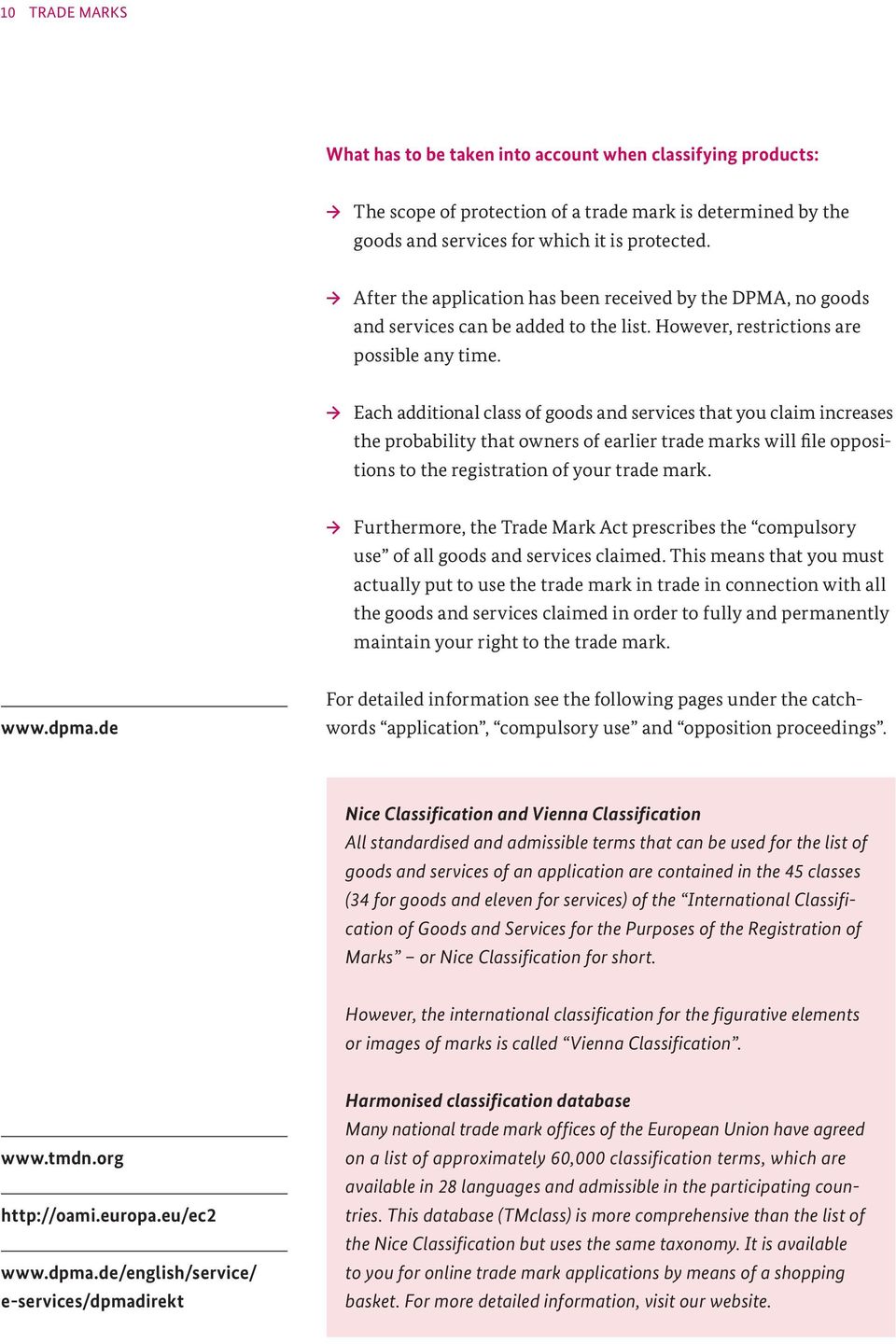
11 10 TRADE MARKS What has to be taken into account when classifying products: The scope of protection of a trade mark is determined by the goods and services for which it is protected. After the application has been received by the DPMA, no goods and services can be added to the list. However, restrictions are possible any time. Each additional class of goods and services that you claim increases the probability that owners of earlier trade marks will file oppositions to the registration of your trade mark. Furthermore, the Trade Mark Act prescribes the compulsory use of all goods and services claimed. This means that you must actually put to use the trade mark in trade in connection with all the goods and services claimed in order to fully and permanently maintain your right to the trade mark. For detailed information see the following pages under the catchwords application, compulsory use and opposition proceedings. Nice Classification and Vienna Classification All standardised and admissible terms that can be used for the list of goods and services of an application are contained in the 45 classes (34 for goods and eleven for services) of the International Classification of Goods and Services for the Purposes of the Registration of Marks or Nice Classification for short. However, the international classification for the figurative elements or images of marks is called Vienna Classification e-services/dpmadirekt Harmonised classification database Many national trade mark offices of the European Union have agreed on a list of approximately 60,000 classification terms, which are available in 28 languages and admissible in the participating countries. This database (TMclass) is more comprehensive than the list of the Nice Classification but uses the same taxonomy. It is available to you for online trade mark applications by means of a shopping basket. For more detailed information, visit our website.
12 TRADE MARKS 11 Classes of the Nice Classification Class Brief description 1 Chemicals 2 Paints 3 Cleaning preparations 4 Oils, greases, fuels 5 Pharmaceuticals 6 Common metals and simple goods of metal 7 Machines, motors and engines 8 Hand tools 9 Electrical apparatus and instruments 10 Medical apparatus and instruments 11 Apparatus for heating, ventilating and sanitary purposes 12 Vehicles 13 Weapons 14 Jewellery, clocks and watches 15 Musical instruments 16 Office requisites, stationery 17 Insulating materials, semi-finished goods 18 Goods made of leather 19 Building materials (non-metallic) 20 Furniture 21 Small manually operated utensils 22 Ropes, string, sails 23 Yarns und threads 24 Woven textiles and covers 25 Clothing, footwear 26 Haberdashery and trimmings 27 Carpets, rugs, and wall hangings 28 Games, sporting articles 29 Food of animal origin 30 Food of plant origin 31 Agricultural and forestry products 32 Non-alcoholic drinks, also beers 33 Alcoholic drinks 34 Tobacco, smokers articles 35 Advertising, business management 36 Insurances 37 Building construction, repair services 38 Telecommunications 39 Transport 40 Treatment of materials 41 Education, training, sporting / cultural activities 42 Scientific and technological services 43 Providing food and drink, temporary accommodation 44 Medical services 45 Legal services, security services

13 12 TRADE MARKS The first step is the search. The Trade Mark Register We publish all trade marks applied for, registered and refused in Germany online in DPMAregister. For this reason, those interested in applying for the registration of a new trade mark should first conduct a search in the official Trade Mark Register. That way you can check in a first step whether your intended trade mark will infringe earlier national rights. What should be considered when con ducting a search? Make sure that there is no trade mark in a similar or identical form. For further information on the search see pages 27 to 28. Have you completed your trade mark search? Then you should not wait much longer. An early application may have essential advan tages from a legal point of view because trade mark law is governed by the principle of pri ority. That means that the trade mark with the earlier filing date usually has better chances to prevail in the case of conflict. Trade mark search not only for applicants A trade mark search is not only useful before filing an application. Trade mark owners should also conduct searches after registration at regular intervals to protect their trade mark and, if necessary, to defend it effectively.

14 TRADE MARKS 13 Your application The first step to use the legal options of trade mark protection is a formally correct, complete and early application. The applicant can be a natural person, a legal person or a partnership with legal capacity. You must file a separate application for each trade mark. Important: In any case your application must contain a representation (illustration) of the trade mark. The illustration must show the trade mark exactly as you wish to have it protected in the future. Indicate the type of trade mark (word mark, figurative mark, sound mark, et cetera). Indicate exactly the goods and services for which you intend to use the trade mark you are applying for. The number of requested classes determines the amount of the fee payable for the application. For detailed information on this issue see the leaflet Information for Trade Mark Applicants available online. trade_marks/application Tip If you draft your list of goods and ser vices in accordance with the Nice Classification sorted by classes and in ascending order you will help to speed up the examination of the application (see also page 9). Goods and services that are not available in the classification database may still be claimed with an electronically signed electronic application (DPMAdirekt) or with a trade mark application on paper (see page 14). However, we are able to process your application faster if you select terms from the database.

15 14 TRADE MARKS Ways to apply trade_marks/application Written applications If you choose to file a written application, please use the application form provided by the DPMA and file it with our office or a patent information centre authorised to accept trade mark applications. The application form can be downloaded any time from the Internet. e-services/dpmadirekt Online If you choose the online option, you can file your application without an electronic signature and without a signature card over the Internet via our DPMAdirektWeb service with the shopping basket for goods and services. This requires no special software. You will be guided through the application process in seven steps. with a qualified electronic signature via our DPMAdirekt service. A list of suppliers of signature cards is available from the Bundesnetzagentur (Federal Network Agency for Electricity, Gas, Telecommunications, Post and Railway). The online services smart card of the European Patent Office is also admissible. e_dienstleistungen/dpmadirekt Furthermore, you need the DPMAdirekt application software to prepare and validate application documents. You can download the DPMAdirekt software free of charge and find more information on our website. Please note that it is not possible to apply for a trade mark by just sending an ordinary .

16 TRADE MARKS 15 What happens after filing? You receive a receipt with the official file number. The essential application data are entered into our in-house information system and will appear in the DPMAregister online register, which is available to the public on our website. The filing date what role does it play? As mentioned in the section dealing with trade mark search (see page 12) the principle of priority applies in trade mark law. As a rule, the earlier trade mark that means the trade mark with the earlier filing date has better chances to succeed in case of conflict. Check list for a successful trade mark application: Have you been creative when designing the trade mark? Avoid descriptive or deceptive terms, or terms that are often used in advertising. Make sure that there is no other trade mark similar or identical to your trade mark. Search for existing rights of third parties before filing an application. Make sure you used and completely filled out our official application form. Is the trade mark represented correctly? Does the list of goods and services correspond to the Nice Classification? Use the search engine on our website to check. You can download application forms and find comprehensive information on the DPMA and on the formalities of an IP application on the Internet. Our enquiry units also provide information on the filing routes, procedures and requirements. For contact details see the service section of this brochure on page 38.

17 16 TRADE MARKS Registration requirements The DPMA performs an absolute grounds examination of your trade mark application. However, we do not examine whether your trade mark conflicts with the IP rights of others. What exactly are absolute grounds for refusal? Your trade mark can only be registered if there are no absolute grounds for refusal. These are, for example, lack of distinctiveness, descriptive terms that should be kept freely available for general use, obvious likelihood of confusion, offence against morality or public policy, emblem of state included in a trade mark. Examples: general catchwords: for manpower services, super, extra, brilliant for various goods or services deceptive terms: Alsterwasser for whisky morally offensive terms: Urbi et Orbi for goods or services national emblems: national flags, symbol of Europe (circle of stars) As a rule, any sign capable of being repre sented graphically can be protected if it is capable of distinguishing your products or services from those offered by competitors, with the exception of signs that must be kept available for general use. The latter applies to such terms in particular that simply describe the type, quality or other properties and characteristics of the products claimed. For example, the word Apple is distinctive for computers but not for apples because as a descriptive indication it must be kept freely available for unrestricted use by competitors. The following are also excluded from regis tration: promotional statements, general advertising slogans and word sequences that have become customary in the current language as fixed expression. Descriptions can be registered in exceptional cases if the sign, as a result of its use, has estab lished itself as a trade mark in the entire territory of the Federal Republic of Germany for the goods and services claimed. That means that the sign can be identified by the targeted trade circles as coming from the applicant. In that case, it must be proved by appropriate documents and also a survey, if required, that the great majority of the trade circles associate the trade mark with a specific enterprise.

18 TRADE MARKS 17 Registration process and costs Application filed Acknowledgement of receipt No defects Formal and substantive examination of the trade mark application (after payment of fee) Defects Notification on defects Answer by applicant Decision on refusal Remedy DPMA Remedy DPMA Special motion procedure DPMA Appeal proceedings Federal Patent Court Possible appeal on a point of law Federal Court of Justice Application finally refused Registration of the trade mark Publication of the registration Opposition, if any Service of oppositions Order to cancel the trade mark Formal and substantive examination of oppositions Special motion procedure DPMA/ appeal proceedings Federal Patent Court Rejection of oppositions Possible appeal on a point of law Federal Court of Justice

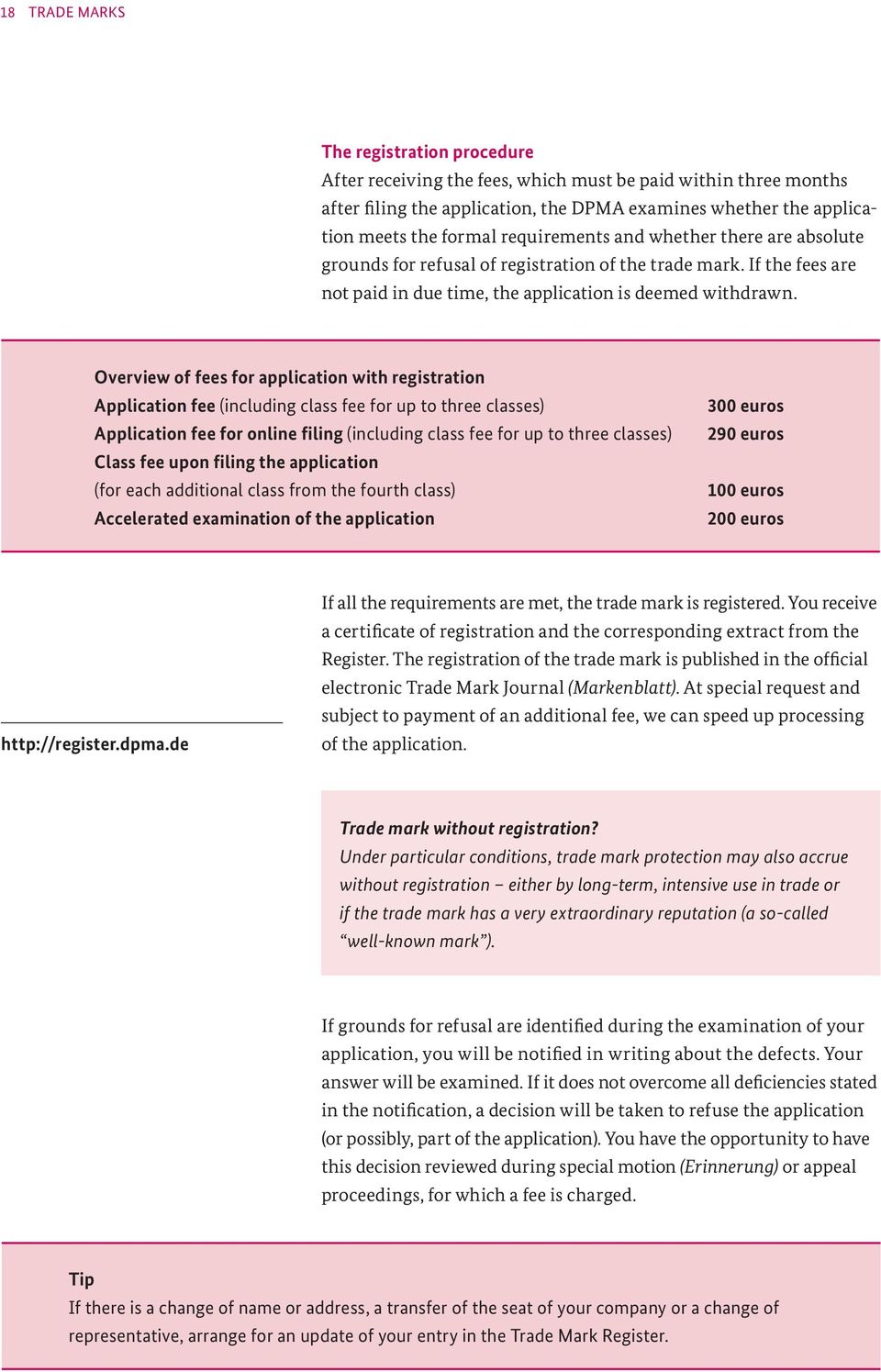
19 18 TRADE MARKS The registration procedure After receiving the fees, which must be paid within three months after filing the application, the DPMA examines whether the application meets the formal requirements and whether there are absolute grounds for refusal of registration of the trade mark. If the fees are not paid in due time, the application is deemed withdrawn. Overview of fees for application with registration Application fee (including class fee for up to three classes) Application fee for online filing (including class fee for up to three classes) Class fee upon filing the application (for each additional class from the fourth class) Accelerated examination of the application 300 euros 290 euros 100 euros 200 euros If all the requirements are met, the trade mark is registered. You receive a certificate of registration and the corresponding extract from the Register. The registration of the trade mark is published in the official electronic Trade Mark Journal (Markenblatt). At special request and subject to payment of an additional fee, we can speed up processing of the application. Trade mark without registration? Under particular conditions, trade mark protection may also accrue without registration either by long-term, intensive use in trade or if the trade mark has a very extraordinary reputation (a so-called well-known mark ). If grounds for refusal are identified during the examination of your application, you will be notified in writing about the defects. Your answer will be examined. If it does not overcome all deficiencies stated in the notification, a decision will be taken to refuse the application (or possibly, part of the application). You have the opportunity to have this decision reviewed during special motion (Erinnerung) or appeal proceedings, for which a fee is charged. Tip If there is a change of name or address, a transfer of the seat of your company or a change of representative, arrange for an update of your entry in the Trade Mark Register.
20 TRADE MARKS 19 Effect of protection and term of protection You obtain trade mark protection in the whole territory of the Federal Republic of Germany by registration of your trade mark in the German Trade Mark Register. Ten years of protection indefinite renewal The term of protection starts on the application date and ends after ten years, on the last day of the month of the application date. Filing date: 12 May 2009 End of term of protection: 31 May 2019 Term of protection In contrast to other IP rights, trade mark protection can be renewed for further periods of ten years, indefinitely, subject to the payment of the appropriate fees. You may renew the trade mark only in relation to some of the goods and services, and if you decide to abandon those classes which you no longer need, you might save on re newal fees. The form for the renewal of a trade mark (extension of the term of protection) and for changing the scope of protection can be downloaded from our website. trade_marks/forms Overview of renewal fees Renewal fee (including class fee for up to three classes) Class fee upon renewal (for each additional class from the fourth class) 750 euros 260 euros If the trade mark owner does not extend the term of protection in due time or does not pay the full amount of the renewal fees, the trade mark will lapse.

21 20 TRADE MARKS Compulsory use and defence Even after your trade mark has been regis tered, you have to take into account some legal aspects to maintain lasting protection for your trade mark. Registered trade marks must be put to use The Trade Mark Act prescribes the so-called compulsory use of the trade mark for all claimed goods and services. This means that you must use your trade mark in trade for all claimed goods and services to maintain the right to the trade mark. If the trade mark is not used within a continuous period of more than five years, there is a danger of cancellation of the trade mark upon request by a third party. More information is available on page 26. What trade mark owners should consider: Applications for new trade marks received at the DPMA amount to approximately 60,000 each year. Consequently, the probability increases that newly registered trade marks will violate your IP right. Therefore, many trade mark owners actively monitor their trade marks and permanently observe the relevant trade mark registers with regard to possible conflicting trade marks. If necessary, seek the help of an expert, for example, a lawyer or a patent attorney to defend your trade mark. In such cases, you as owner of the earlier trade mark can file a notice of opposition against the registration of a later trade mark. If trade marks become generic terms Over the years, successful trade marks may become generic terms under certain conditions, trade marks, such as, for example, Tesa (adhesive tape), Fön (hairdryer), Tempo (paper tissues) and Walkman run the risk of becoming synonyms for the products. In those cases, the trade mark is in danger of being cancelled because it is used as a descriptive synonym and loses distinctiveness. For this reason, the owners of successful trade marks make the effort to indicate in the relevant publications (dictionaries, et cetera) that the relevant word constitutes a registered trade mark.
22 TRADE MARKS 21 Opposition proceedings Basically, the registration of your trade mark is a registered right which may be cancelled in certain cases. If your newly registered trade mark is identical or similar to other earlier applications or trade marks, the owners of those signs may lodge a notice of opposition against your trade mark. This also applies in the reverse case, of course: if your trade mark right is infringed by a newly registered trade mark, you can file a notice of opposition against it. If the opposition is successful, the trade mark will be cancelled in full or for some of the goods and/ or services. Opposition Please take into consideration that a trade mark right does not only derive from registration (see page 18). This is why owners of unregistered trade marks can also lodge a notice of opposition against the registration of a trade mark. Simple and cost-effective opposition proceedings A written notice of opposition must be filed within three months after the publication of the newly registered trade mark. Within this period of time, the opposition fee of 120 euros must be paid. It is not possible to extend this period. The opposition form can be downloaded from the Internet. trade_marks/forms During opposition proceedings, it is examined whether there is a likelihood of confusion between the trade marks. This assessment does not only take into account the similarity of the signs but also clarifies whether con flicting products and/or services are similar. Our trade mark examiners decide on the opposition (by decision). It is possible to have this decision reviewed. In case there is a likelihood of confusion, the registration of the later trade mark will be cancelled (possibly, in part). When the parties reach an agreement Part of opposition proceedings can be settled if the parties themselves reach an agreement. As owner of the later trade mark, for example, you can limit your list of goods/services or undertake to use your trade mark only for certain products or only in a certain form, while the owners of the earlier trade marks, in return, withdraw their opposition. During opposition proceedings, under certain conditions, you can
23 22 TRADE MARKS contest that the earlier trade mark was actually put to use by the opponent. Then, the owner of the conflicting trade mark must substantiate by prima facie evidence that they haves put the trade mark to genuine use during the last five years. If they cannot provide sufficient proof, the opposition will be rejected on that basis alone. In certain cases, the trade mark registration can still be cancelled after the conclusion of opposition proceedings (see page 26). Keep an eye on the market. It is important to keep informed on a regular basis about published applications and newly registered trade marks and to immediately act against detected copying or against misuse by later trade marks.
24 TRADE MARKS 23 Transfer, licensing and giving as security Trade marks can be bought and sold During the entire period of protection you can any time transfer your trade mark in full or in part to another person. This transfer of rights will be recorded in the Register, if you or the acquirer file a corresponding request for recording a transfer of ownership in the Register at the DPMA and submit documents (for example, a contract) showing that the trade mark right has been transferred. You can also let others use your trade mark by granting a licence. The right conferred by the trade mark regis tration may be given as security. Upon a corresponding request, which may be filed by you or by the recipient of the security, such a right of lien will lead to the entry of a restraint on disposal in the Register. Collective marks If several enterprises producing the same goods or rendering the same services want to use the same name for their products, they can also obtain trade mark protection as an association by applying for a collective mark (for example, RAL-Gütezeichen, Bioland).
25 24 TRADE MARKS Trade mark protection abroad There are several options to extend trade mark protection to other countries: to countries of your choice, the whole of the European Union (EU) or beyond. Trade mark protection in countries of your choice You can directly file your trade mark application in the countries where you seek protection and claim the priority of a previous German application. It is by all means recommended that you consult a lawyer or a patent attorney qualified to practise in the respective country. Trade mark protection in the European Union If you intend to uniformly mark your products in the whole of the EU, you can request regis tration of a so-called Community trade mark, valid across the entire EU, by using a single registration procedure available at the Office for Harmonization in the Internal Market (OHIM) in Alicante (Spain). Please note that not only any owner of an earlier Community trade mark but also any owner of a national trade mark from those countries has the right to file a notice of opposition. If the opponent is successful, registration of your trade mark will be refused for the whole of the EU. Applications for Community trade marks may be filed directly at the OHIM or at the DPMA. OHIM the organisation for European trade mark protection The Office for Harmonization in the Internal Market is located in Alicante, Spain. OHIM is an agency of the EU in charge of the registration of trade marks and designs, valid in all countries of the EU.
26 TRADE MARKS 25 International trade mark protection If you want to extend trade mark protection even further, you can register your national trade mark at the World Intellectual Property Organization (WIPO) which is in charge of this international registration procedure. Under certain conditions you may claim the priority of your national basic mark. You can obtain trade mark protection in almost 90 countries including not only the European countries but also countries of the Americas, Asia and Africa. In the countries designated by you the international mark will be treated just like a national trade mark application. Your request for international registration may be filed directly at the DPMA. The request forms are available on the Internet. WIPO the organisation for international trade mark protection The World Intellectual Property Organization is located in Geneva, Switzerland. WIPO is a specialised agency of the United Nations (UN) responsible for the administration of international patent, trade mark and design applications.
27 26 TRADE MARKS Cancellation proceedings As owner of a trade mark you can any time surrender your trade mark or request to have it cancelled in the Register. However, your trade mark can also be cancelled ex officio or upon request by others. If cancellation proceedings are initiated in which your trade mark is challenged, the DPMA will notify you accordingly. If you oppose the request for cancellation in due time, the cancellation request will be exam ined. If you fail to oppose the request in time, your trade mark will be cancelled without substantive examination. Cancellation at your own request As trade mark owner you can any time surrender your trade mark or individual goods/services, for example, because you do no longer wish to use the trade mark or want to avoid that your trade mark conflicts with earlier trade marks. Cancellation ex officio A trade mark is cancelled ex officio if the required renew al fees have not been paid in time or if there are certain grounds for refusal (for example, violation of emblems of state, deception). Cancellation upon request by a third party Others may also file a request for the cancellation of your trade mark and can base this request on grounds for refusal (lack of distinctiveness, misleading or descriptive indications, bad faith, et cetera) or on non-use of the trade mark (cancellation on grounds for revocation). Cancellation on grounds for revocation A trade mark registration may be cancelled on grounds for revocation upon request by a third party if the trade mark has not been put to use during an uninterrupted period of five years.
28 TRADE MARKS 27 Service Trade mark search A thorough advance trade mark search will create the best conditions for a successful trade mark. The DPMA will help you right from the start. We give you important information and valuable advice on your trade mark search and provide best possible access to the official Trade Mark Journal. All important trade mark terms are explained in detail in the glossary (page 29). Should you have any questions, our staff will be pleased to help you. Tips for the trade mark search The DPMA does not examine whether there are any identical or similar trade marks before registering your trade mark. It is your own responsibility to carry out a similarity and identity search. This will significantly raise your chances of obtaining a registered trade mark right that will last. We recommend that you conduct searches not only in the databases of German national trade marks but also of European Community trade marks and international registrations. The databases indicated here are particularly useful for this purpose. Independently of each other, each register contains trade marks which are protected in Germany. Furthermore, names and logos, used in trade, may infringe other trade mark rights even if they were not entered in a trade mark register. For this reason, you should also look for identical or similar names in Internet search engines, telephone directories, commercial registers, publications on titles of works and/or business directories or other product directories. DPMAregister Here you will find German national trade mark applications and German national trade marks that were registered, cancelled, withdrawn or refused. DPMAregister/Uebersicht OHIM esearch plus In esearch you will find Community trade mark applications and registered, deleted, withdrawn or refused Community trade marks, which are relevant for the EU and consequently also for Germany. ROMARIN In ROMARIN you will find international applications and international registrations of marks. More detailed search information is available in our information leaflet Trade Mark Searches Online. You can order a free copy directly from the DPMA or download it from our website. More information on trade mark searches is available on our website. trade_marks/search
29 28 TRADE MARKS Telephone enquiries You can contact the enquiry units of the DPMA in Munich, the Jena Sub-Office and the Technical Information Centre (TIZ Berlin) to gain detailed information on the filing routes, procedures and application requirements. We are also pleased to send you forms and information brochures. The enquiry units can be contacted via the central phone number The enquiry unit is not authorised to give legal advice. Under the Act on Legal Counselling (Rechtsdienstleistungsgesetz), only patent attorneys and lawyers may provide legal advice. Assistance with trade mark searches Searches for identical trade marks and complex similarity searches are also offered by patent attorneys, lawyers specialising in trade mark law, specialist IP lawyers, search agents and the patent information centres. They can also provide access to commercial trade mark databases to you. Patent attorneys, lawyers specialising in trade mark law and specialist IP lawyers will help you to interpret the search results and answer your questions about likelihood of confusion. For address directories and links please contact our enquiry unit or go to our website.
30 TRADE MARKS 29 Glossary Under certain conditions, an appeal on a point of law from a decision of the Federal Patent Court can be brought to the Federal Court of Justice. Appeal on a point of law before the Federal Court of Justice If an examiner of the DPMA takes a decision to refuse registration of a trade mark, the applicant can appeal against the decision to the Federal Patent Court within one month after service of the decision on refusal (see also Special motion proceedings ). Appeal proceedings before the Federal Patent Court The applicant is the person who applies for trade mark protection (the future trade mark owner). An applicant may be any natural or legal person or, under certain circumstances, a partnership. Applicant The date on which the DPMA receives the complete request for trade mark protection (trade mark application) is called filing date or application date. Normally, this filing date determines the priority of the application, that means it is essential for determining whether a conflicting trade mark has been filed earlier or later (see Priority principle ). Application date see Grounds for refusal Bar to registration Trade marks can be cancelled on grounds for invalidity or revocation or because the trade mark owner has surrendered the trade mark. Cancellation Combined word/figurative marks consist of a combination of word elements and graphical elements, or of words in lettering styles. Combined word/figurative mark By registering a trade mark at the Office for Harmonization in the Internal Market (OHIM), the European trade mark office located in Alicante (Spain), the trade mark owner obtains protection in all countries of the European Union (EU, formerly, European Community). Community trade mark
31 30 TRADE MARKS Decision on refusal If a sign is not capable of being protected, a decision will be taken to refuse registration of the trade mark (see Grounds for refusal ). Decision to reject application see Decision on refusal Emblem of state State emblems are flags, banners, armorial bearings, badges and official seals symbolising sovereignty (for example, the federal eagle, the German flag, the police star badge). A sign cannot be protected if it includes, copies or misuses a state emblem. Figurative mark Figurative marks are pictures, graphical elements or images (without words or word elements). Filing date see Application date Generic term Successful trade marks run the risk of becoming synonyms for a whole category of products or services, for example Tempo for paper tissues or Fön for hairdryers. German Patent and Trade Mark Office (DPMA) The German Patent and Trade Mark Office is the national centre of expertise for industrial property in Germany. The staff of the office grant patents, register and manage trade marks, utility models and designs. They also provide information on industrial property rights to the public. Grounds for refusal A trade mark is only eligible for protection if no absolute or relative grounds for refusal apply. While absolute grounds for refusal (nonregistrability as a trade mark, lack of distinctiveness, the need to keep a term freely available for use by others, public interest) are examined by the DPMA before entering the trade mark in the Register, relative grounds objections (prior IP rights of others, non-use) can only be raised in opposition pro ceedings.
32 TRADE MARKS 31 Indications of geographical origin of agricultural products and food stuffs are product names that invoke a direct association with a geographical location (for example, Nürnberger Bratwürste) or are closely linked to a geographical region (for example, Spreewälder Gurken). Indications of geographical origin Trade marks registered in the international register of the World Intellectual Property Organization (see World Intellectual Property Organization (WIPO) ). International registrations see Trade mark licence Licence/licensing There is a likelihood of confusion for trade marks if the public is under the impression that the goods or services bearing the later trade mark come from the company of the owner of the earlier trade mark. Likelihood of confusion Trade marks identify products and services. Therefore, when applying for trade mark registration, the goods and services should be exactly indicat ed in a list of goods and services so that they can be clearly attributed to the appropriate classes of goods and services. This will help to clearly delimit the scope of protection of a trade mark in case of a later dispute. List of goods and services Nice Classification is short for International Classification of Goods and Services for the Purposes of the Registration of Marks. The name derives from the agreement concluded at the diplomatic conference of Nice on 15 June 1957, stipulating the establishment of the classification. Its 45 classes (34 for goods and eleven for services) contain all standardised and admissible terms necessary for the list of goods and services of an application. The classes of goods are roughly divided into product groups and material groups; the classes of services are divided into branches of activities. Nice Classification If the trade mark is not put to actual use within a period of five years from the date of registration in the Register, it may be cancelled. This compulsory use means that the trade mark must be put to genuine use in Germany by the trade mark owners for identifying their goods and services in trade. Non-use
33 32 TRADE MARKS Notification on defects If the application contains formal defects, the applicant will be notified in detail about the deficiencies identified and invited to remedy them. If the trade mark is not regarded as being capable of protection, the applicant will be sent a notification on defects explaining the grounds for refusal before the trade mark is refused registration. Special motion proceedings (Erinnerung) DPMA The applicant may file a special motion against the decision to refuse registration of the trade mark. A second examiner (special motion examiner) will review the decision (see also Appeal proceedings ). Office for Harmonization in the Internal Market (OHIM) The Office for Harmonization in the Internal Market (OHIM) is an official agency of the EU in charge of the registration of trade marks and designs that are valid in all countries of the EU. OHIM is located in Alicante (Spain). Official (online) Trade Mark Journal All new trade mark registrations and changes regarding existing trade mark registrations are published electronically in the Trade Mark Journal (Markenblatt). Individual issues of the Trade Mark Journal are available from the DPMAregister online service at for download. Opposition Within a period of three months after the day of publication of the trade mark registration, the owner of an earlier trade mark right or of a company name may give notice of opposition to the registration of the trade mark, if they think that their rights are being infringed. Opposition proceedings During opposition proceedings the DPMA examines whether two conflicting signs are likely to be confused with regard to their names and the respective goods and services protected. If this is found to be the case, the new trade mark registration can be fully or partly cancelled from the Trade Mark Register. Priority principle In case of conflicting trade mark rights, the earlier trade mark takes pri ority. This means that the trade mark owner who was the first to obtain protection for that trade mark may exclude others from claiming or using the same or a similar sign.
34 TRADE MARKS 33 All new trade mark registrations and changes regarding registered trade marks are published online in the Trade Mark Journal. Publication see Trade Mark Register Register After the examiner has examined the trade mark application and has not found any formal defects or grounds for refusal, the trade mark will be registered in the national Trade Mark Register. The registration date is not identical with the filing date nor with the publication date of the trade mark. Registration The DPMA will send the owner of the trade mark a certificate of the registration of the trade mark in the Trade Mark Register. Registration certificate After expiry of the ten-year term of protection, the trade mark can be renewed every ten years for a further ten years by payment of a renewal fee (750 euros for three classes, 260 euros for every additional class). Renewal A trade mark may be cancelled from the Register on grounds for revocation, for example, if it is not put to use, has become a generic term or is used in a misleading way. Revocation The trade mark owner has an exclusive right to the trade mark. A licensing contract may permit the use of the sign by another person. Right of use There are several options to challenge a decision or unfavourable legal status in order to have it changed or set aside. The following options are available in trade mark application procedures and opposition proceedings: special motion proceedings at the DPMA, appeal proceedings before the Federal Patent Court and, under certain conditions, proceedings with respect to appeals on points of law before the Federal Court of Justice. Right to appeal
35 34 TRADE MARKS Scope of protection The scope of protection of a trade mark is made up of a) the territorial scope of protection (the territory of the Federal Republic of Germany for a national trade mark registered in the Register kept at the DPMA), b) the distinctiveness, that means the trade mark s level of recognition by consumers (a trade mark having a high degree of distinctiveness usually has an average to above-average scope of protection), c) the number of goods and/or services for which the trade mark is registered. Search see Trade mark search Sound mark Sound marks are acoustic, audible marks, that means sounds, jingles, melodies or other tunes or noises. Trade mark Trade marks are signs that distinguish products and services of an enterprise from those of other enterprises. Words, pictures, sounds, three-dimensional shapes, colours or other signs can be registered as trade marks in the Register of the DPMA, provided they can be represented graphically. German trade marks last for ten years and can be renewed indefinitely thereafter. Trade mark application The trade mark application is a request for protection of a sign by registering the trade mark in the Trade Mark Register of the DPMA. The application contains information on the applicant, a representation (illustration) of the trade mark and the goods or services for which registration is requested. A trade mark application costs 300 euros including three classes. Each further class costs an extra 100 euros. Trade mark certificate see Registration certificate Trade mark journal see Official (online) Trade Mark Journal Trade mark licence By granting a trade mark licence, the trade mark owner can permit another person or company to use the trade mark usually there is a licence charge.
36 TRADE MARKS 35 see German Patent and Trade Mark Office (DPMA) and Office for Harmonization in the Internal Market (OHIM) Trade mark office The Trade Mark Register is a register kept at the DPMA, which is publicly accessible at It contains the following data: filing date and beginning of the term of protection of a trade mark, representation (illustration) of the trade mark, the goods and services for which the respective trade mark is registered, trade mark number, applicant and owner of the trade mark, representative of the trade mark owner, whether the trade mark was registered because of its level of market recognition by trade circles, information as to whether the trade mark is subject of on-going opposition or cancellation proceedings. Trade Mark Register The DPMA does not check if there is another trade mark that is identical or similar to your sign. By performing a search for identical or similar trade marks before filing a trade mark application, the applicant should make sure that the trade mark chosen does not infringe third-party rights. The search should include national trade marks, Community trade marks and international registrations. Trade mark search Just like other rights, a registered trade mark can be transferred, in full or in part, to a new owner (natural or legal person). Transfer Trade marks are classified according to the Vienna Classification to provide a means to search for figurative elements of trade marks and purely figurative marks, for example, in order to find conflicting earlier trade marks. The Vienna Classification International Classification of Figurative Elements of Marks was adopted in Vienna in It constitutes a hierarchical system that proceeds from the general to the particular, dividing all figurative elements into categories, divisions and sections. Vienna Classification Word marks are trade marks that consist of words, letters, numbers or other characters that are part of the standard set of characters used by the DPMA. Word mark
37 36 TRADE MARKS World Intellectual Property Organization (WIPO) The World Intellectual Property Organization (WIPO) was established in 1967 to promote the protection of intellectual property throughout the world. Its headquarters are in Geneva (Switzerland). An application for international registration requesting trade mark protection in several countries in the world can be sent to WIPO through the DPMA. However, the precondition is a German basic mark, that means a trade mark application or trade mark registration recorded in the German Trade Mark Register.
38 Notes TRADE MARKS 37
39 38 TRADE MARKS Do you have any questions? We will be pleased to answer your questions and provide detailed information on the steps of a trade mark application. Visit us in Munich, Jena or Berlin. You are also welcome to contact us by phone, fax or at [email protected]. More information and all the required application forms are available on our website. Addresses and important telephone numbers Munich Deutsches Patent- und Markenamt Zweibrückenstraße 12, München, Germany Switchboard operator Fax Public search room or Jena Deutsches Patent- und Markenamt, Dienststelle Jena Goethestraße 1, Jena, Germany Switchboard operator Fax Berlin Deutsches Patent- und Markenamt Technisches Informationszentrum Berlin Gitschiner Straße 97, Berlin, Germany Switchboard operator Fax Public search room or -231 General telephone numbers Enquiry unit Helpline for database users Press and public relations Telephone [email protected]
40 Imprint Published by Deutsches Patent- und Markenamt Zweibrückenstraße München Germany Telephone: Last update Revised edition, May 2014 Text Robert Botz, Picture credits Title page: istock.com/brian Brown Page 3: istock.com/malerapaso Page 6: istock.com/ryan Lane Page 8: istock.com/kertlis Page 9: istock.com/kevinjeon00 Page 10: istock.com/johnny Greig Page 11: top: istock.com/lukasok, bottom: istock.com/gemena communication Page 12: istock.com/kalinovsky Dmitry Page 14: Fotolia/Picture-Factory Page 20: istock.com/ehstock Page 22: istock.com/vikavalter Page 23: istock.com/tomczykbartek Page 25: istock.com/eric Delmar Page 26: istock.com/kizilkayaphotos Page 28: istock.com/irina Tischenko This information brochure aims at providing a first insight into the field of trade mark law. For this reason, it also contains simplified and generalised information. It does not attempt to provide a complete guide to or binding information on this complex matter. More detailed information is available on the website of the German Patent and Trade Mark Office (
German Patent and Trade Mark Office. Trade Marks. An information brochure on trade mark protection
 German Patent and Trade Mark Office Trade Marks An information brochure on trade mark protection Content How do you make your purchasing decision? 3 Trade marks - guidance through the maze of many diverse
INTRODUCTION TO TRADE MARKS INTRODUCTION TO TRADE MARKS
 INTRODUCTION TO TRADE MARKS INTRODUCTION TO TRADE MARKS Trade Marks are the signs used by businesses to distinguish their goods and services from those of each other. It is important to choose trade marks
35 patents. www.dpma.de
 35 patents www.dpma.de Patents An information brochure on patent protection Contents Patents protect your technical inventions................. 3 What can be patented?.............................. 4 Three
Without prejudice to the provisions of ordinary law, a surname may serve as a trade mark.
 BENELUX RULES ON TRADE MARKS UNIFORM BENELUX TRADE MARKS ACT (BENELUX TRADE MARKS ACT) PART I. INDIVIDUAL TRADE MARKS Section 1 Individual trade marks may consist of names, designs, stamps, seals, letters,
Joint Recommendation Concerning Provisions on the Protection of Well-Known Marks. adopted by
 833(E) Joint Recommendation Concerning Provisions on the Protection of Well-Known Marks adopted by the Assembly of the Paris Union for the Protection of Industrial Property and the General Assembly of
Information Concerning the Use of the SEPA Payment Schemes
 DEUTSCHES PATENT- UND MARKENAMT 80297 München Telephone: +49 89 2195-0 Telephone enquiries: +49 89 2195-3402 Internet: http://www.dpma.de Beneficiary: Bundeskasse Halle/DPMA IBAN: DE84 7000 0000 0070 0010
Designs: How to Protect your Design
 Designs: How to Protect your Design This leaflet provides basic information on some areas of design protection. Intellectual Property Office is an operating name of the Patent Office This booklet provides
Designs. Denmark Mette Bender Awapatent A/S. A Global Guide
 Designs 2015 Mette Bender A Global Guide BUSINESS IN EURO IPE? Success in Europe is critical for your business. As one of the continent s top IP firms, we do more than protect intellectual assets. We guide
TRADEMARKS, SERVICE MARKS, AND INSIGNIAS: A GENERAL OVERVIEW Authorized pursuant to Act 242, P. A. 1969 and Act 281, P.A. 1927
 Michigan Department of Licensing and Regulatory Affairs Corporations, Securities & Commercial Licensing Bureau Corporations Division TRADEMARKS, SERVICE MARKS, AND INSIGNIAS: A GENERAL OVERVIEW Authorized
A guide to applying for your trade mark overseas
 A guide to applying for your trade mark overseas Copyright All content in this publication is provided under a Creative Commons Attribution 4.0 International (CC BY 4.0) licence, with the exception of:
Intellectual Property
 Intellectual Property Protection Helpsheet When running a business you need to consider protecting your intellectual property which could be anything from your logo to inventions, products and designs.
TRADE-MARK PROTECTION
 Lawyers, Patent & Trade-mark Agents 150 York Street, Suite 800 Toronto ON M5H 3S5 Tel: 416.364.1553 Fax: 416.364.1453 TRADE-MARK PROTECTION David Kornhauser [email protected] Direct Phone: 416.862.6280
Implementing Regulations under the Benelux Convention on Intellectual Property (Trademarks and Designs) *
 Implementing Regulations under the Benelux Convention on Intellectual Property (Trademarks and Designs) * The Executive Board of the Benelux Trademark Office and the Executive Board of the Benelux Designs
World Book. Protection of IP Canada. www.plg.eu.com 1. TRADE-MARKS 1.1 INTRODUCTION 1.2 REGISTERED TRADE-MARKS
 World Book 1. TRADE-MARKS 1.1 INTRODUCTION The Act relating to trade-marks and unfair competition (commonly known as the Trade-marks Act) governs trade-mark matters in and, as a federal law, receives application
IP-Litigation in Germany. German and European Patent, Trademark and Design Attorneys Lawyers
 IP-Litigation in Germany German and European Patent, Trademark and Design Attorneys Lawyers What is a litigation team in Germany? In contrast to litigation procedures in certain jurisdictions, in particular
Benelux Convention on Intellectual Property (trademarks and designs) 1
 Benelux Convention on Intellectual Property (trademarks and designs) 1 1 This is the text of the BCIP as lastly amended by the Protocol of 22.07.2010. Entry into force: 01.10.2013. The official text of
Module 4: Trademarks
 Study Note: This module should take around 5 hours to study. Module 4: Trademarks Objectives After completing the study of this module you should be able to: 1. List and describe briefly those signs that
Protection and Enforcement of Trademarks, in the U.S. and Abroad
 Protection and Enforcement of Trademarks, in the U.S. and Abroad Susan Anthony, Acting Director Global Intellectual Property Academy Office of Policy and International Affairs [email protected] -
The Basics of Intellectual Property. Mala Joshi, Blaney McMurtry LLP
 The Basics of Intellectual Property Mala Joshi, Blaney McMurtry LLP 2 The Canadian Intellectual Property Office (CIPO) CIPO is responsible for the administration of the intellectual property (IP) system
Patents in Europe 2013/2014
 In association with Unitary patent and Unified Patent Court: the proposed framework Rainer K Kuhnen Patents in Europe 2013/2014 Helping business compete in the global economy Unitary patent and Unified
RESEARCH & INNOVATION INTELLECTUAL PROPERTY (IP)
 RESEARCH & INNOVATION INTELLECTUAL PROPERTY (IP) What is Intellectual Property (IP)? Intellectual Property (IP) includes different types of invention, design, brand name or original creation There are
Certification Regulations and Requirements. International Certification Management GmbH
 Certification Regulations and Requirements of (ICM) General These Certification Regulations and Requirements apply to the auditing, certification and maintenance of the certification of management systems.
Trademark Law: Articles 61-95 of Trade Law: Law no. 68 of 1980. Trademarks Law and Trade Indications
 Trademark Law: Articles 61-95 of Trade Law: Law no. 68 of 1980 Pursuant to Trade Law No. 68/1980, the Kuwaiti legislator regulates the protection of trademarks in Articles 61-95. It includes a definition
INDONESIA Trademark Law as amended by Law No. 15 on August 1, 2001
 INDONESIA Trademark Law as amended by Law No. 15 on August 1, 2001 TABLE OF CONTENTS CHAPTER I GENERAL PROVISIONS Article 1 CHAPTER II SCOPE OF MARKS Part One General Article 2 Article 3 Part Two Marks
SYNOPSIS OF THE PROTECTION OF TRADITIONAL KNOWLEDGE BILL
 SYNOPSIS OF THE PROTECTION OF TRADITIONAL KNOWLEDGE BILL Pages: 12 First publication: 2010 Document no: 2OD2012 Cite as: Dean, OH Synopsis of the Protection of Traditional Knowledge Bill Doc: 2OD2012 IPStell
Real Case Study: Optimizing Your IP Strategy. Elizabeth Wong DLA PIPER
 Real Case Study: Optimizing Your IP Strategy Elizabeth Wong DLA PIPER Agenda Overview of intellectual property (IP) rights in China Trade Marks, Patents and Copyright Practical strategies to protect IP
Guidelines Concerning Proceedings Before the United Kingdom Trade Marks Registry. Opposition and Invalidation Practices and Procedures
 Guidelines Concerning Proceedings Before the United Kingdom Trade Marks Registry Opposition and Invalidation Practices and Procedures 1. Introduction Absolute and relative grounds objections may be raised
Rules for the registration of Internet domains within the address space for Slovenia (.SI) and general operating terms and conditions
 Akademska in raziskovalna mreža Slovenije Academic and Research Network of Slovenia ARNES, Jamova 39, p.p.7, 1001 Ljubljana tel. + 386 1 479 88 00 fax + 386 1 479 88 99 [email protected] http://www.arnes.si/
CIPS Chartered Status Assessment Terms and Conditions (v1.0 12.01.15)
 CIPS Chartered Status Assessment Terms and Conditions (v1.0 12.01.15) This page (together with the documents referred to on it) tells you ( you means the party contracting with CIPS) the terms and conditions
Registration is the process of formally recording your trademark with the United States Patent and Trademark Office ( PTO ).
 OVERVIEW Trademark law governs the use of trademarks by individuals and legal entities to identify their goods or services and to distinguish those goods or services from those sold or provided by others.
WHAT YOU NEED TO KNOW IN ORDER TO PROTECT YOUR TRADEMARK
 OVERVIEW: Page 1 A trademark indicates the name of the source of the product or, if a service mark, the source of the service. It should be a symbol of your reputation for quality, dependability, and value.
Guide to WIPO Services
 World Intellectual Property Organization Guide to WIPO Services Helping you protect inventions, trademarks & designs resolve domain name & other IP disputes The World Intellectual Property Organization
LEGAL BRANDSTOCK LEGAL EXPERT ADVICE FOR ALL IP MATTERS
 BRANDSTOCK LEGAL EXPERT ADVICE FOR ALL IP MATTERS The Brandstock Group of companies is one of the world s leading and fastest-growing providers of Intellectual Property services that harnesses innovative
ASEAN IPR SME Helpdesk Guide: Protecting your IP at Trade Fairs in Southeast Asia. Contents. 1. Protecting your IP at trade fairs. 2.
 ASEAN IPR SME Helpdesk Guide: Protecting your IP at Trade Fairs in Southeast Asia Contents 1. Protecting your IP at trade fairs 2. Advance planning 3. Attending the trade fair 4. Taking action against
Trademark Protection in Hong Kong
 Trademark Protection in Hong Kong Territorial protection of registered trademarks The trademark registration system of Hong Kong provides territorial protection. Hence, trademarks registered with the State
ACT. on the amendment of the Gambling Law and some other Acts 1
 Journal of Laws No. 134, item 779 ACT of 26 May 2011 on the amendment of the Gambling Law and some other Acts 1 Article 1 The following amendments are made to the Gambling Law of 19 November 2009 (Journal
Philippines Philippines Philippinen. Report Q173. in the name of the Philippine Group
 Philippines Philippines Philippinen Report Q173 in the name of the Philippine Group Issues of co-existence of trademarks and domain names: public versus private international registration systems 1. Analysis
I. Applicability. II. Subject matter
 I. Applicability 1. GamesInFlames UG (referred to hereinafter as GIF ) offers the online game Aloha Paradise Hotel as well as other content and services (also referred to collectively hereinafter as Services
Supported by. World Trademark Review. Anti-counterfeiting. Poland. Contributing firm Patpol Patent & Trademark Attorneys.
 Supported by World Trademark Review Anti-counterfeiting 2012 Poland Contributing firm A Global Guide Poland Contributing firm Authors Jaromir Piwowar and Bartek Kochlewski Legal framework Rights holders
A guide to trademarks
 A guide to trademarks Contents General What are trademarks and what do they do?...1 Getting started The trademark application process...5 Keeping a trademark protected The renewals process...9 The purpose
Fact Sheet Intellectual Property considerations for business websites
 European IPR Helpdesk Fact Sheet Intellectual Property considerations for business websites The European IPR Helpdesk is managed by the European Commission s Executive Agency for Small and Medium-sized
Intellectual Property Rights in Vietnam
 Intellectual Property Rights in Vietnam Intellectual Property Office is an operating name of the Patent Office Contents Intellectual property rights in Vietnam What are intellectual property rights? International
Making a cross border claim in the EU
 Making a cross border claim in the EU serving the community through the administration of justice Using the European Order for Payment procedure or the European Small Claims procedure Version: 2.0 Date
Finland. Contributing firm Roschier Brands, Attorneys Ltd
 Finland Contributing firm Roschier Brands, Attorneys Ltd Author Asta Uhlbäck Legal framework Finnish design registrations are regulated by the Registered Designs Act (221/1971), as amended. The act is
General Terms and Conditions of NEC Tokin Europe GmbH
 General Terms and Conditions of NEC Tokin Europe GmbH 1 Scope 1.1 These terms and conditions shall apply exclusively to all deliveries, services and quotations from NEC Tokin Europe GmbH hereafter referred
Service Description for the Registration and Administration of Domain Names by Swisscom
 Service Description for the Registration and Administration of Domain Names by Swisscom 1 Area of application This Service Description govern the conditions for the registration, administration, and use
The author. This article
 Journal of Intellectual Property Law & Practice, 2014, Vol. 9, No. 3 ARTICLE 225 Repeated filings of a European Community trade mark Karin Stumpf* The issue Registered trade marks must be used within five
Managing intangible assets It is time to act
 www.pwc.es Managing intangible assets It is time to act We add the value you need 2 Technology Page 5 1 Information management Page 4 3 Content Page 6 6 Taxation of intangible assets Page 10 4 Trademarks,
GENERAL TERMS AND CONDITIONS FOR COMMISSIONS TO TNO
 GENERAL TERMS AND CONDITIONS FOR COMMISSIONS TO TNO SEPTEMBER 2010 GENERAL TERMS AND CONDITIONS FOR COMMISSIONS TO TNO SEPTEMBER 2010 Table of Contents 1. TNO definitions. 2 2. General matters to be taken
Registration contract for domain names under the domain ".ch"
 Registration contract for domain names under the domain ".ch" Valid from 14 February 2013 (version 4) 1 DEFINITIONS 2 2 CONCLUSION AND CONSTITUENT PARTS OF THE DOMAIN NAME REGISTRATION CONTRACT 2 2.1 Subject
Protecting Your Marks
 Protecting Your Marks Abroad THE MADRID SYSTEM Today s global economy provides a world of opportunity for smart businesses both large and small selling goods and services beyond their national borders.
STATUTORY INSTRUMENTS. S.I. No. 336 of 2011
 STATUTORY INSTRUMENTS. S.I. No. 336 of 2011 EUROPEAN COMMUNITIES (ELECTRONIC COMMUNICATIONS NETWORKS AND SERVICES) (PRIVACY AND ELECTRONIC COMMUNICATIONS) REGULATIONS 2011 (Prn. A11/1165) 2 [336] S.I.
LAW FOR THE ELECTRONIC DOCUMENT AND ELECTRONIC SIGNATURE. Chapter two. ELECTRONIC DOCUMENT AND ELECTRONIC SIGNATURE
 LAW FOR THE ELECTRONIC DOCUMENT AND ELECTRONIC SIGNATURE Prom. SG. 34/6 Apr 2001, amend. SG. 112/29 Dec 2001, amend. SG. 30/11 Apr 2006, amend. SG. 34/25 Apr 2006, amend. SG. 38/11 May 2007 Chapter one.
How To Protect Your Website From Copyright Infringement
 Intellectual Property Protection for Websites By Donika Ilieva, IP and ICT lawyer Nowadays companies cannot afford to ignore the internet, which provides a global market where they can place their products
YOUR SOFTWARE AND HOW TO PROTECT IT. a guide for small businesses on how to protect the software you have developed
 software document 30/4/01 2:47 pm Page 1 YOUR SOFTWARE AND HOW TO PROTECT IT a guide for small businesses on how to protect the software you have developed software document 30/4/01 2:47 pm Page 2 Contents
PLANT VARIETIES PROTECTION ACT (CHAPTER 232A, SECTION 54) PLANT VARIETIES PROTECTION RULES
 CAP. 232A, R 1] Plant Varieties Protection Rules [2006 Ed. p. 1 PLANT VARIETIES PROTECTION ACT (CHAPTER 232A, SECTION 54) PLANT VARIETIES PROTECTION RULES Rule 1. Citation 2. Definitions 3. Fees 4. Forms
OPPOSITION GUIDELINES. Part 3. Unauthorised filing by agents of the TM owner (Art.8(3) CTMR)
 OPPOSITION GUIDELINES Part 3 Unauthorised filing by agents of the TM owner (Art.8(3) CTMR) Opposition Guidelines - Part 3, Article 8(3) CTMR Status: March 2004 Page 1 INDEX PART 3: UNAUTHORISED FILING
The certification process
 TS004(COS)v01 The certification process for COSMOS standard Standard in force available on www.cosmos-standard.org or sent on request. 1 Contents I. When to apply... 3 II. The different steps in the certification
JUDGMENT OF THE COURT OF FIRST INSTANCE
 JUDGMENT OF THE COURT OF FIRST INSTANCE (Second Chamber) 8 July 2004 In Case T-270/02, MLP Finanzdienstleistungen AG, established in Heidelberg (Germany), represented by [...], applicant, v Office for
World Book. Protection of IP France. www.plg.eu.com 1. TRADE MARKS 1.1 INTRODUCTION
 World Book 1. TRADE MARKS 1.1 INTRODUCTION In, trade marks are protected by Book VII of the French Intellectual Property Code (the Code), the provisions of which were modified by the Act n 91-7 of January
Intellectual Property Rights In China
 Intellectual Property Rights In China Intellectual Property Office is an operating name of the Patent Office Contents Intellectual Property Rights In China What Are Intellectual Property Rights? International
Swedbank, AB payment services provision conditions
 Swedbank, AB payment services provision conditions 1. TERMS 1.1. Terms used in these Swedbank, AB Payment Services Provision Regulations have the following meanings: 1.1.1. Personal Data means any information
Intellectual Property Rights in the USA
 Intellectual Property Rights in the USA Intellectual Property Office is an operating name of the Patent Office Contents Intellectual property rights in the USA What are intellectual property rights? International
DRAFT DECISION OF THE ADMINISTRATIVE COMMITTEE
 DRAFT DECISION OF THE ADMINISTRATIVE COMMITTEE RULES ON THE EUROPEAN PATENT LITIGATION CERTIFICATE AND OTHER APPROPRIATE QUALIFICATIONS PURSUANT TO ARTICLE 48(2) OF THE AGREEMENT ON A UNIFIED PATENT COURT
Efficient alternative dispute resolution (ADR) for intellectual property disputes
 13.1 Efficient alternative dispute resolution (ADR) for intellectual property disputes More and more rights holders are recognizing the benefits of using private neutral mechanisms that allow parties to
ICCS Convention No. 28 Only the French original is authentic
 ICCS Convention No. 28 Convention on the issue of a certificate of nationality adopted at an Extraordinary General Assembly in Strasbourg on 25 March 1999 signed at Lisbon on 14 September 1999 The signatory
SAMPLE OF AN INCORPORATION AGREEMENT ADOPTING THE TABLE 1 ARTICLES INCORPORATION AGREEMENT
 APPENDIX A SAMPLE OF AN INCORPORATION AGREEMENT ADOPTING THE TABLE 1 ARTICLES INCORPORATION AGREEMENT We propose to form a company under the Business Corporations Act (BC) under the name of (the Company
12 Tex. Intell. Prop. L.J. 69. Texas Intellectual Property Law Journal Fall 2003. Articles THE MADRID PROTOCOL: SPECIAL ISSUES FOR U.S.
 12 Tex. Intell. Prop. L.J. 69 Texas Intellectual Property Law Journal Fall 2003 Articles THE MADRID PROTOCOL: SPECIAL ISSUES FOR U.S. PRACTITIONERS Linda M. Merritt a1 Copyright (c) 2003 State Bar of Texas,
Checklist. davies.com.au
 IP Checklist davies.com.au Introduction Commercialising ideas and developing a business requires consideration of intellectual property laws. If you don t you might be wasting money or risking the very
Japanese Opposition System
 Japanese Opposition System 1. Historical Background of the Opposition System in Japan From 1921 to 1997, Japan, following the examples of major industrialized countries, established a pre-registration
TERMS AND CONDITIONS OF AGREEMENT FOR CREDIT CARD WITH FIXED PAYMENT Valid as of 01.01.2012
 1. GENERAL PROVISIONS 1.1 Agreement for credit card with fixed payment (hereinafter the Agreement) regulates the rights and obligations for using a credit card issued by (hereinafter the Bank). 1.2 A credit
Domain Name Registration Policy,
 1. General a. The Registry operates and administers the generic Top Level Domain (TLD).NRW and makes possible the registration of Domain Names under this TLD. b. Registrants wishing to register one or
Fact Sheet Intellectual Property considerations for business websites
 European IPR Helpdesk Fact Sheet Intellectual Property considerations for business websites July 2015 1 1. What elements of your website can be protected by intellectual property law?... 2 2. How to protect
Firm Registration Form
 Firm Registration Form Firm Registration Form This registration form should be completed by firms who are authorised and regulated by the Financial Conduct Authority. All sections of this form are mandatory.
220 Third-Party Liability Insurance for Motor Vehicles
 A COMPULSORY THIRD PARTY LIABILITY INSURANCE FOR MOTOR VEHICLES 1. The insured parties 1.1 The policyholder is insured, as well as whoever uses or drives the vehicle with his consent. Should the vehicle
Casino Control Act 2006
 Australian Capital Territory A2006-2 Republication No 13 Effective: 14 October 2015 Republication date: 14 October 2015 Last amendment made by A2015-33 Authorised by the ACT Parliamentary Counsel About