
Achieving Relevance in our second century
|
|
|
- Sheena Potter
- 10 years ago
- Views:
Transcription
1 National Park Service U.S. Department of the Interior Interpretation, Education, and Volunteers Achieving Relevance in our second century A Five-year Interdisciplinary Strategy for Interpretation, Education, and Volunteers as We Enter the Second Century of the National Park Service April 2014

2 The National Park Service preserves unimpaired the natural and cultural resources and values of the National Park System for the enjoyment, education, and inspiration of this and future generations. National Park Service Mission Statement

3 Achieving Relevance in our second century A Five-year Interdisciplinary Strategy for Interpretation, Education, and Volunteers as We Enter the Second Century of the National Park Service April 2014 Produced by the National Council for Interpretation, Volunteers, and Education

4 to conserve the scenery and the natural and historic objects and the wild life therein and to provide for the enjoyment of the same in such manner and by such means as will leave them unimpaired for the enjoyment of future generations. Organic Act of August 25, 1916

5 Contents ii Letter from the Associate Director 1 Engaging in A Call to Action 2 How This Strategic Plan Was Developed 3 How to Use This Strategic Plan 5 Realizing Our Vision 6 Outcome 1: Relevance and Inclusion 7 Goals 1A 1C 10 Outcome 2: Educational Leadership 11 Goals 2A 2C 14 Outcome 3: Active Engagement 15 Goals 3A 3C 18 Outcome 4: Business Acumen 19 Goals 4A 4C 23 Action Plan 41 More About NPS Volunteers 42 Acknowledgements

6 from the Associate Director April 2014 Dear Colleagues, Every day, I am reminded of the fundamental purpose and mission of the National Park Service. Few organizations benefit from such a clear, critical mission that is still relevant after almost 100 years. As the workforce and partners of the National Park Service, we are driven by this powerful mission. We are blessed with an incredible legacy of love, dedication, and devotion love for our nation s natural and cultural inheritance, dedication to its stewardship in perpetuity, and through this work, devotion to perpetuating a civil democratic society. Every generation has its own set of challenges and opportunities in accomplishing this duty and ours is no exception. We live in a time of exponential change that often feels chaotic and overwhelming. Climate change, globalization, rapidly changing technologies, economic instability, struggling educational systems, and polarized politics are a few issues swirling around us on a daily basis. Even children s brains are developing differently due to their intensive use of technology. We preserve park resources and values for the enjoyment, education and inspiration of this and future generations. Twenty-first-century learners have new needs and desires. Ninety-five percent of learning opportunities occur outside the classroom. Learning is highly personal and can happen anywhere, anytime. People want to engage in making meaning of the world around them. They demand interactive experiences and access to multiple sources of information. They also expect multiple opportunities to participate in decisions on the direction and scope of experiences in national parks and programs and in their communities. These challenges and changes, along with shrinking financial and personnel resources, require us to be highly strategic and make difficult choices in meeting the National Park Service mission. How, in the face of large-scale change and new attitudes about learning, do we accomplish the mission so elegantly stated in the Organic Act? More importantly, how do we inspire others to be good stewards to help? How do we contribute to modern society? The answers lie within each of us. As we enter the second century of the National Park Service, with all its challenges, fostering personal connections through active engagement and learning are the means by which we achieve our mission. In the spirit of our founders, Steven Mather and Horace Albright, we are called to imagine new possibilities: We must pursue new directions in interpretation, education, and volunteerism; new approaches to solving problems collectively; novel ways to inspire and engage twenty-first-century learners; innovative methods to reveal meanings; additional sources of revenue; new strategies to connect our parks and programs to communities across our nation; and new ways to keep the National Park Service a vibrant, nimble, and effective organization. I know this is possible because I have witnessed in spite of the challenges we face, or perhaps because of the opportunities they present brilliance throughout the National Park Service. You ii

7 [We] have no blueprints and no architect. Only the ideals and principles for which the Park Service was created to preserve, intact, the heritage we were bequeathed. Horace M. Albright, 1917 are responding with innovation, openness to new ideas, risk taking and ongoing learning, novel collaborations across organizational and disciplinary boundaries, sharing of power and authority with partners and audiences, and much more. This strategic plan reflects thinking both within and outside the National Park Service in many cases the parks and programs are leading the way. This plan is a tool for superintendents and program managers to scale-up innovation and inspire change, as well as a means for highlighting success stories in the field. The plan offers a vision for the future based on the best past efforts as well as the emerging trends, ideas, and effective work all across the fields of interpretation, education and volunteerism. This plan provides a blueprint and strategies for the Interpretation, Education, and Volunteers program and how we will preserve the heritage bequeathed to us for protection. The problems we face today are too complex to be solved in isolation. They require systems-thinking and the input of many good minds. True interdisciplinary collaboration requires sharing power and leveraging resources across disciplines and programs and with our partners. Indeed, it is through collaboration and working in concert with our partners that our generation will succeed in carrying out the National Park Service mission. Together, we will ensure that parks are relevant to our children and their children, as a pact between generations. In the second century of the National Park Service, we will make choices that safely pass along our nation's natural and cultural heritage by inspiring the public to share in its stewardship in perpetuity. In the process, we can leave the world a better place. We can increase quality of life, help realize the vision of democracy, ensure that all Americans stories are shared, improve education and health, and support environmental and institutional adaptation and resilience. Join us in forging the future! Julia L. Washburn Associate Director, Interpretation, Education, and iii

8 This plan will help the National Park Service ensure that our historic heritage, as a living part of our nation s continuing story, has relevance to 21st-century audiences and learners, and that current and future generations are motivated to share in its preservation.... the spirit and direction of the Nation are founded upon and reflected in its historic heritage;... the historical and cultural foundations of the Nation should be preserved as a living part of our community life and development in order to give a sense of orientation to the American people. Preamble to the National Historic Preservation Act, 1966 iv

9 Engaging in A Call to Action The 2012 A Call to Action articulates an expansive vision for the role of the National Park Service (NPS) in society during its next century and identifies specific actions to move us toward that vision. This strategic plan provides a bridge between the vision and the actions. It examines how we can do our work in order to accomplish the A Call to Action vision and carry it into our next century. This plan also builds on the foundation set in the 2006 Interpretation and Education Renaissance Action Plan, which emphasized five areas of focus: engaging all audiences, setting standards, embracing partners, creating a culture of evaluation, and using emerging technologies. Those pillars still stand, and relevant actions from that plan that were not completed are carried over into this strategy. This strategy was developed during a time of momentous societal change. In addition, the economic downturn of the past few years necessitated painful budget cuts and a significant downsizing of our agency. In the face of staff reductions across the Service and the need to ensure continued high performance, the planning team made it a priority to reexamine the ways in which we meet the demands of stewarding NPS resources. The purpose of our strategic planning process was to identify more effective ways of fulfilling our agency s mission and adapting to our changed circumstances. Continued success requires strengthening our capacity for organizational learning and increasing our flexibility to respond quickly to new opportunities and challenges. It requires forward-thinking leaders and managers who align resources to priorities, inspire excellence, and reward innovation. 1

10 How This Strategic Plan Was Developed This plan is based on the thoughts and ideas of many. For two years, the Washington Office of Interpretation, Education, and Volunteers conducted listening sessions, met with internal stakeholders and partners, received ideas and recommendations from the National Leadership Council, National Park System Advisory Board Education Committee, National Interpretation and Education Leadership Council, and the National Education Council, and solicited input through review processes and planning meetings. It has been a rich conversation which has helped the Washington Office of Interpretation, Education, and Volunteers to articulate shared values, aspirations, and priorities for the future of our national parks. The spirit of interdisciplinary collaboration is infused throughout this plan. While interpreters play a key role in engaging the public and inspiring them to stewardship, this work is done by many people within all National Park Service disciplines and programs and among partners, more numerous than NPS employees. 2

11 How to Use This Strategic Plan This plan is meant to be useful to everyone in the National Park Service who has an interest in increasing the relevance of parks. It is designed to provide guidance on setting priorities and helps us decide what to do more of, what to do less of, and what to do differently so that we can all move in the same direction as an organization toward common outcomes. The goals can and should be accomplished at all levels and within a variety of NPS programs and disciplines. The strategies provide high-impact approaches that many of us can work toward accomplishing. Recommended actions are listed in our Action Plan on page 23 which identifies responsibilities at the local, regional, and national levels. However, any given park, program, or regional office should identify only a few actions that resonate and feel doable, and focus on those. In many cases, individuals, parks, programs, and regional offices are already practicing these strategies and actions. They may also choose to modify or develop additional actions and strategies to achieve the goals. Successful implementation of this plan will rely on the creativity and innovative energy of NPS staff and volunteers in parks, regions, programs, and Washington, working with partners and collaborators. If we all take small steps toward common outcomes, we will help the Service adapt and be resilient in the face of change. Note: Throughout this document, parks connotes not only the 401 units of the National Park System, but also programs, national heritage areas, affiliated areas, wild and scenic rivers, and national trails. The term Service refers not only to the employees, but also to the wide range of programs the National Park Service administers. 3

12 4

13 Realizing Our Vision The National Park Service is recognized as a valued and significant educator and a trusted interpreter of America s stories and heritage. All audiences have multiple opportunities for participatory, transformative experiences that promote stewardship and relevant, inclusive, and active learning. 5

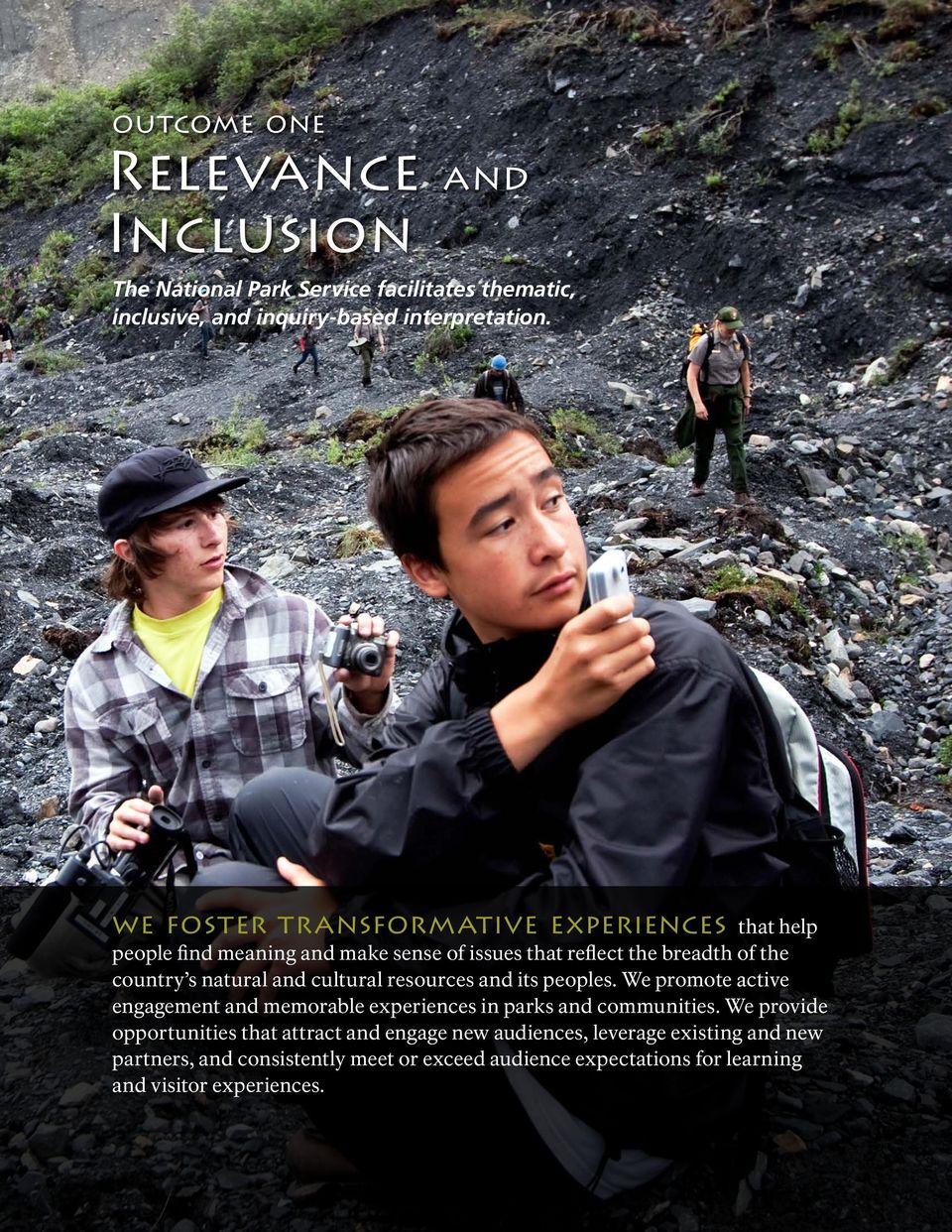
14 outcome one Relevance and Inclusion The National Park Service facilitates thematic, inclusive, and inquiry-based interpretation. we foster transformative experiences that help people find meaning and make sense of issues that reflect the breadth of the country s natural and cultural resources and its peoples. We promote active engagement and memorable experiences in parks and communities. We provide opportunities that attract and engage new audiences, leverage existing and new partners, and consistently meet or exceed audience expectations for learning and visitor experiences. 6
15 goal 1a Place events and park resources into national and global contexts. Strategies Use the Interdisciplinary Thematic Framework, park plans, and audience input to place meaningful stories, integrated natural and social systems, and pivotal issues in their greater contexts. (This framework will be available August 2014.) Interpret nationally relevant thematic issues like women s history, science literacy, Latino heritage, climate change, and civil rights in collaboration with cooperating associations and other partners. Broaden the themes of interpretation and education activities by incorporating advice of external advisors and professional societies (e.g., Revisiting Leopold report by National Park System Advisory Board Science Committee; Imperiled Promise report by Organization of American Historians). Foster collaboration among interpreters, communicators, resource managers, scientists, scholars, and historians. Use an interdisciplinary approach to harness the knowledge and skills of diverse staff (natural and cultural resource experts, law enforcement officers, economists, social scientists, etc.) to strengthen and enrich interpretation. See Goal 1A Recommended Actions on page 24. 7

16 goal 1b Ensure that National Park Service audience experiences are relevant, inclusive, active, and fun. Strategies Evaluate interpretive programs and products for their success at including diverse audiences, connecting to visitors lives, inviting visitors to participate actively in learning. Design interpretive programs that tell all Americans stories, uncover buried stories, present multiple points of view, and encourage inquiry and civic dialog. Invite visitors to tell their own stories, co-create knowledge about park resources, and share the meanings that they discover. Improve the accessibility of all interpretive programs and products. Use social media, distance learning, electronic gaming, and other emerging technologies to encourage self-directed learning and to reach new audiences. Use social science research to better understand our audiences and stay current on best practices in interpretation, education, and public engagement. See Goal 1B Recommended Actions on page 25. 8

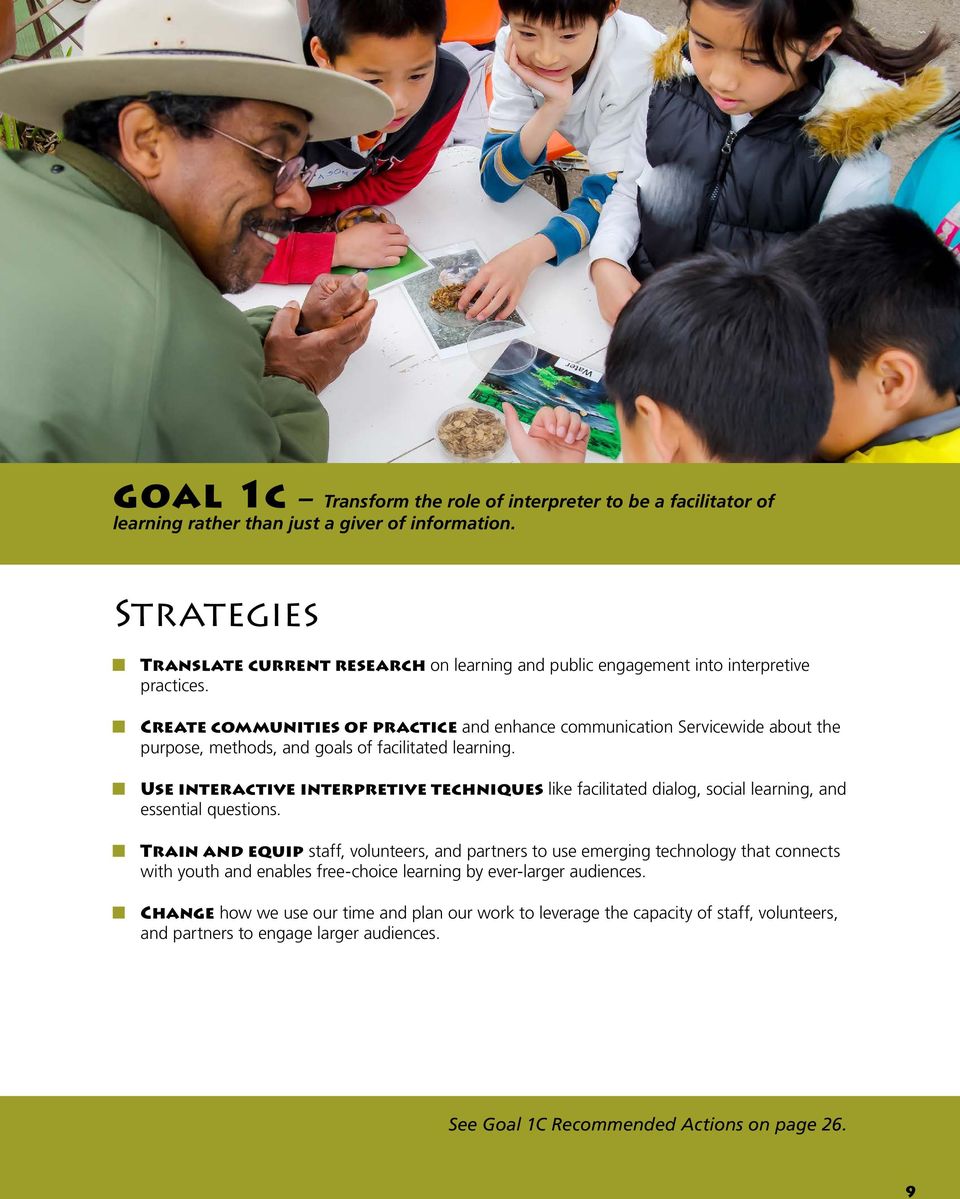
17 goal 1c Transform the role of interpreter to be a facilitator of learning rather than just a giver of information. Strategies Translate current research on learning and public engagement into interpretive practices. Create communities of practice and enhance communication Servicewide about the purpose, methods, and goals of facilitated learning. Use interactive interpretive techniques like facilitated dialog, social learning, and essential questions. Train and equip staff, volunteers, and partners to use emerging technology that connects with youth and enables free-choice learning by ever-larger audiences. Change how we use our time and plan our work to leverage the capacity of staff, volunteers, and partners to engage larger audiences. See Goal 1C Recommended Actions on page 26. 9
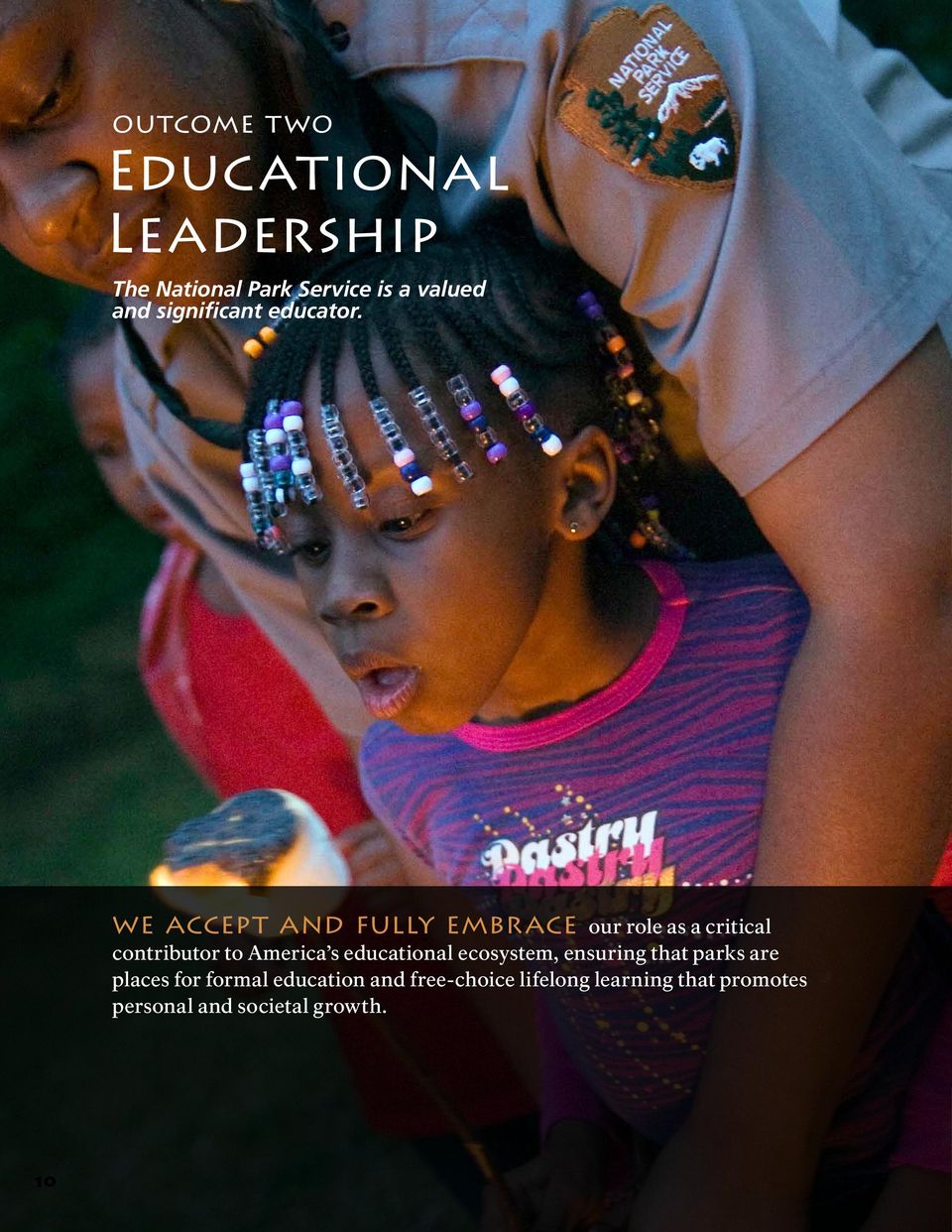
18 outcome two Educational Leadership The National Park Service is a valued and significant educator. we accept and fully embrace our role as a critical contributor to America s educational ecosystem, ensuring that parks are places for formal education and free-choice lifelong learning that promotes personal and societal growth. 10
19 goal 2a Establish the National Park Service as an educational institution and strengthen parks as places of learning that teach about our American heritage and develop civic engagement, scientific and historical literacy, and citizen stewardship. Strategies Brand, promote, and advance the National Park Service education mission and the role of informal education in America s ecosystem of learning. Collaborate with the National Park System Advisory Board Education Committee and informal learning organizations to promote and advance the NPS education mission. Capitalize on the national agreements with the Department of Education and the Bureau of Indian Education. Equip National Park Service staff, volunteers, and partners in all disciplines to lead effective formal and informal education programs that develop civic engagement, scientific and historical literacy, and citizen stewardship. Expand interpretive and education programs and products to include explanations of how scientists and scholars conduct research and create knowledge. Fully integrate Interpretation, Education, and Volunteers with the Department of Interior s Youth Initiative, including the goal to provide educational opportunities to at least 25 percent of the nation s K-12 population annually. See Goal 2A Recommended Actions on page

20 goal 2b Collaborate with partners and other educational institutions to expand National Park Service education programs and the use of parks as places of learning. Strategies: Invest in and support classroom teachers as National Park Service educators to leverage their talents and ability to reach additional students. Give priority to teacher training to maximize the level of outreach and number of students who connect with national parks when limited resources require that choices be made between teacher training and student programing. Promote partnerships with educators and education organizations to align National Park Service education programs with applicable local, state, and national standards, such as the Common Core Standards. Use and enhance the National Park Service Education Portal and a variety of educational technologies to support National Park place-based, distance learning. Explore new national and regional-level partnerships that could help expand National Park Service educational programing, connect parks across the country through common themes, and increase the use of parks as places of learning. Create new and innovative ways to join with long-standing partners, e.g., cooperating associations and educational institutions, to leverage their resources and expertise. See Goal 2B Recommended Actions on page

21 goal 2c Develop and nurture lifelong connections between the public and parks especially for young people through a continuum of engaging recreational, educational, volunteer, service, and work experiences. Strategies: Work across disciplines to expand and integrate youth programs so that participants have access to a seamless continuum of experiences. Partner with healing organizations or programs, such as Wounded Warrior and cancer survivor groups, to increase the opportunity to build connections and promote parks as places of healing. Promote cultural understanding and scientific and historical literacy through education programs, volunteerism, service learning, and internship opportunities. Prioritize working with schools and organizations that reach a high percentage of students from underserved audiences. See Goal 2C Recommended Actions on page
22 outcome three Active Engagement The National Park Service works hand-in-hand with communities to engage people of all ages and backgrounds in meaningful and mutually beneficial volunteer opportunities. we facilitate active, meaningful volunteer and service opportunities that are highly effective in helping people form deep, personal connections to park and community resources. These connections lead to greater understanding of scientific and historical content and create active park stewards and greater engagement in communities. Volunteer service strengthens one s sense of national heritage and citizenship and encourages civic engagement. Young people who volunteer are more likely to finish school, develop jobs skills, and be contributing members of society. 14
23 goal 3a Cultivate an organizational culture of stewardship and service within the larger context of national volunteerism efforts. Strategies: Recognize volunteerism as an organizational strategy, rather than a program, integral to the function and success of the National Park Service. Make volunteering a core strategic function where all sectors of the National Park Service participate and find meaning in stewardship and service. Foster relationships with other volunteer and nonprofit organizations to expand and share resources and materials broadly. Expand participation in local, national, and international volunteerism organizations and efforts. Advocate for volunteers, volunteer managers/coordinators, and volunteerism at all levels. Emphasize the importance of ethics and professionalism in relating to and working with volunteers. Espouse shared organizational values that support active engagement as a key outcome of the National Park Service mission. See Goal 3A Recommended Actions on page
24 goal 3b Build capacity and sustainability for parks and programs through effective volunteer management, investments, partnerships, and program/ professional development. Strategies: Support volunteer management as a profession and promote and use systems and tools for accountability and communication. Optimize each park s operational ability to develop a robust volunteer program through strategic investments in staff, funding, time, training and infrastructure. Foster relationships with partner organizations to leverage funds, build capacity, and assist with volunteer management and leadership in new and creative ways. Ensure that the volunteer program is fully integrated into the fabric of park and program operations through interdisciplinary collaboration to strengthen its impact and effectiveness Servicewide. Provide professional development opportunities for volunteer coordinators and promote volunteer recognition to ensure a high level of excellence for volunteer programs. Fully integrate the National Park Service Volunteers-In-Parks Program with the Department of Interior s Youth and Service Initiative, including the goal to engage one million volunteers annually on public lands in four years. See Goal 3B Recommended Actions on page
25 goal 3c Provide a range of engaging volunteer, service learning, and civic engagement opportunities that match the interests and skills/talents of volunteers, meet community needs, and are aligned with high priority National Park Service work goals. Strategies: Take innovative and creative steps to diversify the volunteer base. Recruit and engage new audiences in volunteer and service opportunities. Broaden the volunteer experience and provide compelling and diverse volunteer, service learning, and civic engagement opportunities for volunteers of all ages. Ensure that work performed by volunteers contributes to the National Park Service mission in meaningful ways. Provide tangible benefits to volunteers, communities, and society. Holistically connect volunteer and service opportunities for young people to other age-appropriate National Park Service programs that promote community engagement and outdoor recreation (play), learning and awareness of park values (learn), and employment and conservation careers (work). See Goal 3C Recommended Actions on page
26 outcome four Business Acumen The Interpretation, Education, and Volunteers program employs excellent business practices to maximize and leverage resources. in order to accomplish the preceding outcomes, we must use business acumen to ensure that programs are cost effective, leveraged, and datadriven. We make effective use of business models and systems, develop a diverse, well-trained and dedicated workforce, and establish effective communication networks. Decisions are based on the best available social science and evaluative data to ensure effective outcomes for audiences, the National Park Service, and collaborative partners. 18
27 goal 4a Create a flexible and adaptive organizational culture that encourages innovation, collaboration, and entrepreneurship. Strategies: Regularly seek input from Interpretation, Education, and Volunteers stakeholders and ensure that systems and practices reflect the diversity of needs and current trends. Encourage a culture of evaluation that routinely identifies creative and innovative strategies to problem solving and shares lessons learned across the Service. Develop strong interdisciplinary collaboration between Interpretation, Education, and Volunteers, partners, and other National Park Service career fields at all levels. Model good business practices that have transparent processes and clearly defined work plans aligned with the five-year outlook and funding. Fully integrate the National Park Service Interpretation, Education, and Volunteers program with the Department of the Interior Youth Initiative, including the goal to provide 100,000 work and training opportunities to young people over the next four years. See Goal 4A Recommended Actions on page
28 goal 4b Modernize and streamline National Park Service business processes and systems. Strategies: Establish and maintain a sustainable internal communications network for Interpretation, Education, and Volunteers. Use leading-edge technology to enhance communication at all levels of the organization. Create, collect, and use effective measures and standards for assessing qualitative and quantitative data on interpretation, education, and volunteer efforts Servicewide. Transform and use long-range interpretive planning processes to incorporate and reflect trends, operational realities, audience research, and the new vision for Interpretation, Education, and Volunteers into services and programs Servicewide. Develop new Indefinite Delivery/Indefinite Quantity contracts (IDIQs), cooperative agreements, and partnerships to bring additional resources to the interpretive planning effort. Modify current financial assistance mechanisms to make them easier to use in support of partnerships for Interpretation, Education, and Volunteers. Increase program managers familiarity with National Park Service budget, project planning, and accountability systems to improve time management efficiency and maximize resources that support interpretation, education, and volunteers outcomes. See Goal 4B Recommended Actions on page
29 goal 4c Actively support and train staff, volunteers, and partners from all disciplines who deliver Interpretation, Education, and Volunteers services and programs. Strategies: Care for employees by embracing and prioritizing safety, health, and wellness. Embrace outside sources of learning and development so that we can focus internally on the training that we can best deliver and is aligned with the goals and outcomes of this strategy. Establish effective processes for assessing and addressing ongoing developmental needs for National Park Service interpreters, educators, volunteer coordinators, and supervisors. Ensure ongoing collaboration occurs among the various discipline-based training managers and functional areas in order to leverage impact and extent of offerings. Collaborate with Interpretation and Education partners who provide interpretive services and facilitate partners in the attainment of excellence. Promote interdisciplinary learning and development through training, details, and other means to fully engage the full Service in enhancing the relevance of the National Park Service. See Goal 4C Recommended Actions on page
30 22
31 National Park Service Interpretation, Education, and Volunteers Action Plan The following pages offer recommended actions in support of the Achieving Relevance in Our Second Century strategic plan. This action plan identifies responsibilities at these levels: Washington Office (WASO), Regional Offices (Regions) National Park System units (Parks), and the National Council for Interpretation, Volunteers, and Education (NCfIVE). Individuals also are encouraged to offer innovative ideas for taking action. 23
32 Outcome One Relevance and Inclusion: The National Park Service facilitates thematic, inclusive, and inquiry-based interpretation. Goal 1A Place events and park resources into national and global contexts. ALL NPS WASO REGIONS PARKS Action 1A-1 Provide timely and relevant employee training in science literacy and climate change fluency. Action 1A-2 Model interdivisional and interdisciplinary collaboration and include such collaboration on annual work plans. Action 1A-3 Make regular use of Cooperative Ecosystem Studies Units (CESUs) and Research Learning Centers (RLCs) to access a broader research community and to connect interpreters, resource managers, scientists, and scholars. Action 1A-4 Foster development and exchange of ideas across disciplinary and divisional boundaries in support of interpretation and education. Action 1A-5 Develop a Servicewide Interdisciplinary Thematic Framework. Action 1A-6 Research, develop, and disseminate National Historic Landmark theme studies that are the core of the heritage initiatives. Action 1A-7 Embed interdivisional collaboration in Servicewide training programs. Action 1A-8 Identify and evaluate best practices of crossdivisional collaboration and provide resources and references to the field. Action 1A-9 Make interdisciplinary collaboration in support of interpretation, education, and public engagement a criterion for Servicewide funding calls. Action 1A-10 Support parks in developing broad and multidisciplinary interpretive themes for General Management Plans and foundational documents. Action 1A-11 Create regional strategies for integrating the emerging stories uncovered through broad thematic initiatives and support parks in telling those stories. Action 1A-12 Create accessibility teams to work with park-based interpreters and facility managers to improve accessibility. Action 1A-13 Engage CESU research coordinators to involve university partners in integrating current science and scholarship with interpretation, education, and public engagement. Action 1A-14 Establish interdisciplinary teams to plan events, programs, products, and outreach. Action 1A-15 Review existing themes, programs, and media for universal concepts and interpretation that places resource meanings in a broad context. INDIVIDUALS Use this space to record your own ideas for taking action. GOAL 1A RECOMMENDED ACTIONS 24
33 Outcome One Relevance and Inclusion: The National Park Service facilitates thematic, inclusive, and inquiry-based interpretation. Goal 1B Ensure that National Park Service audience experiences are relevant, inclusive, active, and fun. ALL NPS WASO REGIONS PARKS Action 1B-1 Provide timely and relevant employee training in cultural competency and cross-cultural communication (world views, approaches to conflict, etc.). Action 1B-2 Identify and rectify deficiencies in the accessibility of digital media and provide appropriate staff training. Action 1B-3 Make use of the CESUs to gain access to researchers and technical experts in evaluation, informal learning, audience characteristics and expectations, and public engagement. Action 1B-4 Make best use of social media and technology to support active learning of diverse audiences. Action 1B-5 Identify deficiencies and ways to make new media accessible and disseminate training. Action 1B-6 Sponsor social science research to build audience-centered approaches and best practices in interpretation and education. Action 1B-7 Develop criteria for relevancy, inclusiveness, and active learning for Servicewide funding calls. Action 1B-8 Support National Historic Landmark nominations and technical assistance to increase the diversity of stories. Action 1B-9 Create accessibility teams to work with park-based interpreters and facility managers to improve accessibility. Action 1B-10 Engage facilitators to help with program evaluations and empower parks to reprioritize resources to better accomplish the park and agency goals, audience needs. INDIVIDUALS Use this space to record your own ideas for taking action. Action 1B-11 Develop programs and media with audiences not for them; embrace organizations and audience members as full partners in program design and delivery. Action 1B-12 Create citizen science projects so visitors actively participate in inquiry-based learning and resource stewardship. Action 1B-13 Design and infuse multicultural, inclusive programs and products through current scholarly research, as well as contributions by audiences through inquiry and civic dialog in order to tell all American s stories. GOAL 1B RECOMMENDED ACTIONS 25
34 Outcome One Relevance and Inclusion: The National Park Service facilitates thematic, inclusive, and inquiry-based interpretation. Goal 1C Transform the role of interpreter to be a facilitator of learning rather than just a giver of information. ALL NPS WASO REGIONS PARKS Action 1C-1 Identify and disseminate best practices for reaching diverse audiences. Action 1C-2 Create a system to reward individuals, teams, partners, and collaborations for 21stcentury interpretive skills and practices. Action 1C-3 Develop new standards for interpretive success based on 21st-century interpretive skills such as digital interpretation and facilitated dialog. Action 1C-4 Create and disseminate needed training on facilitated dialog techniques, digital interpretation, and use of new media. Action 1C-5 Evaluate and rework funding criteria to emphasize desired skills sets. Action 1C-6 Draft new position descriptions that embed 21st-century interpretive skills. Action 1C-7 Work with the national web council to ensure enriches in-park interpretation and online learning. Action 1C-8 Represent the needs of the field to the web and communication councils. INDIVIDUALS Use this space to record your own ideas for taking action. Action 1C-9 Designate a social media consultant at the regional level. Action 1C-10 Intentionally coordinate and empower regional training teams, linking trainers, chiefs, and advisory group members to identify regional needs and prioritize training events. Action 1C-11 Coordinate mentoring, detail appointments, and job shadowing to expand professional development opportunities. Action 1C-12 Develop a social media strategy and establish an interdisciplinary social media steering committee to increase the reach of programs and audiences. Action 1C-13 Train interpreters in facilitated dialog techniques. Action 1C-14 Shift programming from didactic techniques to engaging, co-created audience experiences. Action 1C-15 Seek additional skills to address needs of today s learners and help cocreate training for those skills. Action 1C-16 Embed new standards into performance plans and individual development plans. GOAL 1C RECOMMENDED ACTIONS 26
35 Outcome Two Educational Leadership: The National Park Service is a valued and significant educator. Goal 2A Establish the National Park Service as an educational institution and strengthen parks as places of learning that teach about our American heritage and develop civic engagement, scientific and historical literacy, and citizen stewardship. ALL NPS WASO WASO WASO Action 2A-1 Leverage Historically Black Colleges and Universities as well as Latino-, Asian-, and tribal-serving institutions to engage next-generation educators in promoting park science and history. WASO Action 2A-2 Collaborate with the Washington Office of Communications to develop a branding strategy or communication plan specific to promoting parks as places of learning. Action 2A-3 Support Department of Education Green Ribbon Schools program by providing content and professional development opportunities for teachers. Action 2A-4 Partner with the Department of Education to promote National Park Service educational opportunities. Action 2A-5 Evaluate Teacher- Ranger-Teacher Program and Teacher Corps in partnership with the Department of Education s Office of Research. Action 2A-6 Design effective teacher engagement programs for educators to have hands-on professional development in parks science and history. Action 2A-7 Inform Congress about the educational mission of the National Park Service. Action 2A-8 Define educational institution, the characteristics of such an institution, and what steps the National Park Service can take to establish itself as one. Action 2A-9 Launch a new national Parks as Classrooms Day to promote parks as learning landscapes. (With National Park System Advisory Board) Action 2A-10 Strengthen the National Park Service s participation in National History Day through innovative outreach programs that engage underserved audiences. Action 2A-11 Develop training to equip interpreters to understand and lead curriculum-based education programs and to develop programs that meet Common Core Standards. Action 2A-12 Perform an assessment of training needs to increase scientific and historical literacy among interpretation and education staff and partners. Develop training modules as needed in partnership with NPS Natural and Cultural Resources programs. Action 2A-13 Develop online training for National Park Service staff to learn about nonprofit organizational cultures. Action 2A-14 Develop online training for partner staff to understand National Park Service culture. Action 2A-15 Develop a competency for superintendents to increase their understanding of the role and needs of the Interpretation, Education, and Volunteers program. INDIVIDUALS Use this space to record your own ideas for taking action. GOAL 2A RECOMMENDED ACTIONS 27
36 Outcome Two Educational Leadership: The National Park Service is a valued and significant educator. Goal 2B Collaborate with partners and other educational institutions to expand National Park Service education programs and the use of parks as places of learning. ALL NPS WASO WASO PARKS Action 2B-1 Establish and expand new partnerships with youth-serving organizations (e.g., Boys and Girls Clubs). Action 2B-2 Partner with informal education institutions and organizations, such as museums, to promote parks as places of learning. INDIVIDUALS Use this space to record your own ideas for taking action. Action 2B-3 Collaborate with the Department of Education and National Park Foundation to develop a National Park Service Teacher Corps to increase capacity to offer education programs in the classroom and within the park. (Teacher Corps could draw from Teacher-Ranger- Teachers, retired teacher volunteers in parks, Park Stewards, Park Teachers, and seasonal park rangers who are teachers.) Action 2B-4 Establish a method to collect internal and external feedback on how the Education Portal functions. Action 2B-6 Explore new national and regional level partnerships that could help increase the use of parks as places of learning (e.g., Journey North/South, Roots and Shoots, the National Writing Project, or the National Phenology Network). Action 2B-7 Broaden the Education Portal to include partner education programs, including field trips and distance education. Action 2B-8 Develop a strong distance learning strategy that is audience-centered and reaches beyond park boundaries. (With Parks) Action 2B-9 Develop, offer, and/ or host professional development opportunities for teachers that are based on national park experiences and resources, such as presenting virtual programs, hosting teacher workshops, and participating in teacher in-service trainings. Partner with universities to offer continuing education credits. Action 2B-10 Partner with universities to offer classroom or distance education programs in courses required for teaching certification in order to reach future teachers. Action 2B-5 Support national partnerships to engage new audiences and communities which cannot always get to parks (e.g., National Alliance for Faith and Justice). GOAL 2B RECOMMENDED ACTIONS 28
37 Outcome Two Educational Leadership: The National Park Service is a valued and significant educator. Goal 2C Develop and nurture lifelong connections between the public and parks especially for young people through a continuum of engaging recreational, educational, volunteer, service, and work experiences. WASO REGIONS PARKS PARKS Action 2C-1 Create a parent-friendly online searchable database of activities that engage children of any age. Action 2C-2 Develop a template for a park-level education plan. Action 2C-3 Re-message and/ or provide updated materials for national special event days that will lead to increased civic engagement, scientific and historical literacy, and citizen stewardship. Action 2C-4 Develop and implement a strategy to evolve and expand the Junior Ranger and WebRanger programs as tools for engaging children and families. Action 2C-5 Coordinate and develop distance education programs for national special events, anniversaries of significant events, etc. (e.g., virtual program on ANILCA with President Jimmy Carter). (With Parks) Action 2C-6 Review completion reports in Project Management Information System (PMIS) to determine if employee development and diversity outcomes for funded projects are achieved. Capture lessons learned. (With Parks) INDIVIDUALS Use this space to record your own ideas for taking action. Action 2C-7 Develop an education plan to consciously decide which audiences will or will not be targeted, the best forms or methods to conduct the outreach, etc. (similar to a social media plan). Action 2C-8 Partner and align with universities, especially tribal colleges. Integrate classroom or distance education programs into various college courses and/or host university courses onsite in parks. Courses could range from art and science to history and geography. Action 2C-9 Conduct BioBlitz and other citizen science events and programs, including the goal to create a generation of citizen scientists and future stewards by conducting fun, engaging, and educational biodiversity discovery activities in at least 100 national parks. Action 2C-10 Partner with gym and health class teachers, hospitals, and active lifestyle organizations to increase the use of parks and green spaces and to improve public health. Action 2C-11 Use partners and programs, such as public land corps organizations, Youth Conservation Corps, and the Youth Partnership Program, to incorporate interns into park projects. Action 2C-12 Develop active, technology-based activities to promote physical recreation and meaningful learning opportunities in parks. GOAL 2C RECOMMENDED ACTIONS 29
38 Outcome Three Active Engagement: The National Park Service works hand-in-hand with communities to engage people of all ages and backgrounds in meaningful and mutually beneficial volunteer opportunities. Goal 3A Cultivate an organizational culture of stewardship and service within the larger context of national volunteerism efforts. ALL NPS WASO WASO PARKS Action 3A-1 Incorporate new language and concepts about participatory stewardship into everyday conversations to foster a culture shift in the National Park Service. Action 3A-2 Communicate the value of collaboration on a broader scale as a way to embrace a multicultural world. Action 3A-3 Continually advocate for volunteerism which includes volunteers, volunteer managers, and volunteer program/ strategy. Action 3A-4 Think about volunteerism without limits by creatively developing virtual and in-person volunteer opportunities for groups, individuals, and families. Action 3A-5 Advocate that volunteerism is a core value of the National Park Service, and should be aligned with NPS mission statement, goals, and objectives. Action 3A-6 Demonstrate how volunteer programs respond to identified community needs, incorporate agency needs and interests, are developed at the national level, and are implemented throughout the entire agency and department. Action 3A-7 Reach out to cooperators so they may advise the NPS on the value that service plays in the lives of our citizens. Action 3A-8 Maintain an active and visible presence on Federal Interagency Team on Volunteerism (FITV). Action 3A-9 Foster regional relationships with neighboring federal, state, and local land management agencies following the FITV model to share resources and ideas and streamline processes for excellence in volunteer management and recognition. Action 3A-10 Maintain multiple national memberships in organizations like AL!VE (Association for Leaders in Volunteer Engagement), Points of Light, Hands-On Network, etc. Action 3A-11 Participate in International Volunteer Managers Day by publicly recognizing National Park Service volunteer managers/coordinators in unison with those around the world. Action 3A-12 Stretch National Park Service resources through creative collaboration with partner organizations to support volunteer management. Action 3A-13 Encourage and support parks and program offices Servicewide in seeing volunteerism as a way to help preserve resources and educate the public about the significance of those resources. INDIVIDUALS Use this space to record your own ideas for taking action. Action 3A-14 Foster relationships with neighboring federal, state, and local land management agencies following the FITV model to share resources and ideas and to streamline processes for excellence in volunteer management and recognition. Action 3A-15 Cultivate partnerships with other organizations to support volunteerism. Action 3A-16 Develop relationships with surrounding communities through volunteerism engagement. Action 3A-17 Continually advocate for volunteerism with park management and leadership. Action 3A-18 Communicate to staff and partners the value of cultivating a stewardship-focused organization. GOAL 3A RECOMMENDED ACTIONS 30
39 Outcome Three Active Engagement: The National Park Service works hand-in-hand with communities to engage people of all ages and backgrounds in meaningful and mutually beneficial volunteer opportunities. Goal 3B Build capacity and sustainability for parks/programs through effective volunteer management, investments, partnerships, and program/ professional development. ALL NPS ALL NPS WASO WASO Action 3B-1 Abide by the standards of high quality volunteer management as set forth in the 13-module training package, How to Succeed with Volunteers-In-Parks. Action 3B-2 Broaden and diversify funding sources and mechanisms. Action 3B-3 Collaborate with others (parks, programs, other disciplines, volunteer organizations, partners, interdisciplinary teams, and other Department of the Interior bureaus) to improve and sustain volunteer programs. Action 3B-4 Show appreciation for volunteers in a timely manner. Action 3B-5 Include volunteers in decision-making processes as valued stakeholders. Action 3B-6 Support volunteer management as a profession and encourage certification and other programs in promoting career development. Action 3B-7 Promote as a one-stopshop for interdisciplinary reporting, Public Land Corps tracking, and data sharing. Account for volunteer program statistics and expenses through the use of the Volunteers-in-Parks data tracking and reporting system in Action 3B-8 Align National Park Service systems, policies, and priorities to increase volunteer coordination and management capacity. Action 3B-9 Use emerging technology to cost effectively engage volunteers and prospective volunteers. Action 3B-10 Recognize volunteers, volunteer managers, and programs through local, regional, and national awards programs including the George and Helen Hartzog Awards for Outstanding Volunteer Service, the Presidential Service Awards, Take Pride in America Awards, etc. Action 3B-11 Engage and enhance partner involvement in philanthropy, marketing, and coordination of volunteer activities in parks. Action 3B-12 Provide leadership and management oversight in achieving the goals of National Park Service volunteer and youth initiatives. Action 3B-13 Identify new sources of funding for the National Park Service Volunteers- In-Parks Program (e.g., 20-percent Recreation Fee National) and high priorities for strategic investments. Action 3B-14 Assess the current Servicewide volunteer awards program to ensure that it provides incentives and rewards for an increased number of volunteers. Action 3B-15 Support the efforts of the Council for Certification in Volunteer Administration in professionalizing volunteer administration worldwide. Action 3B-16 Collaborate with strategic partners, such as Americorps, to increase volunteer management capacity. Action 3B-17 Streamline the Servicewide Volunteersin-Parks budget allocation process and communicate the process and decisions to internal stakeholders in a way that makes information transparent. Action 3B-18 Finalize Director s Order #7 and develop associated policy guidance that reconciles conflicting information. Action 3B-19 Finalize Reference Manual #7 to clarify policies set forth in Director s Order #7 including guidance for complex operational issues. Action 3B-20 Update and maintain the basic, 13-module volunteer management training package, How to Succeed with Volunteers-In-Parks, as a relevant and useful tool for managers/ coordinators. (Continued) GOAL 3B RECOMMENDED ACTIONS 31
40 Outcome Three Active Engagement: The National Park Service works hand-in-hand with communities to engage people of all ages and backgrounds in meaningful and mutually beneficial volunteer opportunities. Goal 3B Build capacity and sustainability for parks/programs through effective volunteer management, investments, partnerships, and program/ professional development. WASO WASO WASO PARKS Action 3B-21 Provide varied certification training programs to ensure a high level of excellence and a good understanding of National Park Service Interpretation and Education standards for volunteers and partners who conduct interpretation and education programs. Action 3B-22 Invest in new, state-ofthe-art, online volunteer manager/coordinator training and other tools to support volunteer coordination. Action 3B-23 Analyze Servicewide business processes to identify and remove barriers that limit the number of volunteers in parks (e.g., effects of park travel ceiling, implementation of housing policy, etc.). Action 3B-24 Support Volunteer Managers/Coordinators through basic and advanced volunteer program management training. Action 3B-25 Seek creative funding sources to enable participation in national volunteer conferences, certification courses, and other partner-related functions. Participate in the National Conference on Volunteering and Service when possible. Action 3B-26 Encourage mentoring between parks for support of new program managers/coordinators. Action 3B-27 Encourage collaboration with state and local entities (e.g., a local volunteer administrators association or volunteer center) in creative problem-solving, capacity-building efforts, and training opportunities for both volunteer managers/ coordinators and volunteers. Action 3B-28 Identify current barriers to increasing the number of volunteers and draft a memo for the Associate Director that can inform strategic dialog with the National Park Service Directorate and/or to the Department. Action 3B-29 Coordinate National Volunteer Week events to promote volunteer recognition, youth and service learning events, and interagency recognition efforts. Action 3B-30 Encourage all staff to engage with volunteers. Action 3B-31 Strategically request appropriate fund sources to invest in park infrastructure that will support on-site volunteers (e.g., trailer pads, housing, and supplies). Action 3B-32 Continue to leverage the 2008 base increase (NPS Centennial funding) for volunteer program management. Action 3B-33 Ensure that park Volunteer Managers/ Coordinators have sufficient work time to properly manage and plan a robust Volunteers-In-Parks program. Action 3B-34 Ensure that the Volunteers-In-Parks management position is housed where it can fully support the entire park. (Continued) GOAL 3B RECOMMENDED ACTIONS 32
41 Outcome Three Active Engagement: The National Park Service works hand-in-hand with communities to engage people of all ages and backgrounds in meaningful and mutually beneficial volunteer opportunities. Goal 3B Build capacity and sustainability for parks/programs through effective volunteer management, investments, partnerships, and program/ professional development. PARKS Action 3B-35 Ensure that the Volunteers-In-Parks program is fully integrated into park management systems and park operations and priorities. Action 3B-36 Invest in highperformance volunteers who are interested in serving in leadership roles. Action 3B-37 Create avenues for volunteers to share suggestions, ideas, and problems. Action 3B-38 Develop annual work plans including recurring, one-time, and wish-list projects for volunteer groups, individuals, and families. Action 3B-39 Conduct annual performance appraisals, exit interviews, and/ or provide essential, valuable, and timely feedback to volunteers. PARKS Action 3B-40 Monitor volunteer programs for compliance with policy and legal requirements. Action 3B-41 Support volunteer development through orientation, specialized, and safety training. Action 3B-42 Volunteer Managers/ Coordinators/Leaders should regularly utilize the Everyone Ready online volunteer management resources to stay current with volunteer trends and training materials. Action 3B-43 Provide leadership training for interdisciplinary staff/ volunteers who may lead volunteer projects. Action 3B-44 Ensure staff (paid and non-paid) and visitor safety through regular training sessions, including Operational Leadership, and providing up-to-date resource materials. INDIVIDUALS Use this space to record your own ideas for taking action. GOAL 3B RECOMMENDED ACTIONS 33
42 Outcome Three Active Engagement: The National Park Service works hand-in-hand with communities to engage people of all ages and backgrounds in meaningful and mutually beneficial volunteer opportunities. Goal 3C Provide a range of engaging volunteer, service learning, and civic engagement opportunities that match the interests and skills/talents of volunteers, meet community needs, and are aligned with high priority National Park Service work goals. ALL NPS WASO WASO REGIONS Action 3C-1 Use gov and other creative recruitment tools to attract and retain volunteers (individuals, groups, families). Action 3C-2 Engage broader audiences in innovative and varied projects/ programs. Ensure that our volunteer corps represents the demographics of our nation. Action 3C-3 Create compelling opportunities for volunteers of all ages. Provide opportunities that broaden the volunteer experience (to include service learning). Action 3C-4 Continue to enhance and connect it more directly with and other online volunteer recruitment portals where practical and feasible. Action 3C-5 Promote www. volunteer.gov as the interagency public portal for volunteer opportunities. Action 3C-6 Develop national volunteer programs (e.g., volunteer emeritus and voluntourism programs) that can be efficiently implemented throughout the National Park System. Action 3C-7 Collaborate with tour companies and other organizations to expand voluntourism opportunities and volunteer vacations. Action 3C-8 Expand and implement Emeritus Volunteer Program to engage retired National Park Service employees in park, program area, and community-based volunteer activities. Action 3C-9 Develop, in partnership with the National Park Foundation, a Corporate Volunteer Program where donor recognition includes volunteer opportunities in national parks. Action 3C-10 Establish Servicewide partnership with organizations like Campus Compact to place college students in volunteer and internship opportunities around the System. Action 3C-11 Utilize workforce management expertise to ensure that Volunteers-In-Parks work experiences provide career training and professional development opportunities for the volunteer. Action 3C-12 Build bridges to engage youth organizations in urban centers through volunteerism and service-learning opportunities. Action 3C-13 Reach out to collaborators to identify community resources that will help parks reach underserved audiences (e.g., urban and rural youth) who may benefit from volunteer and service opportunities with the National Park Service. (Continued) GOAL 3C RECOMMENDED ACTIONS 34
43 Outcome Three Active Engagement: The National Park Service works hand-in-hand with communities to engage people of all ages and backgrounds in meaningful and mutually beneficial volunteer opportunities. Goal 3C Provide a range of engaging volunteer, service learning, and civic engagement opportunities that match the interests and skills/talents of volunteers, meet community needs, and are aligned with high priority National Park Service work goals. PARKS Action 3C-14 Ensure that volunteer opportunities result in improved and enhanced park facilities, services, and resources while meeting the needs of the volunteer(s). Action 3C-15 Develop appropriate park volunteer programs (e.g., service learning and citizen science programs) that can be efficiently implemented by multiple disciplines in the park. Action 3C-16 Connect with the local community through creative service activities onsite, offsite, or virtually. Action 3C-17 Work with schools, clubs, colleges, and other organizations to promote/encourage fun and meaningful stewardship opportunities at all ages. PARKS Action 3C-18 Expand hands-on/ service-learning educational opportunities like citizen science programs in parks and communities. Promote service-learning opportunities to high schools, clubs, colleges and families. Action 3C-19 Connect people to parks by planning and/ or participating in community outreach events, educational institutions career development days, and partner/public programs. Action 3C-20 Establish a volunteer ambassador corps to connect communities to parks through outreach programs and presentations. Action 3C-21 Participate in National Days of Service such as Martin Luther King Day of Service, National Public Lands Day, National Trails Day, César Chávez Day of Service and Learning, and Make a Difference Day, etc. to promote service in parks and communities in a fun, educational way. INDIVIDUALS Use this space to record your own ideas for taking action. GOAL 3C RECOMMENDED ACTIONS 35
44 Outcome Four Business Acumen: The Interpretation, Education, and Volunteers program employs excellent business practices to maximize and leverage resources. Goal 4A Create a flexible and adaptive organizational culture that encourages innovation, collaboration, and entrepreneurship. ALL NPS WASO WASO WASO Action 4A-1 Include evaluation components in State of the Park reports, Park Scorecards, Servicewide Comprehensive Call guidelines, and performance evaluations. Action 4A-2 Equip interpreters and educators to conduct systematic evaluation through asking questions of substance, determining the data needed to answer specific questions, analyzing data, etc. Recognize evaluation champions. Action 4A-3 Foster a Servicewide commitment to evaluation that facilitates coordination, fosters information exchange, and supports application of results. Ensure that the workforce has the motivation, knowledge, ability, and tools to fully integrate evaluation practices into their daily work. Action 4A-4 Implement the recommendations of the National Education Council Research to Practice Committee. Action 4A-5 Identify potential organizations or institutions whose evaluation practices have a direct connection with a National Park Service program or service and work with the Evaluation and Visitor Studies Coordinator to create relationships or mutually-beneficial partnerships (e.g., university research studies). Action 4A-6 Participate in discussions surrounding the State of the Parks questions. Prepare a list of alternative questions to pilot next fiscal year. Action 4A-7 Identify and use qualitative research and evaluation to expand the impact and replication of best practices in Washington Office-funded projects. Action 4A-8 Develop an online platform through which creative and innovative examples, case studies and best practices are shared. Include samples of Memorandums of Understanding, cooperative agreements, planning documents, and other support documents that were used to accomplish the project or program. Make the online platform prominent and easy to access by all NPS staff. Action 4A-9 Develop Frequently Asked Questions (FAQs) on doing more of less to assist the field in making choices. Action 4A-10 Develop a Servicewide evaluation framework and identify research needs for interpretation, education, and volunteer programs. Action 4A-11 Prepare and share an array of useful evaluation questions, studies, methods, reports, resource materials, and tips and trends in evaluation on a regular basis. Action 4A-12 Introduce the Service to a common language of evaluation. Action 4A-13 In collaboration with the Denver Information Collection Office, explore the existing pool of known survey questions and compile a bank of questions already curated and approved by the Office of Management and Budget. Make the questions available to parks to use in survey development. (Continued) GOAL 4A RECOMMENDED ACTIONS 36
45 Outcome Four Business Acumen: The Interpretation, Education, and Volunteers program employs excellent business practices to maximize and leverage resources. Goal 4A Create a flexible and adaptive organizational culture that encourages innovation, collaboration, and entrepreneurship. WASO Action 4A-14 Launch two to four evaluation webinars each year to provide practical evaluation tools to the field, including asking research questions, understanding program evaluation, and facilitating focus groups. Action 4A-15 Update the Interpretation, Education, and Volunteers National Award Program to reflect our interdisciplinary approach and be more inclusive of the breadth and depth of employee and partner contributions to increasing relevance and accomplishing the NPS mission. Assemble a diverse workgroup that includes field staff to draft new criteria and eligibility requirements. (With Regional Offices) PARKS Action 4A-16 Regularly use the online platform as inspiration for new forms of innovative outreach, as a resource for useful tools and support documents, and to stay current in trends in Interpretation, Education, and Volunteers. Contribute material, lessons learned, success stories, etc. to the online platform to promote communication and assist the National Park Service is accomplishing its mission. Action 4A-17 Participate in national socioeconomic evaluation efforts and projects to inform future practice. Action 4A-18 Reach out to Cooperating Associations and other non-profit partners to enhance mutual understanding of business acumen and to identify entrepreneurial strategies to expand interpretation and education services. INDIVIDUALS Use this space to record your own ideas for taking action. GOAL 4A RECOMMENDED ACTIONS 37
46 Outcome Four Business Acumen: The Interpretation, Education, and Volunteers program employs excellent business practices to maximize and leverage resources. Goal 4B Modernize and streamline National Park Service business processes and systems. WASO WASO WASO WASO Action 4B-1 Streamline, simplify, and modernize the Servicewide interpretive report system to provide useful data for all levels of Interpretation, Education, and Volunteers. Develop software for a new Servicewide Interpretive Report in consultation with stakeholders at all levels. Action 4B-2 Work with NPS Planning Office to ensure Interpretation, Education, and Volunteers has a central role in the creation of park foundation documents. Action 4B-3 Rewrite Director s Order #6 and Reference Manual #6 so that they reflect the guiding principles and best practices of National Park Service interpretation and education, align with the strategic plan, and provide guidelines on how to use an interdisciplinary approach in operations without marginalizing the role of interpretive professions to accomplish objectives. Circulate for wideranging field review that includes partners, concessioners, volunteers, and all levels of the Interpretation and Education community. Action 4B-4 Develop a common language for and understanding of Cooperative Agreements, Interpretation and Education Services Agreements, Commercial Use Authorizations, Concessions Contracts, Cooperating Association Agreements, and various types of fundraising agreements. Ensure that they are as streamlined as possible and are aligned with National Park Service goals. Action 4B-5 Develop and distribute guidance on the types of agreements (and other mechanisms) and the various authorities frequently used in support of Interpretation, Education, and Volunteers efforts. Action 4B-6 Engage with Financial Assistance Agreements Improvement Team to ensure Interpretation, Education, and Volunteers needs are addressed in any changes to the financial agreements process. Action 4B-7 Develop a distance learning format for Introduction to Park Program Management and offer it more frequently. Make this course a requirement for new program managers across all disciplines. Action 4B-8 Create training tools to empower parks to implement and incorporate interpretive planning at every level. Action 4B-9 Ensure that the authorities and mechanisms (e.g., Cooperative Agreements) for entering into Interpretation, Education, and Volunteers partnerships are well understood by National Park Service program managers and partners. (Continued) GOAL 4B RECOMMENDED ACTIONS 38
47 Outcome Four Business Acumen: The Interpretation, Education, and Volunteers program employs excellent business practices to maximize and leverage resources. Goal 4B Modernize and streamline National Park Service business processes and systems. NCfIVE Action 4B-10 Complete a simple but elegant communications plan for Interpretation, Education, and Volunteers with wide stakeholder involvement. Action 4B-11 Establish a field advisory group for development of the new Servicewide Interpretive Report. Fundamentally shift what is counted in parks. Action 4B-12 Develop effective measures and standards and work with the Washington Office Budget Team to incorporate them into the Park Scorecard. Action 4B-13 Transform the longrange interpretive planning process to incorporate and reflect trends, operational realities, audience research, and the new vision for Interpretation, Education, and Volunteers. The process should be sustainable, nimble, practical, and flexible so that any interpretive park program manager can feel empowered to use this planning tool to strategically plan work at the park level. NCfIVE Action 4B-14 Participate in discussions surrounding the State of the Parks questions. Prepare a list of alternative questions to pilot next fiscal year. Action 4B-15 Develop new interpretive planning templates and examples. Use external planning and design expertise to inform the process. Strengthen collaboration on interpretive planning between Harpers Ferry Center and regional offices. Action 4B-16 In collaboration with the Institute at the Golden Gate, develop a national level business plan that identifies staffing and funding trends and recommends how to build capacity and new business practices to support Interpretation, Education, and Volunteers. Communicate status of the plan throughout its development. INDIVIDUALS Use this space to record your own ideas for taking action. GOAL 4B RECOMMENDED ACTIONS 39
48 Outcome Four Business Acumen: The Interpretation, Education, and Volunteers program employs excellent business practices to maximize and leverage resources. Goal 4C Actively support and train staff, volunteers, and partners from all disciplines who deliver Interpretation, Education, and Volunteers services and programs. WASO WASO WASO WASO Action 4C-1 Develop a statement that affirms the primacy of safety and wellness for Interpretation, Education, and Volunteers employees and shines a light on our important role in providing for visitor safety in Interpretation, Education, and Volunteers programming. Action 4C-2 Develop an annual Servicewide calendar of Interpretation, Education, and Volunteers training opportunities aligned with this strategic plan and timed with strategic work plan milestones, such as the Servicewide Comprehensive Call deadlines. Include training opportunities offered by the regions. Action 4C-3 Work with National Park Hospitality Association and the National Association for Interpretation to assess practicability of certifying partners to National Park Service standards. Action 4C-4 Brand partners as official National Park Service interpreters and educators. Provide training to ensure a high level of excellence and a good understanding of National Park Service Interpretation, Education, and Volunteers standards. Action 4C-5 Develop and offer change management training for Interpretation, Education, and Volunteers managers ( Letting Go, grief model, Harvard Business Review webinars, etc.) to ensure managers are prepared to guide their staff and work through feelings and reactions to the changes happening in the field of Interpretation, Education, and Volunteers. Action 4C-6 Ensure focused training for interpretive supervisors is developed and delivered. Action 4C-7 Develop a training plan that addresses the results of the training needs assessment. Action 4C-8 Conduct training needs assessment every five years. Review current National Park Service learning opportunities and develop a plan for addressing gaps and meeting needs for long-term development (e.g., facilitated dialog) and practical skills that respond to immediate needs (e.g., Project Management Information System project writing, website work/content Management System, and digital media). Communicate timeline, progress, and conclusions to field. Action 4C-9 Assess the future of the Interpretive Development Program, including the certification and coaching elements, and ensure alignment with the strategic plan. If coaching and certification continue, recognize that the training program cannot continue to be delivered as originally planned, certification cannot be delivered and conferred by the same source, and that the delivery mechanism must be cost effective. Action 4C-10 Use the Employee Performance Appraisal Plan s Individual Development Plan to support competencybased developmental opportunities for Interpretation, Education, and Volunteers staff. Support employee participation in training, details, mentoring opportunities, etc. that focus on 21st-century skills. Action 4C-11 Continue to offer Operational Leadership and Go, No Go training. Make use of lessons learned to reinforce a safety culture for Interpretation, Education, and Volunteers staff. Action 4C-12 Support the community of practice that formed under the Interpretive Development Program. INDIVIDUALS Use this space to record your own ideas for taking action. GOAL 4C RECOMMENDED ACTIONS 40
49 More About National Park Service Volunteers The REIMAGINING SERVICE coalition has established four principles to guide its work: 1. The volunteer ecosystem is more effective when all sectors participate in its evolution. 2. Make volunteering a core strategic function, not an add-on. 3. Focus volunteer engagement on true community needs. 4. In order to get a return, you have to invest. (REIMAGINING SERVICE website, copyright 2013) The National Park Service is a signatory of the REIMAGINING SERVICE principles. The goals that support Outcome Three, Active Engagement, in this strategic plan reflect the four principles established by the REIMAGINING SERVICE coalition. The National Park Service Volunteers-In-Parks Program (VIP) was authorized by Public Law enacted The primary purpose of the VIP program is to provide a vehicle through which the National Park Service can accept and utilize voluntary help and services from the public. The major objective of the program is to utilize this voluntary help in such a way that is mutually beneficial to the National Park Service and the volunteer. For more information visit gettinginvolved/volunteer. 41
50 Acknowledgements Thanks to all who contributed to the strategic planning process, including the National Park System Advisory Board Education Committee under the leadership of Dr. Milton Chen. Thanks also to PEER Associates for helping us to evaluate 500 pages of comments collected through the NPS Planning, Environment and Public Comment site (PEPC) and listening sessions with staff and other stakeholders. Bianca Acosta Renee Albertoli Raphael Allen Tracy Ammerman Eileen Andes Nichole Andler Ruben Andrade April Antonellis Christine Arato Matthew Arnold Graciela Avila Terry Baldino Anthony Bates Paula Bauer Denise Bausch Carla Beasley Randall Becker Cathy Beeler Jon Bennett Jeanette Benson Troy Benzhaf Celeste Bernardo Chris Bernthal Linda Bishop Cindy Bjorklund Joann Blacoe Linda Blaser Katie Bliss Bradley Block Tucker Blythe Tina Boehle Beth Boland Paloma Bolasny Heather Boothe Carol Borneman Lauren Boross Amy Bracewell Suzanne Brinkley Michael Brondi Heather Brown Barbara Brundage Colin Campbell Julena Campbell Dominic Cardea Tim Cash Sharon Cawley Larry Cebula Diane Chalfant Theodora Chang Cheryl Chipman Jane Clark Laura Cohen Jocelyn Cole Rhea Cole Jason Collins Cris Constantine Jim Cook Kelly Coy Sarah Craighead Malinee Crapsey Phyllis Cremonini Tim Cruze Roberta D Amico Rachelle Daigneault Maggi Daly Butch Davis Wyndeth Davis Karissa DeCarlo Paula Degen Mark DeGregorio Julie Denslow Cheryl DeShazer Clark Dixon Peggy Dolinich Mary Doll Daniel Downing Kristen Dragoo Dan Dressler Martha Droge Stephanie Dubois Jermey Ebersole Diane Eilenstein Mark Engler Kelli English Melissa English-Rias Rudy Evenson Jane Farmer Tom Farrell Katherine Faz Rich Fedorchak Jacob Fillion Maureen Finnerty Andy Fisher Holly Fisher-Hickman Sheri Forbes Brian Forist Myra Foster Jennifer Frost Michele Gee Dorothy Gist Keena Graham Matt Graves Patrick Gregerson Lisa Griebel Lauren Gurniewicz Jennifer Haley Joan Haley Jill Hamilton-Anderson Craig Hansen Sue Hansen Clayton Hanson Jill Harding Rebecca Harriett Jewel Haskins Mary Hazell Gayle Hazelwood Judy Hellmich Laura Henning Dean Herrin Carolyn Hill Gregory Hindsley Ann Hitchcock Elizabeth Hoermann Holly Holst Ann Honious Martha Hoverson Christine Hoyer Stacy Humphreys Dave Hutson Heather Huyck Elizabeth Igleheart Laura Illige Jim Ireland Arlene Jackson Curt Jacquot John Jameson Rick Jenkins Dan Jensen Eun Jeon Bianca Johnson Donna Johnson Mike Johnson Theresa Johnson Jay Johnstone Rebekah Jones Brian Joyner Barbara Judy Bill Justice Andrea Kaawaloa-Okita Jennifer Kays Caroline Keinath Marta Kelly Elizabeth Kerwin-Nisbet Sandi Kinzer Lorrie Knies Rana Knighten Carolyn Knoll Don Kodak Megan Kohli Duey Kol Nancy Kotz Krista Kovach-Hindsley Amber Kraft Kathy Krause Shannon Kruse Elisa Kunz Michael Kusch Mike Kusch Becky Lacome Wendy Lauritzen Gloria Lee Martha Lee Albert Legault Kristen Leong Michael Liang George Liffert Diane Liggett Barbara Little Joe Llewellyn Mary Lou Herlihy Linda Lutz-Ryan Paul Pfenninger Maci MacPherson Ann Marie Eilander Susan Martin Eileen Martinez Victoria Mates Karen Maxville Carol McBryant Carol McCoy Laura McCoy George McDonald 42
51 The creation of a national park is an expression of faith in the future. It is a pact between generations, a promise from the past to the future. Rethinking the National Parks for the 21st Century; National Park System Advisory Board Report, 2001 Maureen McGee-Ballinger Alicia McGraw Nichole McHenry Pat McKnight Julie McNamee Lynda Mealue Tom Medema Bret Meldrum Sara Melena Lisa Mendelson-Ielmini Marla Miller Chris Mills Sarah Molines Justin Monetti John Morris Linda Morton Amy Muraca Lynne Murdock Nancy Murray Nicole Murray Priscilla Nalls Corbett Nash Pam Neil John Newman Valerie Newman Susan Newton Susan Norris Shawn Norton Paul Ollig Kerry Olson Megan O'Malley Anne O'Neill Margie Ortiz Rob Parenti Elizabeth Parnicza Sara Patton Celinda Pena Bobbie Pennington Jude Pfister Karl Pierce Joy Pietschmann Valerie Pillsbury Gretchen Pineo Barbara Pollarine Scott Prestridge Christopher Quesenberry Alan Ragins Lenard Ramacher Scott Rector Dennis Reidenbach William Reynolds Pamela Rice Doug Richardson Angie Richman Tom Richter Jim Roberts Denise Robertson Nick Roll Linda Rosenblum Arrye Rosser John Rudy Cathy Runge Nathan Sargent Ryan Scavo Joanne Schillizzi Alysia Schmidt Pat Schmidt Paul Schrooten Charles Schubert Alan Scott Aleutia Scott Jeff Selleck Adam Shaffer Kirby-Lynn Shedlowski David Shelley Claire Shields Carol Shull Kim Sikoryak MaryEllen Snyder Sandhya Soni John Sprinkle Christina Stanczak Ryan Stead Liza Stearns Margie Steigerwald John Stein Elizabeth Stern Nancy Stimson Ted Stout George Su Lisa Sullivan Pete Swisher Rebecca Talbott Kimble Talley Jennifer Thelen Steve Theus Charles Thomas Candace Tinkler Martin Tjiattas John Tobiason Naomi Torres Lyndon Torstenson Tim Townsend Mike Tranel Spirit Trickey Maggie Tyler John Tyson Karla Vanderzanden Jennie Vasarhelyi Amelia Vela Gay Vietzke Clarence Wadkins Rick Wallner Faye Walmsley Sue Walter Kathryn Warnes Becky Warren Tim Watkins Sandy Weber Peggy Weissenger Roberta Wendel Carole Wendler Carol West Mike Whatley Anne Whisnant Ernestine White Terry Wildy Rebecca Wiles Brendan Wilson Dan Winings Jamie Wolfe Inez Wolins Don Wollenhaupt Roy Wood Monique VanLandingham LaTasha Virgil Jennifer Zazo Phil Zichterman PHOTOGRAPHS Front cover Golden Gate NRA, NPS / Michael Silverman Inside front cover Boston Harbor Islands NRA, NPS Contents Badlands NP, NPS / Dudley Edmonson Page ii NPS / Mathew John Page iv Home of Franklin D. Roosevelt NHS, NPS / Bill Urbin Page 1 War in the Pacific NHP, NPS / Devin Sortor Page 2 Badlands NP, NPS / Gary Joseph Cohen Page 4 Fort Vancouver NHS, NPS Page 6 Denali NPP, NPS / Neil Blake Page 7 Gettysburg NMP, NPS / Martha Lindsey Bestebreurtje Page 8 Weir Farm NHS, NPS / Alex von Kleydorff Page 9 Golden Gate NRA, NPS Page 10 Gateway NRA, NPS / Francesca Simondi Page 11 Rocky Mountain NP, NPS / Kirsten Leong Page 12 Gateway NRA, Sesame Street Workshop Page 13 Grand Canyon NP, NPS / Mike Buchheit Page 14 Mount Rainier NP, NPS / Kevin Bacher Page 15 Congaree NP, NPS / James and Jenny Tarpley Page 16 Badlands NP, NPS / Gary Joseph Cohen Page 17 New Bedford Whaling NHP, NPS / Emily Prigot Page 18 Golden Gate NRA, NPS / Brenna Cruz Page 19 Yosemite NP, NPS Page 20 Fort McHenry NMHS, NPS / Kate Marks Page 21 North Cascades NP, NPS / David Snyder Page 22 Petrified Forest NP, NPS Page 41 Chickamauga and Chattanooga NMP, NPS / Jason Martz Back cover Mount Rainier NP, NPS / Noah Pylvainen
52 National Park Service U.S. Department of the Interior Interpretation, Education, and Volunteers
2011-2016 Strategic Plan. Creating a healthier world through bold innovation
 2011-2016 Strategic Plan Creating a healthier world through bold innovation 2011-2016 STRATEGIC PLAN Table of contents I. Global direction 1 Mission and vision statements 2 Guiding principles 3 Organizational
Academic Affairs Strategic Plan 2012
 Academic Affairs Strategic Plan 2012 The Academic Affairs Strategic Plan is a continually evolving plan, building on the university s Strategic Plan and its three pillars: learner-centered, discovery driven,
In s p i r i n g Ge n e r a t i o n s
 In s p i r i n g Ge n e r a t i o n s Through Knowledge and Discovery executive summary: Strategic Plan Fiscal Years 2010 2015 Introduction In the future, one touch of a screen is all you will need to
UWG Vision Statement: UWG aspires to be the best comprehensive university in America sought after as the best place to work, learn and succeed!
 1 UWG Vision Statement: UWG aspires to be the best comprehensive university in America sought after as the best place to work, learn and succeed! Strategic Imperative #1: Student Success Enhanced Learning,
PACIFIC. Excelling in a. Changing Higher Education environment
 PACIFIC 2020 Excelling in a Changing Higher Education environment 1 PACIFIC 2020 Excelling in a Changing Higher Education environment STOC KTON SAN FRANC I S C O S A CRA MENTO University of the Pacific
Texas State University University Library Strategic Plan 2012 2017
 Texas State University University Library Strategic Plan 2012 2017 Mission The University Library advances the teaching and research mission of the University and supports students, faculty, and other
The Graduate School STRATEGIC PLAN 2007-2016
 The Graduate School STRATEGIC PLAN 2007-2016 Table of Contents Page 1. Introduction 4 2. The Graduate School s Mission, Vision and Core Values.. 5 3. Strategic Advantages. 6 4. Strategic Challenges.. 7
Strategic Plan 2015-2020. Collaborate Act Transform
 Strategic Plan 2015-2020 Collaborate Act Transform In 2007, as founding dean of the Florida International University Herbert Wertheim College of Medicine, I was tasked with implementing our first strategic
Community Partnerships Strategic Plan
 Community Partnerships Strategic Plan Vision The Office of Community Partnerships (OCP), an office in the Chancellor s division of the University of North Carolina Wilmington (UNCW) will become a national
STRATEGIC PLAN 2013-2017 SUPPORTING STUDENT SUCCESS
 STRATEGIC PLAN 2013-2017 SUPPORTING STUDENT SUCCESS FROM THE VICE PRESIDENT It is my pleasure to share the University of Houston Division of Student Affairs and Enrollment Services 2013-2017 Strategic
P21 Framework Definitions
 P21 Framework Definitions To help practitioners integrate skills into the teaching of core academic subjects, the Partnership has developed a unified, collective vision for learning known as the Framework
Colorado Professional Teaching Standards
 Colorado Professional Teaching Standards Standard I: Teachers demonstrate knowledge of the content they teach a. Teachers provide instruction that is aligned with the Colorado Academic Standards and their
North Carolina School Library Media Coordinators Standards
 North Carolina School Library Media Coordinators Standards Every public school student will graduate from high school, globally competitive for work and postsecondary education and prepared for life in
Self Assessment Tool for Principals and Vice-Principals
 The Institute for Education Leadership (IEL) brings together representatives from the principals' associations, the supervisory officers' associations, councils of directors of education and the Ministry
Alabama Standards for Instructional Leaders
 Alabama Standards for Instructional Leaders To realize the mission of enhancing school leadership among principals and administrators in Alabama resulting in improved academic achievement for all students,
Component 4: Organizational Leadership & Governance
 Component 4: Organizational Leadership & Governance Scope: Lead your local United Way to successfully fulfill its mission, and in doing so, garner trust, legitimacy and support from the local community
California State Polytechnic University, Pomona University Strategic Plan 2011 2015
 California State Polytechnic University, Pomona University Strategic Plan 2011 2015 Introduction On the threshold of its 75 th anniversary, California State Polytechnic University, Pomona, is positioned
Strategic Plan 2013 2017
 Plan 0 07 Mapping the Library for the Global Network University NYU DIVISION OF LIBRARIES Our Mission New York University Libraries is a global organization that advances learning, research, and scholarly
Rhode Island School of Design Strategic Plan Summary for 2012 2017. critical making. making critical
 Rhode Island School of Design Strategic Plan Summary for 2012 2017 critical making making critical executive summary This strategic plan serves as a guide for Rhode Island School of Design (RISD) over
UNIVERSITY OF MIAMI SCHOOL OF BUSINESS ADMINISTRATION MISSION, VISION & STRATEGIC PRIORITIES. Approved by SBA General Faculty (April 2012)
 UNIVERSITY OF MIAMI SCHOOL OF BUSINESS ADMINISTRATION MISSION, VISION & STRATEGIC PRIORITIES Approved by SBA General Faculty (April 2012) Introduction In 1926, we embarked on a noble experiment the creation
Arkansas Teaching Standards
 Arkansas Teaching Standards The Arkansas Department of Education has adopted the 2011 Model Core Teaching Standards developed by Interstate Teacher Assessment and Support Consortium (InTASC) to replace
Implementing Entrepreneurship Programs Utilizing a Change Management Model
 Implementing Entrepreneurship Programs Utilizing a Change Management Model Presented By Mary M. Secor Executive Director of Workplace Learning Crisis Prevention Institute [email protected] Implementation
Crosswalk of the New Colorado Principal Standards (proposed by State Council on Educator Effectiveness) with the
 Crosswalk of the New Colorado Principal Standards (proposed by State Council on Educator Effectiveness) with the Equivalent in the Performance Based Principal Licensure Standards (current principal standards)
Standards for Advanced Programs in Educational Leadership
 Standards for Advanced Programs in Educational Leadership for Principals, Superintendents, Curriculum Directors, and Supervisors NATIONAL POLICY BOARD FOR EDUCATIONAL ADMINISTRATION Published January,
Goal #1 Learner Success Ensure a distinctive learning experience and foster the success of students.
 Western Michigan University is committed to being learner centered, discovery driven, and globally engaged as it transitions into the next strategic planning cycle. In the first year of the University
The Manitoba Government. Corporate Human Resource Plan
 The Manitoba Government Corporate Human Resource Plan 2012 2014 2 This information is available in alternate formats upon request. Introductory Message from the Deputy Ministers Working for the Manitoba
Growing Tomorrow s Leaders Today Preparing Effective School Leaders in New York State
 The New York State Board of Regents and The New York State Education Department Growing Tomorrow s Leaders Today Preparing Effective School Leaders in New York State "The factor that empowers the people
Continuous Strategic Planning
 Strategic Planning Update for Cal State East Bay Linda C. Dalton, Vice President for Planning, Enrollment Management, and Student Affairs DRAFT February 2, 2012 Cal State East Bay established seven strategic
Entering its Third Century
 the University Library Entering its Third Century SEPTEMBER 2015 A long with their universities, the best academic libraries constantly adapt to the forces reshaping research, teaching, and learning. This
School of Accounting Florida International University Strategic Plan 2012-2017
 School of Accounting Florida International University Strategic Plan 2012-2017 As Florida International University implements its Worlds Ahead strategic plan, the School of Accounting (SOA) will pursue
International Society of Exposure Science (ISES) Strategic Plan: Creating a Safer and Healthier World by Advancing The Science of Exposure 2008 2011
 International Society of Exposure Science (ISES) Strategic Plan: Creating a Safer and Healthier World by Advancing The Science of Exposure 2008 2011 Executive Summary Changes in the field of exposure have
Journey to Excellence
 STRATEGIC PLAN: 2010-2015 Journey to Excellence Henry W. Bloch School of Business and Public Administration University of Missouri Kansas City SEPTEMBER 2010 TABLE OF CONTENTS Preface... 3 Where We Are
you imagined Discover how great you can be with Accenture Management Consulting. Be greater than. NEXT
 be you imagined Discover how great you can be with Accenture Management Consulting. Be greater than. Bring your talent, passion and aspiration to Accenture Management Consulting, and build an extraordinary
Leadership in public education
 Leadership in public education Policy direction overview Discussion paper three Great educational leaders transform the lives of young people and enrich our whole community. They are the exceptional men
The University of Texas at San Antonio. Business Affairs 2016 STRATEGIC PLAN 2007-2016 December 2007
 The University of Texas at San Antonio Business Affairs 2016 STRATEGIC PLAN 2007-2016 December 2007 Table of Contents Page 1. Introduction... 3 2. Business Affairs Mission, Vision and Core Values 3 3.
Superintendent Effectiveness Rubric*
 Public Document 3 Purpose: Outlines the standards that are the foundation for the evaluation. Name of Superintendent: Date: Performance Rating Scale: Distinguished (4) Accomplished (3) standards for most
PRO-NET. A Publication of Building Professional Development Partnerships for Adult Educators Project. April 2001
 Management Competencies and Sample Indicators for the Improvement of Adult Education Programs A Publication of Building Professional Development Partnerships for Adult Educators Project PRO-NET April 2001
Oakland Museum of California: Strategic Plan 2014-2019 Inspiring California s Future. Context
 Oakland Museum of California: Strategic Plan 2014-2019 Inspiring California s Future Context 2019 will mark the 50 th anniversary of the founding of the Oakland Museum of California. It is a particularly
A Plan for Supporting Research, Teaching, and Service. The Library. and the Mission of the University
 2013 2018 A Plan for Supporting Research, Teaching, and Service The Library and the Mission of the University The Library and the Mission of the University 2013 2018 University of North Carolina at Chapel
*Performance Expectations, Elements and Indicators
 C o m m o n C o r e o f L e a d i n g : Connecticut School Leadership Standards *Performance Expectations, Elements and Indicators *For further information, visit: http://www.sde.ct.gov/sde/cwp/view.asp?a=2641&q=333900
Morehouse School of Medicine
 Morehouse School of Medicine Strategic Plan March 2015 1 STRATEGIC FRAMEWORK Mission, Vision, Core Values, Goals 2 Strategic Structure Each Statement Lays the Foundation for the Next Vision Vision Goals
EEON Environmental Education Ontario
 EEON Environmental Education Ontario EEON Presentation Acting Today, Shaping Tomorrow Greening the Way Ontario Learns: Preparing Environmental Education Teachers for the Sustainability Challenge EEON Process
STRATEGIC PLAN 2015-2020
 STRATEGIC PLAN 2015-2020 EXECUTIVE SUMMARY Georgia Regents University Division of Enrollment & Student Affairs participates in annual strategic planning so that the division can clarify goals and focus
SMART. NIMBLE. COMPASSIONATE. PREPARED. SMART. Strategic NIMBLE. Plan COMPASSIONATE. 2013-2017 PREPARED.
 SMART. NIMBLE. COMPASSIONATE. PREPARED. SMART. Strategic NIMBLE. Plan COMPASSIONATE. 2013-2017 PREPARED. SMART. NIMBLE. COMPASSIONATE. PREPARED. SMART. Achieving NIMBLE. the Business COMPASSIONATE. University
Carnegie Library of Pittsburgh Strategic Plan 2013-2017
 Carnegie Library of Pittsburgh Strategic Plan 2013-2017 January - March April - June July September October Final Plan Identify issues, opportunities, wants, needs Community Workshop 1 Develop and test
NORTH CAROLINA PROFESSIONAL SCHOOL SOCIAL WORK STANDARDS
 NORTH CAROLINA PROFESSIONAL SCHOOL SOCIAL WORK STANDARDS Every public school student will graduate from high school globally competitive for work and postsecondary education and prepared for life in the
SYRACUSE UNIVERSITY: ACADEMIC STRATEGIC PLAN
 SYRACUSE UNIVERSITY: ACADEMIC STRATEGIC PLAN These are extraordinary times for higher education and for students aspiring to succeed in a rapidly changing world. Technology is affecting the way we learn
SUSTAINABILITY. Goal: Sustain environmental literacy by ensuring effective implementation of the 2010 Environmental Literacy for Illinois Plan.
 SUSTAINABILITY Goal: Sustain environmental literacy by ensuring effective implementation of the 2010 Environmental Literacy for Illinois Plan. Objectives: 1. Develop an educated populace that will preserve,
ILA Strategic Plan 2012 2017
 ILA Strategic Plan 2012 2017 If you practice, study, or teach leadership; If you seek a community of people who share your passion for leadership; We invite you to be a vital part of the continued growth
Center for Urban Ecology Strategic Plan
 January 2004 1 Center for Urban Ecology Strategic Plan Science and Service through Partnerships Mission The Center for Urban Ecology is an interdisciplinary team that provides scientific guidance, technical
DRAFT * Statewide Strategic Plan for Science * DRAFT DRAFT * For Board of Regents Discussion * DRAFT. Mission
 Preamble The Statewide Strategic Plan for Science serves as a planning and implementation guide to support newly adopted P-12 science learning standards. The strategic plan begins with mission and vision
University of North Carolina Tomorrow Commission FINAL REPORT AND RECOMMENDATIONS EXECUTIVE SUMMARY
 University of North Carolina Tomorrow Commission FINAL REPORT AND RECOMMENDATIONS EXECUTIVE SUMMARY What was the purpose of this study? The purpose of the University of North Carolina Tomorrow Initiative
NCNSP Design Principle 1: Ready for College
 College Credit College Ready Skills (High School) Course of Study NCNSP Design Principle 1: Ready for College Students are tracked according to past performance into regular and honors level courses. All
NORTH CAROLINA PROFESSIONAL SCHOOL SOCIAL WORK STANDARDS
 NORTH CAROLINA PROFESSIONAL SCHOOL SOCIAL WORK STANDARDS Every public school student will graduate from high school globally competitive for work and postsecondary education and prepared for life in the
SCIENCE, TECHNOLOGY, ENGINEERING & MATHEMATICS (STEM)
 GENERAL POSITION PAPER STRENGTHENING PRE-COLLEGE SCIENCE, TECHNOLOGY, ENGINEERING & MATHEMATICS (STEM) EDUCATION IN THE U.S. PS14-23 SEPTEMBER 2014 GOVERNMENT RELATIONS 1828 L STREET NW, SUITE 810, WASHINGTON
ST. LAWRENCE COLLEGE BUSINESS PLAN 2015-2016
 ST. LAWRENCE COLLEGE BUSINESS PLAN 2015-2016 LETTER FROM THE PRESIDENT AND CEO /// The first year of our Strategic Plan, Our Future, is now complete and we are already seeing the positive impact of the
FOCUS MONASH. Strategic Plan 2015 2020
 F CUS FOCUS MONASH Strategic Plan 2015 2020 2 Vice-Chancellor s Introduction 4 Over the last half century, Monash University has forged a path that reflects the ambitions of its beginnings and signals
STRATEGIC PLAN 2012-2016 Office of Research, Innovation and Economic Development OUR FOUNDATION
 STRATEGIC PLAN 2012-2016 Office of Research, Innovation and Economic Development OUR FOUNDATION NC STATE MISSION: As a research-extensive land-grant university, North Carolina State University is dedicated
North Carolina Professional Teaching Standards
 North Carolina Professional Teaching Standards For every student in North Carolina, a knowledgeable, skilled compassionate teacher...a star in every classroom. As Approved by the State Board of Education
Community Assessment: Comparing Mission Statements
 Community Assessment: Comparing Mission Statements When seeking to establish a new architecture center, a simple but informative early planning exercise is to round up the mission statements of all the
Grand Valley State University School of Social Work
 Grand Valley State University School of Social Work Grand Valley State University was chartered by the Michigan Legislature in 1960, in response to the need for a public, four-year institution of higher
HRS Strategic Plan 2011-2014
 HRS Strategic Plan 2011-2014 Aligning HRS Vision and Mission with core UNCG values of Inclusiveness, Collaboration, Sustainability, Responsibility, Transparency Table of Contents HRS Strategic Plan Background...
CULTIVATING EQUITY AND EXCELLENCE. Strategic Plan
 CULTIVATING EQUITY AND EXCELLENCE 2015 2020 Strategic Plan Dear Hartford Public Schools Community, A strategic plan gives organizations, and communities, permission to believe that great things are possible.
354 Russell Senate Office Building 724 Hart Senate Office Building Washington, D.C. 20510 Washington, D.C. 20510
 The Honorable Cory Gardner The Honorable Gary Peters 354 Russell Senate Office Building 724 Hart Senate Office Building Washington, D.C. 20510 Washington, D.C. 20510 30 October 2015 Dear Senators Gardner
College of Architecture Strategic Plan 2014-2025
 DRAFT College of Architecture Strategic Plan 2014-2025 Design. Technology. Engagement. School of Architecture School of Building Construction School of City and Regional Planning School of Industrial Design
Youth Leadership Plan
 Youth Leadership Plan 1 Table of Contents Introduction 05 Vision & Priciples 06 Values 09 Environmental Scan 10 Capacity Development 12 Healthy Choices 18 2 3 Continually strengthening our investments
PAINTER EXECUTIVE SEARCH
 PAINTER EXECUTIVE SEARCH Position Description Painter Executive Search is supporting the in a search for an experienced to lead a broad regional coalition of Bay Area land conservation agencies and organizations
Associate Dean, Graduate Academic & Faculty Affairs College of Professional Studies Boston, MA
 Associate Dean, Graduate Academic & Faculty Affairs College of Professional Studies Boston, MA Executive Summary The College of Professional Studies at Northeastern University seeks a seasoned and innovative
Candidates will demonstrate ethical attitudes and behaviors.
 EDET 628 Apply instructional design principles to create a unit of instruction which integrates technology and enhances student understanding Demonstrate purposeful alignment of state competencies and
Illinois Professional Teaching Standards
 Illinois Professional Teaching Standards Preamble: We believe that all students have the potential to learn rigorous content and achieve high standards. A well-educated citizenry is essential for maintaining
CALIFORNIA PRELIMINARY ADMINISTRATIVE CREDENTIAL EXAMINATION (CPACE)
 Education Code section 44270.5 allows an examination alternative to the Administrative Services preparation program as long as the examination is aligned with the current Administrative Services Program
GUIDANCE. Rocky River City School District. Globally Competitive Exceptional Opportunites Caring Environment Successful Students
 GUIDANCE K 12 Rocky River City School District Globally Competitive Exceptional Opportunites Caring Environment Successful Students DISTRICT GUIDANCE PROGRAM PHILOSOPHY Our philosophy is to be pro-active,
New York State Professional Development Standards (PDF/Word) New York State. Professional Development Standards. An Introduction
 New York State Professional Development Standards New York State Professional Development Standards (PDF/Word) Background on the Development of the Standards New York State Professional Development Standards
St. Luke s Hospital and Health Network Philosophy of Nursing:
 St. Luke s Hospital and Health Network Philosophy of Nursing: Nursing, a healing profession, is an essential component of St. Luke's Hospital & Health Network's commitment to providing safe, compassionate,
FIVE YEAR STRATEGIC PLAN 2011-2016
 FIVE YEAR STRATEGIC PLAN 2011-2016 (LSU SSW Five Year Strategic Plan 2011 2016 unanimously approved 11/18/11) Vision, Values, Mission, and Goals: Vision The LSU School of Social Work (SSW) aspires to be
College of Architecture Strategic Plan 2014-2025
 College of Architecture Strategic Plan 2014-2025 From the Dean The College of Architecture at the Georgia Institute of Technology houses a rich mix of disciplines that are critical in shaping how people
GLOBAL-READY TEACHER COMPETENCY FRAMEWORK: STANDARDS AND INDICATORS
 GLOBAL-READY TEACHER COMPETENCY FRAMEWORK: STANDARDS AND INDICATORS GLOBAL-READY TEACHER COMPETENCY FRAMEWORK All learners whether adult or child acquire the attitudes, skills and knowledge needed for
Pamplin College of Business Strategic Plan 2014-2019
 Pamplin College of Business Strategic Plan 2014-2019 Adopted: 5-13-2014 Revised: 7-3-2014 1. Introduction Pamplin is a nationally recognized, integral part of Virginia Tech the premier research university
Towson University Strategic Academic Plan 2010-2016
 Towson University Strategic Academic Plan 2010-2016 University Summary Mission Statement Towson University, as the state s comprehensive Metropolitan University, offers a broad range of undergraduate and
Strategic Plan 2013-2015. The College of Business Oregon State University. Strategic Plan. Approved June 2012 Updated June 2013 Updated June 2014
 The College of Business Oregon State University Strategic Plan Approved June 2012 Updated June 2013 Updated June 2014 1 The College of Business Oregon State University Vision Developing professionals who
Entrepreneurship at Princeton
 Entrepreneurship at Princeton A statement by President Christopher L. Eisgruber and Provost David S. Lee Recently, an advisory committee on Princeton entrepreneurship submitted a report to us that described
~Empowering and Motivating for Today and Tomorrow~
 Lindsay Unified School District Mission Statement ~Empowering and Motivating for Today and Tomorrow~ - Adopted by Lindsay Unified School Board: May 21, 2007 Mission: Empowering and Motivating for Today
2015 ASHP STRATEGIC PLAN
 2015 ASHP STRATEGIC PLAN ASHP Vision ASHP s vision is that medication use will be optimal, safe, and effective for all people all of the time. ASHP Mission The mission of pharmacists is to help people
Hawaii Tokai International College. 2012 2016 (Academic Years) * Five-Year Educational Development Plan A Vision for Progress
 Board Policies Section: BP-IV-B2 Title: 2012-2016 Five-Year Educational Development Plan Hawaii Tokai International College 2012 2016 (Academic Years) * Five-Year Educational Development Plan A Vision
Columbus State University Strategic Plan and Direction 2013-2018
 Columbus State University Strategic Plan and Direction 2013-2018 1 Table of contents: 3 Strategic Plan overview 4 Letter from Tim Mescon, Columbus State University president 5 Letter from Tom Hackett and
Strategic Business and Operations Framework Understanding the Framework June 30, 2012
 Strategic Business and Operations Framework Understanding the Framework June 30, 2012 Table of Contents The Pathway to Success: The Strategic Business and Operations Framework... 3 What is the Strategic
Individual Development Planning (IDP)
 Individual Development Planning (IDP) Prepared for Commerce Employees U.S. Department of Commerce Office of Human Resources Management Table of Contents Introduction / Benefits of Career Planning 1 Your
Division of Undergraduate Education 2009-2014 Strategic Plan Mission
 Mission The mission of the Division of Undergraduate Education is to promote academic excellence through collaboration with colleges and support units across the University. The mission is realized through
Leadership Competency Self Assessment
 USDA Virtual University School of Talent Management Leadership Essentials Certificate Program Leadership Competency Self Assessment Building Blocks for Workforce Development Based on OPM Competencies Updated:
UNATEGO CENTRAL SCHOOL DISTRICT COMPREHENSIVE SCHOOL COUNSELING PROGRAM GRADES K-12
 UNATEGO CENTRAL SCHOOL DISTRICT COMPREHENSIVE SCHOOL COUNSELING PROGRAM GRADES K-12 1 FORWARD This Comprehensive School Counseling Program acts as a manual for counselors, administrators and school board
North Carolina Professional Technology Facilitator Standards
 North Carolina Professional Technology Facilitator Standards Every public school student will graduate from high school, globally competitive for work and postsecondary education and prepared for life
community within Head Start that supports continual training and development. The committee highlighted the following principles:
 Ongoing Staff Training and Development Including Head Start's Family Service Worker Training and Credentialing Initiative Jennifer Pecot, Family & Community Partnership Specialist Staff development is
Clark College. Strategic Plan {2015-2020}
 Clark College Strategic Plan {2015-2020} 2 3 Purpose A strategic plan is a story one told by many authors, and for many audiences. Taken as a whole, the Clark College 2015-2020 Strategic Plan tells the
Strategic Plan 2011. The College of Arts and Sciences. Vision. www.art-sci.udel.edu/ Leading the Way in Academics, Research and Public Engagement
 Strategic Plan 2011 and Sciences Leading the Way in Academics, Research and Public Engagement www.art-sci.udel.edu/ Vision The and Sciences at the University of Delaware will be nationally recognized for