
Polycom SoundPoint IP 550/560 Phone User Guide
|
|
|
- Mercy Edwards
- 10 years ago
- Views:
Transcription
1 Polycom SoundPoint IP 550/560 Phone User Guide UC Software November Rev. E

2 Trademark Information POLYCOM, the Polycom Triangles logo and the names and marks associated with Polycom s products are trademarks and/or service marks of Polycom, Inc. and are registered and/or common law marks in the United States and various other countries. All other trademarks are property of their respective owners. No portion hereof may be reproduced or transmitted in any form or by any means, for any purpose other than the recipient s personal use, without the express written permission of Polycom. Patent Information The accompanying product is protected by one or more U.S. and foreign patents and/or pending patent applications held by Polycom, Inc. Disclaimer Some countries, states, or provinces do not allow the exclusion or limitation of implied warranties or the limitation of incidental or consequential damages for certain products supplied to consumers, or the limitation of liability for personal injury, so the above limitations and exclusions may be limited in their application to you. When the implied warranties are not allowed to be excluded in their entirety, they will be limited to the duration of the applicable written warranty. This warranty gives you specific legal rights which may vary depending on local law. Copyright Notice Portions of the software contained in this product are: Copyright 1998, 1999, 2000 Thai Open Source Software Center Ltd. and Clark Cooper Copyright 1998 by the Massachusetts Institute of Technology Copyright The OpenSSL Project Copyright Eric Young ([email protected]). All rights reserved Copyright Jean-Loup Gailly and Mark Adler Copyright , Daniel Stenberg, <[email protected]> Permission is hereby granted, free of charge, to any person obtaining a copy of this software and associated documentation files (the Software ), to deal in the Software without restriction, including without limitation the rights to use, copy, modify, merge, publish, distribute, sublicense, and/or sell copies of the Software, and to permit persons to whom the Software is furnished to do so, subject to the following conditions: The above copyright notice and this permission notice shall be included in all copies or substantial portions of the Software. THE SOFTWARE IS PROVIDED AS IS, WITHOUT WARRANTY OF ANY KIND, EXPRESS OR IMPLIED, INCLUDING BUT NOT LIMITED TO THE WARRANTIES OF MERCHANTABILITY, FITNESS FOR A PARTICULAR PURPOSE AND NONINFRINGEMENT. IN NO EVENT SHALL THE AUTHORS OR COPYRIGHT HOLDERS BE LIABLE FOR ANY CLAIM, DAMAGES OR OTHER LIABILITY, WHETHER IN AN ACTION OF CONTRACT, TORT OR OTHERWISE, ARISING FROM, OUT OF OR IN CONNECTION WITH THE SOFTWARE OR THE USE OR OTHER DEALINGS IN THE SOFTWARE Polycom, Inc. All rights reserved. Polycom, Inc Willow Road Pleasanton, CA USA No part of this document may be reproduced or transmitted in any form or by any means, electronic or mechanical, for any purpose, without the express written permission of Polycom, Inc. Under the law, reproducing includes translating into another language or format. As between the parties, Polycom, Inc., retains title to and ownership of all proprietary rights with respect to the software contained within its products. The software is protected by United States copyright laws and international treaty provision. Therefore, you must treat the software like any other copyrighted material (e.g., a book or sound recording). Every effort has been made to ensure that the information in this manual is accurate. Polycom, Inc., is not responsible for printing or clerical errors. Information in this document is subject to change without notice. ii

3 About This Guide Thank you for choosing the Polycom SoundPoint IP 550/560, a full-duplex, hands-free SIP desktop phone. This unit provides business telephony features and functions such as multiple call appearances, call hold, transfer, and conference over an IP network. This guide includes overview information that you may find helpful when you are first learning about your phone, or when you have experience but need a quick refresher. Be sure to verify with your system administrator that your network is prepared for configuring your SoundPoint IP 550/560 phone. As well, be sure to read the Getting Started with Your Phone and Regulatory Notices sections in this guide before you set up and use your SoundPoint IP 550/560 phone. You can also find this information at Changes to This Guide The following sections are new for this edition: Using the Polycom Web Configuration Utility on page 1-8. Locking and Unlocking the Phone on page Logging Into Phones on page Integrating With Microsoft Lync Server 2010 on page 3-8. Broadcasting Messages Using Push-to-Talk and Group Paging on page 3-9. Accessing Features with Your Login Credentials on page Updating Your Phone s Configuration on page Major updates have occurred to the following sections since the previous edition: Restarting Your Phone on page Customizing Your Phone now starts on page 4-1. iii

4 User Guide for the SoundPoint IP 550/560 Phone iv

5 Contents About This Guide iii Changes to This Guide iii 1 Getting Started with Your Phone Features of Your Phone Before You Use Your Phone Information Status Registering Your Phone Using the Polycom Web Configuration Utility Using the Basic Features of Your Phone Placing Calls Answering Calls Ending Calls Redialing Numbers Placing Calls on Hold Hosting Conference Calls Setting Up Conference Calls Managing Conference Calls Adding Parties to Conference Calls Joining Conferences Splitting Conference Calls Ending Conference Calls Transferring Calls Forwarding Calls Enabling Do Not Disturb Assigning Speed Dial Keys Using Voice Mail Locking and Unlocking the Phone About Your User Password Locking and Unlocking Your Phone v

6 User Guide for the SoundPoint IP 550/560 Phone Calling and Answering from a Locked Phone Logging Into Phones Logging In and Out of a Phone Placing Calls from Phones that are in the Logged Out State Using the Advanced Features of Your Phone Using Multiple Call Appearances Using Text Messaging Using Buddy Lists Updating Your Presence Settings Managing Buddies Integrating With Microsoft Live Communications Server Integrating With Microsoft Lync Server Broadcasting Messages Using Push-to-Talk and Group Paging Push-to-Talk Mode Group Paging Mode Accessing Features with Your Login Credentials Updating Your Phone s Configuration Restarting Your Phone Customizing Your Phone Configuring Basic Settings Changing the Appearance of the Time and Date Changing the Display Contrast Changing the Backlight Intensity Changing the Backlight Timeout Enabling Headset Memory Mode Selecting the Correct Headset for Electronic Hookswitch Selecting the Ring Type Changing the Audible Ringer Changing the Language Changing the Background Changing the Soft Key Label Color Muting the Microphone Adjusting the Volume Managing Call Lists Managing Contacts Adding Contacts Editing Contacts Deleting Contacts vi

7 Contents Placing Calls to Contacts Searching for Contacts Managing Incoming Calls Distinguishing Calls Rejecting Calls Diverting Calls System Customizations Troubleshooting Your Phone Power and Startup Controls Access to Screens and Systems Audio Calling Displays Productivity Suite Testing Phone Hardware Regulatory Notices Regulatory Notices 1 End-User License Agreement for Polycom Software vii

8 User Guide for the SoundPoint IP 550/560 Phone viii

9 1 Getting Started with Your Phone This chapter provides basic installation instructions and information for obtaining the best performance with the Polycom SoundPoint IP 550/560 desktop phone. The SoundPoint IP 550/560 provides a powerful, yet flexible IP communications solution, delivering excellent voice quality. The high-resolution graphic display supplies content for call information, multiple languages, directory access, and system status. The SoundPoint IP 550/560 supports advanced functionality, including multiple call and flexible line appearances, HTTPS secure provisioning, simplified configuration, presence, custom ring tones, local conferencing, applications, and Polycom HD Voice technology. Powered by state of the art Gigabit Ethernet IP telephony technology, the SoundPoint IP 560 features a future-proof dual-port Gigabit Ethernet switch for seamless integration with a computer or desktop server. For organizations with existing GigE deployment, the SoundPoint IP 560 delivers unobstructed, high-speed access to data and productivity-boosting data and applications. For organizations with plans to migrate to GigE, the SoundPoint IP 560 protects investment in desktop networking. For the package parts list and instructions on how to assemble your phone, refer to the SoundPoint IP 550 and 560 Quick Start Guides. This chapter contains information on: Features of Your Phone Before You Use Your Phone Registering Your Phone Using the Polycom Web Configuration Utility To customize your phone, refer to Customizing Your Phone on page 1-1. To read about the phone s basic features, refer to Using the Basic Features of Your Phone on page 2-1. To read about the phone s advanced features, refer to Using the Advanced Features of Your Phone on page 3-1. If you require additional information or assistance with your phone, contact your system administrator. 1-1
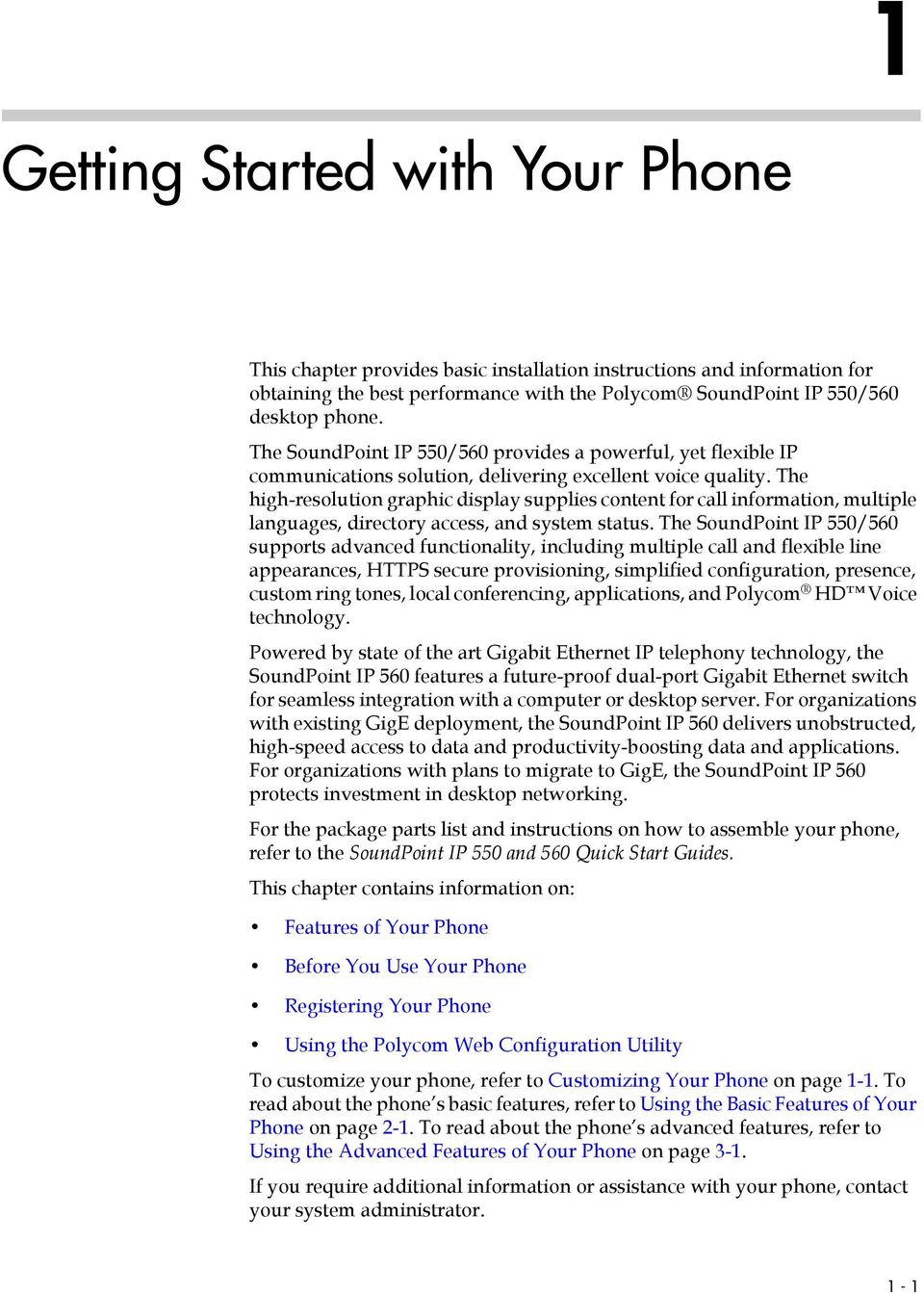
10 User Guide for the SoundPoint IP 550/560 Phone Features of Your Phone The features of your SoundPoint IP 550/560 phone are: Item Description 1 Message Waiting Indicator Alert for voice and text (instant) messages. 2 Arrow Keys Scroll through displayed information. Select a field of displayed data. Delete displayed data. 1-2

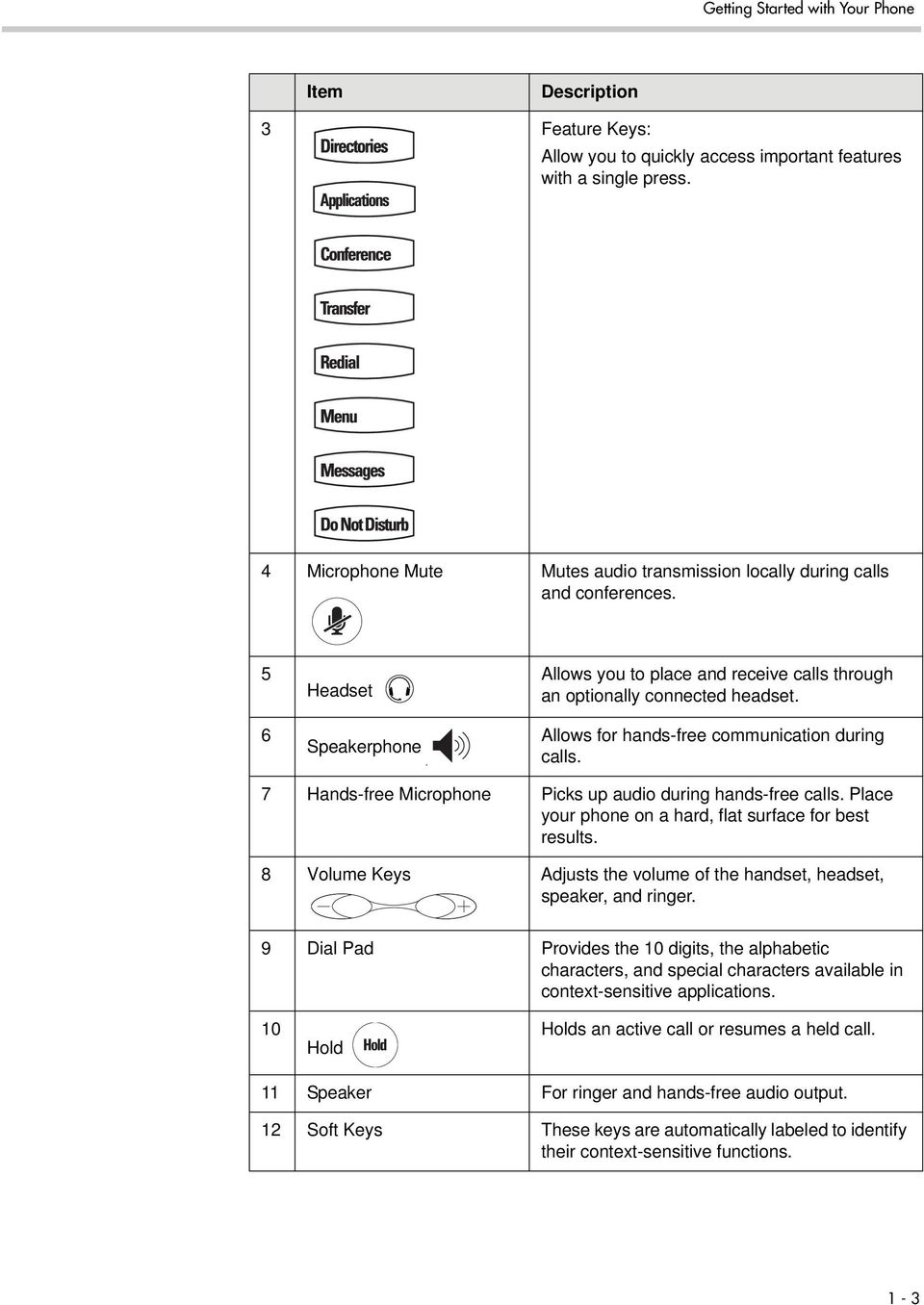
11 Getting Started with Your Phone Item Description 3 Feature Keys: Allow you to quickly access important features with a single press. 4 Microphone Mute Mutes audio transmission locally during calls and conferences. 5 6 Headset Speakerphone Allows you to place and receive calls through an optionally connected headset. Allows for hands-free communication during calls. 7 Hands-free Microphone Picks up audio during hands-free calls. Place your phone on a hard, flat surface for best results. 8 Volume Keys Adjusts the volume of the handset, headset, speaker, and ringer. 9 Dial Pad Provides the 10 digits, the alphabetic characters, and special characters available in context-sensitive applications. 10 Hold Holds an active call or resumes a held call. 11 Speaker For ringer and hands-free audio output. 12 Soft Keys These keys are automatically labeled to identify their context-sensitive functions. 1-3
12 User Guide for the SoundPoint IP 550/560 Phone Item Description 13 Color Graphic Display Shows the user interface of the phone. For more infomration, refer to Information Status on page 1-7. Associated line icons are described in the following table. 14 Line/Speed Dial Key Use these keys to activate up to four lines or speed dials that can be assigned to your phone. 15 Line Indicators Individual multi-color LEDs display the dynamic call state and remote user status (busy lamp field (BLF) and presence). The mapping is: Solid green An active call is in progress. Fast flashing green There is an incoming (ringing) call. Flashing green The call is held by the other party. Flashing red The call is on hold. Solid red The line is busy remotely (shared lines) 16 Hookswitch 1-4

13 Getting Started with Your Phone Icons associated with the line keys appear on the graphic display and represent: Icon Description Registered line (solid) Registered shared line Unregistered line (outline) Voice mail/text messages Speed dial Ringing Call in progress with HD Voice Call in progress Call Forward Held/On Hold Line Do Not Disturb Conference Presence/Busy Lamp Field (BLF) 1-5

14 User Guide for the SoundPoint IP 550/560 Phone Before You Use Your Phone This section includes information on how to navigate the phone s menus, how to enter data, and how to read the phone s information status bar. Note The background and key colors that appear on your SoundPoint IP 550/560 phone may differ from what appears in this user guide. Using the Navigation Keys To navigate menus and enter data, use these tips: Note After 20 seconds of inactivity, the menu system automatically exits to the idle screen unless an edit session is in progress. If you want to... Enter the main menu Exit a menu to the idle screen Exit a directory to the idle screen Then do this... Press Press Press Return to the previous menu Press or the Back soft key Scroll through lists and menus Press/Hold or Scroll through pages Press * to Page Up and # to Page Down. Select a menu Item Highlight the item and press or Press the dial pad key that corresponds to the number menu list (Press 2 for the second menu item) View additional soft keys Enter numbers Enter text Enter lower or upper case characters, or numbers. Press the More soft key Press the dial pad key with the corresponding number. Press the dial pad keys one or more times. To enter A, press <1> once. To enter C, press <1> three times quickly. Press the 1/A/a soft key one or more times to select upper/lower case alphanumeric mode or numeric mode (visible in the status bar). Then use the dial pad to enter numbers or text as you normally would. 1-6
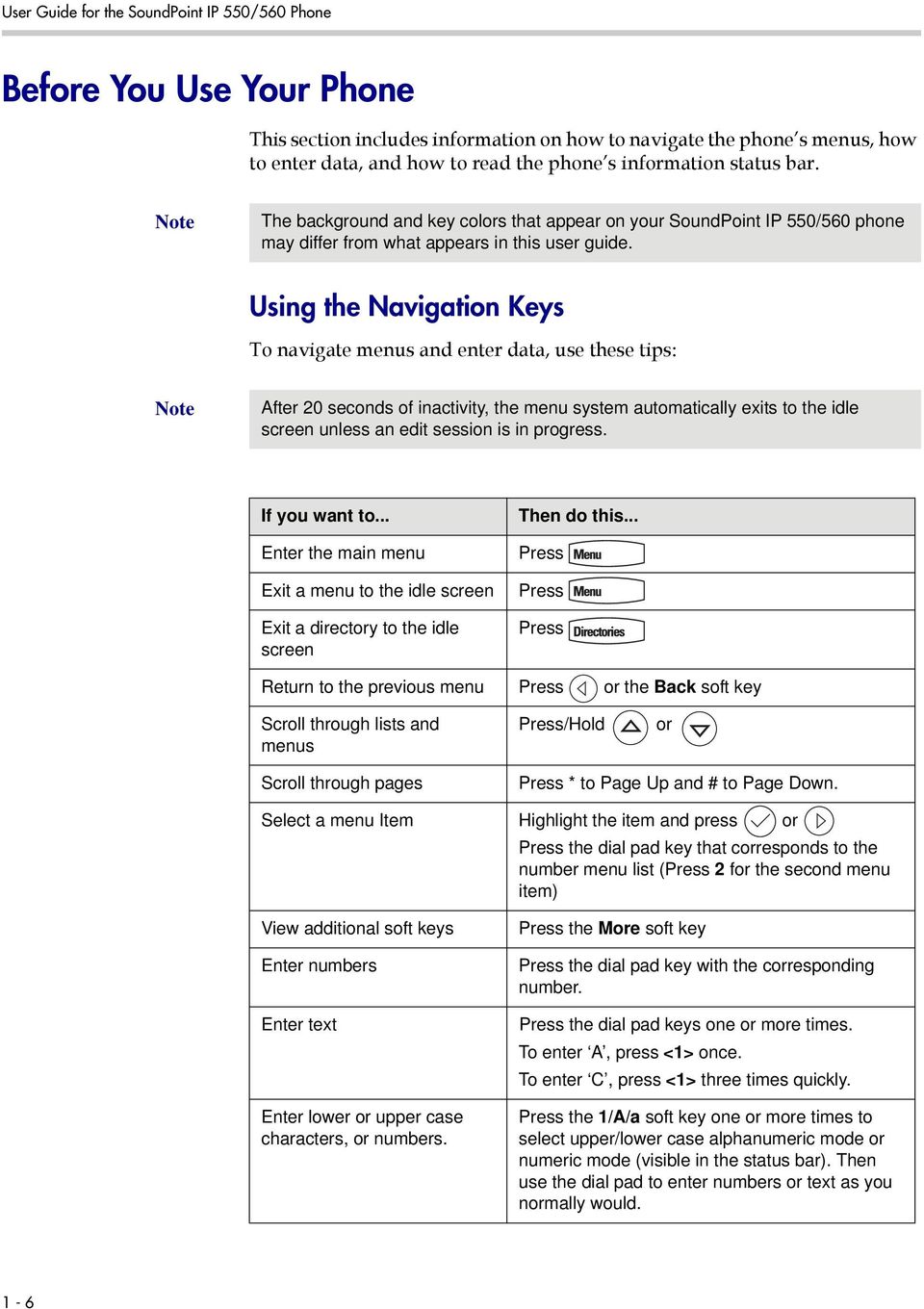
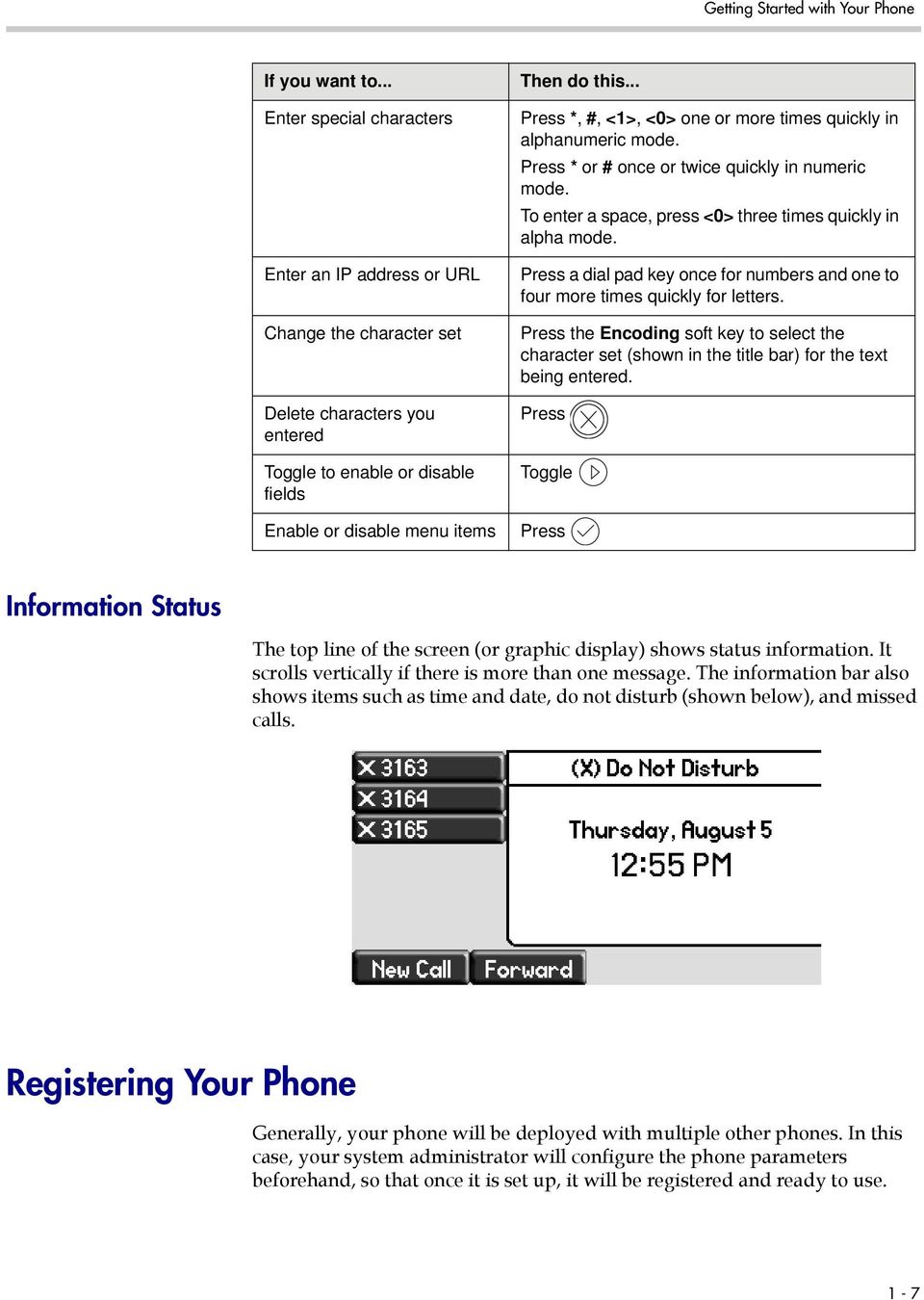
15 Getting Started with Your Phone If you want to... Enter special characters Enter an IP address or URL Change the character set Delete characters you entered Toggle to enable or disable fields Enable or disable menu items Then do this... Press *, #, <1>, <0> one or more times quickly in alphanumeric mode. Press * or # once or twice quickly in numeric mode. To enter a space, press <0> three times quickly in alpha mode. Press a dial pad key once for numbers and one to four more times quickly for letters. Press the Encoding soft key to select the character set (shown in the title bar) for the text being entered. Press Toggle Press Information Status The top line of the screen (or graphic display) shows status information. It scrolls vertically if there is more than one message. The information bar also shows items such as time and date, do not disturb (shown below), and missed calls. Registering Your Phone Generally, your phone will be deployed with multiple other phones. In this case, your system administrator will configure the phone parameters beforehand, so that once it is set up, it will be registered and ready to use. 1-7
16 User Guide for the SoundPoint IP 550/560 Phone If your phone is not part of a large deployment, it may not be registered after you set it up. Before you use your phone, you or your system administrator will have to register it. For detailed information on how to register your phone after you install it, refer to Quick Tip Registering Standalone SoundPoint IP, SoundStation IP, and Polycom VVX Phones, available from echnical_bulletins_pub.html. Using the Polycom Web Configuration Utility This user guide explains how to update phone settings from your phone, using your phone s menu system. If you want, you can update these settings remotely with the Polycom Web Configuration Utility. The phone s Web Configuration Utility enables you to view and configure phone behavior from a computer using any compatible Web browser. The utility provides a browser-friendly view of your phone s current settings. Using the utility, you can perform the same updates from your computer that you can perform using your phone s menu system. You can access the utility using any compatible Web browser. Before you begin, you ll need to know the IP address of your phone, and the user name and password login credentials of the phone user or the phone administrator. Note For detailed information on accessing, navigating, and using the utility, see the Polycom Web Configuration Utility User Guide, available from the Technical Bulletins Support page To access the Web Configuration Utility for your phone: 1 Launch the compatible Web browser from a computer on the same network as your phone. The supported browsers are: Microsoft Internet Explorer (version 7.0 and higher) Mozilla Firefox (version 3.0.X and higher) Apple Safari (version 5 and higher) Google Chrome 2 In the Address Bar of your Web Browser, enter the IP address of your phone. The IP address is four sets of numbers separated by periods. For example, if your phone s IP address is , enter in the address bar. 3 Press the Enter key. 1-8

17 Getting Started with Your Phone 4 From the Web Configuration Utility login screen, select User, and then enter the User password. Note The factory default password for a User is Click Submit. The Web Configuration Utility Home screen is displayed. 1-9

18 User Guide for the SoundPoint IP 550/560 Phone 1-10

19 2 Using the Basic Features of Your Phone Your SoundPoint IP 550/560 desktop phone is designed to be used like a regular phone on a public switched telephone network (PSTN). You call place a call, transfer a call to someone else, or conduct a conference call. At any time, at most one active call may be in progress on your phone. The active call is the one that has audio associated with it. There may be multiple other calls on hold in an Incoming call or Ringing state. This chapter provides basic operating instructions for the SoundPoint IP 550/560 phone. The topics include: Placing Calls Answering Calls Ending Calls Redialing Numbers Placing Calls on Hold Hosting Conference Calls Transferring Calls Forwarding Calls Enabling Do Not Disturb Assigning Speed Dial Keys Using Voice Mail Locking and Unlocking the Phone Logging Into Phones To customize your phone, refer to Customizing Your Phone on page 4-1. To read about the phone s advanced features, refer to Using the Advanced Features of Your Phone on page

20 User Guide for the SoundPoint IP 550/560 Phone If you require additional information or assistance with your phone, contact your system administrator. Placing Calls You can place a call using your SoundPoint IP 550/560 phone over the handset, speakerphone, or headset. You can dial the number first, and then choose the method you will use to speak to the other party. You can also search the call lists, the local contact directory or the corporate directory and dial from the search results page. For more information, refer to Managing Call Lists on page 4-13 and Managing Contacts on page You can place a call from your buddy list or privacy list if enabled. For more information on buddy and privacy lists, see Calling Your Buddies on page During a call, you can alternate between Speakerphone Hands-Free, Headset, or Handset modes by pressing the or keys, or picking up the handset. The name of the called party is displayed in the active window on the call screen. If it is too long to fit on the screen, you can press and to scroll horizontally to view the full name. The duration of calls is visible on the call screen. In the figure below, the call to Greg Slowski has lasted 30 seconds so far. 2-2

21 Using the Basic Features of Your Phone To place a call using the handset: >> Do the following steps in any order: Pick up the handset. Dial the number using the dial pad. Note You can also dial using the SIP URL or IP address. To obtain the IP address of your phone, press the Menu key, and then select Status > Platform > Phone. The IP address is listed together with other phone information. The maximum URL or IP address length is 32 characters. For example, , sip:[email protected]. Press the URL soft key and enter the URL or IP address. Use * for. and # Then press the Send soft key to complete the call. Your phone may not support SIP URL or IP address dialing. Contact your system administrator. To place a call using Hands-Free Speakerphone mode: Note If Handsfree mode disabled appears on the graphic display after you press the speakerphone key, your system administrator has disabled the speakerphone on your phone. >> Do one of the following: With the handset on-hook, press,, or the New Call soft key to obtain a dial tone. Dial the number using the dial pad. With the handset on-hook, dial the number using the dial pad. Press,, or the Dial soft key. 2-3
22 User Guide for the SoundPoint IP 550/560 Phone To place a call using the headset: >> Do one of the following: With the optional headset connected, press or the New Call soft key to obtain dial tone. Press. Dial the desired number using the dial pad. With the optional headset connected, dial the desired number using the dial pad. Press. Note If you frequently use a headset, and would like to make it the default call path, refer to Enabling Headset Memory Mode on page 4-5. Answering Calls When you receive an incoming call, the phone rings (if enabled) and shows the identification of the caller on the display. If a caller s name is too long to fit on the screen, such as Alexander Smith-Harrington s below, it will automatically scroll horizontally across the display. When you are not in another call, you can answer a call using the handset, the speakerphone, or the headset(if enabled). The steps for answering an incoming call when you are in another call are different if your phone is configured for: 2-4
23 Using the Basic Features of Your Phone A single Line Key per line Multiple Line Keys per line If your phone is configured with multiple call appearances, refer to Using Multiple Call Appearances on page 3-1 for instructions on how to answer a call. Note You can ignore incoming calls by pressing the Reject soft key (for private lines), the Silence soft key (for shared lines), or the Do Not Disturb key. Do Not Disturb mode stays active when the call ends and remains active until you press the Do Not Disturb key again. You can forward incoming calls by pressing the Forward soft key. For more information, refer to Dynamic Forwarding on page When your phone is configured with a silent ring, press the ringing Line key or the Answer soft key to answer the call. By default, if your handset is off-hook, the call is routed to it. If your handset is on-hook, the call is routed to the speaker. Answering When Not in Another Call In all cases, the active call will appear on the graphic display showing call duration and destination. To answer a call using the handset: >> Pick up the handset. 2-5
24 User Guide for the SoundPoint IP 550/560 Phone To answer a call using the Hands-Free Speakerphone: Note If Handsfree mode disabled appears on the graphic display after you press the speakerphone key, your system administrator has disabled the speakerphone on your phone. >> Do one of the following: Press. With the handset on-hook, press (next to the flashing green status indicator). Press the Answer soft key. To answer a call using the headset: >> Press. If Headset Memory Mode is activated, press Answer soft key. or the Answering When in Another Call If you have an active call, and an incoming call arrives: Regardless of line configuration: You may hear a call waiting tone. The line with the incoming call will display the incoming call icon. Press or the Hold soft key to put the original call on hold. The incoming call will be displayed at the top of the call screen and the phone will ring. Press the Answer soft key or the flashing green line key to answer the call. If your phone is configured for a single Line Key per phone line: The incoming call will be shown in the call list below the active call. Scroll down to the incoming call, and press the Answer soft key or the line key to answer it. If your phone is configured for a multiple Line Key per phone line: The line key below the active call will flash green to signal the incoming call. To see information about the caller, hold down the flashing line key for at least two seconds. 2-6
25 Using the Basic Features of Your Phone To answer the call, press the line key. If you hold the line key, you can bring up the caller s information and press the Answer soft key to answer the call. Ending Calls To end a call: >> Do one of the following: Press the End Call soft key. Replace the handset, if you are using it. If you are using a headset, press. If your are using the speakerphone, press. Press the of the active call (if enabled by your system administrator). Redialing Numbers To redial the last call placed from your phone: >> Press. A call to your most recently dialed number is attempted. To redial an older previously placed call, refer to Managing Call Lists on page
26 User Guide for the SoundPoint IP 550/560 Phone Placing Calls on Hold During a call, press the line key label. or the Hold soft key. The hold icon will display on Press again or the Resume soft key to retrieve the call. The registered line icon appears as the line indicator. Note The Hold feature typically generates music or a beeping tone. Therefore, avoid putting a conference call on hold. Use the mute button instead. Multiple Calls on Hold If multiple calls are on hold on a single Line Key, use and to switch between the calls, and then press the Resume soft key to retrieve the desired call. If more than two calls are on hold on a single Line Key, an indication appears on the graphic display, for example 2/3, indicating that this is the second call out of three calls. If calls are on hold on more than one Line Key, you can view the details of the calls on any Line Key by pressing and holding the Line Key for more than two seconds. If a Line Key is depressed for less than one second, the first call on hold on that Line Key will be retrieved. 2-8
27 Using the Basic Features of Your Phone Hosting Conference Calls You can create a conference with other parties using the phone s local conference feature. You can create a conference at any time between an active call and a call on hold (on the same or another line) by pressing the Join soft key. The conference management feature allows you to view all parties in a conference call. From the Manage Conference page, you can add, hold, remove, and mute specific conference parties. Note The conference management feature is an optional feature and may not be supported on your particular system. For more information, contact your system administrator. This section provides the following step-by-step instructions: Setting Up Conference Calls Managing Conference Calls Adding Parties to Conference Calls Joining Conferences Splitting Conference Calls Ending Conference Calls Setting Up Conference Calls To set up a conference call: 1. Call the first party. Note You can either dial the phone number directly or search for the number in the Contact Directory or Call Lists. For more information, refer to Placing Calls on page 2-2, Searching for Contacts on page 4-19, or Managing Call Lists on page
28 User Guide for the SoundPoint IP 550/560 Phone 2. Press or the Confrnc soft key to create a new call. The active call is placed on hold. Note If configured for single key-press conferences, all conference participants hear the dial tone and ringback when the conference host places a call to a new party. 3. Call the second party. 4. When the second party answers, press or the Confrnc soft key again to join all parties in the conference. Note If configured for single key-press conferences, you do not need to press the Confrnc soft key again. 5. Press or the Confrnc soft key to add another party to the conference. The first and second party are put on hold. 6. Call the third party. 7. After the third party answers, press or the press the More soft key followed by the Confrnc soft key to join all parties in the conference. 2-10
29 Using the Basic Features of Your Phone A conference similar to this one will now exist. 8. Repeat steps 5 to 7 until you have added all intended parties. Managing Conference Calls You are currently in a conference call.a screen like the one below is shown on your phone. To manage a conference call: 1. Press the Manage soft key. The Manage Conference page appears. Press the More soft key to see the Remove, Info, and Exit soft keys. 2-11
30 User Guide for the SoundPoint IP 550/560 Phone 2. Do one of the following: To add a new party, press the Add soft key. Call another party as you would using or the Confrnc soft key (outside the conference management feature). The other parties are put on hold. After the new party answers, press again to join all parties in the conference. Note The Add soft key appears only if you can add more parties to the conference call. Your system administrator determines the maximum number of conference participants. The default number is three. For more information, contact your system administrator To mute a party, select the party, then press the Far Mute soft key. The muted party can hear all parties, but no party can hear the muted party. If you press instead of the Far Mute soft key, all other parties can hear each other, but they cannot hear you. Press the UnMute soft key to un-mute the party. 2-12
31 Using the Basic Features of Your Phone To place a party on hold, select the party, and then press the Hold soft key. The held party cannot hear any parties and no party can hear the held party. Press the Resume soft key to return the party to the conference. If the held party presses on their phone, the party will remain on hold within the conference even if you press the Resume soft key. To remove a party from the conference, press the Remove soft key. The party is removed from the conference. To return the party to the conference, press the Add soft key (refer to the first optional step above). Adding Parties to Conference Calls To add a party to a conference call using the Join soft key: You are currently hosting a conference call between a number of parties. 2-13
32 User Guide for the SoundPoint IP 550/560 Phone To add a party to a conference call using the Join soft key: 1. From the Manage Conference page, press or the Hold soft key. The other parties in the conference call are placed on hold. Note If configured for local conference hold, the other parties in the conference call can continue to speak with each other while you place the new call. 2. Press the New Call soft key. 3. Place a call to a new party. 4. After the new party answers, press the Join soft key. All parties in the conference call can now hear each other. 2-14
33 Using the Basic Features of Your Phone Joining Conferences To join two conferences: Previously you set up two separate conference calls between a number of parties. Only one conference can be active at a time. >> From the idle screen, press the Join soft key. Both conferences are joined into a single five-way conference. Splitting Conference Calls To split a conference call: >> From the Active Conference page, press the More soft key, and then the Split soft key to split the conference. All calls are split into individual calls and put on hold. Ending Conference Calls To end a conference call: >> From the Active Conference page, press the End Call soft key or hang up. The other parties my or may not continue to be connected. The behavior after the conference host hangs up is configurable by your system administrator. 2-15
34 User Guide for the SoundPoint IP 550/560 Phone Transferring Calls A call can be transferred in one of three ways: Consultative transfer The party to whom you want to transfer the call answers their phone before you transfer the call or hang up. You can consult with them before completing the transfer. Refer to Performing a Consultative Transfer on page Blind transfer The call is automatically transferred after you dial the number of the party to whom you want to transfer the call. Refer to Performing a Blind Transfer on page Attended transfer The parties are automatically connected to each other after you exit the conference. Set up a conference call and then end your participation. For more information, refer to Hosting Conference Calls on page 2-9. Note Your system may be configured to end the conference when the host exits. Check with your system administrator. Performing a Consultative Transfer To transfer a call: 1. During a call, press the or the Trnsfer soft key. The active call is placed on hold. 2-16
35 Using the Basic Features of Your Phone 2. Place a call to the desired recipient of the call. Refer to Placing Calls on page 2-2 for calling methods. 3. As soon as you hear the ring-back sound or after the party answers (and you speak to the party), press or the Trnsfer soft key. You can talk privately to the party to which you are transferring the call before the transfer is completed. If you are using a handset, the transfer can be completed by putting the handset on the cradle. You can cancel the transfer before the call connects by pressing the Cancel soft key. Performing a Blind Transfer To perform a blind transfer: 1. During a call, press or the Trnsfer soft key. 2. Press the Blind soft key. 3. Place a call to the desired recipient of the call. Refer to Placing Calls on page 2-2 for calling methods. At this point, the call is connected to the number to which you are transferring them. 2-17
36 User Guide for the SoundPoint IP 550/560 Phone Forwarding Calls There are two ways to forward incoming calls to another party: Static Forwarding: Incoming calls are forwarded in special cases (before ringing, if there is no answer, or if the line is busy). Dynamic Forwarding: You can forward a call to someone else as it is ringing on your phone. All incoming calls can be forwarded to another party while Do Not Disturb is enabled on your phone. For more information, contact your system administrator. Note Call Forwarding is not available on shared lines. This feature is local to the phone, and may be overridden by call server settings. For more information, contact your system administrator. Static Forwarding To forward all incoming calls to another party: 1. From the idle screen, press the Forward soft key. 2. If multiple lines are configured on your phone, select the line to forward from the list using and. 3. Scroll to select the forwarding type you want to change, and then press the Select soft key. The options are: Always To forward all incoming calls No Answer To forward unanswered incoming calls Busy To forward calls that arrive when you are already in a call 4. Depending on your selection: 2-18
37 Using the Basic Features of Your Phone a If you selected Always, enter a number to forward all future incoming calls to. b If you selected No Answer, enter a number to forward all unanswered incoming calls to and how many rings to wait before forwarding (one ring is approximately six seconds). A value of 2 is recommended. c If you selected Busy, enter a number to forward all future incoming calls to when you are already in another call. Note You can also enter the SIP URL or IP address. For more information on using a SIP URL or IP address, refer to Placing Calls on page Select the Enable soft key to confirm call forwarding. A moving arrow appears on the line label to confirm call forwarding is enabled. 2-19
38 User Guide for the SoundPoint IP 550/560 Phone To disable call forwarding: 1. From the idle screen, press the Forward soft key. 2. If multiple lines are configured on your phone, select the line to forward from the list using and. 3. Scroll to highlight the forwarding type you want to disable and then press the Select soft key. 4. Press the Disable soft key. The idle screen returns, the regular icon appears as the line indicator. Dynamic Forwarding To forward an incoming call to another party: 1. When the phone rings, press the Forward soft key. 2. Enter a number to forward the incoming call to. 3. Press the Enable soft key. The incoming call is forwarded to the other party. If call forwarding is disabled, all future calls will not be forwarded and forwarding will remain disabled. Enabling Do Not Disturb To prevent the phone ringing (from incoming calls), you can select Do Not Disturb. Note This feature is local to the phone, and may be overridden by call server settings. For more information, contact your system administrator. 2-20
39 Using the Basic Features of Your Phone To enable Do Not Disturb: >> Press. A flashing icon and text on the graphic display indicate that Do Not Disturb is enabled. Calls received while Do Not Disturb is enabled are logged in the Missed Calls list unless configured to be forwarded to another party by your system administrator. To disable Do Not Disturb: >> Press again. Multiple Lines and Do Not Disturb If multiple lines are configured on your phone, Do Not Disturb can be set on a line-by-line basis from the menu using and if enabled by your system administrator. When Do Not Disturb is enabled for a particular line, a flashing X displays beside the line indicator. Assigning Speed Dial Keys You can associate contacts with Line Keys for single touch dialing of frequently used numbers. Speed Dial entries are consecutively placed next to assigned Line Keys on the phone. When a new entry is added to the Contact Directory, it is automatically assigned the next available speed dial index and the next available line key. 2-21
40 User Guide for the SoundPoint IP 550/560 Phone In the figure below, the phone has one line key, and speed dial keys for Byron, Lauren, and Andrew. To dial Byron, Lauren, or Andrew, press the associated line key. Note To quickly access a list of speed dial index numbers, press the Up Arrow key from the idle screen. To speed dial a contact, press the Up Arrow key followed by the contact s speed dial index. For example, if Joan s speed dial index is 55, pressing the Up Arrow key followed by 55 will place a call to Joan. Assigning New Speed Dial Keys To add or edit a speed dial index for an existing contact: 1. Press. 2. Select Contact Directory. 3. Scroll to highlight the contact. You can also use the * key to page up and the # key to page down. 4. Press the Edit soft key. 5. Do one of the following: Enter the next available speed dial index. Delete the existing speed dial index by using, and then enter a new speed dial index. 2-22
41 Using the Basic Features of Your Phone A valid speed dial index is any unused number from 1 to Press the Save soft key to accept your changes. 7. Press to return to the idle screen. To assign a new speed dial key: 1. Press and hold an unassigned. A new empty entry in the contact directory is automatically opened allowing contact information to be added. 2. (Optional.) Enter contact information. Use the 1/A/a soft key to select between numeric and upper/lower case alphanumeric modes. Use the Encoding soft key to access special characters in other languages. 3. Enter a contact number. The number must be unique (not already in the directory). 4. Change the Speed Dial Index field. The index can be any value between the next available index value and the maximum (value of 9999). Polycom recommends that you assign speed dial index values consecutively. For example, if you assign the third Line Key to the speed dial index value 2, assign the fourth Line Key to the speed dial index value Press the Save soft key to accept your changes. 6. Press to return to the idle screen. Using Voice Mail Note Voice mail is an optional feature configured on the call server and may not be supported on your particular system. For more information, contact your system administrator. Screen options may vary with your application. Voice mail may be accessible with a single key press. Contact your system administrator about this option. You can access voice mail messages from your phone (if enabled). Your voice mail is saved in a centralized location. 2-23
42 User Guide for the SoundPoint IP 550/560 Phone Your phone indicates the presence of new voice mail messages by a flashing Message Waiting Indicator LED on the front of the phone and a visual notification on the screen. If your phone has multiple lines, an individual line indicator icon indicates voice mail messages on that line. A stutter dial tone in place of normal dial tone indicates that one or more voice messages are waiting at the message center. To listen to voice messages: 1. Press. If multiple lines are configured on your phone, select the line to retrieve messages from. 2. Follow voice or visual prompts on the screen to retrieve your messages. Locking and Unlocking the Phone Note Locking your phone is a feature that your system may not support. For more information, see your system administrator. Your system administrator can set up your phone to automatically lock if it has remained idle for a certain period of time. Lock your phone to: Prevent unauthorized outgoing calls. Allow only authorized people to answer calls. Prevent people from viewing or modifying phone displays or information (for example, menus, directory lists, call records, and speed dial keys). When your phone is locked: You can only make an outgoing call to a number from a list of configurable authorized numbers. You have to enter a password to answer incoming calls. All keys and soft keys are disabled, except those that allow you to unlock the phone, make and authorized call, or redial a number. You unlock the phone by entering your user password. If your phone restarts for any reason while it is locked, it will be locked when the phone starts up again (unless your phone is configured to start up unlocked). 2-24
43 Using the Basic Features of Your Phone When your phone is locked, the messages This phone is locked and Authorized calls only scroll on the status bar. Messages that were displayed before the phone was locked do not display. About Your User Password You are assigned a user password so you can answer calls from your locked phone and unlock the phone. Changing Your User Password By default, your user password is 123. Change your user password so it is unique to your phone. To change your user password: 1. Press > Settings > Advanced. 2. From the Password screen, enter your current user password and press the Enter soft key. Note Your user password will let you see certain items in the Advanced Settings menu. To see the full Advanced Settings menu, you need to enter the administrator password. 3. From the Advanced screen, select Change User Password. 4. From the Change User Password screen, enter your password information and press the Enter key. Locking and Unlocking Your Phone You can choose how you want your phone to handle incoming calls when it is locked. You can configure your phone to either allow incoming calls, or activate Do Not Disturb when it locks. To Lock your Phone: 1. Press > Settings > Basic > Lock Phone. 2. From the Lock Phone screen, select how you want incoming calls handled when your phone is locked. Allow ringing when locked (default)- Your phone will ring if you have an incoming call. You can answer the call after entering your user password. 2-25
44 User Guide for the SoundPoint IP 550/560 Phone DND when locked - You will not receive indication of any incoming calls. Calls will go directly to voice mail (if enabled) and display in your Missed Calls list when you unlock the phone. Note Enabling DND when locked on shared lines disables ringing only. You will still see a visual notification of the call and have the option to answer it. 3. Press the Lock soft key. Your phone is locked. Note Your phone may be set up so that you can quickly lock your phone by pressing the Lock soft key from the idle screen. If you do this, however, you cannot choose how to handle incoming calls. Your phone will use the default setting (Allow ringing when locked), or the last setting you selected. To unlock your phone: 1. From the idle screen, press the Unlock soft key. 2. From the Unlock the Phone screen, enter your user password, and then press the Enter soft key. For information on your user password, including what to do if you forget it, see About Your User Password on page The phone unlocks. Calling and Answering from a Locked Phone From a locked phone, anyone can dial the standard emergency number (for example, 911), and up to five authorized numbers that an administrator can set up. You cannot call any other numbers from a locked phone. If you set up your phone so you can answer incoming calls when it is locked, you can answer calls by first entering your user password. To call an authorized number from a locked phone: >> Do one of the following: 2-26
45 Using the Basic Features of Your Phone Press the New Call soft key. From the Place an Authorized Call screen, select the number you want to call, and then press the Dial soft key. The following screen shows an example of the Place an Authorized Call screen. Note that the three speed dial keys no the left are greyed out because they are all unauthorized numbers. or Place a call to an authorized number by using the handset, headset or speakerphone. For information on using the handset, headset or speakerphone to place a call, see Placing Calls on page 2-2. The call is placed. To answer a call on a locked phone: 1. While the phone rings, press the Answer key. 2. From the Answer the Call screen, enter your password, and then press the Enter soft key. (If you press the Cancel soft key instead, the Answer the Call screen disappears and the incoming call window displays again). (For information on your user password, including what to do if your forget it, see About Your User Password on page 2-25). The call connects. Logging Into Phones If your system administrator has set up the User Login feature, you can view your personal phone settings from any phone in the organization. This means you can access your contact directory and speed dials, as well as other phone settings, even as you temporarily change work areas. If you change any settings while you re logged in to a phone, the settings are saved and displayed the next time you log in to a phone. When you log out, your personal phone settings no longer display. 2-27
46 User Guide for the SoundPoint IP 550/560 Phone You can log in to a phone by entering your user ID and password. Default passwords are preset at the factory to the numerals 123. Note If a phone is in the logged out state and requires a user login, you may be able to use the phone to place emergency calls to standard emergency numbers (such as 911) and other pre-configured phone numbers. These numbers are configured by your administrator. For information on how to place authorized calls, see Placing Calls from Phones that are in the Logged Out State on page 40. If the User Login feature is set up on your organization s phones, you ll need to know how to: Log in to a phone to access your personal phone settings. Log out of a phone after you finish using it. Place a call to an authorized number from a phone that is in the logged out state and requires a user login. Change your user password. Logging In and Out of a Phone Depending if the User Login feature is enabled and required, you may or may not have to log in to the phone to use it. However, if you want to see your personal phone settings from the phone, you ll have to log in. If you don t log in, you ll see the phone s default phone profile. While logged in, you ll have full access to your personal phone settings and your contact directory. After you log out of the phone, you ll no longer be able to view this information on the phone. After you use a phone, be certain to log out of the phone to prevent access to your personal settings. To log in to a phone: 1 If the User Login screen is in view, go to step 2. If the User Login screen isn t in view, do one of the following: Press the Log in soft key. Press the Menu key, then select Features > User Login > Log in. 2-28
47 Using the Basic Features of Your Phone The User Login screen displays, as shown next. 2 Enter your user ID and user password, then press the Log in soft key. If your login credentials are accepted, the phone updates to display your personal phone profile, and the home screen displays, as shown next. If you don t know what your user ID and password are, ask your system administrator. Default passwords are preset at the factory to the numerals 123. However, your system administrator may have changed this for security reasons. If your credentials are not accepted, the message User login failed is displayed, and the User Login screen displays again. If you need to confirm your credentials, ask your system administrator. To log out of a phone: 1 From the home screen, do one of the following: Press the Log out soft key. Press the Menu key, then select Features > User Login > Log out. 2-29
48 User Guide for the SoundPoint IP 550/560 Phone The Logout screen displays with a confirmation message, as shown next. 2 Press the Yes soft key. Your personal profile is no longer accessible, and the phone displays either the User Login screen for the next user login, or the default phone profile for anonymous users. Placing Calls from Phones that are in the Logged Out State If a phone doesn t require a user login, you can use the phone to place calls to any number, even though the phone may be in the logged out state. If a phone requires a user login, you may be able to place calls to authorized numbers when the phone is in the logged out state. If your system administrator has set up emergency numbers on the phone, you can place calls to the standard emergency number (for example, 911) and up to five other authorized numbers. You won t be able to call any other numbers until you log in to the phone. To place a call to an authorized number from a phone in the logged out state: 1 Press the New Call soft key. The Place an Authorized Call screen displays, as shown next. 2 Select the number you want to call, then press the Select soft key or the Dial key. The call is placed. 2-30
49 Using the Basic Features of Your Phone Changing Your User Password You can change your password from any phone that you re logged in to. Note By default, user passwords are factory preset to the numerals 123. Your administrator can change this default password if needed. Polycom recommends that you change your password when you first log in to a phone. Your user ID is managed only by your administrator, meaning you cannot change it yourself. To change your user password: 1 Log in to any phone on your network. 2 From the home screen, press the Menu key, then select Features > User Login > Change User Login Password. The Change User Login Password screen displays, as shown next. 3 Enter your old password and your new password twice, and then press the Enter soft key. The User password changed message displays. Your password is changed. The next time you log in to a phone, you ll need to enter this password. 2-31
50 User Guide for the SoundPoint IP 550/560 Phone 2-32
51 Using the Advanced Features of Your Phone 3 This chapter provides operating instructions for the advanced features of the SoundPoint IP 550/560 phone. The topics include: Using Multiple Call Appearances Using Text Messaging Using Buddy Lists Broadcasting Messages Using Push-to-Talk and Group Paging Accessing Features with Your Login Credentials Updating Your Phone s Configuration Restarting Your Phone To customize your phone, refer to Customizing Your Phone on page 4-1. To read about the phone s basic features, refer to Using the Basic Features of Your Phone on page 2-1. If you require additional information or assistance with your new phone, contact your system administrator. Using Multiple Call Appearances When multiple call appearances is set up, you can see information for more than one call at one time. For example, if you have an active call, you can see information for an incoming call as well. 3-1
52 User Guide for the SoundPoint IP 550/560 Phone For example, the following figure shows an active call with Lauren Gates on line The following figure shows an incoming call from Jack Jones on the same line. To answer an incoming call when configured for multiple call appearances: >> Do one of the following: Press or the Hold soft key to place the original call on hold. Press to access the new call. Answer the incoming call. This original call is placed on hold and the incoming call becomes the active call. 3-2
53 Using the Advanced Features of Your Phone Your phone can display two call appearances at one time. If more than two calls are taking place on the same line, a counter displays on the display. Use the down arrow to access additional calls, or call appearances. To place an additional call on the same line, place the active call on hold, and then press the New Call soft key. Using Text Messaging You can send and receive text messages using your phone. SIP Instant (Text) Messaging is supported in real-time. Received messages will be indicated by a flashing Message Waiting Indicator LED on the front of the phone and, optionally, a visual notification on the graphic display. Note The text messaging feature is an optional feature and may not be supported on your particular system. If it is supported, screen options may vary with your application. Text messaging may be accessible with a single key press. For more information, contact your system administrator. To read text messages: 1. Do one of the following steps: Press. Select Instant Messages. Press. Select Features > Messages > Instant Messages. Press the InstMsg soft key. 2. If multiple lines are configured on your phone, select from which line messages are to be retrieved from the list using and. The newest messages are displayed first in the list. 3. (Optional.) Do one of the following: Press the Next or Prev soft keys to cycle through messages in order. Press the More soft key to access the Delete, Reply, and New soft keys. 4. Press to return to the idle screen. 3-3
54 User Guide for the SoundPoint IP 550/560 Phone To send a text message: 1. Do one of the following: Press. Select Instant Messages. Note Screen options may vary with your application. Voice Mail may be accessible with a single key press. Contact your system administrator about this option. Press. Select Features > Messages > Instant Messages. 2. If multiple lines are configured on your phone, first select from which line to send the message from the list using and. 3. Press the New soft key. 4. Enter the number. Use the 1/A/a soft key to alternate between numeric and upper/lower case alphanumeric modes. Note You can also enter the SIP URL or IP address. For more information on using a SIP URL or IP address, refer to the instructions for using the handset in Placing Calls on page Press the Ok soft key. 6. Do one of the following: Press the Select soft key to choose from various pre-scripted short messages. Press the Edit soft key to compose a custom message. Use dial pad keys to cycle through the character set. Use keys 1, *, 0, and # to select special characters. 7. Press the Send soft key to send the message. 8. Press to return to the idle screen. 3-4
55 Using the Advanced Features of Your Phone Using Buddy Lists A buddy list is a list of users/devices whose status, or presence, you can monitor. Users update their presence setting (for example, Be right back, Busy, or Out to lunch ), and you can view their status in real-time from your phone. Your phone can watch the status of up to eight other phones or 48 buddies. These other phones form your buddy list. Your phone displays the status of your buddies in real time. Your phone can be watched by up to eight other phones. If your SoundPoint IP 550/560 phone is configured to work with Microsoft Live Communications Server 2005, the behavior of the presence setting and buddy lists is different. For more information, refer to Integrating With Microsoft Live Communications Server 2005 on page 3-7. If your phone is configured to work with Microsoft Lync Server 2010, the behavior of the presence setting and buddy lists is different. For more information, refer to Integrating With Microsoft Lync Server 2010 on page 3-8. Updating Your Presence Settings To view and change your presence settings: 1. Do one of the following: Press. Select Features > Presence > My Status. Press the MyStat soft key. 2. Scroll through the list, and then press the Select soft key to select your new status. The phones watching your status will now display your new status. Presence information will also be sent to watching phones when you go off-hook or enable Do Not Disturb. 3-5
56 User Guide for the SoundPoint IP 550/560 Phone Managing Buddies Manage your buddies by selecting the contacts whose presence you want to monitor. These contacts form your buddy status list. You add contacts to your buddy status list from your contact directory. Note If your call server is Microsoft Live Communications Server 2005, refer to Integrating With Microsoft Live Communications Server 2005 on page 3-7. If your call server is Microsoft Lync Server 2010, refer to Integrating With Microsoft Lync Server 2010 on page 3-8. To add or delete a contact from your buddy list: 1. Press. 2. Select Contact Directory. 3. Scroll to highlight the contact. You can also use the * key to page up and the # key to page down. 4. Press the Edit soft key. 5. Scroll to the Watch Buddy field. 6. Toggle to select Enabled. If Watch Buddy is enabled, the contact is added to your buddy list. If disabled (default), the contact is removed from your buddy list. 7. Press the Save soft key to accept your changes. 8. Press to return to the idle screen. To block or unblock a contact from your buddy list: 1. Press. 2. Select Contact Directory. 3. Scroll to highlight the contact. You can also use the * key to page up and the # key to page down. 4. Press the Edit soft key. 5. Scroll down to the Block Buddy field. 6. Toggle to select Enabled. If Block Buddy is enabled, the contact cannot watch your phone. If disabled (default), the contact can watch your phone. 7. Press the Save soft key to accept your changes. 3-6
57 Using the Advanced Features of Your Phone 8. Press to return to the idle screen. Integrating With Microsoft Live Communications Server 2005 Your system administrator can configure your phone to work with Microsoft Live Communications Server 2005 and communicate with others using Microsoft Office Communicator and Windows Messenger. From your phone, you can invite, join, control, and monitor integrated multipoint audio and video conferences. Any contacts you add through your buddy list will appear as contacts in Microsoft Office Communicator and Windows Messenger. Any contacts you add in Microsoft Office Communicator and Windows Messenger will appear in your buddy list. To view and change your presence, refer to Updating Your Presence Settings on page 3-5. For more information, contact your system administrator. To add a contact to your buddy list: 1. Press. 2. Select Features > Presence > Buddy Status. 3. Press the More soft key. 4. Press the Add soft key. 5. Enter the number of the contact. 6. Press the Submit soft key. 7. Press to return to the idle screen. To view and change your privacy list: 1. Press. 2. Select Features > Presence > Buddy Status > Privacy List. 3. Scroll through the list to find the contact. 4. Press the Edit soft key. 5. Scroll down to the Access field. 3-7
58 User Guide for the SoundPoint IP 550/560 Phone 6. For Access, toggle to select Enabled. When enabled, you are allowing the contact to see your presence. When disabled (default), you are not allowing the contact to see your presence. 7. Press to return to the idle screen. Integrating With Microsoft Lync Server 2010 Your system administrator can configure your phone to work with Microsoft Lync Server 2010 and communicate with others using Microsoft Lync. From your phone, you can invite, join, control, and monitor integrated multipoint audio and video conferences. Any contacts added through your buddy status list will appear as a contact in Microsoft Lync. Any contacts added as a contact in Microsoft Lync will appear in your buddy status list. To view and change your presence, see Updating Your Presence Settings on page 3-5. For more information on integrating with Microsoft Lync Server 2010, contact your system administrator. Note Your login credentials will be set up by your system administrator so your phone is authorized to communicate with Microsoft Lync Server If you have any issues with your login credentials, refer to Restarting Your Phone on page Adding Buddies To add a contact to your buddy list: 1. Do one of the following: a Press, and select Features > Presence > Buddy Status. b Press the Buddies soft key. 2. Do one of the following: If the buddy list is empty, press the Add key. If the buddy list is not empty, press the More soft key, and then the Add soft key. 3. Enter the desired contact name and press the Submit soft key. You can also delete a contact from your buddy list. To place a call to a buddy, see the next section, Calling Your Buddies or the Microsoft Lync documentation. 3-8
59 Using the Advanced Features of Your Phone Calling Your Buddies To place a call from your buddy list: 1. Do one of the following: a Press, and select Features > Presence > Buddy Status. b Select the Buddies soft key. 2. Scroll to desired buddy in the list. 3. Press the Dial soft key or lift the handset. Broadcasting Messages Using Push-to-Talk and Group Paging The Group Paging and Push-to-Talk (PTT) features enable you to broadcast a message to as many people as have subscribed to a channel or have been placed in a group. Your system administrator can set up both features on your phone. Group Paging mode enables you to broadcast a one-way announcement to people subscribed to a paging group. The people receiving the announcement can t respond to the message. PTT mode enables you to broadcast a message to people subscribed to a channel. The people receiving the message can respond to the message by broadcasting a message over the same channel. In this way, PTT is a collaborative broadcast mode. Your system administrator can define up to 25 Paging Groups (for Group Paging mode) or Channels (for PTT mode). Your system administrator may assign a label to each group or channel that easily identifies the phones in the group or channel (for example, All, HR Dept, Shipping Staff, or Executives). Each group or channel will have one of the following priorities: Normal (for Groups/Channels 1-23) Broadcasts sent to Groups/Channels 1 to 23 are considered Normal broadcasts. When a phone receives more than one Normal broadcast, the first broadcast received is accepted, and all others are ignored (not played and not stored). By default, all phones receive broadcasts sent to Group/Channel 1. Priority (for Group/Channel 24) Broadcasts sent to Group/Channel 24 are considered Priority broadcasts. All phones receive Priority broadcasts unless Do Not Disturb is enabled. If a phone receives a Priority broadcast while an Emergency broadcast is already playing, the Priority broadcast is 3-9
60 User Guide for the SoundPoint IP 550/560 Phone placed on hold. Phones play Priority broadcasts at the phone s current audio level. Emergency (for Group/Channel 25) Broadcasts sent to Group/Channel 25 are considered Emergency broadcasts. All phones receive Emergency broadcasts (even if Do Not Disturb is enabled), and play them immediately. By default, phones play Emergency broadcasts at the highest audio level. The audio level will return to normal for subsequent non-emergency broadcasts. Push-to-Talk Mode Your phone may be enabled to operate in a broadcast mode called Push-to-Talk (PTT). In PTT mode, you broadcast messages on a specific channel. In order to send and receive PTT broadcasts on certain channels, you have to subscribe to those channels. PTT broadcasts are collaborative: you can transmit messages and listen to replies. Sending and Receiving PTT Broadcasts To send and receive PTT broadcasts, you need to subscribe to certain channels. By default, you re subscribed to Channels 1, 24 (the Priority channel), and 25 (the Emergency channel). This means that: You can send PTT broadcasts on Channels 1, 24, and 25. You ll receive PTT broadcasts sent on Channels 1, 24, and 25. When you end a PTT broadcast, the channel remains open and enters a waiting period. This waiting period gives people who received the broadcast a chance to respond. If no one responds within the waiting period, the channel closes. Sending PTT Broadcasts If you send a PTT broadcast without specifying a channel, it s automatically transmitted on the default channel. Channel 1 is the default channel that all broadcasts transmit on, if no channel is specified for a broadcast. You can change your default channel to any channel you want (see Updating the Default Channel on page 3-14). If you change your default channel, you ll become subscribed to that channel automatically. To subscribe to a channel, see Updating Channel Subscriptions on page 3-15). 3-10
61 Using the Advanced Features of Your Phone To send a PTT broadcast: 1. Press the Talk soft key to select a channel to broadcast on. Note To automatically send a PTT broadcast on the default channel, press and hold the Talk soft key, and then go to step From the PTT Channels List screen, select the channel to send the broadcast on (as shown next). The list displays the default channel, the most recent channel you sent a broadcast on, and other channels you can broadcast on. In the above example, the default channel is 1, the recent channel is 1, the Emergency channel is 25, and the Priority chnnael is
62 User Guide for the SoundPoint IP 550/560 Phone 3. To start the broadcast, press and hold the Talk soft key. (You need to press the Talk soft key throughout the entire broadcast.) You ll hear a transmitting beep, and then the phone displays the channel you are using ( To:Teachers (Channel 18), as shown next). 4. Start talking. Note If you release the Talk soft key while you re sending the broadcast, the broadcast temporarily stops and enters a 10 second Waiting period. During this period, the channel remains open to give people a chance to reply. At any time during the waiting period, you can resume your broadcast by pressing and holding the Talk soft key. If no one broadcasts during the waiting period, the channel closes and the broadcast ends. 5. When you finish your broadcast, do one of the following: Release the Talk soft key. The broadcast temporarily stops and enters a 10-second waiting period to allow others to reply, or you to resume the broadcast. If no one responds during a waiting period, the channel closes and the broadcast ends. Press the End PTT soft key. The broadcast temporarily stops and enters a 10-second waiting period to allow others to reply. If there are no replies, the channel closes and the braodcast ends. After you tap the End PTT soft key, you can immediately initiate another broadcast on another channel, even if the previous broadcast is still in its waiting period. Receiving PTT Broadcasts To receive a broadcast sent on a particular channel, you need to be subscribed to that channel. To subscribe to a channel, see Updating Channel Subscriptions on page How you receive a PTT broadcast depends on the broadcast priority, whether you re in an active call, or if you re allowed to receive broadcasts during active calls. 3-12
63 Using the Advanced Features of Your Phone You ll receive broadcasts on the channels you re subscribed to as well as Channel 24 (the Priority channel) and Channel 25 (the Emergency channel). If you ve enabled Do Not Disturb on your phone, you ll only receive Emergency broadcasts. Non-emergency broadcasts won t display or play on your phone. When a broadcast ends, your phone emits an end of transmission beep and enters a 10 second waiting period. During this period, you can respond to the broadcast (see Replying to PTT Broadcasts on page 3-13). Receiving PTT Broadcasts When You re Not in an Active Call If you receive a broadcast and you re not in an active call, the broadcast displays in the center of your screen and immediately plays, regardless of the broadcast priority. Receiving PTT Broadcasts During Active Calls How you handle a broadcast when you re in an active call depends on the broadcast priority and if you re allowed to receive a broadcast when you re in an active call. If the broadcast isn t a Priority or Emergency page: If your phone is allowed to receive broadcasts during active calls, the broadcast displays in the inactive call group as an active broadcast (as shown next) and immediately plays. You ll hear both the original call and the broadcast. To listen to only the broadcast, hold or end the call. If your phone isn t allowed to receive broadcasts during active calls, the broadcast displays in the inactive call group as a held broadcast, as shown next. To listen to the broadcast, hold or end the call or press the Accept soft key. If it s a Priority or Emergency broadcast, the broadcast displays in the inactive call group as an active broadcast and immediately plays. You ll hear both the original call and the broadcast. To listen to only the broadcast, hold or end the call. Replying to PTT Broadcasts When a broadcast ends, you have a chance to respond to it before the channel closes. When a broadcast ends, the broadcast enters a 10 second waiting period (as shown next). During this period, the channel remains open to receive or send additional broadcasts. During a waiting period, you can press and hold the Talk soft key and talk to all the people listening on the channel. When you finish talking, release the Talk soft key. The broadcast will enter another waiting period until someone broadcasts again. If no activity occurs within the waiting period, the channel closes and no more broadcasts can take place. 3-13
64 User Guide for the SoundPoint IP 550/560 Phone Ending PTT Broadcasts You can end a PTT broadcast by releasing the Talk soft key, or by tapping the End PTT soft key. After you end a broadcast, the channel remains open so others can respond. If you release the Talk soft key without pressing the End PTT soft key: You can resume the broadcast by pressing and holding the Talk soft key (if the broadcast is in a wait period). You can t initiate another broadcast on another channel until the waiting period ends. If you press the End PTT soft key: You can t resume the broadcast by pressing and holding the Talk soft key. You can immediately initiate another broadcast on another channel. Adjusting the Volume of PTT Broadcasts You can adjust the volume of PTT broadcasts while they play. During a broadcast, press either Volume Up or Volume Down to raise or lower the volume of the broadcast. If you adjust the volume of a non-emergency broadcast, your phone retains the adjusted volume for all subsequent non-emergency broadcasts. However, even though you can adjust the volume of an Emergency broadcast, the adjusted volume won t be retained for subsequent Emergency broadcasts. All Emergency broadcasts play at the same volume, until you adjust it. Changing Where Broadcasts are Played While you send a broadcast, you can pick up the handset or press the Speakerphone or the Headset key and continue speaking. You can also press the Microphone Mute key to mute your audio so that the people receiving your broadcast won t hear anything. This behavior is similar to a phone call. When you listen to a broadcast, you can pick up the handset or press Speakerphone or the Headset key and continue listening to the broadcast. Updating the Default Channel If you don t select a channel to broadcast on, your broadcast will automatically transmit on the default channel, Channel 1. If you want, you can change the default channel. The default channel is automatically used when you initiate a broadcast by pressing and holding the Talk soft key. 3-14
65 Using the Advanced Features of Your Phone To update the default channel: 1. Press, then select Settings > Basic > Preferences > Paging/PTT Configuration > PTT Push to Talk. 2. Press the Edit soft key. 3. Enter the new default channel. 4. Press the Ok soft key. Updating Channel Subscriptions You can subscribe to any channel that has been enabled by the system administrator and appears in your channels list. When you subscribe to a channel, you can send and receive PTT broadcasts on that channel. To subscribe to additional PTT channels: 1. Press, then select Settings > Basic > Preferences > Paging/PTT Configuration > PTT Push to Talk. 2. From the PTT Channel Configuration screen, use the down arrow key to locate Channels Subscriptions, then press the Select soft key. 3. From the Channels Subscriptions screen, use the down arrow key to select a channel to subscribe to, then press the Edit soft key. 4. Use the left or right arrow keys to select Yes, then press the Ok soft key. By default, you re subscribed to Channels 1, 24, and 25. Allowing PTT Broadcasts to Play During Active Calls The Accept While Busy option allows PTT broadcasts to come in as active calls (if enabled) or held calls (if disabled). If enabled, a PTT broadcast will interrupt telephone calls and you ll hear the audio of both the telephone call and the PTT broadcast. The party on the other end of the telephone call cannot hear the PTT broadcast unless that party has also enabled Accept While Busy. If disabled, PTT broadcasts are held during an active call. To hear the broadcast, you have to resume the broadcast. To allow or disallow PTT broadcasts to play during an active call: 1. Press, then select Settings > Basic > Preferences > Paging/PTT Configuration > PTT Push to Talk. 3-15
66 User Guide for the SoundPoint IP 550/560 Phone 2. From the PTT Channel Configuration screen, use the down arrow key to locate Accept While Busy, then press the Select soft key. 3. From the Accept While Busy screen, use the left or right arrow key to select Enabled or Disabled, then press the Ok soft key. The default setting is Disabled. When enabled, your phone will accept and play broadcasts while you re in an active call. When disabled, your phone won t play broadcasts while you re in a call, but will hold them instead. Group Paging Mode Your phone may be enabled to operate in a broadcast mode called Group Paging mode. In this mode, you broadcast one-way announcements to a specified group of phones, called a Paging Group. In Group Paging mode, users must subscribe to Paging Groups to send and receive pages. Sending and Receiving Pages To send and receive pages, you need to subscribe to certain Paging Groups. By default, you re subscribed to Paging Groups 1, 24, and 25. This means that: You can send pages to Paging Groups 1, 24, and 25. You ll receive pages sent to Paging Groups 1, 24, and 25. Sending Pages By default, when you send a group page, it s automatically sent to Paging Group 1. This is your default paging group. You can change your default paging group to any group you want (see Updating the Default Paging Group on page 3-19). If you change your default paging group, you ll become subscribed to that paging group automatically. To subscribe to a paging group, see Updating Paging Group Subscriptions on page To send a page: 1. To send a page, press the Paging soft key. 3-16
67 Using the Advanced Features of Your Phone Note To automatically send a page to the default paging group, press the Paging soft key. 2. From the Paging Groups List screen, select the paging group to send the page to (as shown next). The list displays the default paging group, the most recent group you paged, and other paging group that you can page. In the above example, the default paging group is Group 6, the recent paging group is Group 1, the Priority group is 24, and the Emergency group is To start the page, press the Page soft key. Just before the page starts, you ll hear an alert tone, and then the page starts (as shown next). 4. Start talking. 5. To end the page, press the End Page soft key. Receiving Pages To receive a page sent to a particular paging group, you need to be subscribed to that group. To subscribe to a paging group, see Updating Paging Group Subscriptions on page How you receive a page depends on the priority of the page, whether you re in an active call, or if you re allowed to receive a page during an active call. 3-17
68 User Guide for the SoundPoint IP 550/560 Phone You ll receive pages on the paging groups you re subscribed to as well as Group 24 (Priority pages) and Group 25 (Emergency pages). If you enabled Do Not Disturb, you ll only receive Emergency pages. Non-emergency pages won t display or play on your phone. Receiving Pages When You re Not in an Active Call If you receive a page and you re not in an active call, the page displays in the center of your screen and immediately plays, regardless of the paging priority. While a page plays, you can: Hold the page. End the page. This ends the page at your phone only. Place a new call. Receiving Pages During Active Calls How you handle a page when you re in an active call depends on the page priority and if you re allowed to receive a page when you re in an active call. If the page isn t a Priority or Emergency page: If your phone is allowed to receive pages during active calls, the page displays in the inactive call group as an active page and immediately plays. You ll hear both the original call and the page. To hear only the page, hold or end the call. If your phone isn t allowed to receive pages during active calls, the page displays in the inactive call group as a held page. To listen to the page, select the page appearance and press Accept soft key. The active call will be held. If it s a Priority or Emergency page, the page displays in the inactive call group as an active page and immediately plays. You ll hear both the original call and the page. To hear just the page, hold or end the call. Adjusting the Volume of Pages You can adjust the volume of pages while they play. During a page, press either Volume Up or Volume Down to raise or lower the page volume. If you adjust the volume of a non-emergency page, your phone will use the adjusted volume for subsequent non-emergency pages. However, if you adjust the volume of an Emergency page, your phone won t use the adjusted volume for subsequent Emergency pages. All Emergency pages play at the same volume, until you adjust it. Changing Where Pages are Played While you send a page, you can pick up the handset or press Speakerphone or the Headset key and continue speaking. You can also press the Microphone Mute key to mute your audio so that the people receiving your page won t hear anything. This behavior is similar to a phone call. 3-18
69 Using the Advanced Features of Your Phone An incoming page plays from the speakerphone by default. If you lift the handset or press the Headset key, you ll hear a dial tone. Note Your system administrator can change your phone s configuration so that you can change where the page plays: the speakerphone, headset, or handset. Updating the Default Paging Group If you don t select a group to send your pages to, your page will automatically go to the default paging group, Group 1. If you want, you can change the default paging group. To update the default Paging Group: 1. Press, then select Settings > Basic > Preferences > Paging/PTT Configuration > Group Paging. 2. From the Group Paging Configuration screen, press the Edit soft key. The default paging group is Enter the number of the new default paging group, then press the Ok soft key. Updating Paging Group Subscriptions By default, you re subscribed to Paging Groups 1, 24, and 25. This means that you can send pages to and receive pages sent to these groups. You can change which groups you are subscribed to. However, you can t disable your subscriptions to Paging Groups 24 and 25. To update your Paging Group subscriptions: 1. Press, then select Settings > Basic > Preferences > Paging/PTT Configuration > Group Paging. 2. From the Group Paging Configuration screen, use the down arrow key to locate Groups Subscriptions, then press the Select soft key. 3. From the Group Subscription screen, use the down arrow key to select a group to subscribe to, then press the Edit soft key. For example, you may want to enable subscriptions to Paging Group 6, so you ll be able to send pages to, and receive pages sent to, this group. 4. Use the left or right arrow keys to select Yes, then press the Ok soft key. By default, you re subscribed to Channels 1, 24, and
70 User Guide for the SoundPoint IP 550/560 Phone Allowing Pages to Play During Active Calls The Accept While Busy option allows pages to come in as active calls (if enabled) or held calls (if disabled). If enabled, a page will interrupt telephone calls and you ll be able to hear the audio of both the telephone call and the page. The party on the other end of the telephone call cannot hear the page unless that party has also enabled Accept While Busy. If disabled, pages are placed on hold during an active call. To hear the page, select the page, and then resume it. To allow or disallow pages to play during an active call: 1. Press, then select Settings > Basic > Preferences > Paging/PTT Configuration > Group Paging. 2. From the Group Paging Configuration screen, use the down arrow key to locate Accept While Busy, then press the Edit soft key. 3. From the Accept While Busy screen, use the left or right arrow key to select Enabled or Disabled, then press the Ok soft key. The default setting is Disabled. When enabled, your phone will accept and play pages while you re in an active call. When disabled, your phone won t play pages while you re in a call, but will hold them instead. Accessing Features with Your Login Credentials If your phone is set up to integrate with Microsoft Lync, your system administrator has assigned you login credentials-a domain, user name, and password-that your phone requires to access the feature. If there is a problem with your login credentials, you won't be able to access the feature on your phone. When your phone has incorrect login credentials, the message Login Credentials failed. displays on the screen. You must re-submit your login credentials. 3-20
71 Using the Advanced Features of Your Phone To re-submit or enter your login credentials: 1. Press, then select Settings > Basic> Login Credentials. The Login Credentials Domain screen displays. 2. Enter the domain, user name, and password, then press the Submit soft key. Updating Your Phone s Configuration Your phone can often accept a new configuration without requiring a restart. To update the phone s configuration: 1. Press. 2. Select Settings > Basic > Update Configuration. Are you sure? appears on the screen. 3. If you still want to update the configuration, press the Yes soft key. The configuration is updated. On occasion, your phone may restart depending on which configuration parameters have changed. 4. If the phone did not restart, press to return to the idle screen. Restarting Your Phone In rare cases, your system administrator may ask you to restart your phone to assist in troubleshooting. It is sometimes possible to restore normal operation to a malfunctioning phone without restarting it. Your system administrator may want to perform diagnostics on the phone before restarting it, contact them before restarting the phone and losing current status information. 3-21
72 User Guide for the SoundPoint IP 550/560 Phone Note Do not restart your phone to upload a new configuration. Instead, refer to Accessing Features with Your Login Credentials on page Note Call lists are automatically cleared when you restart the phone. To restart the phone: 1. Press. 2. Select Settings > Basic > Restart Phone. Are you sure? appears on the screen. 3. If you still want to restart your phone, press the Yes soft key. The restart process begins. The process ends when the idle screen appears. 3-22
73 4 Customizing Your Phone You can customize your Polycom SoundPoint IP 550/560 desktop phone by adjusting settings such as: time and date, display contrast, and ring type. You can add contacts to the phone s directory manually or from call lists. You can handle incoming calls from different contacts in different ways. This chapter provides basic operating instructions for customizing your SoundPoint IP 550/560 phone. The topics include: Configuring Basic Settings Managing Call Lists Managing Contacts Managing Incoming Calls Some customizations of your SoundPoint IP 550/560 phone are performed by your system administrator. For more information about these customizations, refer to System Customizations on page If you require additional information or assistance with your phone, contact your system administrator. Configuring Basic Settings You can configure basic settings such as appearance of the time and date, display contrast, backlight intensity, headset memory mode, headset hookswitch selection, ring type, audible ringer, language support localization, background pattern and soft key label color through the phone s menu. Changing the Appearance of the Time and Date The time and date appears on the graphic display of the SoundPoint IP 550/560 phone. If the phone cannot obtain a time and date from the call server, the display will flash. Contact your system administrator if either the time or date is incorrect. 4-1
74 User Guide for the SoundPoint IP 550/560 Phone You can select from various formats for the time and date display. You can also disable the time and date so they do not display on the phone. To configure the time and date formats: 1. Press. 2. Select Settings > Basic > Preferences > Time & Date. 3. Select from Clock Date, Clock Time (shown below), Clock Order, or Enable/Disable. 4. Scroll through the options under each of these selections. 5. Press the Select soft key to confirm your choice. 6. Press to return to the idle screen. Changing the Display Contrast To adjust the contrast on the phone display: 1. Press. 4-2
75 Customizing Your Phone 2. Select Settings > Basic > Contrast. 3. Press the Up or Down soft keys, or the volume keys, to increase or decrease the display contrast. 4. Press the Ok soft key to accept your changes. 5. Press to return to the idle screen. Changing the Backlight Intensity Backlight intensity on the SoundPoint IP 550/560 phone has three components: Backlight On Backlight Idle Maximum Intensity You can modify the Backlight On Intensity and the Backlight Idle Intensity separately. You can choose a high, medium, or low intensity, or turn the backlight off entirely. When you modify the Maximum Intensity, you are modifying the entire backlight intensity scale. For example, if you decrease the Maximum Intensity, the low, medium, and high values for the Backlight On intensity and the Backlight Idle intensity will decrease proportionally. The backlight automatically turns on with any button, soft key, hookswitch, USB, or telephony activity. After 20 seconds of inactivity, the backlight dims to its idle intensity. To modify the backlight intensity: 1. Press. 2. Select Settings > Basic > Backlight Intensity. 4-3
76 User Guide for the SoundPoint IP 550/560 Phone 3. Select Backlight On Intensity. 4. Scroll to select high (default), medium, low, or off, and then press the Select soft key. Press the Save soft key to accept your changes. 5. Select Backlight Idle Intensity. 6. Scroll to select high, medium, low (default), or off, and then press the Select soft key. Press the Save soft key to accept your changes. 7. Select Maximum Intensity. 8. To increase or decrease the maximum backlight intensity on the phone s display, press the Up or Down soft keys. To increase or decrease the maximum backlight intensity on the expansion module, press the Up or Down soft keys on the expansion module. The backlight intensities for the On and Idle modes, as well as the backlight intensities between each expansion module and the phone s screen are shown relative to these values. 4-4
77 Customizing Your Phone 9. Press the Ok soft key to accept your changes. 10. Press to return to the idle screen. Changing the Backlight Timeout You can change the length of time your phone is idle before the backlight changes to the Backlight Idle Intensity. To change the backlight timeout: 1. Press. 2. Select Settings > Basic > Backlight Timeout. 3. From the Backlight Timeout screen, scroll to the timeout you want, then press the Select soft key. The default timeout is 40 seconds. 4. Press to return to the idle screen. Enabling Headset Memory Mode This feature allows you to answer your phone from your headset if you are using one. For information on headsets that provide Polycom supported electronic hookswitch features for placing, answering, and ending calls, refer to Technical Bulletin SoundPoint IP Family Headset Compatibility List, available from b.html 4-5
78 User Guide for the SoundPoint IP 550/560 Phone To select a headset that supports electronic hookswitch: 1. Press. 2. Select Settings > Basic > Preferences > Headset > Analog Headset. 3. Scroll to select your headset, and then press the Select soft key. 4. Press to return to the idle screen. 4-6
79 Customizing Your Phone Selecting the Correct Headset for Electronic Hookswitch This feature allows you to answer your phone from your headset if you are using one. For information on headsets that provide Polycom supported electronic hookswitch features for placing, answering, and ending calls, refer to Technical Bulletin SoundPoint IP Family Headset Compatibility List, available from b.html To select a headset that supports electronic hookswitch: 1. Press. 2. Select Settings > Basic > Preferences > Headset > Analog Headset. 3. Scroll to select your headset, and then press the Select soft key. 4. Press to return to the idle screen. Selecting the Ring Type You can select different ring types to distinguish different lines or phones from each other. To change the incoming ring type: 1. Press. 2. Select Settings > Basic > Ring Type. 3. If multiple lines are configured on your phone, scroll to the desired line and select it. 4-7
80 User Guide for the SoundPoint IP 550/560 Phone 4. Scroll to select the desired ring type. To hear the selected ring type, press the Play soft key. 5. Press the Select soft key to change to the selected ring type. 6. Press to return to the idle screen. Note If you configure your SoundPoint IP 550/560 phone with a silent ring, press the flashing Line key or the Answer soft key to answer the call. If your handset is off hook, the call is routed to the handset. If your handset is on hook, the call is routed to the speaker. Changing the Audible Ringer The SoundPoint IP 550/560 phone can play the audible ringer of an incoming call through any of its alerting destinations: the speaker, the handset, the headset (if enabled), or the active destination. Note If the Active destination is selected, the audible ringer is played through: The speaker, by default. The handset, if it is off-hook and the phone is idle. The headset, if it is connected and Headset Memory Mode is enabled (refer to Enabling Headset Memory Mode on page 4-5). To change the audible ringer: 1. Press. 2. Select Settings > Basic > Preferences > Audible Ringer. 4-8
81 Customizing Your Phone 3. Scroll to select the desired ring destination. Choose Speaker, Handset, Headset, or Active as the alerting destination for the audible ringer. 4. Press the Select soft key to change to the selected audible ringer. 5. Press to return to the idle screen. Changing the Language The SoundPoint IP 550/560 phone supports many languages. To change the language: 1. Press. 2. Select Settings > Basic > Preferences > Language. 3. Scroll to highlight the language you want. You can choose from Chinese, Danish, Dutch, English (Canada), English (United Kingdom), English (United States), French, German, Italian, Japanese, Korean, Norwegian, Polish, Portuguese, Russian, Slovenian, Spanish, and Swedish. 4-9
82 User Guide for the SoundPoint IP 550/560 Phone 4. Press the Select soft key to change to the highlighted language. Text that appears on the graphic display will change to the language of your choice. 5. Press to return to the idle screen. Changing the Background You can change the picture or design that appears on the graphic display. A default background displays when the phone starts up (shown below). For more information on selections, contact your system administrator. To change the graphic display background: 1. Press. 2. Select Settings > Basic > Preferences > Background. Note Under certain circumstances, you may need to make an additional menu selection, Select Background, to actually select the background. If your system administrator has configured the phone s idle browser and you want to view the background and not the idle browser, you can turn off the idle browser by doing the following: Select Background > Prioritize Background. Select Enable and press the Select soft key. 4-10
83 Customizing Your Phone 3. Scroll to highlight the background you want. 4. Press the Select soft key to change to the highlighted background. 5. Press to return to the idle screen. Changing the Soft Key Label Color You can change the soft key label color that appears on the graphic display. A default soft key label color displays when the phone starts up (shown below). For more information on selections, contact your system administrator. To change the soft key label color: 1. Press. 4-11
84 User Guide for the SoundPoint IP 550/560 Phone 2. Select Settings > Basic > Preferences > Label Color. Using the dialpad keys 1, 3, 7, and 9 change the soft key color to your desired color. The Label soft key on the right reflects your changes. Note When the color of the label reaches a certain level of whiteness, Cannot save this color. Text might be unreadable. appears and you are unable to save your changes. This warning appears only the first time the color reaches that level. 3. Press the Save soft key to accept your changes. 4. Press to return to the idle screen. Muting the Microphone During a call, press. The Message Waiting Indicator turns red and a microphone on the screen indicates that the other party (or parties) cannot hear you. Microphone Mute applies to all calling modes. You can still hear all other parties while mute is enabled. To turn off Microphone Mute, press again. Adjusting the Volume Press to adjust receiver volume during a call. Pressing these keys in the idle state adjusts the ringer volume. Note To conform to regulatory requirements, handset and headset volume will return to a preset level after each call, unless your system administrator changes this. Hands-free Speakerphone volume settings will be maintained across calls. 4-12
85 Customizing Your Phone Managing Call Lists Your phone maintains local lists of missed, received, and placed calls. Each list can contain up to 100 entries. Press followed by Call Lists > Missed Calls, Received Calls, or Placed Calls (shown below). Manage the call list by doing the following: To edit the phone number, press the Edit soft key. To return the call, press the Dial soft key. To view information about the call, press press the More soft key followed by the Info soft key. To store the contact in the Contact Directory, press the More soft key followed by the Save soft key. To delete the call from list, press the More soft key followed by the Clear soft key. Press to return to the idle screen. Note Press the Right arrow key from the idle screen to access the Placed Calls list. Press the Left arrow key from the idle screen to access the Received Calls list. Press the Down arrow from the idle screen to access the Missed Calls list. You can use these shortcuts while placing calls or performing transferring and conferencing functions. Note You can manually clear call lists by pressing the Directories key and then selecting Call Lists > Clear. They are also automatically cleared when you restart the phone. 4-13
86 User Guide for the SoundPoint IP 550/560 Phone Managing Contacts You can store a large number of contacts in your phone's local contact directory, accessible by pressing and selecting Contact Directory. You can dial or search for a contact in this directory. You may be able to add, edit, and delete contacts. You may have read access to portions of your corporate directory through your phone. The contacts that you can see are determined by your system administrator. You can place calls to contacts in your corporate directory. You may be able to add contacts from the corporate directory to your local contact directory. Adding Contacts You can add contacts to your contact directory manually, from a call list, or from your corporate directory (if enabled). Adding Contacts Manually To add a contact to the local contact directory manually: 1. Press. 2. Select Contact Directory. 3. Press the More soft key. 4. Press the Add soft key. 4-14
87 Customizing Your Phone 5. Enter first and/or last name of the contact from the keypad. Use the 1/A/a soft key to select between numeric and upper/lower case alphanumeric modes. Use the Encoding soft key to access special characters in other languages. 6. Enter a contact number. This is a required field and it must be unique (not already in the directory). 7. (Optional.) Change the Speed Dial Index. It is automatically assigned to the next available index value. You may instead enter any unused speed dial number from 1 to For more information, refer to Assigning Speed Dial Keys on page (Optional.) Change the Ring Type and Divert Contact. These fields may be left blank. For more information on setting the Ring Type field, refer to Distinguishing Calls on page For more information on diverting contacts, refer to Diverting Calls on page (Optional.) Change the Auto Reject, Auto Divert, Watch Buddy, and Block Buddy. Toggle to switch between Enabled and Disabled. For more information on setting the Auto Reject field, refer to Rejecting Calls on page For more information on setting the Watch Buddy and 4-15
88 User Guide for the SoundPoint IP 550/560 Phone Block Buddy fields, refer to Managing Buddies on page 3-6.Press the Save soft key to accept your changes. 10. Press to return to the idle screen. Adding Contacts From Call Lists To add a contact to the local contact directory from a call list: 1. Do one of the following: a Press, and then select Call Lists >Missed Calls, Received Calls, or Placed Calls as desired. b Use a,, or shortcut from the idle menu. 2. Scroll to highlight the contact. You can also use the * key to Page Up and the # key to Page Down. 3. Press the More soft key, and then the Save soft key to save the contact in the phone s directory. 4. Press to return to the idle screen. Adding Contacts From the Corporate Directory To add a contact to your local contact directory from the corporate directory: 1. Press. 2. Select Corporate Directory. 3. Search for the contact. Refer to Searching the Corporate Directory on page
89 Customizing Your Phone 4. Press the View soft key. The contact s information appears on the graphic display. 5. Press the Save soft key to save the contact in the local contact directory. Entry saved appears on the graphic display. Only the first name, last name, and phone number are saved. 6. Press to return to the idle screen. Editing Contacts To edit a contact in the local contact directory: 1. Press. 2. Select Contact Directory. 3. Scroll to highlight the contact. You can also use the * key to page up and the # key to page down. 4. Press the Edit soft key. 5. Edit the contact information. 6. Press the Save soft key to accept your changes. 4-17
90 User Guide for the SoundPoint IP 550/560 Phone 7. Press to return to the idle screen. Note You can quickly edit a contact associated with a speed dial key by pressing and holding the contact s speed dial key, and then performing steps 5 to 7. Deleting Contacts To delete a contact from the local contact directory: 1. Press. 2. Select Contact Directory. 3. Scroll to highlight the contact. You can also use the * key to page up and the # key to page down. 4. Press the More soft key followed by the Delete soft key. The contact is deleted from the directory. 5. Press to return to the idle screen. Placing Calls to Contacts Placing Calls From the Contact Directory To place a call to a contact in the local contact directory: 1. Press. 2. Select Contact Directory. 3. Scroll to highlight the contact. You can also use the * key to page up and the # key to page down. 4. Press the Dial soft key. Placing Calls From the Corporate Directory To place a call to a contact in the corporate directory: 1. Press. 4-18
91 Customizing Your Phone 2. Select Corporate Directory. 3. Search for the contact. Refer to Searching the Corporate Directory on page Press the View soft key. The contact s information appears on the graphic display. 5. Press the Dial soft key. Searching for Contacts Searching the Contact Directory To search for a contact in the local contact directory: 1. Press. 2. Select Contact Directory. 3. Press the More soft key, and then the Search soft key. 4. Using the dial pad, enter the first few characters of the contacts s first or last name. 4-19
92 User Guide for the SoundPoint IP 550/560 Phone 5. Press the Search soft key again. You can dial any successful matches from the resulting information on the graphic display. Searching the Corporate Directory To search for a contact in the corporate directory (if enabled): 1. Press. 2. Select Corporate Directory. Note Your phone can remember and display the person or search you were last viewing every time you open the corporate directory. To enable this feature, press the Menu key, and then select Settings > Basic > Preferences > Corporate Directory > View Persistency. Select Enabled, press the Select soft key, and then press the Menu key to exit the menu. 4-20
93 Customizing Your Phone 3. Search for the contact in one of the following ways: In the search line, enter the first few characters of the contacts s last name using the dial pad. For example, to search for Carol Woller, enter wo in the search line. Press the Submit soft key. In this example, Carol Woller appears in the search results. If no entries in the corporate directory match the search parameters, No entries found. appears. 4-21
94 User Guide for the SoundPoint IP 550/560 Phone Press the AdvFind soft key, enter search values in the displayed fields. For example, enter Byron Smith as the first name and last name. Press the Submit soft key. In this example, Bryon Smith appears in the search results. You can dial any successful matches from the resulting information on the graphic display. Managing Incoming Calls You can distinguish incoming calls by setting distinctive rings for contacts in your contact directory, sending particular calls directly to your voice mail, or transferring particular calls to another party. Distinguishing Calls You can customize your phone so that you can distinguish different parties by ring type. Note This feature is local to the phone, and may be overridden by your organization s settings. For more information, contact your system administrator. 4-22
95 Customizing Your Phone To set a distinctive ring type for a contact: 1. Press. 2. Select Contact Directory. 3. Scroll to highlight the contact. You can also use the * key to page up and the # key to page down. 4. Press the Edit soft key, and then scroll down to the Ring Type field. 5. Navigate Left or Right to select the desired Ring Type. For more information, refer to Selecting the Ring Type on page 4-7. To remove a distinctive ring, or have no distinctive ring, navigate Left to the blank entry. 6. Press the Save soft key to accept your changes. 7. Press to return to the idle screen. Rejecting Calls You can customize your phone so that incoming calls from a particular party are immediately sent to your voice mail. Note Calls on shared lines can only be silenced using the Silence soft key, they cannot be rejected. To send incoming calls from a contact directly to voice mail: 1. Press. 2. Select Contact Directory. 3. Scroll to highlight the contact. You can also use the * key to page up and the # key to page down. 4-23
96 User Guide for the SoundPoint IP 550/560 Phone 4. Press the Edit soft key, and then scroll down to the Auto Reject field. 5. Toggle to select Enabled. 6. Press the Save soft key to accept your changes. 7. Press to return to the idle screen. Diverting Calls You can customize your phone so incoming calls from a particular contact are transferred directly to a third party. To divert incoming calls from a particular contact: 1. Press. 2. Select Contact Directory. 3. Scroll to highlight the contact. You can also use the * key to page up and the # key to page down. 4. Press the Edit soft key, and then scroll down to the Divert Contact field. 5. Enter the number of the party to whom you want to divert the call. 6. Scroll down to the Auto Divert field. 7. Toggle to select Enabled. 4-24
97 Customizing Your Phone 8. Press the Save soft key to accept your changes. 9. Press to return to the idle screen. System Customizations Support for multiple lines, multiple line keys per line, or shared lines can be configured by your system administrator. See your system administrator for details regarding these customizations. 4-25
98 User Guide for the SoundPoint IP 550/560 Phone 4-26
99 5 Troubleshooting Your Phone This chapter contains general troubleshooting information to help you solve any problems you might encounter when you use your Polycom SoundPoint IP 550/560 phone. The tables in this chapter list possible trouble symptoms, the likely causes of these problems, and the recommended corrective actions to take. The topics include: Power and Startup Controls Access to Screens and Systems Audio Calling Displays Productivity Suite To obtain more detailed troubleshooting information, you can access certain menus on your phone that test your phone hardware. For more information, see Testing Phone Hardware on page 5-7. If you require additional assistance, contact your system administrator. Note Before restarting your phone, contact your system administrator. They may want to troubleshoot your phone in more detail before restarting it and losing current status information. 5-1
100 User Guide for the SoundPoint IP 550/560 Phone Power and Startup Symptom Problem Corrective Action There are power issues. The SoundPoint IP 550/560 phone has no power. Do one of the following: Check if the phone is properly plugged into a functional AC outlet. If using PoE, check that the ethernet cable is properly plugged into the phone and the outlet port. Contact your system administrator to ensure that you are using a powered port, enabled for PoE. Make sure that the phone isn't plugged into a plug controlled by a light switch that is off. If the phone is plugged into a power strip, try plugging it directly into a wall outlet instead. Try the phone in another room where the electricity is known to be working on a particular outlet. Controls Symptom Problem Corrective Action The dial pad does not work. The dial pad on the SoundPoint IP 550/560 phone does not respond. Do one of the following:. Verify that the phone is unlocked (the information status should not read This Phone is Locked. Check to make sure the phone is turned on (check display, other keys, lights, try to place a call). Contact your system administrator. 5-2
101 Troubleshooting Your Phone Access to Screens and Systems Symptom Problem Corrective Action There is no response when you press a feature key. The screen shows Network Link is Down. The SoundPoint IP 550/560 phone is not in an active state. The LAN cable is not properly connected. Do one of the following: Press the keys more slowly. To confirm that the line is active, press the Menu key, and then select Status > Lines > Line Information. From the Line Information page, verify that your phone line is registered. Contact your system administrator. Do one of the following: Check termination at the switch or hub (furthest end of the cable from the phone). Check that the switch or hub is operational (flashing link/status lights) or contact your system administrator. Check if the LAN port is active or inactive. Press the Menu key, and then select Status > Network > Ethernet. From the Ethernet page, scroll to the LAN port field and verify that it is active. Contact your system administrator. 5-3
102 User Guide for the SoundPoint IP 550/560 Phone Audio Symptom Problem Corrective Action There is no audio on the headset. You are using a headset and the people you call hear echo. The connections are not correct. There may be an issue with the echo cancellation feature of your headset. Do one of the following: Ensure the headset is plugged into the jack marked Headset at the rear of the phone. Ensure the headset amplifier (if present) is turned on and/or the volume is correctly adjusted. If the amplifier uses batteries, check that they are fully charged. Do the following: Press the Menu key, then select Settings > Basic > Preferences > Headset > Echo Cancellation. Using the arrow keys, select Enabled, and then press the Select soft key. Contact your system administrator. Calling Symptom Problem Corrective Action There is no dial tone. Power is not correctly applied to the SoundPoint IP 550/560 phone. Dial tone is not present on one of the audio modes. The phone is not registered. Do one of the following: Check that the screen is illuminated. Make sure the LAN cable is inserted properly at the back of the phone (try unplugging and re-inserting the cable). If using in-line powering, have your system administrator check that the switch is supplying power to the phone. Do one of the following: Switch between Handset, Headset (if present) or Hands-Free Speakerphone to see if the dial tone is present for one of audio modes. If the dial tone exists on another audio mode, connect a different handset or headset to isolate the problem. Contact your system administrator. 5-4
103 Troubleshooting Your Phone Symptom Problem Corrective Action The phone does not ring. Ring volume is low. Do one of the following: Adjust the ringing level from the front panel using the volume up/down keys. Check the Alerting Destination from Menu > Basic > Settings > Preferences > Audible Ringer. Service Unavailable appears on the screen. The line icon shows an unregistered line icon. Outbound or inbound calling is unsuccessful. The ringer is in silent mode. The phone, call server, configuration, or organization settings do not support the feature you are trying to access. The phone line is unregistered. Do one of the following: Place a call to the phone under investigation. Check that the screen indicates incoming call information. Lift the handset. Ensure the dial tone is present and place a call to another extension or number. Check that the screen changes in response. Do one of the following: Change the Ring Tone from Menu > Settings > Basic > Ring Type. Contact your system administrator. Contact your system administrator. 5-5
104 User Guide for the SoundPoint IP 550/560 Phone Displays Symptom Problem Corrective Action There is no display. The display is incorrect. The display has bad contrast. The expansion module is not working. The display flickers. Power is not correctly applied to the SoundPoint IP 550/560 phone or the SoundPoint IP Color Expansion Module. The contrast needs adjustment. Outbound or inbound calling is unsuccessful. A certain type of older fluorescent lighting causes the display to appear to flicker. Do one of the following: Check that the screen is illuminated. Make sure the LAN cable is inserted properly at the back of the phone. If using Power over Ethernet (PoE), have your system administrator check the PoE switch, and that EM power is enabled in the Network Configuration menu (if using an expansion module). Use the screen capture feature. Contact your system administrator to determine if it is enabled. Do one of the following: Refer to Changing the Display Contrast on page 5-2. Restart the phone to obtain a default level of contrast. Use the screen capture feature. Contact your system administrator to determine if it is enabled. Do one of the following: Place a call to the phone under investigation. Check that the screen indicates incoming call information. Lift the handset. Ensure the dial tone is present and place a call to another extension or number. Check that the screen changes in response. Use the screen capture feature. Contact your system administrator to determine if it is enabled. Do one of the following: Move the SoundPoint IP 550/560 SIP phone away from the lights. Replace the lights in your work environment. Use the screen capture feature. Contact your system administrator to determine if it is enabled. 5-6
105 Troubleshooting Your Phone Productivity Suite Symptom Problem Corrective Action You are trying to access one of the following features, but it is not available on your phone: Corporate Directory Recording and Playback of Audio Calls Managing Conferences The license is not installed on your phone or it has expired. Do the following: Press the Menu key, then select Status > Licenses. Using the arrow keys, verify that the features that you want to use has a valid license. Contact your system administrator. Testing Phone Hardware Your system administrator may ask you to access a diagnostics menu on your phone to test your phone hardware. From the diagnostics menu, you can test your phone s microphones, speaker, handset, third-party headset (if present), keypad mappings, and color LCD display. See your system administrator for instructions on how to perform these tests. To test your phone hardware: >> Press, and then select Status > Diagnostics > Test Hardware > Audio Diagnostics, Keypad Diagnostics, or Display Diagnostics. 5-7
106 User Guide for the SoundPoint IP 550/560 Phone 5-8
107 Regulatory Notices Service Agreements Please contact your Polycom Authorized Reseller for information about service agreements applicable to your product. Governing Law This Limited Warranty and Limitation of Liability shall be governed by the laws of the State of California, U.S.A., and by the laws of the United States, excluding their conflicts of laws principles. The United Nations Convention on Contracts for the International Sale of Goods is hereby excluded in its entirety from application to this Limited Warranty and Limitation of Liability. All rights reserved under International and Pan-American Copyright Conventions. No part of the contents of this manual may be copied, reproduced, or transmitted in any form or by any means, or translated into another language or format, in whole or part, without written consent from Polycom, Inc. Do not remove (or allow anybody else to remove) any product identification, copyright or other notices. Limitations of Liability LIMITATION OF LIABILITY. TO THE FULL EXTENT ALLOWED BY LAW, POLYCOM EXCLUDES FOR ITSELF AND ITS SUPPLIERS ANY LIABILITY, WHETHER BASED IN CONTRACT OR TORT (INCLUDING NEGLIGENCE), FOR INCIDENTAL, CONSEQUENTIAL, INDIRECT, SPECIAL, OR PUNITIVE DAMAGES OF ANY KIND, OR FOR LOSS OF REVENUE OR PROFITS, LOSS OF BUSINESS, LOSS OF INFORMATION OR DATA, OR OTHER FINANCIAL LOSS ARISING OUT OF OR IN CONNECTION WITH THE SALE, INSTALLATION, MAINTENANCE, USE, PERFORMANCE, FAILURE, OR INTERRUPTION OF ITS PRODUCTS, EVEN IF POLYCOM OR ITS AUTHORIZED RESELLER HAS BEEN ADVISED OF THE POSSIBILITY OF SUCH DAMAGES, AND LIMITS ITS LIABILITY TO REPAIR, REPLACEMENT, OR REFUND OF THE PURCHASE PRICE PAID, AT POLYCOM S OPTION. THIS DISCLAIMER OF LIABILITY FOR DAMAGES WILL NOT BE AFFECTED IF ANY REMEDY PROVIDED HEREIN SHALL FAIL OF ITS ESSENTIAL PURPOSE. Regulatory Notices - 1
108 User Guide SoundPoint IP 550/560 Phone Polycom Limited Warranty and Limitation Liability LIMITED WARRANTY. Polycom warrants to the end user ( Customer ) that this product is expected to be free from defects in workmanship and materials, under normal use and service, for one year from the date of purchase from Polycom or its authorized reseller. Polycom s sole obligation under this express warranty is at Polycom s option and expense, to repair the defective product or part, deliver to Customer an equivalent product or part to replace the defective item, or if neither of the two foregoing options are reasonably available, Polycom may, on its sole discretion, refund to Customer the purchase price paid for the defective product. All products that are replaced will become the property of Polycom. Replacement products or parts may be new or reconditioned. Polycom is expected to warrant any replaced or repaired product or part for ninety (90) days from shipment, or the remainder of the initial warranty period, whichever is longer. Products returned to Polycom must be sent prepaid and packaged appropriately for safe shipment, and it is recommended that they be insured or sent by a method that provides for tracking of the package. Responsibility for loss or damage does not transfer to Polycom until the returned item is received by Polycom. The repaired or replaced item will be shipped to Customer, at Polycom s expense, not later than thirty (30) days after Polycom receives the defective product, and Polycom will retain risk of loss or damage until the item is delivered to Customer. The product software comes with 90-day software warranty, providing for software updates (minor releases/bug fixes). To continue to receive support, purchasing a maintenance contract is the most economical solution. Exclusions Polycom will not be liable under this limited warranty if its testing and examination disclose that the alleged defect or malfunction in the product does not exist or results from: Failure to follow Polycom s installation, operation, or maintenance instructions. Unauthorized product modification or alteration. Unauthorized use of common carrier communication services accessed through the product. Abuse, misuse, negligent acts or omissions of Customer and persons under Customer s control; or Acts of third parties, acts of God, accident, fire, lightening, power surges or outages, or other hazards. Warranty Exclusive IF A POLYCOM PRODUCT DOES NOT OPERATE AS WARRANTED ABOVE, CUSTOMER S SOLE REMEDY FOR BREACH OF THAT WARRANTY SHALL BE REPAIR, REPLACEMENT, OR REFUND OF THE PURCHASE PRICE PAID, AT POLYCOM S OPTION. TO THE FULL EXTENT ALLOWED BY LAW, THE FOREGOING WARRANTIES AND REMEDIES ARE EXCLUSIVE AND ARE IN LIEU OF ALL OTHER WARRANTIES, TERMS, OR CONDITIONS, EXPRESS OR IMPLIED, EITHER IN FACT OR BY OPERATION OF LAW, STATUTORY OR OTHERWISE, INCLUDING WARRANTIES, TERMS, OR CONDITIONS OF MERCHANTABILITY, FITNESS FOR A PARTICULAR PURPOSE, SATISFACTORY QUALITY, CORRESPONDENCE WITH DESCRIPTION, AND NON-INFRINGEMENT, ALL OF WHICH ARE EXPRESSLY DISCLAIMED. POLYCOM NEITHER ASSUMES NOR AUTHORIZES ANY OTHER PERSON TO ASSUME FOR IT ANY OTHER LIABILITY IN CONNECTION WITH THE SALE, INSTALLATION, MAINTENANCE OR USE OF ITS PRODUCTS. Regulatory Notices - 2
109 Regulatory Notices Safety and Compliance Part 15 FCC Rules This device is compliant with Part 15 of the FCC Rules. Operation is subject to the following two conditions: 1. This device may not cause harmful interference, and 2. This device must accept any interferences received, including interference that may cause undesired operation. Class B Digital Device or Peripheral Note: This equipment is tested and complies with the limits for a Class B digital device, pursuant to Part 15 of the FCC Rules. These limits are designed to provide reasonable protection against harmful interference in a residential installation. This equipment generates, uses, and can radiate radio frequency energy and, if not installed and used in accordance with the instructions, may cause harmful interference to radio communications. However, there is no guarantee that interference will not occur in a particular installation. If this equipment does cause harmful interference to radio or television reception, which can be determined by turning the equipment off and on, the user is encouraged to try to correct the interference by one or more of the following measures: 1. Reorient or relocate the receiving antenna. 2. Increase the separation between the equipment and receiver. 3. Connect the equipment into an outlet on a circuit different from that to which the receiver is connected. 4. Consult the dealer or an experience radio/tv technician for help. Modifications In accordance with Part 15 of the FCC Rules, the user is cautioned that any changes or modifications not expressly approved by Polycom, Inc. could void the user s authority to operate the equipment. This equipment may not be used on a coin service or party line. Installation Instructions Installation must be performed in accordance with all relevant national wiring rules. L Installation doit être exécutée conformément à tous les règlements nationaux applicable au filage électrique. When using PoE (Power over Ethernet), the equipment is to be connected only to PoE networks without connections to the outside plant. Plugs Acts as Disconnect Device The socket outlet to which this apparatus is connected must be installed near the equipment and must always be readily accessible. La prise électrique à laquelle l appareil est branché doit être installée près de l équipement et doit toujours être facilement accessible. Industry Canada (IC) This Class [B] digital apparatus complies with Canadian ICES-003. Cet appareil numérique de la classe [B] est conforme à la norme NMB-003 du Canada. Regulatory Notices - 3
110 User Guide SoundPoint IP 550/560 Phone Safety and Compliance (continued) CE and VCCI Mark This SoundPoint IP 550/560 SIP is marked with the CE mark. This mark indicates compliance with EC Directives 2006/95/EC and 2004/108/EC. A full copy of the Declaration of Conformity can be obtained from Polycom Ltd., 270 Bath Road, Slough, Berkshire, SL1 4DX, UK. Supplying Power - SoundPoint IP 560 This product is intended to be supplied by a Listed Direct Plug-In Power Unit marked "Class 2" or LPS and rated 48 V dc, 400 ma." or "May be supplied by a Listed ITE Power over Ethernet (PoE) source that is not routed or exposed to the outside the building. WARNING Electrical Safety To avoid electric shock, do not connect safety extra low voltage (SELV) circuits to teleconference station network (TNV) circuits. LAN ports contain SELV circuit, and WAN ports contain TNV circuits. Some LAN and WAN ports both use RJ-45 connectors. Use caution when connecting cables. This product is rated 48Vdc, 0.375A. When used with the optional external power supply, the power supply shall be a Listed power supply with a LPS output, rated 48V, min A. WARNING Electrical Safety This product is rated 24Vdc, 0.5A. When used with the optional external power supply, the power supply shall be a Listed power supply with a LPS output, rated 24V, min. 500mA. Russian Compliance - SoundPoint IP 550 Ministry of Information Technologies & Communication of the Russian Federation Declaration of Conformity. DoC # СПД Expiry 09 March Russian Compliance - SoundPoint IP 560 Ministry of Information Technologies & Communication of the Russian Federation Declaration of Conformity. DoC # СПД Expiry 09 March Regulatory Notices - 4
111 Regulatory Notices Safety and Compliance (continued) New Zealand Telepermit Polycom SoundPoint IP560 VoIP Telephone PTC 220/08/009 PTC General Warning 1. The grant of a Telepermit for any item of terminal equipment indicates only that Telecom has accepted that the item complies with minimum conditions for connection to its network. It indicates no endorsement of the product by Telecom, nor does it provide any sort of warranty. Above all, it provides no assurance that any item will work correctly in all respects with another item of Telepermitted equipment of a different make or model, nor does it imply that any product is compatible with all of Telecom's network services. Echo Cancellation 2. Echo cancellers are not normally required in the Telecom PSTN because geographic delays are acceptable where CPE return loss is maintained within Telepermit limits. However, those private networks making use of Voice over IP technology are required to provide echo cancellation for all voice calls. The combined effect of audio / VoIP conversion delay and IP routing delay can cause an echo cancellation time of 64 ms to be required. PTC220 Paragraph Digital Telephone Loudness Rating 3. This Polycom SoundPoint IP560 VoIP Telephone was made to comply with PTC220 paragraph by installing a New Zealand specific version of software known as All samples of this telephone connected to the Telecom network must have this software version installed to be fully compliant with this Telepermit. Regulatory Notices - 5
112 User Guide SoundPoint IP 550/560 Phone Safety and Compliance (continued) New Zealand Telepermit Special Conditions PTC General Warning 1. The grant of a Telepermit for any item of terminal equipment indicates only that Telecom has accepted that the item complies with minimum conditions for connection to its network. It indicates no endorsement of the product by Telecom, nor does it provide any sort of warranty. Above all, it provides no assurance that any item will work correctly in all respects with another item of Telepermitted equipment of a different make or model, nor does it imply that any product is compatible with all of Telecom's network services. The Use of IP Networks through the PSTN 2. Internet Protocol (IP) by its nature introduces delay into speech signals as each data packet is formulated and addressed. Telecom Access Standards recommends that suppliers, designers and installers using this technology for calls to or from the PSTN refer to ITU E Model requirements in the design of their networks. The overall aim is to minimise delay, distortion and other transmission impairments, particularly for those calls involving cellular and international networks, which already suffer extensive delay. The Use of Voice Compression through the PSTN 3. Because of the extensive delay already experienced when calling cellular and international networks, some of which is already caused by their use of voice compression technologies. Telecom Access Standards will only approve G711 voice technology for use on the PSTN. G711 is an 'Instantaneous Speech encoding Technique' whereas G729 and all its variants are considered 'Near Instantaneous' introducing additional delay into the speech signal. Echo cancellation 4. Echo cancellers are not normally required in the Telecom PSTN because geographic delays are acceptable where CPE return loss is maintained within Telepermit limits. However, those private networks making use of Voice over IP technology are required to provide echo cancellation for all voice calls. The combined effect of audio / VoIP conversion delay and IP routing delay can cause the echo cancellation time of 64 ms to be required. Modification of these Polycom Soundpoint IP 320, 330, 430, 550, 650 VoIP Telephones for the New Zealand network 5. All samples of Polycom Soundpoint IP 320, 330, 430, 550, 650 VoIP Telephones connected to the Telecom network shall be modified as described in KTL Test Report Nos. 8A1680ANZ1 and 8A1680ANZ2. The modified software enables the telephones to comply with the maximum delay requirement given in PTC220 paragraph Failure to do so will cause the cancellation of this Telepermit.. Regulatory Notices - 6
113 End-User License Agreement for Polycom Software This End-User License Agreement ( Agreement ) is a legal agreement between you (either an individual or a single entity) and Polycom, B.V for the Polycom Software Product licensed by Polycom B.V in Europe, the Middle East, Africa, and Asia Pacific or Polycom, Inc., for the Polycom Software Product licensed by Polycom, Inc. in the rest of the world (collectively, Polycom ). The Software Product includes the computer software included herewith and may include associated media, printed materials and online or electronic documentation ( Software Product ). By clicking I agree or by installing, copying, or otherwise using the Software Product, you agree to be bound by the terms of this Agreement. If you do not agree to the terms of this Agreement, do not install or use the Software Product, and return it to your place of purchase for a full refund. The Software Product is protected by copyright laws and international copyright treaties, as well as other intellectual property laws and treaties. The Software Product is licensed (not sold) to you, and its use is subject to the terms of this Agreement. 1. GRANT OF LICENSE. Subject to the terms of this Agreement, Polycom grants to you a nonexclusive license to install and use the Software Product included with the Polycom product that incorporates or uses the Software Product (the Product ). You may use the Software Product only in connection with the use of the Product. You are not permitted to lease, rent, distribute or sublicense the Software Product or to use the Software Product in a time-sharing arrangement or in any other unauthorized manner. Further, no license is granted to you in the human readable code of the Software Product (source code). Except as provided below, this License Agreement does not grant you any rights to patents, copyrights, trade secrets, trademarks, or any other rights in respect to the Software Product. 2. DESCRIPTION OF OTHER RIGHTS AND LIMITATIONS. 2.1 Limitations on Reverse Engineering, Decompilation, and Disassembly. You may not reverse engineer, decompile, or disassemble the Software Product, except and only to the extent that such activity is expressly permitted by applicable law notwithstanding this limitation. The Software Product is licensed as a single product. Its component parts may not be separated for use on more than one Product. 2.2 Backup. Except as expressly provided for under this Agreement, you may not copy the Software Product, except, however, you may keep one copy of the Software Product and, if applicable, one copy of any previous version for back-up purposes, only to be used in the event of failure of the original. All copies of the Software Product must be marked with the proprietary notices provided on the original Software Product. You may not reproduce the supporting documentation accompanying the Software Product. 2.3 Modifications. You may not modify, translate, or create derivative works of the Software Product. 2.4 Proprietary Notices. You may not remove or obscure any proprietary notices on or in the Software Product or the supporting documentation. 2.5 Software Transfer. You may permanently transfer all of your rights under this Agreement provided you retain no copies, you transfer all of the Software Product (including all component parts, the media, any printed materials, any upgrades, this Agreement, and, if applicable, the Certificate of Authenticity), and any recipient agrees to the terms of this Agreement. If the Software Product is an upgrade, any transfer must include all prior versions of the Software Product. However, if the Software Product is marked Not for Resale or NFR, you may not resell it or otherwise transfer it for value.
114 2.6 Copyright. All title and copyrights in and to the Software Product (including, but not limited to, any images, photographs, animations, video, audio, music, text, and applets incorporated into the Software Product), the accompanying printed materials, and any copies of the Software Product are owned by Polycom or its suppliers. The Software Product is protected by copyright laws and international treaty provisions. Title, ownership rights, and intellectual property rights in the Software Product shall remain In Polycom or its suppliers. Title and related rights in the content accessed through the Software Product is the property of such content owner and may be protected by applicable law. This Agreement gives you no rights in such content. 2.7 Confidentiality. The Software Product contains valuable proprietary information and trade secrets of Polycom and its suppliers and you shall protect the confidentiality of, and avoid disclosure and unauthorized use of, the Software Product. 2.8 Dual-Media Software. You may receive the Software Product in more than one medium. Regardless of the type or size of medium you receive, you may use only one medium that is appropriate for your single Product. You may not use or install the other medium on another Product. 2.9 Reservation. Polycom reserves all rights in the Software Product not expressly granted to you in this Agreement. 3. SUPPORT SERVICES. Polycom may provide you with support services related to the Software Product ( Support Services ). Use of Support Services is governed by the Polycom policies and programs described in the Polycom-provided materials. Any supplemental software code provided to you as part of the Support Services is considered part of the Software Product and is subject to the terms and conditions of this Agreement. With respect to technical information you provide to Polycom as part of the Support Services, Polycom may use such information for its business purposes, including for product support and development. Polycom will not utilize such technical information in a form that personally identifies you. 4. TERMINATION. Without prejudice to any other rights, Polycom may terminate this Agreement if you fail to comply with any of the terms and conditions of this Agreement. In such event, you must destroy all copies of the Software Product and all of its component parts. You may terminate this Agreement at any time by destroying the Software Product and all of its component parts. 5. UPGRADES. If the Software Product is labeled as an upgrade, you must be properly licensed to use the software identified by Polycom as being eligible for the upgrade in order to use the Software Product. A Software Product labeled as an upgrade replaces and/or supplements the software that formed the basis for your eligibility for the upgrade. You may use the resulting upgraded Software Product only in accordance with the terms of this Agreement. If the Software Product is an upgrade of a component of package of software programs that you licensed as a single product, the Software Product may be used and transferred only as part of that single Software Product package and may not be separated for use on more than one Product. 6. WARRANTY AND WARRANTY EXCLUSIONS. 6.1 Limited Warranty. Polycom warrants that (a) the Software Product will perform substantially in accordance with the accompanying documentation for a period of ninety (90) from the date of receipt by you, and (b) any Support Services provided by Polycom shall be substantially as described in applicable written materials provided to you by Polycom, and Polycom support engineers will make commercially reasonable efforts to solve any problem issues. Polycom does not warrant that your use of the Software Product will be uninterrupted or error free, or that all defects in the Software Product will be corrected. Polycom s sole obligation under this express warranty shall be, at Polycom s option and expense, to
115 refund the purchase price paid by you for any defective software product which is returned to Polycom with a copy of your receipt, or to replace any defective media with software which substantially conforms to applicable Polycom published specifications. Any replacement Software Product will be warranted for the remainder of the original warranty period or thirty (30) days, whichever is longer. 6.2 Warranties Exclusive. If this Software Product does not operate as warranted above, your sole remedy for breach of that warranty shall be repair, replacement, or refund of the purchase price paid, at Polycom s option. TO THE FULL EXTENT ALLOWED BY LAW, THE FOREGOING WARRANTIES AND REMEDIES ARE EXCLUSIVE AND ARE IN LIEU OF All OTHER WARRANTIES, TERMS OR CONDITIONS, EXPRESS OR IMPLIED, EITHER IN FACT OR BY OPERATION OF LAW, STATUTORY OR OTHERWISE, INCLUDING WARRANTIES, TERMS OR CONDITIONS OF MERCHANTABILITY, FITNESS FOR A PARTICULAR PURPOSE, SATISFACTORY QUALITY, CORRESPONDENCE WITH DESCRIPTION, AND NON-INFRINGEMENT, ALL OF WHICH ARE EXPRESSLY DISCLAIMED. POLYCOM NEITHER ASSUMES NOR AUTHORIZES ANY OTHER PERSON TO ASSUME FOR IT ANY OTHER LIABILITY IN CONNECTION WITH THE SALE, INSTALLATION, MAINTENANCE, OR USE OF THIS SOFTWARE PRODUCT. POLYCOM SHALL NOT BE LIABLE UNDER THIS WARRANTY IF ITS TESTING AND EXAMINATION DISCLOSE THAT THE ALLEGED DEFECT OR MALFUNCTION IN THE SOFTWARE PRODUCT DOES NOT EXIST OR WAS CAUSED BY YOUR OR ANY THIRD PERSON S MISUSE, NEGLECT, IMPROPER INSTALLATION OR TESTING, UNAUTHORIZED ATTEMPTS TO MODIFY THE PRODUCT, OR ANY OTHER CAUSE BEYOND THE RANGE OF THE INTENDED USE, OR BY ACCIDENT, FIRE, LIGHTNING, POWER CUTS OR OUTAGES, OTHER HAZARDS, OR ACTS OF GOD. 7. LIMITATION OF LIABILITY. TO THE MAXIMUM EXTENT PERMITTED BY APPLICABLE LAW, IN NO EVENT SHALL POLYCOM OR ITS SUPPLIERS BE LIABLE FOR ANY SPECIAL, INCIDENTAL, INDIRECT, OR CONSEQUENTIAL DAMAGES WHATSOEVER (INCLUDING. WITHOUT LIMITATION, DAMAGES FOR LOSS OF BUSINESS PROFITS, BUSINESS INTERRUPTION, LOSS OF BUSINESS INFORMATION, OR ANY OTHER PECUNIARY LOSS) ARISING OUT OF THE USE OR INABILITY TO USE THE SOFTWARE PRODUCT OR THE PROVISION OF OR FAILURE TO PROVIDE SUPPORT SERVICES, EVEN IF POLYCOM HAS BEEN ADVISED OF THE POSSIBILITY OF SUCH DAMAGES. IN ANY CASE, POLYCOM S ENTIRE LIABILITY SHALL BE LIMITED TO THE GREATER OF THE AMOUNT ACTUALLY PAID BY YOU FOR THE SOFTWARE PRODUCT OR U.S. $5.00; PROVIDED, HOWEVER, IF YOU HAVE ENTERED INTO A POLYCOM SUPPORT SERVICES AGREEEMNT, POLYCOM S ENTIRE LIABILITY REGARDING SUPPORT SERVICES SHALL BE GOVERNED BY THE TERMS OF THAT AGREEMENT. 8. DISCLAIMER. Some countries, states, or provinces do not allow the exclusion or limitation of implied warranties or the limitation of incidental or consequential damages for certain products supplied to consumers, or the limitation of liability for personal injury, so the above limitations and exclusions may be limited in their application to you When the implied warranties are not allowed to be excluded in their entirety, they will be limited to the duration of the applicable written warranty. This warranty gives you specific legal rights which may vary defending on local law. 9. EXPORT CONTROLS. The Software Product may not be downloaded or otherwise exported or re-exported (i) into (or to a national or resident of) Cuba, North Korea, Iran, Syria, Sudan, or any other country to which the U.S. has embargoed goods; or (ii) to anyone on the U.S Treasury Department s List of Specially Designated Nationals or the U.S. Commerce Department s Table of Denial Orders. By downloading or using this Software Product, you are agreeing to the foregoing and you are representing and warranting that you are
116 not located in, under the control of, or a national or resident of any such country or on any such list. If you obtained this Software Product outside of the United States, you are also agreeing that you will not export or re-export it in violation of the laws of the country in which it was obtained. 10. MISCELLANEOUS Governing Law. This Agreement shall be governed by the laws of the State of California, as such laws are applied to agreements entered into and to be performed entirely within California between California residents, and by the laws of the United States. The United Nations Convention on Contracts for the International Sale of Goods (1980) is hereby excluded in its entirety from application to this Agreement General. This Agreement represents the complete agreement concerning this license and may amended only by a writing executed by both parties. If any provision of this Agreement is held to be unenforceable, such provision shall be reformed only to the extent necessary to make it enforceable Contact. If you have any questions concerning this Agreement, or if you desire to contact Polycom for any reason, please contact the Polycom office serving your country U.S. Government Restricted Rights. The software and documentation provided by Polycom pursuant to this Agreement are Commercial Items, as the term is defined at 48 C.F.R , consisting of Commercial Computer Software and Commercial Computer Software Documentation, as such terms are used in 48 C.F.R or 48 C.F.R , as applicable. Consistent with 48 C.F.R or 48 C.F.R through , as applicable, the Commercial Computer Software and Commercial Computer Software Documentation are licensed to United States Government end users (1) only as Commercial Items and (2) with only those rights as are granted to all other users pursuant to the terms of this Agreement. Corporate Headquarters: 4750 Willow Road, Pleasanton, CA 94588, USA Phone: Israel Office: 94 Derech Em Hamoshavot P.O.B. 3654, Petach-Tikva 49130, Israel Phone: Fax: Netherlands Office: Tarnspolis Park, Siriusdreef 41, 2132 Wt Hoofddorp Netherlands Phone:
Polycom SoundPoint IP 450 Phone User Guide
 Polycom SoundPoint IP 450 Phone User Guide UC Software 4.0.1 November 2011 1725-12495-001 Rev. C Trademark Information POLYCOM, the Polycom Triangles logo and the names and marks associated with Polycom
User Guide for the Polycom SoundPoint IP 450 Phone
 User Guide for the Polycom SoundPoint IP 450 Phone SIP 3.2 July 2009 1725-12495-001 Rev. B Trademark Information POLYCOM, the Polycom Triangles logo and the names and marks associated with Polycom s products
User Guide for the Polycom SoundStation IP 6000 Phone
 User Guide for the Polycom SoundStation IP 6000 Phone UC Software 4.0.1 March 2012 1725-15645-001 Rev.F Trademark Information POLYCOM, the Polycom Triangles logo and the names and marks associated with
User Guide for the Polycom SoundStation IP 6000 Phone
 User Guide for the Polycom SoundStation IP 6000 Phone SIP 3.2 July, 2009 1725-15645-001 Rev. C Trademark Information POLYCOM, the Polycom Triangles logo and the names and marks associated with Polycom
User Guide for the Polycom SoundStation Duo Conference Phone
 User Guide for the Polycom SoundStation Duo Conference Phone UC Software 4.0.0 Rev E October, 2011 1725-19066-001 Rev A Trademark Information POLYCOM, the Polycom Triangles logo and the names and marks
User Guide for the Polycom SoundPoint IP 550/560 Phone
 User Guide for the Polycom SoundPoint IP 550/560 Phone SIP 3.2 July 2009 1725-12567-001 Rev. D Trademark Information POLYCOM, the Polycom Triangles logo and the names and marks associated with Polycom
Polycom SoundPoint IP 650
 Polycom SoundPoint IP 650 User Guide For training/documentation, please visit us @ http://customertraining.verizonbusiness.com or call 1 800 662 1049 2009 Verizon. All Rights Reserved. The Verizon and
Polycom SoundPoint IP 550
 Polycom SoundPoint IP 550 User Guide For training/documentation, please visit us @ http://customertraining.verizonbusiness.com or call 1 800 662 1049 2009 Verizon. All Rights Reserved. The Verizon and
User Guide for the SoundPoint IP 550 Phone
 User Guide for the SoundPoint IP 550 Phone SIP 3.0 December, 2007 Edition 1725-12500-001 Rev. C SIP 3.0 Trademark Information Polycom, the Polycom logo design, SoundPoint IP, SoundStation, SoundStation
User Guide for the Polycom SoundPoint IP 550 Phone
 User Guide for the Polycom SoundPoint IP 550 Phone SIP 3.1 August, 2008 Edition 1725-12500-001 Rev. D SIP 3.1 Trademark Information Polycom, the Polycom logo design, SoundPoint IP, SoundStation, SoundStation
Polycom SoundPoint IP 32x/33x User Guide
 Polycom SoundPoint IP 32x/33x User Guide UC Software 4.0.0B August 2011 1725-11241-001 Rev. G SoundPoint IP 32x/33x User Guide Trademark Information POLYCOM, the Polycom Triangles logo and the names and
User Guide for the Polycom SoundPoint IP 650 Phone
 User Guide for the Polycom SoundPoint IP 650 Phone SIP 3.2 July 2009 1725-12648-001 Rev. E Trademark Information POLYCOM, the Polycom Triangles logo and the names and marks associated with Polycom s products
How To Use Your Cell Phone On A Cell Phone In A Cellphone In 2010 (Windows) On A Iphone Or Ipad Or Ipod Or Ipo (For A Cell) On An Iphon Or Ipro (For An
 USER GUIDE Version 5.0.0 August 2013 1725-49089-001 Rev C Polycom VVX 300 and 310 Business Media Phones Polycom, Inc. 1 Copyright 2013, Polycom, Inc. All rights reserved. No part of this document may be
User Guide for the Polycom SoundPoint IP 650 Phone
 User Guide for the Polycom SoundPoint IP 650 Phone SIP 3.1 August, 2008 Edition 1725-12648-001 Rev. D SIP 3.1 Trademark Information Polycom, the Polycom logo design, SoundPoint IP, SoundStation, SoundStation
Polycom SoundPoint IP 32x/33x User Guide
 Polycom SoundPoint IP 32x/33x User Guide UC Software 4.0.1 July 2012 1725-11241-001 Rev. H1 Trademark Information POLYCOM, the Polycom logo and the names and marks associated with Polycom s products are
Polycom VVX 400 and 410 Business Media Phones
 USER GUIDE Software 5.0.0 August 2013 1725-49090-001 Rev C Polycom VVX 400 and 410 Business Media Phones Polycom, Inc. 1 Copyright 2013, Polycom, Inc. All rights reserved. No part of this document may
Introducing the Locking Feature. About Your User Password. Locking and Unlocking Your Phone. Calling and Answering from a Locked Phone
 Phone Lock Feature on Polycom Phones Running Polycom UC Software This quick tip provides step-by-step instructions on how to use the locking feature available on Polycom phones running Polycom UC Software.
User Guide for the Polycom SoundPoint IP 32x/33x Phone
 User Guide for the Polycom SoundPoint IP 32x/33x Phone SIP 3.1.3 June 2009 1725-11241-001 Rev. E Trademark Information POLYCOM, the Polycom Triangles logo and the names and marks associated with Polycom
User Guide for the Polycom SoundPoint IP 335 Phone for 8x8 Virtual Office
 User Guide for the Polycom SoundPoint IP 335 Phone for 8x8 Virtual Office SIP 3.2.3 Version October 1.0 October 2010 1725-11241-001 2010 PM352/1010 Rev. F Trademark Information POLYCOM, the Polycom Triangles
Telego User Guide. August 2011 Issue 1. Software Release 1.2
 Telego User Guide August 2011 Issue 1 Software Release 1.2 Copyright, Trademarks, and Legal Disclaimers 2011 Telego Telego, the names of Telego products, and Telego logos are trademarks owned by Telego.
User Guide for the Polycom SoundPoint IP 32x/33x Phone
 User Guide for the Polycom SoundPoint IP 32x/33x Phone SIP 3.2.1 Rev. B June 2010 1725-11241-001 Rev. F1 Trademark Information POLYCOM, the Polycom Triangles logo and the names and marks associated with
User Guide for the Polycom VVX 1500 Business Media Phone
 User Guide for the Polycom VVX 1500 Business Media Phone UC Software Release 3.3.1 September, 2010 1725-16843-001 Rev.D Trademark Information POLYCOM, the Polycom Triangles logo and the names and marks
Polycom VVX 300 and 310 Business Media Phones
 USER GUIDE Software 4.1.4 March 2013 1725-49089-001 Rev A Polycom VVX 300 and 310 Business Media Phones i Polycom VVX 300 and 310 Business Media Phones User Guide Copyright 2013, Polycom, Inc. All rights
Polycom VVX 400 and 410 Business Media Phones
 USER GUIDE Software 4.1.4 March 2013 1725-49090-001 Rev A Polycom VVX 400 and 410 Business Media Phones i Polycom VVX 400 and 410 Business Media Phones User Guide Copyright 2013, Polycom, Inc. All rights
Polycom SoundPoint IP 600 SIP 1.5
 Polycom SoundPoint IP 600 SIP 1.5 Quick Reference Guide Written by: Customer Training and Documentation (CTD) http://customertraining.verizonbusiness.com Introduction........................................
Polycom SoundPoint 650 Quick Guide
 Polycom SoundPoint 650 Quick Guide ISC Networking & Telecommunications University of Pennsylvania October 2009, v.2 Contents Icons and Indicator Lights Telephone Icons 4 Envelope/Message Waiting Icon.4
Deployment Guide for the Polycom SoundStructure VoIP Interface for Cisco Unified Communications Manager (SIP)
 Deployment Guide for the Polycom SoundStructure VoIP Interface for Cisco Unified Communications Manager (SIP) UC Software 4.0.1 December 2011 1725-33223-001 Rev. A Trademark Information POLYCOM, the Polycom
Polycom VVX410. Full user guide. Gamma, Kings House, Kings Road West, Newbury, Berkshire RG14 5BY
 Polycom VVX410 Full user guide Contents Contents... 2 Introduction... 4 How to set up the Polycom VVX410... 5 Phone Keys and Hardware... 6 Using your phone... 7 Home view... 7 Lines View... 8 Calls View...
Polycom VVX 500 Business Media Phone
 Polycom VVX 500 Business Media Phone User Guide UC Software 4.0.1 December 2011 1725-44535-001 Rev.A Polycom VVX 500 Business Media Phone User Guide Trademark Information POLYCOM, the Polycom Triangles
How To Use A Sim Sim Sims 3.2 On A Cell Phone On A Pc Or Mac Or Ipa (For A Sims) On A Simmer (For An Ipa) Or Ipb (For Mac) On An Ip
 Telephone and Voice Mail Quick Reference Guide ADTRAN IP 712 and IP 706 Phones ADTRAN Polycom IP 650, IP 601, IP 501, and IP 430 Phones Table of Contents 4 5 6 10 15 16 17 19 20 21 22 Voice Mail Quick
SIP Software for IP Phone 1140E Quick Reference
 For a complete user guide, refer to SIP Software Release 3.0 for IP Phone 1140E User Guide (NN43113-101). IP Phone 1140E Fixed Keys The IP Phone 1140E is available with either icon fixed keys or English
OfficeSuite Cloud-Based Phone System Mitel IP Phone User Reference Guide Release 5.0 Final
 OfficeSuite Cloud-Based Phone System Mitel IP Phone User Reference Guide Release 5.0 Final Note: The information contained in this document is the property of Broadview Networks Inc. and is disclosed to
TELEPHONE BUTTONS & ICONS TOUCHSCREEN OVERVIEW
 This Telephone Guide describes the various features available to you. Telephone Buttons and Icons describe the physical buttons and keys on the phone, the Touchscreen Overview outlines basic functions,
Polycom IP 331 Phone User Guide
 UNIVERSITY INTEGRATED TELEPHONE SERVICE september 2010 Polycom IP 331 Phone User Guide Table of Content SCHEMA... 3 BASIC PHONE FEATURES... 4 PLACING CALLS... 4 ANSWERING CALLS... 4 ENDING CALLS... 5 MUTING
Polycom SoundPoint 320/321 Quick Guide
 Polycom SoundPoint 320/321 Quick Guide ISC Netwking & Telecommunications University of Pennsylvania October 2009, v2 Contents Features... 3 Phone Basics... 4 Making Calls... 4 Answering Calls... 4 Ending
Polycom VVX 500 and Polycom VVX 600 Business Media Phones User Guide
 Polycom VVX 500 and Polycom VVX 600 Business Media Phones User Guide UC Software 4.1.2 November 2012 1725-44635-001 Rev.A Polycom VVX 500 and Polycom VVX 600 Business Media Phones User Guide Copyright
silhouette Cloud-Based Phone System Mitel IP Phone User Reference Guide Release 5.0 Final
 silhouette Cloud-Based Phone System Mitel IP Phone User Reference Guide Release 5.0 Final Contents Introduction...1 Setting your language...1 Setting your language for the web interface...1 Setting your
3102 Business Telephone Guide for 3Com Asterisk. Part Number 900-0469-01 Rev AB Published January 2008 http://www.3com.com/
 3102 Business Telephone Guide for 3Com Asterisk Part Number 900-0469-01 Rev AB Published January 2008 http://www.3com.com/ 3Com Corporation 350 Campus Drive Marlborough, MA 01752-3064 Copyright 2007-2008,
Cisco IP Phone Models 7941 and 7945 Quick Reference Guide December 23, 2011
 Emergency Calls Dial 911 or 3 911 Cisco IP Phone Models 7941 and 7945 Quick Reference Guide December 23, 2011 Place a Call Lift handset (or press the Speaker button, the line button, or New Call soft key)
Phone & Features Guide. Edition Eleven
 Phone & Features Guide Edition Eleven Contents Introduction To The Guide... 11 1. Star2Star Supported Phones... 12 2. Polycom Phones... 15 a). Answering a Call... 15 b). Making a Call... 15 c). Microphone
Cisco 7941 / 7961 IP Phone User Guide
 Cisco 7941 / 7961 IP Phone User Guide Emergency To dial 911 for emergency service, you must dial the Outside Access Digit first (usually 9) + 911. Customer Service / Technical Support (919) 459-2300, option
Polycom Conference Phone Quick Reference Guide ACC-1144 PUG
 ACC-1144 PUG Polycom Conference Phone Quick Reference Guide Table of Contents INTRODUCTION TO YOUR POLYCOM CONFERENCE PHONE... 2 WELCOME... 2 CONFERENCE PHONE... 2 HOW TO USE YOUR POLYCOM CONFERENCE PHONE...
Place a call using the handset Pick up the handset and enter a number. An Overview of Your Phone, page 8 Place a call using the speakerphone
 Basic Call Handling You can perform basic call-handling tasks using a range of features and services. Feature availability can vary; see your system administrator for more information. Placing a Call Basic
TruConnect. Hosted PBX User Guide. Quick Start Guide - Page 2. Table of Contents - Page 5. 1-800-768-1212 www.truvista.net
 TruConnect Hosted PBX User Guide R R Quick Start Guide - Page 2. Table of Contents - Page 5. 1-800-768-1212 www.truvista.net TruConnect User Guide Page 1. Hosted TruConnect IP PBX Quick Reference Guide
Polycom 2-Line Desk Phone Quick Reference Guide
 Polycom 2-Line Desk Phone Quick Reference Guide ACC-1142 PUG Table of Contents INTRODUCTION TO YOUR POLYCOM 2-LINE DESK PHONE... 2 WELCOME... 2 DESK PHONE... 2 HOW TO USE YOUR POLYCOM 2-LINE DESK PHONE...
Polycom VVX 500 and 600 Business Media Phones and Polycom VVX Camera
 USER S GUIDE Software 5.0.0 August 2013 1725-44635-001 Rev D Polycom VVX 500 and 600 Business Media Phones and Polycom VVX Camera Polycom, Inc. 1 Copyright 2013, Polycom, Inc. All rights reserved. No part
Quick Reference Guide
 Dialing Plan Fill in these important numbers for your dialing plan. Cisco IP 8941/8945 Phone for ADP Network Phone Enterprise Quick Reference Guide Number Description My Direct Dial or Extension Operator/Attendant
USER GUIDE. Cisco Small Business Pro. SPA 500 Series IP Phones Models 504G, 508G, and 509G. Provided by
 USER GUIDE Cisco Small Business Pro SPA 500 Series IP Phones Models 504G, 508G, and 509G Provided by Understanding Your Phoneʼs Lines and Buttons Use the following graphic and table to identify the parts
How To Use A 9608 Phone On A Cell Phone On Sim Sims 2 (Satellite) On A Sims 3 (Cell Phone) On An Iphone Or Ipad Or Ipa 2 (Cellphone) On Sims 4
 AVAYA 9608 SIP DESKPHONE INSTRUCTIONS MESSAGE WAITING INDICATOR YOUR PHONE 9608 PHONE INSTRUCTIONS If there are messages in your Avaya Voice Mailbox, the light on the top right corner of your telephone
Polycom VVX 500 and 600 Business Media Phones and Polycom VVX Camera
 USER S GUIDE Software 5.0.0 August 2013 1725-44635-001 Rev D Polycom VVX 500 and 600 Business Media Phones and Polycom VVX Camera Polycom, Inc. 1 Copyright 2013, Polycom, Inc. All rights reserved. No part
Quick Reference Book. Cisco 7940 & 7960 Series IP Phones. Business Feature Set T6000 Release 6.0 SCCP Protocol
 Quick Reference Book Cisco 7940 & 7960 Series IP Phones Business Feature Set T6000 Release 6.0 SCCP Protocol 2007 Red Gap Communications, Inc. All rights reserved. Revision 20070309 Important Phone Numbers
SIP-T22P User s Guide
 SIP-T22P User s Guide Thank you for choosing this T-22 Enterprise IP Phone. This phone is especially designed for active users in the office environment. It features fashionable and sleek design, and abundant
ACC 1137- PUG. Polycom 4 and 6-Line Phones Owner s Manual V.1. Owner s Manual
 ACC 1137- PUG Polycom 4 and 6-Line Phones V.1 1 Table of Contents 1 Introduction... 5 Using this Document... 5 Basic Requirements... 6 2 Getting to know your Hosted PBX system... 7 Before you Begin Your
1. Primary Phone Line 2. Programmable Button Indicators 3. Soft Key Labels 4. Status Line 5. Call Activity Area 6. Phone Tab 7.
 CISCO IP 7975 Series QUICK REFRENCE 1. Programmable Buttons 2. Foot stand Button 3. Display Button 4. Messages Button 5. Directies Button 6. Help Button 7. Settings Button 8. Services Button 9. Volume
TABLE: The 2420 Telephone Components
 2420 Telephone TABLE: The 2420 Telephone Components 1. Display, Call Appearance and Feature buttons: Call Appearance Keys allow the user to handle multiple calls and the display shows call information.
MITEL IP PHONE USER REFERENCE GUIDE Release 4.0
 MITEL IP PHONE USER REFERENCE GUIDE Release 4.0 Simple as your phone. Smart as the internet. NOTICE The information contained in this document is believed to be accurate in all respects but is not warranted
IPOne Phone System User Guide
 IPOne Phone System User Guide DOUBLE THE SPEED. DOUBLE THE POWER. HALF THE COST. P h o n e B r o a d b a n d M e s s a g i n g DoubleHorn Communications, L.L.C. 1802 W. 6th Street Austin, TX 78703 Nationwide:
Cisco IP Phone 7960 / 7940 Quick Reference Guide
 Cisco IP Phone 7960 / 7940 Quick Reference Guide CONTENTS CALLS... 5 Placing a Call... 5 Dialing... 5 Answering a Call... 5 Ending a Call... 5 Muting a Call... 5 Placing a Call on Hold... 5 TRANSFERS...
Mitel IP Phone User Reference Guide Release 5.0
 830 Parkview Drive North, El Segundo, CA 90245 Tel: 310 747 3232 Fax: 310 747 3233 WWW.UNIVOIP.COM OfficeConnect Mitel IP Phone User Reference Guide Release 5.0 Note: The information contained in this
User Guide. Version 2.0 (Spring 2008)
 User Guide Version 2.0 (Spring 2008) Contents Welcome to Versature... 3 Getting Help... 3 Calling Features... 4 Understanding Button Types... 4 Making a Call... 5 Redialing... 6 Parking a Call... 7 Conference
How To Use A Mitel 5340 Ip Phone
 silhouette Mitel IP Phone User Reference Guide Release 4.0 Final Contents Introduction...1 Setting your language...1 Setting your language for the web interface...1 Setting your language for the phone
OfficeSuite Mitel IP Phone User Reference Guide Release 4.1
 OfficeSuite Mitel IP Phone User Reference Guide Release 4.1 2004-2009 Broadview Networks & Natural Convergence Inc. All rights reserved. Table of Contents TABLE OF CONTENTS...I INTRODUCTION...4 WHAT'S
Using Multiple Appearance Directory Number - Single Call Appearance with Polycom Phones
 Using Multiple Appearance Directory Number - Single Call Appearance with Polycom Phones Feature Profile 83102 Multiple Appearance Directory Number Single Call Appearance (MADN-SCA) enables multiple phone
VoIP Handset User Manual. Digital Voice Quality Business Grade Handset Easy Plug & Play
 Digital Voice Quality Business Grade Handset Easy Plug & Play Table of Contents 1.0 Getting Started... 1 1.1 Unpacking the box... 1 1.2 Assembling the Phone... 2 2.0 Phone Button Features... 3 3.0 Phone
Using Polycom VVX Business Media Phones with Microsoft Lync Server 2013
 Using Polycom VVX Business Media Phones with Microsoft Lync Server 2013 Feature Profile 84538 Microsoft Lync on Polycom VVX business media phones enables you to communicate with customers, colleagues,
2 Session buttons. 1 Phone Screen
 1 Phone Screen 2 Session buttons Shows information about your phone, including directory number (extension), call information (for example caller ID, icons for an active call or call on hold) and available
Fusion Hosted Voice. NCTC North Central. 872 Highway 52 Bypass E. Lafayette, TN 37083. 615-666-2151 www.nctc.com
 User Guide Fusion Hosted Voice User Guide, Revision 4, December 2014 NCTC North Central 872 Highway 52 Bypass E Lafayette, TN 37083 615-666-2151 www.nctc.com Fusion Hosted Voice User Guide Page 1 Table
Cisco Unified IP Phone 6945 User Guide for Cisco Unified Communications Manager Express Version 8.8 (SCCP)
 Cisco Unified IP Phone 6945 User Guide for Cisco Unified Communications Manager Express Version 8.8 (SCCP) First Published: July 22, 2011 Last Modified: July 22, 2011 Americas Headquarters Cisco Systems,
Using the Cisco IP Phone 7940/7960
 CHAPTER 3 Using the Cisco IP Phone 7940/7960 Your Cisco IP Phone 7940/7960 provides features you might not have had before on an office phone. You can learn how to use these features by exploring the available
Polycom VVX 300, 310, 400 and 410 Business Media Phone
 ADMINISTRATORS GUIDE Software 4.1.4 March 2013 1725-49091-401 Rev A Polycom VVX 300, 310, 400 and 410 Business Media Phone Addendum to the Polycom UC Software 4.1.0 Administrators Guide i Polycom VVX 300,
Avaya 1616/1616-I IP Deskphone User Guide
 Avaya 1616/1616-I IP Deskphone User Guide 16-601448 Issue 2 February 2010 2009 Avaya Inc. All Rights Reserved. Notice While reasonable efforts were made to ensure that the information in this document
Avaya 1608/1608-I IP Deskphone User Guide
 Avaya 1608/1608-I IP Deskphone User Guide 16-601446 Issue 2 February 2010 2009 Avaya Inc. All Rights Reserved. Notice While reasonable efforts were made to ensure that the information in this document
CISCO IP 7962 Series QUICK REFRENCE
 CISCO IP 7962 Series QUICK REFRENCE 1. Programmable Buttons 2. Phone Screen 3. Foot stand Button 4. Messages Button 5. Directies Button 6. Help Button 7. Settings Button 8. Services Button 9. Volume Button
CISCO IP PHONE 6945 Series User Guide
 CISCO IP PHONE 6945 Series User Guide Notes Page 15 VOICE MAIL Setting up Voice Mail for the First Time: Press the messages key on your phone. Follow the recorded instruction to record your name, record
Cisco IP Phone 7960G and Cisco IP Phone 7940G for Cisco IOS Telephony Services
 CHAPTER 1 Cisco IP Phone 7960G and Cisco IP Phone 7940G for Cisco IOS Telephony Services Button Legend The Cisco IP Phone 7960G and the Cisco IP Phone 7940G differ only in the number of available line
Phone & Features Guide
 Phone & Features Guide Seventh Edition 11/19/08 Contents Introduction To The Guide...6 1. Star2Star Supported Phones...7 2. Polycom Phones...9 a). Answering a Call...9 b). Making a Call...9 c). Microphone
AT&T Voice DNA Quick Reference Guide for the Polycom SoundPoint IP 650 and 670 Phones
 AT&T Voice DNA Quick Reference Guide for the Polycom SoundPoint IP 650 and 670 Phones This guide contains the key information you need to get started using your Polycom SoundPoint IP 650 or IP 670 phone
Avaya 9608 IP Phone Quick Reference User Guide
 Avaya 9608 IP Phone Quick Reference User Guide The phone supports 24 programmable call appearance/feature buttons. The labels for these are displayed in the main display and can be controlled by the adjacent
Title page. IP Phone 2004. Call Center User Guide. Nortel Communication Server 1000
 Title page Nortel Communication Server 1000 IP Phone 2004 Call Center User Guide Revision history Revision history May 2007 Standard 01.01. This document is issued to support Communication Server 1000
Corporate Telephony Toolbar User Guide
 Corporate Telephony Toolbar User Guide 1 Table of Contents 1 Introduction...6 1.1 About Corporate Telephony Toolbar... 6 1.2 About This Guide... 6 1.3 Accessing The Toolbar... 6 1.4 First Time Login...
Your Phones Display and Buttons. Using Your Phone. Personalising Your Phone. Call Handling Features
 Your Phones Display and Buttons Using Your Phone Using Line Keys Using Busy Lamp Fields Handling Missed Calls Do Not Disturb Making Calls Taking Calls Taking Multiple Calls Accessing Voicemail Personalising
MiVoice Integration for Salesforce
 MiVoice Integration for Salesforce USER GUIDE MiVoice Integration for Salesforce User Guide, Version 1, April 2014. Part number 58014124 Mitel is a registered trademark of Mitel Networks Corporation. Salesforce
Quick Guide for Polycom VVX 400 Business Media Phone. Document Date: 01/28/14 Document Version: 1.0d
 Quick Guide for Polycom VVX 400 Business Media Phone Document Date: 01/28/14 Document Version: 1.0d VVX400 Quick Guide Content VVX400 Diagram... 3 Polycom VVX400/410 Telephone Feature Overview... 4 Polycom
Quick Guide for Polycom VVX 300 Business Media Phone. Document Date: 01/27/14 Document Version: 1.0d
 Quick Guide for Polycom VVX 300 Business Media Phone Document Date: 01/27/14 Document Version: 1.0d VVX300/310 Quick Guide Content VVX300/310 Diagram... 3 Polycom VVX 300/310 Telephone Feature Overview...
KONNECT Office Phone System User Guide UG-0000-00-00
 Abstract User guide for the KONNECT Office Phone System (600P/600PL) Table of Contents 1 Introduction... 1 1.1 Features... 1 1.1.1 Major Features... 1 1.1.2 Calling Features... 1 1.1.3 Other Features...
Graphical LCD. Dial. Line 1. Menu. Messages TUV 7 8 9 OPER. Dial Pad Volume Up/Down
 User Guide. Thank you for choosing our Cloud9 hosted phone solution. This user guide will provide everything you need to know in how to use your new system with the Polycom Soundpoint 331/335 desktop phone
Cisco SPA 500 Series IP Phones
 Cisco SPA 500 Series IP Phones Cisco Small Business Pro SPA 500 Series IP Phones Models 502G, 504G, 508G, and 509G Cisco SPA 500 Series IP Phones User Guide 1 P age Table of Contents Getting Started...
Polycom VVX 300/310 Desk Phone Owner s Manual V.1
 Polycom VVX 300/310 Desk Phone Owner s Manual V.1 1 Table of Contents Contents Table of Contents... 5 1 Introduction... 8 Using this Document... 8 Typographical conventions... 8 Special messages... 8 Definition...
Broadcasting Audio Messages with Group Paging and Push-to-Talk
 Broadcasting Audio Messages with Group Paging and Push-to-Talk Feature Profile 62337 Group Paging enables you to broadcast one-way audio announcements to users who are subscribed to a specific page group.
Hosted Phone System User Guide
 Hosted Phone System User Guide GXP-2020 Phone System GXP-2010 Phone System Agency Number: 1234 585 Lifetime Street Sunny, FL 10024 904-646-5837 Last Updated 6/25/2009 User friendly guide to using your
For customers in AL, FL, GA, KS, SC, TN. wowforbusiness.com MATRIX USER GUIDE. For Cisco SPA504 & SPA509 IP Phones MGCP.U.1304.O
 wowforbusiness.com MATRIX USER GUIDE For Cisco SPA504 & SPA509 IP Phones MGCP.U.1304.O Matrix User Guide Table of Contents Getting Started...3 CommPortal...3 Support...3 Understanding Your Phone s Lines
Ipiphony Phone System. User Manual. 1 P a g e
 Ipiphony Phone System User Manual 1 P a g e About this Guide This guide explains how to use the basic features of your new Aastra phones. Not all features listed are available by default. Contact your
Avaya one-x Deskphone Edition for 9630/9630G IP Telephone User Guide
 Avaya one-x Deskphone Edition for 9630/9630G IP Telephone User Guide 16-300700 Issue 3 May 2007 Contents Contents Notices... 5 Introduction to the 9630/9630G IP Telephone... 7 Overview... 7 Scrolling and