
PLAY-OUT FOR HIERARCHICAL COMPONENT ARCHITECTURES
|
|
|
- Toby Kennedy
- 10 years ago
- Views:
Transcription
1 PLAY-OUT FOR HIERARCHICAL COMPONENT ARCHITECTURES Jörg Holtmann, Matthias Meyer Automotive Software Engineering, 17. September 2013 Sheet 1
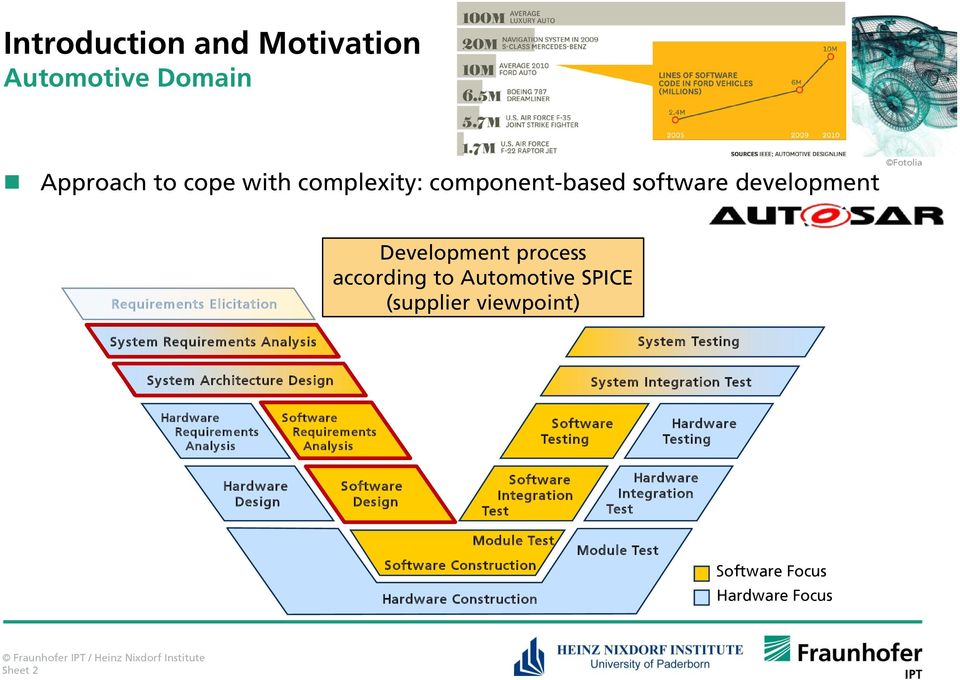
2 Introduction and Motivation Automotive Domain Approach to cope with complexity: component-based software development Requirements Elicitation Development process according to Automotive SPICE (supplier viewpoint) System Requirements Analysis System Testing System Architecture Design System Integration Test Hardware Requirements Analysis Software Requirements Analysis Software Testing Hardware Testing Hardware Design Software Design Software Integration Test Hardware Integration Test Module Test Software Construction Hardware Construction Module Test Software Focus Hardware Focus Sheet 2
3 cmp Presentation_ICSE ECU 1 * Car composite structure Pedelec Env ironment (SysML IBD) «EnvironmentElementExemplar» umgebung 1 schmutz «Flow» «EnvironmentElementExemplar» smartphone «Flow» «SystemExemplar» pedelec besitzt «Flow» «Flow» «EnvironmentElementExemplar» besitzer Software Hardware ladeenergiesmartphone stiehlt «Flow» ladeenergieladestation «Flow» «Flow» «EnvironmentElementExemplar» dieb «Environme ladestation composite structure Pedelec Env ironment (SysML IBD) «EnvironmentElementExemplar» umgebung schmutz «Flow» «EnvironmentElementExemplar» smartphone «Flow» «SystemExemplar» pedelec besitzt «Flow» «Flow» «EnvironmentElementExemplar» besitzer ladeenergiesmartphone stiehlt «Flow» ladeenergieladestation «Flow» «Flow» «EnvironmentElementExemplar» dieb «Environme ladestation Introduction and Motivation Automotive Domain Approach to cope with complexity: component-based software development System requirements System Requirements Analysis System architecture System Architecture Design Sy System In Software requirements Hardware Requirements Analysis Software Requirements Analysis Software Testing T Software Design Hardware Design Software Design Software Integration Test Hard Integ Test Software Construction Module Test Hardware Construction Sheet 3


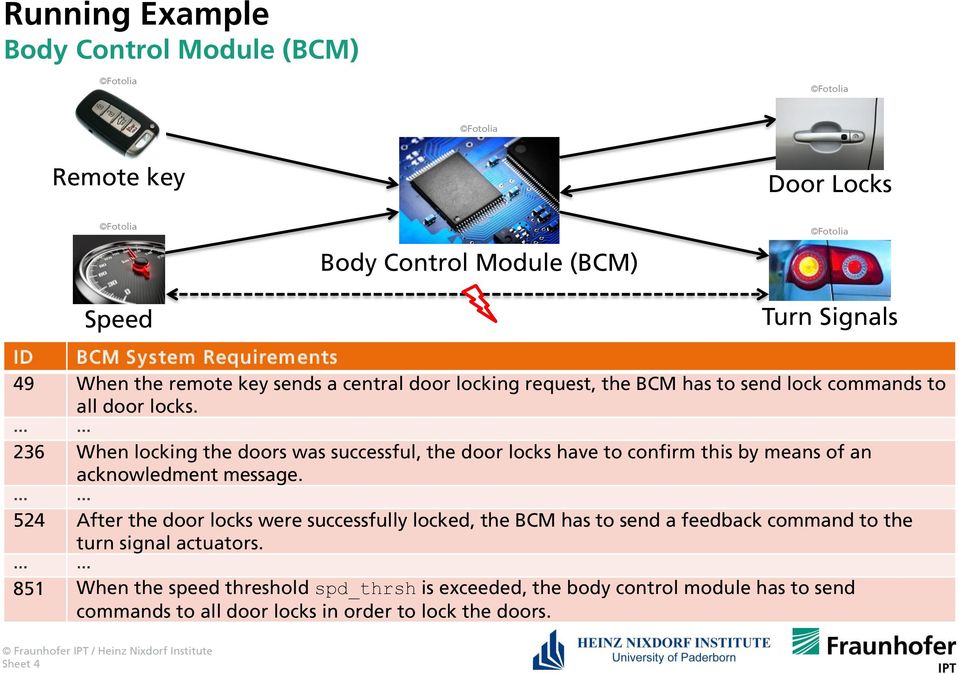
4 Running Example Body Control Module (BCM) Remote key Body Control Module (BCM) Door Locks ID BCM System Requirements 49 When the remote key sends a central door locking request, the BCM has to send lock commands to all door locks. 236 When locking the doors was successful, the door locks have to confirm this by means of an nowledment message. 524 After the door locks were successfully locked, the BCM has to send a feedb command to the turn signal actuators. Speed Turn Signals 851 When the speed threshold spd_thrsh is exceeded, the body control module has to send commands to all door locks in order to lock the doors. Sheet 4
5 RemoteLockDoorsAndFeedb lockfeedbcmd SignalAcuator RemoteLockDoorsAndFeedb lockfeedbcmd SignalAcuator Introduction and Motivation Formal Requirements and Hierarchical Component Architectures Previous work Formal, scenario-based requirements engineering approach Not suited for hierarchical component architectures! RemoteLockDoorsAndFeedb RemoteLockDoorsAndFeedb RemoteLockDoorsAndFeedb lockfeedbcmd SignalAcuator RemoteLockDoorsAndFeedb RemoteLockDoorsAndFeedb RemoteLockDoorsAndFeedb SignalAcuator lockfeedbcmd? RemoteLockDoorsAndFeedb RemoteLockDoorsAndFeedb RemoteLockDoorsAndFeedb RemoteLockDoorsAndFeedb How to specify formal requirements for hierarchical component architectures across several abstraction levels? Sheet 5



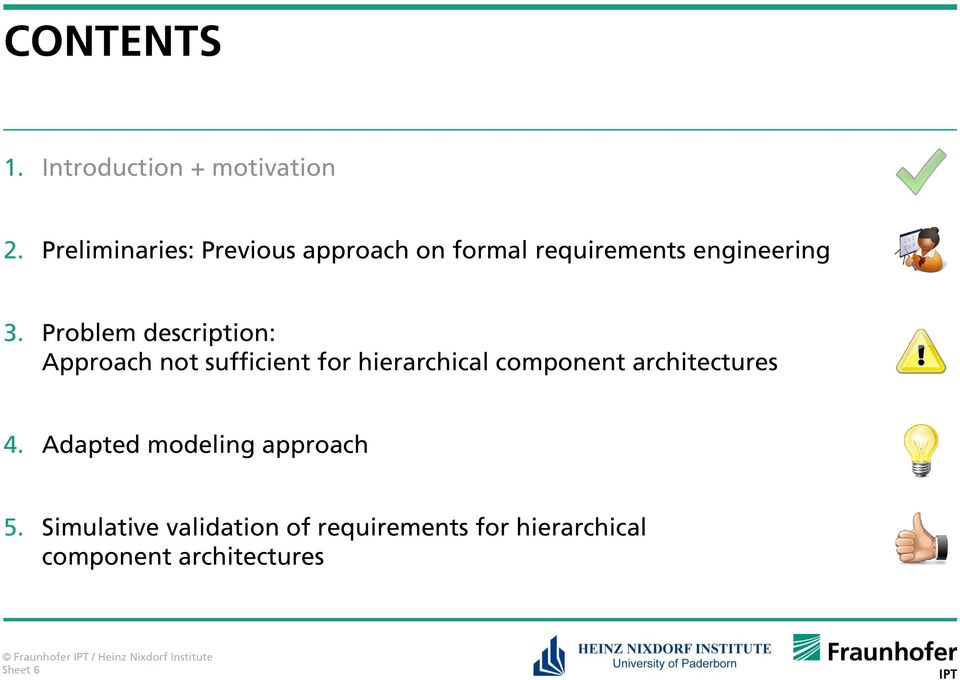
6 CONTENTS 1. Introduction + motivation 2. Preliminaries: Previous approach on formal requirements engineering 3. Problem description: Approach not sufficient for hierarchical component architectures 4. Adapted modeling approach 5. Simulative validation of requirements for hierarchical component architectures Sheet 6

7 Previous work Formal Requirements Engineering with Modal Sequence Diagrams (MSDs) Modal Sequence Diagrams (MSDs) UML-compliant variant of Live Sequence Charts Formal and modal semantics Environment elements RemoteLockDoors dl_passenger: System under development c = 0 c 100 Sheet 7

8 Previous work Formal Requirements Engineering with Modal Sequence Diagrams (MSDs) Modal Sequence Diagrams (MSDs) UML-compliant variant of Live Sequence Charts Formal and modal semantics Provisional message Analysis techniques Formal verification on consistency Simulative validation by means of Play-out algorithm Mandatory messages RemoteLockDoors c = 0 c 100 Timing requirement dl_passenger: Sheet 8

9 Previous work Simulative Validation by Means of Play-out Algorithm Operational interpretation of formal semantics of MSDs Plays out messages specified by the scenarios RemoteLockDoors Cut = state of an active MSD Detects safety violations Allows to validate for unintended behavior LockingFeedb lockfeedbcmd Sheet 9

10 Previous work Simulative Validation by Means of Play-out Algorithm Operational interpretation of formal semantics of MSDs Plays out messages specified by the scenarios RemoteLockDoors Cut = state of an active MSD Detects safety violations Allows to validate for unintended behavior LockingFeedb lockfeedbcmd Sheet 10
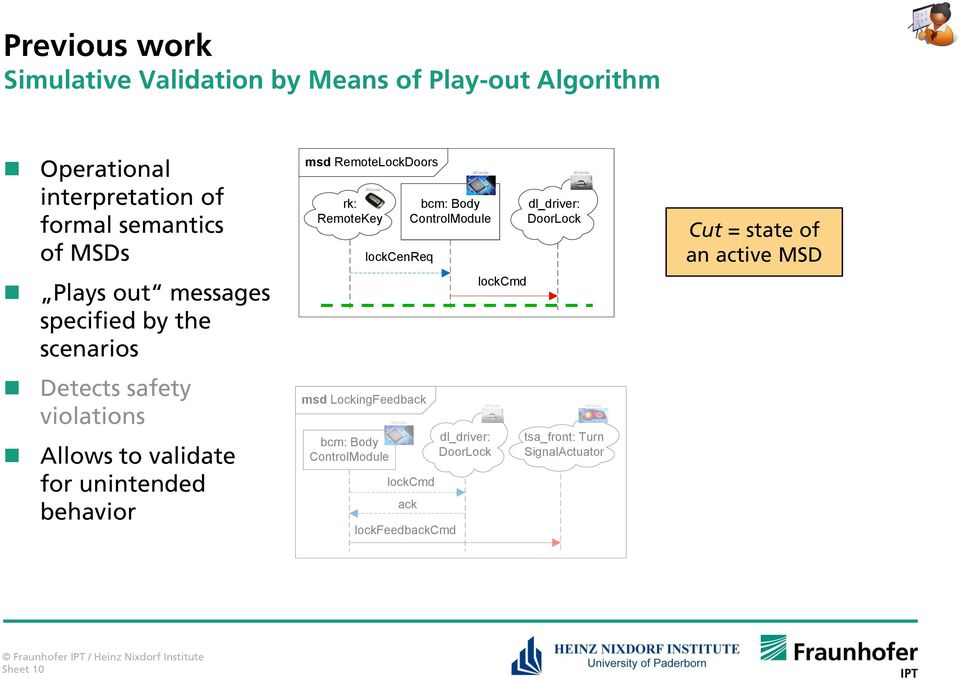

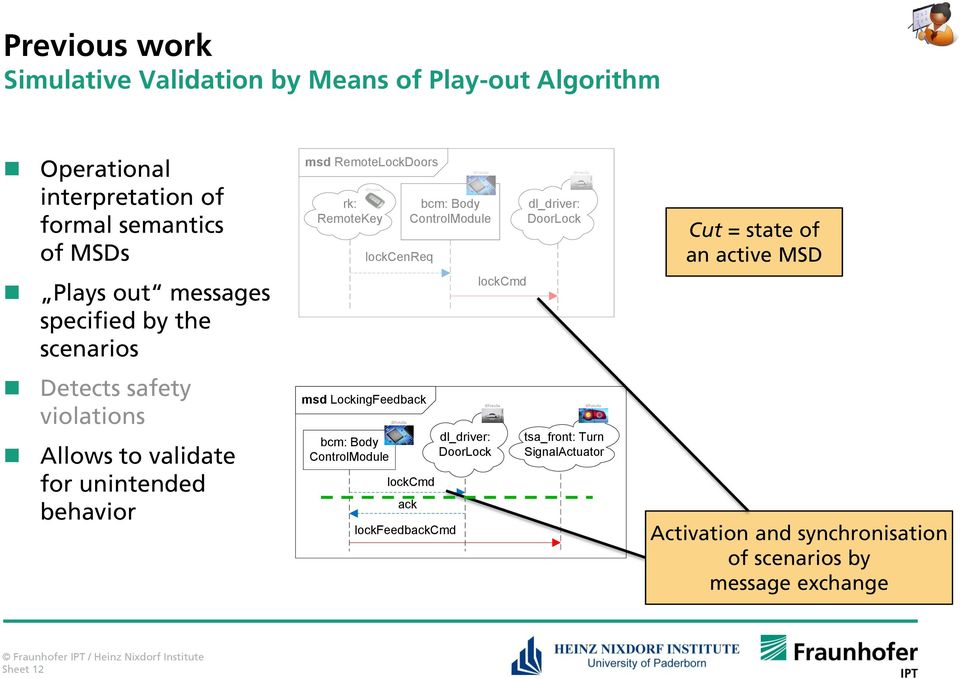
11 Previous work Simulative Validation by Means of Play-out Algorithm Operational interpretation of formal semantics of MSDs Plays out messages specified by the scenarios RemoteLockDoors Cut = state of an active MSD Detects safety violations Allows to validate for unintended behavior LockingFeedb lockfeedbcmd Activation and synchronisation of scenarios by message exchange Sheet 11

12 Previous work Simulative Validation by Means of Play-out Algorithm Operational interpretation of formal semantics of MSDs Plays out messages specified by the scenarios RemoteLockDoors Cut = state of an active MSD Detects safety violations Allows to validate for unintended behavior LockingFeedb lockfeedbcmd Activation and synchronisation of scenarios by message exchange Sheet 12
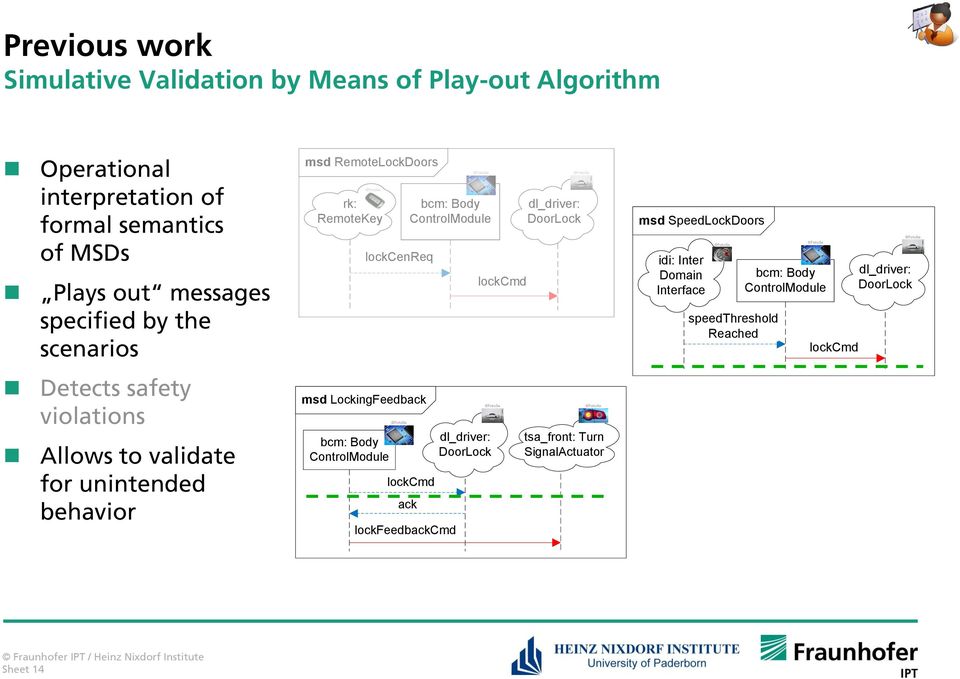
13 Previous work Simulative Validation by Means of Play-out Algorithm Operational interpretation of formal semantics of MSDs Plays out messages specified by the scenarios RemoteLockDoors SpeedLockDoors idi: Inter Domain Interface speedthreshold Reached Detects safety violations Allows to validate for unintended behavior LockingFeedb lockfeedbcmd Sheet 13

14 Previous work Simulative Validation by Means of Play-out Algorithm Operational interpretation of formal semantics of MSDs Plays out messages specified by the scenarios RemoteLockDoors SpeedLockDoors idi: Inter Domain Interface speedthreshold Reached Detects safety violations Allows to validate for unintended behavior LockingFeedb lockfeedbcmd Sheet 14
15 Previous work Simulative Validation by Means of Play-out Algorithm Operational interpretation of formal semantics of MSDs Plays out messages specified by the scenarios RemoteLockDoors SpeedLockDoors idi: Inter Domain Interface speedthreshold Reached Detects safety violations Allows to validate for unintended behavior LockingFeedb lockfeedbcmd Unintended behavior: speed locking activates locking feedb! Sheet 15
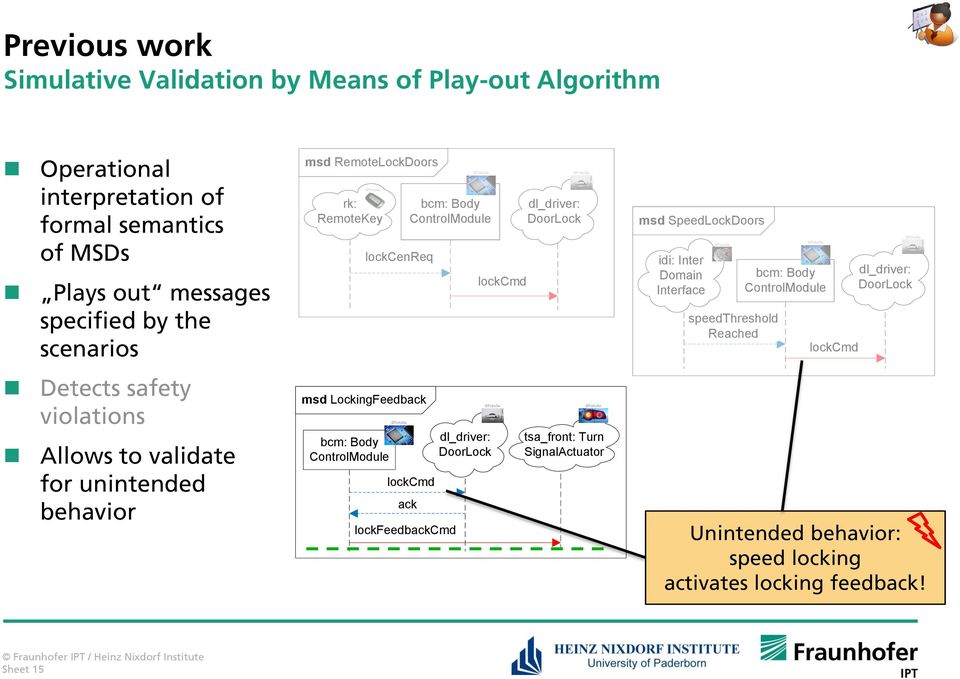
16 Previous work Simulative Validation by Means of Play-out Algorithm Operational interpretation of formal semantics of MSDs Plays out messages specified by the scenarios Scenario merge: locking feedb only on remote key operation SpeedLockDoors idi: Inter Domain Interface speedthreshold Reached Detects safety violations RemoteLockDoorsAndFeedb Allows to validate for unintended behavior lockfeedbcmd Sheet 16

17 CONTENTS 1. Introduction + motivation 2. Preliminaries: Previous approach on formal requirements engineering 3. Problem description: Approach not sufficient for hierarchical component architectures 4. Adapted modeling approach 5. Simulative validation of requirements for hierarchical component architectures Sheet 17

18 Problem Description How to Specify and Simulate MSDs for Hierarchical Component Architectures? Component architectures Arranged hierarchically Ports + directed connectors lcm: Lockg CenMst fm: Flash Manager Until now: Plain class models as structural basis for MSDs Scenarios only at one hierarchy level Each entity can communicate with arbitrary others RemoteLockDoorsAndFeedb lockfeedbcmd Sheet 18

19 CONTENTS 1. Introduction + motivation 2. Preliminaries: Previous approach on formal requirements engineering 3. Problem description: Approach not sufficient for hierarchical component architectures 4. Adapted modeling approach 5. Simulative validation of requirements for hierarchical component architectures Sheet 19

20 Modeling Approach + + signature connector bdd System [Interfaces] bdd System [Blocks] type ref Top Level Subsystem Level Subsubsystem Level type ibd ibd represents refersto ProcessLockingRequest ProcessLockingRequest ibd Type View Internal Structure View Interaction View Sheet 20
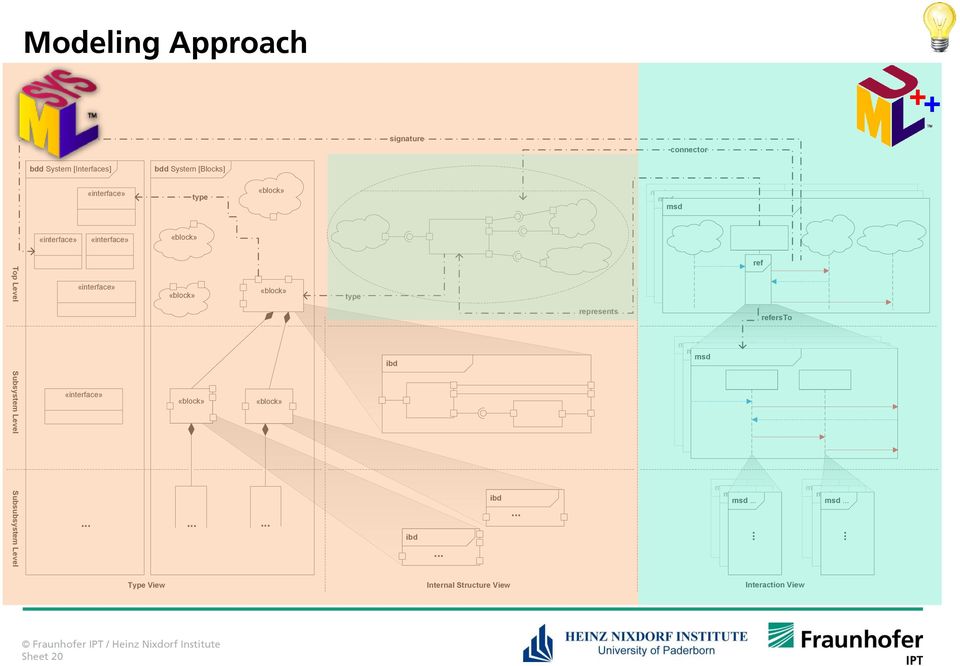
21 Modeling Approach Overview Port interfaces Component types Internal structure signature connector Scenarios bdd System [Interfaces] bdd System [Blocks] type ref Top Level Subsystem Level Subsubsystem Level Top level Subsystem level(s) type ibd ibd represents refersto ProcessLockingRequest ProcessLockingRequest ibd Type View Internal Structure View Interaction View Sheet 21
22 signature connector Modeling Approach Top Level: Specify Port Interfaces + Component Types Interfaces specify, which messages can be sent within MSDs Top Level Subsystem Level Subsubsystem Level bdd System [Interfaces] bdd System [Blocks] type type ibd ProcessLockingRequest ProcessLockingRequest ibd ibd Type View Internal Structure View Interaction View Interface usages in ports define possible communication directions represents ref refersto bdd System [Interfaces] bdd System [Blocks] RK2BCM () type (provided) type (required) :~RK2BCM TurnSignal Actuator BCM2DL () DL2BCM () :RK2BCM BCM2TSA lockfeedbcmd() BodyControl Module Sheet 22 Blocks specify the types for the component architecture
![signature connector bdd System [Interfaces] bdd System [Blocks] Modeling Approach Top Level: Specify Use Cases Top Level Subsystem Level Subsubsystem Level type type ibd ibd represents](/docs-images/24/2965695/images/23-0.png "ProcessLockingRequest ProcessLockingRequest ibd ref refersto Type View Internal Structure View Interaction View Use cases by means of UML collaboration diagrams Specify participants for a particular")
23 signature connector bdd System [Interfaces] bdd System [Blocks] Modeling Approach Top Level: Specify Use Cases Top Level Subsystem Level Subsubsystem Level type type ibd ibd represents ProcessLockingRequest ProcessLockingRequest ibd ref refersto Type View Internal Structure View Interaction View Use cases by means of UML collaboration diagrams Specify participants for a particular use case to be used in its scenarios bdd System [Blocks] Directed connectors Lock Doors Remotely and Give Feedb rk2bcm dld2bcm bcm2dld BodyControl Module type Parts typed by blocks bcm2tsa Sheet 23
24 signature connector bdd System [Interfaces] bdd System [Blocks] Modeling Approach Top Level: Specify Scenarios bdd System [Interfaces] Lock Doors Remotely and Give Feedb Top Level Subsystem Level Subsubsystem Level type Type View type ibd ibd Internal Structure View represents ProcessLockingRequest ProcessLockingRequest ibd ref refersto Interaction View RK2BCM () rk2bcm dld2bcm bcm2dld Messages sent via connectors connector represents bcm2tsa Lifelines represent use case participants RemoteLockDoorsAndFeedb signature Messages compliant to port interfaces lockfeedbcmd Sheet 24
25 signature connector bdd System [Interfaces] bdd System [Blocks] Modeling Approach Subsystem Level(s): Decompose Structural Elements Lock Doors Remotely and Give Feedb Top Level Subsystem Level Subsubsystem Level type Type View type ibd ibd Internal Structure View represents ProcessLockingRequest ProcessLockingRequest ibd ref refersto Interaction View rk2bcm dld2bcm bcm2dld Hierarchically decompose components ibd Body bcm2tsa Connect inner components to superordinate level with delegation connectors Add and connect inner components Sheet 25 lcm: Lockg CenMst lcm2fm fm: Flash Manager
26 signature connector bdd System [Interfaces] bdd System [Blocks] Modeling Approach Subsystem Level(s): Specify Interactions Top Level Subsystem Level Subsubsystem Level type type ibd ibd represents ProcessLockingRequest ProcessLockingRequest ibd ref refersto Type View Internal Structure View Interaction View RemoteLockDoorsAndFeedb ref Connect MSDs with UML InteractionUse refersto lockfeedbcmd Messages crossing hierarchy levels connected via gates Add MSDs for new hierarchy level ProcessLockingRequest lcm: Lockg CenMst fm: Flash Manager lockfeedbreq lockfeedbcmd Sheet 26
27 Syntactical Constraints for Complete and Executable Models Automatic Checks as Support for the Engineer All links set? bdd System [Interfaces] RK2BCM () type (provided) type (required) bdd System [Blocks] :RK2BCM :~RK2BCM Connector directions respected? BodyControl Module type :~RK 2BCM RemoteLockDoorsAndFeedb rk2bcm :RK2 BCM connector Lock Doors Remotely and Give Feedb represents bcm2dld bcm2tsa dld2bcm :~DL2BC :BCM2 d D tsa Si :BCM 2TSA tsa_ Sign signature Interface compatibility? lockfeedbcmd Sheet 27
28 CONTENTS 1. Introduction + motivation 2. Preliminaries: Previous approach on formal requirements engineering 3. Problem description: Approach not sufficient for hierarchical component architectures 4. Adapted modeling approach 5. Simulative validation of requirements for hierarchical component architectures Sheet 28
29 Hierarchical Play-out Functional Principle RemoteLockDoorsAndFeedb ref lockfeedbcmd refersto ProcessLockingRequest lcm: Lockg CenMst fm: Flash Manager lockfeedbreq lockfeedbcmd Sheet 29
30 Hierarchical Play-out Functional Principle RemoteLockDoorsAndFeedb ref lockfeedbcmd refersto ProcessLockingRequest lcm: Lockg CenMst fm: Flash Manager lockfeedbreq lockfeedbcmd Sheet 30
31 Hierarchical Play-out Functional Principle RemoteLockDoorsAndFeedb ref lockfeedbcmd refersto ProcessLockingRequest lcm: Lockg CenMst fm: Flash Manager lockfeedbreq lockfeedbcmd Sheet 31
32 Hierarchical Play-out Functional Principle RemoteLockDoorsAndFeedb ref lockfeedbcmd refersto ProcessLockingRequest lcm: Lockg CenMst fm: Flash Manager lockfeedbreq lockfeedbcmd Sheet 32
33 Hierarchical Play-out Functional Principle RemoteLockDoorsAndFeedb ref lockfeedbcmd refersto ProcessLockingRequest lcm: Lockg CenMst fm: Flash Manager lockfeedbreq lockfeedbcmd Sheet 33
34 Hierarchical Play-out Functional Principle RemoteLockDoorsAndFeedb ref lockfeedbcmd refersto ProcessLockingRequest lcm: Lockg CenMst fm: Flash Manager lockfeedbreq lockfeedbcmd Sheet 34
35 Hierarchical Play-out Functional Principle RemoteLockDoorsAndFeedb ref lockfeedbcmd refersto ProcessLockingRequest lcm: Lockg CenMst fm: Flash Manager lockfeedbreq lockfeedbcmd Sheet 35
36 Hierarchical Play-out Functional Principle RemoteLockDoorsAndFeedb ref lockfeedbcmd refersto ProcessLockingRequest lcm: Lockg CenMst fm: Flash Manager lockfeedbreq lockfeedbcmd Sheet 36

37 RemoteLockDoorsAndFeedb lockfeedbcmd SignalAcuator RemoteLockDoorsAndFeedb lockfeedbcmd SignalAcuator Starting Situation Formal Requirements and Hierarchical Component Architectures Previous work Formal, scenario-based requirements engineering approach Not suited for hierarchical component architectures! RemoteLockDoorsAndFeedb RemoteLockDoorsAndFeedb RemoteLockDoorsAndFeedb lockfeedbcmd SignalAcuator RemoteLockDoorsAndFeedb RemoteLockDoorsAndFeedb RemoteLockDoorsAndFeedb SignalAcuator lockfeedbcmd? RemoteLockDoorsAndFeedb RemoteLockDoorsAndFeedb RemoteLockDoorsAndFeedb RemoteLockDoorsAndFeedb How to specify formal requirements for hierarchical component architectures across several abstraction levels? Sheet 37

38 Summary and Outlook Lock Doors Remotely and Give Feedb dld2bcm :~DL2BCM :DL2BCM rk2bcm :~BCM bcm2dld :~RK :BCM2DL :RK2 2DL 2BCM BCM :~BCM2TSA bcm2tsa SignalAcuator :BCM 2TSA RemoteLockDoorsAndFeedb RemoteLockDoorsAndFeedb RemoteLockDoorsAndFeedb ref lockfeedbcmd SignalAcuator ibd Body lcm: Lockg CenMst fm: Flash Manager ProcessLockingRequest ProcessLockingRequest ProcessLockingRequest lcm: Lockg fm: Flash CenMst Manager lockfeedbreq lockfeedbcmd ibd FlashManager Outlook ibd LockgCenMst Verification of correct refinement Cover AUTOSAR specifics More detailed timing information Alignment with systems engineering Enables integrated requirements engineering and component architecture design across multiple abstraction levels! Sheet 38
39 Vielen Dank für Ihre Aufmerksamkeit Dipl.-Inform. Jörg Holtmann Fraunhofer-Institut für Produktionstechnik Projektgruppe Entwurfstechnik Mechatronik Zukunftsmeile Paderborn Telefon: Fax: [email protected] Dr. Matthias Meyer Fraunhofer-Institut für Produktionstechnik Projektgruppe Entwurfstechnik Mechatronik Zukunftsmeile Paderborn Telefon: Fax: [email protected] Sheet 39
Automotive System and Software Architecture
 Automotive System and Software Architecture Yanja Dajsuren 2IW80 Software specification and architecture March 25, 2014 Which one has more software? Chevrolet Volt, an example modern day car Boeing 787,
SysML Modelling Language explained
 Date: 7 th October 2010 Author: Guillaume FINANCE, Objet Direct Analyst & Consultant UML, the standard modelling language used in the field of software engineering, has been tailored to define a modelling
Intoduction to SysML
 Intoduction to SysML a modeling language for Systems Engineering SummIT 2013, Axelborg 22. maj 2013 Ingeniørdocent Finn Overgaard Hansen, [email protected] Department of Engineering Aarhus University Ver. 22.5.2013
Compliance and Requirement Traceability for SysML v.1.0a
 1. Introduction: Compliance and Traceability for SysML v.1.0a This document provides a formal statement of compliance and associated requirement traceability for the SysML v. 1.0 alpha specification, which
The SPES Methodology Modeling- and Analysis Techniques
 The SPES Methodology Modeling- and Analysis Techniques Dr. Wolfgang Böhm Technische Universität München [email protected] Agenda SPES_XT Project Overview Some Basic Notions The SPES Methodology SPES_XT
SCADE System 17.0. Technical Data Sheet. System Requirements Analysis. Technical Data Sheet SCADE System 17.0 1
 SCADE System 17.0 SCADE System is the product line of the ANSYS Embedded software family of products and solutions that empowers users with a systems design environment for use on systems with high dependability
AutoSAR Overview. FESA Workshop at KTH 2010 04 12. Prof. Jakob Axelsson Volvo Cars and Mälardalen University
 AutoSAR Overview FESA Workshop at KTH 2010 04 12 Prof. Jakob Axelsson Volvo Cars and Mälardalen University This presentation is based on a tutorial prepared by the AutoSAR Consortium AUTOSAR Members Status
EMBEDDED SOFTWARE DEVELOPMENT: COMPONENTS AND CONTRACTS
 EMBEDDED SOFTWARE DEVELOPMENT: COMPONENTS AND CONTRACTS David URTING, Stefan VAN BAELEN, Tom HOLVOET and Yolande BERBERS {David.Urting, Stefan.VanBaelen, Tom.Holvoet, Yolande.Berbers}@cs.kuleuven.ac.be
Herstellerinitiative Software (OEM Initiative Software)
 Herstellerinitiative Software (OEM Initiative Software) Dr. Michael Daginnus Volkswagen AG Wolfsburg Dr. Dieter Marx Porsche AG Weissach Dr. Ralf Belschner Daimler AG Sindelfingen Kai Barbehön BMW AG München
Mastering increasing product complexity with Collaborative Systems Engineering and PLM
 Mastering increasing product complexity with Collaborative Systems Engineering and PLM Thierry Ambroisine Dassault Systèmes 10 rue Marcel Dassault, 78140 Vélizy Villacoublay, France [email protected]
How To Develop Software
 Software Engineering Prof. N.L. Sarda Computer Science & Engineering Indian Institute of Technology, Bombay Lecture-4 Overview of Phases (Part - II) We studied the problem definition phase, with which
A Collaborative Platform for Systems Engineering tools over the Internet With Connections to Wolfram SystemModeler
 A Collaborative Platform for Systems Engineering tools over the Internet With Connections to Wolfram SystemModeler P. Aronsson, D. Hedberg, O. Tronarp www.wolframmathcore.com SPRINT Project Simplifying
Model-based Testing of Automotive Systems
 Model-based Testing of Automotive Systems Eckard Bringmann and Andreas Krämer ICST 08 Presented by Julia Rubin on November 21, 2012 Multidisciplinary Business 2 Supply Chain of Components 3 Innovation
isolar Integrated Solution for AUTOSAR
 Integrated Solution for AUTOSAR isolar Integrated Solution for AUTOSAR 1 Integrated Solution for AUTOSAR An integrated solution for configuration of AUTOSAR compliant embedded software Supports configuration
SYSML PLUGIN. version 17.0.1. user guide
 SYSML PLUGIN version 17.0.1 user guide No Magic, Inc. 2011 All material contained herein is considered proprietary information owned by No Magic, Inc. and is not to be shared, copied, or reproduced by
Development of AUTOSAR Software Components within Model-Based Design
 2008-01-0383 Development of AUTOSAR Software Components within Model-Based Design Copyright 2008 The MathWorks, Inc. Guido Sandmann Automotive Marketing Manager, EMEA The MathWorks Richard Thompson Senior
Architecture. Reda Bendraou reda.bendraou{{@}}lip6.fr http://pagesperso-systeme.lip6.fr/reda.bendraou/
 Architecture Reda Bendraou reda.bendraou{{@}}lip6.fr http://pagesperso-systeme.lip6.fr/reda.bendraou/ Some slides were adapted from L. Osterweil, B. Meyer, and P. Müller material Reda Bendraou LI386-S1
Questions? Assignment. Techniques for Gathering Requirements. Gathering and Analysing Requirements
 Questions? Assignment Why is proper project management important? What is goal of domain analysis? What is the difference between functional and non- functional requirements? Why is it important for requirements
ECU State Manager Module Development and Design for Automotive Platform Software Based on AUTOSAR 4.0
 ECU State Manager Module Development and Design for Automotive Platform Software Based on AUTOSAR 4.0 Dhanamjayan P.R. 1, Kuruvilla Jose 2, Manjusree S. 3 1 PG Scholar, Embedded Systems, 2 Specialist,
i. Node Y Represented by a block or part. SysML::Block,
 OMG SysML Requirements Traceability (informative) This document has been published as OMG document ptc/07-03-09 so it can be referenced by Annex E of the OMG SysML specification. This document describes
Model-Driven Software Development for Robotics: an overview
 Model-Driven Software Development for Robotics: an overview IEEE-ICRA2011 Workshop on Software Development and Integration in Robotics Jan F. Broenink, Maarten M. Bezemer Control Engineering, University
Applying Use Cases to Microcontroller Code Development. Chris Gilbert Cypress Semiconductor
 Applying Use Cases to Microcontroller Code Development Chris Gilbert Cypress Semiconductor Agenda Why Use Cases Microcontroller Project Development Use Cases Defined Use Cases Composition General Example
Software Design Document (SDD) Template
 (SDD) Template Software design is a process by which the software requirements are translated into a representation of software components, interfaces, and data necessary for the implementation phase.
Software Development in the Large!
 Software Development in the Large! Peter Eeles Executive IT Architect, IBM [email protected] IBM Rational Software Development Conference 2007 2007 IBM Corporation Agenda IBM Rational Software Development
Agile Model-Based Systems Engineering (ambse)
 Agile Model-Based Systems Engineering (ambse) Bruce Powel Douglass, Ph.D. Chief Evangelist, Global Technology Ambassador IBM Rational [email protected] Twitter: @BruceDouglass Yahoo: tech.groups.yahoo.com/group/rt-uml/
Object Oriented Programming. Risk Management
 Section V: Object Oriented Programming Risk Management In theory, there is no difference between theory and practice. But, in practice, there is. - Jan van de Snepscheut 427 Chapter 21: Unified Modeling
Contents. Introduction and System Engineering 1. Introduction 2. Software Process and Methodology 16. System Engineering 53
 Preface xvi Part I Introduction and System Engineering 1 Chapter 1 Introduction 2 1.1 What Is Software Engineering? 2 1.2 Why Software Engineering? 3 1.3 Software Life-Cycle Activities 4 1.3.1 Software
Created by: Austin Davis Neel Iyer Darcie Jones Sascha Schwarz
 EMGT 587 Systems Engineering Created by: Austin Davis Neel Iyer Darcie Jones Sascha Schwarz Table of Contents Introduction... 3 Operational Scenarios... 4 1. User sets and cancels cruise control:... 4
Model-Based Requirements Engineering with AutoRAID
 Model-Based Requirements Engineering with AutoRAID Bernhard Schätz, Andreas Fleischmann, Eva Geisberger, Markus Pister Fakultät für Informatik, Technische Universität München Boltzmannstr. 3, 85748 Garching,
AUTOSAR Software Architecture
 AUTOSAR Software Architecture Robert Warschofsky Hasso-Plattner-Institute für Softwaresystemtechnik Abstract. AUTOSAR supports the re-use of software and hardware components of automotive electronic systems.
Safety Driven Design with UML and STPA M. Rejzek, S. Krauss, Ch. Hilbes. Fourth STAMP Workshop, March 23-26, 2015, MIT Boston
 Safety Driven Design with UML and STPA M. Rejzek, S. Krauss, Ch. Hilbes System and Safety Engineering A typical situation: Safety Engineer System Engineer / Developer Safety Case Product 2 System and Safety
Intel CoFluent Methodology for SysML *
 Intel CoFluent Methodology for SysML * UML* SysML* MARTE* Flow for Intel CoFluent Studio An Intel CoFluent Design White Paper By Thomas Robert and Vincent Perrier www.cofluent.intel.com Acronyms and abbreviations
Hardware in the Loop (HIL) Testing VU 2.0, 182.117, WS 2008/09
 Testen von Embedded Systems Hardware in the Loop (HIL) Testing VU 2.0, 182.117, WS 2008/09 Raimund dkirner Testing Embedded Software Testing the whole system including the physical environment is not possible
What is Automotive Software Engineering? What is Automotive Software Engineering? What is Automotive Software Engineering?
 Process models: Capability Maturity Model Integration (CMMI) Software Process Improvement and Capability Determination (SPICE) V-Model Standards: MISRA-C standard AUTOSAR Configuration management Product
Introduction to Simulink & Stateflow. Coorous Mohtadi
 Introduction to Simulink & Stateflow Coorous Mohtadi 1 Key Message Simulink and Stateflow provide: A powerful environment for modelling real processes... and are fully integrated with the MATLAB environment.
Chap 1. Introduction to Software Architecture
 Chap 1. Introduction to Software Architecture 1. Introduction 2. IEEE Recommended Practice for Architecture Modeling 3. Architecture Description Language: the UML 4. The Rational Unified Process (RUP)
openmdm an Open Source Platform for Measured Data Management Dr. Dietmar Rapf, Michael Schwarzbach
 openmdm an Open Source Platform for Measured Data Management Dr. Dietmar Rapf, Michael Schwarzbach openmdm an Open Source Platform for Measured Data Management Seite 2 IT and PLM consulting business since
Seminar Automotive Open Systems Architecture
 Seminar Automotive Open Systems Architecture Modeling and Development of AUTOSAR Systems using SystemDesk Sebastian Wätzoldt Hasso-Plattner-Institut for IT Systems Engineering at the University of Potsdam
Safe Automotive software architecture (SAFE) WP3 Deliverable D3.6.b: Safety Code Generator Specification
 Contract number: ITEA2 10039 Safe Automotive software architecture (SAFE) ITEA Roadmap application domains: Major: Services, Systems & Software Creation Minor: Society ITEA Roadmap technology categories:
VDI 2206 Prof. Dr. Magdy M. Abdelhameed
 Course Code: MDP 454, Course Name:, Second Semester 2014 VDI 2206 Mechatronics System Design The mechatronic design methodology is based on a concurrent (instead of sequential) approach to discipline design,
How To Write A Train Control System
 di Base tesi di laurea magistrale Model Driven Engineering of railway control systems with the openetcs process Anno Accademico 2013-2014 relatore Ch.mo Prof. Stefano Russo correlatori Ch.mo Dr. Domenico
Component-based Development Process and Component Lifecycle Ivica Crnkovic 1, Stig Larsson 2, Michel Chaudron 3
 Component-based Development Process and Component Lifecycle Ivica Crnkovic 1, Stig Larsson 2, Michel Chaudron 3 1 Mälardalen University, Västerås, Sweden, [email protected] 2 ABB Corporate Research,
Frameworks of Process Improvement for Mobile Applications
 Frameworks of Process Improvement for Mobile Applications Haeng-Kon Kim Abstract Mobile application development belongs on the complicated, but quite regular software development environment that includes
openmdm an Open Source Platform for Measured Data Management Dr. Dietmar Rapf, Michael Schwarzbach
 openmdm an Open Source Platform for Measured Data Management Dr. Dietmar Rapf, Michael Schwarzbach Agenda History and Scope of measured data management ASAM ODS the basis for MDM systems openmdm How openmdm
Software Production. Industrialized integration and validation of TargetLink models for series production
 PAGE 24 EB AUTOMOTIVE Industrialized integration and validation of TargetLink models for series production Continuous Software Production The complexity of software systems in vehicles is increasing at
Automotive Software Engineering at Hella KGaA. Software Engineering for Software Intensive Systems, 21.11.2005
 Engineering for Intensive s, 21.11.2005 Overview Automotive Engineering Hella body electronics The process of product development -Engineering of mechatronic/embedded systems Discussion 2 Ulrich Nickel,
Software Development Methodologies
 Software Development Methodologies Lecturer: Raman Ramsin Lecture 5 Integrated Object-Oriented Methodologies: OPM and Catalysis 1 Object Process Methodology (OPM) Introduced by Dori in 1995 Primarily intended
MBSE Practices in Telescope Modeling. Section I: Introduction. Project Description
 MBSE Practices in Telescope Modeling Robert Karban, [email protected]; Tim Weilkiens, [email protected], R. Hauber, [email protected] and R. Diekmann, [email protected] Section I:
A new approach to automotive electric/electronic engineering life-cycle management
 IBM Software Automotive A new approach to automotive electric/electronic engineering life-cycle management Managing engineering data and processes using a single source of truth 2 A new approach to automotive
Security Test s i t ng Eileen Donlon CMSC 737 Spring 2008
 Security Testing Eileen Donlon CMSC 737 Spring 2008 Testing for Security Functional tests Testing that role based security functions correctly Vulnerability scanning and penetration tests Testing whether
Shadow TX(A) Shadow RX
 Shadow TX(A) Shadow RX Asset Management and RFID Transmitter Tags Asset Management Receiver The Shadow TX(A) and Shadow RX wireless asset management system is a standalone wireless asset tracking system
Vehicle Electronics. Services and Solutions to Manage the Complexity
 Vehicle Electronics Services and Solutions to Manage the Complexity INNOVATIONS & DEVELOPMENT CYCLES Commercial vehicle manufacturers are experiencing a technological change. In addition to the rising
INTELLECT TM Software Package
 AxxonSoft INTELLECT TM Software Package Quick Start Guide Version 1.0.0 Moscow 2010 1 Contents CONTENTS... 2 1 INTRODUCTION... 3 1.1 Document purpose... 3 1.2 Purpose of the Intellect software package...
The Concern-Oriented Software Architecture Analysis Method
 The Concern-Oriented Software Architecture Analysis Method Author: E-mail: Student number: Supervisor: Graduation committee members: Frank Scholten [email protected] s0002550 Dr. ir. Bedir Tekinerdoǧan
Software Architecture Document
 Software Architecture Document Natural Language Processing Cell Version 1.0 Natural Language Processing Cell Software Architecture Document Version 1.0 1 1. Table of Contents 1. Table of Contents... 2
Explicit Connectors in Component Based Software Engineering for Distributed Embedded Systems. Dietmar Schreiner and Karl M.
 Explicit Connectors in Component Based Software Engineering for Distributed Embedded Systems Dietmar Schreiner and Karl M. Göschka Vienna University of Technology Institute of Information Systems, Distributed
Safety compliance. Energy management. System architecture advisory services. Diagnostics. Network topologies. Physical and functional partitioning
 Energy management Network topologies Physical and functional partitioning Safety compliance Diagnostics System architecture advisory services www.continental-corporation.com Why system architecture? 2
Industrial Case Study on the Integration of SysML and AUTOSAR with Triple Graph Grammars
 Industrial Case Study on the Integration of SysML and AUTOSAR with Triple Graph Grammars Holger Giese, Stephan Hildebrandt, Stefan Neumann, Sebastian Wätzoldt Technische Berichte Nr. 57 des Hasso-Plattner-Instituts
4.4 What is a Requirement? 4.5 Types of Requirements. Functional Requirements
 4.4 What is a Requirement? It is a statement describing either 1) an aspect of what the proposed system must do, or 2) a constraint on the system s development. In either case it must contribute in some
PLM Center of Excellence PLM for Embedded Product Development - Challenges, Experiences and Solution. M a y 2 0 0 9
 PLM Center of Excellence PLM for Embedded Product Development - Challenges, Experiences and Solution M a y 2 0 0 9 Table of Contents Abstract 3 Introduction 4 Embedded product development life cycle 4
The key linkage of Strategy, Process and Requirements
 Business Systems Business Functions The key linkage of Strategy, Process and Requirements Leveraging value from strategic business architecture By: Frank Kowalkowski, Knowledge Consultants, Inc.. Gil Laware,
METHOD & TOOLS TO SECURE AND SUPPORT COLLABORATIVE ARCHITECTING OF CONSTRAINED SYSTEMS
 METHOD & TOOLS TO SECURE AND SUPPORT COLLABORATIVE ARCHITECTING OF CONSTRAINED Jean-Luc Voirin Thales Aerospace Keywords: architecture modelling method early validation Abstract ARCADIA is a system & software
ARIS Design Platform Getting Started with BPM
 Rob Davis and Eric Brabander ARIS Design Platform Getting Started with BPM 4y Springer Contents Acknowledgements Foreword xvii xix Chapter 1 An Introduction to BPM 1 1.1 Brief History of Business Process
VAIL-Plant Asset Integrity Management System. Software Development Process
 VAIL-Plant Asset Integrity Management System Software Development Process Document Number: VAIL/SDP/2008/008 Engineering For a Safer World P u b l i c Approved by : Ijaz Ul Karim Rao Revision: 0 Page:2-of-15
Decomposition into Parts. Software Engineering, Lecture 4. Data and Function Cohesion. Allocation of Functions and Data. Component Interfaces
 Software Engineering, Lecture 4 Decomposition into suitable parts Cross cutting concerns Design patterns I will also give an example scenario that you are supposed to analyse and make synthesis from The
Do AUTOSAR and functional safety rule each other out?
 Software development Do AUTOSAR and functional safety rule each other out? While simplicity is a factor in safety-critical applications, AUTOSAR has over 6,000 configuration parameters and well over 100,000
Developing Complex Systems using DOORS and UML
 Developing Complex Systems using DOORS and UML Telelogic 2004 User Group Conference Americas and Asia/Pacific Michael Sutherland [email protected] Abstract In order to successfully
Modeling and Validation of a Data Process Unit Control for Space Applications
 Modeling and Validation of a Data Process Unit Control for Space Applications Wan Hai, Huang Chongdi, Wang Yuhui, He Fei and Gu Ming Key Lab of ISS of MOE, TNList, School of Software, Tsinghua University,
Project Plan for <project name>
 Note: Text displayed in blue italics is included to provide guidance to the author and should be deleted or hidden before publishing the document. This template can be used at it is, or to complete and
To introduce software process models To describe three generic process models and when they may be used
 Software Processes Objectives To introduce software process models To describe three generic process models and when they may be used To describe outline process models for requirements engineering, software
Applying 4+1 View Architecture with UML 2. White Paper
 Applying 4+1 View Architecture with UML 2 White Paper Copyright 2007 FCGSS, all rights reserved. www.fcgss.com Introduction Unified Modeling Language (UML) has been available since 1997, and UML 2 was
Software Engineering Reference Framework
 Software Engineering Reference Framework Michel Chaudron, Jan Friso Groote, Kees van Hee, Kees Hemerik, Lou Somers, Tom Verhoeff. Department of Mathematics and Computer Science Eindhoven University of
Business Process (BPMN) Course
 Business Process (BPMN) Course 2 day course held as Public or On Site Course We also offer bespoke foundation & advanced modules which can be developed/adapted to suit requirements Course Objectives Day
Ontology for Home Energy Management Domain
 Ontology for Home Energy Management Domain Nazaraf Shah 1,, Kuo-Ming Chao 1, 1 Faculty of Engineering and Computing Coventry University, Coventry, UK {nazaraf.shah, k.chao}@coventry.ac.uk Abstract. This
Kirsten Sinclair SyntheSys Systems Engineers
 Kirsten Sinclair SyntheSys Systems Engineers Kirsten Sinclair SyntheSys Systems Engineers Spicing-up IBM s Enterprise Architecture tools with Petri Nets On Today s Menu Appetiser: Background Starter: Use
In this Lecture you will Learn: Development Process. Unified Software Development Process. Best Practice
 In this Lecture you will Learn: Development Chapter 5C About the Unified Software Development How phases relate to workflows in an iterative life cycle An approach to system development Major activities
Table of Contents. CHAPTER 1 Web-Based Systems 1. CHAPTER 2 Web Engineering 12. CHAPTER 3 A Web Engineering Process 24
 Table of Contents CHAPTER 1 Web-Based Systems 1 The Web 1 Web Applications 2 Let s Introduce a Case Study 3 Are WebApps Really Computer Software? 4 Are the Attributes of WebApps Different from the Attributes
1 Business Modeling. 1.1 Event-driven Process Chain (EPC) Seite 2
 Business Process Modeling with EPC and UML Transformation or Integration? Dr. Markus Nüttgens, Dipl.-Inform. Thomas Feld, Dipl.-Kfm. Volker Zimmermann Institut für Wirtschaftsinformatik (IWi), Universität
Laboratory Information Management and Process Control Software for Microbiological Laboratories of the Government Hospitals
 Laboratory Information Management and Process Control Software for Microbiological Laboratories of the Government Hospitals Hewapathirana R H MSc IT 06/10000 Faculty of Information Technology University
11 Tips to make the requirements definition process more effective and results more usable
 1 11 Tips to make the s definition process more effective and results more usable This article discusses what I believe are the key techniques for making s definition process repeatable from project to
System Behaviour Analysis with UML and Ptolemy. Scope and goals
 Information included in this document are group's own property. These ones shall not be disclosed without the prior wirtten consent of Optronique. System Behaviour Analysis with UML and Ptolemy 4 th Biennal
Opportunities and Challenges in Software Engineering for the Next Generation Automotive
 Opportunities and Challenges in Software Engineering for the Next Generation Automotive Cyber Physical Systems Electro Mobility Technische Universität München Institut für Informatik Cyber Physical Systems
Linux. Reverse Debugging. Target Communication Framework. Nexus. Intel Trace Hub GDB. PIL Simulation CONTENTS
 Android NEWS 2016 AUTOSAR Linux Windows 10 Reverse ging Target Communication Framework ARM CoreSight Requirements Analysis Nexus Timing Tools Intel Trace Hub GDB Unit Testing PIL Simulation Infineon MCDS
CadSoft EAGLE Version 7
 CadSoft EAGLE Version 7 System Requirements EAGLE is a powerful graphics editor for designing PC-board layouts and schematics. In order to run EAGLE the following is required: Windows 7, or newer Linux
Architecture Design & Sequence Diagram. Week 7
 Architecture Design & Sequence Diagram Week 7 Announcement Reminder Midterm I: 1:00 1:50 pm Wednesday 23 rd March Ch. 1, 2, 3 and 26.5 Hour 1, 6, 7 and 19 (pp.331 335) Multiple choice Agenda (Lecture)
Best Practice Guideline Software Release
 Best Practice Guideline Software Platform Automotive Electronics, Infrastructure & Software Impressum Best Practice Guideline Software Published by: ZVEI German Electrical and Electronic Manufacturers
Safety and security related features in AUTOSAR
 Safety and security related features in Dr. Stefan Bunzel Spokesperson (Continental) Co-Authors: S. Fürst, Dr. J. Wagenhuber (BMW), Dr. F. Stappert (Continental) Automotive - Safety & Security 2010 22
Model Based System Engineering (MBSE) For Accelerating Software Development Cycle
 Model Based System Engineering (MBSE) For Accelerating Software Development Cycle Manish Patil Sujith Annamaneni September 2015 1 Contents 1. Abstract... 3 2. MBSE Overview... 4 3. MBSE Development Cycle...
An integrated approach to implement system engineering and safety engineering processes: SASHA Project
 An integrated approach to implement system engineering and safety engineering processes: SASHA Project Hycham Aboutaleb 1,2, Mohamed Bouali 1, Morayo Adedjouma 3, Emilia Suomalainen 1 1 Knowledge Inside,
Strong authentication of GUI sessions over Dedicated Links. ipmg Workshop on Connectivity 25 May 2012
 Strong authentication of GUI sessions over Dedicated Links ipmg Workshop on Connectivity 25 May 2012 Agenda Security requirements The T2S U2A 2 Factor Authentication solution Additional investigation Terminal
FUNCTIONAL ANALYSIS AND ALLOCATION
 Functional Analysis Allocation CHAPTER 5 FUNCTIONAL ANALYSIS AND ALLOCATION 5.1 INTRODUCTION The purpose of this systems engineering process activity is to transform the functional, performance, interface