
CONTROL VALVE HANDBOOK. Fourth Edition
|
|
|
- Merry Meryl Booker
- 10 years ago
- Views:
Transcription
1 ONTROL VLVE HNDOOK Fourth Edition

2 NORTH MERI Emerson Process Management Marshalltown, Iowa US T 1 (641) F 1 (641) EUROPE Emerson Process Management ernay France T +(33) (0) F +(33) (0) LTIN MERI Emerson Process Management Sorocaba, Sao Paulo razil T +(55)(15) F +(55)(15) MIDDLE EST & FRI Emerson FZE Dubai, United rab Emirates T F SI PIFI Emerson Process Management Singapore Singapore T +(65) F +(65) Fisher is a mark owned by Fisher ontrols International LL, a member of the Emerson Process Management business division of Emerson Electric o. The Emerson logo is a trademark and service mark of Emerson Electric o. ll other marks are the property of their respective owners. The contents of this publication are presented for informational purposes only, and while every effort has been made to ensure their accuracy, they are not to be construed as warranties or guarantees, express or implied, regarding the products or services described herein or their use or applicability. We reserve the right to modify or improve the designs or specifications of such products at any time without notice. Neither Emerson, Emerson Process Management nor any of their affiliated entities assumes responsibility for the selection, use and maintenance of any product. Responsibility for the selection, use and maintenance of any product remains with the purchaser and end-user. Printed in U.S.. Fisher ontrols International LL 2005 D101881X012 ii

3 Preface to Fourth Edition ontrol valves are an increasingly vital component of modern manufacturing around the world. Properly selected and maintained control valves increase efficiency, safety, profitability, and ecology. The ontrol Valve Handbook has been a primary reference since its first printing in This fourth edition presents vital information on control valve performance and the latest technologies. hapter 1 offers an introduction to control valves including definitions for common control valve and instrumentation terminology. hapter 2 develops the vital topic of control valve performance. hapter 3 covers valve and actuator types. hapter 4 describes digital valve controllers, analog positioners, boosters, and other control valve accessories. hapter 5 is a comprehensive guide to selecting the best control valve for an application. hapter 6 covers the selection and use of special control valves. hapter 7 covers desuperheaters, steam conditioning valves, and turbine bypass systems. hapter 8 offers typical control valve installation and maintenance procedures. hapter 9 includes information on control valve standards and approval agencies throughout the world. hapter 10 offers useful tables of engineering reference data. hapter 11 includes piping reference data. hapter 12 is a handy resource for common conversions. The ontrol Valve Handbook is both a textbook and a reference on the strongest link in the control loop: the control valve and its accessories. This book includes extensive and proven knowledge from leading experts in the process control field including contributions from the IS and the rane ompany. iii
4 iv

5 Table of ontents hapter 1. Introduction to ontrol Valves What Is ontrol Valve? Process ontrol Terminology Sliding-Stem ontrol Valve Terminology Rotary-Shaft ontrol Valve Terminology ontrol Valve Functions and haracteristics Terminology Other Process ontrol Terminology hapter 2. ontrol Valve Performance Process Variability Dead and ctuator-positioner Design Valve Response Time Valve Type nd haracterization Valve Sizing Economic Results Summary hapter 3. Valve and ctuator Types ontrol Valves Globe Valves Single-Port Valve odies alanced-plug age-style Valve odies High apacity, age-guided Valve odies Port-Guided Single-Port Valve odies Double-Ported Valve odies Three-Way Valve odies v
6 Table of ontents Rotary Valves utterfly Valve odies V-Notch all ontrol Valve odies Eccentric-Disk ontrol Valve odies Eccentric-Plug ontrol Valve odies ontrol Valve End onnections Screwed Pipe Threads olted Gasketed Flanges Welding End onnections Valve ody onnets Extension onnets ellows Seal onnets ontrol Valve Packing PTFE V-Ring Laminated and Filament Graphite US Regulatory Requirements for Fugitive Emissions Single PTFE V-Ring Packing ENVIRO-SEL PTFE Packing ENVIRO-SEL Duplex Packing KLREZ Packing ENVIRO SEL Graphite ULF HIGH-SEL Graphite ULF ENVIRO-SEL Graphite for Rotary Valves Graphite Ribbon for Rotary Valves haracterization of age-guided Valve odies haracterized Valve Plugs Valve Plug Guiding Restricted-apacity ontrol Valve Trim ctuators Diaphragm ctuators Piston ctuators Electrohydraulic ctuators Manual ctuators Rack and Pinion ctuators Electric ctuators hapter 4. ontrol Valve ccessories Positioners Other ontrol Valve ccessories Limit Switches Solenoid Valve Manifold Supply Pressure Regulator Pneumatic Lock-Up Systems Fail-Safe Systems for Piston ctuators Electro-Pneumatic Transducers Electro-Pneumatic Valve Positioners vi

7 Table of ontents Diagnostics hapter 5. ontrol Valve Selection Valve ody Materials Designations for the High Nickel lloys Pressure-Temperature Ratings for Standard lass ast arbon Steel (STM 216 Grade W) ast hromium-molybdenum Steel (STM 217 Grade W9) ast hromium-molybdenum Steel (STM 217 Grade 5) ast Type 304 Stainless Steel (STM 351 Grade F3) ast Type 316 Stainless Steel (STM 351 Grades F8M and G8M) 82 Pressure-Temperature Ratings for STM 216 ast Iron Valves Pressure-Temperature Ratings for STM 61 and 62 ast ronze Valves Face-to-Face Dimensions for Flanged Globe-Style ontrol Valves Face-to-Face Dimensions for uttweld-end Globe-Style ontrol Valves Face-to-Face Dimensions for Socket Weld-End Globe-Style ontrol Valves Face-to-Face Dimensions for Screwed-End Globe-Style ontrol Valves Face-to-enterline Dimensions for Raised Face Globe-Style ngle ontrol Valves Face-to-Face Dimensions for Separable Flanged Globe-Style ontrol Valves Face-to-Face Dimensions for Flangeless, Partial-all ontrol Valves Face-to-Face Dimensions for Single Flange (Lug-Type) and Flangeless (Wafer-Type) utterfly ontrol Valves Face-to-Face Dimensions for High Pressure utterfly Valves with Offset Design Wear & Galling Resistance hart Of Material ombinations ontrol Valve Seat Leakage lassifications lass VI Maximum Seat Leakage llowable Typical Valve Trim Material Temperature Limits Service Temperature Limitations for Elastomers mbient Temperature orrosion Information Elastomer Information Fluid ompatibility ontrol Valve Flow haracteristics Flow haracteristics Selection of Flow haracteristic Valve Sizing Sizing Valves for Liquids bbreviations and Terminology Equation onstants Determining Fp, the Piping Geometry Factor vii

8 Table of ontents Determining qmax (the Maximum Flow Rate) or Pmax (the llowable Sizing Pressure Drop) Determining qmax (the Maximum Flow Rate) Determining Pmax (the llowable Sizing Pressure Drop) Liquid Sizing Sample Problem Sizing Valves for ompressible Fluids Determining x TP, the Pressure Drop Ratio Factor ompressible Fluid Sizing Sample Problem No ompressible Fluid Sizing Sample Problem No Representative Sizing oefficients for Single-Ported Globe-Style Valve odies Representative Sizing oefficients for Rotary-Shaft Valves ctuator Sizing Globe Valves Unbalance Force Typical Unbalance reas of ontrol Valves Force to Provide Seat Load Packing Friction Typical Packing Friction Values D. dditional Forces ctuator Force alculations Rotary ctuator Sizing Torque Equations reakout Torque Dynamic Torque Typical Rotary Shaft Valve Torque Factors V-Notch all Valve with omposition Seal High Performance utterfly Valve with omposition Seal Maximum Rotation Non-Destructive Test Procedures Magnetic Particle (Surface) Examination Liquid Penetrant (Surface) Examination Radiographic (Volumetric) Examination Ultrasonic (Volumetric) Examination avitation and Flashing hoked Flow auses Flashing and avitation Valve Selection for Flashing Service Valve Selection for avitation Service Noise Prediction erodynamic Hydrodynamic Noise ontrol Noise Summary Packing Selection Packing Selection Guidelines for Sliding Stem Valves Packing Selection Guidelines for Rotary Valves hapter 6. Special ontrol Valves viii

9 Table of ontents High apacity ontrol Valves Low Flow ontrol Valves High-Temperature ontrol Valves ryogenic Service Valves ustomized haracteristics and Noise batement Trims ontrol Valves for Nuclear Service in the US Valves Subject to Sulfide Stress racking Pre-2003 Revisions of MR NE MR0175/ISO NE MR hapter 7. Steam onditioning Valves Understanding Desuperheating Technical spects of Desuperheating Typical Desuperheater Designs Fixed Geometry Nozzle Design Variable Geometry Nozzle Design Self-ontained Design Steam tomized Design Geometry-ssisted Wafer Design Understanding Steam onditioning Valves Steam onditioning Valves Steam ooler Steam Sparger Understanding Turbine ypass Systems Turbine ypass System omponents Turbine ypass Valves Turbine ypass Water ontrol Valves Electro-Hydraulic System hapter 8. Installation and Maintenance Proper Storage and Protection Proper Installation Techniques Read the Instruction Manual e Sure the Pipeline Is lean Inspect the ontrol Valve Use Good Piping Practices ontrol Valve Maintenance Reactive Maintenance Preventive Maintenance Predictive Maintenance Using ontrol Valve Diagnostics Instrument ir Leakage Supply Pressure Travel Deviation and Relay djustment ix

10 Table of ontents Instrument ir Quality In-Service Friction and Friction Trending Other Examples ontinued Diagnostics Development ctuator Diaphragm Stem Packing Seat Rings Grinding Metal Seats Replacing Seat Rings ench Set hapter 9. Standards and pprovals ontrol Valve Standards merican Petroleum Institute (PI) merican Society of Mechanical Engineers (SME) European ommittee for Standardization (EN) European Industrial Valve Standards European Material Standards European Flange Standards Fluid ontrols Institute (FI) Instrument Society of merica (IS) International Electrotechnical ommission (IE) International Standards Organization (ISO) Manufacturers Standardization Society (MSS) NE International Product pprovals for Hazardous (lassified) Locations References anadian Standards ssociation (S) Standards European ommittee for Electrotechnical Standardization (ENELE) Standards Instrument Society of merica (IS) Standards International Electrotechnical ommission (IE) Standards National Electrical Manufacturer s ssociation (NEM) Standards National Fire Protection ssociation (NFP) Standards North merican pprovals pproval gencies Types of Protection Nomenclature Hazardous Location lassification Temperature ode NEM Enclosure Rating General Locations Hazardous (lassified) Locations S Enclosure Ratings Intrinsically Safe pparatus x

11 Table of ontents Entity oncept S System Parameter oncept Loop Schematic (ontrol Drawing) omparison of Protection Techniques Explosion-proof Technique dvantages of this Technique Disadvantages of this Technique Installation Requirements Intrinsically Safe Technique dvantages of this Technique Disadvantages of this Technique Dust Ignition proof Technique Non-Incendive Technique dvantages of this Technique Disadvantages of this Technique European and sia/pacific pprovals pproval gencies ENELE pprovals Types of Protection Flameproof Increased Safety Intrinsically Safe Non-Incendive Nomenclature Hazardous Location lassification Group Zone Temperature ode IE Enclosure Rating NEM and IE Enclosure Rating omparison omparison of Protection Techniques Flameproof Technique dvantages of this Technique Disadvantages of this Technique Increased Safety Technique dvantages of this Technique Disadvantages of this Technique Intrinsically Safe Technique dvantages of this Technique Disadvantages of this Technique Type n Technique dvantages of this Technique Disadvantages of this Technique hapter 10. Engineering Data Standard Specifications For Valve Materials xi

12 Table of ontents Valve Materials Properties for Pressure ontaining omponents Physical onstants of Hydrocarbons Specific Heat Ratio (K) Physical onstants of Various Fluids Refrigerant 717 (mmonia) Properties of Water Properties of Saturated Steam Properties of Superheated Steam Velocity of Liquids in Pipe Flow of Water Through Schedule 40 Steel Pipe Flow of ir Through Schedule 40 Steel Pipe alculations for Pipe Other than Schedule hapter 11. Pipe Data Pipe Engagement arbon and lloy Steel Stainless Steel merican Pipe Flange Dimensions Diameter of olt ircle Inches merican Pipe Flange Dimensions Number of Stud olts and Diameter in Inches merican Pipe Flange Dimensions Flange Diameter Inches merican Pipe Flange Dimensions Flange Thickness for Flange Fittings ast Steel Flange Standard for PN ast Steel Flange Standard for PN ast Steel Flange Standard for PN ast Steel Flange Standard for PN ast Steel Flange Standard for PN ast Steel Flange Standard for PN ast Steel Flange Standard for PN ast Steel Flange Standard for PN ast Steel Flange Standard for PN hapter 12. onversions and Equivalents Length Equivalents Whole Inch Millimeter Equivalents Fractional Inches To Millimeters dditional Fractional/Decimal Inch Millimeter Equivalents rea Equivalents Volume Equivalents Volume Rate Equivalents Mass onversion Pounds to Kilograms Pressure Equivalents Pressure onversion Pounds per Square Inch to ar Temperature onversion Formulas Temperature onversions P.I. and aumé Gravity Tables and Weight Factors xii

13 Table of ontents Equivalent Volume and Weight Flow Rates of ompressible Fluids Viscosity onversion Nomograph Other Useful onversions Metric Prefixes and Symbols Subject Index xiii

14 Table of ontents xiv

15 hapter 1 Introduction to ontrol Valves What Is ontrol Valve? Process plants consist of hundreds, or even thousands, of control loops all networked together to produce a product to be offered for sale. Each of these control loops is designed to keep some important process variable such as pressure, flow, level, temperature, etc. within a required operating range to ensure the quality of the end product. Each of these loops receives and internally creates disturbances that detrimentally affect the process variable, and interaction from other loops in the network provides disturbances that influence the process variable. To reduce the effect of these load disturbances, sensors and transmitters collect information about the process variable and its relationship to some desired set point. controller then processes this information and decides what must be done to get the process variable back to where it should be after a load disturbance occurs. When all the measuring, comparing, and calculating are done, some type of final control element must implement the strategy selected by the controller. The most common final control element in the process control industries is the control valve. The control valve manipulates a flowing fluid, such as gas, steam, water, or chemical compounds, to compensate for the load disturbance and keep the regulated process variable as close as possible to the desired set point. Many people who talk about control valves or valves are really referring to a control valve assembly. The control valve assembly typically consists of the valve body, the internal trim parts, an actuator to provide the motive power to operate the valve, and a variety 1

16 hapter 1. Introduction to ontrol Valves of additional valve accessories, which can include positioners, transducers, supply pressure regulators, manual operators, snubbers, or limit switches. Other chapters of this handbook supply more detail about each of these control valve assembly components. Whether it is called a valve, control valve or a control valve assembly is not as important as recognizing that the control valve is a critical part of the control loop. It is not accurate to say that the control valve is the most important part of the loop. It is useful to think of a control loop as an instrumentation chain. Like any other chain, the whole chain is only as good as its weakest link. It is important to ensure that the control valve is not the weakest link. Following are definitions for process control, sliding-stem control valve, rotary-shaft control valve, and other control valve functions and characteristics terminology. NOTE: Definitions with an asterisk (*) are from the IS ontrol Valve Terminology standard S75.05, used with permission. Process ontrol Terminology ccessory: device that is mounted on the actuator to complement the actuator s function and make it a complete operating unit. Examples include positioners, supply pressure regulators, solenoids, and limit switches. ctuator * : pneumatic, hydraulic, or electrically powered device that supplies force and motion to open or close a valve. 2 ctuator ssembly: n actuator, including all the pertinent accessories that make it a complete operating unit. acklash: The general name given to a form of dead band that results from a temporary discontinuity between the input and output of a device when the input of the device changes direction. Slack, or looseness of a mechanical connection is a typical example. apacity * (Valve): The rate of flow through a valve under stated conditions. losed Loop: The interconnection of process control components such that information regarding the process variable is continuously fed back to the controller set point to provide continuous, automatic corrections to the process variable. ontroller: device that operates automatically by use of some established algorithm to regulate a controlled variable. The controller input receives information about the status of the process variable and then provides an appropriate output signal to the final control element. ontrol Loop: (See losed Loop.) ontrol Range: The range of valve travel over which a control valve can maintain the installed valve gain between the normalized values of 0.5 and 2.0. ontrol Valve: (See ontrol Valve ssembly.) ontrol Valve ssembly: Includes all components normally mounted on the valve: the valve body assembly, actuator, positioner, air sets, transducers, limit switches, etc. Dead and: The range through which an input signal can be varied, upon reversal of direction, without initiating an observable change in the output signal. Dead band is the name given to a general phenomenon that can apply to any device. For the valve

17 7152 / IL Figure 1-1. Process Dead and assembly, the controller output (O) is the input to the valve assembly and the process variable (PV) is the output as shown in figure 1-1. When the term Dead and is used, it is essential that both the input and output variables are identified, and that any tests to measure dead band be under fully loaded conditions. Dead band is typically expressed as a percent of the input span. Dead Time: The time interval (Td) in which no response of the system is detected following a small (usually 0.25% - 5%) step input. It is measured from the time the step input is initiated to the first detectable response of the system being tested. Dead Time can apply to a valve assembly or to the entire process. (See T 63. ) Disk: valve trim element used to modulate the flow rate with either linear or rotary motion. an also be referred to as a valve plug or closure member. Equal Percentage haracteristic * : n inherent flow characteristic that, for equal increments of rated travel, will ideally give equal percentage changes of the flow coefficient ( v ) (figure 1-2). hapter 1. Introduction to ontrol Valves Final ontrol Element: The device that implements the control strategy determined by the output of the controller. While the final control element can be a damper, a variable speed drive pump, or an on-off switching device, the most common final control element in the process control industries is the control valve assembly. The control valve manipulates a flowing fluid, such as gasses, steam, water, or chemical compounds, to compensate for the load disturbance and keep the regulated process variable as close as possible to the desired set point. First-Order: term that refers to the dynamic relationship between the input and output of a device. first-order system or device is one that has only one energy storage device and whose dynamic transient relationship between the input and output is characterized by an exponential behavior. Friction: force that tends to oppose the relative motion between two surfaces that are in contact with each other. The friction force is a function of the normal force holding these two surfaces together and the characteristic nature of the two surfaces. Friction has two components: static friction and dynamic friction. Static friction is the force that must be overcome before there is any relative motion between the two surfaces. Once relative movement has begun, dynamic friction is the force that must be overcome to maintain the relative motion. Running or sliding friction are colloquial terms that are sometimes used to describe dynamic friction. Stick/slip or stiction are colloquial terms that are sometimes used to describe static friction. Static friction is one of the major causes of dead band in a valve assembly. Gain: n all-purpose term that can be used in many situations. In its most general sense, gain is the ratio of the magnitude of the output change of a given system or device to the magnitude of the input change that caused the output change. Gain has two components: static gain and dynamic gain. Static gain is the gain relationship between the input and output and is an indicator of the ease with which the input can initiate a change in the 3

18 hapter 1. Introduction to ontrol Valves 3449/IL Figure 1-2. Inherent Valve haracteristics output when the system or device is in a steady-state condition. Sensitivity is sometimes used to mean static gain. Dynamic gain is the gain relationship between the input and output when the system is in a state of movement or flux. Dynamic gain is a function of frequency or rate of change of the input. Hysteresis * : The maximum difference in output value for any single input value during a calibration cycle, excluding errors due to dead band. Inherent haracteristic * : The relationship between the flow coefficient and the closure member (disk) travel as it is moved from the closed position to rated travel with constant pressure drop across the valve. Typically these characteristics are plotted on a curve where the horizontal axis is labeled in percent travel and the vertical axis is labeled as percent flow (or v ) (figure 1-2). ecause valve flow is a function of both the valve travel and the pressure drop across the valve, conducting flow characteristic tests at a constant pressure drop provides a systematic way of comparing one valve characteristic design to another. Typical valve characteristics conducted in this manner 4 are named Linear, Equal-Percentage, and Quick Opening (figure 1-2). Inherent Valve Gain: The magnitude ratio of the change in flow through the valve to the change in valve travel under conditions of constant pressure drop. Inherent valve gain is an inherent function of the valve design. It is equal to the slope of the inherent characteristic curve at any travel point and is a function of valve travel. Installed haracteristic * : The relationship between the flow rate and the closure member (disk) travel as it is moved from the closed position to rated travel as the pressure drop across the valve is influenced by the varying process conditions. (See Valve Type and haracterization in hapter 2 for more details on how the installed characteristic is determined.) Installed Valve Gain: The magnitude ratio of the change in flow through the valve to the change in valve travel under actual process conditions. Installed valve gain is the valve gain relationship that occurs when the valve is installed in a specific system and the pressure drop is allowed to change naturally according to the dictates of the overall system. The installed valve gain is equal to the slope of the installed characteristic curve, and is a function of valve travel. (See Valve Type and haracterization in hapter 2 for more details on how the installed gain is determined.) I/P: Shorthand for current-to-pressure (I-to-P). Typically applied to input transducer modules. Linearity * : The closeness to which a curve relating to two variables approximates a straight line. (Linearity also means that the same straight line will apply for both upscale and downscale directions. Thus, dead band as defined above, would typically be considered a non-linearity.) Linear haracteristic * : n inherent flow characteristic that can be repre-
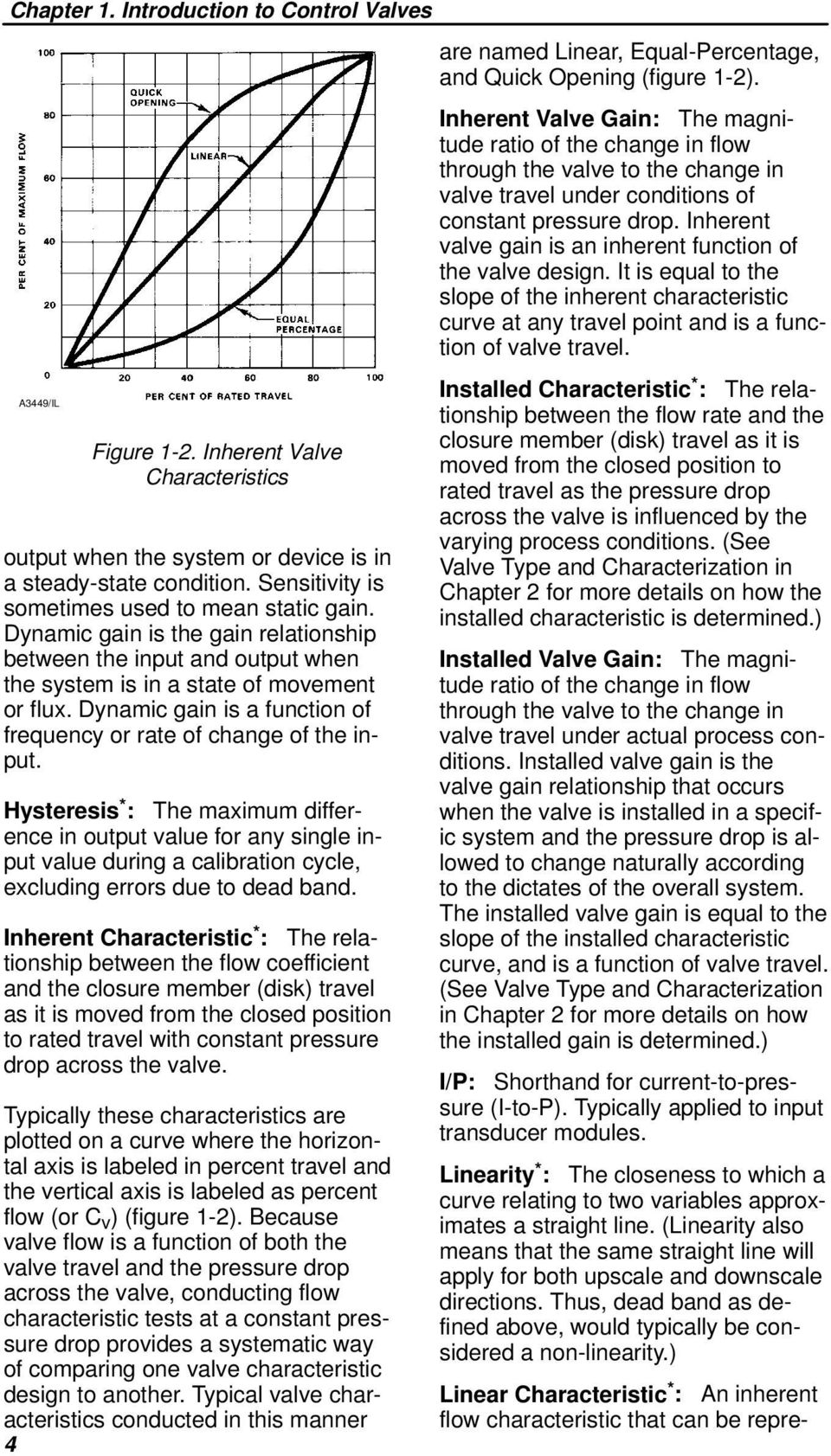
19 sented by a straight line on a rectangular plot of flow coefficient ( v ) versus rated travel. Therefore equal increments of travel provide equal increments of flow coefficient, v (figure 1-2). Loop: (See losed Loop.) Loop Gain: The combined gain of all the components in the loop when viewed in series around the loop. Sometimes referred to as open-loop gain. It must be clearly specified whether referring to the static loop gain or the dynamic loop gain at some frequency. Manual ontrol: (See Open Loop.) Open Loop: The condition where the interconnection of process control components is interrupted such that information from the process variable is no longer fed back to the controller set point so that corrections to the process variable are no longer provided. This is typically accomplished by placing the controller in the manual operating position. Packing: part of the valve assembly used to seal against leakage around the valve disk or stem. Positioner * : position controller (servomechanism) that is mechanically connected to a moving part of a final control element or its actuator and that automatically adjusts its output to the actuator to maintain a desired position in proportion to the input signal. Process: ll the combined elements in the control loop, except the controller. The process typically includes the control valve assembly, the pressure vessel or heat exchanger that is being controlled, as well as sensors, pumps, and transmitters. Process Gain: The ratio of the change in the controlled process variable to a corresponding change in the output of the controller. hapter 1. Introduction to ontrol Valves Process Variability: precise statistical measure of how tightly the process is being controlled about the set point. Process variability is defined in percent as typically (2s/m), where m is the set point or mean value of the measured process variable and s is the standard deviation of the process variable. Quick Opening haracteristic * : n inherent flow characteristic in which a maximum flow coefficient is achieved with minimal closure member travel (figure 1-2). Relay: device that acts as a power amplifier. It takes an electrical, pneumatic, or mechanical input signal and produces an output of a large volume flow of air or hydraulic fluid to the actuator. The relay can be an internal component of the positioner or a separate valve accessory. Resolution: The minimum possible change in input required to produce a detectable change in the output when no reversal of the input takes place. Resolution is typically expressed as a percent of the input span. Response Time: Usually measured by a parameter that includes both dead time and time constant. (See T 63, Dead Time, and Time onstant.) When applied to the valve, it includes the entire valve assembly. Second-Order: term that refers to the dynamic relationship between the input and output of a device. second-order system or device is one that has two energy storage devices that can transfer kinetic and potential energy back and forth between themselves, thus introducing the possibility of oscillatory behavior and overshoot. Sensor: device that senses the value of the process variable and provides a corresponding output signal to a transmitter. The sensor can be an integral part of the transmitter, or it may be a separate component. 5

20 hapter 1. Introduction to ontrol Valves Set Point: reference value representing the desired value of the process variable being controlled. Shaft Wind-Up: phenomenon where one end of a valve shaft turns and the other does not. This typically occurs in rotary-style valves where the actuator is connected to the valve closure member by a relatively long shaft. While seal friction in the valve holds one end of the shaft in place, rotation of the shaft at the actuator end is absorbed by twisting of the shaft until the actuator input transmits enough force to overcome the friction. Sizing (Valve): systematic procedure designed to ensure the correct valve capacity for a set of specified process conditions. Travel * : The movement of the closure member from the closed position to an intermediate or rated full open position. Travel Indicator: pointer and scale used to externally show the position of the closure member typically with units of opening percent of travel or degrees of rotation. Trim * : The internal components of a valve that modulate the flow of the controlled fluid. Valve: (See ontrol Valve ssembly.) Volume ooster: stand-alone relay is often referred to as a volume booster or simply booster because it boosts, or amplifies, the volume of air supplied to the actuator. (See Relay.) Stiction: (See Friction.) T 63 (Tee-63): measure of device response. It is measured by applying a small (usually 1-5%) step input to the system. T 63 is measured from the time the step input is initiated to the time when the system output reaches 63% of the final steady-state value. It is the combined total of the system Dead Time (T d ) and the system Time onstant (t). (See Dead Time and Time onstant.) Time onstant: time parameter that normally applies to a first-order element. It is the time interval measured from the first detectable response of the system to a small (usually 0.25% - 5%) step input until the system output reaches 63% of its final steady-state value. (See T 63. ) When applied to an open-loop process, the time constant is usually designated as (Tau). When applied to a closed-loop system, the time constant is usually designated as λ (Lambda). Transmitter: device that senses the value of the process variable and transmits a corresponding output signal to the controller for comparison with the set point. 6 Sliding-Stem ontrol Valve Terminology The following terminology applies to the physical and operating characteristics of standard sliding-stem control valves with diaphragm or piston actuators. Some of the terms, particularly those pertaining to actuators, are also appropriate for rotary-shaft control valves. Many of the definitions presented are in accordance with IS S75.05, ontrol Valve Terminology, although other popular terms are also included. dditional explanation is provided for some of the more complex terms. omponent part names are called out on accompanying figures 1-3 through 1-6. Separate sections follow that define specific rotary-shaft control valve terminology, control valve functions and characteristics terminology, and other process control terminology. ctuator Spring: spring, or group of springs, enclosed in the yoke or actuator casing that moves the actuator stem in a direction opposite to that created by diaphragm pressure. ctuator Stem: The part that connects the actuator to the valve stem

21 LODING PRESSURE ONNETION DIPHRGM SING hapter 1. Introduction to ontrol Valves DIPHRGM ND STEM SHOWN IN UP POSITION DIPHRGM PLTE DIRET-TING TUTOR TUTOR SPRING TUTOR STEM SPRING SET SPRING DJUSTOR STEM ONNETOR YOKE TRVEL INDITOR INDITOR SLE W OMPT FIELD-REVERSILE MULTI-SPRING TUTOR INTEGRL PNEUMTI PSSGEWYS INTEGRTED POSITIONER MOUNTING IR-TO-OPEN VLVE SSEMLY NMUR POSITIONER MOUNTING PILITY ONE-PIEE SREWED PKING FOLLOWER STNDRD LIVE-LODED PKING LMPED ONNET DESIGN W PUSH-DOWN- TO-LOSE VLVE ODY SSEMLY ONNET GSKET SPIRL WOUND GSKET GE GSKET VLVE PLUG STEM PKING FLNGE TUTOR YOKE LOKNUT PKING PKING OX ONNET VLVE PLUG SET RING GE SET RING GSKET W0989 VLVE ODY Figure 1-3. Major omponents of Typical Sliding-Stem ontrol Valve ssemblies 7
22 hapter 1. Introduction to ontrol Valves DIPHRGM SINGS DIPHRGM ND STEM SHOWN IN DOWN POSITION DIPHRGM PLTE LODING PRESSURE ONNETION TUTOR SPRING TUTOR STEM SPRING SET SPRING DJUSTOR STEM ONNETOR YOKE TRVEL INDITOR INDITOR SLE W0364-1/IL Figure 1-4. Typical Reverse-cting Diaphragm ctuator W0667/IL Figure 1-5. Extension onnet and transmits motion (force) from the actuator to the valve. ctuator Stem Extension: n extension of the piston actuator stem to provide a means of transmitting piston 8 W6434/IL Figure 1-6. ellows Seal onnet motion to the valve positioner (figure 1-7). ctuator Stem Force: The net force from an actuator that is available for actual positioning of the valve plug.
23 hapter 1. Introduction to ontrol Valves TUTOR STEM YLINDER PISTON SEL PISTON YLINDER LOSURE SEL TRVEL INDITOR SLE TUTOR STEM SEL YLINDER SEL SEL USHING YOKE STEM ONNETOR TRVEL INDITOR W7447-1/IIL Figure 1-7. Typical Double-cting Piston ctuator with ias Spring ngle Valve: valve design in which one port is co-linear with the valve stem or actuator, and the other port is at a right angle to the valve stem. (See also Globe Valve.) ellows Seal onnet: bonnet that uses a bellows for sealing against leakage around the closure member stem (figure 1-6). onnet: The portion of the valve that contains the packing box and stem seal and can guide the stem. It provides the principal opening to the body cavity for assembly of internal parts or it can be an integral part of the valve body. It can also provide for the attachment of the actuator to the valve body. Typical bonnets are bolted, threaded, welded, pressure-seals, or integral with the body. (This term is often used in referring to the bonnet and its included packing parts. More properly, this group of component parts should be called the bonnet assembly.) onnet ssembly: (ommonly onnet, more properly onnet ssembly): n assembly including the part through which a valve stem moves and a means for sealing against leakage along the stem. It usually provides a means for mounting the actuator and loading the packing assembly. ottom Flange: part that closes a valve body opening opposite the bonnet opening. It can include a guide bushing and/or serve to allow reversal of the valve action. ushing: device that supports and/ or guides moving parts such as valve stems. age: part of a valve trim that surrounds the closure member and can provide flow characterization and/or a seating surface. It also provides stability, guiding, balance, and alignment, and facilitates assembly of other parts of the valve trim. The walls of the cage contain openings that usually determine the flow characteristic of 9
24 hapter 1. Introduction to ontrol Valves W0957/IL W0958/IL W0959/IL QUIK OPENING LINER EQUL PERENTGE Figure 1-8. haracterized ages for Globe-Style Valve odies the control valve. Various cage styles are shown in figure 1-8. losure Member: The movable part of the valve that is positioned in the flow path to modify the rate of flow through the valve. losure Member Guide: That portion of a closure member that aligns its movement in either a cage, seat ring, bonnet, bottom flange, or any two of these. ylinder: The chamber of a piston actuator in which the piston moves (figure 1-7). ylinder losure Seal: The sealing element at the connection of the piston actuator cylinder to the yoke. Diaphragm: flexible, pressure responsive element that transmits force to the diaphragm plate and actuator stem. Diaphragm ctuator: fluid powered device in which the fluid acts upon a flexible component, the diaphragm. Diaphragm ase: housing, consisting of top and bottom section, used for supporting a diaphragm and establishing one or two pressure chambers. 10 Diaphragm Plate: plate concentric with the diaphragm for transmitting force to the actuator stem. Direct ctuator: diaphragm actuator in which the actuator stem extends with increasing diaphragm pressure. Extension onnet: bonnet with greater dimension between the packing box and bonnet flange for hot or cold service. Globe Valve: valve with a linear motion closure member, one or more ports, and a body distinguished by a globular shaped cavity around the port region. Globe valves can be further classified as: two-way single-ported; two-way double-ported (figure 1-9); angle-style (figure 1-10); three-way (figure 1-11); unbalanced cage-guided (figure 1-3); and balance cage-guided (figure 1-12). Lower Valve ody: half housing for internal valve parts having one flow connection. The seat ring is normally clamped between the upper valve body and the lower valve body in split valve constructions. Offset Valve: valve construction having inlet and outlet line connections on different planes but 180 degrees opposite each other. Packing ox (ssembly): The part of the bonnet assembly used to seal against leakage around the closure
25 hapter 1. Introduction to ontrol Valves W0467/IL Figure 1-9. Reverse Double-Ported Globe-Style Valve ody W0665/IL Figure Three-Way Valve with alanced Valve Plug W0992/IL W0971/IL Figure Flanged ngle-style ontrol Valve ody member stem. Included in the complete packing box assembly are various combinations of some or all of the following component parts: packing, packing follower, packing nut, lantern ring, packing spring, packing flange, packing flange studs or bolts, packing flange nuts, packing ring, packing wiper ring, felt wiper ring, belleville springs, anti-extrusion ring. Individual Figure Valve ody with age-style Trim, alanced Valve Plug, and Soft Seat packing parts are shown in figure Piston: movable pressure responsive element that transmits force to the piston actuator stem (figure 1-7). Piston Type ctuator: fluid powered device in which the fluid acts upon a movable piston to provide motion to the actuator stem. Piston type actuators (figure 1-7) are classified as either double-acting, so that full power 11
26 hapter 1. Introduction to ontrol Valves STNDRD TFE V-RING 2565 / IL E E GRPHITE PKING RRNGEMENTS LOTION OF SRIFIIL ZIN WSHER, IF USED. Figure omprehensive Packing Material rrangements for Globe-Style Valve odies can be developed in either direction, or as spring-fail so that upon loss of supply power, the actuator moves the valve in the required direction of travel. Plug: term frequently used to refer to the closure member. Port: The flow control orifice of a control valve. Retaining Ring: split ring that is used to retain a separable flange on a valve body. Reverse ctuator: diaphragm actuator in which the actuator stem retracts with increasing diaphragm pressure. Reverse actuators have a seal bushing (figure 1-4) installed in the upper end of the yoke to prevent leakage of the diaphragm pressure along the actuator stem. Rubber oot: protective device to prevent entrance of damaging foreign material into the piston actuator seal bushing. Seal ushing: Top and bottom bushings that provide a means of sealing 12 the piston actuator cylinder against leakage. Synthetic rubber O-rings are used in the bushings to seal the cylinder, the actuator stem, and the actuator stem extension (figure 1-7). Seat: The area of contact between the closure member and its mating surface that establishes valve shut-off. Seat Load: The net contact force between the closure member and seat with stated static conditions. In practice, the selection of an actuator for a given control valve will be based on how much force is required to overcome static, stem, and dynamic unbalance with an allowance made for seat load. Seat Ring: part of the valve body assembly that provides a seating surface for the closure member and can provide part of the flow control orifice. Separable Flange: flange that fits over a valve body flow connection. It is generally held in place by means of a retaining ring. Spring djustor: fitting, usually threaded on the actuator stem or into
27 the yoke, to adjust the spring compression. Spring Seat: plate to hold the spring in position and to provide a flat surface for the spring adjustor to contact. Static Unbalance: The net force produced on the valve stem by the fluid pressure acting on the closure member and stem with the fluid at rest and with stated pressure conditions. Stem onnector: The device that connects the actuator stem to the valve stem. Trim: The internal components of a valve that modulate the flow of the controlled fluid. In a globe valve body, trim would typically include closure member, seat ring, cage, stem, and stem pin. Trim, Soft-Seated: Valve trim with an elastomeric, plastic or other readily deformable material used either in the closure component or seat ring to provide tight shutoff with minimal actuator forces. Upper Valve ody: half housing for internal valve parts and having one flow connection. It usually includes a means for sealing against leakage along the stem and provides a means for mounting the actuator on the split valve body. hapter 1. Introduction to ontrol Valves Valve ody: The main pressure boundary of the valve that also provides the pipe connecting ends, the fluid flow passageway, and supports the seating surfaces and the valve closure member. mong the most common valve body constructions are: a) single-ported valve bodies having one port and one valve plug; b) double-ported valve bodies having two ports and one valve plug; c) two-way valve bodies having two flow connections, one inlet and one outlet; d) three-way valve bodies having three flow connections, two of which can be inlets with one outlet (for converging or mixing flows), or one inlet and two outlets (for diverging or diverting flows). The term valve body, or even just body, frequently is used in referring to the valve body together with its bonnet assembly and included trim parts. More properly, this group of components should be called the valve body assembly. Valve ody ssembly (ommonly Valve ody or Valve, more properly Valve ody ssembly): n assembly of a valve, bonnet assembly, bottom flange (if used), and trim elements. The trim includes the closure member, which opens, closes, or partially obstructs one or more ports. Valve Plug: term frequently interchanged with plug in reference to the closure member. Valve Stem: In a linear motion valve, the part that connects the actuator stem with the closure member. Yoke: The structure that rigidly connects the actuator power unit to the valve. Rotary-Shaft ontrol Valve Terminology The definitions that follow apply specifically to rotary-shaft control valves. ctuator Lever: rm attached to rotary valve shaft to convert linear actuator stem motion to rotary force to position disk or ball of rotary-shaft valve. The lever normally is positively connected to the rotary shaft by close tolerance splines or other means to minimize play and lost motion. all, Full: The flow-controlling member of rotary-shaft control valves using a complete sphere with a flow passage through it. The flow passage equals or matches the pipe diameter. 13
28 hapter 1. Introduction to ontrol Valves W4920/IL SEGMENTED LL VLVE W4641 ONVENTIONL DISK UTTERFLY VLVE W6213/IL EENTRI DISK VLVE W5477/IL ONTOURED DISK UTTERFLY VLVE Figure Typical Rotary-Shaft ontrol Valve onstructions 14
29 all, Segmented: The flow-controlling member of rotary shaft control valves using a partial sphere with a flow passage through it. hapter 1. Introduction to ontrol Valves Flangeless valves are held between NSI-class flanges by long through-bolts (sometimes also called wafer-style valve bodies). all, V-notch: The most common type of segmented ball control valve. The V-notch ball includes a polished or plated partial-sphere surface that rotates against the seal ring throughout the travel range. The V-shaped notch in the ball permits wide rangeability and produces an equal percentage flow characteristic. Note: The balls mentioned above, and the disks which follow, perform a function comparable to the valve plug in a globe-style control valve. That is, as they rotate they vary the size and shape of the flowstream by opening more or less of the seal area to the flowing fluid. Disk, onventional: The symmetrical flow-controlling member used in the most common varieties of butterfly rotary valves. High dynamic torques normally limit conventional disks to 60 degrees maximum rotation in throttling service. Disk, Dynamically Designed: butterfly valve disk contoured to reduce dynamic torque at large increments of rotation, thereby making it suitable for throttling service with up to 90 degrees of disk rotation. Disk, Eccentric: ommon name for valve design in which the positioning of the valve shaft/disk connections causes the disk to take a slightly eccentric path on opening. This allows the disk to be swung out of contact with the seal as soon as it is opened, thereby reducing friction and wear. Flangeless Valve: Valve style common to rotary-shaft control valves. Plug, Eccentric: Style of rotary control valve with an eccentrically rotating plug which cams into and out of the seat, which reduces friction and wear. This style of valve has been well suited for erosive applications. Reverse Flow: Flow from the shaft side over the back of the disk, ball, or plug. Some rotary-shaft control valves are capable of handling flow equally well in either direction. Other rotary designs might require modification of actuator linkage to handle reverse flow. Rod End earing: The connection often used between actuator stem and actuator lever to facilitate conversion of linear actuator thrust to rotary force with minimum of lost motion. Use of a standard reciprocating actuator on a rotary-shaft valve body commonly requires linkage with two rod end bearings. However, selection of an actuator specifically designed for rotary-shaft valve service requires only one such bearing and thereby reduces lost motion. Rotary-Shaft ontrol Valve: valve style in which the flow closure member (full ball, partial ball, disk or plug) is rotated in the flowstream to control the capacity of the valve (figure 1-14). Seal Ring: The portion of a rotary-shaft control valve assembly corresponding to the seat ring of a globe valve. Positioning of the disk or ball relative to the seal ring determines the flow area and capacity of the unit at that particular increment of rotational travel. s indicated above, some seal ring designs permit bi-directional flow. Shaft: The portion of a rotary-shaft control valve assembly corresponding to the valve stem of a globe valve. Rotation of the shaft positions the disk 15
30 hapter 1. Introduction to ontrol Valves or ball in the flowstream and thereby controls capacity of the valve. Sliding Seal: The lower cylinder seal in a pneumatic piston-style actuator designed for rotary valve service. This seal permits the actuator stem to move both vertically and laterally without leakage of lower cylinder pressure. Standard Flow: For those rotary-shaft control valves having a separate seal ring or flow ring, the flow direction in which fluid enters the valve body through the pipeline adjacent to the seal ring and exits from the side opposite the seal ring. Sometimes called forward flow. (See also Reverse Flow.) Trunnion Mounting: style of mounting the disk or ball on the valve shaft or stub shaft with two bearings diametrically opposed. ontrol Valve Functions and haracteristics Terminology ench Set: The calibration of the actuator spring range of a control valve to account for the in-service process forces. apacity: Rate of flow through a valve under stated conditions. learance Flow: That flow below the minimum controllable flow with the closure member not seated. Diaphragm Pressure Span: Difference between the high and low values of the diaphragm pressure range. This can be stated as an inherent or installed characteristic. Double-cting ctuator: n actuator in which power is supplied in either direction. Dynamic Unbalance: The net force produced on the valve plug in any stated open position by the fluid pressure acting upon it. 16 Effective rea: In a diaphragm actuator, the effective area is that part of the diaphragm area that is effective in producing a stem force. The effective area of a diaphragm might change as it is stroked, usually being a maximum at the start and a minimum at the end of the travel range. Molded diaphragms have less change in effective area than flat sheet diaphragms; thus, molded diaphragms are recommended. Equal Percentage Flow haracteristic: (See Process ontrol Terminology: Equal Percentage Flow haracteristic.) Fail-losed: condition wherein the valve closure member moves to a closed position when the actuating energy source fails. Fail-Open: condition wherein the valve closure member moves to an open position when the actuating energy source fails. Fail-Safe: characteristic of a valve and its actuator, which upon loss of actuating energy supply, will cause a valve closure member to be fully closed, fully open, or remain in the last position, whichever position is defined as necessary to protect the process. Fail-safe action can involve the use of auxiliary controls connected to the actuator. Flow haracteristic: Relationship between flow through the valve and percent rated travel as the latter is varied from 0 to 100 percent. This term should always be designated as either inherent flow characteristic or installed flow characteristic. Flow oefficient ( v ): constant ( v ) related to the geometry of a valve, for a given travel, that can be used to establish flow capacity. It is the number of U.S. gallons per minute of 60 F water that will flow through a valve with a one pound per square inch pressure drop. High-Recovery Valve: valve design that dissipates relatively little
31 flow-stream energy due to streamlined internal contours and minimal flow turbulence. Therefore, pressure downstream of the valve vena contracta recovers to a high percentage of its inlet value. Straight-through flow valves, such as rotary-shaft ball valves, are typically high-recovery valves. Inherent Diaphragm Pressure Range: The high and low values of pressure applied to the diaphragm to produce rated valve plug travel with atmospheric pressure in the valve body. This range is often referred to as a bench set range because it will be the range over which the valve will stroke when it is set on the work bench. Inherent Flow haracteristic: The relationship between the flow rate and the closure member travel as it is moved from the closed position to rated travel with constant pressure drop across the valve. Installed Diaphragm Pressure Range: The high and low values of pressure applied to the diaphragm to produce rated travel with stated conditions in the valve body. It is because of the forces acting on the closure member that the inherent diaphragm pressure range can differ from the installed diaphragm pressure range. Installed Flow haracteristic: The relationship between the flow rate and the closure member travel as it is moved from the closed position to rated travel as the pressure drop across the valve is influenced by the varying process conditions. Leakage: (See Seat Leakage.) Linear Flow haracteristic: (See Process ontrol Terminology: Linear haracteristic.) Low-Recovery Valve: valve design that dissipates a considerable amount of flowstream energy due to turbulence created by the contours of the flowpath. onsequently, pressure hapter 1. Introduction to ontrol Valves downstream of the valve vena contracta recovers to a lesser percentage of its inlet value than is the case with a valve having a more streamlined flowpath. lthough individual designs vary, conventional globe-style valves generally have low pressure recovery capability. Modified Parabolic Flow haracteristic: n inherent flow characteristic that provides equal percent characteristic at low closure member travel and approximately a linear characteristic for upper portions of closure member travel. Normally losed Valve: (See Fail-losed.) Normally Open Valve: (See Fail-Open.) Push-Down-to-lose onstruction: globe-style valve construction in which the closure member is located between the actuator and the seat ring, such that extension of the actuator stem moves the closure member toward the seat ring, finally closing the valve (figure 1-3). The term can also be applied to rotary-shaft valve constructions where linear extension of the actuator stem moves the ball or disk toward the closed position. (lso called direct acting.) Push-Down-to-Open onstruction: globe-style valve construction in which the seat ring is located between the actuator and the closure member, so that extension of the actuator stem moves the closure member from the seat ring, opening the valve. The term can also be applied to rotary-shaft valve constructions where linear extension of the actuator stem moves the ball or disk toward the open position. (lso called reverse acting.) Quick Opening Flow haracteristic: (See Process ontrol Terminology: Quick Opening haracteristic.) Rangeability: The ratio of the largest flow coefficient ( v ) to the smallest flow coefficient ( v ) within which the 17
32 hapter 1. Introduction to ontrol Valves deviation from the specified flow characteristic does not exceed the stated limits. control valve that still does a good job of controlling when flow increases to 100 times the minimum controllable flow has a rangeability of 100 to 1. Rangeability can also be expressed as the ratio of the maximum to minimum controllable flow rates. Rated Flow oefficient ( v ): The flow coefficient ( v ) of the valve at rated travel. Rated Travel: The distance of movement of the closure member from the closed position to the rated full-open position. The rated full-open position is the maximum opening recommended by the manufacturers. Relative Flow oefficient: The ratio of the flow coefficient ( v ) at a stated travel to the flow coefficient ( v ) at rated travel. Seat Leakage: The quantity of fluid passing through a valve when the valve is in the fully closed position with pressure differential and temperature as specified. (NSI leakage classifications are outlined in hapter 5.) Spring Rate: The force change per unit change in length of a spring. In diaphragm control valves, the spring rate is usually stated in pounds force per inch compression. Stem Unbalance: The net force produced on the valve stem in any position by the fluid pressure acting upon it. Vena ontracta: The portion of a flow stream where fluid velocity is at its maximum and fluid static pressure and the cross-sectional area are at their minimum. In a control valve, the vena contracta normally occurs just downstream of the actual physical restriction. 18 Other Process ontrol Terminology The following terms and definitions not previously defined are frequently encountered by people associated with control valves, instrumentation, and accessories. Some of the terms (indicated with an asterisk) are quoted from the IS standard, Process Instrumentation Terminology, IS Others included are also popularly used throughout the control valve industry. NSI: bbreviation for merican National Standards Institute. PI: bbreviation for merican Petroleum Institute. SME: bbreviation for merican Society of Mechanical Engineers. STM: bbreviation for merican Society for Testing and Materials. utomatic ontrol System*: control system that operates without human intervention. ode Diagram*: plot of log amplitude ratio and phase angle values on a log frequency base for a transfer function (figure 1-15). It is the most common form of graphically presenting frequency response data. alibration urve*: graphical representation of the calibration report (figure 1-15). Steady state output of a device plotted as a function of its steady state input. The curve is usually shown as percent output span versus percent input span. alibration ycle*: The application of known values of the measured variable and the recording of corresponding values of output readings, over the range of the instrument, in ascending and descending directions (figure 1-15). calibration curve obtained by varying the input of a device in both increasing and decreasing directions. It is usually shown as percent output span versus percent input span and provides a measurement of hysteresis.
33 hapter 1. Introduction to ontrol Valves Figure Graphic Representation of Various ontrol Terms 19
34 hapter 1. Introduction to ontrol Valves learance Flow: That flow below the minimum controllable flow with the closure general member not seated. ontroller*: device that operates automatically to regulate a controlled variable. Enthalpy: thermodynamic quantity that is the sum of the internal energy of a body and the product of its volume multiplied by the pressure: H = U + pv. (lso called the heat content.) Entropy: The theoretical measure of energy that cannot be transformed into mechanical work in a thermodynamic system. Feedback Signal*: The return signal that results from a measurement of the directly controlled variable. For a control valve with a positioner, the return signal is usually a mechanical indication of closure member stem position that is fed back into the positioner. FI: bbreviation for Fluid ontrols Institute. Frequency Response haracteristic*: The frequency-dependent relation, in both amplitude and phase, between steady-state sinusoidal inputs and the resulting fundamental sinusoidal outputs. Output amplitude and phase shift are observed as functions of the input test frequency and used to describe the dynamic behavior of the control device. Hardness: Resistance of metal to plastic deformation, usually by indentation. Resistance of plastics and rubber to penetration of an indentor point into its surface. Hunting*: n undesirable oscillation of appreciable magnitude, prolonged after external stimuli disappear. Sometimes called cycling or limit cycle, hunting is evidence of operation at or near the stability limit. In control valve applications, hunting would appear as an oscillation in the loading pressure to the actuator caused by 20 instability in the control system or the valve positioner. Hysteresis: retardation of an effect when the forces acting upon a body are changed (as if from viscosity or internal friction). IS: bbreviation for the Instrument Society of merica. Now recognized as the International Society for Measurement and ontrol. Instrument Pressure: The output pressure from an automatic controller that is used to operate a control valve. Loading Pressure: The pressure employed to position a pneumatic actuator. This is the pressure that actually works on the actuator diaphragm or piston and it can be the instrument pressure if a valve positioner is not used. NE: Used to stand for National ssociation of orrosion Engineers. s the scope of the organization became international, the name was changed to NE International. NE is no longer an abbreviation. OSH: bbreviation for Occupational Safety and Health ct. (U.S..) Operating Medium: This is the fluid, generally air or gas, used to supply the power for operation of valve positioner or automatic controller. Operative Limits*: The range of operating conditions to which a device can be subjected without permanent impairment of operating characteristics. Range: The region between the limits within which a quantity is measured, received, or transmitted, expressed by stating the lower and upper range values (for example: 3 to 15 psi; -40 to +212 F; -40 to +100 ). Repeatability*: The closeness of agreement among a number of consecutive measurements of the output for the same value of the input under the same operating conditions, ap-
35 proaching from the same direction, for full range traverses. It is usually measured as a non-repeatability and expressed as repeatability in percent of span. It does not include hyesteresis (figure 1-15). Sensitivity*: The ratio of the change in output magnitude to the change of the input that causes it after the steady-state has been reached. Signal*: physical variable, one or more parameters of which carry information about another variable the signal represents. Signal mplitude Sequencing (Split Ranging)*: ction in which two or more signals are generated or two or more final controlling elements are actuated by and input signal, each one responding consecutively, with or hapter 1. Introduction to ontrol Valves without overlap, to the magnitude of that input signal (figure 1-15). Span*: The algebraic difference between the upper and lower range values (for example: Range = 0 to 150 F; Span = 150 F; Range = 3 to 15 psig, Span = 12 psig). Stiction: the force required to cause one body in contact with another to begin to move. Supply Pressure*: The pressure at the supply port of a device. ommon values of control valve supply pressure are 20 psig for a 3 to 15 psig range and 35 psig for a 6 to 30 psig range. Zero Error*: Error of a device operating under specified conditions of use when the input is at the lower range value. It is usually expressed as percent of ideal span. 21
36 hapter 1. Introduction to ontrol Valves 22
37 hapter 2 ontrol Valve Performance In today s dynamic business environment, manufacturers are under extreme economic pressures. Market globalization is resulting in intense pressures to reduce manufacturing costs to compete with lower wages and raw material costs of emerging countries. ompetition exists between international companies to provide the highest quality products and to maximize plant throughputs with fewer resources, although meeting ever changing customer needs. These marketing challenges must be met although fully complying with public and regulatory policies. Process Variability To deliver acceptable returns to their shareholders, international industry leaders are realizing they must reduce raw material and scrap costs while increasing productivity. Reducing process variability in the manufacturing processes through the application of process control technology is recognized as an effective method to improve financial returns and meet global competitive pressures. The basic objective of a company is to make a profit through the production of a quality product. quality product conforms to a set of specifications. ny deviation from the established specification means lost profit due to excessive material use, reprocessing costs, or wasted product. Thus, a large financial impact is obtained through improving process control. Reducing process variability through better process control allows optimization of the process and the production of products right the first time. The non-uniformity inherent in the raw materials and processes of production are common causes of variation that produce a variation of the process 23
38 hapter 2. ontrol Valve Performance 7153 / IL 2-Sigma 2-Sigma Figure 2-1. Process Variability variable both above and below the set point. process that is in control, with only the common causes of variation present, typically follows a bell-shaped normal distribution (figure 2-1). statistically derived band of values on this distribution, called the +/-2 sigma band, describes the spread of process variable deviations from the set point. This band is the variability of the process. It is a measure of how tightly the process is being controlled. Process Variability (see definition in hapter 1) is a precise measure of tightness of control and is expressed as a percentage of the set point. If a product must meet a certain lower-limit specification, for example, the set point needs to be established at a 2 sigma value above this lower limit. Doing so will ensure that all the product produced at values to the right of the lower limit will meet the quality specification. The problem, however, is that money and resources are being wasted by making a large percentage of the product to a level much greater than required by the specification (see upper distribution in figure 2-1). 24 The most desirable solution is to reduce the spread of the deviation about the set point by going to a control valve that can produce a smaller sigma (see lower distribution in figure 2-1). Reducing process variability is a key to achieving business goals. Most companies realize this, and it is not uncommon for them to spend hundreds of thousands of dollars on instrumentation to address the problem of process variability reduction. Unfortunately, the control valve is often overlooked in this effort because its impact on dynamic performance is not realized. Extensive studies of control loops indicate as many as 80% of the loops did not do an adequate job of reducing process variability. Furthermore, the control valve was found to be a major contributor to this problem for a variety of reasons. To verify performance, manufacturers must test their products under dynamic process conditions. These are typically performed in a flow lab in actual closed-loop control (figure 2-2). Evaluating control valve assemblies under closed-loop conditions provides the only true measure of variability performance. losed-loop performance data proves significant reductions in pro-
39 hapter 2. ontrol Valve Performance W9127 Figure 2-2. Performance Test Loop cess variability can be achieved by choosing the right control valve for the application. The ability of control valves to reduce process variability depends upon many factors. More than one isolated parameter must be considered. Research within the industry has found the particular design features of the final control element, including the valve, actuator, and positioner, are very important in achieving good process control under dynamic conditions. Most importantly, the control valve assembly must be optimized or developed as a unit. Valve components not designed as a complete assembly typically do not yield the best dynamic performance. Some of the most important design considerations include: Dead band ctuator/positioner design Valve response time Valve type and sizing Each of these design features will be considered in this chapter to provide insight into what constitutes a superior valve design. Dead and Dead band is a major contributor to excess process variability, and control valve assemblies can be a primary source of dead band in an instrumentation loop due to a variety of causes such as friction, backlash, shaft wind-up, relay or spool valve dead zone, etc.. Dead band is a general phenomenon where a range or band of controller output (O) values fails to produce a change in the measured process variable (PV) when the input signal reverses direction. (See definitions of these terms in hapter 1.) When a load disturbance occurs, the process variable (PV) deviates from the set point. This deviation initiates a corrective action through the controller and 25
40 hapter 2. ontrol Valve Performance back through the process. However, an initial change in controller output can produce no corresponding corrective change in the process variable. Only when the controller output has changed enough to progress through the dead band does a corresponding change in the process variable occur. ny time the controller output reverses direction, the controller signal must pass through the dead band before any corrective change in the process variable will occur. The presence of dead band in the process ensures the process variable deviation from the set point will have to increase until it is big enough to get through the dead band. Only then can a corrective action occur. Dead band has many causes, but friction and backlash in the control valve, along with shaft wind-up in rotary valves, and relay dead zone are some of the more common forms. ecause most control actions for regulatory control consist of small changes (1% or less), a control valve with excessive dead band might not even respond to many of these small changes. well-engineered valve should respond to signals of 1% or less to provide effective reduction in process variability. However, it is not uncommon for some valves to exhibit dead band as great as 5% or more. In a recent plant audit, 30% of the valves had dead bands in excess of 4%. Over 65% of the loops audited had dead bands greater than 2%. Figure 2-3 shows just how dramatic the combined effects of dead band can be. This diagram represents an open-loop test of three different control valves under normal process conditions. The valves are subjected to a series of step inputs which range from 0.5% to 10%. Step tests under flowing conditions such as these are essential because they allow the performance of the entire valve assembly to be evaluated, rather than just the valve actuator assembly as would be the / IL Figure 2-3. Effect of Dead and on Valve Performance case under most bench test conditions. Some performance tests on a valve assembly compare only the actuator stem travel versus the input signal. This is misleading because it ignores the performance of the valve itself. It is critical to measure dynamic performance of a valve under flowing conditions so the change in process variable can be compared to the change in valve assembly input signal. It matters little if only the valve stem changes in response to a change in valve input because if there is no corresponding change in the controlled variable, there will be no correction to the process variable. In all three valve tests (figure 2-3), the actuator stem motion changes fairly faithfully in response to the input signal changes. On the other hand, there is a dramatic difference in each of these valve s ability to change the flow in response to an input signal change. For Valve the process variable (flow rate) responds well to input signals as low as 0.5. Valve requires input sig-
41 nal changes as great as 5% before it begins responding faithfully to each of the input signal steps. Valve is considerably worse, requiring signal changes as great as 10% before it begins to respond faithfully to each of the input signal steps. The ability of either Valve or to improve process variability is very poor. Friction is a major cause of dead band in control valves. Rotary valves are often very susceptible to friction caused by the high seat loads required to obtain shut-off with some seal designs. ecause of the high seal friction and poor drive train stiffness, the valve shaft winds up and does not translate motion to the control element. s a result, an improperly designed rotary valve can exhibit significant dead band that clearly has a detrimental effect on process variability. Manufacturers usually lubricate rotary valve seals during manufacture, but after only a few hundred cycles this lubrication wears off. In addition, pressure-induced loads also cause seal wear. s a result, the valve friction can increase by 400% or more for some valve designs. This illustrates the misleading performance conclusions that can result from evaluating products using bench type data before the torque has stabilized. Valves and (figure 2-3) show the devastating effect these higher friction torque factors can have on a valve s performance. Packing friction is the primary source of friction in sliding-stem valves. In these types of valves, the measured friction can vary significantly between valve styles and packing arrangements. ctuator style also has a profound impact on control valve assembly friction. Generally, spring-and-diaphragm actuators contribute less friction to the control valve assembly than piston actuators. n additional advantage of spring-and-diaphragm actuators is hapter 2. ontrol Valve Performance that their frictional characteristics are more uniform with age. Piston actuator friction probably will increase significantly with use as guide surfaces and the O-rings wear, lubrication fails, and the elastomer degrades. Thus, to ensure continued good performance, maintenance is required more often for piston actuators than for spring-and-diaphragm actuators. If that maintenance is not performed, process variability can suffer dramatically without the operator s knowledge. acklash (see definition in hapter 1) is the name given to slack, or looseness of a mechanical connection. This slack results in a discontinuity of motion when the device changes direction. acklash commonly occurs in gear drives of various configurations. Rack-and-pinion actuators are particularly prone to dead band due to backlash. Some valve shaft connections also exhibit dead band effects. Spline connections generally have much less dead band than keyed shafts or double-d designs. While friction can be reduced significantly through good valve design, it is a difficult phenomenon to eliminate entirely. well-engineered control valve should be able to virtually eliminate dead band due to backlash and shaft wind-up. For best performance in reducing process variability, the total dead band for the entire valve assembly should be 1% or less. Ideally, it should be as low as 0.25%. ctuator-positioner Design ctuator and positioner design must be considered together. The combination of these two pieces of equipment greatly affects the static performance (dead band), as well as the dynamic response of the control valve assembly and the overall air consumption of the valve instrumentation. Positioners are used with the majority of control valve applications specified 27
42 hapter 2. ontrol Valve Performance today. Positioners allow for precise positioning accuracy and faster response to process upsets when used with a conventional digital control system. With the increasing emphasis upon economic performance of process control, positioners should be considered for every valve application where process optimization is important. The most important characteristic of a good positioner for process variability reduction is that it be a high gain device. Positioner gain is composed of two parts: the static gain and the dynamic gain. Static gain is related to the sensitivity of the device to the detection of small (0.125% or less) changes of the input signal. Unless the device is sensitive to these small signal changes, it cannot respond to minor upsets in the process variable. This high static gain of the positioner is obtained through a preamplifier, similar in function to the preamplifier contained in high fidelity sound systems. In many pneumatic positioners, a nozzle-flapper or similar device serves as this high static gain preamplifier. Once a change in the process variable has been detected by the high static gain positioner preamplifier, the positioner must then be capable of making the valve closure member move rapidly to provide a timely corrective action to the process variable. This requires much power to make the actuator and valve assembly move quickly to a new position. In other words, the positioner must rapidly supply a large volume of air to the actuator to make it respond promptly. The ability to do this comes from the high dynamic gain of the positioner. lthough the positioner preamplifier can have high static gain, it typically has little ability to supply the power needed. Thus, the preamplifier function must be supplemented by a high dynamic gain power amplifier that 28 supplies the required air flow as rapidly as needed. This power amplifier function is typically provided by a relay or a spool valve. Spool valve positioners are relatively popular because of their simplicity. Unfortunately, many spool valve positioners achieve this simplicity by omitting the high gain preamplifier from the design. The input stage of these positioners is often a low static gain transducer module that changes the input signal (electric or pneumatic) into movement of the spool valve, but this type of device generally has low sensitivity to small signal changes. The result is increased dead time and overall response time of the control valve assembly. Some manufacturers attempt to compensate for the lower performance of these devices by using spool valves with enlarged ports and reduced overlap of the ports. This increases the dynamic power gain of the device, which helps performance to some extent if it is well matched to the actuator, but it also dramatically increases the air consumption of these high gain spool valves. Many high gain spool valve positioners have static instrument air consumption five times greater than typical high performance two-stage positioners. Typical two-stage positioners use pneumatic relays at the power amplifier stage. Relays are preferred because they can provide high power gain that gives excellent dynamic performance with minimal steady-state air consumption. In addition, they are less subject to fluid contamination. Positioner designs are changing dramatically, with microprocessor devices becoming increasingly popular (see hapter 4). These microprocessor-based positioners provide dynamic performance equal to the best conventional two-stage pneumatic positioners. They also provide valve monitoring and diagnostic capabilities to help ensure that initial good
43 performance does not degrade with use. In summary, high-performance positioners with both high static and dynamic gain provide the best overall process variability performance for any given valve assembly. Valve Response Time For optimum control of many processes, it is important that the valve reach a specific position quickly. quick response to small signal changes (1% or less) is one of the most important factors in providing optimum process control. In automatic, regulatory control, the bulk of the signal changes received from the controller are for small changes in position. If a control valve assembly can quickly respond to these small changes, process variability will be improved. Valve response time is measured by a parameter called T 63 (Tee-63); (see definitions in hapter 1). T 63 is the time measured from initiation of the input signal change to when the output reaches 63% of the corresponding change. It includes both the valve assembly dead time, which is a static time, and the dynamic time of the valve assembly. The dynamic time is a measure of how long the actuator takes to get to the 63% point once it starts moving. Dead band, whether it comes from friction in the valve body and actuator or from the positioner, can significantly affect the dead time of the valve assembly. It is important to keep the dead time as small as possible. Generally dead time should be no more than one-third of the overall valve response time. However, the relative relationship between the dead time and the process time constant is critical. If the valve assembly is in a fast loop where the process time constant approaches the dead time, the dead time can dramatically affect loop performance. On these fast loops, it is hapter 2. ontrol Valve Performance critical to select control equipment with dead time as small as possible. lso, from a loop tuning point of view, it is important that the dead time be relatively consistent in both stroking directions of the valve. Some valve assembly designs can have dead times that are three to five times longer in one stroking direction than the other. This type of behavior is typically induced by the asymmetric behavior of the positioner design, and it can severely limit the ability to tune the loop for best overall performance. Once the dead time has passed and the valve begins to respond, the remainder of the valve response time comes from the dynamic time of the valve assembly. This dynamic time will be determined primarily by the dynamic characteristics of the positioner and actuator combination. These two components must be carefully matched to minimize the total valve response time. In a pneumatic valve assembly, for example, the positioner must have a high dynamic gain to minimize the dynamic time of the valve assembly. This dynamic gain comes mainly from the power amplifier stage in the positioner. In other words, the faster the positioner relay or spool valve can supply a large volume of air to the actuator, the faster the valve response time will be. However, this high dynamic gain power amplifier will have little effect on the dead time unless it has some intentional dead band designed into it to reduce static air consumption. Of course, the design of the actuator significantly affects the dynamic time. For example, the greater the volume of the actuator air chamber to be filled, the slower the valve response time. t first, it might appear that the solution would be to minimize the actuator volume and maximize the positioner dynamic power gain, but it is really not that easy. This can be a dangerous combination of factors from a stability point of view. Recognizing that the positioner/actuator combination is its 29
44 hapter 2. ontrol Valve Performance own feedback loop, it is possible to make the positioner/actuator loop gain too high for the actuator design being used, causing the valve assembly to go into an unstable oscillation. In addition, reducing the actuator volume has an adverse affect on the thrust-to-friction ratio, which increases the valve assembly dead band resulting in increased dead time. If the overall thrust-to-friction ratio is not adequate for a given application, one option is to increase the thrust capability of the actuator by using the next size actuator or by increasing the pressure to the actuator. This higher thrust-to-friction ratio reduces dead band, which should help to reduce the dead time of the assembly. However, both of these alternatives mean that a greater volume of air needs to be supplied to the actuator. The tradeoff is a possible detrimental effect on the valve response time through increased dynamic time. One way to reduce the actuator air chamber volume is to use a piston actuator rather than a spring-and-diaphragm actuator, but this is not a panacea. Piston actuators usually have higher thrust capability than spring-and-diaphragm actuators, but they also have higher friction, which can contribute to problems with valve response time. To obtain the required thrust with a piston actuator, it is usually necessary to use a higher air pressure than with a diaphragm actuator, because the piston typically has a smaller area. This means that a larger volume of air needs to be supplied with its attendant ill effects on the dynamic time. In addition, piston actuators, with their greater number of guide surfaces, tend to have higher friction due to inherent difficulties in alignment, as well as friction from the O-ring. These friction problems also tend to increase over time. Regardless of how good the O-rings are initially, these elastomeric materials will degrade with time due to wear and 30 other environmental conditions. Likewise wear on the guide surfaces will increase the friction, and depletion of the lubrication will occur. These friction problems result in a greater piston actuator dead band, which will increase the valve response time through increased dead time. Instrument supply pressure can also have a significant impact on dynamic performance of the valve assembly. For example, it can dramatically affect the positioner gain, as well as overall air consumption. Fixed-gain positioners have generally been optimized for a particular supply pressure. This gain, however, can vary by a factor of two or more over a small range of supply pressures. For example, a positioner that has been optimized for a supply pressure of 20 psig might find its gain cut in half when the supply pressure is boosted to 35 psig. Supply pressure also affects the volume of air delivered to the actuator, which in turn determines stroking speed. It is also directly linked to air consumption. gain, high-gain spool valve positioners can consume up to five times the amount of air required for more efficient high-performance, two-stage positioners that use relays for the power amplification stage. To minimize the valve assembly dead time, minimize the dead band of the valve assembly, whether it comes from friction in the valve seal design, packing friction, shaft wind-up, actuator, or positioner design. s indicated, friction is a major cause of dead band in control valves. On rotary valve styles, shaft wind-up (see definition in hapter 1) can also contribute significantly to dead band. ctuator style also has a profound impact on control valve assembly friction. Generally, spring-and-diaphragm actuators contribute less friction to the control valve assembly than piston actuators over an extended time. s mentioned, this is caused by the increasing friction
45 from the piston O-ring, misalignment problems, and failed lubrication. Having a positioner design with a high static gain preamplifier can make a significant difference in reducing dead band. This can also make a significant improvement in the valve assembly resolution (see definition in hapter 1). Valve assemblies with dead band and resolution of 1% or less are no longer adequate for many process variability reduction needs. Many processes require the valve assembly to have dead band and resolution as low as 0.25%, especially where the valve assembly is installed in a fast process loop. One of the surprising things to come out of many industry studies on valve response time has been the change in thinking about spring-and-diaphragm actuators versus piston actuators. It has long been a misconception in the process industry that piston actuators are faster than spring-and-diaphragm actuators. Research has shown this to be untrue for small signal changes. This mistaken belief arose from many years of experience with testing valves for stroking time. stroking time test is normally conducted by subjecting the valve assembly to a 100% step change in the input signal and measuring the time it takes the valve assembly to complete its full stroke in either direction. hapter 2. ontrol Valve Performance lthough piston-actuated valves usually do have faster stroking times than most spring-and-diaphragm actuated valves, this test does not indicate valve performance in an actual process control situation. In normal process control applications, the valve is rarely required to stroke through its full operating range. Typically, the valve is only required to respond within a range of 0.25% to 2% change in valve position. Extensive testing of valves has shown that spring-and-diaphragm valve assemblies consistently outperform piston actuated valves on small signal changes, which are more representative of regulatory process control applications. Higher friction in the piston actuator is one factor that plays a role in making them less responsive to small signals than spring-and-diaphragm actuators. Selecting the proper valve, actuator, positioner combination is not easy. It is not simply a matter of finding a combination that is physically compatible. Good engineering judgment must go into the practice of valve assembly sizing and selection to achieve the best dynamic performance from the loop. Figure 2-4 shows the dramatic differences in dead time and overall T 63 response time caused by differences in valve assembly design. Valve Type nd haracterization The style of valve used and the sizing of the valve can have a large impact on the performance of the control valve assembly in the system. While a valve must be of sufficient size to pass the required flow under all possible contingencies, a valve that is too large for the application is a detriment to process optimization. Flow capacity of the valve is also related to the style of valve through the inherent characteristic of the valve. The inherent characteristic (see definition in hapter 1) is the relationship between the valve flow capacity and the valve travel when the differential pressure drop across the valve is held constant. 31
46 hapter 2. ontrol Valve Performance VLVE RESPONSE TIME STEP SIZE T(d) SE. T63 SE. ENTEH SPE. 4 VLVE SIZE % Valve (Fisher V150HD/1052(33)/3610J) NR = No Response VLVE TION / OPENING VLVE TION / LOSING VLVE TION / OPENING VLVE TION / LOSING VLVE TION / OPENING VLVE TION / LOSING Valve VLVE TION / OPENING VLVE TION / LOSING VLVE TION / OPENING VLVE TION / LOSING VLVE TION / OPENING VLVE TION / LOSING Valve VLVE TION / OPENING VLVE TION / LOSING 2 NR NR VLVE TION / OPENING VLVE TION / LOSING VLVE TION / OPENING VLVE TION / LOSING Figure 2-4. Valve Response Time Summary Typically, these characteristics are plotted on a curve where the horizontal axis is labeled in percent travel although the vertical axis is labeled as percent flow (or v ). Since valve flow is a function of both the valve travel and the pressure drop across the valve, it is traditional to conduct inherent valve characteristic tests at a constant pressure drop. This is not a normal situation in practice, but it provides a systematic way of comparing one valve characteristic design to another. Under the specific conditions of constant pressure drop, the valve flow becomes only a function of the valve travel and the inherent design of the valve trim. These characteristics are called the inherent flow characteristic of the valve. Typical valve characteris- 32 tics conducted in this manner are named linear, equal percentage, and quick opening. (See onventional haracterized Valve Plugs in hapter 3 for a complete description.) The ratio of the incremental change in valve flow (output) to the corresponding increment of valve travel (input) which caused the flow change is defined as the valve gain; that is, Inherent Valve Gain = (change in flow)/(change in travel) = slope of the inherent characteristic curve The linear characteristic has a constant inherent valve gain throughout its range, and the quick-opening characteristic has an inherent valve gain that is the greatest at the lower end of the travel range. The greatest inherent valve gain for the equal per-
47 hapter 2. ontrol Valve Performance 7155 / IL Figure 2-5. Installed Flow haracteristic and Gain centage valve is at the largest valve opening. Inherent valve characteristic is an inherent function of the valve flow passage geometry and does not change as long as the pressure drop is held constant. Many valve designs, particularly rotary ball valves, butterfly valves, and eccentric plug valves, have inherent characteristics, which cannot be easily changed; however, most globe valves have a selection of valve cages or plugs that can be interchanged to modify the inherent flow characteristic. Knowledge of the inherent valve characteristic is useful, but the more important characteristic for purposes of process optimization is the installed flow characteristic of the entire process, including the valve and all other equipment in the loop. The installed flow characteristic is defined as the relationship between the flow through the valve and the valve assembly input when the valve is installed in a specific system, and the pressure drop across the valve is allowed to change naturally, rather than being held constant. n illustration of such an installed flow characteristic is shown in the upper curve of figure 2-5. The flow in this figure is related to the more familiar valve travel rather than valve assembly input. Installed gain, shown in the lower curve of figure 2-5, is a plot of the slope of the upper curve at each point. Installed flow characteristic curves such as this can be obtained under laboratory conditions by placing the entire loop in operation at some nominal set point and with no load disturbances. The loop is placed in manual operation, and the flow is then measured and recorded as the input to the control valve assembly is manually driven through its full travel range. plot of the results is the installed flow characteristic curve shown in the upper part of figure 2-5. The slope of this flow curve is then evaluated at each point on the curve and plotted as the installed gain as shown in the lower part of figure 2-5. Field measurements of the installed process gain can also be made at a single operating point using open-loop step tests (figure 2-3). The installed process gain at any operating condition is simply the ratio of the percent change in output (flow) to the percent change in valve assembly input signal. 33
48 hapter 2. ontrol Valve Performance The reason for characterizing inherent valve gain through various valve trim designs is to provide compensation for other gain changes in the control loop. The end goal is to maintain a loop gain, which is reasonably uniform over the entire operating range, to maintain a relatively linear installed flow characteristic for the process (see definition in hapter 1). ecause of the way it is measured, as defined above, the installed flow characteristic and installed gain represented in figure 2-5 are really the installed gain and flow characteristic for the entire process. Typically, the gain of the unit being controlled changes with flow. For example, the gain of a pressure vessel tends to decrease with throughput. In this case, the process control engineer would then likely want to use an equal percentage valve that has an increasing gain with flow. Ideally, these two inverse relationships should balance out to provide a more linear installed flow characteristic for the entire process. Theoretically, a loop has been tuned for optimum performance at some set point flow condition. s the flow varies about that set point, it is desirable to keep the loop gain as constant as possible to maintain optimum performance. If the loop gain change due to the inherent valve characteristic does not exactly compensate for the changing gain of the unit being controlled, then there will be a variation in the loop gain due to variation in the installed process gain. s a result, process optimization becomes more difficult. There is also a danger that the loop gain might change enough to cause instability, limit cycling, or other dynamic difficulties. Loop gain should not vary more than a 4-to-1 ratio; otherwise, the dynamic performance of the loop suffers unacceptably. There is nothing magic about this specific ratio; it is simply one which many control practitioners 34 agree produces an acceptable range of gain margins in most process control loops. This guideline forms the basis for the following EnTech gain limit specification (From ontrol Valve Dynamic Specification, Version 3.0, November 1998, EnTech ontrol Inc., Toronto, Ontario, anada): Loop Process Gain = 1.0 (% of transmitter span)/(% controller output) Nominal Range: (Note 4-to-1 ratio) Note that this definition of the loop process includes all the devices in the loop configuration except the controller. In other words, the product of the gains of such devices as the control valve assembly, the heat exchanger, pressure vessel, or other system being controlled, the pump, the transmitter, etc. is the process gain. ecause the valve is part of the loop process as defined here, it is important to select a valve style and size that will produce an installed flow characteristic that is sufficiently linear to stay within the specified gain limits over the operating range of the system. If too much gain variation occurs in the control valve itself, it leaves less flexibility in adjusting the controller. It is good practice to keep as much of the loop gain in the controller as possible. lthough the 4-to-1 ratio of gain change in the loop is widely accepted, not everyone agrees with the 0.5 to 2.0 gain limits. Some industry experts have made a case for using loop process gain limits from 0.2 to 0.8, which is still a 4-to-1 ratio. The potential danger inherent in using this reduced gain range is that the low end of the gain range could result in large valve swings during normal operation. It is good operating practice to keep valve swings below about 5%. However, there is also a danger in letting the gain get too large. The loop can become oscillatory or even unstable if the loop gain gets too high at some
49 hapter 2. ontrol Valve Performance 7156 / IL Figure 2-6. Effect of Valve Style on ontrol Range point in the travel. To ensure good dynamic performance and loop stability over a wide range of operating conditions, industry experts recommend that loop equipment be engineered so the process gain remains within the range of 0.5 to 2.0. Process optimization requires a valve style and size be chosen that will keep the process gain within the selected gain limit range over the widest possible set of operating conditions. ecause minimizing process variability is so dependent on maintaining a uniform installed gain, the range over which a valve can operate within the acceptable gain specification limits is known as the control range of the valve. The control range of a valve varies dramatically with valve style. Figure 2-6 shows a line-size butterfly valve compared to a line-size globe valve. The globe valve has a much wider control range than the butterfly valve. Other valve styles, such as V-notch ball valves and eccentric plug valves generally fall somewhere between these two ranges. ecause butterfly valves typically have the narrowest control range, they are generally best suited for fixed-load applications. In addition, they must be carefully sized for optimal performance at fixed loads. If the inherent characteristic of a valve could be selected to exactly compensate for the system gain change with flow, one would expect the installed process gain (lower curve) to be essentially a straight line at a value of 1.0. Unfortunately, such a precise gain match is seldom possible due to the logistical limitations of providing an infinite variety of inherent valve trim characteristics. In addition, some valve styles, such as butterfly and ball valves, do not offer trim alternatives that allow easy change of the inherent valve characteristic. This condition can be alleviated by changing the inherent characteristics of the valve assembly with nonlinear cams in the feedback mechanism of the positioner. The nonlinear feedback cam changes the relationship between the valve input signal and the valve stem position to achieve a desired inherent valve characteristic for 35
50 hapter 2. ontrol Valve Performance the entire valve assembly, rather than simply relying upon a change in the design of the valve trim. lthough the use of positioner cams does affect modifying the valve characteristic and can sometimes be useful, the effect of using characterized cams is limited in most cases. This is because the cam also dramatically changes the positioner loop gain, which severely limits the dynamic response of the positioner. Using cams to characterize the valve is usually not as effective as characterizing the valve trim, but it is always better than no characterization at all, which is often the only other choice with rotary valves. Some electronic devices attempt to produce valve characterization by electronically shaping the I/P positioner input signal ahead of the positioner loop. This technique recalibrates the valve input signal by taking the linear 4-20 m controller signal and using a pre-programmed table of values to produce the valve input required to achieve the desired valve characteristic. This technique is sometimes referred to as forward path or set point characterization. ecause this characterization occurs outside the positioner feedback loop, this type of forward path or set point characterization has an advantage over characterized positioner cams. It avoids the problem of changes in the positioner loop gain. This method, however, also has its dynamic limitations. For example, there can be places in a valve range where a 1.0% process signal change might be narrowed through this characterization process to only a 0.1% signal change to the valve (that is, in the flat regions of the characterizing curve). Many control valves are unable to respond to signal changes this small. The best process performance occurs when the required flow characteristic is obtained through changes in the valve trim rather than through use of 36 cams or other methods. Proper selection of a control valve designed to produce a reasonably linear installed flow characteristic over the operating range of the system is a critical step in ensuring optimum process performance. Valve Sizing Oversizing of valves sometimes occurs when trying to optimize process performance through a reduction of process variability. This results from using line-size valves, especially with high-capacity rotary valves, as well as the conservative addition of multiple safety factors at different stages in the process design. Oversizing the valve hurts process variability in two ways. First, the oversized valve puts too much gain in the valve, leaving less flexibility in adjusting the controller. est performance results when most loop gain comes from the controller. Notice in the gain curve of figure 2-5, the process gain gets quite high in the region below about 25% valve travel. If the valve is oversized, making it more likely to operate in or near this region, this high gain can likely mean that the controller gain will need to be reduced to avoid instability problems with the loop. This, of course, will mean a penalty of increased process variability. The second way oversized valves hurt process variability is that an oversized valve is likely to operate more frequently at lower valve openings where seal friction can be greater, particularly in rotary valves. ecause an oversized valve produces a disproportionately large flow change for a given increment of valve travel, this phenomenon can greatly exaggerate the process variability associated with dead band due to friction. Regardless of its actual inherent valve characteristic, a severely oversized valve tends to act more like a quick-
51 opening valve, which results in high installed process gain in the lower lift regions (figure 2-5). In addition, when the valve is oversized, the valve tends to reach system capacity at relatively low travel, making the flow curve flatten out at higher valve travels (figure 2-5). For valve travels above about 50 degrees, this valve has become totally ineffective for control purposes because the process gain is approaching zero and the valve must undergo wide changes in travel with very little resulting changes in flow. onsequently, there is little hope of achieving acceptable process variability in this region. The valve shown in figure 2-5 is totally misapplied in this application because it has such a narrow control range (approximately 25 degrees to 45 degrees). This situation came about because a line-sized butterfly valve was chosen, primarily due to its low cost, and no consideration was given to the lost profit that results from sacrificing process variability through poor dynamic performance of the control valve. Unfortunately, this situation is often repeated. Process control studies show that, for some industries, the majority of valves currently in process control loops are oversized for the application. While it might seem counterintuitive, it often makes economic sense to select a control valve for present conditions and then replace the valve when conditions change. When selecting a valve, it is important to consider the valve style, inherent characteristic, and valve size that will provide the broadest possible control range for the application. Economic Results hapter 2. ontrol Valve Performance onsideration of the factors discussed in this chapter can have a dramatic impact on the economic results of an operating plant. More and more control valve users focus on dynamic performance parameters such as dead band, response times, and installed gain (under actual process load conditions) as a means to improve process-loop performance. lthough it is possible to measure many of these dynamic performance parameters in an open-loop situation, the impact these parameters have becomes clear when closed-loop performance is measured. The closed-loop test results shown in figure 2-7 demonstrate the ability of three different valves to reduce process variability over different tuning conditions. This diagram plots process variability as a percent of the set point variable versus the closed-loop time constant, which is a measure of loop tuning. The horizontal line labeled Manual, shows how much variability is inherent in the loop when no attempt is made to control it (open-loop). The line sloping downward to the left marked Minimum Variability represents the calculated dynamic performance of an ideal valve assembly (one with no non-linearities). ll real valve assemblies should normally fall somewhere between these two conditions. Not all valves provide the same dynamic performance even though they all theoretically meet static performance purchase specifications and are considered to be equivalent valves (figure 2-7). Valve in figure 2-7 does a good job of following the trend of the minimum variability line over a wide range of controller tunings. This valve shows excellent dynamic performance with minimum variability. In contrast, Valves and designs fare less well and increase in variability as the system is tuned more aggressively for decreasing closed-loop time constants. ll three valve designs are capable of controlling the process and reducing the variability, but two designs do it less well. onsider what would happen if the poorer performing Valve was replaced with the best performing Valve, and the system was tuned to 37
52 hapter 2. ontrol Valve Performance 7157 / IL Figure 2-7. losed-loop Performance a 2.0 second closed-loop time constant. The test data shows this would result in a 1.4% improvement in process variability. This might not seem like much, but the results over a time can be impressive. valve that can provide this much improvement every minute of every day can save significant dollars over a single year. y maintaining closer adherence to the set point, it is possible to achieve a reduction in raw materials by moving the set point closer to the lower specification limit. This 1.4% improvement in this example converts to a raw material savings of 12,096 U.S. gallons per day. ssuming a material cost of U.S. $0.25 per gallon, the best valve would contribute an additional U.S. $3,024 per day directly to profits. This adds up to an impressive U.S. $1,103,760 per year. The excellent performance of the better valve in this example provides strong evidence that a superior control valve assembly can have a profound economic impact. This example is 38 only one way a control valve can increase profits through tighter control. Decreased energy costs, increased throughput, less reprocessing cost for out-of-spec product, and so on are all ways a good control valve can increase economic results through tighter control. While the initial cost might be higher for the best control valve, the few extra dollars spent on a well-engineered control valve can dramatically increase the return on investment. Often the extra initial cost of the valve can be paid for in a matter of days. s a result of studies such as these, the process industries have become increasingly aware that control valve assemblies play an important role in loop/unit/plant performance. They have also realized that traditional methods of specifying a valve assembly are no longer adequate to ensure the benefits of process optimization. While important, such static performance indicators as flow capacity, leakage, materials compatibility, and bench performance data are not sufficiently adequate to deal with the dy-
53 namic characteristics of process control loops. Summary hapter 2. ontrol Valve Performance The control valve assembly plays an extremely important role in producing the best possible performance from the control loop. Process optimization means optimizing the entire process, not just the control algorithms used in the control room equipment. The valve is called the final control element because the control valve assembly is where process control is implemented. It makes no sense to install an elaborate process control strategy and hardware instrumentation system capable of achieving 0.5% or better process control and then to implement that control strategy with a 5% or worse control valve. udits performed on thousands of process control loops have provided strong proof that the final control element plays a significant role in achieving true process optimization. Profitability increases when a control valve has been properly engineered for its application. ontrol valves are sophisticated, high-tech products and should not be treated as a commodity. lthough traditional valve specifications play an important role, valve specifications must also address real dynamic performance characteristics if true process optimization is to be achieved. It is imperative that these specifications include such parameters as dead band, dead time, response time, etc. Finally, process optimization begins and ends with optimization of the entire loop. Parts of the loop cannot be treated individually to achieve coordinated loop performance. Likewise, performance of any part of the loop cannot be evaluated in isolation. Isolated tests under non-loaded, bench-type conditions will not provide performance information that is obtained from testing the hardware under actual process conditions. 39
54 hapter 2. ontrol Valve Performance 40
55 hapter 3 Valve and ctuator Types ontrol Valves The control valve regulates the rate of fluid flow as the position of the valve plug or disk is changed by force from the actuator. To do this, the valve must: ontain the fluid without external leakage; Have adequate capacity for the intended service; e capable of withstanding the erosive, corrosive, and temperature influences of the process; and Incorporate appropriate end connections to mate with adjacent pipelines and actuator attachment means to permit transmission of actuator thrust to the valve plug stem or rotary shaft. Many styles of control valve bodies have been developed through the years. Some have found wide application; others meet specific service conditions and are used less frequently. The following summary describes some popular control valve body styles in use today. Globe Valves Single-Port Valve odies Single port is the most common valve body style and is simple in construction. Single-port valves are available in various forms, such as globe, angle, bar stock, forged, and split constructions. Generally single-port valves are specified for applications with stringent shutoff requirements. They use metal-to-metal seating surfaces or 41
56 hapter 3. Valve and ctuator Types W7027-1/IL Figure 3-1. Single-Ported Globe-Style Valve ody soft-seating with PTFE or other composition materials forming the seal. Single-port valves can handle most service requirements. ecause high-pressure fluid is normally loading the entire area of the port, the unbalance force created must be considered in selecting actuators for single-port control valve bodies. lthough most popular in the smaller sizes, single-port valves can often be used in 4-inch to 8-inch sizes with high-thrust actuators. Many modern single-seated valve bodies use cage or retainerstyle construction to retain the seatring cage, provide valve-plug guiding, and provide a means for establishing particular valve flow characteristics. Retainer-style trim also offers ease of maintenance with flow characteristics altered by changing the plug. age or retainer-style singleseated valve bodies can also be easily modified by change of trim parts to provide reduced-capacity flow, noise attenuation, or reduction or elimination of cavitation. Figure 3-1 shows two of the more popular styles of single-ported or single-seated globe-type control valve bodies. They are widely used in process control applications, particularly in sizes from 1-inch through 4-inch. 42 W0971/IL Figure 3-2. Flanged ngle-style ontrol Valve ody Normal flow direction is most often up through the seat ring. ngle valves are nearly always single ported (figure 3-2). They are commonly used in boiler feedwater and heater drain service and in piping schemes where space is at a premium and the valve can also serve as an elbow. The valve shown has cage-style construction. Others might have screwed-in seat rings, expanded outlet connections, restricted trim, and outlet liners for reduction of erosion damage. ar-stock valve bodies are often specified for corrosive applications in the chemical industry (figure 3-3). They can be machined from any metallic bar-stock material and from some plastics. When exotic metal alloys are required for corrosion resistance, a bar-stock valve body is normally less expensive than a valve body produced from a casting. High-pressure single-ported globe valves are often used in production of gas and oil (figure 3-4). Variations available include cage-guided trim, bolted body-to-bonnet connection, and self-draining angle versions.
57 hapter 3. Valve and ctuator Types W0433/IL Figure 3-3. ar Stock Valve odies W0992/IL Figure 3-5. Valve ody with age- Style Trim, alanced Valve Plug, and Soft Seat W0540/IL Figure 3-4. High Pressure Globe-Style ontrol Valve ody Flanged versions are available with ratings to lass alanced-plug age-style Valve odies This popular valve body style, singleported in the sense that only one seat ring is used, provides the advantages of a balanced valve plug often associated only with double-ported valve bodies (figure 3-5). age-style trim provides valve plug guiding, seat ring retention, and flow characterization. In addition a sliding piston ring-type seal between the upper portion of the valve plug and the wall of the cage cylinder virtually eliminates leakage of the upstream high pressure fluid into the lower pressure downstream system. Downstream pressure acts on both the top and bottom sides of the valve plug, thereby nullifying most of the static unbalance force. Reduced unbalance permits operation of the valve with smaller actuators than those necessary for conventional single-ported valve bodies. Interchangeability of trim permits choice of several flow characteristics or of noise attenuation or anticavitation components. For most available trim designs, the standard direction of flow is in through the cage openings and down through the seat ring. These are available in various material combinations, sizes through 20-inch, and pressure ratings to lass High apacity, age-guided Valve odies This adaptation of the cage-guided bodies mentioned above was designed for noise applications such as high pressure gas reducing stations 43
58 hapter 3. Valve and ctuator Types W0997/IL Figure 3-6. High apacity Valve ody with age-style Noise batement Trim where sonic gas velocities are often encountered at the outlet of conventional valve bodies (figure 3-6). The design incorporates oversize end connections with a streamlined flow path and the ease of trim maintenance inherent with cage-style constructions. Use of noise abatement trim reduces overall noise levels by as much as 35 decibels. lso available in cageless versions with bolted seat ring, end connection sizes through 20-inch, lass 600, and versions for liquid service. Flow direction depends on the intended service and trim selection, with unbalanced constructions normally flowing up and balanced constructions normally flowing down. Port-Guided Single-Port Valve odies These bodies are usually limited to 150 psi (10 bar) maximum pressure drop. They are susceptible to velocityinduced vibration. Port-guided single-port valve bodies are typically provided with screwed in seat rings which might be difficult to remove after use. 44 W0467/IL Figure 3-7. Reverse-cting Double- Ported Globe-Style Valve ody Double-Ported Valve odies Dynamic force on plug tends to be balanced as flow tends to open one port and close the other. Reduced dynamic forces acting on plug might permit choosing a smaller actuator than would be necessary for a single-ported valve body with similar capacity. odies are usually furnished only in the larger sizes 4-inch or larger. odies normally have higher capacity than single-ported valves of the same line size. Many double-ported bodies reverse, so the valve plug can be installed as either push-down-to-open or push-down-to-close (figure 3-7). Metal-to-metal seating usually provides only lass II shutoff capability, although lass III capability is also possible. Port-guided valve plugs are often used for on-off or low-pressure throttling service. Top-and-bottomguided valve plugs furnish stable operation for severe service conditions.
59 The control valve body shown in figure 3-7 is assembled for push-downto-open valve plug action. The valve plug is essentially balanced and a relatively small amount of actuator force is required to operate the valve. Double ported designs are typically used in refineries on highly viscous fluids or where there is a concern about dirt, contaminants, or process deposits on the trim. hapter 3. Valve and ctuator Types Three-Way Valve odies Three pipeline connections provide general converging (flow-mixing) or diverging (flow-splitting) service. est designs use cage-style trim for positive valve plug guiding and ease of maintenance. W0665/IL Figure 3-8. Three Way Valve with alanced Valve Plug Variations include trim materials selected for high temperature service. Standard end connections (flanged, screwed, butt weld, etc.) can be specified to mate with most any piping scheme. ctuator selection demands careful consideration, particularly for constructions with unbalanced valve plug. alanced valve plug style three-way valve body is shown with cylindrical valve plug in the down position (figure 3-8). This position opens the bottom common port to the right-hand port and shuts off the left-hand port. The construction can be used for throttling mid-travel position control of either converging or diverging fluids. Rotary Valves utterfly Valve odies odies require minimum space for installation (figure 3-9). They provide high capacity with low pressure loss through the valves. W4641 Figure 3-9. High-Performance utterfly ontrol Valve utterfly valve bodies offer economy, particularly in larger sizes and in terms of flow capacity per investment dollar. onventional contoured disks provide throttling control for up to 60-degree disk rotation. Patented, dynamically streamlined disks suit applications requiring 90-degree disk rotation. odies mate with standard raised-face pipeline flanges. utterfly valve bodies might require high-output or large actuators if 45
60 hapter 3. Valve and ctuator Types These control valves have good rangeability, control, and shutoff capability. The paper industry, chemical plants, sewage treatment plants, the power industry, and petroleum refineries use such valve bodies. Straight-through flow design produces little pressure drop. W Figure Rotary-Shaft ontrol Valve with V-Notch all the valve is big or the pressure drop is high, because operating torques might be quite large. Units are available for service in nuclear power plant applications with very stringent leakage requirements. Standard liner can provide good shutoff and corrosion protection with nitrile or PTFE liner. Standard butterfly valves are available in sizes through 72-inch for miscellaneous control valve applications. Smaller sizes can use versions of traditional diaphragm or piston pneumatic actuators, including the modern rotary actuator styles. Larger sizes might require high-output electric or long-stroke pneumatic cylinder actuators. utterfly valves exhibit an approximately equal percentage flow characteristic. They can be used for throttling service or for on-off control. Soft-seat construction can be obtained by using a liner or by including an adjustable soft ring in the body or on the face of the disk. V-Notch all ontrol Valve odies This construction is similar to a conventional ball valve, but with patented, contoured V-notch in the ball (figure 3-10). The V-notch produces an equal-percentage flow characteristic. 46 V-notch ball control valve bodies are suited to control of erosive or viscous fluids, paper stock, or other slurries containing entrained solids or fibers. They use standard diaphragm or piston rotary actuators. all remains in contact with seal during rotation, which produces a shearing effect as the ball closes and minimizes clogging. odies are available with either heavy-duty or PTFE-filled composition ball seal ring to provide excellent rangeability in excess of 300:1. V-notch ball control valve bodies are available in flangeless or flangedbody end connections. oth flanged and flangeless valves mate with lass 150, 300, or 600 flanges or DIN flanges. Eccentric-Disk ontrol Valve odies odies offer effective throttling control. Eccentric-disk control valve bodies provide linear flow characteristic through 90 degrees of disk rotation (figure 3-11). Eccentric mounting of disk pulls it away from seal after it begins to open, minimizing seal wear. Eccentric-disk control valve bodies are available in sizes through 24-inch compatible with standard SME flanges.
61 hapter 3. Valve and ctuator Types W4170/IL Figure Sectional of Eccentric- Plug ontrol Valve ody W8380 Figure Eccentric-Disk Rotary-Shaft ontrol Valve They use standard pneumatic diaphragm or piston rotary actuators. Standard flow direction is dependent on seal design; reverse flow results in reduced capacity. Eccentric disk rotary shaft control valves are intended for general service applications not requiring precision throttling control. They are frequently applied in applications requiring large sizes and high temperatures due to their lower cost relative to other styles of control valves. The control range for this style of valve is approximately one third as large as a ball or globe style valves. onsequently, additional care is required in sizing and applying this style of valve to eliminate control problems associated with process load changes. They work quite well for constant process load applications. Eccentric-Plug ontrol Valve odies Valve assembly combats erosion. The rugged body and trim design handle temperatures to 800 F (427 ) and shutoff pressure drops to 1500 psi (103 bar). Path of eccentric plug minimizes contact with the seat ring when opening, reducing seat wear and friction, prolonging seat life, and improving throttling performance (figure 3-12).. Self-centering seat ring and rugged plug allow forward or reverse flow with tight shutoff in either direction. Plug, seat ring and retainer are available in hardened materials, including ceramics, for selection of erosion resistance. Designs offering a segmented V-notch ball in place of the plug for higher capacity requirements are available. This style of rotary control valve suits erosive, coking and other hard-to-handle fluids, providing either throttling or on-off operation. The flanged or flangeless valves feature streamlined flow passages and rugged metal-trim components for dependable service in slurry applications. Mining, petroleum refining, power, and pulp and paper industries use these valves. ontrol Valve End onnections The three common methods of installing control valves in pipelines are by means of screwed pipe threads, bolted gasketed flanges, and welded end connections. Screwed Pipe Threads Screwed end connections, popular in small control valves, offer more econ- 47
62 hapter 3. Valve and ctuator Types 7098/IL Figure Popular Varieties of olted Flange onnections omy than flanged ends. The threads usually specified are tapered female NPT (National Pipe Thread) on the valve body. They form a metal-to-metal seal by wedging over the mating male threads on the pipeline ends. This connection style, usually limited to valves not larger than 2-inch, is not recommended for elevated temperature service. Valve maintenance might be complicated by screwed end connections if it is necessary to take the body out of the pipeline because the valve cannot be removed without breaking a flanged joint or union connection to permit unscrewing the valve body from the pipeline. olted Gasketed Flanges Flanged end valves are easily removed from the piping and are suitable for use through the range of working pressures for which most control valves are manufactured (figure 3-13). Flanged end connections can be used in a temperature range from absolute zero to approximately 1500 F (815 ). They are used on all valve sizes. The most common flanged end connections include flat face, raised face, and ring type joint. 48 The flat face variety allows the matching flanges to be in full face contact with the gasket clamped between them. This construction is commonly used in low pressure, cast iron and brass valves and minimizes flange stresses caused by initial bolting-up force. The raised face flange features a circular raised face with inside diameter the same as the valve opening and with the outside diameter something less than the bolt circle diameter. The raised face is finished with concentric circular grooves for good sealing and resistance to gasket blowout. This kind of flange is used with a variety of gasket materials and flange materials for pressures through the 6000 psig (414 bar) pressure range and for temperatures through 1500 F (815 ). This style of flanging is normally standard on lass 250 cast iron bodies and all steel and alloy steel bodies. The ring-type joint flange looks like the raised-face flange except that a U-shaped groove is cut in the raised face concentric with the valve opening. The gasket consists of a metal ring with either an elliptical or octagonal cross section. When the flange bolts are tightened, the gasket is wedged into the groove of the mating flange and a tight seal is made. The gasket is generally soft iron or Monel (Trademark of Inco lloys International) but is available in almost any metal. This makes an excellent joint at high pressure and is used up to 15,000 psig (1034 bar), but is generally not used at high temperatures. It is furnished only on steel and alloy valve bodies when specified. Welding End onnections Welding ends on control valves are leak tight at all pressures and temperatures and are economical in first cost (figure 3-14). Welding end valves are more difficult to take from the line and are obviously limited to weldable materials. Welding ends come in two
63 hapter 3. Valve and ctuator Types 7099/IL Figure ommon Welded End onnections W0989/IL Figure Typical onnet, Flange, and Stud olts styles, socket welding and buttwelding. The socket welding ends are prepared by boring in each end of the valve a socket with an inside diameter slightly larger than the pipe outside diameter. The pipe slips into the socket where it butts against a shoulder and then joins to the valve with a fillet weld. Socket welding ends in a given size are dimensionally the same regardless of pipe schedule. They are usually furnished in sizes through 2-inch. The buttwelding ends are prepared by beveling each end of the valve to match a similar bevel on the pipe. The two ends are then butted to the pipeline and joined with a full penetration weld. This type of joint is used on all valve styles and the end preparation must be different for each schedule of pipe. These are generally furnished for control valves in sizes 2-1/2-inch and larger. are must be exercised when welding valve bodies in the pipeline to prevent excessive heat transmitted to valve trim parts. Trims with low-temperature composition materials must be removed before welding. Valve ody onnets The bonnet of a control valve is that part of the body assembly through which the valve plug stem or rotary shaft moves. On globe or angle bodies, it is the pressure retaining component for one end of the valve body. The bonnet normally provides a means of mounting the actuator to the body and houses the packing box. Generally rotary valves do not have bonnets. (On some rotary-shaft valves, the packing is housed within an extension of the valve body itself, or the packing box is a separate component bolted between the valve body and bonnet.) On a typical globe-style control valve body, the bonnet is made of the same material as the valve body or is an equivalent forged material because it is a pressure-containing member subject to the same temperature and corrosion effects as the body. Several styles of valve body-to-bonnet connections are illustrated. The most common is the bolted flange type shown in figure 3-15 showing a bonnet with an integral flange and figure 3-3 showing a bonnet with a separable, slip-on flange held in place with a 49
64 hapter 3. Valve and ctuator Types split ring. The bonnet used on the high pressure globe valve body in figure 3-4 is screwed into the valve body. Figure 3-9 is typical of rotary-shaft control valves where the packing is housed within the valve body and a bonnet is not used. The actuator linkage housing is not a pressure-containing part and is intended to enclose the linkage for safety and environmental protection. On control valve bodies with cage- or retainer-style trim, the bonnet furnishes loading force to prevent leakage between the bonnet flange and the valve body and also between the seat ring and the valve body. The tightening of the body-bonnet bolting compresses a flat sheet gasket to seal the body-bonnet joint, compresses a spiral-wound gasket on top of the cage, and compresses another flat sheet gasket below the seat ring to provide the seat ring-body seal. The bonnet also provides alignment for the cage, which in turn guides the valve plug, to ensure proper valve plug stem alignment with the packing. s mentioned, the conventional bonnet on a globe-type control valve houses the packing. The packing is most often retained by a packing follower held in place by a flange on the yoke boss area of the bonnet (figure 3-15). n alternate packing retention means is where the packing follower is held in place by a screwed gland (figure 3-3). This alternate is compact, so it is often used on small control valves; however, the user cannot always be sure of thread engagement. Therefore, caution should be used in adjusting packing compression when the control valve is in service. Most bolted-flange bonnets have an area on the side of the packing box which can be drilled and tapped. This opening is closed with a standard pipe plug unless one of the following conditions exists: 50 W0667/IL Figure Extension onnet It is necessary to purge the valve body and bonnet of process fluid, in which case the opening can be used as a purge connection. The bonnet opening is being used to detect leakage from the first set of packing or from a failed bellows seal. Extension onnets Extension bonnets are used for either high or low temperature service to protect valve stem packing from extreme process temperatures. Standard PTFE valve stem packing is useful for most applications up to 450 F (232 ). However, it is susceptible to damage at low process temperatures if frost forms on the valve stem. The frost crystals can cut grooves in the PTFE, forming leakage paths for process fluid along the stem. Extension bonnets remove the packing box of the bonnet far enough from the extreme temperature of the process that the packing temperature remains within the recommended range. Extension bonnets are either cast (figure 3-16) or fabricated (figure 3-17). ast extensions offer better high-temperature service because of greater heat emissivity, which provides better cooling effect. onversely, smooth
65 hapter 3. Valve and ctuator Types W1416IL Figure Valve ody with Fabricated Extension onnet surfaces, such as can be fabricated from stainless steel tubing, are preferred for cold service because heat influx is normally the major concern. In either case, extension wall thickness should be minimized to cut down heat transfer. Stainless steel is usually preferable to carbon steel because of its lower coefficient of thermal conductivity. On cold service applications, insulation can be added around the extension to protect further against heat influx. ellows Seal onnets ellows seal bonnets (figure 3-18) are used when no leakage (less than 1x10⁻⁶ cc/sec of helium) along the stem can be tolerated. They are often used when the process fluid is toxic, volatile, radioactive, or highly expensive. This special bonnet construction protects both the stem and the valve packing from contact with the process fluid. Standard or environmental packing box constructions above the bellows seal unit will prevent catastrophic failure in case of rupture or failure of the bellows. s with other control valve pressure/ temperature limitations, these pres- W6434 Figure ENVIRO-SEL ellows Seal onnet 5954/IL Figure Mechanically Formed ellows sure ratings decrease with increasing temperature. Selection of a bellows seal design should be carefully considered and particular attention should be paid to proper inspection and maintenance after installation. The bellows material should be carefully considered to ensure the maximum cycle life. Two types of bellows seal designs are used for control valves. These are mechanically formed and welded leaf bellows (figure 3-19 and figure 3-20 respectively). The welded-leaf design offers a shorter total package height. Due to its method of manufacture and inherent design, service life may be 51
66 hapter 3. Valve and ctuator Types STNDRD TFE V-RING 2565 / IL E E GRPHITE PKING RRNGEMENTS LOTION OF SRIFIIL ZIN WSHER, IF USED. Figure omprehensive Packing Material rrangements for Globe-Style Valve odies typical packing material arrangements are shown in figure PTFE V-Ring Plastic material with inherent ability to minimize friction. 5955/IL Figure Welded Leaf ellows limited. The mechanically formed bellows is taller in comparison and is produced with a more repeatable manufacturing process. ontrol Valve Packing Most control valves use packing boxes with the packing retained and adjusted by a flange and stud bolts (figure 3-23). Several packing materials can be used depending on the service conditions expected and whether the application requires compliance to environmental regulations. rief descriptions and service condition guidelines for several popular materials and 52 Molded in V-shaped rings that are spring loaded and self-adjusting in the packing box. Packing lubrication not required. Resistant to most known chemicals except molten alkali metals. Requires extremely smooth (2 to 4 micro-inches RMS) stem finish to seal properly. Will leak if stem or packing surface is damaged. Recommended temperature limits: 40 to +450 F ( 40 to +232 ) Not suitable for nuclear service because PTFE is easily destroyed by radiation. Laminated and Filament Graphite Suitable for high temperature nuclear service or where low chloride content is desirable (Grade GTN).
67 Provides leak-free operation, high thermal conductivity, and long service life, but produces high stem friction and resultant hysteresis. Impervious to most hard-to-handle fluids and high radiation. Suitable temperature range: ryogenic temperatures to 1200 F (649 ) Lubrication not required, but an extension bonnet or steel yoke should be used when packing box temperature exceeds 800 F (427 ). US Regulatory Requirements for Fugitive Emissions Fugitive emissions are non-point source volatile organic emissions which result from process equipment leaks. Equipment leaks in the United States have been estimated at over 400 million pounds per year. Strict government regulations, developed by the US, dictate leak detection and repair programs (LDR). Valves and pumps have been identified as key sources of fugitive emissions. For valves, this is the leakage to atmosphere due to packing seal or gasket failures. The LDR programs require industry to monitor all valves (control and noncontrol) at an interval that is determined by the percentage of valves found to be leaking above a threshold level of 500 ppmv (some cities use a 100 ppmv criteria). This leakage level is so slight you cannot see or hear it. The use of sophisticated portable monitoring equipment is required for detection. Detection occurs by sniffing the valve packing area for leakage using an Environmental Protection gency (EP) protocol. This is a costly and burdensome process for industry. hapter 3. Valve and ctuator Types The regulations do allow for the extension of the monitoring period for up to one year if the facility can demonstrate a very low ongoing percentage of leaking valves (less than 0.5% of the total valve population). The opportunity to extend the measurement frequency is shown in figure Packing systems designed for extremely low leakage requirements also extend packing-seal life and performance to support an annual monitoring objective. The ENVIRO-SEL packing system is one example. Its enhanced seals incorporate four key design principles. These are the containment of the pliable seal material through an anti-extrusion component, proper alignment of the valve stem or shaft within the bonnet bore, applying a constant packing stress through belleville springs and minimizing the number of seal rings to reduce consolidation, friction, and thermal expansion. The traditional valve selection process meant choosing a valve design based on its pressure and temperature capabilities, flow characteristics and material compatibility. Which valve stem packing to use in the valve was determined primarily by the operating temperature in the packing box area. The available material choices included PTFE for temperatures below 93 (200 F) and graphite for higher temperature applications. Today, choosing a valve packing system has become much more involved due to a number of considerations. For example, emissions control requirements such as those imposed by the lean ir ct within the United States and by other regulatory bodies place tighter restrictions on sealing performance. onstant demands for improved process output mean that the valve packing system must not hinder valve performance. nd today s trend toward extended maintenance schedules dictates that valve packing systems provide the required sealing over longer periods. Given the wide variety of valve applications and service conditions with- 53
68 hapter 3. Valve and ctuator Types 2566/IL Figure Measurement Frequency for Valves ontrolling Volatile Organic hemicals (VO) in industry, these variables (sealing ability, operating friction levels, operating life) are difficult to quantify and compare. The tables that follow utilize an engineered approach in providing a relative evaluation of packing applicability and performance. ut first, proper understanding of the tables requires a clarification of trade names. Single PTFE V-Ring Packing (Fig. 3-23) The single PTFE V-ring arrangement uses a coil spring between the packing and packing follower. It meets the 100 ppmv criteria, assuming that the pressure does not exceed 20.7 bar (300 psi) and the temperature is between 18 and 93 (0 F and 200 F). It offers very good sealing performance with the lowest operating friction. 6161/IL Figure Single PTFE V-Ring Packing ENVIRO-SEL PTFE Packing (Fig. 3-24) The ENVIRO-SEL PTFE packing system is an advanced packing method that utilizes a compact, live-load spring design suited to environmental 54 applications up to 51.7 bar and 232 (750 psi and 450 F). While it most typically is thought of as an emissionreducing packing system, ENVIRO- SEL PTFE packing is suited also to non-environmental applications involv-
69 hapter 3. Valve and ctuator Types 6163/IL Figure ENVIRO-SEL PTFE Packing System ing high temperatures and pressures, yielding the benefit of longer, ongoing service life. ENVIRO-SEL Duplex Packing (Fig. 3-25) This special packing system provides the capabilities of both PTFE and graphite components to yield a low friction, low emission, fire-tested solution (PI Standard 589) for applications with process temperatures up to 232 (450 F). KLREZ Packing The KLREZ pressure/temperature limits referenced are for Fisher valve applications only. KLREZ with PTFE is suited to environmental use up to 24.1 bar and 204 (350 psi and 400 F) and to some non-environmental services up to 103 bar (1500 psi). KLREZ with ZYMXX, which is a carbon fiber-reinforced TFE, is suited to 260 (500 F) service. ENVIRO-SEL Graphite ULF (Fig. 3-26) This packing system is designed primarily for environmental applications at temperatures in excess of 232 (450 F). The patented ULF packing system incorporates very thin PTFE layers inside the packing rings as well as thing PTFE washers on each side of the packing rings. This strategic placement of PTFE minimizes control problems, reduces friction, promotes sealing and extends the cycle life of the packing set. HIGH-SEL Graphite ULF Identical to the ENVIRO-SEL graphite ULF packing system below the packing follower, the HIGH-SEL system utilizes heavy-duty, large diameter elleville springs. These springs provide additional follower travel and can be calibrated with a load scale for a visual indication of packing load and wear. 55
70 hapter 3. Valve and ctuator Types PTFE-RON/ PTFE PKING SET SPRING PK SSEMLY LNTERN RING USHING GRPHITE PKING RING USHING PKING OX RING PKING WSHERS / IL USHING Figure ENVIRO-SEL Duplex (PTFE and Graphite) Packing System Figure ENVIRO-SEL Graphite ULF Packing System 56
71 hapter 3. Valve and ctuator Types W6125-1/IL Figure ENVIRO-SEL Graphite Packing System for Rotary Valves ENVIRO-SEL Graphite for Rotary Valves (Fig. 3-27) ENVIRO-SEL graphite packing is designed for environmental applications from 6 to 316 (20 F to 600 F) or for those applications where fire safety is a concern. It can be used with pressures to 103 bar (1500 psi) and still satisfy the 500 ppmv EP leakage criteria. Graphite Ribbon for Rotary Valves Graphite ribbon packing is designed for non-environmental applications that span a wide temperature range from 198 to 538 ( 325 F to 1000 F). The following table provides a comparison of various sliding-stem packing selections and a relative ranking of seal performance, service life, and packing friction for environmental applications. raided graphite filament and double PTFE are not acceptable environmental sealing solutions. Packing System Single PTFE V-Ring ENVIRO-SEL PTFE ENVIRO-SEL Duplex ENVIRO-SEL Graphite ULF Sliding-Stem Environmental Packing Selection Maximum Pressure & Temperature Limits for 500 PPM Service (1) ustomary Metric US 300 psi 0 to 200 F See Fig to 450 F 750 psi -50 to 450 F 1500 psi 20 to 600 F 20.7 bar -18 to 93 See Fig to bar -46 to bar -7 to 315 Seal Performance Index Service Life Index Packing Friction etter Long Very Low Superior Very Long Low Superior Very Long Low Superior Very Long Moderate (1) The values shown are only guidelines. These guidelines can be exceeded, but shortened packing life or increased leakage might result. The temperature ratings apply to the actual packing temperature, not to the process temperature. 57
72 hapter 3. Valve and ctuator Types W0958/IL QUIK OPENING W0959/IL LINER W0957/IL EQUL PERENTGE Figure haracterized ages for Globe-Style Valve odies The following applies to rotary valves. In the case of rotary valves, single PTFE and graphite ribbon packing arrangements do not perform well as fugitive emission sealing solutions. Packing System ENVIRO-SEL PTFE ENVIRO-SEL Graphite In valve bodies with cage-guided trim, the shape of the flow openings or windows in the wall of the cylindrical cage 58 Rotary Environmental Packing Selection Maximum Pressure & Temperature Limits for 500 PPM Service (1) ustomary Metric US 1500 psig -50 to 450 F 1500 psig 20 to 600 F 103 bar -46 to bar -18 to 315 Seal Performance Index Service Life Index Superior Very Long Low Packing Friction Superior Very Long Moderate (1) The values shown are only guidelines. These guidelines can be exceeded, but shortened packing life or increased leakage might result. The temperature ratings apply to the actual packing temperature, not to the process temperature. The control of valve fugitive emissions and a reduction in industry s cost of regulatory compliance can be achieved through these stem sealing technologies. While ENVIRO-SEL packing systems have been designed specifically for fugitive emission applications, these technologies also should be considered for any application where seal performance and seal life have been an ongoing concern or maintenance cost issue. haracterization of age-guided Valve odies determines flow characterization. s the valve plug is moved away from the seat ring, the cage windows are opened to permit flow through the valve. Standard cages have been designed to produce linear, equal-percentage, and quick-opening inherent flow characteristics. Note the differences in the shapes of the cage windows shown in figure The flow rate/travel relationship provided by valves using these cages is equivalent to the linear, quick-opening, and equal-percentage curves shown for contoured valve plugs (figure 3-29). age-guided trim in a control valve provides a distinct advantage over conventional valve body assemblies in that maintenance and replacement of internal parts is much simplified. The inherent flow characteristic of the valve can be easily changed by instal-
73 3449/IL Figure Inherent Flow haracteristics urves ling a different cage. Interchange of cages to provide a different inherent flow characteristic does not require changing valve plug or seat ring. The standard cages shown can be used with either balanced or unbalanced trim constructions. Soft seating, when required, is available as a retained insert in the seat ring and is independent of cage or valve plug selection. age interchangeability can be extended to specialized cage designs that provide noise attenuation or combat cavitation. These cages furnish a modified linear inherent flow characteristic, but require flow to be in a specific direction through the cage openings. Therefore, it could be necessary to reverse the valve body in the pipeline to obtain proper flow direction. haracterized Valve Plugs The valve plug, the movable part of a globe-style control valve assembly, provides a variable restriction to fluid flow. Valve plug styles are each designed to provide a specific flow characteristic, permit a specified manner of guiding or alignment with the seat ring, or have a particular shutoff or damage-resistance capability. Valve plugs are designed for either two-position or throttling control. In two-position applications, the valve hapter 3. Valve and ctuator Types plug is positioned by the actuator at either of two points within the travel range of the assembly. In throttling control, the valve plug can be positioned at any point within the travel range as dictated by the process requirements. The contour of the valve plug surface next to the seat ring is instrumental in determining the inherent flow characteristic of a conventional globe-style control valve. s the actuator moves the valve plug through its travel range, the unobstructed flow area changes in size and shape depending on the contour of the valve plug. When a constant pressure differential is maintained across the valve, the changing relationship between percentage of maximum flow capacity and percentage of total travel range can be portrayed (figure 3-29), and is designated as the inherent flow characteristic of the valve. ommonly specified inherent flow characteristics include: Linear Flow haracteristic valve with an ideal linear inherent flow characteristic produces flow rate directly proportional to the amount of valve plug travel, throughout the travel range. For instance, at 50% of rated travel, flow rate is 50% of maximum flow; at 80% of rated travel, flow rate is 80% of maximum; etc. hange of flow rate is constant with respect to valve plug travel. Valves with a linear characteristic are often specified for liquid level control and for flow control applications requiring constant gain. Equal-Percentage Flow haracteristic Ideally, for equal increments of valve plug travel, the change in flow rate regarding travel may be expressed as a constant percent of the flow rate at the time of the change. The change in flow rate observed regarding travel will be relatively small when the valve plug is near its seat and relatively high when the valve plug is nearly wide open. Therefore, a valve with an inherent equal-percent- 59
74 hapter 3. Valve and ctuator Types 7100/IL Figure Typical onstruction to Provide Quick-Opening Flow haracteristic age flow characteristic provides precise throttling control through the lower portion of the travel range and rapidly increasing capacity as the valve plug nears the wide-open position. Valves with equal-percentage flow characteristics are used on pressure control applications, on applications where a large percentage of the pressure drop is normally absorbed by the system itself with only a relatively small percentage available at the control valve and on applications where highly varying pressure drop conditions can be expected. In most physical systems, the inlet pressure decreases as the rate of flow increases, and an equal percentage characteristic is appropriate. For this reason, equal percentage is the most common valve characteristic. Quick-Opening Flow haracteristic valve with a quick opening flow characteristic provides a maximum change in flow rate at low travels. The curve is basically linear through the first 40 percent of valve plug travel, then flattens out noticeably to indicate little increase in flow rate as travel approaches the wide-open position. ontrol valves with quick-opening flow characteristics are often used for on/ off applications where significant flow rate must be established quickly as the valve begins to open. onsequently, they are often used in relief valve applications. Quick-opening valves can also be selected for many of the same applications for which linear flow characteristics are recommended, because the quick-opening characteristic is linear up to about percent of maximum flow rate. Linearity decreases sharply after flow area generated by valve plug travel equals the flow area of the port. For a typical quick-opening valve (figure 3-30), this occurs when valve plug travel equals one-fourth of port diameter. Valve Plug Guiding ccurate guiding of the valve plug is necessary for proper alignment with the seat ring and efficient control of the process fluid. The common methods used are listed below and their names are generally self descriptive. age Guiding: The outside diameter of the valve plug is close to the inside wall surface of the cylindrical cage throughout the travel range. Since bonnet, cage, and seat ring are selfaligning on assembly, correct valve plug/seat ring alignment is assured when valve closes (figure 3-15). Top Guiding: Valve plug is aligned by a single guide bushing in the bonnet or valve body (figure 3-4), or by packing arrangement. Stem Guiding: Valve plug is aligned with the seat ring by a guide bushing in the bonnet that acts on the valve plug stem (figure 3-3, left view). Top-and-ottom Guiding: Valve plug is aligned by guide bushings in the bonnet and bottom flange (figure 3-7). Port Guiding: Valve plug is aligned by the valve body port. This construction is typical for control valves using small-diameter valve plugs with fluted
75 hapter 3. Valve and ctuator Types ONNET GSKET GE GSKET SHIM SPIRL WOUND GSKET RESTRITED TRIM DPTORS W2001/IL OPTIONL RESTRITED TRIM Figure dapter Method for Providing Reduced Flow apacity skirt projections to control low flow rates (figure 3-3, right view). Restricted-apacity ontrol Valve Trim Most control valve manufacturers can provide valves with reduced- or restricted-capacity trim parts. The reduced flow rate might be desirable for any of the following reasons: Restricted capacity trim may make it possible to select a valve body large enough for increased future flow requirements, but with trim capacity properly sized for present needs. Valves can be selected for adequate structural strength, yet retain reasonable travel/capacity relationship. Large bodies with restricted capacity trim can be used to reduce inlet and outlet fluid velocities. Purchase of expensive pipeline reducers can be avoided. Over-sizing errors can be corrected by use of restricted capacity trim parts. onventional globe-style valve bodies can be fitted with seat rings with smaller port size than normal and valve plugs sized to fit those smaller ports. Valves with cage-guided trim often achieve the reduced capacity effect by using valve plug, cage, and seat ring parts from a smaller valve size of similar construction and adapter pieces above the cage and below the seat ring to mate those smaller parts with the valve body (figure 3-31). ecause reduced capacity service is not unusual, leading manufacturers provide readily available trim part combinations to perform the required function. Many restricted capacity trim combinations are designed to furnish approximately 40% of full-size trim capacity. ctuators Pneumatically operated control valve actuators are the most popular type in use, but electric, hydraulic, and manual actuators are also widely used. The spring-and-diaphragm pneumatic actuator is most commonly specified due to its dependability and simplicity of design. Pneumatically operated piston actuators provide high stem force output for demanding service conditions. daptations of both spring-and-diaphragm and pneumatic piston actua- 61
76 hapter 3. Valve and ctuator Types W0364/IL W0363/IL DIRET-TING REVERSE-TING Figure Diaphragm ctuators tors are available for direct installation on rotary-shaft control valves. Electric and electro-hydraulic actuators are more complex and more expensive than pneumatic actuators. They offer advantages where no air supply source is available, where low ambient temperatures could freeze condensed water in pneumatic supply lines, or where unusually large stem forces are needed. summary follows, discussing the design and characteristics of popular actuator styles. Diaphragm ctuators Pneumatically operated diaphragm actuators use air supply from controller, positioner, or other source. Various styles include: directacting (increasing air pressure pushes down diaphragm and extends actuator stem, figure 3-32); reverse-acting (increasing air pressure pushes up diaphragm and retracts actuator stem, figure 3-32); reversible (actuators that 62 W Figure Field-Reversible Multi-Spring ctuator can be assembled for either direct or reverse action, figure 3-33); direct-acting unit for rotary valves (increasing
77 hapter 3. Valve and ctuator Types W4742-1/IL Figure Diaphragm ctuator for Rotary Shaft Valves air pressure pushes down on diaphragm, which may either open or close the valve, depending on orientation of the actuator lever on the valve shaft, figure 3-34). Net output thrust is the difference between diaphragm force and opposing spring force. Molded diaphragms provide linear performance and increased travels. Output thrust required and supply air pressure available dictate size. Diaphragm actuators are simple, dependable, and economical. Piston ctuators Piston actuators are pneumatically operated using high-pressure plant air to 150 psig, often eliminating the need for supply pressure regulator. Piston actuators furnish maximum thrust output and fast stroking speeds. W0320-1/IL Figure ontrol Valve with Double-cting Piston ctuator Piston actuators are double acting to give maximum force in both directions, or spring return to provide fail-open or fail-closed operation(figure 3-35). Various accessories can be incorporated to position a double-acting piston in the event of supply pressure failure. These include pneumatic trip valves and lock-up systems. lso available are hydraulic snubbers, handwheels, and units without yokes, which can be used to operate butterfly valves, louvers, and similar industrial equipment. Other versions for service on rotary-shaft control valves include a sliding seal in the lower end of the cylinder. This permits the actuator stem to move laterally as well as up and down without leakage of cylinder pressure. This feature permits direct connection of the actuator stem to the actuator lever mounted on the rotary valve shaft, thereby eliminating one joint or source of lost motion. 63
78 hapter 3. Valve and ctuator Types Manual ctuators Manual actuators are useful where automatic control is not required, but where ease of operation and good manual control is still necessary (figure 3-37). They are often used to actuate the bypass valve in a three-valve bypass loop around control valves for manual control of the process during maintenance or shutdown of the automatic system. Manual actuators are available in various sizes for both globe-style valves and rotary-shaft valves. W2286/IL Figure ontrol Valve with Double-cting Electrohydraulic ctuator and Handwheel Electrohydraulic ctuators Electrohydraulic actuators require only electrical power to the motor and an electrical input signal from the controller (figure 3-36). Electrohydraulic actuators are ideal for isolated locations where pneumatic supply pressure is not available but where precise control of valve plug position is needed. Units are normally reversible by making minor adjustments and might be self-contained, including motor, pump, and double-acting hydraulically operated piston within a weatherproof or explosion-proof casing. Dial-indicating devices are available for some models to permit accurate repositioning of the valve plug or disk. Manual actuators are much less expensive than automatic actuators. Rack and Pinion ctuators Rack and pinion designs provide a compact and economical solution for rotary shaft valves (figure 3-38). ecause of backlash, they are typically used for on-off applications or where process variability is not a concern. Electric ctuators Traditional electric actuator designs use an electric motor and some form of gear reduction to move the valve. Through adaptation, these mechanisms have been used for continuous control with varying degrees of success. To date, electric actuators have been much more expensive than pneumatic for the same performance levels. This is an area of rapid technological change, and future designs may cause a shift towards greater use of electric actuators. 64
79 hapter 3. Valve and ctuator Types W0595/IL FOR SLIDING-STEM VLVES W FOR ROTRY-SHFT VLVES Figure Typical Manual ctuators W6957/IL Figure Typical Rack and Pinion ctuator 65
80 hapter 3. Valve and ctuator Types 66
81 hapter 4 ontrol Valve ccessories This chapter offers information on digital valve controllers, analog positioners, boosters, and other control valve accessories. Positioners Pneumatically operated valves depend on a positioner to take an input signal from a process controller and convert it to valve travel. These instruments are available in three configurations: 1. Pneumatic Positioners pneumatic signal (usually 3-15 psig) is supplied to the positioner. The positioner translates this to a required valve position and supplies the valve actuator with the required air pressure to move the valve to the correct position. 2. nalog I/P Positioner This positioner performs the same function as the one above, but uses electrical current (usually 4-20 m) instead of air as the input signal. 3. Digital ontroller lthough this instrument functions very much as the nalog I/P described above, it differs in that the electronic signal conversion is digital rather than analog. The digital products cover three categories. Digital Non-ommunicating current signal (4-20 m) is supplied to the positioner, which both powers the electronics and controls the output. HRT This is the same as the digital non-communicating but is also capable of two-way digital communication over the same wires used for the analog signal. Fieldbus This type receives digitally based signals and positions the valve using digital electronic circuitry coupled to mechanical components. n all-digital control signal re- 67
82 hapter 4. ontrol Valve ccessories W8861 W Figure 4-1. Modern ontrol Valves Utilizing Digital Valve ontrollers places the analog control signal. dditionally, two-way digital communication is possible over the same wires. Fieldbus technologies benefit the end user by enabling improved control architecture, product capability and reduced wiring. Use of a single, integrated analog I/P positioner or digital controller (figure 4-1) instead of a combination of pneumatic positioner and transducer (two instruments) results in lower installed cost. The ability to embed software commands into the memory of the device represents the real difference between digital and analog I/P segments. This allows automatic configuration and setup of the valve when 68 equipped with a digital controller. Most importantly, it allows two-way communication for process, valve, and instrument diagnostics. Users purchase digital valve controllers for several reasons: Reduced cost of loop commissioning, including installation and calibration. Use of diagnostics to maintain loop performance levels. Improved process control accuracy that reduces process variability. Two aspects of digital valve controllers make them particularly attractive: utomatic calibration and configuration. onsiderable time savings are realized over traditional zero and spanning. Valve diagnostics. Through the Distributed ontrol System (DS), P software tools, or handheld communicators, users can diagnose the health of the valve while it is in the line. FIELDVUE instruments enable new diagnostic capabilities that can be accessed remotely. This single element requires a look at the potential impact of the technology as it applies to control valves. n in-plant person, with the aid of the FlowScanner system, can diagnose the health of a valve through a series of off-line tests. The FlowScanner system consists of a portable, ruggedized computer and travel and pressure sensors. The sensors are connected to the valve to enable diagnostic tests, which are conducted with the valve off-line. skilled maintenance technician can determine whether to leave the valve in the line or to remove the valve for repair. Digital instruments allow an extension of this service with added enhancements: ecause sensors are part of the instrument, tests can be run easily at appropriate times.
83 hapter 4. ontrol Valve ccessories OUTPUT TO DIPHRGM RELY INSTRUMENT ELLOWS TUTOR VLVE STEM ONNETION SUPPLY FEEDK XIS PIVOT NOZZLE FLPPER DIRET TION QUDRNT INPUT XIS M / IL EM REVERSE TION QUDRNT Figure 4-2. Positioner Schematic for Diaphragm ctuator It is now possible to diagnose the health of a valve remotely via HRT or Foundation fieldbus. On-line diagnostics enable predictive maintenance without disrupting the process. These additional elements are extremely important. The remote capability allows monitoring valves. Those who make, supply and service valves for a living now assist the customer in the diagnosis of valve condition to a level never before possible. Predictive maintenance offers additional savings for the customer. It is now possible to see the performance of the valve as it operates. Watching performance decline over time enables the user to predict when replacement or repair is necessary. Other ontrol Valve ccessories Figure 4-5 illustrates a top-mounted handwheel for a direct-acting diaphragm actuator. This unit can be used as an adjustable travel stop to limit travel in the upward direction or to manually close push-down-to-close valves. Figure 4-6 illustrates a top-mounted handwheel for a reverse-acting diaphragm actuator. This unit can be used as an adjustable travel stop to limit travel in the downward direction or to manually close push-down-toopen valves. Limit Switches Limit switches operate discrete inputs to a distributed control system, signal lights, small solenoid valves, electric relays, or alarms. The cam-operated type (figure 4-7) is typically used with 69
84 hapter 4. ontrol Valve ccessories 1304/IL Figure 4-3. Positioner Schematic for Piston ctuator DIPHRGMS EXHUST PORT INPUT SIGNL YPSS RESTRITION DJUSTING SREW YPSS RESTRITION EXHUST SUPPLY PORT SUPPLY OUTPUT TO TUTOR W0679-1/IL 70 Figure 4-4. Volume ooster
85 hapter 4. ontrol Valve ccessories W0368-1/IL Figure 4-5. Top-Mounted Handwheel for Direct-cting Diaphragm ctuator 7095/IL W2078/IL Figure 4-7. am-operated Limit Switches W0369-1/IL Figure 4-6. Top-Mounted Handwheel for Reverse-cting Diaphragm ctuator two to four individual switches operated by movement of the valve stem. n assembly that mounts on the side of the actuator houses the switches. Each switch adjusts individually and can be supplied for either alternating current or direct current systems. Other styles of valve-mounted limit switches are also available. Solenoid Valve Manifold The actuator type and the desired failsafe operation determine the selection of the proper solenoid valve (figure 4-8). The solenoids can be used on double-acting pistons or single-acting diaphragm actuators. Supply Pressure Regulator Supply pressure regulators (figure 4-9), commonly called airsets, reduce plant air supply to valve positioners and other control equipment. ommon reduced-air-supply pressures are 20, 35 and 60 psig. The regulator mounts integrally to the positioner, or nipple-mounts or bolts to the actuator. 71
86 hapter 4. ontrol Valve ccessories Pneumatic lock-up systems (figure 4-10) are used with control valves to lock in existing actuator loading pres- 72 sure in the event of supply pressure failure. These devices can be used with volume tanks to move the valve to the fully open or closed position on loss of pneumatic air supply. Normal operation resumes automatically with restored supply pressure. Functionally similar arrangements are available for control valves using diaphragm actuators. W7007/IL Figure 4-8. Solenoid Valve Fail-Safe Systems for Piston ctuators In these fail-safe systems (figure 4-11), the actuator piston moves to the top or bottom of the cylinder when supply pressure falls below a pre-determined value. The volume tank, charged with supply pressure, provides loading pressure for the actuator piston when supply pressure fails, thus moving the piston to the desired position. utomatic operation resumes, and the volume tank is recharged when supply pressure is restored to normal. Electro-Pneumatic Transducers W0047/IL Figure 4-9. Supply Pressure Regulator with Filter and Moisture Trap Pneumatic Lock-Up Systems Figure 4-12 illustrates an electropneumatic transducer. The transducer receives a direct current input signal and uses a torque motor, nozzle-flapper, and pneumatic relay to convert the electric signal to a proportional pneumatic output signal. Nozzle pressure operates the relay and is piped to the torque motor feedback bellows to provide a comparison between input signal and nozzle pressure. s shown, the transducer can be mounted directly on a control valve and operate the valve without need for additional boosters or positioners.
87 hapter 4. ontrol Valve ccessories /IL Figure Lock-Up System Schematic for Piston ctuator /IL Figure Typical Schematic of a Fail-Safe System 73
88 hapter 4. ontrol Valve ccessories ELETRO- PNEUMTI TRNSDUER W Figure Electro-Pneumatic Transducer Mounted on a Diaphragm-ctuated ontrol Valve Electro-Pneumatic Valve Positioners Electro-pneumatic positioners (figure 4-13) are used in electronic control loops to operate pneumatic diaphragm control valve actuators. The positioner receives a 4 to 20 m D input signal, and uses an I/P converter, nozzle-flapper, and pneumatic relay to convert the input signal to a pneumatic output signal. The output signal is applied directly to the actuator diaphragm, producing valve plug position that is proportional to the input signal. Valve plug position is mechanically fed back to the torque comparison of plug position and input signal. Split-range operation capability can provide full travel of the actuator with only a portion of the input signal range. Diagnostics Digital valve controllers incorporate predefined instrument and valve diag- 74 W4930/IL Figure Electro-Pneumatic Positioner on Diaphragm ctuator nostics within firmware to provide alerts if there are problems with instrument mounting, electronics, hardware or valve performance. HRT-based handheld field communicators when connected to the digital valve controllers enable user-configured alerts and alarms. These flags provide notification of current status and potential valve and instrument problems. Typical alerts include travel deviation, travel limit, cycle count and travel accumulation. MS ValveLink software allows tests that identify problems with the entire control valve assembly. Using the valve stem travel feedback, actuator pressure sensor and other sensors on the instrument, the health of the control valve can be evaluated while the valve is still in service and fully operational. This helps to pinpoint problems before the equipment fails, without disrupting the process.
89 hapter 5 ontrol Valve Selection ontrol valves handle all kinds of fluids at temperatures from the cryogenic range to well over 1000 F (538 ). Selection of a control valve body assembly requires particular consideration to provide the best available combination of valve body style, material, and trim construction design for the intended service. apacity requirements and system operating pressure ranges also must be considered in selecting a control valve to ensure satisfactory operation without undue initial expense. Reputable control valve manufacturers and their representatives are dedicated to helping select the control valve most appropriate for the existing service conditions. ecause there are frequently several possible correct choices for an application, it is important that all the following information be provided: Type of fluid to be controlled Temperature of fluid Viscosity of fluid Specific gravity of fluid Flow capacity required (maximum and minimum) Inlet pressure at valve (maximum and minimum) Outlet pressure (maximum and minimum) Pressure drop during normal flowing conditions Pressure drop at shutoff Maximum permissible noise level, if pertinent, and the measurement reference point Degrees of superheat or existence of flashing, if known 75
90 hapter 5. ontrol Valve Selection Inlet and outlet pipeline size and schedule Special tagging information required ody Material (STM 216 grade W, STM 217 grade W9, STM 351 F8M, etc.) End connections and valve rating (screwed, lass 600 RF flanged, lass 1500 RTJ flanges, etc.) ction desired on air failure (valve to open, close, or retain last controlled position) Packing material (PTFE V-ring, laminated graphite, environmental sealing systems, etc.) ccessories required (positioner, handwheel, etc.) Some of these options have been discussed in previous chapters of this book, and others will be explored in this and following chapters. VLVE SELETION PROESS DETERMINE SERVIE ONDITIONS (P 1, P, Q, T 1, Fluid Properties, llowable Noise, etc). Select appropriate NSI Pressure lass required for valve body and trim. Instrument air supply available Instrument signal (3 to 15 psig, 4 to 20 m, Hart, etc.) In addition the following information will require the agreement of the user and the manufacturer depending on the purchasing and engineering practices being followed. Valve type number Valve size Valve body construction (angle, double-port, butterfly, etc.) Valve plug guiding (cage-style, port-guided, etc.) Valve plug action (push-down-to-close or push-down-toopen) Port size (full or restricted) Valve trim materials required Flow action (flow tends to open valve or flow tends to close valve) ctuator size required onnet style (plain, extension, bellows seal, etc.) 76 LULTE PRELIMINRY v REQUIRED heck noise and cavitation levels SELET TRIM TYPE If no noise or cavitation indication, choose standard trim. If aerodynamic noise is high, choose Whisper Trim. If liquid noise is high and/or cavitation is indicated, choose avitrol III trim. SELET VLVE ODY ND TRIM SIZE Select valve body and trim size with required v. Note travel, trim group, and shutoff options. SELET TRIM MTERILS Select trim materials for your application; make sure trim selected is available in the trim group for the valve size selected. OPTIONS onsider options on shutoff, stem packing, etc. Valve ody Materials ody material selection is usually based on the pressure, temperature,
91 hapter 5. ontrol Valve Selection corrosive properties, and erosive properties of the flow media. Sometimes a compromise must be reached in selecting a material. For instance, a material with good erosion resistance may not be satisfactory because of poor corrosion resistance when handling a particular fluid. Some service conditions require use of exotic alloys and metals to withstand particular corrosive properties of the flowing fluid. These materials are much more expensive than common metals, so economy may also be a factor in material selection. Fortunately, the majority of control valve applications handle relatively non-corrosive fluids at reasonable pressures and temperatures. Therefore, cast carbon steel is the most commonly used valve body material and can provide satisfactory service at much lower cost than the exotic alloy materials. Specifications have been developed for ordering highly corrosion resistant, high nickel alloy castings. These specifications represent solutions to problems encountered with those alloys. These problems included unacceptable corrosion resistance compared to the wrought materials, poor weldability, poor casting integrity asting Designations Designations for the High Nickel lloys Equivalent Wrought Tradenames Generic Designations F3 304L S30403 F8 304 S30400 F3M 316L S31603 F8M 316 S31600 G8M 317 S31700 K3MuN vesta 254 SMO (1) lloy 254 S31254 N7M arpenter 20b3 (2) lloy 20 N08020 U5Mu Incoloy 825 (3) lloy 825 N08825 W12MW Obsolete Hastelloy (4) lloy N10002 W2M New Hastelloy (4) lloy 276 N10276 X2MW Hastelloy 22 (4) lloy 22 N06022 W6M Inconel 625 (3) lloy 625 N06625 Y40 Inconel 600 (3) lloy 600 N06600 Z100 Nickel 200 lloy 200 N02200 L L J03003 L L J02505 M25S S-Monel (3) lloy S M35-1 Monel 400 (3) lloy 400 N04400 N12MV Obsolete Hastelloy (4) lloy N10001 N7M Hastelloy 2 (4) lloy 2 N10665 W W J03002 W W J Trademark of vesta 2. Tradenames of arpenter Technology 3. Tradenames of Special Metals orp. 4. Tradename of Haynes International UNS Numbers for Wrought Equivalents 77
92 hapter 5. ontrol Valve Selection and unacceptable lead times. The specifications include foundry qualification, dedicated pattern equipment, pattern alloy qualification, heat qualification, and detailed controls on raw material, visual inspection, weld repairs, heat treatment, and non-destructive testing. listing of these exotic alloys appears in the Designations for the High Nickel lloys Table. The following descriptions and tables provide basic information on various popular castable materials used for control valve bodies. STM material designations are included. Use of proper STM designations is considered good practice and is encouraged in specifying materials, particularly for pressure-containing parts. dditional engineering data on these and other materials is included in hapter 10. ast arbon Steel (STM 216 Grade W) W is the most popular steel material used for valve bodies in moderate services such as air, saturated or superheated steam, non-corrosive liquids and gases. W is not used above 800 F (427 ) as the carbon rich phase might be converted to graphite. It can be welded without heat treatment unless nominal thickness exceeds 1-1/4 inches (32 mm). TEMPERTURE, F Pressure-Temperature Ratings for Standard lass STM 216 Grade W Valves (in accordance with SME 16.34) WORKING PRESSURES Y LSS, PSIG Psig 20 to ,500 2,250 3, ,500 2,250 3, ,455 2,185 3, ,410 2,115 3, ,330 1,995 3, ,210 1,815 3, ,175 1,765 2, ,135 1,705 2, ,010 1,510 2, ,235 2, to ar 78
93 hapter 5. ontrol Valve Selection ast hromium-molybdenum Steel (STM 217 Grade W9) This is the standard r-mo grade. W9 has replaced 5 as the standard because of superior casting and welding properties. W9 has successfully replaced 5 in most applications, especially in steam and boiler feedwater service. The chromium and molybdenum provide erosion-corrosion and creep resistance, making it useful to 1100 F (593 ). W9 requires preheating before welding and heat treatment after welding. TEMPERTURE, F Pressure-Temperature Ratings for Standard lass STM 217 Grade W9 Valves (in accordance with SME 16.34) WORKING PRESSURES Y LSS, PSIG to ,500 2,250 3, ,500 2,250 3, ,455 2,185 3, ,410 2,115 3, ,330 1,995 3, ,210 1,815 3, ,175 1,765 2, ,135 1,705 2, ,065 1,595 2, ,015 1,525 2, ,460 2, ,350 2, ,130 1, , (1) (1) to (1) (1) ar 1. For welding end valves only. Flanged end ratings terminate at 1000 F. 79
94 hapter 5. ontrol Valve Selection ast hromium-molybdenum Steel (STM 217 Grade 5) In the past 5 was commonly specified for applications requiring chromium-molybdenum steels. However, this material is somewhat difficult to cast and has a tendency to crack when welded. W9 has successfully replaced 5 in many applications, but 5 continues to be used in refinery applications where its higher chromium content provides better resistance to high-temperature sulfidic corrosion. TEMPERTURE, F 80 Pressure-Temperature Ratings for Standard lass STM 217 Grade 5 Valves (in accordance with SME 16.34) WORKING PRESSURE Y LSS, PSIG to ,500 2,250 3, ,490 2,235 3, ,430 2,150 3, ,410 2,115 3, ,330 1,995 3, ,210 1,815 3, ,175 1,765 2, ,135 1,705 2, ,055 1,585 2, ,015 1,525 2, ,450 2, ,110 1, , (1) (1) to (1) (1) ar 1. For welding end valves only. Flanged end ratings terminate at 1000 F.
95 hapter 5. ontrol Valve Selection ast Type 304L Stainless Steel (STM 351 Grade F3) This is a good material offering for chemical service valves. 304L is the best material for nitric acid and certain other chemical service applications. Optimum corrosion resistance is retained even in the as-welded condition. TEMPERTURE F Pressure-Temperature Ratings for Standard lass STM 351 Grade F3 Valves (in accordance with SME 16.34) WORKING PRESSURES Y LSS Psig 20 to ,440 2,160 3, ,200 1,800 3, ,080 1,620 2, ,490 2, ,395 2, ,310 2, ,290 2, ,275 2, ,245 2, ,210 2, ,190 1, ,165 1, ,145 1, , (1) , (1) , (1) (1) (1) (1) (1) (1) (1) (1) to (continued) ar 81
96 hapter 5. ontrol Valve Selection TEMPERTURE Pressure-Temperature Ratings for Standard lass STM 351 Grade F3 Valves (in accordance with SME 16.34) (continued) 150 WORKING PRESSURES Y LSS ar (1) (1) (1) (1) (1) (1) (1) (1) (1) (1) For welding end valves only. Flanged end ratings terminate at 1000 F. ast Type 316 Stainless Steel (STM 351 Grade F8M) This is the industry standard stainless steel body material. The addition of molybdenum gives Type 316 greater resistance to corrosion, pitting, creep and oxidizing fluids compared to 304. It has the widest temperature range of any standard material: 425 F ( 254 ) to 1500 F (816 ). The rough castings are heat treated to provide maximum corrosion resistance. ast Type 317 Stainless Steel (STM 479 Grade UNS S31700) S31700 is essentially S31600 with the nickel and molybdenum contents increased 1% each. This affords greater resistance to pitting than is obtained with S Like S31600, S31700 is completely austenitic and non-magnetic. ecause its strength is similar to that of S31600, it has the same pressure-temperature allowances. G8M is the casting version of S It contains considerable amounts of ferrite (15 to 35%), and therefore is partially to strongly magnetic. In general, Type S31700 has better corrosion resistance than S31600 in certain environments because of its higher molybdenum content. It has excellent resistance to digester liquor, dry chlorine dioxide and many other pulp and paper environments. 82 TEMPERTURE F Pressure-Temperature Ratings for Standard lass STM 351 Grades F8M and G8M (1) Valves (in accordance with SME 16.34) WORKING PRESSURES Y LSS Psig 20 to ,440 2,160 3,600 (continued)
97 TEMPERTURE F hapter 5. ontrol Valve Selection Pressure-Temperature Ratings for Standard lass STM 351 Grades F8M and G8M (1) Valves (in accordance with SME 16.34) (continued) 150 WORKING PRESSURES Y LSS Psig ,240 1,860 3, ,120 1,680 2, ,025 1,540 2, ,435 2, ,355 2, ,330 2, ,305 2, ,280 2, ,265 2, ,255 2, ,245 2, ,160 1, ,050 1, (2) ,030 1, (2) , (2) , (2) (2) (2) (2) (2) (2) (2) to (2) (continued) ar 83
98 hapter 5. ontrol Valve Selection TEMPERTURE Pressure-Temperature Ratings for Standard lass STM 351 Grades F8M and G8M (1) Valves (in accordance with SME 16.34) (continued) 150 WORKING PRESSURES Y LSS ar (2) (2) (2) (2) (2) (2) (2) (2) (2) G8M is limited to 1000 F (538 ) 2. For welding end valves only. Flanged end ratings terminate at 1000 F (538 ). ast Iron (STM 126) ast iron is an inexpensive, non-ductile material used for valve bodies controlling steam, water, gas and non-corrosive fluids. 84 Pressure-Temperature Ratings for STM 216 ast Iron Valves (in accordance with SME/NSI 16.1) LSS 125 LSS 250 STM 216 STM 216 TEMPERTURE lass lass lass lass F NPS 1-12 NPS 1-12 NPS Psig NPS 1-12 NPS 1-12 NPS to to (continued) ar
99 TEMPERTURE hapter 5. ontrol Valve Selection Pressure-Temperature Ratings for STM 216 ast Iron Valves (in accordance with SME/NSI 16.1) (continued) lass NPS 1-12 LSS 125 STM 216 NPS 1-12 lass NPS ar lass NPS 1-12 LSS 250 STM 216 NPS 1-12 lass NPS Pressure-Temperature Ratings for STM 61 and 62 ast ronze Valves (in accordance with SME 16.24) WORKING PRESSURE SERVIE TEMPERTURE STM lass 150 lass 300 STM STM STM F psig bar psig bar psig bar psig bar 20 to to (1) (1) Some codes (e.g., SME oiler and Pressure Vessel ode, Section 1; SME 31.1; SME 31.5) limit the rating temperature of the indicated material to 406 F. 85
100 86 VLVE SIZE L 125 FF (I) L 150 RF (STL) Face to Face Dimensions for Flanged Globe Style ontrol Valves lasses 125, 150, 250, 300 and 600 (Dimensions in accordance with IS S75.03) PRESSURE RTINGS ND END ONNETIONS L 150 RTJ (STL) L 250 RF (I) L 300 RF (STL) L 300 RTJ (STL) L 600 RF (STL) L 600 RTJ (STL) DN NPS mm in mm in mm in mm in mm in mm in 15 1/ / / / bbreviations used above: FF Flat Face; RF Raised Face; RTJ Ring Type Joint; I ast Iron; STL Steel hapter 5. ontrol Valve Selection
101 87 Face to Face Dimensions for Flanged Globe Style ontrol Valves lasses 900, 1500 and 2500 (Dimensions in accordance with IS S75.16) VLVE SIZE L 900 L 1500 L 2500 mm in mm in mm in DN NPS Short Long Short Long Short Long Short Long Short Long Short Long 15 1/ / / / hapter 5. ontrol Valve Selection
102 88 Face to Face Dimensions for uttweld End Globe Style ontrol Valves lasses 150, 300, 600, 900, 1500 and 2500 (Dimensions in accordance with IS S75.15) VLVE SIZE L 150, 300 and 600 L 900 and 1500 L 2500 mm in mm in mm in DN NPS Short Long Short Long Short Long Short Long Short Long Short Long 15 1/ / / / hapter 5. ontrol Valve Selection
103 89 Face to Face Dimensions for Socket Weld End Globe Style ontrol Valves lasses 150, 300, 600, 900, 1500 and 2500 (Dimensions in accordance with IS S75.12) VLVE SIZE L 150, 300 and 600 L 900 and 1500 L 2500 mm in mm in mm in DN NPS Short Long Short Long Short Long Short Long Short long Short Long 15 1/ / / / hapter 5. ontrol Valve Selection
104 hapter 5. ontrol Valve Selection Face-to-Face Dimensions for Screwed-End Globe-Style ontrol Valves lasses 150, 300 and 600 (Dimensions in accordance with IS S75.12) LSSES 150, 300 ND 600 VLVE SIZE mm in DN NPS Short Long Short Long 15 1/ / / / Face-to-enterline Dimensions for Raised Face Globe-Style ngle ontrol Valves lasses 150, 300 and 600 (Dimensions in accordance with IS S75.22) VLVE SIZE LSS 150 LSS 300 LSS 600 DN NPS mm in mm in mm in / Face-to-Face Dimensions for Separable Flanged Globe-Style ontrol Valves lasses 150, 300 and 600 (Dimensions in accordance with IS S75.20) VLVE SIZE LSSES 150, 300 ND 600 DN NPS mm in /
105 hapter 5. ontrol Valve Selection Face-to-Face Dimensions for Flangeless, Partial-all ontrol Valves lasses 150, 300 and 600 (Dimensions in accordance with IS S75.04) VLVE SIZE LSSES 150, 300 ND 600 DN NPS mm in 20 3/ / Face-to-Face Dimensions for Single Flange (Lug-Type) and Flangeless (Wafer-Type) utterfly ontrol Valves (Dimensions in accordance with MSS SP 67) DIMENSIONS FOR NRROW VLVE SIZE VLVE ODY INSTLLED (1)(2) NPS DN in mm 1-1/ / odies compatible with lass 125 cast iron flanges or lass 150 steel flanges. 2. This is the dimension of the valve face-to-face after it is installed in the pipeline. It does not include the thickness of gaskets if separate gaskets are used. It does include the thickness of gaskets or seals that are an integral part of the valve; however, this dimension is established with the gaskets or seals compressed. 91
106 hapter 5. ontrol Valve Selection Face-to-Face Dimensions for High Pressure utterfly Valves with Offset Design lasses 150, 300 and 600 (Dimensions in accordance with MSS SP 68) VLVE SIZE LSS 150 LSS 300 LSS 600 NPS DN in mm in mm in mm Wear & Galling Resistance hart Of Material ombinations ronze Inconel 600, 625 Monel 400 Hastelloy 2 Hastelloy 276 Titanium Nickel lloy 20 Type 416 Hard Type 440 Hard 17 4PH lloy 6 (or ) r plate l ronze 304 SST P P F P P P P P P P F F F F F F F 316 SST P P F P P P P P P P F F F F F F F ronze F F S F F F F F F F S S S S S S F Inconel 600, 625 P P F P P P P P P P F F F F F F F Monel 400 P P F P P P P P P P F F F F S S F Hastelloy 2 P P F P P P P P P P F F F S S S F Hastelloy 276 P P F P P P P P P P F F F S S S F Titanium P P F P P P P P P P F F F S F F F Nickel P P F P P P P P P P F F F F F F F lloy 20 P P F P P P P P P P F F F S F F F Type 416 Hard F F S F F F F F F F S S S S S S S Type 440 Hard F F S F F F F F F F S S S S S S S 17-4 PH F F S F F F F F F F S S F S S S S lloy 6(or ) F F S F F S S S F S S S S S S S S EN F F S F S S S F F F S S S S F S S r Plate F F S F S S S F F F S S S S S F S l ronze F F F F F F F F F F S S S S S S F Monel and Inconel are Trademarks of Special Metals orp. Hastelloy is a Trademark of Haynes International S Satisfactory F Fair P Poor 92
107 hapter 5. ontrol Valve Selection ontrol Valve Seat Leakage lassifications (In accordance with NSI/FI 70 2 and IE ) Leakage lass Designation Maximum Leakage llowable Test Medium Test Pressures Testing Procedures Required for Establishing Rating I No test required provided user and supplier so agree. II 0.5% of rated capacity ir or water at ( F) 3-4 bar (45 60 psig) or max. operating differential, whichever is lower. Pressure applied to valve inlet, with outlet open to atmosphere or connected to a low head loss measuring device, full normal closing thrust provided by actuator. III IV 0.1% of rated capacity 0.01% of rated capacity s above s above s above. s above s above s above. V ml per minute of water per inch of orifice diameter per psi differential (5 X m 3 per second of water per mm of orifice diameter per bar differential). Water at ( F) Max. service pressure drop across valve plug, not to exceed NSI body rating, or lesser pressure by agreement. Pressure applied to valve inlet after filling entire body cavity and connected piping with water and stroking valve plug closed. Use net specified max. actuator thrust, but no more, even if available during test. llow time for leakage flow to stabilize. VI Not to exceed amounts shown in following table based on port diameter. ir or nitrogen at ( F) 3.5 bar (50 psig) or max. rated differential pressure across valve plug, whichever is lower. Pressure applied to valve inlet. ctuator should be adjusted to operating conditions specified with full normal closing thrust applied to valve plug seat. llow time for leakage flow to stabilize and use suitable measuring device. 93
108 hapter 5. ontrol Valve Selection lass VI Maximum Seat Leakage llowable (In accordance with NSI/FI 70 2) NOMINL PORT DIMETER ULES PER MINUTE (1) in mm ml per minute ubbles per minute / / ubbles per minute as tabulated are a suggested alternative based on a suitably calibrated measuring device, in this case a 1/4 inch (6.3 mm) O.D. x inch (0.8 mm) wall tube submerged in water to a depth of from 1/8 to 1/4 inch (3 to 6 mm). The tube end shall be cut square and smooth with no chamfers or burrs, and the tube axis shall be perpendicular to the surface of the water. Other apparatus may be constructed and the number of bubbles per minute may differ from those shown as long as they correctly indicate the flow in ml per minute. 94 Typical Valve Trim Material Temperature Limits LOWER UPPER MTERIL PPLITION F F 304 SST, S30400, F8 uncoated plugs and seats SST, S31600, F8M uncoated plugs and seats SST, S31700, G8M uncoated plugs and seats SST, S41600, 38 HR min cages, plugs and seats NM, 32 HR min cages, plugs and seats Nitronic 50 (1), S20910 high strength condition shafts, stems and pins SST, S44004 bushings, plugs and seats PH, S17400, 7u 1, H1075 condition cages, plugs and seats lloy 6, R30006, or plugs and seats Electroless Nickel oating trim coating Hard hromium Plating trim coating Hard hromium Plating on V balls trim coating Hard hromium oating trim coating Monel (2) K500, N05500 uncoated plugs and seats Monel (2) 400, N04400 uncoated plugs and seats Hastelloy (3) 2, N10665, N7M uncoated plugs and seats Hastelloy (3) 276, N10276, W2M uncoated plugs and seats Titanium Grades 2, 3, 4, 2, 3, 4 uncoated plugs and seats Nickel, N02200, Z100 uncoated plugs and seats lloy 20, N08020, N7M uncoated plugs and seats NR, nitrile rubber seats FKM Fluoroelastomer (Viton (4) ) seats PTFE, polytetrafluoroethylene seats P (nylon) seats HDPE, high density polyethylene seats R, chloroprene (Neoprene (2) ) seats Trademark of rmco Steel orp. 2. Monel and Inconel are tradenames of Special Metals orp. 3. Hastelloy is a tradename of Haynes International 4. Registered trademark of DuPont Performance Elastomers
109 Service Temperature Limitations for Elastomers hapter 5. ontrol Valve Selection Temperature ranges indicated in the Service Temperature Limitations table suggest limits within which the materials will function adequately. Temperatures shown are not necessarily inherent temperature limits. Dynamic forces imposed on the materials are also considered. Frequently, tear strength and other physical properties decrease rapidly as service temperature increases. 95
110 hapter 5. ontrol Valve Selection 96 mbient Temperature orrosion Information This corrosion table is intended to give only a general indication of how various metals will react when in contact with certain fluids. The recommendations cannot be absolute because concentration, temperature, pressure and other conditions may alter the suitability of a particular metal. There are also economic considerations that may influence metal selection. Use this table as a guide only. = normally suitable; = minor to moderate effect, proceed with caution; = unsatisfactory. Fluid lum rass ast Iron & Steel 416 & SST 304 SST 316 SST Duplex SST 254 SMO lloy 20 lloy 400 lloy 276 lloy 2 lloy 6 Tita nium Zirco nium cetaldehyde cetic cid, ir Free cetic cid, erated cetone cetylene lcohols luminum Sulfate mmonia mmonium hloride mmonium Hydroxide mmonium Nitrate mmonium Phosphate (Mono asic) mmonium Sulfate mmonium Sulfite niline sphalt eer enzene (enzol) enzoic cid oric cid romine, Dry romine, Wet utane alcium hloride alcium Hypochlorite (continued)
111 hapter 5. ontrol Valve Selection 97 mbient Temperature orrosion Information (continued) This corrosion table is intended to give only a general indication of how various metals will react when in contact with certain fluids. The recommendations cannot be absolute because concentration, temperature, pressure and other conditions may alter the suitability of a particular metal. There are also economic considerations that may influence metal selection. Use this table as a guide only. = normally suitable; = minor to moderate effect, proceed with caution; = unsatisfactory. Fluid Zirco nium Tita nium lloy 6 lloy 2 lloy 276 lloy 400 lloy SMO Duplex SST 316 SST 304 SST 17 4 SST 416 & 440 ast Iron & Steel rass lum arbon Dioxide, Dry arbon Dioxide, Wet arbon Disulfide arbonic cid arbon Tetrachloride austic Potash (see Potassium Hydroxide) austic Soda (see Sodium Hydroxide) hlorine, Dry hlorine, Wet hromic cid itric cid oke Oven cid opper Sulfate ottonseed Oil reosote Dowtherm Ethane Ether Ethyl hloride Ethylene (continued)
112 hapter 5. ontrol Valve Selection 98 mbient Temperature orrosion Information (continued) This corrosion table is intended to give only a general indication of how various metals will react when in contact with certain fluids. The recommendations cannot be absolute because concentration, temperature, pressure and other conditions may alter the suitability of a particular metal. There are also economic considerations that may influence metal selection. Use this table as a guide only. = normally suitable; = minor to moderate effect, proceed with caution; = unsatisfactory. Fluid Zirco nium Tita nium lloy 6 lloy 2 lloy 276 lloy 400 lloy SMO Duplex SST 316 SST 304 SST 17 4 SST 416 & 440 ast Iron & Steel rass lum Ethylene Glycol Ferric hloride Fluorine, Dry Fluorine, Wet Formaldehyde Formic cid Freon, Wet Freon, Dry Furfural Gasoline, Refined Glucose Hydrochloric cid (erated) Hydrochloric cid (ir Free) Hydrofluoric cid(erated) Hydrofluoric cid (ir Free) Hydrogen Hydrogen Peroxide Hydrogen Sulfide Iodine Magnesium Hydroxide Mercury Methanol Methyl Ethyl Ketone Milk Natural Gas (continued)
113 hapter 5. ontrol Valve Selection 99 mbient Temperature orrosion Information (continued) This corrosion table is intended to give only a general indication of how various metals will react when in contact with certain fluids. The recommendations cannot be absolute because concentration, temperature, pressure and other conditions may alter the suitability of a particular metal. There are also economic considerations that may influence metal selection. Use this table as a guide only. = normally suitable; = minor to moderate effect, proceed with caution; = unsatisfactory. Fluid Zirco nium Tita nium lloy 6 lloy 2 lloy 276 lloy 400 lloy SMO Duplex SST 316 SST 304 SST 17 4 SST 416 & 440 ast Iron & Steel rass lum Nitric cid Oleic cid Oxalic cid Oxygen Petroleum Oils, Refined Phosphoric cid (erated) Phosphoric cid (ir Free) Picric cid Potash/Potassium arbonate Potassium hloride Potassium Hydroxide Propane Rosin Silver Nitrate Soda sh (see Sodium arbonate) Sodium cetate Sodium arbonate Sodium hloride Sodium hromate Sodium Hydroxide Sodium Hypochlorite Sodium Thiosulfate Stannous hloride Steam (continued)
114 hapter 5. ontrol Valve Selection 100 mbient Temperature orrosion Information (continued) This corrosion table is intended to give only a general indication of how various metals will react when in contact with certain fluids. The recommendations cannot be absolute because concentration, temperature, pressure and other conditions may alter the suitability of a particular metal. There are also economic considerations that may influence metal selection. Use this table as a guide only. = normally suitable; = minor to moderate effect, proceed with caution; = unsatisfactory. Fluid Zirco nium Tita nium lloy 6 lloy 2 lloy 276 lloy 400 lloy SMO Duplex SST 316 SST 304 SST 17 4 SST 416 & 440 ast Iron & Steel rass lum Stearic cid Sulfate Liquor (lack) Sulfur Sulfur Dioxide, Dry Sulfur Trioxide, Dry Sulfuric cid (erated) Sulfuric cid (ir Free) Sulfurous cid Tar Trichloroethylene Turpentine Vinegar Water, oiler feed, mine Treated Water, Distilled Water, Sea Whiskey and Wines Zinc hloride Zinc Sulfate
115 Elastomer Information Selection of a suitable elastomer material for use in control valve applications requires knowledge of the service conditions in which the material will be used, as well as knowledge of the general properties of the material itself. Service temperature, pressure, rate of flow, type of valve action (throttling or on off), and chemical composition of the fluid should all be known. Usage ratings listed below (Excellent, VG=Very Good, Good, Fair, Poor, VP=Very Poor, ) should be used as a guide only. Specific compounds within any one material may vary, which could change the usage ratings. Property Tensile, psi (MPa) Pure Gum Reinforced M, NIM (1) Poly acrylic 100(0.7) 1800(12) U, EU (2 ) Poly ure thane 6500(45) O, EO Epi chloro hydrin 2000(14) 2500(17) R hloro prene Neo prene 3500(24) 3500(24) EPM, EPDM (3) Ethylene Pro pylene 2500(17) FKM, (1,2) Fluoro elast omer Viton (4) 2300(16) FFKM Per fluoro elast omer 3200(22) IIR utyl 3000(21) 3000(21) VMQ Silicone (1.4 3) 1100(8) NR Nitrile una N 600(4) 4000(28) NR Natural Rubber 3000(21) 4500(31) SR una S GRS 400(3) 3000(21) Tear Resistance Fair Excellent Good Good Poor Good Good Poor Fair Fair Excellent Poor Fair Good brasion Resistance Good Excellent Fair Excellent Good VG Fair Poor Good Excellent Good Good TFE/P Tetra fluoro ethylene pro pylene copoly mer 2800(19) 101 ging: Sunlight Oxidation Heat: (Max. Temp.) Flex racking Resistance ompression Set Resistance Solvent Resistance: liphatic Hydrocarbon romatic Hydrocarbon Oxygenated Solvent Halogenated Solvent Excellent Excellent 350 F (117 ) Excellent Excellent 200 F (93 ) Good Good 275 F (135 ) Excellent Good 200 F (93 ) Excellent Good 350 F (117 ) Excellent Excellent 400 F (204 ) Excellent Excellent 550 F (288 ) Excellent Good 200 F (93 ) Good VG 450 F (232 ) Poor Fair 250 F (121 ) Poor Good 200 F (93 ) Poor Fair 200 F (93 ) Good Excellent Excellent Excellent Fair Good Excellent Good Good Good Fair Excellent Fair Poor Fair Good VG Good Good Good Good Poor Poor Poor VG Fair Poor Excellent Good Fair Poor Fair VP Poor Fair Poor Excellent VG Good (continued) Excellent Excellent Excellent Excellent Poor VP Good Poor Poor VP Poor VP Good Fair Poor VP VP VP Good VP VP VP Good VP Excellent 400 F (204 ) Good Fair Poor Poor/Good hapter 5. ontrol Valve Selection
116 102 Elastomer Information (continued) Selection of a suitable elastomer material for use in control valve applications requires knowledge of the service conditions in which the material will be used, as well as knowledge of the general properties of the material itself. Service temperature, pressure, rate of flow, type of valve action (throttling or on off), and chemical composition of the fluid should all be known. Usage ratings listed below (Excellent, VG=Very Good, Good, Fair, Poor, VP=Very Poor, ) should be used as a guide only. Specific compounds within any one material may vary, which could change the usage ratings. Property Oil Resistance: Low niline Mineral Oil High niline Mineral Oil Synthetic Lubricants Organic Phosphates Gasoline Resistance: romatic Non romatic cid Resistance: Dilute (Under 10%) ^oncentrated (5) Low Temperature Flexibility (Max) M, NIM (1) Poly acrylic Excellent Excellent Fair Poor Fair Poor Poor Poor 10 F ( 23 ) U, EU (2 ) Poly ure thane Poor Fair Good Fair Poor 40 F ( 40 ) O, EO Epi chloro hydrin Excellent Excellent Excellent Excellent Good Good 40 F ( 40 ) R hloro prene Neo prene Fair Good VP VP Poor Good Fair Fair 40 F ( 40 ) EPM, EPDM (3) Ethylene Pro pylene Poor Poor Poor VG Fair Poor VG Good 50 F ( 45 ) FKM, (1,2) Fluoro elast omer Viton (4) Excellent Excellent Poor Good VG Excellent VG 30 F ( 34 ) FFKM Per fluoro elast omer Excellent Excellent Excellent Excellent Excellent Excellent Excellent Excellent 0 F ( 18 ) IIR utyl VP VP Poor Good VP VP Good Fair 40 F ( 40 ) VMQ Silicone Poor Good Fair Poor Poor Good Fair Poor 100 F ( 73 ) NR Nitrile una N Excellent Excellent Fair VP Good Excellent Good Poor 40 F ( 40 ) NR Natural Rubber VP VP VP VP VP VP Good Fair 65 F ( 54 ) SR una S GRS VP VP VP VP VP VP Good Poor 50 F ( 46 ) Permeability to Gases Good Good Excellent VG Good Good Fair VG Fair Fair Fair Fair TFE/P Tetra fluoro ethylene pro pylene copoly mer Excellent Fair Excellent Good Poor Fair Excellent Good 0 F ( 18 ) Water Resistance Fair Fair Fair Fair VG Excellent Excellent VG Fair VG Good VG Excellent lkali Resistance: Dilute (Under 10 %) oncentrated Poor Poor Fair Poor Excellent Excellent Good Good Excellent Good Excellent VG (continued) Excellent Excellent VG VG Fair Poor Good Fair Good Fair Good Fair Excellent Good hapter 5. ontrol Valve Selection
117 Elastomer Information (continued) Selection of a suitable elastomer material for use in control valve applications requires knowledge of the service conditions in which the material will be used, as well as knowledge of the general properties of the material itself. Service temperature, pressure, rate of flow, type of valve action (throttling or on off), and chemical composition of the fluid should all be known. Usage ratings listed below (Excellent, VG=Very Good, Good, Fair, Poor, VP=Very Poor, ) should be used as a guide only. Specific compounds within any one material may vary, which could change the usage ratings. Property M, NIM (1) Poly acrylic U, EU (2 ) Poly ure thane O, EO Epi chloro hydrin R hloro prene Neo prene EPM, EPDM (3) Ethylene Pro pylene FKM, (1,2) Fluoro elast omer Viton (4) FFKM Per fluoro elast omer IIR utyl VMQ Silicone NR Nitrile una N NR Natural Rubber SR una S GRS Resilience VP Fair Fair VG VG Good VG Good Fair VG Fair Elongation (Max) 200% 625% 400% 500% 500% 425% 142% 700% 300% 500% 700% 500% 400% 1. Do not use with steam. 2. Do not use with ammonia. 3. Do not use with petroleum base fluids. Use with ester ase (non flammable) hydraulic oils and low pressure steam applications to 300 F (149 ). 4. Registered trademark of DuPont Performance Elastomers. 5. Except Nitric and Sulfuric. TFE/P Tetra fluoro ethylene pro pylene copoly mer hapter 5. ontrol Valve Selection 103
118 104 Fluid ompatibility This table rates and compares the compatibility of elastomer material with specific fluids. Note that this information should be used as a guide only. n elastomer which is compatible with a fluid may not be suitable over the entire range of its temperature capability. In general, chemical compatibility decreases with an increase in service temperature. KEY: +=est Possible Selection =Generally ompatible =Marginally ompatible =Not Recommended =no data NOTE: These recommendations are to be used as a general guide only. Full details regarding pressure, temperature, chemical considerations, and the mode of operation must be considered when selecting an elastomer. FLUID cetic cid (30%) cetone ir, mbient ir, Hot (200 F, 93 ) ir, Hot (400 F, 204 ) lcohol, Ethyl lcohol, Methyl mmonia, nhydrous, Liquid mmonia, Gas (Hot) eer (everage) enzene lack Liquor last Furnace Gas rine (alcium hloride) utadiene Gas utane Gas utane, Liquid arbon Tetrachloride M, NM Poly acrylic U, EU Poly urethane O, EO Epichloro hydrin ELSTOMER RTINGS FOR OMPTIILITY WITH FLUID R hloro prene Neoprene (1) + + EPM, EPDM Ethylene Propylene + (continued) FKM Fluoro elastomer Viton (1) FFKM Perfluoro elastomer + IIR utyl VMQ Silicone NR Nitrile una N + NR Natural Rubber TFE/P Tetra fluoro ethylene propylene copolymer + hapter 5. ontrol Valve Selection
119 105 Fluid ompatibility (continued) This table rates and compares the compatibility of elastomer material with specific fluids. Note that this information should be used as a guide only. n elastomer which is compatible with a fluid may not be suitable over the entire range of its temperature capability. In general, chemical compatibility decreases with an increase in service temperature. KEY: +=est Possible Selection =Generally ompatible =Marginally ompatible =Not Recommended =no data NOTE: These recommendations are to be used as a general guide only. Full details regarding pressure, temperature, chemical considerations, and the mode of operation must be considered when selecting an elastomer. FLUID hlorine, Dry hlorine, Wet oke Oven Gas Dowtherm (2) Ethyl cetate Ethylene Glycol Freon 11 (1) Freon 12 (1) Freon 22 (1) Freon 114 (1) Freon Replacements (1) (See Suva) (1) Gasoline Hydrogen Gas Hydrogen Sulfide (Dry) Hydrogen Sulfide (Wet) Jet Fuel (JP 4) M, NM Poly acrylic U, EU Poly urethane O, EO Epichloro hydrin ELSTOMER RTINGS FOR OMPTIILITY WITH FLUID R hloro prene Neoprene (1) + + EPM, EPDM Ethylene Propylene (continued) FKM Fluoro elastomer Viton (1) FFKM Perfluoro elastomer IIR utyl VMQ Silicone NR Nitrile una N + NR Natural Rubber TFE/P Tetra fluoro ethylene propylene copolymer hapter 5. ontrol Valve Selection
120 106 Fluid ompatibility (continued) This table rates and compares the compatibility of elastomer material with specific fluids. Note that this information should be used as a guide only. n elastomer which is compatible with a fluid may not be suitable over the entire range of its temperature capability. In general, chemical compatibility decreases with an increase in service temperature. KEY: +=est Possible Selection =Generally ompatible =Marginally ompatible =Not Recommended =no data NOTE: These recommendations are to be used as a general guide only. Full details regarding pressure, temperature, chemical considerations, and the mode of operation must be considered when selecting an elastomer. FLUID Methylene hloride Milk Naphthalene Natural Gas Natural Gas +H 2 S (Sour Gas) Natural Gas, Sour + mmonia Nitric cid (10%) Nitric cid (50 100%) Nitric cid Vapor Nitrogen Oil (Fuel) Ozone Paper Stock Propane Sea Water Sea Water + Sulfuric cid Soap Solutions M, NM Poly acrylic U, EU Poly urethane O, EO Epichloro hydrin ELSTOMER RTINGS FOR OMPTIILITY WITH FLUID R hloro prene Neoprene (1) + + EPM, EPDM Ethylene Propylene (continued) FKM Fluoro elastomer Viton (1) FFKM Perfluoro elastomer + IIR utyl VMQ Silicone NR Nitrile una N NR Natural Rubber TFE/P Tetra fluoro ethylene propylene copolymer + hapter 5. ontrol Valve Selection
121 107 Fluid ompatibility (continued) This table rates and compares the compatibility of elastomer material with specific fluids. Note that this information should be used as a guide only. n elastomer which is compatible with a fluid may not be suitable over the entire range of its temperature capability. In general, chemical compatibility decreases with an increase in service temperature. KEY: +=est Possible Selection =Generally ompatible =Marginally ompatible =Not Recommended =no data NOTE: These recommendations are to be used as a general guide only. Full details regarding pressure, temperature, chemical considerations, and the mode of operation must be considered when selecting an elastomer. FLUID Steam Sulfer Dioxide (Dry) Sulfur Dioxide (Wet) Sulfuric cid (to 50%) Sulfuric cid (50 100%) Suva HF 123 (1) Suva HF134a (1) Water (mbient) Water (200 F, 93 ) Water (300 F, 149 ) Water (De ionized) Water, White M, NM Poly acrylic U, EU Poly urethane 1. Registered trademark of DuPont Performance Elastomers. 2. Trademark of Dow hemical o. O, EO Epichloro hydrin ELSTOMER RTINGS FOR OMPTIILITY WITH FLUID R hloro prene Neoprene (1) + EPM, EPDM Ethylene Propylene FKM Fluoro elastomer Viton (1) + + FFKM Perfluoro elastomer IIR utyl + VMQ Silicone NR Nitrile una N + NR Natural Rubber TFE/P Tetra fluoro ethylene propylene copolymer + hapter 5. ontrol Valve Selection
122 hapter 5. ontrol Valve Selection Service Temperature Limits for Non Metallic Materials STM Designations and Tradenames Generic Description Temperature Range R hloroprene 40 to 180 F, 40 to 82 EPDM Ethylene propylene terpolymer 40 to 275 F, 40 to 135 FFKM, Kalrez (1), hemraz (2) Perfluoroelastomer 0 to 500 F, 18 to 260 FKM, Viton (1) Fluoroelastomer 0 to 400 F, 18 to 204 FVMQ Fluorosilicone 100 to 300 F, 73 to 149 NR Nitrile 65 to 180 F, 54 to 82 NR Natural rubber 20 to 200 F, 29 to 93 PUR Polyurethane 20 to 200 F, 29 to 93 VMQ Silicone 80 to 450 F, 62 to 232 PEEK Polyetheretherketone 100 to 480 F, 73 to 250 PTFE Polytetrafluoroethylene 100 to 400 F, 73 to 204 PTFE, arbon Filled PTFE, Glass Filled Polytetrafluoroethylene, arbon Filled Polytetrafluoroethylene, arbon Filled 100 to 450 F, 73 to to 450 F, 73 to 232 TM Plus (3) Mineral and MoS2 filled PTFE 100 to 450 F, 73 to 232 TM Ultra (3) PEEK and MoS2 filled PTFE 100 to 500 F, 73 to 260 omposition Gasket Flexible Graphite, Grafoil (4) 1. Registered trademark of DuPont Performance Elastomers. 2. Trademark of Greene, Tweed & o. 3. Trademark of Fisher ontrols International LL 4. Trademark of Union arbide ontrol Valve Flow haracteristics The flow characteristic of a control valve is the relationship between the flow rate through the valve and the valve travel as the travel is varied from 0 to 100%. Inherent flow characteristic refers to the characteristic observed with a constant pressure drop across the valve. Installed flow characteristic means the one obtained in service where the pressure drop varies with flow and other changes in the system. 60 to 300 F, 51 to to 1000 F, 185 to 540 haracterizing control valves provides for a relatively uniform control loop stability over the expected range of system operating conditions. To establish the flow characteristic needed to match a given system requires a dynamic analysis of the control loop. nalyses of the more common processes have been performed, howev- 108 er, so some useful guidelines for the selection of the proper flow characteristic can be established. Those guidelines will be discussed after a brief look at the flow characteristics in use today. Flow haracteristics Figure 5-1 illustrates typical flow characteristic curves. The quick opening flow characteristic provides for maximum change in flow rate at low valve travels with a nearly linear relationship. dditional increases in valve travel give sharply reduced changes in flow rate, and when the valve plug nears the wide open position, the change in flow rate approaches zero. In a control valve, the quick opening valve plug is used primarily for on-off service; but it is also suitable for many applications where a linear valve plug would normally be specified.
123 hapter 5. ontrol Valve Selection 3449/IL Figure 5-1. Inherent Valve haracteristics The linear flow characteristic curve shows that the flow rate is directly proportional to the valve travel. This proportional relationship produces a characteristic with a constant slope so that with constant pressure drop, the valve gain will be the same at all flows. (Valve gain is the ratio of an incremental change in valve plug position. Gain is a function of valve size and configuration, system operating conditions and valve plug characteristic.) The linear valve plug is commonly specified for liquid level control and for certain flow control applications requiring constant gain. In the equal percentage flow characteristic, equal increments of valve travel produce equal percentage changes in the existing flow. The change in flow rate is always proportional to the flow rate just before the change in valve plug, disk, or ball position is made. When the valve plug, disk, or ball is near its seat, the flow is small; with a large flow, the change in flow rate will be large. Valves with an equal percentage flow characteristic are generally used on pressure control applications and on other applications where a large percentage of the pressure drop is normally absorbed by the system itself, with only a relatively small percentage available at the control valve. Valves with an equal percentage characteristic should also be considered where highly varying pressure drop conditions can be expected. Selection of Flow haracteristic Some guidelines will help in the selection of the proper flow characteristic. Remember, however, that there will be occasional exceptions to most of these guidelines, and that a positive recommendation is possible only by means of a complete dynamic analysis. Where a linear characteristic is recommended, a quick opening valve plug could be used, and while the controller will have to operate on a wider proportional band setting, the same degree of control accuracy may be expected. The tables below give useful guidelines for selecting valve characteristics. onstant P Liquid Level Systems ontrol Valve Pressure Drop Decreasing P with Increasing Load, P at Maximum Load > 20% of Minimum Load P Decreasing P with Increasing Load, P at Maximum Load < 20% of Minimum Load P Increasing P with Increasing Load, P at Maximum Load < 200% of Minimum Load P Increasing P with Increasing Load, P at Maximum Load > 200% of Minimum Load P Linear Linear est Inherent haracteristic Equal Percentage Linear Quick Opening 109
124 hapter 5. ontrol Valve Selection FLOW MESURE MENT SIGNL TO ONTROLLER Flow ontrol Processes EST INHERENT HRTERISTI LOTION OF ONTROL VLVE IN RELTION TO MESURING ELEMENT Wide Range of Flow Set Point Small Range of Flow but Large P hange at Valve with Increasing Load Proportional In Series Linear Equal Percentage To Flow In ypass (1) Linear Equal Percentage Proportional To In Series Linear Equal Percentage Flow Squared In ypass (1) Equal Percentage Equal Percentage 1. When control valve closes, flow rate increases in measuring element. Valve Sizing Standardization activities for control valve sizing can be traced back to the early 1960 s when a trade association, the Fluids ontrol Institute, published sizing equations for use with both compressible and incompressible fluids. The range of service conditions that could be accommodated accurately by these equations was quite narrow, and the standard did not achieve a high degree of acceptance. In 1967, the IS established a committee to develop and publish standard equations. The efforts of this committee culminated in a valve sizing procedure that has achieved the status of merican National Standard. Later, a committee of the International Electrotechnical ommission (IE) used the IS works as a basis to formulate international standards for sizing control valves. (Some information in this introductory material has been extracted from NSI/IS S75.01 standard with the permission of the publisher, the IS.) Except for some slight differences in nomenclature and procedures, the IS and IE standards have been harmonized. NSI/IS Standard S75.01 is harmonized with IE Standards and (IE Publications 534-2, Sections One and Two for incompressible and compressible fluids, respectively.) In the following sections, the nomenclature and procedures are explained, and sample problems are solved to illustrate their use. 110 Sizing Valves for Liquids Following is a step-by-step procedure for the sizing of control valves for liquid flow using the IE procedure. Each of these steps is important and must be considered during any valve sizing procedure. Steps 3 and 4 concern the determination of certain sizing factors that may or may not be required in the sizing equation depending on the service conditions of the sizing problem. If one, two, or all three of these sizing factors are to be included in the equation for a particular sizing problem, refer to the appropriate factor determination section(s) located in the text after the sixth step. 1. Specify the variables required to size the valve as follows: Desired design: refer to the appropriate valve flow coefficient table in this chapter. Process fluid (water, oil, etc.), and ppropriate service conditions q or w, P 1, P 2 or P, T 1, G f, P v, P c, and υ The ability to recognize which terms are appropriate for a specific sizing procedure can only be acquired through experience with different valve sizing problems. If any of the above terms appears to be new or unfamiliar, refer to the bbreviations and Terminology table for a complete definition.
125 2. Determine the equation constant, N. N is a numerical constant contained in each of the flow equations to provide a means for using different systems of units. Values for these various constants and their applicable units are given in the Equation onstants table. Use N 1, if sizing the valve for a flow rate in volumetric units (gpm or m 3 /h). Use N 6 if sizing the valve for a flow rate in mass units (lb/h or kg/h). hapter 5. ontrol Valve Selection 3. Determine F p, the piping geometry factor. F p is a correction factor that accounts for pressure losses due to piping fittings such as reducers, elbows, or tees that might be attached directly to the inlet and outlet connections of the control valve to be sized. If such fittings are attached to the valve, the F p factor must be considered in the sizing procedure. If, however, no fittings are attached to the valve, F p has a value of 1.0 and simply drops out of the sizing equation. 111
126 hapter 5. ontrol Valve Selection Symbol bbreviations and Terminology Symbol v Valve sizing coefficient P 1 Upstream absolute static pressure d Nominal valve size P 2 Downstream absolute static pressure D Internal diameter of the piping P c bsolute thermodynamic critical pressure F d Valve style modifier, dimensionless P v Vapor pressure absolute of liquid at inlet temperature F F F k F L F LP F P G f G g k K Liquid critical pressure ratio factor, dimensionless Ratio of specific heats factor, dimensionless Rated liquid pressure recovery factor, dimensionless ombined liquid pressure recovery factor and piping geometry factor of valve with attached fittings (when there are no attached fittings, F LP equals F L ), dimensionless Piping geometry factor, dimensionless Liquid specific gravity (ratio of density of liquid at flowing temperature to density of water at 60 F), dimensionless Gas specific gravity (ratio of density of flowing gas to density of air with both at standard conditions (1), i.e., ratio of molecular weight of gas to molecular weight of air), dimensionless Ratio of specific heats, dimensionless Head loss coefficient of a device, dimensionless P P max(l) P max(lp) q q max T 1 w x x T Pressure drop (P 1 -P 2 ) across the valve Maximum allowable liquid sizing pressure drop Maximum allowable sizing pressure drop with attached fittings Volume rate of flow Maximum flow rate (choked flow conditions) at given upstream conditions bsolute upstream temperature (degree K or degree R) Mass rate of flow Ratio of pressure drop to upstream absolute static pressure ( P/P 1 ), dimensionless Rated pressure drop ratio factor, dimensionless M Molecular weight, dimensionless Y Expansion factor (ratio of flow coefficient for a gas to that for a liquid at the same Reynolds number), dimensionless N Numerical constant Z ompressibility factor, dimensionless 1. Standard conditions are defined as 60 F (15.5 ) and 14.7 psia (101.3kPa). γ1 υ Specific weight at inlet conditions Kinematic viscosity, centistokes 112
127 For rotary valves with reducers (swaged installations), F p factors are included in the appropriate flow coefficient table. For other valve designs hapter 5. ontrol Valve Selection and fitting styles, determine the F p factors by using the procedure for Determining F p, the Piping Geometry Factor. N 7 (3) N 9 (3) N N N N Normal onditions T N = 0 Standard onditions T s = 15.5 Standard onditions T s = 60 F Equation onstants (1) N w q p (2) T d, D N Normal onditions T N = 0 Standard onditions Ts = 15.5 Standard onditions T S = 60 F kg/h kg/h lb/h m 3 /h m 3 /h gpm m 3 /h m 3 /h m 3 /h m 3 /h kpa bar psia kpa bar psia kpa bar kpa bar kg/m 3 kg/m 3 lb/ft deg K deg K deg K deg K mm inch mm inch scfh psia deg R kg/h kg/h lb/h m 3 /h m 3 /h m 3 /h m 3 /h kpa bar psia kpa bar kpa bar deg K deg K deg R deg K deg K deg K deg K scfh psia deg R Many of the equations used in these sizing procedures contain a numerical constant, N, along with a numerical subscript. These numerical constants provide a means for using different units in the equations. Values for the various constants and the applicable units are given in the above table. For example, if the flow rate is given in U.S. gpm and the pressures are psia, N 1 has a value of If the flow rate is m 3 /hr and the pressures are kpa, the N 1 constant becomes ll pressures are absolute. 3. Pressure base is kpa (1.013 bar)(14.7 psia). 4. Determine q max (the maximum flow rate at given upstream conditions) or P max (the allowable sizing pressure drop). The maximum or limiting flow rate (q max ), commonly called choked flow, is manifested by no additional increase in flow rate with increasing pressure differential with fixed upstream conditions. In liquids, choking occurs as a result of vaporization of the liquid when the static pressure within the valve drops below the vapor pressure of the liquid. The IE standard requires the calculation of an allowable sizing pressure drop ( P max ), to account for the possibility of choked flow conditions within the valve. The calculated P max value is compared with the actual pressure drop specified in the service conditions, and the lesser of these two values is used in the sizing equation. If it is desired to use P max to account for the possibility of choked flow conditions, it can be calculated using the procedure for determining q max, the Maximum Flow Rate, or P max, the llowable Sizing Pressure Drop. If it can be recognized that choked flow 113
128 hapter 5. ontrol Valve Selection conditions will not develop within the valve, P max need not be calculated. 5. Solve for required v, using the appropriate equation: For volumetric flow rate units q P N 1 F 1 P 2 p G f For mass flow rate units v N 6 F p where, 114 w (P 1 P 2) In addition to v, two other flow coefficients, K v and v, are used, particularly outside of North merica. The following relationships exist: K v = (0.865)( v ) v = (2.40 X 10 5 )( v ) 6. Select the valve size using the appropriate flow coefficient table and the calculated v value. Determining F p, the Piping Geometry Factor Determine an F p factor if any fittings such as reducers, elbows, or tees will be directly attached to the inlet and outlet connections of the control valve that is to be sized. When possible, it is recommended that F p factors be determined experimentally by using the specified valve in actual tests. The F p factors for rotary valves used with reducers have all been determined in this manner, and their values are listed in the flow coefficient tables. For F p values not listed in the flow coefficient tables, calculate the F p factor using the following equation. Fp 1 K N 2 v d 2 N 2 = Numerical constant found in the Equation onstants table d = ssumed nominal valve size v = Valve sizing coefficient at 100-percent travel for the assumed valve size In the above equation, the K term is the algebraic sum of the velocity head loss coefficients of all of the fittings that are attached to the control valve. where, K = K 1 + K 2 + K 1 K 2 K 1 = Resistance coefficient of upstream fittings K 2 = Resistance coefficient of downstream fittings K 1 = Inlet ernoulli coefficient K 2 = Outlet ernoulli coefficient The ernoulli coefficients, K 1 and K 2, are used only when the diameter of the piping approaching the valve is different from the diameter of the piping leaving the valve, whereby: K 1 or K 2 = 1 d D 4 where, d = Nominal valve size D = Internal diameter of piping If the inlet and outlet piping are of equal size, then the ernoulli coefficients are also equal, K 1 = K 2, and therefore they are dropped from the equation. The most commonly used fitting in control valve installations is the short-length concentric reducer. The equations for this fitting are as follows: For an inlet reducer K d2 D 2 2
129 For an outlet reducer K d2 D 2 2 For a valve installed between identical reducers K 1 K d2 D 2 2 Determining q max (the Maximum Flow Rate) or P max (the llowable Sizing Pressure Drop) Determine either q max or P max if it is possible for choked flow to develop within the control valve that is to be sized. The values can be determined by using the following procedures. Determining q max (the Maximum Flow Rate) q max N 1 F L v P 1 F F P v G f Values for F F, the liquid critical pressure ratio factor, can be obtained from figure 5-2, or from the following equation: F F P v Pc Values of F L, the recovery factor for valves installed without fittings attached, can be found in the flow coefficient tables. If the given valve is to be installed with fittings such as reducer attached to it, F L in the equation must be replaced by the quotient F LP /F p, where: and hapter 5. ontrol Valve Selection F LP K 1 N 2 v d K 1 = K 1 + K 1 where, 1 2 F L 2 K 1 = Resistance coefficient of upstream fittings K 1 = Inlet ernoulli coefficient (See the procedure for Determining F p, the Piping Geometry Factor, for definitions of the other constants and coefficients used in the above equations.) Determining P max (the llowable Sizing Pressure Drop) P max (the allowable sizing pressure drop) can be determined from the following relationships: For valves installed without fittings P max(l) F L 2 P1 F F P v For valves installed with fittings attached P max(lp) F LP F P 2 P1 F F where, P 1 = Upstream absolute static pressure P V P 2 = Downstream absolute static pressure P v = bsolute vapor pressure at inlet temperature Values of F F, the liquid critical pressure ratio factor, can be obtained from figure 5-2 or from the following equation: F F P v Pc 115
130 hapter 5. ontrol Valve Selection Figure 5-2. Liquid ritical Pressure Ratio Factor for ll Fluids Values of F L, the recovery factor for valves installed without fittings attached, can be found in the flow coefficient tables. n explanation of how to calculate values of F LP, the recovery factor for valves installed with fittings attached, is presented in the procedure for determining q max (the Maximum Flow Rate). Once the P max value has been obtained from the appropriate equation, it should be compared with the actual service pressure differential ( P = P 1 P 2 ). If P max is less than P, this is an indication that choked flow conditions will exist under the service conditions specified. If choked flow conditions do exist ( P max < P 1 P 2 ), then step 5 of the procedure for Sizing Valves for Liquids must be modified by replacing the actual service pressure differential (P 1 P 2 ) in the appropriate valve sizing equation with the calculated P max value. 116 Note Once it is known that choked flow conditions will develop within the specified valve design ( P max is calculated to be less than P), a further distinction can be made to determine whether the choked flow is caused by cavitation or flashing. The choked flow conditions are caused by flashing if the outlet pressure of the given valve is less than the vapor pressure of the flowing liquid. The choked flow conditions are caused by cavitation if the outlet pressure of the valve is greater than the vapor pressure of the flowing liquid.
131 Liquid Sizing Sample Problem ssume an installation that, at initial plant start-up, will not be operating at maximum design capability. The lines are sized for the ultimate system capacity, but there is a desire to install a control valve now which is sized only for currently anticipated requirements. The line size is 8 inches, and a lass 300 globe valve with an equal percentage cage has been specified. Standard concentric reducers will be used to install the valve into the line. Determine the appropriate valve size. 1. Specify the necessary variables required to size the valve: Desired valve design lass 300 globe valve with equal percentage cage and an assumed valve size of 3 inches. Process fluid liquid propane Service conditions q = 800 gpm P 1 = 300 psig = psia P 2 = 275 psig = psia P = 25 psi T 1 = 70 F G f = 0.50 P v = psia P c = psia 2. Determine an N 1 value of 1.0 from the Equation onstants table. 3. Determine F p, the piping geometry factor. ecause it is proposed to install a 3-inch valve in an 8-inch line, it will be necessary to determine the piping geometry factor, F p, which corrects for losses caused by fittings attached to the valve. hapter 5. ontrol Valve Selection F p 1 K N 2 v d 2 where, N 2 = 890, from the Equation onstants table d = 3 in., from step 1 v = 121, from the flow coefficient table for a lass 300, 3 in. Globe valve with equal percentage cage To compute K for a valve installed between identical concentric reducers: K K 1 K d2 D (3)2 (8) where, D = 8 in., the internal diameter of the piping so, F p Determine P max (the llowable Sizing Pressure Drop.) ased on the small required pressure drop, the flow will not be choked ( P max > P). 5. Solve for v, using the appropriate equation. q v P 1 P 2 N 1 F P G f (1.0)(0.90)
132 hapter 5. ontrol Valve Selection 6. Select the valve size using the flow coefficient table and the calculated v value. The required v of exceeds the capacity of the assumed valve, which has a v of 121. lthough for this example it may be obvious that the next larger size (4 inches) would be the correct valve size, this may not always be true, and a repeat of the above procedure should be carried out. ssuming a 4-inch valve, v = 203. This value was determined from the flow coefficient table for a lass 300, 4-inch globe valve with an equal percentage cage. Recalculate the required v using an assumed v value of 203 in the F p calculation. where, and 118 K K 1 K d2 D F p 1.0 K N 2 v d and q v P N 1 F 1 P 2 p G f (1.0)(0.93) This solution indicates only that the 4-inch valve is large enough to satisfy the service conditions given. There may be cases, however, where a more accurate prediction of the v is required. In such cases, the required v should be redetermined using a new F p value based on the v value obtained above. In this example, v is 121.7, which leads to the following result: F p 1.0 K N 2 v d The required v then becomes: q v P N 1 F 1 P 2 p G f (1.0)(0.97) ecause this newly determined v is very close to the v used initially for this recalculation (116.2 versus 121.7), the valve sizing procedure is complete, and the conclusion is that a 4-inch valve opened to about 75-percent of total travel should be adequate for the required specifications.
133 Sizing Valves for ompressible Fluids Following is a six-step procedure for the sizing of control valves for compressible flow using the IS standardized procedure. Each of these steps is important and must be considered during any valve sizing procedure. Steps 3 and 4 concern the determination of certain sizing factors that may or may not be required in the sizing equation depending on the service conditions of the sizing problem. If it is necessary for one or both of these sizing factors to be included in the sizing equation for a particular sizing problem, refer to the appropriate factor determination section(s), which is referenced and located in the following text. 1. Specify the necessary variables required to size the valve as follows: Desired valve design (e.g. balanced globe with linear cage); refer to the appropriate valve flow coefficient table Process fluid (air, natural gas, steam, etc.) and ppropriate service conditions q, or w, P 1, P 2 or P, T 1, G g, M, k, Z, and 1 The ability to recognize which terms are appropriate for a specific sizing procedure can only be acquired through experience with different valve sizing problems. If any of the above terms appear to be new or unfamiliar, refer to the bbreviations and Terminology table for a complete definition. 2. Determine the equation constant, N. N is a numerical constant contained in each of the flow equations to provide a means for using different systems of units. Values for these various constants and their applicable units are given in the Equation onstants table. hapter 5. ontrol Valve Selection Use either N 7 or N 9 if sizing the valve for a flow rate in volumetric units (scfh or m 3 /h). Which of the two constants to use depends upon the specified service conditions. N 7 can be used only if the specific gravity, G g, of the following gas has been specified along with the other required service conditions. N 9 can be used only if the molecular weight, M, of the gas has been specified. Use either N 6 or N 8 if sizing the valve for a flow rate in mass units (lb/h or kg/h). Which of the two constants to use depends upon the specified service conditions. N 6 can be used only if the specific weight, 1, of the flowing gas has been specified along with the other required service conditions. N 8 can be used only if the molecular weight, M, of the gas has been specified. 3. Determine F p, the piping geometry factor. F p is a correction factor that accounts for any pressure losses due to piping fittings such as reducers, elbows, or tees that might be attached directly to the inlet and outlet connections of the control valves to be sized. If such fittings are attached to the valve, the F p factor must be considered in the sizing procedure. If, however, no fittings are attached to the valve, F p has a value of 1.0 and simply drops out of the sizing equation. lso, for rotary valves with reducers, F p factors are included in the appropriate flow coefficient table. For other valve designs and fitting styles, determine the F p factors by using the procedure for Determining F p the Piping Geometry Factor, which is located in the section for Sizing Valves for Liquids. 4. Determine Y, the expansion factor, as follows: Y 1 x 3F k x T 119
134 hapter 5. ontrol Valve Selection where, F k = k/1.4, the ratio of specific heats factor k = Ratio of specific heats x = P/P 1, the pressure drop ratio x T = The pressure drop ratio factor for valves installed without attached fittings. More definitively, x T is the pressure drop ratio required to produce critical, or maximum, flow through the valve when F k = 1.0 If the control valve to be installed has fittings such as reducers or elbows attached to it, then their effect is accounted for in the expansion factor equation by replacing the x T term with a new factor x TP. procedure for determining the x TP factor is described in the section for Determining x TP, the Pressure Drop Ratio Factor. Note onditions of critical pressure drop are realized when the value of x becomes equal to or exceeds the appropriate value of the product of either Fk x T or F k x TP at which point: y 1 x F k x T lthough in actual service, pressure drop ratios can, and often will, exceed the indicated critical values, this is the point where critical flow conditions develop. Thus, for a constant P 1, decreasing P 2 (i.e., increasing P) will not result in an increase in the flow rate through the valve. Values of x, therefore, greater than the product of either F k x T or F k x TP must never be substituted in the expression for Y. This means that Y can never be less than This same limit on values of x also applies to the flow equations that are introduced in the next section Solve for the required v using the appropriate equation: For volumetric flow rate units If the specific gravity, G g, of the gas has been specified: q v x N 7 F p P 1 Y Gg T 1 Z If the molecular weight, M, of the gas has been specified: q v x N 9 F p P 1 Y M T1 Z For mass flow rate units If the specific weight, 1, of the gas has been specified: v w N 6 F p Y x P 1 1 If the molecular weight, M, of the gas has been specified: v w x M N 8 F p P 1 Y T1 Z In addition to v, two other flow coefficients, K v and v, are used, particularly outside of North merica. The following relationships exist: K v (0.865)( v ) v 2.40 X 10 5 ( v ) 6. Select the valve size using the appropriate flow coefficient table and the calculated v value. Note Once the valve sizing procedure is completed, consideration can be made for aerodynamic noise prediction. To determine the gas flow sizing coefficient ( g ) for use in the aerodynamic noise prediction tech-
135 nique, use the following equation: g 40 v x T Determining x TP, the Pressure Drop Ratio Factor If the control valve is to be installed with attached fittings such as reducers or elbows, then their effect is accounted for in the expansion factor equation by replacing the x T term with a new factor, x TP. x TP x T F p 2 1 x T where, N 5 K i v 2 1 d 2 N 5 = Numerical constant found in the Equation onstants table d = ssumed nominal valve size v = Valve sizing coefficient from flow coefficient table at 100 percent travel for the assumed valve size F p = Piping geometry factor x T = Pressure drop ratio for valves installed without fittings attached. x T values are included in the flow coefficient tables In the above equation, K i, is the inlet head loss coefficient, which is defined as: where, K i K 1 K 1 K 1 = Resistance coefficient of upstream fittings (see the procedure for Determining F p, the Piping Geometry Factor, which is contained in the section for Sizing Valves for Liquids). hapter 5. ontrol Valve Selection K 1 = Inlet ernoulli coefficient (see the procedure for Determining F p, the piping Geometry factor, which is contained in the section for Sizing Valves for Liquids.) ompressible Fluid Sizing Sample Problem No. 1 Determine the size and percent opening for a Fisher Design V250 ball valve operating with the following service conditions. ssume that the valve and line size are equal. 1. Specify the necessary variables required to size the valve: Desired valve design Design V250 valve Process fluid Natural gas Service conditions P 1 = 200 psig = psia P 2 = 50 psig = 64.7 psia P = 150 psi x = P/P 1 = 150/214.7 = 0.70 T 1 = 60 F = 520 R M = G g = 0.60 k = 1.31 q = 6.0 x 10 6 scfh 2. Determine the appropriate equation constant, N, from the Equation onstants table. ecause both G g and M have been given in the service conditions, it is possible to use an equation containing either N 7 or N 9. In either case, the end result will be the same. ssume that the equation containing G g has been arbitrarily selected for this problem. Therefore N 7 =
136 hapter 5. ontrol Valve Selection 3. Determine F p, the piping geometry factor. Since valve and line size are assumed equal, F p = Determine Y, the expansion factor. F k k It is assumed that an 8-inch Design V250 valve will be adequate for the specified service conditions. From the flow coefficient table, x T for an 8-inch Design V250 valve at 100-percent travel is x = 0.70 (This was calculated in step 1.) Since conditions of critical pressure drop are realized when the calculated value of x becomes equal to or exceeds the appropriate value of F k x T, these values should be compared. F k x T (0.94) (0.137) ecause the pressure drop ratio, x = 0.70 exceeds the calculated critical value, F k x T = 0.129, choked flow conditions are indicated. Therefore, Y = 0.667, and x = F K X T = Solve for required v using the appropriate equation. q v x N 7 F p P 1 Y Gg T 1 Z The compressibility factor, Z, can be assumed to be 1.0 for the gas pressure and temperature given and F p = 1 because valve size and line size are equal. So, 6.0 x 10 v (0.6)(520)(1.0) 6. Select the valve size using the appropriate flow coefficient table and the calculated v value. The above result indicates that the valve is adequately sized (rated v = 2190). To determine the percent valve opening, note that the required v occurs at approximately 83 degrees for the 8-inch Design V250 valve. Note also that, at 83 degrees opening, the x T value is 0.252, which is substantially different from the rated value of used initially in the problem. The next step is to rework the problem using the x T value for 83 degrees travel. The F k x T product must now be recalculated. x F k x T (0.94) (0.252) The required v now becomes: q v N 7 F p P 1 Y x Gg T 1 Z 6.0 x (0.6)(520)(1.0) The reason that the required v has dropped so dramatically is attributable solely to the difference in the x T values at rated and 83 degrees travel. v of 1118 occurs between 75 and 80 degrees travel. The appropriate flow coefficient table indicates that x T is higher at 75 degrees travel than at 80 degrees travel. Therefore, if the problem were to be reworked using a higher x T value, this should result in a further decline in the calculated required v.
137 Reworking the problem using the x T value corresponding to 78 degrees travel (i.e., x T = 0.328) leaves: x F k x T (0.94) (0.328) and, q v N 7 F p P 1 Y x Gg T 1 Z 6.0 x (1360)(1.0)(214.7)(0.667) (0.6)(520)(1.0) 980 The above v of 980 is quite close to the 75 degree travel v. The problem could be reworked further to obtain a more precise predicted opening; however, for the service conditions given, an 8-inch Design V250 valve installed in an 8-inch line will be approximately 75 degrees open. ompressible Fluid Sizing Sample Problem No. 2 ssume steam is to be supplied to a process designed to operate at 250 psig. The supply source is a header maintained at 500 psig and 500 F. 6-inch line from the steam main to the process is being planned. lso, make the assumption that if the required valve size is less than 6 inches, it will be installed using concentric reducers. Determine the appropriate Design ED valve with a linear cage. 1. Specify the necessary variables required to size the valve: a. Desired valve design lass 300 Design ED valve with a linear cage. ssume valve size is 4 inches. b. Process fluid superheated steam hapter 5. ontrol Valve Selection c. Service conditions w = 125,000 lb/h P 1 = 500 psig = psia P 2 = 250 psig = psia P = 250 psi x = P/P 1 = 250/514.7 = 0.49 T 1 = 500 F 1 = lb/ft 3 (from Properties of Saturated Steam table) k= 1.28 (from Properties of Saturated Steam table) 2. Determine the appropriate equation constant, N, from the Equation onstants table. ecause the specified flow rate is in mass units, (lb/h), and the specific weight of the steam is also specified, the only sizing equation that can be used is that which contains the N 6 constant. Therefore, N Determine F p, the piping geometry factor. F p 1 K N 2 v d 2 where, and N 2 = 890, determined from the Equation onstants table d = 4 in. v = 236, which is the value listed in the manufacturer s Flow oefficient table for a 4-inch Design ED valve at 100-percent total travel. K K 1 K d2 D
138 hapter 5. ontrol Valve Selection Finally: F p (1.0)(236) K i K 1 K (4) Determine Y, the expansion factor. Y 1 x 3F k x TP where, F k k , x 0.49 (s calculated in step 1.) ecause the 4-inch valve is to be installed in a 6-inch line, the x T term must be replaced by x TP. x TP x T F p 2 1 x T where, and N 5 K i 2 1 v d 2 N 5 = 1000, from the Equation onstants table d = 4 in. F p = 0.95, determined in step 3 x T = 0.688, a value determined from the appropriate listing in the manufacturer s Flow oefficient table v = 236, from step d2 D d D where D = 6 in. so: 2 1 X TP Finally: 0.67 Y 1 x 3 F k x TP (3) (0.91) (0.67) Solve for required v using the appropriate equation. v w N 6 F P Y x P , 000 v (63.3)(0.95)(0.73) (0.49)(514.7)(1.0434) Select the valve size using the appropriate manufacturer s Flow oefficient table and the calculated v value.
139 Refer to the manufacturer s Flow oefficient tables for Design ED valves with linear cage. ecause the assumed 4-inch valve has a v of 236 at 100-percent travel and the next smaller size (3 inches) has a v of only 148, it can be surmised that the assumed size is correct. In the event hapter 5. ontrol Valve Selection that the calculated required v had been small enough to have been handled by the next smaller size or if it had been larger than the rated v for the assumed size, it would have been necessary to rework the problem again using values for the new assumed size. 125
140 126 Valve Size (inches) Representative Sizing oefficients for Single Ported Globe Style Valve odies Valve Plug Style Flow haracteristic Port Dia. (in.) Rated Travel (in.) V F L X T F D 1/2 Post Guided Equal Percentage /4 Post Guided Equal Percentage Micro Form age Guided Equal Percentage Linear Equal Percentage 3/8 1/2 3/4 1 5/16 1 5/16 3/4 3/4 3/4 3/4 3/ / Micro Form age Guided age Guided age Guided age Guided age Guided age Guided Equal Percentage Linear Equal Percentage Linear Equal Percentage Linear Equal Percentage Linear Equal Percentage Linear Equal Percentage Linear Equal Percentage 3/8 1/2 3/4 1 7/8 1 7/8 2 5/16 2 5/16 3/4 3/4 3/4 3/4 3/4 1 1/8 1 1/ /16 1 1/ / hapter 5. ontrol Valve Selection
141 127 Valve Size (inches) Representative Sizing oefficients for Rotary Shaft Valves Degrees of Valve Valve Style Opening v F L X T F D 1 V Notch all Valve /2 V Notch all Valve V Notch all Valve High Performance utterfly Valve V Notch all Valve High Performance utterfly Valve V Notch all Valve High Performance utterfly Valve V Notch all Valve High Performance utterfly Valve V Notch all Valve High Performance utterfly Valve V Notch all Valve High Performance utterfly Valve (continued) hapter 5. ontrol Valve Selection
142 128 Valve Size (inches) 12 V Notch all Valve Representative Sizing oefficients for Rotary Shaft Valves (continued) Valve Style High Performance utterfly Valve 16 V Notch all Valve High Performance utterfly Valve Degrees of Valve Opening v F L X T F D hapter 5. ontrol Valve Selection
143 hapter 5. ontrol Valve Selection ctuator Sizing ctuators are selected by matching the force required to stroke the valve with an actuator that can supply that force. For rotary valves a similar process matches the torque required to stroke the valve with an actuator that will supply that torque. The same fundamental process is used for pneumatic, electric, and electrohydraulic actuators. Globe Valves The force required to operate a globe valve includes: Force to overcome static unbalance of the valve plug Force to provide a seat load Force to overcome packing friction dditional forces required for certain specific applications or constructions Total force required = D. Unbalance Force The unbalance force is that resulting from fluid pressure at shutoff and in the most general sense can be expressed as: Unbalance force = net pressure differential X net unbalance area Frequent practice is to take the maximum upstream gauge pressure as the net pressure differential unless the process design always ensures a back pressure at the maximum inlet pressure. Net unbalance area is the port area on a single seated flow up design. Unbalance area may have to take into account the stem area depending on configuration. For balanced valves there is still a small unbalance area. This data can be obtained from the manufacturer. Typical port areas for balance valves flow up and unbalanced valves in a flow down configuration are listed below; Port Diameter Typical Unbalance reas of ontrol Valves Unbalance rea Single seated unbalanced valves Unbalance rea alanced Valves 1/ / / / / / / / /
144 hapter 5. ontrol Valve Selection 1000 LSS V (METL SET FOR OPTIMUM PER- FORMNE ND LIFE IN OILER FEEDWTER SERVIE LSS V (METL SET WITH SEL TRIM) 700 REQUIRED SET LOD (L PER LINEL INH) LSS V (METL SET) LSS IV LSS III LSS II SHUTOFF PRESSURE DROP, PSI Figure 5-3. Minimum Required Seat Load for Metal-Seated Valves for Improved Seat Life for lass II-V and Recommended Seat Load for Optimum Performance in oiler Feedwater Service Leak lass lass I lass II lass III lass IV lass V lass VI Recommended Seat Load s required by user specification, no factory leak test required 20 pounds per lineal inch of port circumference 40 pounds per lineal inch of port circumference Standard (Lower) Seat only 40 pounds per lineal inch of port circumference (up through a 4-3/8 inch diameter port) Standard (Lower) Seat only 80 pounds per lineal inch of port circumference (larger than 4-3/8 inch diameter port) Metal Seat determine pounds per lineal inch of port circumference from figure 5-3 Metal Seat 300 pounds per lineal inch of port circumference. Force to Provide Seat Load Seat load, usually expressed in pounds per lineal inch of port circumference, is determined by shutoff re- 130 quirements. Use the following guidelines to determine the seat load required to meet the factory acceptance tests for NSI/FI 70-2 and IE
145 534-4 leak classes II through VI. See table for recommended seat load. ecause of differences in the severity of service conditions, do not construe these leak classifications and corresponding leakage rates as indicators of field performance. To prolong seat life and shutoff capabilities, use a higher than recommended seat load. See Figure 5-3 for suggested seat loads. If tight shutoff is not a prime consideration, use a lower leak class. hapter 5. ontrol Valve Selection. Packing Friction Packing friction is determined by stem size, packing type, and the amount of compressive load placed on the packing by the process or the bolting. Packing friction is not 100% repeatable in its friction characteristics. Live loaded packing designs can have significant friction forces especially if graphite packing is used. The table below lists typical packing friction values. 131
146 hapter 5. ontrol Valve Selection STEM SIZE (INHES) LSS Typical Packing Friction Values Single PTFE PKING Double GRPHITE RION/ FILMENT 5/16 ll /8 1/2 5/8 3/ / Values shown are frictional forces typically encountered when using standard packing flange bolt torquing procedures. D. dditional Forces dditional forces may be required to stroke the valve such as: bellow stiffness; unusual frictional forces result- 132 ing from seals; or special seating forces for soft metal seals as an example. The manufacturer should either supply this information or take it into account when sizing an actuator.
147 ctuator Force alculations Pneumatic diaphragm actuators provide a net force with the additional air pressure after compressing the spring in air to close, or with the net precompression of the spring in air to open. This may be calculated in pounds per square inch of pressure differential. For example: Suppose 275 lbf. is required to close the valve calculated following the process described earlier. n air-to-open actuator with 100 square inches of diaphragm area and a bench set of 6 to 15 psig is one available option. The expected operating range is 3 to 15 psig. The precompression can be calculated as the difference between the lower end of the bench set (6 psig) and the beginning of the operating range (3 psig). This 3 psig is used to overcome the precompression so the net precompression force must be; 3 psig X 100 sq. in. = 300 lbf. This exceeds the force required and is an adequate selection. Piston actuators with springs are sized in the same manner. The thrust from piston actuators without springs can simply be calculated as: (Piston rea)(minimum Supply Pressure) = vailable Thrust (be careful to maintain compatibility of units) In some circumstances an actuator could supply too much force and cause the stem to buckle, to bend sufficiently to cause a leak, or to damage valve internals. This could occur because the actuator is too large or the hapter 5. ontrol Valve Selection maximum air supply exceeds the minimum air supply available. The manufacturer normally takes responsibility for actuator sizing and should have methods documented to check for maximum stem loads. Manufacturers also publish data on actuator thrusts, effective diaphragm areas, and spring data. Rotary ctuator Sizing In selecting the most economical actuator for a rotary valve, the determining factors are the torque required to open and close the valve and the torque output of the actuator. This method assumes the valve has been properly sized for the application and the application does not exceed pressure limitations for the valve. Torque Equations Rotary valve torque equals the sum of a number of torque components. To avoid confusion, a number of these have been combined and a number of calculations have been performed in advance. Thus, the torques required for each valve type can be represented with two simple and practical equations. reakout Torque T = ( P shutoff ) + Dynamic Torque T D = ( P eff ) The specific,, and factors for each valve design are included in following tables. 133
148 hapter 5. ontrol Valve Selection VLVE SIZE, INHES VLVE SHFT DIMETER, INHES 1/2 3/4 3/ /4 1-1/4 1-1/2 1-3/ /8 2-1/2 Typical Rotary Shaft Valve Torque Factors V Notch all Valve with omposition Seal omposition earings Degrees Degrees MXIMU M T D, LF IN ,000 23,525 23,525 55,762 55,762 VLVE SIZE, INHES High Performance utterfly Valve with omposition Seal MXIMUM TORQUE, INH-POUNDS SHFT DIMETER reakout INHES T Dynamic T D 3 1/ / / / / ,000 Maximum Rotation Maximum rotation is defined as the angle of valve disk or ball in the fully open position. Normally, maximum rotation is 90 degrees. The ball or disk rotates 90 degrees from the closed position to the wide open position. Some of the pneumatic spring-return piston and pneumatic spring-and-diaphragm actuators are limited to 60 or 75 degrees rotation. For pneumatic spring-and-diaphragm actuators, limiting maximum rotation allows for higher initial spring compression, resulting in more actuator breakout torque. dditionally, the effective length of each actuator lever changes with valve rotation. Published torques, particularly for pneumatic pis- 134 ton actuators, reflect this changing lever length. Non-Destructive Test Procedures Successful completion of specific nondestructive examinations is required for valves intended for nuclear service and may be required by codes or customers in non-nuclear applications, particularly in the power industry. lso, successful completion of the examinations may permit uprating of SME Standard lass buttwelding end valves to a Special lass rating. The Special lass rating permits use of the butt-welding end valves at higher pressures than allowed for Standard lass valves. Procedures required for uprating to the Special lass are detailed in SME Standard
149 While it is not feasible to present complete details of code requirements for non-destructive examinations, this book will summarize the principles and procedures of four major types of non-destructive examinations defined in NSI, SME, and STM standards. hapter 5. ontrol Valve Selection the applicable light source. (Some developers require use of an ultraviolet or black light to expose defective areas). If defects are discovered and repaired by welding, the piece must be re-examined after repair. Magnetic Particle (Surface) Examination Magnetic particle examination can be used only on materials which can be magnetized. The principle includes application of a direct current across a piece to induce a magnetic field in the piece. Surface or shallow subsurface defects distort the magnetic field to the extent that a secondary magnetic field develops around the defect. If a magnetic powder, either dry or suspended in liquid, is spread over the magnetized piece, areas of distorted magnetic field will be visible, indicating a defect in the piece in the area of distortion. fter de-magnetizing the piece by reversing the electric current, it may be possible to weld repair the defect (normal procedure with castings) or it may be necessary to replace the piece (normal procedure with forgings and bar stock parts). fter repair or replacement, the magnetic particle examination must be repeated. Liquid Penetrant (Surface) Examination This examination method permits detection of surface defects not visible to the naked eye. The surface to be examined is cleaned thoroughly and dried. The liquid penetrant dye, either water or solvent soluble, is applied by dipping, brushing, or spraying, and allowed time to penetrate. Excess penetrant is washed or wiped off (depending on the penetrant used). The surface is again thoroughly dried and a developer (liquid or powder) is applied. Inspection is performed under Radiographic (Volumetric) Examination Radiography of control valve parts works on the principle that X-rays and gamma rays will pass through metal objects which are impervious to light rays and will expose photographic film just as light rays will. The number and intensity of the rays passing through the metal object depend on the density of the object. Subsurface defects represent changes in density of the material and can therefore be photographed radiographically. The piece to be inspected is placed between the X-ray or gamma ray source and the photographic film. Detail and contrast sensitivity are determined by radiographing one or more small flat plates of specified thickness at the same time the test subject is exposed. The small flat plate, called a penetrameter, has several holes of specified diameters drilled in it. Its image on the exposed film, along with the valve body or other test subject, makes it possible to determine the detail and contrast sensitivity of the radiograph. Radiography can detect such casting defects as gas and blowholes, sand inclusions, internal shrinkage, cracks, hot tears, and slag inclusions. In castings for nuclear service, some defects such as cracks and hot tears are expressly forbidden and cannot be repaired. The judgment and experience of the radiographer is important because he must compare the radiograph with the acceptance criteria (STM reference radiographs) to determine the adequacy of the casting. When weld repairs are required, the casting must be radiographed again after the repair. 135
150 hapter 5. ontrol Valve Selection Ultrasonic (Volumetric) Examination This method monitors sound wave reflections from the piece being inspected to determine the depth and size of any defects. Ultrasonic examination can detect foreign materials and discontinuities in fine-grained metal and thus lends itself to volumetric examination of structures such as plate, bar, and forgings. The test is normally conducted either with a special oil called a coupler or under water to ensure efficient transmission of sound waves. The sound waves are generated by a crystal probe and are reflected at each interface in the piece being tested, that is, at each outer face of the piece itself and at each face of the damaged or malformed internal portion. These reflections are received by the crystal probe and displayed on a screen to reveal the location and severity of the defect. avitation and Flashing hoked Flow auses Flashing and avitation The IE liquid sizing standard calculates an allowable sizing pressure drop, Pmax. If the actual pressure drop across the valve, as defined by the system conditions of P1 and P2, is greater than Pmax then either flashing or cavitation may occur. Structural damage to the valve and adjacent piping may also result. Knowledge of what is actually happening within the valve will permit selection of a valve that can eliminate or reduce the effects of cavitation and flashing. P 1 P /IL FLOW The physical phenomena label is used to describe flashing and cavitation because these conditions represent actual changes in the form of the fluid media. The change is from the liquid state to the vapor state and results from the increase in fluid velocity at or just downstream of the greatest flow restriction, normally the valve port. s liquid flow passes through the restric- 136 RESTRI- TION VEN ONTRT Figure 5 4. Vena ontracta Illustration tion, there is a necking down, or contraction, of the flow stream. The minimum cross sectional area of the flow stream occurs just downstream of the actual physical restriction at a point called the vena contracta, as shown in figure 5 4. To maintain a steady flow of liquid through the valve, the velocity must be greatest at the vena contracta, where cross sectional area is the least. The increase in velocity (or kinetic energy) is accompanied by a substantial decrease in pressure (or potential energy) at the vena contracta. Further downstream, as the fluid stream expands into a larger area, velocity decreases and pressure increases. ut, of course, downstream pressure never recovers completely to equal the pressure that existed upstream of the valve. The pressure differential ( P) that exists across the valve is a measure of the amount of energy that was dissipated in the valve. Figure 5 5 provides a pressure profile explaining the differing performance of a streamlined high recovery valve, such as a ball valve, and a valve with lower recovery capabilities due to greater internal turbulence and dissipation of energy. Regardless of the recovery characteristics of the valve, the pressure differential of interest pertaining to flashing and cavitation is the differential between the valve inlet and the vena contracta. If pressure at the vena contracta should drop below the vapor pressure of the fluid (due to increased fluid velocity at this point) bubbles will form in the flow stream. Formation of
151 hapter 5. ontrol Valve Selection FLOW P 2 P 1 P 2 HIGH REOVERY 3444/IL P 2 LOW REOVERY Figure 5 5. omparison of Pressure Profiles for High and Low Recovery Valves W2842/IL Figure 5 6. Typical ppearance of Flashing Damage bubbles will increase greatly as vena contracta pressure drops further below the vapor pressure of the liquid. t this stage, there is no difference between flashing and cavitation, but the potential for structural damage to the valve definitely exists. If pressure at the valve outlet remains below the vapor pressure of the liquid, the bubbles will remain in the downstream system and the process is said to have flashed. Flashing can produce serious erosion damage to the valve trim parts and is characterized by a smooth, polished appearance of the eroded surface, as shown in figure 5 6. Flashing damage is normally greatest at the point of highest velocity, which is usually at or near the seat line of the valve plug and seat ring. W2843/IL Figure 5 7. Typical ppearance of avitation Damage On the other hand, if downstream pressure recovery is sufficient to raise the outlet pressure above the vapor pressure of the liquid, the bubbles will collapse, or implode, producing cavitation. ollapsing of the vapor bubbles releases energy and produces a noise similar to what one would expect if gravel were flowing through the valve. If the bubbles collapse in close proximity to solid surfaces in the valve, the energy released will gradually tear away the material leaving a rough, cinderlike surface as shown in figure 5 7. avitation damage may extend to the adjacent downstream pipeline, if that is where pressure recovery occurs and the bubbles collapse. Obviously, high recovery valves tend to be more subject to cavitation, since the downstream pressure is more likely to rise above the liquid s vapor pressure. Valve Selection for Flashing Service s shown in figure 5 6, flashing damage is characterized by a smooth, polished appearance of the eroded surfaces. To review, flashing occurs because P2 is less than Pv. P2 is the pressure downstream of the valve and is a function of the downstream process and piping. Pv is a function of the fluid and operating temperature. Therefore, the variables that define flashing are not directly controlled by the valve. This further means there is no way for any control valve to pre- 137
152 hapter 5. ontrol Valve Selection vent flashing. Since flashing cannot be prevented by the valve the best solution is to select a valve with proper geometry and materials to avoid or minimize damage. In general erosion is minimized by: preventing or reducing the particle (liquid droplets in this case) impact with the valve surfaces making those surfaces as hard as possible lowering the velocity of the erosive flow Selecting a valve with as few fluid directional changes as possible provides the least number of particle impacts. Sliding-stem angle valves are traditional solutions which provide such a flow path. Some rotary valves, such as eccentric rotary plug, and V ball valves, also offer straight through flow paths. Valves with expanded flow areas downstream of the throttling point are beneficial because the erosive velocity is reduced. For those areas where the fluid must impact the valve surfaces, at the seating surfaces for example, choose materials that are as hard as possible. Generally the harder the material the longer it will resist erosion. Fluids that are both flashing and corrosive can be especially troublesome. Flashing water in a steel valve is an example of the synergistic result of both corrosion and erosion. The water causes corrosion of steel and the flashing causes erosion of the resultant, soft, oxide layer; these combine to create damage worse than either individual mechanism would. The solution in this case is to prevent the corrosion by selecting, as a minimum, a low-alloy steel. 138 Valve Selection for avitation Service avitation damage is characterized by a rough, cinder like appearance of the eroded surface as shown in figure 5-7. It is distinctly different from the smooth, polished appearance caused by the erosion of flashing. The previous section describes how cavitation occurs when the vena contracta pressure is less than Pv, and P2 is greater than Pv. avitation can be treated by several means. The first is to eliminate the cavitation and thus the damage by managing the pressure drop. If the pressure drop across the valve can be controlled such that the local pressure never drops below the vapor pressure, then no vapor bubbles will form. Without vapor bubbles to collapse, there is no cavitation. To eliminate cavitation the total pressure drop across the valve is split, using multiple-stage trims, into smaller portions. Each of these small drops keeps its vena contracta pressure above the vapor pressure so no vapor bubbles are formed. The second method does not eliminate the cavitation but rather minimizes or isolates the damage much the same as with flashing solutions. This method aims to isolate the cavitation from valve surfaces and to harden those surfaces that the cavitation does impact. third method is to change the system in a manner to prevent the causes of cavitation. If the P2 can be raised enough so that the vena contracta pressure does not fall below the vapor pressure, that is the valve is no longer choked, then cavitation will be avoided. P2 can be raised by moving the valve to a location that has more static head on the downstream side. pplying an orifice plate or similar backpressure device can also raise P2 at the valve; the downside is the
153 potential for the cavitation to transfer from the valve to the orifice plate. Noise Prediction erodynamic Industry leaders use the International Electrotechnical ommission standard IE : Industrial-process control valves Part 8: Noise onsiderations Section 3: ontrol valve aerodynamic noise prediction method. This method consists of a mix of thermodynamic and aerodynamic theory and some empirical information. The design of the method allows a noise prediction for a valve based only on the measurable geometry of the valve and the service conditions applied to the valve. There is no need for specific empirical data for each valve design and size. ecause of this pure analytical approach to valve noise prediction the IE method allows an objective evaluation of alternatives. The method defines five basic steps to a noise prediction: 1 alculate the total stream power in the process at the vena contracta. The noise of interest is generated by the valve in and downstream of the vena contracta. If the total power dissipated by throttling at the vena contracta can be calculated, then the fraction that is noise power can be determined. Since power is the time rate of energy, a form of the familiar equation for calculating kinetic energy can be used. The kinetic energy equation is 1/2 mv 2 where m is mass and v is velocity. If the mass flow rate is substituted for the mass term, then the equation calculates the power. The velocity is the vena contracta velocity and is calculated with the energy equation of the First Law of Thermodynamics. hapter 5. ontrol Valve Selection 2 Determine the fraction of total power that is acoustic power. The method considers the process conditions applied across the valve to determine the particular noise generating mechanism in the valve. There are five defined regimes dependent on the relationship of the vena contracta pressure and the downstream pressure. For each of these regimes an acoustic efficiency is defined and calculated. This acoustic efficiency establishes the fraction of the total stream power, as calculated in Step 1, which is noise power. In designing a quiet valve, lower acoustic efficiency is one of the goals. 3 onvert acoustic power to sound pressure. The final goal of the IE prediction method is determination of the sound pressure level at a reference point outside the valve where human hearing is a concern. Step 2 delivers acoustic power, which is not directly measurable. coustic or sound pressure is measurable and therefore has become the default expression for noise in most situations. onverting from acoustic power to the sound pressure uses basic acoustic theory. 4 ccount for the transmission loss of the pipewall and restate the sound pressure at the outside surface of the pipe. Steps 1 through 3 are involved with the noise generation process inside the pipe. There are times when this is the area of interest, but the noise levels on the outside of the pipe are the prime requirement. The method must account for the change in the noise as the reference location moves from inside the pipe to outside the pipe. The pipe wall has physical characteristics, due to its material, size, and shape, that define how well the noise will transmit through the pipe. The fluid-borne noise inside the pipe must interact with the inside pipe wall to cause the pipe wall to vibrate, then the vibration must transmit through the pipe wall to the outside pipe wall, and there the outside pipe wall must interact with the atmosphere to generate sound waves. These three steps of noise transmission are dependent on the noise frequency. The method repre- 139
154 hapter 5. ontrol Valve Selection sents the frequency of the valve noise by determining the peak frequency of the valve noise spectrum. The method also determines the pipe transmission loss as a function of frequency. The method then compares the internal noise spectrum and the transmissionloss spectrum to determine how much the external sound pressure will be attenuated by the pipe wall. 5 ccount for distance and calculate the sound pressure level at the observer s location. Step 4 delivers the external sound pressure level at the outside surface of the pipe wall. gain, basic acoustic theory is applied to calculate the sound pressure level at the observer s location. Sound power is constant for any given situation, but the associated sound pressure level varies with the area the power is spread over. s the observer moves farther away from the pipe wall, the total area the sound power is spread over increases. This causes the sound pressure level to decrease. Hydrodynamic Noticeable hydrodynamic noise is usually associated with cavitation. The traditional description of the sound is as rocks flowing inside the pipe. This association of hydrodynamic noise with cavitation is reflected in the various prediction methods available today. The methods account for one noise characteristic for liquids in nonchoked flow situations and another characteristic in choked, cavitating flow situations. There are a variety of situations where the fluid is a two-phase mixture. These include liquid-gas two-phase fluids at the inlet of the valve, flashing fluids, and fluids that demonstrate outgassing due to throttling. Noise prediction methods for these cases are not yet well established. Test results and field surveys of installed multiphase systems indicate these noise levels do not contribute to overall 140 plant noise levels or exceed worker exposure levels. Noise ontrol In closed systems (not vented to atmosphere), any noise produced in the process becomes airborne only by transmission through the valves and adjacent piping that contain the flowstream. The sound field in the flowstream forces these solid boundaries to vibrate. The vibrations cause disturbances in the ambient atmosphere that are propagated as sound waves. Noise control employs either source treatment, path treatment, or both. Source treatment, preventing or attenuating noise at its source, is the most desirable approach, if economically and physically feasible. Recommended cage-style source treatment approaches are depicted in figure 5-8. The upper view shows a cage with many narrow parallel slots designed to minimize turbulence and provide a favorable velocity distribution in the expansion area. This economical approach to quiet valve design can provide 15 to 20 d noise reduction with little or no decrease in flow capacity. The lower view in figure 5-8 shows a two-stage, cage-style trim designed for optimum noise attenuation where pressure drop ratios ( P/P 1 ) are high. To obtain the desired results, restrictions must be sized and spaced in the primary cage wall so that the noise generated by jet interaction is not greater than the summation of the noise generated by the individual jets. This trim design can reduce the valve noise by as much as 30 d. The final design shown uses a combination of several noise reduction strategies to reduce valve noise up to 40 d. Those strategies are: Unique passage shape reduces the conversion of total stream power generated by the valve into noise power.
155 W1257/IL W6980/IL Figure 5-8. Valve Trim Design for Reducing erodynamic Noise Multistage pressure reduction divides the stream power between stages and further reduces the acoustic conversion efficiency. Frequency spectrum shifting reduces acoustic energy in the audible range by capitalizing on the transmission loss of the piping. Exit jet independence is maintained to avoid noise regeneration due to jet coalescence. Velocity management is accomplished with expanding areas to accommodate the expanding gas. omplementary body designs prevent flow impingement on the body wall and secondary noise sources. For control valve applications operating at high pressure ratios ( P/P 1 > 0.8) the series restriction approach, hapter 5. ontrol Valve Selection splitting the total pressure drop between the control valve and a fixed restriction (diffuser) downstream of the valve can be effective in minimizing noise. To optimize the effectiveness of a diffuser, it must be designed (special shape and sizing) for each given installation so that the noise levels generated by the valve and diffuser are equal. Figure 5-9 shows a typical installation. ontrol systems venting to atmosphere are generally very noisy because of the high pressure ratios and high exit velocities involved. Dividing the total pressure drop between the actual vent and an upstream control valve, by means of a vent diffuser, quiets both the valve and the vent. properly sized vent diffuser and valve combination, such as that shown in figure 5-10, can reduce the overall system noise level as much as 40 d. Source treatment for noise problems associated with control valves handling liquid is directed primarily at eliminating or minimizing cavitation. ecause flow conditions that will produce cavitation can be accurately predicted, valve noise resulting from cavitation can be eliminated by application of appropriate limits to the service conditions at the valve by use of break-down orifices, valves in series, etc. nother approach to source treatment is using special valve trim that uses the series restriction concept to eliminate cavitation as shown in figure second approach to noise control is that of path treatment. The fluid stream is an excellent noise transmission path. Path treatment consists of increasing the impedance of the transmission path to reduce the acoustic energy communicated to the receiver. Dissipation of acoustic energy by use of acoustical absorbent materials is one of the most effective methods of path treatment. Whenever possible the acoustical material should be lo- 141
156 hapter 5. ontrol Valve Selection W2618/IL Figure 5-9. Valve and Inline Diffuser ombination W2673/IL W2672/IL Figure Valve and Vent Diffuser ombination cated in the flow stream either at or immediately downstream of the noise source. In gas systems, inline silencers effectively dissipate the noise within the fluid stream and attenuate the noise level transmitted to the solid 142 Figure Special Valve Design to Eliminate avitation boundaries. Where high mass flow rates and/or high pressure ratios across the valve exist, inline silencers, such as that shown in figure 5-12, are often the most realistic and economical approach to noise control. Use of
157 hapter 5. ontrol Valve Selection W1304/IL Figure Typical In-Line Silencer absorption-type inline silencers can provide almost any degree of attenuation desired. However, economic considerations generally limit the insertion loss to approximately 25 d. Noise that cannot be eliminated within the boundaries of the flow stream must be eliminated by external treatment. This approach to the abatement of control valve noise suggests the use of heavy walled piping, acoustical insulation of the exposed solid boundaries of the fluid stream, use of insulated boxes, buildings, etc., to isolate the noise source. W6851/IL Figure Globe Style Valve with Noise batement age for erodynamic Flow Path treatment such as heavy wall pipe or external acoustical insulation can be an economical and effective technique for localized noise abatement. However, noise is propagated for long distances via the fluid stream and the effectiveness of the heavy wall pipe or external insulation ends where the treatment ends. Noise Summary The amount of noise that will be generated by a proposed control valve installation can be quickly and reasonably predicted by use of industry standard methods. These methods are available in computer software for ease of use. Such sizing and noise prediction tools help in the proper selection of noise reduction equipment such as shown in figures 5-13 and Process facility requirements for low environmental impact will continue to drive the need for quieter control valves. The prediction technologies and valve designs that W6343/IL Figure all Style Valve with ttenuator to Reduce Hydrodynamic Noise deliver this are always being improved. For the latest in either equipment or prediction technology, contact the valve manufacturer s representative. 143
158 hapter 5. ontrol Valve Selection ENVIRO SEL DUPLEX (KVSP 400) ÍÍÍ KLREZ WITH ÍÍ ZYMXX (KVSP 500) E0936/IL Figure pplication Guidelines hart for 100 PPM Service ENVIRO-SEL PTFE and DUPLEX KLREZ with PTFE (KVSP400) e0937/il Figure pplication Guidelines hart for Non Environmental Service Packing Selection The following tables and figures 5-15 and 5-16 offer packing selection guidelines for sliding-stem and rotary valves. 144
159 Packing Selection Guidelines for Sliding-Stem Valves Packing System Single PTFE V-Ring Maximum Pressure and pplication Guideline for Temperature Limits for Nonenvironmental Seal Service Packing 100 PPM Service (1) Service (1) Performance Life Friction Index Index (2) Metric Imperial Metric Imperial 20.7 bar 300 psi 46 to to 450 F etter Long Very low 18 to 93 0 to 200 F Double PTFE V-Ring 46 to to 450 F etter Long Low ENVIRO-SEL PTFE 46 to to 450 F 46 to to 450 F est Very long Low ENVIRO-SEL Duplex 51.7 bar 46 to psi 50 to 450 F 46 to to 450 F est Very long Low KLREZ with PTFE (KVSP 400) (3) 24.1 bar 4 to psig 40 to 400 F 40 to to 400 F est Long Low KLREZ with ZYMXX (KVSP 500) (3) 24.1 bar 4 to psig 40 to 500 F 40 to to 500 F est Long Low 145 ENVIRO-SEL Graphite ULF HIGH-SEL Graphite ULF Graphite omposite / HIGH-SEL Graphite 103 bar 7 to bar 7 to psi 20 to 600 F 1500 psi 20 to 600 F raided Graphite Filament Graphite ULF 207 bar 198 to bar (4) 198 to psi 325 to 700 F 4200 psi (4) 325 to 1000 F est Very long Medium est Very long Medium 290 bar (4) 4200 psi (4) 198 to 649 (5) 325 to 1200 F (5) etter Very long Very high 290 bar 198 to 538 (5) 290 bar 198 to psi 325 to 1000 F (5) Good Moderate High 4200 psi 325 to 1000 F etter Very long Medium 1. The values shown are only guidelines. These guidelines can be exceeded, but shortened packing life or increased leakage might result. The temperature ratings apply to the actual packing temperature, not to the process temperature. 2. See manufacturer for actual friction values. 3. The KLREZ pressure/temperature limits referenced in this bulletin are for Fisher valve applications only. DuPont Dow Elastomers LL may claim higher limits. 4. Except for the 9.5 mm (3/8 inch) stem, 110 bar (1600 psi). 5. Except for oxidizing service, 198 to 371 ( 325 to 700 F). hapter 5. ontrol Valve Selection
160 146 PKING SYSTEM Single PTFE V-Ring ENVIRO-SEL PTFE KLREZ with PTFE (KVSP 400) KLREZ with ZYMXX (KVSP 500) ENVIRO-SEL Graphite Graphite Ribbon Packing Selection Guidelines for Rotary Valves MXIMUM PRESSURE ND PPLITION GUIDELINE FOR TEMPERTURE LIMITS FOR 500 PPM SERVIE (1) NONENVIRONMENTL SERVIE (1) Metric ustomary U.S. Metric ustomary U.S. 103 bar 46 to bar 4 to bar 4 to bar 18 to psig 50 to 450 F 350 psig 40 to 400 F 350 psig 40 to 500 F 1500 psig 20 to 600 F 103 bar 46 to bar 46 to bar 40 to bar 40 to bar 198 to bar 198 to 538 (2) 1500 psig 50 to 450 F 1500 psig 50 to 450 F 750 psig 40 to 400 F 750 psig 40 to 500 F 3000 psig 325 to 700 F SEL PERFORMNE INDEX SERVIE LIFE INDEX PKING FRITION etter Long Very low Superior Very long Low Superior Long Very low Superior Long Very low Superior Very long Moderate 1500 psig 325 to 1000 F (2) cceptable cceptable High 1. The values shown are only guidelines. These guidelines can be exceeded, but shortened packing life or increased leakage might result. The temperature ratings apply to the actual packing temperature, not to the process temperature. 2. Except for oxidizing service, 198 to 371 ( 325 to 700 F). hapter 5. ontrol Valve Selection
161 hapter 6 Special ontrol Valves s discussed in previous chapters, standard control valves can handle a wide range of control applications. The range of standard applications can be defined as being encompassed by: atmospheric pressure and 6000 psig (414 bar), 150 F ( 101 ) and 450 F (232 ), flow coefficient v values of 1.0 and 25000, and the limits imposed by common industrial standards. ertainly, corrosiveness and viscosity of the fluid, leakage rates, and many other factors demand consideration even for standard applications. Perhaps the need for careful consideration of valve selection becomes more critical for applications outside the standard limits mentioned above. This chapter discusses some special applications and control valve modifications useful in controlling them, designs and materials for severe service, and test requirements useful for control valves used in nuclear power plant service. High apacity ontrol Valves Generally, globe-style valves larger than 12-inch, ball valves over 24-inch, and high performance butterfly valves larger than 48-inch fall in the special valve category. s valve sizes increase arithmetically, static pressure loads at shutoff increase geometrically. onsequently, shaft strength, bearing loads, unbalance forces, and available actuator thrust all become more significant with increasing valve size. Normally maximum allowable pressure drop is reduced on large valves to keep design and actuator requirements within reasonable limits. Even with lowered working pressure ratings, the flow capacity of some 147
162 hapter 6. Special ontrol Valves W6119/IL Figure 6-1. Large Flow Valve ody for Noise ttenuation Service large-flow valves remains tremendous. Noise levels must be carefully considered in all large-flow installations because sound pressure levels increase in direct proportion to flow magnitude. To keep valve-originated noise within tolerable limits, large cast or fabricated valve body designs (figure 6-1) have been developed. These bodies, normally cage-style construction, use unusually long valve plug travel, a great number of small flow openings through the wall of the cage and an expanded outlet line connection to minimize noise output and reduce fluid velocity. Naturally, actuator requirements are severe, and long-stroke, double acting pneumatic pistons are typically specified for large-flow applications. The physical size and weight of the valve and actuator components complicate installation and maintenance procedures. Installation of the valve body 148 assembly into the pipeline and removal and replacement of major trim parts require heavy-duty hoists. Maintenance personnel must follow the manufacturers instruction manuals closely to minimize risk of injury. Low Flow ontrol Valves Many applications exist in laboratories and pilot plants in addition to the general processing industries where control of extremely low flow rates is required. These applications are commonly handled in one of two ways. First, special trims are often available in standard control valve bodies. The special trim is typically made up of a seat ring and valve plug that have been designed and machined to very close tolerances to allow accurate control of very small flows. These types of constructions can often handle v s as low as Using these special trims in standard control valves provides economy by reducing the need for spare parts inventory for special valves and actuators. Using this approach also makes future flow expansions easy by simply replacing the trim components in the standard control valve body. ontrol valves specifically designed for very low flow rates (figure 6-2) also handle these applications. These valves often handle v s as low as In addition to the very low flows, these specialty control valves are compact and light weight because they are often used in laboratory environments where very light schedule piping/tubing is used. These types of control valves are specially designed for the accurate control of very low flowing liquid or gaseous fluid applications. High-Temperature ontrol Valves ontrol valves for service at temperatures above 450 F (232 ) must be designed and specified with the temperature conditions in mind. t ele-
163 hapter 6. Special ontrol Valves 2560/IL Figure 6-2. Special ontrol Valve Designed for Very Low Flow Rates vated temperatures, such as may be encountered in boiler feedwater systems and superheater bypass systems, the standard materials of control valve construction might be inadequate. For instance, plastics, elastomers, and standard gaskets generally prove unsuitable and must be replaced by more durable materials. Metal-to-metal seating materials are always used. Semi-metallic or laminated flexible graphite packing materials are commonly used, and spiral-wound stainless steel and flexible graphite gaskets are necessary. r-mo steels are often used for the valve body castings for temperatures above 1000 F (538 ). STM 217 Grade W9 is used up to 1100 F (593 ). For temperatures on up to 1500 F (816 ) the material usually selected is STM 351 Grade F8M, Type 316 stainless steel. For temperatures between 1000 F (538 ) and 1500 F (816 ), the carbon content must be controlled to the upper end of the range, 0.04 to 0.08%. The 9%r 1%Mo V materials, such as STM 217 grade 12a castings and STM 182 grade F91 forgings are used at temperatures up to 1200 F (650 ). Extension bonnets help protect packing box parts from extremely high temperatures. Typical trim materials include cobalt based lloy 6, 316 with alloy 6 hardfacing and nitrided 422 SST. ryogenic Service Valves ryogenics is the science dealing with materials and processes at temperatures below minus 150 F ( 101 ). For control valve applications in cryogenic services, many of the same issues need consideration as with high temperature control valves. Plastic and elastomeric components often cease to function appropriately at temperatures below 0 F ( 18 ). In these temperature ranges, components such as packing and plug seals require special consideration. For plug seals, a standard soft seal will become very hard and less pliable thus not providing the shut-off required from a soft seat. Special elastomers have been applied in these tempera- 149
164 hapter 6. Special ontrol Valves 3449/IL Figure 6-4. Inherent Valve haracteristics W0667/IL Figure 6-3. Typical Extension onnet tures but require special loading to achieve a tight seal. Packing is a concern in cryogenic applications because of the frost that may form on valves in cryogenic applications. Moisture from the atmosphere condensates on colder surfaces and where the temperature of the surface is below freezing, the moisture will freeze into a layer of frost. s this frost and ice forms on the bonnet and stem areas of control valves and as the stem is stroked by the actuator, the layer of frost on the stem is drawn through the packing causing tears and thus loss of seal. The solution is to use extension bonnets (figure 6-3) which allow the packing box area of the control valve to be warmed by ambient temperatures, thus preventing frost from forming on the stem and packing box areas. The length of the extension bonnet depends on the application temperature and insulation requirements. The colder the application, the longer the extension bonnet required. 150 Materials of construction for cryogenic applications are generally F8M body and bonnet material with 300 series stainless steel trim material. In flashing applications, hard facing might be required to combat erosion. ustomized haracteristics and Noise batement Trims lthough control valve characteristics used in standard control valves (figure 6-4) meet the requirements of most applications, often custom characteristics are needed for a given application. In these instances, special trim designs can be manufactured that meet these requirements. For contoured plugs, the design of the plug tip can be modified so that as the plug is moved through its travel range, the unobstructed flow area changes in size to allow for the generation of the specific flow characteristic. Likewise, cages can be redesigned to meet specific characteristics as well. This is especially common in noise abatement type trims where a high level of noise abatement may be required at low flow rates but much lower abatement levels are required for the higher flow rate conditions.
165 ontrol Valves for Nuclear Service in the US Since 1970, U.S. manufacturers and suppliers of components for nuclear power plants have been subject to the requirements of ppendix, Title 10, Part 50 of the ode of Federal Regulations entitled Quality ssurance riteria for Nuclear Power Plants and Fuel Reprocessing Plants. The U.S. Nuclear Regulatory ommission enforces this regulation. Ultimate responsibility of proof of compliance to ppendix rests with the owner of the plant, who must in turn rely on the manufacturers of various plant components to provide documented evidence that the components were manufactured, inspected, and tested by proven techniques performed by qualified personnel according to documented procedures. In keeping with the requirements of the ode of Federal Regulations, most nuclear power plant components are specified in accordance with Section III of the SME oiler and Pressure Vessel ode entitled Nuclear Power Plant omponents. ll aspects of the manufacturing process must be documented in a quality control manual and audited and certified by SME before actual manufacture of the components. ll subsequent manufacturing materials and operations are to be checked by an authorized inspector. ll valves manufactured in accordance with Section III requirements receive an SME code nameplate and an N stamp symbolizing acceptability for service in nuclear power plant applications. hapter 6. Special ontrol Valves Section III does not apply to parts not associated with the pressure retaining function, to actuators and accessories unless they are pressure retaining parts, to deterioration of valve components due to radiation, corrosion, erosion, seismic or environmental qualifications, or to cleaning, painting, or packaging requirements. However, customer specifications normally cover these areas. Section III does apply to materials used for pressure retaining parts, to design criteria, to fabrication procedures, to non-destructive test procedures for pressure retaining parts, to hydrostatic testing, and to marking and stamping procedures. SME Section III is revised by means of semi-annual addenda, which may be used after date of issue, and which become mandatory six months after date of issue. Valves Subject to Sulfide Stress racking NE International is a technical society concerned with corrosion and corrosion-related issues. NE is responsible for a large number of standards, but by far the most influential and well known is MR0175, formerly entitled Sulfide Stress racking Resistant Metallic Materials for Oilfield Equipment. MR0175 was issued by NE in1975 to provide guidelines for the selection of materials that are resistant to failure in hydrogen sulfide containing oil and gas production environments. MR0175 has been so widely referenced that, throughout the process industry, the term NE has become nearly synonymous with MR0175. However, the situation changed in MR0175 was modified significantly in a 2003 revision to cover chloride stress corrosion cracking in addition to sulfide stress cracking. Then, in late 2003, the document was reformatted and released as a joint NE/ISO document called NE MR0175/ISO 15156, Petroleum and Natural Gas Industries Materials for Use in H2S ontaining Environments in Oil and Gas Production. In pril 2003, NE also released a new standard, MR0103, which is entitled, Materials Resistant to Sulfide Stress racking in orrosive Petroleum Refining Environments. This standard is essentially the refining industry s NE MR0175. MR
166 hapter 6. Special ontrol Valves only addresses sulfide stress cracking, and as such is similar in many respects to the pre-2003 revisions of MR0175. Use of the MR0103 standard in the refining industry is accelerating. Note that compliance with certain revisions of NE MR0175 or NE MR0175/ISO is mandated by statute in some states and regions in the U.S.. t this time, NE MR0103 is not mandated by any governing bodies. Pre-2003 Revisions of MR0175 The following statements, although based on information and requirements in the pre-2003 revisions of MR0175, cannot be presented in the detail furnished in the actual standard and do not guarantee suitability for any given material in hydrogen sulfide-containing sour environments. The reader is urged to refer to the actual standard before selecting control valves for sour service. Most ferrous metals can become susceptible to sulfide stress cracking (SS) due to hardening by heat treatment and/or cold work. onversely, many ferrous metals can be heat treated to improve resistance to SS. arbon and low-alloy steels must be properly heat treated to provide resistance to SS. maximum hardness limit of HR 22 applies to carbon and low-alloy steels. ustenitic stainless steels are most resistant to SS in the annealed condition; some specific grades and conditions of stainless steels are acceptable up to 35 HR. opper-base alloys are inherently resistant to SS, but are generally not used in critical parts of a valve without the approval of the purchaser due to concerns about general corrosion. 152 Nickel alloys generally provide the best resistance to SS. Some precipitation-hardenable nickel alloys are acceptable for use in applications requiring high strength and/or hardness up to 40 HR. hromium, nickel, and other types of plating offer no protection against SS. Their use is allowed in sour applications for wear resistance, but they cannot be used in an attempt to protect a non-resistant base material from SS. Weld repairs and fabrication welds on carbon and low-alloy steels must be properly processed to ensure that they meet the 22 HR maximum hardness requirement in the base metal, heat-affected zone (HZ), and weld deposit. lloy steels require post-weld heat treatment, and post weld heat treatment is generally used for carbon steels as well. onventional identification stamping is permissible in low stress areas, such as on the outside diameter of line flanges. Low-stress identification stamping must be used in other areas. The standard precludes using STM 193 Grade 7 bolting for applications that are considered exposed. Use of SS-resistant bolting materials (such as STM 193 Grade 7M) sometimes necessitates to derating of valves designed originally to use 7 bolting. For example, in a lass 600 globe valve, 17-4PH H1150 DL bolting can be used to avoid derating. NE MR0175/ISO NE MR0175/ISO introduced significant changes to the standard. However, many end users continue to specify NE MR , feeling that it adequately meets their needs in providing good service life. The most significant changes in NE MR0175/ISO include:
167 The 17-4PH H1150 DL bolting that was previously used for full rated exposed bolting in a lass 600 globe valve is no longer allowed. The revision addresses both sulfide stress cracking and chloride stress corrosion cracking. Prior versions simply listed most materials as acceptable or unacceptable. ecause its scope was expanded to cover chloride stress corrosion cracking, the new standard lists all corrosion-resistant alloys as acceptable within limits, referred to as environmental limits or environmental restrictions. These are typically expressed in terms of H2S partial pressure, maximum temperature, ppm chlorides, and the presence of free sulfur. 316 usage is still allowed but under very limited environmental conditions. The impact, if strictly followed, is that this material will find very little use. The standard applies only to petroleum production, drilling, gathering and flow line equipment, and field processing facilities to be used in H2S bearing hydrocarbon service. It does not apply to refineries. There is clear responsibility placed on the buyer to specify the correct materials. The manufacturer is responsible for meeting the metallurgical requirements of MR0175/ISO NE MR0103 s mentioned, NE MR0103 is similar in many respects to the pre-2003 revisions of NE MR0175. Following are the some major differences: MR0103 utilizes different, refinery-based definitions for what constitutes a sour environment. The user is responsible for imposing the requirements of MR0103 when they are applicable. hapter 6. Special ontrol Valves The 2002 and older revisions of MR0175 included environmental restrictions on a few materials that were continued in the latter editions. MR0103 only deals with sulfide stress cracking. It does not impose environmental limits on any materials. Materials are either acceptable or not. arbon steel base materials that are classified as P-No. 1, group 1 or 2 steels in the SME oiler and Pressure Vessel ode are acceptable per MR0103 without base metal hardness requirements. P-No. 1 groups 1 and 2 include W and L castings, 105 forgings, 516 Grade 70 plate, and the other common carbon steel pressure vessel materials. MR0103 imposes welding controls on carbon steels that are more rigorous than those imposed by MR MR0103 requires that P-No. 1 carbon steels be welded per another NE document called RP0472 Methods and ontrols to Prevent In-Service Environmental racking of arbon Steel Weldments in orrosive Petroleum Refining Environments. RP0472 imposes controls that ensure both the weld deposit and heat affected zone (HZ) in a weldment will be soft enough to resist sulfide stress cracking. RP0472 invokes actual hardness testing of weld deposits in production, although hardness testing is waived if certain welding process/filler material combinations are employed. HZ hardness may be controlled by either post-weld heat treatment (PWHT) or by base material chemistry restrictions such as imposing a maximum carbon equivalent (E). Like the 2003 and later revisions of MR0175, MR0103 does not allow the use of S17400 double H1150 material for bolting. This means that the 17-4PH H1150 DL bolting that was previously used for full-rated exposed bolting in a lass 600 valve is no longer allowed. 153
168 hapter 6. Special ontrol Valves 154
169 hapter 7 Steam onditioning Valves Steam conditioning valves include those in desuperheating, steam conditioning, and turbine bypass systems, covered in this chapter. Understanding Desuperheating Superheated steam provides an excellent source of energy for mechanical power generation. However, in many instances, steam at greatly reduced temperatures, near saturation, proves a more desirable commodity. This is the case for most heat transfer applications. Precise temperature control is needed to improve heating efficiency; eliminate unintentional superheat in throttling processes; or to protect downstream product and/or equipment from heat related damage. One method to reduce temperature is the installation of a desuperheater. desuperheater injects a controlled, predetermined amount of water into a steam flow to lower the temperature of the steam. To achieve this efficiently, the desuperheater must be designed and selected correctly for the application. lthough it can appear simplistic in design, the desuperheater must integrate with a wide variety of complex thermal and flow dynamic variables to be effective. The control of the water quantity, and thus the steam temperature, uses a temperature control loop. This loop includes a downstream temperature sensing device, a controller to interpret the measured temperature relative to the desired set point, and the transmission of a proportional signal to a water controlling valve/actuator assembly to meter the required quantity of water. The success or failure of a particular desuperheater installation rests on a number of physical, thermal, and geo- 155
170 hapter 7. Steam onditioning Valves 2567/IL Figure 7-1. Desuperheater Installations metric factors. Some of these are obvious and some obscure, but all of them have a varying impact on the performance of the equipment and the system in which it is installed. The first, and probably the most important factor for efficient desuperheater operation, is to select the correct design for the respective application. Desuperheaters come in all shapes and sizes and use various energy transfer and mechanical techniques to achieve the desired performance within the limits of the system environment. nother section details the differences in the types of desuperheaters available and expected performance. Technical spects of Desuperheating Some of the physical parameters that affect the performance of a desuperheating system include: Installation orientation Spraywater temperature Spraywater quantity 156 Pipeline size Steam velocity Equipment versus system turndown Installation orientation is an often overlooked, but critical factor in the performance of the system. orrect placement of the desuperheater can have a greater impact on the operation than the style of the unit itself. For most units, the optimum orientation is in a vertical pipeline with the flow direction up. This is contrary to most installations seen in industry today. Other orientation factors include pipe fittings, elbows, and any other type of pipeline obstruction that exists downstream of the water injection point. Figure 7-1 illustrates variations in the installation of a desuperheater. Spraywater temperature can have a significant impact on desuperheater performance. lthough it goes against logical convention, high temperature water is better for cooling. s the spraywater temperature increases, flow and thermal characteristics improve and impact the following: Surface tension
171 hapter 7. Steam onditioning Valves 2568/IL Figure 7-2. Spray Penetration Drop size distribution Latent heat of vaporization Vaporization rate Improvements in all these areas, as a result of increased spraywater temperature, improves the overall performance of the system. The quantity of water to be injected will have a directly proportional effect on the time for vaporization. The heat transfer process is time dependent and, thus, the quantity of spraywater will affect the time for complete vaporization and thermal stability. To determine the spraywater required (Qw) as a function of inlet steam flow (Q1), perform a simple heat balance using the following equation: H1 H2 Qw(mass) Q1 * H2 Hw Where Q is the mass flow in PPH and H is the individual enthalpy values at the inlet, outlet, and spraywater. When the calculation is performed as a function of outlet steam flow (Q2), that is, the combination of inlet steam flow and desuperheating spraywater, use the following equation: H1 H2 Qw(mass) Q2 * Hw H1 To perform a basic v calculation for initial desuperheater sizing, it is required that the resultant Qw(mass) is converted to Qw(volumetric). When using English units the conversion is done as follows: Qw(mass) * Qw(volumetric) pw Qw(volumetric) is in GPM and ρw is the density of the spraywater in Lbm/ Ft 3. ased on this conversion, the sizing can be completed with the following v calculation for each set of conditions: v Qw(volumetric) * SG Pdsh Where SG is the specific gravity of the spraywater and Pdsh is the pressure differential across the proposed desuperheater. When designing a new desuperheater installation, another concern for proper system performance is the pipeline size. s the line size gets larger, more attention must be paid to the penetration velocity of the spray and the coverage in the flow stream (figure 7-2). Some single-point, injection type desuperheaters have insufficient nozzle energy to disperse throughout the entire cross sectional flow area of the pipeline. s a result, the spray pattern collapses and thermal stratification occurs, that is, a sub-cooled center core that is shrouded with superheated 157
172 hapter 7. Steam onditioning Valves steam. This condition is normally eliminated after the flow stream has undergone several piping directional changes, but this is not always possible within the limits of the control system or process. Proper placement of high-energy, multi-nozzle units in the larger pipelines normally prevents the formation of thermal stratification. The maximum and minimum velocity of the steam has a direct relationship on the successful mixing of the water. The velocity directly affects the residence time available for the water to mix with the steam. When the maximum velocity is too high, there potentially is not enough time for the water to mix before it encounters a piping obstruction such as an elbow or tee. Ideal maximum velocity usually ranges from feet per second (46 76 meters per second). When the minimum velocity is too low, turbulence is reduced and then the water droplets tend to fall out of suspension in the steam. s a rule, the minimum steam velocity in which water can remain suspended is approximately 30 feet per second (9 meters per second). For applications with lower velocities, proper mixing may be achieved with desuperheaters that offer a venturi or atomizing steam. One of the most over-used and misunderstood concepts in the area of desuperheating is turndown. When applied to a final control element, such as a valve, turndown is a simple ratio of the maximum to the minimum controllable flow rate. Turndown is sometimes used interchangeably with rangeability. However, the exact meaning differs considerably when it comes to actual performance comparisons. desuperheater is not a final control element, and as such, its performance is directly linked to its system environment. The actual system turndown is more a function of the system parameters rather than based on the equipment s empirical flow variations. Once 158 this is understood, it is obvious that a good desuperheater cannot overcome the failings of a poor system. They must be evaluated on their own merits and weighted accordingly. Due to improved nozzle design technology, pipe liners are rarely required. Depending on the particulate quality of the water source, in-line strainers may be required. The previous calculations and recommendations provide the necessary information to select the proper desuperheater design and size. This selection should be based on a variety of application considerations such as: Minimum to maximum load requirement rangeability Minimum steam velocity Straight pipe length and temperature sensor distance after the desuperheater Steam pipe line size and Pressure differential between water and steam Typical Desuperheater Designs Fixed Geometry Nozzle Design The fixed geometry nozzle design (figure 7-3) is a simple mechanically atomized desuperheater with single or multiple fixed geometry spray nozzles. It is intended for applications with nearly constant load changes (rangeability up to 5:1) and is capable of proper atomization in steam flow velocities as low as 14 feet per second under optimum conditions. Standard installation of this type of unit is through a flanged branch connection tee on a 6-inch or larger steam pipe line. This design is usually not available for large v requirements. This unit requires an external water control valve to meter water flow based on a signal from a temperature sensor in the downstream steam line.
173 W7102/IL Figure 7-3. Fixed Geometry Nozzle Design hapter 7. Steam onditioning Valves The variable geometry nozzle design (figure 7-4) is also a simple mechanically atomized desuperheater, but it employs one or more variable geometry, back pressure activated spray nozzles. Due to the variable geometry, this unit can handle applications requiring control over moderate load changes (rangeability up to 20:1) and is capable of proper atomization in steam flow velocities as low as 14 feet per second under optimum conditions. Standard installation of this type of unit is through a flanged branch connection tee on an 8-inch or larger steam pipe line. These units are available for large v requirements. This design requires an external water control valve to meter water flow based on a signal from a temperature sensor in the downstream steam line. Self-ontained Design W6310-1/IL Figure 7-4. Variable Geometry Nozzle Design Variable Geometry Nozzle Design The self-contained design (figure 7-5) is also mechanically atomized with one or more variable geometry, back pressure activated spray nozzles. s a special feature, this unit incorporates a water flow control element that performs the function normally provided by an external water control valve. This control element has a plug that moves inside a control cage by means of an actuator, which receives a signal from a temperature sensor in the downstream steam line. The water flow then passes to the variable geometry nozzle(s) and is atomized as it enters the steam pipe line. ecause of the close coordination of the intrinsic control element and the variable geometry nozzle(s), this unit can handle applications requiring control over moderate to high load changes (rangeability up to 25:1). It offers proper atomization in steam flow velocities as low as 14 feet per second under optimum conditions. Standard installation of this type of unit is through a flanged branch connection tee on an 8-inch or larger steam pipe line. These are available for moderate v requirements. 159
174 hapter 7. Steam onditioning Valves W / IL Figure 7-5. Self-ontained Design W6311/IL Figure 7-6. Steam ssisted Design Steam tomized Design The steam atomized design (figure 7-6) incorporates the use of high-pressure steam for rapid and complete atomization of the spraywater. This is especially useful in steam pipe lines that have low steam velocity. The at- 160 omizing steam, usually twice the main steam line pressure or higher, encounters the water in the spray nozzle chamber where the energy of the expanding atomizing steam is used to atomize the water into very small droplets. These smaller droplets allow for faster conversion to steam and permit the water to remain suspended in a low steam velocity flow, thereby allowing complete vaporization to occur. The steam atomized design, therefore, can properly mix water into steam flow velocities as low as approximately 4 feet per second (1.2 meters per second) under optimum conditions. This design handles applications requiring very high load changes (rangeability up to 50:1). Standard installation of this type of unit is through a flanged branch connection tee on an 8-inch or larger steam pipe line. This design is available for moderate v requirements. It requires an external water control valve to meter water flow based on a signal from a temperature sensor in the downstream steam line. This sys-
175 hapter 7. Steam onditioning Valves W6313-1/IL Figure 7-7. Geometry-ssisted Wafer Design tem also requires a separate on/off valve for the atomizing steam supply. Geometry-ssisted Wafer Design The geometry-assisted wafer design (figure 7-7) was originally developed for small steam pipe line sizes of less than 6-inch that were unable to accommodate an insertion style desuperheater. The unit is designed as a wafer that is installed between two flanges in the steam pipe line. reduced diameter throat venturi allows water to spray completely around the wafer and permits multiple points of spraying either through drilled holes or small nozzles. In addition, the venturi increases the steam velocity at the point of injection, which enhances atomization and mixing in steam flow velocities as low as approximately 10 feet per second (3 meters per second) under optimum conditions. It handles applications requiring control over moderate load change (rangeability up to 20:1). It can be installed in steam pipe line sizes of 1-inch through 24-inch, and is available for moderate v requirements. This design requires an external water control valve to meter water flow based on a signal from a temperature sensor in the downstream steam line. Understanding Steam onditioning Valves steam conditioning valve is used for the simultaneous reduction of steam pressure and temperature to the level required for a given application. Frequently, these applications deal with high inlet pressures and temperatures and require significant reductions of both properties. They are, therefore, best manufactured in a forged and fabricated body that can better withstand steam loads at elevated pressures and temperatures. Forged materials permit higher design stresses, improved grain structure, and an inherent material integrity over cast valve bodies. The forged construction also allows the manufacturer to provide up to lass 4500, as well as intermediate and special class ratings, with greater ease versus cast valve bodies. Due to frequent extreme changes in steam properties as a result of the temperature and pressure reduction, the forged and fabricated valve body design allows for the addition of an expanded outlet to control outlet steam velocity at the lower pressure. Similarly, with reduced outlet pressure, the forged and fabricated design allows the manufacturer to provide different pressure class ratings for the 161
176 hapter 7. Steam onditioning Valves inlet and outlet connections to more closely match the adjacent piping Other advantages of combining the pressure reduction and desuperheater function in the same valve versus two separate devices include: Improved spraywater mixing due to the optimum utilization of the turbulent expansion zone downstream of the pressure reduction elements Improved rangeability Increased noise abatement due, in part, to the additional attenuation of noise as a result of the spraywater injection In some designs, improved response time due to an integrated feedforward capability Ease of installing and servicing only one device Several available steam conditioning valve designs meet various applications. Typical examples of these follow. Steam onditioning Valves Steam conditioning valves represent state-of-the-art control of steam pressure and temperature by integrally combining both functions within one control element unit. These valves address the need for better control of steam conditions brought on by increased energy costs and more rigorous plant operation. Steam conditioning valves also provide better temperature control, improved noise abatement, and require fewer piping and installation restrictions than the equivalent desuperheater and pressure reduction station. Steam conditioning valve designs can vary considerably, as do the applications they are required to handle. Each has particular characteristics or 162 W Figure 7-8. Steam onditioning Valve options that yield efficient operation over a wide range of conditions and customer specified requirements. The steam-conditioning valve shown in figure 7-8) combines pressure and temperature control in a single valve. Finite element analysis (FE) and computational fluid dynamic (FD) tools were used in its development to optimize the valve s operating performance and overall reliability. The rugged design of this steam conditioning valve proves capable of handling full mainstream pressure drops, while its flow-up configuration in conjunction with control valve noise abatement technology prevents the generation of excessive noise and vibration. The simplified trim configuration (figure 7-9) used in the steam conditioning valve accommodates rapid changes in temperature, as experienced during a turbine trip. The cage is case hardened for maximum life
177 hapter 7. Steam onditioning Valves W Figure 7-9. ross-section View of Steam onditioningvalve and is allowed to expand during thermally induced excursions. The valve plug is continuously guided and utilizes cobalt-based overlays both as guide bands and to provide tight, metal-to-metal shutoff against the seat. The steam conditioning valve incorporates a spraywater manifold downstream of its pressure reduction stage. The manifold features variable geometry, backpressure activated spray nozzles that maximize mixing and quick vaporization of the spraywater. The spray nozzle (figure 7-10) was developed originally for condenser dump systems in which the downstream steam pressure can fall below the saturation level. In these instances, the spraywater may flash and significantly change the flow characteristic and capacity of the associat- W Figure Variable Geometry, ackpressure ctivated Spray Nozzle ed nozzle at a critical point in the operation. Spring loading of the valve plug within the spray nozzle prevents any such changes by forcing the plug to close 163
178 hapter 7. Steam onditioning Valves W Figure Steam ooler when flashing occurs. With flashing, the compressibility of the fluid changes, and the nozzle spring will force closure and re-pressurization of the fluid leg. Once this is done, the fluid will regain its liquid properties and reestablish flow to the condenser. The steam conditioning valve injects the spray water towards the center of the pipeline and away from the pipe wall. The number of injection points varies by application. With high differentials in steam pressure, the outlet size of the valve increases drastically to accommodate the larger specific volumes. orrespondingly, an increased number of nozzles are arranged around the circumference of the outlet, making for a more even and complete distribution of the spray water. The simplified trim arrangement in the steam conditioning valve permits extending its use to higher pressure classes (through NSI lass 2500) and operating temperatures. Its balanced plug configuration provides lass V shutoff and a linear flow characteristic. The steam conditioning valve typically uses high-performance, pneumatic piston actuators in combination with a digital valve controller to achieve full 164 stroke in less than two seconds while maintaining highly accurate step response. When piping dictates, the steam conditioning valve can be provided as separate components, allowing pressure control in the valve body and temperature reduction in a downstream steam cooler. Steam ooler The steam cooler (figure 7-11) normally is used when an application requires a separation of the pressure reduction and desuperheating functions. The steam cooler is equipped with a water supply manifold. The manifold (multiple manifolds are possible) provides cooling water flow to a number of individual spray nozzles installed in the pipe wall of the outlet section. The result is a fine spray injected radially into the high turbulence of the axial steam flow. The combination of large surface area contact of the water and high turbulence in the steam make for very efficient mixing and rapid vaporization. Steam Sparger Steam spargers (figures 7-12 and 7-13) are pressure-reducing devices used to safely discharge steam into a
179 hapter 7. Steam onditioning Valves technology. Sparger design and installation are both key elements when considering total system noise. W Figure Steam Sparger with Drilled-Hole Noise ontrol Technology W Figure Steam Sparger Utilizing Multi-Stage Pressure Drop Technique condenser or turbine exhaust duct. In addition, the steam sparger provides backpressure to the turbine bypass valve, limits steam velocity and allows reduced pipe size between the bypass valve and sparger. The design of the sparger is critical to a properly functioning turbine bypass system. To address flow induced noise, steam spargers can employ noise abatement Understanding Turbine ypass Systems The turbine bypass system has evolved over the last few decades as the mode of power plant operations has changed. It is employed routinely in utility power plants where operations require quick response to wide swings in energy demands. typical day of power plant operation might start at minimum load, increase to full capacity for most of the day, rapidly reduce back to minimum output, then up again to full load all within a twenty-four hour period. oilers, turbines, condensers and other associated equipment cannot respond properly to such rapid changes without some form of turbine bypass system. The turbine bypass system allows operation of the boiler independent of the turbine. In the start-up mode, or rapid reduction of generation requirement, the turbine bypass not only supplies an alternate flow path for steam, but conditions the steam to the same pressure and temperature normally produced by the turbine expansion process. y providing an alternate flow path for the steam, the turbine bypass system protects the turbine, boiler, and condenser from damage that may occur from thermal and pressure excursions. For this reason, many turbine bypass systems require extremely rapid open/close response times for maximum equipment protection. This is accomplished with an electrohydraulic actuation system that provides both the forces and controls for such operation. dditionally, when commissioning a new plant, the turbine bypass system allows start-up and check out of the boiler separately from the turbine. This means quicker plant start-ups, which results in attractive economic gains. It also means that this closed 165
180 hapter 7. Steam onditioning Valves Equipment: 3 Equipment: 5 1. HP Turbine ypass Steam Valves 2. HP Turbine ypass ontrol and Water Isolation Valves 3. EHS Electrohydraulic System Electrical ontrol Logic Hydraulic ontrol Logic ccumulators and ccumulator Power System Hydraulic Power Unit ontrol abinet Piston ctuators and Proportional Valves 2569 / IL Figure Turbine ypass System 4. LP Turbine ypass Steam Valves 5. LP Turbine ypass Water Valves 6. LP Turbine ypass Steam Stop Valves (optional) 3. EHS Electrohydraulic system loop system can prevent atmospheric loss of treated feedwater and reduction of ambient noise emissions. Turbine ypass System omponents The major elements of a turbine bypass system (figure 7-14) are turbine bypass valves, turbine bypass water control valves, and the electro-hydraulic system. Turbine ypass Valves Whether for low-pressure or high-pressure applications, turbine bypass valves are usually the manifold design steam conditioning valves previously described with tight shutoff (lass V). ecause of particular installation requirements these manifold design valves will occasionally be separated into two parts: the pressure-reducing portion of the valve and then the outlet/manifold cooler 166 section located closer to the condenser. Regardless of the configuration, however, a cost effective solution is a fixed-orifice device (usually a sparger) located downstream for final pressure reduction to minimize the size of the outlet pipe to the condenser. Turbine ypass Water ontrol Valves These valves are required to control the flow of the water to the turbine bypass valves. Due to equipment protection requirements, it is imperative that these valves provide tight shutoff (lass V). Electro-Hydraulic System This system is for actuating the valves. Its primary elements include the actual hydraulic actuators, the hydraulic accumulator and power unit, and the control unit and operating logic.
181 hapter 8 Installation and Maintenance ontrol valve efficiency directly affects process plant profits. The role a control valve plays in optimizing processes is often overlooked. Many process plant managers focus most resources on distributed control systems and their potential for improving production efficiency. However, it is the final control element (typically a control valve) that actually creates the change in process variable. If the valve is not working properly, no amount of sophisticated electronics at the front end will correct problems at the valve. s many studies have shown, control valves are often neglected to the point that they become the weak link in the process control scheme. ontrol valves must operate properly, no matter how sophisticated the automation system or how accurate the instrumentation. Without proper valve operation you cannot achieve high yields, quality products, maximum profits, and energy conservation. Optimizing control valve efficiency depends on: 1. orrect control valve selection for the application, 2. Proper storage and protection, 3. Proper installation techniques, and 4. n effective predictive maintenance program. ontrol valve selection is covered in hapter 5. The other three topics are included in this chapter. Proper Storage and Protection Proper storage and protection should be considered early in the selection process, before the valve is shipped. Typically, manufacturers have packag- 167
182 hapter 8. Installation and Maintenance ing standards that are dependent upon the destination and intended length of storage before installation. ecause most valves arrive on site some time before installation, many problems can be averted by making sure the details of the installation schedule are known and discussed with the manufacturer at the time of valve selection. In addition, special precautions should be taken upon receipt of the valve at the final destination. For example, the valve must be stored in a clean, dry place away from any traffic or other activity that could damage the valve. Proper Installation Techniques lways follow the control valve manufacturer s installation instructions and cautions. Typical instructions are summarized here. Read the Instruction Manual efore installing the valve, read the instruction manual. Instruction manuals describe the product and review safety issues and precautions to be taken before and during installation. Following the guidelines in the manual helps ensure an easy and successful installation. e Sure the Pipeline Is lean Foreign material in the pipeline could damage the seating surface of the valve or even obstruct the movement of the valve plug, ball, or disk so that the valve does not shut off properly. To help reduce the possibility of a dangerous situation from occurring, clean all pipelines before installing. Make sure pipe scale, metal chips, welding slag, and other foreign materials are removed. In addition, inspect pipe flanges to ensure a smooth gasket surface. If the valve has screwed end connections, apply a good grade of pipe sealant compound to the male pipeline threads. Do not use sealant 168 W1916/IL Figure 8-1. Install the Valve with the Flow rrow Pointing in the Direction of the Process Flow on the female threads because excess compound on the female threads could be forced into the valve body. Excess compound could cause sticking in the valve plug or accumulation of dirt, which could prevent good valve shutoff. Inspect the ontrol Valve lthough valve manufacturers take steps to prevent shipment damage, such damage is possible and should be discovered and reported before the valve is installed. Do not install a control valve known to have been damaged in shipment or while in storage. efore installing, check for and remove all shipping stops and protective plugs or gasket surface covers. heck inside the valve body to make sure no foreign objects are present. Use Good Piping Practices Most control valves can be installed in any position. However, the most common method is with the actuator vertical and above the valve body. If horizontal actuator mounting is necessary, consider additional vertical support for the actuator. e sure the body is installed so that fluid flow will be in the direction indicated by the flow arrow (figure 8-1) or instruction manual. e sure to allow ample space above and below the valve to permit easy re-
183 0274-1/IL Figure 8-2. Tighten olts in a riss-cross Pattern moval of the actuator or valve plug for inspection and maintenance. learance distances are normally available from the valve manufacturer as certified dimension drawings. For flanged valve bodies, be sure the flanges are properly aligned to provide uniform contact of the gasket surfaces. Snug up the bolts gently after establishing proper flange alignment. Finish tightening them in a criss-cross pattern (figure 8-2). Proper tightening will avoid uneven gasket loading and will help prevent leaks. It also will avoid the possibility of damaging, or even breaking, the flange. This precaution is particularly important when connecting to flanges that are not the same material as the valve flanges. Pressure taps installed upstream and downstream of the control valve are useful for checking flow capacity or pressure drop. Locate such taps in straight runs of pipe away from elbows, reducers, or expanders. This location minimizes inaccuracies resulting from fluid turbulence. Use1/4- or 3/8-inch (6-10 millimeters) tubing or pipe from the pressure connection on the actuator to the controller. Keep this distance relatively short and minimize the number of fittings and elbows to reduce system time lag. If the distance must be long, use a valve positioner or a booster with the control valve. hapter 8. Installation and Maintenance ontrol Valve Maintenance lways follow the control valve manufacturer s maintenance instructions. Typical maintenance topics are summarized here. Optimization of control valve assets depends on an effective maintenance philosophy and program. Three of the most basic approaches are: Reactive ction is taken after an event has occurred. Wait for something to happen to a valve and then repair or replace it. Preventive ction is taken on a timetable based on history; that is, try to prevent something bad from happening. Predictive ction is taken based on field input using state-of-the-art, non-intrusive diagnostic test and evaluation devices or using smart instrumentation. lthough both reactive and preventive programs work, they do not optimize valve potential. Following are some of the disadvantages of each approach. Reactive Maintenance Reactive maintenance allows subtle deficiencies to go unnoticed and untreated, simply because there is no clear indication of a problem. Even critical valves might be neglected until they leak badly or fail to stroke. In some cases, feedback from production helps maintenance react before serious problems develop, but valves might be removed unnecessarily on the suspicion of malfunction. Large valves or those welded in-line can require a day or longer for removal, disassembly, inspection, and reinstallation. Time and resources could be wasted without solving the problem if the symptoms are actually caused by some other part of the system. Preventive Maintenance Preventive maintenance generally represents a significant improvement. 169
184 hapter 8. Installation and Maintenance However, because maintenance schedules have been able to obtain little information on valves that are operating, many plants simply overhaul all control valves on a rotating schedule. Such programs result in servicing some valves that need no repair or adjustment and leaving others in the system long after they have stopped operating efficiently. Predictive Maintenance Today, plant operators often extend the time between turnarounds to three or four years and even longer in order to maximize process availability. These extended run times offer less opportunity for traditional, out-of-service valve diagnostics. The traditional maintenance process consists of four distinct modes: Fault Detection majority of valve maintenance effort is spent in monitoring valves while in service to detect the occurrence of a fault. When a fault is identified, the maintenance process transitions to fault discrimination. Fault Discrimination During this mode, valve assets are evaluated to determine the cause of the fault and to establish a course of corrective action. Process Recovery orrective action is taken to fix the source of the defect. Validation In this final mode, valve assets are evaluated relative to either as new condition or the last established baseline condition. Once validated, the maintenance process returns to fault detection status. Using ontrol Valve Diagnostics The advent of micro-processor based valve instruments with their in-service diagnostics capabilities has allowed companies to redesign their control 170 valve maintenance work practices. These digital devices significantly improve upon the fault detection and discrimination aspects of traditional maintenance programs. For example, in-service diagnostics (figure 8-3) can detect problems with instrument air quality, leakage and supply pressure restriction, and can identify such valve problems as excessive friction and deadband as well as being out-of-calibration. When a problem is identified, its severity is reported, possible causes are listed and a course of action is given. These diagnostics typically result in one of three conditions: No fault detected (green condition). The valve should remain in service, and monitoring should continue. warning that a fault has been detected, but control remains unaffected (yellow condition). This is a predictive indication that the detected problem has the potential to affect control and that future maintenance should be planned. n error report that a fault affecting control has been detected (red condition). These faults generally require immediate attention. More specifically, in-service diagnostics oversee: Instrument ir Leakage ir mass flow diagnostics measure instrument air flow through the control valve assembly. ecause of multiple sensors, this diagnostic can detect both positive (supply) and negative (exhaust) air mass flow from the DV. This diagnostic not only detects leaks in the actuator or related tubing, but also much more difficult problems. For example, in piston actuators, the air mass flow diagnostic can detect leaking piston seals or damaged O-rings. Supply Pressure The supply pressure diagnostic detects control valve problems related to
185 hapter 8. Installation and Maintenance W7046/IL Figure 8-3. Non-Intrusive Diagnostics Program for Predictive Maintenance supply pressure. This in-service diagnostic will detect both low and high supply pressure readings. In addition to checking for adequate supply pressure, this diagnostic can be used to detect and quantify droop in the air supply during large travel excursions. This is particularly helpful in identifying supply line restrictions. Travel Deviation and Relay djustment The travel deviation diagnostic is used to monitor actuator pressure and travel deviation from setpoint. This diagnostic is useful in identifying a stuck control valve, active interlocks, low supply pressure or shifts in travel calibration. The relay adjustment diagnostic is used to monitor crossover pressure on double-acting actuators. If the crossover pressure is too low, the actuator loses stiffness, making the valve plug position susceptible to buffeting by fluid forces. If the crossover pressure is set too high, both chambers will be near supply, the pneumatic forces will be roughly equal, the spring force will be dominant and the actuator will move to its spring-fail position. Instrument ir Quality The I/P and relay monitoring diagnostic can identify problems such as plugging in the I/P primary or in the I/P nozzle, instrument diaphragm failures, I/P instrument O-ring failures, and I/P calibration shifts. This diagnostic is particularly useful in identifying problems from contaminants in the air supply and from temperature extremes. In-Service Friction and Friction Trending The in-service friction and deadband diagnostic determines friction in the valve assembly as it is controlled by the control system. Friction diagnostics data is collected and trended to 171
186 hapter 8. Installation and Maintenance detect valve changes that affect process control. Other Examples In-service custom diagnostics can be configured to collect and graph any measured variable of a smart valve. ustom diagnostics can locate and discriminate faults not detectable by other means. Often, these faults are complicated and require outside expertise. In such cases, data is collected by local maintenance personnel and is then sent to an expert for further analysis, thus avoiding the costs and delays associated with an on-site visit. ontinued Diagnostics Development Overall, the process industries will continue to demand more and more efficiency in terms of quality, yield and reliability. Individually, producers will continue to lengthen time between turnarounds. These demands will lead to fewer and fewer maintenance man hours being available for instrumentation repair. The inevitable answer to this shortfall will be future diagnostic developments that focus on in-service, non-intrusive test and evaluation capabilities. The ability to evaluate valve performance via in-service diagnostics improves turnaround planning as the information gathered can be used to pinpoint valve maintenance that is necessary as well as valves that are healthy. n answer is to utilize micro-processor-based valve instrumentation that evaluates the operating health of the control valve assembly while the valve is in service. Data is collected without intruding on normal process operations. The instrumentation analyzes the information in real-time and provides maintenance recommendations for each valve operating problem that it identifies. 172 W0363/IL Figure 8-4. Typical Spring-and-Diaphragm ctuator ctuator Diaphragm Most pneumatic spring-and-diaphragm actuators (figure 8-4) use a molded diaphragm. The molded diaphragm facilitates installation, provides a relatively uniform effective area throughout valve travel, and permits greater travel than could be possible with a flat-sheet diaphragm. If a flat-sheet diaphragm is used for emergency repair, replace it with a molded diaphragm as soon as possible. Stem Packing Packing (figure 8-5), which provides the pressure seal around the stem of a globe-style or angle-style valve body, should be replaced if leakage develops around the stem, or if the valve is completely disassembled for other maintenance or inspection. efore loosening packing nuts, make sure there is no pressure in the valve body. Removing the packing without removing the actuator is difficult and is not recommended. lso, do not try to
187 hapter 8. Installation and Maintenance Seat Rings Severe service conditions can damage the seating surface of the seat ring(s) so that the valve does not shut off satisfactorily. Grinding or lapping the seating surfaces will improve shutoff if damage is not severe. For severe damage, replace the seat ring. W2911/IL Figure 8-5. Typical Valve Stem Packing ssemblies blow out the old packing rings by applying pressure to the lubricator hole in the bonnet. This can be dangerous. lso, it frequently does not work very well as many packing arrangements have about half of the rings below the lubricator hole. better method is to remove the actuator and valve bonnet and pull out the stem. Push or drive the old packing out the top of the bonnet. Do not use the valve plug stem because the threads could sustain damage. lean the packing box. Inspect the stem for scratches or imperfections that could damage new packing. heck the trim and other parts as appropriate. fter re-assembling, tighten body/bonnet bolting in a sequence similar to that described for flanges earlier in this chapter. Slide new packing parts over the stem in proper sequence, being careful that the stem threads do not damage the packing rings. djust packing by following the manufacturer s instructions. Grinding Metal Seats The condition of the seating surfaces of the valve plug and seat ring can often be improved by grinding. Many grinding compounds are available commercially. For cage-style constructions, bolt the bonnet or bottom flange to the body with the gaskets in place to position the cage and seat ring properly and to help align the valve plug with the seat ring while grinding. simple grinding tool can be made from a piece of strap iron locked to the valve plug stem with nuts. On double-port bodies, the top ring normally grinds faster than the bottom ring. Under these conditions, continue to use grinding compound on the bottom ring, but use only a polishing compound on the top ring. If either of the ports continues to leak, use more grinding compound on the seat ring that is not leaking and polishing compound on the other ring. This procedure grinds down the seat ring that is not leaking until both seats touch at the same time. Never leave one seat ring dry while grinding the other. fter grinding, clean seating surfaces, and test for shutoff. Repeat grinding procedure if leakage is still excessive. Replacing Seat Rings Follow the manufacturer s instructions. For threaded seat rings, use a seat ring puller (figure 8-6). efore trying to remove the seat ring(s), check to see if the ring has been tack-welded to the valve body. If so, cut away the weld. On double-port bodies, one of the seat rings is smaller than the other. 173
188 hapter 8. Installation and Maintenance 2219/IL 7097/IL Figure 8-6. Seat Ring Puller On direct-acting valves (push-down-to-close action), install the smaller ring in the body port farther from the bonnet before installing the larger ring. On reverse-acting valves (push-down-to-open action), install the smaller ring in the body port closer to the bonnet before installing larger ring. Remove all excess pipe compound after tightening the threaded seat ring. Spot weld a threaded seat ring in place to ensure that it does not loosen. ench Set ench set is initial compression placed on the actuator spring with a Figure 8-7. ench Set Seating Force spring adjuster. For air-to-open valves, the lower bench set determines the amount of seat load force available and the pressure required to begin valve-opening travel. For air-to-close valves, the lower bench set determines the pressure required to begin valve-closing travel. Seating force is determined by pressure applied minus bench set minus spring compression due to travel (figure 8-7). ecause of spring tolerances, there might be some variation in the spring angle. The bench set, when the valve is seated, requires the greatest accuracy. Refer to manufacturer s instructions for adjusting the spring. 174
189 hapter 9 Standards and pprovals ontrol Valve Standards Numerous standards are applicable to control valves. International and global standards are becoming increasingly important for companies that participate in global markets. Following is a list of codes and standards that have been or will be important in the design and application of control valves. merican Petroleum Institute (PI) Spec 6D, Specification for Pipeline Valves (Gate, Plug, all, and heck Valves) 598, Valve Inspection and Testing 607, Fire Test for Soft-Seated Quarter-Turn Valves 609, Lug- and Wafer-Type utterfly Valves merican Society of Mechanical Engineers (SME) 16.1, ast Iron Pipe Flanges and Flanged Fittings 16.4, Gray Iron Threaded Fittings 16.5, Pipe Flanges and Flanged Fittings (for steel, nickel-based alloys, and other alloys) 16.10, Face-to-Face and End-to-End Dimensions of Valves (see IS standards for dimensions for most control valves) 16.24, ast opper lloy Pipe Flanges and Flanged Fittings 16.25, uttwelding Ends 16.34, Valves - Flanged, Threaded, and Welding End 16.42, Ductile Iron Pipe Flanges and Flanged Fittings 16.47, Large Diameter Steel Flanges (NPS 26 through NPS 60) 175
190 hapter 9. Standards and pprovals European ommittee for Standardization (EN) European Industrial Valve Standards EN 19, Marking EN 558-1, Face-to-Face and entre-to-face Dimensions of Metal Valves for Use in Flanged Pipe Systems - Part 1: PN-Designated Valves EN 558-2, Face-to-Face and entre-to-face Dimensions of Metal Valves for Use in Flanged Pipe Systems - Part 2: lass-designated Valves EN 593, utterfly valves EN 736-1, Terminology - Part 1: Definition of types of valves EN 736-2, Terminology - Part 2: Definition of components of valves EN Terminology - Part 3: Definition of terms (in preparation) EN 1349, Industrial Process ontrol Valves (in preparation) EN ,Testing of valves - Part 1: Tests, test procedures and acceptance criteria (in preparation) EN , Shell design strength - Part 1: Tabulation method for steel valves (in preparation) EN , Shell design strength - Part 2: alculation method for steel valves (in preparation) EN , Shell design strength - Part 3: Experimental method (in preparation) EN 12627, utt weld end design (in preparation) EN 12760, Socket weld end design (in preparation) EN 12982, End to end dimensions for butt welding end valves (in preparation) 176 European Material Standards EN , Technical conditions of delivery of steel castings for pressure purposes - Part 1: General EN , Technical conditions of delivery of steel castings for pressure purposes - Part 2: Steel grades for use at room temperature and elevated temperatures EN , Technical conditions of delivery of steel castings for pressure purposes - Part 3: Steel grades for use at low temperatures EN , Technical conditions of delivery of steel castings for pressure purposes - Part 4: ustenitic and austeno-ferritic steel grades EN , Technical conditions of delivery of steel forgings for pressure purposes - Part 2: Ferritic and martensitic steels for use at elevated temperatures EN , Technical conditions of delivery of steel forgings for pressure purposes - Part 3: Nickel steel for low temperature EN , Technical conditions of delivery of steel forgings for pressure purposes - Part 4: Fine grain steel EN , Technical conditions of delivery of steel forgings for pressure purposes - Part 5: ustenitic martensitic and austeno-ferritic stainless steel European Flange Standards EN , Part 1: Steel flanges PN designated EN (September 1997), Part 2: ast iron flanges PN designated EN , Part 1: Steel flanges lass designated (in preparation) Fluid ontrols Institute (FI) , ontrol Valve Seat Leakage
191 Instrument Society of merica (IS) S51.1, Process Instrumentation Terminology S75.01, Flow Equations for Sizing ontrol Valves S75.02, ontrol Valve apacity Test Procedures S75.03, Face-to-Face Dimensions for Flanged Globe-Style ontrol Valve odies (lasses 125, 150, 250, 300, and 600) S75.04, Face-to-Face Dimensions for Flangeless ontrol Valves (lasses 150, 300, and 600) S75.05, Terminology S75.07, Laboratory Measurement of erodynamic Noise Generated by ontrol Valves S75.08, Installed Face-to-Face Dimensions for Flanged lamp or Pinch Valves S75.11, Inherent Flow haracteristic and Rangeability of ontrol Valves S75.12, Face-to-Face Dimensions for Socket Weld-End and Screwed-End Globe-Style ontrol Valves (lasses 150, 300, 600, 900, 1500, and 2500) S75.13, Method of Evaluating the Performance of Positioners with nalog Input Signals S75.14, Face-to-Face Dimensions for uttweld-end Globe-Style ontrol Valves (lass 4500) S75.15, Face-to-Face Dimensions for uttweld-end Globe-Style ontrol Valves (lasses 150, 300, 600, 900, 1500, and 2500) S75.16, Face-to-Face Dimensions for Flanged Globe-Style ontrol Valve odies (lasses 900, 1500, and 2500) S75.17, ontrol Valve erodynamic Noise Prediction S75.19, Hydrostatic Testing of ontrol Valves hapter 9. Standards and pprovals S75.20, Face-to-Face Dimensions for Separable Flanged Globe-Style ontrol Valves (lasses 150, 300, and 600) S75.22, Face-to-enterline Dimensions for Flanged Globe-Style ngle ontrol Valve odies (lasses 150, 300, and 600) RP75.23, onsiderations for Evaluating ontrol Valve avitation International Electrotechnical ommission (IE) The majority of International Electrotechnical ommission (IE) standards for control valves, several of which are based on IS standards. have been re-published as EN standards and utilize an EN prefix. The IE encourages national committees to adopt them and to withdraw any corresponding national standards. IE standards are increasingly being applied by manufacturers and purchasers. elow is a list of IE industrial-process control valve standards (60534 series) , Part 1: ontrol valve terminology and general considerations , Part 2: Flow capacity - Section One: Sizing equations for incompressible fluid flow under installed conditions (based on IS S75.01) , Part 2: Flow capacity - Section Three: Test procedures (based on IS S75.02) , Part 2: Flow capacity - Section Four: Inherent flow characteristics and rangeability (based on IS S75.11) , Part 4: Inspection and routine testing , Part 5: Marking , Part 6: Mounting details for attachment of positioners to control valve actuators - Section One: Positioner mounting on linear actuators 177
192 hapter 9. Standards and pprovals , Part 6: Mounting details for attachment of positioners to control valve actuators - Section Two: Positioner mounting on rotary actuators , Part 7: ontrol valve data sheet , Part 8: Noise considerations - Section One: Laboratory measurement of noise generated by aerodynamic flow through control valves (based on IS S75.07) , Part 8: Noise considerations - Section Two: Laboratory measurement of noise generated by hydrodynamic flow through control valves , Part 8: Noise considerations - Section Three: ontrol valve aerodynamic noise prediction method (based on IS S75.17) , Part 8: Noise considerations - Section Four: Prediction of noise generated by hydrodynamic flow International Standards Organization (ISO) 5752, Metal valves for use in flanged pipe systems - Face-to-face and centre-to-face dimensions , Metallic flanges - Part 1: Steel flanges , Metallic flanges - Part 2: ast iron flanges , Metallic flanges - Part 3: opper alloy and composite flanges Manufacturers Standardization Society (MSS) SP-6, Standard Finishes for ontact Faces of Pipe Flanges and onnecting-end Flanges of Valves and Fittings 178 SP-25, Standard Marking System for Valves, Fittings, Flanges and Unions SP-44, Steel Pipe Line Flanges SP-67, utterfly Valves SP-68, High Pressure utterfly Valves with Offset Design NE International NE MR0175/ISO 15156, Petroleum and Natural Gas Industries Materials for Use in H 2 S-ontaining Environments in Oil and Gas Production NE MR , Sulfide Stress orrosion racking Resistant Metallic Materials for Oil Field Equipment NE MR0103, Materials Resistant to Sulfide Stress racking in orrosive Petroleum Refining Envoronments Product pprovals for Hazardous (lassified) Locations References anadian Standards ssociation (S) Standards 22.1, anadian Electrical ode (E) 22.2 No. 94-M91, Special Industrial Enclosures European ommittee for Electrotechnical Standardization (ENELE) Standards EN 50014, Electrical apparatus for potentially explosive atmospheres General requirements Instrument Society of merica (IS) Standards S12.1, Definitions and Information Pertaining to Electrical Instruments in Hazardous (lassified) Locations International Electrotechnical ommission (IE) Standards , Electrical apparatus for explosive gas atmospheres. Part 4: Method of test for ignition temperature
193 hapter 9. Standards and pprovals 60529, Degrees of protection provided by enclosures (IP ode) National Electrical Manufacturer s ssociation (NEM) Standards 250, Enclosures for Electrical Equipment (1000 Volts Maximum) National Fire Protection ssociation (NFP) Standards 70, National Electric ode (NE) 497M, lassification of Gases, Vapors and Dusts for Electrical Equipment in Hazardous (lassified) Locations North merican pprovals The National Electric ode (NE) in the United States and the anadian Electric ode (E) require that electrical equipment used in hazardous locations carry the appropriate approval from a recognized approval agency. pproval gencies The three main approval agencies in North merica are Factory Mutual (FM) and Underwriters Laboratories (UL) in the United States and anadian Standards ssociation (S) in anada. Types of Protection The types of protection commonly used for instruments in North merica are: Dust Ignition proof: type of protection that excludes ignitable amounts of dust or amounts that might affect performance or rating and that, when installed and protected in accordance with the original design intent, will not allow arcs, sparks or heat otherwise generated or liberated inside the enclosure to cause ignition of exterior accumulations or atmospheric suspensions of a specified dust. Explosion proof: type of protection that utilizes an enclosure that is capable of withstanding an explosion of a gas or vapor within it and of preventing the ignition of an explosive gas or vapor that may surround it and that operates at such an external temperature that a surrounding explosive gas or vapor will not be ignited thereby. Intrinsically Safe: type of protection in which the electrical equipment under normal or abnormal conditions is incapable of releasing sufficient electrical or thermal energy to cause ignition of a specific hazardous atmospheric mixture in its most easily ignitable concentration. Non Incendive: type of protection in which the equipment is incapable, under normal conditions, of causing ignition of a specified flammable gas or vapor-in-air mixture due to arcing or thermal effect. Nomenclature pproval agencies within North merica classify equipment to be used in hazardous locations by specifying the location as being lass I or II; Division 1 or 2; Groups,,, D, E, F, or G; and Temperature ode T1 through T6. These designations are defined in the NE and E, as well as the following paragraphs. The approval consists of the type of protection and the class, division, groups, and temperature, e.g. lass I, Division 1, Groups,,, D, T6. Hazardous Location lassification Hazardous areas in North merica are classified by class, division, and group. Note The method of classifying locations as zones instead of divisions was 179
194 hapter 9. Standards and pprovals introduced into the 1996 edition of the NE as an alternate method, but it is not yet in use. The zone method is common in Europe and most other countries. lass: The lass defines the general nature of the hazardous material in the surrounding atmosphere. lass I Locations in which flammable gases or vapors are, or may be, present in the air in quantities sufficient to produce explosive or ignitable mixtures. lass II Locations that are hazardous because of the presence of combustible dusts. lass III Locations in which easily ignitable fibers or flyings may be present but not likely to be in suspension in sufficient quantities to product ignitable mixtures. Division: The Division defines the probability of hazardous material being present in an ignitable concentration in the surrounding atmosphere. See IS S12.1 for more detailed definitions. Division 1: Locations in which the probability of the atmosphere being hazardous is high due to flammable material being present continuously, intermittently, or periodically. Division 2: Locations that are presumed to be hazardous only in an abnormal situation. Group: The Group defines the hazardous material in the surrounding atmosphere. The specific hazardous materials within each group and their automatic ignition temperatures can be found in rticle 500 of the NE and in NFP 497M. Groups,, and D apply to lass I, and Groups E, F and G apply to lass II locations. The following definitions are from the NE. 180 Group : tmospheres containing acetylene. Group : tmospheres containing hydrogen, fuel and combustible process gases containing more than 30 percent hydrogen by volume, or gases or vapors of equivalent hazard such as butadiene, ethylene oxide, propylene oxide, and acrolein. Group : tmospheres such as ethyl ether, ethylene, or gases or vapors of equivalent hazard. Group D: tmospheres such as acetone, ammonia, benzene, butane, cyclopropane, ethanol, gasoline, hexane, methanol, methane, natural gas, naphtha, propane, or gases or vapors of equivalent hazard. Group E: tmospheres containing combustible metal dusts, including aluminum, magnesium, and their commercial alloy, or other combustible dusts whose particle size, abrasiveness, and conductivity present similar hazards in the use of electrical equipment. Group F: tmospheres containing combustible carbonaceous dusts, including carbon black, charcoal, coal, or dusts that have been sensitized by other materials so that they present an explosion hazard. Group G: tmospheres containing combustible dusts not included in Group E or F, including flour, grain, wood, plastic, and chemicals. Temperature ode mixture of hazardous gases and air may be ignited by coming into contact with a hot surface. The conditions under which a hot surface will ignite a gas depend on surface area, temperature, and the concentration of the gas. The approval agencies test and establish maximum temperature ratings for the different equipment submitted for approval. Equipment that has been
195 hapter 9. Standards and pprovals tested receives a temperature code that indicates the maximum surface temperature attained by the equipment. The following is a list of the different temperature codes: lass 1 Division 1 Groups D T4 Hazard Type rea lassification Gas or Dust Group Temperature ode North merican Temperature odes TEMPER- TURE ODE MXIMUM SURFE TEMPERTURE F T T T T T T2D T T T T T T T T The NE states that any equipment that does not exceed a maximum surface temperature of 100 (212 F) [based on 40 (104 F) ambient temperature] is not required to be marked with the temperature code. Therefore, when a temperature code is not specified on the approved apparatus, it is assumed to be T5. NEM Enclosure Rating Enclosures may be tested to determine their ability to prevent the ingress of liquids and dusts. In the United States, equipment is tested to NEM 250. Some of the more common enclosure ratings defined in NEM 250 are as follows. General Locations Type 3 (Dust-tight, Rain-tight, or Ice-resistance, Outdoor enclosure): Intended for outdoor use primarily to provide a degree of protection against rain, sleet, windblown dust, and damage from external ice formation. Type 3R (Rain-proof, Ice-resistance, Outdoor enclosure): Intended for outdoor use primarily to provide a degree of protection against rain, sleet, and damage from external ice formation. Type 3S (Dust-tight, Rain-tight, Ice-proof, Outdoor enclosure): Intended for outdoor use primarily to provide a degree of protection against rain, sleet, windblown dust, and to provide for operation of external mechanisms when ice ladened. Type 4 (Water-tight, Dust-tight, Ice-resistant, Indoor or outdoor enclosure): Intended for indoor or outdoor use primarily to provide a degree of protection against windblown dust and rain, splashing water, hose-directed water, and damage from external ice formation. Type 4X (Water-tight, Dust-tight, orrosion resistant, Indoor or outdoor enclosure): Intended for indoor or outdoor use primarily to provide a degree of protection against corrosion, windblown dust and rain, splashing water, and hose-directed water, and damage from external ice formation. 181
196 hapter 9. Standards and pprovals Hazardous (lassified) Locations Two of the four enclosure ratings for hazardous (classified) locations are described as follows in NEM 250: Type 7 (lass I, Division 1, Group,, or D, Indoor hazardous location, Enclosure): For indoor use in locations classified as lass I, Division 1, Groups,, or D as defined in the NE and shall be marked to show class, division, and group. Type 7 enclosures shall be capable of withstanding the pressures resulting from an internal explosion of specified gases, and contain such an explosion sufficient that an explosive gas-air mixture existing in the atmosphere surrounding the enclosure will not be ignited. Type 9 (lass II, Division 1, Groups E, F or G, Indoor hazardous location, Enclosure): Intended for use in indoor locations classified as lass II, Division 1, Groups E, F and G as defined in the NE and shall be marked to show class, division, and group. Type 9 enclosures shall be capable of preventing the entrance of dust. The above two NEM ratings are often misunderstood. For example, the above definition of Type 7 is essentially the same as that for explosion proof. Therefore, when an approval agency approves equipment as explosion proof and suitable for lass I, Division 1, the equipment automatically satisfies the Type 7 requirement; however, the agency does not require that the equipment be labeled Type 7. Instead it is labeled as suitable for lass I, Division 1. Similarly, Type 9 enclosures would be labeled as suitable for lass II, Division 1. S Enclosure Ratings S enclosure ratings are defined in S 22.2, No. 94. They are similar to the NEM ratings and are designated as type numbers; for example, Type 4. Previously they were desig- 182 nated with the prefix S EN (for example, S EN 4). Intrinsically Safe pparatus Intrinsically safe apparatus must be installed with barriers that limit the electrical energy into the equipment. Two methods determine acceptable combinations of intrinsically safe apparatus and connected associated apparatus (for example, barriers) that have not been investigated in such combination: entity concept and system parameter concept. Entity oncept The entity concept specifies four parameters: voltage, current, capacitance, and inductance. The length of cable connecting intrinsically safe equipment with associated equipment may be limited because of the energy storing characteristics of cable. The entity parameters are: V max = maximum voltage that may safely be applied to the intrinsically safe apparatus. I max = maximum current which may safely be applied to the terminals of the intrinsically safe apparatus i = internal unprotected capacitance of the intrinsically safe apparatus that can appear at the terminals of the device under fault conditions L i = internal unprotected inductance of the intrinsically safe apparatus that can appear at the terminals of the device under fault conditions arriers used with the intrinsically safe apparatus must meet the following conditions, which are noted on the loop schematic (control drawing). V max must be greater than V oc or V t I max must be greater than I sc or I t a must be less than ( i + cable ) L a must be less than (L i + L cable ) where:
197 V oc or V t = maximum open circuit voltage, under fault conditions, of the associated apparatus (barrier). For multiple associated apparatus, FM uses the maximum combination of voltage V t in place of V oc. I sc or I t = maximum short circuit current that can be delivered under fault conditions by the associated apparatus. For multiple associated apparatus, FM uses the combination of current I t in place of I sc a = maximum capacitance that can safely be connected to the associated apparatus L a = maximum inductance that can safely be connected to the associated apparatus cable = capacitance of connecting cable L cable = inductance of connecting cable The entity parameters are listed on the loop schematic (control drawing). The entity concept is used by FM and UL and will be used by S if requested. S System Parameter oncept The parametric concept is only used by S. For an intrinsically safe apparatus, the parameters are: The maximum hazardous location voltage that may be connected to the apparatus. The minimum resistance in ohms of the barrier that may be connected to the apparatus. S will also investigate specific barriers, which may be listed on the loop schematic along with the parametric rating. hapter 9. Standards and pprovals Loop Schematic (ontrol Drawing) rticle 504 of the NE specifically requires intrinsically safe and associated apparatus to have a control drawing that details the allowed interconnections between the intrinsically safe and associated apparatus. This drawing may also be referred to as a loop schematic. The drawing number is referenced on the apparatus nameplate and is available to the user. It must include the following information: Wiring diagram: The drawing shall contain a diagram of the apparatus showing all intrinsically safe terminal connections. For intrinsically safe apparatus, all associated apparatus must be defined either by specific equipment identification or by entity parameters. Entity parameters: The entity parameters (or system parameters in case of S) shall be supplied in a table showing allowable values for each applicable lass and Group. Hazard location identification: demarcation line shall be provided on the drawing to show the equipment in the hazardous location and the non-hazardous location. The lass, Division, and Group of the hazardous location should be identified. Equipment identification: The equipment shall be identified by model, part number, etc. to permit positive identification. Division 2: Division 2 installation requirements for FM approved equipment shall be shown. omparison of Protection Techniques Explosion-proof Technique: This technique is implemented by enclosing all electrical circuits in housings and conduits strong enough to 183
198 hapter 9. Standards and pprovals contain any explosion or fires that may take place inside the apparatus. dvantages of this Technique Users are familiar with this technique and understand its principles and applications. Sturdy housing designs provide protection to the internal components of the apparatus and allow their application in hazardous environments. n explosion-proof housing is usually weatherproof as well. Disadvantages of this Technique ircuits must be de-energized or location rendered nonhazardous before housing covers may be removed. Opening of the housing in a hazardous area voids all protection. Generally this technique requires use of heavy bolted or screwed enclosures. Installation Requirements The user has responsibility for following proper installation procedures. (Refer to local and national electrical codes.) Installation requirements are listed in rticle 501 of the NE or rticle of the E. ll electrical wiring leading to the field instrument must be installed using threaded rigid metal conduit, threaded steel intermediate metal conduit, or Type MI cable. onduit seals may be required within 18 inches of the field instrument to maintain the explosion proof rating and reduce the pressure piling effect on the housing. Intrinsically Safe Technique: This technique operates by limiting the electrical energy available in cir- 184 cuits and equipment to levels that are too low to ignite the most easily ignitable mixtures of a hazardous area. dvantages of this Technique This technique offers lower cost. No rigid metal conduit or armored cable are required for field wiring of the instrument. Greater flexibility is offered since this technique permits simple components such as switches, contact closures, thermocouples, RTD s, and other non-energy-storing instruments to be used without certification but with appropriate barriers. Ease of field maintenance and repair are advantages. There is no need to remove power before adjustments or calibration are performed on the field instrument. The system remains safe even if the instrument is damaged, because the energy level is too low to ignite most easily ignitable mixtures. Diagnostic and calibration instruments must have the appropriate approvals for hazardous areas. Disadvantages of this Technique This technique requires the use of intrinsically safe barriers to limit the current and voltage between the hazardous and safe areas to avoid development of sparks or hot spots in the circuitry of the instrument under fault conditions. High energy consumption applications are not applicable to this technique, because the energy is limited at the source (or barrier). This technique is limited to low-energy applications such as D circuits, electro-pneumatic converters, etc. Dust Ignition-proof Technique: This technique results in an enclosure that will exclude ignitable amounts of dusts and will not permit arcs, sparks, or heat otherwise generated inside the enclosure to cause ignition of exterior accumulations or atmospheric sus-
199 pension of a specified dust on or near the enclosure. Non-Incendive Technique: This technique allows for the incorporation of circuits in electrical instruments that are not capable of igniting specific flammable gases or vapor-in-air mixtures under normal operating conditions. dvantages of this Technique This technique uses electronic equipment that normally does not develop high temperatures or produce sparks strong enough to ignite the hazardous environment. There is lower cost than other hazardous environment protection techniques, because there is no need for explosion proof housings or energy limiting barriers. hapter 9. Standards and pprovals For non incendive circuits, the NE permits any of the wiring methods suitable for wiring in ordinary locations. Disadvantages of this Technique This technique is limited to Division 2 applications only. This technique places constraint on control room to limit energy to field wiring (normal operation is open, short or grounding of field wiring) so that arcs or sparks under normal operation will not have enough energy to cause ignition. oth the field instrument and control room device may require more stringent labeling. European and sia/pacific pprovals pproval gencies Some of the common approval agencies in Europe and sia/pacific are listed below: pproval gencies Location bbreviation gency United Kingdom SEEF ritish pprovals Service for Electrical Equipment in Flammable tmospheres Germany PT Physikalische-Technische undesanstalt France LIE Laboratorie entral des Industries Electriques ustralia S Standards ssociation of ustralia Japan JTIIS Japanese Technical Institution of Industry Safety ssociation ENELE pprovals ENELE is the acronym for European ommittee for Electrotechnical Standardization. ENELE standards are applicable to all European Union countries plus other countries that choose to use them. piece of equipment that is successfully tested to the relevant ENELE standard has E- NELE approval. The testing may be performed by any recognized testing laboratory in Europe. pprovals may be based on national standards, but ENELE approvals are preferred. Types of Protection The types of protection commonly used outside North merica are: Flameproof: type of protection in which an enclosure can withstand the pressure developed during an internal explosion of an explosive mixture and that prevents the transmission of the explosion to the explosive atmosphere surrounding the enclosure and that operates at such an external temperature that a surrounding explosive gas 185
200 hapter 9. Standards and pprovals or vapor will not be ignite there. This type of protection is similar to explosion proof. It is referred to by IE as Ex d. Increased Safety: type of protection in which various measures are applied to reduce the probability of excessive temperatures and the occurrence of arcs or sparks in the interior and on the external parts of electrical apparatus that do not produce them in normal service. Increased safety may be used with the flameproof type of protection. This type of protection is referred to by IE as Ex e. Intrinsically Safe: type of protection in which the electrical equipment under normal or abnormal conditions is incapable of releasing sufficient electrical or thermal energy to cause ignition of a specific hazardous atmospheric mixture in its most easily ignitable concentration. This type of protection is referred to by IE as Ex i. Non-Incendive: type of protection in which the equipment is incapable, under normal conditions, of causing ignition of a specified flammable gas or vapor-in-air mixture due to arcing or thermal effect. This type of protection is referred to by IE as Ex n. Nomenclature pproval agencies that use the IE nomenclature (for example, SE- EF, LIE, PT, and S) classify equipment to be used in hazardous locations by specifying the type of protection, gas group, and temperature code as follows: E Ex ia II T4 Denotes ENELE pproval Denotes Hazardous rea pproval For ENELE approvals, the nameplate must also include the following symbol to indicate explosion protection: Types of Protection ia Intrinsic safety (2 faults allowed) ib Intrinsic safety (1 fault allowed) d Flameproof e Increased safety n Type n (non incendive) (S only) N Type N (non incendive) (SEEF only) Group Temperature ode Hazardous Location lassification Hazardous locations outside North merica are classified by gas group and zone. This mark indicates compliance with ENELE requirements and is recognized by all European Union member countries. 186 Group Electrical equipment is divided into two groups. Group I covers electrical equipment used in mines, and Group II covers all other electrical equipment. Group II is further subdivided into three subgroups:,, and. The specific hazardous materials within each group can be found in ENE-
201 LE EN 50014, and the automatic ignition temperatures for some of these materials can be found in IE Group I (Mining): tmospheres containing methane, or gases or vapors of equivalent hazard. Group II: tmospheres containing propane, or gases or vapors of equivalent hazard. Group II: tmospheres containing ethylene, or gases or vapors of equivalent hazard. Group II: tmospheres containing acetylene or hydrogen, or gases or vapors of equivalent hazard. Note n apparatus approved for one subgroup in Group II may be used in the subgroup below it; for example, Group II may be used in Group II locations. Zone The zone defines the probability of hazardous material being present in an ignitable concentration in the surrounding atmosphere: Zone 0: Location where an explosive concentration of a flammable gas or vapor mixture is continuously present or is present for long periods. The area classified as Zone 0, although not specifically defined, is contained within the United States and anada classifications of a Division 1 location and constitutes an area with the highest probability that an ignitable mixture is present. hapter 9. Standards and pprovals Zone 1: Location where an explosive concentration of a flammable or explosive gas or vapor mixture is likely to occur in normal operation. The area classified as Zone 1 is contained within the United States and anada classifications of a Division 1 location. Zone 2: Location in which an explosive concentration of a flammable or explosive gas or vapor mixture is unlikely to occur in normal operation and, if it does occur, will exist only for a short time. Zone 2 is basically equivalent to the United States and anadian classifications of a Division 2 location. Temperature ode mixture of hazardous gases and air may be ignited by coming into contact with a hot surface. The conditions under which a hot surface will ignite a gas depends on surface area, temperature, and the concentration of the gas. The approval agencies test and establish maximum temperature ratings for the different equipment submitted for approval. Group II equipment that has been tested receives a temperature code that indicates the maximum surface temperature attained by the equipment. It is based on a 40 (104 F) ambient temperature unless a higher ambient temperature is indicated. IE Temperature odes TEMPERTURE ODE MXIMUM SURFE TEMPERTURE F T T T T T T IE Enclosure Rating ccording to IE 60529, the degree of protection provided by an enclosure is indicated by the IP ode. The code consists of the letters IP (ingress protection) followed by two character- 187
202 hapter 9. Standards and pprovals istic numerals indicating conformity with the degree of protection desired (for example, IP54). The first numeral indicates the degree of protection against the following: human contact with or approach to live parts; human contact with moving parts inside the enclosure; and ingress of solid foreign objects. The second numeral indicates the degree of protection provided by the enclosure against the ingress of water. The characteristic numerals are defined in the following table: NEM and IE Enclosure Rating omparison The following table provides an equivalent conversion from NEM type numbers to IE IP designations. The NEM types meet or exceed the test requirements for the associated IE classifications; for this reason, the table cannot be used to convert from IE classification to NEM types. onversion of NEM Types to IE IP odes NEM Type IE IP 3 IP54 3R IP14 3S IP54 4 and 4X IP65 Ingress Protection (IP) odes First Numeral Protection against solid bodies Second Numeral Protection against liquid 0 No protection 0 No protection 1 Objects greater than 50 mm 1 Vertically dripping water 2 Objects greater than 12.5 mm 2 ngled dripping water (75 to 90 ) 3 Objects greater than 2.5 mm 3 Sprayed water 4 Objects greater than 1.0 mm 4 Splashed water 5 Dust-protected 5 Jetting 6 Dust-tight 6 Powerful jetting Temporary immersion Permanent immersion omparison of Protection Techniques Flameproof Technique: This technique is implemented by enclosing all electrical circuits in housing and conduits strong enough to contain any explosion or fires that may take place inside the apparatus. flameproof housing is usually weatherproof as well. Disadvantages of this Technique ircuits must be de-energized or location rendered nonhazardous before housing covers may be removed. Opening of the housing in a hazardous area voids all protection. dvantages of this Technique Users are familiar with this technique and understand its principles and applications. Sturdy housing designs provide protection to the internal components of the apparatus and allow their application in hazardous environments. 188 This technique generally requires use of heavy bolted or screwed enclosures. Increased Safety Technique: The increased safety technique incorporates special measures to reduce the probability of excessive temperatures and the occurrence of arcs or sparks in normal service.
203 dvantages of this Technique Increased safety enclosures provide at least IP54 enclosure protection. Installation and maintenance are easier for flameproof enclosures. This technique offers significantly reduced wiring costs over flameproof installations. Disadvantages of this Technique This technique is limited in the apparatus for which it may be used. It is normally used for apparatus such as terminal boxes and compartments. Intrinsically Safe Technique: This technique requires the use of intrinsically safe barriers to limit the current and voltage between the hazardous and safe areas to avoid the development of sparks or hot spots in the circuitry of the instrument under fault conditions. dvantages of this Technique This technique costs less because of less stringent rules for field wiring of the apparatus. Greater flexibility is offered because this technique permits simple components such as switches, contact closures, thermocouples, RTD s, and other non-energy-storing apparatus to be used without special certification but with appropriate barriers. Ease of field maintenance and repair characterize this technique. There is no need to remove power before adjustments or calibration are performed on the field instrument. The system remains safe even if the instrument is damaged, because the energy level is too low to ignite most easily ignitable mixtures. Diagnostics hapter 9. Standards and pprovals and calibration instruments must have the appropriate approvals for hazardous areas. Disadvantages of this Technique High energy consumption applications are not applicable to this technique because the energy is limited at the source (or barrier). This technique is limited to low-energy applications such as D circuits, electro-pneumatic converters, etc. Type n Technique: This technique allows for the incorporation of circuits in electrical instruments that are not capable of igniting specific flammable gases or vapor-in-air mixtures under normal operating conditions. This type of protection is not available from ENELE. dvantages of this Technique This technique uses electronic equipment that normally does not develop high temperatures or produce sparks strong enough to ignite the hazardous environment. ost is lower than other hazardous environment protection techniques because there is no need for flameproof housings or energy limiting barriers. This technique provides a degree of protection of IP54. Disadvantages of this Technique This technique is applicable to Zone 2 locations only. onstraints are placed on control room to limit energy to field wiring (normal operation is open, short or grounding of field wiring) so that arcs or sparks under normal operation will not have enough energy to cause ignition. 189
204 hapter 9. Standards and pprovals 190
205 hapter 10 Engineering Data Standard Specifications For Valve Materials (See table following this listing for additional specifications, crossreferenced to Material ode numbers.) 1. ast arbon Steel STM 216 Grade W Temp. range = 20 to 800 F ( 29 to 427 ) omposition (Percent) 0.25 max Mn 1.2 max P 0.04 max S max Si 0.6 max 2. ast arbon Steel STM 352 Grade L Temp. range = 50 to 650 F ( 46 to 343 ) omposition Same as STM 216 grade W 3. arbon Steel ar ISI 1018, UNS G10180 Temp. range = 20 to 800 F ( 29 to 427 ) omposition (Percent) 0.15 to 0.2 Mn 0.6 to 0.9 P 0.04 max S 0.05 max 4. Leaded Steel ar ISI 12L14, UNS G12144 Temp. range = 20 to 800 F ( 29 to 427 ) omposition (Percent) 0.15 max Mn 0.85 to 1.15 P 0.04 to 0.09 S 0.26 to 0.35 Pb 0.15 to
206 hapter 10. Engineering Data 5. ISI 4140 r-mo Steel (Similar to STM 193 Grade 7 bolt material) Temp. range = 55 F to 1000 F ( 48 to 538 ). omposition (Percent) 0.38 to 0.43 Mn 0.75 to 1.0 P max S max Si 0.15 to 0.35 r 0.8 to 1.1 Mo 0.15 to 0.25 Fe Remainder 6. Forged 3-1/2% Nickel Steel STM 352 Grade L3 Temp. range = 150 to 650 F ( 101 to 343 ) omposition (Percent) 0.15 max Mn 0.5 to 0.8 P 0.04 max S max Si 0.6 max Ni 3.0 to ast r-mo Steel STM 217 Grade W6 Temp. range = 20 to 1100 F ( 29 to 593 ) omposition (Percent) 0.05 to 0.2 Mn 0.5 to 0.8 P 0.04 max S max Si 0.60 max r 1.0 to 1.5 Mo 0.45 to ast r-mo Steel STM 217 Grade W9 Temp. range = 20 to 1100 F ( 29 to 593 ) omposition (Percent) 0.05 to 0.18 Mn 0.4 to 0.7 P 0.04 max S max Si 0.6 max r 2.0 to 2.75 Mo 0.9 to Forged r-mo Steel STM 182 Grade F22 Temp. range = 20 to 1100 F ( 29 to 593 ) omposition (Percent) 0.05 to 0.15 Mn 0.3 to 0.6 P 0.04 max S 0.04 max Si 0.5 max r 2.0 to 2.5 Mo 0.87 to ast r-mo Steel STM 217 Grade 5 Temp. range = 20 to 1200 F ( 29 to 649 ) omposition (Percent) 0.2 max Mn 0.4 to 0.7 P 0.04 max S max Si 0.75 max r 4.0 to 6.5 Mo 0.45 to Type 302 Stainless Steel STM 479 Grade UNS S30200 Temp. range = 325 to 1500 F ( 198 to 816 ) omposition (Percent) 0.15 max Mn 2.0 max P max S 0.03 max Si 1.0 max r 17.0 to 19.0 Ni 8.0 to 10.0 N 0.1 max Fe Remainder 12. Type 304L Stainless Steel STM 479 Grade UNS S30403 Temp. range = 425 to 800 F ( 254 to 427 ) omposition (Percent) 0.03 max Mn 2.0 max P max S 0.03 max Si 1.0 max r 18.0 to 20.0 Ni 8.0 to 12.0
207 N 0.1 max Fe Remainder 13. ast Type 304L Stainless Steel STM 351 Grade F3 Temp. range = 425 to 800 F ( 254 to 427 ) omposition (Percent) 0.03 max Mn 1.5 max Si 2.0 max S 0.03 max P max r 18.0 to 21.0 Ni 8.0 to 11.0 Mo 0.50 max 14. Type 316L Stainless Steel STM 479 Grade UNS S31603 Temp. range = 425 to 850 F ( 254 to 454 ) omposition (Percent) 0.03 max Mn 2.0 max P max S 0.03 max Si 1.0 max r 16.0 to 18.0 Ni 10.0 to 14.0 Mo 2.0 to 3.0 N 0.1 max Fe Remainder 15. Type 316 Stainless Steel STM 479 Grade UNS S31600 Temp. range = 325 to 1500 F ( 198 to 816 ); above 1000 F (538), 0.04 required omposition (Percent) 0.08 max Mn 2.0 max P max S 0.03 max Si 1.0 max r 16.0 to 18.0 Ni 10.0 to14.0 Mo 2.0 to 3.0 N 0.1 max Fe Remainder hapter 10. Engineering Data 16. ast Type 316 Stainless Steel STM 351 Grade F8M Temp. range = 425 to 1500 F ( 254 to 816 ); above 1000 F (538), 0.04 required omposition (Percent) 0.08 max Mn 1.5 max Si 1.5 max P 0.04 max S 0.04 max r 18.0 to 21.0 Ni 9.0 to 12.0 Mo 2.0 to Type 317 Stainless Steel STM 479 Grade UNS S31700 Temp. range = 325 to 1500 F ( 198 to 816 ); above 1000 F (538), 0.04 required omposition (Percent) 0.08 max Mn 2.0 max P max S 0.03 max Si 1.0 max r 18.0 to 20.0 Ni 11.0 to15.0 Mo 3.0 to 4.0 N 0.1 max Fe Remainder 18. ast Type 317 Stainless Steel STM 351 Grade G8M Temp. range = 325 to 1000 F ( 198 to 538 ) omposition (Percent) 0.08 max Mn 1.5 max Si 1.5 max P 0.04 max S 0.04 max r 18.0 to 21.0 Ni 9.0 to 13.0 Mo 2.0 to
208 hapter 10. Engineering Data 19. Type 410 Stainless Steel STM 276 Grade S41000 Temp. range = nnealed condition, 20 to 1200 F ( 29 to 649 ); Heat treated 38 HR, 20 to 800 F ( 29 to 427 ) omposition (Percent) 0.15 max Mn 1.0 max P 0.04 max S 0.03 max Si 1.0 max r 11.5 to 13.5 Fe Remainder 20. Type 17-4PH Stainless Steel STM 564 Grade 630, UNS S17400 Temp. range = 20 to 650 F ( 29 to 343 ). an be used to 800 F (427 ) for applications, such as cages, where stresses are generally compressive, and there is no impact loading. omposition (Percent) 0.07 max Mn 1.0 max Si 1.0 max P 0.04 max S 0.03 max r 15.0 to 17.5 Nb 0.15 to 0.45 u 3.0 to 5.0 Ni 3.0 to 5.0 Fe Remainder 20. Type 254 SMO Stainless Steel STM 479 Grade UNS S31254 Temp. range = 325 to 750 F ( 198 to 399) omposition (Percent) 0.02 max Mn 1.0 max P 0.03 max S 0.01 max Si 0.8 max r 18.5 to 20.5 Ni 17.5 to 18.5 Mo 6.0 to 6.5 N Fe Remainder 22. ast Type 254 SMO Stainless Steel STM 351 Grade K3MuN Temp. range = 325 to 750 F ( 198 to 399 ) omposition (Percent) max Mn 1.2 max Si 1.0 max P max S 0.01 max r 19.5 to 20.5 Ni 17.5 to 19.5 Mo 6.0 to Type 2205, S31803 Duplex Stainless Steel STM 279 Grade UNS S31803 Temp. range = 20 to 600 F ( 29 to 316 ) omposition (Percent) 0.03 max Mn 2.0 max P 0.03 max S 0.02 max Si 1.0 max r 21.0 to 23.0 Ni 4.5 to 6.5 Mo 2.5 to 3.5 N 0.03 to 0.2 Fe Remainder 24. ast Type 2205, S31803 Stainless Steel STM 890 Grade 4a, D3MN Temp. range = 20 to 600 F ( 29 to 316 ) omposition (Percent) 0.03 max Mn 1.5 max Si 1.0 max P 0.04 max S 0.02 max r 21.0 to 23.5 Ni 4.5 to 6.5 Mo 2.5 to 3.5 N 0.1 to 0.3 Fe Remainder 194
209 25. ast Iron STM 126 lass, UNS F12102 Temp. range = Pressure Retaining omponents, 20 to 450 F ( 29 to 232 ); Non-Pressure Retaining omponents, 100 to 800 F (73 to 427 ); NSI F ( 101 ) minimum if the maximum stress does not exceed 40% of the ambient allowable stress. omposition (Percent) P 0.75 max S 0.15 max 26. ast Iron STM 126 lass, UNS F12802 Temp. range = Pressure Retaining omponents, 20 to 450 F ( 29 to 232 ); Non-Pressure Retaining omponents, 100 to 800 F (73 to 427 ); NSI F ( 101 ) minimum if the maximum stress does not exceed 40% of the ambient allowable stress. omposition (Percent) P 0.75 max S 0.15 max 27. Ductile Iron STM 395 Type Temp. range = 20 to 650 F ( 29 to 343 ) omposition (Percent) 3.0 min Si 2.5 max P 0.08 max 28. Ductile Ni-Resist Iron STM 439 Type D-2, UNS F43001 Temp. range = 20 to 1400 F ( 29 to 760 ) omposition (Percent) 3.0 min Si 1.5 to 3.00 Mn 0.70 to 1.25 P 0.08 max Ni 18.0 to 22.0 r 2.75 to Valve ronze STM 61, UNS Temp. range = 325 to 550 F ( 198 to 288 ) hapter 10. Engineering Data omposition (Percent) u 86.0 to 90.0 Sn 5.5 to 6.5 Pb 1.0 to 2.0 Zn 3.0 to 5.0 Ni 1.0 max Fe 0.25 max S 0.05 max P 0.05 max 30. Tin ronze STM 564 Grade UNS Temp. range = 325 to 400 F ( 198 to 204 ) omposition (Percent) u 86.0 to 89.0 Sn 9.0 to 11.0 Pb 0.30 max Zn 1.0 to 3.0 Ni 1.0 max Fe 0.2 max S 0.05 max P 0.05 max 31. Manganese ronze STM 584 Grade UNS Temp. range = 325 to 350 F ( 198 to 177 ) omposition (Percent) u 55.0 to 60.0 Sn 1.0 max Pb 0.4 max Ni 1.0 max Fe 0.4 to 2.0 l 0.5 to 1.5 Mn 0.1 to 1.5 Zn 36.0 to ast luminum ronze STM 148 Grade UNS Temp. range = NSI 31.1, 31.3, 325 to 500 F ( 198 to 260 ); SME Section VIII, 325 to 600 F ( 198 to 316 ) omposition (Percent) u 83.0 min l 10.0 to 11.5 Fe 3.0 to 5.0 Mn 0.50 max Ni 1.5 max 195
210 hapter 10. Engineering Data 33. ast luminum ronze STM 148 Grade UNS Temp. range = 325 to 500 F ( 198 to 260 ) omposition (Percent) u 79.0 min l 8.5 to 9.5 Fe 3.5 to 4.5 Mn 0.8 to 1.5 Ni 4.0 to 5.0 Si 0.1 max Yellow rass ar STM 16 Grade UNS 36000, 1/2 Hard Temp. range = Non-Pressure Retaining omponents, 325 to 400 F ( 198 to 204 ) omposition (Percent) u 60.0 to 63.0 Pb 2.5 to 3.7 Fe 0.35 max Zn Remainder 35. Naval rass Forgings STM 283 lloy UNS Temp. range = 325 to 400 F ( 198 to 204 ) omposition (Percent) u 59.0 to 62.0 Sn 0.5 to 1.0 Pb 0.2 max Fe 0.15 max Zn Remainder 36. luminum ar STM 211 lloy UNS T6 Temp. range = 452 to 400 F ( 269 to 204 ) omposition (Percent) Si 0.4 to 0.8 Fe 0.7 max u 0.15 to 0.4 Zn 0.25 max Mg 0.8 to 1.2 Mn 0.15 max r 0.04 to 0.35 Ti 0.15 max Other Elements 0.15 max l Remainder 37. obalt-base lloy No.6 ast UNS R30006, Weld filler or- Temp. range = 325 to 1500 F ( 198 to 816 ) omposition (Percent) 0.9 to 1.4 Mn 1.0 max W 3.0 to 6.0 Ni 3.0 r 26.0 to 32.0 Mo 1.0 max Fe 3.0 max Si 2.0 max o Remainder 38. Ni-u lloy ar K Grade N05500 Temp. range = 325 F to 900 F ( 198 to 482 ) omposition (Percent) Ni 63.0 to 70.0 Fe 2.0 max Mn 1.5 max Si 0.5 max 0.25 max S 0.01 max P 0.02 max l 2.3 to 3.15 Ti 0.35 to 0.85 u Remainder 39. ast Ni-u lloy 400 STM 494 Grade M35-1 Temp. range = 325 to 900 F ( 198 to 482 ) omposition (Percent) u 26.0 to max Mn 1.5 max Fe 3.5 max S 0.03 max P 0.03 max Si 1.35 max Nb 0.5 max Ni Remainder 40. Ni-r-Mo lloy 276 ar STM 574 Grade N10276 Temp. range = 325 to 1250 F ( 198 to 677 ) 196
211 hapter 10. Engineering Data omposition (Percent) r 14.5 to 16.5 Fe 4.0 to 7.0 W 3.0 to max Si 0.08 max o 2.5 max Mn 1.0 max V 0.35 max Mo 15.0 to 17.0 P 0.04 S 0.03 Ni Remainder 41. Ni-r-Mo lloy STM 494 W2M Temp. range = 325 to 1000 F ( 198 to 538 ) omposition (Percent) r 15.5 to 17.5 Fe 2.0 max W 1.0 max 0.02 max Si 0.8 max Mn 1.0 max Mo 15.0 to 17.5 P 0.03 S 0.03 Ni Remainder 42. Ni-Mo lloy 2 ar STM 335 Grade 2, UNS N10665 Temp. range = 325 to 800 F ( 198 to 427 ) omposition (Percent) r 1.0 max Fe 2.0 max 0.02 max Si 0.1 max o 1.0 max Mn 1.0 max Mo 26.0 to 30.0 P 0.04 max S 0.03 max Ni Remainder 43. ast Ni-Mo lloy 2 STM 494 N7M Temp. range = 325 to 1000 F ( 198 to 538 ) omposition (Percent) r 1.0 max Fe 3.0 max 0.07 max Si 1.0 max Mn 1.0 max Mo 30.0 to 33.0 P 0.04 max S 0.03 max Ni Remainder MTER- IL ODE Valve Materials Properties for Pressure ontaining omponents (The material codes in this table correspond to the previous Standard Specifications for Valve Materials listing.) MINIMUM MEHNIL PROPERTIES Tensile Strength ksi (MPa) ( ) ( ) 57 (390) typical 79 (545) typical 5 (1) 135 (930) typical ( ) ( ) Yield Strength ksi (MPa) Elongation in 2-inch (50 mm) Reduction in rea (%) 40 (275) (275) (290) typical 71 (490) typical 115 (792) typical MODULUS OF ELSTIITY T 70 F (21 ) PSI (MPa) 27.9E6 (19.2E4) 27.9E6 (19.2E4) TYPIL RINELL HRDNESS typical 67 typical typical 52 typical typical 63 typical 40 (275) (275) (continued) 29.9E6 (20.6E4) 27.9E6 (19.2E4) 29.9E6 (20.6E4)
212 hapter 10. Engineering Data Valve Materials Properties for Pressure ontaining omponents (continued) (The material codes in this table correspond to the previous Standard Specifications for Valve Materials listing.) MTER- IL ODE 8 MINIMUM MEHNIL PROPERTIES Tensile Strength ksi (MPa) ( ) Yield Strength ksi (MPa) Elongation in 2-inch (50 mm) Reduction in rea (%) 40 (275) (515) 45(310) ( ) 60 (415) (515) 30 (205) (485) 25 (170) (485) 25 (170) (485) 25 (170) (2) 80 (551) 35 (240) (485) 30 (205) (515) 35 (240) (515) 35 (240) (480) 40 (275) (1000) 125 (860) (665) 44(305) (550) 38(260) (620) 65(450) (620) 65(450) (3) 31 (214) 26 (4) 41 (282) (415) 40 (276) 18 MODULUS OF ELSTIITY T 70 F (21 ) PSI (MPa) 29.9E6 (20.6E4) 29.9E6 (20.6E4) 27.4E6 (19.0E4) 28.3E6 (19.3E4) 29.0E6 (20.0E4) 29.0E6 (20.0E4) 28.3E6 (19.3E4) 28.3E6 (19.5E4) 28.3E6 (19.5E4) 28.3E6 (19.5E4) 28.3E6 (19.5E4) 29.2E6 (20.1E4) 29E6 (20.0E4) 29.0E6 (20.0E4) 29.0E6 (20.0E4) 30.5E6 (21.0E4) 30.5E6 (21.0E4) 13.4E6 (9.2E4) 13.4E6 (9.2E4) 23E6 (16E4) TYPIL RINELL HRDNESS required min 90 HR 82 HR 290 max 98 HR (400) 30(205) (234) 16(110) E6 (9.7E4) 65 (continued) 198
213 hapter 10. Engineering Data Valve Materials Properties for Pressure ontaining omponents (continued) (The material codes in this table correspond to the previous Standard Specifications for Valve Materials listing.) MTER- IL ODE MINIMUM MEHNIL PROPERTIES Tensile Strength ksi (MPa) Yield Strength ksi (MPa) Elongation in 2-inch (50 mm) Reduction in rea (%) (275) 18(124) (448) 25(172) (515) 30(205) (585) 35(240) (380) 25(170) (415) 27(186) (290) 35(241) (5) 154 (1060) typical 93(638) typical 17 typical (689) 70(485) (450) 25(170) (689) 41(283) (496) 40(275) (760) 51(350) (525) 40(275) Tempered (1200 F (650 ). 2. nnealed l in. (95 mm) dia bar l in. (95 mm) dia bar. 5. Wrought. MODULUS OF ELSTIITY T 70 F (21 ) PSI (MPa) 14.0 (9.7E4) 15.3E6 (10.5E4) 16E6 (11.0E4) 16E6 (11.0E4) 14E6 (9.6E4) 15.0E6 (10.3E4) 9.9E6 (6.8E4) 30E6 (21E4) 26E6 (17.9E4) 23E6 (15.8E4) 29.8E6 (20.5E4) 30.8E6 (21.2E4) 31.4E6 (21.7E4) 28.5E6 (19.7E4) TYPIL RINELL HRDNESS HR required HR
214 200 NO. OMPOUND FORMUL Methane Ethane Propane n utane Isobutane n Pentane Isopentane Neopentane n Hexane 2 Methylpentane 3 Methylpentane Neohexane 2,3 Dimethylbutane n Heptane 2 Methylhexane 3 Methylhexane 3 Ethylpentane 2,2 Dimethylpentane 2,4 Dimethylpentane 3,3 Dimethylpentane Triptane H 4 2 H 6 3 H 8 4 H 10 4 H 10 5 H 12 5 H 12 5 H 12 6 H 14 6 H 14 6 H 14 6 H 14 6 H 14 7 H 16 7 H 16 7 H 16 7 H 16 7 H 16 7 H 16 7 H 16 7 H 16 MOLEULR WEIGHT Physical onstants of Hydrocarbons OILING POINT T PSI ( F) VPOR PRESSURE T 100 F (PSI) (5000) (2) (800) (2) FREEZING POINT T PSI ( F) (5) (5) (5) RITIL ONSTNTS ritical Temperature ( F) ritical Pressure (psia) SPEIFI GRVITY T PSI Liquid, (3),(4) 60 F/60 F 0.3 (8) (7) (7) (7) (7) (7) Gas at 60 F (ir=1) (1) hapter 10. Engineering Data
215 Physical onstants of Hydrocarbons (continued) 201 NO OMPOUND n Octane Diisobutyl Isooctane n Nonane n Decane yclopentane Methylcyclopentane yclohexane Methylcyclohexane Ethylene Propene 1 utene is 2 utene Trans 2 utene Isobutene 1 Pentene 1,2 utadiene 1,3 utadiene Isoprene FORMUL 8 H 18 8 H 18 8 H 18 9 H H 22 5 H 10 6 H 12 6 H 12 7 H 14 2 H 4 3 H 6 4 H 8 4 H 8 4 H 8 4 H 8 5 H 10 4 H 6 4 H 6 5 H 8 MOLEULR WEIGHT OILING POINT T PSI ( F) VPOR PRESSURE T 100 F (PSI) (20.) (2) (60.) (2) FREEZING POINT T PSI ( F) (5) (5) (5) RITIL ONSTNTS ritical Temperature ( F) (339.) (2) 306. (412.) (2) ritical Pressure (psia) (653.) (2) 628. (558.4) (2) SPEIFI GRVITY T PSI Liquid, (3),(4) 60 F/60 F (7) (7) (7) (7) (7) (7) Gas at 60 F (ir=1) (1) hapter 10. Engineering Data
216 202 NO OMPOUND cetylene enzene Toluene Ethylbenzene o Xylene m Xylene p Xylene Styrene Isopropylbenzene FORMUL 2 H 2 6 H 6 7 H 8 8 H 10 8 H 10 8 H 10 8 H 10 8 H 8 9 H 12 Physical onstants of Hydrocarbons (continued) MOLEULR WEIGHT OILING POINT T PSI ( F) 119. (6) VPOR PRESSURE T 100 F (PSI) (0.24) (2) FREEZING POINT T PSI ( F) 114 (5) RITIL ONSTNTS ritical Temperature ( F) ritical Pressure (psia) SPEIFI GRVITY T PSI Liquid, (3),(4) 60 F/60 F (9) Gas at 60 F (ir=1) (1) hapter 10. Engineering Data 1. alculated values. 2. ( ) Estimated values. 3. ir saturated hydrocarbons. 4. bsolute values from weights in vacuum. 5. t saturation pressure (triple point). 6. Sublimation point. 7. Saturation pressure and 60 F. 8. pparent value for methane at 60 F. 9. Specific gravity, 119 F/60 F (sublimation point). Specific Heat Ratio (k) Gas cetylene ir rgon utane arbon Monoxide Specific Heat Ratio (k) Use property tables if available for greater accuracy. Gas arbon Dioxide Ethane Helium Hydrogen Methane Specific Heat Ratio (k) Gas 0.6 Natural Gas Nitrogen Oxygen Propane Propylene Specific Heat Ratio (k) Gas Specific Heat Ratio (k) Steam (1) 1.33
217 Physical onstants of Various Fluids 203 FLUID FORMUL MOLEULR WEIGHT OILING POINT ( F T PSI) VPOR 70 F (PSIG) RITIL TEMP. ( F) RITIL PRESSURE (PSI) cetic cid H 2 H 3 O SPEIFI GRVITY Liquid 60/60 F cetone 3 H 6 O ir N 2 O (3) 1.0 lcohol, Ethyl 2 H 6 O (2) lcohol, Methyl H 4 O (2) mmonia NH mmonium hloride (1) NH 4 I 1.07 mmonium Hydroxide (1) NH 4 OH 0.91 mmonium Sulfate (1) (NH 4 ) 2 SO niline 6 H 7N rgon eer 1.01 romine r alcium hloride (1) ai arbon Dioxide O (3) 1.52 arbon Disulfide S arbon Monoxide O arbon Tetrachloride I hlorine I hromic cid H 2 ro itric cid 6 H 8 O opper Sulfate (1) uso (continued) Gas hapter 10. Engineering Data
218 204 Physical onstants of Various Fluids (continued) VPOR OILING POINT RITIL RITIL SPEIFI GRVITY MOLEULR PRESSURE FLUID FORMUL ( F T TEMP. PRESSURE 70 F Liquid PSI) ( F) (PSI) Gas (PSIG) 60/60 F Ether ( 2 H 5 ) 2 O Ferric hloride (1) FeI Fluorine F Formaldehyde H 2 O Formic cid HO 2 H Furfural 5 H 4 O Glycerine 3 H 8 O Glycol 2 H 6 O Helium He Hydrochloric cid HI Hydrofluoric cid HF Hydrogen H (3) 0.07 Hydrogen hloride HI Hydrogen Sulfide H 2 S Isopropyl lcohol 3 H 8 O Linseed Oil Mangesium hloride (1) MgI Mercury Hg Methyl romide H 3 r Methyl hloride H 3 I Naphthalene 10 H Nitric cid HNO (continued) hapter 10. Engineering Data
219 205 Physical onstants of Various Fluids (continued) VPOR OILING POINT RITIL RITIL SPEIFI GRVITY MOLEULR PRESSURE FLUID FORMUL ( F T TEMP. PRESSURE 70 F Liquid PSI) ( F) (PSI) Gas (PSIG) 60/60 F Nitrogen N (3) 0.97 Oil, Vegetable Oxygen O (3) Phosgene OI Phosphoric cid H 3 PO Potassium arbonate (1) K 2 O Potassium hloride (1) KI 1.16 Potassium Hydroxide (1) KOH 1.24 Sodium hloride (1) NaI 1.19 Sodium Hydroxide (1) NaOH 1.27 Sodium Sulfate (1) Na 2 SO Sodium Thiosulfate (1) Na 2 S 2 O Starch ( 6 H 10 O 5 )x 1.50 Sugar Solutions (1) 12 H Sulfuric cid H 2 SO Sulfur Dioxide SO Turpentine Water H 2 O (2) Zinc hloride (1) ZnI Zinc Sulfate (1) ZnSO queous Solution 25% by weight of compound. 2. Vapor pressure in psia at 100 F 3. Vapor pressure in psia. hapter 10. Engineering Data
220 hapter 10. Engineering Data TEMP ( F) PRESSURE psia Refrigerant 717 (mmonia) Properties of Liquid and Saturated Vapor psig 27.9 (2) 27.8 (2) 27.7 (2) 27.6 (2) 27.5 (2) 27.4 (2) 27.3 (2) 27.2 (2) 27.1 (2) 26.9 (2) 26.8 (2) 26.7 (2) 26.6 (2) 26.4 (2) 26.3 (2) 26.1 (2) 26.0 (2) 25.8 (2) 25.6 (2) 25.5 (2) 25.3 (2) 25.1 (2) 24.9 (2) 24.7 (2) 24.5 (2) 24.3 (2) 24.1 (2) 23.9 (2) 23.7 (2) 23.5 (2) 23.2 (2) 23.0 (2) 22.7 (2) 22.4 (2) 22.2 (2) 21.9 (2) 21.6 (2) 21.3 (2) 21.0 (2) 20.7 (2) 20.4 (2) 20.0 (2) 19.7 (2) 19.4 (2) 19.0 (2) 18.6 (2) VOLUME (U. FT./L.) Vapor V g DENSITY (L./U. FT.) Liquid I/v f (continued) ENTHLPY (1) (TU/L.) Liquid h f Vapor h g ENTROPY (1) TU/(L.)( R) Liquid s f Vapor s g
221 hapter 10. Engineering Data TEMP ( F) Refrigerant 717 (mmonia) Properties of Liquid and Saturated Vapor (continued) PRESSURE psia psig 18.2 (2) 17.8 (2) 17.4 (2) 17.0 (2) 16.6 (2) 16.2 (2) 15.7 (2) 15.3 (2) 14.8 (2) 14.3 (2) 13.8 (2) 13.3 (2) 12.8 (2) 12.2 (2) 11.7 (2) 11.1 (2) 10.6 (2) 10.0 (2) 9.3 (2) 8.7 (2) 8.1 (2) 7.4 (2) 6.8 (2) 6.1 (2) 5.4 (2) 4.7 (2) 3.9 (2) 3.2 (2) 2.4 (2) 1.6 (2) 0.8 (2) VOLUME (U. FT./L.) Vapor V g DENSITY (L./U. FT.) Liquid I/v f (continued) ENTHLPY (1) (TU/L.) Liquid h f Vapor h g ENTROPY (1) TU/(L.)( R) Liquid s f Vapor s g
222 hapter 10. Engineering Data 208 Refrigerant 717 (mmonia) Properties of Liquid and Saturated Vapor (continued) TEMP ( F) ENTROPY (1) TU/(L.)( R) ENTHLPY (1) (TU/L.) DENSITY (L./U. FT.) VOLUME (U. FT./L.) PRESSURE TEMP ( F) Vapor s g Liquid s f Vapor h g Liquid h f Liquid I/v f Vapor V g psig psia (3) (continued)
223 hapter 10. Engineering Data 209 Refrigerant 717 (mmonia) Properties of Liquid and Saturated Vapor (continued) TEMP ( F) ENTROPY (1) TU/(L.)( R) ENTHLPY (1) (TU/L.) DENSITY (L./U. FT.) VOLUME (U. FT./L.) PRESSURE TEMP ( F) Vapor s g Liquid s f Vapor h g Liquid h f Liquid I/v f Vapor V g psig psia (continued)
224 hapter 10. Engineering Data 210 Refrigerant 717 (mmonia) Properties of Liquid and Saturated Vapor (continued) TEMP ( F) ENTROPY (1) TU/(L.)( R) ENTHLPY (1) (TU/L.) DENSITY (L./U. FT.) VOLUME (U. FT./L.) PRESSURE TEMP ( F) Vapor s g Liquid s f Vapor h g Liquid h f Liquid I/v f Vapor V g psig psia (3) ased on 0 for the saturated liquid at 40 F. 2. Inches of mercury below one standard atmosphere. 3. Standard cycle temperatures.
225 Temperature ( F) Saturation Pressure (Pounds Per Square Inch bsolute) Properties of Water Weight (Pounds Per Gallon) hapter 10. Engineering Data Specific Gravity 60/60 F onversion Factor, (1) lbs./hr. to GPM Multiply flow in pounds per hour by the factor to get equivalent flow in gallons per minute. Weight per gallon is based on 7.48 gallons per cubic foot. 211
226 hapter 10. Engineering Data 212 Properties of Saturated Steam SOLUTE PRESSURE VUUM (INHES OF Hg) TEMPER TURE t ( F) HET OF THE LIQUID (TU/L) LTENT HET OF EVPOR TION (TU/L) TOTL HET OF STEM H g (TU/L) SPEIFI VOLUME (U FT PER L) Lbs Per Sq In. P Inches of Hg
227 hapter 10. Engineering Data 213 Properties of Saturated Steam PRESSURE (LS. PER SQ IN.) TEMPER TURE t ( F) HET OF THE LIQUID (TU/L) LTENT HET OF EVPOR TION (TU/L) TOTL HET OF STEM H g (TU/L) SPEIFI VOLUME (U FT PER L) bsolute P Gauge P (continued)
228 hapter 10. Engineering Data 214 Properties of Saturated Steam (continued) PRESSURE (LS. PER SQ IN.) SPEIFI VOLUME (U FT PER L) TOTL HET OF STEM H g (TU/L) LTENT HET OF EVPOR TION (TU/L) HET OF THE LIQUID (TU/L) TEMPER TURE t ( F) bsolute P SPEIFI VOLUME (U FT PER L) TOTL HET OF STEM H g (TU/L) LTENT HET OF EVPOR TION (TU/L) HET OF THE LIQUID (TU/L) TEMPER TURE t ( F) Gauge P (continued)
229 hapter 10. Engineering Data 215 Properties of Saturated Steam (continued) PRESSURE (LS. PER SQ IN.) SPEIFI VOLUME (U FT PER L) TOTL HET OF STEM H g (TU/L) LTENT HET OF EVPOR TION (TU/L) HET OF THE LIQUID (TU/L) TEMPER TURE t ( F) bsolute P SPEIFI VOLUME (U FT PER L) TOTL HET OF STEM H g (TU/L) LTENT HET OF EVPOR TION (TU/L) HET OF THE LIQUID (TU/L) TEMPER TURE t ( F) Gauge P (continued)
230 hapter 10. Engineering Data 216 Properties of Saturated Steam (continued) PRESSURE (LS. PER SQ IN.) SPEIFI VOLUME (U FT PER L) TOTL HET OF STEM H g (TU/L) LTENT HET OF EVPOR TION (TU/L) HET OF THE LIQUID (TU/L) TEMPER TURE t ( F) bsolute P SPEIFI VOLUME (U FT PER L) TOTL HET OF STEM H g (TU/L) LTENT HET OF EVPOR TION (TU/L) HET OF THE LIQUID (TU/L) TEMPER TURE t ( F) Gauge P (continued)
231 hapter 10. Engineering Data 217 Properties of Saturated Steam (continued) PRESSURE (LS. PER SQ IN.) SPEIFI VOLUME (U FT PER L) TOTL HET OF STEM H g (TU/L) LTENT HET OF EVPOR TION (TU/L) HET OF THE LIQUID (TU/L) TEMPER TURE t ( F) bsolute P SPEIFI VOLUME (U FT PER L) TOTL HET OF STEM H g (TU/L) LTENT HET OF EVPOR TION (TU/L) HET OF THE LIQUID (TU/L) TEMPER TURE t ( F) Gauge P (continued)
232 hapter 10. Engineering Data PRESSURE (LS. PER SQ IN.) bsolute P Gauge P Properties of Saturated Steam (continued) TEMPER TURE t ( F) HET OF THE LIQUID (TU/L) LTENT HET OF EVPOR TION (TU/L) TOTL HET OF STEM H g (TU/L) SPEIFI VOLUME (U FT PER L)
233 Properties of Superheated Steam = specific volume, cubic feet per pound h g = total heat of steam, tu per pound 219 PRESSURE (LS PER SQ IN) bsolute P Gauge P ST. TEMP. t h g h g h g h g h g h g h g h g h g h g TOTL TEMPERTURE DEGREES FHRENHEIT (t) ontinued hapter 10. Engineering Data
234 220 PRESSURE (LS PER SQ IN) bsolute P Gauge P ST. TEMP. t h g h g h g h g h g h g h g h g h g h g Properties of Superheated Steam (continued) = specific volume, cubic feet per pound h g = total heat of steam, tu per pound TOTL TEMPERTURE DEGREES FHRENHEIT (t) hapter 10. Engineering Data ontinued
235 PRESSURE (LS PER SQ IN) bsolute P Gauge P ST. TEMP. t h g h g h g Properties of Superheated Steam (continued) = specific volume, cubic feet per pound h g = total heat of steam, tu per pound TOTL TEMPERTURE DEGREES FHRENHEIT (t) ontinued hapter 10. Engineering Data 221
236 222 PRESSURE (LS PER SQ IN) bsolute P Gauge P ST. TEMP. t h g h g h g h g h g Properties of Superheated Steam (continued) = specific volume, cubic feet per pound h g = total heat of steam, tu per pound TOTL TEMPERTURE DEGREES FHRENHEIT (t) hapter 10. Engineering Data h g h g h g h g h g h g h g
237 Properties of Superheated Steam (continued) = specific volume, cubic feet per pound h g = total heat of steam, tu per pound PRESSURE (LS PER SQ IN) bsolute P Gauge P ST. TEMP. t TOTL TEMPERTURE DEGREES FHRENHEIT (t) h g h g h g h g h g h g h g h g h g h g h g ontinued hapter 10. Engineering Data
238 224 PRESSURE (LS PER SQ IN) bsolute P Gauge P ST. TEMP. t h g h g h g h g h g Properties of Superheated Steam (continued) = specific volume, cubic feet per pound h g = total heat of steam, tu per pound TOTL TEMPERTURE DEGREES FHRENHEIT (t) hapter 10. Engineering Data h g h g h g h g h g h g h g
239 Properties of Superheated Steam (continued) = specific volume, cubic feet per pound h g = total heat of steam, tu per pound PRESSURE (LS PER SQ IN) bsolute P Gauge P ST. TEMP. t TOTL TEMPERTURE DEGREES FHRENHEIT (t) h g h g h g h g h g h g h g h g h g h g h g hapter 10. Engineering Data
240 hapter 10. Engineering Data Velocity of Liquids in Pipe The mean velocity of any flowing liquid can be calculated from the following formula or from the nomograph on the opposite page. The nomograph is a graphical solution of the formula. v q d Q d W d 2 p (For values of d, see Pipe Data arbon and lloy Steel Stainless Steel table in hapter 11.) The pressure drop per 100 feet and the velocity in Schedule 40 pipe, for water at 60 F, have been calculated for commonly used flow rates for pipe sizes of 1/8 to 24 inch; these values are tabulated on following pages. Example 1 Given: No. 3 Fuel Oil of specific gravity at 60 F flows through a 2 inch Schedule 40 pipe at the rate of 45,000 pounds per hour. Find: The rate of flow in gallons per minute and the mean velocity in the pipe. Example 2 Given: Maximum flow rate of a liquid will be 300 gallons per minute with maximum velocity limited to 12 feet per second through Schedule 40 pipe. Find: The smallest suitable pipe size and the velocity through the pipe. Solution: onnect Read Q = 300 v = 12 d = /2 Schedule 40 pipe suitable Q = /2 Sched 40 v = 10 Solution: p = = weight density in pounds per cubic foot (specific gravity of fluid times weight density of water at same temperature.) onnect Read W = 45,000 p = Q = 100 Q = Sched 40 v = Reasonable Velocities for the Flow of Water through Pipe Reasonable Service ondition Velocity (feet per second) oiler Feed Pump Suction and Drain Lines General Service ity 8 to 15 4 to 7 4 to 10 to 7 Extracted from Technical Paper No. 410, Flow of Fluids, with permission of rane o.
241 hapter 10. Engineering Data 227
242 228 Gallons per Minute DISHRGE ubic Ft. per Second Velocity (Feet per Sec.) Press. Drop (PSI) Velocity (Feet per Sec.) Flow of Water Through Schedule 40 Steel Pipe PRESSURE DROP PER 100 FEET ND VELOITY IN SHEDULE 40 PIPE FOR WTER T 60 F Press. Drop (PSI) Velocity (Feet per Sec.) Press. Drop (PSI) 1/8 1/ /8 1/ / / Velocity (Feet per Sec.) / Press. Drop (PSI) Velocity (Feet per Sec.) Press. Drop (PSI) Velocity (Feet per Sec.) Press. Drop (PSI) Velocity (Feet per Sec.) Press. Drop (PSI) Velocity (Feet per Sec.) 1 1/2 Press. Drop (PSI) hapter 10. Engineering Data / (continued)
243 229 Flow of Water Through Schedule 40 Steel Pipe (continued) DISHRGE PRESSURE DROP PER 100 FEET ND VELOITY IN SHEDULE 40 PIPE FOR WTER T 60 F Velocity Velocity Velocity Velocity Velocity Velocity Velocity Velocity Gallons ubic Ft. Press. Press. Press. Press. Press. Press. Press. Press. (Feet (Feet (Feet (Feet (Feet (Feet (Feet (Feet per per Drop Drop Drop Drop Drop Drop Drop Drop per per per per per per per per Minute Second (PSI) (PSI) (PSI) (PSI) (PSI) (PSI) (PSI) (PSI) Sec.) Sec.) Sec.) Sec.) Sec.) Sec.) Sec.) Sec.) (continued) hapter 10. Engineering Data
244 230 Flow of Water Through Schedule 40 Steel Pipe (continued) DISHRGE PRESSURE DROP PER 100 FEET ND VELOITY IN SHEDULE 40 PIPE FOR WTER T 60 F Velocity Velocity Velocity Velocity Velocity Velocity Velocity Velocity Gallons ubic Ft. Press. Press. Press. Press. Press. Press. Press. Press. (Feet (Feet (Feet (Feet (Feet (Feet (Feet (Feet per per Drop Drop Drop Drop Drop Drop Drop Drop per per per per per per per per Minute Second (PSI) (PSI) (PSI) (PSI) (PSI) (PSI) (PSI) (PSI) Sec.) Sec.) Sec.) Sec.) Sec.) Sec.) Sec.) Sec.) (continued) hapter 10. Engineering Data
245 Flow of Water Through Schedule 40 Steel Pipe (continued) DISHRGE PRESSURE DROP PER 100 FEET ND VELOITY IN SHEDULE 40 PIPE FOR WTER T 60 F Velocity Velocity Velocity Velocity Velocity Velocity Velocity Velocity Gallons ubic Ft. Press. Press. Press. Press. Press. Press. Press. Press. (Feet (Feet (Feet (Feet (Feet (Feet (Feet (Feet per per Drop Drop Drop Drop Drop Drop Drop Drop per per per per per per per per Minute Second (PSI) (PSI) (PSI) (PSI) (PSI) (PSI) (PSI) (PSI) Sec.) Sec.) Sec.) Sec.) Sec.) Sec.) Sec.) Sec.) , , , , , , For pipe lengths other than 100 feet, the pressure drop is proportional to the length. Thus, for 50 feet of pipe, the pressure drop is approximately one half the value given in the table for 300 feet, three times the given value, etc. Velocity is a function of the cross sectional flow area; thus it is constant for a given flow rate and is independent of pipe length. 231 For calculations for pipe other than Schedule 40, see explanation later in this chapter. Extracted from Technical Paper No. 410, Flow of Fluids, with permission of rane o. hapter 10. Engineering Data
246 232 FREE IR OMPRESSED q m IR ubic Feet Per Minute at 60 F and 14.7 psia ubic Feet Per Minute at 60 F and 100 psig Flow of ir Through Schedule 40 Steel Pipe PRESSURE DROP OF IR IN POUNDS PER SQURE INH PER 100 FEET OF SHEDULE 40 PIPE FOR IR T 100 POUNDS PER SQURE INH GUGE PRESSURE ND 60 F TEMPERTURE 1/8 1/4 3/ / / / / / (continued) hapter 10. Engineering Data
247 233 Flow of ir Through Schedule 40 Steel Pipe (continued) FREE IR OMPRESSED q m IR PRESSURE DROP OF IR IN POUNDS PER SQURE ubic Feet Per Minute at 60 F and 14.7 psia ubic Feet Per Minute at 60 F and 100 psig INH PER 100 FEET OF SHEDULE 40 PIPE FOR IR T 100 POUNDS PER SQURE INH GUGE PRESSURE ND 60 F TEMPERTURE / (continued) hapter 10. Engineering Data
248 234 Flow of ir Through Schedule 40 Steel Pipe (continued) FREE IR OMPRESSED q m IR PRESSURE DROP OF IR IN POUNDS PER SQURE ubic Feet Per Minute at 60 F and 14.7 psia ubic Feet Per Minute at 60 F and 100 psig INH PER 100 FEET OF SHEDULE 40 PIPE FOR IR T 100 POUNDS PER SQURE INH GUGE PRESSURE ND 60 F TEMPERTURE , , , , , , , , , , , , , , , , , (continued) hapter 10. Engineering Data
249 235 Flow of ir Through Schedule 40 Steel Pipe (continued) FREE IR OMPRESSED q m IR PRESSURE DROP OF IR IN POUNDS PER SQURE ubic Feet Per Minute at 60 F and 14.7 psia ubic Feet Per Minute at 60 F and 100 psig INH PER 100 FEET OF SHEDULE 40 PIPE FOR IR T 100 POUNDS PER SQURE INH GUGE PRESSURE ND 60 F TEMPERTURE 8, , , , , , , , , , , , , , , , hapter 10. Engineering Data
250 hapter 10. Engineering Data For lengths of pipe other than 100 feet, the pressure drop is proportional to the length. Thus, for 50 feet of pipe, the pressure drop is approximately one half the value given in the table for 300 feet, three times the given value, etc. The pressure drop is also inversely proportional to the absolute pressure and directly proportional to the absolute temperature. Therefore, to determine the pressure drop for inlet or average pressures other than 100 psi and at temperatures other than 60 F, multiply the values given in the table by the ratio: P t 520 where: P is the inlet or average gauge pressure in pounds per square inch, and, t is the temperature in degrees Fahrenheit under consideration. The cubic feet per minute of compressed air at any pressure is inversely proportional to the absolute pressure and directly proportional to the absolute temperature. To determine the cubic feet per minute of compressed air at any temperature and pressure other than standard conditions, multiply the value of cubic feet per minute of free air by the ratio: P 460 t 520 alculations for Pipe Other than Schedule 40 To determine the velocity of water, or the pressure drop of water or air, through pipe other than Schedule 40, use to following formulas: v a v 40 d 40 d a 2 P a P 40 d 40 d a 5 Subscript a refers to the Schedule of pipe through which velocity or pressure drop is desired. Subscript 40 refers to the velocity or pressure drop through Schedule 40 pipe, as given in the tables earlier in this chapter titled Flow of Water Through Schedule 40 Steel Pipe. Extracted from Technical Paper No. 410, Flow of Fluids, with permission of rane o. 236
251 hapter 11 Pipe Data Pipe Engagement Length of Thread on Pipe to Make a Tight Joint Nominal Pipe Size (Inches) Dimension (Inches) Nominal Pipe Size (Inches) Dimension (Inches) 1/ / / / / / / / Dimension is the sum of L 1 (handtight engagement) and L 3 (wrench makeup length for internal thread) from SME
252 238 Pipe Data arbon and lloy Steel Stainless Steel Identification, wall thickness and weights are extracted from SME 36.10M and 36.19M. The notations STD, XS and XXS indicate Standard, Extra Strong, and Double Extra Strong pipe, respectively. Transverse internal area values listed in sq.ft also represent volume in cubic feet per foot of pipe length. NOMINL PIPE SIZE (INHES) OUTSIDE DIMETER (Inches) 1/ / / / Iron Pipe Size STD XS STD XS STD XS STD XS XXS IDENTIFITION Steel Sched. No Stainless Steel Sched. No. 10S 40S 80S 10S 40S 80S 10S 40S 80S 5S 10S 40S 80S WLL THIKNESS (t) (INHES) INSIDE DIMETER (d) (INHES) (continued) RE OF METL (SQURE INHES) TRNSVERSE INTERNL RE (a) (Square Inches) () (Square Feet) WEIGHT PIPE (L/FT) WTER WEIGHT (L/FT PIPE) hapter 11. Pipe Data
253 239 Pipe Data (continued) arbon and lloy Steel Stainless Steel Identification, wall thickness and weights are extracted from SME 36.10M and 36.19M. The notations STD, XS and XXS indicate Standard, Extra Strong, and Double Extra Strong pipe, respectively. Transverse internal area values listed in sq.ft also represent volume in cubic feet per foot of pipe length. NOMINL PIPE SIZE (INHES) OUTSIDE DIMETER (Inches) 3/ / Iron Pipe Size STD XS XXS STD XS XXS STD XS XXS IDENTIFITION Steel Sched. No Stainless Steel Sched. No. 5S 10S 40S 80S 5S 10S 40S 80S 5S 10S 40S 80S WLL THIKNESS (t) (INHES) INSIDE DIMETER (d) (INHES) (continued) RE OF METL (SQURE INHES) TRNSVERSE INTERNL RE (a) (Square Inches) () (Square Feet) WEIGHT PIPE (L/FT) WTER WEIGHT (L/FT PIPE) hapter 11. Pipe Data
254 240 Pipe Data (continued) arbon and lloy Steel Stainless Steel Identification, wall thickness and weights are extracted from SME 36.10M and 36.19M. The notations STD, XS and XXS indicate Standard, Extra Strong, and Double Extra Strong pipe, respectively. Transverse internal area values listed in sq.ft also represent volume in cubic feet per foot of pipe length. NOMINL PIPE SIZE (INHES) OUTSIDE DIMETER (Inches) 1 1/ / Iron Pipe Size STD XS XXS STD XS XXS STD XS XXS IDENTIFITION Steel Sched. No Stainless Steel Sched. No. 5S 10S 40S 80S 5S 10S 40S 80S 5S 10S 40S 80S WLL THIKNESS (t) (INHES) INSIDE DIMETER (d) (INHES) (continued) RE OF METL (SQURE INHES) TRNSVERSE INTERNL RE (a) (Square Inches) () (Square Feet) WEIGHT PIPE (L/FT) WTER WEIGHT (L/FT PIPE) hapter 11. Pipe Data
255 241 Pipe Data (continued) arbon and lloy Steel Stainless Steel Identification, wall thickness and weights are extracted from SME 36.10M and 36.19M. The notations STD, XS and XXS indicate Standard, Extra Strong, and Double Extra Strong pipe, respectively. Transverse internal area values listed in sq.ft also represent volume in cubic feet per foot of pipe length. NOMINL PIPE SIZE (INHES) OUTSIDE DIMETER (Inches) / Iron Pipe Size 30 STD XS XXS 30 STD XS STD XS XXS IDENTIFITION Steel Sched. No Stainless Steel Sched. No. 5S 10S 40S 80S 5S 10S 40S 80S 5S 10S 40S 80S WLL THIKNESS (t) (INHES) INSIDE DIMETER (d) (INHES) (continued) RE OF METL (SQURE INHES) TRNSVERSE INTERNL RE (a) (Square Inches) () (Square Feet) WEIGHT PIPE (L/FT) WTER WEIGHT (L/FT PIPE) hapter 11. Pipe Data
256 242 Pipe Data (continued) arbon and lloy Steel Stainless Steel Identification, wall thickness and weights are extracted from SME 36.10M and 36.19M. The notations STD, XS and XXS indicate Standard, Extra Strong, and Double Extra Strong pipe, respectively. Transverse internal area values listed in sq.ft also represent volume in cubic feet per foot of pipe length. NOMINL PIPE SIZE (INHES) OUTSIDE DIMETER (Inches) Iron Pipe Size STD XS XXS STD XS XXS IDENTIFITION Steel Sched. No Stainless Steel Sched. No. 5S 10S 40S 80S 5S 10S 40S 80S WLL THIKNESS (t) (INHES) INSIDE DIMETER (d) (INHES) (continued) RE OF METL (SQURE INHES) TRNSVERSE INTERNL RE (a) (Square Inches) () (Square Feet) WEIGHT PIPE (L/FT) WTER WEIGHT (L/FT PIPE) hapter 11. Pipe Data
257 243 Pipe Data (continued) arbon and lloy Steel Stainless Steel Identification, wall thickness and weights are extracted from SME 36.10M and 36.19M. The notations STD, XS and XXS indicate Standard, Extra Strong, and Double Extra Strong pipe, respectively. Transverse internal area values listed in sq.ft also represent volume in cubic feet per foot of pipe length. NOMINL PIPE SIZE (INHES) OUTSIDE DIMETER (Inches) Iron Pipe Size STD XS XXS STD XS XXS IDENTIFITION Steel Sched. No Stainless Steel Sched. No. 5S 10S 40S 80S 5S 10S 40S 80S WLL THIKNESS (t) (INHES) INSIDE DIMETER (d) (INHES) (continued) RE OF METL (SQURE INHES) TRNSVERSE INTERNL RE (a) (Square Inches) () (Square Feet) WEIGHT PIPE (L/FT) WTER WEIGHT (L/FT PIPE) hapter 11. Pipe Data
258 244 Pipe Data (continued) arbon and lloy Steel Stainless Steel Identification, wall thickness and weights are extracted from SME 36.10M and 36.19M. The notations STD, XS and XXS indicate Standard, Extra Strong, and Double Extra Strong pipe, respectively. Transverse internal area values listed in sq.ft also represent volume in cubic feet per foot of pipe length. NOMINL PIPE SIZE (INHES) OUTSIDE DIMETER (Inches) Iron Pipe Size STD XS XXS IDENTIFITION Steel Sched. No Stainless Steel Sched. No. 5S 10S 40S 80S WLL THIKNESS (t) (INHES) INSIDE DIMETER (d) (INHES) (continued) RE OF METL (SQURE INHES) TRNSVERSE INTERNL RE (a) (Square Inches) () (Square Feet) WEIGHT PIPE (L/FT) WTER WEIGHT (L/FT PIPE) hapter 11. Pipe Data
259 Pipe Data (continued) arbon and lloy Steel Stainless Steel Identification, wall thickness and weights are extracted from SME 36.10M and 36.19M. The notations STD, XS and XXS indicate Standard, Extra Strong, and Double Extra Strong pipe, respectively. Transverse internal area values listed in sq.ft also represent volume in cubic feet per foot of pipe length. NOMINL PIPE SIZE (INHES) OUTSIDE DIMETER (Inches) Iron Pipe Size STD XS IDENTIFITION Steel Sched. No Stainless Steel Sched. No. 5S 10S WLL THIKNESS (t) (INHES) INSIDE DIMETER (d) (INHES) (continued) RE OF METL (SQURE INHES) TRNSVERSE INTERNL RE (a) (Square Inches) () (Square Feet) WEIGHT PIPE (L/FT) WTER WEIGHT (L/FT PIPE) hapter 11. Pipe Data 245
260 246 Pipe Data (continued) arbon and lloy Steel Stainless Steel Identification, wall thickness and weights are extracted from SME 36.10M and 36.19M. The notations STD, XS and XXS indicate Standard, Extra Strong, and Double Extra Strong pipe, respectively. Transverse internal area values listed in sq.ft also represent volume in cubic feet per foot of pipe length. NOMINL PIPE SIZE (INHES) OUTSIDE DIMETER (Inches) Iron Pipe Size STD XS IDENTIFITION Steel Sched. No Stainless Steel Sched. No. 5S 10S WLL THIKNESS (t) (INHES) INSIDE DIMETER (d) (INHES) (continued) RE OF METL (SQURE INHES) TRNSVERSE INTERNL RE (a) (Square Inches) () (Square Feet) WEIGHT PIPE (L/FT) WTER WEIGHT (L/FT PIPE) hapter 11. Pipe Data
261 247 Pipe Data (continued) arbon and lloy Steel Stainless Steel Identification, wall thickness and weights are extracted from SME 36.10M and 36.19M. The notations STD, XS and XXS indicate Standard, Extra Strong, and Double Extra Strong pipe, respectively. Transverse internal area values listed in sq.ft also represent volume in cubic feet per foot of pipe length. NOMINL PIPE SIZE (INHES) OUTSIDE DIMETER (Inches) Iron Pipe Size STD XS IDENTIFITION Steel Sched. No Stainless Steel Sched. No. 5S 10S WLL THIKNESS (t) (INHES) INSIDE DIMETER (d) (INHES) (continued) RE OF METL (SQURE INHES) TRNSVERSE INTERNL RE (a) (Square Inches) () (Square Feet) WEIGHT PIPE (L/FT) WTER WEIGHT (L/FT PIPE) hapter 11. Pipe Data
262 248 Pipe Data (continued) arbon and lloy Steel Stainless Steel Identification, wall thickness and weights are extracted from SME 36.10M and 36.19M. The notations STD, XS and XXS indicate Standard, Extra Strong, and Double Extra Strong pipe, respectively. Transverse internal area values listed in sq.ft also represent volume in cubic feet per foot of pipe length. NOMINL PIPE SIZE (INHES) OUTSIDE DIMETER (Inches) Iron Pipe Size STD XS STD XS IDENTIFITION Steel Sched. No Stainless Steel Sched. No. 5S 10S 5S 10S WLL THIKNESS (t) (INHES) INSIDE DIMETER (d) (INHES) (continued) RE OF METL (SQURE INHES) TRNSVERSE INTERNL RE (a) (Square Inches) () (Square Feet) WEIGHT PIPE (L/FT) WTER WEIGHT (L/FT PIPE) hapter 11. Pipe Data
263 249 Pipe Data (continued) arbon and lloy Steel Stainless Steel Identification, wall thickness and weights are extracted from SME 36.10M and 36.19M. The notations STD, XS and XXS indicate Standard, Extra Strong, and Double Extra Strong pipe, respectively. Transverse internal area values listed in sq.ft also represent volume in cubic feet per foot of pipe length. NOMINL PIPE SIZE (INHES) OUTSIDE DIMETER (Inches) Iron Pipe Size 10 STD XS STD XS STD XS IDENTIFITION Steel Sched. No Stainless Steel Sched. No. 5S 10S WLL THIKNESS (t) (INHES) INSIDE DIMETER (d) (INHES) (continued) RE OF METL (SQURE INHES) TRNSVERSE INTERNL RE (a) (Square Inches) () (Square Feet) WEIGHT PIPE (L/FT) WTER WEIGHT (L/FT PIPE) hapter 11. Pipe Data
264 250 Pipe Data (continued) arbon and lloy Steel Stainless Steel Identification, wall thickness and weights are extracted from SME 36.10M and 36.19M. The notations STD, XS and XXS indicate Standard, Extra Strong, and Double Extra Strong pipe, respectively. Transverse internal area values listed in sq.ft also represent volume in cubic feet per foot of pipe length. IDENTIFITION NOMINL WLL Steel PIPE OUTSIDE Stainless THIKNESS SIZE DIMETER Iron Steel (t) (INHES) (Inches) Sched. Pipe Sched. No. (INHES) Size No. 5S S STD XS STD XS STD XS STD XS Extracted from Technical Paper No. 410, Flow of Fluids, with permission of rane o. INSIDE DIMETER (d) (INHES) RE OF METL (SQURE INHES) TRNSVERSE INTERNL RE (a) (Square Inches) () (Square Feet) WEIGHT PIPE (L/FT) WTER WEIGHT (L/FT PIPE) hapter 11. Pipe Data
265 hapter 11. Pipe Data Nominal Pipe Size 1 1-1/4 1-1/ / lass (1) 125 (ast Iron) (2) or lass 150 (Steel) merican Pipe Flange Dimensions Diameter of olt ircle Inches Per SME 16.1, 16.5, and lass (3) 250 (ast Iron) (2) or lass 300 (Steel) lass lass Nominal pipe sizes 1 through 12 also apply to lass 150 cast copper alloy flanges. 2. These diameters apply to steel valves for nominal pipe sizes 1 through Nominal pipe sizes 1 thorough 8 also apply to lass 300 cast copper alloy flanges. lass lass
266 252 NOMINL PIPE SIZE 1 1 1/4 1 1/ / LSS (1) 125 (ST IRON) OR LSS 150 (STEEL) (2) merican Pipe Flange Dimensions Number of Stud olts and Diameter in Inches Per SME 16.1, 16.5, and LSS (3) 250 (ST IRON) OR LSS 300 (STEEL) (2) LSS 600 LSS 900 LSS 1500 LSS 2500 No. Dia. No. Dia. No. Dia. No. Dia. No. Dia. No. Dia Nominal pipe sizes 1 through 12 also apply to lass 150 cast copper alloy flanges. 2. These diameters apply to steel valves for nominal pipe sizes 1 through Nominal pipe sizes 1 through 8 also apply to lass 300 cast copper alloy flanges hapter 11. Pipe Data
267 hapter 11. Pipe Data Nominal Pipe Size 1 1 1/4 1 1/ / lass (1) 125 (ast Iron) or lass 150 (Steel) merican Pipe Flange Dimensions Flange Diameter Inches Per SME 16.1, 16.5, and lass (2) 250 (ast Iron) or lass 300 (Steel) lass Nominal pipe sizes 1 through 12 also apply to lass 150 cast copper alloy flanges. 2. Nominal pipe sizes 1 through 8 also apply to lass 300 cast copper alloy flanges. lass lass lass
268 254 NOMINL PIPE SIZE LSS 150 (I) FF LSS 150 (STL) RF LSS 150 (STL) RTJ LSS 150 ST OPPER LLOY LSS 250 (I) ND LSS 300 (STL) (1) merican Pipe Flange Dimensions Flange Thickness for Flange Fittings Inches Per SME 16.1, 16.5 and LSS 300 (STL) LSS 300 ST OPPER LLOY RF RTJ RF RTJ RF RTJ RF RTJ RF RTJ / / / These dimensions apply to steel valves for nominal pipe sizes 1 through 24. LSS 600 LSS 900 LSS 1500 LSS 2500 hapter 11. Pipe Data
269 hapter 11. Pipe Data 255 ast Steel Flange Standard for PN 16 DN PIPE THIK NESS FLNGE OLTING Outside Diameter Thickness olt ircle Diameter Number of olts Thread olt Hole Diameter M12 M12 M12 M12 M M16 M16 M16 M16 M M16 M20 M20 M20 M M24 M24 M27 M30 M M33 M36 M36 M39 M M45 M52 M52 M56 M ll dimensions in mm.
270 hapter 11. Pipe Data 256 ast Steel Flange Standard for PN 25 DN PIPE THIK NESS FLNGE OLTING Outside Diameter Thickness olt ircle Diameter Number of olts Thread olt Hole Diameter M12 M12 M12 M12 M M16 M16 M16 M16 M M24 M24 M24 M24 M M27 M30 M33 M33 M M39 M45 M45 M52 M M56 M56 M64 M ll dimensions in mm.
271 hapter 11. Pipe Data 257 ast Steel Flange Standard for PN 40 DN PIPE THIK NESS FLNGE OLTING Outside Diameter Thickness olt ircle Diameter Number of olts Thread olt Hole DIameter M12 M12 M12 M12 M M16 M16 M16 M16 M M24 M24 M27 M27 M M30 M33 M36 M36 M M45 M45 M52 M52 M M56 M56 M ll dimensions in mm.
272 hapter 11. Pipe Data 258 ast Steel Flange Standard for PN 63 DN PIPE THIK NESS FLNGE OLTING Outside Diameter Thickness olt ircle Diameter Number of olts Thread olt Hole Diameter M12 M12 M16 M20 M M20 M20 M20 M24 M M30 M30 M33 M33 M M36 M39 M45 M52 M M56 M56 M64 M72X ll dimensions in mm.
273 hapter 11. Pipe Data 259 ast Steel Flange Standard for PN 100 DN PIPE THIK NESS FLNGE OLTING Outside Diameter Thickness olt ircle Diameter Number of olts Thread olt Hole Diameter M12 M12 M16 M20 M M24 M24 M24 M27 M M30 M30 M33 M36 M M45 M45 M52 M56 M ll dimensions in mm. ast Steel Flange Standard for PN 160 DN PIPE THIK NESS FLNGE OLTING Outside Diameter Thickness olt ircle Diameter Number of olts Thread olt Hole Diameter M12 M12 M16 M20 M M24 M24 M27 M30 M M33 M33 M39 M ll dimensions in mm.
274 hapter 11. Pipe Data 260 ast Steel Flange Standard for PN 250 DN PIPE THIK NESS FLNGE OLTING Outside Diameter Thickness olt ircle Diameter Number of olts Thread olt Hole DIameter M16 M16 M20 M24 M M24 M27 M30 M30 M M36 M39 M45 M ll dimensions in mm. ast Steel Flange Standard for PN 320 DN PIPE THIK NESS FLNGE OLTING Outside Diameter Thickness olt ircle Diameter Number of olts Thread olt Hole Diameter M16 M16 M20 M24 M M27 M27 M33 M33 M M39 M39 M ll dimensions in mm.
275 hapter 11. Pipe Data ast Steel Flange Standard for PN 400 DN PIPE THIK NESS Outside Diameter FLNGE Thickness olt ircle Diameter Number of olts OLTING Thread M16 M20 M24 M27 M27 olt Hole Diameter M30 M30 M36 M36 M M45 M ll dimensions in mm. 261
276 hapter 11. Pipe Data 262
277 hapter 12 onversions and Equivalents Length Equivalents Note: Use Multiplier at onvergence Meters Inches Feet Millimeters Miles Kilometers of Row and olumn Meters Inches Feet Millimeters Miles ,360 5,280 1,609, Kilometers 1,000 39, ,000, meter = 100 centimeters = 1000 millimeters = kilometers = 1,000,000 micrometers To convert metric units, merely adjust the decimal point 1 millimeter = 1000 microns = inches = mils. In Whole Inch Millimeter Equivalents mm Note: ll values in this table are exact, based on the relation 1 in = 25.4 mm. y manipulation of the decimal point any decimal value or multiple of an inch may be converted to its exact equivalent in millimeters. 263
278 hapter 12. onversions and Equivalents In Fractional Inches To Millimeters (1 Inch = 25.4 Millimeters) 0 1/16 1/8 3/16 1/4 5/16 3/8 7/16 mm In Fractional Inches To Millimeters (continued) (1 Inch = 25.4 Millimeters) 1/2 9/16 5/8 11/16 3/4 13/16 7/8 15/16 mm Frac tions 1/64 1/ dditional Fractional/Decimal Inch Millimeter Equivalents INHES Decimals MILLI METERS INHES Decimals MILLI METERS INHES Decimals Frac tions 13/64 7/32 15/64 1/4 17/ (continued) Frac tions 29/64 15/32 31/64 1/2 33/ MILLI METERS
279 hapter 12. onversions and Equivalents 265 dditional Fractional/Decimal Inch Millimeter Equivalents (continued) INHES MILLI METERS INHES MILLI METERS INHES MILLI METERS Frac tions MILLI METERS Decimals Frac tions MILLI METERS Decimals Frac tions MILLI METERS Decimals 3/64 1/ /32 19/ /32 35/ / /16 21/ /16 37/ /32 7/ /32 23/ / /8 9/ / /64 5/ / /64 13/ /64 21/ /64 3/ /64 7/ / /16 45/ /64 13/ /32 59/ /32 47/ /64 27/ / /4 49/ / /64 31/ / /8 57/ / Round off decimal points to provide no more than the desired degree of accuracy.
280 hapter 12. onversions and Equivalents Note: Use Multiplier at onvergence of Row and olumn Square Meters rea Equivalents Square Inches Square Feet Square Miles Square Kilometers Square Meters x x 10 6 Square Inches x x x Square Feet x x 10 8 Square Miles 2,589,999 27,878, Square Kilometers 1,000,000 10,763, square meter = 10,000 square centimeters. 1 square millimeter = 0.01 square centimeter = square inches. Note: Use Multiplier at onvergence of Row and olumn ubic Decimeters (Liters) ubic Decimeters (Liters) Volume Equivalents ubic Inches ubic Feet U.S. Quart U.S. Gallon Imperial Gallon U.S. arrel (Petro leum) ubic Inches x ubic Feet U.S. Quart U.S. Gallon Imperial Gallon U.S. arrel (Petroleum) cubic meter = 1,000,000 cubic centimeters. 1 liter = 1000 milliliters = 1000 cubic centimeters. Note: Use Multiplier at onvergence of Row and olumn Liters Per Minute ubic Meters Per Hour ubic Feet Per Hour Liters Per Hour U.S. Gallon Per Minute U.S. arrel Per Day 266 Liters Per Minute Volume Rate Equivalents ubic Meters Per Hour ubic Feet Per Hour Liters Per Hour U.S. Gallon Per Minute. U.S. arrel Per Day
281 hapter 12. onversions and Equivalents Pounds Mass onversion Pounds to Kilograms (1 pound = kilogram) Kilograms
282 268 Note: Use Multiplier at onvergence of Row and olumn Kg. Per Sq. m. Lb. Per Sq. In. Pressure Equivalents tm. ar In. of Hg. Kilopascals Kg. Per Sq. m Lb. Per Sq. In tm ar In. of Hg Kilopascals In. of Water Ft. of Water ounce/sq. inch = lbs./sq. inch Pounds Per Square Inch In. of Water Pressure onversion Pounds per Square Inch to ar* ar Ft. of water Note: To convert to kilopascals, move decimal point two positions to right; to convert to Megapascals, move decimal point one position to left. For example, 30 psi = bar = kpa = MPa. Note: Round off decimal points to provide no more than the desired degree of accuracy. hapter 12. onversions and Equivalents
283 hapter 12. onversions and Equivalents Temperature onversion Formulas To onvert From To Substitute in Formula Degrees elsius Degrees Fahrenheit ( x 9/5) + 32 Degrees elsius Kelvin ( ) Degrees Fahrenheit Degrees elsius ( F 32) x 5/9 Degrees Fahrenheit Degrees Rankin ( F ) Temperature onversions Temp. in or F to be onverted F Temp. in or F to be onverted F Temp. in or F to be onverted F (continued) 269
284 hapter 12. onversions and Equivalents 270 Temperature onversions (continued) F Temp. in or F to be onverted F Temp. in or F to be onverted F Temp. in or F to be onverted (continued)
285 hapter 12. onversions and Equivalents 271 Temperature onversions (continued) F Temp. in or F to be onverted F Temp. in or F to be onverted F Temp. in or F to be onverted P.I. and aumé Gravity Tables and Weight Factors.P.I. Gravity aumé Gravity Specific Gravity Lb/ U.S. Gal U.S. Gal/Lb.P.I. Gravity aumé Gravity Specific Gravity Lb/ U.S. Gal U.S. Gal/Lb (continued)
286 hapter 12. onversions and Equivalents.P.I. Gravity P.I. and aumé Gravity Tables and Weight Factors (continued) aumé Gravity Specific Gravity Lb/ U.S. Gal U.S. Gal/Lb P.I. Gravity aumé Gravity Specific Gravity Lb/ U.S. Gal U.S. Gal/Lb The relation of Degrees aumé or.p.i. to Specific Gravity is expressed by the following formulas: For liquids lighter than water: Degrees aumé = 140 G 130, G = Degrees aume Degrees.P.I. = G 131.5, G = Degrees.P.I. For liquids heavier than water: Degrees aumé = G G Degrees aume G = Specific Gravity = ratio of the weight of a given volume of oil at 60 Fahrenheit to the weight of the same volume of water at 60 Fahrenheit. The above tables are based on the weight of 1 gallon (U.S.) of oil with a volume of 231 cubic inches at 60 Fahrenheit in air at 760 mm pressure and 50% humidity. ssumed weight of 1 gallon of water at 60 Fahrenheit in air is pounds. To determine the resulting gravity by mixing oils of different gravities: 272 D md 1 nd 2 m n D = Density or Specific Gravity of mixture m = Proportion of oil of d 1 density n = Proportion of oil of d 2 density d 1 = Specific Gravity of m oil d 2 = Specific Gravity of n oil
287 hapter 12. onversions and Equivalents Extracted from Technical Paper No. 410, Flow of Fluids, with permission of rane o. 273
288 hapter 12. onversions and Equivalents 274
289 hapter 12. onversions and Equivalents Other Useful onversions To onvert From To Multiply y u Ft (Methane).T.U (approx.) u Ft of Water Lbs of Water 62.4 Degrees Radians Gals Lbs of Water Grams Ounces Horsepower (mech.) Ft Lbs per Min 33,000 Horsepower (elec.) Watts 746 Kg Lbs Kg per u Meter Lbs per u Ft Kilowatts Horsepower Lbs Kg Lbs of ir (14.7 psia and 60 F) u Ft of ir 13.1 Lbs per u Ft Kg per u Meter Lbs per Hr (Gas) Std u Ft per Hr 13.1/Specific Gravity Lbs per Hr (Water) Gals per Min Lbs per Sec (Gas) Std u Ft per Hr.193/Specific 47 Gravity Radians Degrees 57.3 Scfh ir Scfh Propane 0.81 Scfh ir Scfh utane 0.71 Scfh ir Scfh 0.6 Natural Gas 1.29 Scfh u Meters per Hr Metric Prefixes and Symbols Multiplication Factor Prefix Symbol = = = = = = = = = = = = = = = = exa peta tera giga mega kilo hecto deka deci centi milli micro nano pico femto atto E P T G M k h da d c m µ n p f a 275
290 hapter 12. onversions and Equivalents 276
291 Subject Index old page numbers indicate tables. Italic page numbers indicate figures..p.i. and aumé Gravity Tables and Weight Factors, 271 ccessory, 2 ctuator, 2, 27, 61, 129, 172 assembly, 2 diaphragm, 8, 10, 61, 172 direct, 10 double acting, 16 electro hydraulic, 64 force calculations, 133 lever, 13 manual, 64, 65 piston, 9, 30, 63 piston type, 11 rack and pinion, 64, 64 reverse, 12 sizing, 129 spring, 6 spring and diaphragm, 27 stem, 6 stem extension, 8 stem force, 8 ctuator positioner design, 27 llowable sizing pressure drop, 115 mbient temperature corrosion, 96 merican Petroleum Institute, 175 merican Pipe Flange Dimensions, 251, 252 diameter of bolt circles, 251 flange diameter, 253 flange thickness for flange fittings, 254 number of stud bolts and diameter, 252 merican Society of Mechanical Engineers, 175 ngle style valve body, 42 NSI, 18 PI, 18 pproval gencies, 179 pprovals, 179 sia/pacific, 185 European, 185 North merican, 179 product, 179 rea Equivalents, 266 SME, 18 STM, 18 STM material designations, 78 utomatic control system, 18 acklash, 2, 27 all, 13 full, 13 V notch, 15 alanced plug cage style valve body, 43 ar stock valve body, 43 ellows seal bonnet, 8, 9, 51, 51 ench set, 16, 174,
292 Subject Index ode diagram, 18, 19 olt tightening, 169 onnet, 9, 49, 50 bellows seal, 8, 9, 51, 51 extension, 8, 10, 50, 51 valve body, 49 onnet assembly, 9 ooster, 70 ottom flange, 9 ushing, 9 utterfly control valve, 45 utterfly valve body, 45 age, 9, 10, 143 characterized, 10 equal percentage, 10 linear, 10 noise abatement, 143 quick opening, 10 age-style trim, 11 alculations for pipe other than schedule 40, 236 alibration, 18, 68 curve, 18, 19 cycle, 18 hysteresis, 19 am-operated limit switches, 71 anadian Standards ssociation, 178 apacity, 16 avitation, 136, 141 ENELE approvals, 178 haracteristic, 3 equal percentage, 3, 32 frequency response, 20 inherent, 4, 31 inherent valve, 4 installed, 4 linear, 4, 32 quick opening, 5, 32 haracterization, 31, 58 haracterized cages, 58 equal percentage, 58 linear, 58 quick opening, 58 haracterized valve plugs, learance flow, 16 losed loop, 2 losure member, 10 omparison of protection techniques, 183 ontrol range, 2 ontrol valve, 1, 23 accessories, 67 assembly, 2, 7 butterfly, 45 high capacity, 147 high-temperature, 148 low-flow, 148, 149 maintenance, 169 nuclear service, 151 packing, 52 performance, 23 rotary-shaft, 14, 15 selection, 75 standards, 175 V-notch ball, 46 ontroller, 2, 20 onversions, 263 S enclosure ratings, 182 ustomized characteristic, 150 ylinder, 10 yrogenic service valve, 149 Dead band, 2, 25, 26, 29 Dead time, 3 Desuperheater, 156 fixed geometry nozzle design, 156 installations, 156 self-contained, 160 self-contained design, 159 steam assisted, 160 steam atomized design, 160 variable geometry nozzle, 159 Desuperheating, 155 Diagnostics, 170 Diaphragm, 10 case, 10 plate, 10 Diaphragm actuator, 8, 10, 61, 62 direct-acting, 62 reverse-acting, 62 Direct actuator, 10
293 Subject Index Disk, 3 conventional, 15 dynamically designed, 15 eccentric, 15 Double-acting, 64 electro-hydraulic, 63 piston, 63 Double-acting actuator, 16 Double-ported valve, 11 Double-ported valve body, 44 Dynamic gain, 28 Dynamic unbalance, 16 Eccentric-disk control valve body, 46 Eccentric-plug valve body, 47 Effective area, 16 Elastomer information, 101 Electric relay, 69 Electro-hydraulic actuator, 64 Electro-pneumatic positioner, 72, 74 Electro-pneumatic transducer, 72, 74 End connections, 48 bolted gasketed flanges, 48 screwed pipe threads, 47 welding, 48 Engineering data, 191 Enthalpy, 20 Entropy, 20 Equal-percentage flow characteristic, 3, 16, 109 Equation constants, 111 Equivalents, 263 European approvals, 185 European ommittee for Electrotechnical Standardization, 178 European ommittee for Standardization, 176 Extension bonnet, 8, 10, 51 Face-to-face dimensions, 86, 89 Fail-closed, 16 Fail-open, 16 Fail-safe, 16 Fail-safe system, 72 FI, 20 Feedback signal, 20 Feedforward, 162 Final control element, 3 Fixed geometry nozzle design, 159 Fixed-gain positioner, 30 Flangeless valve, 15 Flow characteristic, 59, 108 equal-percentage, 16, 59 inherent, 17 installed, 17, 33, 33 linear, 59 modified parabolic, 17 quick-opening, 59 selection, 108 Flow coefficient, 16 rated, 18 relative, 18 Flow control processes, 110 Flow of ir Through Schedule 40 Steel Pipe, 232 Flow of Water Through Schedule 40 Steel Pipe, 228 Fluid compatibility, 103 Fluid ontrols Institute, 176 Fractional Inches To Millimeters, 264 Frequency response characteristic, 20 Friction, 3, 27, 178 in-service, 178 packing, 27 piston actuator, 27 trending, 178 Gain dynamic, 28 inherent valve, 4 installed, 33 installed valve, 4 loop, 5, 34 loop process, 34 static, 28 Gain limit specification, 34 Geometry-assisted wafer, 161, 161 Globe valve,
294 Subject Index Handwheel, 69 Hardness, 20 Hazardous location classification, 179, 199 High-capacity valve body, 44 High-performance butterfly control valve, 45 High-pressure valve body, 43 High-recovery valve, 16 High-temperature control valves, 148 Hunting, 20 Hydrocarbons physical constants, 200 Hysteresis, 4 I/P, 4 IE enclosure rating, 188 Ingress protection (IP) codes, 188 Inherent characteristic, 4, 31 Inherent diaphragm pressure range, 17 Inherent flow characteristic, 4, 17, 150 Inherent flow characteristics curves, 59 Inherent valve characteristic, 109 Inherent valve gain, 4 Inline diffuser, 142 Installation, 167, 168 Installed diaphragm pressure range, 17 Installed flow characteristic, 4, 17, 33 Installed valve gain, 4 Instrument air leakage, 183 Instrument air quality 184 Instrument pressure, 20 Instrument Society of merica, 177, 178 International Electrotechnical ommission, 178, 179 International Standards Organization, Intrinsically safe apparatus, 183 IS, 20 Large flow valve body, 148 Length Equivalents, 263 Limit switches, 68 cam-operated, 71 Linear characteristic, 4 Linear flow characteristic, 59, 107 Linearity, 4 Liquid critical pressure ratio factor, 116 Liquid level systems, 109 Loading pressure, 20 Loop, 2 closed, 2 open, 5 Loop gain, 5, 34 Low-flow control valve, 148 Low-recovery valve, 17 Lower valve body, 10 Maintenance, 167, 169 control valve, 169 predictive, 170 preventive, 169 reactive, 169 Manifold, 163 Manual actuator, 63, 64 Manufacturers Standardization, 178 Mass onversion-pounds to Kilograms, 267 Maximum flow rate, 115 Maximum rotation, 134 Metric Prefixes and Symbols, 275 Modified parabolic flow characteristic, 17 NE, 20, 179 National Electrical Manufacturer s ssociation, 179 National Fire Protection ssociation, 179 NEM enclosure rating, 181
295 Noise abatement trim, 141, 143 Noise control, 139 aerodynamic, 139 Noise prediction, 139 aerodynamic, 139 hydrodynamic, 140 Non-destructive test procedure, 134 North merican pprovals, 179 Nuclear service control valve, 151 Offset valve, 10 Open loop, 5 OSH, 20 Other Useful onversions, 275 Packing, 5, 27, 52, 130, 173 control valve, 52 friction, 27, 131, 132 laminated and filament graphite, 52 material, 12, 52 PTFE V-ring, 52 rotary valves, 146 selection, 144 sliding-stem valves, 145 Packing box assembly, 10 Performance test loop, 25 Physical onstants of Hydrocarbons, 200 Pipe data, 237 arbon and lloy Steel Stainless Steel, 238 Pipe Engagement, 237 Piping geometry factor, 113 Piston actuator, 9, 11, 30, 61, 63 double-acting, 63 Piston actuator friction, 27 Plug, 12 eccentric, 15 Pneumatic lock-up systems, 72 Port, 12 Port-guided single-port valve body, 44 Positioner, 5, 27, 67 analog I/P, 67 Subject Index cams, 35 diaphragm actuator, 69 digital, 67 electro-pneumatic, 72 fixed-gain, 30 microprocessor-based, 28 piston actuator, 70 pneumatic, 67 two-stage, 28 Predictive maintenance, 170 Pressure instrument, 20 loading, 20 supply, 21 Pressure Equivalents, 268 Pressure onversion, 268 Pressure drop ratio factor, 121 Preventive maintenance, 169 Process, 5 Process dead band, 3 Process gain, 5 Process optimization, 31 Process variability, 5, 23, 24 Properties of Saturated Steam, 212 Properties of Superheated Steam, 219 Properties of Water, 211 Protection techniques, 188 Push-down-to-close, 17 Push-down-to-open, 17 Quick-opening flow characteristic, 5, 58, 108 Rack and pinion actuator, 64, 65 Range, 20 Rangeability, 18 Rated flow coefficient, 18 Rated travel, 18 Reactive maintenance, 169 Recommended seat load, 130, 130 Refrigerant 717 (mmonia) Properties of Liquid and Saturated Vapor, 206 Regulator, supply pressure, 71,
296 Subject Index Relative flow coefficient, 18 Relay, 5 Repeatability, 19, 20 Resolution, 5 Response time, 5 Restricted-capacity trim, 61 Retaining ring, 12 Reverse actuator, 12 Reverse flow, 15 Reverse-acting diaphragm actuator, 62 Rod end bearing, 15 Rotary actuator sizing, 133 Rotary-shaft control valve, 14, 15 Rubber boot, 12 Saturated Steam properties, 212 Seal, 15 ring, 15 Seal bushing, 12 Seat, 12, 130, 173 leakage, 18 load, 12, 130 ring, 12, 173 ring puller, 174 Seat leakage classifications, 93 Sensitivity, 21 Sensor, 5 Service Temperature Limitations for Elastomers, 94 Set point, 6 Shaft, 15 Shaft wind-up, 30 Signal, 21 Signal amplitude sequencing, 19, 21 Single-port valve body, 41, 42 Sizing, 6, 132 coefficients, 125 rotary actuator, 132 valve, 6 Sliding seal, Sliding-stem packing, 57 Solenoid, 72 Solenoid valve, 69 Span, 21 Specific Heat Ratio, 202 Spring adjustor, 13 Spring rate, 18 Spring seat, 13 Spring-and-diaphragm actuator, 27, 172 Standard flow, 16 Static gain, 28 Static unbalance, 13 Steam conditioning valve, 162 Stem connector, 13 Stem packing, 172 Stem unbalance, 18 Stroking time, 31 Sulfide stress cracking, 151 Superheated steam, 155 properties, 219 Supply pressure, 21, 69 regulator, 69, 71 T63 (Tee 63), 6, 29 Temperature code, 180, 181 Temperature onversions, 269 Three-way valve body, 11, 45 Thrust-to-friction ratio, 30 Time constant, 6 Torque equations, 133 breakout torque, 133 dynamic torque, 133 Torque factors, 134 Transducer, 70, 71 electro-pneumatic, 70, 71 Transmitter, 6 Travel, 6 Travel indicator, 6 Travel deviation, 171 Trim, 6, 11, 13, 58 cage-style, 11
297 Subject Index restricted-capacity, 61 Trim material temperature limits, 94 Turbine bypass, 155, 165 valve, 165 Turbine bypass system, 165, 165 components, 165 Two-stage positioner, 28 Unbalance areas, 128 Upper valve body, 13 V-notch ball valve body, 46 Valve, 159 steam conditioning, 155 turbine bypass, 165 Valve body, 41, 43, 75, 167 angle, 9 angle-style, 11, 42 assembly, 13 balanced-plug cage-style, 43 bar stock, 43 bonnet, 49 butterfly, 45 capacity, 2 double-ported, 11, 44, 44 eccentric-disk, 47, 47 eccentric-plug, 47 flangeless, 15 flow arrow, 168 globe, 10 high capacity, cage-guided, 44 high-capacity, 44 high-recovery, 17 inspection, 168 lower, 10 materials, 74 offset, 10 port-guided single-port, 44 single-port, 41 single-ported, 42 storage, 167 three-way, 11, 45, 45 upper, 13 Valve diagnostics, 68 Valve materials, 191 recommended standard specifications, 191 Valve plug, 13, 58 characterized, 58 Valve plug guiding, 59 cage guiding, 59 stem guiding, 60 top guiding, 60 top-and-bottom guiding, 60 top-and-port guiding, 60 Valve response time, 29 Valve sizing, 6, 36, 110, 118 compressible fluids, 118 for liquids, 110 Valve stem, 13 Valve type, 31 Valve-body, V-notch ball, 46 Variable geometry nozzle, 151 Velocity of liquids in pipe, 226 Vena contracta, 18 Vent diffuser, 142 Viscosity conversion, 274 Volume and Weight Flow Rates, 273 Volume booster, 6, 70 Volume Equivalents, 266 Volume Rate Equivalents, 266 Wear & galling resistance, 92 Welding end connections, 48 Whole Inch-Millimeter Equivalents, 263 Yoke, 13 Zero error,
Fisher CV500 Rotary Globe Control Valve
 CV500 Valve D101606012 Product Bulletin Fisher CV500 Rotary Globe Control Valve The Fisher CV500 Cam Vee-Ball control valve combines the rangeability of the cammed-segmented V-notched ball, with the inherent
Fisher 657 and 667 Diaphragm Actuators
 657 and Actuators Product Bulletin Fisher 657 and Diaphragm Actuators Fisher 657 and spring-opposed diaphragm actuators position the valve plug in the valve in response to varying controller or valve positioner
QLM and QLD Series Three-port Control Valves
 Local regulations may restrict the use of this product to below the conditions quoted. In the interests of development and improvement of the product, we reserve the right to change the specification without
Baumann 24003 3 Way Bronze or Stainless Steel Control Valve
 Product Bulletin D1039X012 24003 Valve Baumann 24003 3 Way Bronze or Stainless Steel Control Valve 3 Way Rugged Industrial Control Valve For Mixing and Diverting Applications The Baumann 24003 3 way control
Baumann 81000 Mikroseal Control Valve
 Product Bulletin D103340X012 Baumann 81000 Mikroseal Control Valve The Baumann 81000 Mikroseal control valve (figures 1 and 2) is excellent for throttling of liquid or gaseous media, particularly where
Baumann 24000 Little Scotty Bronze Control Valve
 24000 Valve Product Bulletin Baumann 24000 Little Scotty Bronze Control Valve Baumann Little Scotty industrial control valves are intended for general utility service in pressure, flow, and temperature
Fisher 8580 Rotary Valve
 8580 Valve Product Bulletin Fisher 8580 Rotary Valve The Fisher 8580 rotary valve offers excellent throttling and automated on-off, quarter-turn performance. An approximately linear flow characteristic
Fisher GX Control Valves
 Fisher GX Control Valves Fisher GX Control Valves Innovation. Technology. Reliability. Emerson engineers started with a clean slate in developing Fisher GX control valves. Their goal was to bring unmatched
Fisher GX 3-Way Control Valve and Actuator System
 GX 3-Way Valve and Actuator Product Bulletin Fisher GX 3-Way Control Valve and Actuator System The Fisher GX 3-Way is a compact, state-of-the-art control valve and actuator system, designed to accurately
Baumann 87000 Flexsleev Sanitary Control Valve
 Product Bulletin D103345X012 Baumann 87000 Flexsleev Sanitary Control Valve The Baumann 87000 control valve (figures 1 and 2) is excellent for throttling high purity liquid or gaseous media commonly found
A descriptive definition of valve actuators
 A descriptive definition of valve actuators Abstract A valve actuator is any device that utilizes a source of power to operate a valve. This source of power can be a human being working a manual gearbox
Experience In Motion. Valtek Spring Cylinder Linear Actuators
 Experience In Motion Valtek Spring Cylinder Linear Actuators Valtek Spring Cylinder Linear Actuator Flowserve spring cylinder linear actuators are powerful, compact, high-performance pneumatic actuators
GS-General Service Control Valves
 GS-General Service Control Valves GS-General Service Valves The GS-General Service Valves continue Copes-Vulcan s tradition of designing and manufacturing control valves that provide both exceptional service
100DHP TM CCI DRAG Control Valve For High Pressure Turbine Bypass
 100DHP TM CCI DRAG Control Valve For High Pressure Turbine Bypass 2 What is a HP Turbine Bypass Valve? It routes high pressure, high temperature steam around the HP Turbine, from the main steam line typically
OPERATING and MAINTENANCE MANUAL SERIES 2700A CONTROL VALVE CONTENTS. INTRODUCTION...1 Scope...1 Description...1 Valve Identification...
 OPERATING and MAINTENANCE MANUAL SERIES 2700A CONTROL VALVE CONTENTS INTRODUCTION...1 Scope...1 Description...1 Valve Identification...2 1.0 VALVE INSTALLATION...2 2.0 VALVE MAINTENANCE...3 Actuator Disassembly...3
Fisher 377 Trip Valve
 377 Trip Valve Product Bulletin Fisher 377 Trip Valve Fisher 377 pressure sensing trip valves are for control applications where a specific valve/actuator action is required when supply pressure falls
Control ball valves for severe services. Author: Michele Ferrante, PARCOL S.p.A., Italy
 Control ball valves for severe services Author: Michele Ferrante, PARCOL S.p.A., Italy Control valves are primarily classified according to the type of their obturator motion which can be linear or rotary.
www.klmtechgroup.com TABLE OF CONTENT
 Page : 1 of 31 Project Engineering Standard www.klmtechgroup.com KLM Technology #03-12 Block Aronia, Jalan Sri Perkasa 2 Taman Tampoi Utama 81200 Johor Bahru Malaysia TABLE OF CONTENT SCOPE 2 REFERENCES
Fisher V500 Rotary Globe Control Valve
 V500 Valve D100054012 Product Bulletin Fisher V500 Rotary Globe Control Valve The Fisher V500 eccentric plug rotary control valve controls erosive, coking, and other hard-to-handle fluids, providing either
Fisher 1052 Size 20 Diaphragm Rotary Actuator with F and G Mounting Adaptation
 Instruction Manual 1052 Size 20 Actuator (F & G) Fisher 1052 Size 20 Diaphragm Rotary Actuator with F and G Mounting Adaptation Contents Introduction... 1 Scope of manual... 1 Description... 1 Specifications...
Pneumatic Control and Shut-off Butterfly Valve Pfeiffer Type BR 14b/31a and Type BR 14c/31a
 Pneumatic Control and Shut-off Butterfly Valve Pfeiffer Type BR 14b/31a and Type BR 14c/31a Application Tight-closing, double eccentric butterfly valve for process engineering and plants with industrial
Fisher ENVIRO-SEAL and HIGH-SEAL Packing Systems for Sliding-Stem Valves (Live-Loaded)
 Sliding-Stem Live-Loaded Packing Product Bulletin Fisher ENVIRO-SEAL and HIGH-SEAL Packing Systems for Sliding-Stem Valves (Live-Loaded) Fisher ENVIRO-SEAL and HIGH-SEAL live-loaded packing systems offer
Mustang Series PRESSURE REDUCING CONTROL VALVE WITH PRESSURE SUSTAINING FEATURE. M115-2 (Globe) M1115-2 (Angle) Schematic. Standard Components
 Schematic Throttles to reduce high upstream pressure to constant lower downstream pressure Throttles to maintain minimum upstream pressure PRESSURE REDUCING CONTROL VALVE WITH PRESSURE SUSTAINING FEATURE
M A N U A L 13-10-05
 Documentation The following information sheets illustrate the description below: 12-WW01-4G-E Sectional view of the lance with main dimensions 12-W101-6G-E Sectional view of the head of the lance with
Uncompromising Customer Service. Baumann TM Sanitary and Aseptic Process Valves
 Baumann TM Sanitary and Aseptic Process Valves The Company Fisher Controls International LLC, Baumann Control Valves, is an ISO 9001 certified, PED compliant manufacturer of general utility, precision
FlowPak TM General Application Valve 1/2-4, Class 150
 FlowPak TM General Application Valve 1/2-4, Class 150 SCHERR Application Control of gases, vapours and liquids. The modular concept of valve, multi spring actuator and digital Positioner Type Logix 5si,
DeZURIK 3" (75MM) & LARGER ECCENTRIC PLUG VALVES
 BULLETIN 12.00-1C SUPERSEDES 12.00-1C & 12.60-1A JUNE 2014 DeZURIK 3" (75MM) & LARGER ECCENTRIC PLUG VALVES www.dezurik.com The DeZURIK Eccentric Plug Valve In thousands of installations worldwide, DeZURIK
Vogt Valves The Connection Bulletin for Forged Steel Flow Control Valves CB 15
 The Connection Bulletin for Forged Steel Flow Control Valves CB 15 Flow Control Division Forged Steel Flow Control Valves GRADUATED DIAL AND INDICATOR FULLY GUIDED V-PORT THROTTLING DISC AND INTEGRAL HARD
Flanged and Butt-= Weld Type
 Document : PG00 Year : 09 Product Group 00 Flanged and Butt-= Weld Type (LNG and LPG) Page 09 Document : PG00 Year : 09 Product Group 00 Cryogenic Butterfly valves The Cryogenic Butterfly Valve Design
Spira-trol TM Two-port Control Valves EN Standard KE, KF and KL DN15 to DN300 and ASME Standard KEA, KFA and KLA ½" to 12"
 Local regulations may restrict the use of this product to below the conditions quoted. In the interests of development and improvement of the product, we reserve the right to change the specification without
VG2000 Series Cast Iron Flanged Globe Valves
 VG2000 Series ast Iron Flanged Globe Valves Installation Instructions Part No. 14-1161-106, Rev. Issued November 15, 2013 Supersedes June 15, 2007 pplications VG2000 Series ast Iron Flanged Globe Valves
Type 92S Pilot-Operated Steam Regulator
 Type 92S Pilot-Operated Steam Regulator Introduction The Type 92S steam regulator is piston actuated for high cycle steam service which includes a Type 6492L, 6492H or pilot (see Figure 1). These pilots
Type 3244-1 and Type 3244-7 Pneumatic Control Valves. Type 3244 1 (left) and Type 3244-7 (right) Mounting and Operating Instructions EB 8026 EN
 Type 3244-1 and Type 3244-7 Pneumatic Control Valves Type 3244 1 (left) and Type 3244-7 (right) Mounting and Operating Instructions E 8026 EN Edition July 2014 Definition of signal words DNGER! Hazardous
SERIES ASM NEOPRENE/EPMD FLANGED SINGLE SPHERE CONNECTOR CONNECTORS. Pressures to 225 PSIG (15.51 barg) Temperatures to 230ºF (110ºC)
 APPLICATIONS Process Industry Weak Acids Alkalies Compressed Air Pulp & Paper MODELS ASM - Flanged Connection OPTIONS Control Rods Oil & Gas Water & Waste Pump suction & discharge Sea water Chemical lines
VAD. Variable Area Desuperheaters
 Desuperheater overview Steam used in process plants can be superheated, that is, heated to a temperature above saturation. The excess of temperature above its saturation is called 'superheat'. Desuperheated
BULLETIN 70.00-1 OCTOBER 2012. DeZURIK ROTARY DIAPHRAGM ACTUATORS
 BULLETIN 70.00-1 OCTOBER 2012 DeZURIK ROTARY DIAPHRAGM ACTUATORS 2 2012 DeZURIK, Inc. Design & Construction DeZURIK rotary diaphragm actuators are available for use on rotary control valves including:
Check Valves & Actuated Valves
 heck Valves & ctuated Valves & U Series Piston non-return valves rated 6,000 psi & 10,000 psi X Series Piston non-return valves rated 20,000 psi Pneumatic ctuators Pneumatically actuated valves Electric
Grant Agreement No. 228296 SFERA. Solar Facilities for the European Research Area SEVENTH FRAMEWORK PROGRAMME. Capacities Specific Programme
 Grant Agreement No. 228296 SFERA Solar Facilities for the European Research Area SEVENTH FRAMEWORK PROGRAMME Capacities Specific Programme Research Infrastructures Integrating Activity - Combination of
UNIT II Robots Drive Systems and End Effectors Part-A Questions
 UNIT II Robots Drive Systems and End Effectors Part-A Questions 1. Define End effector. End effector is a device that is attached to the end of the wrist arm to perform specific task. 2. Give some examples
RUBBER SLEEVE KNIFE GATE VALVE
 RUBBER SLEEVE KNIFE GATE VALVE The model knife gate is a wafer valve designed for a wide range of industrial applications. The double-seated design provides bi-directional shut off. The design of the valve
TYPE E Main Valve Sizes 3 /8 through 12
 SD 3001F PRINTED IN U.S.A. SD 3001F/0707 A B TYPE E MAIN VALVE C D E TYPE E Main Valve Sizes 3 /8 through 12 The Spence Type E Main Valve is of normally closed, single seat design featuring packless construction,
Specification Data CM37002 09/10. Putting You In Control. 37002 Series MiniTork ll Control Valves. Heavy Duty Control Butterfly Valves
 Putting You In Control Specification ata CM37002 09/10 37002 Series MiniTork ll Control Valves Heavy uty Control Butterfly Valves resser Masoneilan 37002 Series MiniTork II Control Valves Heavy uty Control
1805 Series Relief Valves
 October 2011 1805 Series Relief Valves P1026 1805G Type 1805-2 Type 1805-4 Figure 1. Typical 1805 Relief Valves Introduction The 1805 Series relief valves are designed for use in farm tap applications
VAD Variable Area Desuperheaters
 Local regulations may restrict the use of this product to below the conditions quoted. In the interests of development and improvement of the product, we reserve the right to change the specification without
Fisher CV500 Rotary Globe Control Valve
 Instruction Manual CV500 Valve Fisher CV500 Rotary Globe Control Valve Contents Introduction... 1 Scope of Manual... 1 Description... 1 Specifications... 2 Educational Services... 2 Installation... 3 Maintenance...
PRESSURE REDUCING CONTROL VALVE
 Schematics Throttles to reduce high upstream pressure to constant lower downstream pressure Low Flow By-Pass controls at low flows 4 PRESSURE REDUCING CONTROL VALVE with LOW FLOW BY-PASS FEATURE Main Line
Unit 24: Applications of Pneumatics and Hydraulics
 Unit 24: Applications of Pneumatics and Hydraulics Unit code: J/601/1496 QCF level: 4 Credit value: 15 OUTCOME 2 TUTORIAL 4 DIRECTIONAL CONTROL VALVES The material needed for outcome 2 is very extensive
Diaphragm Actuators Favorable Variety Pneumatic Diaphragm Actuators Electric Actuators Hydraulic Actuators
 Favorable Variety Whether rotary or linear with pneumatic, electric, and hydraulic valve actuators from ARCA Regler GmbH, you always have the right solution at hand. ARCA s comprehensive product portfolio
CCI 100 DPC DRAG Wellhead Production Choke Valve
 CCI 100 DPC DRAG Wellhead Production Choke Valve 2 Severe service DRAG choke valve delivers precise wellhead pressure control with superior reliability and life. Improves well production time Enhances
Reaction Torque Sensor
 Force 1 1 N m up to 1 000 1 000 N m Type 9329A 9389A These easy to install piezoelectric reaction torque sensors are particularly suitable for measuring rapidly changing torques at non-rotating shafts.
Packing and gaskets Page 029 of 040
 Packing and gaskets Page 029 of 040 7.3 Packing and gaskets The chemical industry has carried out cadastral surveys for many years. These surveys provide valuable information regarding environmental pollution
Pneumatic Shut-off Butterfly Valve Type 3335/31a SRP or DAP
 Pneumatic Shut-off Butterfly Valve Type 3335/31a SRP or DAP Application Tight-closing butterfly valve for process engineering and industrial applications DN 50 to 300 NPS 2 to 12 Nominal pressure PN 10
Fisher 249 Caged Displacer Sensors
 Instruction Manual 249 Caged Sensors Fisher 249 Caged Displacer Sensors Contents Introduction... 1 Scope of Manual... 1... 2 Type Number... 3 Educational Services... 4 Maintenance... 4 Cleaning the Cage...
BERMAD Waterworks. Pressure Relief/Sustaining Valve. 700 Series. Model 730. Features and Benefits. Major Additional Features
 Pressure Relief/Sustaining Valve Prioritizing pressure zones Ensuring controlled pipeline fill-up Preventing pipeline emptying Pump overload & cavitation protection Safeguarding pump minimum flow Excessive
FRL/AirCare Air Controls & Accessories
 FRL/irare ir ontrols & ccessories Lincoln Regulators, Filters & Lubricators well-planned compressed air system ensures minimum pressure loss in the system, and the removal of contaminants: water, compressor
The Axial Flow Valve. Class 300/600. [email protected] www.elster-instromet.com SERIES
 The Axial Flow Valve SERIES Class 300/600 [email protected] www.elster-instromet.com THE AXIAL FLOW VALVE - SERIES 300/600 A UNIQUE REGULATOR What is the Axial Flow Valve? The Axial Flow Valve
Fisher Vee-Ball Rotary Control Valves Highly efficient rotary valves to meet a variety of applications
 Fisher Vee-Ball Rotary Control Valves Highly efficient rotary valves to meet a variety of applications Fisher Vee-Ball Rotary Control Valve Emerson wants to be your partner. With Emerson, you ll have the
BERMAD Waterworks. Quick Active Check Valve. 700 Series. Model 740Q. Features and Benefits. Major Additional Features
 Booster Pump Control Valve Quick Active Check Valve Isolates system from the effects of pump starts and stops for: Solitary single speed pumps Battery of single speed pumps (add & switch) Battery of variable
SD SEVERE DUTY CONTROL VALVES BULLETIN 1149 JULY 2002
 SD SEVERE DUTY CONTROL VALVES BULLETIN 1149 JULY 2002 SD-1000 & SD-700 CONTROL VALVES SD-1000 Control Valves The SD-1000 valve is Copes-Vulcan s premium severe duty and critical service control valve design.
BERMAD Waterworks. Pressure Reducing Valve. 700 Series. Model 720. Features and Benefits. Major Additional Features
 Pressure Reducing Valve Flow and leakage reduction Cavitation damage protection Throttling noise reduction Burst protection System maintenance savings The Pressure Reducing Valve is a hydraulically operated,
Baumann 24000SB Barstock Control Valve
 Instruction Manual 24000SB Valve Baumann 24000SB Barstock Control Valve Contents Introduction... 1 Scope of Manual... 1 Safety Precautions... 2 Maintenance... 3 Installation... 3 Air Piping... 4 Disassembly...
Flowserve - Edward Valves Development of the Flowserve Edward Equiwedge Gate Valve
 Flowserve - Edward Valves Development of the Flowserve Edward Equiwedge Gate Valve Problem Gate valves in severe service applications that experience premature trim wear from seat guided discs or leakage
Unit 24: Applications of Pneumatics and Hydraulics
 Unit 24: Applications of Pneumatics and Hydraulics Unit code: J/601/1496 QCF level: 4 Credit value: 15 OUTCOME 2 TUTORIAL 3 HYDRAULIC AND PNEUMATIC MOTORS The material needed for outcome 2 is very extensive
Fisher Vee-Ball V150, V200, and V300 Rotary Control Valves
 Vee-Ball Valves Product Bulletin Fisher Vee-Ball V150, V200, and V300 Rotary Control Valves This bulletin covers the DN 25 through 600 (NPS 1 through 24) V150, V200 and V300 Vee-Ball control valves. The
Type 3510-1 and Type 3510-7 Pneumatic Control Valves Type 3510 Micro-flow Valve
 Type 3510-1 and Type 3510-7 Pneumatic Control Valves Type 3510 Micro-flow Valve ANSI version Application Control valve especially designed for controlling low flow rates in pilot plants and technical research
HOPPER SHAPE KNIFE GATE VALVE
 HOPPER SHAPE KNIFE GATE VALVE The model knife gate is a uni-directional wafer valve designed for industrial bulk handling service applications (powdered and granular products). The special design of the
Manual piston sampler...m 11
 SAMPLING Manual piston sampler...m 11 Screw sampler...prec 22...PREC 100 Slide sampler...pr 55 Rotative screw sampler...prv Piston sampler...p 11 Sampler on belt conveyor...pba Rotating cup sampler...pgr
API Flanged Safety Relief Valves Series 526 CATALOG
 API Flanged Safety Relief Valves Series 26 CATALOG The-Safety-Valve.com 1 Valve finder How to find the right product group High operating to set pressure ratio, high backpressure or low total height? Yes
Fisher A11 High-Performance Butterfly Valve
 A11 Valve Product Bulletin isher A11 igh-performance Butterfly Valve The isher A11 igh-performance Butterfly Valve maintains tight shutoff, and can be specified for a wide range of pressure and temperature
Principles of Direct-Operated Regulators
 Principles of Direct-Operated Regulators Introduction Pressure regulators have become very familiar items over the years, and nearly everyone has grown accustomed to seeing them in factories, public buildings,
ENERGY TRANSFER SYSTEMS AND THEIR DYNAMIC ANALYSIS
 ENERGY TRANSFER SYSTEMS AND THEIR DYNAMIC ANALYSIS Many mechanical energy systems are devoted to transfer of energy between two points: the source or prime mover (input) and the load (output). For chemical
167D Series Switching Valves
 June 2011 167D Series Switching Valves P1185 P1184 167D TWO-WAY SWITCHING VALVE 167DA THREE-WAY SWITCHING VALVE Figure 1. 167D Series Switching Valves Introduction The 167D Series switching valves are
1301 Series High-Pressure Regulators
 1301 Series High-Pressure Regulators Bulletin 71.1:1301 December 2013 P10 Figure 1. Type 1301F Regulator Features Durable Stainless Steel Diaphragm For high-outlet pressure applications. Spare Valve Disk
Linear modules Lifting units Rotary modules Grip modules Inductive proximity switches Plug connectors
 20000 Linear modules Lifting units Rotary modules Grip modules Inductive proximity switches Plug connectors 23000 22000 21000 20000 09000 08000 07000 06000 05000 04000 03000 02000 01000 823 Notes 824 Technical
ISORIA. Centered disc butterfly valves with AMRING elastomer liner. 240 PSI: 1½ to8. 150 PSI : 10 to 24
 Type series booklet 8448.1/2-EN--US ISORIA Centered disc butterfly valves with AMRING elastomer liner 240 PSI: 1½ to8 150 PSI : 10 to 24 Design in accordance with ISO 10631 Manual, electrical, pneumatical
APPLICATION OF BUTTERFLY VALVES FOR FREE DISCHARGE, MINIMUM PRESSURE DROP, AND FOR CHOKING CAVITATION
 APPLIATION OF BUTTERFLY ALES FOR FREE DISHARGE, MINIMUM PRESSURE DROP, AND FOR HOKING AITATION Butterfly valves are commonly used as control valves in applications where the pressure drops required of
Fisher EDR and ETR easy-e Valves
 Instruction Manual EDR and ETR Valves Fisher EDR and ETR easy-e Valves Contents Introduction... Scope of Manual... Description... Specifications... 2 Educational Services... 2 Installation... 4 Maintenance...
Plastic Injection Molding
 Training Objective After watching this video and reviewing the printed material, the student/trainee will understand the principles and physical operations of the plastic injection molding process. An
Richter Twin Piston Quarter-turn Actuators
 Richter Twin Piston Quarter-turn ctuators R ompact Powerful Maintenance-free R ouble-acting quarter-turn actuators The actuators are the optimum automation units in technical and commercial terms for Richter
61W - Wafer style resilient seated butterfly valve 61L - Lugged style resilient seated butterfly valve
 61W - Wafer style resilient seated butterfly valve 61L - Lugged style resilient seated butterfly valve Features Rounded polished disc edge gives full concentric sealing, lower torques, longer seat life
The Unique Accelabar Flow Meter
 The Unique Accelabar Flow Meter The Accelabar is a new and unique flow meter that combines two differential pressure technologies to produce operating ranges never before attainable in a single flow meter.
LINEAR MOTION CONTROL
 LINEAR MOTION CONTROL Technical Data Sheet Static Locks RLSS Series Nexen s new generation of linear holding/locking devices take rod locking technology to the next level. With superior performance, these
Innovative Products For Unique Applications. A Tradition of Excellence. Creative Engineering for Fluid Systems. Earthquake Proof Valves
 A Tradition of Excellence With the development of the first rubber seated butterfly valve more than 70 years ago, the Henry Pratt Company became a trusted name in the flow control industry, setting the
Fisher 1061 Pneumatic Piston Rotary Actuator with Style F & G Mounting Adaptations
 Instruction Manual 1061 F & G Actuator Fisher 1061 Pneumatic Piston Rotary Actuator with Style F & G Mounting Adaptations Contents Introduction... 1 Scope of Manual... 1 Description... 2 Specifications...
Fisherr 8510 and 8510B Eccentric Disc Control Valves (EMA)
 8510/8510B Valve Product Bulletin Fisherr 8510 and 8510B Eccentric Disc Control Valves (EMA) Fisher 8510 and 8510B eccentric disc valves feature an eccentrically mounted disc and a PTFE or 316 stainless
ENVIRO-SEAL. Valve Packing Systems Extending service life. Meeting environmental requirements.
 Valve Packing Systems Extending service life. Meeting environmental requirements. 2 Valve Packing Systems valve packing systems: Designed specifically to reduce your total cost of ownership for non-environmental
Series 240 Type 3244-1 and Type 3244-7 Pneumatic Control Valves Type 3244 Three-way Valve
 Series 240 Type 3244-1 and Type 3244-7 Pneumatic Control Valves Type 3244 Three-way Valve DIN and ANSI versions Application Mixing or diverting valve for process engineering and industrial applications
V47 Series Temperature Actuated Modulating Water Valves
 V47 Series Temperature Actuated Modulating Water Valves Master Catalog 125 Valves, Miscellaneous (Other Than Gas) Section V Product Bulletin V47 Issue Date 0286 Application The V47 modulating valves regulate
COUNTERBALANCE VALVES
 COUNTERBALANCE VALVES Introduction They are modulating valves which allow free flow into the actuator and then block the reverse flow until they feel a pilot pressure inversely proportional to the load
Type 119 Control Valve
 Instruction Manual Form 5204 Type 119 December 2009 Type 119 Control Valve Introduction Scope of the Manual This instruction manual provides installation, spring adjustment, maintenance, and parts information
Pump ED 101. Positive Displacement Pumps. Part I Reciprocating Pumps
 Pump ED 101 Positive Displacement Pumps Part I Reciprocating Pumps Joe Evans, Ph.D http://www.pumped101.com There are many pump designs that fall into the positive displacement category but, for the most
AURORA. 1030 AND 1040 Series SUCTION DIFFUSERS, COMBINATION AND TRIPLE DUTY VALVES WWW.AURORAPUMP.COM
 UROR 1030 ND 1040 Series SUCTION DIFFUSERS, COMINTION ND TRIPLE DUTY VLVES WWW.URORPUMP.COM UROR 1030 ND 1040 Series Suction Diffusers, Combination and Triple Duty Valves Designed for Direct Mounting on
Michael Montgomery Marketing Product Manager Rosemount Inc. Russ Evans Manager of Engineering and Design Rosemount Inc.
 ASGMT / Averaging Pitot Tube Flow Measurement Michael Montgomery Marketing Product Manager Rosemount Inc. Russ Evans Manager of Engineering and Design Rosemount Inc. Averaging Pitot Tube Meters Introduction
Introduction to Process Control Actuators
 1 Introduction to Process Control Actuators Actuators are the final elements in a control system. They receive a low power command signal and energy input to amplify the command signal as appropriate to
Series 3240 Globe Control Valve Type 3241 (241) Pneumatic Control Valves Type 3241/3271 (241-1) and Type 3241/3277 (241-7)
 Series 32 Globe Control Valve Type 3241 (241) Pneumatic Control Valves Type 3241/3271 (241-1) Type 3241/3277 (241-7) Application Control valve for process engineering plants with industrial requirements.
Pneumatic actuators The Original! Technics of the top class.
 Automatic valves Actuators Accessories Pneumatic actuators The Original! Technics of the top class. Leaflet no. S1-01e-13 Table of contents Advantages and your benefits...page 3 Figure: actuator...page
LINEAR ACTUATORS. Linear Actuators. Linear Actuators. Linear Actuators are Actuators that creates motion in a straight line, as contrasted
 LINEAR ACTUATORS Linear Actuators Linear Actuators Linear Actuators are Actuators that creates motion in a straight line, as contrasted with circular motion of a conventional electric motor. Linear actuators
Fisher D3 Control Valve
 D3 Valve Product Bulletin Fisher D3 Control Valve The Fisher D3 control valve is a compact, rugged valve designed for on/off or throttling control, and utilizes FloPro technology, using either pneumatic
Valdisk Control Valves
 Valdisk Control Valves Control Valves Compact, field reversible actuator Jam-lever Toggle soft seal ANSI Class IV shutoff metal seal ANSI Class VI shutoff soft seal Non-selective disc and shaft for reduced