
NONMEM A Programmer point of view
|
|
|
- Erica Kelley
- 9 years ago
- Views:
Transcription
1 Paper PP12 NONMEM A Programmer point of view Raghu Kishor Koukuntla, Cytel, Hyderabad, India ABSTRACT: Non Linear Mixed Effects Modeling software called as NONMEM is a leading tool used for population PK/PD analysis. It is widely used to predict the effect of drug on the target patient population. The NONMEM software requires data in a very specific pre-defined format and includes a mixture of data components like dosing records, PK and/or PD observations, time independent covariates, time dependent covariates, lab covariates and may include covariates such as concomitant therapies. This paper will provide clear understanding of a NONMEM input dataset and helps as a reference document for NONMEM programming concepts. 1. INTRODUCTION NONMEM is a software package. It is a computer program, written in FORTRAN 90/95, designed for analyzing population Pharmacokinetic/Pharmacodynamic (PK/PD) data in particular. It was developed at the University of California at San Francisco by two professors, Prof. Lewis Sheiner and Prof. Stuart Beal. NONMEM 7 is the current version of the software and is the property of ICON Development Solutions. NONMEM is developed for analyzing population pharmacokinetic data in particular. Such data is typically collected from clinical studies of active pharmaceutical ingredients, involving the administration of a drug to individuals and the subsequent observation of drug levels (most often in the blood plasma). Proper modeling of these data involves accounting for both unexplainable inter-subject and intra-subject effects (random effects), as well as measured concomitant effects (fixed effects). NONMEM allows this mixed effect modeling. Such modeling is especially useful when there are only a few pharmacokinetic measurements from each individual sampled in the population, or when the data collection design varies considerably between these individuals. However, NONMEM is a general program which can be used to fit models to a wide variety of data. To perform population PK/PD analysis using NONMEM software, it requires an input dataset in a specific pre-defined format. This input dataset includes variety of variables (Covariates) and observations, which will be discussed later in this paper. 2. BASIC DEFINITIONS - PK, PD AND POPULATION PK/PD Understanding the NONMEM data structure needs understanding of some basic definitions used in this context. 2.1 Pharmacokinetics (PK) PK is a relationship between the dose administered and the changes in the drug concentration in the body with time. It s measured at 4 different phases by drug concentration in blood, plasma, tissue. Four Phases of PK are: Absorption, Distribution, Metabolism, and Excretion (ADME). 2.2 Pharmacodynamics (PD) The study of the body s pharmacological response to a drug (measured in terms of AEs & Efficacy). 1
2 2.3 Population PK/PD analysis Mathematical models describe the variability of concentration and response between individuals considered at the same time. 2.4 Individual PK vs. Population PK Pharmacokinetic analysis is often broken into two areas PK and population PK. Sometimes the first term PK is also called individual PK. Individual PK and population PK are simply two different analysis techniques that we use in pharmacokinetic data analysis. Individual PK usually has the following features: Individual PK Use graphical techniques Used for Phase I studies Not useful for predictive work Requires intensive sampling Analysis time is short Can determine o Maximum exposure (C max) o Total exposure (Area under the curve or AUC) Fig. 2 o Clearance o Bioavailability o Volume of distribution o Terminal half-life (t1/2) 2
3 However to understand how individuals from a population differ from one another, we need to perform population PK analysis. In this type of analysis, all data from all individuals is considered at the same time in a unified model. Population PK analysis has the following features: Population PK - Evaluates entire population Can be used for predictions and simulations Computationally intensive Intensive and sparse sampling Analysis time is longer PK/PD modeling (relationship between drug levels and drug effects) Can determine o Clearance o Volume of distribution Fig. 3 o Effect of covariates (e.g. age, weight, sex, kidney function) 3. NONMEM INPUT DATASET DEVELOPMENT WORK FLOW Clinical Study team Lead, Drug Metabolism and Pharmacokinetics group lead and Lead Statistician together makes a decision whether to perform Population PK/PD analysis or not, if yes, it triggers the following work flow. The general work flow in developing the input dataset to NONMEM *Development of NONMEM input data standards to meet requirements of NONMEM # Preparation of the Population PK/PD mapping specifications based on Standards document * ## Review of the Population PK/PD mapping specifications # Develop and QC Population PK/PD (NONMEM input dataset) dataset using already developed ADAM/analysis datasets *Pop PK/PD analysis *Pop PK/PD input dataset review # Role of a Pop PK/PD (NONMEM input) dataset programmer. * Role of a DMPK team member. ## Role of a Study programming Lead. 3

4 NONMEM Software Input dataset (Pop PK/PD) development flowchart Fig. 4. A flow chart for Basic POP PK/PD dataset development Based on Study design and analysis, PD baseline variables /Covariates (e.g. Lab baseline data, Biomarker baseline data) and CONMED variables may be added to Basic NONMEM dataset. The program flow for adding additional required covariates and data records is shown in next page. 4
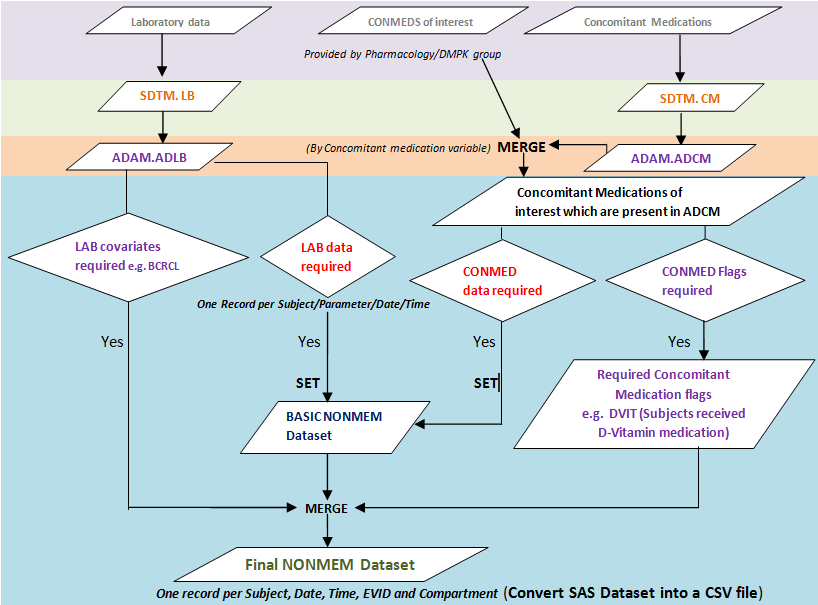
5 Fig. 5. A flow chart for POP PK/PD dataset development with additional covariates and data records 5
6 4. NONMEM INPUT DATASET STRUCTURE The NONMEM input dataset (here after referred as Pop PK/PD dataset) is an ASCII file typically has one row (i.e. record) per study, subject, date, time, event ID, and compartment flag. It consists of three basic components; the dosing records, observations i.e. the PK/PD results, and covariates (PD baseline and/or Demographics covariates). All data must be correct and consistent in order to create a good quality Pop PK/PD dataset. The Pop PK/PD dataset requirements may differ based on the analysis 4.1 Population PK data requirements PK data requirements will typically include the following: Dosing information including planned and actual dose with actual and nominal times of dosing and route of administration PK data: serum or plasma Investigational Product concentrations, metabolite concentrations (if appropriate) and target concentrations (if available) with actual and nominal times of measurement and an indicator if measures are BQL Baseline demographic covariates including body weight, BMI, age, race, gender, and disease duration Baseline PD measures (biomarker and/or efficacy) may also be appropriate 4.2 Population PK/PD data requirements PK/PD data requirements will include the above as well as: Baseline PD measures (biomarker or efficacy) PD (biomarker or efficacy) measures with actual and nominal times of measurement and an indicator if measures are BQL 5. DIFFERENT CATEGORIES OF VARIABLES 5.1 Variable type categorization Common TA-Specific Study Specific 5.2 Need based categorization Required/Core Optional Variable type categorization must be used together with Requirement based categorization to determine whether a variable is required (Core) or optional in a pop PK/PD data. All Study Specific Variables are considered as required variables. 6

7 Overall Pop PK/PD input data variables are categorized into the following five categories Common Therapeutic Area Specific Required (Core) Optional Required (Core) Optional Study Specific Required (Core) NONMEM input (Population PK/PD) dataset examples are shown in next page. 7

8 Basic NONMEM Dataset Example Example of NONMEM dataset with multiple covariates and additional observations 8
9 6. NONMEM SPECIFIC REQUIRED VARIABLES 6.1 ID - Identifier Data Item When the data is from a population, NONMEM expects the Identification data item, labeled ID, and expects the data to be organized into two or more "individual records". An individual record is a group of contiguous data records having the same value for the ID data item and presumably containing data from the same individual. ID data item values need not be consecutive, increasing, unique, nor begin with 1. E.g., 3, 5, 6, 10, 3, etc. is a possible sequence of ID values. Note the two instances of 3 as ID data item values. As long as these two instances are separated by different ID data item values (e.g. 5, 6, 10), they represent different individuals. 6.2 EVID - Event ID EVID: EVID is a NONMEM specific variable. Every record in a NONMEM data set must contain an Event Identification Data Item identifying the kind of event described by the record, and labeled as EVID. Two categories of EVID are available: Observation (EVID=0) and Dosing (EVID=1). 6.3 DV-Dependent Variable This is a value of an observation. There can be only one DV data item per data record. The position of the DV data item is not important. However, its position must be the same on all records. Dosing Records: Enter. Missing or BQL Observation Records: Enter. when a result is missing or the value that was reported was below the assay limit of quantitation Other Observation Records: Enter numeric result of the sample or assessment. A result is reported in the units specified for a given observation record in CMT field. 6.4 MDV-Missing Dependent Variable If there are records in an input data set which do not contain values of observations, then NONMEM needs to be informed of this fact. This is done using the Missing Dependent Variable data item labeled MDV. The values of MDV are: 0 - The DV data item of the data record contains a value of an observation. The record is referred to as an observation record. 1 - The DV data item of the data record does not contain a value of an observation. E.g., Dosing Records: Enter 1 Missing or BQL Observation Records: Enter AMT- Amount Dosing Records: The Amount data item (AMT) gives the amount of a bolus dose or of an infusion of finite duration. This amount should be a positive number. Enter actual total dose amount administered to a subject in units specified for a given dosing record in CMT field. Other Records: Enter. 6.6 RATE - RATE data item The Rate data item (RATE) gives the rate of an infusion. This rate should be a positive number. 9
10 6.7 CMT-Compartment data item CMT is used to report the record contents that appear in DV and AMT for Observation and Dosing records, respectively. Different compartment value is assigned for different PD/Biomarker records. For observation records: CMT specifies the compartment from which the predicted value of the observation is obtained. For dosing records: CMT specifies the compartment into which the dose is introduced. 6.8 ADDL Additional Dosing indicator For Multiple Dosing studies, we use this variable to indicate number of additional doses. For example, a QD for 2 weeks would be 13 since there would be once a day dosing for 14 days. 6.9 II Interdose Interval data item The Interdose Interval data item labeled II gives the time between implied doses. For a steady-state infusion, it should be 0. For other steady state doses, it should be a positive number whose units are the same as the TIME data item. This item is required if ADDL is used to define additional implied doses. For example, the number of hours between dosing- 24 for QD, 12 for BiD, 168 for once weekly 6.10 SS - Steady State Indicator SS is a NONMEM specific variable which represents steady state data item. Use of this data items implies that the dose and regimen combination is at steady-state, and is thus only appropriate when those conditions are satisfied. SS is set to 1 when indicated, otherwise TIME RELATED NONMEM SPECIFIC VARIABLES 7.1 DATE - Date data item The Date data item (DATE) is used to record calendar dates in month-day-year format. (e.g., 9 /1/2014). 7.2 TIME - Time data item Time data item provides the clock time (usually in hours) as hh:mm. (e.g., the time 2:00 PM is recorded as 14:00). 7.3 TAFD - Actual Elapsed Time from 1st Dose It represents nominal time after first dose for a subject. Observation records for a subject prior to the first dose (e.g. screening records) are reported as negative numbers. For plotting purposes, this behavior is adequate. However, software tools for regression (e.g. NONMEM) may not accept negative time values. STAFD is used to address this issue. 7.4 STAFD - Shifted Act Elapsed Time from 1st Dose STAFD variable records the shifted actual elapsed time from first dose of treatment, and is equivalent to TAFD if the first Observation record for a subject occurs after the first dose. If Observation records occur before the first dose in any subject (e.g. screening values are requested), then all Observation and Dosing records within the study data set are positively shifted to ensure that all STAFD values are positive. E.g. if the earliest screening Observation record in the study occurred 14 days before the first dose, then STAFD is TAFD+14 days, assuming a unit of days per time. This will ensure that the value of STAFD is always nonnegative. 10
11 7.5 TALD - Actual Elapsed Time from Previous Dose Represents actual elapsed time from most recent previous dose of treatment, and may be useful for purposes of plotting, doing visual predictive checks etc. Additionally, these times are useful for NCA analysis of PK data. For Single dosing studies, TAFD = TALD. 7.6 NTAFD - Nominal Time after First Dose Represents nominal time after first dose, and may be useful for purposes of plotting, doing visual predictive checks etc. Observation records prior to the first dose will be reported as negative. 8. OTHER SUPPORTING VARIABLES IN NONMEM INPUT DATASET 8.1 C-Comments This variable is used to flag a record with specific comment code with respect to any specific variable/s value. Whenever no comment code is applicable to a NONMEM record then C is set to missing.. If multiple comment codes are applicable to the same NONMEM record, then Comment codes are sorted in ascending order and separated them by dot. For example, if codes 1, 2, and 9 are applicable to a given NONMEM record then C = HANDLING MISSING DATA Missing dosing records, observation records and covariate information may lead to issues while analyzing and so there is need to have conventions and rules to handle missing data. The BQL and MDV fields are available to flag the records as missing and to provide for the possibility that the Observation record is missing due to assay qualities. No specific fields are available to address missing Dosing records. o MDV: Discussed above in section 6.3 o BQL: BQL is a special case of a missing Observation record, and represents observation values that are below the limit of quantitation. That is, the measurement was made, but the result was below the assays lower limit of quantitation. Modern advances in estimation techniques allow this record to play a role in parameter estimation. Imputation of Observation or Dosing records is an area of active research, and specifying a single set of imputation rules that would satisfy every imputation scenario for all possible study-specific situations is not possible. Imputation rules are defined by Drug Metabolism and Pharamcokinetics (DMPK) team. 9.1 Imputation of Observation Records: Imputation of observation records may be needed to make sure there is no information missing related to time etc. If any of the observation related information is missing, then appropriate imputation rules will be provided in study specific document. 9.2 Imputation of Dosing Records: Imputation of dosing records may be needed to make sure there is no information missing related to dosing time and amount. If any of the dosing information is missing, then appropriate imputation rules will be provided in study specific document. Based on need, different imputation methods are used. LOCF - Last Observation Carry Forward WOCF - Worst Observation Carry Forward FOCB - Forward Observation carry backward COA - Closest Observation Algorithm 11
12 10. NONMEM DATASET EXCLUSIONS This information is provided by Drug Metabolism and Pharmacokinetics team as required for Population PK/PD analysis. Generally all dose missing records and records with derived variables are excluded at preprocessing level. As per analysis requirements mostly the Screen failure records, date missing records and duplicate records on Key variables listed by DMPK team are excluded. 11. CONCLUSION The role of the Pop PK/PD dataset programmer is not only just following a set of rules and data set specifications, but also understanding the dataset development work flow, gaining thorough knowledge on the structure and requirements of a NONMEM dataset. This paper will act as a reference document for all naive programmers developing NONMEM input dataset. REFERENCES 1. Dennis Fisher, Steven Shafer. Basic Concepts- Pharmacokinetic and Pharmacodynamic Analysis with NONMEM 2. NONMEM User Guide by Alison J. Boeckmann, Lewis B. Sheiner, Stuart L. Beal 3. ACKNOWLEDGMENTS I would like to thank all Cytel colleagues who provided their valuable input for this paper. I would like to acknowledge Shafi Chowdhury, et al., poster on Producing NONMEM dataset using a standard SAS program presented at PAGE meeting which helped me as a reference material. CONTACT INFORMATION Your comments and questions are valued and encouraged. Contact the author at: Raghu Kishor Koukuntla Cytel Statistical Software & Services Pvt. Ltd, India [email protected] 12
Statistics and Pharmacokinetics in Clinical Pharmacology Studies
 Paper ST03 Statistics and Pharmacokinetics in Clinical Pharmacology Studies ABSTRACT Amy Newlands, GlaxoSmithKline, Greenford UK The aim of this presentation is to show how we use statistics and pharmacokinetics
A Peak at PK An Introduction to Pharmacokinetics
 Paper IS05 A Peak at PK An Introduction to Pharmacokinetics Hannah Twitchett, Roche Products Ltd, Welwyn Garden City, UK Paul Grimsey, Roche Products Ltd, Welwyn Garden City, UK ABSTRACT The aim of this
Benefits of Upgrading to Phoenix WinNonlin 6.2
 Benefits of Upgrading to Phoenix WinNonlin 6.2 Pharsight, a Certara Company 5625 Dillard Drive; Suite 205 Cary, NC 27518; USA www.pharsight.com March, 2011 Benefits of Upgrading to Phoenix WinNonlin 6.2
Clinical Study Synopsis for Public Disclosure
 abcd Clinical Study for Public Disclosure This clinical study synopsis is provided in line with s Policy on Transparency and Publication of Clinical Study Data. The synopsis - which is part of the clinical
IV solutions may be given either as a bolus dose or infused slowly through a vein into the plasma at a constant or zero-order rate.
 د.شيماء Biopharmaceutics INTRAVENOUS INFUSION: IV solutions may be given either as a bolus dose or infused slowly through a vein into the plasma at a constant or zero-order rate. The main advantage for
Study (s) Degree Center Acad. Period. 1201 - Grado de Farmacia FACULTY OF PHARMACY 3 Annual 1211 - PDG Farmacia-Nutrición Humana y Dietética
 COURSE DATA Data Subject Código 34081 Name Biopharmacy and Pharmacokinetics Cycle Grade ECTS Credits 10.5 Curso académico 2014-2015 Study (s) Degree Center Acad. Period year 1201 - Grado de Farmacia FACULTY
Humulin (LY041001) Page 1 of 1
 (LY041001) These clinical study results are supplied for informational purposes only in the interests of scientific disclosure. They are not intended to substitute for the FDA-approved package insert or
PHAR 7633 Chapter 19 Multi-Compartment Pharmacokinetic Models
 Student Objectives for this Chapter PHAR 7633 Chapter 19 Multi-Compartment Pharmacokinetic Models To draw the scheme and write the differential equations appropriate to a multi-compartment pharmacokinetic
PHAR 7633 Chapter 21 Non-Linear Pharmacokinetic Models
 Student Objectives for this Chapter PHAR 7633 Chapter 21 Non-Linear Pharmacokinetic Models To draw the scheme and write the differential equations for compartmental pharmacokinetic models with non-linear
Guidance for Industry
 Guidance for Industry Bioavailability and Bioequivalence Studies Submitted in NDAs or INDs General Considerations DRAFT GUIDANCE This guidance document is being distributed for comment purposes only. Comments
Pharmacology skills for drug discovery. Why is pharmacology important?
 skills for drug discovery Why is pharmacology important?, the science underlying the interaction between chemicals and living systems, emerged as a distinct discipline allied to medicine in the mid-19th
Questions and Answers for Health Care Providers: Renal Dosing and Administration Recommendations for Peramivir IV
 Questions and Answers for Health Care Providers: Renal Dosing and Administration Recommendations for Peramivir IV The purpose of this document is to provide additional clarification to the existing information
Nursing 113. Pharmacology Principles
 Nursing 113 Pharmacology Principles 1. The study of how drugs enter the body, reach the site of action, and are removed from the body is called a. pharmacotherapeutics b. pharmacology c. pharmacodynamics
BIOAVAILABILITY & BIOEQUIVALENCE TRIALS
 BIOAVAILABILITY & BIOEQUIVALENCE TRIALS Shubha Rani,, Ph.D. Technical Director & Head-Biometrics and Data Management Synchron Research Services Pvt. Ltd. Ahmedabad 380 054 [email protected]
Longitudinal Modeling of Lung Function in Respiratory Drug Development
 Longitudinal Modeling of Lung Function in Respiratory Drug Development Fredrik Öhrn, PhD Senior Clinical Pharmacometrician Quantitative Clinical Pharmacology AstraZeneca R&D Mölndal, Sweden Outline A brief
DMPK: Experimentation & Data
 DMPK: Experimentation & Data Interpretation Mingshe Zhu, Mike S. Lee, Naidong Weng, and Mark Hayward Prerequisite: Entry-level scientists with hands on experience in LC/MS as well as advanced students
2.0 Synopsis. Vicodin CR (ABT-712) M05-765 Clinical Study Report R&D/07/095. (For National Authority Use Only) to Part of Dossier: Volume:
 2.0 Synopsis Abbott Laboratories Name of Study Drug: Vicodin CR Name of Active Ingredient: Hydrocodone/Acetaminophen Extended Release (ABT-712) Individual Study Table Referring to Part of Dossier: Volume:
GENERAL CONSIDERATIONS FOR CLINICAL TRIALS E8
 INTERNATIONAL CONFERENCE ON HARMONISATION OF TECHNICAL REQUIREMENTS FOR REGISTRATION OF PHARMACEUTICALS FOR HUMAN USE ICH HARMONISED TRIPARTITE GUIDELINE GENERAL CONSIDERATIONS FOR CLINICAL TRIALS E8 Current
Proof-of-Concept Studies and the End of Phase IIa Meeting with the FDA
 Medpace Discovery Series presents Proof-of-Concept Studies and the End of Phase IIa Meeting with the FDA DR. JIM WEI: Today my topic is going to be Proof-of-Concept Studies and FDA End of Phase 2a Meetings
PHARMACOKINETICS (PK) AND PHARMACODYNAMICS (PD) STUDY IN THE ESTABLISHED STATUS EPILEPTICUS TREATMENT TRIAL. Lisa Coles, MS, PhD
 PHARMACOKINETICS (PK) AND PHARMACODYNAMICS (PD) STUDY IN THE ESTABLISHED STATUS EPILEPTICUS TREATMENT TRIAL Lisa Coles, MS, PhD Key Personnel Personnel Institution Role James Cloyd, PharmD UMN Pharmacology
QT analysis: A guide for statistical programmers. Prabhakar Munkampalli Statistical Analyst II Hyderabad, 7 th September 2012
 QT analysis: A guide for statistical programmers Prabhakar Munkampalli Statistical Analyst II Hyderabad, 7 th September 2012 Agenda ECG ICH E14 Thorough QT/QTc study Role of Statistical Programmer References
This clinical study synopsis is provided in line with Boehringer Ingelheim s Policy on Transparency and Publication of Clinical Study Data.
 abcd Clinical Study for Public Disclosure This clinical study synopsis is provided in line with s Policy on Transparency and Publication of Clinical Study Data. The synopsis which is part of the clinical
General Clinical Pharmacology
 General Clinical Pharmacology Considerations for Pediatric Studies for Drugs and Biological Products Guidance for Industry DRAFT GUIDANCE This guidance document is being distributed for comment purposes
Noncompartmental Analysis (NCA) in PK, PK-based Design
 Noncompartmental Analysis (NCA) in PK, PK-based Design Helmut Schütz BEBAC 1 41 Wikimedia Commons 25 Dirk Beyer Creative Commons Attribution-ShareAlike 3. Unported NCA vs. PK Modeling Noncompartmental
ICH Topic E 8 General Considerations for Clinical Trials. Step 5 NOTE FOR GUIDANCE ON GENERAL CONSIDERATIONS FOR CLINICAL TRIALS (CPMP/ICH/291/95)
 European Medicines Agency March 1998 CPMP/ICH/291/95 ICH Topic E 8 General Considerations for Clinical Trials Step 5 NOTE FOR GUIDANCE ON GENERAL CONSIDERATIONS FOR CLINICAL TRIALS (CPMP/ICH/291/95) TRANSMISSION
INTERNATIONAL CONFERENCE ON HARMONISATION OF TECHNICAL REQUIREMENTS FOR REGISTRATION OF PHARMACEUTICALS FOR HUMAN USE
 INTERNATIONAL CONFERENCE ON HARMONISATION OF TECHNICAL REQUIREMENTS FOR REGISTRATION OF PHARMACEUTICALS FOR HUMAN USE ICH HARMONISED TRIPARTITE GUIDELINE THE COMMON TECHNICAL DOCUMENT FOR THE REGISTRATION
Guidance for Industry
 Guidance for Industry Exposure-Response Relationships Study Design, Data Analysis, and Regulatory Applications U.S. Department of Health and Human Services Food and Drug Administration Center for Drug
PHAR 7633 Chapter 22 Non-Linear Regression Analysis of Pharmacokinetic Data Individual Data and Population Analysis
 PHAR 7633 Chapter 22 Non-Linear Regression Analysis of Pharmacokinetic Data Individual Data and Population Analysis Student Objectives for this Chapter Understand the use of computer programs such as Boomer
Sponsor Novartis Pharmaceuticals
 Clinical Trial Results Database Page 1 Sponsor Novartis Pharmaceuticals Generic Drug Name Indacaterol Therapeutic Area of Trial Chronic Obstructive Pulmonary Disease (COPD) Indication studied: COPD Study
M4E(R2): The CTD Efficacy
 M4E(R2): The CTD Efficacy This draft guidance, when finalized, will represent the current thinking of the Food and Drug Administration (FDA or Agency) on this topic. It does not establish any rights for
Sponsor. Novartis Generic Drug Name. Vildagliptin. Therapeutic Area of Trial. Type 2 diabetes. Approved Indication. Investigational.
 Clinical Trial Results Database Page 1 Sponsor Novartis Generic Drug Name Vildagliptin Therapeutic Area of Trial Type 2 diabetes Approved Indication Investigational Study Number CLAF237A2386 Title A single-center,
Guidance for Industry
 Guidance for Industry Clinical Pharmacology Data to Support a Demonstration of Biosimilarity to a Reference Product DRAFT GUIDANCE This guidance document is being distributed for comment purposes only.
NONCLINICAL EVALUATION FOR ANTICANCER PHARMACEUTICALS
 INTERNATIONAL CONFERENCE ON HARMONISATION OF TECHNICAL REQUIREMENTS FOR REGISTRATION OF PHARMACEUTICALS FOR HUMAN USE ICH HARMONISED TRIPARTITE GUIDELINE NONCLINICAL EVALUATION FOR ANTICANCER PHARMACEUTICALS
New anticoagulants: Monitoring or not Monitoring? Not Monitoring
 The 2 nd World Congress on CONTROVERSIES IN HEMATOLOGY (COHEM) Barcelona, Spain September 6 8, 2012 New anticoagulants: Monitoring or not Monitoring? Not Monitoring Anna Falanga, MD Immunohematology and
PKPD modelling of the relationship between testosterone and PSA in patients with prostate cancer during treatment with leuprorelin
 PAGE 2015, Crete PKPD modelling of the relationship between testosterone and PSA in patients with prostate cancer during treatment with leuprorelin What is the optimal testosterone level? Nelleke Snelder,
WHO guideline for abbreviated licensing pathways for certain biological therapeutic products
 WHO guideline for abbreviated licensing pathways for certain biological therapeutic products - Clinical evaluation - Martina Weise, MD Federal Institute for Drugs and Medical Devices, Germany General considerations
STATISTICAL ANALYSIS OF SAFETY DATA IN LONG-TERM CLINICAL TRIALS
 STATISTICAL ANALYSIS OF SAFETY DATA IN LONG-TERM CLINICAL TRIALS Tailiang Xie, Ping Zhao and Joel Waksman, Wyeth Consumer Healthcare Five Giralda Farms, Madison, NJ 794 KEY WORDS: Safety Data, Adverse
Fexinidazole a new oral treatment for sleeping sickness update of development
 Fexinidazole a new oral treatment for sleeping sickness update of development SMe O 2 Me CH 2 O Antoine TARRAL Olaf Valverde Séverine Blesson Clélia Bardonneau Wilfried Mutumbo September 2011 Fexinidazole
Bridging Statistical Analysis Plan and ADaM Datasets and Metadata for Submission
 , October 24-26, 2012, San Francisco, USA Bridging Statistical Analysis Plan and ADaM Datasets and Metadata for Submission Abstract In this article, the relationship between the Statistical Analysis Plan
Application for a Marketing Authorisation: Requirements and Criteria for the Assessment of QT Prolonging Potential
 Application for a Marketing Authorisation: Requirements and Criteria for the Assessment of QT Prolonging Potential Bundesinstitut für Arzneimittel Dr. med. Clemens Mittmann Bundesinstitut für Arzneimittel
Guidance for Industry
 Guidance for Industry End-of-Phase 2A Meetings U.S. Department of Health and Human Services Food and Drug Administration Center for Drug Evaluation and Research (CDER) September 2009 Procedural Guidance
Analyzing Research Data Using Excel
 Analyzing Research Data Using Excel Fraser Health Authority, 2012 The Fraser Health Authority ( FH ) authorizes the use, reproduction and/or modification of this publication for purposes other than commercial
Sponsor / Company: Sanofi Drug substance(s): HOE901 (insulin glargine)
 These results are supplied for informational purposes only. Prescribing decisions should be made based on the approved package insert in the country of prescription. Sponsor / Company: Sanofi Drug substance(s):
Clinical Study Synopsis
 Clinical Study Synopsis This Clinical Study Synopsis is provided for patients and healthcare professionals to increase the transparency of Bayer's clinical research. This document is not intended to replace
TGN 1412 Welche Änderungen haben sich für die Erstanwendung am Menschen aus Sicht des BfArM ergeben?
 TGN 1412 Welche Änderungen haben sich für die Erstanwendung am Menschen aus Sicht des BfArM ergeben? PD Dr. med. Thomas Sudhop Bundesinstitut für Arzneimittel, Bonn Bundesinstitut für Arzneimittel IMP
AN INTRODUCTION TO PHARSIGHT DRUG MODEL EXPLORER (DMX ) WEB SERVER
 AN INTRODUCTION TO PHARSIGHT DRUG MODEL EXPLORER (DMX ) WEB SERVER Software to Visualize and Communicate Model- Based Product Profiles in Clinical Development White Paper July 2007 Pharsight Corporation
JSPS. Modeling & Simulation: A Tool to Enable Efficient Clinical Drug Development. March 29, 2005
 Dr. Kunihiro Sasahara, Ph.D. Dr. Russell Wada, Ph.D. Dr. Yuying Gao, M.D., Ph.D. Modeling & Simulation: A Tool to Enable Efficient Clinical Drug Development JSPS March 29, 2005 Agenda Overview of Clinical
Ethyl Glucuronide. Where is the Drug? Detection Windows. Urine. Blood. Absorption and Distribution. Metabolism. Excretion
 Where is the Drug? Ethyl Absorption and Distribution A Biomarker for Ethanol Use Metabolism Excretion Anthony G. Costantino, Ph.D. D-ABFT NMS Labs,Willow Grove, PA John J. Treuting, Ph.D. Treuting & Assoc.
1.0 Abstract. Title: Real Life Evaluation of Rheumatoid Arthritis in Canadians taking HUMIRA. Keywords. Rationale and Background:
 1.0 Abstract Title: Real Life Evaluation of Rheumatoid Arthritis in Canadians taking HUMIRA Keywords Rationale and Background: This abbreviated clinical study report is based on a clinical surveillance
Teriflunomide is the active metabolite of Leflunomide, a drug employed since 1994 for the treatment of rheumatoid arthritis (Baselt, 2011).
 Page 1 of 10 ANALYTE NAME AND STRUCTURE TERIFLUNOMIDE Teriflunomide TRADE NAME Aubagio CATEGORY Antimetabolite TEST CODE PURPOSE Therapeutic Drug Monitoring GENERAL RELEVANCY BACKGROUND sclerosis. The
Bioequivalence Study Design Considerations. Dr. John Gordon
 Bioequivalence Study Design Considerations Dr. John Gordon Key Output of Programme A list of prequalified medicinal products used for treatment of HIV/AIDS, malaria, tuberculosis, influenza, and for reproductive
Public Assessment Report Scientific discussion. Tenofovir disoproxil Teva (tenofovir disoproxil) SE/H/1432/01/DC
 Public Assessment Report Scientific discussion Tenofovir disoproxil Teva (tenofovir disoproxil) SE/H/1432/01/DC This module reflects the scientific discussion for the approval of Tenofovir disoproxil Teva.
CENTER FOR DRUG EVALUATION AND RESEARCH
 CENTER FOR DRUG EVALUATION AND RESEARCH APPLICATION NUMBER: 205029Orig1s000 SUMMARY REVIEW Cross Discipline Team Leader Review 4. Nonclinical Pharmacology/Toxicology In their review of the original application,
5.5 Pharmacokinetics - Sublingual
 5.5 Pharmacokinetics - Sublingual 5.5.1 Single Dose Pharmacokinetics - Dose Linearity Two studies in young healthy males were dedicated to examining sublingual single rising dose (SRD) pharmacokinetics
ASSIGNMENT 4 PREDICTIVE MODELING AND GAINS CHARTS
 DATABASE MARKETING Fall 2015, max 24 credits Dead line 15.10. ASSIGNMENT 4 PREDICTIVE MODELING AND GAINS CHARTS PART A Gains chart with excel Prepare a gains chart from the data in \\work\courses\e\27\e20100\ass4b.xls.
CLINICAL STUDY REPORT SYNOPSIS
 CLINICAL STUDY REPORT SYNOPSIS Document No.: EDMS-PSDB-6511351:2.0 Name of Sponsor/Company Name of Finished Product Name of Active Ingredient(s) Protocol No.: CR002353 Johnson & Johnson Pharmaceutical
Human ADME and Studies with Radiolabeled Compounds: Phase I-IIa
 WHITE PAPER Human ADME and Studies with Radiolabeled Compounds: Phase I-IIa AD ROFFEL, PhD Director, Global Scientific Affairs PRA Health Sciences Authors: HENK POELMAN, MSc Project Manager, Laboratory
HYDROCORTISONE 10 MG TABLETS
 HYDROCORTISONE 10 MG TABLETS (Hydrocortisone) PL 20072/0238 UKPAR TABLE OF CONTENTS Lay Summary Page 2 Scientific discussion Page 3 Steps taken for assessment Page 12 Steps taken after authorisation summary
Pediatric Trials Network. Danny Benjamin MD PhD Professor of Pediatrics Duke University www.dcri.org/about-us/conflict-of-interest
 Pediatric Trials Network Danny Benjamin MD PhD Professor of Pediatrics Duke University www.dcri.org/about-us/conflict-of-interest Pediatric Drug Development 1998: essentially no trials Mandate (Pediatric
GT-020 Phase 1 Clinical Trial: Results of Second Cohort
 GT-020 Phase 1 Clinical Trial: Results of Second Cohort July 29, 2014 NASDAQ: GALT www.galectintherapeutics.com 2014 Galectin Therapeutics inc. Forward-Looking Statement This presentation contains, in
COMMITTEE FOR PROPRIETARY MEDICINAL PRODUCTS (CPMP) NOTE FOR GUIDANCE ON THE PRE-CLINICAL EVALUATION OF ANTICANCER MEDICINAL PRODUCTS
 The European Agency for the Evaluation of Medicinal Products Human Medicines Evaluation Unit London, 23 July 1998 COMMITTEE FOR PROPRIETARY MEDICINAL PRODUCTS (CPMP) NOTE FOR GUIDANCE ON THE PRE-CLINICAL
Session 6 Clinical Trial Assessment Phase I Clinical Trial
 L1 Session 6 Clinical Trial Assessment Phase I Clinical Trial Presentation to APEC Preliminary Workshop on Review of Drug Development in Clinical Trials Celia Lourenco, PhD, Manager, Clinical Group I Office
Overview of model-building strategies in population PK/PD analyses: 2002-2004 literature survey.
 Overview of model-building strategies in population PK/PD analyses: 2002-2004 literature survey. Céline Dartois, Karl Brendel, Emmanuelle Comets, Céline Laffont, Christian Laveille, Brigitte Tranchand,
Sponsor Novartis. Generic Drug Name Secukinumab. Therapeutic Area of Trial Psoriasis. Approved Indication investigational
 Clinical Trial Results Database Page 2 Sponsor Novartis Generic Drug Name Secukinumab Therapeutic Area of Trial Psoriasis Approved Indication investigational Clinical Trial Results Database Page 3 Study
Guidance for Industry
 Guidance for Industry Food-Effect Bioavailability and Fed Bioequivalence Studies U.S. Department of Health and Human Services Food and Drug Administration Center for Drug Evaluation and Research (CDER)
Phase of development:
 Title of study: A randomised, placebo-controlled, double-blind, double-dummy, four-way crossover, single-centre study to investigate the effects of 2 mg and 10 mg intravenously administered NRL972 on the
Biological importance of metabolites. Safety and efficacy aspects
 Biological importance of metabolites Safety and efficacy aspects Bernard Walther Technologie Servier Biological importance of metabolites Safety testing of drug metabolites Bioanalytical strategy Structural
Clinical Study Synopsis
 Clinical Study Synopsis This Clinical Study Synopsis is provided for patients and healthcare professionals to increase the transparency of Bayer's clinical research. This document is not intended to replace
DOSE-EFFECT RELATIONSHIP
 DOSE-EFFECT RELATIONSHIP A fundamental principle of pharmacology is that the intensity of effect produced by a drug is a function of the quantity of drug administered (or the concentration of the drug
Kaplan-Meier Plot. Time to Event Analysis Diagnostic Plots. Outline. Simulating time to event. The Kaplan-Meier Plot. Visual predictive checks
 1 Time to Event Analysis Diagnostic Plots Nick Holford Dept Pharmacology & Clinical Pharmacology University of Auckland, New Zealand 2 Outline The Kaplan-Meier Plot Simulating time to event Visual predictive
SOP for Screening of Adult Chemotherapy Electronic Prescriptions
 SOP for Screening of Adult Chemotherapy Electronic Prescriptions Contents The following steps should be followed in screening a chemotherapy prescription on ARIA: 1. Patient details 2 2. Patient medical
Training/Internship Brochure Advanced Clinical SAS Programming Full Time 6 months Program
 Training/Internship Brochure Advanced Clinical SAS Programming Full Time 6 months Program Domain Clinical Data Sciences Private Limited 8-2-611/1/2, Road No 11, Banjara Hills, Hyderabad Andhra Pradesh
Strategic Benefits of an Online Clinical Data Repository
 Strategic Benefits of an Online Clinical Data Repository 5625 Dillard Drive Suite 205 Cary, NC 27518 www.pharsight.com Strategic Benefits of an Online Clinical Data Repository Contents Introduction 2 The
Unit 9 Describing Relationships in Scatter Plots and Line Graphs
 Unit 9 Describing Relationships in Scatter Plots and Line Graphs Objectives: To construct and interpret a scatter plot or line graph for two quantitative variables To recognize linear relationships, non-linear
INTERNATIONAL CONFERENCE ON HARMONISATION OF TECHNICAL REQUIREMENTS FOR REGISTRATION OF PHARMACEUTICALS FOR HUMAN USE S1A. Current Step 4 version
 INTERNATIONAL CONFERENCE ON HARMONISATION OF TECHNICAL REQUIREMENTS FOR REGISTRATION OF PHARMACEUTICALS FOR HUMAN USE ICH HARMONISED TRIPARTITE GUIDELINE GUIDELINE ON THE NEED FOR CARCINOGENICITY STUDIES
Careers in Biostatistics and Clinical SAS Programming An Overview for the Uninitiated Justina M. Flavin, Independent Consultant, San Diego, CA
 PharmaSUG 2014 Paper CP07 Careers in Biostatistics and Clinical SAS Programming An Overview for the Uninitiated Justina M. Flavin, Independent Consultant, San Diego, CA ABSTRACT In the biopharmaceutical
European Medicines Agency decision
 EMA/792653/2014 European Medicines Agency decision P/0025/2015 of 30 January 2015 on the agreement of a paediatric investigation plan and on the granting of a deferral and on the granting of a waiver for
Chapter 5 Analysis of variance SPSS Analysis of variance
 Chapter 5 Analysis of variance SPSS Analysis of variance Data file used: gss.sav How to get there: Analyze Compare Means One-way ANOVA To test the null hypothesis that several population means are equal,
Session 7 Bivariate Data and Analysis
 Session 7 Bivariate Data and Analysis Key Terms for This Session Previously Introduced mean standard deviation New in This Session association bivariate analysis contingency table co-variation least squares
Pharmaceutical Applications
 Integrated Summary of Safety and Efficacy Programming for Studies Using Electronic Data Capture Changhong Shi, Merck & Co., Inc., Rahway, NJ Qing Xue, Merck & Co., Inc., Rahway, NJ ABSTRACT The Integrated
INTERNATIONAL CONFERENCE ON HARMONISATION OF TECHNICAL REQUIREMENTS FOR REGISTRATION OF PHARMACEUTICALS FOR HUMAN USE E15
 INTERNATIONAL CONFERENCE ON HARMONISATION OF TECHNICAL REQUIREMENTS FOR REGISTRATION OF PHARMACEUTICALS FOR HUMAN USE ICH HARMONISED TRIPARTITE GUIDELINE DEFINITIONS FOR GENOMIC BIOMARKERS, PHARMACOGENOMICS,
Guidance for Industry Safety Testing of Drug Metabolites
 Guidance for Industry Safety Testing of Drug Metabolites U.S. Department of Health and Human Services Food and Drug Administration Center for Drug Evaluation and Research (CDER) February 2008 Pharmacology
Survival Analysis of the Patients Diagnosed with Non-Small Cell Lung Cancer Using SAS Enterprise Miner 13.1
 Paper 11682-2016 Survival Analysis of the Patients Diagnosed with Non-Small Cell Lung Cancer Using SAS Enterprise Miner 13.1 Raja Rajeswari Veggalam, Akansha Gupta; SAS and OSU Data Mining Certificate
SYNOPSIS. Risperidone: Clinical Study Report CR003274
 SYNOPSIS Protocol No: CR003274 Title of Study: An Open-Label, Long-Term Trial of Risperidone Long-Acting Microspheres in the Treatment of Subjects Diagnosed with Schizophrenia Coordinating Investigator:
Example: Credit card default, we may be more interested in predicting the probabilty of a default than classifying individuals as default or not.
 Statistical Learning: Chapter 4 Classification 4.1 Introduction Supervised learning with a categorical (Qualitative) response Notation: - Feature vector X, - qualitative response Y, taking values in C
Approximate cost of a single protocol amendment: $450,000
 Insight brief 34% of protocol amendments are avoidable Approximate cost of a single protocol amendment: $450,000 Improving clinical development in emerging biopharma settings: How model based drug development
EXPANDING THE EVIDENCE BASE IN OUTCOMES RESEARCH: USING LINKED ELECTRONIC MEDICAL RECORDS (EMR) AND CLAIMS DATA
 EXPANDING THE EVIDENCE BASE IN OUTCOMES RESEARCH: USING LINKED ELECTRONIC MEDICAL RECORDS (EMR) AND CLAIMS DATA A CASE STUDY EXAMINING RISK FACTORS AND COSTS OF UNCONTROLLED HYPERTENSION ISPOR 2013 WORKSHOP
Models for Incorporating Block Scheduling in Blood Drive Staffing Problems
 University of Arkansas, Fayetteville ScholarWorks@UARK Industrial Engineering Undergraduate Honors Theses Industrial Engineering 5-2014 Models for Incorporating Block Scheduling in Blood Drive Staffing
Guidance for Industry
 Guidance for Industry Bioavailability and Bioequivalence Studies for Orally Administered Drug Products General Considerations U.S. Department of Health and Human Services Food and Drug Administration Center
Guidance for Industry
 Guidance for Industry S9 Nonclinical Evaluation for Anticancer Pharmaceuticals U.S. Department of Health and Human Services Food and Drug Administration Center for Drug Evaluation and Research (CDER) Center
ICH Topic S 1 A The Need for Carcinogenicity Studies of Pharmaceuticals. Step 5
 European Medicines Agency July 1996 CPMP/ICH/140/95 ICH Topic S 1 A The Need for Carcinogenicity Studies of Pharmaceuticals Step 5 NOTE FOR GUIDANCE ON THE NEED FOR CARCINOGENICITY STUDIES OF PHARMACEUTICALS
Electronic Medical Records. Centricity EMR 9.2 ---------- Medication Monographs & Dosing Calculator
 Electronic Medical Records Centricity EMR 9.2 ---------- Medication Monographs & Dosing Calculator MEDICATION MONOGRAPHS & DOSING CALCULATOR PURPOSE The intent of this document is to inform and instruct
The Cross-Sectional Study:
 The Cross-Sectional Study: Investigating Prevalence and Association Ronald A. Thisted Departments of Health Studies and Statistics The University of Chicago CRTP Track I Seminar, Autumn, 2006 Lecture Objectives
嘉 義 長 庚 醫 院 藥 劑 科 Speaker : 翁 玟 雯
 The Clinical Efficacy and Safety of Sodium Glucose Cotransporter-2 (SGLT2) Inhibitors in Adults with Type 2 Diabetes Mellitus 嘉 義 長 庚 醫 院 藥 劑 科 Speaker : 翁 玟 雯 Diabetes Mellitus : A group of diseases characterized
NIMULID MD. 1. Introduction. 2. Nimulid MD Drug delivery system
 NIMULID MD 1. Introduction Nimulid MD is a flavoured dispersible Nimesulide tablet with fast mouth dissolving characteristics thereby providing immediate relief. Nimesulide is a non-steroidal antiinflammatory
Graphical Analyses of Clinical Trial Safety Data
 Graphical Analyses of Clinical Trial Safety Data Haijun Ma, Kefei Zhou, Amy ia, Matt Austin, George Li, Michael Connell 08/10/07, GBE Scientific Forum verview Current situation of clinical trial safety
1: CLINICAL PHARMACOKINETICS
 : CLINICAL PHARMACOKINETICS General overview: clinical pharmacokinetics, 2 Pharmacokinetics, 4 Drug clearance (CL), 6 Volume of distribution (Vd), 8 The half-life (t½), 0 Oral availability (F), 2 Protein