
Annual report 2011/12
|
|
|
- Shon Watkins
- 10 years ago
- Views:
Transcription
1 FRAUNHOFER INSTITUTe FoR INdUSTRIAl mathematics ITwm Annual report 2011/12
2 Editorial note Fraunhofer-Institut für Techno- und Wirtschaftsmathematik ITWM 2012 Address Fraunhofer-Platz Kaiserslautern Germany Phone +49 (0) 6 31/ Fax +49 (0) 6 31/ [email protected] of our employees is <surname>@itwm.fraunhofer.de Internet All rights reserved. It is not permitted to reproduce the book or any part of it by photocopying, microfilm or any other form or to transfer it to a language suitable for machines, especially for data processing systems, without the express written permission of the editors. The same holds for the rights for public reproduction. Trademarks are used without guarantee of free usability. This annual report is also available in german language. Editing Ilka Blauth Steffen Grützner Marion Schulz-Reese Layout Gesa Ermel Photography The editors wish to thank all cooperating partners for placing the corresponding photos at their disposal. FCC Gothenburg (S): pages 86, 87 istockphoto: pages 64, 66, 89 Fotos: Fraunhofer ITWM, Gesa Ermel Printing KD Medienpark Faber GmbH, Kaiserslautern

3 Annual report 2011/12 1
4 2

5 Content 4 Preface 6 Retrospection 8 Felix Klein Center for Mathematics 12 Profile of the Institute 13 Organizational Chart 14 The Institute in Numbers 16 Costumers and Cooperation Partners 18 Board of Trustees 18 Fraunhofer ICT Group 19 The Fraunhofer-Gesellschaft at a Glance 20 Transport Processes 84 Fraunhofer-Chalmers Research Centre for Industrial Mathematics FCC 92 Talks 97 Teaching Activities 98 Publications 104 Scientific Graduation Theses 105 Participation on Fairs and Conferences 107 Awards and Prizes 107 Own Events 108 Guests 109 Collaboration in Boards, Editorships 28 Flow and Material Simulation 36 Image Processing 44 System Analysis, Prognosis and Control 52 Optimization 60 Financial Mathematics 68 Mathematical Methods in Dynamics and Durability 76 Competence Center High Performance Computing 3

6 preface Fraunhofer ITWM benefited from the positive development of the German economy in 2011: Revenue increased by 9 % and actual operating income as a share of the operating budget (the share of industrial revenues) was 43.2 %. Almost half of the industrial revenues came from successive projects with existing customers; while an additional 60 new customers joined us from very diverse sectors. This clearly demonstrates the capabilities, economic relevancy, and currency of the research topics being pursued at ITWM. The revenue forecasts are optimistic, the employees are highly motivated for new challenges, and we anticipate a resurgence of economic growth in The completion of our new building expansion with new office space and labs, an extended and modernized IT infrastructure as well as new classrooms creates the perfect framework conditions for the continued success and growth of Fraunhofer ITWM. More orders, the expansion of business areas, and new research challenges all demand more human resources. Overall in 2011, 37 new employees were hired. In this context, it was extremely gratifying that almost half of the new hires were sourced from local resources graduates of TU Kaiserslautern and its PhD programs. The close cooperation with TU Kaiserslautern and the institutes of the Science Alliance constitutes an important element in the successful development of ITWM. Fraunhofer s innovation cluster Digital Commercial Vehicle Technology, the Innovation Centrum for Applied System Modeling, the Center for Mathematical and Computational Modeling, and the Felix Klein Center for Mathematics each represent major structural components that facilitate the collaboration of mathematicians, computer scientists, natural scientists, and engineers. A special highlight was the inauguration of the new building for the Felix Klein Center. The name represents a joint label, under which mathematics in Kaiserslautern can be developed over the long term into a leading national center for mathematics. One focus of the center is the reform of the mathematics curriculum: Fraunhofer ITWM and the Department of Mathematics at TU Kaiserslautern have endeavored for many years to make mathematics more interesting for students as well as to generate a greater student interest in MINT subjects and to bring the new role that mathematics has occupied in industry and organizations over the past decades into the schools. These efforts include the mathematic modeling weeks, multi-day events in which groups of students, instructors, and student teachers get together to work on externally generated problems. A very nice encouragement to continue this activity and engagement in the same direction came in the form of winning the top prize in the Schools meet Science competition endowed with 50,000 euros by the Robert Bosch Foundation. All of the separate divisions of ITWM continued to develop established and new competencies and business segments in The particularly strong growth of the Competence Center for High Performance Computing is attributed to the expansion of the collaboration with the crude oil industry in the area of seismology and new in-house product development. In the respect, for example, Fraunhofer Parallel File System FhGFS solidified its leading position in Europe with many new installations, especially, at university computer centers. A special highlight of 2011 was the introduction of the interactive photorealistic visualization of a complete car in full HD resolution. The Financial Mathematics division has had to suffer in recent years from the effects of the global financial crisis fewer contracts from banks and insurance companies, the tarnished reputation of financial mathematics, and many personnel changes. The division consolidated in 2011: In addition to current research topics, new areas (valuation of exotic interest derivatives, extreme risk in the financial sector, data use) were developed, the customer base expanded, and advance education seminars and in-house training have all been implemented for the World Bank. The Mathematical Methods in Dynamics and Durability division continued development on the Fraunhofer Innovation Cluster DNT Digital Commercial Vehicle Technology. The ongoing activities with Bosch, Daimler, John Deere, Liebherr, Schmitz Cargobull, and Volvo were expanded by new topics such as energy efficiency and soil structure interaction simulations. The Virtual Measurement Campaign project, a multi-year joint 4

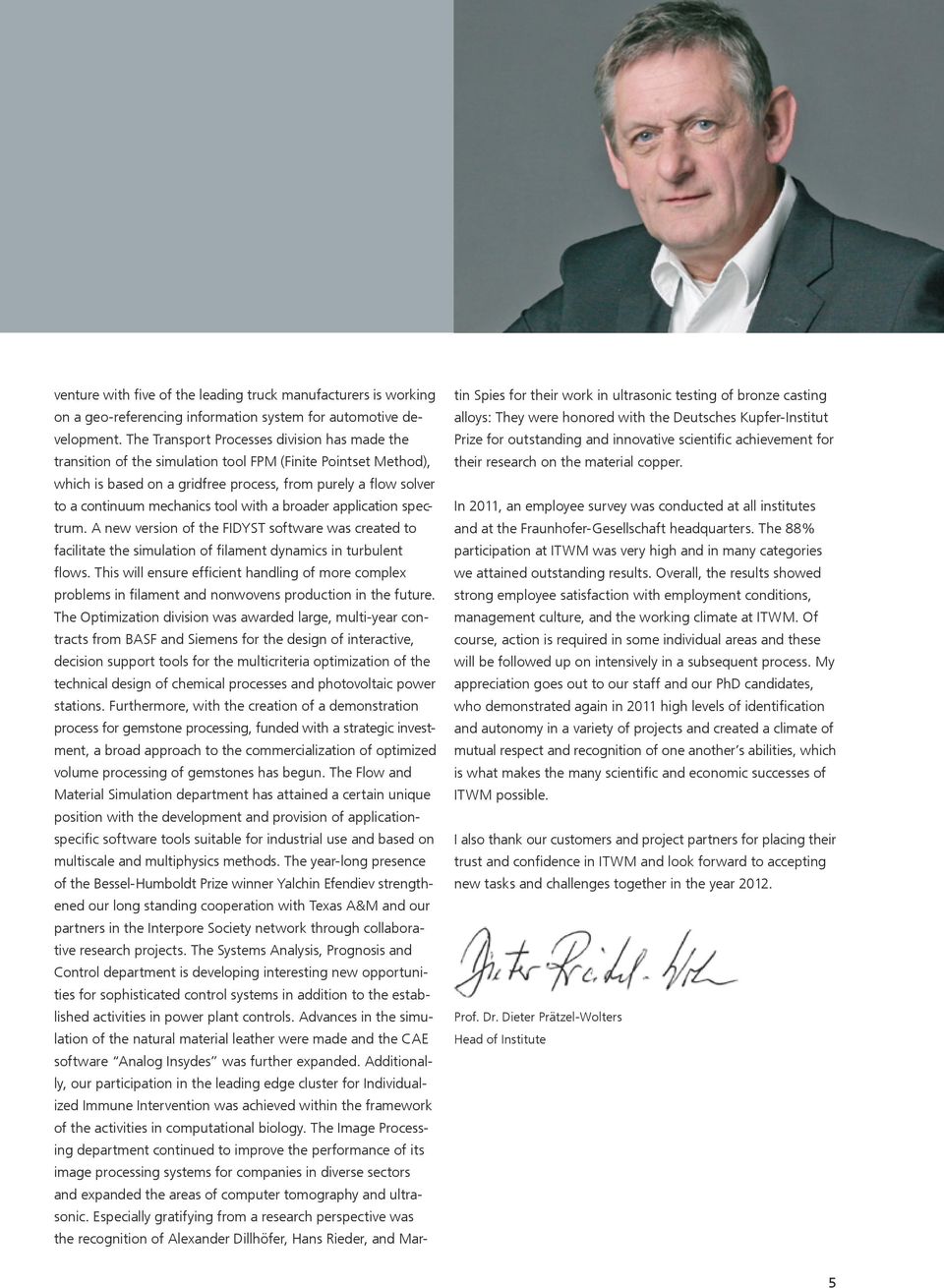
7 venture with five of the leading truck manufacturers is working on a geo-referencing information system for automotive development. The Transport Processes division has made the transition of the simulation tool FPM (Finite Pointset Method), which is based on a gridfree process, from purely a flow solver to a continuum mechanics tool with a broader application spectrum. A new version of the FIDYST software was created to facilitate the simulation of filament dynamics in turbulent flows. This will ensure efficient handling of more complex problems in filament and nonwovens production in the future. The Optimization division was awarded large, multi-year contracts from BASF and Siemens for the design of interactive, decision support tools for the multicriteria optimization of the technical design of chemical processes and photovoltaic power stations. Furthermore, with the creation of a demonstration process for gemstone processing, funded with a strategic investment, a broad approach to the commercialization of optimized volume processing of gemstones has begun. The Flow and Material Simulation department has attained a certain unique position with the development and provision of applicationspecific software tools suitable for industrial use and based on multiscale and multiphysics methods. The year-long presence of the Bessel-Humboldt Prize winner Yalchin Efendiev strengthened our long standing cooperation with Texas A&M and our partners in the Interpore Society network through collaborative research projects. The Systems Analysis, Prognosis and Control department is developing interesting new opportunities for sophisticated control systems in addition to the established activities in power plant controls. Advances in the simulation of the natural material leather were made and the CAE software Analog Insydes was further expanded. Additionally, our participation in the leading edge cluster for Individualized Immune Intervention was achieved within the framework of the activities in computational biology. The Image Processing department continued to improve the performance of its image processing systems for companies in diverse sectors and expanded the areas of computer tomography and ultrasonic. Especially gratifying from a research perspective was the recognition of Alexander Dillhöfer, Hans Rieder, and Martin Spies for their work in ultrasonic testing of bronze casting alloys: They were honored with the Deutsches Kupfer-Institut Prize for outstanding and innovative scientific achievement for their research on the material copper. In 2011, an employee survey was conducted at all institutes and at the Fraunhofer-Gesellschaft headquarters. The 88% participation at ITWM was very high and in many categories we attained outstanding results. Overall, the results showed strong employee satisfaction with employment conditions, management culture, and the working climate at ITWM. Of course, action is required in some individual areas and these will be followed up on intensively in a subsequent process. My appreciation goes out to our staff and our PhD candidates, who demonstrated again in 2011 high levels of identification and autonomy in a variety of projects and created a climate of mutual respect and recognition of one another s abilities, which is what makes the many scientific and economic successes of ITWM possible. I also thank our customers and project partners for placing their trust and confidence in ITWM and look forward to accepting new tasks and challenges together in the year Prof. Dr. Dieter Prätzel-Wolters Head of Institute 5
8 1 2 KICK-OFF EVENT FOR my power grid 1 Volker Dietrich (kaco new energy GmbH), Dr. Jan Warzecha (juwi Holding AG), Rolf Bischler (TWK), Margit Conrad (Minister for Environment, Forestry and Consumer Protection), Dr. Franz-Josef Pfreundt (Fraunhofer ITWM), Dieter Schneider (Pfalzwerke AG), Holger Schuh (Saft Batterien GmbH) (from left) 2 Human vs. Machine: Issuing transport orders at Opti-TRANS game In March, Margit Conrad, the former Minister for the Environment for the state of Rhineland- Palatinate, presented the official approval for project funding of 650,000 euros for ITWM s mypowergrid, which contributes to ensuring a reliable supply of quality electricity generated by many intermittent power suppliers using alternative energies. The aim is to stimulate the development of alternative energies through the use of distributed energy storage units and to develop new perspectives for locally operating power suppliers. mypowergrid concentrates on the development of the technology and business models for a distributed, battery-supported energy storage system and its integration with a renewable combined power station. A key aspect in this process is the dual use energy storage device: These devices should increase the private consumption of electricity produced from local PV units and, at peak times, feed it into the combined power grid. ITWM AT SCIENCE SUMMER MAINZ Research for our Health was the theme of the federal government s Year of Science 2011 and also the Summer of Science in Mainz. In June, as the only participating Fraunhofer Institute, ITWM presented some of its work in the field of medicine at the Elector s Palace in the state capital. Numerous visitors experienced how mathematics can be good for the knees (KneeMech), effective against tinnitus (SINFONI), or for computing the best radiation treatment for tumor patients (MIRA). Young visitors, especially, had fun playing with Opti-TRANS, the software for the optimization of hospital patient transport although they must have known that their manual order decisions almost always lost against the program. FELIX KLEIN CENTER INAUGURAL CEREMONY The Felix Klein Center for Mathematics was established at the end of 2008 as a consequence of the Mathematics Initiative of the state of Rhineland-Palatinate now, in July 2012, this institutional link to the Department of Mathematics at TU Kaiserslautern and the Fraunhofer ITWM has its own specific address: The new building on campus, which offers space to five Felix Klein Professors and their working groups, was completed in just one year. The total cost of the new building was 1.5 million euros. Undersecretary Michael Ebling described the center as further evidence of the impressive success of industrial mathematics in Kaiserslautern: In the area of mathematics, the Kaiserslautern technology center is certainly one of the top addresses in Germany. 6

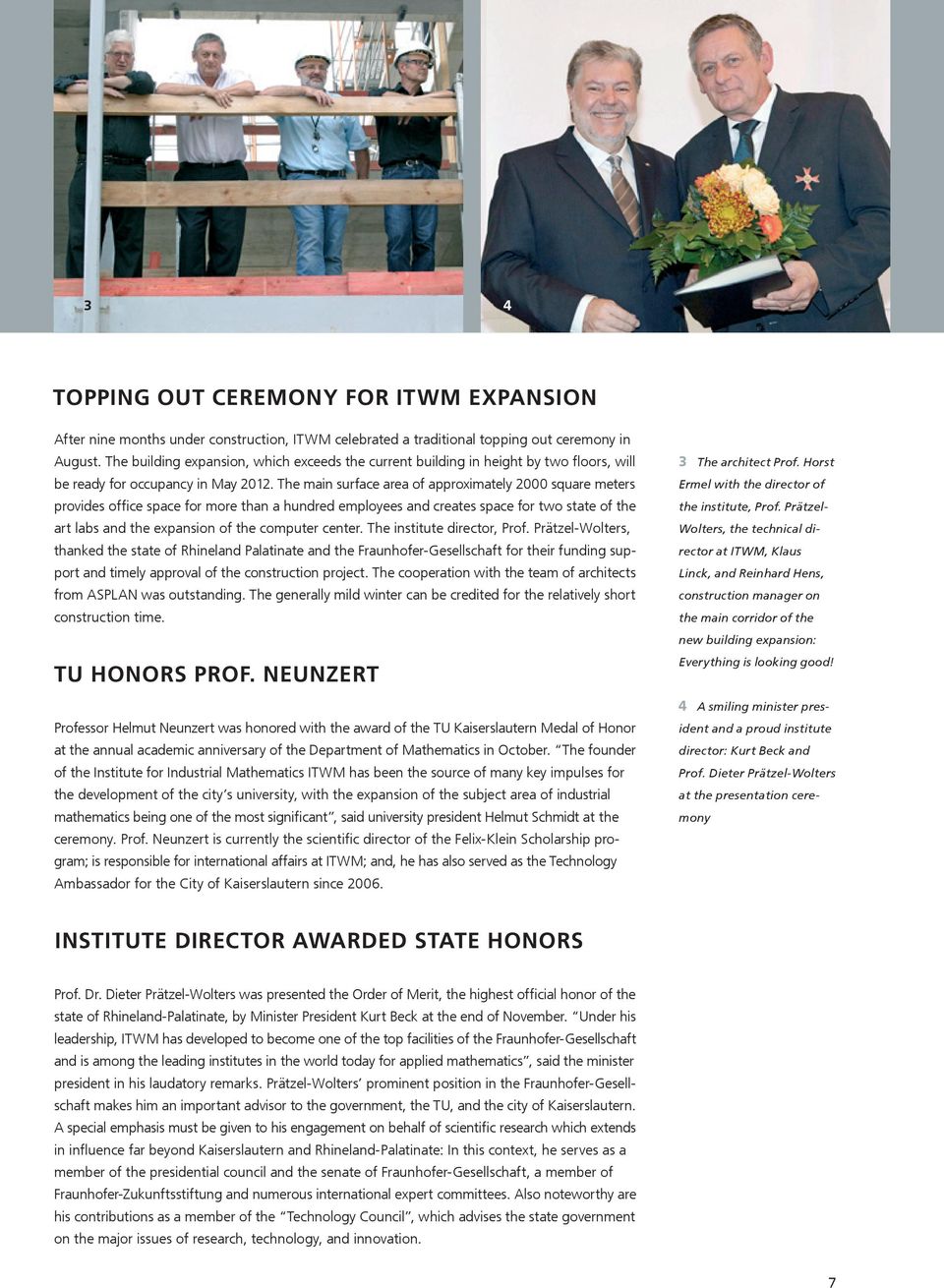
9 33 4 TOPPING OUT CEREMONY FOR ITWM EXPANSION After nine months under construction, ITWM celebrated a traditional topping out ceremony in August. The building expansion, which exceeds the current building in height by two floors, will be ready for occupancy in May The main surface area of approximately 2000 square meters provides office space for more than a hundred employees and creates space for two state of the art labs and the expansion of the computer center. The institute director, Prof. Prätzel-Wolters, thanked the state of Rhineland Palatinate and the Fraunhofer-Gesellschaft for their funding support and timely approval of the construction project. The cooperation with the team of architects from ASPLAN was outstanding. The generally mild winter can be credited for the relatively short construction time. tu HONORS Prof. neunzert Professor Helmut Neunzert was honored with the award of the TU Kaiserslautern Medal of Honor at the annual academic anniversary of the Department of Mathematics in October. The founder of the Institute for Industrial Mathematics ITWM has been the source of many key impulses for the development of the city s university, with the expansion of the subject area of industrial mathematics being one of the most significant, said university president Helmut Schmidt at the ceremony. Prof. Neunzert is currently the scientific director of the Felix-Klein Scholarship program; is responsible for international affairs at ITWM; and, he has also served as the Technology Ambassador for the City of Kaiserslautern since The architect Prof. Horst Ermel with the director of the institute, Prof. Prätzel- Wolters, the technical director at ITWM, Klaus Linck, and Reinhard Hens, construction manager on the main corridor of the new building expansion: Everything is looking good! 4 A smiling minister president and a proud institute director: Kurt Beck and Prof. Dieter Prätzel- Wolters at the presentation ceremony INSTITUTE DIRECTOR AWARDED STATE HONORS Prof. Dr. Dieter Prätzel-Wolters was presented the Order of Merit, the highest official honor of the state of Rhineland-Palatinate, by Minister President Kurt Beck at the end of November. Under his leadership, ITWM has developed to become one of the top facilities of the Fraunhofer- Gesellschaft and is among the leading institutes in the world today for applied mathematics, said the minister president in his laudatory remarks. Prätzel-Wolters prominent position in the Fraunhofer-Gesellschaft makes him an important advisor to the government, the TU, and the city of Kaiserslautern. A special emphasis must be given to his engagement on behalf of scientific research which extends in influence far beyond Kaiserslautern and Rhineland-Palatinate: In this context, he serves as a member of the presidential council and the senate of Fraunhofer-Gesellschaft, a member of Fraunhofer-Zukunftsstiftung and numerous international expert committees. Also noteworthy are his contributions as a member of the Technology Council, which advises the state government on the major issues of research, technology, and innovation. 7
10 1 ACTIVITIES OF THE FELIX KLEIN CENTER 1 Mathematical Modelling Week 2011 at Kaub Prize for Mathematical Modeling Week The collaborative project Mathematical Modeling Week, organized by the Felix Klein Center together with the secondary schools of the state of Rhineland-Palatinate, was the first prize winner of the Schools meet Science competition sponsored by the Robert Bosch Foundation. The German Science and Technology Minister, Annette Schavan, presented the endowed with 50,000 euros award. The project was selected from a field of 60 other entries. Felix Klein Center supports MINT Project for career orientation Now for the second time, the Kaiserslautern Job Center and Felix Klein Center for Mathematics have once again started the 6-month career orientation project. Since September 2011, 21 students from the city and county of Kaiserslautern have been working in four separate working groups to solve practical problems in the area of applied mathematics. The aim is to provide a realistic picture of a career in mathematics. Common cause: Junior Engineer Academy The Junior Engineer Academy (JIA) has been offered as a scholarship for outstanding students at the state-run Heinrich Heine Gymnasium in Kaiserslautern since school year 2010/11 and offers students in the 7th through 10th grades a chance to select an interdisciplinary mix of 3-year MINT elective courses. The Felix Klein Center and various departments at TU Kaiserslautern are participating in the JIA, which also receives financial aid from the Telekom Stiftung. In JIA I, students are currently learning about the planning issues for wind turbine farms, and in JIA II, the subject will be electro-mobility. The trial project is scheduled to run until Young Researchers prize winners at ITWM In 2010, the Fraunhofer-Gesellschaft assumed the premium partnership for the special subject area Mathematics/Computer Science for the Jugend forscht Stiftung, which donates the prizes for this special subject area at the federal, state, and regional levels. ITWM also participates in special prize categories and offers internships to the successful applicants in the state science competitions. Three winners were placed in 2010 and ITWM has already provided five internships in Promoting excellence in academics: Felix Klein Scholarship By the end of 2011, 20 students had been granted a Felix Klein scholarship. This scholarship has been awarded since 2009 to outstanding students in the bachelor degree program for mathematics (incl. teacher training). In addition to the financial aid of 500 euros per month, the scholarship holders are assigned a mentor from ITWM. 8

11 2 3 4 PROFESSORS AT THE FELIX KLEIN CENTER Of the five new W3 Professorships announced at the Felix Klein Center for Mathematics, four have already been filled by distinguished, international scientists. Three, in fact, had already begun their work before the end of Prof. Dr. Bernd Simeon 3 Prof. Dr. Gabriele Steidl Bernd Simeon started as a Professor for Differential-Algebraic Systems and Numeric Mathematics at TU Kaiserslautern in His degree is in Mathematics with Computer Science from TU Munich. Following his PhD in 1994, he held positions at TU Darmstadt, University of Karlsruhe (TH), and Ulm University, before accepting a Professorship for Numerical Mathematics and Scientific Computing in 2002 at TU Munich. His research focuses, in particular, on differential-algebraic systems with diverse applications in the engineering and life sciences, in addition, numerical methods for materials with memories, imaging methods for highly integrated circuits as well as modeling and numerics for biomechanical applications. Since 2008, he has been working on the new concept of Isogeometric Finite Elements in the EU projects EXCITING and TERRIFIC. 4 Prof. Dr. Klaus Ritter Gabriele Steidl accepted a Professorship for Image Processing and Data Analysis at TU Kaiserslautern in She studied Mathematics at University of Rostock, where she earned her doctorate in 1988 and post-doctoral habilitation in In between studies, she conducted research in Debrecen, Warsaw, Zurich, and Paris. Following her employment from 1992 to 1993 by the Verband Deutscher Rentenversicherungen VDR in Frankfurt/Main, Gabriele Steidl was a lecturer at TU Darmstadt and a professor at the University of Mannheim. She focused on mathematical image and signal processing, where the emphasis is on harmonic analysis methods, approximation theory, and convex analysis/optimization. Some of the typical applications are found in image restoration, defining fields of motion, segmentation, and machine learning as well as Fourier transformations for non-equidistant nodes in medical imaging. Since 2010, Klaus Ritter has been Professor for Computational Stochastics at TU Kaiserslautern. He completed undergraduate, doctorate, and post graduate studies at the University of Erlangen-Nuremberg where he received his habilitation in He accepted a position at TU Darmstadt in the year 2000 after interim stops at the University of Passau and Columbia University, New York. Stochastic computing is a new subfield of mathematics that deals with numerics and the simulation of complex stochastic models. The subjects of interest include stochastic differential equations used descriptions of random dynamics and other diverse applications, for example, in the mathematics of finance or the description of fluid dynamics. The research profile of the working group is extended through cooperative projects with renowned industrial sector partners, for example, the pharmaceutical industry and trade. 9

12 10

13 fraunhofer ITWM Head of Administration Dr. Marion Schulz-Reese Phone: +49 (0) 631/

14 Institute profile Computer simulations are an indispensable tool in the design and optimzation of products and production processes, services, communication processes and work processes. Real models are replaced by virtual models. Mathematics plays a fundamental role in the creation of this virtual world. Mathematical models cut horizontally across a landscape of vertically arranged scientific disciplines and technological applications. This transverse character of mathematics makes it a generic technology ; as a basis for bridging into the simulation world, however, it also becomes the key technology for computer simulations which have found their way into nearly all areas of economic life. Increasingly more small and medium-sized companies utilise simulation for cost reduction. It is specifically these companies that the Fraunhofer ITWM supports with consultation and computing power. They profit in the market through the use of simulation as identification for innovation and quality assurance of their products. Of course, we also work together with large companies, especially in the motor vehicle sector, in machine construction, the textile industry, in microelectronics, with banks and the computer industry. Consultation in R&D questions, support in the use of high-performance computer technology and provision of custom-tailored software solutions are integral building blocks of our work. The specific competences of the ITWM are Processing of data acquired from experiments and observations Drafting of mathematical models Implementation of mathematical problem-solving in numerical algorithms Summarization of data, models and algorithms in simulation programs Optimization of solutions in interaction with the simulation Visualization of simulation runs in images and graphics The ITWM is member of the Fraunhofer ICT Group as well as guest in the Fraunhofer Group for Materials and Components MATERIALS. In addition, the good networking within the Fraunhofer-Gesellschaft documents the participation in numerous Fraunhofer Alliances: Adaptronics, Energy, Simulation, Water Systems, Traffic and Transportation, Vision (image processing), Cloud Computing, and Automobile Production. Along with the implementation of this technology in application projects and its further development in research projects, the close collaboration with the Department of Mathematics at the University of Kaiserslautern is also a point of emphasis for the Fraunhofer ITWM. The classical disciplines of applied mathematics such as numerics, optimization, stochastics and statistics as well as differential equations are cornerstones. 12
15 Organizational chart Director Prof. Dr. Dieter Prätzel-Wolters +49 (0) 631/ Scientific Advisory Board Prof. Dr. Axel Klar +49 (0) 631/ Prof. Dr. Ralf Korn +49 (0) 631/ Prof. Dr. Helmut Neunzert +49 (0) 631/ Prof. Dr. Stefan Nickel +49 (0) 631/ Martin Braun, Christian Peter, Dieter Eubell, Gabi Gramsch, Tino Labudda, Martin Vogt, Mirko Spell, Eva Schimmele, Dr. Elmar Gerwalin, Klaus Linck, Michael Mannweiler, Gesa Ermel, Ilka Blauth, Steffen Grützner, Sylvia Gerwalin Administration Dr. Marion Schulz-Reese +49 (0) 631/ IT Dr. Elmar Gerwalin +49 (0) 631/ Public Relations Dipl.-Math. Steffen Grützner +49 (0) 631/ Competence Center High Dr. Franz-Josef Pfreundt (CIO) +49 (0) 631/ Performance Computing Transport Processes Dr. Raimund Wegener +49 (0) 631/ Flow and Material Simulation Dr. Konrad Steiner +49 (0) 631/ Michaela Grimberg-Mang, Markus Pfeffer, Elena Kostova, Katharina Parusel, Manuela Hoffmann, Anja Nitschky, Dr. Marion Schulz-Reese, Prof. Dr. Dieter Prätzel-Wolters, Prof. Dr. Helmut Neunzert, Elke Münch, Brigitte Williard, Claudia Nickel, Sabine Müller, Prof. Dr. Axel Klar, Prof. Dr. Stefan Nickel Image Processing Dr. Ronald Rösch +49 (0) 6 31/ System Analysis, Prognosis and Control Dr. Patrick Lang +49 (0) 6 31/ Optimization Prof. Dr. Karl-Heinz Küfer +49 (0) 6 31/ Financial Mathematics Prof. Dr. Ralf Korn +49 (0) 6 31/ Mathematical Methods in Dynamics and Durability Dr. Klaus Dreßler +49 (0) 6 31/

16 The INSTITUTe IN Numbers budget Operating budget development in million industry public projects base funding and Fraunhoferinternal programs There were already indications at the end of 2010 that the year 2011 would be another very successful year for ITWM. At that time, the year-end order backlog for 2011 was at a very high level compared to previous years and, significantly, not only in the public sector, but also in the industrial business sector. ITWM also profited in 2011 from the business recovery in the German and European economies especially in the areas of automotive and mechanical engineering. Industrial revenues actually increased compared to the previous year by 14.5 percent, so at year-end close 2011, ITWM reported a share of industrial revenues of 43.2 percent. This result would not have been possible without the strong engagement of all employees, especially those in order acquisition % 37 % 23 % 26 % 44 % 37 % 27 % 32 % 41 % 27 % 30 % 43 % It must be noted that the percentage of industrial revenues originating from small and middle size enterprises declined. In the previous year, this sector contributed nearly 50 percent, but in 2011, only 34.4 percent of the business earnings came from SMEs. In contrast, the share of industrial revenues from foreign enterprises remained constant; this continued at 34 percent in Almost an equal share, namely 32 percent, originated from local and regional companies. Overall, ITWM could rely not only on its regular customers, but also the contracts awarded by a large number of new customers were very gratifying. The operating budget increased by more than 9 percent compared to the previous year. The percentage of revenue from the public sector remained constant also at the high level from 2010, while the revenues from internal programs showed a slight decline. Budget development Operating budget Investments Total thousand 14

17 Also, the prospects for 2012 are very good in terms of industrial orders and public funding. This outlook allows ITWM to be very optimistic about the future. For 2012, this surely means another considerable increase in staff. The completion of our new building extension was a welcome addition to an already crowded institute. scientists and technicians central services PhD students other employees research assistants interns trainees Personnel development Subsequent to the excellent order situation in 2011, 37 new employees were hired, 34 of these in the research area. The new hires were somewhat balanced by 14 departures, but this reflects a substantial overall increase in human resources. A gratifying fact is that of the 34 new hires, a total of 16 scientists were again recruited from our own ranks of young talented researchers. This is an indication of the outstanding program to promote junior staff at ITWM. The large number of PhD candidates 70 in 2011 assures ITWM not only excellence in research, but also provides access to highly educated scientists in these times of a growing shortage in the availability of qualified staff. The strategic alliances with TU Kaiserslautern, such as the Mathematics Initiative, the Kaiserslautern Innovation Center Science Meets Engineering, and the Felix Klein Center for Mathematics have already proved very productive for ITWM. Under the umbrella of the Felix Klein Center for Mathematics, the joint objective of ITWM and the TU is to attract more students to the study of MINT subjects through activities organized at the secondary education level. This also promotes the project aims within the Fraunhofer MINT-EC Talents program initiated and sponsored by the Fraunhofer-Gesellschaft

18 costumers and cooperation partners selection 2011 Abbott GmbH & Co. KG, Ludwigshafen Accenture CAS, Kaiserslautern Adam Opel AG, Rüsselsheim, Kaiserslautern aixprocess PartG, Aachen Albany International, Saint-Junien (F) ante-holz GmbH, Bromskirchen ARRI GmbH, Stephanskirchen Assénagon GmbH, München AUDI AG, Ingolstadt Avid Technology GmbH, Kaiserslautern BASF SE, Ludwigshafen Bayer Technologie Services, Leverkusen Biffar, Edenkoben BMW, München, Landshut BPW Bergische Achsen Kommanditgesellschaft, Wiehl BSN medical GmbH, Hamburg Bundesanstalt für Materialforschung und -prüfung, Berlin ClusterVision, Amsterdam (NL), München Corning GmbH, Kaiserslautern DAF Trucks N. V., Eindhoven (NL) Daimler AG, Stuttgart DEG Deutsche Investitions- und Entwicklungsgesellschaft, Köln Delta Computer, Reinbek delta h Ingenieurgesellschaft mbh, Witten Det Norske Oljeselskap, Oslo (N) Deutsche Apotheker Bank, Düsseldorf Deutsches Krebsforschungszentrum, Heidelberg DLR, Braunschweig, Göttingen E.ON Anlagenservice GmbH, Gelsenkirchen EADS Deutschland GmbH, München EKF diagnostic GmbH, Barleben ENI Gas Transport Deutschland S.p.A, Düsseldorf ESI Group, Paris (F) Fachhochschulen: Darmstadt, Hamburg, Kaiserslautern, Westküste First Quality Nonwoven Inc., Hazle Township (USA) FLSmidth Wadgassen GmbH, Wadgassen GE Global Research, München Germanischer Lloyd SE, Hamburg GKD Gebrüder Kufferath Düren, Düren Hamberger Sanitary GmbH, Rosenheim Heimbach GmbH & Co. KG, Düren Hilite International, Nürtingen Hüttenwerke Krupp Mannesmann, Duisburg IBS Filtran, Morsbach-Lichtenberg Intel, München International Partners in Glass Research, Bülach (CH) ITWH GmbH, Hannover John Deere, Mannheim, Kaiserslautern Johns Manville Europe GmbH, Bobingen KTM-Sportmotorcycle AG, Mattighofen (A) Liebherr, Kirchdorf, Colmar (F) Lynx IT Systeme, Tübingen 16
19 MAGMA Gießereitechnologie GmbH, Aachen MAN Truck & Bus Deutschland GmbH, München MANN+HUMMEL GmbH, Ludwigsburg Marathon Oil, Houston (USA) Massachusetts General Hospital (MGH) / Harvard Medical School, Boston (USA) Megware, Chemnitz MeVis Medical Solutions AG, Bremen Millipore Corporation, Billerica (USA) Möbelwerke Mastershausen, Mastershausen MTU Aero Engines GmbH, München NOGRID GmbH, Mainz Oerlikon Neumag, Neumünster, Linz (A) OSRAM GmbH, Augsburg Paul Wild OHG, Kirschweiler Porsche AG, Weissach proalpha Software AG, Weilerbach Procter & Gamble, Schwalbach, Euskirchen Progress Rail Inspection and Information Systems, Bad Dürkheim R+V Versicherung AG, Wiesbaden Repsol, Houston (USA) RJL Micro & Analytic GmbH, Karlstadt-Neuthard Robert Bosch GmbH, Stuttgart Rock Solid Images, Houston (USA) S.D.R. Biotec, Pohritzsch Salzgitter Mannesmann Forschung GmbH, Duisburg SAR Electronic GmbH, Dingolfing Scania CV AB, Södertälje (S) Schmitz Cargobull AG, Altenberge Schott AG, Mainz Seismic City, Houston (USA) SIEDA GmbH, Kaiserslautern Siemens AG, Energy Sector, Mühlheim a. d. Ruhr, Nürnberg Siemens AG, Oncology Care Systems, Heidelberg Spring Energy, Oslo (N) Städtische Kliniken, Frankfurt/Höchst Stadtwerke Kaiserslautern, Kaiserslautern Statoil, Stavanger (N), Trondheim (N) Stryker GmbH & Co KG, Freiburg Teckpro AG, Kaiserslautern Tönsmeier Dienstleistung GmbH & Co.KG, Porta Westfalica Universitäten: Bordeaux (F), Dortmund, Erlangen, Freiberg, Kaiserslautern, Karlsruhe Vaillant, Remscheid Voith Paper Fabric & Roll Systems, Heidenheim Volkswagen AG, Wolfsburg Volvo CE, Göteborg (S), Konz Wärtsilä Netherlands, Drunen (NL) WestLB, Düsseldorf Wolfram Research, Inc., Champaign (USA) Woltz GmbH, Wertheim Wyatt Technology Europe GmbH, Dernbach Zaunwelt GmbH, Duhlwiesen 17

20 board of trustees fraunhofer ict group August Altherr, John Deere European Technology Innovation Center Dr.-Ing. Erwin Flender, MAGMA Gießereitechnologie GmbH Dr. Werner Groh, Johns Manville Europe GmbH Prof. Dr. Wolfgang Hackbusch, Max Planck Institute for Mathematics in the Sciences Johannes Heger, HegerGuss GmbH Prof. Dr. Peter Jagers, Matematiska Vetenskaper Chalmers Dr. Wilhelm Krüger, Blue Order AG Prof. Dr. Volker Mehrmann, Technische Universität Berlin Prof. Dr. Helmut Neunzert, Fraunhofer ITWM Barbara Ofstad, Siemens AG Richard Ortseifer, Ministry of Rhineland-Palatinate for Economic Affairs, Climate Protection, Energy and Regional Planning Shorter innovation cycles have turned IT knowledge into a perishable commodity. The Fraunhofer Group Information and Communication Technology (ICT) provides support in the form of customized solutions, consulting, and contract research for new products and services. The Fraunhofer ICT Group comprises 17 institutes (among them also the Fraunhofer ITWM) representing a workforce of roughly 2800 employees and a yearly budget of approximately 201 Million Euros. Its central office in Berlin serves as a one-stop shop, referring customers to the appropriate contacts. The complementary focal fields of the participating institutes cover the entire value chain of the ICT industry. The business areas are: E-Business E-Government Medicine Information and Communications Technology Production Ingo Ruhmann, Federal Ministry of Education and Research Digital Media Dr.-Ing. Jürgen Sauter, FE-DESIGN GmbH Security Prof. Dr. Helmut J. Schmidt, President University Kaiserslautern Energy and Sustainability Dr. Mattias Schmidt, Procter & Gamble Service GmbH Automotive Prof. Dr. Wolfgang Wahlster, DFKI GmbH Financial Sector Services Dr. Achim Weber, Ministry for Education, Science, and Culture in Rhineland-Palatinate Dr. Christof M. Weber, Daimler AG 18

21 the fraunhofer-gesellschaft at a glance The Fraunhofer-Gesellschaft is the largest organization of applied research in Europe. As a non-profit organization, it currently maintains approximately 80 research units including 60 institutes at more than 40 locations throughout Germany. A staff of approximately 20,000 employees mainly qualified scientists or engineers works for the annual research budget of 1,8 billion Euros. More than half of industrial profits stem from projects with small and medium-sized enterprises. The Fraunhofer-Gesellschaft deals with research and development projects ordered by economy, the state, and the public sector. International cooperation is supported by Liaison Offices in the USA and in Asia. Research Topics of the Fraunhofer-Gesellschaft Adaptronics Construction Technology Energy Information and Communication Technology Medical Engineering, Environmental and Health Research Microelectronics Nanotechnology Surface Technology and Photonics Production Traffic Engineering and Logistics Defense and Security Materials and Components Fraunhofer-Gesellschaft zur Förderung der angewandten Forschung e. V. Hansastraße 27 c München Germany 19
22 20
23 TRANSPORT processes n flexible Structures n Fluid Dynamics n Grid-free Methods n optics, radiation, heat n Model reduction Head of Department Dr. Raimund Wegener Phone: +49 (0) 631/ [email protected] 21
24 The core competence of the Transport Process department is the mathematical modeling of complex manufacturing problems and the development of efficient algorithms for their numerical solution (simulation). The problem areas outlined below are found in the technical natural sciences (fluid dynamics, radiative transfer, optics, acoustics, structural mechanics, etc.) and, from the point of view of mathematics, can lead to partial differential equations that are mainly characterized as transport algorithms. Our industry customers are primarily interested in the optimization of products or the technical design of manufacturing processes. The product spectrum of the department includes collaborative research projects with the R&D divisions of partner companies with a focus on the engineering sciences, studies including design and optimization proposals, concept development, and software solutions. The year 2011 was very successful for all groups in the department, both scientifically and economically. Flexible Structures The flexible structures group concentrates on modeling and the numerical simulation of flexible (elastic, viscous, or viscoelastic) objects, especially, on the dynamics of fibers in (turbulent) flows. The FIDYST simulation software (Fiber Dynamics Simulation Tool) is the result of several years of research. FIDYST has been used successfully in numerous projects to optimize the design of technical textile production processes (e. g., nonwoven folding, spin processes). FIDYST uses the flow data from commercial flow solvers as input data for the structure simulation. The full coupling of structural dynamics and fluid dynamics is possible, in many cases, through iterative coupling and the appropriate modeling of the flow and structure interactions. Stochastic models able to describe the fiber deposits on the belt are specially developed for the spin process in the production of nonwovens. Fluid Dynamics The core competence of this group covers most fields of fluid dynamics on the basis of Navier- Stokes equations, i. e., the entire spectrum in terms of numbers like Reynolds or Mach numbers. Diverse types of material models as well as fluid-structure couplings or heat radiation are often incorporated. When extended and expanded with our own specific routines, standard tools like FLUENT or CFX are useful in finding efficient and accurate solutions to current problems. Another research topic of the group is the optimal geometric design for melt flows in the spinning process. 22
25 Grid-free Methods The department has developed its own basic software, the Finite Pointset Method (FPM), for completing simulation tasks in the broad spectrum of problems arising in the area of flow and continuum mechanics. FPM is a particle method, also called grid-free method, which, unlike traditional numerical methods such as Finite Element or Finite Volume, needs no grid. This method is extremely well suited for solving time dependent problems, where grid based methods are limited and require remeshing. Some typical challenges are problems in fluid dynamics with free surfaces, multiphase flows, fluid-structure-interactions with strong changes in the computing domain or mechanical problems with substantial changes in structure. Optics, Radiation, Heat Free-form lenses or reflectors are used for specific area illumination in accordance with defined conditions. No additional elements to project are required, which means free-form optics provide the optimal light effect with a minimum of optics. But what must the surface of a lens or reflector look like to distribute the light in a suitable manner? The Transport Processes department developed a very fast, robust algorithm and then implemented it in the software tool LODTa (Light Optimal Distribution Tool), which demonstrates the division s competence in solving socalled inverse problems. In addition to optic design and radiation in the visible range, other research priorities are radiation transport in the infrared range, heat transfer, and heat conduction. Dr. Daniel Burkhart, Johannes Maringer, Andre Schmeißer, Christian Leithäuser, Dr. Jan Mohring, Johannes Schnebele, Thomas Cibis, Walter Arne, Maria Kobert, Simon Schröder Dr. Simone Gramsch, Dr. Dietmar Hietel, Dr. Norbert Siedow, Dr. Jan Marburger, Dr. Matthias Schäfer, Dr. Raimund Wegener, Dr. Jörg Kuhnert, Florian Hübsch, Dr. Jevgenij Jegorov, Dr. Jalo Liljo, Sergey Antonov Model Reduction Today s technical products and processes can be simulated in great detail thanks to highly developed software and increased computing power. In general, however, developers are still not satisfied: variants have to be tested, evaluated quickly, and optimized. The key technology is called parametric model reduction, in which the original object, e. g., a large Finite Element model, is converted to a parametric, reduced state-space model. These models can be evaluated much faster than the original model. The new parametric approach developed at ITWM solves two of the classic problems of reduction models: It is not necessary to start a new reduction if there is a design parameter. Instead, using a few pre-calculated reduced models, the one for the new parameter set is created by interpolation often in just a fraction of a second. 23
26 1 FormING PROCESS IN NONWOVEN PRODUCTION 1 Translational and rotational depositing: virtual nonwovens and basis weight distribution The production processes in the manufacture of nonwovens are linear processes, in which the individual process steps are aligned with one another and integrated into a chain. The process chain consists of the extrusion, spinning, forming, and depositing processes. It begins when the molten polymer mass is extruded and sent through a tube to be distributed on the spinning plate, pressed through capillary jets, and then spun into filaments by means of aerodynamic drag. These are then freely swirled about in an air jet, decelerated, and deposited on a moving belt. By overlaying thousands of filaments, nonwovens are created with the typical irregular and cloudy structure. The application spectrum of nonwovens is extremely broad and ranges from daily products like baby diapers and vacuum cleaner bags to high-tech products like battery separators or medical products. The manufacture of nonwovens is, in economic terms, characterized by the high cost of raw materials with relatively low process costs. In terms of product quality, the variable properties that result from the stochastic influences in the production process pose a problem. FIDYST (Fiber Dynamics Simulation Tool) is a software tool that simulates filament dynamics in turbulent air flows and facilitates the calculation of the full dynamic of a single filament within a process and, from sophisticated simulation runs, predictions concerning the deposit structure. The generation of a virtual fleece and the possibilities it opens for the assessment and optimization of the technical engineering processes and the effects on the resulting products demands the efficient simulation of thousands of filaments. However, this cannot be performed by FIDYST alone. This is why ITWM has introduced a class of surrogate models with stochastic differential equations, which are used in combination with dynamic FIDYST simulations to parameterize single representative filaments. These surrogate models are implemented in user-friendly software and, without any significant simulation time added, enable the usage for various production methods (translational, oszillating, rotational). Using the combination of FIDYST and a surrogate model, the entire nonwoven can be virtually generated and evaluated in terms of quality. This ultimately allows for the systematic optimization of the underlying production processes. 24
27 1 2 SLOSHING ACTIONS IN TANK SYSTEMS The sloshing of fuel in the tank of an automobile, an airplane, or a ship occurs as a result of flight or driving dynamics. It is often accompanied by unwanted secondary effects, for example, extreme noise emissions. More importantly, the sudden redistribution of fuels within the separate tank chambers can lead to extreme situations: The cause of some accidents involving tank trucks or tanker ships can be traced back to sloshing actions, and in cars, sloshing can result in the limited filling capacity of the tanks. Physically considered, it has to do with the flow processes involving free surfaces. There is a major influence from rolling and breaking waves. These usually lead to the formation of air bubbles or trapped air, which significantly influences the fluid dynamics. In order to numerically represent a sloshing process, a tool is required that can describe the dynamics of free surfaces very well while still taking the phenomenon of trapped air into account. 1 Detection of air bubbles during sloshing 2 Sloshing in an actual tank geometry ITWM has already created such a tool. Over the last ten years, it has developed the grid-free Finite Pointset Method (FPM). A streaming fluid is represented by a numerical particle cloud that is not meshed. The particles carry all the relevant data for the process and move at the speed of the flow. The particle cloud is self-adaptive in terms of the dynamic changes in geometry and, in particular, it can almost perfectly describe the spatial-temporal behavior of free surfaces. In 2011, an agreement was made to continue the long term cooperation between ITWM and VW in the area of fuel flow simulations for tank units on the basis of FPM, with a main focus on the sloshing actions. A key activity is the modeling of the trapped air. This can be simulated, for example, by integrating the air as a second phase. The bubble-algorithm developed in this project, however, is much more efficient: The second phase can be neglected in favor of a numeric model of just the fuel phase. The particle cloud is searched for self-enclosed sections of free surface, which are then simultaneously viewed as the borders of the trapped air. Using these boundary points, the volume content of the bubbles and the instantaneous internal pressure can be determined. The internal pressure can then be defined as a limiting condition for the free surface. This method has been successfully validated at VW on actual tank geometry. The aim of the project partner is to gain insights, with the help of FPM, to noise emission and the efficiency of anti-slosh measures early in the design process. 25
28 1 2 VISUALIZATION OF UNSTEADY VECTOR FIELDS WITH STRING 1 Visualization of ground water flows around rivers 2 Visualization of the Elder Problem : Transport of dissolved materials in terms of thermal convection Today, more and more numeric simulations are relied on to provide a better understanding of physical processes. In order to fully interpret and appreciate the results, a good visualization software is generally necessary. Traditional visualization tools work quite well for scalar quantities like density and pressure. However, there is still great potential when displaying vector fields. Conventional methods are often overtaxed, especially, when working with unsteady data. To preserve clarity, individual aspects of the vector data are therefore frequently rejected. Some only visualize the values of the vectors, while other methods rely totally on the directional data of the vector field, but then have no feeling for the absolute value. Few methods are capable of combining both types of data and these, in turn, generally produce visualizations that can only be interpreted by a small number of experts in possession of the adequate background knowledge of the problem being investigated. It is precisely this simple interpretation of complex flows through descriptive visualization that a joint venture with delta h engineering company has set as its goal: This collaborative project is developing the STRING platform. The company specializes in the modeling of ground water systems; Large, unsteady data sets are a regular part of their work in this area. The visualization of the velocity distributions in particular takes on a great significance, because only then do key relationships over the course of the groundwater flow become clear. STRING employs a visualization method that combines the advantages of various conventional methods. The images from STRING are stored as videos. This enhances the possibilities when handling time dependent data. The dynamics of an unsteady vector field are illustrated by particles moving within the field. These particles form the core of the presentation method. In order to better show the fluid movement over time, a section of the motion history of each one of the particles is displayed in the form of a visual tail. Based on the movement of the particles over time as well as the length of the tail, the user gains a clear impression of the course and development of the vector field over time. Because all relevant information about the unsteady vector field is already represented in the geometric presentation, using a well-planned color scheme, additional attributes can be illustrated as well, for example, pressure, density, or topographies. 26
29 1 2 Stryker Leibinger GmbH & Co. KG Stryker Leibinger GmbH & Co. KG 3D-Reconstruction OF FRACTURED HIP Stryker Corporation is one of the largest manufacturers of medical 2 devices in the world and one of the leading companies in the area of orthopedic products. A computer assisted surgery system for minimally invasive treatment of hip fractures developed by Stryker Navigation in Freiburg celebrated its market launch at the end of 2011 after a four-year R&D phase, in which ITWM provided key support in the area of parameter identification. A hip fracture is treated by implanting a rod, known as a nail, into the shaft of the femur bone and securing it in place with a surgical screw. To achieve the maximum biomechanical stability, it is important that the screw penetrate as far as possible into the ball portion of the hip joint. On the other hand, under no circumstance should the tip of the screw be allowed to penetrate the periosteum, so as not to restrict the mobility of the ball joint. Because this is a minimally invasive surgery, the operator is not able to see the relative positions of the screw and bone with his own eyes, but rather must rely on imaging methods. Over the course of the past years, Stryker Navigation has developed a pioneering solution, one that both enables more precision work and requires only minor changes to the established procedures. This is accomplished using two X-ray images that can be produced using the common C-arm. In the process, a reference body with small beads that stand out well in the 2D X-ray images is attached to the nail, which also serves as the guide for the screw. This enables a 3D reconstruction of the anticipated axis of the screw. By exploiting the ball shape of the femural head, it is possible to extract its contour, to reconstruct its spatial position, and to predict the penetration point of the screw. 1 Patient X-ray in C-arm system 2 3D reconstruction of femur head and screw in two X-ray images from C-arm What may at first sound like a straightforward concept is, in practice, extremely challenging: The beads of the reference body, for example, may sometimes be covered or their apparent midpoint may be distorted by optical effects. Even the mapping is initially unclear. Eventually, with automated or manual extraction of the ball joint, there may be a mix up with the socket or some displacement may occur between the recordings. In such cases, the operator cannot be provided with a 3D reconstruction. For all these problem areas, ITWM has been able to contribute innovative solutions through a combination of methods from the fields of non-linear parameter identification, inverse problems, approximation theory, projective geometry, statistics, or combinational analysis, that found direct application in the algorithmic core of the operating software. 27
30 28
31 flow and Material simulation n Microstructure simulation and virtual material design n Hydrodynamics n complex Fluids n mechanics of Materials Head of Department Dr. Konrad Steiner Phone: +49 (0) 631/ [email protected] 29
32 In many product and process design applications it is essential to understand and consider the local structural property relationships of the underlying fluids and materials. The Flow and Material Simulation department works on multiscale modeling and the development of efficient and robust simulation methods and software tools for the integration of virtual material design into product development. In addition, modeling and simulation of the production processes of complex composites or hybrid materials are being integrated in the virtual design process. What make this division unique is the development, provision, and specific use of multiscale and multiphysics methods suitable for industrial application. The department has again been very successful economically and scientifically, so much so that staff could be retained and selectively strengthened. Many industrial partners have decided to continue working with us and promising new customer contacts could be established. The year-long presence of the Bessel- Humboldt Prize winner Yalchin Efendiev has not only strengthened our cooperation with Texas A&M, but has also intensified many of the existing collaborative research projects with partners in the Interpore Society network. Microstructure simulation and virtual material design The GeoDict software now contains many diverse possibilities for computer aided material design. All major heterogeneous material structures can be realistically generated and combined with one another fairly easily. Structural property relationships of porous materials and composites or hybrid materials can be standardized with various modules for quick and efficient computation. Besides the range of applications in the materials sciences (textiles, paper, ceramics, composites, etc.), an increasing number of calculations are being performed on tomographic data, especially, in solving geophysical problems (see page 35). Because of the varied and worldwide use of GeoDict, we have transferred the sales, marketing, and customer support of Geo- Dict at the end of 2011 to the ITWM spin-off company Math2Market, which remains closely linked to the division in personnel and content. Hydrodynamics and CFD methods A long term agreement with IBS Filtran assures the continued development of our filter element design software (SuFiS). Furthermore, OptPleat is a specific software for pleated filter design being developed using our development platform FiltEST (Filter Element Simulation Toolbox). The correct prediction of the local and often lower concentrations of particles in flows on the basis of field flow fractionation (AFFF) is numerically challenging, both for the filtration of contaminants as well as in the design of particle separation systems. Our established quantitative analysis software for flooding of drainage systems, RisoSim, has gained access to wide exposure 30
33 through the link that now exists to Hystem Extran from the Institute for Technical and Scientific Hydrology (ITWH). CoPool was created to provide the Gesellschaft für Reaktorsicherheit (GRS) a simulation that enables the fast, valid evaluation in case of accidental flooding of a nuclear reactor (see page 32). Complex fluids In the context of computational fluid dynamics, everything from composites, granulates, fibers, or particle suspensions to nearly solid state behavior can simulated through the appropriate modeling of the highly dynamic structural interactions between fluids and particles and the use of adequate numerical methods. Generally, these are dense suspension flows where, in addition to the complex rheological, other physical effects (electrical fields, chemical reactions) must also be managed. Our CoRheoS software platform enables the simple combination and extension of such multiphysical phenomenon. Current practical applications include the transport and mixing of powders and granulate (CoRheoGrain), powder injection moulding processes (CoRheoPol) as well as the product behavior of high performance battery materials (BEST). The prediction of the local fiber orientation in the production of fiber reinforced components for various matrix materials like concrete, is possible with CoRheoFiber (see page 34). Mechanics of materials At the mechanics of materials group, we examine the thermomechanic and acoustic design of complex composite structures and porous material composites in their specific applications. The efficient treatment of multiscale models is based on robust, adaptive 3D mesh generating algorithms for large volume data in combination with highly efficient nonlinear, finite element implementations (FeelMath). The microstructural design of composites, in particular, those in the growing field of CFRP can be efficiently evaluated with FeelMathVOX. By taking into account the real complex reinforcing structures, the optimal fiber arrangement can be determined. The thermo mechanic behavior of metal structures, the microstructural effect of porosities and inhomogeneity, especially, in terms of fatigue and durability, and the biomechanical behavior of textiles and implants are some of the other ongoing projects. The development and dimensioning of innovative doors on the basis of new materials and composites has now become a visible product of the very successful cooperation with the Biffar company (see page 33). Edward Toroshchin, Tatiana Gornak, Galina Printsypar, Dr. Otakar Knöpfelmacher, Dr. Andreas Wiegmann, Dr. Liping Cheng, Sven Linden, Maxim Taralov, Vassilena Nakova, Dr. Shiquan Zhang, Tigran Nagapetyan, Dr. Matthias Kabel, Dr. Sebastian Schmidt, Dr. Jochen Zausch, Priv.-Doz. Dr. Arnulf Latz, Dr. Dariusz Niedziela Tobias Zangmeister, Clément Zémerli, Johannes Spahn, Marco Buck, Dr. Stefan Rief, Inga Shklyar, Dr. Konrad Steiner, Priv.-Doz. Dr. Heiko Andrae, Dr. Ralf Kirsch, Dr. Jürgen Becker, Christine Roth, Dr.-Ing. Sarah Staub, Dr. Sascha Knell, Cornelia Kronsbein, Dr. Zahra Lakdawala, Prof. Dr. Oleg Iliev, Dr. Aivars Zemitis 31
34 1 2 COPOOL: MULTI-DIMENSIONAL CONTAINMENT POOL MODEL 1 Temperature gradients in a water filled containment; a fourth of the area is cut away. 2 Temperature distribution during the filling process: Walls are pictured in gray color; other colors represent the temperature of the water; the water level at the center is higher than in the outer pool. The safety of pressured water and boiling water reactors (resp. PWR and BWR) in nuclear power plants will continue to be an important topic even after the energy transition in Germany. An essential component of the nuclear safety (actions taken to prevent nuclear and radiation accidents or to limit their consequences) are computer simulations of various accident scenarios. COCOSYS software is being developed and validated in GRS GmbH for the comprehensive simulation of severe accident propagation in containments of light water reactors. The containment buildings of PWR and BWR reactors either originaly contain large water pools (e. g., condensation chamber in BWR), or such can appear during an incident (sump and reactor cavity in PWRs, control rod handling room in BWRs). Thermal effects and the temperature stratification become crucial in such situations. Until now, the global model of COCOSYS was only able to handle averaged water temperatures. Therefore, refined modeling and simulation of the hydrodynamic and thermal processes in the containment pool are demanded. To face this demand, the German Federal Ministry of Economics and Technology has supported the CoPool project. The goal was to develop a software tool, compatible with COCOSYS, that enables a more accurate simulation of the thermal stratification in containment pools, without significantly increasing the calculation effort compared to COCOSYS. This was achieved via a compromise solution between the accuracy of the model and the discretization methods. For convenience of users a separate preprocessor was developed, which allows the construction and discretization of the computational domain. The main part of CoPool software is the numerical solver, which allows simulating fluid flow in the containment pool and coupled heat transfer in the pool and in the walls. The fluid flow is described by 3D Navier-Stokes equations with Boussinesq approximation. The coupled system of equations is solved at variable dynamic fill levels. The proposed solver fulfills the requirements which are needed for future coupling with COCOSYS. Individual sections of the software have been tested on the basis of benchmark problems. More complex phenomena like thermal stratification were validated in comparison with measurements, work done in cooperation with Becker Technologies GmbH. Currently CoPool is standalone simulation software that can be used to efficiently determine the heat and mass transfer in large liquid pools for the purpose of nuclear safety. In a follow-up project, the CoPool software will be coupled with the COCOSYS software. 32
35 Biffar DEVELOPMENT AND MANUFACTURE OF NEW DOOR AND PORTAL DESIGNS After a successful completion of a joint research project in 2009, Biffar, Oberlinger-Architekten, and Fraunhofer ITWM agreed on a follow-on project in In the first project, new materials with outstanding functional properties for the door leaf and the door frame, for example, thermal insulation or fire resistance were identified and applied to new designs using modern simulation methods. These research findings were applied directly in a follow-on project to develop house doors and apartment entry doors in an exclusive design with flush frames and substantial improvements to functional properties. The architects responsible for the door design intensively discussed the best way to create the desired design without losing any functionality with the Biffar management and staff, who accepted the engineering design task and the manufacture of the prototypes. Fraunhofer ITWM compared and tested the design proposals, so that all major functional properties (U-value, fire resistance, burglar resistance) could be predicted using precision computational methods. Only computer simulations allowed for the examination of a large number of variants and the precision design required of the individual materials in the area of the door leaf and the door frame. The computer simulations permitted some of the designs to be rejected early in the development process, thereby avoiding the need to build prototypes for these variants and saving time and money. 1 Temperature distribution in the cross-section of the door frame after 60 minutes in the flame resistance simulation (temperature in Kelvin) 2 Form and function pattern of a door The computer simulation to predict fire resistance (F 30, F 60 or F 90) considers thermal conductivities and phase transformation processes, i. e. discharge and vaporization of water of crystals. These simulations supplied new layered constructs of the door leaves, which remained cool to the touch on the unexposed side even after a full hour of fire. Furthermore, some usual materials used in the past could now be replaced by less expensive ones. Finally, there was a computer simulation for the deformation of various door sizes by wind load or attempted burglary. The door leaf thickness, bands, and bars were dimensioned on the basis of these results. 33
36 Pseudocolor Var: Ayy_FO CONCRETE SIMULATIONS WITH CoRheoS Comparison of experimental and simulated fiber orientation at one level of the encasing; The y- component of the fiber orientation (perpendicular to the flow direction) is shown at the right. The strong orientation close to the lower end of the encasing (red area) is easily observed in this experiment (left). 3 Flow front and surface fiber orientation while filling a structural component over a slide; the different colors represent the different fiber orientations. Concrete is one of the oldest building materials known to man multifunctional and adaptable to almost any shape. Based on new material developments, ever more complex structures can be built using concrete. However, since each new concrete mixture has a different flow behavior, the engineer has to find the optimal handling conditions for each application. Simulations based on the simplest material properties possible can significantly accelerate this development process. Given the extremely complex rheological behavior of concrete, special simulation techniques have to be developed in order to perform application-related simulation studies. The complex fluids group at ITWM in recent years has acquired the know-how to handle even rheologically complex fluids with strongly coupled nonlinear material laws with numerical efficiency. The software development environment CoRheoS (Complex Rheology Solvers) was created on the basis of this know-how. CoRheoS simulates the processing of cement paste, concrete as well as fiber reinforced concrete. The use of fiber reinforced concrete reduces considerably the high time and material costs associated with traditional steel reinforcement, if the fiber orientation were known. However, this cannot be performed in a non-destructive way without simulation. Through appropriate adjustment of the simulation methods used in the production of fiber reinforced plastics, the fill behavior of the concrete and the effect of the steel fiber on the flow behavior can be predicted, just as the fiber orientation at every point of the component can also be predicted. Figure 3 shows the flow front and the surface fiber orientation during the filling of a pronged component with the outlet over a chute. Figures 1 and 2 show a direct comparison of the fiber orientation in an experiment at the Fraunhofer Institute for Building Physics IBP in Holzkirchen and in a simulation. The rheological characterization of concrete required the development of a systematic method to obtain the material parameters through a combination of rheological measurements of the cement paste and a simple Hägermann experiment. The Hägermann experiment is a simple and quick test used in the concrete processing industry to check the flow behavior of concrete: it can be quickly implemented directly at the construction site. The development of the concrete simulation was supported experimentally by a joint project with Fraunhofer IBP and the Institute for Construction Materials at TU Kaiserslautern. 34
37 relative particle number experiment simulation: fixed time simulation: time distribution 1 simulation: time distribution time (s) Simulation of Particle Transport in Rocks In impermeable rock, like granite, fractures represent the only pathway for groundwater flow. The complex geometries of such fractures have a strong influence on the flow and the particle transport. Hence, the lack of detailed knowledge about the fracture geometry often hinders an understanding of laboratory or field results of mass transport. Computer tomography can be applied to provide detailed spatial information of rock samples. Using these CT-images one can directly simulate the flow and mass transport. 1 Above: 3D fracture geometry after segmentation of the CT-image, porous material (gold), solid / mineral matrix (void), pores (grey) Below: Visualization of the In collaboration with the Institute for Geosciences of the University Mainz the tool AddiDict is developed to perform particle transport simulations in complex geometries. This tool is a module of the software GeoDict. The result of AddiDict simulations are breakthrough-curves and time dependent particle concentrations. A validation of the simulations is done by comparison with experiments of the Institute for Nuclear Waste Disposal at the KIT. Here we show results for a CT-image of a granite fracture (resolution: 80 µm per voxel). For the flow and transport simulations an inflow region is added (size of the geometry: voxel). particles (red) in the fracture for a fixed time, solid (grey) 2 Comparison of breakthrough curves from experiment and simulation The Navier-Stokes equations are solved on the voxel grid using an finite volume solver (EFV in GeoDict). The flow simulation is performed for water at 20 C with a flow rate of 66.8 µl/min according to the experiment. The flow-field is the basis for the computation of the transport properties. The transport-simulation does include diffusion, but does not incorporate chemical processes. For the transport simulation particles with a diameter of 12 nm and a density of 4000 kg/m 3 are studied. These values agree with the experiment. If a particle hits a fracture wall it bounces of without the loss of energy (sieving model in GeoDict). The nanoparticle transport is experimentally realized by means of column migration experiments. In the experiment the exact times and positions at which the particles enter the fracture are unknown. Changing the particle start times for the simulations in a reasonable interval they match the experimental result very well. The comparison between the breakthrough curves for the simulations and the experiment is shown above. Additionally to the presented results it is possible to study different particle properties and particle start positions. Different models for the interaction between rock and particles are available. Furthermore one can solve the Stokes equation or the Stokes-Brinkman equation (porous material) instead of the Navier-Stokes equations. 35
38 36
39 Image Processing n microstructure analysis n surface inspection n Signal analysis for railway systems n ultrasonic imaging Head of Department Dr. Ronald Rösch Phone: +49 (0) 631/ [email protected] 37
40 Fraunhofer ITWM develops sophisticated image processing solutions generally with a large number of algorithms and supplies visual imaging systems. Also available is imaging by means of x-ray computer tomography and ultrasound. Other applications are being jointly implemented with partners. The department focuses on projects with companies that represent diverse industries, all with equally high scientific standards. Our scientific success is demonstra ted primarily by the work of our graduate students and the large number of articles selected for publication in professional journals. Especially gratifying is having the distinction of winning two awards in Alexander Dillhöfer, Hans Rieder, and Martin Spies were honored with the award of the Deutsches Kupferinstitut for their work in ultrasonic testing of bronze casting alloys. The John-Deere Prize for an outstanding thesis paper in the mechatronics program at University of Applied Science Kaiserslautern was awarded to Thorsten Asal for his work Design of a system for measuring the thickness of tablets. The continuing economic and research success is also demonstrated by the growing size of the department, which now boasts a staff of 30 employees and PhD candidates. Image processing In many sectors, product quality is directly related to the quality of the product surface. Customers generally demand an impeccable appearance: Scratched paint on the car parts, stains on the paper, holes in the leather, etc. are just not acceptable. The functional aspects are increasingly significant as well, for example, inspecting safety related parts for casting defects, properly fitting seals or sealing surfaces for the slightest signs of damage is common. To meet this challenge, Fraunhofer ITWM develops special custom made image processing solutions that are normally employed with inline systems. Microstructure analysis The microstructure of modern materials substantially determines their macroscopic material properties. The department develops algorithms for the geometric characterization of such microstructures on the basis of 3D image data. The use of the findings includes the adjustment of stochastic geometric models. The resulting products provide a deeper understanding of spatial geometry and the structural characteristics in materials and open up new possibilities like the optimization of material properties through virtual material design. These methods are of increasing importance in the area of quality control. Ultrasonic imaging The ultrasonic imaging group develops a further type of imaging technology and presents new possibilities for inspection and visualization of industrially relevant materials and components. 38
41 Additional innovative solutions may occur in combination with traditional visual inspection techniques. The group focuses on the demanding mathematical challenges of ultrasound imaging while taking into account the fundamental physical and theoretical conditions. In response to the many applications in the area of quality assurance and control, we supply high performance simulation tools, imaging, and signal processing algorithms. Signal analysis for Railway systems The early identification of overheated axle bearings and frozen brakes on commuter and freight trains can be accomplished by determining their temperatures as they transit the tracks. This is done by recording an infrared profile and a highly complex, downstream conversion and evaluation. In almost 20 years of cooperation with Progress Rail Inspection and Information Systems, Fraunhofer ITWM has almost completely reworked the comprehensive software component. A redesign of the software and hardware is currently underway to ensure that the new product will be on the market by The core software competence of the division is in the area of mathematical algorithms. Modular design and easy to use software are necessary in order to internally create timely custom solutions. At the same time, there is a growing need for such tools in companies that supply image processing solutions or analyses themselves. Fraunhofer ITWM licenses the appropriate software packages for commercial applications as well as for educational and training purposes. The demo versions of ToolIP, MAVI, and SAFT are now available for download as free software on the internet. Martin Braun, Michael Arnold, André Liebscher, Dr. Martin Spies, Tony Valier-Brasier, Alexander Dillhöfer, Hans Rieder, Kai Taeubner, Christine Roth, Sebastian Hubel, Henrike Stephani, Andreas Fink, Björn Wagner, Behrang Shafei, Christoph Fünfzig, Thomas Redenbach Torben Prill, Thomas Weibel, Dr. Katja Schladitz, Rebekka Malten, Dr. Ali Moghiseh, Dr. Oliver Wirjadi, Franz Schreiber, Dr. Ronald Rösch, Markus Rauhut, Dascha Dobrovolskij, Irene Vecchio, Andreas Jablonski, Dr. Stephan Didas, Michael Godehardt, Mark Maasland ToolIP is a software development environment that enables intuitive graphic programming of complex image processing algorithms. In combination with MASClib, in particular, 2D image processing solutions are addressed. Currently this library contains approximately 300 different algorithms for image enhancement, edge detection, object recognition, registration, segmentation, feature calculation, and classification. MAVI is an interactive software package for the processing, analysis, and visualization of three-dimensional image data from various sources (currently, mainly from microcomputer tomography). The focus is on the geometric characterization of microstructures, mainly of materials. Microstructural components can be described with the aid of the densities of volumes, surface content, the integral of the average curvature, and the Euler integral. SAFT (Synthetic Aperture Focus Technique) guarantees, especially in the area of ultrasound, the reconstruction of high quality images from measurement data, which can subsequently be introduced into a further analysis. 39
42 MASC Modular Algorithms for surface Control 1 Paper 2 Metal 3 Free-form surface 4 Leather 5 Non-woven 6 Wood Tasks in industrial quality testing can no longer be solved with simple image analysis systems, for example, on the basis of edge detectors or simple filters. High development expenses are incurred as custom solutions are required, especially, for the more complex type of tasks. Added to this is the fact that the typical characterization by a human inspector is often not very focused. Statements like This looks alright, That s bad, or This defect is still OK make implementation of automatic defect detection more difficult. In principle, the implementation of inspection systems for structured surfaces requires different algorithms for every type of task. For these reasons, ITWM has developed the modular system MASC (Modular Algorithms for Surface Control), a construction kit for stable and flexible image analysis systems for employment in an industrial setting. This kit includes modules for image analysis and process control, hardware, sensors and actuators, and the appropriate development environment. The basic system has freely defined parameters and is continuously being further developed which speeds up and facilitates the integration of ITWM software in the manufacturing environment. The underlying concept is to develop an adaptive method of process state recognition and integrate it with adaptive image processing algorithms. The system detects and prevents configuration errors and malfunctions via status monitoring tools and informs the user of the status of the integrated systems online, for example, by initiating an alarm if critical components fail) and reacts, if possible, with an automated correction. The key to any MASC-application is the algorithm, whereas for complex surface testing, the focus is on texture analysis. Defects in complex or natural textures cannot generally be described by simple features. Furthermore, depending on the type of texture and the task description, other classifiers and features must be used and tested in the appropriate combinations. Nevertheless, to keep the development of algorithms within an appropriate framework, the MASC-systems include a number of classifiers (Support- Vector-Machine, Viola-Jones, Clustering, etc.), as well as state-of-the-art algorithms for feature calculation (e. g., Surf, ASIFT) and statistical evaluation tools. Some examples of MASC applications are: MASC-DISQ Surface inspection of gaskets MASC-FOQUS Color classification of surfaces MASC-Leather Quality control of tanned leather MASC-STEX Quality control of ceiling panels MASC-TASQ Textile analysis system for quality control MASC-VQC Quality control of non-wovens 40
43 2 mm mm SIZING OF STRESS CORROSION CRACKS IN AUSTENITIC COMPONENTS In nuclear power plants some degradation mechanisms are active which require the improvement of ultrasonic inspection and detection capabilities. For dissimilar welds, the problem of crack initiation and crack growth caused by intergranular stress corrosion mostly affects the weld metals based on nickel alloys; for some austenitic Cr-Ni-steels these cracks may also occur in the heat affected zone. In addition to the known difficulties of ultrasonic inspection of such welds, the evaluation of intergranular stress corrosion cracks can be complicated by the specific crack characteristics. Thus, amplitude-based evaluation schemes may fail, since the complicated structure of stress corrosion cracks strongly influences the defect signals. In a joint project with MPA Stuttgart, the ultrasound imaging group focused on the detection and the sizing of stress corrosion cracks in austenitic steels. To improve the signal-to-noise ratios of the ultrasonic inspection data, especially in view of the crack tip signals, the Synthetic Aperture Focusing Technique (SAFT) was employed to post-process the raw ultrasonic data. In combination with mechanized scanning, SAFT is an efficient evaluation and analysis technique, providing considerable advantages in terms of detection capabilities and reproducibility. Several test specimens with intergranular stress corrosion cracks with average depths ranging from 2.5 mm to 16 mm were examined, where conventional inspection techniques using angle beam probes were employed to acquire the B-scan data. The sizing is achieved on the basis of SAFTreconstructions evaluating the mirror-angle reflection and the crack tip signals. With reference to results of comparative investigations at MPA Stuttgart using dye penetration and radiography, the efficiency of the employed method with respect to the imaging and the sizing of the stress corrosion cracks could be demonstrated. The determined crack depths agree remarkably well with the values determined by MPA. If the reconstruction results obtained for various angles of insonification are overlaid, a remarkable agreement of the reconstructed branched crack geometry is obtained in comparison with the two reference techniques SAFT-B-scan images with evaluation of a 2 mm notch and a 10 mm notch using the tip signals and and the mirror-angle reflection signals 3 5 Comparison of crack images obtained by dye penetration test (left), ultrasound and SAFT (center) as well as radiography (right) for a representative specimen An examination of specimens with welds of anisotropic and inhomogeneous microstructures is planned for the next project phase. In this respect, the various imaging and simulation techniques made available by the ultrasound imaging group offer further possibilities to improve established ultrasonic inspection techniques. 41
44 1 2 SRJL Micro & Analytic MAVIparticle Modular Algorithms for 3D Particle Characterization 1 3D reconstruction of a filter membrane with dirt particles collected from the surface of mechanical components 2 MAVIparticle: GUI MAVIparticle is a software tool for characterizing particles based on 3D images. It allows the complete analysis of large 3D gray scale data, from segmentation via particle features up to automatic visualization. From the wealth of MAVI s 3D image processing and analysis methods, it uses those particularly suited for quantitative analysis of particle sizes and shapes. Namely, MAVIparticle offers size and shape descriptors generalizing concepts from 2D particle analysis unambiguously to the spatial setting. MAVIparticle is particularly suited for characterizing residual dirt particles in technical applications. In machinery and automotive industries, a certain level of purity has to be ensured in order to guarantee the expected durability and performance of the assembled products. Dangerous dirt particles can be detected reliably and with high throughput based on 3D images obtained by microcomputed tomography. MAVIparticle extracts the particles and subsequently computes features yielding information on the types of contaminants and their potential to cause damage. Measures of the size are given by volume, surface area, edge lengths of the minimum volume bounding box (length, width and thickness), maximal Feret diameter, elongation and maximal local thickness. The maximal Feret diameter is the maximal Euclidean distance between two points in the particle, while the elongation is the length of the longest geodesic path within the particle. For fibrous objects, the latter is an approximation of the curve length. The maximal local thickness, or inner diameter, decides whether a particle is able to invade a gap or not. Being the measure of the diameter of the largest ball contained in the particle, it thus estimates the thickness of a chip or a fibre, and yields the size of the largest core within the particle. Shape is characterized both by the isoperimetric shape factors and by the pairwise ratios of length, width, and thickness. A combination of these shape characteristics can be used to classify the particles as granules, chips, or fibres. Additionally, the elongation index, a suitably normalized ratio of elongation and volume, varies remarkably depending on the particle class. When exporting the features, a 3D visualization of the largest particles is generated automatically. Volume data are saved as well. The particle features are saved in a comma separated value file compatible with MS Excel and R. In particular, output can be fed directly to RJL Micro & Analytic s MicroReporter for automatic generation of reports conforming to standards in cleanliness analysis. Moreover, MAVIparticle adapts to the user s requirements interactively using dialogue windows and is easy to use thanks to its button structure. 42
45 1 2 ALUX: QUALITY CONTROL IN THE INDUSTRIAL FOOD PROCESSING INDUSTRY From 2009 to 2011 the Image Processing department worked on a joint venture with the Wipotec company, based in Kaiserslautern, to develop automated quality controls for industrially processed food. Wipotec is an innovative manufacturer of high precision weighing technology that was expanding its product portfolio with an x-ray scanner for application in the food processing industry. Because of the wide range and variability of the products, from yogurt and trail-blend snacks to ready-to-serve meals, such a scanner has to be reconfigured for each product. The aim of the project was to design the simplest customer configuration possible, to minimize the production down times and to permit operation with very little expert knowledge being required, as reflected in the name of the project: Auto-Learning Universal X-Ray (ALUX). The project is sponsored by the Federal Ministry of Economics and Technology as part of the government s SME Central Innovation Program. Because of the unknown structure of the potential foreign objects, a One-Class-Learning approach is followed, in which not the fault, but rather the fault-free product is described. A convex set of image characteristics serves as the mathematical model for this approach. This is a very clear approach that assumes all characteristics in the convex envelope are from good products, i. e., fault free. As simple as this idea may sound, in practice, it proved to be very effective: The new image analysis process was able to attain the same level of precision as previously employed Wipotec methods, although, the very sophisticated calibration procedure was replaced by a simpler one. At the start of new product line, the testing instrument can be switched to the learning mode that then uses the first 20 to 50 packages. Subsequently, the user switches back to the test mode and the newly won data model can be used immediately as the basis for testing the current production. The model can be stored in a data base for future use. The algorithm is implemented using the division s image processing framework ToolIP. The seamless integration of the software with the existing user interface permits the user of the x-ray scanner to select it as an alternative quality control component. 1 X-rays of industrially processed food with artificially introduced impurities; used in the configuration of the scanner 2 Example of the learning curves of good products in ToolIP A major element of the project was the acquisition of test data. Aided by the deliberate introduction of defined impurities, Wipotec was able to create a great number of data capture series with various products, which then served to prove the effectiveness of new product functionality. Currently, software testing and optimization efforts are underway with the aim of bringing the final market-ready product to the industrial food processing industry. 43
46 44
47 system analysis, prognosis and control n dynamic heterogeneous networks n monitoring and control n decision support in medicine and technology n prognosis of material and product properties n Multiscale structure mechanics Head of Department Dr. Patrick Lang Phone: +49 (0) 631/ [email protected] 45
48 The complexity of technological applications and industrial processes is constantly rising and biological systems by their very nature have always been extremely complex. However, even if complexity may limit a detailed understanding of the system and the inner dynamics, or dependencies, of critical parameters, the user in most cases, is still interested in predicting and influencing system behavior. This is why the department is developing methods based on measurement data and expert knowledge that enable system properties to be modeled. These models provide an enhanced understanding of the systems and can be employed for highly reliable forecasting as well as control of future system behavior. In addition to the division s own products, it also supplies complete consulting services and customer-specific software development in these areas. The division had a very successful reporting year. It was very gratifying to rely on the continuation of established business relationships to industry customers and to combine this with new project activities. From a scientific perspective, we were able to further strengthen or competence profile with a series of publications and the successful completion of four doctorates. Dynamic heterogeneous networks The research focus in dynamic heterogeneous networks is the modeling and analysis of complex networked systems. Some examples of these are micro-electronic circuits, energy distribution grids, or metabolic networks in the field of biology. Error controlled mixed symbolic/numeric model reduction methods as developed here are the key to deeper system understanding and an efficient simulation. Besides algebraic methods of verification for digital systems, the development of symbolic model reduction approaches for systems with parametric uncertainty played a major role in Furthermore, a new version of Analog Insydes 2011, which includes new functionalities for the transient analysis and model reduction of nonlinear electronic components was completed and released. Monitoring and control The activity in the monitoring and control group concentrates on approaches to model based design of observer/controller systems. Robust control strategies and Model Predictive Control approaches can be used with success in cases of system uncertainties and nonlinear system behavior. Current projects are studying crack detection and torsional oscillation in rotating drive lines, especially, in power plant turbines. Another current focus is on industrial thermal process controls. 46
49 Decision support in medicine and technology The mission of this group is to support complex diagnostic and decision making processes. Multivariate statistical methods, time series analysis, data mining, fuzzy logic, and graphic exploration techniques are used. Current projects are working on the development of suitable data mining processes as a service component of modern business process and production control software. The automated analysis and recognition of relevant events from data flows has great significance especially in the control and adjustment of complex logistical business processes, as now enabled through the internet. Consequently, the group is focusing on the development and implementation of suitable methods. Additionally, advanced development has continued during the reporting period on knowcube, a software tool for interactive graphic exploration of multicriteria decision scenarios, as well as on playboard, a tool for interactive project and process management. Prognosis of material and product properties This group develops prediction, classification and simulation models based on measurement and simulation data that can be used in combination with the appropriate analytical approaches to generate an enhanced systems understanding. One of the major research topics involves the use of experimental design methods to identify experiments that maximize the information gain. Application work during the reporting year focused, for example, on the modeling and prognosis of adhesive properties, as well as the identification of biological systems from Omics data. Dr. Anna Shumilina, Dr. Jan Hauth, Dominik Stahl, Annette Krengel, Dr. Alex Sarishvili, Dr. Hagen Knaf, Hans Trinkaus, Matthias Hauser, Mohammed Ali Khozoei, Carmelo Vicari Dr. Christian Salzig, Dr. Alexander Dreyer, Thanh Hung Nguyen, Tjorben Groß, Dr. Patrick Lang, Dr. Andreas Wirsen, Vladimir Shiryaev, Dr. Julia Orlik, Daniel Zoufine Bare Contreras Multiscale structur mechanics The Multiscale structure mechanics group is concerned with numerical algorithms for problems in solid state mechanics involving materials with complex multiscale structures and complicated time variant constitutive equations. Using asymptotic homogenization methods, we calculate strengths and durabilities under fatigue, microrough surface contact problems, creep, and impact loads and wear. Besides textile weave structures, another focus is the characterization and calculation of the mechanical properties of the natural product leather now being studied under an AIF project. Furthermore, we are continuing to develop the FE software, FiberFEM. 47
50 Verkehrsdichte (Fahrzeuge/km) Mittlere Geschwindigkeit (km/h) Sichtweite (m) Ursache Stau Ursache Stau 1 Zeit 2 ADiWa Allianz digitaler Warenfluss 1 Visual knowledge management (in weak structured processes) 2 Traffic back-up due to fog in a data flow The electronic networking of physical objects to each other and to computer systems via internet technologies has advanced to a high level of maturity. The Internet of Things (IOT) presents a range of new design possibilities in the area of logistical business processes. The sale and distribution of products equipped with RFID tags and sensors can initiate automated actions in materials management systems. The use of networked digital product memories enables promising new forms of maintenance service and recycling. In order to exploit the potential of the IOT for logistical purposes, a new kind of complex software landscape must be created where business processes will be dynamically controlled and modified on the basis of information assessments from the real world. ADiWa is a BMBF-funded project where a consortium of economists and scientists collaborates with the aim of exploring the relevant mechanisms and testing promising software tools. The department is contributing in two areas to this goal: Multicriteria dynamic processes: Processes that rely on the human visual perception and processing abilities are predestined to work efficiently with highly complex information systems, especially, for decision support in dynamic scenarios. Two intuitive and useful tools already exist: The first is playboard, an interactive project and process management platform, where projects are developed on a virtual game board while the associated knowledge is generated. The second is knowcube, a module for the multicriteria exploration of heterogeneous data sets that enables intuitive surfing through scenarios and employs methods that even non-experts can use. Both of these tools are linked in a portal. Identifying complex events: For the semi-automated adjustment of business processes, it is necessary to identify the most likely relevant events in the course of the process while, parallel in time, also taking into account certain, uncontrolled activities in the real world (weather, bottlenecks). For this purpose, a data mining method is implemented whereby the user initially defines a rough scheme for the event pattern to be identified. The next step is when the candidate models are determined by a cluster analysis, before making a final selection using mathematical evaluation measures for partitions. 48
51 1 2 MODELING ADHESIVE PROPERTIES Adhesives can be characterized using a variety of chemical-physical and technical properties. Among these, for example, are their extrusion and setting behaviors, or rheology. All these measures, in turn, depend on a number of parameters that describe, among other things, the chemical composition, the surface properties, or the particle size distribution of the adhesive components. In order to predict the adhesive properties to be expected early in the development phase, or to assist with potential improvements, a mathematical modeling of the original relationships is necessary. 1 A view into the measuring cell for a thermal analysis of adhesive samples 2 Application of an adhesive bead using a chalk filled adhesive The special focus of a collaborative project with Kömmerling Chemicals, the working group for materials and surface technologies at TU Kaiserslautern, and the Research Institute for Anorganic Materials Glass / Ceramics, was on the dependence of the adhesive properties on the various chalk powders used as filler materials. On the basis of the given experimental test data, a databased identification of the adhesive properties was performed. Besides predicting these values, there was a special interest in the information derived from the identified models regarding the significance of the various influencing variables. To learn more, mathematic algorithms were implemented for dimension reduction of the data space, for managing the linear relationships in the input parameters, and for choosing the models. Because of an inconvenient dependencies between the number of possible influence variables and the number of available experiments, the model search had to be limited to model classes with linear parameter dependencies. From the user view, while the available expert know-how should flow into the model formation process, there should also be room for the interpretation of the identified models. It was necessary to parameterize the available data regarding the particle size of the individual chalk types and include it as an influence variable in the model identification step. Subsequent to expert review and all major influencing variables had been defined or parameterized, a full search of the models was conducted and a model-based knowledge extract performed. The search for suitable models was carried out, especially, among the following model classes: primary components (PCA) linear regression, PCA-response-surface, factor analysis-response-surface, and partial-least-squares models. In the final step, the model with the best cross-validation performance for each of the adhesive properties was selected out of all the candidate models. A statistically significant model was identified for 80 percent of the adhesive properties studied. 49
52 25 Dehnung längs, effektive Kurve 20 Spannung [N/mm 2 ] gemessen berechnet Dehnung [%] SIMULATION OF MECHANICAL LEATHER PERFORMANCE 1 Leather fiber bundle structure 2 Stress-strain diagram comparing simulated and measured leather Leather as a natural product presents many irregular material properties compared to plastics or textiles. Because leather processing is now also a subject for industrial mass production, it is increasingly necessary to use computer aided design for leather auto seats and furniture and to evaluate its mechanical behavior. The aim of this AiF project, which was managed in cooperation with the Research Institute of Leather and Plastic Sheeting (FILK) and ITWM s image processing department, is the development of a three-dimensional FE microstructural model for leather. This model should allow realistic load predictions and serve as the basis for a materialspecific CAD component to be developed later. In the course of understanding the structure, ITWM first produced their own computer tomographic images of several cowhide samples supplied by FILK, which had different places of origins and processing methods (tanning, subsequent treatments). Using suitable image processing methods, further analysis yielded information about the size of the collagen fiber bundles such as thickness, distribution, anisotropy, and typical fiber lengths. Because CT images reveal several layers of leather, various representative volumina (RV) from each strata were segmented and broken down into individual fiber bundles, each with an approximated fiber structure. Finally, a mechanical simulation was performed on each RV, the actual mechanical RV-properties were computed and then consolidated to provide the actual properties of the different leather layers. However, even though such a detailed understanding of the structure of leather, segmentation, and pursuit of separate fiber bundles may seem appropriate, in regard to the ultimate goal of a simulation of the mechanical properties of leather, such a detailed resolution is only practical to a limited extent because leather has shown very inhomogeneous spatial properties. This is why a parameterization of the microstructure was compiled, which in the end, can be adjusted using few (macro-) data. The generated models delivered results that were very consistent with the material behavior of leather as measured by FILK. The microstructure simulation of leather was implemented in the project with the aid of Fiber- FEM, a finite element software. At project launch, the program was suitable only for linear, elastic, bar systems with defined nodes, but was then successively expanded for the treatment of contact problems, large deformations, and nonlinear material performance. 50
53 1 2 Daniel Molitor DATA ANALYSIS FOR Next Generation Sequencing Next Generation Sequencing refers to the second generation of machines for determining genetic codes, which exist in every cell of a living organism. This genetic information is defined by the sequence of the base pairs of deoxyribonucleic acid (DNA). Earlier methods for reading the unique base pair sequence in the human genome swallowed up millions of dollars and stretched out over a period from several years to decades (Human Genome Project, ). Around 2005, new technologies became available that have shortened the time for reading an individual human genome to only a few days. This rapid development in the field of DNA sequencing is sure to continue. Sequencing machines already exist that can deliver a flood of data that can be barely imagined and is difficult to manage even with the newest computer clusters. However, the technology of these machines allows the reading of only very short DNA fragments ( base pairs), because above this number, the error rate is extremely high. Therefore, a genome normally made from strands several million base pairs long, must first be broken down into millions of smaller fragments. For a single trial, the evaluation of all the fragments frequently leads to the production of a volume of raw data that extends in magnitude into the terabytes. This must be subsequently converted to useful information using bioinformatic methods and assembled to the complete genome. 1 De novo assembly of Guignardia bidwellii: calculated DNA scaffold with alignment of the original short read sequences (image created with Tablet Alignment Viewer) 2 Black rot on the grape: Contaminated with Guignardia bidwellii ITWM does not have its own sequencing machines, but with its high performance computers it can offer ideal conditions to address and solve the problematic data analysis tasks in the area of Next Generation Sequencing. First, because of the availability of standard software, routinely occurring tasks can be solved in a very short time. Second, ITWM, with its competence in the fields of bioinformatics and biomathematics (in cooperation with the System Biology Group at Fraunhofer-Chalmers Centre in Göteborg), can offer customized solutions. In a benchmark test, the sequencing of a human genome with 40-fold coverage was accomplished in five hours (single-end de novo assembly) or three days (paired-end de novo assembly). An ongoing project with IBWF in Kaiserslautern is studying sequence data of the fungus Guignardia bidwellii. The fungus, which originated in North America, increasingly attacks domestic grapevines and has caused substantial damage also in Germany since Project planning calls for the analysis of its genome (De novo sequencing, definition of Open Reading Frames, Homology search and annotation, gene expression analysis in various stages of fungus development), which can contribute to the development of effective new fungicides. 51
54 52
55 optimization n medical therapy planning n optimization in virtual engineering n optimization of enterprise structures and processes Head of Department Prof. Dr. Karl-Heinz Küfer Phone: +49 (0) 631/ [email protected] 53
56 The main focus of the department is the development of custom solutions, in close cooperation with partners in research and industry, for the planning and decision making problems encountered in the logistic, engineering and life sciences. The methods of work are characterized by a tight integration of simulation, optimization, and decision support. Simulation in this context refers to the construction of mathematical models while taking into account design parameters, constraints, and optimization of quality and costs. The department s core competencies include the development and implementation of application and customer-specific optimization methods to calculate the best possible solutions for the design of processes and products. Unique selling propositions are a tight integration of simulation and optimization algorithms considering specific multicriteria approaches and the development and implementation of interactive decision support systems. Optimization is less understood as a mathematical problem formulation, but more as an ongoing process, supported by the use of appropriate tools by the department. Optimization of enterprise structures and processes The portfolio includes consulting and support for the modeling of logistical concepts and the development of individual software components. Decision solutions for the best compromise between the competing planning goals minimizing costs versus maximizing quality of service are proposed for decision support using optimization methods of in-house software tools. Methodically based on discrete event simulation and combinatorial optimization, the activities in this core area concentrate on efficient strategies for transport logistics, on layout, load balancing, planning, and controlling of production and R&D processes, on models and algorithms for the planning and disposition of processes in hospitals such as patient transport and OR-Scheduling, and on mathematical modeling of planning tasks in public transportation systems. Optimization in medical therapy planning The trade-off between the prospect of curing a serious illness in therapy planning and preventing unwanted side effects poses difficult planning challenges for doctors. The core area of interactive therapy planning develops new methods for planning clinical therapies on the basis of multicriteria optimization. In collaboration with Massachusetts General Hospital (the teaching hospital of the Harvard Medical School), German Cancer Research Center, Fraunhofer MEVIS, and Siemens Health Oncology Care Systems Heidelberg as commercial partner, the group develops innovative planning components for ionizing radiation therapy, ultra sound therapy, and 54
57 radiofrequency ablation, which enable medical physicists and attending physicians to weigh the chances and the risks of treatment in a very intiutive way. Optimization in virtual engineering The use of mathematical optimization methods in the engineering disciplines is based on modeling physical relationships and technical processes and their implementation in computer programs (virtual engineering). Optimization assists engineers in the design of products and processes to ensure quality and cost targets are met to the maximum extent possible. Currently, there are projects in the area of gemstone polishing, the design of chemical processes, the optimization of drying processes for spray paints, the optimal planning of photovoltaic power plants, and the best possible design of mechanical test rigs for vehicle parts. Simulation-aided optimization software is created in the separate projects. The product or process layouts optimized by multicriteria approaches are introduced to decision-makers as interactive decision support tools for evaluation and selection. The year 2011 can be characterized as a great economic success for the division. A few selected examples are: the completion of a joint research and development effort with Paul Wild OHG to prepare a product (software and hardware) for the fully automated production of colored gemstones, the management of a project for the multicriteria optimization of chemical process layouts on behalf of BASF Corporation in collaboration with the Chair of Thermodynamics at TU Kaiserslautern, and the work on a multicriteria planning component for photovoltaic power stations under contract to Siemens E X PV. The extension of the cooperation agreement with proalpha and SIEDA in the areas of production planning and human resources, the start of a project with Procter & Gamble for the strategic R&D planning, and the development of a simulation tool for validating and evaluating continuous planning tasks are some of the additional highlights. In the area of research, the department s success stories include three successfully completed doctorates and MEF approval for radiofrequency ablation with Fraunhofer MEVIS, a BMBF funding recommendation for Mastercraft to support planning processes in the traditional trades, and a collaboration with TU Kaiserslautern concerning optimization driven molecular simulation in the research group (CM)², which is funded by the state of Rhineland-Palatinate. Dr. Heiner Ackermann, Dr. Martin Berger, Richard Welke, Dr. Sebastian Velten, Dr. Jorge Ivan Serna Hernandez, Tabea Grebe, Dr. Philipp Süss, Chhitiz Buchasia, Dimitri Nowak, Alexander Belyaev, Dr. Kai Plociennik, Dr. Ingmar Schüle, Dr. Uwe Nowak, Dr. Hendrik Ewe Bastian Bludau, Neele Leithäuser, Dr. Peter Klein, Jan Schwientek, Katrin Stöbener, Dr. Volker Maag, Andreas Dinges, Prof. Dr. Karl-Heinz Küfer, Dr. Agnes Dittel, Dr. Michael Bortz, Dr. Alexander Scherrer, Jasmin Kirchner, Dr. Michael Schröder 55
58 1 2 3 Plan optimization in focussed ultrasound therapy 1 Heat distribution from a single transmission of a tumor 2 Indication of remaining dose residual shortly after the beginning of the therapy 3 Thermal dose distribution after completion of a therapy Focussed ultrasound therapy has been a well established treatment form for kidney, urinary and gall stones as well as orthopedic diseases for many years. Since the 1990s, the combination with magnetic resonance imaging has enabled its use as a minimally invasive tumor therapy. Sound waves are sent into the body, such that the temperatures obtained in the focal region make the biological tissue die off within seconds, while the surrounding tissue is widely spared. Simultaneous imaging provides a display of the temperature distribution and tissue, which the physician can use for the planning and monitoring of the therapy. However, the exact transmission and impact of sound waves depending on the local tissue properties is difficult to predict, and respiratory organ motion complicates the treatment significantly. In many cases, this causes an insufficient tumor coverage and damage to healthy tissue with the risks of continued tumor growth and considerable side effects. Furthermore, the need for permanent monitoring easily extends treatment times up to several hours. The Optimization department works in collaboration with the Flow and Material Simulation department and the Fraunhofer institutes MEVIS, FIRST, SCAI and EMI on a software for therapy planning and treatment, which allows for a full exploitation of the clinical potential of focussed ultrasound therapy. The main project aims are the modelling and simulation of ultrasound in biological tissue, the software guided therapy planning by means of numerical simulation and optimization, and the clinical monitoring including motion correction. The university hospital of Heidelberg provides clinical consulting and the market leader InSightec from Haifa (Israel) technological consulting. The Optimization department contributes with the formulation of therapy planning as a multicriteria problem, the computation of best possible plans and their adaptation with numerical methods, and the structuring of the planning process by means of decision support methods. For this purpose, the clinical notion of therapy quality is modelled in form of mathematical criteria and the planning task formulated as an optimization problem. This problem is then solved with numerical optimization methods, which mimic the clinical process of plan formation from the sounding setup via the focussing down to the single soundings and provide high-quality plans. For the balancing of different quality aspects and planning criteria respectively, the clinician uses a graphical user interface, which displays the decision making process in a transparent way and thereby supports an efficient therapy planning. 56
59 1 2 Automating the cutting of gemstones They decorate rings and brooches, necklaces and necklets: colored gemstones are much soughtafter. The stones surface is structured by sophisticated arrangements of facets which lead to a fascinating sparkling and twinkling. Because of the many kinds of different shapes and colors each such stone is unique. However, while the cutting of diamonds for instance can be done in an automated way for quite a while because of their significantly simpler structure, the automated production for colored stones has just started. In an award-winning project running now for seven years, the ITWM has developed a machine which produces faceted stones in cooperation with a gemstone producer and a mechanical engineering company. Starting point for this was the observation that mathematical algorithms are able to optimize the shape and position of the stone to be faceted with respect to the raw material in such that the volume yield is maximized. Yet, only a machine is able to realize the cut specification accurately enough. The high precision of mechanical control also leads to more uniform cuts. However, in order to build such a machine many obstacles within the fields of mathematical modeling and algorithm design, the physical modeling of the cutting and polishing and the practical implementation had to be overcome. 1 Optical measuring of the raw material using fringe projection 2 Prototype for series production of the gemstone cutting machine A machine prototype From the experienced attained in the process the idea arose to develop another robust and component-based machine serving as an initial point for a series production. This time the conceptual design was solely done in the responsibility of the ITWM. In this way, the ITWM could realize all the steps from the mathematical idea of the volume optimization up to the complete practical implementation. The new machine is as precise as ten micrometer and is complemented by a network-based software solution providing the machine controller and the graphical user interface as well as the algorithms for the arising mathematical optimization problems. Massive parallelization and distributed calculation limit the calculation times. Hence now, also at the ITWM the twinkling stones are produced. 57
60 45 real Do Mo Mi Do Fr Mo Di Mi Fr Mo Opti-SIM Simulation SOFTWARE FOR HOSPITAL LOGISTICS WITH OPTI-TRANS 1 Average delay in minutes for actual transport orders compared to simulated scenarios using different shift occupations Opti-TRANS is an IT system for recording, controlling, and processing internal hospital transports. The program integrates departments, stations, central transport services, and the transport staff in a web-based application with stationary and mobile clients. Opti-TRANS is developed by ITWM in a joint venture with Kaiserslautern software manufacturer SIEDA and is already in use at several clinics. 2 Opti-TRANS minihospital game The ITWM optimizer adds intelligent functions to the basic application: Calculation of travel times (routing function), an assistant function for dispatchers (recommendation of suitable staff members) as well as algorithm-based automated operations. In 2011, ITWM developed a new component for Opti-TRANS: the Opti-SIM simulation. Hospital transport services can now be simulated under the assumption that the transport services are managed by Opti-TRANS. Opti-SIM is based like other logistic simulators on discrete event simulation. Generally, Opti-SIM reflects the actual order volumes. The shift assignments of the transport staff can be varied. After planning and scheduling by the optimizer, a simulated staff virtually executes the required transports. The simulated staff exhibit behaviors that approximate real activity flows. The advantage of Opti-SIM is that it can simulate the transport service activities under different conditions. This could be useful, for example, where hospital operations consider to use automated planning systems instead of manual control of transport requirements. Another example is in the optimization of staff scheduling. In this context, Opti-SIM calculates a detailed and verifiable schedule assuming a given shift occupation, so this is no longer determined by experimenting with the actual transport service operations. A pilot user study was conducted to compare various levels of staffing. The study included simulations of flexible scenarios in which a relatively small staff (5 employees) was reinforced by one or more transporters (scenario 5 + x ) during the peak period for transport orders (9:00 h 13:00 h). This scenario illustrated a good compromise between costs and punctuality, whereas, the optimal x proved to be dependent on the day of the week. Opti-SIM served as the basis for the Opti-TRANS game developed for the Summer of Science in Rhineland-Palatinate. The players assume the role of the dispatcher and try to manage the transport activities better than the optimizer. A make believe mini-hospital was created and presented as an appealing visualization for the game. 58
61 1 Siemens AG Multicriterial Optimization and Decision Support for Large Photovoltaic Power Plants In times of nuclear power phase-outs and fossil fuel becoming scarce, the use of renewable resources for energy production becomes increasingly important. One of the key technologies is photovoltaics. In such power plants, solar radiation is converted into electricity using photovoltaic cells arranged on so called PV modules. The design of a large PV plant is a challenging task. For example, several technical, environmental, and legal restrictions have to be considered. Furthermore, the consequences of design decisions, e. g., the placement of the so called tables carrying the PV modules, depend on the physical behavior of the employed module technology and on the topology and typical weather conditions of the area on which the plant is going to be built. 1 Photovoltaik power plants in Les Mées, France The goal is to design a PV plant that is as good as possible. Here, what a good plant is depends on the goals of the client who wants to build the plant, the financing model, and the preferences of the designing engineer. Hence, the problem of finding a good design has a strong multicriterial character. For example, designs with particularly high energy yields (per year) tend to have high construction costs, and a good trade-off has to be found. Additional complexity is introduced by the need for a benefit / risk assessment. For example, the client is interested in the estimated yield based on weather prognoses for the plant s lifetime, typically around twenty years. Due to the stochastic nature of weather, knowing the likelihood of achieving the estimated yield is of interest for the client, since one can then quantify the financial risks of the project. Feed-in tariffs and subsidies specific to the region in which the plant is built have to be considered in these assessments. To provide the designing engineer with a basis on which a decision for the best plant design can be made, we create a multitude of reasonable designs, each having its own benefits and drawbacks. These designs are presented to the engineer in a decision support tool. Using this tool, the engineer can determine the plant design that best fits the present requirements and preferences of the client and engineer. To assess the performance of the generated designs, a physical simulation including weather data and mutual table shading is performed for each of the plant designs. The simulation results are then used to predict the energy yield per year. The described approach not only saves time in the planning phase but can also deliver plant designs that are optimized to a degree that would not be achievable by traditional manual planning approaches. 59
62 60
63 financial mathematics n option pricing n portfolio optimization n interest rate models n credit risk and statistics n insurance mathematics Head of Department Prof. Dr. Ralf Korn Phone: +49 (0) 631/ [email protected] 61
64 The recent year has seen an economic and scientific consolidation of the financial mathematics department of Fraunhofer ITWM which can also be said for the size of the group. New areas of research (such as the valuation of exotic interest rate derivatives, extremal risks in the financial market, use of information) have been started, and new customers could be attracted. This positive development happened although there has been a big staff turnover, mainly in connection with the current financial crisis. We successfully introduced a series of ten compact courses for practitioners as a means of transferring recent research results to the applicants. This series will be continued In addition, there has been quite a demand for in-house workshops, among them one at the World Bank. Another very positive event with regard to the research side has been the successful habilitation of Dr. Peter Ruckdeschel. We also continued our cooperation with the University of Cambridge via many visits and two jointly supervised PhD students. The so obtained reputation was also very helpful in gaining new industry projects. New industry projects have been acquired in the areas of risk management, fraud detection and the valuation of exotic interest rate derivatives. Option pricing In line with the continuously modified and newly created derivatives on the financial markets there is both a need for new research and a source for scientific consultancy for banks and insurance companies. Particularly, the valuation of interest rate derivatives (such as CMS spread ladder swaps) has been an interesting subject that could only be dealt with by using deep mathematical methods. Portfolio optimization In portfolio optimization we could successfully publish papers on worst-case-optimization and on optimization for managers in international journals. Further, we developed a new software tool that contains many algorithms developed in Kaiserslautern and suitable for practical applications. 62
65 Interest rate models The further development and marketing of the knowhow in the area of multi-factor models (in particular with regard to the two-factor Hull-White model) has also been a main success factor of the work of the department in The accumulation of a big diversity of valuation methods and routines in the interest rate area allows a flexible and fast reaction to all kind of customers requests. Dr. Gerald Kroisandt, Giles-Arnaud Nzouankeu Nana, Tatjana Lemke, Dr. Johannes Leitner, Roman Horsky, Dr. Jörg Wenzel, Nataliya Horbenko, Dr. Peter Ruckdeschel Credit risk and statistics Besides workshops and industry projects in the areas of credit risk, fraud detection, and extreme value risks in banks and insurance companies, we could acquire a big research project of the VW foundation in collaboration with TU Kaiserslautern and further external partners. This project will be the basis for the ITWM research in the area of extremal risks. The topic of news analytics was a subject to continue our well-proven collaboration with the company OptiRisk Systems (London) via the EU project NORM. We hope to obtain a better entrance to the finan ce market in London with the help of this collaboration in the future. Dr. Johannes de Kock, Dr. Bernhard Kübler, Nora Imkeller, Andreas Wagner, Dr. Sascha Desmettre, Prof. Dr. Ralf Korn, Dr. Christina Erlwein, Dr. Tilman Sayer Insurance mathematics Due to a temporary lack of staff there have been no bigger projects in the area of insurance mathematics in However, in 2012 we expect an intensified cooperation with the company teckpro (Kaiserslautern) and also a bigger presence at the market as the scientific organisation of the German actuaries DGVFM has chosen The future of interest rate guarantees in life insurance as its Topic of the Year which fits very well to our scientific and commercial competences. 63
66 2 the EValuation of Exotic Financial Derivatives One task of financial mathematics is to value financial products and to assess their risks. Preferably this should be done before the conclusion of a contract has taken place. However, if the contractual partners face legal disputes, the juristic dimension of such a valuation shows up in addition to the mathematical / statistical dimension. In the course of the financial crisis, this topic was controversially discussed in the media. For example, the financial committee of the German Federal Parliament dealt with derivative contracts of German townships (see meeting 48, ) and the Federal Court of Justice delivered a trendsetting judgment (A Az.: XI ZR 33/10, ) concerning interest rate swaps (in particular CMS Spread ladder swaps). Since the Fraunhofer-Gesellschaft is a registered non-profit making association, it cannot supply federal courts with official expertises. Nevertheless we have been able several times during the last year to provide advice by private expertises. Formulae of financial mathematics do not have the same significance as physical laws because they depend on the estimation of parameters and many idealizing model assumptions, which may not be fulfilled in reality. Consequently, we are not able to determine the true or fair value of financial derivatives, which makes it more difficult to prove the illegality of a contract or a given price of a financial product. In particular, if we deal with exotic products which cannot be replicated by liquid listed products we are facing a heavy range during the valuation process. Only if a product (or at least its risks) can immediately be handed over to the financial market, there is the simple possibility to determine by the price of the product if possible charges (e. g. consultancy or completion fees) have been inadmissibly high. As distributor it is in particular the duty of the financial service provider to pass over financial risks and capital investments to the financial market in some way. Notably, it is problematic when the financial provider acts as consultant and vendor at the same time. Thereby, the implicitly accepted duty to give consultancy is juristically interesting since faults like e. g. insufficient clarification of the risks of a product or the recommendation of a for the needs of the customer obviously inappropriate product may cause the rescindment of a contract. Other criteria for exclusions vary from inadmissible products in the sense that they run counter to the prohibition of speculation for financial means which are conducted on a trust basis to the complicity when choosing products which camouflage already incurred losses, delay them to the future or try to compensate them by the highly risky method gambling for resurrection. However as a matter of principle, each (increased) chance of winning has to face a corresponding (increased) risk and thus a correctly and sound-standingly informed investor will have to be in charge himself for the outcome of the business deal in the end. 64
67 Portfolio return Portfolio return 10 % 5 % 4 % 2 % Distr. Function of the ordinal process Distr. Function of the corresponding continuous process time 2 NORM News Optimised Risk Management Within the EU-project NORM we develop a risk management system, which includes daily news into the risk estimation of portfolios or assets. NORM is an EU-funded Eurostars project, which runs for two and a half years, where we work jointly with partners from other EU countries. Our main industry partners are SemLab (Netherlands) and OptiRisk (UK). 1 Backtesting 2 Ordinal Stochastic Volatility (OSV)-Model News are a fundamental part of financial markets. Especially in times of turbulent financial markets, it is evident, that political decisions, company related announcements or macroeconomic news have a high impact on the price movements in financial markets. The stock returns throughout various sectors are highly impacted by news and often mirror daily events. Occurrences of news update investor s understanding and knowledge of the markets. Current risk management approaches often neglect information from additional sources like news streams. Estimation of market risk often solely relies on classical risk measures, which are often based on historical time series. This retrospective risk estimation is therefore often not sufficient for current and future risks. Typical risk measures in that context are Value at Risk (VaR) and Expected Shortfall (ES). However, these risk measures in their classical form cannot react to sudden market changes, especially in unstable markets or during financial crisis. The aim of the NORM project is the development of an improved method for risk estimation, which captures significant market changes through an automatic semantic analysis of news. This semantic analysis shall be included into quantitative strategies for a news-based risk management. In the last months, we specified the user and system requirements together with our project partners. We performed a correlation analysis on given semantic evaluation of news and corresponding equities. We examined the correlation of news occurrences and stock return volatilities for various sectors and different news specifications. This correlation analysis improves the impact determination of news on stock volatilities and founds the basis for a suitable newsenhanced risk measure. Furthermore, we develop an OSV-model (Ordinal Stochastic Volatility Model) for news, which models the impact factors of incoming news. This model is based on an OSV-model for asset prices and enables us to filter new continuous factors out of ordinalscaled impact factors. These continuous factors can be handled easier and can be utilized in the forecast for the volatility of stock returns. The impact factors of news can therefore be included in the calculation of VaR and ES. This OSV-model is going to be included into an automatic news-based risk management system. The market risk of portfolios and stocks can thus be estimated more accurately through including daily news and their impacts, the news-enhanced risk management approach improves risk measures applied for trading and risk management. 65
68 Robust Risk Estimation The research project Robust Risk Estimation founded for three years from VW foundation aims at the development and application of robust procedures for risk management in the presence of extreme events involving applications in financial mathematics, medicine, and hydrology. Mathematicians from Kaiserslautern, Furtwangen and Vienna are jointly working on risk quantification, prediction and control for these applications using robust and extreme value statistics. External cooperation partners in this project are the Centre for Mathematical and Computational Modelling (CM) 2 Kaiserslautern, INNOFinance / CRP Henri Tudor (Luxembourg), Klinik für Anästhesiologie und Intensivtherapie (Jena), WestLB AG (Düsseldorf). A kick-off workshop to this project at ITWM in July brought together project applicants, potential participants and partners for stimulating discussions on the challenges of this project. The program was organized in blocks according to the research areas of the four applicants. Block 1 Hydrological applications of extreme value estimation dealed with risk estimation in time-dependent flood models and robust filtering with applications. In Block 2 Theoretical and infrastructural background, a survey was given on optimally-robust estimation and the existing object-oriented R packages for robust risk estimation were presented. The block was closed with a talk on Monte Carlo methods for extreme event simulation. In Block 3 Operational risk of a bank quantification of operational risk at WestLB and key research interests in the project were introduced and a survey of INNOFinance s activities on operational risk management was given. The next talk was on multivariate dependencies in extreme value distributions. Finally, results on robust estimation of operational risk were presented. In Block 4 Hospital length of stay data in intensive care the data set to be used in the current project of Jena University Hospital was presented. Further topics introduced Diagnosis Related Groups and corresponding robust procedures for this field. The last talk was about robust regression and its applications to this topic. 66
69 Deutsche Börse Workshop-Series Modern Financial mathematics and its application The presentation of recent results in various areas of financial mathematics and its transfer into real world applications are the main aspects of the workshop series that consists of ten workshops at ITWM that have been distributed over the year. Further in-house workshops for different companies and jointly with OptiRisk Systems in London organized workshops complemented the workshop activities. To demonstrate the whole competence portfolio of the financial mathematics group of ITWM, we have chosen a wide spectrum with respect to the theoretical topics treated, the applicability of the presented material and the depths of the mathematical tools. Besides more focused events such as the Heston workshop and more applied topics (as Finan ce with R or the Monte Carlo workshop), the more theory dominated days like Continuous-Time Portfolio Optimization, Filtering in Finance or the Modelling of Energy Prices have been well appreciated. The demand for the workshops was satisfying, the discussions with the participants from industry have been really stimulating. At the same time, the wokshops are a new instrument for acquiring industry contacts and projects. We will therefore also offer a slightly modified workshop series with proven and new topics in Based on the events developed in 2011, we will also enlarge our programme of in-house workshops and will intensify its promotion. The various topics of the workshops in Kaiserslautern have been: Monte Carlo Methods in Finance: Basics and Recent Methods Interest Rate Models and Practical Applications Regime-switching models and Filtering in Finance Recent Advances in Computational Finance and Computational Stochastics The Heston Model Theory and Practical Implementation Asset Liability Workshop Credit Scoring Finance with R Continuous Time Portfolio Optimization Energy Prices Modelling and Applications 67
70 68
71 mathematical methods in dynamics and durability n Statistical models for usage variability and reliability n system simulation n cae-durability n non-linear structural mechanics Head of Department Dr. Klaus Dreßler Phone: +49 (0) 631/ [email protected] 69
72 The Mathematical Methods in Dynamics and Durability department is developing simulation methods and models for dynamically loaded mechanical and mechatronical systems. Statistical methods and optimization processes are used to deal with the broad range of use cases and variants. Multibody simulation (MBS) and finite element methods (FEM) are employed for system and component analysis. In our industrial projects, we deal with reliability, durability, structural dynamics, and system dynamics primarily in the vehicle industry. In 2011, we continued and further extended the activities of the Fraunhofer Innovation Cluster Digital Commercial Vehicle Technology ( New projects involving energy efficiency and ground interaction simulation are now complementing our ongoing activities in the areas of load data analysis, system simulation on-board simulation, and structural mechanics with industry partners Bosch, Daimler, John Deere, Schmitz Cargobull, and Volvo. We successfully continued our Virtual Measurement Campaign (VMC) project, where we are developing a geo-referenced information system for vehicle development. In 2011, we could win the five leading truck manufacturers DAF, Daimler, MAN, Scania, and Volvo for a strategic multiyear cooperation on that subject. Statistical methods for usage variability and reliability Statistical methods play a major role in product reliability and durability engineering. We are developing statistical methods for all kinds of reliability applications and for modeling usage variability both for the derivation of durability design targets and for the optimization of other criteria dependent on usage variability, such as energy efficiency and fuel consumption. System simulation For deriving durability component loads out of system simulations, a major challenge is to model complete vehicles, axles, and test systems in such a way that not only the kinematics and motion but also the load path is computed correctly. This requires detailed modeling of the interaction of all components as well as the behavior of rubber- and hydro-bushings and actuators. However, the possible modeling detail is limited by time and hardware constraints and most importantly by the necessity to parameterize the models. We also work on deriving invariant system loads using optimal control methods. Furthermore we work on tire models and improved modeling methods for the mechanics of external contact. 70
73 CAE-durability The fatigue life estimation of components essentially relies on the stresses and strains induced by the loads acting on a component (section forces). To determine the section forces, methods from multibody simulation and mechatronics are often used, whereas the local stresses and strains may be calculated by FEA methods. Especially in cases, where multiple non-proportional time-dependent loads are acting on a component, static analysis alone is not sufficient for the assessment of the fatigue life. Instead, the local stress-strain histories are needed. Non-linear structural mechanics The department MDF is dealing with the modeling and simulation of highly deformable components and structures such as tires, rubber bushings, air springs, cables, and hoses. Different levels of modeling are covered, ranging from computationally expensive continuum mechanical FE models to simplified macroscopic models with high performance. It is crucial to choose the optimal model complexity according to the intended application. A model must contain sufficient details to display the relevant physical effects and yet satisfy constraints imposed by the development process. In this context, new mathematical methods for model reduction are developed to describe the complex behavior of a structure (e. g. a tire) in MBS context with relatively few degrees of freedom. Maciek Niedziela, Michael Roller, Dr. Eder Annibale, Jan Kleinert, Thorsten Weyh, Thomas Stephan, Dr. Andrey Tuganov, Steffen Polanski, Sonja Baumann, Michael Kleer, Dr.-Ing. Lilli Müller, Dr. Michael Burger, Dietmar Weber, Axel Gallrein, Dr. Manfred Bäcker, Dr. Andrey Gizatullin Oliver Hermanns, Christine Rauch, Sebastian Seifen, Dr. Nikolaus Ruf, Michael Lübke, Alexander Lemken, Dr.-Ing. Joachim Linn, Dr. Anja Streit, Dr. Klaus Dreßler, Dr. Michael Speckert, Pascal Jung, Oliver Weinhold, Thomas Halfmann, Dr. Sascha Feth, Urs Becker, Martin Obermayr 71
74 1 2 modeling S-N-curves with distinct high-cycle and very-high-cycle regimes Bolt head and spring band The results of fatigue life tests for different load levels are often represented as so-called S-Ncurves, which are important for the numerical assessment of the components under investigation. Within these models, different parameters for the description of the high- and very-highcycle fatigue areas (HCF and VHCF) and the endurance limit are used, because a single linear relation (in double-logarithmic scale) with constant variance often does not properly fit the data. For smaller loads, the S-N-curves are usually less steep and show a larger variance with respect to the number of cycles observed. During the statistical evaluation of samples, it is therefore important to check whether separate domains for describing the data are needed, and to which of these domains a data point belongs. Wrong assignments in the transition area may have a heavy impact on the slope of the estimated curves and the resulting fatigue life predictions. Thus, proper selection of the model characteristics is an important first step, and a method for estimating S-N-curves should propose an adequate model in a more or less automated way. Within that process, it has to be decided whether different slopes are needed at all, where the transition point should be located, whether a VHCF area or an endurance limit fits the data better, and how to handle several distinct failure mechanisms. The problem of assigning a data point to either the HCF, the VHCF, or the endurance limit regime is solved by a mixed approach in the mathematical model. Each point is evaluated for both regimes based on proper weighting. For example, tested specimen without failure at high load levels have more weight in the HCF regime, whereas those at a low load level have a higher weight in the VHCF or endurance limit regime. This approach naturally leads to wider scatter bands for lower load levels (in the direction of fatigue life), as the variance for the fatigue life itself combines with the variance in the location of the transition point. The model can also be adapted to represent constant scatter bands in the direction of load amplitudes, provided there is experimental evidence for such behavior. The approach is based on a maximal model containing all relevant features. Statistical models for choosing the proper model complexity given the observed data may be applied and support the engineer, for instance, in the decision whether an endurance limit or a VHCF regime fits the data better. The simple S-N-curve without a transition between different regimes fits into this picture and is just a special case of the whole model family. The methods described above, including the optimization algorithms used to fit the model parameters, have been developed and tested using suitable samples of real data and will be part of upcoming versions of the software tool Jurojin. 72
75 vehicle model a, ω Moting Cueing operator input steering angle, pedal system, joystick etc. visual simulation (spherical projection) Washout Filter 1 Inverse Kinematics ϕ1() t ϕ6() t motion feedback graphics cluster position information 2 Fraunhofer FIRST Human in the loop driving simulation The design and development of commercial vehicles has to achieve the highest requirements regarding cost, efficiency, safety, and durability. The extreme usage variability and versatility for commercial machinery in construction and agricultural applications leads to many restrictions and demands for such mechatronical systems. Human influence is one of the major parameters for a complex mechatronical system like an excavator, depending on many boundary conditions and on the driver s behavior itself. The way a machine is operated and driven has a significant impact on its service life and durability and hence on the design and development process. In the early stages of product design, knowledge about realistic load profiles for a work machine increases the efficiency of the overall design process by reducing the technical risk in developing new systems and variants. 1 Simulator configuration 2 Rendering of the RoboLab The solution developed and implemented at ITWM is to include the human operator in the simulation, such that the product, e. g. a commercial vehicle, can be experienced virtually. Based on this principle, a novel driving simulator is developed and built at ITWM. It is the world s only interactive simulator for human in the loop simulations on the basis of 6-axis anthropomorphic robot kinematics with up to 1000 kg payload. In comparison to the widespread simulators based on a 6-axis parallel kinematic Stewart-Gough platform, which are usually designed for larger payloads, the ITWM driving simulator has much more clearance to combine translational and orientation tasks effectively. An expert driver is used as a test subject in a driving simulator, where he interactively solves a work task. In this way, human impact is explored with regards to the machine even without the use of a prototype. One possible scenario is, for example, digging a trench with a backhoe excavator and loading the primary excavation onto a truck. In this simulation, the control states, such as steering wheel angles and lever movements of the joysticks performed by the operator, are the input signals for a real time model of the machine. Simulating the dynamic behavior of the machine, one can calculate the resulting movements and accelerations of the system. After signal conditioning and optimization, the motion feedback data is transmitted to the simulator. The resulting movements, vibrations and acoustic feedbacks are consistent with the real machine working under the same conditions. Simulation data and operator actions can be saved and stored for subsequent detailed and computationally intensive simulations. In addition to motion feedback covering cybernetic requirements, visual, vibrational, and acoustic feedback are available. The realistic layout and feel of the simulator cabin supports the immersive character of the simulation. In the future, soil and environment models also developed in the department will be adapted to the simulator to upgrade the realistic impression further. 73
76 1 2 3 Model reduction of nonlinear structural mechanics 1 3 Elastomeric bearing, initial model before reduction; deformed geometry external reaction forces internal strains While developing vehicles, bearings are used in many places to optimize ride and comfort quality. These are, for example, the engine suspensions, the chassis mounts, and also hydraulic bushing components. During construction, 1 one can work with linearizations and static characteristics, but for fatigue analyses, where we have large multi-dimensional excitations, the nonlinear behavior dominates the force-displacement relation, such that linear models are not sufficient in this context. For simulation of the nonlinear dynamics, the parts geometry is discretized by a large number of finite elements. The local nonlinear dynamic force law is used to obtain the global force-displacement behavior. But the complexity and simulation time of such models are not admissible for long time excitations. In particular, they are too complex within a multibody simulation of a vehicle using today s hardware. The models which are used in the multibody context are either one-dimensional in a selected direction and build on top of characteristic curves of the component, or are a linear superposition of deformation states. Thus, they are valid only for small deformations or for one-dimensional excitations. We perform nonlinear model-reduction starting from the full nonlinear finite element model and a realistic long time excitation. In the first step, we extract the most important characteristic scenarios from the time-excitation and use them for some fully nonlinear simulations involving the whole model. The data obtained from these simulations is then utilized to generate a reduced work space onto which the model is projected. The reduced model obtained hereby keeps its nonlinear properties but saves magnitudes of simulation time. It is valid for excitations that are similar to those chosen for simulations with the full model. The research and development for this method is done together with four partners at German universities, the Audi AG, and John Deere within the publicly founded project SNiMoRed. Additionally, we are cooperating with Freudenberg Research Services and Vibraccoustic, which are manufactures of rubber and hydro bearing components providing us with detailed models for simulation. 74
77 Spannungsamplituden [MPa] Spannungs-Klassen [MPa] Messung Simulation Schwingspielzahl Messung Simulation Schwingspielzahl 1 2 Online condition monitoring based on realtime Multibody System simulation The reliability of commercial vehicles plays an important role in achieving customer satisfaction and for successful commercialization. Therefore, during vehicle development, lots of effort is spent on simulation and testing to calculate and optimize the service strength and durability of vehicle components. To achieve realistic durability results, stresses are required which represent customer stresses during operation. However, the effective stress which an individual component experiences during operation can differ significantly from stresses that are calculated during the strength verification process. Especially in the area of commercial vehicles where the load scenarios vary heavily, a good prediction of operational stresses and an appropriate dimensioning of critical vehicle components is hard to realize. Thus, critical components are often constructed too conservatively concerning matters of durability and are replaced long before failure during service as a precaution. 1 Comparison of online monitoring results with measurements (range-pair and level crossing diagrams) 2 Truck and trailer model ITWM developed an online monitoring process which reacts immediately to operational demands and calculates stresses at critical components in real-time. In modern vehicles, a wide range of operational condition data is collected, which in general is not immediately useful for evaluating the stresses of critical system components. The presented online monitoring approach uses this data as input for real-time stress simulation at specific system points for which the corresponding data is hard to measure. A flexible multibody system model of the considered dynamic system is the centre of the real-time simulation. The complete online monitoring process is realized with the help of a physical truck and trailer model (scale 10 : 1). Stresses of the upper plate of the trailer have been monitored on the basis of measured accelerations on the lower plate during a test run. By comparing the measured and simulated durability of the flexible plate, the online monitoring process was validated successfully. Besides higher safety, an additional benefit of this online monitoring approach are lower running costs, e. g., because maintenance would happen only if necessary and the frequency of expensive failures may be reduced. Furthermore, simulated stresses can be stored and used for further investigations without the need of expensive measurement equipment. 75
78 76
79 competence center high performance computing n Multicore Innovation Center n HPC Tools n Seismic Imaging n visualization of large data sets n Performance Optimization n E-EnergY, SMart Grids Division Director Dr. Franz-Josef Pfreundt Phone: +49 (0) 0631/ [email protected] 77
80 High Performance Computing is traditionally associated with challenges in the world of the supercomputers. How can parallel computers be programmed efficiently? What algorithms are particularly efficient and can be parallelized effectively? How does the architecture of a powerful parallel computer look like and what are the requirements for operating systems for parallel computers? With the end of the ever increasing performance of CPUs by raising the clock frequency CPU development has become more broadly diversified multicore CPUs, graphic cards, INTEL MIC, FPGAs. The situation today presents parallel programming challenges to many software developers and is no longer limited to just the world of the supercomputer. Parallel, energy efficient processors can be found today in smart phones and tablet computers. In fact, energy efficiency is now becoming the new bottleneck in the continued performance increases in the realm of the supercomputers. This is the reason for the worldwide efforts being made to develop the so called EXAFLOP computer before the end of this decade: Computers with many millions of cores that produce a computational power of flops for research simulations. With these exascale systems in view not the floating point operations but energy efficient data management (memory, caches, network, storage) has become the main issue. The Competence Center for High Performance Computing at Fraunhofer ITWM has recognized this paradigm change quite early and has positioned itself to bring innovative new software components to the marketplace. The Global Address Space Programming Interface (GPI) facilitates the development of substantially better, highly scalable, parallel software and is due to overtake the heretofore dominant MPI programming model for critical applications. With GPI as a solid foundation, the Fraunhofer GPI-Space system is creating a new type of parallel programming and runtime environment. GPI-Space gives application developers a tool that greatly simplifies development of parallel software and increases their productivity. GPI-Space adopts the programming paradigm of cloud computing and develops it further. Along with the performance increase of computers, the data volumes have also increased and parallel file systems have become a key component of HPC. In this context, the Fraunhofer Parallel File System (FhGFS), which has been under development at ITWM since 2005 and with many new customer installations in 2011, has established a leading position in Europe, especially at university computer centers. The desired objective for 2012 is to take the big leap across the Atlantic. 78
81 Application development in the field of seismic imaging continues to be the strongest group at CC HPC. In the context of collaborative research projects, the software packages developed here for angle migration (GRT) and the visualization and analysis of prestack data (Pre-StackPro) meet the highest quality standards and are now deployed and in productive use. The combination of High Performance Computing know-how and outstanding algorithms is what makes these applications unique in the industry. One of the technology highlights of the year 2011 was the demonstration of the interactive photorealistic visualization of a complete car in full HD resolution. Commercial competitors still require minutes to compute an image, while the Fraunhofer ITWM software is capable of producing 20 images per second in full resolution and interactive geometry modifications. Sven Breuner, Frank Kautz, Christian Mohrbacher, Bernd Schubert, Nikolai Ivlev, Pavel Frolov, Alexander Neundorf, Dr. Jefferson Stafusa Elias Portela, Monika Schappert, Kai Krüger, Ely Wagner Aguiar de Oliveira, Egor Derevenetc, Alexander Petry, Dr. Mirko Rahn, Dr. Tiberiu Rotaru Dr. Matthias Balzer, Dr. Daniel Grünewald, Jens Krüger, Dr. Leo Nesemann, Tobias Götz, Kathrin Fuchss Portela, Dr. Abel Amirbekyan, Lena Oden, Rui Màrio da Silva Machado, Dr. Dimitar Stoyanov, Dr. Franz-Josef Pfreundt, Frauke Santacruz, Dr. Martin Kühn, Dr. Norman Ettrich, Dr. Dirk Merten, Benedikt Lehnertz, Dr. Dominik Michel 79
82 1 2 CC-BY-SA-NC Mathias Dalheimer CC-BY-SA-NC Mathias Dalheimer Smart Grids THE INTELLIGENT ENERGY GRID 1 Power from wind power stations is not suitable for long term planning. Our power grid must become more flexible, so it will be able to store more power generated by alternative energy sources. 2 To regulate the household devices, they must be connected to a bus control system. ITWM is developing HEXABUS, an open-source bus system that can be integrated directly with the existing home networks and upgraded at a reasonable cost. The integration of alternative energies (AE) from wind power stations or photovoltaic plants poses significant challenges to our power distribution grids. Today s storage capabilities for electrical power are limited and, to integrate the fluctuating power coming from alternative generation plants, new methods are demanded. Essentially, there are two options: Decentralized installation of power storage devices like lithium-ion batteries to capture the additional energy or the alternative, which is to operate equipment only when sufficient energy is being produced. Both options result in the improved integration of AE power in our existing power grids. The mysmartgrid project is included in the federal government s Economic Stimulus Package II and pursues the second approach: Using control technology, electrical appliances like freezers and heat pumps will consume power only when there is an adequate supply available in the grid. In Kaiserslautern and surrounding area, up to 1000 households and SMEs are being equipped with the appropriate technology. The study will measure the electrical power consumption and present the results to the participants in a way that enables a better understanding of their own power requirement. The aim of the project is to create a virtual consumer that can be used to stabilize the power grid. A core component of this project is the HexaBus system: Some means of communication with the existing household devices must be implemented before they can be automatically controlled. The HexaBus as IPv6-based wireless system can do this and more: New appliances can use the system in order to implement any number of supplemental functions: A loaded washing machine, for example, can wait for a remote start signal from the user who may be far away. All the results from this project are freely accessible and are based on open source development. We work together not only with the local Kaiserslautern power utility companies, but also with equipment manufacturers. The complementary project mypowergrid is sponsored by the state of Rhineland-Palatinate and examines the possibilities of storing power in lithium-ion batteries. For example, excess power generated by wind power stations could be fed into the grid at a later time during periods when the wind is not blowing. The technology this requires is being slowly developed in cooperation with power utilities and equipment manufacturers. Our main contribution is in the coordination of the distributed energy storage sources within the power grid, which have to be appropriately regulated. In the process, not just the fluctuating production performance must be considered, but also the limitations regarding the battery charging and discharge properties. 80
83 1 Scalable Storage with the Fraunhofer parallel File System With the constantly increasing performance of modern processors and network technologies, which enable integration with increasingly larger computer clusters, the demand for increasingly realistic and detailed simulation results is also growing. Such simulations also require work with large data sets, which now often lie in the range of several hundred gigabytes or even in the terabyte range. In the process, however, it is problematic that the performance of hard discs lies significantly below that of the remaining system components, so that the run-time of a compute job is often primarily determined by the speed of the hard disc access. 1 Graphical tools make FhGFS administration and monitoring easy and intuitive. In order to counteract this, the CC HPC has been working on the parallel file system FhGFS for several years now. With this file system, the individual files are distributed accross multiple servers chunk by chunk and, in doing so, can be read or written in parallel. This method enables the processing of data sets at many times the conventional speed and thereby has an immediate, positive effect on the length of time until reaching the calculation result. Along with a very good scalability of the system, the developer team placed major importance on uncomplicated use through the preparation of graphic management tools and a high degree of flexibility in the installation. In this way, FhGFS makes it possible to use separate servers as a common parallel storage in a cluster as well as to connect the hard discs of the cluster compute nodes themselves in this manner. In addition, the distribution pattern of the data can be flexibly adapted to the requirements of users, such as geographically separate data centers, in order to further reduce the access time to the data. In recent years, cooperation with partners and customers from industry and research organizations showed that FhGFS can deliver a significantly better throughput rate for typical workloads than comparable commercial solutions. That is why FhGFS was chosen to manage the storage of one of the world s fastest supercomputers, the LOEWE-CSC, which is located in Frankfurt / Main. This system consists of more than 800 compute nodes and can read and write data at a rate of more than 10 GB / s. Currently, the file system is in use on diverse clusters with a size of several hundred compute nodes. Next year, the work on a high-availability mode will be completed and support for Microsoft Windows will follow. This will make the file system also attractive to users outside of the HPC area, for example as a fail-safe project storage or for home directories. FhGFS can be downloaded free of charge at Optional support is also available. 81
84 1 2 PROGRAMMING SCALABLE SOFTWARE: GPI AND MCTP 1 Scalability ratios of TAU (F6, 4W Multigrid, 2M points, Xeon X5670, 16 GiB, QDR Infiniband) 2 GPI provides a partitioned address space. High performance systems today, and in the foreseeable future, consist of massive, parallel, heterogeneous computing nodes with multiple processing cores that are connected over high speed networks. In order to maximize the use of such systems, software is needed that is able to efficiently solve problems on tens of thousands or even millions of processing cores. Consequently, programming models are confronted with demanding requirements: Besides having a fault tolerant design, models must be simple and flexible and yet also capable of full asynchronous and efficient communication between storage subsystems with different bandwidths and latencies. Only in this way can communication and computation be performed at the same time a critical requirement for scalable software. CC HPC accepted this challenge and has developed two simple, robust, and scalable programming interfaces: GPI and MCTP. On the level of networked computing nodes, the Global Address Programming Interface (GPI) enables a highly efficient communication with low latency. Building on the capabilities of modern network protocols like InfiniBand or RoCE, GPI provides a partitioned global address space (PGAS). The computing nodes can independently access (one-sided), asynchronously (no load on the processing cores), with no temporary copy (zerocopy), and with read and write access and maximum bandwidth, the memory of other computing nodes. GPI expands the basic functionalities to a series of other functions: Extremely fast collective operations (barriers), atomic counters (atomic across the computing nodes) or comprehensive environment tests are but a few of these. The dominant topic of the past i. e., the sending and receiving of messages, is still supported and even expanded with a completely new type of passive communication. The design of GPI is completed with a fault tolerant execution environment. At a computing node, GPI is complemented by our Multicore Threading Package (MCTP) to create a complete environment that enables the development of scalable software based on the single (thread) model. MCTP supplies the functions to manage parallel threads and threadpools. It is always maintained as state of the art and, at present, is the only library that consistently takes specific hardware (NUMA layout) into account. The results, for example, are synchronization primitives where the latency is an order of magnitude lower than for other thread packages. In 2010, CC HPC initiated the market launch of GPI and MCTP as stand-alone products. Meanwhile, Tier-0 suppliers such as HLRS in Stuttgart, have selected PGAS as the standard for the future and GPI as PGAS-API. In 2011, ITWM became significantly involved in supporting an initiative by various large research institutes and users to adopt a GASPI Standard definition for PGAS-API. 82
85 1 GPI-Space: PRODUCTIVE PROGRAMMING AND EFFICIENT EXECUTION OF CLUSTER APPLICATIONS Absolute performance and throughput play an ever greater role in processing data for numerous enterprises in a variety of sectors. In addition to business enterprises, research institutes are facing new challenges as sensors create ever more detailed images. The evaluation of satellite data, processing genome information, or the search for the Higgs Boson are challenging tasks, if for no other reason than the volume of data to be processed. GPI-Space is the CC HPC approach to solving two or three of the most important and still open issues in the processing of extremely large data volumes: A programming model for the respective application and execution environment. The system is built on fast virtual memories implemented on the basis of GPI. GPI is the programming interface developed at CC HPC, which follows the principles of partitioned global address space (PGAS). This is a widely accepted model and a promising candidate when it comes to the programming of efficient and scalable software on today s and future high performance systems. Based on virtual memory, GPI-Space efficiently implements a distributed and parallel runtime environment that dynamically adjusts to the state of the computer and enables scalability by covering the data access latency. The runtime environment consists of a number of agents, which integrate themselves into various topologies. This enables the execution of basic modules that contain a variety of programs, especially programs that already exist, and run in isolation from any possible errors in these programs. A failure or crash within a basic module never threatens the integrity and consistency of the runtime environment. GPI-Space is controlled using graphic workflows that are independent of the specific hardware and specific basic modules. GPI-Space separates coordination of the data from data computation and ensures efficient execution of the applications even on future hardware. The workflows in GPI-Space are based on Petri nets, a well known language for describing distributed and parallel processes. The GPI-Space Workflow Interpreter extracts all activities that could be currently executed and transfers these to the runtime environment from which they are distributed to the existing resources for (parallel) execution. Petri nets are also the goal of many well defined optimizations and each has an exact meaning, which can be formally verified. At the same time, the workflows used in GPI-Space are substantially more powerful that simple Map & Reduce: every imaginable parallel pattern can be expressed. A comprehensive set of generally required workflows is already included and GPI-Space offers a range of supplemental functionalities, especially for the processing of seismic data. The three key components virtual memory, distributed operating environments, and a workflow interpreter are seamlessly integrated, but can also be separately. 1 Diagram of a domainspecific graphic editor for GPI-Space 83
86 84
87 fraunhofer-chalmers research center for industrial mathematics fcc n Geometry and motion planning n Computational Engineering and Design n Systems biology and Bioimaging Director of FCC Dr. Uno Nävert T. +46 (0) 31/ [email protected] 85
88 FCC has since start 2001 completed more than two hundred industrial and public projects. We have successfully cooperated with more than hundred companies from different branches. We have seen the power of our vision Mathematics as Technology and we are impressed and proud of the trust we enjoy from our founders Fraunhofer-Gesellschaft and Chalmers, from industrial partners, and from public research agencies. Both founders have decided to continue their annual joint support of one Million Euros for the five years period In 2011 they further agreed to widen and intensify the scope of the co-operation. The founders expressed their conviction that this intensification of their co-operation will be to the benefit of themselves and to research and education in their countries and Europe. Our mission is to undertake and promote scientific research in the field of applied mathematics to the benefits of industry, commerce, and public institutions. We do this as a business-making, non-profit, Swedish institution. The year 2011 was again a successful one, with a ten percent increase of industrial income, an annual turn-over just below the all-time high level of the previous year, and a small positive net. Together with our partners Chalmers and the Fraunhofer industrial mathematics institute ITWM we cover a wide range of applications. In 2011 we have intensified our cooperation further, including joint actions with all ITWM departments, with Chalmers Wingquist Laboratory, Chalmers Systems Biology, Chalmers Mathematical Sciences and GMMC (Gothenburg Mathematical Modelling Centre), and Chalmers Fluid Dynamics. Our industrial clients are mainly from Sweden. We also have international clients from Europe, United States, and Japan. In 2011 we joined the newly established Swedish-Brazilian Research and Innovation Association CISB with its Centre in São Bernardo do Campo, State of São Paulo. The European Science Foundation has recently conducted a Forward Look on Mathematics and Industry. One outcome of this study is the volume European Success Stories in Industrial Mathematics, Springer 2012, launched in Dublin in October 2011, where FCC contributes three projects in automotive and pharmaceuticals. Last year we were fortunate to recruit five new co-workers. Our staff of applied researchers is a mix of PhDs and Masters of Science, where about half have a doctor s degree. We believe in a model where an MSc first works in industrial and public projects for two to five years. In this period we encourage participation in conferences and submitting papers to get a research flavour. If a proper project then appears, which would naturally include a PhD student, we are well positioned to offer the project a candidate who would contribute significantly from start, and the interested staff member a possibility for bringing her or his education a step further. Seven of our employed MScs have started PhD studies in this way: five at Chalmers and two on leave abroad. We offer PhD students employed by our industrial partners to have an office at FCC with a supervisor from the Centre to assist the industrial and academic supervisors. In 2011 two students presented their dissertations: Product Configuration from a Mathematical Optimization Perspective, Volvo 3P / Mathematical Sciences, and Cost-effective Sheet Metal Assembly by Automatic Path Planning and Line Balancing, Integrated with Dimensional Variation Analysis, Volvo Cars / Product and Production Development; this work received the Volvo Cars Technology Award Since three years we invite students from a handful of Chalmers and Gothenburg University international programs with a mathematical profile to information meetings Earn Money with Mathematics. We describe FCC and the possibilities for talented students to be contracted on ten percent of full time, or half a day per week, for work at the Centre, and to do master thesis projects at the Centre with joint supervision from Chalmers and FCC. In 2011 we had sixteen master students working on this type of contract and fourteen master students doing their thesis projects at the Centre. 86
89 I thank my co-workers at FCC for your excellent work and my colleagues at Chalmers and Fraunhofer ITWM for our fruitful collaboration. Since start the Centre has earned twenty-five Million Euros including forty percent industrial and thirty percent public income. The department Geometry and Motion Planning, working in close cooperation with the Chalmers Wingquist Laboratory, participates in the ten-year Wingquist Laboratory VINN Excellence Centre for Virtual Product Realization The department continued and extended several public projects, e. g., on automatic path-planning and line-balancing, sealing, virtual paint, flexible materials, co-ordinate measuring machines, and intelligently moving manikins. The software platform IPS for rigid body motion planning, robotics path planning, and flexible cable simulation is recognized through licensing by industrial clients in Europe, United States, and Japan. The department has substantial joint development with the ITWM department Mathematical Methods in Dynamics and Durability. The department Computational Engineering and Design has expanded its work on multiphysics applications involving fluidstructure and fluid-electromagnetics interaction, in particular through projects with Swedish and other European industrial partners together with the ITWM departments Optimization and Flow and Material Simulation. The department runs a sixyear project on innovative simulation of paper with Swedish paper and packaging industry, in supported by a companion project on dynamic fibre network modelling in a finite element setting through the Gothenburg Mathematical Modelling Centre GMMC. The department addresses medical technology in a project on focused ultrasound surgery with Chalmers S2 and Sahlgrenska University Hospital. The department is a key partner in the project on virtual paint mentioned above. The department Systems Biology and Bioimaging has continued its activities as partner in several EU projects. Our cooperation with the ITWM department System Analysis, Prognosis and Control has intensified through a strategic project on integration of systems biology, biotechnology, mathematics, and image processing in fundamental animal cell protein production. Work on interactive pharmaco-kinetics and pharmaco-dynamics has resulted in the software Maxsim2 for pharmaceutical industry and the department has started a three-year industrial project on specific applications in this area. The department has initiated a widening of its scope towards technical information-intensive systems and data analysis offering strong competence in mathematical statistics, automatic control, and quality aspects. Operating Budget in Mio. SEK (10 SEK 1 ) % 30 % % 47 % % 49 % % 48 % scientists and technnicians industry public projects 40 % 25 % 25 % 28 % central services PhD students Fraunhofer and Chalmers research assistants
90 1 Stora Enso Innovative Simulation of paper 1 The three main steps in papermaking are forming, pressing and drying. In the forming section a fiber suspension leaves the headbox and impinges on a forming fabric. Here the fiber web starts to form and the initial dewatering occurs. In the pressing section additional water is squeezed out of the web under high pressure. The remaining water is evaporated as the web runs through heated dryer rollers in the drying section. The aim of this ongoing project is to develop novel tools for simulation of papermaking and paperboard package quality that are based on microstructure models of the fiber web. A consortium has been formed consisting of the four companies Albany International, Eka Chemicals, Stora Enso and Tetra Pak that span the entire production chain from pulp to package, and FCC and Fraunhofer ITWM. To perform microstructure simulations to predict paperboard properties represent a new approach to product and process development in paper industry. The software resulting from the project will make it possible to perform a larger portion of product development by computer simulation. Substantial progress in the fundamental understanding of the papermaking process can be achieved, which is particularly important to be able to develop products with increased functionality but with less material and energy input. This is crucial for the competitiveness of renewable packaging materials in order to meet the increasing threat from fossil fuel based packaging materials such as plastics. The software is based on an object-oriented C++ framework and consists of the following tightly coupled modules: PaperGeo for virtual structure generation, IBOFlow for fluid dynamics simulation, and FeelMath for structural dynamics. The IPS platform is used for pre- and post-processing. Specifically, the software will be used to investigate how the build-up of the fiber web in the forming section, and certain properties of paperboard packages such as resilience to edge penetration and structural dynamics, depend on fiber properties and process conditions. In the longer term this means that paperboard packages with better functional properties can be developed. Paper forming In the paper forming section of the paper machine a fiber suspension in the form of a free jet leaves the headbox and impinges on a permeable belt called a forming fabric. The initial forming influences the properties of the fiber web and the subsequent dewatering, and depends on fiber characteristics, chemical additives, forming fabrics and other process conditions. Since the effective paper properties depend on the microstructure a continuum model is inadequate. The fluid-structure interaction of flow and moving fibers and flocs needs to be accurately modeled in this application. The fact that the fibers are buoyant with the same density as the surrounding water makes this a very challenging problem. 88
91 2 3 Our in-house Navier-Stokes software, IBOFlow, is perfectly suited for this application. The flow around the moving fibers is resolved by the adaptive octree grid and immersed boundary methods are used to model the presence of fibers in the flow. The fibers are approximated as slender bodies represented by hollow elliptical segments. The fluid force on each fiber segment is calculated by integrating the pressure and the viscous stress tensor around the segment surface. An Euler- Bernoulli beam model in co-rotational formulation is used and discretized in a FEM framework to calculate the large fiber deformations. The fiber-fiber and fiber-fabric couplings are modeled by Langrangean multipliers. In the simulation software, individual fibers are generated and visualized in the process of laying down onto the forming fabric. The buildup of surface density of paper material across the forming fabric as well as fiber orientations are computed and used as a measure for comparison with experiments. The first version of the paper forming simulation software was delivered to the industrial partners during spring High Quality paperboard 3 Two-phase flow simulation of a water front penetrating the open edge of a paper using the Volume of Fluids (VoF) module in IBO- Flow. Product quality edge wicking During startup of the Tetra Brik Aseptic (TBA) filling machine after a short stop the bath is filled with a liquid mixture of water and peroxide, and the liquid starts to penetrate the open edge of the paperboard. Only a few millimeters penetration can be allowed otherwise a tube break might occur that destroys the aseptic environment in the filling machine. The resulting penetration depends on fiber properties, chemical additives, sheet structure and other process parameters. To simulate the edge penetration a multiscale framework has been developed. Small pieces of 3D paper microstructure are generated using PaperGeo. For these microstructures a pore-morphology model generates active pore radius and saturation levels for different pressure drops. One-phase flow simulations are then performed on active pores to calculate relative permeabilities. These results are validated with two-phase flow simulations using the Volume of Fluids (VoF) module in IBOFlow. A virtual macro sheet (2D distribution of surface weight and anisotropy) is then generated based on the micro properties. Simulations on the macro sheet give the water front as a function of time. The first version of the edge wicking simulation software was delivered to the industrial partners during summer
92 1 2 image Analysis Tools for Quantitative Yeast Cell Studies 1 Fully automated microscope 2 Yeast cells under the microscope In microscopy studies carried out at the Bionanophotonics group at Chalmers together with the department of cell and microbiology at Gothenburg University the objective has been to follow multiple individual cells over time to study the evolution of different phenomena and how this may vary over the cell population. An example of this is the dynamic response of individual cells to changing environmental conditions such as heat chock induced stress. In such cases the study of location (e. g. amount inside and outside of the cell nucleus) of specific proteins is a way to determine to what extent a cell is affected by the external stimuli. By tagging the protein of interest with a fluorescent marker the nucleus will become more or less fluorescent with respect to the rest of the cell depending on the amount of protein in the nucleus. Now, this effect may be more or less pronounced in different individuals in an image of several cells so there is a need to quantify the response of each individual cell. Manual quantification is a very time consuming process which involves marking the areas in an image corresponding to the cell membrane and cell nucleus, counting pixels for each region and their intensities, and repeat this for the same cell in consecutive images to record how the amount of protein varies over time. This has to be done for every cell in the image and it is easy to conclude that doing this manually rapidly becomes a tremendous task, which is not possible with anything but a quite limited number of involved cells. Image analyses are currently often performed manually and the results are usually qualitative and subjective. With an automated quantitative method of analysis the result is more objective and more resource demanding analyses can be accomplished e. g. measuring the distribution of a certain protein in a whole cell population over time. To automate the quantification of multiple single cell behaviors over time a project was conducted with FCC to develop algorithms and software tools for automated segmentation, tracking, and feature extraction on both single images and image sequences from time-lapse microscopy. The methods are implemented in a program entitled CellStat and applied in collaborative projects with external partners. CellStat is a tool equipped with graphical user-interface for automated recognition and tracking of yeast cells from transmission microscope images, combined with quantification and localization of GFP-labeled proteins using fluorescence microscopy. The emphasis on the algorithms in CellStat lies on robust methodologies which enables long time-lapse studies of protein localization, migration, and inheritance over several cell cycles, as well as high through-put screening of protein functionality of a large number of gene-disrupted cells. The most recent study involves tracking of 50 to 100 cells in image sequences consisting of up to 1800 images for several different cell cultures. For each single cell, the shuttling of tagged proteins between cell nucleus and cytoplasm is measured and from this data, conclusions on cell stress levels can be drawn. Single cell studies like these are crucial for proper understanding 90
93 of cell functionality and an automated image analysis tool like CellStat is a key component in extracting data from microscopy. It is well known that when studying subsisting cells in microscopes, light may cause damage to the cells, which can possibly affect research results. Cells are affected at a surprisingly low level of light intensity, shown in the studies conducted at Chalmers and Gothenburg University. The phenomenon of cell damage as a result of influence by light has been studied using yeast cells as model organism. The results show that cells are not affected by light doses below 0.16 Joule per square centimeter, which has been shown by studying a certain protein known to be an indicator of stress in yeast cells by shuttling in and out of the cell nuclei. The development and use of advanced image analysis algorithms encoded in the software package CellStat has proven to be an indispensable tool in this interdisciplinary study conducted by a mixture of biologists, mathematicians, and physicists. CellStat can be used for free for non-commercial scientific purposes and currently three research laboratories use the software actively in their research. 3 Filtering 4 Pixel wise classification 5 Denoising Model fitting Technical facts about CellStat: Contour recognition and tracking of yeast cells in microscopy image sequences Core algorithms in C/C++ Interface in Matlab Free to use for research Plugins for fluorescence data extraction, designed in collaboration with beta-users 91
94 talks Altendorf, Hellen 3D Modeling of Dense Packings of Bended Fibers 34th Workshop of the International Society of Stereology, Paris (F), Febuary Altendorf, Hellen Application of Virtual Material Design on a Glass Fiber Reinforced Polymer 3D Microstructure Meeting, Saarbrücken, November Altendorf, Hellen Stochastic Modeling of a Glass Fiber Reinforced Polymer Graduate School»Models of Random Structures«, Fontainebleau (F), March und National Symposium on Mathematical Morphology, Intra (I), July Altendorf, Hellen Morphological Analysis and Stochastic Modeling of Random Fiber Networks Seminar CMLA-ENS Cachan, Cachan (F), April Andrä, Heiko; Kabel, Matthias; Ricker, Sarah; Krzikalla, Fabian; Schulz, Volker Numerische Homogenisierung für viskoelastische Faserverbundwerkstoffe NAFEMS Seminar: Fortschritte in der Simulation von Composites, Wiesbaden, April Andrä, Heiko; Krzikalla, Fabian Numerical Homogenization for Viscoelastic Fiber-Reinforced Plastics ITM, KIT, Karlsruhe, Febuary Andrä, Heiko; Matei, Iuliana; Amstutz, Samuel Optimization for castings using the topological gradient and a level-set method Euromech 522, Erlangen, October Andrä, Heiko; Rief, Stefan Effektive elastische Eigenschaften und Schädigungsverhalten von Fasernetzwerken Forschungsforum»Modellierung und Prognose von Eigenschaften faserbasierter Produkte«, PTS, Heidenau, December Andrä, Heiko; Edelvik, Fredrik; Fredlund, Mats; Glatt, Erik; Kabel, Matthias; Lai, Ron; Mark, Andreas; Martinsson, Lars; Nyman, Ulf; Rief, Stefan Micromechanical Network Model for the Evaluation of Quality Controls of Paper Progress in Paper Physics Seminar 2011, Graz (A), September Barth, Jakob; Ripperger, Siegfried; Laourine, Ezzeddine; Cherif, Chokri; Rief, Stefan; Glatt, Erik; Wiegmann, Andreas Computational investigation of geometry and permeability of woven fabrics for filtration Techtextil 2011, Frankfurt / M., May Bayrasay, P.; Dehning, C.; Kalmykov, I.; Burger, Michael; Speckert, Michael Einsatzmöglichkeiten der MKS- FEM-Kopplung am Beispiel einer Fahrzeugsimulation NAFEMS»Die Rolle von CAE in der Systemsimulation«, Wiesbaden, November Becker, Jürgen Pore scale modelling of porous layers used in fuel cells Special Semester RICAM, Linz (A), October Becker, Jürgen; Rief, Stefan; Wiegmann, Andreas Fast Media-Scale Multi Pass Simulations Filtech 2011, Wiesbaden, March Becker, Jürgen; Wiegmann, Andreas Combining pore morphology and flow simulations to determine two-phase properties of 3D tomograms 3D Microstructure Meeting, Saarbrücken, November Becker, Jürgen; Wiegmann, Andreas Computer aided material engineering applied to porous layers used in PEFC Hydrogen + Fuel Cells 2011, Vancouver (CDN), May Becker, Urs; Dreßler, Klaus; Herkt, Sabrina; Merk, Jürgen Nichtlineare Modellreduktion zur Berechnung von Elastomerlagern in der Betriebsfestigkeit 1. Tagung DVM-Arbeitskreis Elastomerbauteile, Weinheim, April Becker, Urs; Simeon, Bernd The constrained generalized alpha method for incompressible rubber-like materials 2nd International Conference on Computational Engineering (ICCE), Darmstadt, October Berger, Martin; Erben, Christina; Schröder, Michael Decentralized Multicriteria Decision: Making in Collaborative Forwarding of Air Freight Logistik Management LM2011, Bamberg, September Bludau, Bastian; Küfer, Karl-Heinz A two-machine flow shop problem consisting of a discrete processor and a batch processor under uncertainty MAPSP (10th Workshop on Models and Algorithms for Planning and Scheduling Problems), Nymburk (CZ), June Breuner, Sven Fraunhofer Parallel File System (FhGFS) - Status Update 10th HLRS / hww Workshop on Scalable Global Parallel File Systems, Stuttgart, May Breuner, Sven Requirements and Challenges for Parallel File Systems International Supercomputing Conference, Hamburg, June Buck, Marco Robust and Efficient Solvers of the 3D Elasticity Equation for Microstructural Simulations CMCM YRS 2011, Kaiserslautern, Febuary Buck, Marco; Iliev, Oleg; Andrä, Heiko; Kabel, Matthias Robust Multigrid for the 3D Elasticity System by Energy Minimizing Interpolation Conf. on LSSC 2011, Sozopol (BG), June Burger, Michael; Dreßler, Klaus; Speckert, Michael Invariant Input Loads for Full Vehicle Multibody System Simulation Eccomas Thematic Conference»Multibody Dynamics«, Brüssel (B), July Burkhart, Daniel Iso-geometric flow simulations using Catmull-Clark finite elements Conference on Geometric and Physical Modeling, Orlando (USA), October Burkhart, Daniel Adaptive and feature-preserving subdivision for high-quality tetrahedral meshes Eurographics 2011, Llandudno in Wales (UK), April Dalheimer, Mathias Energy Consumption Optimization Energie-Workshop der Science Alliance Kaiserslautern, November Dalheimer, Mathias Cloud License Management ISC Cloud 2011, Mannheim, September Dalheimer, Mathias Lizenzmanagement in der Cloud IT Asset und Lizenzmanagement, Frankfurt / Main, March Dalheimer, Mathias Power to the People: Die Rolle des Kunden im Stromnetz der Zukunft Smart Grid Symposium, Karlsruhe, Febuary Dalheimer, Mathias Smart Grids privat nutzen Solartagung 2011, Birkenfeld, September Dalheimer, Mathias Keynote»The Cloud in a N u ts h e l l «STI Jahrestreffen 2011, Kaiserslautern, October Didas, Stephan Shape Analysis Problems in Practical Applications Workshop: Innovations for Shape Analysis: Models and Algorithms, Dagstuhl, April Dillhöfer, Alexander; Rieder, Hans; Spies, Martin; Rieder, Christian 3D-Visualisierung von Ultraschalldaten als effektives Werkzeug in der bildgebenden Prüftechnik DGZfP-Jahrestagung, Bremen, May 92
95 Dillhöfer, Alexander; Rieder, Hans; Spies, Martin Entwicklung und Anwendung eines leistungsfähigen Ultraschall-Verfahrens zur zerstörungsfreien Prüfung von Bronzeguss-Legierungen HochschulKupferSymposium 2011, Hannover, November Erlwein, Christina; Müller, Marlene Modelling of alternative investments: a regime-switching regression model for hedge funds International Finance Conference, IIM Kolkata (IND), January Erlwein, Christina; Ruckdeschel, Peter Robust Investment Strategies 5th R / Rmetrics Meielisalp Workshop and Summer School on Computational Finance and Financial Engineering, Leissigen (CH), June Ewing, Richard; Iliev, Oleg; Lazarov, Raytcho; Rybak, Iryna; Willems, Jörg On upscaling for a class of composite materials and porous media with high contrast of c o e f fi c i e n t s Modelling storage in deep layers, Schwetzingen, October Feßler, Robert Fast Design of Freeform Optics EOSMOC, München, May Glatt, Erik; Huber, Florian; Enzmann, Frieder; Schaefer, Thorsten; Wiegmann, Andreas Comparison of Experiments and Computer Simulations of Nanoparticle Migration in Natural Granite Fracture 3D Microstructure Meeting, Saarbrücken, November Gramsch, Simone Optimierung in der Konstruktion von Textilmaschinen durch Einsatz von Simulationstools am Beispiel einer Nadelmaschine Hochschule Hof, January Gramsch, Simone; Hietel, Dietmar; Schäfer, Matthias Taylor-made and optimized needle boards by simulation of needle punch patterns ITMA, Barcelona (E), September Hauser, Matthias Symbolische Modellreduktion von Systemen mit Parametervariationen mittels Sensitivitätsanalyse 12. GMM / ITG-Fachtagung: Entwicklung von Analogschaltungen mit CAE-Methoden (Analog ), Erlangen, November Hauser, Matthias Fast and Robust Symbolic Model Order Reduction with Analog Insydes Computer Algebra in Scientific Computing, Kassel, September Heese, Christian; Niedziela, Dariusz; Latz, Arnulf; Breit, Wolfgang Simulation of the rheological behaviour of UHPC: The slump flow fib Symposium, Prag (CZ), June Hermanns, Oliver Virtuelle Montageabsicherung von biegeschlaffen Bauteilen 4. Montageforum Biegeschlaffe Teile in der Automobilindustrie, Stuttgart, October Hietel, Dietmar Modeling and simulation of fiber spinning and nonwoven processes Index 2011, Genf (CH), April, and ITMA, Barcelona (E), September Hietel, Dietmar Fundamental analysis of meltblow process, part 1: modeling, simulation and evaluation ITMA, Barcelona (E), September Horbenko, Nataliya; Ruckdeschel, Peter Quasi-Monte Carlo Quantiles and Applications in Finance 16th INFORMS Applied Probability Conference, Stockholm (S), July Horbenko, Nataliya; Ruckdeschel, Peter Operational Risk with R 5th R / Rmetrics Meielisalp Workshop and Summer School on Computational Finance and Financial Engineering, Leissigen (CH), June Horbenko, Nataliya; Ruckdeschel, Peter Robust Tools for Operational Risk Workshop»Risk and Extreme Values in Insurance and Finance«, Lissabon (P), June Hubel, Sebastian; Dillhöfer, Alexander; Rieder, Hans; Spies, Martin; Leever, Sylvia; van Kooij, Adri Bestimmung der strukturabhängigen Ultraschallschwächung in Gusswerkstoffen am Beispiel von gegossenen Nickel-Aluminium- Bronzen DGZfP-Jahrestagung, Bremen, May Iliev, Oleg On multiscale flow and material simulation Schlumberger MRC, Moscow (RUS), May Iliev, Oleg; Kronsbein, Cornelia Multilevel Monte Carlo for multiscale simulations of flows in heterogeneous media Invited talk, IAMCS Workshop in Large-Scale Inverse Problems and Uncertainty Quantification, Texas A&M University, College Station (USA), Febuary Iliev, Oleg; Gornak, Tatjana ; Zemitis, Aivars On a fictitious region method directional splitting approach for simulation of reactor safetyrelated flows Invited presentation, Applied Mathematics Perspectives, Vancouver (CDN), July Iliev, Oleg; Kabel, Matthias; Kirsch, Ralf; Lakdawala, Zahra; Starikovicius, Vadimas; Dedering, Michael; Toroshchin, Edward Computer Aided Engineering for the Simulation and Optimization of Filter Element Designs European Conference of Chemical Engineering, Berlin, September Iliev, Oleg; Kabel, Matthias; Kirsch, Ralf; Lakdawala, Zahra; Starikovicius, Vadimas; Dedering, Michael Computer Aided Engineering (CAE) für das Design von Filterelementen NAFEMS Seminar»Integration von Strömungsberechnungen (CFD) in den Produktentwicklungsprozess«, Wiesbaden, April Iliev, Oleg; Kirsch, Ralf; Lakdawala, Zahra; Starikovicius, Vadimas On some macroscopic models for depth filtration: Analytical solutions and parameter identification FILTECH Conference, Wiesbaden, March Iliev, Oleg; Lakdawala, Zahra; Bonfigili, Guiseppe; Jenny, Patrick Multiscale finite volume method for Stokes Darcy problem Annual Meeting Int. Society Porous Media, Bordeaux (F), March Iliev, Oleg; Lakdawala, Zahra; Kirsch, Ralf; Kabel, Matthias; Andrä, Heiko; Toroshchin, Edward; Starikovicius, Vadimas; Ciegis, Raimondas; Dedering, Michael On modeling and simulation of filtration processes in filter elements Fleetguard Ltd, Pune (IND), January Iliev, Oleg; Lakdawala, Zahra; Kirsch, Ralf; Steiner, Konrad; Torosh chin, Edward; Starikovicius, Vadimas; Dedering, Michael CFD simulations for better filter element design Congress Filtech Europa, Wiesbaden, March Iliev, Oleg; Lakdawala, Zahra; Kirsch, Ralf; Toroshchin, Edward; Popov, Peter; Starikovicius, Vadimas On Modeling and Simulation of Multiscale Filtration Processes Invited talk, Large Scale Scientific Computation, Sozopol (BG), June Iliev, Oleg; Latz, Arnulf ; Nakova, Vasilena; Taralov, Maxim; Zausch, Jochen; Zhang, Shiquan On Certain Challenges in Simulation of Lithium ion Batteries Invited talk, Simulation in Technology, Stuttgart, June und Invited talk, Multiscale problems, RICAM Special Semester, Linz (A), December Iliev, Oleg; Lazarov, Raytcho; Willems, Jörg Framework for flows in porous media: from variational multiscale method to upscaling based two level domain decomposition preconditioners 93
96 Workshop»Analytical and numerical methods for multiscale systems«, Heidelberg, Febuary, und ICIAM, Vancouver (CDN), July Jeulin, Dominique; Altendorf, Hellen 3D Modeling of Dense Packings of Bended Fibers 13th International Congress for Stereology, Beijing (CHN), October Jung, Dominik; Linn, Joachim Durability analysis using nonhomogeneous material parameters CAE Grand Challenges 2011, Hanau, April Justinger, Christoph; Shklyar, Inga; Klein, Peter; Schilling, Martin Developing new strategies in abdominal wall closure using a virtual mechanical model 33. Int. Congress of the European Hernia Soc., Ghent (B), May Kabel, Matthias; Andrä, Heiko Customization of fibre based multilayeracoustic trims by numerical simulation Techtextil, Frankfurt / Main, May Korn, Ralf Wie viel Zins braucht die Praxis? DVFVW-Tagung, Dresden, November Korn, Ralf Recent Advances in Option Pricing via Binomial Trees Frankfurt Math Finance Conference, Frankfurt / Main, March and DMV-Tagung, Köln, September Korn, Ralf Worst-Case Optimal Portfolio Strategies Internationaler Workshop zur Finanzmathematik am Fraunhofer ITWM, Kaiserslautern, March Korn, Ralf Monte Carlo Methods for Extreme Event Simulation Workshop Project»Robust Risk Estimation«, Kaiserslautern, July Korn, Ralf Extreme Risiken am Finanz- und Versicherungsmarkt: Entdecken, entschärfen, versichern Studium Integrale, TU Kaiserslautern, Febuary Korn, Ralf Optimale Portfolios bei Crash- Gefahr TU Dortmund, May Kuhnert, Jörg Introduction to the Finite Pointset Method: 6 lectures on basic algorithms IIT Madras Modelling Seminar, Madras (IND), January Kuhnert, Jörg Introduction to the Finite Pointset Method: theory and applications Meshless Seminar, Paris (F), May Kuhnert, Jörg; Schmid, Mirco Using meshfree methods to simulate fuel flow in refueling and sloshing scenarios TankTech2011, Unterschleißheim, November Kuhnert, Jörg; Tramecon, Alain Finite Pointset Method: optimized meshfree solver for airbag deployment simulations Particles, Barcelona (E), October Lakdawala, Zahra Coupling Multiscale Simulations for Filtration Processes OCCAM Oxford (UK), January Lakdawala, Zahra; Iliev, Oleg; Dedering, Michael; Starikovicius, Vadimas On the recent progress in predicting filtration efficiency for filter elements Filtech, Wiesbaden, March Lang, Patrick Analog Insydes Intelligent Symbolic Design System for Analog Circuits Industrial Applications and Prospects of Computer Algebra, Kaiserslautern, June Latz, Arnulf Modeling and Simulation strategies for Lithium ion batteries Duale Hochschule Mannheim, April Latz, Arnulf Modellierung und Simulation als Design-Tool für Li-Ionen Batterien auf Material- u. Zellskala 1st Materials for Batteries Kongress, München, October Latz, Arnulf Thermodynamic consistent modeling and simulation of transport on micro scales in Li ion batteries Institut für Elektrochemie, Universität Ulm, May Latz, Arnulf Three dimensional modelling and simulation of electrochemical transport in Li ion batteries Symposium für elektrochemische Multiphysikmodellierung, Universität Ulm, October Latz, Arnulf BEST: Micro- and Macro-Design of Li-ion Batteries with simulation Symposium Nutzfahrzeugcluster Mannheim, May Latz, Arnulf; Zausch, Jochen Thermodynamic consistent modeling and simulation of transport on micro scales in Li ion batteries WIAS Berlin, May, and Battery Days 2011, Konstanz, October Latz, Arnulf; Zausch,Jochen BEST (Battery and Electrochemistry Simulation Tool): Simulation der Eigenschaften von Li-Ionen Batterien auf Materialund Zellskala Energieworkshop der Science Alliance Kaiserslautern, November Lemke, Tatjana Monte Carlo inference for alphastable processes Div F Student Conference, Cambridge (UK), June and 1st Interdisciplinary Workshop on Mathematics of Filtering and its Applications, Brunel University, London (UK), July Lemke, Tatjana Enhanced Poisson sum series representation for alpha-stable processes International Conference on Acoustics, Speech and Signal Processing, Prag (CZ), May Maack, Stefan; Spies, Martin; Hillemeier, Bernd 3D-Schallfeldcharakterisierung niederfrequenter Ultraschall- Prüfköpfe in Beton Experimentelle Untersuchungen und Simulation DGZfP-Jahrestagung, Bremen, May Maack, Stefan; Spies, Martin; Hillemeier, Bernd Experimentelle Untersuchungen und Simulationen zur 3D-Schallfeldcharakterisierung niederfrequenter Ultraschall-Prüfköpfe in Beton Lange Nacht der Wissenschaften, Berlin, May Maasland, Mark Oberflächeninspektion in Kombination mit weiteren Messverfahren Fraunhofer Vision Seminar»Inspektion und Charakterisierung von Oberflächen mit Bildverarbeitung«, Karlsruhe, December Machado, Rui Unbalanced tree search on a manycore system using the GPI programming model ISC11, Hamburg, June Marburger, Jan; Kuhnert, Jörg Coupling of granular media and fluid flow solved by the Finite Pointset Method. Particles, Barcelona (E), October Mark, Andreas, Svenning, Erik; Rundqvist, Robert; Edelvik, Fredrik; Glatt, Erik; Rief, Stefan; Wiegmann, Andreas; Fredlund, Mats; Lai, Ron; Martinson, Lars; Nyman, Ulf Microstructure Simulation of Early Paper Forming Using Immersed Boundary Methods Progress in Paper Physics Seminar 2011, Graz (A), September Mark, Andreas; Sandboge, Robert; Berce, Anton; Edelvik, Fredrik; Glatt, Erik; Rief, Stefan; Wiegmann, Andreas; Fredlund, Mats; Amini, Junis; Lai, Ron; Martinson, Lars; Nyman, Ulf; Tryding, Johan Multiscale Simulation of Paperboard Edge Wicking Using a Fiber-Resolving Virtual Model Progress in Paper Physics Seminar 2011, Graz (A), September Neunzert, Helmut Models for industrial problems: How to find and how to solve them in industry and in education IIT Madras, Chennai (IND), January 94
97 Neunzert, Helmut Fraunhofer ITWM: Mathematik ist Technologie Diemersteiner Kreis, Villa Denis, Diemerstein, Febuary Neunzert, Helmut Brücken von und nach Indien Rotary Club Kaiserslautern-Kurpfalz, Kaiserslautern, March Neunzert, Helmut Wissenschaftsstandort Kaiserslautern Goldenes Abiturjubiläum, Kaiserslautern, March Neunzert, Helmut Kopfwerk und Handwerk auch eine Art von Interdiszi plinarität Universität Wien, Interdisziplinäres Dialogforum, May Neunzert, Helmut Joseph von Fraunhofer Rotary-Club Kaiserslautern-Kurpfalz, Kaiserslautern, June Neunzert, Helmut TRANSPARENCY Farewell symposium: Industrial Mattheijmatics, Eindhoven University of Technology (NL), September Neunzert, Helmut Problemgetrieben versus Methodengetrieben: Wie entwickelt sich Angewandte Mathematik? DMV Jahrestagung, Köln, September Neunzert, Helmut Science location Kaiserslautern Besuch einer kasachischen Wirtschafts delegation, Kaiserslautern, September Neunzert, Helmut 40 Lehr- und Wanderjahre Verleihung der Ehrenmedaille der TU Kaiserslautern, October Neunzert, Helmut Industrial Mathematics in Germany Stefan-Banach-Center: EMS School and Workshop on Mathematics for Multiscale Phenomena, Bedlowo (PL), October Neunzert, Helmut The new role of mathematics IV Science Conclave, Allahabad (IND), November Neunzert, Helmut Mathematik für den Alltag Meist keine alltägliche Mathematik Ludwigsgymnasium, München, November Nickel, Stefan Location Problems in Supply Chain Management Istanbul (TR), Febuary Nickel, Stefan Mathematical Models for Territory Design and Extensions Challenges in Statistics and Operations Research, Kuwait (KWT), March Nickel, Stefan Standortplanung für agile Logistik netzwerke Modelle und Algorithmen Arbeitskreis Netz, Nürnberg, March Nickel, Stefan Hub and Spoke Network Design with Single-assignment Capacity Decisions and Balancing Requirements INFORMS Conference, Carlotte (USA), November Nowak, Uwe; Berger, Martin; Schröder, Michael; Küfer, Karl-Heinz Multicriteria Optimization of System in Package Design SIAM Conference on Optimization, Darmstadt, May Nzouankeu Nana, Giles-Arnaud Optimized Methods for a Newsbased Risk Management Seminar mit der Technischen Universität München Iliev, Oleg; Zemitis, Aivars; Gornak, Tatjana; Steiner, Konrad CoPool: Simulation of Thermo and Hydrodynamics in Containment Pool Institute for Nuclear Safety at RAS, Moscow (RUS), May Hermanns, Oliver Digitale Baubarkeits- und Montageabsicherung flexibler Bauteile Fachkongress Digitale Fabrik@ Produktion, Hamburg, November Pfreundt, Franz-Josef Rechenzentrum des Fraunhofer ITWM aus Betreibersicht ATA-Tagung, Uni Bremen, June Pfreundt, Franz-Josef Neues vom Fraunhofer Parallel File System Herbsttreffen ZKI-Arbeitskreis Supercomputing, Jena, October Pfreundt, Franz-Josef MyPowerGrid Speicherkompo nente eines virtuellen Kraftwerkes Görlitz Infotag EnWG, Bonn, April Pieper, Martin Multiobjective optimization with expensive objectives applied to a thermodynamic material design problem 82nd Annual Meeting of the International Association of Applied Mathematics and Mechanics GAMM, Graz (A), April Pieper, Martin; Edelvik, Fredrik; Mark, Andreas; Küfer, Karl-Heinz; Klein, Peter Multiobjective Optimization of Oven Curing in Automotive Paint Shops 21st International Conference on Multiple Criteria Decision Making, Jyväskylä (FIN), June Prätzel-Wolters, Dieter Fraunhofer ITWM: Mathematik ist Technologie Rat für Technologie des Landes Rheinland-Pfalz, Kaiserslautern, Febuary Prill, Torben Simulation of SEM Images of Highly Porous Media 3D Microstructure Meeting, Saarbrücken, November Printsypar, Galina; Iliev, Oleg ; Rief, Stefan Mathematical Modeling and Simulation of the Pressing Section of a Paper Machine Including Dynamic Capillary Effects AGU Fall Meeting, San Francisco (USA), December Rahn, Mirko Experiences with the PGAS Language GPI 14th HLRS Teraflop Workshop, Stuttgart, December Rahn, Mirko GPI-Space Produktives Entwickeln (von Clusteranwendungen) Innovationscafe III, Kaiserslautern, June Rahn, Mirko GPI Global Address Space Programming Interface: Model, Experiences and Scalability, Future ParCO 2011, Exascale minisymposium, Gent, September, und High Performance Computing and Tools Research Group Meeting, University of Houston (USA), December Rahn, Mirko Global Address Space Programming Interface: Modell, Erfahrungen, Skalierbarkeit ZKI-Arbeitskreis Supercomputing, Zeuthen, May Rauhut, Markus Typischer Aufbau eines Online- Oberflächeninspektionssystems Fraunhofer Vision Seminar»Inspektion und Charakterisierung von Oberflächen mit Bildverarbeitung«, Karlsruhe, December Rauhut, Markus Software-Tools zur Erstellung von Bildverarbeitungsalgorithmen Innovationscafe IV, Kaiserslautern, October Rauhut, Markus Inspection of textured surfaces in industrial applications ISIS.2011, Düsseldorf, March Rauhut, Markus; Spies, Martin; Taeubner, Kai Verbesserung der Auffindwahrscheinlichkeit (POD) von Oberflächenfehlern in Metallerzeugnissen mittels optischer Inspekionsverfahren und Bildverarbeitung DGZfP-Jahrestagung, Bremen, May Redenbach, Thomas; Spies, Martin; Rieder, Hans; Schuler, Frank Bildgebende Röntgen- und Ultraschallverfahren für industriell relevante strukturelle Materialien DGZfP-Jahrestagung, Bremen, May Ricker, Sarah; Andrä, Heiko; Frei, Stefan; Kabel, Matthias; Shklyar, Inga; Zemitis, Aivars; Krzikalla, Fabian Multiscale Simulation of Viscoelastic Fiber-Reinforced Composites 95
98 5. GAMM-Seminar on Multiscale Material Modelling, Kaiserslautern, June Rieder, Hans; Dillhöfer, Alexander; Spies, Martin Möglichkeiten und Anwendung von E-Learning-Konzepten in der beruflichen Qualifizierung für die ZfP am Beispiel der Ultraschallprüfung DGZfP-Jahrestagung, Bremen, May Rösch, Ronald Fehlerdetektion in texturierten Oberflächen im praktischen Einsatz Fraunhofer Vision-Technologietag 2011, Kaiserslautern, June, and Magdeburg, November Rösch, Ronald Inspektion texturierter Oberflächen mittels Bildverarbeitung Workshop»Anforderungen an Holzoberflächen messen und prüfen«, Detmold, October Ruckdeschel, Peter; Erlwein, Christina Robustification of Elliott s HMM-Based Online Filter ERCIM, London (UK), December Ruckdeschel, Peter; Erlwein, Christina (Robust) Online Filtering in Regime Switching Models and Application to Investment Strategies for Asset Allocation UseR! 2011, Warwick (UK), August Ruckdeschel, Peter; Horbenko, Nataliya Yet another breakdown point notion: EFSBP---illustrated at scale-shape models ICORS 2011, Valladolid (E), June Ruckdeschel, Peter; Horbenko, Nataliya Robustness for Operational Risk Internationaler Workshop zur Finanzmathematik am Fraunhofer ITWM, March, and Kickoff-Workshop»Robust Risk Estimation«, Kaiserslautern, July Ruckdeschel, Peter; Horbenko, Nataliya Robust Statistics for Quantification of Operational Risk Statistische Woche 2011, Leipzig, September Ruckdeschel, Peter; Spangl, Bernhard; Ursachi, Irina Robustifications of the EM Algorithm for State Space Models International Finance Conference, Kolkata (IND), January Sayer, Tilman; Ruckdeschel, Peter; Szimayer, Alexander Pricing American options in the Heston model: A close look on incorporating correlation International Finance Conference, IIMKolkata (IND), January Scherrer, Alexander Schlüsselqualifikation Mathematik BIT, Neustadt an der Weinstraße, Febuary Scherrer, Alexander Mathematische Optimierung und Entscheidungsunterstützung in der virtuellen Produktentwicklung Bytics AG, Uster (CH), May Scherrer, Alexander; Küfer, Karl-Heinz Arbeiten zur Strahlentherapie am Fraunhofer ITWM HIT, Heidelberg, Febuary Schladitz, Katja Lokale Mikrostrukturanalyse Fraunhofer Vision-Technologietag 2011, Magdeburg, November Schmidt, Sebastian; Latz, Arnulf; Niedziela, Darek Simulation of complex liquids fort the production process Die Integration von Strömungsberechnungen in den Produktprozess, NAFEMS Seminar, Wiesbaden, April Schmidt, Sebastian; Zausch, Jochen; Latz, Arnulf Algebraic multigrid as a newton step solver for coupled nonlinear PDE systems from complex rheology modeling International Conference on Industrial and Applied Mathematics (ICIAM), Vancouver (CDN), July Schröder, Michael Simulationsgestützte Schichtplanung im Krankenhaus- Transportdienst GOR Health Care Management, Lübeck, Febuary Schröder, Michael Reiseassistenz Navigation im öffentlichen Raum Priener Logistiktage, Prien/Chiem see, October, and Fachaustausch Geoinformation, Heidelberg, November Schröder, Michael; Tolzmann, Enno Neue Konzepte zur assistierten Dienstplanung SIEDA Anwenderkonferenz, Berlin, September Schüle, Ingmar Fahrplansynchronisierung im öffentlichen Nahverkehr Mathe matische Optimierung zur Verbesserung komplexer Abstimmungsprozesse EUREKA'11, Stuttgart, March Serna Hernandez, Jorge Ivan; Küfer, Karl-Heinz; Monz, Michael Multi-Objective Optimization in MIP The Beam Selection Optimization Problem in IMRT 21st Conference on Multiple Criteria Decision Making, Jyvävkylä (FIN), June Siedow, Norbert; Feßler, Robert; Ellinghaus, Jan-Moritz; Zwick, S u s a n n e Design und Produktion von Freiformoptiken Fraunhofer-Symposium Netzwert 2011, München, November Speckert, Michael; Streit, Anja; Pieper, Martin; Buchasia, Chhitiz Virtuelle Produktentwicklung für die Fahrzeugtechnologie Seminar des Innovationszentrum Applied System Modelling, Kaiserslautern, Febuary Spies, Martin Citius altius fortius Mit Mathematik zum Schneller, Höher, Weiter bei der Ultraschallprüfung großer Teile? DGZfP-Ehrenkolloquium für Jörg Völker, Berlin, January Spies, Martin; Orth, Thomas Vergleichende Schallfeldberechnungen für 2D-Phased-Array Prüf köpfe mittels Generalisierter Punktquellensynthese und CIVA 10 DGZfP-Jahrestagung, Bremen, May Spies, Martin; Rieder, Hans Modell-basierte Optimierung der Ultraschallprüfung anisotroper Werkstoffe am Beispiel von Faserverbundmaterialien DGZfP-Jahrestagung, Bremen, May Spies, Martin; Rieder, Hans; Dillhöfer, Alexander; Dugan, Sandra Abbildung und Größenbestimmung von Spannungskorrosionsrissen in austenitischen Komponenten mittels Synthetischer Apertur Fokus Technik DGZfP-Jahrestagung, Bremen, May Spies, Martin; Rieder, Hans; Dillhöfer, Alexander; Hubel, Sebastian; Eckert, Thomas Verbesserung der Fehlerauffindwahrscheinlichkeit (POD) durch den Einsatz von Modellierungs- und Bildgebungsalgorithmen am Beispiel von schwer prüfbaren Schiffspropellerwerkstoffen Seminar des FA Ultraschallprüfung der DGZfP, Offenbach, November Spies, Martin; Rieder, Hans; Orth, Thomas; Maack, Stefan Simulation of Ultrasonic Arrays for Industrial and Civil Engineering Applications Including Validation Review of Progress in Quantitative NDE 2011, Burlington, VT (USA), July Stahl, Dominik; Damm, Tobias Superresolution using the lifting scheme and an adapted pseudoinverse 17th Conference of the International Linear Algebra Society, ILAS, Braunschweig, August Steiner, Konrad Simulation techniques for the design process of fibrous materials P&G-Seminar, Euskirchen, May Stephani, Henrike Automatic Analysis of Terahertz Spectra Talk at the Statistics Research Group, TU Kaiserslautern, July 96
99 teaching activities Taffe, Alexander; Spies, Martin; Recknagel, Jörg; Rieß, Hubert Schulung zur zuverlässigen Ortung von Bewehrung in Stahlbetonbauteilen von Kraftwerken DGZfP-Jahrestagung, Bremen, May Trinkaus, Hans L. Innovation Portal: Knowledge, Project and Process Management Industrial Sales Engineering (RUB), Bochum, December Trinkaus, Hans L. Online Decision Support for the Management of Multi Criteria Dynamic Processes Intern. Conference on Operations Research, Zürich (CH), September Trinkaus, Hans L. Neue Datenbank: Was wäre möglich? KID-Seminar (DKFZ), Heidelberg, August Vecchio, Irene Anisotropic Poisson Cylinder Processes Statistics Research Group, University Kaiserslautern, July Vecchio, Irene; Wirjadi, Oliver; Andrä, Heiko Stochastic models for cellulose fiber based materials Forschungsforum»Modellierung und Prognose von Eigenschaften faserbasierter Produkte«PTS, Heidenau, December Wächtler, Timo; Kuhnert, Jörg; Attarakih, Menwer; Tiwari, Sudarshan The normalized quadrature method of moments coupled with the Finite Pointset Method Particles, Barcelona (E), October Weibel, Thomas; Daul, Christian; Wolf, Didier; Rösch, Ronald Planarity-Enforcing Higher-Order Graph Cut 18th IEEE International Conference on Image Processing (ICIP) 2011, Brussels (B), September Weibel, Thomas; Daul, Christian; Wolf, Didier; Rösch, Ronald Customizing Graph Cuts for Image Registration problems XXIIIe Colloque GRETSI Traitement du Signal & des Images (GRETSI) 2011, Bordeaux (F), September Weinhold, Oliver; Baumann, Sonja; Obermayr, Martin; von Holst, Christian Prozesskette zur Parametrierung von Reifenmodellen in der Landtechnik 13. Internationale VDI-Tagung mit Fachausstellung Reifen-Fahrwerk- Fahrbahn, Hannover, October Welke, Richard; Bortz, Michael; Küfer, Karl-Heinz; Asprion, Norbert; Hasse, Hans Multicriteria Optimization in Engineering of chemical plants 21st Conference on Multiple Criteria Decision Making, Jyvävkylä (FIN), June Wiegmann, Andreas Progress & Challenges predicting Filtration and Separation AFS annual meeting, Louisville, KY (USA), May Wiegmann, Andreas Toward predicting Filtration and Separation: Challenges & Progress Laboratoire des Sciences du génie Chimique, Université de Nancy (F), March Wiegmann, Andreas Computer Aided Engineering of Materials with GeoDict Oak Ridge National Laboratory (USA), May Wiegmann, Andreas; Rief, Stefan; Becker, Jürgen Improved control for media-scale multi pass simulations AFS Annual Meeting, Louisville, KY (USA), May Wirjadi, Oliver 3D-Charakterisierung von Verbundwerkstoffen Computertomographie im industriellen Einsatz, Stuttgart, May Wirjadi, Oliver Lokale Mikrostrukturanalyse Fraunhofer Vision-Technologietag, Kaiserslautern, June Wirjadi, Oliver Quantitative Geometric Characterization of Composites GE X-Ray Symposium, Berlin, August Wirjadi, Oliver; Schladitz, Katja; Andrä, Heiko; Kabel, Matthias New Insights Into Structure- Property-Relations Composite Europe 2011, Composites Forum, Stuttgart, September Wirsen, Andreas Monitoring von Torsionsschwingungen in Turbosätzen Tagung»Turbogeneratoren in Kraftwerken«, Haus der Technik, Essen, Febuary Zausch, Jochen; Latz, Arnulf Microscopic Modeling of Ion, Charge, and Heat Transport in Lithium-Ion Batteries 219th meeting of the Electrochemical Society, Montreal (CDN), May Zausch, Jochen; Latz, Arnulf Modellierung und Simulation als Design Tool für Li-Ionen- Batterien auf Material- und Zellskala Kongress Elektromobilität, Berlin, June Andrä, Heiko Kontaktmechanik University of Kaiserslautern, Winter term 2011 / 12 Bitsch, Gerd Mechatronik University of Applied Sciences Kaiserslautern, Summer term 2011 Bitsch, Gerd Mechatronik, Mathematik University of Applied Sciences Kaiserslautern, Winter term 2011 / 12 Burger, Michael Mathematical Methods of Classical Mechanics II Dynamics of Mechanical Multibody Systems University of Kaiserslautern, Winter term 2011 / 12 Didas, Stephan Grundlegende Techniken der Signal- und Bildverarbeitung Felix-Klein summer school, September Dreßler, Klaus Durability Load Data Analysis University of Kaiserslautern, Summer term 2011 Erlwein, Christina Markov Switching Models and their applications in Finance University of Kaiserslautern, Winter term 2011 / 12 Iliev, Oleg Multiscale problems in science and industry Intensive course at»computational PDEs«, Chennai (IND), January Iliev, Oleg Mathematics of multiscale industrial problems Intensive course at DAAD Summer School on»mathematics in Industry«, Sofia (BG), September Klar, Axel Professur für Technomathematik University of Kaiserslautern, Dept. of Mathematics Knaf, Hagen Projektgruppe»Automatische Diagnoseunterstützung bei Herzrhythmusstörungen«, MINT-Modellprojekt zur Berufsorientierung 97
100 Publications Felix-Klein-Zentrum für Mathematik, Kaiserslautern Korn, Ralf Professur für Stochastische Steu erung und Finanzmathematik University of Kaiserslautern, Dept. of Mathematics Küfer, Karl-Heinz Theory of scheduling problems University of Kaiserslautern, Summer term 2011 Küfer, Karl-Heinz Probability and Algorithms University of Kaiserslautern, Winter term 2011 / 12 Küfer, Karl-Heinz; Schröder, Michael Seminar zur Optimierung für industrielle Anwendungen University of Kaiserslautern, Summer term 2011 and Winter term 2011 / 12 Lang, Holger Mathematische Methoden der klassischen Mechanik University of Kaiserslautern, Summer term 2011 Latz, Arnulf Modellierung und Simulation auf dem Gebiet der MVW University of Kaiserslautern, Winter term 2010 / 11 Neunzert, Helmut Moderne Mathematik: Inverse Probleme Parts of lecture, University of Kaisers lautern, May, June Neunzert, Helmut; Hietel, Dietmar Modelling Workshop IIT Madras, Chennai (IND), January Nickel, Stefan Professur für Diskrete Optimierung und Logistik KIT Karlsruhe, Institute for Operations Research Orlik, Julia Homogenisierung University of Kaiserslautern, Winter term 2011 / 12 Prätzel-Wolters, Dieter Professur für Technomathematik University of Kaiserslautern, Dept. of Mathematics Rieder, Hans Signalverarbeitung mittels digitaler Signalprozessoren University of Applied Sciences Saarbrücken, Labratory for high-frequency engineering, Winter term 2011 / 12 Scherrer, Alexander Numerische Lineare Algebra Felix-Klein-Zentrum für Mathematik, Summer School 2011, September Schröder, Michael Krankenhauslogistik Anforderungen, Konzepte und ITgestützte Lösungen University of Applied Sciences Pirmasens, guest lecture, May 2011 Spies, Martin Electromagnetic waves, their interaction with matter and some general principles used in NDT Université Bordeaux I, Master CNDMS, November Acar, Sarp Kaya; Korn, Ralf; Nat cheva- Acar, Kalina; Wenzel, Jörg A Two-Factor HJM Interest rate Model for Use in Asset Liability Management In: Mitra, Schwaiger (Eds), Asset and Liability Management Handbook, palgrave macmillan, 2011 Ackermann, Heiner; Berger, Martin Assistenzsysteme für Logistiknetzwerke Tagungsband Logistik Forum (2011) Ackermann, Heiner; Fischer, Simon; Hoefer, Martin; Schöngens, Marcel Distributed Algorithms for QoS Load Balancing Distributed Computing, 23, (2011) Ackermann, Heiner; Goldberg, Paul W.; Vahab, S. Mirrokni; Röglin, Heiko; Vöcking, Berthold Uncoordinated Two-Sided Matching Markets SIAM Journal on Computing, 40, (2011) Altendorf, Hellen; Jeulin, D. 3D Modeling of Dense Packings of Bended Fibers Proceedings of 13th International Congress for Stereology. October 2011 Altendorf, Hellen; Jeulin, D. Random-Walk-Based Stochastic Modeling of Three-Dimensional Fiber Systems Physical Review E, 83, , April 2011 Altendorf, Hellen; Jeulin, D. Stochastic Modeling of a Glass Fiber Reinforced Polymer Lecture Notes in Computer Science, Volume 6671, Mathematical Morphology and Its Applications to Image and Signal Processing, pages: July 2011 Andrä, Heiko; Edelvik, Fredrik; Fredlund, Mats; Glatt, Erik; Kabel, Matthias; Lai, Ron; Mark, Andreas; Martinsson, Lars; Nyman, Ulf; Rief, Stefan Micromechanical network model for the evaluation of quality controls of paper Progress in Paper Physics Seminar 2011, September 2011 Andrä, Heiko; Iliev, Oleg; Kabel, Matthias; Lakdawala, Zarah; Kirsch, Ralf; Ricker, Sarah Fluid-structure interaction in porous media for loaded filter pleats PAMM, April 2011 Andrä, Heiko; Iliev, Oleg; Kabel, Matthias; Lakdawala, Zarah; Kirsch, Ralf; Starikovicius, Vadimas Modelling and simulation of filter media loading and of pleats deflection. FILTECH 2011 Bd. I, March 2011, S Andrä, Heiko; Kabel, Matthias; Ricker, Sarah; Krzikalla, Fabian; Schulz, Volker Numerische Homogenisierung für viskoelastische Faserverbundwerkstoffe Fortschritte in der Simulation von Composites NAFEMS, April 2011 Angiolo, Farina; Klar, Axel; Mattheij, Robert M.M.; Mikelic, Andro; Siedow, Norbert Mathematical models in the manufacturing of glass Lecture Notes in Mathematics, Springer-Verlag (2011) Arne, Walter; Marheineke, Nicole; Schnebele, Johannes; Wegener, Raimund Fluid-fiber-interactions in rotational spinning process of glass wool production Journal of Mathematics in Industry 1:2 (2011) Arne, Walter; Marheineke, Nicole; Wegener, Raimund Asymptotic transition from Cosserat rod to string models for curved viscous inertial jets Math. Mod. Meth. Appl. Sci. 21(10): (2011) Attarakih, Menwer M.; Jaradat, Moutasem; Hlawitschka, Mark W.; Kuhnert, Jörg; Bart, Hans-Jörg Integral formulation of the population balance equation using the cumulative QMOM Computer-Aided Chemical Engineering, 29, (2011) 98
101 Attarakih, Menwer; Kuhnert, Jörg; Wächtler, Timo; Abu-Khader, Mazen; Bart, Hans-Jörg Solution of the population balance equation using the normalized QMOM (NQMOM) Proc. CFD2011, Trondheim, 2011 Barth, Jakob; Ripperger, Siegfried; Laourine, Ezzeddine; Cherif, Chokri; Rief, Stefan; Glatt, Erik; Wiegmann, Andreas Computational investigation of geometry and permeability of woven fabrics for filtration Techtextil 2011, Frankfurt / Main Bayrasay, P.; Dehning, C.; Kalmykov, I.; Burger, Michael; Speckert, Michael Eisatzmöglichkeiten der MKS- FEM-Kopplung am Beispiel einer Fahrzeugsimulation NAFEMS, Wiesbaden, November Becker, Jürgen; Wieser, Christian; Fell, Stephan; Steiner, Konrad A multiscale approach to material modelling of fuel cell diffusion media International Journal of Heat and Mass Transfer, 54, (2011) Berger, Martin Entscheidungsunterstützung in Logistik-Netzwerken Deine Bahn, 10, (2011) Berger, Martin; Erben, Christina; Schröder, Michael Decentralized Multicriteria Decision Making in Collaborative Forwarding of Air Cargo Freight Proceedings of the 2011 Logistics Management Conference (2011) Berger, Martin; Schröder, Michael Multicriteria decentralized decision making in logistic chains: a dynamic programming approach for collaborative forwarding of air cargo freight Logistic Research, 3 / 2-3, , DOI / s (2011) Böttcher, Michael; Schmidt, Sebastian; Latz, Arnulf; Jäger, Magnus; Stuke,M.; Duschl,C. Filtration at the microfluidic level: enrichment of nanoparticles by tuneable filters Journal of Physics: Condensed Matter, 23(32), (8pp) (2011) Bradford, S. A.; Torkzaban S.; Wiegmann, Andreas Pore-Scale Simulations to Determine the Applied Hydrodynamic Torque and Colloid Immobilization Vadoze Zone Journal, Vol. 10, Issue 13, 2011, pp Brickenstein, Michael; Dreyer, Alexander Verifikation digitaler Systeme mit PolyBoRi Ein Fallbeispiel Rundbrief Computeralgebra 48, 13-16, Fachgruppe Computeralgebra der GI, DMV und GAMM, 2011 Burger, Michael; Dreßler, Klaus; Speckert, Michael Invariant Input Loads for Full Vehicle Multibody System Simulation Eccomas Thematic Conference Multibody Dynamics 2011, Brussels (B), July Burkhart, Daniel; Hamann, Bernd; Umlauf, Georg Finite element analysis for linear elastic solids based on subdivision schemes Visualization of Large and Unstructured Data Sets Applications in Geospatial Planning, Modeling and Engineering, OASICS, 19, 1-10 (2011) Correia, Isabel; Nickel, Stefan; Saldanha-da-Gama, Francisco Hub and spoke network design with single assignment, capacity decisions and balancing requirements Applied Mathematical Modeling, 35 (10), pp (2011) Dalheimer, Mathias Power to the People Berichte des Fraunhofer ITWM Nr. 200, 2011 Dalheimer, Mathias Power to the People (Kurzfassung) Datenschleuder Nr. 96 Debnar, Angelika; Alaerts, Louis; Spies, Martin; Minogue, Patrick; Epineau, Christophe Recent Experiences with Ultrasonic Inspection of Baffle Former Bolts DGZfP-Proceedings BB-125-CD 8th International Conference on NDE in Relation to Structural Integrity for Nuclear and Pressurised Components (2011), Th.2.C.5s and JRC Scientific and Technical Reports: Proceedings of the 8th International Conference on NDE in Relation to Structural Integrity for Nuclear and Pressurised Components, 29 Sep. 1 Oct. 2010, Berlin; ed. by M. Bièth; JRC European Commision; (2011) Desmettre, Sascha Optimal investment for executive stockholders with exponential utility Decisions in Economics and Finance, DOI: / s x (2011) Desmettre, Sascha; Szimayer, Alexander Work effort, consumption and portfolio selection: When the occupational choice matters Mathematical Methods of Operations Research, 74(1), (2011) Dillhöfer, Alexander; Rieder, Hans; Spies, Martin; Rieder, Christian 3D-Visualisierung von Ultraschalldaten als effektives Werkzeug in der bildgebenden Prüftechnik DGZfP-Berichtsband BB-127-CD DGZfP-Jahrestagung (2011), P75 Erlwein, Christina; Müller, Marlene A regime-switching regression model for hedge funds Berichte des Fraunhofer ITWM Nr. 199, 2011 Ewe, Hendrik; Ackermann, Heiner; Küfer, Karl-Heinz; Kopfer, Herbert Combinatorial Auctions in Freight Logistics Proceedings 2nd International Conference on Computational Logistics ICCL 11, 1-17, Springer, ISBN (2011) Fokin, Alexander; Derevenetc, Egor; Chernov, Alexander; Troshina, Katerina SmartDec: Approaching C++ Decompilation. Proceedings of 18th Working Conference on Reverse Engineering, Limerick (IRL), October 2011, pp Frank, Martin; Lang, J.; Schäfer, Matthias Adaptive finite element simulation of the time-dependent simplified PN equations Journal of Scientific Computing, 49, (2011) Frank, Martin; Levermore, C.D., Schäfer, Matthias Diffusive corrections to PN approximations Multiscale Modeling & Simulation, 9, 1-28 (2011) Gelareh, Sheibani; Nickel, Stefan Hub location problems in transportation networks Transportation Research Part E: Logistics and Transportations Review (2011) Gramsch, Simone Optimised needle boards based on simulations of needle punch patterns European Success Stories in Industrial Mathematics, Springer-Verlag, 58 (2011) Grzybowski, Jerzy; Nickel, Stefan; Pallaschke, Diethard; Urbanski, Richard Ordered median functions and symmetries Optimization Optimization, 60 (7), pp (2011) Hauser, Matthias; Salzig, Christian Symbolische Modellreduktion von Systemen mit Parametervariationen mittels Sensitivitätsanalyse 12.GMM / ITG-Fachtagung Analog 2011, Entwicklung von Analogschaltungen mit CAE-Methoden, GMM-Fachbericht Band 70, 2011 Hauser, Matthias; Salzig, Christian; Dreyer, Alexander Fast and Robust Symbolic Model Order Reduction with Analog Insydes CASC 2011, Lecture Notes in Computer Science 6885, Springer, Heidelberg (2011) Heese, Christian; Niedziela, Dariusz; Latz, Arnulf; Breit, Wolfgang Simulation of the rheological behaviour of UHPC: The slump flow Fib Symposium Prague (CZ), June 2011, ISBN:
102 Hering-Bertram, Martin; Siedow, Norbert; Tse, Oliver; Plontke, Stefan K.; Gill, Ruth; Salt, Alec N. Simulation and visualization of medical application to the inner ear of the Guinea pig to reduce animal experiments Scientific Visualization: Interactions, Features, Metaphors, 2, (2011) Herkt, Sabrina; von Holst, Christian Parameterization of MBS Tire Models for Tractors Based on FEM Simulations The International Journal of Multiphysics, pp Hietel, Dietmar; Antonov, Sergey; Feßler, Robert Simulation of high-tech fiber spinning processes using solvents and reactants Proc. 50. Chemiefasertagung, Dornbirn (A), (2011) Hietel, Dietmar; Burkhart, Daniel; Gramsch, Simone Generierung von Vliesstrukturen aus stochastischem Ablageprozess: Modellierung, Simulation, Analyse und Optimierungspotenzial Proc. 26. Hofer Vliesstofftage, Hof Hietel, Dietmar; Liljo, Jalo; Mohring, Jan; Schnebele, Johannes; Wegener, Raimund; Marheineke, Nicole Coupled simulation of fiber and fluid dynamics Proc. ANSYS Conference & 29th CADFEM Users Meeting 2011, Stuttgart (2011) Hlawitschka, Mark W.; Jaradat, Moutasem; Chen, Fang; Attarakih, Menwer; Kuhnert, Jörg; Bart, Hans-Jörg A CFD-population balance model for the simulation of Kuhni extraction column Computer-Aided Chemical Engineering, 29, (2011) Horbenko, Nataliya; Ruckdeschel, Peter; Bae, Taehan Robust Estimation of Operational Risk The Journal of Operational Risk, 6(2), 3-30 (2011) Hubel, Sebastian; Dillhöfer, Alexander; Rieder, Hans; Spies, Martin; Leever, Sylvia; van Kooij, Adri Bestimmung der strukturabhängigen Ultraschallschwächung in Gusswerkstoffen am Beispiel von gegossenen Nickel-Aluminium- Bronzen DGZfP-Berichtsband BB-127-CD DGZfP-Jahrestagung (2011), P74 Hülsmann, Stephan; Berger, Martin; Webel, Christian Virtuelle Techniken für reale Logistikprozesse Logistik für Unternehmen, 7 / 8, (2011) Iliev, Oleg; Kabel, Matthias; Kirsch, Ralf; Lakdawala, Zahra; Starikovicius, Vadimas; Dedering, Michael Computer Aided Engineering for the Design of Filter Elements NAFEMS Seminar»The Integration of CFD) into the Product Development Process«2011, chapter 13 Iliev, Oleg; Kirsch, Ralf; Lakdawala, Zahra; Starikovicius, Vadimas On some macroscopic models for depth filtration: analytical solutions and parameter identification Proceedings Filtech Congress, 2011 Iliev, Oleg; Lakdawala, Zahra ; Kirsch, Ralf; Steiner, Konrad; Toroshchin, Edward; Dedering, Michael; Starikovicius, Vadimas CFD simulations for better filter element design Proceedings Filtech Congress, 2011 Iliev, Oleg; Lazarov, Raytcho; Willems, Joerg Variational multiscale Finite Element Method for flows in highly porous media SIAM Multiscale Model. Simul. vol.9, 2011, pp Iliev, Oleg; Nagapetyan, Tigran; Ritter, Klaus Monte Carlo Simulation of Asymmetric Flow Field Flow Fractionation Proc. Of the 8th IMACS Seminar on Monte Carlo Methods, Borovets (BG), 2011 Iliev, Oleg; Printsypar, Galina; Rief, Stefan A one-dimensional model of the pressing section of a paper machine including dynamic capillary effects Berichte des Fraunhofer ITWM Nr. 206, 2011 Iscanoglu Cekic, Aysegül; Korn, Ralf; Ugur, Ömür A Mean-Variance Approach to Constant Proportion Debt Obligations Wilmott, May 2011 Ito, Takehiro; Nishizeki, Takao; Schröder, Michael; Uno, Takeaki; Zhou, Xiao Partitioning a Weighted Tree into Subtrees with Weights in a Given Range Algorithmica, 62 (3-4), , ISSN (2011) Jacob, Peter; Nickel, Stefan; Richter, Sven; Schäfer, Thilo; Schilling, Martin K.; Schuld, Jochen Impact of IT-supported clinical pathways on medical staff satisfaction. A prospective longitudinal cohort study International Journal of Medical Informatics, 80 (3), pp (2011) Justinger, Christoph; Shklyar, Inga; Klein, Peter; Schilling, Martin Developing new strategies in abdominal wall closure using a virtual mechanical model In: Abstract Book of 33rd Int. Congress of European Hernia Soc., Hernia 15 (2011) Suppl 2, S 55 Kabel, Matthias; Andrä Heiko Design and Optimization of Multilayered Acoustic Trims DAGA 2011, 37. Deutsche Jahrestagung für Akustik DEGA, March 2011, S Khan, Faisal; Enzmann, Frieder; Kersten, Michael; Wiegmann, Andreas; Steiner, Konrad 3D simulation of the fluid velocity field in a heterogeneous soil aggregate on basis of nanotomographic imaging and LBE solver Journal of Soils Sediments, DOI / s Knaf, Hagen Wo stehen wir und wie kommen wir weiter? In: H.-J. Bullinger: TECHNOlogisch! Technologien erfolgreich in den Markt bringen, LOG_X Verlag GmbH, Ludwigsburg, 2011 Korn, Ralf; Sezgin Alp, Özge Continuous-Time Mean-Variance Portfolio Optimization in a Jump-Diffusion Market Decisions in Economics and Finance, 34:21 40, 2011 Korn, Ralf; Sezgin Alp, Özge Continuous-Time Mean-Variance Portfolios: A Comparison Optimization, DOI: / Korn, Ralf; Siu Tak-Kuen; Zhang, Aihua Asset Allocation for a DC Pension Fund Under Regime Switching Environment European Actuarial Journal 1, , Kreiß, Jens-Peter; Zangmeister, Tobias New Findings on the Usage of Logistic Regression in Accident Data Analysis ESV-paper No , 22. ESV- Conference, Washington (USA) Kreiß, Jens-Peter; Zangmeister, Tobias Quantification of the Effectiveness of a Safety Function in Passenger Vehicles on the Basis of Real-World Accident Data Berichte des Fraunhofer ITWM Nr. 203, 2011 Kroisandt, Gerald; Ruckdeschel, Peter Bingo und Stochastik: Wieviele Spieler wie häufig und wieviel im allgemeinen Bingo ohne Interaktion gewinnen Mathematische Semesterberichte der DMV, Heft 59 / 1, DOI: / s Krueger, Jens; Donofrio, David; Shalf, John; Mohiyuddin, Marghoob; Williams, Samuel; Oliker, Leonid; Pfreundt, Franz-Josef Hardware / Software Co-design for Energy-Efficient Seismic Modeling Proceedings of Supercomputing 2011, Seattle, WA 100
103 Lagemann, Christian; Hüper, Knut; Helmke, Uwe; Lang, Parick LQG balancing: Intertwining balancing and sign iterations Proceedings of IEEE Conf. on Decision and Control (CDC)2010: pp Lakdawala, Zahra; Iliev, Oleg; Dedering, Michael; Starikovicius, Vadimas On the recent progress in predicting filtration efficiency for filter elements Proceedings Filtech Congress, 2011 Lang, Holger; Linn, Joachim; Arnold, Martin Multibody dynamics simulation of geometrically exact Cosserat rods Multibody System Dynamics, Vol. *25*(3), 2011 Latz, Arnulf; Niedziela, Dariusz; Schmidt, Sebastian Schüttgutsimulation. Innovatives Werkzeug zur Prozessauslegung und Silooptimierung Silo World, 1 / 2011, Latz, Arnulf; Zausch, Jochen Thermodynamic consistent transport theory of Li-ion batteries Journal of Power Sources 196, (2011) Latz, Arnulf; Zausch, Jochen; Iliev, Oleg Modelling of Species and Charge Transport in Li-Ion Batteries Based on Non-equilibrium Thermodynamics Lecture Notes in Computer Science 6046, 329 (2011) Lorenz, Jürgen; Bär, Eberhard; Clees, Tanja; Evanschitzky, Peter; Jancke, Roland; Kampen, Christian; Paschen, Uwe; Salzig, Christian; Selberherr, Siegfried Hierarchical Simulation of Process Variations and Their Impact on Circuits and Systems: Results IEEE Transactions on Electron Devices, Vol. 58(8) (2011), Lorenz, Jürgen; Bär, Eberhard; Clees, Tanja; Jancke, Roland; Salzig, Christian; Selberherr, Siegfried Hierarchical Simulation of Process Variations and Their Impact on Circuits and Systems: Methodology IEEE Transactions on Electron Devices, Vol. 58(8) (2011), Maack, Stefan; Spies, Martin; Hillemeier, Bernd 3D-Schallfeldcharakterisierung niederfrequenter Ultraschall-Prüfköpfe in Beton Experimen telle Untersuchungen und Simulation DGZfP-Berichtsband BB-127-CD DGZfP-Jahrestagung (2011), P70 Maasland, Mark Oberflächeninspektion in Kombination mit weiteren Messverfahren Fraunhofer Vision-Seminar»Inspektion und Charakterisierung von Oberflächen mit Bildverarbeitung«, Karlsruhe, Tagungsband (2011) Machado, Rui; Lojewski, Carsten; Abreu, Salvador; Pfreundt, Franz- Josef Unbalanced tree search on a manycore system using the GPI programming model Computer Science - Research and Development, Volume 26 Issue 3-4, June 2011 Mang, Sarah; Brachmann, Christoph; Süss, Philipp; et al. RONDO Software platform used for combined analysis an image display for MR and other diagnostic modalities 28th Annual Scientific Meeting Leipzig, ESMRMB Congress 2011 Marburger, Jan; Marheineke, Nicole; Pinnau, Rene Adjoint based optimal control using meshless discretizations Journal of Computational and Applied Mathematics, 235(10), (2011) Marheineke, Nicole; Wegener, Raimund Modeling and application of a stochastic drag for fibers in turbulent flows Int. J. Multiphase Flow, 37, Mark, Andreas; Sandboge, Robert; Berce, Anton; Edelvik, Fredrik; Glatt, Erik; Rief, Stefan; Wiegmann, Andreas; Fredlund, Mats; Amini, Junis; Lai, Ron; Martinson, Lars; Nyman, Ulf; Tryding, Johan Multi-Scale Simulation of Paperboard Edge Wicking Using a Fiber- Resolving Virtual Paper Model Progress in Paper Physics Seminar 2011, Graz (A) Mark, Andreas; Svenning, Erik; Rundquist, Robert; Edelvik, Fredrik; Glatt, Erik; Rief, Stefan; Wiegmann, Andreas; Fredlund, Mats; Lai, Ron; Martinsson, Lars; Nyman, Ulf Microstructure simulation of early paper forming using immersed boundary methods TAPPI-Journal, November 2011; Progress in Paper Physics Seminar 2011, Graz (A) Melo, Maria Teresa; Nickel, Stefan; Saldanha-da-Gama, Francisco An efficient heuristic approach for a multi-period logistics network redesign problem TOP, pp (2011) Nickel, Stefan; Saldanha-da-Gama, Francisco; Ziegler, Hans-Peter A multi-stage stochastic supply network design problem with financial decisions and risk management Omega, 40 (5), pp (2011) Nickel, Stefan; Schröder, Michael; Steeg, Jörg Mid-Term and Short-Term Planning Support für Home Health Care Services European Journal of Operations Research, DOI / j. ejor (2011) Nickel, Stefan; Stein, Oliver; Waldmann, Karl-Heinz Operations Research Springer Verlag Niedziela, Dariusz; Strautins, Uldis; Hosdez, Valerie, Kech, Armin; Latz, Arnulf Improved Multiscale Fiber orientation modeling in injection molding of short fiber reinforced thermoplastics: Simulation and Experiment The International Journal of Multiphysics. Special edition: Multiphysics Simulations Advanced Methods for Industrial Engineering. 2011, ISBN Obermayr, Martin; Dreßler, Klaus Application of FEM Tire Simulation for Virtual Experiments VDI-Expertenforum: Networking and Communication for Automation in Agricultural Engineering Obermayr, Martin; Dreßler, Klaus; Vrettos, Christos; Eberhard, Peter Prediction of draft forces in cohesionless soil with the Discrete Element Method J. of Terramechanics, pp Orlik, Julia Two-scale homogenization in transmission problems of elasticity with interface jumps Applicable Analysis, 2011 Pavlenko, Evgeny; Wedler, Markus, Stoffel, Dominik; Kunz, Wolfgang; Seelisch, Frank; Greuel, Gert-Martin; Dreyer, Alexander STABLE: A new QF-BV SMT Solver for hard Verification Problems combining Boolean Reasoning with Computer Algebra Proc. International Conference on Design, Automation and Test in Europe (DATE), ISSN , Pieper, Martin Multiobjective optimization with expensive objectives applied to a thermodynamic material design problem PAMM Proc. Appl. Math. Mech. 11, (2011) Pieper, Martin; Klein, Peter A simple and accurate numerical network flow model for bionic micro heat exchangers Heat and Mass Transfer, Springer- Verlag, 47 (5), (2011) Pieper, Martin; Klein, Peter Application of simple, periodic homogenization techniques to non-linear heat conduction problems in non-periodic, porous media Heat and Mass Transfer, Springer- Verlag, DOI / s (2011) 101
104 Printsypar, Galina; Ciegis, Raimondas On convergence of a discrete problem describing transport processes in the pressing section of a paper machine including dynamic capillary effects: One-dimensional case Berichte des Fraunhofer ITWM Nr. 210, 2011 Rauhut, Markus Inspection of textured surfaces in industrial applications ISIS.2011, Düsseldorf, Tagungsunterlagen Rauhut, Markus Typischer Aufbau eines Online- Oberflächeninspektionssystems Fraunhofer Vision-Seminar»Inspektion und Charakterisiserung von Oberflächen mit Bildverarbeitung«, Karlsruhe, Tagungsband (2011) Rauhut, Markus; Spies, Martin; Taeubner, Kai Probability of Detection of Surface Defects in Metals Using Optical Inspection Techniques Review of Progress in Quantitative NDE 2010, Vol. 30, AIP Conference Proceedings 1335, p (2011) Rauhut, Markus; Spies, Martin; Taeubner, Kai Verbesserung der Auffindwahrscheinlichkeit (POD) von Oberflächenfehlern in Metallerzeugnissen mittels optischer Inspektionsverfahren und Bildverarbeitung DGZfP-Berichtsband BB-127-CD DGZfP-Jahrestagung (2011), Di.3.B.2 Redenbach, Claudia; Shklyar, Inga; Andrä, Heiko Laguerre tesselations for elastic stiffness simulations of closed foams with strongly varying cell sizes Int. J. Engng. Sci. 50 (2012), Redenbach, Claudia; Vecchio, Irene Statistical analysis and stochastic modelling of fibre composites Composites Science and Technology 71, S , 2011 Redenbach, Claudia; Wirjadi, Oliver; Rief, Stefan; Wiegmann, Andreas Modeling of Ceramic Foams for Filtration Simulation Advanced Engineering Materials, 13, Issue 3, S , 2011 Redenbach, Thomas; Spies, Martin; Rieder, Hans; Schuler, Frank Bildgebende Röntgen- und Ultraschallverfahren für industriell relevante strukturelle Materialien DGZfP-Berichtsband BB-127-CD DGZfP-Jahrestagung (2011), P41 Reimers, Linda; Perez-Cruz, Claudia; Maasland, Mark; Ebert, Ulrich; Klein, Corinna An optimized method for quantifying dendritic spines in a murine model of Alzheimer's disease Proceeedings of the 9th Göttingen meeting of the gernman neuroscience society, Göttingen, T11-6A Rieder, Hans; Dillhöfer, Alexander; Spies, Martin Möglichkeiten und Anwendung von E-Learning-Konzepten in der beruflichen Qualifizierung für die ZfP am Beispiel der Ultraschallprüfung DGZfP-Berichtsband BB-127-CD DGZfP-Jahrestagung (2011), Di.2.B.2 Ruckdeschel, Peter; Horbenko, Nataliya Optimally-robust estimators in generalized Pareto models Statistics, DOI: / (2011) Ruckdeschel, Peter; Horbenko, Nataliya Yet another breakdown point notion: EFSBP illustrated on scale-shape models Metrika, DOI: / s (2011) Ruckdeschel, Peter; Sayer, Tilman; Szimayer, Alexander Pricing American options in the Heston model: a close look on incorporating correlation Berichte des Fraunhofer ITWM Nr. 204, 2011 Schladitz, Katja Quantitative micro-ct Journal of Microscopy 243(2), , 2011 Schladitz, Katja; Redenbach, Claudia, Sych, Tetyana; Godehardt, Michael Model Based Estimation of Geometric Characteristics of Open Foams Methodology and Computing in Applied Probability, 2011 Schmidt, Oliver; Halfmann, Thomas; Lang, Patrick Coupling of Numerical and Symbolic Techniques for Model Order Reduction in Circuit Design Lecture Notes in Electrical Engineering, Vol. 74, pp , Springer (2011) Schmidt, Sebastian; Niedziela, Dariusz; Latz, Arnulf Simulation of complex liquids for the production processes. NAFEMS Seminar»Die Integration von Strömungsberechnungen (CFD) in den Produktentwicklungsprozess«, April 4-5, Wiesbaden, Germany. ISBN: Schröder, Simon; Olawsky, Ferdinand; Hering-Bertram, Martin; Hagen, Hans Stochastic droplet-fiber collisions Proc. International Conference on Computational Science ICCS 2011, Nanyang (S), (2011) Schüle, Ingmar; Leithäuser, Neele; Schröder, Michael Fahrplansynchronisierung im öffentlichen Nahverkehr Mathematische Optimierung zur Verbesserung komplexer Abstimmungsprozesse Proceedings of HEUREKA '11 Optimierung in Verkehr und Transport, FGSV Verlag, ISBN (2011) Schuler, Frank; Schladitz, Katja Zur Untersuchung von stahlfaserverstärkten Betonen auf Basis der 3D-Computer-Tomo graphie 1. Young Researcher Symposium, Nachwuchsring des Landesforschungszentrums»Center of Mathematical and Computational Modelling«CM², Kaiserslautern, 2011 Schuler, Frank; Schnell, Jürgen; Schladitz, Katja The use of computer-tomography for the analysis of steel fibre reinforced concretes fib-workshop on performancebased specifications for concrete, Dehn, Frank; Beushausen, Hans (Hrsg.), Leipzig, 2011, S Simmendinger, Christian; Jägersküpper, Jens; Machado, Rui; Lojewski, Carsten A PGAS-based Implementation for the Unstructured CFD Solver TAU PGAS11 Proceedings, October 2011 Soffing, Stefan A.; Bortz, Michael; Eggert, Sebastian Density profile of interacting fermions in a one-dimensional optical trap Physical Review, A84, (2011) Spies, Martin; Orth, Thomas Vergleichende Schallfeldberechnungen für 2D-Phased-Array Prüfköpfe mittels Generalisierter Punktquellensynthese und CIVA 10 DGZfP-Berichtsband BB-127-CD DGZfP-Jahrestagung (2011), P76 Spies, Martin; Rieder, Hans Modell-basierte Optimierung der Ultraschallprüfung anisotroper Werkstoffe am Beispiel von Faserverbundmaterialien DGZfP-Berichtsband BB-127-CD DGZfP-Jahrestagung (2011), Mi.1.B.3 Spies, Martin; Rieder, Hans SAFT Ultrasonic Imaging and Sizing of Stress Corrosion Cracks in the Heat-Affected Zone of Welded Austenitic Pressurized Components JRC Scientific and Technical Reports: Proc. of the 8th International Conference on NDE in Relation to Structural Integrity for Nuclear and Pressurised Components, , Berlin; ed. by M. Bièth; JRC European Commision; 795 (2011) Spies, Martin; Rieder, Hans; Dillhöfer, Alexander On-site Evaluation of Large Components Using SAFT and TOFD Ultrasonic Imaging Review of Progress in Quantitative NDE 2010, Vol. 30, AIP Conference Proc. 1335, S (2011) Spies, Martin; Rieder, Hans; Dillhöfer, Alexander; Dugan, Sandra Abbildung und Größenbestimmung von Spannungskorrosionsrissen in austenitischen Komponenten mittels Synthetischer Apertur Fokus Technik DGZfP-Berichtsband BB-127-CD DGZfP-Jahrestagung (2011), Di.3.A.1 102
105 Spies, Martin; Rieder, Hans; Dillhöfer, Alexander; Hubel, Sebastian; Eckert, Thomas Verbesserung der Fehlerauffindwahrscheinlichkeit (POD) durch den Einsatz von Modellierungsund Bildgebungsalgorithmen am Beispiel von schwer prüfbaren Schiffspropellerwerkstoffen DGZfP-Berichtsband BB-132-CD Seminar des FA Ultraschallprüfung - Verbesserung der Prüfaussage für spezielle Prüfaufgaben (2011), V7 Stahl, Dominik; de Boor, Carl On Radon s recipe for choosing correct sites for multivariate polynomial interpolation Journal of Approximation Theory 163 (12), (2011) Stahl, Dominik; Hauth, Jan PF-MPC: Particle filter-model predictive control Systems & Control Letters 60 (8) (2011) und Berichte des Fraunhofer ITWM 201 (2011) Starikovicius, Vadimas; Ciegis, Raimondas; Iliev,Oleg A parallel solver for the design of oil filters Math. Model. Anal. 16, No. 2, (2011). Staub, Sarah; Andrä, Heiko; Kabel, Matthias; Zangmeister, Tobias Multiscale Simulation of Visco elastic Fiber-Reinforced Composites Technische Mechanik 2011 Stephani, Henrike; Heise, B.; Wiesauer, K.; Katzletz, S.; Molter, D.; Jonuscheit, Joachim; Beigang, Rene A feature set for enhanced auto matic segmentation of hyperspectral terahertz images IEEE 2011 Irish Machine Vision and Image Processing Conference, Dublin (IRL), September 2011 Subramanyam, A. Bhaskar; Kuhnert, Jörg; Tiwari, Sudarshan; Sundar, S.; Joshi, Amol; Saxena, Anshul On parallelization and load balancing aspects of the Finite- Pointset Method International Journal of Computer Mathematics, 88 (2), (2011) Taffe, Alexander; Spies, Martin; Recknagel, Jörg; Rieß, Hubert Schulung zur zuverlässigen Ortung von Bewehrung in Stahlbetonbauteilen von Kraftwerken DGZfP-Berichtsband BB-127-CD DGZfP-Jahrestagung (2011), Di.2.B.1 Teichert, Katrin; Süss, Philipp; Serna Hernandez, Jorge Ivan; Monz, Michael; Thieke, Christian; Küfer, Karl-Heinz Comparative analysis of Pareto surfaces in multicriteria IMRT planning Physics in Medicine and Biology 56, (2011) Tramecon, Alain; Kuhnert, Jörg; Perrin, Morgane; Mouchette, Laurent New trends in accurate simulations for the verification of safety margins in the nuclear power plant industry: application of virtual performance solution for the response of immersed structures subjected to earthquakes Proc. ASME 2011 Pressure Vessels and Piping Conference, Baltimore, Maryland, (USA) (2011) Tröltzsch, Jürgen; Kroll, Lothar; Niedziela, Dariusz; Latz, Arnulf Simulation des Spritzgiessprozesses mit integrierter textiler Faserverstärkung Proceedings 18. Symposium Verbundwerkstoffe und Werkstoffverbunde, Chemnitz Vecchio, Irene; Schladitz, Katja; Godehardt, Michael; Heneka, Markus J. 3d geometric characterization of particles for technical cleanliness Summer Academy on Stochastic Analysis, Modelling and Simulation of Complex Structures, Hirschegg Kleinwalsertal, Poster Vecchio, Irene; Schladitz, Katja; Godehardt, Michael; Heneka, Markus J. Geometric characterization of particles in 3d with an application to technical cleanliness Bericht des Fraunhofer ITWM, Nr. 207, 2011 Weber, O.; Rack, A.; Redenbach, C.; Schulz, M.; Wirjadi, O. Micropowder injection molding: investigation of powder-binder separation using synchrotronbased microtomography and 3D image analysis Journal of Materials Science 46, S , 2011 Weibel, Thomas; Daul, Christian; Wolf, Didier; Rösch, Ronald Customizing Graph Cuts for Image Registration problems XXIIIe Colloque GRETSI Traitement du Signal & des Images (GRETSI) 2011, Bordeaux (F) Weibel, Thomas; Daul, Christian; Wolf, Didier; Rösch, Ronald Planarity Enforcing Higher- Order Graph Cut 18th IEEE International Conference on Image Processing (ICIP) 2011, Brussels (B) Weihe, Stefan; Weigel, Nicolas; Dreßler, Klaus; Speckert, Michael; Feth, Sascha A Verified and Efficient Approach Twards Fatigue Validation of Safety Parts Materials Testing, Vol. *53*(7-8), 2011, pp Weinhold, Oliver; Baumann, Sonja; Obermayr, Martin; von Holst, Christian Prozesskette zur Parametrierung von Reifenmodellen in der Landtechnik 13. Internationale VDI-Tagung mit Fachausstellung Reifen-Fahrwerk- Fahrbahn, Hannover, VDI-Berichte 2137, pp Wiegmann, Andreas; Becker, Jürgen; Cheng, Liping; Glatt, Erik; Rief, Stefan GeoDict: A software-centered approach to the simulation of thin porous media and their properties Interpore, Bordeaux (F), 2011 Yang, Xiang; Schröder, Simon; Hering-Bertram, Martin; Biedert, Tim; Hagen, Hans; Aurich, Jan C. Noise investigation in manufacturing: a simulation and virtual reality enhanced method Proc. 44th CIRP International Conference on Manufacturing Systems (CIRP ICMS 2011), Madison, Wisconsin (USA), 2011 Zamel, Nada; Li, Xianguo; Becker, Jürgen; Wiegmann, Andreas Effect of liquid water on transport properties of the gas diffusion layer of polymer electrolyte membrane fuel cells International Journal of Hydrogen Energy, 36, (2011) Zoufine Bare Contreras, Daniel; Orlik, Julia Asymptotics for a thin elastic fiber in contact with a rigid foundation PAMM
106 scientific Graduation theses Altendorf, Hellen 3D Morphological Analysis and Modeling of Random Fiber Networks applied on Glass Fiber Reinforced Composites Doctoral thesis, University of Kaiserslautern, Dept. of Mathematics, und Ecole national supérieure des Mines de Paris, Centre de Morphologie Mathématique Arnold, Michael Video Retrieval using Motion Descriptors Master thesis, Universität des Saarlandes, Study course Master of Visual Computing Asal, Thorsten Aufbau eines Systems zur Dickenmessung von Tabletten im Rahmen einer Machbarkeitsstudie Diploma thesis, University of Applied Sciences, Kaiserslautern, Dept. of Engineering Avuglah, Richard Kodzo Some Steps towards Experimental Design for Neural Network Regression Doctoral thesis, University of Kaiserslautern, Dept. of Mathematics Belyaev, Alexander Optimal control in focused ultra sound therapy Master thesis, University of Kaiserslautern, Dept. of Mathematics Bischof, Christian Strategies for Private Households in the Smart Grid Master thesis, University of Kaiserslautern, Dept. of Computer Sciences Borsche, Raul Modeling and Simulation of Sewer Networks and coupled Surface Flow Doctoral thesis, University of Kaiserslautern, Dept. of Mathematics Burger, Michael Optimal Control of Dynamical Systems: Calculating Input Data for Multibody System Simulation Doctoral thesis, University of Kaiserslautern, Dept. of Mathematics Burkhart, Daniel Subdivision for volumetric finite elements Doctoral thesis, University of Kaiserslautern, Dept. of Computer Science Diffo Kaze, Arnaud Simulation von Schädigungseffekten bei faserverstärkten Kunststoffen Master thesis, University of Kaiserslautern, Dept. of Mechanical and Process Engineering Dobrovolskij, Dascha Interpolationsmethoden zum Be rechnen von Eigenspannungsprofilen ausultraschallmessdaten Master thesis, Beuth-Hochschule für Technik, Berlin, Department II Mathematics-Physics-Chemistry Eckert, Thomas Entwicklung eines Algorithmus zur Volumenbildung und winkelabhängigen Größenbestimmung in rekonstruierten Ultraschalldaten Bachelor thesis, Duale Hochschule Baden-Württemberg (DHBW) Mannheim, Dept. of Computer Science Ewe, Hendrik Combinatorial Exchanges in Freight Logistics Doctoral thesis, University of Kaiserslautern, Dept. of Mathematics Frei, Amelie Sichtbarer Strom - Zielgruppenorientierte Visualisierung des Stromverbrauchs auf einem eingebetteten System Bachelor thesis, Furtwangen University, Digital Media Hach, Christian Untersuchung des Deformationsverhaltens einer Pkw-Verbundlenkerachse mittels FE-Simulation Diploma thesis, University of Applied Sciences Kaiserslautern, Dept. of Engineering Hanselmann, Gerrit On the principle of heterogeneous redundancy based Bayesian approach to integrate static and dynamic fault prediction models Doctoral thesis, University of Kaiserslautern, Dept. of Computer Science Heinze, Christian Generierung von Features durch Shape from Shading Bachelor thesis, West Coast University of Applied Sciences, Electrical and Information Engineering Heizenreder, Sonja Analyse und Modellierung biologischer Mikrostrukturen mittels 3D-Mikrotomographie Diploma thesis, University of Kaiserslautern, Dept. of Biology Hoffmann, Anna Physikalische und mathematische Modellbildung in der fokusierten Ultraschalltherapie Bachelor thesis, University of Kaiserslautern, Dept. of Mathematics Horbenko, Nataliya Robuste Ansätze für operationelle Risiken von Banken Doctoral thesis, University of Kaiserslautern, Dept. of Mathematics Ilvasov, Maxim A Tree Algorithm for Helmholtz Potential Wavelets on Non- Smooth Surfaces: Theoretical Background und Application to Seismic Data Postprocessing Doctoral thesis, University of Kaiserslautern, Dept. of Mathematics Kleinert, Jan Particle simulations using a cone complementarity approach and ideas for a matrix-free multigrid solver Diploma thesis, University of Kaiserslautern, Dept. of Mathematics Lanka, Evita Stochastic Scheduling in Automotive Suppliers Industry Master thesis, University of Kaiserslautern, Dept. of Mathematics Maheshwari, Vidit On non-overlapping domain decomposition method for non-isothermal problems Master thesis, University of Kaiserslautern, Dept. of Mathematics Marburger, Jan Optimal control based on meshfree approximations Doctoral thesis, University of Kaiserslautern, Dept. of Mathematics Medvedev, Pavel Component triggered multilevel method Master thesis, University of Kaiserslautern, Dept. of Mathematics Nam, Alexander Homogenization for multiscale contact problems in technical textiles Doctoral thesis, University of Kaiserslautern, Dept. of Mathematics Nowak, Uwe From Circle Placements to Rectangle Placements Nonlinear Optimization in Electronic Design Automation Doctoral thesis, University of Kaiserslautern, Dept. of Mathematics Obermaier, Harald Multi-field visualization Doctoral thesis, University of Kaiserslautern, Dept. of Computer Science Braun, Hans Boundary Conditions and Perfectly Matched Layers for the Wave Equation Diploma thesis, University of Kaiserslautern, Dept. of Mathematics Groß, Tjorben Model Reduction and Error Estimation for Coupled Systems Diploma thesis, University of Kaiserslautern, Dept. of Mathematics Klein, Matthias Entwicklung und Bewertung eines Systems zur orts- und zeitgenauen Ertragsprognose von Photovoltaikanlagen Master thesis, University of Applied Sciences Karlsruhe, Faculty of Computer Science and Business Information Systems Öngün, Yekta Finite Element Simulation of Mixed Lubrication of Highly Deformable Elastomeric Seals Doctoral thesis, Otto-von-Guericke University Magdeburg, Faculty of Mechanical Engineering 104
107 participation on fairs and conferences Pupashenko, Daria Robust Kalman smoothing for dynamic vehicle data Master thesis, University of Kaiserslautern, Dept. of Mathematics Reit, Xenia Extrakorporale fokussierte Ultra schalltherapie Diploma thesis, University of Kaiserslautern, Dept. of Mathematics Repke, Sabine Adjoint-based optimization approaches for stationary free surface flows Doctoral thesis, University of Kaiserslautern, Dept. of Mathematics Ricker, Sarah Multiscale Modeling and Simulation in Configurational Mechanics Doctoral thesis, University of Kaiserslautern, Dept. of Mechanical and Process Engineering Rief, Sebastian Robuste Optimierungsstrategien am Beispiel des Bauchverschlusses nach Laparoptomie Diploma thesis, University of Kaiserslautern, Dept. of Mathematics Ruckdeschel, Peter Optimally Robust Estimation and Filtering: Concepts, Enhancements and Implementations Post doctoral thesis, University of Kaiserslautern, Dept. of Mathematics Salzig, Christian Modeling of Gene Expression Time Courses and Identification of Gene Interaction Networks Doctoral thesis, University of Kaiserslautern, Dept. of Mathematics Schmidt, Kilian Dreidimensionale Modellierung von Filtermedien und Simulation der Partikelabscheidung auf der Mikroskala Doctoral thesis, University of Kaiserslautern, Dept. of Mechanical and Process Engineering Schneider, Markus Schnelle explizite Diffusionsfilter Bachelor thesis, Beuth University of Applied Sciences Berlin, Dept. II: Mathematics, Physics & Chemistry Serna Hernandez, Jorge Ivan Multi-objective optimization in Mixed Integer Problems with application to the Beam Selection Optimization Problem in IMRT Doctoral thesis, University of Kaiserslautern, Dept. of Mathematics Shumilina, Anna Modeling and Simulation of Protein Folding Doctoral thesis, University of Kaiserslautern, Dept. of Mathematics Steinhauer, Dorothea Klassifikation von Verkehrszeichen basierend auf Farb- und Forminformation Bachelor thesis, University of Applied Sciences Kaiserslautern, Dept. of Engineering Stöbener, Katrin Mesoskopische Observablen in der Molekulardynamik von Flüssigkeiten: Konstruktion, lineare Transportkoeffizienten und Multiskalenaspekte Diploma thesis, University of Kaiserslautern, Dept. of Physics Tse, Oliver SPn-systems in radiative heat transfer and natural convectionradiation models: parameter identification and optimal control Doctoral thesis, University of Kaiserslautern, Dept. of Mathematics Wan, Yijun Discrete Element Method in Granular Material Simulations Master thesis, University of Kaiserslautern, Dept. of Mathematics 3D-Microstructure Meeting Saarbrücken, November American Filtration and Separation Society Annual Meeting Loiusville, KY (USA), May, Exhibitor, Lecture ANMMS-Workshop 2011: Analytical and numerical methods for multiscale systems Heidelberg, Febuary, Poster ANSYS Conference & 29th CADFEM Users Meeting 2011 Stuttgart, October, Lecture 45. Bildverarbeitungsforum»Computational Photography«Stuttgart, March 46. Bildverarbeitungsforum»Moderne Bildsensorik«Regensburg, July 47. Bildverarbeitungsforum»3D+ Bildverarbeitung«München, October CeBIT 2011: Smart Grid Summit»IT meets Energy«Hannover, March 50. Chemiefasertagung Dornbirn (A), September, Lecture CloudZone 2011 Karlsruhe, Exhibitor Cluster für Individualisierte ImmunIntervention (CI3): Clusterkonferenz 2011 Frankfurt / M., January COMPOSITES EUROPE Europäische Fachmesse & Forum für Verbundwerkstoffe, Technologie und Anwendungen Stuttgart, September, Exhibitor, Lecture Computer Algebra in Scientific Computing (CASC 2011) Kassel, September, Lecture 21st Conference on Multiple Criteria Decision Making Jyvävkylä (S), June, Lecture, Poster CONTROL Internationale Leitmesse für Qualitätssicherung Stuttgart, May, Exhibitor CVC-Jahrestagung Wörth, November, Exhibitor Daimler EDM CAE Forum Stuttgart, July DGZfP-Jahrestagung 2011 Bremen, May / June, Lectures DMV-Tagung Köln, September EAGE 2011 European Association of Geoscientists & Engineers: Conference and Exhibition Wien (A), May, Exhibitor, Poster 219th ECS Meeting (Electrochemical Society) Montreal (CDN), May, Lecture Energieworkshop der Science Alliance Kaiserslautern Kaiserslautern, November, Lecture EOSMOC 2011 München, May, Lecture ESCAPE 2011 Sithonia, Chalkidiki (GR), May Eurographics Llandudno in Wales (UK), April, Lecture 8th European ITS Congress Lyon (F), June, Exhibitor 26th European Photovoltaic Solar Energy Conference and Exhibition Hamburg, September Fachaustausch Geoinformation Heidelberg, November, Exhibitor Festveranstaltung»25 Jahre Bildverarbeitung an der Universität Heidelberg«Heidelberg, April Fib Symposium Prague 2011, Concrete engineering for excellence and efficiency Prag (CZ), June, Lecture FilTech 2011 International Conference & Exhibition for Filtration and Separation Technology Wiesbaden, March, Exhibitor, Lectures Forum Life Science 2011 Garching, March, Exhibitor 105
108 Frankfurt MathFinance Tagung Frankfurt / M., March, Lecture Fraunhofer Vision-Technologietag 2011 Kaiserslautern, June, Organizer, Exhibitor, Lectures Fraunhofer Vision-Technologietag 2011 Magdeburg, November, Exhibitor, Lectures Functional Genomics Next Generation Applications and Technologies Frankfurt / M., Febuary GAMM 2011 Graz (A), April, Lectures GAMM-Seminar on microstructures, 2011 Darmstadt, January 12. GMM / ITG-Fachtagung: Entwicklung von Analogschaltungen mit CAE-Methoden (Analog 2011) Erlangen, November, Lecture Graduate School»Models of Random Structures«Fontainebleau (F), March Hannovermesse 2011 Hannover, April, Exhibitor Heureka '11 Stuttgart, March, Lecture 26. Hofer Vliesstofftage Hof, November, Exhibitor, Lecture HPC-Status-Konferenz der Gauss-Allianz Darmstadt, December 25th IFIP TC 7 Conference on System Modeling and Optimization Berlin, September INDEX 2011 World s Leading Nonwovens Exhibition Genf (CH), April, Exhibitor, Lectures Industrial Applications and Prospects of Computer Algebra 2011 Kaiserslautern, June, Exhibitor, Lecture, Poster International Conference on Computational Science ICCS 2011 Singapore (SG), June, Lecture 13th International Congress for Stereology Beijing (CHN), October, Lecture 33rd International Congress of the European Hernia Society Gent (B), May International Symposium on Mathematical Morphology Intra (I), July, Poster 11. Internationale VDI-Fachtagung Nutzfahrzeuge 2011 Truck, Bus, Van, Trailer Steyr (A), May, Exhibitor, Poster INTERPORE rd International Conference on Porous Media Bordeaux (F), March, Exhibitor, Lectures Intersolar 2011 München, June, Exhibitor ISC 11 International Supercomputing Conference Hamburg, June, Exhibitor, Lectures 37. Jahrestagung für Akustik DAGA 2011 Düsseldorf, March, Lecture 9. Konferenz des Förderkreises Abgasnachbehandlungstechnologien für Dieselmotoren e.v. FAD Dresden, November, Exhibitor Les Rendez-Vouz Carnot 2011 Lyon (F), October, Exhibitor Logistik Management 2011 Bamberg, September, Lecture Logistik-Forum Nürnberg, November, Exhibitor 1st Materials for Batteries Congress München, October, Lecture MUSIS workshop: Interfaces and interfacial displacement in unsaturated porous media Lauterbad, Febuary, Poster Numerical Analysis of Multiscale Problems & Stochastic Modelling, Linz, December 2011 Linz (A), December, Poster Parts2Clean Stuttgart, October, Exhibitor Pharma-Forum 2011 St. Ingbert, November, Exhibitor Pore2Field Rueil-Malmaison (F), November Powtech 2011 Internationale Fachmesse für Mechanische Verfahrenstechnik und Analytik Nürnberg, October, Exhibitor, Lectures SEG 2011 Society of Exploration Geophysicists International Exposition San Antonio (USA), September, Exhibitor Seminar»Inspektion und Charakterisierung von Oberflächen mit Bildverarbeitung«Karlsruhe, December, Exhibitor, Lectures Seminar CMLA-ENS Cachan Cachan (F), April, Lecture SIAM Conference on Geometric and Physical Modeling Orlando (USA), October, Lecture SIAM Conference on Optimization Darmstadt, May Summer Academy on Stochastic Analysis, Modelling and Simulation of Complex Structures Hirschegg Kleinwalsertal (A), September, Poster, Lecture Symposium on Variational Image Analysis Heidelberg, June, Poster Tag der Forschung und Technologie Mainz, November, Exhibitor TECH INNOV 2011 Paris-Orly (F), Febuary, Exhibitor TechTextil 2011 Internationale Fachmesse für technische Textilien und Vliesstoffe Frankfurt / M., May, Exhibitor, Lecture TER@TEC 2011 Forum Palaiseau, Paris (F), Exhibitor Hydrogen + Fuel Cells 2011 Vancouver (CDN), May, Exhibitor, Lecture ISIS 2011 International Surface Inspection Summit Düsseldorf, March, Lectures Progress in Paper Physics Seminar 2011 Graz (A), September, Lecture, Poster Textil und Sensorik Kooperationsforum mit Fachausstellung Regensburg, October, Exhibitor ICUME 2011 (International Conference on Uncertainty in Mechanical Engineering) Darmstadt, November IEEE 2011 Irish Machine Vision and Image Processing Conference Dublin (IRL), September, Poster IT & Business 2011 Fachmesse für Software, Infrastruktur und IT-Services Stuttgart, September, Exhibitor ITMA 2011 Internationale Textilmaschienenausstellung Barcelona (E), September, Exhibitor, Lectures Review of Progress in Quantitative NDE 2011 Burlington (USA), July, Lecture SC11 International Conference for High Performance Computing, Networking, Storage and Analysis Seattle (USA), November, Exhibitor, Lectures Transport logistic 2011 München, May, Exhibitor Treffpunkt 2011 Firmenkontaktmesse Kaiserslautern, Exhibitor VDI Wissensforum»Reifen Fahrwerk Fahrbahn«Hannover, October, Exhibitor, Lectures 106
109 prices and awards own events VISION Internationale Fachmesse für Bildverarbeitung Stuttgart, November, Exhibitor Weiterbildungskurs»Ultraschall UT3«am DGZfP-Ausbildungszentrum Berlin, October Wissenschaft im Dialog 2011 Wissenschaftssommer Mainz, June, Exhibitor Wissenschaftsjahr der Stadt Kaiserslautern»Wissen schafft Integration«Kaiserslautern, Lectures series, April November, Co-Organizer Workshop»Anforderungen an Holzoberflächen messen und prüfen«detmold, October, Lecture Workshop»Moderne Bildsensoren«Hanau, June Workshop»Technische Optik für Bildverarbeiter«Hanau, May 34th Workshop of the International Society of Stereology Mines ParisTech, Paris (F), Febuary, Lecture Workshop on Geometry and Physics of Spatial Random S y s t e m s Bad Herrenalb, July, Lecture 10th Workshop on Models and Algorithms (MAPSP) Nymburk (CZ), June, Lecture Asal, Thorsten JOHN DEERE-Preis für ausgezeichnete Diplomarbeit im Studiengang Mechatronik an der FH Kaiserslautern»Aufbau eines Systems zur Dickenmessung von Tabletten im Rahmen einer Machbarkeitsstudie«Kaiserslautern, November Dillhöfer, Alexander; Rieder, Hans; Spies, Martin Förderpreis 2011 für herausragende und innovative wissenschaftliche Arbeiten zum Werkstoff Kupfer Deutsches Kupferinstitut Düsseldorf, November Neunzert, Helmut Ehrenmedaille der Technischen Universität Kaiserslautern Kaiserslautern, October Nzouankeu Nana, Giles-Arnaud DAAD-Preis 2011 für hervorragende Leistungen ausländischer Studierender Deutscher Akademischer Austauschdienst (DAAD) Bonn, November Prätzel-Wolters, Dieter Landesverdienstorden Rheinland-Pfalz Mainz, November Reichardt, Mathias JOHN DEERE-Preis für besonderes soziales Engagement an der FH Kaiserslautern Kaiserslautern, November Schüle, Ingmar Preis der Kreissparkassen-Stiftung für die Promotion»RLT Approaches to QSAPs Applied to Timetable Synchronization in Public Transport«Kaiserslautern, June Schuler, Frank; Schladitz, Katja 3. Preis beim Young Researcher Symposium Nachwuchsring des Landesforschungszentrums»Center of Mathematical and Computational Modelling CM²«Kaiserslautern, January Bilateral Workshop»Image Analysis & Modelling of Microstrcutures«Fontainebleau (F), March Elektro:camp (<< >>) and (<< >>) Stuttgart, May; Groningen (NL), November Forschungsworkshop»Strukturmechanik und Systemsimulation«Kaiserslautern, October Fraunhofer DNT Workshops»Statistik und Nutzungsvielfalt«und»Simulation / VPE«Kaiserslautern, September Fraunhofer-Vision: Technologietag 2011 Kaiserslautern, June Gesundheitstag 2011»Fit am Arbeitsplatz«Fraunhofer IESE and ITWM, Kaisers lautern, November»Innovationscafe«des Innovationszentrums»Applied System Modeling«Kaiserslautern, January, March, May, October, December Internationaler Workshop zur Finanzmathematik Kaiserslautern, March Kick-off Meeting / Workshop für Projekt der VW-Stiftung»Robust Risk Estimation«Kaiserslautern, July Modelling storage in deep layers Schwetzingen, October 2011, (Co-Organisation) Nacht, die Wissen schafft Kaiserslautern, May Pre-Conference Tutorial: Asset and Option Pricing: Monte Carlo Methods and Regime Switching Models Kolkata (IND), International Finance Conference, January (in co-operation with OptiRisk) Seminar»Lastdaten Analyse, Bemessung und Simulation«Fraunhofer ITWM, Kaiserslautern, November Seminar»Mehrkörpersimulation in der Betriebsfestigkeit«Kaiserslautern, March Seminar»Statistische Methoden in der Betriebsfestigkeit«Kaiserslautern, May Verbundseminar mit Technikumsbesichtigung: Stochastische Produktionsprozesse zur Herstellung von Filamenten und Vliesstoffen - ProFil Oerlikon Neumag, Neumünster, March Lecturesreihe des Arbeitskreises»Bildanalyse und Mustererkennung Kaiserslautern«(BAMEK) Kaiserslautern, January December Workshop»3D-Microstructure Meeting«Saarbrücken, November Workshop»Interaktive Migration«Kaiserslautern, June und November Workshop: Application of Hidden Markov Models Brunel / London (GB), March / April (in co-operation with OptiRisk and CARISMA) Workshop: Asset and Option Pricing: Monte Carlo Methods and Regime Switching Models Mumbai (IND), January (in co-operation with OptiRisk) Workshop: R in Finance World Bank, Washington (USA), June / July (in co-opera tion with OptiRisk) Workshop-Serie»Moderne Finanzmathematik für die Praxis«Kaiserslautern, 10 Workshops with different themes, March December Workshop: Zinsmodellierung Ernst & Young, Frankfurt-Eschborn, December 107
110 Guests Aïd, René (Finance for energy markets research center, Paris (F)) Hedging and Vertical Integration in Electricity Markets November Physikalische Modellbildung und mathematische Optimierungsverfahren in der fokussierten Ultraschalltherapie Several stays during the year Margenov, Svetozar (Inst. Parallel Processing, Sofia (BG)) Multilevel algorithms, elasticity, parallelization October Spangl, Bernhard (Universität für Bodenkultur, Wien (A)) On Robust Filtering with A p p l i c a t i o n s July Arnold, Martin (Martin-Luther- University Halle-Wittenberg) Numerik für Mehrkörpersysteme June Arteaga, Ines Lopez (Eindhoven University of Technology (NL)) Modelling vibrations on deformed rolling tyres a modal approach June Baaser, H. (FDD Freudenberg Forschungsdienst KG, Weinheim) Vom statischen und dynamischen Materialverhalten in Elastomer-Komponenten June Bick, Björn (Johann Wolfgang Goethe University Frankfurt / Main) Portfolio Optimierung October Biegler-König, Richard (University Duisburg-Essen, Essen) Information Premium in Power Markets November Camphausen, Florian (WestLB, London (UK)) Quantification of Operational Risk at WestLB July Ciegis, Raimondas (Technical University of Vilnius (LT)) Flows in porous media and parallelization Febuary and November Gibali, Aviv (Technion Israel Institute of Technology, Haifa (IL)) The Variation Inequality Problem November Jackson, Myles (New York University (USA)) History and Philosophy of Science and Technology June August Jakobson, Stefan (Fraunhofer-Chalmers Research Centre for Industrial Mathematics FCC, Göteburg (S)) Khim, Veasna (Innofinance, Luxemburg (L)) Overview of the research activities on operational risk management July Kiesel, Rüdiger (Universität Duisburg- Essen, Essen) Market Risk Premium in Power Markets November Kohl, Matthias (Hochschule Furtwangen) Robust Regression July Konecny, Franz (Universität für Bodenkultur, Wien (A)) Risk Estimation in Time- Dependent Flood Models July Kraus, Johannes (RICAM, Linz (A)) Multilevel algorithms, robust preconsitioners October Kreiß, Jens (TU Braunschweig, Institut für Mathematische Stochastik) Some Recent Results on Bootstrapping Time Series Febuary March Langrené, Nicolas (Université Paris Diderot, Paris (F)) A structural Risk Neutral Model for pricing electricity derivatives November Legoll, Frederic (ENPC, Paris (F)) Stochastic homogenization March Maas, Ramona (Technische Fakultät Erlangen, Lehrstuhl für Technische Dynamik (LTD)) Optimalsteuerung biomechanischer MKS-Modelle mit Muskeln October Marazzi, Alfio (Université de Lausanne (CH)) Robust Statistics and Diagnose Related Groups July Minev, Peter (University of Alberta (CDN)) Numerics for incompressible flows, fluid-structure interaction October Morgenthaler, Stephan (EPFL, Lausanne (CH)) Marginal Parameters of Multivariate Distributions July Otto, Gordon (Universitätsklinik Jena) Introduction to Department for Anesthesiology and Intensive Care Jena July Oudjane, Nadia (Finance for energy markets research center, Paris (F)) On the Robustness of the Snell envelope November Popov, Peter (Bulgarische Akademie der Wissenschaften, Sofia (BG)) Fluid-structure interaction, flow in deformable porous media, iterative upscaling June Rieder, Helmut (Universität Bayreuth) The Cost of Not Knowing the Radius July Rootzen, Holger (Chalmers University of Technology, Göteburg (S)) Relation FCC Chalmers Mathematics Febuary March Savatarova, Viktoria (MEPhI, Moskau (RUS)) Homogenization September December Seul ki Kang (Texas A&M University (USA)) Flow in porous media, numerical analysis Febuary June Stettner, Lukasz (Polnische Akademie der Wissenschaften, Warschau (PL)) Multiscale and Finance Mathematics Febuary March Vassilevski, Panayot (Lawrence Livermore National Lab (USA)) Multilevel and upscaling m e t h o d s May Willems, Joerg (Radon Institute, RICAM, Linz (A)) Flow in porous media, Multiscale Problems, Numerical Analys August Yalchin, Efendiev (Texas A&M University (USA)) Multiscale problems, Numerical Methods For PDEs, Uncertainty January July Yotov, Ivan (University Pittsburgh (USA)) Num.analyisis, FEM, Mortar FEM, subsurface flow, stochastic PDEs June Zikatanov, Ludmil (PennState University (USA)) Algebraic multigrid October 108
111 collaboration in boards, editorships Didas, Stephan n Image Processing On-Line (Editor) n Journal of Mathematical Imaging and Vision (Reviewer) n Pattern Recognition (Reviewer) n IEEE Transactions on Image Processing (Reviewer) n International Journal of Imaging (Reviewer) n International Journal of Imaging Systems and Technology (Reviewer) Erlwein, Christina n Stochastic Models (Reviewer) Iliev, Oleg n President of the International Society for Porous Media n Math. Modelling and Analysis (Editorial Board) n LNCS, Springer (Reviewer) n SIAM Multiscale Modeling and Simulation (Reviewer) n SIAM Geoscience (Reviewer) n Tranport in Porous Media (Reviewer) n J.Food Engineering (Reviewer) n Appl. Math. and Mechanics (Reviewer) Korn, Ralf n Deutsche Gesellschaft für Versicherungs- und Finanzmathematik (Vice Chairman) n Dean FB Mathematik, TU Kaiserslautern (till Febuary 2011) n Speeker Forschungszentrum (CM)² (till June 2011) n European Actuarial Journal (Editor) n Mathematical Finance ( Associate Editor) n Mathematical Methods of Operations Research (Associate Editor) n Imperial College Press / World Scientific:»Quantitative Finance Series«(Editor) n Springer Briefs in Mathematical Finance (Editor) Küfer, Karl-Heinz n Computers & Operations Research (Reviewer) n Medical Physics (Reviewer) n Physics in Medicine and Biology (Reviewer) n European Journal of Operations Research (Reviewer) Maasland, Mark n Fraunhofer-Allianz Vision (Member) Neunzert, Helmut n Evaluationskommittee für das Programm»Inter Carnot Fraunhofer«n Scientific Advisory Board des Winquist Laboratory in Chalmers, Göteborg (S) n FCC Advisory Board (Vice Chairman) n International Committee for Applied Mathematics in the European Mathematical Society (Member) n Technologie-Botschafter der Stadt und des Landkreises Kaiserslautern Nickel, Stefan n Computers & Operations Research (Editor-in-Chief) n European Working Group on Location Analysis (Speeker of the Board) Pfreundt, Franz-Josef n Facing the Multicore-Challenge II (Program Committee) n HipHaC 11 (Program Committee) n ISC 11 (Program Committee) Pieper, Martin n Heat and Mass Transfer (Reviewer) Prätzel-Wolters, Dieter n Forschungszentrum»Center of Mathematical and Computational Modeling CM²«der TU Kaiserslautern (Member) n Fraunhofer-Chalmers Research Centre for Industrial Mathematics FCC (Boardmember) n GAMM-Fachausschuss»Dynamik und Regelungstheorie«(Member) n Graduiertenkolleg»Mathematik und Praxis«der Technischen Universität Kaiserslautern (Member) n Präsidium und Senat der Fraunhofer-Gesellschaft (Member) n Rheinland-pfälzischer Landesforschungsschwerpunkt»Mathematik und Praxis«(Member) n Stiftungsrat»Fraunhofer- Zukunftsstiftung«(Member) n Wissenschaftlich-technischer Rat und Hauptkommission der Fraunhofer-Gesellschaft (Chairman) Rieder, Hans n DGZfP Unterausschuss Phased Array im Fachausschuss Ultraschallprüfung (Member) n VDE / VDI-Fachausschuss»Nichtlineare Systeme«(Member) Rief, Stefan n Chemical Engineering Science (Reviewer) Rösch, Ronald n Image Processing On-Line (Editor) n Fraunhofer-Allianz Vision (Coordination Board) n Fraunhofer-Allianz Leichtbau (Member) n Heidelberger Bildverarbeitungsforum (Advisory Board) n IOP electronic Journals (Reviewer) n GACR (Reviewer) n Fraunhofer-Arbeitskreis Computer tomographie n Deutsche Gesellschaft für Materialkunde e. V. (DGM, Member) n DGM-Arbeitskreis Tomographie (Member) n DGM-Fachausschuss Strahllinien (Member) n DGM-Arbeitskreis: Quantitative 3D-Mikroskopie von Oberflächen (Member) n Deutsche Gesellschaft für Zerstörungsfreie Prüfung e. V. (DGZfP, Member) Ruckdeschel, Peter n Statistical Methods and Applications (Reviewer) n Canadian Journal of Statistics (Reviewer) n Metrika (Reviewer) n Journal of Multivariate Statistics (Reviewer) n Computational Statistics and Data Analysis (Reviewer) n Statistics and Probability Letters (Reviewer) n Statistical Papers (Reviewer) Scherrer, Alexander n Physics in Medicine and Biology (Reviewer) Schladitz, Katja n Leichtbau-Cluster (Member) n International Society for Stereology (Member) n Journal of Microscopy (Reviewer) n Image Analysis & Stereology (Editorial Board) n International Journal of Materials Research (Reviewer) 109
112 Schröder, Michael n Computers & Operations Research (Reviewer) Spies, Martin n Deutsche Gesellschaft für Zerstörungsfreie Prüfung e. V. (DGZfP, personnal Member, Member of Board) n DGZfP Fachausschuss Ultraschallprüfung (Member) n DGZfP Fachausschuss Hochschullehrer (Member) n DGZfP Unterausschuss»Modellierung und Bildgebung«im Fachausschuss Ultraschallprüfung (Chairman) Wenzel, Jörg n Mathematical Reviews (Reviewer) n Zentralblatt der Mathematik (Reviewer) Wirjadi, Oliver n Image Analysis and Stereology (Reviewer) n Journal of Pattern Recognition Research (Reviewer) n IEEE Transactions on Image Processing (Reviewer) Wirsen, Andreas Fraunhofer Forschungsallianz Adaptronik n DGZfP Unterausschuss»Ausbildung«im Fachausschuss Ultraschallprüfung (Member) n DGZfP Unterausschuss»Phased Array«im Fachausschuss Ultraschallprüfung (Member) n IEEE Transactions on Ultrasonics, Ferroelectrics & Frequency Control (Reviewer) n Journal of the Acoustical Society of America (Reviewer) n Journal of Computational Acoustics (Reviewer) n Materials Evaluation (Reviewer) n NDT&E International (Reviewer) n Wave Motion (Reviewer) n Ultrasonics (Reviewer) n Acustica (Reviewer) Vecchio, Irene n Bernoulli Society (Student Member) Velten, Sebastian n Computers & Operations Research (Reviewer) n TOP (Reviewer) 110
113 111
114 112
115
116 Contact Fraunhofer-Institut für Techno- und Wirtschaftsmathematik ITWM Fraunhofer-Platz Kaiserslautern Germany Phone +49 (0) 6 31 / Fax +49 (0) 6 31 / [email protected]
annual report 2010/11
 annual report 2010/11 1 2 content 4 Preface 6 Retrospection 8 Felix Klein Center for Mathematics 12 Profile of the Institute 13 Organizational Chart 14 The Institute in Numbers 16 Costumers and Cooperation
FraUnHoFer institute For industrial MatHeMatiCS itwm ANNUAL REPORT 2012/13
 FraUnHoFer institute For industrial MatHeMatiCS itwm ANNUAL REPORT 2012/13 editorial note Fraunhofer-Institut für Techno- und Wirtschaftsmathematik ITWM 2013 Address Fraunhofer-Platz 1 67663 Kaiserslautern
Computational Engineering Programs at the University of Erlangen-Nuremberg
 Computational Engineering Programs at the University of Erlangen-Nuremberg Ulrich Ruede Lehrstuhl für Simulation, Institut für Informatik Universität Erlangen http://www10.informatik.uni-erlangen.de/ ruede
ANNUAL REPORT 2009 1
 ANNUAL REPORT 2009 1 2 content 4 Preface 97 Teaching Activities 6 Retrospection 98 Publications 10 Profile of the Institute 103 Scientific Graduation Theses 13 Organizational Chart 104 Participation on
Welcome to the. Business School of. the University of Mannheim!
 Welcome to the Business School of the University of Mannheim! The University of Mannheim Reasons for choosing us in a nutshell Best Business School in Germany Triple accreditation (AACSB, EQUIS and AMBA)
Software Engineering in Kaiserslautern,, Germany
 Software Engineering in Kaiserslautern,, Germany Dieter Rombach Software Engineering Chair Computer Science Department Technical University of Kaiserslautern Kaiserslautern, Germany wwwagse.informatik.uni-kl.de
International Master Degree Program Continuum Mechanics: Fundamentals and Applications
 Institute of Applied Mathematics and Mechanics St. Petersburg Polytechnic University Institute for Problems in Mechanical Engineering Russian Academy of Science International Master Degree Program Continuum
INTERNATIONAL GRADUATE PROGRAMMES
 University of Trento Department of Industrial Engineering INTERNATIONAL GRADUATE PROGRAMMES MASTERMAT - MATERIALS ENGINEERING MASTERMECH - MECHATRONICS ENGINEERING international.unitn.it/mastermat international.unitn.it/mastermech
Finance at Fraunhofer- The Bridge between Academia and Industry
 Cambridge-Kaiserslautern-Finance-Alliance, London, July 21, 2008 Finance at Fraunhofer- The Bridge between Academia and Industry Prof. Dr. Ralf Korn (TU Kaiserslautern & Fraunhofer ITWM) 0. The Fraunhofer
In Pursuit of Excellence and Equity Gevirtz Graduate School of Education Strategic Plan 2007 2012
 1 In Pursuit of Excellence and Equity Gevirtz Graduate School of Education Strategic Plan 2007 2012 The Gevirtz Graduate School of Education is one of five colleges at the University of California, Santa
THE NUMERICAL SIMULATION CONFERENCE
 EXHIBITION & SPONSORSHIP PROGRAM THE NUMERICAL SIMULATION CONFERENCE ANSYS CONFERENCE & 33 rd CADFEM USERS MEETING 2015 CONVERGENCE EXHIBITION & SPONSORSHIP PROGRAM THE NUMERICAL SIMULATION CONFERENCE
3 rd National Conference
 Call for Papers 3 rd National Conference with exhibition October 8 th and 9 th 2007 BG Academy Dresden with simultaneous translation from German into English 318733 www.vdi.de/hs2007 Preface At work and
Undergraduate education part of the development plan of KTH CSC June 2008
 Undergraduate education part of the development plan of KTH CSC June 2008 Programmes The aim of the Master of Science in Engineering program in Computer Science and Engineering is to give graduate engineers
Applied mathematics and mathematical statistics
 Applied mathematics and mathematical statistics The graduate school is organised within the Department of Mathematical Sciences.. Deputy head of department: Aila Särkkä Director of Graduate Studies: Marija
Internationalization strategy of the
 Page 1 Internationalization strategy of the Augsburg University of Applied Sciences Hochschule Augsburg University of Applied Sciences Index 1. Foreword 3 2. Process of internationalization 4 3. Principles
TU Darmstadt International Strategy
 Contacts and additional information: www.tu-darmstadt.de TU Darmstadt International Strategy Science always aspires to universal validity, so when we are doing science we must always adopt a global perspective.
The Field. Specialty Areas
 Science Technician Overview The Field - Specialty Areas - Preparation - Day in the Life - Earnings - Employment - Career Path Forecast - Professional Organizations The Field Science technicians use the
SCHOOL OF ENGINEERING. www.warwick.ac.uk/go/engineering RESEARCH DEGREES TAUGHT MASTER S DEGREES CONTACT DETAILS RESEARCH GROUPS
 Warwick s is one of the leading engineering schools in the UK. We offer a range of specialist taught Master s courses and research degrees. The School has a strong research profile placing it in the top
From Big Data to Smart Data Thomas Hahn
 Siemens Future Forum @ HANNOVER MESSE 2014 From Big to Smart Hannover Messe 2014 The Evolution of Big Digital data ~ 1960 warehousing ~1986 ~1993 Big data analytics Mining ~2015 Stream processing Digital
Graduate Courses in Mechanical Engineering
 Graduate Courses in Mechanical Engineering MEEG 501 ADVANCED MECHANICAL ENGINEERING ANALYSIS An advanced, unified approach to the solution of mechanical engineering problems, with emphasis on the formulation
Meisterplan opened our eyes to resource constraints.
 CUSTOMER SUCCESS STORY Meisterplan opened our eyes to resource constraints. Felix Willing, PhD, CIO, Nordex SE AUF EINEN BLICK Identify and resolve bottlenecks early with Meisterplan 01 02 03 CHALLENGE
I m connecting hard-to-reach places
 GRADUATE SCHOOL 2015-2016 I m connecting hard-to-reach places Graduate program Graduate program has become an essential part of people s lives. It involves solving a wide range of problems relating to
Regulations of Studies of the International Master Degree. "Electrical Power Engineering (EPE)" Darmstadt University of Technology
 Regulations of Studies of the International Master Degree in "Electrical Power Engineering" 1/9 Regulations of Studies of the International Master Degree "Electrical Power Engineering (EPE)" Department
Study Program Handbook Mathematics
 Study Program Handbook Mathematics Bachelor of Science Jacobs University Undergraduate Handbook Math - Matriculation Fall 2015 Page: ii Contents 1 The Mathematics Study Program 1 1.1 Concept......................................
Applicant s Research Profile. Univ.-Prof. Dr.-Ing. habil. Dipl.-Wirt. Ing.
 Applicant s Research Profile Personal Information Last Name, First Name: Cherif, Chokri Academic Title: Univ.-Prof. Dr.-Ing. habil. Dipl.-Wirt. Ing. Birthday: 24.05.1966 Nationality: Marital Status: Institution:
At a Glance A short portrait of the Technical University of Crete
 At a Glance A short portrait of the Technical University of Crete Contact: Technical University of Crete Public & International Relations Department University Campus Akrotiri 731 00 Chania Crete Greece
Statistics Sites in Germany
 Statistics Sites in Germany Statistics in Germany Degrees in Statistics: Berlin, Dortmund, Göttingen, Magdeburg, Munich Sociology: Bamberg, Berlin, Mannheim Econometrics: Aachen, Augsburg, Berlin, Bielefeld,
O.F.Wind Wind Site Assessment Simulation in complex terrain based on OpenFOAM. Darmstadt, 27.06.2012
 O.F.Wind Wind Site Assessment Simulation in complex terrain based on OpenFOAM Darmstadt, 27.06.2012 Michael Ehlen IB Fischer CFD+engineering GmbH Lipowskystr. 12 81373 München Tel. 089/74118743 Fax 089/74118749
Department of Aeronautics and Astronautics School of Engineering Massachusetts Institute of Technology. Graduate Program (S.M., Ph.D., Sc.D.
 Department of Aeronautics and Astronautics School of Engineering Massachusetts Institute of Technology Graduate Program (S.M., Ph.D., Sc.D.) Field: Air-Breathing Propulsion Date: September 4, 2007 Introduction
School of Accounting Florida International University Strategic Plan 2012-2017
 School of Accounting Florida International University Strategic Plan 2012-2017 As Florida International University implements its Worlds Ahead strategic plan, the School of Accounting (SOA) will pursue
How To Understand Engineering
 ENGINEERING YOUR FUTURE Dr. Vlasov 1 Outline 1. Importance of Engineering 2. Major Engineering Disciplines 3. Engineering Functions 4. Engineering Majors 5. Statistical Overview Dr. Vlasov 2 Importance
Optical Digitizing by ATOS for Press Parts and Tools
 Optical Digitizing by ATOS for Press Parts and Tools Konstantin Galanulis, Carsten Reich, Jan Thesing, Detlef Winter GOM Gesellschaft für Optische Messtechnik mbh, Mittelweg 7, 38106 Braunschweig, Germany
Potential of Steam Energy in PV-Hybrid Systems. Prof. Dr.-Ing. Klaus Brinkmann
 Potential of Steam in -Hybrid Systems Prof. Dr.-Ing. Klaus Brinkmann Umwelt-Campus-Birkenfeld University of Applied Sciences Trier -Automation Department- Environmental Planning / Environmental Technology
Karlheinz Brandenburg was born on June 20th 1954 in Erlangen, Germany.
 Karlheinz Brandenburg was born on June 20th 1954 in Erlangen, Germany. He received engineering degrees from Erlangen University in Electrical Engineering (1980) and in Mathematics (1982). In 1989 he obtained
PHYSICAL WORLD. Heat & Energy GOD S DESIGN. 4th Edition Debbie & Richard Lawrence
 PHYSICAL WORLD Heat & Energy GOD S DESIGN 4th Edition Debbie & Richard Lawrence God s Design for the Physical World is a complete physical science curriculum for grades 3 8. The books in this series are
Doctor of Philosophy in Systems Engineering
 Doctor of Philosophy in Systems Engineering Coordinator Michael P. Polis Program description The Doctor of Philosophy in systems engineering degree program is designed for students who plan careers in
Interactive Motion Simulators
 motionsimulator motionsimulator About the Company Since its founding in 2003, the company Buck Engineering & Consulting GmbH (BEC), with registered offices in Reutlingen (Germany) has undergone a continuous
SYSTEMS, CONTROL AND MECHATRONICS
 2015 Master s programme SYSTEMS, CONTROL AND MECHATRONICS INTRODUCTION Technical, be they small consumer or medical devices or large production processes, increasingly employ electronics and computers
Strategy of the Federal and Länder Ministers of Science. for the Internationalisation of the Higher Education Institutions.
 Strategy of the Federal and Länder Ministers of Science for the Internationalisation of the Higher Education Institutions in Germany (Resolution of the 18th Meeting of the Joint Science Conference in Berlin
3TU Master of Science in Systems and Control. An essential engineering qualification for future decades
 3TU Master of Science in Systems and Control An essential engineering qualification for future decades The challenge of Systems and Control As the complexity and importance of our many industrial structures
Plataforma Solar. A German-Spanish co. In the province of Almeria in southeast Spain, on the edge of the Tabernas Desert, lies SOLAR RESEARCH
 SOLAR RESEARCH By Christoph Richter and Diego Martinez Plataforma Solar A German-Spanish co In the province of Almeria in southeast Spain, on the edge of the Tabernas Desert, lies the Plataforma Solar
Fraunhofer Project Group
 Fraunhofer Project group for new Drive Systems NAS Fraunhofer Project Group for New Drive Systems NAS Hybrid powertrains / electromobility Design Conventional powertrains Project group NAS Stationary powertrains
Fraunhofer Institute for Computer Graphics research IGD. maritime graphics
 Fraunhofer Institute for Computer Graphics research IGD maritime graphics Contents Maritime Graphics 2 Virtual Technologies 3 Training systems in the maritime sector 3 Virtual reality technologies in shipbuilding
Analysis instrumentation EI&C engineering and automation Technical diagnostics. Services FROM THE professionals
 Analysis instrumentation EI&C engineering and automation Technical diagnostics in the field of energy and environmental technology Services FROM THE professionals About us enumtec GmbH was founded in Munich
DB technology strategy. Technology, CTO Board Division Infrastructure, Services and Technology
 DB technology strategy Technology, CTO Board Division Infrastructure, Services and Technology Contents 03 Foreword 04 Digitalization and globalization are relevant trends for DB 06 The DB2020 Group strategy
What can I do with a degree in... Engineering
 What can I do with a degree in... Engineering The Department of Physics offers a spectrum of courses reflective of both the integral character of physics in the liberal arts curriculum and its essential
ME6130 An introduction to CFD 1-1
 ME6130 An introduction to CFD 1-1 What is CFD? Computational fluid dynamics (CFD) is the science of predicting fluid flow, heat and mass transfer, chemical reactions, and related phenomena by solving numerically
Article no. 2: METEC 2015 (business) Promising outlook for metals: More than 3,500 different types of steel around the world
 Article no. 2: METEC 2015 (business) Promising outlook for metals: More than 3,500 different types of steel around the world Strong demand for copper in car manufacturing and medical engineering: conductive
DAAD Deutscher Akademischer Austausch Dienst German Academic Exchange Service
 DAAD Deutscher Akademischer Austausch Dienst German Academic Exchange Service Siemens / DAAD Post Graduate Program Research Grants for Foreign Graduates 2007 / 2008 Working together in offering the "Siemens
Inspiring Personalities. EBS-Intel Summer School for Social Innovators
 Inspiring Personalities. EBS-Intel Summer School for Social Innovators 2 EBS Executive Education Why Attending? Social Innovators find new solutions to solve social problems. Just think of the microfinance
VCW - Vereinigung für Chemie & Wirtschaft
 The Vereinigung für Chemie und Wirtschaft (VCW, Association for Chemistry & Economics) organizes a conference on Internationalization of R&D and Innovation: A Decade Later - Time for a Review As part of
DEPARTMENT OF PETROLEUM ENGINEERING Graduate Program (Version 2002)
 DEPARTMENT OF PETROLEUM ENGINEERING Graduate Program (Version 2002) COURSE DESCRIPTION PETE 512 Advanced Drilling Engineering I (3-0-3) This course provides the student with a thorough understanding of
NUMERICAL ANALYSIS OF THE EFFECTS OF WIND ON BUILDING STRUCTURES
 Vol. XX 2012 No. 4 28 34 J. ŠIMIČEK O. HUBOVÁ NUMERICAL ANALYSIS OF THE EFFECTS OF WIND ON BUILDING STRUCTURES Jozef ŠIMIČEK email: [email protected] Research field: Statics and Dynamics Fluids mechanics
Regulations of the Graduate School of Communication Science of the Department 06 of the Westfälische Wilhelms University Muenster
 Regulations of the Graduate School of Communication Science of the Department 06 of the Westfälische Wilhelms University Muenster 1 Tasks and objectives 2 About the regulations 3 Structure of the Graduate
Coupled CFD and Vortex Methods for Modelling Hydro- and Aerodynamics of Tidal Current Turbines and On- and Offshore Wind Turbines
 Coupled CFD and Vortex Methods for Modelling Hydro- and Aerodynamics of Tidal Current Turbines and On- and Offshore Wind Turbines SIMPACK User Meeting 2014 Augsburg, Germany October 9 th, 2014 Dipl.-Ing.
Career Academy Overview Parent and Community Meeting
 Career Academy Overview Parent and Community Meeting October 10, 2013 Why Are We Here? (purpose) Last year, the Atlanta Board of Education voted to approve the district s recommendation to close Kennedy
Simulation in design of high performance machine tools
 P. Wagner, Gebr. HELLER Maschinenfabrik GmbH 1. Introduktion Machine tools have been constructed and used for industrial applications for more than 100 years. Today, almost 100 large-sized companies and
Profile. Klemens Richter. Personal Data. Skills. Address Kriemhildenstrasse 11 80639 München Germany Telephone Mobile Work Fax
 Last Name First Name Richter Klemens Address Kriemhildenstrasse 11 80639 München Germany Telephone Mobile Work Fax +49 173 8044082 +49 89 5676 3880 +49 1803 551841208 E-Mail Homepage [email protected]
FACULTY OF ENGINEERING AND INFORMATION SCIENCES
 FACULTY OF ENGINEERING AND INFORMATION SCIENCES ENGINEERING INFORMATION & COMMUNICATION TECHNOLOGY MATHEMATICS & STATISTICS PHYSICS ENGINEERING Master of Engineering go.uow.edu.au/meng 083844B ENTRY REQUIREMENTS
ENGINEERING PHYSICS Chair: W. Doyle St.John Office: Engineering Hall 228 Department Telephone: (608) 342-1651
 ENGINEERING PHYSICS Chair: W. Doyle St.John Office: Engineering Hall 228 Department Telephone: (608) 342-1651 Effective Spring 2015 FIRST YEAR Dept. No. Course Credits Dept. No. Course Credits Math 2640
School of Engineering
 College of Science, Engineering and Technology School of Engineering Learn without limits. college of science, engineering and technology Civil engineering is the art and science of planning, design and
MBA. Master. Market Access. Part-time berufsbegleitend. Pharmacovigilance. Strategic Management. Regulatory Affairs.
 master of Pharma BUSINESS ADMINISTRATION MBA Part-time berufsbegleitend Master of Pharma BUSINESS ADMINISTRATION Health Economics Corporate Finance Strategic Management Regulatory Affairs Production Market
International Degree Programs
 Study & Research in Germany International Degree Programs Many German universities offer courses leading to an international degree. The more than 400 courses presented in this category are designed to
Check against delivery. Hans Dieter Pötsch Speech at the Annual Media Conference and Investor Conference on March 13, 2014.
 Check against delivery Hans Dieter Pötsch Speech at the Annual Media Conference and Investor Conference on March 13, 2014 Part II Good morning, Ladies and Gentlemen, I, too, would like to wish you a very
Building Science and Engineering Talent. SEA Qualification Statement
 "A Unique Resource for the Nation" Building Science and Engineering Talent SEA Qualification Statement Background and Need Science, mathematics, and engineering education in many countries is essential
New Scholarships 2005 - New Scholarships 2005
 New Scholarships 2005 - New Scholarships 2005 DAAD-SIEMENS SCHOLARSHIP PROGRAM ASIA 21st CENTURY GERMAN ACADEMIC EXCHANGE SERVICE Deutscher Akademischer Austausch-Dienst (DAAD) Bonn and SIEMENS AG Munich
I m converting a monastery into a modern rehabilitation center
 GRADUATE SCHOOL 2015-2016 I m converting a monastery into a modern rehabilitation center Graduate program Built Environment * This major is formally part of the Computer Science & Engineering Bachelor
6th Vector CONGRESS. November 28 and 29, 2012 Stuttgart
 6th Vector CONGRESS November 28 and 29, 2012 Stuttgart WEDNESDAY, November 28, 2012 Alte Reithalle 09:45-10:00 Welcome Management Vector Informatik 10:00-10:30 Keynote Intelligent electronics the key to
Review of Environmental Informatics Education in Germany and selected European Universities 2
 EnviroInfo 2009 (Berlin) Environmental Informatics and Industrial Environmental Protection: Concepts, Methods and Tools Review of Environmental Informatics Education in Germany and selected European Universities
Electrical and Computer Engineering Undergraduate Advising Manual
 Electrical and Computer Engineering Undergraduate Advising Manual Department of Engineering University of Massachusetts Boston Revised: October 5, 2015 Table of Contents 1. Introduction... 3 2. Mission
Campus Landau. Environmental Sciences Master of Science (M.Sc.) INSTITUTE FOR ENVIRONMENTAL SCIENCES
 Campus Landau Environmental Sciences Master of Science (M.Sc.) INSTITUTE FOR ENVIRONMENTAL SCIENCES Hands-on: taking water samples to to assess the ecological and chemical quality. Environmental Sciences
Education is the Future Internal Siemens AG 2013. All rights reserved.
 Siemens Professional Education Education is the Future Siemens offers vocational training all over Germany North Hamburg West Middle Bocholt Duisburg Krefeld Düsseldorf South West Paderborn Essen Mülheim
EXPLORE THE WORLD OF BIG DATA
 EXPLORE THE WORLD OF BIG DATA DATA ENGINEERING (MSc) GRADUATE PROGRAM BIG DATA AND DATA ENGINEERING Big data has turned out to have giant potential, but poses major challenges at the same time. On the
July 30, 2015. Buddy LeTourneau BLT Consulting [email protected]. Dear Search Committee Members:
 July 30, 2015 Buddy LeTourneau BLT Consulting [email protected] Dear Search Committee Members: I am honored to submit my application for the Dean position in the College of Engineering and Computer
Overset Grids Technology in STAR-CCM+: Methodology and Applications
 Overset Grids Technology in STAR-CCM+: Methodology and Applications Eberhard Schreck, Milovan Perić and Deryl Snyder [email protected] [email protected] [email protected]
History & Fast Facts. Academic Programs. Research & Innovation. Education
 History & Fast Facts Academic Programs Faculty Student & Education Research & Innovation Established in 1898, Peking University was originally named the Imperial University of Peking. It was the first
Fachgruppe Drug Delivery
 industrial career at Beiersdorf-Lilly GmbH, Hamburg Bernd Riebesehl, Ph. D. completed his thesis on solubilization at the TU Braunschweig in 1992. He started his leading a lab for preformulation and line
FRAUNHOFER UMSICHT. Kick-Off-Meeting ECLIPSE, May 10 th -11 th 2012, San Sebastian. Fraunhofer UMSICHT
 FRAUNHOFER UMSICHT Kick-Off-Meeting ECLIPSE, May 10 th -11 th 2012, San Sebastian Fraunhofer Society Research and Development Leading Organization for applied research in Europe Inventions Ranks 14 among
Solar Tracking Application
 Solar Tracking Application A Rockwell Automation White Paper Solar trackers are devices used to orient photovoltaic panels, reflectors, lenses or other optical devices toward the sun. Since the sun s position
Vision 2020 Strategic Plan
 UNIVERSITY OF HOUSTON COLLEGE OF PHARMACY Vision 2020 Strategic Plan A VISION OF THE FUTURE Caring for Texans through health and discovery The college will be a leader in education, research, service and
How To Get A Masters Degree In Logistics And Supply Chain Management
 Industrial and Systems Engineering Master of Science Program Logistics and Supply Chain Management Department of Integrated Systems Engineering The Ohio State University Logistics is the science of design,