
3i Group plc. Report and accounts 2011
|
|
|
- Antony Cain
- 10 years ago
- Views:
Transcription
1 3i plc Report and accounts

2 Further content online k Throughout the report we have truncated some web addresses. Where this occurs, please use: followed by the path. Further information online Other financial information about 3i 3i portfolio Investment Realisations /other3i k Information about our industry About private equity About infrastructure About debt management /otherindustry k 3i and transparency A full report on 3i and transparency. /transparency k Register online Annual reports online To receive shareholder communications electronically, including annual reports and notices of meetings, please register at: Sign up for 3i news To be kept up-to-date with 3i s latest financial news and press releases, sign up for alerts at Directors report Pages 2 to 77, comprise the Directors report and pages 78 to 86 comprise the Directors remuneration report, both of which are presented in accordance with English company law. The liabilities of Directors in connection with these reports shall be subject to the limitations and restrictions provided by such law. Disclaimer This Annual report and accounts may contain certain statements about the future outlook for 3i plc and its subsidiaries ( 3i ). Although we believe our expectations are based on reasonable assumptions, any statements about the future outlook may be influenced by factors that could cause actual outcomes and results to be materially different.

3 Report and accounts 3i plc 1 Contents of this report Overview P 2-5 Strategy and business model P 6-15 Key financial data 4 Chairman s statement 5 Chief Executive s review 7 Our business 10 Strategy and performance 12 Business model 14 Overview Strategy and business model Business review P Risk P Corporate responsibility P Introduction 17 Assets under management 18 Market environment 20 Business lines 22 Financial review 41 Review of risks 51 Risk governance framework 53 Risk factors 54 Corporate responsibility at 3i 57 A responsible approach aligned to our business model 58 Achieving our strategy 59 Our priorities for the year ahead 60 Business review Risk Corporate responsibility Governance P Financial statements P Portfolio and other information P Board of Directors and Leadership Team 62 Statutory and corporate governance information 64 Corporate governance statement 71 Directors remuneration report 78 Statement of comprehensive income 88 Statement of changes in equity 89 Balance sheet 90 Cash flow statement 91 Significant accounting policies 92 Notes to the financial statements 97 Independent auditor s report 127 Portfolio valuation an explanation 129 Ten largest investments 132 Forty other large investments 134 Information for shareholders 136 Governance Financial statements Portfolio and other information

4 2 3i plc Report and accounts Overview An overview of our business and performance for the year to 31 March. Key financial data 4 Chairman s statement 5 Transparency For over 65 years, 3i s objective has been to take an open and straightforward approach to doing business. 3i is fully compliant with the Walker Guidelines on transparency and disclosure in private equity. The full report on 3i and transparency can be found in the Reporting centre. /transparency k
5 Report and accounts 3i plc 3 We are an international investor focused on private equity, infrastructure and debt management, investing in Europe, Asia and the Americas. The development of our infrastructure and debt management activities, combined with the continued progress of our private equity business, is changing the overall balance of 3i and strengthening our financial profile. Overview Strategy and business model Business review Risk Corporate responsibility Governance Financial statements Portfolio and other information

6 4 3i plc Report and accounts Overview Key financial data Returns Year to/as at 31 March Year to/as at 31 March Gross portfolio return 601m 843m Gross portfolio return on opening portfolio value % 20.9% Total return 324m 407m Total return on opening shareholders funds % 16.2% Dividend per ordinary share 3.6p 3.0p Assets under management 3 3i 5,450m 5,787m External funds 7,236m 3,846m Total assets under management 3 12,686m 9,633m Balance sheet 3i portfolio value 3,993m 3,517m Net debt 522m 258m Liquidity 1,846m 2,731m Net asset value 3,357m 3,068m Diluted net asset value per ordinary share Investment activity Investment 719m 386m Realisations 609m 1,385m 1 Opening portfolio value in the prior year is the weighted average of the opening portfolio value, less the opening portfolio value of 3i s share of 3i Quoted Private Equity plc ( 3iQPEP ), plus the value of investments transferred from 3iQPEP to 3i plc. 2 Opening shareholders funds in the prior year is the weighted average of opening shareholders funds and the equity value following the liquidation of 3iQPEP and the nine for seven rights issue. 3 Assets under management was re-defined as at 31 March. The new definition is detailed in the Business review. For more information on the following, please go to: Assets under management p18 k Investment and realisations p41 k Returns p43 k Balance sheet p49 k

7 Report and accounts 3i plc 5 Chairman s statement An absolute focus on improving the performance of every aspect of our business. Overview Strategy and business model Increased momentum in the Private Equity business, further good progress in Infrastructure and a significant acquisition in Debt Management meant that the financial year to 31 March was both active and productive for 3i, albeit against an uncertain economic background, especially in the UK. High quality new investment has always been central to future value growth for our shareholders. It was therefore encouraging that, although we retained a measured and highly selective approach to investing, the rate of balance sheet investment, at 719 million in the year to 31 March, was significantly ahead of last year s low level of 386 million. We also invested a further 736 million on behalf of funds that we manage or advise. Good performances across most of the meant that we were able to deliver a total return of 10.6%, despite a significant value reduction in one of our largest investments. Strong overall growth in the earnings of our Private Equity portfolio, especially in northern Europe, more than compensated for a general reduction in the multiples used for valuation purposes. Our balance sheet remains strong with net debt at 522 million and we have substantial liquidity available to increase investment. The Board has decided to recommend a final dividend of 2.4p which, together with the increased interim dividend, results in a total dividend of 3.6p, 20% higher than last year. In the Half-yearly report in November, my first since becoming Chairman in July, I said that 3i is a group with considerable opportunity in each of its three areas of business. Given the highly competitive nature of most of our markets, the 3i brand is key to winning investments, to developing the business internationally and in taking these opportunities. An in-depth review of the brand was undertaken during the year. This review produced evidence of deep loyalty to 3i amongst the wide group surveyed, as well as considerable affinity for our responsible style of investing. There was, however, a desire for 3i to operate more consistently, especially within our Private Equity business. As a result, we have made a number of changes to the business to improve both consistency and performance. These cover a range of actions including the formation of the Private Equity business line from our Growth Capital and Buyouts businesses, a series of Responsible investing initiatives and the decision to form a Brand and Values committee composed of executives and non-executives. In March, the announced that Jonathan Asquith would be joining the Board. Jonathan is also a non-executive director of Ashmore plc, AXA UK plc and Chairman of AXA Investment Managers. As a former chief financial officer and later vice-chairman of Schroders, he brings a wide range of financial experience directly relevant to our strategy for growing the business. During the year, Robert Swannell also retired from the Board to take up his new role as Chairman of Marks and Spencer plc. As a consequence, Richard Meddings became the Senior Independent Director. Following his appointment as a non-executive director to the board of the UK Home Office, John Allan stepped down from the 3i Board on 1 May. After nine years on the Board, Christine Morin-Postel will retire as a non-executive director at the forthcoming Annual General Meeting in July. On behalf of the Board, I would like to thank Robert, John and Christine for their valuable contributions to 3i. They have been much appreciated. With regard to outlook, it would appear that there remains a generally improving but somewhat fragile environment. Significant regional differences are evident and it is a little early to assess the longer term effects of the geopolitical developments in the Middle East, the natural disaster in Japan, and increased energy and other commodity prices. Our strategy therefore is to retain our financial strength, to continue to take a measured and highly selective approach to investment and to keep an absolute focus on improving the performance of every aspect of our business. Sir Adrian Montague Chairman 11 May Business review Risk Corporate responsibility Governance Financial statements Portfolio and other information For more information on Governance, please go to p61 k
8 6 3i plc Report and accounts Strategy and business model A description of our business, our strategy and business model, as well as our key performance measures. Chief Executive s review 7 Our business 10 Strategy and performance 12 Business model 14
9 Report and accounts 3i plc 7 Chief Executive s review We have made a good start to the financial year and are well placed to make further progress both in increasing investment and improving the consistency of our returns. Overview Strategy and business model Our vision To be recognised as a leading international investor based on: the value we add to our portfolio the returns we deliver to our investors our responsible approach and style of investing Our values In all our activities we will: be commercial and fair respect the needs of shareholders, investors, our people and the companies in which we invest maintain our integrity and professionalism strive for continual improvement and innovation When I became Chief Executive in January 2009, there were four key areas of change that I felt were vital to focus on to ensure 3i s continued success. First, there was a pressing need to restructure the s balance sheet. Through a combination of cash flow generated from within the business and the successful rights issue, supported by our shareholders in the summer of 2009, this was achieved somewhat sooner than anticipated. By maintaining a low level of net debt and a robust balance sheet we have been able to take advantage of a number of opportunities to grow in a measured way. Alongside improving 3i s financial position, another early priority was to ensure that we were maximising the value of our portfolio. We have made good progress on this front through a range of actions. These have increased the effectiveness of our portfolio management and enabled us to achieve some notable exits including Hyva, which delivered a return of seven times our investment. Earnings growth in our Private Equity portfolio of 15% in the year is evidence of the overall quality of the portfolio. However, there have been elements of this portfolio that have underperformed. The significant reduction in value of our fourth largest investment at 31 March, was clearly a setback. Cultural and organisational changes were the third area of focus. A One 3i approach has been central to this, as has been the decision to combine the strengths of our Growth Capital and Buyouts businesses to form a single Private Equity business. The objectives in doing this were to improve our ability to originate high-quality investment opportunities and to add value to our portfolio by placing greater emphasis on our regional, sector, Active Partnership and Business Leaders Network activities. More effective origination is already evident and bearing fruit in increased investment. The senior Leadership Team was also strengthened during the year with the addition of Menno Antal, Alan Giddins, Jeremy Ghose and Cressida Hogg. Together, they have helped to broaden the experience of the Leadership Team as well as raise our ambition and increase our operational effectiveness. Lower operating costs and increased assets under management helped us to improve our operating expenses per AUM ratio during the year from 2.3% to 1.8%. Business review Risk Corporate responsibility Governance Financial statements Portfolio and other information

10 8 3i plc Report and accounts Strategy and business model > Chief Executive s review I have also been determined to put 3i back on a growth agenda. The acquisition of Mizuho Investment Management (UK) Limited ( MIM ) from Mizuho in February provided the catalyst to form a distinct Debt Management business line to build on the success of our own in-house capability. This new business line will not only diversify returns to our investors, but will also provide additional yield and lower volatility of earnings. It also reinforces that 3i is no longer solely a private equity business but rather a broader-based alternative asset manager and investor. Since the year end, we have extended our international reach with the recruitment of an experienced team in Brazil. This investment in our network will enhance our global investment capabilities and also provide our portfolio companies, 20% of whom are already active across Latin America, with further access to one of the world s fastest growing regions. We have also made further progress in Asia. The 3i India Infrastructure Fund has made three further investments and is now 65% invested. These developments, alongside the continuing progress elsewhere in the, are designed to grow shareholder value for the future, as well as to strengthen our brand, our competitive advantage and our heritage as a responsible investor. We have made significant progress since the beginning of 2009 in what has been an uncertain economic environment and I am confident that we now have three strong platforms for growth and that they are starting to deliver that growth. Market environment 3i has operations in Europe, Asia and the Americas and our investment portfolio is itself comprised of companies with a wide range of international diversity. You will see from the contents of this report that 3i s international presence has allowed us to benefit from exposure to a variety of geographies and sectors in the global economy. Market conditions have generally improved over the year, albeit with significant regional differences. Global GDP growth of 4.9% in calendar year was driven by high growth rates in India, China and Brazil, and economic recovery in the US, Germany and Japan. However, several European economies, including the UK and France, have shown sluggish recovery rates and there has been significant distress in other EU countries. As I said in my half-year statement, as a result of the significant amount of capital raised by the industry in the pre-crisis years and recent low levels of investment, there has been excess capital in many of our markets. This remains the case today and has provided an additional stimulus to an active secondary market, as well as contributing to competitive pressure and high prices. Investment has picked up, yet new fundraising remains at historic lows. This, combined with the fact that private equity and infrastructure funds typically have five-year investing periods, suggests that the excess capital available in our markets is likely to fall significantly over the next few years. Performance Our total return for the year to 31 March was 10.6%. This was the result of a generally strong underlying performance from our Private Equity portfolio combined with good performances from Infrastructure and Debt Management, being offset to a degree by a weaker performance from a small number of UK investments. Total return of 324 million is stated after deducting 198 million in respect of the impairment in value of Enterprise, a UK asset. The underlying performance is, however, consistent with our long-term return on equity objective of 15%. Private Equity performed well with a gross portfolio return of 16%. Within this, Growth Capital achieved a gross portfolio return of 23%. Our Private Equity business also saw increased investment during the year as a result of good value opportunities in a wide range of sectors. Infrastructure continued to achieve its overall objectives and delivered an 11% return. Highlights of the year were the completion of an investment by 3i Infrastructure plc in Eversholt Rail, one of the UK s rail rolling stock leasing companies, as well as a number of good investments in India through the 3i India Infrastructure Fund. 3i Debt Management was only fully established in February and so has had a marginal impact on total return. 3i s pre-existing debt management business realised the majority of assets in the 2007 Debt Warehouse during the financial year, generating profits of 24 million. This successful exit will help to position 3i Debt Management as one of the market s top performing debt managers in this vintage and assist in future fundraising. We have retained our measured and highly selective approach to new investment in what has remained a highly competitive environment. Nine new investments were made in the year in companies operating in sectors and countries which we know well. You can find further information on these investments in the business line reviews on pages 22, 34 and 38. For more information on the market environment, please go to p20 k

11 Report and accounts 3i plc 9 Realisation proceeds were lower than the previous year at 609 million (: 1,385 million), but at a higher uplift to opening value (26%, : 11%). In part, this was due to the timing of the exit of Hyva and the partial sale of our holding in Norma on its IPO in early April. These investments are excellent examples of 3i at its best. Our net asset value ( NAV ) per share increased during the year to The chart below shows the steady but sustained progress that the has made since 2009; adding an additional 30p to the NAV this year gives an annualised return of 12.8% over the two years. Chart 1: Continued growth in returns to shareholders (p per share) 279.0* Diluted NAV per share 1 Cumulative dividend per share (paid) * Adjusted to reflect the impact of the rights issue and issue of shares related to the acquisition of 3iQPEP. Model for returns With our business model now clearly established I wanted, as part of our results communication this year, to set out the management tool that I am using to challenge our businesses to deliver returns for our shareholders and the investors in our funds. Overall, we aim to deliver an average 15% return on equity over a five-year period, with lower volatility and steady and consistent progression in NAV. Each of our business lines has gross return objectives reflecting the relative risk in their asset class. We have set these out previously for our Private Equity (20%) and Infrastructure (12% Europe, 20% India) businesses. We are now adding the gross portfolio return objective for Debt Management of 10%. Net returns take account of the funding structures, which deliver fees and carry to enhance gross returns. They also reflect the costs of running the business. As we deploy a lower proportion of our own capital in Debt Management, for example, there is a net enhancement as fees exceed cost. Each of our business lines are structured to deliver 15% returns over the long term. The s total return also reflects the cost of the s funding, foreign exchange and other factors such as the pension scheme. We have taken, and continue to explore, steps to reduce the costs and volatility associated with these items so that over time there is a very material reduction in the dilution from net portfolio return to total return. For more details on our business line models and return characteristics, please refer to pages 10 and 11. Looking forward We have made a good start to the financial year and are well placed to make further progress both in increasing investment and improving the consistency of our returns. With the addition of our Debt Management business, we have a multi-asset class platform that is ready for renewed growth. The market environment remains testing, but our teams across the world are determined to deliver increasing value for our shareholders and the investors in our funds. Michael Queen Chief Executive 11 May Overview Strategy and business model Business review Risk Corporate responsibility Governance Financial statements Portfolio and other information For more information on our returns model, please go to p11 k

12 10 3i plc Report and accounts Strategy and business model Our business 3i is an international investor focused on private equity, infrastructure and debt management, investing in Europe, Asia and the Americas. Business lines Private Equity Investment funding model Assets under management Buyouts Investing in buyouts with an enterprise value up to 1 billion in Europe and Asia. Portfolio companies: 47 More on Buyouts, please go to p23 k Investments are currently made through Eurofund V, a 5 billion Limited Partner fund to which 3i has a 2.8 billion commitment. Buyouts as at 31 March () ,690 5,227 5,190 (%) Growth Capital Minority investing in high-growth businesses with an enterprise value of up to 1 billion in Europe, Asia and the Americas. Portfolio companies: 52 Investments are currently made through the 1.2 billion 3i Growth Capital Fund to which 3i has an 800 million commitment. Growth Capital as at 31 March () ,267 2,585 2,355 64% More on Growth Capital, please go to p29 k 13i 1 External funds Infrastructure Investment funding model Assets under management Investing primarily in utilities, transportation and social infrastructure in Europe, India and North America. Portfolio companies: 17 More on Infrastructure, please go to p34 k Investments are currently made through 3i Infrastructure plc ( 3iN ), a listed vehicle in which the has a 33% shareholding, and the 3i India Infrastructure Fund ( 3iIIF ), a $1.2 billion Limited Partner fund to which 3i has a $250 million commitment. as at 31 March () i 1 External funds 1,671 1,627 1,636 (%) 29% Debt Management Investment funding model Assets under management Management of funds which invest in senior and mezzanine corporate debt in a wide range of typically large and private companies in Europe. To manage external funds. as at 31 March () ,386 (%) <1% More on Debt Management, please go to p38 k 13i 1 External funds Investment funding model Assets under management An international investor and a listed company. Investing in private equity, infrastructure and debt management in Europe, Asia and the Americas. Investments are made using capital from our own balance sheet and external funds. Total assets under management AUM are 12.7 billion. as at 31 March () i 1 External funds 10,780 9,633 12,686 (%) 43% For more information on our business model, please go to p14 k
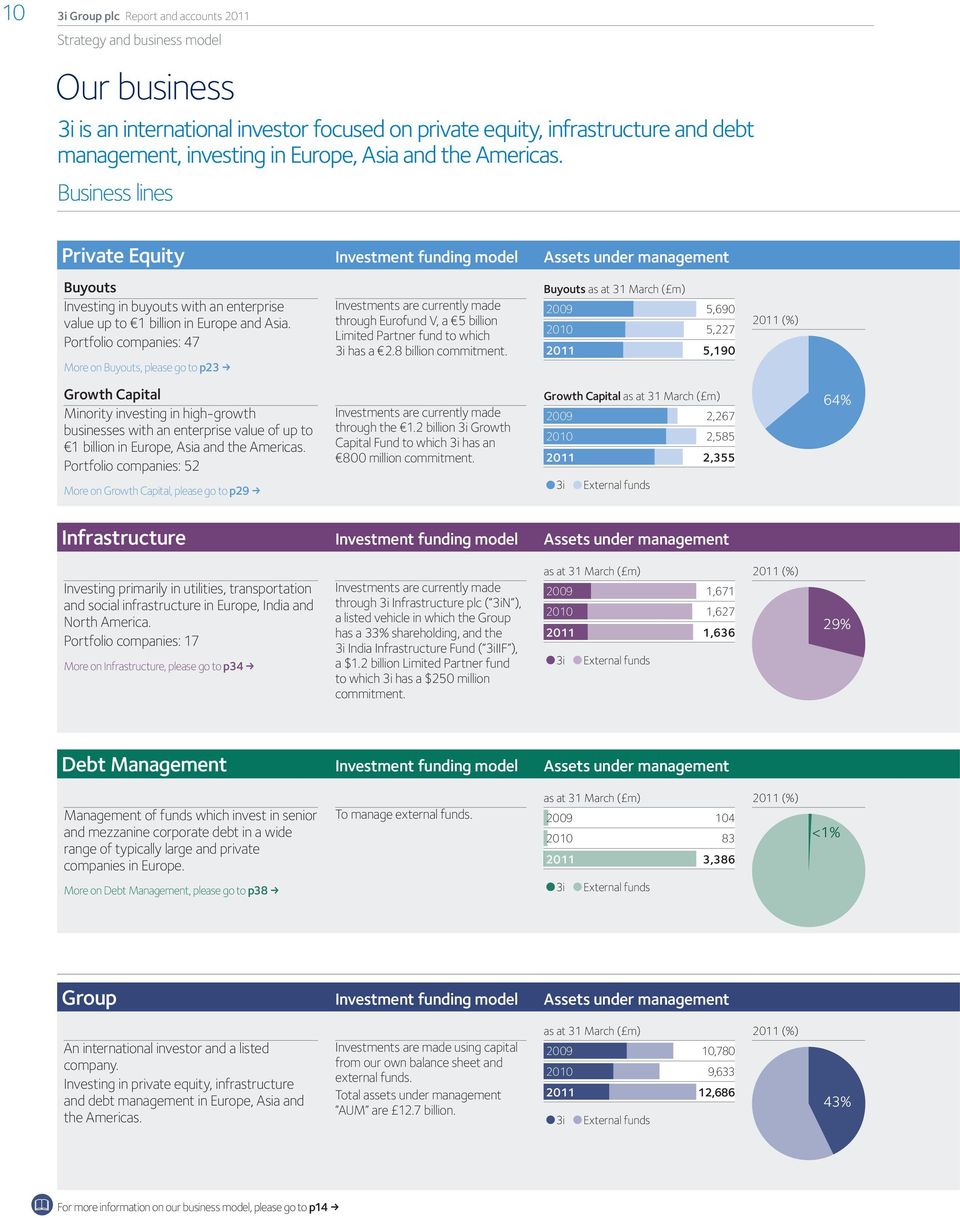
13 Report and accounts 3i plc 11 Returns model Gross portfolio return objectives Net portfolio return objectives Risk 20% 15% Risks relate to: assessment of investment opportunities; selection of appropriate financial structures and negotiation of terms; ability to implement value creation plans; and opportunities to negotiate successful exits. The performance of the portfolio is derived from: realised profits from the sale of investments; unrealised portfolio value growth; and portfolio income. Gross portfolio return plus/less: fees from funds; carried interest from funds; carried interest payable to staff; and operating expenses. Risk 12% 15% Risks relate to: assessment of investment opportunities; selection of the appropriate financial structures and negotiation of terms; changes in the regulatory environment; ability to implement value creation plans; and, where relevant, opportunities to negotiate successful exits. The performance is derived from 3iN: dividends; and unrealised growth in the value of the s holding driven by the underlying performance of the assets. 3iIIF: realised profits from the sale of investments; unrealised portfolio value growth; and portfolio income. Gross portfolio return plus/less: fees from funds; carried interest from funds; carried interest payable to staff; and operating expenses. Overview Strategy and business model Business review Risk Corporate responsibility Risk 10% 15% Risks relate to: fundamental credit assessment of the underlying assets in each fund; and management of income and costs during the life of each fund. 3i managed vehicles return: realised and unrealised gains; and portfolio income. Equity stakes in debt funds return: capital returns; and unrealised growth. Returns model Gross portfolio return plus/less: fees from funds; carried interest from funds; long-term incentives, including earn outs payable to staff; and operating expenses. Risk Net portfolio return objective 15% Risks relate to: external factors; strategy; investment; treasury funding; and operations. Reflects fund management fees and cost. Total return objective 15% Reflects funding costs, impact of foreign exchange and pensions. Governance Financial statements Portfolio and other information
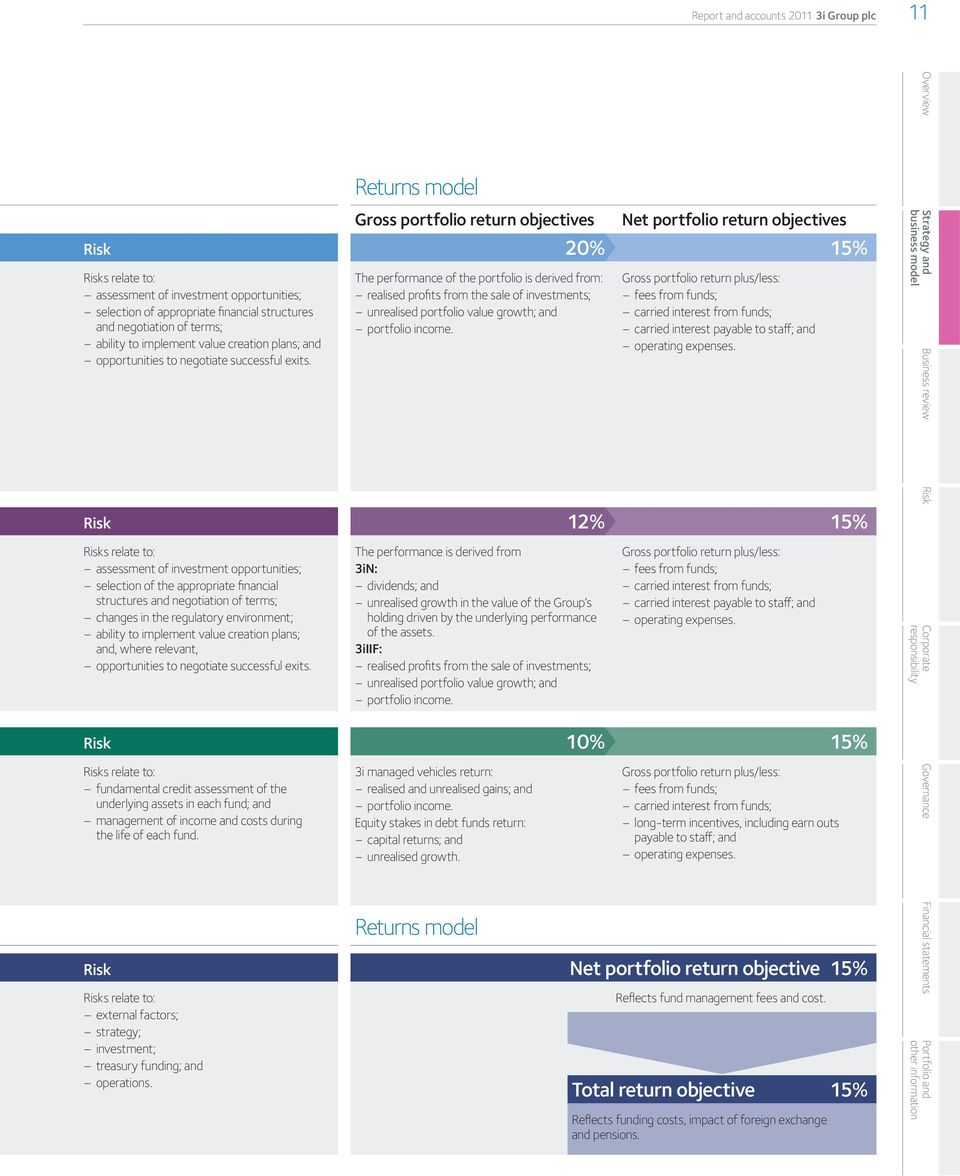
14 12 3i plc Report and accounts Strategy and business model Strategy and performance As an investor, we know that a clear strategy is fundamental to success. Here are the key elements of our strategy, a summary of how we plan to deliver them, our progress and the risks involved. Strategy Priorities Invest Today Tomorrow Increase the rate of investment in a measured way by maintaining our highly selective approach. Add additional resource and capabilities in Debt Management and Infrastructure, extend our network into Brazil and further strengthen our teams in Asia. Continue to increase the levels of investment in our three business lines and across all of our geographies. As economies and companies return to growth agendas, we will continue to adopt a highly disciplined and measured approach. Invest further in building our brand, network and capabilities. Grow our business Today Tomorrow Continue to focus on growing the value of our portfolio companies through the support that we provide in growing their earnings and improving their strategic position. Continue to invest in a range of activities, including Active Partnership, our Business Leaders Network and our approach to responsible investing. Use the strength of our balance sheet to develop each of our business lines. Improve our operational effectiveness as we continue to grow. Build on our reputation Today Tomorrow Strengthen further our brand and our approach to responsible investing. Use the insights gained from an in-depth brand review to deliver more consistent performance in all aspects of the business. Respond to the appetite from our portfolio to become more engaged and supportive on environmental, social and governance issues ( ESG ). Continue to build our brand in well-established and developing markets. Use the insights gained from research to strengthen our offering, our approach to the market and to enhance our competitive advantage. Build on the increasing level of engagement with the portfolio on ESG issues to further enhance our approach to responsible investing. Maintain One 3i culture Today Tomorrow Build on the progress that has been made through the structural changes in our Private Equity business and the formation of a new leadership team, comprising the senior people from our Private Equity, Infrastructure and Debt Management businesses. Develop further our One 3i approach to achieve our full potential in this area, building upon the strong endorsement from our latest staff survey. Implement a range of actions from the brand review and our latest staff survey. Some of these will be wide, including our Responsible investing programme. Some will be within specific business lines such as refreshing the approach to deal origination in Private Equity or the continuing integration plan for the recently acquired MIM business.
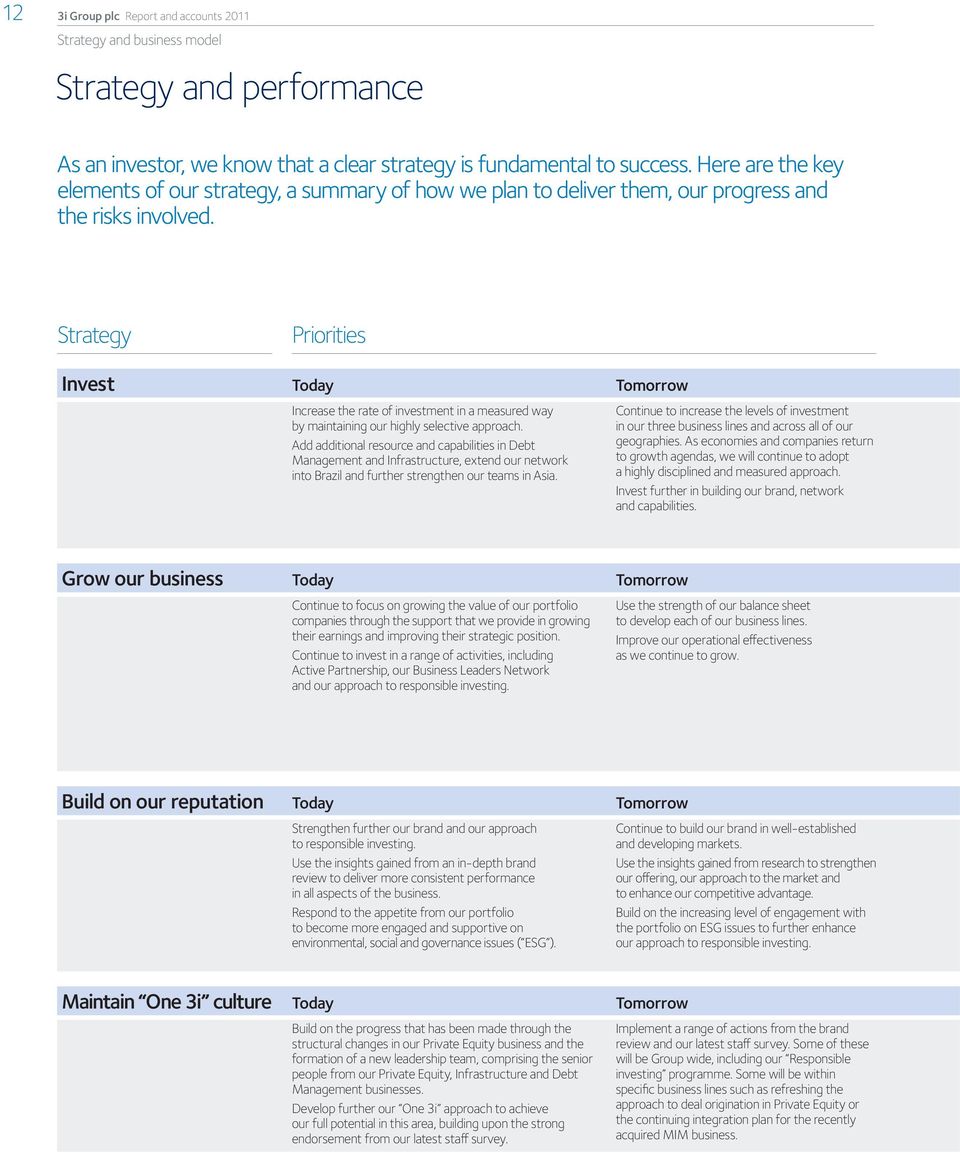
15 Report and accounts 3i plc 13 Risk The major risks to investing well are: the macroeconomic environment which, although gradually improving in most of the countries that 3i operates in, remains fragile; competitive pressure resulting in unattractive pricing for new investments; and failing to maintain our investment discipline. The major risks to growth are: the ability to retain or attract and integrate high-calibre staff, especially in the highgrowth markets; failure to take advantage of opportunities to invest; competitive pressure resulting in unattractive pricing; and failure to maintain our disciplined approach to asset management and strategic development. Key financial performance measures Total return 10.6% 16.2% Gross portfolio return 17.1% 20.9% Net portfolio return 12.8% 15.5% Cost efficiency 3.2% 4.1% Operating expenses per AUM 1.8% 2.3% Net debt 522m 258m Net asset value per share movement Growth in NAV per share is stated before dividends and other distributions to shareholders and, in respect of the prior year, the rights issue and the 3iQPEP transaction. Performance Gross portfolio return by year (%) year to 31 March (36.7) Growth in assets under management () year to 31 March ,787 5,450 13i direct 1 Managed and advised by 3i 6,909 Investment activity () year to 31 March Investment Realisations (609) (1,385) Net investment/ (divestment) 110 (999) 3,846 3,871 7,236 Total 10,780 9,633 12,686 Overview Strategy and business model Business review Risk Corporate responsibility The major risks to building our reputation are: not maintaining high-quality portfolio management processes; not implementing our strategy effectively; and not participating actively in industry and sector regulatory developments. The major risks to our One 3i culture are: not ensuring the right recruitment and retention measures are in place; not investing sufficiently in staff development and training; and failure to address underperformance adequately. Responsible investing Increased focus, additional resource and a major review of our approach including: development of policies and processes; greater communication on Responsible investing and ESG issues; and an Awareness and Training programme, which is being rolled-out across the in /12. Staff survey results Employee engagement % 74% 86% Brand review In-depth research with over 200 people across a wide range of participant groups. Research shows strong affinity for the 3i brand and values. However, in some markets, there is a demand for more consistency of delivery and clarity of our offering. Competitively, 3i is seen as a highly responsible investor but with an opportunity to increase its focus in this area. Other highlights 96% of staff are committed to helping 3i achieve its objectives; and 91% of staff are proud to work for 3i. Opportunities for improvement These included career development and more focus on our One 3i approach. Governance Financial statements Portfolio and other information For more information on the following, please go to: Financial review p41 k Risk p50 k
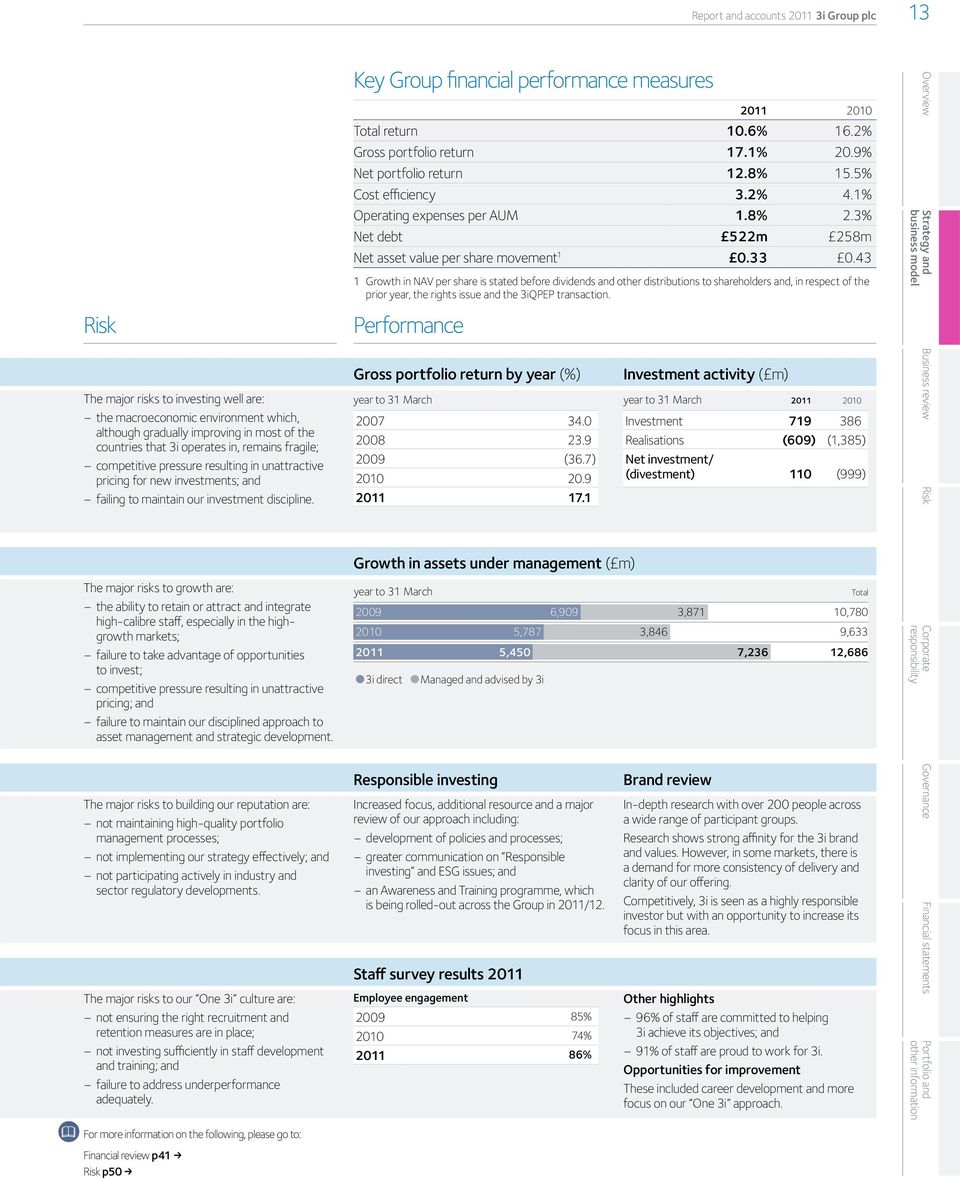
16 14 3i plc Report and accounts Strategy and business model Business model Our approach to investing has evolved over many years. Today, we have three focused businesses, each with its own distinctive characteristics. They all share a common set of values and benefit from the strength of 3i s reputation. The fundamental elements of our business model are set out on the following page. Our core values and our brand are at the heart of our business model and are consistent across all of our activities. A strong track record as a successful and responsible investor is critical to gaining access to capital, as is our record of delivering value to those we work with, whether they are the investors in our funds or the management teams of the companies that we invest in. The depth of involvement and use of resources varies across our business lines and depends on the nature of our investment. The intensive relationship we have with the team of a mid-market buyout company, where 3i and funds may together own the majority of the equity of the business and hold a position on the board, naturally differs from that with the finance director of a company in which one of our Debt Management funds holds debt. The diagram opposite captures the degree of importance each aspect of our business model has to our Private Equity, Infrastructure and Debt Management business lines. Our business model and brand are underpinned by our core values Our core values are to: be commercial and fair respect the needs of shareholders, investors, our people and the companies in which we invest maintain our integrity and professionalism strive for continual improvement and innovation For more information on the following, please go to: Business lines p22-40 k Risk p50 k Corporate responsibility p56 k

17 Report and accounts 3i plc 15 Secure access to capital from multiple sources As a listed company with its own capital and as a manager or adviser to external funds, 3i has access to multiple sources of funds. This provides resilience and sustainability and depends upon performance, transparency and a long-term approach to managing relationships. Business lines Level of importance Private Equity > Infrastructure > Debt Management Invest in our network, people and knowledge Our strong culture of working across borders and harnessing the skills and knowledge from local, sector and business line teams delivers what we call the best team for the job for each phase of the investment lifecycle. Sustaining this requires constant investment in our people, systems and communications. Business lines Level of importance Private Equity > Infrastructure > Debt Management See the best investment opportunities Access to high-quality investment opportunities is critical to future value growth. Investment over many decades in our network, people, knowledge and relationships provides 3i with the right relationships and insights to deliver this. Business lines Level of importance Private Equity > Infrastructure > Debt Management Overview Strategy and business model Secure access to capital from multiple sources Build great companies and deliver outstanding returns Two significant Private Equity investments, Norma and Ålö, are examples of this. Each of these businesses delivered strong and sustained growth in earnings in competitive markets. In Infrastructure, similar examples include Anglian Water and Adani Power. Build great companies and deliver outstanding returns Invest in our network, people and knowledge Core values Brand Achieve full potential through active partnership Achieve full potential through active partnership Effective portfolio management has underpinned our performance and reputation for over 65 years. Our rigorous methodology for effecting business change is focused on operational and functional expertise, sector and strategic insight and high standards of governance. See the best investment opportunities Create innovative financial solutions and ensure excellent execution Create innovative financial solutions and ensure excellent execution 3i has a strong heritage of successfully aligning interests and delivering innovative financial solutions. Our scale, culture, experience and training are central to sustaining this. The development of our infrastructure and debt management capabilities are good examples of this. Business lines Business lines Business lines Level of importance Level of importance Level of importance Private Equity > Private Equity > Private Equity > Infrastructure > Infrastructure > Infrastructure Debt Management Debt Management Debt Management > Business review Risk Corporate responsibility Governance Financial statements Portfolio and other information

18 16 3i plc Report and accounts Business review A review of our business at a and business line level. Introduction 17 Assets under management 18 Market environment 20 Business lines 22 Financial review 41
19 Report and accounts 3i plc 17 Introduction 3i is an international investor focused on private equity, infrastructure and debt management, investing in Europe, Asia and the Americas. Our vision, values and strategy are set out on pages 7, 12 and 13. Overview Strategy and business model All three of 3i s business lines invest using a mix of the s own balance sheet capital and external capital. Total assets under management at 31 March, including 3i s commitments to funds, were 12.7 billion (: 9.6 billion), including 7.2 billion (: 3.8 billion) advised or managed on behalf of others. The composition of our assets under management is set out on the following pages. Further detail is also provided on the composition of the investment portfolios within each of the business line reviews on pages 22 to 40. Information on our largest investments is provided on pages 132 to 135. A detailed review of our performance at a and business line level for the year to 31 March is set out in this Business review. In summary, the s total return is generated by the realised and unrealised returns we achieve from our direct portfolio and the fees that we receive from advising or managing external funds, less the operating expenses and funding costs of the business. Corporate responsibility and risk management, for which there are reports on pages 50 and 56, are central to our strategy. During the year, we undertook an extensive survey of over 200 people from a range of key groups engaged with 3i, including our portfolio, key intermediaries, members of our Business Leaders Network and shareholders. This review has informed our thinking and is referred to in the relevant sections of this report. Employee engagement is our key non-financial performance measure. As an international investor employing a relatively small number of people, in a highly competitive market, employee engagement is important to 3i and we undertake a detailed survey of our staff each year. Achieving the right balance between transparency and accessibility of information was an important factor in developing the online Reporting centre, which was launched last year. We have continued to provide further information online this year and enhanced the functionality of the site. Business review Risk Corporate responsibility For more information on the following, please go to: Strategy and performance p12 and 13 k Key financial performance measures p13 k Business line reviews p22, 34 and 38 k Risk p50 k Corporate responsibility p56 k Ten largest investments p132 k Forty other large investments p134 k For more information on transparency, please go to /transparency k Governance Financial statements Portfolio and other information

20 18 3i plc Report and accounts Business review Assets under management Assets owned, managed and advised by 3i The defines its assets under management ( AUM ) as the total commitments, including the s, to its active managed and advised funds, as well as the residual cost of investments in funds that are already invested and the cost of any other investments owned directly by 3i. As at 31 March, the had total AUM of 12,686 million (: 9,633 million). The 32% increase in AUM during the year was principally driven by growth in Debt Management AUM, which rose to 3,386 million (: 83 million) following the Mizuho Investment Management (UK) Limited ( MIM ) acquisition. A combination of factors, including realisations and foreign exchange, resulted in AUM in the Private Equity business line of 7,545 million at 31 March (: 7,812 million). A description of the development of 3i s fund management and advisory business can be found for each business line on pages 28, 33 and 37. The proportion of direct balance sheet value by business line is shown in Chart 2. Table 1: Assets under management Original fund size Original 3i commitment % invested at March Gross money multiple at March 1 Close date AUM Private Equity 3i Eurofund III July ,990m 995m 91% m 3i Eurofund IV June ,067m 1,941m 96% m 3i Eurofund V Nov ,000m 2,780m 71% 0.8 5,000m 3i Growth Capital Fund March 1,192m 800m 46% 1.2 1,192m Growth Capital non-fund various various various various n/a 1,081m Other various various various various n/a 243m Infrastructure 3i India Infrastructure Fund March 2008 $1,195m $250m 65% 1.3 $945m 2 3i Infrastructure plc March m 3 320m 4 n/a n/a 973m Other various various various various n/a 74m Debt Management Harvest I April m 15m 100% n/a 5 345m Harvest II April m 5m 100% n/a 5 514m Harvest III April m 5m 100% n/a 5 618m Harvest IV June m 6m 100% n/a 5 716m Harvest V April m 10m 100% n/a 5 598m Windmill I Oct m 5m 100% n/a 5 490m 3i Debt Warehouse Oct m 120m 4% 6 n/a 5 13m Friday Street Aug m nil 100% n/a 5 180m Vintage I March m nil 100% n/a 5 360m Non-core 118m Total AUM (in sterling) 12,686m 1 Gross money multiple is cash returned to the Fund plus value, as at 31 March, as a multiple of cash invested. 2 Adjusted to reflect 3i Infrastructure plc s $250 million commitment to the Fund. 3 Based on latest published NAV (ex-dividend). 4 3i s proportion of latest published NAV. 5 The capital and fee structure of CLO funds means that money multiple is not a market standard fund performance metric. 6 The majority of assets were realised during the year. For more information on 3i s fund management, please go to p28, 33 and 37 k

21 Report and accounts 3i plc 19 The s three business lines use differing proportions of own balance sheet and external funds to invest. Chart 2 shows the direct balance sheet investment by business line. Private Equity is the largest business line in terms of assets under management ( 7,545 million). It is also the one with the highest proportion of balance sheet capital (64%). As can be seen from Chart 3, the development of the Debt Management business line during the year means that Infrastructure and Debt Management together now represent 40% (: 18%) of total assets under management. As can be seen from Charts 4 and 5, 3i has a well diversified investor base for the funds it manages or advises both by geography and by type of investor. Overview Strategy and business model Chart 2: Balance sheet portfolio by business line as at 31 March Chart 3: Total AUM by business line as at 31 March Non-core: 3% Infrastructure: 12% Private Equity: Growth Capital: 36% Debt Management: 0% Private Equity: Buyouts: 49% Chart 4: External investor base for non-listed funds managed and advised by geographic location as at 31 March Rest of Europe: 32% UK: 16% North America: 27% Middle East: 10% Asia: 15% Debt Management: 27% Infrastructure: 13% Private Equity: Buyouts: 41% Private Equity: Growth Capital: 19% Chart 5: External investor base for non-listed funds managed and advised by type of investor as at 31 March Other: 1% Government agencies: 21% Corporate investors: 0% Endowments: 3% Private individuals: 1% Pension funds: 30% Financial institutions: 8% Fund of funds: 21% Insurance companies: 15% Business review Risk Corporate responsibility Governance Financial statements Portfolio and other information
22 20 3i plc Report and accounts Business review Market environment Market conditions This section provides commentary on the broader environment in which the and its Private Equity, Infrastructure and Debt Management businesses operate. It covers a review of macroeconomic conditions, mergers and acquisitions activity and the conditions in the capital markets. Each of the business line reviews (pages 22, 34 and 38) cover the levels of investment and fundraising for the relevant markets. Commentary on the regulatory environment is included in the Risk section of this report on page 50. In summary, conditions generally improved over the year, although there were significant regional differences. It is somewhat early to assess the longer-term effects, if any, of the geopolitical developments in the Middle East and the natural disaster in Japan, which took place towards the end of the financial year. Mergers and acquisition activity Conditions in mergers and acquisitions ( M&A ) markets influence the environment for both investment and realisations across the. As can be seen from Chart 6, there has been a significant improvement in M&A markets from However, deal activity and value remain substantially below their peak levels. Global M&A activity in calendar year at 41,654 transactions, was up by 12% from 2009 (source: Dealogic). European M&A activity, which accounted for 33% of global M&A activity in and totalled 13,820 transactions with a value of $803 billion, was also up 12% from the previous year. M&A activity in Asia (excluding Australasia) was 9% higher in but with average deal size increasing in value, was also some 28% higher than in 2009 at $421 billion. With the value of global transactions in the first calendar quarter of up 28%, this recovery continued (source: Dealogic Global M&A Review First quarter ). Chart 6: Global M&A deals 2000 to $bn 1,600 12,000 1,400 1,200 1, ,000 8,000 6, Q1 Q2 Q3 Q4 Q1 Q2 Q3 Q4 Q1 Q2 Q3 Q4 Q1 Q2 Q3 Q4 Q1 Q2 Q3 Q4 Q1 Q2 Q3 Q4 Q1 Q2 Q3 Q4 Q1 Q2 Q3 Q4 Q1 Q2 Q3 Q4 Q1 Q2 Q3 Q4 Q1 Q2 Q3 Q4 4,000 2, Deal value $bn Volume Source: Dealogic, M&A review. For more information on risk, please go to p50 k
23 Report and accounts 3i plc 21 Macroeconomic conditions 3i s direct operations are in Europe, Asia and the Americas and our investment portfolio comprises companies which themselves have a range of international diversity. Consequently, it is not just the economies of those countries where we have operations that are relevant to 3i. The compositions of our Private Equity and Debt Management portfolios by geography are contained on pages 24, 30 and 39. Overall, real global GDP growth of 4.9% in calendar year (source: Barclays Capital) was driven by high growth in the BRIC economies and, in particular, India (8.6%), China (10.4%) and Brazil (7.5%), together with a recovery in some of the major industrialised economies such as Germany (3.5%), Japan (3.9%) and the US (2.8%). These proved enough to offset significant distress in a number of smaller European countries and sluggish performances elsewhere, including the UK (1.3%) and France (1.5%). Conditions also varied across the industrial spectrum. For example, general industrials in Europe benefited from growth in developing markets whereas domestic consumer businesses in some European countries, including the UK, experienced more challenging conditions. Higher energy and commodity costs, combined with the prospect of further fiscal tightening, also present a challenging outlook for some regions, including the UK. Equity markets The condition of equity markets is important to 3i for a number of reasons. Firstly, stock market levels have an influence on company valuations and on the multiples used to value portfolio companies which are valued on an earnings basis. Overall, the major global stock markets ended the year at moderately higher levels. However, there was a considerable degree of volatility within the year. As an illustration, the FTSE was at 5,680 at 31 March and 5,909 at 31 March, but reached a peak of 6,091 and a low point of 4,806 during the year. Another feature of interest to 3i is the market s appetite for IPOs. After a period of virtual closure from late 2008 to early, conditions, although still fragile, improved for IPOs in. With $285 billion raised in 1,393 IPOs in calendar year, global IPO activity recovered to pre-financial crisis levels. However, over $60 billion of this amount was in three IPOs, two in Asia and one in the US. Emerging market IPO volume made up 69% of global volume. Asia raised the most capital on record and contributed approximately 65% of global proceeds ($184 billion), including $132 billion for China (source: Ernst & Young s Global IPO trends report). European exchanges raised the highest volume since 2007 ($37 billion in 252 IPOs). The Ernst & Young report also notes that Europe represented a 13% global IPO market share, compared with the past 10-year average level of 25%. Overview Strategy and business model Business review Risk Corporate responsibility Governance Financial statements Portfolio and other information For more information on direct portfolio by geography, please go to p24, 30 and 39 k
24 22 3i plc Report and accounts Business review Business lines Private Equity 3i s Private Equity business has evolved throughout the s history. Today, this business line invests in buyouts and makes minority growth capital investments in high-growth businesses, typically with an enterprise value of up to 1 billion, in Europe, Asia and the Americas. Investments are made using a blend of own balance sheet capital and external funds under management. During the year, the decision was taken to combine our Buyouts and Growth Capital businesses to form a single Private Equity business line. Our ultimate objective in making this change is to improve the returns to our shareholders and to the investors in our funds whilst honouring our obligations to our existing fund mandates. The key drivers of this decision were a desire to improve our ability to originate investment opportunities and to add increased value to our portfolio by placing greater emphasis on our regional, sector, Active Partnership and Business Leaders Network activities. We have provided separate Buyouts and Growth Capital reviews, reflecting our existing fund commitments. Further details on investments referred to in this review can be found on pages 132 to 135. Levels of investment and fundraising As can be seen from the chart below, private equity investment in Europe in calendar grew by 63% to 39 billion compared to According to data from unquote, this increase was driven by buyout rather than growth capital investment. The number and value of European buyouts in increased by 43% and 169% respectively, whereas growth capital investment in the region in increased by 14% by value. The Q1 unquote Private Equity Barometer released on 20 April, however, stated that there had been a less buoyant start to. The number and value of European deals for Q1 were down 7% and 48% respectively on the previous quarter and the average size was 52 million. As can be seen from Chart 7, the recovery in investment in Europe was not mirrored by private equity fundraising which, at 18 billion in, showed no growth on the previous year and remained at the lowest level of European fundraising since Given the significant amount of capital raised in earlier years and the recent low levels of investment, there has been a substantial excess of capital available for investment. This has provided an additional stimulus to an active secondary market, as well as contributing to competitive pressure and high prices. However, a sustained pick up in investment, combined with the fact that investing periods for private equity funds are typically five years, means that this excess of capital in the market is likely to be significantly reduced in the next two years unless there is a corresponding increase in new fundraising. Global data from Preqin states that a total of 482 funds achieved a final close in, raising $226 billion, down 8% from $246 billion raised in Buyout funds raised a total of $68.5 billion from 88 funds closed in, down by 33% from 2009 levels. North America-focused funds raised $134 billion by 242 funds. European fundraising, with a total of 122 closed, raised an aggregate $50 billion. Rest of the world-focused funds (including Asia) accounted for $41 billion, with 118 funds closed. Chart 7: Funds raised and invested Europe 2000 to ( bn) Funds raised 1 Investment Source: EVCA for 2007-, EVCA/Thomson Reuters/PwC for previous years Europe, by location of private equity firm. For more information on investments, please go to p k
25 Report and accounts 3i plc 23 Private Equity: Buyouts The market 3i s buyout activities are focused on the European mid-market where, in the calendar year, the number and value of transactions increased by 87% and 131% to 101 transactions and 28 billion respectively (source: unquote /3i). The market showed signs of recovery from the trough in 2009, with increases driven by a rise in the number of buyouts valued at over 100 million, as the availability of leverage improved. However, the mid market, defined as transactions between 100 million and 1 billion, was still some 56% below the levels seen at the cyclical peak of 2007, both in terms of volume and value. During the last economic downturn in 2002/03, average deal pricing in the European market, as a multiple of EBITDA, was estimated to have fallen to six to seven times (source: Bain Private Equity Review). Investments made in the market in 2009 and were characterised by pricing levels not far from the 2006/07 peak. This has been driven by both the overhang of capital in the market and the consequent pressure to invest, which has led to high demand for good investment opportunities. Exit activity increased markedly in calendar year and appears to be showing a sustained pick up. European exits amounted to 60 billion in, the highest level seen since 2007 (source: unquote /3i). With more than 54% of exits sold to private equity buyers, secondary transactions accounted for a rising share of exits. In line with private equity in general, the outlook for fund raising for buyouts, although improved, remains challenging and the market is expected to become more crowded as general partners with 2007/08 funds start to return to the market to raise new funds in the second half of and Looking forward, it is anticipated that the recovery in deal activity is likely to continue, in the absence of major macroeconomic or geopolitical challenges. With its brand and network, 3i is well positioned to originate an attractive pipeline of opportunities. Business model 3i s mid-market Buyouts business is focused on leading or co-leading mid-market buyout transactions in companies with an enterprise value typically of up to 1 billion. Returns from individual investments are achieved through a mix of capital realisations upon exit, returns of capital and portfolio income. Returns to 3i are enhanced through management fees and carried interest from external funds, which we manage alongside 3i s own balance sheet commitments. Our investment strategy is built around a number of core components. The first of these is to identify leading European mid-market businesses with potential for significant value creation. Then, we aim to purchase these businesses at appropriate prices. We do this by applying 3i s local knowledge, sector expertise, Business Leaders Network relationships, investment discipline and our approach to responsible investing. With the right financial structure in place, the task then is to build these businesses through organic growth and acquisitions and optimise their performance. We do this in partnership with portfolio company management, with the objective of maximising value through timely and well-executed exit strategies. As can be seen from Chart 8, at 31 March, for the 68 investments completed since 1 January 2001 that have been exited to date, 56% of the growth in the value of the companies equity was driven by earnings growth. Enhanced multiples on exit also contributed to this growth in equity value, the majority of which is due to the strategic repositioning of these companies, with the balance due to market movements. Optimising the financial structure contributed a significant but much smaller amount to the overall creation of value. Chart 8: Buyouts sources of value creation from realised investments Equity value at entry 56% Earnings growth 29% Multiple enhancement 15% Debt reduction Equity value at exit Source: 3i, 68 realised 3i-led buyouts since 2001, exited prior to 31 March. Overview Strategy and business model Business review Risk Corporate responsibility Governance Financial statements Portfolio and other information
26 24 3i plc Report and accounts Business review > Business lines > Private Equity: Buyouts Portfolio composition As can be seen from the charts below, the Buyouts portfolio is well diversified by sector and geography, both by value and number of portfolio companies. The value of our 47 investments at 31 March was 1,961 million (, 45 investments: 1,539 million). Geographic focus Our focus is on investing in businesses that are either headquartered or that have a substantial part of their operations in Europe. Many of these businesses will, however, have a wider international presence outside of Europe. The 47 portfolio companies are based in 13 different countries. Total portfolio value 1,961 million Total number of companies 47 Buyouts Direct portfolio by value By geography as at 31 March Buyouts Direct portfolio by number By geography as at 31 March North America: 0% Asia: 2% Rest of World: 1% North America: 0% Asia: 2% Rest of World: 2% UK: 18% Continental Europe: 79% UK: 34% Continental Europe: 62% Sector focus Sectors are an important component of our business, both in terms of origination and investment decision making. We focus on: Business Services; Consumer; Industrial; Healthcare; and TMT (Technology, Media and Telecoms). Buyouts Direct portfolio by value By sector as at 31 March Buyouts Direct portfolio by number By sector as at 31 March TMT: 4% Healthcare: 12% Business Services: 20% TMT: 8% Healthcare: 11% Business Services: 28% Consumer: 14% Industrial: 50% Financial Services: 0% Industrial: 28% Consumer: 19% Financial Services: 6% Vintage year Subject to prevailing market conditions, we look to build a diversified portfolio by vintage year of investment. Buyouts Direct portfolio by value By vintage year as at 31 March Buyouts Direct portfolio by number By vintage year as at 31 March 2003: 2% 2004: 9% 2005: 7% 2006: 1% 2002 and before: 0% : 14% : 0% 2009: 17% 2002 and before: 8% 2003: 2% 2004: 9% : 11% : 0% 2009: 15% 2005: 11% 2007: 26% 2006: 6% 2008: 19% 2008: 24% 2007: 19%
27 Report and accounts 3i plc 25 Investment activity Table 2: Buyouts investment and realisations year to 31 March Realisation proceeds Investment Net investment/(divestment) 392 (202) Note: comparables have been adjusted to exclude the Debt Warehouse. Following a period of low investment, activity levels increased in the year. Of the 562 million of Buyouts investment in the year, 249 million was invested in five new companies, which are shown in Table 3. A total of 177 million was invested into existing portfolio companies. Of this, 28 million was used to support acquisitions and 39 million was used to increase our equity holdings through buying out existing shareholders. The balance of further investment of 110 million was used to purchase debt in portfolio companies, which we were able to acquire below its par value. The remaining 136 million of gross investment in the year was capitalised interest. As can be seen from Table 3, the five new investments in the year were in four different countries and three different sectors. Our value growth strategies for these investments include buy and build opportunities, international market growth and operational improvement potential. All are well positioned in their markets and are stable, robust businesses with an average revenue of 160 million. Realisation proceeds of 170 million were generated in the year to 31 March (: 403 million). These included the sale of the Inspectorate division of Inspicio to Bureau Veritas. This partial exit generated proceeds of 121 million and delivered a 1.2x cash return on 3i s total investment in Inspicio, with the remaining part of the business, ESG, which was valued at 41 million as at 31 March. The full exit of Panreac generated proceeds of 30 million and a 2.2x return on 3i s investment. The sale of our remaining holding in NCP, the NSL Service, generated proceeds of 9 million, and took the total return on NCP to 280 million, 2.9x our original investment. Table 3: Private Equity New Private Equity Buyouts investments year to 31 March These realisations exclude proceeds received in April from the sale of Hyva ( 181 million) and from the partial realisation of our holding in Norma, following its IPO ( 74 million). The MWM exit, which was signed in the year, was undergoing competition clearance at the year end. SMT storksmt.com Stork Materials Technology ( SMT ) was the non-core testing division within Stork, a Dutch engineering group, prior to a 205 million 3i-led buyout in December. 3i s Business Services team had identified SMT as a potential opportunity in the materials testing space following a review of the testing, inspection and certification sector ( TIC ), undertaken in 2006 alongside Ad Verkuyten, our senior sector adviser and former CEO of RTD. This focus on the TIC industry has delivered a number of other successful investments, including Inspicio, Inspecta and Trescal. As the leading private equity investor in the TIC sector, the 3i team had immediate credibility with management in terms of our ability to articulate a clear strategic vision for the business. We were able to combine this with our strong geographic presence in Benelux, where we already had an established relationship with Stork. The value creation plan focused on developing SMT s expertise in destructive testing and failure analysis and broadening its geographic footprint through a combination of organic and inorganic growth. Specifically, we saw the opportunity to pursue a buy and build strategy in a number of SMT s core geographies where the market remains highly fragmented, and across a number of its core industry verticals. Investment Country Sector 3i investment 3i+Funds investment Vedici France Healthcare Trescal France Business Services SMT Netherlands Business Services Amor Germany Consumer OneMed Finland Healthcare Overview Strategy and business model Business review Risk Corporate responsibility Governance Financial statements Portfolio and other information
28 26 3i plc Report and accounts Business review > Business lines > Private Equity: Buyouts Performance Table 4: Returns from Buyouts year to 31 March Realised profits over value on the disposal of investments Unrealised profits/(losses) on the revaluation of investments Portfolio income Gross portfolio return Gross portfolio return % 10% 30% Fees receivable from external funds Note: comparables have been adjusted to exclude the Debt Warehouse. Gross portfolio return The gross portfolio return for the year to 31 March for the Buyouts business was 157 million, which represented a 10% return on opening portfolio value (: 441 million, 30%). The lower return compared to the prior year is due to fewer exits, resulting in a reduction in realised profits and lower unrealised profits. Unrealised profits have been impacted by a 7% fall in the multiples used for portfolio company valuations at 31 March compared to 31 March, and by value reductions in a small number of portfolio companies from lower earnings. Portfolio earnings Aggregate earnings in the portfolio as at 31 March increased in the year by 15%. This was principally driven by the growth in our northern European portfolio. Of particular note were 3i s Buyout investments in the Industrial sector. A number of the companies in this sector made significant progress as a result of initiatives taken by 3i, including operational improvement and support for accretive acquisitions. The five new investments made in the year shown in Table 3 are beginning to show good earnings growth. We continue to work proactively across the wider portfolio to improve operational effectiveness and to help management to source attractive opportunities for expansion. The portfolio in general has delivered stable or improving operating margins, despite a number of companies operating in persistently challenging markets. This is due in large part to the Active Partnership initiatives undertaken during the year, as well as the longer term benefits from comprehensive efficiency programmes implemented during the downturn. Portfolio leverage The debt levels in the Buyouts portfolio are at an average of 4.3x EBITDA. Financing structures for the Buyouts portfolio are based on committed facilities, providing long-term secured financing. As can be seen from Chart 9, the repayment profile is weighted towards 2015 and later. Breaches of debt covenants in the portfolio have been limited, with six assets in breach at 31 March (: 7, 2009: 16). The six assets had a combined value of 91 million at 31 March. We continue to actively manage all these situations with the assistance of 3i s in-house banking advisory team. Chart 9: Debt repayment profile Buyout portfolio Repayment index weighted by 3i carrying values (%) as at 31 March onwards As at 31 March, 69% (: 71%) of the outstanding debt in the Buyouts portfolio was repayable in 2015 or later. The recovery in debt availability since the 2008/09 crisis period is enabling many of our portfolio companies to refinance their medium-term debt at favourable terms. In combination with this, we are working with the small number of more leveraged companies to help them de-leverage, providing not only additional balance sheet security but also the potential to increase prospective returns. Chart 10 shows the range of leverage across the Buyouts portfolio as at 31 March, weighted by 3i value at this date. Chart 10: Ratio of net debt to EBITDA Buyout portfolio Weighted by 3i carrying value () as at 31 March <1x 1 2x 2 3x 3 4x 4 5x 5 6x >6x Net debt/ebitda segmentation
29 Report and accounts 3i plc 27 Portfolio health At 31 March, 66% of the portfolio based on cost was healthy (: 65%), and by value 96% (: 89%). Investments are only moved from sick back to healthy when their performance and valuation demonstrate that a recovery of our invested capital is probable. Portfolio valuations The unrealised value growth in the year of 60 million (: 204 million) comprised 407 million of positive value movements, net of value reductions of (347) million. The majority of the portfolio grew in value during the year with the largest contributors to the positive value growth being from the northern European portfolio. The largest value reduction was Enterprise ( 201 million), which has experienced challenging trading and a reduction in earnings. We have acted to deal with these challenges and improve performance by driving a significant transformation programme. The business remains strong in its core markets, continues to win significant contracts and was fully compliant with its covenants as at 31 March. At 31 March, 61% of the Buyouts portfolio was valued on an earnings basis and 29% on an imminent sale or IPO basis. As noted earlier, the average multiple used in the valuation of companies valued on an earnings basis was around 7% lower than in the previous year. The weighted average EBITDA multiple pre liquidity discount was 8.5x (: 9.1x). Long-term performance Table 5 shows vintage year performances from 2002 to. The vintages to 2006 have all achieved IRRs in excess of 20%. The reduction in the IRR of the 2007 vintage was due to the value reduction on Enterprise. Other assets in the vintage are performing well. The IRR of the 2008 vintage remains negative but improved from (18)% at 31 March to (6)% at 31 March. The five new investments made in the vintage are showing encouraging trading performance. Overview Strategy and business model Business review Risk Corporate responsibility Table 5: Long-term performance Buyouts New investments made in the financial years ended 31 March Vintage year Total investment 1 Return flow Value remaining IRR to 31 March IRR to 31 March n/a n/a % 9% (6)% (18)% % 25% , % 49% % 62% % 34% % 49% % 61% Governance Financial statements Portfolio and other information Analysis excludes investment in Debt Warehouse. 1 Total investment includes capitalised interest.
30 28 3i plc Report and accounts Business review > Business lines > Private Equity: Buyouts Fund management Chart 11: Buyout investor base for non-listed funds managed and advised by type of investor as at 31 March Government agencies: 10% Corporate investors: 0% Endowments: 4% Private individuals: 1% Pension funds: 29% Financial institutions: 11% Fund of funds: 26% Insurance companies: 19% Eurofund III, a 1999 fund, is almost fully realised. The Fund portfolio has generated a gross multiple of 2.1x its invested cash, in line with its position at 31 March. Eurofund IV, a 2004 fund, continues to perform strongly. The Fund portfolio had generated a gross multiple of 2.3x its invested cash at 31 March (31 March : 2.2x), driven by realisations in the year. For realised investments the multiple is 3.0x. Eurofund V, a billion fund, was 71% invested at 31 March (31 March : 54%). During the year, it invested 859 million and distributed proceeds from the partial sale of Inspectorate ( 150 million). At 31 March, the fund portfolio had generated a gross multiple of 0.8x its invested cash. The focus for the next financial year will be to complete the overall fund portfolio with new investments and drive the performance of the portfolio as the fund matures. As can be seen from Chart 11, there are a diverse range of investors in 3i s Buyouts funds. Further demographic information on the investors in 3i s funds can be found on pages 18 and 19. Norma normagroup.com In 2006, 3i and funds invested to support the formation of Norma from Rasmussen GmbH in Germany and 3i-backed ABA in Sweden. Since then, the company has been transformed into a global, market leading business in joining technology. This has been achieved through organic growth, including international growth and new plants in China, Thailand, Mexico, Russia and Serbia, as well as further acquisitions, including Breeze and R.G.Ray in the US. This, combined with a range of Active Partnership initiatives, has helped Norma to grow EBITDA from 26 million to c 100 million in the year to December, as well as double EBITDA margins. In 2009, as part of the preparation for IPO, a new Global Excellence programme was initiated covering manufacturing, supply chain management, purchasing, market coverage, sales force effectiveness and working capital. This substantially improved Norma s market position and growth, resulting in 20 million incremental EBITDA improvements in In April, the company achieved a successful IPO on the Frankfurt stock exchange, delivering proceeds for 3i of 74 million and valuing 3i s residual stake at 123 million, together representing around five times our investment cost. Priorities and opportunities There are two key priorities for our Buyouts business given the opportunities that we see in the market. The first priority is to ensure that all of our investments are performing in line with our expectations. Driving earnings growth across the portfolio, both organically and through acquisitions, is central to this. We also aim to use 3i s global network to support our portfolio companies continued international development. The second priority is to continue to use our brand, deep local market presence and sector insights to originate and invest in attractive new investment opportunities. More favourable M&A markets and general macroeconomic conditions have the potential to provide a further stimulus to our market activity. In part, these priorities will be achieved through the benefits of a more integrated Private Equity business, which can draw on a wider range of resources, knowledge and relationships. We start the new financial year with an active exit pipeline and will continue to realise investments which create good returns. For more information on 3i s funds, please go to p18 and 19 k
31 Report and accounts 3i plc 29 Private Equity: Growth Capital The market The growth capital market is less well defined than the buyouts market and, as a result, external market information is not as well documented. However, our own data suggests that activity levels in the global growth capital markets have increased by approximately 18% from the exceptionally low level seen in This rise appears to have been driven by a significant increase in investments made in Asia, offsetting a lower level of investment in North America and flat volume in Europe. Increased competition and higher prices have, in part, been driven by the emergence of new entrants viewing the lower-leveraged growth capital sector as attractive, given the high prices for deals in their traditional markets. As a consequence, some investments that were initially minority growth capital style deals evolved into majority buyouts, as entrepreneurs took advantage of the premiums on offer for a controlling interest in their companies. Banks continue to be highly selective and only offer debt packages to the best companies with a lower risk profile. Although this does affect the general availability of debt for our portfolio companies, it continues to create opportunities for growth capital investors as they seek to bridge the funding gap for profitable companies. The Growth Capital model remains attractive to entrepreneurs and business owners who want to expand and add value to their business without increasing leverage. Business model 3i s Growth Capital business operates in Europe, Asia and the Americas, making minority equity investments of between 25 million and 150 million in established, profitable and mainly international businesses. The s international presence, sector knowledge, networks, approach to responsible investing and broader resources create the premium market access to companies that are not for sale. Over the last four years, 67% of the new investments completed have been proprietary. These resources also provide the ability to benchmark investment opportunities globally, match resources to opportunities on a best team for the job basis and to work actively with high-growth companies to maximise value through a mix of capital realisations on exit and portfolio income. The s track record of making such investments for over 65 years has provided it with the experience, approach and techniques critical to success in minority investing. These are underpinned by seeking to invest only where we can align interests with entrepreneurs and management teams and by the differentiated approach that 3i takes to adding value to its portfolio companies. 3i has historically carried out its growth capital activity using own balance sheet funds. However, since March, all new investments have been made through the 1.2 billion Growth Capital Fund. Chart 12: Growth Capital sources of value creation from realised investments Equity value at entry 81% Earnings improvement 40% (21)% Multiple expansion Debt reduction Equity value at exit Source: 3i, based on 33 realised 3i Growth Capital investments since 2003, exited prior to 31 March. An important aspect of our business model is the way in which we generate growth in the value of our portfolio companies. As can be seen from Chart 12, the major driver of value creation in the Growth Capital business, for investments realised from the 2003 and more recent vintages, has been the underlying earnings growth of portfolio companies. This earnings growth is driven principally by revenue and margin expansion as our portfolio companies, with our support, strengthen their market positions, operational effectiveness and brands. Multiple enhancement on realisation in Growth Capital portfolio companies is driven by a number of factors: improvement in the strategic positioning of portfolio companies; professionalising businesses; making what was hard to buy, easy to sell ; and the fact that whilst investments are made on minority valuations, exits tend to occur when a majority of the company is sold or listed. Many Growth Capital investments are made to strengthen balance sheets and to reduce financial risk for high-growth companies. As a consequence, as can be seen from Chart 12, there is a negative effect through reduced leverage. Leverage across the portfolio remains low at 2.4x EBITDA. Overview Strategy and business model Business review Risk Corporate responsibility Governance Financial statements Portfolio and other information
32 30 3i plc Report and accounts Business review > Business lines > Private Equity: Growth Capital Portfolio composition As can be seen from the charts below, the Growth Capital portfolio is well diversified by sector and geography and by both value and number of portfolio companies. The value of our 52 investments at 31 March was 1,433 million (: 1,331 million). Geographic focus Our focus is on investing in businesses that are headquartered in Europe, Asia and the Americas. Many of these businesses will have a wider international presence outside these areas. The 52 companies in the portfolio are based in 18 countries. Total portfolio value 1,433 million Total number of companies 52 Growth Capital Direct portfolio by value By geography as at 31 March Growth Capital Direct portfolio by number By geography as at 31 March Rest of World: 0% North America: 19% Continental Europe: 34% North America: 10% Rest of World: 0% Continental Europe: 40% Asia: 31% Asia: 28% UK: 19% UK: 19% Sector focus Sectors are an important component of our business, both in terms of origination and investment decision making. We focus on: Business Services; Consumer; Industrial; Healthcare and TMT (Technology, Media and Telecoms). Growth Capital Direct portfolio by value By sector as at 31 March Growth Capital Direct portfolio by number By sector as at 31 March TMT: 10% Business Services: 16% TMT: 14% Business Services: 13% Healthcare: 15% Consumer: 12% Healthcare: 10% Consumer: 21% Financial Services: 17% Industrial: 30% Industrial: 27% Financial Services: 15% Vintage year Subject to prevailing market conditions, we look to build a diversified portfolio by vintage year of investment. Growth Capital Direct portfolio by value By vintage year as at 31 March 2002 and before: 2% 2003: 9% 2004: 1% 2005: 1% 2006: 4% : 1% : 3% 2009: 10% Growth Capital Direct portfolio by number By vintage year as at 31 March 2002 and before: 8% 2003: 2% 2004: 6% 2005: 7% : 2% : 2% 2009: 6% 2006: 7% 2007: 28% 2008: 41% 2007: 27% 2008: 33%
33 Report and accounts 3i plc 31 Investment activity Table 6: Growth Capital investment and realisations year to 31 March Realisation proceeds Investment Net investment/(divestment) (130) (457) We have adopted a cautious and selective approach to growth capital investment during the past year. Although 3i saw 75% of the transactions taking place in its target market, only a modest amount of 72 million was invested in the 12 months to 31 March, compared to 121 million in the year to March. One new investment was made during the year, 21 million in BVG India Limited, one of India s largest facilities management services companies. We invested a further 24 million into Refresco, a European market leader in the production of private label fruit juices and soft drinks, to support two substantial acquisitions, one in Germany and one in Italy. Of the balance of 27 million, 22 million represented capitalised interest. We start the new financial year with an attractive pipeline of opportunities. Realisation proceeds of 202 million were generated during the year from 10 full exits (: 578 million, 42). We have continued to focus on the sale of older, non core investments, while at the same time opportunistically exiting larger investments such as Carso and Balco, which generated money multiples of 3.4x and 5.0x respectively. Labco labco.eu Since 3i invested in 2008, we have supported the company in becoming a leading consolidator in its sector through the acquisition of 31 regional businesses. As the second largest European network of diagnostics laboratories, Labco has market leading positions in France, Portugal and Spain, as well as significant operations in Belgium, Germany, Italy and a growing presence in UK. In January, 3i led a successful 500 million bond issue for Labco with a seven-year maturity and coupon of 8.5%, which was more than 5x over subscribed. In addition, an acquisition facility of 135 million was raised, significantly strengthening Labco s relationships with key banks and allowing the company to continue to pursue its acquisition strategy. Performance Table 7: Returns from Growth Capital year to 31 March Realised profits/(losses) over value on the disposal of investments 40 (14) Unrealised profits on the revaluation of investments Portfolio income Gross portfolio return Gross portfolio return % 23% 11% Fees receivable from external funds 8 Gross portfolio return The Growth Capital business line generated a gross portfolio return of 305 million in the year to 31 March (: 194 million), or 23% (: 11%) of opening portfolio value. The majority of portfolio companies have performed well, and earnings at an aggregate level have increased significantly, driving a substantial improvement in valuations. This, combined with a number of healthy realisations at significant uplifts to book value, has resulted in a much-improved gross portfolio return. The main contributor to the gross portfolio return was the impact of unrealised valuation movements of 217 million (: 145 million). The unrealised value gain was driven principally by an earnings growth increase of 15% over the year. This was partially offset by an 11% fall in the average (pre discount) EBITDA multiple to 9.2x (: 10.3x). Portfolio earnings The 15% earnings improvement was driven by increased revenue, combined with improved operational effectiveness from initiatives implemented by 3i and our portfolio companies management teams. Portfolio income of 48 million for the year to 31 March included a special distribution from Phibro of 10 million. The prior year included a non-recurring 23 million special distribution from Quintiles. Fees receivable from external funds at 8 million (: nil) reflect the income from the Growth Capital Fund. The portfolio performed well in the year and we have worked to improve earnings with many of our portfolio companies using our active partnership approach to focus on operational efficiency. Overview Strategy and business model Business review Risk Corporate responsibility Governance Financial statements Portfolio and other information
34 32 3i plc Report and accounts Business review > Business lines > Private Equity: Growth Capital Portfolio leverage As can be seen from Charts 13 and 14, debt levels in the Growth Capital portfolio at 31 March were low and the portfolio has a broad debt repayment profile. The covenant risk in the Growth Capital portfolio is moderate, with only four companies in breach at 31 March, with a combined value at that date of nil. Chart 13: Debt repayment profile Growth Capital portfolio Repayment index weighted by 3i carrying values (%) as at 31 March onwards Chart 14: Ratio of net debt to EBITDA Growth Capital portfolio Weighted by 3i carrying value () as at 31 March Portfolio valuations Value growth of 217 million in the year to 31 March (: 145 million), was driven by earnings growth and was achieved despite a reduction in multiples used to value the portfolio. At 31 March, 70% of the portfolio was valued on an earnings basis. The average multiple used for the valuation of investments which were valued on an earnings basis at 31 March was 9.2x (: 10.3x), 11% lower than the previous year. Long-term performance Table 8 shows the performance of each vintage year from 2002 to. As can be seen from the table, the vintage performance has been stable over the last 12 months. Performance improved for the more recent vintages of 2008 to and the more mature vintages continued to show good returns. The improvement in performance was due to improved valuations resulting from earnings growth and strong realisations in the year <1x 1 2x 2 3x 3 4x 4 5x 5 6x >6x Net debt/ebitda segmentation Portfolio health As at 31 March, 95% (: 93%) of the portfolio on both a value and a cost basis was classified as healthy. This was driven by the fact that, overall, the portfolio continued to deliver good earnings growth despite a challenging economic environment in many countries.
35 Report and accounts 3i plc 33 Fund management Historically, 3i s Growth Capital investments have been funded through the balance sheet, with limited external fund investment. However, since March, all new investments have been made through the 1.2 billion 3i Growth Capital Fund. As part of its 800 million commitment, 3i contributed a seed portfolio of seven investments valued at 339 million, being all new investments made since 1 January 2008 remaining in the portfolio. At 31 March, the Fund portfolio had generated a gross multiple of 1.2x its value at the inception of the fund. Further information on the investors in 3i s funds can be found on pages 18 and 19. Chart 15: Growth Capital investor base for non-listed funds managed and advised by type of investor as at 31 March Financial institutions: 3% Insurance companies: 13% Government agencies: 61% Pension funds: 23% Priorities and opportunities From a competitor perspective, growth capital remains a less well defined market than buyouts. Our specialisation of investing in businesses not for sale, combined with our strong brand and international presence, positions 3i well against competitors with a broader remit. We focus on maintaining a strong network of relationships with entrepreneurs and their advisers in our chosen markets. We will continue to invest selectively to ensure optimal returns for 3i and for the investors in our Fund. In line with our investment strategy, we will continue to avoid investments which do not ensure alignment with management and other portfolio company shareholders, where we would hold a public equity investment at the outset, or where we would be investing in a fund or project structure. We aim to drive future returns from the existing portfolio through our active partnership approach and the implementation of operational improvements in portfolio companies. We expect that the focus of these initiatives will develop during to support revenue growth projects, including funding acquisitive growth, where appropriate, as well as continuing to drive efficiency in the portfolio. Overview Strategy and business model Business review Risk Corporate responsibility Table 8: Long-term performance Growth Capital New investments made in the financial years to 31 March Vintage year Total investment 1 Return flow Value remaining IRR to 31 March IRR to 31 March n/a n/a % n/a (5)% (7)% , % (3)% % (2)% % 24% % 25% % 25% % 24% % 12% 1 Total investment includes capitalised interest. Governance Financial statements Portfolio and other information For more information on 3i s funds, please go to p18 and 19 k
36 34 3i plc Report and accounts Business review > Business lines Infrastructure 3i invests in infrastructure through two vehicles: 3i Infrastructure plc ( 3iN ), an infrastructure investment company listed in London (in which 3i owns a 33% stake), and the 3i India Infrastructure Fund, a limited partnership fund focused on investing in Indian infrastructure (in which 3i holds a $250 million commitment). Returns for 3i from the Infrastructure business line are generated from: dividend income and capital growth from our 33% holding in 3iN; capital returns from our investment in the 3i India Infrastructure Fund; and advisory and management fees from the two vehicles. The market Transaction activity in the infrastructure market increased throughout the year. Deal volumes are returning to pre-crisis levels and debt availability (both from banks and from capital markets) is good. The outlook for inflation and interest rates will be an important determinant in the conditions for investment going forward. While moderately high inflation is positive for the infrastructure asset class, its impact on interest rates may affect the cost of financing new transactions and achievable returns. Transaction opportunities in the developed world are coming from a number of sources. There are non-core disposals from both financial institutions and corporates, driven by new capital adequacy regulations and the pressure to reduce leverage. Public sector budget constraints are likely to result in privatisations and an increase in Public Private Partnership/Private Finance Initiative ( PPP/PFI ) schemes. In addition, policy drivers, such as the push for a green economy and the use of infrastructure spending as an economic stimulus tool, have the potential to create further opportunities. Secondary market sales may also increase, as infrastructure funds nearing the end of their life begin to sell assets to prove valuations, or refinance assets to extract equity. The opportunity in India remains significant, as evidenced by the strong levels of transaction activity for the 3i India Infrastructure Fund described on page 37. Deal flow will continue to be determined by the growing infrastructure deficit. Strong GDP growth and an increasingly urbanised population are driving demand for new build infrastructure, supported by political momentum. The Indian government continues to place much importance on private investment in the sector. Investors are increasingly attracted to investing in assets with infrastructure characteristics, as they seek protection from volatility in other asset classes, as well as from inflation and other macroeconomic risks. Growing demand for assets has resulted in some pricing pressure, in particular in the more liquid segments such as PPP/PFI and, increasingly, in core economic infrastructure assets. As returns in the asset class are tested in a more challenging market environment, we expect that only managers with an established track record and a solid operational understanding of the asset class will be able to continue to raise funds and invest successfully. This may lead to a reduction in investors active in the market and to increasing specialisation along geographic or sector lines. 3i is well positioned to compete in this market, with its strong track record and its skill in completing complex transactions and working closely with operating partners and other investors. Business model The Infrastructure investment team seeks to add value to the vehicles it advises or manages in a number of ways. It originates new opportunities through building proprietary knowledge and networks in target sectors and geographies. It applies rigorous selection criteria to choose the best investments. Following investment, the team engages with the management of portfolio assets to develop business strategies that deliver improvements in operational and financial performance, and to monitor performance to ensure that any issues are identified quickly. The managed or advised vehicles are represented, generally by the team, on the boards of their equity investments. Capital growth is delivered from investments by working with management to devise and implement development strategies that deliver value accretion over the longer term. This requires an in-depth knowledge of market and sector dynamics, as well as an understanding of the long-term value drivers for each of the assets. The Infrastructure business line currently invests principally in Europe and in India through the two vehicles described above. Investments can be broadly categorised as shown in Chart 16. 3iN has exposure across the spectrum but invests principally in core infrastructure assets (such as regulated utilities and transportation assets in the developed world) and in social infrastructure assets (such as hospitals, schools and government accommodation). The 3i India Infrastructure Fund s investments can be categorised as hybrid infrastructure assets, which have higher country or volume risk, or higher geopolitical risk. Returns from infrastructure are typically 8% to 15% or greater, depending on the risks associated with the investment. Yields generated from the assets also vary, depending, among other factors, on the stage of development of the asset (eg assets in construction versus operational assets).
37 Report and accounts 3i plc 35 Chart 16: Infrastructure asset class Social Infrastructure/ PPP/PFI 8-12% Return 10-16% Return >15% Return High inflation correlation Mainly government-backed revenue streams Lower risk/return profile Strong yield when fully operational Yield Performance Table 9: Returns from Infrastructure year to 31 March Core infrastructure Low volume/market/gdp risk Quasi monopolies/regulatory protection or long-term contracts Asset backed, with low volatility across economic cycles Realised profits over value on the disposal of investments Unrealised profits on the revaluation of investments Portfolio income Gross portfolio return Gross portfolio return % 11% 27% Fees receivable from external funds The Infrastructure business line generated a gross portfolio return of 45 million in the year to 31 March (: 100 million). The return was driven by an unrealised value gain of 29 million from 3i s investments in 3iN and in the 3i India Infrastructure Fund (: 84 million) and by strong portfolio income of 16 million (: 16 million). The unrealised value gain was lower than last year due to the lower mark-to-market gain on the valuation of the s holding in 3iN. During the year to 31 March, 3iN shares traded up by 6%, generating an unrealised value gain of 21 million, compared to a 32% movement, corresponding to a 72 million gain, the previous year, when the shares had traded up from a much lower base. The remainder of the unrealised value gain of 8 million (: 10 million) is attributable to a revaluation of the holding in the 3i India Infrastructure Fund, as its assets continue to progress through their construction phases. Hybrid infrastructure Higher risk characteristics country risk market-volume risk GDP correlation Operational expertise in managing the assets more important Capital growth Portfolio income was flat at 16 million (: 16 million), and was driven almost entirely by the dividend received on the holding in 3iN, which was partially offset by abort costs. Fees receivable from 3iN and the 3i India Infrastructure Fund amounted to 25 million (: 20 million). This was due to the higher advisory and performance fees receivable from 3iN, which pays fees on invested capital only, following the investments made this year. Priorities and opportunities for 3i We intend to strengthen our position as a leading participant in the infrastructure market through the ongoing investment of our advised and managed vehicles in a portfolio of strong assets, which can continue to generate attractive returns for shareholders and limited partners. We will maintain a rigorous investment approach, using our proprietary sector knowledge and our broad network of contacts in our chosen sectors and geographies to originate transactions that contribute to the delivery of the target return objectives. This will be key to positioning the business line and 3iN for future fundraisings. Seeking to generate attractive returns from the existing portfolio will also remain a priority for the Infrastructure team. The assets in the two vehicles are performing well, and the team s portfolio management expertise, as well as the s resources, will be leveraged to continue to drive value from those assets. The opportunity for 3i is to grow the funds it manages or advises and to raise new funds, generating increased fee income. Overview Strategy and business model Business review Risk Corporate responsibility Governance Financial statements Portfolio and other information
38 36 3i plc Report and accounts Business review > Business lines > Infrastructure 3i Infrastructure plc 3i holds a 32.9% holding in 3iN, which is an investment company listed on the London Stock Exchange and a component of the FTSE 250. At 31 March, 3iN had a market capitalisation of 957 million. 3iN is domiciled in Jersey, is governed by an independent board of directors, and targets a 12% net return over the long term through NAV growth, of which 5% is returned to shareholders through dividends. 3iN has a $250 million commitment to the 3i India Infrastructure Fund and participated in the new investments completed in the year by the Fund, described on page 37. 3i, through 3i Investments plc, a wholly-owned subsidiary, acts as investment adviser to 3iN and in return receives an annual advisory fee of 1.5% of the invested capital (excluding cash balances) and an annual performance fee of 20% on the growth in net asset value, before distributions, over an 8% hurdle calculated each year. 3iN has its own dedicated website, The company announced its annual results on 5 May. The total return for the year to 31 March was 85.5 million, or 9.2% of opening shareholders equity. Assisted by our investment advice, 3iN has built a strong track record since inception in March 2007, delivering an annualised growth in returns to shareholders of 9.9%, and a total annualised asset IRR of 19%. 3iN aims to deliver a 12% net return over the long term by building a portfolio which is predominantly weighted towards mature core infrastructure assets, which are expected to generate returns in the 10-16% range. Around 69% of 3i Infrastructure s portfolio is weighted towards mature core assets, with the 15% exposure to Social Infrastructure assets providing support to the delivery of the yield objective, and a 16% hybrid exposure through the 3i India Infrastructure Fund providing higher capital growth. Eversholt Rail During the year, 3iN completed a large investment in Eversholt Rail ( Eversholt ), in consortium with Morgan Stanley Infrastructure Partners and STAR Capital Partners. Eversholt is one of the three leading rail rolling stock companies in the UK and owns approximately 29% of the current British rail fleet. The transaction valued Eversholt s gross assets at approximately 2.1 billion, and the consortium financed the acquisition through a combination of equity and debt. 3iN contributed million in equity instruments as part of the total consideration. The investment in Eversholt, a core infrastructure asset, was immediately accretive to NAV and income, and built up the company s exposure to the transportation sector. Chart 17: 3i Infrastructure plc portfolio split by sector as at 31 March Utilities: 43% Social Infrastructure: 15% Transportation: 42% Chart 18: 3i Infrastructure plc portfolio split by category as at 31 March Hybrid: 16% Social Infrastructure: 15% Core: 69% For more information on 3i s funds, please go to p18 and 19 k
39 Report and accounts 3i plc 37 3i India Infrastructure Fund The 3i India Infrastructure Fund (the Fund ) is a $1.2 billion limited partnership fund established by 3i to invest in Indian infrastructure, with a particular focus on ports, airports, roads and power assets. 3i and 3iN each hold a $250 million commitment in the Fund. The Fund closed in 2008 with a target investment horizon of two to four years and, as at 31 March, was 65% invested and 70% committed. Since inception, the Fund has generated a gross money multiple on invested cash of 1.3x. 3i earns management fees from limited partners in the Fund, with the exception of 3iN. The Fund completed three new investments in the year, in two developers of power projects and, in one toll road developer and operator, with an aggregate cost of $268 million ( 168 million). 3i s share of these investments was 36 million. The growing Indian power generation market is an attractive area for investment, as the imbalances between power demand and supply in India are expected to endure in the next decade. The Indian road sector has seen similar growth, as the Indian government retains its focus on relieving road congestion and improving accessibility. Like the other investments in the Fund, all three investments have been made alongside strong local promoters with an established track record of delivery in their respective sectors. GVK Energy GVK Energy Limited ( GVK Energy ) is developing a power portfolio comprising an operational capacity of 915MW, with a further 3,132MW under various stages of development. The portfolio is mainly gas-fired. The Fund invested $178 million ( 113 million) for a substantial minority stake in GVK Energy in December, with GVK Power and Infrastructure, GVK Energy s parent company, retaining a majority. 3i s share of the investment was 24 million, of which a first, 15 million tranche was drawn in this financial year. The remaining 9 million tranche will be drawn in the next financial year. Ind-Barath Utkal Ind-Barath (Utkal) Limited ( Ind-Barath Utkal ) is building a 700MW coal-fired power plant based in the state of Orissa. The Fund invested $45 million ( 28 million) for a minority stake in Ind-Barath Utkal in March, with the company s parent, Ind-Barath Power Infra Limited, a developer of power projects, retaining the majority. 3i s share of the investment was 6 million. KMC Roads KMC Infratech Limited ( KMC Roads ) is a subsidiary of KMC Constructions Limited ( KMCCL ), a Hyderabad based infrastructure engineering and construction company. KMC Roads is KMCCL s build, operate and transfer ( BOT ) roads business. Its portfolio currently comprises 10 such projects, aggregating c.1,000 kilometres across India, making it one of the largest road portfolios in the country and a strong platform for future BOT road projects. The Fund invested $111 million ( 69 million) for a substantial minority in KMC Roads in March. 3i s share of the investment was 15 million. Other Infrastructure assets 3i has a small residual holding in Anglian Water, valued at 7 million. Chart 19: 3i India Infrastructure Fund portfolio split by sector as at 31 March Ports: 23% Roads: 23% Power: 54% Chart 20: Infrastructure investor base for non-listed fund managed and advised by type of investor as at 31 March Other: 7% Government agencies: 33% Endowments: 1% Financial institutions: 2% Fund of funds: 17% Pension funds: 40% Overview Strategy and business model Business review Risk Corporate responsibility Governance Financial statements Portfolio and other information
40 38 3i plc Report and accounts Business review > Business lines Debt management 3i first established a debt management capability in October 2007 to capitalise on the opportunity to invest in non-investment grade debt of European businesses (in non-3i portfolio companies) at a discount to par value. Investments were initially made through a Debt Warehouse facility. In line with our strategy of growing in areas in which we have investment expertise, 3i Debt Management Ltd, a newly formed subsidiary of the, and in which 3i has a majority shareholding, signed an agreement in September to acquire Mizuho Investment Management (UK) Limited ( MIM ). Following completion in February, 3i s existing debt management activities were merged with MIM to form a distinct business line, Debt Management. The acquisition cash consideration for MIM was 18.3 million. The acquisition of MIM enhanced 3i s capabilities in the debt fund management market and builds upon the s existing Private Equity and Infrastructure businesses. The third-party funds that MIM manages primarily invest in non-investment grade senior secured debt issued by medium and large European companies. The acquisition of MIM, combined with the successful exit of the majority of the Debt Warehouse assets during the year, has enhanced 3i s track record, changed the profile of this business line and produced a strong platform for future growth, with total assets under management of 3.4 billion at 31 March. The market Fundraising for new primary Collateralised Loan Obligations ( CLO ) in Europe has proven challenging over the last 12 months, with 1.8 billion of volume in and zero new issuance to date in (source: Bank of America). Elsewhere, the US market has seen a recovery in the primary CLO market; in, eight new CLOs priced, producing $3.1 billion of volume. This was followed by five new vehicles in Q1, representing a further $1.9 billion of volume. The increase in new primary CLO issuance in the US is on the back of attractive returns, an availability of leverage, and an active primary pipeline of deals into which the vehicles can invest. The European credit market witnessed a continuing recovery during with a rally in secondary market prices. Issuance in the primary credit market has also improved, due to a number of factors, including increased confidence of arranging and underwriting banks, quantum of committed private equity capital available to invest, and increased mergers and acquisitions activity generally. In the European debt fund management market today, there is currently approximately 100 billion of assets under management (source: Creditflux), with the top 10 managers accounting for over half the issuance in the market. Although the competitive environment remains relatively benign, the last 12 months has witnessed an increase in consolidation activity. As the debt fund management business is highly scalable, it is anticipated that further consolidation activity amongst managers will continue as smaller participants look to exit. Business model Debt Management specialises in the management of third-party funds investing in non-investment grade debt. The current funds have a European geographic focus investing in a diversified portfolio of medium and large businesses across four core product areas: Harvest I V (five senior debt heavy CLOs); Windmill I (managed account); Friday Street (dedicated mezzanine fund); and Vintage I (private equity fund of funds). The Debt Management investment team, of over 30 professionals, adds value to the funds it advises or manages in a number of ways. In originating new investments, the team have strong primary market syndication relationships, together with well established private equity sponsor relationships, ensuring that a high proportion of opportunities in the market are seen. An in-depth credit analysis is undertaken for each opportunity. The minimal annualised default rate of less than 1.5% on the 2007 Debt Warehouse is evidence of a disciplined and credit-focused investment strategy. Ongoing portfolio management is a critical area of focus for the team and is central to driving fund returns. Analysts are specialised by sector, and each investment has a dedicated analyst who monitors performance to ensure that any issues are identified early. Returns from all funds are generated by way of a management fee and typically an incentive fee. These fees are structured to align the interests of the portfolio manager with those of the underlying debt and equity investors. The fee structure is typically created in order to provide the portfolio manager with a modest senior management fee, with the remainder of the management fee being performance related. Incentive fees are typically paid after the investors have received a stated return, after which the fund manager receives a percentage of the investment returns.
41 Report and accounts 3i plc 39 Portfolio composition of CLO funds As can be seen from the charts below, the CLO funds are well diversified by sector, with a concentration in Europe by geography. Within Europe, there is considerable diversity with the 3,175 million of AUM for these funds being spread across 15 countries. The portfolio is also well diversified by sector. Portfolio by value by geography as at 31 March Portfolio by number by geography as at 31 March Overview Strategy and business model North America: 7% Asia: 0% Rest of World: 1% Continental Europe: 65% North America: 5% Asia: 0% Rest of World: 1% Continental Europe: 63% UK: 27% Portfolio by value by sector as at 31 March Other: 1% TMT: 16% Healthcare: 12% General Industrial: 24% Business Services: 13% Consumer: 32% Financial Services: 2% UK: 31% Portfolio by number by sector as at 31 March Other: 1% TMT: 15% Healthcare: 13% General Industrial: 27% Business Services: 12% Consumer: 31% Financial Services: 1% Business review Risk Corporate responsibility Governance Financial statements Portfolio and other information
42 40 3i plc Report and accounts Business review > Business lines > Debt Management Priorities and opportunities Having made and integrated the MIM acquisition, the priorities now are to strengthen our position as a leading participant in the debt management market. This will be underpinned through the ongoing investment of our funds in a diversified portfolio of assets, which will continue to generate attractive returns for shareholders and limited partners. We will maintain a rigorous investment approach, using our disciplined and credit focused investment strategy, strong relationships in the debt market and proactive portfolio management to contribute to the delivery of the return objectives of the eight funds currently managed by the team. This will be critical in positioning the business line for future fundraisings. Debt Management is now well positioned in the European debt market, with a strong brand and robust track record. The acquisition of MIM builds on 3i s existing debt management activities and creates a platform of scale to manage multiple funds. Should market conditions allow, there is potential to expand through the launch of new funds, to introduce further diversification across funds, and to expand into new geographies. We will also actively consider acquisition opportunities in the anticipated continuing consolidation of the smaller participants in the market. Performance During the year, Debt Management realised the majority of assets from within the i Debt Warehouse, generating realised profits of 24 million in the financial year. This successful exit was at a money multiple of 1.4x, and an IRR of 13.4%. The Debt Management business line generated a gross portfolio return of 39 million in the year to 31 March (: 109 million). The return was driven by the realisation of the majority of the Debt Warehouse, with a strong realised gain of 24 million (: 55 million gain), together with 8 million of unrealised value growth and 7 million of portfolio income. The acquisition of MIM, completed on 15 February, had only minimal effect on gross portfolio returns in this financial year. The 8 million of unrealised value growth included a 7 million gain on the equity stakes of the CLO funds acquired as part of the acquisition. Fee income of 2 million was also generated from the funds that the team managed in the six weeks to 31 March. Operational framework Debt Management operates as a distinct business line within 3i and 3i Debt Management Investments Limited is regulated as a separately registered entity by the Financial Services Authority ( FSA ). Debt Management s operating model is in line with FSA best practice, ensuring that investors are protected by clear processes, policies and conflicts management. There are principles and processes in place for managing actual and potential conflicts of interest, confidentiality restrictions, and price sensitive information flows across our business lines. The compositions of the investment committees for 3i across debt and equity investments are also distinct.
43 Report and accounts 3i plc 41 Financial review Investment and realisations Table 10: Investment activity own balance sheet and external funds 3i own balance sheet External funds year to 31 March Realisations 609 1, Investments Net investment/ (divestment) 110 (999) There was a significant increase in the s investment activity during the year to 31 March compared to an atypically low level of investment in the prior year. Realisations were lower, in part due to the timing of the MWM and Hyva sales, which were signed in October and December respectively but were subject to competition clearances. The disposal of Hyva completed in April and generated proceeds of 181 million. The successful IPO of Norma was also completed in April, generating proceeds for 3i of 74 million. Private Equity accounted for 88% (: 83%) of own balance sheet investment in the year to 31 March. The acquisition of MIM by the Debt Management business line was completed in February and had minimal effect on investment or realisations for the year to 31 March. Investments and realisations made by the funds managed by the MIM business will be reported within the Debt Management business line. Further details on investments referred to in this Financial review can be found on pages 132 to 135. Investment Total investment in the year was 719 million (: 386 million). Tables 11, 12 and 13 provide an analysis of the nature of this balance sheet investment, as well as its composition by business line and geography. A total of 308 million (: 21 million) was invested in nine (: one) new portfolio companies in the year to 31 March. More detail on these investments, which included three investments made by the 3i India Infrastructure Fund, is provided in the relevant business line reviews from pages 22 to 40. A total of 54 million (: 18 million) was also provided to support acquisitions made by portfolio companies. As noted at the half year, investment in the debt instruments of two portfolio companies totalled 110 million. These were purchased at a discount to par value. Other investment of 73 million (: 81 million) in Table 11 included 47 million investment made from the Debt Warehouse. For more information on the following, please go to: Norma p28 k Business line reviews p22, 34 and 38 k As in previous years, an element of gross investment in the Private Equity business was non-cash capitalised interest. This amounted to 158 million in the year to March (: 183 million). Investment in restructurings was significantly lower at 16 million (: 83 million). Continental Europe accounted for the largest proportion of investment by region at 60% (: 31%) with the UK at 31% (: 58%). Direct Asian and US investment was subdued in the year, in part as a result of price pressure in these markets. However, 3i was able to achieve significant access to these markets through investing in European-based businesses. An analysis of new Private Equity investment by sector is provided in the Private Equity business line review on page 25. Table 11: Total investment Total investment: 719 million for the year to 31 March New/first investment 308 Acquisition finance 54 Restructurings 16 Capitalised interest Purchase of portfolio debt instruments 110 Other 73 1 Includes PIK notes. Table 12: Investment by business line Total investment: 719 million for the year to 31 March Private Equity Buyouts 562 Growth Capital 72 Infrastructure 36 Debt Management 49 Non-core activities Table 13: Investment by geography Total investment: 719 million for the year to 31 March UK 221 Continental Europe 433 Asia 62 North America 3 Rest of World Overview Strategy and business model Business review Risk Corporate responsibility Governance Financial statements Portfolio and other information
44 42 3i plc Report and accounts Business review > Financial review Realisations Realisation proceeds for the year to 31 March totalled 609 million (: 1,385 million). Although lower than the previous year, they were achieved at a higher uplift of 26% (: 19%) to opening value. An analysis of realisations by business line, geography and type of realisation is provided in Tables 14, 15 and 16. At 61% (: 71%), Private Equity generated the largest proportion of realisations. Debt Management also realised the majority of the assets in the i Debt Warehouse, generating proceeds of 145 million and realised profits of 24 million. The residual non-core portfolio delivered realisations of 79 million from SMI and 12 million from Venture Capital, at a combined uplift of 69% (: 3%). As a result of these divestments, the non-core portfolio at 31 March represented 3% (: 5%) of the s total portfolio. The UK accounted for 62% of total realisations (: 45%). Table 16 shows that there was a good spread by type of divestment during the year, with trade sales representing the largest single category and 3i taking advantage of an active secondary market. Table 14: Realisation by business line Total realisations: 609 million for the year to 31 March Private Equity Buyouts 170 Growth Capital 202 Infrastructure 1 Debt Management 145 Non-core activities 91 Table 15: Realisations by geography Total realisations: 609 million for the year to 31 March UK 376 Continental Europe 190 Asia 25 North America 18 Rest of World Table 16: Realisations by type Total realisations: 609 million for the year to 31 March Trade sales 156 Secondaries 104 Loan repayment 33 IPO 16 Management buyback 127 Other Other includes realisations of 145 million from the sale of assets in the Debt Warehouse.
45 Report and accounts 3i plc 43 Returns year to 31 March Gross portfolio return Net portfolio return Total return Realised profits 124m Unrealised value movement 325m Portfolio income 152m Gross portfolio return 601m Return on opening portfolio 17.1% Gross portfolio return represents the performance of the investment portfolio. Net portfolio return includes additional income generated from managing external funds, through management fees and carried interest receivable, less the costs of running our business and carried interest paid to our investment teams. Finally, total return is the net portfolio return, less our funding costs and the impact of foreign exchange and other factors. Each of these aspects of our returns is considered in greater detail in this review. An explanation of our valuation methodology is contained on pages 129 to 131. Table 17: Total return year to 31 March Realised profits over value on disposal of investments Unrealised profits on revaluation of investments Portfolio income Dividends Income from loans and receivables Net fees receivable/(payable) 1 (2) Gross portfolio return Fees receivable from external funds Carried interest receivable from external funds Carried interest and performance fees payable (63) (88) Operating expenses (181) (221) Net portfolio return Net interest payable (127) (112) Movement in the fair value of derivatives (1) 9 Net foreign exchange movements (17) (35) Pension actuarial gain/(loss) 20 (71) Other (including taxes) (7) Total comprehensive income ( Total return ) The generated a total return of 324 million for the year (: 407 million), which represents a 10.6% return over opening shareholders funds. Gross portfolio return of 601 million reflected portfolio value growth of 325 million, portfolio income of 152 million and realised profits of 124 million. The returns reflected generally strong performance across the Private Equity portfolio, with aggregate Gross portfolio return 601m Fees receivable 67m Net carried interest (38)m Operating expenses (181)m Net portfolio return 449m Return on opening portfolio 12.8% Net portfolio return 449m Net interest payable (127)m Exchange movements (17)m Other 19m Total return 324m Return on opening equity 10.6% earnings used for valuations up 13% in the year. There have, however, been marked regional differences, with the unrealised value gain of 325 million (: 458 million) driven by strong growth in northern Europe, counterbalanced by weaker performance from a small number of UK assets. Earnings multiples were down by 7% in the year, in line with comparable sector and geographic market multiples. Overview Strategy and business model Business review Risk Corporate responsibility Governance Financial statements Portfolio and other information For more information on our portfolio valuation methodology, please go to p k
46 44 3i plc Report and accounts Business review > Financial review Operating expenses, at 181 million (: 221 million), were 18% lower than the same period last year, resulting in a 28% reduction since Net interest payable increased to 127 million (: 112 million) reflecting the overlap in refinancing the convertible bond, following the issue of a 350 million fixed rate bond in March. Finally, total return included an adverse net currency movement of 17 million in the year (: 35 million) and an IAS 19 pensions gain of 20 million (: charge of 71 million). Gross portfolio return Table 18: Gross portfolio return by business line Gross portfolio return Return as a % of opening portfolio year to 31 March % % Private Equity Buyouts Growth Capital Total Private Equity Infrastructure Debt Management n/a Non-core activities 55 (1) 33 Gross portfolio return Gross portfolio return for the year to 31 March totalled 601 million (: 843 million), a 17% return on opening portfolio value (: 21%). Given the different blends of own and external capital used by our business lines, as can be seen from Table 18, 77% of gross portfolio return was generated by the Private Equity business line. Within Private Equity, the Buyouts gross portfolio return for the year of 157 million (: 441 million) represented a 10% (: 30%) return on opening portfolio value. It comprised unrealised value growth of 60 million (: 204 million), portfolio income of 75 million (: 69 million) and realised profits of 22 million (: 168 million). The unrealised value growth reflected generally strong performance across the portfolio, particularly in northern European assets. This was partially offset by the impact of impairments in a small number of UK assets. Earnings growth in the portfolio was 6% for those companies valued on an earnings basis at the beginning and the end of the year. Also within Private Equity, the Growth Capital gross portfolio return for the 12 months of 305 million (: 194 million) represented a 23% (: 11%) return on opening portfolio value. This was a result of unrealised value growth of 217 million (: 145 million), portfolio income of 48 million (: 63 million) and realised profits of 40 million (: (14) million loss). The unrealised value growth reflected generally strong performance across the portfolio, with earnings growth of 15%. Infrastructure gross portfolio return for the year of 45 million (: 100 million) comprised value growth of 29 million (: 84 million) and portfolio income of 16 million (: 16 million). Value growth in the year related to the increase in the share price of 3i Infrastructure plc, which drove a 21 million increase in the year (: 72 million), together with 8 million value growth in the 3i India Infrastructure Fund. Debt Management gross portfolio return for the year was 39 million (: 109 million). This primarily reflected realised profits of 24 million (: 55 million) relating to the exit of the majority of the Debt Warehouse s assets in the year. Unrealised value growth in the year was 8 million, of which 7 million related to the assets acquired with MIM in February. Portfolio income was 7 million (: 9 million). Realised profits of 38 million from a number of SMI assets, unrealised value growth of 11 million and portfolio income of 6 million, delivered a non-core gross portfolio return for the year of 55 million (: (1) million). Realised profits Overall, the achieved realised profits in the year of 124 million (: 218 million) at an average uplift to opening book value of 26% (: 19%). Unrealised value movements The unrealised value movement of 325 million (: 458 million) reflected strong earnings performance across the portfolio, with an aggregate 13% increase in earnings used for valuation. Strong earnings growth in northern Europe was partially offset by the impact of impairments in a few UK investments. Earnings multiples used for valuation were down 7% in line with comparable market multiples. Table 19: Movement in earnings and multiples year to 31 March % change Value impact % change Value impact Earnings 13% 295 (8)% (171) Multiples (7)% (76) 34% 536
47 Report and accounts 3i plc 45 Table 20 shows the unrealised value movement for each category of valuation. The most significant category relates to investments valued on an earnings and multiple basis. These accounted for 59% of the portfolio by value at 31 March (: 71%). Table 20: Unrealised profits/(losses) on revaluation of investments year to 31 March Private Equity and Infrastructure Earnings and multiples based valuations Equity Earnings multiples (76) 536 Earnings 295 (171) Loans Impairments (earnings basis) (201) 76 Market adjustment to earnings basis¹ (8) Other bases Provisions (71) (24) Uplift to imminent sale 240 (28) Discounted Cash Flow Loans Impairments (other basis) 5 (29) Other movements on unquoted investments 48 (32) Quoted portfolio Debt Management Broker quotes 8 45 Total New investments are valued on an earnings basis at the first reporting date. The market adjustment to earnings basis is therefore no longer used. Impact of earnings multiple movements Equity markets were volatile during the year, and multiples used in the valuation process reduced by 7% in the year to 31 March. This movement was in line with comparable market multiples and led to a 76 million reduction in portfolio value (: 536 million gain). The average EBITDA multiple used to value Buyouts investments on an earnings basis was 8.5x pre-marketability discount, a 6.6% decrease from the 9.1x used in the prior year. In the Growth Capital portfolio, the average EBITDA multiple used to value investments was 9.2x pre discount, an 11% decrease from the 10.3x used at 31 March. Earnings movements When valuing a portfolio investment on an earnings basis, the earnings used are usually from the management accounts earnings for the 12 months to the quarter end preceding the reporting period, unless the portfolio company s current year forecast is lower, or more recent data provides a more reliable picture of maintainable earnings performance. The mix of earnings used to 31 March was 4% audited accounts (: 7%), 84% management accounts (: 79%), and 12% current year forecast accounts (: 14%). An aggregate 13% increase in earnings for those companies valued on an earnings basis, both at the beginning and the end of the year to 31 March, led to value growth of 295 million (: 171 million reduction). Loan impairments Where the net attributable enterprise value of a portfolio company is less than the cost of any 3i loans provided, a shortfall is recognised against the value of the loan. This movement is classified as an impairment. The impairments for the year to 31 March totalled (196) million (: 47 million reversal), comprising (201) million of impairments on an earnings basis and 5 million reversal of impairments on other valuations bases. The significant increase in loan impairments for assets valued on an earnings basis primarily reflects a reduction in the value of Enterprise, which saw a loan impairment of (198) million. Provisions A provision is recognised where we anticipate that there is a 50% or greater chance that a company may fail within the next 12 months. Provisions for the 12 months to 31 March totalled (71) million (: (24) million) or 2% of opening portfolio value. The provisions related to eight investments spread across geographies and sectors, with the single largest amount being (30) million. Uplift to imminent sale Assets valued on an imminent sales basis include all investments currently in a negotiated sales process, or for which the proceeds have been received since the year end. There were six assets valued on an imminent sales basis at 31 March, with the associated value increase totalling 240 million (: (28) million). The successful IPO of Norma in early April gave rise to a value increase of 92 million in the year. Also significant were the sales of MWM ( 63 million increase) and Hyva ( 80 million increase), both of which were signed by 31 March. Both the Hyva and Norma transactions completed in April, generating proceeds of 181 million and 74 million respectively. Overview Strategy and business model Business review Risk Corporate responsibility Governance Financial statements Portfolio and other information
48 46 3i plc Report and accounts Business review > Financial review Discounted Cash Flow Discounted Cash Flow ( DCF ) is used primarily to value infrastructure and other investments with stable cash flows. This category accounted for an uplift of 54 million in the year to 31 March (: 19 million). Other The other category includes a number of assets valued using different valuation bases, including the sum of parts, where different divisions of a portfolio company are valued on a different basis, as well as other industry and asset specific methods. This category saw an overall value movement in the year to 31 March of 48 million (: (32) million). Quoted portfolio The total quoted equity movement for the 12 months to 31 March was 23 million, which compared to an unrealised value gain of 74 million for the 12 months to 31 March. At 31 March, the total quoted portfolio was valued at 405 million (: 370 million), or 10% (: 11%) of the total portfolio value. 3i s 33% holding in 3i Infrastructure plc was valued at 320 million at 31 March (: 300 million) and therefore accounted for 79% of the total quoted portfolio value. The increase of 21 million in value during the year resulted from the increase in share price from 110.7p at the start of the year to 117.2p at 31 March. Broker quotes With the acquisition of MIM in February, the purchased minimum holdings in the lowest ranking loan notes in a number of the underlying CLO funds that it now manages, at a cost of 2 million. Consistent with the approach used for the 3i Debt Warehouse, these holdings are valued through the use of broker quotes. There was a 7 million uplift in value from acquisition to 31 March. The 3i Debt Warehouse took advantage of favourable secondary market conditions to sell virtually all of the assets in its portfolio during the final quarter, leaving only three loans in the portfolio at 31 March. These were valued using broker quotes of agreed transaction prices and generated value growth of 1 million in the year. Table 21: Proportion of portfolio value by valuation basis as at 31 March % Earnings 59 Imminent sale 15 Quoted 10 Discounted Cash Flow 7 Other 5 Specific industry metrics 4 Broker quotes Portfolio income Table 22: Portfolio income year to 31 March Dividends Income from loans and receivables Net fees receivable/(payable) 1 (2) Portfolio income Portfolio income/opening portfolio ( income yield ) 4.3% 4.1% Portfolio income for the year to 31 March was 152 million (: 167 million), of which 41 million was dividend income and 110 million was interest. The reduction in dividend income primarily reflects an exceptional dividend of 23 million received in the prior year. Total portfolio income received as cash was 56 million (: 73 million), due to the high proportion of capitalised interest. Net portfolio return Net portfolio return is an important measure for 3i, as it incorporates the economic benefits provided through our asset management capabilities and captures our ability to drive cost efficiency. We will be reporting net portfolio return as a key performance measure from 1 April. For the year to 31 March, net portfolio return was 449 million (: 623 million), or 12.8% (: 15%) of opening portfolio value. Net operating expenses (operating expenses less managed and advised fees receivable from external funds) reduced to 114 million from 164 million in, or 3.2% of opening portfolio value (: 4.1%). Dilution from net carried interest was 38 million, or 1.1% of opening portfolio value. Fees receivable from external funds Fees receivable from external funds in the year to 31 March were 67 million (: 59 million). Private Equity management fees of 40 million (: 39 million) comprised 32 million from our managed Buyouts funds and 8 million from the Growth Capital Fund launched in March. The received 25 million for advisory and management services to 3i Infrastructure plc and the 3i India Infrastructure Fund. Finally, following the acquisition of MIM on 15 February, 2 million was earned from the Debt Management business line. The increase in fee income from the prior year primarily reflected the launch of the Growth Capital Fund on 25 March. For our key performance measures, please go to p13 k
49 Report and accounts 3i plc 47 Net carried interest and performance fees payable Net carried interest and performance fees payable includes net carried interest in respect of our Private Equity business, performance fees in respect of our Infrastructure and Debt Management businesses, and provision for earn-out payments in respect of the MIM acquisition. Net carried interest and performance fees payable in the 12 months to 31 March were 38 million (: 58 million). Operating expenses Table 23: Cost efficiency year to 31 March Operating expenses Fees receivable from external funds 1 (67) (57) Net operating expenses Net operating expenses/opening portfolio ( cost efficiency ) 3.2% 4.1% Cost/AUM 2 1.8% 2.3% 1 Prior year net of performance fees of 2 million. 2 Weighted average AUM. Cost management continued to be a priority throughout the year. Total operating expenses were 18% lower at 181 million at 31 March (: 221 million). A key driver of this improvement in operating expenses was employment costs. This reflected some absolute reduction in staff numbers, but also an element of deferral of recruitment. The number of staff at 31 March was 491, up only slightly from 488 at the beginning of the year, despite an increase of 28 on the acquisition of MIM in February. Staff numbers, excluding the MIM team, were 463, down 5% from the previous year. Excluding the impact of MIM and the non-recurring costs related to restructuring, underlying costs were down 28 million, or 13%, with employment costs down 23 million. The s cost efficiency measure is defined as operating costs, net of management and advisory fee income, as a percentage of opening portfolio value. During the year to March, cost efficiency improved from 4.1% to 3.2%, despite the reduction in opening portfolio value. Since 1 April, the has also measured and reported operating expenses as a proportion of assets under management as a key group financial performance measure. This is aligned to the industry standard measure used in Private Equity. During the year to 31 March, cost per AUM improved from 2.3% to 1.8%, with the improvement reflecting both the cost reduction and the increase in AUM. Total return Net interest payable Net interest payable increased during the year from 112 million to 127 million. Interest receivable was flat at 12 million (: 12 million), reflecting continuing low interest rates throughout the year. Interest payable increased from 124 million to 139 million. This reflects the issue of 350 million of fixed rate notes in March, which effectively refinanced the convertible bond. The effect of this overlap was mitigated by the early repayment of a proportion of both the convertible bond and the 500 million floating rate note. Exchange movements During the year, the extended the hedging in place through currency borrowing with the implementation of derivative hedging against portfolio foreign currency movements. This programme commenced in November. As a consequence, 68% of European and Nordic euro and Swedish krona denominated portfolios, and 46% of the North American and Asian US dollar portfolios, were hedged at 31 March through borrowings and derivatives. The net foreign exchange loss of 17 million for the year to 31 March was driven by the weakening of the euro and US dollar against sterling in the year. Pensions The gain of 20 million in the year to 31 March (: 71 million loss) related to the s UK defined benefit pension scheme. Rising equity and bond markets during the year resulted in higher returns on the plan s assets than were expected at the start of the year, and a reduction in expected future inflation rates has reduced the plan s liabilities. In addition, in July, the Government announced a change to pension revaluation laws, which will result in the use of the Consumer Price Index (CPI) rather than the Retail Price Index (RPI) as the Index for the purposes of determining statutory minimum pension increases. This has resulted in a 14 million reduction in the plan s liabilities, as increases given to scheme pensions in deferment are linked to the statutory minimum. Discussions with the Trustees with respect to the triennial funding valuation are under way and will be concluded by 30 September. The fund is now closed to new members and to future accrual. Over time, it is intended to de-risk the fund through its investment policy and other measures. Overview Strategy and business model Business review Risk Corporate responsibility Governance Financial statements Portfolio and other information For more information on our portfolio valuation methodology, please go to p k
50 48 3i plc Report and accounts Business review > Financial review Portfolio value Portfolio assets directly owned by the Table 24: Portfolio value movement by business line Opening portfolio value 1 April New investment Value disposed Unrealised value movement Other movement Closing portfolio value 31 March Core business lines Private Equity Buyouts 1, (148) 60 (52) 1,961 Growth Capital 1, (162) 217 (25) 1,433 Debt Management (120) Infrastructure (1) 29 (7) 464 3, (431) 314 (82) 3,872 Non-core activities 165 (54) 11 (1) 121 Total 3, (485) 325 (83) 3,993 As a result of the investment in the year and of unrealised value growth, the value of the s directly owned investments increased to 3,993 million (: 3,517 million). Investments, realisations and value movements are discussed elsewhere in this report. The other movements relate primarily to foreign exchange and movements in capitalised interest. Table 25: 3i direct portfolio value by geography as at 31 March Continental Europe 2,060 1,381 UK 1,071 1,327 Asia North America Rest of World 6 6 Total 3,993 3,517 Table 26: 3i direct portfolio value by sector as at 31 March Business Services Consumer Financial Services Industrial 1,491 1,091 Healthcare Technology, Media, Telecoms Infrastructure Total 3,993 3,517 The shifts in the portfolio sector profile are driven by the same factors as the geographic profile. The increase in the proportion of industrial assets reflects value growth in northern European industrial assets. The increase in the proportion of the portfolio in Continental Europe from 39% to 52% has been driven by value growth in northern European assets, as well as by new investment.
51 Report and accounts 3i plc 49 Balance sheet Table 27: balance sheet as at 31 March Shareholders funds 3,357m 3,068m Net debt 522m 258m Gearing 16% 8% Diluted net asset value per share Gearing and borrowings The continued its focus on conservative balance sheet management, with gross debt reducing to 2,043 million at 31 March, from 2,510 million at 31 March. This reduction primarily reflected the repayment of 422 million of debt during the year, including 249 million of the convertible bond, 89 million of commercial paper, 68 million of the 500 million floating rate note and a $50 million bond. On 20 September, 486 million of the revolving credit facility matured and a 300 million multi-currency facility, maturing on 31 October 2012, commenced. No additional finance was raised during the year. The amount of long-term debt repayable within one year at 31 March of 169 million (March : 125 million) now includes the remaining convertible bond outstanding of 138 million, which matures in May. This will be repaid out of cash reserves. Net debt increased from 258 million at 31 March to 522 million at 31 March. This reflected the operating cash outflows, which were partially offset by cash inflow from net divestment and portfolio income. As a consequence, gearing has increased from 8% to 16%. We continue to manage net debt to a limit of 1 billion, consistent with our conservative balance sheet management approach. Liquidity Liquidity at 31 March remained strong at 1,846 million (: 2,731 million), and comprised 1,521 million of cash and deposits, and undrawn facilities of 325 million. The reduction in cash from 2,252 million to 1,521 million resulted from the 422 million debt repayment, together with operating cash flows, partially offset by cash inflow from net divestment. Undrawn commitments are down from 479 million at 31 March to 325 million at 31 March, reflecting the replacement of the 486 million revolving credit facility with the 300 million multi-currency facility. Diluted NAV The diluted NAV per share of 3.51 at 31 March (: 3.21) reflects the total return of 324 million, partially offset by dividends paid of 30 million. Overview Strategy and business model Business review Risk Corporate responsibility Governance Financial statements Portfolio and other information
52 50 3i plc Report and accounts Risk A description of our risk management framework, key risks and our approach to risk mitigation. Review of risks 51 Risk governance framework 53 Risk factors 54
53 Report and accounts 3i plc 51 Risk This section provides a review of the evolution and management of 3i s key risks during the year, together with an overview of the main elements of 3i s risk governance framework. This is followed by a description of the main inherent risk factors. Further details on the management of key risks, and related results and outcomes, can be found in the relevant section on risk factors. Review of risks External The key external risks identified by 3i over the course of the financial year have centred on the impact of the continuing adverse economic conditions in some markets. The current economic uncertainty continues to impact the market in which 3i operates in a number of ways. Fundraising conditions, for example, remain challenging. Although M&A activity has shown modest recovery over the past year, there remains a significant private equity funding overhang which, together with improved availability in debt terms, underpins high prices for transactions. The climate for investment realisations has therefore remained favourable whilst that for new investments has been more challenging. Economic conditions also present varying degrees of risk for the operations and growth of 3i s portfolio companies and therefore overall performance and valuations, as described under Investment risk on the following page. The key factors include the risk of below trend economic growth and the impact and uncertainties of sovereign debt refinancing and government deficit reduction programmes. The reputation of the wider financial services sector remains low. In this context, there is a trend towards closer scrutiny of the integrity and transparency of firms and a greater emphasis on responsible investing. Firms that are able to differentiate themselves in these areas are likely to be at an advantage in the future. In recognition of this, 3i initiated a wide-ranging strategic review of responsible investing and is building on its current policies and processes. Regulatory developments continue to be monitored closely. The key developments affecting 3i include: the European AIFM Directive, which will have a number of consequences, including higher levels of disclosure; the implementation of the UK Bribery Act; and US financial reform, which may require certain 3i entities to be registered with the Securities and Exchange Commission. Although it is difficult to assess the combined impact of these changes, the effect on 3i s overall business is not expected to be disproportionate in the context of the wider financial services industry. Overview Strategy and business model Business review Risk Corporate responsibility For more information on the following, please go to: Chief Executive s statement p7 k Market environment p20 k Corporate responsibility p56 k Strategic 3i continues to anticipate and to respond to market conditions, risks and opportunities. Following improvements to the s financial position, the strategic focus has been on performance improvement and growth. Governance Financial statements Portfolio and other information
54 52 3i plc Report and accounts Risk To support this, 3i took steps to simplify its business structure, bringing together the former Growth Capital and Buyouts business lines. 3i also completed the purchase of Mizuho Investment Management (UK) Limited ( MIM ) from Mizuho Bank. MIM specialises in managing funds that are invested in senior and subordinated debt. This was a significant step, providing the basis for a new Debt Management business line. This business line has a distinct risk profile, which is being integrated into 3i s overall risk assessment. Investment The s key investment risks remain closely linked to the adverse economic and market conditions, described earlier. Risks included the pricing of investment opportunities and potential underperformance of portfolio companies, impacting valuations. As part of the investment assessment and portfolio company review process, ESG risks are also considered. The overall health of the portfolio has been relatively stable over the year, but with some sectors and geographies more exposed than others and, accordingly, some valuation reductions were required. Although it remains well diversified, the s investment portfolio has become relatively more concentrated over time, which increases its exposure to the performance of a smaller number of large investments and, therefore, the potential for material individual valuation movements. The portfolio company review process includes both the identification of risks that might affect a substantial proportion of the portfolio and the assessment of significant exposures to specific known risks. Examples of the latter include the impact of higher oil prices and potential disruption to the Japanese economy following the earthquake and tsunami in March. The exposure of the portfolio to reductions in government expenditure has been reviewed in depth with the conclusion that direct exposure is limited to a small number of portfolio companies, although the indirect impact is more complex to assess. Refinancing of debt by portfolio companies has generally been easier than in 2008 and 2009, albeit that costs may be higher or debt terms less favourable. The majority of European financing transactions were structured at the peak of the market in 2006 and 2007, with tenors of between seven and nine years. This means that refinancing requirements will increase substantially, peaking in 2013 and The market, therefore, is likely to become increasingly focused on this risk in the run up to At this stage it is difficult to predict how this will unfold, particularly given the wider fundamental economic uncertainties, fragile confidence, and refinancing of corporate and sovereign debt. This will require continued focus on this area of risk management. More detail on this can be found in the business line reviews on pages 22 to 40. Treasury and funding The maintains a conservative financial structure and has tight controls and targets to support this, for example, in relation to the proportion of debt maturing in any one year for future refinancing. The s bond refinancing strategy continues to focus on material maturities within a 12 month rolling period. Bond markets have been active for strong credits; however Euro sovereign debt concerns are still creating general investor caution leading to a preference by investors for corporate issuance in sectors regarded as stable. 3i s rating is BBB+/Baa1 with stable outlook. The uses core currency borrowing to hedge foreign exchange exposures in the portfolio, which are primarily in euro and US dollars. In cases where there is limited availability of currency funding, the s US dollar and euro positions may be exposed to the impact of adverse currency movements. As gross debt is reduced, and potentially a greater proportion of the portfolio is invested outside of the UK, the exposure to foreign exchange risk could also increase. Following a Board review during the year, it was agreed to use forward contracts to supplement core hedging through debt where appropriate, subject to a maximum overall derivative limit. Operational The key operational risks facing the during the year relate mainly to people. In common with many other businesses, cost pressures, lower levels of investment activity and change in the external business environment have all contributed to a degree of uncertainty for staff. However, as reported on page 60, the latest staff survey shows high levels of employee engagement and commitment to 3i s strategy. During the year, we also reviewed our Critical Incident Plan and made a number of changes to the composition and processes of our Incident management team. More specific risks include key man retention (specifically in relation to managed funds), alignment to a different and difficult operating environment and the balance of skills and resources to meet these challenges. A people plan is in place to enable 3i to deliver its business strategy and vision by addressing these and other people risks. In response to the draft provisions of the UK Bribery Act, the has undertaken an extensive review of its current policies and processes with the conclusion that, although no substantive changes were required, some refinements should be implemented as a matter of good practice, together with a refresh of related policy statements. For more information on the following, please go to: Staff survey results p13 k Business lines p22-40 k
55 Report and accounts 3i plc 53 Risk governance framework 3i s risk governance framework provides a structured process to oversee the identification, assessment and approach to mitigation in respect of those risks which could materially impact the s strategic objectives or execution. Risk management operates at all levels throughout the, across business lines, geographies and professional functions. The Board is ultimately responsible for risk management, which includes the s risk governance or oversight structure and maintaining an appropriate internal control framework. Management s responsibility is to manage risk on behalf of the Board. By reporting regularly to Audit and Compliance Committee, the s Risk Committee provides support to the Board in maintaining oversight of the effectiveness of risk management across the. The risk governance framework and the responsibilities of the main committees involved are shown below. Details can also be found in the Governance section (Pillar 3 disclosures) at Operation during the year The formation of a new Leadership Team and Committee structure required some changes to 3i s overall risk governance framework to ensure proper alignment and effectiveness. The remit of the former Portfolio Risk Committee was subsumed by the new Portfolio Committee, reporting into the Leadership Team. Similarly, the remit of the Operational Risk Committee was assumed by the Operating Committee supported by an operational risk forum of 3i senior managers. Risk reviews are generally carried out on a quarterly basis and aligned with the Risk Committee meetings, which are held at the start of the Leadership Team meetings. Related committees The Corporate Responsibility Committee considers and reviews corporate responsibility issues relevant to 3i s business, reporting to the Board. This includes identifying and assessing the significant risks and opportunities for 3i arising from corporate responsibility issues. Any reported risks are also considered by the Operating Committee or Risk Committee as appropriate. As noted earlier, the area of responsible investing is undergoing a review, which will include consideration of these oversight arrangements. Risk Committee Chairman: Chief Executive Oversight of the s overall risk management processes Monitors changes in the s external and strategic risk profile Reviews risk update reports from each of the Treasury Management, Portfolio and Operating Committees Assesses the adequacy of risk mitigation steps put in place in respect of higher level risks Reports to the Audit and Compliance Committee Treasury Management Committee Chairman: Chief Executive Oversees management of funding, gearing, liquidity, interest rate and foreign exchange exposures in relation to policies agreed by the Board. Operating Committee Chairman: Finance Director Oversees the key operational risks facing the, including changes to the operational risk profile and new and emerging risks. Portfolio Committee Chairman: Chief Investment Officer Oversees risks arising from investment portfolio concentration by vintage, geography, sector and size. Overview Strategy and business model Business review Risk Corporate responsibility Governance Financial statements Portfolio and other information For more information on internal control, please go to p76 k
56 54 3i plc Report and accounts Risk Risk Factors External Risks arising from external factors including political, legal, regulatory, economic and competitor changes which affect the s operations. Strategic Risks arising from the analysis, design and implementation of the s business model, and key decisions on the investment levels and capital allocations. Inherent risks Changes in macroeconomic variables, eg rates of growth General health of capital markets, eg conditions for initial public offerings Exposure to new and emerging markets Regulatory developments Changes in government policy, eg taxation Reputational risks Reputation risk in portfolio companies Understanding and analysis of risks and rewards Appropriateness of business model Changes in the s operating environment Unanticipated outcomes versus assumptions Potential loss of key staff in certain areas Risk mitigation Diversified investment portfolio in a range of sectors, with different economic cycles, across geographical markets Close monitoring of regulatory and fiscal developments in main markets Due diligence when entering new markets or business areas Periodic strategic reviews Regular monitoring of key risks by Risk Committee and the Board Monitoring of a range of key performance indicators, forecasts and periodic updates of plans and underlying assumptions Disciplined management of key strategic projects Key developments Continuing adverse economic conditions Regulatory developments which may be unfavourable Acquisition of debt management business Geographical expansion Further information Overview Chairman s statement p5 k Chairman s statement p5 k Strategy and business model Chief Executive s review, Our business, Strategy and performance p7, 10 and 12 k Chief Executive s review, Our business, Strategy and performance p7, 10 and 12 k Business review Market environment p20 k Market environment p20 k Financial statements
57 Report and accounts 3i plc 55 Investment Treasury and funding Operational Risks in respect of specific asset investment decisions, the subsequent performance of an investment or exposure concentrations across business line portfolios. Market competition, eg number of participants and availability of funds Asset pricing and access to deals, eg on a proprietary basis Investor experience and key man retention Alignment of remuneration Underlying asset performance, eg earnings growth, cash headroom, ESG issues Asset valuations Overexposure to a particular sector, geography or small number of assets Investment performance track record Reputational risks arising from portfolio related events In-depth market and competitor analysis, supported by an international network of sector and industry specialists Rigorous investment appraisal and approval process Guidelines on responsible investing incorporated into investment procedures Regular asset reviews, including risk assessment, based on up to date management accounts and reporting Consistent application of detailed valuation guidelines and review processes Representation by a 3i executive on the boards of investee companies Setting of investment concentration limits Periodic portfolio reviews to monitor exposure to sectors, geographies and larger assets Recovery in investment levels Impact of current economic environment on portfolio companies earnings causing valuations to lag public markets Increased diversification through the addition of the debt management business Chief Executive s review, Our business, Strategy and performance p7, 10 and 12 k Risks in relation to changes in market prices and rates; access to capital markets and third-party funds; and the s capital structure. Liquidity Level of gearing Debt levels and maturity profile Credit rating and access to funds Counterparty risk Foreign exchange exposure Interest rate exposure Impact of volatility of investment valuations Weekly detailed cash flow forecasts, tracked against a minimum liquidity headroom Gross and net debt target limits and monitoring of gearing range Monitoring of material maturities within a 12 month rolling period Use of currency borrowings to reduce structural currency exposures Use of plain vanilla derivatives where appropriate, eg interest rate swaps Regular reviews of liquidity, gearing, gross and net debt levels and large currency exposures Regular Board reviews of the s financial resources and treasury policy, eg currency hedging Strong liquidity position maintained Risks arising from inadequate or failed processes, people and systems or from external factors affecting these. Resource balance, including recruitment and retention of capable people Appropriate systems, processes and procedures Adherence to tax regulations, including permanent establishment risk Complexity of regulatory operating environment Potential exposure to litigation Reputational risks arising from operational risk incidents Exposure to fraud Business disruption Framework of core values, global policies, a code of business conduct and delegated authorities Procedures and job descriptions setting out line management responsibilities for identifying, assessing, controlling and reporting operational risks Rigorous staff recruitment, vetting, review and appraisal processes Appropriate remuneration structures Succession planning Close monitoring of legal, regulatory and tax developments by specialist teams Internal Audit and Compliance functions carry out independent periodic reviews Business continuity and contingency planning Controls over information security, confidentiality and conflicts of interest Anti-fraud programme Integration of debt management business Outsourcing of main UK data centre Regulatory developments Changing people risks, eg as recruitment market recovers Market environment p20 k Financial review (Balance sheet) p49 k Corporate responsibility, Governance p56-60 and k Notes 1-3 and note 13 p97-99 and k Notes p k Overview Strategy and business model Business review Risk Corporate responsibility Governance Financial statements Portfolio and other information
58 56 3i plc Report and accounts Corporate responsibility An overview of our approach to Corporate responsibility, a summary of our achievements and a guide to the further information that you can find online. Corporate responsibility at 3i 57 A responsible approach aligned to our business model 58 Achieving our strategy 59 Our priorities for the year ahead 60
59 Report and accounts 3i plc 57 Corporate responsibility at 3i Being a responsible investor and a responsible business is a vital part of achieving 3i s vision and strategy. A long term approach to thinking on environmental, social and governance ( ESG ) matters makes good business sense. We believe that companies with high standards on these issues are better run, are lower risk and easier to realise value from. At 3i, we believe that being a responsible investor is integral to achieving our vision and strategy. Our goal is to be a top performer in the area, and to influence positively our portfolio companies where we can do so. It is increasingly important to be aware of, and take into account, a broad spectrum of responsible investing issues, ranging from the imperative of global sustainability, to demands for greater transparency and accountability. We also believe that businesses with high environmental, social and governance standards tend to be better run and have more sustainable business models than those that fail to take such issues into account. In our industry, there is also a need to demonstrate that we have a responsible approach to investing which is integrated into our investment and other processes. Increasingly, our shareholders and fund investors are expecting this, as do our staff. We are increasing our efforts to imbed and integrate our responsible investing approach into our investment and portfolio review processes on a consistent basis. We also continue to develop policies and tools, and build a network of leading advisers, that will assist our staff in making well-informed judgements. You can see some of the results of this in the Corporate responsibility section of our Investor relations website, The following pages provide an update on our efforts and highlight our key achievements and the challenges that we face in our approach. Michael Queen Chief Executive Overview Strategy and business model Business review Risk Corporate responsibility Organisation and governance Board level Senior level Investment Committee Portfolio Committee Operating Committee Operational level Brand and Values Committee Chaired by 3i Chairman Corporate Responsibility Committee Chaired by General Counsel and Secretary Risk Committee Chaired by Chief Executive Implementation by staff with the support of in-house and external expertise For more information, please go to Accountability in the corporate responsibility ( CR ) section of our Investor relations ( IR ) website. For more information on the following, please go to: Chief Executive s review p7 k Strategy and performance p12 k For more information please go to: k /transparency k Governance Financial statements Portfolio and other information
60 58 3i plc Report and accounts Corporate responsibility A responsible approach aligned to our business model Increased focus on, and investment in our approach to responsible investing and related ESG matters during the year reinforces our business model and our brand. One of our values is to strive for continual improvement and innovation. During the year, in-depth research, with over 200 people across a wide range of groups, as part of our brand review, evidenced that 3i is seen as a highly responsible business and investor. It also highlighted the need for greater consistency and more effective communication with our portfolio on ESG issues. The progress in each aspect of our business model in terms of responsible investing is shown below. Core values and brand Our core values underpin our brand and these are that in all our activities we will: be commercial and fair; respect the needs of our shareholders, investors, our people and the companies in which we invest; maintain our integrity and professionalism; and strive for continual improvement and innovation. Secure access to capital from multiple sources Our annual Corporate Governance event with shareholders, individual engagements with the investors in our funds, and our round table discussions with the wider investment community have provided useful input to developing our approach. Invest in our network, people and knowledge Further investment in our One 3i and Training Board initiatives continued our focus on the retention and engagement of highly qualified and appropriately competent employees. This is central to 3i being both a responsible company and investor. See the best investment opportunities We have invested time and resources in seeking earlier and greater visibility of material ESG matters in our investment processes. Invest in our network, people and knowledge Secure access to capital from multiple sources Build great companies and deliver outstanding returns Core values Brand Achieve full potential through active partnership See the best investment opportunities Create innovative financial solutions and ensure excellent execution Build great companies and deliver outstanding returns We are developing a more explicit responsible investment approach for each stage of the investment lifecycle, and integrating a deeper analysis of the materiality and management of ESG matters in our portfolio company review process. Achieve full potential through active partnership Increased training and improved tools for our investment professionals on a range of ESG topics is being developed in order to create greater awareness and capability, as well as helping to identify opportunities for enhanced financial returns. Create innovative financial solutions and ensure excellent execution As part of our increased training and awareness on ESG issues, there is a focus on transparency and on good governance.
61 Report and accounts 3i plc 59 Achieving our strategy through being a responsible investor and business To invest We aim to ensure that all of our investment processes take ESG matters into account in a consistent, systematic and timely manner. Our belief is that in doing so, we will make higher quality investment decisions. Key achievements A strategic review of our responsible investment approach resulted in a decision to refresh our responsible investment policy. We are developing a more explicit approach to managing ESG impacts throughout the investment process and across our business, which we will roll out across the in the year to 31 March This will include new and refreshed tools and resources to support our teams in consistently identifying and managing ESG impacts throughout the investment process, as well as providing training to staff. Our approach is being informed by internationally recognised standards. A responsible investment webinar for 3i investment professionals re-emphasised and raised awareness of the business case for managing ESG risks and opportunities. Key challenges There are three key challenges in this area. The first is to achieve consistency across our business lines, sectors and geographies. The second relates to the ability to perform timely due diligence in a competitive environment. Finally, we need to gain access to sufficient information early in the investment process. For more information, please go to How we invest, Adding value as an investor and Accountability as an investor in the CR section of our IR website. To grow our business We will continue to focus on protecting and growing the value of our portfolio through the effective management of ESG risks and the identification of value enhancing opportunities arising from ESG trends. Opportunities for our portfolio companies may include new products and services or markets, improvements to their supply chains, or simply improving operational effectiveness. Key achievements An independent review of our portfolio was commissioned to highlight ESG related opportunities to reduce risk and to enhance value. Guidance was also provided to 71 portfolio companies to assist them in their preparations for the implementation of the UK Bribery Act. A sustainability workshop for 39 Chief Financial Officers of portfolio companies raised awareness on the business case for sustainability, and explored best practice in integrated ESG reporting and anti-bribery and anti-corruption programmes. Portfolio company review processes were revised to integrate a deeper analysis of the materiality and management of ESG risks and opportunities. Key challenges Given the nature of our business, we have varying degrees of influence with the management teams of our portfolio on ESG matters. We also need to ensure that the tools and training provide the right resource and capability to assist our staff and portfolio companies in identifying and managing ESG issues and opportunities. For more information, please go to How we invest and Adding value as an investor and Accountability as an investor in the CR section of our IR website. Build on our reputation Our priority is to maintain and build on our reputation as a responsible investor, employer and partner, with a strong record of performance. Accountability and transparency are fundamental to gaining access to capital, as is a record of delivering value to those we work with, whether investors in our funds, or portfolio management teams. Key achievements We held 3i s Corporate Governance event for shareholders to disclose and generate feedback on our approach to being a responsible business and investor. Interviews were also conducted through our brand review with shareholders, investors in funds, thought leaders and portfolio companies on 3i s performance as a responsible business and investor. Two round table discussions were hosted by 3i, in partnership with Business in the Community ( BitC ), on responsible investment in private equity with the wider investment community, to disclose and generate feedback on our approach. Overview Strategy and business model Business review Risk Corporate responsibility Governance Financial statements Portfolio and other information For more information please go to k
62 60 3i plc Report and accounts Corporate responsibility External benchmarking Dow Jones Sustainability Index (DJSI) Carbon Disclosure Project Business in the Community (BitC) CR Index Score: 62% Disclosure Score: 43% Score: 81% Silver () Score: 61% CDLI: 51% Score: 80% Silver Score: 63% CDLI: 61% Score: 78% Bronze As a founder member of BitC over thirty years ago, 3i is proud to have maintained its ranking in the BitC CR Index. We have also maintained our ranking in the DJSI. However, our disclosure score from the Carbon Disclosure Project was lower this year, and we will be taking steps to understand where and how we can improve. Key challenges There are two key challenges in this area. The first is to ensure that 3i continues to be well regarded as a responsible business. The second relates to the need to respond to higher expectations and demands for information from a growing number of groups. For more information, please go to Accountability and Transparency in the CR section of our IR website. To maintain a One 3i culture Ensuring that 3i is an attractive place to work requires investment in staff, our internal communications and our brand. We believe that investing in these areas will foster a strong and unified culture. This is best illustrated by our best team for the job approach, which aims to harness the skills and knowledge of our teams from around the world. Key achievements We achieved high scores in our annual Employee engagement survey, including on pride in working for 3i and commitment to helping 3i achieve its objectives. We also received numerous constructive suggestions for improvement from our staff. Our entire suite of training programmes has been refreshed and communicated to all staff. As a responsible business, we have engaged our staff through a series of initiatives on a range of topics, including reducing our environmental footprint, through local initiatives to reduce waste. Our investment staff are also being given responsible investment objectives for the financial year to 31 March Employee engagement Score: 86% Score: 83% Score: 74% Employee engagement is a composite measure. The Board has recently formed a Brand and Values Committee, which is chaired by the s Chairman. It comprises non-executive Directors and senior management. The Committee will provide guidance, counsel and oversight on a range of matters pertaining to the s reputation, brand and values, and its approach as a responsible investor and a responsible business. Challenges The challenges in this area are to ensure that sufficient emphasis, investment and time are spent on training and development. We also need to constantly strive for consistency, given the diversity of 3i s operations and differing cultural norms. For more information, please go to Adding value as a company and Partnership as an investor in the CR section of our IR website. Our priorities for the year ahead We recognise that we have more to do in this area, and have identified the following priorities for the year ahead: training and awareness programmes for all staff on anti-bribery and 3i values; ensuring that our revised investment procedures are finalised, communicated across 3i, and supported by appropriate training and resources; enhancing our monitoring and reporting to include meaningful KPIs with respect to ESG matters in our portfolio; using the results of our existing portfolio review on bribery and wider environmental, social and governance matters to engage with portfolio management teams and assist them in achieving improvements; and to develop the remit of the Brand and Values Committee and use that Committee to good effect. For more information on the following topics, please go to Adding value as a company in the CR section of our IR website. People Direct environmental impact Community
63 Report and accounts 3i plc 61 Governance Information on how 3i is governed and run at a board and executive level, as well as our remuneration report and details on our Board and Leadership Team. Board of Directors and Leadership Team 62 Statutory and corporate governance information 64 Corporate governance statement 71 Directors remuneration report 78
64 62 3i plc Report and accounts Governance Board of Directors and Leadership Team Board of Directors Sir Adrian Montague Chairman Michael Queen Chief Executive Julia Wilson Finance Director Jonathan Asquith Alistair Cox Richard Meddings Willem Mesdag Christine Morin-Postel Leadership Team Menno Antal Kevin Dunn Jeremy Ghose Alan Giddins Cressida Hogg Ian Nolan Bob Stefanowski Paul Waller Board Committees Guy Zarzavatdjian Audit and Compliance Committee: Richard Meddings (Chairman) Jonathan Asquith Alistair Cox Christine Morin-Postel Remuneration Committee: Jonathan Asquith (Chairman) Willem Mesdag Christine Morin-Postel Nominations Committee: Sir Adrian Montague (Chairman) Jonathan Asquith Alistair Cox Richard Meddings Willem Mesdag Christine Morin-Postel Michael Queen Valuations Committee: Willem Mesdag (Chairman) Sir Adrian Montague Michael Queen Julia Wilson
65 Report and accounts 3i plc 63 Chairman Sir Adrian Montague Chairman Chairman since July and a non-executive Director since June. Non-executive Chairman of Michael Page International PLC, CellMark AB and Anglian Water. A director of Skanska AB. Chairman of London First and of the Advisory Board of Reform. Previous experience Chairman of Friends Provident PLC, British Energy PLC, Cross London Rail Links Ltd (Crossrail) and Deputy Chairman of Network Rail. Executive Directors Michael Queen Chief Executive Chief Executive since 2009, and an Executive Director since A member of the Leadership Team (formerly Management Committee) and the s Investment Committee since A member of the s Portfolio Committee since it was established in September. Joined 3i in A member of the Prime Minister s Business Advisory. Previous experience Seconded to HM Treasury 1994 to Financial Controller from 1996 to 1997 and Finance Director from 1997 to Managing Partner, Growth Capital 2005 to 2008 and Managing Partner, Infrastructure 2008 to Chairman of the British Venture Capital Association from 2002 to Julia Wilson Finance Director Finance Director and member of the Leadership Team (formerly Management Committee) since Chair of the s Operating Committee since it was established in September. Joined 3i in 2006 as Deputy Finance Director, with responsibility for the s finance, taxation and treasury functions. Previous experience Director of Corporate Finance at Cable & Wireless plc. Non-Executive Directors Jonathan Asquith Non-executive Director since March. Non-executive director of Ashmore plc, AXA UK plc and Chairman of AXA Investment Managers. Previous experience A director of Schroders plc from 2002 until 2008, during which time he was Chief Financial Officer and later Vice-Chairman. Alistair Cox Non-executive Director since Chief Executive of Hays plc. Previous experience Chief Executive of Xansa plc from 2002 to 2007, and Regional President of Asia and Strategy Director at Lafarge (formerly Blue Circle Industries) between 1994 and Richard Meddings Non-executive Director since 2008 and Senior Independent Director since October. Finance Director of Standard Chartered PLC since 2006, having joined the Board of Standard Chartered PLC as a Executive Director in A member of the Governing Council of the International Chamber of Commerce, United Kingdom. Previous experience Chief Operating Officer, Barclays Private Clients, Financial Controller at Barclays PLC and Finance Director of Woolwich PLC. Willem Mesdag Non-executive Director since Managing Partner of Red Mountain Capital Partners LLC. Previous experience A Partner and Managing Director of Goldman, Sachs & Co. Christine Morin-Postel Non-executive Director since A director of British American Tobacco p.l.c., Royal Dutch Shell plc and EXOR S.p.A. Previous experience Chief Executive of Société Générale de Belgique, executive Vice-President and member of the executive committee of Suez and a director of Tractebel, Fortis and Alcan, Inc. Leadership Team (formerly Management Committee) Menno Antal Managing Partner, Northern Europe and Buyout Fund. A member of the Leadership Team since September. A member of the s Investment Committee and Portfolio Committee since September. Previous experience Joined 3i in 2000 and Managing Director, Benelux, since Prior to joining 3i, held a broad range of international managerial positions within Heineken. Kevin Dunn General Counsel, Secretary and Head of Human Resources, responsible for 3i s legal, compliance, internal audit, human resources and company secretarial functions. A member of the Leadership Team since joining 3i in Previous experience A Senior Managing Director, running GE s European Leveraged Finance business after serving as European General Counsel for GE. Prior to GE, was a partner at the law firms Travers Smith and Latham & Watkins. Jeremy Ghose Managing Partner and CEO of 3i Debt Management. A member of the Leadership Team since joining 3i in February on 3i s acquisition of Mizuho Investment Management (UK) Limited from Mizuho Corporate Bank. Previous experience Prior to joining 3i, was with Mizuho Corporate Bank (formerly The Fuji Bank) since 1988 and on its executive board since Founder of Mizuho s Leveraged Finance business in 1988 and of the third-party independent debt fund management business in Alan Giddins Managing Partner, UK Private Equity. A member of the Leadership Team since September. A member of the s Investment Committee and Portfolio Committee since September. Previous experience Joined 3i in Prior to joining 3i, spent 13 years in investment banking, latterly as a Managing Director at Société Générale. A member of the Mid-Market Committee of the British Venture Capital Association. Cressida Hogg Managing Partner, Infrastructure. A member of the Leadership Team since September. A member of the s Investment Committee and Portfolio Committee since September. Responsible for the Infrastructure business line and for leading the advisory relationship with the independent Board of 3i Infrastructure plc. Previous experience Joined 3i in Co-founded 3i s Infrastructure business in 2005 and became Managing Partner, Infrastructure in Ian Nolan Chief Investment Officer. A member of the Leadership Team since A member since 2006 and now Co-Chairman of the s Investment Committee and Chairman of the s Portfolio Committee since it was established in September. Previous experience Managing Director, UK Buyouts. Joined 3i in Bob Stefanowski Chairman and Managing Partner, Asia and the Americas. A member of the Leadership Team since joining 3i in A member of the s Investment Committee and Portfolio Committee since September. Previous experience Prior to joining 3i, spent 15 years with GE Capital Corporation, most recently President and CEO of GE Corporate Finance EMEA. Paul Waller Managing Partner, Funds. A member of the Leadership Team since Co-Chairman of the s Investment Committee and a member of the s Portfolio Committee since it was established in September. Previous experience Joined 3i in Chairman of the European Private Equity and Venture Capital Association from 1998 to Guy Zarzavatdjian Managing Partner, Southern Europe and Growth Fund. A member of the Leadership Team since A member of the s Investment Committee since 2006 and of the s Portfolio Committee since it was established in September. Previous experience Joined 3i s Paris office in Managing Director, Benelux from 1999 to 2002 and Managing Director, France from 2002 until Overview Strategy and business model Business review Risk Corporate responsibility Governance Financial statements Portfolio and other information
66 64 3i plc Report and accounts Governance Statutory and corporate governance information This section of the Directors report contains statutory and corporate governance information for the year to 31 March ( the year ). Principal activity 3i is an international investor focused on private equity, infrastructure and debt management, investing responsibly in Europe, Asia and the Americas. The principal activity of the and its subsidiaries ( the ) is investment. investment policy 3i s investment policy, which as a closed-ended investment fund it is required to publish, is as follows: 3i is an investment company which aims to provide its shareholders with quoted access to private equity returns. Currently, its main focus is on making quoted and unquoted equity and/or debt investments in businesses and funds across Europe, Asia and the Americas. The geographies, economic sectors, funds and asset classes in which 3i invests continue to evolve as opportunities are identified. Proposed investments are assessed individually and all significant investments require approval from the s Investment Committee. Overall investment targets are subject to periodic reviews and the investment portfolio is also reviewed to monitor exposure to specific geographies, economic sectors and asset classes. 3i seeks to diversify risk through significant dispersion of investments by geography, economic sector, asset class and size as well as through the maturity profile of its investment portfolio. In addition, although 3i does not set maximum exposure limits for asset allocations, no more than 15% by value of 3i s portfolio can be held in a single investment. Investments are generally funded with a mixture of debt and shareholders funds with a view to maximising returns to shareholders, whilst maintaining a strong capital base. 3i s gearing depends not only on its level of debt, but also on the impact of market movements and other factors on the value of its investments. The Board takes this into account when, as required, it sets a precise maximum level of gearing. The Board has therefore set the maximum level of gearing at 150% and has set no minimum level of gearing. If the gearing ratio should exceed the 150% maximum limit, the Board will take steps to reduce the gearing ratio to below that limit as soon as practicable thereafter. 3i is committed to achieving balance sheet efficiency. During the year, the has continued its approach of conservative balance sheet management. The Board recognises the current need to manage liquidity and gross and net debt levels on a conservative basis such that the should be well-placed to deal with external events, take advantage of opportunities and manage its investment and divestment activities in a flexible manner. The Board has decided that net debt should not currently exceed 1 billion and may at times be significantly below this limit. As a consequence, gearing, which is a function of both net debt and asset values, is expected to be in the range of 0% 30% for the immediate future. It should be noted that (subject always to the formal gearing limit in the s investment policy statement set out above) the actual gearing level at any point in time will fluctuate since it is a function of, among other things, asset valuations and the timing of investment and realisation cash flows. The Board anticipates that the may be in a net cash position during certain periods (for example during periods of high valuations where realisations might be expected to exceed investment) but may have net debt in other periods (for example where valuations are relatively low or after periods of low return flows). Tax and investment company status The is an investment company as defined by section 833 of the Companies Act HM Revenue & Customs has approved the as an investment trust under section 842 of the Income and Corporation Taxes Act 1988 for the year to 31 March. Since that date the has directed its affairs to enable it to continue to be so approved. Regulation 3i Investments plc, 3i Debt Management Investments Limited, 3i Europe plc and 3i Nordic plc, subsidiaries of the, are authorised and regulated by the FSA under the Financial Services and Markets Act Where applicable, certain subsidiaries businesses outside the United Kingdom are regulated locally by relevant authorities. Management arrangements 3i Investments plc acts as investment manager to the and certain of its subsidiaries. Contracts for these investment management and other services, for which regulatory authorisation is required, provide for fees based on the work done and costs incurred in providing such services. These contracts may be terminated by either party on reasonable notice. 3i plc provides the with certain corporate and administrative services, for which no regulatory authorisation is required, under contracts which provide for fees based on the work done and costs incurred in providing such services together with a performance fee based on realised profits on the sale of assets. Results and dividends Total recognised income and expense for the year was 324 million (: 407 million). An interim dividend of 1.2p per ordinary share in respect of the year to 31 March was paid on 12 January. The Directors recommend a final dividend of 2.4p per ordinary share be paid in respect of the year to 31 March to shareholders on the Register at the close of business on 17 June. The trustee of The 3i Employee Trust ( the Employee Trust ) has waived (subject to certain minor exceptions) dividends declared by the after 26 May 1994 on shares held by the Employee Trust.
67 Report and accounts 3i plc 65 Business review The s development during the year to 31 March, its position at that date and the s likely future development are detailed in the Chairman s statement, the Chief Executive s review and the Business review. Share capital The issued share capital of the as at 31 March comprised 970,650,620 ordinary shares of / 22 p each and 4,635,018 B shares (cumulative preference shares of 1p each), which represented 99.99% and 0.01% respectively of the nominal value of the s issued share capital. During the year, the issued share capital of the altered as set out below. Ordinary shares The issued ordinary share capital of the as at 1 April was 970,381,476 ordinary shares. During the year to 31 March this increased by 269,144 ordinary shares as a result of the issue of shares to the trustee of the 3i Share Incentive Plan. At the Annual General Meeting ( AGM ) on 7 July, the Directors were authorised to repurchase up to 97,000,000 ordinary shares in the (representing approximately 10% of the s issued ordinary share capital as at 12 May ) until the s AGM in or 6 October, if earlier. This authority was not exercised in the year. B shares The issued B share capital of the as at 1 April was 4,635,018 B shares. No B shares were issued in the year to 31 March. At the AGM on 7 July, the Directors were authorised to repurchase up to 4,635,018 B shares in the until the s AGM in or 6 October, if earlier. This authority was not exercised in the year. Directors interests In accordance with FSA Listing Rule 9.8.6(R)(1), Directors interests in the shares of the (in respect of which transactions are notifiable to the under FSA Disclosure and Transparency Rule 3.1.2(R)) as at 31 March are shown below: Ordinary Shares B Shares Sir Adrian Montague 21,990 0 M J Queen 1,597,856 6,227 J S Wilson 47,459 1,038 J P Asquith 0 0 A R Cox 12,400 0 R H Meddings 15,960 0 W Mesdag 118,301 0 C J M Morin-Postel 21,451 0 The share interests shown for Mr M J Queen and Mrs J S Wilson include shares held in the 3i Share Incentive Plan and share bonus awards under the 3i Deferred Bonus Plan. The share interests shown exclude share option and performance share awards detailed in the Directors remuneration report. From 1 April to 11 May, Mr M J Queen and Mrs J S Wilson became interested in an additional 138 ordinary shares each and there were no other changes to Directors share interests. Overview Strategy and business model Business review Risk Corporate responsibility Major interests in ordinary shares Notifications of the following voting interests in the s ordinary share capital had been received by the (in accordance with Chapter 5 of the FSA s Disclosure and Transparency Rules and section 793 Companies Act 2006) as at 31 March and 11 May : As at 31 March % of issued share capital As at 11 May % of issued share capital Nature of holding BlackRock, Inc 125,860, ,860, Indirect Legal & General Plc and/or its subsidiaries 38,620, ,620, Direct Deutsche Bank AG 49,065, ,065, Direct and indirect Schroders Plc 47,870, ,870, Indirect Ameriprise Financial, Inc. and its group 66,041, ,041, Direct and indirect Standard Life Investments plc 48,482, ,482, Direct and indirect Government of Singapore Investment Corporation Pte Ltd 29,029, ,029, Direct Governance Financial statements Portfolio and other information
68 66 3i plc Report and accounts Governance > Statutory and corporate governance information Rights and restrictions attaching to shares A summary of the rights and restrictions attaching to shares as at 31 March is set out below. The amendment of the s Articles of Association is governed by relevant statutes. The Articles may be amended by special resolution of the shareholders in general meeting. Holders of ordinary shares and B shares enjoy the rights accorded to them under the Articles of Association of the and under the laws of England and Wales. Any share may be issued with or have attached to it such rights and restrictions as the by ordinary resolution or failing such resolution the Board may decide. Holders of ordinary shares are entitled to attend, speak and vote at general meetings of the and to appoint proxies and, in the case of corporations, corporate representatives to attend, speak and vote at such meetings on their behalf. On a poll, holders of ordinary shares are entitled to one vote for each share held. Holders of ordinary shares are entitled to receive the s Annual Report and accounts, to receive such dividends and other distributions as may lawfully be paid or declared on such shares and, on any liquidation of the, to share in the surplus assets of the after satisfaction of the entitlements of the holders of the B shares or such other shares with preferred rights as may then be in issue. Holders of B shares are entitled, out of the profits available for distribution in any year and in priority to any payment of dividend or other distribution to holders of ordinary shares, to a cumulative preferential dividend of 3.75% per annum calculated on the amount of 127p per B share ( the Return Amount ). On a return of capital (other than a solvent intra group re-organisation) holders of B shares are entitled to receive in priority to any payment to holders of ordinary shares payment of the Return Amount together with any accrued but unpaid dividends but are not entitled to any further right of participation in the profits or assets of the. Holders of B shares are not entitled to receive notice of or attend, speak or vote at general meetings of the save where the B share dividend has remained unpaid for six months or more or where the business of the meeting includes consideration of a resolution for the winding-up of the (other than a solvent intra group reorganisation) in which case holders of B shares shall be entitled to attend, speak and vote only in relation to such resolution and in either case shall, on a poll, be entitled to one vote per B share held. There are no restrictions on the transfer of fully paid shares in the, save as follows. The Board may decline to register a transfer of uncertificated shares in the circumstances set out in the Uncertificated Securities Regulations 2001 or where a transfer is to more than four joint holders. The Board may decline to register any transfer of certificated shares which is not in respect of only one class of share, which is to more than four joint holders, which is not accompanied by the certificate for the shares to which it relates, which is not duly stamped in circumstances where a duly stamped instrument is required, or where in accordance with section 794 of the Companies Act 2006 a notice (under section 793 of that Act) has been served by the on a shareholder who has then failed to give the information required within the specified time. In the latter circumstances the may make the relevant shares subject to certain restrictions (including in respect of the ability to exercise voting rights, to transfer the shares validly and, except in the case of a liquidation, to receive the payment of sums due from the ). Since 14 July 2009 the has been entitled to appoint a person to execute a transfer on behalf of all holders of B shares in acceptance of an offer, paying the holders such amount as they would have been entitled to on a winding-up of the. There are no shares carrying special rights with regard to control of the. There are no restrictions placed on voting rights of fully paid shares, save where in accordance with Article 12 of the s Articles of Association a restriction notice has been served by the in respect of shares for failure to comply with statutory notices or where a transfer notice (as described below) has been served in respect of shares and has not yet been complied with. In the circumstances specified in Article 38 of the s Articles of Association the may serve a transfer notice on holders of shares. The relevant circumstances relate to: (a) potential tax disadvantage to the, (b) the number of United States Residents who own or hold shares becoming 75 or more, or (c) the being required to be registered as an investment company under relevant US legislation. The notice would require the transfer of relevant shares and pending such transfer the rights and privileges attaching to those shares would be suspended. To attend and vote at a general meeting a shareholder must be entered on the register of members at such time (not being earlier than 48 hours before the meeting) as stated in the notice of general meeting. The is not aware of any agreements between holders of its securities that may restrict the transfer of shares or exercise of voting rights.
69 Report and accounts 3i plc 67 Debentures As detailed in notes 21 and 22 to the Accounts, as at 31 March the had in issue per cent convertible bonds due and Notes issued under the 3i plc 2,000 million Note Issuance Programme. There were no Notes in issue under the 3i plc 1,000 million Euro-Commercial Paper Programme. Appointment and re-election of Directors Subject to the s Articles of Association, the Companies Acts and satisfactory performance evaluation, non-executive Directors are appointed for an initial period of three years. Before the third and sixth anniversaries of a non-executive Director s first appointment, the Director discusses with the Board whether it is appropriate for a further three year term to be served. The s Articles of Association provide for: (a) the minimum number of Directors to be two and the maximum to be 20, unless otherwise determined by the by ordinary resolution; (b) Directors to be appointed by ordinary resolution of the s shareholders in general meeting or by the Board; (c) Directors to retire by rotation at an AGM if: (i) they have been appointed by the Board since the preceding AGM; (ii) they held office during the two preceding AGMs but did not retire at either of them; (iii) not being Chairman of the Board, they held non-executive office for a continuous period of nine years or more at the date of that AGM; or (iv) they choose to retire from office. (d) shareholders to have the power to remove any Director by special resolution. Subject to the s Articles of Association, retiring Directors are eligible for reappointment. The office of Director shall be vacated if the Director resigns, becomes bankrupt or is prohibited by law from being a Director or where the Board so resolves following the Director suffering from mental ill-health or being absent from Board meetings for 12 months without the Board s permission. In accordance with the UK Corporate Governance Code all Directors submit to reappointment every year. Accordingly at the AGM to be held on 6 July all the Directors will retire from office. All these Directors are eligible for, and, save for Mme C J M Morin-Postel who is stepping down from the Board at the conclusion of the AGM, seek, reappointment. The Board s recommendation for the reappointment of Directors is set out in the Notice of AGM. Directors conflicts of interests Directors have a statutory duty to avoid conflicts of interest with the. The s Articles of Association enable Directors to approve conflicts of interest and include other conflict of interest provisions. The has implemented processes to identify potential and actual conflicts of interest. Such conflicts are then considered for approval by the Board, subject, if necessary, to appropriate conditions. Directors indemnities As permitted by the s Articles of Association, the has maintained Qualifying Third-Party Indemnity Provisions (as defined under relevant legislation) for the benefit of the s Directors throughout the year. Employment The policy of the is one of equal opportunity in the selection, training, career development and promotion of employees, regardless of age, gender, sexual orientation, ethnic origin, religion and whether disabled or otherwise. 3i treats applicants and employees with disabilities equally and fairly and provides facilities, equipment and training to assist disabled employees to do their jobs. Arrangements are made as necessary to ensure access and support to job applicants who happen to be disabled and who respond to our request to inform the of any requirements. Should an employee become disabled during their employment, efforts would be made to retain them in their current employment or to explore the opportunities for their retraining or redeployment within 3i. Financial support is also provided by 3i to support disabled employees who are unable to work, as appropriate to local market conditions. 3i s principal means of keeping in touch with the views of its employees are through employee appraisals, informal consultations, team briefings, and staff conferences and surveys. Managers throughout 3i have a continuing responsibility to keep their staff fully informed of developments and to communicate financial results and other matters of interest. This is achieved by structured communication including regular meetings of employees. 3i is an equal opportunities employer and has clear grievance and disciplinary procedures in place. 3i also has an employee assistance programme which provides a confidential, free and independent counselling service and is available to all staff and their families in the UK. 3i s employment policies are designed to provide a competitive reward package which will attract and retain high quality staff, whilst ensuring that the relevant costs remain at an appropriate level. Remuneration policy is reviewed by the 3i plc Remuneration Committee, comprising 3i plc non-executive Directors. Overview Strategy and business model Business review Risk Corporate responsibility Governance Financial statements Portfolio and other information
70 68 3i plc Report and accounts Governance > Statutory and corporate governance information 3i s remuneration policy is influenced by 3i s financial and other performance conditions and market practices in the countries in which it operates. All employees receive a base salary and are eligible for a performance-related bonus. Where appropriate, employees are eligible to participate in 3i share schemes to encourage employees involvement in 3i s performance. Investment executives may also participate in co-investment plans and carried interest schemes, which allow executives to share directly in any future profits on investments. Employees participate in local state or company pension schemes as appropriate to local market conditions. Charitable and political donations Charitable donations made by the in the year to 31 March amounted to 408,566. Detail on these donations is provided in the CR section of our Investor relations website, In line with policy, during the year to 31 March no donations were made to political parties or organisations, or independent election candidates, and no political expenditure was incurred. Policy for paying creditors The s policy is to pay suppliers in accordance with the terms and conditions of the relevant markets in which it operates. Expenses are paid on a timely basis in the ordinary course of business. The had no trade creditors outstanding at the year end. 3i plc had trade creditors outstanding at the year end representing on average 10.7 days purchases. Significant agreements As at 31 March the was party to the following agreements that take effect, alter or terminate on a change of control of the following a takeover bid: (a) 300 million Revolving Credit Facility Agreement dated 15 July 2009, between the, 3i Holdings plc and Lloyds TSB Bank plc, The Royal Bank of Scotland plc, Société Générale, Commerzbank AG, London Branch, Standard Chartered Bank, UBS Limited, Bank of Ireland and JPMorgan Chase Bank N.A., London Branch in relation to the provision of a multi-currency revolving credit facility to the and 3i Holdings plc. Under this agreement, the would be required to notify Lloyds TSB Bank plc in its capacity as agent for the banks, within five days of any change of control of the. Such notification would open a negotiation period of 20 days (from the date of the change of control) to determine whether the Majority Lenders (as defined in the agreement) would be willing to continue to make available the facility and, if so, on what terms. Failing agreement and if so required by the Majority Lenders, amounts outstanding would be required to be repaid and the facility cancelled; (b) 100 million Revolving Credit Facility Agreement dated 17 September 2009, between the, 3i Holdings plc and Nordea Bank AB (publ) in relation to the provision of a multi-currency revolving credit facility to the and 3i Holdings plc. Under this agreement, the would be required to notify Nordea Bank AB (publ) within five days of any change of control of the. Such notification would open a negotiation period of 20 days (from the date of the change of control) to determine whether Nordea Bank AB (publ) would be willing to continue to make available the facility and, if so, on what terms. Failing agreement and if so required by Nordea Bank AB (publ), amounts outstanding would be required to be repaid and the facility cancelled; (c) 200 million Revolving Credit Facility Agreement dated 4 November 2009, between the, 3i Holdings plc and Lloyds TSB Bank plc in relation to the provision of a multi-currency term and revolving credit facility to the and 3i Holdings plc. Under this agreement, the would be required to notify Lloyds TSB Bank plc within five days of any change of control of the. Such notification would open a negotiation period of 20 days (from the date of the change of control) to determine whether Lloyds TSB Bank plc would be willing to continue to make available the facility and, if so, on what terms. Failing agreement and if so required by Lloyds TSB Bank plc, amounts outstanding would be required to be repaid and the facility cancelled; (d) Limited Partnership Agreements dated 12 July 2006, between 3i EFV GP Limited, 3i Europartners V Verwaltungs GmbH & Co. KG, the and other investors from time to time in relation to the formation of partnerships to carry on the business of investing as the fund known as 3i Eurofund V. Under these agreements, the manager, 3i Investments plc, would be required to notify the investors of any change of control of the. If such a change of control occurs before the end of the relevant investment period, the manager s powers to make new investments on behalf of the partnerships would be suspended unless the investors had given consent before the change of control occurred. Where suspension occurs, the investors may consent at any time before the end of the investment period to the resumption of the manager s powers;
71 Report and accounts 3i plc 69 (e) Limited Partnership Agreements dated 24 March, between 3i GC GP Limited, the, other 3i entities and other investors from time to time in relation to the formation of partnerships to carry on the business of investing as the fund known as 3i Growth Capital Fund. Under these agreements, the manager, 3i Investments plc, would be required to notify the investors of any change of control of the. If such a change of control occurs before the end of the relevant investment period, the manager s powers to make new investments on behalf of the partnerships would be suspended unless the investors had given consent before the change of control occurred. Where suspension occurs, the investors may consent at any time before the end of the investment period to the resumption of the manager s powers; and (f) 3i plc 430,000, per cent convertible bonds due (the bonds ). Condition 6 of the terms and conditions of the bonds sets out the conversion rights of the holders of the bonds and the calculation of the conversion price payable. The conversion price will decrease if a Relevant Event occurs. Condition 6(b)(x) sets out the definition of Relevant Event and the consequential adjustment to the conversion price. In summary, a Relevant Event occurs if an offer is made to all (or as nearly as may be practicable all) shareholders to acquire all or a majority of the issued shares of the or if any person proposes a scheme with regard to such acquisition (other than a Newco Scheme (as defined)) and (such offer or scheme having become unconditional in all respects) the right to cast more than 50% of the votes which may ordinarily be cast on a poll at a general meeting of the has or will become unconditionally vested in the offeror and/or an associate (as defined) of the offeror. Condition 7(d) of the terms and conditions of the bonds gives bondholders an early redemption option (early repayment at face value plus accrued interest) upon a Relevant Event occurring. Statement of Directors responsibilities The Directors are responsible for preparing the Annual Report and the financial statements in accordance with applicable United Kingdom law and those International Financial Reporting Standards which have been adopted by the European Union. Under Law the Directors must not approve the financial statements unless they are satisfied that they present fairly the financial position, financial performance and cash flows of the for that period. In preparing the financial statements the Directors: (a) select suitable accounting policies in accordance with IAS 8: Accounting Policies, Changes in Accounting Estimates and Errors and then apply them consistently; (b) present information, including accounting policies, in a manner that provides relevant, reliable, comparable and understandable information; (c) provide additional disclosures when compliance with the specific requirements in IFRSs is insufficient to enable users to understand the impact of particular transactions, other events and conditions on the s financial position and financial performance; (d) state that the has complied with IFRSs, subject to any material departures disclosed and explained in the financial statements; and (e) make judgements and estimates that are reasonable and prudent. The Directors have a responsibility for ensuring that proper accounting records are kept which are sufficient to show and explain the s transactions and disclose with reasonable accuracy at any time the financial position of the and enable them to ensure that the financial statements comply with the Companies Act They have a general responsibility for taking such steps as are reasonably open to them to safeguard the assets of the and to prevent and detect fraud and other irregularities. Overview Strategy and business model Business review Risk Corporate responsibility Governance Financial statements Portfolio and other information
72 70 3i plc Report and accounts Governance > Statutory and corporate governance information In accordance with the FSA s Disclosure and Transparency Rules, the Directors confirm to the best of their knowledge that: (a) the financial statements, prepared in accordance with applicable accounting standards, give a true and fair view of the assets, liabilities, financial position and profit or loss of the and the undertakings included in the consolidation taken as a whole; and (b) the Directors report includes a fair review of the development and performance of the business and the position of the and the undertakings included in the consolidation taken as a whole together with a description of the principal risks and uncertainties that they face. The Directors of the and their functions are listed in the Board of Directors and Leadership Team section. Going concern The Directors have acknowledged their responsibilities in relation to the financial statements for the year to 31 March. The s business activities, together with the factors likely to affect its future development, performance and position are set out in the Business review section. The financial position of the, its capital structure, gearing and liquidity positions are described in the Financial review section. The s policies on risk management, including treasury and funding risks, are contained in the Risk section. Further details are contained in the financial statements and notes including, in particular, details on financial risk management and derivative financial instruments. The Directors believe that the is well placed to manage its business risks successfully despite the continuing uncertain economic outlook. The Directors have considered the uncertainties inherent in current and expected future market conditions and their possible impact upon the financial performance of the. After consideration, the Directors are satisfied that the has and will maintain sufficient financial resources to enable it to continue operating in the foreseeable future and therefore continue to adopt the going concern basis in preparing the Annual Report and accounts. Audit information Pursuant to section 418(2) of the Companies Act 2006, each of the Directors confirms that: (a) so far as they are aware, there is no relevant audit information of which the s auditors are unaware; and (b) they have taken all steps they ought to have taken to make themselves aware of any relevant audit information and to establish that the s auditors are aware of such information. Appointment of auditors In accordance with section 489 of the Companies Act 2006, a resolution proposing the reappointment of Ernst & Young LLP as the s auditors will be put to members at the forthcoming AGM. By order of the Board K J Dunn Secretary 11 May Registered Office: 16 Palace Street, London, SW1E 5JD
73 Report and accounts 3i plc 71 Corporate governance statement Corporate governance Throughout the year, the complied with the provisions of section 1 of the Combined Code on corporate governance published by the Financial Reporting Council in June 2008 save that none of the Directors was formally nominated as Senior Independent Director between 1 October when Mr R W A Swannell stepped down from the Board and 7 October when Mr R H Meddings was named as his successor as Senior Independent Director. For the year to 31 March 2012, the will report compliance against the UK Corporate Governance Code, which has replaced the Combined Code. The s approach to corporate governance The has a policy of seeking to comply with established best practice in the field of corporate governance. The Board has adopted core values and global policies which set out the behaviour expected of staff in their dealings with shareholders, customers, colleagues, suppliers and others who engage with the. One of the core values communicated within the is a belief that the highest standard of integrity is essential in business. The Board s responsibilities and processes The Board is responsible to shareholders for the overall management of the and may exercise all the powers of the subject to the provisions of relevant statutes, the s Articles of Association and any directions given by special resolution of the shareholders. The Articles of Association empower the Board to offer, allot, grant options over or otherwise deal with or dispose of the s shares as the Board may decide. The Companies Act 2006 authorises the to make market purchases of its own shares if the purchase has first been authorised by a resolution of the. At the AGM in July, shareholders renewed the Board s authority to allot ordinary shares and to repurchase ordinary shares on behalf of the subject to certain limits. At the AGM in July, shareholders authorised the Board to repurchase B shares on behalf of the subject to certain limits. Details of the authorities which the Board will be seeking at the AGM are set out in the Notice of AGM. The Articles of Association also specifically empower the Board to exercise the s powers to borrow money and to mortgage or charge the s assets and any uncalled capital and to issue debentures and other securities. The Board determines matters including financial strategy and planning and takes major business decisions. The Board has put in place an organisational structure. This is further described under the heading internal control. Attendance at Board and Committee Meetings The table below shows the number of scheduled meetings attended by Directors during the year to 31 March and, in brackets, the number of such meetings they were eligible to attend. In addition to these meetings a small number of ad hoc meetings were held to deal with specific items as they arose. Overview Strategy and business model Business review Risk Corporate responsibility Audit and Compliance Nomination Remuneration Valuations Board Committee Committee Committee Committee Total meetings held Number attended: Sir Adrian Montague 1 6 (6) 4 (4) 2 (2) Baroness Hogg 2 1 (1) 1 (1) 2 (2) 1 (1) M J Queen 7 (7) 5 (5) 3 (3) J S Wilson 7 (7) 3 (3) J M Allan 3 6 (7) 3 (4) 5 (5) 6 (6) J P Asquith 4 1 (1) 1 (1) 1 (1) A R Cox 6 (7) 4 (4) 4 (5) R H Meddings 7 (7) 4 (4) 5 (5) W Mesdag 7 (7) 5 (5) 6 (6) 3 (3) C J M Morin-Postel 7 (7) 3 (4) 5 (5) 5 (6) R W A Swannell 5 3 (3) 2 (2) 2 (2) 1 (1) 1 Appointed to the Board on 1 June and to Valuations Committee and Nominations Committee on 7 July. 2 Retired on 7 July. 3 Retired on 30 April. 4 Appointed to the Board on 7 March and to Remuneration Committee, Nominations Committee and Audit and Compliance Committee on 31 March. 5 Retired on 1 October. Governance Financial statements Portfolio and other information
74 72 3i plc Report and accounts Governance > Statutory and corporate governance information Matters reserved for the Board The Board has approved a formal schedule of matters reserved to it and its duly authorised Committees for decision. These include: approval of the s overall strategy, strategic plan and annual operating budget; approval of the s half-yearly and annual financial statements and changes in the s accounting policies or practices; changes relating to the capital structure of the or its regulated status; major capital projects; major changes in the nature of business operations; investments and divestments in the ordinary course of business above certain limits set by the Board from time to time; adequacy of internal control systems; appointments to the Board and the Leadership Team; principal terms and conditions of employment of members of the Leadership Team; and changes in employee share schemes and other long-term incentive schemes. Matters delegated by the Board to management include implementation of the Board approved strategy, day-to-day operation of the business, the appointment and remuneration of all executives below the Leadership Team and the formulation and execution of risk management policies and practices. A succession and contingency plan for executive leadership is prepared by management and reviewed periodically by the Board. The purpose of this plan is to identify suitable candidates for succession to key senior management positions, agree their training and development needs, and ensure the necessary human resources are in place for the to meet its objectives. Meetings of the Board The principal matters considered by the Board during the year (in addition to matters formally reserved to the Board) included: the strategic plan, budget and financial resources; regular reports from the Chief Executive; regular reports from the Board s committees; the recommendations of the Valuations Committee on valuations of investments; the Board s risk appetite and risk tolerance; the business model and its application by different business lines; independence of non-executive Directors; the acquisition of Mizuho Investment Management (UK) Limited; the portfolio company management process; and the impact of the new UK Bribery Act. Information Reports and papers are circulated to the Directors in a timely manner in preparation for Board and committee meetings. These papers are supplemented by information specifically requested by the Directors from time to time. Performance evaluation During the year, the Board conducted its annual evaluation of its own performance and that of its committees and individual Directors. The evaluation process in the year to 31 March had been externally facilitated by The Zygos Partnership and the evaluation in the year to 31 March was conducted internally by the Chairman with the assistance of the Secretary. The results of this year s evaluation process were reported to and discussed by the Board. The Board performance evaluation included consideration of the overall functioning of the Board. Particular topics considered included: length and frequency of Meetings; the information provided to the Board; the correct balance of attendance at Meeting by managers below Board level; the appropriate emphasis within Meetings placed on different aspects of its role and issues which would deserve fuller Board consideration; the way in which information on the s investment portfolio could most usefully be presented to the Board and the allocation of work between the Board and its Committees. The evaluation was valuable in enabling Directors to identify a number of areas where its working practices could usefully be developed. In his role as Senior Independent Director, Mr R H Meddings led a review by the Directors of the performance of the Chairman and subsequently reported back to the Board.
75 Report and accounts 3i plc 73 The roles of the Chairman, Chief Executive and Senior Independent Director The division of responsibilities between the Chairman of the Board and the Chief Executive is clearly defined and has been approved by the Board. The Chairman The Chairman leads the Board in the determination of its strategy and in the achievement of its objectives. The Chairman is responsible for organising the business of the Board, ensuring its effectiveness and setting its agenda. The Chairman has no involvement in the day-to-day business of the. The Chairman facilitates the effective contribution of non-executive Directors and constructive relations between executive and non-executive Directors. The Chairman ensures that regular reports from the s brokers are circulated to the non-executive Directors to enable non-executive Directors to remain aware of shareholders views. The Chairman ensures effective communication with the s shareholders. The Chief Executive The Chief Executive has direct charge of the on a day-to-day basis and is accountable to the Board for the financial and operational performance of the. The Chief Executive has formed a committee called the Leadership Team (formerly Management Committee) to enable him to carry out the responsibilities delegated to him by the Board. The Committee comprises Mr M J Queen, Mrs J S Wilson, Mr M A Antal, Mr K J Dunn, Mr A C B Giddins, Mr J R Ghose, Ms C M Hogg, Mr I M Nolan, Mr R Stefanowski, Mr P Waller and Mr G A R Zarzavatdjian. The Committee meets on a regular basis to consider operational matters and the implementation of the s strategy. Senior Independent Director Mr R W A Swannell served as Senior Independent Director until 1 October, and Mr R H Meddings from 7 October, to whom, in accordance with the Combined Code, concerns were able to be conveyed. Directors The Board comprises the Chairman, five independent non-executive Directors and two executive Directors. Biographical details for each of the Directors are set out in the Board of Directors and Leadership Team section. Mr A R Cox, Mr R H Meddings, Mr W Mesdag, Mme C J M Morin-Postel, Mr M J Queen, and Mrs J S Wilson served throughout the year under review. Mr J M Allan served throughout the year under review, stepping down as a Director on 30 April. Sir Adrian Montague served as a Director from 1 June and Chairman from 7 July and Mr J P Asquith served as a Director from 7 March. Baroness Hogg served as Chairman and a Director until 7 July. Mr R W A Swannell served as a Director until 1 October. In addition to fulfilling their legal responsibilities as Directors, non-executive Directors are expected to bring an independent judgement to bear on issues of strategy, performance, resources and standards of conduct, and to help the Board provide the with effective leadership. They are also expected to ensure high standards of financial probity on the part of the and to monitor the effectiveness of the executive Directors. Directors are expected to make available sufficient time to meet the requirements of the appointment. The average time commitment for a non-executive Director is expected to be around 15 days a year together with additional time for serving on the Board s committees. The Board s discussions, and its approval of the s strategic plan and annual budget, provide the non-executive Directors with the opportunity to contribute to and validate management s plans and assist in the development of strategy. The non-executive Directors receive regular management accounts, reports and information which enable them to scrutinise the s and management s performance against agreed objectives. Directors independence All the non-executive Directors (other than the Chairman, who was independent on appointment) were considered by the Board to be independent for the purposes of the Combined Code in the year to 31 March. The Board assesses and reviews the independence of each of the non-executive Directors at least annually, having regard to the potential relevance and materiality of a Director s interests and relationships rather than applying rigid criteria in a mechanistic manner. No Director was materially interested in any contract or arrangement subsisting during or at the end of the financial period that was significant in relation to the business of the. Overview Strategy and business model Business review Risk Corporate responsibility Governance Financial statements Portfolio and other information
76 74 3i plc Report and accounts Governance > Statutory and corporate governance information Directors employment contracts Details of executive Directors employment contracts are set out in the Directors remuneration report. Training and development The has developed a training policy which provides a framework within which training for Directors is planned with the objective of ensuring Directors understand the duties and responsibilities of being a director of a listed company. All Directors are required to update their skills and maintain their familiarity with the and its business continually. Presentations on different aspects of the s business are made regularly to the Board. On appointment, all non-executive Directors have discussions with the Chairman and the Chief Executive following which appropriate briefings on the responsibilities of Directors, the s business and the s procedures are arranged. The provides opportunities for non-executive Directors to obtain a thorough understanding of the s business by meeting members of the senior management team who in turn arrange, as required, visits to investment or support teams. The has procedures for Directors to take independent legal or other professional advice about the performance of their duties. The Board s committees The Board is assisted by various standing committees of the Board which report regularly to the Board. The membership of these committees is regularly reviewed by the Board. When considering committee membership and chairmanship, the Board aims to ensure that undue reliance is not placed on particular Directors. These committees all have clearly defined terms of reference which are available at The terms of reference of the Audit and Compliance Committee, the Remuneration Committee and the Nominations Committee provide that no one other than the particular committee chairman and members may attend a meeting unless invited to attend by the relevant committee. Audit and Compliance Committee The Audit and Compliance Committee comprises Mr R H Meddings (Chairman), Mr J P Asquith, Mr A R Cox and Mme C J M Morin-Postel, all of whom served throughout the year, save for Mr J P Asquith who served from 31 March. Mr R W A Swannell served as Chairman of the Committee until 1 October. Mr J M Allan served as a member of the Committee throughout the year, stepping down from the Committee on 30 April. All the members of the Committee are independent non-executive Directors. The Board is satisfied that the Committee Chairman, Mr R H Meddings, has recent and relevant financial experience. During the year, the Committee: reviewed the effectiveness of the internal control environment of the and the s compliance with its regulatory requirements and received reports on bank covenants, third-party liabilities and off balance sheet liabilities; reviewed and recommended to the Board the accounting disclosures comprised in the half-yearly and annual financial statements of the and reviewed the scope of the annual external audit plan and the external audit findings; received the reports of the Valuations Committee on the valuation of the s investment assets; received regular reports from the s internal audit function, monitored its activities and effectiveness, and agreed the annual internal audit plan; received regular reports from the s regulatory compliance function and Risk Committee, and monitored their activities and effectiveness; oversaw the s relations with its external auditors including assessing auditor performance, independence and objectivity, recommending the auditors reappointment and approving the auditors fees; met with the external auditors in the absence of management; reviewed the portfolio management processes; received reports on litigation; and considered the impact of the new UK Bribery Act.
77 Report and accounts 3i plc 75 Remuneration Committee The Remuneration Committee comprises Mr J P Asquith (Chairman from 9 May ), Mr W Mesdag and Mme C J M Morin-Postel, all of whom served throughout the year, save for Mr J P Asquith who served from 31 March. Mr J M Allan served as Chairman of the Committee throughout the year, stepping down from the Committee on 30 April. Baroness Hogg served as a member of the Committee until 7 July. All the current members of the Committee are independent non-executive Directors. The work of the Remuneration Committee is described in the Directors remuneration report. Nominations Committee The Nominations Committee comprises Sir Adrian Montague (Chairman), Mr M J Queen, Mr J P Asquith, Mr A R Cox, Mr R H Meddings, Mr W Mesdag and Mme C J M Morin-Postel, all of whom served throughout the year, save for Sir Adrian Montague and Mr J P Asquith who served from 7 July and 31 March, respectively. Baroness Hogg served as Chairman of the Committee until 7 July. Mr J M Allan served throughout the year, stepping down from the Committee on 30 April. Mr R W A Swannell served as a member of the Committee until 1 October. During the year, the Nominations Committee: considered the recommendation from a subcommittee that Sir Adrian Montague succeed Baroness Hogg as Chairman and agreed to recommend this to the Board; considered and recommended Mr J P Asquith for appointment as a non-executive Director of the ; considered potential candidates for further non executive Director appointments; and considered the size, balance and composition of the Board. A formal, rigorous and transparent process for the appointment of Directors has been established with the objective of identifying the skills and experience profile required of new Directors and identifying suitable candidates. The procedure includes the appraisal and selection of potential candidates, including (in the case of non-executive Directors) whether they have sufficient time to fulfil their roles. Specialist recruitment consultants assist the Committee to identify suitable candidates for appointment. The Committee s recommendations for appointment are put to the full Board for approval. Valuations Committee The Valuations Committee comprises Mr W Mesdag (Chairman), Sir Adrian Montague, Mr M J Queen, and Mrs J S Wilson, all of whom served throughout the year save for Sir Adrian Montague who served from 7 July, and who was Chairman of the Committee from then until 1 October when he was succeeded by Mr W Mesdag. Baroness Hogg served as Chairman of the Committee until 7 July. Mr R W A Swannell served as a member of the Committee until 1 October. During the year, the Valuations Committee considered and made recommendations to the Audit and Compliance Committee and the Board on valuations of the s investments to be included in the half-yearly and annual financial statements of the and reviewed valuations policy and methodology. The Secretary All Directors have access to the advice and services of the General Counsel and Secretary, who is responsible for advising the Board, through the Chairman, on governance matters. The s Articles of Association and the schedule of matters reserved to the Board or its duly authorised committees for decision provide that the appointment and removal of the Secretary is a matter for the full Board. Relations with shareholders The Board recognises the importance of maintaining a purposeful relationship with the s shareholders. The Chief Executive and the Finance Director, together with the Communications Director, meet with the s principal institutional shareholders to discuss relevant issues as they arise. The Chairman maintains a dialogue with shareholders on strategy, corporate governance and Directors remuneration as required. The Board receives reports from the s brokers on shareholder issues and non-executive Directors are invited to attend the s presentations to analysts and are offered the opportunity to meet shareholders. The s major shareholders are offered the opportunity to meet newly-appointed non-executive Directors. The also uses its AGM as an opportunity to communicate with its shareholders. At the Meeting, business presentations are generally made by the Chief Executive and the Finance Director. The Chairmen of the Remuneration, Audit and Compliance, and Nominations Committees are generally available to answer shareholders questions. Overview Strategy and business model Business review Risk Corporate responsibility Governance Financial statements Portfolio and other information
78 76 3i plc Report and accounts Governance > Statutory and corporate governance information During the year, at the invitation of the Chairman, the s major shareholders met with the Chairman, the Chairman of the Audit and Compliance Committee and the Secretary to discuss matters of corporate governance and corporate responsibility relevant to the and its shareholders. The Notice of AGM was dispatched to shareholders not less than 20 working days before the Meeting. At that Meeting, voting on each resolution was taken on a poll and the poll results were made available on the s website. Portfolio management and voting policy In relation to unquoted investments, the s approach is to seek to add value to the businesses in which the invests through the s extensive experience, resources and contacts. In relation to quoted investments, the s policy is to exercise voting rights on matters affecting its interests. Internal control The Board is responsible for the s system of internal control and reviews its effectiveness at least annually. Such a system is designed to manage rather than eliminate the risk of failure to achieve business objectives and can provide only reasonable and not absolute assurance against material misstatement or loss. Through the regular meetings of the Board and the schedule of matters reserved to the Board or its duly authorised committees for decision, the Board aims to maintain full and effective control over appropriate strategic, financial, operational and compliance issues. The Board has put in place an organisational structure with clearly defined lines of responsibility and delegation of authority. The Board considers and approves a strategic plan regularly and approves a budget on an annual basis. In addition, there are established procedures and processes for planning and controlling expenditure and the making of investments. There are also information and reporting systems for monitoring the s businesses and their performance. The Risk Committee is a management committee formed by the Chief Executive and its purpose is to review the business of the in order to ensure that business risk is considered, assessed and managed as an integral part of the business. There is an ongoing process for identifying, evaluating and managing the s significant risks. This process was in place for the year to 31 March and up to the date of this report. The Risk Committee s activities are supported by the activities of Treasury Management Committee as well as the Portfolio Committee and Operating Committee. Details of the risk management framework can be found in the Risk section. The overall internal control process is regularly reviewed by the Board and the Audit and Compliance Committee and complies with the internal control guidance for Directors on the Combined Code issued by the Turnbull Committee. The process established for the includes: Policies core values and global policies together comprising the s high level principles and controls, with which all staff are expected to comply; manuals of policies and procedures, applicable to all business units, with procedures for reporting weaknesses and for monitoring corrective action; a code of business conduct, with procedures for reporting compliance therewith. Processes appointment of experienced and professional staff, both by recruitment and promotion, of the necessary calibre to fulfil their allotted responsibilities; a planning framework which incorporates a Board approved strategic plan, with objectives for each business unit; formal business risk reviews performed by management which evaluate the potential financial impact and likelihood of identified risks and possible new risk areas; the setting of control, mitigation and monitoring procedures and the review of actual occurrences, identifying lessons to be learnt; a comprehensive system of financial reporting to the Board, based on an annual budget with monthly reporting of actual results, analysis of variances, scrutiny of key performance measures including gearing and net debt levels, and regular re-forecasting; regular treasury reports to the Board, which analyse the funding requirements of each class of assets, track the generation and use of capital and the volume of liquidity, measure the s exposure to interest and exchange rate movements and record the level of compliance with the s funding objectives; a Compliance function whose role is to integrate regulatory compliance procedures and best practices into the s systems; well defined procedures governing the appraisal and approval of investments, including detailed investment and divestment approval procedures, incorporating appropriate levels of authority and regular postinvestment reviews. For more information on risk please go to p50 k
79 Report and accounts 3i plc 77 Verification an Internal Audit function which undertakes periodic examination of business units and processes and recommends improvements in controls to management; the external auditors who are engaged to express an opinion on the annual financial statements; and an Audit and Compliance Committee which considers significant control matters and receives reports from Internal Audit, the external auditors and Compliance on a regular basis. The internal control system is monitored and supported by Internal Audit and Compliance, which operates on an international basis and reports to management and the Audit and Compliance Committee on the s operations. The work of Internal Audit is focused on the areas of greatest risk to the determined on the basis of the s risk management process. The external auditors independently and objectively review the approach of management to reporting operating results and financial condition. In co-ordination with Internal Audit, they also review and test the system of internal financial control and the information contained in the annual financial statements to the extent necessary for expressing their opinion. Financial reporting In the context of the above internal control framework, there are specific processes in place in relation to Financial Reporting, including: comprehensive system of key control and oversight processes, including regular reconciliations, line manager reviews and systems access controls; updates for consideration by the Audit and Compliance Committee of accounting developments, including draft and new accounting standards and legislation; a separate Valuations Committee which considers the s investment valuation policies, application and outcome; approval of the s budget by the Board and regular updates on actual and forecast financial performance against budget; reports from Internal Audit on matters relevant to the financial reporting process, including periodic assessments of internal controls, processes and fraud risk; independent updates and reports from the external auditors on accounting developments, application of accounting standards, key accounting judgements and observations on systems and controls; and regular risk reviews, including an assessment of risks to reliable financial reporting covering people, processes and systems, and updates on the management of identified risks or actual incidents. Auditors independence and objectivity Subject to annual appointment by shareholders, auditor performance is monitored on an ongoing basis and formally reviewed every five years, the last review being held during the year to 31 March Following this review the Audit and Compliance Committee concluded that Ernst & Young LLP s appointment as the s auditors should be continued. The Audit and Compliance Committee recognises the importance of ensuring the independence and objectivity of the s auditors. It reviews the nature and extent of the services provided by them, the level of their fees and the element comprising non-audit fees. The Audit and Compliance Committee Chairman is notified of all assignments allocated to Ernst & Young over a set threshold, other than those related to due diligence within the s investment process where the team engaged would be independent of the audit team. Safeguards have been put in place to reduce the likelihood of compromising auditor independence, including the following principles which are applied in respect of services provided by the auditors and other accounting firms and monitored by the Audit and Compliance Committee: services required to be undertaken by the auditors, which include regulatory returns, formalities relating to borrowings, shareholder and other circulars. This work is normally allocated directly to the auditors; services which it is most efficient for the auditors to provide. In this case, information relating to the service is largely derived from the s audited financial records; for example, corporate tax services. This work is normally allocated to the auditors subject to consideration of any impact on their independence; and services that could be provided by a number of firms including general consultancy work. All significant consultancy projects are normally put out to tender and work would be allocated to the auditors only if it did not present a potential threat to the independence of the audit team. Included in this category is due diligence work relating to the investment process. If this service were to be provided by the auditors, the specific team engaged would be independent of the audit team. Details of the fees paid to the auditors are disclosed in note 6 to the financial statements. Overview Strategy and business model Business review Risk Corporate responsibility Governance Financial statements Portfolio and other information
80 78 3i plc Report and accounts Governance Directors remuneration report Note: References in this report to the year relate to the financial year 1 April to 31 March. References to the current year relate to the financial year 1 April to 31 March Remuneration Committee During the year the Remuneration Committee comprised Mr J M Allan (Committee Chairman until 30 April ), Baroness Hogg (until 7 July ), Mr J P Asquith (from 31 March ), Mr W Mesdag and Mme C J M Morin-Postel, all of whom were independent non-executive Directors, save for Baroness Hogg (Chairman of the Board until 7 July ) who was independent on appointment. In addition, Sir Adrian Montague attended Committee meetings following his appointment as Chairman of the Board (on 7 July ). Mr Allan stepped down as Committee Chairman on 30 April on leaving the Board and Mr Asquith was appointed as Committee Chairman on 9 May. The Committee held six regular scheduled meetings during the year (which were attended by all members of the Committee, save for one meeting which Mme Morin-Postel was unable to attend) to consider remuneration policy and to determine, on behalf of the Board, the specific remuneration packages and co-investment and carried interest arrangements for executive Directors and other members of the Leadership Team. The Committee has terms of reference which are available on the s website. The Committee was materially assisted with advice on Directors remuneration in the year by Kepler Associates (external remuneration advisers appointed by the Committee) and Mr M J Queen (Chief Executive), who did not advise the Committee on his own remuneration. Kepler Associates did not provide any services to the during the year other than to the Remuneration Committee. Remuneration Policy overall framework Chairman and non-executive Directors Fees are reviewed regularly by the Board (or, in the case of the Chairman s fee, by the Committee) and are intended to be competitive with fees paid by FTSE 100 companies and FTSE 100 financial services companies of broadly similar size. The Chairman and non-executive Directors are not eligible for bonuses, long-term incentives, pensions or performance-related remuneration. No changes to remuneration policy for the Chairman and non-executive Directors are expected for the current or subsequent years. Executive Directors The s policy for executive Directors (being the Chief Executive and Finance Director only) during the year is that: remuneration and other benefits should be sufficient to attract, retain and motivate executives of the calibre required; variable remuneration linked to performance (currently comprising discretionary annual cash bonuses, deferred share bonuses and long-term incentives) is intended to form a substantial component of total remuneration; and remuneration for the Chief Executive and Finance Director should be competitive with FTSE 100 companies and FTSE 100 financial services companies of broadly similar size. The s Discretionary Share Plan, under which long-term incentives for executive Directors (in the form of share options and Performance Shares) are awarded, comes to the end of its 10 year life in. The will therefore be seeking approval at its Annual General Meeting to renew the Plan for a further 10 year period. The is also actively considering what if any changes should be made to the mix of incentive vehicles and performance metrics going forward to ensure alignment with shareholders interests, promote the achievement of the s short and long-term commercial objectives, and appropriately reflect regulatory and other changes. The Remuneration Committee has agreed a clawback policy which it intends to apply to future incentive awards for the Chief Executive and Finance Director (and certain other senior executives). Such awards will be subject to forfeiture or reduction (prior to vesting) in such exceptional circumstances as the Committee considers fair, reasonable and proportionate. Such circumstances would include material misstatement of financial statements, dismissal for cause, or cases where an individual is deemed to have caused a material loss for the as a result of reckless, negligent or wilful actions or inappropriate values or behaviour. Share ownership The s share ownership and retention policy requires executive Directors to build up over time, and thereafter maintain, a shareholding equivalent to at least 1.5 times salary in the s shares.
81 Report and accounts 3i plc 79 Remuneration policy components of pay Chairman and non-executive Directors Fees for -11 Fees for ,000 plus 30,000 of 3i shares Chairman fee* 265,000 plus 30,000 of 3i shares Non-executive Directors: Board membership fee 48,000 plus 1,600 3i shares 50,000 plus 2,500 3i shares Deputy Chairman fee 30,000 30,000 Senior Independent Director fee 10,000 10,000 Committee fees**: Chairman 20,000 20,000 Member 3,000 4,000 * The fees of the former Chairman, Baroness Hogg (who served until 7 July ), were 260,000 plus 8,000 shares. ** Fees are payable in respect of Audit and Compliance Committee, Remuneration Committee and, with effect from 1 October, Valuations Committee. Executive Directors (a) Salaries The Committee s remuneration advisers assist in reviewing salary benchmarks for the Chief Executive and Finance Director. When considering pay increases, the Committee is also sensitive to wider issues, including pay and employment conditions elsewhere in the. The executive Directors received no increase in base salary during the year. (b) Bonuses Framework: Executive Directors are eligible for non-pensionable discretionary annual bonuses. Target bonuses are determined by the Committee, expressed as a multiple of salary. Maximum bonus payable is twice the target bonus. Awards are determined on the basis of corporate and personal performance. Bonuses above target are given only for outstanding performance. Bonuses earned are paid in cash and deferred shares; the Committee determines the split between cash and deferred shares. The Committee retains discretion to make adjustments to bonus arrangements in appropriate circumstances. Bonus arrangements during the year were as follows: Target bonus in respect of the year for the Chief Executive was 125% of base salary and the maximum bonus was 250%. Target bonus for the Finance Director was 100% of base salary and the maximum bonus was 200%. That part of any bonus which exceeded 100% of salary was receivable in shares deferred for two years. The performance indicators used as a guide to the corporate performance element for the year were based on operating expenses, together with cost efficiency, costs relative to assets under management, net carried interest, gross portfolio return, total return, gross debt, net debt, gearing and liquidity. For the year to 31 March 2012 executive Directors annual bonuses will be determined based on a balanced scorecard with the majority of the award being based on performance against budgeted financial indicators including net asset value, comparative gross returns, net debt and operating efficiency. The balance will be based on strategic deliverables and personal objectives. (c) Long-term incentives Long-term incentive arrangements during the year for the Chief Executive and Finance Director consisted of share options and Performance Share awards under the 3i Discretionary Share Plan: Share options and/or Performance Shares were awarded based on factors including individual performance, market practice, the specific circumstances facing the and calculations of the fair values of awards. The annual maximum for an award of: (a) share options was an award with an aggregate exercise price of six times salary; and (b) Performance Shares was an award with an aggregate market value of three times salary. The combination of all share-based awards should not have a fair value of more than 2.5 times salary in any year. Fair values are calculated by the Committee s remuneration advisers. During the year, the Chief Executive was granted share-based awards with a fair value of 2.5 times salary and the Finance Director was granted share-based awards with a fair value of times salary. Options may normally be exercised from the third until the tenth anniversaries of grant and Performance Shares normally vest on the third anniversary of grant. Vesting is normally subject to an appropriate performance condition which is calculated over a three-year performance period. The Committee may also make grants of restricted shares, subject only to a forfeiture condition on departure from the within a specified period. No such awards were made to executive Directors during the year. (d) Co-investment and carried interest plans 3i s co-investment and carried interest plans provide long-term incentives for senior executives other than the Chief Executive and Finance Director. The Chief Executive and Finance Director are not currently eligible to participate, although Mr Queen has retained certain interests acquired prior to his appointment as Chief Executive, details of which are provided on pages 85 and 86. Overview Strategy and business model Business review Risk Corporate responsibility Governance Financial statements Portfolio and other information
82 80 3i plc Report and accounts Governance > Directors remuneration report Performance graphs 3i total shareholder return versus FTSE All-Share total return (cumulative) i diluted NAV versus FTSE All-Share total return % (non-cumulative) i FTSE All-Share Rebased at 100 at 1 April i diluted NAV (with dividends reinvested) FTSE All-Share TSR graph: This graph compares the s total shareholder return ( 3i TSR ) for the five financial years to 31 March with the total shareholder return of the FTSE All-Share Index. The FTSE All-Share Index is a widely used performance comparison for UK companies. Diluted NAV graph: This graph compares percentage changes in the s diluted net asset value ( NAV ) per share over each of the last five financial years (with dividends reinvested) with the FTSE All-Share Index total return over the same periods. This has been included as NAV growth is one of the performance conditions used in the s longterm incentive schemes. NAV prior to June 2009 has been adjusted to reflect the rights issue in June 2009.
83 Report and accounts 3i plc 81 Directors remuneration during the year Salary and fees 000 Bonus for the year 000 (note 1) Deferred share bonus 000 (note 2) Benefits in kind 000 Total remuneration year to 31 March 000 Total remuneration year to 31 March 000 Executive Directors (note 3) M J Queen ,302 1,978 J S Wilson Chairman and non-executive Directors (note 4) Sir Adrian Montague (Director from 1 June, Chairman from 7 July ) J M Allan (until 30 April ) J P Asquith (from 7 March ) 3 3 A R Cox R H Meddings W Mesdag C J M Morin-Postel Former Directors Baroness Hogg (until 7 July ) Lord Smith of Kelvin (until 30 October 2009) 44 O H J Stocken (until 31 December 2009) 73 R W A Swannell (until 1 October ) Total 1, ,818 2,988 Notes: 1. Deferred share bonuses relating to the year to 31 March will be paid in ordinary shares in the, deferred for two years. 2. Benefits in kind were health insurance. 3. As at 31 March, executive Directors salaries were as follows: Mr M J Queen, 550,000 per annum and Mrs J S Wilson, 400,000 per annum. 4. Salary and fees shown for the Chairman and non-executive Directors include fees used to purchase 3i plc shares, where applicable. Overview Strategy and business model Business review Risk Corporate responsibility Governance Financial statements Portfolio and other information
84 82 3i plc Report and accounts Governance > Directors remuneration report Share options over ordinary shares held by Directors during the year: Held at 1 April Granted during the year Lapsed during the year Held at 31 March Exercise price Earliest normal exercise date Date of grant Expiry date M J Queen ,452 49, , , ,884 91, , , ,835 71, ,503,371 1,503,371* , , ,118,644 1,118, ,667,354 1,118,644 49,452 3,736,546 J S Wilson ,057 21,057** ,209 34, ,615 42,615** , , , , , , , ,779 34,209 1,160,308 No options were exercised by Directors during the year. The performance condition has not yet been met for those options shown in dark blue text. * The exercise price of these options was set approximately 50% above the market price at date of grant. ** Awarded before appointment as a Director. Notes 1. Options granted after 1 April 2001 vest subject to a performance condition, measured over a three-year performance period, relating to annual percentage compound growth in net asset value per share with dividends re-invested, relative to the annual percentage change in RPI, as shown below. For options granted after 31 March 2004 there is no opportunity for the performance condition to be re-tested after the three-year period. The Committee determines the fulfilment of performance conditions based on calculations independently reviewed by the s auditors. NAV growth required for minimum vesting NAV growth required for maximum vesting Award granted % vesting Since 31 March 2005 RPI + 3 percentage points 30% More than RPI + 8 percentage points In year to 31 March 2005 RPI + 3 percentage points 50% More than RPI + 8 percentage points Between 1 April 2001 and 31 March 2004 RPI + 5 percentage points 50% RPI + 10 percentage points For NAV growth between minimum and % vesting maximum vesting levels 100% The grant vests pro rata 100% The grant vests pro rata 100% The grant vests pro rata 2. Fair values of options granted in the year (calculated by the remuneration advisers using a Black-Scholes valuation) were as follows: Mr M J Queen, 561,000 and Mrs J S Wilson, 204,000. The fair value was calculated as 17% of the market value at the date of grant of the shares under option. Options were granted for nil consideration. 3. The market price of ordinary shares in the at 31 March was 298.9p and the range during the period 1 April to 31 March was 251.9p to 340p. No gains were made by the highest paid Director (: nil) or by the Directors in aggregate (: nil). 4. As at 31 March : Ordinary shares with an aggregate nominal value of million had been issued or remained issuable in respect of awards grated under executive (discretionary) share schemes within the past 10 years. This was within the 5% dilution limit suggested by the Association of British Insurers. Ordinary shares with an aggregate nominal value of million had been issued or remained issuable in respect of awards granted under all employee share plans within the past 10 years. This was within the 10% dilution limit suggested by the Association of British Insurers.
85 Report and accounts 3i plc 83 Performance Shares held by Directors during the year: Held at 1 April Granted/issued during the year Lapsed during the year Held at 31 March Market price on date of grant Date of award Date of vesting M J Queen ,127,528 1,127, , , , , ,329, ,677 1,870,410 J S Wilson ,456 75,456* , , , , , , , , ,427 No awards vested during the year. * Awarded before appointment as a Director. Notes 1. The fair values (calculated by the remuneration advisers using a Monte Carlo simulation) of Performance Share awards made in the year were as follows: Mr M J Queen, 813,450 and Mrs J S Wilson, 306,000. The fair value was calculated as 51% of the market value at the date of award of the shares subject to the award. 2. The performance condition relating to Performance Share awards is based on a comparison of the growth in value of a shareholding in the over three years (averaged over a 60 day period) with the FTSE 100 Index (both with dividends re-invested), as set out in the table below. The Committee determines the fulfilment of performance conditions based on calculations prepared by the Committee s independent adviser. Growth in value for versus FTSE 100 (as described above) % of award vesting Below the FTSE 100 Zero Same as the FTSE 100* 35% 8% pa above the FTSE 100* 100% * Between these levels, awards vest pro rata. Overview Strategy and business model Business review Risk Corporate responsibility Governance Financial statements Portfolio and other information
86 84 3i plc Report and accounts Governance > Directors remuneration report Share Incentive Plan Participants in the HM Revenue & Customs approved Share Incentive Plan ( SIP ) invest up to 125 per month from pre-tax salary in ordinary shares ( partnership shares ). For each partnership share the grants two free ordinary shares ( matching shares ) which are normally forfeited if employment ceases (other than on retirement or other qualifying reasons ) within three years of grant. Dividends are reinvested in further ordinary shares ( dividend shares ). Directors participation is shown below: Held at 1 April : Partnership Shares Held at 1 April : Matching Shares Held at 1 April : Dividend Shares Held at 31 March : Partnership Shares Held at 31 March : Matching Shares Held at 31 March : Dividend Shares Ord B Ord B Ord B Ord B Ord B Ord B M J Queen 1, ,658 1, , ,684 1, J S Wilson 1, , , , Notes 1. From 1 April to 1 May, Mr M J Queen and Mrs J S Wilson each acquired a further 46 partnership ordinary shares and 92 matching ordinary shares. 2. Ordinary shares were awarded in the year at prices between 258p and 334.1p per share, with an average price of 291.9p per share. 3. B shares held within the plan result from the bonus issues of B shares in 2006 and Shares within the SIP are held by a nominee on behalf of participants. The nominee exercises the votes on such shares on the participants instructions. Pension arrangements During the year the Chief Executive and Finance Director were members of the 3i Pension Plan, a defined benefit contributory scheme. The Plan provides for a maximum pension of two-thirds of final pensionable salary on retirement (limited, in the case of members joining on or after 1 June 1989, to the plan earnings cap). It should be noted that pension accrual ceased for all members, including executive Directors, with effect from 5 April. Further details of the Plan are set out in note 9 to the financial statements on pages 103 and 104. Age at 31 March Complete years of pensionable service at 31 March (note 1) Increase in accrued pension (excluding inflation) during the year to 31 March 000 pa (note 2) Total accrued pension at 31 March 000 pa Director s own contributions (excluding AVCs) paid into the plan during the year to 31 March 000 (note 1) Increase in accrued pension (including inflation) during the year to 31 March 000 pa (note 3) Transfer value of the accrued benefits at 31 March 000 (note 3) Transfer value of the accrued benefits at 31 March 000 Difference between transfer values at start and end of the accounting year, less Director s contribution 000 Transfer value at the end of the year of the increase in accrued benefits during the year less Director s contribution 000 M J Queen , , J S Wilson Notes 1. The increase in accrued pension shown reflects the difference between deferred pensions on leaving, payable from age The pensions shown are deferred pensions payable from the Normal Retirement Age of The transfer values have been calculated in accordance with relevant regulations. 4. Additional voluntary contributions are excluded from the above table.
87 Report and accounts 3i plc 85 Directors service contracts The Chairman and the non-executive Directors hold office under the s Articles of Association and do not have service contracts. Their appointment letters provide that there is no entitlement to compensation or other benefits on ceasing to be a Director. The main terms of the service contracts of the executive Directors who served in the year are as follows: Dates of contracts Mr M J Queen: 31 March 2009 Mrs J S Wilson: 1 October 2008 Notice period by the Director by the Termination payments Six months 12 months policy is that executive Directors notice periods should not normally exceed one year. Save for these notice periods the contracts have no unexpired terms. There are no provisions for compensation of executive Directors on early termination save that: (a) Mr Queen s contract entitles the to terminate employment without notice subject to making twelve monthly payments thereafter equivalent to monthly basic pay and benefits less any amounts earned from alternative employment; and (b) all Directors contracts entitle the to give pay in lieu of notice. Arrangements relating to Mr Queen s previous responsibilities Before becoming Chief Executive in 2009 Mr Queen had interests in arrangements relating to his role as Managing Partner, Infrastructure and, before that, Managing Partner, Growth Capital. These are set out below. Since his appointment as Chief Executive in 2009, Mr Queen has not been eligible either for awards under the Infrastructure Incentive Plan or to participate in future carried interest and co-investment arrangements. Award as at 1 April (%) Scheme interests, being the percentage of the bonus pool in which the participant is interested Awarded in year (%) As at 31 March (%) End of period over which interests may vest Amounts received in respect of scheme interests in year 000 Amounts receivable in respect of scheme interests in current and future years 000 M J Queen Infrastructure Incentive Plan Vintage year Fully vested 762 nil Vintage year Fully vested Note Under the Infrastructure Incentive Plan executives are granted a percentage interest in a bonus pool, provided they invest certain of their own monies in 3i Infrastructure plc shares. Mr Queen has invested 1 million since March Amounts receivable under scheme interests are payable as follows: for vintage year 2007/08, 50% was paid in July 2008, and 25% was paid in each of July 2009 and July ; for vintage year 2008/09, 50% was paid in July 2009, 25% was paid in July and 25% is expected to be paid in July. Overview Strategy and business model Business review Risk Corporate responsibility Governance Financial statements Portfolio and other information
88 86 3i plc Report and accounts Governance > Directors remuneration report Amounts co-invested Invested during the year 000 Total invested to 31 March 000 Scheme interests, being the percentage of the relevant pool of investments in respect of which the participant is entitled to participate in the realised profits As at 1 April (%) Awarded in year (%) Forfeited in year (%) As at 31 March (%) End of period over which interests may vest Amounts receivable in respect of scheme interests vested in year 000 Accrued value of scheme interests as at 31 March 000 M J Queen Co-investment plans Global Growth Co-invest plans nil nil Carried interest plans Pan-european Growth Capital nil 410 Infrastructure Primary Infrastructure nil 140 Global Growth plans nil nil Combined carried interest and co-investment plans Global Growth nil nil India Infrastructure nil 471 Notes 1. Co-investment plans Mr Queen ceased to be eligible to make any further related co-investment in the Global Growth Co-invest plans with effect from April 2007, following his appointment as Managing Partner, Infrastructure. 2. Combined carried interest and co-investment plans Following his appointment as Chief Executive, Mr Queen forfeited a proportion of his interests in the Global Growth and India Infrastructure plans. 3. General Accrued values of plan interests are calculated on the basis set out in note 5 on page 99. Accrued values can increase and decrease with investment valuations and other factors and will not necessarily lead to an actual payment to the participant. Audit The tables in this report (including the notes thereto) on pages 81 to 86 have been audited by Ernst & Young LLP. By Order of the Board Jonathan Asquith Chairman, Remuneration Committee 11 May
89 Report and accounts 3i plc 87 Financial statements Our financial statements, significant accounting policies and our Independent auditor s report. Statement of comprehensive income 88 Statement of changes in equity 89 Balance sheet 90 Cash flow statement 91 Significant accounting policies 92 Notes to the financial statements 97 Independent auditor s report 127
90 88 3i plc Report and accounts Financial statements Statement of comprehensive income for the year to 31 March Notes Realised profits over value on the disposal of investments Unrealised profits on the revaluation of investments Portfolio income Dividends Income from loans and receivables Fees receivable/(payable) 4 1 (2) Gross portfolio return Fees receivable from external funds Carried interest Carried interest receivable from external funds Carried interest and performance fees payable 5 (63) (88) Operating expenses 6 (181) (221) Net portfolio return Interest receivable Interest payable 10 (139) (124) Movement in the fair value of derivatives 11 (1) 9 Exchange movements (135) (359) Other income 3 (2) Profit before tax Income taxes 12 (3) (5) Profit for the year Other comprehensive income Exchange differences on translation of foreign operations Actuarial gain/(loss) 9 20 (71) Other comprehensive income for the year Total comprehensive income for the year ( Total return ) Analysed in reserves as: Revenue Capital 134 (14) Translation reserve Earnings per share Basic (pence) Diluted (pence)
91 Report and accounts 3i plc 89 Statement of changes in equity for the year to 31 March Notes Total equity at the start of the year 3,068 1,862 3,188 2,278 Profit for the year Exchange differences on translation of foreign operations Actuarial gain/(loss) 9 20 (71) Total comprehensive income for the year Release on forfeiture of share options (5) 9 5 Own shares 28 (9) Ordinary dividends 30 (30) (9) (30) (9) Issues of ordinary shares Total equity at the end of the year 3,357 3,068 3,466 3,188 Overview Strategy and business model Business review Risk Corporate responsibility Governance Financial statements Portfolio and other information
92 90 3i plc Report and accounts Financial statements Balance sheet as at 31 March Notes Assets Non-current assets Investments Quoted equity investments Unquoted equity investments 2,134 1, Loans and receivables 1,454 1, Investment portfolio 13 3,993 3,517 1,163 1,048 Carried interest receivable Interests in entities 14 2,714 2,347 Intangible assets Retirement benefit surplus 9 44 Property, plant and equipment Total non-current assets 4,155 3,609 3,963 3,474 Current assets Other current assets Derivative financial instruments Deposits Cash and cash equivalents 961 1, ,427 Total current assets 1,604 2,326 1,657 2,367 Total assets 5,759 5,935 5,620 5,841 Liabilities Non-current liabilities Carried interest and performance fees payable (81) (61) Loans and borrowings 21 (1,837) (1,964) (1,612) (1,721) Convertible bonds 22 (363) (363) B shares 23 (6) (6) (6) (6) Retirement benefit deficit 9 (4) (28) Deferred income taxes 12 (6) (2) Provisions 25 (4) (10) Total non-current liabilities (1,938) (2,434) (1,618) (2,090) Current liabilities Trade and other payables 24 (198) (176) (333) (386) Carried interest and performance fees payable (58) (70) Convertible bonds 22 (138) (138) Loans and borrowings 21 (31) (125) (31) (125) Derivative financial instruments 20 (34) (52) (34) (52) Current income taxes (1) (3) Provisions 25 (4) (7) Total current liabilities (464) (433) (536) (563) Total liabilities (2,402) (2,867) (2,154) (2,653) Net assets 3,357 3,068 3,466 3,188 Equity Issued capital Share premium Capital redemption reserve Share-based payment reserve Translation reserve Capital reserve 27 1, ,614 1,328 Revenue reserve Other reserves Own shares 28 (86) (86) Total equity 3,357 3,068 3,466 3,188 Sir Adrian Montague Chairman 11 May
93 Report and accounts 3i plc 91 Cash flow statement for the year to 31 March Notes Cash flow from operating activities Purchase of investments (561) (190) (594) (354) Proceeds from investments 609 1, ,417 Portfolio interest received Portfolio dividends received Portfolio fees received/(paid) 1 (2) Fees received from external funds Carried interest received Carried interest and performance fees paid (54) (57) Operating expenses (218) (251) (202) (184) Interest received Interest paid 1 (124) (124) (110) (121) Income taxes paid (2) (3) (1) Net cash flow from operating activities (202) 834 (235) 818 Cash flow from financing activities Net proceeds from liquidation of 3iQPEP Proceeds from nine for seven rights issue Fees paid for the nine for seven rights issue (33) (33) Proceeds from issues of share capital Purchase of own shares (9) Repurchase of B shares (6) (6) Dividend paid (30) (9) (30) (9) Proceeds from long-term borrowings Repayment of long-term borrowings (56) (205) (44) (152) Repurchase of long-term borrowings (48) (77) (48) (77) Repurchase of convertible bonds (249) (249) Net cash flow from short-term borrowings (88) (144) (88) (144) Net cash flow from derivatives (34) (34) (34) (34) Net cash flow from financing activities (505) 694 (493) 756 Cash flow from investing activities Acquisition of subsidiary 15 (18) Net cash acquired with the subsidiary Purchase of property, plant and equipment (5) (1) Proceeds on sale of property, plant and equipment 2 Net cash flow from deposits (669) 153 (687) Net cash flow from investing activities 165 (670) 153 (687) Change in cash and cash equivalents (542) 858 (575) 887 Cash and cash equivalents at the start of year 1, , Effect of exchange rate fluctuations (21) (9) (16) (5) Cash and cash equivalents at the end of year 961 1, ,427 1 Interest received, interest paid and net cash flow from deposits have been reclassified from financing activities to enhance disclosure. Overview Strategy and business model Business review Risk Corporate responsibility Governance Financial statements Portfolio and other information
94 92 3i plc Report and accounts Financial statements Significant accounting policies 3i plc (the ) is a company incorporated in Great Britain and registered in England and Wales. The consolidated financial statements for the year to 31 March comprise the financial statements of the and its subsidiaries (together referred to as the ). Separate financial statements of the are also presented. The accounting policies of the are the same as for the except where separately disclosed. The financial statements were authorised for issue by the Directors on 11 May. A Statement of compliance These consolidated and separate financial statements have been prepared in accordance with International Financial Reporting Standards, International Accounting Standards and their interpretations issued or adopted by the International Accounting Standards Board as adopted for use in the European Union ( IFRS ). These consolidated and separate financial statements have been prepared in accordance with and in compliance with the Companies Act New standards and interpretations not applied The IASB has issued the following standards and interpretations to be applied to financial statements with periods commencing on or after the following dates: Effective for period beginning on or after IFRIC 19 Extinguishing Financial Liabilities with Equity Instruments 1 July IAS 24 Revised definition of related parties 1 January IFRIC 14, IAS 19 Prepayments of a Minimum Funding Requirement (Amendments to IFRIC 14) 1 January IFRS 7 Amendments enhancing disclosures about transfers of financial assets 1 July IAS 12 Limited scope amendment (recovery of underlying assets) 1 January 2012 IFRS 9 Financial Instruments Classification and Measurement 1 January 2013 The Directors do not anticipate that the adoption of these standards and interpretations will have a material impact on the financial statements in the period of initial application and have decided not to adopt early. B Basis of preparation The financial statements are presented in sterling, the functional currency of the, rounded to the nearest million pounds () except where otherwise indicated. The preparation of financial statements in conformity with IFRS requires management to make judgements, estimates and assumptions that affect the application of policies and reported amounts of assets and liabilities, income and expenses. The estimates and associated assumptions are based on historical experience and other factors that are believed to be reasonable under the circumstances, the results of which form the basis of making the judgements about carrying values of assets and liabilities that are not readily apparent from other sources. The most significant estimates relate to the fair valuation of the investment portfolio, the basis of consolidation and the actuarial valuation of the defined benefit pension scheme. These are further disclosed in accounting policies C, E and K and notes 9 and 13. The actual results may differ from these estimates. The estimates and underlying assumptions are reviewed on an ongoing basis. Revisions to accounting estimates are recognised in the period in which the estimate is revised if the revision affects only that period, or in the period of the revision and future periods if the revision affects both current and future periods. The accounting policies set out below have been applied consistently to all periods presented in these consolidated financial statements. The statement of comprehensive income of the has been omitted from these financial statements in accordance with section 408 of the Companies Act The accounting policies have been consistently applied across all entities for the purposes of producing these consolidated financial statements. C Basis of consolidation (i) Subsidiaries Subsidiaries are entities controlled by the. Control exists when the has the power, directly or indirectly, to govern the financial and operating policies of an entity so as to obtain benefit from its activities. The financial statements of subsidiaries are included in the consolidated financial statements from the date that control commences until the date that control ceases. (ii) Associates Associates are those entities in which the has significant influence, but not control, over the financial and operating policies. Investments that are held as part of the s investment portfolio are carried in the balance sheet at fair value even though the may have significant influence over those companies. This treatment is permitted by IAS 28 Investment in Associates, which requires investments held by venture capital organisations to be excluded from its scope where those investments are designated, upon initial recognition, as at fair value through profit or loss and accounted for in accordance with IAS 39, with changes in fair value recognised in the statement of comprehensive income in the period of the change. The has no interests in associates through which it carries on its business. (iii) Joint ventures Interests in joint ventures that are held as part of the s investment portfolio are carried in the balance sheet at fair value. This treatment is permitted by IAS 31 Interests in Joint Ventures, which requires venturer s interests held by venture capital organisations to be excluded from its scope where those investments are designated, upon initial recognition, as at fair value through profit or loss are accounted for in accordance with IAS 39, with changes in fair value recognised in the statement of comprehensive income in the period of the change.
95 Report and accounts 3i plc 93 D Exchange differences (i) Foreign currency transactions Transactions in currencies different from the functional currency of the entity entering into the transaction are translated at the exchange rate ruling at the date of the transaction. Monetary assets and liabilities denominated in foreign currencies at the balance sheet date are translated to sterling at the exchange rate ruling at that date. Foreign exchange differences arising on translation are recognised in the statement of comprehensive income. Non-monetary assets and liabilities that are measured in terms of historical cost in a foreign currency are translated using the exchange rate at the date of transaction. Non-monetary assets and liabilities denominated in foreign currencies that are stated at fair value are translated to sterling using exchange rates ruling at the date the fair value was determined. (ii) Financial statements of non-sterling operations The assets and liabilities of operations whose functional currency is not sterling, including fair value adjustments arising on consolidation, are translated to sterling at exchange rates ruling at the balance sheet date. The revenues and expenses of these operations are translated to sterling at rates approximating to the exchange rates ruling at the dates of the transactions. Exchange differences arising on retranslation are recognised in other comprehensive income and accumulated within a separate component of equity, the Translation reserve, and are released upon disposal of the non-sterling operation. In respect of non-sterling operations, cumulative translation differences on the consolidation of non-sterling operations are being accumulated from the date of transition to IFRS, 1 April 2004, and not from the original acquisition date. E Investment portfolio (i) Recognition and measurement Investments are recognised and de-recognised on a date where the purchase or sale of an investment is under a contract whose terms require the delivery or settlement of the investment. The manages its investments with a view to profiting from the receipt of dividends and changes in fair value of equity investments. Quoted investments are designated at fair value through profit and loss and subsequently carried in the balance sheet at fair value. Fair value is measured using the closing bid price at the reporting date, where the investment is quoted on an active stock market. Unquoted equity investments are designated at fair value through profit and loss and are subsequently carried in the balance sheet at fair value. Fair value is measured using the International Private Equity and Venture Capital valuation guidelines, details of which are in the section called Portfolio valuation an explanation. Other investments including loan investments, bonds, fixed income shares and variable funding notes are included as loans and receivables. Loans, bonds and fixed income shares are carried in the balance sheet at amortised cost less impairment. For more detail see the section called Portfolio valuation an explanation. Variable funding notes are used to invest in debt instruments and are carried in the balance sheet at the value derived from the bid prices of the underlying debt instruments taking into account the s obligations under the funding contract. The fair value of loans and receivables is not anticipated to be substantially different to the holding value. All investments are initially recognised at the fair value of the consideration given and held at this value until it is appropriate to measure fair value on a different basis, applying 3i s valuation policies. (ii) Income Gross portfolio return is equivalent to revenue for the purposes of IAS 1. It represents the overall increase in net assets from the investment portfolio net of deal-related costs but excluding exchange movements. Investment income is analysed into the following components: (a) Realised profits over value on the disposal of investments are the difference between the fair value of the consideration received less any directly attributable costs, on the sale of equity and the repayment of loans and receivables, and its carrying value at the start of the accounting period, converted into sterling using the exchange rates in force at the date of disposal. (b) Unrealised profits on the revaluation of investments are the movement in the carrying value of investments between the start and end of the accounting period converted into sterling using the exchange rates in force at the date of the movement. (c) Portfolio income is that portion of income that is directly related to the return from individual investments. It is recognised to the extent that it is probable that there will be economic benefit and the income can be reliably measured. The following specific recognition criteria must be met before the income is recognised: Dividends from equity investments are recognised in the statement of comprehensive income when the shareholders rights to receive payment have been established. Income from loans and receivables is recognised as it accrues by reference to the principal outstanding and the effective interest rate applicable, which is the rate that exactly discounts the estimated future cash flows through the expected life of the financial asset to the asset s carrying value. Fee income is earned directly from investee companies when an investment is first made and through the life of the investment. Fees that are earned on a financing arrangement are considered to relate to a financial asset measured at fair value through profit or loss and are recognised when that investment is made. Fees that are earned on the basis of providing an ongoing service to the investee company are recognised as that service is provided. Overview Strategy and business model Business review Risk Corporate responsibility Governance Financial statements Portfolio and other information
96 94 3i plc Report and accounts Financial statements > Significant accounting policies F Fees receivable from external funds (i) Fund management fees The manages private equity, infrastructure and debt management funds. Fees earned from the ongoing management of these funds are recognised to the extent that it is probable that there will be economic benefit and the income can be reliably measured. (ii) Advisory fees The acts as investment adviser to private equity funds. Fees earned from the provision of investment advisory services are recognised on an accruals basis in accordance with the substance of the relevant investment advisory agreement. (iii) Performance fees The earns a performance fee from funds to which it provides investment advisory services where specified performance targets are achieved. Performance fees are recognised to the extent that it is probable that there will be economic benefit and the income can be reliably measured. (iv) Support services fees The provides support services to external funds, including accounting, treasury management, corporate secretariat and investor relations. Fees earned from the provision of these support services are recognised on an accruals basis in accordance with the relevant support services agreement. G Carried interest (i) Carried interest receivable The earns a share of profits ( carried interest receivable ) from funds which it manages on behalf of third parties. These profits are earned once the funds meet certain performance conditions. Carried interest receivable is only accrued on those managed funds in which the fund s performance conditions, measured at the balance sheet date, would be achieved if the remaining assets in the fund were realised at fair value. Fair value is determined using the s valuation methodology and is measured at the balance sheet date. An accrual is made equal to the s share of profits in excess of the performance conditions, taking into account the cash already returned to fund investors and the fair value of assets remaining in the fund. (ii) Carried interest payable The offers investment executives the opportunity to participate in the returns from successful investments. Carried interest payable is the term used for amounts payable to executives on investment-related transactions. A variety of asset pooling arrangements are in place so that executives may have an interest in one or more carried interest scheme. Carried interest payable is only accrued on those schemes in which the scheme s performance conditions, measured at the balance sheet date, would be achieved if the remaining assets in the scheme were realised at fair value. An accrual is made equal to the executive s share of profits in excess of the performance conditions in place in the carried interest scheme. H Intangible assets Fund management contracts, acquired by the in connection with the acquisition of a subsidiary, are stated at cost less accumulated amortisation and impairment losses. Amortisation is charged to the statement of comprehensive income on a straight-line basis over the estimated useful life of the fund management contract, typically five to ten years. I Property, plant and equipment (i) Land and buildings Land and buildings are carried in the balance sheet at fair value less depreciation and impairment. Fair value is determined at each balance sheet date from valuations undertaken by professional valuers using market-based evidence. Any revaluation surplus is recognised in other comprehensive income and credited to the Capital reserve except to the extent that it reverses a previous valuation deficit on the same asset recognised in profit or loss in which case the surplus is recognised in profit or loss to the extent of the previous deficit. Any revaluation deficit that offsets a previously recognised surplus in the same asset is directly offset against the surplus in the Capital reserve. Any excess valuation deficit over and above that previously recognised in surplus is recognised in the statement of comprehensive income. Depreciation on revalued buildings is charged in the statement of comprehensive income over their estimated useful life, generally over 50 years. (ii) Vehicles and office equipment Vehicles and office equipment are depreciated by equal annual instalments over their estimated useful lives as follows: office equipment five years; computer equipment three years; computer software three years; motor vehicles four years. (iii) Assets held under finance leases Assets held under finance leases are depreciated over their expected useful life on the same basis as owned assets or, where shorter, the lease term. Assets are reviewed for impairment when events or changes in circumstances indicate that the carrying amount may not be recoverable. The interest element of the rental obligations is charged in the statement of comprehensive income over the period of the agreement and represents a constant proportion of the balance of capital repayments outstanding. J Treasury assets and liabilities Short-term treasury assets and short and long-term treasury liabilities are used in order to manage cash flows and overall costs of borrowing. Financial assets and liabilities are recognised in the balance sheet when the relevant entity becomes a party to the contractual provisions of the instrument. De-recognition occurs when rights to cash flows from a financial asset expire, or when a liability is extinguished. (i) Cash and cash equivalents Cash and cash equivalents in the balance sheet comprise cash at bank and in hand and short-term deposits with an original maturity of three months or less. For the purposes of the cash flow statement, cash and cash equivalents comprise cash and short-term deposits as defined above and other short-term highly liquid investments that are readily convertible into cash and are subject to insignificant risk of changes in value, net of bank overdrafts. (ii) Deposits Deposits in the balance sheet comprise longer term deposits with an original maturity of greater than three months.
97 Report and accounts 3i plc 95 (iii) Bank loans, loan notes and borrowings All loans and borrowings are initially recognised at the fair value of the consideration received net of issue costs associated with the borrowings. After initial recognition, these are subsequently measured at amortised cost using the effective interest method, which is the rate that exactly discounts the estimated future cash flows through the expected life of the liabilities. Amortised cost is calculated by taking into account any issue costs and any discount or premium on settlement. (iv) Convertible bonds The convertible bonds are cash settled and are regarded as compound instruments consisting of a liability and a derivative instrument (see policy below for derivatives). Subsequent to initial recognition the conversion option is measured as a derivative financial instrument with the market value of the instrument at period end used as its fair value. The remainder of the proceeds are allocated to the liability component and this amount is carried as a liability on the amortised cost basis until extinguished on conversion, redemption or repurchase. (v) Derivative financial instruments Derivative financial instruments are used to manage the risk associated with foreign currency fluctuations of the investment portfolio and changes in interest rates on its borrowings. This is achieved by the use of foreign exchange contracts, currency swaps and interest rate swaps. All derivative financial instruments are held at fair value. Derivative financial instruments are recognised initially at fair value on the contract date and subsequently re-measured to the fair value at each reporting date. The fair value of forward exchange contracts is calculated by reference to current forward exchange contracts for contracts with similar maturity profiles. The fair value of currency swaps and interest rate swaps is determined with reference to future cash flows and current interest and exchange rates. All changes in the fair value of financial instruments are taken to the statement of comprehensive income. Derivatives over own shares are classified as equity when they will be settled by the exchange of a fixed amount of shares for a fixed amount of cash. K Employee benefits (i) Retirement benefit costs Payments to defined contribution retirement benefit plans are charged to the statement of comprehensive income as they fall due. For defined benefit retirement plans, the cost of providing benefits is determined using the projected unit method with actuarial valuations being carried out at each balance sheet date. Current service costs are recognised in the statement of comprehensive income. Actuarial gains or losses are recognised in full as they arise in other comprehensive income. A retirement benefit deficit is recognised in the balance sheet to the extent that the present value of the defined benefit obligations exceeds the fair value of plan assets. A retirement benefit surplus is recognised in the balance sheet where the fair value of plan assets exceeds the present value of the defined benefit obligations limited to the extent that the can benefit from that surplus. (ii) Share-based payments In accordance with the transitional provisions of IFRS 1, the requirements of IFRS 2 have been applied to all grants of equity instruments after 7 November 2002 that were unvested at 1 January The costs of share-based payments made by the in respect of subsidiaries employees are treated as additional investments in those subsidiaries. The enters into arrangements that are equity-settled share-based payments with certain employees. These are measured at fair value at the date of grant, which is then recognised in the statement of comprehensive income on a straight-line basis over the vesting period, based on the s estimate of shares that will eventually vest. Fair value is measured by use of an appropriate model. In valuing equity-settled transactions, no account is taken of any vesting conditions, other than conditions linked to the price of the shares of 3i plc. The charge is adjusted at each balance sheet date to reflect the actual number of forfeitures, cancellations and leavers during the period. The movement in cumulative charges since the previous balance sheet is recognised in the statement of comprehensive income, with a corresponding entry in equity. L Other assets Assets, other than those specifically accounted for under a separate policy, are stated at their cost less impairment losses. They are reviewed at each balance sheet date to determine whether there is any indication of impairment. If any such indication exists, the asset s recoverable amount is estimated based on expected discounted future cash flows. Any change in the level of impairment is recognised directly in the statement of comprehensive income. An impairment loss is reversed at subsequent balance sheet dates to the extent that the asset s carrying amount does not exceed its carrying value had no impairment been recognised. M Other liabilities Liabilities, other than those specifically accounted for under a separate policy, are stated based on the amounts which are considered to be payable in respect of goods or services received up to the balance sheet date. N Share capital Ordinary shares issued by the are recognised at the proceeds or fair value received with the excess of the amount received over nominal value being credited to the share premium account. Direct issue costs net of tax are deducted from equity. O Provisions Provisions are recognised when the has a present obligation of uncertain timing or amount as a result of past events, and it is probable that the will be required to settle that obligation and a reliable estimate of that obligation can be made. The provisions are measured at the Directors best estimate of the amount to settle the obligation at the balance sheet date, and are discounted to present value if the effect is material. Changes in provisions are recognised in the statement of comprehensive income for the period. Overview Strategy and business model Business review Risk Corporate responsibility Governance Financial statements Portfolio and other information
98 96 3i plc Report and accounts Financial statements > Significant accounting policies P Income taxes Income taxes represent the sum of the tax currently payable, withholding taxes suffered and deferred tax. Tax is charged or credited in the statement of comprehensive income, except where it relates to items charged or credited directly to equity, in which case the tax is also dealt with in equity. The tax currently payable is based on the taxable profit for the year. This may differ from the profit included in the statement of comprehensive income because it excludes items of income or expense that are taxable or deductible in other years and it further excludes items that are never taxable or deductible. The s liability for current tax is calculated using tax rates and laws that have been enacted or substantively enacted by the balance sheet date. Deferred tax is the tax expected to be payable or recoverable on differences between the carrying amounts of assets and liabilities in the financial statements and the corresponding tax bases used in the computation of taxable profit ( temporary differences ), and is accounted for using the balance sheet liability method. Deferred tax liabilities are generally recognised for all taxable temporary differences. Where there are taxable differences arising on investments in subsidiaries and associates, and interests in joint ventures, deferred tax liabilities are recognised except where the is able to control reversal of the temporary difference and it is probable that the temporary differences will reverse in the foreseeable future. Deferred tax assets are generally recognised to the extent that it is probable that taxable profits will be available against which deductible temporary differences can be utilised. However, where there are deductible temporary differences arising from investments in subsidiaries, branches and associates, and interests in joint ventures, deferred tax assets are recognised only to the extent that it is probable that both the temporary differences will reverse in the foreseeable future and taxable profits will be available against which the temporary differences can be utilised. The carrying amount of deferred tax assets is reviewed at each balance sheet date and reduced to the extent that it is no longer probable that sufficient taxable profits will be available to allow all or part of the asset to be recovered. Deferred tax assets and liabilities are not recognised if the temporary differences arise from the initial recognition of goodwill and other assets and liabilities in a transaction that affects neither the taxable profit nor the accounting profit. Deferred tax is calculated at the tax rates that are expected to apply in the period when the liability is settled or the asset is realised using tax rates and laws that have been enacted or substantively enacted by the balance sheet date.
99 Financial statements Notes to the financial statements 1 Segmental analysis Operating segments are components of the entity whose results are regularly reviewed by the entity s chief operating decision-maker to make decisions about resources to be allocated to the segment and to assess its performance. The chief operating decision-maker for the is considered to be the Chief Executive Officer. The s operating segments have been defined as the s business lines, namely Private Equity, Infrastructure, Debt Management and Non-core Investments. The business lines are determined with reference to market focus, geographic focus, and investment funding model. During the year to 31 March the Growth Capital and the Buyouts business lines were combined to form the Private Equity business line and a new business line, Debt Management, was also established. The performance of operating segments is assessed based on the gross portfolio return, principally comprising gains and losses on investments and investment income. Segmental assets are represented by the investment portfolio value for each business line. Private Equity Buyouts Private Equity Growth Capital Private Equity Total Infra structure Debt Non-core Manage ment Invest ments Year to 31 March Gross portfolio return Realised profits over value on the disposal of investments Unrealised profits on the revaluation of investments Portfolio income Dividends Income from loans and receivables (1) Fees receivable/(payable) 2 (1) Fees receivable from external funds Net (investment)/divestment Realisations Investment (562) (72) (634) (36) (49) (719) (392) 130 (262) (35) (110) Balance sheet Value of investment portfolio at the end of the year 1,961 1,433 3, ,993 Private Equity Buyouts 1 Private Equity Growth Capital Private Equity Total Infra structure Report and accounts 3i plc 97 Debt Management 1 Non-core Investments Year to 31 March Gross portfolio return Realised profits/(losses) over value on the disposal of investments 168 (14) Unrealised profits/(losses) on the revaluation of investments (20) 458 Portfolio income Dividends Income from loans and receivables Fees (payable)/receivable (1) (2) (3) 1 (2) (1) 843 Fees receivable from external funds Net (investment)/divestment Realisations ,385 Investment (201) (121) (322) (2) (42) (20) (386) Balance sheet Value of investment portfolio at the end of the year 1,539 1,331 2, ,517 1 The Debt Warehouse, which was previously included within the Buyouts business line, was transferred to the Debt Management business line created during the year to 31 March. Consequently the 31 March Debt Warehouse numbers have been reclassified to the Debt Management business line. Total Total Overview Strategy and business model Business review Risk Corporate responsibility Governance Financial statements Portfolio and other information
100 98 3i plc Report and accounts Financial statements > Notes to the financial statements 1 Segmental analysis (continued) UK Continental Europe Asia North America Year to 31 March Gross portfolio return Realised profits/(losses) over value on the disposal of investments (8) 124 Unrealised (losses)/profits on the revaluation of investments (125) Portfolio income Fees receivable from external funds Net (investment)/divestment Realisations Investment (221) (433) (62) (3) (719) 155 (243) (37) 15 (110) Balance sheet Value of investment portfolio at the end of the year 1,071 2, ,993 Rest of World Total UK Continental Europe Asia North America Year to 31 March Gross portfolio return Realised profits/(losses) over value on the disposal of investments (1) 218 Unrealised profits/(losses) on the revaluation of investments (2) 458 Portfolio income (3) 843 Fees receivable from external funds Net (investment)/divestment Realisations ,385 Investment (222) (118) (25) (19) (2) (386) Balance sheet Value of investment portfolio at the end of the year 1,327 1, ,517 2 Realised profits over value on the disposal of investments Unquoted equity Quoted equity Loans and receivables Total Unquoted equity Quoted equity Rest of World Loans and receivables Realisations ,385 Valuation of disposed investments (160) (14) (310) (484) (527) (279) (283) (1,089) Investments written off (1) (1) (32) (46) (78) (34) 218 Loans and receivables include net proceeds of 145 million (: 64 million) and realised profits of 24 million (: 55 million) from variable funding notes relating to the Debt Warehouse. Total Total
101 Report and accounts 3i plc 99 3 Unrealised profits on the revaluation of investments Unquoted equity Quoted equity Loans and receivables Total Unquoted equity Quoted equity Loans and receivables Movement in the fair value of equity Provisions, loan impairments and other movements 2 (20) (250) (270) (24) (250) Investment made through the 3i India Infrastructure Fund have been reclassified as individual investments, rather than as a fund which is classified as unquoted equity. The prior year has been restated. 2 Included within loan impairments is a 1 million value increase for variable funding notes relating to the Debt Warehouse in the year to 31 March (: 45 million). Provisions have been recognised only on investments where it is considered there is a greater than 50% risk of failure. All other equity value movements are included within the movement in the fair value of equity. 4 Fees receivable/(payable) Fees receivable 6 5 Deal related costs (5) (7) 1 (2) Fees receivable include fees arising from the ongoing management of the portfolio together with fees arising from making investments. Deal-related costs represent fees incurred in the process of acquiring an investment. 5 Carried interest and performance fees payable Carried interest receivable from external funds Carried interest and performance fees payable (63) (88) (38) (58) Carried interest receivable represents the s share of profits from external funds. Each fund is reviewed at the balance sheet date and income is accrued based on fund profits in excess of the performance conditions within the fund, taking into account cash already returned to fund investors and the fair value of assets remaining in the fund. Carried interest and performance fees payable represents the amount payable to executives from the s carried interest schemes and also includes the fees payable to Infrastructure and Debt Management executives that are based on fund performance. As with carried interest receivable, each scheme is separately reviewed at the balance sheet date, and an accrual made equal to the executives share of profits once the performance conditions in the scheme have been met. 6 Operating expenses Operating expenses include the following amounts: Depreciation of property, plant and equipment 5 5 Amortisation of fund management contracts 1 Audit fees 2 2 Staff costs (note 7) Restructuring and redundancy costs 2 13 Total Overview Strategy and business model Business review Risk Corporate responsibility Governance Financial statements Portfolio and other information
102 100 3i plc Report and accounts Financial statements > Notes to the financial statements 6 Operating expenses (continued) Services provided by the s auditors During the year the obtained the following services from the s auditors, Ernst & Young LLP: Audit services Statutory audit UK subsidiaries Overseas subsidiaries Audit-related regulatory reporting Non-audit services Other assurance services Investment due diligence 0.1 Tax services (compliance and advisory services) Non-audit services These services are services that could be provided by a number of firms, including rights issue advisory work in the prior year and general consultancy work. Work is allocated to the auditors only if it does not impact the independence of the audit team. In addition to the above, Ernst & Young LLP has received fees from investee companies. It is estimated that Ernst & Young LLP receive less than 20% of the total investment-related fees paid to the four largest accounting firms. Ernst & Young LLP also acts as auditor to the 3i Pension Plan. The appointment of the auditors to this Plan and the fees paid in respect of the audit are agreed by the trustees who act independently from the management of the. The aggregate fees paid to the s auditors for audit services to the pension scheme during the year were less than 0.1 million (: less than 0.1 million). 7 Staff costs Wages and salaries Social security costs Share-based payment costs (note 8) 3 3 Pension costs The average number of employees during the year was 470 (: 530). Wages and salaries shown above include salaries paid in the year, bonuses and portfolio incentive schemes relating to the year. These costs are included in operating expenses. 8 Share-based payments The has a number of share schemes that allow employees to acquire shares in the. The total cost recognised in the statement of comprehensive income is shown below: Share options 1 (1) Performance shares 1 1 Share incentive plan 1 1 Deferred bonus shares and phantom awards Credited to equity. The features of the s share schemes are set out on the following page. For legal or regulatory reasons certain participants may be granted phantom awards under these schemes, which are intended to replicate the financial effects of a share award without entitling the participant to acquire shares.
103 Report and accounts 3i plc Share-based payments (continued) Share options Options granted under the 3i Discretionary Share Plan are normally exercisable between the third and tenth anniversaries of the date of grant to the extent a performance condition has been met over a performance period of three years from the date of grant. Details of the performance conditions to which unvested options are subject are set out in the Directors remuneration report. Details of share options outstanding during the year are as follows: Number of share options Weighted average exercise price (pence) Number of share options Weighted average exercise price (pence) Outstanding at the start of the year 17,778, ,077, Granted 1,525, ,390, Exercised Lapsed (3,694,932) 673 (6,689,584) 468 Outstanding at the end of year 15,608, ,778, Exercisable at the end of year 5,900, ,434, Included within the total number of share options are options over 1 million (: 2 million) shares that have not been recognised in accordance with IFRS 2 as the options were granted on or before 7 November The range of exercise prices for options outstanding at the year end was: Grant date: year to 31 March Weighted average exercise price (pence) Weighted average exercise price (pence) Number Number , , , ,060, ,123, ,245, ,341, ,849, ,080, ,739, ,036, , ,013, ,928, ,965, ,255, ,365, ,525, ,608, ,778,502 Options are exercisable at a price based on the market value of the s shares on the date of grant. No options were exercised during the year (: nil). The options outstanding at the end of the year have a weighted average contractual life of 6.10 years (: 6.45 years). The cost of share options is spread over the vesting period of three to five years. The weighted average fair value of options granted during the year was 129p (: 124p). These fair values were calculated using the Black-Scholes option pricing model. Overview Strategy and business model Business review Risk Corporate responsibility Governance Financial statements Portfolio and other information
104 102 3i plc Report and accounts Financial statements > Notes to the financial statements 8 Share-based payments (continued) The inputs to this model were as follows: Weighted average share price (pence) Average expected volatility (%) Expected life (years) Average risk-free rate (%) Average expected dividend yield (%) The expected life of the option is based on the best estimate of the Directors following a review of the profile of the award holders. Expected volatility was determined using an average of the implied volatility on grant and historic share price volatility of the preceding 8.5 years. Performance Share awards Performance Share awards made under the 3i Discretionary Share Plan during the year were conditional awards of shares to executives which will be transferred to the participant by the 3i Employee Trust on vesting. Awards are subject to a performance condition determining whether and to what extent the award will vest. There are two types of awards: conditional Performance Share awards and conditional Super-performance Share awards. The performance condition for Performance Share awards is based on the outperformance of the theoretical growth in value of a shareholding in the (with dividends reinvested) for the three year performance period from grant (averaged over a 60-day period) compared to the growth in value of the FTSE 100 Index (with dividends reinvested) adjusted for mergers, demergers and delistings over that period. At an outperformance level below 0% per annum no part of the award will vest. At an outperformance level of 0% per annum, 35% of the award will vest and above 8% per annum the full award will vest. At outperformance levels between 0% and 8%, the award will vest on a pro rata basis. Performance Share awards made before 1 April 2007 were restricted awards which vested based on the s percentage rank by total shareholder return for the three years from grant (averaged over a 60-day period) compared to a comparator group consisting of the FTSE 100 Index constituents at the grant date (adjusted for mergers, demergers and delistings during the performance period). A company s percentage rank is its rank in the comparator group divided by the number of companies in the group at the end of the performance period expressed as a percentage. At a percentage rank below 50% no shares vested. At a rank of 50%, 35% of the shares vest and at 75% all the shares vest. Between these points shares vest pro rata. Super-performance Share awards were conditional awards of shares which were subject to a particularly challenging performance condition. The performance condition required annual percentage compound growth in the net asset value per share (with dividends re-invested) over the three-year period of RPI plus 10 percentage points per annum to achieve minimum vesting of 25% of the award; RPI plus 13.5 percentage points per annum to achieve 50% vesting; and RPI plus 17 percentage points per annum to achieve maximum vesting. The performance condition was measured over a three-year period. If the condition was satisfied, the awards remained subject to a further two-year holding period before they vested. Super-performance Share awards made before 1 April 2007 were restricted awards which were transferred to the participants by the 3i Employee Trust on terms that the shares would be forfeited to the extent the performance condition was not satisfied and in certain other circumstances. No Super-performance Share awards have been made since Deferred Share Bonus Certain employees receive an element of their bonus as a conditional award of shares under the 3i Deferred Bonus Plan, which vest after two years. The awards are not subject to a performance condition. The fair value of the deferred shares is the share price at the date of the award. Deferred Share awards Certain employees receive awards of Deferred Shares under the 3i Deferred Bonus Plan which vest after three years subject to continued service for that period. These awards are not subject to a performance condition. The fair value of the deferred shares is the share price at the date of the award. Share Incentive Plan Eligible UK employees may participate in an HM Revenue and Customs approved Share Incentive Plan intended to encourage employees to invest in the s shares. Accordingly it is not subject to a performance condition. During the year participants invested up to 125 per month from their pre-tax salaries in the s shares (referred to as partnership shares). For each share so acquired the grants two free additional shares (referred to as matching shares) which are normally subject to forfeiture if the employee ceases to be employed (other than for certain permitted reasons) within three years of grant. Dividends are re-invested on behalf of participants in further shares (referred to as dividend shares). Employee Share Investment Plan In conjunction with the June 2009 rights issue, eligible employees could subscribe for between 5,000 and 1.5 million of ordinary shares at market price. Employees were then granted one matching share for every two ordinary shares purchased, which are normally subject to forfeiture if the employee ceases to be employed (other than for certain permitted reasons) within three years of grant. The matching shares are also subject to the condition that fully diluted NAV per share grows by 35% or more between 31 March 2009 and 31 March Employee Trust The has established the 3i Employee Trust which holds shares in 3i plc which can be used to meet its obligations under certain share schemes. The share schemes which use this trust are the 3i Discretionary Share Plan and the 3i Deferred Bonus Plan. The Trustee has full discretion as to the application of trust assets. However, in accordance with IAS 27 Consolidated and Separate Financial Statements, 3i plc is considered the ultimate controlling party for accounting purposes and the operations of the 3i Employee Trust are fully consolidated by the.
105 Report and accounts 3i plc Retirement benefits Retirement benefit plans (i) Defined contribution plans The operates a number of defined contribution retirement benefit plans for qualifying employees throughout the. The assets of these plans are held separately from those of the. The employees of the s subsidiaries in France are members of a state-managed retirement benefit plan operated by the country s government. The French subsidiary is required to contribute a specific percentage of payroll costs to the retirement benefit scheme to fund the benefits. The total expense recognised in profit or loss is 3 million (: 3 million), which represents the contributions payable to these plans. There were no outstanding payments due to these plans at the balance sheet date. (ii) Defined benefit schemes The operates a final salary defined benefit plan for qualifying employees of its subsidiaries in the UK ( the Plan ). The Plan has not been offered to new employees joining 3i since 1 April The Plan was closed to the future accrual of benefits by members with effect from 5 April, although the final salary link will be maintained on existing accruals. Members of the Plan have been invited to join the s defined contribution plan with effect from 6 April. The defined benefit plan is a funded scheme, the assets of which are independent of the s finances and are administered by the Trustees. The last full actuarial valuation as at 30 June 2007 was updated on an IAS 19 basis by an independent qualified actuary as at 31 March. Discussions with the Trustees are under way concerning the triennial funding valuation and will be concluded by 30 September. As the fund is now closed to future accrual and it is intended to take steps to de-risk the fund through changes to its investment policy and other measures. The principal assumptions made by the actuaries and used for the purpose of the year end valuation of the Plan were as follows: Discount rate 5.5% 5.5% Expected rate of salary increases 5.9% 6.1% Expected rate of pension increases 3.5% 3.8% Retail Price Index (RPI) inflation 3.4% 3.6% Consumer Price Index (CPI) inflation 1 2.7% n/a Expected return on the Plan assets 6.0% 6.2% 1 The UK Government announced on 8 July that it will in future use the CPI rather than the RPI for the purposes of determining statutory minimum pension increases for private sector occupational pension schemes. The s current UK defined benefit pension scheme rules specify that pensions in deferment will be linked to the statutory minimum and therefore CPI. The has therefore amended its assumption for increases to pensions in deferment to reflect this. The post-retirement mortality assumptions used to value the benefit obligation at 31 March and 31 March are based on 80% of the PNA00 tables allowing for improvements in line with the medium cohort projections from 2000 subject to a minimum rate of future improvement of 1.5% pa. The life expectancy of a male member reaching age 60 in 2031 (: 2030) is projected to be 34.1 (: 34.0) years compared to 30.7 (: 30.5) years for someone reaching 60 in. The amount recognised in the balance sheet in respect of the s defined benefit schemes are as follows: Present value of funded obligations Fair value of the Plan assets (670) (587) Retirement benefit (surplus)/deficit in respect of the Plan (44) 28 Retirement benefit deficit in respect of other defined benefit schemes 4 Included within the present value of funded obligations is 39 million (: 22 million) in relation to the asset restriction. The asset restriction relates to tax that would be deducted at source in respect of the plan surplus together with the surplus that arises from the present value of supplementary contributions to the Plan agreed by the Plan trustees. Amounts recognised in the statement of comprehensive income in respect of the Plan are as follows: Included in operating costs Current service cost 6 5 Included in finance costs (note 10) Expected return on the Plan assets (37) (28) Interest on obligation Included in other comprehensive income Actuarial (gain)/loss (37) 49 Asset restriction Total actuarial (gain)/loss and asset restriction (20) 71 Total (19) 77 Overview Strategy and business model Business review Risk Corporate responsibility Governance Financial statements Portfolio and other information
106 104 3i plc Report and accounts Financial statements > Notes to the financial statements 9 Retirement benefits (continued) Changes in the present value of the defined benefit obligation were as follows: Opening defined benefit obligation Current service cost 6 5 Interest cost Actuarial (gain)/loss (29) 145 Asset restriction Contributions 1 1 Benefits paid (16) (24) Closing defined benefit obligation Changes in the fair value of the Plan assets were as follows: Opening fair value of the Plan assets Expected returns Actuarial gain 7 96 Contributions Benefits paid (16) (24) Closing fair value of the Plan assets Contributions paid to the Plan are related party transactions as defined by IAS 24 Related party transactions. The fair value of the Plan assets at the balance sheet date is as follows: Equities Gilts Other (1) The actual return on the Plan assets for the year was a gain of 44 million (: 124 million). The Plan assets do not include any of the s own equity instruments nor any property in use by the. The expected rate of returns of individual categories of the Plan assets is determined by reference to individual indices. The history of the Plan is as follows: Present value of defined benefit obligation Fair value of the Plan assets (670) (587) (419) (477) (479) (Surplus)/deficit (44) Experience adjustments on the Plan liabilities (2)% 2% 2% 1% (2)% Experience adjustments on the Plan assets 16% (26)% (6)% The cumulative actuarial losses recognised in other comprehensive income are 102 million (: 123 million). This includes 39 million in respect of the asset restriction. As the Plan was closed to future accrual of benefits by members with effect from 5 April the will cease to make regular contributions to the Plan in the year to 31 March The triennial actuarial funding valuation completed in September 2008 resulted in an actuarial deficit of 86 million. The agreed to fund this over five years making contributions of 20 million per annum. In addition in April 2009 the agreed to provide additional contributions of 25 million per annum to the Plan until 31 March. Other retirement schemes Employees in Germany and Spain are entitled to a pension based on their length of service. 3i Deutschland GmbH and 3i Europe plc Spanish branch contributes to individual investment policies for its employees and has agreed to indemnify any shortfall on an employee s investment policy should it arise. The total value of these investment policies intended to cover pension liabilities is 10 million (: 10 million) and the future liability calculated by German and Spanish actuaries is 14 million (: 14 million). The has recognised cumulative actuarial losses of nil (: 3 million loss) and 1 million (: 1 million) in the statement of comprehensive income in respect of these schemes. During the year assets and liabilities of the Spanish and German pension schemes were reclassified in the balance sheet from other current assets and trade and other payables respectively to be shown as a retirement benefit deficit of 4 million. The impact as at 31 March is a 4 million increase in the retirement benefit deficit, a 5 million reduction in other current assets and a 9 million reduction in trade and other payables
107 Report and accounts 3i plc Net interest payable Interest receivable Interest on bank deposits Interest payable Interest on loans and borrowings (113) (85) Interest on convertible bonds (7) (16) Amortisation of convertible bonds (24) (21) Subordinated borrowings (1) Net finance expenses on pension plan 5 (1) (139) (124) Net interest payable (127) (112) 11 Movement in the fair value of derivatives Interest-rate swaps Derivative element of convertible bonds Call options 7 3 (1) (1) (1) 9 Further information on convertible bonds is provided in note 22. Exchange movements in relation to forward foreign exchange contracts are included within exchange movements in the statement of comprehensive income. During the year, a 12 million loss was recognised in exchange movements in relation to forward foreign exchange contracts. 12 Income taxes Current taxes Current year (4) (3) Deferred taxes Deferred income taxes 1 (2) Total income taxes in the statement of comprehensive income (3) (5) Reconciliation of income taxes in the statement of comprehensive income The tax charge for the year is different to the standard rate of corporation tax in the UK, currently 28% (: 28%), and the differences are explained below: Profit before tax Profit before tax multiplied by rate of corporation tax in the UK of 28% (: 28%) (53) (45) Effects of: Permanent differences 7 5 Short-term timing differences 2 3 Non-taxable dividend income 2 13 Foreign tax (4) (3) Foreign tax credits available for double tax relief Realised profits, changes in fair value and impairment losses not taxable Total income taxes in the statement of comprehensive income (3) (5) The s realised profits, fair value adjustments and impairment losses are primarily included in the, the affairs of which are directed so as to allow it to be approved as an investment trust. An investment trust is exempt from tax on capital gains, therefore the s capital return will be largely non-taxable. Overview Strategy and business model Business review Risk Corporate responsibility Governance Financial statements Portfolio and other information
108 106 3i plc Report and accounts Financial statements > Notes to the financial statements 12 Income taxes (continued) Deferred income taxes Opening deferred income tax liability Tax losses 17 9 Income in accounts taxable in the future (19) (9) (2) Recognised through statement of comprehensive income Tax losses utilised 8 8 Income in accounts taxable in the future (7) (10) 1 (2) Closing deferred income tax liability Tax losses Income in accounts taxable in the future (26) (19) Deferred tax recognised on acquisition (5) (6) (2) At 31 March the had tax losses carried forward of 885 million (: 775 million). It is unlikely that the will generate sufficient taxable profits in the future to utilise these amounts and therefore no deferred tax asset has been recognised. Deferred income taxes are calculated using an expected rate of corporation tax in the UK of 26% (: 28%). 13 Investment portfolio Equity investments Loans and receivables Total Equity investments Loans and receivables Opening book value 2,130 1,387 3,517 2,581 1,469 4,050 Additions Disposals, repayments and write-offs (175) (310) (485) (838) (329) (1,167) Revaluation Provisions and loan impairments (20) (250) (270) (24) Other movements (160) 77 (83) (48) (162) (210) Closing book value 2,539 1,454 3,993 2,130 1,387 3,517 Quoted Unquoted 1 2,134 1,454 3,588 1,760 1,387 3,147 Closing book value 2,539 1,454 3,993 2,130 1,387 3,517 1 Investments made through the 3i India Infrastructure Fund have been reclassified as individual investments, rather than as a fund which is classified as unquoted equity. The prior year has been restated. The holding period of 3i s investment portfolio is on average greater than one year. For this reason the portfolio is classified as non-current. It is not possible to identify with certainty investments that will be sold within one year. Additions to loans and receivables includes 158 million (: 183 million) of interest received by way of loan notes. A corresponding amount has been included in income from loans and receivables. Other movements include foreign exchange and conversions from one instrument into another, and the impact of the solvent liquidation of 3iQPEP in the prior year. Included within the statement of comprehensive income are foreign exchange losses of 135 million (: 359 million loss). This includes exchange movements on non-monetary items (eg equity investment portfolio) and on monetary items (eg non-sterling loans and borrowings). Of this, foreign exchange losses on monetary items not measured at fair value total 41 million (: 105 million). Total
109 Report and accounts 3i plc Investment portfolio (continued) Fair value hierarchy The classifies financial instruments measured at fair value in the investment portfolio according to the following hierarchy: Level Fair value input description Financial instruments Level 1 Quoted prices (unadjusted) from active markets Quoted equity instruments Level 2 Inputs other than quoted prices included in Level 1 that are observable either directly (ie as prices) or indirectly (ie derived from prices) Level 3 Inputs that are not based on observable market data Unquoted equity instruments, variable funding note Unquoted equity instruments are measured in accordance with the International Private Equity and Venture Capital valuation guidelines with reference to the most appropriate information available at the time of measurement. Further information regarding the valuation of unquoted equity instruments can be found in the section Portfolio valuation an explanation. The variable funding note relating to the Debt Warehouse is included within the loans and receivables balance at a carrying value of 5 million (: 75 million). In accordance with the fair value hierarchy the variable funding note is classified as Level 3. The variable funding note had investment of 47 million (: 42 million), revaluation of 1 million (: 45 million) and generated interest income and fees of 7 million (: 10 million) in the year. The variable funding note also had foreign exchange movements of 3 million (: 3 million) in the year. The s investment portfolio for equity instruments and the variable funding note is classified by the fair value hierarchy as follows: Level 1 Level 2 Level 3 Total Level 1 1 Level 2 Level 3 1 Quoted equity Unquoted equity 2,134 2,134 1,760 1,760 Variable funding note Total 405 2,139 2, ,835 2,205 Level 1 Level 2 Level 3 Total Level 1 1 Level 2 Level 3 1 Total Total Quoted equity Unquoted equity Variable funding note Total There were no transfers between Level 1, Level 2 or Level 3 during the year. This disclosure only relates to the investment portfolio. The fair value hierarchy also applies to derivative financial instruments, see note 20 for further details. Level 3 fair value reconciliation 1 Opening book value 1,835 1, Additions Disposals, repayments and write-offs (282) (568) (200) (422) Revaluation Other movements (179) Closing book value 2,139 1, Investments made through the 3i India Infrastructure Fund have been reclassified as individual investments, rather than as a fund which is classified as unquoted equity. The prior year has been restated. Unquoted equity investments valued using Level 3 inputs also had the following impact on the statement of comprehensive income; realised profits over value on disposal of investment of 104 million (: 163 million), dividend income of 25 million (: 43 million) and foreign exchange losses of 28 million (: 64 million). Level 3 inputs are sensitive to assumptions made when ascertaining fair value as described in the Portfolio valuation an explanation section. A reasonably possible alternative assumption would be to apply a standard marketability discount of 5% for all assets rather than the specific approach adopted. This would have a positive impact on the portfolio of 146 million (: 94 million) or 7% (: 5%) of total unquoted equity value. Overview Strategy and business model Business review Risk Corporate responsibility Governance Financial statements Portfolio and other information
110 108 3i plc Report and accounts Financial statements > Notes to the financial statements 14 Interests in entities Equity investments Loans and receivables Opening book value 88 2,259 2,347 Additions Share of profits (134) (134) Disposals and repayments (34) (299) (333) Impairment Exchange movements Closing book value 95 2,619 2,714 Details of significant entities are given in note 35. Equity investments Loans and receivables Total Opening book value 127 2,514 2,641 Additions Share of profits (225) (225) Disposals and repayments (33) (722) (755) Impairment (44) Exchange movements (59) (59) Closing book value 88 2,259 2, Acquisition of a subsidiary On 15 February Mizuho Investment Management (UK) Limited ( MIM ), one of the leading debt management businesses in Europe, became a subsidiary of the. MIM has since changed its name to 3i Debt Management Investments Limited. The acquisition forms part of the s strategy to build its Debt Management business line. The acquisition of MIM was effected by 3i Debt Management Limited ( 3iDM ) on 15 February. 3iDM paid cash consideration of 18 million for 100% of the issued share capital of MIM. The equity shares of 3iDM are owned 55% by the and 45% by the management team of MIM. The has entered into agreements to purchase this remaining 45% of the equity of 3iDM from the management team over the next five years, with the price subject to the performance of 3iDM and its subsidiaries. In accordance with IFRS 3, the purchase of the management team s equity holding or earn-out is reflected in two parts: 13 million deferred consideration, for the transfer of the remaining 45% of the shares held by MIM management over five years. This has been recognised on acquisition and is carried as a liability on the balance sheet. The remaining amount is contingent on the individuals remaining in employment with 3i and 3iDM raising new funds. The amount will be determined by the performance of 3iDM during the five-year period and will be recognised in the statement of comprehensive income as carried interest and performance fees payable. Total
111 Report and accounts 3i plc Acquisition of a subsidiary (continued) The fair value of the identifiable assets and liabilities of MIM as at the date of acquisition and the consideration paid were: Fair value recognised on acquisition Fair value of assets received Cash 18 Other assets 3 Intangible assets (fund management contracts) 22 Total fair value of assets received 43 Fair value of liabilities assumed Creditors (3) Deferred tax liability (6) Total fair value of liabilities assumed (9) Total identifiable net assets at fair value 34 Consideration Cash 18 Deferred consideration 13 Total consideration 31 Gain on bargain purchase 3 Net cash outflow arising on acquisition Cash consideration paid (18) Cash and cash equivalents acquired 18 Net cash flow on acquisition The measurement of fair value of the net assets obtained resulted in a gain on bargain purchase of 3 million which has been recognised in other income in the statement of comprehensive income. From the date of acquisition, MIM has contributed 2 million to management fees, and incurred operating expenses and amortisation of the fund management contracts of 2 million, which has resulted in an overall charge of nil to the net profit before tax of the. If the combination had taken place at the beginning of the year, the contribution to the s revenue from continuing operations would have been 16 million and the profit from continuing operations for the would have been 5 million. Transaction costs of 4 million have been charged to operating expenses in the year. The also acquired equity investments in the funds managed by MIM, on which the unrealised profit on revaluation in the period to 31 March was 7 million. 16 Intangible assets Fund management contracts Opening cost Acquisitions 22 Disposals Closing cost 22 Opening accumulated amortisation Charge for the year 1 Disposals Closing accumulated amortisation 1 Net book amount 21 The fund management contracts were purchased in the business combination as disclosed in note 15. The amortisation charge for the year of 1 million (: nil) has been recognised in operating expenses in the statement of comprehensive income. Intangible assets are only recognised in the consolidated final statements of the. Overview Strategy and business model Business review Risk Corporate responsibility Governance Financial statements Portfolio and other information
112 110 3i plc Report and accounts Financial statements > Notes to the financial statements 17 Property, plant and equipment Land and buildings Opening cost or valuation Additions at cost Disposals Revaluation (1) Closing cost or valuation Net book amount Depreciation charged in the year on buildings was nil (: nil). Plant and equipment Opening cost or valuation Additions at cost 5 1 Disposals (10) (14) Closing cost or valuation Opening accumulated depreciation Charge for the year 5 5 Disposals (8) (14) Closing accumulated depreciation Net book amount The s freehold properties and long leasehold properties are revalued at each balance sheet date by professional valuers. The valuations were undertaken in accordance with the Appraisal and Valuation Manual of the Royal Institute of Chartered Surveyors in the United Kingdom by CBRE and Howell Brooks, independent Chartered Surveyors. 18 Other current assets Prepayments Other debtors Amounts due from subsidiaries Financial risk management Introduction A review of the s objectives, policies and processes for managing and monitoring risk is set out in the Risk section. References in this note to the Risk section refer only to the contents of that section and not to other information referred to from the Risk section. This note provides further detail on financial risk management, cross-referring to the Risk section where applicable, and includes quantitative data on specific financial risks. The is a highly selective investor and each investment is subject to a risk assessment through an investment approval process. The s Investment Committee is part of the overall risk management framework set out in the Risk section. Capital structure The capital structure of the consists of net debt, including cash held on deposit, and shareholders equity. The type and maturity of the s borrowings are analysed further in note 21 and the s equity is analysed into its various components in note 27. Capital is managed so as to maximise long-term return to shareholders, whilst maintaining a capital base to allow the to operate effectively in the marketplace and sustain future development of the business. Cash, deposits and derivative financial assets 1,524 2,252 Borrowings and derivative financial liabilities (2,046) (2,510) Net debt (522) (258) Total equity 3,357 3,068 Gearing (net debt/total equity) 16% 8%
113 Report and accounts 3i plc Financial risk management (continued) Capital constraints The is generally free to transfer capital from subsidiary undertakings to the parent company subject to maintaining each subsidiary with sufficient reserves to meet local statutory obligations. No significant constraints have been identified in the past and the has been able to distribute profits in a tax-efficient manner. The operates so as to qualify as a UK Investment Trust for tax purposes which necessitates its investment in subsidiaries remaining below 15% of the s investment portfolio. The s regulated capital requirement is reviewed regularly by the Board of 3i Investments plc, an investment firm that is regulated by the FSA. The last submission to the FSA demonstrated a significant consolidated capital surplus in excess of the FSA s prudential rules. The s capital requirement is updated annually following approval of the s Internal Capital Adequacy Assessment Process (ICAAP) report by the Board of 3i Investments plc. The complies with the Individual Capital Guidance as agreed with the FSA and remains at a significant regulatory capital surplus. The s Pillar 3 disclosure document can be found on Financial risks Concentration risk The s exposure to and mitigation of concentration risk is explained within the investment and treasury and funding sections in the Risk section. Quantitative data regarding the concentration risk of the portfolio across geographies can be found in note 1, segmental analysis. Credit risk The is subject to credit risk on its loans, receivables, cash and deposits. The s cash and deposits are held with a variety of counterparties with circa 34% of the s surplus cash held on demand in AAA Liquidity funds. The balance is held on short-term deposit with 3i s relationship banks. The credit quality of loans and receivables within the investment portfolio is based on the financial performance of the individual portfolio companies. For those assets that are not past due it is believed that the risk of default is small and that capital repayments and interest payments will be made in accordance with the agreed terms and conditions of the s investment. Where the portfolio company has failed or is expected to fail in the next 12 months, the s policy is to record a provision for the full amount of the loan. Loan impairments are made when the valuation of the portfolio company implies non-recovery of all or part of the s loan investment. In these cases an appropriate loan impairment is recorded to reflect the valuation shortfall. Further information on how credit risk is managed is given in the Risk section. In accordance with IFRS 7, the amounts shown as past due represent the total credit exposure, not the amount actually past due. not past due up to 12 months past due more than 12 months past due Total not past due up to 12 months past due more than 12 months past due As at 31 March Loans and receivables before provisions and impairments 1, , Provisions on investments that have failed or are expected to fail in the next 12 months (47) (63) (110) (20) (21) (41) Impairments where the valuation of the portfolio company implies non-recovery of all or part of the s loan investment (330) (66) (396) (2) (14) (16) Total 1, , Total Overview Strategy and business model Business review Risk Corporate responsibility not past due up to 12 months past due more than 12 months past due Total not past due up to 12 months past due more than 12 months past due As at 31 March Loans and receivables before provisions and impairments 1, , Provisions on investments that have failed or are expected to fail in the next 12 months (20) (7) (2) (29) (12) (6) (2) (20) Impairments where the valuation of the portfolio company implies non-recovery of all or part of the s loan investment (246) (64) (13) (323) (55) (3) (10) (68) Total 1, , Total Governance Financial statements Portfolio and other information
114 112 3i plc Report and accounts Financial statements > Notes to the financial statements 19 Financial risk management (continued) Movements on loan impairment and provisions are shown below: Provisions Impairments Total Provisions Impairments Total Balance as at 31 March 2009 (46) (731) (777) (22) (230) (252) Other movements Credited to income statement in the year Balance as at 31 March (29) (323) (352) (20) (68) (88) Other movements (30) (7) (Charged)/credited to income statement in year 1 (51) (199) (250) (14) 18 4 Balance as at 31 March (110) (396) (506) (41) (16) (57) 1 Included within impairments for the and is a 1 million value increase for variable funding notes relating to the Debt Warehouse (: 45 million). Liquidity risk Further information on how liquidity risk is managed is provided in the Risk section. The table below analyses the maturity of the s gross contractual liabilities. Financial liabilities (excluding forward foreign exchange contracts) due within 1 year due between 1 and 2 years due between 2 and 5 years due more than 5 years Total due within 1 year due between 1 and 2 years due between 2 and 5 years due more than 5 years Total As at 31 March Gross commitments: Fixed loan notes ,380 1, ,380 1,709 Variable loan notes Convertible bond 430m 3.625% Committed multicurrency facility Interest rate swaps Carried interest payable within one year Total ,386 2, ,386 2,624 Forward foreign exchange contracts due within 1 year due between 1 and 2 years due between 2 and 5 years due more than 5 years Total due within 1 year due between 1 and 2 years due between 2 and 5 years due more than 5 years Total As at 31 March Gross amount receivable from forward foreign exchange contracts Gross amount payable for forward foreign exchange contracts (445) (141) (586) (449) (148) (6) (603) Total amount payable (8) (2) (10) (8) (2) (10)
115 Report and accounts 3i plc Financial risk management (continued) Financial liabilities (excluding forward foreign exchange contracts) 1 due within 1 year due between 1 and 2 years due between 2 and 5 years due more than 5 years Total due within 1 year due between 1 and 2 years due between 2 and 5 years due more than 5 years Total As at 31 March Gross commitments: Fixed loan notes ,436 1, ,436 1,808 Variable loan notes Convertible bond 430m 3.625% Committed multicurrency facility Euro commercial paper Interest rate swaps Carried interest payable within one year Total ,240 1,443 3, ,443 3,186 1 As at 31 March, the / had no open forward foreign exchange contracts. Market risk The valuation of the s investment portfolio is largely dependent on the underlying trading performance of the companies within the portfolio but the valuation and other items in the financial statements can also be affected by interest rate, currency and quoted market fluctuations. The s sensitivity to these items is set out below. (i) Interest rate risk Further information on how interest rate risk is managed is provided in the Risk section. The direct impact of a movement in interest rates is relatively small. An increase of 100 basis points would lead to an approximate increase in net assets of 5 million (: 4 million decrease) for the and 6 million (: 1 million decrease) for the. This increase arises principally from changes in interest receivable and payable on floating rate, short-term instruments, including cash and deposits in the current year. In addition the and have indirect exposure to interest rates through changes to the financial performance of portfolio companies caused by interest rate fluctuations. (ii) Currency risk The s net assets in euro, US dollar, Swedish krona, Indian rupee, Swiss franc and all other currencies combined is shown in the table below. This sensitivity analysis is performed based on the sensitivity of the and s net assets to movements in foreign currency exchange rates assuming a 5% movement in exchange rates against sterling. The manages currency risk on a consolidated basis. Further information on how currency risk is managed is provided in the Risk section. sterling euro US dollar Swedish krona As at 31 March Net assets 2, (46) 250 3,357 Sensitivity analysis Assuming a 5% movement in exchange rates against sterling: Impact on exchange movements in the statement of comprehensive income n/a (1) (1) (5) 130 Impact on the translation of foreign operations in other comprehensive income n/a (46) (27) (9) (61) Total n/a Indian rupee Swiss franc Other Total Overview Strategy and business model Business review Risk Corporate responsibility Governance Financial statements Portfolio and other information
116 114 3i plc Report and accounts Financial statements > Notes to the financial statements 19 Financial risk management (continued) sterling euro US dollar Swedish krona Indian rupee Swiss franc Other Total As at 31 March Net assets 1, (8) 94 3,466 Sensitivity analysis Impact on exchange movements in the statement of comprehensive income assuming a 5% movement in exchange rates against sterling n/a (1) 5 68 Total n/a (1) 5 68 sterling euro US dollar Swedish krona As at 31 March Net assets 1, (113) 94 (27) 267 3,068 Sensitivity analysis Assuming a 5% movement in exchange rates against sterling: Impact on exchange movements in the statement of comprehensive income n/a Impact on the translation of foreign operations in other comprehensive income n/a (44) (52) (9) (95) Total n/a Indian rupee Swiss franc Other Total sterling euro US dollar Swedish krona Indian rupee Swiss franc Other Total As at 31 March Net assets 1, ,188 Sensitivity analysis Impact on exchange movements in the statement of comprehensive income assuming a 5% movement in exchange rates against sterling n/a Total n/a (iii) Price risk market fluctuations Further information about the management of price risk, which arises principally from quoted and unquoted equity investments, is provided in the Risk section. A 5% change in the fair value of those investments would have the following direct impact on the statement of comprehensive income: Quoted equity Unquoted equity Total Quoted equity Unquoted equity Investments made through the 3i India Infrastructure Fund have been reclassified as individual investments, rather than as a fund which is classified as unquoted equity. The prior year has been restated. In addition, other price risk arises from carried interest balances. Total
117 Report and accounts 3i plc Derivative financial instruments Current assets Forward foreign exchange contracts 2 2 Call options Current liabilities Forward foreign exchange contracts (12) (12) Interest rate swaps (22) (52) (22) (52) (34) (52) (34) (52) Forward foreign exchange contracts The extended its hedging policy during the year to include derivative contracts up to a value of 30% of the corresponding US dollar and euro portfolio value. The contracts entered into by the are principally denominated in the currencies of the geographic areas in which the operates. The fair value of these contracts is recorded in the balance sheet and is determined by discounting future cash flows at the prevailing market rates at the balance sheet date. No contracts are designated as hedging instruments, as defined in IAS 39, and consequently all changes in fair value are taken to profit and loss. At the balance sheet date, the notional amount of outstanding forward foreign exchange contracts was 603 million (: nil). Interest rate swaps The used interest rate swaps during the year to manage its exposure to interest rate movements on its interest-bearing loans and borrowings. The fair value of these contracts is recorded in the balance sheet and is determined by discounting future cash flows at the prevailing market rates at the balance sheet date. No contracts are designated as hedging instruments, as defined in IAS 39, and consequently all changes in fair value are taken to the statement of comprehensive income. At the balance sheet date, the notional amount of outstanding interest rate swaps was as follows: Variable rate to fixed rate 605 Variable rate to variable rate The does not trade in derivatives. In general, derivatives held hedge specific exposures and have maturities designed to match the exposures they are hedging. It is the intention to hold both the financial instruments giving rise to the exposure and the derivative hedging them until maturity and therefore no net gain or loss is expected to be realised. The derivatives are held at fair value which represents the replacement cost of the instruments at the balance sheet date. Movements in the fair value of derivatives are included in the statement of comprehensive income. In accordance with the fair value hierarchy described in note 13, derivative financial instruments are measured using Level 2 inputs. Overview Strategy and business model Business review Risk Corporate responsibility Governance Financial statements Portfolio and other information
118 116 3i plc Report and accounts Financial statements > Notes to the financial statements 21 Loans and borrowings Loans and borrowings are repayable as follows: Within one year In the second year In the third year In the fourth year In the fifth year After five years ,868 2,089 1,643 1,846 Principal borrowings include: Rate Maturity Issued under the 2,000 million note issuance programme Fixed rate 200 million notes (public issue) 6.875% million notes (public issue) 5.750% million notes (public issue) 5.625% Other Variable rate 500 million notes (public issue) EURIBOR+0.200% Other ,593 1,690 1,593 1,690 Committed multi-currency facilities 100 million LIBOR+2.750% to 3.000% million LIBOR+1.594% million LIBOR+2.750% million LIBOR+3.750% Other Commercial paper Total loans and borrowings 1,868 2,089 1,643 1,846 The 100 million multi-currency facility maturing in October 2012 has an undrawn commitment fee of 50% of the margin. The 486 million multi-currency facility was refinanced by way of a 300 million multi-currency facility which matures in October The undrawn commitment fee on the 300 million multi-currency facility is 50% of the margin. The 200 million multi-currency facility maturing in November 2014 has an undrawn commitment fee of 50% of the margin. The is subject to a financial covenant relating to its Asset Cover Ratio; defined as total assets (including cash) divided by gross debt. The Asset Cover Ratio limit is 1.40 at 31 March (: 1.35), the Asset Cover Ratio at 31 March is 2.82 (: 2.35). All of the s borrowings are repayable in one instalment on the respective maturity dates. None of the s interest-bearing loans and borrowings are secured on the assets of the. The fair value of the loans and borrowings is 1,875 million (: 2,030 1 million), determined where applicable with reference to their published market price. 1 Restated to include the fair value of commercial paper.
119 Report and accounts 3i plc Convertible bonds Opening balance Amortisation Repurchase during the year (249) (42) (249) (42) Closing balance On 29 May 2008, a 430 million three year 3.625% convertible bond was raised. The share price on issue was 8.86 and the conversion price for bondholders was Following the rights issue, the conversion price for bondholders reduced to On issue, part of the proceeds was recognised as a derivative financial instrument and the remaining amount recognised as a loan held at amortised cost with an effective interest rate of 8.5%. The fair value of the loan at 31 March was 140 million (31 March : 391 million), determined by its published market price and is classified as Level 1 in the fair value hierarchy. The derivative element of the 430 million convertible bond is cash settled. As at 31 March, the had repurchased 291 million of the bond ( 249 million in the year to 31 March ), leaving an outstanding convertible loan balance at face value of 139 million repayable in May. 23 B shares Opening balance Repurchased and cancelled (6) (6) Closing balance On 10 August 2009 the repurchased and subsequently cancelled 4,670,975 B shares. 24 Trade and other payables Other accruals Amounts due to subsidiaries Provisions Property Redundancy Opening balance (Release)/charge for the year (1) 3 2 Utilised in the year (4) (7) (11) Closing balance Property Redundancy Opening balance Charge for the year Utilised in the year (3) (12) (15) Closing balance The provision for redundancy relates to staff reductions announced prior to 31 March. Most of the provision is expected to be utilised in the next year. The has a number of leasehold properties whose rent and unavoidable costs exceed the economic benefits expected to be received. These costs arise over the period of the lease, and have been provided for to the extent they are not covered by income from subleases. The leases covered by the provision have a remaining term of up to 14 years. Total Total Overview Strategy and business model Business review Risk Corporate responsibility Governance Financial statements Portfolio and other information
120 118 3i plc Report and accounts Financial statements > Notes to the financial statements 26 Issued capital Number Number Issued and fully paid Ordinary shares of 73 19/22p Opening balance 970,381, ,970, Issued under employee share plans 269,144 6,745,260 5 Nine for seven rights issue 542,060, Issue for acquisition of assets of 3i Quoted Private Equity plc 37,604, Closing balance 970,650, ,381, During the year to 31 March, no options to subscribe for ordinary shares were exercised (: nil). Issued under employee share plans in includes 6,380,198 ordinary shares subscribed by employees under the Employee Share Investment Plan in June Equity Year to 31 March Share Capital Share Premium Capital redemption reserve Sharebased payment reserve Translation reserve Capital reserve Revenue reserve Other reserves Total equity at the start of the year (86) 3,068 Profit for the year Exchange differences on translation of foreign operations Actuarial gain Total comprehensive income for the year Share-based payments Own shares Release on forfeiture of share options (7) 2 (5) Ordinary dividends (30) (30) Issue of ordinary shares Total equity at the end of the year , (86) 3,357 Own shares Total equity
121 Report and accounts 3i plc Equity (continued) Year to 31 March Share Capital Share Premium Capital redemption reserve Sharebased payment reserve Translation reserve Capital reserve Revenue reserve Other reserves Total equity at the start of the year (179) (77) 1,862 Profit for the year Exchange differences on translation of foreign operations Actuarial loss (71) (71) Total comprehensive income for the year 324 (14) Share-based payments 9 9 Own shares (9) (9) Release on forfeiture of share options (5) 5 Ordinary dividends (9) (9) Issue of ordinary shares Total equity at the end of the year (86) 3,068 Year to 31 March Share Capital Share Premium Capital redemption reserve Sharebased payment reserve Capital reserve Revenue reserve Own shares Other reserves Total equity at the start of the year , ,188 Profit for the year Total comprehensive income for the year Release on forfeiture of share options (3) 8 5 Ordinary dividends (30) (30) Issue of ordinary shares Total equity at the end of the year , ,466 Total equity Total equity Overview Strategy and business model Business review Risk Corporate responsibility Governance Financial statements Portfolio and other information
122 120 3i plc Report and accounts Financial statements > Notes to the financial statements 27 Equity (continued) Year to 31 March Share Capital Share Premium Capital redemption reserve Sharebased payment reserve Capital reserve Revenue reserve Other reserves Total equity at the start of the year , ,278 Profit for the year Total comprehensive income for the year Ordinary dividends (9) (9) Issue of ordinary shares Total equity at the end of the year , ,188 Capital redemption reserve The capital redemption reserve is established in respect of the redemption of the s ordinary shares. Share-based payment reserve The share-based payment reserve is a reserve to recognise those amounts in retained earnings in respect of share-based payments. Translation reserve The translation reserve comprises all exchange differences arising from the translation of the financial statements of international operations. Capital reserve The capital reserve recognises all profits that are capital in nature or have been allocated to capital. These profits are not distributable by way of dividend. Revenue reserve The revenue reserve recognises all profits that are revenue in nature or have been allocated to revenue. 28 Own shares Opening cost Additions 11 Disposals (2) Closing cost Own shares consists of shares in 3i plc held by the 3i Employee Trust. As at 31 March the Trust held 19,631,587 shares in 3i plc (: 19,758,485). The market value of these shares at 31 March was 59 million (: 58 million). The Trust is funded by an interest-free loan from 3i plc. Total equity
123 Report and accounts 3i plc Per share information The earnings and net assets per share attributable to the equity shareholders of the are based on the following data: Earnings per share (pence) Basic Diluted Earnings () Profit for the year attributable to equity holders of the March March Overview Strategy and business model Weighted average number of shares in issue Ordinary shares 970,513, ,689,107 Own shares (19,660,791) (16,310,231) 950,852, ,378,876 Effect of dilutive potential ordinary shares Share options and awards 3,486,081 5,026,956 Diluted shares 954,338, ,405,832 Net assets per share ( ) Basic Diluted Net assets () Net assets attributable to equity holders of the 3,357 3,068 Number of shares in issue Ordinary shares 970,650, ,381,476 Own shares (19,631,587) (19,758,485) 951,019, ,622,991 Effect of dilutive potential ordinary shares Share options and awards 4,600,795 6,607,673 Diluted shares 955,619, ,230,664 March March March March March March Business review Risk Corporate responsibility Governance Financial statements Portfolio and other information
124 122 3i plc Report and accounts Financial statements > Notes to the financial statements 30 Dividends pence per share pence per share Declared and paid during the year Ordinary shares Final dividend Interim dividend Proposed final dividend Operating leases Leases as lessee Future minimum payments due under non-cancellable operating lease rentals are as follows: Less than one year Between one and five years More than five years The leases a number of its offices under operating leases. None of the leases include contingent rentals. During the year to 31 March 6 million (: 13 million) was recognised as an expense in the statement of comprehensive income in respect of operating leases. Income recognised in the statement of comprehensive income in respect of subleases was nil (: 1 million). The total future sublease payments expected to be received under non-cancellable subleases is 3 million (: 3 million).
125 Report and accounts 3i plc Commitments due within one year due 2-5 years due over 5 years Total due within one year due 2-5 years due over 5 years Total Equity and loan investments due within one year due 2-5 years due over 5 years Total due within one year due 2-5 years due over 5 years Total Equity and loan investments Commitments represent guarantees or commitments made by the and to portfolio companies. For commitments to funds managed and advised by the refer to page Contingent liabilities Contingent liabilities relating to guarantees available to third parties in respect of investee companies 5 5 The has guaranteed the payment of principal and interest on amounts drawn down by 3i Holdings plc under the 100 million bilateral facility and 300 million revolving credit facility. At 31 March, 3i Holdings plc had drawn down 69 million (: 78 million) under the first facility and 156 million (: 165 million) under the second facility. The has provided a guarantee to the Trustees of the 3i Pension Plan in respect of liabilities of 3i plc to the Plan. 3i plc is the sponsor of the 3i Pension Plan. At 31 March, there was no material litigation outstanding against the or any of its subsidiary undertakings. Overview Strategy and business model Business review Risk Corporate responsibility Governance Financial statements Portfolio and other information
126 124 3i plc Report and accounts Financial statements > Notes to the financial statements 34 Related parties The has various related parties stemming from relationships with limited partnerships managed by the, its investment portfolio, its advisory arrangements and its key management personnel. In addition the has related parties in respect of its subsidiaries. Limited partnerships The manages a number of external funds which invest through limited partnerships. companies act as the general partners of these limited partnerships and exert significant influence over them. The following amounts have been included in respect of these limited partnerships: Statement of comprehensive income Carried interest receivable Fees receivable from external funds Balance sheet Carried interest receivable Investments The makes minority investments in the equity of unquoted and quoted investments. This normally allows the to participate in the financial and operating policies of that company. It is presumed that it is possible to exert significant influence when the equity holding is greater than 20%. These investments are not equity accounted for (as permitted by IAS 28) but are related parties. The total amounts included for these investments are as follows: Statement of comprehensive income Realised profit over value on the disposal of investments Unrealised profits on the revaluation of investments Portfolio income Balance sheet Quoted equity investments Unquoted equity investments 1,633 1, Loans and receivables 1,294 1, From time to time transactions occur between related parties within the investment portfolio that the influences to facilitate the reorganisation or recapitalisation of an investee company. There has been no single transaction in the year with a material effect on the s financial statements and all such transactions are fully included in the above disclosure.
127 Report and accounts 3i plc Related parties (continued) Advisory arrangements The acts as an adviser to 3i Infrastructure plc, which is listed on the London Stock Exchange, and acted as adviser to 3i Quoted Private Equity plc prior to its solvent liquidation in April The following amounts have been included in respect of these advisory relationships: Statement of comprehensive income Unrealised profits on the revaluation of investments Fees receivable from external funds Dividends Overview Strategy and business model Balance sheet Quoted equity investments Key management personnel The s key management personnel comprise the members of the Leadership Team, which has replaced the Management Committee during the year, and the Board s non-executive Directors. The following amounts have been included in respect of these individuals: Statement of comprehensive income Salaries, fees, supplements and benefits in kind 6 4 Bonuses and deferred share bonuses 6 8 Increase in accrued pension Carried interest and performance fees payable Share-based payments 1 1 Termination benefits Balance sheet Bonuses and deferred share bonuses 8 7 Carried interest and performance fees payable within one year 8 8 Carried interest and performance fees payable after one year 11 7 Deferred consideration included within trade and other payables Deferred consideration relates to the acquisition in the year, set out in note 15. Carried interest paid in the year to key management personnel was 16 million (: 6 million). Subsidiaries Transactions between the and its subsidiaries, which are related parties of the, are eliminated on consolidation. Details of related party transactions between the and its subsidiaries are detailed below. Management, administrative and secretarial arrangements The has appointed 3i Investments plc, a wholly-owned subsidiary of the incorporated in England and Wales, as investment manager of the. 3i Investments plc received a fee of 23 million (: 23 million) for this service. The has appointed 3i plc, a wholly-owned subsidiary of the incorporated in England and Wales, to provide the with a range of administrative and secretarial services. 3i plc received a fee of 151 million (: 184 million) for this service. Investment entities The makes investments through a number of subsidiaries by providing funding in the form of capital contributions or loans depending on the legal form of the entity making the investment. The legal form of these subsidiaries may be limited partnerships or limited companies or equivalent depending on the jurisdiction of the investment. The receives interest on this funding, amounting in the year to 31 March to nil (: nil). Other subsidiaries The borrows funds from certain subsidiaries and pays interest on the outstanding balances. The amounts that are included in the s statement of comprehensive income are nil (: nil). Business review Risk Corporate responsibility Governance Financial statements Portfolio and other information
128 126 3i plc Report and accounts Financial statements > Notes to the financial statements 35 entities Significant subsidiaries Name Country of incorporation Issued and fully paid share capital Principal activity Registered office 3i Holdings plc England and Wales 1,000,000 ordinary shares of 1 Holding company 16 Palace Street London SW1E 5JD 3i International Holdings England and Wales 2,715,973 ordinary shares of 10 Holding company 3i plc England and Wales 110,000,000 ordinary shares of 1 Services 3i Debt Management Limited England and Wales 1,000,000 ordinary shares of 1 Holding company 3i Debt Management England and Wales 12,000,000 ordinary shares of 1 Investment manager Investments Limited 3i Investments plc England and Wales 10,000,000 ordinary shares of 1 Investment manager 3i Europe plc England and Wales 500,000 ordinary shares of 1 Investment adviser 3i Nordic plc England and Wales 500,000 ordinary shares of 1 Investment adviser 3i Asia Pacific plc England and Wales 140,000 ordinary shares of 1 Investment adviser Gardens Pension Trustees Limited England and Wales 100 ordinary shares of 1 Pension fund trustee 3i Corporation USA 15,000 shares of common stock (no par value) 3i Deutschland Gesellschaft für Industriebeteiligungen mbh Investment manager 375 Park Avenue Suite 3001 New York NY 10152, USA Germany 25,564,594 Investment manager Bockenheimer Landstrasse Frankfurt am Main, Germany 3i Gestion SA France 1,762,500 shares of 10 Investment manager 3 rue Paul Cezanne Paris, France The list above comprises the principal subsidiary undertakings as at 31 March all of which were wholly-owned, with the exception of 3i Debt Management Limited, which is 55% owned and is in turn the 100% owner of 3i Debt Management Investments Limited. They are incorporated in Great Britain and registered in England and Wales unless otherwise stated. Each of the above subsidiary undertakings is included in the consolidated accounts of the. As at 31 March, the entire issued share capital of 3i Holdings plc and 55% of the issued share capital of 3i Debt Management Limited was held by the. The entire issued share capital of all the other principal subsidiary undertakings listed above was held by subsidiary undertakings of the, save that four shares in 3i Gestion SA were held by individuals associated with the. The Directors are of the opinion that the number of undertakings in respect of which the is required to disclose information under Schedule 4 to The Large and Medium-sized Companies and s (Accounts and Reports) Regulations 2008 is such that compliance would result in information of excessive length being given. Full information will be annexed to the s next annual return. Advantage has been taken of the exemption conferred by regulation 7 of the Partnerships (Accounts) Regulations 2008 from the requirements to deliver to the Register of Companies and publish the accounts of those limited partnerships included in the consolidated accounts of the.
129 Report and accounts 3i plc 127 Independent auditor s report Independent auditor s report to the members of 3i plc We have audited the financial statements of 3i plc for the year ended 31 March which comprise the Statement of comprehensive income, the and parent company Statement of changes in equity, the and parent company Balance sheets, the and parent company Cash flow statements and the related notes 1 to 35. The financial reporting framework that has been applied in their preparation is applicable law and International Financial Reporting Standards (IFRSs) as adopted by the European Union and, as regards the parent company financial statements, as applied in accordance with the provisions of the Companies Act This report is made solely to the company s members, as a body, in accordance with Chapter 3 of Part 16 of the Companies Act Our audit work has been undertaken so that we might state to the company s members those matters we are required to state to them in an auditor s report and for no other purpose. To the fullest extent permitted by law, we do not accept or assume responsibility to anyone other than the company and the company s members as a body, for our audit work, for this report, or for the opinions we have formed. Respective responsibilities of directors and auditor As explained more fully in the Directors Responsibilities Statement set out on page 69, the directors are responsible for the preparation of the financial statements and for being satisfied that they give a true and fair view. Our responsibility is to audit and express an opinion on the financial statements in accordance with applicable law and International Standards on Auditing (UK and Ireland). Those standards require us to comply with the Auditing Practices Board s Ethical Standards for Auditors. Scope of the audit of the financial statements An audit involves obtaining evidence about the amounts and disclosures in the financial statements sufficient to give reasonable assurance that the financial statements are free from material misstatement, whether caused by fraud or error. This includes an assessment of: whether the accounting policies are appropriate to the group s and the parent company s circumstances and have been consistently applied and adequately disclosed; the reasonableness of significant accounting estimates made by the directors; and the overall presentation of the financial statements. In addition, we read all the financial and non-financial information in the annual report to identify material inconsistencies with the audited financial statements. If we become aware of any apparent material misstatements or inconsistencies we consider the implications for our report. Opinion on financial statements In our opinion: the financial statements give a true and fair view of the state of the group s and of the parent company s affairs as at 31 March and of the group s profit for the year then ended; the group financial statements have been properly prepared in accordance with IFRSs as adopted by the European Union; and the parent company financial statements have been properly prepared in accordance with IFRSs as adopted by the European Union and as applied in accordance with the provisions of the Companies Act 2006; and the financial statements have been prepared in accordance with the requirements of the Companies Act 2006 and, as regards the group financial statements, Article 4 of the IAS Regulation. Opinion on other matters prescribed by the Companies Act 2006 In our opinion: the part of the Directors Remuneration Report to be audited has been properly prepared in accordance with the Companies Act 2006; and the information given in the Directors Report for the financial year for which the financial statements are prepared is consistent with the financial statements. Matters on which we are required to report by exception We have nothing to report in respect of the following: Under the Companies Act 2006 we are required to report to you if, in our opinion: adequate accounting records have not been kept by the parent company, or returns adequate for our audit have not been received from branches not visited by us; or the parent company financial statements and the part of the Directors Remuneration Report to be audited are not in agreement with the accounting records and returns; or certain disclosures of directors remuneration specified by law are not made; or we have not received all the information and explanations we require for our audit. Under the Listing Rules we are required to review: the directors statement, set out on page 70, in relation to going concern; the part of the Corporate Governance Statement relating to the company s compliance with the nine provisions of the June 2008 Combined Code specified for our review; and certain elements of the report to shareholders by the Board on directors remuneration. Andrew McIntyre (Senior statutory auditor) for and on behalf of Ernst & Young LLP, Statutory Auditor London 11 May Overview Strategy and business model Business review Risk Corporate responsibility Governance Financial statements Portfolio and other information
130 128 3i plc Report and accounts Portfolio and other information Information on our largest investments, as well as other useful information for shareholders. Portfolio valuation an explanation 129 Ten largest investments 132 Forty other large investments 134 Information for shareholders 136
131 Report and accounts 3i plc 129 Portfolio valuation an explanation The s valuation policy is the responsibility of the Board, with additional oversight from the Board s Valuations Committee. This section sets out our valuation policy in detail and explains how we value investments in each of our business lines. Policy Our policy is to value 3i s investment portfolio at fair value and achieve this by valuing individual investments on an appropriate basis using a consistent approach across the portfolio. The s valuation policy is the responsibility of the Board and periodically reviewed by the Board s Valuations Committee. The policy ensures that the portfolio valuation complies with all relevant accounting standards and is fully consistent with IFRS and the guidelines issued by the International Private Equity Valuation Board (the IPEV guidelines ). The policy covers the s Private Equity, Infrastructure and Debt Management investment valuations. Fair value is the underlying principle and is defined as the price at which an orderly transaction would take place between market participants at the reporting date (IPEV guidelines, September 2009). Fair value is therefore an estimate and, as such, determining fair value requires the use of judgements. Private Equity valuation Determining enterprise value To arrive at the fair value of the s Private Equity investments, we first estimate the entire value of the company we have invested in the enterprise value. This enterprise value is determined using one of a selection of methodologies depending on the nature, facts and circumstances of the investment. Where possible, we use methodologies which draw heavily on observable market prices, whether listed equity markets or reported merger and acquisition transactions. The quoted assets in our portfolio are valued at their closing bid price on the balance sheet date. The majority of the rest of our portfolio, however, is represented by unquoted investments. These are valued, in the vast majority of cases, with reference to market comparables, or to recent reported transactions. As unquoted investments are not traded on an active market, as quoted investments are, the adjusts the estimated enterprise value by a marketability or liquidity discount. The marketability or liquidity discount is applied to the total enterprise value and we apply a higher discount rate for investments where there are material restrictions on our ability to sell at a time of our choosing. The table on page 131 outlines in more detail the range of valuation methodologies available to us, as well as the inputs and adjustments necessary for each. Overview Strategy and business model Business review Risk Corporate responsibility Governance Financial statements Portfolio and other information
132 130 3i plc Report and accounts Portfolio and other information > Portfolio valuation an explanation Apportioning the enterprise value between 3i, other shareholders and lenders Once we have estimated the enterprise value using one of the methodologies outlined in the table opposite, the following steps are taken: 1 We subtract the value of any claims, net of free cash balances, that are more senior to the most senior of our investments; 2 The resulting attributable enterprise value is apportioned to the s investment, and equal ranking investments by other parties, according to contractual terms and conditions, to arrive at a fair value of the entirety of the investment. The value is then distributed amongst the different loan, equity and other financial instruments accordingly. 3 If the value attributed to a specific shareholder loan investment in a company is less than its par or nominal value, a shortfall is implied, which is recognised in our valuation. In exceptional cases, we may judge that the shortfall is temporary; to recognise the shortfall in such a scenario would lead to unrepresentative volatility in our accounts and hence we may choose not to recognise the shortfall. Other factors In applying this framework, there are additional considerations that are factored into the valuation of some assets. Impacts from structuring Structural rights are instruments convertible into equity or cash at specific points in time or linked to specific events. For example, where a majority shareholder chooses to sell, and we have a minority interest, we may have the right to a minimum return on our investment. Debt instruments, in particular, may have structural rights. In the valuation, it is assumed third parties, such as lenders or holders of convertible instruments, fully exercise any rights they might have, and that the value to the may therefore be reduced by such rights held by third parties. The s own rights are valued on the basis they are exercisable on the reporting date. Infrastructure valuation The primary valuation methodology used for infrastructure investments is the discounted cash flow method ( DCF ). Fair value is estimated by deriving the present value of the investment using reasonable assumptions of expected future cash flows and the terminal value and date, and the appropriate risk-adjusted discount rate that quantifies the risk inherent to the investment. The discount rate is estimated with reference to the market risk-free rate, a risk adjusted premium and information specific to the investment or market sector. Currently, the s investment in the Infrastructure business line predominantly consists of the investment in the quoted vehicle, 3i Infrastructure plc, and the unquoted portfolio in the 3i India Infrastructure Fund. These vehicles use DCF as the primary method of valuing their underlying portfolio. Debt Management valuation The s Debt Management business line typically invests in traded debt instruments and the subordinated notes that it is required to hold in the debt funds which it manages. The traded debt instruments are valued using an average of broker quotes available, reflecting the best available market observable data. The subordinated notes that it is required to hold in the debt funds are also valued using average broker quotes in the first instance. Where broker quotes are unavailable or deemed unreliable, then the net asset value of the fund can be used to determine the valuation of the equity investment. Assets classified as terminal If we believe a business in which we hold an investment has more than a 50% probability of failing in the 12 months following the valuation date, we value the investment on the basis of its expected recoverable amount in the event of failure. This would generally result in the equity and loan components of our investment being valued at nil.
133 Report and accounts 3i plc 131 Methodology Description Inputs Adjustments Earnings Earnings multiples are applied to the earnings of (Private Equity) the company to determine the enterprise value. Quoted (Infrastructure/ Private Equity) Imminent sale (Infrastructure/ Private Equity) Fund (Infrastructure/ Private Equity/ Debt Management) Specific industry metrics (Private Equity) Discounted Cash Flow (Infrastructure/ Private Equity) Broker quotes (Debt Management/ Infrastructure) Net assets (Private Equity) Other (Private Equity) Most commonly used Private Equity valuation methodology Used for investments which are profitable and for which we can determine a set of listed companies with similar characteristics Used for investments in listed companies Used where an asset is in a sales process, a price has been agreed but the transaction has not yet settled Used for investments in unlisted funds Used for investments in industries which have well defined metrics as bases for valuation Eg book value for insurance underwriters, or regulated asset bases for utilities Appropriate for businesses with long-term stable cash flows, typically in infrastructure Earnings Reported earnings adjusted for non-recurring items, such as restructuring expenses, and for significant corporate actions, to arrive at maintainable earnings Most common measure is earnings before interest, tax, depreciation and amortisation ( EBITDA ) Earnings used are usually the management accounts for the 12 months to the quarter end preceding the reporting period, unless data from forecasts or the latest audited accounts provides a more reliable picture of maintainable earnings Earnings multiples The earnings multiple is derived from comparable listed companies or relevant market transaction multiples We select companies in the same industry, where possible, with a similar business model and profile in terms of size, products, services and customers, and, where possible, in the same geographic region We track the multiple paid at our initial investment against this set of comparable companies, taking into account a relative premium or discount where the underlying risk and earnings growth rate support that relative ranking We adjust for changes in the relative performance in the set of comparables A marketability or liquidity discount is applied to the enterprise value, typically between 5% and 15%, depending on the specific investment % of portfolio valued on this basis 59% Closing bid price at balance sheet date No adjustments or discounts applied 10% Contracted proceeds for the transaction, or best estimate of the expected proceeds A discount of typically 2.5% is applied to reflect the uncertainty over the ultimate outcome Net asset value reported by the fund manager Typically no further discount applied in addition to that applied by the fund manager We create a set of comparable listed companies and derive the implied values of the relevant metric We track and adjust this metric as in the case of an earnings multiple Comparable companies are selected using the same criteria as described for the earnings methodology Long-term cash flows are discounted at a rate which is benchmarked against market data, where possible, or adjusted from the rate at the initial investment based on changes in the risk profile of the investment Used to value debt instruments Broker quotes obtained from banks which trade the specific instruments concerned Used for businesses that are loss making, or where the probability of liquidation is high Used where elements of a business are valued on different bases Assets are valued at the best estimate of the proceeds in a liquidation scenario Values of separate elements prepared on one of the methodologies listed above An appropriate discount is applied, depending on the valuation metric used Discount already implicit in the discount rate applied to long-term cash flows no further discounts applied No discount is applied 15% <1% 4% 7% <1% <1% A discount is applied to reflect the uncertainty over the ultimate outcome No further discount is applied 5% For a small proportion of our smaller investments (less than 3% of the portfolio), the valuation is determined by a more mechanistic approach using information from the latest audited accounts. Equity shares are valued at the higher of an earnings or net assets methodology. Fixed income shares and loan investments are measured using amortised cost and any implied impairment, in line with IFRS. Consistent with IPEV guidelines, all equity investments are held at fair value using the most appropriate methodology and no investments are held at historical cost. Overview Strategy and business model Business review Risk Corporate responsibility Governance Financial statements Portfolio and other information
134 132 3i plc Report and accounts Portfolio and other information Ten largest investments The list below provides information on our ten largest investments in respect of the s holding, excluding any managed or advised external funds. 3i Infrastructure plc Quoted investment company, investing in infrastructure Business line Infrastructure Geography UK First invested in 2007 Valuation basis Quoted Proportion of equity shares held 32.9% Residual cost 270m Valuation 320m 3i-infrastructure.com NORMA Holding GmbH Provider of engineered joining technology Business line Geography Buyouts Germany First invested in 2005 Valuation basis Sale Proportion of equity shares held 29.2% Residual cost 33m Valuation 197m normagroup.com MWM GmbH Provider of decentralised power generation systems Business line Buyouts Geography Germany First invested in 2007 Valuation basis Sale Proportion of equity shares held 41.3% Residual cost 70m Valuation 191m mwm.net Hyva Investments BV Branded hydraulics for commercial vehicles Business line Buyouts Geography Netherlands First invested in 2004 Valuation basis Sale Proportion of equity shares held 44.2% Residual cost 16m Valuation 181m hyva.com ACR Capital Holdings Pte Limited Reinsurance in large risk segments Business line Growth Geography Singapore First invested in 2006 Valuation basis Industry metric Proportion of equity shares held 31.1% Residual cost 105m Valuation 146m asiacapitalre.com
135 Report and accounts 3i plc 133 Foster + Partners Architectural services Business line Geography Growth UK First invested in 2007 Valuation basis Earnings Proportion of equity shares held 40.0% Residual cost 1 Valuation 132m 1 The residual cost of this investment cannot be disclosed per a confidentiality agreement in place at the time of the investment. Ålö Intressenter AB Manufacturer of front end loaders Business line Geography Growth Sweden First invested in 2002 Valuation basis Mémora Servicios Funerarias Funeral service provider Earnings Proportion of equity shares held 38.3% Residual cost 39m Valuation 129m Business line Geography Buyouts Spain First invested in 2008 Valuation basis Quintiles Transnational Corporation Clinical research outsourcing solutions Earnings Proportion of equity shares held 38.1% Residual cost 109m Valuation 118m Business line Geography Growth First invested in 2008 Valuation basis Scandferries Holding GmbH (Scandlines) Ferry operator in the Baltic Sea US Earnings Proportion of equity shares held 4.9% Residual cost 74m Valuation 108m Business line Geography Buyouts Germany First invested in 2007 Valuation basis DCF Proportion of equity shares held 27.3% Residual cost 45m Valuation 102m fosterandpartners.com alo.se memora.es quintiles.com scandlines.de Overview Strategy and business model Business review Risk Corporate responsibility Governance Financial statements Portfolio and other information
136 134 3i plc Report and accounts Portfolio and other information Forty other large investments In addition to the ten largest investments shown on pages 132 and 133, detailed below are forty other large investments which are substantially all of the s investments valued over 18 million. This does not include seven investments that have been excluded for commercial reasons. Investment Description of business Business line Geography Mayborn Plc mayborngroup.com OneMed onemed.com Mold-Masters Luxembourg Holdings S.A.R.L. moldmasters.com Sortifandus, S.L. (GES Global Energy Services) services-ges.com Eltel Networks Oy eltelnetworks.com Navayuga necltd.com Manufacturer and distributor of baby products Distributor of consumable medical products, devices and technology First invested in Valuation basis Proportion of equity shares held % Residual cost Valuation Buyouts UK 2006 Earnings Buyouts Finland Earnings Plastic processing technology provider Growth Canada 2007 Earnings Wind power service provider Buyouts Spain 2006 Earnings Network services Buyouts Finland 2007 Earnings Engineering and construction Growth India 2006 Other Tato Holdings Limited thor.com Manufacture and sale of speciality chemicals SMI UK 1990 Earnings Cornwall Topco Limited (Civica) civica.co.uk Public sector IT and services Buyouts UK 2008 Earnings Otnortopco AS (Xellia/ Alpharma) xellia.com Developer and supplier of specialist active pharmaceutical ingredients Buyouts Norway 2007 Earnings Stork Materials Technology storksmt.com Labco SAS labco.eu Phibro Animal Health Corporation pahc.com Adani Power adanipower.com Testing and Inspection Buyouts Netherlands Earnings Clinical laboratories Growth France 2008 Earnings Animal healthcare Growth US 2009 Earnings Power generation Infrastructure India 2007 Quoted AES Engineering Limited aesseal.co.uk Amor GmbH amor.de Refresco B.V. refresco.com Manufacturer of mechanical seals and support systems Jewellery supplier focusing on procurement, logistics and servicing Manufacturer of private label juices and soft drinks Growth UK 1996 Earnings Buyouts Germany Earnings Growth Netherlands Earnings RBG Limited rbgltd.com LHI Technology Private Limited lhitechnology.com Environmental Scientifics (ESG) 1 esg.co.uk Oil and gas service provider Buyouts UK 1996 Other Medical cable assemblies Buyouts China 2008 Earnings Global testing and inspection Buyouts UK 2007 Earnings Formerly Inspicio.
137 Report and accounts 3i plc 135 Proportion of equity shares held % Investment Description of business Business line Geography First invested in Valuation basis Residual cost Valuation Manufacturer of fine chemicals Buyouts Finland 2004 Earnings KemFine Oy kemfine.com Everis Participaciones S.L. everis.com Lekolar AB lekolar.se UFO Moviez ufomoviez.com Radius Systems Limited radius-systems.com Trescal trescal.com Goromar XXI, S.L. (Esmalglass) esmalglass.com Krishnapatnam Port krishnapatnam.com Hyperion Insurance Limited hyperiongrp.com Soya Concept AS soyaconcept.com Joyon Southside joyon.cn Polyconcept Investments B.V. polyconcept.com Consultim Finance SAS cerenicimo.fr Inspecta Holding Oy inspecta.fi MKM Building Supplies (Holdings) Limited mkmbs.co.uk Boomerang TV, S.A. grupoboomerangtv.com DC Druck Chemie GmbH druckchemie.com EUSA Pharma Inc eusapharma.com Gain Capital gaincapital.com Pearl (AP) Limited (Agent Provocateur) agentprovocateur.com John Hardy Limited johnhardy.com IT consulting business Growth Spain 2007 Earnings Distributor of pedagogical products and educational materials Buyouts Sweden 2007 Earnings Provider of digital cinema services Growth India 2007 Other Manufacture of thermoplastic pipe systems for gas and water distribution Buyouts UK 2008 Earnings Calibration services Buyouts France Earnings Manufacture of frites, glazes and colours for tiles Buyouts Spain 2002 Earnings Port Infrastructure India 2009 DCF Specialist insurance intermediary Growth UK 2008 Industry metric Fashion design company Growth Denmark 2007 Earnings Real estate Growth China 2007 DCF Supplier of promotional products Growth Netherlands 2005 Earnings Wholesaler of rental real estate Growth France 2007 Earnings Supplier of testing and inspection services Buyouts Finland 2007 Earnings Building material supplier Growth UK 1998 Earnings Production of audiovisual contents Growth Spain 2008 Earnings Business services Buyouts Germany 2008 Earnings Pharmaceuticals business, focused on pain, oncology and critical care Venture UK 2007 Other Retail online forex trading Growth US 2008 Quoted Women s lingerie and assorted products Buyouts UK 2007 DCF Designer jewellery business Growth China 2007 Earnings Overview Strategy and business model Business review Risk Corporate responsibility Governance Financial statements Portfolio and other information
138 136 3i plc Report and accounts Portfolio and other information Information for shareholders Financial calendar Ex-dividend date 15 June Record date 17 June Annual General Meeting* 6 July Final dividend to be paid 15 July Half-year results (available online only) November Interim dividend expected to be paid January 2012 * The Annual General Meeting will be held at The Queen Elizabeth II Conference Centre, Broad Sanctuary, Westminster, London SW1P 3EE on 6 July at 11.00am. For further details please see the Notice of Annual General Meeting. Information on ordinary shares Shareholder profile: Location of investors at 31 March UK 68.1% US 10.0% Continental Europe 10.1% Other international 11.8% Share price Share price at 31 March 298.9p High during the year (5 January ) 340.0p Low during the year (7 May ) 251.9p Dividends paid in the year to 31 March / Interim dividend, paid 12 January 1.2p Balance analysis summary Number of holdings Individuals Number of holdings Corporate Bodies Balance as at 31 March % 1 1,000 17, ,351, ,001 10,000 6,497 1,222 18,016, , , ,040, ,001 1,000, ,193, ,000,001 10,000, ,689, ,000,001 highest ,358, Total 23,703 2, ,650, The table above provides details of the number of shareholdings within each of the bands stated in the register of members at 31 March. Unsolicited telephone calls In the past, some of our shareholders have received unsolicited telephone calls or correspondence concerning investment matters from organisations or persons claiming or implying that they have some connection with the. These are typically from overseas based brokers who target UK shareholders offering to sell them what often turn out to be worthless or high risk shares in UK or overseas investments. Shareholders are advised to be very wary of any unsolicited advice, offers to buy shares at a discount or offers of free reports into the. These approaches are operated out of what is more commonly known as a boiler room. You may also be approached by brokers offering to purchase your shares for an upfront payment in the form of a broker fee, tax payment or de-restriction fee. This is a common secondary scam operated by the boiler rooms. If you receive any unsolicited investment advice: always ensure the firm is on the Financial Services Authority ( FSA Register) and is allowed to give financial advice before handing over your money. You can check at double-check the caller is from the firm they say they are ask for their name and telephone number and say you will call them back. Check their identity by calling the firm using the contact number listed on the FSA Register. This is important as the FSA has seen instances where an authorised firm s website has been cloned but with a few subtle changes, such as a different phone number or false address; check the FSA s list of known unauthorised overseas firms at However, these firms change their name regularly, so even if a firm is not listed it does not mean they are legitimate. Always check that they are listed on the FSA Register; if you have any doubts, call the FSA Consumer Helpline on with details, or complete the Unauthorised Firms Reporting Form at If you deal with an unauthorised firm, you will not be eligible to receive payment under the Financial Services Compensation Scheme. More detailed information on this or similar activity can be found on the FSA website at You should also report any approach to Operation Archway, an initiative by the City of London Police in conjunction with the FSA, the Serious Fraud Office, the Serious Organised Crime Agency and police forces within the UK, by to: [email protected]
139 Report and accounts 3i plc 137 Annual and half-yearly reports online If you would prefer to receive shareholder communications electronically in future, including annual reports and notices of meetings, please visit our Registrars website at and follow the instructions there to register. The half-yearly report will only be available online. Please register to ensure you are notified when it becomes available. More general information on electronic communications is available on our website at Investor relations and general enquiries For all investor relations and general enquiries about 3i plc, including requests for further copies of the Report and accounts, please contact: Communications 3i plc 16 Palace Street London SW1E 5JD Telephone +44 (0) Fax +44 (0) or visit our Investor relations website, for full up-to-date investor relations information, including the latest share price, Reporting centre, results presentations and financial news. Registrars For shareholder administration enquiries, including changes of address, please contact: Equiniti Aspect House Spencer Road Lancing West Sussex BN99 6DA Telephone Calls to this number are charged at 8p per minute from a BT landline, other telephony provider costs may vary. Lines are open from 8.30am to 5.30pm, Monday to Friday. (International callers ) 3i plc Registered office: 16 Palace Street, London SW1E 5JD, UK Registered in England No An investment company as defined by section 833 of the Companies Act Overview Strategy and business model Business review Risk Corporate responsibility Designed and produced by Radley Yeldar Printed by Pureprint who are a CarbonNeutral printer certified to ISO environmental management system and registered to EMAS the Eco Management Audit Scheme. Printed using vegetable oil based inks and 100% renewable energy. The report is printed on Amadeus 50% Silk which is FSC certified and contains 50% recycled waste and 50% virgin fibre. FSC Forest Stewardship Council This ensures that there is an audited chain of custody from the tree in the well-managed forest through to the finished document in the printing factory. ISO A pattern of control for an environmental management system against which an organisation can be accredited by a third party. Carbon Neutral The CO₂ emissions associated with the production and distribution of our Annual Report and accounts have been measured and reduced to net zero through the Renew Portfolio of 100% renewable energy projects. Governance Financial statements Portfolio and other information
140 3i plc 16 Palace Street, London SW1E 5JD, UK Telephone +44 (0) Fax +44 (0) Website M69911 May Shareholder communications print or online? It s quick and easy online It s more environmentally friendly online It s more cost-effective online It s where you ll find additional information. Why not try online? View our online Report and accounts, and additional information at: To register for electronic communications If you would prefer to receive shareholder communications electronically in the future, including annual reports and notices of meetings, please visit our Registrars website at and follow the instructions there to register. For investor relations information, please visit: For other information about 3i, please visit:
3i Group plc Annual report and accounts 2012
 3i plc Annual report and accounts Further content online reportingcentre.3igroup.com/ Throughout the report we have truncated some web addresses. Where this occurs, please use: reportingcentre.3igroup.com/
3i Group plc Report and accounts
 3i Group plc Report and accounts 2009 Contents Directors report Pages 1 to 79, comprise the Directors report and pages 80 to 90 comprise the Directors remuneration report, both of which are presented in
for Analysing Listed Private Equity Companies
 8 Steps for Analysing Listed Private Equity Companies Important Notice This document is for information only and does not constitute a recommendation or solicitation to subscribe or purchase any products.
3i Group plc Report and accounts 2006
 3i Group plc Report and accounts 2006 3i is a world leader in private equity and venture capital. We focus on buyouts, growth capital and venture capital and invest across Europe, the US and Asia. Our
3i Group plc Report and accounts 2008
 3i Group plc Report and accounts 2008 Contents Directors report Directors remuneration report Auditors report Financial statements Portfolio and additional financial information Information for shareholders
Standard Chartered today releases its Interim Management Statement for the third quarter of 2015.
 Standard Chartered PLC Interim Management Statement 3 November 2015 Standard Chartered today releases its Interim Management Statement for the third quarter of 2015. Bill Winters, Group Chief Executive,
FTI Consulting +44 (0)20 3727 1340 Richard Mountain / Susanne Yule
 13 October 2015 THIRD QUARTER 2015 INTERIM MANAGEMENT STATEMENT Highlights* 10.2% Group gross profit growth, good contributions from all four regions FX lowered gross profit by c. 7m (c. 18m YTD) Double-digit
Morgan Stanley 10th Annual European Financials Conference. Mark Wilson Chief Executive Officer. March 2014
 Morgan Stanley 10th Annual European Financials Conference Mark Wilson Chief Executive Officer March 2014 1 Disclaimer Cautionary statements: This should be read in conjunction with the documents filed
FOR IMMEDIATE RELEASE 17 September 2013 BOND INTERNATIONAL SOFTWARE PLC UNAUDITED INTERIM RESULTS
 FOR IMMEDIATE RELEASE 17 September 2013 BOND INTERNATIONAL SOFTWARE PLC UNAUDITED INTERIM RESULTS Bond International Software Plc ( the Group ), the specialist provider of software for the international
30 January 1998 FOR IMMEDIATE RELEASE
 Proposed acquisition of LGT Asset Management Division and Preliminary Results for the year ended ember 1997 30 January 1998 FOR IMMEDIATE RELEASE The Board of AMVESCAP PLC has entered into an agreement
Standard Life plc Half year results 2015 4 August 2015
 Standard Life plc Half year results 2015 4 August 2015 Focus on fee business driving growth and performance Fee based revenue, including Ignis, up 17% to 761m with 95% of income now fee based Assets under
NEWCASTLE BUILDING SOCIETY ANNOUNCES FINANCIAL RESULTS FOR THE YEAR ENDED 31 DECEMBER 2013
 Stock Exchange Announcement Strictly embargoed until 9.00 a.m. Tuesday 25 th February 2014 NEWCASTLE BUILDING SOCIETY ANNOUNCES FINANCIAL RESULTS FOR THE YEAR ENDED 31 DECEMBER 2013 Newcastle Building
IAG delivers sound underlying improvement in first half
 MEDIA RELEASE 26 FEBRUARY 2009 IAG delivers sound underlying improvement in first half Insurance Australia Group Limited (IAG) today announced an insurance profit of $227 million for the six months ended
I know it s a busy day as HSBC are also reporting. and we re doing the same again today. with the equivalent period in 2008
 Barclays Interim Management Statement 10 November 2009 Chris Lucas Good morning and thanks for joining us I know it s a busy day as HSBC are also reporting so I m going to talk for about fifteen minutes
file:///c:/users/el/downloads/draftannouncement404380.html
 Page 1 of 5 28 July 2015 Marechale Capital plc ("Marechale" or the "Company") Consolidated Financial Statements for the year ended 31 March 2015. Marechale is pleased to announce its final results for
The benefits of private equity investment
 The benefits of private equity investment David Wilton, Chief Investment Officer, International Finance Corporation (IFC), looks at how private equity can be beneficial; the different investment strategies
Tetragon Financial Group Limited ( TFG )
 Tetragon Financial Group Limited ( TFG ) 12 August 2014 THE INFORMATION CONTAINED HEREIN DOES NOT CONSTITUTE AN OFFER TO SELL OR A SOLICITATION OF AN OFFER TO PURCHASE ANY SECURITY OF TFG. THIS INFORMATION
Global Investment Trends Survey May 2015. A study into global investment trends and saver intentions in 2015
 May 2015 A study into global investment trends and saver intentions in 2015 Global highlights Schroders at a glance Schroders at a glance At Schroders, asset management is our only business and our goals
Northern Rock plc: Half Year Results 2011
 Press Release 3 August 2011 Northern Rock plc: Half Year Results 2011 Northern Rock has continued to build momentum during the first half of the year and considerably improved its position over 2010 The
SUB: STANDARD CHARTERED PLC (THE "COMPANY") STOCK EXCHANGE ANNOUNCEMENT
 April 26, 2016 To, Ms. D'souza AVP, Listing Department National Stock Exchange of India Exchange Plaza Bandra Complex Bandra (East) 400 001 Limited SUB: STANDARD CHARTERED PLC (THE "COMPANY") STOCK EXCHANGE
Capital management. Philip Scott, Group Finance Director
 Capital management Philip Scott, Group Finance Director Disclaimer This presentation may include oral and written forward-looking statements with respect to certain of Aviva s plans and its current goals
Numis Corporation Plc Half Year Results for the six months ended 31 March 2014
 Numis Corporation Plc Half Year Results for the six months ended 31 March 2014 London, 7 May 2014: Numis Corporation Plc ( Numis ) today announces results for the six months ended 31 March 2014. Numis
Global Life. Source of earnings Briefing document
 Global Life Source of earnings Briefing document Background and main changes to approach SOURCE OF EARNINGS What is the purpose of source of earnings? Sources of Earnings (SoE) reporting presents the key
Vehicles on hire growth of 2,600 (8.1%) in Spain (2013 reduction of 1,900);
 25 June 2014 NORTHGATE PLC PRELIMINARY RESULTS FOR THE YEAR ENDED 30 APRIL 2014 Results in line with Board s expectations, return to growth in both countries, significant increase in dividend Northgate
AIB Group (UK) p.l.c. Highlights of 2015 Business and Financial Performance. For the year ended 31 December 2015. Company number: NI018800
 AIB Group (UK) p.l.c. Highlights of 2015 Business and Financial Performance For the year ended 31 December 2015 Company number: NI018800 Contents Page Financial and Business review 1. 2015 Performance
Willis Group Holdings. February 2014 I Bank of America Merrill Lynch Insurance Conference
 Willis Group Holdings February 2014 I Bank of America Merrill Lynch Insurance Conference Disclaimer Important disclosures regarding forward-looking statements These presentations contain certain forward-looking
Nationwide Building Society
 Nationwide Building Society Interim Management Statement Q3 2015/16 Underlying profit Statutory profit before tax has been adjusted for a number of items, consistent with prior periods, to derive an underlying
Consolidated Settlement of Accounts for the First 3 Quarters Ended December 31, 2011 [Japanese Standards]
![Consolidated Settlement of Accounts for the First 3 Quarters Ended December 31, 2011 [Japanese Standards]](/thumbs/37/17704792.jpg "Consolidated Settlement of Accounts for the First 3 Quarters Ended December 31, 2011 [Japanese Standards]") The figures for these Financial Statements are prepared in accordance with the accounting principles based on Japanese law. Accordingly, they do not necessarily match the figures in the Annual Report issued
The figures for these Financial Statements are prepared in accordance with the accounting principles based on Japanese law. Accordingly, they do not necessarily match the figures in the Annual Report issued
*See note 4 to our Summary Financial Information table below concerning our current operational and reporting structure
 INTERIM REPORT 1(39) Nokia Corporation Interim Report for Q1 2014 FINANCIAL AND OPERATING HIGHLIGHTS First quarter 2014 highlights for continuing operations*: Nokia s non-ifrs diluted EPS in Q1 2014 of
METRO GROUP increases sales 2012 in a challenging consumer environment
 METRO GROUP increases sales in a challenging consumer environment Sales rose by 1.2% to 66.7 billion (adjusted for portfolio measures: +2.3%); EBIT before special items reached around 2.0 billion Operating
Publishing Technology plc
 Publishing Technology plc 23 March 2009 Publishing Technology plc Announces Preliminary Results for 2008 Significant EBITDA growth underlines strong trading performance Publishing Technology plc (PTO.L)
AIFMD investor information document Temple Bar Investment Trust PLC
 AIFMD investor information document Temple Bar Investment Trust PLC Temple Bar Investment Trust PLC (the Company ) was incorporated in 1926 with the registered number 214601. The Company carries on business
Verifone Reports Results for the Second Quarter of Fiscal 2016
 Verifone Reports Results for the Second Quarter of Fiscal 2016 SAN JOSE, Calif. (BUSINESS WIRE) Verifone (NYSE: PAY), a world leader in payments and commerce solutions, today announced financial results
How To Improve Profits At Bmoi
 Bank of America Merrill Lynch Banking and Insurance CEO Conference London, 29 September 2009 Good morning. I d like to thank Bank of America Merrill Lynch for letting us speak this morning. Before I talk
EU Supply Plc ( EU Supply, the Company or the Group ) Interim results for the six months ended 30 June 2015
 9 September EU Supply Plc ( EU Supply, the Company or the Group ) Interim results for the six months ended EU Supply, the e-procurement SaaS provider, is pleased to announce its unaudited interim results
REGUS GROUP PLC INTERIM RESULTS SIX MONTHS ENDED 30 JUNE 2007
 3 September 2007 REGUS GROUP PLC INTERIM RESULTS SIX MONTHS ENDED 30 JUNE 2007 Regus, the world s largest provider of outsourced workplaces, announces today its interim results for the six months ended
The ReThink Group plc ( ReThink Group or the Group ) Unaudited Interim Results. Profits double as strategy delivers continued improved performance
 The ReThink Group plc ( ReThink Group or the Group ) Unaudited Interim Results Profits double as strategy delivers continued improved performance The Group (AIM: RTG), one of the UK s leading recruitment
Highlights of 1H FY2015 Results. November 18, 2015
 Highlights of 1H FY2015 Results November 18, 2015 Table of Contents 1. Trend of business results 3. Domestic life insurance Summary of 1H FY2015 results 3 Overview of 1H FY2015 results Himawari Life 27
3i Group plc Annual report and accounts 2013
 3i plc Annual report and accounts Private Equity Infrastructure Debt Management View online For more information on 3i s business, its portfolio and the latest news, please visit: www.3i.com Register online
Reed Elsevier Results 2013 Erik Engstrom, CEO Duncan Palmer, CFO
 Reed Elsevier Results Erik Engstrom, CEO Duncan Palmer, CFO FORWARD-LOOKING STATEMENTS This presentation contains forward-looking statements within the meaning of Section 27A of the US Securities Act of
EAST AYRSHIRE COUNCIL CABINET 21 OCTOBER 2009 TREASURY MANAGEMENT ANNUAL REPORT FOR 2008/2009 AND UPDATE ON 2009/10 STRATEGY
 EAST AYRSHIRE COUNCIL CABINET 21 OCTOBER 2009 TREASURY MANAGEMENT ANNUAL REPORT FOR 2008/2009 AND UPDATE ON 2009/10 STRATEGY Report by Executive Head of Finance and Asset Management 1 PURPOSE OF REPORT
Mitsubishi Electric Announces Consolidated and Non-consolidated Financial Results for Fiscal 2016
 MITSUBISHI ELECTRIC CORPORATION PUBLIC RELATIONS DIVISION 7-3, Marunouchi 2-chome, Chiyoda-ku, Tokyo, 100-8310 Japan FOR IMMEDIATE RELEASE No. 3023 Investor Relations Inquiries Investor Relations Group,
MANAGED PORTFOLIO SERVICE
 When clients select our Managed Portfolio Service they expect us to take care of their wealth. Over the past decade we have been proactive and innovative in expanding our offering to meet the evolving
Section N: Cambridge University Endowment Fund: Reports and financial statements to 30 June 2013. Cambridge University Endowment Fund
 Section N: Cambridge University Endowment Fund: Reports and financial statements to 30 June 2013 Cambridge University Endowment Fund Reports and financial statements 30 June 2013 IMPORTANT NOTICE The Cambridge
RISK MANAGEMENt AND INtERNAL CONtROL
 RISK MANAGEMENt AND INtERNAL CONtROL Overview 02-09 Internal control the Board meets regularly throughout the year and has adopted a schedule of matters which are required to be brought to it for decision.
Preliminary Results for the year ended 31 march 2010
 Preliminary Results for the year ended 31 march 2010 Portsmouth Water Limited, a supplier of water to Hampshire and West Sussex, announced its results for the year to 31 March 2010. Highlights During the
Rating Methodology for Domestic Life Insurance Companies
 Rating Methodology for Domestic Life Insurance Companies Introduction ICRA Lanka s Claim Paying Ability Ratings (CPRs) are opinions on the ability of life insurance companies to pay claims and policyholder
Insurance market outlook
 Munich Re Economic Research 2 May 2013 Global economic recovery provides stimulus to the insurance industry long-term perspective positive as well Once a year, MR Economic Research produces long-term forecasts
K3 BUSINESS TECHNOLOGY GROUP PLC ( K3 or the Group ) Announces. Unaudited Half Yearly Report For the six months to 30 June 2009.
 KBT 2 September K3 BUSINESS TECHNOLOGY GROUP PLC ( K3 or the Group ) Announces Half Yearly Report For the six months Key Points Encouraging results in more difficult trading environment demonstrate resilience
AXA INVESTMENT MANAGERS
 AXA INVESTMENT MANAGERS Entering a new phase of growth Investor Day November 20, 2014 Andrea ROSSI CEO AXA Investment Managers Member of the AXA Group Executive Committee Certain statements contained herein
DOLLARAMA REPORTS STRONG SALES AND NET EARNINGS INCREASES TO CLOSE FISCAL YEAR 2011
 For immediate distribution DOLLARAMA REPORTS STRONG SALES AND NET EARNINGS INCREASES TO CLOSE FISCAL YEAR 2011 MONTREAL, Quebec, April 7, 2011 Dollarama Inc. (TSX: DOL) ( Dollarama or the Corporation )
GrandVision reports Revenue growth of 13.8% and EPS growth of 31.7%
 GrandVision reports Revenue of 13.8% and EPS of 31.7% Schiphol, the Netherlands 16 March 2015. GrandVision NV (EURONEXT: GVNV) publishes Full Year and Fourth Quarter 2015 results. 2015 Highlights Revenue
SHUAA Capital PSC INTERIM CONDENSED CONSOLIDATED FINANCIAL STATEMENTS
 INTERIM CONDENSED CONSOLIDATED FINANCIAL STATEMENTS 30 SEPTEMBER INTERIM CONSOLIDATED STATEMENT OF INCOME Notes 1 July to (3 Months) 1 January to 1 July to (3 Months) 1 January to Interest income 31,906
Europe: Growth of +7.8% in Recurring Operating Income France: New half of improved profitability
 2014 FIRST HALF RESULTS: CONTINUED GROWTH Organic sales growth of 4.3% Increase in Recurring Operating Income of +13.8% Strong increase in adjusted net income, Group share of +16.7% Strong profit growth
The rise of the cross-border transaction. Grant Thornton International Business Report 2013
 The rise of the cross-border transaction Grant Thornton International Business Report 2013 Foreword MIKE HUGHES GLOBAL SERVICE LINE LEADER MERGERS & ACQUISITIONS GRANT THORNTON INTERNATIONAL LTD When reflecting
2016 Interim Results Presentation 24 November 2015
 2016 Interim Results Presentation 24 November 2015 Disclaimer This presentation includes statements that are, or may be deemed to be, forward-looking statements. These forward-looking statements can be
Commerzbank: Strategy successful net profit of over 1 billion euros and dividend
 IR release 12 February 2016 Commerzbank: Strategy successful net profit of over 1 billion euros and dividend Operating profit in 2015 more than doubled to EUR 1,909 m (2014: EUR 689 m) Operating profit
UK debt and the Scotland independence referendum
 UK debt and the Scotland independence referendum The transfer of debt 1.1 In the event of Scottish independence from the United Kingdom (UK), the continuing UK Government would in all circumstances honour
N Brown Group plc Interim Report 2013
 N Brown Group plc Interim Report 2013 2013 4CUSTOMER CENTRIC SEGMENTS FINANCIAL SUMMARY Financial Highlights 2013 2012 Revenue 409.6m 379.3m Operating profit 48.4m 45.7m Adjusted profit before taxation*
The Scottish Investment Trust PLC
 The Scottish Investment Trust PLC INVESTOR DISCLOSURE DOCUMENT This document is issued by SIT Savings Limited (the Manager ) as alternative investment fund manager for The Scottish Investment Trust PLC
Our brands and our businesses outside the UK continue to perform well and we are determined to create a stronger foundation for profitable growth.
 3 August 2011 Thomas Cook Group plc Interim Management Statement Underlying operating profit was 20.1m for the three months to 30 June 2011 (2010: 25.8m). Group results impacted by weak performance in
RIT Capital Partners plc Shareholder Disclosure Document January 2015
 RIT Capital Partners plc Shareholder Disclosure Document January 2015 This document is intended to provide shareholders with specific information required by the FCA and ESMA in accordance with the Alternative
About Our Private Investment Benchmarks
 1. What is a benchmark? FREQUENTLY ASKED QUESTIONS A benchmark is a standard of measurement for investment performance. One of the more common types of benchmarks is an index which, in this case, measures
GrandVision reports 2.8 billion Revenue and 449 million EBITDA for 2014
 GrandVision reports 2.8 billion Revenue and 449 million EBITDA for 2014 Schiphol, the Netherlands 18 March 2015. GrandVision N.V. publishes Full Year and Quarter 2014 results. 2014 Highlights Revenue grew
FURTHER PROFIT GROWTH IN FIRST-HALF 2015
 FURTHER PROFIT GROWTH IN FIRST-HALF 2015 Net sales of 37.7bn, up +5.2% (+2.9% on an organic basis) Growth in Recurring Operating Income: 726m, +2.6% at constant rates Strong growth in adjusted net income,
Financial Information
 Financial Information Solid results with in all key financial metrics of 23.6 bn, up 0.4% like-for like Adjusted EBITA margin up 0.3 pt on organic basis Net profit up +4% to 1.9 bn Record Free Cash Flow
Technology + Innovation = Sustainability
 Technology + Innovation = Sustainability David Woolley (CEO) & David Bessant (CFO) Q3 2012 Interim Report 1 Agenda Q3-12 Highlights DW Summary of financial results DB Economic head wind and de-stocking
Revenues before loan loss provisions almost stable at EUR 2.3 bn despite seasonal effects
 Press release For business desks 7 November 2013 Commerzbank: operating profit of EUR 103 m in third quarter Revenues before loan loss provisions almost stable at EUR 2.3 bn despite seasonal effects Annual
September 2013 Harvard Management Company Endowment Report Message from the CEO
 Introduction For the fiscal year ended June 30, 2013 the return on the Harvard endowment was 11.3% and the endowment was valued at $32.7 billion. The return exceeded our benchmark by a healthy 223 basis
Risks and uncertainties
 Risks and uncertainties Our risk management approach We have a well-established risk management methodology which we use throughout the business to allow us to identify and manage the principal risks that
Report of the Alternative Investment Expert Group: Developing European Private Equity
 Report of the Alternative Investment Expert Group: Developing European Private Equity Response from The Association of Investment Trust Companies The Association of Investment Trust Companies (AITC) welcomes
STANDARD CHARTERED PLC 渣 打 集 團 有 限 公 司
 Hong Kong Exchanges and Clearing Limited and The Stock Exchange of Hong Kong Limited take no responsibility for the contents of this document, make no representation as to its accuracy or completeness
Commerzbank: Operating profit improved after nine months of 2015 to EUR 1.5 bn CET 1 ratio increased to 10.8%
 IR release 2 November 2015 Commerzbank: Operating profit improved after nine months of 2015 to EUR 1.5 bn CET 1 ratio increased to 10.8% Operating profit in Group in third quarter at EUR 429 m (Q3 2014:
2015 Results and Prospects
 PRESS RELEASE Paris, 23 March 2016 2015 Results and Prospects Revenues: 2,579.3 million, up 3.2% EBITDA: 342.0 million, an operating margin of 13.3% 2016 Objectives: revenues close to 3 billion and an
Global Investments Limited. FY2014 Financial Results
 Global Investments Limited FY2014 Financial Results DISCLAIMER Information contained in this presentation is intended solely for your personal reference and is strictly confidential. Such information is
Investment Strategy for Pensions Actuaries A Multi Asset Class Approach
 Investment Strategy for Pensions Actuaries A Multi Asset Class Approach 16 January 2007 Representing Schroders: Neil Walton Head of Strategic Solutions Tel: 020 7658 2486 Email: [email protected]
Changes to the OklahomaDream 529 Plan
 Supplement dated December 31, 2015 to Oklahoma Dream Advisor Sold 529 Program Plan Disclosure Statement for Investors Using a Financial Advisor (Classes A and C) Dated November 3, 2014 This Supplement
Earnings Release Q1 FY 2016 October 1 to December 31, 2015
 Munich, Germany, January 25, 2016 Earnings Release FY 2016 October 1 to December 31, 2015 Strong start into the fiscal year earnings outlook raised»we delivered a strong quarter and are well underway in
Performance in line; outlook for the full year remains unchanged
 CPPGROUP PLC 26 OCTOBER 2012 INTERIM MANAGEMENT STATEMENT Performance in line; outlook for the full year remains unchanged CPPGroup Plc ("CPP" or the "Group") today publishes its Interim Management Statement
Net cash balances at the year-end were 2.87 million (2014: 2.15 million) and total capital expenditure during the year was 626,000 (2014: 386,000).
 Preliminary Announcement for the year ended 30 September 2015 Chairman s Statement The result for the year to 30 September 2015 is a net Profit before Taxation of 1,869,000 (2014: 1,333,000), on Revenues
EVERY DAY MATTERS. Forward looking statements. Preliminary results 2011. 14 March 2012
 1 EVERY DAY MATTERS. Preliminary results 14 March 2012 Forward looking statements. 2 This document may contain certain forwardlooking statements relating to Legal & General Group, its plans and its current
Bank of America Merrill Lynch Banking & Insurance CEO Conference Bob Diamond
 4 October 2011 Bank of America Merrill Lynch Banking & Insurance CEO Conference Bob Diamond Thank you and good morning. It s a pleasure to be here and I d like to thank our hosts for the opportunity to
INTERIM RESULTS. For the six months ended 31 December 2014
 INTERIM RESULTS For the six months ended 31 December 1 CONTENTS Page Six Month Key Highlights 3 Overview 4-6 Consolidated Income Statement 7 Consolidated Statement of Comprehensive Income 8 Consolidated
STANDARD LIFE INVESTMENTS PROPERTY INCOME TRUST LIMITED
 This document is issued by Standard Life Investments Property Income Trust Limited (the "Company") and is made available by Standard Life Investments (Corporate Funds) Limited (the AIFM ) solely in order
P.O Box: 2152 Safat, Kuwait www.dimah.com.kw
 T +965 1844 000 +965 2295 5700 F +965 2241 4270 E [email protected] P.O Box: 2152 Safat, Kuwait www.dimah.com.kw Khaled Bin Al Waleed St Al Dhow Tower, Floor 26-27 Contents. Dimah Capital. Our Mission.
Analyst & Investor Presentation Interim results to 30 June 2011
 Analyst & Investor Presentation Interim results to 30 June 2011 Ian Temple - Executive Chairman Tim Smeaton - Chief Executive Officer John Glover - Finance Director www.hydrogengroup.com Summary Introduction
Electronic Data Processing PLC (EDP) Half-year results 6 months to 31 March 2016
 2 June 2016 Electronic Data Processing PLC (EDP) Half-year results 6 months to 31 March 2016 EDP is an IT solution provider to the UK wholesale distribution industry and a supplier of Sales Intelligence