
Mapping internet public policy
|
|
|
- Ruth Wells
- 10 years ago
- Views:
Transcription
1 Mapping internet public policy David Souter APC Symposium on Networking Networks in Internet Public Policy Ancona, July 2010

2 Mapping internet public policy 1. Some existing mapping frameworks: Diplo s baskets Schrödinger s cats Global Partners layer model WGIG IGF framework of issues 2. Dimensions of mapping 3. Mapping by: issue institution and stakeholder community national environment civil society engagement 4. Networking issues 5. Mapping individual organisations and networks

3 Some existing mapping frameworks

4 Diplo s baskets Infrastructure & standardisation basket Legal basket Economic basket Development basket Socio-cultural basket


5 Shrödinger s cats Source: Don MacLean, Herding Schrödinger s Cats, paper for WGIG 2004.

6 Global Partners layer model Source: Kate Wilkinson and Lisa Horner, Communications in the Public Interest, paper for Global Partners 2009.

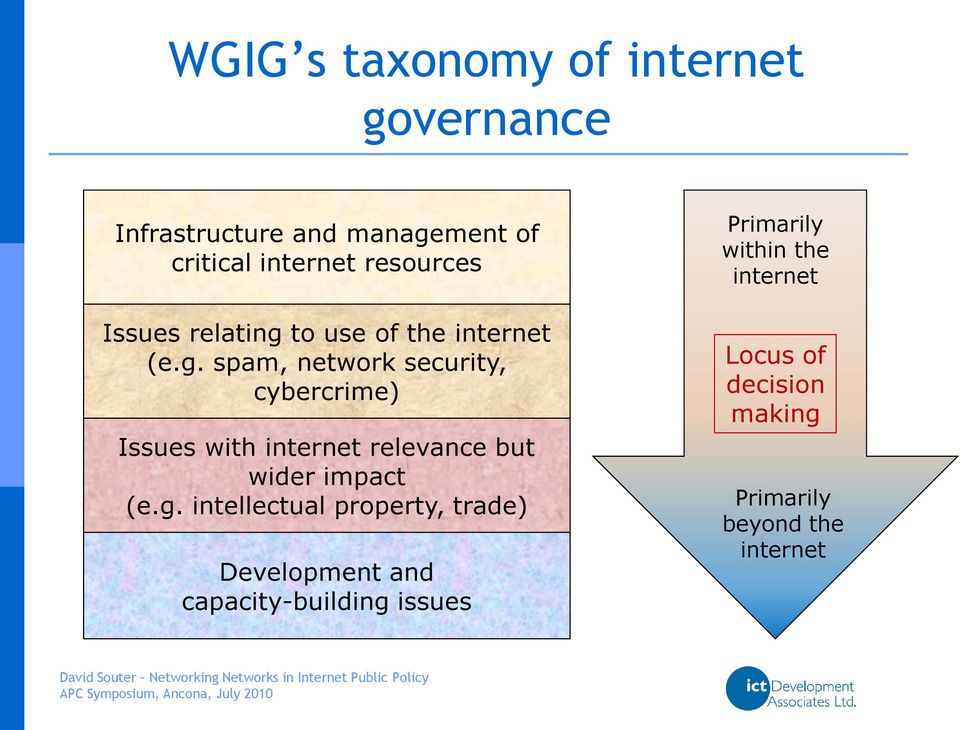
7 WGIG s taxonomy of internet governance Infrastructure and management of critical internet resources Issues relating to use of the internet (e.g. spam, network security, cybercrime) Issues with internet relevance but wider impact (e.g. intellectual property, trade) Development and capacity-building issues Primarily within the internet Locus of decision making Primarily beyond the internet
8 Development IGF framework of issues Governance arrangements Critical internet resources Technical issues e.g. IPv6 Access Openness Security (and privacy) Diversity Capacity building Emerging issues e.g. mobility, cloud computing, social networking

9 Dimensions of mapping

10 Approaches to mapping Mapping framework Colour codes* Internet community Issues Intergovernmental agency National government Institutions (decisionmaking fora) Actors (stakeholder groups) Commercial business Non-governmental public policy Civil society Users * not used in all slides

11 Dimensions for mapping internet public policy issues and entities Narrow internet issues issues Broad governance Broad governance issues issues Technical issues.. Policy issues Expert-led Government-led Global.. National Legislative.. Normative

12 Dimensions for mapping internet public policy issues and entities narrow versus broad Administration Standards Communications Public policy Users IANA ICANN RIRs ISOC W3C IETF LAP Spam Telecom standards bodies ITU IFIs WTO Council of Europe Interpol IGF Consumer bodies Selfregulatory bodies ISOC chapters National and regional IGFs ICT ministries WIPO Parliaments cctld registrars IXPs Telecoms regulators Content regulators National courts Registries ISPs and ISPAs Content providers E-commerce businesses

13 Dimensions for mapping internet governance issues and entities global versus national Global Regional National Internet coordination Standards Telecoms markets IANA ICANN IETF W3C ITU RIRs Regional regulators & their associations (EU, CRASA &c) cctld registrars ITU, IEEE, ETSI etc. Private sector standards fora National ICT ministries and telecoms regulators Applications and use UN agencies Regional entities e.g. UNECA, Council of Europe, OECD, development actors Sectoral ministries and ICT4D agencies

14 Dimensions for mapping internet governance issues and entities soft versus hard law Policy coordination ISOC IGF Market regulation cctlds Telecoms regulators Content regulators Standards IETF W3C DNS WIPO W3C Legislation (examples only; not comprehensive) E-commerce law Strength of governance Scope of governance Technical aspects Administration & coordination Infrastructure Services and content

15 Mapping internet issues

16 Mapping internet issues : the big picture

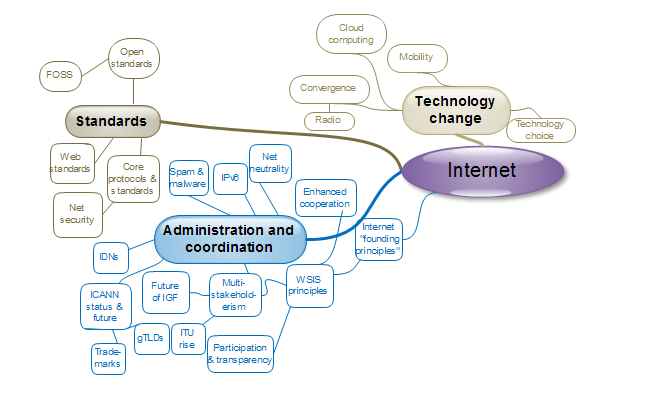
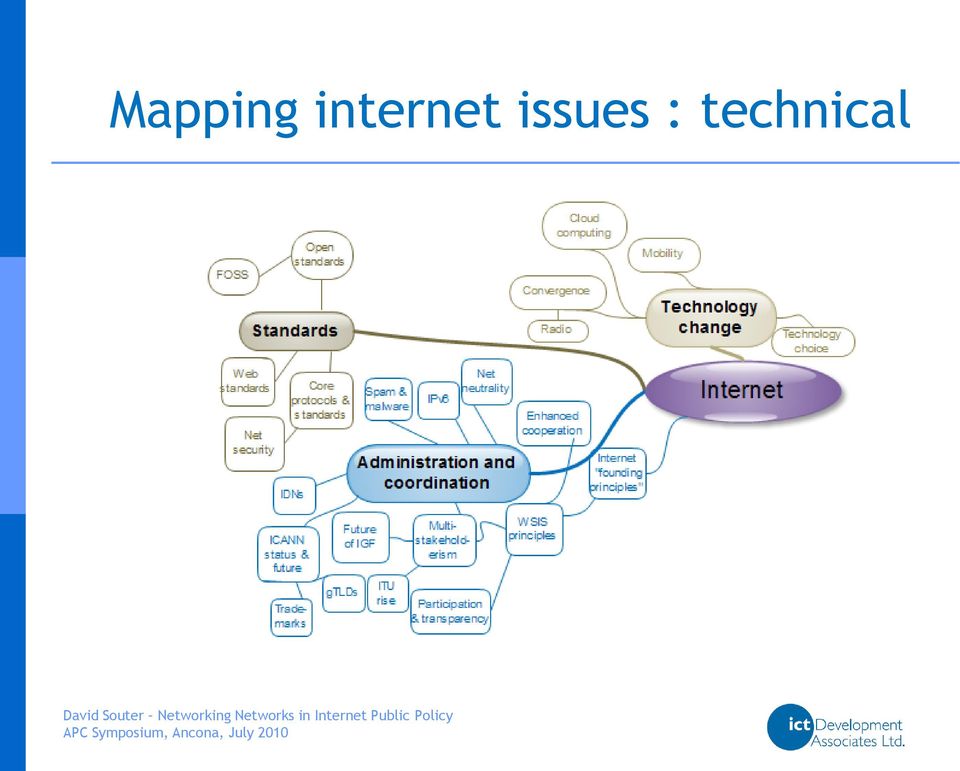
17 Mapping internet issues : technical Internet
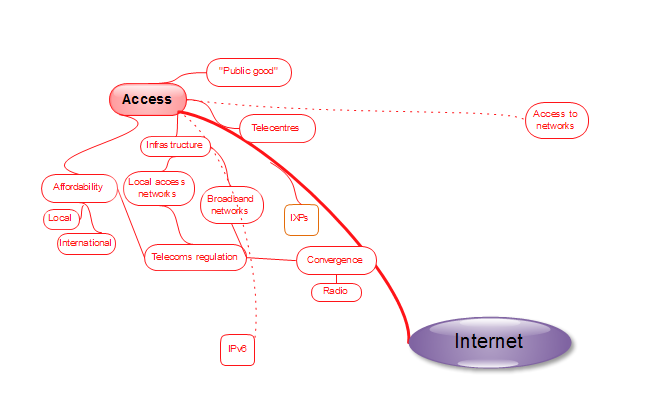
18 Mapping internet issues : access Internet

19 Mapping internet issues : economic Internet

20 Mapping internet issues : development Internet


21 Mapping internet issues : environment Internet

22 Mapping internet issues : social Internet
23 Mapping internet issues : cultural Internet
24 Mapping internet issues : rights Internet
25 Mapping internet issues : political Internet
26 Mapping internet issues : in detail
27 Mapping institutions, actors and stakeholder communities
28 Mapping stakeholder communities: the basic picture Intergovernmental organisations The internet technical and professional community Civil society Nation states The private sector
29 Intergovernmental agencies United Nations Types of agency/engagement (examples) Development agencies ITU WIPO Global Regional UN/universal Non-universal WTO Policymaking Operational Technical.. Developmental Coordagencies & agreementse e.g. Interpol, cybercrime Regions e.g. EU, Council of Europe Standards bodies Rule-making. Co-ordinating
30 National governments & agencies Types of agency/engagement (examples) Coordagencies & agreements e.g. Interpol, cybercrime, LAP spam Security agencies Regions e.g. EU, CofE ICT ministries Standards bodies cctld registrar National.. Local Communications sector Applications Internet.. Non-internet Policy Regulation Implementation Trade & tax authorities e-govt agencies Mainstream government departments (users, intermediaries) ICT regulators Content regulators ISPA IXP Self-reg. ISOC chapter Democratic... Authoritarian Rule-making. Co-ordinating
31 Internet entities Types of agency/engagement (examples) IGF and regional IGFs Internet coordination Global.. Regional.. National IANA, ICANN RIRs Multistakeholder.. Single stakeholder Standards bodies Internet standards (IETF, W3C) ISOC IGP, OII &c Standard-setting. Admin & Coordination Decision-making... Discussion-focused
32 Private sector entities Standards bodies cctld registrar ISPA IXP Self-reg. Internet standards (IETF, W3C) Supply side Internet firms and ISPs Telcos Content producers inc. Web 2 ICC - BASIS Media Demand side Business users of the internet Types of agency/engagement (examples) Global..... National Internet business... Internet user Supply side... Demand side E-commerce.. Traditional marketing Independent business.. Business association North.... South Incumbent.... Innovative SMEs Microbusinesses
33 Civil society actors Individuals IGC Academics Consumer rights Giganet Types of agency/engagement (examples) IGP Internet advocacy organisations & networks National. Regional.. Local Governance Access APC Diplo North.. South Development Internet rights IRP DC Child protection Human rights Development Policy.. Advocacy.. Implementation Internet / ICTs.... Mainstream Conservative.... Reformist... Radical Environment Issue-focused..... Representational Mainstream civil society organisations Single issue... Social ecosystem Independent.. Networked Women s movement Trades unions Member-funded... Donor-funded Faith groups
34 Mapping stakeholder communities: making things complex Microbusinesses Development agencies Coordagencies & agreements e.g. Interpol, cybercrime, LAP spam Security agencies Trade & tax authorities e-govt agencies United Nations ITU Regions e.g. EU, CofE Mainstream government departments (users, intermediaries) WIPO ICT ministries ICT regulators WTO Content regulators Standards bodies cctld registrar ISPA IXP Self-reg. ISOC chapter IGF and regional IGFs Internet coordination IANA, ICANN RIRs Internet standards (IETF, W3C) Supply side Internet firms and ISPs Telcos Content producers inc. Web 2 ISOC ICC - BASIS IGP Governance Media DCs Demand side Business users of the internet SMEs Individuals Academics Internet advocacy organisations & networks Access Development Internet rights APC IGC IRP DC Giganet Individual users Consumer rights Diplo Child protection Human rights Development Environment Mainstream civil society organisations Women s movement Trades unions Faith groups

35 Mapping internet issues against decision-making entities (illustrative) WTO Development agencies ITU World Bank and IFIs World Bank, UNDP, UNESCO, sectoral UN agencies National governments Bilateral donors ICT4D NGOs WTO Trade ministries ICT ministries Telecoms regulators IXPs Energy ministries W3C IETF LAP Spam Internet ISOC Private sector standards bodies Sectoral ministries Environmental agencies Climate change agencies MAG Content regulators RIRs Registrars ICANN UNGA Content regulators Media regulators Interpol Policing and security agencies WIPO National and international courts Consumer protection agencies National courts
36 Mapping issues by decision-making body: ICANN issues for civil society Administration. Standards. Public policy. Users US status & location Affirmation of Commitments Role of governments / GAC Trademarks New gtlds.xxx Role of ICANN board Civil society representation Morality and public order Domain name issues ICANN governance Privacy - whois
37 Mapping national internet environments
38 Mapping national environments : UK: issues Technical Domain name trading Broadband deployment Telecoms regulation Privacy - whois Cybercrime Cybersecurity Data protection Access promotion E- government & services Phishing & identity E- commerce Education cctld management Security Access for children Consumer protection Child welfare? Threat and/or opportunity? Child protection Impact of social networking IPv6 trans -ition Digital Economy Act Copyright Digital rights Impact on employment Societal Future of IGF
39 Mapping national environments : UK: issues and institutions etc. RIPE- NCC DNS Sec Nominet (.uk registry) UK IGF IP office Race Online BIS (ministry) EuroDIG Parliamentary groups Registrars ISPs Ofcom (regulator) Home Office LINX (IXP) ISPA Telecoms operators Policing CEOP IWF Child Online Content providers (inc. Yahoo!, Google, BBC etc.) Banks E- commerce businesses Confederation of British Industry ISOC OII / academic community Child welfare agencies Open Rights Group Consumer org ns NGOs
40 Mapping national environments : Kenya : issues Technical Multistakeholder participation Role of government IPv6 transition cctld redesignation (completed) Domain name administ n Trademarks & domain name abuse Cybercrime Access submarine and backbone Child protection Access local networks Prices / Affordability Access for women / gender issues Access for youth Quality of service e- government services Privacy and data protection Local content Empowerment Developmental impact Freedom of expression Societal
41 Mapping national environments : Kenya : institutions and actors ICANN AfriNIC Parliament (ICT Select Committee) GAC IGF National Comm s Secretariat (policy) Kenya ICT Board (advisory & projects) Ministry of ICT KENIC (registry) CCK (regulator) Kenya IXP Future Gov t IXP? TESPOK (internet businesses) [nb no ISPA] Telecoms operators Kenya Private Sector Alliance KICTANet ISOC ISOC Private sector and civil society input Kenya Consumers Association National Security Agency (cybercrime) ITU Kenya Revenue Authority (trademarks etc.) Bureau of standards IPv6 Task Force

42 Mapping national environments : Kenya : IGF processes Kenya IGF East African IGF Global IGF Other IG fora
43 Mapping civil society engagement
44 Mapping internet issues : in detail
45 Mapping internet issues : APC ACCESS Public good Access to networks Empowerment Affordability Broadband access Telecoms regulation IG4D Internet APC E-waste Web 2.0 ICANN status & future Future of IGF Participation & transparency WSIS principles Data protection A2K Women s rights / gender issues Freedom of expression
46 Mapping stakeholder communities: making things complex Microbusinesses Development agencies Coordagencies & agreements e.g. Interpol, cybercrime, LAP spam Security agencies Trade & tax authorities e-govt agencies United Nations ITU Regions e.g. EU, CofE Mainstream government departments (users, intermediaries) WIPO ICT ministries ICT regulators WTO Content regulators Standards bodies cctld registrar ISPA IXP Self-reg. ISOC chapter IGF and regional IGFs Internet coordination IANA, ICANN RIRs Internet standards (IETF, W3C) Supply side Internet firms and ISPs Telcos Content producers inc. Web 2 ISOC ICC - BASIS IGP Governance Media DCs Demand side Business users of the internet SMEs Individuals Academics Internet advocacy organisations & networks Access Development Internet rights APC IGC IRP DC Giganet Individual users Consumer rights Diplo Child protection Human rights Development Environment Mainstream civil society organisations Women s movement Trades unions Faith groups
47 Mapping internet networks : APC Donors IDRC, Ford Foundation, &c. OECD ICANN Non- Commercial Stakeholders Group CS networks CS organisations APC members CofE/UNECE etc. Broader networks Women s network A2K network AMARC Internet Governance Caucus etc. IT4Change Global Parners Privacy International Civicus Diplo IP Justice Internet Governance Project etc. APC ITEM CEPES COLNODO CIPESA KICTAnet WOUGNET Sangonet Protege QV FMA Green Spider etc. ICC/BASIS
48 Mapping networking issues
49 Global versus national fora civil society activities and networking Global Regional National Internet coordination Standards Telecoms markets IANA ICANN ITU RIRs Regional regulators & their associations (EU, CRASA &c) cctld registrars IETF W3C ITU, IEEE, ETSI etc. Private sector standards fora Civil society activities and networking National ICT ministries and telecoms regulators Applications and use UN agencies Regional entities e.g. UNECA, Council of Europe, OECD, development actors Sectoral ministries and ICT4D agencies
50 Future of the IGF Climate change Multistakeholder networking ITU Canada Cisco IISD Dynamic coalition OECD GeSI Sun ITP Ctty ISOC IGC Civil soci -ety APC IGF participants ICC- BASIS Internet business Internet users Canada Internet users EU
51 Mapping issues by decision-making body within and beyond the internet Human rights issues and institutions Internet rights issues and institutions Mainstream human rights organisations UN and law-based agencies Human rights conventions Internet rights organisations Internet fora Internet principles and ways of working
52 Engagement by issue and by actor Importance / immediacy of decisions Priority / saliency for (civil society) actor Capacity to influence decision-makers/ specific decisions Expertise of (civil society) actor
53 Engagement by network Importance / immediacy of decisions Priority / saliency for (civil society) actor Focused network Capacity to influence decision-makers/ specific decisions Broad network Expertise of (civil society) actor
54 Networking by issue Relevance Focused network Broad network Consensus
55 Mapping organisational priorities and network relationships Internet issues Internet entities Internet partnerships Internet capabilities

56 Internet issues
57 Internet entities Microbusinesses Development agencies Coordagencies & agreements e.g. Interpol, cybercrime, LAP spam Security agencies Trade & tax authorities e-govt agencies United Nations ITU Regions e.g. EU, CofE Mainstream government departments (users, intermediaries) WIPO ICT ministries ICT regulators WTO Content regulators Standards bodies cctld registrar ISPA IXP Self-reg. ISOC chapter IGF and regional IGFs Internet coordination IANA, ICANN RIRs Internet standards (IETF, W3C) Supply side Internet firms and ISPs Telcos Content producers inc. Web 2 ISOC ICC - BASIS IGP Governance Media DCs Demand side Business users of the internet SMEs Individuals Academics Internet advocacy organisations & networks Access Development Internet rights APC IGC IRP DC Giganet Individual users Consumer rights Diplo Child protection Human rights Development Environment Mainstream civil society organisations Women s movement Trades unions Faith groups
58 Internet networks Donors Government and intergovernmental partners CS networks CS organisations Network members Broader networks Business partners
59 Internet capabilities Importance / immediacy of decisions Priority / saliency for (civil society) actor Capacity to influence decision-makers/ specific decisions Expertise of (civil society) actor
Draft WGIG Issues Paper on E-Commerce
 Draft WGIG Issues Paper on E-Commerce This paper is a 'draft working paper' reflecting the preliminary findings of the drafting team. It has been subject to review by all WGIG members, but it does not
Draft WGIG issue paper on Network and Information Security
 Draft WGIG issue paper on Network and Information Security This paper is a 'draft working paper' reflecting the preliminary findings of the drafting team. It has been subject to review by all WGIG members,
ASSESSING NATIONAL INTERNET GOVERNANCE ARRANGEMENTS A framework for comparative assessment. David Souter for the Internet Society.
 ASSESSING NATIONAL INTERNET GOVERNANCE ARRANGEMENTS A framework for comparative assessment David Souter for the Internet Society April 2012 1 INTRODUCTION This report is the first of two pieces of work
INTERNET INTERMEDIARY LIABILITY WORKSHOP FACILITATOR BIOGRAPHIES 10-11 FEBRAURY, 2014.
 INTERNET INTERMEDIARY LIABILITY WORKSHOP FACILITATOR BIOGRAPHIES 10-11 FEBRAURY, 2014. Anriette Esterhuysen Chief Executive Officer, Association for Progressive Communications. Anriette Esterhuysen is
Towards a Common Understanding of the Roles and Responsibilities of all Stakeholders in Internet Governance
 3 April 2005 Towards a Common Understanding of the Roles and Responsibilities of all Stakeholders in Internet Governance 1. Introduction The Working Group on Internet Governance (WGIG) has as one of its
Internet Technical Governance: Orange s view
 Internet Technical Governance: Orange s view 1 Internet Technical Governance: Orange s view With the increasing use of IP technologies in the electronic communication networks and services, Internet Technical
INTERNET GOVERNANCE: STRENGTHS AND WEAKNESSES FROM A BUSINESS PERSPECTIVE
 INTERNET GOVERNANCE: STRENGTHS AND WEAKNESSES FROM A BUSINESS PERSPECTIVE Ayesha Hassan This chapter provides an overview of the strengths and weaknesses of the current Internet governance landscape from
Harmonizing cyberlaws and regulations: the experience of the East African Community CTO Cybersecurity Forum 2013 26 April 2013 Yaoundé, Cameroon
 Harmonizing cyberlaws and regulations: the experience of the East African Community CTO Cybersecurity Forum 2013 26 April 2013 Yaoundé, Cameroon Cécile Barayre Programme Manager, E-Commerce and Law Reform,
IGF Policy Options for Connecting the Next Billion
 Introduction IGF Policy Options for Connecting the Next Billion - A Synthesis - More than three billion people will be connected to the Internet by the end of 2015. This is by all standards a great achievement,
Telecom and Internet Regulatory Challenges and Opportunities Names, Numbers, Internet Governance
 Telecom and Internet Regulatory Challenges and Opportunities Names, Numbers, Internet Governance Global Forum ICT & The Future of Internet Bucharest, Romania, 19-20 October 2009 Theresa Swinehart Vice-President
TELECOMMUNICATIONS SERVICE PROVIDERS ASSOCIATION OF KENYA
 TELECOMMUNICATIONS SERVICE PROVIDERS ASSOCIATION OF KENYA (TESPOK) BACKGROUND TESPOK is a professional, non-profit organization representing the interests of telecommunication service providers in Kenya.
Internet Structure and Organization
 Internet Structure and Organization Resources management and allocation [email protected] Introduction What s the Internet? Why organizations / bodies are needed? Define protocol specifications Agree
Internet Governance. Issues Paper on. Prepared by ICC s Commission on E-Business, IT and Telecoms. January 2004
 International Chamber of Commerce The world business organization Issues Paper on Internet Governance Prepared by ICC s Commission on E-Business, IT and Telecoms January 2004 International Chamber of Commerce
ICANN STRATEGIC PLAN JULY 2012 JUNE 2015
 ICANN STRATEGIC PLAN JULY 2012 JUNE 2015 One World. One Internet. One World. One Internet. ICANN is the global organization that coordinates the Internet s unique identifier systems for worldwide public
Introduction to IP Numbers vs. Domain names. Adiel A. Akplogan CEO, AFRINIC. 2014
 Introduction to IP Numbers vs. Domain names Adiel A. Akplogan CEO, AFRINIC. 2014 Identifying an IP address Internet identifiers including information about how to reach a network location (via the Internet
Regional Development Forum for Africa. 18-19/5/2009 Lusaka (Zambia) Broadband Wireless Infrastructure & IPv6 Issues.
 Désiré Karyabwite IP Coordinator, TND ITU-BDT Regional Development Forum for Africa 18-19/5/2009 Lusaka (Zambia) Broadband Wireless Infrastructure & IPv6 Issues E-mail: [email protected] International
Law Enforcement and Internet Governance: An Ounce of Prevention Is Worth a Pound of Cure
 Law Enforcement and Internet Governance: An Ounce of Prevention Is Worth a Pound of Cure Supervisory Special Agent Robert Flaim Federal Bureau of Investigation (FBI) Operational Technology Division Global
IPv6 Around the World
 IPv6 Around the World IPv6 deployment is increasing its momentum globally, and IPv4 address exhaustion is approaching rapidly. Many parts of the world are engaged in efforts to increase broadband penetration,
UNESCO S CONTRIBUTIONS TO THE DRAFT OUTCOME STATEMENT OF THE NETMUNDIAL CONFERENCE. Introduction
 UNESCO S CONTRIBUTIONS TO THE DRAFT OUTCOME STATEMENT OF THE NETMUNDIAL CONFERENCE 16 April 2014 (Highlighted in yellow below) Introduction 1. The Global Multistakeholder Meeting on the Future of Internet
Day 3-24 April 2013. Day 2-23 April 2013
 Day 1-22 April 2013 09.00 Joint International Telecommunications Union (ITU) & Commonwealth Telecommunications Organisation (CTO) project to implement Child Online Protection: Workshop for Cameroon Kim
The Brazilian Internet Steering Committee CGI.br Internet Governance Model in Brazil
 ian Internet Steering Committee CGI.br Internet Governance Model in rev. July 2014 CGI.br - ian Internet Steering Committee NIC.br ian Network Information Center CETIC.br Center of Studies on Information
CEN and CENELEC response to the EC Consultation on Standards in the Digital Single Market: setting priorities and ensuring delivery January 2016
 CEN Identification number in the EC register: 63623305522-13 CENELEC Identification number in the EC register: 58258552517-56 CEN and CENELEC response to the EC Consultation on Standards in the Digital
PROPOSAL 20. Resolution 130 of Marrakesh on the role of ITU in information and communication network security
 PROPOSAL 20 Resolution 130 of Marrakesh on the role of ITU in information and network security Submitted by the following Member States: Germany (Federal Republic of), Austria, Belarus (Republic of), Bulgaria
The Internet. On October 24, 1995, the FNC unanimously passed a resolution defining the term Internet.
 The Internet Introductory material. An overview lecture that covers Internet related topics, including a definition of the Internet, an overview of its history and growth, and standardization and naming.
The Internet Introductory material.
 The Internet Introductory material. An overview lecture that covers Internet related topics, including a definition of the Internet, an overview of its history and growth, and standardization and naming.
RESOLUTION 102 (REV. BUSAN, 2014)
 RESOLUTION 102 (REV. BUSAN, 2014) ITU's role with regard to international public policy issues pertaining to the Internet and the management of Internet resources, including domain names and addresses
The Internet Ecosystem and ICANN!! Steve Sheng @ Stanford University, Center for Information and Society! 29 April 2013!
 The Internet Ecosystem and ICANN!! Steve Sheng @ Stanford University, Center for Information and Society! 29 April 2013! Ecosystem! + A network of interactions among organisms, and between organisms and
MINISTRY OF INFORMATION AND COMMUNICATIONS TECHNOLOGY
 GOVERNMENT OF UGANDA MINISTRY OF INFORMATION AND COMMUNICATIONS TECHNOLOGY POLICY POLICY FRAMEWORK FRAMEWORK FOR MANAGEMENT FOR MANAGEMENT OF.UG OF country.ug code Top country Level Domain code Top) (cctld)
(U) Appendix E: Case for Developing an International Cybersecurity Policy Framework
 (U) Appendix E: Case for Developing an International Cybersecurity Policy Framework (U//FOUO) The United States lacks a comprehensive strategic international policy framework and coordinated engagement
110207099 1099 01] RIN 0660 XA23:
![110207099 1099 01] RIN 0660 XA23:](/thumbs/27/11605322.jpg "110207099 1099 01] RIN 0660 XA23:") Fiona M. Alexander Associate Administrator Office of International Affairs National Telecommunications and Information Administration 1401 Constitution Avenue, NW., Room 4701 Washington, DC 20230 By electronic
Fiona M. Alexander Associate Administrator Office of International Affairs National Telecommunications and Information Administration 1401 Constitution Avenue, NW., Room 4701 Washington, DC 20230 By electronic
Who are the Stakeholders in Internet Governance?
 MEAC SIG 2015 Tunis, Tunisia Who are the Stakeholders in Internet Governance? Houda BELKASSEM Morocco Internet governance is now an active topic of international discussion. Interest has been fueled by
Need to institutionalize and strengthen multi-stakeholder model Establish goals for IG Role for gov t, private sector Self regulatory instead of
 INTERNET GOVERNANCE Do we need to re-define IG? Define ICANNs role in IG? IG = for whom? By whom? Perhaps look at this as internet coordination rather than internet governance Defining governance model
COMMUNIQUE. AFRICAN ICT MINISTERIAL ROUND-TABLE ON 42 nd MEETING OF ICANN. Hotel Méridien Dakar, SENEGAL. 21 Octobre 2011
 COMMISSION DE L UNION AFRICAINE REPUBLIQUE DU SENEGAL ---------------- MINISTERE DE LA COMMUNICATION, DES TELECOMMUNICATIONS ET DES TECHNOLOGIES DE L INFORMATION ET DE LA COMMUNICATION AFRICAN ICT MINISTERIAL
Declaration of Principles of the World Summit. Tunis in 2005 adopted by Heads of States and Governments stated that:
 3 rd EAIGF (2010 EAIGF) rd EAIGF 11 TH 13 TH AUGUST 2010, KAMPALA, UGANDA SECURITY MANAGEMENT IN EAST AFRICA: The East Africa Communications Organizations (EACO) Region Experience Michael K. Katundu Assistant
192.0.2.1 192.0.2.119. 2001:0db8:2004:f000:20d:60ff: Continuing cooperation The NRO and Internet Governance. The. Number
 Continuing cooperation The NRO and Internet Governance fc1:1 192.0.2.119 192.0 Resource 01:0db Number 8:371:2:2c0:9ff The 01:0d Organization (NRO) represents db8:112::2 49 the five Regional Internet Registries
Redelegation of Country Code Top Level Domains. February 2003
 Note: This Paper was prepared by Miriam Sapiro of Summit Strategies International, LLC in May 2002 for the Center for Democracy and Technology (CDT). CDT updated it in June 2002 to reflect the cctld Redelegation
Who rules the internet? Understanding ICANN
 PANOS MEDIA TOOLKIT ON ICTs No.1 Who rules the internet? Understanding ICANN ICANN (the Internet Corporation of Assigned Names and Numbers) is the organisation that oversees the system of internet addresses.
Policy, Business, Technical and Operational Considerations for the Management of a country code Top Level Domain (cctld)
 Policy, Business, Technical and Operational Considerations for the Management of a country code Top Level Domain (cctld) APRIL 2008 DRAFT For further information, please contact the ITU-D ICT Applications
Report of the Working Group on Internet Governance
 05.41622-1- Report of the Working Group on Internet Governance Château de Bossey June 2005 05.41622-2- Contents I. Introduction... 3 II. Working definition of Internet governance... 4 III. IV. Annex Identifying
How To Improve The Health Of The Internet
 UNITED NATIONS CONFERENCE ON TRADE AND DEVELOPMENT WORLD SUMMIT ON THE INFORMATION SOCIETY IMPLEMENTING WSIS OUTCOMES: A TEN-YEAR REVIEW UNITED NATIONS CONFERENCE ON TRADE AND DEVELOPMENT WORLD SUMMIT
United Nations General Assembly s Overall Review of the Implementation of WSIS Outcomes
 United Nations General Assembly s Overall Review of the Implementation of WSIS Outcomes Zero Draft Preamble 1. Recalling the request in paragraph 111 of the Tunis Agenda for the Information Society to
RWANDA CONTRIBUTION TO CWG-INTERNATIONAL INTERNET RELATED PUBLIC POLICY ISSUES.
 RWANDA CONTRIBUTION TO CWG-INTERNATIONAL INTERNET RELATED PUBLIC POLICY ISSUES. (Ref: CL-13/168 of 22 November 2013) 1.0. Introduction Since 2000, the Government of Rwanda (GoR) embarked on a 20 year journey
African Internet Governance Forum (AfIGF) Girma Dessalegn - AfIGF Secretariat
 African Internet Governance Forum (AfIGF) Girma Dessalegn - AfIGF Secretariat Outline About IGF IGF in Africa Launching of AfIGF AfIGF Secretariat AfIGF Bureau AfIGF Activities Upcoming AfIGF events About
ICANN: achievements and challenges of a multi-stakeholder, bottom up, transparent model
 ICANN: achievements and challenges of a multi-stakeholder, bottom up, transparent model Anne Rachel Inné, Giovanni Seppia Regional Liaisons Aurelio Peccei Lecture 4 April 2007 1 Presentation overview The
COMMUNIQUÉ ON PRINCIPLES FOR INTERNET POLICY-MAKING OECD HIGH LEVEL MEETING ON THE INTERNET ECONOMY,
 COMMUNIQUÉ ON PRINCIPLES FOR INTERNET POLICY-MAKING OECD HIGH LEVEL MEETING ON THE INTERNET ECONOMY, 28-29 JUNE 2011 The Seoul Declaration on the Future of the Internet Economy adopted at the 2008 OECD
Internet Bodies. [email protected]
 Internet Bodies [email protected] Agenda Names, Acronyms in the Internet IETF organisation IESG, IAB, ISOC ICANN & IANA Standardisation process Standardisation compliance Internet Registries Requesting
PLAN FOR ENHANCING INTERNET SECURITY, STABILITY, AND RESILIENCY
 PLAN FOR ENHANCING INTERNET SECURITY, STABILITY, AND RESILIENCY June 2009 Table of Contents Executive Summary... 1 ICANN s Role... 2 ICANN Security, Stability and Resiliency Programs... 3 Plans to Enhance
E Distr. LIMITED E/ESCWA/2015/EC.2/4(Part IV) 17 November 2015 ORIGINAL: ENGLISH
 UNITED NATIONS ECONOMIC AND SOCIAL COUNCIL E Distr. LIMITED E/ESCWA/2015/EC.2/4(Part IV) 17 November 2015 ORIGINAL: ENGLISH Economic and Social Commission for Western Asia (ESCWA) Executive Committee Second
Cybersecurity for ALL
 Cybersecurity for ALL An Overview of ITU s Cybersecurity Activities UNECE International Conference on Technological Readiness for Innovationbased Competitiveness 30 in Geneva, Switzerland Christine Sund
DIGITAL AGENDA FOR LATIN AMERICA AND THE CARIBBEAN (elac2018)
 7 August 2015 ENGLISH ORIGINAL: SPANISH Fifth Ministerial Conference on the Information Society in Latin America and the Caribbean Mexico City, 5-7 August 2015 DIGITAL AGENDA FOR LATIN AMERICA AND THE
CentralNic Privacy Policy Last Updated: July 31, 2012 Page 1 of 12. CentralNic. Version 1.0. July 31, 2012. https://www.centralnic.
 CentralNic Privacy Policy Last Updated: July 31, 2012 Page 1 of 12 CentralNic Privacy Policy Version 1.0 July 31, 2012 https://www.centralnic.com/ CentralNic Privacy Policy Last Updated: February 6, 2012
HiveColab. UGANDA NATIONAL INTERNET GOVERNANCE FORUM 2011 HELD AT HIVE COLAB, NAKAWA Harnessing Internet Development in Uganda
 HiveColab UGANDA NATIONAL INTERNET GOVERNANCE FORUM 2011 HELD AT HIVE COLAB, NAKAWA Harnessing Internet Development in Uganda Introduction This report presents the proceedings and key issues that emerged
UNITED NATIONS COMMISSION ON SCIENCE AND TECHNOLOGY FOR DEVELOPMENT
 UNITED NATIONS COMMISSION ON SCIENCE AND TECHNOLOGY FOR DEVELOPMENT Chairman s draft recommendations on the basis of the consolidated version of the rolling document A. Shaping the outcomes of IGF meetings
The role of governments in protecting and furthering internet freedom. Background paper
 The role of governments in protecting and furthering internet freedom Background paper Introduction Governments, as well as private-sector, civil-society and other international organisations, have an
Diversity of Cultural Expressions INTERGOVERNMENTAL COMMITTEE FOR THE PROTECTION AND PROMOTION OF THE DIVERSITY OF CULTURAL EXPRESSIONS
 Diversity of Cultural Expressions 1.EXT.IGC Distribution limited CE/08/1.EXT.IGC/Dec. Rev. 2 Paris, 20 August 2008 Original: English / French INTERGOVERNMENTAL COMMITTEE FOR THE PROTECTION AND PROMOTION
A/70/63 E/2015/10. General Assembly. Economic and Social Council. United Nations
 United Nations General Assembly Economic and Social Council Distr.: General 23 February 2015 Original: English A/70/63 E/2015/10 General Assembly Seventieth session Item 17 of the preliminary list Information
The Internet Ecosystem
 The Internet Ecosystem 15 October 2010 Internet Society InternetSociety.org [email protected] Galerie Jean-Malbuisson, 15 CH-1204 Geneva Switzerland Tel: +41 22 807 1444 Fax: +41 22 807 1445 1775 Wiehle Ave.
GLOBAL CONFERENCE ON CYBERSPACE 2015 CHAIR S STATEMENT
 GLOBAL CONFERENCE ON CYBERSPACE 2015 CHAIR S STATEMENT Introduction 1. On 16 and 17 April 2015 representatives of governments, international organisations, businesses, civil society, academia and the technical
Models for Cyber-legislation in ESCWA member countries
 Models for Cyber-legislation in ESCWA member countries Presented by Jean Akl & Roula Zayat Amman, December 11, 2007 Cyber Space Cyber space (non-jurisdictional International Space; jurisdictional National
The Importance of a Multistakeholder Approach to Cybersecurity Effectiveness
 The Importance of a Multistakeholder Approach to Cybersecurity Effectiveness Abstract Area: ROADMAP FOR THE FURTHER EVOLUTION OF THE INTERNET GOVERNANCE ECOSYSTEM Entitled by: Cristine Hoepers, Klaus Steding-Jessen,
CYBER SECURITY LEGISLATION AND POLICY INITIATIVES - UGANDA CASE
 CYBER SECURITY LEGISLATION AND POLICY INITIATIVES - UGANDA CASE 2009 ITU Regional Cybersecurity Forum for Africa and Arab States Tunis, 4-5 June 2009 Patrick Mwesigwa, Director/Technology & Licensing,
WIPO DEVELOPMENT AGENDA
 WIPO DEVELOPMENT AGENDA Seminario Internacional de la OMPI sobre Derecho de Autor Fortaleza, Brazil, November 26 to 28, 2008 Alejandro Roca Campañá World Intellectual Property Organization WIPO DEVELOPMENT
Internet Security and Resiliency: A Collaborative Effort
 Internet Security and Resiliency: A Collaborative Effort Baher Esmat Manager, Regional Relations Middle East MENOG 4 Manama, 9 April 2009 1 WHAT IS THIS PRESENTATION ABOUT? ICANN s effort in enhancing
Draft WGIG Issue Paper on the Administration of Internet Names and IP Addresses
 Draft WGIG Issue Paper on the Administration of Internet Names and IP Addresses This paper is a 'draft working paper' reflecting the preliminary findings of the drafting team. It has been subject to review
Draft WGIG Issue paper on Affordable and Universal Access
 Draft WGIG Issue paper on Affordable and Universal Access This paper is a 'draft working paper' reflecting the preliminary findings of the drafting team. It has been subject to review by all WGIG members,
IANA Functions to cctlds Sofia, Bulgaria September 2008
 IANA Functions to cctlds Sofia, Bulgaria September 2008 Kim Davies Internet Assigned Numbers Authority Internet Corporation for Assigned Names & Numbers What is IANA? Internet Assigned Numbers Authority