
B-to-B Lead Generation:
|
|
|
- Blaze Parks
- 10 years ago
- Views:
Transcription
1 Marketing ROI & Performance Evaluation Study A special report from MarketingProfs, with support from Lenskold Group Copyright MarketingProfs Research Insights, MarketingProfs, LLC. All rights reserved.
2 Table of Contents Executive Summary 2 Introduction & Research Methodology 6 About the Author Lenskold Group 7 Detailed Findings 8 1. Lead Generation Objectives 9 2. Lead Generation Marketing Metrics Marketing and Sales Alignment Key Correlations to Growth Marketing ROI Discipline Key Drivers of Effectiveness Budget and Goal Alignment Comparisons by Company Size External Perspectives 35 Participant Profile 38 About MarketingProfs 43 1

3 Executive Summary Lead generation marketing is responsible for that critical connection between the positive impressions of brand marketing and the results-driven environment of the sales organization. Lead generation often seems within reach of very quantifiable financial impact but falls short based on the information void from sales and channel partner reporting gaps. As seen in this research, quantified impact tends to be split between lead quantity and lead quality. Closing the insight gap enables marketers to improve their measured impact and manage both quality and quantity of their lead generation. This research study explored the practices in place from marketing objectives to lead definitions, sales alignment, and ultimately the metrics and measurements used. The return on investment (ROI) of lead generation marketing requires converting leads generated into incremental sales. Higher sales conversion rates and higher value customers results in higher ROI, making it clear that lead quality counts. Sure increasing quantity is important to meet objectives, but it does not necessarily improve ROI. Managing the effectiveness and efficiency of lead generation marketing requires clearly defined objectives, better insight, alignment with the sales organization, and the discipline to measure ROI. 1. Marketers must set objectives, definitions, and metrics that reflect lead quality. One-third (35%) of the marketers surveyed indicated their primary lead generation marketing objective is lead quality based on sales conversion rates and an additional 25% use an objective of lead quality based on sales acceptance. Combined, 60% of marketers are working toward these two lead quality objectives compared to the remaining 40% whose objectives are tied to lead quantity. The prioritization of quality over quantity slips a bit when we look at how leads are defined. Over half (52%) of all lead generation marketers surveyed indicated they use lead definitions that include no qualification, while just 19% define leads as contacts highly qualified using screening standards of sales organization. In fact, when looking specifically at the portion of marketers who indicated they operate with a lead quality objective, one out of four (39%) report using a lead definition of either any contact name generated by marketing or all inbound responses to marketing initiatives, both of which are more quantity driven than quality driven definitions. 2

4 Metrics are an important part of effective lead generation as well. Companies that report they are outgrowing their competitors were more likely than those reporting slower growth to use conversion rate and financial performance metrics such as Lead-to-Purchase Conversion Rate (40% vs. 20%), Cost per Sale (36% vs. 20%), and Contact-to-Purchase Conversion Rate (24% vs. 15%). 2. Marketing must influence conversion rates to improve lead generation ROI. While the feedback was indirect, the marketers participating in this survey provided their view of how the sales organization would rate their lead generation performance, which provided directional insight into key areas where additional marketing support can prove to be beneficial. Marketers expected the sales organization to provide the most negative ratings (1 or 2 on a 5-point scale) on their performance for nurturing contacts stalled or not qualified by sales (38%), followed by their performance for conditioning leads to create higher preference and higher purchase conversion rates (35%). There is an opportunity to increase the ROI of lead generation marketing by getting more value from leads already generated before spending additional budget to boost the quantity of leads. In some cases, conditioning leads with additional marketing touchpoints prior to the handoff to the sales organization provides a better quality of lead that will have higher conversion rates or purchase higher value solutions. In other cases, taking unqualified leads back from the sales organization for additional nurturing allows the company to further leverage the initial investment to generate those leads and reduces the cost of nurturing by expensive sales resources. Our analysis found that companies that reported more effective lead generation marketing were two to three times as likely to provide positive performance ratings in terms of conditioning leads as well as supporting the sales group within the sales pipeline, compared to those with less effective lead generation marketing (see the charts in Section 6 of the Detailed Findings). Clearly this correlation with increased effectiveness is a good indicator of the need to concentrate on improving conversion rates with marketing prior to and during the sales pipeline period. 3

5 3. Better marketing and sales alignment on lead quality is critical for growth. Marketing and sales alignment related to managing lead quality is a problem area for lead generation marketers. Roughly half provided negative ratings on their alignment with sales to jointly analyze win-loss drivers, measure ROI on lead generation marketing, and provide closed-loop sales tracking of lead performance, compared to roughly one quarter who indicated positive ratings for these practices. The insight gained from tracking lead performance and understanding win-loss drivers is critical for lead generation marketers to improve quality through better targeting and better messaging. Alignment between marketing and sales has a strong connection to marketing effectiveness and reported growth. Companies expecting to outgrow their competitors were roughly three times more likely to report positive ratings in all of the areas noted above, as well as alignment through joint planning of lead generation marketing. The same increase in positive ratings was found for companies reporting more effective lead generation marketing performance over companies with less effective marketing. See Section 4 and Section 6, respectively, for detailed charts. 4. Increased ROI discipline supports lead generation marketing effectiveness. Lead generation marketers that use marketing ROI and profitability metrics were much more likely to report having more effective lead generation marketing than companies using just traditional, non-financial marketing metrics (60% vs. 35%). Companies with the discipline to use marketing ROI metrics also show advantages in other areas related to improving marketing profitability. These companies are more likely to have their primary lead objective as lead quality based on sales conversions (41% vs. 29% of traditional metrics users), use lead definitions that include high qualifications based on the screening standards of the sales organization, show better marketing and sales alignment ratings, and indicate much higher use of financial and sales conversion metrics (see Section 5 for details). 4

6 Looking across these findings, lead generation marketers should consider the following priorities to improve their overall performance effectiveness. Invest in improving lead quality inclusive of both incremental value and higher conversion rates to improve ROI, marketing profitability, and growth. Work on better alignment with sales, specifically to get closed-loop tracking and joint assessment of win-loss drivers, which provide the critical insight necessary for improving lead quality. Establish lead generation objectives, definitions, and metrics that balance lead quality and quantity, drive increases in marketing effectiveness, and align marketing decisions with business objectives. Look for opportunities for better conditioning of leads prior to passing leads to sales, better marketing support within the sales pipeline, and better nurturing of unqualified leads to net higher overall conversion rates from the leads generated. Use ROI analyses and measurements to guide increased investment against high-value, high-potential leads and identify the appropriate budget allocation between incremental quality and incremental quantity. 5

7 Introduction and Research Methodology The B2B Lead Generation ROI study was included as a module within the 2008 Marketing ROI & Measurements Study conducted in the first quarter of 2008 with MarketingProfs members worldwide. Of the 834 marketing practitioners participating in the online survey worldwide, 311 qualified as representing companies with at least half of their revenues generated from business customers (B2B) and whose marketing organization was responsible for generating leads that were either passed to an internal sales team or external channel partners. Marketing practitioners are defined as those individuals responding for their own company. Survey participants that indicated they were external consultants or agencies responding for their client organizations, or academics and industry experts responding for the general business community were excluded from this analysis (differences from the reported results are noted within the detailed findings). Lead generation is an important role for marketing, especially in the B2B environment. This special report analyzed lead generation objectives, qualification, sales alignment, and performance metrics to determine the connection to growth, lead generation effectiveness, and ROI (Return on Investment) metrics. The 2008 Marketing ROI & Measurement Study, which has been conducted annually by Lenskold Group and MarketingProfs for the past four years, continues to examine trends and progress across the broad range of marketing organizations worldwide. (This report is also now available at Note on survey results: A total of 311 participants qualified for this module of the survey, however, since responses to every question were not required, participants could choose to skip questions. Therefore the base of responses varies by question even though all participants were presented with the opportunity to answer all questions. Don t know responses were removed from the base unless noted. Analyses were tested at the 95% confidence level unless noted. 6

8 About the Author This research was developed, analyzed, and drafted into report format by Lenskold Group. Founded in 1997, the Lenskold Group ( provides consulting services to deliver a comprehensive approach to marketing ROI management, marketing measurement and analytics, and profitability planning tools. Jim Lenskold, founder and president of Lenskold Group, has been a contributor of articles, webinars, research reports, and conference presentations for MarketingProfs since Jim is author of the book Marketing ROI, The Path to Campaign, Customer and Corporate Profitability (McGraw Hill), named one of the five most influential marketing books of 2004 by the American Marketing Association Foundation. The Lenskold Group serves Fortune 1000 and emerging companies in the US, Canada and Europe. Jim can be reached at [email protected] or (+1)

9 DETAILED FINDINGS 8

10 Detailed Findings This survey explored perceptions, behaviors, and lead generation performance. The questions were analyzed using comparisons of the respondents reported levels of lead generation effectiveness, their sales growth relative to direct competitors, their marketing budget levels, and their use of marketing ROI/profitability metrics, to determine the correlation between their responses and their performance. This section covers the significant findings from that analysis. 1. Lead Generation Objectives Lead quality has a clear advantage over lead quantity as the primary objective with 60% of lead generation marketers citing quality objectives compared to 40% citing quantity objectives. More specifically, more than a third (35%) of marketers are working toward lead quality based on sales conversion rates, which is the choice most aligned to managing marketing profitability of the four choices presented in the survey, as shown below in Figure 1. Another 25% reported their primary objective as lead quality based on sales acceptance. Objectives tied to lead quantity were split between those based on the quantity of new names generated (23%) and those based on the volume passed to sales (17%). Figure 1: Lead Generation Objectives Which of the following choices best describes your primary objective for lead generation? (n = 265) 17% 35% 23% Lead quantity volume passed to sales Lead quantity new names generated Lead quality based on sales acceptance Lead quality based on sales conversion 25% 9

11 Volume of leads is important but generally needs to come second to quality when managing marketing profitability. Marketing ROI and profitability are driven by targeting decisions that prioritize prospects based on: 1) Higher value per sale (profit contribution from either incremental transactions or incremental customers) 2) Higher sales conversion rates Sales conversion rates increase as low potential prospects are screened out of the sales cycle (decreasing lead quantity). By removing leads that have little or no probability of converting to a sale, the cost invested into sales resources is reduced, thereby increasing ROI and profit contribution. Lead generation marketers can contribute more to the bottom line by first improving lead quality to increase ROI, and then scaling their success to higher levels with a greater quantity of those quality leads. There is a disconnect between establishing lead generation objectives and the definitions used for leads generated, as the lead definitions reported are less quality-focused than the objectives reported. Overall, 52% use lead definitions that include no screening for quality, with 28% using any contact name identified or generated by marketing and 24% using all inbound responses to marketing. The remaining 48% included some level of qualification in their definition. Eighteen percent (18%) partially qualify leads with scoring questions and 10% partially qualify leads through an outbound screening call. Just 19% define leads as contacts highly qualified using the screening standards of the sales organization. Figure 2: Lead Definitions Which of the following statements best describes how marketing defines a lead that will be passed to a sales team? (n = 272) 19% 28% Any contact name identified or generated by marketing All inbound responses to marketing initiatives 10% Contacts partially qualified using scoring questions captured within the inbound response 18% 24% Contacts partially qualified through an outbound screening call Contacts highly qualified using the screening standards of the sales organization 10

12 A deeper analysis better illustrates the gap between having lead quality objectives and using lead quality definitions. To effectively work toward a primary objective of lead quality, leads must be properly defined to set expectations between the marketing and sales organizations. Of those choosing lead quality as their primary objective, only 61% indicate having some level of quality screening in their lead definition (the combined responses of 25% highly qualified, 12% partially qualified with outbound screening call and 24% partially qualified using scoring questions as detailed below). The balance of those choosing lead quality (39% in total) define leads as either any contact name generated (20%) or all inbound responses to marketing (19%). Figure 3: Lead Definition Based on Lead Generation Objective Which of the following statements best describes how marketing defines a lead that will be passed to a sales team? (n = 56, 84, 79, and 117; see Figure 1 for the question defining the segments) Lead Definition Contacts highly qualified using the screening standards of the sales organization Contacts partially qualified through an outbound screening call Contacts partially qualified using scoring questions captured within the inbound response All inbound responses to marketing initiatives Any contact name identified or generated by marketing 8% 12% 7% 9% 25% 24% 20% 19% 38% 39% 0% 5% 10% 15% 20% 25% 30% 35% 40% 45% Marketers with a Lead Quantity Objective Marketers with a Lead Quality Objective 11

13 2. Lead Generation Marketing Metrics Marketers manage their performance with multiple metrics, as they should, but there are no clear standards for lead generation metrics. Of the list of lead generation metrics we asked survey participants to rate, no one single metric was used to track marketing s success by more than half of the group. The highest incidence of use was with Quantity of New Leads, at 49%. Conversely, it is quite surprising that roughly half of all lead generation marketing organizations do not track such a basic metric as Quantity of New Leads. The Lead-to-Purchase Conversion Rate was used much more often than Contact-to- Purchase Conversion Rates (37% vs. 18%). Both are good measures of quality based on the connection to a purchase. The higher incidence of Lead-to-Purchase Conversion Rate is not a surprise since this tends to be more easily tracked within a single sales system where the Contact-to-Purchase Conversion Rate is likely to require a connection between marketing and sales databases. The financially-oriented metrics that scored higher on this list included Cost per Marketing Lead (34%), Cost per Sale (29%) and Revenue per Sale (32%). These are quite a bit higher than the more ROI-aligned metrics of Profit per Sale (14%) and Lifetime Value (9%) which require more data and analysis to track. Figure 4: Lead Generation Metrics Which of the following metrics are used to track marketing s lead generation success? (n = 295) Quantity of new leads Lead-to-purchase conversion rate Cost per marketing lead Revenue per sale from marketing-generated leads Cost per sale (for marketing-generated leads) Marketing lead pipeline (or opportunity) value % of leads accepted by Sales Quantity of first time buyers from marketing-generated leads Contact-to-purchase conversion rate Sales cycle length (i.e., lead-to-close time) Profit per sale from marketing-generated leads Lifetime value of marketing-generated leads 9% 26% 24% 23% 18% 16% 14% 37% 34% 32% 29% 49% 0% 10% 20% 30% 40% 50% 60% 12

14 Cost per Marketing Lead and Cost per Sale are both good metrics to help keep costs in line with value. As marketers become more focused on lead quality in terms of both conversion potential and total customer value, these metrics will need to be used with caution and not be set as marketing objectives. For example, experiencing an increase in Cost per Lead and Cost per Sale concurrent with generating better quality leads is often justified and beneficial to the company. ROI analysis can be used to identify the relationship between cost per lead and lead quality to support making greater investments for greater quality. 13

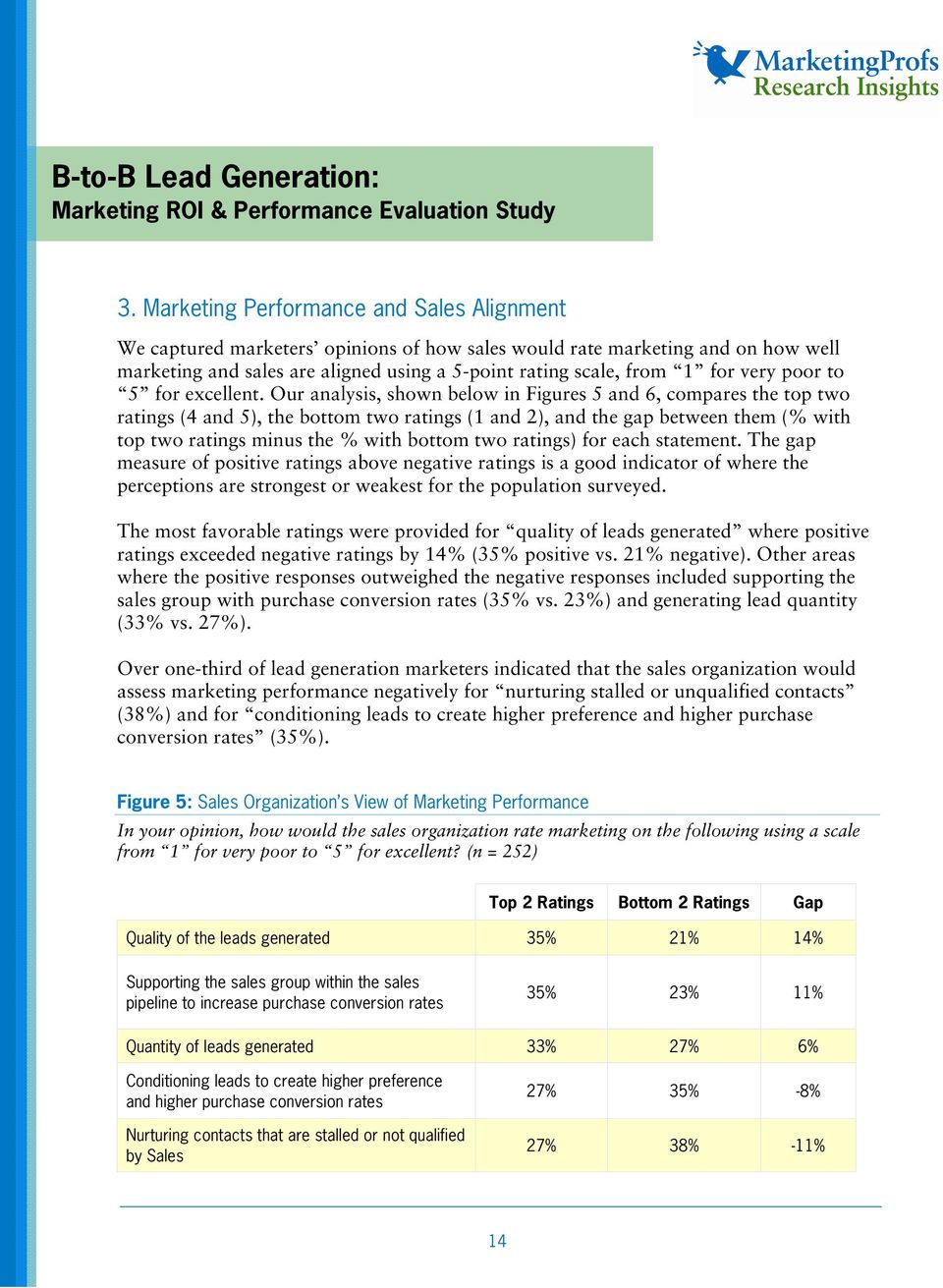
15 3. Marketing Performance and Sales Alignment We captured marketers opinions of how sales would rate marketing and on how well marketing and sales are aligned using a 5-point rating scale, from 1 for very poor to 5 for excellent. Our analysis, shown below in Figures 5 and 6, compares the top two ratings (4 and 5), the bottom two ratings (1 and 2), and the gap between them (% with top two ratings minus the % with bottom two ratings) for each statement. The gap measure of positive ratings above negative ratings is a good indicator of where the perceptions are strongest or weakest for the population surveyed. The most favorable ratings were provided for quality of leads generated where positive ratings exceeded negative ratings by 14% (35% positive vs. 21% negative). Other areas where the positive responses outweighed the negative responses included supporting the sales group with purchase conversion rates (35% vs. 23%) and generating lead quantity (33% vs. 27%). Over one-third of lead generation marketers indicated that the sales organization would assess marketing performance negatively for nurturing stalled or unqualified contacts (38%) and for conditioning leads to create higher preference and higher purchase conversion rates (35%). Figure 5: Sales Organization s View of Marketing Performance In your opinion, how would the sales organization rate marketing on the following using a scale from 1 for very poor to 5 for excellent? (n = 252) Top 2 Ratings Bottom 2 Ratings Gap Quality of the leads generated 35% 21% 14% Supporting the sales group within the sales pipeline to increase purchase conversion rates 35% 23% 11% Quantity of leads generated 33% 27% 6% Conditioning leads to create higher preference and higher purchase conversion rates Nurturing contacts that are stalled or not qualified by Sales 27% 35% -8% 27% 38% -11% 14
16 When asked to rate the alignment between marketing and sales, the only response that had more positive ratings than negative was joint planning between marketing and sales (38% vs. 34%), shown in Figure 6 below. For the remaining three areas assessed, more negative than positive ratings were provided. The least favorable aspect of sales and marketing alignment was in jointly analyzing the win-loss drivers to identify areas of marketing improvement (26% positive vs. 47% negative). Measuring the ROI of lead generation marketing was rated low by 48% compared to 27% positive, and providing closed-loop sales tracking back to marketing was close to the same (47% vs. 27%). Figure 6: Sales and Marketing Alignment How would you rate the alignment of marketing and sales on the following aspects of lead generation using a scale from 1 for very poor to 5 for excellent? (n = 257) Top 2 Ratings Bottom 2 Ratings Gap Engaging in joint planning of lead generation marketing Providing closed-loop sales tracking of lead performance back to marketing 38% 34% 4% 27% 47% -20% Measuring the ROI of lead generation marketing 27% 48% -21% Jointly analyzing the win-loss drivers to identify areas of marketing improvement 26% 47% -22% This analysis shows that there are significant opportunities to improve the alignment between marketing and sales by nurturing leads, conditioning leads, and managing effectiveness (e.g., closed loop tracking, ROI measures, and joint win-loss analysis). With better analysis and insight, especially from closed-loop tracking, marketing can align its efforts with sales to effectively and efficiently manage prospects through the entire buying cycle. In fact, marketers reporting their lead generation is more effective than competitors show much higher scores on both alignment and sales perceptions of marketing as presented in the section that follows. 15

17 4. Key Correlations to Growth More than half (57%) of those surveyed expect to outgrow their primary competitors in the upcoming year. Just 8% expect their growth to lag behind their competitors (see Figure 7). A comparison of the greater growth companies with the slower growth companies showed differences that highlight the correlation between lead generation practices and growth. The sample size for the slower growth segment was small but the differences noted are at the 95% confidence level. Figure 7: Expected Growth How would you describe your firm s expected growth in the upcoming year relative to your primary competitors? (n = 311) Somewhat slower growth, 7% About the same growth, 35% Much slower growth, 1% Much greater growth, 18% Somewhat greater growth, 39% 16

18 Companies with more effective lead generation were more likely to be outgrowing their competitors. A combined 58% of companies outgrowing competitors described their lead generation performance as much more or somewhat more effective than competitors compared to just 20% of those whose growth was lagging behind competitors (see Figure 8). Figure 8: Expected Growth and Lead Generation Effectiveness Would you say your company's lead generation marketing performance relative to your direct competitors is much more effective, somewhat more effective, about the same, somewhat less effective or much less effective? (n = 194 and 35; see Figure 7 for the question defining the segments) 0% 5% 10% 15% 20% 25% 30% 35% 40% 45% Much more effective 9% 19% Somewhat more effective 11% 39% About the same 23% 23% Somewhat less effective 15% 31% Much less effective 4% 26% Greater Growth Slower Growth 17

19 The differences in positive ratings were quite pronounced for the different forms of marketing and sales alignment. Companies with greater growth were much more likely to engage in joint planning (46% positive ratings vs. 18% for slower growth companies). More than one in three marketers representing companies with above average growth provided high rating scores for closed loop tracking, joint analysis of win-loss drivers, and measuring ROI for lead generation programs (see Figure 9), more than double the positive ratings from marketers representing slower growth companies. Figure 9: Marketing and Sales Alignment of Greater Growth vs. Slower Growth Companies How would you rate the alignment of marketing and sales on the following aspects of lead generation using a scale from 1 for very poor to 5 for excellent? (n = 196 and 34; see Figure 7 for the question defining the segments) Top 2 Ratings Greater Growth Slower Growth Engaging in joint planning of lead generation marketing 46% 18% Providing closed-loop sales tracking of lead performance back to marketing Jointly analyzing the win-loss drivers to identify areas of marketing improvement 37% 18% 36% 15% Measuring the ROI of lead generation marketing 34% 15% 18

20 While there was not a significant difference between higher growth and slower growth companies in their selection of lead generation objectives or lead definitions, there were significant differences in the use of the metrics Lead-to-Purchase Conversion Rate and Cost per Sale. These metrics are shown in Figure 10. Figure 10: Lead Generation Metrics by Greater Growth vs. Slower Growth Companies Which of the following metrics are used to track marketing s lead generation success? Check all that apply. (see Figure 7 for the question defining the segments) % Using Metrics Greater Growth Slower Growth Lead-to-purchase conversion rate 40% 20% Cost per marketing lead 39% 33% Cost per sale (for marketing-generated leads) 36% 20% Contact-to-purchase conversion rate 24% 15% Quantity of first time buyers from marketing-generated leads 22% 13% 19

21 5. Marketing ROI Discipline Marketers were asked if their firm calculates marketing profitability, ROI or similar financial measures to assess marketing effectiveness. Lead Generation marketers provided responses consistent (i.e., no significant difference) with the general population of marketing practitioners from the main marketing ROI research study*, with just over one in four marketers using marketing ROI / profitability metrics. Figure 11: Use of Marketing ROI / Profitability Metrics B2B Lead Gen vs. All Marketers Does your firm calculate marketing profitability, ROI (return on investment) or a similar financial measure to assess marketing effectiveness? (n = 303 and 676) Yes, we calculate ROI, net present value (NPV), or other profitability metrics for at least some of our marketing campaigns/investments. 27% 26% Somewhat, we calculate some financial metrics such as cost per lead and cost per sale but not profitability metrics such as ROI and NPV. 33% 34% No, we use traditional marketing metrics but not financial metrics. 40% 40% 0% 5% 10% 15% 20% 25% 30% 35% 40% 45% B2B Lead Gen Marketers General Marketers *Source: Lenskold Group / Marketing Profs as reported in the 2008 Marketing ROI and Measurements Study. 20
22 A comparison between B2B lead generation marketing organizations that have adopted marketing ROI and profitability metrics and those that continue to use only traditional, non-financial marketing metrics showed significant differences. These correlations of behaviors suggest that certain lead generation practices are more aligned to the accountability and discipline of measuring and managing marketing ROI. First, users of marketing ROI metrics tend to have somewhat or much more effective lead generation marketing (60%), compared to those companies that use only traditional metrics (35%). See Figure 12. Figure 12: Lead Gen Marketing Effectiveness Users of ROI Metrics vs. Traditional Metrics Would you say your company s lead generation marketing performance relative to your direct competitors is: (n = 99 and 124; see Figure 11 for the question defining the segments) Much more effective 8% 20% Somewhat more effective 27% 40% About the same 22% 30% Somewhat less effective 15% 27% Much less effective 2% 9% 0% 5% 10% 15% 20% 25% 30% 35% 40% 45% Use ROI Metrics Traditional Metrics Only 21
23 As shown in Figure 13, companies with the discipline to use marketing ROI metrics are more likely to have their primary lead objective as lead quality based on sales conversion (41% vs. 29% of traditional metrics users) while companies using traditional metrics target lead quantity based on volume of new names generated (32% vs. 20% of marketing ROI metrics users). Figure 13: Lead Objective - Users of ROI Metrics vs. Traditional Metrics Which of the following choices best describes your primary objective for lead generation? Choose one. (n = 98 and 127; see Figure 11 for the question defining the segments) Lead quality based on sales conversion 29% 41% Lead quality based on sales acceptance 25% 23% Lead quantity new names generated 20% 32% Lead quantity volume passed to sales 13% 15% 0% 5% 10% 15% 20% 25% 30% 35% 40% 45% Use ROI Metrics Traditional Metrics Only 22
24 In addition, marketing organizations using marketing ROI metrics were more likely to define leads passed to sales as contacts highly qualified using the screening standards of the sales organization (25% vs. 14% of traditional metrics users). The companies using only traditional metrics were more inclined to define leads as any contact name identified by marketing (36% compared to 24% among users of ROI metrics). See Figure 14. Figure 14: Lead Definition Users of ROI Metrics vs. Traditional Metrics Which of the following statements best describes how marketing defines a lead that will be passed to a sales team? (n = 99 and 136; see Figure 11 for the question defining the segments) 14% 25% Contacts partially qualified through an outbound screening call 4% 7% Contacts partially qualified using scoring questions captured within the inbound response All inbound responses to marketing initiatives 14% 17% 26% 32% Any contact name identified or generated by marketing 24% 36% 0% 5% 10% 15% 20% 25% 30% 35% 40% Use ROI Metrics Traditional Metrics Only 23
25 Users of ROI metrics report higher use of all lead generation performance indicators than those who are using only traditional metrics. With marketing ROI and profitability metrics in place, lead generation metrics followed suit in terms of supporting good financial and performance insight. In particular, Lead-to-Purchase Conversion Rates, Cost per Marketing Lead and Cost per Sale metrics topped the list for marketing ROI users (44%, 43%, and 41%, respectively). Figure 15: Lead Generation Metrics Users of ROI Metrics vs. Traditional Metrics Which of the following metrics are used to track marketing s lead generation success? (n = 111 and 146; see Figure 11 for the question defining the segments) % Using Metrics Use ROI Metrics Traditional Metrics Only Lead-to-purchase conversion rate 44% 21% Cost per marketing lead 43% 16% Cost per sale (for marketing-generated leads) 41% 16% Revenue per sale from marketing-generated leads 38% 24% Marketing lead pipeline (or opportunity) value 30% 18% Profit per sale from marketing-generated leads 18% 9% 24
26 Reported ratings on sales and marketing alignment were particularly strong for those using marketing ROI metrics compared to those using only traditional, non-financial marketing metrics (see Figure 16 below). Close to half of ROI metrics users offered high ratings for each of the four aspects of alignment, including joint planning, closed-loop tracking, analyzing win-loss drivers, and, of course, measuring the ROI of lead generation marketing (51%, 49%, 44%, and 51%, respectively). By comparison, marketers using only traditional metrics provided much lower positive ratings in the range of 10% to 17% for these metrics with the exception of joint planning which was rated positive by 31%. Figure 16: Aspects of Marketing and Sales Alignment Users of ROI Metrics vs. Traditional Metrics Which of the following metrics are used to track marketing s lead generation success? (n = 96 and 129; see Figure 11 for the question defining the segments) Top 2 Ratings Use ROI Metrics Traditional Metrics Only Measuring the ROI of lead generation marketing 51% 10% Engaging in joint planning of lead generation marketing Providing closed-loop sales tracking of lead performance back to marketing Jointly analyzing the win-loss drivers to identify areas of marketing improvement 51% 31% 49% 13% 44% 17% 25
27 6. Key Drivers of Effectiveness Marketers generally have confidence about their overall performance. When marketers were asked to rate their performance relative to their competitors, 42% reported their performance as more effective, 31% reported their performance as about the same, and 26% reported it as less effective. See Figure 17. Figure 17: Lead Generation Effectiveness Would you say your company's lead generation marketing performance relative to your direct competitors is much more effective, somewhat more effective, about the same, somewhat less effective or much less effective? (n = 243) 6% 12% 20% 30% Much more effective Somewhat more effective About the same Somewhat less effective Much less effective 31% 26
28 Yet there are significant differences in outlook between more effective performers and less effective performers in the specific aspects of marketing s performance. Those who report they are more effective have a more positive view of how the sales organization would rate marketing s performance and the alignment of sales and marketing. In addition, comparing those who rate their marketing effective to those who rate their marketing less effective shows higher positive ratings for quality of leads (56% vs. 20%) and for conditioning leads to create higher preference and conversion rates (46% vs. 13%) as shown in Figure 18. Figure 18: Sales Organization s View of Marketing Performance for More Effective vs. Less Effective Lead Gen Performers In your opinion, how would the sales organization rate marketing on the following using a scale from 1 for very poor to 5 for excellent? (n = 89 and 56; see Figure 17 for the question defining the segments) Positive Ratings (top 2 on 5-point scale) 0% 10% 20% 30% 40% 50% 60% Quality of the leads generated 20% 56% Conditioning leads to create higher preference and higher purchase conversion rate 13% 46% Supporting the sales group within the sales pipeline to increase purchase conversion rates Quantity of leads generated 22% 21% 51% 48% Nurturing contacts that are stalled or not qualified by Sales 25% 34% More Effective Lead Gen Marketing Less Effective Lead Gen Marketing 27
29 Alignment from the up front joint planning of lead generation marketing to the back end closed-loop tracking and ROI measurements is much stronger among those marketers who perceive their marketing to be more effective than their competitors than among those who perceive their marketing as less effective than competitors. See Figure 19 below. Figure 19: Sales and Marketing Alignment for More Effective vs. Less Effective Lead Gen Performers How would you rate the alignment of marketing and sales on the following aspects of lead generation using a scale from 1 for very poor to 5 for excellent? (n = 92 and 57; see Figure 17 for the question defining the segments) Positive Ratings (top 2 on 5-point scale) 0% 10% 20% 30% 40% 50% 60% Engaging in joint planning of lead generation marketing 23% 54% Providing closed-loop sales tracking of lead performance back to marketing Measuring the ROI of lead generation marketing 13% 13% 41% 39% Jointly analyzing the win-loss drivers to identify areas of marketing improvement 21% 34% More Effective Lead Gen Marketing Less Effective Lead Gen Marketing 28
30 As noted earlier, the use of marketing ROI and profitability metrics was consistent between B2B lead generation marketers and the general audience of marketing professionals, running at roughly one-in-four (26% and 27%, respectively as shown in Figure 11). However, of the B2B lead generation marketers that report that they are more effective than their competitors, 39% were using ROI and profitability metrics compared to just 18% of the less effective performers. See Figure 20. Figure 20: Use of Marketing ROI and Profitability Metrics for More Effective vs. Less Effective Lead Gen Performers Does your firm calculate marketing profitability, ROI (return on investment) or a similar financial measure to assess marketing effectiveness? (n = 102 and 62; see Figure 17 for the question defining the segments) Yes, we calculate ROI, net present value (NPV), or other profitability metrics for at least some of our marketing campaigns/investments. 18% 39% Somewhat, we calculate some financial metrics such as cost per lead and cost per sale but not profitability metrics such as ROI and NPV. 31% 31% No, we use traditional marketing metrics but not financial metrics. 29% 52% 0% 10% 20% 30% 40% 50% 60% More Effective Lead Gen Marketing Less Effective Lead Gen Marketing 29
31 On average, marketers reporting that they are more effective than their competitors also indicate having larger marketing budgets than those with the less effective marketing. Of those companies describing their lead generation as less effective than competitors, there was a clear skew toward smaller marketing budgets. Of those indicating their performance was less effective than competitors, 76% had less than $1 million in combined marketing, advertising, and sales spending compared to 51% of those describing their lead generation as more effective than competitors, as shown in Figure 21. Figure 21: Marketing Spend for More Effective vs. Less Effective Lead Gen Performers Approximately how much did your company spend on marketing, advertising and sales activities in 2007? (n = 85 and 50; see Figure 17 for the question defining the segments) US$50 million or more 0% 6% US$5 million to under US$50 million 8% 13% US$1 million to under US$5 million 16% 31% Less than US$1 million 51% 76% 0% 10% 20% 30% 40% 50% 60% 70% 80% More Effective Lead Gen Marketing Less Effective Lead Gen Marketing 30
32 More important than the total size of the budget is whether the budget is at or above a level necessary to achieve their goals. Only 24% of companies that have less effective lead generation programs report having sufficient budget while 65% indicated their budget was below the level necessary to achieve their goals. This is quite different than the 57% of those with more effective lead generation who indicate their budget is enough to achieve their goals. Less effective performers were also more likely to report that there was no connection between their budget level and goals (12% vs. 1% of the more effective performers). See Figure 22. Of course, marketers may be victims of the catch-22 that executives would be more likely to increase the budget for lead generation marketing initiatives if they knew these initiatives could be effective, however, companies without enough budget to achieve their goals may never have the opportunity to demonstrate the potential to deliver effective marketing. Figure 22: Sufficiently Funded Marketing for More Effective vs. Less Effective Lead Gen Performers Which statement best describes how well your marketing budget aligns to your goals? (n = 93 and 57; see Figure 17 for the question defining the segments) 45% 40% 35% 30% 25% 20% 15% 10% 5% 11% 2% 17% 4% 29% 18% 32% 25% 40% 10% 1% 12% 0% Far more than Slightly more About the right Slightly below Far below the No connection enough to than enough to level to the right level right level to between our achieve our achieve our achieve our to achieve our achieve our budget level goals goals goals goals goals and goals More Effective Lead Gen Marketing Less Effective Lead Gen Marketing 31
33 7. Budget & Goal Alignment The correlation between lead generation effectiveness and having enough budget to achieve marketing goals was established in the previous section (i.e., more effective marketers have larger budgets). In a deeper analysis of companies with or without sufficient budget, a few noteworthy differences emerged. All of the ratings that marketers expected the sales organization to provide in terms of marketing performance were much higher for companies with sufficient budget compared to those without sufficient budget (see Figure 23 below). Figure 23: Sufficient Budget Influence on Sales Organization Ratings In your opinion, how would the sales organization rate marketing on the following using a scale from 1 for very poor to 5 for excellent? (n = 134 and 167; see Figure 22 for the question defining the segments) Top 2 Ratings Budget At or Above Right Level Budget Below Right Level Quality of the leads generated 47% 30% Quantity of leads generated 45% 26% Supporting the sales group within the sales pipeline to increase purchase conversion rates Conditioning leads to create higher preference and higher purchase conversion rates Nurturing contacts that are stalled or not qualified by Sales 44% 30% 39% 19% 33% 21% 32
34 Marketers perceptions of sales and marketing alignment were also much more positive for those reporting a sufficient marketing budget, as shown in Figure 24. There are a number of reasons why a lack of appropriate budget can result in lower ratings for both sales view of marketing performance and alignment between marketing and sales. First, under-funding of marketing in a B2B company can easily be a reflection of the executive views of marketing importance. For others, insufficient funding will limit the quality of leads, the ability of marketing to effectively improve sales conversion rates, and the ability to invest in measurements. Figure 24: Sufficient Budget Influence on Sales & Marketing Alignment How would you rate the alignment of marketing and sales on the following aspects of lead generation using a scale from 1 for very poor to 5 for excellent? (n = 134 and 173; see Figure 22 for the question defining the segments) Top 2 Ratings Budget At or Above Right Level Budget Below Right Level Engaging in joint planning of lead generation marketing 50% 32% Measuring the ROI of lead generation marketing 38% 22% Providing closed-loop sales tracking of lead performance back to marketing Jointly analyzing the win-loss drivers to identify areas of marketing improvement 38% 24% 37% 21% 33
35 8. Comparisons by Company Size While there were very few major differences in lead generation practices based on company size, there are some differences worth noting. For this analysis, company size was based on revenue. Each of the three revenue segments represented close to a third of those surveyed with 29% reporting less than $5 million in revenue, 33% reporting revenue between $5 million and $50 million, and 31% indicating a revenue level above $50 million (all US dollars; 7% indicated Don t Know). First of all, larger companies that did have lead generation programs were slightly more likely to pass these leads to just an internal sales organization than smaller companies. Three out of four (73%) report passing their leads just to internal sales while the balance primarily went to a combination of internal sales and external channel partners (24%). Smaller companies were slightly more likely to pass leads to external partners (13% vs. 5% for mid-size companies and 3% for larger companies as shown in Figure 25). Figure 25: Recipients of Marketing Leads By Company Size Does your marketing organization generate leads that are passed on to a sales organization, external channel partners, or both? (n = 108, 116, and 107 which excludes participants without lead generation) 80% 70% 60% 61% 67% 73% 50% 40% 30% 26% 28% 24% 20% 10% 13% 5% 3% 0% Yes, passed to our sales Yes, passed to external Yes, passed to both our organization channel partners sales organization and external channel partners Less than US$5 million US$5 million to under US$50 million US$50 million or over 34
36 Looking at the difference in lead quantity and lead quality objectives by company size, Figure 26 shows mid-size and smaller companies with a favorable shift toward lead quality compared to larger companies (64% and 60% compared to 53% for larger companies). This chart combines responses for the two lead quality objectives (quality based on sales acceptance and sales conversion) and the two lead quantity objectives (volume passed to sales and new names generated). See Figure 26. Figure 26: Lead Quality vs. Lead Quantity Objectives by Company Size Which of the following choices best describes your primary objective for lead generation? (n = 98, 106, and 96) Marketers with a Lead Quality Objective 53% 60% 64% Marketers with a Lead Quantity Objective 36% 40% 47% 0% 10% 20% 30% 40% 50% 60% 70% Less than US$5 million US$5 million to under US$50 million US$50 million or over 35
37 Marketers expectations of how sales would rate their performance showed several differences as reported in Figure 27. The ratings were based on a 5-point scale with 1 meaning poor and 5 meaning excellent. Smaller and mid-size companies were more likely to report positive ratings (4 or 5) than larger companies in terms of lead quality (37% and 36% vs. 28%). Larger and mid-size companies had the advantage in terms of positive ratings for quantity of leads (32% and 36% vs. 28%) Respondents from mid-size companies expected sales to evaluate marketing performance on supporting the sales group within the sales pipeline to be more positive than smaller and larger companies (41% vs. 33% and 29%). Mid-size companies also stood above the others in terms of positive ratings on conditioning leads to create higher preference and higher purchase conversion rates (30% vs. 23% of smaller companies and 22% of larger companies). Nurturing stalled and unqualified leads received more positive ratings from the mid-size companies as well as smaller companies (30% and 25%, respectively), while this received the least favorable ratings for larger companies (18%). Figure 27: Positive Ratings on Sales View of Marketing By Company Size In your opinion, how would the sales organization rate marketing on the following using a scale from 1 for very poor to 5 for excellent? (n = 101, 111, and 94) Top 2 Ratings Less than US$5 million US$5 million to under US$50 million US$50 million or over Quality of the leads generated 37% 36% 28% Supporting the sales group within the sales pipeline to increase purchase conversion rates Nurturing contacts that are stalled or not qualified by Sales 33% 41% 29% 30% 25% 18% Quantity of leads generated 28% 36% 32% Conditioning leads to create higher preference and higher purchase conversion rates 23% 30% 22% 36
38 Ratings on the alignment between marketing and sales, using the same 5-point rating scale as noted above, showed that the smaller organizations clearly have an advantage over the larger companies. The biggest differences, where the positive ratings declined with company size, were in jointly analyzing win-loss drivers (36% smaller, 26% midsize, and 15% larger) and in providing closed-loop tracking (32%, 28% and 17%, respectively). See Figure 28. Mid-size companies, followed closely by smaller companies, had the advantage in terms of engaging in joint planning of lead generation marketing (41% mid-size and 37% smaller compared to 32% larger) and in measuring the ROI of lead generation marketing (30% mid-size and 28% smaller vs. 20% larger). Figure 28: Positive Ratings on Marketing and Sales Alignment By Company Size How would you rate the alignment of marketing and sales on the following aspects of lead generation using a scale from 1 for very poor to 5 for excellent? (n = 102, 114, and 95) Top 2 Ratings Less than US$5 million US$5 million to under US$50 million US$50 million or over Engaging in joint planning of lead generation marketing Jointly analyzing the win-loss drivers to identify areas of marketing improvement Providing closed-loop sales tracking of lead performance back to marketing 37% 41% 32% 36% 26% 15% 32% 28% 17% Measuring the ROI of lead generation marketing 28% 30% 20% Marketers in smaller and mid-size companies that are competing with larger companies must seek to leverage these advantages to make their marketing budget more effective and efficient (our analysis shows no statistical difference in effectiveness and efficiency exists today). Larger companies must work hard to improve this alignment as they strive to increase their competitiveness. 37
39 9. External Perspectives The survey results throughout this report include marketing practitioners and did not include the responses of external agencies/consultants responding on behalf of their clients, or academics and industry experts responding for the industry as a whole. Their opinions were very consistent with marketing practitioners but we were avoiding those slight cases of a bias that may come from an external perspective. In comparing these three groups, there were no differences of any significance or relevance. A few interesting differences to note: When asked to describe their marketing performance, 56% of marketing practitioners indicated high effectiveness (either highly effective and efficient, or highly effective but not efficient). External agencies/consultants were more positive (65% combined ratings of highly effective) and academics/industry experts were less positive (46% combined ratings of highly effective). Agencies were slightly more favorable in the ratings that they expected the sales organization to provide on marketing performance. The academic group was less likely to indicate that marketers are using lead quality objectives or lead definitions with quality screening. 38
40 PARTICIPANT PROFILE 39
41 Participant Profile The following charts show the profile of the B2B marketers with lead generation marketing responsibilities responding to the survey. Figure 29: Region In which geographic region is your business based? (n = 272) Other (specify), 4% Africa, 3% Central & South Asia, 4% East Asia & Pacific, 12% Europe and Eurasia, 16% United States & Canada, 58% Latin America, 1% Middle East, 2% Figure 30: Company Size based on Annual Revenue Approximately how much revenue did your business generate last year (for government and nonprofit groups, please use your expense budget)? (n = 272) US$5 million to under US$50 million, 33% US$50 million or over, 31% Less than US$5 million, 29% Don t Know, 7% 40
42 Figure 31: Approach to Selling Which of the following best describes your company s primary approach to selling? (n = 271) Sell through inperson/direct sales, 56% Sell through direct marketing or telesales, 16% Sell through channel partners, independent reps, OEMs, etc., 12% Sell through our retail channels, 5% Other (specify), 4% Sell through external distributors and/or retail channels, 7% Figure 32: Role of Marketing Which of the following best describes your marketing organization s role within the company? (n = 272) Marketing manages branding and demand generation and either an internal or external sales force or channel closes sales, 48% Marketing manages branding, demand generation (including lead generation), and closing sales, 18% Marketing manages branding only, 21% Marketing manages demand generation only (brand managed at corporate level), 12% Don t know, 1% 41
43 Figure 33: Marketing Budget Approximately how much did your company spend on marketing, advertising and sales activities in 2007? (n = 272) Don t know, 12% US$50 million or more, 3% US$5 million to under US$50 million, 11% Less than US$1 million, 51% US$1 million to under US$5 million, 24% 42
44 Contact Information MarketingProfs Research Insights MarketingProfs, LLC Copyright MarketingProfs Research Insights, MarketingProfs, LLC. All rights reserved. 43
2012 Lead Generation Marketing Effectiveness Study
 2012 Lead Generation Marketing Effectiveness Study Published September 2012 Sponsored by: 2012 Lead Generation Marketing Effectiveness Study Page 2 Table of Contents Research Methodology 3 Executive Summary
2013 Lead Generation Marketing Effectiveness Study
 2013 Lead Generation Marketing Effectiveness Study Examining Content Marketing, Automation & ROI Published November 2013 Sponsored by: 2013 Lead Generation Marketing Effectiveness Study Page 2 Table of
Outlook 2011: Survey Report
 Web Analytics Association Outlook 2011: Survey Report page 1 Web Analytics Association Outlook 2011: Survey Report Prepared by the Web Analytics Association February 2011 All Rights Reserved Web Analytics
Introduction to Integrated Marketing: Lead Scoring
 Introduction to Integrated Marketing: Lead Scoring Are You Making The Most Of Your Sales Leads? Lead scoring is a key missing link in many B2B marketing strategies. According to a recent Gartner study,
Fueling the Revenue Engine:
 ELOQUA WHITE PAPER 2 2 3 4 5 7 9 Introduction 1) Feeding the front end of the funnel 2) Turning responses into qualified leads 3) Measuring the impact of investments 4) Identifying qualified opportunities
10 Killer Salesforce Reports
 10 Killer Salesforce Reports for Measuring Marketing Performance A Best Practices White Paper for Response Management from Full Circle Insights Full Circle Insights FullCircleInsights.com 650.641.2766
Leads Best Practice: Lead Generation, Management & Performance
 Leads Best Practice: Lead Generation, Management & Performance Best Practice: Leads Business Driver Best Practice Overview Best Practice: Leads Marketing Effectiveness Lead Generation and Integration Lead
B2B Sales Lead Generation: Integration of Web 1.0 and Web 2.0 Media. How B2B Marketers are using old and new online media to drive lead generation
 How B2B Marketers are using old and new online media to drive lead generation Executive Summary The use and integration of Web 1.0 and 2.0 media into B2B marketing plans for lead generation are well underway
2015 Social Media Marketing Trends
 2015 Social Media Marketing Trends A 2015 survey and report on social media marketing practices and software usage By Megan Headley Research Director, TrustRadius First Published May 2015 2015 TrustRadius.
Getting Started With Marketing Measurement
 Introduction To Integrated Marketing: Getting Started With Marketing Measurement The B2B marketing world has changed a lot over the past decade. One especially important new trend is the growing emphasis
5 Ways Marketing Automation Provides Job Security for Marketers
 Marketers About This White Paper Expectations for business-to-business ( B2B ) organizations to measure return on marketing investments and to justify marketing decisions have never been greater. New marketing
Benchmark Report. Event Marketing: Sponsored By: 2014 Demand Metric Research Corporation. All Rights Reserved.
 Benchmark Report Event Marketing: Sponsored By: 2014 Demand Metric Research Corporation. All Rights Reserved. TABLE OF CONTENTS 3 Introduction 18 Lead Volume Satisfaction 4 Executive Summary 20 Event Marketing
LinkedIn Marketing Solutions Platform Overview 1
 LinkedIn Marketing Solutions Platform Overview 1 Table of Contents 3 It s a Challenging World for B2B Marketers and We Can Help 4 Why LinkedIn Marketing Solutions? 5 Products to Impact Every Stage of the
The B2B Marketing Landscape...2. Why Marketing Automation?...3. Maximize ROI...4. Drive Sales & Accelerate the Funnel...6
 Table of Contents Interested in what marketing automation can do for your marketing and sales teams? Peruse through our CMO Toolkit to get information about the marketing automation capabilities that you
State of Marketing Measurement Survey Report
 2014 State of Marketing Measurement Survey Report 1 Foreword Welcome to the Ifbyphone 2014 State of Marketing Measurement Survey report. Since we last published our trends on the fast-evolving marketing
COPYRIGHT 2012 VERTICURL WHITEPAPER: TOP MISTAKES TO AVOID WHEN BUILDING A DEMAND CENTER
 COPYRIGHT 2012 VERTICURL WHITEPAPER: TOP MISTAKES TO AVOID WHEN BUILDING A DEMAND CENTER For many B2B organizations, building a demand center is a no-brainer. Learn how to ensure you re successful by avoiding
INSERT COMPANY LOGO HERE
 2013 2014 INSERT COMPANY LOGO HERE 20142013 Global North Marketing American Automation SSL Certificate Software Entrepreneurial Product Company Leadership of Award the Year Award Entrepreneurial Company
Return on Investment from Inbound Marketing through Implementing HubSpot Software
 Return on Investment from Inbound Marketing through Implementing HubSpot Software January 2010 Prepared By: Melissa DiBella MBA Class of 2010 MIT Sloan School of Management Massachusetts Institute of Technology
White paper. Key considerations for successful lead management. Marketing Solutions
 Marketing Solutions White paper Key considerations for successful lead management Written by: Christine Mariconda President Mariconda Marketing Solutions 631.462.6139 Tel 631.462.6138 Fax [email protected]
MULTICHANNEL MARKETING
 REPORT Report Multichannel Marketing MULTICHANNEL MARKETING A Study Highlighting Current Approaches and Investment, Opportunities and Key Challenges 1 2 Introduction 4 Key findings 6 Conclusion 19 3 INTRODUCTION
Demand Gen Reportʼs. Benchmark SURVEY. New Survey Reveals Demand Generation Budgets For The Coming Year and Priorities For Lead Generation Spending
 Demand Gen Reportʼs 2013 Benchmark SURVEY New Survey Reveals Demand Generation Budgets For The Coming Year and Priorities For Lead Generation Spending R E P O R T Table of Contents 3 5 7 8 9 10 11 11 Executive
Transform Inbound Contacts Into Profits: Best Practices for Optimizing Lead Management.
 Transform Inbound Contacts Into Profits: Best Practices for Optimizing Lead Management. September 2012 OptifiNow September 2012 Transform Inbound Contacts Into Profits: Best Practices for Optimizing Lead
Progressive companies see RPM as a potential competitive differentiator in a business climate where organic growth is often a rare commodity.
 executive summary The concept of Revenue Performance Management (RPM) was introduced less than two years ago, but it has already generated a The interest generated by the new category is understandable
BENCHMARK REPORT. 2012 B2B Marketing Benchmark Report. Research and insights on attracting and converting the modern B2B buyer. sponsored by EXCERPT
 BENCHMARK REPORT 2012 B2B Marketing Benchmark Report Research and insights on attracting and converting the modern B2B buyer sponsored by EXCERPT 2012 B2B Marketing Benchmark Report Research and insights
Measuring the Effectiveness of Your Content Marketing
 Measuring the Effectiveness of Your Content Marketing 1 Measuring the Effectiveness of Your Content Marketing A 5-Step Process to Prove Value and Grow Your Business Measuring the Effectiveness of Your
Email Media: CRM opportunities from employee email traffic $ CONVERSION RETENTION PERSONALISATION PROFILING
 Email Media: CRM opportunities from employee email traffic $ CONVERSION RETENTION PERSONALISATION PROFILING CRM opportunities from employee email traffic No matter how sophisticated a company s CRM programme
Sara Zittergruen Miller, Director of Marketing and Stephanie Ayers, Team. Software
 Salesforce CRM and Eloqua Sara Zittergruen Miller, Director of Marketing and Stephanie Ayers, Team Lead Inbound Marketing of Perceptive Software How Marketing Automation Turned Us Into Modern Marketers
THE POWER AND POTENTIAL OF PERSONAS
 THE POWER AND POTENTIAL OF PERSONAS How B2B marketers use and view buyer personas Learning from a B2P industry survey July 2, 2015 B2P Partners 2015 THE POWER AND POTENTIAL OF PERSONAS How B2B marketers
Content Marketing in 2014:
 Benchmark Report Content Marketing in 2014: Sponsored By: 2014 Demand Metric Research Corporation in Partnership with Ascend2. All Rights Reserved. TABLE OF CONTENTS 3 Executive Summary 10 Content Campaign
AMA Marketing Effectiveness Online Seminar Series. Bob Wallach American Marketing Association
 AMA Marketing Effectiveness Online Seminar Series Bob Wallach American Marketing Association A wealth of information is available for marketing professionals at www.marketingpower.com The #1 marketing
THE 10 Ways that Digital Marketing + Big Data =
 1 Ways that Digital Marketing + Big Data = Sales Productivity The best global companies are transforming the way they market and sell. Here s how! Evolves into Digital TOP 10 about us MarketBridge is a
HOW TO MARKET A TECHNOLOGY BUSINESS.
 HOW TO MARKET A TECHNOLOGY BUSINESS. An Incisive Edge publication CONTENTS. INTRODUCTION. HOW TO MARKET A TECHNOLOGY BUSINESS INTRODUCTION The UK Technology Sector According to KPMG, the UK technology
The Buyer 2.0 Content Strategy Checklist
 The Buyer 2.0 Content Strategy Checklist Consumers have dramatically changed the way they buy products and services in the past seven years. Today, buyers are taking the lead in the decision-making process,
IS YOUR WEBSITE LEAKING LEADS?
 GETSMARTCONTENT ACCOUNT BASED MARKETING IS YOUR WEBSITE LEAKING LEADS? Always Relevant Marketing Catches Missed Opportunities to Connect www.getsmartcontent.com I. THE DREAM OF THE MARKETER It s the dream
STATE OF THE INDUSTRY: HOW CONTENT MARKETING AND NATIVE WILL DRIVE A NEW ERA OF ENGAGEMENT
 STATE OF THE INDUSTRY: HOW CONTENT MARKETING AND NATIVE WILL DRIVE A NEW ERA OF ENGAGEMENT TABLE OF CONTENTS 3 Introduction 12 4 What you need to know 17 Proving the value of content marketing and native
USING SOCIAL MEDIA EFFECTIVELY TO MAKE
 [Type text] 3/23/2012 HMI USING SOCIAL MEDIA EFFECTIVELY TO MAKE THE MOST OF YOUR FARM BUSINESS Contents What Is Inbound Marketing?... 2 Part I: Introduction to Inbound Marketing... 3 Part II: Get Found
Thought Leadership Selling
 Thought Leadership Selling How to execute sales programs that engage your customers and differentiate your sales experience with education, ideas and insights The Emergence of Thought Leadership as a Sales
8 Critical Success Factors for Lead Generation
 8 Critical Success Factors for Lead Generation Measurement for the Complex Sale Start with a lead 8 Critical Success Factors for Lead Generation Brian Carroll, CEO InTouch and author of Lead Generation
Lead Nurturing Benchmarking Study
 2014 A Lead Nurturing Benchmarking Study look at strategies and best practices for engaging prospects at all stages of the sales funnel SURVEY 2014 Lead Nurturing Benchmarking Study 2 Lead Nurturing Pro
Oracle Buys Eloqua. Adds Leading Modern Marketing Platform to the Oracle Cloud to Help Companies Deliver Exceptional Customer Experiences
 Oracle Buys Eloqua Adds Leading Modern Marketing Platform to the Oracle Cloud to Help Companies Deliver Exceptional Customer Experiences February 8, 2013 1 Cautionary Statement Regarding Forward-Looking
Multi-channel Marketing
 RIGHT TIME REVENUE OPTIMIZATION How To Get Started RIGHT TIME REVENUE OPTIMIZATION How To Get Started Summary: The Short List Here s our suggested short list from this paper: Multi-channel marketing is
A 7-Step Analytics Reporting Framework
 A 7-Step Analytics Reporting Framework By Feras Alhlou, Principal Marketing Consultant 2 Marketing Optimization Imagine that you just attended a conference on digital marketing and analytics. You re pumped
How an Innovative Email Marketing Strategy Can Pave the Way to New Customers
 How an Innovative Email Marketing Strategy Can Pave the Way to New Customers AN EMAIL MARKETING STRATEGY WHITE PAPER EMAIL MARKETING PROGRAMS According to the Direct Marketing Association, email marketing
Data Driven Marketing
 Data Driven Marketing B2B MARKETING AUTOMATION BENCHMARKS FIND. NURTURE. CONVERT. The most challenging obstacles to B2B Marketing Automation success and how marketers will overcome them in the year ahead.
The Marketing Automation Value Guide. Transforming Your Business with Pardot, B2B Marketing Automation by Salesforce
 The Marketing Automation Value Guide Transforming Your Business with Pardot, B2B Marketing Automation by Salesforce Building a Business Case for Marketing Automation A quarter of all B2B Fortune 500 companies
The Impact of CRM and Sales Process: Monetizing the Value of Sales Effectiveness
 Call Center/Telesales Effectiveness Insights 2005 State of the Marketplace Review The Impact of CRM and Sales Process: Monetizing the Value of Sales Effectiveness Jim Dickie Partner, CSO Insights Boulder,
Inbound Marketing vs. Outbound A Guide to Effective Inbound Marketing
 Inbound Marketing vs. Outbound A Guide to Effective Inbound Marketing There s a new, yet not so new way to market your business these days, and it s a term called Inbound Marketing. Inbound marketing may
How To Analyze Customer Experience
 Customer Experience Analytics By eloyalty s Marketing Solutions Service Line 9.16.2003 OPTIMIZING CUSTOMER INTERACTIONS Customer Experience Analytics Abstract This paper will describe a method of quantifying
Lead Management Best Practices
 WhitePaper Lead Management Best Practices An effective, integrated approach using the 6 pillars of lead management: content marketing, lead capture, lead nurturing, lead scoring, opportunity handoff, and
The Point of Market Research Is Making Better Business Decisions
 The Point of Market Research Is Making Better Business Decisions White Paper May 2004 www.knowledgepointresearch.com The Point of Market Research Is Making Better Business Decisions Market research is
Why You Need To Be A Modern Marketer: The Business Impact Of Marketing Maturity In The Age Of The Customer
 A Forrester Consulting October 2014 Thought Leadership Paper Commissioned By Oracle Why You Need To Be A Modern Marketer: The Business Impact Of Marketing Maturity In The Age Of The Customer Table Of Contents
Master Your Metrics: An Expert Guide To Marketing Measurement And Analytics. Ray Coppinger Senior Marketing Manager EMEA, Marketo @raycop
 Master Your Metrics: An Expert Guide To Marketing Measurement And Analytics Ray Coppinger Senior Marketing Manager EMEA, Marketo @raycop Marketo Company Overview Marketing First Helping marketers master
Targeting. 5 Tenets. of Modern Marketing
 5 Tenets of Modern Marketing Targeting The foundation of any effective Modern Marketing effort is to ensure you have a clear and accurate picture of your potential customers. Without the proper strategies
2011 B2B Marketing BenchMark Report
 EXCERPT Special Rate Sponsor: 2011 B2B Marketing BenchMark Report Practical instructions to generate, Research and Insights on Elevating qualify and nurture new business Marketing Effectiveness from Lead
CLOSED-LOOP REPORTING
 1 CLOSED-LOOP REPORTING MODASSIC MARKETING 2 CONTENTS HOW CLOSED LOOP MARKETING WORKS 8 WHAT YOU NEED TO SET UP CLOSED-LOOP MARKETING 19 BECOME A BETTER MARKETER BY CLOSING THE LOOP 25 HOW TO FIX A BROKEN
2016 Benchmarks, Budgets, and Trends North America SPONSORED BY
 2016 Benchmarks, Budgets, and Trends North America TABLE OF CONTENTS Welcome...3 Key Takeaways...4 Section 1: Usage & Effectiveness...6 Section 2: Strategy & Organization... 10 Section 3: Content Creation
Best Practices for Achieving World Class Marketing and Sales Integration, Effectiveness. Copyright 2013 OppSource, Inc. All Rights Reserved
 Best Practices for Achieving World Class Marketing and Sales Integration, Effectiveness Agenda Time Module Purpose 8:30am 8:45am Introductions Roles, responsibilities, expectations for outcomes 8:45am
ROI of Marketing Automation a comprehensive look at how marketing automation delivers exceptional return on investment for users
 ROI of Marketing Automation a comprehensive look at how marketing automation delivers exceptional return on investment for users one CHAPTER ONE The FYI on ROI Of the newest breed of marketing tools, marketing
MARKETING AUTOMATION & YOUR CRM THE DYNAMIC DUO. Everything you need to know to create the ultimate sales and marketing tool.
 MARKETING AUTOMATION & YOUR CRM THE DYNAMIC DUO Everything you need to know to create the ultimate sales and marketing tool. Table of Contents Introduction...3 Chapter 1: What Is Marketing Automation?...4
Social Media Monetizing ROI
 How CMOs are Monetizing Social Marketing and Measuring ROI Introductions Justin Bridegan, Senior Marketing Manager MarketingSherpa / MECLABS Primary Research @JustinBridegan Sergio Balegno, Director of
High Performance Lead Nurturing and Lead Scoring: The Step-by-Step Guide
 High Performance Lead Nurturing and Lead Scoring: The Step-by-Step Guide Most marketing organizations build a lead scoring system based on how the prospect has engaged and the frequency of engagement.
Media attribution: Optimising digital marketing spend in Financial Services
 Media : Optimising digital marketing spend in Financial Services A multi touch study on the role of Facebook, display and search marketing in Financial Services. Executive summary Media solves the key
SOCIAL MEDIA ADVERTISING STRATEGIES THAT WORK
 SOCIAL MEDIA ADVERTISING STRATEGIES THAT WORK ABSTRACT» Social media advertising is a new and fast growing part of digital advertising. In this White Paper I'll present social media advertising trends,
LEAD GENERATION METRICS
 METRICS PLANNING In the age of the self-educated buyer, marketing is in a unique position to reinvent itself as a core part of a company s revenue engine. As the function that owns the relationship with
730 Yale Avenue Swarthmore, PA 19081 www.raabassociatesinc.com [email protected]
 Lead Scoring: Five Steps to Getting Started 730 Yale Avenue Swarthmore, PA 19081 www.raabassociatesinc.com [email protected] Introduction Lead scoring applies mathematical formulas to rank potential
DEMAND GENERATION SURVEY B2B ENTERPRISE. Executive Summary. A Benchmarking Study from ANNUITAS
 2014 Executive Summary B2B ENTERPRISE From April 8 to June 15, 2014 ANNUITAS conducted a study to analyze current B2B Demand Generation strategies and discover key patterns, including where B2B DEMAND
Determining Your Advertising Objectives
 Determining Your Advertising Objectives by BNET Editorial Tags: marketing, advertising, sales Clear objectives for an advertising campaign are essential. Do you want to generate leads or encourage brand
Best Practices in Improving Lead Generation Guidelines for improving lead generation
 Web Lead Generation Best Practices in Improving Lead Generation Guidelines for improving lead generation white paper 2 Table of contents 1. The challenge... 3 2. The solution... 4 2.1 Define a clear process...
Defining the Modern Marketer From Real to Ideal Flourishes in The Digital Age
 Defining the Modern Marketer From Real to Ideal Flourishes in The Digital Age In partnership with CONTENTS 1. Who is the modern marketer? 2. The ideal : An honest assessment 3. Coping with a changing world
MEASURING THE IMPACT OF TRAINING: A FOCUS
 MEASURING THE IMPACT OF TRAINING: A FOCUS ON SALES READINESS THOUGHT LEADERSHIP SURVEY RESULTS TABLE OF CONTENTS STUDY OVERVIEW 2 KEY FINDINGS 2 ANALYSIS: MEASURING SALES READINESS 3 ANALYSIS: MEASURING
report in association with: The State of B2B
 2012 report in association with: The State of B2B Lead Generation: 2012 Results WHAT S INSIDE Introduction & Methodology pg 03 Lead Sources & Volumes pg 11 Who s Using CRM pg 04 Lead Response Times, Volumes
DATA BROUGHT TO YOU BY
 DATA BROUGHT TO YOU BY WHY BEING CUSTOMER-CENTRIC MEANS BEING DATA-DRIVEN A CROSS-CHANNEL ANALYSIS OF HOW MULTI-TOUCH ATTRIBUTION CHALLENGES CATEGORY MARKETING NORMS. Changing habits and the rapid rise
The Power and Value of Event Marketing. The 2004 MPI/GPJ Event Trends Report Global Results
 The Power and Value of Event Marketing The 2004 MPI/GPJ Event Trends Report Global Results Future Event MarketingTrends Kim Myhre Strategic Services EMEA OBJECTIVES Explore the changing information needs
Companies that use a demand generation technology reported 181% higher average close rates.
 Companies that use a demand generation technology reported 181% higher average close rates. 5 Five Core Principles for Empowering Sales Reps with Demand Generation Tools The crisis in the financial market
Outbound Marketing in the Content Era Delineo June 2013
 Outbound Marketing in the Content Era Delineo June 2013 Outbound marketing in the content era! The findings in this report highlight that content marketing is now an important marketing strategy due to
Ensighten Activate USE CASES. Ensighten Pulse. Ensighten One
 USE CASES Ensighten Activate Ensighten One Ensighten Pulse Use Case: On-Site Targeting based on Off-Site Display Ad Deliver relevant content to customers after they viewed or clicked through an Off-Site
WHITEPAPER IMPROVE YOUR MARKETING AND SALES PERFORMANCES THROUGH OPTIMISED LEAD MANAGEMENT
 IMPROVE YOUR MARKETING AND SALES PERFORMANCES THROUGH OPTIMISED LEAD MANAGEMENT 2 ABOUT Why has lead management become so important today for business? Two trends currently reinforce the need to implement
Email Marketing Automation
 1 Email Marketing Automation The advertising industry and ways of reaching prospective customers has been constantly printed advertisement was published by the Journal Since then, we have seen entirely
8 Critical Success Factors for Lead Generation
 Start with a lead 8 Critical Success Factors for Lead Generation Brian Carroll, CEO InTouch and author of Lead Generation for the Complex Sale The 8 Critical Success Factors 1. Mindset: conversation, not
How is Lead Scoring Implemented? Implementing lead scoring policies is done in three phases:
 Lead Scoring What is Lead Scoring? Simply put, lead scoring is an automated way to qualify leads. Successful companies have proven that focusing on quality vs. quantity of leads is an optimal strategy.
Marketing Accountability Study White Paper
 Marketing Accountability Study White Paper Presented by 2005 INTRODUCTION It s one thing to ask marketers to justify expenses on their well-researched, thoroughly contemplated marketing programs, especially
The Rising Opportunity for CMO-CIO Collaboration in the Pharmaceutical Industry
 Accenture Life Sciences Rethink Reshape Restructure for better patient outcomes The Rising Opportunity for CMO-CIO Collaboration in the Pharmaceutical Industry Demographics Life Sciences Pharma/Biotech: