
Warehousing and Intermodal Transport System
|
|
|
- Rudolph Cannon
- 9 years ago
- Views:
Transcription
1 Yashwantrao Chavan Maharashtra Open University BRT303 Road Transportation Warehousing and Intermodal Transport System Writer : Dr. Mahendra Parihar Unit 1 : Introduction to Logistics and Supply Chain 1 Unit 2 : Supply Chain Management 9 Unit 3 : Principles of Warehousing 17 Unit4 : Packaging 24 Unit 5 : Storage and Handling Systems 30 Unit 6 : Order Picking and Replenishment 41 Unit 7 : Receiving and Dispatch 51 Unit 8 : Warehousing Design 59 Unit 9 : Warehouse Management and Information 67 Unit 10 : Basic Inventory Planning and Management 81 Unit 11 : Inventory Control Tools and Techniques 92 Unit 12 : Warehousing Costs 104 Unit 13 : Customer Service- Definition and Measures 114 Unit 14 : Warehouse Safety 124 Unit 15 : Intermodal Transportation 138 Unit 16 : Government Policies and Regulation 153 Unit 17 : Career Opportunities in Warehousing 164 Unit 18 : Emerging Trends in Warehousing 176
2 Yashwantrao Chavan Maharashtra Open University Vice-Chancellor : Prof. (Dr.) M. M. Salunkhe Centre for Collaborations and Special Initiatives (CCSI): Advisory Board Director CCSI (Chairperson) Y. C. M. Open University Nashik Director School of Continuing Education, Y. C. M. Open University, Nashik Director School of Humanities & Social Sciences Y. C. M. Open University, Nashik Controller of Examinations Y. C. M. Open University Nashik Dr. Anuradha Deshmukh Ex. Director, CCSI Y. C. M. Open University, Nashik Mr. Niranjan Vayangankar Jr. Director, Maharashtra Police Academy, Nashik Mr. Sanjay Sasane Dy. R.T.O. Dhule Mr. Mahesh Paradkar Sr. S/W Devt. Manager IBM Pune Writing Dr. Mahendra Parihar Thadomal Shahani Engineering College Mumbai Content Editing Sabastian K Antony Asociate Professor V K Krishna Menon College Mumbai Coordination Centre for Collaborations and Special Initiatives (CCSI), YCMOU Production Shri. Anand Yadav Manager, Print Production Centre Y. C. M. Open University, Nashik , Yashwantrao Chavan Maharashtra Open University First Publication : 2014 Publication No. : 2103 Typesetting : Om Computers, Nashik Publisher : Dr. Prakash Atkare, Registrar, Y. C. M. Open University, Nashik (B BRT303-ENG)
3 Message from the Vice-Chancellor Dear Student, It is indeed a matter of great pleasure to know that you have decided to pursue your graduation studies by taking admission for the next level of courses offered under the Bachelor s degree in Road Transportation. This programme, especially designed to take into account the needs of the personnel contributing to the Road Transportation sector, will definitely help to develop as well as upgrade qualifications and skills pertinent to your work setting. This is truly a unique opportunity for you to undertake undergraduate education in a field related to your day to day working without disturbing your daily work routine and professional commitments. Besides, the study material especially prepared for you has been carefully developed in a way that can be easily understood through self study. While undoubtedly, additional academic support will be made available to you through facilitation of interactions with experts in the field as well as the use of technology, by and large, you will be a self learner. In today s times marked by severe competition, this is of crucial significance because learning on one s own makes a person self reliant and also increases his self confidence. Both these qualities will help you to sail successfully through all kinds of obstacles and challenges you might face in life. We are well aware that on account of your work and family commitments, you may not find it easy to devote time for regular studying. However, I am confident that with some amount of determination and a strong will to put in some extra hours for enlarging your knowledge base, you will come out with flying colours. I welcome you to the ever increasing YCMOU family and wish you all the best for the future. Dr. Manikrao Salunkhe Vice Chancellor Yashwantrao Chavan Maharashtra Open University
4 Warehousing and Intermodal Transport System Contents Unit 1 : Introduction to Logistics and Supply Chain Objectives Introduction Content Details Channel of Distribution Network Planning Logistic Management and Organisation Planning, Forecasting and Replenishment: Check Your Progress Questions Summary Glossary Answers to Check Your Progress Questions for Practice Additional Reading... 8 Unit 2 : Supply Chain Management Objectives Introduction Content Details Supply Chain Management Necessity Key Issues in Supply Chain Management Supply Chain Participants / Methods / Models Check Your Progress Questions Summary Glossary Answers to Check Your Progress Questions for Practice Additional Reading Unit 3 : Principles of Warehousing Objectives Introduction (I)
5 3.2 Content Details Role of Warehousing Types of Warehouses Location of Warehouse Check Your Progress Questions Summary Glossary Answers to Check Your Progress Questions for Practice Additional Reading Unit 4 : Packaging Objectives Introduction Content Details Need for Packaging Types of Packaging Check Your Progress Questions Summary Glossary Answers to Check Your Progress Questions for Practice Additional Reading Unit 5 : Storage and Handling Systems Objectives Introduction Content Details Introduction to Type of Cargo Pallet Stacking and Movement Material / Cargo Handling Equipment Material Handling Guidelines Goods Hypothecation Goods Insurance Check Your Progress Questions Summary Glossary Answers to Check Your Progress (II)
6 5.7 Questions for Practice Additional Reading Unit 6 : Order Picking and Replenishment Objectives Introduction Content Details Order Picking Concepts Order Picking Equipment Picking Productivity Replenishment Methods Check Your Progress Questions Summary Glossary Answers to Check Your Progress Questions for Practice Additional Reading Unit 7 : Receiving and Dispatch Objectives Introduction Content Details Receiving Processes Dispatch Processes Cross Docking Check Your Progress Questions Summary Glossary Answers to Check Your Progress Questions for Practice Additional Reading Unit 8 : Warehousing Design Objectives Introduction Content Details Concept of Warehousing: An Evaluation Selection of Facility (III)
7 8.2.3 Warehouse Layout Warehouse Operations Check Your Progress Questions Summary Glossary Answers to Check Your Progress Questions for Practice Additional Reading Unit 9 : Warehouse Management and Information Objectives Introduction Content Details Warehouse Management Need for Warehousing Issues affecting Warehousing Characteristics of Ideal Warehouses Functions of the Warehouse Warehouse Operations Centralized and De-Centralized Use of IT Tools in Warehouse Operation: Warehouse Management System: Revenue Model / Management Check Your Progress Questions Summary Glossary Answers to Check Your Progress Questions for Practice Additional Reading Unit 10 : Basic Inventory Planning and Management Objectives Introduction Content Details Inventory and Inventory Management: Need and Importance Role of Inventory in the Supply Chain Functions of Inventory Types of inventory Inventory Cost: Costs of Inventories Need to hold Inventory Replenishment system (IV)
8 10.3 Check Your Progress Questions Summary Glossary Answers to Check Your Progress Questions for Practice Additional Reading Unit 11 : Inventory Control Tools and Techniques Objectives Introduction Content Details Inventory Control- Meaning and Importance Mechanics of Inventory Control When to Order? How much to Order? VED Analysis SAP Analysis Material Requirements Planning (MRP) Manufacturing Resource Planning (MRP II) Distribution Requirement Planning (DRP) Just in Time Systems (JIT) Two Bin Systems (Clerical Method of Inventory Control) Check Your Progress Questions Summary Glossary Answers to Check Your Progress Questions for Practice Additional Reading Unit 12 : Warehousing Costs Objectives Introduction Content Details Costs Concept and Warehousing Costs: An Overview Efficiency/Performance Measures Check Your Progress Questions Summary Glossary (V)
9 12.5 Answers to Check Your Progress Questions for Practice Additional Reading Unit 13 : Customer Service- Definition and Measures Objectives Introduction Content Details Role of Warehouse in Customer Service Definition of Customer Service Levels of Customer Service Service Level Agreements Check Your Progress Questions Summary Glossary Answers to Check Your Progress Questions for Practice Additional Reading Unit 14 : Warehouse Safety Objectives Introduction Content Details PPEs (Personal Protective Equipments): PPEs in a Warehouse Working at Heights Electrical safety Fire-fighting safety First-Aid Post Vehicular Accident while Reversing in a Warehouse Check Your Progress Questions Summary Glossary Answers to Check Your Progress Questions for Practice Additional Reading Unit 15 : Intermodal Transportation Objectives (VI)
10 15.1 Introduction Content Details Introduction Intermodal Vehicles and Infrastructure Inter modal Transportation: Combined Movements Distribution Network Methods Check your progress question Summary Glossary Answers to Check Your Progress Questions for Practice Additional Reading Unit 16 : Government Policies and Regulation Objectives Introduction Content Details Government Acts Affecting Logistics Operations Government Policies for Infrastructure Development Licenses for Operating Warehouses Check Your Progress Questions Summary Glossary Answers to Check Your Progress Questions for Practice Additional Reading Unit 17 : Career Opportunities in Warehousing Objectives Introduction Content Details Ownership of Warehouse Warehouse Operating Staff Providing Manpower and Equipment Company Inventory Manager Check Your Progress Questions Summary Glossary (VII)
11 17.6 Answers to Check Your Progress Questions for Practice Additional Reading Unit 18 : Emerging Trends in Warehousing Objectives Introduction Content Details Warehouse Management System Barcode Scanner Voice Hardware: RFID Technology Enterprise Resource Planning Check Your Progress Questions Summary Glossary Answers to Check Your Progress Questions for Practice Additional Reading (VIII)
12 Unit 1 : Introduction to Logistics and Supply Chain 1.0 Objectives After going through this unit, we will be able to: Discuss the meaning of logistics and logistics management in some detail. Describe the various channels of distribution. Explain the network planning, logistic management and organization. Highlight in brief about planning, forecasting and replenishment. 1.1 Introduction In this unit we will learn about the meaning of logistic and logistics management in some detail. We will be taught the various channels of distribution through which the product can be made available from the place of production to the end users i.e. consumer for the final consumption. The unit will also discuss the various aspects of network planning and logistics management as well as the importance of the organisational structure for any business success. Finally, we will be taught about the importance of planning, forecasting and replenishment in the logistics management. 1.2 Content Details Channel of Distribution Warehousing and Intermodal Transport System : 1
13 Channel of distribution refers to the exchange of ownership of the product until it reaches the final users. Producers generally do not sell their product directly to the final users. Between producers and the final users stand a number of marketing intermediaries performing a variety of functions and bearing a variety of names. Hence, the marketing intermediaries are called channels of distribution, trade channels, or marketing channels. Each company usually confronts a number of alternative ways to make its product reach the market. They vary from direct selling to final user (direct channel), to using one, two, three or more intermediaries. Therefore, distribution channels are characterized by the number of channel levels. Commonly, used channels of distribution are: a) Manufacturer Consumer. b) Manufacturer Retailer Consumer. c) Manufacturer Wholesaler Retailer Consumer. Accordingly it can be said that a given distribution channel represents a) A two level distribution. b) A three level distribution, or c) A four level distribution. Hence, it can be observed that goods are sold either direct from producer to consumer, or from producer to consumer via. a middleman (e.g. a wholesaler, retailer or both) ). The direct channel is very effective and profitable for goods which have a high profit margin. For example, office machinery such as photocopy machines, accounting machines, computers etc. Moreover, the more specialized or the technical the product (e.g., machine tools), the better it is to sell it directly; because the ordinary retailer is rarely in a position to give demonstration, etc., and specialized service later on. Again, in direct selling, the producer has maximum control over selling practices and policies. On the other hand, selling through middlemen is known as Indirect Distribution.This method does very well for products with a low profit margin. For example, for consumer goods such as tooth paste, face cream, etc. going through a middleman say a wholesaler usually results in large orders. Middleman buys goods in bulk and thus enables a producer to avoid risks connected with stocking of goods. This risk may be in the form of a fall in price or physical deterioration of the goods. Again, middleman keep the producer informed about the prevalent market trends. Moreover, middlemen such as wholesalers many a times pay the price of goods immediately to the producers and thus help producers whose financial resourcess are not big Network Planning Network planning in logistics refers to the class of tools required to analyze the trade-offs among inventory quantities, number and location of warehouses, and transportation costs to most profitably support a desired level of customer service. It is a proven scientific method for analyzing the required cost and service levels that warehouses need to meet specified customer service objectives. Further, logistics networks determine the geographic and logical distribution and networking of transportation, transshipment and warehousing processes as well as the related Warehousing and Intermodal Transport System : 2
14 information processes. Companies choose the network structure that optimally suits their needs in terms of effectiveness and costs. Again, the logistics chain between procurement and the sales market can be illustrated graphically as a network. The transport, handling and warehousing processes related to the movement and storage of goods and the associated information processes are implemented through this network. The chart above illustrates the basic structures of such logistics systems. The logistics network strategy helps shape the basic structure of the logistics system and the related logistics capacity for the logistics processes. In today s world, the logistical problems of product delivery are some of the many complex tasks that distribution and logistics companies must overcome. Given that most companies are facing an increasingly competitive and ever more rapidly changing business environment, it is critical that they have excellent systems and processes for operating and managing all aspects of their delivery and transport systems. By optimizing and streamlining their transport networks, these companies can successfully improve service standards and reduce costs. Therefore, the scope of application for network planning in logistics is basically to find out the following: Which location arrangement best meets our current and future demands in terms of procurement and distribution? How do various structures and tiers affect our logistics network? What effects do changes in freight volumes and shipping patterns have? How do new relations affect our service level and total costs? How can we improve capacity exploitation for transports in various regions? Which tariff is more economical for customer delivery directly from the central warehouse: door-to-door tariffs or shipment consolidation at a hub? Logistic Management and Organisation Logistics is the management of the flow of goods, information and other resources, including energy and people, between the point of origin and the point of consumption in order to meet the requirements of consumers. Logistics involves the integration of information, transportation, inventory, warehousing, material-handling, packaging, and occasionally security. Logistics is a channel of the supply chain which adds the value of time and place utility. Whereas, the term Logistics Management is that part of Supply Chain Management that plans, implements, and controls the efficient and effective forward and reverse flow as well as storage of goods, services, and related information between the point of origin and the point of consumption in order to meet customers requirements. In other words, conveying the idea that product flows are to be managed from the point where they exist as raw materials to the point where they are finally discarded. Logistics is also concerned with the flow of services as well as physical goods, an area of growing opportunity for improvement. It also suggests that logistics is a process, meaning that it includes all the activities that have an impact on making goods and services available to customers when and where they wish to acquire them. However, the definition implies that logistics is part of the supply chain process, not the entire process. Whereas, logistic management is a process of planning, implementing and controlling the efficient and effective flow and storage of goods, services and related information from point of origin to point of consumption for the purpose of conforming to customer requirement. Further, logistical activities have always been vital to organizations, and so business logistics represents a synthesis of many concepts, principles, and methods from the more traditional areas of marketing, production, accounting, purchasing, and transportation, as well as from the disciplines of applied mathematics, organizational behavior and economics. For example, if we look far back in to history, the goods that people wanted were not always produced where they wanted to consume them, or these goods were not accessible when people wanted to consume them. Food and other commodities were widely dispersed and were only available in abundance at certain times of the year. Early peoples had the choice of consuming goods at their immediate location or moving the goods to a preferred site and storing them for Warehousing and Intermodal Transport System : 3
15 later use. However, because no well-developed transportation and storage systems yet existed, the movement of goods was limited to what an individual could personally move, and storage of perishable commodities was possible for only a short time. This limited movement-storage system generally constrained people to live close to the sources of production and to consume a rather narrow range of goods. Even today, in some areas of the world consumption and production take place only within a very limited geographic region. Striking examples can still be observed in the developing nations of Asia, South America, Australia, and Africa, where some of the population live in small, selfsufficient villages, and most of the goods needed by the residents are produced or acquired in the immediate vicinity. Few goods are imported from other areas. Therefore, production efficiency and the economic standard of living are generally low. In this type of economy, a well-developed and inexpensive logistics system would encourage an exchange of goods with other producing areas of the country, or even the world. On the other hand, as logistics systems improved, consumption and production began to separate geographically. Regions would specialize in those commodities that could be produced most efficiently. Excess production could be shipped economically to other producing (or consuming) areas, and needed goods not produced locally were imported. This exchange process follows the principle of comparative advantage. This same principle, when applied to world markets, helps to explain the high level of international trade that takes place today. Efficient logistics systems allow world businesses to take advantage of the fact that lands, and the people who occupy them, are not equally productive. Logistics is the very essence of trade. It contributes to a higher economic standard of living for us all. To the individual firm operating in a high-level economy, good management of logistics activities is vital. Markets are often national or international in scope, whereas production may be concentrated at relatively few points. Logistics activities provide the bridge between production and market locations that are separated by time and distance Planning, Forecasting and Replenishment Planning : Planning involves selection of missions and objectives as well as the actions to achieve them. It requires decision making, i.e., choosing future courses from among alternatives. Hence, planning is deciding in advance what is to be done. It is the determination of a course of action to achieve a desirable result. All planning involves anticipation of the future course of event and, therefore, bears an element of uncertainty in respect of its success. Further, planning is an essential part of any logistics system. Logistics integrates all the operations in an industry. Itis a planning system that is supposed to model, an alyze and optimize the entire supply chain. Also it has been pointed out that the plan of action simultaneously involves the result envisaged, the line of action to be followed, the stage to go through, and methods to use. It is a kind of future picture wherein proximate events are outlined with some distinctness, whilst remote events appear progressively less distinct. Hence, planning is a mental process requiring the use of intellectual faculties, foresights and sound judgment. Planning includes forecasting, formulation of objectives-policies-programmes-schedules-procedure and budgets. In planning, manager searches for the alternative courses open to him and then selects from these alternatives to determine general and specific objectives and detailed means for achieving them. Logistical planning and scheduling is a result of inputs from organizational functions, for example marketing, production etc. logistical planning comprises of the following: Material Requirement Planning- it is the process of identifying requirement of all materials to be purchased, finalizing their specifications and quantities and identifying suppliers for procurement of these materials. It is a computer based production and inventory control system that minimizes inventory while ensuring that adequate materials are available for production. It is also considered as order planning and control of materials i.e. when to release orders and for what quantities the order should be placed. Its main objective is to finalize the procurement schedule for various materials in accordance with the master production schedule. The material requirement planning has certain inherent advantages such as accurate estimation of material requirement and their schedule, reduction in inventory cost, increase in overall efficiency of logistics Warehousing and Intermodal Transport System : 4
16 management, higher reliability and better response to the market. However, it has certain disadvantages also such as increased ordering cost, higher transportation costs, difficulty in the use of standard software package etc. Manufacturing Requirement Planning- it is associated with estimation of all resources or required assets needed to achieve objectives specified in master production schedule. It identifies production needs and hence it is useful in production planning and control. It is also concerned with the coordination of the entire manufacturing production, including plant and machinery, materials, finance, and human relations. It provides consistent data to all players in the manufacturing process as the product moves through the production line. It also helps to avoid shortage and stock outs, which increases customer service, improves delivery, allows better response to demand fluctuations in the market and reduces inventory levels and costs. Distribution Requirement Planning- it is to maximize the efficiency of distribution system, the scheduling of each stock keeping unit (SKU) is to be done for each distribution centre. This helps in avoiding stock-outs or excess inventory at a particular centre. It is a widely used technique for helping outbound logistics system in managing distribution of finished goods. It is a kind of method used in business administration for planning orders within a supply chain. Thus, the ultimate success of any organization depends on the reach and coverage of market. Customers will purchase those products which are easily available in the marketplace. It has certain other advantages such as, o Helps in finalizing the production schedule for each SKU, o Decreases the warehouse cost, o Reduce inventory level and o Determining the optimum ordering quantity for each SKU. Forecasting : Forecasting product demand is crucial to any supplier, manufacturer, or retailer. Forecasts of future demand will determine the quantities that should be purchased, produced, and shipped. Demand forecasts are necessary since the basic operations process, moving from the suppliers' raw materials to finished goods in the customers' hands, takes time. Most firms cannot simply wait for demand to emerge and then react to it. Instead, they must anticipate and plan for future demand so that they can react immediately to customer orders as they occur. In general practice, accurate demand forecasts lead to efficient operations and high levels of customer service, while inaccurate forecasts will inevitably lead to inefficient, high cost operations and/or poor levels of customer service. In many supply chains, the most important action we can take to improve the efficiency and effectiveness of the logistics process is to improve the quality of the demand forecasts. Now, with reference to the forecasting demand in a logistics system, it has been found that logistics professionals are typically interested in where and when customer demand will materialize. Consider a retailer selling through five superstores in Mumbai, Nasik, Nagpur, Jalgoan, and Pune. It is not sufficient to know that the total demand will be 5,000 units per month, or, say, 1,000 units per month per store, on the average. Rather it is important to know, for example, how much the Mumbai store will sell in a specific month, since specific stores must be supplied with goods at specific times. The requirement might be to forecast the monthly demand for an item at the Mumbai superstore for the first three months of the next year. Using available historical data, without any further analysis, the best guess of monthly demand in the coming months would probably be the average monthly sales over the last few years. The analytic challenge is to come up with a better forecast than this simple average. In practice, however, most firms have found that the planning and operation of an effective logistics system requires the use of accurate, disaggregated demand forecasts. The manufacturing organization may need a forecast of total product demand by week, and the marketing organization may need to know what the demand may be by region of the country and by quarter. The logistics organisation needs to store specific SKUs (Stock keeping Units) in specific warehouses and to ship them on particular days to specific stores. Thus the logistics system, in contrast, must often generate weekly, or even daily, forecasts at the SKU level of detail for each Warehousing and Intermodal Transport System : 5
17 of hundreds of individual stocking locations, and in most firms, these are generated nowhere else. Again, with reference to the general approach to the forecasting, all firms forecast demand, but it would be difficult to find any two firms that forecast demand in exactly the same way. Over the last few decades, many different forecasting techniques have been developed in a number of different application areas, including engineering and economics. Many such procedures have been applied to the practical problem of forecasting demand in a logistics system, with varying degrees of success. Most commercial software packages that support demand forecasting in a logistics system include dozens of different forecasting algorithms that the analyst can use to generate alternative demand forecasts. While scores of different forecasting techniques exist, almost any forecasting procedure can be broadly classified into one of the following four basic categories based on the fundamental approach towards the forecasting problem that is employed by the technique. 1. Judgmental Approach: -The essence of the judgmental approach is to address the forecasting issue by assuming that someone else knows and can tell you the right answer. That is, in a judgment-based technique we gather the knowledge and opinions of people who are in a position to know what demand will be. For example, we might conduct a survey of the customer base to estimate what our sales will be next month. 2. Experimental Approaches: -Another approach to demand forecasting, which is appealing when an item is "new" and when there is no other information upon which to base a forecast, is to conduct a demand experiment on a small group of customers and to extrapolate the results to a larger population. For example, firms will often test a new consumer product in a geographically isolated "test market" to establish its probable market share. This experience is then extrapolated to the national market to plan the new product launch. Experimental approaches are very useful and necessary for new products, but for existing products that have an accumulated historical demand record, it seems intuitive that demand forecasts should somehow be based on this demand experience. For most firms (with some very notable exceptions) the large majority of SKUs in the product line have long demand histories. 3. Relational/Causal Approaches: - The assumption behind a causal or relational forecast is that, simply put, there is a reason why people buy our product. If we can understand what that reason (or set of reasons) is, we can use that understanding to develop a demand forecast. For example, if we sell umbrellas at a sidewalk stand, we would probably notice that daily demand is strongly correlated to the weather we sell more umbrellas when it rains. Once we have established this relationship, a good weather forecast will help us order enough umbrellas to meet the expected demand. 4. "Time Series" Approach: - time series procedure is fundamentally different from the first three approaches we have discussed. In a pure time series technique, no judgment or expertise or opinion is sought. We do not look for "causes" or relationships or factors which somehow "drive" demand. We do not test items or experiment with customers. By their nature, time series procedures are applied to demand data that are longitudinal rather than cross-sectional. That is, the demand data represent experience that is repeated over time rather than across items or locations. The essence of the approach is to recognize (or assume) that demand occurs over time in patterns that repeat themselves, at least approximately. If we can describe these general patterns or tendencies, without regard to their "causes", we can use this description to form the basis of a forecast. In one sense, all forecasting procedures involve the analysis of historical experience into patterns and the projection of those patterns into the future in the belief that the future will somehow resemble the past. The differences in the four approaches are in the way this "search for pattern" is conducted. Judgmental approaches rely on the subjective, ad-hoc analyses of external individuals. Experimental tools extrapolate results from small numbers of customers to large populations. Causal methods search for reasons for demand. Time series techniques simply analyze the demand data themselves to identify temporal patterns that emerge and persist. Replenishment : The (inventory) replenishment is an operation that consists in making the stock full again in order to avoid stock-out. For example, once warehouses are established and Warehousing and Intermodal Transport System : 6
18 stocked with items, warehouse managers must ensure that adequate inventory levels are maintained to meet customer demand. Warehouse managers must evaluate item balance data provided by the NCAS and use it to determine appropriate times to issue replenishment orders. Once warehouse managers evaluate system-maintained item balances and determine that additional stock items must be ordered, replenishment can be accomplished either externally or internally. External replenishment occurs when items are ordered from an outside vendor. The process of external replenishment begins with the creation of an inventory requisition in the purchasing module. The inventory requisition is then converted into a purchase order and sent to a vendor. When ordering items externally, funds must be available to cover the cost of the items ordered. Internal replenishment on the other hand, occurs when items are ordered from another warehouse within your agency. Internal replenishment orders are created and processed in the Inventory module. Because items ordered internally are already owned by the agency, funds are not needed to complete the transaction. 1.3 Check Your Progress Questions State whether true or false: 1) There are more margins in indirect distribution channel. 2) A good and efficient network planning is a must for logistic management. 3) Forecasting is not a part of planning. 4) Good planning and strong forecasting helps logistic firms to reduce their cost of operation. 1.4 Summary This unit explains the basic concept of logistic and logistics management with some good examples. It tells about the various channels of distribution which helps us to understand how the goods and services can be made available from the place of production to the final place of consumption i.e. consumer-the end user of it. This unit explains the network planning for the efficient functioning of the logistic system and also the logistics management and organization and its importance to the firm in this global and competitive era. We also learned about the importance of planning in the logistic sector. Demand forecasting helps in efficiently arranging replenishment and provides for the viability of the logistic and other business. 1.5 Glossary Channels of Distribution: Channels of distribution refers to the exchange of ownership of the product until it reaches the final users i.e. producers generally do not sell their product directly to the final users Planning: Planning involves selecting missions and objectives as well as the action to achieve them; it requires decision making, i.e., choosing future courses from among alternatives. Forecasting: Forecasting involves the use of knowledge at one point of time, in order to predict the likely behavior of demand at some future time. Logistic: Logistics is the management of the flow of goods, information and other resources, including energy and people, between the point of origin and the point of consumption in order to meet the requirements of consumers. Management: Management is a process of designing and maintaining an environment in which individuals, working together in groups, efficiently accomplish selected aims. Warehousing and Intermodal Transport System : 7
19 1.6 Answers to Check Your Progress 1) False 2) True 3) False 4) True 1.7 Questions for Practice 1) What do you understand by logistics? Explain in detail about logistics management. 2) Discuss the various channels of distribution in detail. 3) How does network planning help in reducing the cost of logistics? Give comments. 4) Explain the role of planning, forecasting and replenishment in logistic management. 1.8 Additional Reading 1. Sople V.V. (2010): Logistics Management: The Supply Chain Imperative, New Delhi, Pearson Education Ltd. 2 nd Edition. 2. Ailwadi and Singh (2013): Logistics Management, New Delhi, PHI Learning Private Ltd. 2 nd Edition. 3. Kulkarni N. (2010): Element of Logistics and Supply Chain Management, Mumbai, VipulPrakashan. 4. Chaubey S. (2011): Logistics Management, New Delhi, Discovery Publishing House Ltd. 5. Bowersox and Closs (2000): Logistical Management, New Delhi, Tata McGraw-Hill Edition. 6. MahendraParihar (2011): An Economic Analysis of Trucking Industry in India with Special Reference to The Mumbai Metropolitan Region, Ph.D. Thesis submitted to the University of Mumbai. 7. Cooper et.al. (2011): Supply Chain Logistics Management, New Delhi, Tata McGraw Hill Education Private Limited. 7 th Edition. Warehousing and Intermodal Transport System : 8
20 Unit 2 : Supply Chain Management 2.0 Objectives After going through this unit, we will be able to: Discuss the meaning of supply chain management in some detail. Describe the various supply chain participants. Explain the necessity and importance of supply chain management. Highlight in brief about supply chain methods. 2.1 Introduction In this unit we will learn about the meaning of supply chain management in some detail. We will be taught the various supply chain participants. The unit will also discuss the need and importance of supply chain management with reference to the growth and development of today s business organization. Finally, we will be taught about the methods of supply chain management. 2.2 Content Details Supply Chain Management Supply chain management is the process of planning, organizing and controlling the flow of materials and services from suppliers to the end users or customers. Supply chain management is a coordination of supply management i.e. purchasing, operations and integrated logistics into a seamless pipeline so that a continuous flow of products and services is maintained. In other words, supply chain management is a process of managing upstream and downstream relationships with suppliers and customers to deliver superior customer value at less cost to the supply chain as a whole. The supply chain consists of company, its suppliers of raw materials and components etc., its distribution channel members and its customers. Hence, for an automobile manufacturer, the supply chain would consists of suppliers of raw materials such as steel, fiber etc., suppliers of components such as tyres, dashboard assembly, electronic controls etc., on the upstream side (supply side) and its dealer and sub-dealers on the downstream side (demand side). Thus, supply chain management builds upon the network or frame work provided by logistics. It links the operations of the company with its suppliers and distribution channel members to provide a seamless connectivity. Its goal is continuous, unbroken flow of information and materials through the system. Warehousing and Intermodal Transport System : 9
21 Further, supply chain management is a set of approaches utilized to efficiently integrate suppliers, manufacturers, warehouses, and stores, so that merchandise is produced and distributed at the right quantities, to the right locations, and at the right time, in order to minimize system wide costs while satisfying service level requirements. This definition leads to several observations. First, supply chain management takes into consideration every facility that has an impact on cost and plays a role in making the product conform to customer requirements: from supplier and manufacturing facilities through warehouses and distribution centers to retailers and stores. Indeed, in some supply chain analysis, it is necessary to account for the suppliers suppliers and the customers customers because they have an impact on supply chain performance. Second, the objective of supply chain management is to be efficient and cost-effective across the entire system; total system wide costs, from transportation and distribution to inventories of raw materials, work in process, and finished goods, are to be minimized. Thus, the emphasis is not on simply minimizing transportation cost or reducing inventories but, rather, on taking a systems approach to supply chain management. Finally, because supply chain management revolves around efficient integration of suppliers, manufacturers, warehouses, and stores, it encompasses the firm s activities at many levels, from the strategic level through the tactical to the operational level Necessity A supply chain is basically a group of independent organizations connected together through the products and services that they separately and/or jointly add value on in order to deliver them to the end consumers. The supply chain management is not one of the legacy academic subject existed for hundreds or thousands of years, but rather a young and even nascent subject. It is only recently that business world started making use of this concept. So the question is why now? A convincing answer to this question is that our business environment has changed, which includes, Globalization, More severe competition, Heightened customer expectations, Technological impact and Geopolitical factor and so on. Under such a renewed business environment, an organization centered management approach is no longer adequate to deliver the required competitiveness. Managers must therefore understand that their businesses are only part of the supply chains that they participated and it is the supply chain that wins or loses the competition. Thus, the arena of competition is moving from organisation against organisation to supply chain against supply chain. The survival of any business today is no longer solely dependent on its own ability to compete but rather on the ability to cooperate within the supply chain. The seemingly independent relation between the organizations within the supply chain becomes even more interdependent. You sink or swim with supply chain- it is this reason that gives rise to the need for supply chain as well as supply chain management. For example, given the healthy competition in today s global markets, the introduction of products with shorter life cycles, and the heightened expectations of customers have forced business enterprises to invest in, and focus attention on, their supply chains. This, together with continuing advances in communications and transportation technologies (e.g., mobile communication, Internet, and overnight delivery), has motivated the continuous evolution of the supply chain and of the techniques to manage it effectively. In a typical supply chain, raw materials are procured and items are produced at one or more factories, shipped to warehouses for intermediate storage, and then shipped to retailers or customers. Consequently, to reduce cost and improve service levels, effective supply chain strategies must take into account the interactions at the various levels in the supply chain. The supply chain, which is also referred to as the logistics network, consists of suppliers, manufacturing centers, warehouses, distribution Warehousing and Intermodal Transport System : 10
22 Centers, and retail outlets, as well as raw materials, work-in-process inventory, and finished products that flow between the facilities (see Figure below) Key Issues in Supply Chain Management In this section, we introduce some of the supply chain management issues. These issues span large spectrum of a firm s activities, from the strategic through the tactical to the operational level: The strategic level deals with decisions that have a long-lasting effect on the firm. This includes decisions regarding product design, what to make internally and what to outsource, supplier selection, and strategic partnering as well as decisions on the number, location, and capacity of warehouses and manufacturing plants and the flow of material through the logistics network. The tactical level includes decisions that are typically updated anywhere between once every quarter and once every year. These include purchasing and production decisions, inventory policies, and transportation strategies, including the frequency with which customers are visited. The operational level refers to day-to-day decisions such as scheduling, lead time quotations, routing, and truck loading. Further, below we introduce and discuss some of the key issues, questions, and trade-offs associated with different decisions: Warehousing and Intermodal Transport System : 11
23 Distribution Network Configuration Consider several plants producing products to serve a set of geographically dispersed retailers. The current set of warehouses is deemed inappropriate, and management wants to reorganize or redesign the distribution it increasingly difficult to predict demand for a specific model. Finally, significant price declines in these industries are common, reducing the product value during its life cycle network. This may be due, for example, to changing demand patterns or the termination of a leasing contract for a number of existing warehouses. In addition, changing demand patterns may require a change in plant production levels, a selection of new suppliers, and a new flow pattern of goods throughout the distribution network. How should management select a set of warehouse locations and capacities, determine production levels for each product at each plant, and set transportation flows between facilities, either from plant to warehouse or warehouse to retailer, in such a way as to minimize total production, inventory, and transportation costs and satisfy service level requirements? This is a complex optimization problem, and advanced technology and approaches are required to find a solution. Inventory Control Consider a retailer that maintains an inventory of a particular product. Since customer demand changes over time, the retailer can use only historical data to predict demand. The retailer s objective is to decide at what point to reorder a new batch of the product, and how much to order so as to minimize inventory ordering and holding costs. More fundamentally, why should the retailer hold inventory in the first place? Is it due to uncertainty in customer demand, uncertainty in the supply process, or some other reasons? If it is due to uncertainty in customer demand, is there anything that can be done to reduce it? What is the impact of the forecasting tool used to predict customer demand? Should the retailer order more than, less than, or exactly the demand forecast? And, finally, what inventory turnover ratio should be used? Does it change from industry to industry? Production Sourcing In many industries, there is a need to carefully balance transportation and manufacturing costs. In particular, reducing production costs typically implies that each manufacturing facility is responsible for a small set of products so that large batches are produced, hence reducing production costs. Unfortunately, this may lead to higher transportation costs. Similarly, reducing transportation costs typically implies that each facility inflexible and has the ability to produce most or all products, but this leads to small batches and hence increases production costs. Finding the right balance between the two cost components is difficult but needs to be done monthly or quarterly. Supply Contracts In traditional supply chain strategies, each party in the chain focuses on its own profit and hence makes decisions with little regard to their impact on other supply chain partners. Relationships between suppliers and buyers are established by means of supply contracts that specify pricing and volume discounts, delivery lead-times, quality, returns, and so forth. The question, of course, is whether supply contracts also can be used to replace the traditional supply chain strategy with one that optimizes the entire supply chain performance. In particular, what is the impact of volume discount and revenue-sharing contracts on supply chain performance? Are there pricing strategies that can be applied by suppliers to provide incentives for buyers to order more products while at the same time increasing the supplier profit? Distribution Strategies An important challenge faced by many organizations is how much should they centralize (or decentralize) their distribution system. What is the impact of each strategy on inventory levels and transportation costs? What about the impact on service levels? And, finally, when should the products be transported by air from centralized locations to the various demand points? These questions are not only important for a single firm determining its distribution strategy, but also for competing retailers that need to decide how much they can collaborate with each other. For example, should competing dealers selling the same brand share inventory? If so, what is their competitive advantage? Supply Chain Integration and Strategic Partnering As observed earlier, designing and implementing a globally optimal supply chain is quite difficult because of its dynamics and the conflicting objectives employed by different facilities and partners. Nevertheless, Dell, Wal-Mart, and Procter & Gamble success stories demonstrate not only that an integrated, globally optimal supply chain is possible, but that it can have a huge impact on the company s performance and Warehousing and Intermodal Transport System : 12
24 market share. Of course, one can argue that these three examples are associated with companies that are among the biggest companies in their respective industries; these companies can implement technologies and strategies that very few others can afford. However, in today s competitive markets, most companies have no choice; they are forced to integrate their supply chain and engage in strategic partnering. This pressure stems from both their customers and their supply chain partners. How can integration be achieved successfully? Clearly, information sharing and operational planning are the keys to a successfully integrated supply chain. But what information should be shared? How should it be used? How does information affect the design and operation of the supply chain? What level of integration is needed within the organization and with external partners? Finally, what types of partnerships can be implemented, and which type should be implemented for a given situation? Outsourcing and off shoring strategies: Rethinking your supply chain strategy not only involves coordinating the different activities in the supply chain, but also deciding what to make internally and what to buy from outside sources. How can a firm identify what manufacturing activities lie in its set of core competencies, and thus should be completed internally, and what product and components should be purchased from outside suppliers, because these manufacturing activities are not core competencies? Is there any relationship between the answer to that question and product architecture? What are the risks associated with outsourcing and how can these risks be minimized? When you do outsource, how can you ensure a timely supply of products? And when should the firm keep dual sources for the same component? Finally, even if the firm decides not to outsource activities, when does it make sense to move facilities to the Far East? What is the impact of off shoring on inventory levels and the cost of capital? What are the risks? Product Design Effective design plays several critical roles in the supply chain. Most obviously, certain product designs may increase inventory holding or transportation costs relative to other designs, while other designs may facilitate a shorter manufacturing lead-time. Unfortunately, product redesign is often expensive. When is it worthwhile to redesign products so as to reduce logistics costs or supply chain lead times? Is it possible to leverage product design to compensate for uncertainty in customer demand? Can one quantify the amount of savings resulting from such a strategy? What changes should be made in the supply chain to take advantage of the new product design? Finally, new concepts such as mass customization are increasingly popular. What role does supply chain management play in the successful implementation of these concepts? Information Technology and Decision-Support Systems Information technology is a critical enabler of effective supply chain management. Indeed, much of the current interest in supply chain management is motivated by the opportunities that appeared due to the abundance of data and the savings that can be achieved by sophisticated analysis of these data. The primary issue in supply chain management is not whether data can be received, but what data should be transferred; that is, which data are significant for supply chain management and which data can safely be ignored? How frequently should data be transferred and analyzed? What is the impact of the Internet? What is the role of electronic commerce? What infrastructure is required both internally and between supply chain partners? Finally, since information technology and decisionsupport systems are both available, can these technologies be viewed as the main tools used to achieve competitive advantage in the market? If they can, then what is preventing others from using the same technology? Customer Value Customer value is the measure of a company s contribution to its customer, based on the entire range of products, services, and intangibles that constitute the company s offerings. In recent years, this measure has superseded measures such as quality and customer satisfaction. Obviously, effective supply chain management is critical if a firm wishes to fulfill customer needs and provide value. But what determines customer value in different industries? How is customer value measured? How is information technology used to enhance customer value in the supply chain? How does supply chain management contribute to customer value? How do emerging trends in customer value, such as development of relationships and experiences, affect supply chain management? What is the relationship between product price and Warehousing and Intermodal Transport System : 13
25 brand name in the conventional world and in the online world? Smart Pricing Revenue management strategies have been applied successfully in industries such as airlines, hotels, and rental cars. In recent years, a number of manufactures, retailers, and carriers have applied a variation of these techniques to improve supply chain performance. In this case, the firm integrates pricing and inventory (or available capacity) to influence market demand and improve the bottom line Supply Chain Participants / Methods / Models In today s global economy, supply chains (e.g., suppliers, assemblers, distributors, etc.) are commonly used in order to deliver reliable and affordable goods to the global marketplace. That is, suppliers typically provide a wide range of materials, ranging from raw materials to component products, to production facilities (e.g., sub and final production assemblers) so that the production facilities may assemble the component products into an assembled product ready for the marketplace. Following the production of the assembled products, distributors then distribute the assembled products to the global marketplace. For example, when manufacturing computer storage products, (i) disk vendors, (ii) motor vendors, (iii) base vendors and (iv) head vendors furnish their respective components to the production facilities for assembly into the finished computer storage product. Thereafter, the distributor then distributes the assembled computer storage products, for example, to the global marketplace. However, in order to maintain optimal efficiency of these supply chains, many complexities must be overcome. These complexities range from material constraints at the parts supplier to capacity constraints at the production facility to volatile demand from various global markets at the distribution end of the supply chain. Other complexities include organizational and geographical limitations. Thus, in order for the supply chain to work in its intended manner, all parties involved in the supply chain (e.g., from suppliers to distributors) must coordinate their activities with one another so that efficiency throughout the supply chain is optimally maintained. Further, supply chains are made of three distinct entities- the inbound supply chain, the internal (or in-house) supply and the outbound supply chain. The inbound supply chain includes all the raw materials, components, and fuel suppliers. These suppliers fulfill the orders placed by the organization as per the production schedule of an organization. A well-organized inbound supply chain will have several advantages for the organization such as avoiding bottlenecks in the production process, avoiding need to keep huge stock of raw materials, reducing cost of production, achieving desirable level of quality control etc. The inbound supply chain may consist of multiple layers of suppliers i.e. tier 1suppliers and tier 2 suppliers etc. Tier 1 suppliers supply directly to the manufacturing organization for example a tyre manufacturer supplying tyres to the automobiles manufacturer. Tier 2 suppliers supplies materials to Tier 1supplires.For example, rubber for manufacturing tyres is supplied by a rubber Warehousing and Intermodal Transport System : 14
26 production company to the tyre manufacturer. Hence, the effectiveness of the inbound supply chain depends on the coordination between different layers of the chain. The internal supply chain of the organization facilitates the production process i.e. conversion of raw materials, components and semi-finished assemblies into finished goods. This conversion is a coordinated effort of the manufacturing process management, facilities management (i.e. warehouse management, plant management), inventory management and material handling system. The manufacturing process may involve several operations such as machining, fabrication, assembly; testing, etc. this process is supported by functions such as quality control, costing, product design and development etc. The outbound supply chain includes the distribution network of the organization. It distributes the finished goods in the market and to the final customers. It can include distributors, dealers, sub-dealers and the retailers. It requires network design of finished goods warehouse, distribution centers and communication system to connect dealers or distributors with warehouses and plants. Its primary responsibility is to make the product available to the customer. 2.3 Check Your Progress Questions State whether true or false: 1. There is no use of information technology in the supply chain management. 2. A good and efficient network planning helps in reducing cost of operation. 3. The internal supply chain of the organization does not facilitate conversion of raw materials into finished goods. 4. The objective of supply chain management is to be efficient and cost-effective across the entire system. 2.4 Summary A supply chain is composed of all the companies involved in the design, production, and delivery of a product to market. Supply chain management is the coordination of production, inventory, location, and transportation among the participants in a supply chain to achieve the best mix of responsiveness and efficiency for the market being served. The goal of supply chain management is to increase sales of goods and services to the final, end use customer while at the same time reducing both inventory and operating expenses. This unit explains the basic concept of supply chain and supply chain management with some good examples. It tells about the various key issues in the supply chain management and the necessity of the supply chain management. This unit explains about the network planning and its participants for the efficient functioning of the supply chain system and also explained about different tiers from various supplies perspective which are useful for an organization and its importance to the firm in this global and competitive scenario. 2.5 Glossary Supply Chain: A supply chain is basically a group of independent organizations connected together through the products and services that they separately and/or jointly add value on in order to deliver them to the end consumers. Supply Chain Management: Supply chain management is the process of planning, organizing and controlling the flow of materials and services from suppliers to the end users or customers. Management: Management is a process of designing and maintaining an environment in Warehousing and Intermodal Transport System : 15
27 which individuals, working together in groups, efficiently accomplish selected aims. Customer Value: Customer value is the measure of a company s contribution to its customer, based on the entire range of products, services, and intangibles that constitute the company s offerings. 2.6 Answers to Check Your Progress 1. False 2. True 3. False 4. True 2.7 Questions for Practice 1) What do you understand by supply chain?. Explain in detail about supply chain management. 2) Discuss the necessity of the supply chain management. 3) Efficient supply chain is must for the overall development. Give comment. 4) Describe the key issues in the supply chain management and its participants in brief. 2.8 Additional Reading 1. Sople V.V. (2010): Logistics Management: The Supply Chain Imperative, New Delhi, Pearson Education Ltd. 2 nd Edition. 2. Ailwadi and Singh (2013): Logistics Management, New Delhi, PHI Learning Private Ltd. 2 nd Edition. 3. Kulkarni N. (2010): Element of Logistics and Supply Chain Management, Mumbai, VipulPrakashan. 4. Chaubey S. (2011): Logistics Management, New Delhi, Discovery Publishing House Ltd. 5. Bowersox and Closs (2000): Logistical Management, New Delhi, Tata McGraw-Hill Edition. 6. Mahendra Parihar (2011): An Economic Analysis of Trucking Industry in India with Special Reference to The Mumbai Metropolitan Region, Ph.D. Thesis submitted to the University of Mumbai. 7. Cooper et.al. (2011): Supply Chain Logistics Management, New Delhi, Tata McGraw Hill Education Private Limited. 7 th Edition. Warehousing and Intermodal Transport System : 16
28 Unit 3 : Principles of Warehousing 3.0 Objectives After going through this unit, we will be able to: Explain the meaning of warehousing. Recognize the need for warehousing. Identify different types of warehouses. Describe the functions of warehouses and advantages of warehouses. Discuss about warehousing hub (location map). 3.1 Introduction In this unit we will learn about the meaning of warehousing management in some detail. We will be taught the various functions and the need of warehousing through which the product in the form of raw material as well as finished goods can be stored and later can be made available for the production purpose in case of raw materials and for final consumption in case of finished goods. The unit will also discuss the benefits of warehouses and also the various types of warehouses. Finally, we will be taught about the warehousing hub and its importance from the location perspective. 3.2 Content Details Role of Warehousing A warehouses a place to store inventory. Warehousing means maintaining the stock of raw materials, components, spare parts, fuels, work in process, finished goods etc. in a convenient storage location and from there, retrieving the stock as and when required. Warehousing is a part of development of facility structures. A facility structure is a part of logistical infrastructure which supports one or more logistical functions. Further, warehousing refers to the activities involving storage of goods on a large-scale in a systematic and orderly manner and making them available conveniently when needed. In other words, warehousing means holding or preserving goods in huge quantities from the time of their Warehousing and Intermodal Transport System : 17
29 purchase or production till their actual use or sale. Warehousing is one of the important auxiliaries to trade. It creates time utility by bridging the time gap between production and consumption of goods. For example, we need different types of goods in our day-to-day life. We may buy some of these items in bulk and store them in our house. Similarly, businessmen also need a variety of goods for their use. Some of them may not be available all the time. But, they need those items throughout the year without any break. Thus, the need for storage arises both for raw material as well as finished products. Storage involves proper arrangement for preserving goods from the time of their production or purchase till the actual use. When this storage is done on a large scale and in a specified mannerist is called warehousing. The place where goods are kept is called warehouse. The person in-charge of warehouse is called warehouse-keeper. Further, across the supply chains, warehousing is an important element of activity in the distribution of goods, from raw materials and work in progress through to finished products.it is integral part to the supply chain network within which it operates and as such its roles and objectives should synchronize with the objectives of the supply chain. It is not a Stand-alone element of activity and it must not be a weak link in the whole supply chain network. However, the recent trends and pressures on supply chain / logistics-forever increasing customer service levels, inventory optimization, time compression and cost minimization have inevitably changed the structure of supply chains and the location and working of warehouses within the supply chains network Functions and Need for Warehousing Although, a warehouse can perform multiple functions, the basic function is related to, receiving the shipments delivered by the transporter at the receiving dock of the warehouse, performing quality and quantity check for the inbound shipment reporting if the resultss of the checks are not satisfactory move the checked shipment to its location in the ware house and store it properly ensure that there is no damage to the stored materials or product select the products for dispatch upon receiving a dispatch order inspect and certify the selected products and arrange for packaging and position the dispatch order at the dispatching dock for outbound transportation. In addition to this some of the other functions are consolidation and bulk-break, cross- docking, product mixing, etc. Warehousing and Intermodal Transport System : 18
30 In general warehousing is necessary for the organization because it helps the organization in ways such as reduction in transportation cost, bulk purchase of raw materials, protection of materials and finished goods, margin of safety, shipment consolidation from demand and supply perspective etc. However, the need of warehousing is also due to the following reasons: (i) Seasonal Production- We know that agricultural commodities are harvested during certain seasons, but their consumption or use takes place throughout the year. Therefore, there is a need for proper storage or warehousing for these commodities, from where they can be supplied as and when required. (ii) Seasonal Demand- There are certain goods, which are demanded seasonally, like woolen garments in winters or umbrellas in the rainy season. The production of these goods takes place throughout the year to meet the seasonal demand. So there is a need to store these goods in a warehouse to make them available at the time of need. (iii) Large-scale Production - In case of manufactured goods, now-a-days production takes place to meet the existing as well as future demand of the products. Manufacturers also produce goods in huge quantity to enjoy the benefits of large-scale production, which is more economical. So the finished products, which are produced on a large-scale, need to be stored properly till they are cleared by sales. (iv) Quick Supply - Both industrial as well as agricultural goods are produced at some specific places but consumed throughout the country. Therefore, it is essential to stock these goods near the place of consumption, so that without making any delay these goods are made available to the consumers at the time of their need. (V) Continuous Production- Continuous production of goods in factories requires adequate supply of raw materials. So there is a need to keep sufficient quantity of stock of raw material in the warehouse to ensure continuous production. (vi) Price Stabilization- To maintain a reasonable level of the price of the goods in the market there is a need to keep sufficient stock in the warehouses. Scarcity in supply of goods may increase their price in the market. Again, excess production and supply may also lead to fall in prices of the product by maintaining a balance of supply of goods, warehousing leads to price stabilization Types of Warehouses After getting an idea about the functions and need for warehousing, let us identify the different types of warehouses. In order to meet their requirements, various types of warehouses came into existence, which may be classified as follows. (i) Private Warehouses (ii) Public Warehouses (iii) Government Warehouses (iv) Bonded Warehouses (v) Co-operative Warehouses (i) Private Warehouses - The warehouses which are owned and managed by the manufacturers or traders to store, exclusively, their own stock of goods are known as Warehousing and Intermodal Transport System : 19
31 (ii) (iii) (iv) (v) private warehouses. Generally these warehouses are constructed by the farmers near their fields, by wholesalers and retailers near their business centers and by manufacturers near their factories. The design and the facilities provided therein are according to the nature of products to be stored. Public Warehouses - The warehouses which are run to store goods of the general public are known as public warehouses. Anyone can store his goods in these warehouses on payment of rent. An individual, a partnership firm or a company may own these warehouses. To start such warehouses a license from the government is required. The government also regulates the functions and operations of these warehouses. Mostly these warehouses are used by manufacturers, wholesalers, exporters, importers, government agencies, etc. Government Warehouses - These warehouses are owned, managed and controlled by central or state governments or public corporations or local authorities. Both government and private enterprises may use these warehouses to store their goods Central Warehousing Corporation of India, State Warehousing Corporation and Food Corporation of India are examples of agencies maintaining government warehouses. Bonded Warehouses - These warehouses are owned, managed and controlled by government as well as private agencies. Private bonded warehouses have to obtain license from the government. Bonded warehouses are used to store imported goods for which import duty is yet to be paid. Incase of imported goods the importers are not allowed to take away the goods from the ports till such duty is paid. These warehouses are generally owned by dock authorities and found near the ports. Co-operative Warehouses - These warehouses are owned, managed and controlled by co-operative societies. They provide warehousing facilities at the most economical rates to the members of their society Location of Warehouse Warehouse location is of strategic importance. It is a long term decision. In case of manufacturing support warehouse, the location should be such that it is near to the manufacturing plant, easily accessible by the suppliers and located at the place where transportation and communication facilities are well developed. In case of finished goods warehouse or distribution centre, the location should be such that it is a central place to have maximum market coverage, easily accessible to supply chain participants i.e. dealers and located preferably near a transportation hub where the multiple modes of transportation are available for example Mumbai. In addition to these factors other factors also equally responsible for the decision regarding location of warehouse such as availability of infrastructure, size of market, availability of labor, proximity to industrial zone, tax benefits (if any), etc. Further, it is apparent that no seller can be equally near all customers or prospective customers. The space and time also impose significant limitation on the movement of goods from seller to buyer. In consequence, the location of the seller s production and distribution facilities in relation to those of customers is an important decision making process. In this context, the location problem can be three types: 1. Locating a warehousing system at the production facility itself; 2. Locating a single central distribution warehousing system away from the production plant 3. Locating warehousing system at more than one place. But for any type of problem, the optimal location is the one that is most likely to achieve the maximum rate of return on investment over the long run. For this optimal criterion, as a general rule, industrial companies tend to conform to four location orientations; raw materials, labour, market, and power. Depending on the nature of production process, the types of materials required the characteristics of the end product and the tendency of buying companies to cluster in a given area, proximity to raw materials may be an overriding consideration. For other manufacturers, proximity to an adequate supply of labour or to customers may be the chief determinant of plants locations. Even though the above considerations of raw material, labour, Warehousing and Intermodal Transport System : 20
32 labour market or power have a primary influence on site selection, often more than one location would satisfy the primary need. This permits selection among the alternatives, the one that represents the most advantageous utilization of costs involved for providing the warehousing system while maintaining the desired quality of customer service. The total costs involved are made up of the cost of transporting all inputs required from their respective sources, the cost of transporting outputs to the markets at the various locations and the cost of providing the warehousing facilities that have been or are to be acquired. The behavior of these considerations may be different and opposite with respect to location. Finding the least cost combination will require the trading off one category of cost from another. That is, a higher transportation cost will have to be accepted to realize proportionately greater reduction in storage systems. Thus choosing the most economical location and sizes for distribution warehouses is not a simple task. It may require the use of linear programming transportation technique, often supplemented with computer results. In cases of warehouses stocking finished goods, factors such as proximity of ports, railway lines, quality of roads, availability of power etc., become important considerations. Added to all the above factors the warehouses should be constructed with sufficient flexibility for expansion needs. The following additional considerations determine the location of a warehouse: 1) Market service area and cost of distribution from the warehouse to the market service area. 2) Satisfaction of transport requirements and facilities available in the form of rail, link roads and road vehicles. 3) Transportation rates prevailing in the area and distribution costs per unit. 4) Competition by rival companies and whether they have warehouse in the same area. 5) Availability of power, water, gas sewage disposal and their cost. 6) Labour supply and labour costs in the area. 7) Industrial relations climate and labour productivity. 8) Pricing arrangements and the level of service desired to be rendered in terms of availability of product to the customer. 9) Individual company requirements and constraints. 10) Real estate, excise and government taxes assessed in the area. 11) Attitudes of local residents and government towards establishment of the warehouse. 12) Restrictions associated with warehouses. 13) Potential for later expansion. 14) Cost of land for the warehouse and other costs. 15) Possibility of change in the use of the facility at a later date if the company so desires, and lease or sale of the land and buildings. 3.3 Check Your Progress Questions State whether true or false: 1) Transport availability is not important factor for determining warehouse location. 2) Warehousing is a must for safety of materials in logistic management. 3) Private warehouse is not owned by private firms. 4) Continuous production of goods in factories requires adequate supply of raw materials. 3.4 Summary This unit explains the basic concept of warehouse and warehousing in brief. It tells about the various functions of warehousing and also discuss that why we need the warehousing i.e. how we Warehousing and Intermodal Transport System : 21
33 can safely perform the some of the logistics functions supported by the warehousing. This unit explains about the types of warehousing based on the various features, needs and characteristics of the materials whether they are raw materials or the finished goods. We also learned about the importance of determining the perfect location of the warehousing with reference to the various benefits such as transport cost reduction, timely availability of goods, etc. 3.5 Glossary Consolidation: products which are received from multiple sources but are to be delivered at common destination are consolidated and stored in a warehouse before loading on transport vehicles. Break-bulk: products are received from a single source, but they are to be supplied to multiple destinations in smaller quantities. In the warehouse the original large shipment is broken down into small parts as per the individual orders. Cross-docking: sometimes no storage of products is required. Consignment is receives from a source, it is only to be rearranged and re-packaged as per individual orders and forwarded immediately to various destinations. This operation is called cross-docking. Product mixing: sometimes the warehouse receives consignments from multiple suppliers, each supplier supplying a different product. After receiving, arrangements have to be made to supply customized deliveries to multiple dealers or retailers. Each dealer or retailer may require a different quantity of all or some products. Hence, different deliveries will have different mix. 3.6 Answers to Check Your Progress 1) False 2) True 3) False 4) True 3.7 Questions for Practice 1) Discuss the meaning of warehouse and warehousing. Discuss with an examples. 2) Explain the role and need of warehousing in detail. 3) Different types of warehouses meet the specific demand of different people or organization. Give comment. 4) Explain the factor determine the warehousing location in some detail. 3.8 Additional Reading 1. Sople V.V. (2010): Logistics Management: The Supply Chain Imperative, New Delhi, Pearson Education Ltd. 2 nd Edition. 2. Ailwadi and Singh (2013): Logistics Management, New Delhi, PHI Learning Private Ltd. 2 nd Edition. 3. Kulkarni N. (2010): Element of Logistics and Supply Chain Management, Mumbai, Vipul Prakashan. 4. Chaubey S. (2011): Logistics Management, New Delhi, Discovery Publishing House Ltd. Warehousing and Intermodal Transport System : 22
34 5. Bowersox and Closs (2000): Logistical Management, New Delhi, Tata McGraw-Hill Edition. 6. Mahendra Parihar (2011): An Economic Analysis of Trucking Industry in India with Special Reference to The Mumbai Metropolitan Region, Ph.D. Thesis submitted to the University of Mumbai. 7. Cooper et.al. (2011): Supply Chain Logistics Management, New Delhi, Tata McGraw Hill Education Private Limited. 7 th Edition. Warehousing and Intermodal Transport System : 23
35 Unit 4 : Packaging 4.0 Objectives After going through this unit, we will be able to: Explain the meaning of packaging. Discuss the need for packaging. Identify different types of packaging and handling.. Describe the functions of packaging. Discuss about factors affecting packaging. 4.1 Introduction In this unit we will learn about the meaning and importance of packaging for the product as well as for the in some detail. We will be taught the various functions of packaging and factors affecting it in an organization. The unit will also discuss the benefits and needs of packaging along with the knowledge of how to handle different types of packaging. 4.2 Content Details Need for Packaging Packaging is the basic necessity of every product. Without packaging the product cannot be stored or moved from one location to another. Packaging provides an identity to the product. Therefore, packaging is the process of providing a protective and informative covering to the product in such a way that it protects the product during material handling, storage and movement and also provide useful information to all the concerned parties about the content of the package. Thus in other words, packaging can be defined as the wrapping material around a consumer item that serves to contain, identify, describe, protect, display, promote and otherwise make the product marketable and keep it clean. Packaging is more than just your product's pretty face. Your package design may affect everything from breakage rates in shipment to whether stores will be willing to stock it. For example, "display ability" is an important concern. The original slanted-roof metal container used for Log Cabin Syrup was changed to a design that was easier to stack after grocers became reluctant to devote the necessary amounts of shelf space to the awkward packages. Other distribution-related packaging considerations include: Warehousing and Intermodal Transport System : 24
36 Labeling. You may be required to include certain information on the label of your product when it is distributed in specific ways. For example, labels of food products sold in retail outlets must contain information about their ingredients and nutritional value. Opening. If your product is one that will be distributed in such a way that customers will want to--and should be able to--sample or examine it before buying, your packaging will have to be easy to open and to reclose. If, on the other hand, your product should not be opened by anyone other than the purchaser--an over-the-counter medication, for instance- -then the packaging will have to be designed to resist and reveal tampering. Size. If your product must be shipped a long distance to its distribution point, then bulky or heavy packaging may add too much to transportation costs. Durability. Many products endure rough handling between their production point and their ultimate consumer. If your distribution system can't be relied upon to protect your product, your packaging will have to do the job Functions of Packaging There are many of the functions which packaging of the product performs. Some of the important ones are mentioned below. Protection- protection of product during handling, movement and storage. Prevents any damage by avoiding shifting, movement or collision of products inside the package during handling and movement. There should be protection of the product from environmental effects such as heat, cold, moisture etc. It should also be tamper proof to prevent any kind of adulteration. Unitize: to convert the package in to a unit load. It helps in ease of storage and handling. There is fuller utilization of storage space and also time and efforts can be saved during handling, loading and unloading if the packages are of uniform size. Convenience: the package should be convenient from logistical and consumer point of view. Logistical convenience deals with handling and storage. Consumer convenience deals with easy to open, easy to carry, etc. Contain: the package should be designed in such a way that it contains the predetermined volume or quantity of the product comfortably Factors Affecting Packaging Along with the functions mentioned above, there are some other factors which also affect the packaging such as: Warehousing and Intermodal Transport System : 25
37 Purpose of packaging: type of packaging will depend on the purpose of packaging. Packaging for logistical purpose will be different from packaging for marketing (i.e. consumer) purpose. Nature of product: packaging for different types of products will be different. Physical form of the product (i.e. solid, liquid, gas) will decide which type of packaging would me more appropriate. Even for product having same physical form say liquid, different types of packages e.g. cans, bottles, tetra packs etc. will be available. Distance: packaging may also depend upon transportation distance. Longer distance would require tougher as well as more protective packaging. Material handling system: packaging should be decided keeping in mind what type of material handling system is to be used. Mechanized and automated systems are capable of handling large sized packages where as manual material handling will require the size of the packages to be smaller. Product sensitivity: sensitivity of the product towards, physical environment and outside elements should also be considered. Some products are more sensitive to temperature (heat and cold), moisture (humidity), dust, chemicals etc Types of Packaging Packaging can be categorized into two types such as consumer packaging and industrial packaging. 1. Consumer packaging: The emphasis being marketing, the consumer packaging design focus on customer convenience, market appeal, retail shelf utilization and product protection. Large containers and odd sizes may increase consumer visibility and are therefore preferred in retail context, but these make poor logistical packaging. For example, shipping products fully assembled such as motorcycle results in sustainable reduction in density. A low density packages mean higher transportation costs and greater warehousing requirements. 2. Industrial packaging: Considering the industrial emphasis in this case, the individual products or their parts are normally grouped into cartons, bags, bins, or barrels for improving handling efficiency. These containers are used to group individual products and are referred to asmaster cartons. When master cartons are grouped into larger units for handling, the combination is referred to as containerization or unitization. The master carton and the unitized load provide the basic handling unit in the logistic channel. The weight, volume and fragility of the master carton in an overall product line determine transportation and material handling requirements. If the package is not designed for efficient logistical processing, the overall performance of the system would suffer. Further, the standardization of the master carton facilitates material handling and transportation and is also beneficial even in the context of retail backend operations. For instance, in the case of a shoe store, as the contents of each master carton are known, it is not necessary to search through many cartons for a particular style or size of shoe. Thus, standardization also allows master carton to be more efficiently stacked, resulting into less backroom congestion. The complete identification of master carton contents facilitates completion of retail inventory and merchandise reorder. Standardized cartons are selected to achieve maximum conformity in increasing the density of the trailer, thereby eliminating dead space in stacking. The end result of standardization master carton usage is substantial reduction in total cost combined with an effective material handling system both warehouse and the retail store. Warehousing and Intermodal Transport System : 26
38 Handling of different types of packaging i.e. Design of an ideal packages: Packaging has a significant impact on the efficiency and effectiveness of retail supply chains, where improvements can be achieved through the adaptation and development of the concept of packaging logistics. In order to enable these improvements, models are needed that facilitate evaluations along the supply chain and show the activities involved in the packaging logistics process. The knowledge and awareness of the importance and potential of the packaging logistic activities along the supply chain is low. Although packaging is recognized as having a significant impact on the efficiency of logistical systems and activities such as manufacturing, distribution, storage and handling throughout the supply chain, many packaging dependent costs in the logistical system are frequently overlooked by packaging designers. Packaging specifications directly influence the time required for completing packaging operations which ultimately affects product lead time and due date performance (delivery) to the customer. Packaging also affects supply chain effectiveness because it represents an interface between the supply chain and its main customer: the end user and enables the chain s primary task i.e. serving end consumers, to be accomplished. This is especially evident in the FMCG (Fast Moving Consumer Goods) supply chain. Packaging Logistics is a fairly new concept that has during the last years developed and gained increasing attention by both industry and scientific community The concept of packaging logistics focuses on the synergies achieved by integrating the systems of packaging and logistics with the potential of increased supply chain efficiency and effectiveness, through the improvement of both packaging and logistics related activities. The ideal package for materials handling and transportation would be perfect cube having equal length, depth and width with maximum possible density but such a package does not exist in practice. Thus, logistical requirements should be evaluated along with manufacturing, marketing and product design consideration when standardizing master cartons. Further, the critical issue to be considered in package design is to determine the degree of protection required to cope with the anticipated physical and climatic environments. The package design and material should combine to achieve desirable level of protection without incurring the expense of overprotection. In most cases, the cost of absolute protection will be prohibitive and therefore the package construction should be a proper blend of design and material. An appropriate package must perform the followings: Damage protection: A major function of the master carton is to protect product from damage while moving and being stored in the logistical system. Master carton also serve as a deterrent to pilferage. Achieving the desired degree of protection involves tailoring the package to the product and selecting proper material for package construction. The determining factors are the value and fragility of the product; the higher the value, the greater is the justification for nearly absolute protection. If the product is fragile and has a high value, the cost of absolute protection can be significant. The susceptibility to damage of a given package is directly related to the environment in which it moves and stored. Product fragility can be measured by product/package testing by means of shock and vibration equipment. If packaging requirements and cost are prohibitive, alternative product design can be evaluated utilizing the same testing equipment. The end result is the determination of the exact packaging required to protect the product. During the logistical process, the common causes of product damage are vibration impact, puncture and compression. Stacking failure can also result in damage while product is in store. The potential physical damage of poor stacking ranges from surface and marring to complete product crushing, buckling and cracking. Typical methods of securing the packages are strapping, tie-down and use of materials that limit vibration and shock. Efficiency/Utilization: Logistical operations are affected by packaging utility i.e. truck loading and warehouse picking productivity to transportation and storage space utilization. Logistical activity output can be described in terms of packages such as number of cartons loaded per hour into trailer, number of cartons picked per hour in a warehouse or distribution centre. Material handling efficiency is also strongly influenced by the unitization of packages. Unitization describes the physical grouping of master cartons into one restrained load for material handling or transport. The concept of containerization Warehousing and Intermodal Transport System : 27
39 includes all forms of unitization from tapping two master cartons together to the use of specialized transportation equipment. All types of containerization have the basic objective of increasing material handling efficiency. However, a unit load can increase damage potential if it is not properly restrained during handling or transport. Standard methods of imparting stability to unit load include rope ties, steel strapping, adhesives, wrapping-both shrink wrap and stretch wrap. Communication/identification: it is critical to content identification, tracking and handling as these are becoming necessary to total channel success. Content identification- a very obvious communication role is identifying package contents for all channel members. The typical information includes manufacturer, product, type of container i.e. can or a bottle, count and product code number. The carton information is used to identify product for receiving, order selection and shipment verification. Visibility is the major consideration and material handlers should be able to see the label from reasonable distance in all directions. High value products often have small labels to minimize the temptation of theft. Tracking- a well controlled material handling system tracks product as it is received, stored, retrieved and shipped. A good control on movement reduces product loss and pilferage and is useful for monitoring employee productivity. Low cost scanning equipments and codification increases the tracking capabilities and effectiveness. Handling instructions- the final role of logistics packaging is to provide handling and damage instructions. The information should be provided about any special product handling considerations such as glass containers, temperature restrictions, stacking considerations or potential environment concerns. Further, if the product is dangerous such as an explosive chemical the packaging should provide instructions for dealing with spills and container damage. 4.3 Check Your Progress Questions State whether true or false: 1) Logistical operations are not affected by packaging utility. 2) Packaging affects supply chain effectiveness because it represents an interface between the supply chain and its main customer. 3) Packaging is not the basic necessity of every product. 4) Packaging provides an identity to the product. 4.4 Summary This unit explains the basic concept of packaging in some details. It tells about the various types of packaging and the importance of the packaging for the protection of the product from damage and other things also i.e. in short it tell about the need of packaging. This unit explains about the handling of different types of packaging in some detail again. We also learned about the losses due to the poor packaging and how one can efficiently use packaging as a protection cover for the product and thereby saves additional expenses for the organization. 4.5 Glossary Packaging: packaging is the process of providing a protective and informative covering to the product in such a way that it protects the product during material handling, storage and movement and also provide useful information to all the concerned parties about the content of the package. Unitizing: The process of making master cartons grouped together in large packages for handling and loading purpose is known as unitizing or unitization or containerization. Warehousing and Intermodal Transport System : 28
40 Palletizing: The process of consolidation of individual items or products into a uniform shipping and handling unit. It may also refer as unitizing. 4.6 Answers to Check Your Progress 1) False 2) True 3) False 4) True 4.7 Questions for Practice 1) Discuss the meaning of packaging and containerization with examples. 2) Explain the functions and need of packaging in detail. 3) How the different types of packaging protect the products. Explain with some examples. 4) Comment on design of an ideal package. 4.8 Additional Reading 1. Sople V.V. (2010): Logistics Management: The Supply Chain Imperative, New Delhi, Pearson Education Ltd. 2 nd Edition. 2. Ailwadi and Singh (2013): Logistics Management, New Delhi, PHI Learning Private Ltd. 2 nd Edition. 3. Kulkarni N. (2010): Element of Logistics and Supply Chain Management, Mumbai, VipulPrakashan. 4. Chaubey S. (2011): Logistics Management, New Delhi, Discovery Publishing House Ltd. 5. Bowersox and Closs (2000): Logistical Management, New Delhi, Tata McGraw-Hill Edition. 6. Mahendra Parihar (2011): An Economic Analysis of Trucking Industry in India with Special Reference to The Mumbai Metropolitan Region, Ph.D. Thesis submitted to the University of Mumbai. 7. Cooper et.al. (2011): Supply Chain Logistics Management, New Delhi, Tata McGraw Hill Education Private Limited. 7 th Edition. Warehousing and Intermodal Transport System : 29
41 Unit 5 : Storage and Handling Systems 5.0 Objectives After going through this unit, we will be able to: Discuss the meaning of pallet, pallet stacking, material handling, etc. Describe the various types of cargo. Explain the material handling equipment s. Highlight in brief about material handling guidelines and goods storage in brief. 5.1 Introduction In this unit we will learn about the meaning of pallet, pallet stacking and movement of cargo in the logistics management in brief. We will be taught the different types of cargo on the basis of their specific features like solid, liquid etc. The unit will also discuss about the various equipment s required for the handling of different types of materials on the basis of their specific features. Finally, we will be taught about the importance of material handling guidelines and about the goods insurance in brief. 5.2 Content Details Introduction to Type of Cargo Cargo is the load of goods carried on board a ship or any another means of transport. Thus cargo consist of either liquid or solid materials or substance without any packaging (e.g. bulk cargo) or of loose item of unpacked goods, packages, unutilized goods (on pallets or in freight containers) or goods loaded on transport units and carried on active means of transport. In other words, Cargo (or freight) is goods or produce transported, generally for commercial gain, by ship or aircraft, although the term is now extended to intermodal train, van or truck. In modern times, containers are used in most long-haul cargo transport. For example in today s scenario, cargo transportation companies offer reliable services to customers who want to transport cargo from one end of the country or state to another at very reasonable price. Some of the best freight forwarding companies is renowned for their many years of experience in providing the most cost effective shipping solutions. Their logistic services are designed to help you move your cargo to and fro from virtually anywhere in the world. Many of the national and international cargo transportation companies are capable of providing a wide range of services through their state-of-the-art facilities and qualified teams, who know the in and out of freight services. Some of the different types of services that you can avail with reference to the different types of cargo are the following: Marine cargo: seaport terminals handle a wide range of maritime cargo. Warehousing and Intermodal Transport System : 30
42 Automobiles are handled at many ports and are usually carried on specialized roll-on/rolloff ships. Break bulk cargo is typically material stacked on pallets and lifted into and out of the hold of a vessel by cranes on the dock or aboard the ship itself. The volume of break bulk cargo has declined dramatically worldwide as containerization has grown. One way to secure break bulk and freight in intermodal containers is by using Dunnage Bags. Bulk cargo, such as salt, oil, tallow, and scrap metal, is usually defined as commodities that are neither on pallets nor in containers. Bulk cargoes are not handled as individual pieces while heavy-lift and project cargoes are. Alumina, grain, gypsum, logs, and wood chips, for instance, are bulk cargoes. Neo-bulk cargo comprises individual units that are counted as they are loaded and unloaded, in contrast to bulk cargo that is not counted. Containers are the largest and fastest growing cargo category at most ports worldwide. Containerized cargo includes everything from auto parts, machinery and manufacturing components to shoe and toys to frozen meat and seafood. Project cargo and the heavy lift cargo include items like manufacturing equipment, air conditioners, factory components, generators, wind turbines, military equipment, and almost any other oversized or overweight cargo which is too big or too heavy to fit into a container. Air Cargo: Air cargo, commonly known as air freight, is collected by firms from shippers and delivered to customers. Aircrafts were first used for carrying mail as cargo in Eventually manufacturers started designing aircrafts for other types of freight as well. There are many commercial aircrafts suitable for carrying cargo such as the Boeing 747 and the bigger An-124, which was purposely built for easy conversion into a cargo aircraft. Such large aircrafts employ quick-loading containers known as unit load devices (ULDs), much like containerized cargo ships. The ULDs are located in the front section of the aircraft. Most nations own and utilize large numbers of military cargo aircrafts such as the C-17 Globe master III for logistical needs. Train Cargo: Trains are capable of transporting large number of containers that come from shipping ports. Trains are also used for the transportation of steel, wood and coal. They are used because they can carry a large amount and generally have a direct route to the destination. Under the right circumstances, freight transport by rail is more economical and energy efficient than by road, especially when carried in bulk or over long distances. Warehousing and Intermodal Transport System : 31
43 The main disadvantage of rail freight is its lack of flexibility. For this reason, rail has lost much of the freight business to road transport. Rail freight is often subject to transshipment costs, since it must be transferred from one mode of transportation to another. Practices such as containerization aim at minimizing these costs. Many governments are currently trying to encourage shippers to use trains more often because of the environmental benefits. Road cargo: Many firms, like FedEx, BLUE DART and DHL transport all types of cargo by road. Delivering everything from letters to houses to cargo containers, these firms offer fast, sometimes same-day, delivery. A good example of road cargo is food, as supermarkets require deliveries every day to keep their shelves stocked with goods. Retailers of all kinds rely upon delivery trucks, be they full size, semi-trucks or smaller delivery vans. We must also discuss the various shipment categories because the freight is usually organized into various shipment categories before it is transported. An item's category is determined by: The type of item being carried. For example, a kettle could fit into the category 'household goods'. How large the shipment is, in terms of both item size and quantity. How long the item for delivery will be in transit. Shipments are typically categorized as household goods, express, parcel, and freight shipments: Household goods (HHG) include furniture, art and similar items. Very small business or personal items like envelopes are considered overnight express or express letter shipments. These shipments are rarely over a few kilograms or pounds and almost always travel in the carrier s own packaging. Express shipments almost always travel some distance by air. An envelope may go coast to coast in the United States overnight or it may take several days, depending on the service options and prices chosen by the shipper. Larger items like small boxes are considered parcels or ground shipments.. These shipments are rarely over 50 kg, with no single piece of the shipment weighing more than about 70 kg. Parcel shipments are always boxed, sometimes in the shipper s packaging and sometimes in carrier-provided packaging. Service levels are again variable but most ground shipments will move about 800 to 1,100 kilometers per day. Warehousing and Intermodal Transport System : 32
44 Beyond HHG, express, and parcel shipments, the rest of the movements are termed freight shipments. Less than truckload (LTL) cargo is the first category of freight shipment, which represents the majority of freight shipments and the majority of business-to-business (B2B) shipments. LTL shipments are also often referred to as motor freight and the carriers involved are referred to as motor carriers.ltl shipments range from 50 to 7,000 kg, being less than 2.5 to 8.5 m (8 ft 2.4 in to 27 ft 10.6 in) the majority of times. The average single piece of LTL freight is 600 kg and the size of a standard pallet. Long freight and/or large freight are subject to extreme length and cubic capacity surcharges. Air freight shipments are very similar to LTL shipments in terms of size and packaging requirements. However, air freight or air cargo shipments typically need to move at much faster speeds than 800 km per day. Air shipments may be booked directly with the carriers, through brokers or with online marketplace services. Truckload freight: In India, shipments larger than about 9,000 kg are typically classified as truckload (TL) freight. This is because it is more efficient and economical for a large shipment to have exclusive use of one larger trailer rather than share space on a smaller LTL trailer. While express, parcel and LTL shipments are always intermingled with other shipments on a single piece of equipment and are typically reloaded across multiple pieces of equipment during their transport; TL shipments usually travel as the only shipment on a trailer. In fact, TL shipments usually deliver on exactly the same trailer as they are picked up on Pallet Stacking and Movement An important part of packaging as it relates to storage and material handling is the concept of unitization or palletizing. Unitization/palletizing describe the physical grouping of master cartons into one restrained load for material handling or transport or movement. Thus, logistical packaging is a building block process. Individual products are grouped together in boxes, bags, barrels etc. These containers are further grouped together in master cartons of uniform size. The master cartons may further be grouped together in a large package for handling and loading purposes. This process is referred to as containerization or unitization or palletizing. For example let us start with the smallest packaging unit i.e. one unit of the product e.g. a can of milk. Hence one can of milk is a first step. In next step, for ease of handling, a box or a fiberboard carton is selected and a fixed quantity, say 12 cans (one dozen) are put in a box. The size and shape of the box is such that 12 cans perfectly fit in the box. Hence the box becomes the second step. In the next step, the boxes or fiberboard cartons are loaded on a pallet. The pallet load is referred to as a unit load. The boxes or cartons are stacked uniformly on the pallet. This process is called palletizing or unitizing. Palletizing or unitizing is the process of consolidation of individual items or products into a uniform shipping and handling unit. After unitizing or palletizing the palletized products are then moved by mechanical devices to their storage location or containerized for further movement. The pallet load has various advantages for the organization. These include, Material handling becomes easier due to uniformity of pallet size, Shipment checking or inspection is simplified as each pallet contains equal number of master cartons, Loading and unloading operations takes less time and Damage in transit is reduced as the units are properly arranged. Warehousing and Intermodal Transport System : 33
45 5.2.3 Material / Cargo Handling Equipment The warehouse contains materials, parts and finished goods on the move. Operating procedure consists of breaking bulk and regrouping merchandise in accordance with customer s requirements. The objective is to efficiently move large quantities of inventory into, and specific customer orders out of, the warehouse. The primary handling objective in a warehouse is to sort inbound shipments according to precise customer requirements. The three handling activities are receiving, in-storage handling and shipping or dispatch. Thus, in other words, material handling is the movement of raw materials, components, subassemblies, work in process, spares, finished goods, etc. within a facility structure. The facility structure can be a warehouse, a plant, a transportation terminal etc. wherever there are materials of any kind, there is material handling. Hence, we can say that material handling is an omnipresent activity throughout the logistical system. This fact underlines the importance of material handling while formulating overall logistical strategy and managing logistical functions such as receiving, in-storage handling and dispatch. The basic objectives of the material handling are as follows: To facilitate smooth movement of products and materials inside a facility, to manage inbound, internal and outbound movements. To ensure the product movement within specified time and to make them available at the manufacturing plant or distribution centre without delay. To be able to handle the required volume or quantity of products To ensure optimum use of the available space of storage to achieve maximum efficiency. Space does not refer to only length and breadth but also to height of the storage location. The complete cubic space (length x breadth x height) should be used to maximum efficiency. Warehousing and Intermodal Transport System : 34
46 Material Handling Systems Material handling systems can be classified as: Manual system: it is the simplest and cheapest form of material handling system. It comprises of some simple equipments which are used by manual labour to move materials from one place to another. It is labor-intensive and can be used for the very basic type of movement. The equipment used can be hand carts, wire bins, small pallets. Mechanized system: it is mechanized and more expensive mean of material handling than manual. It is most suitable for large scale operations and also has a capacity to carry huge loads. It leads to fast movement of materials resulting in time saving and increased accuracy in material handling as well as reduced need for human element. Mechanized systems include a wide range of equipments such as conveyor belts, cranes, elevators, forklift trucks, towlines, tow tractor with trailers, etc. Semi-automated system: in semi-automatic systems, there is automation of specific material handling operations. It is used along with mechanized systems. Material handling in a semiautomatic warehouse is a combination of mechanized and automatic handling systems. Generally, equipments used in a semi-automated warehouse are AGVS (Automated Guided Vehicle System), computerized sorting, robotics and various forms of live racks. Further, AGVS is similar to mechanized tow tractor with trailer and it performs the same function with the difference being AGVS does not require an operator. In case of sorting, automated sorting devices are generally used in combination with conveyors. Products are selected in the warehouse and moved from the store area using conveyors. After order selection, the products need to be stored as per individual orders and different orders need to be arranged in different shipments and may be transported to different shipping docks. Again, for automated sorting, bar coding of master cartons is done. These bar codes can be read with scanners and sorting can be done without human presence. On the other hand, in case of robotics, a robot is a machine resembling humans and can be programmed to carry out specific tasks. Microprocessors are used for programming purpose. Use of robotics in manufacturing is simpler as compared to warehousing because in manufacturing the operations are standardized as per production line activities whereas in warehousing the type and volume of orders can be different from one customer to another. Hence, more complex programming is Warehousing and Intermodal Transport System : 35
47 required for application of robotics in warehousing applications. Automated system: ARS (Automated Storage and Retrieval) system facilitates the concept of high rise storage or vertical storage system and both the operations (i.e. storage and retrieval) are performed automatically and the concept is fully automated from receiving to shipping. It is called high rise system because of the vertical storage rack made of steel which can be up to 120 feet high whereas the normal height of palletized cartons in mechanized system is only up to 20 feet. Thus the form of cargo-handling equipment employed is basically determined by the nature of the actual cargo and the type of packing used. The subject of handling facilities raises the important question of mechanization. BULK CARGO HANDLING EQUIPMENT: So far as dry bulk cargoes are concerned, handling facilities may be in the form of power-propelled conveyor belts, usually fed at the landward end by a hopper (a very large container on legs) or grabs, which may be magnetic for handling ores, fixed to a high capacity travel1ing crane or travel1ing gantries. These gantries move not only parallel to the quay, but also run back for considerable distances, and so cover a large stacking area, and are able to plumb the ship's hold. These two types of equipment are suitable for handling coal and ores. In the case of bulk sugar or when the grab is also used, the sugar would be discharged into a hopper, feeding by gravity a railway wagon or road vehicle below. Elevators (US) or silos are normally associated with grain. They may be operated by pneumatic suction which sucks the grain out of the ship's hold. LIQUID CARGO HANDLING EQUIPMENT: The movement of liquid bulk cargo, crude oil and derivatives, from the tanker is undertaken by means of pipelines connected to the shore-based storage tanks. Pumping equipment is provided in the tanker storage plant or refinery ashore, but not on the quayside. In view of the dangerous nature of such cargo, it is common practice to build the special berths a small distance from the main dock system on the seaward side. Oil cargo is discharged from the ship s tanks, via the cargo piping system to the main ship s manifold usually situated amidships, on either port or starboard side. From there by means of shore-based loading arms, oil is transferred to the shore and is then distributed to shore-based storage tanks on the oil terminal. The loading arm hose must be flanged oil-tight to the ship s manifold so that oil spills can be avoided. GENERAL CARGO HANDLING EQUIPMENT: With regard to general cargo (goods, merchandise, commodities), also referred to as break bulk cargo, almost 90 percent of all such cargo in most liner cargo trades today is containerized. Meanwhile the system of Dockers handling cargo will continue, but doubtless every effort will be made to expand the already extensive use of various types of mechanized cargo-handling equipments. General cargo is handled by cranes on the quay, floating cranes or by the ship's own cargo gear (deck cranes, derricks, etc.). Attached to such lifting gear is a shackle which links the crane or derrick with the form of cargo-handling equipment. For most lifts a hook is used. There are numerous types of tools or loose gear that can be attached to the shipboard or shore-based lifting gear. They include the sling or strop, which is probably the most common form of loose gear. Such equipment, generally made of rope, is ideal for hoisting strong packages, such as wooden cases or bagged cargo, which is not likely to sag or be damaged when raised. Similarly, snotters or canvas slings are suitable for bagged cargo. Chain slings, however, are used for heavy slender cargoes, such as timber or steel rails. Can or barrel hooks are suitable for hoisting barrels or drums. Cargo nets are suitable for mail bags and similar cargoes that are not liable to be crushed when hoisted. Heavy lifting beams are suitable for heavy and long articles such as locomotives, boilers or railway passenger coaches. Cargo trays and pallets, the latter being wooden or of steel construction, are ideal for cargo of moderate dimensions, which can be conveniently stacked, such as cartons, bags, or small wooden crates or cases Material Handling Guidelines Material handling in the logistics system is concentrated in and around the warehouse facilities. A basic difference exists in the handling of bulk materials and master cartons. Bulk Warehousing and Intermodal Transport System : 36
48 handling is a situation where protective packaging at the master carton level is unnecessary. Specialized handling equipment is required for bulk unloading such as for solids, fluid or gaseous materials. Over the years a variety of guidelines have been suggested to assist management in the design of material handling systems such as: Equipment for handling and storage should be as standardized as possible. When in motion, the system should be designed to provide maximum continuous product flow. Investment should be in handling rather than stationary equipment. Handling equipment should be utilized to the maximum extent possible. In handling equipment selection the ratio of deadweight to payload should be minimized. Thus, handling system is classified as mechanized, semi-automated, automated and information-directed. A combination of labor and handling equipment is utilized in mechanized system to facilitated receiving, processing and shipping. Generally, labor constitutes a high percentage of overall cost in mechanized handling. Automated system in contrast, attempt to minimize labor as much as practical by substituting capital investment in equipments. An automated handling system may be applied to any of the basic handling requirements depending on the situation. Therefore, in case of selection criteria for material handling method, following basic questions need to be answered while deciding the system of material handling: What is to be handled? It refers to the type of material being handled in the facility location. It defines the physical characteristics of the material such as size, shape, quantity, density, etc. Where is it to be handled? It refer to the location parameters such as type of movement, length of movement, limitations of movement, in-transit operations etc. When is it to be placed in desired location? It refers to the deadline for completion of the movement Goods Hypothecation Hypothecation is the practice where a borrower pledges collateral to secure a debt. It is also when a borrower, as a condition precedent to a loan, has a third-party (usually an affiliate), pledge collateral for the borrower. The borrower retains ownership of the collateral, but the creditor has the right to seize possession if the borrower defaults. A common example occurs when a consumer enters into a mortgage agreement, in which the consumer's house becomes collateral until the mortgage loan is paid off. Hypothecation in consumer and business finance: Hypothecation is a common feature of consumer contracts involving mortgages the borrower legally owns the house, but until the mortgage is paid off, the creditor has the right to take possession if the borrower fails to keep up with repayments. If a consumer takes out an additional loan secured against the value of his mortgage (approximately the current value of the house minus outstanding repayments), the consumer is then hypothecating the mortgage itself the creditor can still seize the house but in this case the creditor then becomes responsible for the outstanding mortgage debt. Sometimes consumer goods and business equipments can be bought on credit agreements involving hypothecation the goods are legally owned by the borrower, but once again the creditor can seize them if required. Hypothecation in the investment markets: When an investor asks a broker to purchase securities on margin, hypothecation can occur in two senses. The purchased assets can be hypothecated so that, if the investor fails to keep up credit repayments, the broker can sell some of the securities. The broker can also sell the securities if they drop in value and the investor fails to respond to a margin call. The second sense is that the original deposit the investor puts down for the margin account can itself be in the form Warehousing and Intermodal Transport System : 37
49 of securities rather than a cash deposit, and again the securities belong to the investor but can be sold by the creditor in the case of a default. In both cases, unlike with consumer or business finance, the borrower does not typically have possession of the securities as they will be in accounts controlled by the broker, however, the borrower does still retain legal ownership Goods Insurance Goods/Cargo insurance, commonly known as marine insurance, occupies an important place in domestic and international logistics. Goods insurance protects the traders and others against the risk of loss and or damage to goods in transit from the seller to the buyer. For example, a trade engaged in international business can protect his interest by taking an appropriate insurance policy from an insurance company. Goods/Cargo insurance policies are not meant for protecting the exporter against non-payment of sale amount by the importer. Similarly, if an exporter suffers commercial loss because of change in the rate of exchange, no protection should be expected from cargo/goods insurance policy. Thus, the credit risk (i.e. non-payment) and the exchange risk (i.e. adverse effect of rate of exchange) are not the subject matter of cargo risk insurance. Goods/cargo insurance covers the risk of actual loss to cargo. Even though there may be many reasons for the goods insurance but in general followings are the basic reason for the insurance: Legal dimension of limited liability of the carriers: when the goods are in transit from the exporter to the importer, they are, at different stages, in the custody of the different agencies and authorities including the clearing and forwarding agents, carriers, port trust authorities, etc. if there is any loss or damage to the goods, while in their custody, the intermediary concerned may be held liable to pay the damages to the cargo owners. According to the laws enacted by different governments all over the world, intermediaries cannot be held liable for loss to the cargo if it is caused by reason or events beyond their control. For example, if the loss is due to natural disaster or war or strike, the intermediaries will not be liable to pay for the loss. Further, if the has occurred even after the intermediary concerned has exercised reasonable care in keeping goods, it is legally exempted from the liability. In such situation, the cargo owner who suffers the loss cannot recover it from the intermediaries and they have no option but to obtain appropriate insurance cover. The law also stipulates where carriers or other intermediaries are liable for loss or damage, the maximum amount of recovery is limited to the sum stipulated in the respective laws. Commercial dimensions: from point of view of the exporter, a transaction is complete as soon as the importer either pays for the bill of exchange on its presentation or undertakes to make payment at a future date by accepting the bill. Sometimes, even before the bill of exchange is presented to the importer, he gets to know about the loss of goods in transit and does not accept the Bill when presented. In such a situation the insurance of goods is must. 5.3 Check Your Progress Questions State whether true or false: 1) Cargo cannot be of different types. 2) Material handling guidelines are a must. 3) Goods insurance is not required during in-transit. 4) Capital intensive equipment s are used in automated material handling. Warehousing and Intermodal Transport System : 38
50 5.4 Summary This unit explains the basic concept of cargo and cargo type with some good examples. It tells about the various types of cargo with reference to the various modes of transportation and their importance to it for the movement. This unit explains about the material handling system and also talks about various material handling equipment s and their respective role in handling materials. We also learned about the importance of guidelines for the handling of materials so the firm can keep the cost of operation especially with respect to the material handling in control. 5.5 Glossary Planning: Planning involves selecting missions and objectives as well as the action to achieve them; it requires decision making, i.e., choosing future courses from among alternatives. Management: Management is a process of designing and maintaining an environment in which individuals, working together in groups, efficiently accomplish selected aims. Cargo: Cargo (or freight) is goods or produce transported, generally for commercial gain, by ship or aircraft, although the term is now extended to intermodal train, van or truck. Cargo Type: A classification of cargo carried or intended to be carried on means of transport based on its general appearance. Palletizing/Unitizing: Palletizing or Unitizing is the process of consolidation of individual items or products into a uniform shipping and handling unit. 5.6 Answers to Check Your Progress 1) False 2) True 3) False 4) True 5.7 Questions for Practice 1) What do you understand by cargo? Explain in detail about cargo types. 2) Discuss the various methods of material handling. 3) How does the material handling guidelines helps in reducing the cost of logistics? Give comment. 4) Explain the role of manager in material handling in an organization. 5.8 Additional Reading 1. Sople V.V. (2010): Logistics Management: The Supply Chain Imperative, New Delhi, Pearson Education Ltd. 2nd Edition. 2. Ailwadi and Singh (2013): Logistics Management, New Delhi, PHI Learning Private Ltd. 2nd Edition. Warehousing and Intermodal Transport System : 39
51 3. Kulkarni N. (2010): Element of Logistics and Supply Chain Management, Mumbai, VipulPrakashan. 4. Chaubey S. (2011): Logistics Management, New Delhi, Discovery Publishing House Ltd. 5. Bowersox and Closs (2000): Logistical Management, New Delhi, Tata McGraw-Hill Edition. 6. MahendraParihar (2011): An Economic Analysis of Trucking Industry in India with Special Reference to The Mumbai Metropolitan Region, Ph.D. Thesis submitted to the University of Mumbai. 7. Cooper et.al. (2011): Supply Chain Logistics Management, New Delhi, Tata McGraw Hill Education Private Limited. 7th Edition. Warehousing and Intermodal Transport System : 40
52 Unit 6 : Order Picking and Replenishment 6.0 Objectives After going through this unit, we will be able to: Discuss the order picking concepts in some detail. Describe the various order picking equipments and systems. Explain the importance of the order picking and the replenishment. Highlight in brief about picking productivity and replenishment methods. 6.1 Introduction In this unit we will learn about the order picking concept in some detail with good examples. We will be taught the various methods/equipments and system useful for the firm with respect to the order picking system. The unit will also discuss about the importance of order picking and replenishment so that the firm, before the final shipment, selects the required orders from the customers. Also, once shipped, it can order to full the stock of materials under the replenishment activity so that the operations of the firm would not get affected. Finally, we will be taught about the importance of picking productivity along with the replenishment methods followed by the organizations in order to achieve these goals. 6.2 Content Details Order Picking Concepts The pressures to cut cost and improve consumer service quality, as well as to speedup the flow of goods are the result of worldwide competition. That s also why in modern economy even small movements of goods on short distances are becoming more and more important. Order picking is the most laborious process in a warehouse. Thus, order picking is a crucial process for the efficiency of warehouses. Already the largest component of labor cost in the warehouse, order picking systems are being stressed because customers are ordering more frequently and the orders are becoming smaller. For this reason efficiency in order picking is becoming more critical. Quality, efficiency, the right throughput time for order picking etc are strongly influenced by the selection of the order picking system. Therefore, the order picking or order preparation operation is one of the activities of Warehousing and Intermodal Transport System : 41
53 logistic warehouse. It involves taking and collecting articles in a specified quantity before shipment to satisfy customer s orders. It is a basic warehousing process and has an important influence on supply chain s productivity. This makes order picking one of the most controlled logistic processes. It is one of the warehouse management system functionalities. Moreover, of all warehouse processes, order picking tends to get the most attention. It s just the nature of distribution and fulfillment that you generally have more outbound transactions than inbound transactions, and the labor associated with the outbound transactions is likely a big part of the total warehouse labor budget. Another reason for the high level of importance placed on order picking operations is its direct connection to customer satisfaction. The ability to quickly and accurately process customer orders has become an essential part of doing business. The methods for order picking vary greatly and the level of difficulty in choosing the best method for your operation will depend on the type of operation you have. The characteristics of the product being handled, total number of transactions, total number of orders, picks per order, quantity per pick, picks per SKU, total number of SKUs, value-added processing such as private labeling, and whether you are handling piece pick, case pick, or full-pallet loads are all factors that will affect your decision on a method for order picking. Many a times, a combination of picking methods is needed to handle diverse product and order characteristics Methods of order picking Piece-Picking methods Piece picking, also known as broken case picking or pick/pack operations, describes systems where individual items are picked. Piece pick operations usually have a large share in the thousands of items, small quantities per pick, and short cycle times. Mail order catalog companies and repair parts distributors are good examples of piece pick operations. Basic order picking In the most basic order-picking method, product is stored in fixed locations on static shelving or pallet rack. An order picker picks one order at a time following a route up and down each aisle until the entire order is picked. The order picker will usually use some type of picking cart. The design of the picking flow should be such that the order picker ends up fairly close to the original starting point. The picking document should have the picks sorted in the same sequence as the picking flow. Fast moving product should be stored close to the main cross aisle and additional cross aisles put in to allow short cuts. Larger and bulkier items would be stored towards the end of the pick flow. This basic order picking method can work well in operations with a small total number of orders and a high number of picks per order. Operations with low picks per order will find the travel time excessive in this type of picking and operations with large numbers of orders will find that the congestion from many pickers working in the same areas slows down the processing. Batch picking / Multi-order picking in batch picking, multiple orders are grouped into small batches. An order picker will pick all orders within the batch in one pass using a consolidated pick list. Usually the picker will use a multi-tiered picking cart maintaining a separate tote or Warehousing and Intermodal Transport System : 42
54 carton on the cart for each order. Batch sizes usually run from 4 to 12 orders per batch depending on the average picks per order in that specific operation. Batch picking systems may use extensive logics programmed to consolidate orders with the same items. In operations with low picks per order, batch picking can greatly reduce travel time by allowing the picker to make additional picks while in the same area. Since you are picking multiple orders at the same time, systems and procedures will be required to prevent mixing of orders. In very busy operations, batch picking is often used in conjunction with zone picking and automated material handling equipment. In order to get maximum productivity in batch pick operations, orders must be accumulated in the system until there are enough similar picks to create the batches. This delay in processing may not be acceptable in same day shipping operations. Zone picking Zone picking is the order picking version of the assembly line. In zone picking, the picking area is broken up into individual pick zones. Order pickers are assigned a specific zone, and only pick items within that zone. Orders are moved from one zone to the next as the picking from the previous zone is completed (also known as "pick-and-pass"). Usually, conveyor systems are used to move orders from zone to zone. In zone picking it s important to balance the number of picks from zone to zone to maintain a consistent flow. Zones are usually sized to accommodate enough picks for one or two order pickers. Creating fast pick areas close to the conveyor is essential in achieving high productivity in zone picking. Zone picking is most effective in large operations with high total numbers of SKUs, high total numbers of orders, and low to moderate picks per order. Separate zones also provide for specialization of picking techniques such as having automated material handling systems in one zone and manual handling in the next. Wave picking It is a variation on zone picking and batch picking where rather than orders moving from one zone to the next for picking, all zones are picked at the same time and the items are later sorted and consolidated into individual orders/shipments. Wave picking is the quickest method (shortest cycle time) for picking multi item orders.however the sorting and consolidation process can be tricky. Operations with high total number of SKUs and moderate to high picks per order may benefit from wave picking. Wave picking may be used to isolate orders by specific carriers, routes, or zones. Case-picking methods Case picking operations tend to have less diversity in product characteristics than piece picking operations, with fewer SKUs and higher picks per SKU. Basic case-picking method. This is the most common method for case-picking operations. Rather than product stored on static shelving, case-pick operations will have the product stored in pallet rack or in bulk in floor locations. The simplest picking method is to use a hand pallet jack (or motorized pallet truck) and pick cases out of bulk floor locations however many operations will find that going to very narrow aisle (VNA) pallet racking and using man-up order selectors or turret trucks will provide high storage density and high pick rates. Warehousing and Intermodal Transport System : 43
55 Batch picking Batch picking is rarely used in case pick operations primarily because of the physical size of the picks. You are unlikely to have enough room on a pallet to pick multiple orders. Zone picking Zone picking can be used in case-picking operations, however, like batch picking, the size of the picks and the size of the orders in most case-pick operations do not lend themselves well to zone picking. If you do have a case pick operation where you have a large number of SKUs, and orders with small quantities per SKU, or where you have enough cases per order per zone to fill a pallet, you may find zone picking applicable. Wave picking Wave picking can be applied to case picking operations where you have very large orders with many picks per order and are looking for ways to reduce cycle time. Pallet Picking Full-pallet-picking methods : Full-pallet picking is also known as unit-load picking. The systematic methods for full-pallet picking are much simpler than either piece pick or case pick, however, the choices in storage equipment, storage configurations, and types of lift trucks used are many. Basic pallet picking : This is the most common method for full-pallet picking. Orders are picked one at a time. The order picker will use some type of lift truck, retrieve the pallet load and stage it in a shipping area in a staging lane designated for that order, or just pick and load directly into an outbound trailer or container. Batch picking : Since the nature of pallet picking is a single pick per trip, batch picking has no application in pallet-picking operations. Zone and wave picking : Although the normal definition of zone picking where an order is moved from zone to zone as picks are accumulated doesn t apply to pallet picking, pick zones are used in wave picking in pallet-picking operations. The storage area is broken into zones to eliminate multiple lift-truck operators from picking in the same aisle. The lift truck operator may pick the pallet and deliver it directly to the designated staging lane or place it on a unit-load conveyor that will deliver it to the sorting/staging area. Task interleaving : Task interleaving is a method of combining picking and put away. Warehouse Management Systems (WMS) use logic to direct a lift truck operator to put away a pallet en route to the next pick Order Picking Equipment Piece-picking equipment: As with the picking methods, the picking equipment used will also depend on a variety of factors. Static shelving : The most common equipment for storage in piece pick operations, static shelving is designed with depths from 12 to 24. Product is either placed directly on the shelving or in corrugated, plastic, or steel parts bins. Static shelving is economical and is the best method where there are few picks per SKU or where parts are very small. Carton flow rack : Carton flow rack is similar to static shelving with the exception that rather than shelves, there are small sections of gravity conveyor mounted at a slight angle. Product is stocked from the rear of the flow rack and picking is done from the face. Product can be stocked in cartons or small totes or bins. As a carton or tote is emptied, it is removed from the rack and another one will roll into place. Carton flow rack is most useful where there is a very high number of picks per SKU. Carousels : Horizontal carousels are a version of the same equipment used by dry cleaners Warehousing and Intermodal Transport System : 44
56 to store and retrieve clothing. They have racks hanging from them that can be configured to accommodate various size storage bins. Generally an operator will run 2 to 4 carousels at a time avoiding the need for the operator to wait while one unit is turning. Picking is usually performed in batches with orders downloaded from the host system to the carousel software. Horizontal carousels are most common in picking operations with very high number of orders, low to moderate picks per order, and low to moderate picks per SKU. Horizontal carousels provide very high pick rates as well as high storage density. Pick-to-light systems are often integrated into carousels. Vertical Carousels are frequently used in laboratories and specialty manufacturing operations and are rarely used in regular order picking operations. Automatic storage and retrieval systems (ASRS) : An ASRS is a system of rows of rack, each row having a dedicated retrieval unit that moves vertically and horizontally along the rack, picking and putting away loads. ASRS systems are available in mini-load types that store and transfer product on some type of tray or in bins, and unit-load types that transfer and store pallet loads or other large unitized loads. In addition to the automation features, ASRS units can provide extremely high storage density with capabilities to work in racking up to 100 feet high. Unfortunately the high costs of ASRS equipment and the length of the retrieval times make it difficult to incorporate into a piece picking operation. Automatic picking machines : Fully automated picking machines (such as A-frames) are still pretty rare and are used only where very high volumes of similar products are picked such as music CDs, or, where high volume in combination with high accuracy requirements exist such as pharmaceutical fulfillment. Pick-to-light : Pick-to light systems consist of lights and LED displays for each pick location. The system uses software to light the next pick and display the quantity to pick. Pickto-light systems have the advantage of not only increasing accuracy, but also increasing productivity. Since hardware is required for each pick location, pick-to-light systems are easier to cost justify where very high picks per SKU occur. Carton flow rack and horizontal carousels are good applications for pick to light. In batch picking, put-to-light is also incorporated into the cart or rack that holds the cartons or totes that you are picking in to. The light will designate which order you should be placing the picked items in. Bar-code scanners : Though very useful in increasing accuracy levels, bar-code scanners in a fast-paced piece-pick operation tend to become cumbersome and can significantly reduce your pick rates. With proper training, tracking, and accountability, you can get very high accuracy rates in order picking without scanners. I find they are better suited to case pick, pallet load, put away, and order checking operations. Voice-directed picking : Voice technology has come of age in recent years and is now a very viable solution for piece pick, case pick, or pallet pick operations. Automated conveyor and sorting Systems. Automated conveyor systems and sorting systems will be integral to any large-scale piece pick operation. The variety of equipment and system designs is enormous. Case-picking equipment Pallet rack : Pallet rack is the most common storage system for case pick operations. Flow rack : Although carton flow rack rarely applies to case pick operations, pallet flow rack or push back rack can be useful. Carousels : Although you can incorporate unit-load carousels into a case pick operation, it tends to be an unlikely match-up. If doing batch picking where you have many picks per SKU and few pieces per pick you can pick from an ASRS unit onto a unit-load carousel. Automated storage and retrieval systems (ASRS) : Unit-load ASRS systems can be useful in case-pick operations, especially if you can provide storage heights of 40 to 100 feet. Pick-to-light : Pick-to-light can be used in case-pick operations, however, its application is significantly less than in piece pick operations. Bar-code scanners : Bar-code scanners are frequently used in case-pick operations. Since the time to physically pick the product is higher in case-pick operations, the time spent scanning Warehousing and Intermodal Transport System : 45
57 tends to have little impact on productivity and therefore the accuracy benefits will usually outweigh any reduction in productivity. Voice-directed picking : Voice technology has come of age in recent years and is now a very viable solution for piece pick, case pick, or pallet pick operations. Automated conveyor and sorting systems : If using zone or wave picking, automated conveyor and sorting systems will likely be a part of your system. In case picking, you may use standard conveyors to transport individual cases or unit-load conveyors to transport pallets. Lift trucks : As previously mentioned, motorized pallet trucks, man-up order selectors, and man-up turret trucks are the vehicles of choice for case-pick operations. Pallet- picking equipment s Pallet rack : There are numerous pallet rack configurations used in full pallet operations, from standard back-to-back single pallet depth configurations to double-deep rack, push-back rack, drive-in/drive-thru rack, and flow rack. The best racking configuration for your operation will be based on the total number of pallets per SKU, pallets per pick, and the length of time the product is in the rack prior to shipment. There are a lot of tradeoffs in choosing a racking configuration including storage density, picking productivity, equipment costs, and the ability to maintain first-in first-out. ASRS : Unit-load ASRS units when combined with unit-load conveyors and sorting systems can provide fully automatic pallet picking operations. And again, the ability to store product in racking up to 100 feet high gives excellent storage density. Automated conveyor and sorting systems : Automated conveyor and sorting systems can be combined with ASRS units or used in conjunction with manual picking with lift trucks in zone/wave picking systems. Either the ASRS or the lift truck operator delivers the pallet load to the conveyor. The conveyor system then delivers the pallet to the shipping area where it is either manually sorted by lift trucks into the designated staging lane, or a sorting system automatically sorts into a staging lane. Staging lanes can be equipped with automated or gravity fed unit-load conveyor. Bar-code scanners : Bar-code scanners are very commonly used in pallet-pick operations. Voice-directed picking : Voice technology has come of age in recent years and is now a very viable solution for piece pick, case pick, or pallet pick operations. Lift trucks. The lift trucks used for pallet picking will depend upon the storage configuration. Standard lift trucks are used in bulk floor storage and wide-aisle pallet rack storage in singe-depth, push-back, drive-in/drive-thru, and flow rack. Reach trucks are used in narrow-aisle storage in single-depth, double-deep, push-back, drive-in/drive-thru, and flow rack. Swing mast and turret trucks are used in very narrow aisle storage in single depth pallet rack Picking Productivity The productivity of any operation or activity can be measure in terms of its output level by using minimum resources or produced at the minimum cost per unit of output. However, with respect to the productivity related to the order picking activity gets reflect in the various process of picking and the time component to deliver or finish the given task. Further, the use of technology can augment the various order picking processes to further improve an accuracy and productivity. The appropriate level and mix of technology can be driven by many factors. An increase in the quantity of cases shipped is the most likely cause to drive the use of technology. Other factors that can accelerate the adoption of technology (to increase productivity) to support case picking are weight of cases, employee turnover, customer specific requirement, customer confirmation requirement, accuracy and need for case sequencing on shipping pallets. Further, Productivity in order picking is measured by the pick rate. Piece pick operations usually measure the pick rate in line items picked per hour while case pick operations may measure cases per hour and line items per hour. In pallet pick operations the best measure is actual pallets picked per hour. Since the actual amount of time it takes to physically remove the product from the location tends to be fixed regardless of the picking method used, productivity Warehousing and Intermodal Transport System : 46
58 gains are usually in the form of reducing the travel time or cycle time.it is the amount of time it takes to get an order from order entry to the shipping dock. In recent years, customer s expectations of companies to provide same day shipment has put greater emphasis on reducing cycle times from days to hours or minutes. Immediate releases of orders to the warehouse for picking and methods that provide concurrent picking of items within large orders are ways to reduce cycle times. Again, with respect to accuracy, regardless of the type of operation you are running, accuracy will be a key objective. Virtually every decision you make in setting up a warehouse will have some impact on accuracy, from the product numbering scheme, to the design of product labels, product packaging, the design of picking documents, location numbering scheme, storage equipment, lighting conditions, and picking method used. Technologies that aide in picking accuracy include pick-to-light systems, counting scales, and bar code scanners. Beyond the design aspects of an order picking operation, employee training, accuracy tracking, and accountability are essential to achieving high levels of accuracy. Therefore, regardless of the product handled, or the picking method and equipment used, locating product by the frequency of picks should be incorporated into the system design. The fastest moving product should be stocked as close to the pick point as possible and at the levels that are easiest to pick from. Even if you are using an ASRS unit, the retrieval time will be less the closer the location is to the pick point, and in a horizontal carousel, the picking time will be less if the order picker does not need to bend down or reach up to pick. In fixed location picking, you designate a specific picking location for each SKU. Fixed picking locations are most commonly used in piece-pick operations. However, they may also be used in case picking and pallet picking where flow rack is incorporated. Slotting in fixed picking locations needs to be reviewed on a regular basis to ensure high levels of productivity. The frequency of review will depend upon product life cycles and seasonality. In random storage operations, a WMS system can direct fast movers to the closest open location to the pick point. Operations using fixed picking locations will generally also have a reserve or overflow storage area. The overflow storage area will usually use a system of random storage. A replenishment system will need to be put in place to move product to the fixed picking locations as inventory levels drop to predetermined levels. Outbound shipments should always have some type of a check in place. The type of check will vary from operation to operation. In a high-volume low-value shipping operation, a simple "looking over" the shipment may be all that's feasible, while in a lower-volume high-value shipping operation, I've had as many as three people performing redundant checks of each shipment prior to loading. Extensive data analysis is necessary in determining the best methods for order picking. Historical data on picks per SKU, quantity per pick, picks per order, total picks, total orders, orders received by time of day, etc. will be important in not only the initial plan, but also in the ongoing operation of the system. It will also be very important to project growth, especially in automated systems. While you can throw more people into a manual system when transactions increase, automated systems such as carousels and ASRS units will have capacity limits. Order-picking systems can be very simple systems in small operations or become very complex systems using a little bit of everything. In a large operation you may have totes start as batch pick in a carousel picking area for your medium moving piece-pick items, and then move individually to a manual picking area for slow moving small-parts piece picking out of static shelving (possibly in a mezzanine). Then move to a carton-flow rack area for your fastest moving items, and finally to a shipping staging/consolidation area where it is matched up with cases and bulkier items from a case-pick ASRS unit and full pallets from a racked warehouse Replenishment Methods The inventory replenishment is an operation that consists of making the stock full again in order to avoid stock-out. For example, once warehouses are established and stocked with items, warehouse managers must ensure that adequate inventory levels are maintained to meet customer demand. Warehouse managers must evaluate item balance data and use it to determine Warehousing and Intermodal Transport System : 47
59 appropriate times to issue replenishment orders. Once warehouse managers evaluate systemmust be ordered, maintained item balances and determine that additional stock items replenishment can be accomplished either externally or internally. External replenishment occurs when items are ordered from an outside vendor. The process of external replenishment begins with the creation of an inventory requisition in the Purchasing module. The inventory requisition is then converted into a purchase order and sent to a vendor. When ordering items externally, funds must be available to cover the cost of the items ordered. Internal replenishment on the other hand, occurs when items are ordered from another warehouse within your agency. Internal replenishment orders are created and processed in the Inventory module. Because items ordered internally are already owned by the agency, funds are not needed to complete the transaction. With respect to the replenishment method which gives an idea about the inventory requirement in an organization, the Economic Order Quantity (EOQ) method of inventory management becomes relevant. The economic order-quantity model considers the tradeoff between ordering cost and storage cost in choosing the quantity to use in replenishing item inventories. A larger order- holding a quantity reduces ordering frequency, and, hence ordering cost/month, but requires larger average inventory, which increases storage (holding) cost/month. On the other hand, a smaller order-quantity reduces average inventory but requires more frequent ordering and higher ordering cost/month. The cost- minimizing order-quantity is called the Economic Order Quantity (EOQ). The economic order quantity (EOQ) is the order quantity that minimizes total holding and ordering costs for the year. Even if all the assumptions don t hold exactly, the EOQ gives us a good indication of whether or not current order quantities are reasonable. Further, as the name suggests, Economic order quantity (EOQ) model is the method that provides the company with an order quantity. This order quantity figure is where the record holding costs and ordering costs are minimized. By using this model, the companies can minimize the costs associated with the ordering and inventory holding. In 1913, Ford W. Harris developed this formula whereas R. H. Wilson is given credit for the application and in-depth analysis on this model. Thus, the economic orderr quantity (EOQ) is a model that is used to calculate the optimal quantity that can be purchased or produced to minimize the cost of both the carrying inventory and the processing of purchase orders or production set-ups. Following is the formula for the economic order quantity (EOQ) model: Where Q = optimal order quantity D = units of annual demand S = cost incurred to place a single order or setup H = carrying cost per unit This formula is derived from the following cost function: Total cost = purchase cost + ordering cost + holding cost Limitations of the economicc order quantity model: It is necessary for the application of EOQ order that the demands remain constant throughout the year. It is also necessary that the inventory be delivered in full when the inventory levels reach zero. Following are the underlying assumptions for the EOQ model. Without these assumptions, the EOQ model cannot work to its optimal potential. The cost of the ordering remains constant. The demand rate for the year is known and evenly spread throughout the year. Warehousing and Intermodal Transport System : 48
60 The lead time is not fluctuating (lead time is the latency time it takes a process to initiate and complete). No cash or settlement discounts are available, and the purchase price is constant for every item. The optimal plan is calculated for only one product. There is no delay in the replenishment of the stock, and the order is delivered in the quantity that was demanded, i.e. in whole batch. These underlying assumptions are the key to the economic order quantity model, and these assumptions help the companies to understand the shortcomings they are incurring in the application of this model (Of course, these assumptions don t always hold, but the model is pretty robust in practice). 6.3 Check Your Progress Questions State whether true or false: 1) There is no need of order picking concept in material handling. 2) A good and efficient order picking activity benefits firm in many ways. 3) EOQ is not a part of inventory management techniques. 4) Today, good order picking equipment are available in the market with modern technology. 6.4 Summary This unit explains the basic concept of order picking and also the various methods of order picking in detail with some good examples. It tells about the various order picking equipments and how to handle these equipments so that the customer requirements are met on appropriate time. This unit explains about the picking productivity and also about the important factors plays an important role to meet or enhance the order picking productivity in the material handling system and also meeting customer demand of supplying the goods to them on require time frame. We also learned about the importance of replenishment method via the concept EOQ (Economic Order Quantity) and also learn how an EOQ method helps firm in deciding between carrying costs and ordering costs to minimize the overall cost of holding inventory for the benefit of an organization. 6.5 Glossary EOQ: The economic order quantity (EOQ) is the order quantity that minimizes total holding and ordering costs for the year. Order Picking: The order picking or order preparation operation is one of a logistic warehouse process. It consists in taking and collecting articles in a specified quantity before shipment to satisfy customer orders. Planning: Planning involves selecting missions and objectives as well as the action to achieve them; it requires decision making, i.e., choosing future courses from among alternatives. Management: Management is a process of designing and maintaining an environment in which individuals, working together in groups, efficiently accomplish selected aims. Warehousing and Intermodal Transport System : 49
61 6.6 Answers to Check Your Progress 1) False 2) True 3) False 4) True 6.7 Questions for Practice 1) What do you understand by order picking? Explain in detail about order picking concept. 2) Discuss the various methods of order picking in detail. 3) How the various techniques of order picking being utilized. 4) Explain the role of replenishment method in logistic management. 5) Discuss in what ways a firm can achieve maximum productivity in order picking. 6.8 Additional Reading 1. Sople V.V. (2010): Logistics Management: The Supply Chain Imperative, New Delhi, Pearson Education Ltd. 2 nd Edition. 2. Ailwadi and Singh (2013): Logistics Management, New Delhi, PHI Learning Private Ltd. 2 nd Edition. 3. Kulkarni N. (2010): Element of Logistics and Supply Chain Management, Mumbai, VipulPrakashan. 4. Chaubey S. (2011): Logistics Management, New Delhi, Discovery Publishing House Ltd. 5. Bowersox and Closs (2000): Logistical Management, New Delhi, Tata McGraw-Hill Edition. 6. Mahendra Parihar (2011): An Economic Analysis of Trucking Industry in India with Special Reference to The Mumbai Metropolitan Region, Ph.D. Thesis submitted to the University of Mumbai. 7. Cooper et.al. (2011): Supply Chain Logistics Management, New Delhi, Tata McGraw Hill Education Private Limited. 7 th Edition. Warehousing and Intermodal Transport System : 50
62 Unit 7 : Receiving and Dispatch 7.0 Objectives After going through this unit, we will be able to: Discuss the meaning of receiving and the process of receiving in some detail. Describe the various activities involved in receiving. Explain the task involved in dispatch process in warehouse management. Highlight in brief about cross-docking. 7.1 Introduction In this unit we will learn about the meaning of receiving of materials in the warehouse and will also discuss about the complete activities and the functions involved in the receiving process in some detail. We will be taught the various tasks involved in the dispatch process of warehouse management and how finally the goods are shipped from warehouse to its final destination i.e. consumer/customer. The unit will also discuss the various aspects of cross-docking with reference to the inbound logistics as a bundle and how fast this bundle of goods get de-bundled in small shipments and re-loaded into the different vehicles for dispatch to final destinations. Finally, we will be taught about the importance of cross-docking in the context of cost saving activities of an organization. 7.2 Content Details Receiving Processes Receiving is one of the basic activities or functions that are performed in a warehouse where products or materials arrive in large quantities from suppliers or manufacturing plant. This inbound consignment needs to be unloaded from the transport vehicles. The unloaded cartons or packages are arranged on pallets which are moved inside the ware house either manually or using a conveyor belt. Further, in case of receiving process, the receiving department of an organization performs the function of unloading and receiving of materials dispatched by the suppliers and verifies the materials with the help of a delivery note and the copy of the purchase order after receiving the delivery goods. The suppliers send detailed information and an invoice of the materials supplied by it. It has to verify and check the quantity and physical condition of materials by making a comparison of the purchase order and the materials received. Again, when the invoices are received from the supplier, they are sent to the store and accounting departments for the verification of the quality and price of materials mentioned in the invoices. After checking the required documents, the store department requests the accounting department for making the payment of the invoice to the supplier. Thus, receiving process is considered as an administrative function that involves checking of the quality, quantity, and condition of the incoming goods followed by their proper storage. Warehousing and Intermodal Transport System : 51
63 Now in case of Standard Receiving Procedures, the receiving department will receive materials and equipments; inspect items for quantity, quality, condition and any special specifications as indicated on the purchase order; coordinate delivery to the requesting department; ship items returned to vendors; process loss, shortage and damage claims to the freight carriers; and consolidate delivery of materials issued from Stores. The activities involve in the receiving process are: Inspections: An initial visual inspection will be performed on all material and equipment received via outside freight carriers. The purpose of this inspection is to discover any damage, overage or shortage to the shipment in the presence of the carrier's representative. When technical items are received, the final inspection may be performed by the requesting department at the receiving dock and may support any damage reports recorded prior to receiving enter the information into the financials system. Direct Shipments to Departments: If a shipment is made directly to a department and it is not specified in the purchase order, it should be refused by the department. The carrier should be directed to the receiving department for the delivery to be completed. Acceptance of this type of shipment places full responsibility for all receiving claims processing, and payment liability on the individual who accepts the shipment. Again, it is not uncommon that items can inadvertently be shipped directly to the requesting department. In the event a delivery does bypass receiving, and cannot be redirected, the department must notify receiving at the earliest convenience so that document processing will be completed promptly. Receiving Department will note that the items were not processed internally and the specifications were verified only by the requesting department. If items are intentionally shipped to departments or are picked up by department personnel, as in a case of an emergency, Receiving Department should be notified promptly in order to properly document the circumstances and prevent any delays in payment. Oversized Shipments: With the carrier's approval, requesting departments may arrange the delivery of large, bulky items directly to the final destination to avoid double-handling. Departments should note the delivery and handling instructions on the purchase order and Warehousing and Intermodal Transport System : 52
64 make advanced arrangements with the supplier. Proper receiving procedures should be followed at the delivery site. Stores Deliveries: Items ordered from Stores will be consolidated in receiving for delivery to the requesting department. Follow-up action by the department should be directed to Stores. Special Handling: Various live, perishable, and sensitive shipments require special processing and expedited service. Receiving will take every precaution to protect these special shipments. The Requesting Department will be notified immediately of any items noted to require controlled temperatures or refrigeration. Classified items will be maintained in a secure area and delivered only to persons authorized on the purchase order. Shortages/Overages/Damaged Shipment: While receiving and inspecting shipments if a shortage is discovered, a claim shall be issued against the supplier. Such shortages generally result from an error in packing unless evidence indicates that the original supplier package has been tampered with. Overages & Duplicate Shipments: When Receiving Department inspects shipments and the quantity count reveals an excessive quantity or a duplicate shipment, the buyer or requesting department will be contacted to determine whether the additional quantity can be accepted. If the overage is to be retained, the buyer or the requesting department will be required to issue a change to the original purchase order. Damaged Shipments: When Receiving Department inspects shipments and damages are discovered, a notation is immediately referenced on the carrier's bill of lading, in the Financials Systems and reported to the Buyer. The Buyer will need to contact the supplier to determine a remedy. Concealed damage that is discovered by the Requesting Department should be reported to Receiving Department immediately or the right to recover losses may be forfeited. Shipments Which Do Not Meet Specifications: Items which do not comply with the specifications of the purchase order will be rejected at the time of inspection. The Receiving Department will notify the Buyer and/or the Requesting Department immediately upon rejection. When a department performs the final inspection and an item is found to be damaged, shorted or in noncompliance with the specifications of the purchase order, receiving must be notified immediately. These items can be scheduled for pick-up by virtue of the returns form. Storage: Items received by the Receiving Department are delivered to the Requesting Department within requisite time frame from time of receipt unless otherwise specified on the purchase order Dispatch Processes Another basic activity of material handling is dispatch or shipping. It is out bound movement of materials or products. It consists of checking the shipment with order requirement and then loading the order on the transport vehicles. After the final clearance, the order is dispatched. In other words, dispatch is a process of sending finished goods from warehouse to its consumer. In case of dispatch process, the warehouse receives finished goods shipped from distribution team of an organization which indicates date of shipment, finished goods code, shipping number, BNP number, product description, number of pallets, pallets location, invoice number, total quantity, address to be sent and transportation mode. Warehousing and Intermodal Transport System : 53
65 Accordingly, warehouse authorized staff has to pick the goods from its correct location and verify that: The shipment form is signed by an authorized supply person. All pallets have Released stickers prominent to each side of the pallets. Product code, name and description are matching with the shipping form. Pallet ID card is present on each pallet. GBS number is matching with of that pallet ID card. Sender address invoice number is present on form. Etc. After going through above mention details with regard to checking, the warehouse staff have to write down from pallet ID card, details such as product code, product name, number of pallet, total quantity of goods, BPN number, GBS number (as written on the pallet ID card), etc. Further, warehouse person who assembled the pallets must sign on the shipping form. Another authorized store person has to check the pallets to be shipped and sign the form. However, during this process, it is important that all goods leaving the receiving store should be properly documented so as to enable easy reference. After all the procedure regarding dispatch, the pallet is now ready for shipping for and loaded on to a truck or other mode of transport when it arrives. This is how dispatch process gets completed. Thus, it is said that after the whole order is packed, the shipping process follows. The address labels get printed on the term transfer printer along with data about the consignee, order number, shipping note number, weight or any other by user optional data. Each consignee can theoretically use different format of labels with different information. Than the cartons / pallets are moved to the transit location and definitely shipped out of the warehouse. Within the framework of truck loading, the data like truck license number, driver name etc. can be added to each shipment. However, it has been found that in most of the cases, dispatch processs is a manual and tedious job for the delivery manager at the warehouse involving capturing the details of various loading materials and creating the delivery challan against the sales order. It also involves duplication of work as it was necessary for the delivery manager to note manually the delivery items with quantity at the time of loading the material, on a predefined form and then allow the vehicle to load for the final destination. This whole process was time consuming which was affecting the delivery turnaround time for the trucks entering the warehouse for collecting the materials against the sales order; this was resulting in revenue loss, as the number of delivery achieved was not at optimumm level. This problem is generic across many industries that are following similar time consuming and manual process Cross Docking Cross docking is again one of the important functions of the warehouse management. It has been found that cross-dock warehouses perform only sorting operation. No storage is involved. It is useful when there are multiple suppliers supplying different products. There are multiple customers who need combination of different products i.e. bulk consignment from multiple manufacturers are received at the warehouses and they are sorted as per individual orders for each Warehousing and Intermodal Transport System : 54
66 customer and the prepared consignment is forwarded to the customers. In other words, cross- The usage docking is similar to the break-bulof a warehouse is for very short time. The material arriving in bulk in fully loaded trucks is activity except that it involves multiple suppliers. broken into smaller consignments for further dispatch to the customers. The stay of materials in the warehouse is not for more than 48 hours. Cross-docking is most commonly used in retail chains wherein the mother warehouse receives different materials from multiplier suppliers, which is broken, assorted and consolidated for dispatch to various retail stores as per the requirements. This is relevant in today s scenario, where speed and productivity of supply chains have become important factors of growth for organizations. Cross-docking is just one strategy that can be implemented to help achieve a competitive advantage. Implemented appropriately and in the right conditions, cross-docking can provide significant improvements in efficiency and handling times. Further, cross docking is a logistics procedure where products from a supplier or manufacturing plant are distributed directly to a customer or retail chain with marginal to no handling or storage time. Cross docking takes place in a distribution docking terminal; usually consisting of trucks and dock doors on two (inbound and outbound) sides with minimal storage space. The name cross docking explains the process of receiving products through an inbound dock and then transferring them across the dock to the outbound transportation dock. In simple terms, inbound products arrive through transportation such as trucks/trailers, and are allocated to a receiving dock on one side of the cross dock terminal. Once the inbound transportation has been docked, its products can be moved either directly or indirectly to the outbound destinations; they can be unloaded, sorted and screened to identify their end destinations. After being sorted, products are moved to the other end of the cross dock terminal via a forklift, conveyor belt, pallet truck or another means of transportationn to their destined outbound dock. When the outbound transportation has been loaded, the products can then make their way to customers. The process of cross docking will not suit every warehouses needs, it is therefore important to make an informed decision as to whether cross-docking will increase the productivity, costs and customer satisfaction for your specific business. Cross docking can advance the supply chain for a variety of specific products. For one, unpreserved or temperature controlled items such as food which need to be transported as quickly as possible can be benefitted by this process. Additionally, already packaged and sorted products ready for transportation to a particular customer can also enjoy a faster and more efficient process through cross docking. Some of the main reasons why cross docking is implemented are to: Provide a central site for products to be sorted and similar products combined to be delivered to multiple destinations in the most productive and fastest method. This process can be described as hub and spoke Combine numerous smaller product loads into one method of transport to save on transportation costs. This process can be described as consolidation arrangements. Warehousing and Intermodal Transport System : 55
67 Break down large product loads into smaller loads for transportation to create an easier delivery process to the customer. This process can be described as deconsolidation arrangements. There are numerous factors that need to be considered when making an informed decision to implement cross-docking into an organization. Every organization has their priorities in terms of costs, warehouse space, geographical specifics, and product types. Therefore the advantages and disadvantages of implementing cross-docking into your organizations supply chain need to be considered and weighed up in order to make the right decision. The below list of advantages and disadvantages is designed to assist in this process. Advantages of cross-docking: Reduces material handling. Reduces need to store products in warehouse. No need for large warehouse areas Reduced labour costs (no packaging and storing). Reduced time to reach customer. Transportation has fuller loads for each trip thereby saving in transportation costs while also being more environment friendly. Products are moved more quickly through a cross dock. Easier to screen product quality. Elimination of processes such as pick-location and order picking Cross docking terminals are less expensive to construct than your average warehouse. High turnover of products with everything moving quickly through the cross docking terminal. Products usually spend less than 24 hours here. Products destined for a similar end point can be transported as a full load, reducing overall distribution cost. Disadvantages of cross-docking Much management attention, time and planning is necessary to make it work effectively. Setting up the cross docking terminal structures would take quite a bit of time and capital to start with. Some suppliers would not be able to deliver customer ready products to the cross docking terminal. A sufficient number of transport carriers are necessary for the cross docking terminal to run smoothly, therefore is mainly dependent on trucking. A high volume of product is necessary to be cost effective. Warehousing and Intermodal Transport System : 56
68 The organization has to have a comfortable reliance that their suppliers will deliver the right product in its right amount to the cross docking terminal on time which doesn t leave too much room for error. Thus, understanding the advantages and disadvantages of cross-docking and how they fit with your organization is an important step for evaluating the supply chain process and deciding whether Cross-docking is right for your organization. Make sure you understand the key factor requirements of your organization. For example: High Volume Turnover, Rapid turnaround, Perishable goods are all factors that indicate a successful fit for Cross-Docking. 7.3 Check Your Progress Questions State whether true or false: 1) Cross-docking involves single suppliers. 2) Receiving is one of the important functions of warehouse management. 3) The process of cross-docking will suit every warehouse s needs. 4) Good planning and strong forecasting helps logistic firms to reduce their cost of operation via warehouse management. 7.4 Summary This unit explains the basic concept of receiving process, dispatch process and crossdocking in the warehouse management in some detail with some good examples. It tells about the various activities involved in receiving process and how these are performed by the staff of warehouse while receiving goods from the suppliers. This unit also explains the dispatch process in detail and explained how the goods are to be dispatched from the warehouse or Receiving Centers. We also learned about the importance of cross-docking while planning the warehouse requirement of the firm so as to keep the cost at the minimum. The unit also explain show the supplies received from multiple sources are sorted without wasting time and efforts, and dispatched to the customers. 7.5 Glossary Planning: Planning involves selecting missions and objectives as well as the action to achieve them; it requires decision making, i.e., choosing future courses from among alternatives. Cross-docking: Cross docking is a logistics procedure where products from a supplier or manufacturing plant are distributed directly to a customer or retail chain with marginal to no handling or storage time. Receiving: It is an administrative function that involves checking of the quality, quantity, and condition of the incoming goods, followed by their proper storage. Dispatching: It is a process of sending finished goods from warehouse to the consumer. 7.6 Answers to Check Your Progress 1) False 2) True 3) False 4) True Warehousing and Intermodal Transport System : 57
69 7.7 Questions for Practice 1) What do you understand by receiving? Explain in detail thereceiving process. 2) Discuss the important functions of warehouse management. 3) How does cross-docking help in reducing the cost of logistics via warehouse management? Give comments. 4) Explain in detail dispatch process with some example. 7.8 Additional Reading 1. Sople V.V. (2010): Logistics Management: The Supply Chain Imperative, New Delhi, Pearson Education Ltd. 2 nd Edition. 2. Ailwadi and Singh (2013): Logistics Management, New Delhi, PHI Learning Private Ltd. 2 nd Edition. 3. Kulkarni N. (2010): Element of Logistics and Supply Chain Management, Mumbai, VipulPrakashan. 4. Chaubey S. (2011): Logistics Management, New Delhi, Discovery Publishing House Ltd. 5. Bowersox and Closs (2000): Logistical Management, New Delhi, Tata McGraw-Hill Edition. 6. Mahendra Parihar (2011): An Economic Analysis of Trucking Industry in India with Special Reference to The Mumbai Metropolitan Region, Ph.D. Thesis submitted to the University of Mumbai. 7. Cooper et.al. (2011): Supply Chain Logistics Management, New Delhi, Tata McGraw Hill Education Private Limited. 7 th Edition. Warehousing and Intermodal Transport System : 58
70 Unit 8 : Warehousing Design 8.0 Objectives After going through this unit, we will be able to: Discuss the concept of warehousing and its need. Describe the various selection facilities for warehousing. Explain the warehouse layout and design in some detail. Highlight in brief the importance of location selection for warehousing. 8.1 Introduction In this unit we will learn about the meaning of warehousing as well as its need and functions in some detail. We will be taught the various selection facilities for warehousing and the importance of these facilities without which the setup of a warehouse in any location would result in problems for any organization. The unit will also discuss the issues related to the layout and design of a warehouses based on the activities undertaken by them. Finally, we will be taught about the importance of location selection for warehousing. 8.2 Content Details Concept of Warehousing: An Evaluation In earlier times, the operations of a warehouses lacked concern for material handling principles as it received merchandise by rail or road and the materials were moved manually to a storage area within the warehouse and piled up on the floor in stacks manually. Due to this, different products were stored in the same warehouse and the merchandise was continually lost. On receipt of the customer orders, products were handpicked and placed on the wagons. These wagons were then pushed to shipping area where the merchandise was reassembled and manually loaded onto the truck. However, today the role of warehousing management is expanding to include light manufacturing, transportation management, order management, complete accounting system, etc. The advancement of warehousing management in today s scenario is very similar to that of many other systems to control movement and storage of materials within a warehouse. Warehousing and Intermodal Transport System : 59
71 Further, every manufacturing organization requires warehousing. In case of manufacturing activity, warehousing is required to maintain sufficient stock of materials so that manufacturing process will run continuously. Such types of warehouses are called manufacturing support warehouses. In case of physical distribution of finished goods, warehousing is required so that the distribution channel members can be supplied on time to satisfy market demand. Such types of warehouses are called distribution support warehouses. However, warehousing is a part of development of facility structures. A facility structure is a part of logistical infrastructure which supports one or more logistical functions. Thus, there is a need of warehousing because of the following. Frequent movements of products or materials from one place to another create transportation costs and warehousing can eliminate need for these frequent movements. Bulk quantity of materials or products can be transported at a single time and stored at the warehouse and also can be used in future as and when required. If a bulk purchase is made from suppliers the cost of raw materials can be negotiated. The company can obtain a discount on the normal price and hence per unit cost of raw materials can reduce. Warehousing is necessary to protect the stock of materials and finished products from damage and theft. Warehousing provides a margin of safety to the organization. In case of raw materials, warehousing ensure that production activity will not stop even if some problem occur in the supply of materials and in case of finished goods warehousing ensures that customer orders are fulfilled. However, in addition to the necessity of warehousing, it performs certain functions such as: Consolidation: products which are received from multiple sources but are to be delivered at a common destination are consolidated and stored in the warehouse before loading on transport vehicles. Break-bulk: it is the opposite of consolidation. Products are received from a single source but they are to be supplied to multiple destinations in smaller quantities. In warehouse the original large shipment is broken down into small parts as per the individual orders. Cross-docking: sometimes no storage of products is required i.e. consignment is received from a source and it is only to be rearranged and re-packaged as per individual orders and forwarded immediately to various destinations. This operation is called Cross-docking. Product-mixing: sometimes the warehouse receives consignments from multiple suppliers, each supplier supplying a different product. After receiving, arrangements have to be made to supply customized deliveries to multiple dealers or retailers. Each dealer or retailer may require a different set of all or some products. Hence, different deliveries will require different product mix. Reservoir: in case of finished goods, a warehouse can act as a reservoir for excess production. The excess production can be safely stored in the warehouse till further demand in the market. Safety valve: in case of raw materials, a warehouse serves as a safety valve if an unexpected problem occurs on supplier s side. Production activity can continue using safety stock stored in the warehouse. Final assembly: sometimes products are stored in the warehouse in semi-finished or semi-assembled stage and the final assembly operation is done when market demand is confirmed or in case of customer orders. This can help in saving storage space or customizing the final product as per customer s requirement Selection of facility Location plays an important role in the growth and development of any business Warehousing and Intermodal Transport System : 60
72 organization and thus overall success of the business. But the location of a business unit is also decided on the basis of certain facilities available in that particular area. Likewise, the location of a warehouse is also to be decided on the basis of certain level of facilities in the particular surroundings because the warehouse location is of strategic importance and is a long term decision for an organization. Further, in case of manufacturing support warehouse the location should be such that: It is near to the manufacturing plant. Easily accessible by the suppliers. Located at a place where transportation and communication facilities are well developed. However, in case of finished goods, warehouse or distribution centre, the location should be such that: It is at a central place to have maximum market coverage. Easily accessible to supply chain participants. Located preferably at or near a transportation hub where multiple modes of transportation are available. In addition to these factors, there are many other important factors to be considered while deciding the warehouse location such as availability of infrastructure, size of the market, availability of labour, proximity to industrial zones, etc. Further, in case of warehouse site selection, the considerations of warehouse site selection revolve around two major factors i.e. service and cost. Product availability can greatly be Warehousing and Intermodal Transport System : 61
73 enhanced by locating the warehouse close to a market place. Smaller and frequent deliveries, which now a days the customer prefers can be organized. This will enhance the confidence of the customer in the suppliers. However, transportation cost, which is a major element in logistical cost, depends on the location of the warehouse. The other factors affecting site selection or the facilities required for warehouse selection are: Infrastructure: The availability of proper infrastructure such as approach roads, utilities (water, electricity, communication etc.) and labour has a great effect on the efficiency and the effectiveness of warehouse operations. The non-availability of a proper road or rail siding facilities will have a serious impact on the operations of a warehouse and as a result the transportation cost may go up considerably. The lack of infrastructure such as wagon platform, material handling equipment may pose a problem in loading and unloading of the materials and special provisions may cost more. Market: The distribution warehouses are planned in close proximity to the market or consumption centers for offering better service to the customers. Frequent deliveries with small quantities as required by the customers can be organized due to limited geographical area coverage. Access: the location of the warehouse has the greatest effect on the primary transportation cost. The difficult in access will have an influence on the transportation cost. Availability: The availability of warehousing space in an urban area particularly in metros at cheaper rates is a remote possibility. In such cases the site has to be shifted beyond the municipal city limits where storage space is available at a considerably cheaper rate. However, this arrangement may add to the transportation cost. Product: The type of product will have a profound effect on the number of warehouses and their locations. For example, perishable products need to be delivered to the customer within their expiry period and hence they should be located near consumption centers. Warehouses with a delivery limitation and geographical reach should be small and numerous. Regulations: For certain types of products (explosives, hazardous, chemicals and radioactive materials etc.) which can cause damage to human life, the storage site selection is guided by government regulations and in such a case very little options are left with the firms to choose the site from. Local levies: Depending on the sales tax and the octroi charges in the region the location of a warehouse is planned. Due to non-uniformity of sales tax across the Indian States, marketers invariably plan the warehouse to take benefits of the local sales tax disparities Warehouse Layout Warehousing and Intermodal Transport System : 62
74 Warehouse layout/design depends on how much floor area is required by the company and how much land is available. If sufficient area of land is available then a single storey-horizontal layout is possible but if the available land is less than the required floor area then the company will have to construct a multi-storey warehouse having vertical layout. Further, the layout/design also depends on the nature of inbound and outbound traffic, volume and movement of materials inside the warehouse and material handling system to be installed in the warehouse. Some important decisions to be made while designing a warehouse are: Horizontal layout versus Vertical layout: Normally horizontal layout is preferred because product movement can be done easily. In case of vertical layout materials or products may have to be moved or shifted in vertical directions (i.e. from one storey to another or at a greater height on the same storey) which will require additional material handling equipments or elevators. Single storey versus Multi-storey warehouse: Normally, single storey warehouses are used if enough space is available but in case of less availability of space multistorey warehouse is constructed and therefore provision of lifts or elevators is required to facilitate product movement from one storey to another. Single dock warehouse versus Multi dock warehouse: In a single dock warehouse, inbound and outbound shipments are handled at the same dock. Shipment loading or unloading, shipment inspection, record keeping,shipment dispatch etc. are managed at the same dock. However, in case of multiple dockwarehouses there are separate docks for handling inbound and outbound shipment i.e. receiving dock and shipping dock. Type of material handling system: If the volume and frequency of shipment is high it is better to install mechanized material handling system. Higher degree of automation in material handling will reduce handling time and need for manpower. It will also reduce errors and accidents. The capital cost of installing an automated or mechanized system is very high but in the long term it will turn out to be beneficial. It is more suitable for warehouses which handle very high loads on a regular basis. Entry and Exit points of the warehouse: The entry and exit point of the warehouse should have direct access to a road or rail line for easy movement into and out of the warehouse campus. It will reduce traffic congestion at the entry and exit points. Further, for planning the layout and operation of a warehouse system the following fundamental principle holds such as: Making the best use of available space. Using a Unitized load system suitable for storage. Minimizing the movement of goods by allotting proper storage area. Providing flexibility for changing future needs. Providing safe, secure and clean working conditions. Etc. Warehousing and Intermodal Transport System : 63
75 Ideally, the warehouse design should be limited to a single storey so that the product does not have to be moved up and down. This is so because the use of elevators to move product from one floor to the next requires time and energy. Hence, as far as possible, warehouses should be limited to a single storey unless it is situated in central business district where land is restricted or expensive. As regards movement continuity, it is better for a material handler or a piece of handling equipment to make a longer move than to have a number of handlers make numerous, individual, short length of move. Exchanging the product between handlers or moving it from one piece of equipment to another wastes time and increase the potential for damage. Thus, instead of moving individual cases, warehouse activities should be designed to move group of cases such as pallets or containers, as grouping or batching reduces the number of activities and hence the cost. Further, high volume sales or fast moving products should be stored in a location that minimizes the distance it is moved such as low storage rocks. Such a location would minimize the travel distance and also the need for extended lifting. However, low volume or slow moving product can be assigned locations that are distant from the centre or higher up in storage rack Warehouse Operations Warehousing operations refers to the way a warehouse functions or works to achieve its objectives or strategy. Some of the common warehouse operations are as follows: Receiving and unloading of inbound shipments at the receiving dock. Inspection of inbound shipment to check that it conforms to the invoice and inspection for finding out damaged goods, if any. Deciding the storage locations for the materials of inbound shipment. Updating the stock register with entries of the inbound shipment. Moving the materials to their respective storage location in the warehouse. Processing the orders received from plant or distributors or retailers for dispatch of materials or products. Selecting the orders i.e. materials or products which are to be dispatched. Moving the selected materials or products from their respective storage location to the packaging area. Doing the packaging of the order to be dispatched. Preparing necessary documents, invoices etc. Moving the packaged shipment to the dispatching dock. Arranging for necessary transportation. Loading the shipment on vehicles. Updating the stock register with the details of the outbound shipment. Identifying stock keeping units which are reaching their pre-order level. Warehousing and Intermodal Transport System : 64
76 Placing the order for replenishment of materials or products which have reached their re-order level. These operations are performed with the help of materials handling systems, packaging machines and information processing systems. 8.3 Check Your Progress Questions State whether true or false: 1) Warehouse layout design is not depend up on the area required by the firm. 2) A good and efficient material handling reduced damage of goods. 3) Cross-docking is not a part of warehouse management. 4) Goods can be stored in warehouses. 8.4 Summary This unit explains the basic concept of warehouse management with reference to the selection of facilities for the warehouse location in some details. It tells about the various facilities and their importance to the location selection for the warehouse and also the way this particular component helps firm by way of keeping the cost of operation in logistic management at the lower level. This unit explains about the warehouse layout design with reference to the make of a warehouse i.e. whether the warehouse should be the vertical or horizontal in storage of goods/materials. We also learned about the importance of selection of facilities and layout design for the overall benefit of an organization. 8.5 Glossary Consolidation: products which are received from multiple sources but are to be delivered a common destination are consolidated and stored in a warehouse before loading on transport vehicles. Logistic: Logistics is the management of the flow of goods, information and other resources, including energy and people, between the point of origin and the point of consumption in order to meet the requirements of consumers. Cross-docking: Sometimes no storage of products is required. Consignment is receives from a source, it is only to be rearranged and re-packaged as per individual orders and forwarded immediately to various destinations. This operation is called cross-docking. Market: A place where buying and selling activities takes place. 8.6 Answers to Check Your Progress 1) False 2) True 3) False 4) True 8.7 Questions for Practice 1) What do you understand by logistic? Explain in detail about warehouse management. 2) Discuss the selection of facilities for warehousing in some detail. Warehousing and Intermodal Transport System : 65
77 3) How the proper design of a warehouse helps an organization in reducing the warehouse logistic cost. Give comments. 4) Explain the warehousing operations in detail with appropriate examples. 8.8 Additional Reading 1. Sople V.V. (2010): Logistics Management: The Supply Chain Imperative, New Delhi, Pearson Education Ltd. 2 nd Edition. 2. Ailwadi and Singh (2013): Logistics Management, New Delhi, PHI Learning Private Ltd. 2 nd Edition. 3. Kulkarni N. (2010): Element of Logistics and Supply Chain Management, Mumbai, VipulPrakashan. 4. Chaubey S. (2011): Logistics Management, New Delhi, Discovery Publishing House Ltd. 5. Bowersox and Closs (2000): Logistical Management, New Delhi, Tata McGraw-Hill Edition. 6. Cooper et.al. (2011): Supply Chain Logistics Management, New Delhi, Tata McGraw Hill Education Private Limited. 7 th Edition. 7. Khole and Christensen (2010): Planning in Logistics: A Survey, Georgia Institute of Technology, USA, OSHA (2002): Material Handling and Storing, Occupational Safety and Health Administration, U.S. Department of Labor, OSHA 2236, Revised Mahajan et.al. (2013): Analysis of Indian Warehousing Sector and Warehouse Optimization and Modernization Techniques, Department of Mechanical and Automobile Engineering, Sharda University, U.P. (India), Volume 2, Issue 5, Warehousing and Intermodal Transport System : 66
78 Unit 9 : Warehouse Management and Information 9.0 Objectives After going through this unit, we will be able to: Discuss the meaning of warehouse management in some detail. Describe the various IT tools used in warehouse operations. Explain the warehousing operational strategy. Highlight in brief about revenue modal/management. 9.1 Introduction In this unit we will learn about the meaning of warehousing and warehousing management as well as warehousing management system in some detail. We will be taught the various types of techniques or IT tools used in warehousing management systems for improving efficiency of warehousing operations. The unit will also discuss the various uses of information technology as well as the characteristics, needs and issues affecting warehousing.finally, we will be taught about the importance of revenue modal/management for an organization to increase the revenue of operation by maximizing the profit and minimizing the costs. 9.2 Content Details Warehouse Management We need different types of goods in our day-to-day life. We may buy some of these items in bulk and store them in our house. Similarly, businessmen also need a variety for their use. Some Warehousing and Intermodal Transport System : 67
79 of them may not be available all the time. But, they need those items throughout the year without any break. Thus, the need for storage arises both for raw material as well as finished products. Storage involves proper arrangement for preserving goods from the time of their production or purchase till the actual use. When this storage is done on a large scale and in a specified manner it is called warehousing. The place where goods are kept is called warehouse. The person incharge of warehouse is called warehouse-keeper. Further, warehousing refers to the activities involving storage of goods on a large-scale in a systematic and orderly manner and making them available conveniently when needed. In other words, warehousing means holding or preserving goods in huge quantities from the time of their purchase or production till their actual use or sale. Warehousing is one of the important auxiliaries to trade. It creates time utility by bridging the time gap between production and consumption of goods. Across the supply chains, warehousing is an important element of activity in the distribution of goods, from raw materials and work in progress through to finished products.it is an integral part to the supply chain network within which it operates and as such its roles and objectives should synchronize with the objectives of the supply chain.it is not a Stand-alone element of activity and it must not be a weak link in the whole supply chain network. Warehousing is costly in terms of human resources and of the facilities and equipment required, and its performance will directly affect the overall supply chain performance. Inadequate design or managing of warehouse systems will jeopardize the achievement of required customer service levels and the maintenance of stock integrity, and result in unnecessarily high costs. The recent trends and pressures on supply chain / logistics of ever increasing customer service levels, inventory optimization, time compression and cost minimization have inevitably changed the structure of supply chains and the location and working of warehouses within the supply chains network. Another issue that has exercised companies in recent days has been the degree of technology to utilize in warehousing operations. The choice spans from conventional warehousing racking and shelving with fork-lift or even manual operations through to fully automated systems with conveyors and automated guided vehicles (AGVs) and from carousels to robotic applications. The reasons for the choice of a particular technology level are not always clear cut, and run the gamut of financial, marketing and other factors, from company s image or flexibility for future change through to personal perception of the appropriateness of a particular technology to a particular business or company Need for Warehousing Warehousing is necessary due to the following reasons. Warehousing and Intermodal Transport System : 68
80 (i) (ii) (iii) (iv) (v) (vi) Seasonal Production- You know that agricultural commodities are harvested during certain seasons, but their consumption or use takes place throughout the year. Therefore, there is a need for proper storage or warehousing for these commodities, from where they can be supplied as and when required. Seasonal Demand- There are certain goods, which are demanded seasonally, like woolen garments in winters or umbrellas in the rainy season. The production of these goods takes place throughout the year to meet the seasonal demand. So there is a need to store these goods in a warehouse to make them available at the time of need. Large-scale Production - In case of manufactured goods, now-a-days production takes place to meet the existing as well as future demand of the products. Manufacturers also produce goods in huge quantity to enjoy the benefits of large scale production, is more economical. So the finished products, which are produced on a large scale, need to be stored properly till they are cleared by sales. Quick Supply - Both industrial as well as agricultural goods are produced at some specific places but consumed throughout the country. Therefore, it is essential to stock these goods near the place of consumption, so that these goods are made available to the consumers without delay, at the time of their need. Continuous Production- Continuous production of goods in factories requires adequate supply of raw materials. So there is a need to keep sufficient stock of raw material in the warehouse to ensure continuous production. Price Stabilization- To maintain a reasonable level of the price of the goods in the market there is a need to keep sufficient stock in the warehouses. Scarcity in supply of goods may increase their price in the market. Again, excess production and supply may also lead to fall in prices of the product. By maintaining a steady supply of goods, warehousing leads to price stabilization Issues affecting Warehousing Since warehouses, stores and distribution centers have to operate as essential components within supply chains network, key issues, when setting up such facilities, must be addressed by the overall supply chain strategies for service and cost. The factors that should be considered include the following: Market and product base stability: Long term market potential for growth of the product range may influence decisions on the size and location of a warehouse facility, including space for prospective expansion. These considerations will also impact the perceived need for potential flexibility, which in turn can influence decisions on the type of warehouse and the level of technology to be used. Type of materials to be handled: Materials handled can include raw materials, WIP, OEM Auto spare parts, packaging materials and finished goods in a span of material types, sizes, weights, products lives and other characteristics. The units to be handled can range from individual small items through carton boxes, special storage containers for liquids, drums, sacks, and palletized loads. Special requirements for temperature and humidity control may also have to be met in the case of perishables and all of these will impact the type of warehouses and technology level. Warehouse Facility: type, size and location: The type of operation, the design capacity and size of a warehouse and its location will all be influenced, if not directly determined, by its exact role and position in the supply chain network, and the role, capacity and location of other facilities in the supply chain. The customer base, level of inventory, the need for optimization of inventory, time compression in the supply chain and the overall customer service levels should also be considered while deciding on type, size and location. A further consideration here is whether the warehouse facility should be an own-account operation run by the company or outsourced and run by a 3PL. Inventory and Inventory Location: Within a supply chain network there is an issue not only of what materials to stock and in what quantities, but also in what locations. Options can Warehousing and Intermodal Transport System : 69
81 include distribution centers devoted to specific markets or parts of the product range distribution centers dedicated to serving specific geographic areas, or regional distribution centers that hold, for example, the fast moving product lines, with the slower lines held only in a Regional distribution centre (RDC). The option depends on such factors as customer base,product range and service levels required. The options on the level of technology have already been noted, and the range can go from very basic installations with high manual input and least mechanization to fully automated and robotic installations. The decision can be influenced by: Company-wide strategic marketing or employment policies, Financial considerations, Ability to achieve specified degree of throughput, and Required customer service level. Other factors can include the need for flexible operation to meet important demand fluctuations such as seasonal variations, and the perceived future stability and growth of the market and product range. The level of technology adopted in any particular application should be chosen because it almost nearly matches the given requirements and objectives. It is not true that automation or similar technologies are accurate in every case. It is true that good, probably computer-based, communication and information systems are vital in every application, irrespective of the technology level Characteristics of Ideal Warehouses (i) (ii) (iii) (iv) (v) (vi) (vii) (viii) Warehouse should be located at a convenient place near highways, railway stations, airports and seaports where goods can be loaded and unloaded easily. Mechanical appliances should be there to loading and unloading the goods. This reduces the wastages in handling and also minimizes handling costs. Adequate space should be available inside the building to keep the goods in proper order. Ware houses meant for preservation of perishable items like fruits, vegetables, eggs and butter etc. should have cold storage facilities. Proper arrangement should be made to protect the goods from sunlight, rain, wind, dust, moisture and pests. Sufficient parking space should be made inside the premises to facilitate easy and quick loading and unloading of goods. Round the clock security arrangement should be made to avoid theft of goods. The building should be fitted with latest fire-fighting equipment s to avoid loss of goods due to fire Functions of the Warehouse Warehousing and Intermodal Transport System : 70
82 (1) Receiving-This includes the physical unloading of incoming transport, checking, recording of receipts, and deciding where the received goods are to be put away in the warehouse. It can also include such activities as unpacking and repackaging, quality control checks and temporary quarantine storage for goods awaiting clearance by quality control. (2) Inspection- Quality and quantity check of the incoming goods for their required characteristics (3) Repackaging- Incoming lot may be having non-standard packaging which may not be stored as it is in the respective location. In those cases these materials have to be pre packed in unit loads/pallet loads suitable for storage. (4) Put away Binning and storing the goods in their respective locations including the temp locations from the receiving docking area. (5) Storage Binning the approved material in their respective locations. (6) Order-Order picking / selection Goods are selected from order picking stock in the required quantities and at the required time to meet customer orders. Picking often involves break bulk operations, when goods are received from suppliers in, say, whole pallet quantities, but ordered by customers in less than pallet quantity. order picking is important for achieving high levels of customer service; it traditionally also takes a high proportion of the total warehouse staff complement and is expensive. The good design and management of picking systems and operations are consequently vital to effective warehouse performance (7) Sortation This enable goods coming into a warehouse to be sorted into specific customer orders immediately on arrival. The goods then go directly to order collation. (8) Packing and shipping Picked goods as per the customer order are consolidated and packed according to customer order requirement. It is shipped according to customer orders and respective destinations. (9) Cross-docking Moves products directly from receiving to the shipping dock these products are not at all stored in the specific locations. (10) Replenishing This is the movement of goods in larger order quantities, for example a whole pallet at a time, from reserve storage to order picking, to ensure that order picking locations do not become empty. Maintaining stock availability for order picking is important for achieving high levels of order fill Warehouse Operations Centralized and De-Centralized In a multiple warehouse, the warehousing operations can either be centralized or decentralized. In decentralized warehousing operations, each warehouse is considered as a separate entity. Thus each warehouse will have a separate safety stock, there will be orders from lower warehouse to the upper warehouse and there will be in-transit stocks. Each warehouse will optimize inventory individually.this type of decentralizing will be advantageous for the following situations. Consumption centers are located at different places and at distant places. The transaction of goods is very high. The advantages of such system are: This prevents obsolescence and also prevents accumulation of surplus materials and This offers service where it is needed. But the system has the disadvantages of having high running cost due to increased stock and personnel in each warehouse and due to handling of more information. As against this, in a centralized system of warehousing operations, order processing, storing of safety stocks and control stock movements will be done centrally by a central warehouse. The important requirement for this centralized system is a well-established information system. But this system has the following advantages: Orders for multiple items on a single source can be bunched together. Warehousing and Intermodal Transport System : 71
83 There will be reduction in safety stock by a factor equal to a wherein is the number of warehouses. Similarly total inventory cost is also reduced by a factor equal to n. These reduction in inventory costs adequately justify the cost of information system. In such a centralized system, the central warehouse will have to do the additional recordkeeping and decision making required in a branch warehouse operation. That is, it should keep track of each branch s current stock of each item, its rate of sale at each branch, the amount currently on order and amount in transit. The central warehouse, with these above information s will have to make decisions about when and how much to reorder from the factory. If the decisions are made on the basis of outdate, incomplete and erroneous information, many of the decisions will late turn out to be wrong, a consequence that will raise costs and reduce sales Storage Systems The type of materials passing through warehouses varies enormously, with different sizes, weights, shapes, levels of fragility and hazard characteristics. A major benefit of unit loads such as pallets is that they enable the use of standard storage systems and handling equipment, irrespective of what is handled. Nevertheless variations in throughput and order picking patterns make it appropriate to have different types of storage system, with different operational characteristics, so that systems can be selected that most closely match the needs of the wider system within which they are to operate. The location of stock within a store is an important aspect of stock management and can be considered at different levels of detail. For ex, the overall positioning of stock within particular areas of the warehouse can influence the total amount of movement required to get material into and out of stock. It can also affect the efficiency with which order picking operations can be carried out by affecting the distance order pickers have to travel to get to required stock Fixed and Random Stock Location The effective storage capacity of a given installation is influenced by whether individual product lines are held in fixed and dedicated locations, or whether any product line can be located randomly in any available storage location. If a fixed location system is used, any specific location can be used for its designed product line, and never for any other product. Consequently the installation must be designed with enough capacity to hold the maximum stock of every product line. With random location, when any empty location can be utilized for any product line as required, the size of installation can be reduced, since the probability of every product being in stock at maximum stock level at the same time is virtually nil. In this case, the required storage capacity can be calculated from the sum of the average stock levels for all product lines, inflated by a factor, say 10%, to account for fluctuations about the average. Random location is often used for reserve storage, which tends to take up the largest area in a warehouse, and fixed location for order picking stock, which enables the use of concepts such as popularity storage- fast moving product lines located to minimize picker movement Palletized Storage Systems Block Staking Block storage does not use any storage equipment. Loaded pallets are placed directly on the floor and built up in stacks, one pallet on top of another to a maximum stable height. The pallet loads must be capable of carrying the superimposed pallets, and the top of each load should be flat enough to provide a stable base for the next pallet. Block stacking is suitable for that part of the product range where there are few product lines, each with high stock level, and where very strict FIFO movement of stock is not required. The advantages are good use of area, flexibility to change the layout of the blocks and quick to stock for rapid throughput Drive-in and Drive-through Racking Although this is a racked storage system, it is operationally similar to block storage. There Warehousing and Intermodal Transport System : 72
84 should only be one product line in each row, and the effective utilization of the pallet positions is about 70%. The racking structure supports the weight of the pallets so this system is suitable for high stock product lines, where strict FIFO movement is not required, but where the pallet loads are not strong enough or of regular enough shape to carry superimposed loads. This system consists of vertical support frames, tied at the top, with cantilever pallet support beams at different heights Push Back Racking This type of racking is a comparatively recent development. Like-drive-in racking it gives high-density storage and can be built to any height up to the maximum lift height of the lift trucks accessing it. Pallets can be stored up to about four deep in the racking, on either side of the access aisle. The basic operational difference between this system and block stacking or drive-in racking is the increased selectivity achieved. There should be no mix of product lines in any one lane, but there can be between the lanes in any row Adjustable Pallet Raking-(APR) Adjustable pallet racking is probably the most widely used type of pallet racking, and offers free access to every pallet held. It can be built to match the lift height of any forklift truck. Unit loads other than pallets can be stored using APR, and there is a range of accessories such as drum supports and channel supports for post pallets to facilitate this. The conventional way of laying out APR is to have one row single deep at each end of the installation, with back-to-back rows in between. This gives every truck aisle access to two rows of racking, and minimizes the number of aisles required.apr is a flexible, versatile storage system, which gives excellent stock access. It is simple in concept, easily laid out, and damaged parts are easily replaced. It can be suitable for fast-moving and slow moving stock, and for product lines with high or low levels of palletized stock-holding. However, APR does not make good use of volume of building volume Double Deep Racking If some loss of totally free access to stock can be accepted, although not nearly as severe as in block, drive-in or push back storage, space utilization can be improved using double deep racking. This supports pallets on pairs of beams as in APR, but improves space utilization by eliminating alternate access aisles, and using a double reach fork-lift truck, which can access not just one but two pallets deep into the racking Powered Mobile Racking Powered mobile racking is effectively single deep APR, with the racking, except the end or outer rows, mounted on electrically powered base frames. Operationally it has similar characteristics to APR, but it is slower in use, and the pallet position utilization is likely to be similar to APR at 90 to 95%. This type of storage is expensive in equipment and floor costs, and it tends to be slow in operation. However it gives very dense storage, and is suitable for the typically large number of product lines forming the Pareto tail of a product range, where individual product lines have low stock and low throughput. It also finds use in cold-storage applications where space costs are especially high, and however temperature variations are reduced by cutting the air space in the storage area Pallet Live Storage Live storage systems are made up of inclined gravity roll conveyors, laid out side by side and at a number of vertical levels. Pallets are fed in at the higher end and removed as required at the lower. Such a system imposes FIFO. The only accessible pallets are at the out feed end, so any one lane should only hold pallets of the same product line. Pallet live storage systems are suitable for very fast-moving product lines. They can provide effective order picking regimes, which automatically refill empty locations, and also provide physical separation between picking and replenishment operations. Warehousing and Intermodal Transport System : 73
85 Small Item Storage Systems As with palletized storage systems, there is a range of different types system for holding small items. With small item storage it often happens that different systems are incorporated into one installation. For ex, drawer units and cabinets may be built into as helving installation. Consequently the concept of standard equipment sizes and modularity is important for small item storage systems. The following lists are some of the storage systems used for small items such as Shelving, Tote bins, Drawer units, Dynamic systems mobile and live storage, Mechanized systems- carousels and mini loads Use of IT Tools in Warehouse Operation: Warehouse Management System: The evolution of warehouse management systems (WMS) is very similar to that of many other software solutions. Initially a system to control movement and storage of materials within a warehouse, the role of WMS is expanding to including light manufacturing, transportation management, order management, and complete accounting systems. To use the grandfather of operations-related software, MRP, as a comparison, material requirements planning (MRP) started as a system for planning raw material requirements in a manufacturing environment. Soon MRP evolved into manufacturing resource planning (MRPII), which took the basic MRP system and added scheduling and capacity planning logic. Eventually MRPII evolved into enterprise resource planning (ERP), incorporating all the MRPII functionality with full financials and customer and vendor management functionality. Now, whether WMS evolving into a warehousefocused ERP system is a good thing or not is up to debate. What is clear is that the expansion of the overlap in functionality between Warehouse Management Systems, Enterprise Resource Planning, Distribution Requirements Planning, Transportation Management Systems, Supply Chain Planning, Advanced Planning and Scheduling, and Manufacturing Execution Systems will only increase the level of confusion among companies looking for software solutions for their operations. Even though WMS continues to gain added functionality, the initial core functionality of a WMS has not really changed. The primary purpose of a WMS is to control the movement and storage of materials within an operation and process the associated transactions. Directed Warehousing and Intermodal Transport System : 74
86 picking, directed replenishment, and directed put away are the key to WMS. The detailed setup and processing within a WMS can vary significantly from one software vendor to another; however the basic logic will use a combination of item, location, quantity, unit of measure, and order information to determine where to stock, where to pick, and in what sequence to perform these operations. Thus, a warehouse management system (WMS) is a key part of the supply chain and primarily aims to control the movement and storage of materials within a warehouse and process the associated transactions, including shipping, receiving, put-away and picking. The systems also direct and optimize stock put-away based on real-time information about the status of bin utilization. A WMS monitors the progress of products through the warehouse. It involves the physical warehouse infrastructure, tracking systems, and communication between product stations. More precisely, warehouse management involves the receipt, storage and movement of goods, (normally finished goods), to intermediate storage locations or to a final customer. In the multi-echelon model for distribution, there may be multiple levels of warehouses. This includes a central warehouse, a regional warehouses (serviced by the central warehouse) and potentially retail warehouses (serviced by the regional warehouses).warehouse management systems often utilize automatic identification and data capture technology, such as barcode scanners, mobile computers, wireless LANs and potentially radio-frequency identification (RFID) to efficiently monitor the flow of products. Once data has been collected, there is either batch synchronization with, or a real-time wireless transmission to a central database. The database can then provide useful reports about the status of goods in the warehouse. Warehouse design and process design within the warehouse (e.g. wave picking) is also part of warehouse management. Warehouse management is an aspect of logistics and supply chain management. The objective of a warehouse management system is to provide a set of computerized procedures for management of warehouse inventory with the goal of minimizing cost and fulfillment times. This includes: A standard receiving process to properly handle a shipment when it arrives. This process can be individualized to each warehouse or product type. The receipt of stock and returns into a warehouse facility. An efficient warehouse management system helps companies cut expenses by minimizing the amount of unnecessary parts and products in storage. It also helps companies keep lost sales to a minimum by having enough stock on hand to meet demand. Warehousing and Intermodal Transport System : 75
87 Modeling and managing the logical representation of the physical storage facilities (e.g. racking, etc.). For example, if certain products are often sold together or are more popular than others, those products can be grouped together or placed near the delivery area to speed up the process of picking, packing and shipping to customers. Enabling a seamless link to order processing and logistics management in order to pick, pack, and ship product out of the facility. Tracking where products are stocked, which suppliers they come from, and the length of time they are stored. By analyzing such data, companies can control inventory levels and maximize the use of warehouse space. Furthermore, firms are more prepared for the demands and supplies of the market, especially during special circumstances such as a peak season on a particular month. Through the reports generated by the inventory management software, firms are also able to gather important data that may be put in a model for it to be analyzed. Alone warehouse management cannot automate the process. It also involves the combination of business process to be followed along with system to achieve 100% productivity and accuracy. Warehouse management systems can be standalone systems or modules of an ERP system or supply chain execution suite. Depending on the size and sophistication of the organization, the system can be as simple as a handwritten list that are updated when required, spreadsheets using software such as Microsoft Excel or Access or purpose-built software programs. In its simplest form, the WMS can data track products during the production process and act as an interpreter and message buffer between existing ERP and WMS systems Bar coding Technology & Applications in Logistics Industry Efficiently run businesses require many operations to flow seamlessly and without hindrance. Automatic Identification or "bar codes", as the industry is more often referred to, makes these steps more efficient and accurate. A bar code does not change how a business operates, but it makes procedures faster and more accurate, providing useful management information in a timely manner. Bar codes can be employed in virtually all organizations and all professions to increase the productivity, efficiency and accuracy of specific business processes. Further, a bar code is simply a set of symbols used to represent alpha-numeric information. Basically, instead of seeing the number "1", or the letter "A", you would see a series of bars, both fat and thin, used to represent that number. Bar code can be either linear or two dimensional in their configuration. A linear bar code symbology consists of a single row of dark lines and white spaces of varying but specified width and height. Similarly, a 2-Dimensional symbology can be configured into a stacked or matrix format. Two dimensional bar codes are special rectangular codes which stack information in a manner allowing for more information storage in a smaller amount of space. The amount of data that can be encoded in a linear barcode symbology is more limited than that of a 2-D bar code symbology. A one inch 2-D matrix symbology, for example, can encode thousands of characters of data, whereas a comparable linear bar code would have to be several feet long to hold the same amount of information. Further, a case of warehouse picking, a warehouse picking involves a computer that downloads a list of items to a portable data terminal that instructs a warehouse worker to pick those items associated with a specific order. As locations are reached or items are picked, the bar codes are scanned and the terminal compares what was scanned to ensure that the right location or item is being picked. After picking the order, the worker goes back to the terminal to upload the data to the computer mainframe and to receive his next order of instructions for picking RFID Technology & Applications Radio Frequency Identification (RFID) is a fast and reliable means of automatically identifying and logging just about anything, including retail items, vehicles, documents, people, components and works of art. Because it makes use of radio waves, there is no need for line of sight reading of information, which is one of the limitations associated with barcode systems. It Warehousing and Intermodal Transport System : 76
88 means RFID tags can be embedded in packaging or, in some cases, in the goods themselves. Information from an RFID system the data capture element of an IT system is passed to management information systems that are used, for instance, to control stock levels and provide details of who is currently in possession of what asset. Apart from its automatic identification and data capture capabilities, RFID can also provide the electronic article surveillance (EAS) function a case of single technology taking the place of two. A tiny chip connected to an antenna typically a few centimeters square in total sends information when requested to a reader. By means of anti-collision techniques, many tags can be read practically simultaneously, representing an enormous timesaving over barcode reading, which requires operators to find the right position for the reading of each barcode individually. An RFID tag can work just like a barcode in other words, it can hold a unique article number which works like a licence plate, calling the information relating to that number from a separate database. But because it can contain a relatively large amount of digital data, the RFID tag can hold source information itself, as opposed to a mere look-up number, thus making it infinitely more useful for supply chain and many other applications. In addition, RFID readers in a read-write system are also writers : that means information can be written to tags at any point in, for instance, a supply chain, a security and access procedure or a maintenance operation, using a hand-held or fixed reader. With a barcode system, the only way of changing information is to print a new barcode or alter information in the system s database RFID in Warehousing Receiving RFID tags might have the most potential to improve the warehouse s receiving processes. Under current bar coding practices, a worker must scan each product or case before it s moved into the warehouse. RFID technology allows significant improvements in the Throughput speed of product at the receiving dock. The RFID scanner reads the shipment within seconds as it passes through the portal readers. Additionally, the RFID technology eliminates the need to physically check the bill of lading and/or the packing slip. Furthermore, RFID will connect with the WMS system to indicate if a product needs a cross-dock movement. Cross-docking is one of the most efficient processes for moving inventory through a warehouse without storage. Crossdocking is initiated at the receiving dock. When a product is received and scanned, the WMS interfaces with the OMS to determine if this product is needed to fill an open order. If so, the product is moved literally across the dock to the outbound dock (or picking/packing) so the order can be completed and placed on the waiting vehicle. If the item is not needed to satisfy an Warehousing and Intermodal Transport System : 77
89 open order, it is placed into storage. RFID will make this open-order identification faster and more reliable than traditional bar code scanners because it will occur when the product is pulled from the delivery rather than after it has been placed on the receiving dock floor. The benefits from not scanning each shipment, automated bills of lading, and improved cross dock movements reduce labor costs and allow the receiving docks to handle a greater amount of product. For instance, if an incoming load is needed to refill an out-of-stock item or is scheduled to depart on a cross-dock movement, the RFID system designates the load as high priority and communicates this information to the worker.22 In addition, the RFID system will help manage the flow of damaged goods into the warehouse. The damaged goods that are set aside can be read by the RFID technology as received as damaged. This process will significantly reduce labor hours spent on managing the damaged goods process. An RFID system also offers greater efficiencies in warehouse systems that rely on conveyors. RFID eliminates the need to ensure that cases/items are placed properly on the conveyor so that the bar code can be read accurately with the bar code reader. Normally, this means that the bar code is face-up or on top of the box since many barcode readers scan from above the conveyor. RFID allows for accurate reads regardless of product position, resulting in fewer reading errors. Elimination of product positioning requirements on the conveyors will also improve the speed of overall product flow through the warehouse. This will also reduce labor costs since additional workers will not be needed on the conveyor to reposition products so the bar code is facing the proper direction. Storage RFID technology also provides benefits in put-away accuracy and efficiency. Forklift drivers could still rely on the current WMS system to identify the locations for pallets and products. However, an RFID system can eliminate the need to scan the bar code on the pallet and at the slot location in the racks. For example, if the pallet and slot location read by the RFID scanner do not match the WMS specification, the system notifies the driver that the product has been placed in the wrong location. Moreover, the need for additional bar codes on each pallet is eliminated. This pallet identifier barcode is also called a license plate. Since a single scanner can identify all of the RFID tags on individual products, the placement of a license plate on the pallet level would not be necessary. Additionally, RFID has the potential to improve temporary storage at the warehouse. Since the RFID tags can be read from anywhere, products and pallets do not have to be placed in specific or assigned locations. This is called a random location system. It is also operable with bar codes. This random system allows for a much more flexible storage environment and can help to minimize honeycombing(honeycombing is a situation that arises in a racked warehouse where large empty rack slots exist among filled slots). RFID-related applications can also be used to identify product compatibility problems. If non-compatible or hazardous products are stored near each other the RFID system could alert the employees for an immediate removal of one of the products. Pick / Pack RFID readers can integrate with the WMS and OMS systems to ensure that the correct items and amounts are picked. Another benefit of RFID is to help measure productivity in the warehouse. Through a type of RFID-enabled time-motion measurement, management could analyze the process to set benchmarks, evaluate employees and plan labor requirements. This is also enabled by bar code systems. The difference is that with RFID systems, manual scans of products are eliminated. Shipping An RFID reader can confirm that each item is placed onto the correct outbound vehicle, which can improve the accuracy of the shipping process. This verification can be made as the product moves through the portal of the outbound dock door. These processes allow for an automatic double check of the items loaded into the trailer against the bill of lading (a bill of lading must accompany each shipment tendered to a carrier; it is, among other things, a description of the shipment) or manifest (a manifest identifies the products and their locations in Warehousing and Intermodal Transport System : 78
90 the outbound vehicle). It should also be noted that the use of RFID could greatly reduce the amount of employee theft in a warehouse. Placing RFID readers at exits of the facility and employee areas ensures that all items leaving the building are accounted for, regardless of the removal method Revenue Model / Management As global business landscape becomes more competitive, new and innovative methods to stay ahead of the competition are imperative. Profit being the bottom line of every business and margins are shrinking in the face of extreme competition. Thus, the rise of the global competitiveness in business is driving business to find innovative methods to stay competitive. However, the science of revenue management consists of creative methods and practices to make better revenues and hence profits. Revenue modal/management is necessarily a selling the right product to the right customer at the right price at the right time. Revenue management deals with maximizing revenue for a fixed capacity of a product or service. It saves the capacity for the most valuable customer by proper capacity allocation and constantly looks for the better revenue attaining opportunities. Further, revenue management and supply chain management is complementary to each other. Hence, supply chain management is a key function of any organization. Again, supply chain consists of a group of elements such as suppliers, manufacturers, distributors, retailers and customers. The main purpose of a good supply chain is to satisfy the customers by providing competitive and lower costs. In order to accomplish this, logistics function in supply chain plays an important role. Distribution and warehousing is one of the key elements in the logistics network. Therefore, revenue management as a science is increasingly gaining popularity in the field of manufacturing and other activities such as warehousing and others, in recent years. It involves pricing, structure and capacity based decisions to maximize the revenues and minimize the costs of a firm. These decisions on a system perspective increase the operational efficiency and profit of a firm. 9.3 Check Your Progress Questions State whether true or false: (1) There is no need of managing warehouse. (2) A good and efficient warehouse management results into more profit. (3) Information technology has no role to play in warehousing operations management. (4) IT tools reduce the manpower requirement for warehouse work. 9.4 Summary This unit explains the basic concept of warehouse management and need, functions and characteristics with some good examples. It tells about the various IT tools used for the efficient and speedy functioning of a warehouse. This unit explains about the centralized and decentralized system of warehousing and also about the functions of warehouse management along with the characteristics of it. We also learned about the importance of revenue models/management in the warehouse management. 9.5 Glossary Management: Management is a process of designing and maintaining an environment in which individuals, working together in groups, efficiently accomplish selected aims. Warehouse: The place where goods are kept is called warehouse. Warehousing and Intermodal Transport System : 79
91 Warehouse-keeper: The person in-charge of warehouse is called warehouse-keeper. Warehousing: Warehousing refers to the activities involving storage of goods on a largescale in a systematic and orderly manner and making them available conveniently when needed 9.6Answers to Check Your Progress 1) False 2) True 3) False 4) True 9.7 Questions for Practice 1) What do you understand by warehousing? Explain in detail warehouse management. 2) Discuss the various functions and characteristics of warehousing in detail. 3) How do IT tools play an important role in warehousing management? Give comments. 4) Explain the revenue models/management in warehousing in brief. 9.8 Additional Reading 1. Sople V.V. (2010): Logistics Management: The Supply Chain Imperative, New Delhi, Pearson Education Ltd. 2 nd Edition. 2. Ailwadi and Singh (2013): Logistics Management, New Delhi, PHI Learning Private Ltd. 2 nd Edition. 3. Kulkarni N. (2010): Element of Logistics and Supply Chain Management, Mumbai, VipulPrakashan. 4. Chaubey S. (2011): Logistics Management, New Delhi, Discovery Publishing House Ltd. 5. Bowersox and Closs (2000): Logistical Management, New Delhi, Tata McGraw-Hill Edition. 6. Cooper et.al. (2011): Supply Chain Logistics Management, New Delhi, Tata McGraw Hill Education Private Limited. 7 th Edition. 7. Warehousing and Inventory Management: CII institute of Logistics, Chennai. 8. Khole and Christensen (2010): Planning in Logistics: A Survey, Georgia Institute of Technology, USA, OSHA (2002): Material Handling and Storing, Occupational Safety and Health Administration, U.S. Department of Labor, OSHA 2236, Revised Mahajan et.al. (2013): Analysis of Indian Warehousing Sector and Warehouse Optimization and Modernization Techniques, Department of Mechanical and Automobile Engineering, Sharda University, U.P. (India), Volume 2, Issue 5, Warehousing and Intermodal Transport System : 80
92 Unit 10 : Basic Inventory Planning and Management 10.0 Objectives After going through this unit, we will be able to: Discuss the meaning of inventory and inventory management in some detail. Describe the various types of inventory. Explain the need and importance of inventory. Highlight in brief about inventory planning and tools to practice efficient inventory management along with the concept of replenishment system Introduction In this unit we will learn about the meaning of inventory and inventory management in some detail. We will be taught the various types of inventories during the process of production in an organization to make the final product ready for the consumption. The unit will also discuss the need and importance of inventory management in an organization. Finally, we will be taught about tools to practice efficient inventory management and replenishment system in the logistics management Content Details Inventory and Inventory Management: Need and Importance The term inventory refers to any idle resource that can be put to some future use. Hence, inventory can be man-hours, machine hours, materials, spares, products, packages, tools, etc. In Warehousing and Intermodal Transport System : 81
93 other words, inventory is a detailed list of those movable assets which are necessary to manufacture a product and to maintain in good working order. Whereas inventory management is define as the sum total of those related activities essential for the procurement, storage, sale, disposal or use of material. In the context of logistics the word inventory is applied to describe stock of any of the following i.e. raw materials, components, spare parts, fuels, work-in-process, semi-finished assemblies, finished goods, package cartons etc. Thus, it is clear that any type of inventory involve costs. Hence, ideally the purpose of logistics management is to reduce the inventory costs and by doing that reduce total logistical costs. But at the same time inventory is a necessity because it performs several functions like enabling timely production, serving as a safety stock, ensuring that customer orders are fulfilled on time, etc. Therefore, the purpose of inventory management is to strike a balance between inventory cost reduction and maintaining a smooth flow of logistical operations such as production support or customer service etc. Further, inventory is a modern trend. For example, why does every car or a truck carry a spare tyre? It is because, in case of any puncture, the rider can change the tyre and immediately be on his way. He need not have to be stranded for a more stretched time. To avoid similar circumstances in business, companies carry inventory both for raw materials and finished goods. We can say that Inventories are one of the main ingredients for any physical distribution system. We cannot distribute a product without any inventory. However, costs and investments are involved in inventories. They also directly influence the movement and transportation and cost. If inventory policy of a company dictates maintenance of large stocks, then transportation characteristic will be FTL (Full truck Load) shipments. This would result in economies of scale. The logistics manager is responsible for all these costs. Responsibility lies in him for making decisions concerning the size, depth or location of these inventories, the lot size, route and mode of transport. His primary objective should be in optimizing distribution costs. He has to find an economical balance between transportation and inventory cost where inventories represent an important alternative to creating time and place utility in the product. Warehousing and Intermodal Transport System : 82
94 Inventory managers have to keep stock when required and utilize available storage space resourcefully, so that the stocks do not exceed the available storage space. They are responsible in maintaining accountability of inventory assets. They have to meet the set budgets and decide upon what to order, when to order, how to order so that stock is available on time and at an optimum cost. Inventory managers have acknowledged that some of these objectives are contradictory; but their job is to achieve an economic balance between these conflicting variables. But to achieve this economic balance, a clear understanding of many interconnected variables such as functions, types of costs etc is required Role of Inventory in the Supply Chain Inventory exists in the entire supply chain because of disparity between supply and demand. This disparity may be international for steel manufacturing where it is economic alto manufacture in large lots that are then stored for future sales. The disparity is also intentional at a retail store where inventory is held in anticipation of future demand. An important role that inventory plays in the supply chain is to increase the quantity of demand that can be satisfied by having products ready and available when the customer wants them. Another significant role of inventory is to optimize cost by exploiting economies of scale that may exist during both production and distribution. Inventory is spread across the entire supply chain from raw materials to work in process to finished goods that supplier, manufactures, distributors, and retailers hold. Inventory is a most important source of cost in any supply chain and it has an enormous impact on responsiveness. If we think of the responsiveness range the location and quantity of inventory can move the supply chain from one end of the spectrum to the other. For example, an apparel supply chain with high inventory levels at the retail store has a high level of responsiveness because a consumer can walk into a store and walk out with the shirt he is looking for. In contrast, an apparel supply chain with little inventory would be very unresponsive. A customer wanting a shirt would have to order it and wait several weeks or even months for it to be manufactured, depending on how little inventory existed in the supply chain. Inventory also has a major impact on the material flow time in a supply chain. Material flow time is the time taken between the points at which material enters the supply chain to the point at which it exits. Another important area where inventory has a significant impact is throughput. For a supply chain, throughput is the rate at which sales occur. Warehousing and Intermodal Transport System : 83
95 Functions of Inventory Inventories have following functions: Minimize costs at acceptable inventory levels: Replacing inventories in exceptionally small quantities result in low investments but high ordering costs. Thus, a point has to be set where the total inventory carrying cost is bare minimum but the level of inventory is such that it does not affect the production or customer base. Provide desired customer service level: Inventories offer service in terms of satisfying customer demand. Inventory influences the time and costs of service. The location of inventory determines the time in which the customer will be served while a company policies concerning the economic order quantity, safety stocks, placement procedures and time will determine the cost at which the customer will be served. Couple successive operations or functions: The decoupling effect of inventories is apparent throughout manufacturing and distributions systems. Normally in the absence of inventories in a system, a demand by a customer triggers a chain reaction of demand at each preceding level, i.e. manufacturing and purchasing. But the customer does not have time or patience to wait for the chain reaction. A small inventory requires frequent response rather than instant response from the transport system, whereas, a large inventory reduces the need for frequent response and cost of transport system.the decoupling effect of inventories allows a physical distribution manager to choose amongst various inventory management policies. Stabilize production and the labor force, thereby trying to reduce capital requirements: This function of inventories is more associated with the manufacturing process, though it influences the distribution function as well. If an inventory management system takes responsibility of finished goods storage, then it has to provide storage facilities for higher levels of inventories. For example, seasonal products in many cases are produced all around the year to decrease investment in capital equipment. The stocks which come into existence are called anticipation stocks. But to produce or not to produce anticipation stocks is a manufacturing decision rather than a distribution decision Types of Inventory Raw Material Inventory The materials, from which the final product of the company is made, are the raw materials. The material does not include any material that supports production these materials are called indirect materials. But raw material is limited to the direct material (or) component that actually becomes a part of the final product. The steel used for automobile production is good example of a raw material kept in mind, though the raw material of one industry is usually the finished product of another.some of the raw materials may be available only seasonally, like cotton, sugar cane etc. There are certain raw materials which are governed by government control and quota system, like newsprint, coke etc. The size of the raw material inventory is dependent upon factors such as: Internal lead time for purchase, Supplier lead time, Vendor relations, Availability of raw materials, Government import policy in the case of imported material, Annual consumption of the materials and Criticality of materials Warehousing and Intermodal Transport System : 84
96 Some of the examples of raw material inventory are steel, wood, cloth or other materials used to make components of the finished product. The reasons for keeping this inventory are: I. Seasonal factors of availability and price advantage. II. As protective buffer against: Delays in supply Change in production rates due to market fluctuations for the finished products, etc. WIP Inventory (Work-In-Process Inventory) All materials that have been transformed from their raw materials stage by some manufacturing process but are not final products are work in-process goods. Sometimes, what may appear to be a final product is still really an in process good if the final production step is a packaging one. It is in-process until it is in the form that can leave the plant. WIP can be found on the conveyors, trucks, pallets, in and around the machines and in temporary areas of storage waiting to be worked upon or assembled. In building a ship or boiler the raw material is held as in-process stock till the complete ship is made. This is true in most of the heavy Engineering industries like cement plant, chemical plant. Some time they dispatch sector by sector to the site to reduce the in-process inventory. In continuous process industries the amount of in-process held is optimum, which cannot be reduced or increased like in petroleum refining, cement manufacturing and chemical industries. In medium size industries where batch production is predominantly adopted, the in-process inventory is very high. After each production process the materials wait for the next operation. The size of the inventory is dependent on the production cycle time, the percentage of machine utilization, the make/buy decision of the company, and the management policy for decoupling the various stages of manufacturing. The reason for keeping In-Process inventory is: As liquid stock to cater for variety and shorten the manufacturing cycle. As protective buffer against production breakdowns, rejections etc. For economic lot production. Finished Goods Inventory Finished goods inventory consists of all the stock that is ready for dispatch. In a bottling Warehousing and Intermodal Transport System : 85
97 plant for example, the finished products are the bottles of beverages that are in their cartons or cases and are ready for shipment. This finished goods inventory acts as a buffer between the production department and the marketing department. Higher the stock of finished goods, higher is the cost of inventory. If the stock level is low or nil then the customer service will be affected.this will damage the good will of the customer about the company and the product. The purpose of this inventory is to reach the market by constant supply through distribution channels. This is controlled by the marketing department. The stock that is to be held at the warehouses, with the distributors and with retailers will be different depending upon the sales rate. In pharmaceutical industries, the finished product stock will be very high at the distributors and retailers level as they have to stock all types and brand of medicine with the risk of expiry dates..in case of daily newspapers there should be absolutely nil finished stock as its life is only one day. The spares stock is also an important inventory.in this case, we may not know when and what part will be required and we have to stock all of the items. Statistical methods and good forecasting techniques help us in deciding the type and quantity of spares to be held in stock for sale. The size of the finished goods inventory also depends on: Ability of the marketing department to push the products, Company s ability to stick to the delivery schedule of the client, Shelf life and the warehousing capacity The other reasons for holding this inventory are, To have protective buffer against sales rate changes. To absorb economic production lots. To stabilize the level of production and employment when the sale is of a seasonal variety. MRO Inventories Maintenance, repairs and operating supplies which are consumed during the production process and generally do not form part of the product itself (e.g. oils and lubricants, machinery and plant spares, tools and fixtures, etc) are referred to as MRO inventories Inventory Cost: Costs of Inventories Order Cost or Procurement Cost: Procurement cost is the total cost incurred during the ordering of an item. These costs are not connected with the quantity ordered but primarily with physical activities required to process the order. For purchased items, these would include the cost to enter the purchase order and/or requisition, process involved in getting the approval of the purchase order, the cost to process the receipt, raw material inspection, invoice processing for vendor payment, and in some cases a portion of the inbound freight may also be included in procurement cost. It is important to understand that these are costs associated with the frequency of the orders and not the quantities ordered. For example, in your receiving department the time spent checking in the receipt, entering the receipt, and doing any other related paperwork would be included, while the time spent repacking materials, unloading trucks, and delivery to other departments would likely not be included. If you have inbound quality inspection where you inspect a percentage of the quantity received you would include the time to get the specs and process the paperwork and not include time spent actually inspecting, however if you inspect a fixed quantity per receipt you would then include the entire time including inspecting, repacking, etc. In the purchasing department you would include all time associated with creating the purchase order, approval steps, contacting the vendor, expediting, and reviewing order reports, you would not include time spent reviewing forecasts, sourcing, getting quotes (unless you get quotes each time you order), and setting up new items. All time spent dealing with vendor invoices would be included in procurement cost. Associating actual costs to the activities related with order cost is where many an EOQ formula runs afoul. Do not make a list of all of the activities and then ask the people performing the activities "how long does it take you to do this?" The results of this type of measurement are Warehousing and Intermodal Transport System : 86
98 rarely even close to accurate. It was found it to be more effective to determine the percentage of time within the department consumed performing the specific activities and multiplying this by the total labor costs for a certain time period (usually a month) and then dividing by the line items processed during that same period. It is extremely difficult to correlate inbound freight costs with order costs in an automated EOQ program and it only if the inbound freight cost has a noteworthy effect on unit cost and its effect on unit cost varies significantly based upon the order quantity. In manufacturing, the order cost would include the time to initiate the work order, time taken for picking and issuing components excluding time associated with counting and handling specific quantities, all production scheduling time, machine set up time, and inspection time. Production scrap directly associated with the machine setup should also be included in order cost as would be any tooling that is discarded after each production run. There may be times when you want to artificially inflate or deflate setup costs. If you lack the capacity to meet the production schedule using the EOQ, you may want to artificially increase set-up costs to increase lot sizes and reduce overall set up time. If you have excess capacity you may want to artificially decrease set up costs, this will increase overall set up time and reduce inventory investment. The idea being that if you are paying for the labor and machine overhead anyway it would make sense to take advantage of the savings in reduced inventories. For the most part, order cost is primarily the labor associated with processing the order, however, you can include the other costs such as the costs of phone calls, faxes, postage, envelopes, etc. Carrying cost: Also called Holding cost, carrying cost is the cost associated with having inventory on hand. It is primarily made up of the costs associated with the inventory investment and storage cost. For the purpose of the EOQ calculation, if the cost does not change based upon the quantity of inventory on hand it should not be included in carrying cost. In the EOQ formula, carrying cost is represented as the annual cost per average on hand inventory unit. Below are the primary components of carrying cost. Interest. If you had to borrow money to pay for your inventory, the interest rate would be part of the carrying cost. If you did not borrow on the inventory, but have loans on other capital items, you can use the interest rate on those loans since a reduction in inventory would free up money that could be used to pay these loans. If by some miracle you are debt free you would need to determine how much you could make if the money was invested. Insurance. Since insurance costs are directly related to the total value of the inventory, you would include this as part of carrying cost. Taxes. If you are required to pay any taxes on the value of your inventory they would also be included. Storage Costs: Mistakes in calculating storage costs are common in EOQ implementations. Generally companies take all costs associated with the warehouse and divide it by the average inventory to determine a storage cost percentage for the EOQ calculation. This tends to include costs that are not directly affected by the inventory levels and does not compensate for storage characteristics. Carrying costs for the purpose of the EOQ calculation should only include costs that are variable based upon inventory levels. If you are running a pick/pack operation where you have fixed picking locations assigned to each item where the locations are sized for picking efficiency and are not designed to hold the entire inventory, this portion of the warehouse should not be included in carrying cost since changes to inventory levels do not affect costs here. Your overflow storage areas would be included in carrying cost. Operations that use purely random storage for their product would include the entire storage area in the calculation. Areas such as shipping/receiving and staging areas are usually not included in the storage calculations. However, if you have to add an additional warehouse just for overflow inventory then you would include all areas of the second warehouse as well as freight and labor costs associated with moving the material between the warehouses. Since storage costs are generally applied as a percentage of the inventory value you may need to classify your inventory based upon a ratio of storage space requirements to value in order to assess storage costs accurately. There are situations where you may not want to include any storage costs in your EOQ Warehousing and Intermodal Transport System : 87
99 calculation. If your operation has excess storage space of which it has no other uses you may decide not to include storage costs since reducing your inventory does not provide any actual savings in storage costs. As your operation grows near a point at which you would need to expand your physical operations you may then start including storage in the calculation. A portion of the time spent on cycle counting should also be included in carrying cost, remember to apply costs which change based upon changes to the average inventory level. So with cycle counting, you would include the time spent physically counting and not the time spent filling out paperwork, data entry, and travel time between locations. Other costs that can be included in carrying cost are risk factors associated with obsolescence, damage, and theft. Do not factor in these costs unless they are a direct result of the inventory levels and are significant enough to change the results of the EOQ equation. Out of stock costs: These are the third category costs associated with inventory. These are incurred when a customer places an order and the order cannot be filled from the inventory to which it is normally assigned. These costs are divided into the following main categories. Lost Sales Costs: These occur when the customer, faced with an out-of-stock situation, chooses to withdraw his order for the product. The cost is the profit that would have been made if the sale had occurred and the cost of negative effect that the stock out may have on future sales. The higher is the degree of substitutes available in the market, the higher is the cost. The lost costs are intangible and difficult to measure and usually estimated on the basis of personal perceptions of executives. Back order costs: Back order costs assume that a customer will wait for his order to be filled so that the sales is not lost, only delayed. But these back-orders create clerical and sales costs for order-processing additional transport, which have to be incurred to fulfill these back-orders out of course of normal distribution channel. These costs are fairly tangible and therefore measurement is simple. Typically, the effect of out of stock item will be proportional to circumstances and goods used for out-of-stock-item. For instance, if a company is out of stock of, let say, a bolt it uses in production process, it may opt for use of similar bolt or an expensive bolt. The additional cost of this bolt will be referred to as out-of-stock cost. But in another case, if a company runs out of a raw material and the whole of production process is shutdown, then the costs as a result of this production breakdown will be considered out of stock costs. Over stock costs: Another category of costs a company can incur is the cost of stock on hand that it is left with, even after the demand for the product has terminated. The interpretation of this cost is proportional to whether the inventory is static or dynamic. Static inventory is one which is replenished only once a year. For example, a merchant who wishes to sell specialized diwali crackers, with very short shelf life, has a very limited sales season. The season is only a few days long and thus the replenishment of stock will have a next to zero salvage value. Thus if he has too much stock he will suffer loss equal to cost of over stock. This will be the cost of over stock for a static stock. Dynamic stock is one which can be replenished throughout the season. For example, a departmental store which has dynamic stock will have a different over stock value. Let us say ABC departmental store sells various household items. One such item is towel. Thus any stock left can be carried forward to the next period and so is true for an indefinite period. Thus there will be no over stock cost. But if the product is a woolen fashion accessory, then the product life cycle will be shorter. If only one order can be placed, then the problem will be of a static demand but if multiple orders can be placed then there will be no overstock cost until the last order period of the season. At this point of time, any stock will undergo drastic devaluation, and this will be termed as overstock cost. It is to be remembered, however, that a company can incur either overstock cost or under stock cost at a given point of time, but not both simultaneously Need to hold Inventory There are a number of reasons why a company might choose or need to hold stocks of different products. In planning any distribution system it is essential to be aware of these reasons, Warehousing and Intermodal Transport System : 88
100 and to be sure that the consequences are adequate but not excessively high stock levels. The main reasons for holding stock can be summarized as follows: To keep down productions costs: Often it is costly to set up machines so production runs need to be as long as possible to achieve low unit costs. It is essential, however, to balance these costs with the costs of holding stock. To accommodate variations in demand: The demand for a product is never wholly regular so it will vary in the short term, by season, etc, To avoid stock-outs, therefore, some level of safety stock must be held. To take account of variable supply leads: Additional safety stock is held to cover any delivery delays from suppliers. Buying costs: There is an administrative cost associated with raising an order, and to minimize this cost it is necessary to hold additional inventory. It is essential to balance these elements of administration and stock-holding, and for this the economic order quantity (EOQ) is used. To take advantage of quantity discounts: Some products are offered at a cheaper unit cost if they are bought in bulk. To account for seasonal fluctuations: These may be for demand reasons whereby products are popular at peak times only. To cater for this while maintaining an even level of production, stocks need to be built up through the rest of the year. Supply variations may also occur because goods are produced only at a certain time of the year. This often applies to primary food production where, for example, large stocks result at harvest time. To allow for price fluctuations/speculations: The price of primary product scan fluctuate for a variety of reasons, so some companies buy in large quantities to cater for this. To help the production and distribution operations run more smoothly: Here, stock is held to decouple the two different activities. To Provide Customers with immediate service: It is essential in some highly competitive markets for companies to provide goods as soon as they are required. To minimize production delays caused by lack of spare parts: This is important not just for regular maintenance, but especially for breakdown of expensive plant and machinery. Thus spares are held to minimize plant shutdowns. Work in progress: This facilitates the production process by providing semi finished stocks between different processes Replenishment system The (inventory) replenishment is an operation that consists in making the stock full again in order to avoid stock-out. For example, once warehouses are established and stocked with items, warehouse managers must ensure that adequate inventory levels are maintained to meet customer demand. Warehouse managers must evaluate item balance data provided by the NCAS and use it to determine appropriate times to issue replenishment orders. Once warehouse managers evaluate system-maintained item balances and determine that additional stock items must be ordered, replenishment can be accomplished either externally or internally. External replenishment occurs when items are ordered from an outside vendor. The process of external replenishment begins with the creation of an inventory requisition in the purchasing module. The inventory requisition is then converted into a purchase order and sent to a vendor. When ordering items externally, funds must be available to cover the cost of the items ordered. Internal replenishment on the other hand, occurs when items are ordered from another warehouse within your agency. Internal replenishment orders are created and processed in the Inventory module. Because items ordered internally are already owned by the agency, funds are not needed to complete the transaction. Warehousing and Intermodal Transport System : 89
101 10.3 Check Your Progress Questions State whether true or false: 1) There is no external replenishment in inventory management. 2) A good and efficient planning to hold inventory is must for an organization. 3) Cost control is not a part of planning in inventory management. 4) The materials from which the final product of the company is made are the raw materials Summary This unit explains the basic concepts of inventory and inventory management with some good examples along with the need and importance of an inventory for the growth of an organization. It tells about the role of inventory in the supply chain management and various functions performed by it in the entire business process. This unit explains the cost concepts associated with the inventory management and need the to hold inventory given their cost profile. We also learned about the importance of planning in the logistic sector with respect to inventory and the replenishment system Glossary Planning: Planning involves selecting missions and objectives as well as the action to achieve them; it requires decision making, i.e., choosing future courses from among alternatives. Replenishment system: The (inventory) replenishment is an operation that consists in making the stock full again in order to avoid stock-out. Over stock costs: Another category in which a company can incur is the cost concerned with the circumstances when the company is left with some stock on hand even after the demand for the product has terminated. Inventory: Inventory is a detailed list of those movable assets which are necessary to manufacture a product and to maintain in good working order. Inventory management: it is define as the sum total of those related activities essential for the procurement, storage, sale, disposal or use of material Answers to Check Your Progress 1) False 2) True 3) False 4) True 10.7 Questions for Practice 1) What do you understand by inventory? Explain in detail about inventory management. 2) Discuss the functions of inventory management along with the need to hold inventory. 3) How does network planning helps in reducing the cost of logistics? Give comments. 4) Explain the role of replenishment system in inventory management. Warehousing and Intermodal Transport System : 90
102 10.8 Additional Reading 1. Sople V.V. (2010): Logistics Management: The Supply Chain Imperative, New Delhi, Pearson Education Ltd. 2 nd Edition. 2. Ailwadi and Singh (2013): Logistics Management, New Delhi, PHI Learning Private Ltd. 2 nd Edition. 3. Kulkarni N. (2010): Element of Logistics and Supply Chain Management, Mumbai, VipulPrakashan. 4. Chaubey S. (2011): Logistics Management, New Delhi, Discovery Publishing House Ltd. 5. Bowersox and Closs (2000): Logistical Management, New Delhi, Tata McGraw-Hill Edition. 6. Mahendra Parihar (2011): An Economic Analysis of Trucking Industry in India with Special Reference to The Mumbai Metropolitan Region, Ph.D. Thesis submitted to the University of Mumbai. 7. Cooper et.al. (2011): Supply Chain Logistics Management, New Delhi, Tata McGraw Hill Education Private Limited. 7 th Edition. 8. PWC (2011): Building Warehousing Competitiveness, Price Waterhouse Cooper, India, TN (2004): Purchasing and Supply Services-Service Level Agreements, Heriot Watt University, Report-5, May Khole and Christensen (2010): Planning in Logistics: A Survey, Georgia Institute of Technology, USA, OSHA (2002): Material Handling and Storing, Occupational Safety and Health Administration, U.S. Department of Labor, OSHA 2236, Revised Mahajan et.al. (2013): Analysis of Indian Warehousing Sector and Warehouse Optimization and Modernization Techniques, Department of Mechanical and Automobile Engineering, Sharda University, U.P. (India), Volume 2, Issue 5, Warehousing and Intermodal Transport System : 91
103 Unit 11 : Inventory Control Tools and Techniques 11.0 Objectives After going through this unit, we will be able to: Discuss the meaning of inventory control and its importance in some detail. Describe the various inventory functionalities. Explain the various tools to control inventory. Benefits of inventory control to an organization Introduction In this unit we will learn about the meaning of inventory control and its importance in some detail. We will be taught the various inventory control techniques and their uses. The unit will also discuss the various inventory functionalities. Finally, we will be taught about the importance and benefits of inventory control to an organization. Warehousing and Intermodal Transport System : 92
104 11.2 Content Details Inventory Control- Meaning and Importance Inventory generally constitutes the second largest items after fixed assets in the financial balance sheet of a manufacturing company. From a financial perspective, inventory is one of the major current assets that can contribute to maximizing the value of the firm and no significant disadvantages are seen in carrying more inventory. However, it is probably common sense that inventory should be held only when the benefits of holding inventory exceed the cost of holding it. Further, inventory management is a strategic area in logistic operation and has an impact on efficiency and effectiveness of the overall supply chain system. As the cycles of production and consumption never match, goods have to be kept in stock to get over the uncertainties in demand and supply. The inventory levels in an organization also affect the efficiencies of the other divisions/departments. Inventory act as a protective cushion for continuous operation in the customer supply chain. The top management views inventory as cash investment and expects to drive profit from it through effective and efficient customer service. Investments in inventory can cause cash-flow problems if the inventories are poorly managed by way of inaccurate forecast and excess production. Thus, inventory management by way of inventory control is a must for an organization for its survival as well as long term growth in the competitive market. The managerial procedure for implementing an inventory policy is inventory control. Inventory control defines how often inventory levels are reviewed to determine when and how much to order. In other words, inventory control may be defined as the scientific method of finding out how much stock should be maintained in order to meet the production demands and be able to provide right type of material at right time in the right quantities at the competitive prices. Further, inventory control aims at keeping track of inventories. In other words, inventories of required quality and in desired quantity should be made available to different departments as and when they need. Again, inventory control helps in tracking inventory levels at different facility locations and additions or deletions to inventory levels. The tracking can be done by manual or computerized methods. For example, a manufacturing organization or a distributor of finished goods carries many stock keeping units (SKU) as inventory. Inventory control sets parameters for maintaining Warehousing and Intermodal Transport System : 93
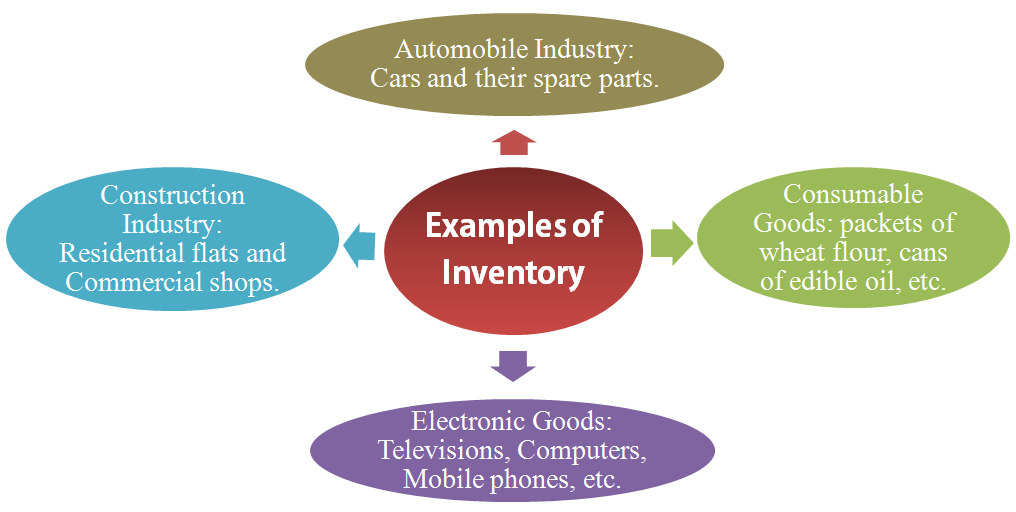
105 inventory levels of different SKU. Different methods or techniques use or recommend different parameters. Suitability of different inventory control methods varies from situation to situation and SKU to SKU. Further, in case of inventory control techniques, a typical manufacturing organization or a distributor deals with hundreds or sometimes even thousands of SKU s. Each SKU cannot be treated at par with others. Some SKUs need special attention whereas other SKUs do not need detailed and regular watching. Inventory control techniques provide the platform for classification of SKUs on certain parameters. Each technique looks at an inventory from a different parameter or perspective and which technique to apply for inventory control will depend on the situation and management s requirements or priorities. Inventory functionality: Irrespective of its location in the supply chain, product inventory essentially serves the following functions: Balancing supply and demand: The production and consumption cycle never matches. The sudden requirement of a product in large quantities may not be fulfilled immediately as the production cannot be taken up so soon. In such a case, the products are manufactured in advance in anticipation of demand and kept in stock for supply during peak period. Periodic variation: For seasonal products, the demand is at its peak for a certain period while it is lean for the rest of the year. Production runs in the factory are taken based on the average demand for the year. Excess production during the lean period is kept as inventory to take care of the peak demand. In case where raw material for manufacturing food products is available seasonally, the products are manufactured and stocked as inventory to meet the demand of the finished product throughout the year. Scale economies: products are manufactured at focused factories to achieve economies of scale. This is done because of the availability of the latest technology, raw materials and skilled labour. Hence the produce is kept in stock for distribution to consumption centers as and when it is required. Distribution is done in economical lot size for system efficiencies in speed and cost. Warehousing and Intermodal Transport System : 94

106 Mechanics of Inventory Control Inventory is the main culprit in the supply chain and can influence the bottom line of an organization to a great extent. Over the year, experts have suggested various models for controlling inventory. Only a few models have stood the test of market dynamics. However, the result depends on the model you choose for the right application. Selection of the models depends on various factors such as inventory problem (when, where, how much), types of inventory (purchase, process, in transit channel), inventory goals (cost, profit, service), planning environment (technology, organization, product-market), supporting strategies (make to order, make to stock, mass customizing, flexible manufacturing), etc. Inventory control consists of finding answers to three questions 1. Should this item be stocked at all? 2. If so, when to order it? 3. How much to order? Though these are the questions the inventory control tries to answer, more stress is upon the last two questions. This is so because, what to stock is the question of sales forecasting for the target market. No item, not even the cheapest item, should be stocked without careful review. This should be a continuous process as the environment which dictates supply of inventory and the demand environment keep changing continuously. For example, demand for a product can be predictable or uncertain. Customers may be small, medium or big and there may be total uncertainty about whether they will buy from you or someone else. Considering this uncertainty of the environment, quantitative tools must be used to exercise inventory control and answer the above questions When to Order? Under the modern concept, inventory should directly contribute to profitability of the company and should be concerned with such matters as flow, lead times, storage costs, and acquisition costs, material handling equipment, preservation and packaging. Warehousing and Intermodal Transport System : 95
107 General levels of stock should be related to sales and production policies of the firm,in the same way specification is related to technical needs. The various levels of stocks are: 1. Deficiency Level: This means stock in hand is inadequate to meet the needs. Existence of this level indicates actual or potential out-of-stock situation. Orders are placed through a faster alternative source of supply. 2. Exhaust bin level: This is a point popularly known as out of stock. At this point, the storage bin is empty. Emergency measures are taken to stock the bin. 3. Buffer stock or minimum stock level: This is the level at which any further demands upon the bin will necessitate withdrawals from the reserve or buffer stock, especially when demand is immediate and fresh deliveries will take time to arrive. Usually the goods are ordered through normal channels as soon as the inventory reaches this level. 4. Danger warning level: It is the point of no return. After this point, a stock out is inevitable if delay occurs. A computer program can readily include warning levels. The level should be such that if there is a possible delay, the processing should reveal this in time and the manager should take one of the following actions: a. Find an alternative source of supply b. Request sales department to warn their customers of possible delay in supplies. c. Put extra pressure on the supplier ABC Analysis This relates to the annual usage cost of a particular item. A detailed analysis of inventory may indicate that only 10 percent of items generally account for nearly 70 percent of usage value. Another percent of items may account for 20 percent of usage value and the balance percent accounts for the remaining 10 percent of usage value. The items are classified as per the usage value. While items in class A are less in number, they cost approximately percent of the total cost of the inventory. Class B items cost percent of the total inventory cost, whereas class C items are greater in numbers, yet carry less than 10 percent of the cost of entire inventory. In short, this is a financial evaluation for ranking and comparison of inventories. The objective of the classification is to know which item should receive the most attention, an item in class A should have your perpetual attention, while class C item may be reviewed with less periodicity than class B items. This technique of inventory control is also known as Always Better Control technique. ABC analysis is an analytical method of control which aims at concentrating efforts on those areas where attention is needed most. This is a principle of selective control. The emphasis of ABC analysis technique is that the management should concentrate its energy in controlling those items that mostly affect the organizational objects. Manufacturing concerns find it useful to group the materials into three classes on the basis of investment involved. Warehousing and Intermodal Transport System : 96
108 Materials having higher values but constitute small percentage of total items, are grouped in 'A' category. On the other hand, a large percentage of items of materials which represent a smaller percentage of the values, are grouped in 'C' category. Items of materials having moderate value 'and moderate size are grouped in 'B' category. After the items of materials are classified into A, B and C category, control can be exercised in a selective manner as follows: (i) Greater care and strict control should be exercised on the items of category 'A' as any loss or breakage or wastage of any item of this category many prove to be very costly. Economic order quantity and re-order level should be carefully fixed for such category of items. (ii) Moderate and relaxed control is required for the items of category 'B'. (iii) There is not much need for exercising control over the items of category 'C' Periodic or annual verification is required for this category of materials. Advantages of ABC Analysis: The advantages of ABC analysis are given below:' Close and strict control of costly items is ensured. Investment in inventory can be regulated and funds can be utilized in the, best possible way. Economy is achieved in respect of stock carrying cost. It helps to keep enough safely stock for 'C' category items. Clerical cost can be reduced and inventory is maintained at optimum level. Scientific and selective control helps in maintenance of high stock turnover rate. Therefore, the ABC inventory classification method is used to categorized inventory into groups based upon certain activity characteristics. It is the process of classification of products as per the level of importance in terms of their relative criteria such as purchase or sales volume. Further, classification is used to develop inventory planning policies, set count frequencies for cycle counting, slot inventory for optimized order picking and other inventory management activities How much to Order? This is a concept which tries to balance inventory and ordering cost. Practically, the two costs have inverse relationship.if the order quantity is larger, the order cost will be low but the inventory carrying cost will be high. The point at which the two costs are at minimum is the optimum point. Every company should try to order this much quantity Economic order Quantity (EOQ) Analysis: Economic order quantity (EOQ) is the most useful techniques for determining how much to order? This method aims at determining the right quantity so as to ensure that the sum total of the two costs, i.e. carrying cost and procurement cost are at the minimum point possible. The result of this effort is the purchase of right quantity.eoq is that quantity at which the cost of procuring the annual requirements of an item and the inventory carrying cost are equal, i.e. the total of the two costs is minimum. Warehousing and Intermodal Transport System : 97
109 The economic order-quantity model considers the tradeoff between ordering cost and storage cost in choosing the quantity to use in replenishing item inventories. A larger order- holding a quantity reduces ordering frequency, and, hence ordering cost/month, but requires larger average inventory, which increases storage (holding) cost/month. On the other hand, a smaller order-quantity reduces average inventory but requires more frequent ordering and higher ordering cost/month. The cost- minimizing order-quantity is called the Economic Order Quantity (EOQ). The economic order quantity (EOQ) is the order quantity that minimizes total holding and ordering costs for the year. Even if all the assumptions don t hold exactly, the EOQ gives us a good indication of whether or not current order quantities are reasonable. Further, as the name suggests, Economic order quantity (EOQ) model is the method that provides the company with an order quantity. This order quantity figure is where the record holding costs and ordering costs are minimized. By using this model, the companies can minimize the costs associated with the ordering and inventory holding. In 1913, Ford W. Harris developed this formula whereas R. H. Wilson is given credit for the application and in-depth analysis on this model. Thus, the economic orderr quantity (EOQ) is a model that is used to calculate the optimal quantity that can be purchased or produced to minimize the cost of both the carrying inventory and the processing of purchase orders or production set-ups. Following is the formula for the economic order quantity (EOQ) model: Where Q = optimal order quantity D = units of annual demand S = cost incurred to place a single order or setup H = carrying cost per unit This formula is derived from the following cost function: Total cost = purchase cost + ordering cost + holding cost Limitations of the economicc order quantity model: It is necessary for the application of EOQ order that the demands remain constant throughout the year. It is also necessary that the inventory be delivered in full when the inventory levels reach zero. Following are the underlying assumptions for the EOQ model. Without these assumptions, the EOQ model cannot work to its optimal potential. The cost of the ordering remains constant. The demand rate for the year is known and evenly spread throughout the year. The lead time is not fluctuating (lead time is the latency time it takes a process to initiate and complete). No cash or settlement discounts are available, and the purchase price is constant for every item. The optimal plan is calculated for only one product. There is no delay in the replenishment of the stock, and the order is delivered in the quantity that was demanded, i.e. in whole batch. These underlying assumptions are the key to the economic order quantity model, and these assumptions help the companies to understand the shortcomings they are incurring in the application of this model (Of course, these assumptions don t always hold, but the model is pretty robust in practice) VED Analysis This relates to Vital, Essential and Desirable status of the inventory items. As the term implies, certain parts and items are considered to be vital for meeting operational requirements Warehousing and Intermodal Transport System : 98
110 and this aspect is taken into consideration while making the forecast. The modified version of this is ABC-VED analysis that takes into consideration both value and the criticality of the item. High value and critical items are under continuous review and ordered in low quantities, while lowvalue, least critical are periodically reviewed and ordered in large quantities with lower safety stock requirement SAP Analysis Scarce, Available and Plenty status of inventory item is used for planning and forecasting of inventory requirement. The ordered quantity is governed by scarcity factor. The limitation in supply or obsolescence of an item in the near future will be the guideline for procurement policy decision Material Requirements Planning (MRP) The Material Requirements Planning (MRP) concept was developed in the 1970s following the introduction of high speed computers. MRP system does the work of materials manager to control inventory of items to lean the supply chain. The forecast of inventory items is controlled by the production item on which their demand is depend. MRP is typically applied to manage inbound material movement in the enterprise and is based on production requirements and scheduling. Further, MRP is suitable for both push and pull types of supply chain systems. In a push system, information is required in the form of elaborate material requirement planning for a master production schedule which is further used for creating schedules for suppliers for inventory part/ components types, quantities and delivery dates. In the pull system, information is required on actual demand, which needs to be transmitted extremely quickly throughout the entire supply chain so that production and distribution of parts or products can accurately reflect the real demand Manufacturing Resource Planning (MRP II) MRP II is defined as a method for the effective planning of all resources of a manufacturing company. It started out as MRP (Material Requirement Planning) and was concerned with ordering and scheduling materials based on inventory. The large-scale introduction of computers led to extensions into a closed-loop MRP II system concerned with the whole manufacturing environment. MRP II works on push where a forecast is generated, a manufacturing plan is derived and the plan then drives the manufacturing process via work orders or the purchasing process via purchase orders. While MRP allows for the coordination of raw materials purchasing, MRP II facilitates the development of a detailed production schedule that accounts for machine and labour capacity, scheduling production runs according to the arrival of materials. An MRP II output is a final labour and machine schedule. MRP II system provides data on the cost of production, machine time, labour time and materials consumed and the final output to accounting and finance. In short, MRP II is a long-term planning tool for complex products. It can give an accurate completion date at the time of order. The system fits in with conventional accounting and the progress of manufactures and inventory sizes which are available at all times. It tightly Warehousing and Intermodal Transport System : 99
111 controls work orders and change therein. However, in MRP II it is necessary to maintain an accurate database. MRP II is a computer-based system, inflexible and relies on forecast Distribution Requirement Planning (DRP) Distribution Requirement Planning (DRP) is one of the latest IT tools for controlling inventory in the distribution system of an organization. It is a logical extension of MRP. DRP is guided by customers demand whereas MRP is based on production requirement. DRP allocates inventory from the mother warehouse to the various distribution centers based on demand pattern, safety stock provision, order quantity, reorder point, average performance cycle length, etc. Further, DRP also coordinates finished goods requirements across the distribution network. DRP system success is dependent on the accuracy of the forecast with respect to location and time of the requirement across the distribution centers. Consistency performance cycle for timely movement of goods across the system is a must for system effectiveness. Uncertainty in performance cycle may defeat the very purpose of the DRP system. The major benefits of using DRP are: Improvements in customer service level. Decrease in inventory level resulting in a decrease in carrying cost. Effective marketing efforts for high value stock items. Decrease in inventory reduces warehouse space requirements. Helps in effective simulations of transportation and inventory requirements for shipment coordination that result in reduction of inventory-carrying and transportation costs Just in Time Systems (JIT) Just-in-Time (JIT) is a concept based on the fact that an activity should not take place until there is need for it. Hence an inventory item should not be brought into the system until it is required for making the final product. JIT is characterized by maintaining zero inventories of raw materials and assemblies at the assembly plant. Therefore, the JIT system involves the close coordination of the buyers and the suppliers on a real time basis. This means frequent receipts of materials from suppliers. The following are pre-requisites to a successful JIT system: Buyer-seller partnership. Online communication and information sharing. Commitment to zero defects from both sides. Frequent and small lot size shipments. Therefore, in case of JIT, it is assumed that: JIT focuses on minimizing the holding costs of stock. Idea is that stocks are brought into the production process at the time they areneeded. Effectively it is an attempt to operate production with minimal / zero buffer stocks. With JIT systems, production and purchasing are closely linked to sales demandon a week to week basis. Continuous flow of raw materials into stock. When work in progress is completed, it goes straight to the customer. Requirements for JIT Systems Flexibility Suppliers and internal workforce need to be able to expand and contract outputat short notice Need to be able to deliver supplies quickly and reliably Warehousing and Intermodal Transport System : 100
112 High quality Raw materials must be of guaranteed quality Whole production process must focus on quality There are no/minimal buffer stocks should a batch of raw materials from a particular supplier prove faulty, or if they are damaged during the production process. Close working relationship with suppliers Often geographically close Joint approach to ensuring quality Systems need to be able to share information (e.g. sales data, purchase requirements, delivery times) Potential Benefits of JIT Lower levels of cash tied up in stocks (i.e. lower Working capital) Reduction in stock holding costs Reduced manufacturing lead times Improved labour productivity Reduced scrap and warranty costs Price reductions on purchased materials Reduced time and cost of purchasing /accounting. Pitfalls / Problems with JIT Not suitable for many industries / organizations Higher risk of stock outs E.g. critical medical supplies Lots of potential problems for suppliers Break in supply causes immediate problem for supplier to solve May require new systems Potential loss of reputation if supplier responsible for stopping whole ofcustomer s production Two Bin Systems (Clerical Method of Inventory Control) In this system, two bins are maintained by the companies which have different levels. When the first bin is exhausted, it indicated the time for replenishment. The second bin is like a reserve stock. The concept is similar to the petrol needle of a car. When the needle reaches the red segment of the gauge, the driver knows that the car is operating on reserve stock and it is time to replenish it. In such cases as discussed so far, the formulae have been arrived at only because the forces of demand and supply were assumed to be predictable. It is fairly simple to determine various stock levels. In actual practice, however, such predictability is not always possible Check Your Progress Questions State whether true or false: 1) Inventory is a fixed asset of an organization. 2) Inventory act as a protective cushion for continuous operation in the customer supply chain 3) A good and efficient inventory planning is not required for logistic management. 4) Good planning and strong forecasting helps logistic firms to reduce their inventory cost. Warehousing and Intermodal Transport System : 101
113 11.4 Summary This unit explains the basic concept and definition of inventory and inventory control with. It tells about the various functionalities of inventory control in brief. This unit explains the mechanics of inventory control i.e. the various tools and techniques used to control an inventory in an organization to achieve the goals of a business firm. We also learned about the importance of planning and forecasting about inventory via various tools of inventory control and also learned about the advantages/benefits of these techniques in real scenario Glossary Inventory Control: inventory control may be defined as the scientific method of finding out how much stock should be maintained in order to meet the production demands and be able to provide right type of material at right time in the right quantities at the competitive prices. Planning: Planning involves selecting missions and objectives as well as the action to achieve them; it requires decision making, i.e., choosing future courses from among alternatives. Forecasting: It involves the use of knowledge at one point of time, in order to predict the likely behavior of demand at some future time Answers to Check Your Progress 1) False 2) True 3) False 4) True 11.7 Questions for Practice 1) What do you understand by inventory and inventory control? Explain in detail about inventory control. 2) Discuss the various tools of inventory control. 3) How do ABC analysis and EOQ analysis help an organization in reducing inventory costs? 4) Explain the role of planning and forecasting about inventory with reference to the MRP, MRP II, JIT and DRP as tools of inventory control Additional Reading 1. Sople V.V. (2010): Logistics Management: The Supply Chain Imperative, New Delhi, Pearson Education Ltd. 2 nd Edition. 2. Ailwadi and Singh (2013): Logistics Management, New Delhi, PHI Learning Private Ltd. 2 nd Edition. 3. Kulkarni N. (2010): Element of Logistics and Supply Chain Management, Mumbai, VipulPrakashan. 4. Chaubey S. (2011): Logistics Management, New Delhi, Discovery Publishing House Ltd. 5. Bowersox and Closs (2000): Logistical Management, New Delhi, Tata McGraw-Hill Edition. Warehousing and Intermodal Transport System : 102
114 6. MahendraParihar (2011): An Economic Analysis of Trucking Industry in India with Special Reference to The Mumbai Metropolitan Region, Ph.D. Thesis submitted to the University of Mumbai. 7. Cooper et.al. (2011): Supply Chain Logistics Management, New Delhi, Tata McGraw Hill Education Private Limited. 7 th Edition. Warehousing and Intermodal Transport System : 103
115 Unit 12 : Warehousing Costs 12.0 Objectives After going through this unit, we will be able to: Discuss the concept of direct costs and indirect costs. Describe the various types of cost concepts. Explain the different types of warehousing costs. Highlight in brief the importance of efficiency measure and rental of various warehouse structures Introduction In this unit we will learn about the meaning of direct costs and indirect costs along with the various other costs concepts in some detail. We will be taught the various warehousing costs involved in the warehousing activities or operation. The unit will also discuss the issues related to the efficiency/performance measure in the warehousing. Finally, we will be taught about the rentals of various warehouse structures in brief Content Details Costs Concept and Warehousing Costs : An Overview Today, the role of warehousing management is expanding to include light manufacturing, transportation management, order management, complete accounting system, etc. The advancement of warehousing management in today s scenario is very similar to that of many other systems to control movement and storage of materials within a warehouse. Warehousing and Intermodal Transport System : 104
116 Further, every manufacturing organization requires warehousing. In case of manufacturing activity, warehousing is required to maintain sufficient stock of materials so that manufacturing process will run continuously. Such types of warehouses are called manufacturing support warehouses. In case of physical distribution of finished goods, warehousing is required so that the distribution channel members can be supplied on time to satisfy market demand. Such types of warehouses are called distribution support warehouses. However, warehousing is a part of development of facility structures. A facility structure is a part of logistical infrastructure which supports one or more logisticall functions. Warehousing operations refers to the way a warehouse functions or works to achieve its objectives or strategy. Further, the important components of total logistics cost are transportation cost, warehousing costs, inventory carrying cost and order entry/customer service cost. Empirical studies however, reveal that inventory carrying cost and warehousing costs have higher percentage close to transportation. However, warehousing is nothing more than the management of space and time. The space management part namely storage, has a cost per month, as there is a monthly cost for warehouse space. The time management component includes labour involved in handling materials as they move in and out of the warehouse. All companies with warehouses incur the same elements of cost, but they compile them differently. Some warehousing costs tend to be ignored or misallocated, because the analyst does not recognize where they belong. In any costing system, allocation of overhead costs is a matter of judgment, and no specific formula will be correct for every user. Therefore, in case of Warehouse operations, in every warehouse, there are always some basic operations being executed. The basic warehouse operations are movement and storage. The same separation is done by naming the operations storage system functions that are separated into inventory handling (storage) and materials handling (movement). In the light of this, warehousing can be defined as the storage of goods, which can lead us to assume that storage is what is most important in the field of warehousing. But movement is also a very vital aspect of warehousing and can be divided into four more distinct operations: Receiving goods into the warehouse from the link or transport network Transferring goods into a particular location in the warehouse Warehousing and Intermodal Transport System : 105
117 Selecting particular combinations of goods for customer order or raw materials Loading goods for shipping to the customer or to the production line Moreover, it is generally understood that the economic efficiency of any firm operating in the market is determined by the ability of the firm to minimize its costs and maximize its profits. Therefore there is also a need to understand that cost is a function of Output. As the output of a firm changes, the cost pattern of a firm also undergoes change. Thus, given above discussion, we need to understand the following costs of the firms to know its business operations better Direct Cost Direct costs are those which have direct relationship with a unit of operation like manufacturing a product, organizing a process or an activity etc. In other words, direct costs are those which are directly and definitely identifiable. The nature of the direct costs is related with a particular product/process, they vary with variations in them. Therefore all direct costs are variable in nature. It is also called as "Traceable Costs". However, direct cost is defined as the financial costs that are incurred as the result of purchasing factor services from the market. These are mainly the capital costs, operating costs, factor costs, the wage of labor costs, interest on capital, etc. Whereas, capital costs are the costs applying to the physical assets of warehouse mainly infrastructure, machines and equipments and others. They include the purchase or major enhancement of fixed assets which can often be one time event. Since physical assets depreciate overtime capital investment are required on a regular basis for maintenance. On the other hand, in case of warehouse operating costs, the maintenance cost of warehouse (infrastructure and machines) depreciates i.e. wear and tear of capital is also included in direct cost. The cost on the workers/employees i.e. mainly the labour costs providing the warehousing services is also included in the direct costs Indirect Costs Indirect costs are those which cannot be easily and definitely identifiable in relation to a plant, a product, a process or a department. Like the direct costs indirect costs, do not vary i.e. they may or may not be variable in nature. However, the nature of indirect costs depends upon the costing under consideration. Indirect costs are both the fixed and the variable type as they may or may not vary as a result of the proposed changes in the production process etc. Indirect costs are also called as Non-traceable costs. In other words, these are the costs measured in terms of value of operation time/service time/activity time and the comfort of services with reference to an efficiency of work in warehousing activities. Further, warehousing offers a bundle of costs and level of services. The price of a warehouse service not only includes the direct out-of-thepocket money costs to the user but also the time costs (time involved in warehousing services/activities) and costs related to possible inefficiencies, discomfort and risk (for example: unexpected delays). However, the indirect costs are difficult to measure and hence the focus always is on direct money costs. It should also be mentioned that time costs and costs related to possible inefficiencies are harder to calculate. Warehousing and Intermodal Transport System : 106
118 Fixed Cost Fixed Cost is that cost which does not change (that is either goes up or goes down) irrespective of whether the firm is operating or not. For example on account of Strike and Lockout in Maruti-Suzuki s Manesar plant, the production process came to a stands still. Even then the Firm still had to bear some expenses which are indirect in nature Variable Cost Variable Cost on the Other hand is directly proportional to the production operations. As the size of production at any business grows, the variable expenses also grow. As the name suggests, the variable expenses vary with the business operations. When the firm is not operating on account of Strike/Lockout etc, then the variable cost of the firm is Zero Average Cost It is the cost that is obtained after dividing Total Cost with the number of units produced. Total Cost = Fixed Cost + Variable Cost Average Cost = Total Cost / Units of Good produced Marginal Cost Marginal cost is the change in the Total cost when an additional unit of good is produced. In other words Marginal cost is difference between total Cost of producing N + 1 units of good and N units of good. Marginal Cost = TC (n+1) - TC(n) Opportunity cost The resources of any firm operating in the market are limited and investment options are many. The firm therefore has to decide or select only those investment opportunities/options which provide the firm with the best return or best income on investment. This means that if a firm can invest money/ resources only in one investment option then the firm will select that investment option which promises best return on investment to the firm. In other words while doing so the firm gives up/rejects the next best option for investing the funds. The opportunity cost of a company is thus this income/ return which the firm could have earned on the next best investment alternative Money Cost Money Cost of production is the actual monetary expenditure made by company in the production process. Money cost thus includes all the business expenses which involve outlay of money to support business operations. For example the monetary expenditure on purchase of raw material, payment of wages and salaries, payment of rent and other charges of business etc. can be termed as Money Cost Real Cost Real Cost of production or business operation on the other hand includes all such expenses/costs of business which may or may not involve actual monetary expenditure. For example if owner of a business venture uses his personal land and building for running the business venture and he/she does not charge any rent for the same then such head will not be considered/included while computing the Money Cost but this head will be part of Real Cost computation Accounting Cost Accounting Cost includes all such business expenses that are recorded in the book of accounts of a business firm as acceptable business expenses. Such expenses include expenses like Cost of Raw Material, Wages and Salaries, Various Direct and Indirect business Overheads, Warehousing and Intermodal Transport System : 107
119 Depreciation, Taxes etc. When such business expenses or accounting expenses are deducted from the Sales income of any firm the accounting profit is obtained. Such Accounting/Business expenses or costs are also termed as Explicit Costs. Economic Cost on the other hand includes all the accounting expenses as well as the Opportunity cost of a business firm Private cost The actual expenses of individuals/ firms which are borne or paid out by the individual or a firm can be termed as Private Cost. Thus for a business firm this may include expenses like Cost of Raw Material, Salaries and Wages, Rent, Various Overhead Expenses etc.on the other hand Private Cost for an individual will be his or her private expenses such as expense on food, rent of house, expenses on clothing, expenses on travel, expenses on entertainment etc Social Cost Social Cost on the other hand includes Private Cost and also such costs which are not borne by the firm but by the society at large. For example the cost of damage or disutility caused by the operations of a firm in an economy may not be borne by the firm in question but it impacts the society at large and thus such cost is added to the Private Cost to find the Social Cost of producing the product. Such Cost (that is cost not borne or paid out by the firm) is also known as External Cost. Another example of external cost can be the cost of providing the basic infrastructure facilities like good roads, sewage system or network, street lights etc. Cost of such facilities is not borne by a business firm even though the firm is benefits from such facilities. Such costs (External Costs) are thus added to the Private Cost to find the Social Cost of producing a product or good Actual Cost Actual cost is defined as the cost or expenditure which a firm incurs for producing or acquiring a good or service. The actual costs or expenditures are recorded in the books of accounts of a business unit. Actual costs are also called as "Outlay Costs" or "Absolute Costs" or "Acquisition Costs". Examples: Cost of raw materials, Wage Bill Sunk Cost Sunk costs are those do not alter by varying the nature or level of business activity. Sunk costs are generally not taken into consideration in decision - making as they do not vary with the changes in the future. Sunk costs are a part of the outlay/actual costs. Sunk costs are also called as "Non-Avoidable costs" or "Inescapable costs" Incremental Cost Incremental costs are addition to costs resulting from a change in the nature of level of business activity. As the costs can be avoided by not bringing any variation in the activity in the activity, they are also called as "Avoidable Costs" or "Escapable Costs". More ever incremental costs resulting from a contemplated change is the Future, they are also called as "Differential Costs" Example: Change in distribution channels adding or deleting a product in the product line Explicit Cost Explicit costs are those expenses/expenditures that are actually paid by the firm. These costs are recorded in the books of accounts. Explicit costs are important for calculating the profit and loss accounts and guide in economic decision-making. Explicit costs are also called as "Paid out costs" Example: Interest payment on borrowed funds, rent payment, wages, utility expenses etc Implicit Cost Implicit costs are a part of opportunity cost. They are the theoretical costs ie, they are not recognized by the accounting system and are not recorded in the books of accounts but are very Warehousing and Intermodal Transport System : 108
120 important in certain decisions. They are also called as the earnings of those employed resources which belong to the owner himself. Implicit costs are also called as "Imputed costs". Examples: Rent on idle land, depreciation on dully depreciated property still in use, interest on equity capital etc Book Cost Book costs are those business costs which don't involve any cash payments but a provision is made in the books of accounts in order to include them in the profit and loss account and take tax advantages, like provision for depreciation and for unpaid amount of the interest on the owner s capital Out Of Pocket Costs Out of pocket costs are those costs are expenses which are current payments to the outsiders of the firm. All the explicit costs fall into the category of out of pocket costs. Examples: Rent Paid, wages, salaries, interest etc. However, the elements of warehousing costs normally accounted for are transportation, storage and administration. The warehousing cost includes fixed and variable cost elements. The fixed cost covers rental, capital cost, salary wages of the employees and utilities while the variable cost covers repair and maintenance, material handling, transportation and packaging which are related to the load on the warehouse etc. Further in case of warehouse cost i.e. the costs incurred by the warehouse, while processing the orders obtained from the retailers are categorized into the following: Handling cost: All expenses associated with moving product in or out of the warehouse should be included in the handling cost center. The largest component is the labour used to handle the product that moves through the distribution center. It includes receiving, put-away, order selection, and loading. It also may include labor torewarehouse, repackage, or refurbish damaged product. Handling also includes all costs associated with the equipment used to handle product in the warehouse, such as the depreciation of equipment cost, and the cost of fuel, or electricity to power the equipment. Other handling expenses are the detention of truck or rail cars, operating supplies, and trash disposal. In effect, handling includes all those costs that are associated with goods in motion. Storage cost: Storage expenses are costs associated with goods at rest. These costs would be incurred whether or not any product ever moved. Because storage expenses are related to the cost of occupying a facility, and these costs are normally accumulated each month, storage is expressed as a monthly cost. If an entire building is dedicated to an operation, storage expenses are the total occupancy cost for that facility. Operations administration cost: These expenses are incurred to support the operation of the distribution center. Closing the facility would eliminate these costs. Included are costs for line supervision, clerical effort, information technology, supplies, insurance, and taxes. General administrative expenses: Expenses not incurred for a specific distribution center are included in this category. General management, non-operating staff, and general office expenses are examples. Allocation of such expenses to each warehouse is a judgment call. Picking/retrieval costs: Picking costs refer to the cost of retrieving a pallet, carton or item from its storage location and transporting it to the staging area to be packed and prepared for transportation. During the picking operation the workers receive information regarding the Store Keeping Units (SKUs) and the number of pallets, cartons or items of each SKU that they have to pick. The workers then proceed to the respective storage locations and locate the SKUs that have to be picked. It is worthy to mention that there are certain differential equations of calculus origin that could be used to arrive at unit cost of each activity, however, these are not within the ambit of Warehousing and Intermodal Transport System : 109
121 this research. For instance, with respect to pallet retrieval, only a single pallet can be retrieved for every trip of the forklift. Hence, the retrieval cost for pallets is a multiple of the number of pallets retrieved for the order. However, when cartons and items are retrieved, the pickers move through the storage racks and pick all the cartons or items as they pass by the SKU located in the racks. Therefore, a single trip through the storage racks results in the picking of cartons and items for the entiree order. Hence, the retrieval cost of cartons and items is a linear function of the number of cartons and items in the order and not a direct multiple of them as in the case of pallets. Packing costs: During packaging the workers prepare the cartons and items for transportation. The pallets are generally stored in a form that is easy for them to be transported; the cartons are placed on a pallet and they are stretch wrapped in place before they are placed in their storage location. Therefore, if a pallet is picked for an order, the study involved in its packing is negligible. Cartons that are picked are placed on a pallet and then stretch wrapped into place. Items are placed in a carton and then to make the transporting easier, these cartons are also stretch wrapped into place on a pallet. Typically most of the packing is done in the form of pallets to enable easy loading and unloading of orders. It is assumed that the time taken to pack the carton or the item of any SKU is the same as all the SKUs are of the same shape and size. Loading costs: The loading operation involves placing the packed orders into the vehicles transporting them. Typically the loading is performed using vehicles or conveyors; in general the loading equipment used depends on the unit loads that are being loaded. Since the loading operation is a straightforward operation and different warehouses use different types of equipment, the expressions used to determine the time taken to load a truck is taken as a variable and not as a function of the distance traveled and the speed. Thus, it has been observed that the most warehousing costs, particularly storage and handling can be influenced by improvements in productivity. Improved methods and equipment may enable the operator to increase the number of units moved without increasing labor, resulting in a higher number of units handled per hour. Changes in inventory, storage layout or equipment may enable the operator to expand the number of units stored in the same number of cubic feet of storage space Efficiency/Performance Measures The efficiency measuress logistic system with reference to the warehousing efficiency measures is also known as the performance measures or measurement. Its purpose is to check whether the logistical operations or processes with reference to the warehousing are being performed up to the mark. Every organization sets certain goals and objectives and formulates strategies to achieve the objectives. The purpose of performance/efficiency measurement is to identify areas for improvement in the organization. It identifies processes or activities which need improvements and also attempt to identify the reasons behind poor or below par performance. There are mainly two areas for application of efficiency/performance measures: Warehousing and Intermodal Transport System : 110
122 Assessment of goal achievement and resource development: goal achievement is related with checking whether the goals and objectives formulated earlier have been achieved or not, if not achieved then what are the reasons for the same. This assessment helps in identifying the areas for improvement. Further, resource development is related with checking whether the resources available to the organization e.g. machinery, transportation vehicles, material handling system, information processing system, manpower, capital etc. are developed and utilized to their optimal capacity or not. This helps in identifying idle or under-utilized resources. Assessment of business processes and individual activities: here, the purpose of performance measurement is to evaluate how effectively the business process and individual activities that make up a business process are performed. These measures are classified into activity based measures and process based measures. Further, the efficiency/performance measures are also classified into internal and external measures. Internal performance measurement refers to activities and processes which are internal to the organization and the external performance measurement is related with factors which are external to the organization such as customers and competitors. However, in case of internal performance measurement, organizational processes and activities are evaluated on the basis of goals and objectives. Actual results are compared with benchmarks set earlier to identify areas of improvement. Some common measures of internal performance measurement are: Time: Objective of this measure is to review time efficiency of the organization. For example response time (time taken to respond to customers queries), shipment time (time taken to deliver shipment to customer), order processing time (time taken to process customer orders) etc. Cost: Objective is to measure cost efficiency of the organization, For example production cost per unit, transportation cost per unit load, total cost as a percentage Warehousing and Intermodal Transport System : 111
123 of sales, inventory carrying cost as a percentage of average inventory turnover etc. Customer service: Objective is to measure level of customer service achieved in practice. For example fill rate at warehouses and distribution centers, stock out frequencies for different stock keeping units at distribution centers, consistency in delivery time etc. Asset management: it refers to utilization of assets of the organization by various departments. Every organization invests in assets such as plant and machinery, transportation vehicles, material handling systems, information processing systems, warehouse, material storage facilities etc Check Your Progress Questions State whether true or false: 1) Warehousing does not include costs. 2) A good and efficient cost management reduced loss for an organization. 3) Efficiency measures are not necessary for warehousing operation. 4) Average cost is always less than total cost of a business operation Summary This unit explains the basic concepts of costs in general and warehousing costs in particular with reference to the warehouse management. It tells about the various costs and its cumulative effects for an organization, especially with respect to the warehousing operations. This unit explains about the efficiency or performance measurement with reference to the various activities involved in warehousing operations as well as logistical system as a whole. We also learned about the importance of keeping the costs of business operations minimum for profit maximization as well as for the overall health of an organization Glossary Money cost: Money cost of production is the actual monetary expenditure made by company in the production process. Money cost thus includes all the business expenses which involve outlay of money to support business operations. Fixed Cost: Fixed Cost is that cost which does not change (that is either goes up or goes down) irrespective of whether the firm is operating or not. Variable cost: Variable cost is the cost that is directly proportional to the production operations. As the size of production at any business grows, along with that grow the variable expenses. As the name suggests, the variable expenses vary with the business operations. When the firm is not operating on account of Strike/Lockout etc, then the variable cost of the firm is Zero Marginal cost: Marginal cost is the change in the Total cost when an additional unit of good is produced. In other words Marginal Cost is difference between total Cost of producing N + 1 units of good and N units of good Answers to Check Your Progress 1) False 2) True Warehousing and Intermodal Transport System : 112
124 3) False 4) True 12.7 Questions for Practice 1) What do you understand by cost? Explain various warehousing cost concepts. 2) Discuss the differences between direct cost and indirect cost in detail. 3) How does proper cost management increase efficiency of a firm? Give comments. 4) Explain the efficiency measures with respect to the performance of warehousing in detail with appropriate examples Additional Reading 1. Sople V.V. (2010): Logistics Management: The Supply Chain Imperative, New Delhi, Pearson Education Ltd. 2 nd Edition. 2. Ailwadi and Singh (2013): Logistics Management, New Delhi, PHI Learning Private Ltd. 2 nd Edition. 3. Kulkarni N. (2010): Element of Logistics and Supply Chain Management, Mumbai, VipulPrakashan. 4. Chaubey S. (2011): Logistics Management, New Delhi, Discovery Publishing House Ltd. 5. Bowersox and Closs (2000): Logistical Management, New Delhi, Tata McGraw-Hill Edition. 6. MahendraParihar (2011): An Economic Analysis of Trucking Industry in India with Special Reference to The Mumbai Metropolitan Region, Ph.D. Thesis submitted to the University of Mumbai. 7. Cooper et.al. (2011): Supply Chain Logistics Management, New Delhi, Tata McGraw Hill Education Private Limited. 7 th Edition. 8. PWC (2011): Building Warehousing Competitiveness, Price Waterhouse Cooper, India, TN (2004): Purchasing and Supply Services-Service Level Agreements, Heriot Watt University, Report-5, May Khole and Christensen (2010): Planning in Logistics: A Survey, Georgia Institute of Technology, USA, OSHA (2002): Material Handling and Storing, Occupational Safety and Health Administration, U.S. Department of Labor, OSHA 2236, Revised Mahajan et.al. (2013): Analysis of Indian Warehousing Sector and Warehouse Optimization and Modernization Techniques, Department of Mechanical and Automobile Engineering, Sharda University, U.P. (India), Volume 2, Issue 5, Marc Wulfraat (2003): Warehouse Management System Cost Justification, KOM International White Paper Series, February Thomas W. Speh (2009): Understanding Warehouse Costs and Risks, Ackerman Warehousing Forum, Volume 24, Number 7, Cloumbus,Ohio-43221, June Warehousing and Intermodal Transport System : 113
125 Unit 13 : Customer Service- Definition and Measures 13.0 Objectives After going through this unit, we will be able to: Discuss the meaning and definition of customer service in some detail. Discuss the role of warehouse in customer service in logistical system. Explain the different level of customer service. Highlight in brief about different service level agreements Introduction In this unit we will learn about the meaning and definition of customer service in some detail. We will be taught that how the warehouse is important from the customer service perspective in order to fulfill the customer requirements on right time. The unit will also discuss about the role of warehouse in customer service in the logistical system. Finally, we will be taught about the different service agreements and different levels of services Content Details Role of Warehouse in Customer Service In a supply chain, warehousing function is very critical as it acts as a node in linking the material flows between the supplier and customer. In today s competitive market environment, companies are continuously forced to improve their warehousing operations. Many companies have also customized their value proposition to increase their customer service levels, which has led to changes in the role of warehouses. Thus, customer service is the sum total of activities designed to meet customer expectations and enhance the level of customer satisfaction. Customer service forms part of an overall approach to systematic improvement in an organization to maximize income and revenue. Warehousing and Intermodal Transport System : 114
126 Further, the ultimate goal of integrated logistics is to deliver the product or service to customer i.e. right product at the right time in the right place. The final goal of all business operations should be to achieve profitability through customer satisfaction. It is not necessary that the customer is always the final consumer. It may be another company or a distribution channel member also. The customer satisfaction can be achieved if the organization is able to deliver its product or service to the customer at a place and time convenient to the customer at a price customer feels is fair and make whole transaction hassle free for the customer. Now, with respect to the role of warehouse in customer service it has been observed that the warehouse plays a very important role in customer service through the various functions performed by it. Warehousing and Intermodal Transport System : 115
127 However, in case of warehouses it is known today that the need for storage arises both for raw material as well as finished products in any organization. Storage involves proper arrangement for preserving goods from the time of their production or purchase till the actual use. When this storage is done on a large scale and in a specified manner it is called warehousing. The place where goods are kept is called warehouse. The person in-charge of warehouse is called warehouse-keeper. Further, warehousing refers to the activities involving storage of goods on a large-scale in a systematic and orderly manner and making them available conveniently when needed. In other words, warehousing means holding or preserving goods in huge quantities from the time of their purchase or production till their actual use or sale. Warehousing is one of the important auxiliaries to trade. It creates time utility by bridging the time gap between production and consumption of goods. Across the supply chains, warehousing is an important element of activity in the distribution of goods, from raw materials and work in progress through to finished products.it is integral part to the supply chain network within which it operates and as such its roles and objectives should synchronize with the objectives of the supply chain. Warehousing is costly in terms of human resources and of the facilities and equipments required, and its performance will affect directly on overall supply chain performance. Inadequate design or managing of warehouse systems will jeopardize the achievement of required customer service levels and the maintenance of stock integrity, and result in unnecessarily high costs. The recent trends and pressures on supply chain / logistics-forever increasing customer service levels, inventory optimization, time compression and cost minimization have inevitably changed the structure of supply chains and the location and working of warehouses within the supply chains network. Further, logistics is a service function and has a large share in an organization s success by delivering the product at the right place and the right time. In logistics the customer is place where the goods or services are delivered. Logistics helps in creating time and place utility of the product that satisfies the customer s need which has both time and place as dimensions. In today s competitive market, the competitiveness of a firm is judged by how efficiently and effectively it manages the time and place dimensions of customer service to avail of the opportunity and create new opportunities for repeat sales to the same customers by delivering superior service. Hence, logistics competency (with reference to warehousing activities and warehousing aspects such as its location, type, design and layout, costs, management, etc.) is critical to customer service planning and needs to be developed as a core competency for suitable competitive advantage not only for growth but also for survival. However, the primary value of logistics (warehouse) is to accommodate customer s requirements in a cost effective manner. Therefore, it is clear that outstanding customer service adds value throughout the supply chain Definition of Customer Service Customer service is a measure of the effectiveness of a logistics system in creating time and place utilities of the product. In logistics, customer service is more than just the transportation of a shipment from point A to point B. it is about providing customers with information, options and expertise to help them make the right decisions. It is about helping the suppliers to understand the trends and dynamics in the markets that can impact the business. It is about working with the customer to deliver the best possible value for his/her money. Warehousing and Intermodal Transport System : 116
128 Customer service is a set of activities and programs designed and implemented by a business firm to make the buying experience more rewarding. These activities enhance the value of a product or service the customer gets from the seller. Customer service is the most important dimension of product/service offering to the customer. Value-added customer service is leveraged to gain competitive advantage. Good customer service builds customer loyalty among the existing customers and generates positive word-of-mouth communication, which attracts new customers. In other words, customer service is the base for all customer relationship management (CRM) programs that many leading firms are implementing. Further, customers base their evaluation of a service on their perceptions. These perceptions are affected by the actual service provided by the firm and the high degree of intangibility, which is sometimes very hard to evaluate accurately. Firms that are able to map these gaps accurately and try to bridge them with value-added service can succeed in enhancing the customer satisfaction level and remain competitive. The following are the few actions affecting customer perception of service quality: Competence: the information provided by the firm through product brochures, manuals, websites, sales talk about the product and the service offering of the firm. Reliability: delivery of the product or services as promised in terms of place, time and quality. Responsiveness: returning customer calls, s, faxes, letters and so forth on time and resolving customer problems or complaints with speed. Transaction security: the confidentiality of customer information and transaction. Trustworthiness: built through evolving policies on product return, warranty and guarantee and honoring commitments. Access: this refers to the ease with which the customer will have access to information on products and services before placing an order, status of the order placed and status of the product complaints, claims and damages in the post-sales phase. These actions on customer perception of service quality stimulate satisfactory or unsatisfactory evaluations of the firm s services. Hence, the firms need to bridge service gap (between perception and reality) to improve customer satisfaction with their services. These gaps may arise due to the followings: Communication: the actual service provided may be different from what is communicated through a promotional or advertising campaign. Standards adopted: the service standards adopted may differ from the customer s expectations. Service delivery: the service provided may be different from the service standards of the firm. Customer knowledge: the firm may fail to understand the customer s perception of the service standard. However, there are various definitions of customer service. Some definition treat customer service as a set of activities that need to be managed properly such as order processing, customer delivery, invoicing, after sales services, etc. Some definitions deal with performance measurement such as how often the customer orders are satisfied in a given span of time. Some definitions treat customer service as an integral part of corporate mission statement. But we can say that the customer service is the sum of all necessary activities that need to be performed to give the customer an experience of satisfaction after he interacts with the organization or its representative Seven (7) R Principles The seven R rule is a simple description of how integrated logistics creates customer service. Seven guidelines are identified which need to be followed to achieve perfection in customer service: Warehousing and Intermodal Transport System : 117
129 1. Right Product: it means the product should be designed in such a way that it is able to satisfy the customer needs and wants. 2. Right quantity: it means having the right stock level at the distribution centre or at the retail outlets which meets the demand level. Right quantity helps in avoiding stock outs. 3. Right condition: it means the packaging and material handling should be done in such a way that the product is not damaged during movement inside the warehouse during loading and unloading and during transportation. 4. Right place: it refers to the point of sale. It should be convenient and easily accessible for the customer. 5. Right time: it refers to the deadline specified for delivering the product. There should not be any delay. 6. Right customer: it refers to market segmentation. The marketer should focus on those market segments which are profitable, accessible and easily serviceable. 7. Right cost: it means the final price of the product should be such that it is profitable to the marketer and at the same time the customer should feel that he is not paying too much. It means value for money for the customer. Hence, the order which is executed in such a way that all seven R s are satisfied is known as perfect order. It is an ideal situation in customer service. However, it may not be possible for the organization to achieve perfect order each and every time but it can be a goal for the organization Levels of Customer Service Customer service is the measure of how logistics is creating the time and place utility for a product. The meaning of customer service varies with the organization, the product it is marketing and the transaction phase it is undergoing. The buyer looks at value for money he is spending, while the seller, in delivering superior customer service, looks for trade-off between cost and customer satisfaction. Hence, customer service depends on the phase of the transaction it is passing through. There are three phases associated with the exchange process. The degree of importance of each phase varies with the organization and depends on the product and the customer requirement. Thus, it is said that the customer service process consists of several sub processes and activities which can be divided into the following: Pre-transaction level: as the name suggest, these include processes or activities which are performed before the transaction occurs between the organization and the customer. Hence, these are related more with planning and strategy formulation. This level includes: Written customer service policy: formulation of customer service policy, communicating the policy internally (within the organization) and externally (to the distribution channel members and suppliers) including quantitative standards (i.e. benchmarking) in the policy document wherever possible. Quantitative standards such as attending customer complaints within 24 hours help in evaluation of performance. Accessibility: it means to make it easy for the customer to reach us providing contact points such as toll free numbers, id, physical service center, grievance forums etc. Warehousing and Intermodal Transport System : 118
130 Organization structure: putting proper structure in place and fixing the responsibilities for delivering service. It includes formulation of standardized procedures for implementing the service policy. System flexibility: the market condition and consumer behavior are dynamic in nature. Hence, the organization s systems should be able to respond to the changes taking place in the market. Transaction level: These are the activities that need to be performed during the actual transaction. This level includes: Order cycle time: it is the average time taken to fulfill the order. In other words, the total time that elapses (i.e. passing of the period of time) between receiving the order and fulfilling the order. There should be a consistency in order cycle time. Inventory availability: it represent the availability of inventory at the time of receiving the order. What percentage of inventory is available and how much need to be ordered from warehouse. Order fill rate: it represents the percentage of orders (out of all orders) which are fully satisfied within the standardized and pre-decided lead time. Order status information: it represents the flow of information in the system. Is the organization able to respond to customer queries regarding order status and how long it takes to respond? Can the organization provide timely and accurate information regarding the order status to the customer? Post-transaction level: This is the level where the processes or activities need to be performed after the transaction has been done. This level includes: Installation, warranty, repairs, spares, etc: this includes product installation, giving a demo of the product, customer training for product usage, settling warranty issues, providing spares to customers, etc. Call out time: it is the time required to respond to a customer complaint in case of product breakdown or malfunction. Customer claims, complaints, returns, etc: this includes handling customer complaints, providing information to customer queries, settling issues related with defective or broken down products, handling return of goods, etc. Product tracing: this refers to the organization s ability to trace product sold in the past and if necessary to provide extended warranty to old customers Value Added Logistical Services The purpose of providing services is to deliver value to the customer for the money he is spending in acquiring a product. To add value to tangible products, the intangibles such as after sales-service are provided to the customer. Similarly, for adding value to intangible products, the help of tangibles is taken. For example, the ambience in a star hotel is supported by the presence of tangibles that speak of the quality of service being delivered. For the business to get going, minimum basic customer service is necessary. Basic customer service means treating all customers equally and extending the services the service to build fundamental business relationships. It is the bare minimum service activity for survival of the business. For example, the supply of spare parts for trouble-free operation of machinery is the basic service capability the machinery supplier should exhibit if his product is to be considered for purchase and building further relationship with the buyer. Typically, value-added logistical services extended by logistical service providers are as follows: Customized transportation (vehicles, perishables). Payment collection on delivery. Price marking and labeling. Product mixing and packaging (for co-promotional scheme of two products from two different companies). Warehousing and Intermodal Transport System : 119
131 Cross-docking (product storage not more than 48 hours in warehouse). Inventory management. Web-based consignment tracking and tracing. Frequent deliveries in small lots. Reverse logistics. Thus, value-added services may be categorized into customer-focused services i.e. customized services for the customer s specific requirement of the product or shipments. The other value-added services are the time-focused ones, such as inventory on demand for the manufacturing assembly line which may involve implementation of Just-in-time (JIT) system to lower inventory related costs. The evaluation of value-added service is an outcome of forced innovation for differentiated offerings for survival and growth in competitive markets Service Level Agreements Service Level Agreements are legal documents, usually separate from but complimentary to, a signed contract document, which governs the delivery of services between a service provider and his client, during the term of their relationship. An SLA will: Specify the Services to be delivered (and also what is excluded). Include the terms and conditions under which the Services will be delivered. Describe how the performance of the service provider will be measured - metrics and standards. Provide a legal structure for relationship management between service provider and client, including contract monitoring; dispute resolution; remedies for breach; penalties for sub-standard, late or non-delivery; contract change and termination. Specify the remuneration for core services and expenses incurred and a means of calculating the cost of additional (non-core) services. Specify any assets or resources provided to or transferred to the service provider. Warehousing and Intermodal Transport System : 120
132 It is important however, to appreciate that SLAs detail the acceptable level of service achievable within the economic and logistical constraints of the provider/customer relationship. For SLAs to be effective, the levels of expected performance have to be realistically set: too low agreed service levels result in inefficient levels of support; too high agreed service levels result in contract frustration, and adversarial relationships. SLA s serve several purposes. The actual drafting of the document makes the service provider consider what can be sustainably provided with the available resources, and what the cost of providing the client s services will be. This enables accurate budgeting for both parties, and assists in activity based costing exercises. Wellconstructed Service Level Agreements enable the effective management and monitoring of the developing service relationships, both internally and externally. The measurement of key performance indicators can be vital and is only possible through a well though-out and carefully constructed SLA. If an SLA does not clearly stipulate what each party is looking to get out of the relationship, it can be very difficult for benefits to be realized and the chances of a relationship failing are increased. It may also lead to inconsistent pricing of services, lack of definition of when work will be completed, lack of control over when overtime staff costs are incurred, etc. Further, with reference to the Policy Statement, the Service Level Agreements should be used whenever a service which affects the client s business delivery is outsourced for a medium to long-term period, resulting in a service provider-client relationship that needs to be formally managed. Notwithstanding that, it should be emphasized that adopting SLAs for services provided should be considered on a case by case basis, and that when SLAs are introduced they are not overly prescriptive and have a negative effect on the service provision. As with any agreement, an SLA needs to be policed, and the costs of introducing an SLA and subsequent monitoring must not outweigh the benefits of introducing the SLA Check Your Progress Questions State whether true or false: 1) There is no need customer service in today s business arena. 2) A good and efficient customer service system of an organization results into more sales. 3) Information technology has no role to play in customer service. 4) Service level agreements are an important concept in customer service management Summary This unit defines customer service and explains its role for an organization in some detail. It tells about the role of warehouse in providing good customer service to the customer by an organization with respect to the availability and delivery of goods on the right time and quantity. This unit also explains about the various actions affecting the customer s perceptions of service quality with reference to the customer service of a firm. We also learned about the importance of value added logistical services along with the seven R s of customer service as well as various levels of customer service and service level agreements Glossary Reverse logistics: Reverse logistics stands for all operations related to the reuse of products and materials. It is "the process of planning, implementing, and controlling the efficient, cost effective flow of raw materials, in-process inventory, finished goods and related information from the point of consumption to the point of origin for the purpose of recapturing value or proper disposal. Warehousing and Intermodal Transport System : 121
133 Post-transaction level: This is the level where the processes or activities need to be performed after the transaction has been done. Warehousing: Warehousing refers to the activities involving storage of goods on a largescale in a systematic and orderly manner and making them available conveniently when needed 13.6 Answers to Check Your Progress 1) False 2) True 3) False 4) True 13.7 Questions for Practice 1) What do you understand by customer service? Explain in detail about role of warehouse in customer service. 2) Discuss the various levels of customer services in detail. 3) How does service level agreement affect the customer service? Give comments. 4) Describe the concept of value-added service and factors affecting customer s perception of service quality in brief Additional Reading 1. Sople V.V. (2010): Logistics Management: The Supply Chain Imperative, New Delhi, Pearson Education Ltd. 2 nd Edition. 2. Ailwadi and Singh (2013): Logistics Management, New Delhi, PHI Learning Private Ltd. 2nd Edition. 3. Kulkarni N. (2010): Element of Logistics and Supply Chain Management, Mumbai, VipulPrakashan. 4. Chaubey S. (2011): Logistics Management, New Delhi, Discovery Publishing House Ltd. 5. Bowersox and Closs (2000): Logistical Management, New Delhi, Tata McGraw-Hill Edition. 6. MahendraParihar (2011): An Economic Analysis of Trucking Industry in India with Special Reference to The Mumbai Metropolitan Region, Ph.D. Thesis submitted to the University of Mumbai. 7. Cooper et.al. (2011): Supply Chain Logistics Management, New Delhi, Tata McGraw Hill Education Private Limited. 7 th Edition. 8. PWC (2011): Building Warehousing Competitiveness, Price Waterhouse Cooper, India, TN (2004): Purchasing and Supply Services-Service Level Agreements, Heriot Watt University, Report-5, May Khole and Christensen (2010): Planning in Logistics: A Survey, Georgia Institute of Technology, USA, OSHA (2002): Material Handling and Storing, Occupational Safety and Health Administration, U.S. Department of Labor, OSHA 2236, Revised Mahajan et.al. (2013): Analysis of Indian Warehousing Sector and Warehouse Optimization and Modernization Techniques, Department of Mechanical and Automobile Engineering, Sharda University, U.P. (India), Volume 2, Issue 5, Warehousing and Intermodal Transport System : 122
134 13. Marc Wulfraat (2003): Warehouse Management System Cost Justification, KOM International White Paper Series, February Thomas W. Speh (2009): Understanding Warehouse Costs and Risks, Ackerman Warehousing Forum, Volume 24, Number 7, Cloumbus,Ohio-43221, June Deloitte (2012): Intermodal and Multimodal Logistics, Knowledge Paper, Deloitte, India, Crainic and Bektas (2007): A Brief Overview of Intermodal Transportation, Interuniversity Research Centre on Enterprise, Networks, Logistics and transportation, University de Montreal, Canada, GOI (2011): Report of Working Group on Warehousing Development and Regulation for the Twelfth Plan Period, Planning Commission, New Delhi, Warehousing and Intermodal Transport System : 123
135 Unit 14 : Warehouse Safety 14.0 Objectives After going through this unit, we will be able to: Discuss the concept of warehouse safety. Describe the various issues such as PPEs of safety. Discuss about safety with respect to working at heights, electrical safety and firefighting safety. Highlight in brief the importance of first aid post and vehicular accident while reversing in a warehouse Introduction Accident prevention is a concern of warehouse management. A comprehensive safety program requires constant examination of work procedures and equipments to locate and take corrective action to eliminate unsafe conditions before accidents result. Accidents occur when workers become careless or are exposed to mechanical or physical hazards. For example, the floors of a warehouse may cause accidents if not properly cleaned. During normal operation, rubber and glass deposits collect on aisles and, from time to time, broken cases will result in product leakage onto the floor. Proper cleaning procedures can reduce the accident risk of such hazards. In this unit we will learn about the meaning of safety in some detail. We will be taught the various safety measures related to many things and its effect if neglected safety. The unit will also discuss the issues related to safety about working at heights, PPEs, electrical safety, fire-fighting safety etc in warehouse. Finally, we will be taught about the first aid post and vehicular accidents while reversing in a warehouse Content Details PPEs (Personal Protective Equipments): PPEs in a Warehouse The primary methods for preventing employee exposure to hazardous materials and other materials or things during material handling at warehouse are engineering and administrative controls. Where these control methods are not appropriate or sufficient to control the hazard, personal protective equipment (PPE) is required. Thus, a work area assessment is required to determine the potential hazards and select the appropriate PPE for adequate protection. Employees in the warehouse in particular and also at other place in general must receive training which includes the proper PPE for their job, when this PPE must be worn, how to wear, adjust, maintain, and discard this equipment, and the limitations of the PPE. All training must be documented. As mentioned, if the risk from an activity at work cannot be completely eliminated, as a last resort Personal Protective Equipment or PPE as it is also known should be provided to workers. PPE is designed to prevent, or at the very least, minimize any injuries suffered in an accident. Common PPE required by Warehouse Workers includes hard hats, protective boots, Warehousing and Intermodal Transport System : 124
136 gloves, high-vis jackets and overalls. Further, personal protective equipment, or PPE, is often only associated with manufacturing environments. But it s also essential in the warehouse. You may not think of the warehouse as a particularly hazardous place. But there are many ways to protect you from accidents and hazardous situations in a warehouse, some of which are identified below. Hard hats are required in some warehouse environments because of the potential of objects falling from racks, stacks, or other heights. Eye protection is used to prevent dust or debris from getting in the eyes. Earplugs or earmuffs should be used in noisy areas. Dust masks may be required in some dusty warehouse environments. Gloves are often used to keep your hands safe when manually handling boxes, straps, bands, pallets, and performing other tasks. Sturdy work shoes with slip-resistant soles are necessary to give you a sturdy foothold when handling material and to protect your feet from injury. Cold weather gear may be required if you work in a refrigerated warehouse or during the winter on the loading dock. In addition to wearing required PPE, here are main points to remember about warehouse safety: Warehouses contain many hazards you need to be aware of. Always practice safe lifting to prevent back injuries. Use material-handling equipment safely, and watch out for forklifts. Stack and store materials properly to prevent accidents. Practice good housekeeping. However, to ensure the proper selection, use and care of PPE through work area hazard assessments and appropriate employee training at warehouse, the respective department of an organization should undertake the following responsibilities. Identifying the appropriate PPE based on the hazards of the task/ work area. Providing and paying for required PPE. Assure appropriate equipment is available. Enforcing the proper use of PPE. Maintaining PPE in a clean and reliable condition (clean, sanitary, replace worn or defective parts). Training employees (document the training) on the following: When PPE is needed? What PPE is needed? How to properly put on, adjust, wear, and remove the PPE? Useful merits and limitations of the PPE Proper care, storage, and disposal of the PPE Types of Personal Protective Equipment: Warehousing and Intermodal Transport System : 125
137 Eye and Face Protection: Workers/employees and others in the warehouse shall wear the appropriate eye and face protection when involved in activities where there is the potential for eye and face injury from: Handling of hot solids, liquids, or molten metals Flying particles from chiseling, milling, sawing, turning, shaping, cutting, etc. Heat treatment, tempering, or kiln firing of any metal or other materials Intense light radiation from gas or electric arc welding, glassblowing, torch brazing, oxygen cutting, laser use, etc. Repair or servicing of any vehicle Handling of chemicals and gases Eye protection choices include the following: Safety Glasses: Ordinary prescription glasses do not provide adequate protection. Eye protection must conform to the proper standard as prescribed by the concerned authority. Prescription safety glasses are recommended for employees who must routinely wear safety glasses in lieu of fitting safety glasses over their personal glasses. All safety glasses should have side shields. Whenever protection against splashing is a concern, "Chemical Splash Goggles" must be worn. Goggles Use: Goggles are intended for use when protection is needed against chemicals or particles. Impact protection goggles which contain perforations on the sides of goggle are not to be used for chemical splash protection, therefore are not recommended. Splash goggles which contain shielded vents at the top of the goggle are appropriate for chemical splash protection, and also provide limited eye impact protection. Goggles only protect the eyes, offering no protection for the face and neck. Face Shields: Full-face shields provide the face and throat and partial protection from flying particles and liquid splash. For maximum protection against chemical splash, a full face shield should be used in combination with chemical splash goggles. Face shields are appropriate as secondary protection when implosion (e.g. vacuum applications) or explosion hazards are present. Face shields which are contoured to protect the sides of the neck as well as frontal protection are preferred. Eye Protection for Intense Light Sources (welding, glassblowing, gas welding, oxygen cutting, torch brazing, laser use, etc.): The radiation produced by welding covers a broad range of the spectrum of light. Exposure to ultraviolet light (UV-B) from welding operations can cause "welders flash", a painful inflammable of the outer layer of the cornea. Arc welding or arc cutting operations, including submerged arc welding, require the use of welding helmets with an appropriate filter lens. Goggles with filter plates or tinted glass are available for glassblowing and other operations where intense light sources are encountered, including but not limited to, gas welding or oxygen cutting operations. Spectacles with suitable filter lenses may be appropriate for light gas welding operations, torch brazing, or inspection. Users and visitors to Laser use areas (the laser nominal hazard zone) must be protected with suitable laser protection eye wear. Hand Protection: Employees shall use hand protection when exposed to hazards including: Skin absorption of harmful substances, Lacerations, Severe cuts, severe abrasions, Punctures, Chemical burns, Thermal burns, Harmful temperature extremes, etc. Therefore, wear proper hand protection whenever the potential for contact with chemicals, sharp objects, or very hot or cold materials exists. Select gloves based on the properties of the material in use, the degree of protection needed, and the nature of the work (direct contact necessary, dexterity needed, etc). Leather gloves may be used for protection against sharp edged objects, such as when picking up broken glassware or inserting glass tubes into stoppers. When working at temperature extremes, use Warehousing and Intermodal Transport System : 126
138 insulated gloves. When considering chemical gloves, note that glove materials will be permeated (pass through) by chemicals. The permeation rate varies depending on the chemical, glove material, and thickness. Double gloving is recommended when handling highly toxic or carcinogenic materials. Before each use, inspect the gloves for discoloration, punctures and tears. Before removal, wash gloves if the glove material is impermeable to water. Observe any changes in glove color and texture, including hardening or softening, which may be indications of glove degradation. Body Protection: Employees working around hazard materials or machinery shall not wear loose clothing (e.g. saris, dangling neckties, necklaces) or unrestrained long hair. Loose clothing, jewelry, and unrestrained long hair can become ensnared in moving parts of machinery or contact chemicals. Finger rings can damage gloves and trap chemicals against the skin. Where contact with hazardous materials with your protective clothing is likely, such as during spill cleanup or pesticide application, polyethylene- coated or similar protective clothing should be used to provide additional protection. The limitations of the protective clothing must always be understood, particularly in situations where contact with the material is likely. Therefore, employees should know the appropriate techniques for removing protective apparel, especially any that has become contaminated. Special procedures may need to be followed for cleaning and/or discarding contaminated apparel. Chemical spills on leather clothing accessories (watchbands, shoes, belts and such) can be especially hazardous because many chemicals can be absorbed in the leather and then held close to the skin for long periods. Such items must be removed promptly and typically be discarded to prevent the possibility of chemical burns. Lab Coat Selection: Lab coats are required in all warehouse laboratories to minimize clothing contamination and skin exposure to hazardous chemicals. They also provide some temporary protection against fire. Although, most lab coats are not designed to be impermeable to hazardous substances or flameproof, they provide additional safety because they can be quickly removed to isolate harmful exposures or flames. To minimize body exposures in the lab and provide some temporary protection against fire, adhere to the following: 1. Beware of limitation of each type of the lab coat 2. Make sure that additional protective measures are selected and in use based on the hazard reviews 3. Wash/maintain lab coats as recommended by vendors. 4. select your lab coat based on the type of the lab activities/hazardous material used Occupation Foot Protection: Wear proper shoes, not sandals or open toed shoes, in work areas where chemicals are used or stored. Perforated shoes, sandals or cloth sneakers should not be worn in areas where mechanical work is being done. Safety shoes are required for protection against injury from heavy falling objects (handling of objects weighing more, if dropped, would likely result in a foot injury), against crushing by rolling objects (warehouse, loading docks, etc), and against laceration or penetration by sharp objects. Pullovers, worn over regular shoes, are available for protection against certain chemicals. These boots are made of a stretchable rubber compound and are well suited for cleaning up chemical spills. Occupational Head Protection: Helmets designed to protect the head from impact and penetration from falling/flying objects and from limited electric shock and burn shall meet the requirements and specifications established by the concerned authority. Warehousing and Intermodal Transport System : 127
139 Electrical Protection: Specific design and performance, use, and care requirements apply to protective equipment used for isolation against electrical hazards. Persons selecting for purchase, maintaining, and using such equipment (insulating blankets, matting, covers, line hose, gloves, and sleeves made of rubber) must be familiar with these requirements Working at Heights It is not uncommon for warehouse workers to have to work above floor level. Warehouse workers frequently have to stack goods on high shelving or remove goods from high places which are being taken out of the warehouse. In some warehouses ladders are used and in others mechanical pickers may be used. There may even be elevated walkways or flooring in some warehouses. If working at heights is absolutely essential, equipment should be used which prevents falls from heights. As a last resort, if the risk of falling from a height cannot be completely eliminated, equipment should be provided which minimizes the distance the person is at risk of falling and reduces the risk of serious injury. Employers should also make sure that their employees are properly trained for working at height. Falls from height can vary in severity from broken bones to spinal injuries, brain injuries and fatalities. Fall means a fall by a person from one level to another. Risk of a fall means a circumstance that exposes a worker while at work, or other person while at or in the vicinity of a workplace, to a risk of a fall that is reasonably likely to cause injury to the worker or other person. This includes circumstances in which the worker or other person is: In or on plant or a structure that is at an elevated level In or on plant that is being used to gain access to an elevated level In the vicinity of an opening through which a person could fall In the vicinity of an edge over which a person could fall On or in the vicinity of a surface through which a person could fall On or near the vicinity of a slippery, sloping or unstable surface. Risk control means taking action to eliminate health and safety risks so far as is reasonably practicable, and if that is not possible, minimizing the risks so far as is reasonably practicable. Eliminating a hazard will also eliminate any risks associated with that hazard. Competent person means a person who has acquired through training, qualification or experience the knowledge and skills to carry out the task. Fall from height accidents could cause serious injuries. Employers and employees engaged in work at height should pay particular attention to the hazards involved and adopt adequate precautions. Work at height remains one of the biggest causes of fatalities and Warehousing and Intermodal Transport System : 128
140 major injuries. Common cases include falls from ladders and through fragile surfaces. Work at height means work in any place where, if there were no precautions in place, a person could fall a distance liable to cause personal injury (for example a fall through a fragile roof).further, before working at height work through these simple steps: Avoid work at height where it s reasonably practicable to do so Where work at height cannot be easily avoided, prevent falls using either an existing place of.work that is already safe or the right type of equipment Minimize the distance and consequences of a fall, by using the right type of equipment where the risk cannot be eliminated However, for each step, always consider measures that protect everyone at risk (collective protection) before measures that only protect the individual (personal protection).collective protection is equipment that does not require the person working at height to act for it to be effective. Examples are permanent or temporary guardrails, scissor lifts and tower scaffolds. Personal protection is equipment that requires the individual to act for it to be effective. An example is putting on a safety harness correctly and connecting it, with an energy-absorbing lanyard, to a suitable anchor point. The do s and don ts of working at height: Do... as much work as possible from the ground ensure workers can get safely to and from where they work at height ensure equipment is suitable, stable and strong enough for the job, maintained and checked regularly take precautions when working on or near fragile surfaces provide protection from falling objects consider emergency evacuation and rescue procedures Don t... Overload ladders consider the equipment or materials workers are carrying before working at height. Check the pictogram or label on the ladder for information Overreach on ladders or stepladders Rest a ladder against weak upper surfaces, glazing or plastic gutters Electrical safety Electricity is a familiar and necessary part of everyday life, but electricity can kill or severely injure people and cause damage to property. There are simple precautions when working with, or near electricity that can be taken to significantly reduce the risk of electrical injury to you and others around you. Further, the main hazards of working with electricity are: electric shock and burns from contact with live parts injury from exposure to arcing, fire from faulty electrical equipment or installations explosion caused by unsuitable electrical apparatus or static electricity igniting flammable vapours or dusts, for example in a spray paint booth Electric shocks can also lead to other types of injury, for example by causing a fall from ladders, etc. Warehousing and Intermodal Transport System : 129
141 It has been observed that many times electrical hazards are the cause of injuries and fatalities in the workplace such as warehouse and others. As well as being dangerous in a warehouse it is one of the leading causes of accidents in construction sites. The first step towards electrical safety is controlling or eliminating factors in your warehouse that pose electrical hazards. For example, ground fault electrical shock is a common electrical hazard. Warehouses should provide assured equipment grounding conductor program. Either of these methods can eliminate hazards in ground fault electric shock. Therefore, one must ensure an assessment has been made of any electrical hazards, which covers: who could be harmed by them how the level of risk has been established the precautions taken to control that risk Hence, the risk assessment should take into consideration the type of electrical equipment used, the way in which it is used and the environment that it is used in. thus, one must make sure that the electrical installation and the electrical equipment is: suitable for its intended use and the conditions in which it is operated only used for its intended purpose Further, in wet surroundings, unsuitable equipment can become live and make its surroundings live too. Fuses, circuit-breakers and other devices must be correctly rated for the circuit they protect. Isolators and fuse-box cases should be kept closed and, if possible, locked. Cables, plugs, sockets and fittings must be robust enough and adequately protected for the working environment. Ensure that machinery has an accessible switch or isolator to cut off the power quickly in an emergency. Now, with respect to the maintenance, as far as it is reasonably practicable, one must make sure that electrical equipment and installations are maintained to prevent danger. Users of electrical equipments, including portable appliances, should carry out visual checks. Remove the equipment from use immediately and check it, repair it or replace it if: the plug or connector is damaged the cable has been repaired with tape, is not secure, or internal wires are visible etc burn marks or stains are present (suggesting overheating) Again, repairs should only be carried out by a competent person (someone who has the necessary skills, knowledge and experience to carry out the work safely).have more frequent checks for items more likely to become damaged (e.g. portable electrical tools and equipment that is regularly moved or used frequently or in arduous environments). Less frequent checks are needed for equipment less likely to become damaged (e.g. desktop computers etc). Visual checks are not usually necessary for small, battery-powered items, or for equipment that works from a mains-powered adaptor (laptops or cordless phones etc). However, the mains-powered adaptor for such equipment should be visually checked. Consider whether electrical equipment, including portable appliances, should be more formally inspected or tested by a competent person. Also think about the intervals at which this should be done. Make arrangements for inspecting and testing fixed wiring installations, i.e. the circuits from the meter and consumer unit supplying light switches, sockets, wired-in equipment (e.g. cookers, hairdryers) etc, to be carried out regularly so there is little chance of deterioration leading to danger. This work should normally be carried out by a competent person, usually an electrician In context of competency, a competent person is someone who has the suitable training, skill and knowledge for the task to be undertaken to prevent injury to themselves and others. A successfully completed electrical apprenticeship, with some post-apprenticeship experience, is one way of demonstrating technical competence for general electrical work. More specialized work, such as maintenance of high-voltage switchgear or control system modification, is almost certainly likely to require additional training and experience. Further, electrical injuries can be caused by a wide range of voltages but the risk of injury is generally greater with higher voltages and is dependent upon individual circumstances. Torch Warehousing and Intermodal Transport System : 130
142 batteries can ignite flammable substances. Alternating electrical supplies can cause a range of injuries including: Electric shock: A voltage as low as 50 volts applied between two parts of the human body causes a current to flow that can block the electrical signals between the brain and the muscles. This may have a number of effects including: Stopping the heart beating properly Preventing the person from breathing Causing muscle spasms The exact effect is dependent upon a large number of things including the size of the voltage, which parts of the body are involved, how damp the person is, and the length of time the current flows. Electrical burns: When an electrical current passes through the human body it heats the tissue along the length of the current flow. This can result in deep burns that often require major surgery and are permanently disabling Burns are more common with higher voltages but may occur from domestic electricity supplies if the current flows for more than a few fractions of a second. Loss of muscle control: People who receive an electric shock often get painful muscle spasms that can be strong enough to break bones or dislocate joints. This loss of muscle control often means the person cannot let go or escape the electric shock. The person may fall if they are working at height or be thrown into nearby machinery and structures. Thermal burns: Overloaded, faulty, incorrectly maintained or shorted electrical equipment can get very hot, and some electric equipment gets hot in normal operation. Even low voltage batteries (such as those in motor vehicles) can get hot and may explode if they are shorted out. People can receive thermal burns if they get too near hot surfaces or if they are near an electric explosion. Other injuries may result if the person pulls quickly away from hot surfaces whilst working at height or if they then accidentally touch nearby machinery. A single low voltage torch battery can generate a spark powerful enough to cause a fire or explosion in an explosive atmosphere such as in a paint spray booth, near fuel tanks, in sumps, or many places where aerosols, vapours, mists, gases, or dusts exist Fire-Fighting Safety The effect of accidental fires or explosions can be devastating in terms of lives lost, injuries and damages to property and the environment and also to business community including warehousing operations also. Working with flammable liquids, dusts, gases and solid in warehouses under warehousing operation is hazardous because of the risk of fire and explosion. However, most fires are preventable. Those responsible for workplaces and other buildings to which the public have access can avoid them by taking responsibility for and adopting the right behaviours and procedures. Warehousing and Intermodal Transport System : 131
143 Further, fires need three things to start a source of ignition (heat), a source of fuel (something that burns) and oxygen: sources of ignition include heaters, lighting, naked flames, electrical equipment, smokers materials (cigarettes, matches etc), and anything else that can get very hot or cause sparks sources of fuel include wood, paper, plastic, rubber or foam, loose packaging materials, waste rubbish and furniture sources of oxygen include the air around us Therefore, in case of warehousing, employers (and/or building owners or occupiers) must carry out a fire safety risk assessment and keep it up to date. This shares the same approach as health and safety risk assessments and can be carried out either as part of an overall risk assessment or as a separate exercise. Based on the findings of the assessment, employers need to ensure that adequate and appropriate fire safety measures are in place to minimize the risk of injury or loss of life in the event of a fire in the warehouse. To help prevent fire in the warehouse, your risk assessment should identify what could cause a fire to start, i.e. sources of ignition (heat or sparks) and substances that burn, and the people who may be at risk. Once you have identified the risks, you can take appropriate action to control them. Consider whether you can avoid them Warehousing and Intermodal Transport System : 132
144 altogether or, if this is not possible, how you can reduce the risks and manage them. Also consider how you will protect people if there is a fire in warehouse, this can be by way of: Carry out a fire safety risk assessment Keep sources of ignition and flammable substances apart Avoid accidental fires, e.g. make sure heaters cannot be knocked over Ensure good housekeeping at all times, e.g. avoid build-up of rubbish that could burn Have the correct fire-fighting equipment for putting a fire out quickly Keep fire exits and escape routes clearly marked and unobstructed at all times Ensure your workers receive appropriate training on procedures they need to follow, including fire drills Review and update your risk assessment regularly. It has been observed that many substances found in the warehouse can cause fires or explosions. These range from the obvious, e.g. flammable chemicals, petrol, paint thinners and welding gases, to the less obvious engine oil, grease, packaging materials, and dusts from wood etc. The effects of an explosion or a fire in the warehouse and at any other place can be devastating in terms of lives lost, injuries, significant damage to property i.e. goods stored and the environment, and to the business community. However, most fires are preventable, dealing with workplace process fire safety is important and those responsible for workplaces and other non domestic premises to which the public have access can avoid them by taking responsibility for and adopting fire safe behaviours and procedures. Warehousing and Intermodal Transport System : 133
145 First-Aid Post First aid is the immediate care given to a person who is injured or who suddenly becomes ill. It can range from cleaning a cut and applying a bandage to helping someone who is choking or having a heart attack. First aid is an essential part of any organization s emergency response system and overall health and safety program. For example, think about what could happen if someone at work suddenly stopped breathing and no one knew how to help that person. Or, what if the necessary first aid supplies and equipment weren t available to help an employee who was bleeding heavily or who had been splashed with a corrosive chemical. Therefore, every organization will, at some time or another, have to deal with first aid emergencies. Even in workplaces that seem safe, such as warehouse, stores and offices, many types of emergencies can happen. It is critical to be prepared at all times to quickly and effectively deal with these situations. However, there are many benefits of first aid. First aid can: Save lives (in the case of seriously injured or ill persons). Reduce the chance of permanent damage (for example, prompt flushing of the eyes with water after a chemical splash can prevent blindness) help prevent an injury from becoming more serious(for example, cleaning and bandaging a cut can help prevent infection and further problems). Minimize the length and extent of medical treatment. Reduce lost time from work. Further, training employees in first aid also has its benefits. For example, research shows that people trained in first aid have fewer and less severe accidents, both on and off the job, than untrained people. Moreover, first aid is emergency care provided for injury or sudden illness before emergency medical treatment is available. The first-aid provider in the workplace is someone who is trained in the delivery of initial medical emergency procedures, using a limited amount of equipment to perform a primary assessment and intervention while awaiting arrival of Emergency Medical Service (EMS) personnel. A workplace first-aid program is part of a comprehensive safety and health management system that includes the following four essential elements: Management Leadership and Employee Involvement. Worksite Analysis. Hazard Prevention and Control. Safety and Health Training Vehicular Accident while Reversing in a Warehouse In case of warehousing activity such as handling and storing materials involve diverse operations such as hoisting tons of steel with a crane, driving a truck loaded with concrete blocks, carrying bags or materials manually and stacking palletized bricks or other materials such as Warehousing and Intermodal Transport System : 134
146 drums, barrels, kegs, and lumber. The efficient handling and storing of materials are vital to industry. In addition to raw materials, these operations provide a continuous flow of parts and assemblies through the workplace and ensure that materials are available when needed. Given all these activities, different types of vehicles are used in the warehouse. Further, it has been observed that while movement and especially in case of reversing the particular vehicle, the accident can occur due to various factors but basically the negligence or improper facilities in the warehouse. Thus, reversing is another problem in the warehouse related to the safety. Moreover, around a quarter of all deaths involving vehicles at work occur as a result of reversing. It also results in considerable damage to vehicles, equipment and property as well as loss of life in certain cases. The most effective way of reducing reversing incidents is to remove the need to reverse by, for example, using one-way systems. Where this is not possible, sites should be organized so that reversing is kept to a minimum. Where reversing is necessary, consider the following: Install barriers to prevent vehicles entering pedestrian zones. Plan and clearly mark designated reversing areas. Keep people away from reversing areas and operations. Use portable radios or similar communication systems. Increase drivers ability to see pedestrians. Install equipment on vehicles to help the driver and pedestrians, e.g. reversing alarms, flashing beacons and proximity-sensing devices Check Your Progress Questions State whether true or false: 1) Safety measures are not required for any organization. 2) A good and efficient safety system protects the organization from many things. 3) We cannot save lives but only protect goods from safety measures in warehouse. 4) Safety measures require joint efforts of employees and employers Summary This unit explains the basic concept of safety and the personal protective equipments needed as part of warehouse management. It tells about the various safety measures that can be taken and can save life and goods stored in warehouse. This unit explains about the efficiency or performance measurement with reference to the various safety measures and how these measures can be performed with the help of different types of equipments during fire, electric problems, first-aid or anything else. We also learned about the importance of first-aid in not only warehouse but also in general also and how one can save a life. Further, we learned about the problem related to the accidents in the warehouse, especially related to the reversing the vehicles and how this can be avoided through the effective measures Glossary First-aid: First aid is the immediate care given to a person who is injured or who suddenly becomes ill. Fall and Risk of fall: Fall means a fall by a person from one level to another. Risk of a fall means a circumstance that exposes a worker while at work, or other person while at or in the vicinity of a workplace. Warehousing and Intermodal Transport System : 135
147 Safety: the condition of being protected from or unlikely to cause danger, risk, or injury or the condition of being safe; freedom from danger, risk, or injury Answers to Check Your Progress 1) False 2) True 3) False 4) True 14.7 Questions for Practice 1) What do you understand by safety? Explain various warehousing safety concepts. 2) Discuss the difference between fire-fighting safety and electrical safety in detail. 3) What is the role of proper first-aid at workplace? Give comments. 4) Explain the efficiency measures with respect to the safety of warehousing in detail with to the fall from height and reversing of vehicle from safety perspective. 5) Explain in detail about PPEs Additional Reading 1. Sople V.V. (2010): Logistics Management: The Supply Chain Imperative, New Delhi, Pearson Education Ltd. 2nd Edition. 2. Ailwadi and Singh (2013): Logistics Management, New Delhi, PHI Learning Private Ltd. 2nd Edition. 3. Kulkarni N. (2010): Element of Logistics and Supply Chain Management, Mumbai, VipulPrakashan. 4. Chaubey S. (2011): Logistics Management, New Delhi, Discovery Publishing House Ltd. 5. Bowersox and Closs (2000): Logistical Management, New Delhi, Tata McGraw-Hill Edition. 6. Mahendra Parihar (2011): An Economic Analysis of Trucking Industry in India with Special Reference to The Mumbai Metropolitan Region, Ph.D. Thesis submitted to the University of Mumbai. 7. Cooper et.al. (2011): Supply Chain Logistics Management, New Delhi, Tata McGraw Hill Education Private Limited. 7 th Edition. 8. PWC (2011): Building Warehousing Competitiveness, Price Waterhouse Cooper, India, TN (2004): Purchasing and Supply Services-Service Level Agreements, Heriot Watt University, Report-5, May Khole and Christensen (2010): Planning in Logistics: A Survey, Georgia Institute of Technology, USA, OSHA (2002): Material Handling and Storing, Occupational Safety and Health Administration, U.S. Department of Labor, OSHA 2236, Revised Mahajan et.al. (2013): Analysis of Indian Warehousing Sector and Warehouse Optimization and Modernization Techniques, Department of Mechanical and Automobile Engineering, Sharda University, U.P. (India), Volume 2, Issue 5, Marc Wulfraat (2003): Warehouse Management System Cost Justification, KOM International White Paper Series, February Warehousing and Intermodal Transport System : 136
148 14. Thomas W. Speh (2009): Understanding Warehouse Costs and Risks, Ackerman Warehousing Forum, Volume 24, Number 7, Cloumbus,Ohio-43221, June Deloitte (2012): Intermodal and Multimodal Logistics, Knowledge Paper, Deloitte, India, Crainic and Bektas (2007): A Brief Overview of Intermodal Transportation, Interuniversity Research Centre on Enterprise, Networks, Logistics and transportation, University de Montreal, Canada, GOI (2011): Report of Working Group on Warehousing Development and Regulation for the Twelfth Plan Period, Planning Commission, New Delhi, Warehousing and Intermodal Transport System : 137
149 Unit 15 : Intermodal Transportation 15.0 Objectives After going through this unit, we will be able to: Discuss the meaning of multimodal transport and transport management in some detail. Describe the various intermodal vehicles and infrastructure. Explain the different types of movements among various modes of transport. Highlight in brief about distribution network method Introduction In this unit we will learn about the meaning of multimodal transport and transport management with reference to the logistics management in some detail. We will be taught the need and importance of multimodal transportation in given world trade scenario. The unit will also discuss the various types of intermodal vehicles and infrastructure and its different aspects in logistics management as well as the importance of the organizational structure for any business success. Finally, we will be taught about the different types of movement among various modes such as road-rail-road movement, road-sea-road movement, road-air-road movement along with the distribution network method of the intermodal transport in terms of hub and spoke modal Content Details Introduction Transport is a pre-requisite and an essential factor for economic growth and development of any nation. It is widely accepted as a catalyst for development. Since natural resources are not equally distributed across space, transport gives place utility to raw material and thereby products and services. Transport is essentially required for the social, economic, political and cultural development of any society. All the sectors of an economy depend on transport. Every nation above the stage of primitive self-sufficiency needs economic transport not only for its well-being but for its very existence. Warehousing and Intermodal Transport System : 138
150 Transport in India plays a crucial role in ensuring sustained economic growth and is vital for the development of the various segments of the economy. It is one of the key elements in the context of development of India s infrastructure. The need for according high priority to the transport sector flows virtually from the size of this country as well as from the geographical dispersal of its natural resources. Transport services, unlike other commodities, are neither tradable nor can they be stored. The inadequacy of transport has been considered as a major hurdle to economic growth. The development of the modern transport system brings many benefits. People and goods can be moved more rapidly. Access to jobs and markets is made cheaper and faster than even before and firms supplying goods and services find the scale of their markets and hence of their production transformed beyond recognition. Further, transportation is an activity which is common to all manufacturing organizations. Every manufacturing organization requires transportation which can be either inbound or outbound. Inbound transportation facilitates movement of raw materials, components, fuels, spare parts, etc from supplier to plant. Outbound transportation facilitates movement of finished goods from the plant to the distribution channel members and from there to the customer. However, no product can be successfully manufactured or marketed without properly managing transportation. Transportation is vital link between the supply chain participants. Thus, transportation management is the process of planning, implementation and control of transportation services to achieve organizational goals. In today s world, intermodal transportation forms the backbone of world trade. Contrary to conventional transportation system in which different modes of transportation operate in an independent manner, intermodal transportation aim at integrating various modes and services of transportation to improve the efficiency of the whole distribution process. Parallel to the growth in the amount of transported freight and the changing requirements of integrated value (supply) chain, intermodal transportation exhibits significant growth. Further, major player in the intermodal transportation networks are shippers, who generate the demand for transportation, carriers who supply the transportation services for moving the demand, and the intermodal network itself composed of multimodal services and terminals. The interaction of these players and their individual behavior, expectations and often conflicting requirements determine the performance of intermodal transportation system. Hence, broadly defined, intermodal transportation refers to the transportation of people or freight from their origin to their destination by sequence of at least two transportation modes. India has experienced fast-paced growth over the last decade. Though the growth has primarily come from the Services sector, manufacturing and exports have also risen substantially. Logistics as a function is being increasingly outsourced by manufacturers. However, the Indian logistics sector in many ways still lags behind the global standards of performance. This is evident from the fact that we are ranked as low as 46th among 155 countries in the World Bank Warehousing and Intermodal Transport System : 139
151 International Logistics Performance Index. Comparatively, our neighbor China got the 26 th rank. The average logistics cost in India is around 13% of GDP. Given this, there is a substantial need to invest in, and improve efficiencies in, intermodal and multimodal logistics sector so that the friction costs do not impede the desired shifts. Intermodal logistics is designed to cut transit times, decongest congested modes and reduce logistics cost. Estimates indicate that intermodal logistics can potentially reduce transit times by 40-50%. Considering the potential benefits, the Indian Government and the private sector have already done quite a bit to spur growth in this sector. Among the latest pieces of legislation is the Multi-Modal Transport of Goods Act, 1993 which aims at giving a boost to exports, which is a major thrust area in India s economic policy in recent years. Multi-modal transport means carriage of goods by two or more modes of transport, from place of acceptance of goods in India to a place of delivery outside India. The goods under this Act include containers, pallets or similar articles of transport used to consolidate goods and animals etc. According to the Act, any person may apply for registration to carry on or commence the business of multi-modal transport, subject to fulfilling two major conditions viz. (a) (i) the applicant should be a shipping company or a company engaged in the business of freight forwarding in India or Abroad with a minimum annual turnover of Rs.50 lakhs during the immediate preceding three financial years as certified by a Chartered Accountant; or (ii) if it is a company other than the company specified in the sub-clause(i), the subscribed share capital is not less than Rs.50 lakhs; and (b) The applicant has offices or agents or representatives in not less than two other countries. Under multi-modal transport operation, an exporter can send cargo by using only one document and therefore it is said that the Act is extremely important to aid the exports. The Multi-Modal Transport of Goods Act, 1993, was amended by Parliament in the Fifty-first Year of the Republic of India and may be called the Multimodal Transportation of Goods (Amendment) Act, This Act with the amendment of Section 2, 4, 6, 7, 9, 13, 14, and 15, has also inserted new Section 20A. Insertion of new section 20A.-After section 20, the following section shall be inserted, namely, "20A. Period of responsibility, The responsibility of the multimodal transport operator for the goods under this Act shall cover the period from the time he has taken the goods in his charge to the time of their delivery." Further, the Multimodal Transport Act, 1993 is specifically aimed at increasing exports from India. Indian Railways has invited private sector participation in building freight terminals, wagons and operating container trains with the objective of improving rail infrastructure and augmenting capacity. It is also investing heavily in the Dedicated Freight Corridor project. Moreover, Goods and Service Tax as well as FDI in multi-brand retail are expected to bring around radical changes in back-end logistics infrastructure. While it presents an array of opportunities, intermodal and multimodal logistics brings along several challenges also. If it has to grow quickly, all stakeholders need to invest time and effort in its development. Warehousing and Intermodal Transport System : 140
152 Thus, Intermodal transport (or intermodal transportation) involves the use of more than one mode of transport for a journey. Intermodal transport is a particular type of multimodal transport, wherein the goods are moved in one and the same loading unit, for example: containers. Intermodal transport uses more than one mode of transport, however, since the loading unit remains the same, the goods being transported, are themselves not handled each time there is a change of mode. Development of intermodal transport specifically requires growth of loading units which are usable across multiple modes. Containers are the most commonly known examples. Lately, more innovative methods are being used Intermodal Vehicles and Infrastructure In the movement of raw materials or products from place of production to the place of consumption, transportation is the most important component of the logistical system. The freight transportation structure consists of the rights-of-way, vehicles and carriers that operate within five basic transportation modes. A mode identifies a basic transportation method or form. Further, transportation serves two purposes, one is product movement and the other is in-transit product storage. Movement of the product can be achieved through various modes such as road, rail, air and sea subject to availability of and access to infrastructure. The other function of transportation that is in-transit storage is not cost effective for a longer period. The guiding principle for choosing the transportation mode is the least cost per unit weight/volume of the product moved over the unit distance. However, selection of a particular mode is dependent on the availability of transportation infrastructure in the region. The five basic transportation modes are road, rail, water, air and pipeline. Road: Road transportation is one of the promising means for agriculture and industrial advancement of the country. It is suitable for short and medium distances where other means are unable to reach. It provides door-to-door services which is not possible with other means. Road transportation provides the basic infrastructure to bring trade and commerce from remote rural areas to urban areas and vice-versa and bring far off villages into the mainstream of national life ensuring connectivity. With manifold growth in industrial and agricultural activities and output, road transportation has assumed greater importance due to the growing demand for making the right product available at the place of consumption itself. Warehousing and Intermodal Transport System : 141
153 Today road transportation is occupying a dominant position in the transport network of the country because it offers a number of advantages such as door-to-door services, flexibility, reliability, reaching remote places, speed, etc. As regards the trucking industry in the country, the road transport mode serves as one of the key factors in the developmental process of any economy. The trucking industry in particular, has played a pivotal role in trade and commerce in India especially in the past few decades. Its rising share in movement in relation to the railways is an indication of its popularity. The share of road transport industry in terms of passenger traffic as well as freight traffic has increased beyond expectations. Road freight transport is a vital- albeit a neglected- segment of the transport sector in India. It was almost invisible from the point of view of the policy makers for quite some time in the past. It has never acquired the status of an industry although it is essential for the very survival of the country. The regulatory provisions governing the industry have been liberalized but a lot more is required. The trucking industry in India is entirely in private domain and is dominated by small road transport operator, a majority of who own a single truck or two. The industry has a two-tier structure. Tier I consists of freight aggregators which account for the bulk of the freight traffic because of their access to information about freight and fleet availability. They are supposedly in control of the business and are recognized by banks. The other tier (Tier II) comprises small operators with 1-5 trucks and practically no market power and who provide the services and support to the other Tier. While historically, the railways have played a dominant role in the overall transport system of many countries, the road transport mode has, over a period of time, come to occupy a pivotal role by virtue of certain inherent advantages. Over the past few decades, the share of road Warehousing and Intermodal Transport System : 142
154 transport in the total surface traffic movement in India has been gradually increasing with a distinct shift away from the railways being observed. It has been increasing its share in the movement of goods within the country vis-à-vis other modes of transport, up from less than 20 percent in 1951 to 70 percent now. The industry is a major contributor to the economy. Though emerging as a dominant mode, the industry has not been able to emerge out of the traditional unorganized framework, being as it is (still) dispersed in terms of a large number of small operators. In other words, the dominant feature even today is that a significant part of the road fleet is under Small Road Transport Operators (SRTOs). According to a study conducted in the late 1990s (AITD, 1999), almost 77 percent of the fleet was under operators who owned up to a maximum of 5 trucks while about 10 percent was under those who owned between 6 to 10 trucks. Further, 4 percent were under those owning 11 and 15 vehicles while 3 percent belonged to truckers with 16 to 20 trucks. Only about 6 percent of the vehicles were with operators owning more than 20 trucks. The situation has, no doubt, been changing when we compare the situation in the early 1990s when it was claimed that 95 percent of the vehicles belonged to those operators who had less than 5 vehicles (UN Mission, 1993). The large number of operators constituting a fairly large unorganized proportion of the Industry (in terms of supply) has been traditionally the result of lower capital requirements, ease of obtaining truck driving licenses and permits, low mental skills as compared to physical abilities and easy availability of freight. The organized component of the industry consisting of the fleet operators is small in number and has a fleet with varying payloads. The fleet is primarily used for general goods transport with the operators working on the basis of a hub and spoke distribution model. The unique ownership profile in the industry has created middlemen who act as liaison agents for small trucking operators who do not have the geographical reach to tap business on a continuous basis and hence are forced to rely on these middlemen. With transport companies (big fleet operators) gradually moving from an asset based to a non-asset based model, it is widely recognized that dependence of small fleet operators and small operators on brokers is expected continue to have an impact on the physical as well as the financial performance of these operators. Deloitte (2003) found that the share of the road made in total freight movement has been increasing over the past 3 decades, the share having been estimated to have increased from 34.5 percent in to around 63 percent in During the period to , road freight is supposed to have grown at a compounded annual growth rate of 11.9 percent while rail freight movement grew only at about 1.5 percent. However, in the past few years, the shift to road transport has been slower with the road share having only increased gradually from 59 percent in to 63 percent in indicating a slowdown in the growth of road transport market share over the rail share. A recent study (Sriraman et.al. 2006) observed that the share of the road in total freight movement has been estimated to have increased to 70 percent in However, it is expected that this share would go up, albeit gradually, to stabilize around 85 percent. At present, there are about more than 37 lakhs goods vehicles. According to CIRT (1994), the total numbers of goods vehicles were 87,000 only during 1951, 5 lakhs in according to GOI (1987) and about 20 lakhs in 1996 according to Dalvi (1996) on India s road network. The Indian road conditions are not being good despite some developments in road infrastructure initiated in the past by NHAI (National Highway Authority of India). The average distance travelled by a truck is about 300 kilometers per day as against about kilometers by their counterparts in developed countries. India s road network, spanning across 4.69 million km, is the third-largest road network in the world, next in line only to the US and China. The country relies heavily on its robust road network that carries almost 65 per cent of freight and 80 per cent of passenger traffic. National Highways (NH), under the jurisdiction of National Highways Authority of India (NHAI), constitute for almost 2 per cent of the network but carry about 40 per cent of the total road traffic. Thus, India relies heavily on roads to move freight in the most costefficient and effective manner. The Indian Government intends to earmark US$ 1 trillion for infrastructure development over next five years. To speed-up the same, it is also trying to rope-in private investments through public-private partnerships (PPPs). The Government has been Warehousing and Intermodal Transport System : 143
155 tweaking its policies to make the sector more investor-friendly. Rail: Railways are the principal carriers of men and material and play a major role in country s trade and commerce activities. It is the main source of supplying essential commodities, transporting them through length and breadth of the country. Across the world, railways have played an important role in industrialization and development of nations. It has been the primary means for movement of raw material and finished goods. All the countries have heavily relied on railways in the initial stages of industrialization and development. Further, to take care of both the increased domestic and international trade Indian railway introduced the container service and goods trains to carry the box container way back in Today, Rail transport is a commonly used mode of long-distance transportation in India. Almost all rail operations in India are handled by a state-owned organization, Indian Railways, Ministry of Railways. The rail network traverses the length and breadth of the country, covering in 2011 a total length of 64,460 kilometers (40,050 mi). It is the 4th largest railway network in the world, transporting 7651 million passengers and over 921 million tonne of freight annually, as of Its operations cover twenty eight states and three union territories and also provide limited service to Nepal, Bangladesh and Pakistan. Railways were introduced to India in 1853 from Mumbai to Thane, and by the time of India's independence in 1947 they had grown to forty-two rail systems. In 1951 the systems were nationalized as one unit Indian Railways to form one of the largest networks in the world. The broad gauge is the majority and original standard gauge in India; more recent networks of meter and narrow gauge are being replaced by broad gauge under Project Unigauge. The steam locomotives have been replaced over the years with diesel and electric locomotives. Moreover, locomotives manufactured at several places in India are assigned codes identifying their gauge, kind of power and type of operation. Color signal lights are used as signals, but in some remote areas of operation, the older semaphores and disc-based signaling are still in use. Accommodation classes range from general through first class AC. Trains have been classified according to speed and area of operation. All trains are officially identified by a five-digit code (changed from four digits on 20 December 2010) though many are commonly known by unique names. The ticketing system has been computerized to a large extent, and there are reserved as well as unreserved categories of tickets.to increase the share of rail traffic, Indian railway is tying up with national road carriers to provide door-to-door service to their strategic clients. The Konkan railway has introduced a unique scheme of transporting of trucks, fully loaded with cargo to the destination. This will save precious fuel, which otherwise would have been used by a number of trucks carrying the trainload cargo. This way, road traffic may be relieved to some extent and air pollution by those trucks will be curtailed. Historically, railways have handled the largest number of ton-miles within the country and also the similar kind of scenario at the international level. Railway ranked first among all modes Warehousing and Intermodal Transport System : 144
156 in terms of the number of miles in service. The extensive development of roads and highways to support the growth of automobiles and trucks changed this rank. Further, to provide improved service to major customers, progressive railways have concentrated on the development of specialized equipment s such as cushioned appliance railcars, unit trains, articulated cars, doublestack container flatcars, etc. These technologies are being applied by railways to reduce weight, increase carrying capacity and facilitate interchange. Water: Water is the oldest mode of transport. The original sailing vessels were replaced by steam-powered boats in early 1800s and by diesel in the 1920s. The main advantage of water transport is the capacity to transport extremely large shipments. Water transport ranks between rail and motor carriers in terms of fixed costs. Although water carriers must develop and operate their own terminals, the right-ofway is developed and maintained by the government and results in moderate fixed costs compared to rail. The main disadvantages of water transport are the limited range of operation and slow speed. Unless the origin and destination of the movements are adjacent to a waterway, supplemental haul by rail or truck is required. The capability of water to transport large tonnage at low variable cost places this mode of transport in demand when low freight rates are desired and speed of transit is a secondary consideration. Further, the shipping industry is divided into several parts such as linear service, tramp service, industrial service, tanker service, etc. India has an extensive network of inland waterways in the form of rivers, canals, backwaters and creeks. The total navigable length is 14,500 km, out of which about 5200 km of river and 4000 km of canals can be used by mechanized crafts. Freight transportation by waterways is highly under-utilized in India compared to other large countries and geographic areas like the United States, China and the European Union. The total cargo moved (in tonne kilometers) by the inland waterway was just 0.1% of the total inland traffic in India, compared to the 21% figure for United States. Cargo transportation in an organized manner is confined to a few waterways in Goa, West Bengal, Assam and Kerala. Inland Waterways Authority of India (IWAI) is the statutory authority in charge of the waterways in India. Its headquarters is located in Noida, UP. It does the function of building the necessary infrastructure in these waterways, surveying the economic feasibility of new projects and also administration and regulation. Further, inland water transportation (IWT) is an eco-friendly transportation mode. IWT can play a significant role in augmenting the country s transportation infrastructure. It has already started receiving attention from the government. IWT in many western countries has already emerged as an alternative mode of transportation. Cargo movement through IWT in India is a meager one percent as against percent in UK, Europe and China. Moreover, with the globalization of Indian economy and implementation of WTO directives in India, there will be greater movement of goods to and fro. This will create heavy pressure on already burdened transportation system of rail and road in India. There is a limit to expansion of road capacity because of limited Warehousing and Intermodal Transport System : 145
157 availability of land, high input costs and environmental considerations. IWT is cost effective as compared to road and rail infrastructure. There are some hazardous commodities which should not be allowed for transportation on road. In view of the above constraints and advantages, the development of IWT has become relevant in today s context. Air: The newest but least utilized mode of transportation is airfreight. The significant advantage of airfreight lies in the speed with which a shipment can be transported. Air transport, despite its high profile, still remains more of a potential than a reality. Compare to all other modes of transport, air transport is less hazardous in nature. Air transport is a costly affair and it is used only for highly perishable commodities and items whose life is short and value is high. The aviation sector comprising the airlines together with the airports, air navigation and other essential grounds services that make up the air transport infrastructure carries over 70 million passengers and 1.4 million tonne of air freight to, from and within India. More than 130,000 scheduled international flights depart India annually, destined for 70 airports in 50 countries. Domestically, more than 664,000 flights make 89 million seats available to passengers annually, destined to 73 airports. Among the many reasons that people and businesses use air transport, people rely on it for holidays and visiting friends and family; while businesses use air transport for meeting clients and for the speedy and reliable delivery of mail and goods often over great distances. For this reason, the air transport network has been called the Real World Wide Web. The most important economic benefit generated by air transport is the value generated for its consumers, passengers and shippers. Passengers spent INR 1,755 billion (inclusive of tax) on air travel in 2009 and shippers spent INR 165 billion on the transportation of air cargo. With its speed, reliability and reach there is no close alternative to air transport for many of its customers. This means that many are likely to value air services higher than what might be suggested by their expenditure on these services. But economic value will vary from flight to flight, and from consumer to consumer, making it difficult to measure. The air transport network has been called the Real World Wide Web. In 2010 there were 357 routes connecting major Indian airports to urban agglomerations around the world. On average there were 4 flights per day along these routes. A total of 66 of these routes were connecting India to cities of more than 10million inhabitants, with an average of 7 flights per day available to passengers. Frequencies are higher to the most economically important destinations. For example, passengers benefited from 8 flights per day between Delhi and Dubai International Airport, and from more than 59 flights per day from Delhi to Bombay, providing high speed access for business and leisure purposes throughout the day. These linkages represent the connectivity of Indian cities with major cities and markets around the world. Connectivity reflects the range, frequency or service, the economic importance of destinations and the number of onward connections available through each country s aviation Warehousing and Intermodal Transport System : 146
158 network. Improvements in connectivity achieved in recent decades has brought benefits to users of air transport services by: reducing time spent in transit, increasing the frequency of service, allowing for shorter waiting times and better targeting of departure and arrival times; and improving the quality of service, such as reliability, punctuality and quality of the travel experience. Improvements in connectivity contribute to the economic performance of the wider economy through enhancing its overall level of productivity. This improvement in productivity in firms outside the aviation sector comes through two main channels: through the effects on domestic firms of increased access to foreign markets, and increased foreign competition in the home market, and through the free-movement of investment capital and workers between countries. Improved connectivity gives Indian-based businesses greater access to foreign markets, encouraging exports, and at the same time increases competition and choice in the home market from foreign-based producers. In this way, improved connectivity encourages firms to specialize in areas where they possess a comparative advantage. Where firms enjoy a comparative advantage, international trade provides the opportunity to better exploit economies of scale, driving down their costs and prices and thereby benefiting domestic consumers in the process. Opening domestic markets to foreign competitors can also be an important driver behind reducing unit production costs, either by forcing domestic firms to adopt best international practices in production and management methods or by encouraging innovation. Competition can also benefit domestic customers by reducing the mark-up over cost that firms charge their customers, especially where domestic firms have hitherto enjoyed some shelter from competition. Improved connectivity can also enhance an economy s performance by making it easier for firms to invest outside their home country, which is known as foreign direct investment (FDI). Most obviously, the link between connectivity and FDI may come about because foreign investment necessarily entails some movement of staff: whether to transfer technical know-how or management oversight. But increased connectivity also allows firms to exploit the speed and reliability of air transport to ship components between plants in distant locations, without the need to hold expensive stocks of inventory as a buffer. Less tangibly, but possibly just as important, improved connectivity may favor inward investment as increased passenger traffic and trade that accompanies improved connectivity can lead to a more favorable environment for foreign firms to operate in. Pipeline: The basic nature of a pipeline is unique in comparison to any other mode of transport. Pipelines operate on a 24-hours basis, 7 days per week, and are limited only by commodity changeover and maintenance. Unlike other modes, there is no empty container or vehicle that must be returned. Pipelines have the highest fixed cost and lowest variable operating cost among transport modes. High fixed cost results from the right-of-way for pipeline, construction and requirements for control stations and pumping capacity. Since, pipeline are not labor-intensive, the variable operating cost is extremely low once the pipeline has been constructed. An obvious disadvantage is that pipeline are not flexible and are limited with respect to commodities that can be transported, as only products in the form of gas, liquid, or slurry can be handled. However, pipeline as a mode of transport first developed for transporting petroleum. Further, India imports over 80% of its crude oil requirement. By volume, oil imports increased by an average of 9% over the three-year period between and In terms of value, the increase was around 26%. India is, however, a net exporter of petroleum products. Both in terms of quantity and value, import of petroleum products have increased from million tons in to million tons in Exports have increased from million tons to million tons during this period. Pipelines transport refined products such as gasoline, kerosene, jet fuel, and fuel oil from refineries to the market. Pipeline is safer, convenient, reliable and environment friendly than other mode of transport for bulk liquids. The use of computers and communication technologies to monitor and control pipeline operations has seen pipelines emerge as the preferred mode of transport. The principal advantages of Pipeline transportation are: Loss in transit is less in pipeline transportation as compared to other modes Pipeline offers large-scale economies of scale in transportation liquid petroleum products Warehousing and Intermodal Transport System : 147
159 Environmental impact during construction, operation and maintenance is negligible and reversible which is environment friendly It can be used to transport multiple products Pipeline transportation is flexible, as the volume transported can be increased/decreased quickly and at negligible cost Operation/maintenance costs are relatively lower Energy-sector reforms in India started in the early 1990s. The first phase of oil-sector reform involved allowing private and foreign firms to participate in onshore exploration and production through production-sharing contracts. In 1996, a second phase of reforms began, allowing gradual private participation first in refining ( ), then in upstream production ( ) and finally in marketing ( ). With implementation of large Greenfield refineries by the private sector in Gujarat and Karnataka and expansion of existing refineries, it created a demand-supply mismatch in certain zones, increasing the logistics costs and road safety issues. As on October 2009, India had a network of 24 product pipelines with a length of 10,514 Km. & capacity to carry million tons of products and 3 LPG pipelines with a length of 2,197 Km and capacity to carry 4.53 million tons of LPG. In addition to this, there are 6 crude oil pipelines of 5,795 Km with capacity of transporting million tons. The Government s interventions have increased in shifting of movement of petroleum products from road to pipelines/coastal shipping the cost effective mode of transportation for petroleum products. Coastal movement of petroleum products (including Crude oil) have increased from million tons in to million tons in at a CAGR of 5.5%. Dedicated liquid terminal has been developed at Enrone Port and Greenfield private sector ports in Gujarat. Transportation of petroleum products by pipelines have grown from million tons in to million tons in at a CAGR of 11%. Presently in India, pipeline moves more than 80 million tonne of oil per annum, which is expected to rise to more than 100 million tonne by the end of year Inter modal Transportation: Combined Movements Sometimes the movement of materials or products from the source to the desired destination cannot be achieved using only a single mode of transportation. In such conditions the organization has to use more than one transportation mode i.e. a combination of multiple modes of transportation. This strategy helps an organization in achieving their goals. Further, the organization can benefit from the advantages of the different modes such as lower cost, greater speed, higher load carrying capacity, easy accessibility, etc. some of the combinations with respect to movements by using different modes of transportation in combination with each other are as follows: Road-Rail-Road Movement: The combination of movement by road-rail-road under intermodal transportation system is also known as Piggyback / Trailer train. This is a system of unitized multimodal land transportation, a combination of transport by road and rail. It combines the speed and reliability of rail on long hauls with the door-to-door flexibility of road transport for collection and delivery. The goods are packed in trailers and hauled by tractors to the railway station. At the station, the trailers are moved onto railway flat cars and the transport tractors, which stay behind, are then disconnected. At destination, tractors again haul the trailers to the warehouses of the consignee. Warehousing and Intermodal Transport System : 148
160 The system has undergone refinements and sophistication by the introduction of the socalled "trailer train" which uses the same trailer as a vehicle on the road and a rail vehicle on the rail. In other words, the trailer moves on its wheels as a truck on the road but the wheels can be retracted by an air suspension system and connected to a rail bogie for movement by rail. At the end of the rail journey, the conversion back to being road vehicle is effected for delivery of the goods to the customers. Road-Sea-Road Movement (Roll-on/Roll-off): This mode combines different means of transportation (sea and road), and is used most often with new automobiles, which are shipped by sea and them simply driven off the vessel to the importer s warehouse. Heavy and over-dimensional cargo is also suitable for Ro-Ro transport. It is also known as fishy back. It is a combination of water transport with rail or road. Water transport is suitable for international or inter-continental movement of bulk quantities of products at low cost. After reaching the destination port the consignment is transported to the final destination using road or rail transport. Lighter Aboard Ship: LASH transport is the combination of deep sea and inland waterway transportation. Barges operating on inland waterways can be loaded onto a LASH and carried across sea to the destination port. Subsequently, the unloaded barge can carry cargo further to the hinterland. It must be noted that LASH vessels are expensive. Furthermore, it is necessary to check on the availability of the special handling facilities necessary in the ports of origin and destination. Sea Train: This is another innovation in the multimodal transport system involving the use of rail and ocean transport. It is similar to the Ro-Ro system except that in the place of the Ro-Ro vehicle a rail car is used so that geographically separated rail systems can be connected by the use of an ocean carrier. Typically these vessels are long and thin and consist of one main deck running the length of the ship. They are quicker at loading trains than general cargo vessels since the train carriages do not need to be detached from one another. Road-Air-Road Movement: When air transport is used in combination with road or rail transport it is known as birdy back. The advantage of air transport is its speed. Hence, birdy back is used when speedy delivery of consignment is required. For delivery from the airport to the final destination, road transport is used Distribution Network Methods A distribution Network is an interrelated arrangement of people, storage facilities and transportation systems that move goods and services from producers to consumers. It is the system a company uses to get products from the manufacturer to the retailer. A fast and reliable distribution network is essential to a successful business because customers must be able to get products and services when they want them. It has been observed that movement of goods from the point of production to the point of consumption is done through various modes of transportation. Depending on the transportation load, number of delivery points, existing distribution centers, product value, frequency of delivery, urgency and the cost economics, different types of network used. Warehousing and Intermodal Transport System : 149
161 Point-to-point Network: Point-to-point type of network is quite common for long distance hauls on the national highways. The point of origin and destination are fixed. Complete truck loading is assured for both ways. Multiple Delivery Points: Multiple delivery point network is used for round the trip operations with multiple pickup and delivery points. For example, the delivery of filled bottles and pickup of empty bottles of soft drinks at multiple points (retailers) on the fixed route (i.e. starting and ending at bottling plant) is quite common. Trans-shipment Points: Trans-shipment point are two local area networks (across national and state highways) having a common point where loading and unloading takes place for freight consolidation or break bulk. Most of the national transporters maintain two types of fleet i.e. vehicles dedicated for national long distance haulage and other ones for catering to local network. The consignment from long distance fleet is trans-shipped to local vehicles for distribution across the local area. Nodal Network: These networks are used for multi-modal transportation system and include multi-stops and trans-shipment pickup and delivery stations. For example a box container truck may have predetermined multi-point pickup stations for freight consolidation on its way to rail terminal from where the box container may be taken to port terminal for loading on the ship. Hub and Spoke Network: Hub and Spoke arrangement is like a hub and spoke of the wheel. The hub acts like a central feeder point to the distribution centers which are at the strategic locations spread across the geographical area. The high volume and high speed shipment takes place from to the distribution centers through the predetermined shortest rotes called spoke. The trans-shipment of consignment is done at distribution centers for distribution across the local area Check your progress question State whether true or false: 1) There is no need of transportation for social and economic development. 2) A good and efficient distribution network method is a must for minimizing transport cost. Warehousing and Intermodal Transport System : 150
162 3) Air transport mode has no role in multi-modal transportation system. 4) Good planning and strong forecasting helps logistic firms to decide transportation needs Summary This unit explains the basic concept of transportation and transport management along with the concept of intermodal transportation system with some good examples. It tells about the various modes of transport which are used in the intermodal transport system and their respective role and importance. It also explains the use of various transport modes in combination that results in reduction of overall cost of transportation for the business organization, especially for logistical activities. This unit explains the distribution network method for efficient functioning of the logistic system with reference to the distribution of goods from the place of production to the place of consumption, at minimum cost and least possible time. We also learned about the intermodal vehicles and infrastructure in the transportation management Glossary Modes of Transport: The method of transport used for the movement of goods, e.g. by rail, road, sea or air. Means of transport: Vehicles used for transportation, e.g. ships, trucks, or aircrafts. Types of Means of Transport: The type of vehicle used in the transport process, e.g. widebody, tank truck, passenger vessel, etc. Unimodal Transport: The transport by one mode of transport only, where each carrier issues his own transport document (B/L3airwaybill, consignment note, etc.). Combined Transport: It is the transportation of goods in one and the same loading unit or vehicle, by a combination of road, rail, and inland waterway modes. Intermodal Transport: The transportation of goods by several modes of transport where one carrier organizes the whole transport from one point or port of origin via one or more interface points to a final port or point Answers to Check Your Progress 1) False 2) True 3) False 4) True 15.7 Questions for Practice 1) What do you understand by transport management? Explain in detail about intermodal transport. 2) Discuss the various intermodal vehicle and infrastructure in details. 3) How do combined movements help logistics firms? Explain. 4) Explain the role of distribution network methods in logistical management. Warehousing and Intermodal Transport System : 151
163 15.8 Additional Reading 1. Sople V.V. (2010): Logistics Management: The Supply Chain Imperative, New Delhi, Pearson Education Ltd. 2nd Edition. 2. Ailwadi and Singh (2013): Logistics Management, New Delhi, PHI Learning Private Ltd. 2nd Edition. 3. Kulkarni N. (2010): Element of Logistics and Supply Chain Management, Mumbai, VipulPrakashan. 4. Chaubey S. (2011): Logistics Management, New Delhi, Discovery Publishing House Ltd. 5. Bowersox and Closs (2000): Logistical Management, New Delhi, Tata McGraw-Hill Edition. 6. MahendraParihar (2011): An Economic Analysis of Trucking Industry in India with Special Reference to The Mumbai Metropolitan Region, Ph.D. Thesis submitted to the University of Mumbai. 7. Cooper et.al. (2011): Supply Chain Logistics Management, New Delhi, Tata McGraw Hill Education Private Limited. 7 th Edition. 8. PWC (2011): Building Warehousing Competitiveness, Price Waterhouse Cooper, India, TN (2004): Purchasing and Supply Services-Service Level Agreements, Heriot Watt University, Report-5, May Khole and Christensen (2010): Planning in Logistics: A Survey, Georgia Institute of Technology, USA, OSHA (2002): Material Handling and Storing, Occupational Safety and Health Administration, U.S. Department of Labor, OSHA 2236, Revised Mahajan et.al. (2013): Analysis of Indian Warehousing Sector and Warehouse Optimization and Modernization Techniques, Department of Mechanical and Automobile Engineering, Sharda University, U.P. (India), Volume 2, Issue 5, Marc Wulfraat (2003): Warehouse Management System Cost Justification, KOM International White Paper Series, February Thomas W. Speh (2009): Understanding Warehouse Costs and Risks, Ackerman Warehousing Forum, Volume 24, Number 7, Cloumbus,Ohio-43221, June Deloitte (2012): Intermodal and Multimodal Logistics, Knowledge Paper, Deloitte, India, Crainic and Bektas (2007): A Brief Overview of Intermodal Transportation, Interuniversity Research Centre on Enterprise, Networks, Logistics and transportation, University de Montreal, Canada, GOI (2011): Report of Working Group on Warehousing Development and Regulation for the Twelfth Plan Period, Planning Commission, New Delhi, Warehousing and Intermodal Transport System : 152
164 Unit 16 : Government Policies and Regulation 16.0 Objectives After going through this unit, we will be able to: Discuss the importance of government policies and regulation in some detail. Describe the various government acts affecting logistics operations. Explain the various government policies for infrastructure development. Highlight in brief about licenses for operating warehouses Introduction There appears to be no accepted, or at least straightforward, definition of regulation. Regulation is the sustained and focused control, normally exercised by a public agency, over activities that are valued by a community. The term is used to denote, at one extreme, specific legal mechanism to make good deficiencies or curb abuses on the part of particular producers or service providers and, at the other extreme, to denote regulatory regimes for an entire economy. It is not uncommon to find different interpretations of regulation depending on the level of aggregation (e.g. firm, industry, economy or international) and the country of origin. While it is increasingly recognized that competition reduces the need for regulation in infrastructure sectors, it is still true to say that these sectors contain elements of monopoly where the benefits of regulation potentially outweigh the costs. Any design of a regulatory framework is thus a complex undertaking that involves the balancing of many influences/elements which include regulatory goals and resources, social institutions and sector characteristics. These elements influence the form, function and scope of regulatory policy. Warehousing and Intermodal Transport System : 153
165 Elements Influencing Regulatory Framework The form of regulation mainly refers to the prescribed procedures meant to design and enable enforceability of regulatory rules, the nature of the rules and the focus of decision making authority in the regulatory arena. For instance, under command regulation, the regulator dictates the activity of the firms in a detailed way. On other hand, under incentive regulation, the decision-making authority is delegated to the firm which is rewarded/ punished accordingly to its realized performance compared with the goals and targets or targets set. Price-cap regulation is one type of incentive regulation that has gained popularity in telecommunication industries. Function is often linked to goals & objectives. One defining characteristic of the regulatory function is whether regulators inform about a firm s activities or enforce activities relevant to a particular firm. Information on maximum/minimum tariffs that can be set helps commuters, of say, commuter systems to make well-informed choices. Enforcement could mean safety standards which need to be maintained. A government could specify the service it wants to provide at subsidized prices and award the contracts to firms requiring the smallest subsidy. The choice between informing and enforcing regulation would naturally depend upon the relative costs of acquiring and processing information. The scope of regulation reflects a measure of its comprehensiveness or the extent to which it encompasses all of the regulated firm s activities - or may merely offer a set of guidelines. The more trends is towards regulation with a "light touch" in which the regulator keeps away from detailed prescriptions and instead only monitors outcome. Regulatory flexibility is valued but so is commitment to fixed rules. Rapid technological changes favor flexibility whereas insufficient government commitment requires strong commitment to rules. The institutional structure of the country in which regulation is imposed affects the regulator commitment ability. In this unit we will learn about the meaning of regulation and the government policies and regulations. We will be taughtt the various government acts affecting logisticss operations along with the government policies for infrastructure development. The unit willl also discuss the various aspects of licenses for operating warehouses such as storage license and many more. Warehousing and Intermodal Transport System : 154
166 16.2 Content Details Government Acts Affecting Logistics Operations In other words, conveying the idea that product flows are to be managed from the point where they exist as raw materials to the point where they are finally discarded. Logistics is also concerned with the flow of services as well as physical goods, an area of growing opportunity for improvement. It also suggests that logistics is a process, meaning that it includes all the activities that have an impact on making goods and services available to customers when and where they wish to acquire them. However, the definition implies that logistics is part of the supply chain process, not the entire process. Whereas, logistic management is a process of planning, implementing and controlling the efficient and effective flow and storage of goods, services and related information from point of origin to point of consumption for the purpose of conforming to customer requirement. Further, the scope of legislation affecting business has steadily increased over the years. The industrial policies implemented and regulations enforced by the government from time to time are basically for streamlining the growth of the industry, protecting the companies from unfair competition, shielding the consumers from unfair business practices and safeguarding the society from unethical business behavior. The new laws and the growing number of pressure groups such as consumer forums have put more restraints on the business than ever. The Indian logistical industry is undergoing a sea change after the liberalization of the Indian economy in 1991, which is also known as first generation of economic reform followed by the second generation of economic reform in 1998 and so on. The deregulation of transportation, privatization of ports, rationalization of duties and tax structures and enforcement of environment protection laws are a few measures that have affected this industry. New policies and regulations are being evolved and enforced, keeping in view the objectives of globalization, privatization and liberalization with the additional regulatory dimension for environment protection. However, with reference to the government acts affecting logistics operations, one need to look at the policies or policy guidelines and acts concerned with the various logistics activities such as warehousing, transportation, packaging, inventory valuation in some detail as follows: Warehousing: Government policy decisions on warehousing are mostly concerned with the storage of food grains and farm products. It had long been felt that to achieve food security the need of the hour is that the country should strive hard to reduce the enormous post-harvest losses on account of inefficient storage of food grains both at the farm and the market levels. The same end required up gradation and modernization of the infrastructure for sorting, handling, storage and transportation of food grains. The Ministry of Consumer Affairs and Public Distribution is engaged in evolving a national storage policy to harness resources of the public and private sector, both domestic and foreign, to build and operate infrastructure for bulk handling, storage and transportation of food grains. Warehousing and Intermodal Transport System : 155
167 Historically, way back in 1928, the Royal Commission on Agriculture formulated the concept of warehousing. In 1945 the Sub-Committee on Agriculture (Gadgil Committee) stressed the need for the establishment of licensed warehouses that will issue warehouse receipts for the goods received for storage. During the 1950s, the Reserve Bank of India (RBI) circulated a model bill and state governments passed the legislation to regulate the warehouses in the country. In 1950 the Rural Banking Enquiry Committee stressed the need for a warehousing system for agriculture produce. This paved the way for the enactment of Agricultural Produce (Development and Warehousing) Corporation Act, This was replaced by the Warehousing Corporation Act, 1962 for public sector warehousing. Another act which covers the warehousing activities in India is Warehousing (Development and Regulation) Act, Transportation: Logistics in India has to operate under a regulatory environment which sometimes hampers the healthy growth of the industry. Further, the country has entered into a deregulation environment in transportation except for rail transportation although it has also started towards the deregulation in some respects. The change in the air was in fact visible in the mid-1980s with the deregulation of road transportation. Air transportation witnessed a change in the early 1990s. Ports and highways have already been taken up and it will not be long before rail transportation also witnesses far-reaching changes. A closer look at the logistics network at the macro-level highlights the fact that a large number of issues still need resolution for the development of an integrated logistics network. Aware of many fold increase in trade and commerce activities and the growing need of a good logistics system to support it, the Indian government has since the liberalization of the economy taken the various policy initiatives from time to time to build a supporting infrastructure. However, the various laws enacted from time to time are for protecting the interest of the common citizen and checking malpractices. Logistics industry in India is operating in the environments of the following acts with reference to the transportation activities such as The Motor Vehicle Act of 1988, The Carriage by Air Act of 1972, The Carriage of Goods by Sea Act of 1925, The Multi-modal Transportation of Goods Act of 1993, The Central Excise Act of 1944, The Central Sales Tax Act of 1956, Environmental Protection Act of 1986, Consumer Protection Act of 1986, and many more. Packaging: In developed countries the regulation on packaging are more stringent because of the strict laws in force for the protection of consumer s interest and the environment. In developing countries, such as India, various legislations have been enacted at various point of time. These can be broadly categorized such as operational safety, public health and hygiene, consumer protection, export promotion, transportation, quality of product, etc. Inventory Valuation: Inventory valuation comes under the purview of the financial accounting system and not under logistical management. The standard issued for valuation of inventories fall under Accounting Standard 2 (AS 2) issued by the Council of the Institute of Warehousing and Intermodal Transport System : 156
168 Chartered Accountants of India. The standard deals with the principles of valuating inventories for financial statements of the firm. In order to determine the results of a business for a given period it is necessary to carry forward the costs related to the inventories until the inventories are sold or used. The inventories are normally stated at historical costs (purchase prices) and net realizable value Government Policies for Infrastructure Development Infrastructure is a major sector that propels overall development of the Indian economy. The Secretariat for Infrastructure in the Planning Commission is involved in initiating policies that would ensure time-bound creation of world class infrastructure in the country. Further, the development of a country s infrastructure is vital to the growth of its sectors and the overall economy. India s infrastructure facilities, including transport, sanitation and electricity, are still estimated to be inadequate for its population, thereby presenting a challenge for sustainable economic growth in sectors such as heavy manufacturing. The infrastructure sector primarily comprises of electricity, roads, telecommunications, railways, irrigation, water supply and sanitation, ports and airports, storing facilities, and oil and gas pipelines. Recognizing the adverse implications of poor development in some of these sub-segments, the Indian government has significantly increased its infrastructure spending over the last 10 years. It is also proactively encouraging private sector investment, to speed up development. This move has enabled many private sector companies to intensify their focus on the development of urban infrastructure. In addition, the Indian government has taken up many large scale infrastructure ventures such as the Delhi Mumbai Industrial Corridor, for which the government has collaborated with Japan for financial and technical support. Given the fact that strong infrastructure facilities form the backbone of a nation s economy, the Indian government began to shift its focus to infrastructure development, as was evident from the 10th and 11th Five Year plans. During this period, the Planning Commission identified inadequate infrastructure as a significant barrier to economic growth. It persuaded the government to undertake initiatives such as public private partnerships (PPPs), to draw private sector investments into the infrastructure sector. This move has benefited several infrastructure companies, and has consequently renewed their interest in undertaking large scale infrastructure projects within the country. Taking into account the rapid urbanization expected in the next two decades, it becomes imperative to analyze bottlenecks to growth in the infrastructure sector, and forming strategies and policies to mitigate them. Further, Infrastructure is one of the key growth factors for warehousing. Insufficient and inefficient infrastructure has been a major drawback of the Indian warehousing sector. The government has allocated funds in order to address this issue. According to the Planning Commission, an investment of 22 trillion was proposed for the 11th Five Year Plan, of which a significant share will be invested in infrastructure. It was expected that ` 200 billion will be spent on supply chain and logistics infrastructure in It has also been anticipated that an investment of around 45 trillion in the infrastructure sector in India during The government has eased FDI norms and is promoting PPPs to pump in more investments in warehouses. Private players are also taking initiatives to develop infrastructure: DHL Global Forwarding is planning to establish FTWZ at Sriperumbudur with an investment of ` 45 million to provide the advantages of a duty-free zone with highquality infrastructure. Arshiya International s 165-acre state-of-the-art FTWZ at Panvel near Mumbai, is located near the container terminal of the Jawaharlal Nehru Port Trust. It is expected to yield higher profits, lower costs and higher efficiency for its customers. The company plans to set up another five FTWZs, five district parks and a 75-train pan- India rail charter with an investment of Rs: 200 billion over the next five years. With such investments in infrastructure, global companies are increasingly looking at Indian markets as a source hub for their business requirement. However, in order to understand the government policies on infrastructure development we must look at the policy guidelines for Warehousing and Intermodal Transport System : 157
169 infrastructure development with regards to the various modes of transportation in the field of logistical management: Rail Transport: India has one of the largest rail networks in the world and rail is the cheapest means of transport. Many initiatives are being planned to increase its utility and geographic reach. One is the construction of a dedicated freight corridor, with an investment of over ` 4 billion slated for and ` 30 billion for The dedicated freight lines will help the railways increase their capacity by building high-capacity, higher-speed dedicated freight corridors along the Golden Quadrilateral. As per the present policy, the government is focusing on accelerating the development of the network for freight terminals with private investments in order to integrate rail projects with the supply chain. The government has already permitted 15 private train container operators to run container trains. It has also rolled out the following two schemes to encourage investments in rolling stock and terminals. Special Freight Train Operator (SFTO): Through this scheme, the share of railways is expected to increase in non-conventional traffic such as bulk alumina, fly ash and bulk fertilizers. Private Freight Terminals (PFT): This is expected to enable the rapid development of a network of freight terminals and integrate rail transport with the supply chain to provide efficient logistics to end-users. The government s Dedicated Freight Corridor (DFC) program is proposed to be completed in stages, with the western (Delhi-Mumbai) and eastern corridors (Ludhiana-Delhi-Kolkata) being the first two to be developed. These corridors will help boost India s industrial productivity by transporting raw materials to industrial hubs and manufactured goods to ports in a faster, more efficient manner and at reduced costs. This will require the construction of warehouses with world class facilities for the storage and dissemination of goods in transit. Diamond Rail Corridor project, a dedicated freight corridor, is being commissioned in order to connect the western and eastern rail routes. In addition, an investment of Rs billion is being made in cooperation with the government of Japan to commence engineering services for phase-i of the dedicated freight corridor. Improvement of the eastern corridor will also contribute to the development of proposed Trans-Asian Railway involving infrastructure investments in India, Bangladesh and countries further east. The recent increase in containerized cargo has led to a demand for its movement through railway containers. The government, due to a lack of funds for infrastructure, has opened up the sector for private investments in 2006, thus paving the way for PPPs. In 2006, the ministry of railways had announced a new train policy, which allowed private players to obtain licenses for operating container trains on the Indian Railways (IR) network. This was done to attract more container traffic and to introduce competition in the sector. CONCOR, a subsidiary of IR monopolized the container trains, until Gateway Rail Freight Pvt. Ltd. was the first private Warehousing and Intermodal Transport System : 158
170 entrant to run container trains and was followed by Innovative B2B Logistics, Pipavav Railway Corporation, etc. The increasing competition in the sector is paving the way for more systematic and sophisticated services by the railways and is giving tough competition to the road sector as one of the most cost-effective modes of transport in the country. IT penetration has been critical in managing and streamlining processes. This has eased container management at terminals with the help of online monitoring of transactions and container traffic at terminals and depots. Air Transport: The repeal of the Air Corporation Act, 1953, on 1 March 1994 ended the monopoly of public sector air carriers, both for passenger and cargo transportation. The steps include allowing foreign equity holdings up to 40 percent. Hundred percent holding by non-resident Indians is permitted in domestic airlines. No direct or indirect equity from foreign airlines is allowed in domestic air transportation. Management contract with foreign airlines is not permitted. Private sector participation in the construction and operation of new airports on build, own and transfer basis is allowed. Hundred percent FDI in airport is permitted. However, FDI above 74 percent requires prior government approvals. The government had allowed ten years of tax holiday for hundred percent profits derived from the development of airports for a period of ten consecutive assessment years out of the first fifteen assessment years. Airport warehousing, a critical issue particularly for perishable products, is being seriously reviewed for the growth of exports. Sea Transportation: Manufacturing and power projects and higher cargo traffic at ports are driving the growth of the Indian port sector with reference to the sea transportation. In addition, the government has been promoting PPP (Public-Private-Partnership) in the port sector to enhance the capabilities and traffic handling capacity of the port. The government has planned to invest 540 billion in 276 projects and has permitted 100% FDI under the automatic route for port development projects in order to improve port efficiency while handling increasing port traffic. The civil aviation ministry is also taking measures to improve airport efficiency through projects such as the multi-modal international hub airport (MIHAN) project at Nagpur, strategically located in the centre of the country. It may well become a hub-and-spoke distribution centre for India. The growing containerized traffic coupled with government initiatives is expected to drive the sector. In addition, private players are also taking the initiative in developing port infrastructure. For example, Shreyas Shipping and Logistics plans to invest 1 billion to expand its shipping, warehousing and inland transportation capacities. It is also planning to set up warehouses at around 10 locations across India to increase its trailer strength from eight to 100 in phases to enhance its inland transportation capacity. Such private initiatives coupled with government investments are expected to boost the port logistics in India. Further, Most of the categories of ships i.e. crude tanker, product tanker and bulk carriers have been brought under open general license to facilitate acquisition at competitive price. Freedom to time charter out ships by Indian shipping companies. Hundred percent investments by NRIs in shipping with full repatriation benefits. Automatic approval for FDI up to 74 percent in shipping. The shipping companies allowed to retain sale proceed of their ships abroad and utilize them for fresh acquisition. Similarly, they are allowed to get their ships repaired at any shipyard without seeking permission from the Indian government. Private investment in building ports and setting up related facilities (warehousing, material handling equipment, container station, dry docks, repair and captive power plant) is allowed. Leasing of equipment and floating crafts for port operations from the private sector is allowed. Warehousing and Intermodal Transport System : 159
171 Road Transportation: Projects such as north-south and east-west road corridors, the Golden Quadrilateral and other NHAI projects are being promoted to enable better connectivity and the development of multi-modal and inter-modal transportation. These projects have been attracting huge FDI. Investment of over 2.5 trillion to 3 trillion is required over the next five years in order to improve road infrastructure. In addition, an ambitious National Highway Development Programme (NHDP), involving a total investment of Rs crore up to 2012, has been established. The government targets the following: Developing 1000 km of expressways. Developing 8,737 km of roads, including 3,846 km of national highways, in the north-east. Four-laning 20, 000 km of national highways. Four-laning 6,736 km on north-south and east-west corridors. Six-laning 6,500 km of the Golden Quadrilateral and selected national highways. Widening 20,000 km of national highways to two lanes Such extensive construction and expansion of the infrastructure will enable the construction of warehouses at common points of collection to become a hub-and-spoke distribution system. Further, Private sector including foreign equity participation up to 100 percent in the construction of highways on build-operate-transfer (BOT) basis allowed. The Warehousing and Intermodal Transport System : 160
172 investors in highway projects are allowed to recover their investment by way of collection of toll for a specified period. Enactment of Multimodal Transportation Act, 1993 for speedy cargo movement within and outside India. Towards environment protection, the emission norms have been enforced in Inland Waterways: Private sector participation in inland waterways project is allowed. The government participation will be limited to 40 percent for BOT projects. Hundred percent FDI is permitted. The areas of private sector participation are ownership of vessels, fairway, development and maintenance, construction and operation of river terminals, providing cargo-handling systems and providing pilot services Licenses for Operating Warehouses For operating a warehouse a promoter has to obtain license from the appropriate authority. The license issuing authority is the local municipal corporation. However, in case of warehousing of pharmaceutical products, approval from the Food and Drug Authority (FDA) is a must for regulating the upkeep of proper hygienic conditions because of the nature of the product. The licensing of warehousing is governed by the following conditions: Maintenance of proper storage conditions depending on the type of goods to be warehoused. Payment of the prescribed fee as stipulated by the authority. To issue warehouse receipts against goods deposited in the warehouse. To run the warehouse on scientific principles by taking necessary precautions against damage or loss of goods due to water, attack of pests and rats. To make available proper facilities for inspection, segregation and movement of goods. To insure the goods. However, for opening of warehouse for industrial goods the warehouseman is required to get a license from the local municipal corporation under the Establishment Act, In the case of bonded warehouses, the licensing authority is the customs department. Imported cargo is kept in warehouses called bonded warehouse until it is cleared through customs formalities. Bonded warehouses may be under private or public authority. The commissioner of customs issues the license for the operation of the bonded warehouses to the parties who fulfill the requirements stipulated in the Indian Custom Act. These licenses are issued against security deposits and under certain terms and conditions Check Your Progress Questions State whether true or false: 1) There is no need of regulation for logistics and transportation sector. 2) A good and efficient regulation seems to be supportive than restrictive to the system. 3) Multimodal Transportation Act, 1993 is not for speedy cargo movement within and outside India. 4) For opening of warehouse for industrial goods the warehouseman is required to get a license from the local municipal corporation under the Establishment Act, Warehousing and Intermodal Transport System : 161
173 16.4 Summary This unit explains the basic concept of regulation and also gives an idea about deregulation in brief along with the concepts of logistic, warehousing and logistics management with some good examples. It tells about the various elements influencing regulatory framework in India and also discuss about the various government acts affecting logistical operations in India with reference to the warehousing, transportation, packaging, inventory valuation and many other activities of logistics management. This unit also explains about the government policies with reference to the infrastructural development in terms of various transportation modes and their basic requirements i.e. infrastructural development for the road transport, rail transport, air transport, water transport in India. We also learned about the requirement of licenses for the conduct of the different activities related to the operation of the warehouses under certain terms and conditions in India Glossary Regulation: Regulation is the sustained and focused control, normally exercised by a public agency, over activities that are valued by a community. Planning: Planning involves selecting missions and objectives as well as the action to achieve them, it requires decision making, i.e., choosing future courses from among alternatives. Logistics: Logistics is the management of the flow of goods, information and other resources, including energy and people, between the point of origin and the point of consumption in order to meet the requirements of consumers Answers to Check Your Progress 1) False 2) True 3) False 4) True 16.7 Questions for Practice 1) What do you understand by regulation and deregulation? Explain in detail about need for regulation. 2) Discuss the various acts affecting logistics operations in India. 3) How does development of infrastructural facilities help in reducing the cost of logistical operations in India? 4) Explain the role and importance of license in operating a warehouse Additional Reading 1. Sople V.V. (2010): Logistics Management: The Supply Chain Imperative, New Delhi, Pearson Education Ltd. 2 nd Edition. 2. Ailwadi and Singh (2013): Logistics Management, New Delhi, PHI Learning Private Ltd. 2nd Edition. Warehousing and Intermodal Transport System : 162
174 3. Kulkarni N. (2010): Element of Logistics and Supply Chain Management, Mumbai, Vipul Prakashan. 4. Chaubey S. (2011): Logistics Management, New Delhi, Discovery Publishing House Ltd. 5. Bowersox and Closs (2000): Logistical Management, New Delhi, Tata McGraw-Hill Edition. 6. Mahendra Parihar (2011): An Economic Analysis of Trucking Industry in India with Special Reference to The Mumbai Metropolitan Region, Ph.D. Thesis submitted to the University of Mumbai. 7. Cooper et.al. (2011): Supply Chain Logistics Management, New Delhi, Tata McGraw Hill Education Private Limited. 7 th Edition. 8. PWC (2011): Building Warehousing Competitiveness, Price Waterhouse Cooper, India, TN (2004): Purchasing and Supply Services-Service Level Agreements, Heriot Watt University, Report-5, May Khole and Christensen (2010): Planning in Logistics: A Survey, Georgia Institute of Technology, USA, OSHA (2002): Material Handling and Storing, Occupational Safety and Health Administration, U.S. Department of Labor, OSHA 2236, Revised Mahajan et.al. (2013): Analysis of Indian Warehousing Sector and Warehouse Optimization and Modernization Techniques, Department of Mechanical and Automobile Engineering, Sharda University, U.P. (India), Volume 2, Issue 5, Marc Wulfraat (2003): Warehouse Management System Cost Justification, KOM International White Paper Series, February Thomas W. Speh (2009): Understanding Warehouse Costs and Risks, Ackerman Warehousing Forum, Volume 24, Number 7, Cloumbus,Ohio-43221, June Deloitte (2012): Intermodal and Multimodal Logistics, Knowledge Paper, Deloitte, India, Crainic and Bektas (2007): A Brief Overview of Intermodal Transportation, Interuniversity Research Centre on Enterprise, Networks, Logistics and transportation, University de Montreal, Canada, GOI (2011): Report of Working Group on Warehousing Development and Regulation for the Twelfth Plan Period, Planning Commission, New Delhi, Warehousing and Intermodal Transport System : 163
175 Unit 17 : Career Opportunities in Warehousing 17.0 Objectives After going through this unit, we will be able to: Discuss the role of warehousing in employment generation in some detail. Describe the various types of ownership of warehouse. Explain in brief about warehouse operating staff along with providing manpower and equipment. Highlight in brief about company inventory manager Introduction In this unit we will learn about the career opportunities in warehousing and also about the employment generation capacity of the warehouse in relation to the growth and development of warehouses in India in terms of the storage capacity of warehouse in India. We will be taught the various types of ownership patterns of warehouses on the basis of different factors. The unit will also discuss the various aspects of providing manpower and equipments required for the warehousing operations. Finally, we will be taught about the company inventory manager and his importance to the firm with reference to his roles and responsibilities Content Details Ownership of Warehouse A warehouse is a place to store inventory. Warehousing means maintaining the stock of raw materials, components, spare parts, fuels, work in process, finished goods etc. in a convenient storage location and from there, retrieving the stock as and when required. Warehousing is a part of development of facility structures. A facility structure is a part of logistical infrastructure Warehousing and Intermodal Transport System : 164
176 which supports one or more logistical functions. In other words, warehouses are scientific storage structures especially constructed for the protection of the quantity and quality of stored products. Warehousing may be defined as the assumption of responsibility for the storage of goods. It may be called the protector of national wealth, for the produce stored in warehouses is preserved and protected against rodents, insects and pests, and against the ill-effect of moisture and dampness. The warehousing scheme in India is an integrated scheme of scientific storage, rural credit, price stabilization and market intelligence and is intended to supplement the efforts of cooperative institutions. The important functions of warehouses are: Scientific Storage: Here, a large bulk of agricultural commodities may be stored. The product is protected against quantitative and qualitative losses by the use of such methods of preservation as are necessary. Financing: Warehouses meet the financial needs of the person who stores the product. Nationalized banks advance credit on the security of the warehouse receipt issued for the stored products to the extent of 75 to 80 per cent of their value. Price Stabilization: Warehouses help in price stabilization of agricultural commodities by checking the tendency to making post-harvest sales among the farmers. Farmers or traders can store their products during the post-harvest season, when prices are low because of the glut in the market. Warehouse helps in staggering the supplies throughout the year. They thus help in the stabilization of agricultural prices. Market Intelligence: Warehouses also offer the facility of market information to persons who hold their produce in them. They inform them about the prices prevailing in the period, and advise them on when to market their products. This facility helps in preventing distress sales for immediate money needs or because of lack of proper storage facilities. It gives the producer holding power; he can wait for the emergence of favorable market conditions and get the best value for his product. Ownership of warehouses may be classified on following basis: (i) (ii) (iii) (iv) (v) Private Warehouses Public Warehouses Government Warehouses Bonded Warehouses Co-operative Warehouses Warehousing and Intermodal Transport System : 165
177 (i) (ii) (iii) (iv) (v) Private Warehouses - The warehouses which are owned and managed by the manufacturers or traders to store, exclusively, their own stock of goods are known as private warehouses. Generally these warehouses are constructed by the farmers near their fields, by wholesalers and retailers near their business centers and by manufacturers near their factories. The design and the facilities provided therein are according to the nature of products to be stored. Public Warehouses - The warehouses which are run to store goods of the general public are known as public warehouses. Anyone can store his goods in these warehouses on payment of rent. An individual, a partnership firm or a company may own these warehouses. To start such warehouses a license from the government is required. The government also regulates the functions and operations of these warehouses. Mostly these warehouses are used by manufacturers, wholesalers, exporters, importers, government agencies, etc. Government Warehouses -These warehouses are owned, managed and controlled by central or state governments or public corporations or local authorities. Both government and private enterprises may use these warehouses to store their goods Central Warehousing Corporation of India, State Warehousing Corporation and Food Corporation of India are examples of agencies maintaining government warehouses. Bonded Warehouses - These warehouses are owned, managed and controlled by government as well as private agencies. Private bonded warehouses have to obtain license from the government. Bonded warehouses are used to store imported goods for which import duty is yet to be paid. In case of imported goods the importers are not allowed to take away the goods from the ports till such duty is paid. These warehouses are generally owned by dock authorities and found near the ports. Co-operative Warehouses- These warehouses are owned, managed and controlled by cooperative societies. They provide warehousing facilities at the most economical rates to the members of their society Warehouse Operating Staff As the Indian transportation and logistics market witnesses new heights, there has been increasing buzz around technology adoption, network optimization, multimodal transportation and improving warehousing. The latter in particular has been evolving rapidly from traditional godowns to modern facilities. Driven by growth in production and consumption, organized retail, logistics outsourcing, modern assets and the likely rollout of Goods and Service Tax (GST), the demand for warehousing space was estimated to grow from ~ 391 mn sq. ft. in 2010 to 476 mn sq. ft. in 2013, growing at ~ 6.8 percent CAGR during this period. Warehousing and Intermodal Transport System : 166
178 However, the overall growth potential is limited by several key challenges. While high price sensitivity of customers and infrastructure connectivity limit a service providers capabilities to offer world-class services, the usually underdeveloped state of industry-specific customization capabilities, asset-heavy nature of the business, need for large capital and issues related to land acquisition make things all the more difficult for service providers. Further, to appropriately tap opportunities in terms of careers especially with regard to modern warehousing, industry stakeholders need to be wary of crucial aspects such as future growth of warehouse with reference to the demand for warehouse facilities in terms of different purposes and the requires skilled manpower for operating those facilities in Indian contexts. Further, the primary task performed along with many other activities in warehouse for which various operating staff required are as follows: Processing goods in multiple boxes and pallets. Movement of stock throughout the warehouse. Maintenance and repair. Operating a Fork-lift. Restocking picking bins. Stock control. Picking and packing of orders. Operating Stock/Ordering Systems Providing Manpower and Equipment Employment is always a major factor when measuring the significance of any economic activity. One of the principle objectives of economic planning in India has been the progressive reduction of unemployment in the country. The realization of this objective has played an important part in the formation of policies and programs of different economic sector in the country s 5 year plans. Warehousing activities as a significant component of the logistical system assumes a particular significance in this context not only because it already accounts for a sizeable proportion of employment of the country s available labour force in the logistics and the warehousing i.e. receiving, packaging, material handling, transport (inbound and outbound) activities in the particular but also have a great potential for the generation of employment in the future. The warehousing as a part of logistics sector has vast opportunity for employment, both direct and indirect, involving handling, sorting and storage of goods and allied activities, etc. Thus, given the potential for the employment in the logistics sector, it is presumed that along with the increase in number of warehouses the need for manpower will also increase Warehousing and Intermodal Transport System : 167
179 drastically. It has been observed that already there is scarcity of manpower at the various levels based on the activities performed and functions of warehouse given their qualification and experiences in the logistics industry. The shortfall of manpower who is consider as a main component of the industry due to many reasons such as lack of proper training, chaotic work schedule, inappropriate pay scale and many more leads to low productivity of whatever available facilities we have in terms of warehouses in India. Further, warehousing refers to the storage of product and goods to be transported, whether inbound or outbound. A warehouse is often used as a stock piling location to manage demandsupply gaps over a longer term. The Warehousing segment is expected to grow from Rs. 1,000 billion (US$ 20 billion) to Rs. 2,750 billion (US$ 55 billion) by 2011, constituting about 35% of the total logistics industry in India. Major players in the warehousing segment are Central Warehousing Corporation, State Warehousing Corporation, and Food Corporation of India, and other private players. Various material handling equipments or systems are used in warehouses for loading and unloading operations and movement of goods over short distances. Components of material handling systems include lifting and storage equipment (fork lift trucks, order picking trucks, overhead cranes, tower cranes and belt, chain and overhead conveyors), storage equipment (racks, mobile shelf units, and plastic, wood and steel containers), automated handling equipment (automated guide vehicles, storage and retrieval equipment, conveying systems and product sorting equipment). Robots may be used for repetitive, monotonous, mundane tasks that need precision. Warehouses also make use of Warehouse Management Systems (WMS) whose basic objective is to help manage warehouse resources. WMS are generally associated with larger, more complex distribution operations. However, even smaller and mid-size companies are increasingly recognizing the significance of WMS in today's environment of integrated logistics, JIT delivery, and e-commerce fulfillment. WMS uses advanced technology and operating processes for optimizing all warehousing functions, beginning from receipts from suppliers and ending with shipments to customers; it includes all inventory movements and information flows in between. Warehousing and Intermodal Transport System : 168
180 Further, to manufacture any product, it is necessary that either materials move from one step of the manufacturing process to another or that operators move to the materials. The most common practice, of course, is to move the move the materials. This movement of materials from one processing area to another and from department to department necessitates the use of more personnel and equipment and the handling of treatment tonnages of materials. Consideration for the handling of work-in-processes materials, as well as raw material and finished goods, has always been a part of the production systems design process. Basic cost accounting evaluation of the cost of manufacturing products reveals that when materials handling costs are separated from other costs, they can be seen to be significant. Recently, the materials handling function has been undergoing significant changes in concept and implementation. Management has been changing its view of materials handling as the routine transfer of materials from place to place and is beginning to think of it as part of a total materials flow system. This change in thinking has come about largely as a result of new automatic handling and storage equipment and systems that are integrated closely with automatic processing and sophisticated management information and control systems. However, in a broad sense, materials handling includes all movement of materials, in a manufacturing situation. It has been defined by the Materials Handling Division. American Society of Mechanical Engineers, as follows: Materials handling is the art and science involving the moving, packing, and storing of substances in any form. This is an all-inclusive definition and can include fluids and semi-fluids, as well as discrete items. The selection of materials handling equipment requires the attaining of proper balance between the production problem, the capabilities of the equipment available, and the human element involved. The ultimate aim is to arrive at the lowest cost per unit of material handled. Equipment factors to be taken into consideration may well include the following: Adaptability: the load carrying and movement characteristics of the equipment should fit the materials handling problem. Flexibility: Where possible the equipment should have flexibility to handle more tha none material, referring either to class or size. Load capacity: Equipment selected should have great enough load-carrying characteristics to do the job effectively, yet should not be too large and result in excessive operating costs. Power: Enough power should be available to do the job. Speed: Rapidity of movement of material, within the limits of the production process or plant safety, should be considered Space requirements: The space required to install or operate materials handling equipment is an important factor in its selection. Supervision required: As applied to equipment selection, this refers to the degree of automaticity designed into the equipment. Ease of maintenance: Equipment selected should be easily maintained at reasonable cost. Environment: Equipment selected must conform to any environment regulations. Cost: The consideration of the cost of the equipment is an obvious factor in its selection Company Inventory Manager Inventory is a modern trend. Inventory management can be defined as the sum total of those related activities essential for the procurement, storage, sale, disposal or use of material. Utilities are created in goods when the right product is available at the right place, at the right time, at the right quantity and is available to the right customer. Inventory management deals itself with all these problems, placing importance on the quantities of goods needed. Inventory managers have to keep stock when required and utilize available storage space resourcefully, so that the stocks do not exceed the available storage space. They are responsible in maintaining accountability of inventory assets. They have to meet the set budgets and decide upon what to order, when to order, Warehousing and Intermodal Transport System : 169
181 how to order so that stock is available on time and at an optimum cost. Inventory managers have acknowledged that some of these objectives are contradictory; but their job is to achieve economic balance between these conflicting variables. However, to achieve this economic balance, a clear understanding of many interconnected variables like functions, types of costs, problems etc. are required. Inventory exists in the entire supply chain because of disparity between supply and demand. An important role that inventory plays in the supply chain is to increase the quantity of demand that can be satisfied by having product ready and available when the customer wants it. Another significant role of inventory is to optimize cost by exploiting economies of scale that may exist during both production and distribution. Inventory is spread across the entire supply chain from raw materials to work in process to finished goods that supplier, manufactures, distributors, and retailers hold. Inventory is the most important source of cost in any supply chain and it has an enormous impact on responsiveness. Inventories have basically four functions. They are: 1) Minimize costs at acceptable inventory levels: Replacing inventories in exceptionally small quantities result in low investments but high ordering costs. Thus, a point has to be set where the total inventory carrying cost is bare minimum but the level of inventory is such that it does not affect the production or customer base. 2) Provide desired customer service level: Inventories offer service in terms of satisfying customer demand. Inventory influences the time and costs of service. The location of inventory determines the time in which the customer will be served while a company policies concerning the economic order quantity, safety stocks, placement procedures and time will determine the cost at which the customer will be served. 3) Couple successive operations or functions: The decoupling effect of inventories is apparent throughout manufacturing and distributions systems. Normally in the absence of inventories in a system, a demand by a customer triggers a chain reaction of demand at each preceding level, i.e. manufacturing and purchasing. But the customer does not have time or patience to wait for the chain reaction. A small inventory requires frequent response rather than instant response from the transport system, whereas, a large inventory reduces the need for frequent response and cost of transport system.the decoupling effect of inventories allows a physical distribution manager to choose amongst various inventory management policies. 4) Stabilize production and the labor force, thereby trying to reduce capital requirements: This function of inventories is more associated to the manufacturing process, though it influences the distribution function as well. If an inventory management system takes responsibility of finished goods storage, then it has to provide storage facilities for higher levels of inventories. Warehousing and Intermodal Transport System : 170
182 For example, seasonal products in many cases are produced all around the year to decrease investment in capital equipment. The stocks which come into existence are called anticipation stocks. But to produce or not to produce anticipation stocks is a manufacturing decision rather than a distribution decision. Thus, given the above mentioned functions of inventory, there is a need to hold inventory by an inventory manager. In other words, there are number of reasons why a compa inventory manager might choose to hold stocks of different products. In planning any distribution system, it is essential to be aware of these reasons, and to be sure that the consequences are adequate but not excessively high stock levels. The main rea for holding stock by an inventory manager can be summarized as follows: To keep down productions costs: Often it is costly to set up machines and hence, production runs need to be as long as possible to achieve low unit costs. It is essential, however, to balance these costs with the costs of holding stock. To accommodate variations in demand: The demand for a product is never wholly regular so it will vary in the short term, by season, etc, To avoid stock outs, therefore, some level of safety stock m be held. To take account of variable supply leads: Additional safety stock is held to cover any delivery delays from suppliers. Buying costs: There is an administrative cost associated with raising an order, and to minimize this cost it is necessary to hold additional inventory. It is essential to balance these elements of administration and stock and for this the economic order quantity (EOQ) is used. To take advantage of quantity discounts: Some products are offered at a cheaper unit cost if they are bought in bulk. To account for seasonal fluctuations: These may be for demand reasons whereby products are popular at peak times only. To cater for this while maintaining an even level of production, stocks need to be built up through the rest of the year. Supply variations may also occur because goods are produced only at a certain time of the year. This often applies to primary food production where, for example, large stocks result at harvest time. To allow for price fluctuations/specula: The price of primary products can fluctuate for a variety of reasons, so some companies buy in large quantities to cater for this. To Provide Customers with immediate service: It is essential in some highly competitive markets for companies to provide goods as soon as they are required. To minimize production delays caused by lack of spare parts: This is important not just for regular maintenance, but especially for breakdown of expensive plant and machinery. Thus spares are held to minimize plant shutdowns. Further, inventory management is an important part of an organization s profitability because the faster the turnover, the more money the organization makes. The inventory manager is mainly responsible for ensuring that the organization has the ri amount of stock to meet customer s needs and also to avoid overstocking certain items, which ties up cash and storage resources. Warehousing and Intermodal Transport System : 171
183 Companies invest a significant amount of financial resources in acquiring inventory, so the manager has to be up to the task of strategically managing the investment. Given below are some of the activities performed by the company inventory manager along with the duties. Assurance Management: Ensuring that the organization has optimal levels of stock is one of the key responsibilities of an inventory manager. He monitors the levels of stock and makes purchase orders when it falls below desirable levels. He also works with the rest of the management team to ensure that the organization has adequate supply of stock during peak customer periods, such as during sales and on holidays. It is up to the inventory manager to ascertain the quality of goods that are delivered to the organization and also to confirm that they are still in excellent condition before they are shipped out to the customer. Inventory Flow: The inventory manager is responsible for directing the flow of goods into, through and out of the organization s storage facilities. He liaises with the marketing, customer relations and warehousing departments to ensure that the customer s order is properly filled with the exact goods that were requisitioned. If the marketing department is running a promotion, the inventory manager should be apprised so he can include the promotional items in the order. In some cases, the inventory manager might double as the purchasing manager. As such, he is responsible for establishing and maintaining relationships with suppliers to ensure efficiency along the supply chain. Prepare Documentation: The inventory manager must prepare and ensure the accuracy of documentation relating to inventory. He records the quality, quantity, type, style and any other characteristic of goods that the organization holds in inventory to give the rest of the management team a clear picture of what the organization has and what it needs. The manager also needs to track the inventory flow to identify slow moving and dead stock. It is the responsibility of the inventory manager to ensure the integrity of the stock management systems to guard against pilferage, theft, fraud and other activities that adversely affect the organization s operations. Documentation is useful for formulating marketing and procurement policies and strategies to improve stock turnover. Manages Staff: The manager is responsible for managing the staff in the inventory department. He has the final decision-making authority on the hiring of inventory planners, quality assurance officers and other members of staff needed to run the department. He is also responsible for training them on organizational ethics, safety standards, return policies, sales promotions, work flow processes and practices that relate to the handling of inventory. In addition, the manager deals with grievances, complaints and disciplinary matters arising out of his department. Warehouse/Inventory Manager Job Duties: Maintains receiving, warehousing, and distribution operations by initiating, coordinating, and enforcing program, operational, and personnel policies and procedures. Complies with national, state, and local warehousing, material handling, and shipping requirements by studying existing and new legislation; enforcing adherence to requirements; advising management on needed actions. Safeguards warehouse operations and contents by establishing and monitoring security procedures and protocols. Controls inventory levels by conducting physical counts; reconciling with data storage system. Maintains physical condition of warehouse by planning and implementing new design layouts; inspecting equipment; issuing work orders for repair and requisitions for replacement. Achieves financial objectives by preparing an annual budget; scheduling expenditures; Warehousing and Intermodal Transport System : 172
184 analyzing variances; initiating corrective actions. Completes warehouse operational requirements by scheduling and assigning employees; following up on work results. Maintains warehouse staff by recruiting, selecting, orienting, and training employees. Maintains warehouse staff job results by coaching, counseling, and disciplining employees; planning, monitoring, and appraising job results. Maintains professional and technical knowledge by attending educational workshops; reviewing professional publications; establishing personal networks; participating in professional societies. Contributes to team effort by accomplishing related results as needed. Oversees all aspects of inventory control and personnel Establishes interdepartmental guidelines and policies Maintains a warehouse inventory management system Manages and creates inventory control processes Maintains adequate inventory levels and appropriate control Communicates any discrepancies or issues to inventory team and related departments Responsible for keeping stock items and parts in an organized manner Generates, develops and implements appropriate/ standardized reporting Generates distribution of weekly reports, summarizing inventory accuracy through use of cycle counts Ensures inventory shrinkage is kept to an absolute minimum, foreseeing loss of inventory due to theft, fraud, loss and damage or counting errors Constantly maintains product inventory count reports so that no product is ever out of stock and customer fulfillment rates remain high Analyzes physical inventory, establishing/ maintaining inventory discrepancy investigations Assures accuracy with movement as well as system manipulation for these functions Reconciles all inventory discrepancies Provides accurate report numbers to designated departments Maintains sufficient inventory at all times Identifies key holders to specific storage areas, limiting access to certain individuals Maintains a clean break between inventory movement and production operations Understands the accounting departments closing processes, meet their weekly, monthly and annual expectations Documents and implements new processes relevant to warehouse operations Discusses receiving and inventory movement procedures within warehouse operations department and convey process flow to other departments Establishes processes and procedures that support and record production inventory activities. Establishes timely communication with Warehouse Operations Manager, Purchasing and Accounting regarding inventory issues including the existence, cause and resolution of inventory variances Provides constant feedback and support to the Warehouse Operations Manager regarding operational accuracy in areas such as inventory, shipping & receiving, production and repack orders Creates and maintains safe and sanitary working environment Interviews, hires and trains new employees Warehousing and Intermodal Transport System : 173
185 Plans, assigns and directs work flow of direct staff Appraises performance (including quarterly and annual reviews), rewarding and disciplining employees, addresses complaints and resolves issues Enforces departmental and company processes and procedures Manages special projects as required 17.3 Check Your Progress Questions State whether true or false: 1) There are no job opportunities in warehousing sector in India. 2) A good and efficient inventory planning is a must for lowering costs. 3) For an inventory management special skill is not required. 4) Inventory manager establishes interdepartmental guidelines and policies Summary This unit explains the career opportunities in the warehousing sector given the current market scenario and the impact of the policy of globalization and the privatization especially in India. It tells about the various types of ownership of warehouse due to many factors. This unit explains about the manpower requirement in the warehousing activities and also tells us about warehouse operating staff and also about the various activities for which different staff is required. We also learned about the importance of inventory manager along with the functions of inventory and also why it is important for an inventory manager to hold an inventory Glossary Warehousing: Warehousing means maintaining the stock of raw materials, components, spare parts, fuels, work in process, finished goods etc. in a convenient storage location and from there, retrieving the stock as and when required. Planning: Planning involves selecting missions and objectives as well as the action to achieve them; it requires decision making, i.e., choosing future courses from among alternatives. Co-operative Warehouses: These warehouses are owned, managed and controlled by cooperative societies. They provide warehousing facilities at the most economical rates to the members of their society. Logistic: Logistics is the management of the flow of goods, information and other resources, including energy and people, between the point of origin and the point of consumption in order to meet the requirements of consumers Answers to Check Your Progress 1) False 2) True 3) False 4) True Warehousing and Intermodal Transport System : 174
186 17.7 Questions for Practice 1) What do you understand by warehousing operations? Explain in detail about functions of warehousing. 2) Discuss the various duties of an inventory manager in an organization. 3) Discuss in detail about warehouse operating staff. 4) Explain in detail the different types of warehouses on the basis of ownership Additional Reading 1. Sople V.V. (2010): Logistics Management: The Supply Chain Imperative, New Delhi, Pearson Education Ltd. 2 nd Edition. 2. Ailwadi and Singh (2013): Logistics Management, New Delhi, PHI Learning Private Ltd. 2nd Edition. 3. Kulkarni N. (2010): Element of Logistics and Supply Chain Management, Mumbai, VipulPrakashan. 4. Chaubey S. (2011): Logistics Management, New Delhi, Discovery Publishing House Ltd. 5. Bowersox and Closs (2000): Logistical Management, New Delhi, Tata McGraw-Hill Edition. 6. MahendraParihar (2011): An Economic Analysis of Trucking Industry in India with Special Reference to The Mumbai Metropolitan Region, Ph.D. Thesis submitted to the University of Mumbai. 7. Cooper et.al. (2011): Supply Chain Logistics Management, New Delhi, Tata McGraw Hill Education Private Limited. 7 th Edition. 8. PWC (2011): Building Warehousing Competitiveness, Price Waterhouse Cooper, India, TN (2004): Purchasing and Supply Services-Service Level Agreements, Heriot Watt University, Report-5, May Khole and Christensen (2010): Planning in Logistics: A Survey, Georgia Institute of Technology, USA, OSHA (2002): Material Handling and Storing, Occupational Safety and Health Administration, U.S. Department of Labor, OSHA 2236, Revised Mahajan et.al. (2013): Analysis of Indian Warehousing Sector and Warehouse Optimization and Modernization Techniques, Department of Mechanical and Automobile Engineering, Sharda University, U.P. (India), Volume 2, Issue 5, Marc Wulfraat (2003): Warehouse Management System Cost Justification, KOM International White Paper Series, February Thomas W. Speh (2009): Understanding Warehouse Costs and Risks, Ackerman Warehousing Forum, Volume 24, Number 7, Cloumbus,Ohio-43221, June GOI (2011): Report of Working Group on Warehousing Development and Regulation for the Twelfth Plan Period, Planning Commission, New Delhi, A report by National Skill Development Corporation (NSDC) on Human Resource and Skill Requirements in the Transportation, Logistics, warehousing and Packaging Sector: Study on mapping of human resource skill gaps in India till Warehousing and Intermodal Transport System : 175
187 Unit 18 : Emerging Trends in Warehousing 18.0 Objectives After going through this unit, we will be able to: Discuss the meaning of warehouse management system as an emerging trend in some detail. Describe the various IT tools used in warehouse management system. Explain in detail about barcode scanner and voice hardware. Highlight in brief about enterprise resource planning Introduction In this unit we will learn about the emerging trends in warehousing with reference to the warehousing management system as well as various technologies as a part of this emerging trend in some detail. We will be taught the various types of techniques or IT tools used in warehousing management systems for improving efficiency of warehousing operations. The unit will also discuss about the barcode scanners and voice hardware as techniques and their uses as well as the characteristics affecting warehousing management system. Finally, we will be taught about the importance of enterprise resource planning for an organization to increase the efficiency in operation for viability of the business. Warehousing and Intermodal Transport System : 176
188 18.2 Content Details Warehouse Management System Warehousing refers to the activities involving storage of goods on a large-scale in a systematic and orderly manner and making them available conveniently when needed. In other words, warehousing means holding or preserving goods in huge quantities from the time of their purchase or production till their actual use or sale. Warehousing is one of the important auxiliaries to trade. It creates time utility by bridging the time gap between production and consumption of goods. Across the supply chains, warehousing is an important element of activity in the distribution of goods, from raw materials and work in progress through to finished products.it is an integral part to the supply chain network within which it operates and as such its roles and objectives should synchronize with the objectives of the supply chain.it is not a Stand-alone element of activity and it must not be a weak link in the whole supply chain network. Warehousing is costly in terms of human resources and of the facilities and equipments required, and its performance will directly affect the overall supply chain performance. Inadequate design or managing of warehouse systems will jeopardize the achievement of required customer service levels and the maintenance of stock integrity, and result in unnecessarily high costs. The recent trends and pressures on supply chain / logistics of ever increasing customer service levels, inventory optimization, time compression and cost minimization have inevitably changed the structure of supply chains and the location and working of warehouses within the supply chains network. Warehousing and Intermodal Transport System : 177
189 Further, the evolution of warehouse management systems (WMS) is very similar to that of many other software solutions. Initially a system to control movement and storage of materials within a warehouse, the role of WMS is expanding to including light manufacturing, transportation management, order management, and complete accounting systems. The grandfather of operations-related software - material requirements planning (MRP), started as a system for planning raw material requirements in a manufacturing environment. Soon MRP evolved into manufacturing resource planning (MRPII), which took the basic MRP system and added scheduling and capacity planning logic. Eventually MRPII evolved into enterprise resource planning (ERP), incorporating all the MRPII functionality with full financials and customer and vendor management functionality. Now, whether WMS evolving into a warehouse-focused ERP system is a good thing or not is up to debate. What is clear is that the expansion of the overlap in functionality between Warehouse Management Systems, Enterprise Resource Planning, Distribution Requirements Planning, Transportation Management Systems, Supply Chain Planning, Advanced Planning and Scheduling, and Manufacturing Execution Systems will only increase the level of confusion among companies looking for software solutions for their operations. Even though WMS continues to gain added functionality, the initial core functionality of a WMS has not really changed. The primary purpose of a WMS is to control the movement and storage of materials within an operation and process the associated transactions. Directed picking, directed replenishment, and directed put away are the key to WMS. The detailed setup and processing within a WMS can vary significantly from one software vendor to another; however the basic logic will use a combination of item, location, quantity, unit of measure, and order information to determine where to stock, where to pick, and in what sequence to perform these operations. Thus, a warehouse management system (WMS) is a key part of the supply chain and primarily aims to control the movement and storage of materials within a warehouse and process the associated transactions, including shipping, receiving, put-away and picking. The systems also direct and optimize stock put-away based on real-time information about the status of bin utilization. A WMS monitors the progress of products through the warehouse. It involves the physical warehouse infrastructure, tracking systems, and communication between product stations. More precisely, warehouse management involves the receipt, storage and movement of goods, (normally finished goods), to intermediate storage locations or to a final customer. In the multi-echelon model for distribution, there may be multiple levels of warehouses. This includes a central warehouse, a regional warehouses (serviced by the central warehouse) and potentially retail warehouses (serviced by the regional warehouses).warehouse management systems often utilize automatic identification and data capture technology, such as barcode scanners, mobile computers, wireless LANs and potentially radio-frequency identification (RFID) to efficiently monitor the flow of products. Once data has been collected, there is either batch synchronization with, or a real-time wireless transmission to, a central database. The database can then provide useful reports about the status of goods in the warehouse. Warehouse design and process design within the warehouse (e.g. wave picking) is also part of warehouse management. Warehouse management is an aspect of logistics and supply chain management. The objective of a warehouse management system is to provide a set of computerized procedures for management of warehouse inventory with the goal of minimizing cost and fulfillment times. This includes: A standard receiving process to properly handle a shipment when it arrives. This process can be individualized to each warehouse or product type. The receipt of stock and returns into a warehouse facility. An efficient warehouse management system helps companies cut expenses by minimizing the amount of unnecessary parts and products in storage. It also helps companies keep lost sales to a minimum by having enough stock on hand to meet demand. Modeling and managing the logical representation of the physical storage facilities (e.g. racking, etc.). For example, if certain products are often sold together or are more popular than others, those products can be grouped together or placed near the delivery area to speed up the process of picking, packing and shipping to customers. Warehousing and Intermodal Transport System : 178
190 Enabling a seamless link to order processing and logistics management in order to pick, pack, and ship product out of the facility. Tracking where products are stocked, which suppliers they come from, and the length of time they are stored. By analyzing such data, companies can control inventory levels and maximize the use of warehouse space. Furthermore, firms are more prepared for the demands and supplies of the market, especially during special circumstances such as a peak season on a particular month. Through the reports generated by the inventory management software, firms are also able to gather important data that may be put in a model for it to be analyzed. Alone, warehouse management cannot automate the process. It also involves the combination of business process to be followed along with system to achieve 100% productivity and accuracy. Warehouse management systems can be standalone systems or modules of an ERP system or supply chain execution suite. Depending on the size and sophistication of the organization, the system can be as simple as a handwritten list that are updated when required, spreadsheets using software such as Microsoft Excel or Access or purpose-built software programs. In its simplest form, the WMS can data track products during the production process and act as an interpreter and message buffer between existing ERP and WMS systems Barcode Scanner Efficiently run businesses require many operations to flow seamlessly and without hindrance. Automatic Identification or "bar codes", as the industry is more often referred to, makes these steps more efficient and accurate. A bar code does not change how a business operates, but it makes procedures faster and more accurate, providing useful management information in a timely manner. Bar codes can be employed in virtually all organizations and all professions to increase the productivity, efficiency and accuracy of specific business processes. Further, a bar code is simply a set of symbols used to represent alpha-numeric information. Basically, instead of seeing the number "1", or the letter "A", you would see a series of bars, both fat and thin, used to represent that number. Bar code can be either linear or two dimensional in their configuration. A linear bar code symbology consists of a single row of dark lines and white spaces of varying but specified width and height. Similarly, a 2-Dimensional symbology can be configured into a stacked or matrix format. Two dimensional bar codes are special rectangular codes which stack information in a manner allowing for more information storage in a smaller amount of space. Warehousing and Intermodal Transport System : 179
191 The amount of data that can be encoded in a linear barcode symbology is more limited than that of a 2-D bar code symbology. A one inch 2-D matrix symbology, for example, can encode thousands of characters of data, whereas a comparable linear bar code would have to be several feet long to hold the same amount of information. Further, a case of warehouse picking, a warehouse picking involves a computer that downloads a list of items to a portable data terminal that instructs a warehouse worker to pick those items associated with a specific order. As locations are reached or items are picked, the bar codes are scanned and the terminal compares what was scanned to ensure that the right location or item is being picked. After picking the order, the worker goes back to the terminal to upload the data to the computer mainframe and to receive his next order of instructions for picking. Further, Bar code systems come in many different sizes and shapes. The complexity of system required is determined by the application. A basic scanning system is fundamentally broken down into the following four components: Bar Code Printer: The bar code printer provides the first component part in a bar code system. A variety of technologies and methods exist to print a bar code label. You can use laser printers and pre-set templates (often included in label design software such as Wasp Labeler or Zebra Bar One software) to print your bar code labels. They are usually printed onto a very stock. More commonly, labels are printed using bar code label printers such as those made by Intermec, Datamax, or Zebra. These printers print labels much faster and are of higher quality than those printed using a conventional laser printer. The Bar Code Label: As mentioned above, you need the bar code printer to print the bar code labels. In addition, you need some software application that can design your labels. These are the same labels that you will then attach to a box or an asset for tracking. An item label can contain any combination of text, graphic or bar code information. Many label packages such as Wasp Labeler or Zebra Bar One, have premade templates that can easily start you on your way to designing your label. In addition, they have compliance label templates for specific industry labels such as the automobile industry. Scanning Equipment for Data Collection: The data collection phase occurs through the use of scanners that instantly and accurately read, capture and decipher the information contained in the bar code label. Scanners read information much faster and more reliably than humans can write or type. Thus, significantly reducing the rate or likelihood of error. There are two different types of scanners: contact and non-contact. Contact scanners required physical contact to scan as opposed to non-contact scanners which can be several inches to several feet away. Of these two types of scanners, there is also one other major attribute, they are either decoded or non-decoded. Decoded scanners have built in hardware decoders that interpret the meaning of a bar code before sending the data to the computer. Un decoded scanners simply have light source that capture the encrypted data and sends them to a decoder of some sort. Decoders are either in-line hardware units or software decoders that run on your computer. As you may have guessed, decoded units are usually more expensive than their un decoded counterparts. They do have the distinct advantage of only having one component to worry about if something breaks down instead of trouble shooting many components to find out why your bar codes aren't reading properly. Capturing the Data to an External Database: The final component to establishing a simple bar code system is the database. Just because you've created and scanned bar codes successfully doesn't mean you ve completed the loop to creating a complete and effective bar code system. To be able to effectively use the codes you've created and scanned, you need a database of some type to relay and update information. Many bar codes can be tied to item numbers for example. These item numbers can then, in turn, be linked to information about the item, such as product description, price, inventory quantity, accounting, etc For example, let's say you have Videocon mobile, with a Warehousing and Intermodal Transport System : 180
192 corresponding bar code that has the value of When you sell mobile, you scan the bar code. This, in turn, causes a chain reaction that tells your database that you have one less mobile in stock, that you should charge Rs for mobile, that this information should be passed onto accounting and that the product needs to be shipped now. All of these actions were caused by scanning the bar code representing Videocon mobile. Thus, implementing a proper bar code system offers tremendous advantages to a company. Many people think of bar coding strictly as a technology. A broader way of looking at bar coding is viewing it as a tool for managing information. Bar codes enable quick, accurate data entry. Having accurate data available enables managers to make decisions based on valid information. For example, with a manual system you often must make an educated guess on inventory levels and when to reorder products. On the other hand, the accuracy of bar code scanning provides up to- the-minute information about inventory levels, including the value of inventory investment. This information can help you maintain lower inventory levels and improve cash flow. The most compelling advantages of bar coding and automatic data collection are: Accuracy: Bar coding increases accuracy by reducing the likelihood of human errors from manual entry. Ease of use: Bar codes are easy to use as long as the appropriate hardware and software components are in place to maximize the process of automatic data collection. Timely feedback: Bar coding promotes timely feedback of data captured in real-time, enabling decisions to be made from current information. Improved productivity: Bar codes improve productivity in such a way that many manual activities and tasks become automated, enabling resources to be utilized in other ways to increase efficiencies. Bar code technology can be translated into three primary functions: tracking, inventory management, and validation.whether you use one function or a combination of functions, the benefits in cost savings, improved productivity, and quality can be substantial. Tracking: Anything that can be identified with numbers (or numbers and letters) can be tracked using bar code technology. Materials management, central services, medical records, radiology, pharmacy, and laboratory are areas where bar codes are commonly found in hospitals. However, applications continue to expand to nearly every area to help track cost per procedure, products used by clinicians, and total patient costs. In addition to assuring greater accuracy, bar codes help speed the process of recording where and what an item is, or what service is provided. Bar codes can be used to track a product throughout the supply chain and clinical workflow. They may be used to track a supply to a particular patient and also can identify the clinician who used it with the patient. Bar coded numbers also can be used to track a particular item back to the manufacturer. Inventory management: Maintaining accurate inventory is a very complex process of knowing what you have, how much of it you have, who has it, where it is, how much it is worth, and when to reorder it. Bar coding helps you manage these inventories wherever they are located, so that the right materials are available when and where you need them. Using a bar code also can help you monitor usage patterns throughout your organization. In one organization, the materials management department began collaborating with concerned staff to reduce inventory at inventory stations i.e. warehouse. Because the materials management department had accurate, documented information, they could create more realistic inventory levels. In addition to the savings in inventory costs, this process strengthened communication and trust between materials management and inventory via warehousing. Scanning the bar code on a product can speed the reorder process. Some organizations use systems designed to automatically reorder products when they reach a specified inventory level. Validation: The validating function of bar coding can be an especially effective method of ensuring Quality. Validation assures that an action has taken place or that Warehousing and Intermodal Transport System : 181
193 the item you want is on hand. The ability to validate an action by a bar code scan helps reduce errors and waste, provides a management check on productivity, and helps construct the necessary documentation to meet requirements. Application of the bar code systems helps in product information getting reflected, not only, on your sales receipt, but also on the store s inventory tracking system which knows to deduct the quantity of the item purchased from the store s current level of inventory. This entire process occurs in a matter of seconds with only minimal data entry required by the checkout person in the form of quantity purchased e.g. one or more. Similarly, in a package delivery scenario, e.g. common carriers such as BLUE or DTDC, the barcode label enables the package to be tracked as it passes through diverse sorting hubs en route to its ultimate destination. Throughout the package s journey, each sorting hub scans the package to register its receipt before passing it onward. Thus, if the package s arrive is ever delayed or misplaced, it can usually be tracked by its bar code tracking number to the exact point in the process where it may have stalled. In addition to the retail and packaging industry, barcode data collection is used in a variety of industries, including but not limited to manufacturing, healthcare and automotive. Generally any industry or company can utilize bar coding to track and improve their current processes and operations Voice Hardware: RFID Technology Radio Frequency Identification (RFID) as a voice hardware is a fast and reliable means of automatically identifying and logging just about anything, including retail items, vehicles, documents, people, components and works of art. Because it makes use of radio waves, there is no need for line of sight reading of information, which is one of the limitations associated with barcode systems. It means RFID tags can be embedded in packaging or, in some cases, in the goods themselves. Information from an RFID system the "data capture" element of an IT system is passed to management information systems that are used, for instance, to control stock levels and provide details of who is currently in possession of what asset. Apart from its automatic identification and data capture ca RFID can also provide the electronic article surveillance (EAS) function a case of single technology taking the place of two. A tiny chip connected to an antenna typically a few centimeters square in total sends information when requested to a reader. By means of anti techniques, many tags can be read practically simultaneously, representing an enormous timesaving over barcode reading, which requires operators to find the right position for the reading of each barcode individually. An RFID tag can work just like a barcode in other words, it can hold a unique article number which works like a license plate, calling the information relating to that number from a separate database. But because it can contain a relatively large amount of digital data, the RFID tag can hold source information itself, as opposed to a mere "look-up" number, thus making it infinitely more useful for supply chain and many other applications. Warehousing and Intermodal Transport System : 182
194 In addition, RFID readers in a read-write system are also writers : that means information can be written to tags at any point in, for instance, a supply chain, a security and access procedure or a maintenance operation, using a hand-held or fixed reader. With a barcode system, the only way of changing information is to print a new barcode or alter information in the system s database RFID in Warehousing Receiving RFID tags might have the most potential to improve the warehouse s receiving processes. Under current bar coding practices, a worker must scan each product or case before it is moved into the warehouse. RFID technology allows significant improvements in the Throughput speed of product at the receiving dock. The RFID scanner reads the shipment within seconds as it passes through the portal readers. Additionally, the RFID technology eliminates the need to physically check the bill of lading and/or the packing slip. Furthermore, RFID will connect with the WMS system to indicate if a product needs a cross-dock movement. Cross-docking is one of the most efficient processes for moving inventory through a warehouse without storage. Crossdocking is initiated at the receiving dock. When a product is received and scanned, the WMS interfaces with the OMS to determine if this product is needed to fill an open order. If so, the product is moved literally across the dock to the outbound dock (or picking/packing) so the order can be completed and placed on the waiting vehicle. If the item is not needed to satisfy an open order, it is placed into storage. RFID will make this open-order identification faster and more reliable than traditional bar code scanners because it will occur when the product is pulled Warehousing and Intermodal Transport System : 183
195 from the delivery rather than after it has been placed on the receiving dock floor. The benefits from not scanning each shipment, automated bills of lading, and improved cross dock movements reduce labor costs and allow the receiving docks to handle a greater amount of product. For instance, if an incoming load is needed to refill an out-of-stock item or is scheduled to depart on a cross-dock movement, the RFID system designates the load as high priority and communicates this information to the worker.22 In addition, the RFID system will help manage the flow of damaged goods into the warehouse. The damaged goods that are set aside can be read by the RFID technology as received as damaged. This process will significantly reduce labor hours spent on managing the damaged goods process. An RFID system also offers greater efficiencies in warehouse systems that rely on conveyors. RFID eliminates the need to ensure that cases/items are placed properly on the conveyor so that the bar code can be read accurately with the bar code reader. Normally, this means that the bar code is face-up or on top of the box since many barcode readers scan from above the conveyor. RFID allows for accurate reads regardless of product position, resulting in fewer reading errors. Elimination of product positioning requirements on the conveyors will also improve the speed of overall product flow through the warehouse. This will also reduce labor costs since additional workers will not be needed on the conveyor to reposition products so the bar code is facing the proper direction. Storage RFID technology also provides benefits in put-away accuracy and efficiency. Forklift drivers could still rely on the current WMS system to identify the locations for pallets and products. However, an RFID system can eliminate the need to scan the bar code on the pallet and at the slot location in the racks. For example, if the pallet and slot location read by the RFID scanner do not match the WMS specification, the system notifies the driver that the product has been placed in the wrong location. Moreover, the need for additional bar codes on each pallet is eliminated. This pallet identifier barcode is also called a license plate. Since a single scanner can identify all of the RFID tags on individual products, the placement of a license plate on the pallet level would not be necessary. Additionally, RFID has the potential to improve temporary storage at the warehouse. Since the RFID tags can be read from anywhere, products and pallets do not have to be placed in specific or assigned locations. This is called a random location system. It is also operable with bar codes. This random system allows for a much more flexible storage environment and can help to minimize honeycombing(honeycombing is a situation that arises in a racked warehouse where large empty rack slots exist among filled slots). RFID-related applications can also be used to identify product compatibility problems. If non-compatible or hazardous products are stored near each other the RFID system could alert the employees for an immediate removal of one of the products. Pick / Pack RFID readers can integrate with the WMS and OMS systems to ensure that the correct items and amounts are picked. Another benefit of RFID is to help measure productivity in the warehouse. Through a type of RFID-enabled time-motion measurement, management could analyze the process to set benchmarks, evaluate employees and plan labor requirements. This is also enabled by bar code systems. The difference is that with RFID systems, manual scans of products are eliminated. Shipping An RFID reader can confirm that each item is placed onto the correct outbound vehicle, which can improve the accuracy of the shipping process. This verification can be made as the product moves through the portal of the outbound dock door. These processes allow for an automatic double check of the items loaded into the trailer against the bill of lading (a bill of lading must accompany each shipment tendered to a carrier; it is, among other things, a description of the shipment) or manifest (a manifest identifies the products and their locations in the outbound vehicle). It should also be noted that the use of RFID could greatly reduce the amount of employee theft in a warehouse. Placing RFID readers at exits of the facility and Warehousing and Intermodal Transport System : 184
196 employee areas ensures that all items leaving the building are accounted for, regardless of the removal method Enterprise Resource Planning Enterprise resource planning (ERP) is business management software usually a suite of integrated applications that a company can use to store and manage data from every stage of business, including: Product planning, cost and development Manufacturing Marketing and sales Inventory management Shipping and payment ERP provides an integrated real-time view of core business processes, using common databases maintained by a database management system. ERP systems track business resources cash, raw materials, production capacity and the status of business commitments: orders, purchase orders, and payroll. The applications that make up the system share data across the various departments (manufacturing, purchasing, sales, accounting, etc.) that entered the data. ERP facilitates information flow between all business functions, and manages connections to outside stakeholders. Enterprise system software is a multi-billion dollar industry that produces components that support a variety of business functions. Though early ERP systems focused on large enterprises, smaller enterprises increasingly use ERP systems. Organizations consider the ERP system a vital organizational tool because it integrates varied organizational systems and facilitates error-free transactions and production. However, ERP system development is different from traditional systems development. ERP systems run on a variety of computer hardware and network configurations, typically using a database as an information repository. Organizations perceive ERP as a vital tool for organizational competition, as it integrates dispersed organizational systems and facilitates error-free transactions and production. ERP vendors traditionally offer a single ERP system. ERP systems suffer from limitations in coping with the integration challenges of changing requirements. However, many companies prefer to implement an ERP suite from one vendor that incorporates stand-alone point solutions (that once filled feature gaps in older ERP releases) to achieve higher levels of integration and improve customer relationships and overall supply chain efficiency. However, though most companies still follow the single source approach, a significant number of firms employ a strategy of best of breed ERP to strive for a competitive advantage. ERP vendors acquire products, or develop new features comparable to or better than many top Warehousing and Intermodal Transport System : 185
197 applications. This helps companies, via single source, maintain or create a competitive advantage based on customized business processes, rather than adopt the same business processes as their competitors. Characteristics: ERP (Enterprise Resource Planning) systems typically include the following characteristics: An integrated system that operates in (or near) real time without relying on periodic updates. A common database that supports all applications. A consistent look and feel across modules. Installation of the system without elaborate application/data integration by the Information Technology (IT) department provided the implementation is not done in small steps. Warehousing and Intermodal Transport System : 186
198 Functions: An ERP system covers the following common functional areas. In many ERP systems these are called and grouped together as ERP modules: Financial accounting: General ledger, fixed asset, payables including vouchering, matching and payment, receivables cash application and collections, cash management, financial consolidation Management accounting: Budgeting, costing, cost management, activity based costing Human resources: Recruiting, training, payroll, benefits, diversity management, retirement and separation. Manufacturing: Engineering, bill of materials, work orders, scheduling, capacity, workflow management, quality control, manufacturing process, manufacturing projects, manufacturing flow, product life cycle management. Order Processing: Order to cash, order entry, credit checking, pricing, available to promise, inventory, shipping, sales analysis and reporting, sales commissioning. Supply chain management: Supply chain planning, supplier scheduling, product configuration, order to cash, purchasing, inventory, claim processing, warehousing (receiving, put-away, picking and packing). Project management: Project planning, resource planning, project costing, work break down structure, billing, time and expense, performance units, activity management Customer relationship management: Sales and marketing, commissions, service, customer contact, call center support - CRM systems are not always considered part of ERP systems but rather Business Support systems (BSS). Data services: Various "self service" interfaces for customers, suppliers and/or employees. Advantages: The fundamental advantage of ERP is that integrating myriad businesses processes saves time and expense. Management can make decisions faster and with fewer errors. Data becomes visible across the organization. Tasks that benefit from this integration include: Sales forecasting which allows inventory optimization. Chronological history of every transaction through relevant data compilation in every area of operation. Order tracking, from acceptance through fulfillment Revenue tracking, from invoice through cash receipt Matching purchase orders(what was ordered), inventory receipts (what arrived), and costing (what the vendor invoiced) ERP systems centralize business data, which: Eliminates the need to synchronize changes between multiple systems consolidation of finance, marketing, sales, human resource, and manufacturing applications Brings legitimacy and transparency to each bit of statistical data Facilitates standard product naming/coding Provides a comprehensive enterprise view (no "islands of information"), making real time information available to management anywhere, any time to make proper decisions Protects sensitive data by consolidating multiple security systems into a single structure. Benefits: ERP can greatly improve quality and efficiency of the business. By keeping a company's internal business process running smoothly, ERP can lead to better outputs that benefit the company, such as customer service and manufacturing. Warehousing and Intermodal Transport System : 187
199 ERP supports upper level management, providing critical decision making information. This decision support lets upper management make managerial choices that enhance the business. ERP creates a more agile company that better adapts to change. ERP makes a company more flexible and less rigidly structured so organization components operate more cohesively, enhancing the business internally and externally. ERP can improve data security. A common control system, such as the kind offered by ERP systems, allows organizations the ability to more easily ensure key company data is not compromised. ERP provides increased opportunities for collaboration. Data takes many forms in the modern enterprise. Documents, files, forms, audio and video, s. Often, each data medium has its own mechanism for allowing collaboration. ERP provides a collaborative platform that lets employees spend more time collaborating on content rather than mastering the learning curve of communicating in various formats across distributed systems. Disadvantages: Customization is problematic. Re-engineering business processes to fit the ERP system may damage competitiveness or divert focus from other critical activities. ERP can cost more than less integrated or less comprehensive solutions. High ERP switching costs can increase the ERP vendor's negotiating power, which can increase support, maintenance, and upgrade expenses. Overcoming resistance to sharing sensitive information between departments can divert management attention. Integration of truly independent businesses can create unnecessary dependencies. Extensive training requirements take resources from daily operations. Due to ERP's architecture (OLTP, On-Line Transaction Processing) ERP systems are not well suited for production planning and supply chain management (SCM). Harmonization of ERP systems can be a mammoth task (especially for big companies) and requires a lot of time, planning, and money. However, Recognized ERP limitations have sparked new trends in ERP application development. Development is taking place in four significant areas: more flexible ERP, Webenabled ERP, inter-enterprise ERP, and e-business suites Check Your Progress Questions State whether true or false: 1) There is no need of warehouse management system for efficient functioning. 2) A good and efficient warehouse management system results into minimum mistakes. 3) Bar code and voice hardware does not help in warehousing for inventory management. 4) IT tools reduce the manpower requirement for warehouse management system Summary This unit explains the basic concept of warehouse management system along with its objectives with some good examples. It tells about the various IT tools used for the efficient and speedy functioning of a warehouse. This unit explains about the barcode system in an Warehousing and Intermodal Transport System : 188
200 organization and also about the use of barcode scanner and its components along with the advantages and applications of barcode at various levels in different organizations. We also learned about the importance of voice hardware i.e. RFID (Radio Frequency Identification) and its uses and importance in warehouse management. Finally, we learned in some detail about the ERP (Enterprise Resource Planning), its characteristics, functions, advantages and benefits along with some of its disadvantages due to many reasons in the warehouse management Glossary Management: Management is a process of designing and maintaining an environment in which individuals, working together in groups, efficiently accomplish selected aims. Warehouse Management System: Warehouse Management System (WMS) is a key part of the supply chain and primarily aims to control the movement and storage of materials within a warehouse and process the associated transactions, including shipping, receiving, put-away and picking. Enterprise Resource Planning: Enterprise resource planning (ERP) is business management software usually a suite of integrated applications that a company can use to store and manage data from every stage of business, Warehousing: The warehousing refers to the activities involving storage of goods on a large-scale in a systematic and orderly manner and making them available conveniently when needed. 18.6Answers to Check Your Progress 1) False 2) True 3) False 4) True 18.7 Questions for Practice 1) Explain in detail warehouse management system. 2) Discuss the various components, advantages and application of barcode scanner in detail. 3) How does voice hardware play an important role in warehousing management? Give comments. 4) Explain in detail about various aspects of Enterprise Resource Planning Additional Reading 1. Sople V.V. (2010): Logistics Management: The Supply Chain Imperative, New Delhi, Pearson Education Ltd. 2 nd Edition. 2. Ailwadi and Singh (2013): Logistics Management, New Delhi, PHI Learning Private Ltd. 2nd Edition. 3. Kulkarni N. (2010): Element of Logistics and Supply Chain Management, Mumbai, VipulPrakashan. 4. Chaubey S. (2011): Logistics Management, New Delhi, Discovery Publishing House Ltd. 5. Bowersox and Closs (2000): Logistical Management, New Delhi, Tata McGraw-Hill Edition. Warehousing and Intermodal Transport System : 189
201 6. MahendraParihar (2011): An Economic Analysis of Trucking Industry in India with Special Reference to The Mumbai Metropolitan Region, Ph.D. Thesis submitted to the University of Mumbai. 7. Cooper et.al. (2011): Supply Chain Logistics Management, New Delhi, Tata McGraw Hill Education Private Limited. 7 th Edition. 8. Mahajan et.al. (2013): Analysis of Indian Warehousing Sector and Warehouse Optimization and Modernization Techniques, Department of Mechanical and Automobile Engineering, Sharda University, U.P. (India), Volume 2, Issue 5, GOI (2011): Report of Working Group on Warehousing Development and Regulation for the Twelfth Plan Period, Planning Commission, New Delhi, Warehousing and Intermodal Transport System : 190
Operations and Supply Chain Management Prof. G. Srinivasan Department of Management Studies Indian Institute of Technology Madras
 Operations and Supply Chain Management Prof. G. Srinivasan Department of Management Studies Indian Institute of Technology Madras Lecture - 41 Value of Information In this lecture, we look at the Value
Primary Logistics Activities
 1 TOPIC 1: OVERVIEW OF BUSINESS LOGISTICS AND PLANNING Topic Outcomes: You should be able: 1. Define logistics 2. Define activity mix in logistics business 3. Determine the importance of business logistics
Ch.1 Purchasing & Supply Chain Management
 Module 1 : Purchasing Process. Ch.1 Purchasing & Supply Chain Management Edited by Dr. Seung Hyun Lee (Ph.D., CPM) IEMS Research Center, E-mail : [email protected] Definition of Supply Chain. Definition
Container Corporation Of India Professional Knowledge Digest
 Logistics Logistics is generally the detailed organization and implementation of a complex operation. In a general business sense, logistics is the management of the flow of things between the point of
Logistics Management SC Performance, SC Drivers and Metrics. Özgür Kabak, Ph.D.
 Logistics Management SC Performance, SC Drivers and Metrics Özgür Kabak, Ph.D. Outline Supply Chain Performance: Achieving Strategic Fit and Scope Competitive and supply chain strategies Achieving strategic
Scope of Supply Chain Management (SCM)
 Scope of Supply Chain Management (SCM) Session Speaker Prof. P.S.satish 1 Session Objectives To understand the scope of Supply Chain Management To compare different activities of Supply Chain Management
Section D: Logistics. 2008 APICS All rights reserved. 2-141 Version 1.4 Draft 2
 This section is designed to Define logistics and explain its relationship to supply chain strategy Describe the interrelationship of the various logistics functions Define warehousing and sketch a brief
Management of Uncertainty In Supply Chain
 Management of Uncertainty In Supply Chain Prof.D.P.Patil 1, Prof.A.P.Shrotri 2, Prof.A.R.Dandekar 3 1,2,3 Associate Professor, PVPIT (BUDHGAON), Dist. Sangli(M.S.) [email protected] [email protected]
Retail Analytics The perfect business enhancement. Gain profit, control margin abrasion & grow customer loyalty
 Retail Analytics The perfect business enhancement Gain profit, control margin abrasion & grow customer loyalty Retail Analytics are an absolute necessity for modern retailers, it empowers decision makers
2 Most producers use to bring their products to market. A detailers B intermediaries C expediters D agents
 MULTIPLE CHOICE QUESTIONS 1.Caterpillar (famous for earth moving equipment) has a powerful partnership with its dealers. Which of the following is one of the basic principles upon which this successful
Chapter 11. MRP and JIT
 Chapter 11 MRP and JIT (Material Resources Planning and Just In Time) 11.1. MRP Even if MRP can be applied among several production environments, it has been chosen here as a preferential tool for the
Content. Chapter 1 Supply Chain Management An Overview 3. Chapter 2 Supply Chain Integration 17. Chapter 3 Demand Forecasting in a Supply Chain 28
 Content Part I: Principles of Supply Chain Management Chapter 1 Supply Chain Management An Overview 3 Part II: Supply Chain Planning & Design Chapter 2 Supply Chain Integration 17 Chapter 3 Demand Forecasting
Strategic Framework to Analyze Supply Chains
 Strategic Framework to Analyze Supply Chains 1 Andy Guo A Strategic Framework for Supply Chain Design, Planning, and Operation Part I: Understand the supply chain Part II: Supply chain performance Part
Inventory basics. 35A00210 Operations Management. Lecture 12 Inventory management. Why do companies use inventories? Think about a Siwa store
 35A00210 Operations Management Lecture 12 Inventory management Lecture 12 Inventory management Inventory basics Inventory basics Pros and cons of inventory Inventory numbers Inventory management in practice
1 Scope and Objectives of Financial Management
 1 Scope and Objectives of Financial Management BASIC CONCEPTS 1. Definition of Financial Management Financial management comprises the forecasting, planning, organizing, directing, co-ordinating and controlling
Manufacturing Planning and Control
 1 Chapter Manufacturing Planning and Control The manufacturing planning and control (MPC) system is concerned with planning and controlling all aspects of manufacturing, including managing materials, scheduling
Interpreting the Numbers: From Data to Design. William Elenbark, Consultant Gross & Associates 732-636-2666; belenbark@grossassociates.
 Interpreting the Numbers: From Data to Design William Elenbark, Consultant Gross & Associates 732-636-2666; [email protected] Robert Muller, Industrial Engineer Gross & Associates 732-636-2666;
INVENTORY MANAGEMENT, SERVICE LEVEL AND SAFETY STOCK
 INVENTORY MANAGEMENT, SERVICE LEVEL AND SAFETY STOCK Alin Constantin RĂDĂŞANU Alexandru Ioan Cuza University, Iaşi, Romania, [email protected] Abstract: There are many studies that emphasize as
SUPPLY CHAIN MODELING USING SIMULATION
 SUPPLY CHAIN MODELING USING SIMULATION 1 YOON CHANG AND 2 HARRIS MAKATSORIS 1 Institute for Manufacturing, University of Cambridge, Cambridge, CB2 1RX, UK 1 To whom correspondence should be addressed.
CSCMP Level One : Cornerstones of Supply Chain Management. Learning Blocks
 CSCMP Level One : Cornerstones of Supply Chain Management Learning Blocks Level one training will consist of eight learning blocks: 1. Supply Chain Concepts 2. Demand Planning 3. Procurement and Supply
Single or Multi-DC Network: Pros, Cons and Considerations
 White Paper Single or Multi-DC Network: Pros, Cons and Considerations Companies need to factor in multiple details when choosing whether to operate from one or more distribution center. 2 Single or Multi-DC
Value Creation Through Supply Chain Network Optimization To Address Dynamic Supply Chain
 Value Creation Through Supply Chain Network Optimization To Address Dynamic Supply Chain A Thought Paper on Supply Chain Network Design & Optimization Services from the Business Consulting Group Introduction
Cost-effective supply chains: Optimizing product development through integrated design and sourcing
 Cost-effective supply chains: Optimizing product development through integrated design and sourcing White Paper Robert McCarthy, Jr., associate partner, Supply Chain Strategy Page 2 Page 3 Contents 3 Business
The fact is that 90% of business strategies are not implemented through operations as intended. Overview
 Overview It is important to recognize that a company s network determines its supply chain efficiency and customer satisfaction. Designing an optimal supply chain network means the network must be able
Operations and Supply Chain Management Prof. G. Srinivasan Department of Management Studies Indian Institute of Technology, Madras
 Operations and Supply Chain Management Prof. G. Srinivasan Department of Management Studies Indian Institute of Technology, Madras Lecture - 36 Location Problems In this lecture, we continue the discussion
THE FUTURE OF WAREHOUSE EFFICIENCY
 THE FUTURE OF WAREHOUSE EFFICIENCY RAPID GROWTH OF DATA COLLECTION TECHNOLOGIES White Paper DELIVERING RELIABLE DATA COLLECTION SOLUTIONS What Does the Future of Warehousing Look Like? In the next several
Principles of Inventory Management (PIM)
 Principles of Inventory Management (PIM) Session 1: Operation Management Foundations Define the science and practice of operations management (OM) Answer the question why OM should be studied Describe
1) A complete SCM solution includes customers, service providers and partners. Answer: TRUE Diff: 2 Page Ref: 304
 Enterprise Systems for Management, 2e (Motiwalla/Thompson) Chapter 11 Supply Chain Management 1) A complete SCM solution includes customers, service providers and partners. Diff: 2 Page Ref: 304 2) SCM
Creating the Agile Supply Chain. Martin Christopher, Cranfield School of Management
 Creating the Agile Supply Chain Martin Christopher, Cranfield School of Management One of the biggest challenges facing organisations today is the need to respond to everincreasing levels of volatility
How To Outsource Mro Supply
 mro : indirect supply driving new efficiencies in the indirect supply chain Procurement & logistics strategies for maintenance, repair and operations (MRO) supplies A White Paper from the Americas Leader
Definition, Nature and Objectives of Supply Chain Management
 Definition, Nature and Objectives of Supply Chain Management Session Speaker Prof. P.S.Satish 1 Session Objectives To understand the role of Supply Chain Management in Manufacturing and Service Organisations
Effective Replenishment Parameters. By Jon Schreibfeder EIM. Effective Inventory Management, Inc.
 Effective Replenishment Parameters By Jon Schreibfeder EIM Effective Inventory Management, Inc. This report is the fourth in a series of white papers designed to help forward-thinking distributors increase
Microsoft Dynamics Food and Beverage Distribution Telesales Guide
 Microsoft Dynamics Food and Beverage Distribution Telesales Guide This telesales guide provides an overview of the information you will need to drive demand for Microsoft Dynamics ERP or CRM solutions
Value chains, value networks and supply chain management
 RELEVANT TO ACCA QUALIFICATION PAPER P3 Value chains, value networks and supply chain management Sections A4, E2 and E3 of the Syllabus and Study Guide relate to value chains and value networks, and Sections
Four Strategies for Smarter Inventory Control
 Whitepaper April 2016 Four Strategies for Smarter Inventory Control Section 01 Synopsis This paper is provided for companies that carry inventory (manufacturers, distributors, retailers and service providers)
Chapter 16 Inventory Management and Control
 Chapter 16 Inventory Management and Control We shall be interested primarily in the control of material in manufacturing. Actually, we are concerned with the control of the flow of material from a raw
Channel Management for Household Products Companies in Nigeria
 Channel Management for Household Products Companies in Nigeria Sule, Ja afaru Garba Faculty Management Sciences, Department Of Business Administration, Kogi State University, Anyigba Dr.Ogbadu E. Elijah
Supply Chain development - a cornerstone for business success
 Supply Chain development - a cornerstone for business success Agenda 1. Supply chain considerations 2. Benefits of a developed SCM strategy 3. Competitive advantage by using a LSP 4. CRM/SCM key to business
One stop shop or Best of Breed Warehouse Management Solutions explored. - A white paper by Clydebuilt Business Solutions Ltd
 One stop shop or Best of Breed Warehouse Management Solutions explored - A white paper by Clydebuilt Business Solutions Ltd Can one system really do it all? You already know that to win in business along
ERP Areas and Modules / Trading
 ERP Areas and Modules / Trading These modules reflect the multi national character of the SoftBASE Business Suite. They support multiple languages, currencies, and adapt easily to cultural differences.
Solutions to Optimize Your Supply Chain Operations
 Solutions to Optimize Your Supply Chain Operations Executive Summary Strategic optimization of your end-to-end supply chain produces significant savings and improves your operational service levels. Effecting
The Training Material on Logistics Planning and Analysis has been produced under Project Sustainable Human Resource Development in Logistic Services
 The Training Material on Logistics Planning and Analysis has been produced under Project Sustainable Human Resource Development in Logistic Services for ASEAN Member States with the support from Japan-ASEAN
Building Relationships by Leveraging your Supply Chain. An Oracle White Paper December 2001
 Building Relationships by Leveraging your Supply Chain An Oracle White Paper December 2001 Building Relationships by Leveraging your Supply Chain EXECUTIVE OVERVIEW This white paper illustrates why a fusion
A Programme Implementation of Several Inventory Control Algorithms
 BULGARIAN ACADEMY OF SCIENCES CYBERNETICS AND INFORMATION TECHNOLOGIES Volume, No Sofia 20 A Programme Implementation of Several Inventory Control Algorithms Vladimir Monov, Tasho Tashev Institute of Information
Full-time MSc in Logistics and Supply Chain Management
 Full-time MSc in Logistics and Supply Chain Management Course structure and content 2016-2017 The course has been developed to produce expert logistics and supply chain professionals who can take the skills
Enterprise Systems: From Supply Chains to ERP to CRM
 Enterprise Systems: From Supply Chains to ERP to CRM Management Information Code: 164292-02 Course: Management Information Period: Autumn 2013 Professor: Sync Sangwon Lee, Ph. D D. of Information & Electronic
Business Challenges. Customer retention and new customer acquisition (customer relationship management)
 Align and Optimize Workflows with Lean Dan Marino Marino Associates, LLC Strategic and tactical planning Information systems integration Customer retention and new customer acquisition (customer relationship
Date : 20.12.2013 Max. Marks :100 Time : 10.00 a.m. to 1.00 p.m. Duration : 3 Hrs.
 INDIAN INSTITUTE OF MATERIALS MANAGEMENT Post Graduate Diploma in Materials Management Graduate Diploma in Materials Management PAPER No. 11 LOGISTICS & SUPPLY CHAIN MANAGEMENT Dec 2013 Date : 20.12.2013
Outsourcing Manufacturing: A 20/20 view
 Outsourcing Manufacturing: A 20/20 view OUTSOURCING MANUFACTURING is becoming a well-established approach for companies that want to strategically manage materials in today s fast-paced business environment.
Optimization of the physical distribution of furniture. Sergey Victorovich Noskov
 Optimization of the physical distribution of furniture Sergey Victorovich Noskov Samara State University of Economics, Soviet Army Street, 141, Samara, 443090, Russian Federation Abstract. Revealed a significant
HISTORY AND INTRODUCTION
 HISTORY AND INTRODUCTION I 1 Introduction The APICS dictionary defines the term supply chain as either the processes from the initial raw materials to the ultimate consumption of the finished product linking
Yusen Logistics (Italy) S.p.A. A Company Profile
 Yusen Logistics (Italy) S.p.A. A Company Profile Yusen Logistics Global - Mission Statement Mission Contribute to global economic development and maximize corporate value by earning the trust of our customers
Project: Operations Management- Theory and Practice
 Operations management can be defined as the management of the supply chain logistics of an organisation to the contemporary measures of performance of cost, time and quality. Research the literature on
Logistics Management Inventory Cycle Inventory. Özgür Kabak, Ph.D.
 Logistics Management Inventory Cycle Inventory Özgür Kabak, Ph.D. Role of Inventory in the Supply Chain Improve Matching of Supply and Demand Improved Forecasting Reduce Material Flow Time Reduce Waiting
WHITE PAPER. Responsive Supply Chain. Abstract
 WHITE PAPER Responsive Supply Chain Abstract Short product lifecycles, fickle consumers and dispersed supply chains characterize today s Retail, Apparel and Footwear environment. While companies have made
Procurement Outsourcing in an Automotive Air Conditioner Manufacturer in India: A SAP-LAP Analysis
 Procurement Outsourcing in an Automotive Air Conditioner Manufacturer in India: A SAP-LAP Analysis Reeturaj Mishra Indian Institute of Management Rohtak MDU Campus, Rohtak, 124001, India Parikshit Charan
TU-E2020 ADVANCED OPERATIONS MANAGEMENT. Demand management Sales & Operations Planning Master Production Scheduling
 TU-E2020 ADVANCED OPERATIONS MANAGEMENT Demand management Sales & Operations Planning Master Production Scheduling 1982 1983 1984 1985 1986 1987 1988 1989 1990 1991 1992 1993 1994 1995 1996 1997 1998 1999
Introduction to. David Simchi-Levi. Professor of Engineering Systems Massachusetts Institute of Technology. Regional warehouses: Stocking points
 Introduction to Supply Chain Management David Simchi-Levi Professor of Engineering Systems Massachusetts Institute of Technology Sources: Plants vendors ports Regional warehouses: Stocking points Field
White Paper. Which SAP Warehouse Management Application is Right For You?
 Which SAP Warehouse Management Application is Right For You? Executive Summary The supply chain is getting faster and more dynamic every day. The next level of performance improvement is not going to come
Contents. List of figures List of tables. Abbreviations
 Contents List of figures List of tables Preface Abbreviations xv xxi xxiii xxix PART 1 CONCEPTS OF LOGISTICS AND DISTRIBUTION 1 Introduction to logistics and distribution 3 Introduction 3 Definitions 4
Principles of Marketing. by Jeff Tanner and Mary Anne Raymond
 Principles of Marketing by Jeff Tanner and Mary Anne Raymond Chapter 8 Using Marketing Channels to Create Value for Customers 2010 Flat World Knowledge, Inc. Marketing Channels and Channel Partners Learning
Demand Forecasting, Planning, and Management
 Demand Forecasting, Planning, and Management Lecture to 2007 MLOG Class September 27, 2006 Larry Lapide, Ph.D. Research Director, MIT-CTL Page 1 What Are Demand Forecasting, Planning, and Management? What
Enterprise Resource Planning Analysis of Business Intelligence & Emergence of Mining Objects
 Enterprise Resource Planning Analysis of Business Intelligence & Emergence of Mining Objects Abstract: Build a model to investigate system and discovering relations that connect variables in a database
Agile Manufacturing for ALUMINIUM SMELTERS
 Agile Manufacturing for ALUMINIUM SMELTERS White Paper This White Paper describes how Advanced Information Management and Planning & Scheduling solutions for Aluminium Smelters can transform production
Optimizing the Restaurant Industry Supply Chain SM. since 1990. Supply Chain Solutions. Redistribution Services. Warehousing and Storage.
 Optimizing the Restaurant Industry Supply Chain SM since 1990 Supply Chain Solutions Redistribution Services Warehousing and Storage Promotions Premiums Fulfillment Logistics and Transportation 4 6 8 10
Introduction To Supply Chain Management
 Introduction To Supply Chain Management Reyhaneh Toodeh Bahambari 1, Zahra Jamali Nokhodchari 2,Roghayeh Fallah Vishkai 3, Faeghe Delavar 4,Maryam Jafari 5, Mohadeseh Bolooki 6 1,2,3,4,5,6-M.A. Student
QlikView for supply chain
 QlikView for supply chain Consumer products qlik.com QlikView for the consumer products supply chain Political Increased regulatory and compliance pressures Political uncertainty Heightened environmental
Top reasons why ekanban should be a key element of your lean manufacturing plan
 Infor ERP Top reasons why ekanban should be a key element of your lean manufacturing plan Table of contents Executive summary... 3 Reactive manufacturing model... 4 Move over manual Kanban... 6 Electronic
LOGISTICS & SUPPLY CHAIN MANAGEMENT
 LOGISTICS & SUPPLY CHAIN MANAGEMENT Section 1 Understanding the Supply Chain and its logistics activities C O R R A D O C E R R U T I What is Logistics? Logistics takes care of the activities and the decisions
PERFORMANCE ANALYSIS OF A CONTRACT MANUFACTURING SYSTEM
 PERFORMANCE ANALYSIS OF A CONTRACT MANUFACTURING SYSTEM Viswanadham.N 1, Vaidyanathan.G 2 The Logistics Institute- Asia Pacific National University of Singapore Singapore 11926 [email protected] 1 [email protected]
Moving Parts Planning Forward
 2013 Moving Parts Planning Forward In less than six months, we ve reduced our inventory by more than $75,000 and expect to reduce it by $150,000 by the end of the first year. Valogix e-report Series www.valogixinventoryplanning.com
Improve Your Energy Data Infrastructure:
 Electric Gas Water Information collection, analysis, and application 2818 North Sullivan Road, Spokane, WA 99216 509.924.9900 Tel 509.891.3355 Fax www.itron.com Improve Your Energy Data Infrastructure:
Managing Health Supply Chains in Africa
 Managing Health Supply Chains in Africa Despite increased donor funding and an array of new products, weak links in the health supply chain continue to greatly restrict access to essential health products,
E- COMMERCE AND SUPPLY CHAIN MANAGEMENT
 E- COMMERCE AND SUPPLY CHAIN MANAGEMENT Snyder, Rell National University ABSTRACT Current technologies have revolutionized the manner in which retailers operate. The early stages of the dot com era allowed
Business Intelligence and Strategic Choices
 Business Intelligence and Strategic Choices Walter Cunningham Paul McNamara BenchMark Consulting International Introduction In the preceding article in this series, strategy was defined as a series of
Q.630.7. IP6C no. 1063. cop. 5
 Q.630.7 IP6C no. 1063 cop. 5 m NOTICE: Return or renew all Library Materials! The Minimum Fee for each Lost Book is $50.00. The person charging this material is responsible for its return to the library
Control and Synergies in the Outsourced Supply Chain -
 Control and Synergies in the Outsourced Supply Chain - Recommendations for how to improve and organize Tetra Pak s supply chain. CLARA CARLSSON & JOHAN RASMUSSON 2005-01-17 Lund Institute of Technology,
QAD SOLUTIONS ARE BUILT FOR FOOD AND BEVERAGE MANUFACTURERS, BUILT FOR YOU
 QAD SOLUTIONS ARE BUILT FOR FOOD AND BEVERAGE MANUFACTURERS, BUILT FOR YOU Food and beverage manufacturers produce a wide array of products from soda, wine, dairy, and fruits and vegetables to oils, spices
DIRECT SHIPMENT VS. CROSS DOCKING
 Advanced Logistic Systems Vol. 6. No. 1. (2012) pp. 83-88. DIRECT SHIPMENT VS. CROSS DOCKING TAMÁS BÁNYAI 1 Abstract: The globalization of production and service enterprises increased the complexity of
Improving production and operation systems with RFID. Taking manufacturing to the next level: RFID Work-in-Process solutions from IBM
 Improving production and operation systems with RFID Taking manufacturing to the next level: RFID Work-in-Process solutions from IBM RFID: A proven technology changing the factory floor Today the most
Four distribution strategies for extending ERP to boost business performance
 Infor ERP Four distribution strategies for extending ERP to boost business performance How to evaluate your best options to fit today s market pressures Table of contents Executive summary... 3 Distribution
RISK BASED INTERNAL AUDIT
 RISK BASED INTERNAL AUDIT COURSE OBJECTIVE The objective of this course is to clarify the principles of Internal Audit along with the Audit process and arm internal auditors with a good knowledge of risk
A Best-Practice Approach to Transforming Global Supply Chains
 A Best-Practice Approach to Transforming Global Supply Chains Ralph G. Kauffman, Associate Professor University of Houston-Downtown, Houston, TX 77002, 713-221-8962 [email protected] Thomas A. Crimi, Category
Increase Revenues with Channel Sales Management
 Increase Revenues with Channel Sales Management Executive Summary Why is it so difficult to grow revenue, identify emerging customers and partners, and expand into new markets through the indirect sales
Supply Chain. cinagement. IStlGS USO OS.S. Fourth Edition. Donald J. Bowersox David J. Closs M. Bixby Cooper John C. Bowersox.
 USO OS.S Supply Chain IStlGS cinagement Fourth Edition Donald J. Bowersox David J. Closs M. Bixby Cooper John C. Bowersox Michigan State University Me Graw Hill About the Authors iv Preface v PART ONE
DISTRIBUTION CHANNELS
 Distribution channels Factors influencing the method of distribution Activity 27 : ASOS and Place Distribution channels The place element of the marketing mix refers to where products are made available
Transportation Management
 Transportation Management Network & Hubs Chris Caplice ESD.260/15.770/1.260 Logistics Systems Dec 2006 Distribution System Approach Distribution System Number and location of transshipment points Routes
Sage 300 Distribution
 Sage 300 Distribution Win new markets, satisfy your customers, deliver high-quality products and services and steer your business in the right direction with Sage 300 Distribution! In this ever increasing
I-Track Software. A state of the art production and warehouse management system designed for Food and Beverage Manufacturers. Overview 2.
 Overview 2 Features 3 Benefits 4 I-Track Software A state of the art production and warehouse management system designed for Food and Beverage Manufacturers Site Assessment 5 Integrated Plant Floor Execution
CHOICES The magazine of food, farm, and resource issues
 CHOICES The magazine of food, farm, and resource issues 4th Quarter 2005 20(4) A publication of the American Agricultural Economics Association Logistics, Inventory Control, and Supply Chain Management
Sales Training Programme. Module 8. Closing the sale workbook
 Sales Training Programme. Module 8. Closing the sale workbook Workbook 8. Closing the sale Introduction This workbook is designed to be used along with the podcast on closing the sale. It is a self learning
Multi channel merchandise planning, allocation and distribution
 Multi channel merchandise planning, allocation and distribution A White Paper, Prologic plc Abstract Although merchandise planning systems for the multi-channel retail environment are relatively rare,
A MANAGER S ROADMAP GUIDE FOR LATERAL TRANS-SHIPMENT IN SUPPLY CHAIN INVENTORY MANAGEMENT
 A MANAGER S ROADMAP GUIDE FOR LATERAL TRANS-SHIPMENT IN SUPPLY CHAIN INVENTORY MANAGEMENT By implementing the proposed five decision rules for lateral trans-shipment decision support, professional inventory
Multi-Echelon Inventory Optimization
 Multi-Echelon Inventory Optimization By Calvin B. Lee, Ph.D. Vice President and Chief Scientist, Evant Inc. Multi-Echelon Inventory Optimization By Calvin B. Lee, Ph.D. Vice President and Chief Scientist,
ORACLE INVENTORY MANAGEMENT CLOUD
 ORACLE INVENTORY MANAGEMENT CLOUD Inventory is a major asset for many organizations, and effectively managing inventory, including the related inventory movement transactions, can impact your bottom line.
IMPORTANCE OF QUANTITATIVE TECHNIQUES IN MANAGERIAL DECISIONS
 IMPORTANCE OF QUANTITATIVE TECHNIQUES IN MANAGERIAL DECISIONS Abstract The term Quantitative techniques refers to the methods used to quantify the variables in any discipline. It means the application
Best Practices in Inventory Management Systems. Best Practices in Inventory Management Systems
 Best Practices in Inventory Management Systems 1 Disclaimer The information contained within this whitepaper is the opinion of the author and in no way represents the opinion of The Rand Group, LLC. The
Accenture NewsPage Distributor Management System: The engine behind your business
 Accenture NewsPage Distributor Management System: The engine behind your business 2 Understanding the market The emerging markets are large and complex with thousands of distributors, millions of outlets,
EFFECTIVE STRATEGIC PLANNING IN MODERN INFORMATION AGE ORGANIZATIONS
 EFFECTIVE STRATEGIC PLANNING IN MODERN INFORMATION AGE ORGANIZATIONS Cezar Vasilescu and Aura Codreanu Abstract: The field of strategic management has offered a variety of frameworks and concepts during