
Master s of Education in Counseling (M.Ed.) Program Handbook
|
|
|
- Catherine Morton
- 10 years ago
- Views:
Transcription


1 Master s of Education in Counseling (M.Ed.) Program Handbook
2 Table of Contents I. Introduction... 4 II. Program Description... 5 A. Career Qualifications... 5 B. Learning Experiences... 5 C. Core Faculty of the Program... 5 D. Master s of Counseling Student Checklist:... 7 III. Counseling Training Values... 8 III. Curriculum and Course Requirements A. College of Education Core Requirements B. Required Counseling Core C. Elective Courses D. Degree Plan E. Course Sequence IV. Counseling Practicum V. Comprehensive Examination A. Policies and Procedures B. Exam Overview C. Exam Content D. Exam Grading E. Procedures for Remediation of Students Who Fail the Exam VI. Master s Thesis Options VII. Program Policies and Procedures A. Advising B. Time Limit C. Continuous Enrollment and Leaves of Absence D. Grade Policy E. Dismissal Policies and Procedures F. Grievance Policy and Procedures IX. Student Support Services A. Fellowships, Assistantships, and Financial Aid B. Communication within the Program and Department C. Computing D. Problem-Solving Resources E. UH Counseling and Psychological Services (CAPS)
3 F. Statement on the Importance of Personal Therapy to the Development of Counselors/Psychotherapists X. Licensure and Certification A. Licensing B. Certification Appendices Appendix A Grievance Procedures Appendix B Master s Counseling Program: Information Sources Appendix C Faculty Biographies Appendix D Scholarships and Financial Aid Appendix E Counseling Field Practicum Information & Application - Cinco Ranch Campus 49 Appendix F Counseling Field Practicum Information & Application - Houston Campus

4 I. Introduction The Master s Program in Counseling offers students two specific career tracks: Professional Counseling: The major objective is to prepare competent counselors to work in a professional capacity with diverse clients and to assume entry level positions in mental health settings. Graduates of this program track meet current educational requirements to apply for licensure in Texas as Licensed Professional Counselors. School Counseling: The major objective is to prepare competent counselors to work in schools or similar agencies, addressing the developmental needs of all students. Graduates of this program track meet current Texas Education Agency (TEA) educational requirements to apply for certification as school counselors. In order to become School Counselors in Texas public schools, individuals must also be certified to teach and have at least two years of teaching experience. Each track includes a strong theoretical background as well as practical training and experience. There is also an emphasis on the ecological-developmental approach in counseling that considers the influences on persons in environments and makes use of strengths of individuals. While students may choose between these two tracks, students may also pursue both tracks at once by making strategic choices in their elective courses. Students may combine these tracks to expand their career opportunities. However, decisions about degree plans must be made only with the approval of a faculty advisor after admission to the program. If students are registered full-time (at least nine hours per semester), they should expect to spend two full years (including summer courses) and possibly an extra semester in the program. Master s students can transfer up to nine hours (if not used for a previous degree). 4
5 A. Career Qualifications II. Program Description What can I do with my degree? Graduates successfully pass the exams to become Licensed Professional Counselors and Certified School Counselors at very high rates. Alumni find employment in diverse settings and under diverse titles, including: K-12 Schools (Public, Private, Charter) Community Colleges and Universities Mental and Health Care Facilities Elementary School Counselor Middle School Counselor Secondary School Counselor College Counselor Community Agency Counselor Probation Counselor Career Counselor Employee Assistance Program Counselor B. Learning Experiences What will I learn? Students complete coursework, practicum, and either a Comprehensive Exam or Master s Thesis. Graduates will: Learn counseling theories, skills, and techniques for diverse populations with various counseling issues or needs; Gain understanding and awareness of the role and influence of the counselor in providing services to diverse cultural, ethnic, religious, gendered, and social populations; Become knowledgeable of legal, ethical, and moral responsibilities related to the practice of professional or school counseling; Apply relevant empirical research to broaden knowledge of delivery and counseling services; Gain knowledge and understanding of effective and appropriate assessment and evaluation of clients or students in placements and delivery of interventions. Since degree plans change periodically, students will follow the degree plan that is in place at the time at which they complete an official, approved degree plan through MyAdvisor. C. Core Faculty of the Program Consuelo Arbona, Ph.D., Professor (University of Wisconsin-Madison, 1986) Nicole Coleman, Ph.D., Associate Professor (University of Missouri-Columbia, 2002) 5

6 Andrew P. Daire, Ph.D., Associate Dean of Research (Florida State University, 2001) Patrick J. Ellis, Ph.D., Program Coordinator, Cinco Ranch Location (University of Houston, 1996) Frederick G. Lopez, Ph.D., Professor (University of Minnesota, 1980) Robert H. McPherson, Ph.D., Professor and Dean (University of Houston, 1987) Roberta L. Nutt, Ph.D., ABPP, Clinical Professor and Training Director (University of Maryland, 1976) Ezemenari M. Obasi, Ph.D., Associate Professor (University of California-Irvine, 2005) Jonathan P. Schwartz, Ph.D., Associate Dean of Graduate Studies (New Mexico State University, 2001) Nathan G. Smith, Ph.D., Associate Professor (Virginia Commonwealth University, 2002) The Educational Psychology Department's web site offers information about the faculty affiliated with the Program and the Department. Also, see Appendix C for Faculty Biographies. 6

7 D. Master s of Counseling Student Checklist: 1. Read the Master s Handbook COMPLETELY, as this document contains vital information pertaining to your progression through the program and the achievement of your degree. 2. Subscribe to the Counseling Master s Listserv and follow the instructions under Section IX: Student Support Services, Subsection B: Communication within the Program and Department, found in the Master s Handbook. (THIS IS NOT OPTIONAL THIS IS A REQUIREMENT). 3. Contact your assigned advisor and ask to schedule a meeting to review your course plan and degree requirements. 4. Purchase a student parking pass. 5. Acquire a student identification card. 6. Acquire login credentials for your Cougar Account, Cite Lab Account and MyUH Account (computer access). 7

8 III. Counseling Training Values (adapted from CCPTP The Council of Counseling Psychology Training Programs*) The Counseling Program at the University of Houston is a multicultural community of diverse racial, ethnic, and socioeconomic backgrounds; national origins; religious, spiritual and political beliefs; physical abilities; ages; genders; and sexual orientations. Our educational activities and everyday interactions are enriched by our acceptance of one another. As members of the Counseling community, we strive to learn from each other in an atmosphere of positive engagement and mutual respect. The Program expects that students will be respectful and supportive of all individuals; including but not limited to clients, staff, peers, research participants, and faculty who are different from themselves in terms of age, gender, gender identity and expression, race, ethnicity, culture, national origin, religion, faith and no faith, spirituality, sexual orientation, disability, language, and socioeconomic status. It is expected that students and faculty will work to create a climate of safety and trust for all concerned. In order to support and maintain this atmosphere, bigotry, prejudice, and discrimination will not go unchallenged within this community. Members of the Program community educate each other on the existence and effects of racism, sexism, ageism, heterosexism, religious intolerance, ableism, classism, and other forms of prejudice. When such prejudice results in physical or psychological abuse, harassment, intimidation, discrimination, or violence against persons or property, we will not tolerate such behavior, nor will we accept ignorance, joking, or substance use or abuse as an excuse, reason, or rationale for it. All who work, study, and teach in the Counseling community should be committed to these values as an integral part of the program s focus, goals, and mission. As a profession, we not only disavow oppressive attitudes, beliefs, and behaviors, but actively work to advocate for social justice and against oppression. Indeed, because counselors often work with individuals who have been marginalized, we seek to train students who will advocate for and positively embrace all demographic diversity. Respect for diversity and for values different from one s own is a central value of counseling training programs. The valuing of diversity is also consistent with the professions of psychology and counseling mandated by the American Psychological Association s Ethical Principles and Code of Conduct (2002) and as discussed in the Guidelines and Principles of Programs in Professional Psychology (APA, 2005). The Program recognizes that no individuals (whether they be faculty, students, or staff) are completely free from all forms of prejudice. Furthermore, it is expected that there will be a range of attitudes and values concerning controversial issues. Nonetheless, enrollment in the Program is seen as a commitment to a respect for diversity and to the process of selfexamination, so that such prejudices may be evaluated in the light of available scientific data, standards of the profession, and traditions of cooperation and mutual respect. We understand that students will not enter the Program free from bias. Nevertheless, successful completion of the program requires genuine desire to examine one s attitudes and values and to learn to work effectively with cultural, individual, and role differences including those based on age, gender, 8
9 gender identity, race, ethnicity, culture, national origin, religion, sexual orientation, disability, language, and socioeconomic status (APA, 2002, Principle E). Stated simply, being unwilling to examine the effects of one s attitudes and values on one s work is unacceptable. Students are required to honor not only the Ethics Code of the American Psychological Association (APA, 2002), the American Counseling Association, and the National Association of School Psychologists, but also to be familiar with and to abide by the various Guidelines published by the APA which address issues of diversity including but not limited to the: Guidelines for Psychotherapy with Lesbian, Gay, and Bisexual Clients; the Guidelines on Multicultural Education, Training, Research, Practice, and Organizational Change for Psychologists; the Guidelines for Psychological Practice with Older Adults; the Guidelines for Psychological Practice with Girls and Women, and other guidelines being developed for working with men, boys, etc. These guidelines, which have already received APA approval, can be found on the APA website ( and are published in the American Psychologist. All written work must follow the guidance of the APA Publication Manual including the use of non-sexist language. The practice of counseling requires significant self-disclosure and personal introspection for the person receiving counseling. Counseling students must become very familiar and comfortable working with the process of individuals self-disclosure and introspection. Therefore, it is an essential training component of the Counseling program to provide assignments and classroom experiences that call for our students (i.e., counselors in training) to self-disclose and personally introspect about personal life experiences to an extent not expected in other academic disciplines. As such, the Counseling faculty is committed to providing and expecting an atmosphere of respect and confidentiality among our students. In summary, we require that our students be willing to engage in self-examination (i.e., to disclose personal information in an academic context), and to learn to interact in an ethical and facilitative manner with individuals who are both culturally similar as well as dissimilar from themselves, in terms of both demographic characteristics and values. We expect all members of counseling training communities to be committed to a training process that facilitates the development of professionally relevant knowledge and skills focused on working effectively with all individuals inclusive of demographics, beliefs, attitudes, and values. All members agree to engage in a mutually supportive process that examines the effects of one s beliefs, attitudes, and values on one s work with all clients. Such training processes are consistent with Counseling s core values, respect for diversity, and for values similar and different from one s own. *This statement has been adapted from the following Universities and/or Counseling Psychology Program Statements: University of Missouri-Columbia, Auburn University, Miami University, the University of North Dakota, and Texas Woman s University. The original Counseling Psychology Training values document was endorsed by the Association of Counseling Center Training Agencies (ACCTA), the Council of Counseling Psychology Training Programs (CCPTP), and the Society for Counseling Psychology (SCP) in August of The joint writing team for this document consisted of members from ACCTA, CCPTP, and SCP, including Kathleen J. Bieschke, Ph.D., Chair, (SCP), Arnie Abels, Ph.D., (ACCTA), Eve 9
10 Adams, Ph.D., (CCPTP), Marie Miville, Ph.D., (CCPTP), and Barry Schreier, Ph.D., (ACCTA). This document was intended to serve as a model statement for counseling psychology training communities and sites were encouraged to adapt the CPMTVSD to reflect their particular environment. The writing team for this document acknowledged Laurie Mintz, Ph.D. and her colleagues at the University of Missouri-Columbia, as the value statement for their program served as the starting point for the current document. Correspondence regarding this document should be directed to Kathleen J. Bieschke, Ph.D., 206 CEDAR Building, University Park, PA, or to [email protected] 10

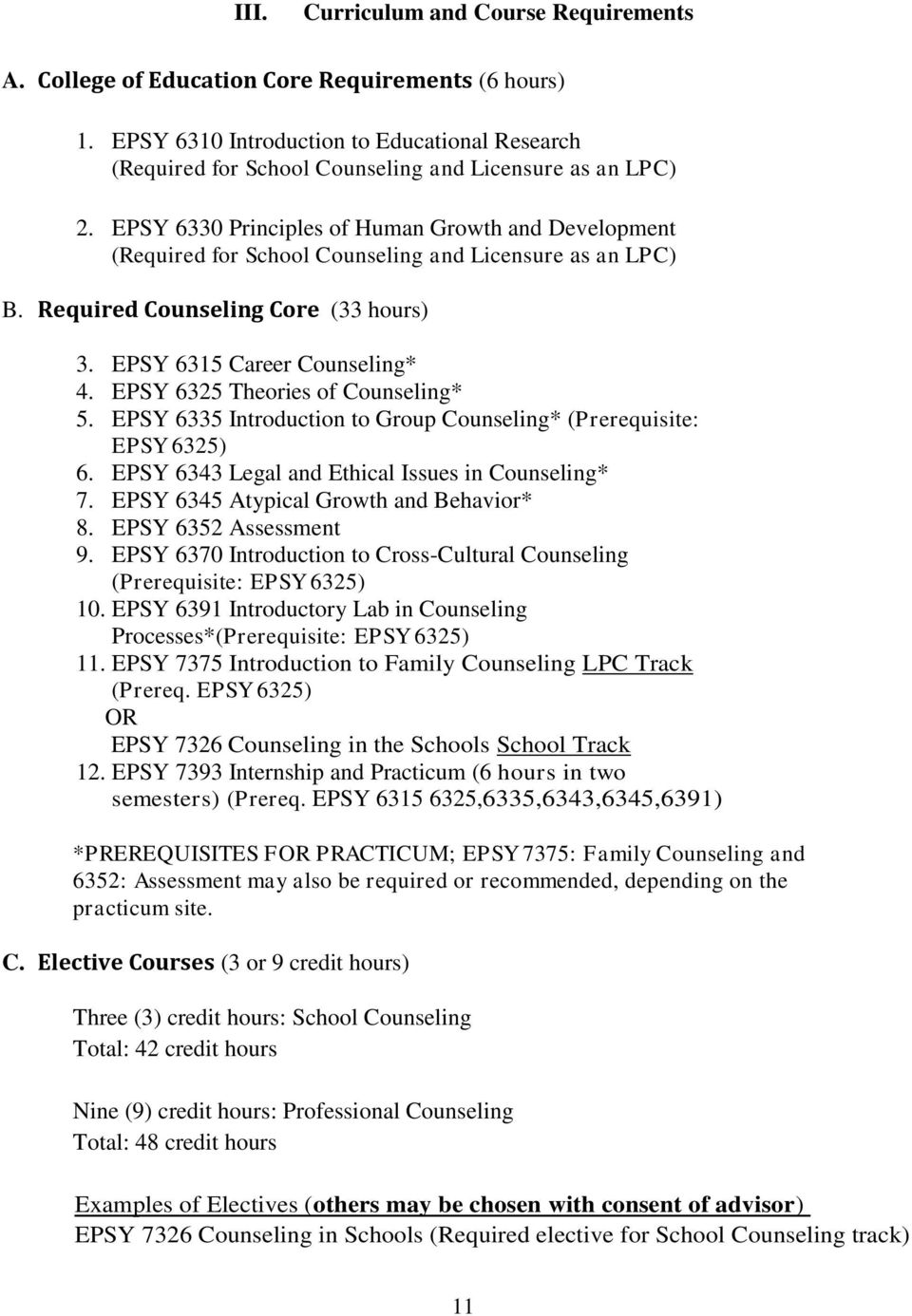
11 III. Curriculum and Course Requirements A. College of Education Core Requirements (6 hours) 1. EPSY 6310 Introduction to Educational Research (Required for School Counseling and Licensure as an LPC) 2. EPSY 6330 Principles of Human Growth and Development (Required for School Counseling and Licensure as an LPC) B. Required Counseling Core (33 hours) 3. EPSY 6315 Career Counseling* 4. EPSY 6325 Theories of Counseling* 5. EPSY 6335 Introduction to Group Counseling* (Prerequisite: EPSY 6325) 6. EPSY 6343 Legal and Ethical Issues in Counseling* 7. EPSY 6345 Atypical Growth and Behavior* 8. EPSY 6352 Assessment 9. EPSY 6370 Introduction to Cross-Cultural Counseling (Prerequisite: EPSY 6325) 10. EPSY 6391 Introductory Lab in Counseling Processes*(Prerequisite: EPSY 6325) 11. EPSY 7375 Introduction to Family Counseling LPC Track (Prereq. EPSY 6325) OR EPSY 7326 Counseling in the Schools School Track 12. EPSY 7393 Internship and Practicum (6 hours in two semesters) (Prereq. EPSY ,6335,6343,6345,6391) *PREREQUISITES FOR PRACTICUM; EPSY 7375: Family Counseling and 6352: Assessment may also be required or recommended, depending on the practicum site. C. Elective Courses (3 or 9 credit hours) Three (3) credit hours: School Counseling Total: 42 credit hours Nine (9) credit hours: Professional Counseling Total: 48 credit hours Examples of Electives (others may be chosen with consent of advisor) EPSY 7326 Counseling in Schools (Required elective for School Counseling track) 11
12 EPSY 7327 Counseling Children EPSY 7328 Counseling Adolescents EPSY 7329 Counseling Women EPSY 6320 Sexual Counseling EPSY 6362 Applied Behavioral Analysis EPSY 7330 Advanced Theories of Counseling** EPSY 7335 Intervention Strategies EPSY 7392 Psychological Assessment of Intelligence EPSY 6371 Gender Issues in Counseling EPSY 6397 Child Psychopathology **Doctoral level course; requires consent of instructor. Notice of Upcoming LPC Changes The Texas Administrative Code (Title 22, Part 30, Chapter 681, Subchapter E, Rule and ) has set new requirements for persons applying for licensure that go into effect as of August 1, The UH Master s in Education Counseling Program will be making revisions by this date to comply with these changes. Below, please find the total requirements including the current requirements for the degree and new additions (new requirements are listed in bold type). Texas Administrative Code TITLE 22 PART 30 CHAPTER 681 SUBCHAPTER E RULE EXAMINING BOARDS TEXAS STATE BOARD OF EXAMINERS OF PROFESSIONAL COUNSELORS PROFESSIONAL COUNSELORS ACADEMIC REQUIREMENTS FOR LICENSURE Academic Requirements (a) Persons applying for licensure must have: (1) a graduate degree in counseling or related field on at least the master's level; and (2) a planned graduate program in counseling or related field of at least 48 semester hours with 60 semester hours for applicants starting a counseling program as of August 1, (b) The 48/60 semester hours must be designed to train a person to provide direct services to 12

13 assist individuals or groups in a professional counseling relationship using a combination of mental health and human development principles, methods, and techniques to achieve the mental, emotional, physical, social, moral, educational, spiritual, or career-related development and adjustment of the client throughout the client's life. (1) The 48/60 semester hours may be course work that was part of the required graduate degree, or may be in addition to course work taken for the degree, or a combination of both. (2) The 48/60 hours must cover the course content described in of this title (relating to Academic Course Content). (c) Applicants must also have a supervised practicum experience that is primarily counseling in nature of at least 300 clock-hours which were a part of the required planned graduate program. (1) At least 100 hours of the practicum must be direct client counseling contact. (2) Academic credit or other acknowledgment of the practicum/internship must appear on the applicant's official graduate transcript. (3) No practicum course intended primarily for practice in the administration and grading of appraisal or assessment instruments shall count toward the 300 clock-hour requirement. Texas Administrative Code TITLE 22 PART 30 CHAPTER 681 SUBCHAPTER E RULE EXAMINING BOARDS TEXAS STATE BOARD OF EXAMINERS OF PROFESSIONAL COUNSELORS PROFESSIONAL COUNSELORS ACADEMIC REQUIREMENTS FOR LICENSURE Academic Course Content (a) An applicant must complete at least one three-semester hour course in each of the following areas: (1) normal human growth and development - the process and stages of human intellectual, physical, social, and emotional development from prenatal origins through adulthood; (2) abnormal human behavior - the principles of understanding dysfunction in human behavior or social disorganization; (3) appraisal or assessment techniques - the principles, concepts, and procedures of systematic appraisal or assessment of an individual' s attitudes, aptitudes, achievements, interests, and personal characteristics, which may include the use of both non-testing approaches and test 13
14 instruments; (4) counseling theories - the major theories of professional counseling; (5) counseling methods or techniques - the methods or techniques used to provide counseling treatment intervention including: (A) counseling individuals; and (B) the theory and types of groups, including dynamics and the methods of practice with groups; (6) research - the methods of research which may include the study of statistics or a thesis project; (7) life style and career development - the theories of vocational choice, career choice and life style, sources of occupational and educational information, and career decision-making processes; (8) social, cultural, and family issues - the studies of change, ethnic groups, gender studies, family systems, urban and rural societies, population patterns, cultural patterns, and differing life styles; (9) professional orientation - the objectives of professional organizations, codes of ethics, legal aspects of practice, standards of preparation, and the role identity of persons providing direct counseling treatment intervention; and (10) practicum (internship) - as described in (c) of this title (relating to Academic Requirements). (b) The remaining courses needed to meet the 48/60 graduate-hour requirement shall be counseling or related course work that are in areas directly supporting the development of an applicant's professional counseling skills and shall be courses related primarily to professional counseling. (c) As of August 1, 2017, the following courses to meet the 60 hour requirement shall include: (1) addictions counseling; to include but not limited to gambling, sexual, eating, alcohol, or drug; (2) additional course in counselor ethics; to include records management, an overview of business/family law and professional practice and the study of current board rule; (3) a course in psychopathology to include such content as criteria of psychiatric diagnosis, use of the current Diagnostic and Statistical Manual of Mental Disorders and the theories of psychopathology. The course should also include the basic knowledge of types of 14

15 psychopharmacological medications. Additional course may also include: (A) crisis counseling; (B) couples, marriage, families, or parenting. (d) Passing the National Counselor Exam does not guarantee that Texas state licensure requirements have been satisfied. 15
16 D. Degree Plan MY ADVISOR: DEGREE PLAN SAMPLE Degree Plan: Student Submission Course ID Course Name Semester Hours Grade Transfer? EPSY Introduction to Educational Research 3 2. EPSY 6330 Principles of Human Growth and Development 3 3. EPSY 6315 Career Counseling 3 4. EPSY 6325 Theories of Counseling 3 5. EPSY 6335 Introduction to Group Counseling 3 6. EPSY 6343 Legal and Ethical Issues in Counseling 3 7. EPSY 6345 Atypical Growth and Behavior 3 8. EPSY 6352 Assessment 3 9. EPSY 6370 Introduction to Cross-Cultural Counseling EPSY 6391 Introductory Lab in Counseling Processes EPSY 7393 Internship and Practicum EPSY 7393 Internship and Practicum 3 Elective Courses 3 EPSY Introduction to Family Counseling 7375 or or EPSY Counseling in the Schools EPSY* EPSY* EPSY*

17 *Electives - choose one course School Track/ three courses Professional Track. At submission time, the degree plan must include the specific courses, including, electives that the student plans to take to meet all degree requirements. If a student takes a different course than the one listed in the degree plan, a Change of Degree Plan form must be submitted and approved on MyAdvisor prior to graduation. 17
18 E. Course Sequence COURSE SEQUENCE MASTER COUNSELING PROGRAM (This sequence is offered as a general guide; changes may be necessary depending upon faculty availability, funding, and student need.) COURSE OFFERINGS- SUMMER ** MAIN CAMPUS CINCO CAMPUS EPSY 6335 INTRO GROUPS (IF FUNDING AVAILABLE) EPSY 6325 THEORIES OF COUNSELING EPSY 7393 PRACTICUM PRACTICUM EPSY 6397 ELECTIVE (IF FUNDING AVAILABLE) ELECTIVE (IF FUNDING AVAILABLE) EPSY 7326 SCHOOL COUNSELING EPSY 6345 ATYPICAL GROWTH & BEHAVIOR EPSY 7335 INTERVENTION STRATEGIES COURSE OFFERINGS-FALL MAIN CAMPUS CINCO CAMPUS EPSY 6310` INTRO ED AND PSY RESEARCH EPSY 6325 THEORIES OF COUNSELING EPSY 6343 LEGAL & ETHICAL ISSUES EPSY 6370 INTRO CROSS CULTURAL INTRO CROSS CULTURAL EPSY 6391 INTRO LAB INTRO LAB EPSY 6352 ASSESSMENT EPSY 6345 ATYPICAL GROWTH & BEHAVIOR EPSY 7393 PRACTICUM PRACTICUM EPSY 7375 INTRO FAMILY COUNSELING EPSY 7327 OR 7328 COUN. CHILD OR ADOLESCENTS OR OTHER ELECTIVE EPSY---- ELECTIVE ELECTIVE EPSY CAREER COUNSELING

19 COURSE OFFERINGS- SPRING MAIN CAMPUS CINCO CAMPUS EPSY 6310 INTRO ED AND PSY RESEARCH ETHICS EPSY 6315 CAREER COUNSELING THEORIES OF EPSY 6325 COUNSELING EPSY 6335 INTRO GROUPS INTRO GROUPS EPSY 6345 ATYPICAL GROWTH & BEHAVIOR EPSY 6391 INTRO LAB EPSY 6352 ASSESSMENT EPSY 7393 PRACTICUM PRACTICUM EPSY 7375 FAMILY COUNSELING EPSY 6397 OTHER ELECTIVE EPSY 6325 EPSY 7327 COUNSELING CHILDREN EPSY ---- ELECTIVE ELECTIVE **As of Summer 2010, funding decreases have limited the availability of all courses being offered in the summer. Therefore, please do not plan on all of these courses to be offered every summer, because they depend on funding ability and enrollment. Additional notes: Elective courses vary year to year and may be offered in different semesters than listed above. Courses may be cancelled due to low enrollment or other factors. EPSY 6330 is offered at the Main Campus and occasionally at Cinco. 19

20 IV. Counseling Practicum All students applying for Practicum must do so with the faculty practicum coordinators one semester prior to working at an approved site. All students need to meet with the coordinators and to prepare a professional resume in order to interview with prospective sites. Information about practicum is sent out on the listerv. Students may not go on interviews without approval from the practicum coordinator. Students are required to attend an orientation meeting and obtain student liability insurance. Students complete two semesters of practicum for a total of 330 hours, 165 hours per semester (100 hours must be direct service). Students select sites and work at these sites for hours per week. Students must enroll in three hours of practicum class each semester in which they are completing their practicum hours. The field practicum is a two-semester experience (6 credits total) in which students engage in actual counseling work in an agency approved by the Counseling Program faculty. Most often both semesters of practicum are completed in the same agency. In general, field practicum should not take place in the agency where a student is employed. Additionally, it is generally difficult to begin practicum in the summer, due to lack of availability of practicum sites. Before initiating practicum, students must have completed the following counseling courses: EPSY 6315 Career Counseling (if planning on going to a college counseling center) EPSY 6325 Theories of Counseling EPSY 6335 Group Counseling EPSY 6343 Ethical and Legal Issues in Counseling (or PSYC 7326) EPSY 6345 Atypical Growth and Behavior EPSY 6391 Introductory Lab in Counseling Process Students are also encouraged to take courses in Family Counseling and Assessment before practicum, depending on the site chosen. Please refer to the Program website ( to view a partial list of institutions and organizations that have provided opportunities for students to complete their practicum requirements. Students planning to start Practicum in the fall semester must have completed all the course prerequirements by the preceding spring semester. (Due to enrollment fluctuations, course offerings in the summer sessions are unpredictable.) At the end of each practicum semester, students are required to evaluate both their supervisor on site and their overall practicum experience and turn this paperwork into their practicum class instructor or professor. The Program has established practicum opportunities in many agencies in the Houston area. Depending on the site, students are able to start practicum in any semester including summer. For more information about the practicum experience, including the application process for the 20

21 Houston Main Campus and a description of available sites, please visit Dr. Arbona s website at and click on the practicum tab. Students are required to obtain liability insurance during all practicum placements. The Program recommends the APA Insurance Trust s Student Policy: See Appendix E for more information on the counseling field practicum experience and a sample practicum application. Practicum Coordinators: Dr. Arbona for Houston Main Campus students Dr. Ellis for Cinco Ranch Campus students 21
22 A. Policies and Procedures V. Comprehensive Examination Unless students elect to complete a thesis, all students in the Master's of Education in Counseling program must successfully complete the Master's Comprehensive Examination. To be eligible to take the exam, a student must have: 1. An approved degree plan on file with the Graduate Studies Office 2. Completed at least 18 semester hours of course work, and 3. Submitted, on time, in MyAdvisor, a completed Application to take Master's Comprehensive Examination form. The form requires a statement of number of hours taken. In the space labeled Areas to be Tested, enter the word Counseling. B. Exam Overview What is the Comprehensive Exam? The Comprehensive Exam is one of the two options for a final project for the Master's Program in Counseling. The other option is the Master's Thesis. See Chapter VII for a description of a master s thesis project. The program uses the Counselor Preparation Comprehensive Examination (CPCE), which is a national examination, for the Master s comprehension examination process. The CPCE is researched, developed, and distributed by the Research and Assessment Corporation for Counseling (RACC) in conjunction with the Center for Credentialing and Education (CCE). Both the RACC and CCE are affiliates of the National Board for Certified Counselors (NBCC), which is the historical credentialing body for counselors. C. Exam Content What is the content of the exam? The CPCE covers the eight Council for Accreditation of Counseling and Related Educational Programs (CACREP) common core areas as defined by their Standards for Preparation. Areas of Concentration for the CPCE exam: The Master's Comprehensive Examination is the national Counselor Preparation Comprehensive Examination (CPCE) and covers the 8 areas listed below. The CPCE is a service of the Center for Credentialing Education (CCE), an affiliate of the National Board for Certified Counselors (NBCC). A. Human Growth and Development B. Social and Cultural Foundations C. Helping Relationships 22
23 D. Exam Grading D. Group Work E. Career and Lifestyle Development F. Appraisal G. Research and Program Evaluation H. Professional Orientation and Ethics What is the format for questions? The CPCE is a 160-item, four-choices, multiple-option exam consisting of 20 items per area. One hundred thirty six of the items are scored for passing information; 24 of the items, three from each core area, are being researched for future examinations. Each question was developed based on information found in the most commonly used textbooks. Scores for each core area (maximum of 17 points per area) and a total score are reported for each student. What is the cost of the CPCE? The cost of the exam is about $75.00 per student. Each students bursar account is charged for the test. When is the exam administered? The Comprehensive Exam is given in the Fall and Spring semesters on dates determined by the Counseling faculty and the Office of Graduate Studies. Dates are posted on the listserv and on bulletin boards throughout the College of Education. Application deadlines will be set several weeks before examination administration, therefore be sure to submit your application allowing plenty of time for processing in MyAdvisor before the application deadline. Students have 4 hours to complete the paper-pencil exam; the exam begins at 9:00 a.m. to 1:00 p.m. unless otherwise notified. As stated above, the CPCE exam is offered twice each year, in fall and spring semesters. Exams are administered at the Testing Service at the University of Houston, which also provides proctoring. Completed exams are sent to CCE by the Testing Service for scoring. How do I apply? Students apply to take the Exam through MyAdvisor system. How do I prepare? Preparation for the CPCE exam follows the study guides for the National Counselor Exam (NCE). Go to the National Board of Certified Counselors (NBCC) website for a listing of study guides for the NCE exam. Study guides for the NCE exam are also available in major bookstores. There are no published study materials available for the CPCE; however, the exam content is similar to the NBCC National Counselor Examination (NCE), the test that is required by all Texas LPC applicants for licensure. Students may obtain free sample 23
24 questions from the NBCC website: A list of study resources is available at Paid subscriptions to exam banks covering the eight content areas are available at The NCE Study Guide may be purchased at Please note that neither NBCC, CPCE, nor the University of Houston endorses any study materials for these examinations. E. Procedures for Remediation of Students Who Fail the Exam What happens if I fail? The exams are evaluated by standardized scoring done by the CCE. Results are sent to the coordinator of testing for the master s counseling Program and advisors notify advisees of their results. Candidates may take the CPCE exam up to three times. If the first attempt is a fail, the student may petition to meet with an appointed remedial committee, consisting of his or her advisor and one other faculty member to determine designated coursework or academic study for a written examination. If the student fails a second time, the student is required to meet with a remedial committee, consisting of his or her advisor and one other faculty member to develop a remediation plan. If the student fails the CPCE exam on all three attempts, he or she will be immediately dismissed from the Program. 24
25 VI. Master s Thesis Options Thesis Option EPSY 6399 (3 hours) EPSY 7399 (3 hours) A Master's Thesis will be the final milestone in the Master's of Education Program if students choose this option. This project typically involves the collection, analysis, and interpretation of quantitative and/or qualitative data. The goal of the thesis project is to help students acquire the necessary skills to conduct research by allowing them to apply and practice their research skills under the mentorship of members of the faculty. The official policies regarding the completion of a thesis are presented in the Program Guide for Master's Degree Students and in the Thesis and Dissertation Guide: It is the responsibility of students to be aware of college rules and regulations, including those concerning the Master's thesis. Students who choose the thesis option are required to complete a minimum of 6 hours of Master's thesis (EPSY 6399 & 7399) and will not have to take the Comprehensive Exam. Students may register for additional hours, but only 6 hours may be listed on their degree plan. EPSY 6399 & 7399 are independent study courses; students need to enroll in the section of these courses under the name of the faculty member who will be the Chair of their Master Thesis Committee. The Master's Thesis Process: 13. Identify a faculty member who agrees to be the Thesis Advisor and Chair of the Thesis Committee. 14. Each committee must have three faculty members, two of which must be from the Counseling Psychology Program. 15. The Thesis committee is formerly established by submitting paperwork through the MyAdvisor portal listing committee members and committee chair. Outline of a Master s Thesis* I. Chapter 1/Introduction: This chapter consists of a 5-8 page overview of the proposed study. This chapter is where you make an argument explaining the need and purpose of your study. You may include definitions of terms, if appropriate. Your goal is to introduce the reader to the particular question your thesis is seeking to answer. In thesis writing, the introduction is not merely a summary of points to be elaborated on in later sections. Rather, your objective here is to inform the reader of what the question is, why it is important, and how your thesis will provide an answer. II. Chapter 2/Literature Review: This chapter is a thorough, detailed, and comprehensive 25
26 review of all relevant literature. This section concentrates on those issues and aspects of the field that specifically relate to the question you seek to answer. As such, this section should also incorporate an examination of the varying viewpoints surrounding your question, in order to orient the reader in the discourse of the field. This chapter is typically divided into numerous sections, as appropriate to the topic of inquiry, and concludes with a rationale/purpose for your study and the hypothesis/research questions. III. IV. Chapter 3/Methodology: In this chapter, the methodological elements are described in the following order: Participants, Instrumentation, Procedure, and Statistical Analyses. These categories may be modified for qualitative work, mixed quantitative/qualitative studies, or for other idiosyncratic design considerations. Chapter 4/Results: This chapter consists of descriptive/qualitative and/or statistical analysis of your data. First, a description of your sample, return rates, procedural problems, and tests of your assumptions for statistical analyses are presented. Next, exploratory analyses are presented. Results must be presented in an objective manner, without any interpretive comments. Alternative presentations are acceptable for qualitative projects. V. Chapter 5/Discussion: This chapter answers the following questions: What do my results mean? Why are my results important? A careful integration of your findings with your literature is expected, as well as thoughtful discourse on alternative interpretations and possible limitations. A typical outline of a Discussion chapter would include: (1) A summary of substantive findings, (2) An integration of these findings with the existing research, (3) Implications for theory, (4) Implications for research, (5) Implications for practice, (6) Limitations, (7) Conclusions. VI. VII. References: Every citation made in the body of your thesis must appear in the list of references. The list of references can be used as a measuring stick to evaluate the breadth of your research. The reader will typically review the list of references to determine whether you have consulted the more prominent works in the field. Know that unlike a bibliography, which may include titles that are not directly referred to in the text, every item in your list of references must be referred to in the body of the thesis. Appendices: Appendices are a useful tool for presenting material that may otherwise interrupt the flow of the thesis writing, such as lengthy data tables, complex charts and graphs, extensive listings of any kind, etc. In general this is information that is not absolutely essential for the reader to continue on with the thesis, but which should be available to the reader to back up relevant points in your argumentation. *Adapted from masters handbook of counseling psychology program at Texas Woman s University. The Master s thesis is developed in collaboration with your research advisor. The student should decide on a topic area and develop research questions with the guidance of the Thesis Chair. The Thesis Chair will guide the student on departmental procedures. 26
27 VII. Program Policies and Procedures This section describes the primary means by which the Program monitors and evaluates student progress. Also described are current policies regarding requests for leaves of absence and time extensions, as well as information about dismissal and formal grievance procedures. A. Advising The student's relationship with his or her academic advisor is one of the primary means by which the Program monitors and facilitates student progress. Students are expected to maintain regular contact with their advisors throughout their tenure in the Program, keep their advisors apprised of any problems or concerns that may affect their academic and/or clinical work, and seek their advisor s consultation and assistance as appropriate. Upon admission to the Program, students are assigned a faculty academic advisor. The initial assignment of an academic advisor takes into account current faculty advising loads. Students who desire to change their academic advisors should alert their current advisor and the Training Director about their intention prior to soliciting other faculty as advisors. Next, the student should inform the Training Director when an alternate faculty member has agreed to accept this responsibility. To formalize the change of advisor, the student then submits via MyAdvisor a Request Change of Advisor form. If the student's efforts in soliciting another faculty member to serve as advisor are unsuccessful, the student's current advisor brings the matter to a subsequent Program faculty meeting for discussion and resolution. The student's current advisor continues to serve in this capacity until another faculty member in the Counseling Program agrees to accept the student as an advisee. B. Time Limit Students pursuing a master s degree must complete all requirements within a five-year period of enrollment. C. Continuous Enrollment and Leaves of Absence Once admitted to the Program, students are expected to enroll in at least three credit hours every consecutive long semester (i.e., Fall and Spring semesters) until the degree Program is completed and the degree is awarded. On rare occasions, significant life events and emergencies (e.g., serious health issues, major family disruptions) may interfere with a student's progress through the Program. Students who cannot enroll in a given semester must apply for a leave of absence in order to remain in good standing. To request a leave of absence, students need to first consult with their advisor and then submit a General Petition Form via MyAdvisor that describes the reason for the request and a timeline and plans for completing remaining Program requirements following the leave. The leave of absence must be approved by the students' advisor, the Department Chair, and the College of Education Dean. 27
28 A student who does not return to enrolled status at the end of an approved leave is no longer considered to be pursuing an advanced degree. A student who fails to enroll in a long semester (Fall or Spring) without obtaining an approved leave from graduate study is not automatically readmitted. D. Grade Policy A minimum grade point average (GPA) of 3.00 (B) for all graduate courses attempted is required for all graduate degree programs at the University of Houston. Failure to maintain a 3.00 GPA may result in a warning, probation, suspension, loss of financial support, or dismissal. A student who receives a grade of C+ or lower in 12 semester hours of credit attempted at this institution for graduate credit or for application toward the graduate degree, regardless of the student's classification, whether or not in repeated courses, is ineligible for any advanced degree at this institution and will not be permitted to re-enroll for graduate study. To re-state the policy, if a student receives 4 C+'s or lower in any 4 courses worth 3 credit hours each, the student will be dropped from graduate study. E. Dismissal Policies and Procedures The dismissal of a student from the Program is a significant event for both the student and the Program faculty and represents the conclusion of the faculty that the student has not demonstrated an adequate level of competency in either academic or clinical skills, or in other critical areas of professional conduct. A graduate Program is responsible for training future counselors who are competent and in no way provide a threat to the public welfare. Therefore, the faculty are attentive to all aspects of student competence and performance in all relevant areas including academics, clinical training, ethics, and interpersonal behavior. Students are expected to make satisfactory academic progress, master counseling skills in a satisfactory and timely manner, meet all timelines and policies and procedures for the university and all training agencies to which assigned, meet high standards of ethical behavior in all endeavors, and demonstrate interpersonal attitudes and behaviors with peers, faculty, staff, and supervisors that promote growth and learning. In the area of interpersonal competence in particular, we adopt the policy developed by the Student Competencies Task Force of the Council of Chairs of Training Council (CCTC) and further adapted by the Counseling Psychology Program at the University of Missouri: Students in psychology and counseling training programs (at the masters, doctoral, internship, and postdoctoral level) should know at the outset of their training that their faculty, training staff, and supervisors have professional, ethical, and potentially legal obligations to: (a) evaluate the interpersonal competence and emotional well-being of student trainees who are under their supervision and who provide services to clients and 28
29 consumers, and (b) ensure insofar as possible that the trainees who complete their programs are competent to manage future relationships (e.g., client, collegial, professional, public, scholarly, supervisory, teaching) in an effective and appropriate manner. Because of this commitment, professional training programs strive not to pass along students with issues or problems (e.g., cognitive, emotional, psychological, interpersonal, technical, and ethical) that may interfere with professional competence to other programs, the profession, employers or the public at large. Therefore, within a developmental framework and with due regard for the inherent power differences between student and faculty, students and trainees should know that their faculty, training staff, and supervisors will evaluate their competence in areas other than coursework, seminars, scholarship, comprehensive examinations, or related program requirements. These evaluative areas include, but are not limited to, demonstration of sufficient: (a) Interpersonal and professional competence (e.g., the ways students relate to diverse individuals, groups, and organizations including clients, peers, faculty, staff, allied professionals, and the public). (b) Self-awareness, self-reflection, and self-evaluation (e.g., knowledge of the content and the potential impact of one s own beliefs and values on diverse individuals, groups, and organizations including clients, peers, faculty, staff, allied professionals, and the public). (c) Openness to processes of supervision (e.g., the ability and willingness to explore issues that interfere with the appropriate provision of care or impede the professional development or functioning). (d) Resolution of problems or issues that interfere with professional development or functioning in a satisfactory manner (e.g., by responding constructively to feedback from supervisors or program faculty; by participating in personal therapy in order to resolve problems or issues). This policy is implemented in the Counseling Master s Training Program through a number of specific mechanisms, occurring at various points in a student s training, which include: on-going evaluation, evaluation for readiness to begin practicum, and during course evaluation. Dismissal action, when taken, is typically the outcome of careful deliberation and communication with the student regarding his or her unsatisfactory performance in basic or, where appropriate, remedial work. Negotiation of remediation for problem performance often precedes dismissal depending upon type and severity of problem. At any point during the student's matriculation through the Program, the faculty retains the right to review any student circumstances or personal performances that may negatively affect the student's competencies for professional practice or that may threaten client welfare. Examples of circumstances or performances that may be the basis for dismissal action include: 29
30 1. Failure to meet minimal academic requirements for master s students at the University of Houston, as described in the on-line Graduate and Professional Studies Catalog ( 2. Violation of the ethical principles of psychologists as defined by the American Psychological Association ( ), the American Counseling Association ( or the National Association of School Psychologists ( 3. Unsatisfactory performance in counseling practice courses (e.g., practicum). 4. Failure to comply with established University, College, Department, or Program timetables and requirements. 5. Academic dishonesty including plagiarism, cheating, fabricating research results, etc. 6. Failure to maintain continuous enrollment. 7. Criminal misconduct. 8. Failure to satisfy one or more academic requirements (e.g., coursework, comprehensive exam, thesis). In these cases, remedial actions will be identified to help the student address the academic deficiencies. However, if remedial actions fail to correct the problem(s), the student may be terminated from the Program. 9. Failure to maintain satisfactory progress through the Program. 10. Cognitive, affective, and/or behavioral deficiencies exhibited by the student that are deemed to obstruct the training process and/or potentially threaten client welfare. 11. Unprofessional conduct at university or other professional settings. 12. Inability to manage personal stress in a manner that affects professional functioning. The University of Kansas has developed a helpful list of general areas of review to aid students in assuring whether they are making progress in meeting Program goals and objectives, which include: I. Academic Performance a. Writing style b. Topical organization c. Research work d. Capacity to deal with contradictory data e. Verbal presentations f. Grade Point Average II. Classroom Behavior a. Class attendance/participation b. Examination behavior c. Ability to meet deadlines III. Professional-Ethical Behavior a. Keeping appointments b. Following practicum procedures 30
31 c. Appropriate dress and behavior d. Openness to feedback e. General Counseling skills IV. Research Skills a. Design/Methodology b. Ability to critique literature c. Research project involvement d. Publications/Presentations V. Interpersonal/Attitudinal Considerations a. Constructive criticism of Program/faculty b. Offering alternatives to problems c. Emotional maturity and stability d. Relationships with peers e. Relationships with faculty f. Relationships with staff/agency personnel g. Respect for individual differences VI. Other Professional Activities a. Awards or honors b. Departmental participations c. Attendance at departmental activities Observations or charges relevant to student performance in the areas described above can emanate from a variety of sources including faculty, clinical supervisors, clients, University staff, or professionals and agents outside of the University community. To protect student due process rights as well as to uphold the academic and professional standards of the Program, the student will be informed in writing by the Director of Training and the student s advisor of any charge, event, performance, or circumstance that may threaten the student's immediate status in the Program. As part of this communication, the Director may initially advise the student to seek an informal resolution of the charge or complaint and to inform the Director (in writing) of the outcome of this action within a specified time frame. If informal methods of problem resolution are inappropriate or unsuccessful, a formal meeting of the faculty will be convened to discuss the nature of threat to the student's status and to arrive at a decision regarding dismissal. Prior to that meeting, the student as well as other interested parties possessing relevant information will have the opportunity to present their evidence to the faculty. Following faculty review of and deliberation on the evidence, the Director of Training will inform the student in writing of the faculty's decision and, if appropriate, specify any conditions that must be satisfied in order for the student to maintain or restore his or her standing within the Program. F. Grievance Policy and Procedures Students may grieve any faculty decision or action that affects their progress through the Program. If the student chooses to grieve, he or she must follow the formal grievance procedures as specified in the College of Education Student Grievance Policy (Appendix A) and in the on-line Graduate Studies Catalog ( 31
32 IX. Student Support Services The University of Houston offers students an array of support services sponsored by a variety of campus offices and facilities. Examples of these include the Counseling and Psychological Services Center (CAPS); the Health Center and Financial Aid Offices; the Center for Students with DisABILITIES (CSD); and the Campus Recreation and Wellness Center. The Counseling Program, the Department of Educational Psychology, and the College of Education also offer students a variety of support services. This section describes some of these services and resources. A. Fellowships, Assistantships, and Financial Aid Counseling students are also eligible to compete for several scholarship programs that are available through the Office of the Associate Dean of Graduate Studies in the College. Information about these programs can be found at Information regarding student financial aid is available online through the University of Houston Office of Scholarships and Financial Aid at Also, see Appendix D for some examples of scholarships. B. Communication within the Program and Department The Program listserv provides students, faculty and staff the opportunity to receive broadcast s to everyone in the Counseling Program. Upon admission to the Program students are REQUIRED TO SUBSCRIBE to the Master s Program listserv, using their UH addresses. Follow the steps to subscribe to the listserv 1). Log on to 2). Click on the middle list, the one that looks like: Catalist, view all public lists at this host 3). There are two ways to find your listserv use the Ctrl F function to find your area (ex: Counseling Masters: [email protected]) OR Scroll down the list until you see your area of study ([email protected]). C. Computing The Center for Information Technology in Education (CITE) offers multi-faceted technology services to the entire College of Education community. There are two CITE Computer Lab locations. One is on the 3 rd floor and another is on the 4 th floor of Farish Hall. The CITE Lab provides students with over 80 computers and also houses a statistics lab and a multimedia lab. The CITE Lab staff provides routine consultation to students on a variety of technology matters D. Problem-Solving Resources The ombudservice directly assists students to resolve problems or refers them to the office or person who can help. The student legal advisor provides counsel to students for problems of a legal nature. More information regarding these services may be located at the ombudservice 32
33 web sites and at E. UH Counseling and Psychological Services (CAPS) Students seeking counseling services who are either currently placed or anticipate placement at UH CAPS for practicum are encouraged to contact UH CAPS ( ) for a referral. UH CAPS has a reciprocal agreement with other local university counseling centers to see students in this situation and can also provide referrals to other agencies that charge fees on a sliding scale. See Appendix F for more information regarding seeking counseling services and conducting practicum training at UH CAPS. F. Statement on the Importance of Personal Therapy to the Development of Counselors/Psychotherapists In addition to the didactic and skills training components of developing a professional therapist, [t]here is one adjunct to training that needs to be mentioned. We believe that personal therapy can be an effective means of assisting the young professional in the process of becoming therapeutic. Perhaps more than for any other professionals, it is vital that fully functioning psychotherapists and supervisors know themselves well and be able to use themselves. This view reflects the general thrust of this model, which instead of being aimed at training a therapist with a myriad of skills and techniques to do therapy, is aimed at helping the supervisee to become therapeutic with others. Sometimes an introspective nature, coupled with significant relationships with others, will eventually result in the maturity and personal depth necessary to be therapeutic with others. Often this natural process is too slow or inadequate for some supervisees. In these cases, the process of personal therapy can eliminate some remedial blockages in this process for certain developing therapists, and can significantly deepen and accelerate this process for others. It is our belief that people who are really effective generally go through a process of letting go of the belief that everything is all right with them. As Robinson (1978) stated, what happens is that individuals must become conscious of conflict within themselves as the very basis for helping others. The process of experiencing personal therapy gives the potential or practicing therapist a better grasp of what the change process is all about. Furthermore, an experience of being on the other side of the desk most likely will increase the empathy that the therapist has with the client. The therapist knows the process is often excruciatingly painful and also knows the joy that can accompany growth. Tact, timing, separation, transference, and dependence all take on new and deeper meanings after being experienced in one s own therapy. Therapists also have a better sense of what they themselves mean to their own clients after having experienced a similar alliance. Finally, and perhaps most importantly, therapists who are cognizant of the intricacies of their own personal issues are in a better position to distinguish between what is happening with the client and what is happening within themselves. If 33
34 therapy is largely a process of learning to differentiate, then this can only make the therapist far more effective in interpreting the client s behavior toward the therapist. This awareness of one s own personal issues hopefully will avoid distortion and acting out of one s sexual/narcissistic/aggressive needs with the client. For these reasons, we conclude that personal therapy should be encouraged and regarded as enriching and desirable within counseling psychology programs. From Loganbill, C., Hardy, E. & Delworth, U. (1982) Supervision: conceptual model. The Counseling Psychologist, 10, 3-42 (pp. 6-7). Robinson, V. (1978) The development of a professional self: New York: AMS Press. The faculty of the Counseling Program at the University of Houston strongly encourage all students in this Program to make personal therapy an integral part of their graduate training experience. Moreover, if this therapy is undertaken, it should be with someone not associated with the student s academic Program. 34
35 A. Licensing X. Licensure and Certification Students who complete the M.Ed. Degree in Counseling Professional Counseling track, and who choose to seek licensure as a Professional Counselor in the State of Texas, may obtain information regarding requirements for such licensure from the Texas State Board of Examiners for Professional Counselors. Students who plan on obtaining licensure outside the State of Texas should contact the licensing boards of the states in which they may eventually wish to practice. Applicants who have questions about licensure requirements in Texas should contact the Texas State Board of Examiners for Professional Counselors ( at 1100 West 49th Street, Austin, TX (512) B. Certification Students who plan to seek certification as a public school counselor should contact: Dr. Krista Coleman Certification Officer [email protected] (713) OR Students may also refer to the Texas Education Agency (TEA) ( for information regarding the most current information and regulations for certification. Students who plan to obtain certification outside the State of Texas should contact the certification boards of the states in which they may eventually wish to practice. 35
36 Appendices 36
37 Appendix A Grievance Procedures Students who have problems or disagreements should make every effort to resolve them with the individual faculty member involved and the Director of Training, using informal channels. If the grievance is not resolved, discussion among the involved parties and the Departmental Chair is encouraged as the next step of action. If the informal discussions do not result in resolution of the problem, the student may follow the Department of Educational Psychology Grievance Procedure. The student should submit a written appeal to the Chair of the Department. The Department Chair forwards the grievance to the Chair of the Academic Affairs Committee of the Educational Psychology Department. Then, the Chair of the Academic Affairs Committee convenes a grievance hearing committee and a decision regarding the grievance is made. The Departmental Chair makes the committee decision available to the student. A copy of the Grievance Report from the Academic Affairs committee is forwarded to the Dean of the College if the student decides to appeal at that level. A copy of the Department of Educational Psychology Grievance Procedure is included here. Department of Educational Psychology Grievance Procedure Formal Departmental Grievance Appeal of the Department Decision If, after utilizing the abovementioned procedures, the student's problems are not resolved, he/she has a right to appeal to the Executive Associate Dean within 15 working days of being informed of a decision rendered by the department. GUIDELINES FOR THE CONDUCT OF STUDENT GRIEVANCE HEARINGS 1. A copy of the Student Appeal Form will be forwarded upon its receipt by the Department Chair to the Chair of the Academic Affairs Committee. 2. Within five working days of the receipt of the appeal form from the student, the Chair of the Academic Issues Committee will inform the parties to the Grievance that they have five working days to provide the Grievance/Appeal Hearing Committee with any or all of the following: prior response to the student's complaint, a list of any witnesses he/she anticipates calling at the hearing, and copies of any documents to be used at the hearing. Each party will receive a copy of the materials submitted by the other party. 3. Within five working days of the receipt of the copy of the Student Appeal Form from the Departmental Chair, the Chair of the Academic Affairs Committee will convene the Grievance/Appeals Hearing Committee. For purposes of hearing grievances/appeals the Academic Affairs Committee of the Educational Psychology Department will be augmented by the addition of no more than two, nor less than one student representative from the Department. The resultant committee will serve as the Grievance/Appeals Hearing Committee and 37
38 will be chaired by the Chair of the Academic Affairs Committee. In all instances, the number of faculty members shall exceed the number of student representatives hearing the grievance/appeal. 4. Student representatives shall be elected at the beginning of each academic year by the graduate students enrolled in the Department. Two student representatives and one alternate are to be elected. 5. The Chair of the Academic Affairs Committee will chair the Grievance/Appeal Hearing Committee and will be responsible for identifying the specific student representative(s) to serve for each grievance/appeal. 6. Any faculty member or student who is a party to the grievance/appeal, or who is listed as a witness to appear during the proceedings, shall not hear the case. In these instances where this procedure leaves four or fewer faculty members of the Grievance/Appeals committee, the faculty of the department shall elect a replacement for each faculty member involved. In cases where a student is involved, the alternate representative will serve in his/her place. 7. The Chair of the Grievance/Appeal Hearing Committee will forward all materials received from the parties involved in the grievance/appeal to all members of the hearing committee within 5 days of their receipt. 8. The Chair of the Grievance/Appeal Hearing Committee will schedule the hearing of the grievance/appeal for no later than five days after receipt of materials from the parties involved in the grievance/appeal. All parties and hearing committee members are to be notified as to the date, time, and place of the hearing. 9. The format of the hearing will be as follows: A. Each party to the grievance/appeal may present a brief opening statement with the petitioner addressing the committee first. B. Each party to the grievance/appeal may present their position and evidence, with the petitioner presenting first. Witnesses may be called at this time; questioning will be restricted to members of the hearing committee. C. Each party will then be provided the opportunity for rebuttal, with the petitioner responding first. Additional evidence may be presented and/or additional witnesses called to refute points presented by the other party. Questioning will be restricted to members of the hearing committee. D. Each party may make a brief summary statement. E. If they wish, the hearing committee may recall witnesses at this point for additional questioning. Questioning will be restricted to members of the hearing committee. 38
39 10. The petitioner and respondent may be accompanied at the hearing by an advocate who is a University of Houston student or faculty member. The advocate will not be permitted to question witnesses or parties involved in the grievance/appeal, or to address the hearing panel. 11. Attendance at the hearing is limited to members of the hearings committee, the petitioner, the respondent, and their respective witnesses and advocates. Witnesses may be present only during their own testimony. 12. Following the hearing, the Grievance/Appeal Committee will meet in closed session to determine their decision. This decision will be forwarded in writing to the Departmental Chairperson. The Departmental Chairperson will then notify the petitioner and the respondent in writing of the hearing committee s decision. Such notification shall be within 15 working days of the receipt of the Student Appeal Form by the Departmental Chairperson. 13. If scheduling conflicts have presented the grievance/appeal hearing from occurring within the prescribed time lines, copies of statements from the involved parties indicating their agreement of any extension of time lines are to be forwarded along with the hearing committee's decision. 14. It is the role of the Departmental Chairperson to: A. Meet with the involved parties as part of the informal process in an attempt to reach an amicable resolution to the grievance/appeal. B. Receive the grievance/appeal and forward it to the Chairperson of the Academic Affairs Committee of the Department. C. Receive from the Grievance/Appeal Hearing Committee their decision regarding the grievance appeal. D. Transmit this decision in writing to the petitioner and the respondent within fifteen working days of the grievance/appeal. E. Receive any materials from the Grievance/Appeal Hearing Committee that may be forwarded to him. F. Meet with the involved parties (should they so wish) following their notification of the Grievance/Appeal Hearing Committee's decision in order to inform them of their rights to appeal. G. Transmit to the College level the Grievance/Appeal Hearing Committee's decision, as well as all related materials should the decision be appealed to the College of Education. 15. At any point prior to the issuance of the Grievance/Appeal Hearing Committee's decision, the petitioner has the right to withdraw their grievance/appeal. 39
40 SCHOOL COUNSELOR INFORMATION: For Accreditation Guidelines: Texas Education Agency 1701 N. Congress Ave. Austin, TX Appendix B Master s Counseling Program: Information Sources For ExCet Exam Information: LICENSED PROFESSIONAL COUNSELOR INFORMATION: For Licensing Information: Texas State Board of Examiners of Professional Counselors Texas Department of Health 1100 West 49 th Street Austin, TX LICENSED PSYCHOLOGICAL ASSOCIATE INFORMATION: For Licensing Information: Texas State Board of Examiners of Psychologists 333 Guadalupe Suite Austin, TX NATIONAL BOARD FOR CERTIFIED COUNSELORS: For Information on Becoming a National Certified Counselor: PROFESSIONAL ORGANIZATIONS: American Counseling Association Texas Counseling Association Houston Licensed Professional Counselors Association: Houston Counseling Association: 40
41 WHERE TO FIND INFORMATION ABOUT THE PROGRAM College of Education Web site: Graduate Catalog Online Familiarize yourself with information under the Tab Academic Regulations and Degree Requirements Graduate Student Organization (GSO) UH Upon admission and registration, students are assigned a UH address that typically includes the first initial and last uh.edu). All university related information, including participation in the Master s Program s listserv, is sent to your UH address, therefore subscribing to this listserv is required. Therefore, if you are using additional addresses, please use the following directions to re-route messages from your UH to your regular address. Because important information is routinely sent over the listserv, the Program encourages students to take care of this task as soon as possible. Students can access UH address by going to mail.uh.edu click on the forgot my password section and register as a new user. Students will then be able to access your UH account in approximately 10 minutes. To forward UH to a personal account by logging into PeopleSoft and selecting campus personal information and updating the Destination address. Core Faculty/Advisors Dr. Consuelo Arbona Dr. Nicole Coleman Dr. Andrew P. Daire Dr. Patrick J. Ellis--Cinco Ranch Students Dr. Susan X. Day Dr. Frederick G. Lopez Dr. Roberta L. Nutt Dr. Ezemenari M. Obasi Dr. Jonathan P. Schwartz Dr. Nathan G. Smith In the Educational Psychology Department s web site you will find the faculty s contact information: 41
42 Appendix C Faculty Biographies Dr. Consuelo Arbona has been on the faculty of the Counseling Psychology program since She received a bachelor s degree from the College of New Rochelle in New York, a master s degree in Counseling and Guidance from the University of Puerto Rico and a doctorate in Counseling Psychology from the University of Madison-Wisconsin. She is a Fellow of the American Psychological Association (Division 17 and 45). She has served on the Executive Board of the Council of Counseling Psychology Training Programs (CCPTP), as Program Co-Chair for several Counseling Psychology national conferences, and as a member of the Practice Analysis Task Force for the Examination for the Professional Practice in Psychology (EPPP). She has been on the Editorial Board of several journals including The Counseling Psychologist, Career Development Quarterly, and Journal of Latino/a Psychology. Dr. Arbona s research interests include multicultural issues with adolescents and college students and career and vocational issues with a special emphasis on Hispanic populations. She has participated in national evaluations of educational and career development programs commissioned by the U. S. Department of Education Office of Planning and Evaluation. She is currently engaged in a research project examining predictors of health risking behaviors among Hispanic adolescents. Dr. Nicole Coleman graduated from Xavier University in 1996 with a Bachelor of Science degree in Psychology. She completed her Master of Arts degree in Counseling at the University of Missouri- Columbia in She earned her Doctor of Philosophy in Counseling Psychology from the University of Missouri-Columbia in Her pre-doctoral internship was in the Counseling Center at University of Maryland. Prior to joining University of Houston, she held a faculty position at the State University of New York at Albany. She has served as the Past-President of the Houston Association of Black Psychologists and on the editorial boards of the Journal of Black Psychology and Group Dynamics: Theory, Research, & Practice. She has been recently awarded the Charles and Shirley Thomas Award from the American Psychological Association (APA). Dr. Coleman s clinical experiences in conducting group therapy have had a major influence on her evolving research. Through her early experiences, she recognized the need to train psychologists/counselors to work more effectively with clients who were racially/ethnically different from them. Furthermore, she became invested in developing a program of research that investigates the impact of racism on individuals lives. This led to a cultivation of her interest in two emerging programs of research that center on two broad areas: (a) issues of race and racism and (b) group psychotherapy. One of Dr. Coleman s core values is to improve the circumstances of Black people through these developing lines of research. Dr. Coleman has taught multicultural psychology, groups, and practicum. Dr. Andrew P. Daire received his Bachelor of Science in Biology in 1991 and Master of Science in Mental Health Counseling in 1993, both from Stetson University. He went on to receive his Ph.D. in Counseling Psychology from The Florida State University in His research interests are in marriage, family, and relationships issues, along with career 42
43 development and STEM. Prior to joining University of Houston, he was a Licensed Mental Health Counselor and Qualified Clinical Supervisor in Florida, while serving as the Associate Dean for Research and Strategic Initiatives at University of Central Florida and Executive Director and Co-Founder of the UCF Marriage and Family Research Institute. He comes to the University of Houston as the Associate Dean of Research in the College of Education. In addition to over $17 million in external research funding, Dr. Daire has approximately 50 publications, including co-authorship on Texas Baseline Report on Marriage, and conducted over 80 presentations at national, international, regional, and state professional conferences. He currently serves as an Editorial Board Member of Adultspan Journal. He has recently been the recipient of EB-ACA s Organizational Service Award (2013), ACA s Dinkmeyer Social Interest Award (2012), and the ACES Distinguished Mentor Award (2012), along with numerous other awards and recognitions. Dr. Patrick Ellis graduated from the University of North Carolina Charlotte in 1976 with a Bachelor of Arts degree in Psychology. He completed his Master of Science degree in Behavior Modification at University of Southern Illinois Carbondale in He earned his Doctor of Philosophy in Counseling Psychology from the University of Houston in His pre-doctoral internship was completed in Clinical Psychology at University of Texas Medical Branch Galveston in He has over 20 years experience working as a counseling psychologist in two different independent school districts in Texas and has been providing consultation and psychological services in private practice primarily with individuals with intellectual disabilities. He is an active member and has served in various leadership positions in the Texas and Houston Psychological Associations. Primary research interests include assessment of emotional disorders, applied behavior analysis, consultation, school-based mental health intervention, and evidence-based treatments. Dr. Frederick G. Lopez received his Ph.D. in Counseling Psychology from the University of Minnesota in He teaches doctoral-level professional seminar, career development, and advanced counseling courses. His research interests center around the study of family and other close relationships and their contributions to personality development and adjustment, particularly during late adolescence and young adulthood. He has also conducted research on the development of mathematics self-efficacy among high school and college students. Dr. Lopez is a Fellow of the American Psychological Association (Division 17), a former Fulbright Senior Scholar (Portugal), a former member of the Editorial Board of the Journal of Counseling Psychology, and the recipient of the 2004 Outstanding Contribution to Science Award from the Texas Psychological Association and the 2009 Faculty Research Excellence Award from the College of Education. He has also been recognized, in surveys published in The Counseling Psychologist and in the Journal of Counseling & Development, as one of the most cited and productive scholars in counseling psychology. Prior to coming to the University of Houston in 2002, Dr. Lopez was a Professor in the Counseling Psychology program at Michigan State University and a Visiting Research Professor at the University of New Mexico ( ). 43
44 Dr. Robert H. McPherson received his B.S. in Education with an emphasis in guidance studies from Texas Tech University. His first professional position was as director of a peercounseling program at a Title 1 school in Odessa, Texas. At that time, he also completed his master s degree in counseling at the University of Texas Permian Basin. In 1987, he was the first graduate of the UH Ph.D. program in Counseling Psychology. As a student, he was instrumental in the design of the program s curriculum, change of degree title, and successful APA accreditation efforts. He also held appointment as Assistant to the UH Vice Chancellor for Student Affairs. Following completion of his internship at the Student Counseling Center at Texas A&M, he assumed responsibilities as Director of the UH Learning Support Services and as a staff psychologist with the UH Counseling & Testing Services (now CAPS). Just prior to graduation, Dr. McPherson received a faculty appointment with the Department of Educational Psychology. Currently, he serves as Dean for the College of Education. Previously, he served as Chair of the Department, following prior service as Director of Training for the counseling psychology program. Dr. McPherson is also co-founder of a software development company that provides web-based behavioral management and progress monitoring systems for schools and mental health treatment facilities. His teaching and research interests include mental health public policy and legal, ethical, and regulatory issues related to professional psychology practice. Dr. McPherson is a Fellow of both the American Psychological Association (APA) and the American Education Research Association. He is a former member of the APA Council of Representatives, past president of the Texas and Houston Psychological Associations, and former chair of the national Council of Counseling Psychology Training Programs. He has been inducted into the National Academies of Practice and is recipient of the American Psychological Association s (APA) Karl Heiser Award in recognition for his state and national advocacy contributions on behalf of psychologists and their patients. Dr. Roberta L. Nutt received her B.A. degree in Psychology from the University of Texas at Austin after completing her first two years of college at Rice University. Following college she served for two years in the Peace Corps in Malaysia. Upon returning to the States, she earned both her M.A. and Ph.D. from the University of Maryland in Counseling Psychology. Her first professional position was in the Counseling Center at the State University of New York, College at Fredonia, followed by Counseling Center and faculty positions at Texas Woman s University where she became the founder and Director of the APA-accredited Counseling Psychology doctoral program. After two years as the Director of Professional Affairs at the Association of State and Provincial Psychology Boards in Montgomery, Alabama, she joined the faculty at the University of Houston as the Training Director of the Counseling Psychology program in Dr. Nutt has served in a variety of positions within the American Psychological Association (APA) including member and Chair of the Commission for the Recognition of Specialties and Proficiencies in Professional Psychology (CRSPPP), member of the College of Professional Psychology, member and Chair of the Advisory Committee on Colleague Assistance, member and President of the Council of Specialties, President of Divisions 17 (Society of Counseling 44
45 Psychology) and 43 (Family Psychology), and member of the editorial boards of the Journal of Family Psychology, Psychology of Men and Masculinity, and Professional Psychology: Research and Practice. She is a Fellow of APA and seven of its divisions, ASPPB, and a diplomate of the American Board of Professional Psychology (ABPP). She is a former member and Chair of the Texas State Board of Examiners of Psychologists. Her scholarly interests include gender issues in psychology, licensure and credentialing, family psychology, and feminist psychotherapy. She teaches courses in supervision and consultation, gender issues, and practicum. Her most recent book, co-edited with Carolyn Zerbe Enns and Joy K. Rice, is titled: Psychological Practice with Women: Guidelines, Diversity, Empowerment. Dr. Ezemenari M. Obasi earned a Bachelor of Science degree in Physics at the University of California Irvine. He then went on to earn a Master of Arts degree and Doctor of Philosophy degree in Psychology from the Counseling Psychology program at The Ohio State University, while also obtaining a minor in quantitative psychology in the area of psychometrics and data analysis. He completed his pre-doctoral internship at Harvard Medical School: McLean Hospital. Dr. Obasi has served on professional editorial boards (e.g., The Journal of Counseling Psychology, Journal of Black Psychology, Cultural Diversity and Ethnic Minority Psychology, Training and Education in Professional Psychology) and is a member of several national organizations (e.g., American Psychological Association, Association of Black Psychologists, & Research Society on Alcoholism). Dr. Obasi s research focuses on addictions, gene x environment predictors of health, and health disparities that disproportionately affect the African American community. As the director of the Hwemudua Addictions and Health Disparities Laboratory (HAHDL) at the University of Houston, he takes an interdisciplinary approach (incl., biomarkers, biofeedback, genetics, fmri, experimental manipulations, etc.) and use a diverse range of settings (incl., community, bar lounge, experimental rooms, medical facilities, etc.) to investigate biological, psychological, social, and cultural determinants of health. The impact that drug addictions have on health disparities impacting at-risk African Americans are grossly understudied. While there is strong evidence linking drug use and abuse to violent behaviors, injuries, mental health, and physical health problems, it is unclear how African Americans are disproportionately at risk given their relatively low incidence rates of drug use and abuse. There is a growing body of literature linking chronic stress and one s inability to effectively regulate stress to addictions. As a result, Dr. Obasi is interested in taking students who are interested in investigating how stress dysregulation might be used to clarify the more subtle relationship between specific genes and drug use vulnerability. Ultimately, Dr. Obasi is committed to bringing about positive change to the African American and other marginalized communities. To this end, he has a history of being actively involved in the community and publishing in the area of African/Black Psychology. Dr. Jonathan Schwartz received his Bachelor of Arts in Psychology in 1994 from the State University of New York Buffalo. He went on to receive a Master of Arts in Counseling in 1997 and Ph.D. in Counseling Psychology in 2001, both from New Mexico State University. His research interests include issues of gender roles, particularly regarding men and masculinity, the intersection of prevention and social justice, and the prevention of bullying and intimate violence. He is also interested in the incorporation of ecological approaches within the field of psychology and treatment of trauma. Dr. Schwartz previously served as Associate Professor of 45
46 Counseling Psychology and Director of Doctoral Training from 2005 to 2009 at the University of Houston before serving at New Mexico State University as Professor and Department Head of the Counseling and Educational Psychology Department from 2009 to 2013 and Associate Dean of Research and Outreach in the College of Education since Dr. Schwartz returns to the University of Houston as Associate Dean of Graduate Studies in the College of Education. Dr. Schwartz has served in a variety of leadership positions. He was recently named a Fellow of Division 17, Society of Counseling Psychology of the American Psychological Association (APA) and is the current President of Division 51, Psychology of Men and Masculinity of the APA. He has served on the executive board of the Council of Counseling Psychology Training Programs (CCPTP) and is on the diversity committee of APA s Division 49 (Group Psychology and Group Psychotherapy). He was the past Chair of the Prevention Section of Division 17 of the APA and co-chair of the Program Committee for the 2008 International Counseling Psychology Conference held in Chicago. He currently serves as editor of the Prevention in Counseling Psychology: Theory, Research, Practice, and Training Journal, and serves on the editorial board of The Counseling Psychologist and Psychology of Men and Masculinity, as well as ad-hoc reviewer for Psychotherapy. Dr. Schwartz was awarded the 2008 Researcher of the Year Award from Division 51 (Psychological Study of Men and Masculinity) of the APA and received the 2011 Fritz and Linn Kuder Early Career Scientist/Practitioner Award from the APA s Division of Counseling Psychology. Dr. Schwartz was instrumental in the establishment of The Clinic NMSU Community Mental Health and Wellness Clinic. Dr. Nathan G. Smith received his Bachelor of Arts at Southern Methodist University and his Master of Science and Doctor of Philosophy, both in Counseling Psychology, at Virginia Commonwealth University. He completed a predoctoral internship at the University of Maryland Counseling Center and a postdoctoral fellowship in HIV prevention research at the Center for Interdisciplinary Research on AIDS (CIRA) at the Yale University School of Medicine. After completing his research training, Dr. Smith completed a Congressional fellowship through the American Association for the Advancement of Science and the American Psychological Association. During his fellowship, he served as a legislative fellow in the United States Senate Committee on Health, Education, Labor, and Pensions under Senator Edward M. Kennedy. Dr. Smith s policy portfolio included HIV/AIDS, mental health, and substance abuse. Prior to joining the counseling psychology faculty at University of Houston, Dr. Smith served as faculty member at Texas Woman s University ( ) and at McGill University ( ). Dr. Smith is a Fellow of the American Psychological Association (APA) and the APA Division 44. In addition, he has held numerous leadership positions within the Association, including chairing the APA Fellows Committee, the APA Committee on Lesbian, Gay, Bisexual, and Transgender Concerns, and the APA Division 17 Section for Lesbian, Gay, Bisexual, and Transgender Issues (SLGBTI). He was recognized for his advocacy on behalf of lesbian, gay, bisexual, and trans issues by the APA Division 17 SLGBTI, who awarded him the 2008 Award for Significant Contribution to Social Justice and Advocacy. Dr. Smith s main area of research focuses on stress and coping, with emphases on lesbian, gay, bisexual, and trans persons and persons living with or at risk of contracting HIV. His research explores the ways in which these two groups unique strengths and stressors interact with coping 46
47 strategies to influence well-being. Specific areas of interest include social support and unsupportive social interactions, discrimination and resiliency, lesbian/gay/bisexual identity, and primary and secondary prevention of HIV. Dr. Smith s secondary lines of research focus on bereavement, gender issues, and professional and training issues in counseling psychology. His research has been funded by the Canadian Institutes of Health Research. 47
48 Appendix D Scholarships and Financial Aid Scholarship applications are accepted starting January 1st of each year Deadline: The first Friday of March of each year Educational Psychology Scholarships: The Andrews Foundation Scholarship Educational Psychology Undergraduate and Graduate Description: This scholarship is available to full-time undergraduate or graduate students who demonstrate an interest in pursuing a career in Educational Psychology. Scholarships will be awarded to applicants exhibiting leadership qualities as determined by the College of Education Scholarship Committee. Notification of this award will be by mail. Eligibility Criteria: Applicant must be a certified full-time undergraduate (12 hours) or graduate (9 hours) degree seeking student in good standing in the College of Education and the University of Houston. Applicants must demonstrate an interest in pursuing a career in Educational Psychology. Applicant must maintain a GPA of 3.0 or better. Scholarship recipients may accept other scholarships and grants. Funds can be used to cover expenses for tuition, books, fees, room and board and/or supplies for the coming academic semester. Any expenses of a recipient in excess of the amount deposited must be borne by the student. College of Education Scholarships: For more information about scholarships available through the College of Education visit: 48
49 Appendix E Dr. Ellis Practicum Materials Masters Counseling Field Practicum EPSY 7393 Internship & Practicum Department of Educational Psychology University of Houston Practicum Application Cinco Campus Faculty Coordinator: Patrick J. Ellis, Ph.D. [email protected] The field practicum is a two-semester experience in which students engage in actual counseling work in an agency approved by the Counseling Program faculty. Most often both semesters of practicum are completed in the same agency. Field Practicum should not take place in the agency where a student is employed. In this packet we provide a description of the prerequisites and minimum requirements for the Practicum courses. An Application Form for Practicum is also included. I. Prerequisites Before initiating this Practicum, students must have completed the following counseling courses: EPSY 6325 EPSY 6391 EPSY 6343 EPSY 6315 EPSY 6345 EPSY 6335 Theories of Counseling Intro Lab Ethical and Legal Issues Career Counseling (if planning to go to a college counseling center) Psychopathology or Atypical Growth and Behavior Group Counseling Students planning to start practicum in the Fall semester should have completed these pre-requisites by the end of the preceding Spring semester. Students are also encouraged to have completed courses in Family Counseling, and Assessment before practicum, particularly if they are interested in a setting in which skills related to these courses are needed. II. Minimum Requirements a. Students must accumulate a minimum of 330 on-site hours for both semesters (approximately hours per week); at least a third of this time (for a minimum of 100 hours total) must be devoted to direct service. Direct service refers to the time spent in actual contact with a client or group of clients including observations. 49
50 b. Because Practicum is a training experience, students are expected to engage in learning activities such as in-service workshops, case conferences, and staff meetings. c. Students must receive one hour per week of face-to-face individual supervision. d. Students are expected to attend the monthly Practicum Seminar on Campus conducted by the Coordinator. e. Students are expected to act professionally and responsible following the ethical guidelines of the profession (e.g., ACA and APA). f. Students must carry some form of personal malpractice insurance before beginning practicum. Student rates are available through ACA and APA. III. Practicum Application Process a. Review the Red Binder located in the EPSY office to familiarize yourself with the various Practicum sites that have been approved by the Counseling faculty. b. Complete the attached Practicum Application Form and to Dr. Ellis at [email protected] according to the schedule described below. Please do send applications too early; they run the risk of becoming misplaced. Deadline: Start Practicum November 1 st February 15 th Spring Semester Summer or Fall Semesters Please detach the Application Form from these two pages before turning it in. c. After reviewing the Practicum application and discussing it with you, the coordinator will contact the Practicum agency of your interest to give them your name. Following, the coordinator will provide you with the name and phone number of the person in charge of training in the agency of your interest. Please do not contact any agency yourself without previous communication with the Practicum Coordinator. d. After all students have been placed and before the beginning of the academic semester, the coordinator will conduct an Orientation meeting. You will be informed of the date and time of the meeting by . e. Include a recent copy of your vita with your application. 50
51 Masters Counseling Field Practicum Department of Educational Psychology University of Houston Practicum Application Cinco Campus Coordinator: Dr. Patrick J. Ellis Name: Address: Phone: Daytime: Evening: Address: Circle the semester that you want to start practicum and fill in the year: SPRING 2016 SUMMER 2016 FALL 2016 Deadline: February 15 th ( same year) February 15 th (same year) year) Nov. 1 st (of previous Send via pages 3 and 4 of the application and a copy of your VITA to Dr. Ellis at [email protected] by the proper deadline as described above 1. What types of skills do you want to develop, and/or what kinds of learning experience do you want to obtain? 2. In what setting and with what population would you like to work? 3. Please list briefly counseling (work or volunteer) experience you have so far. 51
52 4. What hours are you available for practicum? Daytime, evenings and/or weekends. Please list preferences and other possible constraints on time and location (e.g., work hours, child care). 5. In order of preference, list the agencies in which you would like to work. Please list several choices, with top choice first Please indicate when you completed these courses and grades (include courses in progress): Course Semester (Circle one) Year Grade In Progress Theories of Counseling (6325) Ethical and Legal Issues (6343) Fall Summer Fall Summer Spring Spring Intro Lab (6391) Fall Spring Summer Group Counseling (6335) Fall Spring Summer Psychopath. or Atypical (6345) Fall Summer Spring Career Counseling (6315) Fall Spring Summer Students planning to start practicum on the Fall semester must have completed these prerequisites by the end of the preceding Spring semester, which is the semester this application is due. 7. Additional Comments or Information (If more space is needed, please use the back of this sheet or attach additional pages.) 52
53 Appendix F Dr. Arbona s Practicum Materials Masters Counseling Field Practicum EPSY 7393 Internship & Practicum Department of Educational Psychology University of Houston Practicum Application Houston Campus Faculty Coordinator: Consuelo Arbona, Ph.D. (713) [email protected] The field practicum is a two-semester experience in which students engage in actual counseling work in an agency approved by the Counseling Program faculty. Most often both semesters of practicum are completed in the same agency. Field Practicum should not take place in the agency where a student is employed. In this packet we provide a description of the prerequisites and minimum requirements for the Practicum courses. An Application Form for Practicum is also included. I. Prerequisites Before initiating this Practicum, students must have completed the following counseling courses: EPSY 6325 Theories of Counseling EPSY 6391 Intro Lab EPSY 6343 Ethical and Legal Issues EPSY 6315 Career Counseling (if planning to go to a college counseling center) EPSY 6345 Psychopathology or Atypical Growth and Behavior EPSY 6335 Group Counseling Students planning to start practicum on the Fall semester should have completed these pre-requisites by the end of the preceding Spring semester. Students are also encouraged to have completed courses in Family Counseling, and Assessment before practicum, particularly if they are interested in a setting in which skills related to these courses are needed. II. Minimum Requirements a. Students must accumulate a minimum of 330 on-site hours for both semesters (approximately hours per week); at least a third of this time (for a minimum of 100 hours total) must be devoted to direct service. Direct service refers to the time spent in actual contact with a client or group of clients including observations. 53
54 b. Because Practicum is a training experience, students are expected to engage in learning activities such as in-service workshops, case conferences, and staff meetings. c. Students must receive one hour per week of face-to-face individual supervision. d. Students are expected to attend the monthly Practicum Seminar on Campus conducted by the Coordinator. e. Students are expected to act professionally and responsible following the ethical guidelines of the profession (e.g., ACA and APA). f. It is suggested that students carry some form of personal malpractice insurance. Student rates are available through ACA and APA. III. Practicum Application and Placement Process A. Application Review the document on Dr. Arbona s web site, under the Practicum Tab to familiarize yourself with the various Practicum sites that we frequently place students in. The application deadlines are: Deadline: October 15th February 15th Start Practicum Spring Semester Summer or Fall Semesters Please detach the Application Form from these two pages before turning it in. Complete the attached Practicum Application Form and send it to Dr. Arbona via ([email protected]) according to the schedule described below. Please do not send the application too early; it runs the risk of becoming misplaced. Shortly after the application deadline, Dr. Arbona calls a meeting for the Practicum applicants. The time /day of this meeting is announced via the Counseling Masters Program listserve. Make sure that you receive s from this listserve. After reviewing the Practicum application and discussing it with you, the coordinator will contact the Practicum agency(ies) of your interest to give them your name. Following, the coordinator will provide you with the name and phone number of the 54
55 person in charge of training in these agencies. Please do not contact any agency yourself without previous communication with the Practicum Coordinator. B. Interview(s) Communicate with the contact person in the agency or agencies of your interest, by phone and/or , to request an appointment for an interview. Bring a copy of your resume to each interview. C. Accepting an Offer Following the interviews typically agencies make offers directly to the student. Once you accept a position at an agency, inform Dr. Arbona via and copy in the the contact person at the agency (the person who made you the offer). Make sure that you have already heard from all agencies of your interest before you accept a practicum position at an agency. Once you accept an offer, your commitment is binding. This means that (a) you are not allowed to interview at any other agency, and (b) you are not allowed to accept an offer from any other agency for that semester (not even if your dream agency suddenly became an option). If when you make the decision to accept an offer, you have already scheduled an interview with a different agency or you are waiting to hear from another agency about a possible interview, you must contact these sites and let them know that you have already accepted a practicum position somewhere else and that therefore, you are cancelling the scheduled interview or the request for an interview. In other words, once you accept an offer, you must actively remove yourself from the applicant pool. By the beginning of the academic semester when the practicum starts, the coordinator will conduct an Orientation meeting to discuss the practicum requirements. You will be informed of the date and time of the meeting by . 55
56 Masters Counseling Field Practicum Department of Educational Psychology University of Houston Practicum Application Houston Campus Coordinator: Dr. Consuelo Arbona Name: Address: Phone: Daytime: Evening: Address: Circle the semester that you want to start practicum and fill in the year: SPRING 2016 SUMMER 2016 FALL 2016 Deadline: February 15 th (same year) February 15 th (same year) Nov. 1 st (of previous year) Send via pages 3 and 4 of the application and a copy of your VITA to Dr. Arbona at [email protected] by the proper deadline as described above 1. What types of skills do you want to develop, and/or what kinds of learning experience do you want to obtain? 2. In what setting and with what population would you like to work? 3. Please list briefly counseling (work or volunteer) experience you have so far. 56
57 4. What hours are you available for practicum? Daytime, evenings and/or weekends. Please list preferences and other possible constraints on time and location (e.g., work hours, child care). 5. In order of preference, list the agencies in which you would like to work. Please list several choices, with top choice first Please indicate when you completed these courses and grades (include courses in progress): Course Semester (Circle one) Year Grade In Progress Theories of Counseling (6325) Fall Spring Summer Ethical and Legal Issues (6343) Fall Spring Summer Intro Lab (6391) Fall Spring Summer Group Counseling (6335) Fall Spring Summer Psychopath. or Atypical (6345) Fall Spring Summer Career Counseling (6315) Fall Spring Summer Students planning to start practicum on the Fall semester must have completed these prerequisites by the end of the preceding Spring semester, which is the semester this application is due. 7. Additional Comments or Information (If more space is needed, please use the back of this sheet or attach additional pages.) 57
Ph.D. Counselor Education and Supervision 2014 2015 Program Guidebook
 Ph.D. Counselor Education and Supervision 2014 2015 Program Guidebook NOTE: 1) This guidebook is subject to change. If it does, students will be notified via email and will be provided with the revised
M.A. Counseling Psychology 2015 2016 Program Guidebook
 M.A. Counseling Psychology 2015 2016 Program Guidebook NOTE: 1) This guidebook is subject to change. If it does, students will be notified via email and will be provided with the revised version. 2) Policies
M.Ed. COUNSELING AND GUIDANCE School Counseling and Community Counseling
 College of Education M.Ed. COUNSELING AND GUIDANCE School Counseling and Community Counseling The Counseling and Guidance Program prepares qualified counselors who can work with diverse populations and
MASTER S DEGREE IN PROFESSIONAL COUNSELING 2009-2010 http://pc.ed.utah.edu/
 MASTER S DEGREE IN PROFESSIONAL COUNSELING 2009-2010 http://pc.ed.utah.edu/ UPDATED: JUNE 1, 2009 Professional mental health counselors facilitate the growth and development of individuals, families, and
Georgia Regents University M.Ed. Counselor Education Program
 Georgia Regents University M.Ed. Counselor Education Program Information for Prospective Students The Counselor Education Master of Education (M.Ed.) degree graduate program at Georgia Regents University
Augusta University Counselor Education Program. Information for Prospective Student (M.Ed.)
 Augusta University Counselor Education Program Information for Prospective Student (M.Ed.) The Counselor Education Master of Education (M.Ed.) degree graduate program at Augusta University prepares students
Master of Arts in Psychology
 Master of Arts in Psychology Administrative Unit This program is administered by the Office of Graduate Studies and Research through the faculty of Psychology, Department of Psychology, College of Arts
Master of Arts in Psychology
 Master of Arts in Psychology Introduction This handbook describes the major milestones, program regulations and requirements that students will encounter as they complete the Master s program in Psychology
MASTER S IN PROFESSIONAL COUNSELING 2007-2008
 MASTER S IN PROFESSIONAL COUNSELING 2007-2008 THE COUNSELING PROFESSION Professional mental health counselors facilitate the growth and development of individuals, families, and groups. The helping relationship
M.A. Clinical Mental Health Counseling 2014-2015 Program Guidebook
 M.A. Clinical Mental Health Counseling 2014-2015 Program Guidebook NOTE: 1) This guidebook is subject to change. If it does, students will be notified via email and will be provided with the revised version.
Counseling (MA) Degrees. Program Description. Learning Outcomes. Counseling (MA)
 This program offered by College of Arts & Sciences Program Description The mission of the Webster University graduate professional counseling degree program is to provide high-quality learning experiences
The Comprehensive Evaluation of Student-Trainee Competence in Professional Psychology Programs
 The Comprehensive Evaluation of Student-Trainee Competence in Professional Psychology Programs I. Overview and Rationale Professional psychologists are expected to demonstrate competence within and across
GRADUATE DEGREE REGULATIONS
 Graduate Regulations-Spring 2014 1 GRADUATE DEGREE REGULATIONS DEPARTMENT OF PSYCHOLOGY UNIVERSITY OF FLORIDA GRADUATE DEGREE REGULATIONS 1 I. GENERAL INFORMATION 2 A. Graduate Advisor/Supervisory Committee.
. P S Y C H O L O G Y.
 . P S Y C H O L O G Y. MASTER OF ARTS DEGREE PROGRAMS IN PSYCHOLOGY As a special-purpose institution of higher education for urban programming, Texas Southern University embraces the concept of liberal
Master of Arts in Psychology
 Master of Arts in Psychology Administrative Unit This program is administered by the Office of Graduate Studies and Research through the faculty of Psychology, Department of Psychology, College of Arts
Adapted with permission from the University of Texas at Austin School of Social Work Standards for Social Work Education. Revised 10/12/2013.
 STANDARDS FOR SOCIAL WORK EDUCATION Adapted with permission from the University of Texas at Austin School of Social Work Standards for Social Work Education. Revised 10/12/2013. Criteria for Evaluating
Master s in Educational Psychology. School Counseling Track
 Master s in Educational Psychology School Counseling Track Student Handbook Summer 2013 Table of Contents Introduction 3 TAMU School Counseling Mission 3 Student Contract 4 School Counseling Track Faculty
2015-2016. University of Houston Victoria. Counseling Psychology Graduate Student Handbook D E P A R T M E N T O F A R T S & S C I E N C E S
 2015-2016 University of Houston Victoria Counseling Psychology Graduate Student Handbook D E P A R T M E N T O F A R T S & S C I E N C E S Welcome and Overview Welcome to the UHV Masters Program in Counseling
JACKSON STATE UNIVERSITY DEPARTMENT OF SCHOOL, COMMUNITY AND REHABILITATION REHABILITATION COUNSELING PROGRAM
 JACKSON STATE UNIVERSITY DEPARTMENT OF SCHOOL, COMMUNITY AND REHABILITATION REHABILITATION COUNSELING PROGRAM NATURE AND SCOPE Jackson State University in cooperation with the U.S. Department of Education,
CHADRON STATE COLLEGE. Department of Counseling, Psychology, and Social Work. Counseling Program. Graduate Student Handbook
 CHADRON STATE COLLEGE Department of Counseling, Psychology, and Social Work Counseling Program Graduate Student Handbook Revised 2008 1 INTRODUCTION The Chadron State College Department of Counseling,
OKLAHOMA STATE UNIVERSITY. School of Applied Health and Educational Psychology. Ed.S. in Education Specialist in School Psychology Program
 OKLAHOMA STATE UNIVERSITY School of Applied Health and Educational Psychology Ed.S. in Education Specialist in School Psychology Program Introduction Thank you for your interest in the School Psychology
2015-2016 BEHAVIORAL SCIENCE MANUAL
 2015-2016 BEHAVIORAL SCIENCE MANUAL BEHAVIORAL SCIENCE DOCTORAL PROGRAM University of North Texas Academic Year 2015-2016 Program Description... 1 Program Faculty... 2 Application and Admission Requirements...
GRADUATE PROFESSIONAL COUNSELOR
 CHAPTER 91 GRADUATE PROFESSIONAL COUNSELOR 9100 GENERAL PROVISIONS 9100.1 This chapter shall apply to applicants for and holders of a license to practice as a graduate professional counselor. 9100.2 Chapters
Counseling Psychology, M.Ed.
 Counseling Psychology, M.Ed. 1 Counseling Psychology, M.Ed. COLLEGE OF EDUCATION (http://www.temple.edu/education) About the Program The Counseling Psychology program offers a 60-credit master's degree
COUNSELOR EDUCATION (COU) M.S. in Counselor Education Director: Debra L. Ponec
 CTS 795 Directed Independent Study (2-3) In this course, each scholar will be supervised by faculty members; will pursue in-depth reading and discussions on current research topics of interest to faculty
Graduate Student HANDBOOK. Rehabilitation Counseling Program
 Graduate Student HANDBOOK Rehabilitation Counseling Program 2014-2015 Dear Rehabilitation Counseling Students, On behalf of the Rehabilitation Counseling faculty, staff, and second year students, I would
UTAH STATE UNIVERSITY. Professional School Guidance Counselor Education Program Mapping
 UTAH STATE UNIVERSITY Professional School Guidance Counselor Education Program Mapping Course Key: PSY 6130 Evidence-Based Practice: School Intervention PSY 6240 Comprehensive School Counseling Programs
JACKSON STATE UNIVERSITY DEPARTMENT OF SCHOOL, COMMUNITY AND REHABILITATION REHABILITATION COUNSELING PROGRAM
 JACKSON STATE UNIVERSITY DEPARTMENT OF SCHOOL, COMMUNITY AND REHABILITATION REHABILITATION COUNSELING PROGRAM NATURE AND SCOPE Jackson State University in cooperation with the U.S. Department of Education,
Vision, Mission, and Process
 The Counselor Education and School Psychology Department regularly and systematically evaluates its programs for the purposes of ensuring student success, alignment with licensure and certification standards,
2014-15 Spring 2015. Master of Arts in counseling degree programs Handbook. And Certificates of Graduate Study
 2014-15 Spring 2015 Master of Arts in counseling degree programs Handbook And Certificates of Graduate Study School of Psychology & Counseling 1000 Regent University Drive Virginia Beach, VA 23464 regent.edu/acad/schcou
2014-15 Revised September 2014
 2014-15 Revised September 2014 Master of Arts in Counseling Degree Program Handbook And Certificates of Graduate Study School of Psychology & Counseling 1000 Regent University Drive Virginia Beach, VA
STUDENT HANDBOOK Department of Counselor Education 2014-2015
 STUDENT HANDBOOK Department of Counselor Education 2014-2015 STUDENT HANDBOOK Department of Counselor Education Northeastern Illinois University 2014-2015 Table of Contents Mission Statement 1 Accreditation
SOUTHEAST MISSOURI STATE UNIVERSITY DEPARTMENT OF EDUCATIONAL LEADERSHIP AND COUNSELING
 SOUTHEAST MISSOURI STATE UNIVERSITY DEPARTMENT OF EDUCATIONAL LEADERSHIP AND COUNSELING COURSE SYLLABUS Title of Course: Social and Cultural Counseling (3 cr) Course No. CP 613 Revised Spring 2012 Semester:
Standards for the School Counselor [23.110]
![Standards for the School Counselor [23.110]](/thumbs/25/6617639.jpg "Standards for the School Counselor [23.110]") II. STANDARDS FOR THE SCHOOL SERVICE PERSONNEL CERTIFICATE Standards for the School Counselor [23.110] STANDARD 1 - Academic Development Domain The competent school counselor understands the learning process
II. STANDARDS FOR THE SCHOOL SERVICE PERSONNEL CERTIFICATE Standards for the School Counselor [23.110] STANDARD 1 - Academic Development Domain The competent school counselor understands the learning process
GRADUATE PROGRAM CURRICULUM
 GRADUATE PROGRAM CURRICULUM COLLEGE OF EDUCATION & HUMAN SERVICES Dr. Hank Weddington, Dean Dr. Neal Grey, Chair SCHOOL OF COUNSELING & HUMAN SERVICES MASTER OF ARTS IN COUNSELING OFFERED IN HICKORY, ASHEVILLE
Counselor Education COLLEGE OF EDUCATION AND HUMAN SERVICES. Master of Science in Education. 136 / Graduate Catalog 2015-2016 Chapter 2
 136 / Graduate Catalog 2015-2016 Chapter 2 Counselor Education http://epse.ehs.siu.edu/ COLLEGE OF EDUCATION AND HUMAN SERVICES Graduate Faculty: Asner-Self, Kimberly K., Associate Professor, Ed.D., George
Rehabilitation & Mental Health Counseling Program Manual 1
 Rehabilitation & Mental Health Counseling Program Manual 1 I. INTRODUCTION ILLINOIS INSTITUTE OF TECHNOLOGY DIVISION OF COUNSELING AND REHABILITATION SCIENCE MASTER OF SCIENCE IN REHABILITATION AND MENTAL
Master of Arts, Counseling Psychology Course Descriptions
 Master of Arts, Counseling Psychology Course Descriptions Advanced Theories of Counseling & Intervention (3 credits) This course addresses the theoretical approaches used in counseling, therapy and intervention.
Master of Science in Education Counseling
 Program Director Matthew Paylo 3312 Beeghly Hall (330) 941-3264 [email protected] Program Description Master of Science in Education Counseling The counseling program prepares individuals as professional
1. List proposed program changes related to merging, splitting, renaming or modifying a program. Community Counseling and School Counseling.
 Proposal to Modify the MA in School Counseling Department of Counseling Prepared and Submitted by Department of Counseling DATE: November, 2013 SEHS COI Approved: December 3, 2013 1. List proposed program
Stephen F. Austin State University
 Stephen F. Austin State University Department of Human Services School Counselor Education Program Information Packet Revised January 2016 1 THE DEPARTMENT OF HUMAN SERVICES Stephen F. Austin State University,
Graduate Catalog School Counseling
 Page 1 of 6 Graduate Catalog School Counseling Introduction Professional school counselors support teachers, other professional personnel, and parents in addressing the needs of students related to academic
Education and Counseling (M.A.Ed.)
 III: Influencing Literacy Instruction and Leadership RDG 5320 Diversity and Multicultural Education RDG 5330 Leadership in Reading RDG 5610 Diagnosis, Assessment, Instruction, and Practicum in Reading
Master of Science in Counseling Psychology
 Emphasis Options Addictions Counseling Psychology Child and Family Counseling Psychology Providing training in professional psychology at the graduate level, the program is designed for those pursuing
Practicum and Internship Manual
 "One of America s Great Metropolitan Research Universities" DEPARTMENT OF COUNSELING, EDUCATIONAL PSYCHOLOGY AND RESEARCH The College of Education The University of Memphis Memphis, TN 38152 (901) 678-2841
MASTER OF ARTS IN CLINICAL MENTAL HEALTH COUNSELING
 MASTER OF ARTS IN CLINICAL MENTAL HEALTH COUNSELING Department Chair & Professor: Nancy G. Calleja, Ph.D., LPC Office: 234 Reno Hall Telephone: (313) 578-0436 Email: [email protected] Assistant Professor:
The University of Alabama Rehabilitation Counselor Education. Information for Prospective Students
 The University of Alabama Rehabilitation Counselor Education Information for Prospective Students Thank you for your interest in the Rehabilitation Counselor Education (RCE) program at The University of
2015 2016 Forensic Psychology Handbook
 University of Houston Victoria College of Arts & Sciences Competence Theory Justice 2015 2016 Forensic Psychology Handbook Knowledge Skill Welcome and Overview Welcome to the UHV Masters Program in Forensic
Masters of Science in Clinical Psychology: MFT & LPCC Program Information Packet
 Masters of Science in Clinical Psychology: MFT & LPCC Program Information Packet Department of Psychology One Washington Square San Jose CA 95192-0120 psych.sjsu.edu/grad/clinical Dear Prospective Student,
1. PROFESSIONAL SCHOOL COUNSELOR IDENTITY:
 Utah State University Professional School Counselor Education Program Learning Objectives (Adapted from the Standards for Utah School Counselor Education Programs and the Council for Accreditation of Counseling
M.A. in School Counseling / 2015 2016
 M.A. in School Counseling / 2015 2016 Course of Study for the Master of Arts in School Counseling Initial License (Pre K 8 or 5 12) Candidates for the degree of Master of Arts in School Counseling are
PSYD PROGRAM IN CLINICAL PSYCHOLOGY
 PSYD PROGRAM IN CLINICAL PSYCHOLOGY Program Handbook 2013-2014 This handbook has been prepared as part of and in conjunction with the Medaille College Policy Manuals, Volumes I through VII; detailed or
Master of Science and Master of Arts Degree in Counseling with a concentration in Clinical Mental Health Counseling
 Master of Science and Master of Arts Degree in Counseling with a concentration in Clinical Mental Health Counseling Courses and Credit Hours The list of courses and credit hours needed for the M.S. in
College of Education. Rehabilitation Counseling
 * 515 MEDICAL AND PSYCHOSOCIAL ASPECTS OF DISABILITIES I. (3) This course is designed to prepare rehabilitation and mental health counselors, social works and students in related fields with a working
August 15, 2015 - December 15, 2015. Doctor of Philosophy (Ph.D.) in Counselor Education and Counseling Program Applicant:
 921 South 8 th Avenue, Stop 8120 Pocatello, Idaho 83209-8120 ISU-Meridian Health Science Center 1311 E Central Drive Meridian, Idaho 83642 August 15, 2015 - December 15, 2015 Doctor of Philosophy (Ph.D.)
Stephen F. Austin State University Department of Human Services. Clinical Mental Health Counselor Education Program
 Stephen F. Austin State University Department of Human Services Clinical Mental Health Counselor Education Program Information Packet Revised January 2016 THE DEPARTMENT OF HUMAN SERVICES Stephen F. Austin
Practicum Handbook for School Counseling (COUN 583) (Updated 9/29/14)
 Practicum Handbook for School Counseling (COUN 583) (Updated 9/29/14) PRACTICUM OVERVIEW Practicum is a planned field-based clinical experience in which the student learns to develop basic counseling skills
Doctorate of Education (Ed.D.) in Counselor Education and Supervision. Admission to the Program
 Minnesota State University, Mankato Department of Counseling and Student Personnel Doctorate of Education (Ed.D.) in Counselor Education and Supervision ADMISSIONS INFORMATION AND FORMS The Doctorate of
ASSESSMENT OF STUDENT LEARNING COUNSELING MA PROGRAM DEPARTMENT OF COUNSELING PSYCHOLOGY AND COMMUNITY SERVICES
 2012 ASSESSMENT OF STUDENT LEARNING COUNSELING MA PROGRAM DEPARTMENT OF COUNSELING PSYCHOLOGY AND COMMUNITY SERVICES We are currently seeking accreditation from the Masters in Psychology and Counseling
PORTLAND STATE UNIVERSITY GRADUATE SCHOOL OF EDUCATION Preparing professionals to meet our diverse community s lifelong educational needs
 PORTLAND STATE UNIVERSITY GRADUATE SCHOOL OF EDUCATION Preparing professionals to meet our diverse community s lifelong educational needs Diversity & Inclusiveness to work in diverse settings to promote
Counselor Education CAREER COUNSELING, CLINICAL MENTAL HEALTH COUNSELING, AND SCHOOL COUNSELING
 Counselor Education CAREER COUNSELING, CLINICAL MENTAL HEALTH COUNSELING, AND SCHOOL COUNSELING Dr. Peggy Whiting, Coordinator Counselor Education Program Program Telephone: (919) 530-6182 Fax: (919) 530-5328
REHABILITATION COUNSELING PROGRAM GENERAL COURSE DESCRIPTION
 REHABILITATION COUNSELING PROGRAM GENERAL COURSE DESCRIPTION The Master of Science degree prepares rehabilitation counselors for a wide variety of positions in public and private agencies, and private
Virginia Tech Counselor Education Program ADVISING MANUAL
 Virginia Tech Counselor Education Program ADVISING MANUAL Revised April, 2014 1 Table of Contents VISION AND MISSION STATEMENT 5 DEGREE AUTHORIZATION 10 ADMISSION POLICIES 11 Master s Degree Admission
TEXAS A&M UNIVERSITY CLINICAL PSYCHOLOGY DOCTORAL TRAINING PROGRAM CURRICULUM Revised 5/15/2013
 TEXAS A&M UNIVERSITY CLINICAL PSYCHOLOGY DOCTORAL TRAINING PROGRAM CURRICULUM Revised 5/15/2013 Students must confirm directly with the Office of Graduate Studies (OGS) and the Department of Psychology
Education Standards For Education Programs Providing Post Master s Art Therapy Master s Degrees Effective Date: January 1, 2008
 Education Standards For Education Programs Providing Post Master s Art Therapy Master s Degrees Effective Date: January 1, 2008 MISSION STATEMENT The, Inc. (AATA) is an organization of professionals dedicated
COUNSELING PSYCHOLOGY WITH AN EMPHASIS IN COUPLE AND FAMILY PSYCHOLOGY Revised November 2015
 Counseling Educational College of Education Phone: (313) 577-1614; Fax: (313) 577-5235 http://coe.wayne.edu/tbf/educational- psychology/counseling- index.php COUNSELING PSYCHOLOGY WITH AN EMPHASIS IN COUPLE
Master of Science in Counseling Psychology
 Certificates Addictions Counseling Psychology Child and Family Counseling Psychology Providing training in professional psychology at the graduate level, the program is designed for those pursuing further
Counseling Student Handbook
 Counseling Student Handbook Auburn Montgomery School of Education Department of Counselor, Leadership and Special Education September 16, 2014 TABLE OF CONTENTS Area Description... 3 Master of Education
School Psychologist Graduate Program: Frequently Asked Questions by Applicants
 Brooklyn College of the City University of New York Department of School Psychology, Counseling and Leadership School Psychologist Graduate Program Room 1107 James Hall 2900 Bedford Avenue Brooklyn, New
262 CMR 2.00: Requirements For Licensure As a Mental Health Counselor
 262 CMR 2.00: Requirements For Licensure As a Mental Health Counselor 2.01: Preface 2.02: Definitions 2.03: Licensure Application Requirements 2.04: Education and Degree Requirements Pre-July 1, 2017 2.05:
Psychology. Forensic Psychology Master of Science (M.S.)
 University of North Dakota 1 Psychology http://www.und.edu/dept/psych/ Bradley, Derenne, De Young, Ferraro, Grabe, Holm, Kehn, Kelly, King, Legerski, Looby, McDonald, Miller, Peters, Petros, Plumm, Poltavski,
Counseling Psychology Ph.D. Program
 1 Counseling Psychology Ph.D. Program Graduate Student Handbook Academic Year 2014-15 Department of Psychology College of Arts and Sciences University of Tennessee 2 TABLE OF CONTENTS 1. Graduate School
The University of Tennessee at Chattanooga 615 McCallie Avenue, Dept. 5305 Chattanooga, TN 37403 Counseling Program Application Checklist:
 The University of Tennessee at Chattanooga Counselor Education Program Clinical Mental Health Counseling M.Ed. and School Counseling M.Ed. Thank you for your interest in the Counseling program at the University
Table of Contents. Department and University Contacts 1
 Table of Contents Department and University Contacts 1 The M.A. Program in Advertising 2 Introduction to the M.A. Program in Advertising 2 Admission Status 2 Program Prerequisites 2 Basic Program Requirements
Universidad del Turabo Graduate Psychology Program Course Descriptions
 Universidad del Turabo Graduate Psychology Program Course Descriptions The following course descriptions are of all graduate (Masters in Counseling Psychology, Masters in School Psychology and Doctorate
August 2014. Doctor of Philosophy Counselor Education and Supervision
 August 2014 Doctor of Philosophy Counselor Education and Supervision Doctor of Philosophy in Counselor Education and Supervision Kansas State University College of Education The official title of this
Counselor Education Program
 Counselor Education Program Graduate Student Handbook Department of Educational & Clinical Studies 7th Edition UNLV Counselor Education Program Graduate Student Handbook 2 This handbook contains information
CLINICAL PSYCHOLOGY HANDBOOK
 College of Humanities and Social Sciences Department of Psychology CLINICAL PSYCHOLOGY HANDBOOK 1 Table of Contents Introduction... 3 Training Objectives and Evaluation Tools... 3 General Rules and Guidelines...
Academic Program: Doctoral Program in Clinical Psychology. Graduate or Undergraduate: Graduate Date: October 10, 2003
 Academic Program: Doctoral Program in Clinical Psychology Graduate or Undergraduate: Graduate Date: October 10, 2003 Coordinator of the Program: Kenneth W. Sewell Person completing this form: Kenneth W.
OKLAHOMA STATE UNIVERSITY. School of Applied Health and Educational Psychology
 OKLAHOMA STATE UNIVERSITY School of Applied Health and Educational Psychology Doctorate in Educational Psychology Option: Counseling Psychology Overview The Counseling Psychology Program leading to the
SOCIAL WORK, MASTER OF (M.S.W.) WITH A CONCENTRATION IN CLINICAL PRACTICE
 VCU 1 SOCIAL WORK, MASTER OF (M.S.W.) WITH A CONCENTRATION IN CLINICAL PRACTICE Program accreditation Council on Social Work Education Program goal The VCU School of Social Work offers a graduate professional
COUNSELING PRACTICUM HANDBOOK
 COUNSELING PRACTICUM HANDBOOK Educational Leadership and Counseling Whitlowe R. Green College of Education Prairie View A&M University P.O. Box 519; MS 2430 Prairie View, TX 77446-0519 936-261- 3645 936-261-
GRADUATE COUNSELING PROGRAM INTERNSHIP MANUAL (Policies and Procedures) DEPARTMENT OF HUMAN RESOURCES EAST CENTRAL UNIVERSITY
 GRADUATE COUNSELING PROGRAM INTERNSHIP MANUAL (Policies and Procedures) DEPARTMENT OF HUMAN RESOURCES EAST CENTRAL UNIVERSITY Empowering clients to meet their potential... Paige N. Williams, Ph.D, LPC
Texas A&M University-Commerce Bachelor of Social Work (BSW) Student Handbook
 Texas A&M University-Commerce Bachelor of Social Work (BSW) Student Handbook Department of Social Work P. O. Box 3011 Commerce, TX 75429-3011 (903) 468-8100 www.tamu-commerce.edu/socialwork 1 Texas A&M
Counseling Program Student Handbook:Policies and Procedures Department of Psychology University of West Florida
 Counseling Program Student Handbook:Policies and Procedures Department of Psychology University of West Florida (Revised 2014) Overview and General Issues A. This review of the Counseling Program s graduate
STANDARDS FOR GUIDANCE COUNSELING PROGRAMS
 STANDARDS FOR GUIDANCE COUNSELING PROGRAMS These standards were approved January 2005 by the Kentucky Education Professional Standards Board. The Kentucky Standards for Guidance Counselor Programs are
UNIVERSITY COUNSELING SERVICES SOUTHERN CONNECTICUT STATE UNIVERSITY EN 219-B NEW HAVEN, CT 06515
 UNIVERSITY COUNSELING SERVICES SOUTHERN CONNECTICUT STATE UNIVERSITY EN 219-B NEW HAVEN, CT 06515 Dear Applicant: Thank you for your interest in our graduate internship program. The University Counseling
STUDENT HANDBOOK. Counselor Education Program
 STUDENT HANDBOOK Counselor Education Program PURPOSE OF Handbook Welcome to the CACREP accredited Counselor Education Program in the Department of Human Studies at the University of Alabama at Birmingham.
DEPARTMENT OF EDUCATIONAL LEADERSHIP, COUNSELING, AND POSTSECONDARY EDUCATION STUDENT OUTCOMES, COMPETENCIES, AND METHODS OF ASSESSMENT
 DEPARTMENT OF EDUCATIONAL LEADERSHIP, COUNSELING, AND POSTSECONDARY EDUCATION STUDENT OUTCOMES, COMPETENCIES, AND METHODS OF ASSESSMENT SCHOOL AND MENTAL HEALTH COUNSELING I. Departmental Philosophy The
Texas State University. Sociology Department. Handbook. MA with a Major in Sociology. MS with a Major in Applied Sociology. 7 th Edition (2015)
 Texas State University Sociology Department Handbook MA with a Major in Sociology MS with a Major in Applied Sociology 7 th Edition (2015) Chair: Dr. Susan Day Director of Graduate Programs: Dr. Patti
Department of Psychology
 The University of Texas at San Antonio 1 Department of Psychology The Department of Psychology offers the Master of Science Degree in Psychology and the Doctor of Philosophy Degree in Psychology. Master
Counselor Education Program Mission and Objectives
 Counselor Education Program Mission and Objectives Our Mission The LSU Counselor Education program prepares students to function as professional counselors in a variety of human service settings such as