
Inclusive learning approaches for literacy, language, numeracy and ICT
|
|
|
- Sharlene Melton
- 9 years ago
- Views:
Transcription
1 The Sector Skills Council for lifelong learning Inclusive learning approaches for literacy, language, numeracy and ICT For use by awarding institutions, teacher educators, employers, teachers and trainee teachers Companion guide to the minimum core November 2007
2 On behalf of LLUK: Tina Lawton Senior Business Development Manager Tribal Education Ltd (Formally CTAD) Tina Turnbull Teaching Workforce Manager: Literacy, Language, Numeracy and ICT Lifelong Learning UK
3 CONTENTS 1 Introduction (Click here) 2 2 Background and context (Click here) 4 3 The Learning Journey (Click here) 7 4 Identifying learners needs and initial assessment (Click here) Personal, social and cultural factors affecting language, literacy, numeracy and ICT learning Induction and initial assessment The language, literacy, numeracy and ICT requirements of courses Induction and initial assessment activities National Standards and the core curricula Individual Learning Plans Where next? Accredited CPD Non-accredited CPD 22 5 Session and course planning (Click here) Working effectively with additional learning support provision and other support and guidance services 25 6 Learning and teaching activities (Click here) Maintaining an inclusive learning environment Differentiated learning Embedded approaches Communication strategies Communication in numeracy and ICT Supporting reading, writing, number and ICT development Reading Writing Numeracy ICT Where next? Accredited CPD Non-accredited CPD 50 7 Materials and resources (Click here) Selecting or preparing handouts and worksheets Embedded learning materials Other teaching and learning materials Where next? Materials and resources Accredited CPD Non-accredited CPD 60 8 Assessment (Click here) 61 9 Professional development (Click here) Continuing Professional Development Where next? Accredited CPD Non-accredited CPD 74 LIFELONG LEARNING UK 1

4 1 INTRODUCTION This is the companion document to Addressing literacy, language, 1. The minimum core document details the knowledge, understanding and personal skills in English, Mathematics and ICT that teachers need to undertake their professional role, providing a developmental model on which teachers can build. This document draws on the 2, and offers practical suggestions and sources of further information and guidance for developing inclusive practice in relation to literacy, language, numeracy and ICT. The two documents should be read alongside each other whilst identifying the differences in purpose and audience. This guidance document is intended for the following users: delivering initial teacher education programmes for the FE sector in England teacher education programmes for the FE sector in England Practising teacher trainers and teacher education staff actively education framework for the FE sector Practising teachers, including those who have not accessed teacher training since the minimum core was introduced, and trainee teachers in the FE sector As a companion document, this guidance can support teacher training teams in planning learning programmes that include the minimum core. It will support teacher trainers in modelling effective inclusive practice in relation to literacy, language, numeracy and the minimum core. It considers broader professional development opportunities related to literacy, language, numeracy and ICT. When read by practising teachers or teacher trainees this document provides the opportunity to discuss and signpost professional supporting learners literacy, language, numeracy and ICT skills. 1. LLUK, LLUK, 2007 Teachers of all areas of specialism in the lifelong learning sector increasingly work with learners whose literacy, language, numeracy barrier to achievement of their goals. Teachers and trainee teachers 2 LIFELONG LEARNING UK

5 will have high levels of skill in their own area of specialism. They are not expected to be specialist teachers of literacy, language, activities for developing these skills within all areas of learning. Therefore they also need the knowledge and skills to identify opportunities for their learners to develop the increasingly higher levels of skills in literacy, language, numeracy and ICT required by teachers who specialise in teaching literacy, language, numeracy and ICT forms part of the solution, but there is also much that teachers of other areas of specialism can do to ensure the success of their learners. All teachers need to develop a heightened awareness of the literacy, language, numeracy and ICT needs of their learners in order for them to teach their area of specialism as effectively as possible. Not only do Skills for Life learners need this support from their teachers, they also need to have expert teaching of literacy, language, numeracy and ICT from specialist teachers with deep knowledge, understanding and expertise of these areas of learning. It is hoped that this guidance document will be useful to teacher trainers and educators working on a range of teacher education of information and guidance for practising and trainee teachers. This guidance intends to support effective practice beyond initial teacher training and to provide a source of information for teachers at various stages of their careers and in different contexts. It has been written for a range of audiences and the detail and depth of information can be used selectively by teachers in various ways depending on the relevance to their role and need. It is not intended to be absorbed in one sitting. It is hoped that all teacher educators, some point in their own learning journey, wherever and whenever they need it. The minimum core is seen as enabling effective practice in developing embedded approaches and integrated practice in literacy, language, numeracy and ICT teaching, whether these are newly introduced or well established in an organisation. This guidance offers practical advice on how do this effectively including working with specialist teachers. LIFELONG LEARNING UK 3

6 2 BACKGROUND AND CONTEXT All teachers can play an important part in providing opportunities to develop literacy, language, numeracy and ICT within their learning programmes. These skills are important for achievement in the FE sector as well as in employment. Many learners with literacy, language, numeracy and ICT skills gaps, however, may not be attracted to discrete English, Mathematics and ICT provision. They college or a more informal context, and feel that developing literacy, language, numeracy and ICT skills is not relevant, or that they left all that behind them at school. They may only see the need to develop these skills when presented in the context of another area of specialism or in the workplace. It should not be assumed, however, that all learners have development needs in literacy, language, numeracy and ICT. Some will have very sophisticated skills in these areas. The teacher s awareness of this will ensure that activities will stretch and challenge some learners and avoid potentially de-motivating others. Learners in the FE sector may be engaged in developing their literacy, language, numeracy and ICT skills through a range of approaches and programmes. It is important that these skills are recognised in all contexts for learning, by whatever name they may be known locally. In England, the last few years have seen a number of important policy developments: Skills for Life: Literacy, Numeracy, ESOL and ICT Key Skills: Communication, Application of number and ICT Functional Skills: English, Mathematics and ICT Many learners with literacy, language, numeracy and ICT skills gaps have previously experienced traditional teaching approaches without success. In many instances learners choose different areas of specialism believing they are more practical and will contain little literacy, language, numeracy and ICT. Whilst there is often less demand on these skills, there is increasingly more than learners (and their teachers!) expect. It is important for both teachers and learners to acknowledge that literacy, language, numeracy and ICT approaches to developing these skills can bring positive results. Many learners who struggled with English and Mathematics at presented in a different context. 4 LIFELONG LEARNING UK

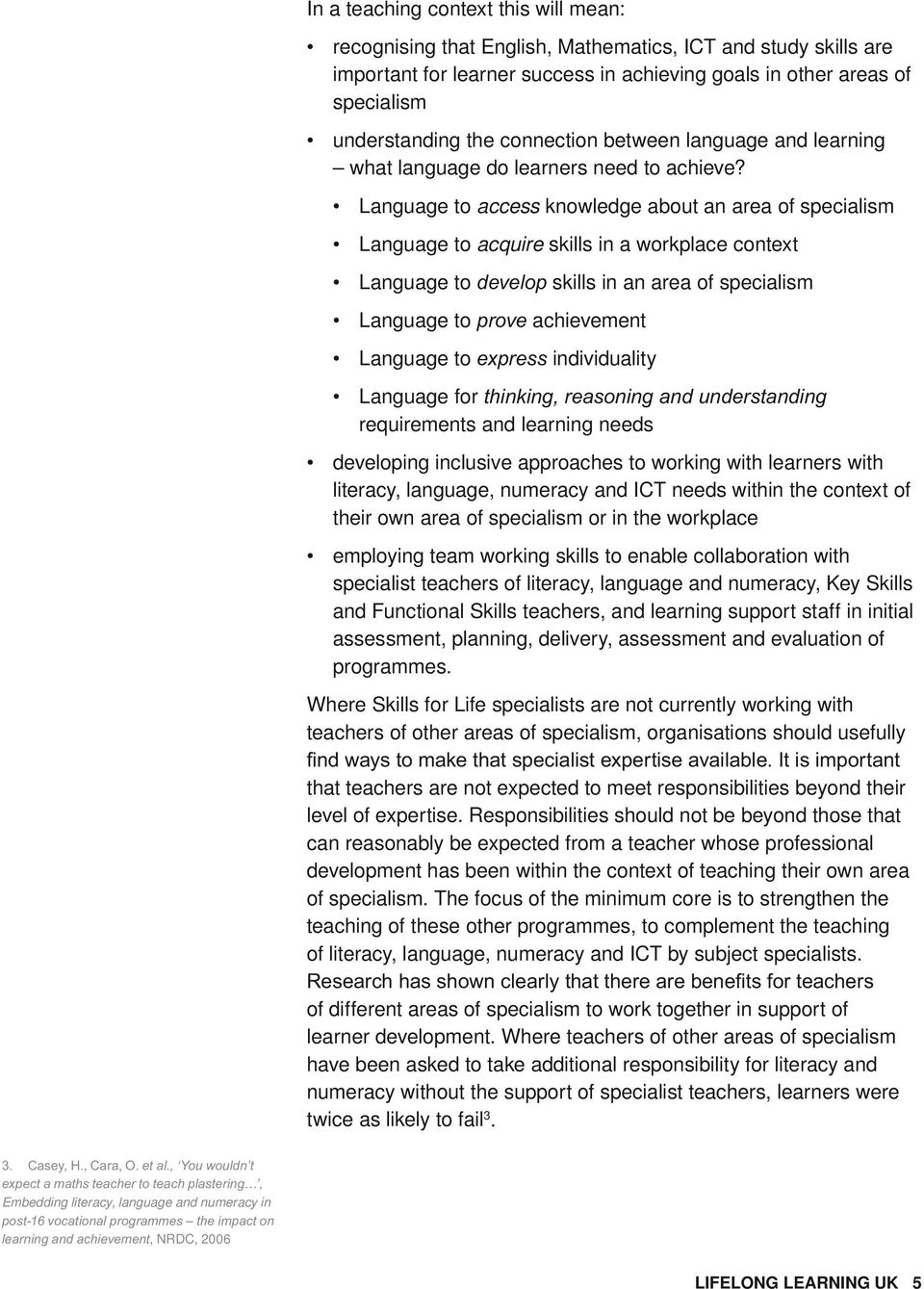
7 In a teaching context this will mean: recognising that English, Mathematics, ICT and study skills are important for learner success in achieving goals in other areas of specialism understanding the connection between language and learning what language do learners need to achieve? Language to access knowledge about an area of specialism Language to acquire skills in a workplace context Language to skills in an area of specialism Language to achievement Language to individuality Language for requirements and learning needs developing inclusive approaches to working with learners with literacy, language, numeracy and ICT needs within the context of their own area of specialism or in the workplace employing team working skills to enable collaboration with specialist teachers of literacy, language and numeracy, Key Skills and Functional Skills teachers, and learning support staff in initial assessment, planning, delivery, assessment and evaluation of programmes. Where Skills for Life specialists are not currently working with teachers of other areas of specialism, organisations should usefully that teachers are not expected to meet responsibilities beyond their level of expertise. Responsibilities should not be beyond those that can reasonably be expected from a teacher whose professional development has been within the context of teaching their own area of specialism. The focus of the minimum core is to strengthen the teaching of these other programmes, to complement the teaching of literacy, language, numeracy and ICT by subject specialists. of different areas of specialism to work together in support of learner development. Where teachers of other areas of specialism have been asked to take additional responsibility for literacy and numeracy without the support of specialist teachers, learners were twice as likely to fail 3. Embedding literacy, language and numeracy in, NRDC, 2006 LIFELONG LEARNING UK 5
8 Addressing literacy, language, numeracy and ICT needs in education 4 sets out the skills, knowledge and understanding of literacy, language, numeracy and ICT which all teachers need to support learner achievement of their chosen learning programme. It also outlines the minimum personal skills of English, Mathematics and ICT that teachers need in order to perform their professional role as a teacher. The minimum core document and this guidance document aim to: promote an understanding that underpinning literacy, language, numeracy and ICT skills may be needed for learners to succeed encourage the development of inclusive practices to addressing the literacy, language, numeracy and ICT needs of learners embedded approaches to teaching and learning of Skills for Life provide signposts to useful materials which will support collaborative working with specialist teachers of literacy, language, numeracy and ICT in understanding how to integrate these skills within other areas of specialism. This icon signposts links to other resources and materials that provide further information about topics. This icon signposts opportunities for continuing professional development. This icon indicates opportunities for referring a learner to a specialist teacher of literacy, language, numeracy or ICT. 4. LLUK, LIFELONG LEARNING UK

9 3THE LEARNING JOURNEY 5. In June 2007 the prime minister announced that three new departments had been set up in place of the Department for Education and Skills (DfES) and the Department of Trade and Industry (DTI). The new departments are: Department for Innovation, Universities and Skills (DIUS) Department for Children, Schools and Families (DCSF) Department for Business, Enterprise and Regulatory Reform (DBERR). The DIUS is responsible for adult learning, further and higher education, skills, science and innovation work previously looked after by both DfES and DTI. The Learning Journey, produced by the DfES 5 for the national Skills for Life Strategy, outlines the stages through which learners travel as they embark on a learning programme. Throughout this journey, learners may need to access opportunities to develop their literacy, their current knowledge to help them to access the learning in their main course, working towards Skills for Life, Key Skills or Functional a level appropriate to gain employment, participate in workplace training or begin their programme of study. All teachers should be able to identify and provide opportunities to practise literacy, language, numeracy and ICT skills in many, if not all, of the stages outlined. Throughout these stages of The Learning Journey, learners will need more or less support depending on their starting point and their skills development along the way. Critical to ensuring success is: ICT skills demands of the main learning programme using initial assessment and induction to consider potential skills development needs LIFELONG LEARNING UK 7

10 3THE LEARNING JOURNEY contributing to individual learning plan (ILP) targets, involving the learner in reviewing progress, and identifying steps needed to reach the programme goal using differentiated learning and teaching strategies to meet the learning needs of all learners irrespective of their starting point and learning programme using assessment for learning effectively to engage, enthuse and support learners, and assessment of learning to recognise autonomy working collaboratively with colleagues and using complementary expertise to ensure learners literacy, language, numeracy and ICT needs are met at the key stages on the learning journey ensuring that learning is challenging for all learners and stretches the high achievers as well as supporting others who may need to make a longer journey to meet their goals identifying and accessing relevant CPD opportunities to be better equipped to meet the needs of learners in literacy, language, numeracy and ICT within the programme delivery. Research 6 has highlighted the importance of providing opportunities for learner achievement of literacy, language, and numeracy goals stresses the importance of teachers of different areas of specialism working together as a team, each contributing their own specialist expertise, rather than one teacher always taking responsibility for all areas of development. Using approaches that make the literacy, language, numeracy and ICT learning relevant and meaningful motivates learners in these essential areas. These ideas will be explored throughout this guidance document to identify what this may mean for a teacher. In particular, it will outline some of the key terminology and strategies that will have an impact on learner literacy, language, numeracy and ICT experience. Embedding literacy, language and numeracy in, NRDC, 2006 The importance of teachers making explicit the value of literacy, language and numeracy in relation to learners aspirations is demonstrated in case studies taken from a project completed by the National Research and Development Centre for adult literacy and numeracy (NRDC). These can be accessed at. 8 LIFELONG LEARNING UK

11 4 IDENTIFYING LEARNERS NEEDS AND INITIAL ASSESSMENT 4.1 Personal, social and cultural factors affecting literacy, language, numeracy and ICT learning The professional knowledge and understanding outlined in the 7, emphasises the need for all teachers to have an understanding of: the personal, social, cultural and linguistic diversity of learners the implications of learners social, cultural and economic backgrounds the concept of inclusive learning the broad range of learning needs. The minimum core further describes these characteristics in relation to literacy, language, numeracy and ICT. Underpinning this understanding will be an awareness of: language varieties of spoken and written English; the link between language choice and personal, community and geographical identity; the role and function of Standard English; multilingualism the linguistic, cultural and educational backgrounds of learners; the impact this may have on their learning, including literacy, language, numeracy and ICT skills development the role of literacy, language, numeracy and ICT and wider personal learning and thinking skills in enabling learners to become active citizens and participate in society and the modern economy the social, personal and economic consequences of diverse literacy, language, numeracy and ICT backgrounds; strengths, experience and motivation of learners; personal, social, cultural, institutional, teaching and learning barriers to literacy, language, numeracy and ICT acquisition may affect literacy, language, numeracy and ICT acquisition and learning. 7. LLUK, 2007 LIFELONG LEARNING UK 9

12 4.2 Induction and initial assessment of literacy, language, numeracy and ICT Induction and initial assessment of learners for their chosen learning programme is a key area of teachers responsibility. In addition, they should be aware of the need to identify the literacy, language, numeracy and ICT needs at this time as well. Whatever an organisation s arrangement is for this, teachers of other areas of specialism will need: an awareness of the literacy, language, numeracy, ICT and study skills needs of the programme being taught an understanding that induction and initial assessment programmes for all areas of specialism should include literacy, language, numeracy and ICT assessment a knowledge of local sources of specialist subject expertise in literacy, language, numeracy and ICT an understanding of the results of such initial assessments of literacy, language, numeracy and ICT a general understanding of the national standards and the role of the core curricula for adult literacy, numeracy, ESOL and ICT disabilities on subject learning, as well as on literacy, language, numeracy and ICT learning The literacy, language, numeracy and ICT requirements of courses To decide whether a course is appropriate for individual learners requires: an understanding of the literacy, language, numeracy and ICT skills typically required by the area of specialism at different curriculum levels a recognition of the importance of a skills audit of any programme for literacy, language, numeracy and ICT skills an understanding of the links between initial assessment and the skills demands of any programme within an area of specialism an understanding of the specialist teaching of literacy, language, numeracy and ICT and other strategies for supporting learners which may be available in the locality, either inside or outside their college or centre 10 LIFELONG LEARNING UK

13 collaboration with specialist colleagues to decide how best to organise the teaching of literacy, language, numeracy and ICT for a particular group of learners Induction and initial assessment activities It is important to identify literacy, language, numeracy, ICT and Key Skills at the start of a course in all areas of specialism. On effective courses, teachers will collaborate with language, number and ICT specialists within course teams in devising relevant activities. Some relevant initial assessment activities that are undertaken by learners could include: literacy, language, numeracy and ICT assessment mapped to the core curriculum levels programme based diagnostic assessment discussions with the learners about their learning history and preferred modes of learning observation of learners in induction and course activities to get a sense of how a learner performs, which activities they enjoy and which they are least comfortable with induction assignments. If during initial assessment activities there are signs that a Some of these assessments may be administered by literacy, language, numeracy or ICT specialists, for example, diagnostic assessments. Other assessments may be used prior to entry to course, for example, skills check, or by course teachers, for example, initial assessment. Initial assessment tools can be paper-based or IT-based. There are several tools available, some of which are commercial products, others have been developed for the Skills for Life Strategy. LIFELONG LEARNING UK 11

14 For more information and access to initial assessment tools produced for the Skills for Life Strategy, try the Tools Library website, The example which follows is taken from the Skills for Life generic literacy initial assessment tool, paper-based version, which can be accessed on the Tools Library website. Each question is referenced to the relevant core curriculum document and the indicative learner level is gauged from the overall score as shown in the table. 12 LIFELONG LEARNING UK

15 It should be noted that no initial assessment is perfect and that it is important that teachers also rely on their professional will provide appropriate advice and guidance. For ESOL learners this may be particularly relevant as they may encounter cultural barriers a misleading result. Examples of good practice on induction and initial assessment Database at excelle abase. The Raising Standards Guides produced by the Skills for Life Strategy Unit are intended to help practitioners and managers improve the quality of teaching and managing Skills for Life provision for their particular context. They have now been made available as interactive versions and can be accessed at. Good Practice Guidance in Skills Check and Initial Assessment. This booklet contains information about the skills check and initial assessment process, together with advice about best practice drawing on practitioner experience. It can be downloaded from. Improving Initial Assessment: a learner centred process. This training resource was developed by the Learning and Skills Network for the Skills for Life Quality Initiative and can be downloaded from. Initial assessment toolkit. This resource has been produced from. It will also be available at. LIFELONG LEARNING UK 13

16 Skills audit A skills audit or task analysis can pinpoint opportunities to develop the literacy, language, numeracy and ICT skills within other areas of specialism. These Skills for Life can be key to enabling learners to be effective in both their core learning and in work and life. Matching the level of demand of a learning programme and the assessment results of learners will enable the literacy, language, numeracy and ICT skills that learners may need to complete numeracy or ESOL specialist can be helpful when considering strategies to support learners to develop these underpinning skills. What is a skills audit? A full skills audit is generally carried out by a course team including Skills for Life specialists. An audit of literacy, numeracy, language and ICT skills pinpoints particular programme. It looks at the ways learners have to use literacy, numeracy, language and ICT skills to follow the programme by examining: course handouts and worksheets textbooks and any standard reference books the use of specialist formats for presenting text or numbers, for example, reports, statistical tables, case studies, account ledgers the use of specialist terminology the use of e-learning, for example, websites, CD-ROMS, ICT resources common teaching strategies, for example, lecture, practical demonstration, simulation the ways in which learners are expected to record learning points in class private study tasks group learning activities assignment tasks, assignment criteria and feedback other assessment tasks, for example, portfolio management, multiple-choice exams. 14 LIFELONG LEARNING UK

17 An audit recognises that literacy, numeracy, language and ICT skills are needed to make good use of all these learning experiences. The skills demanded of learners during the programme may need to be: demonstrated at entry before the learner joins the programme taught to those with some skills gaps through additional support, or taught to the whole group before or alongside the vocational activity that requires the skill. The results of the audit should be used to map literacy, language, numeracy and ICT skills to relevant activities on the main programme to: identify naturally occurring opportunities for developing and assessing literacy, numeracy, language and ICT skills through vocational activities plan integrated assignments that will allow learners to demonstrate achievement in vocational skills as well as literacy, numeracy, language and ICT focus the additional support given in order to allow timely development of the skills needed for particular activities on the programme. Adapted from: DfES, p.35 Once it is completed teachers need to decide which skills is it assumed learners will bring to the course and which skills they will develop while on programme. In relation to the skills learners need prior to starting their course, teachers will need to consider how these skills will be assessed on entry. Teachers then need to decide how new skills will be acquired and when and where they will be practised by learners and how they will be assessed. Teachers need to consider what form assessment will take and the skills needed for assessment. Session 3 LIFELONG LEARNING UK 15

18 Case studies, set in seven different contexts, which feature the practice of embedding literacy, language and numeracy in learning programmes can be accessed from the NRDC website at. For a detailed case study with sample activities of collaboration on a skills audit between a teacher of another area of specialism and a literacy, numeracy and ESOL specialist, see Planning to embed LLN in vocational and other programmes, QIA Skills for Life Improvement Programme at. Totally Skilled, the Embedding Skills for Life and Key Skills in this Skills for Life project include support for centres for identifying literacy, language and numeracy skills in learning programmes and can be found at National Standards and the core curricula The core curricula and associated documents are a valuable resource for specialist teachers of literacy, language, numeracy and purpose, will help other teachers in understanding their use by specialists and as a source of information about literacy, language, numeracy and ICT. The key documents are: National Standards for adult literacy, numeracy and ICT Pre-entry curriculum framework Adult Literacy Core Curriculum Adult Numeracy Core Curriculum Adult ESOL Core Curriculum The ICT Skill for Life Curriculum Access for All and numeracy, and the Pre-entry Curriculum framework are undergoing a review. The QIA website, will provide updated information on progress. ESOL Access for All: Guidance on making the adult ESOL curriculum accessible Part 1 and Part LIFELONG LEARNING UK

19 Awareness of the Key Skills and Functional Skills standards is also helpful: Key Skills of Communication, Application of number and ICT Functional English, Mathematics and ICT National Standards for adult literacy, numeracy and ICT can be downloaded from the QCA website at The Pre-entry curriculum framework, Adult Literacy Core Curriculum, Adult Numeracy Core Curriculum and ESOL Core Curriculum can be downloaded from the readwriteplus website,. Access for All can be downloaded from the same site. ESOL Access for All: Guidance on making the ESOL curriculum accessible can be downloaded from the QIA Excellence exc. The ICT Skill for Life Curriculum can be downloaded from the QCA website at Interactive curricula websites and CD-ROMs Interactive versions of the Adult Literacy and Numeracy Core Curricula, searchable and cross referenced to the guidance manual Access for All are now available as follows: Literacy with Access for All Numeracy with Access for All numeracy Interactive versions of the Adult ESOL Core Curriculum and the Adult Pre-entry Curriculum Framework for Literacy and Numeracy are also available in fully searchable format: ESOL Pre-entry LIFELONG LEARNING UK 17

20 A useful online introduction to the core curricula can be found at in the form of the core curriculum online professional development elements. Key Skills standards are available from the QCA website at Functional Skills standards are available from the QCA website at To better inform the support that may be required, the following strategies could be used: Accessing sources of information about the learning needs of individuals such as application forms, specialist reports, formative assessments Discussing learning histories and learning preferences with learners such as dyslexia and dyscalculia (including respecting learners rights, boundaries and wishes), and using some key strategies for supporting learners, for example, by enlarging handouts for visually impaired learners Seeking and acting on guidance from support staff on learning providing information about support and guidance facilities available internally or externally, and how to access these, should enable learners to access the help and support of specialist teachers. Access for All, Introducing Access for All and All are useful resources for guidance on supporting learners with 18 LIFELONG LEARNING UK
21 Access for All was well received by practitioners, and its introduction came in for particular praise. The general opinion was that the guidance this introduction offered would be relevant to all teachers and staff working in the post-16 curriculum, and there were many people who requested that it be presented as a stand-alone publication. Department for Education and Skills, DfES, 2002 Introducing Access for All can be downloaded from the readwriteplus website at. Learning for Living, a project funded by the Skills for Life Strategy Unit, has produced a suite of guidance materials for developing access to Skills for Life for adult with literacy, language includes ESOL Access for All: Guidance on making the ESOL curriculum accessible. The materials can be downloaded from Individual Learning Plans Literacy, language, numeracy and ICT skills goals should be included in learners individual learning plans (ILP) alongside those for other areas of specialism. ILPs should be: understood by the learner owned and used by the learner appropriate for the context in which the learning takes place. Improving Learner Achievement: individual planning and assessment Working with learners to set literacy, language, numeracy and ICT can be crucial to relate these targets to naturally occurring activities within the delivery of the main programme. This will require the expertise of an area of specialism teacher. LIFELONG LEARNING UK 19
22 Additionally, learners personal goals may change and broaden as their education progresses. It is important that contributions to the review and development of individual learning plans includes literacy, language, numeracy and ICT targets along with the area of specialism learning. Learners can be motivated by the recognition of achievement of their literacy, language, numeracy and ICT targets within other activities and by understanding the link between this achievement and potential success with their primary learning the development of these skills. This may be through the adult literacy and numeracy tests, the key skills of application of number, communication skills and ICT, or in the future, the Functional Skills of English, Mathematics and ICT. Support for the development of effective ILPs may include: working collaboratively with specialist colleagues in interpreting the results of relevant diagnostic tests and developing targets in literacy, language, numeracy and ICT skills relevant to the area of specialism working collaboratively with specialist colleagues to design activities, including differentiated learning, that practise literacy, language, numeracy and ICT skills within the area of specialism encouraging learners to become involved in setting their literacy, language, numeracy and ICT goals, recognising that some contributing to the review and development of literacy, language, numeracy, ICT and Key Skills targets within the area of specialism and transferring this understanding to support functional skills development as this becomes a requirement. Improving Learner Achievement: individual planning and assessment. This training resource was developed by the Learning and Skills Network for the Skills for Life Quality Initiative and can be downloaded from materials. Planning Learning and Recording Progress & Achievement Planning Learning and Recording Progress & Achievement: a guide contains example ILPs. 20 LIFELONG LEARNING UK
23 The ITT Pilot Resources website contains information about and examples of ILPs at. html. Written by subject specialists from the sector, the Individual Learning Plans section highlights characteristics of effective practice in ILPs with practical examples of local solutions and developmental work from the pilot centres. to support the development of generic skills, knowledge and understanding of trainee teachers and trainers in the lifelong learning sector at. One of the roles of the Centres for Excellence in Teacher Training is that they will disseminate, develop and update these resources. 4.3 Where next? stages on The Learning Journey. Identifying opportunities for developing and supporting learners literacy, language, numeracy and ICT skills can enable learners to achieve not only their main learning goal but also support them to become more effective learners. All teachers can contribute to this process, but may want to explore and develop these skills through further professional For more information about continuing professional development (CPD) see section 9. LLUK and QIA will continue to respond to sector needs by development and provision of all types of appropriate training Accredited CPD LLUK is developing a CPD framework which will include units of assessment. These are intended to enable teachers to access relevant training. All available units are listed on the LLUK website, including those addressing embedded approaches and integrated practice. Accreditation based upon these units of assessment will be increasingly offered by a range of awarding institutions. although the range of programmes will vary depending on the individual institution. LIFELONG LEARNING UK 21
24 4.3.2 Non-accredited CPD The Quality Improvement Agency (QIA) offers a range of nonaccredited programmes through initiatives such as: Skills for Life Improvement Programme (SfLIP) Key Skills Support Programme (KSSP) National Centre for Excellence in Teaching Mathematics (NCETM) National Teaching and Learning Change Programme. CPD information is relevant at time of publication. 22 LIFELONG LEARNING UK
25 5 SESSION AND COURSE PLANNING Planning programmes, lessons and schemes of work, as well as planning for differentiated learning, are core elements of teaching and learning. Information gained from collaboration with specialists can be used to plan learning which takes account of the literacy, language, numeracy and ICT skills of learners. It is recognised that it may not always be possible to have specialists available, particularly in some contexts where teaching and learning takes place, such as in the that can be taken to support learners needs. This may mean: including sessions on study skills, using libraries and using ILT in their programmes planning regular sessions with teachers of other areas of specialism and literacy, language, numeracy and ICT specialists using teaching materials which use language at an appropriate level planning the use of clear language in giving instructions, both spoken and written developing or contributing to the development of activities that promote literacy, language, numeracy and ICT learning alongside other skills ensuring a complementary sequence of work in area of The following provides a diagrammatic overview of the planning LIFELONG LEARNING UK 23
26 Initial assessment and diagnosis of individual learning needs outcomes of the session and amend session plan and resources Requirement for or literacy, language and numeracy and ICT specialists and agreement on roles Summarise the key elements of the session and consolidate learning Teachers and trainers considerations for planning individualised learning Teaching and assessment strategies and resources to be used Ongoing assessment of the learning taking place and amendment to session Strategies to extend the skills of the more able and support those needing Strategies to cope with the unexpected At each stage of this process the impact of and opportunities for literacy, language, numeracy and ICT development should be taken into account. Contributions to this process will ensure that the individual needs of each learner are met and that all stages are planned with reference to the appropriate literacy, language, numeracy and ICT support that may be employed or required. A literacy, language, numeracy or ICT specialist will be able to provide more targeted skills development for learners who need specialist help and support with their language, number and ICT skills. 24 LIFELONG LEARNING UK
27 5.1 Working effectively with additional learning support provision and other support and guidance services Session and course planning provides an ideal opportunity to consider the role additional support staff may have throughout the programme. Familiarity with the range of support and guidance facilities available within organisations, or outside, and how to access these is important as is maintaining the currency of knowledge about such facilities. The importance of working effectively with other staff in supporting those with literacy, language, numeracy and ICT needs in all aspects of teaching and training cannot be stressed too highly. Literacy, language, numeracy and ICT support is an invaluable resource but such staff should not be seen as responsible for all issues around literacy, language, numeracy and ICT learning with their learners, but as complementary to the area of specialism teaching. Literacy, language, numeracy and ICT support works best when teachers and support staff work collaboratively, sharing outcomes and planning activities. In the context of the Diplomas, for example, teachers may be required to work collaboratively with support staff from different settings across the Diploma delivery partnership. Learning support practitioners in the lifelong learning sector value all learners individually and equally. They are committed to lifelong learning and professional development and strive for of the learning support practitioner is to contribute to the creation of effective and stimulating opportunities for learning. They do this by providing high quality support to learners and teachers. This enables the development and progression of the learners they support. Lifelong Learning UK, LLUK, 2006 The Lifelong Learning UK website, will have up-to-date information about the new learning support standards. LIFELONG LEARNING UK 25
28 6 LEARNING AND TEACHING ACTIVITIES 6.1 Maintaining an inclusive learning environment The delivery of learning should engage, motivate and enthuse individual learners and encourage their active participation, leading to learner autonomy. This means taking individual learner needs into account and the use of a wide range of strategies including those which take account of learners levels of literacy, language and numeracy. Teachers should ensure that learners are taught in a purposeful learning environment where they feel safe, secure, valued and respected. Communication strategies should be used which are within learners range of understanding. This will contribute to maintaining an inclusive learning environment. Learners particular literacy, language, numeracy and ICT needs can be established through initial assessment, talking to learners, observing them completing activities or using simple self assessment tests. Recognising and using a variety of different teaching styles is particularly important to support literacy, language and number skills development. Learners working towards literacy, language, their strengths. The teaching styles which you adopt will have an impact on the type of language skills your learners will need to acquire. A didactic approach for example, may require listening and note taking skills predominantly, whereas a more learner centred approach may require higher level reading skills as learners are asked to interpret information for themselves. Even when we are trying to adapt to individual learning styles, the variety of activity used will have an impact on the language skills required within a particular programme of study. The language demands placed on learners are a direct result of teacher led mediation of learning. Vocational Courses, Delivery notes and session materials, Session 3 The needs of an individual learner may be related to cultural history and previous educational experience. Those who have been taught in a formal didactic way, for example, may be uncomfortable with methods where they are asked to discover or problem solve for for more autonomous activities. It may be particularly important to make explicit the reasons for using a particular activity for those of the particular activity for learning. 26 LIFELONG LEARNING UK
29 Multilingual learners may have highly developed learning and study skills in other languages and scripts, for example, ESOL learners problem-solving activities. As learners in the FE sector are very diverse, using an extensive variety of methods in the delivery of learning will engage and motivate learners and meet the wide range of learner needs. These methods can be used to support language, number and ICT skills development as well as learning in their area of specialism and may include: whole group teaching embedded learning problem solving and discovery learning workshop practice individual and pair work case studies, role play and simulation group work the use of different media including ICT and interactive resources independent and resource based learning learning through discussion individual coaching and tutorials peer working. To maintain an inclusive environment, involving a literacy, language, numeracy or ICT specialist in the team will provide more targeted skills development for learners who need specialist help and support with their language, number and ICT skills. 6.2 Differentiated learning Planning and delivering sessions with differentiated outcomes and activities is particularly crucial for enabling learners with literacy, language, numeracy and ICT needs to achieve. The use of differentiated learning is key to making learning accessible and fostering the development of language, number and ICT skills. Differentiating schemes of work and lesson plans will meet the individual needs, aims and experiences of learners. LIFELONG LEARNING UK 27
30 ability is only one characteristic of learners that might be mixed ; there are many differences between our learners that affect their learning. So, the term differentiation has been adopted, meaning to cope with such differences. Differentiation is... the process of identifying with each learner, the most effective strategies for achieving agreed targets. (Weston, P. (1992) 19(1)) with difference. Differentiation does not just mean adapting work for learners with support needs in language, literacy, numeracy or ICT, it also means ensuring work will stretch to enable ease of progression too. Differentiated learning needs to take into account that learners may differ in terms of their motivation, prior experience and knowledge, learning support needs, cultural expectations, literacy, language, numeracy and ICT level and learning preferences. the language, number and ICT skills are more developed than others. Differentiating to meet this diverse range of needs can be challenging but will be necessary to ensure all learners can attain their goals. For example, learners may be familiar with some aspects of ICT, but the variety of technologies available can be bewildering developed than others. To meet learners different needs a variety of interactive teaching and learning approaches need to be employed. Active learning engages and motivates learners to learn and achieve. What is active learning and why does it work? We learn by doing. Research shows that active learning is much better recalled, enjoyed and understood. Active methods require us to make our own meaning, that is, develop our own conceptualisations of what we are learning LIFELONG LEARNING UK
31 Tasks can be differentiated by: learning outcomes teaching and learning resources learner groupings assessment learning support. Teaching and learning activities may include: mixed ability group work where more advanced learners can provide peer support to fellow learners terms of language or content, for some groups and extended for others group work to facilitate use of learners other languages in group tasks where some learners are more supported, for example, some learners could write a report independently while others complete a prepared format extension activities for strong learners discovery learning and personal research where learners can learn at their own pace additional learning support for individuals or small groups use of personal tutorials access to self study ICT materials and learning centres. Where additional learning support is available, the success of that support will depend on the constructive and active collaboration between the area of specialism teacher and the Skills for Life or Key Skills team. In a work-related learning context, it may be more of a challenge to use the range of teaching and learning activities to differentiate learning, but meeting the literacy, language, numeracy and ICT needs of learners in this context is equally critical as in any other development of these skills can be essential to enable learners to learning in a work-related setting will need to accommodate the LIFELONG LEARNING UK 29
32 workplace environment, the area of specialism requirements as well as the language, number and ICT demands of the programme and learner needs. This may also be true in other contexts and settings, such as the offender estate and the work experience requirement of Diploma learning. are extracts from session plans in two areas (construction and land-based). These show different approaches to identifying and recording opportunities for differentiating sessions. Timing Content topic, including the Key Skills to develop. Teacher and trainer activity Teaching strategies to include methods of delivery and assessment approaches to meet individual learning needs. Learner activity Learning strategies to include use of technology and materials to meet individual learning needs. Resources to be used: E.g. gapped handouts, answer grid, whiteboard, learner packs. Individualised activity requirements of individuals according to their initial assessment learning preferences. 10 mins and accidents in the construction industry. Whole-class teaching exposition and directed questioning. Record learners ideas on smartboard or whiteboard. Listening, answering, taking notes. Learners to give examples of accidents in their trade and to Room arranged for small-group work. Smartboard. Whiteboard. Learner workbook. Identify and note learners who have additional support needs. Agree support staff s role in session prior to commencement. 10 mins Ideas blast. Facilitating. causes of accidents. In groups of three, develop ideas onto paper. Move learners into arranged to include one most experienced learner, one most inexperienced learner. 30 mins Production of groups. Explain and agree common format and e.g. bar, pie. Allocate group tasks. Continual assessment of production of graphs. to illustrate causes of either: a) fatal accidents b) non-fatal major accidents c) three-day absence. Squared paper, protractors, rulers, compasses, coloured pens. Learner workbook. Appropriate computer facilities. Take account of learners understanding of graphs and charts. Faster learners to be given additional data and the opportunity to produce variations to the comparison using IT. Session topic: Being safe at work (Construction) 30 LIFELONG LEARNING UK
33 30 min Group work: Agree how many learners will work with each set of cards. (Maximum six, depending on how to add any task not already included. others sequences if appropriate. Discuss possible consequences of not doing tasks in the order selected. Repeat the sequencing exercise with different scenario (time and enthusiasm permitting). 10 min to list the tasks in sequence, why each is important and consequences if not done correctly. Conclusion: Q&A session to check understanding. Ask learners for reactions to session. Link forward: To video of moving different animals, to be used during a future session. Private study: Use the interactive version for a stated scenario; print off, discuss with work supervisor (and during next visit). Sample session plan for card activity: Preparing Animals for Transport (Land based) For some learners, differentiation alone may not provide the full support needed for their language, number and ICT skills development and involving a literacy, language, numeracy or ICT specialist may be appropriate to enable them to progress. For more resources on differentiation, see Using Interactive Approaches in Teaching Literacy, Language and Numeracy, QIA Skills for Life Improvement Programme at. Similar resources providing a differentiated overview can be accessed at Vocational Learning Support Programme. From theory to practice: using differentiation to raise levels of attainment (LSN, 2006) looks at the theory of differentiation, and aims to answer the most popular questions teachers ask on the subject. This publication can be downloaded or ordered from the LSN website at The Differentiation in the Teaching and Learning section of LIFELONG LEARNING UK 31
34 and therefore design meaningful tasks, projects and assignments so learners have a choice of differentiated learning outcomes. It can be accessed at. comprehensive overview of differentiation, including: Differentiation: Ten Tips for NQTs: Ten tips for implementing differentiation Effective Differentiation: Tips on how to differentiate the process, learning outcomes and lesson content Differentiation: preparing handouts: An example of a handout in two different styles to support differentiation between levels of learning. Teaching Today: a practical guide also has a website, which provides a wealth of advice and information about differentiation and active learning approaches. video clips, activity sheets and PowerPoint slides, to develop an understanding of differentiation. These can be accessed at. 6.3 Embedded approaches the context of the Skills for Life strategy is: Embedded teaching and learning combines the development of literacy, language and numeracy with vocational and other skills. and at work. Developing learners literacy, language, numeracy and ICT skills within meaningful contexts is recognised as one of the most effective drivers for learning for work and life. Through such embedded approaches, the dual goals of learners main course and literacy, language, numeracy and ICT development can be achieved. This 32 LIFELONG LEARNING UK
35 has been recognised in research. The report from the NRDC 9 higher retention and increased success rates on embedded courses development of literacy, language, numeracy and ICT skills underpin next? sections for further information). Effective literacy, language, numeracy and ICT skills are critical, performance in the workplace and in personal and social life. Embedded learning can provide learners with the opportunity to develop literacy, language, numeracy and ICT skills as a natural part of a different primary goal an area of specialism award, an adult education course or as part of personal learning goals delivered in the community. Integrating or embedding literacy, language, numeracy and ICT skills with other areas of specialism is good practice for a number of reasons: ICT skills, clearly perceived by teachers and learners as having importance for the core learning It can be motivational for learners who will understand why they are developing literacy, language, numeracy and ICT skills alongside other skills and ICT skills from those required for the area of specialism, seeing the one set of skills as being intrinsic to and inseparable from the other Embedding literacy, language and numeracy in NRDC, Adapted from Raising Standards, DfES, It can empower learners as newly trained employees, giving allowing the possibility of further development It can give teachers of other areas of specialism new tools to ensure that teaching and learning is effective and develops secure, transferable skills 10 LIFELONG LEARNING UK 33
36 The NRDC research 11 programmes, although it concluded that there was no single model of embedded provision. The research did highlight, however, that teamwork and shared understandings and beliefs were equally as important as having the structural features of embedding in place. Features of embedded programmes judged courses on a range of features of embedding. Four main groups of features emerged: Teamwork between LLN teachers and vocational teachers Staff understandings, values and beliefs Aspects of teaching and learning that connect LLN to vocational content Policies and organisational features at institutional level Fully embedded courses all showed features from each of these achieved the same effects in very different ways. For example, successful collaborative teamwork was achieved through a variety of methods. On some courses, teachers taught alongside one another, on others staff found other ways to link up and create an integrated experience for their shared learners. NRDC, 2006 The research also concluded that when one teacher was given the responsibility for teaching both their area of specialism and literacy, language and numeracy, learners were less likely to succeed in embedded provision will be determined by each institution or organisation but meaningful, collaborative working is clearly one key element of effective embedded delivery. Embedding literacy, language and numeracy in NRDC, 2006 teachers and teachers of other areas of specialism can provide a highly effective way to identify the literacy, language, numeracy and ICT skills which underpin learning programmes the experience and expertise of teachers from both areas is essential. Development of these skills can be jointly planned by teachers working together who share the same understandings and beliefs in delivering embedded approaches to the learning of language, number and ICT skills. In 34 LIFELONG LEARNING UK
37 some institutions, for example, the teaching of the area of specialism and literacy, language, numeracy and ICT skills are delivered in partnership. audit to determine the underpinning literacy, language, numeracy and ICT skills needed by learners to effectively access their learning (see page 14). National Occupational Standards (NOS) for many occupational sectors have been mapped to the literacy and numeracy standards. These provide a quick route to identifying the underpinning literacy and numeracy skills required by occupational tasks. The process of developing embedded learning materials and the delivery of embedded approaches requires knowledge and understanding of the requirements of the main course and of the complete this programme. Teachers with different expertise need to work together in pursuit of learners progress and achievement. Literacy, language, numeracy and ICT specialists will be able to provide the knowledge and understanding of Skills for Life development. Raising Standards, A Contextualised Guide to Support Success in Literacy, Numeracy and ESOL Provision: Embedded Learning, DfES, can be accessed at. The NRDC Report: You wouldn t expect a maths teacher to teach plastering, Embedding literacy, language and numeracy in post-16 vocational programmes the impact on learning and achievement, Casey et al, NRDC (2006), can be downloaded from. The National Occupational Standards for many occupational sectors have been mapped to the adult literacy and numeracy standards. These can be accessed at. LIFELONG LEARNING UK 35
38 For training resources and information on approaches to embedding literacy, language and numeracy see QIA Skills for Life Improvement Programme resources at embeddingskillsforlife.aspx. The range includes: Approaches to SfL for other areas of specialism teachers Embedding SfL - a programme for managers Sharing and Transferring Good Practice in Embedding Literacy, Language and Numeracy in Vocational or Other Programmes Planning to embed LLN in other areas of specialism Working in Partnership to Embed Literacy, Language and Numeracy 6.4 Communication strategies Effective two-way communication with learners is an essential element of teaching and learning, and speaking and listening is a key component of the communication strategies that may be used. communication at work, at home and in the community. They are the communication skills used most frequently by people at all of us still spend more time speaking, listening and discussing than we spend reading or writing. Talk is an essential medium for Robertson, N., DfES, 2006 Despite their importance as skills for work, learning and life, speaking and listening skills use and development can sometimes be less considered than other aspects of literacy and language. language speakers as well as for ESOL learners. Communicating to communicating with all learners and will ensure that they are able to access information communicated verbally and respond appropriately. 36 LIFELONG LEARNING UK
39 Prior knowledge and prediction is particularly important in enabling ESOL learners to understand spoken information: Setting the scene at the beginning of a session Using visual clues, titles, and intonation (stress on certain words in a sentence, rise and fall of voice) to indicate the key points Eliciting prior knowledge Pre-teaching key words, terms and phrases which may be unfamiliar to the learner Considering the context to decide if it might be culturally dependent and providing appropriate explanations, for example, an ESOL learner even though all the vocabulary might be understood In addition, strategies which may make oral comprehension easier for ESOL learners are: using clear, unambiguous language speaking naturally but at a moderate pace using signposting, for example, I am going to talk about three avoiding redundancy (repetition, asides, etc.), idiomatic and colloquial language being aware of terms that have different meanings in different contexts highlighting key points and terms on the whiteboard to reinforce oral explanations repeating key ideas and learning points using the same language each time to give learners an additional opportunity for understanding material recognising that politeness strategies vary culturally. Learners may be confused by instructions that are too mitigated, for example, I wonder if you might try... as opposed to Try... recognising cultural differences in non-verbal communication and being sensitive to any miscommunication being explicit about rules and conventions for different communication situations, for example, group tasks, workplace learning. LIFELONG LEARNING UK 37
40 Learners may also need support with listening skills. They may have highly developed listening skills in other languages, but may language. Learners can be supported to extract relevant information by: avoiding long periods of teacher explanation giving a handout with the main points or questions before learners listen using multiple choice question sheets or tick boxes to complete when listening asking checking questions to elicit a demonstration of comprehension allowing learners to summarise what they have listened to in pairs before moving on allowing waiting time for learners to answer questions don t give the answer before learners have had time to consider the question and formed an answer not asking multiple questions many learners at the lower levels avoiding the use of colloquialisms and slang. effective ways of learning another language can be to use that language to do something else, rather than to explicitly learn new second language speakers have never attended any formal classes in that language, rather they have acquired their second language through work and everyday life. or provide focused language skills development for ESOL learners conventions of grammar. Many aspects of communication skills, such as turn-taking, are may be used to adhering to very different turn-taking rules and this can easily be misinterpreted. 38 LIFELONG LEARNING UK
41 Effective communication: further guidance Effective communication depends to a large extent on the innate skills of the individuals concerned and the cultural context. Much teaching revolves around the understanding of certain concepts. Teachers must always be very clear about the difference between the concepts they are teaching and those which they expect their learners to have a prior understanding of. This understanding must be checked both before introducing new concepts and once improving our communication skills by being aware of certain points, having control over our use of language and being aware of the reactions of those we are communicating with. What makes for effective communication in the classroom depends on a variety of factors. Below are some of the most salient points which trainers and teachers can develop. A constant awareness of the language you are using teachers need to listen to their use of language and observe the reaction of learners to the language use. An awareness of the purpose for which language is being used, for example, the language of the subject; the language used to contribute to a positive relationship between the learners and the tutor; the language of instruction. The tutor needs to ensure that learners are clear as to what is happening at each point, for example, instructions are being given. taught, for example, brain gym. Body language is often a contentious point as the same expression of it can be interpreted quite differently in different The frequent checking of understanding in a meaningful way is essential. Do you understand? is usually answered by yes and a smile. This, however, does not mean that understanding has taken place. A more useful way of checking understanding is to use questions which require the listener to give a fuller treatment you get at your doctor s? Rees, S and Savitzy, F., bilingual adults, p.3, LLU+, London South Bank University, 2005 LIFELONG LEARNING UK 39
42 6.4.1 Communication in numeracy and ICT Communication strategies are important in developing learners numeracy and ICT skills. Consideration of communication in numeracy and ICT teaching and learning may be particularly relevant for ESOL learners, for whom the technical language may be a barrier to understanding. Some ESOL learners may, for example, tasks because of the language used. There is a tendency to consider that mathematics and ICT are not areas of specialism requiring a great deal of verbal communication! and the Standards Unit (now QIA) approaches to teaching mathematics clearly demonstrate this is not the case. For example, one practitioner, who focused on asking followup questions to enable offenders to explore their thinking, commented: Department for Education and Skills, Section 3, DfES, 2006 Learners themselves are aware of practitioners speaking and listening skills, and, in the project, offenders interviewed commented: Department for Education and Skills, Section 3, DfES, LIFELONG LEARNING UK
43 learning 12 project encourages discussion as a strategy to develop learners number skills. Our research shows that many learners view mathematics as a series of disconnected procedures and techniques that must be learned by rote. Instead, we want them to engage in discussing and explaining ideas, challenging and teaching one another, creating and solving each other s questions, and working collaboratively to share methods and results. Swan, M., DfES, 2004 Research by the NRDC 13 indicates that effective communication in particular, telling the learner how to do something (explaining) was found to be less effective for ICT learners. Effective strategies were found to be: discussing: tutor engaged in two-way dialogue with learners instructing: tutor telling learners what to do and what tasks to undertake listening: tutor actively listening to learners comments or questions modelling: tutor showing the learner how to do something using the actual technology or its representation on a SMARTBoard. ICT learning as an individual activity carried out in isolation at a workstation may not be as effective for learners as a cooperative activity where effective communication strategies are developed and used Communication with learners with disabilities or learning Learners with language impairment associated with autistic spectrum disorders may interpret language literally. NRDC, 2007 LIFELONG LEARNING UK 41
44 For example, if you asked your group members, Can you tell me what date it is?, an individual who interprets language literally would say yes and nothing more, as they have given the information requested in accordance with the language used. Department for Education and Skills, DfES, 2006 The domination of conversations sometimes occurs with turn-taking skills. Some of your group members may seem to have one of the (listening) styles listed, but you need to be aware that some the content of what is being said, and so appear to be faking listening. The daydreamer may have social communication interrupts frequently may have auditory memory or word retrieval then before the idea is gone. Department for Education and Skills, DfES, 2006 Partially sighted learners may be unable to see non-verbal signals or to be able to use eye contact to show they are listening. Some individuals with autistic spectrum disorders and some with insensitive or hypersensitive to tone of voice. For some learners, there may be cultural issues such as eye contact in non-verbal communication. Some learners may need time to build up their trust when working with other learners and may not be comfortable with personal disclosure. This may be due to previous negative experiences of working with others or with those in authority. 42 LIFELONG LEARNING UK
45 Speaking and listening skills have a critical role in supporting the development of reading and writing. Any teaching and learning of literacy and language skills should therefore be holistic, i.e. the four aspects are inter-related and should be integrated in delivery. A literacy or language specialist will be able to advise on strategies or provide support for learners who need additional skills development in speaking and listening. Teaching speaking and listening: a toolkit for practitioners (Key Skills Support Programme, Learning for Work) contains a wealth of resources to make speaking and listening explicit, relevant and engaging for learners. It can be downloaded from available at. Supporting communication: Guide to good practice (Key Skills Support Programme) can currently be downloaded from the Key Skills Support Programme website at Developing Speaking and Listening Skills: a support pack for staff working with offenders (DfES) provides a comprehensive resource to support speaking and listening skills development and can be adapted for most settings in the FE sector. The Maths4Life website is at Improving learning in mathematics: challenges and strategies by Malcolm Swan can be ordered or downloaded from the website, together with other resources to support numeracy skills development. Maths4Life: Thinking Through Mathematics ring-binder of professional development and teaching resources can be ordered from the Maths4Life website. Maths4Life is now led by the National Centre for Excellence in the Teaching of Mathematics (NCETM) and can be accessed through the NCETM website, LIFELONG LEARNING UK 43
46 Literacy across the curriculum is a staff training pack developed for the Key Stage 3 National Strategy. Modules of this pack contain useful guidance for all teachers of speaking and listening, and can be downloaded from The Effective Teaching and Learning Series: Using ICT (NRDC, 2007) can be downloaded from the NRDC website at. 6.5 Supporting reading, writing, number and ICT development Teachers of other areas of specialism are not expected to be specialist teachers of literacy, language, numeracy or ICT (although there are CPD routes available to explore how these skills may be embedded in other areas of specialisms see the Where next? occurring activities for language, number and ICT skills development within other learning. It is always useful to have some basic strategies for supporting learners, which may include: Reading using readable, accessible texts and explicitly teaching learners how to develop comprehension skills through activities relating to their texts setting tasks before learners read writing up new terms and key words and clarifying meaning in use encouraging learners to highlight key words and concepts in texts using effective questioning, setting the scene and stimulating prior learning before any reading activity to give learners greater opportunity of deciphering the text using reciprocal teaching: an approach where pairs of learners take turns to be tutor and student, for example, in formulating questions for each other about a text reading handouts and other written material aloud in a group for those with ESOL needs for whom this additional listening may add stress) 44 LIFELONG LEARNING UK
47 reinforcing written materials with visuals, for example, a diagram or a demonstration written information encouraging learners to develop reading strategies such as skimming, scanning, detailed reading and critical reading including explicit instructions on how to use reference material, libraries, etc Writing explicitly teaching the conventions of text types required in assignments, for example, note-taking, report writing, essays, through meaningful contexts rather than through decontextualised activities offering models and if necessary writing frames for learners, for example, notes, assignments, reports being aware of, and explicitly teaching if necessary, the drafting process: planning, drafting, editing and proof-reading, through a being able to offer some basic strategies for developing accuracy, for example, Look, Say, Cover, Check, (spelling); spell check, use of dictionaries dyslexic learners, copies of course notes or the use of a tape recorder allowing learners to provide evidence of learning in a variety of ways, for example, sound recording, through a scribe encouraging the use of ICT to produce assignments encouraging peer support, for example, peer proofreading, buddy groups making links between writing and learners area of specialism learning These are just a few strategies for supporting learners, but a literacy or language specialist will be able to provide more targeted skills development for learners who need specialist help and support with their literacy and language skills, for example, spelling strategies, as well as further ideas or resources. LIFELONG LEARNING UK 45
48 6.5.3 Numeracy asking learners how they were taught to do calculations, and ensure they have opportunities to select methods they feel comfortable with using aids such as calculators, solid shapes, number squares and ICT as appropriate, but ensuring learners understand the limitations and functions of a calculator encouraging peer support, for example, by asking another learner to explain the method being aware of the language of number, for example, there are many ways to say multiply, such as times, by, product ensuring that learners understand the command words of problems, for example, solve, evaluate, identify, estimate offering different methods for solving problems (not assuming that there is only one way to do it) not assuming that learners achieving correct answers necessarily understand a process or concept understanding that learners need to be able to select the appropriate mathematical tools to solve a problems in varying contexts designing exercises so they are relevant and meaningful therefore providing learners with opportunities to develop, practise and apply the skills learnt using a variety of teaching strategies to meet learner preferences and maintain interest and motivation, and to develop learners understanding of mathematical concepts within the area of specialism, for example, asking open questions to check understanding, using cooperative small group work, creating connections between the numeracy learning and the area of specialism learning and using technology These are just a few strategies for supporting learners, but a numeracy specialist will be able to provide more targeted skills development for learners who need specialist help and support with their numeracy skills, for example, addressing learners misconceptions about numeracy concepts, as well as further ideas or resources. 46 LIFELONG LEARNING UK
49 6.5.4 ICT identifying and encouraging the opportunities ICT provides to develop literacy, language and numeracy skills using a wide range of up-to-date technologies, for example, whiteboards, digital cameras, m-learning to motivate learners, particularly the younger age group using ICT purposefully, for example, to complete an assignment, of ICT making links with the learning of ICT in the classroom and the wider world, for example, local government information online, the importance of ICT for employment, maintaining contact with families by encouraging learner autonomy in the use of ICT, for example, Webquests, and in exploring different approaches to completing the same task, for example, using function keys, using keyboard shortcuts using discussion, exploration, collaboration and peer review to reinforce learning using a range of teaching and learning strategies to develop instructing, listening and modelling understanding the need to encourage a critical and selective approach to the use of information obtained from websites ensuring learners are aware of the safe use of ICT and the risk of viruses, etc. ICT, however, covers a much wider range of technologies than computers and computer-related hardware and software. Information and communication technology may also include: digital cameras, camcorders and other image capturing equipment interactive whiteboards digital television, video, audio and other related multimedia equipment mobile phones and associated technology to support learning learning platforms graphic calculators. LIFELONG LEARNING UK 47
50 Whichever of these technologies are used, within the range of resources that are available, they should be used purposefully. One of the key requirements of ICT as a Skill for Life, Key Skills and Functional Skills is that ICT should be used for a purpose. Purposeful use of ICT provides learners with a reason to use and engage with the technology rather than following mechanical learning of techniques to enter words into a word-processing program, for example, or to enter data into a spreadsheet for no apparent purpose other than following instructions in a manual. Purposeful activities using ICT also enable learners to use a wide range of skills to work collaboratively, to exchange experiences and provide peer review and support. These are just a few strategies for supporting learners, but an ICT Skill for Life specialist will be able to provide more targeted skills development for learners who need specialist help and support with their ICT skills as well as further ideas or resources. The Effective Teaching and Learning Series: Reading, Writing, Numeracy, ESOL, and Using ICT (NRDC, 2007) outlines recommendations about effective approaches to teaching and learning. These can be downloaded from the NRDC website, The National Centre for Excellence in the Teaching of Mathematics website, provides a wide range of support, advice and resources to enhance mathematics teaching. is the latest stage in the development of policy and practice relating to ICT as a Skill for Life. The project aims to develop and pilot approaches to delivering the ICT Skills for Life curriculum in a variety of settings. The website for the project is at. 48 LIFELONG LEARNING UK
51 to support the development of generic skills, knowledge and understanding of trainee teachers and trainers in the lifelong learning sector at. One of the roles of the Centres for Excellence in Teacher Training is that they will disseminate, develop and update these resources. The Secondary National Strategy website, provides a range of teaching and learning materials for English, mathematics and ICT. Although developed for the school based sector, there are many resources and teaching materials that would be useful in a post-compulsory setting. The Teaching and Learning pages of the TeacherNet website carries information about teaching and learning: teaching strategy, teaching and learning tips, learning psychology, and links to thousands of resources. Although much of it is school based, there are useful links to information about teaching and learning. TeacherNet can be found at: The teachers tv website, provides access to some useful video clips for teaching and learning. Although mostly school based, there are some relevant to the FE sector sector. 6.6 Where next? Throughout the Learning Journey, teachers should plan and deliver inclusive learning through a range of differentiation strategies and embedded learning approaches to provide opportunities to develop literacy, language, numeracy and ICT skills within the context of the main area of specialism. Using effective communication strategies to support both these approaches is vital, but teachers may need further professional development to enable them to ensure a fully inclusive learning environment. For more information about continuing professional development (CPD) see section 9. LLUK and QIA will continue to respond to sector needs by development and provision of all types of appropriate training. LIFELONG LEARNING UK 49
52 6.6.1 Accredited CPD LLUK is developing a CPD framework which will include units of assessment. These are intended to enable teachers to access relevant training. All available units are listed on the LLUK website, including those addressing embedded approaches and integrated practice. Accreditation based upon these units of assessment will be increasingly offered by a range of awarding institutions. although the range of programmes will vary depending on the individual institution Non-accredited CPD The Quality Improvement Agency (QIA) offers a range of nonaccredited programmes through initiatives such as: Skills for Life Improvement Programme (SfLIP) Key Skills Support Programme (KSSP) National Centre for Excellence in Teaching Mathematics (NCETM) National Teaching and Learning Change Programme. CPD information is relevant at time of publication. 50 LIFELONG LEARNING UK
53 7MATERIALS AND RESOURCES Strategies for the development of materials and resources to support teaching and learning that ensure clarity and accessibility for all learners are applicable in all contexts. For learners with literacy, language, numeracy and ICT needs, it is particularly important that materials and resources are developed following good practice. 7.1 Selecting or preparing handouts and worksheets Some key pointers when developing handouts and worksheets to ensure clarity and accessibility are: avoiding grey or faded handouts using a 12pt or 14pt font and a clear, non-serif typeface such as Arial using short, active sentences and avoid complex sentences with lots of sub-clauses paying attention to layout, using headings, bullet points when adapting published materials, keeping the same layout features as these may aid understanding using visuals to support the text that are relevant to the context numbering pages and lines for clear referencing avoiding using capital letters except in appropriate contexts the start of a sentence, proper nouns, etc. using key technical terms judiciously and avoid jargon using clear and unambiguous instructions on worksheets which are talked through with learners beforehand. Number symbols should also be explained. ICT can be particularly useful for those with literacy, language and numeracy needs and it is important that they have access to this. These strategies apply for all materials development. A literacy, language, numeracy or ICT specialist will be able to provide further ideas or strategies for making materials accessible for learners to support their language, number and ICT skills development. LIFELONG LEARNING UK 51
54 7.2 Embedded Learning Materials The Embedded Learning Materials project developed materials for over 20 programmes, including a range of areas of specialism, following a process of research, writing development and expert review by both Skills for Life specialists and sector experts. Materials supporting the integration of the teaching and skills development of the area of specialism and other skills with literacy and numeracy teaching and skills practice, to provide a blended or combined approach. These DfES materials are embedded into National Occupational Standards covering one award (for example, Social Care Level 2), NOS covering several awards (for example, Skills for Construction), programme outlines (for example, E2E) and other awards (for example, International nurses midwifery). Levels covered range above, in literacy and numeracy. The following images highlight the key features of embedded learning materials. These materials are taken from the Trowel Occupations pack published by the DfES, reprinted LIFELONG LEARNING UK
55 To Module 4 Setting out PAGES 4:5 4:6 Setting out and checking using a tape measure (1) Accurate measuring is a critical skill in construction. Working drawings are drawn to show measurements to the exact millimetre. It is not surprising, therefore, that this precision is expected to be maintained by everyone involved in translating the drawing into an actual building. Setting out the building to the nearest millimetre needs a good tape measure that uses millimetres (Unit No. VR41). Materials Millimetre tapes Other types of tapes of varying lengths Plans/drawings from the Source material Learning outcomes 1 To confidently read marked and unmarked millimetre measurements from a tape (focus page, Task 1) 2 To find and mark millimetre measurements on a tape (focus page, Task 2) Introduction Give learners five minutes to examine the range of tapes, noting differences between them, and to come up with a description of the tape (e.g. it is a 5 m/16 foot tape with imperial measurements in inches and feet down one edge and metric on the other edge marked at every 10 centimetres right through to the end of the tape). Discuss the differences. Stress that, as these different tapes can be found throughout the construction trade, it is important to use each one correctly and to choose a tape that is suitable for the job (e.g. it is no good choosing a 5 m tape to measure a 10 m gap). Examine the start of different tapes. Where is the zero point? Discuss the importance of starting the measurement from zero and keeping the tape taut. Focus page Look at the millimetre tape and the focus page. Ask learners why a millimetre tape may be the easiest to use in setting out (numbers on the drawing match those on the tape). Call out a series of numbers ending in zero and ask learners to draw the marks on their paper. Talk through the focus page and the fact that the main divisions on the millimetre tape are labelled in tens. Curric. refs NOS/NVQ Key Skills MSS1/E3.5 VR41 Task 1 Read the millimetre measurement marked out on each peg MSS1/E3.5 Remind learners that marking out accurately is essential in setting out the building. Any inaccuracies at this point will get worse as the structure grows. Remind learners to be careful that they read four digits each time and not to leave out the all-important place-holding zeros. If the learner has difficulty Try counting on from smaller numbers first (e.g. one-digit, two-digit and three-digit measurements) at the start of the tape measure to develop this skill. Ask the learner to use a pencil to mark every unmarked millimetre as he/she counts from the marked division (one-digit, two-digit and threedigit measurements). Try doing the activity using a real tape measure and pegs. Learners who are still having difficulty will need additional support and more opportunities to do practical measuring. Trowel Occupations This focus is on an aspect of priority for skills development by trainers and the industry. The occupational setting information gives the rationale for including this work, followed by suggestions for how to present the information on the Focus page and teach the Introduction Suggestions are highlighted to introduce the activities, which focus on the measures skills to support the vocationally related competences. 197 LIFELONG LEARNING UK 53
56 To Module 4 Setting out Extension Ask the learner to write down the measurements in order of size, smallest first. Ask the learner to work out the difference in millimetres between the largest measurement and the smallest. Task 2 Find given measurements on a millimetre tape and mark them in MSS1/E3.5 Point out that the graphic is of a section of tape from 5990 mm to 6060 mm. It is not the start of the tape. Encourage learners to locate each of the 10 mm marks and count on to given measurements before tackling the questions. Remind learners to be aware of zeros, especially when numbers have four or more digits and look similar, as in the questions. If the learner has difficulty Start with shorter numbers (e.g. one-, two- and three-digit numbers) to develop the skill. Support the learner to do the task. Point out that as each number begins with the same two digits, the third digit gives the clue about which marked division to look at first. The fourth digit tells you exactly how many millimetres to count along from the marked division you are on. Learners with dyslexia may have difficulties with the sequence (order) of the digits in these numbers and may make errors in reading them. Encourage careful examination of each number, saying it aloud as you go. Start with easier numbers, for example twoand three-digit numbers at the start of the tape. Teaching measures skills Detailed instructions are given to teach the particular measures skills required here. This advice would enable teachers to adapt the materials for learners with learning other learners whose number skills are not well developed. Extension Give the learner two measurements to add and mark the total on the scale on the page and/or on a tape measure. Theme assessment 198 Give learners some previously drawn lines, ideally on a plan, to measure in millimetres. Give learners several measurements in millimetres to mark out, ideally outside, with their millimetre tape. Theme assessment Suggestions here could be used to build a learner s portfolio of evidence for achievement of the award. 54 LIFELONG LEARNING UK
57 To Module 4 Setting out To 4:5 Setting out and checking using a tape measure (1) Focus Accurate measuring skills are essential for everyone who works in trowel trades. Working drawings show measurements to the exact millimetre. It is essential that you set out the measurements that you take from the drawings precisely. Remember, if one dimension is set out incorrectly, it will have a knock-on effect on other dimensions. Not all measuring tapes show measurements in exactly the same way. Some measuring tapes show all the measurements in millimetres. Each small line represents 1 millimetre. Every 5 millimetres is marked with a longer line. Every 10 millimetres has a bold line and is numbered. mm mm 75 mm 87 mm 110 mm 199 How do you use this kind of measuring tape? This sort of measuring tape is the easiest to use. If the measurement on the plan ends in a zero, you will find the same number of millimetres labelled on the tape. For example, 60mm and 110mm. Try this: Draw a mark on the tape to indicate 30mm. If the measurement on the plan does not end in a zero, you will not find the same number of millimetres labelled on the tape. You will need to work out the exact position to measure out by counting the number of millimetre marks after a labelled number. For example, 75 mm is 5 millimetres after the 70 mm mark. 87 mm is 7 millimetres after the 80 mm mark. Try this: Draw a mark on the tape to indicate 39 mm. Focus page Material on this page supports teaching and also helps to identify good practice in the workplace. Tips and suggestions for the learner (in purple boxes) are useful memory-aids, ensuring that the focus page has relevance outside the classroom. LIFELONG LEARNING UK 55
58 To Module 4 Setting out To 4:6 Setting out and checking using a tape measure (1) Measurements from working drawings have to be marked out accurately on the site. Nails are hammered into corner pegs or profiles to mark the exact positions for the foundations and the walls. Task pages Many Tasktasks are designed for independent completion, but the teacher notes often suggest that these tasks are completed collaboratively, giving the opportunity to develop awareness of good practice. Task 1 What measurements have been marked out on each of these pegs? a mm b mm Tip Each small division represents 1mm. So if the nail is positioned two small divisions after 7280 mm, it is marking 7282 mm c d Task 2 Mark and label the following measurements on the tape provided. Use a sharp pencil or a fine pen. a 6006 mm c 6013 mm b 6060 mm d 6031 mm 80 mm mm Tips Tip When you are working on site, it is best to mark positions with a nail or with a fine cut from a saw. This is because pencil and pen marks tend to weather and fade over a period of time. Learner tips and advice are colourcoded and intended to supply support for learners and remind them of learning. 200 Using tape measures. MSS1/E LIFELONG LEARNING UK
59 Embedded Learning Materials can be accessed through The Embedded Learning Portal website at readwriteplus which provides access to all the material packs and also to interactive, screen-based literacy, language and numeracy practice materials. The practice material is generic and therefore not embedded into a given context, but has been set in everyday recognisable settings. These activities have been written to practise rather than teach key aspects of literacy and numeracy. QIA ( commisioned a range of partners to take forward the Whole Organisation Approaches for Delivering Skills for Life project. It is one of a suite designed to embed Skills for Life across the FE sector aiming to explore how best to develop a whole organisation approach to Skills for Life. sets of Resources Menus have been developed for this project. It the most useful resources for delivering Skills for Life using a whole organisation approach. A suite of training materials to support improved practice in embedding literacy, language and numeracy skills development across whole organisations through more effective teaching and learning has been developed. The SfLIP ( ) has now taken this initiative forward. This material can be downloaded from the project website at. For a training resource and information see Using resources to embed SfL (literacy, language and numeracy) downloadable from the QIA Skills for Life improvement Programme resources at. 7.3 Other teaching and learning materials A wealth of resource material to support literacy, language, numeracy and ICT has been developed through national project work, and this is usually available either to order or download from various websites. Many of these websites are listed below or throughout this document under relevant headings. authentic and meaningful. LIFELONG LEARNING UK 57
60 The QIA National Teaching and Learning Change Programme, Teaching and Learning Resources (formerly The DfES Standards Unit materials) are available to download from These materials provide a wealth of ideas for teaching and learning in a range of areas of specialism. Copies of the materials in the blue boxes as they are often called, are available in most organisations, but may be in the department for a particular area of specialism. Although Skills for Life, many teachers will be able to use them to provide a source of ideas for delivering engaging teaching and learning, and opportunities for embedding literacy, language, numeracy and ICT skills in their lessons. The Skills for Life materials provide resources which are paperbased and available on CD-ROM. They support literacy, numeracy and ESOL learners at Entry levels, and Level 1 and 2. They are referenced to the adult literacy and numeracy core curriculum and contain clear links to Skills for Life and key skills. They are available to download from. The ICT, provides a wide range of resources in addition to discussion forums on the ICT curriculum and many other aspects of teaching and learning ICT skills. The Move On website, contains information about the Move On approach, and teaching and learning resources which can be downloaded, including the Move On Maths Methods Module, which covers some commonly used approaches to the four rules addition, subtraction, multiplication and division as well as looking at the language of maths and common errors and confusions. The Maths4life project aims to stimulate a positive approach to teaching and learning in adult numeracy and maths. In the resources section, there are links to materials on teaching and learning measures and fractions. See Maths4Life: Thinking Through Mathematics ring-binder of professional development and teaching resources can be ordered from the Maths4Life website. 58 LIFELONG LEARNING UK
61 Maths4Life is now led by the National Centre for Excellence in the Teaching of Mathematics (NCETM), and can be accessed through the NCETM website at Key Skills Support Programme website, provides a range of resource material to support the teaching and learning of application of number, communication and ICT. The Key Skills Support Programme s work based learning materials, which many learners. These materials can currently be downloaded from student website at also provides interactive learning of application of number, communication skills and ICT. The BBC website contains links to numeracy and literacy resources under the heading Basics Skills. In particular, the Skillswise materials ( ) include worksheets, quizzes and games mapped to the Adult Numeracy and Adult Literacy Core Curriculum, and the Webwise materials ( ) provide a valuable ICT resource. 7.4 Where next? For more information about continuing professional development (CPD) see section 9. LLUK and QIA will continue to respond to sector needs by development and provision of all types of appropriate training Materials and resources Ofsted reports that too often teaching is worksheet driven. The number of teaching strategies runs to many tens, and even into the hundreds. Using resources and materials effectively to support learning is challenging and exciting for a teacher, and engages and motivates learners. The wealth of resources that have been developed to support Skills for Life, both free and commercial, development to enable them to use, adapt and select from this potentially bewildering array of materials. LIFELONG LEARNING UK 59
62 7.4.2 Accredited CPD LLUK is developing a CPD framework which will include units of assessment. These are intended to enable teachers to access relevant training. All available units are listed on the LLUK website, including those addressing embedded approaches and integrated practice. Accreditation based upon these units of assessment will be increasingly offered by a range of awarding institutions. although the range of programmes will vary depending on the individual institution Non-accredited CPD The Quality Improvement Agency (QIA) offers a range of nonaccredited programmes through initiatives such as: Skills for Life Improvement Programme (SfLIP) Key Skills Support Programme (KSSP) National Centre for Excellence in Teaching Mathematics (NCETM) National Teaching and Learning Change Programme. CPD information is relevant at time of publication. 60 LIFELONG LEARNING UK
63 8 ASSESSMENT Assessment should be for learning as well as of learning. Assessment for learning is a valuable tool which helps to inform teachers involved in a learner s development of the best way to promote and provide learning which meets individual learner needs and involves the learner in the assessment process. Assessment for Learning is the process of seeking and interpreting evidence for use by learners and their teachers to decide where the learners are in their learning, where they need to go and how best to get there Assessment of learning involves judging learners performance against national standards. This may be completed at the end of a unit of learning or the end of a course, for example. Learner marks from tests and other assessed work may describe a learner s performance in terms of levels or grades.. Fairness and equality of opportunity in assessment is as important for learners with literacy, language, numeracy and ICT as for learners in all learning contexts. This includes the importance of giving feedback sensitively and effectively. 8.1 Giving feedback important ways of helping learners develop their language, number and ICT skills. Sensitive and effective feedback orally, and in writing, will enable learners to develop their literacy, language, numeracy and ICT skills. Effective use of personal communication skills is a vital element of promoting assessment for learning and encouraging LIFELONG LEARNING UK 61
64 8.1.1 Language and literacy Some key strategies would be: separate feedback on content from feedback on use of language indicate key errors in language use don t mark every one use a simple error analysis when marking allow errors caused by transition from mother tongue to English if that making errors is a natural part of the process of developing language skills help the learners with literacy and language issues arising in the feedback. These are just a few strategies for supporting learners, but a literacy or language specialist will be able to provide more targeted skills development for learners who need specialist help and support with their literacy and language skills, for example, grammar and punctuation, as well as further ideas or resources. For an example of error analysis marking, refer to Access for All, DfES (2001) p30, which is downloadable from Numeracy Most learners will make errors in their calculations from time to time. It is important to determine if the error lies in a misconception or if the learner has just made a careless mistake. The problems that may arise are: obvious computational error or careless slip conceptual error lack of understanding of vocabulary wrong operation or inappropriate procedure or method over-generalisation or under-generalisation random response. 62 LIFELONG LEARNING UK
65 Errors are often due to misconceptions rather than careless slips. Approaches to identifying misconceptions can include: exposing and discussing misconceptions through group activities and discussion asking the learner to demonstrate the method used and offering alternative methods of computation only if appropriate for the learner supporting learners to identify the problem rather than just correcting the work exploring whether language is a barrier to accurate number work, that number terms are understood reinforcing self checking strategies; reinforcing the importance of estimating the answer. These are just a few strategies for supporting learners, but a numeracy specialist will be able to provide more targeted skills development for learners who need specialist help and support with their number skills, for example, understanding place value, as well as further ideas or resources. An explanation of the error types listed in this section, with examples, can be found in Bove F (2003, 2004) Teaching and Learning: Application of Number, Key Skills Support Programme, The Move On Maths Methods Module, downloadable from has more examples of error types. LIFELONG LEARNING UK 63
66 8.1.3 ICT Learning through trial and error, reading instruction manuals and just having a go is often the way many learners develop ICT skills. Although this can be time consuming and is dependent on the tasks and software learners may have encountered, it can prove effective in ICT, for example, copying and pasting text or images can be completed in at least four different ways: using keyboard shortcuts, using the drop down menus, using right click on the mouse to access menus, and using the icons on the toolbar. It s no surprise, therefore, that learners may use less effective methods they have found by accident rather than others which could be quicker, easier and smarter. A positive aspect for learners in ICT is that most things done with ICT can be regarded as provisional, because doing something to see what it looks like but then making changes in response, has minimal costs. when using ICT. Tutors observed that it was helpful to let learners make mistakes using ICT and encourage them to experiment with and explore whilst the tutor stands back, empowers learners and lets them take responsibility; realising that nothing major can happen from pressing the wrong button seemed to help learners to build classroom. Communities Scotland, 2005 The potential for making mistakes in ICT is huge, but there are some common errors and misconceptions that may occur more frequently are: not saving information to the correct location, for example, 64 LIFELONG LEARNING UK
67 simple word processing errors, for example, deleting all the way back to a spelling mistake or hitting Return at the end of each line, or centring titles by repeatedly inserting spaces trying to open a document using the wrong program not remembering to save work regularly and losing work when the computer crashes or the program freezes resaved. Some errors are simply errors of technique or misconceptions, such as the simple word processing errors highlighted above. Others are conceptual errors such as misunderstanding the ways in which a computer organises and retrieves information in database packages. It is important to identify which type of error a learner may be making so that the right solution can be offered. These are just a few strategies for supporting learners, but an ICT Skill for Life specialist will be able to provide more targeted skills development for learners who need specialist help and support with their ICT skills, for example, understanding how databases organise information, as well as further ideas or resources. 8.2 Where next? Assessments, both formative and summative, are key elements on The Learning Journey. Effective assessment for learning can enable assessment can give learners pride in their achievement and a stepping stone to the next stage of The Learning Journey. All teachers can contribute to the process of assessment but may need further professional development to enable them to do this For more information about continuing professional development (CPD) see section 9. LLUK and QIA will continue to respond to sector needs by development and provision of all types of appropriate training. LIFELONG LEARNING UK 65
68 8.2.1 Accredited CPD LLUK is developing a CPD framework which will include units of assessment. These are intended to enable teachers to access relevant training. All available units are listed on the LLUK website, including those addressing embedded approaches and integrated practice. Accreditation based upon these units of assessment will be increasingly offered by a range of awarding institutions. although the range of programmes will vary depending on the individual institution Non-accredited CPD The Quality Improvement Agency (QIA) offers a range of nonaccredited programmes through initiatives such as: Skills for Life Improvement Programme (SfLIP) Key Skills Support Programme (KSSP) National Centre for Excellence in Teaching Mathematics (NCETM) National Teaching and Learning Change Programme. CPD information is relevant at time of publication. 66 LIFELONG LEARNING UK
69 9 PROFESSIONAL DEVELOPMENT Teachers should be clear on current policies that relate to literacy, language, numeracy, ICT and key skills, such as Skills for Life,, and and of changes to the skills curricula, for example, Functional Skills, review of the Skills for Life core curricula. They should also be aware of relevant sources of information, including emerging research adult literacy and numeracy (NRDC). Teachers should understand their responsibility to update themselves and to undertake professional development in contextual support for literacy, language, numeracy and ICT, alongside that for their own area of specialism. For some teachers, CPD may include securing their own personal skills of literacy, language, develop their own personal skills to a higher level. The relevance of such a route would need to be considered in relation to the area feel that communication skills at Level 3 would be appropriate, an engineering lecturer might consider Level 3 mathematics would be embedded approaches to Skills for Life will be useful to all teachers, with different units or pathways catering for the needs of literacy, language and numeracy specialist teachers and teachers of other areas of specialism. Some teachers may feel they would like to become a specialist teacher of literacy, numeracy or ESOL. From September 2007 new will apply to these specialist teacher training programmes. For some teachers, their existing personal skills in English or mathematics may enable them to meet the entry criteria immediately. For others, they may need to access English or mathematics skills development. It is be issued in due course. After meeting the entry criteria the following Additional Diploma in Teaching English (Literacy) in the Lifelong Learning Sector Additional Diploma in Teaching English (ESOL) in the Lifelong Learning Sector Additional Diploma in Teaching Mathematics (Numeracy) in the Lifelong Learning Sector LIFELONG LEARNING UK 67
70 Accessing non-accredited CPD through initiatives such as the following, led by the Quality Improvement Agency, will provide Skills for Life Improvement Programme (SfLIP) Key Skills Support Programme (KSSP) National Centre for Excellence in Teaching Mathematics (NCETM) National Teaching and Learning Change Programme Relevant non-accredited CPD is also offered by a range of other organisations. An important aspect of staff development is practitioner research. This approach to professional development encourages collaborative working, whilst bringing local and specialist knowledge to produce In deciding the relevant CPD route, teachers will need to develop the opportunities offered locally, regionally and nationally. Developing learning experience for learners and enable teachers to maximise understanding and knowledge of their own specialism, but also to recognise and develop their skills in the wider context of teaching and learning. With a leading role in the training and development of others, teaching practitioners in post-compulsory education and training recognise the importance of their own continuing professional development (CPD). They are committed to continually updating their expertise in their vocational or academic subject specialism and developing their skills and knowledge in teaching and supporting learning. Throughout their careers, for a variety of individual and external reasons, teaching CPD in order to improve and enhance the learning experience. Institute for Learning, 2006 This approach to continuing professional development is illustrated by the diagram of the professional development cycle, incorporating 68 LIFELONG LEARNING UK
71 Step 1 practice Step 6 professional practice Step 2 Gap analysis and identify development needs CPD Step 5 Complete professional development record Step 3 Create professional development plan Step 4 Undertake professional development activities Institute for Learning, Institute for Learning, 2006 All teachers in the lifelong learning sector should maintain current knowledge of opportunities for continuing professional development. There are many opportunities locally, regionally and nationally for teachers to access and participate in CPD. Some of the key national and regional sources of information, guidance and training events are listed below. Information about local events may be available through teacher training departments, local Professional (Centres for Excellence in Teacher Training). Sources of training and partnership collaborative working may provide suitable opportunities to enhance and consolidate the skills already developed through the delivery of the minimum core within teacher education programmes. LIFELONG LEARNING UK 69
72 The LLUK National Reference Point for Skills for Life professional development (NRP),, has been established to offer specialist information and advice to those intending to join the profession, existing teachers and learning support staff, as well as those with an interest in their development. The NRP will ensure that up-to-date information on current developments is available from a single source, which will include development opportunities. The site will be developed to provide The Institute for Learning (IfL) is the professional body for teachers and trainers and student teachers in the lifelong learning sector. Their remit is to support the professional needs of their members to raise the status of practitioners across the sector. Their website is at. Readwriteplus,, is the Skills for Life website, and is the main source of information and advice on implementing the national Skills for Life strategy. It includes information on teaching and learning, quality and training, research The National Research and Development Centre (NRDC) is a consortium of partners, led by the Institute of Education. NRDC is dedicated to conducting research and development projects into adult literacy, numeracy, ESOL and ICT. The website, includes a section on Practitioner Resources. 70 LIFELONG LEARNING UK
73 The Quality Improvement Agency (QIA) funds programmes and provides services to raise the quality of education and training in the FE sector including: the website, which lists forthcoming national activities and events that may provide relevant professional development opportunities. Links to regional events can also be accessed from this website through an interactive map of the regions supporting improvement of those working in the FE sector Ferl ( ), which is an advice and guidance service supporting individuals and organisations in making effective use of Information and Learning Technology (ILT) in the FE sector which supports the adult and community learning sector providing information, advice and guidance, including skills development. The Skills for Life Improvement Programme ( ) builds on previous initiative to help deliver the Skills for Life strategy in the future. A high priority is developing the knowledge, skills development. This is a QIA programme. The National Centre for Excellence in the Teaching of Mathematics provides a wide range of support, advice and resources to enhance mathematics teaching. See This is a QIA programme. The national, regional and local training offer and events for The Key Skills Support Programme can be found at This is a QIA programme. Information about Functional Skills developments can be accessed from the Functional Skills Support Programme at. This is a QIA programme. LIFELONG LEARNING UK 71
74 , provides a wholly online CPD course for ICT Skill for Life teachers. Standards and assessment for Key Skills and Functional Skills can be accessed from the QCA website, Many national agencies will have information and events on offer that cover a range of CPD topics. These include NIACE ( The Learning and Skills Network ( and Becta ( Awarding bodies will provide links to awards for Skills for Life and Key Skills. Training events are also held by awarding bodies into topics such as assessing to standard, moderation, etc. 9.1 Continuing professional development developed, are being devised. This is an ongoing process, and updated units will be published on the LLUK website, It is also intended that CPD units of assessment on the minimum core will be developed. These would be relevant for those who minimum core, or for teachers who want to develop their personal skills further. It would also provide time to develop a broad range of skills, giving space for learning, which would lighten the load for skills development towards achievement of the intended external assessment strategy for the minimum core. Other options for CPD may include working towards a relevant Level 2 Adult Literacy and Adult Numeracy tests Level 2 Key Skills Communication, Application of Number, ICT Level 2 Functional Skills English, Mathematics, ICT 72 LIFELONG LEARNING UK
75 The Move On website contains information about the Move On approach, and teaching and learning resources which can be downloaded, including the Move On With Your Learners, Literacy or developed to incorporate literacy or numeracy support strategies alongside Level 2 literacy or numeracy skills and concepts. The materials can be downloaded from. The Move On Learner Route (see is designed to help learners prepare for the literacy or numeracy Level 1 and Level 2 National Tests in either Adult Literacy or Adult Numeracy. Key Skills Support Programme student website, provides interactive learning of application of number, communication skills and ICT. 9.2 Where next? As in any learning programme, teachers will need to consider their date and ongoing aims and expectations of the teacher s role and personal development. An ILP review may provide an opportunity their own Learning Journey, or by seeking advice either externally through some of the links to national and regional information listed previously, or through internal sources such as a Professional Institution or the local CETT. Determining the next step may require specialist involvement, and teachers should be aware of the sources of help and advice available to them. LLUK and QIA will continue to respond to sector needs by development and provision of all types of appropriate training. LIFELONG LEARNING UK 73
76 9.2.1 Accredited CPD LLUK is developing a CPD framework which will include units of assessment. These are intended to enable teachers to access relevant training. All available units are listed on the LLUK website, including those addressing embedded approaches and integrated practice. Accreditation based upon these units of assessment will be increasingly offered by a range of awarding institutions. although the range of programmes will vary depending on the individual institution Non-accredited CPD The Quality Improvement Agency (QIA) offers a range of nonaccredited programmes through initiatives such as: Skills for Life Improvement Programme (SfLIP) Key Skills Support Programme (KSSP) National Centre for Excellence in Teaching Mathematics (NCETM) National Teaching and Learning Change Programme. CPD information is relevant at time of publication. 74 LIFELONG LEARNING UK
77 Copies of this publication can also be obtained from: DCSF Publications PO Box 5050 Sherwood Park Annesley Crown Copyright 2007 Published by Lifelong Learning UK Extracts from this document may be reproduced for non-commercial research, education or training purposes on the condition that the source is acknowledged. November 2007
78 Published by Lifelong Learning UK 5th Floor London EC4A 3AY Skills for Business is an employer-led network consisting of 25 Sector Skills Councils and the Sector Skills Development Agency. Through its unrivalled labour market intelligence and insights from governments of England, Scotland, Wales and Northern Ireland, and with private and public funding, this independent network engages with the education and training supply side, such as universities,
Llansanffraid Church in Wales Primary School. Information and Communication Technology (ICT) Policy
 Llansanffraid Church in Wales Primary School Information and Communication Technology (ICT) Policy ICT is changing the lives of everyone. Through teaching children the skills to use ICT we equip them to
Blackburn College Teaching, Learning and Assessment Strategy. 25 August 2015
 Blackburn College Teaching, Learning and Assessment Strategy 25 August 2015 1 Introduction This document provides a Teaching, Learning and Assessment Strategy covering all of the College s Further Education
Key skills for developing employability
 Key skills for developing employability First published 2001 6.00 Qualifications and Curriculum Authority 2001 ISBN 1 85838 481 8 Reproduction, storage, adaption or translation, in any form or by any means,
Professional Standards for Teachers in England from September 2007 1
 Professional Standards for Teachers in England from September 2007 1 Introduction Bringing coherence to the professional and occupational standards for the whole school workforce 1. The framework of professional
Professional Graduate Certificate in Education (Post-compulsory Education)
 PROGRAMME SPECIFICATION Professional Graduate Certificate in Education (Post-compulsory Education) Postgraduate Certificate in Education (Post-compulsory Education) Incorporating Lifelong Learning UK (LLUK)
OCR Teaching in the Lifelong Learning Sector Qualification Units. Unit 30 Level 5 Continuing Personal and Professional Development
 OCR Teaching in the Lifelong Learning Sector Qualification Units Unit 30 Level 5 Continuing Personal and Professional Development Level 5 QCA Accreditation Number H/500/9888 Unit description Unit aim This
Making Foreign Languages compulsory at Key Stage 2 Consultation Report: Overview
 Making Foreign Languages compulsory at Key Stage 2 Consultation Report: Overview Introduction This report summarises the responses to the consultation on the Government s proposal to introduce foreign
Section 1 - General Course Information
 Course Information Form (CIF) The CIF provides core information to students, staff teams and others on a particular course of study. Section 1 - General Course Information Course Title Applied Social Work
Assessment Policy. 1 Introduction. 2 Background
 Assessment Policy 1 Introduction This document has been written by the National Foundation for Educational Research (NFER) to provide policy makers, researchers, teacher educators and practitioners with
Personal Development Planning
 Personal Development Planning Scope All programmes leading to a City University London award. This policy will apply for partnership programmes unless equivalent arrangements have been specifically agreed
Modern Foreign Languages (MFL) Policy 2013
 Modern Foreign Languages (MFL) Policy 2013 Revised by: Head, staff & governors: Date: Dec 2013 Next Review: December 2016 or sooner if regulations / circumstances change 1 Rationale for Teaching Languages
PGCert/PGDip/MA Education PGDip/Masters in Teaching and Learning (MTL) Programme Specifications
 PGCert/PGDip/MA Education PGDip/Masters in Teaching and Learning (MTL) Programme Specifications Faculty of Education, Law and Social Sciences School of Education December 2011 Programme Specification PG
Professional Standards for Teachers
 Professional Standards for Teachers Guidelines for Professional Practice July 2005 Queensland the Smart State The State of Queensland (Department of Education) 2005 Copyright protects this publication.
Contents. Before you begin
 Contents Contents Before you begin Learning outcomes for TAELLN401A Address adult language, literacy and numeracy skills Understanding the competency standard Developing and recording employability skills
ADULT BASIC SKILLS AND FORMATIVE ASSESSMENT: THE ENGLISH CASE STUDY
 ADULT BASIC SKILLS AND FORMATIVE ASSESSMENT: THE ENGLISH CASE STUDY John Comings, National Center for the Study of Adult Learning and Literacy, Harvard Graduate School of Education Cambridge MA, USA John
POSTGRADUATE PROGRAMME SPECIFICATION
 POSTGRADUATE PROGRAMME SPECIFICATION Programme Title: Awarding Body: Teaching Institution: Final Awards: MSc International Accounting and Financial Management Staffordshire University Staffordshire University
Core skills. A strategy to support functional and employability skills in the adult social care workforce in England
 Core skills A strategy to support functional and employability skills in the adult social care workforce in England 2014-2017 1 Preface This is a strategy for the adult social care sector to support functional
QTLS. Frequently asked questions. Contents
 QTLS Frequently asked questions www.cityandguilds.com January 2008 Version 2.0 Contents 1 Teacher training and QTLS framework questions 4 Q1. What is the QTLS framework? 4 Q2. What is the QCF? 4 Q3. What
Numeracy across learning Principles and practice
 Numeracy across learning Principles and practice All teachers have responsibility for promoting the development of numeracy. With an increased emphasis upon numeracy for all young people, teachers will
ST. PETER S CHURCH OF ENGLAND (VOLUNTARY AIDED) PRIMARY SCHOOL SOUTH WEALD. Modern Foreign Language Policy
 ST. PETER S CHURCH OF ENGLAND (VOLUNTARY AIDED) PRIMARY SCHOOL SOUTH WEALD Modern Foreign Language Policy January 2013 ST PETER S MODERN FOREIGN LANGUAGE (MFL) POLICY RATIONALE In the knowledge society
Mathematics Policy. Mathematics Policy
 Mathematics Policy 1. Aims 1.1 Mathematics teaches children to make sense of the world around them through developing their ability to calculate, reason and solve problems. It enables children to understand
Practice Educator Professional Standards for Social Work
 Practice Educator Professional Standards for Social Work Revised version May 2012, transition starts from September 2012 These Practice Educator Professional Standards (PEPS) set out requirements at two
How To Learn To Be A Successful Accountant
 UNDERGRADUATE PROGRAMME SPECIFICATION Programme Title: Awarding Body: Teaching Institution: BA (Hons) Accounting and Finance Staffordshire University Staffordshire University Final Awards: BA (Hons) Accounting
developing an action plan Implementing change: Implementing change: developing an action plan
 Implementing change: developing an action plan Implementing change: developing an action plan Implementing change: developing an action plan Implementing change overview The change process through which
Pearson BTEC Level 1/ Level 2 First Diploma in Business Specification
 Pearson BTEC Level 1/ Level 2 First Diploma in Business Specification First teaching September 2013 Pearson Education Limited is one of the UK s largest awarding organisations, offering academic and vocational
Inspection judgements Key to judgements: Grade 1 is outstanding; grade 2 is good; grade 3 is requires improvement; grade 4 is inadequate
 Teesside University Initial Teacher Education (ITE) inspection report 28-31 January 2013 This inspection was carried out by three of Her Majesty s Inspectors and one additional inspector in accordance
Nottingham Trent University Course Specification
 Nottingham Trent University Course Specification Basic Course Information 1. Awarding Institution: Nottingham Trent University 2. School/Campus: School of Social Sciences, City Campus 3. Final Award, Course
CERTIFICATE SUITE QUALIFICATION HANDBOOK
 2016 Suite Cambridge TECHNICALS LEVEL 3 IT CERTIFICATE SUITE QUALIFICATION HANDBOOK OCR Level 3 Cambridge Technical Certificate in IT (05838) OCR Level 3 Cambridge Technical Extended Certificate in IT
For examination in 2015
 Cambridge International Certificate in Teaching with Digital Technologies 6224 Cambridge International Diploma in Teaching with Digital Technologies 6225 For examination in 2015 Preface This syllabus sets
Modern Foreign Languages (MFL)
 Modern Foreign Languages (MFL) Fordcombe C.E. Primary School Reviewed & Approved by the Full Governing Body: Jan 2013 Next Review due Jan 2016 Signed:. Name (print) Mrs Sarah Finch Position: Chair of Governors
St.Dennis CP School. Modern Foreign Languages (MFL) Policy February 2013
 St.Dennis CP School Modern Foreign Languages (MFL) Policy February 2013 Policy confirmed by the Governing Body of St Dennis CP School on: Date: Signature: To be reviewed on: 1 Rationale for Teaching Languages
Certificate IV in Retail Management
 SIR40212 Certificate IV in Retail Management TRAINING & ASSESSMENT STRATEGY This strategy provides a summary of the course design, delivery, and assessment at Frontier Leadership (Provider No. 110080)
What Is a Portfolio? Why develop a professional portfolio?
 01-Forde-Ch-01:01-Forde-Ch-01 8/1/2008 7:36 PM Page 1 1 What Is a Portfolio? In this introductory chapter we discuss what we mean by a professional portfolio. We explore different models of portfolios
Level 5 NVQ in Occupational Health and Safety Practice (3644) Candidate logbook
 Level 5 NVQ in Occupational Health and Safety Practice (3644) Candidate logbook Publications and enquiries The publications listed below are available free of charge from Publications Sales City & Guilds
Foundation Degree in Supporting Childrens Development and Learning-Newbury College X313 For students entering Part 1 in 2009/0
 Foundation Degree in Supporting Childrens Development and Learning-Newbury College X313 For students entering Part 1 in 2009/0 UCAS code: Awarding Institution: Teaching Institution: Relevant QAA subject
For Android A LEADING PROVIDER OF CONSULTANCY & TRAINING IN MOBILE TECHNOLOGIES IN EDUCATION
 For Android A LEADING PROVIDER OF CONSULTANCY & TRAINING IN MOBILE TECHNOLOGIES IN EDUCATION Android Tablets in Education Tablet initiatives are revolutionising how schools meet and deliver their vision
Nottingham Trent University Course Specification Multidisciplinary Master s
 Nottingham Trent University Course Specification Multidisciplinary Master s Basic Course Information 1. Awarding Institution: Nottingham Trent University 2. School/Campus: All Schools / All Campuses 3.
AUSTRALIAN PROFESSIONAL STANDARDS FOR TEACHERS I L C O U N C
 AUSTRALIAN PROFESSIONAL STANDARDS FOR TEACHERS QUALITY TEACHING I L C O U N C Contents Introduction 2 Organisation of the Australian Professional Standards for Teachers 4 Professional Knowledge 8 Professional
4 STEPS TO TAKING THE LEAD PROFESSIONAL DEVELOPMENT FOR TRAINERS AND ASSESSORS 2014
 PROFESSIONAL DEVELOPMENT FOR TRAINERS AND ASSESSORS 2014 Level 10, 171 Clarence Street, Sydney NSW 2000 Australia GPO Box 4194, Sydney NSW 2001 Australia P +61 2 8243 1200 F +61 2 8243 1299 E [email protected]
Assessment for Curriculum for Excellence. Strategic Vision Key Principles
 Assessment for Curriculum for Excellence Strategic Vision Key Principles Assessment for Curriculum for Excellence Strategic Vision and Key Principles Cabinet Secretary s Foreword Curriculum for Excellence
Contents Page. Introduction 1. About Core Skills 1 Recent changes 1. The new workplace-assessed Core Skills Units for 2008 2
 Contents Page Introduction 1 About Core Skills 1 Recent changes 1 The new workplace-assessed Core Skills Units for 2008 2 Levels 3 Communication 4 Numeracy 5 Information and Communication Technology 6
Work-based learning: models and approaches. The Centre for Outcomes-Based Education
 Work-based learning: models and approaches The Centre for Outcomes-Based Education COBE Practical pedagogy from COBE This booklet is part of the Practical Pedagogy series from the Centre for Outcomes-Based
Literacy catch-up programme
 Literacy catch-up programme Fischer Family Trust Wave 3 Summary Target audience Evidence of impact Method of delivery Practitioner support Learners aged six and seven who are reading and writing at a low
Libraries, Archives, Records and Information Management Services (England)
 Libraries, Archives, Records and Information Management Services (England) Issued by Learning and Skills Improvement Service Libraries, Archives, Records and Information Management Services (England) Information
National 4 Automotive Skills: Skills for Work Course Specification
 National 4 Automotive Skills: Skills for Work Course Specification Valid from August 2013 This edition: August 2013, version 2.0 This specification may be reproduced in whole or in part for educational
your IT skills A guide to BCS Qualifications
 your IT skills A guide to BCS Qualifications Who are BCS? Formed in 1957, the British Computer Society (BCS) is an international awarding body for qualifications. BCS is also recognised as a leading professional
Vernon Park Primary School. Teaching and Learning Policy
 Vernon Park Primary School Teaching and Learning Policy The school s approach to teaching and learning is based upon the school vision: At Vernon Park Primary School we aim to provide all children, parents,
Level 2 IVQ Diploma in Training Skills (1106-02)
 Level 2 IVQ Diploma in Training Skills (1106-02) Qualification handbook for centres 500/5784/4 www.cityandguilds.com October 2007 Version 3.0 ( May 2009) About City & Guilds City & Guilds is the UK s leading
Literacy Action Plan. An Action Plan to Improve Literacy in Scotland
 Literacy Action Plan An Action Plan to Improve Literacy in Scotland Literacy Action Plan An Action Plan to Improve Literacy in Scotland The Scottish Government, Edinburgh, 2010 Crown copyright 2010 ISBN:
Section 1 - General Course Information
 Course Information Form (CIF) The CIF provides core information to students, staff teams and others on a particular course of study. Section 1 - General Course Information Course Title Qualification Intermediate
Diploma of Events SIT50212. of business, management and marketing SIT50212
 of business, management and marketing Diploma of Events SIT50212 The information on this course guide is for Australian students only. This course is currently not available for overseas students. We are
St Anne s catholic primary school. Maths 2015
 St Anne s catholic primary school Maths 2015 MISSION STATEMENT Saint Anne s lives and teaches the Gospel values of Jesus in a safe loving and joyful community. 1 Aims and objectives: Mathematics teaches
IQ Level 3 NVQ Diploma in Management (QCF) Specification
 IQ Level 3 NVQ Diploma in Management (QCF) Specification Regulation No: 600/6699/4 Page 1 of 94 IQB/0.2/115 Version 1.0 10/10/2012 Author CZ Contents Page Introduction... 4 About this Qualification (Description,
Qualification Specification. Higher Apprenticeship in Retail Management Level 4 (England)
 Qualification Specification Higher Apprenticeship in Retail Management Level 4 (England) Version 2.0 (July 2016) Page 1 of 21 This qualification specification covers the following qualifications: Qualification
The Child at the Centre. Overview
 The Child at the Centre Overview Giving our children the best start in life Twin aims of early education and childcare: Free part-time quality pre-school education place for all three and four year olds;
St Michael s Primary School. ICT School Policy Data Protection and E Safety
 St Michael s Primary School ICT School Policy Data Protection and E Safety FGB 2013 St. Michael s C.E. Primary School Policy Information Communication Technology This policy document sets out St Michael's
Programme Specification: Professional Graduate Certificate in Education Post-Compulsory Education and Training (Level 6) July 2011
 Programme Specification: Professional Graduate Certificate in Education Post-Compulsory Education and Training (Level 6) July 2011 NOTE: This specification provides a concise summary of the main features
KEY SKILLS OF JUNIOR CYCLE
 KEY SKILLS OF JUNIOR CYCLE Key skills of junior cycle Learners need a wide range of skills to help them face the many challenges presented to them in today s world. They develop specific skills in their
The. Languages Ladder. Steps to Success. The
 The Languages Ladder Steps to Success The What is it? The development of a national recognition scheme for languages the Languages Ladder is one of three overarching aims of the National Languages Strategy.
V2 Programme Specification HNC Level 4 Diploma in Electrical and Electronic Engineering
 V2 Programme Specification HNC Level 4 Diploma in Electrical and Electronic Engineering V2HE 1. Awarding Organisation Pearson 2. Teaching Institution Highbury College Portsmouth 3. Programme Accredited
Literacy across learning Principles and practice
 Literacy across learning Principles and practice Language and literacy are of personal, social and economic importance. Our ability to use language lies at the centre of the development and expression
ROLES AND RESPONSIBILITIES The roles and responsibilities expected of teachers at each classification level are specified in the Victorian Government
 ROLES AND RESPONSIBILITIES The roles and responsibilities expected of teachers at each classification level are specified in the Victorian Government Schools Agreement 2004: Leading teacher Leading teachers
Higher Graphic Communication Course Specification (C735 76)
 Higher Graphic Communication Course Specification (C735 76) Valid from August 2014 This edition: April 2014, version 1.1 This specification may be reproduced in whole or in part for educational purposes
Mentoring and Coaching CPD Capacity Building Project National Framework for Mentoring and Coaching
 Mentoring and Coaching CPD Capacity Building Project National Framework for Mentoring and Coaching Contents: Principles of Mentoring and Coaching Mentoring and Coaching: Core Concepts Skills for Mentoring
Qualification Specification
 BCS Level 2 ECDL Certificate in IT Application Skills (QCF) 600/6943/0 Version 1.4 March 2016. Contents 1. About BCS 3 2. Equal Opportunities 3 3. Introduction to the qualification 4 3.1 Qualification
TEACHING AND LEARNING STRATEGY. 2002 to 2005
 July 2002 TEACHING AND LEARNING STRATEGY 2002 to 2005 CONTENTS Introduction 1 Mission Statement for the College 2 Link to the Strategic Plan 3 HR Issues 4 Curriculum Issues 5 Integrating Equal Opportunities
Higher level teaching assistant. Professional standards for higher level teaching assistants
 Higher level teaching assistant Professional standards for higher level teaching assistants Foreword Schools are changing. Headteachers and teachers know that the school workforce needs to be able to
Developing the Young Workforce. Career Education Standard (3-18)
 Developing the Young Workforce Career Education Standard (3-18) September 2015 The standard recognises the journeys children and young people make as they learn about the world of work from the early years
JOB DESCRIPTION/ CANDIDATE SPECIFICATION
 JOB DESCRPTON/ CANDDATE SPECFCATON POST DEPARTMENT SALARY HOURS RESPONSBLE TO Lecturer Electrical and Electronic Engineering Maths, Computing, Engineering & Technology 20,271-36,072 per annum inclusive
TAE40110 Certificate IV in Training and Assessment. Course Overview
 TAE40110 Certificate IV in Training and Assessment Course Overview Table of Contents Table of Contents... 1 1. Welcome... 2 1.1 VECCI Team... 2 2. TAE40110 Certificate IV in Training and Assessment...
PROGRAMME SPECIFICATION. Initial Teacher Training Awards, Post Compulsory Education and Training (PCET) Post Graduate Certificate in Education (PCET)
 PROGRAMME SPECIFICATION Programme Title: Awarding Body: Institutions: Final Awards: Initial Teacher Training Awards, Post Compulsory Education and Training (PCET) Staffordshire University Ashton Sixth
Pearson Edexcel BTEC Level 7 Diploma in Strategic Management and Leadership
 Pearson Edexcel BTEC Level 7 Diploma in Strategic Management and Leadership at the London College of Business Programme Title Awarding Body Pearson Edexcel BTEC Level 7 Diploma in Strategic Management
Cambridge International Certificate in Educational Leadership 6247 Cambridge International Diploma in Educational Leadership 6248
 Cambridge International Certificate in Educational Leadership 6247 Cambridge International Diploma in Educational Leadership 6248 For examination in 2015 Preface This syllabus sets out the details of the
Programme Specification and Curriculum Map for MSc Electronic Security and Digital Forensics
 Programme Specification and Curriculum Map for MSc Electronic Security and Digital Forensics 1. Programme title Electronic Security & Digital Forensics 2. Awarding institution Middlesex University 3. Teaching
Community Services Institute of Training
 Community Services Institute of Training U 6 : 1 9 Information Fact Sheets for CHC50702 Diploma of Community Welfare Work 4 3 3 L o g a n R o a d S t o n e s C o r n e r Q 4 1 2 0 P h : 0 7 3 1 6 5 2 0
Nottingham Trent University Course Specification
 Nottingham Trent University Course Specification Basic Course Information 1. Awarding Institution: Nottingham Trent University 2. School/Campus: Nottingham Business School/City Campus 3. Final Award, Course
Teaching institution: Institute of Education, University of London
 PROGRAMME SPECIFICATION MA Geography in Education Awarding body: Institute of Education, University of London Teaching institution: Institute of Education, University of London Name of the final award:
Social Media and Digital Marketing (England)
 Social Media and Digital Marketing (England) Latest framework version? Please use this link to see if this is the latest issued version of this framework: afo.sscalliance.org/frameworkslibrary/index.cfm?id=fr01743
Leadership and Management Training
 Bury College Business Solutions Leadership and Management Training The employers choice. For all your company training needs. Bury College Business Solutions - Customer Excellence Award Winner 2011 Develop
Honours Degree (top-up) Business Abbreviated Programme Specification Containing Both Core + Supplementary Information
 Honours Degree (top-up) Business Abbreviated Programme Specification Containing Both Core + Supplementary Information 1 Awarding Institution / body: Lancaster University 2a Teaching institution: University
Personal and Professional Development in Health and Social Care
 Unit 6: Personal and Professional Development in Health and Social Care Unit code: QCF Level 3: Credit value: 20 Guided learning hours: 120 Aim and purpose D/600/8958 BTEC Nationals This unit aims to enable
Police Sector Standard for the Training of Trainers. Trainer Standard. Version 2.0
 Police Sector Standard for the Training of Trainers Version 2.0 - College of Policing Limited (the College) March 2013 All rights reserved. No part of this publication may be reproduced, modified, amended,
Understanding the UK education system
 Understanding the UK education system The education system in the UK is currently undergoing perhaps more change than at any time since the 1944 Butler Education Act. There are now a huge range of schools
MASTER S COURSES FASHION & LUXURY BRAND MANAGEMENT
 MASTER S COURSES FASHION & LUXURY BRAND MANAGEMENT postgraduate programmes master s course fashion & luxury brand management 02 Brief Descriptive Summary Over the past 80 years Istituto Marangoni has grown
The University of Reading. e-learning Strategy 2005-2010
 The University of Reading e-learning Strategy 2005-2010 This strategy has been approved by the University Board for Teaching and Learning and noted by the Information Strategy Committee in June 2005. The
Blaenavon Heritage Voluntary Controlled Primary School
 Blaenavon Heritage Voluntary Controlled Primary School ICT Policy 2014/15 BHVCPS Author: Mrs C Crew Date written: January 2014 Review: January 2014 Ratified: COG: Page 1 Introduction Purpose: Information
Careers and the world of work: roles and responsibilities
 Careers and the world of work: roles and responsibilities Careers and the world of work: roles and responsibilities Audience Headteachers, principals, governing bodies, management committees, careers and
ILM Level 3 Certificate in Using Active Operations Management in the Workplace (QCF)
 PAGE 1 ILM Level 3 Certificate in Using Active Operations Management in the Workplace (QCF) CONTENTS Qualification Overview: ILM Level 5 Award, Certificate and Diploma in Management APPENDICES Appendix
Student Assessment - A Model For Success
 Hadlow College Teaching, Learning and Assessment Policy Version 1 2 3 4 5 6 7 8 9 Date May 10 Oct 11 Aug 13 Jun 14 Written By LVP LVP LVP LVP Authorised by LB LVP LVP Review Date Oct 12 Aug 14 Aug 15 1
Faculty of Health Studies. Programme Specification. Programme title: MSc Midwifery. Academic Year: 2015/16
 Faculty of Health Studies Programme Specification Programme title: MSc Midwifery Academic Year: 2015/16 Degree Awarding Body: Partner(s), delivery organisation or support provider (if appropriate): Final
Investors in People Assessment Report. Presented by Alli Gibbons Investors in People Specialist On behalf of Inspiring Business Performance Limited
 Investors in People Assessment Report for Bradstow School Presented by Alli Gibbons Investors in People Specialist On behalf of Inspiring Business Performance Limited 30 August 2013 Project Reference Number