
Security Target for Oracle Database 11g Release 1 (11.1.0) with Oracle Database Vault
|
|
|
- Chloe Cox
- 9 years ago
- Views:
Transcription
1 Security Target for Oracle Database 11g with Oracle Database Vault September 2009 Version 6.0 Security Evaluations Oracle Corporation 500 Oracle Parkway Redwood Shores, CA Security Target for Oracle Database 11g with Database Vault i
2 ii Security Target for Oracle Database 11g with Database Vault

3 Security Target for Oracle Database 11g with Oracle Database Vault Author: Helmut Kurth Contributors: Shaun Lee, Petra Manche Copyright 1999, 2009, Oracle Corporation. All rights reserved.this documentation contains proprietary information of Oracle Corporation; it is protected by copyright law. Reverse engineering of the software is prohibited. If this documentation is delivered to a U.S. Government Agency of the Department of Defense, then it is delivered with Restricted Rights and the following legend is applicable: RESTRICTED RIGHTS LEGEND Use, duplication or disclosure by the Government is subject to restrictions as set forth in subparagraph (c)(1)(ii) of DFARS , Rights in Technical Data and Computer Software (October 1988). Oracle Corporation, 500 Oracle Parkway, Redwood City, CA The information in this document is subject to change without notice. If you find any problems in the documentation, please report them to us in writing. Oracle Corporation does not warrant that this document is error free. Oracle is a registered trademark and Oracle Database 10g, Oracle9i, PL/SQL, Oracle Enterprise Manager, Oracle Call Interface, SQL*Plus, SQL*Loader and Oracle Net are trademarks or registered trademarks of Oracle Corporation. Other names may be trademarks of their respective owners. Security Target for Oracle Database 11g with Database Vault iii

4 Contents 1 Introduction...1 IST Reference...1 TOE Reference...1 TOE Overview...2 TOE Product Components...3 Document Overview...3 Conformance Claims TOE Description...5 Oracle Database Vault Architecture...5 Oracle Database Vault Roles...9 Oracle Database Vault Schemas (TSF Data)...11 Access Control Functions of Oracle Database Vault...12 Oracle Database Vault Security Management...12 Oracle Database Vault Auditing Security Problem Definition...15 Threats...15 Organisational Security Policies...15 Assumptions Security Objectives...17 TOE Security Objectives...17 Environmental Security Objectives...17 Security Target for Oracle Database 11g with Database Vault iii

5 Security Objectives Rationale IT Security Requirements TOE Security Functional Requirements TOE Security Assurance Requirements Security Requirements Rationale Assurance Measures Rationale TOE Summary Specification TOE Security Functionality Assurance Measures TOE Summary Specification Rationale A References B Glossary...47 Acronyms Terms iv Security Target for Oracle Database 11g with Database Vault

6 CHAPTER 1 Introduction This document is the security target for the Common Criteria evaluation of Oracle Database 11g, Release 1 ( ) Enterprise Edition with Oracle Database Vault. ST Reference TOE Reference Title: Security Target for Oracle Database 11g Release 1 Enterprise Edition with Oracle Database Vault, Version 6.0 Target of Evaluation (TOE): Oracle Database 11g Release 1 Enterprise Edition with Oracle Database Vault. Release: with all critical patch updates up to and including July 2009 Note: This includes the guidance documentation which consists of [ECD] and the Oracle Database 11g Release 1 documentation library (Part No. B ). Note: Oracle s release numbers are of the form a.b.c.d where a is the major release number b is the maintenance release number c is the application server release number d is the component release number In some cases there may be an additional number at the end which then defines a platform-specific release number (usually a patch set). In the case of the TOE, all components have the release number with no platform. Operating System Platforms: Red Hat Enterprise Linux AS (version 5) for which [CCEVS-VR ] is the Common Criteria certification report; SuSE Linux Enterprise Server 10 SP1 Security Target for Oracle Database 11g with Database Vault 1
7 for which [CCEVS-VR-VID ] is the Common Criteria Certification Report; Oracle Enterprise Linux Version 4 Update 5 for which [DSZ0468] is the Common Criteria Certification Report. This security target is an extension of the Oracle Database 11g Enterprise Edition security target [ST_ENT_11GR1] where the general security functionality of the Oracle Database is described. Oracle Database Vault is an option for the Oracle Database that extends the security functionality of the Oracle Database with additional access control and auditing fucntionality. To avoid redundancy with the Oracle Database 11g Enterprise Edition security target, this document only describes the additional or modified security functionality introduced by Oracle Database Vault. Some SFR(s) that appear to have the same name in both security targets may apply to different security objects. For instance, FMT_SMF.1.1 in the Oracle Database 11g Enterprise Edition security target applies to the audit data in database while FMT_SMT.1.1 in this document applies to the Database Vault audit trails. The reader is expected to interpret the SFRs with their intended security objects. For the modified security functionality, if the same SFRs shown both in the Security Target of the Oracle Database 11g Release 1 Enterprise Edition and this document, the SFR specified in this document takes the precedence. Because of the very purpose of the Database Vault, the SYSDBA user s privileges are limited and he is not able to manage the security attributes of the Database Vault roles (e.g. DV_OWNER, DV_ADMIN) when the Database Vault is running on the top of the Oracle Database Enterprise Edition. As a consequence, FIA_ATD.1.1 in this document states that Database Vault maintains all Database Vault defined roles, and then FIA_ATD.1.1 in the Oracle Database 11g Enterprise Edition security target has to be understood that it maintains all roles other than Database Vault roles. It is intended to evaluate Oracle Database Vault as a component that extends the functionality of the Oracle Database. This evaluation is based on the evaluation of the Oracle Database itself and will therefore only claim security functionality provided by Oracle Database Vault. Note that Oracle Database Vault also requires Oracle Label Security to be installed, but it may not be configured as defined in [OLS_ST11GR1]. Therefore the base security target for the evaluation of Database Vault is [ST_ENT_11GR1] and not [OLS_ST11GR1]. TOE Overview For an overview of the Oracle Database 11g Release 1 Enterprise Edition, see the related security target. This security target only describes the additional or modified functionality implied by Oracle Database Vault. Oracle Database Vault is an option for the Oracle Database that an additional finegrained access control functionality for separation of duties and access protection even from highly privileged users. In addition it extends the auditing functionality with specific auditing and audit evaluation functions related to the additional access control functionality. There are further additions to the management functionality with new roles defined by Database Vault and the management functionality for managing the additional access control and audit functions. 2 Security Target for Oracle Database 11g with Database Vault

8 The TOE under the evaluation is Oracle Database 11g Release 1 Enterprise Edition with Oracle Database Vault option on. This means that the Oracle Server executable must be linked with DV_ON and that the Oracle Database Vault must be enabled using the command "dvca -action enable" with appropriate parameters that is provided by the Oracle Database Vault Configuration Assistant (DVCA). Only when the Oracle Database Vault is enabled and it is linked to the Oracle Server, its security functionality is effective and it extends the access control functionality, auditing functionality and management functionality on the top of what are provided by the Oracle Server. This is the intended TOE subject to the current evaluation. The following section provides a short description of the security functionality provided by Oracle Database Vault. A more detailed description is provided in chapters 2 and 6 of this document. Oracle Database Vault provides a fine-grained access control functionality that allows to group database schemas, objects, and roles into realms, define command rules that allow controling how users can execute SQL statements, define and use factors that can be evaluated as part of the rules, define and use rule sets as collection of rules that can be associated with realm authorizations and secure application roles. A rule set associated with a secure application role decides, if a role is granted to a user logging in. additional audit capabilities related to management activities of Oracle Database Vault and the access decisions made by Oracle Database Vault. Components that allow the management of Oracle Database Vault, including additional, Oracle Database Vault specific roles. The metadata of Oracle Database Vault including the roles introduced by the Database Vault and AUDIT_TRAIL$ table is stored and owned by the DVSYS schema. This schema supports the administration and run-time processing of Oracle Database Vault, and most importantly, this schema is protected against the improper use of system privileges (for the details of the ensured protection, please refer to "DVSYS Schema" section in chapter 6). In a default installation, the DVSYS account is locked and all objects in the DVSYS schema must be created or modified by the schema account itself. In situations where the password for the Oracle Database Vault account manager (with role DV_ACCTMGR) has been forgotten or the Database Vault Owner (with role DV_OWNER) or Database Vault Administrator (with role DV_ADMIN) accounts have been inadvertently locked out, the Oracle Database Vault must not be running on the top of the Oracle Server to apply repairs. In order to stop the added security functionality from Oracle Database Vault, the Oracle Server executable must be linked with DV_OFF and Database Vault must be disabled using the command "dvca -action disable" with appropriate parameters via DVCA. By removing the designed protection imposed on the DVSYS schema, the SYSTEM user or SYS user can then apply the appropriate repairs in order for the Database Vault roles to recover from the erroneous situations. The reader is referred to ANNEX B (on page B-1) in [DBV_ADMIN] for a complete list of situations where Oracle Database Vault must be disabled. With Oracle Database Vault disabled, the binary of the Oracle Server executable is changed. Strictly speaking, the resulting binary is not the intended TOE any more. Hereafter the state where the Oracle Server running with disabled Oracle Database is referred as the maintenance mode. In the mode, the Oracle Server runtime access control mediation is not influenced by the Database Vault, although the Oracle Database Vault API functions are still available through its PL/SQL packages. Since security functionality provided by the Oracle Database Vault is not integrated Security Target for Oracle Database 11g with Database Vault 3
9 into the Oracle Server in the maintenance mode, this mode shall not be subject to the current evaluation. TOE Product Components The Oracle Database 11g with Oracle Database Vault includes the products identified in Table 1. Access to the Oracle Database 11g server is provided via the interface products identified in Table 2. [ECD] defines which TOE products must be installed in the evaluated configuration and defines the requirements for setting up the TOE environment. Note that this document only describes the additional security functionality introduced by Oracle Database Vault. For a description of the security functionality provided by the Oracle Database 11g Release 1, see the security target document for this product. Table 1: TOE Server Products TOE Server Product Oracle Database 11g Enterprise Edition Oracle Label Security Oracle Database Vault Table 2: TOE Interface Products TOE Interface Products SQL*Plus Oracle Call Interface Oracle Net Services Document Overview This document describes the security problem definition and the security functionality of Oracle Database Vault. Oracle Database Vault is an optional functionality of the Oracle Database that provides additional access control, auditing and management functionality. Chapter 2 of this security target provides a high-level overview of the security features of Oracle Database Vault. Chapter 3 describes the security problem definition with the identification of the assumptions, threats, and security policies of the TOE environment, all related to Oracle Database Vault. For a complete security problem definition, the assumptions, threats, and security policies defined in the Oracle Database 11g security target need to be added. Chapter 4 describes the security objectives for Oracle Database Vault and for the environment needed to address the assumptions, threats, and security policies identified in Chapter 3 for Oracle Database 4 Security Target for Oracle Database 11g with Database Vault

10 Vault. Chapter 5 identifies the Security Functional Requirements (SFRs) and the Security Assurance Requirements (SARs) for Oracle Database Vault. Chapter 6 summarises each Security Function (SF) provided by for Oracle Database Vault to meet the security requirements.chapter 6 also provides an overview how Oracle Database Vault is integrated into Oracle Database 11g. Appendix A contains a list of references and Appendix B provides a glossary of the terms. Conformance Claims CC Conformance Protection Profile Conformance The CC conformance claim is: part 2 extended (part 2 conformant for the SFRs defined in this document) and part 3 conformant ALC_FLR.3 is the only augmented assurance criterion specified in addition to the ones in the EAL4 assurance package. Assurance: EAL4 augmented with ALC_FLR.3 1. Keywords: Oracle Database 11g, Oracle Database Vault, O-RDBMS, database, security target, EAL4 Version of the Common Criteria [CC] used to produce this document: 3.1. None for the Oracle Database Vault security functionality. Note that the Oracle Database 11g is evaluated for compliance with the U.S. Government Protection Profile for Database Management Systems in Basic Robustness Environments, Version 1.2. ([BR-DBMSPP]). The additional security functionality defined in this security target does not contradict the requirements defined in this Protection Profile and therefore also the Oracle Database 11g with Oracle Database Vault is compliant to [BR-DBMSPP]. Therefore the conformance claim also applies for the TOE with Database Vault included. The additional assumption made in this document does not invalidate this conformance claim, since it is solely related to Database Vault functionality which is beyond the requirements defined in [BR-DBMSPP]. 1. ALC_FLR.3 provides assurance at the highest defined component level that there are flaw remediation procedures for the TOE by which discovered security flaws can be reported to, tracked and corrected by the developer, and by which corrective actions can be issued to TOE users in a timely fashion. Security Target for Oracle Database 11g with Database Vault 5
11 6 Security Target for Oracle Database 11g with Database Vault

12 CHAPTER 2 TOE Description This section describes the product features that provide security mechanisms and contribute to the security of a system configured using Oracle Database 11g with Oracle Database Vault. For a detailed description of the security features of Oracle Database 11g the reader is referred to the security target document for the Oracle Database 11g and the documents referred there. The security functionality of Oracle Database Vault is described in [DBV_ADMIN]. In general, these descriptions correspond to the specifications of IT security functions provided in chapter 6 of this Security Target. This chapter describes the major elements of the Oracle Database Vault architecture, the objects and security attributes defined and used by Oracle Database Vault, the components of Oracle Database Vault and how they are integrated into the Oracle Database 11g. Oracle Database Vault Architecture The Oracle Database Vault objects, security fucntionality and architectural components are described in detail in [DBV_ADMIN]. Oracle Database Vault Access Control Components Realms Oracle Database Vault defines a set of components used in the additional access control policy that Oracle Database Vault implements. Those are: A realm is a functional grouping of database schemas, objects, and roles that must be secured. For example, one can group a set of schemas, objects, and roles that are related to accounting, sales, or human resources. After having grouped these into a realm, one can use the realm to control the use of system privileges to specific accounts or roles. This enables providing fine-grained access controls for anyone who wants to use these schemas, objects, and roles. Chapter 4, "Configuring Realms" discusses realms in detail. Think of a realm as zone of protection for specific database objects. A schema is a logical collection of database objects such as tables, views, and packages, and a role Security Target for Oracle Database 11g with Database Vault 5 Release 3 (11.1.0)

13 Command Rules Factors is a collection of privileges. By classifying schemas and roles into functional groups, one can control the ability to use system privileges against these groups and prevent unauthorized data access by the DBA or other powerful users with system privileges. Oracle Database Vault does not replace the discretionary access control model in the existing Oracle database. It functions as a layer on top of this model for both realms and command rules. After creating a realm, one can register a set of schema objects or roles (secured objects) for realm protection and authorize a set of users or roles to access the secured objects. A command rule is a special rule that one can create to control how users can execute almost any SQL statement, including SELECT, ALTER SYSTEM, database definition language (DDL), and data manipulation language (DML) statements. To customize and enforce the command rule, you associate it with a rule set, which is a collection of one or more rules. The command rule executes at run time. Command rules affect anyone who tries to use the SQL statements it protects, regardless of the realm in which the object exists. A command rule has the following attributes, in addition to its bonding operations and authorization functionality: SQL statement the command rule will protect Owner of the object the command rule will affect Database object the command rule will affect Whether the command rule is enabled or not An associated rule set Command rules can be categorized as follows: Command rules that have a system-wide scope. With this type, one can only create one command rule for each database instance. Examples are command rules for the ALTER SYSTEM and CONNECT statements. Command rules that are schema specific. An example is creating a command rule for the DROP TABLE statement. Command rules that are object specific. An example is creating a command rule for the DROP TABLE statement with a specific table included in the command rule definition. When a user executes a statement affected by a command rule, Oracle Database Vault checks the realm authorization first. If it finds no realm violation and if the associated command rules are enabled, then Database Vault evaluates the associated rule sets. If all the rule sets evaluate to TRUE, then the statement is authorized for further processing. If any of the rule sets evaluate to FALSE, then the statement is not authorized and a command rule violation is created. More information can be found in chapter 5, "Configuring Rule Sets" of [DBV_ADMIN]. A factor is a named variable or attribute, such as a user location, database IP address, or session user, which Oracle Database Vault can recognize and secure. You can use factors for activities such as authorizing database accounts to connect to the database or creating filtering logic to restrict the visibility and manageability of data. Each factor can have one or more identities. An identity is the actual value of a factor. A factor can have several identities depending on the factor retrieval method or its identity 6 Security Target for Oracle Database 11g with Database Vault

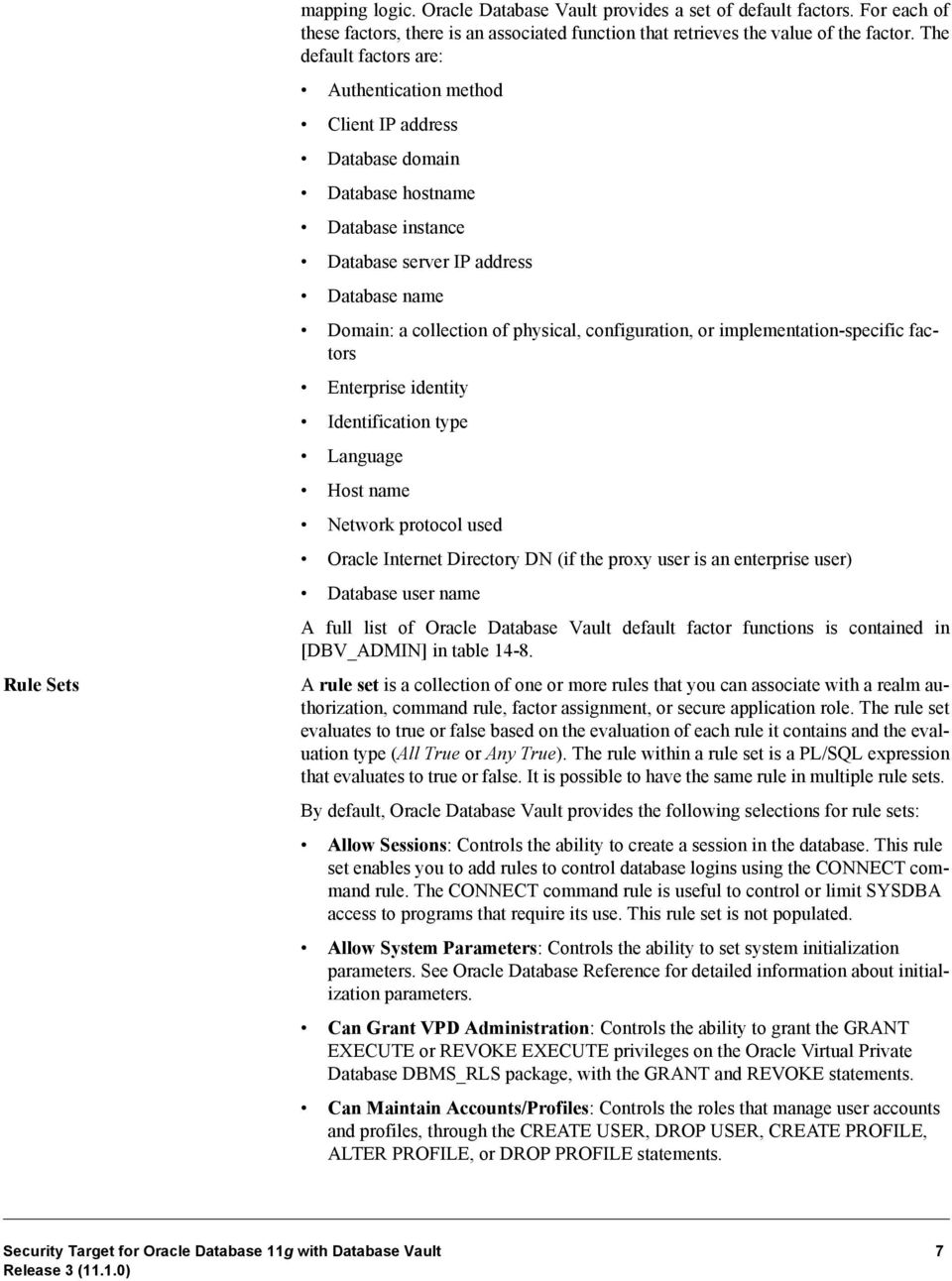
14 Rule Sets mapping logic. Oracle Database Vault provides a set of default factors. For each of these factors, there is an associated function that retrieves the value of the factor. The default factors are: Authentication method Client IP address Database domain Database hostname Database instance Database server IP address Database name Domain: a collection of physical, configuration, or implementation-specific factors Enterprise identity Identification type Language Host name Network protocol used Oracle Internet Directory DN (if the proxy user is an enterprise user) Database user name A full list of Oracle Database Vault default factor functions is contained in [DBV_ADMIN] in table A rule set is a collection of one or more rules that you can associate with a realm authorization, command rule, factor assignment, or secure application role. The rule set evaluates to true or false based on the evaluation of each rule it contains and the evaluation type (All True or Any True). The rule within a rule set is a PL/SQL expression that evaluates to true or false. It is possible to have the same rule in multiple rule sets. By default, Oracle Database Vault provides the following selections for rule sets: Allow Sessions: Controls the ability to create a session in the database. This rule set enables you to add rules to control database logins using the CONNECT command rule. The CONNECT command rule is useful to control or limit SYSDBA access to programs that require its use. This rule set is not populated. Allow System Parameters: Controls the ability to set system initialization parameters. See Oracle Database Reference for detailed information about initialization parameters. Can Grant VPD Administration: Controls the ability to grant the GRANT EXECUTE or REVOKE EXECUTE privileges on the Oracle Virtual Private Database DBMS_RLS package, with the GRANT and REVOKE statements. Can Maintain Accounts/Profiles: Controls the roles that manage user accounts and profiles, through the CREATE USER, DROP USER, CREATE PROFILE, ALTER PROFILE, or DROP PROFILE statements. Security Target for Oracle Database 11g with Database Vault 7 Release 3 (11.1.0)
15 Secure Application Roles Oracle Database Vault Administrator (DVA) Oracle Database Vault Configuration Assistant (DVCA) Can Maintain Own Account: Allows the accounts with the DV_ACCTMGR role to manage user accounts and profiles with the ALTER USER statement. Also allows individual accounts to change their own password using the ALTER USER statement. Disabled: Convenience rule set to quickly disable security configurations like realms, command rules, factors, and secure application roles. Enabled: Convenience rule set to quickly enable system features. A secure application role is a special Oracle Database role that can be enabled based on the evaluation of an Oracle Database Vault rule set. [DBV_ADMIN], chapter 8, "Configuring Secure Application Roles for Oracle Database Vault" discusses secure application roles in detail. In Oracle Database Vault, a secure application role can be created that is enabled with an Oracle Database Vault rule set. Regular Oracle Database secure application roles are enabled by custom PL/SQL procedures. Secure application roles can be used to prevent users from accessing data from outside an application. This forces users to work within the framework of the application privileges that have been granted to the role. The advantage of basing database access for a role on a rule set is that one can store database security policies in one central place, as opposed to storing them in all the applications. Basing the role on a rule set provides a consistent and flexible method to enforce the security policies that the role provides. In this way, if the security policy for the application role must be updated, it can be done in one place, the rule set. Furthermore, no matter how the user connects to the database, the result is the same, because the rule set is bound to the role. Oracle Database Vault automatically creates the secure application role to use invoker s rights. All one needs to do is to create the role and then associate it with a rule set. The rule definition should validate the user who is trying to log in. Oracle Database Vault Administrator is a Java application that is built on top of the Oracle Database Vault PL/SQL application programming interfaces (API). This application allows security managers who may not be proficient in PL/SQL to configure the access control policy through a user-friendly interface. Oracle Database Vault Administrator provides an extensive collection of security-related reports that assist in understanding the baseline security configuration. These reports also help point out deviations from this baseline. [DBV_ADMIN], Chapter 4 through Chapter 9 explain how to use Oracle Database Vault Administrator to configure access control policy defined in realms, command rules, factors, rule sets, secure application roles, and how to integrate Oracle Database Vault with other Oracle products. To perform maintenance tasks on your Oracle Database Vault installation, the command-line utility Oracle Database Vault Configuration Assistant (DVCA) can be used. DVCA can be used to enable or disable Oracle Database Vault. Although it is a prerequisite to have Database Vault enabled in order to make its security functionality effective, DVCA itself does not satisfy any SFRs of the Database Vault. For more information, see [DBV_ADMIN], Appendix C, "Post-Installation Oracle Database Vault Procedures". 8 Security Target for Oracle Database 11g with Database Vault

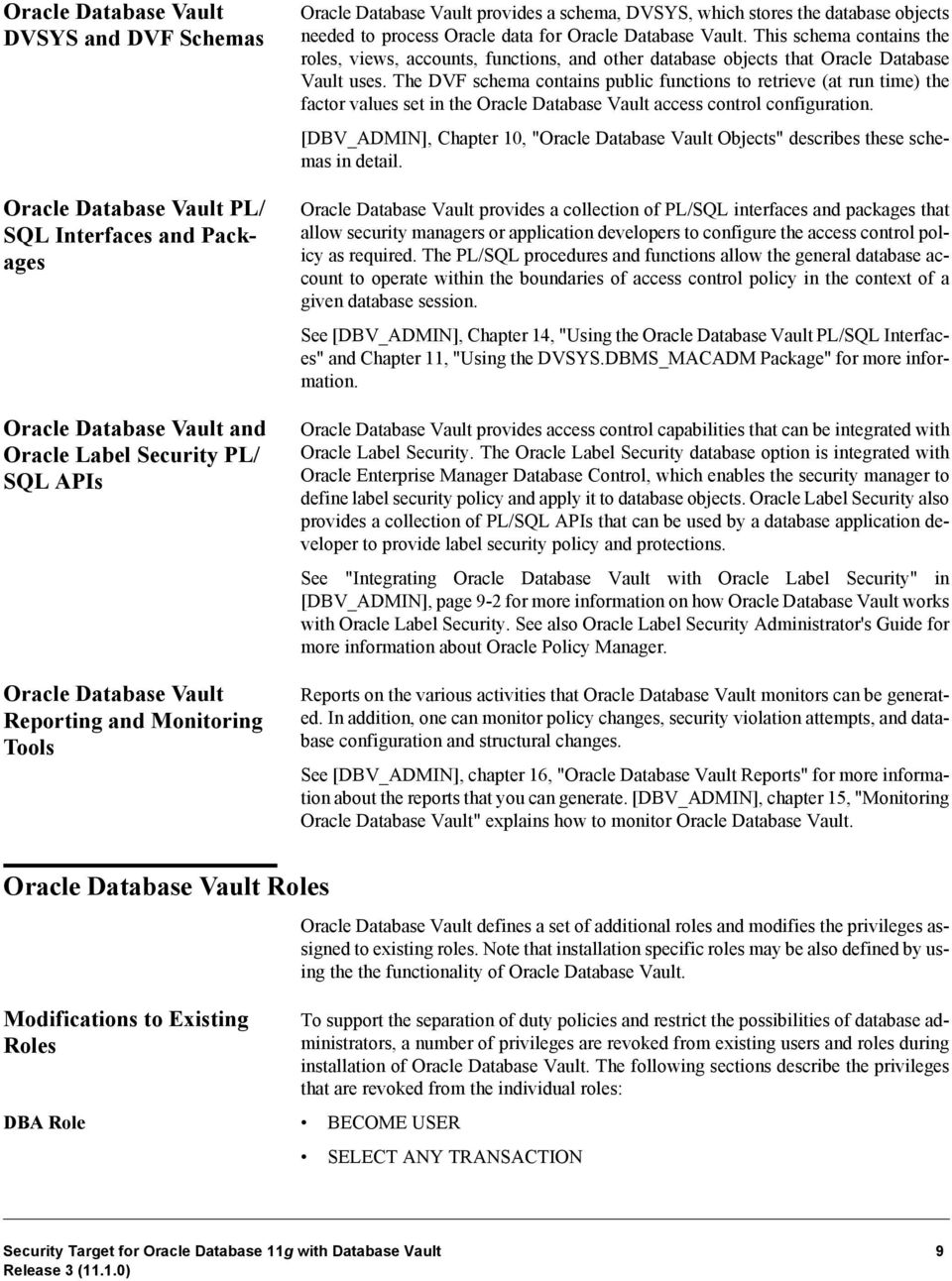
16 Oracle Database Vault DVSYS and DVF Schemas Oracle Database Vault PL/ SQL Interfaces and Packages Oracle Database Vault and Oracle Label Security PL/ SQL APIs Oracle Database Vault Reporting and Monitoring Tools Oracle Database Vault provides a schema, DVSYS, which stores the database objects needed to process Oracle data for Oracle Database Vault. This schema contains the roles, views, accounts, functions, and other database objects that Oracle Database Vault uses. The DVF schema contains public functions to retrieve (at run time) the factor values set in the Oracle Database Vault access control configuration. [DBV_ADMIN], Chapter 10, "Oracle Database Vault Objects" describes these schemas in detail. Oracle Database Vault provides a collection of PL/SQL interfaces and packages that allow security managers or application developers to configure the access control policy as required. The PL/SQL procedures and functions allow the general database account to operate within the boundaries of access control policy in the context of a given database session. See [DBV_ADMIN], Chapter 14, "Using the Oracle Database Vault PL/SQL Interfaces" and Chapter 11, "Using the DVSYS.DBMS_MACADM Package" for more information. Oracle Database Vault provides access control capabilities that can be integrated with Oracle Label Security. The Oracle Label Security database option is integrated with Oracle Enterprise Manager Database Control, which enables the security manager to define label security policy and apply it to database objects. Oracle Label Security also provides a collection of PL/SQL APIs that can be used by a database application developer to provide label security policy and protections. See "Integrating Oracle Database Vault with Oracle Label Security" in [DBV_ADMIN], page 9-2 for more information on how Oracle Database Vault works with Oracle Label Security. See also Oracle Label Security Administrator's Guide for more information about Oracle Policy Manager. Reports on the various activities that Oracle Database Vault monitors can be generated. In addition, one can monitor policy changes, security violation attempts, and database configuration and structural changes. See [DBV_ADMIN], chapter 16, "Oracle Database Vault Reports" for more information about the reports that you can generate. [DBV_ADMIN], chapter 15, "Monitoring Oracle Database Vault" explains how to monitor Oracle Database Vault. Oracle Database Vault Roles Modifications to Existing Roles DBA Role BECOME USER SELECT ANY TRANSACTION Oracle Database Vault defines a set of additional roles and modifies the privileges assigned to existing roles. Note that installation specific roles may be also defined by using the the functionality of Oracle Database Vault. To support the separation of duty policies and restrict the possibilities of database administrators, a number of privileges are revoked from existing users and roles during installation of Oracle Database Vault. The following sections describe the privileges that are revoked from the individual roles: Security Target for Oracle Database 11g with Database Vault 9 Release 3 (11.1.0)
17 CREATE ANY JOB CREATE EXTERNAL JOB EXECUTE ANY PROGRAM EXECUTE ANY CLASS MANAGE SCHEDULER DEQUEUE ANY QUEUE ENQUEUE ANY QUEUE MANAGE ANY QUEUE IMP_FULL_DATABASE Role BECOME USER MANAGE ANY QUEUE EXECUTE_CATALOG_ROLE Role EXECUTE ON DBMS_LOGMNR EXECUTE ON DBMS_LOGMNR_D EXECUTE ON DBMS_LOGMNR_LOGREP_DICT EXECUTE ON DBMS_LOGMNR_SESSION EXECUTE ON DBMS_FILE_TRANSFER PUBLIC user EXECUTE ON UTL_FILE SCHEDULER_ADMIN Role CREATE ANY JOB CREATE EXTERNAL JOB EXECUTE ANY PROGRAM EXECUTE ANY CLASS MANAGE SCHEDULER SYS User ALTER USER DROP USER SYSTEM User ALTER USER CREATE USER DROP USER NEW Roles Defined by Oracle Database Vault When Oracle Database Vault is installed, a set of new roles is defined that can be used to configure and manage Oracle Database Vault and the realms defined by an installation. Those roles are: 10 Security Target for Oracle Database 11g with Database Vault

18 DV_OWNER DV_REALM_OWNER DV_REALM_RESOURCE DV_ADMIN DV_ACCTMGR DV_PUBLIC DV_SECANALYST Oracle Database Vault Accounts The DV_OWNER role can be used to manage the Oracle Database Vault roles and its configuration. The DV_OWNER role has the administrative capabilities that the DV_ADMIN role provides, and the reporting capabilities the DV_SECANALYST role provides. It also provides privileges for monitoring Oracle Database Vault. It is created when Oracle Database Vault is installed, and has the most privileges on the DVSYS schema. The DV_REALM_OWNER role can be used to manage database objects in multiple schemas that define a realm. This role should be granted to the database account owner who is responsible for managing one or more schema database accounts within a realm and the roles associated with the realm. A user granted this role can use powerful system privileges like CREATE ANY, ALTER ANY, and DROP ANY within the realm. The DV_REALM_RE SOURCE role provides the same system privileges as the Oracle RESOURCE role. In addition, both CREATE SYNONYM and CREATE VIEW are granted to this role. The DV_ADMIN role has the EXECUTE privilege on the DVSYS packages (DBMS_ MACADM, DBMS_MACSECROLES, and DBMS_MACUTL). DV_ADMIN also has the capabilities provided by the DV_SECANALYST role, which allow the user to run Oracle Database Vault reports and monitor Oracle Database Vault. The DV_ACCTMGR role can be used to create and maintain database accounts and database profiles. A user who has been granted this role can use the CREATE, AL- TER, and DROP statements for users or profiles. However, a user with this role cannot use the DROP or ALTER statements for the DVSYS account, nor change the DVSYS password. The DV_PUBLIC role can be used to grant privileges on specific objects in the DVSYS schema. (Remember that in a default installation, the DVSYS schema is locked.). Oracle Database Vault does not enable users to directly grant object privileges in the DVSYS schema to PUBLIC. One must grant the object privilege on the DVSYS schema object the DV_PUBLIC role, and then grant DV_PUBLIC to PUBLIC. However, if one does this, it is important to not add more object privileges to the PUBLIC role. Doing so may undermine Oracle Database Vault security. The DV_SECANALYST role can be used to run Oracle Database Vault reports and monitor Oracle Database Vault. (This role is also used for database-related reports.) In addition, this role enables a user to check the DVSYS configuration by querying the DVSYS views described in "Oracle Database Vault Data Dictionary Views" on page 10-9 in [DBV_ADMIN]. The DV_ SECANALYST role has SELECT privileges on the DVSYS schema objects and portions of the SYS and SYSMAN schema objects for reporting on DVSYS- and DVF-related entities. Oracle Database Vault prompts for two accounts during installation: Oracle Database Vault Owner and Oracle Database Vault Account Manager. An account name and password for the Oracle Database Vault Owner account must be supplied during installation. Creating an Oracle Database Vault Account Manager is optional. The Oracle Database Vault Owner account is granted the DV_OWNER role. This account can manage Oracle Database Vault roles and configuration. The Oracle Database Vault Account Manager account is granted the DV_ACCTMGR Security Target for Oracle Database 11g with Database Vault 11 Release 3 (11.1.0)

19 role. This account is used to manage database user accounts to facilitate separation of duties. Oracle Database Vault Schemas (TSF Data) The Oracle Database Vault TSF data include two schemas with database tables, sequences, views, triggers, roles, packages, procedures, functions, and contexts that support the administration and run-time processing of Oracle Database Vault. Oracle Database Vault has the following schemas: DVSYS Schema: Owns the Oracle Database Vault schema and related objects DVF Schema: Owns the Oracle Database Vault functions that are created to retrieve factor identities DVSYS Schema The DVSYS schema contains Oracle Database Vault database objects, which store Oracle Database Vault configuration information and support the administration and run-time processing of Oracle Database Vault. In a default installation, the DVSYS schema is locked. The DVSYS schema also owns the AUDIT_TRAIL$ table. Oracle Database Vault secures the DVSYS schema by using a protected schema design. A protected schema design guards the schema against improper use of system privileges (for example, SELECT ANY TABLE, CREATE ANY VIEW, or DROP ANY). DVF Schema The DVF schema is the owner of the Oracle Database Vault DBMS_MACSEC_FUNCTION PL/SQL package, which contains the functions that retrieve factor identities. After installation of Oracle Database Vault, the installation process locks the DVF account to better secure it. When a new factor is created, Oracle Database Vault creates a new retrieval function for the factor and saves it in this schema. Access Control Functions of Oracle Database Vault Oracle Database Vault extends the access control functionality of Oracle Database in two ways: objects within a realm are protected from being accessed by database users that use a system privilege to execute a SQL statement. In this case Oracle Database Vault checks if the SQL statement affects any object secured by a realm. If this is the case, Oracle Database Vault checks if the database account that attempts to perform the SQL statement is the owner or a participant of the realm where the affected object belongs to. If this is the case, the following special case occurs: If the command is a GRANT or REVOKE of a role protected by the realm or a GRANT or REVOKE of an object privilege protected by the realm. In this case the session needs to be authorized as the realm owner or a protected role in the realm that has the privilege for those commands. In any case, if the realm authorization is based on a rule set, this rule set is evaluated and needs to evaluate to true. For all SQL statements it is checked if there is a command rule guarding the statement. If this is the case, the command rule needs to evaluate to true for the SQL 12 Security Target for Oracle Database 11g with Database Vault

20 statement to be executed. Oracle Database Vault does not replace the discretionary access control model in the existing Oracle database. It functions as a layer on top of this model for both realms and command rules. Oracle Database Vault Security Management Oracle Database Vault provides a collection of PL/SQL package APIs to support the maintenance and run-time behavior of Oracle Database Vault. Those are: DVSYS.DBMS_MACADM DVSYS.DBMS_MACSEC_ ROLES DVSYS.DBMS_MACUTL This package API provides for the administration of all aspects of the secure and access control configuration data. The realm owner of the Oracle Database Vault realm can grant the ability to run this package. This package API provides the CAN_SET_ROLE method to check whether the user invoking the method is authorized to use the specified Oracle Database Vault secure application role. The authorization is determined by checking the rule set associated with the role. The API also provides a method to issue the SET ROLE statement for a Oracle Database Vault Secure Application Role. Before SET ROLE is issued, the CAN_SET_ROLE method is called to check the rule set associated with the role. Run-time rule set behavior such as auditing, failure processing, and event handling occur during this process. The package is available to the general database account population. This package API defines several constants and utility methods that are commonly used by other Oracle Database Vault packages, such as code/message lookup, error handling, data conversion, and privilege checks. This package can be run by the general database account population. This allows for security developers to leverage the constants in scripted configuration files. Utility methods such as USER_HAS_ROLE can also be used in Oracle Database Vault rules. Oracle Database Vault Auditing Oracle Database Vault defines a set of additional audit events as well as functions to manage and evaluate the audit trail. The audit trail of Oracle Database Vault is different from the audit trail of the Oracle Database and can therefore be set and managed independently from the Oracle Database auditing. In addition, some parameter settings for the regular Oracle Database auditing are modified when Oracle Database Vault is installed. Those settings are effective only if auditing is enabled for the database. The modifications to the parameter settings for the Oracle Database audit trail are defined in [DBV_ADMIN], table A-2. Oracle Database Vault Audit Events Rule Set Audit Oracle Database Vault defines custom events to track violations in realms, command rules, and so on. One can audit the following in Oracle Database Vault: Audits the rule set processing results. One can audit both successful and failed processing. Realm authorizations can be managed using rule sets. One can audit the Security Target for Oracle Database 11g with Database Vault 13 Release 3 (11.1.0)

21 Realm Audit Factor Audit Oracle Label Security Session Initialization Failed Oracle Label Security Attempt to Upgrade Session Label Failed Format of the Oracle Database Vault Audit Trail rule set processing results. Factor assignments and secure application roles audits can be managed using a rule set. Audits the processing of management activities related to a realm. A realm violation occurs when a database account, performing an action on a realm object, is not authorized to perform that action in the realm. One can audit realm violations. Audits the evaluation of a factor function. One can audit both successful and failed factor processing. For failed factor processing, one can audit on all or any of the following events: Retrieval Error, Retrieval Null, Validation Error, Validation False, Trust Level Null, or Trust Level Less Than Zero. :Audits instances where the Oracle Label Security session fails to initialize. Audits instances where the Oracle Label Security component prevents a session from setting a label that exceeds the maximum session label. The Oracle Database Vault custom audit event records are stored in the AUDIT_ TRAIL$ table, which is part of the DVSYS schema. These audit records are not part of the typical Oracle Database audit trail. (In fact, if auditing has been disabled in Oracle Database, the Oracle Database Vault audit will continue to write to the AUDIT_ TRAIL$ table.). A description of the format of the audit records can be found in [DBV_ADMIN], table A-1. To save and evaluate the audit records generated by Oracle Database Vault, one has to export the AUDIT_TRAIL$ table to a dump file. 14 Security Target for Oracle Database 11g with Database Vault
22 CHAPTER 3 Security Problem Definition Threats [ST11_ENT_GR1] provides the characterization of the threat agents considered as well as the threats to be countered by the Oracle Database 11gR1. Oracle Database Vault has a user with administrative privileges (other than the privileges to access database objects of Oracle Database Vault) as an additional threat agent. Such a user may attempt to misuse his privileges and access database objects protected by the additional access control functionality of Oracle Database Vault. It is assumed that such users have a low attack potential, i. e. they do not attempt to bypass the security functionality of Oracle Database Vault using sophisticated attack methods. Oracle Database Vault addresses the following additional threats: T.ADMIN_ACCESS A user with administrative privileges accesses database objects or perform SQL statements unrelated to his administrative duties. T.DBV_MGMT A user without a defined Oracle Database Vault Management role modifies Oracle Database Vault access control policies or security attributes used in the Oracle Database Vault access control rules. T.DBV_ACCOUNTUsers can attempt or perform actions within the realm they are authorized to or attempt to perform SQL statments without the possibility to be held accountable for those actions. Security Target for Oracle Database 11g with Database Vault 15
23 Organisational Security Policies There are no organisational security ploicies related to Oracle Database Vault. Assumptions As per [ST11_ENT_GR1]. The following additions have been added to reflect the specific architecture of the TOE: Underlying System Assumptions A.DBV_INSTALL Oracle Database Vault is installed and configured as defined in [ECD]. 16 Security Target for Oracle Database 11g with Database Vault
24 CHAPTER 4 Security Objectives TOE Security Objectives As per [ST11_ENT_GR1] with the addition of the following objectives: O.PROTECT_REALM The TOE must provide the means of controlling access to objects within a realm even for authorized database administrators. O.PROTECT_COMMAND The TOE must provide means to control the execution of defined SQL statements by installation specific rules. O.RESTRICT_MGMT The TOE must provide means to restrict the management of the access control policy and the management of the security attributes to users in defined administrative roles. O.DBV_ACCOUNT The TOE must provide the means of auditing actions of users when accessing objects within a realm and when administering Oracle Database Vault. Environmental Security Objectives As per [ST11_ENT_GR1]. with the following additional environmental security objectives for Oracle Database Vault. OE.DBV_INSTALL The persons responsible for the installation and configuration of Oracle Database Vault must perform this in accordance with the guidance provided by [ECD] and must ensure that they define their realms in accordance with their organization s protection needs, define the rule sets that protect the realms in accordance with their organization s protection needs and guard the Security Target for Oracle Database 11g with Database Vault 17
25 execution of SQL statements using command rules in accordance with their organization s protection needs. Security Objectives Rationale As per [ST11_ENT_GR1] with the following Oracle Database Vault specific additions:. O.PROTECT_REALM helps to mitigate the threat T.ADMIN_ACCESS by ensuring that users with administrative privileges can be prohibited from accessing database objects within a defined realm. O.PROTECT_COMMAND helps to mitigate the threat T.ADMIN_ACCESS by ensuring that the execution of SQL statement can be guarded by a command rule that is evaluated when a user attempts to execute the statement. O.RESTRICT_MGMT helps to mitigate the threat T.DBV_MGMT by ensuring that only users with a defined Oracle Database Vault administrative role are able to manage the Oracle Database Vault access control policy or modify security attributes associated with Oracle Database Vault. O.DBV_ACCOUNT helps to mitigate the threat T.DBV_ACCOUNT by ensuring that the Oracle Database Vault specific management activities as well as the results of the evaluation of rule sets (for access to objects protected by a realm) and the results of the evaluation of command rules can be audited. O.AUDIT_REVIEW helps to address the organizational security policy P.AC- COUNTABILITY by providing authorized administrators with the ability to selectively review the audit log information. Assumptions Rationale The assumptions rationale in [ST11_ENT_GR1] applies to the TOE, with the following additions: A.DBV_INSTALL states that Oracle Database Vault needs to be installed in accordance with [ECD]. This is provided by OE.DBV_INSTALL which requires that Oracle Database Vault is installed in accordance with the guidance and configured and managed in accordance with the protection needs of the organization operating the DBMS. 18 Security Target for Oracle Database 11g with Database Vault
26 CHAPTER 5 IT Security Requirements TOE Security Functional Requirements Table 3 below lists each Security Functional Requirement (SFR) included in this Security Target. Security Functional Requirements for the Oracle Database itself are defined in [ST11_ENT_GR1] and not repeated here. For each SFR, Table 3 identifies which Common Criteria operations (assignment (A), selection (S), refinement (R), and/or iteration (I)) have additionally been applied The remainder of this section details the functional requirements as completed for this Security Target. The text for completed operations which have been applied to the requirement relative to CC part 2 is highlighted with ITALICISED CAPITAL LETTERS within each requirement. Annex B provides definitions for various terms used in the functional requirements. The only exception is SFR FDP_ACF.1 where in FDP_ACF.1.2, FDP_ACF.1.3 and FDP_ACF.1.4 the operations are just highlighted with italics for better readability. Refinements are marked in ITALICISED UNDERLINED CAPITAL LETTERS. Table 3: List of Security Functional Requirements Component Name A S R I FAU_GEN.1 Audit Data Generation X X FAU_GEN.2 User and/or Group Identity Association FAU_SAR.1 Audit Review X FAU_STG.1 Protected Audit Trail Storage X FDP_ACC.1 Subset Access Control X FDP_ACF.1 Security Attribute Based Access Control X X Security Target for Oracle Database 11g with Database Vault 19
27 Component Name A S R I FIA_ATD.1 User Attribute Definition X FIA_USB.1 User-Subject Binding X FMT_MOF.1 Management of Security Functions Behaviour X X FMT_MSA.1 Management of Security Attributes X FMT_MSA.3 Static Attribute Initialisation X X FMT_MTD.1 Management of TSF Data X X X FMT_SMF.1 Specification of Management Functions X FMT_SMR.1 Security Roles X Security Audit FAU_GEN.1.1 The TSF shall be able to generate an audit record of the following auditable events: a) Start-up and shutdown of the audit functions; b) All auditable events for the not specified level of audit; and c) THE FOLLOWING ADDITIONAL EVENTS: 1) ASSIGNMENT OR EVALUATION OF A FACTOR 2) REALM AUTHORIZATION MANAGEMENT 3) REALM AUTHORIZATION VIOLATION 4) COMMAND AUTHORIZATION MANAGEMENT 5) COMMAND AUTHORIZATION VIOLATION 4) SECURE APPLICATION ROLE MANAGEMENT Table 4: List of Auditable Events Component Event Additional Data FAU_SAR.1 None None FAU_SAR.3 None None FAU_STG.1 None None FDP_ACC.1 None None FDP_ACF.1 Attempted access None FIA_USB.1 None (will be audited in the database audit) None FMT_MOF.1 Modifications to access control functionality None FMT_MSA.1 Modifications of Oracle Database Vault security attributes None FMT_MSA.3 None None FMT_MTD.1 None None FMT_SMF.1 Management operations None FMT_SMR.1 Assignment of a role to a user None 20 Security Target for Oracle Database 11g with Database Vault
28 FAU_GEN.1.2 The TSF shall record within each audit record at least the following information: a) Date and time of the event, type of event, subject identity (if applicable), and the outcome (success or failure) of the event; and b) For each audit event type, based on the auditable event definitions of the functional components included in the ST, and the information specified in column 3 of table 4. FAU_GEN.2.1 For audit events resulting from actions of identified users, the TSF shall be able to associate each auditable event with the identity of the user that caused the event. FAU_SAR.1.1 FAU_SAR.1.2 FAU_STG.1.1 FAU_STG.1.2 The TSF shall provide USERS WITH READ ACCESS TO THE AUDIT_TRAIL$ TABLE OF THE DVSYS SCHEMA with the capability to read ALL DATABASE VAULT AUDIT INFORMATION from the audit records. The TSF shall provide the audit records in a manner suitable for the user to interpret the information. The TSF shall protect the stored audit records from unauthorised deletion. The TSF shall be able to PREVENT unauthorised modifications to the stored audit records in the audit trail. User Data Protection FDP_ACC.1.1 The TSF shall enforce the DATABASE VAULT ACCESS CONTROL POLICY on ALL SUBJECTS, ALL OBJECTS WITHIN A DEFINED REALM AND ALL OPERATIONS PROTECTED BY THE AUTHORIZATION RULESET FOR THE REALM. FDP_ACF.1.1 FDP_ACF.1.2 The TSF shall enforce the DATABASE VAULT ACCESS CONTROL POLICY to objects based on the following: THE REALM AN OBJECT BELONGS TO AND THE AUTHORIZATION RULE SET DEFINED FOR THE REALM THAT IS EVALUATED WHEN A SUBJECT ATTEMPTS TO PERFORM AN OPERATION ON AN OBJECT BELONGING TO A REALM. The TSF shall enforce the following rules to determine if an operation among controlled subjects and objects BELONGING TO A REALM is allowed: When a database account that has the appropriate privileges issues a SQL statement (that is, DDL, DML, EXECUTE, GRANT, REVOKE, or SELECT) that affects an object within a customerdefined realm, the following actions occur: 1. Is the database account using a system privilege to execute the SQL statement? If yes, then go to Step 2. If no, then go to Step 6. If the session has object privileges on the object in question for SELECT, EXECUTE, and DML only, then the realm protection is not enforced. Realms protect against the use of the any system privileges on objects or roles protected by the realm. 2. Does the SQL statement affect objects secured by a realm? If yes, then go to Step 3. If no, then realms do not affect the SQL statement; go to Step 6. If the object affected by the command is Security Target for Oracle Database 11g with Database Vault 21
29 not secured in any realms, then realms do not affect the SQL statement being attempted. 3. Is the database account a realm owner or realm participant? If yes, and if the command is a GRANT or REVOKE of a role that is protected by the realm, or the GRANT or REVOKE of an object privilege on an object protected by the realm, the session must be authorized as the realm owner directly or indirectly through a protected role in the realm. Then go to Step 4. Otherwise, realm violation occurs and the statement is not allowed to succeed. Note that SYS is the only realm owner in the default Oracle Data Dictionary Realm, and only SYS can grant system privileges to a database account or role. 4. Is the realm authorization for the database account conditionally based on a rule set? If yes, then go to Step 5. If no, then go to Step Does the rule set evaluate to true? If yes, then go to Step 6. If no, then there is a realm violation, so the SQL statement is not allowed to succeed. 6. Does a command rule prevent the command from executing? If yes, then there is a command rule violation and the SQL statement fails. If no, there is no realm or command rule violation, so the command succeeds. FDP_ACF.1.3 FDP_ACF.1.4 FIA_ATD.1.1 FIA_USB.1.1 FIA_USB.1.2 FIA_USB.1.3 The TSF shall explicitly authorise access of subjects to DBMScontrolled objects based on the following additional rules: Views that have been created on a table before the table was added to the realm are not protected by the authorization rule set of the realm The TSF shall explicitly deny access of subjects to objects based on the following rules: Invoker s rights procedures that access realm protected objects are denied access to those objects unless the invoker is authorized to the realm (in which case the authorization rule set is evaluated for the invoker. The TSF shall maintain the following list of security attributes belonging to individual users: a) DATABASE VAULT DEFINED ROLE; The TSF shall associate the following user security attributes with subjects acting on the behalf of that user: DATABASE VAULT ROLES. The TSF shall enforce the following rules on the initial association of user security attributes with subjects acting on the behalf of users: THE SAME RULES APPLY FOR DATABASE VAULT ROLES AS FOR OTHER DATABASE ROLES. The TSF shall enforce the following rules governing changes to the user security attributes associated with subjects acting on the behalf of users: THE SAME RULES APPLY FOR DATABASE VAULT ROLES AS FOR OTHER DATABASE ROLES. 22 Security Target for Oracle Database 11g with Database Vault
30 Security Management FMT_MOF.1.1 The TSF shall restrict the ability to DETERMINE AND MODIFY THE BEHAVIOUR OF the functions DATABASE VAULT ACCESS CONTROL FUNCTIONALITY to USERS IN THE DV_ADMIN OR DV_OWNER ROLE. FMT_MSA.1.1 The TSF shall enforce the DATABASE VAULT ACCESS CONTROL POLICY to restrict the ability to MANAGE ALL THE SECURITY ATTRIBUTES OF ORACLE DATABASE VAULT to AUTHORIZED ADMINISTRATORS. FMT_MSA.3.1 The TSF shall enforce the DATABASE VAULT ACCESS CONTROL POLICY to provide RESTRICTIVE default values for security attributes that are used to enforce the SFP. FMT_MTD.1.1 The TSF shall, ACCORDING TO TABLES 5 BELOW, restrict the ability to PERFORM OPERATIONS ON the TSF DATA to AUTHORIZED ADMINISTRATORS. FMT_SMF.1.1 The TSF shall be capable of performing the following security management functions: a) THE OPERATIONS ON TSF DATA SPECIFIED IN TABLE 5 BELOW; b) MODIFICATION OF THE DATABASE OBJECT SECURITY ATTRIBUTES AS SPECIFIED IN SFR FMT_MSA.1.1. Table 5: Required Management Events Component Operation TSF Data FAU_GEN FAU_GEN FAU_SAR.1 deletion, modification, addition the database users with read access right to the AUDIT_TRAIL$ table in the DVSYS schema FAU_SAR FAU_STG FDP_ACC FDP_ACF.1 managing definition of realms, rule sets, command rules, factors FIA_ATD FIA_USB FMT_MOF.1 manage management of realms, rule sets, command rules, factors FMT_MSA.1 manage Security Target for Oracle Database 11g with Database Vault 23
31 Component Operation TSF Data FMT_MSA.3 FMT_MTD.1 manage manage FMT_SMR.1 manage assignment of roles to users FMT_SMR.1.1 The TSF shall maintain the roles: a) DV_OWNER b) DV_REALM_OWNER c) DV_REALM_RESOURCE d) DV_ADMIN e) DV_ACCTMGR f) DV_PUBLIC g) DV_SECANALYST FMT_SMR.1.2 The TSF shall be able to associate users with roles. TOE Security Assurance Requirements The target assurance level is EAL4 as defined in Part 3 of the CC, augmented with ALC_FLR.3. This is the same set of the security assurance requirements as for the evaluation of the Oracle Database itself. Security Requirements Rationale Suitability of Security Requirements The SFRs satisfy the security objectives in the following way: O.PROTECT_REALM: The TOE must provide the means of controlling access to objects within a realm even for authorized database administrators is addressed by the SFRs FDP_ACC.1 and FDP_ACF.1 which define the access control policy for objects within a realm enforced by Oracle Database Vault. This supported by FMT_MSA.1, which explains how the Oracle Database Vault access control policy itself is used to protect security attributes and it is supported by FMT_MSA.3 which defines the default values for the security attributes used in the Oracle Database Vault access control policy. O.PROTECT_COMMAND: The TOE must provide means to control the execution of defined SQL statements by installation specific rules is actually implemented also by the Oracle Database Vault access control policy and therefore is addressed by the same SFRs as O.PROTECT_REALM. O.RESTRICT_MGMT: The TOE must provide means to restrict the management of the access control policy and the management of the security attributes to users in defined administrative roles is addressed by the SFRs FIA_ATD.1, FIA_USB.1 and FMT_SMR.1 which define the administraive roles (FMT_SMR.1) and ensure that users get their roles correctly assigned (FIA_ATD.1, FIA_USB.1) together with FMT_MOF.1, FMT_MSA.1 and FMT_MTD.1, which all define that the management activities for the management of the Oracle Database Vault access control policy rules 24 Security Target for Oracle Database 11g with Database Vault
32 and the security attributes used in those rules can only be managed by the defined administrative roles. O.DBV_ACCOUNT: The TOE must provide the means of auditing actions of users when accessing objects within a realm and when administering Oracle Database Vault is addressed by the SFRs FAU_GEN.1 and FAU_GEN.2 that define the events that can be audited, by FAU_SAR.1 that ensures that audit records can be evaluated and by FAU_STG.1 which ensures that the audit records are protected from unauthorized deletion and modification. Table 6: Correlation of IT Security Objectives to the SFRs Requirement O.PROTECT_REALM O.PROTECT_COMMAND O.RESTRICT_MGMT O.DBV_ACCOUNT FAU_GEN.1 X FAU_GEN.2 X FAU_SAR.1 X FAU_STG.1 X FDP_ACC.1 X X FDP_ACF.1 X X FIA_ATD.1 FIA_USB..1 FMT_MOF.1 X X X FMT_MSA.1 X X X FMT_MSA.3 X X FMT_MTD.1 FMT_SMF.1 FMT_SMR.1 X X X Dependency Analysis The following table includes the dependency analysis for the SFRs included in this Security Target for Oracle Database 11g with Database Vault 25
33 ST: Table 7: Functional Component Dependency Analysis Requirement Dependencies Satisfied FAU_GEN.1 FPT_STM.1 Yes, indirect a FAU_GEN.2 FAU_GEN.1 FIA_UID.1 Yes Yes, indirect b FAU_SAR.1 FAU_GEN.1 Yes FAU_STG.1 FAU_GEN.1 Yes FDP_ACC.1 FDP_ACF.1 Yes FDP_ACF.1 FDP_ACC.1 FMT_MSA.3 Yes Yes FIA_ATD FIA_USB.1 FIA_ATD.1 Yes FMT_MOF.1 FMT_MSA.1 FMT_MSA.3 FMT_MTD.1 FMT_SMR.1 FMT_SMF.1 FDP_ACC.1 FMT_SMR.1 FMT_SMF.1 FMT_MSA.1 FMT_SMR.1 FMT_SMR.1 FMT_SMF.1 Yes Yes Yes Yes Yes Yes Yes Yes Yes FMT_SMF FMT_SMR.1 FIA_UID.1 Yes, indirect c a. This dependency is resolved by the Oracle Database itself, where the security target contains the FPT-STM.1 security functional requirement. b. This dependency is resolved by the Oracle Database itself, where the security target contains the FIA_UID.1 security functional requirement. c. See note above This shows that all dependencies are resolved with the security functionality of user identification and authentication and the reliable time stamp provided by the Oracle Database 11g R1 itself and not by Oracle Database Vault. Since Oracle Database Vault is an optional add-on to the Oracle Database and the Oracle Database 11g R1 Enterprise Edition being separately evaluated, the dependencies not resolved within this security target are resolved for Oracle Database 11g R1 with Oracle Database Vault. Assurance Requirements Appropriate The target assurance level is EAL4, augmented with ALC_FLR.3, which exceeds the minimum assurance requirement for basic robustenss as stated in [BR-DBMSPP]. EAL4 is appropriate for the TOE because it is designed for use in environments where 26 Security Target for Oracle Database 11g with Database Vault
34 EAL4 assurance is required to reduce the risk to the assets that the TOE is intended to protect. ALC_FLR.3 has been included in addition to EAL4 to cause the evaluation of the TOE s flaw remediation procedures which Oracle database users need to be in place following the release of the TOE. These procedures are required to offer continuing assurance to users that Oracle Database 11g provides secure storage of and access to the data which is crucial to their enterprise s success. To meet this requirement, the flaw remediation procedures must offer: the ability for TOE users to report potential security flaws to Oracle, the resolution and correction of any flaws with assurance that the corrections introduce no new security flaws, and the timely distribution of corrective actions to users. ALC_FLR.3 is the ALC_FLR component which is at an appropriate level of rigour to cover these requirements. Assurance Measures Rationale Table 79 in Chapter 6 demonstrates that all assurance requirements are suitably met by one or more assurance measures. Security Target for Oracle Database 11g with Database Vault 27
35 This Page Intentionally Blank 28 Security Target for Oracle Database 11g with Database Vault
36 CHAPTER 6 TOE Summary Specification TOE Security Functionality This section contains a high-level specification of each Security Function (SF) of the TOE that contributes to satisfaction of the Security Functional Requirements of chapter 5. The specifications cover five major areas: identification and authentication, database resource quotas, access controls, privileges and roles, and auditing. Table 8 below shows that all the SFRs are satisfied by at least one SF and that every SF is used to satisfy at least one SFR (but note that SFR FDP_ACF.1.4 is not satisfied by any particular SF because this SFR specifies null functionality). Security Target for Oracle Database 11g with Database Vault 29
37 Table 8: Mapping of SFs to SFRs FAU FDP FMT FIA GEN.1.1 GEN.1.2 GEN.2.1 SAR.1.1 SAR.1.2 STG.1.1 STG.1.2 F.DBV.ATT Y Y Y F.DBV_REALM_MANAGE Y Y Y Y F.DBV_RULESET_MANAGE Y Y Y Y F.DBV_REALM_ACCESS Y Y Y Y Y F.DBV_CMDRULE_MANAGE Y Y Y Y F.DBV_CMDRULE_ACCESS Y Y Y Y Y F.DBV_FACTOR_MANAGE Y Y Y Y F.DBV_SECAPPROL_ACCESS Y Y Y Y Y F.DBV_SECAPPROL_MANAGE Y Y Y Y F.DBV_ROLES Y Y Y Y Y Y F.AUD.DBV Y Y Y Y Y F.AUD.DBV.VIEW Y Y ACC.1.1 ACF.1.1 ACF.1.2 ACF.1.3 ACF.1.4 MOF.1.1 MSA.1.1 MSA.3.1 MTD.1.1 SMF.1.1 SMR.1.1 SMR.1.2 ATD.1.1 USB.1.1 USB.1.2 USB.1.3 Database Vault Schemas DVSYS Schema F.DBV.ATT The Oracle Database Vault objects include two schemas with database tables, sequences, views, triggers, roles, packages, procedures, functions, and contexts that support the administration and run-time processing of Oracle Database Vault. Oracle Database Vault has the following schemas: DVSYS Schema: Owns the Oracle Database Vault schema and related objects DVF Schema: Owns the Oracle Database Vault functions that are created to retrieve factor identities The DVSYS schema contains Oracle Database Vault database objects, which store Oracle Database Vault configuration information and support the administration and run-time processing of Oracle Database Vault. In a default installation, the DVSYS schema is locked. The DVSYS schema also owns the AUDIT_TRAIL$ table. Oracle Database Vault secures the DVSYS schema by using a protected schema design. A protected schema design guards the schema against improper use of system privileges (for example, SELECT ANY TABLE, CREATE ANY VIEW, or DROP ANY). Oracle Database Vault protects and secures the DVSYS schema in the following ways: The DVSYS protected schema and its administrative roles cannot be dropped. By default, the DVSYS account is locked. Statements such as CREATE USER, ALTER USER, DROP USER, CREATE PROFILE, ALTER PROFILE, and DROP PROFILE can only be issued by a user with the DV_ACCTMGR role. SYSDBA can issue these statements only if it is allowed to do so by modifying the Can Maintain Accounts/Profiles rule set. The powerful ANY system privileges for database definition language (DDL) and data manipulation language (DML) commands are blocked in the protected schema. This means that the objects in the DVSYS schema must be created by the schema account itself. Also, access to the schema objects must be authorized through object privilege grants. 30 Security Target for Oracle Database 11g with Database Vault
38 Object privileges in the DVSYS schema can only be granted to administrative roles in the schema. This means that users can access the protected schema only through predefined administrative roles. Only the protected schema account DVSYS can issue ALTER ROLE statements on predefined administrative roles of the schema. Only the protected schema account DVSYS can grant predefined roles to users along with the ADMIN OPTION. This means that a grantee with the ADMIN OPTION can grant the role to another user without the ADMIN OPTION. The SYS.DBMS_SYS_SQL.PARSE_A S_USER procedure cannot be used to run SQL statements on behalf of the protected schema DVSYS. Note: In the maintenance mode, the above stated protection of DVSYS schema is not effective. DVF Schema The DVF schema is the owner of the Oracle Database Vault DBMS_MACSEC_FUNCTION PL/SQL package, which contains the functions that retrieve factor identities. After Oracle Database Vault is installed, the installation process locks the DVF account to better secure it. When a new factor is created, Oracle Database Vault creates a new retrieval function for the factor and saves it in this schema. Database Vault Access Control Realm Access Control F.DBV.REALM_ACCESS Realms protect data from access through system privileges; realms do not give additional privileges to its owner or participants. The realm authorization provides a runtime mechanism to check logically if a user s command is allowed to access objects specified in the command and to proceed with its execution. When a database account that has the appropriate privileges issues a SQL statement (that is, DDL, DML, EXECUTE, GRANT, REVOKE, or SELECT) that affects an object within a customer-defined realm, the following actions occur: 1. Is the database account using a system privilege to execute the SQL statement? If yes, then go to Step 2. If no, then go to Step 6. If the session has object privileges on the object in question for SELECT, EXECUTE, and DML only, then the realm protection is not enforced. Realms protect against the use of the any system privileges on objects or roles protected by the realm. 2. Does the SQL statement affect objects secured by a realm? If yes, then go to Step 3. If no, then realms do not affect the SQL statement; go to Step 6. If the object affected by the command is not secured in any realms, then realms do not affect the SQL statement being attempted. 3. Is the database account a realm owner or realm participant? If yes, and if the command is a GRANT or REVOKE of a role that is protected by the realm, or the GRANT or REVOKE of an object privilege on an object protected by the realm, the session must be authorized as the realm owner directly or indirectly through a protected role in the realm. Then go to Step 4. Otherwise, realm violation occurs and the statement is not allowed to succeed. Note that SYS is the only realm owner in the default Oracle Data Dictionary Realm, and only SYS can grant system privileges to a database account or role. Security Target for Oracle Database 11g with Database Vault 31
39 Command Rule based access control Secure Application Roles based access control 4. Is the realm authorization for the database account conditionally based on a rule set? If yes, then go to Step 5. If no, then go to Step Does the rule set evaluate to true? If yes, then go to Step 6. If no, then there is a realm violation, so the SQL statement is not allowed to succeed. 6. Does a command rule prevent the command from executing? If yes, then there is a command rule violation and the SQL statement fails. If no, there is no realm or command rule violation, so the command succeeds. Oracle Database Vault does not replace the discretionary access control model in the existing Oracle database. It functions as a layer on top of this model for both realms and command rules. Realms do not protect views that had been created on a table before the table was added to a realm. To protect the view, explicitly add it to the realm. For invoker s right procedures that access realm protected objects, the invoker of the procedure must be authorized to the realm. F.DBV.CMDRULE_ACCESS Command rule access is defined in step 6 of the algorithm defined in the description of the F.DBV.REALM_ACCESS security function. F.DBV.SECAPPROL_ACCESS In Oracle Database Vault, a secure application role can be created that can be enabled with an Oracle Database Vault rule set. Regular Oracle Database secure application roles are enabled by custom PL/SQL procedures. Secure application roles can be used to prevent users from accessing data from outside an application. This forces users to work within the framework of the application privileges that have been granted to the role. The advantage of basing database access for a role on a rule set is that one can store database security policies in one central place, as opposed to storing them in all the applications. Basing the role on a rule set provides a consistent and flexible method to enforce the security policies that the role provides. In this way, if the security policy for the application role must be updated, it can be done in one place, the rule set. Furthermore, no matter how the user connects to the database, the result is the same, because the rule set is bound to the role. Oracle Database Vault automatically creates the secure application role to use invoker s rights. All one need to do is to create the role and then associate it with a rule set. The rule definition should validate the userwho is trying to log in. Once a secure application role is created in Oracle Database Vault, an application can call the role by using the DVSYS.DBMS_MACSEC_ROLES.SET_ROLE function. Oracle Database Vault then evaluates the rule set associated with the secure application role. If the rule set evaluates to true, then Oracle Database Vault enables the role for the current session and assigns the privileges associated with the role. If the rule set evaluates to false, the role is not enabled. In either case, Oracle Database Vault processes the associated auditing and custom event handlers for the rule set associated with the secure application role. 32 Security Target for Oracle Database 11g with Database Vault
40 Database Vault Management Realm Management Command Rule Management Ruleset Management F.DBV.REALM_MANAGE To perform realm management functions, a user must have either the DV_ADMIN or DV_OWNER role. The procedures in the DVSYS.DBMS_MACADM package can be used to configure and manage realms. They allow to: create a realm delete a realm rename a realm authorize a user or role to access a realm as an ownwe or a participant remove authorizations of a user or role to access the realm specify a ruleset for authorization define or update realm attributes register a set of objects for realm protection Realm attributes that can be set or updated are: realm description (not used for any security checking) enabling or disabling realm checking realm audit options. Possible settings are: off, success, fail F.DBV.CMDRULE_MANAGE To perform command rule management functions, a user must have either the DV_ADMIN or DV_OWNER role. The procedures in the DVSYS.DBMS_MACADM package can be used to configure and manage command rules. They allow to: create a command rule delete a command rule update a command rule F.DBV.RULESET_MANAGE To perform rule set management functions, a user must have either the DV_ADMIN or DV_OWNER role. The procedures in the DVSYS.DBMS_MACADM package can be used to configure and manage rule sets. They allow to: create a rule or rule set delete a rule or rule set remove a rule from a rule set add a rule to a rule set rename a rule or a rule set Security Target for Oracle Database 11g with Database Vault 33
41 Factor Management Secure Application Role Management update a rule update rule set attributes (enabled or diabled, evaluation option (Always True or Any True), rule set audit options, option for reporting factor errors, error handling options) synchronize the rules in Oracle Database Vault and the Advanced Queuing Rules engine. This operation must be performed immediately after a rollback of an Add, Delete, or Modify rule operation F.DBV.FACTOR_MANAGE To perform factor management functions, a user must have either the DV_ADMIN or DV_OWNER role. The procedures in the DVSYS.DBMS_MACADM package can be used to configure and manage factors. They allow to: create a factor or factor type delete a factor or factor type rename a factor or factor type create an identity remove an identity create a factor identity mapping remove a factor identity mapping associate an identity with a different factor create a parent-child relationship between two factors update a factor F.DBV.SECAPPROL_MANAGE To perform secure application role management functions, a user must have either the DV_ADMIN or DV_OWNER role. The procedures in the DVSYS.DBMS_MACADM package can be used to configure and manage secure application roles. They allow to: create a secure application role delete a secure application role rename a secure application role update a secure application role Applications can use secure application roles by using procedures in the DVSYS.DBMS_MACSEC_ROLES package. They can use the CAN_SET_ROLE Function to check whether the user invoking the method is authorized to use the specified Oracle Database Vault secure application role. Returns a BOOLEAN value. They can use the SET_ROLE Procedure to issue the SET ROLE statement for an Oracle Database Vault secure application role. If a rule set that is associated with the role evaluates to false, then the role is not set. 34 Security Target for Oracle Database 11g with Database Vault
42 Database Vault Roles DV_OWNER F.DBV_ROLES When installed, Oracle Database Vault defines the following additional roles: This role is used to manage the Oracle Database Vault roles and its configuration. The DV_OWNER role has the administrative capabilities that the DV_ADMIN role provides, and the reporting capabilities the DV_SECANALYST role provides. It also provides privileges for monitoring Oracle Database Vault. It is created when you install Oracle Database Vault, and has the most privileges on the DVSYS schema. The first account, which is typically the account created during the installation as the Database Vault Owner, granted with this role and the ADMIN OPTION can grant any Oracle Database Vault roles (except DV_ACCTMGR) without the ADMIN OPTION to any account. Users granted this role also can run Oracle Database Vault reports and monitor Oracle Database Vault. Anyone with the DV_OWNER role or privilege can grant the DV_OWNER role to another user. The account granted this role and with the ADMIN OPTION can revoke any granted protected schema role from another account. Accounts such as SYS or SYSTEM, with the GRANT ANY ROLE system privilege alone (directly granted or indirectly granted using a role) do not have the rights to grant or revoke the DV_ OWNER role from any other database account. The granting and revoking of all protected schema roles, including DV_OWNER, are enforced only by an instance with the Oracle executable linked with DV_ON, which enables Oracle Database Vault security. When the Oracle executable is linked with DV_ OFF, then an instance can use an account GRANT ANY ROLE system privilege for GRANT and REVOKE operations. In the later case, the Oracle Server enters into a maintenance mode in the relation to the Oracle Database Vault and hence the DV_OWNER role loses its impact on the access control on database operations. DV_REALM_OWNER DV_REALM_RESOURCE DV_ADMIN This role is used to manage database objects in multiple schemas that define a realm. This role should be granted to the database account owner who is responsible for managing one or more schema database accounts within a realm and the roles associated with the realm. A user granted this role can use powerful system privileges like CRE- ATE ANY, ALTER ANY, and DROP ANY within the realm. The DV_REALM_RESOURCE role provides the same system privileges as the Oracle RESOURCE role. In addition, both CREATE SYNONYM and CREATE VIEW are granted to this role. This role can be granted to a database account that will own database tables, objects, triggers, views, procedures, and so on that are used to support any database application. This is a role geared toward a schema type database account. The realm owner of the Oracle Data Dictionary realm, such as SYS, can grant this role to any database account or role. Note that though this role has system privilege grants that SYS controls, it does not have the DV_OWNER or DV_ADMIN privileges. The DV_ADMIN role has the EXECUTE privilege on the DVSYS packages (DBMS_MACADM, DBMS_MACSECROLES, and DBMS_MACUTL). DV_ADMIN also has the capabilities provided by the DV_SECANALYST role, which allow the user to run Oracle Database Vault reports and monitor Oracle Database Vault. Security Target for Oracle Database 11g with Database Vault 35
43 DV_ACCTMGR DV_PUBLIC DV_SECANALYST Audit and Accountability Accounts such as SYS or SYSTEM, with the GRANT ANY ROLE system privilege alone do not have the rights to grant or revoke DV_ADMIN from any other database account. The first user with the DV_ADMIN role and the ADMIN OPTION can grant this role without the ADMIN OPTION to any database account and revoke this role from another account. The granting and revoking of protected schema roles, including DV_ADMIN, are enforced only by an instance with the Oracle executable linked with DV_ON, which enables Oracle Database Vault security features. When the Oracle executable is linked with DV_OFF, then an instance can use an account GRANT ANY ROLE system privilege for GRANT and REVOKE operations. Use the DV_ACCTMGR role to create and maintain database accounts and database profiles. A user who has been granted this role can use the CREATE, ALTER, and DROP statements for users or profiles. However, a person with this role cannot use the DROP or ALTER statements for the DVSYS account, nor change the DVSYS password. Any account, such as SYS or SYSTEM, with the GRANT ANY ROLE system privilege alone does not have the rights to grant this role to or revoke this role from any other database account. The account with the DV_ACCTMGR role and the ADMIN OPTION can grant this role without the ADMIN OPTION to any given database account and revoke this role from another account. The granting and revoking of protected schema roles are enforced only by an instance with the Oracle executable linked with DV_ON, which enables Oracle Database Vault. When the Oracle executable is linked with DV_OFF, then an instance can use an account with GRANT ANY ROLE system privilege for GRANT and REVOKE operations. Use the DV_PUBLIC role to grant privileges on specific objects in the DVSYS schema. (in a default installation, the DVSYS schema is locked.) Oracle Database Vault does not enable any user to directly grant object privileges in the DVSYS schema to PUBLIC. One must grant the object privilege on the DVSYS schema object to the DV_PUBLIC role, and then grant DV_PUBLIC to PUBLIC. However, if one does this, it is important that to not add more object privileges to the PUBLIC role. Doing so may undermine Oracle Database Vault security. Use the DV_SECANALYST role to run Oracle Database Vault reports and monitor Oracle Database Vault. (This role is also used for database-related reports.) In addition, this role enables you to check the DVSYS configuration by querying the DVSYS views described in [DBV_ADMIN] on page The DV_SECANALYST role has SELECT privileges on the DVSYS schema objects and portions of the SYS and SYS- MAN schema objects for reporting on DVSYS- and DVF-related entities. F.AUD.DBV Oracle Database Vault defines custom events to track violations in realms, command rules, and so on. It is possible to audit the following in Oracle Database Vault: Rule Set Audit: Audits the rule set processing results. You can audit both successful and failed processing. Realm authorizations can be managed using rule sets. You can audit the rule set processing results. Factor assignments and secure application roles audits can be managed using a rule set. Realm Audit: A realm violation occurs when a database account, performing an 36 Security Target for Oracle Database 11g with Database Vault
44 action on a realm object, is not authorized to perform that action in the realm. You can audit realm violations. Factor Audit: You can audit both successful and failed factor processing. For failed factor processing, you can audit on all or any of the following events: Retrieval Error, Retrieval Null, Validation Error, Validation False, Trust Level Null, or Trust Level Less Than Zero. Oracle Label Security Session Initialization Failed: Audits instances where the Oracle Label Security session fails to initialize. Oracle Label Security Attempt to Upgrade Session Label Failed: Audits instances where the Oracle Label Security component prevents a session from setting a label that exceeds the maximum session label. The Oracle Database Vault custom audit event records are stored in the AUDIT_ TRAIL$ table, which is part of the DVSYS schema. These audit records are not part of the typical Oracle Database audit trail. (In fact, if auditing has been disabled in Oracle Database, the Oracle Database Vault audit will continue to write to the AUDIT_ TRAIL$ table.). The Oracle Database Vault audit trail is protected from unauthorized access by the protection of the DVSYS schema. When Oracle Database Vault is installed, it creates a number of AUDIT settings in the database. However, in order for these audit settings to take place, auditing must be enabled in this database. By default, auditing is disabled in Oracle Database and therefore when Oracle Database Vault is installed the AUDIT_TRAIL parameter must be set. For detailed information about the AUDIT_TRAIL parameter settings, see Oracle Database Security Guide and Oracle Database Reference. When installed Oracle Database Vault adds a number of settings to the Oracle Database settings. Those are defined in detail in [DBV_ADMIN] in table A-2. F.AUD.DBV.VIEW Authorized administrators can check for security violations, such as realm or command rule violations. This feature displays data such as the user name of the person committing the violation, the action they committed, and a time stamp of the activity. For a user who has read access to AUDIT_TRAIL$ table in the DVSYS schema, he can retrive and view the audit data from the AUDIT_TRAIL$ table using the standard SQL procedures. The user may also choose to use a more user friendly graphic interface as stated below. However, this GUI is not a TSFI. To check for security violations one needs to: Log in to Oracle Database Vault Administrator with an account that uses the DV_ OWNER, DV_ADMIN, or DV_SECANALYST role. In the Administration page, click Monitor. At the top of the Monitor page, set a period of time for the monitoring action by selecting from the Show Records For list and clicking Go. This section of the Monitor page also indicates the last time the data on the page was refreshed. In the Monitor page, click Security Violation Attempts. A table appears, listing security policy changes. An archive of the Oracle Database Vault audit trail can be created by exporting the AUDIT_TRAIL$ system table, which is owned by DVSYS, to a dump file. This should be done periodically to archive and then purge the audit trail to prevent it from Security Target for Oracle Database 11g with Database Vault 37
45 growing too large. Table A-1 in [DBV_ADMIN] describes the format of the audit trail in the AUDIT_TRAIL$ table in the DVSYS schema. This format definition can be used when creating custom reports. Assurance Measures TOE Security Assurance Requirements The target assurance level is EAL4 augmented with ALC_FLR.3. No other specific assurance measures are claimed. The following table identifies the Oracle Database 11g documentation that supports each security assurance requirement for EAL4 and also the assurance requirement for ALC_FLR.3. Note that Oracle Database Vault is an option integrated into the Oracle Database and therefore follows the same development process. Also the design information for Oracle Database Vault is part of the design documents for the Oracle Database 11g R1. Table 9: TOE Security Assurance Requirements Component Name Documents ALC_CMC.4 ALC_CMS.4 Production support, acceptance procedures and automation Problem tracking CM coverage [CM] [CM] ALC_DEL.1 Delivery procedures [OQM] ALC_DVS.1 ALC_FLR.3 ALC_LCD.1 ALC_TAT.1 AGD_OPE.1 Identification of security measures Systematic flaw remediation Developer defined lifecycle model Well-defined development tools Operational user guidance [SODE] [FLR] [LCS] [CM] [ECD] [GA] [DBV_ADMIN] AGD_PRE.1 Preparative procedures [ICG] [ECD] [GA] [DBV_ADMIN] ADV_ARC.1 ADV_FSP.4 Security architecture description Complete functional specification [AD] [ERR] [OCI] ADV_TDS.3 Basic modular design [AD] ADV_IMP.1 Implementation representation of the TSF [SRC] ATE_COV.2 Analysis of coverage [TP] ATE_DPT.2 Testing: security enforcing modules [TP] 38 Security Target for Oracle Database 11g with Database Vault
46 Component Name Documents ATE_FUN.1 Functional testing [TP] ATE_IND.2 Independent testing - sample [TP] AVA_VAN.3 Focused vulnerability analysis [VA] TOE Summary Specification Rationale This section demonstrates that the TOE Security Functions and Assurance Measures are suitable to meet the TOE security requirements. TOE Security Functions Satisfy Requirements The table below demonstrates that for each SFR the TOE security functions are suitable to meet the SFR, and the combination of TOE security functions work together so as to satisfy the SFR: Table 10: TOE Security Function Suitability and Binding SFR TOE Security Functions Rationale FAU_GEN.1.1 F.AUD.DBV The audit events are defined in the description of this function. FAU_GEN.1.2 F.AUD.DBV The audit record format is defined in this function (with a reference to the detailed format description in the Database Vault documentation) FAU_GEN.2.1 F.AUD.DBV The function associates the event audit records with the identified users that caused the events. FAU_SAR.1.1 F.AUD.DBV.VIEW The functions that can be used to review the audit records as well as the roles that are allowed to access the audit trail are defined here. FAU_SAR.1.2 F.AUD.DBV.VIEW The function describes the monitor interface that can be used to view the audit records. In addition the description of the audit trail format allows to develop own tools for evaluation of the audit records. FAU_STG.1.1 F.AUD.DBV The audit trail is part of the DVSYS schema and protected by the protection mechanisms for this schema. FAU_STG.1.2 F.AUD.DBV The audit trail is part of the DVSYS schema and protected by the protection mechanisms for this schema. FDP_ACC.1.1 F.DBV_REALM_ACCESS F.DBV_CMDRULE_ACCESS F.DBV_SECAPPROL_ACCESS The security functions listed describe the objects protected as well as the access control rules. Security Target for Oracle Database 11g with Database Vault 39
47 Table 10: TOE Security Function Suitability and Binding SFR TOE Security Functions Rationale FDP_ACF.1.1 FDP_ACF.1.2 FDP_ACF.1.3 FDP_ACF.1.4 F.DBV_REALM_ACCESS F.DBV_CMDRULE_ACCESS F.DBV_SECAPPROL_ACCESS F.DBV_REALM_ACCESS F.DBV_CMDRULE_ACCESS F.DBV_SECAPPROL_ACCESS F.DBV_REALM_ACCESS F.DBV_CMDRULE_ACCESS F.DBV_SECAPPROL_ACCESS F.DBV_REALM_ACCESS F.DBV_CMDRULE_ACCESS F.DBV_SECAPPROL_ACCESS The security functions listed describe the objects protected as well as the access control rules. The security functions listed describe the objects protected as well as the access control rules. Listed as worded in the functions Listed as worded in the functions FIA_ATD.1.1 F.DBV_ROLES The function lists all the roles that are maintained by Oracle Database Vault FIA_USB.1.1 F.DBV_ROLES Binding roles to subjects is done be the Oracle Database. Oracle Database roles are handled in the same way as other roles within the database. FIA_USB.1.2 F.DBV_ROLES Binding roles to subjects is done be the Oracle Database. Oracle Database roles are handled in the same way as other roles within the database. FIA_USB.1.3 F.DBV_ROLES Binding roles to subjects is done be the Oracle Database. Oracle Database roles are handled in the same way as other roles within the database. FMT_MOF.1.1 FMT_MSA.1.1 F.DBV_REALM_MANAGE F.DBV_RULESET_MANAGE F.DBV_CMDRULE_MANAGE F.DBV_FACTOR_MANAGE F.DBV_SECAPPROL_MANAGE F.DBV_ATT F.DBV_REALM_MANAGE F.DBV_RULESET_MANAGE F.DBV_CMDRULE_MANAGE F.DBV_FACTOR_MANAGE F.DBV_SECAPPROL_MANAGE The restrictions on managing the behaviour of the Oracle Database Vault access control function are defined in the sections describing the management of the realms, rulesets, command rules and secure application roles. The restrictions on managing the behaviour of the Oracle Database Vault access control function are defined in the sections describing the management of the realms, rulesets, command rules and secure application roles. 40 Security Target for Oracle Database 11g with Database Vault
48 Table 10: TOE Security Function Suitability and Binding SFR TOE Security Functions Rationale FMT_MSA.3.1 F.DBV_ATT The function F.DBV_ATT desribes the schemas used by Oracle Database Vault as well as the restrictive settings with respect to access to those schemas. FMT_MTD.1.1 FMT_SMF.1.1 F.DBV_ATT F.DBV_REALM_MANAGE F.DBV_RULESET_MANAGE F.DBV_CMDRULE_MANAGE F.DBV_FACTOR_MANAGE F.DBV_SECAPPROL_MANAGE F.AUD.DBV F.DBV_REALM_MANAGE F.DBV_RULESET_MANAGE F.DBV_CMDRULE_MANAGEF. DBV_FACTOR_MANAGE F.DBV_SECAPPROL_MANAGE The restrictions on managing the behaviour of the Oracle Database Vault access control function are defined in the sections describing the management of the realms, rulesets, command rules and secure application roles. The management functions that can be performed are defined in the descriptions of the security function mentioned in the second column. FMT_SMR.1.1 F.DBV_ROLES The roles defined by Oracle Database Vault are defined in this security function. FMT_SMR.1.2 F.DBV_ROLES See the descriptions of the DV_OWNER and DV_ADMIN roles on the restrictions on granting Oracle Database Vault roles to users. Security Target for Oracle Database 11g with Database Vault 41
49 This Page Intentionally Blank 42 Security Target for Oracle Database 11g with Database Vault
50 ANNEX A References [AD] Architecture for Oracle Database 11g, Oracle Corporation. [ADG] Oracle Database Application Developer s Guide - Fundamentals,11g Release 1 (11.1), Oracle Corporation. [BR-DBMSPP] [CAPP] [CC] [CCEVS-VR ] [CCEVS-VR-VID10271] U.S. Government Protection Profile for Database Management Systems in Basic Robustness Environments, Version 1.2, July 25, 2007, Information Assurance Directorate, National Security Agency Controlled Access Protection Profile, Version 1.d, 8 October 1999, Information Assurance Directorate, National Security Agency Common Criteria for Information Technology Security Evaluation, Version 3.1. Common Criteria Evaluation and Validation Scheme Validation Report, Red Hat Enterprise Linux, Version 5, NIAP-CCEVS Common Criteria Evaluation and Validation Scheme Validation Report, SUSE LINUX Enterprise Server, Version 10 Service Pack 1, NIAP-CCEVS [CM] Oracle Database Configuration Management Plan, 11g, Oracle Corporation. [CON] Oracle Database Concepts, 11g Release 1 (11.1), Oracle Corporation. [DAG] Oracle Database Administrator s Guide, 11g Release 1 (11.1), Oracle Corporation. [DBV_ADMIN] Oracle Database Vault Administrator s Guide, 11g Release 1 (11.1), Oracle Corporation. Security Target for Oracle Database 11g with Database Vault 43
51 [DD] Detailed Design for Oracle Database 11g, Oracle Corporation. [DPP] Database Management System Protection Profile (DBMS PP), Issue 2.1, Oracle Corporation, May [DT] Design Traceability for Oracle Database 11g, Oracle Corporation. [DSZ0486] Certification Report BSI-DSZ-CC , for Oracle Enterprise Linux, Version 4 Update 5, July Available from [ECD] Evaluated Configuration Document for Oracle Database 11g, Oracle Corporation. [ERR] Oracle Database Error Messages, 11g Release 1 (11.1), Oracle Corporation. [FIPS46-3] Federal Information Processing Standard Publication 46-3, National Institute of Standards and Technology (NIST), October [FIPS81] Federal Information Processing Standard Publication 81, National Institute of Standards and Technology (NIST), December [FLR] Oracle Flaw Remediation Procedures, Oracle Corporation. [GA] Guidance Analysis for Oracle Database, 11g, Oracle Corporation. [ICG] Oracle Database Installation and Configuration Guide, 11g Release 1 (11.1), Oracle Corporation. [ITSEC] Information Technology Security Evaluation Criteria, Issue 1.2, Commission of the European Communities, 28 June [LCS] Life Cycle Support for Oracle Database 11g,, Oracle Corporation. [MEMO 1] CESG Computer Security Memorandum No. 1 - Glossary of Computer Security Terms, Issue 2.0, November [OCI] Oracle Database Call Interface Programmers Guide, 11g Release 1 (11.1), Oracle Corporation. [OLS_ST11GR1] OLS Security Target for Oracle Database 11g Release 1 (11.1), Issue 3.0, Oracle Corporation. [OQM] Quality Manual for Manufacturing & Distribution, Oracle Corporation. 44 Security Target for Oracle Database 11g with Database Vault
52 [PLS] PL/SQL User s Guide and Reference, 11g Release 1 (11.1), Oracle Corporation. [SG] Oracle Database Security Guide, 11g Release 1 (11.1), Oracle Corporation. [SODE] Security of the Oracle Development Environment, Oracle Corporation. [SOF] Strength of Function Analysis for Oracle Database 11g, Oracle Corporation. [SQL] Oracle Database SQL Reference, 11g Release 1 (11.1), Oracle Corporation. [SQL92] Database Language SQL, ISO/IEC 9075:1992 and ANSI X [SPM] Security Policy Model for Oracle Database 11g, Oracle Corporation. [SRC] Oracle Database Source Code 11g,, Oracle Corporation. [SRF] Oracle Database Reference, 11g Release 1 (11.1), Oracle Corporation. [ST10_ENT_GR2] Security Target for Oracle10g, Release 2 (10.2.0), Enterprise Edition, Issue 2.0, Oracle Corporation. [ST11_ENT_GR1] Security Target for Oracle11g,, Enterprise Edition, Version 4.0, Oracle Corporation [TCSEC] Trusted Computer Security Evaluation Criteria, Department of Defense, United States of America, DoD STD, December [TP] Test Plan, Procedures, Results, and Analysis for Oracle Database 11g Release 1 (11.1.0), Oracle Corporation. Security Target for Oracle Database 11g with Database Vault 45
53 This Page Intentionally Blank 46 Security Target for Oracle Database 11g with Database Vault
54 ANNEX B Glossary Acronyms DAC DDL DES DML O-RDBMS RAC SF SFP SFR SOF SQL TOE TSC TSF Discretionary Access Control Data Definition Language Data Encryption Standard Data Manipulation Language Object-Relational Database Management System Real Application Clusters Security Function Security Function Policy Security Functional Requirement Strength of Function Structured Query Language Target Of Evaluation TOE Scope of Control TOE Security Functions Security Target for Oracle Database 11g with Database Vault 47
55 TSFI TSP TSF Interface TOE Security Policy Terms Authorised administrative user Data Definition Language (DDL) Data dictionary Data Encryption Standard (DES) Data Manipulation Language (DML) Data server Database Database administrative user Database connection Database link Database non-administrative user Database object Database session Database subject Another name for a Database Administrative User. The SQL statements used to define the schema and schema objects in a database [SQL] A set of internal Oracle tables that contain information about the logical and physical structure of the database. [SCN] A standard for encryption, FIPS PUB 46-3 and FIPS PUB 81. [FIPS46-3],[FIPS81] The SQL statements used to query and manipulate data in schema objects [SQL] A component of a DBMS that supports concurrent access to a database by multiple users, possibly at different nodes in a distributed environment. [ST] A collection of data that is treated as a unit; the general purpose of a database is to store and retrieve related information [SCN] A database user to whom one or more administrative privileges have been granted. [DPP] This includes users connected AS SYSOPER or AS SYSDBA as well as Normal Users who are authorised to perform an administrative task via the posession of an administrative privilege which permits the operation of the task. A communication pathway between a user and a DBMS. [DPP] A definition of a one-way communication path from an Oracle database to another database. [SCN] A database user who only has privileges to perform operations in accordance with the TSP. [DPP] An object contained within a database. [DPP] A connection of an identified and authenticated user to a specific database; the session lasts from the time the user connects (and is identified and authenticated) until the time the user disconnects. [DPP] A subject that causes database operations to be performed. [DPP] 48 Security Target for Oracle Database 11g with Database Vault
56 Database user Discretionary Access Control Enterprise User Instance Interface product Normal User Object Object-Relational Database Management System (ORDBMS) Owner Platform Privilege Privilege, database administrative Privilege, database object access Privilege, directly granted Privilege, object Privilege, system A user who interacts with a DBMS and performs operations on objects stored within the database. [DPP] Access control based on access rights granted by users other than the System Security Officer. [MEMO 1] A user managed centrally in a directory server. For those users the userid and password, global user roles and privileges, and the password policy are centrally managed. The combination of a set of Oracle background processes and memory that is shared among the processes. A database instance must be started (the shared memory allocated and the background processes created) by an authorised administrative user before the database managed by the instance can be accessed. [SCN] A TOE component that resides in a user process and can be used to communicate with an Oracle database server in a secure manner. [ST] A database user who has made a normal connection to the database. This can include the users SYS and SYSTEM but excludes users connected AS SYSOPER or AS SYSDBA. An entity within the TSC that contains or receives information and upon which subjects perform operations. Objects are visible through the TSFI and are composed of one or more TOE resources encapsulated with security attributes. [CC] A DBMS that supports object-oriented technology as well as relational databases. [SCN] The owner of a named database object is the database user who is responsible for the object and may grant other database users access to the object on a discretionary basis. [DPP] The combination of software and hardware underlying the DBMS. [ST] A right to access objects and/or perform operations that can be granted to some users and not to others. [DPP] A privilege authorising a subject to perform operations that may bypass, alter, or indirectly affect the enforcement of the TSP. [DPP] A privilege authorising a subject to access a named database object. [DPP] An Oracle system or object privilege that has been explicitly granted to a user. Privileges granted to any roles the user has been granted are not included in the set of directly granted privileges. [SCN] An Oracle privilege that allows users to perform a particular action on a specific schema object. Oracle object privileges are database object access privileges. [SCN] An Oracle privilege that allows users to perform a particular system-wide action or a particular action on a particular type of object. Some Oracle system privileges are da- Security Target for Oracle Database 11g with Database Vault 49
57 tabase administrative privileges. [SCN] Program unit Role (CC) Role (Oracle) Schema Security attribute Security domain Security Function (SF) Security Function Policy (SFP) Security Functional Requirement (SFR) Server process Structured Query Language (SQL) Subject Suitably authorised user System Target Of Evaluation (TOE) TOE resource TOE Scope of Control (TSC) TOE Security Functions (TSF) A PL/SQL program; a procedure, function, or package. [PLS] A predefined set of rules establishing the allowed interactions between a user and the TOE. [CC] A named group of related system and/or object privileges that can be granted to users or to other roles. [SCN] A collection of logical structures of data (schema objects), owned by a specific database user. [SQL] Information associated with subjects, users, and/or objects which is used for the enforcement of the TSP. [CC] The set of objects that a subject has the ability to access. [TCSEC] A part or parts of the TOE which have to be relied upon for enforcing a closely related subset of the rules from the TSP. [CC] The security policy enforced by a SF. [CC] A security functional requirement defined in a protection profile or security target. [CC] An Oracle process that services requests for access to an Oracle database from connected user processes. [SCN]SQL statement A string of SQL text containing a command and supporting clauses. All access to an Oracle database is via SQL statements. [SCN] A standardised database access language; Oracle8 SQL is a superset of the ANSI/ISO SQL92 standard at entry level conformance. [SQL] An entity within the TSC that causes operations to be performed. [CC] A user who is authorised to perform an administrative task via the posession of an administrative privilege which permits the operation of the task. This includes users connected AS SYSOPER or AS SYSDBA as well as privileged Normal Users. A specific IT installation, with a particular purpose and operational environment [CC] The product or system being evaluated. [CC] Anything usable or consumable in the TOE. [CC] The set of interactions which can occur with or within a TOE and are subject to the rules of the TSP. [CC] A set consisting of all the software of the TOE that must be relied on for the correct 50 Security Target for Oracle Database 11g with Database Vault
58 enforcement of the TSP. [CC] TOE Security Policy (TSP) TSF Interface (TSFI) User User process A set of rules that regulate how assets are managed, protected and distributed within a TOE. [CC] A set of interfaces, whether interactive (man-machine interface) or programmatic (application programming interface), through which TOE resources are accessed, mediated by the TSF, or information is obtained from the TSF. [CC] Any entity (human or machine) outside the TOE that interacts with the TOE. [CC] A process that requests services, on behalf of a user or application, from an Oracle server process. [SCN] Security Target for Oracle Database 11g with Database Vault 51
59 This Page Intentionally Blank 52 Security Target for Oracle Database 11g with Database Vault
Security Target for. Security Evaluations Oracle Corporation 500 Oracle Parkway Redwood Shores, CA 94065
 Security Target for Oracle Database 11g Release 2 (11.2.0.2) Standard Edition and Standard Edition One October 2011 Version 1.3 Security Evaluations Oracle Corporation 500 Oracle Parkway Redwood Shores,
EMC Documentum. EMC Documentum Content Server TM V5.3. and EMC Documentum Administrator TM V5.3. Security Target V2.0
 EMC Documentum EMC Documentum Content Server TM V5.3 and EMC Documentum Administrator TM V5.3 Security Target V2.0 December 8, 2005 ST prepared by Suite 5200, 4925 Jones Branch Drive McLean, VA 22102-3305
EAL4+ Security Target
 EAL4+ Security Target Common Criteria: EAL4 augmented with ALC_FLR.3 Version 1.0 21-DEC-10 Document management Document identification Document ID Document title Release authority E14_EAL4_ASE Microsoft
Oracle Database 11g: Security Release 2
 Oracle University Contact Us: 1.800.529.0165 Oracle Database 11g: Security Release 2 Duration: 5 Days What you will learn In this course, you'll learn how to use Oracle Database features to meet the security,
An Oracle White Paper March 2014. Integrating Oracle Database Vault with Oracle Application Express
 An Oracle White Paper March 2014 Integrating Oracle Database Vault with Oracle Application Express Disclaimer The following is intended to outline our general product direction. It is intended for information
U.S. Government Protection Profile for Application-level Firewall In Basic Robustness Environments
 U.S. Government Protection Profile for Application-level Firewall In Basic Robustness Environments Information Assurance Directorate Version 1.1 July 25, 2007 Forward This Protection Profile US Government
Oracle Database 11g: Security Release 2. Course Topics. Introduction to Database Security. Choosing Security Solutions
 Oracle Database 11g: Security Release 2 In this course, students learn how they can use Oracle Database features to meet the security, privacy and compliance requirements of their organization. The current
Security Target. McAfee Enterprise Mobility Management 9.7. Document Version 0.9. July 5, 2012
 Security Target McAfee Enterprise Mobility Management 9.7 Document Version 0.9 July 5, 2012 Document Version 0.9 McAfee Page 1 of 39 Prepared For: Prepared By: McAfee, Inc. 2821 Mission College Blvd. Santa
MINISTERIO DE DEFENSA CENTRO NACIONAL DE INTELIGENCIA CENTRO CRIPTOLÓGICO NACIONAL ORGANISMO DE CERTIFICACIÓN
 REF: 2010-12-INF-626 V1 Distribution: Public Date: 29.04.2011 Created: CERT3 Reviewed: TECNICO Approved: JEFEAREA CERTIFICATION REPORT FOR EADS GROUND SEGMENT SYSTEMS PROTECTION PROFILE (GSS-PP) ISSUE
Mobile Billing System Security Target
 Mobile Billing System Security Target Common Criteria: EAL1 Version 1.2 25 MAY 11 Document management Document identification Document ID Document title Product version IDV_EAL1_ASE IDOTTV Mobile Billing
IBM Security Access Manager for Enterprise Single Sign-On Version 8.2 with IMS Server Interim Fix 4 and AccessAgent Fix Pack 22 Security Target
 IBM Security Access Manager for Enterprise Single Sign-On Version 8.2 with IMS Server Interim Fix 4 and AccessAgent Fix Pack 22 Security Target Version: Status: Last Update: 1.19 Released 2014-03-05 Trademarks
D50323GC20 Oracle Database 11g: Security Release 2
 D50323GC20 Oracle Database 11g: Security Release 2 What you will learn In this course, you'll learn how to use Oracle Database features to meet the security, privacy and compliance requirements of their
McAfee Web Gateway Version 7.2.0.1 EAL 2 + ALC_FLR.2 Security Target
 McAfee Web Gateway Version 7.2.0.1 EAL 2 + ALC_FLR.2 Release Date: 5 October 2012 Version: 1.0 Prepared By: Primasec Ltd. Prepared For: McAfee Inc. 3965 Freedom Circle Santa Clara, CA 95054 Document Introduction
Security Target Microsoft SQL Server Team
 Security Target Microsoft SQL Server Team Author: Roger French Version: 1.27 Date 2008-07-23 File Name: MS_SQL_ST_1.27 Abstract This document is the Security Target (ST) for the Common Criteria evaluation
EMC Corporation Data Domain Operating System Version 5.2.1.0. Security Target. Evaluation Assurance Level (EAL): EAL2+ Document Version: 0.
 EMC Corporation Data Domain Operating System Version 5.2.1.0 Security Target Evaluation Assurance Level (EAL): EAL2+ Document Version: 0.11 Prepared for: Prepared by: EMC Corporation 176 South Street Hopkinton,
U.S. Government Protection Profile for Database Management Systems
 U.S. Government Protection Profile for Database Management Systems Information Assurance Directorate Version 1.3 December 24, 2010 Protection Profile Title: 1 U.S. Government Protection Profile for Database
Oracle Identity and Access Management 10g Release 10.1.4.0.1 running on Red Hat Enterprise Linux AS Release 4 Update 5
 122-B CERTIFICATION REPORT No. CRP245 Oracle Identity and Access Management 10g Release 10.1.4.0.1 running on Red Hat Enterprise Linux AS Release 4 Update 5 Issue 1.0 June 2008 Crown Copyright 2008 Reproduction
National Information Assurance Partnership. Common Criteria Evaluation and Validation Scheme Validation Report
 National Information Assurance Partnership Common Criteria Evaluation and Validation Scheme Validation Report TM HP Network Node Management Advanced Edition Software V7.51 with patch PHSS_35278 Report
An Oracle White Paper March 2009. Oracle Label Security in Government and Defense Environments
 An Oracle White Paper March 2009 Oracle Label Security in Government and Defense Environments Protecting Sensitive Information... 2 Oracle Label Security Overview... 2 Getting Started with Oracle Label
Security Target. McAfee Enterprise Mobility Management 12.0. Document Version 1.16
 Security Target McAfee Enterprise Mobility Management 12.0 Document Version 1.16 September 17, 2014 Prepared For: Prepared By: McAfee, Inc. 2821 Mission College Blvd. Santa Clara, CA 95054 Primasec Ltd
Commercial Database Management System Protection Profile (C.DBMS PP)
 Common Commercial Database Management System (C.DBMS PP) March 1998 Common Commercial Database Management System March 1998 Page ii Contents March 1998 1 Introduction... 1 1.1 Identification of... 1 1.2
Teradata Database Version 2 Release 6.1.0 (V2R6.1.0) Security Target
 Teradata Database Version 2 Release 6.1.0 (V2R6.1.0) Security Target Version 2.0 February 2007 TRP Number: 541-0006458 NCR, Teradata and BYNET are registered trademarks of NCR Corporation. Microsoft, Windows,
Firewall Protection Profile V2.0 2008. 4. 24
 Firewall Protection Profile V2.0 2008. 4. 24 (This page left blank on purpose for double-side printing) Protection Profile Title Firewall Protection Profile for Government Evaluation Criteria Version This
How To Evaluate A Security Target Of Evaluation (Toe)
 Security Target McAfee Enterprise Security Manager with Event Receiver, Enterprise Log Manager, Advanced Correlation Engine, Application Data Monitor and Database Event Monitor 9.1 Document Version 1.1
Marimba Client and Server Management from BMC Software Release 6.0.3
 Marimba Client and Server Management from BMC Software Release 6.0.3 Version 2.3.0 4 June, 2007 Prepared by: BMC Software, Inc. 2101 City West Blvd. Houston, Texas 77042 TABLE OF CONTENTS 1. Introduction...
SECURITY TARGET FOR CENTRIFY SUITE VERSION 2013.2
 SECURITY TARGET FOR CENTRIFY SUITE VERSION 2013.2 Document No. 1769-000-D0007 Version: v0.89, 12 September 2013 Prepared for: Centrify Corporation 785 N. Mary Avenue, Suite 200 Sunnyvale, California USA,
SECURITY TARGET CITADEL HERCULES ENTERPRISE VULNERABILITY MANAGEMENT (EVM) VERSION 4.1
 SECURITY TARGET CITADEL HERCULES ENTERPRISE VULNERABILITY MANAGEMENT (EVM) VERSION 4.1 Document No. 1517-011-D001 Version 1.1, 3 August 2006 Prepared for: Citadel Security Software Inc. Two Lincoln Centre
Certification Report
 Certification Report EAL 3+ Evaluation of Rapid7 Nexpose Vulnerability Management and Penetration Testing System V5.1 Issued by: Communications Security Establishment Canada Certification Body Canadian
Security Target. Symantec TM Network Access Control Version 12.1.2. Document Version 0.12. February 14, 2013
 Security Target Symantec TM Network Access Control Version 12.1.2 Document Version 0.12 February 14, 2013 Document Version 0.12 Symantec Page 1 of 39 Prepared For: Prepared By: Symantec Corporation 350
DATABASE SECURITY MECHANISMS AND IMPLEMENTATIONS
 DATABASE SECURITY MECHANISMS AND IMPLEMENTATIONS Manying Qiu, Virginia State University, [email protected] Steve Davis, Clemson University, [email protected] ABSTRACT People considering improvements in database
Operating System Protection Profile. Common Criteria Protection Profile BSI-CC-PP-0067 Version 2.0
 Common Criteria Protection Profile BSI-CC-PP-0067 Version 2.0 Bundesamt für Sicherheit in der Informationstechnik Postfach 20 03 63 53133 Bonn Tel.: +49 22899 9582-111 E-Mail: [email protected]
Enterasys Networks, Inc. Netsight/Network Access Control v3.2.2. Security Target
 Enterasys Networks, Inc. Netsight/Network Access Control v3.2.2 Security Target Evaluation Assurance Level: EAL2+ Document Version: 0.7 Prepared for: Prepared by: Enterasys Networks, Inc. Corsec Security,
Microsoft Forefront UAG 2010 Common Criteria Evaluation Security Target Microsoft Forefront Unified Access Gateway Team
 Microsoft Forefront UAG 2010 Common Criteria Evaluation Security Target Microsoft Forefront Unified Access Gateway Team Author: Microsoft Corp. Version: 1.0 Last Saved: 2011-03-10 File Name: MS_UAG_ST_1.0.docx
Safeguard Sensitive Data in EBS: A Look at Oracle Database Vault, Transparent Data Encryption, and Data Masking. Lucy Feng
 Delivering Oracle Success Safeguard Sensitive Data in EBS: A Look at Oracle Database Vault, Transparent Data Encryption, and Data Masking Lucy Feng RMOUG Training Days February 2012 About DBAK Oracle Solution
Trustwave DbProtect Version 6.4.3 Security Target
 Trustwave DbProtect Version 6.4.3 Security Target Version 1.8 July 21, 2015 Trustwave 70 West Madison Street Suite 1050 Chicago, IL 60602 Prepared By: Common Criteria Consulting LLC 15804 Laughlin Lane
Oracle 1Z0-528 Exam Questions & Answers
 Oracle 1Z0-528 Exam Questions & Answers Number: 1Z0-528 Passing Score: 660 Time Limit: 120 min File Version: 21.1 http://www.gratisexam.com/ Oracle 1Z0-528 Exam Questions & Answers Exam Name: Oracle Database
SolarWinds Log and Event Manager Software Security Target
 SolarWinds Log and Event Manager Software Security Target Version 1.5 August 25, 2014 SolarWinds Worldwide, LLC 3711 South MoPac Expressway Building Two Austin, Texas 78746 Copyright 2013 SolarWinds Worldwide,
ORACLE DATABASE 11G: COMPLETE
 ORACLE DATABASE 11G: COMPLETE 1. ORACLE DATABASE 11G: SQL FUNDAMENTALS I - SELF-STUDY COURSE a) Using SQL to Query Your Database Using SQL in Oracle Database 11g Retrieving, Restricting and Sorting Data
Natek Network Access Control (NAC)
 Natek Network Access Control (NAC) V 5.4.2 Security Target Release Date: 28.08.2014 Version 1.13 AUTHOR: NATEK BİLİŞİM BİLGİSAYAR EĞİTİM DANIŞMANLIK YAZILIM TİCARET SANAYİ ANONİM ŞİRKETİ 1 Revision History
Oracle Database 11g: Security. What you will learn:
 Oracle Database 11g: Security What you will learn: In Oracle Database 11g: Security course students learn how they can use Oracle database features to meet the security, privacy and compliance requirements
Firewall Protection Profile
 samhällsskydd och beredskap 1 (38) ROS-ISÄK Ronny Janse 010-2404426 [email protected] Firewall Protection Profile samhällsskydd och beredskap 2 (38) Innehållsförteckning 1. Introduction... 4 1.1 PP reference...
Security Target. McAfee Host Intrusion Prevention 8 and epolicy Orchestrator 4.5. Document Version 1.1. September 9, 2011
 Security Target McAfee Host Intrusion Prevention 8 and epolicy Orchestrator 4.5 Document Version 1.1 September 9, 2011 Document Version 1.1 McAfee Page 1 of 61 Prepared For: Prepared By: McAfee, Inc. 2821
Oracle Business Intelligence Enterprise Edition (OBIEE) Version 10.1.3.3.2 with Quick Fix 090406 running on Oracle Enterprise Linux 4 update 5 x86_64
 122-B CERTIFICATION REPORT No. CRP250 Business Intelligence Edition (OBIEE) Version 10.1.3.3.2 with Quick Fix 090406 running on update 5 Issue 1.0 June 2009 Crown Copyright 2009 All Rights Reserved Reproduction
Oracle Database: SQL and PL/SQL Fundamentals NEW
 Oracle University Contact Us: 001-855-844-3881 & 001-800-514-06-97 Oracle Database: SQL and PL/SQL Fundamentals NEW Duration: 5 Days What you will learn This Oracle Database: SQL and PL/SQL Fundamentals
Security Target. Securonix Security Intelligence Platform 4.0. Document Version 1.12. January 9, 2015
 Security Target Securonix Security Intelligence Platform 4.0 Document Version 1.12 January 9, 2015 Document Version 1.12 Copyright Securonix Page 1 of 41 Prepared For: Prepared By: Securonix 5777 W. Century
C038 Certification Report
 C038 Certification Report TAXSAYA Online File name: Version: v1a Date of document: 15 August 2013 Document classification: For general inquiry about us or our services, please email: [email protected]
Database 10g Edition: All possible 10g features, either bundled or available at additional cost.
 Concepts Oracle Corporation offers a wide variety of products. The Oracle Database 10g, the product this exam focuses on, is the centerpiece of the Oracle product set. The "g" in "10g" stands for the Grid
Red Hat Enterprise Linux 3 (running on specified Dell and Hewlett-Packard hardware) Security Target
 Red Hat Enterprise Linux 3 (running on specified Dell and Hewlett-Packard hardware) Security Target Version 1.7 January 2004 Document Control DOCUMENT TITLE Red Hat Enterprise Linux 3 Security Target Version
Trustwave Secure Web Gateway Security Target
 Trustwave Secure Web Gateway Security Target Version 1.5 September 18, 2013 Trustwave 70 West Madison Street Suite 1050 Chicago, IL 60602 Prepared By: Common Criteria Consulting LLC 15804 Laughlin Lane
Security Target. Astaro Security Gateway V8 Packet Filter Version 1.000. Assurance Level EAL4+ Common Criteria v3.1
 Astaro Security Gateway V8 Packet Filter Version 1.000 Assurance Level EAL4+ Common Criteria v3.1 This Security Target also covers the secunet wall 2 packet filter Version : 1.03 Date: 2011-05-20 Author:
BMC ProactiveNet Performance Management 9.5. Security Target
 BMC ProactiveNet Performance Management 9.5 Security Target Version 0.4 18 July 2014 Copyright 2014 BMC Software, Inc. All rights reserved. BMC, BMC Software, and the BMC Software logo are the exclusive
ER/Studio Enterprise Portal 1.0.2 User Guide
 ER/Studio Enterprise Portal 1.0.2 User Guide Copyright 1994-2008 Embarcadero Technologies, Inc. Embarcadero Technologies, Inc. 100 California Street, 12th Floor San Francisco, CA 94111 U.S.A. All rights
McAfee Web Gateway Version 7.0.1.1 EAL 2 + ALC_FLR.2 Security Target
 McAfee Web Gateway Version 7.0.1.1 EAL 2 + ALC_FLR.2 Security Target Release Date: September 2010 Document ID: Version: Draft J Prepared By: Primasec Ltd. Prepared For: McAfee Inc. 3965 Freedom Circle
Fixing Common Problems in Data Storage - A Review
 Security Design For Your Database Applications Least privilege, data and ownership 1 Legal Notice Security Design For Your Database Applications Published by PeteFinnigan.com Limited 9 Beech Grove Acomb
CHAPTER 2 DATABASE MANAGEMENT SYSTEM AND SECURITY
 CHAPTER 2 DATABASE MANAGEMENT SYSTEM AND SECURITY 2.1 Introduction In this chapter, I am going to introduce Database Management Systems (DBMS) and the Structured Query Language (SQL), its syntax and usage.
Oracle. Brief Course Content This course can be done in modular form as per the detail below. ORA-1 Oracle Database 10g: SQL 4 Weeks 4000/-
 Oracle Objective: Oracle has many advantages and features that makes it popular and thereby makes it as the world's largest enterprise software company. Oracle is used for almost all large application
Wyse Technology Inc. Wyse Device Manager Enterprise Edition Version 4.7.2 Security Target
 Wyse Technology Inc. Wyse Device Manager Enterprise Edition Version 4.7.2 Security Target Version 1.8 April 18, 2011 Wyse Technology Inc. 3471 N. First Street San Jose, CA 95134 DOCUMENT INTRODUCTION Prepared
SECURITY TARGET FOR FORTIANALYZER V4.0 MR3 CENTRALIZED REPORTING
 SECURITY TARGET FOR FORTIANALYZER V4.0 MR3 CENTRALIZED REPORTING Document No. 1735-005-D0001 Version: 1.0, 3 June 2014 Prepared for: Fortinet, Incorporated 326 Moodie Drive Ottawa, Ontario Canada, K2H
Oracle Database 11g: Security
 Oracle University Contact Us: +27 (0)11 319-4111 Oracle Database 11g: Security Duration: 5 Days What you will learn In Oracle Database 11g: Security course students learn how to use Oracle database features
Security Target for Cisco Secure PIX Firewall 515, 520, 525 Version 5.2(3)
 Security Target for Cisco Secure PIX Firewall 515, 520, 525 Version 5.2(3) Reference: ST January 2001 Version: 1.6 Europe: USA: CISCO Systems Ltd CISCO Systems Inc. 3 The Square 170 West Tasman Drive Stockley
Database Programming with PL/SQL: Learning Objectives
 Database Programming with PL/SQL: Learning Objectives This course covers PL/SQL, a procedural language extension to SQL. Through an innovative project-based approach, students learn procedural logic constructs
Low Assurance Protection Profile for a VPN gateway
 LAPP VPN gateway Low Assurance Protection Profile for a VPN gateway Version: 1.4 Date: 29/04/2005 Filename: lapp4_14 Product: VPN gateway Sponsor: SRC Security Research & Consulting GmbH, Graurheindorfer
CA Performance Center
 CA Performance Center Single Sign-On User Guide 2.4 This Documentation, which includes embedded help systems and electronically distributed materials, (hereinafter referred to as the Documentation ) is
Joint Interpretation Library
 for smart cards and similar devices Document purpose: provide requirements to developers and guidance to evaluators to fulfill the Security Architecture requirements of CC V3 ADV_ARC family. Version 2.0
RSA, The Security Division of EMC RSA Access Manager v6.1. Security Target
 RSA, The Security Division of EMC RSA Access Manager v6.1 Security Target Evaluation Assurance Level: EAL3+ Augmented with ALC_FLR.2 Document Version: 0.8 Prepared for: Prepared by: RSA, The Security Division
Low Assurance Security Target for a Cisco VoIP Telephony System
 Low Assurance Security Target for a Cisco VoIP Telephony System Security Target Version 1.6 March 14, 2005 Document Control Preparation Action Name Date Prepared by: Rob Hunter of TNO-ITSEF BV on behalf
How To Understand The Toe
 Rapid7 Nexpose Vulnerability Management and Penetration Testing System V.5.1 Security Target Version 1.7 May 11, 2012 Prepared for: Rapid7 LLC 545 Boylston Street, Suite 400 Boston, MA 02116 Prepared By:
Low Assurance Protection Profile for a VoIP Infrastructure
 Low Assurance Protection Profile for a VoIP Infrastructure Version 1.1 Date Author(s) Dirk-Jan Out Certification ID Sponsor File name No of pages 12 TNO-ITSEF BV VoIP Low Assurance Protection Profile 1.1
Security Target. NetIQ Access Manager 4.0. Document Version 1.13. August 7, 2014. Security Target: NetIQ Access Manager 4.0
 Security Target NetIQ Access Manager 4.0 Document Version 1.13 August 7, 2014 Document Version 1.13 NetIQ Page 1 of 36 Prepared For: Prepared By: NetIQ, Inc. 1233 West Loop South Suite 810 Houston, TX
Common Criteria Security Target For XenApp 6.0 for Windows Server 2008 R2 Platinum Edition
 Common Criteria Security Target For XenApp 6.0 for Windows Server 2008 R2 Platinum Edition Version 1-0 7 February 2011 2011 Citrix Systems, Inc. All rights reserved. Summary of Amendments Version 1-0 7
ORACLE DATABASE SECURITY. Keywords: data security, password administration, Oracle HTTP Server, OracleAS, access control.
 ORACLE DATABASE SECURITY Cristina-Maria Titrade 1 Abstract This paper presents some security issues, namely security database system level, data level security, user-level security, user management, resource
Citrix Systems, Inc. NetScaler Platinum Edition Load Balancer Version 9.1 Security Target
 Citrix Systems, Inc. NetScaler Platinum Edition Load Balancer Version 9.1 Security Target Evaluation Assurance Level: EAL2 augmented with ALC_FLR.2 Document Version: 1 Prepared for: Prepared by: Citrix
Oracle Database 10g: Introduction to SQL
 Oracle University Contact Us: 1.800.529.0165 Oracle Database 10g: Introduction to SQL Duration: 5 Days What you will learn This course offers students an introduction to Oracle Database 10g database technology.
BMC Real End User Experience Monitoring and Analytics 2.5. Security Target
 BMC Real End User Experience Monitoring and Analytics 2.5 Security Target Version 0.07 5 March 2015 Copyright 2015 BMC Software, Inc. All rights reserved. BMC, BMC Software, and the BMC Software logo
An Oracle White Paper June 2014. Security and the Oracle Database Cloud Service
 An Oracle White Paper June 2014 Security and the Oracle Database Cloud Service 1 Table of Contents Overview... 3 Security architecture... 4 User areas... 4 Accounts... 4 Identity Domains... 4 Database
RSA, The Security Division of EMC RSA Data Loss Prevention Suite v6.5. Security Target
 RSA, The Security Division of EMC RSA Data Loss Prevention Suite v6.5 Security Target Evaluation Assurance Level: EAL2 Augmented with ALC_FLR.1 Document Version: 0.7 Prepared for: Prepared by: RSA, The
CA CA, Inc. Identity Manager 12.5 Identity Manager r12.1 Security Target
 CA CA, Inc. Identity Manager 12.5 Identity Manager r12.1 Security Target Version 2.0 June Version 21, 2010 0.6 December 29, 2008 Prepared for: Prepared CA for: 100 Staples CA, Inc. Drive Framingham, 100
Oracle Database 10g: Program with PL/SQL
 Oracle University Contact Us: Local: 1800 425 8877 Intl: +91 80 4108 4700 Oracle Database 10g: Program with PL/SQL Duration: 5 Days What you will learn This course introduces students to PL/SQL and helps
COURCE TITLE DURATION. Oracle Database 11g: Administration Workshop I
 COURCE TITLE DURATION DBA 11g Oracle Database 11g: Administration Workshop I 40 H. What you will learn: This course is designed to give students a firm foundation in basic administration of Oracle Database
Cryptographic Modules, Security Level Enhanced. Endorsed by the Bundesamt für Sicherheit in der Informationstechnik
 Common Criteria Protection Profile Cryptographic Modules, Security Level Enhanced BSI-CC-PP-0045 Endorsed by the Foreword This Protection Profile - Cryptographic Modules, Security Level Enhanced - is issued
IBM DB2 Version 10.1 Enterprise Server Edition for Linux, Unix, and Windows (CC Configuration) Security Target
 IBM DB2 Version 10.1 Enterprise Server Edition for Linux, Unix, and Windows (CC Configuration) Security Target Revision 15 September, 2012 Prepared for: IBM Canada, Ltd. 3600 Steeles Avenue East Markham,
An Oracle White Paper August 2010. Oracle Database Auditing: Performance Guidelines
 An Oracle White Paper August 2010 Oracle Database Auditing: Performance Guidelines Introduction Database auditing has become increasingly important as threats to applications become more sophisticated.
Securing Data in Oracle Database 12c
 Securing Data in Oracle Database 12c Thomas Kyte http://asktom.oracle.com/ Safe Harbor Statement The following is intended to outline our general product direction. It is intended for information purposes
Certification Report
 Certification Report EAL 3+ Evaluation of RSA envision platform v4.0 SP 1 Issued by: Communications Security Establishment Canada Certification Body Canadian Common Criteria Evaluation and Certification
Secure Configuration Guide
 Secure Configuration Guide Oracle Health Sciences Empirica Healthcare 1.0 Part number: E49242-01 Copyright 2013, Oracle and/or its affiliates. All rights reserved. The Programs (which include both the
Full Compliance Contents
 Full Compliance for and EU Annex 11 With the regulation support of Contents 1. Introduction 2 2. The regulations 2 3. FDA 3 Subpart B Electronic records 3 Subpart C Electronic Signatures 9 4. EU GMP Annex
Network Intrusion Prevention System Protection Profile V1.1
 Network Intrusion Prevention System Protection Profile V1.1 December 21, 2005 (This page left blank on purpose for double-side printing) Protection Profile Title Network Intrusion Prevention System Protection
Certification Report
 Certification Report EAL 3+ Evaluation of AccessData Cyber Intelligence and Response Technology v2.1.2 Issued by: Communications Security Establishment Canada Certification Body Canadian Common Criteria