
Prescription for Danger
|
|
|
- Jewel Garrett
- 10 years ago
- Views:
Transcription
1 Prescription for Danger A Report on the Troubling Trend of Prescription and Over-the-Counter Drug Abuse Among the Nation s Teens OFFICE OF NATIONAL DRUG CONTROL POLICY EXECUTIVE OFFICE OF THE PRESIDENT JANUARY 2008

2 TABLE OF CONTENTS Executive Summary 1 Rates of Prescription Drug Abuse 2 Over-the-Counter Drugs 3 A Risky Combination 3 A Dangerous High 4 Free and Easy to Find 4 Parents Are Unaware Despite Being Influential 6 Appendix: Definitions 7 Annotated Reference List 8

3 Teens, Prescription and Over-the-Counter Drugs National studies and published reports indicate that the abuse 1 of prescription and over-the-counter (OTC) drugs to get high is a growing concern particularly among teens in the United States. In fact, more young people ages abuse prescription drugs than any illicit drug except marijuana more than cocaine, heroin, and methamphetamine combined. Prescription drugs provide benefits when used as directed under the care of a health provider. But when abused, they can be just as dangerous as illicit drugs. Though overall teen drug use is down significantly nationwide in recent years, there are troubling signs that teens view abusing prescription and OTC drugs as safer than using street drugs. Of even more concern is that many parents may not be addressing the dangers with their teens, though they can have an immediate impact on curbing the supply by cutting off the access to prescription drugs in their own home and by talking to their teen about the risks of drug use. EXECUTIVE SUMMARY More teens abuse prescription drugs than any illicit drug except marijuana. The majority of teens who abuse prescription drugs get them easily and for free, primarily from friends and relatives. Teens are also abusing some over-the-counter (OTC) cough and cold remedies to get high, which is especially troubling given teens easy access to these products. Many parents are not aware of teen prescription drug abuse. Teens say their parents are not discussing these dangers with them, even though research shows that parental disapproval is a powerful way to keep teens from using drugs. Parents are in a unique position to immediately reduce teen access to prescription drugs because they are found in the home. Teens are abusing prescription drugs because many believe the myth that these drugs provide a safe high and they are easily available. There has been a dramatic increase in the number of poisonings and even deaths associated with the abuse of prescription and OTC drugs. The prescription drugs most commonly abused by teens are painkillers, prescribed to treat pain; depressants, such as sleeping pills or anti-anxiety drugs; and stimulants, mainly prescribed to treat attention-deficit hyperactivity disorder (ADHD). Some teens use prescription and OTC drugs with alcohol or other drugs, which could lead to dangerous drug interactions and other serious medical consequences. 1. The term abuse of prescription drugs is defined in this report as use without medical supervision for the intentional purpose of getting high, or for some reason other than for which the drug was intended, regardless of prescription status. It also includes the use of a drug without a prescription, such as using someone else s painkiller. It does NOT include unintentional misuse, such as missing doses or not taking with food as recommended on the actual prescription. 1

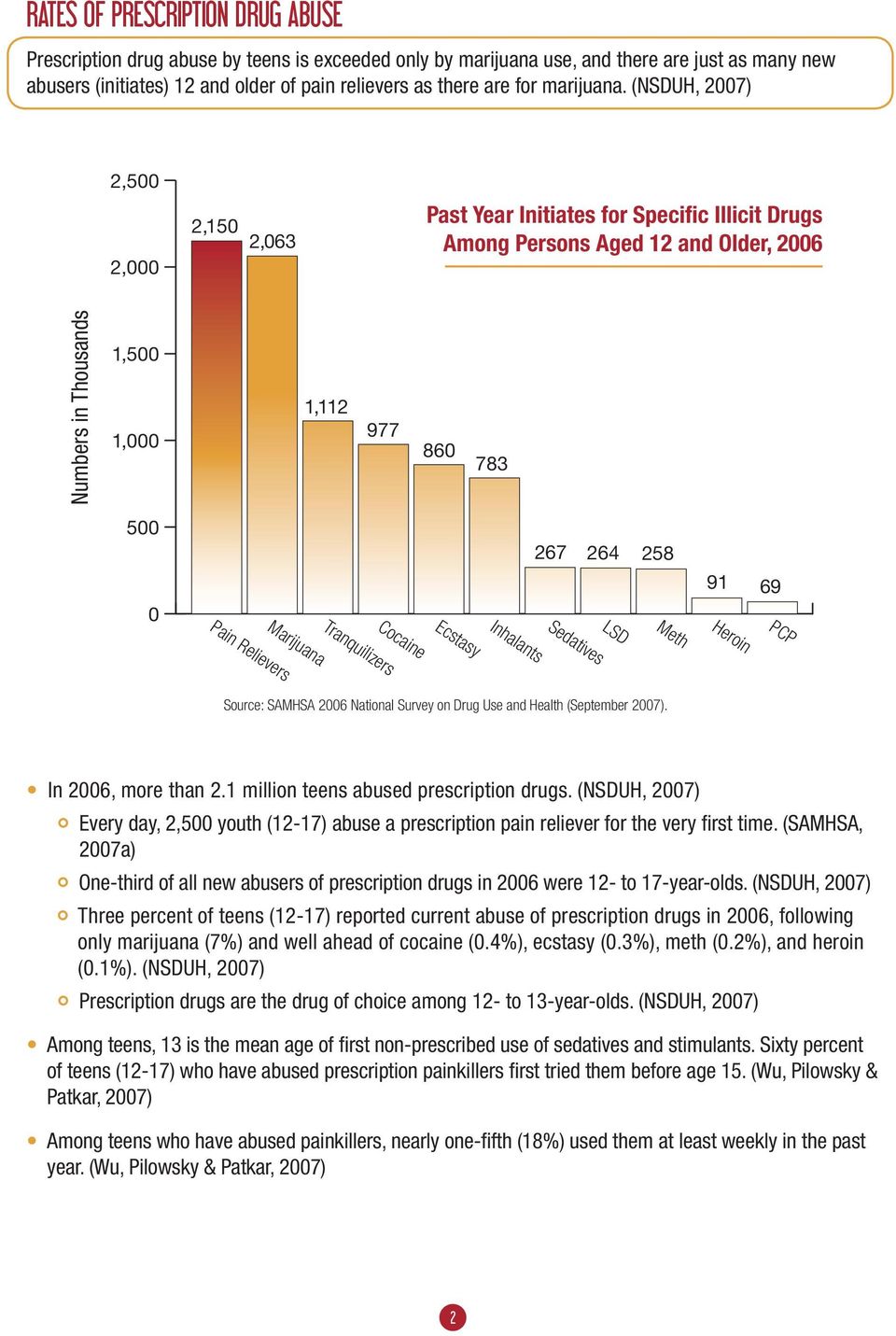
4 Rates of Prescription Drug Abuse Prescription drug abuse by teens is exceeded only by marijuana use, and there are just as many new abusers (initiates) 12 and older of pain relievers as there are for marijuana. (NSDUH, 2007) 2,500 2,000 Past Year Initiates for Specific Illicit Drugs among Persons Aged 12 and Older, ,150 2,063 Past Year Initiates for Specific Illicit Drugs Among Persons Aged 12 and Older, 2006 Numbers in Thousands 1,500 1,000 1, Tranquilizers Marijuana Pain Relievers Cocaine Ecstasy Inhalants LSD Sedatives Meth Heroin PCP Source: SAMHSA 2006 National Survey on Drug Use and Health (September 2007). In 2006, more than 2.1 million teens abused prescription drugs. (NSDUH, 2007) Every day, 2,500 youth (12-17) abuse a prescription pain reliever for the very first time. (SAMHSA, 2007a) One-third of all new abusers of prescription drugs in 2006 were 12- to 17-year-olds. (NSDUH, 2007) Three percent of teens (12-17) reported current abuse of prescription drugs in 2006, following only marijuana (7%) and well ahead of cocaine (0.4%), ecstasy (0.3%), meth (0.2%), and heroin (0.1%). (NSDUH, 2007) Prescription drugs are the drug of choice among 12- to 13-year-olds. (NSDUH, 2007) Among teens, 13 is the mean age of first non-prescribed use of sedatives and stimulants. Sixty percent of teens (12-17) who have abused prescription painkillers first tried them before age 15. (Wu, Pilowsky & Patkar, 2007) Among teens who have abused painkillers, nearly one-fifth (18%) used them at least weekly in the past year. (Wu, Pilowsky & Patkar, 2007) 2
5 The prescription drugs most commonly abused by teens are painkillers, powerful narcotics prescribed to treat pain; depressants, such as sleeping pills or anti-anxiety drugs; and stimulants, mainly prescribed to treat attention-deficit hyperactivity disorder (ADHD). Pain relievers like Vicodin and OxyContin are the prescription drugs most commonly abused by teens. (NSDUH, 2007) Among 12 th graders, past-year abuse of OxyContin increased 30 percent between 2002 through (MTF, 2007) Past year abuse of Vicodin is particularly high among 8 th, 10 th, and 12 th graders, with nearly one in 10 high school seniors reporting taking it in the past year without a doctor s approval. (MTF, 2007) Over-the-Counter Drugs Teens are also abusing some over-the-counter (OTC) drugs, primarily cough and cold remedies that contain dextromethorphan (DXM), a cough suppressant, to get high. Products with DXM include NyQuil, Coricidin, and Robitussin, among others. This type of drug abuse is a particular concern, given the easy access teens have to these products. In 2006, about 3.1 million people aged 12 to 25 had ever used an OTC cough and cold medication to get high, and nearly one million had done so in the past year. (SAMHSA, 2008) Four percent of 8th graders, five percent of 10 th graders, and six percent of 12 th graders abused OTC cough and cold remedies in the past year. (MTF, 2007) From 1999 to 2004, there was a seven-fold increase in cases related to the abuse of DXM reported to poison control centers nationwide. Most of these cases were among 15- and 16-year-olds. (Bryner, 2006) Fewer than half of teens believe abusing cough medicine to get high is risky. (PATS, 2006) A Risky Combination Teens who abuse prescription or OTC drugs may be abusing other substances as well. Sometimes they abuse prescription and OTC drugs together with alcohol or other drugs, which can lead to dangerous consequences, including death. Nearly one-half (49%) of teens who have abused prescription painkillers also report use of two or more other drugs, most commonly alcohol (81%) and marijuana (58%). (Wu, Pilowsky & Patkar, 2007) Most people aged 12 to 25 who used OTC cold and cough remedies to get high in the past year also used alcohol and illicit drugs. Around 60 percent engaged in binge drinking in the past month. In the past year, 84 percent used illicit drugs, two-thirds used marijuana, and two-thirds abused prescription drugs. (SAMHSA, 2007b) 3

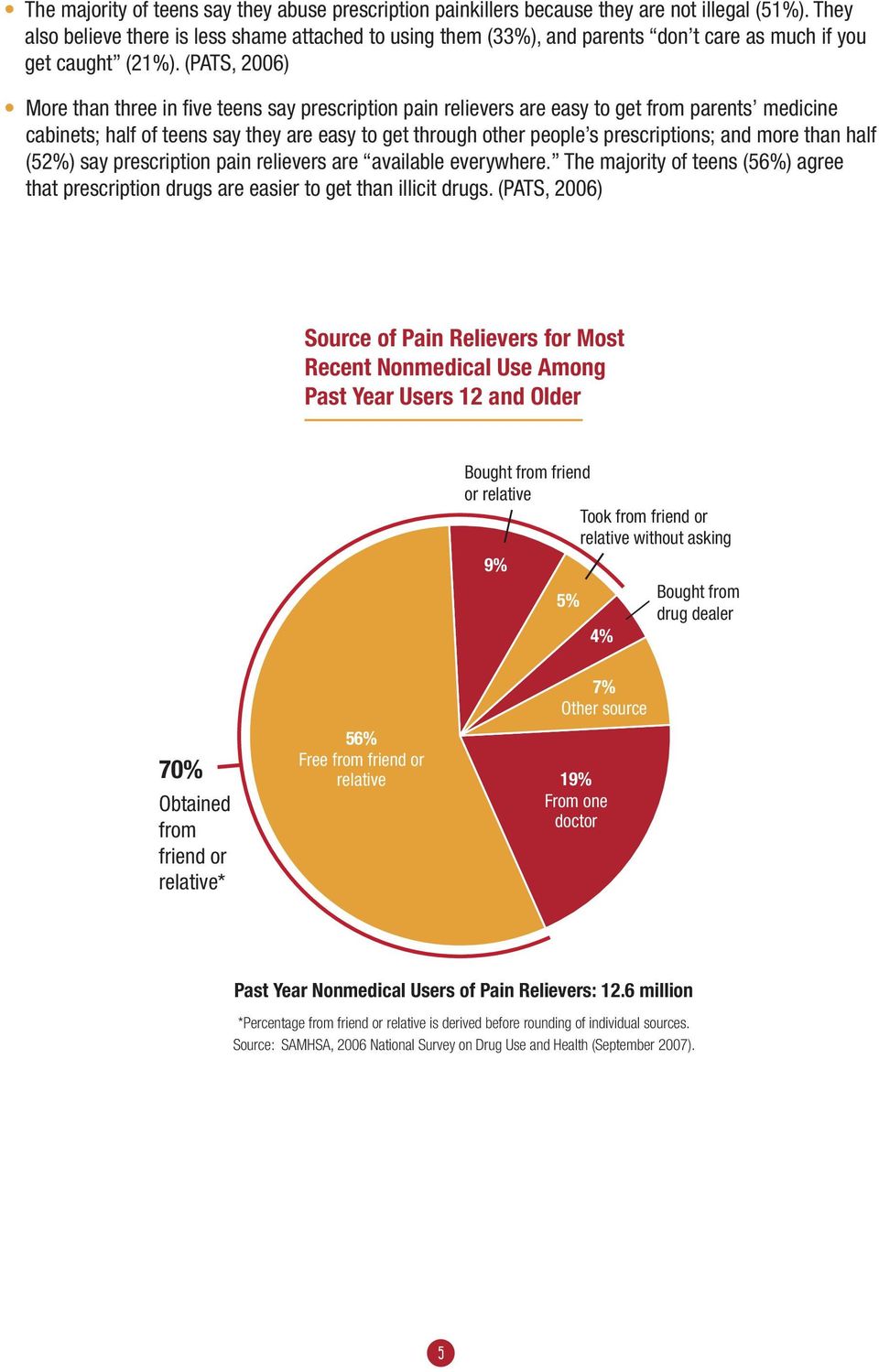
6 A Dangerous High There has been a dramatic increase in the number of poisonings and even deaths associated with the abuse of prescription drugs. Many teens believe the myth that these drugs are a safe way to get high. However when they are abused, prescription drugs can be just as dangerous as street drugs. Unintentional poisoning deaths involving narcotics and hallucinogens grew 55 percent from 1999 to Research suggests this is an increase attributed primarily to prescription painkillers. (CDC, 2007) Unintentional poisoning deaths involving psychotherapeutic drugs, such as sedative-hypnotics and antidepressants, grew 84 percent from 1999 to (CDC, 2007) Between 1995 and 2005, treatment admissions for abuse of prescription pain relievers grew more than 300 percent. (TEDS, 2007) Four out of 10 teens think that prescription medicines are much safer to abuse than illicit drugs, even if they are not prescribed by a doctor. (PATS, 2006) Nearly one-third of teens (31%) believe there s nothing wrong with using prescription medicines without a prescription once in a while. (PATS, 2006) Almost a third (32%) of teens say they abuse prescription painkillers because they believe there are fewer side effects than street drugs. (PATS, 2006) Nearly three out of 10 teens believe prescription painkillers even if not prescribed by a doctor are not addictive. (PATS, 2006) Free and Easy to Find Teens are abusing prescription drugs because they are widely available, free or inexpensive, and they believe they are not as risky as street drugs. The majority of teens who abuse these products say they get them for free, usually from friends and relatives, and often without their knowledge. Because these drugs are so readily available, teens who otherwise wouldn t touch street drugs might abuse prescription drugs. Seventy percent of people who abuse prescription pain relievers say they got them from friends or relatives. (NSDUH, 2007) Sixty-four percent of teens (12-17) who have abused pain relievers say they got them from friends or relatives, often without their knowledge. (NSDUH, 2007) Nearly half (46%) of teens say they got prescription pain relievers for free from a relative or friend. Eight percent say they bought pain relievers from a friend or relative, and another 10 percent say they took the drugs without asking. (NSDUH, 2007) About two-thirds (64%) of teenagers who have abused prescription stimulants report getting, buying, or stealing them from friends or relatives. (NSDUH, 2007) 4

7 The majority of teens say they abuse prescription painkillers because they are not illegal (51%). They also believe there is less shame attached to using them (33%), and parents don t care as much if you get caught (21%). (PATS, 2006) More than three in five teens say prescription pain relievers are easy to get from parents medicine cabinets; half of teens say they are easy to get through other people s prescriptions; and more than half (52%) say prescription pain relievers are available everywhere. The majority of teens (56%) agree that prescription drugs are easier to get than illicit drugs. (PATS, 2006) Source of Pain Relievers for Most Recent Nonmedical Use Among Source of Pain Relievers for Most Recent Nonmedical Past Year Users 12 and Older Use Among Past Year Users 12 and Older Bought from friend or relative Took from friend or relative without asking 9% 5% 4% Bought from drug dealer 70% Obtained from friend or relative* 7% Other source 56% Free from friend or relative 19% From one doctor Past Year Nonmedical Users of Pain Relievers: 12.6 million *Percentage from friend or relative is derived before rounding of individual sources. Source: SAMHSA, 2006 National Survey on Drug Use and Health (September 2007). 5
8 Parents Are Unaware and underestimate their influence Many parents are not aware of the dangers of teen prescription drug abuse. Teens say their parents are not discussing these dangers with them, even though research shows that parental disapproval is a powerful way to keep teens from using drugs. And parents are in a unique position to dramatically reduce teen access to prescription drugs because they are found in the home. More than one in four (27%) parents feels that prescription and OTC drugs are much safer to abuse than street drugs. (PATS, 2007) Parents are not having frequent and detailed discussions with their kids about the risks of prescription or OTC drug abuse: About 70 percent of parents report discussing the risks of marijuana a lot with their youth, but only 36 percent say they have done the same with prescription drugs, and only 33 percent with OTC cough or cold medications. (PATS, 2007) Parents are a third less likely to discuss the risks of prescription and OTC drug abuse than they are to discuss the risks of street drugs like heroin or cocaine, even though teens are far less likely to use these substances. (PATS, 2007) Youth (12-17) whose parents express strong disapproval of drug use are far less likely to engage in substance use. (NSDUH, 2007) 6

9 APPENDIX: DEFINITIONS Prescription drugs that are most commonly abused include three classes: painkillers (opioids), depressants, and stimulants. Painkillers (opioids) are prescribed to alleviate pain, such as those drugs prescribed after surgery. These drugs are also referred to as narcotics, or prescription pain relievers. Examples include oxycodone (OxyContin), propoxyphene (Darvon), hydrocodone (Vicodin), hydromorphone (Dilaudid), and meperidine (Demerol). Depressants slow normal brain function and are used to treat anxiety and sleep disorders. In higher doses, some depressants can become general anesthetics. Tranquilizers (benzodiazepines such as Valium and Xanax) and sedatives are examples of depressants, as are barbiturates (Amytal, Nembutal, Seconal, Phenobarbital). Stimulants increase alertness, attention, and energy, which are accompanied by increases in blood pressure, heart rate, and respiration. Stimulants are prescribed to treat narcolepsy (a rare form of sleep disorder), attention-deficit hyperactivity disorder (ADHD), and depression that has not responded to other treatments. Examples of prescription stimulants include amphetamines (Biphetamine, Dexedrine), and methylphenidate (Ritalin). Barbiturates are a type of depressant sometimes prescribed to promote sleep. Benzodiazepines (tranquilizers) are a type of depressant often prescribed for short-term relief of anxiety. Xanax is among the most widely prescribed medication of this type. Current use (also referred to as past-month use) refers to use of drugs during the month prior to the survey interview. Dextromethorphan (DXM) is a cough suppressant found in many over-the-counter cough and cold remedies. Lifetime use refers to the use of drugs at least once in a person s lifetime. Nonmedical use and abuse of prescription drugs are all defined here as use of prescription medications without medical supervision for the intentional purpose of getting high, or for a reason other than what the medication was intended, regardless of prescription status. Misuse of prescription drugs is defined as unintentional, incorrect use of medications, such as missing dosages, or not taking medication with food as recommended on the actual prescription. 7

10 ANNOTATED REFERENCE LIST Boyd, McCabe, Cranford, and Young Adolescents Motivations to Abuse Prescription Medication, Pediatrics. * A study conducted through the Institute for Research on Women and Gender, Substance Abuse Research Center, University of Michigan, Ann Arbor, MI. The 2005 sample was derived from one ethnically diverse school district in southeastern Michigan and included 7 th through 12 th grade students. The focus of the study was to determine adolescents reasons for engaging in the nonmedical (illicit) use of four classes of prescription medications and to examine whether motivations were associated with a higher risk for substance abuse problems. Bryner, Wang, Hui, Bedodo, MacDougall & Anderson Dextromethorphan Abuse in Adolescence, An Increasing Trend: , Archives of Pediatric and Adolescent Medicine. This study examined the trend of dextromethorphan (DXM) abuse in California and compared these findings with national trends. The data were derived from DXM abuse cases reported to the California Poison Control System, the American Association of Poison Control Centers, and Drug Abuse Warning Network (DAWN). Findings include the annual proportion of all DXM-related cases, frequency of cases among youth aged 9 to 17, and the most commonly reported products. Centers for Disease Control (CDC) Unintentional Poisoning Deaths, United States, February 9, This report examined unintentional poisoning deaths in the United States, nearly all of which are attributed to drugs. The analysis, based on data from the National Vital Statistics System, highlights substantial increases in these deaths each year from 1999 to Findings also include deaths by age, gender, region, and other selected characteristics, as well as unintentional poisonings by type of substance. Johnston, O Malley, Bachman & Schulenberg Monitoring the Future National Survey Results on Drug Use, National Institute on Drug Abuse (NIDA). This volume presents the comprehensive findings from the 2006 Monitoring the Future survey of 8 th, 10 th, and 12 th graders nationwide. The report includes detailed findings on prevalence and trends, initiation of use, attitudes and beliefs, as well as subgroup differences. McCabe, Boyd & Teter Illicit Use of Opioid Analgesics by High School Seniors, Journal of Substance Abuse Treatment. This study examined a national representative sample of 4,522 high school seniors from the 2002 Monitoring the Future Survey database to assess the correlates of illicit use of opioid analgesics, as well as the relationship between illicit use of opioid analgesics and other substance abuse and risky behavior. Monitoring the Future (MTF) National Institute on Drug Abuse (NIDA). Monitoring the Future is an annual survey begun in 1976 that collects information about behaviors, attitudes, and values of American middle school, secondary school students, college students, and young adults. Each year, a total of approximately 50,000 8 th, 10 th, and 12 th grade students are surveyed. 8
11 National Survey on Drug Use and Health (NSDUH). 2004, 2005, Substance Abuse and Mental Health Services Administration (SAMHSA). NSDUH, formerly the National Household Survey on Drug Abuse, is an annual survey that provides information about alcohol, tobacco, illicit drug, and nonmedical prescription drug use among youth and adults aged 12 and over. NSDUH is supported by the Substance Abuse and Mental Health Services Administration of the U.S. Department of Health and Human Services. (2007) (2007 detailed tables) (2004) (State data ) Partnership Attitude Tracking Study (PATS) Teens in grades 7 through 12, Partnership for a Drug-Free America. The Partnership Attitude Tracking Study tracks the attitudes about illegal drugs, providing research about the thoughts and perceptions of the Partnerships target audiences. The survey consists of two nationally projectable samples: a teen sample for students in grades seven through 12, and a parent sample. The 2005 PATS teens study surveyed 7,216 adolescents from all over the U.S. Data were collected from March through June Partnership Attitude Tracking Study (PATS) Parents with children in grades 7 to 12, Partnership for a Drug-Free America. The Partnership Attitude Tracking Study tracks parents attitudes, knowledge, and prevention behaviors related to youth illicit drug use. The 2006 parent survey included a sample of 1,356 parents with children under the age of 19, with the majority with children in grades 7 through 12. Data were collected from February through April About_Drugs_and_Alcohol Paulozzi Opioid Analgesic Involvement in Drug Abuse Deaths in American Metropolitan Areas, American Journal of Public Health. This study measured the role of opioid analgesics in drug abuse-related deaths in 28 metropolitan areas from the Drug Abuse Warning Network (DAWN) from Findings include trend data, comparisons of overdose deaths with drugs like cocaine and heroin, and the most common types of opioid analgesics involved. Substance Abuse and Mental Health Services Administration (SAMHSA) The NSDUH Report: Misuse of Over-the-Counter Cough and Cold Medications Among Persons Aged 12 to 25. This report presents findings about Over-the-Counter (OTC) cough and cold medications derived from the 2006 National Survey on Drug Use and Health of a sample of 44,819 individuals in the U.S. aged 12 and older. 9
12 Substance Abuse and Mental Health Services Administration (SAMHSA) Misuse of Prescription Drugs, National Survey on Drug Use and Health (NSDUH). This report presents findings from the 2002, 2003, and 2004 National Surveys on Drug Use and Health on the nonmedical use of prescription-type psychotherapeutic drugs. NSDUH, an annual survey of the civilian, noninstitutionalized population of the United States aged 12 or older, covers four broad classes of prescription psychotherapeutic drugs: pain relievers, tranquilizers, stimulants, and sedatives. Attention is also given to two specific drugs within these general classes: methamphetamine (a stimulant) and OxyContin (a pain reliever). NSDUH is supported by the Substance Abuse and Mental Health Services Administration of the U.S. Department of Health and Human Services. Substance Abuse and Mental Health Services Administration (SAMHSA). 2007a. A Day in the Life of American Adolescents: Substance Use Facts, Office of Applied Studies. This report presents facts about adolescent substance use, including information on the initiation of substance use, past year substance use, and receipt of substance use treatment. Data in the report are from the NSDUH, Treatment Episode Data Set (TEDS), and the National Survey of Substance Abuse Treatment Services. Substance Abuse and Mental Health Services Administration (SAMHSA). 2007b. Misuse of OTC Cold and Cough Medications: New Data from the National Survey on Drug Use and Health, Presentation to the American Public Health Association, November 6, This unpublished presentation presents data on the abuse of cough and cold medications among young people aged The data were derived from the 2006 NSDUH (sample size of 44,819). The 2006 survey year was the first time questions on this topic were included in the study. Treatment Episode Data Set (TEDS) Substance Abuse Treatment Admissions by Primary Substance of Abuse According to Sex, Age Group, Race, and Ethnicity, Substance Abuse and Mental Health Services Administration (SAMHSA). This report presents results from the Treatment Episode Data Set (TEDS) for 2004 and trend data for 1994 to The report provides information on the demographic and substance abuse characteristics of the 1.9 million annual admissions to treatment for abuse of alcohol and drugs in facilities that report to individual State administrative data systems. Treatment Episode Data Set (TEDS) Treatment Episode Data Set, 1995 to National Admissions to Substance Abuse Treatment Services, Substance Abuse and Mental Health Services Administration. This report presents results from the 2005 Treatment Episode Data Set (TEDS) report, as well as trend data from 1995 to It provides information on the demographic and substance abuse characteristics of the 1.8 million annual admissions to treatment for the abuse of alcohol and drugs in facilities that are part of the State reporting networks. 10
13 Wu, Pilowsky & Patkar Non-Prescribed Use of Pain Relievers Among Adolescents in the United States, Drug and Alcohol Dependence (in press). This study examined the gender-specific prevalences, patterns, and correlates of non-prescribed use of pain relievers mainly opioids in a representative sample of 18,678 adolescents. Data were drawn from the 2005 NSDUH. The study looked at frequency and onset of use, connection to risk factors, and the extent of other substance use. *Some of the research included in this report includes surveys with smaller sample sizes. Therefore, those results cannot be generalized to the entire population. 11
TEENS AND PRESCRIPTION DRUGS An Analysis of Recent Trends on the Emerging Drug Threat
 TEENS AND PRESCRIPTION DRUGS An Analysis of Recent Trends on the Emerging Drug Threat OFFICE OF NATIONAL DRUG CONTROL POLICY EXECUTIVE OFFICE OF THE PRESIDENT FEBRUARY 2007 TABLE OF CONTENTS Introduction
INFORMATION BRIEF. Overview. Prescription Drug Abuse Among Young People
 Product No. 2002-L0424-004 INFORMATION BRIEF AUGUST 2002 U. S. D E P A R T M E N T O F J U S T I C E NDIC and Stockbyte Overview Prescription drugs, a category of psychotherapeutics that comprises prescription-type
What Parents Need to Know
 What Parents Need to Know About Prescription Drug Abuse Office of District Attorney Jonathan W. Blodgett A Message From the District Attorney Prescription drug abuse is a growing problem. According to
Prescription Drug Abuse in the Workplace
 Prescription Drug Abuse in the Workplace Illicit drugs and misuse of alcohol are not the only substances that can affect health and safety in workplaces. Prescription drugs, when used without a prescription
Teens and Prescription Drug Abuse
 Teens and Prescription Drug Abuse Information compiled by Communities That Care of Lorain County For more information, please contact Cathy Gabe 440-282-9920 [email protected] www.ctcloraincounty.org
Behavioral Health Barometer. United States, 2014
 Behavioral Health Barometer United States, 2014 Acknowledgments This report was prepared for the Substance Abuse and Mental Health Services Administration (SAMHSA) by RTI International under contract No.
Trends in the Abuse of Prescription Drugs
 Trends in the Abuse of Prescription Drugs by Jane Carlisle Maxwell, Ph.D. The sale of narcotic analgesic pills is increasing, as is diversion and the non-medical use of prescription drugs. These drugs
And, despite the numbers, for many people, the Facts About Drugs are not clear.
 According to the National Survey on Drug Use and Health (NSDUH), an estimated 20 million Americans aged 12 or older used an illegal drug in the past 30 days. This estimate represents 8% percent of the
Prescription Drug Abuse. Katherine E. Schmidt. IHEC Intern - Fall 2010
 Disclaimer: The views of the author do not necessarily reflect the views and beliefs of the Illinois Higher Education Center, Eastern Illinois University, and The Department of Human Services. Prescription
PRESCRIPTION PAINKILLER OVERDOSES
 IMPACT{ POLICY PRESCRIPTION PAINKILLER OVERDOSES National Center for Injury Prevention and Control Division of Unintentional Injury Prevention What s the Issue? In a period of nine months, a tiny Kentucky
The State of Prescription Drug Use in Georgia: A Needs Assessment
 2012 The State of Prescription Drug Use in Georgia: A Needs Assessment Submitted By: Dr. Sheryl Strasser, Evaluator and Megan Smith, MPH, Assistant Evaluator Georgia State University, Institute of Public
National Adolescent Health Information Center NAHIC NAHIC NAHIC NAHIC NAHIC NAHIC NAHIC NAHIC NAHIC NAHIC NAHIC NAHIC NAHIC NAHIC
 National Adolescent Health Information Center N 2007 Fact A H I C Sheet on Substance : Adolescents & Young Adults Highlights: 4 After an increase in the early 1990s, adolescent substance use has decreased
2012 PARTNERSHIP ATTITUDE TRACKING STUDY
 2012 PARTNERSHIP ATTITUDE TRACKING STUDY Sponsored by MetLife Foundation Teens and Parents Released: April 23, 2013 1 2012 Partnership Attitude Tracking Study, sponsored by MetLife Foundation TABLE OF
Iowa Governor s Office of Drug Control Policy
 Talking to kids about {prescription drug abuse Iowa Governor s Office of Drug Control Policy Talking to kids about {prescription drug abuse As a parent you re concerned about your children s health and
In Brief MICHIGAN. Adolescent Behavioral Health. A Short Report from the Office of Applied Studies
 MICHIGAN Adolescent Behavioral Health In Brief A Short Report from the Office of Applied Studies Adolescence (12 to 17 years) is a critical and vulnerable stage of human development, during which males
Testimony Engrossed House Bill 1101 Department of Human Services Senate Human Services Committee Senator Judy Lee, Chairman February 19, 2013
 Testimony Engrossed House Bill 1101 Department of Human Services Senate Human Services Committee Senator Judy Lee, Chairman February 19, 2013 Chairman Lee, members of the Senate Human Services Committee,
In Brief UTAH. Adolescent Behavioral Health. A Short Report from the Office of Applied Studies
 UTAH Adolescent Behavioral Health In Brief A Short Report from the Office of Applied Studies Adolescence (12 to 17 years) is a critical and vulnerable stage of human development, during which males and
Maximizing Your Role as a Teen Influencer: What You Can Do To Help Prevent Teen Prescription Drug Abuse. www.talkaboutrx.org
 Maximizing Your Role as a Teen Influencer: What You Can Do To Help Prevent Teen Prescription Drug Abuse www.talkaboutrx.org What is Rx drug abuse? The misuse of Rx drugs is a growing, under-recognized
In Brief ARIZONA. Adolescent Behavioral Health. A Short Report from the Office of Applied Studies
 ARIZONA Adolescent Behavioral Health In Brief A Short Report from the Office of Applied Studies Adolescence (12 to 17 years) is a critical and vulnerable stage of human development, during which males
Behavioral Health Indicators for Tennessee and the United States
 Behavioral Health Indicators for Tennessee and the United States April 2015 Prepared by: Lymari Benitez, Ph.D. and Rachel L. Jones Tennessee Department of Mental Health and Substance Abuse Services Office
Prescription drug abuse trends. Minnesota s Prescription Monitoring Program. Minnesota Rural Health Conference June 25, 2013 Duluth
 Prescription drug abuse trends Minnesota s Prescription Monitoring Program Carol Falkowski Drug Abuse Dialogues www.drugabusedialogues.com Barbara Carter, Manager MN Board of Pharmacy www.pmp.pharmacy.state.mn.us
Survey on Misuse and Abuse of Prescription Stimulants Among College Students and Other Young Adults by Partnership for Drug-Free Kids
 Survey on Misuse and Abuse of Prescription Stimulants Among College Students and Other Young Adults by Partnership for Drug-Free Kids Embargoed Until: November 13, 2014 10:00 a.m. EST Survey on Misuse
Daily marijuana use among U.S. college students highest since 1980
 August 31, 215 Contact: Jared Wadley, 734-936-7819, [email protected] Ariel Bronson, 734-647-83, [email protected] U-M has a satellite uplink TV studio and an ISDN radio line for interviews. EMBARGOED FOR
TRENDS IN HEROIN USE IN THE UNITED STATES: 2002 TO 2013
 2013 to 2002 States: United the in Use Heroin in Trends National Survey on Drug Use and Health Short Report April 23, 2015 TRENDS IN HEROIN USE IN THE UNITED STATES: 2002 TO 2013 AUTHORS Rachel N. Lipari,
The Changing Face of Opioid Addiction:
 9th Annual Training and Educational Symposium September 6, 2012 The Changing Face of Opioid Addiction: A Review of the Research and Considerations for Care Mark Stanford, Ph.D. Santa Clara County Dept
MONTHLY VARIATION IN SUBSTANCE USE INITIATION AMONG FULL-TIME COLLEGE STUDENTS
 Students College Full-Time Among Initiation Use Substance in Variation Monthly National Survey on Drug Use and Health Short Report August 27, 2015 MONTHLY VARIATION IN SUBSTANCE USE INITIATION AMONG FULL-TIME
Iowa Governor s Office of Drug Control Policy
 Iowa Governor s Office of Drug Control Policy medicines or take them in a manner not prescribed, we increase the risk of negative effects. It is estimated that over 35 million Americans are ages 65 and
States In Brief Substance Abuse and Mental Health Issues At-A-Glance
 kentucky States In Brief Substance Abuse and Mental Health Issues At-A-Glance A Short Report from the Office of Applied Studies Prevalence of Illicit Substance 1 and Alcohol Use The National Survey on
Underage Drinking. Underage Drinking Statistics
 Underage Drinking Underage drinking is a serious public health problem in the United States. Alcohol is the most widely used substance of abuse among America s youth, and drinking by young people poses
The Current State of Drug Abuse Across the Nation. December 12, 2015
 The Current State of Drug Abuse Across the Nation December 12, 2015 Agenda The Partnership for Drug-Free Kids The macro picture Opioid abuse and addiction What can we do about it? Moving upstream: connecting
Teen Misuse and Abuse of Alcohol and Prescription Drugs. Information for Parents
 Teen Misuse and Abuse of Alcohol and Prescription Drugs Information for Parents Terminology Misuse: Using a drug in a way in which it was not intended Example: Using a higher dose of medication than was
Pharmacology and Physiology (C105) Understanding Pharmacology and Physiology. The History of Drugs. The Neurobiology of Addiction.
 Understanding Pharmacology and Physiology Knowledge of Pharmacology and Physiology is Crucial SAMHSA s Counselor Competencies What is Addiction? NIDA: Why Do People Use Drugs? From Abuse to Addiction Desired
SAMHSA Initiatives to Educate Prescribers and Consumers and Treatment Resources
 SAMHSA Initiatives to Educate Prescribers and Consumers and Treatment Resources Nick Reuter Division of Pharmacologic Therapy Substance Abuse and Mental Health Services Administration 1 Overview National
Visit www.takebackmylife.org to hear more of my story or call 211 for help and treatment options
 In high school, I experimented with alcohol and pot. Then I moved on to narcotics and cocaine, which landed me in jail several times. By 25, I was a daily heroin user with a long-term prison sentence.
Maternal and Child Health Issue Brief
 Maternal and Child Health Issue Brief Why is substance abuse an issue among youth? December 14 8 Substance Abuse among Youth in Colorado Substance abuse among youth is defined as using alcohol, tobacco,
Youth Alcohol, Tobacco and Drug Use
 Attitude and Perception Survey on Youth Alcohol, Tobacco and Drug Use Sponsored by: Northeast Center for Healthy Communities Lawrence, Massachusetts INTRODUCTION TO ATTITUDE AND PRECEPTION SURVEY This
opiates alcohol 27 opiates and alcohol 30 April 2016 drug addiction signs 42 Ranked #1 123 Drug Rehab Centers in New Jersey 100 Top 10 380
 opiates alcohol 27 opiates and alcohol 30 April 2016 drug addiction signs 42 ed #1 123 Drug Rehab Centers in New Jersey 100 Top 10 380 effects of alcohol in the brain 100 Top 30 698 heroin addiction 100
Behavioral Health Trends in the United States: Results from the 2014 National Survey on Drug Use and Health
 Behavioral Health Trends in the United States: Results from the 2014 National Survey on Drug Use and Health Results from the 2014 National Survey on Drug Use and Health September 2015 ii Behavioral Health
Behavioral Health Barometer. Oklahoma, 2014
 Behavioral Health Barometer Oklahoma, 2014 Acknowledgments This report was prepared for the Substance Abuse and Mental Health Services Administration (SAMHSA) by RTI International under contract No. 283
Behavioral Health Barometer. Mississippi, 2014
 Behavioral Health Barometer Mississippi, 2014 Acknowledgments This report was prepared for the Substance Abuse and Mental Health Services Administration (SAMHSA) by RTI International under contract No.
Rural Substance Abuse Partnership (RSAP) State Profile: OKLAHOMA
 Rural Substance Abuse Partnership (RSAP) State Profile: OKLAHOMA Overview: The Rural Substance Abuse Partnership (RSAP), organized with the help of a U.S. Department of Justice, Office of Justice Programs
Addictive Prescription Drugs and Orange County Seniors
 Addictive Prescription Drugs and Orange County Seniors Addictive Prescription Drugs and Orange County Seniors SUMMARY Although a considerable amount of research and study has gone into defining critical
Behavioral Health Barometer. United States, 2013
 Behavioral Health Barometer United States, 2013 Acknowledgments This report was prepared for the Substance Abuse and Mental Health Services Administration (SAMHSA) by RTI International under contract No.
New National Poll Reveals Public Attitudes on Substance Abuse, Treatment and the Prospects of Recovery
 New National Poll Reveals Public Attitudes on Substance Abuse, Treatment and the Prospects of Recovery Finds some significant differences in perceptions among various population groups. Nearly half of
PRESCRIPTION DRUG ABUSE: THE NATIONAL PERSPECTIVE
 PRESCRIPTION DRUG ABUSE: THE NATIONAL PERSPECTIVE May 19, 2012 National Association Boards of Pharmacy Annual Meeting Gil Kerlikowske, Director White House Office of National Drug Control Policy ONDCP
CHAPTER 2: Substance Use, Mental Disorders, and Access to Treatment Services in Household Surveys, 2002 2005
 CHAPTER 2: Substance Use, Mental Disorders, and Access to Treatment Services in Household Surveys, 2002 2005 2.1 Introduction Drug misuse and abuse, and mental health disorders are major health and social
Opioid overdose can occur when a patient misunderstands the directions
 Facts About Opioid Overdose How Does an Overdose Occur? Opioid overdose can occur when a patient misunderstands the directions for use, accidentally takes an extra dose, or deliberately misuses a prescription
Drug Testing to Support Pain Management
 NATIONAL REFERENCE LABORATORY Drug Testing to Support Pain Management 500 Chipeta Way, Salt Lake City, UT 84108 (800) 522-2787 (801) 583-2787 www.aruplab.com www.arupconsult.com ARUP is an enterprise of
What Is a Prescriber s Role in Preventing the Diversion of Prescription Drugs?
 What Is a Prescriber s Role in Preventing the Diversion of Prescription Drugs? 2 CONTENT SUMMARY Drug diversion is the illegal distribution or abuse of prescription drugs or their use for unintended purposes.
How To Treat A Drug Addiction
 1 About drugs Drugs are substances that change a person s physical or mental state. The vast majority of drugs are used to treat medical conditions, both physical and mental. Some, however, are used outside
Tri-Town Youth Substance Abuse Prevention Coalition. 2013 Adult Perception Survey Report
 Tri-Town Youth Substance Abuse Prevention Coalition 2013 Adult Perception Survey Report Executive Summary INTRODUCTION The Tri-Town Youth Substance Abuse Prevention Coalition conducted its second Adult
THE CAUSES OF DRUG ADDICTION
 1 Statistical facts associated with addiction and substance abuse are concerning, but many men and women choose to ignore the dangers. By understanding the main causes of addiction to drugs, it is possible
Heroin Addiction. Kim A. Drury RN, MSN
 Heroin Addiction Kim A. Drury RN, MSN Heroin use is on the rise in our area. Nearly every day the news media reports situations involving Heroin. According to the Substance Abuse and Mental Health Services
The streets aren t the only place kids find drugs.
 The streets aren t the only place kids find drugs. Sometimes they find them right at home. A Parents Guide to Understanding Prescription Drug Abuse For more information go to www.safeguardmymeds.org What
INFO Brief. Prescription Opioid Use: Pain Management and Drug Abuse In King County and Washington State
 ADAI-IB 23-3 INFO Brief Prescription Opioid Use: Pain Management and Drug Abuse In King County and Washington State O ctober 23 Caleb Banta-Green (Alcohol and Drug Abuse Institute, University of Washington),
Sample Patient Agreement Forms
 Sample Patient Agreement Forms Introduction This resource includes two sample patient agreement forms that can be used with patients who are beginning long-term treatment with opioid analgesics or other
The Partnership Attitude Tracking Study (PATS)
 The Partnership Attitude Tracking Study (PATS) Teens 7 Report Released August 4, 8 Partnership for a Drug-Free America Partnership Attitude Tracking Study Table of Contents Page Mission..........................................3
Massachusetts Population
 Massachusetts October 2012 POLICY ACADEMY STATE PROFILE Massachusetts Population MASSACHUSETTS POPULATION (IN 1,000S) AGE GROUP Massachusetts is home to more than 6.5 million people. Of these, more than
New Jersey Population
 New Jersey October 2012 POLICY ACADEMY STATE PROFILE New Jersey Population NEW JERSEY POPULATION (IN 1,000S) AGE GROUP New Jersey is home to nearly9 million people. Of these, more than 2.9 million (33.1
"DEALING WITH DRUG AND ALCOHOL ABUSE FOR EMPLOYEES IN CONSTRUCTION ENVIRONMENTS"
 PRESENTER'S GUIDE "DEALING WITH DRUG AND ALCOHOL ABUSE FOR EMPLOYEES IN CONSTRUCTION ENVIRONMENTS" Part of the "CONSTRUCTION SAFETY KIT" Series Quality Safety and Health Products, for Today...and Tomorrow
Clarendon Consolidated Independent School District Annual Performance Report (TEC 39.053) School Year 2011/2012
 Clarendon Consolidated Independent School District Annual Performance Report (TEC 39.053) School Year 2011/2012 Part 3: Violent or Criminal incidences occurring on the- Clarendon Elementary Campus: Clarendon
Drug Abuse Warning Network, 2011: National Estimates of Drug-Related Emergency Department Visits
 Drug Abuse Warning Network, 2011: National Estimates of Drug-Related Emergency Department Visits U.S. DEPARTMENT OF HEALTH AND HUMAN SERVICES Substance Abuse and Mental Health Services Administration Center
MACOMB COUNTY STRATEGIC PREVENTION FRAMEWORK STATE INCENTIVE GRANT DATA PROFILE
 MACOMB COUNTY STRATEGIC PREVENTION FRAMEWORK STATE INCENTIVE GRANT DATA PROFILE Assessing the Burden of Illicit Drugs and Alcohol Abuse: A Focus on Heroin and Prescription Drug Abuse September 2010 ACKNOWLEDGEMENTS
Teenage Prescription Drug Abuse
 Teenage Prescription Drug Abuse Rickard E. Terenzi, PhD, CASAC Manhasset Community Coalition Against Substance Abuse September 30, 2010 Teenage Prescription Drug Abuse Presentation Summary: Trends Definitions
MONITORING THE FUTURE NATIONAL RESULTS ON ADOLESCENT DRUG USE
 MONITORING THE FUTURE NATIONAL RESULTS ON ADOLESCENT DRUG USE Overview of Key Findings, 211 by Lloyd D. Johnston, Ph.D. Patrick M. O Malley, Ph.D. Jerald G. Bachman, Ph.D. John E. Schulenberg, Ph.D. The
Drug overdose death rates by state per 100,000 people (2008) SOURCE: National Vital Statistics System, 2008
 PRESCRITPION DRUG ABUSE: AN EPIDEMIC What is Addiction? By: Lon R. Hays, M.D., M.B.A. Professor and Chairman Department of Psychiatry University of Kentucky Healthcare Addiction is a primary, chronic disease
Karla Ramirez, LCSW Director, Outpatient Services Laurel Ridge Treatment Center
 Karla Ramirez, LCSW Director, Outpatient Services Laurel Ridge Treatment Center 1 in 4 Americans will have an alcohol or drug problems at some point in their lives. The number of alcohol abusers and addicts
Prescription Drug Abuse: Trends, Surveillance, and Future Implications Dena M. Fisher Case Western Reserve University Master of Public Health
 Prescription Drug Abuse: Trends, Surveillance, and Future Implications Dena M. Fisher Case Western Reserve University Master of Public Health I. Prescription Drug Abuse A. What is it? B. What types of
Drug Overdose Deaths, Hospitalizations, Abuse & Dependency among Oregonians
 214 Drug Overdose Deaths, Hospitalizations, Abuse & Dependency among Oregonians Oregon Health Authority Center for Prevention & Health Promotion, Injury & Violence Prevention Section 5/3/214 Drug Overdose
CLINICAL TRENDS IN OVERDOSE. Neil A. Capretto, D.O., F.A.S.A.M. Medical Director Gateway Rehabilitation Center
 CLINICAL TRENDS IN OVERDOSE Neil A. Capretto, D.O., F.A.S.A.M. Medical Director Gateway Rehabilitation Center Number of Overdoses by Year Allegheny County Year Number of Overdose Fatalities 1980-1990 Average
X. Capsules; pills; Stimulants; increased energy powder; rock alertness; extreme anxiety; temporary mental illness
 Cadet Name: Date: 1. (U4C3L1:Q1) Study the table and indicate the type of drugs that are described in rows X, Y and Z. Drug Forms of the Drug Uses and Effects X. Capsules; pills; Stimulants; increased